Category: housing

  • MIL-OSI USA News: Statement from President Joe  Biden on the Death of Hassan  Nasrallah

    Source: The White House

    Hassan Nasrallah and the terrorist group he led, Hezbollah, were responsible for killing hundreds of Americans over a four-decade reign of terror.  His death from an Israeli airstrike is a measure of justice for his many victims, including thousands of Americans, Israelis, and Lebanese civilians.

    The strike that killed Nasrallah took place in the broader context of the conflict that began with Hamas’s massacre on October 7, 2023.  Nasrallah, the next day, made the fateful decision to join hands with Hamas and open what he called a “northern front” against Israel.

    The United States fully supports Israel’s right to defend itself against Hezbollah, Hamas, the Houthis, and any other Iranian-supported terrorist groups.  Just yesterday, I directed my Secretary of Defense to further enhance the defense posture of U.S. military forces in the Middle East region to deter aggression and reduce the risk of a broader regional war.

    Ultimately, our aim is to de-escalate the ongoing conflicts in both Gaza and Lebanon through diplomatic means.  In Gaza, we have been pursuing a deal backed by the UN Security Council for a ceasefire and the release of hostages.  In Lebanon, we have been negotiating a deal that would return people safely to their homes in Israel and southern Lebanon.  It is time for these deals to close, for the threats to Israel to be removed, and for the broader Middle East region to gain greater stability.

    ###

    MIL OSI USA News

  • MIL-OSI USA: Rescue Operations Ongoing Following Helene, Needed Supplies Coming to Western NC by Air

    Source: US State of North Carolina

    Headline: Rescue Operations Ongoing Following Helene, Needed Supplies Coming to Western NC by Air

    Rescue Operations Ongoing Following Helene, Needed Supplies Coming to Western NC by Air
    mseets

    Search and rescue operations remain underway in communities across Western North Carolina and supplies are being brought into the region by air following devastating impacts from Tropical Storm Helene.

    “This is a historic and catastrophic storm for Western North Carolina and I’m grateful to first responders working right now to save lives and evacuate residents,” Governor Cooper said. “Efforts are also underway to get power and communications restored, and we’re bringing in needed supplies by air.”

    More than 200 people have been rescued from flood waters in North Carolina following Helene’s torrential rains. North Carolina’s search and rescue teams are being bolstered by teams from 19 states and three federal teams.

    Many areas in the mountains received more than 10 inches and as much as 29 inches of rain causing catastrophic flooding. High winds gusting up to hurricane strength also brought down trees, power lines and cell towers across the region.

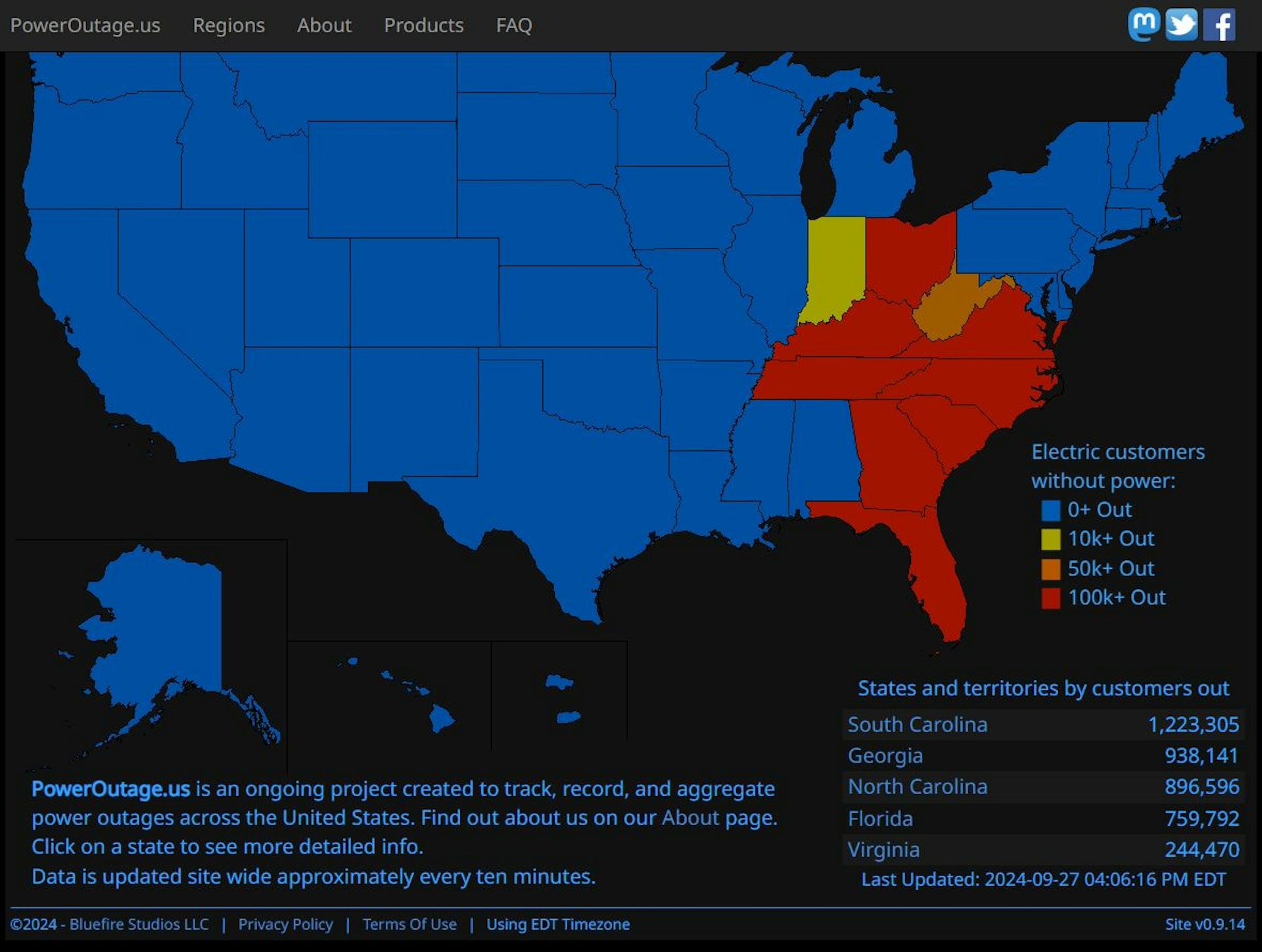
    More than 700,000 people remained without power as of this morning and utility crews are responding from across the country for immediate restoration and repair efforts. Sixteen shelters housed approximately 1,100 residents last night.

    Cellular telephone service remains spotty west of I-77 due to significant infrastructure damage. Telecommunications partners have activated Disaster Roaming, which allows any phone on any cellular network to access any available network to connect to. Telephone service providers are working to restore communications across the area.

    “The State Emergency Response Team is working around the clock responding to severe impacts from Helene’s devastation. We are grateful for our local, state and federal partners and their teamwork to help North Carolinians hit hard by this storm,” said NC Emergency Management Director Will Ray. “Please remain aware of hazards and follow directions from local officials to protect life and safety.”

    Across North Carolina, 29 counties and 52 towns and cities have issued States of Emergency, in addition to the statewide State of Emergency declared by Governor Cooper. Governor Cooper yesterday requested a Major Disaster Declaration from the federal government for North Carolina for 39 counties and the Eastern Band of Cherokee Indians for federal Public Assistance and Individual Assistance in the aftermath of Tropical Storm Helene.

    As of Saturday morning, about 418 state-maintained roads remained closed, mostly due to flooding. Across the area, 11 landslides have been reported. This includes major closures on Interstates 26 and 40 around Asheville, plus dozens of locations along several U.S. and N.C. highway routes.

    State transportation officials continue to urge residents to avoid traveling in western North Carolina, and to consider all roads in that region closed due to damage from the storm. People should go to DriveNC.gov for the latest conditions on roads impacted by Hurricane Helene. Never drive through standing water or go around barricades and road closure signs.

    North Carolina residents should call 911 only for emergencies and dial 211 for other types of information. Up-to-date information on local conditions, shelters, traffic, power outages and resources is available at ReadyNC.gov and from county government social media.

    ###

    Sep 28, 2024

    MIL OSI USA News

  • MIL-OSI USA News: Statement by Vice President Harris on the Death of Hassan  Nasrallah

    Source: The White House

    Hassan Nasrallah was a terrorist with American blood on his hands. Across decades, his leadership of Hezbollah destabilized the Middle East and led to the killing of countless innocent people in Lebanon, Israel, Syria, and around the world. Today, Hezbollah’s victims have a measure of justice.

    I have an unwavering commitment to the security of Israel. I will always support Israel’s right to defend itself against Iran and Iran-backed terrorist groups such as Hezbollah, Hamas, and the Houthis. 

    President Biden and I do not want to see conflict in the Middle East escalate into a broader regional war. We have been working on a diplomatic solution along the Israel-Lebanon border so that people can safely return home on both sides of that border. Diplomacy remains the best path forward to protect civilians and achieve lasting stability in the region.

    # # #

    MIL OSI USA News

  • MIL-OSI USA: Chairman McCaul on the Death of Hezbollah Leader Hassan Nasrallah

    Source: US House Committee on Foreign Affairs

    Media Contact 202-226-8467

    Washington, D.C. – Today, House Foreign Affairs Committee Chairman Michael McCaul issued the following statement on the death of Hezbollah leader Hassan Nasrallah, who was killed by an Israeli airstrike.

    “Hezbollah is a brutal Iran-backed terrorist organization that has massacred and maimed people across the Middle East and around the world, including hundreds of Americans, for decades. For over 30 years, Hassan Nasrallah led Hezbollah terrorists as they attacked Israel, destabilized Lebanon, and murdered Syrians as an ally of Bashar al-Assad, Iran, and Russia. Nasrallah and the other Hezbollah leaders eliminated in recent weeks had the blood of thousands on their hands. The world is much safer without these evil terrorists.

    “Israel did not start this escalation. Hezbollah has subjected Israel to near-daily attacks for almost 12 months since Hamas’ brutal October 7 attack. The United States would never tolerate constant attacks on our homeland, and nor should Israel. Hezbollah must immediately fully comply with UN Security Council Resolution 1701, including moving its terrorist forces away from the border with Israel and entirely stopping its rocket and missile attacks. And the United States must stand shoulder to shoulder with Israel, including promptly supplying defense articles and other military support, while Israel takes necessary action to restore its security.”

    ###

    MIL OSI USA News

  • MIL-OSI Global: Does Hezbollah represent Lebanon? And what impact will the death of longtime leader Hassan Nasrallah have?

    Source: The Conversation – USA – By Mireille Rebeiz, Chair of Middle East Studies & Associate Professor of Francophone & Women’s, Gender & Sexuality Studies, Dickinson College

    A picture of the secretary-general of Hezbollah Hassan Nasrallah is seen among the rubble following an Israeli air strike. Str-/picture alliance via Getty Images

    Israel has killed the leader of the militant group Hezbollah in a airstrike in Beirut, marking a further escalation of hostilities in the region.

    The death of Hassan Nasrallah, confirmed by Hezbollah on Sept 28, 2024, forms part of a major Israeli push against the Iran-backed group in recent days that has resulted in the death of several top leaders – but also killed hundreds of civilians and left many more fleeing Lebanon’s south in fear of a ground invasion.

    But what is Hezbollah? What exactly is its role in Lebanon? And how big a blow is Nasrallah’s death? The Conversation turned to Mireille Rebeiz, a Lebanon expert at Dickinson College who is writing her second book on Hezbollah, to help explain.

    What is Hezbollah? And what role does it play in Lebanon?

    Hezbollah, which means “party of God” in Arabic, was born during the Lebanese Civil War after Israel’s invasion and occupation of Lebanon in 1982.

    Officially, the group came into existence in 1985 with the publication of a manifesto that detailed Hezbollah’s aims for the region. The manifesto outlined a plan to duplicate the Iranian revolution of 1979 in Lebanon and create a Shiite Islamic state. It pledged allegiance to the Supreme Leader of the Iranian Revolution, Ruhollah Musavi Khomeini, and vowed to fight the Israeli occupation of Lebanon and the Palestinian territories.

    The Lebanese Civil War ended in 1991 with the signing of the “Taif Agreement,” in which warring factions agreed that a political and democratic process was the only way to move forward in Lebanon. Consequently, Hezbollah had to develop a political wing, and in 1992 Hezbollah entered the political ring, running for national elections and winning 12 out of 128 parliamentarian seats.

    But while the peace agreement called for the disarmament of militia groups, Hezbollah was allowed to retain its armed wing as a “resistance” group, fighting Israeli occupation in south Lebanon.

    Many Lebanese political parties allied themselves with Hezbollah at this juncture. While these parties did not necessarily share the group’s views or its commitment to Iran, they were similarly committed to fight the Israeli occupation, and Hezbollah fighters were the main force doing so.

    Hezbollah militiamen on parade in 1989.
    Ramzi Haidar/AFP via Getty Images

    Hezbollah’s presence in parliament and the Lebanese government, and its alliance with various political parties, allowed it to control the country and veto decisions that do not fit its agenda or promote its interest.

    This is particularly apparent in the country’s recurrent presidential vacuum.

    Since 2005, Lebanon has had three presidential lapses: from Nov. 2007 to May 2008, from May 2014 to October 2016, and from Oct. 31, 2023 until today. The parliamentarian Speaker, Nabih Berri, who is Shiite and known for his allegiance to Hezbollah, refuses to convene the parliament for presidential elections unless the nominee is approved by Hezbollah and its allies.

    As well as having a political and military wing, Hezbollah also provides various services, such as social welfare, health care, utilities, education and even security to his community.

    Is it right to see Hezbollah primarily as a Iran-backed militia?

    Yes — Hezbollah is primarily an Iranian-backed militia. It exists to serve the Iranian regime and expand its ideology in the region, as set out in the group’s 1985 manifesto. In 2009, Hezbollah issued a new manifesto in which it reaffirmed its commitment to the Shiite Islamic resistance led by Tehran.

    As to its financial and military support, in 2016, Nasrallah confirmed: “Hezbollah’s budget, everything it eats and drinks, its weapons and rockets, comes from the Islamic Republic of Iran.”

    Furthermore, with the backing of Iran, Hezbollah was able to create and expand its own illegal financial network through money laundering, drug trafficking and other unlawful activities.

    Along with Iran, Syria has played a major role in Hezbollah’s development. The Taif Agreement called for Syrian Armed Forces to enter Lebanon for a two-year period to help establish law and order after more than a decade of civil war.

    But it stayed in Lebanon for over 16 years, and the Syrian government’s closeness to the Iranian regime made Hezbollah a perfect ally. So much so, that when civil war broke out in Syria in 2011, Hezbollah emerged as a major actor in that conflict, sending thousands of Lebanese fighters to Syria to assist the government’s efforts to suppress a popular uprising.

    How popular is Hezbollah in Lebanon?

    Support for Hezbollah has fluctuated over the years. When Israel withdrew from Lebanon in 2000, many Lebanese celebrated Hezbollah as the country’s liberator.

    But others started pushing for Hezbollah to cease its military operations and for the Lebanese Armed Forces to take over Hezbollah’s task in securing Lebanon’s borders.

    In addition, growing anti-Syrian sentiment in Lebanon, in part due to serious human rights violations, also dented Hezbollah’s popularity because of their close ties.

    On Feb 14, 2005, Lebanese Prime Minister Rafic Hairi, who was known for his opposition to Hezbollah and Syria, was assassinated. Evidence suggested that both were involved.

    The killing sparked massive anti-government, anti-Syrian and anti-Hezbollah protests on the streets of Beirut. The subsequent Cedar Revolution led to the departure of the Syrian forces from Lebanon and marked a drop in Hezbollah’s popularity, in general.

    A Lebanese woman grieves the death of Lebanese Prime Minister Rafiq Hariri in 2005.
    Haitham Mussawi/AFP via Getty Images

    This drop was apparent in the 2005 elections, in which an anti-Syrian and anti-Hezbollah political coalition claimed victory.

    Since 2005, Lebanon has seen a series of events that indicate a clear opposition to Hezbollah. Several journalists and political figures were assassinated for speaking out against Hezbollah and Syria. Their deaths outraged many Lebanese.

    And in 2015, the “You Stink” environmental movement was born to protest political corruption and Hezbollah’s control of waste management.

    In 2019, a similar protest movement was born in which Lebanese took to the streets to express their frustration against corruption and inflation. Under the slogan “All Means All,” Lebanese protested all political parties — including Hezbollah.

    These events indicate Lebanese dissatisfaction with Hezbollah.

    A 2020 poll showed a drop in Hezbollah’s popularity even among the Shiite community, which makes up about a third of the population.

    Polling during the almost year of hostilities following the Oct. 7, 2023, attack by Hezbollah ally Hamas on Israel suggests that Hezbollah’s influence continues to exceed its popularity. An Arab Barometer poll of Lebanese in early 2024 found that only 30% trust Hezbollah, whereas 55% said they do not trust the group at all. While Hezbollah still retains the trust of 85% of Shiites, only 9% of Sunnis and Druze and 6% of Christians trust the militia.

    What is Hezbollah’s structure?

    Originally, Hezbollah leadership consisted of a religious council of seven members created in the 1980s; it has branches and committees that govern different affairs including finances, social, political and military issues. This religious council, or “Shura Council,” has regional offices in Beirut, the Bekaa Valley in the country’s eastern region and south Lebanon.

    At the end of the Lebanese Civil War, two more bodies were added: an executive council and a politburo, or central political body. The religious council was chaired by Sayyid Muhammad Hussein Fadlallah, who offered religious guidance to the Shiite community and was often described as Hezbollah’s spiritual leader.

    Both the council and Hezbollah swear allegiance to Iran’s Supreme Leader. The council is also tasked to select Hezbollah’s Secretary General.

    After the Israeli assassination of Hezbollah’s co-founder, Abbas al-Musawi, in 1992, Hassan Nasrallah assumed this role and remained Secretary General until his death in Beirut in the current Israeli campaign.

    What impact will Nasrallah’s death have on Hezbollah’s operations?

    The attacks on Hezbollah’s pagers and other wireless devices were primarily intended to creat chaos and cut communication between different leaders and units.

    The assassinations of Hezbollah commanders are meant to remove major decision-makers. The death of Secretary General Nasrallah is a definite blow to the group, which is already vulnerable from last week’s attacks. The goal is to demoralize its fighters.

    Furthermore, these attacks convey a clear message that Israel will no longer accept the tit-for-tat attacks on its northern border.

    However, Israel may not necessarily get its desired impact.

    After Israel assassinated Abbas al-Musawi, his wife and son, his death only reaffirmed Hezbollah’s commitment to its mission. Nasrallah followed Al-Musawi’s footsteps, and under his leadership, the group grew its recruitment, arsenal and reach inside and outside Lebanon.

    The situation now is fluid and it’s hard to predict what will happen next. But the fresh wave of violence may only reinforce Hezbollah’s resolve.

    Furthermore, it might see more involvement of other Hezbollah-aligned players into the region, such as the Houthis in Yemen and Kata’ib Hizballah in Iraq.

    Following the announcement of Nasrallah’s death, Iran’s Supreme Leader Khamenei threatened Israel and vowed more support to Hezbollah in Lebanon.

    Mireille Rebeiz is affiliated with the American Red Cross.

    ref. Does Hezbollah represent Lebanon? And what impact will the death of longtime leader Hassan Nasrallah have? – https://theconversation.com/does-hezbollah-represent-lebanon-and-what-impact-will-the-death-of-longtime-leader-hassan-nasrallah-have-240062

    MIL OSI – Global Reports

  • MIL-OSI USA: Hoyer Statement on Elimination of Hezbollah Leader Hassan Nasrallah

    Source: United States House of Representatives – Congressman Steny H Hoyer (MD-05)

    “The operation was a response not only to Nasrallah’s decades of terror but also to Hezbollah’s recent repeated attacks on undisputed Israeli territory. Since October 8, 2023, Hezbollah terrorists have launched nearly 10,000 rockets at Israeli civilians. More than 60,000 people in Northern Israel have fled their homes to escape Hezbollah’s violence, unable to return for months on end.

    “Israel has the right to defend itself, as does every other sovereign nation. Israel’s strikes against Hezbollah’s leadership, launch sites, and missile arsenal – especially its long-range rockets – are vital to dismantling the terrorist organization’s ability to carry out further attacks against the Israeli people on behalf of Iran.

    “The world cannot allow Iran to rebuild its proxy network on Israel’s doorstep. Israelis, Lebanese, Syrians, and others in the region deserve to live free from Hezbollah’s interference, and the displaced ought to be able to return home. Hezbollah must not be allowed to return to the northern border, and Hamas must never reassert control over Gaza. This war will not end until these Iranian-backed terrorists are defeated. The United States stands firmly with our ally Israel in that effort.”

    MIL OSI USA News

  • MIL-OSI USA: Governor Ron DeSantis Announces Activation of Florida Disaster Fund in Response to Hurricane Helene

    Source: US State of Florida

    TALLAHASSEE, Fla.—Today, Governor Ron DeSantis and First Lady Casey DeSantis announced the activation of the Florida Disaster Fund to support communities impacted by Hurricane Helene. The fund is a component of the Volunteer Florida Foundation and supports recovery initiatives including Activate Hope.

    The Florida Disaster Fund is the State of Florida’s official private fund established to assist Florida’s communities as they respond to and recover during times of emergency or disaster. In partnership with the public sector, private sector, and other non-governmental organizations, the Florida Disaster Fund supports response and recovery activities.

    Donations made to the Disaster Fund are tax-deductible. Donations may be made by visiting FloridaDisasterFund.org, or by mail to the below address. Checks should be made payable to the Volunteer Florida Foundation and should include “Florida Disaster Fund” in the memo line.

    Volunteer Florida Foundation
    Attention: Florida Disaster Fund
    1545 Raymond Diehl Road Suite 250
    Tallahassee, FL 32308

    Serving as the emergency response arm for the Hope Florida initiative, Activate Hope pulls together the private sector, nonprofits, and government resources to help Floridians get back on their feet following disaster. Activate Hope is currently helping to connect Floridians with food, household goods, home repairs, and resources following Hurricane Helene.

    Volunteer Florida is the state’s lead agency for volunteerism and community service. Established in 1994 as the Florida Commission on Community Service, Volunteer Florida promotes volunteerism and community service throughout the state, administers national service programs, and coordinates disaster recovery efforts in impacted communities.

    ###

    MIL OSI USA News

  • MIL-OSI USA: FEMA Administrator Surveys Damage in Florida as Hurricane Helene Response Efforts Continue

    Source: US Federal Emergency Management Agency

    Headline: FEMA Administrator Surveys Damage in Florida as Hurricane Helene Response Efforts Continue

    FEMA Administrator Surveys Damage in Florida as Hurricane Helene Response Efforts Continue

    WASHINGTON — Today, FEMA Administrator Deanne Criswell is in Florida surveying damage and assessing the need for federal resources to support Hurricane Helene response activities. 

    This whole-of-government effort includes the support of more than 2,300 federal personnel and voluntary agencies across six states. More than 800 FEMA personnel are deployed to assist with response efforts and are working to determine the scope of the storm’s impact and coordinate resource support and assistance.

    The Biden-Harris Administration approved emergency declarations in Alabama, Florida, Georgia, North Carolina, South Carolina and Tennessee. This type of declaration allows federal resources to begin flowing immediately as damage assessments are conducted to determine what additional resources may be available if a major disaster is declared.

    FEMA’s priority remains providing life-saving and life sustaining support to affected areas. FEMA deployed Urban Search and Rescue teams with more than 1,270 personnel and Swift Water Rescue Capabilities to affected states. Our non-profit partners including the American Red Cross, the Salvation Army, Convoy of Hope, Heart to Heart International and others are actively supporting survivors by providing emergency sheltering, food, water, clean up kits, healthcare supplies and other disaster relief items. Team Rubicon teams are helping to clear roads while the Salvation Army deployed seven mobile feeding units and crews.

    As people begin to assess damage, it is important to continue listening to local officials for instructions and be aware of the possibility of life-threating post-storm hazards. People can download the free FEMA App available in English and Spanish languages to receive real-time weather alerts and find local emergency shelters in their area.

    People who need help reconnecting with loved ones missing after the hurricane can call 1-800-RED-CROSS (1-800-733-2767) and provide as much detail available to assist operators in potentially locating missing loved ones. More than 540 American Red Cross volunteers are in the affected areas supporting communities with sheltering needs, reunification efforts and post-storm care.

    What People Can Do Now

    • If you evacuated, do not return home until local officials say it is safe to do so.
       
    • Stay out of floodwaters. People experiencing heavy rain and flooding should not wade through flood waters, which can contain debris, chemicals, waste and wildlife, as well as downed powerlines that can electrically charge the water. Turn Around, Don’t Drown!
       
    • Be safe during an outage. If you are without power, use only flashlights or battery-powered lanterns for emergency lighting.
       
    • Text instead of calling. While cellular service is limited in several areas, it’s easier to get in touch with loved ones by texting instead of calling.
       
    • Use generators safely. If there is a power outage, use generators safely. Always use them outdoors and at least 20 feet from windows, doors and attached garages. Make sure to keep the generator dry and protected from rain or flooding.
       
    • For people who are beginning to clean up, make sure to document any property damage with photos and video contact your insurance company for assistance and next steps.
       
    • People with a National Flood Insurance Program insurance policy who suffered flood damage can begin filing a claim with a phone call to their flood insurance agent or company.

    Responding to Hurricane Helene is a Whole-of- Community Effort

    Non-profit and charitable organizations are on the frontlines of the response to Hurricane Helene, providing critical support to people and communities. Here are just a few examples of the important work some of these organizations are doing on the ground.

    • American Red Cross (ARC) has more than 540 Red Cross responders deployed to affected areas with another 350 responders in route. As of Saturday morning, at least 1,900 people are in more than 80 shelters. More than 30 ARC Emergency Response Vehicles are supporting and 24 additional vehicles are in route. Anyone who needs a safe place to go can find information on redcross.org or by downloading the free Red Cross Emergency app by texting GETEMERGENCY to 90999.
    • Salvation Army is in Georgia providing meals at six emergency shelters. In Florida, a total of five mobile feeding units are in Tallahassee and 12 are in Perry. The Salvation Army is also responding to requests for cleanup kits and blankets. In North Carolina, South Carolina, Tennessee and Kentucky, the Salvation Army is responding to requests for meal service to communities affected by the storm. More response information is available at helpsalvationarmy.org.
    • Capacity Path Relief deployed two teams for community support in Florida’s Big Bend and southwest coastal areas and is expanding support to fill requests from numerous counties. Additional teams are collaborating with local EOCs and coordinating with agency and feeding partners. They are also offering mental health support to teams supporting the response.
    • Convoy of Hope is stationed in Perry, Florida and is distributing disaster supplies to survivors and is communicating with the Taylor County Sheriff’s Office to provide support as needed.
    • Heart to Heart International (HHI) is in Florida with hygiene kits and pharmaceuticals/healthcare supplies for survivors if needed. 
    • Crisis Cleanup is currently working to help survivors clean up damage from Hurricane Helene. Organizations that would like to help can register at www.crisiscleanup.org/register. 
    • Food for the Poor will deliver five pallets of hygiene kits to Catholic Charities in Saint Petersburg and Tampa, Florida and are deploying disaster kits which include tarps and hygiene kits, women’s care kits and children’s activity kits.
    • Operation Hope is prepared to support survivors with assistance applications, insurance claims, disaster recovery plans and document recovery. Survivors can find information by visiting www.operationhope.org. 

    mashana.davis

    MIL OSI USA News

  • MIL-OSI USA: SBA Offers Disaster Assistance to Businesses and Residents of Vermont Affected by Severe Storms, Flooding, Landslides and Mudslides

    Source: United States Small Business Administration

    WASHINGTON – Low-interest disaster loans from the U.S. Small Business Administration (SBA) are available to businesses and residents in Vermont following the announcement of a Presidential disaster declaration for severe storms, flooding, landslides and mudslides that occurred July 29-31.

    “SBA’s mission-driven team stands ready to help Vermont small businesses and residents impacted by this disaster in every way possible under President Biden’s disaster declaration for certain affected areas,” said SBA Administrator Isabel Casillas Guzman. “We’re committed to providing federal disaster loans swiftly and efficiently, with a customer-centric approach to help businesses and communities recover and rebuild.”

    The disaster declaration covers Caledonia, Essex and Orleans counties which are eligible for both Physical and Economic Injury Disaster Loans from the SBA. Small businesses and most private nonprofit organizations in the following adjacent counties are eligible to apply only for SBA Economic Injury Disaster Loans (EIDLs):  Franklin, Lamoille, Orange and Washington in Vermont; and Coos and Grafton in 
    New Hampshire.

    SBA’s Business Recovery Center (BRC) is open to assist businesses complete their disaster loan application, accept documents, and provide updates on an application’s status.  Walk-ins are accepted, but you can schedule an in-person appointment at an SBA Business Recovery Center in advance.  The Center will operate as indicated below.  

    Business Recovery Center (BRC)

    Washington County  

    Barre Municipal Auditorium

    20 Auditorium Hill  

    Barre, VT 05641

    Hours:          Monday – Friday, 9 a.m. to 6 p.m.

                          Saturday, 10 a.m. to 2 p.m.

    Closed:        Sunday

    Disaster survivors should not wait to settle with their insurance company before applying for a disaster loan. If a survivor does not know how much of their loss will be covered by insurance or other sources, SBA can make a low-interest disaster loan for the total loss up to its loan limits, provided the borrower agrees to use insurance proceeds to reduce or repay the loan.

    Businesses and private nonprofit organizations of any size may borrow up to $2 million to repair or replace disaster-damaged or destroyed real estate, machinery and equipment, inventory, and other business assets.  

    For small businesses, small agricultural cooperatives, small businesses engaged in aquaculture and most private nonprofit organizations, the SBA offers Economic Injury Disaster Loans (EIDLs) to help meet working capital needs caused by the disaster. Economic Injury Disaster Loan assistance is available regardless of whether the business suffered any physical property damage.

    Disaster loans up to $500,000 are available to homeowners to repair or replace disaster-damaged or destroyed real estate. Homeowners and renters are eligible for up to $100,000 to repair or replace disaster-damaged or destroyed personal property.

    Interest rates are as low as 4% for businesses, 3.25% for nonprofit organizations, and 2.688% for homeowners and renters, with terms up to 30 years. Interest does not begin to accrue, and monthly payments are not due, until 12 months from the date of the initial disbursement. Loan amounts and terms are set by the SBA and are based on each applicant’s financial condition.

    Building back smarter and stronger can be an effective recovery tool for future disasters. Applicants may be eligible for a loan amount increase of up to 20% of their physical damages, as verified by the SBA for mitigation purposes. Eligible mitigation improvements may include a safe room or storm shelter, sump pump, French drain or retaining wall to help protect property and occupants from future disasters.  

    “SBA’s disaster loan program offers an important advantage–the chance to incorporate measures that can reduce the risk of future damage,” said Francisco Sánchez, Jr., associate administrator for the Office of Disaster Recovery and Resilience at the Small Business Administration. “Work with contractors and mitigation professionals to strengthen your property and take advantage of the opportunity to request additional SBA disaster loan funds for these proactive improvements.”  

    With the changes to FEMA’s Sequence of Delivery, survivors are now encouraged to simultaneously apply for FEMA grants and the SBA low-interest disaster loan assistance to fully recover.  FEMA grants are intended to cover necessary expenses and serious needs not paid by insurance or other sources. The SBA disaster loan program is designed for your long-term recovery, to make you whole and get you back to your pre-disaster condition.  Do not wait on the decision for a FEMA grant; apply online and receive additional disaster assistance information at sba.gov/disaster.  

    Applicants may also call the SBA’s Customer Service Center at (800) 659-2955 or send an email to disastercustomerservice@sba.gov for more information on SBA disaster assistance. For people who are deaf, hard of hearing, or have a speech disability, please dial 7-1-1 to access telecommunications relay services.

    The filing deadline to return applications for physical property damage is Nov. 25, 2024. The deadline to return economic injury applications is June 26, 2025.

    ###

    About the U.S. Small Business Administration  

    The U.S. Small Business Administration helps power the American dream of business ownership. As the only go-to resource and voice for small businesses backed by the strength of the federal government, the SBA empowers entrepreneurs and small business owners with the resources and support they need to start, grow or expand their businesses, or recover from a declared disaster. It delivers services through an extensive network of SBA field offices and partnerships with public and private organizations. To learn more, visit www.sba.gov. 

    MIL OSI USA News

  • MIL-OSI USA: News 09/28/2024 Blackburn Leads Tennessee Delegation in Urging Swift Approval of Disaster Declaration Following Hurricane Helene Flash Flooding

    US Senate News:

    Source: United States Senator Marsha Blackburn (R-Tenn)
    NASHVILLE, Tenn. – U.S. Senator Marsha Blackburn (R-Tenn.) led the Tennessee delegation in sending a letter to President Joe Biden urging him to swiftly approve Governor Bill Lee’s request for a major disaster declaration in the wake of flash flooding caused by the remnants of Hurricane Helene.
    Read the full letter here or below.
     Dear Mr. President:
    We write to urge swift approval of Governor Bill Lee’s request for a major disaster declaration pursuant to the Robert T. Stafford Disaster Relief and Emergency Assistance Act due to severe weather occurring on September 26 and 27, 2024. 
    The remnants of Hurricane Helene have caused widespread damage across Tennessee, especially in East Tennessee. An estimated 6 to 10 inches of rain has fallen across the eastern part of the state over the past 48 hours. Catastrophic flash flooding has devastated communities across East Tennessee, causing I-40 to collapse and leaving homes destroyed. The Unicoi County Hospital has been inundated with flood waters, and patients and staff were forced to take shelter on the roof to await rescue. Over 75,500 power outages were reported statewide. With the heaviest rains expected to shift through Middle and West Tennessee over the weekend, more damage is expected.    
    To respond to this disaster, Governor Lee is specifically requesting an Emergency Declaration, Categories A and B, including Direct Federal Assistance. Governor Lee’s request is attached. On behalf of the State of Tennessee, we urge you to approve this request as soon as possible.
    Our offices can provide you with any additional information you need.

    CO-SIGNERS

    Senator Blackburn was joined by Senator Bill Hagerty (R-Tenn.) and U.S. Representatives Chuck Fleischmann (R-Tenn.), Mark Green (R-Tenn.), Tim Burchett (R-Tenn.), Steve Cohen (D-Tenn.), Scott DesJarlais (R-Tenn.), David Kustoff (R-Tenn.), Diana Harshbarger (R-Tenn.), Andy Ogles (R-Tenn.), and John Rose (R-Tenn.) in sending the letter.

    MIL OSI USA News

  • MIL-OSI Global: Hurricane Helene power outages leave millions in the dark – history shows poorer areas often wait longest for electricity to be restored

    Source: The Conversation – USA – By Chuanyi Ji, Associate Professor of Engineering, Georgia Institute of Technology

    Strong winds from Hurricane Helene, one of the most powerful storms to hit the Southeast, flooded roads and cut power in multiple states. AP Photo/Mike Carlson

    Hurricane Helene left more than 4 million homes and businesses in the dark across Florida, Georgia and the Carolinas after hitting Florida’s Big Bend region as a powerful Category 4 storm late on Sept. 26, 2024. As Helene’s rains moved inland, and mountain rivers caused devastating flooding, officials warned that fixing downed utility lines and restoring power would take days in some areas.

    Electricity is essential to just about everyone – rich and poor, old and young. Yet, when severe storms strike, socioeconomically disadvantaged communities often wait longest to recover.

    That isn’t just a perception.

    We analyzed data from over 15 million consumers in 588 U.S. counties who lost power when hurricanes made landfall between January 2017 and October 2020. The results show that poorer communities did indeed wait longer for the lights to go back on.

    A 10 percentile drop in socioeconomic status in the Centers for Disease Control and Prevention’s social vulnerability index was associated with a 6.1% longer outage on average. This corresponds to waiting an extra 170 minutes on average for power to be restored, and sometimes much longer.

    The top map shows the total duration of power outages over eight storms by county. The lower map is a comparison with socioeconomic status taken into account, showing that counties with lower average socioeconomic status have longer outages than expected.
    Ganz et al, 2023, PNAS Nexus

    Implications for policy and utilities

    One likely reason for this disparity is written into utilities’ standard storm recovery policies. Often, these polices prioritize critical infrastructure first when restoring power after an outage, then large commercial and industrial customers. They next seek to recover as many households as they can as quickly as possible.

    While this approach may seem procedurally fair, these recovery routines appear to have an unintended effect of often making vulnerable communities wait longer for electricity to be restored. One reason may be that these communities are farther from critical infrastructure, or they may be predominantly in older neighborhoods where power infrastructure requires more significant repairs.

    Commercial areas are often higher on the priority list for faster power recovery in an outage. This store was still closed for several days during Texas’ widespread outages in 2021.
    Montinique Monroe/Getty Images

    The upshot is that households that are already at greater risk from severe weather – whether due to being in flood-prone areas or in vulnerable buildings – and those who are least likely to have insurance or other resources to help them recover are also likely to face the longest storm-caused power outages. Long outages can mean refrigerated food goes bad, no running water and delays in repairing damage, including delays in running fans to dry out water damage and avoid mold.

    Our study spanned 108 service regions, including investor-owned utilities, cooperatives and public utilities. The differential impact on poorer communities did not line up with any particular storm, region or individual utility. We also found no correlation with race, ethnicity or housing type. Only average socioeconomic level stood out.

    How to make power recovery less biased

    There are ways to improve power recovery times for everyone, beyond the necessary work of improving the stability of power distribution.

    Policymakers and utilities can start by reexamining power restoration practices and power infrastructure maintenance, such as replacing aging utility poles and trimming trees, with disadvantaged communities in mind.

    Power providers already have granular data on power usage and grid performance in their service regions. They can begin experimenting with alternative recovery routines that consider the vulnerability of their customers in ways that do not substantially affect average recovery duration.

    People in some Fort Myers, Fla., neighborhoods still lacked water and electricity more than a week after Hurricane Ian in 2022.
    Montinique Monroe/Getty Images

    For socioeconomically vulnerable regions that are likely to experience long outages because of their locations and possibly the aging energy infrastructure, utilities and policymakers can proactively ensure that households are well prepared to evacuate or have access to backup sources of power.

    For example, the U.S. Department of Energy announced in October 2023 that it would invest in developing dozens of resilience hubs and microgrids to help supply local power to key buildings within communities when the wider grid goes down. Louisiana plans several of these hubs, using solar and large-scale batteries, in or near disadvantaged communities.

    Policymakers and utilities can also invest in broader energy infrastructure and renewable energy in these vulnerable communities. The U.S. Department of Energy’s Justice40 program directs that 40% of the benefit from certain federal energy, transportation and housing investments benefit disadvantaged communities. That may help residents who need public help the most.

    Severe weather events are becoming more common as global temperatures rise. That increases the need for better planning and approaches that don’t leave low-income residents in the dark.

    Chenghao Duan, a Ph.D. student at Georgia Tech, also contributed to this article. This article, originally published on Feb. 7, 2024, has been updated with Hurricane Helene’s rising power outage toll.

    The authors do not work for, consult, own shares in or receive funding from any company or organization that would benefit from this article, and have disclosed no relevant affiliations beyond their academic appointment.

    ref. Hurricane Helene power outages leave millions in the dark – history shows poorer areas often wait longest for electricity to be restored – https://theconversation.com/hurricane-helene-power-outages-leave-millions-in-the-dark-history-shows-poorer-areas-often-wait-longest-for-electricity-to-be-restored-240001

    MIL OSI – Global Reports

  • MIL-OSI New Zealand: Reforming the building consent system

    Source: New Zealand Government

    The Government is investigating options for a major reform of the building consent system to improve efficiency and consistency across New Zealand, Building and Construction Minister Chris Penk says.  

    “New Zealand has some of the least affordable housing in the world, which has dire social and economic implications. At the heart of the issue is unreasonably high building costs and a cumbersome consenting system which saps productivity and disincentivises growth and development.

    “The building consent system is intended to protect homeowners from defective building work by requiring work to be inspected and consented by a Building Consent Authority (BCA). 

    “There are currently 67 BCAs across the country, each with different practices and approaches. We have a single building code that is supposed to apply consistently to all building work nationally. However, there are many instances of builders submitting the exact same plans to different BCAs and finding considerable additional costs and delays result from differing interpretations of the building code.

    “This is especially challenging for large scale home builders and off-site manufacturers, along with modular and prefab builders, who work across regional boundaries. For example, in a recent survey of Master Builders Association members 80 per cent reported having to deal with multiple BCAs, and 66 per cent experienced delays.

    “The status-quo is not serving New Zealanders well. We need to incentivise innovative solutions that improve productivity and enable building at scale.

    “That’s why we are beginning discussion on options to replace the current BCA system.”

    The aim is to establish a more consistent and streamlined model, with options including:  

    1. Voluntary consolidation – allowing councils to group together to deliver building control functions. There are already a number of councils who are pooling some resources but barriers exist to full integration. This approach focuses on removing these barriers. 
    2. Regional BCAs – establishing a smaller number of relatively large regional BCAs to replace the current 66 district and city council BCAs. This approach focuses on improving consistency and forming entities with the critical mass to drive economies of scale. 
    3. Single point of contact – setting up a single point of contact for builders to submit plans to. Building inspection may be contracted out to existing BCAs or private consenting providers, creating competition and encouraging specialisation.

    “We are looking forward to receiving feedback from the sector and welcome suggestions for additional or hybrid options to deliver the desired outcomes.

    “As part of this work the Government will be looking at liability settings across the whole building system. 

    “Under the current settings, councils and their ratepayers are liable for defective work. Joint and several liability means councils can be ‘the last person standing’ available to foot the bill when things go wrong. This creates a highly conservative and risk averse approach, which contributes cost and draws out deadlines.

    “This work is in addition to reforms already underway to improve the existing building consent process, such as making it easier to build granny flats by removing consent requirements, increasing the uptake of remote inspections and removing barriers for the use of overseas building products.”

    MIL OSI New Zealand News

  • MIL-OSI Asia-Pac: PM’s guidance in developing Uttar Pradesh to help it reach US$ 1 trillion economy: Shri Goyal

    Source: Government of India

    PM’s guidance in developing Uttar Pradesh to help it reach US$ 1 trillion economy: Shri Goyal

    Double engine government of Centre, Uttar Pradesh to propel India to a US$ 35 trillion economy by 2047: Union Minister Shri Piyush Goyal

    Uttar Pradesh led by Shri Adityanath’s industrial policies has become a holistic model of development: Shri Goyal

    Implementation of 4Ds: Decisive leadership, Demand, Demographic Dividend, Democracy made Uttar Pradesh investment friendly: Shri Goyal

    Posted On: 28 SEP 2024 8:37PM by PIB Delhi

    Union Minister of Commerce & Industry, Shri Piyush Goyal during his valedictory speech at the 2nd edition of Uttar Pradesh International Trade Show (UPITS) said that Prime Minister Shri Narendra Modi’s efforts in developing Uttar Pradesh will help the state reach US$ 1 trillion economy in the first phase. 

    Shri Goyal noted that the double engine Government of Uttar Pradesh led by Shri Yogi Adityanath under the guidance of the Prime Minister will help India become a US$ 5 trillion economy in the first phase, and will serve as a cornerstone for India to become a US$35 trillion economy and a ‘Viksit Bharat’ by 2047. Shri Goyal noted that the industrial and other proactive policies implemented by Shri Yogi Adityanath with the visionary goals of the Prime Minister has led the state to become a holistic model of development in the country.

    Highlighting the journey of Make in India program, Shri Goyal said that PM Modi’s vision to initiate this journey on September 25, 2014 to make India a domination nation at the global stage in manufacturing will produce employment and entrepreneur opportunities for the youth.

    Shri Goyal announced that a decision has been taken to celebrate the Anniversary of Make in India with the opening of the UP International Trade Show every year. The Government of India and the UP Government together have constantly prioritised making laws simpler and promote ease of doing business, he said.  He added that the Centre and the UP government in a joint effort are building an industrial smart city in Greater Noida and a total of 20 industrial smart cities are being developed across the country.

    Applauding the success of the trade show in its 2nd edition, Shri Goyal highlighted that over 2,500 exhibitors participated and over a lakh people have already attended in the four-day event from September 25-29, 2024. Shri Goyal further praised Shri Adityanath and the UP government for their efforts in skill development of the youth enabling provision of skilled and talented labour for the companies investing in the state. He said that because of this proactive initiative, migration from the state has significantly reduced with industries receiving a ready talent pool for efficient operations enabling them to expand their business and also making the state investor-friendly. UP government has been successful in not only a holistic development of the state but has also made progress in social infrastructure and human development, he said. 

    Shri Goyal explaining 4Ds – Decisive leadership, Demand, Demographic Dividend and a vibrant Democracy, said that huge investments have poured into Uttar Pradesh because of its implementation by the Centre and the state government.

    Highlighting the successes of first 100 days of PM Modi’s third term, Shri Goyal said that the decisions taken to benefit farmers, to increase minimum wages, build 3 crore homes under the PMAY scheme, provision for health expenditure up to Rs 5 lakh for citizens above 70 years, to built 12 more industrial smart cities and to provide employment to 4 crore youth by spending Rs 2 lakh crore over a period of five years will strengthen the society and benefit every part of the country.

    Speaking about the improvement from 142nd to 63rd in Ease of Doing Business rankings, Shri Goyal said that the continuous efforts led by the Government has led to rise of India’s rankings in Global Innovation Index to 39th spot out of 133 countries.  He continued that the ranking is reflective of the rise in patent filing in the country as well. The Intellectual Property Rights regime has vastly improved over the last decade. From 6,000 patents being filed in 2014 to 1 lakh patents filed last year, shows country’s growth in technology, he said.

    Emphasising the importance of maintaining quality in products, the Union Minister said that India is being recognised as a quality provider of goods and services. We have to ensure that the products we manufacture, the services we provide should be of high quality and buyers should receive this quality with Made in India products, he said.

    The Union Minister said that PM gave the vision of Zero Defect, Zero Effect and to make products of high sustainable quality is the need of this country and the world. He expressed hope that the youth, innovators, and startups with high quality, zero-defect production and sustainable manufacturing practices will propel India to world recognition. Manufacturing and selling of Made in India products within the country and abroad will reduce imports, boost MSMEs, help One District One Product scheme to grow and lead India to be technologically developed nation.

    ***

    AD/VN/AM

    (Release ID: 2059961) Visitor Counter : 19

    MIL OSI Asia Pacific News

  • MIL-OSI Asia-Pac: Department of Consumer Affairs continues to observe Swachhata Hi Sewa 2024 Campaign

    Source: Government of India (2)

    Posted On: 28 SEP 2024 7:55PM by PIB Delhi

    During the ongoing Swachhata Hi Sewa 2024 Campaign, the Department of Consumer Affairs, Government of India and its attached/subordinate offices organized the following activities.

    Activities for the Safai Mitra: NCDRC, New Delhi conducted a meditation/yoga session today for its safari mitras and housekeeping staff at the office premises. This session was guided by Mrs, Sunita Rakesh Anand, Assistant Registrar.

    Housing staff of NCDRC doing meditation activities

    Housekeeping Staff of NCDRC, New Delhi with Mrs, Sunta Rakesh Anand, Assistant Registrar


    Glimpses form the meditation day at NCDRC, New Delhi

    On the same day, a medical team led by Dr, Pradeep Kurnar Singh visited the premises of the National Commission and conducted the medical check-up of all the Safai Mitras, Security Guards and other Staff Members of the Commission. They also conducted the sugar as well as blood pressure test of the all the officials of the Commission. The Doctor also gave his consultation to all the staff members on the basis of their medical tests.

    The medical team led by Dr, Pradeep Kumar Singh at the NCDRC office.

    Doctor checking the blood pressure of one of the staff of NCDRC.

    *****

    AD/NS

    (Release ID: 2059915) Visitor Counter : 80

    MIL OSI Asia Pacific News

  • MIL-OSI Asia-Pac: DPIIT working on Jan Vishwas 2.0 to further give a boost to “Make in India”

    Source: Government of India (2)

    Posted On: 28 SEP 2024 6:10PM by PIB Delhi

    The Department for Promotion of Industry and Internal Trade (DPIIT) is working on about 100 rules and laws of various departments of government to bring Jan Vishwas 2.0 bill to achieve a greater ease of doing business environment in the country. The work is being done as the priority area under the first 100-day thrust of the present government. To support the “Make in India” initiative, the Government of India has enacted the Jan Vishwas (Amendment of Provisions) Act, 2023. With the primary objective of decriminalising minor offences across 42 Central Acts, the Act eliminates 183 criminal provisions across 19 Ministries/Departments.

    The Joint Parliamentary Committee, which reviewed the Jan Vishwas Bill, has recommended extending the exercise to further Acts, ensuring the continuous modernization of India’s regulatory framework.The Jan Vishwas Act introduces civil penalties and administrative actions for minor technical and procedural lapses, reducing the fear of criminal penalties and enhancing the ease of doing business and living in the country.

    A key objective of the Jan Vishwas Act is to remove outdated provisions that no longer serve the evolving technological and business environment. This comprehensive reform not only saves time and costs for both the government and the judiciary but also fosters a more conducive environment for businesses and entrepreneurs by reducing unnecessary legal hurdles.

    The Act, passed by the Lok Sabha on July 27, 2023, and the Rajya Sabha on August 2, 2023, with presidential assent on August 11, 2023,  aims to promote trust in businesses and citizens, streamline legal processes, and ease the burden on the judiciary. The decriminalisation effort ensures that penalties are proportionate to the severity of offences while maintaining stringent punishments for serious violations. This is a major step towards aligning India’s regulatory framework with global business standards, promoting investor confidence, and facilitating smoother business operations.

     ***

    AD/VN/CNAN

    (Release ID: 2059868) Visitor Counter : 68

    MIL OSI Asia Pacific News

  • MIL-OSI Asia-Pac: Union Minister Sh. Nitin Gadkari’s Vision for Amrit Mahotsav Park Takes Shape: A Bird Habitat and Recreation Space Near Nagpur’s Ring Road

    Source: Government of India (2)

    Union Minister Sh. Nitin Gadkari’s Vision for Amrit Mahotsav Park Takes Shape: A Bird Habitat and Recreation Space Near Nagpur’s Ring Road

    Sh. Nitin Gadkari inaugurates Oxygen Bird Park in Nagpur, Maharashtra

    Eco-Friendly Park Combines Bird Habitat and Recreation Across 8.23 Hectares, with 2.5 Hectares Reserved for Social Forestry

    Bird Park to Feature Rare Trees, Lotus Pond, Reed Bed, Bambusetum, and Palm Plantation to Attract Birds and Enhance Ecology

    Posted On: 28 SEP 2024 4:59PM by PIB Delhi

    Union Minister of Road Transport and Highways Sh. Nitin Gadkari inaugurated Oxygen Bird Park (Amrit Mahotsav Park) along the Nagpur-Hyderabad National Highway-44 in Nagpur, Maharashtra today.

    Oxygen Bird Park (Amrit Mahotsav Park) is an eco-initiative developed by the National Highways Authority of India (NHAI) near Jamtha, along the Nagpur-Hyderabad National Highway-44. Covering a total area of 8.23 hectares, including 2.5 hectares dedicated to social forestry, the park is designed to serve both as a natural bird habitat and as a recreational space for locals and tourists. The project, which integrates environmental sustainability and recreational facilities, was formally approved in March 2023 with a development cost of ₹14.31 crores.

    The idea for the park originated from a suggestion by Union Minister Sh. Nitin Gadkari to RO Nagpur to develop a Amrit Mahotsav Park on NHAI land parcel for observing the variety of birds found in this part of Central India as well as recreation of citizens. The vision was to establish a green space provide a safe and natural habitat for a wide variety of bird species. Located in an environment designed to mimic natural ecosystems, the park aims to conserve both local and migratory bird populations. This initiative has been included as an additional work in the broader infrastructural project of developing a four-lane standalone ring road around Nagpur city, with the park located at the Clover Leaf intersection near the Jamtha International Cricket Stadium.

    Background

    Ecological Features of the Park:

    The bird park will feature several distinct areas aimed at conservation and ecological enhancement.

    Rare and Endangered Trees Area: This section will showcase and preserve rare and endangered tree species native to Central India. Species include the Vulnerable Indian Bael, Gum Karaya and the Endangered Yellow Flame of the Forest.

    Lotus/Lily Pad Pond: The pond will be home to various lotus and water lilies, providing habitat for water birds and recharging underground aquifers. It will also create a microhabitat with increased humidity. Since the waterbody is deep it has the potential to attract both resident and migrant ducks. The migrant ducks attracted are both diving ducks like pochards and dabbling ducks.

    Reed Bed: Located behind the pond, this reed bed will provide an ideal habitat for birds such as waterhens, moorhens, and reed warblers, especially during migration.

    Bambusetum: This area will feature native Indian bamboo species. Bamboo will help reduce dust and noise pollution, absorb vehicle emissions, and improve soil quality through its leaf litter.

    Plantation Area: Extending beyond the 6-hectare park, this area will include native tree species and shrubs. It will attract wildlife, reduce noise and dust, and enhance air quality by mimicking natural forest conditions.

    Palm Plantation: Behind the lake, native Indian palms such as phoenix date palm and toddy palm will be planted. These palms will offer nesting sites for various bird species and small mammals, and support species like hornbills and weaver birds.

    Attracting Birds: The park’s flora includes a variety of trees, reeds, aquatic plants, shrubs, and bushes specifically chosen to support local wildlife and enhance biodiversity. Notable species include Neem, Indian Coral Tree, Water Lilies, Lotus, Wild Jasmine, and Karonda.

    Visitor Infrastructure

    The park offers a range of amenities including a ticket counter, food court, modern toilets, internal pathways, a jogging/cycling track, an amphitheatre with an increased plinth height, watch towers, and cast-iron benches. Landscaping features expanded lawns, green pockets, and an irrigation system. Utilities are well-integrated, including a 200 kVA transformer and additional borewells.

    Features of the Oxygen Bird Park

    Feature

    Details

    Food Court

    1 nos Designated area offering a variety of food options

    Restrooms

    Conveniently located restrooms for visitors

    Walking Paths

    Well-designed pathways for leisurely walks

    Jogging and Cycling Tracks

    Dedicated tracks for jogging and cycling

    Watchtowers

    2 nos Elevated towers for panoramic views of the park

    Amphitheater Platforms

    1 nos Spaces designed for small gatherings or performances

    Children’s Play Area

    Dedicated space for kids to play and explore

    Naturally Formed Pond

    Scenic pond blending seamlessly with the natural landscape

    Architectural Entrance Gate

    Aesthetically designed entrance gate with striking architecture

    Landscaped Surroundings

    Thoughtfully planned landscaping to enhance the park’s visual appeal

    Dense Vegetation Development

    2 hectares dedicated to oxygen-generating tree species

    Water Recharge Pits

    30 pits for water management and groundwater recharge


    Sustainability Initiatives

    The park incorporates solar energy through solar panels, which support lighting, water features, and other facilities. This approach reduces reliance on conventional energy sources and promotes environmental sustainability.

    Environmental Focus

    A core element of the park is its emphasis on sustainability, highlighted by its “Oxygen Park” feature. The planting of fast-growing, oxygen-producing trees aims to combat air pollution and foster a healthier environment. The Social Forestry Division of Nagpur plays a key role in developing and maintaining these green spaces.

    The event was attended by Sh.Shyam Kumar Barve, MP, Sh. Tekchand Sawarkar, MLA, Sh.Ashish Jaiswal, MLA, Sh. Vikas Kumbhare, Sh. Sudhakar Kohale and Sh. Anurag Jain, Secretary, MoRTH and Senior Officials of ministry and NHAI.

    *****

    NKK/GS

    (Release ID: 2059851) Visitor Counter : 27

    MIL OSI Asia Pacific News

  • MIL-OSI Asia-Pac: Text of Vice-President’s address at India International School (Deemed to be University), Jaipur (Excerpts)

    Source: Government of India

    Right from the time I stepped on the premises. I am energised and surcharged, and why not? Me and Dr. Sudesh Dhankhar are proud parents of a daughter.

    Distinguished members of the faculty, and my dear students, because I’m here for you today. Dr. Ashok Gupta has chosen a subject that has three facets, first is women related to Viksit Bharat.

    Friends, most do not understand the contours of Viksit Bharat, we are aspiring for a Viksit Bharat@ 2047. A great marathon march is on for it.

    All stakeholders are converging. Already in last few years, we have come to a very high level. We are the fifth largest global economy on the planet.

    Globally, Viksit Bharat has not been defined. Viksit nation has not been defined but you have to read into it through several mechanisms and one is per capita income. We have to take our per capita income eightfold to give Bharat the status of a developed nation and for that some fundamentals are required.

    One fundamental is, do we have the right ecosystem? The first element of the ecosystem is hope and possibility.

    There is a mechanism in place where every individual can exploit his or her talent and potential to realise aspirations and dreams and for that, two things are required – one, equality before law. Equality before law, provided by the Constitution had eluded us for long, some people thought they are more equal than others, some thought we are beyond the reach of the law, we are above the law but a big change that has taken place is equality before law is now a ground reality. Privilege pedigree, that special class that carried an idea they have immunity from law are now being rendered accountable to law. That’s a big change. 

    Any society driven by corruption, driven by greasing of the palm, driven by liaison agents, driven by a system that without corruption you cannot get a job or a contract is certainly against the rise of the youth. Corruption eats into the talented, corruption neutralises meritocracy.

    A big change has taken place, power corridors once infested with corrupt liaison elements, those who extra-legally leveraged decision-making, who provided contracts and jobs without merit being a consideration, those corridors have been neutralised. You would have seen now that there is transparent accountable governance in the country and this has been brought about by technological penetration right up to the villages where money is transferred without intermediary.

    Our youth is still seeking something else, yes, and that is they want to be partners, stakeholders, contributors in our journey for Viksit Bharat and the mechanism is number one, education. Education is fundamental, education is the most transformative mechanism of change.

    There can be no change without education, education has to be quality education, education has to be purposeful education.

    Education has to be beyond degree, pursuit of degrees one after another is not the right approach to education and that is why after three decades the country came to have national education policy that allows students full exploitation of their talent. They have been distanced from degree-orientated education.

    It has been focused on skill education, aptitude. Simultaneously you can pursue courses by and large the nation has adopted the national education policy.

     Education brings about equality, education cuts into inequities. Education is a great leveller of societal system, education provides oxygen to democracy.

    If we look into our Vedas, great emphasis was laid on education and participation of women. We lost the way somewhere in between but during that period in Vedas, the Vedic era, the earliest one, women were on the same footing.

    They were policy makers, they were decision makers, they were guiding force. We lost the way somewhere, we are regaining it fast. Even right now we have a system. Come on, don’t cry, you are a boy. Be a man. अब यह बातें पुरानी हो गईं, कहने वाले को भी डर लगने लग गया है। 

    I am saying this only to buttress my point. 

    Now, we cannot dream of a Viksit Bharat without women and without education, women and education are the two wheels of the chariot that will drive the nation.

    Its economy, its development journey and fructify in Viksit Bharat@ 2047, if not earlier.

    The country has seen historic exponential development, economic upsurge unknown to us. The world class infrastructure, our opportunity basket is increasing day by day but I can tell you one thing and global institutions, the IMF, the World Bank, the World Economic Forum and all have spoken that India globally is the most happening place.

    Look around any country, we are the best in terms of opportunity and investment.

    An epochal development has taken place, a historic development has taken place, and that is women reservation in Lok Sabha and State Legislatures, Constitution has now provided one-third reservation in Lok Sabha and State Legislatures, this is the minimum, it can go more. Women will not be handicapped in contesting for general seat. Now, imagine a scene, more than one-third women in the Lok Sabha. They will be part of policy-making, they will be part of legislation making, they will be part of executive functions, they will be the driving force. This is the development of the century. The nation tried it for over three decades unsuccessfully but last year, it was a great success. I had the good fortune, privilege, and honour to be in the chair when it was passed in the Council of States, the House of Elders, the Upper House, the Rajya Sabha.

    I have no doubt in saying you are 50% of humanity and in contribution your role is always more than 50% because you are natural repository of sensitive behaviour, sublime behaviour, spiritual conduct and full of warmth and empathy and therefore, I have no doubt that the role of women and education in Viksit Bharat is all important. I am happy that institutions like yours are nurturing it in the right spirit.

    Let me remind you of a great saying of pre-Socratic era philosopher Heraclitus, he said, the only constant in life is change, and then he buttressed it by an instance, that the same person cannot enter the same river twice, because neither the person is the same nor the river is the same.

    So you have to be always ready for change. But then you can’t be in captivity of change, you have to be part of the change which you like, you deserve.

    Let me give you a small illustration, we are having another industrial revolution when it comes to technology. 

    It is changing very fast, It is changing too fast for us to have our feet on the ground. A great challenge, also a great opportunity to keep on learning, be ahead of times, knowledge has to be acquired. I am sometimes pained that we talk about our Vedas, I would especially persuade the Vice-Chancellor to ensure that every student has a look at Vedas.

    The moment you read Vedas you will come to know the rich legacy you have inherited, the kind of wisdom you will find there, knowledge you will find there. On every facet, from health to astronomy, from Physics to Chemistry, you will find everything.

    Focus on that. 

    To be well informed is a necessary condition for a person to be a good person for the nation because first and last, you have to always keep your nation above every other interest.

    Remember my words, in times of need, in times of distress, in times of absolute necessity, in times of survivor like situations, a shortcut is the longest cut. Never ending road so always be on the right path, the path of righteousness, not only you should be on that path. You must exhibit a conduct worth emulation by others, that yes, I will be on the right path. A nation makes a difference by airports, which we have multiplied twice 70 to 147, expressways, ports, buildings, digitisation, internet, affordable housing, gas connections, everything. The quality of the human resource is important, a nation is known by the discipline of its citizens.

    I would appeal to Dr. Ashok Gupta to be gracious enough to accept my invitation for visit of your girl students as my guest to the new building of parliament in Delhi. 

    I will receive you there, if I’m in Delhi and I will try to be in Delhi. I managed to keep my word to the extent possible and I make things possible when it comes to girls.

    ****

    MIL OSI Asia Pacific News

  • MIL-OSI USA: Governor Newsom issues legislative update 9.28.24

    Source: US State of California 2

    Sep 28, 2024

    SACRAMENTO – Governor Gavin Newsom today announced that he has signed the following bills:
     

    • AB 869 by Assemblymember Jim Wood (D-Healdsburg) – Hospitals: seismic safety compliance.
    • AB 1008 by Assemblymember Rebecca Bauer-Kahan (D-Orinda) – California Consumer Privacy Act of 2018: personal information.
    • AB 1034 by Assemblymember Tim Grayson (D-Concord) – Labor Code Private Attorneys General Act of 2004: exemption: construction industry employees.
    • AB 1137 by Assemblymember Reginald Byron Jones-Sawyer, Sr. (D-Los Angeles) – Excluded employees.
    • AB 1186 by Assemblymember Mia Bonta (D-Oakland) – Restitution fines.
    • AB 1239 by Assemblymember Lisa Calderon (D-Whittier) – Workers’ compensation: disability payments.
    • AB 1282 by Assemblymember Josh Lowenthal (D-Long Beach) – Mental health: impacts of social media.
    • AB 1575 by Assemblymember Jacqui Irwin (D-Thousand Oaks) – Public postsecondary education: students codes of conduct: advisers.
    • AB 1807 by Assemblymember Sabrina Cervantes (D-Riverside) – County of Riverside Citizens Redistricting Commission.
    • AB 1871 by Assemblymember Juan Alanis (R-Modesto) – Adopted course of study for grades 7 to 12: social sciences: personal financial literacy.
    • AB 1877 by Assemblymember Dr. Corey Jackson (D-Moreno Valley) – Juveniles: sealing records.
    • AB 1899 by Assemblymember Sabrina Cervantes (D-Riverside) – Courts.
    • AB 1905 by Assemblymember Dawn Addis (D-Morro Bay) – Public postsecondary education: employment: settlements, informal resolutions, and retreat rights.
    • AB 1913 by Assemblymember Dawn Addis (D-Morro Bay) – Pupil safety: child abuse prevention: training.
    • AB 1936 by Assemblymember Sabrina Cervantes (D-Riverside) – Maternal mental health screenings.
    • AB 1954 by Assemblymember Juan Alanis (R-Modesto) – Sexually violent predators.
    • AB 2013 by Assemblymember Jacqui Irwin (D-Thousand Oaks) – Generative artificial intelligence: training data transparency.
    • AB 2063 by Assemblymember Brian Maienschein (D-San Diego) – Health care coverage.
    • AB 2080 by Assemblymember Dr. Joaquin Arambula (D-Fresno) – University of California: schools of medicine: report.
    • AB 2085 by Assemblymember Rebecca Bauer-Kahan (D-Orinda) – Planning and zoning: permitted use: community clinic.
    • AB 2099 by Assemblymember Rebecca Bauer-Kahan (D-Orinda) – Crimes: reproductive health services.
    • AB 2105 by Assemblymember Josh Lowenthal (D-Long Beach) – Coverage for PANDAS and PANS.
    • AB 2234 by Assemblymember Tasha Boerner (D-Encinitas) – Vehicles: electric bicycles.
    • AB 2284 by Assemblymember Tim Grayson (D-Concord) – County employees’ retirement: compensation.
    • AB 2295 by Assemblymember Dawn Addis (D-Morro Bay) – Crimes: commencement of prosecution.
    • AB 2310 by Assemblymember Gregg Hart (D-Santa Barbara) – Parole hearings: language access.
    • AB 2326 by Assemblymember David Alvarez (D-San Diego) – Equity in Higher Education Act: discrimination: compliance, regulations, and reports.
    • AB 2395 by Assemblymember Sharon Quirk-Silva (D-Fullerton) – California State University: extension programs, special session, and self-supporting instructional programs: revenues.
    • AB 2402 by Assemblymember Josh Lowenthal (D-Long Beach) – Drink spiking.
    • AB 2407 by Assemblymember Gregg Hart (D-Santa Barbara) – Public postsecondary educational institutions: sexual harassment complaints: state audits.
    • AB 2473 by the Committee on Education – English Language Learner Acquisition and Development Pilot Program repeal: teacher credentialing authorizations: fingerprints and related information: high school coursework and graduation requirements for pupils participating in a newcomer program.
    • AB 2481 by Assemblymember Josh Lowenthal (D-Long Beach) – Social media-related threats: reporting.
    • AB 2501 by Assemblymember David Alvarez (D-San Diego) – Water quality control plans: donations and grants.
    • AB 2533 by Assemblymember Juan Carrillo (D-Palmdale) – Accessory dwelling units: junior accessory dwelling units: unpermitted developments.
    • AB 2579 by Assemblymember Sharon Quirk-Silva (D-Fullerton) – Inspections: exterior elevated elements.
    • AB 2581 by Assemblymember Brian Maienschein (D-San Diego) – Healing arts: continuing education: maternal mental health.
    • AB 2628 by Assemblymember Gregg Hart (D-Santa Barbara) – California State Auditor: internet website.
    • AB 2630 by Assemblymember Mia Bonta (D-Oakland) – Pupil health: oral health assessment.
    • AB 2643 by Assemblymember Jim Wood (D-Healdsburg) – Cannabis cultivation: environmental remediation.
    • AB 2711 by Assemblymember James C. Ramos (D-Highland) – Suspensions and expulsions: voluntary disclosures.
    • AB 2749 by Assemblymember Jim Wood (D-Healdsburg) – California Health Benefit Exchange: financial assistance.
    • AB 2854 by Assemblymember Jacqui Irwin (D-Thousand Oaks) – Bradley-Burns Uniform Local Sales and Use Tax Law.
    • AB 2885 by Assemblymember Rebecca Bauer-Kahan (D-Orinda) – Artificial intelligence.
    • AB 2925 by Assemblymember Laura Friedman (D-Glendale) – Postsecondary education: Equity in Higher Education Act: prohibition on discrimination: training.
    • AB 2929 by Assemblymember Juan Carrillo (D-Palmdale) – Dependents: family finding.
    • AB 2935 by Assemblymember Brian Maienschein (D-San Diego) – Foster children: consumer credit reports.
    • AB 2995 by Assemblymember Dr. Corey Jackson (D-Moreno Valley) – Public health: alcohol and drug programs.
    • AB 3030 by Assemblymember Lisa Calderon (D-Whittier) – Health care services: artificial intelligence.
    • AB 3218 by Assemblymember Jim Wood (D-Healdsburg) – Unflavored Tobacco List.
    • AB 3223 by Assemblymember Lori Wilson (D-Suisun City) – Foster Youth Services Coordinating Program.
    • AB 3240 by Assemblymember Lisa Calderon (D-Whittier) – California Ban on Scholarship Displacement Act of 2021: Cal Grant awards.
    • AB 3259 by Assemblymember Lori Wilson (D-Suisun City) – Transactions and use taxes: City of Campbell: City of Pinole: County of Solano.
    • AB 3281 by the Committee on Judiciary – Judiciary omnibus.
    • AB 3284 by the Committee on Elections – Elections omnibus bill.
    • SB 268 by Senator Marie Alvarado-Gil (D-Jackson) – Crimes: serious and violent felonies.
    • SB 295 by Senator Bill Dodd (D-Napa) – Board of Pilot Commissioners: surcharge.
    • SB 483 by Senator Dave Cortese (D-San Jose) – Pupil rights: prone restraint.
    • SB 532 by Senator Scott Wiener (D-San Francisco) – Parking payment zones.
    • SB 537 by Senator Josh Becker (D-Menlo Park) – City or County of Los Angeles: memorial to forcibly deported Mexican Americans and Mexican immigrants.
    • SB 549 by Senator Josh Newman (D-Fullerton) – Gaming: Tribal Nations Access to Justice Act.
    • SB 597 by Senator Steven Glazer (D-Orinda) – Building standards: rainwater catchment systems.
    • SB 607 by Senator Anthony Portantino (D-Burbank) – Controlled substances.
    • SB 691 by Senator Anthony Portantino (D-Burbank) – Pupil attendance: truancy notifications.
    • SB 707 by Senator Josh Newman (D-Fullerton) – Responsible Textile Recovery Act of 2024.
    • SB 897 by Senator Josh Newman (D-Fullerton) – Pupil attendance: interdistrict attendance: school districts of choice.
    • SB 904 by Senator Bill Dodd (D-Napa) – Sonoma-Marin Area Rail Transit District.
    • SB 908 by Senator Dave Cortese (D-San Jose) – Fentanyl: child deaths.
    • SB 957 by Senator Scott Wiener (D-San Francisco) – Data collection: sexual orientation, gender identity, and intersex status.
    • SB 969 by Senator Scott Wiener (D-San Francisco) – Alcoholic beverages: entertainment zones: consumption.
    • SB 988 by Senator Scott Wiener (D-San Francisco) – Freelance Worker Protection Act.
    • SB 991 by Senator Lena Gonzalez (D-Long Beach) – School districts: Los Angeles Unified School District: inspector general.
    • SB 997 by Senator Anthony Portantino (D-Burbank) –Pupil health: opioid antagonists and fentanyl test strips.
    • SB 1016 by Senator Lena Gonzalez (D-Long Beach) – Latino and Indigenous Disparities Reduction Act.
    • SB 1059 by Senator Steven Bradford (D-Gardena) – Cannabis: local taxation: gross receipts.
    • SB 1064 by Senator John Laird (D-Santa Cruz) – Cannabis: operator and separate premises license types: excessive concentration of licenses.
    • SB 1090 by Senator María Elena Durazo (D-Los Angeles) – Unemployment insurance: disability and paid family leave: claim administration.
    • SB 1100 by Senator Anthony Portantino (D-Burbank) – Discrimination: driver’s license.
    • SB 1109 by Senator Steven Bradford (D-Gardena) – Cannabis: demographic information of license applicants.
    • SB 1120 by Senator Josh Becker (D-Menlo Park) – Health care coverage: utilization review.
    • SB 1131 by Senator Lena Gonzalez (D-Long Beach) – Medi-Cal providers: family planning.
    • SB 1147 by Senator Anthony Portantino (D-Burbank) – Drinking water: microplastics levels.
    • SB 1162 by Senator Dave Cortese (D-San Jose) – Public contracts: employment compliance reports: apprenticeship programs.
    • SB 1166 by Senator Bill Dodd (D-Napa) – Public postsecondary education: sex discrimination reports.
    • SB 1180 by Senator Angelique Ashby (D-Sacramento) – Health care coverage: emergency medical services.
    • SB 1195 by Senator Monique Limόn (D-Santa Barbara) – Assessments: advanced placement examinations: fall testing date.
    • SB 1209 by Senator Dave Cortese (D-San Jose) – Local agency formation commission: indemnification.
    • SB 1223 by Senator Josh Becker (D-Menlo Park) – Consumer privacy: sensitive personal information: neural data.
    • SB 1240 by Senator Marie Alvarado-Gil (D-Jackson) – Public Employees’ Retirement System: contracting agencies: consolidation.
    • SB 1263 by Senator Josh Newman (D-Fullerton) – Teacher credentialing: teaching performance assessment: workgroup.
    • SB 1277 by Senator Henry Stern (D-Los Angeles) – Pupil instruction: genocide education: the Holocaust.
    • SB 1283 by Senator Henry Stern (D-Los Angeles) – Pupils: use of social media.
    • SB 1287 by Senator Steven Glazer (D-Orinda) – Public postsecondary education: Equity in Higher Education Act: prohibition on violence, harassment, intimidation, and discrimination.
    • SB 1288 by Senator Josh Becker (D-Menlo Park) – Public schools: artificial intelligence working group.
    • SB 1300 by Senator Dave Cortese (D-San Jose) – Health facility closure: public notice: inpatient psychiatric and perinatal services.
    • SB 1350 by Senator María Elena Durazo (D-Los Angeles) – Occupational safety and health: definitions.
    • SB 1447 by Senator María Elena Durazo (D-Los Angeles) – Hospitals: seismic compliance: Children’s Hospital Los Angeles.
    • SB 1488 by Senator María Elena Durazo (D-Los Angeles) – Outdoor advertising displays: exemptions.
    • SB 1490 by Senator María Elena Durazo (D-Los Angeles) – Food delivery platforms.
    • SB 1498 by Senator Angelique Ashby (D-Sacramento) – Cannabis and industrial hemp: advertising: civil action.
    • SB 1504 by Senator Henry Stern (D-Los Angeles) – Cyberbullying Protection Act.

     
    The Governor also announced that he has vetoed the following bills:
     

    • AB 1168 by Assemblymember Steve Bennett (D-Ventura) – Emergency medical services (EMS): prehospital EMS. A veto message can be found here.
    • AB 1788 by Assemblymember Sharon Quirk-Silva (D-Fullerton) – Mental health multidisciplinary personnel team. A veto message can be found here.
    • AB 1826 by Assemblymember Chris R. Holden (D-Pasadena) – Digital Infrastructure and Video Competition Act of 2024. A veto message can be found here.
    • AB 1949 by Assemblymember Buffy Wicks (D-Oakland) – California Consumer Privacy Act of 2020: collection of personal information of a consumer less than 18 years of age. A veto message can be found here.
    • AB 2095 by Assemblymember Brian Maienschein (D-San Diego) – Publication: newspapers of general circulation. A veto message can be found here.
    • AB 2098 by Assemblymember Eduardo Garcia (D-Coachella) – California Health Facilities Financing Authority Act: nondesignated hospitals: loan repayment. A veto message can be found here.
    • AB 2138 by Assemblymember James C. Ramos (D-Highland) – Peace officers: tribal police pilot project. A veto message can be found here.
    • AB 2279 by Assemblymember Sabrina Cervantes (D-Riverside) – Missing and Murdered Indigenous Persons Justice Program. A veto message can be found here.
    • AB 2467 by Assemblymember Rebecca Bauer-Kahan (D-Orinda) – Health care coverage for menopause. A veto message can be found here.
    • AB 2736 by Assemblymember Juan Carrillo (D-Palmdale) – Veterans: benefits. A veto message can be found here.
    • AB 2936 by Assemblymember Dr. Corey Jackson (D-Moreno Valley) – Higher Education Reconciliation Act. A veto message can be found here.
    • AB 3031 by Assemblymember Alex Lee (D-San Jose) – LGBTQ+ Commission. A veto message can be found here.
    • AB 3077 by Assemblymember Gregg Hart (D-Santa Barbara) – Criminal procedure: borderline personality disorder. A veto message can be found here.
    • AB 3129 by Assemblymember Jim Wood (D-Healdsburg) – Health care system consolidation. A veto message can be found here.
    • SB 85 by Senator Scott Wiener (D-San Francisco) – Immigration: case management and social services. A veto message can be found here.
    • SB 227 by Senator María Elena Durazo (D-Los Angeles) – Unemployment: Excluded Workers Program. A veto message can be found here.
    • SB 278 by Senator Bill Dodd (D-Napa) – Elder abuse: emergency financial contact program. A veto message can be found here.
    • SB 357 by Senator Anthony Portantino (D-Burbank) – Vehicles: physician and surgeon reporting. A veto message can be found here.
    • SB 907 by Senator Josh Newman (D-Fullerton) – Orange County Board of Education: members. A veto message can be found here.
    • SB 961 by Senator Scott Wiener (D-San Francisco) – Vehicles: safety equipment. A veto message can be found here.
    • SB 966 by Senator Scott Wiener (D-San Francisco) – Pharmacy benefits. A veto message can be found here.
    • SB 971 by Senator Anthony Portantino (D-Burbank) – Community colleges: exemption from nonresident tuition fee: resident of a region impacted by war or regional conflict. A veto message can be found here.
    • SB 1119 by Senator Josh Newman (D-Fullerton) – Hospitals: seismic compliance. A veto message can be found here.
    • SB 1246 by Senator Monique Limόn (D-Santa Barbara) – California Prompt Payment Act: nonprofit organizations. A veto message can be found here.
    • SB 1299 by Senator Dave Cortese (D-San Jose) – Farmworkers: benefits. A veto message can be found here.

    For full text of the bills, visit: http://leginfo.legislature.ca.gov.

    Recent news

    News What you need to know: Governor Newsom signed a package of bills today to improve life for Californians with disabilities at school, at home, and in the community, and increase transparency in California’s support system for people with intellectual and…

    News SACRAMENTO – Governor Gavin Newsom today announced that he has signed the following bills:AB 598 by Assemblymember Buffy Wicks (D-Oakland) – San Francisco Bay Area Regional Housing Finance Act: regional and county expenditure plans.AB 653 by Assemblymember Eloise…

    News What you need to know: A new cross-agency collaborative will review the battery storage landscape as the technology continues to proliferate throughout California. SACRAMENTO – Governor Gavin Newsom today announced a new state-level collaborative to examine…

    MIL OSI USA News

  • MIL-OSI USA: Governor Newsom signs legislation to strengthen support, opportunities, and safety for Californians with disabilities

    Source: US State of California 2

    Sep 28, 2024

    What you need to know: Governor Newsom signed a package of bills today to improve life for Californians with disabilities at school, at home, and in the community, and increase transparency in California’s support system for people with intellectual and developmental disabilities.

    Sacramento, California – Governor Gavin Newsom signed a package of legislation today to make California more accessible and inclusive to all people with disabilities and strengthen California’s nation-leading commitment to support people with intellectual and developmental disabilities so they can live and thrive in their communities.

    “When we say ‘California for ALL,’ we mean every single person in this state should be able to thrive – and that includes those with physical, intellectual, and developmental disabilities. I’m proud to continue our historic actions to protect vulnerable students, improve statewide supports, and strengthen future opportunities for the disabled community.”

    Governor Gavin Newsom

    Bigger picture

    The bills signed by the Governor build on six years of actions to make the California dream more accessible to people with disabilities. Scores of investments and reforms will improve dyslexia detections, support special education services, and increase access to higher education, housing options, health care affordability, home care and community day services, public safety practices, civil rights protections, and more.

    A priority of the Newsom administration has been supporting the 400,000 Californians with intellectual and developmental disabilities, such as Down Syndrome and autism. A Master Plan for Developmental Services was announced in January to engage the public in modernizing the system for better outcomes for all; public meetings continue in October and a framework will be released in March 2025. This week, the first Comprehensive Dashboard on people served and services provided was unveiled by the Department of Developmental Services. On January 1, 2025, rates paid to service providers will increase and the first quality incentive program will begin. This is the culmination of nearly $2 billion invested in provider rates by the Newsom administration and Legislature since 2022 in response to a landmark rate reform study in 2019.

    What the new laws do

    Create Historic Transparency, Accountability, and Equity in Support Services for People with Intellectual and Developmental Disabilities: The State’s regional centers that provide support services to people with intellectual and developmental disabilities will now be subject to the Public Records Act. This change will increase public transparency, accountability for outcomes, and equity of services in all communities. California’s service system is funded with approximately $15 billion annually to support 400,000 people with Down Syndrome, autism, and other developmental disabilities in their homes, schools, jobs, and communities.

    The state will also begin to review and update biannually the provider rate reform study, beginning in 2025. The updated rate model will be posted on the Department of Developmental Services (DDS) website.

    Max Benson’s Law to Protect Vulnerable Students’ Safety and Rights: Prone restraint is a technique that physically or mechanically restrains students in a face down position — one of the most dangerous forms of emergency interventions, which has resulted in severe injuries and even fatalities among students. This new law protects students by prohibiting its use in ALL California schools.

    Jumpstarts Career Pathways for All: Students with disabilities who have an Individualized Education Program (IEP) will start planning for their post-secondary goals no later than age 16, and possibly as early as they begin high school– up to two years earlier than current law. One in 8 California students have an IEP and will have greater access to higher education and to work opportunities with planning that begins as early in the high school career as deemed appropriate by the student’s IEP team.

    Additional legislation signed today to support the disability community and a more inclusive California for All:

    SB 445 by Senator Anthony Portantino (D-Glendale) – Special education: standardized individualized education program template: translation.

    SB 483 by Senator Dave Cortese (D-Campbell) – Pupil rights: prone restraint.

    SB 939 by Senator Tom Umberg (D-Santa Ana) – Educational equity: school site and community resources: neurodivergent pupils.

    SB 1001 by Senator Nancy Skinner (D-Oakland) – Death penalty: intellectually disabled persons.

    SB 1197 by Senator Marie Alvarado-Gil (R-Modesto) – In-home respite services for families caring for children with an intellectual or developmental disability, including foster families.

    AB 438 by Assemblymember Blanca Rubio (D-West Covina) – Pupils with exceptional needs: individualized education programs: postsecondary goals and transition services.

    AB 1147 by Assemblymember Dawn Addis (D-San Luis Obispo) – Disability Equity, Transparency, and Accountability Act of 2024.

    AB 1938 by Assemblymember James Gallagher (R-Chico) – Special education: inclusion and universal design for learning.

    AB 2423 by Assemblymember Devon Mathis (R-Visalia) – Developmental services: rates.

    AB 2821 by Assemblymember Tim Grayson (D-Concord) – Postsecondary education: students with disabilities.

    The Governor previously signed the following bills:

    AB 1885 by Assemblymember Dawn Addis (D-San Luis Obispo) – Student Success Completion Grant program.

    AB 1906 by Assemblymember Mike Gipson (D-Gardena) – California Law Revision Commission: persons with disabilities: terminology.

    AB 2173 by Assemblymember Dawn Addis (D-San Luis Obispo) – Special education: emotional disability.

    AB 2541 by Assemblymember Jasmeet Bains (D-Delano) — Peace officer training: wandering.

    AB 3291 by the Committee on Human Services – Developmental services.

    Recent news

    News SACRAMENTO – Governor Gavin Newsom today announced that he has signed the following bills:AB 598 by Assemblymember Buffy Wicks (D-Oakland) – San Francisco Bay Area Regional Housing Finance Act: regional and county expenditure plans.AB 653 by Assemblymember Eloise…

    News What you need to know: A new cross-agency collaborative will review the battery storage landscape as the technology continues to proliferate throughout California. SACRAMENTO – Governor Gavin Newsom today announced a new state-level collaborative to examine…

    News SACRAMENTO – As Hurricane Helene made landfall as a Category 4 hurricane overnight, Governor Gavin Newsom today announced the deployment of California Urban Search and Rescue (US&R) members to the area impacted by the hurricane.   In close coordination with…

    MIL OSI USA News

  • MIL-OSI USA: Governor Newsom issues legislative update 9.27.24

    Source: US State of California 2

    Sep 27, 2024

    SACRAMENTO – Governor Gavin Newsom today announced that he has signed the following bills:

    • AB 598 by Assemblymember Buffy Wicks (D-Oakland) – San Francisco Bay Area Regional Housing Finance Act: regional and county expenditure plans.
    • AB 653 by Assemblymember Eloise Gómez Reyes (D-Colton) – Public housing authorities: reports.
    • AB 810 by Assemblymember Laura Friedman (D-Glendale) – Postsecondary education: hiring practices: academic, athletic, and administrative positions.
    • AB 846 by Assemblymember Mia Bonta (D-Oakland) – Housing programs: rent increases.
    • AB 863 by Assemblymember Cecilia Aguiar-Curry (D-Winters) – Carpet recycling: producer responsibility organizations: fines: succession: training.
    • AB 892 by Assemblymember Dr. Jasmeet Bains (D-Bakersfield) – Kern County Hospital Authority.
    • AB 1205 by Assemblymember Rebecca Bauer-Kahan (D-Orinda) – California State University students: California Promise: Finish in Four and Through in Two.
    • AB 1359 by Assemblymember Diane Papan (D-San Mateo) – California Environmental Quality Act: geothermal exploratory projects: lead agency.
    • AB 1524 by Assemblymember Josh Lowenthal (D-Long Beach) – Postsecondary education: on-campus access to drug testing devices.
    • AB 1577 by Assemblymember Evan Low (D-Campbell) – Health facilities and clinics: clinical placements: nursing.
    • AB 1581 by Assemblymember Ash Kalra (D-San Jose) – Conservation: Restoration Management Permit Act and California State Safe Harbor Agreement Program Act.
    • AB 1777 by Assemblymember Philip Ting (D-San Francisco) – Autonomous vehicles.
    • AB 1801 by Assemblymember Dr. Corey Jackson (D-Moreno Valley) – Supportive housing: administrative office space.
    • AB 1859 by Assemblymember Juan Alanis (R-Modesto) – Coroners: duties.
    • AB 1885 by Assemblymember Dawn Addis (D-Morro Bay) – Student Success Completion Grant program.
    • AB 1889 by Assemblymember Laura Friedman (D-Glendale) – Conservation element: wildlife and habitat connectivity.
    • AB 1930 by Assemblymember Eloise Gómez Reyes (D-Colton) – Teaching credentials: Child Development Associate Teacher Permit: renewal.
    • AB 1963 by Assemblymember Laura Friedman (D-Glendale) – Pesticides: paraquat dichloride. A signing message can be found here.
    • AB 1976 by Assemblymember Matt Haney (D-San Francisco) – Occupational safety and health standards: first aid materials: opioid antagonists.
    • AB 1997 by Assemblymember Tina McKinnor (D-Inglewood) – Teachers’ Retirement Law.
    • AB 2004 by Assemblymember Cottie Petrie-Norris (D-Irvine) – County recorder: recordation of documents.
    • AB 2037 by Assemblymember Diane Papan (D-San Mateo) – Weights and measures: electric vehicle chargers.
    • AB 2047 by Assemblymember Mike Fong (D-Alhambra) – Public postsecondary education: discrimination prevention.
    • AB 2048 by Assemblymember Mike Fong (D-Alhambra) – Community colleges: systemic campus reforms: sexual harassment: report.
    • AB 2053 by Assemblymember Devon Mathis (R-Porterville) – Pupil instruction: abusive relationships.
    • AB 2057 by Assemblymember Marc Berman (D-Menlo Park) – Associate Degree for Transfer.
    • AB 2068 by Assemblymember Liz Ortega (D-San Leandro) – State agencies: call center work: reporting information.
    • AB 2082 by Assemblymember Juan Carrillo (D-Palmdale) – State highways: State Route 138: reduction.
    • AB 2107 by Assemblymember Phillip Chen (R-Yorba Linda) – Clinical laboratory technology: remote review.
    • AB 2109 by Assemblymember Juan Carrillo (D-Palmdale) – Electricity: surcharge exemption: industrial process heat recovery.
    • AB 2136 by Assemblymember Reginald Byron Jones-Sawyer, Sr. (D-Los Angeles) – Controlled substances: analyzing and testing.
    • AB 2165 by Assemblymember Eloise Gómez Reyes (D-Colton) – Pupil instruction: financial aid application.
    • AB 2181 by Assemblymember Mike Gipson (D-Carson) – Juvenile court school pupils: graduation requirements and continued education options.
    • AB 2193 by Assemblymember Chris R. Holden (D-Pasadena) – Hazing: educational institutions: prohibition and civil liability: reports and resources.
    • AB 2196 by Assemblymember Damon Connolly (D-San Rafael) – Beaver restoration.
    • AB 2229 by Assemblymember Lori Wilson (D-Suisun City) – California Healthy Youth Act: menstrual health education.
    • AB 2235 by Assemblymember Josh Lowenthal (D-Long Beach) – Public contracts: local agencies: wind infrastructure.
    • AB 2258 by Assemblymember Rick Chavez Zbur (D-Los Angeles) – Health care coverage: cost sharing.
    • AB 2292 by Assemblymember Cottie Petrie-Norris (D-Irvine) – Electrical transmission facilities: certificates of public convenience and necessity.
    • AB 2293 by Assemblymember Devon Mathis (R-Porterville) – Joint powers agreements: health care services.
    • AB 2304 by Assemblymember Alex Lee (D-San Jose) – Unlawful detainer: case records.
    • AB 2346 by Assemblymember Alex Lee (D-San Jose) – Organic waste reduction regulations: procurement of recovered organic waste products.
    • AB 2368 by Assemblymember Cottie Petrie-Norris (D-Irvine) – System reliability and outages.
    • AB 2375 by Assemblymember Josh Lowenthal (D-Long Beach) – Alcoholic beverages: on-sale general public premises: drink lids.
    • AB 2403 by Assemblymember Mia Bonta (D-Oakland) – Community colleges: student equity plan.
    • AB 2440 by Assemblymember Eloise Gómez Reyes (D-Colton) – 30×30 goal: partnering state agencies: Department of Parks and Recreation.
    • AB 2471 by Assemblymember Jim Patterson (R-Fresno) – Professions and vocations: public health nurses.
    • AB 2503 by Assemblymember Alex Lee (D-San Jose) – California Environmental Quality Act: exemption: passenger rail projects.
    • AB 2505 by Assemblymember Jesse Gabriel (D-Encino) – Attorneys: pro bono legal services.
    • AB 2509 by Assemblymember Ash Kalra (D-San Jose) – Invasive Species Council of California: activities: definitions.
    • AB 2525 by Assemblymember Rick Chavez Zbur (D-Los Angeles) – State highways: property leases.
    • AB 2527 by Assemblymember Rebecca Bauer-Kahan (D-Orinda) – Incarceration: pregnant persons.
    • AB 2580 by Assemblymember Buffy Wicks (D-Oakland) – Historical resources.
    • AB 2590 by Assemblymember Eloise Gómez Reyes (D-Colton) – San Bernardino County Transportation Authority: contracting.
    • AB 2606 by Assemblymember Cecilia Aguiar-Curry (D-Winters) – California Agave Commission.
    • AB 2613 by Assemblymember Rick Chavez Zbur (D-Los Angeles) – Jacqueline Marie Zbur Rare Disease Advisory Council.
    • AB 2624 by Assemblymember Marie Waldron (R-Valley Center) – Prisoners: employment: bereavement.
    • AB 2632 by Assemblymember Lori Wilson (D-Suisun City) – Planning and zoning: thrift retail stores.
    • AB 2633 by Assemblymember David Alvarez (D-San Diego) – California State University: joint degrees: international institutions of higher education.
    • AB 2645 by Assemblymember Tom Lackey (R-Palmdale) – Electronic toll collection systems: information sharing: law enforcement.
    • AB 2669 by Assemblymember Philip Ting (D-San Francisco) – Toll bridges: tolls.
    • AB 2672 by Assemblymember Cottie Petrie-Norris (D-Irvine) – California Alternate Rates for Energy program: public housing authority owned or administered Homekey housing facilities.
    • AB 2682 by Assemblymember Ash Kalra (D-San Jose) – Santa Clara Valley Open-Space Authority.
    • AB 2696 by Assemblymember Anthony Rendon (D-Lakewood) – Labor-related liabilities: direct contractor and subcontractor.
    • AB 2697  by Assemblymember Jacqui Irwin (D-Thousand Oaks) – Transportation electrification: electric vehicle charging stations: network roaming standards.
    • AB 2723  by Assemblymember Jacqui Irwin (D-Thousand Oaks) – The California Cradle-to-Career Data System Act.
    • AB 2729 by Assemblymember Joe Patterson (R-Rocklin) – Development projects: permits and other entitlements.
    • AB 2740 by Assemblymember Marie Waldron (R-Valley Center) – Incarcerated persons: prenatal and postpartum care.
    • AB 2754 by Assemblymember Anthony Rendon (D-Lakewood) – Employment contracts and agreements: sufficient funds: liability.
    • AB 2765 by Assemblymember Gail Pellerin (D-Santa Cruz) – Public Utilities Commission: reports: telecommunications service: backup electricity.
    • AB 2779 by Assemblymember Cottie Petrie-Norris (D-Irvine) – Independent System Operator: transmission planning.
    • AB 2780 by Assemblymember Tina McKinnor (D-Inglewood) – Carrier of Passengers Act of 2024.
    • AB 2851 by Assemblymember Mia Bonta (D-Oakland) – Metal shredding facilities: fence-line air quality monitoring.
    • AB 2859 by Assemblymember Jim Patterson (R-Fresno) – Emergency medical technicians: peer support.
    • AB 2866 by Assemblymember Gail Pellerin (D-Santa Cruz) – Pool safety: State Department of Social Services regulated facilities.
    • AB 2900 by Assemblymember Esmeralda Soria (D-Fresno) – Small agricultural truck fleet assistance program.
    • AB 2904 by Assemblymember Sharon Quirk-Silva (D-Fullerton) – Zoning ordinances: notice.
    • AB 2967 by Assemblymember Philip Ting (D-San Francisco) – Teacher Housing Act of 2016: nonprofit organization employees.
    • AB 2975 by Assemblymember Mike Gipson (D-Carson) – Occupational safety and health standards: workplace violence prevention plan: hospitals.
    • AB 2984 by Assemblymember Mike Gipson (D-Carson) – Fleeing the scene of an accident.
    • AB 2999  by Assemblymember Pilar Schiavo (D-Chatsworth) – Pupil instruction: homework policy.
    • AB 3012 by Assemblymember Tim Grayson (D-Concord) – Development fees: fee schedule template: fee estimate tool.
    • AB 3062 by Assemblymember Rebecca Bauer-Kahan (D-Orinda) – Fire protection districts: electrical corporations and local publicly owned electric utilities: prescribed or controlled burns: notice requirements.
    • AB 3122 by Assemblymember Ash Kalra (D-San Jose) – Streamlined housing approvals: objective planning standards and subdivision applications.
    • AB 3123 by Assemblymember Reginald Byron Jones-Sawyer, Sr. (D-Los Angeles) – Los Angeles County Metropolitan Transportation Authority: board code of conduct: lobbying rules.
    • AB 3138 by Assemblymember Lori Wilson (D-Suisun City) – License plates and registration cards: alternative devices.
    • AB 3161 by Assemblymember Mia Bonta (D-Oakland) – Health facilities: patient safety and antidiscrimination.
    • AB 3162 by Assemblymember Steve Bennett (D-Ventura) – Octopus: aquaculture: prohibition.
    • AB 3190 by Assemblymember Matt Haney (D-San Francisco) – Public works. A signing message can be found here.
    • AB 3221 by Assemblymember Gail Pellerin (D-Santa Cruz) – Department of Managed Health Care: review of records.
    • AB 3227 by Assemblymember David Alvarez (D-San Diego) – California Environmental Quality Act: exemption: stormwater facilities: routine maintenance.
    • AB 3264  by Assemblymember Cottie Petrie-Norris (D-Irvine) – Energy: cost framework: residential rates: demand-side management programs report: electrical transmission grid study.
    • AB 3275 by Assemblymember Esmeralda Soria (D-Fresno) – Health care coverage: claim reimbursement.
    • SB 56 by Senator Nancy Skinner (D-Berkeley) – University of California: transfer of real property.
    • SB 59 by Senator Nancy Skinner (D-Berkeley) – Battery electric vehicles: bidirectional capability. A signing message can be found here.
    • SB 219 by Senator Scott Wiener (D-San Francisco) – Greenhouse gases: climate corporate accountability: climate-related financial risk.
    • SB 440 by Senator Nancy Skinner (D-Berkeley) – Regional Housing Finance Authorities.
    • SB 536 by Senator Susan Rubio (D-Baldwin Park) – Surplus state real property: Heman G. Stark Youth Correctional Facility.
    • SB 552 by Senator Josh Newman (D-Fullerton) – Public safety: pools and spas.
    • SB 572 by Senator Lola Smallwood-Cuevas (D-Los Angeles) – Surplus state real property: community land trusts.
    • SB 583 by Senator Steve Padilla (D-San Diego) – Salton Sea Conservancy. A signing message can be found here.
    • SB 675 by Senator Monique Limόn (D-Santa Barbara) – Prescribed grazing: local assistance grant program: Wildfire and Forest Resilience Task Force.
    • SB 768 by Senator Anna Caballero (D-Merced) – California Environmental Quality Act: Department of Housing and Community Development: vehicle miles traveled: study.
    • SB 901 by Senator Thomas Umberg (D-Santa Ana) – The military: eligibility.
    • SB 951 by Senator Scott Wiener (D-San Francisco) – California Coastal Act of 1976: coastal zone: coastal development.
    • SB 1015 by Senator Dave Cortese (D-San Jose) – Nursing schools and programs.
    • SB 1098 by Senator Catherine Blakespear (D-Encinitas) – Passenger and freight rail: LOSSAN Rail Corridor.
    • SB 1101 by Senator Monique Limόn (D-Santa Barbara) – Fire prevention: prescribed fire: state contracts: maps.
    • SB 1137 by Senator Lola Smallwood-Cuevas (D-Los Angeles) – Discrimination claims: combination of characteristics.
    • SB 1150 by Senator John Laird (D-Santa Cruz) – Dissolution or nullity of marriage: restoration of former name or birth name.
    • SB 1152 by Senator Monique Limόn (D-Santa Barbara) – State Fire Marshal: fire safety: regulations: lithium-based battery systems: telecommunications infrastructure.
    • SB 1161 by Senator Josh Becker (D-Menlo Park) – Juveniles.
    • SB 1168 by Senator Monique Limόn (D-Santa Barbara) – Business entities: Secretary of State: document filings.
    • SB 1177 by Senator Steven Bradford (D-Gardena) – Public utilities: women, minority, disabled veteran, and LGBT business enterprises.
    • SB 1181 by Senator Steven Glazer (D-Orinda) – Campaign contributions: agency officers.
    • SB 1183 by Senator Melissa Hurtado (D-Sanger) – Community colleges: registered nursing programs.
    • SB 1210 by Senator Nancy Skinner (D-Berkeley) – New housing construction: electrical, gas, sewer, and water service: service connection information.
    • SB 1216 by Senator Catherine Blakespear (D-Encinitas) – Transportation projects: Class III bikeways: prohibition.
    • SB 1244 by Senator Josh Newman (D-Fullerton) – Pupil instruction: dual enrollment: College and Career Access Pathways partnerships.
    • SB 1266 by Senator Monique Limόn (D-Santa Barbara) – Product safety: bisphenol.
    • SB 1271 by Senator Dave Min (D-Irvine) – Electric bicycles, powered mobility devices, and storage batteries.
    • SB 1289 by Senator Richard D. Roth (D-Riverside) – Medi-Cal: call centers: standards and data.
    • SB 1295 by Senator Susan Rubio (D-Baldwin Park) – Automobile insurance: notice of cancellation.
    • SB 1342 by Senator Toni G. Atkins (D-San Diego) – California Environmental Quality Act: infrastructure projects: County of San Diego. A signing message can be found here.
    • SB 1357 by Senator Aisha Wahab (D-Silicon Valley) – Housing Authority of the County of Alameda.
    • SB 1382 by Senator Steven Glazer (D-Orinda) – Community and rural health clinics: building standards.
    • SB 1384 by Senator Bill Dodd (D-Napa) – Powered wheelchairs: repair.
    • SB 1415 by Senator Steven Glazer (D-Orinda) – CalWORKs: permanent housing assistance.
    • SB 1458 by Senator Ben Allen (D-Santa Monica) – The Revised Uniform Fiduciary Access to Digital Assets Act.
    • SB 1493 by Senator Catherine Blakespear (D-Encinitas) – Elections.

    The Governor also announced that he has vetoed the following bills:
     

    • AB 359 by Assemblymember Chris R. Holden (D-Pasadena) – Pupil instruction: dual enrollment: College and Career Access Pathways partnerships. A veto message can be found here.
    • AB 871 by Assemblymember Matt Haney (D-San Francisco) – Safety in employment: conveyances. A veto message can be found here.
    • AB 1832 by Assemblymember Blanca Rubio (D-Baldwin Park) – Civil Rights Department: Labor Trafficking Task Force. A veto message can be found here.
    • AB 1961 by Assemblymember Buffy Wicks (D-Oakland) – End Hunger in California Act of 2024. A veto message can be found here.
    • AB 2061 by Assemblymember Lori Wilson (D-Suisun City) – Sales and Use Tax: exemptions: zero-emission public transportation ferries. A veto message can be found here.
    • AB 2104 by Assemblymember Esmeralda Soria (D-Fresno) – Community colleges: Baccalaureate Degree in Nursing Pilot Program. A veto message can be found here.
    • AB 2182 by Assemblymember Matt Haney (D-San Francisco) – Public works. A veto message can be found here.
    • AB 2237 by Assemblymember Cecilia Aguiar-Curry (D-Winters) – Children and youth: transfer of specialty mental health services. A veto message can be found here.
    • AB 2286 by Assemblymember Cecilia Aguiar-Curry (D-Winters) – Vehicles: autonomous vehicles. A veto message can be found here.
    • AB 2381 by Assemblymember Mia Bonta (D-Oakland) – California state preschool programs: reimbursement rates. A veto message can be found here.
    • AB 2442 by Assemblymember Rick Chavez Zbur (D-Los Angeles) – Healing arts: expedited licensure process: gender-affirming health care and gender-affirming mental health care. A veto message can be found here.
    • AB 2446 by Assemblymember Liz Ortega (D-San Leandro) – Medi-Cal: diapers. A veto message can be found here.
    • AB 2513 by Assemblymember Gail Pellerin (D-Santa Cruz) – Gas stoves and ranges: warning label. A veto message can be found here.
    • AB 2724  by Assemblymember Eloise Gómez Reyes (D-Colton) – High school pupils: voter registration. A veto message can be found here.
    • AB 2725 by Assemblymember Blanca Rubio (D-Baldwin Park) – Teacher credentialing: administrative services credential: occupational and physical therapists. A veto message can be found here.
    • AB 2745 by Assemblymember Devon Mathis (R-Porterville) – Agricultural pests: public nuisance: civil penalty. A veto message can be found here.
    • AB 3061 by Assemblymember Matt Haney (D-San Francisco) –Vehicles: autonomous vehicle incident reporting. A veto message can be found here.
    • AB 3063 by Assemblymember Tina McKinnor (D-Inglewood) – Pharmacies: compounding. A veto message can be found here.
    • AB 3068 by Assemblymember Matt Haney (D-San Francisco) – Adaptive reuse: streamlining: incentives. A veto message can be found here.
    • AB 3142 by Assemblymember Reginald Byron Jones-Sawyer, Sr. (D-Los Angeles) – Los Angeles Community College District: California Center for Climate Change Education. A veto message can be found here.
    • AB 3160 by Assemblymember Jesse Gabriel (D-Encino) – Insurance, income, and corporation taxes: credits: low-income housing. A veto message can be found here.
    • SB 254 by Senator Nancy Skinner (D-Berkeley) – Correctional facilities: media access. A veto message can be found here.
    • SB 895 by Senator Richard D. Roth (D-Riverside) – Community colleges: Baccalaureate Degree in Nursing Pilot Program. A veto message can be found here.
    • SB 1067 by Senator Lola Smallwood-Cuevas (D-Los Angeles) – Healing arts: expedited licensure process. A veto message can be found here.
    • SB 1213 by Senator Toni G. Atkins (D-San Diego) – Health care programs: cancer. A veto message can be found here.
    • SB 1374 by Senator Josh Becker (D-Menlo Park) – Net energy metering. A veto message can be found here.
    • SB 1391 by Senator Susan Rubio (D-Baldwin Park) – Teachers: preparation and retention data. A veto message can be found here.

    For full text of the bills, visit: http://leginfo.legislature.ca.gov.

    Recent news

    News What you need to know: A new cross-agency collaborative will review the battery storage landscape as the technology continues to proliferate throughout California. SACRAMENTO – Governor Gavin Newsom today announced a new state-level collaborative to examine…

    News SACRAMENTO – As Hurricane Helene made landfall as a Category 4 hurricane overnight, Governor Gavin Newsom today announced the deployment of California Urban Search and Rescue (US&R) members to the area impacted by the hurricane.   In close coordination with…

    News What you need to know: Today, Governor Gavin Newsom signed three bills establishing three new state symbols: the Dungeness crab as the state crustacean, the banana slug as the state slug, and the black abalone as the state seashell. Sacramento, California –…

    MIL OSI USA News

  • MIL-OSI Australia: Unlocking the future of the Molonglo Valley

    Source: Australian Ministers 1

    The Albanese Labor Government continues to activate the future of the Molonglo Valley – with the National Capital Plan amended to reclassify this district as Canberra’s sixth town centre.

    The amendment paves the way for future development in this region, from commercial to community facilities – ensuring that as the Molonglo community grows, infrastructure and services keep pace.

    As part of this, the Albanese and ACT Labor Governments have committed to working together to deliver a new community centre in Molonglo, along with upgrades to local streets, parks and green space.

    This commitment builds on work already underway and jointly funded by the Albanese and ACT Labor Governments.

    This includes the $225 million construction of the Molonglo River Bridge and upgrades to John Gorton Drive, which will significantly enhance access to the growing Molonglo region.

    The reclassification of Molonglo under the National Capital Plan follows stakeholder and public consultation in May and June – and recognises that the projected population of Molonglo will increase demand on local services and amenities.

    Quotes attributable to Federal Minister for Territories, Kristy McBain MP:

    “More people are calling the Molonglo home, with the population expected to reach around 70,000 by 2050.

    “That’s why we’ve made this amendment – paving the way for the development of infrastructure and services this growing community will need in their own backyard.

    “The Albanese Government is committed to working with the ACT Labor Government to boost the liveability of the Molonglo, investing in projects that will support local jobs and stimulate the local economy.”

    Quotes attributable to Federal Member for Bean, David Smith MP:

    “The Molonglo is a great place to live and work – which is why the Albanese Government is unlocking its potential and committing to its future.

    “This is one of the fastest-growing parts of the ACT, which is why we’ll continue to work with the ACT Labor Government to deliver infrastructure and services for this flourishing area.”

    MIL OSI News

  • MIL-OSI United Nations: Readout of the Secretary-General’s meeting with H.E. Mr. Yvan Gil Pinto, Minister of People’s Power for Foreign Affairs of the Bolivarian Republic of Venezuela (scroll down for Spanish)

    Source: United Nations secretary general

    The Secretary-General met with H.E. Mr. Yvan Gil Pinto, Minister of People’s Power for Foreign Affairs of the Bolivarian Republic of Venezuela. They discussed the situation following Venezuela’s presidential election. The Secretary-General underscored the need for an inclusive political dialogue and respect for human rights. They exchanged views on Venezuela’s cooperation with the United Nations system.

    ***
    El Secretario General se reunió con S.E. Yvan Gil Pinto, Ministro del Poder Popular para Relaciones Exteriores de la República Bolivariana de Venezuela. Conversaron sobre la situación posterior a la elección presidencial de Venezuela. El Secretario General subrayó la necesidad de un diálogo político inclusivo y del respeto a los derechos humanos. Intercambiaron impresiones sobre la cooperación de Venezuela con el Sistema de las Naciones Unidas.

    MIL OSI United Nations News

  • MIL-OSI Australia: Arrests – Aggravated burglary – Darwin

    Source: Northern Territory Police and Fire Services

    Northern Territory Police have arrested two men after an aggravated burglary in Moulden overnight.

    Around 11:50m, police received reports that 2 males had unlawfully entered a residence on Moulden Terrace, armed with edged weapons.

    Two occupants were at home at the time, with one occupant confronting the pair near the outside staircase.

    An altercation has occurred and both the 70-year-old male victim and the offender have allegedly fallen down the stairs.

    The offenders fled the scene while the 70-year-old was conveyed to hospital with non-life-threatening injuries.

    Detectives from Serious Crime are investigating the incident and two adult males were arrested earlier today.

    They both remain in custody and are expected to be charged later this evening.

    Police are calling for residents to review their CCTV for suspicious behaviour and to contact 131 444 and quote reference number P24268490.

    Anonymous reports can be made through Crime Stoppers on 1800 333 00 or through https://crimestoppers.com.au/.

    MIL OSI News

  • MIL-OSI USA: Rescues Completed, Emergency Supplies Rushed to Western North Carolina Communities Hit by Hurricane Helene

    Source: US State of North Carolina

    Headline: Rescues Completed, Emergency Supplies Rushed to Western North Carolina Communities Hit by Hurricane Helene

    Rescues Completed, Emergency Supplies Rushed to Western North Carolina Communities Hit by Hurricane Helene
    mseets

    Rescue and recovery operations continue to take place in western North Carolina as resources and aid are brought into the region. While North Carolina Emergency Management officials are working around the clock to support local efforts and coordinate emergency supply drop-offs, communication problems persist in the region and North Carolinians are urged to not travel to the area.

    “The catastrophic devastation to western North Carolina is like nothing we have ever seen,” said Governor Cooper. “Emergency responders are working around the clock coordinating rescues and getting resources to help people with their immediate needs as they work to save lives.”

    Connect with loved ones 

    As of 8pm Saturday, a confirmed 10 North Carolinians have lost their lives due to Helene, with latest was a man who drove his truck on a flooded road. Swiftwater and helicopter rescue crews have rescued more than 200 people since Thursday. 

    Governor Cooper has urged communications providers including cell phone carriers and utilities to restore service as quickly as possible. North Carolina’s emergency management and transportation workers are pushing to open roads and rush supplies as quickly as possible. Utilities and communications are returning in some areas, but it may be days before service is fully restored. 

    Meanwhile, North Carolina residents trying to connect with family members may call NC 211 (or 1-888-892-1162 if calling from outside the state) to report missing loved ones. People in the impacted areas can indicate they are safe by checking in on Facebook crisis response or reporting themselves safe through Red Cross Reunification by calling 1-800- ED-CROSS (1-800-733-2767). Only use 911 for life-threatening emergencies so the lines remain open for critical situations. 

    Emergency response efforts & resources

    Emergency management crews are working with local officials in western North Carolina communities to assess damage and identify needs and find solutions. The State Emergency Operations Center is working around the clock to support locals and deliver supplies and aid.

    Supplying drinkable water is a top priority for emergency crews. Seven water plants in Avery, Burke, Haywood, Jackson, Rutherford, Watauga and Yancey counties are closed, impacting nearly 70,000 households. A total of 17 water plants have reported having no power, and an additional 23 are operating on backup power. There are 50 boil water advisories in effect across western communities. Information on how to safely boil water is available on the CDC website: How to Make Water Safe in an Emergency.

    The Governor has deployed the NC National Guard with 410 troops and 146 vehicles including high water vehicles to help with rescues, transport patients to medical care and deliver personnel and equipment to help with storm response.

    Approximately 630,000 customers in North Carolina remained without power Saturday afternoon with the bulk of them within Buncombe County. Fifteen shelters are currently open and housing approximately 500 people. (See ReadyNC.gov for latest) 

    On Saturday Interstate 26 south of Asheville was opened but remains the only major thoroughfare into the region due to damage to Interstate 40 and other routes. State transportation officials continue to urge people to avoid travel anywhere in western North Carolina as about 390 roads and dozens of main highways remain closed Saturday due to flooding, downed trees, landslides or storm damage. The N.C. Department of Transportation is prioritizing work to reopen interstates, U.S. and state highways before getting to secondary routes, but the department also is working with utility companies and local emergency officials to find alternative routes and to assist in maintaining access to shelters and restoring power.

    State officials report that while many of the rivers and tributaries are still far above flood stage, waters are receding and most are expected to be back to near-normal levels by late Monday.

    For the latest updates and information, check these resources:

    • ReadyNC.gov for power outage and shelter information.
    • DriveNC.gov for road closings and travel conditions.
    • NCDPS.gov/Helene for the latest information on storm response/recovery.
    • https://fiman.nc.gov/#/ Flood Inundation Mapping and Alert Network for real-time river flood gauge

    ###

    Sep 28, 2024

    MIL OSI USA News

  • MIL-OSI China: Hezbollah leader Nasrallah killed in Israeli airstrikes

    Source: China State Council Information Office

    Hezbollah confirmed on Saturday that its leader Sayyed Hassan Nasrallah was killed in the Israeli airstrikes targeting the militant group’s command headquarters a day earlier in Dahieh, Beirut’s southern suburbs.

    Previously, the Israel Defense Forces (IDF) said in a statement on Saturday that the Hezbollah leader was killed in an airstrike on the Lebanese organization’s target in the southern suburbs of Beirut.

    The statement said that Ali Karki, commander of the southern front in Hezbollah, and other commanders in the militant group were also killed in the massive airstrike.

    “Warplanes of the Air Force under the precise intelligence guidance of the Military Intelligence and the defense system, attacked the central headquarters of Hezbollah, located underground, under a residential building in Dahieh in Beirut,” according to the statement.

    It added that the attack was carried out while top commanders of Hezbollah were at their headquarters.

    Israel has intensified its airstrikes across Lebanon since Monday, marking the most extensive military action in the region since 2006.

    This marks the latest escalation of the ongoing clashes that began on Oct. 8, 2023, when Hezbollah started launching rockets at Israel in solidarity with Hamas in the Gaza Strip, prompting Israel’s retaliatory artillery fire and airstrikes into southeastern Lebanon. 

    MIL OSI China News

  • MIL-OSI China: World Insights: Challenges abound as Ishiba poised to lead Japan

    Source: China State Council Information Office 3

    TOKYO, Sept. 28 (Xinhua) — Elected as the new leader of Japan’s ruling party after a heated race, veteran politician Shigeru Ishiba is set to face daunting challenges ranging from restoring public trust to addressing economic stagnation as he prepares to assume the role of Japan’s prime minister.

    The 67-year-old former defense minister narrowly defeated female hopeful Economic Security Minister Sanae Takaichi in a run-off on Friday as a record nine candidates competed to lead the country’s ruling Liberal Democratic Party (LDP).

    Ishiba is expected to be officially elected Japan’s prime minister on Oct. 1, succeeding outgoing Fumio Kishida to lead a country facing a complex array of pressing issues.

    First and foremost on Ishiba’s task list is to restore public trust in the LDP, whose image has been heavily tarnished by the political funds scandal involving unreported income and misuse of political funds, which led to the indictment of several lawmakers.

    At a press conference following his win, Ishiba has vowed to give his “full effort” to rebuild trust and unity within the LDP, calling for a party that is humble, fair, and transparent, where rules are followed, and the public can hold leaders accountable.

    While the current term of lower house members is to expire in October 2025, Ishiba will also need to decide when to dissolve the lower house, as in Japan, a new prime minister often calls a snap election to dissolve the lower house at an early date to capitalize on a high approval rating to seek a public mandate.

    While indicating that a general election is necessary, Ishiba emphasized the importance of debating key issues with opposition parties before making any decision.

    On the economic front, Ishiba’s economic agenda promises continuity with those of Kishida but aims to make these policies more effective.

    In recent years, sluggish economic growth, wage stagnation, rising prices and the yen’s sharp depreciation have created woes for the Japanese public, and how Ishiba will differentiate his policies to tackle these economic challenges will be a key focus to watch.

    Stressing measures to accelerate real wage growth and boost consumer spending, Ishiba on Friday also highlighted Japan’s population decline as a major concern, reiterating his focus on regional revitalization.

    On foreign policy and national security, Ishiba, considered a defense policy expert, has put forward conservative proposals, including the establishment of an “Asian version of the NATO military alliance” and revisions to war-renouncing Article 9 of the pacifist Constitution. He has declined to say whether he would visit the controversial Yasukuni Shrine as prime minister.

    Regarding Japan-U.S. relations, Ishiba envisions a more equal and mutual Japan-U.S. security alliance, including having Japanese Self-Defense Force bases in the United States, a rare proposal within the conservative LDP.

    In a report on Friday, Japan’s Kyodo News said Ishiba may face a make-or-break moment as the country’s prime minister, citing Yu Uchiyama, a political science professor at the University of Tokyo, as saying, adding the longevity of the new administration hinges on how drastic the next leader’s reforms will be. Enditem

    MIL OSI China News

  • MIL-OSI China: 6 killed, 1 injured in northwest China gas poisoning incident

    Source: China State Council Information Office 2

    Six people were killed and one person injured during a gas leakage incident in Golmud City in northwest China’s Qinghai Province, according to the municipal government on Saturday.
    The incident occurred in Yanqiao Village on Tuesday and was caused by toxic and harmful gases that leaked through the households’ sewer pipes.
    The injured person has recovered after receiving treatment in hospital and those affected by the incident have been relocated. The cause of the incident is still under investigation while the environment near the incident spot has been deemed safe. 

    MIL OSI China News

  • MIL-OSI China: Israel says Hezbollah leader killed in air raid

    Source: China State Council Information Office 3

    The Israel Defense Forces (IDF) said in a statement on Saturday that Hezbollah leader Hassan Nasrallah was killed in an airstrike on the Lebanese organization’s target in the southern suburbs of Beirut.

    The statement said that Ali Karki, commander of the southern front in Hezbollah, and other commanders in the militant group were also killed in the massive airstrike.

    “Warplanes of the Air Force under the precise intelligence guidance of the Military Intelligence and the defense system, attacked the central headquarters of Hezbollah, located underground, under a residential building in Dahieh in Beirut,” according to the statement.

    It added that the attack was carried out while top commanders of Hezbollah were at their headquarters.

    Israel has intensified its airstrikes across Lebanon since Monday, marking the most extensive military action in the region since 2006.

    This marks the latest escalation of the ongoing clashes that began on Oct. 8, 2023, when Hezbollah started launching rockets at Israel in solidarity with Hamas in the Gaza Strip, prompting Israel’s retaliatory artillery fire and airstrikes into southeastern Lebanon. 

    MIL OSI China News

  • MIL-OSI USA: President Joseph R. Biden, Jr. Approves North Carolina Disaster  Declaration

    US Senate News:

    Source: The White House
    Today, President Joseph R. Biden, Jr. declared that a major disaster exists in the State of North Carolina and ordered Federal aid to supplement State, tribal, and local recovery efforts in the areas affected by Tropical Storm Helene beginning on September 25, 2024, and continuing.
    The President’s action makes Federal funding available to affected individuals in Alexander, Alleghany, Ashe, Avery, Buncombe, Burke, Caldwell, Catawba, Clay, Cleveland, Gaston, Haywood, Henderson, Jackson, Lincoln, Macon, Madison, McDowell, Mitchell, Polk, Rutherford, Transylvania, Watauga, Wilkes, and Yancey Counties and the Eastern Band of Cherokee Indians.
    Assistance can include grants for temporary housing and home repairs, low-cost loans to cover uninsured property losses, and other programs to help individuals and business owners recover from the effects of the disaster.
    Federal funding also is available to State, tribal, and eligible local governments and certain private nonprofit organizations on a cost-sharing basis for emergency work in Alexander, Alleghany, Ashe, Avery, Buncombe, Burke, Caldwell, Catawba, Clay, Cleveland, Gaston, Haywood, Henderson, Jackson, Lincoln, Macon, Madison, McDowell, Mitchell, Polk, Rutherford, Transylvania, Watauga, Wilkes, and Yancey Counties and the Eastern Band of Cherokee Indians.
    Finally, Federal funding is available on a cost-sharing basis for hazard mitigation measures statewide.
    Mr. E. Craig Levy, Sr. of the Federal Emergency Management Agency (FEMA) has been appointed to coordinate Federal recovery operations in the affected areas. 
    Damage assessments are continuing in other areas, and more counties and additional forms of assistance may be designated after the assessments are fully completed.
    Residents and business owners who sustained losses in the designated areas can begin applying for assistance at www.DisasterAssistance.gov, or by calling 800-621-FEMA (3362), or by using the FEMA App. Anyone using a relay service, such as video relay service (VRS), captioned telephone service or others, can give FEMA the number for that service. 
    FOR FURTHER INFORMATION MEDIA SHOULD CONTACT THE FEMA NEWS DESK AT (202) 646-3272 OR FEMA-NEWS-DESK@FEMA.DHS.GOV.

    MIL OSI USA News

  • MIL-OSI China: Mideast countries, anti-Israel factions condemn brutal assaults in Lebanon

    Source: China State Council Information Office

    This photo taken on Sept. 28, 2024 shows displaced people from the southern suburbs of Beirut due to Israeli airstrikes in Tripoli, Lebanon. [Photo/Xinhua]

    Countries and anti-Israel factions in the Middle East on Saturday strongly condemned a previous Israeli attack that killed Hezbollah Leader Sayyed Hassan Nasrallah in the southern suburbs of Beirut, Lebanon.

    On Friday evening, Israeli warplanes launched airstrikes on Hezbollah’s main headquarters in Dahieh, which Israeli military said killed Nasrallah along with some other group commanders. Hezbollah on Saturday confirmed Nasrallah’s death.

    In a statement, the group mourned Nasrallah, describing him as “a great martyr” and “a heroic, bold, brave, wise, insightful, and faithful leader” for nearly 30 years, who lately led in “the battle for Palestine, Gaza, and the oppressed Palestinian people.”

    According to Lebanon’s MTV TV channel, Friday’s raids on Beirut killed at least six people, injured 91 others, flattened several residential buildings, and caused huge damage to infrastructure in the neighborhood.

    Shortly after Hezbollah confirmed Nasrallah’s death, Hamas issued a statement condemning the Israeli airstrikes on Dahieh as “a cowardly terrorist act, a massacre, and a heinous crime” that proved once again Israel’s “bloodiness and brutality.”

    Hamas held Israel fully responsible for “this heinous crime and its serious repercussions on the security and stability of the region,” and condemned the U.S. administration’s “continued support” for Israel.

    Meanwhile, Turkish President Recep Tayyip Erdogan condemned on social media platform X Israel’s “brutal” and “inhumane” attacks that killed many Lebanese, including children, and called on the international community to “act swiftly” to ensure global peace, stability and security.

    While also slamming Israel’s “utter disregard for innocent human life,” Iranian Vice President for Strategic Affairs Mohammad Javad Zarif vowed on X that “The Resistance will continue as long as the cause — aggression and occupation — persists.”

    In the meantime, Iran’s Supreme Leader Ali Khamenei declared five days of national mourning over the “martyrdom” of Nasrallah.

    Iranian President Masoud Pezeshkian and Foreign Minister Seyyed Abbas Araghchi also mourned the death of Nasrallah.

    In a phone call with his Lebanese counterpart Abdallah Bou Habib, Araghchi described Nasrallah’s death as a great loss for Lebanon, West Asia, and the Muslim world.

    Iraqi Prime Minister Mohammed Shia’ al-Sudani called Nasrallah’s killing “a new sinful attack and a crime that confirms Israel’s crossing of all red lines,” saying it expresses Israel’s “reckless desire to expand the conflict at the expense of all the peoples of the region.” The prime minister announced Saturday a three-day national mourning in honor of the “martyrdom” of Nasrallah.

    Also on Saturday, the Tunisian Foreign Ministry condemned the “brutal aggression” against Lebanon, and called on the UN Security Council to adopt a “decisive and firm position to stop the bombings against the Lebanese people and put an end to the violation of their sovereignty and the threat to their security.”

    Meanwhile, Yemen’s Houthi group described Nasrallah’s passing as a “huge loss” and “a curse that haunts Israel until it is uprooted.” The group declared three days of mourning and ordered flags to be flown at half-mast.

    In a statement by the Syrian Foreign Ministry, the Syrian government strongly condemned the “criminal Israeli aggression,” which it described as another example of Israel’s “treachery, cowardice, and terrorism.” The ministry accused Israel of disregarding international law and held it fully responsible for the consequences of the attack.

    In a post on X, Jordanian Foreign Minister Ayman Safadi expressed his country’s “solidarity with Lebanon and its people,” reaffirming “support for Lebanon’s sovereignty, security, stability, cohesion, and peace.”

    In a phone call with Mikati, Egyptian President Abdel-Fattah al-Sisi vowed to stand by Lebanon, especially during these critical circumstances. Sisi also stressed “the need for an immediate, comprehensive, and permanent ceasefire in both Lebanon and Gaza.”

    Israel has intensified its airstrikes across Lebanon since Monday, marking the most extensive Israeli military action in the country since 2006.

    Israel’s latest escalation further fuels its ongoing clashes with Hezbollah that began on Oct. 8, 2023, when Hezbollah started launching rockets at Israel in solidarity with Hamas, prompting Israel’s retaliatory artillery fire and airstrikes in southeastern Lebanon.

    According to the Lebanese Health Ministry on Saturday, 1,640 people in Lebanon, including 104 children and 194 women, have been killed and 8,408 more injured in Israeli attacks on Lebanon since Oct. 8 last year.

    MIL OSI China News