Category: housing

  • MIL-OSI Canada: The Government of Canada announces funding for the Festival International de Jazz de Montréal as it celebrates its 45th anniversary this summer

    Source: Government of Canada News

    MONTRÉAL, June 26, 2025

    The Honourable Steven Guilbeault, Minister of Canadian Identity and Culture and Minister responsible for Official Languages, today announced funding for the 45th edition of the Festival International de Jazz de Montréal.

    Totalling $700,000, the funding will enable the Festival International de Jazz de Montréal—one of the world’s largest musical events—to once again present a lineup full of exciting discoveries, showcasing both established and emerging talented artists.

    Through its impressive lineup of shows—most of them free and presented in the Quartier des spectacles—the Festival International de Jazz de Montréal attracts more than 1.2 million participants each year for unique performances.

    The federal government is proud to support our country’s cultural scene, which makes Canada strong and our communities vibrant, and to help our artists and culture shine at home and internationally. 

    MIL OSI Canada News

  • MIL-OSI: EtherWAN’s IG5 SV Series: Compact Aggregate Switch Enhancing Performance and Versatility

    Source: GlobeNewswire (MIL-OSI)

    IRVINE, Calif., June 26, 2025 (GLOBE NEWSWIRE) — EtherWAN is excited to announce the launch of the IG5 SV series. These switches offer enhanced performance with versatile port combinations, including 8 optional PoE ports delivering up to 30W each. The compact, front-facing interface design with a shorter depth ensures easy access and installation in tight cabinet spaces, while PoE capabilities reduce the need for extra switches.

    The IG5 SV series provides advanced features and a ruggedized design, making it ideal for critical environments and outdoor installations. Whether you need to support critical infrastructure, intelligent transportation, industrial IoT, or smart energy networks, the IG5 SV series delivers high bandwidth 24 1G ports and 4 10G ports running at full switching capacity. The switches also feature rich Layer 2 and Layer 3 management functionalities and digital I/O to support diverse network applications.

    “Space can be a valuable commodity in cabinets out in the field” says David Choi, EtherWAN’s Sr. Product Manager. “The IG5 SV series provides high bandwidth connectivity at up to 10-gigabit along with flexible RJ45 and SFP port combinations in a compact package, allowing for installations in tight cabinet spaces.”

    Designed to withstand extreme conditions, the IG5 SV series can resist thermal shock and electrical noise, with a wide operating temperature range of -40 to 75°C (-40 to 167°F), being able to operate at up to 85°C (185°F) ambient for 16 hours additionally. They comply with IEC and IEEE standards for network time synchronization, ensuring rapid response and high reliability

    The products are backed by a long warranty and complimentary US-based tech support. Networking training courses are also available, providing general technical knowledge for network design and planning.

    Visit EtherWAN’s website for more details and engage with the team to learn how EtherWAN can help design your network and integrate the range of IG5 SV Series products into the network.

    About EtherWAN Systems, Inc.

    EtherWAN Systems, Inc. is a leading manufacturer of Ethernet, PoE, Wireless, Media Converters and Fiber connectivity products for demanding environments. Founded in 1996 by NASA Engineers, EtherWAN’s expertise lies in Urban Infrastructure connectivity solutions that make communities safe and secure. From in-house designed and manufactured products to the implementation and support for customers of all sizes, EtherWAN achieves unparalleled levels of reliability and quality.

    www.EtherWAN.com/us 

    The MIL Network

  • MIL-OSI: EtherWAN’s IG5 SV Series: Compact Aggregate Switch Enhancing Performance and Versatility

    Source: GlobeNewswire (MIL-OSI)

    IRVINE, Calif., June 26, 2025 (GLOBE NEWSWIRE) — EtherWAN is excited to announce the launch of the IG5 SV series. These switches offer enhanced performance with versatile port combinations, including 8 optional PoE ports delivering up to 30W each. The compact, front-facing interface design with a shorter depth ensures easy access and installation in tight cabinet spaces, while PoE capabilities reduce the need for extra switches.

    The IG5 SV series provides advanced features and a ruggedized design, making it ideal for critical environments and outdoor installations. Whether you need to support critical infrastructure, intelligent transportation, industrial IoT, or smart energy networks, the IG5 SV series delivers high bandwidth 24 1G ports and 4 10G ports running at full switching capacity. The switches also feature rich Layer 2 and Layer 3 management functionalities and digital I/O to support diverse network applications.

    “Space can be a valuable commodity in cabinets out in the field” says David Choi, EtherWAN’s Sr. Product Manager. “The IG5 SV series provides high bandwidth connectivity at up to 10-gigabit along with flexible RJ45 and SFP port combinations in a compact package, allowing for installations in tight cabinet spaces.”

    Designed to withstand extreme conditions, the IG5 SV series can resist thermal shock and electrical noise, with a wide operating temperature range of -40 to 75°C (-40 to 167°F), being able to operate at up to 85°C (185°F) ambient for 16 hours additionally. They comply with IEC and IEEE standards for network time synchronization, ensuring rapid response and high reliability

    The products are backed by a long warranty and complimentary US-based tech support. Networking training courses are also available, providing general technical knowledge for network design and planning.

    Visit EtherWAN’s website for more details and engage with the team to learn how EtherWAN can help design your network and integrate the range of IG5 SV Series products into the network.

    About EtherWAN Systems, Inc.

    EtherWAN Systems, Inc. is a leading manufacturer of Ethernet, PoE, Wireless, Media Converters and Fiber connectivity products for demanding environments. Founded in 1996 by NASA Engineers, EtherWAN’s expertise lies in Urban Infrastructure connectivity solutions that make communities safe and secure. From in-house designed and manufactured products to the implementation and support for customers of all sizes, EtherWAN achieves unparalleled levels of reliability and quality.

    www.EtherWAN.com/us 

    The MIL Network

  • MIL-OSI: Cloudera Achieves FedRAMP® Moderate Authorization, Advancing Its Commitment to Secure Data, Analytics, and AI in the Public Sector

    Source: GlobeNewswire (MIL-OSI)

    SANTA CLARA, Calif., June 26, 2025 (GLOBE NEWSWIRE) — Cloudera, the only true hybrid platform for data, analytics, and AI, today announced that it has achieved a Moderate Provisional Authority to Operate (P-ATO) for its Cloudera Government Solutions offering at the Federal Risk and Authorization Management Program (FedRAMP®). Cloudera is now one of only 38 Platform-as-a-Service (PaaS) solutions to earn FedRAMP Moderate status, placing it in an exclusive group of platforms approved to handle sensitive federal data in a public cloud environment and enabling reciprocity with Department of Defense Cloud Computing Security Requirements Guide (SRG) at Impact Level 2. This designation, now officially listed on the FedRAMP Marketplace, marks the first step in the journey to bring Cloudera’s secure data platform to the federal government cloud community.

    As federal agencies accelerate digital transformation, the ability to manage large-scale datasets in cloud environments has become essential to mission delivery. With the FedRAMP Moderate Authorization designation, Cloudera enables agencies to confidently adopt a data architecture that delivers cloud-native analytics on AWS GovCloud. Building on existing agency-specific ATOs, this designation allows any federal agency to use Cloudera for mission-critical workloads while meeting FedRAMP Moderate and Department of Defense IL2 requirements.

    “Federal agencies rely on trusted platforms to manage vast volumes of sensitive data – from health records and benefits systems to emergency response operations,” said Leo Brunnick, Chief Product Officer, Cloudera. “This FedRAMP Moderate Authorization validates the trust our customers have placed in Cloudera to meet strict federal security controls while enabling the agility they need to modernize. We’ve built Cloudera to help agencies confidently evolve – whether they’re delivering real-time insights during a crisis, building AI models to detect fraud, or informing policy with trusted analytics. This designation ensures they can do so securely, at scale, in the cloud.”

    Cloudera is now FedRAMP Authorized for the following components:

    To learn more about Cloudera Government Solutions, visit https://www.cloudera.com/solutions/public-sector.html

    About Cloudera
    Cloudera is the only true hybrid platform for data, analytics, and AI. With 100x more data under management than other cloud-only vendors, Cloudera empowers global enterprises to transform data of all types, on any public or private cloud, into valuable, trusted insights. Our open data lakehouse delivers scalable and secure data management with portable cloud-native analytics, enabling customers to bring GenAI models to their data while maintaining privacy and ensuring responsible, reliable AI deployments. The world’s largest brands in financial services, insurance, media, manufacturing, and government rely on Cloudera to use their data to solve what once seemed impossible—today and in the future.

    To learn more, visit Cloudera.com and follow us on LinkedIn and X. Cloudera and associated marks are trademarks or registered trademarks of Cloudera, Inc. All other company and product names may be trademarks of their respective owners.

    Contact
    Jess Hohn-Cabana
    cloudera@v2comms.com

    The MIL Network

  • MIL-OSI: Rising Demand for Drones for Commercial & Military Applications Becoming a Booming Revenue Opportunity

    Source: GlobeNewswire (MIL-OSI)

    PALM BEACH, Fla., June 26, 2025 (GLOBE NEWSWIRE) — FN Media Group News Commentary – Unmanned Aerial Vehicle (UAV) imagery service providers have been offering innovative opportunities for businesses in the construction & agriculture industries and widening their potential application base to enable predictive and actuation capabilities. These capabilities offer significant advantages, such as quality improvements, risk mitigation, and cost reduction, thereby providing a competitive advantage to adopters. Drones and their sensors provide companies with significant data, multiplying applications and capabilities within their business processes. Analyzing the obtained information improves predictive/preventive maintenance and operational intelligence. Companies increasingly adopt data management platforms to process and analyze information for detecting and classifying notable events and creating reports. A report from Grand View Research said that the global drone data services market size is anticipated to grow at a CAGR of 39.0% through 2030. The market growth is attributed to the increasing need for drone information analysis amongst businesses worldwide to perform various critical tasks remotely, such as automated mapping, cadastral surveying, corridor surveying, volumetric calculations, and LiDAR mapping. Active Companies in the markets today include ZenaTech, Inc. (NASDAQ: ZENA), Ondas Holdings Inc. (NASDAQ: ONDS), AeroVironment, Inc. (NASDAQ: AVAV), AIRO Group Holdings, Inc. (NASDAQ: AIRO), EHang Holdings Limited (NASDAQ: EH).

    The Grand View Research report said: “Drone data service providers are expected to gain prominence by empowering companies globally to utilize UAV imagery better. This can be achieved by converting it into actionable information in simple 3D models, Digital Elevation Models (DEMs), and orthomosaic maps. An increasing number of companies are now seeking to enter the UAV software space and develop software to provide aerial imagery analysis and mapping solutions for the commercial sector. Businesses worldwide are increasingly using drones across a wide range of industries. Farmers are utilizing maps generated with drone software to identify areas of damage & crop variation, diagnose the potential causes for damages, such as pests, equipment malfunctioning, and irrigation problems, and prescribe solutions such as variable-rate nitrogen applications. The 3D modeling & DEM segment is expected to grow at the fastest CAGR of 40.5% during the forecast period. The advancements in drone technology have enabled the collection of high-resolution aerial data, which can be processed to create detailed and precise 3D models and DEMs. It has significantly enhanced the accuracy and efficiency of data analysis and decision-making processes in industries that rely on geospatial information.”

    ZenaTech (NASDAQ:ZENA) Signs Offer to Acquire North Carolina Land Surveying Company to Expand State Operations and Government Customers – ZenaTech, Inc. (FSE: 49Q) (BMV: ZENA) (“ZenaTech”), a technology company specializing in AI (Artificial Intelligence) drone, Drone as a Service (DaaS), enterprise SaaS, announces it has signed an offer to acquire a well-established North Carolina-based land surveying company with a strong government customer base. The proposed acquisition expands operations in the state when combined with a previously announced proposed land survey acquisition with operations in North Carolina. With over three decades of success serving government agencies, municipal governments, construction companies, and real estate developers, this strategic acquisition would significantly advance the company’s regional market penetration as well as growth in the US Southeast.

    “This proposed acquisition aligns with our strategy to build a robust, scalable, national Drone as a Service business while empowering strong regional and local hubs and recurring revenue opportunities,” said Shaun Passley, Ph.D., ZenaTech CEO. “We plan to embed AI-powered drone technology into critical land survey workflows providing unparalleled speed and precision. Land surveys are a first step to innovating multiple legacy businesses and inefficient processes with our DaaS model and our drones.”

    The land survey company offers comprehensive services include boundary surveys, topographic and site planning surveys, ALTA (American Land Title Association) / ACSM (American Congress on Surveying and Mapping) surveys, construction staking, and other essential survey solutions for permitting, financing, and construction across city, county, and commercial sectors.

    ZenaTech’s Drone as a Service (DaaS) business model offers both business and government customers reduced costs and convenience to utilize drones to streamline legacy processes and manual tasks such as inspections, surveying, maintenance, precision agriculture and inventory management ─ there is no need to purchase drone hardware and software, find a drone pilot, manage maintenance and operation, or acquire regulatory approvals. The model also offers scalability to use more often or less often based on business needs and utilizes ZenaDrone’s multifunction AI autonomous drones.

    The company has closed five acquisitions across the US to date as part of its DaaS business model and strategy and has announced it plans to complete 20 more acquisitions in the next 12 months. Continued… Read this full release by visiting: https://www.financialnewsmedia.com/news-zena/

    Other recent developments in the markets include:

    Ondas Holdings Inc. (NASDAQ: ONDS), a leading provider of private industrial wireless networks and commercial drone and automated data solutions, recently announced that its subsidiary, American Robotics Inc., has entered into a strategic partnership with Mistral Inc. (“Mistral”), a Maryland-based business development and defense contracting firm. The agreement focuses on joint marketing, sales, and integration of the Optimus drone system and Iron Drone Raider into the United States defense and homeland security markets.

    Under the agreement, Mistral will support American Robotics’ business development by opening sales channels through its well-established relationships with U.S. governmental buyers, including federal, state, local law enforcement, military, and homeland security entities. The initial term of the agreement is three years, with an automatic renewal option and a structured success fee model based on realized sales.

    AeroVironment, Inc. (NASDAQ: AVAV) (“AeroVironment” or the “Company”) recently reported financial results for the fiscal fourth quarter and year ended April 30, 2025.

    Fourth Quarter and Fiscal Year Highlights Were: Record fourth quarter revenue of $275.1 million and fiscal year revenue of $820.6, up 40% and 14% year-over-year, respectively; Fourth quarter and fiscal year net income of $16.7 million and $43.6 million, respectively and record fourth quarter and fiscal year non-GAAP adjusted EBITDA of $61.6 million and $146.4 million, respectively; and Record fiscal year bookings of $1.2 billion

    “AeroVironment finished out fiscal year 2025 with a remarkable fourth quarter, which included record revenue, significantly higher profits and a robust backlog nearly double that from fiscal year 2024,” said Wahid Nawabi, AeroVironment chairman, president and chief executive officer. “The investments we’ve consistently made in our multi-generational Uncrewed Systems and Loitering Munition Systems products coupled with our strong execution, continue to pay off, as evidenced by significantly higher demand and key strategic wins leading to a record $1.2 billion in total bookings throughout this fiscal year.”

    Nawabi continued, “Our acquisition of BlueHalo further advances our leadership position within the defense-technology sector by adding a complementary portfolio of innovative products and capabilities aligned to our customers’ highest priorities. With integrated solutions across every domain of modern warfare, enhanced innovation and domestic manufacturing scale, we believe we are well positioned to meet the rising demand across the globe and drive strong growth and value creation in fiscal year 2026 and beyond.”

    AIRO Group Holdings, Inc. (NASDAQ: AIRO) recently announced that Company executives, including Executive Chairman and Co-Founder Dr. Chirinjeev Kathuria and CEO and Co-Founder Joe Burns, attended the 55th edition of the Paris Air Show, which took place from June 16 to June 22, 2025, in Paris, France.

    Shares of AIRO common stock began trading on the Nasdaq Global Market under the ticker symbol “AIRO” on June 13, 2025. AIRO’s market debut comes amid strong historical financial performance for the Company and underscores its commitment to an integrated portfolio of cutting-edge technologies, including the development of fully autonomous AI-enabled surveillance drones, eVTOL hybrid and electric cargo aircraft, advanced avionics systems and comprehensive flight operations training solutions. In 2024, AIRO achieved over $86 million in revenue, reflecting growth of more than 100% from the previous year. This increase is attributed to an increase in drone shipments and support revenue driven by market entry strategies to target NATO member countries.

    “The strength of AIRO lies in its diversified yet complementary portfolio of products and services, all centered around a unified aerospace and defense ecosystem,” said Executive Chairman, Dr. Chirinjeev Kathuria. “AIRO’s complementary business segments, with strategic locations in the US, Canada, and Europe, provide unparalleled access for our global client base. With significant year-over-year revenue and EBITDA growth, we believe our offerings are essential for both current and future operational landscapes.”

    EHang Holdings Limited (NASDAQ: EH), the world’s leading Urban Air Mobility (“UAM”) technology platform company, recently announced the expansion of its strategic partnership with Gotion High-Tech Co., Ltd. (“Gotion”), a leading innovator in power battery solutions. Building on a power system framework agreement signed in December 2023, this enhanced collaboration marks a significant step forward in powering the electric vertical take-off and landing (“eVTOL”) aircraft. Under the upgraded partnership, the two companies will jointly advance the development of power systems for EHang’s flagship EH216 series of pilotless eVTOL aircraft, with plans to extend their collaboration to future aircraft models. By leveraging cutting-edge battery technologies, the partnership aims to accelerate the advancement of a safe, intelligent, and sustainable low-altitude transportation ecosystem and contribute to the high-quality development of the low-altitude economy.

    As part of the agreement, Gotion will deliver a customized battery solution tailored to the EH216 series. At the core of the solution is Gotion’s newly developed 46-series cylindrical battery cell, which offers high energy density and robust power output. The next-generation battery system is expected to significantly enhance the EH216 series aircraft in flight range, thrust performance, and operational safety — further improving the aircraft’s efficiency across a variety of use cases and strengthening its readiness for future scaled commercial deployment.

    About FN Media Group:

    At FN Media Group, via our top-rated online news portal at www.financialnewsmedia.com, we are one of the very few select firms providing top tier one syndicated news distribution, targeted ticker tag press releases and stock market news coverage for today’s emerging companies. #tickertagpressreleases #pressreleases

    Follow us on Facebook to receive the latest news updates: https://www.facebook.com/financialnewsmedia

    Follow us on Twitter for real time Market News: https://twitter.com/FNMgroup

    Follow us on Linkedin: https://www.linkedin.com/in/financialnewsmedia/

    DISCLAIMER: FN Media Group LLC (FNM), which owns and operates FinancialNewsMedia.com and MarketNewsUpdates.com, is a third party publisher and news dissemination service provider, which disseminates electronic information through multiple online media channels. FNM is NOT affiliated in any manner with any company mentioned herein. FNM and its affiliated companies are a news dissemination solutions provider and are NOT a registered broker/dealer/analyst/adviser, holds no investment licenses and may NOT sell, offer to sell or offer to buy any security. FNM’s market updates, news alerts and corporate profiles are NOT a solicitation or recommendation to buy, sell or hold securities. The material in this release is intended to be strictly informational and is NEVER to be construed or interpreted as research material. All readers are strongly urged to perform research and due diligence on their own and consult a licensed financial professional before considering any level of investing in stocks. All material included herein is republished content and details which were previously disseminated by the companies mentioned in this release. FNM is not liable for any investment decisions by its readers or subscribers. Investors are cautioned that they may lose all or a portion of their investment when investing in stocks. For current services performed FNM has been compensated fifty one hundred dollars for news coverage of the current press releases issued by ZenaTech, Inc. by the Company. FNM HOLDS NO SHARES OF ANY COMPANY NAMED IN THIS RELEASE.

    This release contains “forward-looking statements” within the meaning of Section 27A of the Securities Act of 1933, as amended, and Section 21E the Securities Exchange Act of 1934, as amended and such forward-looking statements are made pursuant to the safe harbor provisions of the Private Securities Litigation Reform Act of 1995. “Forward-looking statements” describe future expectations, plans, results, or strategies and are generally preceded by words such as “may”, “future”, “plan” or “planned”, “will” or “should”, “expected,” “anticipates”, “draft”, “eventually” or “projected”. You are cautioned that such statements are subject to a multitude of risks and uncertainties that could cause future circumstances, events, or results to differ materially from those projected in the forward-looking statements, including the risks that actual results may differ materially from those projected in the forward-looking statements as a result of various factors, and other risks identified in a company’s annual report on Form 10-K or 10-KSB and other filings made by such company with the Securities and Exchange Commission. You should consider these factors in evaluating the forward-looking statements included herein, and not place undue reliance on such statements. The forward-looking statements in this release are made as of the date hereof and FNM undertakes no obligation to update such statements.

    Contact Information:

    Media Contact email: editor@financialnewsmedia.com – +1(561)325-8757

    SOURCE: FN Media Group

    The MIL Network

  • MIL-OSI: Rising Demand for Drones for Commercial & Military Applications Becoming a Booming Revenue Opportunity

    Source: GlobeNewswire (MIL-OSI)

    PALM BEACH, Fla., June 26, 2025 (GLOBE NEWSWIRE) — FN Media Group News Commentary – Unmanned Aerial Vehicle (UAV) imagery service providers have been offering innovative opportunities for businesses in the construction & agriculture industries and widening their potential application base to enable predictive and actuation capabilities. These capabilities offer significant advantages, such as quality improvements, risk mitigation, and cost reduction, thereby providing a competitive advantage to adopters. Drones and their sensors provide companies with significant data, multiplying applications and capabilities within their business processes. Analyzing the obtained information improves predictive/preventive maintenance and operational intelligence. Companies increasingly adopt data management platforms to process and analyze information for detecting and classifying notable events and creating reports. A report from Grand View Research said that the global drone data services market size is anticipated to grow at a CAGR of 39.0% through 2030. The market growth is attributed to the increasing need for drone information analysis amongst businesses worldwide to perform various critical tasks remotely, such as automated mapping, cadastral surveying, corridor surveying, volumetric calculations, and LiDAR mapping. Active Companies in the markets today include ZenaTech, Inc. (NASDAQ: ZENA), Ondas Holdings Inc. (NASDAQ: ONDS), AeroVironment, Inc. (NASDAQ: AVAV), AIRO Group Holdings, Inc. (NASDAQ: AIRO), EHang Holdings Limited (NASDAQ: EH).

    The Grand View Research report said: “Drone data service providers are expected to gain prominence by empowering companies globally to utilize UAV imagery better. This can be achieved by converting it into actionable information in simple 3D models, Digital Elevation Models (DEMs), and orthomosaic maps. An increasing number of companies are now seeking to enter the UAV software space and develop software to provide aerial imagery analysis and mapping solutions for the commercial sector. Businesses worldwide are increasingly using drones across a wide range of industries. Farmers are utilizing maps generated with drone software to identify areas of damage & crop variation, diagnose the potential causes for damages, such as pests, equipment malfunctioning, and irrigation problems, and prescribe solutions such as variable-rate nitrogen applications. The 3D modeling & DEM segment is expected to grow at the fastest CAGR of 40.5% during the forecast period. The advancements in drone technology have enabled the collection of high-resolution aerial data, which can be processed to create detailed and precise 3D models and DEMs. It has significantly enhanced the accuracy and efficiency of data analysis and decision-making processes in industries that rely on geospatial information.”

    ZenaTech (NASDAQ:ZENA) Signs Offer to Acquire North Carolina Land Surveying Company to Expand State Operations and Government Customers – ZenaTech, Inc. (FSE: 49Q) (BMV: ZENA) (“ZenaTech”), a technology company specializing in AI (Artificial Intelligence) drone, Drone as a Service (DaaS), enterprise SaaS, announces it has signed an offer to acquire a well-established North Carolina-based land surveying company with a strong government customer base. The proposed acquisition expands operations in the state when combined with a previously announced proposed land survey acquisition with operations in North Carolina. With over three decades of success serving government agencies, municipal governments, construction companies, and real estate developers, this strategic acquisition would significantly advance the company’s regional market penetration as well as growth in the US Southeast.

    “This proposed acquisition aligns with our strategy to build a robust, scalable, national Drone as a Service business while empowering strong regional and local hubs and recurring revenue opportunities,” said Shaun Passley, Ph.D., ZenaTech CEO. “We plan to embed AI-powered drone technology into critical land survey workflows providing unparalleled speed and precision. Land surveys are a first step to innovating multiple legacy businesses and inefficient processes with our DaaS model and our drones.”

    The land survey company offers comprehensive services include boundary surveys, topographic and site planning surveys, ALTA (American Land Title Association) / ACSM (American Congress on Surveying and Mapping) surveys, construction staking, and other essential survey solutions for permitting, financing, and construction across city, county, and commercial sectors.

    ZenaTech’s Drone as a Service (DaaS) business model offers both business and government customers reduced costs and convenience to utilize drones to streamline legacy processes and manual tasks such as inspections, surveying, maintenance, precision agriculture and inventory management ─ there is no need to purchase drone hardware and software, find a drone pilot, manage maintenance and operation, or acquire regulatory approvals. The model also offers scalability to use more often or less often based on business needs and utilizes ZenaDrone’s multifunction AI autonomous drones.

    The company has closed five acquisitions across the US to date as part of its DaaS business model and strategy and has announced it plans to complete 20 more acquisitions in the next 12 months. Continued… Read this full release by visiting: https://www.financialnewsmedia.com/news-zena/

    Other recent developments in the markets include:

    Ondas Holdings Inc. (NASDAQ: ONDS), a leading provider of private industrial wireless networks and commercial drone and automated data solutions, recently announced that its subsidiary, American Robotics Inc., has entered into a strategic partnership with Mistral Inc. (“Mistral”), a Maryland-based business development and defense contracting firm. The agreement focuses on joint marketing, sales, and integration of the Optimus drone system and Iron Drone Raider into the United States defense and homeland security markets.

    Under the agreement, Mistral will support American Robotics’ business development by opening sales channels through its well-established relationships with U.S. governmental buyers, including federal, state, local law enforcement, military, and homeland security entities. The initial term of the agreement is three years, with an automatic renewal option and a structured success fee model based on realized sales.

    AeroVironment, Inc. (NASDAQ: AVAV) (“AeroVironment” or the “Company”) recently reported financial results for the fiscal fourth quarter and year ended April 30, 2025.

    Fourth Quarter and Fiscal Year Highlights Were: Record fourth quarter revenue of $275.1 million and fiscal year revenue of $820.6, up 40% and 14% year-over-year, respectively; Fourth quarter and fiscal year net income of $16.7 million and $43.6 million, respectively and record fourth quarter and fiscal year non-GAAP adjusted EBITDA of $61.6 million and $146.4 million, respectively; and Record fiscal year bookings of $1.2 billion

    “AeroVironment finished out fiscal year 2025 with a remarkable fourth quarter, which included record revenue, significantly higher profits and a robust backlog nearly double that from fiscal year 2024,” said Wahid Nawabi, AeroVironment chairman, president and chief executive officer. “The investments we’ve consistently made in our multi-generational Uncrewed Systems and Loitering Munition Systems products coupled with our strong execution, continue to pay off, as evidenced by significantly higher demand and key strategic wins leading to a record $1.2 billion in total bookings throughout this fiscal year.”

    Nawabi continued, “Our acquisition of BlueHalo further advances our leadership position within the defense-technology sector by adding a complementary portfolio of innovative products and capabilities aligned to our customers’ highest priorities. With integrated solutions across every domain of modern warfare, enhanced innovation and domestic manufacturing scale, we believe we are well positioned to meet the rising demand across the globe and drive strong growth and value creation in fiscal year 2026 and beyond.”

    AIRO Group Holdings, Inc. (NASDAQ: AIRO) recently announced that Company executives, including Executive Chairman and Co-Founder Dr. Chirinjeev Kathuria and CEO and Co-Founder Joe Burns, attended the 55th edition of the Paris Air Show, which took place from June 16 to June 22, 2025, in Paris, France.

    Shares of AIRO common stock began trading on the Nasdaq Global Market under the ticker symbol “AIRO” on June 13, 2025. AIRO’s market debut comes amid strong historical financial performance for the Company and underscores its commitment to an integrated portfolio of cutting-edge technologies, including the development of fully autonomous AI-enabled surveillance drones, eVTOL hybrid and electric cargo aircraft, advanced avionics systems and comprehensive flight operations training solutions. In 2024, AIRO achieved over $86 million in revenue, reflecting growth of more than 100% from the previous year. This increase is attributed to an increase in drone shipments and support revenue driven by market entry strategies to target NATO member countries.

    “The strength of AIRO lies in its diversified yet complementary portfolio of products and services, all centered around a unified aerospace and defense ecosystem,” said Executive Chairman, Dr. Chirinjeev Kathuria. “AIRO’s complementary business segments, with strategic locations in the US, Canada, and Europe, provide unparalleled access for our global client base. With significant year-over-year revenue and EBITDA growth, we believe our offerings are essential for both current and future operational landscapes.”

    EHang Holdings Limited (NASDAQ: EH), the world’s leading Urban Air Mobility (“UAM”) technology platform company, recently announced the expansion of its strategic partnership with Gotion High-Tech Co., Ltd. (“Gotion”), a leading innovator in power battery solutions. Building on a power system framework agreement signed in December 2023, this enhanced collaboration marks a significant step forward in powering the electric vertical take-off and landing (“eVTOL”) aircraft. Under the upgraded partnership, the two companies will jointly advance the development of power systems for EHang’s flagship EH216 series of pilotless eVTOL aircraft, with plans to extend their collaboration to future aircraft models. By leveraging cutting-edge battery technologies, the partnership aims to accelerate the advancement of a safe, intelligent, and sustainable low-altitude transportation ecosystem and contribute to the high-quality development of the low-altitude economy.

    As part of the agreement, Gotion will deliver a customized battery solution tailored to the EH216 series. At the core of the solution is Gotion’s newly developed 46-series cylindrical battery cell, which offers high energy density and robust power output. The next-generation battery system is expected to significantly enhance the EH216 series aircraft in flight range, thrust performance, and operational safety — further improving the aircraft’s efficiency across a variety of use cases and strengthening its readiness for future scaled commercial deployment.

    About FN Media Group:

    At FN Media Group, via our top-rated online news portal at www.financialnewsmedia.com, we are one of the very few select firms providing top tier one syndicated news distribution, targeted ticker tag press releases and stock market news coverage for today’s emerging companies. #tickertagpressreleases #pressreleases

    Follow us on Facebook to receive the latest news updates: https://www.facebook.com/financialnewsmedia

    Follow us on Twitter for real time Market News: https://twitter.com/FNMgroup

    Follow us on Linkedin: https://www.linkedin.com/in/financialnewsmedia/

    DISCLAIMER: FN Media Group LLC (FNM), which owns and operates FinancialNewsMedia.com and MarketNewsUpdates.com, is a third party publisher and news dissemination service provider, which disseminates electronic information through multiple online media channels. FNM is NOT affiliated in any manner with any company mentioned herein. FNM and its affiliated companies are a news dissemination solutions provider and are NOT a registered broker/dealer/analyst/adviser, holds no investment licenses and may NOT sell, offer to sell or offer to buy any security. FNM’s market updates, news alerts and corporate profiles are NOT a solicitation or recommendation to buy, sell or hold securities. The material in this release is intended to be strictly informational and is NEVER to be construed or interpreted as research material. All readers are strongly urged to perform research and due diligence on their own and consult a licensed financial professional before considering any level of investing in stocks. All material included herein is republished content and details which were previously disseminated by the companies mentioned in this release. FNM is not liable for any investment decisions by its readers or subscribers. Investors are cautioned that they may lose all or a portion of their investment when investing in stocks. For current services performed FNM has been compensated fifty one hundred dollars for news coverage of the current press releases issued by ZenaTech, Inc. by the Company. FNM HOLDS NO SHARES OF ANY COMPANY NAMED IN THIS RELEASE.

    This release contains “forward-looking statements” within the meaning of Section 27A of the Securities Act of 1933, as amended, and Section 21E the Securities Exchange Act of 1934, as amended and such forward-looking statements are made pursuant to the safe harbor provisions of the Private Securities Litigation Reform Act of 1995. “Forward-looking statements” describe future expectations, plans, results, or strategies and are generally preceded by words such as “may”, “future”, “plan” or “planned”, “will” or “should”, “expected,” “anticipates”, “draft”, “eventually” or “projected”. You are cautioned that such statements are subject to a multitude of risks and uncertainties that could cause future circumstances, events, or results to differ materially from those projected in the forward-looking statements, including the risks that actual results may differ materially from those projected in the forward-looking statements as a result of various factors, and other risks identified in a company’s annual report on Form 10-K or 10-KSB and other filings made by such company with the Securities and Exchange Commission. You should consider these factors in evaluating the forward-looking statements included herein, and not place undue reliance on such statements. The forward-looking statements in this release are made as of the date hereof and FNM undertakes no obligation to update such statements.

    Contact Information:

    Media Contact email: editor@financialnewsmedia.com – +1(561)325-8757

    SOURCE: FN Media Group

    The MIL Network

  • MIL-OSI: Top-Producing, Chicago-Based Loan Officer Moves Back to Rate from CrossCountry Mortgage

    Source: GlobeNewswire (MIL-OSI)

    CHICAGO, June 26, 2025 (GLOBE NEWSWIRE) — Rate, a leading fintech company, proudly announces that Chad Barris, one of the country’s top-producing mortgage originators, has returned to the company.

    A 20-year industry veteran and Scotsman Guide Top 1% Mortgage Originator, Barris rejoins Rate after a seven-year tenure at CrossCountry Mortgage, reaffirming the company’s unmatched ability to support top-tier loan officers in delivering excellent service to homebuyers.

    Barris brings decades of experience, consistently ranking among the nation’s highest performers thanks to his commitment to client service, market insight, and relationship-first approach. With a proven history of helping individuals and families achieve homeownership, his return signals Rate’s continued draw for elite talent seeking long-term growth and results.

    “After a meaningful seven-year chapter with my previous group, I’m excited to take the next step in my career—one that aligns with my goals for growth and development,” said Barris. “I’m deeply grateful for the experiences and relationships I’ve built along the way. Change is never easy, but it often leads to breakthroughs. I’m ready to grow in new ways and thrilled to begin this next chapter at Rate.”

    “We are thrilled to announce that Chad has rejoined Rate!” said Jeff Nelson, Chief Production Officer, East at Rate. “As a Scotsman Guide Top 1% Originator with over 20 years of mortgage experience, Chad brings unparalleled expertise. His success is rooted in exceptional customer service and helping clients achieve their dreams of homeownership. Welcome back to the Rate family, Chad!”

    Rate continues to attract and retain the industry’s best by offering a platform purpose-built for originator success, combining AI technology, streamlined operations, and an unmatched support system. The company’s national footprint and infrastructure enable loan officers to scale their business and provide borrowers with a modern, efficient lending experience.

    About Rate

    Rate Companies is a leader in mortgage lending and digital financial services. Headquartered in Chicago, Rate has over 850 branches across all 50 states and Washington, D.C. Since its launch in 2000, Rate has helped more than 2 million homeowners with home purchase loans, refinances, and home equity loans. The company has cemented itself as an industry leader by introducing innovative technology, offering low rates, and delivering unparalleled customer service. Recent honors and awards include: a Best Mortgage Lender of 2025 by Fortune; Best Mortgage Lender of 2025 for First-Time Homebuyers by Forbes; a Best Mortgage Lender of 2025 for FHA Loans, Home Equity Loans, and Lower Credit Scores by NerdWallet; Best Mortgage Lender of 2025 for Digital Experience and Down Payment Assistance by Motley Fool; Chicago Agent Magazine’s Lender of the Year for seven consecutive years. Visit rate.com for more information.

    Media Contact:
    press@rate.com

    The MIL Network

  • MIL-OSI Analysis: Five prescription drugs that can make it harder to cope with the heat

    Source: The Conversation – UK – By Dipa Kamdar, Senior Lecturer in Pharmacy Practice, Kingston University

    Some prescription drugs affect our ability to sweat, which is an important cooling mechanism. Doucefleur/ Shutterstock

    As temperatures rise, so does the risk of heat-related illness – especially for people taking certain prescription drugs.

    The body uses several mechanisms to regulate temperature: sweating, blood flow to the skin and fluid balance. But some commonly prescribed drugs interfere with these processes, making it harder to stay cool.

    Here are a few you should know about this summer:

    1. Antidepressants

    Two specific types of antidepressants – selective serotonin reuptake inhibitors (SSRIs) and tricyclics (TCAs) – may make summer harder to cope with. They could even cause heat intolerance due to how they affect the body’s ability to sweat.

    Both these antidepressants are believed to partly work by affecting neurotransmitter levels in the brain – primarily serotonin and noradrenaline. However, they may also affect other neurotransmitters.

    For instance, TCAs can block acetylcholine, a neurotransmitter important for sweating. This may cause some patients to sweat less. On a hot day, this could make it hard to cool down.

    However, TCAs also increase noradrenaline levels, a neurotransmitter that stimulates sweat glands. This can increase sweating. In fact, both SSRIs and TCAs can increase sweating in users. Data shows up to 14% of antidepressant users experience this side-effect.

    SSRIs may also interfere with the hypothalamus – the brain region that controls body temperature and tells the sweat glands to start producing sweat. But this signal may be affected by the increased serotonin levels.

    Since sweating is a key cooling mechanism, any disruptions to this process can lead to heat-related illness. Excess sweating may also cause dehydration if fluids aren’t replaced.

    2. Antipsychotics

    Antipsychotics are used to treat psychosis, which can occur in schizophrenia and bipolar disorder. They do this by blocking the neurotransmitter dopamine – which in turn affects levels of the neurotransmitter serotonin. This can disrupt the hypothalamus’s ability to sense and respond to body temperature changes.

    As a result, someone taking an antipsychotic might not feel overheated or thirsty when it’s hot out. This can cause low blood pressure and reduced heart function. The body then tries to compensate by narrowing the blood vessels and holding in heat. This in turn reduces sweating and makes it harder to cool down properly.

    Additionally, antipsychotics have anticholinergic properties. This means they block the action of acetylcholine, making it harder to sweat.

    3. Heart medications

    Beta-blockers are used to manage heart failure and arrhythmias. They do this by lowering heart rate and reducing how forcefully the heart pumps. But this can limit blood flow to the skin – making it harder for the body to release heat on hot days.

    Diuretics are also commonly used in the treatment of high blood pressure or heart failure. But as these drugs increase urine output, this may lead to dehydration and electrolyte imbalances during hot weather. With less fluid available, the body may struggle to sweat properly. If you become severely dehydrated, you might actually stop feeling thirsty. Blood pressure can also drop, which may cause dizziness or fainting – especially when standing up.

    Various heart medications can increase risk of dehydration in hot weather.
    pics five/ Shutterstock

    Ramipril and losartan, also used to manage blood pressure, can increase the risk of dehydration as well. These drugs block a system in the body that helps control blood pressure, fluid balance and thirst. This may reduce your natural urge to drink, increasing dehydration risk when it’s hot.

    4. Stimulants

    Stimulants – such as the amphetamines used for ADHD – affect many brain chemicals, including dopamine and noradrenaline. This can increase body temperature, boost metabolism and change how the body sweats – all of which can make it harder to cool down, especially when exercising or in hot weather. This can also potentially lead to dehydration, overheating or even heatstroke. Stimulants may also reduce the feeling of tiredness, which can cause people to overexert themselves without realising the danger.

    However, some recent research shows people with ADHD who take stimulants may actually have a lower chance of heat-related illnesses – but larger trials are needed to investigate further. The researchers hypothesise that this protective effect may be due to factors such as lower body weight and users staying hydrated.

    5. Insulin

    Warm temperatures cause the body’s blood vessels to dilate (widen) in order to help us cool off. But this action means insulin is absorbed into the bloodstream faster as there’s enhanced blood flow to the area where insulin is injected – making blood sugar drop more quickly. This can lead to hypoglycemia (low blood glucose level), which may lead to dizziness, shaking, sweating, irritability and even potentially loss of consciousness or seizures.

    Faster insulin absorption can also make it harder for people with diabetes to notice signs of low blood sugar in the heat, since common symptoms may be mistaken for being hot.

    Heat can also degrade insulin, reducing its effectiveness and making it unsafe. This is why insulin should be stored in the fridge until use – especially in summer. Damaged insulin will change appearance – turning cloudy or changing colour.


    Read more:
    Drugs and the sun – your daily medications could put you at greater risk of sunburn


    Avoiding heatstroke

    Older adults, people with chronic conditions (especially those with heart or lung disease) and those taking multiple prescription drugs are especially vulnerable to heat-related illnesses.

    Fortunately, there are steps you can take to stay safe during summer if you’re taking one of these common prescription drugs.

    First, check labels for storage instructions. Avoid leaving medications in hot places, such as in cars or on windowsills. Insulin isn’t the only drug affected by heat – inhalers and EpiPens can also malfunction or become less effective.

    Second, stay hydrated when it’s hot – unless your doctor has advised otherwise. Dehydration can actually worsen the effects of many medicines. For example, anti-inflammatory painkillers (such as ibuprofen) are more likely to cause kidney problems and bipolar medicines (including lithium) can become toxic if you’re dehydrated.

    Avoid peak heat hours and stay in cool environments when possible. Watch for warning signs of heat-related illness – such as dizziness, confusion, nausea or excessive sweating.

    Last, don’t stop taking your prescriptions medication without medical advice. If it’s affecting your ability to cope with the heat, speak with your doctor or pharmacist.

    Dipa Kamdar does not work for, consult, own shares in or receive funding from any company or organisation that would benefit from this article, and has disclosed no relevant affiliations beyond their academic appointment.

    ref. Five prescription drugs that can make it harder to cope with the heat – https://theconversation.com/five-prescription-drugs-that-can-make-it-harder-to-cope-with-the-heat-259479

    MIL OSI Analysis

  • MIL-OSI Analysis: Believe it or not, there was a time when the US government built beautiful homes for working-class Americans to deal with a housing shortage

    Source: The Conversation – USA – By Eran Ben-Joseph, Professor of Landscape Architecture and Urban Planning, Massachusetts Institute of Technology (MIT)

    The U.S. Housing Corporation built nearly 300 homes in Bremerton, Wash., during World War I. National Archives

    In 1918, as World War I intensified overseas, the U.S. government embarked on a radical experiment: It quietly became the nation’s largest housing developer, designing and constructing more than 80 new communities across 26 states in just two years.

    These weren’t hastily erected barracks or rows of identical homes. They were thoughtfully designed neighborhoods, complete with parks, schools, shops and sewer systems.

    In just two years, this federal initiative provided housing for almost 100,000 people.

    Few Americans are aware that such an ambitious and comprehensive public housing effort ever took place. Many of the homes are still standing today.

    But as an urban planning scholar, I believe that this brief historic moment – spearheaded by a shuttered agency called the United States Housing Corporation – offers a revealing lesson on what government-led planning can achieve during a time of national need.

    Government mobilization

    When the U.S. declared war against Germany in April 1917, federal authorities immediately realized that ship, vehicle and arms manufacturing would be at the heart of the war effort. To meet demand, there needed to be sufficient worker housing near shipyards, munitions plants and steel factories.

    So on May 16, 1918, Congress authorized President Woodrow Wilson to provide housing and infrastructure for industrial workers vital to national defense. By July, it had appropriated US$100 million – approximately $2.3 billion today – for the effort, with Secretary of Labor William B. Wilson tasked with overseeing it via the U.S. Housing Corporation.

    Over the course of two years, the agency designed and planned over 80 housing projects. Some developments were small, consisting of a few dozen dwellings. Others approached the size of entire new towns.

    For example, Cradock, near Norfolk, Virginia, was planned on a 310-acre site, with more than 800 detached homes developed on just 100 of those acres. In Dayton, Ohio, the agency created a 107-acre community that included 175 detached homes and a mix of over 600 semidetached homes and row houses, along with schools, shops, a community center and a park.

    Designing ideal communities

    Notably, the Housing Corporation was not simply committed to offering shelter.

    Its architects, planners and engineers aimed to create communities that were not only functional but also livable and beautiful. They drew heavily from Britain’s late-19th century Garden City movement, a planning philosophy that emphasized low-density housing, the integration of open spaces and a balance between built and natural environments.

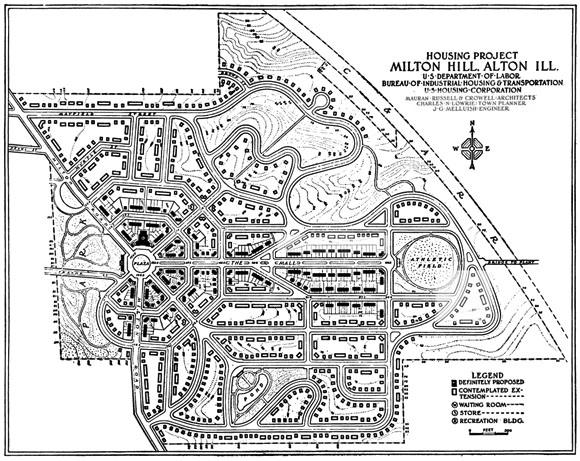
    Milton Hill, a neighborhood designed and developed by the United States Housing Corporation in Alton, Ill.
    National Archives

    Importantly, instead of simply creating complexes of apartment units, akin to the public housing projects that most Americans associate with government-funded housing, the agency focused on the construction of single-family and small multifamily residential buildings that workers and their families could eventually own.

    This approach reflected a belief by the policymakers that property ownership could strengthen community responsibility and social stability. During the war, the federal government rented these homes to workers at regulated rates designed to be fair, while covering maintenance costs. After the war, the government began selling the homes – often to the tenants living in them – through affordable installment plans that provided a practical path to ownership.

    A single-family home in Davenport, Iowa, built by the U.S. Housing Corporation.
    National Archives

    Though the scope of the Housing Corporation’s work was national, each planned community took into account regional growth and local architectural styles. Engineers often built streets that adapted to the natural landscape. They spaced houses apart to maximize light, air and privacy, with landscaped yards. No resident lived far from greenery.

    In Quincy, Massachusetts, for example, the agency built a 22-acre neighborhood with 236 homes designed mostly in a Colonial Revival style to serve the nearby Fore River Shipyard. The development was laid out to maximize views, green space and access to the waterfront, while maintaining density through compact street and lot design.

    At Mare Island, California, developers located the housing site on a steep hillside near a naval base. Rather than flatten the land, designers worked with the slope, creating winding roads and terraced lots that preserved views and minimized erosion. The result was a 52-acre community with over 200 homes, many of which were designed in the Craftsman style. There was also a school, stores, parks and community centers.

    Infrastructure and innovation

    Alongside housing construction, the Housing Corporation invested in critical infrastructure. Engineers installed over 649,000 feet of modern sewer and water systems, ensuring that these new communities set a high standard for sanitation and public health.

    Attention to detail extended inside the homes. Architects experimented with efficient interior layouts and space-saving furnishings, including foldaway beds and built-in kitchenettes. Some of these innovations came from private companies that saw the program as a platform to demonstrate new housing technologies.

    One company, for example, designed fully furnished studio apartments with furniture that could be rotated or hidden, transforming a space from living room to bedroom to dining room throughout the day.

    To manage the large scale of this effort, the agency developed and published a set of planning and design standards − the first of their kind in the United States. These manuals covered everything from block configurations and road widths to lighting fixtures and tree-planting guidelines.

    A single-family home in Bremerton, Wash., built by the U.S. Housing Corporation.
    National Archives

    The standards emphasized functionality, aesthetics and long-term livability.

    Architects and planners who worked for the Housing Corporation carried these ideas into private practice, academia and housing initiatives. Many of the planning norms still used today, such as street hierarchies, lot setbacks and mixed-use zoning, were first tested in these wartime communities.

    And many of the planners involved in experimental New Deal community projects, such as Greenbelt, Maryland, had worked for or alongside Housing Corporation designers and planners. Their influence is apparent in the layout and design of these communities.

    A brief but lasting legacy

    With the end of World War I, the political support for federal housing initiatives quickly waned. The Housing Corporation was dissolved by Congress, and many planned projects were never completed. Others were incorporated into existing towns and cities.

    Yet, many of the neighborhoods built during this period still exist today, integrated in the fabric of the country’s cities and suburbs. Residents in places such as Aberdeen, Maryland; Bremerton, Washington; Bethlehem, Pennsylvania; Watertown, New York; and New Orleans may not even realize that many of the homes in their communities originated from a bold federal housing experiment.

    Homes on Lawn Avenue in Quincy, Mass., that were built by the U.S. Housing Corporation.
    Google Street View

    The Housing Corporation’s efforts, though brief, showed that large-scale public housing could be thoughtfully designed, community oriented and quickly executed. For a short time, in response to extraordinary circumstances, the U.S. government succeeded in building more than just houses. It constructed entire communities, demonstrating that government has a major role and can lead in finding appropriate, innovative solutions to complex challenges.

    At a moment when the U.S. once again faces a housing crisis, the legacy of the U.S. Housing Corporation serves as a reminder that bold public action can meet urgent needs.

    This article is part of a series centered on envisioning ways to deal with the housing crisis.

    Eran Ben-Joseph does not work for, consult, own shares in or receive funding from any company or organization that would benefit from this article, and has disclosed no relevant affiliations beyond their academic appointment.

    ref. Believe it or not, there was a time when the US government built beautiful homes for working-class Americans to deal with a housing shortage – https://theconversation.com/believe-it-or-not-there-was-a-time-when-the-us-government-built-beautiful-homes-for-working-class-americans-to-deal-with-a-housing-shortage-253512

    MIL OSI Analysis

  • MIL-OSI Russia: Energy-saving equipment of the NRG system is being tested at the State University of Management

    Translation. Region: Russian Federal

    Source: State University of Management – Official website of the State –

    The State University of Management continues to develop partnerships with business representatives and technology companies. Currently, innovative equipment of the Universal Energy Saving System NRG, developed by AERO LLC, is being tested on the university premises.

    At the initiative of the company OOO “Center of Complex Engineering” and jointly with OOO “AERO”, a test connection of equipment to the internal electrical network with a voltage of 0.4 kV was organized in the State University of Management. This allows us to evaluate the efficiency of the new system in real conditions and record the technical parameters of its operation in the current environment.

    The NRG system is the latest, patented (Patent RU 2 731 258 C1) development in the field of energy saving and energy efficiency for any consumers of electrical energy, such as private apartments, houses, shops, production sites, large industrial enterprises and any other consumers using alternating electric current.

    “We welcome the interest of companies in cooperation with the university. It is important for us to be an open platform for innovation, especially in the field of sustainable development and energy efficiency. Such projects help improve the conditions for studying and living for students, and help employees become more familiar with modern technological solutions,” said Vitaly Lapshenkov, Vice-Rector of the State University of Management.

    Effects of using the NRG system:

    Reduction of energy consumption by 7–20%; Reduction of the effect of harmful electromagnetic waves; Increased service life of equipment in the electrical network; Reduction of temperature, noise and vibration during equipment operation; Release of additional capacity due to energy savings.

    Testing is carried out in a technical mode, with compliance with all safety standards, under the supervision of specialists from the Center for Complex Engineering LLC and employees of the State University of Management. Based on its results, conclusions will be drawn on the possibility of large-scale use of such solutions in educational and administrative infrastructure.

    Please note: This information is raw content directly from the source of the information. It is exactly what the source states and does not reflect the position of MIL-OSI or its clients.

    MIL OSI Russia News

  • MIL-OSI Canada: Stay safe, plan ahead for Canada Day weekend

    Source: Government of Canada regional news

    As people make plans for the Canada Day weekend, it’s important to be prepared and stay safe as warm temperatures, dry conditions and wildfire risk continue in many parts of the province.

    People are encouraged to stay vigilant and up to date on local fire bans and restrictions and have an emergency plan in place that is shared with friends and family.

    People heading outdoors this weekend are reminded to plan ahead, carry safety gear and follow all instructions from local governments and First Nations. Before you head out, check ahead for road closures, evacuation alerts, evacuation orders and any fire prohibitions in effect.

    British Columbia continues to face prolonged drought in many regions, and below-average precipitation is contributing to increased wildfire and water supply concerns. Everyone is encouraged to use water efficiently and follow any local watering restrictions.

    Several open-burning prohibitions are in place around the province and will be updated as conditions change. People planning to have campfires should do so safely, following any local prohibitions. Avoid having a campfire when it’s windy, choose a proper fire pit or make a ring of rocks at least three metres from trees, shrubs, structures and debris, and do not leave a campfire unattended.

    The BC Wildfire Service relies on the public for reporting wildfires quickly. Approximately 40% of new fires are reported by the public. If you see smoke or flames, report it immediately by calling *5555 on a cellphone or 1 800 663-5555, toll-free.

    The BC Wildfire Service mobile app allows people to report new wildfires and submit photos, which helps BC Wildfire Service make informed decisions. People can use the app for the most up-to-date information on the current wildfire situation, road conditions, evacuation information and weather forecasts.

    If you’re in a high-risk wildfire area, now is the time to get prepared. Create an emergency plan, pack a grab-and-go bag for each household member, including pets, and create an Emergency Support Services (ESS) profile through your BC Services Card app or at ess.gov.bc.ca. People are advised to make sure their home or tenant insurance includes wildfire protection, which can help with expenses like temporary accommodation and meals if there is a need to evacuate.

    Check your insurance policy to understand what evacuation supports are available through your coverage. If you’re unsure, call your insurance provider or the Insurance Bureau of Canada at 1 844 227-5422 or visit: https://www.ibc.ca/

    People are encouraged to follow instructions and evacuate immediately if a local government or First Nation issues an order. Emergency Support Services (ESS) are available to evacuees who need help covering the cost of their basic needs, such as food, lodging and other essentials.

    People can also reduce risk around the home with a few simple FireSmart steps:

    • clear dry leaves and debris from around your property
    • move propane tanks and other flammables at least 10 metres from structures
    • keep grass cut short
    • close doors and windows
    • water trees, shrubs and plants regularly, following local water restrictions
    • consider more fire-resistant plants for landscaping

    People travelling in B.C. are encouraged to know before they go. You can plan ahead and get the latest road conditions and updates here: https://www.drivebc.ca/

    Drivers on routes throughout the province this summer should expect higher-than-average traffic volumes and plan accordingly. General tips for a safe trip include:

    • allowing additional time to get to your destination due to more people on roads
    • making sure your vehicle is ready for the drive by having a full tank of gas or charged battery, checking engine oil, washer fluid, lights and tires, including the spare
    • packing food and water for passengers and pets
    • planning breaks at rest areas: https://www.th.gov.bc.ca/restareas/?zoom=5&loc=-126.600000%2C54.589121
    • watching for motorcyclists and sharing the road with cyclists and other users
    • obeying all posted speed limits and driving with caution, especially during bad weather
    • leaving the phone alone while behind the wheel, and
    • ensuring all passengers always use seatbelts.​

    Learn More:

    For BC Wildfire Service information and updates, visit: https://wildfiresituation.nrs.gov.bc.ca/dashboard

    For more information about fire prohibitions, visit: https://www2.gov.bc.ca/gov/content/safety/wildfire-status/fire-bans-and-restrictions

    For up-to-date information about road conditions, visit: https://www.drivebc.ca/

    For more information about rest areas during driving, visit: https://www.th.gov.bc.ca/restareas

    For detailed guidance on what happens before, during and after an evacuation order, visit https://www2.gov.bc.ca/gov/content/safety/emergency-management/preparedbc/evacuation-recovery/evacuee-guidance

    For the latest information on evacuation alerts and evacuation orders in B.C., visit: https://EmergencyInfoBC.ca
    Or follow @EmergencyInfoBC on X

    To register with Emergency Support Services, visit: https://ess.gov.bc.ca/

    For information on how to prepare for emergencies, including information about emergency kits, household emergency plans and hazard-specific guides, visit: https://PreparedBC.ca 

    For more information on how to FireSmart your home, visit: https://firesmartbc.ca

    For backcountry safety checklists and trip planning resources, visit: https://www.adventuresmart.ca/

    For more information about drought, visit: https://www2.gov.bc.ca/gov/content/drought

    MIL OSI Canada News

  • MIL-OSI: Maris-Tech Secures New Purchase Order for Innovative AI-Powered Surveillance Solution for the Defense Industry

    Source: GlobeNewswire (MIL-OSI)

    Marks Entry into a New Market Segment with Advanced Threat Detection Capabilities

    Rehovot, Israel, June 26, 2025 (GLOBE NEWSWIRE) — Maris-Tech Ltd. (Nasdaq: MTEK, MTEKW) (“Maris-Tech” or the “Company”), a global leader in video and artificial intelligence (“AI”) – based edge computing technology, today announced that it has received a $100,000 purchase order for a new surveillance solution to be designed for the defense sector.

    This innovative solution will be based on the Company’s Jupiter-AI edge solution and will be integrated into an advanced military surveillance system to allow real-time threat detection and monitoring. This order marks the Company’s entry into a new field, extending its technology to new market segments.

    “We believe that this order is a strong indication of the market’s growing confidence in our ability to address a wide variety of operational needs,” said Israel Bar, Chief Executive Officer of Maris-Tech. “It also represents an important step into a new segment for us, which broadens the scope of our video and AI-powered edge computing solutions, as well as our presence in the defense industry.”

    About Maris-Tech Ltd.

    Maris-Tech is a global leader in video and AI-based edge computing technology, pioneering intelligent video transmission solutions that conquer complex encoding-decoding challenges. Our miniature, lightweight, and low-power products deliver high-performance capabilities, including raw data processing, seamless transfer, advanced image processing, and AI-driven analytics. Founded by Israeli technology sector veterans, Maris-Tech serves leading manufacturers worldwide in defense, aerospace, Intelligence gathering, homeland security (HLS), and communication industries. We’re pushing the boundaries of video transmission and edge computing, driving innovation in mission-critical applications across commercial and defense sectors.

    For more information, visit https://www.maris-tech.com/

    Forward-Looking Statement Disclaimer

    This press release contains “forward-looking statements” within the meaning of Section 27A of the Securities Act of 1933, as amended, and Section 21E of the Securities Exchange Act of 1934, as amended, that are intended to be covered by the “safe harbor” created by those sections. Forward-looking statements, which are based on certain assumptions and describe our future plans, strategies and expectations, can generally be identified by the use of forward-looking terms such as “believe,” “expect”,” “may”, “should,” “could,” “seek,” “intend,” “plan,” “goal,” “estimate,” “anticipate” or other comparable terms. For example, the Company is using forward-looking statements when it is discussing the innovative solution to be developed pursuant to the purchase order and integration of the solution into an advanced military surveillance system to allow real-time threat detection and monitoring and the timing of delivery thereof; the Company’s expansion of its technology to new market segments; the Company’s ability to address a wide variety of operational needs; and the broadening of the scope of the Company’s video and AI-powered edge computing solutions, as well as its future presence in the defense industry. The Company’s actual results and financial condition may differ materially from those indicated in the forward-looking statements. Therefore, you should not rely on any of these forward-looking statements. Important factors that could cause our actual results and financial condition to differ materially from those indicated in the forward-looking statements include, among others, the following: its ability to successfully market its products and services, including in the United States; the acceptance of its products and services by customers; its continued ability to pay operating costs and ability to meet demand for its products and services; the amount and nature of competition from other security and telecom products and services; the effects of changes in the cybersecurity and telecom markets; its ability to successfully develop new products and services; its success establishing and maintaining collaborative, strategic alliance agreements, licensing and supplier arrangements; its ability to comply with applicable regulations; and the other risks and uncertainties described in the Annual Report on Form 20-F for the year ended December 31, 2024, filed with the SEC on March 28, 2025, and its other filings with the Securities and Exchange Commission. The Company undertakes no obligation to publicly update any forward-looking statement, whether written or oral, that may be made from time to time, whether as a result of new information, future developments or otherwise.

    Investor Relations:

    Nir Bussy, CFO
    Tel: +972-72-2424022
    Nir@maris-tech.com

    The MIL Network

  • MIL-OSI: Maris-Tech Secures New Purchase Order for Innovative AI-Powered Surveillance Solution for the Defense Industry

    Source: GlobeNewswire (MIL-OSI)

    Marks Entry into a New Market Segment with Advanced Threat Detection Capabilities

    Rehovot, Israel, June 26, 2025 (GLOBE NEWSWIRE) — Maris-Tech Ltd. (Nasdaq: MTEK, MTEKW) (“Maris-Tech” or the “Company”), a global leader in video and artificial intelligence (“AI”) – based edge computing technology, today announced that it has received a $100,000 purchase order for a new surveillance solution to be designed for the defense sector.

    This innovative solution will be based on the Company’s Jupiter-AI edge solution and will be integrated into an advanced military surveillance system to allow real-time threat detection and monitoring. This order marks the Company’s entry into a new field, extending its technology to new market segments.

    “We believe that this order is a strong indication of the market’s growing confidence in our ability to address a wide variety of operational needs,” said Israel Bar, Chief Executive Officer of Maris-Tech. “It also represents an important step into a new segment for us, which broadens the scope of our video and AI-powered edge computing solutions, as well as our presence in the defense industry.”

    About Maris-Tech Ltd.

    Maris-Tech is a global leader in video and AI-based edge computing technology, pioneering intelligent video transmission solutions that conquer complex encoding-decoding challenges. Our miniature, lightweight, and low-power products deliver high-performance capabilities, including raw data processing, seamless transfer, advanced image processing, and AI-driven analytics. Founded by Israeli technology sector veterans, Maris-Tech serves leading manufacturers worldwide in defense, aerospace, Intelligence gathering, homeland security (HLS), and communication industries. We’re pushing the boundaries of video transmission and edge computing, driving innovation in mission-critical applications across commercial and defense sectors.

    For more information, visit https://www.maris-tech.com/

    Forward-Looking Statement Disclaimer

    This press release contains “forward-looking statements” within the meaning of Section 27A of the Securities Act of 1933, as amended, and Section 21E of the Securities Exchange Act of 1934, as amended, that are intended to be covered by the “safe harbor” created by those sections. Forward-looking statements, which are based on certain assumptions and describe our future plans, strategies and expectations, can generally be identified by the use of forward-looking terms such as “believe,” “expect”,” “may”, “should,” “could,” “seek,” “intend,” “plan,” “goal,” “estimate,” “anticipate” or other comparable terms. For example, the Company is using forward-looking statements when it is discussing the innovative solution to be developed pursuant to the purchase order and integration of the solution into an advanced military surveillance system to allow real-time threat detection and monitoring and the timing of delivery thereof; the Company’s expansion of its technology to new market segments; the Company’s ability to address a wide variety of operational needs; and the broadening of the scope of the Company’s video and AI-powered edge computing solutions, as well as its future presence in the defense industry. The Company’s actual results and financial condition may differ materially from those indicated in the forward-looking statements. Therefore, you should not rely on any of these forward-looking statements. Important factors that could cause our actual results and financial condition to differ materially from those indicated in the forward-looking statements include, among others, the following: its ability to successfully market its products and services, including in the United States; the acceptance of its products and services by customers; its continued ability to pay operating costs and ability to meet demand for its products and services; the amount and nature of competition from other security and telecom products and services; the effects of changes in the cybersecurity and telecom markets; its ability to successfully develop new products and services; its success establishing and maintaining collaborative, strategic alliance agreements, licensing and supplier arrangements; its ability to comply with applicable regulations; and the other risks and uncertainties described in the Annual Report on Form 20-F for the year ended December 31, 2024, filed with the SEC on March 28, 2025, and its other filings with the Securities and Exchange Commission. The Company undertakes no obligation to publicly update any forward-looking statement, whether written or oral, that may be made from time to time, whether as a result of new information, future developments or otherwise.

    Investor Relations:

    Nir Bussy, CFO
    Tel: +972-72-2424022
    Nir@maris-tech.com

    The MIL Network

  • MIL-OSI Africa: Rwanda: African Development Bank kickstarts pioneering cable car project in Kigali

    Source: Africa Press Organisation – English (2) – Report:

    The African Development Bank (www.AfDB.org) has approved a grant of $500,000 to undertake a feasibility study into the first phase of a cable car transport network in Kigali, that will be sub-Saharan Africa’s first aerial urban transit system.

    The funds, to be sourced from the Bank Group’s Urban and Municipal Development Fund (https://apo-opa.co/45CiDm9), are expected to help pave the way for the Kigali Urban Cable Car Project, a 5.5 km mobility initiative valued at $100 million and promising to ease the city’s traffic congestion, reduce greenhouse gas emissions, and connect underserved communities to jobs and essential services.

    The Urban and Municipal Development Fund (UMDF) is a trust fund hosted by the African Development Bank, which provides direct support to cities, to mobilize funding and technical assistance, develop partnerships, city engagement, project identification and investment.

    Phase 1 of the project will comprise two critical transit corridors: Nyabugogo Taxi Park to the Central Business District (CBD) Hub; and the Kigali Convention Center to Kigali Sports City, connecting public landmarks such as Amahoro Stadium, BK Arena, and the newly developed Zaria Court.

    The feasibility study is expected to position the project to attract international investment, including through platforms such as the Africa Investment Forum (AIF). The UMDF provided funding for the feasibility of another project in the country, the Kigali Urban Transport Improvement project, to help attract critical investment.

    Construction is expected to begin in late 2026, with commissioning scheduled for 2028. Once complete, the cable car will convey over 50,000 passengers a day on a 15-minute end-to-end journey, integrating into the city’s existing transport infrastructure.

    African Development Bank Group president Dr. Akinwumi Adesina, said: “This transformative project aligns perfectly with the Bank’s vision for sustainable, green climate-resilient urban mobility infrastructure, and with the Bank’s Ten-Year Strategy, which focuses on urbanization, and the Alliance for Green Infrastructure in Africa (AGIA), a global partnership initiative driven by the African Development Bank Group, Africa50 and the African Union. By financing Rwanda’s urban cable car system, we are investing in a scalable model of low-carbon, inclusive public transport that cities across Africa can emulate.”

    The project is anchored in Rwanda’s Green Taxonomy, E-mobility Strategy, and Climate and Nature Finance Strategy (CNFS) and aligns closely with Rwanda’s national climate objectives, which target a 38% reduction in carbon emissions by 2030 and carbon neutrality by 2050.

    The project implementation is expected to follow a Public-Private Partnership model, according to  Imena Munyampenda, the Director General of Rwanda Transport Development Agency.  

    The feasibility study plans to draw lessons from successful cable car systems in La Paz, Bolivia, and Singapore. The system will prioritize access for the disabled, employment opportunities for girls, women and low-income residents; and job creation, capacity building and technology transfer.

    “This pioneering feasibility study is a game-changing milestone,” said Solomon Quaynor, African Development Bank’s Vice President for Private Sector, Infrastructure, and Industrialization. “Through the UMDF, AfDB is laying the foundation for an investment-ready green infrastructure asset that offers both impact and returns.”

    Blended Financing

    The $100 million funding structure will comprise a strategic mix of grants, concessional loans, blended finance, and technical assistance. The UMDF grant will fund an assessment of the project’s viability gap.

    The Rwandan government, the African Development Bank Group, and other development partners, will collaborate to offer blended financing, along with commercial funding from the International Finance Corporation (IFC), Africa50, the Trade and Development Bank (TDB), the Africa Finance Corporation (AFC), as well as private investors and the Alliance for Green Infrastructure in Africa (AGIA). 

    – on behalf of African Development Bank Group (AfDB).

    Media Contact:
    Janet Onyango
    African Development Bank Group 
    media@afdb.org

    Media files

    Download logo

    MIL OSI Africa

  • MIL-OSI Africa: United Arab Emirates (UAE) leaders congratulate President of Madagascar on Independence Day

    Source: Africa Press Organisation – English (2) – Report:

    Download logo

    President His Highness Sheikh Mohamed bin Zayed Al Nahyan has sent a message of congratulations to President Andry Rajoelina of the Republic of Madagascar on the occasion of his country’s Independence Day.

    His Highness Sheikh Mohammed bin Rashid Al Maktoum, Vice President, Prime Minister and Ruler of Dubai, and His Highness Sheikh Mansour bin Zayed Al Nahyan, Vice President, Deputy Prime Minister and Chairman of the Presidential Court, dispatched similar messages to President Rajoelina and to Prime Minister Christian Ntsay on the occasion.

    – on behalf of United Arab Emirates, Ministry of Foreign Affairs.

    MIL OSI Africa

  • MIL-OSI United Kingdom: Preliminary work to start at Derby Riverside

    Source: City of Derby

    Preliminary works are due to start on the second phase of the Our City, Our River flood defence scheme, one of the city’s biggest infrastructure projects.

    Known as Derby Riverside, this package of works will provide significant flood resilience protection to many properties and highways along the left (east) bank of the Derwent from Causey Bridge to Derwent Bridge.

    The initial works will mainly consist of land clearance, making way for a new flood wall, floodgates and a riverside green area that will provide a controlled corridor for flood waters to pass through the city safely.

    This will include the demolition of selected buildings, as well as some tree removal. Unfortunately, this is unavoidable where trees would obstruct the flow of water in a flood event, or where roots would be damaged due to the location of the wall.

    Derby City Council has worked extensively with its arboriculturalists to keep the number of trees removed to a minimum. While the plans approved by committee give permission for a total of around 205 trees to be removed, this is the worst-case scenario, and the aim is to keep as many as possible. Some will be pollarded where this is a better solution, meaning their top branches will be removed to the trunk, which will encourage regrowth.

    Due to the bird nesting season, we will only be removing trees that are essential for this first stage of work, with further work to take place over the winter. Throughout the nesting season, an ecologist will be onsite to check each tree before it is removed.

    OCOR includes a scheme to replant more trees in the city than have been lost. Already, 583 new trees have been planted around the city, exceeding the 574 that will have been removed throughout the whole scheme by the time Derby Riverside is completed. A further 971 new trees are proposed for other sites, taking the total for OCOR to well over 1,400.

    Councillor Camel Swan, Cabinet Member for Climate Change, Transport and Sustainability, said:

    As our climate continues to change, river flooding remains a risk to many homes and businesses in the city centre. In just five years we have seen the five highest recorded river levels in the city.

    We saw the damage caused by Storm Babet on the left bank of the river, and the need for action is clear. With these works, we will continue to protect properties and future proof our city.

    Sisk regional director Robin Metcalf said:

    We’re proud to be delivering this important project for Derby and are committed to making a positive local impact. We’ll be employing people from the local area wherever possible and working closely with Derby City Council to ensure our social value commitments align with the Derby Promise. That includes creating opportunities for those who are often furthest from the job market, helping to ensure the benefits of this scheme are felt right across the community.

    These works will be carried out by John Sisk & Son on behalf of Derby City Council, who were formally awarded the contract for the scheme in May 2025. The completion of Derby Riverside will then unlock the regeneration potential on the left bank of the river, with opportunities for developing new homes and businesses thanks to enhanced flood resilience.

    The Our City, Our River programme is one of the Environment Agency’s largest local authority-led projects and has already delivered enhanced flood protection to over 2000 properties. Derby Riverside will extend this protection to the east bank of the Derwent and unlock the potential for regeneration in this part of the city.

    MIL OSI United Kingdom

  • MIL-OSI Russia: Over 750 Afghan prisoners released from Pakistani jails

    Translation. Region: Russian Federal

    Source: People’s Republic of China in Russian – People’s Republic of China in Russian –

    Source: People’s Republic of China – State Council News

    KABUL, June 26 (Xinhua) — A total of 769 Afghan prisoners have been released from Pakistani jails and returned to Afghanistan in the past week, the Ministry of Refugees and Repatriation said on Thursday.

    According to the department, the released persons, including women and children, were handed over to Afghan authorities at the Torkham checkpoint in Nangarhar province in the east of the country and at the Spin Boldak checkpoint in Kandahar province in the south of the country.

    The former prisoners, having received assistance at border checkpoints, were taken to their home provinces, the department added. –0–

    MIL OSI Russia News

  • MIL-OSI Security: Felon Indicted for Illegal Possession of a Firearm Following Arrest in Anacostia

    Source: United States Bureau of Alcohol Tobacco Firearms and Explosives (ATF)

    Defendant Charged as Part of Make D.C. Safe and Beautiful Initiative

                WASHINGTON –Ronald Stevenson Richardson, 29, of the District of Columbia, has been indicted on a federal firearms charge as part of the “Make D.C. Safe and Beautiful” initiative. The indictment was announced by U.S. Attorney Jeanine Ferris Pirro, Special Agent in Charge Anthony Spotswood of the Bureau of Alcohol, Tobacco, Firearms and Explosives (ATF), and Chief Pamela Smith of the Metropolitan Police Department (MPD).

                Richardson is charged with one count of unlawful possession of a firearm and ammunition by a felon.

                According to court documents, on May 6, 2025, members of the Seventh District Special Missions Unit (SMU) were patrolling the area of 1509 W Street SE in Washington, D.C., in the Anacostia neighborhood. While on patrol, police observed allegedly Richardson standing at a bus stop with an open container of alcohol at the intersection of 16th Street SE and W Street SE.

                Richardson was subsequently arrested for possession of an open container of alcohol. During a search incident to the arrest, officers allegedly discovered a firearm in Richardson’s undergarments, beneath his waistband. The firearm was identified as a Glock 42, chambered in .380 auto, loaded with one round in the chamber and four additional rounds in its six-round capacity magazine.

                Richardson is prohibited from possessing a firearm and ammunition due to a prior conviction in D.C. Superior Court for carrying a pistol without a license outside home/business, establishing him as a felon in possession.

                This case is being investigated by the ATF Washington Field Office and the Metropolitan Police Department. Assistant U.S. Attorney Michael Truscott is prosecuting this case.

                The “Make D.C. Safe and Beautiful” initiative is a public safety effort surging resources to reduce violent crime in the District of Columbia. This initiative was created to address gun violence in the District, prioritize federal firearms violations, pursue tougher penalties for offenders, and seek detention for federal firearms violators.

                An indictment is merely an allegation. All defendants are presumed innocent until proven guilty beyond a reasonable doubt in a court of law.

    MIL Security OSI

  • MIL-OSI Security: Felon Indicted for Illegal Possession of a Firearm Following Arrest in Anacostia

    Source: United States Bureau of Alcohol Tobacco Firearms and Explosives (ATF)

    Defendant Charged as Part of Make D.C. Safe and Beautiful Initiative

                WASHINGTON –Ronald Stevenson Richardson, 29, of the District of Columbia, has been indicted on a federal firearms charge as part of the “Make D.C. Safe and Beautiful” initiative. The indictment was announced by U.S. Attorney Jeanine Ferris Pirro, Special Agent in Charge Anthony Spotswood of the Bureau of Alcohol, Tobacco, Firearms and Explosives (ATF), and Chief Pamela Smith of the Metropolitan Police Department (MPD).

                Richardson is charged with one count of unlawful possession of a firearm and ammunition by a felon.

                According to court documents, on May 6, 2025, members of the Seventh District Special Missions Unit (SMU) were patrolling the area of 1509 W Street SE in Washington, D.C., in the Anacostia neighborhood. While on patrol, police observed allegedly Richardson standing at a bus stop with an open container of alcohol at the intersection of 16th Street SE and W Street SE.

                Richardson was subsequently arrested for possession of an open container of alcohol. During a search incident to the arrest, officers allegedly discovered a firearm in Richardson’s undergarments, beneath his waistband. The firearm was identified as a Glock 42, chambered in .380 auto, loaded with one round in the chamber and four additional rounds in its six-round capacity magazine.

                Richardson is prohibited from possessing a firearm and ammunition due to a prior conviction in D.C. Superior Court for carrying a pistol without a license outside home/business, establishing him as a felon in possession.

                This case is being investigated by the ATF Washington Field Office and the Metropolitan Police Department. Assistant U.S. Attorney Michael Truscott is prosecuting this case.

                The “Make D.C. Safe and Beautiful” initiative is a public safety effort surging resources to reduce violent crime in the District of Columbia. This initiative was created to address gun violence in the District, prioritize federal firearms violations, pursue tougher penalties for offenders, and seek detention for federal firearms violators.

                An indictment is merely an allegation. All defendants are presumed innocent until proven guilty beyond a reasonable doubt in a court of law.

    MIL Security OSI

  • MIL-OSI Security: Venezuelan National Residing Unlawfully in the U.S. Indicted on Federal Charges

    Source: United States Bureau of Alcohol Tobacco Firearms and Explosives (ATF)

    TOLEDO, Ohio – A federal grand jury has returned a four-count indictment charging Anthony Emmanuel Labrador-Sierra, 24, a Venezuelan national residing in Perrysburg, Ohio, with possession of a firearm by an alien unlawfully in the United States, making a false statement during the purchase of a firearm, and making or using false writings or documents.

    According to the indictment, the defendant is accused of submitting a false date of birth to U.S. Citizenship and Immigration Services on federal applications for Temporary Protective Status and Employment Authorization Documents in 2024 and 2025.

    In the original criminal complaint and underlying affidavit filed May 22, 2025, investigators learned that Perrysburg Schools reported to the Perrysburg Police Department that they received information that Labrador-Sierra, a student attending Perrysburg High School, was actually a 24-year-old man who enrolled under false pretenses.

    The grand jury further charges that Labrador-Sierra was in possession of a Taurus G3C 9mm, semiautomatic pistol, which he did not have lawful status to purchase or own in the United States, and that he submitted false information on the Bureau of Alcohol, Tobacco, Firearms, and Explosives (ATF) Form 4473 to purchase the firearm. Among the alleged false statements the defendant submitted that were intended and likely to deceive the licensed firearms dealer at the point of sale, were that:

    • He was a United States citizen or national.
    • He was not illegally or unlawfully in the United States.
    • He was not an alien who had entered the United States under a nonimmigrant visa.

    If convicted, Labrador-Sierra faces up to 15 years in prison for possession of a firearm by an alien; 10 years in prison for making a false statement during the purchase of a firearm; and up to five years in prison for making or using false writings or documents.

    This case is being investigated by the City of Perrysburg Police Department, United States Border Patrol−Sandusky Bay Station, the FBI Toledo Field Office, and the ATF, with assistance from the Wood County Prosecutor’s Office.

    The case is being prosecuted by Assistant U.S. Attorneys Robert N. Melching and Tracey Tangeman for the Northern District of Ohio, and Special Assistant U.S. Attorney Paul Dobson.

    This investigation is ongoing. Anyone with knowledge and information about this matter, please call the FBI at 1-800-CALL-FBI (1-800-225-5324) or visit fbi.gov/tips.

    An indictment is merely an allegation. The defendant is presumed innocent until proven guilty beyond a reasonable doubt in a court of law.

    MIL Security OSI

  • MIL-OSI Analysis: What if universal rental assistance were implemented to deal with the housing crisis?

    Source: The Conversation – USA – By Alex Schwartz, Professor of Urban Policy, The New School

    Thousands of American families that can’t find affordable apartments are stuck living in extended-stay motels. Michael S. Williamson/The Washington Post via Getty Images

    If there’s one thing that U.S. politicians and activists from across the political spectrum can agree on, it’s that rents are far too high.

    Many experts believe that this crisis is fueled by a shortage of housing, caused principally by restrictive regulations.

    Rents and home prices would fall, the argument goes, if rules such as minimum lot- and house-size requirements and prohibitions against apartment complexes were relaxed. This, in turn, would make it easier to build more housing.

    As experts on housing policy, we’re concerned about housing affordability. But our research shows little connection between a shortfall of housing and rental affordability problems. Even a massive infusion of new housing would not shrink housing costs enough to solve the crisis, as rents would likely remain out of reach for many households.

    However, there are already subsidies in place that ensure that some renters in the U.S. pay no more than 30% of their income on housing costs. The most effective solution, in our view, is to make these subsidies much more widely available.

    A financial sinkhole

    Just how expensive are rents in the U.S.?

    According to the U.S. Department of Housing and Urban Development, a household that spends more than 30% of its income on housing is deemed to be cost-burdened. If it spends more than 50%, it’s considered severely burdened. In 2023, 54% of all renters spent more than 30% of their pretax income on housing. That’s up from 43% of renters in 1999. And 28% of all renters spent more than half their income on housing in 2023.

    Renters with low incomes are especially unlikely to afford their housing: 81% of renters making less than $30,000 spent more than 30% of their income on housing, and 60% spent more than 50%.

    Estimates of the nation’s housing shortage vary widely, reaching up to 20 million units, depending on analytic approach and the time period covered. Yet our research, which compares growth in the housing stock from 2000 to the present, finds no evidence of an overall shortage of housing units. Rather, we see a gap between the number of low-income households and the number of affordable housing units available to them; more affluent renters face no such shortage. This is true in the nation as a whole and in nearly all large and small metropolitan areas.

    Would lower rents help? Certainly. But they wouldn’t fix everything.

    We ran a simulation to test an admittedly unlikely scenario: What if rents dropped 25% across the board? We found it would reduce the number of cost-burdened renters – but not by as much as you might think.

    Even with the reduction, nearly one-third of all renters would still spend more than 30% of their income on housing. Moreover, reducing rents would help affluent renters much more than those with lower incomes – the households that face the most severe affordability challenges.

    The proportion of cost-burdened renters earning more than $75,000 would fall from 16% to 4%, while the share of similarly burdened renters earning less than $15,000 would drop from 89% to just 80%. Even with a rent rollback of 25%, the majority of renters earning less than $30,000 would remain cost-burdened.

    Vouchers offer more breathing room

    Meanwhile, there’s a proven way of making housing more affordable: rental subsidies.

    In 2024, the U.S. provided what are known as “deep” housing subsidies to about 5 million households, meaning that rent payments are capped at 30% of their income.

    These subsidies take three forms: Housing Choice Vouchers that enable people to rent homes in the private market; public housing; and project-based rental assistance, in which the federal government subsidizes the rents for all or some of the units in properties under private and nonprofit ownership.

    The number of households participating in these three programs has increased by less than 2% since 2014, and they constitute only 25% of all eligible households. Households earning less than 50% of their area’s median family income are eligible for rental assistance. But unlike Social Security, Medicare or food stamps, rental assistance is not an entitlement available to all who qualify. The number of recipients is limited by the amount of funding appropriated each year by Congress, and this funding has never been sufficient to meet the need.

    By expanding rental assistance to all eligible low-income households, the government could make huge headway in solving the rental affordability crisis. The most obvious option would be to expand the existing Housing Choice Voucher program, also known as Section 8.

    The program helps pay the rent up to a specified “payment standard” determined by each local public housing authority, which can set this standard at between 80% and 120% of the HUD-designated fair market rent. To be eligible for the program, units must also satisfy HUD’s physical quality standards.

    Unfortunately, about 43% of voucher recipients are unable to use it. They are either unable to find an apartment that rents for less than the payment standard, meets the physical quality standard, or has a landlord willing to accept vouchers.

    Renters are more likely to find housing using vouchers in cities and states where it’s illegal for landlords to discriminate against voucher holders. Programs that provide housing counseling and landlord outreach and support have also improved outcomes for voucher recipients.

    However, it might be more effective to forgo the voucher program altogether and simply give eligible households cash to cover their housing costs. The Philadelphia Housing Authority is currently testing out this approach.

    The idea is that landlords would be less likely to reject applicants receiving government support if the bureaucratic hurdles were eliminated. The downside of this approach is that it would not prevent landlords from renting out deficient units that the voucher program would normally reject.

    Homeowners get subsidies – why not renters?

    Expanding rental assistance to all eligible low-income households would be costly.

    The Urban Institute, a nonpartisan think tank, estimates it would cost about $118 billion a year.

    However, Congress has spent similar sums on housing subsidies before. But they involve tax breaks for homeowners, not low-income renters. Congress forgoes billions of dollars annually in tax revenue it would otherwise collect were it not for tax deductions, credits, exclusions and exemptions. These are known as tax expenditures. A tax not collected is equivalent to a subsidy payment.

    Only about 25% of eligiblge households receive rental assistance from the federal government.
    Luis Sinco/Los Angeles Times via Getty Images

    For example, from 1998 through 2017 – prior to the tax changes enacted by the first Trump administration in 2017 – the federal government annually sacrificed $187 billion on average, after inflation, in revenue due to mortgage interest deductions, deductions for state and local taxes, and for the exemption of proceeds from the sale of one’s home from capital gains taxes. In fiscal year 2025, these tax expenditures totaled $95.4 billion.

    Moreover, tax expenditures on behalf of homeowners flow mostly to higher-income households. In 2024, for example, over 70% of all mortgage-interest tax deductions went to homeowners earning at least $200,000.

    Broadening the availability of rental subsidies would have other benefits. It would save federal, state and local governments billions of dollars in homeless services. Moreover, automatic provision of rental subsidies would reduce the need for additional subsidies to finance new affordable housing. Universal rental assistance, by guaranteeing sufficient rental income, would allow builders to more easily obtain loans to cover development costs.

    Of course, sharply raising federal expenditures for low-income rental assistance flies in the face of the Trump administration’s priorities. Its budget proposal for the next fiscal year calls for a 44% cut of more than $27 billion in rental assistance and public housing.

    On the other hand, if the government supported rental assistance in amounts commensurate with the tax benefits given to homeowners, it would go a long way toward resolving the rental housing affordability crisis.

    This article is part of a series centered on envisioning ways to deal with the housing crisis.

    Alex Schwartz has received funding from the Catherine and John D. MacArthur Foundation. Since 2019 he has served on New York City’s Rent Guidelines Board. He has a relative who works for The Conversation.

    Kirk McClure received funding from the U.S. Department of Housing and Urban Development and receives funding from the National Science Foundation.

    ref. What if universal rental assistance were implemented to deal with the housing crisis? – https://theconversation.com/what-if-universal-rental-assistance-were-implemented-to-deal-with-the-housing-crisis-257213

    MIL OSI Analysis

  • MIL-OSI Analysis: What if universal rental assistance were implemented to deal with the housing crisis?

    Source: The Conversation – USA – By Alex Schwartz, Professor of Urban Policy, The New School

    Thousands of American families that can’t find affordable apartments are stuck living in extended-stay motels. Michael S. Williamson/The Washington Post via Getty Images

    If there’s one thing that U.S. politicians and activists from across the political spectrum can agree on, it’s that rents are far too high.

    Many experts believe that this crisis is fueled by a shortage of housing, caused principally by restrictive regulations.

    Rents and home prices would fall, the argument goes, if rules such as minimum lot- and house-size requirements and prohibitions against apartment complexes were relaxed. This, in turn, would make it easier to build more housing.

    As experts on housing policy, we’re concerned about housing affordability. But our research shows little connection between a shortfall of housing and rental affordability problems. Even a massive infusion of new housing would not shrink housing costs enough to solve the crisis, as rents would likely remain out of reach for many households.

    However, there are already subsidies in place that ensure that some renters in the U.S. pay no more than 30% of their income on housing costs. The most effective solution, in our view, is to make these subsidies much more widely available.

    A financial sinkhole

    Just how expensive are rents in the U.S.?

    According to the U.S. Department of Housing and Urban Development, a household that spends more than 30% of its income on housing is deemed to be cost-burdened. If it spends more than 50%, it’s considered severely burdened. In 2023, 54% of all renters spent more than 30% of their pretax income on housing. That’s up from 43% of renters in 1999. And 28% of all renters spent more than half their income on housing in 2023.

    Renters with low incomes are especially unlikely to afford their housing: 81% of renters making less than $30,000 spent more than 30% of their income on housing, and 60% spent more than 50%.

    Estimates of the nation’s housing shortage vary widely, reaching up to 20 million units, depending on analytic approach and the time period covered. Yet our research, which compares growth in the housing stock from 2000 to the present, finds no evidence of an overall shortage of housing units. Rather, we see a gap between the number of low-income households and the number of affordable housing units available to them; more affluent renters face no such shortage. This is true in the nation as a whole and in nearly all large and small metropolitan areas.

    Would lower rents help? Certainly. But they wouldn’t fix everything.

    We ran a simulation to test an admittedly unlikely scenario: What if rents dropped 25% across the board? We found it would reduce the number of cost-burdened renters – but not by as much as you might think.

    Even with the reduction, nearly one-third of all renters would still spend more than 30% of their income on housing. Moreover, reducing rents would help affluent renters much more than those with lower incomes – the households that face the most severe affordability challenges.

    The proportion of cost-burdened renters earning more than $75,000 would fall from 16% to 4%, while the share of similarly burdened renters earning less than $15,000 would drop from 89% to just 80%. Even with a rent rollback of 25%, the majority of renters earning less than $30,000 would remain cost-burdened.

    Vouchers offer more breathing room

    Meanwhile, there’s a proven way of making housing more affordable: rental subsidies.

    In 2024, the U.S. provided what are known as “deep” housing subsidies to about 5 million households, meaning that rent payments are capped at 30% of their income.

    These subsidies take three forms: Housing Choice Vouchers that enable people to rent homes in the private market; public housing; and project-based rental assistance, in which the federal government subsidizes the rents for all or some of the units in properties under private and nonprofit ownership.

    The number of households participating in these three programs has increased by less than 2% since 2014, and they constitute only 25% of all eligible households. Households earning less than 50% of their area’s median family income are eligible for rental assistance. But unlike Social Security, Medicare or food stamps, rental assistance is not an entitlement available to all who qualify. The number of recipients is limited by the amount of funding appropriated each year by Congress, and this funding has never been sufficient to meet the need.

    By expanding rental assistance to all eligible low-income households, the government could make huge headway in solving the rental affordability crisis. The most obvious option would be to expand the existing Housing Choice Voucher program, also known as Section 8.

    The program helps pay the rent up to a specified “payment standard” determined by each local public housing authority, which can set this standard at between 80% and 120% of the HUD-designated fair market rent. To be eligible for the program, units must also satisfy HUD’s physical quality standards.

    Unfortunately, about 43% of voucher recipients are unable to use it. They are either unable to find an apartment that rents for less than the payment standard, meets the physical quality standard, or has a landlord willing to accept vouchers.

    Renters are more likely to find housing using vouchers in cities and states where it’s illegal for landlords to discriminate against voucher holders. Programs that provide housing counseling and landlord outreach and support have also improved outcomes for voucher recipients.

    However, it might be more effective to forgo the voucher program altogether and simply give eligible households cash to cover their housing costs. The Philadelphia Housing Authority is currently testing out this approach.

    The idea is that landlords would be less likely to reject applicants receiving government support if the bureaucratic hurdles were eliminated. The downside of this approach is that it would not prevent landlords from renting out deficient units that the voucher program would normally reject.

    Homeowners get subsidies – why not renters?

    Expanding rental assistance to all eligible low-income households would be costly.

    The Urban Institute, a nonpartisan think tank, estimates it would cost about $118 billion a year.

    However, Congress has spent similar sums on housing subsidies before. But they involve tax breaks for homeowners, not low-income renters. Congress forgoes billions of dollars annually in tax revenue it would otherwise collect were it not for tax deductions, credits, exclusions and exemptions. These are known as tax expenditures. A tax not collected is equivalent to a subsidy payment.

    Only about 25% of eligiblge households receive rental assistance from the federal government.
    Luis Sinco/Los Angeles Times via Getty Images

    For example, from 1998 through 2017 – prior to the tax changes enacted by the first Trump administration in 2017 – the federal government annually sacrificed $187 billion on average, after inflation, in revenue due to mortgage interest deductions, deductions for state and local taxes, and for the exemption of proceeds from the sale of one’s home from capital gains taxes. In fiscal year 2025, these tax expenditures totaled $95.4 billion.

    Moreover, tax expenditures on behalf of homeowners flow mostly to higher-income households. In 2024, for example, over 70% of all mortgage-interest tax deductions went to homeowners earning at least $200,000.

    Broadening the availability of rental subsidies would have other benefits. It would save federal, state and local governments billions of dollars in homeless services. Moreover, automatic provision of rental subsidies would reduce the need for additional subsidies to finance new affordable housing. Universal rental assistance, by guaranteeing sufficient rental income, would allow builders to more easily obtain loans to cover development costs.

    Of course, sharply raising federal expenditures for low-income rental assistance flies in the face of the Trump administration’s priorities. Its budget proposal for the next fiscal year calls for a 44% cut of more than $27 billion in rental assistance and public housing.

    On the other hand, if the government supported rental assistance in amounts commensurate with the tax benefits given to homeowners, it would go a long way toward resolving the rental housing affordability crisis.

    This article is part of a series centered on envisioning ways to deal with the housing crisis.

    Alex Schwartz has received funding from the Catherine and John D. MacArthur Foundation. Since 2019 he has served on New York City’s Rent Guidelines Board. He has a relative who works for The Conversation.

    Kirk McClure received funding from the U.S. Department of Housing and Urban Development and receives funding from the National Science Foundation.

    ref. What if universal rental assistance were implemented to deal with the housing crisis? – https://theconversation.com/what-if-universal-rental-assistance-were-implemented-to-deal-with-the-housing-crisis-257213

    MIL OSI Analysis

  • MIL-OSI Analysis: Israel-Iran war recalls the 2003 US invasion of Iraq – a war my undergraduate students see as a relic of the past

    Source: The Conversation – USA – By Andrea Stanton, Associate Professor of Islamic Studies & Faculty Affiliate, Center for Middle East Studies, University of Denver

    American troops topple a statue of Saddam Hussein on April 9, 2003, in Baghdad. Gilles Bassignac/Gamma-Rapho via Getty Images

    After 12 days of trading deadly airstrikes, Israel and Iran confirmed on June 24, 2025, that a ceasefire is in effect, one day after President Donald Trump proclaimed the countries reached a deal to end fighting. Experts are wondering how long the ceasefire, which does not contain any specific conditions, will hold.

    Meanwhile, Republicans and Democrats alike have debated whether the Trump administration’s decision to bomb Iran’s three nuclear facilities on June 22 constituted an unofficial declaration of war – since Trump has not asked Congress to formally declare war against Iran.

    The United States’ involvement in the fighting between Iran and Israel, which Israel started on June 12, has also sparked concerned comparisons with the eight-year war the U.S. waged in Iraq, another Middle Eastern country.

    The U.S. invaded Iraq more than 20 years ago in March 2003, claiming it had to disarm the Iraqi government of weapons of mass destruction and end the dictatorial rule of President Saddam Hussein. U.S. soldiers captured Saddam in December 2003, but the war dragged on through 2011.

    A 15-month search by U.S. and United Nations inspectors revealed in 2004 that Iraq had no weapons of mass destruction to seize.

    The Trump administration, bolstered by the Israeli government, has claimed that Iran’s development of nuclear weapons represents an imminent, dangerous threat to Western countries and the rest of the world. Iran says that its nuclear development program is for civilian use. While the International Atomic Energy Agency, an independent organization that is part of the United Nations, monitors Iran and other countries’ nuclear development work, Iran has not complied with recent IAEA requests for information about its nuclear program.

    Trump has also called for regime change in Iran, writing on his Truth Social media platform on June 22 that he wants to “Make Iran Great Again”, though he has since walked back that plan. The case of U.S. involvement in Iraq might offer some lessons in this current moment.

    The start and cost of the Iraq War

    The conflict between Western powers and Iraq dragged on until 2011. More than 4,600 American soldiers died in combat – and thousands more died by suicide after they returned home.

    More than 288,000 Iraqis, including fighters and civilians, have died from war-related violence since the invasion.

    The war cost the U.S. over $2 trillion.

    And Iraq is still dealing with widespread political violence between rival religious-political groups and an unstable government.

    Most of these problems stem directly or indirectly from the war. The 2003 U.S. invasion of Iraq and the war that followed are defining events in the histories of both countries – and the region. Yet, for many young people in the United States, drawing a connection between the war and its present-day impact is becoming more difficult. For them, the war is an artifact of the past.

    I am a Middle East historian and an Islamic studies scholar who teaches two undergraduate courses that cover the 2003 invasion and the Iraq War. My courses attract students who hope to work in politics, law, government and nonprofit groups, and whose personal backgrounds include a range of religious traditions, immigration histories and racial identities.

    The stories of the invasion and subsequent war resonate with them in the same way that stories of other past events do – they’re eager to learn from them, but don’t see them as directly connected to their lives.

    Former President George W. Bush formally declared war on Iraq in a televised address on March 19, 2003.
    Brooks Kraft LLC/Corbis via Getty Images

    A generational shift

    Since I started teaching courses related to the Iraq War in 2010, my students have shifted from millennials to Generation Z. The latter were born between the mid-1990s and early 2010s. There has also been a change in how these students understand major early 21st-century events, including the U.S. invasion of Iraq.

    I teach this event by showing things like former President George W. Bush’s March 19, 2003, televised announcement of the invasion.

    I also teach it through the flow of my lived experience. That includes remembering the Feb. 15, 2003, anti-war protests that took place in over 600 cities around the world as an effort to prevent what appeared to be an inevitable war. And I show students aspects of material culture, like the “Iraqi most wanted” deck of playing cards, distributed to deployed U.S. military personnel in Iraq, who used the cards for games and to help them identify key figures in the Iraq government.

    The millennial students I taught around 2010 recalled the U.S. invasion of Iraq from their early teen years – a confusing but foundational moment in their personal timelines.

    But for the Gen-Z students I teach today, the invasion sits firmly in the past, as a part of history.

    Why this matters

    Since the mid-2010s, I have not been able to expect students to enroll in my course with personal prior knowledge about the invasion and war that followed. In 2013, my students would tell me that their childhoods had been defined by a United States at war – even if those wars happened far from U.S. soil.

    Millennial students considered the trifecta of 9/11, the war in Afghanistan and the war in Iraq to be defining events in their lives. The U.S. and its allies launched airstrikes against al-Qaida and Taliban targets in Afghanistan on Oct. 7, 2001, less than a month after the Sept. 11 terrorist attacks. This followed the Taliban refusing to hand over Osama bin Laden, the architect of 9/11.

    By 2021, my students considered Bush’s actions with the same level of abstract curiosity that they had brought to the class’s earlier examination of the 1957 Eisenhower Doctrine, which said that a country could request help from U.S. military forces if it was being threatened by another country, and was used to justify U.S. military involvement in Lebanon in 1958.

    On an educational level, this means that I now provide much more background information on the first the Gulf War, the 2000 presidential elections, the Bush presidency, the immediate U.S. responses to 9/11 and the Afghanistan invasion than I had to do before. All of these events help students better understand why the U.S. invaded Iraq and why Americans felt so strongly about the military action – whether they were for or against the invasion.

    The Iraq invasion lost popularity among Americans within two years. In March 2003, 71% of Americans said that the U.S. made the right decision to use military force in Iraq.

    That percentage dropped to 47% in 2005, following the revelation that there were no weapons of mass destruction. Yet those supporters continued to strongly endorse the invasion in later polls.

    In 2018, just over half of Americans believed that the U.S. failed to achieve its goals, however those goals might have been defined in Iraq.

    An Iraqi family flees past British tanks from the city of Basra in March 2003.
    Odd Andersen/AFP via Getty Images

    A new set of priorities

    Older Americans age 65 and up are more likely than young people to prioritize foreign policy issues, including maintaining a U.S. military advantage.

    Younger Americans – age 18 to 39 – say the top issues that require urgency are providing support to refugees and limiting U.S. military commitments abroad, according to a 2021 Pew research survey.

    Generation Z members are also less likely than older Americans to think that the U.S. should act by itself in defending or protecting democracy around the world, according to a 2019 poll by the think tank Center for American Progress.

    They also agree with the statement that the United States’ “wars in the Middle East and Afghanistan were a waste of time, lives, and taxpayer money and they did nothing to make us safer at home.” They prefer that the U.S. use economic and diplomatic means, rather than military intervention, to advance American interests around the world.

    Israel’s conflict with Iran may not flare again and give way to more airstrikes and violence. If the countries resume fighting, however, their conflict threatens to draw in Lebanon, Qatar and other countries in the Middle East, as well as likely the U.S. – and to drag on for a long time.

    This is an update from a story originally published on March 15, 2023.

    Andrea Stanton does not work for, consult, own shares in or receive funding from any company or organization that would benefit from this article, and has disclosed no relevant affiliations beyond their academic appointment.

    ref. Israel-Iran war recalls the 2003 US invasion of Iraq – a war my undergraduate students see as a relic of the past – https://theconversation.com/israel-iran-war-recalls-the-2003-us-invasion-of-iraq-a-war-my-undergraduate-students-see-as-a-relic-of-the-past-259652

    MIL OSI Analysis

  • MIL-OSI Analysis: Using TikTok could be making you more politically polarized, new study finds

    Source: The Conversation – USA – By Zicheng Cheng, Assistant Professor of Mass Communications, University of Arizona

    Are you in an echo chamber on TikTok? LeoPatrizi/E+ via Getty Images

    People on TikTok tend to follow accounts that align with their own political beliefs, meaning the platform is creating political echo chambers among its users. These findings, from a study my collaborators, Yanlin Li and Homero Gil de Zúñiga, and I published in the academic journal New Media & Society, show that people mostly hear from voices they already agree with.

    We analyzed the structure of different political networks on TikTok and found that right-leaning communities are more isolated from other political groups and from mainstream news outlets. Looking at their internal structures, the right-leaning communities are more tightly connected than their left-leaning counterparts. In other words, conservative TikTok users tend to stick together. They rarely follow accounts with opposing views or mainstream media accounts. Liberal users, on the other hand, are more likely to follow a mix of accounts, including those they might disagree with.

    Our study is based on a massive dataset of over 16 million TikTok videos from more than 160,000 public accounts between 2019 and 2023. We saw a spike of political TikTok videos during the 2020 U.S. presidential election. More importantly, people aren’t just passively watching political content; they’re actively creating political content themselves.

    Some people are more outspoken about politics than others. We found that users with stronger political leanings and those who get more likes and comments on their videos are more motivated to keep posting. This shows the power of partisanship, but also the power of TikTok’s social rewards system. Engagement signals – likes, shares, comments – are like a fuel, encouraging users to create even more.

    Why it matters

    People are turning to TikTok not just for a good laugh. A recent Pew Research Center survey shows that almost 40% of U.S. adults under 30 regularly get news on TikTok. The question becomes what kind of news are they watching, and what does that mean for how they engage with politics.

    The content on TikTok often comes from creators and influencers or digital-native media sources. The quality of this news content remains uncertain. Without access to balanced, fact-based information, people may struggle to make informed political decisions.

    TikTok is not unique; social media generally fosters polarization.

    Amid the debates over banning TikTok, our study highlights how TikTok can be a double-edged sword in political communication. It’s encouraging to see people participate in politics through TikTok when that’s their medium of choice. However, if a user’s network is closed and homogeneous and their expression serves as in-group validation, it may further solidify the political echo chamber.

    When people are exposed to one-sided messages, it can increase hostility toward outgroups. In the long run, relying on TikTok as a source for political information might deepen people’s political views and contribute to greater polarization.

    What other research is being done

    Echo chambers have been widely studied on platforms like Twitter and Facebook, but similar research on TikTok is in its infancy. TikTok is drawing scrutiny, particularly its role in news production, political messaging and social movements.

    TikTok has its unique format, algorithmic curation and entertainment-driven design. I believe that its function as a tool for political communication calls for closer examination.

    What’s next

    In 2024, the Biden/Harris and Trump campaigns joined TikTok to reach young voters. My research team is now analyzing how these political communication dynamics may have shifted during the 2024 election. Future research could use experiments to explore whether these campaign videos significantly influence voters’ perceptions and behaviors.

    The Research Brief is a short take on interesting academic work.

    Zicheng Cheng does not work for, consult, own shares in or receive funding from any company or organization that would benefit from this article, and has disclosed no relevant affiliations beyond their academic appointment.

    ref. Using TikTok could be making you more politically polarized, new study finds – https://theconversation.com/using-tiktok-could-be-making-you-more-politically-polarized-new-study-finds-258791

    MIL OSI Analysis

  • MIL-OSI Analysis: Uranium enrichment: A chemist explains how the surprisingly common element is processed to power reactors and weapons

    Source: The Conversation – USA – By André O. Hudson, Dean of the College of Science, Professor of Biochemistry, Rochester Institute of Technology

    Yellowcake is a concentrated form of mined and processed uranium. Nuclear Regulatory Commission, CC BY

    When most people hear the word uranium, they think of mushroom clouds, Cold War standoffs or the glowing green rods from science fiction. But uranium isn’t just fuel for apocalyptic fears. It’s also a surprisingly common element that plays a crucial role in modern energy, medicine and geopolitics.

    Uranium reentered the global spotlight in June 2025, when the U.S. launched military strikes on sites in Iran believed to be housing highly enriched uranium, a move that reignited urgent conversations around nuclear proliferation. Many headlines have mentioned Iran’s 60% enrichment of uranium, but what does that really mean?

    As a biochemist, I’m interested in demystifying this often misunderstood element.

    What is uranium?

    Uranium holds the 92nd position on the periodic table, and it is a radioactive, metallic element. Radioactivity is a natural process where some atoms – like uranium, thorium and radium – break down on their own, releasing energy.

    The German chemist Martin Heinrich Klaproth initially identified uranium in 1789, and he named it after the newly discovered planet Uranus. However, its power was not unlocked until the 20th century, when scientists discovered that uranium atoms could split via a process known as nuclear fission. In fission, the nucleus of the atom splits into two or more nuclei, which releases large amounts of energy.

    Uranium is found almost everywhere. It is in rocks, soil and water. There are even traces of uranium in plants and animals – albeit tiny amounts. Most of it is found in the Earth’s crust, where it is mined and concentrated to increase the amount of its most useful radioactive form, uranium-235.

    The enrichment dilemma

    Uranium-235 is an isotope of uranium, which is a version of an element that has the same basic identity but weighs a little more or less. Think about apples from the same tree. Some are big and some are small, but they are all apples – even though they have slightly different weights. Basically, an isotope is the same element but with a different mass.

    Unprocessed uranium is mostly uranium-238. It only contains approximately 0.7% uranium-235, the isotope that allows the most nuclear fission to occur. So, the enrichment process concentrates uranium-235.

    Enrichment can make uranium more useful for the development of nuclear weapons, since natural uranium doesn’t have enough uranium-235 to work well in reactors or weapons. The process usually contains three steps.

    Centrifuges spin the uranium to separate out its isotopes.

    The first step is to convert the uranium into a gas, called uranium hexafluoride. In the second step, the gas gets funneled into a machine called a centrifuge that spins very fast. Because uranium-235 is a little lighter than uranium-238, it moves outward more slowly when spun, and the two isotopes separate.

    It’s sort of like how a salad spinner separates water from lettuce. One spin doesn’t make much of a difference, so the gas is spun through many centrifuges in a row until the uranium-235 is concentrated.

    Uranium can typically power nuclear plants and generate electricity when it is 3%-5% enriched, meaning 3%-5% of the uranium is uranium-235. At 20% enriched, uranium-235 is considered highly enriched uranium, and 90% or higher is known as weapons-grade uranium.

    The enrichment level depends on the proportion of uranium-235 to uranium-238.
    Wikimedia Commons

    This high grade works in nuclear weapons because it can sustain a fast, uncontrolled chain reaction, which releases a large amount of energy compared with the other isotopes.

    Uranium’s varied powers

    While many headlines focus on uranium’s military potential, this element also plays a vital role in modern life. At low enrichment levels, uranium powers nearly 10% of the world’s electricity.

    In the U.S., many nuclear power plants run on uranium fuel, producing carbon-free energy. In addition, some cancer therapies and diagnostic imaging technologies harness uranium to treat diseases.

    Enriched uranium is used for nuclear power.
    Raimond Spekking/Wikimedia Commons, CC BY-SA

    In naval technology, nuclear-powered submarines and aircraft carriers rely on enriched uranium to operate silently and efficiently for years.

    Uranium is a story of duality. It is a mineral pulled from ancient rocks that can light up a city or wipe one off the map. It’s not just a relic of the Cold War or science fiction. It’s real, it’s powerful, and it’s shaping our world – from global conflicts to cancer clinics, from the energy grid to international diplomacy.

    In the end, the real power is not just in the energy released from the element. It is in how people choose to use it.

    André O. Hudson receives funding from the National Institutes of Health.

    ref. Uranium enrichment: A chemist explains how the surprisingly common element is processed to power reactors and weapons – https://theconversation.com/uranium-enrichment-a-chemist-explains-how-the-surprisingly-common-element-is-processed-to-power-reactors-and-weapons-259646

    MIL OSI Analysis

  • MIL-OSI Analysis: Uranium enrichment: A chemist explains how the surprisingly common element is processed to power reactors and weapons

    Source: The Conversation – USA – By André O. Hudson, Dean of the College of Science, Professor of Biochemistry, Rochester Institute of Technology

    Yellowcake is a concentrated form of mined and processed uranium. Nuclear Regulatory Commission, CC BY

    When most people hear the word uranium, they think of mushroom clouds, Cold War standoffs or the glowing green rods from science fiction. But uranium isn’t just fuel for apocalyptic fears. It’s also a surprisingly common element that plays a crucial role in modern energy, medicine and geopolitics.

    Uranium reentered the global spotlight in June 2025, when the U.S. launched military strikes on sites in Iran believed to be housing highly enriched uranium, a move that reignited urgent conversations around nuclear proliferation. Many headlines have mentioned Iran’s 60% enrichment of uranium, but what does that really mean?

    As a biochemist, I’m interested in demystifying this often misunderstood element.

    What is uranium?

    Uranium holds the 92nd position on the periodic table, and it is a radioactive, metallic element. Radioactivity is a natural process where some atoms – like uranium, thorium and radium – break down on their own, releasing energy.

    The German chemist Martin Heinrich Klaproth initially identified uranium in 1789, and he named it after the newly discovered planet Uranus. However, its power was not unlocked until the 20th century, when scientists discovered that uranium atoms could split via a process known as nuclear fission. In fission, the nucleus of the atom splits into two or more nuclei, which releases large amounts of energy.

    Uranium is found almost everywhere. It is in rocks, soil and water. There are even traces of uranium in plants and animals – albeit tiny amounts. Most of it is found in the Earth’s crust, where it is mined and concentrated to increase the amount of its most useful radioactive form, uranium-235.

    The enrichment dilemma

    Uranium-235 is an isotope of uranium, which is a version of an element that has the same basic identity but weighs a little more or less. Think about apples from the same tree. Some are big and some are small, but they are all apples – even though they have slightly different weights. Basically, an isotope is the same element but with a different mass.

    Unprocessed uranium is mostly uranium-238. It only contains approximately 0.7% uranium-235, the isotope that allows the most nuclear fission to occur. So, the enrichment process concentrates uranium-235.

    Enrichment can make uranium more useful for the development of nuclear weapons, since natural uranium doesn’t have enough uranium-235 to work well in reactors or weapons. The process usually contains three steps.

    Centrifuges spin the uranium to separate out its isotopes.

    The first step is to convert the uranium into a gas, called uranium hexafluoride. In the second step, the gas gets funneled into a machine called a centrifuge that spins very fast. Because uranium-235 is a little lighter than uranium-238, it moves outward more slowly when spun, and the two isotopes separate.

    It’s sort of like how a salad spinner separates water from lettuce. One spin doesn’t make much of a difference, so the gas is spun through many centrifuges in a row until the uranium-235 is concentrated.

    Uranium can typically power nuclear plants and generate electricity when it is 3%-5% enriched, meaning 3%-5% of the uranium is uranium-235. At 20% enriched, uranium-235 is considered highly enriched uranium, and 90% or higher is known as weapons-grade uranium.

    The enrichment level depends on the proportion of uranium-235 to uranium-238.
    Wikimedia Commons

    This high grade works in nuclear weapons because it can sustain a fast, uncontrolled chain reaction, which releases a large amount of energy compared with the other isotopes.

    Uranium’s varied powers

    While many headlines focus on uranium’s military potential, this element also plays a vital role in modern life. At low enrichment levels, uranium powers nearly 10% of the world’s electricity.

    In the U.S., many nuclear power plants run on uranium fuel, producing carbon-free energy. In addition, some cancer therapies and diagnostic imaging technologies harness uranium to treat diseases.

    Enriched uranium is used for nuclear power.
    Raimond Spekking/Wikimedia Commons, CC BY-SA

    In naval technology, nuclear-powered submarines and aircraft carriers rely on enriched uranium to operate silently and efficiently for years.

    Uranium is a story of duality. It is a mineral pulled from ancient rocks that can light up a city or wipe one off the map. It’s not just a relic of the Cold War or science fiction. It’s real, it’s powerful, and it’s shaping our world – from global conflicts to cancer clinics, from the energy grid to international diplomacy.

    In the end, the real power is not just in the energy released from the element. It is in how people choose to use it.

    André O. Hudson receives funding from the National Institutes of Health.

    ref. Uranium enrichment: A chemist explains how the surprisingly common element is processed to power reactors and weapons – https://theconversation.com/uranium-enrichment-a-chemist-explains-how-the-surprisingly-common-element-is-processed-to-power-reactors-and-weapons-259646

    MIL OSI Analysis

  • MIL-OSI Analysis: Israel bombed an Iraqi nuclear reactor in 1981 − it pushed program underground and spurred Saddam Hussein’s desire for nukes

    Source: The Conversation – Global Perspectives – By Jeffrey Fields, Professor of the Practice of International Relations, USC Dornsife College of Letters, Arts and Sciences

    The Osirak nuclear power research station in 1981. Jacques Pavlovsky/Sygma via Getty Images

    Israel, with the assistance of U.S. military hardware, bombs an adversary’s nuclear facility to set back the perceived pursuit of the ultimate weapon. We have been here before, about 44 years ago.

    In 1981, Israeli fighter jets supplied by Washington attacked an Iraqi nuclear research reactor being built near Baghdad by the French government.

    The reactor, which the French called Osirak and Iraqis called Tammuz, was destroyed. Much of the international community initially condemned the attack. But Israel claimed the raid set Iraqi nuclear ambitions back at least a decade. In time, many Western observers and government officials, too, chalked up the attack as a win for nonproliferation, hailing the strike as an audacious but necessary step to prevent Iraqi dictator Saddam Hussein from building a nuclear arsenal.

    But the reality is more complicated. As nuclear proliferation experts assess the extent of damage to Iran’s nuclear facilities following the recent U.S. and Israeli raids, it is worth reassessing the longer-term implications of that earlier Iraqi strike.

    The Osirak reactor

    Iraq joined the landmark Nuclear Non-Proliferation Treaty in 1970, committing the country to refrain from the pursuit of nuclear weapons. But in exchange, signatories are entitled to engage in civilian nuclear activities, including having research or power reactors and access to the enriched uranium that drives them.

    The International Atomic Energy Agency is responsible through safeguards agreements for monitoring countries’ civilian use of nuclear technology, with on-the-ground inspections to ensure that civilian nuclear programs do not divert materials for nuclear weapons.

    But to Israel, the Iraqi reactor was provocative and an escalation in the Arab-Israeli conflict.

    Israel believed that Iraq would use the French reactor – Iraq said it was for research purposes – to generate plutonium for a nuclear weapon. After diplomacy with France and the United States failed to persuade the two countries to halt construction of the reactor, Prime Minister Menachem Begin concluded that attacking the reactor was Israel’s best option. That decision gave birth to the “Begin Doctrine,” which has committing Israel to preventing its regional adversaries from becoming nuclear powers ever since.

    Israeli Prime Minister Menachem Begin addresses the press after the 1981 attack on the Osarik nuclear reactor.
    Israel Press and Photo Agency/Wikimedia Commons

    In spring 1979, Israel attempted to sabotage the project, bombing the reactor core destined for Iraq while it sat awaiting shipment in the French town of La Seyne-sur-Mer. The mission was only a partial success, damaging but not destroying the reactor.

    France and Iraq persisted with the project, and in July 1980 – with the reactor having been delivered – Iraq received the first shipment of highly enriched uranium fuel at the Tuwaitha Nuclear Research Center near Baghdad.

    Then in September 1980, during the initial days of the Iran-Iraq war, Iranian jets struck the nuclear research center. The raid also targeted a power station, knocking out electricity in Baghdad for several days. But a Central Intelligence Agency situation report assessed that “only secondary buildings” were hit at the nuclear site itself.

    It was then Israel’s turn. The reactor was still unfinished and not in operation when on June 7, 1981, eight U.S.-supplied F-16s flew over Jordanian and Saudi airspace and bombed the reactor in Iraq. The attack killed 10 Iraqi soldiers and a French civilian.

    Revisiting the ‘success’ of Israeli raid

    Many years later, U.S. President Bill Clinton commented: “Everybody talks about what the Israelis did at Osirak in 1981, which I think, in retrospect, was a really good thing. You know, it kept Saddam from developing nuclear power.”

    But nonproliferation experts have contended for years that while Saddam may have had nuclear weapons ambitions, the French-built research reactor would not have been the route to go. Iraq would either have had to divert the reactor’s highly enriched uranium fuel for a few weapons or shut the reactor down to extract plutonium from the fuel rods – all while hiding these operations from the International Atomic Energy Agency.

    As an additional safeguard, the French government, too, had pledged to shut down the reactor if it detected efforts to use the reactor for weapons purposes.

    In any event, Iraq’s desire for a nuclear weapon was more aspirational than operational. A 2011 article in the journal International Security included interviews with several scientists who worked on Iraq’s nuclear program and characterized the country’s pursuit of a nuclear weapons capability as “both directionless and disorganized” before the attack.

    Iraq’s program begins in earnest

    So what happened after the strike? Many analysts have argued that the Israeli attack, rather than diminish Iraqi desire for a nuclear weapon, actually catalyzed it.

    Nuclear proliferation expert Målfrid Braut-Hegghammer, the author of the 2011 study, concluded that the Israeli attack “triggered a nuclear weapons program where one did not previously exist.”

    In the aftermath of the attack, Saddam decided to formally, if secretively, establish a nuclear weapons program, with scientists deciding that a uranium-based weapon was the best route. He tasked his scientists with pursuing multiple methods to enrich uranium to weapons grade to ensure success, much the way the Manhattan Project scientists approached the same problem in the U.S.

    In other words, the Israeli attack, rather than set back an existing nuclear weapons program, turned an incoherent and exploratory nuclear endeavor into a drive to get the bomb personally overseen by Saddam and sparing little expense even as Iraq’s war with Iran substantially taxed Iraqi resources.

    From 1981 to 1987, the nuclear program progressed fitfully, facing both organizational and scientific challenges.

    As those challenges were beginning to be addressed, Iraq invaded Kuwait in 1990, provoking a military response from the United States. In the aftermath of what would become Operation Desert Storm, U.N. weapons inspectors discovered and dismantled the clandestine Iraqi nuclear weapons program.

    The Tammuz nuclear reactor was hit again during the 1991 Gulf War.
    Ramzi Haidar/AFP via Getty Images

    Had Saddam not invaded Kuwait over a matter not related to security, it is very possible that Baghdad would have had a nuclear weapon capability by the mid-to-late 1990s.

    Similarly to Iraq in 1980, Iran today is a party to the Nuclear Non-Proliferation Treaty. At the time President Donald Trump withdrew U.S. support in 2018 for the Joint Comprehensive Plan of Action, colloquially known as the Iran nuclear deal, the International Atomic Energy Agency certified that Tehran was complying with the requirements of the agreement.

    In the case of Iraq, military action on its nascent nuclear program merely pushed it underground – to Saddam, the Israeli strikes made acquiring the ultimate weapon more rather than less attractive as a deterrent. Almost a half-century on, some analysts and observers are warning the same about Iran.

    Jeffrey Fields receives funding from the Carnegie Corporation of New York and Schmidt Futures.

    ref. Israel bombed an Iraqi nuclear reactor in 1981 − it pushed program underground and spurred Saddam Hussein’s desire for nukes – https://theconversation.com/israel-bombed-an-iraqi-nuclear-reactor-in-1981-it-pushed-program-underground-and-spurred-saddam-husseins-desire-for-nukes-259618

    MIL OSI Analysis

  • MIL-OSI Analysis: Japanese prime minister’s abrupt no-show at NATO summit reveals a strained alliance with the US

    Source: The Conversation – Global Perspectives – By Craig Mark, Adjunct Lecturer, Faculty of Economics, Hosei University

    Japanese Prime Minister Shigeru Ishiba has sent a clear signal to the Trump administration: the Japan–US relationship is in a dire state.

    After saying just days ago he would be attending this week’s NATO summit at The Hague, Ishiba abruptly pulled out at the last minute.

    He joins two other leaders from the Indo-Pacific region, Australian Prime Minister Anthony Albanese and South Korean President Lee Jae-myung, in skipping the summit.

    The Japanese media reported Ishiba cancelled the trip because a bilateral meeting with US President Donald Trump was unlikely, as was a meeting of the Indo-Pacific Four (IP4) NATO partners (Australia, New Zealand, South Korea and Japan).

    Japan will still be represented by Foreign Minister Takeshi Iwaya, showing its desire to strengthen its security relationship with NATO.

    However, Ishiba’s no-show reveals how Japan views its relationship with the Trump administration, following the severe tariffs Washington imposed on Japan and Trump’s mixed messages on the countries’ decades-long military alliance.

    Tariffs and diplomatic disagreements

    Trump’s tariff policy is at the core of the divide between the US and Japan.

    Ishiba attempted to get relations with the Trump administration off to a good start. He was the second world leader to visit Trump at the White House, after Israeli Prime Minister Benjamin Netanyahu.

    However, Trump’s “Liberation Day” tariffs imposed a punitive rate of 25% on Japanese cars and 24% on all other Japanese imports. They are already having an adverse impact on Japan’s economy: exports of automobiles to the US dropped in May by 25% compared to a year ago.

    Six rounds of negotiations have made little progress, as Ishiba’s government insists on full tariff exemptions.

    Japan has been under pressure from the Trump administration to increase its defence spending, as well. According to the Financial Times, Tokyo cancelled a summit between US and Japanese defence and foreign ministers over the demand. (A Japanese official denied the report.)

    Japan also did not offer its full support to the US bombings of Iran’s nuclear facilities earlier this week. The foreign minister instead said Japan “understands” the US’s determination to prevent Iran from acquiring nuclear weapons.

    Japan has traditionally had fairly good relations with Iran, often acting as an indirect bridge with the West. Former Prime Minister Shinzo Abe even made a visit there in 2019.

    Japan also remains heavily dependent on oil from the Middle East. It would have been adversely affected if the Strait of Hormuz had been blocked, as Iran was threatening to do.

    Unlike the response from the UK and Australia, which both supported the strikes, the Ishiba government prioritised its commitment to upholding international law and the rules-based global order. In doing so, Japan seeks to deny China, Russia and North Korea any leeway to similarly erode global norms on the use of force and territorial aggression.

    Strategic dilemma of the Japan–US military alliance

    In addition, Japan is facing the same dilemma as other American allies – how to manage relations with the “America first” Trump administration, which has made the US an unreliable ally.

    Earlier this year, Trump criticised the decades-old security alliance between the US and Japan, calling it “one-sided”.

    “If we’re ever attacked, they don’t have to do a thing to protect us,” he said of Japan.

    Lower-level security cooperation is ongoing between the two allies and their regional partners. The US, Japanese and Philippine Coast Guards conducted drills in Japanese waters this week. The US military may also assist with upgrading Japan’s counterstrike missile capabilities.

    But Japan is still likely to continue expanding its security ties with partners beyond the US, such as NATO, the European Union, India, the Philippines, Vietnam and other ASEAN members, while maintaining its fragile rapprochement with South Korea.

    Australia is now arguably Japan’s most reliable security partner. Canberra is considering buying Japan’s Mogami-class frigates for the Royal Australian Navy. And if the AUKUS agreement with the US and UK collapses, Japanese submarines could be a replacement.

    Ishiba under domestic political pressure

    There are also intensifying domestic political pressures on Ishiba to hold firm against Trump, who is deeply unpopular among the Japanese public.

    After replacing former prime minister Fumio Kishida as leader of the Liberal Democratic Party (LDP) last September, the party lost its majority in the lower house of parliament in snap elections. This made it dependent on minor parties for legislative support.

    Ishiba’s minority government has struggled ever since with poor opinion polling. There has been widespread discontent with inflation, the high cost of living and stagnant wages, the legacy of LDP political scandals, and ever-worsening geopolitical uncertainty.

    On Sunday, the party suffered its worst-ever result in elections for the Tokyo Metropolitan Assembly, winning its lowest number of seats.

    The party could face a similar drubbing in the election for half of the upper house of the Diet (Japan’s parliament) on July 20. Ishiba has pledged to maintain the LDP’s majority in the house with its junior coalition partner Komeito. But if the government falls into minority status in both houses, Ishiba will face heavy pressure to step down.

    Craig Mark does not work for, consult, own shares in or receive funding from any company or organisation that would benefit from this article, and has disclosed no relevant affiliations beyond their academic appointment.

    ref. Japanese prime minister’s abrupt no-show at NATO summit reveals a strained alliance with the US – https://theconversation.com/japanese-prime-ministers-abrupt-no-show-at-nato-summit-reveals-a-strained-alliance-with-the-us-259694

    MIL OSI Analysis

  • MIL-OSI Analysis: Oil shocks in the 1970s drove rapid changes in transport. It could happen again if Middle East tensions continue

    Source: The Conversation – Global Perspectives – By Hussein Dia, Professor of Future Urban Mobility, Swinburne University of Technology

    The Image Bank/Getty

    As the world watches the US–Iran situation with concern, the ripple effect from these events are reaching global oil supply chains – and exposing their fragility.

    If Iran closes the Strait of Hormuz as it is considering, it would restrict the global oil trade and trigger energy chaos.

    Petrol in some Australian cities could hit A$2.50 a litre according to some economists. As global instability worsens, other experts warn price spikes are increasingly likely.

    What would happen next? There is a precedent: the oil shocks of the 1970s, when oil prices quadrupled. The shock drove rapid change, from more efficient cars to sudden interest in alternative energy sources. This time, motorists would likely switch to electric vehicles.

    If this crisis continues or if another one flares up, it could mark a turning point in Australia’s long dependence on foreign oil.

    What would an oil shock mean?

    Australia currently imports 80% of its liquid fuels, the highest level on record. If the flow of oil stopped, we would have about 50 days worth in storage before we ran out.

    Our cars, buses, trucks and planes run overwhelmingly on petrol and diesel. Almost three-quarters (74%) of these liquid fuels are used in transport, with road transport accounting for more than half (54%) of all liquid fuels. Australia is highly exposed to global supply shocks.

    The best available option to reduce dependence on oil imports is to electrify transport.

    How does Australia compare on EVs?

    EV uptake in Australia continues to lag behind global leaders. In 2024, EVs accounted for 9.65% of new car sales in Australia, up from 8.45% in 2023.

    In the first quarter of 2025, EVs were 6.3% of new car sales, a decline from 7.4% in the final quarter of 2024.

    Norway remains the global leader, with battery-electric passenger cars making up 88.9% of sales in 2024. The United Kingdom also saw significant growth – EVs hit almost 20% of new car registrations in 2024.

    In China, EVs made up 40.9% of new car sales in 2024. The 12.87 million cars sold represent three-quarters of total EV sales worldwide.

    One reason for Australia’s sluggishness is a lack of reliable public chargers. While charging infrastructure is expanding, large parts of regional Australia still lack reliable access to EV charging.

    Until recently, Australia’s fuel efficiency standards were among the weakest in the OECD. Earlier this year, the government’s new standards came into force. These are expected to boost EV uptake.

    Could global tensions trigger faster action?

    If history is any guide, oil shocks lead to long-term change.

    The 1970s oil shocks triggered waves of energy reform.

    When global oil prices quadrupled in 1973–74, many nations were forced to reconsider where they got their energy. A few years later, the 1979 Iranian Revolution caused another major supply disruption, sending oil prices soaring and pushing much of the world into recession.

    Huge increases in oil prices drove people to look for alternatives during the 1970s oil shocks.
    Everett Collection/Shutterstock

    These shocks drove the formation of the International Energy Agency in 1974, spurred alternative energy investment and led to advances in fuel-efficiency standards.

    Much more recently, Russia’s invasion of Ukraine pushed the European Union to face up to its reliance on Russian gas and find alternatives by importing gas from different countries and accelerating the clean energy shift.

    Clearly, energy shocks can be catalysts for long-term structural change in how we produce and consume energy.

    The new crisis could do the same, but only if policy catches up.

    If fuel prices shot up and stayed there, consumer behaviour would begin to shift. People would drive less and seek alternate forms of transport. Over time, more would look for better ways to get around.

    But without stronger support such as incentives, infrastructure and fuel security planning, shifting consumer preferences could be too slow to matter.

    A clean-energy future is more secure

    Cutting oil dependency through electrification isn’t just good for the climate. It’s also a hedge against future price shocks and supply disruptions.

    Transport is now Australia’s third-largest source of greenhouse gas emissions. Now that emissions are falling in the electricity sector, transport will be the highest emitting sector emissions source as soon as 2030.

    Building a cleaner transport system also means building a more resilient one. Charging EVs on locally produced renewable power cuts our exposure to global oil markets. So do biofuels, better public transport and smarter urban planning.

    Improving domestic energy resilience isn’t just about climate targets. It’s about economic stability and national security. Clean local energy sources reduce vulnerability to events beyond our control.

    What can we learn from China?

    China offers a compelling case study. The nation of 1.4 billion faces real oil security challenges. In response, Beijing has spent the past decade building a domestic clean energy ecosystem to reduce oil dependency and cut emissions.

    This is now bearing fruit. Last year, China’s oil imports had the first sustained fall in nearly two decades. Crude oil imports fell 1.5%, while oil refinery activity also fell due to lower demand.

    China’s rapid uptake of EVs has clear energy security benefits.
    pim pic/Shutterstock

    China’s green energy transition was driven by coordinated policy, industrial investment and public support for clean transport.

    China’s rapid shift to EVs and clean energy shows how long-term planning and targeted investment can pay off on climate and energy security.

    What we do next matters

    The rolling crises of 2025 present Australian policymakers a rare alignment of interests. What’s good for the climate, for consumers and for national security may now be the same thing.

    Real change will require more than sustained high petrol prices. It demands political will, targeted investment and a long-term vision for clean, resilient transport.

    Doing nothing has a real cost – not just in what we pay at the service station, but in how vulnerable we remain to events a long way away.

    Hussein Dia receives funding from the Australian Research Council, the iMOVE Australia Cooperative Research Centre, Transport for New South Wales, Queensland Department of Transport and Main Roads, Victorian Department of Transport and Planning, and Department of Infrastructure, Transport, Regional Development, Communications and the Arts.

    ref. Oil shocks in the 1970s drove rapid changes in transport. It could happen again if Middle East tensions continue – https://theconversation.com/oil-shocks-in-the-1970s-drove-rapid-changes-in-transport-it-could-happen-again-if-middle-east-tensions-continue-259670

    MIL OSI Analysis

  • MIL-OSI Asia-Pac: Winnie Ho tours housing project

    Source: Hong Kong Information Services

    Secretary for Housing Winnie Ho attended the Asia-Pacific Network for Housing Research (APNHR) 2025 Conference at Tsinghua University and visited the Qingtangwan public rental housing project in Beijing today.

    The APNHR is an international organisation focusing on housing issues in the Asia-Pacific region. The conference was held at Tsinghua University this year with the theme “Towards Resilience and Inclusivity: Adapting to Multifaceted Challenges in the Asia-Pacific Region”.

    The conference convened experts and scholars in the fields of architecture, urban planning, sociology, environmental studies, and others from the Asia-Pacific region to have in-depth exchanges on the housing development and challenges in the region, and to jointly explore ways to promote innovative housing construction and development directions.

    At the conference’s roundtable session this morning, Ms Ho shared the opportunities and challenges in housing development faced by the Hong Kong Special Administrative Region Government Housing Bureau (HB) and the Hong Kong Housing Authority (HKHA).

    She said that the current-term Hong Kong SAR Government has actively addressed Hong Kong’s housing problems since taking office, overcoming livelihood issues and addressing people’s concerns by identifying sites and enhancing the quantity, speed, efficiency and quality of public housing construction.

    The HB is working full steam ahead on implementing groundbreaking innovative policy initiatives, such as Light Public Housing (LPH) and Basic Housing Units, to tackle the long-standing, big and difficult issue that has plagued Hong Kong for many years and to provide the grassroots with options to improve their living environment and quality of life.

    Ms Ho highlighted that the HB and the HKHA have been making use of various innovative construction technologies, such as Modular Integrated Construction, construction robots and smart project management platforms, to enhance construction efficiency and build LPH expeditiously, so as to improve the living conditions of those who are inadequately housed as soon as possible.

    She also introduced at the conference the “well-being design” guide launched by the HB and the HKHA last year, which serves as a reference for the future design of new public housing and the improvement works of existing public rental housing estates.

    Apart from housing construction, the HKHA has also continued to enhance the management efficiency and service quality of its nearly 200 public rental housing estates by actively promoting smart estate management and introducing new technologies to optimise estate management and building maintenance services, to provide a better living environment for its residents.

    In the afternoon, Ms Ho visited the Qingtangwan public rental housing project in Beijing. This project is a green residential area that adopted the use of prefabricated components and environmental monitoring platforms. It also implements smart community management through community apps.

    Afterwards, Ms Ho met Deputy Director-General of the Bureau of International Cooperation of the State-owned Assets Supervision & Administration Commission of the State Council Xie Hui to exchange views on housing design and planning.

    She also shared the adoption of advanced construction technologies from the Mainland in Hong Kong and the outcomes.

    Yesterday, Ms Ho visited the Better House Living Tech Lab and was briefed on the practice of combining housing design concepts of quality homes and technologies on the Mainland.

    The housing chief will continue her Beijing visit tomorrow before returning to Hong Kong.

    MIL OSI Asia Pacific News