MISSISSAUGA, Ontario, June 23, 2025 (GLOBE NEWSWIRE) — Alectra Utilities is urging customers to be mindful of their energy consumption to manage summertime electricity bills in response to a prolonged heatwave affecting Southern Ontario. Keeping cool can get costly, but there are ways to conserve electricity in homes and businesses.
“Our system’s peak demand is climbing daily due to the sustained high temperatures persisting overnight,” stated Jim Butler, Vice President, Centralized Operations, Network Services, Alectra Utilities. “These conditions are increasing electricity demand, particularly in the late afternoons when temperatures peak.”
As the heatwave intensifies, electricity usage has surged due to air conditioners and cooling systems operating at full capacity. Yesterday, Alectra’s system load peaked at 4,893 megawatts (MW). As of 10:30 a.m. this morning, the system load had already reached 4,855 MW (one MW equals one million watts) and climbing. We anticipate further increases in power consumption as the heatwave continues into Tuesday and Wednesday.
With extreme heat events becoming more frequent, investing in renewing aging equipment and installing new infrastructure remains crucial to meet the growing grid demand. For more information on Alectra’s capital construction investments, please visit: alectrautilities.com/improving-reliability.
Alectra Utilities offers the following conservation tips to help reduce electricity consumption and manage summertime electricity bills:
Make use of a programmable thermostat to regulate temperature.
Use ceiling and portable fans to circulate air.
If possible, hang clothes outside instead of using a dryer.
Use curtains or blinds to shade windows on hot sunny days.
If using an air conditioner, keep doors and windows closed. This is especially important for small retail shops and restaurants with street-level entrances.
Serving more than one million homes and businesses in Ontario’s Greater Golden Horseshoe area, Alectra Utilities is now the largest municipally-owned electric utility in Canada, based on the total number of customers served. We contribute to the economic growth and vibrancy of the 17 communities we serve by investing in essential energy infrastructure, delivering a safe and reliable supply of electricity, and providing innovative energy solutions. Our mission is to be an energy ally, helping our customers and the communities we serve to discover the possibilities of tomorrow’s energy future.
CHEYENNE, Wyo. — Every day, people flip on a light switch, run hot water, and turn up the air conditioning without giving it a second thought. Phones charge. Toilets flush. Stormwater drains away. Every day, people drive on smooth, paved roads and work in buildings that stay upright with silent beams and pillars.
Although often invisible in the hustle and bustle of everyday life, even the smallest part of the built environment is a testament to the civil engineers who make the world a hospitable place. Although they work in plain sight, they are quiet professionals who do not seek recognition or praise.
They just want the lights to come on.
The Wyoming Air National Guard’s 153rd Civil Engineer Squadron recently returned from a weeklong trip to the North Carolina Air National Guard Regional Training Site, where they received hands-on training in their respective trades and crafts. The trip also included 15 Airmen from the 90th Civil Engineering Squadron at F.E. Warren Air Force Base.
Specialists in heavy construction operation, structural, water and fuel systems maintenance, heating, ventilation, air conditioning and refrigeration, or HVAC/R, electrical power production, electrical systems, and engineer assistants all do their part in the world of civil engineering.
And while working in the Wyoming Air National Guard, they do their part in a unique context, too.
“We build bases,” said U.S. Air Force Chief Master Sgt. Christian Lowe, who helps lead the 153rd Civil Engineer Squadron. “You take a patch of dirt somewhere in the world and the Air Force says, ‘Dibs,’ and it’s flattened. Then there’s tents, air traffic control towers, and a runway. All these things are built up. It’s tangible, it’s palpable, it’s touchable. And for the right-minded person, it’s hugely gratifying.”
In the Air National Guard, civil engineering is divided into two specialized units with distinct but overlapping missions. One unit is the Rapid Engineer Deployable Heavy Operational Repair Squadron Engineer, also known as RED HORSE. They are a highly mobile, rapidly deployable response force that builds bases in combat zones. The other specialized unit is Prime Base Engineer Emergency Force, or Prime BEEF, which focuses on maintaining bases and their utility systems, whether at home or abroad.
The Wyoming Air National Guard’s 153rd Civil Engineer Squadron is a Prime BEEF squadron.
Surveyors, Specialists and the Science of Repair
During the weeklong training exercise, U.S. Air Force Senior Airman Vinny Wagoner, an engineer assistant, peered through a surveying instrument while measuring the 3,500-foot-long airstrip at the North Carolina Air National Guard Regional Training Site.
Resting at a cross-section of theory and application, an engineer assistant uses a lot of math, maps and rulers.
“The thing I enjoy about the job is you get a lot of updated toys, like state-of-the-art surveying equipment,” Wagoner said. “You have to keep up with the times.”
An engineer assistant resembles a superhero with a day job, like Clark Kent, with two distinct wardrobes. Indoors, Wagoner sports business casual while plotting an airstrip from scratch on the geospatial software program GeoExPT. Outdoors, he dons a hard hat while making onsite inspections, muddying his steel-toe boots in a construction zone.
They also help if an airstrip gets bombed.
The system the U.S. Air Force uses to repair a cratered airstrip is called Rapid Airfield Damage Recovery, or RADR.
After an attack, damage assessment teams glass the airstrip with binoculars, collecting information. Drones sweep overhead. Towers detect. Together, they identify debris, unexploded ordnance, craters and camouflets, and spall damage from an attack. The information is fed into GeoExPT, which creates a real-time map of the pockmarked airstrip.
Members of Explosive Ordnance Disposal, or EOD, are the first personnel on the airstrip, combing it for munitions that failed to detonate on impact. They neutralize them through a variety of means. For example, they carry out blow-and-go operations, placing premade charges near the munitions and detonating them. They conduct standoff munitions disruptions, employing small arms from a distance. Sometimes they unwire unexploded munitions.
Once bulldozers broom off all the shells and debris, the craters must be filled. Each step in the process has a dedicated crew that performs their tasks with assembly-line execution.
Muscle Memory, Machines and Motivation
First, the engineer assistant measures the lip of the crater’s edge, homing in on the entire patch of airstrip that has bulged, even to the slightest degree. For safety and functionality purposes, it is imperative the runway remain level.
Another crew attaches a wheel saw to a compact track loader, or CTL, to cut out the cratered patch of airstrip. The wheel saw looks like a giant steel pizza cutter that is 45 or 60 inches in diameter, respectively. The six-person crew divides into two sub-crews, each with two CTL operators and a spotter. Two CTLs face each other on parallel sides of a crater, cutting through concrete at approximately one foot per minute. The whirl of the wheel saw is shrill.
The next step removes the crater and the surrounding upheaval. An excavator with an impactor pounds the cut-out block of concrete, pulverizing it. An excavator with a bucket scoops out the rubble, leaving behind a precise square hole in the ground. It is two feet deep.
The slash-and-splash technique is a method used to backfill the excavated area. A 3,000-pound sack of flowable-fill material is suspended over the square hole on the fork of an excavator. A spotter slashes the bag, pouring out the material until it reaches 10 inches to the top. The remaining inches are capped with rapid-setting concrete or asphalt poured from a volumetric mixer. Finally, the new patch of airstrip is rolled and raked smooth.
After an attack, one team can repair up to 18 craters in less than seven hours.
“Muscle memory gets built into all these pieces of equipment,” Lowe said. “That’s why we have our guys practice going out there, finding a crater, and getting it back to where we are launching planes off that runway again.”
In addition to ensuring operational readiness after an attack, the 153rd Civil Engineer Squadron put their skills to work in a variety of other contexts and scenarios during their weeklong training exercise.
All week long, the Dirt Boys reared in their heavy machinery, kicking up dust all around them. Before the dust settled, the black silhouette of the bulldozer resembled an apex predator on the savannah. U.S. Air Force Airman 1st Class Nicholas Cardillo and U.S. Air Force Airman 1st Class Levi Phillips, specialists in heavy construction operation, often wore mirrored sunglasses that reflected the glare of day as they worked late into the afternoon.
Building Futures and Flying Home
Before enlisting, Phillips worked construction in the private sector before realizing he wanted to do it in a more challenging context. Navedo came from a military family and knew he wanted to serve but wasn’t sure how. They both landed in the 90th Civil Engineering Squadron at F.E. Warren Air Force Base and haven’t looked back.
“Ever since I was a little kid, I wanted to get behind a piece of equipment or drive a truck,” Phillips said. “For my job, we grade roads. Then we drive on it two weeks later, and you’re like, ‘Oh, I did that.’ I just think it’s cool.”
Cardillo agreed. “It’s fun,” he said. “You always have something different going on. And then you get to see the work you’ve put in. You get to see it pay off. There’s so many things we drive by right now that we had a hand in building. That part of it is really cool.”
Neither of them had operated a crane until North Carolina. They took turns in the cab with the joystick, feeling the flow of the boom as it swung across the sky. The test weight they used was a 900-pound drum. Cardillo dropped anchor and hooked the drum.
“It seemed easy at first when you were dropping the claw,” Cardillo said. “But when you put weight on it and you start moving back and forth, it really starts swinging. It took me some time to get used to that and figure out how to catch the load swing.”
Once he began to operate the joystick with just the tips of his fingers, the movements became smoother.
“That crane really put something in me,” Phillips said. “With the crane, you boom out, stick up, pick the boom up, and lower your winch all at the same time. There’s always something going on. It’s just very cool.”
Thanks to their training in the military, Cardillo and Phillips are certified in dozers, excavators, jackhammers, rollers, loaders, graders, sweepers, water truck, dump truck, asphalt, concrete and more. Phillips wants to get certified in crane operation now. All this training is provided by the U.S. Air Force.
The training in civil engineering is always cutting-edge. Back home, the 153rd Civil Engineer Squadron partners with Laramie County Community College, sending shops to get trained with staff and instructors at the school.
“All our training is in line with the industry standard in the private sector,” Lowe said. “If you’re going through an electrician’s course, for example, you’re training to the National Electrical Code. You’re getting exposed to everything you would see on the civilian side and getting qualified for it.”
U.S. Air Force Airman 1st Class Luis Navedo did his research before signing on to be a specialist in HVAC/R.
“I have my universal license through my Air Force training, and that’s for life,” he said. “Once I get out after four years, I can buy and sell refrigerant anywhere.”
Also, Navedo is proud to be a specialist in HVAC/R for the military.
“Think of a base like Nellis Air Force Base in Nevada,” he said. “It’s like 115 degrees there every day. Let’s say there’s no HVAC, all the servers would melt. Then the mission is impacted, and everyone starts losing their head. Cooling and heating is essential.”
During the weeklong training exercise, instructors at the North Carolina Air National Guard Regional Training Site marveled at the work ethic on display by the 153rd Civil Engineer Squadron.
“They were phenomenal,” U.S. Air Force Master Sgt. Tyler Nadeau, an electrical cadre, said. “They were proactive. They asked questions.”
Other equipment the 153rd Civil Engineer Squadron trained on during the week included the Mobile Aircraft Arresting System, the Reverse Osmosis Water Purification Unit, the BEAR Distribution System and the Expeditionary Airfield Lighting System.
“On Monday, they had no clue about a new piece of equipment,” Nadeau said. “On Friday, they could teach it.”
Soon it was time to go back home.
The 153rd Civil Engineer Squadron packed up and headed to the airstrip, waiting for a lift.
After a while, a shimmering trace appeared in the sky, magnifying into a C-130 Hercules in its final descent. It thundered down at around 100 knots, roaring by the cheering 153rd Civil Engineer Squadron. The buzzing propellers still whirled ferociously as the aircraft turned around and taxied back to the passengers before coming to a full stop.
The rear cargo door lowered, settling into the baked airstrip. A loadmaster in a flight suit approached the 153rd Civil Engineer Squadron. An officer broke from the group and met him at the edge of the airstrip, shaking hands.
With cargo bags hoisted over their shoulders, the 153rd Civil Engineer Squadron filed onto the rear ramp of the C-130 Hercules, locating their seats. They buckled in and grabbed a fistful of red netting. The loadmasters worked in a whirl of straps, winches and staticky headset communication. Soon the rear cargo door raised again, pinching off the North Carolina daylight.
A few remaining Airmen watched as the aircraft peeled off the runway and shrank soundlessly into the sky, bringing everyone back home. The takeoff and landing of a C-130 Hercules would not be possible without the 153rd Civil Engineer Squadron at the Wyoming Air National Guard and people like them. But they do not seek glory or praise.
They are the quiet professionals.
The Wyoming Air National Guard’s 153rd Civil Engineer Squadron recently returned from a weeklong trip to the North Carolina Air National Guard Regional Training Site, where they all received hands-on training in their respective trades and crafts from April 27-May 3, 2025. (U.S. Air National Guard photo by Airman 1st Class Michael Swingen)The Wyoming Air National Guard’s 153rd Civil Engineer Squadron recently returned from a weeklong trip to the North Carolina Air National Guard Regional Training Site, where they all received hands-on training in their respective trades and crafts from April 27-May 3, 2025. (U.S. Air National Guard photo by Airman 1st Class Michael Swingen)The Wyoming Air National Guard’s 153rd Civil Engineer Squadron recently returned from a weeklong trip to the North Carolina Air National Guard Regional Training Site, where they all received hands-on training in their respective trades and crafts from April 27-May 3, 2025. (U.S. Air National Guard photo by Airman 1st Class Michael Swingen)The Wyoming Air National Guard’s 153rd Civil Engineer Squadron recently returned from a weeklong trip to the North Carolina Air National Guard Regional Training Site, where they all received hands-on training in their respective trades and crafts from April 27-May 3, 2025. (U.S. Air National Guard photo by Airman 1st Class Michael Swingen)The Wyoming Air National Guard’s 153rd Civil Engineer Squadron recently returned from a weeklong trip to the North Carolina Air National Guard Regional Training Site, where they all received hands-on training in their respective trades and crafts from April 27-May 3, 2025. (U.S. Air National Guard photo by Airman 1st Class Michael Swingen)
TORONTO, June 23, 2025 (GLOBE NEWSWIRE) — Rockcliffe Capital is pleased to announce today the initiation of equity research coverage on Agnico Eagle Mines Ltd. (TSX/NYSE: AEM), a premier senior gold mining company with operations spanning Canada, Finland, Australia, Mexico, and the U.S.
Following rigorous financial and operational analysis, Rockcliffe Capital assigns Agnico Eagle a “Strong Buy” rating, alongside a 12-month price target of US$155, reflecting strong upside potential of approximately 25% from current market levels.
“Agnico Eagle has delivered extraordinary operating discipline and record earnings this quarter,” said Felix Gelt, Managing Director of Research at Rockcliffe Capital. “With Q1 net income soaring to US$815 M—up 134% YoY—and free cash flow reaching US$594 M amid near-zero debt, Agnico offers both growth and balance sheet strength in the gold sector.”
Investment Thesis Highlights:
Earnings Powerhouse: Q1 2025 net income rose to US$815 million (US$1.62 EPS), a 134% YoY increase, driven by record operating margins from elevated gold prices.
Revenue & Margin Strength: Q1 revenue climbed 34.9% YoY to US$2.468 billion, while all-in sustaining costs (AISC) dropped ~10% to US$1,183/oz, delivering a ~59% margin.
Balance Sheet Resilience: Operating cash flow hit US$1.044 billion, free cash flow was US$594 million, enabling net debt to fall to just US$5 million, with cash reserves of US$1.138 billion.
Strategic Growth Initiatives: Ongoing capital deployment into high-quality projects like Detour Lake, Upper Beaver, and the O3 Mining acquisition enhances reserve base and future production visibility.
Shareholder Returns: Maintains a US$0.40/share quarterly dividend. NCIB buybacks of US$50 million executed in the quarter; the Board plans an expanded NCIB of up to US$1 billion.
ESG Leadership: Released its 16th Sustainability Report highlighting best-in-class emissions intensity (0.38 tCO₂e/oz), US$1 billion Indigenous economic commitment, and sector-leading safety.
Valuation & Target: Utilizing a disciplined valuation framework with a projected 2026 EV/EBITDA multiple of ~8× and P/E multiple of ~18×, Rockcliffe Capital derives a 12-month price target of US$155, equivalent to ~US$115/share, indicating ~25% upside from current levels.
Risk Factors:
Gold Price Volatility: A sustained decline in gold prices could compress margins and cash flow.
Project Execution: Delays at key sites (e.g., underground transitions, permitting) could affect supply outlook.
Macro Factors: A stronger U.S. dollar or higher real interest rates may weigh on gold sector valuations.
About Rockcliffe Capital Research Rockcliffe Capital’s Research Department provides institutional-grade equity research focused on growth-stage companies, public markets, and high-conviction investment themes. Through rigorous analysis, proprietary modeling, and deep sector insights, our research team supports investors, issuers, and strategic partners in identifying value and making informed decisions.
Our coverage includes detailed valuation frameworks, peer comparisons, financial modeling, and ESG scorecards—delivering the intelligence that drives market leadership.
This press release is for informational purposes only and does not constitute investment advice. Rockcliffe Capital and its affiliates may hold positions in the securities mentioned.
TORONTO, June 23, 2025 (GLOBE NEWSWIRE) — Rockcliffe Capital is pleased to announce today the initiation of equity research coverage on Agnico Eagle Mines Ltd. (TSX/NYSE: AEM), a premier senior gold mining company with operations spanning Canada, Finland, Australia, Mexico, and the U.S.
Following rigorous financial and operational analysis, Rockcliffe Capital assigns Agnico Eagle a “Strong Buy” rating, alongside a 12-month price target of US$155, reflecting strong upside potential of approximately 25% from current market levels.
“Agnico Eagle has delivered extraordinary operating discipline and record earnings this quarter,” said Felix Gelt, Managing Director of Research at Rockcliffe Capital. “With Q1 net income soaring to US$815 M—up 134% YoY—and free cash flow reaching US$594 M amid near-zero debt, Agnico offers both growth and balance sheet strength in the gold sector.”
Investment Thesis Highlights:
Earnings Powerhouse: Q1 2025 net income rose to US$815 million (US$1.62 EPS), a 134% YoY increase, driven by record operating margins from elevated gold prices.
Revenue & Margin Strength: Q1 revenue climbed 34.9% YoY to US$2.468 billion, while all-in sustaining costs (AISC) dropped ~10% to US$1,183/oz, delivering a ~59% margin.
Balance Sheet Resilience: Operating cash flow hit US$1.044 billion, free cash flow was US$594 million, enabling net debt to fall to just US$5 million, with cash reserves of US$1.138 billion.
Strategic Growth Initiatives: Ongoing capital deployment into high-quality projects like Detour Lake, Upper Beaver, and the O3 Mining acquisition enhances reserve base and future production visibility.
Shareholder Returns: Maintains a US$0.40/share quarterly dividend. NCIB buybacks of US$50 million executed in the quarter; the Board plans an expanded NCIB of up to US$1 billion.
ESG Leadership: Released its 16th Sustainability Report highlighting best-in-class emissions intensity (0.38 tCO₂e/oz), US$1 billion Indigenous economic commitment, and sector-leading safety.
Valuation & Target: Utilizing a disciplined valuation framework with a projected 2026 EV/EBITDA multiple of ~8× and P/E multiple of ~18×, Rockcliffe Capital derives a 12-month price target of US$155, equivalent to ~US$115/share, indicating ~25% upside from current levels.
Risk Factors:
Gold Price Volatility: A sustained decline in gold prices could compress margins and cash flow.
Project Execution: Delays at key sites (e.g., underground transitions, permitting) could affect supply outlook.
Macro Factors: A stronger U.S. dollar or higher real interest rates may weigh on gold sector valuations.
About Rockcliffe Capital Research Rockcliffe Capital’s Research Department provides institutional-grade equity research focused on growth-stage companies, public markets, and high-conviction investment themes. Through rigorous analysis, proprietary modeling, and deep sector insights, our research team supports investors, issuers, and strategic partners in identifying value and making informed decisions.
Our coverage includes detailed valuation frameworks, peer comparisons, financial modeling, and ESG scorecards—delivering the intelligence that drives market leadership.
This press release is for informational purposes only and does not constitute investment advice. Rockcliffe Capital and its affiliates may hold positions in the securities mentioned.
Secretary for Development Bernadette Linn today released the Guangdong-Hong Kong Modular Integrated Construction (MiC) Cross-boundary Trading Guidebook at the launch ceremony for MiC Week, which is being held in Guangdong and Hong Kong from today until Saturday.
MiC Week is jointly organised by the Development Bureau (DEVB) and the Department of Housing & Urban-Rural Development of Guangdong Province (DHURDGP). It features a series of activities to help the public learn about the MiC and provides a platform for the industry to exchange relevant knowledge and experience to promote MiC’s wider adoption.
Speaking at the launch ceremony, Ms Linn said the Hong Kong Special Administrative Region Government has been actively promoting the adoption of MiC with the aim of enhancing the construction industry’s productivity and cost-effectiveness. As of now, more than 100 government and private projects have adopted the method.
She also highlighted that the Hong Kong SAR Government is implementing a series of measures to strengthen the MiC supply chain. These include the release of the cross-boundary trading guidebook, the accreditation of MiC manufacturers, the announcement of an MiC Annual Demand Forecast, the enhancement of relevant MiC training, and research and development into new technologies.
The cross-boundary trading guidebook compiled by the DEVB gives manufacturers guidelines on bonded processing trade arrangements for MiC materials and cross-boundary tax declarations for the export of MiC modules to Hong Kong.
Ms Linn also mentioned that the DEVB plans to announce a new requirement for public works projects later this year to require MiC manufacturers to be accredited before bidding for tenders, with a view to streamlining the vetting and approval process and ensuring quality.
In addition, she pointed out that Guangdong is the main manufacturing base for MiC modules in the Greater Bay Area, while Hong Kong possesses advantages in research and development as well as overseas promotion.
She said the DEVB will continue to work closely with the Guangdong Provincial Government to build the bay area into a MiC technology and construction hub, and promote the use of MiC as a new quality productive force and a strategic industry that expands to the international arena.
DHURDGP Director-General Zhang Yong said in his speech that high-quality and reliable MiC products from Guangdong have been gradually applied in various projects in Hong Kong, including office buildings, school dormitories, public housing and private buildings.
He also noted that from January to May this year, Guangdong exported MiC modules with a total value of about $1.39 billion to Hong Kong, representing a year-on-year increase of 2.3 times.
The unveiling ceremony of the Guangdong-Hong Kong-Macao MiC Industry Alliance was also held at the launch ceremony.
In addition, the Building Technology Research Institute presented accreditation certificates to the first batch of eight manufacturers accredited under the MiC Manufacturer Accreditation Scheme, and the Construction Industry Council announced the first MiC Annual Demand Forecast, jointly published with the DEVB.
Over 1,000 participants took part in the ceremony online and offline.
overnor Kathy Hochul today announced that New York has begun issuing more than $250 million in food assistance to an estimated 2.2 million low-income children as part of the 2025 Summer Electronic Benefits Transfer, Summer EBT, program. New York State is sending $120 per child to eligible families to help pay for food during the summer, when students lose access to free school meals.
“As New York’s first Mom Governor, I’m committed to doing everything in my power to help kids and families across the state,” Governor Hochul said. “At a time when federally funded nutrition programs are under attack in Washington, Summer EBT will help thousands of low-income families with school-aged children across our state afford to buy healthy food over the summer when many children lose access to free school meals.”
Benefits will continue to be sent to families through the summer and into the fall. New Yorkers are encouraged to learn more about eligibility and apply, if necessary, before the Sept. 4 deadline. Most households will be paid based on available information and do not need to apply.
New York State Office of Temporary and Disability Assistance Commissioner Barbara C. Guinn said, “By providing extra food assistance to low-income families during the summer months — when many school-aged children lose access to free or reduced-price school meals, Summer EBT is a very effective tool in helping us address food insecurity among New York’s most vulnerable children. We look forward to this summer’s rollout of the program, which, in its first year, provided $250 million in vital food assistance to more than two million school-aged children to help make sure they have access to healthy food during the summer. We are grateful to Governor Hochul for her unwavering commitment to reducing hunger and food insecurity in New York State and for prioritizing programs, like Summer EBT, that support the well-being of children and families in communities throughout our State.”
In 2024, the first year of the program, Summer EBT provided $254 million in food assistance to more than 2.1 million low-income, school-aged children in New York State. Administered by the State Office of Temporary and Disability Assistance, Summer EBT is a federally funded program aimed at reducing hunger and food insecurity among children who are unable to access free and reduced-price school meals during the summertime when school is out. Eligible families with school-age children will receive a one-time payment of $120 per child as part of this summer’s program.
Research has shown that providing families with summer food benefits reduces childhood hunger and promotes better nutrition. A demonstration project tested by the USDA during the pandemic found that Summer EBT decreased the number of kids with very low food security by one-third.
Protecting New York’s Safety Net and Fighting for Food Access
Under Governor Hochul’s leadership, New York State will continue to stand up to efforts at the federal level to cut funding for the Supplemental Nutrition Assistance Program (SNAP) and all federally funded nutrition and assistance programs that New Yorkers depend on to put food on the table and make ends meet.
Congressional Republicans’ proposed changes to SNAP not only threaten the wellbeing of millions of New Yorkers who rely on SNAP to feed their families, but also New York’s farmers, farmers markets, grocers, retailers, and now increasingly restaurants, who recognize that SNAP is fundamental to the success of local economies across the state. SNAP spending supports jobs across New York’s food supply chain, in urban, suburban, and rural communities alike, underscoring how vital this resource is to the whole State.
On Friday, Governor Hochul highlighted the devastating impact proposed federal cost shifts related to SNAP would have on New York State. In total, the cost shifts put forward by the GOP will cost New York State and local county governments up to $2.1 billion a year, which cannot be absorbed at the state or local level and would cause significant state and local budgetary impacts.
It is estimated that over 300,000 households, including families with children, seniors, youth aging out of foster care, people experiencing homelessness, and veterans would be impacted by these changes, losing all or a portion of their SNAP benefits, resulting in a loss of hundreds of millions of dollars in SNAP benefits for some of our most vulnerable New Yorkers on an annual basis.
Beyond worsening food insecurity and malnutrition, cuts to the program would hurt local businesses and weaken SNAP’s ability to boost local economies in every state. Slashing families’ grocery budgets would reduce revenue for thousands of businesses in every state, with ripple effects throughout the food supply chain.
Putting Money in Families Pockets
In New York State, Governor Hochul is delivering on her affordability commitments and putting thousands of dollars back in the pockets of millions of families across New York State through the proposals enacted in SFY 2026 Enacted Budget. These wins include drastically expanding New York’s Child Tax Credit, cutting taxes for middle class New Yorkers, sending inflation refund checks directly to millions of households, and ensuring free school meals for over 2.7 million students statewide.
New York State Senate Social Services Committee Chair Roxanne J. Persaud said, “Summer EBT is a vital resource for eligible families with children home from school for the summer. This program is a continuation of the resources I fought for at the onset of the pandemic to ensure that children do not experience hunger in the absence of school meals. I thank Governor Hochul and the Office of Temporary & Disability Assistance for their continued pursuit of critical federal funding to operate Summer EBT.”
New York State Assembly Social Services Committee Chair Maritza Davila said, “I commend Governor Hochul for her commitment to combating food insecurity through the expansion of the Summer EBT program. Providing over $250 million in food assistance to more than two million children helps ensure that low-income families have the resources they need to keep their children healthy and nourished when school is out of session. As Chair of the Assembly Social Services Committee, I am proud to support initiatives that protect our most vulnerable — especially at a time when federal nutrition programs are under threat. This investment is not only a lifeline for families — it is also a reminder of New York’s commitment to the well-being of every child.”
No Kid Hungry New York Director Rachel Sabella said, “Summer EBT is a transformative program for hundreds of thousands of families across New York State. By providing $120 in grocery benefits for each eligible child, it puts vital resources directly into the hands of families, helping them afford nutritious food for their children during the summer months. At the same time, it supports local economies by generating increased business for thousands of bodegas, supermarkets, and farmers statewide. I commend Governor Hochul and the Office of Temporary and Disability Assistance (OTDA) for their swift action in delivering these benefits, and I urge all potentially eligible New Yorkers to visit OTDA’s website to check their status. These funds are meant for you — don’t miss out.”
Eligible children are receiving Summer EBT food benefits on an EBT card that their families can use just like Supplemental Nutrition Assistance Program (SNAP) benefits. Summer EBT food benefits can be used to buy food like fruits, vegetables, meat, whole grains, and dairy at authorized retail food stores, farmers markets, and anywhere else SNAP is accepted.
The first batch of Summer EBT benefits will be issued to over 1 million children on June 18, and the next two batches will be issued a few weeks later to almost 500,000 additional children. Benefits will continue to be sent throughout the summer.
All eligible households will be sent a letter before they receive their benefits. Eligible households who used their Summer EBT card in 2024 will receive their benefits on the same card as last year.
Most children who are eligible — including recipients of SNAP, Public Assistance or Medicaid — will automatically receive Summer EBT and do not need to apply.
Other eligible families may need to apply to receive benefits for their children. To be eligible, a child must attend a school that participates in the National School Lunch Program and meet the income requirements for free/reduced-price school meals.
Summer EBT food benefits are available on Summer EBT food benefits cards for 122 days after the date they were issued. All unused benefits are removed from the card after this time. Recipients should use their benefits soon after they receive them.
To learn more about Summer EBT benefits and eligibility or to apply, visit ny.gov/SummerEBT. Applications for summer 2025 benefits must be submitted by Sept. 4, 2025.
Source: United States Small Business Administration
SACRAMENTO, Calif. – The U.S. Small Business Administration (SBA) is reminding private nonprofit (PNP) organizations in Missouri of the July 22, deadline to apply for low interest federal disaster loans to offset physical damage caused by severe winter storms, straight-line winds, tornadoes and flooding occurring March 30–April 8.
The disaster declaration covers the Missouri counties of Bollinger, Butler, Cape Girardeau, Carter, Cooper, Douglas, Dunklin, Howell, Iron, Madison, Maries, Mississippi, New Madrid, Oregon, Ozark, Pemiscot, Reynolds, Ripley, Scott, Shannon, Stoddard, Texas, Vernon, Wayne and Webster.
Under this declaration, PNPs providing services of a governmental nature are eligible to apply for business physical disaster loans. Eligible PNPs may borrow up to $2 million to repair or replace disaster-damaged or destroyed real estate, machinery and equipment, inventory, and other business assets.
Applicants may be eligible for a loan amount increase of up to 20% of their physical damages, as verified by the SBA, for mitigation purposes. Eligible mitigation improvements might include insulating pipes, walls and attics, weather stripping doors and windows, and installing storm windows to help protect property and occupants from future damage caused by any disaster.
“One distinct advantage of SBA’s disaster loan program is the opportunity to fund upgrades reducing the risk of future storm damage,” said Chris Stallings, associate administrator of the Office of Disaster Recovery and Resilience at the SBA. “I encourage businesses and homeowners to work with contractors and mitigation professionals to improve their storm readiness while taking advantage of SBA’s mitigation loans.”
PNPs are also eligible to apply for Economic Injury Disaster Loans (EIDLs) to help meet working capital needs. The loans may be used to pay fixed debts, payroll, accounts payable, and other bills not paid due to the disaster. EIDL assistance is available regardless of whether the PNP suffered any physical property damage.
Interest rates can be as low as 3.62% with terms up to 30 years. Interest does not accrue, and payments are not due, until 12 months from the date of the first loan disbursement. The SBA sets loan amounts and terms based on each applicant’s financial condition.
The SBA encourages applicants to submit their loan applications promptly. Applications will be prioritized in the order they are received, and the SBA remains committed to processing them as efficiently as possible.
To apply online, visit sba.gov/disaster. Applicants may also call SBA’s Customer Service Center at (800) 659-2955 or email disastercustomerservice@sba.gov for more information on SBA disaster assistance. For people who are deaf, hard of hearing, or have a speech disability, please dial 7-1-1 to access telecommunications relay services.
The deadline to return physical damage applications is July 22, 2025. The deadline to return economic injury applications is Feb. 23, 2026.
###
About the U.S. Small Business Administration
The U.S. Small Business Administration helps power the American dream of business ownership. As the only go-to resource and voice for small businesses backed by the strength of the federal government, the SBA empowers entrepreneurs and small business owners with the resources and support they need to start, grow, expand their businesses, or recover from a declared disaster. It delivers services through an extensive network of SBA field offices and partnerships with public and private organizations. To learn more, visit www.sba.gov.
Source: United Kingdom – Executive Government & Departments
Press release
First RAF flight for British nationals leaves Israel
As announced by the Foreign Secretary in the House of Commons, A RAF flight to take vulnerable British nationals and their dependents out of Israel and the Occupied Palestinian Territories (OPTs) has departed this afternoon.
The RAF flight to transport vulnerable British nationals and their dependents out of Israel and the OPTs left today
Further flights will be based on demand and the latest security situation
British nationals should continue to register their presence in Israel and the OPTs to be contacted with further guidance on potential further flights
Addressing the House of Commons today, the Foreign Secretary announced the first RAF flight to help vulnerable British nationals wanting to leave Israel and the OPTs has taken off this afternoon (23 Jun) from Tel Aviv’s Ben Gurion Airport.
The flight is for vulnerable British nationals plus their immediate family members who are eligible to travel. All passengers must hold a valid travel document and non-British immediate family members require valid visas/permission to enter or remain that was granted for more than six months.
The government has worked with partners in recent weeks to enable this flight to operate, with further flights to be considered depending on demand and the latest security situation on the ground. British nationals in Israel and the OPTs urged to continue to register their presence to be contacted with further guidance on any future flights.
Foreign Secretary David Lammy said:
Throughout the crisis, the safety of British Nationals in the region has been our top priority. That is why the UK Government is working with the Israeli authorities to arrange RAF and charter flights to help those wanting to leave.
Today’s flight will bring British nationals and their dependents safely back to the UK. While the situation in the Middle East remains volatile, we are working around the clock to secure more flights and bring more people home.
Due to ongoing restrictions in Israeli airspace and the security situation on the ground, the government used an RAF A-400M aircraft for the flight from Tel Aviv to Cyprus – with passengers due to transfer on to a civilian charter aircraft for the onwards journey to the UK this afternoon.
Those eligible for the flights will be expected to pay for their seat – and payment will be taken on registration via the flight booking form. This fee will be refunded to those who are not allocated a seat – in line with the government’s approach to previous charter flights from the region.
UK Government officials have been working around the clock to keep British nationals safe, with consular officers deployed to the border in Jordan and extra consular support based near the border in Egypt. These officials are on hand to provide advice on onward travel to British nationals crossing and support to vulnerable British nationals. FCDO Rapid Deployment Teams are working across the region to bolster the support offered by British Embassy officials.
British nationals should continue to register via the Register Your Presence portal that will be used to confirm any further details in due course.
Commercial flights are continuing to operate from Egypt and Jordan, and international land border crossings to these countries remain open.
The situation remains volatile and the government’s ability to run flights out of Israel and the OPTs could change at short notice.
What does it mean to live a good life? Psychologists and social scientists have been focusing on a new idea called flourishing – a sense of well-being that goes beyond just happiness or success. It’s about your whole life being good, including how you interact with other people and your community. So then, how do Africans fare when it comes to flourishing?
Victor Counted is a psychological scientist whose research across 40 African countries offers a data-rich rethinking of flourishing on the continent. His findings challenge the dominant narrative that Africa is “lagging behind” in development by showing a more nuanced picture of what it means to live a good life. We asked him more.
What is flourishing?
Flourishing is more than economic growth or individual happiness. It’s a multidimensional state of being that reflects how people feel about their lives and how well their lives are actually going. So it also measures people’s values within their community.
The idea of well-being often carries a Eurocentric emphasis on the individual – personal satisfaction, autonomy, achievement. Flourishing accounts for how whole a person is in relation to their environment.
It includes the social, spiritual and ecological contexts in which one lives. So, it’s not just about how one feels, but how one lives – fully, meaningfully and in a satisfying relationship with the world around us.
What’s the Global Flourishing Study?
The Global Flourishing Study tries to measure global patterns of human flourishing. It’s an ongoing five-year longitudinal study in over 200,000 participants across 22 countries.
I was one of the team of global scholars brought together to examine the trends on what it means to live well across cultures and life circumstances.
The study identifies six key dimensions of flourishing:
Happiness and life satisfaction
Mental and physical health
Meaning and purpose
Character and virtue
Close social relationships
Financial and material stability
Participants rate how they’re doing in each of these areas on a scale from 0 to 10. Further questions capture experiences related to trust, loneliness, hope, resilience, and other related well-being variables.
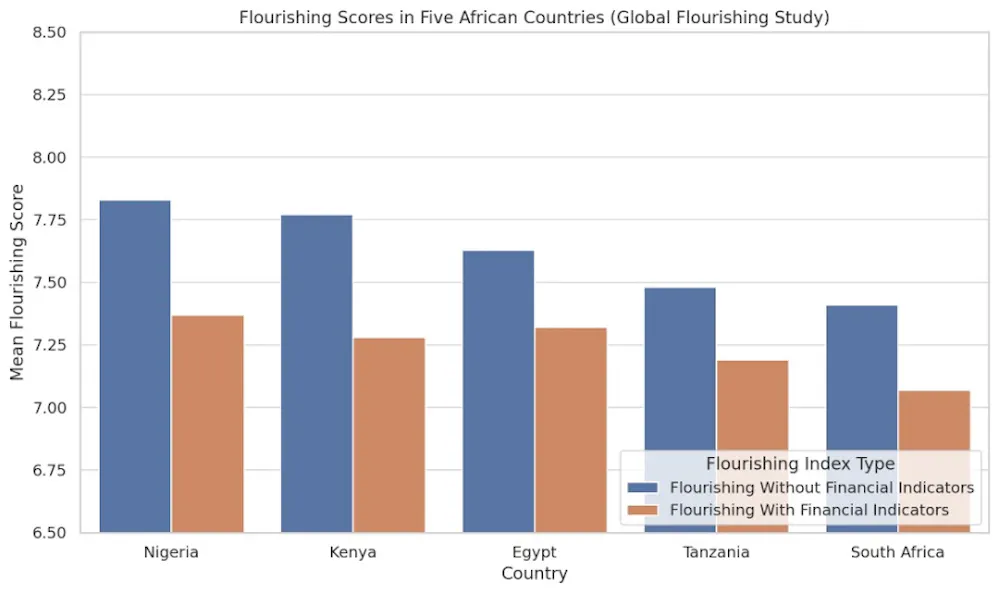
Of the 22 nations, five were African: Nigeria, Kenya, South Africa, Tanzania and Egypt.
While these countries didn’t top the global rankings (Indonesia and Mexico did), Nigeria, Kenya and Egypt all reported relatively high flourishing scores, especially when well-being was considered apart from financial status.
Nigeria, for example, ranked 5th globally in flourishing scores that excluded financial indicators – ahead of many wealthier nations. Nigerians indicated strengths in social relationships, character and virtues (like forgiveness or helping others). But potential areas of growth included financial well-being, housing, ethnic discrimination and education.
Overall, this suggests that while material resources matter, they’re not the only thing that determines well-being. Kenya ranked 7th, Egypt 10th, Tanzania 11th and South Africa 13th. Each showed unique strengths in areas like meaning, social connection or mental health.
You did a separate study on flourishing in Africa. What did you find?
In a 2024 study we analysed data from the Gallup World Poll (2020–2022) to explore 38 indicators of well-being across 40 African countries.
This study offered a more detailed and culture-sensitive picture of how Africans experience and prioritise flourishing. The dimensions explored were derived from both local and universal sources, allowing for regionally relevant insights.
We found that African populations often score high in meaning, character and social relationships – despite economic hardship. This offers an important corrective to western assumptions about well-being.
Some of our key findings were:
● There is significant diversity between and within African countries. Mauritius consistently ranked highest in life evaluations (overall satisfaction with their lives), while countries like Sierra Leone and Zimbabwe scored lowest.
● East African countries such as Rwanda and Ethiopia showed strong performance in social well-being indicators (like feeling respected or learning new things daily) even when economic indicators were low.
● Countries in West Africa, such as Senegal and Ghana, scored high in emotional well-being, with many people reporting positive daily emotions like enjoyment and laughter.
● Southern African nations, despite challenges like income inequality, displayed resilience through strong community ties and cultural practices rooted in the philosophy of ubuntu.
The results reinforced that flourishing in Africa cannot only be reduced to gross domestic product (GDP) per capita (a measure of the average economic output per person in a country) – nor to western norms of success.
What can African countries focus on to flourish?
In my view, the path to greater flourishing lies in embracing local knowledge and investing in culturally relevant development priorities. Instead of following western pathways – centred on individual advancement – Africa can model alternative flourishing pathways that reflect what matters most to African people.
1. Prioritise local knowledge systems
African ideas about a connected society – like ubuntu (southern Africa), ujamaa (east Africa), teranga or wazobia (west Africa), and al-musawat wal tarahum (north Africa) teach people to care for each other and live in peace. These values help people live meaningful lives and can inform leadership and legislation.
2. Redefine development metrics
Western development models focus on individual achievement, economic output and material consumption. GDP per capita fails to capture the everyday realities and aspirations of African communities. We should also measure things like how happy people are, how hopeful they feel about the future, how strong and resilient their communities are, and how clean, safe and dignifying their living environments are.
This is not a new idea – for years development scholars have called for a shift away from narrow economic indicators toward a focus on human dignity, agency, and the real opportunities people have to pursue the lives they value. What’s new is the growing availability of data and the momentum to take these alternative metrics seriously in shaping national policies and priorities.
3. Invest in education for character development
Quality education is essential to unlocking the continent’s potential to flourish. But Africa needs more than just academic skills and workforce readiness – it needs a strategy for intentional development of values and habits that shape how a person thinks, feels, and acts with integrity.
Part of the problem lies in how the humanities – fields like history, literature, philosophy, and religious studies – are often undervalued or underfunded in education systems. But it is precisely these disciplines that nurture moral imagination, critical reflection, and civic responsibility. We need educational models that form not just workers, but whole persons – people who can think ethically, act responsibly, and lead with character in their communities.
What does Africa offer the world in terms of flourishing?
Africa is not waiting to be saved. Across the continent, people are building communities of care, cultivating joy amid hardship, and passing on values of unity, faith, and compassion. This is what development looks like when rooted in human dignity.
Africa flourishing goals offer an alternative vision for development – one that starts with what Africa already has, not what it lacks. These are locally emic aspirations for well-being. They are shaped by Africa’s indigenous knowledge systems, cultural values, and religious/spiritual traditions. Pursuing these goals means prioritising wholeness over wealth, community over consumption, and resilience over rescue.
The continent has so much to offer the world: wisdom, strong community values, and ways of staying resilient and living fully even in hard times. But many of these local insights are missing in the global science of well-being.
Victor Counted consults for Africa Flourishing Initiative
Source: The Conversation – Africa – By Victor Counted, Associate Professor of Psychology, Regent University
What does it mean to live a good life? Psychologists and social scientists have been focusing on a new idea called flourishing – a sense of well-being that goes beyond just happiness or success. It’s about your whole life being good, including how you interact with other people and your community. So then, how do Africans fare when it comes to flourishing?
Victor Counted is a psychological scientist whose research across 40 African countries offers a data-rich rethinking of flourishing on the continent. His findings challenge the dominant narrative that Africa is “lagging behind” in development by showing a more nuanced picture of what it means to live a good life. We asked him more.
What is flourishing?
Flourishing is more than economic growth or individual happiness. It’s a multidimensional state of being that reflects how people feel about their lives and how well their lives are actually going. So it also measures people’s values within their community.
The idea of well-being often carries a Eurocentric emphasis on the individual – personal satisfaction, autonomy, achievement. Flourishing accounts for how whole a person is in relation to their environment.
It includes the social, spiritual and ecological contexts in which one lives. So, it’s not just about how one feels, but how one lives – fully, meaningfully and in a satisfying relationship with the world around us.
What’s the Global Flourishing Study?
The Global Flourishing Study tries to measure global patterns of human flourishing. It’s an ongoing five-year longitudinal study in over 200,000 participants across 22 countries.
I was one of the team of global scholars brought together to examine the trends on what it means to live well across cultures and life circumstances.
The study identifies six key dimensions of flourishing:
Happiness and life satisfaction
Mental and physical health
Meaning and purpose
Character and virtue
Close social relationships
Financial and material stability
Participants rate how they’re doing in each of these areas on a scale from 0 to 10. Further questions capture experiences related to trust, loneliness, hope, resilience, and other related well-being variables.
Of the 22 nations, five were African: Nigeria, Kenya, South Africa, Tanzania and Egypt.
While these countries didn’t top the global rankings (Indonesia and Mexico did), Nigeria, Kenya and Egypt all reported relatively high flourishing scores, especially when well-being was considered apart from financial status.
Courtesy Victor Counted
Nigeria, for example, ranked 5th globally in flourishing scores that excluded financial indicators – ahead of many wealthier nations. Nigerians indicated strengths in social relationships, character and virtues (like forgiveness or helping others). But potential areas of growth included financial well-being, housing, ethnic discrimination and education.
Overall, this suggests that while material resources matter, they’re not the only thing that determines well-being. Kenya ranked 7th, Egypt 10th, Tanzania 11th and South Africa 13th. Each showed unique strengths in areas like meaning, social connection or mental health.
You did a separate study on flourishing in Africa. What did you find?
In a 2024 study we analysed data from the Gallup World Poll (2020–2022) to explore 38 indicators of well-being across 40 African countries.
This study offered a more detailed and culture-sensitive picture of how Africans experience and prioritise flourishing. The dimensions explored were derived from both local and universal sources, allowing for regionally relevant insights.
We found that African populations often score high in meaning, character and social relationships – despite economic hardship. This offers an important corrective to western assumptions about well-being.
Some of our key findings were:
● There is significant diversity between and within African countries. Mauritius consistently ranked highest in life evaluations (overall satisfaction with their lives), while countries like Sierra Leone and Zimbabwe scored lowest.
● East African countries such as Rwanda and Ethiopia showed strong performance in social well-being indicators (like feeling respected or learning new things daily) even when economic indicators were low.
● Countries in West Africa, such as Senegal and Ghana, scored high in emotional well-being, with many people reporting positive daily emotions like enjoyment and laughter.
● Southern African nations, despite challenges like income inequality, displayed resilience through strong community ties and cultural practices rooted in the philosophy of ubuntu.
The results reinforced that flourishing in Africa cannot only be reduced to gross domestic product (GDP) per capita (a measure of the average economic output per person in a country) – nor to western norms of success.
What can African countries focus on to flourish?
In my view, the path to greater flourishing lies in embracing local knowledge and investing in culturally relevant development priorities. Instead of following western pathways – centred on individual advancement – Africa can model alternative flourishing pathways that reflect what matters most to African people.
1. Prioritise local knowledge systems
African ideas about a connected society – like ubuntu (southern Africa), ujamaa (east Africa), teranga or wazobia (west Africa), and al-musawat wal tarahum (north Africa) teach people to care for each other and live in peace. These values help people live meaningful lives and can inform leadership and legislation.
2. Redefine development metrics
Western development models focus on individual achievement, economic output and material consumption. GDP per capita fails to capture the everyday realities and aspirations of African communities. We should also measure things like how happy people are, how hopeful they feel about the future, how strong and resilient their communities are, and how clean, safe and dignifying their living environments are.
This is not a new idea – for years development scholars have called for a shift away from narrow economic indicators toward a focus on human dignity, agency, and the real opportunities people have to pursue the lives they value. What’s new is the growing availability of data and the momentum to take these alternative metrics seriously in shaping national policies and priorities.
3. Invest in education for character development
Quality education is essential to unlocking the continent’s potential to flourish. But Africa needs more than just academic skills and workforce readiness – it needs a strategy for intentional development of values and habits that shape how a person thinks, feels, and acts with integrity.
Part of the problem lies in how the humanities – fields like history, literature, philosophy, and religious studies – are often undervalued or underfunded in education systems. But it is precisely these disciplines that nurture moral imagination, critical reflection, and civic responsibility. We need educational models that form not just workers, but whole persons – people who can think ethically, act responsibly, and lead with character in their communities.
What does Africa offer the world in terms of flourishing?
Africa is not waiting to be saved. Across the continent, people are building communities of care, cultivating joy amid hardship, and passing on values of unity, faith, and compassion. This is what development looks like when rooted in human dignity.
Africa flourishing goals offer an alternative vision for development – one that starts with what Africa already has, not what it lacks. These are locally emic aspirations for well-being. They are shaped by Africa’s indigenous knowledge systems, cultural values, and religious/spiritual traditions. Pursuing these goals means prioritising wholeness over wealth, community over consumption, and resilience over rescue.
The continent has so much to offer the world: wisdom, strong community values, and ways of staying resilient and living fully even in hard times. But many of these local insights are missing in the global science of well-being.
– Which African countries are flourishing? Scientists have a new way of measuring well-being – https://theconversation.com/which-african-countries-are-flourishing-scientists-have-a-new-way-of-measuring-well-being-257458
Source: United States Senator for Illinois Tammy Duckworth
June 21, 2025
[CHICAGO, IL] – U.S. Senator Tammy Duckworth (D-IL) and Illinois Lieutenant Governor Juliana Stratton today joined Chicago-area health care advocates, Medicaid recipients and their families to call out the Trump Administration and Republican’s dangerous, relentless attempts to slash Medicaid with their Big, Beautiful Betrayal. Duckworth spoke in support and defense of the millions of Americans who rely on Medicaid including pregnant women, children with disabilities as well as people in nursing homes—and demanded that Republicans put their constituents’ lives ahead of Trump’s ego by working with Democrats to protect the critical basic needs program. Photos from the press conference are available on Senator Duckworth’s website.
“Republicans told us in Project 2025 that they’d come for Medicaid—and this is one of the rare times the GOP is actually keeping its word,” Duckworth said. “Make no mistake: there’s no way to pay for Trump’s $4 trillion tax break for billionaires without putting it on the backs of Americans who are already struggling to pay the bills. As Republicansthreatened health care for 16 million Americans—including 3.4 million Illinoisans—to appease Trump and his billionaire buddies, I’ll keep working with Illinois health care advocates to protect and defend Medicaid.”
“Since we saw the earliest versions of the Big Ugly Bill, it has been clear that Congressional Republicans have no intention of passing a budget that works for all, nor do they care about the harm that will fall on working families if they succeed. Nothing makes their priorities more obvious than the axe hovering over Medicaid.” said Lt. Governor Juliana Stratton. “Grandparents thrown out of nursing homes, farmers and rural families with no hospital to call in an emergency – that’s who the Trump administration is throwing under the bus to cover a tax cut for billionaires. That’s not who we are in Illinois. Everyone – no matter their zip code or who they voted for – deserves access to healthcare.”
“Mental health is not optional. It is essential. And Medicaid is how we fund it. We must invest in the care that gives people a real chance at recovery,” said Sara Gray, Executive Director, National Alliance on Mental Illness (NAMI) Illinois.
“The proposed Medicaid cuts would have devastating consequences for older adults and the caregivers who support them. Medicaid is not just a safety net—it is a lifeline that provides access to home and community-based services, long-term care, and essential health coverage. These cuts would threaten the independence, dignity, and well-being of millions of older Americans. We urge lawmakers to prioritize the needs of aging adults and protect the integrity of Medicaid,” said Diane Slezak, President of AgeOptions.
“We are facing some of the most dangerous threats the disability community has seen,” said Karen Tamley, President and CEO of Access Living, a disability service and advocacy center in Chicago. “Congress is considering budget proposals that would slash billions from Medicaid—the lifeline that makes it possible for disabled people to live, work, and thrive. These aren’t just numbers on a page—these cuts would take away life sustaining healthcare, personal care assistants, medical equipment, and essential therapies our community relies on.”
Last month, Duckworth joined Caring Across Generations’ 24-hour Capitol Hill vigil to call out Donald Trump and Elon Musk for their heartless, relentless attempts to slash Medicaid funding.
A project to enhance three public spaces on Moston Lane has been completed and unveiled formally to the public this weekend, signalling the start of a wide range of investment projects in the communit
A project to enhance three public spaces on Moston Lane has been completed and unveiled formally to the public this weekend, signalling the start of a wide range of investment projects in the community.
Ahead of the annual Africa Day celebration on Moston Lane, a planting ceremony was held in the Peace Gardens to mark the official reopening of the refurbished pocket parks.
The revived Peace Gardens, St Dunstan’s Green and the Simpson Memorial Hall Garden will each create areas of peace and quiet reflection for local residents to enjoy and encourage people to spend time on the high street.
Funded by the UK Government, this initial investment on Moston Lane followed consultation with local people and businesses that helped create a long-term development plan for the area.
Improvements to the local environment making it cleaner and more welcoming have already been completed, including changes to commercial waste collection to reduce litter issues, alongside new alleygating schemes to improve safety in local residential areas.
Highways investment both on the Lane and adjacent streets – including additional bollards, new road markings, and relocating certain loading bays – will improve road safety and address dangerous parking, creating a more welcoming environment for pedestrians and cyclists.
The Simpson Memorial Hall also received substantial investment as part of this programme, with repairs to the roof, brickwork and windows.
Looking ahead to the long-term regeneration opportunities in the Moston Lane regeneration framework, the Council is going to establish a forum for residents and businesses in and around Moston Lane to help shape the development plans for new public spaces, housing and businesses as they come forward.
The group would be a chance to find out more about the long-term plans for the neighbourhood and help guide emerging proposals for future investment, while also acting as advocates for the community.
More details, including how people can become involved, will be revealed later this summer.
Long term investment in Moston
North Manchester is a priority for Council-led investment with Moston Lane an important element of the city-wide district centre programme to deliver new jobs, impactful community and neighbourhood projects and homes – with a focus on affordable tenures.
Moston Lane will be regenerated with hundreds of new homes, space for a new public square, and local businesses. The search for a development delivery partner will conclude later in the year.
New housing in this area remains a key priority to help meet demand for quality, sustainable and affordable homes in the city – and the Council is working closely with the city’s housing providers to maintain a pipeline of home building in the area.
The first housing completions are already underway, with One Manchester constructing 60 new low carbon, affordable homes on the adjacent former Manchester College Campus.
Jigsaw Housing are also delivering 20 new affordable homes for social rent on Sulby Street along with a site on Kenyon Lane to construct nine affordable homes at the Manchester Living Rent as part of Project 500.
While One Manchester are developing 29 affordable homes for social rent on Winston Road, Hodge Street and Lordship Close – another Project 500 site in Moston.
“North Manchester is an area of key focus for Council investment to build quality new homes, improve neighbourhoods and create jobs for our residents. Part of this is our commitment to investing in our high streets as the beating hearts of our communities – and Moston Lane is a great example of this.
“This is about creating district centres that our residents can be proud of. Spaces that attract visitors to support local businesses and create opportunities for local economic growth.
“These initial projects to create new and improved green spaces on Moston Lane is only the beginning for this community that will see hundreds of new homes – with a focus on genuinely social rent and affordable housing – a new public square and opportunities for new shops and businesses.”
Cllr Gavin White, Manchester City Council’s executive member for housing and development, said:
“Moston Lane is an incredibly important space for the local community and is brimming with untapped potential. Our investment has now begun with three improved green, tranquil pocket parks for local people to enjoy and encourage them to spend time on their high street. But it really is a case of watch this space for Moston because there is far more to come – and we look forward to continuing the conversation with local residents about the future of their neighbourhood.”
John Curtin, organising member of Africa Day on Moston Lane, said:
“There’s huge pride in the Moston community and we know that lots of local people have been calling for investment on the Lane for some time to support the local businesses and bring more people to our high street. It’s great to open the new mini parks open to the public this week – already it feels like a change in our neighbourhoood. But there’s more to come – and I can’t wait to see it.”
What you need to know: Thanks to California’s Film and Television Tax Credit Program, 48 projects — including 43 independent features — will be made in California, projected to generate $664 million in economic activity and employ over 6,500 cast and crew across the Golden State.
SACRAMENTO – Governor Newsom today continued his work in protecting film production jobs in Los Angeles and across the state with a new round of 48 projects approved for the California Film Commission’s Film and Television Tax Credit Program. Governor Newsom recently proposedto double down on this vital program, by expanding the tax credit from $330 million to $750 million to help boost this iconic industry and production in California.
“California didn’t earn its role as the heart of the entertainment world by accident — it was built over generations by skilled workers and creative talent pushing boundaries. Today’s awards help ensure this legacy continues, keeping cameras rolling here at home, supporting thousands of crew members behind the scenes and boosting local economies that depend on a strong film and television industry.”
Governor Gavin Newsom
Why this matters
This diverse slate of feature films — ranging from major studio productions to independent film — is expected to generate $664 million in total spending throughout the state, including $485 in qualified expenditures and more than $302 million in wages for California workers.
These projects, which include 43 independent films, are collectively expected to hire 6,515 cast and crew members, as well 32,000 background performers (measured in days worked), across 1,346 total California filming days.
More than half of the films will be shot in the Los Angeles area, helping to sustain the birthplace of this iconic industry and supporting the community as it recovers from recent wildfires. Enabling the industry’s reach throughout the state, 22 of the selected projects will conduct significant filming outside the Los Angeles area, contributing 329 out-of-zone filming days and substantial economic benefits in Ventura County (Make A Wish, The Teller, Things We Cannot Touch), San Francisco and the Bay Area (High Priestess of Souls, Our Kind of Cruelty), El Dorado and Placer Counties (Gold Mountain), San Bernardino and Riverside Counties (Superbloom, The Heidi Fleiss Story), Bakersfield in Kern County (Counting by 7s) and coastal communities such as Half Moon Bay and Costa Mesa (Sponsor, Doll).
Today’s slate of awards marks the ninth allocation in this fiscal year and reinforces California’s continued leadership as a global production hub, even as other states and countries pursue projects with their own incentive offerings.
“This industry is core to California’s creative economy and keeping production here at home is more important than ever,” said Colleen Bell, Director of the California Film Commission. “This round of tax credits shows our commitment to supporting both indie and studio productions while spreading the economic benefits of filming across the state.”
Highlights from this round of awards
Five major studio features, including Sony Pictures’ “One of Them Days Sequel” — the latest film produced by Issa Rae — which alone is projected to spend more than $39 million in qualified expenditures.
Six independently produced features with budgets over $10 million, such as “Gold Mountain,” “The Teller,” and “They Follow,” all of which plan to film primarily outside of the Los Angeles area.
37 independent projects with budgets of $10 million or less, contributing to the state’s goal of expanding access to underrepresented filmmakers and promoting more inclusive storytelling.
“Los Angeles was an essential backdrop to ‘One of Them Days’ and we are thrilled that Dreux and Alyssa will embark on another authentic escapade through the city’s streets in the sequel through the support of California’s Film and Television Tax Credit,” said Nicole Brown, President of TriStar Pictures.
Read more about today’s announcement, including a full list of productions that are part of the Film and Television Tax Credit Program here.
California is a creative economy powerhouse
Last fall, Governor Newsom proposed expanding California’s Film & Television Tax Credit Program to $750 million annually, a massive increase from the current $330 million annual allocation, which would position California as one of the top states for capped film incentive programs.
As one of the strategic sectors outlined in the recently launched California Jobs First Economic Blueprint, the creative economy has deep roots in California’s history and continues to be an engine for innovation, cultural expression, and economic growth.
In 2023, California was home to 220,000 creative economy jobs, one in every four creative economy jobs in the U.S.
The average salary paid to creative workers in 2023 was $160,000, more than 50% higher than the California average.
And while the Los Angeles region leads the way in jobs generated by the creative economy, three other regions — Redwoods, the Bay Area, and the Southern Border — also identified film, TV, and the arts as a regional strategic sector.
About the Film and TV Tax Credit Program
The Film and Television Tax Credit Program provides tax credits based on qualified expenditures for eligible productions produced in California.
Since its launch in 2009 through May 2025, the program has approved 799 projects that have generated nearly $27 billion in economic activity, resulting in less runaway production, new career pathways for below-the-line workers and increased economic opportunity in rural, suburban and urban communities alike. The program further incentivizes projects that film outside the Los Angeles area or relocate to California from out-of-state. The program also requires projects to invest in building career exposure and training opportunities for underrepresented communities.
Looking ahead, the next television application window is slated for July 7-9, 2025. Film applications will be accepted August 25-27, 2025. Application dates and deadlines are posted on the California Film Commission website.
Recent news
Jun 20, 2025
News SACRAMENTO – Governor Gavin Newsom today announced the following appointments:Soon-Sik Lee, of Bellevue, Washington, has been appointed Chief of Planning and Engineering at the California High Speed Rail Authority. Lee has been a Vice President – Senior Program…
Jun 19, 2025
News What you need to know: The Ninth Circuit rejected Trump’s sweeping claim that he can federalize the National Guard for any reason and avoid judicial scrutiny, even as it stayed an emergency district court order. This is a critical check on presidential overreach…
Jun 19, 2025
News Sacramento, California – Governor Gavin Newsom today issued a proclamation declaring “Juneteenth National Freedom Day: A Day of Observance” in the State of California.The text of the proclamation and a copy can be found below: PROCLAMATIONJuly 4 is not the only…
What you need to know: Thanks to California’s Film and Television Tax Credit Program, 48 projects — including 43 independent features — will be made in California, projected to generate $664 million in economic activity and employ over 6,500 cast and crew across the Golden State.
SACRAMENTO – Governor Newsom today continued his work in protecting film production jobs in Los Angeles and across the state with a new round of 48 projects approved for the California Film Commission’s Film and Television Tax Credit Program. Governor Newsom recently proposedto double down on this vital program, by expanding the tax credit from $330 million to $750 million to help boost this iconic industry and production in California.
“California didn’t earn its role as the heart of the entertainment world by accident — it was built over generations by skilled workers and creative talent pushing boundaries. Today’s awards help ensure this legacy continues, keeping cameras rolling here at home, supporting thousands of crew members behind the scenes and boosting local economies that depend on a strong film and television industry.”
Governor Gavin Newsom
Why this matters
This diverse slate of feature films — ranging from major studio productions to independent film — is expected to generate $664 million in total spending throughout the state, including $485 in qualified expenditures and more than $302 million in wages for California workers.
These projects, which include 43 independent films, are collectively expected to hire 6,515 cast and crew members, as well 32,000 background performers (measured in days worked), across 1,346 total California filming days.
More than half of the films will be shot in the Los Angeles area, helping to sustain the birthplace of this iconic industry and supporting the community as it recovers from recent wildfires. Enabling the industry’s reach throughout the state, 22 of the selected projects will conduct significant filming outside the Los Angeles area, contributing 329 out-of-zone filming days and substantial economic benefits in Ventura County (Make A Wish, The Teller, Things We Cannot Touch), San Francisco and the Bay Area (High Priestess of Souls, Our Kind of Cruelty), El Dorado and Placer Counties (Gold Mountain), San Bernardino and Riverside Counties (Superbloom, The Heidi Fleiss Story), Bakersfield in Kern County (Counting by 7s) and coastal communities such as Half Moon Bay and Costa Mesa (Sponsor, Doll).
Today’s slate of awards marks the ninth allocation in this fiscal year and reinforces California’s continued leadership as a global production hub, even as other states and countries pursue projects with their own incentive offerings.
“This industry is core to California’s creative economy and keeping production here at home is more important than ever,” said Colleen Bell, Director of the California Film Commission. “This round of tax credits shows our commitment to supporting both indie and studio productions while spreading the economic benefits of filming across the state.”
Highlights from this round of awards
Five major studio features, including Sony Pictures’ “One of Them Days Sequel” — the latest film produced by Issa Rae — which alone is projected to spend more than $39 million in qualified expenditures.
Six independently produced features with budgets over $10 million, such as “Gold Mountain,” “The Teller,” and “They Follow,” all of which plan to film primarily outside of the Los Angeles area.
37 independent projects with budgets of $10 million or less, contributing to the state’s goal of expanding access to underrepresented filmmakers and promoting more inclusive storytelling.
“Los Angeles was an essential backdrop to ‘One of Them Days’ and we are thrilled that Dreux and Alyssa will embark on another authentic escapade through the city’s streets in the sequel through the support of California’s Film and Television Tax Credit,” said Nicole Brown, President of TriStar Pictures.
Read more about today’s announcement, including a full list of productions that are part of the Film and Television Tax Credit Program here.
California is a creative economy powerhouse
Last fall, Governor Newsom proposed expanding California’s Film & Television Tax Credit Program to $750 million annually, a massive increase from the current $330 million annual allocation, which would position California as one of the top states for capped film incentive programs.
As one of the strategic sectors outlined in the recently launched California Jobs First Economic Blueprint, the creative economy has deep roots in California’s history and continues to be an engine for innovation, cultural expression, and economic growth.
In 2023, California was home to 220,000 creative economy jobs, one in every four creative economy jobs in the U.S.
The average salary paid to creative workers in 2023 was $160,000, more than 50% higher than the California average.
And while the Los Angeles region leads the way in jobs generated by the creative economy, three other regions — Redwoods, the Bay Area, and the Southern Border — also identified film, TV, and the arts as a regional strategic sector.
About the Film and TV Tax Credit Program
The Film and Television Tax Credit Program provides tax credits based on qualified expenditures for eligible productions produced in California.
Since its launch in 2009 through May 2025, the program has approved 799 projects that have generated nearly $27 billion in economic activity, resulting in less runaway production, new career pathways for below-the-line workers and increased economic opportunity in rural, suburban and urban communities alike. The program further incentivizes projects that film outside the Los Angeles area or relocate to California from out-of-state. The program also requires projects to invest in building career exposure and training opportunities for underrepresented communities.
Looking ahead, the next television application window is slated for July 7-9, 2025. Film applications will be accepted August 25-27, 2025. Application dates and deadlines are posted on the California Film Commission website.
Recent news
Jun 20, 2025
News SACRAMENTO – Governor Gavin Newsom today announced the following appointments:Soon-Sik Lee, of Bellevue, Washington, has been appointed Chief of Planning and Engineering at the California High Speed Rail Authority. Lee has been a Vice President – Senior Program…
Jun 19, 2025
News What you need to know: The Ninth Circuit rejected Trump’s sweeping claim that he can federalize the National Guard for any reason and avoid judicial scrutiny, even as it stayed an emergency district court order. This is a critical check on presidential overreach…
Jun 19, 2025
News Sacramento, California – Governor Gavin Newsom today issued a proclamation declaring “Juneteenth National Freedom Day: A Day of Observance” in the State of California.The text of the proclamation and a copy can be found below: PROCLAMATIONJuly 4 is not the only…
What you need to know: Thanks to California’s Film and Television Tax Credit Program, 48 projects — including 43 independent features — will be made in California, projected to generate $664 million in economic activity and employ over 6,500 cast and crew across the Golden State.
SACRAMENTO – Governor Newsom today continued his work in protecting film production jobs in Los Angeles and across the state with a new round of 48 projects approved for the California Film Commission’s Film and Television Tax Credit Program. Governor Newsom recently proposedto double down on this vital program, by expanding the tax credit from $330 million to $750 million to help boost this iconic industry and production in California.
“California didn’t earn its role as the heart of the entertainment world by accident — it was built over generations by skilled workers and creative talent pushing boundaries. Today’s awards help ensure this legacy continues, keeping cameras rolling here at home, supporting thousands of crew members behind the scenes and boosting local economies that depend on a strong film and television industry.”
Governor Gavin Newsom
Why this matters
This diverse slate of feature films — ranging from major studio productions to independent film — is expected to generate $664 million in total spending throughout the state, including $485 in qualified expenditures and more than $302 million in wages for California workers.
These projects, which include 43 independent films, are collectively expected to hire 6,515 cast and crew members, as well 32,000 background performers (measured in days worked), across 1,346 total California filming days.
More than half of the films will be shot in the Los Angeles area, helping to sustain the birthplace of this iconic industry and supporting the community as it recovers from recent wildfires. Enabling the industry’s reach throughout the state, 22 of the selected projects will conduct significant filming outside the Los Angeles area, contributing 329 out-of-zone filming days and substantial economic benefits in Ventura County (Make A Wish, The Teller, Things We Cannot Touch), San Francisco and the Bay Area (High Priestess of Souls, Our Kind of Cruelty), El Dorado and Placer Counties (Gold Mountain), San Bernardino and Riverside Counties (Superbloom, The Heidi Fleiss Story), Bakersfield in Kern County (Counting by 7s) and coastal communities such as Half Moon Bay and Costa Mesa (Sponsor, Doll).
Today’s slate of awards marks the ninth allocation in this fiscal year and reinforces California’s continued leadership as a global production hub, even as other states and countries pursue projects with their own incentive offerings.
“This industry is core to California’s creative economy and keeping production here at home is more important than ever,” said Colleen Bell, Director of the California Film Commission. “This round of tax credits shows our commitment to supporting both indie and studio productions while spreading the economic benefits of filming across the state.”
Highlights from this round of awards
Five major studio features, including Sony Pictures’ “One of Them Days Sequel” — the latest film produced by Issa Rae — which alone is projected to spend more than $39 million in qualified expenditures.
Six independently produced features with budgets over $10 million, such as “Gold Mountain,” “The Teller,” and “They Follow,” all of which plan to film primarily outside of the Los Angeles area.
37 independent projects with budgets of $10 million or less, contributing to the state’s goal of expanding access to underrepresented filmmakers and promoting more inclusive storytelling.
“Los Angeles was an essential backdrop to ‘One of Them Days’ and we are thrilled that Dreux and Alyssa will embark on another authentic escapade through the city’s streets in the sequel through the support of California’s Film and Television Tax Credit,” said Nicole Brown, President of TriStar Pictures.
Read more about today’s announcement, including a full list of productions that are part of the Film and Television Tax Credit Program here.
California is a creative economy powerhouse
Last fall, Governor Newsom proposed expanding California’s Film & Television Tax Credit Program to $750 million annually, a massive increase from the current $330 million annual allocation, which would position California as one of the top states for capped film incentive programs.
As one of the strategic sectors outlined in the recently launched California Jobs First Economic Blueprint, the creative economy has deep roots in California’s history and continues to be an engine for innovation, cultural expression, and economic growth.
In 2023, California was home to 220,000 creative economy jobs, one in every four creative economy jobs in the U.S.
The average salary paid to creative workers in 2023 was $160,000, more than 50% higher than the California average.
And while the Los Angeles region leads the way in jobs generated by the creative economy, three other regions — Redwoods, the Bay Area, and the Southern Border — also identified film, TV, and the arts as a regional strategic sector.
About the Film and TV Tax Credit Program
The Film and Television Tax Credit Program provides tax credits based on qualified expenditures for eligible productions produced in California.
Since its launch in 2009 through May 2025, the program has approved 799 projects that have generated nearly $27 billion in economic activity, resulting in less runaway production, new career pathways for below-the-line workers and increased economic opportunity in rural, suburban and urban communities alike. The program further incentivizes projects that film outside the Los Angeles area or relocate to California from out-of-state. The program also requires projects to invest in building career exposure and training opportunities for underrepresented communities.
Looking ahead, the next television application window is slated for July 7-9, 2025. Film applications will be accepted August 25-27, 2025. Application dates and deadlines are posted on the California Film Commission website.
Recent news
Jun 20, 2025
News SACRAMENTO – Governor Gavin Newsom today announced the following appointments:Soon-Sik Lee, of Bellevue, Washington, has been appointed Chief of Planning and Engineering at the California High Speed Rail Authority. Lee has been a Vice President – Senior Program…
Jun 19, 2025
News What you need to know: The Ninth Circuit rejected Trump’s sweeping claim that he can federalize the National Guard for any reason and avoid judicial scrutiny, even as it stayed an emergency district court order. This is a critical check on presidential overreach…
Jun 19, 2025
News Sacramento, California – Governor Gavin Newsom today issued a proclamation declaring “Juneteenth National Freedom Day: A Day of Observance” in the State of California.The text of the proclamation and a copy can be found below: PROCLAMATIONJuly 4 is not the only…
What you need to know: Thanks to California’s Film and Television Tax Credit Program, 48 projects — including 43 independent features — will be made in California, projected to generate $664 million in economic activity and employ over 6,500 cast and crew across the Golden State.
SACRAMENTO – Governor Newsom today continued his work in protecting film production jobs in Los Angeles and across the state with a new round of 48 projects approved for the California Film Commission’s Film and Television Tax Credit Program. Governor Newsom recently proposedto double down on this vital program, by expanding the tax credit from $330 million to $750 million to help boost this iconic industry and production in California.
“California didn’t earn its role as the heart of the entertainment world by accident — it was built over generations by skilled workers and creative talent pushing boundaries. Today’s awards help ensure this legacy continues, keeping cameras rolling here at home, supporting thousands of crew members behind the scenes and boosting local economies that depend on a strong film and television industry.”
Governor Gavin Newsom
Why this matters
This diverse slate of feature films — ranging from major studio productions to independent film — is expected to generate $664 million in total spending throughout the state, including $485 in qualified expenditures and more than $302 million in wages for California workers.
These projects, which include 43 independent films, are collectively expected to hire 6,515 cast and crew members, as well 32,000 background performers (measured in days worked), across 1,346 total California filming days.
More than half of the films will be shot in the Los Angeles area, helping to sustain the birthplace of this iconic industry and supporting the community as it recovers from recent wildfires. Enabling the industry’s reach throughout the state, 22 of the selected projects will conduct significant filming outside the Los Angeles area, contributing 329 out-of-zone filming days and substantial economic benefits in Ventura County (Make A Wish, The Teller, Things We Cannot Touch), San Francisco and the Bay Area (High Priestess of Souls, Our Kind of Cruelty), El Dorado and Placer Counties (Gold Mountain), San Bernardino and Riverside Counties (Superbloom, The Heidi Fleiss Story), Bakersfield in Kern County (Counting by 7s) and coastal communities such as Half Moon Bay and Costa Mesa (Sponsor, Doll).
Today’s slate of awards marks the ninth allocation in this fiscal year and reinforces California’s continued leadership as a global production hub, even as other states and countries pursue projects with their own incentive offerings.
“This industry is core to California’s creative economy and keeping production here at home is more important than ever,” said Colleen Bell, Director of the California Film Commission. “This round of tax credits shows our commitment to supporting both indie and studio productions while spreading the economic benefits of filming across the state.”
Highlights from this round of awards
Five major studio features, including Sony Pictures’ “One of Them Days Sequel” — the latest film produced by Issa Rae — which alone is projected to spend more than $39 million in qualified expenditures.
Six independently produced features with budgets over $10 million, such as “Gold Mountain,” “The Teller,” and “They Follow,” all of which plan to film primarily outside of the Los Angeles area.
37 independent projects with budgets of $10 million or less, contributing to the state’s goal of expanding access to underrepresented filmmakers and promoting more inclusive storytelling.
“Los Angeles was an essential backdrop to ‘One of Them Days’ and we are thrilled that Dreux and Alyssa will embark on another authentic escapade through the city’s streets in the sequel through the support of California’s Film and Television Tax Credit,” said Nicole Brown, President of TriStar Pictures.
Read more about today’s announcement, including a full list of productions that are part of the Film and Television Tax Credit Program here.
California is a creative economy powerhouse
Last fall, Governor Newsom proposed expanding California’s Film & Television Tax Credit Program to $750 million annually, a massive increase from the current $330 million annual allocation, which would position California as one of the top states for capped film incentive programs.
As one of the strategic sectors outlined in the recently launched California Jobs First Economic Blueprint, the creative economy has deep roots in California’s history and continues to be an engine for innovation, cultural expression, and economic growth.
In 2023, California was home to 220,000 creative economy jobs, one in every four creative economy jobs in the U.S.
The average salary paid to creative workers in 2023 was $160,000, more than 50% higher than the California average.
And while the Los Angeles region leads the way in jobs generated by the creative economy, three other regions — Redwoods, the Bay Area, and the Southern Border — also identified film, TV, and the arts as a regional strategic sector.
About the Film and TV Tax Credit Program
The Film and Television Tax Credit Program provides tax credits based on qualified expenditures for eligible productions produced in California.
Since its launch in 2009 through May 2025, the program has approved 799 projects that have generated nearly $27 billion in economic activity, resulting in less runaway production, new career pathways for below-the-line workers and increased economic opportunity in rural, suburban and urban communities alike. The program further incentivizes projects that film outside the Los Angeles area or relocate to California from out-of-state. The program also requires projects to invest in building career exposure and training opportunities for underrepresented communities.
Looking ahead, the next television application window is slated for July 7-9, 2025. Film applications will be accepted August 25-27, 2025. Application dates and deadlines are posted on the California Film Commission website.
Recent news
Jun 20, 2025
News SACRAMENTO – Governor Gavin Newsom today announced the following appointments:Soon-Sik Lee, of Bellevue, Washington, has been appointed Chief of Planning and Engineering at the California High Speed Rail Authority. Lee has been a Vice President – Senior Program…
Jun 19, 2025
News What you need to know: The Ninth Circuit rejected Trump’s sweeping claim that he can federalize the National Guard for any reason and avoid judicial scrutiny, even as it stayed an emergency district court order. This is a critical check on presidential overreach…
Jun 19, 2025
News Sacramento, California – Governor Gavin Newsom today issued a proclamation declaring “Juneteenth National Freedom Day: A Day of Observance” in the State of California.The text of the proclamation and a copy can be found below: PROCLAMATIONJuly 4 is not the only…
London, UK, June 23, 2025 (GLOBE NEWSWIRE) — LET Mining, at the forefront of cutting-edge cryptocurrency cloud mining, has unveiled its upgraded smart cloud mining service. We combine green energy and cutting-edge smart technology to maximize the profits of cryptocurrency mining. This improved service promises a safer, more efficient, and eco-friendlier cryptocurrency mining experience for users globally.
LET Mining Intelligent Cloud Mining Service Advantages
1. Core intelligence drive: ◆Smart contract automation: Your mining operations (currency selection, switching algorithms to achieve the best returns, and revenue payment) are automatically managed by transparent and secure smart contracts, allowing the system to serve you. ◆Dynamic resource allocation: Our AI platform continuously analyzes market conditions (currency prices, network difficulty) and intelligently allocates your computing power to the highest-yielding currencies in real time to maximize your potential returns. ◆Predictive maintenance: Advanced monitoring systems can predict problems before hardware failures cause downtime, ensuring that your mining is online 24/7 and running at maximum efficiency.
2.Excellent efficiency and environmental protection: ◆ Cutting-edge hardware: Using the latest generation of ASIC miners and high-performance graphics cards, their performance and energy efficiency far exceed the level of home mining. ◆ Global strategic layout: Our data centers are located in areas with abundant renewable energy (hydropower, solar power, wind power) and the lowest electricity prices, significantly improving your net income while reducing environmental impact. Lower costs mean higher returns for you. ◆ Economies of scale: Benefit from bulk electricity prices and optimized cooling solutions that can only be achieved at a large-scale industrial level, significantly reducing the operating costs per unit of computing power.
3. Transparent and Trustworthy: ◆ Real-time Data Dashboard: Monitor your mining activities and earnings 24/7 through our intuitive online dashboard or mobile app. No surprises, only clear and stable data. ◆ Flexible and Competitive Pricing: Choose the right package based on your budget and goals, and provide clear and transparent pricing based on computing power and duration. Transparent fee structure, no hidden fees.
◆Bank-level security: Enterprise-level physical security and advanced cybersecurity protocols (including asset cold storage) ensure the safety of your investment and earnings.
How to start using LET Mining 1. Visit the official website to register an account and get a $12 reward for free 2. Choose a cloud mining contract that suits you
Conclusion Are you ready to start a smarter mining journey? Don’t be left behind in this cryptocurrency revolution. Come and experience the power, convenience and intelligence of LET Mining 2025 smart cloud mining service. Register now to get a $12 reward and $0.6 in daily income. The opportunity to easily earn cryptocurrency income starts here. Name:Lillian Austen Company name:LETMining Email :info@letmining.com Address:21 Mansell Street, London, U.K. Website:https://letmining.com/ Register now and start your mining journey!
Source: United States House of Representatives – Representative Melanie Stansbury (N.M.-01)
WASHINGTON, D.C.– Congresswoman Melanie Stansbury (NM-01) fought for expanded access to healthcare in rural and Indigenous communities during an Indian and Insular Affairs Subcommittee hearing.
Her bill, theIHS Provider Expansion Act,was reintroduced earlier in the month, and testimony about the legislation was heard during the subcommittee hearing.
Watch video of thehearing.
The legislation would establish an Office of Graduate Medical Education Programs within the Indian Health Service (IHS). This legislation would expand the existing IHS Residency Program, building from the Shiprock-University of New Mexico (SUNM) Family Medicine Residency which is the first in the nation.
“Access to healthcare should not be determined by history or geography,” saidRep. Melanie Stansbury (NM-01). “The IHS Provider Expansion Act is a vital step towards ensuring that Native and Indigenous communities can access healthcare and grow the number of medical professionals serving Native communities. By investing in medical education within the Indian Health Service, we can help expand healthcare and bridge the gap in healthcare disparities that have persisted for far too long.”
Testifying about the importance of the legislation was Dr. Adriann Begay from theNavajoNation HEAL Initiative.Dr. Begay is Tábaahi (Edge of the Water clan) and born for Bít’ahnii (Folded Arms People clan). Her maternal grandparents are Ta’néészahnii (Badlands People clan) and paternal grandparents are Tl’aashchí’í (Red Cheek People clan).
She completed her undergraduate studies at the University of Arizona; and received a medical degree from the University of North Dakota School of Medicine through the Indians into Medicine program. She completed her residency in Family Medicine at the University of Arizona and is a Diplomate of the American Board of Family Practice. Adriann worked for the Indian Health Service for 21 years initially at Salt River Clinic under Phoenix Indian Medical Center for 4 years as a primary care provider. Then at Gallup Indian Medical Center as an urgent care physician and administrator for 17 years.
Watch video of Dr. Begay’stestimony.
More about the bill and its impact:
In New Mexico, which is home to 23 Tribal Nations and a population that is nearly 12% Native, access to healthcare services is a pressing issue. Currently, IHS provides services in 37 states to about 2.2 million out of 3.7 million Indigenous people in the country.
This bill is projected to directly impact millions of people across the country served by the IHS to improve access to healthcare and medical professionals who understand the unique health challenges faced by Tribal communities.
By expanding access through IHS, this bill will also help to address the significant deficit of rural primary healthcare providers across the country. Recent data from theU.S. Department of Health and Human Servicesshows rural areas across the country face a significant deficit in primary care providers, with more than 80 million Americans living in Health Professional Shortage Areas (HPSAs).
By expanding graduate medical education opportunities through IHS, we can expect an increase in the number of physicians willing to practice in these underserved regions.
Key Provisions of the Legislation:
Establishment of the Office: The Secretary of Health makes permanent the Office of Graduate Medical Education Programs to oversee residency and fellowship initiatives within the IHS.
Creating a Pipeline: The Office will facilitate opportunities for future healthcare professionals, paraprofessionals, and other health-related workers to engage in residency and fellowship programs.
Oversight of Residency Programs: The Office will oversee existing residency and fellowship programs at IHS facilities and support the creation of additional programs aimed at recruiting and retaining healthcare professionals.
Coordination with Academic Institutions: The Office will work in collaboration with academic institutions to strengthen educational ties and enhance training opportunities.
Interagency Working Group: An interagency working group, involving various federal agencies, will assist in the implementation and sustainability of the Office, ensuring ongoing support and resources.
WASHINGTON, D.C. – Today, Congressman Nick Langworthy (NY-23) released the following statement in response to President Donald Trump’s announcement of U.S. airstrikes on Iran nuclear sites.
“Today, President Trump acted with strength and clarity to eliminate a grave threat to our nation, our allies, and the world. After Iran refused every diplomatic path and persisted in its dangerous pursuit of nuclear weapons, the President was left with no choice but to defend American interests and global security.
“We honor and salute the brave men and women of the United States military who executed this critical mission with precision, courage, and professionalism. By destroying Iran’s nuclear sites, President Trump demonstrated bold leadership, unshakable resolve, and an unwavering commitment to safeguarding our homeland and our allies.
“This action sends a unmistakable message: the United States will never tolerate a nuclear-armed Iran, and we will stand firm and unflinching against aggression and terror.
“I stand with the President and our heroic service members as they defend peace and protect the American people.”
Source: United States House of Representatives – Congresswoman Pramila Jayapal (7th District of Washington)
WASHINGTON – U.S. Representative Pramila Jayapal (WA-07), Ranking Member of the Immigration Integrity, Security, and Enforcement Subcommittee, released the following statement regarding recently announced guidance by the Department of Homeland Security (DHS) limiting access to immigration detention facilities:
“Today’s announcement is in direct violation of federal law and is just the latest attempt to undercut congressional oversight and dismantle all manner of oversight related to detention facilities – centers that too often have credible reports of inhumane treatment.
“The idea that the administration is claiming that Immigration and Customs Enforcement (ICE) Field Offices, where immigrants are being held for lengthy periods, are not considered a location that is ‘used to detain or otherwise house’ immigrants and therefore not subject to congressional oversight is absurd. It is our responsibility to do oversight of ICE’s enforcement, and these new policies will not stop us.
“This is nothing but an attempt to hide the truth that President Trump lied to the American people when he promised to arrest and deport only the ‘worst of the worst.’ When I visited a detention facility just last month, the only detained people I was allowed to talk to were a woman who has been in this country for 20 years and was detained less than a week before she was to be married to a U.S. citizen; as well as a legal permanent resident, who has been here 31 years, is a proud member of the Machinists Union, and is married to a U.S. citizen with three U.S. citizen children.”
Earlier this year, the Trump administration also terminated the DHS Office of Civil Rights and the Office of Immigration Detention Ombudsman crippling internal oversight of the Department.
Appropriations language states: SEC. 527. (a) None of the funds appropriated or otherwise made available to the Department of Homeland Security by this Act may be used to prevent any of the following persons from entering, for the purpose of conducting oversight, any facility operated by or for the Department of Homeland Security used to detain or otherwise house aliens, or to make any temporary modification at any such facility that in any way alters what is observed by a visiting Member of Congress or such designated employee, compared to what would be observed in the absence of such modification:
(1) A Member of Congress.
(2) An employee of the United States House of Representatives or the United States Senate designated by such a Member for the purposes of this section.
(b) Nothing in this section may be construed to require a Member of Congress to provide prior notice of the intent to enter a facility described in subsection (a) for the purpose of conducting oversight.
Source: United States House of Representatives – Congresswoman Lori Trahan (D-MA-03)
LOWELL, MA — Today, Congresswoman Lori Trahan (MA-03) issued the following statement after President Donald Trump announced unauthorized U.S. military strikes in Iran: “I am deeply grateful that the American servicemembers who carried out this mission returned safely. Their professionalism, precision, and bravery are unmatched, and we owe them and their families a debt of gratitude for their unwavering commitment to our country.” “Absolutely no one wants to see the Iranian regime acquire nuclear weapons. That shared goal has guided years of bipartisan diplomatic and strategic engagement to prevent Iran from becoming a nuclear-armed state. President Trump’s decision to launch direct military strikes without congressional approval threatens to undermine those efforts and drag the United States into another costly, endless war in the Middle East.” “Acting without the consent of Congress, without a clear strategy, and without the backing of our allies puts American lives at risk and risks further destabilizing an already volatile region. It also flies in the face of the president’s campaign promise to de-escalate tensions in the Middle East, end the war in Gaza, and bring home the hostages still held by Hamas.” ###
ALEXANDRIA, Va. – A Fairfax man was sentenced today to 25 years in prison for his attempt to carry out a mass shooting at a Haymarket church, for carrying a gun during that attempt, and for transmitting threats over the internet. Rui Jiang, 36, was sentenced to 25 years in prison and five years of supervised release. Jiang was previously convicted by a jury in March 2025.
According to evidence presented at trial, Jiang began posting online threats against the Park Valley Church on the evening of Sept. 23, 2023, which made clear his intention to kill congregants. The next morning, police searched for Jiang in response to a concerned citizen’s call. Officers located Jiang at the church while Sunday services were underway. Jiang was armed with a semiautomatic handgun, two magazines of ammunition, and two knives. He had additional ammunition, knives, and a canister of bear spray in his nearby car. During a search of Jiang’s apartment, police discovered copies of a manifesto, signed by Jiang, which read in part, “I am here deny (sic) the love lives blessed by God to these lucky men, by taking out these men… To the families of those men about to be slain – I am sorry for what I have done and about to do (sic).”
“The freedom to worship without fear is one of the bedrock principles of our Nation,” said Erik S. Siebert, U.S. Attorney for the Eastern District of Virginia. “Rui Jiang set out to violate that principle by entering a church during a religious service armed with the intent to murder innocent parishioners. This unspeakable act, only thwarted by brave law enforcement officers and civilians, has no place in our Republic and will always be a priority of my office.”
“This was the closest of calls. But for the determination of a concerned citizen; the exceptional police work by the Anne Arundel, Fairfax, and Prince William County Police Departments; and the steadfast vigilance of the church security team, this would have ended in unimaginable tragedy,” said Harmeet K. Dhillon, Assistant Attorney General of the Justice Department’s Civil Rights Division. “The Justice Department will relentlessly investigate and prosecute attacks on our nation’s houses of worship.”
“The church shooting that was thwarted because of the vigilance of concerned citizens is a reminder that when communities and law enforcement agencies work together, we can prevent targeted acts of violence,” said Steven J. Jensen, Assistant Director in Charge of the FBI Washington Field Office.
The FBI investigated the case with substantial assistance from the Prince William County and Fairfax County Police Departments. The Anne Arundel County Police Department also assisted.
Assistant U.S. Attorneys Nicholas A. Durham and Troy A. Edwards Jr. for the Eastern District of Virginia and Trial Attorney Kyle Boynton of the Civil Rights Division’s Criminal Section are prosecuting the case.
A copy of this press release is located on the website of the U.S. Attorney’s Office for the Eastern District of Virginia. Related court documents and information are located on the website of the District Court for the Eastern District of Virginia or on PACER by searching for Case No. 1:24-cr-65.
ST. LOUIS – A man on Wednesday admitted shooting at multiple St. Louis County police officers in 2024.
Dylan Farmer, 21, of Breckenridge Hills, Missouri, pleaded guilty in U.S. District Court in St. Louis to four counts of assaulting a law enforcement officer and two counts of discharging a firearm in furtherance of a crime of violence.
Farmer admitted that on Feb. 13, 2024, officers of the St. Louis County Police Department Special Response Unit (SRU) were trying to find someone who was wanted in connection with a double homicide. A vehicle associated with that wanted person was parked in the 4500 block of Virginia Avenue in St. Louis. When Farmer unlocked the vehicle and got in, officers converged to detain him. All wore vests marked “Police,” and three of the vehicles were equipped with blue flashing emergency lights. The officers were also designated as task force officers with the U.S. Marshals Service and the FBI.
As three task force officers pulled up in their SUV, Farmer immediately opened fire with a .45-caliber semiautomatic handgun equipped with a 50-round drum magazine, damaging the SUV. Officers returned fire. Farmer then ran across the street and between some buildings, where he fired one shot at an officer. He then ran down an alley and fired multiple times at a different officer, who ducked behind a dumpster.
Farmer then hid on the front porch of a house in the 4500 block of Alaska Avenue. When officers drove down the street and spotted Farmer, he opened fire again, damaging their vehicle, and officers again returned fire. Farmer eventually surrendered after suffering multiple gunshot wounds. Officers treated his wounds and summoned an ambulance to take him to the hospital.
One officer’ was injured when a bullet ricocheted off a vehicle’s window, causing glass to fly into his eye. Another’s ankle was injured when he jumped out of his car and sought cover.
Farmer admitted firing first at police.
As part of the plea agreement, both sides have agreed to recommend 22 years in prison at Farmer’s sentencing, which is set for September 23. The firearm charges each carry mandatory minimum 10-year sentences.
The St. Louis County Police Department, the FBI, the St. Louis Metropolitan Police Department and the U.S. Marshals Service investigated the case. Assistant U.S. Attorney Paul D’Agrosa is prosecuting the case.
Following the Commission’s announcement on Friday that it intends to withdraw the legislative proposal, the Council has decided to cancel the trilogue scheduled for Monday.
Parliament’s co-rapporteurs Sandro Gozi (Renew, FR) from the Committee on Internal Market and Consumer Protection and Tiemo Wölken (S&D, DE) from the Committee on the Environment, Climate and Food Safety will react to the developments today at 15.15 at a press conference where they will explain their position and answer questions.
When: Monday, 23 June 2025, 15.15 CEST
Where: Anna Politkovskaya press conference room at the European Parliament in Brussels (SPAAK building, room 0A50)
How: Accredited media representatives can attend the press conference in person. Journalists wishing to ask questions remotely need to connect via Interactio (supported on iPad with Safari and Mac/Windows with Google Chrome).
The press conference will also be webstreamed live on the Parliament’s Multimedia Centre, it will remain available as a recording as well.
Background
The Commission proposed the Green Claims Directive in March 2023 to make environmental marketing more reliable in Europe. Parliament adopted its first reading position on the file on March 12, 2024 and the Council agreed its position on June 17, 2024. Negotiations on the final text of the draft law started in January 2025 and were expected to come to a conclusion today, on Monday June 23 at a meeting that the Council has now officially cancelled.
The draft law aims to protect consumers from misleading environmental marketing practices. It would require companies wanting to use complex environmental marketing claims in Europe to submit these claims along with supporting evidence to national accredited verifiers for assessment and approval in advance. The draft law also aims to regulate the use of environmental labelling schemes in Europe.
Following the Commission’s announcement on Friday that it intends to withdraw the legislative proposal, the Council has decided to cancel the trilogue scheduled for Monday.
Parliament’s co-rapporteurs Sandro Gozi (Renew, FR) from the Committee on Internal Market and Consumer Protection and Tiemo Wölken (S&D, DE) from the Committee on the Environment, Climate and Food Safety will react to the developments today at 15.15 at a press conference where they will explain their position and answer questions.
When: Monday, 23 June 2025, 15.15 CEST
Where: Anna Politkovskaya press conference room at the European Parliament in Brussels (SPAAK building, room 0A50)
How: Accredited media representatives can attend the press conference in person. Journalists wishing to ask questions remotely need to connect via Interactio (supported on iPad with Safari and Mac/Windows with Google Chrome).
The press conference will also be webstreamed live on the Parliament’s Multimedia Centre, it will remain available as a recording as well.
Background
The Commission proposed the Green Claims Directive in March 2023 to make environmental marketing more reliable in Europe. Parliament adopted its first reading position on the file on March 12, 2024 and the Council agreed its position on June 17, 2024. Negotiations on the final text of the draft law started in January 2025 and were expected to come to a conclusion today, on Monday June 23 at a meeting that the Council has now officially cancelled.
The draft law aims to protect consumers from misleading environmental marketing practices. It would require companies wanting to use complex environmental marketing claims in Europe to submit these claims along with supporting evidence to national accredited verifiers for assessment and approval in advance. The draft law also aims to regulate the use of environmental labelling schemes in Europe.
Source: United States House of Representatives – Representative Nanette Diaz Barragán (CA-44)
FOR IMMEDIATE RELEASE June 21, 2025
Contact: Jin.Choi@mail.house.gov
Congresswoman Barragán Holds Press Conference To Sound Alarm On Possible Hospital Closures and Reduced Services Due toTrump’s “One Big, Ugly Bill”
West Carson, CA — Yesterday, Congresswoman Nanette Barragán (CA-44) held a press conference at Harbor UCLA Medical Center to highlight how Trump’s Big, Ugly Bill — passed by House Republicans last month — threatens patients and puts hospitals at risk with deep cuts to Medicaid. She emphasized that hospitals like Harbor UCLA rely heavily on Medicaid to deliver critical care to millions. The Congresswoman also warned that Senate Republicans are pushing to make the largest health care cuts in history even worse by slashing key Medicaid funding, including provider tax rates in states that expanded coverage under the Affordable Care Act.
Congresswoman Barragán was joined by representatives from the Harbor-UCLA Medical Center and Los Angeles County Supervisor Holly Mitchell, who described the harmful effects the Republicans’ cuts to Medicaid will have on both hospitals and patients.
“Our local hospitals provide critical, and in some cases life-saving, health care services to millions of Americans — they should not be at risk of closing because of Republicans’ bankrolling huge tax breaks for their billionaire buddies,” said Rep. Barragán. “House Republicans passed a budget that already contains the largest health care cuts in our country’s history and Senate Republicans have made the cuts even deeper.”
“When people are kicked off Medicaid, we’ll see packed emergency rooms and more expensive health care costs across the board. Hospitals that rely heavily on Medicaid reimbursements may be forced to close — those that don’t close will face greater financial strain and possible reduction in services. This will impact neighboring hospitals as well — where patients will face overcrowding and longer wait times. The American people should not have to struggle to receive essential care — and House Democrats will fight like hell to save our hospitals and get our constituents the care they need.”
“I want to be very clear,” said Dr. Griselda Gutierrez, Chief Marketing Officer at Harbor-UCLA Medical Center. “Medicaid is not a program for people who do not work. Our patients are seniors, children, and people with disabilities, who need health care. Home health aides, grocery workers, child care workers, parents who are juggling multiple jobs— often without benefits, contractors and gig workers, with no employee-sponsored health care insurance options. They’re the backbone of our communities and they rely on Medicaid to stay healthy and keep showing up for their families and for their jobs. Cutting Medicaid doesn’t just threaten hospitals, real people will suffer.”
“Medicaid cuts will have a disastrous effect on Los Angeles County — the largest county in the nation,” said Holly J. Mitchell, Los Angeles County Supervisor, Second District. “Twenty-five percent of LA County’s Medi-Cal recipients reside in my district alone. Medicaid is the foundation that allows our hospitals like Harbor UCLA and Martin Luther King Jr. Community Hospital to remain open and continue providing high-quality care that countless people rely on and deserve.”
The live stream for the press conference can be found HERE.
TRADITIONAL TERRITORIES OF THE ANISHINAABEG PEOPLE, TORONTO (T’KARONTO), June 23, 2025 (GLOBE NEWSWIRE) — A new private credit fund has been established with a $30 million target size and an investment focus on lending to issuers of community bonds across Canada. The fund is expected to formally launch with an anchor investment by Realize Capital Partners.
Weave Community Capital Fund LP (the Fund or Weave) is the first of its kind in Canada. It’s designed to provide accredited investors exposure to loans provided to charities, nonprofits and cooperatives that are also issuing community bonds — as a way to both finance meaningful projects and inspire retail investment in issuers’ community bond campaigns. Organizations issue community bonds to finance socially beneficial projects like affordable housing development, community-owned renewable energy infrastructure, the acquisition of arts and culture spaces, and more.
Community bonds are primarily targeted toward retail investors, or everyday members of communities who come together to finance meaningful projects. But increasingly, values-aligned institutional investors are interested in supporting this growing market — aligning their investments with their values, supporting the growth of a socially-conscious investment market, and crowding in retail investors in the process.
In particular, institutional and other accredited investors are interested in larger ticket sizes and diversified investments. That’s where the Weave Community Capital Fund comes in, offering a fund that centralizes due diligence, allowing investors to support charities, nonprofits, and cooperatives across Canada with one investment in Weave.
Weave Community Capital Inc., the fund’s general partner, was established by the team at Tapestry Community Capital, a non-profit supporting organizations through the process of issuing community bonds.
“Over our six years of working in community finance, we’ve heard from investors of all kinds looking for ways to move their money into alignment with their values — and not just to do less harm, but to do more real, tangible good in their communities. Community investment is the answer, and Weave will accelerate the growth of the market.” – Ryan Collins-Swartz, co-executive director of Tapestry Community Capital
Weave expects Realize Capital Partners to be its first and lead investor. Realize Capital Partners works to grow Canada’s social finance sector and is one of three organizations chosen by the Government of Canada to distribute funds from the $755 million Social Finance Fund.
“Through Realize Fund I, we are excited to play a role as an anchor investor in the Weave Community Capital Fund. The Fund has the potential to accelerate the development of community-based investments across the country and in a variety of sectors ranging from affordable housing to the arts. Having seen many individual community bond offerings, we were excited by the innovative opportunity for a diversified vehicle to invest in this market while complementing individual, retail impact investors.” – Lars Boggild, Portfolio Manager, Realize Fund I
“To build Canada strong, we must invest in what matters most: Canadians. Investments in the Social Finance Fund are making a real difference by providing Canadians with equitable opportunities to launch and scale their mission-driven businesses, like Weave Community Capital Fund. In only two years, the Social Finance Fund has supported over 80 businesses, with investments totalling more than $250 million, and this is just the beginning.” – The Honourable Patty Hajdu, Minister of Jobs and Families and Minister responsible for the Federal Economic Development Agency for Northern Ontario
Weave plans to close its first round of funding in July, with a second round to close out the $30 million target in fall 2025.
About Tapestry Community Capital Tapestry supports nonprofits and cooperatives through the process of raising community bonds, financing affordable housing, community arts venues, community-owned renewable energy infrastructure, and more. Launched six years ago, to date Tapestry has helped issuers raise over $110 million from more than 4,000 community investors. Learn more at tapestrycapital.ca.
About Weave Community Capital Weave Community Capital Inc., founded by the team behind Tapestry Community Capital, is the general partner of Weave Community Capital Fund LP. Learn more at weavefund.ca.
About Realize Capital Partners Realize Capital Partners is a fund-of-funds manager for the Government of Canada’s Social Finance Fund, an initiative to strengthen social purpose organizations and accelerate the growth of Canada’s social finance market. Realize Capital Partners is powered by impact investment management firm Rally Assets. Learn more at realizecapitalpartners.ca.
This press release is not, and under no circumstance is to be construed as an offering memorandum, an advertisement or a public offering of any securities described herein. Under no circumstances is this press release is to be construed as an offer to sell securities or the provision of advice in relation to any securities. Any offer or sale of any securities described in this press release will be made pursuant to through definitive legal documentation, which may differ from the information provided in this press release. No Canadian securities regulatory authority has reviewed or in any way passed upon the information contained in this press release or the merits of any securities described in this press release, and any representation to the contrary is an offence. The Fund is not subject to the same or similar regulatory requirements as mutual funds or other more regulated collective investment vehicles.
This press release contains forward-looking information within the meaning of Canadian securities laws. Forward-looking Information in this press release include, without limitation, the size of the Fund, the investment from Realize Capital Partners, statements regarding the launch of the Fund, including the date of the first or any subsequent closings and the Fund’s ability to identify opportunities for investment by the Fund. With respect to the forward-looking information contained in this press release, the Fund has made numerous assumptions regarding, among other things, the availability of community bond and community loan opportunities for investment. While the Fund considers these assumptions to be reasonable, these assumptions are inherently subject to significant business, economic, competitive, market and social uncertainties and contingencies. All forward-looking information herein are qualified in their entirety by this cautionary statement, and the Fund disclaims any obligation to revise or update any such forward-looking information or to publicly announce the result of any revisions to any of the forward-looking information contained herein to reflect future results, events or developments, except as required by law.
The information herein is subject to change without notice, and while it is believed to be accurate as of the date presented, no representations or warranties are made regarding its completeness or accuracy.
SALT LAKE CITY, Utah – A Mexican National, living in the United States illegally, pleaded guilty in court today to drug, firearm, and immigration crimes in the District of Utah.
Kevin Enrique Sanchez-Carrillo, 25, a Mexican native and citizen, living illegally in Draper, Utah, was initially indicted on April 8, 2025. On May 20, 2025, a felony information was filed charging Sanchez-Carrillo with possession of heroin with intent to distribute, alien in possession of a firearm, eluding examination or inspection by immigration officers, and failure to register.
According to court documents and admissions made at Sanchez-Carrillo’s change of plea hearing, on April 3, 2025, law enforcement executed search warrants on Sanchez-Carrillo’s apartment in Draper, Utah and his vehicle. During the search of his apartment, law enforcement located, among other things, 100 grams or more of field-tested heroin, a Smith and Wesson 9MM handgun, ammunition, and $7,750 in United States currency. Sanchez-Carrillo admitted that he knowingly possessed and intended to distribute the heroin for profit and that he knew he was restricted from possessing the firearm, which affected interstate commerce, as an alien illegally and unlawfully in the United States.
Additionally, court documents reveal that Sanchez-Carrillo admitted that he entered the United States on or after December 14, 2023, and eluded examination and inspection by immigration officers until his apprehension on April 3, 2025. Sanchez-Carrillo also admitted that after being in the United States illegally for 30 days or longer, he deliberately failed to apply for registration. Court documents reveal that Sanchez-Carrillo had not applied for registration at the time he was found by immigration officers in Salt Lake County, Utah, and remains unregistered.
Sanchez-Carrillo is scheduled to be sentenced September 4, 2025, at 10:30 a.m. in courtroom 3.4 before a U.S. District Court Judge at the Orrin G. Hatch United States District Courthouse in downtown Salt Lake City.
Acting United States Attorney Felice John Viti of the District of Utah made the announcement.
The case is being investigated jointly by the FBI Salt Lake City Field Office and Immigration and Customs Enforcement and Removal Operations (ICE-ERO).
The U.S. Attorney’s Office for the District of Utah is prosecuting the case.
This case is part of Operation Take Back America, a nationwide initiative that marshals the full resources of the Department of Justice to repel the invasion of illegal immigration, achieve the total elimination of cartels and transnational criminal organizations (TCOs), and protect our communities from the perpetrators of violent crime. Operation Take Back America streamlines efforts and resources from the Department’s Organized Crime Drug Enforcement Task Forces (OCDETF) and Project Safe Neighborhoods (PSN).
Source: The Conversation – UK – By Basil Germond, Professor of International Security, Department of Politics, Philosophy and Religion, Lancaster University
This is potentially a very dangerous moment. The strait of Hormuz is an important shipping lane through which 20% of the world’s oil transits – about 20 million barrels each day.
The waterway connects the Persian Gulf and the Gulf of Oman. Iran can either disrupt maritime traffic or attempt to “close” the strait altogether. These are distinctly different approaches with different risks and outcomes.
Get your news from actual experts, straight to your inbox.Sign up to our daily newsletter to receive all The Conversation UK’s latest coverage of news and research, from politics and business to the arts and sciences.
The first option is to try and disrupt maritime traffic like Yemen’s Houthi rebels have been doing in the Red Sea since winter 2024. This can be done by attacking passing ships with rockets and drones.
There are already reports that Iran has started to jam GPS signals in the strait, which has the potential to severely interfere with passing ships, according to US-based maritime analyst Windward.
Disruption of this kind is likely to deter shipping companies from using this route for fear of casualties and loss of cargo. Shipping companies that want to avoid the Red Sea can always use alternative shipping lanes, such as the Cape of Good Hope route. As inconvenient as that is, there is no such option in the case of the Gulf.
As we’ve seen with Houthis’ attacks, such disruptions have impacts on oil price, but also ripple effects on stock markets and inflation. Although the US and its western allies can absorb these economic effects – certainly for a while – disrupting the strait would still demonstrate that Tehran has some leverage.
The credibility factor
The second option – “closing” the strait would involve interdicting all maritime traffic. This is akin to a blockade. And for it to work, as we have seen in the Black Sea with Russia’s failed attempt at blockading Ukraine, a blockade must be credible enough to deter all traffic.
Iran has a number of ways to block the strait. It could deploy mines in the waters around the choke point and sink vessels to create obstacles. Iran would also likely use its navy, including submarines, to engage those attempting to break the blockade; use electronic and cyber attacks to disrupt navigation; and threaten civilian traffic and regional ports and oil infrastructure with drones and rockets.
It’s worth noting that Iran still has plenty of short-range rockets. Israel claims to have destroyed much of its longer range ballistic-missile capability, but it is understood that the country still has a stockpile of short-range missiles that could be effective in targeting ships and infrastructure in the Gulf as well as US bases in the region.
Recent events have shown up Iran as a bit of a paper tiger. It has made bold claims about its plan to retaliate and the military strength it has to do so. Yet with almost no air power capabilities (apart from drones and missiles) and limited naval power – and with its proxies either defeated or on the back foot – Iran is no longer in a position to project power in the region.
Iran’s response to the current Israeli attacks have not managed to inflict any major damage or achieve any strategic or political objectives. It’s hard to see a change on the battlefield as things stand.
Vital waterway: 20% of the world’s oil transts through the Strait of Hormuz. w:en:Kleptosquirrel/Wikimedia Commons, CC BY-SA
For this reason, Tehran’s best option is to target the strait of Hormuz, which has the potential to cause a significant spike in oil prices, leading to a major disruption of the global economy.
Short of being able to rival the US or Israel on the battlefield, Iran might decide to use asymmetrical means of disruption (in particular missile and drone attacks on civilian shipping) to affect the global economy. Closing or disrupting the strait would be an effective way of doing that.
A blockade, even a partial one, would offer Tehran some options on the diplomatic scene. For instance, it has been reported that the US asked China to convince Iran not to close the strait. This demonstrates that Tehran can use the threat of a blockade to its advantage on the diplomatic front. But for this to work, the blockade needs to be effective and thus sustained.
What would be the effect of a blocking the Strait?
Disrupting traffic in the strait could drag Gulf states – Iraq, Kuwait, Saudi Arabia, UAE, Bahrain and Qatar – into the conflict, since their interests will be directly affected. It’s important to consider how they might respond and whether this will drive them closer to the US – and even Israel, as was already happening with the Abraham Accords and the tentative, but shaky, rapprochement between Saudi Arabia and Israel.
These are all things Iran would have factored into its calculations a year ago when Israel was targeting its proxies, including Hezollah, Hamas and the various Shia militias it funds in Iraq and elsewhere. But now, given that it has suffered an enormous military setback, which has hurt the regime’s prestige and credibility – including, importantly, at home – Tehran is more likely to downplay these risks. I would expect it to proceed with its blockade plans.
Even if China voices concerns, like it did regarding the Houthis’ attacks, this is unlikely to change the decision. The regime is cornered. If the leaders believe they could be toppled, they are likely to consider the risks worth taking, particularly if they feel it could give them diplomatic leverage.
The US has enough naval and air power to disrupt such a blockade. It can preemptively destroy Iran’s mine-laying forces. It can also target missile launch sites inland and respond to threats as and when they arise.
This is likely to prevent Iran from completely closing the strait. But it won’t prevent the Islamic republic from disrupting maritime trade enough to have serious effects on the world economy. This might well be one of the last cards the regime has to play, both on the battlefield and in the diplomatic arena.
Basil Germond does not work for, consult, own shares in or receive funding from any company or organisation that would benefit from this article, and has disclosed no relevant affiliations beyond their academic appointment.
Source: United States Senator for Maine Angus King
WASHINGTON, D.C. — Today, U.S. Senator Angus King (I-ME) led a number of his Senate colleagues who previously served as state governors to communicate to Republican leadership the devastating impacts of the Senate reconciliation bill on states. In a letter to Senate Majority Leader John Thune, Senate Finance Committee Chairman Mike Crapo and Senate Agriculture, Nutrition and Forestry Committee Chairman John Boozman, the former governors lay out their significant concerns about how this partisan bill will place incredible burdens on state budgets, ultimately reducing critical services like Medicaid and SNAP.
The former Governors began, “We write as a group of former governors to share our perspective on the impact that the Senate reconciliation bill will have on state budgets. We have significant concerns about how this bill passes incredible burdens onto state budgets in order to finance tax cuts that disproportionately benefit ultra-wealthy taxpayers and ultimately reduce long-term economic growth.”
“The impact of these cuts – some of which are even deeper in the reconciliation bill released by the Senate Finance Committee – will also be especially felt by hospitals, nursing homes, and other health facilities particularly in rural communities,” the group continued. “More uninsured patients mean reduced revenues, increased costs for services, and a greater burden of uncompensated care for hospitals, all of which may result in staff or service reductions. And when costs for uncompensated care go up, states and localities often must step in and provide additional funds to keep these vital community health providers afloat. Estimates suggest that 338 rural hospitals nationwide are at risk of closing due to the House reconciliation bill, including two in Maine, two in South Dakota, two in Nevada, three in Idaho, six in Virginia, and five in North Carolina.”
“The reconciliation bill also cuts over $200 billion from the Supplemental Nutrition Assistance Program (SNAP) through 2034—the largest reduction in the program’s history— and shifts billions in benefit costs from the federal government to states for the first time. States, which have historically only overseen eligibility, are unprepared to absorb this financial burden. Based on data from 2023, states would be responsible for substantial new costs: $36 million in Maine, $984 million in Florida, $176 million in Virginia, $84 million in West Virginia, $130 million in Colorado, and $16 million in Nebraska. The reconciliation bill also shifts the majority of administrative cost burden onto states, requiring them to cover 75% of the cost-share instead of 50%, further straining state budgets. Many states will be forced to reduce access to food assistance, cut other essential services, raise taxes, or potentially opt out of SNAP altogether,” the Senators highlighted.
The former Governors concluded, “Red and blue states alike must balance their budgets, which means every dollar in added federal cost must be made up by either raising new revenues or making harmful cuts. If the reconciliation bill is passed, even in the best of times, states would need to spend billions more to provide similar or equal Medicaid and SNAP services and benefits. Should a severe economic downturn occur, states will be faced with an even more dire budgetary outlook. Tax increases at the state level would have to be considerable to fully fill the gap, something most states will not be able to do. If unemployment rises, our constituents will be reliant on these services more than ever — a failure to provide them or limit their scope would only result in pushing more people into poverty. This outcome, however, is avoidable. It is not too late to reverse course instead of cutting critical programs and shifting massive costs on to state taxpayers to offset tax cuts benefiting the wealthiest taxpayers.”
Joining King on the letter are Senators Mark Warner (D-VA), Tim Kaine (D-VA), Maggie Hassan (D-NH), John Hickenlooper (D-CO), and Jeanne Shaheen (D-NH).
The full text of the letter can be found here and below.
+++
Dear Majority Leader Thune, Chairman Crapo, and Chairman Boozman:
We write as a group of former governors to share our perspective on the impact that the Senate reconciliation bill will have on state budgets. We have significant concerns about how this bill passes incredible burdens onto state budgets in order to finance tax cuts that disproportionately benefit ultra-wealthy taxpayers and ultimately reduce long-term economic growth.
The reconciliation bill proposes what would be the largest Medicaid cut in history. According to the nonpartisan Congressional Budget Office’s analysis of the similar House passed reconciliation bill, cuts to Medicaid and Affordable Care Act coverage, along with the failure to extend enhanced premium tax credits, will result in at least $1 trillion in cuts to health coverage and lead to 16 million people losing access to healthcare coverage. Across the country, more than 78 million people rely on Medicaid and the Children’s Health Insurance Program – all of whom will be affected by these cuts in some capacity, and it is disingenuous to insist otherwise.
As Medicaid is a joint federal-state program, states will see cuts to their Medicaid programs totaling nearly $800 billion. For example, under the House-passed bill, state cuts over the next 10 years would total $2 billion in New Hampshire, $13 billion in Missouri, $19 billion in New Jersey, $5 billion in Iowa, $10 billion in Colorado, and nearly $5 billion in West Virgina. States will be forced to raise taxes or make cuts to these critical healthcare services or other important priorities, like education, childcare, housing, or disaster relief and recovery efforts. In fact, recent evidence shows that when states lose Medicaid funding, it is often Medicaid benefits that help seniors and people with disabilities, like coverage for home- and community-based care, that are first to be cut.
The impact of these cuts – some of which are even deeper in the reconciliation bill released by the Senate Finance Committee – will also be especially felt by hospitals, nursing homes, and other health facilities particularly in rural communities. More uninsured patients mean reduced revenues, increased costs for services, and a greater burden of uncompensated care for hospitals, all of which may result in staff or service reductions. And when costs for uncompensated care go up, states and localities often must step in and provide additional funds to keep these vital community health providers afloat. Estimates suggest that 338 rural hospitals nationwide are at risk of closing due to the House reconciliation bill, including two in Maine, two in South Dakota, two in Nevada, three in Idaho, six in Virginia, and five in North Carolina.
The reconciliation bill also cuts over $200 billion from the Supplemental Nutrition Assistance Program (SNAP) through 2034—the largest reduction in the program’s history— and shifts billions in benefit costs from the federal government to states for the first time. States, which have historically only overseen eligibility, are unprepared to absorb this financial burden. Based on data from 2023, states would be responsible for substantial new costs: $36 million in Maine, $984 million in Florida, $176 million in Virginia, $84 million in West Virginia, $130 million in Colorado, and $16 million in Nebraska. The reconciliation bill also shifts the majority of administrative cost burden onto states, requiring them to cover 75% of the cost-share instead of 50%, further straining state budgets. Many states will be forced to reduce access to food assistance, cut other essential services, raise taxes, or potentially opt out of SNAP altogether.
As former governors, we are concerned that state governments will be forced to absorb both the administrative burden and the human cost of implementing and enforcing these changes, all while attempting to meet the basic needs of constituents left without assistance. SNAP currently supports 42 million Americans—including children, seniors, people with disabilities, and veterans—and provides vital economic stability during downturns. If these changes are enacted, millions of people—including families with children, seniors, people with disabilities, and veterans—would see their food assistance either eliminated entirely or reduced significantly. This will destabilize state budgets and unravel the basic assistance program that helps people weather economic hardship.
Red and blue states alike must balance their budgets, which means every dollar in added federal cost must be made up by either raising new revenues or making harmful cuts. If the reconciliation bill is passed, even in the best of times, states would need to spend billions more to provide similar or equal Medicaid and SNAP services and benefits. Should a severe economic downturn occur, states will be faced with an even more dire budgetary outlook. Tax increases at the state level would have to be considerable to fully fill the gap, something most states will not be able to do. If unemployment rises, our constituents will be reliant on these services more than ever – a failure to provide them or limit their scope would only result in pushing more people into poverty. This outcome, however, is avoidable. It is not too late to reverse course instead of cutting critical programs and shifting massive costs on to state taxpayers to offset tax cuts benefiting the wealthiest taxpayers.
We stand ready and willing to work with you and Congressional Republicans on bipartisan legislation that is fiscally responsible, provides relief for middle-class taxpayers and their families, and spurs economic growth and investment. We understand that difficult tradeoffs are often necessary, however, we believe that these goals can be achieved without making cuts to essential services that everyday Americans rely upon.
Sincerely,