NewzIntel.com

    • Checkout Page
    • Contact Us
    • Default Redirect Page
    • Frontpage
    • Home-2
    • Home-3
    • Lost Password
    • Member Login
    • Member LogOut
    • Member TOS Page
    • My Account
    • NewzIntel Alert Control-Panel
    • NewzIntel Latest Reports
    • Post Views Counter
    • Privacy Policy
    • Public Individual Page
    • Register
    • Subscription Plan
    • Thank You Page

Category: housing

  • MIL-Evening Report: Global warming is changing cloud patterns. That means more global warming

    Source: The Conversation (Au and NZ) – By Christian Jakob, Director, ARC Centre of Excellence for the Weather of the 21st Century, Monash University

    Caleb Weiner / Unsplash

    At any given time, about two-thirds of Earth’s surface is covered by clouds. Overall, they make the planet much cooler than it would be without them.

    But as Earth gets warmer, mostly due to the rise in greenhouse gases in the atmosphere from humans burning fossil fuels, clouds are changing too. And that might already be causing more warming – adding to the greenhouse heat boost, and changing clouds even more.

    Over the past few years, the world’s average temperature has increased more than climate scientists were expecting. In our latest research, led by NASA Goddard Institute for Space Studies, we show that changes in clouds have made a significant contribution to turning up the thermostat.

    Clouds and climate

    Clouds help to keep Earth cool by reflecting sunlight back out to space before it can reach the ground. But not all clouds are equal.

    Shiny, white clouds reflect away more sunlight – especially when they are closer to the equator, in the parts of Earth that receive the most sun. Grey, broken clouds reflect less sunlight, as do clouds closer to the poles where less light falls.

    Research published last year showed that Earth has been absorbing more sunlight than the greenhouse effect alone can explain. Clouds were involved, but it wasn’t clear exactly how.

    Bright cloud zones are shrinking

    Our new study shows what is happening. The areas covered by highly reflective clouds are shrinking. At the same time, the areas containing broken, less reflective clouds are growing.

    The net effect is that additional energy from sunlight is reaching Earth’s surface. Here it is absorbed, leading to extra heating.

    We also looked at the effect of changes in the properties of the highly reflective clouds, caused by things such as changes in the amount of aerosol pollution in the atmosphere. However, we found these effects are much smaller than the effect of the change in area.

    The global picture

    In the big picture, Earth’s wind patterns are driven by hot air rising near the equator and the rotation of the planet. This creates huge, looping currents of atmospheric circulation around the globe.

    Local weather systems – the kind that determine the location and type of clouds – depend on these major, large-scale wind systems. The major circulation patterns in the atmosphere are changing as a result of global warming.

    We found much of the cloud action is taking place at the edges of these major wind systems.

    Cloud cover is changing in several parts of Earth.
    NASA Earth Observatory

    Highly reflective clouds are on the decline in a region near the equator called the intertropical convergence zone, and also two other bands called the storm tracks, which lie between 30 and 40 degrees of latitude.

    At the same time the subtropical trade-wind regions, home to ever-present but less reflective broken clouds, are expanding.

    A feedback loop

    In short, the global warming induced by increased greenhouse gases changes the major wind systems on Earth. This in turn reduces the area of highly reflective clouds, leading to additional warming.

    Warming changes wind patterns, which changes cloud patterns, which results in more warming. This is what we call a “positive feedback” in the climate system: warming leads to more warming.

    We still have a lot to learn about the details of this feedback loop. Our research will use ongoing satellite-based observations of clouds and how much energy Earth receives and radiates back out to space.

    Christian Jakob receives funding from the Australian Research Council.

    – ref. Global warming is changing cloud patterns. That means more global warming – https://theconversation.com/global-warming-is-changing-cloud-patterns-that-means-more-global-warming-259376

    MIL OSI Analysis – EveningReport.nz –

    June 23, 2025
  • MIL-Evening Report: Global warming is changing cloud patterns. That means more global warming

    Source: The Conversation (Au and NZ) – By Christian Jakob, Director, ARC Centre of Excellence for the Weather of the 21st Century, Monash University

    Caleb Weiner / Unsplash

    At any given time, about two-thirds of Earth’s surface is covered by clouds. Overall, they make the planet much cooler than it would be without them.

    But as Earth gets warmer, mostly due to the rise in greenhouse gases in the atmosphere from humans burning fossil fuels, clouds are changing too. And that might already be causing more warming – adding to the greenhouse heat boost, and changing clouds even more.

    Over the past few years, the world’s average temperature has increased more than climate scientists were expecting. In our latest research, led by NASA Goddard Institute for Space Studies, we show that changes in clouds have made a significant contribution to turning up the thermostat.

    Clouds and climate

    Clouds help to keep Earth cool by reflecting sunlight back out to space before it can reach the ground. But not all clouds are equal.

    Shiny, white clouds reflect away more sunlight – especially when they are closer to the equator, in the parts of Earth that receive the most sun. Grey, broken clouds reflect less sunlight, as do clouds closer to the poles where less light falls.

    Research published last year showed that Earth has been absorbing more sunlight than the greenhouse effect alone can explain. Clouds were involved, but it wasn’t clear exactly how.

    Bright cloud zones are shrinking

    Our new study shows what is happening. The areas covered by highly reflective clouds are shrinking. At the same time, the areas containing broken, less reflective clouds are growing.

    The net effect is that additional energy from sunlight is reaching Earth’s surface. Here it is absorbed, leading to extra heating.

    We also looked at the effect of changes in the properties of the highly reflective clouds, caused by things such as changes in the amount of aerosol pollution in the atmosphere. However, we found these effects are much smaller than the effect of the change in area.

    The global picture

    In the big picture, Earth’s wind patterns are driven by hot air rising near the equator and the rotation of the planet. This creates huge, looping currents of atmospheric circulation around the globe.

    Local weather systems – the kind that determine the location and type of clouds – depend on these major, large-scale wind systems. The major circulation patterns in the atmosphere are changing as a result of global warming.

    We found much of the cloud action is taking place at the edges of these major wind systems.

    Cloud cover is changing in several parts of Earth.
    NASA Earth Observatory

    Highly reflective clouds are on the decline in a region near the equator called the intertropical convergence zone, and also two other bands called the storm tracks, which lie between 30 and 40 degrees of latitude.

    At the same time the subtropical trade-wind regions, home to ever-present but less reflective broken clouds, are expanding.

    A feedback loop

    In short, the global warming induced by increased greenhouse gases changes the major wind systems on Earth. This in turn reduces the area of highly reflective clouds, leading to additional warming.

    Warming changes wind patterns, which changes cloud patterns, which results in more warming. This is what we call a “positive feedback” in the climate system: warming leads to more warming.

    We still have a lot to learn about the details of this feedback loop. Our research will use ongoing satellite-based observations of clouds and how much energy Earth receives and radiates back out to space.

    Christian Jakob receives funding from the Australian Research Council.

    – ref. Global warming is changing cloud patterns. That means more global warming – https://theconversation.com/global-warming-is-changing-cloud-patterns-that-means-more-global-warming-259376

    MIL OSI Analysis – EveningReport.nz –

    June 23, 2025
  • MIL-OSI USA: NEWS: Sanders Statement: No War with Iran

    US Senate News:

    Source: United States Senator for Vermont – Bernie Sanders

    BURLINGTON, Vt. June 22 – Sen. Bernie Sanders (I-Vt.) today released the following statement about President Trump’s military strikes against Iran:

    In the 1960s the United States government lied to the American people and took us into a terrible war in Vietnam. The result of that war was that over 58,000 young Americans died and many more came back wounded both in mind and in spirit. Millions of Vietnamese were also killed. Hundreds of billions of dollars of taxpayer money was wasted.

    In 2002 we were told that we had to go to war against Iraq, that Iraq was building weapons of mass destruction, and that if we did not act quickly and decisively nuclear weapons would fall on America. Among those who told us that was none other than Benjamin Netanyahu, the Prime Minister of Israel, who stated in testimony before Congress: “There is no question whatsoever that Saddam is seeking… nuclear weapons… If you take out Saddam’s regime, I guarantee you that it will have enormous positive reverberations.” The United States invaded Iraq and became embroiled in a long civil war there. No weapons of mass destruction were ever found. That war was based on a lie – a lie which cost us 4,492 young Americans, 32,000 wounded, over half a million Iraqis and trillions of dollars.  

    The American people were lied to about Vietnam, with tragic consequences.

    The American people were lied to about Iraq, with tragic consequences. 

    The American people are being lied to again today. We cannot allow history to repeat itself. The U.S. faces enormous problems here at home, which we must address. We cannot allow ourselves to be dragged into another Middle East war based on  lies.

    MIL OSI USA News –

    June 23, 2025
  • MIL-OSI Russia: CPPCC National Committee Chairman Meets with Speaker of Thailand’s National Assembly

    Translation. Region: Russian Federal

    Source: People’s Republic of China in Russian – People’s Republic of China in Russian –

    Source: People’s Republic of China – State Council News

    BEIJING, June 22 (Xinhua) — Wang Huning, chairman of the National Committee of the Chinese People’s Political Consultative Conference (CPPCC), met with Wan Muhamad Nor Matha, chairman of the National Assembly (parliament) and speaker of the House of Representatives (lower house) of Thailand, in Beijing on Sunday.

    Wang Huning recalled that in February of this year, Chinese President Xi Jinping and Thai Prime Minister Phetongthan Shinawatra reached important agreements on deepening the construction of a China-Thailand community of shared destiny and indicated the future direction of development of bilateral ties.

    As the CPPCC National Committee Chairman noted, China hopes to work with Thailand to seize the 50th anniversary of the establishment of diplomatic relations as an opportunity to continue the traditional friendship, strengthen the political, economic and social foundation of the China-Thailand community with a shared future, and bring greater benefits to the peoples of both countries.

    Wang Huning announced the CPPCC National Committee’s intention to contribute to the development of interstate relations.

    Wan Muhamad Nor Matha, for his part, stressed that Thai-Chinese friendship has a long history, and the concept of “Thailand and China are close as one family” is deeply rooted in the hearts of the people.

    According to him, the Thai side supports a number of global initiatives put forward by President Xi Jinping and is willing to strengthen cooperation with China in various fields, including the joint construction of the Belt and Road, economy, trade and tourism.

    Wan Muhamad Nor Matha added that the Thai parliament is committed to expanding exchanges and cooperation with China to promote the common development and prosperity of the two countries. –0–

    MIL OSI Russia News –

    June 23, 2025
  • MIL-OSI Russia: Explosions reported in central and southern Iran as a result of Israeli attacks

    Translation. Region: Russian Federal

    Source: People’s Republic of China in Russian – People’s Republic of China in Russian –

    Source: People’s Republic of China – State Council News

    TEHRAN, June 22 (Xinhua) — Explosions rocked Iran’s southern city of Bushehr, home to a nuclear power plant, and the central province of Yazd on Sunday, Iran’s semi-official Fars News Agency reported.

    As Fars reports, citing a statement by Iran’s Islamic Revolutionary Guard Corps (IRGC), the explosions in Yazd were the result of Israel’s “aggression” against two military zones in the province.

    Speaking about the attacks, Yazd provincial government spokesman Saeed Rastgari said the situation was under the control of local security forces and law enforcement agencies.

    Deputy Governor of Yazd Province for Political and Security Affairs Esmail Dehestani, in turn, stated that there was no damage to water and electricity infrastructure as a result of the strikes.

    According to the Iranian semi-official Tasnim news agency, commenting on the explosions in Bushehr, the deputy governor of the province of the same name for political, security and social affairs, Ehsan Jahanian, explained that they occurred due to Israeli airstrikes on two military facilities.

    He also added that the city’s air defense systems immediately responded to the enemy targets and destroyed them. -0-

    MIL OSI Russia News –

    June 23, 2025
  • MIL-OSI USA: Gillibrand Statement On U.S. Strikes On Iran’s Nuclear Facilities

    US Senate News:

    Source: United States Senator for New York Kirsten Gillibrand

    Addressing U.S. strikes on Iran’s nuclear facilities, U.S. Senator Kirsten Gillibrand, a member of the Senate Armed Services Committee and the Senate Select Committee on Intelligence, issued the following statement:

    “I am grateful that no U.S. service members were harmed during the military operation against Iran’s nuclear facilities. I am praying for American troops and citizens in the region, and I will be working with state and local partners to ensure New Yorkers here at home are safe.

    Throughout my career, I have been a steadfast champion of Israel, leading U.S. support for Iron Dome and initiatives to strengthen the alliance between our nations. I have long supported efforts to ensure that Iran, the foremost exporter of terrorism in the world, cannot obtain a nuclear weapon.

    However, I am deeply concerned by President Trump’s decision to unilaterally launch these attacks without seeking congressional authorization, as required by the Constitution. The Trump administration must fully explain to the American people the rationale for this military action and a strategy to avoid being mired in another Middle Eastern war, and it must give Congress a full intelligence briefing immediately.

    No further military actions should be allowed without proper congressional approval.

    Avoiding further escalation is essential to the peace and security of Israel, the U.S., and our partners in the region. I urge the president and Iran to pursue a diplomatic resolution to this conflict.”

    MIL OSI USA News –

    June 23, 2025
  • MIL-OSI Russia: Xinhua and the Central Communications Service under the President of Kazakhstan signed a cooperation agreement

    Translation. Region: Russian Federal

    Source: People’s Republic of China in Russian – People’s Republic of China in Russian –

    Source: People’s Republic of China – State Council News

    ASTANA, June 22 (Xinhua) — Director General of China’s Xinhua News Agency Fu Hua and Kazakh Presidential Aide Arman Kyrykbayev exchanged copies of a signed cooperation agreement in the Kazakh capital Astana on Sunday.

    According to the agreement, the Xinhua New Media Center will support the Central Communications Service under the President of Kazakhstan in the field of new media technologies and provide consulting services of the think tank for the development of Kazakhstan’s big data and computing centers, as well as for the construction and operation of the China-Kazakhstan Exchange and Cooperation Center. In addition, the parties agreed to carry out labor exchanges and training.

    The Kazakh side hopes that the exchange and cooperation center will provide support in such areas as cultural innovation, Kazakh-Chinese settlements, ensuring uninterrupted trade, cross-border transactions with intellectual property, personnel exchange and training. –0–

    MIL OSI Russia News –

    June 23, 2025
  • MIL-OSI USA News: SUNDAY SHOWS: President Trump’s Pursuit of Peace Through Strength in Iran

    Source: US Whitehouse

    This morning, key leaders of the Trump Administration were out across the airwaves with a clear message: the world is safer today because of President Donald J. Trump’s highly successful precision strikes against the Iranian regime’s key nuclear facilities — and that what happens next is up to them.

    Here’s what you missed:

    Vice President JD Vance on Meet the Press

    • On the precision strikes: “We’re not at war with Iran … We destroyed the Iranian nuclear program … and we did it without endangering the lives of American pilots. That’s an incredible thing.”
    • On achieving peace: “We do not want war with Iran. We actually want peace, but we want peace in the context of them not having a nuclear weapons program — and that’s exactly what the President accomplished last night.”
    • On diplomacy: “They weren’t taking this seriously. They were trying to draw this process out as long as possible so they could rebuild their nuclear weapons program without the threat of American action … We didn’t blow up the diplomacy. The diplomacy never was given a real chance by the Iranians.”
    • On potential retaliation: “We’re prepared in the event the that the Iranians do retaliate, but … if the Iranians want to enlarge this by attacking American troops, I think that would be a catastrophic mistake.”
    • On further conflict: “We have no interest in a protracted conflict. We have no interest in boots on the ground. The President has actually been one of the fiercest critics of 25 years of failed foreign policy in the Middle East, which is why he did what he did — a very precise, a very surgical strike tailored to an American national interest.”
    • On regime change: “Our view has been very clear that we don’t want a regime change … We want to end their nuclear program, and then we want to talk to the Iranians about a long-term settlement.”

    Vice President JD Vance on This Week

    • On Iranian nuclear capabilities: “I can say to the American people with great confidence that [Iran is] much further away from a nuclear program today than they were 24 hours ago. That was the objective of the mission.”
    • On the nature of the precision strikes: “If the Iranians attack us, they’re going to be met with overwhelming force … We did not attack the nation of Iran. We did not attack any civilian targets. We didn’t even attack military targets outside of the three nuclear weapons facilities.”
    • On a peaceful solution: “We believe the way that you achieve peace is through strength … You can’t sit there and allow the Iranians to achieve a nuclear weapon and expect that’s going to lead to peace … The President — more than anybody — is worried about protracted military conflicts. That is NOT what we’re getting ourselves involved in.”

    Secretary of State Marco Rubio on Face the Nation

    • On what happens next: “What happens next will now depend on what Iran chooses to do next. If they choose the path of diplomacy, we’re ready. We can do a deal that’s good for them, the Iranian people, and good for the world. If they choose another route, then there’ll be consequences.”
    • On the reality of Iran’s nuclear development: “They had everything they need to build nuclear weapons. Why would you bury things in a mountain 300 feet under the ground? Why do they have 60% enriched uranium? … The only countries in the world that have uranium at 60% are countries that have nuclear weapons because they can quickly make it 90%.”
    • On a peaceful resolution: “We’ll defend our people … but let’s hope they don’t choose that route. Let’s all hope that they actually decide, ‘let’s go negotiate’ because we want a diplomatic and peaceful solution.”
    • On diplomacy: “This is very simple. The President wants to resolve this diplomatically and peacefully. He gave them a chance to do that … What happens next is up to the regime.”

    Secretary of State Marco Rubio on Sunday Morning Futures

    • On President Trump’s decision: “[Iran] tried to play him along the way they’ve played every American president for the last 35 years and the President told them if we don’t get a deal — which is what we wanted — then I’ll have to have to handle it differently … We didn’t make that choice, they did.”
    • On U.S. military might: “The President said very clearly, ‘We have 60 days to make progress on a deal and if we don’t, I’m going to deal with it differently’ … [Our military] went in, they did what they needed to do with precision and skill that no other military in the world can do, and they left.”
    • On President Trump’s leadership: “They thought they could do with President Trump what they’ve done with presidents in the past and get it away with it — and they found out last night that they can’t … This is a President that tells you what he’s going to do and then he does it.”
    • On the evil of the Iranian regime: “Why did Hezbollah exist? Because of Iran. Why does Hamas exist? Because of Iran. How do the Houthis exist? Because of Iran. Who built the IEDs that maimed and killed American soldiers in Iraq? Iran. They’re behind every problem in this region. They are the sole source of instability in the entire Middle East … Imagine those people having a nuclear weapon … That is unacceptable.”
    • On the Strait of Hormuz: “If they do that, it will be another terrible mistake. It’s economic suicide for them if they do it, and we retain options to deal with that.”

    MIL OSI USA News –

    June 23, 2025
  • MIL-OSI Global: US and Iran have a long, complicated history, spanning decades before US strikes on nuclear sites

    Source: The Conversation – USA – By Jeffrey Fields, Professor of the Practice of International Relations, USC Dornsife College of Letters, Arts and Sciences

    People observe fire and smoke from an Israeli airstrike on an oil depot in Tehran, Iran, on June 15, 2025. Stringer/Getty Images

    With the U.S. bombing of three nuclear sites in Iran, relations between the two countries have arguably reached one of the lowest points in modern times. But the bad blood between the two countries isn’t new: The U.S. and Iran have been in conflict for decades – at least since the U.S. helped overthrow a democracy-minded prime minister, Mohammed Mossadegh, in August 1953. The U.S. then supported the long, repressive reign of the Shah of Iran, whose security services brutalized Iranian citizens for decades.

    The two countries have been particularly hostile to each other since Iranian students took over the U.S. Embassy in Tehran in November 1979, resulting in economic sanctions and the severing of formal diplomatic relations between the nations.

    Since 1984, the U.S. State Department has listed Iran as a “state sponsor of terrorism,” alleging the Iranian government provides terrorists with training, money and weapons.

    Some of the major events in U.S.-Iran relations highlight the differences between the nations’ views, but others arguably presented real opportunities for reconciliation.

    1953: US overthrows Mossadegh

    Mohammed Mossadegh.
    Wikimedia Commons

    In 1951, the Iranian Parliament chose a new prime minister, Mossadegh, who then led lawmakers to vote in favor of taking over the Anglo-Iranian Oil Company, expelling the company’s British owners and saying they wanted to turn oil profits into investments in the Iranian people. The U.S. feared disruption in the global oil supply and worried about Iran falling prey to Soviet influence. The British feared the loss of cheap Iranian oil.

    President Dwight Eisenhower decided it was best for the U.S. and the U.K. to get rid of Mossadegh. Operation Ajax, a joint CIA-British operation, convinced the Shah of Iran, the country’s monarch, to dismiss Mossadegh and drive him from office by force. Mossadegh was replaced by a much more Western-friendly prime minister, handpicked by the CIA.

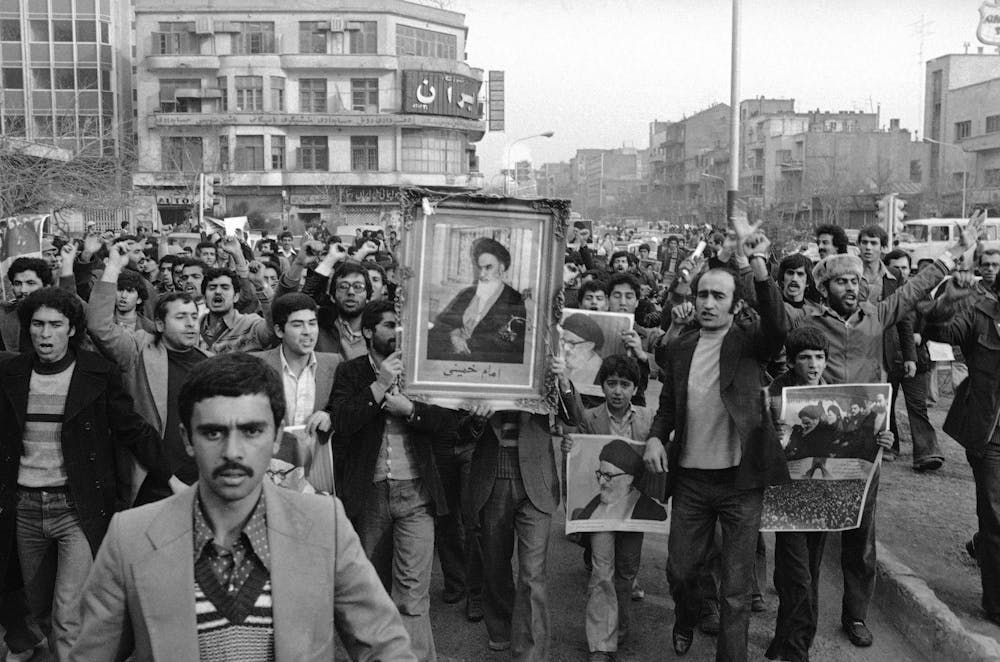
    Demonstrators in Tehran demand the establishment of an Islamic republic.
    AP Photo/Saris

    1979: Revolutionaries oust the shah, take hostages

    After more than 25 years of relative stability in U.S.-Iran relations, the Iranian public had grown unhappy with the social and economic conditions that developed under the dictatorial rule of Shah Mohammad Reza Pahlavi.

    Pahlavi enriched himself and used American aid to fund the military while many Iranians lived in poverty. Dissent was often violently quashed by SAVAK, the shah’s security service. In January 1979, the shah left Iran, ostensibly to seek cancer treatment. Two weeks later, Ayatollah Ruhollah Khomeini returned from exile in Iraq and led a drive to abolish the monarchy and proclaim an Islamic government.

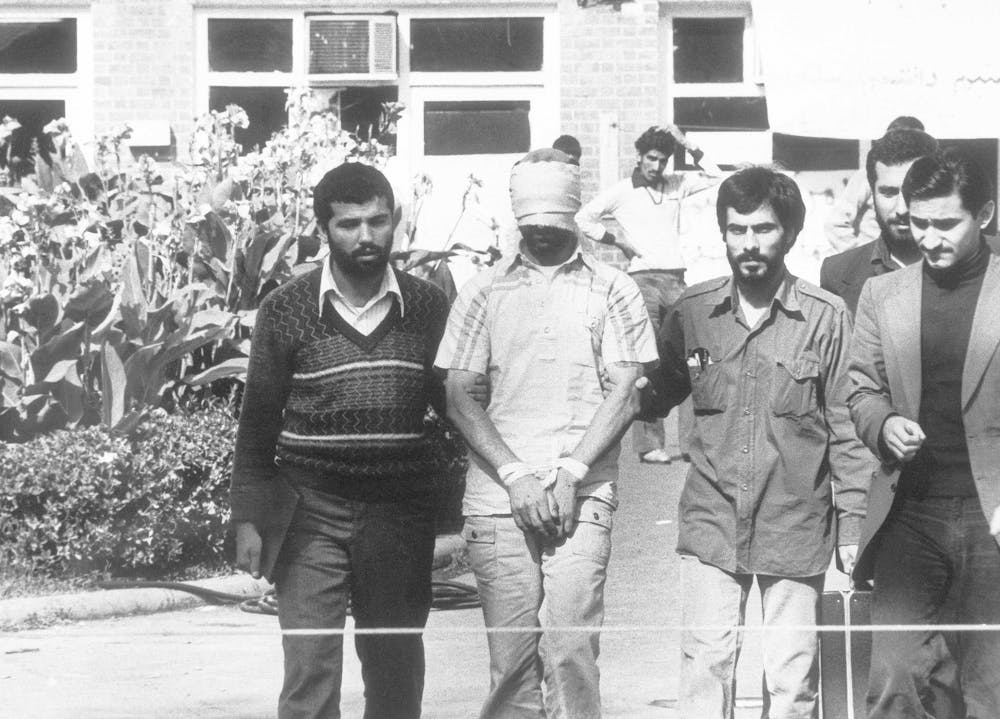
    Iranian students at the U.S. Embassy in Tehran show a blindfolded American hostage to the crowd in November 1979.
    AP Photo

    In October 1979, President Jimmy Carter agreed to allow the shah to come to the U.S. to seek advanced medical treatment. Outraged Iranian students stormed the U.S. Embassy in Tehran on Nov. 4, taking 52 Americans hostage. That convinced Carter to sever U.S. diplomatic relations with Iran on April 7, 1980.

    Two weeks later, the U.S. military launched a mission to rescue the hostages, but it failed, with aircraft crashes killing eight U.S. servicemembers.

    The shah died in Egypt in July 1980, but the hostages weren’t released until Jan. 20, 1981, after 444 days of captivity.

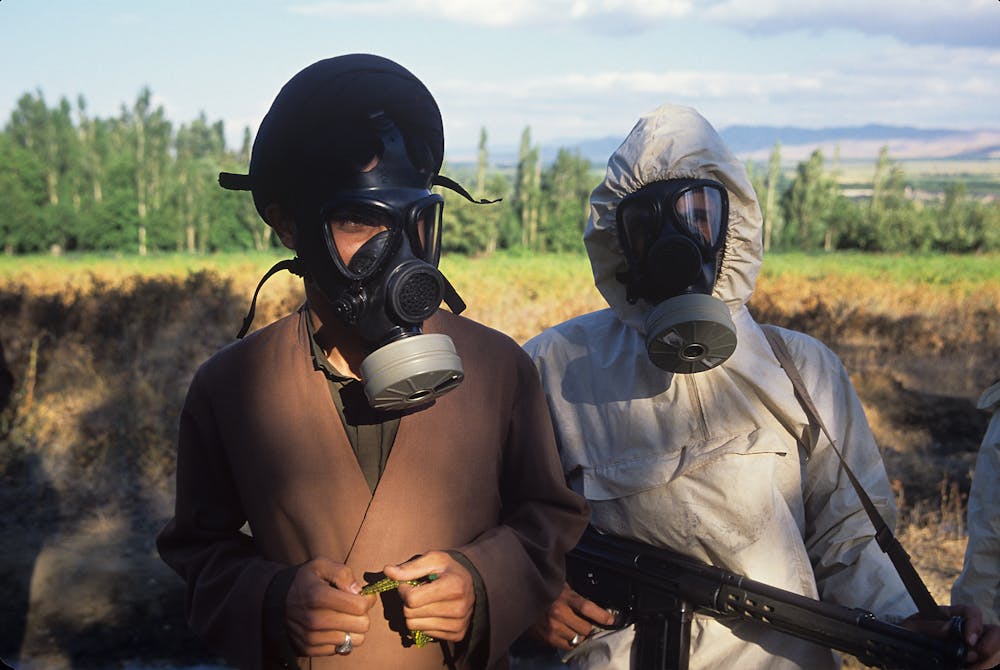
    An Iranian cleric, left, and an Iranian soldier wear gas masks to protect themselves against Iraqi chemical-weapons attacks in May 1988.
    Kaveh Kazemi/Getty Images

    1980-1988: US tacitly sides with Iraq

    In September 1980, Iraq invaded Iran, an escalation of the two countries’ regional rivalry and religious differences: Iraq was governed by Sunni Muslims but had a Shia Muslim majority population; Iran was led and populated mostly by Shiites.

    The U.S. was concerned that the conflict would limit the flow of Middle Eastern oil and wanted to ensure the conflict didn’t affect its close ally, Saudi Arabia.

    The U.S. supported Iraqi leader Saddam Hussein in his fight against the anti-American Iranian regime. As a result, the U.S. mostly turned a blind eye toward Iraq’s use of chemical weapons against Iran.

    U.S. officials moderated their usual opposition to those illegal and inhumane weapons because the U.S. State Department did not “wish to play into Iran’s hands by fueling its propaganda against Iraq.” In 1988, the war ended in a stalemate. More than 500,000 military and 100,000 civilians died.

    1981-1986: US secretly sells weapons to Iran

    The U.S. imposed an arms embargo after Iran was designated a state sponsor of terrorism in 1984. That left the Iranian military, in the middle of its war with Iraq, desperate for weapons and aircraft and vehicle parts to keep fighting.

    The Reagan administration decided that the embargo would likely push Iran to seek support from the Soviet Union, the U.S.’s Cold War rival. Rather than formally end the embargo, U.S. officials agreed to secretly sell weapons to Iran starting in 1981.

    The last shipment, of anti-tank missiles, was in October 1986. In November 1986, a Lebanese magazine exposed the deal. That revelation sparked the Iran-Contra scandal in the U.S., with Reagan’s officials found to have collected money from Iran for the weapons and illegally sent those funds to anti-socialist rebels – the Contras – in Nicaragua.

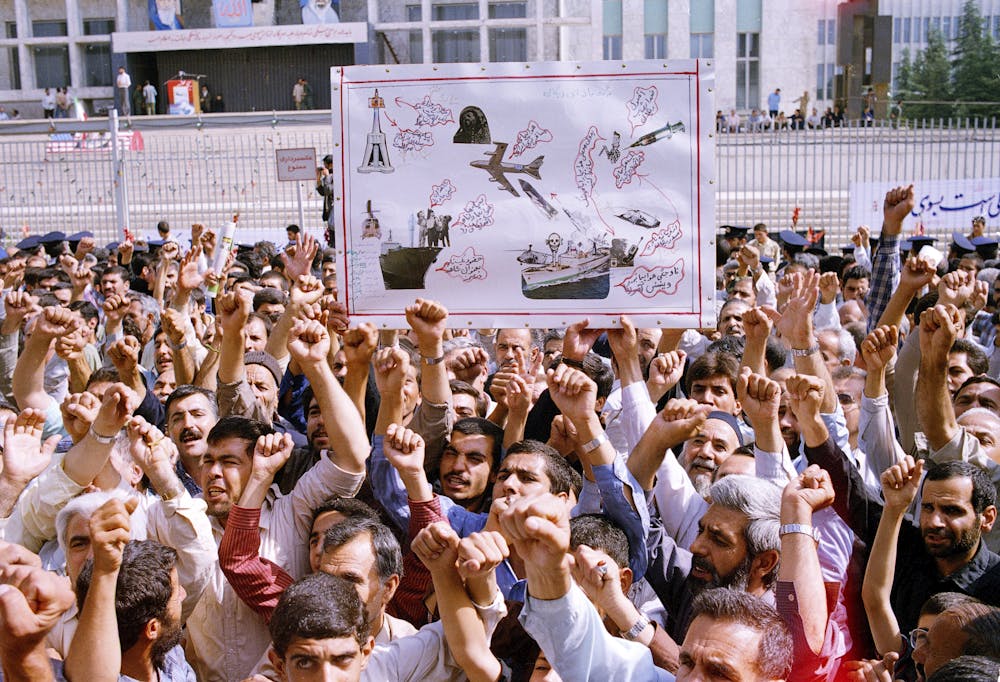
    At a mass funeral for 76 of the 290 people killed in the shootdown of Iran Air 655, mourners hold up a sign depicting the incident.
    AP Photo/CP/Mohammad Sayyad

    1988: US Navy shoots down Iran Air flight 655

    On the morning of July 8, 1988, the USS Vincennes, a guided missile cruiser patrolling in the international waters of the Persian Gulf, entered Iranian territorial waters while in a skirmish with Iranian gunboats.

    Either during or just after that exchange of gunfire, the Vincennes crew mistook a passing civilian Airbus passenger jet for an Iranian F-14 fighter. They shot it down, killing all 290 people aboard.

    The U.S. called it a “tragic and regrettable accident,” but Iran believed the plane’s downing was intentional. In 1996, the U.S. agreed to pay US$131.8 million in compensation to Iran.

    1997-1998: The US seeks contact

    In August 1997, a moderate reformer, Mohammad Khatami, won Iran’s presidential election.

    U.S. President Bill Clinton sensed an opportunity. He sent a message to Tehran through the Swiss ambassador there, proposing direct government-to-government talks.

    Shortly thereafter, in early January 1998, Khatami gave an interview to CNN in which he expressed “respect for the great American people,” denounced terrorism and recommended an “exchange of professors, writers, scholars, artists, journalists and tourists” between the United States and Iran.

    However, Supreme Leader Ayatollah Ali Khamenei didn’t agree, so not much came of the mutual overtures as Clinton’s time in office came to an end.

    In his 2002 State of the Union address, President George W. Bush characterized Iran, Iraq and North Korea as constituting an “Axis of Evil” supporting terrorism and pursuing weapons of mass destruction, straining relations even further.

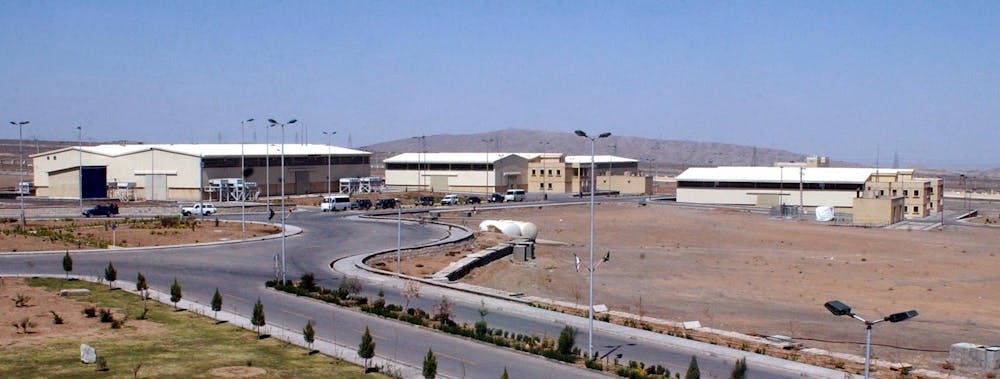
    Inside these buildings at the Natanz nuclear facility in Iran, technicians enrich uranium.
    AP Photo/Vahid Salemi

    2002: Iran’s nuclear program raises alarm

    In August 2002, an exiled rebel group announced that Iran had been secretly working on nuclear weapons at two installations that had not previously been publicly revealed.

    That was a violation of the terms of the Nuclear Nonproliferation Treaty, which Iran had signed, requiring countries to disclose their nuclear-related facilities to international inspectors.

    One of those formerly secret locations, Natanz, housed centrifuges for enriching uranium, which could be used in civilian nuclear reactors or enriched further for weapons.

    Starting in roughly 2005, U.S. and Israeli government cyberattackers together reportedly targeted the Natanz centrifuges with a custom-made piece of malicious software that became known as Stuxnet.

    That effort, which slowed down Iran’s nuclear program was one of many U.S. and international attempts – mostly unsuccessful – to curtail Iran’s progress toward building a nuclear bomb.

    2003: Iran writes to Bush administration

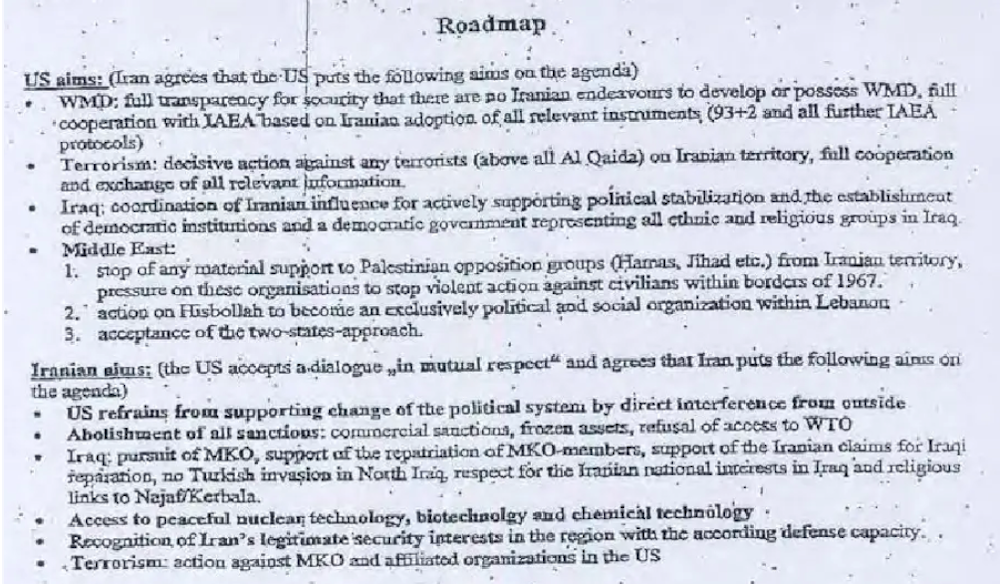
    An excerpt of the document sent from Iran, via the Swiss government, to the U.S. State Department in 2003, appears to seek talks between the U.S. and Iran.
    Washington Post via Scribd

    In May 2003, senior Iranian officials quietly contacted the State Department through the Swiss embassy in Iran, seeking “a dialogue ‘in mutual respect,’” addressing four big issues: nuclear weapons, terrorism, Palestinian resistance and stability in Iraq.

    Hardliners in the Bush administration weren’t interested in any major reconciliation, though Secretary of State Colin Powell favored dialogue and other officials had met with Iran about al-Qaida.

    When Iranian hardliner Mahmoud Ahmadinejad was elected president of Iran in 2005, the opportunity died. The following year, Ahmadinejad made his own overture to Washington in an 18-page letter to President Bush. The letter was widely dismissed; a senior State Department official told me in profane terms that it amounted to nothing.

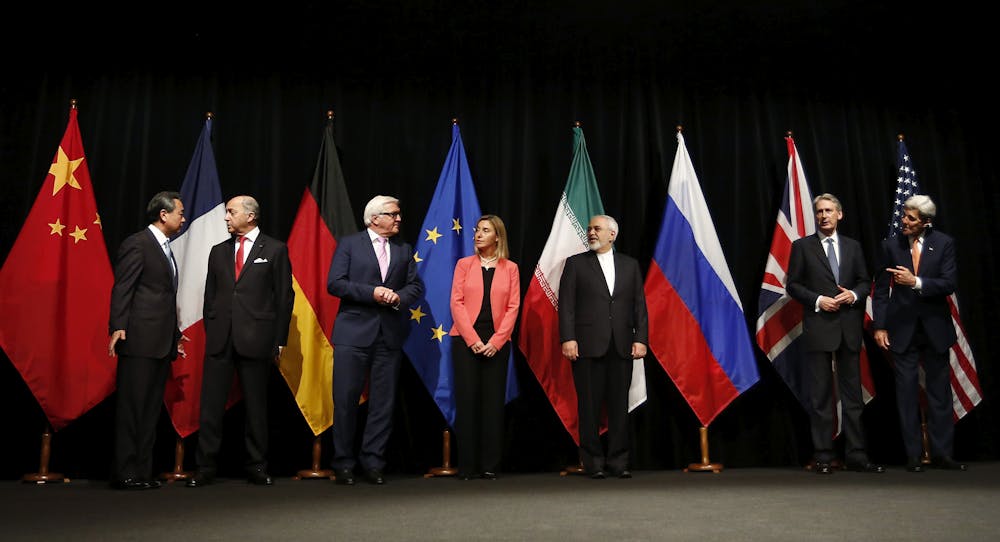
    Representatives of several nations met in Vienna in July 2015 to finalize the Iran nuclear deal.
    Austrian Federal Ministry for Europe, Integration and Foreign Affairs/Flickr

    2015: Iran nuclear deal signed

    After a decade of unsuccessful attempts to rein in Iran’s nuclear ambitions, the Obama administration undertook a direct diplomatic approach beginning in 2013.

    Two years of secret, direct negotiations initially bilaterally between the U.S. and Iran and later with other nuclear powers culminated in the Joint Comprehensive Plan of Action, often called the Iran nuclear deal.

    Two years of secret, direct negotiations conducted bilaterally at first between the U.S. and Iran and later with other nuclear powers culminated in the Joint Comprehensive Plan of Action, often called the Iran nuclear deal.

    Iran, the U.S., China, France, Germany, Russia and the United Kingdom signed the deal in 2015. It severely limited Iran’s capacity to enrich uranium and mandated that international inspectors monitor and enforce Iran’s compliance with the agreement.

    In return, Iran was granted relief from international and U.S. economic sanctions. Though the inspectors regularly certified that Iran was abiding by the agreement’s terms, President Donald Trump withdrew from the agreement in May 2018.

    2020: US drones kill Iranian Maj. Gen. Qassem Soleimani

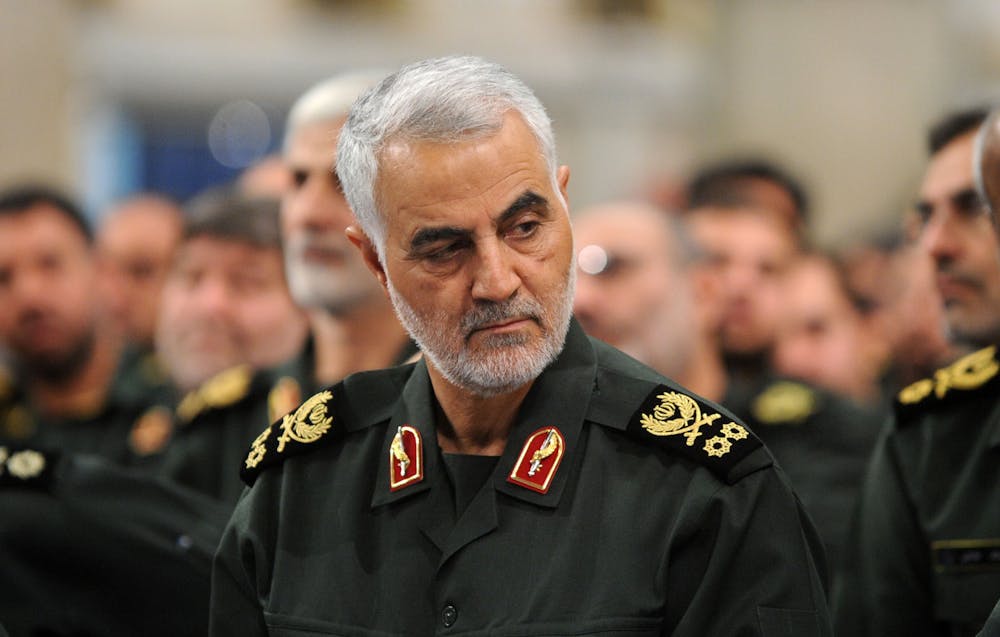
    An official photo from the Iranian government shows Maj. Gen. Qassem Soleimani, who was killed in a Jan. 3 drone strike ordered by President Donald Trump.
    Iranian Supreme Leader Press Office/Anadolu Agency via Getty Images

    On Jan. 3, 2020, an American drone fired a missile that killed Maj. Gen. Qassem Soleimani, the leader of Iran’s elite Quds Force. Analysts considered Soleimani the second most powerful man in Iran, after Supreme Leader Ayatollah Khamenei.

    At the time, the Trump administration asserted that Soleimani was directing an imminent attack against U.S. assets in the region, but officials have not provided clear evidence to support that claim.

    Iran responded by launching ballistic missiles that hit two American bases in Iraq.

    2023: The Oct. 7 attacks on Israel

    Hamas’ brazen attack on Israel on Oct. 7, 2023, provoked a fearsome militarized response from Israel that continues today and served to severely weaken Iran’s proxies in the region, especially Hamas – the perpetrator of the attacks – and Hezbollah in Lebanon.

    2025: Trump 2.0 and Iran

    Trump saw an opportunity to forge a new nuclear deal with Iran and to pursue other business deals with Tehran. Once inaugurated for his second term, Trump appointed Steve Witkoff, a real estate investor who is the president’s friend, to serve as special envoy for the Middle East and to lead negotiations.

    Negotiations for a nuclear deal between Washington and Tehran began in April, but the countries did not reach a deal. They were planning a new round of talks when Israel struck Iran with a series of airstrikes on June 13, forcing the White House to reconsider is position.

    On June 22, in the early morning hours, the U.S. chose to act decisively in an attempt to cripple Iran’s nuclear capacity, bombing three nuclear sites and causing what Pentagon officials called “severe damage.” Iran vowed to retaliate.

    This story has been updated to reflect the U.S. bombing of Iranian nuclear sites on June 22, 2025.

    Jeffrey Fields receives funding from the Carnegie Corporation of New York and Schmidt Futures.

    – ref. US and Iran have a long, complicated history, spanning decades before US strikes on nuclear sites – https://theconversation.com/us-and-iran-have-a-long-complicated-history-spanning-decades-before-us-strikes-on-nuclear-sites-259240

    MIL OSI – Global Reports –

    June 23, 2025
  • MIL-OSI United Nations: Building inclusive peace: How LGBTIQ+ communities are bridging divides in Cyprus and Kosovo

    Source: United Nations – Peacekeeping


    This story was written by Elssa Gbeily, a former strategic communications consultant for the UN Department of Peace Operations focused on gender, peace and security.

    Every June, Pride Month highlights the rights and identities of LGBTIQ+* people. For the UN and its peacekeepers, Pride is more than a celebration—it is a call to uphold our shared responsibility to protect the rights and dignity of all people, no matter their sexual orientation or gender identity. 

    Many peacekeeping missions operate in environments where LGBTIQ+ people face stigma, discrimination, or legal barriers. Despite these challenges, missions are finding context-sensitive ways to support rights-based inclusion without jeopardizing their impartiality or host country relations.

    For the UN peacekeeping missions in Kosovo** and Cyprus, advancing the rights of LGBTIQ+ people has become not only a human rights imperative, but a concrete strategy for building trust, strengthening social cohesion, and preventing conflict.

    unficyp_2.jpg


    Building bridges between communities in Cyprus

    On the island of Cyprus, Greek Cypriots and Turkish Cypriots live on either side of a UN-administered buffer zone. Although Cyprus became independent in 1960 with a constitution intended to balance the interests of both communities, a series of constitutional crises led to the outbreak of violence in 1963. A UN peacekeeping mission, UNFICYP, was subsequently established and today helps maintain peace along the buffer zone.

    Fostering trust and reconciliation between the two communities is a key part of UNFICYP’s work to promote peace. The mission works with civil society, diplomats, international organizations and local communities to host events that bring people together and has found an ally in the LGBTIQ+ community as a powerful agent for reconciliation.

    Working with LGBTIQ+ communities from both sides of the island, the mission has supported Pride events across the island, including a Queer film festival and a joint conference on LGBTIQ+ rights in health and education that was organized by local organizations and the British High Commission, and hosted inside the UN buffer zone.

    “For me, it really highlights how despite obstacles we are able to gather, we were able to organize collective events, and we are able to show a way forward,” explains Theo Ieronymides, a local Cypriot and co-founder of the Queer Collective, an initiative that connects LGBTIQ+ persons across the divide. 

    By supporting initiatives that build bridges between Turkish Cypriots and Greek Cypriot communities, UNFICYP and its LGBTIQ+ partners are fostering mutual recognition and breaking down identity-based divisions that fuel tensions.

    “LGBTIQ+ people, and those working with them to secure their rights, have proved time and again the value of communities in providing support and driving change,” emphasized UN Secretary-General António Guterres in May. 

    Supporting human rights in Kosovo for inclusive governance and durable conflict resolution

    Following the 1999 conflict in Kosovo, which left deep divisions between ethnic communities, the United Nations Mission in Kosovo (UNMIK) promotes human rights and fosters reconciliation. Advancing LGBTIQ+ rights is integral to this work, as inclusion and equality are key to building trust and achieving lasting peace.

    Together with the Office of the High Commissioner for Human Rights (OHCHR), UNMIK has supported efforts to combat discrimination—such as supporting Kosovo’s first-ever Pride parade in 2017.

    UNMIK also serves on Kosovo’s Advisory and Coordination Group on LGBTI Rights, alongside government, civil society and international actors. It provides technical input, particularly on anti-discrimination policy, and helped draft the upcoming “Action Plan for the Rights of LGBTI Persons in Kosovo 2024–2026”—the first of its kind in Kosovo. The plan covers health, education and culture, anti-discrimination, and awareness-raising, and seeks to enhance cooperation between government institutions and civil society.

    UNMIK supports the Civil Society Human Rights Network—a coalition of seven local organizations defending marginalized groups, including LGBTIQ+ persons. The network documents rights violations, promotes legal reform, and raises awareness. Its 2024 report highlights issues such as hate crimes and lack of healthcare and shelter, urging legislative action to protect gender identity and legalize same-sex unions.

    By working with the LGBTIQ+ community and other partners to combat inequality and discrimination, UNMIK plays a vital role in promoting human rights, reconciliation and security in Kosovo. These actions not only benefit the LGBTIQ+ community, they help build a more inclusive, cohesive society where peace is more likely to be sustained for future generations.

    The experiences of Cyprus and Kosovo offer valuable lessons for other missions seeking to promote inclusion in deeply divided contexts, demonstrating that even in fragile environments, small, locally driven initiatives can lay the groundwork for broader societal transformation.


    LGBTIQ+ inclusion as a foundation for lasting peace   

    In June 2024, the UN launched its inaugural strategy to mainstream LGBTIQ+ inclusion across all areas of its work, including peacekeeping. Building on the UN Free & Equal campaign, launched in 2013 by the UN Human Rights Office, the strategy strengthens the UN’s commitment to recognizing the rights, needs and contributions of LGBTIQ+ persons. Together, these initiatives seek to enhance the inclusiveness and effectiveness of peace, humanitarian and development efforts.

    Implementing this vision in peacekeeping contexts can present challenges.  “Many UN missions are deployed to countries where issues related to LGBTIQ+ people are taboo and LGBTIQ+ persons and organizations can face legal restrictions, which can make these issues difficult to raise,” says Albert Trithart, a research fellow at the International Peace Institute and author of one of the first reports on LGBTIQ+ inclusion in UN peacekeeping. 

    However, he sees the adoption of the LBGTIQ+ strategy as an opportunity. “The strategy requires UN missions—and the whole UN Secretariat—to integrate the protection and promotion of the rights of LGBTIQ+ persons in programming and to ‘ensure safe and meaningful engagement of LGBTIQ+ persons in programmes and policies that impact them.’”  He sees many areas where peacekeeping can help advance LGBTIQ+ rights, and peace more broadly, as part of their current work. “One area is reporting. Violence against LGBTIQ+ people is often invisible, especially in contexts of armed conflict. Missions that are already reporting on conflict-related sexual violence could help draw attention to violence specifically targeting people on the basis of their sexual orientation or gender identity.”  By better understanding the dynamics of violence, peacekeeping missions can better address them and more effectively promote security.

    Together, UN Peacekeeping, UN Member States and our other partners can expand on the work being done with LGBTIQ+ communities to protect their rights and advance more inclusive, sustainable peace. “Working as one, we must push to repeal discriminatory laws, combat violence and harmful practices, and end the scapegoating of marginalized communities,” said Secretary-General Guterres in May. “We will not rest until the rights of all are a reality, no matter who they are or whom they love.”

    *LGBTIQ+ stands for lesbian, gay, bisexual, transgender, intersex and queer (LGBTIQ+) persons

    **References to Kosovo shall be understood to be in the context of Security Council Resolution 1244 (1999)

    MIL OSI United Nations News –

    June 23, 2025
  • MIL-OSI USA: Kaptur Releases Statement And Demands Answers Following American Strikes On Iranian Nuclear Facilities

    Source: United States House of Representatives – Congresswoman Marcy Kaptur (OH-09)

    Toledo, Ohio — Today, Congresswoman Marcy Kaptur (OH-09), a senior member of the House Appropriations Defense Subcommittee, released the following statement. Congresswoman has demanded immediate highly secure confidential Congressional briefings of key Defense and Intelligence Committees to address the following questions related to American strikes on Iranian nuclear facilities. Congresswoman Kaptur is one of 44 bipartisan members of the House who are leading H.Con.Res.38 Directing the President pursuant to section 5(c) of the War Powers Resolution to remove United States Armed Forces from unauthorized hostilities in the Islamic Republic of Iran. 

    “There was no congressional vote, no debate, nor even any discussion with Congress, with leaders of key intelligence committees reportedly left in the dark,” said Congresswoman Marcy Kaptur (OH-09). “This is not the way our Republic is supposed to function because that is not how our Constitution reads. I will continue to demand answers in a secure confidential Congressional briefing in the coming days. May God bless America and our people.”

    (1) If not an act of war against Iran, which Constitutionally would require Congressional consent before bombs were dropped, how does President Trump define his actions against Iran? 

    (2) Who — which individuals — exactly at the National Security Council, Pentagon, and Departments of Defense and State were involved in this decision?

    (3) With what other nations, and which international leaders did President Trump consult before making what appears to be a lone decision?

    (4) Going forward, the secretive manner in which the White House has made such a consequential, strategic, “Lone Ranger” decision puts at very serious risk American troops, US global assets, and strategic interests both abroad and at home.

    (5) This decision appears to have been solely President Trump’s. The consequences that will likely flow from it, however, will attend to the American people at home and abroad and rest squarely on his shoulders alone. 

    (6) Political retribution can take many forms  where religious beliefs do not accommodate compromise nor forgiveness as an accepted behavior. 

    # # #

    MIL OSI USA News –

    June 23, 2025
  • MIL-OSI Security: Family of Annabel Rook issue statement following murder in Hackney

    Source: United Kingdom London Metropolitan Police

    The family of a woman who was stabbed to death in Hackney have paid tribute to her.

    A murder investigation was launched following the death of Annabel Rook at a house in Dumont Road, Hackney.

    In a statement, Annabel’s family said:

    “The family are struggling to come to terms with this terrible tragedy. We have lost our beautiful daughter, sister, friend and mother. Annabel was a truly wonderful woman. She touched the hearts of so many.

    “She gave her life to helping the vulnerable and the disadvantaged whether it was in refugee camps in Africa or setting up MamaSuze in London, to enhance the lives of survivors of forced displacement and gender-based violence.

    “We would really appreciate it if our privacy could be respected.”

    Officers were called at 04:57hrs on Tuesday, 17 June to reports of a gas explosion with a person trapped inside the address.

    Officers attended alongside the London Ambulance Service and the London Fire Brigade.

    Annabel, 46 was found inside the property with stab wounds. Despite the efforts of paramedics, she was sadly declared dead at the scene.

    A 44-year-old man was arrested at the address on suspicion of murder. He was later discharged and released into police custody.

    Detectives from the Met’s Specialist Crime Command are leading the investigation.

    Anyone with information about the incident is asked to call police on 101 quoting CAD 926/17June or to remain anonymous call Crimestoppers on 0800 555 111.

    MIL Security OSI –

    June 23, 2025
  • MIL-OSI Security: Family of Annabel Rook issue statement following murder in Hackney

    Source: United Kingdom London Metropolitan Police

    The family of a woman who was stabbed to death in Hackney have paid tribute to her.

    A murder investigation was launched following the death of Annabel Rook at a house in Dumont Road, Hackney.

    In a statement, Annabel’s family said:

    “The family are struggling to come to terms with this terrible tragedy. We have lost our beautiful daughter, sister, friend and mother. Annabel was a truly wonderful woman. She touched the hearts of so many.

    “She gave her life to helping the vulnerable and the disadvantaged whether it was in refugee camps in Africa or setting up MamaSuze in London, to enhance the lives of survivors of forced displacement and gender-based violence.

    “We would really appreciate it if our privacy could be respected.”

    Officers were called at 04:57hrs on Tuesday, 17 June to reports of a gas explosion with a person trapped inside the address.

    Officers attended alongside the London Ambulance Service and the London Fire Brigade.

    Annabel, 46 was found inside the property with stab wounds. Despite the efforts of paramedics, she was sadly declared dead at the scene.

    A 44-year-old man was arrested at the address on suspicion of murder. He was later discharged and released into police custody.

    Detectives from the Met’s Specialist Crime Command are leading the investigation.

    Anyone with information about the incident is asked to call police on 101 quoting CAD 926/17June or to remain anonymous call Crimestoppers on 0800 555 111.

    MIL Security OSI –

    June 23, 2025
  • MIL-OSI USA: Luján Statement on U.S. Airstrikes on Iran

    US Senate News:

    Source: United States Senator Ben Ray Luján (D-New Mexico)

    Santa Fe, N.M. – U.S. Senator Ben Ray Luján (D-N.M.) issued the following statement following U.S. airstrikes on Iranian nuclear facilities:

    “Americans have made it clear they do not want to be dragged into another endless war in the Middle East. Yet President Trump went against the American people without sharing any evidence to prove these military strikes would protect our homeland security.

    “This unauthorized and unilateral action puts American troops at risk and threatens to further destabilize the region.

    “President Trump must work to deescalate rising tensions in the Middle East and to protect the American people.” 

    MIL OSI USA News –

    June 23, 2025
  • MIL-OSI USA: Luján Statement on U.S. Airstrikes on Iran

    US Senate News:

    Source: United States Senator Ben Ray Luján (D-New Mexico)

    Santa Fe, N.M. – U.S. Senator Ben Ray Luján (D-N.M.) issued the following statement following U.S. airstrikes on Iranian nuclear facilities:

    “Americans have made it clear they do not want to be dragged into another endless war in the Middle East. Yet President Trump went against the American people without sharing any evidence to prove these military strikes would protect our homeland security.

    “This unauthorized and unilateral action puts American troops at risk and threatens to further destabilize the region.

    “President Trump must work to deescalate rising tensions in the Middle East and to protect the American people.” 

    MIL OSI USA News –

    June 23, 2025
  • MIL-OSI Global: Why Israel and the U.S. are sure to encounter the limits of air power in Iran

    Source: The Conversation – Canada – By James Horncastle, Assistant Professor and Edward and Emily McWhinney Professor in International Relations, Simon Fraser University

    The United States has apparently answered Israel’s call to to become involved in the war between Israel and Iran.

    President Donald Trump had signalled a willingness for the U.S. to become involved in the conflict. He went so far, in fact, to suggest in social media posts that he could kill Iran’s supreme leader if he wanted to.

    Segment on Trump’s threats against Iran’s leader. (BBC News)

    The American military can certainly make an impact in any air campaign against Iran. The problem from a military standpoint, however, is that the U.S., based on its forces’ deployment, will almost certainly seek to keep its involvement limited to its air force to avoid another Iraq-like quagmire.

    While doing so could almost certainly disrupt Iran’s nuclear program, it will likely fall short of Israel’s goal of regime change.

    In fact, it could reinforce the Iranian government and draw the U.S. into a costly ground war.


    Read more:
    Why is there so much concern over Iran’s nuclear program? And where could it go from here?


    Israel’s need for American support

    The initial stated reason for Israel’s bombing campaign — Iran’s nuclear capabilities — appears specious at best.

    Israeli Prime Minister Benjamin Netanyahu has argued several times in the past, without evidence, that Iran is close to achieving a nuclear weapon. U.S. intelligence, however, have assessed that Iran is three years away from deploying a nuclear weapon.

    Regardless of the veracity of the claims, Israel initiated the offensive and requires American support.

    Israel’s need for U.S. assistance rests on two circumstances:

    1. While Israel succeeded in eliminating key figures from the Iranian military in its initial strikes, Iran’s response appears to have exceeded Israel’s expectations with their Arrow missile interceptors nearing depletion.

    2. Israel’s air strikes can only achieve so much in disrupting Iran’s nuclear ambitions. Most analysts note that Israel’s bombings are only likely to delay the Iranian nuclear program by a few months. This is due to the fact that Israeli missiles are incapable of penetrating the Fordow Fuel Enrichment Plant, which estimates place close to 300 feet underground.

    The United States, however, possesses munitions that have reportedly destroyed the Fordow facility. Most notably, the GBU-57A/B Massive Ordnance Penetrator (more commonly known as a bunker buster) has a penetration capability of 200 feet and was reportedly used in the attack.

    Romanticizing air power

    Nonetheless, the efficacy of air power has been vastly overrated in the popular media and various air forces of the world. Air power is great at disrupting an opponent, but has significant limitations in influencing the outcome of a war.

    Specifically, air power is likely to prove an inadequate tool for one of the supposed Israeli and American objectives in the war: regime change. For air power to be effective at bringing about regime change, it needs to demoralize the Iranian people to the point that they’re willing to oppose their own government.

    Early air enthusiasts believed that a population’s demoralization would be an inevitable consequence of aerial bombardment. Italian general Giulio Douhet, a prominent air power theorist, argued that air power was so mighty that it could destroy cities and demoralize an opponent into surrendering.

    Douhet was correct on the first point. He was wrong on the second.

    Recent history provides evidence. While considerable ink has been spilled to demonstrate the efficacy of air power during the Second World War, close examination of the facts demonstrate that it had a minimal impact. In fact, Allied bombing of German cities in several instances created the opposite effect.

    More recent bombing campaigns replicated this failure. The U.S. bombing of North Vietnam during the Vietnam War did not significantly damage North Vietnamese morale or war effort. NATO’s bombing of Serbia in 1999, likewise, rallied support for the unpopular Slobodan Milosevic due to its perceived injustice — and continues to evoke strong emotions to this day.

    Iran’s political regime may be unpopular with many Iranians, but Israeli and American bombing may shore up support for the Iranian government.

    Nationalism is a potent force, particularly when people are under attack. The attacks on Iran will rally segments of the population to the government that would otherwise oppose it.

    Few positive options

    The limitations of air power to fuel significant political change in Iran should have given Trump pause about intervening in the conflict.

    Some American support, such as providing weapons, is a given due to the close relationship between the U.S. and Israel. But any realization of American and Israeli aspirations of a non-nuclear Iran and a new government will likely require ground forces.

    Recent American experiences in Afghanistan and Iraq show such a ground forces operation won’t lead to the swift victory that Trump desires, but could potentially stretch on for decades.

    James Horncastle does not work for, consult, own shares in or receive funding from any company or organisation that would benefit from this article, and has disclosed no relevant affiliations beyond their academic appointment.

    – ref. Why Israel and the U.S. are sure to encounter the limits of air power in Iran – https://theconversation.com/why-israel-and-the-u-s-are-sure-to-encounter-the-limits-of-air-power-in-iran-259348

    MIL OSI – Global Reports –

    June 23, 2025
  • MIL-OSI United Nations: Acute food insecurity deepens in the Government-controlled areas of Yemen amid severe funding cuts and economic downturn

    Source: World Food Programme

    Aden, 22 June 2025 – The food security situation in the Government-controlled areas of southern Yemen is dire, with nearly half of the population acutely food insecure and struggling to find their next meal. The Food and Agriculture Organization of the United Nations (FAO), World Food Programme (WFP), and UNICEF have warned that the food insecurity crisis is likely to worsen in the months ahead.

    The latest Integrated Food Security Phase Classification (IPC) partial update, released today, paints a grim picture for southern governorates. Between May 2025 and August 2025, around 4.95 million people are facing Crisis-level food insecurity or worse (IPC Phase 3+), including 1.5 million in Emergency (IPC Phase 4). This marks an increase of 370,000 people suffering from severe food insecurity compared to the period November 2024 to February 2025.

    Looking ahead, the situation is expected to deteriorate even further. Between September 2025 and February 2026, an additional 420,000 people could fall into IPC Phase 3 or worse, if urgent and sustained assistance is not provided. That would bring the total number of severely food-insecure people in southern governorate areas to 5.38 million—more than half of the population.

    Multiple overlapping crises continue to drive food insecurity, including sustained economic decline, currency depreciation in southern governorates, conflict, and increasingly severe weather events. The delayed planting season, heightened likelihood of flood risk in July, and the spread of plant and livestock diseases, especially desert locusts, are further expected to compound pressures on an already fragile situation.

    Humanitarian actors including UNICEF, WFP, and FAO are reprioritizing their humanitarian efforts in Yemen, targeting high-risk areas with integrated interventions in food security, nutrition, WASH, health and protection sectors to maximize lifesaving impact.

    “The fact that more and more people in Yemen don’t know where their next meal will come from is extremely concerning at a time when we are experiencing unprecedented funding challenges,” said Siemon Hollema, the Deputy Country Director of WFP in Yemen. “Immediate support is needed to ensure that we can continue to serve the most vulnerable families that have nowhere else to turn.”

    The agencies are urgently calling for sustained and at-scale humanitarian and livelihoods support assistance to prevent communities from falling deeper into food insecurity, ensure access to essential services and generate economic and livelihood opportunities. 

    Dr. Hussein Gadain, FAO Representative in Yemen, emphasized, “The situation is dire and requires urgent intervention, with agriculture holding the key to ending Yemen’s food insecurity crisis. Further, delayed and insufficient rainfall in April has cast a shadow over the current planting season, threatening the already fragile farming livelihoods and food availability. With urgent support, we can revitalize local food production, safeguard livelihoods, and move from crisis to resilience building ensuring, efficiency and effectiveness.”

    Internally displaced persons, low-income rural households and vulnerable children are particularly affected, facing increased vulnerability due to funding cuts, declining livelihood opportunities, and reduced coping mechanisms.

    Peter Hawkins, UNICEF Representative to Yemen, highlighted that “Approximately 2.4 million children under the age of five and 1.5 million pregnant and lactating women suffer from acute malnutrition in Yemen, placing them at greater risk of illness, developmental delays, and death.” “The IPC nutrition data suggests further deterioration in at least 5 out of 17 of the livelihood zones in IRG areas, so UNICEF and partners are making provisions to scale up intervention which needs to be sustained if we are going to overcome the crisis,” added Peter Hawkins.

    ——End—–

    About FAO: The Food and Agriculture Organization (FAO) is a specialized agency of the United Nations that leads international efforts to defeat hunger. Our goal is to achieve food security for all and make sure that people have regular access to high-quality food to lead active, healthy lives. With over 194 members, FAO works in over 130 countries worldwide.

    Follow FAO Yemen on X for more: @FAOYemen

    About the United Nations World Food Programme (WFP): WFP is the world’s largest humanitarian organization, saving lives in emergencies and using food assistance to build a pathway to peace, stability, and prosperity for people recovering from conflict and disasters. 

    Follow us on Twitter @WFPYemen

    About UNICEF:
    UNICEF promotes the rights and wellbeing of every child, in everything we do. Together with our partners, we work in 190 countries and territories to translate that commitment into practical action, focusing special effort on reaching the most vulnerable and excluded children, to the benefit of all children, everywhere.

    For more information about UNICEF Yemen and its work for children, visit www.unicef.org/yemen

    Follow UNICEF Yemen on X,  Facebook, Instagram and YouTube

    MIL OSI United Nations News –

    June 23, 2025
  • MIL-OSI USA News: WHAT THEY ARE SAYING: President Trump’s Display of Peace Through Strength

    Source: US Whitehouse

    President Donald J. Trump’s bold, decisive action against Iran — the world’s leading state sponsor of terrorism — and its key nuclear facilities was met with bipartisan praise from lawmakers across Capitol Hill.

    Here’s what they’re saying:

    Speaker Mike Johnson: “The President made the right call, and did what he needed to do. Leaders in Congress were aware of the urgency of this situation and the Commander-in-Chief evaluated that the imminent danger outweighed the time it would take for Congress to act. The world’s largest state sponsor of terrorism, which chants ‘Death to America,’ simply could not be allowed the opportunity to obtain and use nuclear weapons. The President fully respects the Article I power of Congress, and tonight’s necessary, limited, and targeted strike follows the history and tradition of similar military actions under presidents of both parties.”

    Senate Majority Leader John Thune: “The regime in Iran, which has committed itself to bringing ‘death to America’ and wiping Israel off the map, has rejected all diplomatic pathways to peace. The mullahs’ misguided pursuit of nuclear weapons must be stopped. As we take action tonight to ensure a nuclear weapon remains out of reach for Iran, I stand with President Trump and pray for the American troops and personnel in harm’s way.”

    Senate Majority Whip John Barrasso: “President @realDonaldTrump’s decision to strike Iran’s nuclear program is the right one. The greatest threat to the safety of the United States and the world is Iran with a nuclear weapon. God Bless our troops”

    Senate Republican Conference Chair Tom Cotton: “Iran has waged a war of terror against the United States for 46 years. We could never allow Iran to get nuclear weapons. God bless our brave troops. President Trump made the right call and the ayatollahs should recall his warning not to target Americans.”

    Senate Foreign Relations Committee Chair Jim Risch: “As President Trump has said over and over again – as have I – Iran cannot have a nuclear weapon. Why? A nuclear-armed Iran would without doubt spark a nuclear arms race that would take off around the world. This is a direct threat to American national security if left unchecked. This war is Israel’s war not our war, but Israel is one of our strongest allies and is disarming Iran for the good of the world. I’ve also always said that Israel would not allow Iran to have a nuclear weapon. For Israel this is existential. The Iranians literally want to wipe Israel and all Jews off the face of the earth. This strike will put an end to those ambitions. President Trump took decisive action today to assist the Israelis in their efforts to stop the Iranian nuclear program. Only American weapons could do what has been done. This has made America safer, in addition to the Israelis, and the world more broadly. This is not the start of a forever war. There will not be American boots on the ground in Iran. This was a precise, limited strike, which was necessary and by all accounts was very successful. As President Trump has stated, now is the time for peace.”

    Sen. Jim Banks: “I trust President Trump!”

    Sen. Marsha Blackburn: “@realDonaldTrump knows peace can only be achieved through strength. This is a victory for the United States.”

    Sen. Katie Britt: “I stand by President Trump. Strong and surgical. Please pray for peace.”

    Sen. Ted Budd: “Tonight, the United States dealt a decisive blow to Iran’s nuclear program. The U.S. military alone had the capability to destroy these facilities deep underground, and I commend President Trump for standing with our Israeli allies in their efforts to end the threat of a nuclear Iran once and for all. May God bless and protect our troops, who continue to keep us safe around the world.”

    Sen. Bill Cassidy: “Iran’s nuclear program is a threat to peace and stability. Peace must remain the goal.”

    Sen. John Cornyn: “President Trump made the courageous and correct decision to eliminate the Iranian nuclear threat. God Bless the USA. Thank you to our extraordinary military and our indomitable @POTUS This is what leadership on the world stage looks like.”

    Sen. Kevin Cramer: “When only we can do what needs doing, we must do it. Great call Mr. President and great job @usairforce ! God Bless The USA! #PeaceThroughStrength #GodBlessIsrael.”

    Sen. Ted Cruz: “I commend our pilots and servicemembers, our intelligence personnel, and his national security staff on tonight’s successful and critical operation. The prospect of the Iranian regime acquiring nuclear weapons represents the most acute immediate threat to America and our allies. When the Ayatollah chants ‘Death to America’ he means it, and the reason he is building nuclear weapons is because he intends to use them. President Trump has consistently and unequivocally stated that those threats cannot be countered without dismantling the Iranian regime’s enrichment capacity. The President and his negotiators spent two months exploring whether the regime would agree to a negotiated settlement that met America’s national security needs. At the end of that period, Iranian regime officials declared that instead of agreeing to deal they would open a new enrichment facility and install more advanced centrifuges. After that declaration, our Israeli allies launched a preemptive attack against the regime and its nuclear infrastructure, which was enormously successful. It could not disable the nuclear activities at Fordow, an underground enrichment bunker built into a mountain which was legitimized by the Obama-era deal. As long as Iran was able to access and enrich uranium, they could still rush to build a nuclear arsenal. Tonight’s actions have gone far in foreclosing that possibility, and countering the apocalyptic threat posed by an Iranian nuclear arsenal.”

    Sen. John Curtis: “Iran’s relentless pursuit of nuclear weapons is a direct threat to American interests, our allies, and global stability. Today’s action was a serious and necessary response to that danger. I honor the brave servicemembers who carried out the mission with skill and courage. Strength paired with genuine diplomacy is how we create peace, prevent conflict, and preserve freedom. I join the President in calling for a return to diplomacy.”

    Sen. Steve Daines: “Thank you President Trump and the men and women of our armed forces. America, Israel and the rest of the world are safer tonight as a result of your bravery, courage and unrivaled skill. Iran is the world’s largest state sponsor of terror, has killed hundreds of U.S. service members, attempted to assassinate President Trump, and calls the United States ‘big Satan’ and Israel ‘little Satan.’ Stopping Iran’s pursuit of nuclear weapons is a major step toward achieving peace.”

    Sen. Joni Ernst: “By leading with peace through strength, President Trump is making the world a safer place and protecting Americans. Iran must never be able to threaten America with a nuclear weapon. God bless our commander in chief and our servicemembers!”

    Sen. Deb Fischer: “For decades, Iran has chanted ‘death to America’ and pledged to wipe Israel off the map. When foreign adversaries pledge to destroy us, we should believe them. President Trump has always been clear: Iran must never obtain a nuclear weapon – and I agree. Today, his administration took the necessary steps to keep a nuclear weapon out of Iran’s reach, and I am grateful to the service members who successfully carried out the mission.”

    Sen. Bill Hagerty: “@POTUS’s decisive leadership enforced deadlines and redlines. This was a tough decision, one that, as always, President Trump put the interests of the American people first in making. May this be the end of Iran’s nuclear weapon ambitions and lay the groundwork for lasting peace.”

    Sen. Lindsey Graham: “Good. This was the right call. The regime deserves it. Well done, President @realDonaldTrump To my fellow citizens: We have the best Air Force in the world. It makes me so proud. Fly, Fight, Win.”

    Sen. Chuck Grassley: “Our commander in chief & brave military forces hv carried out a mission in Iran to prevent nuclear enrichment Iran believes in “Death to Israel Death to America” Keeping USA safe is number 1 responsibility of Pres Trump”

    Sen. John Fetterman: “As I’ve long maintained, this was the correct move by @POTUS. Iran is the world’s leading sponsor of terrorism and cannot have nuclear capabilities. I’m grateful for and salute the finest military in the world.”

    Sen. James Lankford: “I continue to be grateful for the skill and professionalism of our United States service members. Cindy and I are praying for our military, the President and for a lasting peace.”

    Sen. Mike Lee: “Tonight, the Iranian nuclear program was wiped out. Please join me in praying for the safety of the brave men and women of America’s armed forces in the Middle East and around the world, and that these strikes may lead to the lasting peace called for by President Trump.”

    Sen. Roger Marshall: “Thank you to our brave American Air Force and their successful mission as no Americans were harmed. We stand tall with President Trump who is protecting the world from a nuclear capable Iran.”

    Sen. Dave McCormick: “As I have said all along, Iran must not have a nuclear weapon. This targeted attack on Iran’s nuclear facilities is the result of the Iranian regime’s failure to make a deal despite months of President Trump’s good faith efforts to negotiate. I applaud President Trump’s strong leadership and his continued commitment to peace through strength. Once again, America’s detractors around the world should know President Trump means what he says. And I am so grateful for America’s brave warriors, who appear to have achieved their mission successfully and are returning home safely. I look forward to being briefed along with my Senate colleagues on this action.  This is an important step toward ensuring that the world’s largest state sponsor of terror never obtains a nuclear weapon.”

    Sen. Ashley Moody: “This is a solemn and important moment for security and peace. We stand with and pray for our President, the service members who carried out this mission, and the people affected by this conflict.”

    Sen. Markwayne Mullin: “To those concerned about U.S. involvement— this isn’t a “forever war” in fact, it’s ending one. @POTUS was clear: Iran must never have a nuclear weapon. The Republican-led @SenateGOP trusts President Trump to keep America safe, free, and prosperous. Peace through strength.”

    Sen. Pete Ricketts: “President Trump gave Iran ample time to come to the negotiating table on its nuclear program. Tonight’s strikes mean Iran is further from possessing a nuclear weapon. I’m thankful for the heroes who carried out this strike and for our service members in the Middle East and around the world.”

    Sen. Rick Scott: “Thank you, @POTUS, @SecDef, and our brave American warriors for a successful strike on three Iranian nuclear sites. This is what peace through strength looks like. The United States and the world are a safer place without Iran possessing a nuclear weapon.”

    Sen. Tim Scott: “Decisive American leadership. Americans and the world can thank President Trump for his courage to lead.”

    Sen. Tim Sheehy: “The right decision. Iran had every opportunity to give up their nukes. To the naysayers out there, this isn’t starting a war, this is ending one. Iran has been at war with America for 46 years. The Iranian people should rise up and put an end to this murderous regime.”

    Sen. Dan Sullivan: “President Trump meant what he said—Iran will never get a nuclear bomb. I commend @POTUS and his national security team for making this important but difficult decision and our brave military members for carrying it out. The terrorist leaders of Iran have, in essence, been at war with the United States for decades—targeting, wounding and killing thousands of American service members for years. Making sure the world’s largest state sponsor of terrorism never gets a nuclear weapon is part of the work of reestablishing deterrence against Iran, which was lost during the appeasement of the Biden Administration. This is difficult work, but critical for our national security. I fully support the President and his national security team in these critical efforts.”

    Sen. Thom Tillis: “This was the right decision by @POTUS: we cannot allow Iran to build nuclear weapons. God Bless our brave servicemembers who supported and executed this mission.”

    Sen. Tommy Tuberville: “God bless our Troops. God bless President Trump. And may God continue to bless the United States of America.”

    Sen. Roger Wicker: “Our commander-in-chief has made a deliberate —and correct— decision to eliminate the existential threat posed by the Iranian regime. We now have very serious choices ahead to provide security for our citizens and our allies and stability for the middle-east. Well-done to our military personnel. You’re the best!”

    Sen. Todd Young: “Thank you to our brave service members who executed this mission. The world will be safer if Iran’s nuclear capability is destroyed. I look forward to briefings in the coming days.”

    House Majority Whip Tom Emmer: “A nuclear Iran posed a threat to the Middle East and to the world. @POTUS has been consistent that this dangerous regime should NEVER possess a nuclear weapon. He was right then, and he is right today: NOW IS THE TIME FOR PEACE.”

    House Republican Conference Chair Lisa McClain: “President Trump is delivering PEACE THROUGH STRENGTH. Today’s successful mission destroyed Iran’s nuclear capabilities, protected American lives, and will make the world safer. Now, it’s time for peace.  God bless America and our warfighters!”

    Rep. Robert Aderholt: “I fully support President Trump’s decision to take out Iran’s nuclear facilities. As I have said, I believe that if Iran gets a functioning nuclear weapon they would not hesitate to use it against Israel or the United States. When they say death to Israel and death to America, we have no reason not to believe them. I pray this action has made the world safer. President Trump has pledged to get us out of “forever wars.” This could be a step toward ending the war we have been in with Iran since 1979. They have killed hundreds and hundreds of Americans in the past half century.”

    Rep. Mark Alford: “PEACE THROUGH STRENGTH REQUIRES STRENGTH We strongly support President Trump’s targeted strikes against Iranian nuclear facilities. The Ayatollah must never be allowed to obtain a nuclear weapon and we will always stand with Israel.”

    Rep. Don Bacon: “Iran with a nuclear weapon is an existential threat. Pres. Trump is protecting America.”

    Rep. Troy Balderson: “Thank you @realDonaldTrump for taking decisive action. The world is a whole lot safer tonight.”

    Rep. Michael Baumgartner: “There is no greater threat to the world than nuclear proliferation, let alone from a regime that has consistently used radical Islamic terrorists to attack and kill Americans for nearly 4 decades. I fully support President Trump’s decision to bomb Iran’s nuke reactor. Trump gave Iran a choice. The Ayatollah chose poorly.”

    Rep. Andy Barr: “God Bless Donald J. Trump, God Bless our military, and God Bless the United States of America! America thanks you, @realdonaldtrump! The world thanks you too.”

    Rep. Tom Barrett: “I anticipate a full briefing of our military strike in Iran immediately upon my return to Washington. Tonight, I am praying for wisdom in our decisions, President Trump and his team, and the safety of our troops. God bless the United States of America.” 

    Rep. Aarron Bean: “The rogue Iranian regime has murdered American soldiers and been the world’s leading sponsor of terrorism for decades. Peace through strength is a strategy that works. God bless our brave American troops and God bless the USA!”

    Rep. Mike Bost: “I trust that President Trump made the decision to target Iran’s nuclear program tonight due to intelligence that indicates the regime was within reach of developing nuclear weapons that could threaten the lives of American citizens and U.S. troops stationed across the globe. He showed the strength to ensure that never happens.”

    Rep. Ken Calvert: “Like President Trump, I have consistently said Iran cannot be allowed to obtain a nuclear weapon. I support his decision to use the force and precision of the U.S. military in coordination with our ally Israel to uphold this redline with tonight’s targeted strike.”

    Rep. Buddy Carter: “I support President Trump. Peace through strength!  Thank you to the brave troops who defended us and our ally, Israel.”

    Rep. Mike Collins: “Peace through strength. Thank God we have President Trump as Commander in Chief.”

    Rep. Jeff Crank: “Tonight, President Trump took decisive action to stop Iran from obtaining a nuclear weapon, protect Americans and build peace in the Middle East.  Congratulations to the Department of Defense on a successful mission.”

    Rep. Rick Crawford: “As I have said multiple times recently, I regret that Iran has brought the world to this point. That said, I am thankful President Trump understood that the red line—articulated by Presidents of both parties for decades—was real. The United States and our allies, including Israel, are making it clear that the world would never accept Iran’s development of a nuclear weapon. I have been in touch with the White House before this action and will continue to track developments closely with them in the coming days. I commend President Trump for taking decisive action and I am grateful to the U.S. servicemembers who carried out these precise and successful strikes. I continue to pray for the safety of the forces engaged to protect the free world.”

    Rep. Dan Crenshaw: “Support President Trump. You think these decisions were easy? They weren’t. You think this means WW3? You’re wrong. You think it means American soldiers deploying to Iran? You’re wrong. You think it means long term stability in the Middle East and a safer future for Americans? You’re right. Because the regime that wanted ‘Death to the Great Satan’ is at its end.  Support the President.”

    Rep. Scott DesJarlais: “I stand with President Trump’s decision to take out the last of Iran’s nuclear sites and his call for peace. My full statement & the DOJ indictment on Iran’s attempt to assassinate Trump.”

    Rep. Mario Diaz-Balart: “I stand with our Commander-in-Chief President @realDonaldTrump in making sure the terrorist regime in Iran never gets a nuclear weapon. Proud of our exceptional military and proud to stand by our ally Israel.”

    Rep. Neal Dunn: “Iran’s nuclear ambitions are a threat not just to Israel but also to all our allies and the entire free world. The Ayatollah’s regime forced the President’s hand. It was imperative that President Trump act decisively to eliminate that existential threat. Prayers for the Iranian people and peace in the Middle East.”

    Rep. Gabe Evans: “I’m glad to see @POTUS take action to prevent Iran from acquiring a nuclear weapon. As a veteran of a Global War on Terror, I know we achieve peace through strength. Prayers and thanks to our brave men and women who carried out this necessary operation.”

    Rep. Pat Fallon: “President Trump today made the tough, but absolutely correct decision in the best interest of America’s national security to order strikes on Iran’s nuclear sites. Let me be clear — Iran cannot possess nuclear weapons under any circumstances. Thank you to our brave servicemembers for getting the job done.”

    Rep. Brian Fitzpatrick: “Tonight, the United States executed a successful strike on Iran’s nuclear sites at Fordow, Natanz, and Esfahan. All our aircraft are safely out of Iranian airspace and headed home. This was the right call—and a necessary one. Make no mistake: a nuclear Iran is an existential threat—not just to Israel, but to the entire free world. Peace through strength is how we lead. And tonight, the greatest military on Earth delivered —for America, for our allies, and for the cause of global security. God bless our Troops. God bless America. And God Bless the enduring cause of liberty, now and forever.”

    Rep. Chuck Fleischmann: “President Trump is showing strong leadership that will protect America and the entire world by ensuring Iran never acquires a nuclear weapon. Iran is the world’s largest state-sponsor of terrorism, responsible for the murder of thousands globally. The Iranian regime must NEVER have access to nuclear weapons. I applaud President Trump for his steadfast leadership as our Commander in Chief and our outstanding Armed Forces for their successful mission.”

    Rep. Mike Flood: “Tonight, President Trump took bold steps to ensure that Iran never obtains a nuclear weapon. Keeping Iran from becoming a nuclear power will not only help keep America safe but can provide peace and stability around the world.  Thank you to our brave service members who skillfully carried out this mission.”

    Rep. Vince Fong: “President Trump’s decisive action to eliminate the nuclear capabilities posed by the Iranian regime was a necessary one to prevent a real and catastrophic threat. Iran can NEVER be allowed to have a nuclear weapon. We’re grateful for the bravery of the @usairforce and all our military personnel. May God protect them and all Americans in harm’s way as we continue the necessary work to preserve peace and stability.”

    Rep. Russell Fry: “I stand with President Trump—Iran CANNOT have a nuclear weapon. Peace through strength.”

    Rep. Brandon Gill: “’Peace through strength’ means ensuring our existential enemies don’t acquire the most lethal and catastrophic weapons known to man.”

    Rep. Carlos Gimenez: “God bless America! God bless the Jewish State of Israel! God bless President Donald J. Trump! The people of #Iran will soon taste freedom again, Israel will be at peace, & democracy will be safe from this radical Islamist terrorist regime!”

    Rep. Lance Gooden: “PEACE THROUGH STRENGTH! Thank you, Mr. President, and our great military! And thanks, especially, to God, for our pilots’ safe return.”

    Rep. Mark Green: “The United States has given Tehran every opportunity to forgo its nuclear ambitions; it has repeatedly refused. President Trump made the right decision. A nuclear armed Iran would be detrimental to the existence of our ally Israel, the stability of the Middle East, and our own national security.”

    Rep. Abe Hamadeh: “Iran has limited internet access. The news of Trump’s successful military operation should be spread far and wide in Iran, DROP LEAFLETS. The Iranian people need to know how weak the regime truly is, and now is their time to chart their own destiny if they choose.”

    Rep. Mike Haridopolos: “I support the actions taken by President Trump to end Iran’s nuclear ambitions. The world is a much safer place due to his actions taken today.”

    Rep. Pat Harrigan: “President Trump gave Iran a diplomatic off-ramp—60 days to deescalate and come to the table. They kept enriching uranium, kept making threats, and ignored every warning, including the one not to target Americans. We tried peace through strength. With American lives at risk, I support @POTUS’s actions to advance peace in the Middle East.”

    Rep. Andy Harris: “A nuclear-armed Iran endangers America, Israel, and the entire free world. The U.S. took decisive action to destroy Iran’s nuclear capability, protecting American lives, our allies, and global stability. This is peace through strength.

    Rep. Mark Harris: “I am grateful for President Trump’s thoughtful and wise approach that has gone into the decision and action which has been carried out this evening in a determined approach to make certain Iran does not have a nuclear weapon!! Pray for our nation’s military, the most powerful courageous fighting force in the world!!”

    Rep. Diana Harshbarger: “President Trump has tried over and over again to come to a peaceful agreement with Iran, but they have refused to work with us. While I believe war should never be an option, I am proud of President Trump and our military on a successful operation to deter the spread of war in the Middle East.”

    Rep. Ashley Hinson: “Thanks to President Trump’s decisive leadership, our military carried out successful strikes on Iran’s nuclear sites tonight. Iran is the largest state sponsor of terrorism & President Trump made it clear: Iran can never have a path to a nuclear weapon. Now they won’t. Thank you to our brave warriors who carried out these attacks & are now on their way back safely home. God Bless President Trump and the USA.”

    Rep. Richard Hudson: “President Donald Trump has been consistent and resolute that Iran- the world’s leading sponsor of terrorism- will not be allowed to build a nuclear weapons capability. He negotiated in good faith and offered Iran peace in exchange for ending their nuclear ambition. Iran did not take President Trump seriously and they have learned tonight that was a mistake. It would be another mistake for Iran to retaliate against Americans anywhere in the world. I support President Trump, I stand with Israel and I pray for the safety of our brave men and women in uniform around the world. America leads with resolve, and the world is safer when we do.”

    Rep. Bill Huizenga: “After attempting to negotiate peace through diplomacy, President Trump took decisive action. We must ensure that Iran does not obtain a nuclear weapon and usher in a new age of nuclear terrorism. I commend the men and women of our Armed Forces for their performance in this operation to make the world a safer place. It is now time for Iran to come to the table and abandon its nuclear ambitions.”

    Rep. Wesley Hunt: “When faced with a clear choice between peace and violence, Iran chose violence. That was a grave mistake. Underestimating the resolve of the United States, the leadership of President Trump, and the unmatched strength of the most advanced military force on Earth is not just unwise, it’s fatal. I commend our Commander-in-Chief for acting decisively to dismantle Iran’s nuclear ambitions at the source. This was not just a mission of military precision, it was a message: the United States will not tolerate threats to our national security or to global stability. To the brave men and women of our Armed Forces who carried out this operation with courage and excellence, thank you. The nation stands in awe of your service.”

    Rep. Jeff Hurd: “Iran cannot be allowed to possess nuclear capabilities. We must always stand up for the safety and security of the U.S. and its allies. I fully support actions taken to prevent an evil regime from being able to harm us, Israel, and our other allies.”

    Rep. Darrell Issa: “Tonight, @realDonaldTrump is showing the world the true meaning of peace through strength. And American strength is making peace with Iran possible for the first time in 46 years.”

    Rep. Brian Jack: “I stand with our brave military stationed across the world and President Trump, our Commander in Chief.”

    Rep. Ronny Jackson: “President Trump once again demonstrated the bold, decisive leadership the American people elected him for. He has long maintained that Iran must NEVER obtain a nuclear weapon and he kept that promise. A nuclear Iran is a direct threat to America and our allies. Tonight, the world is safer because OUR COMMANDER IN CHIEF, PRESIDENT TRUMP acted. Thank you President Trump and the servicemembers who carried out the strike. GOD BLESS THE USA!!!”

    Rep. Jim Jordan: “God Bless the United States Military. God Bless President Trump.”

    Rep. Tom Kean: “The world is a far safer place without Iranian nuclear sites. Thank you to President Trump and our second-to-none American military for carrying out this successful series of strikes. It is time for security and peace for all.”

    Rep. Jen Kiggans: “The American military remains the greatest in the world … God bless our troops. I support President Trump’s decision to bomb the three sites in Iran because Iran cannot have nuclear weapons. Iran should heed the president’s warning to not retaliate against U.S. forces or U.S. citizens anywhere in the world. Peace through strength remains our goal.”

    Rep. Young Kim: “The military’s targeted actions tonight against Iranian nuclear sites are necessary to deter Tehran’s nuclear ambitions and save lives. I thank our military for their service in this critical operation to restore peace through strength and am glad they are safely on the way home. I look forward to additional briefings from the administration soon.”

    Rep. David Kustoff: “Thank you, @realDonaldTrump, for demonstrating strong leadership on the World stage. Iran should never have a nuclear weapon. This is peace through strength!”

    Rep. Darin LaHood: “@POTUS and the United States have been clear: under no circumstances can Iran be allowed to develop a nuclear weapon. I thank our brave service members, Intelligence Community, and the Administration’s national security team for holding this red line to protect U.S. national security.”

    Rep. Nick LaLota: “Tonight’s American response makes it clear: Iran will be held accountable for its proxies killing Americans and its blatant ambition to bring death to America through nuclear weapons. Tehran must return to the table, abandon its nuclear ambitions, and choose peace. Praying for our brave troops and American citizens in the region.”

    Rep. Doug LaMalfa: “The President’s decision to carry out a targeted strike on Iranian nuclear sites was the right move. It was necessary, and sent a clear message. No other country has the capability to take out this type of threat. I support President Trump’s decision to take action before it was too late. Iran’s leaders chant “Death to America” and “Death to Israel” as official policy and they mean it. They’ve made it clear that if they ever got their hands on a nuclear weapon, they’d use it on America and Israel. We could not leave major Iranian nuclear sites operational and intact.  I hope Iran will take the President’s offer now. They’ve had many chances to give up their weapons ambitions.”

    Rep. Nick Langworthy: “God bless the United States of America and the brave men and women in uniform who sacrifice so much to protect our freedoms and do the extraordinary every day. We pray for their safety, and we pray for wisdom and strength for our Commander in Chief.”

    Rep. Bob Latta: “Iran, the world’s leading state sponsor of terrorism, must never be allowed to obtain a nuclear weapon. The president took decisive action to stop Iran’s nuclear program. Now is the time for peace. God bless and protect our troops.”

    Rep. Mike Lawler: “President Trump made the right decision — and like when President Obama struck Libya, Syria, Pakistan, and Yemen — he did so under the terms of the 2001 and 2002 AUMF. War has not been declared, however, a Nuclear Iran has been prevented. I fully support the President’s decision.”

    Rep. Barry Loudermilk: “Thanks to this bold and decisive action by President Trump, and our amazing military, America and the rest of the world are much safer. Putting America first means prioritizing the safety and security of the United States; and Iran has been a serious threat to the U.S. and our ally, Israel, for decades. President Trump exercised incredible restraint while seeking diplomatic solutions with Iran these past few months; unfortunately, Iran was unwilling to cooperate.”

    Rep. Anna Paulina Luna: “May God protect our brave service members until they return home safely, along with our foreign service officers and the dedicated men and women of the State Department. Pray for our country. We need peace.”

    Rep. Nicole Malliotakis: “There’s no other military in the world that can do what was just done. God bless America and our brave service members.”

    Rep. Tracey Mann: “Audrey and I join the nation in praying for the safety of our troops and civilians in the Middle East. We pray for wisdom for President Trump and his team as they promote American peace through strength. God bless our troops.”

    Rep. Rich McCormick: “President Trump gave Iran every opportunity to give up its nuclear ambitions. They are now very aware that this President will not be dropping pallets of cash to bribe them to stop developing nukes, we will be delivering ordinances that ensures they do.”

    Rep. Addison McDowell: “President Trump protects America and our interests: A nuclear Iran was never an option. God bless America and the brave men and women who serve our nation.”

    Rep. Carol Miller: “Iran was persistent in their refusal to stop enriching uranium. We gave them every opportunity to stop and agree to nuclear disarmament. They refused, so America ended their nuclear weapons program tonight. The Commander in Chief has my full support.”

    Rep. Mary Miller: “A great victory for the United States! President Trump understands that PEACE THROUGH STRENGTH keeps America, and the world, safe and secure.”

    Rep. Max Miller: “As President Trump has stated before, Iran will not have a nuclear weapon. Promises made, promises kept”

    Rep. Mariannette Miller-Meeks: “Under the constitutional authority granted to the president as Commander-in-Chief under Article II, @POTUS took decisive action tonight to keep America, our allies and the world, safe. His bold leadership and commitment to peace through strength delivered results. Our military successfully struck Iran’s nuclear sites, sending a clear message: the world’s top sponsor of terrorism will never obtain a nuclear weapon.  Proud of our warriors and our President.”

    Rep. John Moolenaar: “President Trump has been consistent. A nuclear Iran poses a grave threat to our nation, our military, and our allies. His decision to strike Iran is necessary to keep us and our allies safe, and ensure the largest sponsor of terror in the world does not develop nuclear weapons.”

    Rep. Barry Moore: “I stand with President Trump. God bless him and our brave service members.”

    Rep. Tim Moore: “Iran’s radical regime is a threat to freedom everywhere and has spent decades spreading terror across the globe. President Trump made clear that any attack on Americans or our allies would be met with overwhelming force. May God bless and protect our troops as we confront the evil of Iran and its terrorist proxies.”

    Rep. Nathaniel Moran: “Peace through strength in action. This was a necessary step to protect America and its ally Israel from the clear and present danger presented by Iran and its advanced nuclear program. This is the kind of leadership the moment demands. @POTUS”

    Rep. Troy Nehls: “Iran cannot have a nuclear weapon. I’m glad the mission was successful, and I’m glad we have President Trump in the White House. Peace through strength.”

    Rep. Ralph Norman: “President Trump’s bold leadership didn’t just defend democracy around the world — it helped save it. God bless the USA”

    Rep. Zach Nunn: “As President Trump takes decisive action to eliminate Iran’s nuclear threat, I also remain committed to ensuring our troops—including Iowa’s Guardsmen deploying to the region—are protected and not engaged in a forever war. America remains a strong force for Peace through Strength.”

    Rep. Andy Ogles: “We must end Iran’s nuclear ambitions and protect American lives. Praise God for a successful mission—keep praying for our country.”

    Rep. Burgess Owens: “We have a peace through strength President who doesn’t bluff and knows the world is safer without a nuclear Iran. God bless our U.S. Armed Forces”

    Rep. August Pfluger: “Today, American airmen executed an operation at the direction of President Trump to eliminate Iranian nuclear facilities. I commend President Trump, the national security team, and the men and women who executed these orders on this successful mission. The Iranian regime is the largest sponsor of terrorism and the choice is now theirs… I hope they choose peace and a return to normalized society. But one thing is clear, they will not have a nuclear weapon.”

    Rep. Guy Reschenthaler: “President Trump was right to strike Iran’s nuclear program. A nuclear Iran was a direct threat to our national security and our allies in the region. Iran is responsible for the deaths of hundreds if not thousands of our servicemembers. May God bless our nation and our troops.”

    Rep. John Rose: “Our brave troops executed a well-planned and successful strike in Iran that signals a new chapter in the Middle East, a chapter where there is no misunderstanding about American tolerance of a nuclear-armed Iran. @POTUS is leading with strength, and I fully support this action.”

    Rep. David Rouzer: “I commend President Trump for taking decisive and resolute action to destroy Iran’s nuclear capabilities. Regardless of any Iranian response which may occur, the President and those in our great military responsible for successfully carrying out this difficult mission have provided a meaningful opportunity for lasting peace in the Middle East and safety to the United States and our allies.”

    Rep. Maria Salazar: “Thank you, President Trump, for leading with strength and clarity. Iran must never be allowed to obtain nuclear weapons. May God protect our troops, and may peace prevail through strength.”

    Rep. Austin Scott: “I commend the President for his decisive action to attack Iran’s nuclear program. I also commend the bravery and skill of our warfighters who participated in this important mission. There was no scenario in which Iran could be allowed to continue their nuclear weapons program. The time is now for the Iranian people to rise up against the radical regime.”

    Rep. Keith Self: “This is what leadership from a Commander in Chief looks like.”

    Rep. Adrian Smith: “Through months of talks between negotiators from his administration and Iranian officials, President Trump has shown he is committed to achieving peace for the United States and our allies. Today, he and brave American servicemembers acted decisively when it became clear the Iranian regime, which openly threatened to wield nuclear weapons, was not open to diplomatic engagement. America stands with the friends of freedom, and our forces will defend our people against all threats.”

    Rep. Pete Stauber: “Iran has been wanting to eliminate the United States and Israel for decades. President Trump’s decision to surgically remove this threat was decisive leadership with the power of our extraordinary military force! This is peace through strength.”

    Rep. Greg Steube: “President Trump made every effort to give Iran a peaceful off-ramp to dismantle its nuclear ambitions. The Ayatollah’s refusal to negotiate in good faith confirms what we’ve long known: Iran cannot be trusted with nuclear weapons. I’m deeply grateful to our brave men and women in uniform for executing their mission with courage and precision. And I thank President Trump for his decisive leadership during this critical moment.”

    Rep. Dale Strong: “A nuclear-armed Iran is a threat to the entire world. They had ample time to come to the table and make a deal, but forced President Trump to take action to ensure the safety of our country and our allies.”

    Rep. Marlin Stutzman: “Peace through strength means you have to be willing to prove your strength when adversaries will not accept the peaceful option. I support President Trump’s decision and am thankful the strikes were successful. God Bless America!”

    Rep. Claudia Tenney: “President Trump has shown unwavering resolve in defending the U.S. & the free world. We are grateful for the bravery of our servicemembers who carried out these successful airstrikes & for President Trump’s leadership as our Commander in Chief!  God Bless America”

    Rep. William Timmons: “President Trump took decisive action against Iran’s nuclear threat. This sends a clear message: the U.S. will defend our interests and our allies. Grateful our Airmen carried out the mission safely — their courage keeps us safe. FLY FIGHT WIN”

    Rep. Derrick Van Orden: “Peace Through Strength. The terrorist regime in Iran’s time in the sun is over.”

    Rep. Tim Walberg: “Tonight, President @realDonaldTrump displayed decisive action to eliminate the nuclear program of the world’s largest state sponsor of terrorism. President Trump pursued and exhausted diplomatic options, and to protect the security of our nation, this moment called for strong leadership. God bless America and God bless our troops.”

    Rep. Ann Wagner: “Iran was given every chance to get rid of its nuclear program, but instead of choosing peace the Ayatollah embraced violence and chaos. President Trump was absolutely right to send our bombers in and strike the Fordow, Natanz, and Esfahan nuclear facilities, and this decision will save American lives and protect our national security. He and I are in full agreement that we must achieve peace through strength, and today’s decisive strikes are a testament to that shared commitment. Iran cannot and will not have nuclear weapons and today is a direct result of the Ayatollah’s reckless choices…”

    Rep. Randy Weber: “Iran should NEVER have their hands on a nuclear weapon. President Trump ensured that won’t happen. Congratulations on a successful mission.”

    Rep. Roger Williams: “We must always stand with Israel.  Iran should never have a nuclear weapon and I’m thankful that under @realDonaldTrump, our country is stronger than ever.  God bless our military.  We pray for their safety and for peace.”

    Rep. Joe Wilson: “President Trump has been consistent in his willingness to engage in negotiations. Enemies of America insult this effort instead pursuing apocalyptic delusions. Ultimately, Peace is achieved through deterrence and Strength. Assad was warned in 2017. The Iranian regime was warned. War criminal Putin has been warned. President Trump will not hesitate to act when tested.”

    Rep. Rob Wittman: “The President was right – Iran refused to commit to nuclear disarmament. This was the right decision. America must secure peace through strength. God bless our servicemen and women in uniform – I am praying for their safe return.”

    Rep. Steve Womack: “I support the President’s decisive action to thwart Iran from completing a nuclear weapon. Our Israeli allies were instrumental in setting the conditions for these strikes, and President Trump’s decision ultimately makes America and our allies safer. I thank God for the bravery and safety of our servicemembers who made this mission a success.”

    Rep. Rudy Yakym: “Thank you to our brave warfighters for defending the greatest nation on earth. God bless our troops and the United States of America!”

    Rep. Ryan Zinke: “We gave Iran a chance, they didn’t take it. The President has been crystal clear: Iran must not have nuclear weapons. If they don’t give up their nuclear program, this will continue to escalate. They will lose their Army, Navy, what’s left of their Air Force AND they will lose their refineries. This is a fight they will not win. I pray for the freedom loving Iranian people who have lived under extremism for too long.”

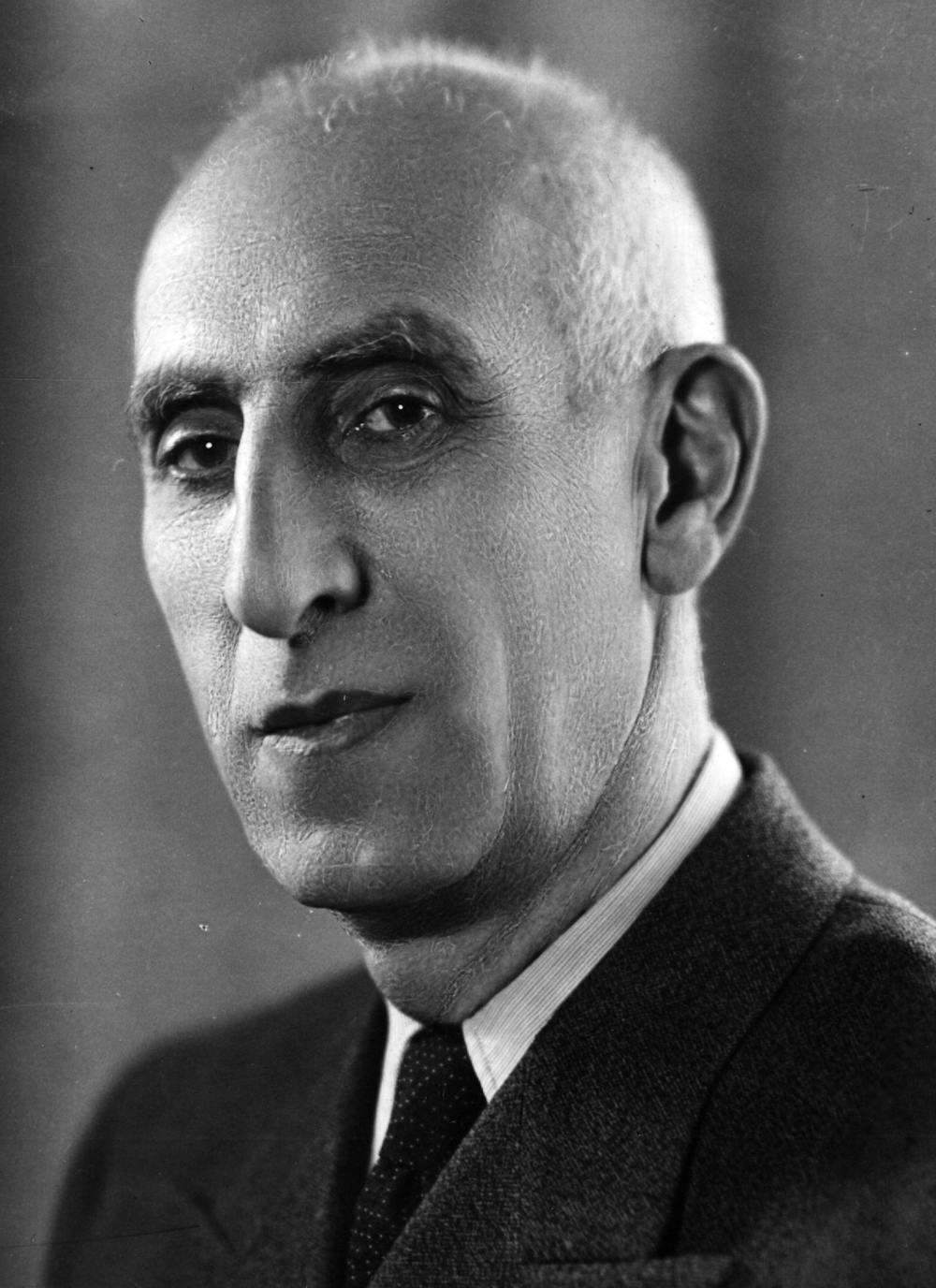
    MIL OSI USA News –

    June 23, 2025
  • MIL-OSI United Kingdom: Companies House celebrates 10 years of open data

    Source: United Kingdom – Executive Government & Departments

    Press release

    Companies House celebrates 10 years of open data

    The ground-breaking Find and update company information service was launched 10 years ago. Free access to Companies House data continues to support economic activity and corporate transparency, while new legislation underpins an organisational drive to improve the quality of data on the UK companies register.

    Today (22 June 2025) marks 10 years since Companies House made all public digital data on the UK companies register free of charge with the launch of the Find and update company information service on GOV.UK. This commitment to open data was designed to improve corporate transparency and give entrepreneurs the opportunity to come up with innovative ways of using information on the register.  

    In the last 10 years, the appetite for Companies House data has grown more than tenfold. The register was accessed 1.3 billion times for free information in 2015 to 2016. By 2023 to 2024, it was accessed over 16.5 billion times.

    Companies House data is widely used by companies, creditors, investors and researchers, credit reference agencies and providers of financial information.  

    It’s also a trusted source for journalists and civil society, government, law enforcement and the public.  

    Companies House data is empowering businesses, easing commerce through the sharing of data, strengthening the fight against financial crime through accountability and helping businesses verify customers, and customers verify businesses.  

    Companies House Chief Data Officer, Charlie Boundy said:  

    In 2015 we broke new ground for corporate registers with our commitment to open data. Ten years later that bold decision has led to Companies House supporting 16 billion searches a year, underpinning millions of pounds of everyday financial decisions and our data being valued by industry at £1 billion to £3 billion annually.

    Now, Companies House is implementing changes to company law under the Economic Crime and Corporate Transparency Act (ECCT Act) to improve the integrity and accuracy of data on our register. This will make it even more valuable to users and further support economic growth.

    Competition and Markets Minister Justin Madders said:  

    Over the last 10 years increased transparency from Companies House has empowered businesses big and small, helping level the playing field and improving confidence in our economy.

    As part of our Plan for Change we’ll continue to build on this success, strengthening transparency to give companies and consumers more certainty about the businesses they work with.

    Ben Cowdock, Senior Investigations Lead, Transparency International said: 

    For 10 years, the online platform at Companies House has delivered world-leading corporate transparency, setting an example for the best way to make company information available to the public. The data on this platform has contributed to countless investigations into corruption and financial crime by law enforcement, the private sector and civil society alike, and makes the UK a safer place to do business.

    We at Transparency International UK use the Companies House service on a daily basis, with the data providing a cornerstone to our research and investigations. We look forward to many more years of using the platform and working with Companies House to ensure it remains a world-leading service for those seeking company information.

    Steve Lamb, Chief Operating Officer at Kyckr said: 

    The launch of the Companies House open data service in 2015 marked a profound leap forward for corporate transparency in the UK. By making company information freely accessible to all, Companies House democratised access to one of the world’s most important datasets, enabling commerce, driving accountability, and strengthening the global fight against financial crime.

    At Kyckr, we’ve seen firsthand how open and authoritative registry data can transform the way businesses verify customers and combat illicit activity. Given the UK’s enduring position as an international financial hub, the move by Companies House set a powerful precedent – one that continues, rightly, to be celebrated.

    The value of Companies House data

    Companies House data is estimated to be worth £1 billion to £3 billion per year to users.

    For anti-money laundering (AML) regulated businesses, research published in 2024 suggests the value of company register information is £170 million to £460 million per year in total. ECCT Act reforms are expected to add between £210 million to £400 million in extra value. Much of this is attributed to the introduction of mandatory identity verification for company directors from this autumn.  

    Notes to editors

    The Economic Crime and Corporate Transparency Act 2023 introduced robust new laws to fight corruption, money laundering and fraud.

    The changes we are introducing in phases will enable us to crack down on misuse of the UK companies register. 

    2019 research Valuing the User Benefits of Companies House Data found that it is worth an estimated £1 billion to £3 billion per year to users.

    The 2024 Value of corporate transparency in tackling crime report found that:

    • for AML-regulated businesses, the value of company register information pre-reform is estimated to be between £170 million to £460 million per year in total (across all businesses) – the reforms are expected to add between £210 million to £400 million in extra value
    • for law enforcement users, the value of company register information is estimated to be around £2,600 per user, per year – the reforms are expected to generate an additional £1,300 of value per user, per year

    Both user groups considered the introduction of identity verification for company directors to be the greatest contributor to the increase in value.

    Share this page

    The following links open in a new tab

    • Share on Facebook (opens in new tab)
    • Share on Twitter (opens in new tab)

    Updates to this page

    Published 22 June 2025

    MIL OSI United Kingdom –

    June 23, 2025
  • MIL-OSI Global: Why corporations are backing away from supporting Pride this year

    Source: The Conversation – Canada – By Leah Hamilton, Professor in the Faculty of Business & Communication Studies, Mount Royal University

    Prime Minister Mark Carney recently raised the Pride flag on Parliament Hill and lamented the growing anti-2SLGBTQIA+ sentiment in Canada. He also committed $1.5 million to make Pride festivals across the country safer.

    This political support stands in sharp contrast to the many businesses that have reduced or ended their support for the 2SLGBTQIA+ community this Pride season.

    Multinational corporations like Google, as well as Canadian-owned companies like Molson Coors, have divested from supporting festivals, while Target has scaled back its Pride merchandise due to threats against employees and large-scale conservative backlash.

    The impact is already being felt. Pride Toronto is currently facing a $900,000 funding gap. Executive director Kojo Modeste recently told CBC News this corporate divestment appears to be linked to the larger backlash against diversity, equity and inclusion efforts.

    Fear of punitive measures

    In January, United States President Donald Trump issued an executive order to dismantle DEI initiatives in federal agencies and target private companies that support DEI measures. In the executive order, Trump’s administration called DEI measures and mandates “immoral discrimination programs.”

    Spearheaded by journalist-cum-activist and Trump adviser Christopher Rufo, the attacks against so-called “woke” DEI programs are fuelled by the “culture wars” that pit equity and inclusion against merit and the free market.


    Read more:
    Here’s what ‘woke’ means and how to respond to it


    Major private corporations, including IBM, quickly bent to the pressure of Trump’s anti-DEI orders by gutting their programs and shifting corporate donorship away from “woke” initiatives.

    The pressure to comply with anti-DEI measures hasn’t ended with corporations. More recently, Trump has set his sights on the U.S. post-secondary system, freezing US$2.2 million in federal grants and US$60 million in contracts after Harvard University refused to comply with the administration’s demands related to its DEI programs.

    In Canada, the rollback of DEI programs isn’t as loud, but it is happening. Michelle Grocholsky, the CEO of Empowered EDI in Toronto, told CBC News companies are reducing their budgets and cutting their staff. In the midst of job cuts in January 2025, the Alberta Investment Management Corporation removed their DEI staff.

    Following in the footsteps of the U.S., Alberta’s United Conservative Party membership passed a resolution to eliminate DEI programs and training in the public service. The party has also indicated it will remove government funding from post-secondary institutions that continue to do DEI work.

    Declining public support

    In addition to the rollback of DEI programs, the ongoing corporate reductions in Pride support are taking place amid increasing anti-2SLGBTQIA+ sentiment.

    A 2024 poll reported that, in Canada, support for 2SLGBTQIA+ visibility — like representation on screens and in sports — is lower than it was in 2021. Compared to previous years, Canadians also expressed less support for transgender rights, and this level of support was lower than the 26 other countries surveyed.

    Not surprisingly, this declining public support for the 2SLGBTQIA+ community coincides with rising hate crimes targeting 2SLGBTQIA+ communities. In 2023, Statistics Canada reported a 69 per cent increase in hate crimes targeting sexual orientation.

    Public attitudes don’t change in a vacuum. They are deeply influenced by hate movements, political rhetoric and the spread of misinformation and disinformation weaponized by politicians and leaders to dehumanize the 2SLGBTQIA+ community, particularly transgender people.

    This dehumanization incites fear, violence and support for anti-2SLGBTQIA+ hate. It has coincided with companies silently withdrawing their support for the 2SLGBTQIA+ community.

    Where we live, in Alberta, the provincial government has passed the most draconian anti-trans laws Canada has ever seen. As we (Corinne L. Mason and Leah Hamilton) have previously written, Premier Danielle Smith’s government has unveiled a suite of policies targeting transgender, intersex and gender diverse children and youth in Alberta, and the 2SLGBTQIA+ community more broadly.

    In this environment of reduced public and political support, it’s not surprising to see companies backing away from the 2SLGBTQIA+ community.

    Getting back to Pride’s roots

    The fact that companies have quickly backed away from their support of the 2SLGBTQIA+ community — by halting production of Pride merchandise or reducing sponsorship in Pride festivals — illustrates the conditionality of their support.

    Rather than beg big business to come back to the table, some members of the community are using this moment to reflect on how corporate “Love is Love” campaigns haven’t actually led to increased quality of life or justice for our communities.

    While it has received less media coverage than calls to remove police from Pride and the presence of Boycott, Divest and Sanction movement at Pride festivals, the corporatization of Pride has long been subject of debate in the 2SLGBTQIA+ community.


    Read more:
    Queers and trans say no to police presence at Pride parade


    Those against “rainbow capitalism” — the shallow and inauthentic use of Pride imagery in advertising — argue for a return to community-based and radical protest rather than settling for flag-waving bankers throwing beads from atop expensive floats.

    Pride Month is rooted in protest and resistance against police violence and systemic oppression. It was led by Black trans women and can be traced back to the Stonewall Riots. Today, Pride still isn’t simply a party and parade.

    Authentic ‘rainbow dollars’

    In this sociopolitical climate of legislated DEI rollbacks and declining public support for the 2SLGBTQIA+ community, organizations that want to support the 2SLGBTQIA+ community should back up their messaging with meaningful actions and structural support.

    Some organizations have shown a commitment to structural support for the 2SLGBTQIA+ community from its beginning, including the Northern Super League, the top-division professional women’s soccer league in Canada. The league openly and consistently amplifies and supports its 2SLGBTQIA+ players, coaches, staff and fans. Founded by Diana Matheson, an openly queer woman, the league is founded on inclusion as a core value.

    When it comes to creating Pride merchandise, Social Made Local is a queer-owned Canadian apparel company in Saskatoon that focuses on gender-inclusive sizing, sustainability and community. They donate a portion of their sales to Canadian non-profits like Rainbow Railroad.

    Companies that want to show their support can spend their rainbow dollars in good faith through actions that meaningfully support the 2SLGBTQIA+ community. This could include creating programs that support queer entrepreneurs, donating to legal funds that are fighting discriminatory legislation, and partnering with 2SLGBTQIA+ organizations to amplify their work.

    Leah Hamilton receives funding from the Social Sciences and Humanities Research Council of Canada.

    Corinne L. Mason receives funding from Social Sciences and Humanities Research Council.

    Gini (Virginia) Weber does not work for, consult, own shares in or receive funding from any company or organisation that would benefit from this article, and has disclosed no relevant affiliations beyond their academic appointment.

    – ref. Why corporations are backing away from supporting Pride this year – https://theconversation.com/why-corporations-are-backing-away-from-supporting-pride-this-year-258770

    MIL OSI – Global Reports –

    June 23, 2025
  • MIL-OSI Global: AI applications are producing cleaner cities, smarter homes and more efficient transit

    Source: The Conversation – Canada – By Mohammadamin Ahmadfard, Postdoctoral Fellow, Mechanical & Industrial Engineering, Toronto Metropolitan University

    Artificial intelligence (AI) is quietly transforming how cities generate, store and distribute energy, acting as the invisible conductor that orchestrates cleaner, smarter and more resilient cities.

    By integrating renewables — from solar panels and wind turbines to geothermal grids, hydrogen plants, electric vehicles and batteries — AI can enable cities to manage diverse energy sources as a single, intelligent system.

    One striking example is the Oya Hybrid Power Station in South Africa. Here, AI-driven controls seamlessly co-ordinate solar, wind and battery storage to deliver reliable power to up to 320,000 households. Using AI makes this kind of integration not only possible, but dramatically more efficient.

    Recent research shows AI can also optimize how batteries, solar and the grid interact in buildings. A 2023 study found that deep learning and real-time data helped a boarding school in Turin, Italy increase low-cost energy purchases and cut its electricity bill by more than half.

    Cleaner, smarter energy grids

    AI models are increasingly able to predict weather with greater precision. These predictions allow electric grid operators to plan hours ahead, storing excess energy in batteries or adjusting supply to meet demand before a storm or heatwave hits.

    Using AI to respond strategically to weather is a game-changer. In Cambridge, England, a system called Aardvark uses satellite and sensor data to generate rapid, accurate forecasts of sun and wind patterns.

    Unlike traditional supercomputer-driven weather models, Aardvark’s AI can deliver precise local forecasts in minutes on an ordinary computer. This makes advanced weather prediction more accessible and affordable for cities, utilities and even smaller organizations — potentially transforming how communities everywhere plan for and respond to changing weather.

    AI models are increasingly able to predict weather with greater precision, allowing electric grid operators to plan ahead, storing excess energy in batteries or adjusting supply to meet demand before a storm or heat wave hits.
    (Shutterstock)

    AI for smarter district heating and cooling

    In Munich, Germany, AI is improving geothermal district heating by using underground sensors to monitor temperature and moisture levels in the ground.

    The collected data feeds into a digital simulation model that helps optimize network operations. In more advanced versions, during winter cold snaps, such systems can suggest lowering flow to underused spaces like half-empty offices and boosting heat where demand is higher, such as in crowded apartments.

    This intelligent, self-optimizing approach extends the life of equipment and delivers more warmth with the same energy input.

    This is a breakthrough with enormous potential for cities in cold climates with established geothermal networks, such as Winnipeg in Canada and Iceland’s Reykjavik.

    Although these cities have not yet adopted AI-driven monitoring systems, they could benefit from AI’s real-time improvements in efficiency, comfort and energy savings during harsh winters — a principle that holds true wherever geothermal district heating and cooling exists.

    Inside the home, AI-managed smart climate systems can factor in how many people are in each room, which appliances are in use, how much natural sunlight each space receives.
    (Shutterstock)

    Smart buildings

    Inside the home, AI-managed smart climate systems can factor in how many people are in each room, which appliances are in use, how much natural sunlight each space receives and how much electricity or heat a home’s solar panels generate throughout the day.

    Based on this, AI determines how to heat or cool rooms efficiently, and can transfer energy from one space to another, balancing comfort with minimal energy use.

    Coastal cities and those in wind-heavy regions are using AI in other creative ways. In Orkney, Scotland, excess wind and tidal energy are converted into green hydrogen. Instead of letting that surplus power go to waste, an AI system called HyAI controls when to generate hydrogen based on wind forecasts, electricity prices and how full the hydrogen storage tanks are.

    When winds are strong at night and electricity is cheap, the AI can divert surplus power to produce hydrogen and store it for later use. On calmer days, that stored hydrogen can power fuel cells or buses.

    Energy storage

    AI is transforming energy storage into a smart, revenue-generating force. In Finland, a startup called Capalo AI has developed Zeus VPP, an AI-powered virtual power plant that aggregates distributed batteries from homes, businesses and other sites.

    Zeus VPP uses advanced forecasting and AI algorithms to decide when batteries should charge or discharge, factoring in energy prices, local consumption and weather forecasts. This enables battery owners to earn revenue by participating in electricity markets, while also supporting grid stability and making better use of renewable energy.

    Utility companies are also using AI to monitor everything from high-voltage transmission lines to neighbourhood transformers, dramatically increasing reliability.

    AI-powered dynamic line rating adjusts how much electricity a line can carry in real time, boosting capacity by 15 to 30 per cent when conditions allow. This helps utilities maximize the use of existing infrastructure instead of relying on costly upgrades.

    At the local level, AI analyzes smart metre data to predict which transformers are overheating due to rising EV and heat pump use.

    By forecasting these stress points, utilities can proactively upgrade equipment before failures happen — a shift from reactive to predictive maintenance that makes the grid stronger and cities more resilient.

    AI-powered public transit and mobility

    Transportation innovation is becoming part of the energy solution, with AI at the centre of this transformation. In New York City, energy company Con Edison has installed major battery storage systems to help manage peak electricity demand and reduce reliance on polluting peaker plants, which supply energy only during high-demand periods.

    More broadly, Con Edison is deploying advanced AI-powered analytics software across its electric grid — optimizing voltage, enhancing reliability and enabling predictive maintenance. Together, these efforts show how combining energy storage and AI-driven analytics can make even the world’s busiest cities more resilient and efficient.

    AI is also powering “vehicle-to-grid” innovations in California, where an AI-driven platform manages electric school buses that can supply stored energy back to the grid during periods of high demand.

    By carefully managing when buses charge and discharge, these systems help keep the grid reliable and ensure vehicles are ready for their daily routes. As this technology expands, parked electric vehicles could serve as valuable backup resources for the electricity system.

    Transportation innovation is becoming part of the energy solution.
    (Shutterstock)

    AI for clean energy initiatives

    AI is rapidly transforming cities by revolutionizing how energy is used and managed. Google, for example, has slashed cooling energy at its data centres by up to 40 per cent using AI that fine-tunes fans, pumps and windows more efficiently than any human operator.

    Organizations like the Electric Power Research Institute (EPRI), in collaboration with NVIDIA, Microsoft and others, have launched the Open Power AI Consortium, which is creating open-source AI tools for utilities worldwide.

    These tools will enable even the most resource-constrained cities to deploy advanced AI capabilities, without having to start from scratch, helping to level the playing field and accelerate the global energy transition.

    The result is not just cleaner air and lower energy bills, but a path to fewer blackouts and more resilient homes.

    Mohammadamin Ahmadfard receives funding from the Natural Sciences and Engineering Research Council of Canada (NSERC) and Mitacs Inc. for his postdoctoral research at Toronto Metropolitan University.

    – ref. AI applications are producing cleaner cities, smarter homes and more efficient transit – https://theconversation.com/ai-applications-are-producing-cleaner-cities-smarter-homes-and-more-efficient-transit-256291

    MIL OSI – Global Reports –

    June 23, 2025
  • MIL-OSI Global: 4 reasons to be concerned about Bill C-4’s threats to Canadian privacy and sovereignty

    Source: The Conversation – Canada – By Sara Bannerman, Professor and Canada Research Chair in Communication Policy and Governance, McMaster University

    In Canada, federal political parties are not governed by basic standards of federal privacy law. If passed, Bill C-4, also known as the Making Life More Affordable for Canadians Act, would also make provincial and territorial privacy laws inapplicable to federal political parties, with no adequate federal law in place.

    Federal legislation in the form of the Privacy Act and the Personal Information Protection and Electronic Documents Act sets out privacy standards for government and business, based on the fair information principles that provide for the collection, use and disclosure of Canadians’ personal information.

    At the moment, these laws don’t apply to political parties. Some provinces — especially British Columbia — have implemented laws that do. In May 2024, the B.C. Supreme Court upheld the provincial Information Commissioner’s ruling that B.C.’s privacy legislation applies to federal political parties. That decision is currently under appeal.

    Bill C-4 would undermine those B.C. rights. It would make inapplicable to federal parties the standard privacy rights that apply in other business and government contexts— such as the right to consent to the collection, use and disclosure of personal information — and to access and correct personal information held by organizations.

    Why should we be concerned about Bill C-4’s erasure of these privacy protections for Canadians? There are four reasons:

    1. Threats to Canada’s sovereignty

    In light of threats to Canadian sovereignty by United States President Donald Trump, the Canadian government and Canadian politicians must rethink their approach to digital sovereignty.

    Until now, Canadian parties and governments have been content to use American platforms, data companies and datified campaign tactics. Bill C-4 would leave federal parties free to do more of the same. This is the opposite of what’s needed.

    The politics that resulted in Trump being elected twice to the Oval Office was spurred in part by the datafied campaigning of Cambridge Analytica in 2016 and Elon Musk in 2024. These politics are driven by micro-targeted and arguably manipulative political campaigns.

    Do Canadians want Canada to go in the same direction?


    Read more:
    How political party data collection may turn off voters


    Are political parties spying and experimenting on Canadians via personal data collection?
    (Unsplash/Arthur Mazi), FAL

    2. Threats to Canada’s future

    Bill C-4 would undermine one of the mechanisms that makes Canada a society: collective political decisions.

    Datified campaigning and the collection of personal information by political parties change the nature of democracy. Rather than appealing to political values or visions of what voters may want in the future or as a society — critically important at this historical and troubling moment in history — datified campaigning operates by experimenting on unwitting individual citizens who are alone on their phones and computers. It operates by testing their isolated opinions and unvarnished behaviours.

    For example, a political campaign might do what’s known as A/B testing of ads, which explores whether ad A or ad B is more successful by issuing two different versions of an ad to determine which one gets more clicks, shares, petition signatures, donations or other measurable behaviour. With this knowledge, a campaign or party can manipulate the ads through multiple versions to get the desired behaviour and result. They also learn about ad audiences for future targeting.


    Read more:
    A/B testing: how offline businesses are learning from Google to improve profits


    In other words, political parties engaging in this tactic aren’t engaging with Canadians — they’re experimenting on them to see what type of messages, or even what colour schemes or visuals, appeal most. This can be used to shape the campaign or just the determine the style of follow-up messaging to particular users.

    University researchers, to name just one example, are bound by strict ethical protocols and approvals, including the principle that participants should consent to the collection of personal information, and to participation in experiments and studies. Political parties have no such standards, despite the high stakes — the very future of democracy and society.

    Most citizens think of elections as being about deliberation and collectively deciding what kind of society they want to live in and what kind of future they want to have together as they decide how to cast their ballots.

    But with datified campaigning, citizens may not be aware of the political significance of their online actions. Their data trail might cause them to be included, or excluded, from a party’s future campaigning and door-knocking, for example. The process isn’t deliberative, thoughtful or collective.

    3. Secret personal data collection

    Political parties collect highly personal data about Canadians without their knowledge or consent. Most Canadians are not aware of the extent of the collection by political parties and the range of data they collect, which can include political views, ethnicity, income, religion or online activities, social media IDs, observations of door-knockers and more.

    If asked, most Canadians would not consent to the range of data collection by parties.

    4. Data can be dangerous in the wrong hands

    Some governments can and do use data to punish individuals politically and criminally, sometimes without the protection of the rule of law.

    Breaches and misuses of data, cybersecurity experts say, are no longer a question of “if,” but “when.”

    Worse, what would happen if the wall between political parties and politicians or government broke down and the personal information collected by parties became available to governments? What if the data were used for political purposes, such as for vetting people for political appointments or government benefits? What if it were used against civil servants?

    What if it were to be used at the border, or passed to other governments? What if it were passed to and used by authoritarian governments to harass and punish citizens?

    What if it was passed to tech companies and further to data brokers?

    OpenMedia recently revealed that Canadians’ data is being passed to the many different data companies political parties use. That data is not necessarily housed in Canada or by Canadian companies.

    If provincial law is undermined, there are few protections against any of these problems.

    Strengthening democracy

    Bill C-4 would erase the possibility of provincial and territorial privacy laws being applied to federal political parties, with virtually nothing remaining. Privacy protection promotes confidence and engagement with democratic processes — particularly online. Erasing privacy protections threatens this confidence and engagement.

    The current approach of federal political parties in terms of datified campaigning and privacy law is entirely wrong for this political moment, dangerous to Canadians and dangerous to democracy. Reforms should instead ensure federal political parties must adhere to the same standards as businesses and all levels of government.

    Data privacy is important everywhere, but particularly so for political parties, campaigns and democratic engagement. It is important at all times — particularly now.

    Sara Bannerman receives funding from the Canada Research Chairs program, the Social Sciences and Humanities Research Council, and McMaster University. She has previously received funding from the Office of the Privacy Commissioner’s Contributions Program and the Digital Ecosystem Research Challenge.

    – ref. 4 reasons to be concerned about Bill C-4’s threats to Canadian privacy and sovereignty – https://theconversation.com/4-reasons-to-be-concerned-about-bill-c-4s-threats-to-canadian-privacy-and-sovereignty-259331

    MIL OSI – Global Reports –

    June 23, 2025
  • MIL-OSI Russia: Xinjiang’s Cross-Border E-Commerce Sector Shows Dynamic Growth

    Translation. Region: Russian Federal

    Source: People’s Republic of China in Russian – People’s Republic of China in Russian –

    Source: People’s Republic of China – State Council News

    URUMQI, June 22 (Xinhua) — The cross-border e-commerce sector in northwest China’s Xinjiang Uygur Autonomous Region has seen dynamic growth, with the advantages of two key ports of Alashankou and Horgos as “global purchasing and selling” channels becoming increasingly evident, achieving highly efficient and smooth trade flow.

    Alashankou Port has seen strong growth in cross-border e-commerce. In the first five months of this year, 55.7376 million parcels worth 3.579 billion yuan (about 492 million U.S. dollars) were exported through Alashankou in cross-border online commerce, up 103 percent year-on-year. At the Alashankou Comprehensive Bonded Zone Cross-Border E-Commerce Industrial Park, trucks loaded with toys, consumer goods and other products bearing the stamp “Made in China” are constantly streaming toward Europe, Russia and other regions.

    “From January to May this year, our company’s cross-border e-commerce export volume exceeded 20 million parcels, up 50 percent year-on-year and reaching a historical high,” Kong Xianglin, deputy general manager of Oushengtong Kahang International Logistics Co., Ltd., told Xinhua. “We are currently cooperating with platforms such as Pinduoduo and AliExpress to build overseas warehouses. In the second half of the year, business with Europe is expected to grow by another 60 percent.”

    With explosive growth, cross-border e-commerce at Horgos is complementing Alashankou’s success. Over the same period, the port is expected to reach 28.05 billion yuan in trade volume, a staggering 890 percent year-on-year increase. At the cargo yard of Zhongguang Zhida Co., Ltd., daily necessities, small appliances, air conditioners and other goods are packed into containers before being shipped.

    “Today, our company’s trading volume has reached US$700 million, up about 110 percent from a year ago and a record high,” said Jiang Yong, deputy general manager of Zhongguang Zhida Co., Ltd. “Based on Khorgos’s advanced industrial base and highly efficient logistics network, we will continue to deepen our presence in the Central Asian and European markets,” he continued.

    The strong growth of the two ports is driven by the continuous optimization of the business environment and the upgrading of infrastructure. The Alashankou Port Authority, taking advantage of the Belt and Road Initiative, has invested in building a multifunctional cross-border e-commerce industrial park, attracting 15 companies and covering all import and export models. The Horgos Cross-Border E-Commerce Industrial Park has also brought together more than 40 enterprises and is purposefully building a comprehensive service ecosystem covering the entire supply chain.

    Zhang Yan, head of the New Business Model Department of Alashankou Port and Commerce Bureau, said: “We actively leverage the advantages of geographical location and industrial agglomeration, implement various support measures, solve practical difficulties for enterprises, and continuously provide cross-border e-commerce companies with turnkey services, from warehouse logistics to financial services.”

    At present, Alashankou and Horgos are making the transition from a “transit corridor economy” to an “industrial cluster economy”. With innovative models and an open ecosystem, they are jointly building a digital trade hub in a key area of the Silk Road Economic Belt, giving a strong impetus to the deepening of the opening up of Xinjiang’s border areas. -0-

    MIL OSI Russia News –

    June 23, 2025
  • MIL-OSI Russia: Astana hosted the China-Central Asia news agency forum

    Translation. Region: Russian Federal

    Source: People’s Republic of China in Russian – People’s Republic of China in Russian –

    Source: People’s Republic of China – State Council News

    ASTANA, June 22 (Xinhua) — The China-Central Asia News Agency Forum was held in Astana, capital of Kazakhstan, on Sunday. As one of the outcomes of the Second China-Central Asia Summit, the forum was initiated and hosted by Xinhua News Agency. It was attended by heads of Xinhua News Agency, Kazakh Presidential Television and Radio Broadcasting Complex, Kyrgyz National News Agency Kabar, Tajikistan National News Agency Khovar, Media-Turkmen News Agency and Uzbekistan National News Agency.

    Fu Hua, Director General of Xinhua News Agency, chaired the forum and delivered a speech. He said that under the joint leadership of Chinese President Xi Jinping and the leaders of Central Asian countries, exchanges and cooperation between China and the countries in the region have gained new important historical opportunities and shown incredibly bright prospects. News agencies of China and Central Asia are charged with the responsibility of spreading the “Central Asia-China Spirit” and promoting high-quality development in the region, jointly telling the stories of China-Central Asia cooperation, promoting China-Central Asia people-to-people and cultural exchanges and mutual learning between civilizations, advancing innovation and cooperation in media technology, deepening exchanges and cooperation between news agencies, and contributing to promoting the building of a community with a shared future for China and Central Asia.

    The officials of news agencies of the Central Asian countries highly appreciated the important role played by the China-Central Asia News Agency Forum in strengthening mutual understanding and cooperation, and expressed their willingness to continue to deepen exchanges and cooperation with Chinese media including the Xinhua News Agency, jointly promote the “Central Asia-China Spirit”, and make due contributions to promoting mutual learning among civilizations and achieving common development.

    Director General of the Television and Radio Complex of the President of the Republic of Kazakhstan Raushan Kazhibayeva noted that the successful holding of the Second China-Central Asia Summit outlined the direction for the development of relations between China and the countries of the region. This forum is a vivid manifestation of good-neighborliness and deep friendship between China and the countries of Central Asia, and the media should support and promote the implementation of the results achieved at the summit.

    Mederbek Shermetaliev, Director General of the Kyrgyz National News Agency Kabar, said that the Belt and Road Initiative has opened up new prospects for mutually beneficial cooperation between China and Central Asia. Strengthening information exchange and cooperation between all parties will help present an objective, truthful and three-dimensional image of China and Central Asian countries.

    According to Subhiddin Shamsiddinzoda, Director of the National Information Agency of Tajikistan “Khovar”, fruitful results have been achieved in cooperation between the Central Asian countries and China in the field of media. He also expressed hope for continued in-depth exchange of views on issues such as training talents in the field of communications, strengthening cooperation between universities and promoting the development of creative industries.

    Bekdurdy Amansaryev, Director General of the Media-Turkmen Information Agency, said all parties should set an example in establishing information partnerships based on mutual respect, equality and mutual benefit. New technologies have expanded the space for cooperation between media outlets, he noted, adding that he hopes to strengthen cooperation in the field of new media and promote digital transformation.

    Abdusaid Kuchimov, Director General of the National News Agency of Uzbekistan, noted that the media plays an important role in strengthening bilateral and multilateral cooperation between Central Asian countries and China. Media partners from Central Asia and China came together to strengthen their cooperation, which is of great importance for discussing ways to overcome common challenges.

    The forum participants agreed that the world is changing and facing many challenges, such as the spread of disinformation. The media of China and Central Asian countries should join efforts to enhance cooperation in information exchange, news dissemination and promotion of technological innovation to create a favorable information environment for regional peace and development.

    Following the forum, the Astana Consensus was adopted. –0–

    MIL OSI Russia News –

    June 23, 2025
  • MIL-OSI Russia: Israeli army says it hit fighter jets, missile sites in Iran

    Translation. Region: Russian Federal

    Source: People’s Republic of China in Russian –

    Source: People’s Republic of China – State Council News

    JERUSALEM, June 22 (Xinhua) — The Israel Defense Forces (IDF) said in a statement that its fighter jets struck two warplanes at Dezful airport in western Iran on Sunday morning.

    The statement said eight rocket launchers had been “neutralized” in separate strikes earlier in the morning, six of which were poised to fire into Israeli territory.

    It reported that on Saturday evening, about 20 Israeli fighter jets struck dozens of military targets in Iran.

    According to the statement, the targets hit included a military facility housing components for the production of explosives, a weapons depot and production facilities, as well as air defense systems. –0–

    MIL OSI Russia News –

    June 23, 2025
  • MIL-Evening Report: Starving Gaza civilians toll climbs at Israeli humanitarian ‘death traps’

    Pacific Media Watch

    BEARING WITNESS: By Cole Martin in occupied Bethlehem

    Kia ora koutou,

    I’m a Kiwi journo in occupied Bethlehem, here’s a brief summary of today’s events across the Palestinian and Israeli territories from on the ground.

    Israeli forces killed over 200 Palestinians in Gaza over the last 48 hours, injuring over 1037. Countless more remain under the rubble and in unreachable zones. 450 killed seeking aid, 39 missing, and around 3500 injured at the joint US-Israeli humanitarian foundation “death traps”.

    Forty one  killed by Israeli forces since dawn today, including three children in an attack east of Gaza City. Gaza’s Al-Quds brigades destroyed a military bulldozer in southern Gaza.

    *

    Settlers, protected by soldiers, violently attacked Palestinian residents near the southern village of Susiya last night, including children. The West Bank siege continues with Israeli occupation forces severely restricting movement between Palestinian towns and cities. Continued military/settler assaults across the occupied territories.

    *

    Iranian strikes targeted Ben Gurion airport and several military sites in the Israeli territories. Israeli regime discuss a 3.6 billion shekel defence budget increase.

    *

    400 killed and 3000 injured by Israel’s attacks on Iran, in the nine days since Israel’s aggression began. Iranian authorities have arrested dozens more linked to Israeli intelligence, and cut internet for the last three days to prevent internal drone attacks from agents within their territories.

    Israeli strikes have targeted a wide range of sites; missile depots, nuclear facilities, residential areas, and reportedly six ambulances today.

    Cole Martin is an independent New Zealand photojournalist based in the Middle East and a contributor to Asia Pacific Report.

    MIL OSI Analysis – EveningReport.nz –

    June 22, 2025
  • MIL-OSI Global: US joins Israel in attack on Iran and ushers in a new era of impunity

    Source: The Conversation – UK – By Simon Mabon, Professor of International Relations, Lancaster University

    When US B-2 bombers hit Iran’s nuclear facilities at Fordow, Natanz and Isfahan, Donald Trump declared the strikes a success and urged the Islamic Republic to make peace or face even more devastating strikes. The US president proclaimed the might of the US military, operating in full coordination with Israel, before taking to truth social.

    Trump and the Israeli prime minister, Benjamin Netanyahu, will hope that the strikes will end Iran’s nuclear programme once and for all. It may, it may not. More certain is that the operation will sound the death knell for the post-second world war global order.

    After the horrors of the that war and the cold war that followed, a global order emerged seemingly predicated on a set of largely liberal rules and norms that sought to prevent a retreat into global conflict. Predicated on non-intervention, diplomacy and a respect for the rule of law, this global order was idealistic and – ultimately – aspirational.

    But in recent years, this vision of global politics has come crashing down. Now America joining Israel in its attacks on Iran will rightly provoke serious questions about the future of global order and what comes next.


    Get your news from actual experts, straight to your inbox. Sign up to our daily newsletter to receive all The Conversation UK’s latest coverage of news and research, from politics and business to the arts and sciences.


    Trump’s decision to use US air power to land heavy blows against Iran’s nuclear programme is the latest event on a continuum which arguably reaches back to the Hamas terror attack of October 7.

    Israel’s destruction of Gaza, its decapitation of Hamas and disabling of Hezbollah’s military capacity and its strikes against the Houthi rebels have consolidated Israel’s position of strength in the region, to generally positive acclaim from global audiences. Yet the spectre of Iran continued to loom large, even as its proxies were defeated

    Iran has long been framed as an nefarious puppet master controlling a complex web of “proxy actors” across the Middle East each accused of doing the bidding of Tehran. The reality is rather different. While the Islamic Republic undeniably wields influence over such groups, it is not the perfidious mastermind that some would suggest, nor is it the source of all ills in the region.

    Instead, Iran is in a perilous position. The Islamic Republic faces serious social and economic pressures, with the “women life freedom movement” galvanising popular opposition, while unrest across Iran’s peripheral provinces which are home to ethnic and religious minorities continues to ferment.

    In recent years, diplomacy has shown it can work, ameliorating longstanding and deep-seated animosities. This was bearing fruits as seen in the gradual rapprochement between Iran and Saudi Arabia from 2023, which had been preceded by the signing of the Abraham accords in 2020.

    Seen by many as a key achievement of Trump’s first presidency, this was a series of agreements between Israel and Bahrain, the United Arab Emirates, Morocco and Sudan in which the Arab countries recognised Israel and all sides signed a declaration of principles focused on mutual understanding, respect for human dignity, and cooperation.

    While many in Israel and the US hoped that Saudi Arabia would officially recognise Israel, the events of October 7 and the destruction of Gaza that followed ended those hopes. Now the possibility of all-out conflict between Iran and Israel and the US risks blowing a major regional conflict with global implications.

    Serious questions must be asked as to the longer-term strategy here. While Israeli officials have articulated a need for strikes on Iran’s nuclear facilities to prevent the Islamic Republic from getting a nuclear weapons capability, Iran is a signatory of the nuclear non-proliferation treaty (although it has threatened recently to quit) and key officials have regularly declared that nuclear weapons have no place in Iran’s strategic portfolio.

    Israel is not a signatory to the treaty. In fact, it is thought to possess between 75 and 400 nuclear warheads. It’s hard to tell, as the country has maintained a steadfast policy of nuclear opacity, never actually admitting the extent of its nuclear capability.

    New impunity?

    Is this the start of a new order of impunity across the region, backed by western powers? And if so, what does this mean for the war in Ukraine and the potential for an aggressive Russia engaging in further dangerous adventurism? What does it mean for the possibility of China taking advantage in this breakdown to perhaps fulfil its generations-old ambition to unite with Taiwan, by force, if necessary? Are we seeing the shift to a world in which Donald Trump’s threats to annex Greenland – even perhaps Canada – must be taken seriously?

    The contours of global politics are changing before our eyes. Gone are the norms that have served as the bedrock of the so-called liberal international order. The risk is that while this period has itself featured tragedy and suffering on an almost unimaginable scale, tearing up the rule book will be far worse.

    Simon Mabon receives funding from Carnegie Corporation of New York and the Henry Luce Foundation. He is a Senior Research Fellow with the Foreign Policy Centre.

    – ref. US joins Israel in attack on Iran and ushers in a new era of impunity – https://theconversation.com/us-joins-israel-in-attack-on-iran-and-ushers-in-a-new-era-of-impunity-259511

    MIL OSI – Global Reports –

    June 22, 2025
  • MIL-OSI Africa: Nigeria secure historic double as first African flag football champions

    Nigeria’s women’s and men’s teams have been crowned the inaugural IFAF African Flag Football champions as the sport marked a major milestone on its journey to a first Olympic Games appearance in Los Angeles 2028.

    The Nigerian men edged a thrilling final game, winning 13-12 to claim gold over hosts Egypt in front of a loud and high-spirited home crowd inside the Club One Stadium in Maadi, Cairo, where distinguished guests included Egypt’s Minister of Youth and Sport Dr Ashraf Sobhi.

    In the women’s tournament, Nigeria put out a confident performance to take victory over Morocco 26-12 in the final, with two decisive second half touchowns thrown by quarterback Anuoluwapo Bello. Bronze medalists Tunisia (men) and Egypt (women) completed the historic podiums.

    In total, 11 teams from eight nations, spanning the African continent, participated in Africa Flag – the first of IFAF’s continental championships series for 2025 and the starting point for what will be the biggest and most important competition cycle in flag football history, culminating in the Olympic Games LA28.

    As African champions, Nigeria’s men and women qualify directly to the IFAF Flag Football World Championships in 2026. The event also saw 10 national teams earn their first official world rankings.

    “This is a great achievement for us and I’m proud of every woman out here,” said Nigeria women’s gold medallist Anuoluwapo Bello. “I feel excited for the girls here. There is an opportunity to go to the World Championships and show everyone what we can do.”

    “It’s amazing, it’s surreal, it’s history, it’s unbelievable,” said Nigeria men’s quarterback Hayes Obinna-Uzoh. “We’ve made history.”

    Egypt men’s quarterback Mahmoud Aboushady said: “We went for it, but we came up just short. The crowd was awesome, and it was a big crowd who were all cheering and that was really touching.”

    Morocco women’s center, silver medallist Sonia Mouimen added: “We usually don’t see crowds of this size making so much noise unless it is at soccer matches. I am very proud of my team.”

    One of the world’s fastest-growing sports, flag football is developing quickly across Africa, with many of IFAF’s member federations in the continent recording more than 100% growth in participation last year.

    The Africa Flag 2025 tournament was delivered in partnership with the NFL, who are working with IFAF to drive the development of flag football in Africa.

    In an effort to ensure the event builds on the legacy for American football across the continent, the NFL is hosting a series of wraparound activities in Cairo. These include:

    • a continental NFL Flag youth championships for U12’s boys and girls teams from across Africa;
    • an NFL talent indentification session, with the potential for players to advance to the NFL Africa-Europe Academy and International Player Pathway (IPP) program;
    • in partnership with IFAF and including the participation of NFL/ IFAF Global Flag football Abassador Elisa de Santis (FRA), a coaching education clinic for aspiring female coaches from Africa.

    Two current NFL players, New York Giants’ Bobby Okereke (Nigeria) and Tanoh Kpassagnon (Ivory Coast/Uganda) have traveled to Cairo to join these activities and were present to witness the historic finals session alongside two-time Super Bowl winner and NFL Africa lead Osi Umeniyora.

    “The first African Continental Championship was a tremendous success, and Egypt proved to be the perfect host as we continue our journey to grow flag football across Africa,” said Umenyiora. “It was inspiring to see nations from across the continent come together for the two-day event and showcase the incredible talent of their young athletes. The NFL is proud to partner with IFAF to help grow the game of flag football, especially as we look ahead to its debut at the LA28 Olympic Games.”

    IFAF President Pierre Trochet said: “Every player and official who set foot on the field in Cairo this week can claim a piece of history. I’m enormously proud and grateful to our Egyptian federation, who have hosted this milestone event with great professionalism and warmth. But the history is less important than the future and what this tournament has demonstrated is the enormous talent and passion for the game that exists right across the African continent. We know this event is just the start and, together with our NFL partners, we are committed to ensuring it acts as a springboard to the long-term development of our game.”

    The IFAF African Flag Football World Championships were hosted over two days (June 20-21) by the Egyptian Federation of American Football, whose President Ali Rafeek said: “No words can truly capture the emotion of this moment. It was a world-class competition filled with outstanding performances and, above all, incredible energy. We’ve been building toward this moment for a while with IFAF leadership and our fellow federations, and we’re proud to see that hard work come to life. Africa is officially on the flag football map, and we’re only getting started.”

    The event in Cairo also witnessed the kick-off of IFAF’s new, comprehensive partnership with the International Testing Agency, whose staff were present to deliver anti-doping education activities for participating athletes and team officials.

    The IFAF Flag Football Continental Championship series will continue in September with the EURO FLAG 2025 event in Paris, France.

    RESULTS AND FINAL STANDINGS

    IFAF Africa Flag 2025  – men’s tournament

    Gold Medal Game
    Nigeria 13 Egypt 12

    Bronze Medal Game
    Tunisia 36 Morocco 14

    5th Place Game: Cameroon 45 Senegal 13
    7th Place Game: South Africa 60 Uganda 0

    Semifinals
    Egypt 21 Morocco 12
    Tunisia 18 Nigeria 40

    Final Placing

    1. Nigeria
    2. Egypt
    3. Tunisia
    4. Morocco
    5. Cameroon
    6. Senegal
    7. South Africa
    8. Uganda

    IFAF Africa Flag 2025 – women’s tournament

    Gold Medal Game
    Nigeria 26 Morocco 12

    Playoff
    Egypt 13 Morocco 19

    Final Placing

    1. Nigeria
    2. Morocco
    3. Egypt

    Distributed by APO Group on behalf of National Football League (NFL).

    Photography and Video Assets: https://apo-opa.co/44rRoJY
    *Rights-released for editorial use. Please credit IFAF

    MIL OSI Africa –

    June 22, 2025
  • MIL-OSI Africa: SA nationals held in Equatorial Guinea return home  

    Source: South Africa News Agency

    Sunday, June 22, 2025

    Government has welcomed the release of two South African nationals that were held in detention in Equatorial Guinea.

    “The Government of the Republic of South Africa welcomes the release of Mr Peter Shane Huxham and Mr Frederic Potgieter from detention in the Republic of Equatorial Guinea. This release follows the granting of clemency by the President of Equatorial Guinea,” said the Ministry of International Relations and Cooperation on Saturday.

    The two South African nationals were arrested on 9 February 2023 and sentenced to 12 years in prison. 

    READ | DIRCO ‘seriously concerned’ over incarceration of two S Africans in Equatorial Guinea

    “South Africa expresses its sincere gratitude to the Government of Equatorial Guinea for considering and ultimately granting this Presidential pardon, allowing Mr Huxham and Mr Potgieter to return home to their loved ones.”

    Since their arrest, the South African Government has remained actively engaged through diplomatic channels, including sending Special Envoys, to secure their release on humanitarian grounds.

    Throughout the sustained engagements, the Government consistently appealed for clemency, highlighting the humanitarian aspects of the case and the profound impact on the families of the detained.

    “The coordinated collaboration between the Department of International Relations and Cooperation, the families of the two men, and their employer, SBM Offshore, also played a significant role in facilitating their release.

    “The Government of South Africa acknowledges the complexity of the matter, including its sensitive diplomatic and legal dimensions. It appreciated the Government of Equatorial Guinea’s continued provision of consular access and the spirit of constructive diplomatic dialogue that has been maintained throughout this period,” said the Ministry.

    Government said it remains committed to strengthening bilateral relations with Equatorial Guinea and reaffirms its dedication to constructive engagement, mutual respect, and the resolution of challenges through diplomatic channels. –SAnews.gov.za

    Share this post:

    MIL OSI Africa –

    June 22, 2025
  • MIL-OSI Africa: Alleged kidnapping kingpin killed in shootout with police 

    Source: South Africa News Agency

    Sunday, June 22, 2025

    Police have shot and killed an alleged wanted Mozambican kidnapping kingpin during an Anti-kidnapping Task Team operation in Fourways.

    In a statement on Saturday, the South African Police Service (SAPS) said the Anti-kidnapping Task Team traced Mauro Mucambe Junior to a block of apartments in Fourways, Johannesburg this week. This came as the team was tracing a kidnapped Pakistani businessman from Pretoria West who is still in captivity.

    “The team [is] still searching for the Pakistani national. A ransom demand has been made to the businessman’s family. The team’s tracing operation began at a residential complex in Carlswald, Midrand where they seized a Mercedes Benz, a silver Pajero and arrested two kidnappers.

    “They proceeded to Fourways where the task team announced their arrival and a shootout ensued. One suspect was fatally wounded and upon further investigation, it was discovered that 40-year-old Mauro Mucambe Junior is a wanted kidnapping kingpin in Mozambique where he has been linked to several kidnappings. His warrant of arrest was issued by Maputo Police in August 2024,” said the SAPS.

    One unlicensed firearm used by Junior was seized including 10 rounds of ammunition as well as four cellphones and four bank cards.

    “The SAPS has full faith and confidence in the work of the Anti-kidnapping Task Team to rescue the kidnapped businessman. Since January 2024 to date, the team has arrested more than 170 criminals involved in kidnappings for ransom. 

    “More than R1.2 million has been recovered.  More than 100 victims [have been] rescued mainly in Gauteng and more than 40 vehicles used in kidnapping crimes were also seized by the team. The team recently registered a breakthrough in the Olorato Mongale murder case where they led the tracing operation of Philangenkosi Makhanya. The search is still on for Bongani Mthimkhulu,” said police. SAnews.gov.za

    Share this post:

    MIL OSI Africa –

    June 22, 2025
←Previous Page
1 … 276 277 278 279 280 … 1,471
Next Page→
NewzIntel.com

NewzIntel.com

MIL Open Source Intelligence

  • Blog
  • About
  • FAQs
  • Authors
  • Events
  • Shop
  • Patterns
  • Themes

Twenty Twenty-Five

Designed with WordPress