Category: housing

  • MIL-OSI Global: Cuts to school lunch and food bank funding mean less fresh produce for children and families

    Source: The Conversation – USA – By Marlene B. Schwartz, Professor of Human Development and Family Sciences, University of Connecticut

    For many American children, school lunches are their most nutritious meal of the day. SDI Productions/iStock via Getty Images Plus

    The U.S. government recently cut more than US$1 billion in funding to two long-running programs that helped schools and food banks feed children and families in need. The U.S. Department of Agriculture says the reductions are a “return to long-term, fiscally responsible initiatives.” But advocacy groups say the cuts will hurt millions of Americans.

    The reductions came just days before the release of the Trump administration’s Make America Healthy Again report, an analysis of the factors causing chronic disease in children. One of those factors, the report says, is poor diet.

    Dr. Marlene Schwartz, a professor of human development and family sciences and director of the Rudd Center for Food Policy & Health at the University of Connecticut, discusses why cutting the Local Food for Schools and the Local Food Purchase Assistance programs means less fresh food will be available to children and families – and could hurt local farmers and ranchers too.

    Dr. Marlene Schwartz discusses why these programs were cut.

    The Conversation has collaborated with SciLine to bring you highlights from the discussion, edited here for brevity and clarity.

    Could you explain the two programs that were cut?

    Marlene Schwartz: Most schools were eligible for Local Food for Schools, a $660 million program, which has now been cut. The funds for Local Food for Schools were on top of the reimbursement that schools get for meals and would have allowed them to buy more local, fresh food.

    The Local Food Purchase Assistance program was designed primarily for food banks. Again, the idea was to provide federal money, about $500 million, so food banks could buy from local farmers and support local agriculture. But that too was cut.

    How will these cuts affect families and schoolchildren?

    Schwartz: Many children eat two of their meals, five days a week, at school. During the 2022-2023 school year, about 28 million kids ate lunch at school. More than 14 million had breakfast there.

    Having fresh, local produce in the school cafeteria provides the opportunity to introduce children to more fruits and vegetables and teach them about the food grown in their own communities. Think about how powerful a lesson about nutrition and local agriculture can be when you not only hear and read about it but can taste it too.

    How will these cuts affect farmers and ranchers?

    Schwartz: When the funding was there, the farmers and ranchers knew they had guaranteed buyers for their products. So the loss of these funds, especially so quickly, will have a very negative effect on them. Suddenly, the buyers they counted on don’t have the money to buy from them.

    Food banks provide fresh foods as well as canned.
    RyanJLane/E+ via Getty Images

    How does nutritious food in schools impact kids?

    Schwartz: Both the National School Lunch Program and the School Breakfast Program are required to comply with the dietary guidelines for Americans, so they’ve always had nutrition standards. These guidelines are updated every five years to reflect the most recent science and public health needs.

    The regulations on school meal nutrition were strengthened significantly with the 2010 Healthy, Hunger-Free Kids Act. We’ve done a number of studies showing that because of these changes, healthier meals are available at schools, and children eat better. The U.S. Department of Agriculture also did a large national study that reported much the same.

    Another study looked at the nutritional quality of the food at school, from home and at restaurants. It found that school food was the healthiest of all. Many people were surprised by this, but when you think about it, schools are the only setting required to follow federal and state nutrition regulations – restaurants and grocery stores don’t have to do that.

    But getting kids to eat nutritious food can be a challenge.

    Schwartz: We’ve known for decades that American children are not eating enough fruits and vegetables. We know they’re eating too much added sugar, saturated fat and sodium.

    This is due in part to the millions of dollars food companies spend to entice children to eat more sugary cereals, sweetened beverages and fast food.

    I think the best nutrition education happens on your plate. By maximizing the quality of food served in schools, policymakers can influence the diets of millions of children every single day.

    How nutritious are the foods at food banks?

    Schwartz: Food banks often measure their success in terms of the pounds of food they distribute into a community. But families relying on the charitable food system often have a higher risk of diet-related illness – like high blood pressure or Type 2 diabetes – and many want healthier foods.

    In response, food banks, which nationwide serve about 50 million Americans, have made a concerted effort to improve the nutritional quality of their food. There’s now a system to help food banks consistently track the nutritional quality of what they provide.

    Watch the full interview to hear more.

    SciLine is a free service based at the American Association for the Advancement of Science, a nonprofit that helps journalists include scientific evidence and experts in their news stories.

    Marlene B. Schwartz receives funding from the USDA, National Institutes of Health, Centers for Disease Control, Robert Wood Johnson Foundation, Partnership for a Healthier America, and the CT State Department of Education.

    ref. Cuts to school lunch and food bank funding mean less fresh produce for children and families – https://theconversation.com/cuts-to-school-lunch-and-food-bank-funding-mean-less-fresh-produce-for-children-and-families-256772

    MIL OSI – Global Reports

  • MIL-OSI Global: Detroit voters have an opportunity to pick a mayor who will ease zoning, improve transit and protect long-term residents

    Source: The Conversation – USA – By Brian J. Connolly, Assistant Professor of Business Law, University of Michigan

    Five of Detroit’s mayoral candidates discuss their ideas for the future of the city. Detroit PBS

    Five of the nine candidates in Detroit’s mayoral contest debated on May 29, 2025, during the annual Mackinac Policy Conference.

    When asked about outgoing Mayor Mike Duggan’s 11-year tenure, many of the candidates praised him for skillfully steering Detroit through bankruptcy and attracting new business investment.

    But the candidates also saw an opportunity to do more.

    “Without a doubt, we have to ensure that more investment comes back into our neighborhoods and that we’re activating our commercial corridors,” the race’s front-runner, Detroit City Council President Mary Sheffield, said.

    Helping Detroit residents improve their neighborhoods will be an important task for the city’s next mayor. I do not live in Detroit, but my family lived there for generations before my grandparents joined the white flight from the city in the 1970s. And my research on housing, infrastructure and land use law offers some ideas for how the next mayor could encourage investment while at the same time improving social equity.

    Duggan’s legacy

    By most accounts, the Motor City under Duggan has been an urban revitalization success story.

    Once the nation’s murder capital, its crime rate has fallen dramatically.

    And after experiencing the largest-ever municipal bankruptcy, the city boasts an investment-grade credit rating. For the past two years, the city has gained population after decades of losses. But many of the city’s neighborhoods, from Brightmoor to Jefferson-Chalmers, have not experienced the same economic surge as its booming downtown.

    Detroit’s Brightmoor neighborhood has an artsy vibe – and a high crime rate.
    Patrick Gorski/NurPhoto via Getty Images

    In the city center, offices are being converted to apartments, Michigan’s second-tallest building is rising along with other new developments, and the city has hosted major national events such as the NFL draft. Yet some of Detroit’s outlying areas still suffer from disinvestment and abandonment, poor infrastructure, underperforming schools and crime.

    Many Detroiters are concerned the city’s boom might displace longtime residents if it causes housing prices to increase dramatically or removes affordable homes from the market.

    Detroit’s voters will narrow the field to two candidates on Aug. 5. To help voters evaluate the candidates’ positions between now and then, here are some research-backed ideas for improving life in the city.

    Make it easy to build

    Detroit’s next mayor can make it easier to build new homes and businesses in the city’s neighborhoods.

    Repopulating neighborhoods reduces visual blight, brings life to vacant areas and improves the city’s fiscal health by bringing in new tax revenue. Population growth also supports neighborhood businesses that create jobs and serve the community. And it will mitigate the city’s recent, steep growth in housing prices by adding new supply to the market.

    Easing zoning and building rules is a good place to start. U.S. cities such as Minneapolis and Portland have recently reformed zoning laws to simplify housing construction. They’ve also modified single-family zoning citywide to allow multiplexes and accessory dwelling units. Those interventions have resulted in a small increase in new housing. Even more construction has taken place in cities such as Denver that have allowed higher-density development along major corridors – projects that can be more easily scaled and financed due to their larger size and attractiveness to investors.

    To date, Detroit has not adopted any of these reforms.

    Another way to spur building is to offer developers a predictable approval process. Even if cities maintain building height restrictions, setbacks and design requirements – things Detroit has maintained – predictable procedures reduce development costs and assure investors that projects can be completed on time. For example, cities can shorten the time it takes to review a project. They can also avoid city council or planning commission public hearings with subjective review criteria, which Detroit currently allows under its zoning laws.

    Detroit’s initial efforts to update its zoning in 2018 stalled. Yet the city has an opportunity to become the nation’s easiest place to build, and doing so will ensure that it remains affordable while attracting investment.

    Improve transit service

    Detroit’s next mayor can aid its neighborhoods by improving transit service.

    Without a regional transit system, southeast Michigan remains heavily car-dependent. Yet a 2017 study showed less than half of low-income Detroiters own cars. And of those who don’t own a car, 43% missed work, an appointment or something else due to a lack of transportation. Although this study is several years old, these statistics likely haven’t changed much due to rising costs of housing and car ownership.

    Today, nearly one-third of Detroiters live in poverty – meaning, for a family of four, they earn less than US$32,000 per year – yet the national average annual cost of car ownership exceeds $12,000. Giving lower-income Detroiters a low-cost, reliable means to get to work would benefit the city’s neighborhoods, residents and businesses.

    Expanding transit service has other benefits, too. Transit reduces traffic, encourages the healthy habit of walking to and from stops and improves air quality. Transit investments also increase land values around stations and brings new businesses to these neighborhoods. In addition to serving the needs of working Detroiters, more frequent and reliable bus service would increase neighborhood property values, according to research.

    Make property taxes fairer

    Since the city’s emergence from bankruptcy 11 years ago, housing wealth in Detroit has grown by $4.6 billion.

    Although a rise in land values signals investor confidence in the city and benefits its homeowners, high prices limit Detroiters’ ability to afford housing, the wealth is not shared with everyone, and there is heightened risk of displacing low-income residents.

    And, as candidates frequently mentioned during the debate, after more than 40 years of tax increases to make up for sliding property values, the city has one of the highest effective property tax rates in Michigan, over 2.8%, making housing even less affordable. Nevertheless, Detroit routinely abates taxes for major commercial developments such as Hudson’s Detroit and several downtown hotels, which some residents view as unfair.

    Detroit’s next mayor has an opportunity to reduce the property tax burden for residents and businesses, improve the system’s fairness, and use increasing land prices and new development for public benefit.

    Duggan proposed a land-value tax to replace the city’s property tax in 2023. Unlike property taxes, land-value taxes place a levy on the value of land, not structures on the land. These taxes create an incentive for owners to develop their properties for productive use rather than speculate on underutilized land.

    In a city like Detroit, with thousands of vacant properties, a land-value tax would encourage development by limiting the benefits of long-term land speculation. For lower-income homeowners and renters, the city could avoid displacement through exemptions and other mechanisms.

    Duggan’s proposal failed in the Michigan Legislature, which needs to approve changes to the property tax. But Detroit’s next mayor could revive this push.

    The next mayor could also press the Legislature for other tools, such as the authority to levy development impact fees to build parks and schools or provide social services in neighborhoods affected by new development.

    Michigan law allows the formation of special assessment districts, business improvement zones and other special taxing entities to provide public infrastructure. Expanding these tools may allow Detroit to leverage rising property values to provide public benefits such as streets or parks.

    Importantly, the city can gain better public services and infrastructure while encouraging development. Tools such as the city’s community benefits ordinance, which requires developers of large projects to negotiate with neighbors for services and amenities, look good on paper but can delay projects or mistake individuals’ interests for community needs. Similarly, affordable housing mandates often lead to counterproductive results such as discouraging new development or raising costs on market-rate housing.

    Brian J. Connolly does not work for, consult, own shares in or receive funding from any company or organization that would benefit from this article, and has disclosed no relevant affiliations beyond their academic appointment.

    ref. Detroit voters have an opportunity to pick a mayor who will ease zoning, improve transit and protect long-term residents – https://theconversation.com/detroit-voters-have-an-opportunity-to-pick-a-mayor-who-will-ease-zoning-improve-transit-and-protect-long-term-residents-254540

    MIL OSI – Global Reports

  • MIL-OSI USA News: ICYMI: Texas Ends In-State Tuition for Illegals After DOJ Lawsuit

    Source: US Whitehouse

    From CBS News Texas:

    “Texas has agreed to end in-state tuition rates for undocumented immigrants.

    The Department of Justice sued Texas on Wednesday over a long-standing state education policy, which it says illegally favors undocumented foreign students. The lawsuit accuses Texas of discriminating against out-of-state American students by offering in-state tuition rates to undocumented immigrants. 

    That same day, Attorney General Ken Paxton filed a joint motion along with the Trump administration to end the law.

    It’s one of the latest efforts by the Trump administration to crack down on immigration into the country. President Trump issued two executive orders to prevent ‘benefits or preferential treatments’ from going to undocumented immigrants.”

    Click here to read the full story.

    MIL OSI USA News

  • MIL-OSI Global: In pardoning reality TV stars Todd and Julie Chrisley, Trump taps into a sense of persecution felt by his conservative Christian base

    Source: The Conversation – USA – By Diane Winston, Professor and Knight Center Chair in Media & Religion, USC Annenberg School for Communication and Journalism

    Savannah Chrisley, left, spearheaded a campaign to pardon her mother, Julie, and father, Todd, right. Noel Vasquez/Getty Images

    President Donald Trump has never met Todd Chrisley, the reality TV star that he pardoned on May 27, 2025, along with Chrisley’s wife, Julie.

    But the pair have much in common.

    Both are admired by their fans for their brash personas and salty ripostes. Both enjoy lavish lifestyles: Trump is known for his real estate deals and rococo White House redecoration, and Chrisley for his entrepreneurial skill and acquisitions of sprawling properties.

    Quick-tempered tycoons, they live large and keep score – especially when people cross them.

    And maybe most importantly, both have run into legal trouble with Georgia prosecutors. In 2019, The U.S. Attorney’s Office for the Northern District of Georgia indicted the Chrisleys for fraud and tax evasion, and the Fulton County district attorney filed charges against Trump in 2023.

    In 2022, Todd and Julie Chrisley were tried in Fulton County, found guilty and sentenced to 12- and seven-year sentences, respectively. A year later, a Fulton County grand jury indicted Trump as part of an alleged conspiracy to overturn the 2020 presidential election results in Georgia, a case that’s currently in limbo.

    After the Chrisleys went to prison, their daughter Savannah began campaigning for their release. Her efforts to win over prominent conservatives – including her outspoken support for Trump – led to a prime-time appearance at the 2024 Republican National Convention.

    “My family has been persecuted by rogue prosecutors due to our public profile and conservative beliefs,” she told the delegates and a television audience of 15 million viewers.

    Turning an insult into an accolade, she claimed prosecutors had called them the “Trumps of the South.”

    Her framing of her parents’ imprisonment aligns with Trump’s broader campaign narrative of victimization, redemption and retribution, which critics say he has continued to promote and carry out during his second term.

    Preaching perfection

    Like Trump, who starred on “The Apprentice” for 11 years, the Chrisleys had their own reality television show.

    Chrisley Knows Best” aired on USA Network from 2014 to 2023. I’m familiar with the Chrisleys because I wrote about Todd in a 2018 book I co-edited on religion and reality television. The show was particularly popular among viewers in their 30s, who were fascinated by the Chrisleys’ extravagant lifestyle and Todd’s over-the-top personality.

    The self-proclaimed “patriarch of perfection,” Todd flew twice a month to Los Angeles from Atlanta, and later Nashville, to have his hair cut and highlighted. He spoke freely about using Botox and invited viewers into his room-size closet where his clothes were organized by color. No matter the time of day, Todd was camera-ready: buffed, manicured and dressed in designer clothes.

    The family enjoyed all the trappings of success: fancy cars, a palatial home and expensive vacations. Yet, in almost every episode, Todd made clear that his life, and theirs by extension, centered on family, religion and responsibility. In fact, many episodes revolved around Todd’s efforts to promote these values through his parenting lessons.

    On the one hand, Todd tried to teach responsibility and the value of hard work to his five children. On the other hand, he bribed and cajoled them into doing what he wanted. Todd seemed to have it both ways: His strictness and traditional values appealed to Christian viewers, but his sass and cussing won over secular audiences.

    But sometimes his words rang hollow. Todd talked a lot about work, but viewers rarely saw him at a job. He frequently quoted the Bible, but audiences seldom saw him in church. He extolled family, but a few years into the series, his two older children, Lindsie and Kyle, disappeared from the show.

    In 2023, the series disappeared, too. By then, the Chrisleys were in prison.

    Trump knows best

    On the day of his inauguration, when Trump pardoned or commuted the sentences of the roughly 1,500 people involved in the Jan. 6, 2021, insurrection, he vowed to “take appropriate action to correct past misconduct by the Federal Government related to the weaponization of law enforcement.”

    According to the president, the imprisonment of Todd and Julie Chrisley and his pardoning of them is just that.

    “Your parents are going to be free and clean and I hope that we can do it by tomorrow,” Trump told Savannah Chrisley in a recorded phone conversation. “They’ve been given a pretty harsh treatment based on what I’m hearing.”

    Trump’s pardons, which have freed a number of conservatives convicted of fraud, may stem from his belief that he and many others have been falsely accused and persecuted by the elite, liberal establishment.

    But the pardons also strike home for his right-wing religious supporters, many of whom think that Democrats will do anything to quash their faith, including using the justice system to specifically target Christians.

    “We live in a nation founded on freedom, liberty and justice for all. Justice is supposed to be blind. But today, we have a two-faced justice system,” Savannah Chrisley said during her RNC speech. “Look at what they are doing to countless Christians and conservatives that the government has labeled them extremists or even worse.”

    While those claims have been disputed, eradicating anti-Christian bias, at home and abroad, has nevertheless become a centerpiece of Trump’s policies during his second term.

    The lawyers who prosecuted the Chrisleys had a different perspective. They called Todd and Julie “career swindlers who have made a living by jumping from one fraud scheme to another, lying to banks, stiffing vendors and evading taxes at every corner,” and whose reputations were “based on the lie that their wealth came from dedication and hard work.”

    The couple were ultimately found guilty of defrauding Atlanta-area banks of US$36 million by using falsified papers to apply for mortgages, obtaining false loans to repay older loans, and not repaying those loans. They also were convicted of hiding their true income from the IRS and owing $500,000 in back taxes.

    At his sentencing, Todd said that he intended to pay it all back. At a press conference after his pardon, he said he was convicted for something he did not do.

    Todd Chrisley holds a press conference on May 31, 2025, after his release from prison.

    In the days since their release, the Chrisleys announced they were filming a new reality show, which will air on Lifetime. The series will focus on the couple’s legal struggles, imprisonment, pardon and reunification.

    Thanks to the constitutional protections of the presidency, Trump’s reelection has shielded him from ongoing federal criminal prosecution. And now, thanks to the stroke of Trump’s pen, the “Trumps of the South” are back in business, too.

    Diane Winston does not work for, consult, own shares in or receive funding from any company or organization that would benefit from this article, and has disclosed no relevant affiliations beyond their academic appointment.

    ref. In pardoning reality TV stars Todd and Julie Chrisley, Trump taps into a sense of persecution felt by his conservative Christian base – https://theconversation.com/in-pardoning-reality-tv-stars-todd-and-julie-chrisley-trump-taps-into-a-sense-of-persecution-felt-by-his-conservative-christian-base-257932

    MIL OSI – Global Reports

  • MIL-OSI Global: Storm damage costs are often a mystery – that’s a problem for understanding extreme weather risk

    Source: The Conversation – USA – By John Nielsen-Gammon, Regents Professor of Atmospheric Sciences, Texas A&M University

    Hail can be destructive, yet the cost of the damage often isn’t publicly tracked. NOAA/NSSL

    On Jan. 5, 2025, at about 2:35 in the afternoon, the first severe hailstorm of the season dropped quarter-size hail in Chatham, Mississippi. According to the federal storm events database, there were no injuries, but it caused $10,000 in property damage.

    How do we know the storm caused $10,000 in damage? We don’t.

    That estimate is probably a best guess from someone whose primary job is weather forecasting. Yet these guesses, and thousands like them, form the foundation for publicly available tallies of the costs of severe weather.

    If the damage estimates from hailstorms are consistently lower in one county than the next, potential property buyers might think it’s because there’s less risk of hailstorms. Instead, it might just be because different people are making the estimates.

    Hail damage in Dallas in June 2012.
    Rondo Estrello/Flickr, CC BY-SA

    We are atmospheric scientists at Texas A&M University who lead the Office of the Texas State Climatologist. Through our involvement in state-level planning for weather-related disasters, we have seen county-scale patterns of storm damage over the past 20 years that just didn’t make sense. So, we decided to dig deeper.

    We looked at storm event reports for a mix of seven urban and rural counties in southeast Texas, with populations ranging from 50,000 to 5 million. We included all reported types of extreme weather. We also talked with people from the two National Weather Service offices that cover the area.

    Storm damage investigations vary widely

    Typically, two specific types of extreme weather receive special attention.

    After a tornado, the National Weather Service conducts an on-site damage survey, examining its track and destruction. That survey forms the basis for the official estimate of a tornado’s strength on the enhanced Fujita scale. Weather Service staff are able to make decent damage cost estimates from knowledge of home values in the area.

    They also investigate flash flood damage in detail, and loss information is available from the National Flood Insurance Program, the main source of flood insurance for U.S. homes.

    Tornadoes in May 2025 destroyed homes in communities in several states, including London, Ky.
    AP Photo/Timothy D. Easley

    Most other losses from extreme weather are privately insured, if they’re insured at all.

    Insured loss information is collected by reinsurance companies – the companies that insure the insurance companies – and gets tabulated for major events. Insurance companies use their own detailed information to try to make better decisions on rates than their competitors do, so event-based loss data by county from insurance companies isn’t readily available.

    Losing billion-dollar disaster data

    There’s one big window into how disaster damage has changed over the years in the U.S.

    The National Oceanic and Atmospheric Administration, or NOAA, compiled information for major disasters, including insured losses by state. Bulk data won’t tell communities or counties about their specific risk, but it enabled NOAA to calculate overall damage estimates, which it released as its billion-dollar disasters list.

    From that program, we know that the number and cost of billion-dollar disasters in the United States has increased dramatically in recent years. News articles and even scientific papers often point to climate change as the primary culprit, but a much larger driver has been the increasing number and value of buildings and other types of infrastructure, particularly along hurricane-prone coasts.

    Critics in the past year called for more transparency and vetting of the procedures used to estimate billion-dollar disasters. But that’s not going to happen, because NOAA in May 2025 stopped making billion-dollar disaster estimates and retired its user interface.

    Previous estimates can still be retrieved from NOAA’s online data archive, but by shutting down that program, the window into current and future disaster losses and insurance claims is now closed.

    Emergency managers at the county level also make local damage estimates, but the resources they have available vary widely. They may estimate damages only when the total might be large enough to trigger a disaster declaration that makes relief funds available from the federal government.

    Patching together very rough estimates

    Without insurance data or county estimates, the local offices of the National Weather Service are on their own to estimate losses.

    There is no standard operating procedure that every office must follow. One office might choose to simply not provide damage estimates for any hailstorms because the staff doesn’t see how it could come up with accurate values. Others may make estimates, but with varying methods.

    The result is a patchwork of damage estimates. Accurate values are more likely for rare events that cause extensive damage. Loss estimates from more frequent events that don’t reach a high damage threshold are generally far less reliable.

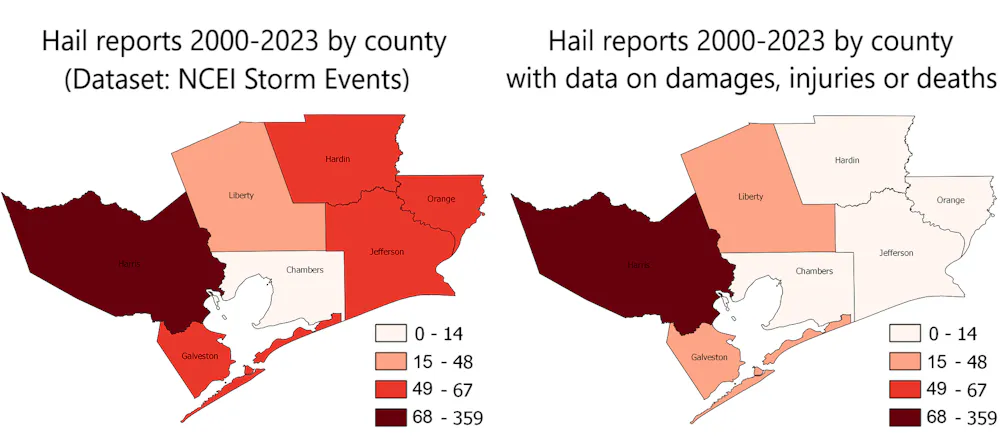
    The number of severe hail reports in southeast Texas listed in the National Centers for Environmental Information’s storm events database is strongly correlated with population. The county with the most reports and greatest detail in those reports is home to Houston. Hailstorms in the three easternmost counties are rarely associated with damage estimates.
    John Nielsen-Gammon and B.J. Baule

    Do you want to look at local damage trends? Forget about it. For most extreme weather events, estimation methods vary over time and are not documented.

    Do you want to direct funding to help communities improve resilience to natural disasters where the need is greatest? Forget about it. The places experiencing the largest per capita damages depend not just on actual damages but on the different practices of local National Weather Service offices.

    Are you moving to a location that might be vulnerable to extreme weather? Companies are starting to provide localized risk estimates through real estate websites, but the algorithms tend to be proprietary, and there’s no independent validation.

    4 steps to improve disaster data

    We believe a few fixes could make NOAA’s storm events database and the corresponding values in the larger SHELDUS database, managed by Arizona State University, more reliable. Both databases include county-level disasters and loss estimates for some of those disasters.

    First, the National Weather Service could develop standard procedures for local offices for estimating disaster damages.

    Second, additional state support could encourage local emergency managers to make concrete damage estimates from individual events and share them with the National Weather Service. The local emergency manager generally knows the extent of damage much better than a forecaster sitting in an office a few counties away.

    Third, state or federal governments and insurance companies can agree to make public the aggregate loss information at the county level or other scale that doesn’t jeopardize the privacy of their policyholders. If all companies provide this data, there is no competitive disadvantage for doing so.

    Fourth, NOAA could create a small “tiger team” of damage specialists to make well-informed, consistent damage estimates of larger events and train local offices on how to handle the smaller stuff.

    With these processes in place, the U.S. wouldn’t need a billion-dollar disasters program anymore. We’d have reliable information on all the disasters.

    John Nielsen-Gammon receives funding from the National Oceanic and Atmospheric Administration and the State of Texas.

    William Baule receives funding from NOAA, the State of Texas, & the Austin Community Foundation.

    ref. Storm damage costs are often a mystery – that’s a problem for understanding extreme weather risk – https://theconversation.com/storm-damage-costs-are-often-a-mystery-thats-a-problem-for-understanding-extreme-weather-risk-257105

    MIL OSI – Global Reports

  • MIL-OSI Global: How your electric bill may be paying for big data centers’ energy use

    Source: The Conversation – USA – By Ari Peskoe, Lecturer on Law, Harvard University

    Your power bill may be hiding something. photoschmidt/iStock/Getty Images Plus

    In the race to develop artificial intelligence, large technology companies such as Google and Meta are trying to secure massive amounts of electricity to power new data centers. Electric utilities see the prospect of earning large profits by providing electricity to these power-hungry facilities and are competing for their business by offering discounts not available to average consumers.

    In our paper Extracting Profits from the Public, we explain how utilities are forcing regular ratepayers to pay for the discounts enjoyed by some of the nation’s largest companies and identify ways policymakers can limit the costs to the public.

    Shifting costs

    In much of the U.S., utilities are monopolists. Within their service territories, they are the only companies allowed to deliver electricity to consumers. To fund their operations, utilities split the costs of maintaining and expanding their systems among all ratepayers – homeowners, businesses, warehouses, factories and anyone else who uses electricity.

    Historically, a utility expanded its system to meet growing demand for electricity from new factories, businesses and homes. To pay for its expansion − new power plants, new transmission lines and other equipment − the utility would propose to raise electricity rates by different amounts for various types of consumers.

    Public utility commissions are state agencies charged with ensuring that the public gets a fair deal. These commissions monitor how much money the utility spends to provide electric service and how its costs are shared among various types of ratepayers, including residential, commercial and industrial consumers. Ultimately, the public utility commission is supposed to approve any rate increases based on its assessment of what’s fair to consumers.

    Splitting the utility’s costs among all consumers made perfect sense when population growth and economic development across the economy stimulated the need for new infrastructure. But today, in many utility service territories, most of the projected growth in electricity demand is due to new data centers.

    Here’s the problem for consumers: To meet data center demand, utilities are building new power plants and power lines that are needed only because of data center growth. If state regulators allow utilities to follow the standard approach of splitting the costs of new infrastructure among all consumers, the public will end up paying to supply data centers with all that power.

    An artist’s rendering of a proposed Meta data center in Richland Parish, La.
    Meta via Facebook

    A big price tag

    One particularly acute example is in Louisiana. A Meta data center under development in the northeastern corner of the state is projected to use, by our calculations, twice as much energy as the city of New Orleans.

    Entergy, the regional monopoly utility, is proposing to build more than US$3 billion worth of new gas-fired power plants and delivery infrastructure to meet the data center’s energy demand. Rather than billing Meta directly for these costs, Entergy is proposing to include the costs in rates paid by all customers.

    Entergy claims its contract with Meta will cover some portion of the $3 billion price tag and that will mitigate any increases in consumers’ bills. But Entergy has asked state regulators to keep key terms of the contract secret, and only a redacted version of its application is available online.

    The public has no idea how much it might pay if the commission approves the contract. And if the Meta data center ends up using much less power than the company anticipates, the public does not know whether it would be on the hook to pay higher electricity rates for longer periods to guarantee Entergy a profit.

    The electronics in data centers consume large amounts of electricity.
    RJ Sangosti/MediaNews Group/The Denver Post via Getty Images

    Secret agreements

    Our research, reviewing nearly 50 public utility commission proceedings about data centers’ power needs across 10 states, uncovered dozens of secretive contracts between utilities and data centers. Unlike Louisiana, most states require utilities to submit to the public utility commission their one-off deals with data centers, but they allow utilities to conceal the pricing terms from the public.

    In normal rate-review cases, numerous parties advocate for their interests in a public proceeding, including members of the public, industry groups and the utility itself. But as our paper finds, utility commission reviews of data center contracts are based on confidential utility filings that are inaccessible to the general public. Few, if any, outsiders participate, and as a result the commission often hears only the utility’s version of the deal.

    Because the pricing terms are secret, it is impossible to know whether the deal that a utility is offering to a data center is too low to cover the utility’s costs of providing power to the data center, which would mean that the public is subsidizing the deal. History shows, however, that utilities have a long history of exploiting their monopolies to shift costs to the public, including through secret contracts.

    Electric utilities also charge customers for the costs of building and maintaining transmission networks.
    Jay L. Clendenin/Getty Images

    Other public costs

    Our paper also explores other ways that the public pays for data center energy costs. For instance, many high-voltage interstate transmission projects, which connect large power plants to local delivery systems, are developed through regional planning processes run by numerous utilities. These alliances have complex rules for splitting the costs of new transmission lines and equipment among their utility members.

    Once a utility is charged its share, it spreads the costs of new transmission projects among its local ratepayers. Because some regions are building new transmission capacity to accommodate data centers, our analysis finds that the public has been forced to pay billions of dollars for data center growth.

    Data center energy costs can also be shifted when data centers connect directly to existing power plants. Under what are called “co-location” deals, the power plant stops selling energy to the wider public and just sells to the data center. With less supply in the overall market, prices go up and the public faces higher bills as a result.

    Many state legislatures are noticing these problems and working to figure out how to address them. Several recent bills would set new terms and conditions for future data center deals that could help protect the public from data center energy costs.

    Ari Peskoe is the Director of the Electricity Law Initiative at the Harvard Law School Environmental and Energy Law Program (EELP). EELP receives funding from philanthropic foundations that support the clean energy transition.

    Eliza Martin does not work for, consult, own shares in or receive funding from any company or organization that would benefit from this article, and has disclosed no relevant affiliations beyond their academic appointment.

    ref. How your electric bill may be paying for big data centers’ energy use – https://theconversation.com/how-your-electric-bill-may-be-paying-for-big-data-centers-energy-use-257794

    MIL OSI – Global Reports

  • MIL-OSI Global: 100 years ago, the Supreme Court made a landmark ruling on parents’ rights in education – today, another case raises new questions

    Source: The Conversation – USA – By Charles J. Russo, Joseph Panzer Chair in Education and Research Professor of Law, University of Dayton

    A selection of books that are part of the Supreme Court case Mahmoud v. Taylor are pictured on April, 15, 2025, in Washington. AP Photo/Pablo Martinez Monsivais

    A century ago, the Supreme Court handed down one of its most important cases about education. On June 1, 1925, the court struck down an Oregon statute requiring all students to attend public school – a law critics argued was meant to limit faith-based schools, at a time when anti-Catholic bias was still common in parts of the United States.

    The majority opinion in Pierce v. Society of Sisters of the Holy Name of Jesus and Mary included a now-famous dictum about parents’ rights to shape their children’s upbringing. According to the court, “the child is not the mere creature of the state; those who nurture him and direct his destiny have the right, coupled with the high duty, to recognize and prepare him for additional obligations.”

    Soon, the Supreme Court is expected to release another decision around parental beliefs and education: Mahmoud v. Taylor. The plaintiffs are parents who want to excuse their children from public school lessons involving storybooks with LGBTQ+ characters – lessons they assert contradict their religious beliefs.

    As someone who teaches education law, I believe this is perhaps the court’s most significant case on parental rights since Pierce. Mahmoud raises questions not only about religious freedom, but also about educators’ ability to determine curricula, and public education in a pluralistic society.

    Picture-book debate

    Controversy arose during the 2022-23 school year in Montgomery County, Maryland’s largest school district, when officials approved various storybooks with LGBTQ+-inclusive themes to be incorporated into the English language-arts curriculum for preschool and elementary students.

    Some parents challenged the materials, including “Pride Puppy!”, a picture book the board later removed from use. Originally approved for preschool and pre-K, the story portrays a family whose puppy gets lost at a LGBTQ+ Pride parade, devoting a page to each letter of the alphabet. At the end of the book, a long “search and find” list of words for children to go back and look for in the pictures of the parade includes “[drag] queen” and “king,” “leather” and “lip ring.”

    Other materials for older children included stories about same-sex marriage, a transgender child and nonbinary bathroom signs.

    Parents who objected to the use of these materials on religious grounds sought to excuse their children from lessons using them. The parents basically argued that requiring their children to participate compelled or coerced them to go against their families’ religious beliefs.

    A group of parents protest in Rockville, Md., on June 27, 2023, in an effort to opt out of books that feature LGBTQ+ characters in Montgomery County schools.
    Sarah L. Voisin/The Washington Post via Getty Images

    Initially, officials agreed to allow opt-outs for elementary schoolers whose parents objected to the materials. However, a day later they changed their minds. Since then, school officials cited concerns about absenteeism, the feasibility of accommodating opt-out requests, and a desire to avoid stigmatizing LGBTQ+ students or families as reasons for their policy.

    A group of Muslim, Orthodox Christian and Catholic families challenged the board’s refusal to excuse their children from lessons using the disputed materials.

    The federal trial court, however, rejected the parents’ claim that having no opt-outs violated their right to due process.

    Parents appealed, and the 4th Circuit affirmed in favor of the school board 2-1. The court added that officials had not violated the parents’ First Amendment rights to freely exercise their faith. “There’s no evidence at present that the Board’s decision not to permit opt-outs compels the Parents or their children to change their religious beliefs or conduct, either at school or elsewhere,” the panel concluded.

    The dissenting judge stridently countered. Officials violated the parents’ free exercise rights by forcing them “to make a choice,” he wrote, between “either adher[ing] to their faith, or receiv[ing] a free public education for their children.” He also noted that the board’s opt-out policy was not neutral toward religion, because under Maryland regulations, children may be excused from sex-ed lessons.

    In January 2025, the Supreme Court agreed to hear the parents’ appeal, addressing whether the schools are burdening parents’ free-exercise rights.

    Court record

    In their brief to the Supreme Court and oral arguments, the parents cited Wisconsin v. Yoder, a Supreme Court ruling from 1972. The court found that Amish parents did not have to send their children to school after the eighth grade, which the families argued would violate their religious beliefs. Amish communities descend from Anabaptist Christians who fled persecution in Europe and emphasize living simply, eschewing many modern technologies.

    In Yoder, the justices agreed with the parents that their children received all the education they needed in their home communities. Under the First Amendment, parents have the right “to guide the religious future and education of their children,” the majority wrote, a matter “established beyond debate.”

    During oral arguments for Mahmoud in April 2025, some justices briefly discussed another precedent: the Supreme Court’s 1943 judgment in West Virginia State Board of Education v. Barnette, resolved at the height of U.S. involvement in World War II. Here, three parents who were Jehovah’s Witnesses refused to have their children participate in public schools’ flag salute and Pledge of Allegiance because they viewed it as a form of idolatry contrary to their religious beliefs. Others objected
    to the salute as “being too much like Hitler’s.”

    The court reasoned that educators could not compel students to participate, because forcing children – or anyone – to engage in activities inconsistent with their beliefs is contrary to their First Amendment rights to the free exercise of religion and freedom of speech.

    Viewed together, these cases highlight how the court has granted parents significant leeway to exempt their children from educational activities inconsistent with their religious beliefs.

    Questions at court

    During oral arguments, a majority of justices appeared to support the parents’ request to excuse children from lessons involving the books about LGBTQ+ characters.

    The board’s attorney argued that students did not have to agree with the books’ messages, simply to participate in the lesson. Being exposed to an idea “does not burden free exercise,” he said.

    Protesters in support of LGBTQ+ rights and against book bans outside the U.S. Supreme Court building on April 22, 2025, the day the court heard arguments in Mahmoud v. Taylor.
    Anna Moneymaker/Getty Images

    Chief Justice John Roberts, however, queried whether it is realistic for 5-year-olds to understand that distinction. He asked, “Do you want to say you don’t have to follow the teacher’s instructions, you don’t have to agree with the teacher? I mean, that may be a more dangerous message than some of the other things.”

    Other conservative justices also appeared skeptical of the idea that the lessons were merely exposing young children to ideas, but not instilling moral lessons. The storybooks do not simply explain that some people believe something and others do not, Justice Amy Coney Barrett suggested; they inform students that “this is the right view of the world.” Similarly, Justice Neil Gorsuch remarked that telling students that “some people think X, and X is wrong and hurtful and negative” is “more than exposure.”

    “What is the big deal about allowing them to opt out of this?” Justice Samuel Alito asked.

    Conversely, Justice Elena Kagan acknowledged that parents’ concerns were “serious,” but wondered how to draw limits on opt-out policies. Did the parents’ argument suggest that anytime “a religious person confronts anything in a classroom that conflicts with her religious beliefs or her parents’ that – that the parent can then demand an opt-out?”

    Justice Sonia Sotomayor pressed the plaintiffs’ attorney on whether “the mere exposure to things that you object to” really counts as coercion. And Justice Ketanji Brown Jackson questioned why, even if opt-outs are not allowed, public schools teaching “something that the parent disagrees with” is coercive, given that homeschooling and private schools are legal.

    Mahmoud raises challenging questions about curricular content, parental control and free exercise of religion – questions the court will hopefully resolve. A ruling is expected in June or early July 2025.

    Charles J. Russo does not work for, consult, own shares in or receive funding from any company or organization that would benefit from this article, and has disclosed no relevant affiliations beyond their academic appointment.

    ref. 100 years ago, the Supreme Court made a landmark ruling on parents’ rights in education – today, another case raises new questions – https://theconversation.com/100-years-ago-the-supreme-court-made-a-landmark-ruling-on-parents-rights-in-education-today-another-case-raises-new-questions-257876

    MIL OSI – Global Reports

  • MIL-OSI Video: Department of State Press Briefing – June 5, 2025 – 2:00 PM

    Source: United States of America – Department of State (video statements)

    Department Press Briefing with Principal Deputy Spokesperson Tommy Pigott at the Department of State, on June 5, 2025.

    ———-
    Under the leadership of the President and Secretary of State, the U.S. Department of State leads America’s foreign policy through diplomacy, advocacy, and assistance by advancing the interests of the American people, their safety and economic prosperity. On behalf of the American people we promote and demonstrate democratic values and advance a free, peaceful, and prosperous world.

    The Secretary of State, appointed by the President with the advice and consent of the Senate, is the President’s chief foreign affairs adviser. The Secretary carries out the President’s foreign policies through the State Department, which includes the Foreign Service, Civil Service and U.S. Agency for International Development.

    Get updates from the U.S. Department of State at www.state.gov and on social media!
    Facebook: https://www.facebook.com/statedept
    X: https://x.com/StateDept
    Instagram: https://www.instagram.com/statedept
    Flickr: https://flickr.com/photos/statephotos/
    Rumble: https://rumble.com/c/StateDept
    Substack: https://statedept.substack.com

    Watch on-demand State Department videos: https://video.state.gov/
    Subscribe to The Week at State e-newsletter: https://public.govdelivery.com/accounts/USSTATEBPA/signup/32562

    State Department website: https://www.state.gov/
    Careers website: https://careers.state.gov/
    White House website: https://www.whitehouse.gov/
    Terms of Use: https://state.gov/tou

    #StateDepartment #DepartmentofState #Diplomacy

    https://www.youtube.com/watch?v=VsGIDrVpLZY

    MIL OSI Video

  • MIL-OSI Russia: Rosneft’s green investment volume in 2024 reached 74 billion rubles

    Translation. Region: Russian Federal

    Source: Rosneft – Rosneft – An important disclaimer is at the bottom of this article.

    June 5 is World Environment Day, its goal is to draw attention to measures to protect ecosystems. In Russia, this date coincides with Ecologist Day.

    Rosneft implements large-scale events and projects aimed at preserving a favorable environment. In 2024, the Company’s “green” investments amounted to 74 billion rubles and exceeded the previous year’s level by 16%. In total, over the past three years, this figure amounted to almost 200 billion rubles.

    The key components of the Company’s long-term environmental agenda are reflected in the strategy “Rosneft-2030: Reliable Energy and Global Energy Transition”. The priorities of the Company and its subsidiaries include the implementation of programs for land reclamation, including “historical heritage”, increasing the reliability of pipelines, preserving water resources and biological diversity in the regions of presence.

    Thus, Samotlorneftegaz completed the implementation of a large-scale program for the reclamation of “historical heritage” lands in 2024 – the total area of restored lands exceeded 2.2 thousand hectares. The company carried out about 85% of all reclamation work using its own eco-service. During the project, new technologies were developed and unique experience was gained, which is in demand by other enterprises.

    Rosneft pays great attention to reforestation activities, thereby contributing to the sustainable development of ecosystems, the preservation of biodiversity, and the fight against climate change. The Company, together with the Government of the Krasnoyarsk Territory, is implementing a comprehensive forest climate project aimed at unlocking the climate-regulating potential of the region’s forests and promoting sustainable development. In 2024, the Company and its subsidiaries in the regions of presence planted almost 11 million seedlings and trees of various species.

    Rosneft is actively implementing the principles of a closed-loop economy (circular economy). Improving the efficiency of waste management processes is one of the priority goals of the Company’s strategy until 2030. The Company’s production enterprises are successfully implementing waste-free technologies that make it possible to obtain artificial soil from drill cuttings – an environmentally friendly building material.

    In addition, the enterprises of the Samara group of the Company handed over almost 300 tons of spent catalyst for recycling. More than 8 thousand tons of non-ferrous and ferrous metal were sent for recycling by the Achinsk Oil Refinery, Saratov Oil Refinery, Syzran Oil Refinery, Kuibyshevsky Oil Refinery, Novokuibyshevsky Oil Refinery, RN-Vankor and Bashneft enterprises.

    The Kuibyshev Oil Refinery, Novokuibyshevsk Oil Refinery, RN-Vankor and Bashneft enterprises also sent about 4.5 thousand tons of waste oils and emulsions, etc. for recycling.

    Biodiversity conservation is another significant area of Rosneft’s environmental activities. The company has been holding annual events to replenish Russia’s aquatic bioresources for over 10 years. In 2024, Rosneft enterprises released over 21.7 million young fish into the country’s water bodies.

    Volunteers of the Company, its subsidiaries and design institutes also actively participate in various environmental initiatives, promote the development of a culture of rational and responsible consumption of natural resources. Employees with children take part in events for greening and improvement of urban areas and natural recreational zones, cleaning of coastlines as part of federal environmental campaigns such as “Green Spring”, “Garden of Memory”, “Water of Russia”, “Clean Shores” and others.

    For over 15 years, Samotlorneftegaz volunteers have been holding clean-up days to clean the shoreline of Lake Kymyl-Emtor as part of the All-Russian campaign “Water of Russia”.

    Samara oil workers help the employees of the Botanical Garden of Samara University to clear the territory of dead wood and leaves, to purchase rare plant species and plant seedlings, and also to restore and improve springs in the region. In 2024, volunteers of the Samara region collected more than 30 cubic meters of garbage from the coastal areas of the Volga and Sok rivers. Volunteers of the Novokuibyshevsk Petrochemical Company collected 930 kg of household waste during an environmental run.

    In 2024, RN-Nyaganneftegaz oil workers collected about 3 tons of household waste from the coastline of the Nyagan-Yugan River.

    Earlier, on the eve of Victory Day, employees of Rosneft enterprises organized the cleaning of parks, memorial complexes and monuments dedicated to the feat of the Soviet people during the Great Patriotic War.

    The Company’s enterprises make a significant contribution to the conservation of natural resources – they organize campaigns to collect used batteries, plastic and waste paper for their further recycling. In 2024, Rosneft employees handed over over 1,100 kg of used batteries, uninterruptible power supplies and disposable batteries for recycling, transferred over 7 tons of plastic for recycling and collected about 180 tons of waste paper.

    Rosneft volunteers also actively promote environmental education of young people and conduct environmental quests, master classes, quizzes and eco-lessons for schoolchildren. For example, Orenburgneft implemented the Eco-School project in 2024 and, together with students from the region’s schools, collected more than 10 tons of waste paper, more than 70 kg of batteries and more than 17 kg of plastic caps.

    For 14 years now, the company has been holding annual environmental safety competitions, which help to raise the level of environmental culture and serve as an incentive for subsidiaries to build up their competencies and improve their work in this area.

    The successful environmental activities of Rosneft subsidiaries have received high public praise. In 2024, the Company’s plants – Syzran Oil Refinery, Novokuibyshevsky Oil Refinery, Kuibyshevsky Oil Refinery – received the highest awards of the All-Russian competition “Leader of Environmental Activities in Russia”.

    Department of Information and Advertising of PJSC NK Rosneft June 5, 2025

    Please note: This information is raw content directly from the source of the information. It is exactly what the source states and does not reflect the position of MIL-OSI or its clients.

    MIL OSI Russia News

  • MIL-OSI United Nations: UNECE advances support for Ukraine’s recovery through action on green and resilient urban energy projects

    Source: United Nations Economic Commission for Europe

    Since Russia’s full-scale invasion of Ukraine, the country’s energy infrastructure has suffered approximately $20 billion in damage, causing widespread power outages and insufficient heat supply – with the cities of Kharkiv and Mykolaiv alone accounting for over $630 million in losses, according to UNDP.  

    While emergency efforts have focused on rebuilding existing capacity and fossil fuel capacity replacements, this approach can overlook the need for more resilient and sustainable local energy solutions. In addition to the need to rebuild energy infrastructure and meet ambitious 2030 renewable energy targets in place in national energy and climate laws, Ukraine aims to move to a system that balances centralized and decentralized systems, across heat, electricity and energy demand.  

    In this context, Ukrainian cities will play an important role in the country’s sustainable and resilient reconstruction that is aligned with the energy transition, as well as with European standards and regulations. 

    Meeting with Ukraine’s Ambassador to the United Nations and other International Organizations in Geneva, H.E. Yevhenii Tsymbaliuk, UNECE Executive Secretary Tatiana Molcean reiterated UNECE’s steadfast commitment to help the government address these issues, building on strong cooperation on urban development and energy policy. Looking ahead to the Ukraine Recovery Conference to be held in Rome in July, she underscored solidarity and ongoing support for Ukraine’s sustainable and resilient recovery across UNECE’s areas of expertise. 

    Local action for Ukraine’s green energy recovery 

    Support to urban reconstruction planning has been a core dimension of UNECE’s support to Ukraine’s recovery since the start of the war. Through the UN4UkrainianCities initiative, UNECE has mobilized international partners to support the development of concept master plans and pilot projects in the cities of Kharkiv and Mykolaiv, and has supported the government to draft new housing legislation, including the State Housing Policy Strategy, as well as to strengthen capacities for the Urban Planning Cadastre. 

    To this end, UNECE, the United Nations Environment Programme (UNEP), and the Autonomous Region of Bolzano in Italy jointly organized an international study trip to strengthen the capacities of the cities of Kharkiv and Mykolaiv, among other 2 municipalities, for integrated urban energy planning focused on decentralized and renewable local energy and modern district heating systems.  

    This study visit is facilitated by the UNEP programme “Unlocking greener and more resilient energy in Ukrainian cities”, supported by the Italian Development Co-operation (AICS), and by UNECE’s UN4UkrainianCities initiative. Additional support to the study visit is provided by the NOI Technopark in Bolzano, Alperia (Bolzano, Italy), and EURAC Research. 

    Officials from Kharkiv and Mykolaiv will benefit from the guidance of international experts, and site visits to state-of-the-art local, renewable and decentralized energy installations. 

    Mobilizing partnerships meet financing needs on the ground 

    At the Hamburg Sustainability Conference this week, the City Council of Bucha, home to 73,000 people and located 30km from Kyiv, presented a project for the construction of a decentralised city energy system. Supported by UNECE, this provided an opportunity to present the project seeking €145 million from potential investors and financiers in staged investment through Public-Private Partnerships. 

    Developed in response to energy capacity losses during the war, the distributed energy system aims to provide a reliable uninterruptible power supply of over 112 MW through a clean, flexible and autonomous system comprising generation facilities and grid connection infrastructure. This would include power plants for households and critical infrastructure, power for the city’s industrial cluster, and energy storage systems. The project would in addition create an estimated 120 jobs. 

    Continued support for sustainable recovery 

    In Geneva, the Executive Secretary also recalled UNECE’s broader, multisectoral support to the government of Ukraine in implementing the National Recovery Plan, including through: the PIERS methodology to assess sustainability of infrastructure projects, facilitating Public-Private Partnerships and other investment; the Platform for Action on the Green Recovery of Ukraine; the Inter-agency Coordination Group on Environmental Assessments for Ukraine; harnessing Innovation for Sustainable Development; support for water-related and other environmental challenges, leveraging UNECE Multilateral Environmental Agreements; and applying the UN Framework Classification for Resources (UNFC) to support the sustainable management of Ukraine’s critical raw materials. 

    MIL OSI United Nations News

  • MIL-OSI Europe: ASIA/INDIA – Amristar, a city sacred to the Sikhs, should become a “war-free zone”

    Source: Agenzia Fides – MIL OSI

    Archdiocese of Amristar

    New Delhi (Agenzia Fides) – Amritsar, the holy city of Sikhism, on the border between India and Pakistan and home to the famous Golden Temple, should be declared a “war-free zone” and be granted international protection following the example of the Vatican. This is Indian parliamentarian and Sikh Sukhjinder Singh Randhawa demanded of the Indian government. He called on Indian Prime Minister Narendra Modi to work with international bodies to initiate the appropriate recognition process for a city that presents itself as a symbolic place of peace for humanity.The matter, according to an open letter, has “deep spiritual and national significance,” because “the holy city of Amristar is not just a geographical location, but the spiritual heart of the Sikh faith and a beacon of love and peace for humanity.” “Its sacred aura transcends religious boundaries, offering comfort, unity, and compassion in a world increasingly torn by conflict and division,” he continued.”For Sikhism, Amritsar has the same spiritual significance as Mecca has for Muslims and the Vatican has for Christians. Therefore, I humbly request that Amritsar’s global spiritual significance be officially recognized and that appropriate international security mechanisms, similar to those that protect the Vatican, be adopted,” he said.Randhawa noted that “recent geopolitical tensions, particularly on the India-Pakistan front, have rekindled legitimate concerns about Amritsar’s potential vulnerability in the event of a military conflict.” “The appeal,” the letter continues, “is not a request for political sovereignty (such as that enjoyed by the Vatican City), but rather a request for international spiritual recognition and permanent security protection. At a time marked by increasing global tensions and militarization, it is imperative that Amritsar be protected from the threat of war and violence, now and forever,” the MP said. The politician recalled the universal teachings of the Guru Granth Sahib (the holy text of Sikhism), which are based on peace, humility, and brotherhood and represent “a powerful moral force against the rising tide of militarism in the world.” “While many global powers are increasingly inclined toward conflict, the Sikh ethos of ‘Sarbat da Bhala’ (‘the well-being of all’) stands as one of humanity’s last hopes for coexistence and peace,” he noted. The concerns expressed by the Sikh community and civil society throughout India require a broader perspective, the MP continued, beyond regional circles and within an international framework, “to ensure the security and sanctity of this revered city under all circumstances.” Requesting the support of other parliamentarians of all religions, Randhawa urged the Indian Prime Minister “to take the necessary diplomatic and legislative steps to declare Amritsar a ‘war-free zone’ and a place recognized and respected by all, as it carries a message of peace and harmony for all humanity.” (PA) (Agenzia Fides, 5/6/2025)
    Share:

    MIL OSI Europe News

  • MIL-OSI Russia: China and Russia are ready to deepen cross-border cooperation in the field of protection of wild tigers and leopards

    Translation. Region: Russian Federal

    Source: People’s Republic of China in Russian – People’s Republic of China in Russian –

    Source: People’s Republic of China – State Council News

    CHANGCHUN, June 5 (Xinhua) — The first meeting of the Joint Commission for the Implementation of the Agreement between the Governments of China and Russia on the Establishment of the “Land of Big Cats” Transboundary Nature Reserve was held in Changchun, capital of northeast China’s Jilin Province, on Wednesday. The two sides held an in-depth exchange of views on cross-border cooperation in environmental protection, aiming to further integrate the resources and strengths of the two countries in the cross-border protection of tigers and leopards and establish a more effective cooperation mechanism.

    The joint commission includes, on the Chinese side, the Department of International Cooperation of the State Forestry and Grassland Administration of the People’s Republic of China, the administration of the National Park of Manchurian Tigers and Far Eastern Leopards, as well as the relevant departments for nature conservation on the Russian side.

    Working mechanisms such as regular meetings, exchange of information and joint law enforcement will be established.

    At the meeting, an official from the State Forestry and Grassland Administration of China emphasized that in the future, the work of the joint commission will focus on such aspects as strengthening joint monitoring and data exchange, promoting the construction of transboundary ecological corridors, conducting a tough fight against crimes such as transboundary poaching, deepening cooperation in scientific research, holding environmental education events, etc.

    Representatives of the Russian side stated that the Russian side will fully support the work of the joint commission, actively implement various areas of cooperation and jointly protect the home of tigers and leopards.

    Let us recall that the Manchurian Tiger and Far Eastern Leopard National Park was officially established in 2021. According to the latest data, about 70 Manchurian tigers and about 80 Far Eastern leopards currently live in this park. -0-

    MIL OSI Russia News

  • MIL-OSI Russia: South Korean parliament passes bills to appoint special prosecutors to investigate allegations against Yoon Seok-yeol and first lady

    Translation. Region: Russian Federal

    Source: People’s Republic of China in Russian –

    Source: People’s Republic of China – State Council News

    SEOUL, June 5 (Xinhua) — South Korea’s National Assembly on Thursday passed bills to appoint special prosecutors and investigate allegations of a coup against ousted President Yun Seok-yul and scandals involving first lady Kim Geon-hee.

    Of the 198 National Assembly lawmakers present at the plenary session, 194 supported the bills, three voted against and one abstained.

    Under the bills, new President Lee Jae-myung must appoint an independent prosecutor for each case from two recommended candidates.

    The special investigation will focus on allegations of sedition against Yun Seok-yul, who was removed from office in April after martial law was declared last December.

    Former President Kim Geun-hee’s wife will be investigated for allegedly manipulating stock prices, receiving luxury handbags, interfering with the nomination of candidates for the 2022 by-elections and the 2024 parliamentary elections, and rigging opinion polls during the 2022 presidential election. –0–

    MIL OSI Russia News

  • MIL-OSI Russia: China’s Equipment Upgrade Program Effectively Stimulates Domestic Demand

    Translation. Region: Russian Federal

    Source: People’s Republic of China in Russian – People’s Republic of China in Russian –

    Source: People’s Republic of China – State Council News

    BEIJING, June 5 (Xinhua) — Jiangsu Tengsheng Textile Technology Group Co., Ltd. has been a hub of activity since the beginning of the year. Its participation in the national equipment renewal campaign has opened a promising path to a bright future for the textile manufacturer.

    “After the upgrade is completed, our equipment will reach the leading standards in the domestic industry,” said Chen Guichun, deputy general manager of the company based in east China’s Jiangsu Province. “We expect this upgrade to improve our efficiency by more than 5 percent and increase our unit output by about 20 percent.”

    The company’s efforts are part of China’s massive trade-in program for equipment upgrades and consumer goods replacement, which was launched in March 2024. The program involves various government departments using ultra-long-term special government bonds to accelerate the implementation of related measures to stimulate investment and consumption.

    The People’s Bank of China (PBOC, the central bank) announced last month that it would increase the refinancing quota for technological innovation and technical transformation from 500 billion yuan (about $69.6 billion) to 800 billion yuan. In addition, the regulator also cut the refinancing rate to 1.5 percent from 1.75 percent.

    This innovation is part of the PBOC’s structural monetary instruments aimed at expanding domestic demand, said Ding Zhijie, director of the PBOC Financial Institute. “This will ensure continued support for the implementation of the equipment renewal program and the replacement of consumer goods with new ones under the trade-in scheme,” he stressed in the latest edition of the all-media discussion program “China Economy Roundtable” organized by Xinhua News Agency.

    “It took only four months from the time we applied to receiving government support, which is a very effective indicator for us,” said Xu Guoqiang, assistant manager of Chilwee Group Co., Ltd., a battery manufacturing subsidiary in east China’s Zhejiang Province.

    According to him, the company invested a total of 60 million yuan in upgrading the equipment, of which more than 8 million yuan was provided by the state.

    Likewise, many other companies in the country’s key industries have begun upgrading their equipment and are reaping the benefits. In April, the added value of China’s major high-tech manufacturing and digital products sectors grew 10 percent year-on-year, according to the National Bureau of Statistics (NBS).

    In the year since the campaign was launched, it has successfully identified the huge potential of the country’s domestic market. In the first four months of this year, investments in the acquisition of equipment and devices grew by 18.2 percent year-on-year. According to the State Statistical Service, the share of the indicator in the overall investment growth for the period was 64.5 percent.

    Ding Lin, an official with the National Development and Reform Commission (NDRC), said at a roundtable that China, as the world’s second-largest economy with a population of more than 1.4 billion, has huge potential to expand domestic demand.

    To this end, the country should explore more approaches to increasing household incomes and expanding consumer potential, while continuing to optimize its policies in the area of consumption support, he stressed.

    In addition to accelerating equipment upgrades across the country, Ding Lin said the NDRC will allocate 800 billion yuan in ultra-long-term special government bonds to support the country’s major national strategies and strengthen security capabilities in key areas. Ding Lin called this a “proactive move” to stimulate effective investment.

    “We will accelerate the development of the project and the distribution of funds in order to achieve tangible results as soon as possible,” he concluded. -0-

    MIL OSI Russia News

  • MIL-OSI Russia: Cumulative gas production at China’s largest coalbed methane field exceeds 3.6 billion cubic meters

    Translation. Region: Russian Federal

    Source: People’s Republic of China in Russian – People’s Republic of China in Russian –

    Source: People’s Republic of China – State Council News

    TAIYUAN, June 5 (Xinhua) — The cumulative gas output from the Daning-Jixian coalbed methane field in north China’s Shanxi Province exceeded 3.6 billion cubic meters as of the end of May 2025, coalbed methane producer PetroChina Coalbed Methane Co., Ltd. said Thursday.

    As an unconventional natural gas, coal bed methane is considered a clean energy resource of strategic importance. Its use can help reduce risks in mining operations, reduce greenhouse gas emissions, and alleviate gas shortages.

    Shanxi Province has rich coal bed methane resources. The region’s reserves within 2,000 meters underground are estimated at 8.31 trillion cubic meters, accounting for about a third of the country’s total.

    In recent years, thanks to technological advances in coalbed methane production, the production capacity of Daning-Jixian Methane Field has been steadily growing.

    In 2024, the coalbed methane production at the Daning-Jixian field reached 1.96 billion cubic meters. -0-

    MIL OSI Russia News

  • Transformative urban development initiatives empower India’s middle class

    Source: Government of India

    Source: Government of India (4)

    Over the past decade, several ambitious government initiatives have significantly reshaped urban living in India, bringing improved housing, transport, and connectivity to millions. These programmes have not only enhanced infrastructure but have also strengthened the sense of security and pride among middle-class and low-income families.

    Since its launch in 2015, the Pradhan Mantri Awas Yojana (Urban) has emerged as a beacon of hope for many seeking affordable housing. With a central assistance commitment of ₹1.97 lakh crore, of which ₹1.69 lakh crore has been disbursed so far, the scheme has witnessed remarkable progress.

    Between 2014 and May 2025, more than 1.16 crore houses were sanctioned, construction has commenced on over 1.12 crore units, and more than 92.72 lakh homes have been completed or handed over to beneficiaries. Beyond the statistics, these homes represent stability, dignity, and empowerment for families across urban India, marking a significant stride in the nation’s urban welfare agenda.

    Urban transport has also received an unprecedented boost with the rapid expansion of metro rail networks. India’s metro system, now operational in 29 cities, has expanded to 1,013 kilometres by May 2025, a striking increase from just 248 kilometres in 2014. The approval of 34 new metro projects covering 992 kilometres further underscores the Government’s commitment to enhancing urban mobility. Daily ridership has soared from 28 lakh passengers in 2013 to over 1.12 crore today.

    The pace of commissioning metro lines has increased ninefold, with an average of six kilometres of new track becoming operational each month, compared to less than one kilometre monthly before 2014. The annual budget allocation for metro rail projects has also surged more than six times, reflecting the prioritisation of urban transport in the national development agenda.

    The Ude Desh Ka Aam Nagrik (UDAN) scheme, introduced in 2016, has revolutionised regional air travel by making it affordable and accessible to the common citizen. With 88 airports, including two water aerodromes and thirteen heliports, connected through 625 routes, UDAN has facilitated over 1.49 crore passengers to fly at economical rates. The scheme has played a pivotal role in boosting tourism, enhancing healthcare access, and fostering trade in tier 2 and tier 3 cities. India’s airport network has more than doubled, growing from 74 airports in 2014 to 160 in 2025, supported by ₹4,023.37 crore in Viability Gap Funding to sustain connectivity in underserved regions.

    Ensuring transparency and consumer protection in the housing sector has been a key priority with the enactment of the Real Estate (Regulation and Development) Act (RERA) in 2016. The legislation mandates every state and union territory to establish regulatory authorities that maintain public portals detailing registered real estate projects. As of March 2025, these authorities have addressed over 1.4 lakh consumer complaints, thereby enhancing accountability and rebuilding trust in the real estate market.

  • MIL-OSI: Military Drone Market Size Expected to Reach $15.16 Billion In 2030 as Cutting-Edge Innovations Improve Operations

    Source: GlobeNewswire (MIL-OSI)

    PALM BEACH, Fla., June 05, 2025 (GLOBE NEWSWIRE) — FN Media Group News Commentary – According to industry experts, the Military Drone market is expected to continue substantial growth in the years to come. The market is characterized by a complex interplay of drivers, restraints, and a spectrum of opportunities collectively shaping its trajectory, especially in the military market. Military drones, also known as Unmanned Aerial Vehicles (UAVs), are advanced technological systems used by military forces for various purposes. These drones are designed to operate without a human pilot on board, and they are remotely controlled or autonomously programmed to carry out a range of tasks. Military drones come in various sizes and configurations, from small hand-launched models to more prominent, long-endurance aircrafts. They serve many roles, including reconnaissance, surveillance, target acquisition, intelligence gathering, communication relays, and combat operations. Their ability to operate in challenging environments, gather real-time data, and execute missions with reduced risk to human personnel has made them valuable assets in modern warfare strategies. However, their use raises ethical and legal considerations concerning civilian safety, privacy, and potential misuse. A report from Verified Market Research said that: “The Military Drone market is characterized by a complex interplay of drivers, restraints, and a spectrum of opportunities collectively shaping its trajectory. Technological advancement stands as a prominent driver, propelling the market forward with cutting-edge innovations that enhance the capabilities of unmanned aerial vehicles (UAVs). These advancements encompass a range of functionalities, from improved surveillance and reconnaissance to combat capabilities, all of which contribute to the drones’ strategic significance on the battlefield. Additionally, the cost-effectiveness of Military Drone compared to manned aircraft is a compelling driver, enabling military forces to achieve operational objectives with reduced financial burdens.”   Active Companies in the markets today include ZenaTech, Inc. (NASDAQ: ZENA), Red Cat Holdings, Inc. (NASDAQ: RCAT), Kratos Defense & Security Solutions, Inc. (NASDAQ: KTOS), AeroVironment (NASDAQ: AVAV), Northrop Grumman Corporation (NYSE: NOC).

    Verified Market Research continued: “A range of opportunities beckons the Military Drone market. One such opportunity lies in intelligent swarming, where multiple drones collaborate seamlessly to achieve intricate missions, providing enhanced surveillance and reconnaissance capabilities. Additionally, the development of counter-drone technologies represents a growing niche within the market, as the increasing proliferation of drones necessitates robust defenses against hostile UAVs. The convergence of commercial and military sectors offers a unique avenue for collaboration, fostering cross-pollination of technologies and innovative solutions. Integrating artificial intelligence and automation further widens the scope of Military Drone applications in the realm of technological advancement. These capabilities enable drones to execute complex tasks autonomously, reducing the burden on human operators and opening doors to entirely new mission profiles. Moreover, exploring hybrid power systems and stealth technology holds promise for extending drone endurance and elevating their covert capabilities, expanding the range of potential operations.”

    ZenaTech (NASDAQ:ZENA) Launches Drone as a Service (DaaS) for US Defense and Government Agencies with New Partnerships – ZenaTech, Inc. (FSE: 49Q) (BMV: ZENA) (“ZenaTech”) a technology company specializing in AI (Artificial Intelligence) drones, Drone as a Service (DaaS), Enterprise SaaS, and Quantum Computing solutions, today announces the launch of Drone as a Service specifically for US Defense and Government agencies, and two new partnerships with consulting and government relations firms to assist in selling these services.

    ZenaTech’s ZenaDrone subsidiary has retained the services of Bromelkamp Government Relations and Winning Strategies Washington to provide Congressional lobbying and defense business development consulting services. Bromelkamp is a defense-focused business development consulting firm to small and medium technology companies that are growing their business with the US Department of Defense and other security-related federal agencies. Winning Strategies is an independent bipartisan federal government relations and grants procurement firm.

    “These partnerships will be instrumental in building relationships with the various agencies as we launch our DaaS service and expand our sales efforts in this sector,” said Shaun Passley, Ph.D., CEO of ZenaTech. “Bromelkamp and Winning Strategies have decades of defense industry experience and understand the complexities and culture of the military. As defense priorities shift toward autonomy, resilience, and secure supply chains, ZenaTech is uniquely positioned to deliver scalable, mission-ready drone solutions that align with the US military and the defense industry. Our Drone as a Service model is designed to accelerate adoption, lower barriers, and support operational agility.”

    With a growing demand for advanced drone solutions in security, logistics and tactical operations, the DaaS model allows defense customers to deploy mission-specific drone solutions without the need for capital equipment purchases. To accelerate market entry, ZenaTech has onboarded two seasoned military consultants to lead business developments, identify pilot programs, and secure funding partnerships within the defense sector.

    The ZenaDrone 1000 is an autonomous, military grade aerial solutions built for multi-mission flexibility, featuring a patented foldable-wing design, 40 kg payload capacity, and 1 hour flight time. Its onboard AI, thermal imaging, LiDAR, and multi spectral sensors enable real-time ISR (intelligence, surveillance, and reconnaissance), border patrol, and base surveillance with minimal operator input. The modular cone enables fast swapping of mission-specific payloads like HD Cameras and sensors, making it ideal for tactical resupply, SAR (search and rescue), infrastructure inspection, and operations in high-risk restricted environments. Rugged, AI-powered and rapidly deployable, the ZenaDrone 1000 enhances situational awareness and operational reach for defense forces.

    The ZenaDrone IQ Nano and IQ Square are compact, high-performance drone solutions engineered for intelligence, surveillance, and reconnaissance (ISR), indoor security, and tactical inspection in complex military environments. The IQ Nano, excels in GOS-denied environments like military warehouses or confined infrastructure, offering obstacle avoidance, and precise maneuverability. The IQ Square, with extended flight time and payload options, supports ISR, CBRN monitoring and perimeter patrols. Lightweight and field-ready, both drones deliver rapid situational awareness for mission-critical deployments.

    ZenaTech is actively pursuing Green UAS and Blue UAS certifications to meet stringent federal standards. With recent restrictions on Chinese-made drones in military and government operations, these certifications are mandatory for vendors aiming to participate in DoD and allied agency contracts. ZenaTech’s compliant drone solutions open access to high-value defense contracts and align with increasing demand for secure aerial solutions.

    The DaaS business model offers customers reduced upfront costs and convenience ─ there is no need to purchase drone hardware and software, find a drone pilot, manage maintenance and operation, or acquire regulatory approvals. The model also offers scalability to use more often or less often based on business needs. Continued… Read this full release by visiting: https://www.financialnewsmedia.com/news-zena/.

    Other recent developments in the markets include:

    Red Cat Holdings, Inc. (NASDAQ: RCAT), a drone technology company integrating robotic hardware and software for military, government, and commercial operations, recently reported its financial results for the first quarter ended March 31, 2025 and provides a corporate update.

    “Red Cat’s momentum continues to build as we execute on our strategy to deliver advanced, AI-enabled unmanned systems across air, land, and sea,” said Jeff Thompson, Red Cat CEO. “Our partnership with Palantir to deploy Warp Speed is optimizing our manufacturing and cost efficiency, while our expansion into maritime autonomy with Unmanned Surface Vessels significantly expands our Family of Systems. A strong balance sheet bolstered by a recent $30 million capital raise positions us strongly to meet growing domestic and international demand in the second half of 2025.”

    “Our balance sheet remains strong as we transition to production and delivery of our new Black Widow drones,” said Chris Ericson, Red Cat CFO. “We have bolstered our quarter-end cash and receivables of $9 million with an additional $30 million from a capital raise executed soon after quarter-end. This liquidity has given us ample strength and ability to expand manufacturing to meet the impending demands of the U.S. Army’s SRR program and international opportunities for the second half of 2025.”

    Kratos Defense & Security Solutions, Inc. (NASDAQ: KTOS), a Technology Company in the Defense, National Security and Global Markets, and GE Aerospace (NYSE: GE) recently announced a formal teaming agreement to advance propulsion technologies for the next generation of affordable unmanned aerial systems and Collaborative Combat Aircraft-type (CCA-type) aircraft.

    Eric DeMarco, President and CEO of Kratos, said, “Kratos’ strategically important Teaming Agreement with GE Aerospace continues to rapidly advance and expand, with the GEK family of engines targeting certain of the most important, mission critical and highest priority needs and requirements of United States National Security. At Kratos, affordability is a technology and delivering more capability for less cost as quickly as possible are key contributions we are bringing for truly industry leading GEK offerings with our partner and global leader GE Aerospace.”

    Tomahawk GCS, an AeroVironment (NASDAQ: AVAV) product line specializing in autonomous and intelligent multi-domain systems, has recently been awarded a $5.1 million contract to support the U.S. Army Rapid Capabilities and Critical Technologies Office (RCCTO) Human-Machine Integrated Formations (HMIF) rapid prototyping project. Following a rigorous selection process, AV’s Tomahawk’s Grip TA5 was selected as the Dismounted Common Controller (DCC) to significantly enhance human-machine teaming for battlefield operations.

    The HMIF initiative, led by the U.S. Army RCCTO, is accelerating the integration of autonomous and robotic systems into formations to enhance situational awareness, lethality, and survivability. With its modular architecture and multi-platform compatibility, the Grip TA5 provides operators command-and-control of multiple robotic assets in real-time, enhancing mission adaptability and response speed.

    Northrop Grumman Corporation (NYSE: NOC) has recently invested $50 million into Firefly Aerospace to further advance production of their co-developed medium launch vehicle, now known as Eclipse™. The companies continue to make progress in the development of Eclipse flight hardware with qualification testing underway and more than 60 Miranda engine hot fire tests performed to date.

    “Firefly is incredibly grateful for Northrop Grumman’s investment that further solidifies our first-of-its-kind partnership to build the first stage of Antares 330 and jointly develop Eclipse,” said Jason Kim, CEO of Firefly Aerospace. “Eclipse represents two powerful forces coming together to transform the launch market with decades of flight heritage, a rapid, iterative approach, and bold innovation. With a 16 metric ton to orbit capability, Eclipse is a sweet spot for programs like NSSL Lane 1 and a natural fit to launch proliferated constellations in LEO, MEO, GEO, and TLI.”

    About FN Media Group:

    At FN Media Group, via our top-rated online news portal at www.financialnewsmedia.com, we are one of the very few select firms providing top tier one syndicated news distribution, targeted ticker tag press releases and stock market news coverage for today’s emerging companies. #tickertagpressreleases #pressreleases

    Follow us on Facebook to receive the latest news updates: https://www.facebook.com/financialnewsmedia

    Follow us on Twitter for real time Market News: https://twitter.com/FNMgroup

    Follow us on Linkedin: https://www.linkedin.com/in/financialnewsmedia/

    DISCLAIMER: FN Media Group LLC (FNM), which owns and operates FinancialNewsMedia.com and MarketNewsUpdates.com, is a third party publisher and news dissemination service provider, which disseminates electronic information through multiple online media channels. FNM is NOT affiliated in any manner with any company mentioned herein. FNM and its affiliated companies are a news dissemination solutions provider and are NOT a registered broker/dealer/analyst/adviser, holds no investment licenses and may NOT sell, offer to sell or offer to buy any security. FNM’s market updates, news alerts and corporate profiles are NOT a solicitation or recommendation to buy, sell or hold securities. The material in this release is intended to be strictly informational and is NEVER to be construed or interpreted as research material. All readers are strongly urged to perform research and due diligence on their own and consult a licensed financial professional before considering any level of investing in stocks. All material included herein is republished content and details which were previously disseminated by the companies mentioned in this release. FNM is not liable for any investment decisions by its readers or subscribers. Investors are cautioned that they may lose all or a portion of their investment when investing in stocks. For current services performed FNM has been compensated fifty one hundred dollars for news coverage of the current press releases issued by ZenaTech, Inc. by the Company. FNM HOLDS NO SHARES OF ANY COMPANY NAMED IN THIS RELEASE.

    This release contains “forward-looking statements” within the meaning of Section 27A of the Securities Act of 1933, as amended, and Section 21E the Securities Exchange Act of 1934, as amended and such forward-looking statements are made pursuant to the safe harbor provisions of the Private Securities Litigation Reform Act of 1995. “Forward-looking statements” describe future expectations, plans, results, or strategies and are generally preceded by words such as “may”, “future”, “plan” or “planned”, “will” or “should”, “expected,” “anticipates”, “draft”, “eventually” or “projected”. You are cautioned that such statements are subject to a multitude of risks and uncertainties that could cause future circumstances, events, or results to differ materially from those projected in the forward-looking statements, including the risks that actual results may differ materially from those projected in the forward-looking statements as a result of various factors, and other risks identified in a company’s annual report on Form 10-K or 10-KSB and other filings made by such company with the Securities and Exchange Commission. You should consider these factors in evaluating the forward-looking statements included herein, and not place undue reliance on such statements. The forward-looking statements in this release are made as of the date hereof and FNM undertakes no obligation to update such statements.

    Contact Information:

    Media Contact email: editor@financialnewsmedia.com – +1(561)325-8757

    SOURCE: FN Media Group

    The MIL Network

  • MIL-OSI United Kingdom: Report by OSCE High Commissioner on National Minorities, June 2025: UK and Canada joint statement to the OSCE

    Source: United Kingdom – Executive Government & Departments

    Speech

    Report by OSCE High Commissioner on National Minorities, June 2025: UK and Canada joint statement to the OSCE

    UK and Canada thank the OSCE High Commissioner on National Minorities for his active start in the role and urge continued prioritisation of support for Ukraine against Russian aggression.

    Thank you, Mister Chair.  I am delivering this statement on behalf of Canada and the UK. 

    High Commissioner, dear Christophe, welcome back to the Permanent Council.  Since this is your first report in this capacity, allow us officially to congratulate you on your appointment and for hitting the ground running.  You have had a very active start to your tenure, as demonstrated by your comprehensive report today.

    The UK and Canada are strong supporters of your mandate and the work of your office in promoting the rights of persons belonging to national minorities. 

    We commend your extensive engagement with – and visits to – a number of our participating States, including Moldova and Central Asia.  We welcome the transparency around your activities, which you have achieved without undermining the “quiet diplomacy” that is an important characteristic of your mandate.

    The UK and Canada greatly value your Office’s continued attention to the intersectionality of gender and national minorities.  It is in all our interests that we fully support women’s and girls’ full, equal and meaningful participation in all aspects of public life, including in peace and security.  We agree with you, High Commissioner, that greater gender equality in societies contributes to greater comprehensive security for us all.

    We also welcome that you have prioritised support to Ukraine, including an early visit.  We commend the strides that the Ukrainian authorities have made in strengthening the legal and policy frameworks for protecting national minorities and preparing the ground for inclusive education reforms.  This progress provides a promising foundation for Ukraine’s post-conflict recovery.

    High Commissioner, your office plays a crucial role which is as important today as it was when created more than 30 years ago. But like most of the OSCE’s tools, it can only play this role when the political will exists to permit it. 

    The situation in Ukraine is a case in point.  Your predecessor noted prior to the full-scale invasion that Ukraine was “working to maintain the delicate balance between the interests and rights of all groups in society”.  Rather than engage in good faith dialogue, Russia has weaponised the issue of minorities. And the irony is that those Ukrainians who Russia claimed to be protecting, have suffered greatly from its invasion. 

    The UK and Canada support your office’s continued focus on the situation in the areas of Ukraine’s sovereign territory temporarily under Russian control.  We condemn Russia’s systematic attempt to erase Ukrainian identity in these areas, including forced passportisation and the deportation of children.  The deeply concerning situation in Crimea, including widescale repression of Crimean Tatars, has been well documented by numerous independent organisations.

    High Commissioner, dear Christophe, we thank you and your team for your considerable efforts in the period covered by your report.  You can rely on the UK and Canada’s continued support for your institution in the years ahead.  Thank you.

    And thank you, Mister Chair.

    Updates to this page

    Published 5 June 2025

    MIL OSI United Kingdom

  • MIL-OSI United Kingdom: Russia continues to frustrate peace efforts while trying to convince the world it is taking them seriously: UK statement to the OSCE

    Source: United Kingdom – Executive Government & Departments

    Speech

    Russia continues to frustrate peace efforts while trying to convince the world it is taking them seriously: UK statement to the OSCE

    Ambassador Holland calls out Russia’s latest tactics to frustrate efforts to end its war in Ukraine while trying to convince the world it is serious about peace. He confirms that the Kremlin’s delay tactics will only redouble the UK’s resolve to support Ukraine to secure a just and lasting peace

    Thank you, Mister Chair.  The UK welcomes the second round of bilateral negotiations that took place earlier this week in Istanbul.  We thank Türkiye for again hosting the discussions and the United States for creating the momentum that got everybody to this point.  The agreement to a further large-scale prisoner exchange and the return of fallen soldiers is a further step towards building confidence.

    We regret, however, that Russia limited the progress that could be made at Monday’s talks by refusing to send, in advance, the memorandum setting out its position on ending this illegal war.  The memorandum, when it arrived, revealed no movement away from the maximalist terms that we have all heard before.  We also regret that the Kremlin continues to reject a complete, unconditional and immediate 30-day ceasefire.

    This is consistent with the tactics that Russia has employed for weeks over peace talks: to draw out the process and refuse to engage in a meaningful way; all while trying to convince the world that it is serious about peace.  We see it in this Council and at the United Nations where Russia makes nonsensical claims.  Among these is the allegation that those who materially support Ukraine’s sovereign right to defend itself from unprovoked aggression, are undermining peace efforts.

    Nobody in this room is fooled; we know who started this war, and we know who is resisting efforts to end it.  The UK is committed to securing a just and lasting peace in Ukraine.  Delay tactics from the Kremlin will only redouble our resolve to help Ukraine defend itself and to use our sanctions to restrict Russia’s war machine.

    Thank you.

    Updates to this page

    Published 5 June 2025

    MIL OSI United Kingdom

  • MIL-OSI United Kingdom: Arrangements confirmed for City Cemetery Blessing of the Graves

    Source: Northern Ireland – City of Derry

    Arrangements confirmed for City Cemetery Blessing of the Graves

    5 June 2025

    Members of the public wishing to attend the Annual Blessing of the Graves at the City Cemetery scheduled to take place at 3pm on Sunday June 22nd, are asked to check traffic and parking arrangements to help plan their visit.

    130 car parking spaces will be made available for Blue Badge holders within the Cemetery.  The places will be allocated on a first come first served basis to current Blue Badge holders and can be booked at www.derrystrabane.com/cemeterysunday

    When booking online for the City Cemetery spaces users are advised that they must provide a NameMobile numberVehicle Registration NumberBlue Badge Number and email address – any submissions without this information will be considered invalid. The people using these spaces can access them via the Lonemoor Road entrance and they are to arrive before 2pm as the gates will close promptly at this time.

    The City Cemetery will be closed to the general public on Sunday, June 22nd, except for burials and for those who have a parking space booked. Those who secure a space must be in place by 2pm, as there will be no access for vehicles after this time. Parking spaces will be allocated on a first come first served basis and it will not be possible to reserve a space in a particular area. Please keep in mind that you may still have to walk some distance to reach family graves and make provision for this. Once on site, vehicles will remain there until the crowds have dispersed which, it’s estimated, will be approximately 30 minutes after the service finishes. Access to the cemetery for vehicles will be from the lower gate of the Cemetery at the Lone Moor Road.

    Other car parking is being made available and again are for blue badge holders at St Mary’s Church, Creggan, St Cecilia’s College and Celtic Park. There is no prior booking to these sites, access will only be given to vehicles that display a current Disability Blue Badge Permit on arrival and these too will be filled on a first come basis first served basis. 

    Please note that for those unable to attend or anyone with accessibility issues, the Service will also be live streamed and can be viewed from home.

    In a joint statement from the Council, as owners of the Cemetery, and the Church, as event organisers, people were asked to follow the guidance and plan their visit in advance. “The Blessing of the Graves is always well attended with thousands of people expected at the City Cemetery on June 22nd. In order to ensure the smooth running of the event and in the interests of health and safety a number of measures will be put in place. These are necessary to reduce the volume of traffic and keep pedestrian safe. We would appeal to everyone to follow this guidance and cooperate with the stewards there to manage the event on the day.

    “Visitors parking outside the cemetery are asked to please park in appropriate areas and be considerate of people living in the area. Be mindful of residents living in the area and do not block roadways, footpaths, or gateways when parking. This is an important time of prayer for families who are remembering loved ones, and we ask that everyone is respectful of other visitors during the service. We appreciate everyone’s cooperation in delivering this event.”

    There will be no vehicle access to the cemetery from 12pm to facilitate preparations for the service. Access will only be given to those who have registered with gates remaining open until 2pm.

    You can view the livestream of the Blessing of the Graves as follows: https://youtube.com/live/9ZS-utqxlfQ?feature=share

    MIL OSI United Kingdom

  • MIL-OSI NGOs: DRC: Victims still waiting for justice, truth and reparations 25 years on from Kisangani war 

    Source: Amnesty International –

    Twenty-five years since the six-day war in Kisangani in Democratic Republic of Congo in which hundreds of civilians were killed and thousands more injured, victims are still waiting for truth, justice and, for the most part, reparations, Amnesty International said in a new briefing today. 

    The briefing Is anyone moved by Congo’s pain? 25 years without justice for the six-day war in Kisangani, documents how there has not been a single criminal investigation or trial since the bloody conflict between Rwandan and Ugandan forces. During the fighting in the north-eastern city, which started on 5 June 2000, both armies engaged in intense and indiscriminate shelling of heavily populated civilian areas, intentionally killed civilians, raped women and pillaged houses.  

    It is utterly unacceptable that for 25 years, not a single person has been held to account for crimes perpetrated in Kisangani, not one.

    Tigere Chagutah, Amnesty International’s Regional Director for East and Southern Africa

    With the DRC courts’ failure to pursue justice and the International Criminal Court’s (ICC) lack of jurisdiction over crimes committed in DRC before 2002, those suspected of criminal responsibility for these crimes have never been prosecuted and punished. 

    “It is utterly unacceptable that for 25 years, not a single person has been held to account for crimes perpetrated in Kisangani, not one,” said Tigere Chagutah, Amnesty International’s Regional Director for East and Southern Africa. “This lack of criminal accountability for past crimes has led to a cycle of violence in the DRC, with similar actors, similar weapons and similar suffering. Justice cannot wait another 25 years. It is the responsibility of Congolese judicial authorities to investigate and, if there is sufficient admissible evidence, prosecute those suspected of criminal responsibility for crimes committed on DRC territory.” 

    In 2022, the International Court of Justice (ICJ) ordered Uganda to pay reparations, following a case brought by the DRC against Uganda and Rwanda. The ICJ did not have jurisdiction over Rwanda. In 2024, some victims finally started to receive compensation, but the process by been wrought by complaints of mismanagement and embezzlement. 

    Amnesty International interviewed over 50 people, mostly survivors, as well as civil society organizations and justice sector officials. 

    The “Three-Day, One-Day and Six-Day wars” in Kisangani 

    The six-day war was one of a series of conflicts between the Ugandan and Rwandan armies in Kisangani between August 1999 and June 2000 that left behind a trail of death and destruction. 

    The first war – “the three-day war”, started on 14 June 1999, with the two armies exchanging indiscriminate fire and shelling, which killed more than 30 civilians  and wounded more than 100.  

    After close to a year of relative quiet, fighting started again on 5 May 2000 and lasted only one day. Exactly a month later, the “six-day war”, which was more intense, started. Without differentiating between civilians and combatants, the two armies indiscriminately shelled Kisangani, killing several hundred civilians and injuring thousands. 

    A civil society activist who survived and reported on the three wars in Kisangani recounted:  

    “For six days there were only bombs falling, we did not know if we were going to live. There were a lot of fatalities…” 

    A woman who was seven at the time of the war, recalled: 

    “I was walking with my grandmother when I was struck by a bomb in my leg. I didn’t know how to get to hospitals, it was dangerous, so we were dealing with the injury at home, but the foot was rotting. On the fifth day I went to the hospital, but it was too late, they cut off my leg.  

    For six days there were only bombs falling, we did not know if we were going to live. There were a lot of fatalities.

    Survivor, Kisangani

    “A gentleman who could not go home until the war ended, returned at the end of the six days and found his wife and three children dead, their corpses decomposing. The house had been hit by bombs. “He went mad and died shortly after.”  

    People want truth, justice and reparations 

    Despite the lack of judicial criminal proceedings either in the DRC or internationally, the people’s demands for justice and reparations remain strong decades later. 

    A man, who also survived the wars, said: “My dearest wish was the establishment of courts. This is the wish of the Congolese people. Now we have a sense of frustration in the population. Why were there blockages? It is unclear why crimes that have already been documented have not been tried. Is there nobody emotionally moved by the crimes committed in Congo?” 

    At least 40 people interviewed told Amnesty International that there was no political will to institute criminal proceedings or deliver justice. Lack of judicial independence has also meant that without the support of political leaders, some of whom are former belligerents, judicial officials could not open investigations. 

    The complete lack of prosecutions has led to a loss of trust in the country’s justice system and the government. 

    With regards to reparation programmes, the Special Fund for the Distribution of Compensation to Victims of Uganda’s Illicit Activities in the DRC (FRIVAO), tasked to manage the millions of dollars Uganda has been ordered to pay for reparations by the ICJ, has been criticised for lack of transparency and adequate consultations with victims of the Kisangani wars.  

    Justice cannot wait another 25 years. It is the responsibility of Congolese judicial authorities to investigate and, if there is sufficient admissible evidence, prosecute those suspected of criminal responsibility for crimes committed on DRC territory

    Tigere Chagutah

    One activist said: “People have no decency; there has been bloodshed… and they are embezzling funds that were intended for public interest work and victims! That is not what we fought for.”  

    Tigere Chagutah said: “Amnesty International reminds DRC of its obligations to investigate and, if enough admissible evidence is found, to prosecute in fair trials those suspected of criminal responsibility for the serious crimes committed in the territory of the DRC for over 30 years, including the Kisangani war.”  

    “The government must also offer adequate, effective and prompt reparations to victims following genuine consultations with survivors and civil society.” 

    MIL OSI NGO

  • MIL-OSI NGOs: USA: Veto of UN resolution on lifting Gaza aid restrictions and unconditional release of hostages is inhumane and shameful amid Israel’s ongoing genocide

    Source: Amnesty International –

    Responding to the US government’s decision to veto a draft UN Security Council resolution calling for an immediate ceasefire in the occupied Gaza Strip, the release of hostages, and the “immediate and unconditional lifting of all restrictions on the entry of humanitarian aid”, Amnesty International’s Secretary General, Agnès Callamard, said:  

    “This latest shameful US veto – one in a long list – gives Israel the green light to continue its genocide of Palestinians in Gaza. It allows Israel to continue starving Palestinian civilians and creating conditions of life meant to bring about their destruction. 

    “The US has squandered yet another crucial opportunity to demand that Israel ends civilian bloodshed. What possible justification can there be for blocking action by the UN Security Council that could help to end the harrowing starvation and suffering, free hostages and lift Israel’s suffocating aid restrictions? 

    “The lives of more than 2 million Palestinians are at stake: babies and children hospitalized for malnutrition-related symptoms; tens of thousands of children sleeping on empty stomachs; families unable to access flour for weeks; mothers too malnourished to breastfeed their infants; injured civilians deprived of life-saving medical supplies; and starved and emaciated fathers walking for hours under inhumane conditions to collect a parcel of food, not knowing if they’d even return home to their children.  

    The US can and must do its part to put an end to this manmade catastrophe, which it has contributed to.

    Agnès Callamard, Amnesty International’s Secretary General

    “As the occupying power, Israel has a clear obligation under international law to ensure the population in the territory it controls has adequate access to food, medicine and other supplies essential to their survival. It has repeatedly refused to do so. All states, including the United States, have an obligation to prevent genocide, cooperate to bring it to an end and punish perpetrators.

    “Israel’s newly established militarized humanitarian aid scheme, run by the US-backed Gaza Humanitarian Foundation, is not the answer as it is at odds with humanitarian principles and international law. The danger, ineffectiveness and utter depravity of this scheme became painfully clear as dozens of Palestinians, many of whom are sole providers for their families, were killed or injured while trying to access food. Nothing short of lifting all restrictions on entry of humanitarian aid will do. 

    “The US can and must do its part to put an end to this manmade catastrophe, which it has contributed to. It must immediately halt arms transfers and military assistance, press Israel to lift all aid restrictions and push for an immediate ceasefire by all parties. The survival of 2.2 million Palestinians in Gaza depends on it.” 

    MIL OSI NGO

  • MIL-OSI NGOs: Amnesty Media Awards 2025: Winners announced

    Source: Amnesty International –

    Winners across the 12 award categories include BBC Radio 4, Channel 4, The Guardian, Financial Times, ITV News and BBC Eye Investigations 

    Owen Jones took home The People’s Choice Award 

    Al-Jazeera’s Gaza bureau chief Wael Al-Dahdouh was presented with an Outstanding Contribution to Human Rights Journalism accolade  

    ‘Journalists around the globe are facing increased attacks and being silenced – it is more important than ever that we champion their work and make a stand for press freedom’ – Sacha Deshmukh 

    Images from the ceremony can be downloaded here  

    Amnesty International UK has announced the winners of its prestigious Amnesty Media Awards 2025 in a ceremony at the BFI Southbank London this evening (4 June), hosted by actor, writer and director Jolyon Rubinstein. 

    The 12 categories commended the most outstanding human rights journalism of the last year, with winners including Channel 4 and BBC Eye Investigations. Financial Times won both the Written Feature and Written News awards, while ITV News took home the Broadcast News trophy.  

    The Guardian won the Written Investigations category for reporting on the violent truth behind Italy’s ‘migrant reduction’, whilst BBC Radio 4 won the Radio & Podcasts award for a programme spotlighting the diary of a woman from Afghanistan.  

    Most categories were judged by a panel of prestigious journalists and media workers, including Ayshah Tull, Lindsey Hilsum, and Alex Crawford, but a new award for 2025 – The People’s Choice Award – saw tens of thousands of people across the UK voting for the journalist who they felt has made the biggest contribution to human rights reporting over the past year. This award was handed to Owen Jones, for his tireless efforts highlighting injustices, especially around the ongoing devastating crisis in Gaza.  

    This year, the Amnesty Media Awards shone a spotlight on the dangers that journalists often face to expose the most pressing human rights issues. 2024 was the deadliest year on record for journalists and media workers – at least 124 journalists and media workers were killed. A staggering 70% of those were a result of Israeli military action in Gaza and Lebanon.  

    A special award for Outstanding Contribution to Human Rights Journalism was presented to Al-Jazeera’s Gaza bureau chief, Wael Al-Dahdouh , who gave a speech during the ceremony about the decades he has spent reporting from the Occupied Palestinian Territory.  

    The ceremony, which also featured a performance by singer Emeli Sandé, was live-streamed and attended by hundreds of journalists, broadcasters, producers and presenters.  

    Sacha Deshmukh, Chief Executive of Amnesty International UK, said: 

    “We’ve seen and commended some truly breathtaking journalism this evening – proof that good human rights reporting is absolutely essential for exposing injustices and holding power to account. Journalism is far more than just reporting on the facts – it can instigate very real, concrete change that impacts peoples’ lives across the planet.  

    “At a time when journalists around the globe are under increased attack and at risk of being silenced, it is more important than ever to champion their work and make a stand for press freedom.   

    “While the footage, words and reports we’ve awarded this evening remind us of the horrors we are living through, they are also proof of the many people committed to highlighting, exposing and ending violence and abuse. That is what the Amnesty Media Awards are all about – recognising, celebrating and inspiring the human rights journalism that makes the world a fairer, more equitable and peaceful place.” 

    FULL LIST OF WINNERS  

    Broadcast Feature 

    Basement Films for Channel 4 

    Kill Zone: Inside Gaza 

    Broadcast Investigation 

    BBC Eye Investigations 

    Settlements Above the Law 

    Broadcast News 

    ITV News  

    The White Flag  

    The Gaby Rado Award for New Journalist 

    Sophie Neiman 

    New Internationalist  

    Nations and Regions supported by the Players of the People’s Postcode Lottery  

    BBC Northern Ireland 

    Spotlight: Katie – Coerced and Killed 

    Photojournalism 

    Kiana Hayeri 

    The Guardian 

    Radio & Podcasts 

    BBC Radio 4 

    Our Whole Life is a Secret 

    Written Feature 

    Financial Times 

    How extremist settlers in the West Bank became the law 

    Written Investigation 

    The Guardian 

    The brutal truth behind Italy’s migrant reduction: beatings and rape by EU-funded forces in Tunisia 

    Written News 

    Financial Times 

    FT investigation finds Ukrainian children on Russian adoption sites 

    People’s Choice  

    Owen Jones 

    Outstanding Contribution to Human Rights Journalism 

    Wael Al-Dahdouh 

    MIL OSI NGO

  • MIL-OSI United Kingdom: National Drought Group meets after driest spring in 132 years

    Source: United Kingdom – Executive Government & Departments

    Press release

    National Drought Group meets after driest spring in 132 years

    Expert group told England has now experienced driest March, April and May since 1893.

    The Environment Agency convened a National Drought Group meeting today (5 June 2025) to discuss the latest outlook and hear from water companies about steps they are taking to prepare for the summer.  

    England has only seen 57% of the long-term average May rainfall and spring is the driest since the reign of Queen Victoria. However, the recent rain at the end of May and the start of June is helping to stabilise the position.

    The expert group will now meet monthly following a drought declaration in the north-west. Four other areas – the north-east, Yorkshire, east and west midlands – are also experiencing prolonged dry weather.  

    The EA told the group it has stepped up its operational response. This includes more compliance checks on businesses who abstract water, such as manufacturers, and increased monitoring of river and groundwater levels.

    The regulator is also working with all members of the National Drought Group, including the National Farmers Union, to help farmers plan their water needs over the summer.

    Meanwhile, water companies updated the group on how they are implementing their drought plans, including increased communication with customers, and speeding up the fixing of leaks.

    United Utilities in the north-west has increased the rate of finding and fixing leaks by 70% in recent weeks after a strong response from the community in spotting leaks during the dry weather.

    Youlgrave Waterworks, a private firm which supplies 500 homes in Derbyshire, became the first company to introduce a hosepipe ban at the start of June. The major water companies report they have no current plans for hosepipe bans but are keeping this under review.

    Helen Wakeham, EA Director of Water and National Drought Group chair, said: 

    It’s been the driest spring since 1893, and we need to be prepared for more summer droughts as our climate changes.

    The recent rainfall is having a positive effect, but it hasn’t been enough to stop a drought in the north-west and we must ensure we have enough water to last the entire summer.

    We are working with water companies, farmers and other abstractors to help them plan their water usage over the summer and urge people to be mindful about their daily use.

    The National Drought Group heard that without further substantial rain, some water companies may need to implement further drought measures this summer to conserve supplies.

    Water Minister Emma Hardy said:

    We face a water shortage in the next decade. That’s why the government is taking urgent steps to secure supplies into the future, as part of our Plan for Change.

    As an immediate step, we have convened the National Drought Group to make sure water companies are acting to conserve this precious resource and act in line with their drought plans.

    The Government has secured over £104 billion of private sector investment to fund essential infrastructure, including nine new reservoirs, and to cut leakage by 17% over the next five years.

    Dr Will Lang, Chief Meteorologist at the Met Office said: 

    After the driest Spring for more than a century across England, the start of June has brought some much-needed rainfall with a mix of Atlantic weather systems interspersed with drier and sunnier periods expected to continue over the coming days.

    Most areas will experience showers at times with some seeing longer spells of rain.  From mid-June onwards, the forecast becomes less clear with signs of drier conditions becoming more dominant across southern England.

    Looking further ahead, the chance of a hot summer is higher than normal with an associated increased risk of heatwaves and related impacts. After the more unsettled and wetter start to June, the likelihoods of a wetter or drier than average summer remain evenly balanced.

    Periods of dry weather and low rivers can have several consequences for the environment and wildlife. Low oxygen levels in water can lead to fish kills, as well as more algal blooms and lower river flows prevent wildlife from moving up or downstream.  

    The National Drought Group – which includes the Met Office, government, regulators, water companies, farmers, and conservation experts – heard:  

    • Reservoir levels are now at 77%.

    • Fish rescues have been carried out on the Rivers Redlake and Tern in Shropshire.  

    • Navigation issues have been noted with the Canals and Rivers Trust having to implement restrictions on the Leeds-Liverpool Canal and Lancaster Canal because of low water levels.   

    • The quality of spring crops is becoming a concern because of the dry soil and poor grass growth for feed.  

    • Applications for Local Resource Options (LRO) screening studies are now open for groups of farmers to explore ways to improve water availability and reliability.

    The Environment Agency is encouraging the public to report environmental incidents to their 24/7 hotline on 0800 80 70 60. Meanwhile angling groups are also asking members to report signs of environmental impacts.

    Notes to editors: 

    A decision to declare drought is taken based on reservoir levels, river flows and moisture in the soil along with consideration of the long-term weather forecasts.  

    More information on how drought is defined can be found here: Drought explained – Creating a better place

    Updates to this page

    Published 5 June 2025

    MIL OSI United Kingdom

  • MIL-OSI United Kingdom: Highland Council’s Amenities Team celebrates excellence award

    Source: Scotland – Highland Council

    The Amenities Team at Highland Council has won the Gold Award in the ‘Parks, Grounds and Street Scene’ category at this year’s APSE Scotland Striving for Excellence Awards.

    The awards recognise the achievements of local authorities in Scotland and celebrate those exceeding expectations within waste and recycling, parks, fleet and grounds management services.

    Chair of the Communities and Place Committee, Councillor Graham MacKenzie said: “This is a fantastic achievement for everyone in the team and a well-deserved award. The team have prioritised the voices of young people in everything they do which has resulted in a nationally recognised strategy that has played a part in influencing best practice. Play is fundamental to the wellbeing of children in our communities, and I would like to congratulate the Amenities Team for their commitment to ensuring our approach to play is child-led and beneficial for young people of all ages and abilities.”

    As part of The Council’s Amenities Review in 2024, an in-house play team was established with three members of staff and has now developed into a team of eight. Since then, the team has worked with more than 50 community groups, refurbished 27 play areas and approved a Playpark Strategy and Action Plan for the next 10 years. Highland Council’s Playpark Strategy was recently highlighted in the evidence base and supporting research of the Scottish Government’s Play Vision Statement and Action Plan 2025-2030.

    Debbie Sutton, Strategic Lead for Community Operations and Logistics at Highland Council accepted the award on behalf of the team and said: “We’re delighted to have won this award which recognises the team’s hard work and commitment to improving play for children of all ages throughout the Highlands. I am extremely proud of the team and honoured to accept the award on their behalf.”

    Winners were announced at a charity dinner on Thursday 22 May as part of the APSE Scotland Fleet, Waste and Grounds Seminar at the Aviemore Highland Resort.

    The Association for Public Service Excellence (APSE) is a not-for-profit local government body working with over 300 councils throughout the UK to promote excellence in public services.

    Highland Council’s Amenities Team

    5 Jun 2025

    MIL OSI United Kingdom

  • Tax relief, pension security mark a decade of middle-class focus

    Source: Government of India

    Source: Government of India (4)

    Over the past eleven years, India’s middle class has found itself at the centre of the government’s reform agenda. From tax relief measures to simplified compliance norms and pension schemes aimed at long-term security, successive budgets have reflected a steady policy commitment towards easing the financial burden on the salaried segment.

    Framed as more than a collection of administrative reforms, the government’s approach has been marked by continuity and responsiveness. Whether in streamlining tax returns, enabling affordable housing, or expanding access to essential services such as healthcare and urban transport, the focus has been on removing procedural barriers and making systems work better for ordinary citizens.

    Revised Income Tax Thresholds

    A major highlight in the Union Budget 2025–26 was the announcement of a higher income tax exemption limit. Individuals earning up to ₹12 lakh annually will now be exempt from paying income tax, barring certain categories such as capital gains. With the standard deduction raised to ₹75,000, taxpayers with incomes up to ₹12.75 lakh effectively fall outside the tax net.

    The move is expected to benefit crores of salaried taxpayers and comes despite a projected revenue loss of close to ₹1 lakh crore. Officials indicated that the measure was guided by a recognition of middle-class pressures and a long-standing demand for greater tax relief.

    Simplified Compliance and Rising Voluntary Filings

    Over the years, income tax compliance has been progressively simplified. From the introduction of standard deductions to the rollout of a new tax regime in 2020, efforts have focused on reducing documentation and making systems more user-friendly.

    Pre-filled income tax return forms—now populated with data such as salary income, interest, and dividends—have played a key role in reducing procedural complexity. As a result, the number of individual return filers has more than doubled in the past decade, rising from 3.91 crore in FY 2013–14 to 9.19 crore in FY 2024–25.

    Faceless Assessment and Digital Governance

    Introduced in 2019, the faceless e-assessment framework has fundamentally altered the way scrutiny proceedings are conducted. By eliminating physical interface between taxpayers and assessment officers, the system is intended to enhance transparency and reduce discretion.

    Under the framework, cases selected for scrutiny are allocated randomly through a centralised system operated by the National e-Assessment Centre in New Delhi. Taxpayers receive notices under Section 143(2) and are required to respond digitally within 15 days. The move from territorial to dynamic jurisdiction has been widely viewed as a structural reform in tax administration.

    Policy Continuity and Recognition

    Observers note that the measures implemented over the last decade reflect a consistent policy stance rather than isolated interventions. The middle class—often referred to as the backbone of consumption-driven growth—has been acknowledged not just as a tax base, but as a constituency requiring long-term support and recognition.

  • Home-cooked veg, non-veg thalis get cheaper in May as food inflation cools: Crisil

    Source: Government of India

    Source: Government of India (4)

    The cost of home-cooked vegetarian and non-vegetarian thalis declined by 6 per cent each (year-on-year) in May due to a sharp drop in prices of key vegetables led by a high-base effect, a Crisil report showed on Thursday.

    On a monthly basis, the cost of a vegetarian thali remained stable, while a non-vegetarian thali reduced by 2 per cent last month.

    Tomato prices fell 29 per cent to Rs 23 per kg from Rs 33 per kg in May as concerns over yield lifted prices last year. Prices of onion and potato declined 15 per cent and 16 per cent, respectively, on-year, according to the ‘Roti Rice Rate’ (RRR) report.

    Potato prices had shot up last year due to crop damage following blight infestations and unseasonal rainfall in West Bengal, while onion prices had increased due to lower rabi acreage and yield, as water availability in key growing states – Maharashtra, Madhya Pradesh and Karnataka – was low.

    The average cost of preparing a thali at home is calculated based on input prices prevailing in north, south, east, and west India. The monthly change reflects the impact on the common man’s expenditure.

    The data also reveals the ingredients (cereals, pulses, broilers, vegetables, spices, edible oil and cooking gas) driving the change in the cost of the thali.

    “Thali costs diverged marginally on-month in May 2025, with vegetarian thali holding steady and non-vegetarian thali becoming 2 per cent cheaper. While tomato and potato turned dearer, prices of onion declined, keeping the vegetarian thali cost stable sequentially,” said Pushan Sharma, Director-Research, Crisil Intelligence.

    The cost of non-vegetarian thali, however, eased due to a decline in broiler prices. An estimated 4 per cent on-month decline in broiler prices contributed towards the decline in the non-vegetarian thali cost.

    “Going ahead, we anticipate an uptick in vegetable prices owing to seasonal variations and a slight easing in prices of wheat and pulses amid strong domestic output,” said Sharma.

    (IANS)

  • MIL-OSI Europe: REPORT on financing for development – ahead of the Fourth International Conference on Financing for Development in Seville – A10-0101/2025

    Source: European Parliament

    MOTION FOR A EUROPEAN PARLIAMENT RESOLUTION

    on financing for development – ahead of the Fourth International Conference on Financing for Development in Seville

    (2025/2004(INI))

    The European Parliament,

     having regard to UN General Assembly Resolution 70/1 of 25 September 2015 entitled ‘Transforming our world: the 2030 Agenda for Sustainable Development’, adopted at the UN Sustainable Development Summit in New York and establishing the Sustainable Development Goals (SDGs),

     having regard to the Addis Ababa Action Agenda of the Third International Conference on Financing for Development held in Addis Ababa from 13 to 16 July 2015,

     having regard to the Paris Agreement of 12 December 2015, adopted at the 21st Conference of the Parties to the United Nations Framework Convention on Climate Change,

     having regard to the United Nations Declaration on the Rights of Indigenous People (UNDRIP) of 13 September 2007,

     having regard to the document of the United National Conference on Trade and Development (UNCTAD) of January 2012 entitled ‘Principles on Promoting Responsible Sovereign Lending and Borrowing’,

     having regard to the United Nations Framework Classification for Resources (UNFC),

     having regard to the UN General Assembly Resolution 68/304 of 9 September 2014 entitled ‘Towards the Establishment of a Multilateral Legal Framework for Sovereign Debt Restructuring Processes’,

     having regard to the UN General Assembly Resolution of 10 September 2015 on the ‘Basic Principles on Sovereign Debt Restructuring Processes’,

     having regard to the report of the Organisation for Economic Co-operation and Development (OECD) of 10 November 2022 entitled ‘Global Outlook on Financing for Sustainable Development 2023: No Sustainability Without Equity’,

     having regard to the report of the Organisation for Economic Co-operation and Development of 5 September 2024 entitled ‘Multilateral Development Finance 2024’,

     having regard to the UN Secretary-General’s SDG stimulus to deliver Agenda 2030 of February 2023,

     having regard to UN General Assembly Resolution 79/1 of 22 September 2024 entitled ‘The Pact for the Future’, adopted at the Summit of the Future in New York,

     having regard to the partnership agreement between the EU and its Member States, of the one part, and the Members of the Organisation of African, Caribbean and Pacific States, of the other part[1] (the Samoa Agreement),

     having regard to the joint statement by the Council and the representatives of the governments of the Member States meeting within the Council, the European Parliament and the Commission of 30 June 2017 entitled ‘The new European consensus on development: Our world, our dignity, our future’[2],

     having regard to the Council conclusions of 10 June 2021 on enhancing the European financial architecture for development,

     having regard to its resolution of 17 April 2018 on enhancing developing countries’* debt sustainability[3],

     having regard to its resolution of 24 November 2022 on the future European Financial Architecture for Development[4],

     having regard to its resolution of 14 March 2023 on Policy Coherence for Development[5],

     having regard to its resolution of 15 June 2023 on the implementation and delivery of the Sustainable Development Goals[6],

     having regard to the EU Gender Action Plan (GAP III),

     having regard to the Youth Action Plan (YAP) in European Union external action for 2022-2027,

     having regard to Regulation (EU) 2021/947 of the European Parliament and of the Council of 9 June 2021 establishing the Neighbourhood, Development and International Cooperation Instrument – Global Europe, amending and repealing Decision No 466/2014/EU of the European Parliament and of the Council and repealing Regulation (EU) 2017/1601 of the European Parliament and of the Council and Council Regulation (EC, Euratom) No 480/2009[7],

     having regard to the Climate Bank Roadmap of the European Investment Bank (EIB) of 14 December 2020,

     having regard to the joint communication from the Commission and the High Representative of the Union for Foreign Affairs and Security Policy of 1 December 2021 entitled ‘The Global Gateway’ (JOIN(2021)0030),

     having regard to Rule 55 of its Rules of Procedure,

     having regard to the report of the Committee on Development (A10-0101/2025),

    A. whereas Article 208 of the Treaty on the Functioning of the European Union (TFEU), dictates the reduction, and in the long-term eradication, of poverty as the primary objective of the EU’s development cooperation; whereas Article 21(2) of the Treaty on European Union (TEU) reaffirms its commitment to supporting human rights, preserving peace and preventing conflict, assisting populations, countries and regions confronting natural or man-made disasters, and to the sustainable management of global natural resources;

    B. whereas Article 18(4) TEU calls on the Vice-President of the Commission / High Representative of the Union for Foreign Affairs and Security Policy to ensure the consistency of the Union’s external action;

    C. whereas, at this critical juncture, with just five years remaining before we reach the 2030 target date for the SDGs, the increasing number of crises worldwide, the rise in extreme poverty and hunger, and the increasingly frequent and severe consequences of climate change have meant that, according to the 2024 UN SDG Report, only 17 % of the Sustainable Development Goals are currently on track to be achieved by 2030, despite progress in certain areas; whereas developing countries’[*] domestic revenue mobilisation remained low, due, among other factors, to illicit financial flows and also often corruption, causing crucial resources to be diverted from healthcare, education, and infrastructure development;

    D. whereas more than 700 million people worldwide are living in extreme poverty, a figure that keeps increasing; whereas poverty disproportionately affects women and girls globally, and the gender-poverty gap persists to this day; whereas the wealth gap and inequality within and between countries is widening, hindering sustainable development;

    E. whereas mobilising even a small fraction of global wealth for sustainable development remains difficult, with UN Trade and Development estimating that the annual SDG financing gap in developing countries* has increased to USD 4–4.3 trillion, representing a more than 50 % increase over pre-pandemic estimates and requiring an unprecedented mobilisation of financial resources, both public and private, at the global level, especially to tackle the climate crisis, biodiversity loss and rising inequalities;

    F. whereas food insecurity has significantly risen as a result of Russia’s war of aggression against Ukraine, as well as due to the impact of other armed conflicts and is therefore a barrier of achieving the SDGs; whereas EU cooperation needs to tackle the challenge of food security effectively with partner countries in a sustainable manner;

    G. whereas leading global donors in development cooperation are abandoning their commitments to finance sustainable development;

    H. whereas it is estimated that, if Member States had met the commitment to devote 0.7% of gross national income (GNI) to official development assistance (ODA) since 1970, more than EUR 1.2 trillion could have been allocated for development cooperation, a figure that is likely even to be much higher when taking into account the remainder of donor countries worldwide;

    I. whereas developing countries* face significantly higher borrowing costs, paying on average twice as much interest on their total sovereign debt stock compared to developed (higher income) countries, due to imbalanced global financial structures, but also due to the rating of country-specific risk factors, governance challenges or macroeconomic instability, which further exacerbates the finance divide;

    J. whereas, according to the latest data, almost two-thirds of low-income countries in the world are currently either in debt distress or at high risk thereof, with over 100 countries struggling due to the combination of debt and interest; whereas low-income countries (LICs) spent nearly 20 % of government revenues on servicing external debt in 2023, up fourfold since 2013; whereas debt spending in over three-quarters of low income countries is several times the spending on public goods such as education, health, social protection, or climate change, thus creating one of the most important obstacles for global south countries to advance the SDGs;

    K. whereas if indebted countries are also hit by a catastrophic external shock, such as a natural disaster, they often resort to further borrowing to pay for the reconstruction and recovery costs;

    L. whereas developing countries* in debt distress are projected to face annual debt servicing costs of USD 40 billion between 2023 and 2025, severely constraining their fiscal space for essential public investments;

    M. whereas achieving sustainable development requires more than just curbing debt solutions and securing external finance, it also involves strengthening the economic self-sufficiency of developing countries*, including through enhanced domestic resource mobilisation, qualitative investment-friendly policies, favouring the promotion of local entrepreneurship and local private sector growth;

    N. whereas a fifth of the world’s population lives in countries with high levels of inequality and, according to data from 2023, the richest 1 % of the world owns 47.5 % of all global wealth, and the effective tax rates on the richest 1 % are often lower than the tax rates for the rest of the population;

    O. whereas Climate Resilient Debt Clauses (CRDC) are clauses that can be added to loan or bond contracts and that are triggered by certain specified external catastrophic events, notably climate-related events, which allow the borrower to temporarily suspend debt payments;

    P. whereas the structure of creditors is changing and becoming more complex, with private creditors and new bilateral creditors outside the Paris Club playing a much larger role; whereas China, in particular, issues loans under opaque conditions, which is why stronger international regulation and disclosure of this debt is necessary;

    Q. whereas the upcoming Fourth International Conference on Financing for Development in 2025 presents a critical moment for the necessary reform of the global financial architecture and for addressing the growing financing challenges;

    R. whereas the current international financial architecture is based on the Bretton Woods Agreements of 1944, which represent an architecture that today is incapable of meeting the needs of the 21st century multipolar world, specifically the needs of so-called Global South countries characterised by deeply integrated economies and financial markets, but also marked by geopolitical tensions, growing systemic risks and the effects of climate change, and persists in upholding the existing power imbalance that favours countries in the so-called Global North;

    S. whereas in order to address unsustainable and illegitimate debts, all governments must participate on an equal footing in the decision-making on debt crisis prevention and resolution, as well as different aspects of debt management, beyond creditor-dominated forums;

    T. whereas an improved global financial safety net is necessary to deal with systemic risks and global financial, economic and health crises and shocks;

    U. whereas indebted countries tend to avoid debt restructuring at all costs, i.e. to secure access to the financial market in the future; whereas in order to make external debt payments possible, governments tend to implement harsh austerity programmes, on many occasions following the IMF assessment;

    V. whereas conditionalities imposed by the IMF and some multilateral development banks (MDBs) are focused on fiscal consolidation and market solutions, thus limiting public investment to advance the SDGs; whereas the ultimate consequence of austerity programmes is a deep breach of people’s human rights in the Global South; whereas the G20 Common Framework has done little to solve those limitations, since priority is given to debt rescheduling and reprofiling;

    W. whereas tax resources as a share of GDP remain low in most developing countries*, which are confronted with social, political and administrative difficulties in establishing a sound public finance system, thereby making them particularly vulnerable to tax evasion and avoidance activities of individual taxpayers and corporations;

    X. whereas globalisation creates both opportunities and challenges, as in the case of the increased prevalence and size of multinational enterprises and changes in business models that may enable base erosion and tax avoidance and profit shifting on a significant scale, severely undermining domestic revenue collection, particularly in developing countries*; whereas as a result, taxes on corporate profits have been declining around the world; whereas international tax cooperation needs more solidarity to address national and global challenges;

    Y. whereas climate change has a negative impact on global sustainable development, exacerbating biodiversity loss, breakdown of ecosystems, natural disasters and extreme weather events, and disproportionately affecting historically marginalised groups, in particular women;

    Z. whereas development aid is increasingly being militarised, with funds originally intended for poverty eradication and social progress being diverted towards migration control, security cooperation, and geopolitical competition;

    Aa. whereas illicit financial flows out of developing countries*, challenges such as trade mispricing, loopholes in international tax rules and corruption continue to pose a serious obstacle, often undermining fair and inclusive development efforts, and impacting developing countries’* national budgets and social policy, thus severely reducing funds available for sustainable development; whereas responsible tax behaviour by multinational enterprises is an essential element of the principles of corporate social responsibility;

    Ab. whereas the potential of taxing extractive industries to boost fiscal revenues is largely untapped in developing countries*, primarily due to inadequate global tax rules and the challenges of enforcing them, as transnational companies frequently employ tax avoidance strategies; whereas this challenge is all the more acute for low-income countries that are heavily dependent on natural resources for their economic development;

    Ac. whereas current investment choices continue to diverge from the sustainable development goals, with vast capital flows supporting carbon-intensive industries, while funding for decarbonisation and the energy transition remains insufficient;

    Ad. whereas Russia is expanding its foothold in developing countries* in Africa, most notably in the Sahel region, spreading anti-European propaganda and offering alternatives to European ODA through bilateral deals;

    Ae. whereas the digitalisation of the economy has exacerbated existing problems relating to corporate tax avoidance and evasion, and the importance of ensuring fair and effective taxation of digital services;

    Af. whereas the EIB, through its development arm EIB Global, has committed to increasing the impact of international partnerships and development finance outside the European Union, presenting an opportunity for an enhanced EU contribution to global sustainable development;

    Ag. whereas the EIB has expanded its regional presence, including by opening new regional representation offices, such as the one in Jakarta, Indonesia, to strengthen engagement in south-east Asia and the Pacific;

    Ah. whereas the EIB, through EIB Global, is committed to sustainable development, climate action and innovative investments in low- and middle-income countries;

    Ai. whereas on 20 January 2025, the United States issued an Executive Order, enacting a 90-day suspension and reassessment of all foreign assistance programmes, including those administered by  United States Agency for International Development (USAID), and reaffirmed its withdrawal from the World Health Organisation (WHO) and the Paris Agreement, actions that have serious implications for humanitarian, health and climate initiatives in the Global South; whereas other countries, including some EU countries, also cut their global aid budgets, placing immense pressure on the international development and humanitarian sector;

    Aj. whereas the US withdrawal from foreign assistance programmes puts the EU in a decisive position in global development cooperation and the EU should assess how to strategically address critical shortfalls, particularly in sectors where stability, economic development, and humanitarian support are at risk, while ensuring a coordinated approach with international partners;

    Ak. whereas using regional multilateral development banks (MDBs) as a source of funding could lead to more balanced and equitable collaborations in support of efforts to reform the international financial architecture;

    Al. whereas official development assistance (ODA) has been cut back in many countries, including in the EU; whereas in 2023 only five countries worldwide met or exceeded the UN target of spending 0.7 % of their GNI on official development assistance (ODA); whereas the EU collectively undertook to provide 0.7 % of GNI as ODA, and 0.2 % as ODA to least developed countries (LDCs) by 2030, reaffirmed in the Council conclusions of June 2024, in the European Consensus on Development and in the Council conclusions of 26 May 2015; whereas the successful mobilisation of further capital, both private and public, in addition to ODA and other existing forms of development finance, is critical;

    Am. whereas the New Collective Quantified Goal (NCQG) agreed upon during the COP29 in Baku on 24 November 2024 includes commitments to mobilise at least USD 300 billion per year for climate change mitigation and adaptation in developing countries*; whereas the launch of the Baku-Belém Roadmap requires reaching at least an additional USD 1.3 trillion per year for development cooperation by 2035;

    An. whereas the fragmentation of government approaches to sustainable development financing remains a challenge, with the OECD noting that better policy coherence is needed to align tax, budgetary and development policies;

    Principles and objectives

    1. Stresses the importance for the international community to utilise the opportunities presented by the 4th Financing for Development Conference (FfD4) in Seville to promote structural reform of the international financial architecture to democratise international development cooperation and create equal power sharing, and to call for equitable and inclusive development cooperation policies that support gender equality;

    2. Calls on the EU as a key multilateral actor and its Member States to increase their efforts in development cooperation, increasing their presence, to improve the EU’s global credibility as a reliable partner and strengthen partnerships based on shared values;

    3. Reiterates that EU development policy must be driven by the principles and objectives set out in the UN 2030 Agenda for Sustainable Development, the Paris Agreement and the Addis Ababa Action Agenda and must ensure the application of a human rights based and human-centred approach, in line with Article 208 TFEU, the European Consensus on Development, the GAP III, the YAP, and International Human Rights Law;

    4. Acknowledges that the existing financial architecture presents ongoing challenges to preventing and addressing debt crises, highlighting the need to strengthen the tools available to promote responsible financing and long-term debt sustainability; considers that, in view of the insufficient progress towards the SDGs, the SDG financing gap, and the multitude of recent crises, the FfD4 is an urgently needed opportunity to set up a fair and efficient multilateral debt work-out mechanism, to help strengthen multilateralism, support systemic changes that address long-standing inequalities, define concrete commitments, reinforce the EU’s credibility as a development partner, as well as make substantial progress on ensuring stable financing for sustainable development worldwide; stresses that the mobilisation and effective use of domestic resources, underpinned by the principle of national ownership, are also essential for sustainable development;

    5. Calls on the EU to take effective measures against the shrinking of civic space, and ensure civil society participation in the reform of the current structures for development finance;

    6. Reiterates that at least 93 % of EU development policy expenditure must fulfil the criteria for ODA, and that at least 85 % of new actions should have gender equality as a principal or significant objective, and that at least 5 % should have gender equality as the principal objective;

    7. Emphasises the need for a comprehensive, integrated and people-centred approach to development finance in line with the Bridgetown Initiative, which calls for liquidity and debt sustainability issues to be addressed, for democratisation of financial institutions and debt relief to be implemented, for development and climate finance to be scaled up and for private capital to be increased to achieve the SDGs; stresses the importance of strengthening cooperation with like-minded partners;

    8. Calls for the EU to lead by example in reforming the international financial architecture to better meet the needs of the 21st century, characterised by deeply integrated economies, financial markets, and growing systemic risks;

    9. Recalls the commitment taken at COP 29 in form of the Baku-Belem roadmap to mobilise USD 1.3 trillion per year for development cooperation by 2035; urges the EU and its Member States to work together with their partners towards achieving this goal on the global level, encouraging cumulative polluters to take their part in climate change mitigation and adaptation in developing countries*, as well as for loss and damages, through public concessional and non-debt creating instruments, in line with the ‘Baku to Belem Roadmap’ agreed at COP 29; emphasises in this context the need for private investment to provide the necessary funds;

    10. Recalls that progressive taxation is pivotal to making progress on the ecological transition as well as on social and economic justice; stresses the need to look to new sources of financing, notably from sectors contributing the least to taxation while benefiting the most from globalisation, including those with the largest carbon and greenhouse gas emissions; in particular, calls for the exploration of innovative financing mechanisms, including market-based instruments and for contributions from sectors benefiting from globalisation, and establishment of specific taxes, to help finance global public goods, reduce inequalities within and between countries, contribute to climate objectives and support regional sustainable development; notes that growth, competitiveness and stability of developed economies is also a necessary precondition for increasing ODA financing;

    11. Stresses the importance of policy coherence for development (PCD), including gender and climate goals, as a fundamental part of the EU’s contribution to achieving the SDGs; calls for mainstreaming development goals into all EU policies that affect developing countries*, taking into account their legitimate concerns as regards the impact from European legislation; welcomes the Global Gateway strategy and highlights the importance of any EU development initiative to comply with a rights-based approach and to be linked to human development at all times; insist that EU development initiatives should never contribute in any way to enhancing the debt crisis or increasing inequalities; stresses furthermore that PCD implementation is essential to address the structural causes of the Global South’s unsustainable indebtedness;

    12. Stresses the importance of supporting enabling environments for civil society engagement through development programmes and ensuring their participation in decision-making processes on development aid, including ensuring an inclusive process in the FfD4, supporting civil society participation and access to negotiations and information, and support their role in monitoring and following up on decisions made;

    13. Underlines that underinvestment in critical social sectors threatens progress towards meeting the SDGs and exacerbates inequalities, including gender inequality; stresses the need to close financing gaps in the provision of essential public services, including health, education, energy, water and sanitation, and building social protection systems;

    14. Recognises the primary objective of EU development policy to be the reduction and, in the long term, the eradication of poverty, while also contributing to fostering sustainable economic, social and environmental development in developing countries*;

    15. Emphasises that inadequate investment in agrifood systems continues to aggravate food insecurity; stresses that a strategic approach that ensures better alignment and synergy among the different sources of financing, particularly in developing countries*, is needed to address food insecurity and malnutrition;

    16. Underlines the importance of fostering stronger, more inclusive multi-stakeholder partnerships that fully consider the views and standpoints of our development partner countries – at national, regional and local levels – as well as those of other stakeholders such as international institutions, development banks, non-governmental and civil society organisations, academia and think tanks; believes these development partnerships should be based on equality and tailored to reflect the capacities and needs of partner countries, as outlined in the European Consensus on Development; considers that, while financial support for partner countries is often essential, it cannot fully replace domestic efforts, but should complement them with the aim of catalysing economic growth, strengthening social protection systems and supporting investments in comprehensive human development, particularly education and job creation, which are key tools in eradicating poverty; underlines, in line with the principle of common but differentiated responsibilities, that partnerships should be grounded in mutual interests and shared values, prioritising sustainable development and the needs of people; stresses the importance of respecting human rights and ensuring a people-centred approach;

    17. Stresses the importance of transparency, accountability and proper oversight, emphasising that all EU funding for development cooperation must be carefully managed and monitored to prevent misuse, diversion, or inefficiency, while ensuring that resources are directed towards projects and initiatives that achieve the greatest positive impact in terms of the SDGS;

    Debt

    18. In view of the increasing number of low-income countries in debt distress or at high risk thereof; calls for the opening of an intergovernmental process to set up a UN Framework Convention on Sovereign Debt to address responsible financing with the purpose of preventing and resolving unsustainable debts; urges the EU and its Member States to support this process, to ensure fair burden-sharing among all creditors, including multilateral development banks, where necessary, without jeopardising MDBs’ financial health, to deal in particular with problems such as enormous delays in implementing restructurings and the lack of a common understanding and enforceable rules as regards the comparability of treatment of official and private creditors;

    19. Considers that the reform of the current debt structure should provide countries in the Global South with fair and lasting solutions to a crisis that is already having devastating effects on populations, particularly on women and the most vulnerable communities;

    20. Believes that, in many cases, only general debt relief and cancellation of debt, free of economic policy conditions and accepted by all creditors, can put a country back on a sustainable path of financing, instead of deferring debt repayments; stresses the need to develop domestic legislation to enforce private creditor’s participation in debt restructuring deals;

    21. Finds, however, that any such debt relief must be accompanied by internationally agreed principles on responsible borrowing and lending, including implementation and monitoring mechanisms, alongside enhanced transparency and accountability standards, capacity building and efforts to combat corruption; highlights that, in order to be effective, responsible lending and borrowing principles need to go beyond voluntary approaches; highlights in this context the importance of committing to international human rights, civic and civil society engagement;

    22. Recognises that women are often overrepresented in the public sector, and thereby disproportionally vulnerable to and impacted by budget cuts; emphasises therefore the importance of including a gender perspective in debt collection;

    23. Emphasises the need for enhanced international cooperation to address the changing creditor structure, where private creditors now hold more than a quarter of the external debt stock of developing countries*, and new bilateral creditors outside the Paris Club are involved in debt restructuring efforts, particularly in jurisdictions governing significant portions of sovereign debt, such as New York and the United Kingdom;

    24. Stresses the importance of increasing public and grants-based finance for climate mitigation and adaptation, and that climate finance in the form of loans risks further aggravating the debt distress of low- and middle-income countries; notes that only 50 % of the EU’s total climate finance continues to be provided in the form of grants; urges the EU and all Member States to increase grant-based finance, particularly for adaptation, and especially for least developed countries and small island developing states*;

    25. Calls for closer and stronger cooperation and coordination between the European Parliament, the European Commission, the European External Action Service and EU delegations, particularly in developing countries* in fragile contexts, in order to facilitate discussions and cooperation with relevant actors on the ground in order to identify the most effective projects;

    26. Urges the UN member states to develop a harmonised framework to strengthen domestic sovereign debt restructuring laws across its member countries, with the aim of facilitating more efficient and equitable debt treatment;

    27. Emphasises the need for greater policy coherence in addressing sovereign debt issues, aligning tax, budgetary, and development policies to effectively respond to cross-cutting challenges such as climate change and inequality;

    Reform of the international financial architecture

    28. Calls for an increase in the financing power of MDBs, and the expansion of their mandates to tackle global challenges;

    29. Calls for grants and highly concessional financing of the ecological transition, in particular for mobilising more resources for adaptation and the operationalisation of the Loss and Damage Fund; in addition, believes that all public lenders – governments, MDBs and other official lenders, including the IMF – should include, in their contracts, state-contingent clauses that are tied to climate and other economic exogenous shocks;

    30. Considers it necessary to guarantee new, additional, predictable funding that is readily accessible to women, indigenous peoples and the most vulnerable communities;

    31. Calls for the implementation of a rules-based, automatic quota reallocation system in the International Monetary Fund (IMF) to better reflect the changing global economic landscape and ensure fairer representation of emerging economies, as well as low income and least developed countries; in the meantime, calls for IMF special drawing rights to be rechannelled to developing countries* and multilateral development banks (MDBs), in line with the Bridgetown initiative, the UN Secretary-General’s SDG Stimulus and the initiatives of the African Development Bank (AfDB) and the Inter-American Development Bank (IDB), and for such rights to continue to be regularly allocated; in line with the principle of common but differentiated responsibilities;

    32. Underlines that EU financing must uphold the EU’s role as the world’s leading provider of development aid and climate finance in line with the Union’s global obligations and commitments; calls for sustainable financing models that prioritise resilience, reduce fiscal dependence and support structural transformation to prevent recurrent financial distress in developing economies*;

    33. Welcomes the commitment to gender balance on executive boards of all international organisations in the Zero Draft on the FfD4 Outcome; supports the establishment of a joint committee for governance reforms in the Bretton Woods Institutions to enhance transparency, inclusivity, such as through a fairer representation in decision-making bodies and fair access to finance and diversity in leadership and staff;

    34. Underlines that civil society organisations and smaller non-governmental organisations as well as churches and faith-based organisations are key development partners, since they work closely together with populations on the ground and are therefore better acquainted with their needs, and retain a presence after many other aid providers have withdrawn; calls for the adoption of guidelines on partnerships with churches and faith-based organisations in the area of development cooperation;

    35. Recalls that the regulation of the financial system is essential to advancing towards the prevention and fair resolution of debt crises;

    36. Calls for stronger regulation of global commodity futures markets, which is especially important for food and fuel products, and digital financial markets; stresses equally the need to encourage appropriate finance for social and environmental objectives, while discouraging the financing of high-carbon activities;

    Private business and finance

    37. Emphasises again the crucial role of the mobilisation of private finance to close the financing gap in achieving the SDGs and calls for more action to facilitate private sector involvement in development cooperation and to encourage companies to invest in less developed countries; recalls, however, that private sector investment and blended finance instruments have not always proven to be effective or sufficient in least developed and fragile states, especially in critical public services such as health, education and social protection, and they cannot fully replace public investment, thus requiring special attention from international donors, governments and MDBs; recognises, however, the potential role of enhanced public-private partnerships (PPPs), particularly in the field of technical and vocational training, upskilling and reskilling;

    38. Recalls the need to promote investments in education and vocational training in order to prioritise sustainable job creation and contribute to achieving the SDGs; further notes that trade, investment and job creation are a vital part of EU engagement for development and are contributing to sustainable development;

    39. Underlines the lack of transparency regarding the functioning of the Global Gateway in EU partner countries and absence of clear mechanisms for assessing its impact, particularly in fragile contexts where the Global Gateway may not apply; emphasises that there must be a continuous evaluation of the Global Gateway to assess its effectiveness and strategic direction;

    40. Insists that a conducive business enabling environment is essential for private investment, including through the rule of law, transparency, good governance, anti-corruption measures, investor and consumer protection, and fair competition; calls on the Commission to monitor and further improve mechanisms that will provide a security guarantee for European investors, on the other hand, stresses the need to rebalance investors’ rights with obligations towards the host state i.e. by supporting the local economy through technology transfer and by utilising local labour and inputs, so as to ensure that FDI translates into wider socio-economic benefits for society; calls for further improved access to affordable financing for the informal sector, dominated by micro- and small businesses, often led by women; calls for scaled-up EIB guarantee programmes to financially support small and medium-sized enterprises;

    41. Recalls that the security landscape is a decisive factor for investments and for sustainable development; highlights in this context the role and activities of religious institutions, women and all civil-society actors in conflict resolution and management, contributing to peace and security; more generally, emphasises the interconnectedness of development and security and stresses the necessity of further advancing a clearly defined nexus between development, peace and security;

    42. Emphasises that blended public and private finance must be aligned with the SDGs, focusing on development and requiring frameworks and legislation that focus on sustainable business and finance, sustainability disclosure and transparency and the set-up of a global SDG finance taxonomy;

    43. Calls on the EU to constructively engage towards the adoption of the UN Treaty on Business and Human Rights to regulate the activities of transnational corporations and other business enterprises and to allow victims to seek redress;

    44. Calls for the establishment of a dedicated SDG investment facilitation mechanism supported by the international community to identify and develop investment-ready opportunities aligned with the SDGs in least developed countries, leveraging the UNDP SDG Investor Platform’s success in identifying over 600 investment opportunity areas in emerging markets; recalls that SMEs play an important role in achieving the SDGs and therefore need to be encouraged and incentivised by EU policies to actively participate in initiatives contributing to sustainable development in developing countries*; also urges the EU and its Member States to prioritise allocation of grants and concessional financing based on vulnerabilities, namely in LDCs, fragile or conflict-affected countries, and to engage in coordination with relevant stakeholders including civil society actors;

    45. Urges the expansion of innovative financing mechanisms to mobilise private capital for SDG-aligned projects in LDCs and fragile states, emphasising the need to double current finance flows to nature-based solutions from USD 154 billion to at least USD 384 billion per year by 2025 to effectively address biodiversity loss, land degradation ecosystem destruction and climate change;

    46. Stresses the importance of capacity building and technical assistance for LDCs to develop long-term viable and SDG-aligned projects, advance human development and improve their investment climates, thereby attracting more private sector investment in critical sectors such as renewable energy, healthcare, and sustainable agriculture;

    47. Advocates the creation of a global risk mitigation facility consolidated within current UN-frameworks to address the higher perceived risks and borrowing costs faced by low- and middle-income countries; calls for the regulation of the credit rating system, which currently benefits countries in the Global North disproportionately over those in the Global South, which pay on average twice as much interest on their sovereign debt compared to developed countries, to address these higher perceived risks and borrowing costs;

    48. Emphasises the need for clearly defined access to development finance for local and regional governments in partner countries to ensure more balanced and transparent allocation of resources; stresses that overly centralised funding structures risk reinforcing inefficiencies and the politically motivated distribution of funds; underlines that empowering local governments – many of which play a crucial role in delivering public services and fostering inclusive economic development – would enhance community-based investments, accountability and governance reforms;

    49. Emphasises the need to promote PPPs and private investments, which drive economic growth and sustainable regional development;

    50. Highlights that PPPs are needed to cover the financial gap for development objectives in partner countries, further notes that private sector investments also need to serve the development of local communities and encourage, in this context, investments in education and vocational training;

    51. Highlights the special challenges faced by persons with disabilities and their families in terms of accessing development aid; calls for the special needs of persons with disabilities to be taken into account in development financing;

    Tax cooperation

    52. Welcomes the two-pillar solution for addressing the tax challenges arising from the digitalisation and globalisation of the economy, as agreed by the members of the OECD/G20 Inclusive Framework on Base Erosion and Profit Shifting, as a step forward; takes note, however, that a group of developing countries* has expressed dissatisfaction with the outcome, highlighting concerns around equity and inclusivity within the OECD Inclusive Framework; regrets that Pillar 1 on reallocation of taxing rights has still not entered into force and calls for the acceleration of its implementation, ensuring a fair reallocation of taxing rights to market jurisdictions, particularly benefiting developing countries*; calls for the EU and its Member States to ensure that the agreed global minimum corporate tax rate of 15 % for multinational enterprises is effectively applied, and urges the EU to support capacity building initiatives in developing* countries to effectively implement that minimum tax rate, ensuring they can benefit from the new rules and increase their domestic resource mobilisation;

    53. Urges the international community to take concrete steps in the creation and implementation of a UN Framework Convention on International Tax Cooperation; takes the view that this UN Convention on Tax should be designed with a view to ensuring a fair division of taxing rights between nation states, and, while duly considering national tax sovereignty, support efforts to tackle harmful tax practices and illicit financial flows; stresses, in this context, that the EU should play a proactive role in enabling developing countries* to mobilise domestic resources, in particular through enhanced tax governance, and that the EU should take the lead in combating illicit financial flows;

    54. Advocates further assistance for developing countries* and international cooperation for the purpose of strengthening tax systems, transparency and accountability in public financial management systems and of increasing domestic resource mobilisation, including through the digitalisation of tax systems and administrations;

    55. Supports the decision of G20 finance ministers to ensure that ultra-high net worth individuals are taxed effectively; considers that Brazil’s initiative at the latest G20 summit for a coordinated minimum tax on ultrahigh net worth individuals equal to 2 % of their wealth, which it is estimated would raise up to USD 250 billion annually, is worth further consideration;

    56. Emphasises the need to continue working on efforts to combat illicit financial flows, in particular out of low- and middle-income countries, and corruption, inter alia by investing in human capacities and skills, digitalisation, building up accessible and interoperable data, strengthening governance structures, enhancing regulatory frameworks and promoting regional cooperation;

    57. Recalls that the extractive sector in Africa is particularly prone to illicit outflows; takes the view that the review of tax treaties should aim to strengthen the bargaining position of host governments so they can obtain better returns from their natural resources and stimulate diversification of their economies; in addition, believes that the Extractive Industries Transparency Initiative (EITI) should be made mandatory and extended to focus not only on governments but also on producer firms and commodity trading companies;

    58. Advocates the creation of a global beneficial ownership registry to enhance transparency and combat tax evasion and illicit financial flows, building on existing EU initiatives in this area;

    Official development assistance (ODA) and financing development cooperation

    59. Emphasises that, despite the EU and its Member States remaining the largest global ODA provider, accounting for 42 % of global ODA in 2022 and 2023, the collective ODA/gross national income ratio has declined from 0.56 % in 2022 to 0.51 % in 2023, falling well short of the 0.7 % target; calls for urgent action to address the cumulative shortfall in meeting the 0.7 % target; is alarmed by the worrying trends that further cut ODA in many Member States and in the EU budget as well as by other leading global donors, leading to a further increase in the global financing gap for development; encourages Member States to increase their ODA budgets in the light of the current geopolitical situation; stresses the need to use development cooperation efficiently, to invest more specifically in those partner countries that promote, among other things, democratic reform efforts, access to social security systems and economic self-reliance;

    60. Rejects the idea that the traditional donor-recipient model has become obsolete and that ODA is no longer relevant; underlines that, despite evolving financing mechanisms and partnerships, ODA remains a vital tool for poverty reduction, addressing inequalities, and supporting the most vulnerable communities, particularly in fragile countries and LDCs;

    61. Urges the EU and the Member States to prioritise reaching the immediate target of devoting 0.15 % of GNI to ODA for LDCs, and to take concrete actions to fulfil this commitment, with a view to rapidly scaling up efforts to achieve a level of 0.20 % of GNI as ODA for LDCs; notes that the impact of development finance also depends on the efficiency of implementation of funding;

    62. Urges the Commission to increase efforts to implement the development finance objectives under the GAP III, namely that 85 % of all new actions integrate a gender perspective and support gender equality;

    63. Regrets that women’s rights organisations receive less than 1 % of global ODA and SDG5 remains among the least-funded SDGs, although improvement on SDG5 has been shown to be a cross-cutting driver for sustainable development; reiterates that women-led organisations are often best adapted to respond to humanitarian crises; calls on the international community to set ambitious targets for funding to women’s rights organisations;

    64. Expresses concern over the increasing trend of tied aid, which reached EUR 4.4 billion (6.5 % of total bilateral ODA) in 2022, and calls for measures to reverse this trend and ensure that ODA primarily benefits partner countries rather than donor economies;

    65. Calls on the EU and the Member States to devote 15 % of their ODA to education by 2030;

    66. Calls on the EU and the Member States to ensure that ODA includes long-term, sustainable funding for United Nations Relief and Works Agency for Palestine Refugees in the Near East (UNRWA), guaranteeing access to essential services for Palestinian refugees and preventing further humanitarian crises;

    67. Emphasises that education must remain a central pillar of EU development assistance, including continued support for UNRWA schools, which provide education to over 500 000 Palestinian children, ensuring their right to quality education despite ongoing displacement and conflict;

    68. Stresses the need for a comprehensive approach to development financing, aligning the Neighbourhood, Development and International Cooperation Instrument (NDICI) – Global Europe with the SDGs and the Paris Agreement, while ensuring that the allocation of EUR 79.5 billion for 2021-2027 is used effectively to address global challenges; urges the creation of a system for Parliamentary oversight of NDICI-capital flows to ensure their alignment with the dedicated targets for development;

    69. Reiterates the urgent need to rethink and reform global governance of international development cooperation given the suspension of USAID and reductions in global aid by countries such as the UK, Netherlands, Belgium etc.; stresses that reform to the international financial architecture must be underpinned by a commitment to multilateralism and fit for a more crisis-prone world;

    °

    ° °

    70. Instructs its President to forward this resolution to the Council and the Commission, the European Investment Bank and the United Nations.

    MIL OSI Europe News

  • MIL-OSI United Kingdom: Council agrees further work to tackle climate change

    Source: City of Portsmouth

    Ambitious next steps towards a carbon neutral Portsmouth have been agreed by the city council.

    A programme of work to tackle climate change will build on achievements over the last 12 months, which include:

    • Delivering Warm Homes funding to help make Portsmouth homes more energy efficient, reducing fossil fuel usage
    • Launching a landmark solar power project at Lakeside North Harbour, one of the UK’s biggest solar car park and battery storage installations
    • Starting work on ‘Seachange’, the biggest project in Portsmouth International Port’s history to provide green electricity to power ships while at berth
    • Securing funding to plant 2,500 new trees as part of a wider Greening Strategy to double the city’s tree canopy coverage over 25 years, and developing an Urban Forest Masterplan
    • Partnering with Southern Water to invest in reducing surface water runoff which contributes to outfall releases, including a £220,000 grant for sustainable drainage at New Horizon’s School
    • Working in partnership with Hampshire County Council and First Bus to launch a fleet of 62 brand new, zero emission buses, replacing a diesel fleet as part of the strategy for greener travel and improved air quality

    A report for the Climate Change and Greening the City meeting outlined the council’s focus on continuing to reduce carbon usage across all departments. The council will work with partners to protect and enhance Portsmouth’s natural environment, while building resilience to the impacts of climate change – such as heatwaves and rainfall – with a focus on supporting the most vulnerable.

    A programme of climate and natural environment actions was presented and agreed. It includes:

    • Improving how the council monitors carbon emissions, including emissions from its suppliers.
    • Developing Local Area Energy Plans
    • Continuing to work with the Department for Energy Security and Net Zero on funded schemes to upgrade domestic properties across all tenures to improve energy efficiency and reduce carbon emissions.
    • Developing a resilient treescape by working with stakeholders and communities so old and new trees are resilient to climate change impacts and provide cooling across the city
    • Continued working to reduce surface water flooding
    • Exploring how we deliver a green and healthy streets programme
    • Developing a biodiversity strategy and action plan as part of the council’s Strengthened Biodiversity Duty
    • Development of an air quality strategy

    Cllr Kimberley Barrett, Cabinet Member for Climate Change and Greening the City, said:

    “Climate change is here and its impact is affecting us all. That’s why we declared a climate emergency in 2019, and made a pledge for the city and the council to become carbon neutral.

    “We all want Portsmouth to be a green and healthy city, where people and businesses thrive alongside nature. But we can only achieve this if businesses and our communities work together.

    “The good news is that so much has been achieved already, but we need to keep being ambitious as this programme of work is, to protect and enhance our special city.”

    Cllr Barrett approved the transformation programme, which will form the basis of the council’s activity to tackle climate change and improve the natural environment for 2025/26.

    MIL OSI United Kingdom

  • New Zealand parliament confirms unprecedented lengthy suspension of Indigenous lawmakers

    Source: Government of India

    Source: Government of India (4)

    New Zealand’s parliament agreed on historically lengthy suspensions for three Indigenous lawmakers who last year performed a haka, a traditional Maori dance, disrupting the reading of a controversial bill.

    A parliamentary privileges committee in May recommended the suspension of the three Te Pati Maori parliamentarians for acting in “a manner that could have the effect of intimidating a member of the house.”

    The three performed the haka last November ahead of a vote on a controversial bill that would have reinterpreted a 185-year-old treaty between the British and Indigenous Maori that still guides the country’s policy and legislation.

    The government voted through the suspensions, which will see Te Pati Maori co-leaders Debbie Ngarewa-Packer and Rawiri Waititi stood down from parliament for 21 days, and representative Hana-Rawhiti Maipi-Clarke for seven days.

    While the members are suspended, they will not be paid or be able to vote on legislation.

    Suspending lawmakers is rare in New Zealand’s parliament with only three members suspended in the past 10 years, according to New Zealand parliamentary services. Before Thursday, the longest suspension was for three days, according to New Zealand representatives who spoke earlier in the day.

    Maipi-Clarke told parliament ahead of the vote that the suspension was an effort to stop Maori from making themselves heard in parliament.

    “Are our voices too loud for this house? Is that the reason why we are being silenced? Are our voices shaking the core foundation of this house? The house we had no voice in building… We will never be silenced and we will never be lost,” she said.

    Judith Collins, who heads the privileges committee and serves as attorney-general, had previously told parliament that the haka forced the speaker to suspend proceedings for 30 minutes and that no permission had been sought to perform it.

    “It’s not about the haka … it is about following the rules of parliament that we are all obliged to follow and that we all pledged to follow,” Collins said.

    The opposition Labour party called for a compromise and proposed censure instead of suspension.

    Labour considers the suspension to be “inconsistent with the fundamental nature of this democracy,” Labour parliamentarian Duncan Webb said on Thursday.

    “This decision is wildly out of step with any other decision of the privileges committee,” said Webb.

    The haka was traditionally a way for Maori to welcome visiting tribes or to invigorate warriors ahead of battle. It is now performed at important events as well as ahead of matches by New Zealand’s rugby teams.

    (Reuters)