Source: People’s Republic of China in Russian – People’s Republic of China in Russian –
Source: People’s Republic of China – State Council News
ISTANBUL, June 1 (Xinhua) — Ukraine and Russia will resume talks in Istanbul on June 2 as part of ongoing diplomatic efforts to end the conflict, Turkish authorities announced Sunday.
According to a statement from the Turkish presidential office, the meeting of the delegations is scheduled for 13:00 local time /10:00 GMT/ at the Ciragan Palace, located on the European side of Istanbul on the shore of the Bosphorus Strait.
The previous round of direct talks between the parties took place in this city on May 16, the parties held a face-to-face meeting for the first time since March 2022. However, it was not possible to reach an agreement on a ceasefire. –0–
oday, the New York Daily News published an op-ed by Governor Kathy Hochul regarding her commitment to addressing New York’s housing crisis, including converting the vacant 5 Times Square office building into 1,250 new homes. Text of the op-ed can be viewed online and is available below:
Behind each one of my housing reforms — each proposal to build more and build better — are New Yorkers like Niya Newman, who I helped move into a permanently affordable unit in Gowanus. For Niya and her son, a few hundred dollars rent isn’t just the difference between new clothes or a family vacation, it’s the difference between staying in New York or joining the ranks of hard-working families who just couldn’t get by in the city they love.
As I handed Niya the keys, her eyes were filled with tears. I know that feeling as a mom — that sense of possibility that comes when you have the dignity of a home that makes you feel valued. Whether it’s converting an existing office building or investing in an area that had been left behind, like the Gowanus area, hearing stories like Niya’s remind me of the extraordinary importance of this fight.
For decades, community and state leaders have failed to harness the aspiration and boldness needed to break through barriers and build the future New Yorkers deserve. Even as our neighbors in New Jersey and Connecticut have implemented ambitious plans to build more housing and drive down costs, New York’s supply has been stagnant.
To create more stories like Niya’s means using every tool in our toolkit — new strategies and projects that weren’t even possible just a few years ago. We have the tools now because I fought for and secured historic changes to bring our laws into the 21st century and put your families at the forefront.
Just look at converting underused and vacant offices into apartments — it is a simple concept: What if we took the most costly part of development — building the actual buildings — out of the equation, and put to use otherwise unused space? But in many parts of New York City where the opportunity was greatest, it wasn’t even possible due to 60-year-old laws and a lack of key tools to keep up with the demand.
Over my last three budgets, I have been determined to break through these barriers. In the aftermath of the pandemic, we saw the over supply of empty office space looming over the skyline. With the housing crisis only worsening, we knew this was an opportunity to be innovative. We were able to break through those barriers — lifting the residential Floor Area Ratio cap, providing tax incentives for affordable housing and office conversions to housing.
Now we are starting to see those actions take shape. The latest example is a massive office-to-housing conversion announced at 5 Times Square — bringing us one step closer to solving the housing crisis by proving that we can create more supply with what already exists. This conversion of a 38-story office tower in one of the largest business hubs in the world, will create up to 1,250 new homes, including 313 that will be permanently affordable.
And we’re not stopping there. It’s part of a wave of new, innovative office-to-housing conversions throughout New York City since we took action last year, with approximately 10,000 new apartments completed or currently under construction since last April. We need to see that number of conversions increase even more.
And conversions are only part of what we’re doing to increase our housing supply. As part of my state budget this year, I invested more than $1 billion for affordable housing to help secure “City of Yes for Housing Opportunity,” the most significant pro-housing rezoning in the city’s history, which is expected to create more than 80,000 homes.
I also fought hard to extend the completion deadline for 421-a projects, and as a result, up to 71,000 homes, including 21,000 affordable homes — like Niya’s — which were previously at risk can now be built. Building for the future has to be our first priority — these programs are about incentivizing housing growth in communities of all shapes and sizes.
I’m fighting to make New York more affordable for families by tackling the highest cost that New Yorkers have to endure, the cost of their rent or their mortgage. I am committed to using every lever of power to break down the barriers that have held us back and suppressed housing growth. And as governor, I will partner with anyone who shares that vision.
New Yorkers deserve safe, stable and affordable homes — and the only way we can do that is to build more housing.
“Indigenous Peoples have been stewards of Canada’s lands and waters for time immemorial. National Indigenous History Month is a time to celebrate the histories, cultures, languages, knowledge, and traditions of First Nations, Inuit, and Métis Peoples.
“Indigenous leadership and perspectives will be foundational to how this government delivers its mandate. We will address past harms, take a distinctions-based approach, and advance self-determination, while upholding Modern Treaties and self-government agreements.
“Central to this commitment is the long-term wealth and prosperity of First Nations, Inuit, and Métis. To that end, we have doubled the Indigenous Loan Guarantee Program from $5 billion to $10 billion – and opened it to sectors outside of energy and natural resources to catalyze more Indigenous-led infrastructure, transportation, and trade projects across the country.
“As Canada moves forward with nation-building projects, the government will be firmly guided by the principle of free, prior, and informed consent.
“We will work in full partnership with Indigenous Peoples – advancing shared priorities from health care, food security, housing, and education to conservation, climate action, and emergency management. We move forward on the important work of the calls to action in the Truth and Reconciliation Commission’s Final Report, the National Inquiry into Missing and Murdered Indigenous Women and Girls’ Calls for Justice, and the implementation of the United Nations Declaration on the Rights of Indigenous Peoples Act.”
In June, we are pleased to mark Portuguese Heritage Month, an opportunity to celebrate the history and culture of the Luso-Canadian community, an integral part of our national fabric.
Portuguese people have made Canada their home since the early 1950s—most of them from the Azores and Madeira—in search of a better life. Armed with their courage and will, they settled on Canadian soil to help create the country we cherish today.
More than 500 years after the first Portuguese explorers set foot in Canada, there are now almost 500,000 people of Portuguese origin living here. Present in all our major cities, they form one of the largest Portuguese diasporas in the world. They also excel in a variety of fields; from education and politics to the arts, finance and community service, members of Luso-Canadian communities are making Canada stronger through their vitality and hard work.
Throughout June, I invite everyone to celebrate the heritage and culture of Luso-Canadians and to mark Portugal Day on June 10. Dia de Portugal, de Camões e das Comunidades Portuguesas is the perfect time to reflect on what unites us and recognize just how significantly our fellow citizens of Portuguese origin have contributed to our culture and diversity.
The Honourable David J. McGuinty, Minister of National Defence, issued the following statement today in recognition of Canadian Armed Forces Day:
“Today, we honour the brave members of the Canadian Armed Forces and thank them for their unwavering dedication to our country. Whether serving at home or abroad, they uphold peace, freedom, and democracy with professionalism, resilience, and a deep commitment to Canadian values.
Members of the Canadian Armed Forces work tirelessly to protect Canada’s sovereignty, support communities in times of crisis, and stand shoulder to shoulder with our allies to promote global peace and security.
In a world of growing threats, we must secure Canadian sovereignty by strengthening our military. That’s why we are making historic investments in our defence capabilities—modernizing equipment, embracing cutting-edge technology, and reinforcing security infrastructure in the North. These efforts ensure that our Forces are ready to meet today’s challenges and those of tomorrow.
Supporting our military means supporting its people. We are working to improve housing, childcare, health care, and career opportunities for CAF members and their families—because their well-being is a national priority.
To all current and former members of the Canadian Armed Forces, and to your families: thank you. Your service and sacrifices represent the very best of Canada. I am proud to stand with you and deeply grateful for all you do in service to our nation.”
Premier David Eby has released the following statement in celebration of Filipino Heritage Month:
“June is Filipino Heritage Month, a time to celebrate the rich history, vibrant culture and invaluable contributions of the Filipino community in British Columbia and beyond.
“This year, we hold this celebration alongside deep sorrow, under the backdrop of the tragic attack that took place at the Lapu Lapu Day Festival in Vancouver. Our hearts continue to grieve with the Filipino community, and we are committed to supporting all those affected in every way we can.
“We have witnessed communities across British Columbia coming together to heal, lift each other up and show compassion. This strength in unity – ‘bayanihan’ – is at the heart of the Filipino spirit. It is defined by deep caring for one another and resilience in the face of hardship. These values have not only shaped the Filipino experience in B.C., but have also enriched the cultural fabric of our province’s history and culture over decades.
“The ‘kapwa’ represents a shared humanity in Filipino culture. This month, more than ever, let us honour the community by coming together, learning and working to create a more inclusive province for everyone.”
Niki Sharma, Attorney General, said:
“The celebration of the Filipino Heritage Month this year carries the weight of the tragedy after the Lapu Lapu Day Festival in Vancouver. In this moment of grief and healing, we stand in solidarity with the Filipino community in B.C.
“From early migration in the 1880s, with the first settlements on Bowen Island and New Westminster, to more than 174,000 people calling B.C. home today, the Filipino community is one of the fastest-growing in Canada. We are proud to be home to the second-largest Filipino diaspora in the country.
“During this month, let us honour the community by supporting, learning from, and celebrating Filipino culture together.”
Mable Elmore, MLA for Vancouver-Kensington, said:
“The Filipino spirit is defined by compassion, resilience and unity. As we mark Filipino Heritage Month, we honour the memories of those lost after the Lapu Lapu Day Festival and carry with us the values that make our community strong.
“As the MLA for Vancouver-Kensington, I mourn for my community and remain committed to supporting all those affected by this tragedy. We are healing, we are rising and we are emerging stronger. I am so proud to stand with the community and to represent all the Filipinos who came before me to make B.C. the vibrant and diverse province we call home.
“Filipino Heritage Month is a chance to learn about our culture, heritage and the incredible contributions our community makes to the cultural mosaic that defines our province. Let us embody the values of the ‘kapwa’ and come together in support and celebration.”
overnor Kathy Hochul directed state office buildings and landmarks to illuminate in the colors of the Pride flag and raise LGBTQ+ progress Pride flags today, June 1, to celebrate New York’s LGBTQ+ community and mark the beginning of Pride month. The Governor also issued a proclamation designating June 2025 as LGBTQ+ Pride Month in the Empire State. The Pride flag will be raised at the State Capitol, the Empire State Plaza and the Governor’s Executive Mansion.
“New York is the birthplace of the LGBTQ+ rights movement — members of the community have marched for equality since 1969, and every year one of the world’s largest Pride marches takes place in New York City,” Governor Hochul said. “Now more than ever, we are fighting to protect LGBTQ+ rights and protections — all New Yorkers deserve to be safe, heard and valued regardless of who they love or how they identify. New York is proud of its history and will always celebrate Pride.”
The following State landmarks will illuminate various colors of the Pride flag on June 1 and June 23-30, and Capital region landmarks will be lit the weekend of June 7-9:
One World Trade Center
Governor Mario M. Cuomo Bridge
Kosciuszko Bridge
The H. Carl McCall SUNY Building
State Education Building
Alfred E. Smith State Office Building
Empire State Plaza
State Fairgrounds – Main Gate & Expo Center
Niagara Falls
The “Franklin D. Roosevelt” Mid-Hudson Bridge
Grand Central Terminal – Pershing Square Viaduct
Albany International Airport Gateway
MTA LIRR – East End Gateway at Penn Station
Fairport Lift Bridge over the Erie Canal
Moynihan Train Hall
Walkway Over the Hudson State Historic Park
The Pride flag will be flown at the following State agencies and office buildings throughout New York State:
New York State Capitol
Empire State Plaza
Governor’s Executive Mansion
Alfred E. Smith State Office Building
New York State Office of General Services
New York State Department Of Transportation
New York State Office for People With Developmental Disabilities
New York State Workers’ Compensation Board
Hampton Plaza
Harriman Campus
Ten Eyck
Binghamton State Office Building
Dulles State Office Building
Henderson-Smith State Office Building
State Preparedness Training Center (Oriskany)
Homer Folks Facility
Senator John H. Hughes State Office Building
Utica State Office Building
Adam Clayton Powell, Jr. State Office Building
Eleanor Roosevelt State Office Building
Hudson Valley Transportation Management Center
Perry B. Duryea State Office Building
Additionally, Governor Hochul announced that the Pride flag will be flown at the following State parks across New York State:
Allegany State Park
Artpark
Bayard Cutting Arboretum
Belmont Lake State Park
Bethpage State Park
Caleb Smith State Park
Clay Pit Ponds State Park Preserve
Clermont State Historic Site
Connetquot River State Park
DF Riverbank State Park
FDR Four Freedoms State Park
FDR State Park
Gantry Plaza State Park
Green Lakes State Park
Hamlin State Park
Hempstead Lake State Park
Hither Hills State Park
Jones Beach State Park
Lake Taghkanic State Park
Letchworth State Park
Marsha P Johnson State Park
Mills-Norrie State Park
Montauk Downs State Park
Niagara Falls State Park
Orient Beach State Park
Philipse Manor Hall
Planting Fields State Park
Robert Moses State Park
Roberto Clemente State Park
Saratoga Spa State Park
Shirley Chisholm State Park
Sunken Meadow State Park
Taconic State Park State Park
Valley Stream State Park
Wellesley Island State Park
Throughout her positions in local and state government, Governor Hochul has championed policies and made investments to support marginalized New Yorkers. A national leader in advocating for LGBTQ+ rights, she signed legislation to make New York a safe haven for LGBTQ+ youth and paved the way for an Equal Rights Amendment to be embedded in the New York State Constitution.
The LGBTQ+ community has been no stranger to the Trump administration’s attacks and the federal government’s pursuit to strip away rights and protections from people who are trying to be themselves. These attacks have dismantled years of civil rights progress and advocacy, rolling back protections for LGBTQ+ individuals and sheltering accessibility to information for individuals who are seeking to learn more about their identity and receive gender-affirming care.
Every year, New York City is home to one of the world’s largest Pride marches and Pride events in the world. This year, the Pride march will take place on June 29 — annually, the last Sunday in June — and throughout June, Empire State Development’s Division of Tourism/I LOVE NY will continue to encourage tourists to discover all the events and destinations awaiting them across New York State through I LOVE NY LGBTQ. The I LOVE NY LGBTQ website features travel guides, blogs and a Pride event calendar with events taking place throughout New York State. For more information on LGBTQ travel and Pride events, click here.
Source: The Conversation – Canada – By Pascal Michelberger, Postdoctoral Scholar, Western Academy for Advanced Research, Western University
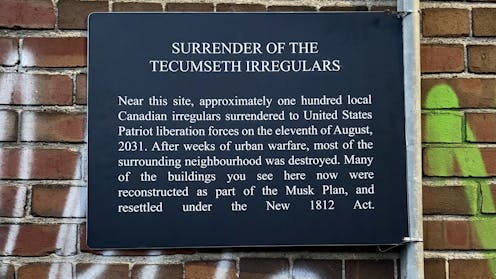
Artist Dara Vandor’s futuristic, commemorative historical plaques on Toronto streets project a U.S.-annexed Canada. (Dara Vandor)
As part of her ongoing public art series, Pax Americana, Toronto visual artist Dara Vandor has been posting aluminum signs in public spaces.
These are plaques that reimagine, as the artist writes, the city as “a site of future conflict and occupation” by the United States. The signage, in the style of commemorative historical markers, echoes U.S. President Donald Trump’s recent and repeated threats to annex Canada and “is meant to serve as a dark warning, inviting contemplation on the fragility of nationhood.”
“This spot served as the center of operations for United States Army snipers during Operation McKinley, the campaign to liberate the northern territory formerly known as Canada. From February to May 2035, this site, code-named ‘The Hot Dog Stand,’ served as a concealed sniper’s nest, providing precision fire support, disrupting insurgent movements, and protecting advancing American units.”
Vandor’s thought-provoking project, which she told CBC Newswas sparked by anger at Trump’s threats to Canadian sovereignty, underlines how storytelling can be a powerful tool in times of conflict, especially when it affords itself the artistic freedom to envision potential futures before they can become reality.
Psychological effects
In order to understand how exactly stories such as the one portrayed on Vandor’s plaques can make a real impact on the way we navigate moments of crisis, we can turn to the work of conflict analysis experts such as Solon Simmons.
The term describes the psychological effect that a story can have on its readers after they finish reading. As Simmons puts it:
“What makes stories so important (as opposed to just interesting or entertaining) is the effect of the story, and this effect doesn’t end when the story ends. It leaves the viewer/reader/listener with a feeling.”
Simmons also explains that the kind and amount of post-plot pressure placed upon an audience depends on the type of story being told.
Projected unhappy ending exerts pressure
A story, for example, featuring a struggle in which the antagonist eventually triumphs over the protagonist is what Simmons calls a “satirical struggle story.”
“Satirical” in this context does not necessarily mean that stories of this kind include elements of mockery or sarcasm. Rather, the label goes back to the influential research contributions of Canadian literary theorist Northrop Frye and American historian Hayden White, from which Simmons derives his own framework.
This is exactly how to understand the story told over its several episodes on Vandor’s Pax Americana plaques: the U.S., as the story’s antagonist, abuses its power and ends up getting away with it, defeating Canadian resistance and annexing what is now only referred to as the “northern territory.”
As Simmons suggests, conflict stories like this one, where what is viewed as injustice is allowed to prevail, exercise a relatively high level of post-plot pressure. This is mainly because the unhappy ending leaves audiences dissatisfied and with a sense of loss to grapple with.
Reader reactions
Simmons also explains that not all readers react to this particular kind of post-plot pressure in the same way. Vandor’s project, for example, has brought out some critical and upset responses.
Julian Bleecker — a researcher, author, designer and engineer with a PhD in history of consciousness whose design studio offers services around future imagining and planning — voiced his objection to the project in a blog post.
But, as Simmons argues, conflict stories in which the happy ending never comes can also leave readers with a productive sense of post-plot pressure. In that case, feeling dissatisfied with the story’s outcome can instead motivate people to mobilize and strategize against the perceived injustice.
Seen in this light, the plaques’ imagined collapse of Canadian sovereignty can therefore also serve as a stark and urgent inspiration, begging response.
In Dara Vandor’s speculative future, U.S. President Ivanka Trump, standing on a tank, exhorts Torontonians to ‘Let go of your past, and welcome to our united future.’ (Dara Vandor)
What makes Vandor’s ongoing project especially valuable is that it moves its reflections on the past into an imagined future. The actual conflict that the plaques refer to is still part of the present, and its future still undecided. Whatever lessons we draw from their cautionary tale about Canadian annexation, we still have time to act upon them before that imagined future can become reality.
Importance of resistance in the present
This is exactly what leads historian Camille Bégin to conclude that the project’s appeal to the importance of resistance in the present is particularly strong:
“It really shows us that the future is not written, that it’s in our hands to act in the present to forge the future that we want.”
Even though Vandor’s project tells a story of Canadian defeat, it also highlights that Canadians did resist, a thought that should appeal to anyone opposed to Trump’s vision of territorial expansion.
Or, and this is perhaps the most hopeful reflection coming out of the project, if Canadians come together and resist now, Trump’s threat of annexation may never get that far.
Pascal Michelberger does not work for, consult, own shares in or receive funding from any company or organisation that would benefit from this article, and has disclosed no relevant affiliations beyond their academic appointment.
Source: People’s Republic of China in Russian – People’s Republic of China in Russian –
Source: People’s Republic of China – State Council News
URUMQI, June 1 (Xinhua) — The first freight train on the China-Europe/China-Central Asia international freight train route departed from Korla city in northwest China’s Xinjiang Uygur Autonomous Region on Saturday.
After leaving the country through the Xinjiang Khorgos checkpoint, the train will transport cargo to five junction railway stations, namely Almaty, Medea and Astana in Kazakhstan, as well as Tashkent and Chukursay in Uzbekistan.
It has been revealed that the freight train is carrying 41 containers containing various household goods worth approximately $1.29 million.
It is noteworthy that this is the first international freight train in Xinjiang carrying goods sold through barter trade. The opening of this route will both deepen cooperation between China and Central Asia in terms of production capacity through barter trade and improve the logistics network in Xinjiang. -0-
Source: The Conversation – Canada – By Nathaniel Laywine, Assistant Professor, Communication and Media Studies, York University, Canada
Generative AI draws from limited datasets, often reproducing errors and bias.(Shutterstock)
What does it mean to think, act and work as a Jewish professor when human freedoms are under siege and authoritarian power gains ground? And how can we draw on our Jewish identities to navigate the sweeping encroachment of new technologies like AI?
As communication scholars, colleagues and collaborators, we have spent a lot of time trying to answer these questions in our scholarship by taking cues from the intellectuallineage of our shared culture.
Lately, Donald Trump’s administration has demonstrated a heavy investment in cataloguing and categorizing Jewish professors. In April, the Equal Employment Opportunity Commission (EEOC) sent text messages to the personal cellphones of faculty and staff at Barnard College, asking them to self-identify as Jewish and/or Israeli. The text message also asked them to disclose any instances of antisemitic discrimination or harassment they had experienced.
Presumably, the text message inquiry itself was not recognized by its senders as an instance of such harassment.
We do not believe being a Jewish professor means silencing our students as they protest atrocities in Gaza, and it certainly doesn’t mean revoking their visas or deporting them. Rather, it means drawing upon the tools of our forebears to question systems of oppression, wherever and however they may arise.
We simultaneously occupy both privileged and marginal positions within the university and North American society at large. This makes us acutely aware of how fragile conditional tolerance is, and how quickly a list of names can be used to justify repression or violence.
Collection and use of data
As communication and media scholars, we’re often critical of how data are aggregated, stored and disseminated. The EEOC questionnaire concerns us because it reduces the complexities of Jewish identity and the profound harms of antisemitism to a handful of abstract and ideologically determined data points.
Our recent research on generative AI (genAI) and its incompatibility with Jewish cultural expression shows that meaningful efforts to combat antisemitism — and other forms of oppression — must centre the knowledge and experiences of affected communities.
Our research found that outputs of chatbots such as ChatGPT are unable to tell jokes in a Jewish comedic style without resorting to offensive tropes. In another forthcoming study, we argue that genAI is equally incapable of representing the multifaceted “intersectional identities” of Jewish people except by smashing together rudimentary cultural signifiers (such as rainbows for queerness or bagels for Jewishness).
In each case, these platforms rely on datasets to determine what Jewishness is, and these datasets originate from the narratives that other people tell about Jewish people, rather than the ones we tell about ourselves.
Futzing is a Yiddish word that means messing around via hands-on experimentation. (Shutterstock)
Critical strategies
These platforms have increasingly become parts of daily life and communicative infrastructure. To investigate them, we adopted two critical strategies from our shared heritage as Ashkenazi Jews: kibbitzing and futzing.
Both terms are Yiddish. Kibbitzing is a lively, informal way of thinking and talking together. It’s somewhere between joking, arguing and exchanging ideas. It is grounded in our relationships, histories and biases; kibbitzing is how we make shared meaning together through many voices.
Kibbitzing values contradiction, humour and the messiness of human conversation. Unlike AI chatbots, which follow scripted, dialogic, question-and-answer routines based on quantifiable patterns in data, kibbitzing is unpredictable, non-linear and intentionally disorganized.
When we kibbitz, we build understanding by challenging one another and reflecting on what each of us brings to the table. In the age of genAI, kibbitzing offers a way to talk that is full of friction, laughter and deep, collective insight.
Futzing means messing around via hands-on experimentation, with no set agenda and no official guidance. This unstructured inquiry is an acknowledgement of Jews’ historical role as outsiders within European society. As we write in our forthcoming article, these practices reflect what social theorist Michel de Certeau calls “making do,” a tactical means of collective empowerment in a hostile society.
Using futzing as a methodology, we started exploring genAI, drawing on our curiosity to see what might happen by playing, testing and responding in real time.
Futz first, then kibbitz
Each of us futzed on our own at first, with no ambition to crack the code or reverse-engineer the algorithm. Later, when we began kibbitzing together, we realized our scattered efforts were actually circling around shared concerns. Futzing helped us see patterns, surprises and contradictions — things we might have missed with a more rigid approach. Kibbitzing helped us connect those patterns and reconcile the contradictions.
Drawing on our culture this way allows us to imagine inclusive, anti-oppressive Jewish epistemologies that respond to the complexity of the current political moment. Jewish identity — like all identities — is porous and resistant to fixed form. Our shared North American Ashkenazi identity is just one of many possible perspectives that comprise a broader identity of Jewishness.
That is not a problem to be solved. Rather, it is a strength and a bond between us. Readers may well see their own cultural traditions, vernaculars and ancestral practices in this light too, as techniques of resilience and joy in the face of hardship and oppression.
There is an irony here. The deeper we dig into the intellectual roots of our own culture, the more common ground we might discover with everyone else’s. And that makes us feel a whole lot safer than getting a text from the EEOC ever could.
The authors do not work for, consult, own shares in or receive funding from any company or organisation that would benefit from this article, and have disclosed no relevant affiliations beyond their academic appointment.
Source: The Conversation – Canada – By Pascal Michelberger, Postdoctoral Scholar, Western Academy for Advanced Research, Western University
Artist Dara Vandor’s futuristic, commemorative historical plaques on Toronto streets project a U.S.-annexed Canada. (Dara Vandor)
As part of her ongoing public art series, Pax Americana, Toronto visual artist Dara Vandor has been posting aluminum signs in public spaces.
These are plaques that reimagine, as the artist writes, the city as “a site of future conflict and occupation” by the United States. The signage, in the style of commemorative historical markers, echoes U.S. President Donald Trump’s recent and repeated threats to annex Canada and “is meant to serve as a dark warning, inviting contemplation on the fragility of nationhood.”
“This spot served as the center of operations for United States Army snipers during Operation McKinley, the campaign to liberate the northern territory formerly known as Canada. From February to May 2035, this site, code-named ‘The Hot Dog Stand,’ served as a concealed sniper’s nest, providing precision fire support, disrupting insurgent movements, and protecting advancing American units.”
Vandor’s thought-provoking project, which she told CBC Newswas sparked by anger at Trump’s threats to Canadian sovereignty, underlines how storytelling can be a powerful tool in times of conflict, especially when it affords itself the artistic freedom to envision potential futures before they can become reality.
Psychological effects
In order to understand how exactly stories such as the one portrayed on Vandor’s plaques can make a real impact on the way we navigate moments of crisis, we can turn to the work of conflict analysis experts such as Solon Simmons.
The term describes the psychological effect that a story can have on its readers after they finish reading. As Simmons puts it:
“What makes stories so important (as opposed to just interesting or entertaining) is the effect of the story, and this effect doesn’t end when the story ends. It leaves the viewer/reader/listener with a feeling.”
Simmons also explains that the kind and amount of post-plot pressure placed upon an audience depends on the type of story being told.
Projected unhappy ending exerts pressure
A story, for example, featuring a struggle in which the antagonist eventually triumphs over the protagonist is what Simmons calls a “satirical struggle story.”
“Satirical” in this context does not necessarily mean that stories of this kind include elements of mockery or sarcasm. Rather, the label goes back to the influential research contributions of Canadian literary theorist Northrop Frye and American historian Hayden White, from which Simmons derives his own framework.
This is exactly how to understand the story told over its several episodes on Vandor’s Pax Americana plaques: the U.S., as the story’s antagonist, abuses its power and ends up getting away with it, defeating Canadian resistance and annexing what is now only referred to as the “northern territory.”
As Simmons suggests, conflict stories like this one, where what is viewed as injustice is allowed to prevail, exercise a relatively high level of post-plot pressure. This is mainly because the unhappy ending leaves audiences dissatisfied and with a sense of loss to grapple with.
Reader reactions
Simmons also explains that not all readers react to this particular kind of post-plot pressure in the same way. Vandor’s project, for example, has brought out some critical and upset responses.
Julian Bleecker — a researcher, author, designer and engineer with a PhD in history of consciousness whose design studio offers services around future imagining and planning — voiced his objection to the project in a blog post.
But, as Simmons argues, conflict stories in which the happy ending never comes can also leave readers with a productive sense of post-plot pressure. In that case, feeling dissatisfied with the story’s outcome can instead motivate people to mobilize and strategize against the perceived injustice.
Seen in this light, the plaques’ imagined collapse of Canadian sovereignty can therefore also serve as a stark and urgent inspiration, begging response.
In Dara Vandor’s speculative future, U.S. President Ivanka Trump, standing on a tank, exhorts Torontonians to ‘Let go of your past, and welcome to our united future.’ (Dara Vandor)
What makes Vandor’s ongoing project especially valuable is that it moves its reflections on the past into an imagined future. The actual conflict that the plaques refer to is still part of the present, and its future still undecided. Whatever lessons we draw from their cautionary tale about Canadian annexation, we still have time to act upon them before that imagined future can become reality.
Importance of resistance in the present
This is exactly what leads historian Camille Bégin to conclude that the project’s appeal to the importance of resistance in the present is particularly strong:
“It really shows us that the future is not written, that it’s in our hands to act in the present to forge the future that we want.”
Even though Vandor’s project tells a story of Canadian defeat, it also highlights that Canadians did resist, a thought that should appeal to anyone opposed to Trump’s vision of territorial expansion.
Or, and this is perhaps the most hopeful reflection coming out of the project, if Canadians come together and resist now, Trump’s threat of annexation may never get that far.
Pascal Michelberger does not work for, consult, own shares in or receive funding from any company or organisation that would benefit from this article, and has disclosed no relevant affiliations beyond their academic appointment.
Source: The Conversation – Canada – By Erin A. Brennand, Gynecologist & Associate Professor, Cumming School of Medicine, University of Calgary
There is more information available about urinary tract infections today than ever before.(Shutterstock)
After menopause, urinary tract infections (UTIs) can be more frequent, yet most Canadian women (82 per cent in a recent survey) don’t realize the two are associated.
The main culprit for increased UTIs in menopausal women is the drop in estrogen levels. Estrogen plays a crucial role in maintaining urinary tract tissue health.
As estrogen declines, the lining of the urethra — the tube through which urine flows out of the body — becomes thinner and more fragile. Also, there are fewer infection-fighting blood cells in the urinary tract, and mucosal immunity — the specialized immune defences present at the mucosal surfaces lining the urinary tract that include physical and chemical barriers, cellular receptors and antibodies — is reduced.
This weakens the local immune response, making it easier for bacteria to cause infections. Additionally, changes in vaginal flora — the bacteria that naturally protect against infections — results in the urinary tract being vulnerable.
Other factors can contribute to UTI risk at this stage of life, too. Women whose bladder muscles have weakened with age, or who have developed pelvic organ prolapse, can experience incomplete bladder emptying. This leads to urine retention and an increased chance of bacterial growth.
Similarly, if women experience urinary incontinence, the leakage and moisture on incontinence pads or underwear can create an environment where bacteria thrive. And while sexual activity itself does not directly cause UTIs, it can introduce bacteria into the urinary tract, increasing the risk of infection.
Signs of a UTI
Bacteria in the urine without symptoms is called asymptomatic bacteriuria. It is not a UTI and should not be treated; a UTI is only diagnosed when bacteria and symptoms are both present. The most obvious symptoms include:
A new, strong, persistent urge to urinate;
A burning sensation while urinating;
Frequent urination in small amounts;
Pelvic discomfort or pressure.
In severe cases, UTIs can lead to kidney infections, so when symptoms include fever, chills and back pain, it is essential to seek immediate medical attention.
For women in their 80s or older, or sometimes younger women who are living with medical conditions such as dementia, urinary tract infections can manifest as behavioural changes such as confusion, withdrawal or reduced appetite. However, new onset delirium should always be investigated by a medical team rather than assumed to be a UTI.
Evidence-based strategies to prevent UTIs
Several medical and lifestyle interventions can make a significant difference:
Methenamine hippurate (one gram orally, twice-a-day) is effective in reducing UTIs by creating an environment that prevents bacterial growth. In Canada, women need to obtain this medication from a compounding pharmacy.
3. Low-dose antibiotic
Doctors may prescribe low-dose antibiotics – about half the standard dose – for several months. If sexual activity is a trigger for UTIs, antibiotics can be used episodically after sex. However, antibiotics can cause side-effects and create antibiotic-resistant bacteria. 4. Diet supplements
Scientific evidence on consuming cranberry-based products to prevent UTIs is mixed. Some studies suggest that certain compounds in cranberries (proanthocyanidins, or PACs) prevent bacteria from adhering to the bladder lining, while others show no benefit. If trying these products, women should choose brands with high concentrations of PACs, the active ingredient.
Similarly, probiotics, especially those containing Lactobacillus strains, may help maintain a healthy vaginal microbiome, which in turn can lower UTI risk. However, research is still evolving.
5. Hygiene and lifestyle habits
Though there is limited evidence, simple everyday habits may help in preventing UTIs:
Staying hydrated – Drinking water helps to flush bacteria from the urinary tract. For women who drink a low volume of fluids each day (less than 1.5 litres), increasing water intake may help.
Urinating regularly – Avoid holding urine for long periods and aim to void every three to four hours during the day.
Urinating after sex – This helps clear bacteria introduced during intercourse.
Choosing breathable underwear – Cotton underwear and loose-fitting clothes reduce build up of moisture, which in turn reduces bacterial growth.
More innovations on the horizon
Vaccines are one of the most promising developments for preventing recurrent UTIs. In one early trial, overall recurrences decreased by 75 per cent for women given an oral vaccine, with no major side-effects reported.
Trials are currently under way in Canada, and researchers hope vaccines will provide a more effective and long-term solution.
Any woman who is experiencing frequent UTIs — defined as two infections in six months or three in a year — in menopause should talk to their doctor or primary care provider. Together, they can determine the best preventive targeted strategies.
Knowledge is power, and there is more information available today than ever before. UTIs are not an inevitable part of aging. With the right combination of medical treatments and lifestyle changes, women can reduce postmenopausal risk.
Erin A. Brennand receives funding from the Canadian Institutes of Health Research, Social Sciences and Humanities Research Council, the Calgary Health Foundation, and the MSI Foundation (all paid to institution).
Jayna Holroyd-Leduc has received funding from CIHR and Alberta Innovates. She holds the BSF Chair in Geriatric Medicine at the University of Calgary.
Pauline McDonagh Hull does not work for, consult, own shares in or receive funding from any company or organisation that would benefit from this article, and has disclosed no relevant affiliations beyond their academic appointment.
Eligible professional bodies, trade and industrial organisations and research institutes may apply.
With a total allocation of $200 million, the scheme offers subsidies to non-profit-making industry-led projects that increase exchanges and co-operation between Hong Kong’s professional services and external counterparts, promote relevant publicity activities, and enhance the sector’s standards and external competitiveness.
The scheme is open to a wide range of professional services including accounting, legal and dispute resolution, architecture, engineering, healthcare, information and communications technology, design as well as technical testing and analysis. Applications are welcome from both sector-specific projects and cross-sectoral projects.
The maximum grant for each approved project is $3 million or 90% of the total eligible project cost, whichever is lower.
As of early May 2025, more than 120 projects had been funded, covering project deliverables in Hong Kong and elsewhere.
The programme aims to subsidise Hong Kong’s major professional bodies to participate in activities organised by the Government and the Trade Development Council with a view to promoting Hong Kong’s competitive edge and professional services to the Mainland and overseas markets.
The scheme and the programme both accept applications all year round, with submissions processed on a quarterly basis.
A briefing session will be held this month for organisations interested in applying for funding via the scheme. Contact the secretariat on 3655 5418 or by email for enquiries.
Source: People’s Republic of China in Russian – People’s Republic of China in Russian –
Source: People’s Republic of China – State Council News
KUNMING, June 1 (Xinhua) — Rain-triggered floods and geological disasters have hit Gongshan County in southwest China’s Yunnan Province, affecting 4,857 people as of 9 p.m. Saturday, local authorities said.
According to the county flood and drought control headquarters, 1,342 people have been evacuated, and no casualties have been reported yet.
At least 27 homes were damaged and 16 bridges were blown up or destroyed. Road traffic was interrupted in 97 places, with 54 of them restored.
According to preliminary estimates, economic losses amounted to about 87.54 million yuan (about 12.18 million US dollars).
Two tourist attractions in the county were temporarily closed, leaving 638 tourists stranded in the tourist areas. Of these, more than 500 people who remained in Bingzhongluo Township have already started returning home.
Damage assessment and subsequent disaster relief efforts are still ongoing. -0-
Source: People’s Republic of China – State Council News
BEIJING, June 1 (Xinhua) — China’s trade-in consumer goods sales totaled 1.1 trillion yuan (about 153.1 billion U.S. dollars) in the first five months of this year, data from the Ministry of Commerce showed Sunday.
According to the department, during the reporting period, the nationwide program to replace old consumer goods with new ones led to a significant increase in the number of transaction volumes, including 4.12 million vehicles, 77.62 million units of home appliances and 56.63 million units of digital products such as mobile phones and others.
The program, part of China’s broader efforts to boost domestic demand, has contributed to a robust rise in consumer spending in the country, the ministry said.
As noted in the Government’s March 2025 work report, stimulating consumption was identified as one of the top priorities for the year.
Retail sales of consumer goods, a key measure of the country’s consumption, rose 4.7 percent year-on-year in January-April 2025, faster than the 4.6 percent growth recorded in the first quarter of this year, official data showed. -0-
“What we are doing in Gaza now is a war of devastation: indiscriminate, limitless, cruel and criminal killing of civilians. It’s the result of government policy — knowingly, evilly, maliciously, irresponsibly dictated.”
This statement was made not by a foreign or liberal critic of Israel but by the former Prime Minister and former senior member of Benjamin Netanyahu’s own Likud party, Ehud Olmet.
Nightly, we witness live-streamed evidence of the truth of his statement — lethargic and gaunt children dying of malnutrition, a bereaved doctor and mother of 10 children, nine of them killed by an Israeli strike (and her husband, another doctor, died later), 15 emergency ambulance workers gunned down by the IDF as they tried to help others injured by bombs, despite their identity being clear.
Statistics reflect the scale of the horror imposed on Palestinians who are overwhelmingly civilians — 54,000 killed, 121,000 maimed and injured. Over 17,000 of these are children.
This can no longer be excused as regrettable collateral damage from targeted attacks on Hamas.
Israel simply doesn’t care about the impact of its military attacks on civilians and how many innocent people and children it is killing.
Its willingness to block all humanitarian aid- food, water, medical supplies, from Gaza demonstrates further its willingness to make mass punishment and starvation a means to achieve its ends. Both are war crimes.
Influenced by the right wing extremists in the Coalition cabinet, like Israeli Finance Minister Bezalel Smotrich and National Security Minister Itamar Ben-Gvir, Israel’s goal is no longer self defence or justifiable retaliation against Hamas terrorists.
Israel attacks Palestinians at US-backed aid hubs in Gaza, killing 36. Image: AJ screenshot APR
Making life unbearable The Israeli government policy is focused on making life unbearable for Palestinians and seeking to remove them from their homeland. In this, they are openly encouraged by President Trump who has publicly and repeatedly endorsed deporting the Palestinian population so that the Gaza could be made into a “Middle East Riviera”.
This is not the once progressive pioneer Israel, led by people who had faced the Nazi Holocaust and were fighting for the right to a place where they could determine their own future and be safe.
Sadly, a country of people who were themselves long victims of oppression is now guilty of oppressing and committing genocide against others.
Foreign Minister Winston Peters called Israel’s actions “ intolerable”. He said that we had “had enough and were running out of patience and hearing excuses”.
While speaking out might make us feel better, words are not enough. Israel’s attacks on the civilian population in Gaza are being increased, aid distribution which has restarted is grossly insufficient to stop hunger and human suffering and Palestinians are being herded into confined areas described as humanitarian zones but which are still subject to bombardment.
People living in tents in schools and hospitals are being slaughtered.
World must force Israel to stop Like Putin, Israel will not end its killing and oppression unless the world forces it to. The US has the power but will not do this.
The sanctions Trump has imposed are not on Israel’s leaders but on judges in the International Criminal Court (ICC) who dared to find Prime Minister Benjamin Netanyahu guilty of war crimes.
New Zealand’s foreign policy has traditionally involved working with like-minded countries, often small nations like us. Two of these, Ireland and Sweden, are seeking to impose sanctions on Israel.
Both are members of the European Union which makes up a third of Israel’s global trade. If the EU decides to act, sanctions imposed by it would have a big impact on Israel.
These sanctions should be both on trade and against individuals.
New Zealand has imposed sanctions on a small number of extremist Jewish settlers on the West Bank where there is evidence of them using violence against Palestinian villagers.
These sanctions should be extended to Israel’s political leadership and New Zealand could take a lead in doing this. We should not be influenced by concern that by taking a stand we might offend US president Donald Trump.
Show our preparedness to uphold values In the way that we have been proud of in the past, we should as a small but fiercely independent country show our preparedness to uphold our own values and act against gross abuse of human rights and flagrant disregard for international law.
We should be working with others through the United Nations General Assembly to maximise political pressure on Israel to stop the ongoing killing of innocent civilians.
Moral outrage at what Israel is doing has to be backed by taking action with others to force the Israeli government to end the killing, destruction, mass punishment and deliberate starvation of Palestinians including their children.
An American doctor working at a Gaza hospital reported that in the last five weeks he had worked on dozens of badly injured children but not a single combatant.
He noted that as well as being maimed and disfigured by bombing, many of the children were also suffering from malnutrition. Children were dying from wounds that they could recover from but there were not the supplies needed to treat them.
Protest is not enough. We need to act.
Phil Goff is Aotearoa New Zealand’s former Minister of Foreign Affairs. This article was first published by the Stuff website and is republished with the permission of the author.
President Cyril Ramaphosa has described the late Ma Gertrude Shope as a pillar of the nation, a matriarch of the revolution, and a torchbearer of women’s emancipation.
President Ramaphosa delivered a moving eulogy at her Special Official Funeral held at the Great Hall of the University of the Witwatersrand on Saturday.
Ma Shope, who passed away last week at the age of 99 at her home in Gauteng, was laid to rest with honours befitting her immense contributions to South Africa’s liberation and to the global fight for justice and gender equality.
President Ramaphosa paid tribute to Shope’s life of commitment to the struggle against apartheid and the advancement of women’s rights.
“We are here to bed farewell to Mama Gertrude Shope, Isithwalandwe, freedom fighter, trade unionist, icon of the women’s movement.
“Her passing comes less than a week after we buried Cde Lungi Mngaga-Gcabashe, the Deputy President of the ANC Women’s League. To have lost two women leaders – izintsika (pillars) – in such close succession is a great loss. And yet, even amidst our grief we take comfort in the legacies they left behind,” the President said.
President Ramaphosa said Ma Gertrude will not only be remembered by her name but her legacy that she left behind.
“We gather not just to remember the name Getrude Shope. We gather to honour a life that helped to shape our country’s democracy.
“Mama Getrude Shope’s life is and was intertwined in the fabric of our of democracy. Hers was a life that was quietly and unshakably committed to the struggle for our people’s liberation,” the President said. A former teacher who became an outspoken opponent of Bantu Education in the 1950s, Shope joined the African National Congress (ANC) and played a pivotal role in organising women against the apartheid state.
She was among the leaders who mobilised the historic 1956 Women’s March to the Union Buildings, helping galvanise more than 20000 women to demand an end to the pass laws.
“To witness the dehumanising of black children in the classroom struck her to the core. She refused to accept the dictates of her role to impart inferior education that prepared black children for little more than a life of menial labour,” said the President.
Forced into exile in 1966, Shope worked across Africa and the globe to build solidarity for the anti-apartheid movement. As head of the ANC Women’s Section in exile and later President of the ANC Women’s League, she pushed for the centrality of gender equality in the liberation struggle and in the country’s post-apartheid constitutional framework.
Quoting from an interview Shope gave in the early 1980s, the President reminded the nation of her enduring message: “We are not declaring war on men… men are also victims. Together, men and women must change their attitudes to each other.”
Women’s rights
The President acknowledged the progress South Africa has made in advancing women’s rights, noting that the World Economic Forum’s Gender Gap Report recently referred to the country as a “beacon of hope.”
“This progress was not achieved by chance. Gertrude Shope and others made it happen. She birthed and mothered it. She nurtured it with discipline, wisdom and responsibility.
“This progress is the result of deliberate policies implemented by successive democratic governments since 1994,” he said.
However, the President also cautioned that despite South Africa having made progress in advancing women’s rights, persistent inequalities, violence against women, and economic disparities continue to threaten that progress.
“Women are still more likely to be poor than men. Women are still more likely to be unemployed than men. Women are the primary victims of intimate partner violence, abuse, rape and other forms of sexual violence.
“Ma Shope’s life’s work is not yet complete. It is up to us to take forward women’s struggles for full equality, for freedom from violence, and for the right to live in security, comfort and peace. And like Ma Shope said all those years ago, this is not a struggle that must be waged by women alone. Men must be at the frontlines of the fight for gender equality,”the President said.
Ma Shope’s legacy, the President said, endures not only in institutions like the ANC Women’s League and the Gertrude Shope Peacebuilding Programme, but also in the daily activism of countless women and girls across the country.
In closing, President Ramaphosa repeated Ma Shope’s call to action: “The time for women to be found in the kitchen is long past. Let us, together with our menfolk, correct the wrongs and ills of our society.” – SAnews.gov.za
The power system remains stable with Eskom’s Kusile’s Unit 1 expected to improve the country’s energy availability factor (EAF).
“Kusile Unit 1 is officially back online today, following its successful reconnection to the repaired flue gas desulphurisation (FGD) system and permanent stack, which had been out of service since 31 March 2025.
“Once ramped up to full capacity, this unit will contribute 800MW back to the national grid and further improve the Energy Availability Factor (EAF). Once Unit 1 reaches full capacity, the station will deliver its total combined output of 4 800MW to the national grid,” Eskom said in a statement on Friday.
The Kusile Power Station is located in Mpumalanga.
In its update, the power utility said that the power system is stable and continues to demonstrate resilience. It added that system constraints remain, and that adequate emergency reserves are in place and strategically deployed to support demand during the morning and evening peak winter periods.
A total of 2 930MW of generation capacity is expected to be returned to service ahead of the evening peak on Monday, 2 June 2025, to further stabilise the grid.
Meanwhile, the Unplanned Capacity Loss Factor (UCLF), which measures the capacity lost due to unplanned outages, stands at 28.60% for the financial year to date (1 April to 29 May 2025).
“This represents a slight increase of ~0.2% compared to 28.43% recorded over the same period last year. The marginal increase is primarily due to delays in returning units from planned maintenance.
For the financial year-to-date, planned maintenance has averaged 6 197MW, representing 13.25% of total generation capacity. This reflects a decrease from the previous week, but a 2.6% increase compared to the same period last year.”
The Open-Cycle Gas Turbine (OCGT) load factor increased to 12.70% this week, compared to 7.65% in the previous week (16 to 22 May 2025).
The financial year-to-date Open-Cycle Gas Turbine (OCGT) load factor reflects a 0.4% increase compared to the year-to-date figure from the previous week.
“The diesel expenditure is still within budget for the current financial year. Diesel usage is expected to decline further as more units return from long-term repairs and maintenance activities are reduced, increasing available generation capacity,” said Eskom.
Additionally, the utility’s Winter Outlook, published on 5 May 2025, covering the period ending 31 August 2025, remains valid.
“It indicates that load shedding will not be necessary if unplanned outages stay below 13 000MW. If outages rise to 15 000MW, load shedding would be limited to a maximum of 21 days out of 153 days and restricted to Stage 2.
“While load shedding remains suspended and electricity demand continues to rise during the winter period, Eskom urges the public to avoid illegal connections and energy theft.
These activities often lead to transformer overloads, equipment failures, and in some cases, explosions and extended outages—prompting the need for load reduction to protect the network.
“To help maintain a stable electricity supply this winter, customers are encouraged to purchase electricity only from Eskom-accredited vendors and take responsibility by regularising their electricity usage.”
The power utility encouraged eligible households to register for free basic electricity with their local municipalities.
Any illegal activity impacting Eskom’s infrastructure should be reported to the Eskom Crime Line at 0800 112 722 or via WhatsApp on 081 333 3323. –SAnews.gov.za
Deputy Minister in the Presidency Nonceba Mhlauli will on Monday provide an update on the Presidential Youth Employment Initiative (PYEI).
“Now in its fifth year, the PYEI remains one of South Africa’s most significant and innovative responses to the youth unemployment crisis. The briefing will provide an update on key achievements, lessons learned and plans to scale impact across government and private sector partnerships,” the Presidency said ahead of Monday’s briefing.
The update on the Presidential Youth Employment Initiative (PYEI) Fourth Quarter Report is set to take place at the Government Communication and Information System (GCIS) head office in Pretoria. The Deputy Minister will present and reflect on the report from January to March 2025.
Key highlights will include: • The earning opportunities secured for youth in the fourth quarter. • Progress on the Jobs Boost Outcomes Fund. • New tools supporting township entrepreneurs. • Strategies to address persistent youth unemployment in a low-growth economy.
At a briefing to on the PYEI third quarter report in February, the Deputy Minister said the initiative remains a cornerstone of national efforts to address the persistent challenge of youth unemployment by ensuring that young South Africans have access to economic opportunities.
At the time, Mhlauli said progress has been made in unlocking earning opportunities and equipping young people with the necessary skills and resources to succeed in the labour market. –SAnews.gov.za
Big tech sharing economy platforms like Airbnb and Uber are marketed as trustworthy, but a new book by a South African media scholar argues that they are highly vulnerable to scammers who spread delusive speech (a form of disinformation, designed to deceive by criminal intent).
Julie Reid draws from first-hand accounts and over 600 cases from around the world of victims lured into scams or physical danger by fake Airbnb reviews and listings, providing a detailed case study. We asked her five questions about her book.
How do the scams work?
Airbnb is the world’s largest accommodation-sharing platform. It connects property owners who want to rent out their homes with travellers looking for alternatives to traditional hotels. The company recently expanded its offering and now facilitates the booking of other services like personal trainers or caterers along with accommodation rentals.
Airbnb scams happen in several ways. The most obvious is the phantom listing scam. The scammer constructs a fake but attractive listing on Airbnb and accepts payments from unsuspecting guests. It’s only when guests arrive at the address that they discover the property doesn’t exist. Scammers have also learnt to navigate around Airbnb’s review system. Fake positive reviews are produced by scam host networks, making them appear to be authentic.
Bait and switch scams are also common. Here the scam “host” contacts the guest on check-in day claiming the reserved property is suddenly unavailable. They offer alternative accommodation, which the guest later discovers is not as good as the original property they’ve paid for (which is often fictional). The guest pays for a premium rental but is forced to stay in a property that might be unsafe, unclean, or missing amenities.
Scam hosts use misleading, plagiarised, or AI-generated property images and fake descriptions along with fake personal profiles and aliases.
Delusive tactics also redirect guests away from the secure Airbnb payment portal to alternative payment methods. The scammer disappears with the money.
But the danger isn’t limited to financial crimes. The platform’s business model is premised on staying in a stranger’s private property, which can put guests’ personal safety at risk.
Criminal hosts can lure targets into dangerous environments. Once checked in, guests are isolated from public view, housed in a property to which the host has access.
I consider delusive speech a subset of disinformation because it presents intentionally misleading content at scale. But it differs from disinformation in its intentions. It isn’t done to promote a particular cause or gain ideological, military, or political advantage. Delusive speech is motivated purely by criminal intent or nefarious financial gain.
Delusive speech works by hiding in plain sight on platforms we think we can trust, like Airbnb, Booking.com, Uber and others. Often, it’s indistinguishable from honest and genuine content. When users browse Airbnb listings for holiday accommodation, they’re presented with numerous options. A fake property listing looks, sounds and feels exactly the same as a genuine one.
This happens on a platform that has built its brand narrative around the concept of trust. Scammers exploit these digital contexts of pre-established trust. When users log on to popular e-commerce or sharing economy platforms, they’re already primed to pay for something. It becomes relatively easy for scammers to delude targets into parting with their money.
Sadly, none of these mechanisms work perfectly. While Airbnb promises to verify properties and host identities, my analysis exposes flaws in these systems. Scammers easily bypass verification tiers through aliases, forged documents and AI-generated material. Airbnb has admitted it needs to address the failures of its verification processes.
My analysis uncovered how scammed guests are routinely denied the opportunity to post reviews of problematic rentals. Opaque terms of service and content policies allow Airbnb customer service agents and executives to justify censoring negative but honest guest reviews.
This means dangerous and fraudulent activity goes publicly unreported and unreviewed, leaving future guests vulnerable. I argue that Airbnb’s review curation mechanisms should be revamped according to internationally recognised human rights frameworks that protect freedom of speech. This would allow for more honest accounts of guest experiences and create a safer online environment.
Perhaps the most common complaint I encountered was that Airbnb doesn’t remove offending listings from its platform, even after a scammed guest provides evidence that the listing was posted by a fraudster. Airbnb must develop an urgent protocol for swiftly removing offending listings when discovered, to protect future guests from falling victim to the same scam trap.
What can users do to protect themselves?
Travellers can protect themselves by being extra cautious. Ask around. Seek recommendations from people you know and trust, and who can verify that the property you are booking actually exists and that the host is trustworthy.
If that isn’t an option, consider an established hotel instead, but book directly with the hotel and not via third party sites like Booking.com where listings can easily be faked. Check on Google Street View to make sure the property is where it claims to be.
Either way, have a Plan B in case things go wrong. Prepare ahead of your trip by deciding what you will do if you find yourself in an unsafe situation. And always, always, buy travel insurance.
Is it part of a bigger problem?
I assessed several digitally initiated scam categories in this book. While my main case study focused on Airbnb, the problem of delusive speech online isn’t unique to this platform. Delusive speech is now carried by all major tech platforms integral to everyday life.
I hope that these examples will boost awareness of the risks of using these apps and sites.
Julie Reid does not work for, consult, own shares in or receive funding from any company or organisation that would benefit from this article, and has disclosed no relevant affiliations beyond their academic appointment.
Big tech sharing economy platforms like Airbnb and Uber are marketed as trustworthy, but a new book by a South African media scholar argues that they are highly vulnerable to scammers who spread delusive speech (a form of disinformation, designed to deceive by criminal intent).
Julie Reid draws from first-hand accounts and over 600 cases from around the world of victims lured into scams or physical danger by fake Airbnb reviews and listings, providing a detailed case study. We asked her five questions about her book.
How do the scams work?
Airbnb is the world’s largest accommodation-sharing platform. It connects property owners who want to rent out their homes with travellers looking for alternatives to traditional hotels. The company recently expanded its offering and now facilitates the booking of other services like personal trainers or caterers along with accommodation rentals.
Routledge
Airbnb scams happen in several ways. The most obvious is the phantom listing scam. The scammer constructs a fake but attractive listing on Airbnb and accepts payments from unsuspecting guests. It’s only when guests arrive at the address that they discover the property doesn’t exist. Scammers have also learnt to navigate around Airbnb’s review system. Fake positive reviews are produced by scam host networks, making them appear to be authentic.
Bait and switch scams are also common. Here the scam “host” contacts the guest on check-in day claiming the reserved property is suddenly unavailable. They offer alternative accommodation, which the guest later discovers is not as good as the original property they’ve paid for (which is often fictional). The guest pays for a premium rental but is forced to stay in a property that might be unsafe, unclean, or missing amenities.
Scam hosts use misleading, plagiarised, or AI-generated property images and fake descriptions along with fake personal profiles and aliases.
Delusive tactics also redirect guests away from the secure Airbnb payment portal to alternative payment methods. The scammer disappears with the money.
But the danger isn’t limited to financial crimes. The platform’s business model is premised on staying in a stranger’s private property, which can put guests’ personal safety at risk.
Criminal hosts can lure targets into dangerous environments. Once checked in, guests are isolated from public view, housed in a property to which the host has access.
I consider delusive speech a subset of disinformation because it presents intentionally misleading content at scale. But it differs from disinformation in its intentions. It isn’t done to promote a particular cause or gain ideological, military, or political advantage. Delusive speech is motivated purely by criminal intent or nefarious financial gain.
Delusive speech works by hiding in plain sight on platforms we think we can trust, like Airbnb, Booking.com, Uber and others. Often, it’s indistinguishable from honest and genuine content. When users browse Airbnb listings for holiday accommodation, they’re presented with numerous options. A fake property listing looks, sounds and feels exactly the same as a genuine one.
This happens on a platform that has built its brand narrative around the concept of trust. Scammers exploit these digital contexts of pre-established trust. When users log on to popular e-commerce or sharing economy platforms, they’re already primed to pay for something. It becomes relatively easy for scammers to delude targets into parting with their money.
Sadly, none of these mechanisms work perfectly. While Airbnb promises to verify properties and host identities, my analysis exposes flaws in these systems. Scammers easily bypass verification tiers through aliases, forged documents and AI-generated material. Airbnb has admitted it needs to address the failures of its verification processes.
My analysis uncovered how scammed guests are routinely denied the opportunity to post reviews of problematic rentals. Opaque terms of service and content policies allow Airbnb customer service agents and executives to justify censoring negative but honest guest reviews.
This means dangerous and fraudulent activity goes publicly unreported and unreviewed, leaving future guests vulnerable. I argue that Airbnb’s review curation mechanisms should be revamped according to internationally recognised human rights frameworks that protect freedom of speech. This would allow for more honest accounts of guest experiences and create a safer online environment.
Perhaps the most common complaint I encountered was that Airbnb doesn’t remove offending listings from its platform, even after a scammed guest provides evidence that the listing was posted by a fraudster. Airbnb must develop an urgent protocol for swiftly removing offending listings when discovered, to protect future guests from falling victim to the same scam trap.
What can users do to protect themselves?
Travellers can protect themselves by being extra cautious. Ask around. Seek recommendations from people you know and trust, and who can verify that the property you are booking actually exists and that the host is trustworthy.
If that isn’t an option, consider an established hotel instead, but book directly with the hotel and not via third party sites like Booking.com where listings can easily be faked. Check on Google Street View to make sure the property is where it claims to be.
Either way, have a Plan B in case things go wrong. Prepare ahead of your trip by deciding what you will do if you find yourself in an unsafe situation. And always, always, buy travel insurance.
Is it part of a bigger problem?
I assessed several digitally initiated scam categories in this book. While my main case study focused on Airbnb, the problem of delusive speech online isn’t unique to this platform. Delusive speech is now carried by all major tech platforms integral to everyday life.
I hope that these examples will boost awareness of the risks of using these apps and sites.
– Airbnb scams: new book explores thriving criminal activity on big tech platforms – https://theconversation.com/airbnb-scams-new-book-explores-thriving-criminal-activity-on-big-tech-platforms-256806
Prime Minister Narendra Modi on Sunday extended warm birthday greetings to Union Minister of Youth Affairs and Sports, Mansukh Mandaviya, lauding his energetic efforts in promoting fitness, youth empowerment, and making India a sporting powerhouse.
In a post on X, the Prime Minister wrote, “Best wishes to Shri Mansukh Mandaviya Ji on his birthday. He is energetically working towards making India a sporting powerhouse and empowering our youth. Equally commendable are his efforts towards the welfare of our workers, who play a key role in building a self-reliant India. May he lead a long and healthy life.”
On the occasion of his birthday, Minister Mandaviya led the 25th edition of the nationwide ‘Fit India Sundays on Cycle’ initiative in Delhi. This edition was dedicated to the soldiers involved in Operation Sindoor.
“Today’s edition is a tribute to our bravehearts who were part of Operation Sindoor. It is heartening to see citizens across the country pedal together for fitness and for our nation’s heroes,” he said.
The ‘Fit Sunday’ movement witnessed enthusiastic participation across over 5,000 locations, continuing the momentum of 24 consecutive Sundays of public cycling events under the Fit India Movement. The initiative has evolved into a nationwide fitness campaign encouraging citizens to prioritize health and wellness.
Union Minister Nitin Gadkari also greeted Mandaviya, saying, “My colleague in the Union Cabinet, Shri @mansukhmandviya ji, I wish you a very happy birthday. I pray to God for your good health, long life and happy life.”
Born in Bhavnagar, Gujarat, in 1972, Mandaviya began his political career early, becoming the youngest MLA in Gujarat at the age of 28 in 2002.
He was first inducted into the Union Cabinet in 2016 and held various portfolios, including Shipping, Road Transport, and Chemicals and Fertilisers. In 2021, he was elevated to Cabinet rank and appointed as Minister of Health and Family Welfare. In 2024, under the third Modi government, he took charge as Minister of Labour & Employment and Youth Affairs & Sports.
Source: People’s Republic of China in Russian – People’s Republic of China in Russian –
Source: People’s Republic of China – State Council News
NAIROBI, June 1 (Xinhua) — The 13th session of the World Urban Forum (WUF13) will be held in Baku, capital of Azerbaijan, in May 2026, it was announced on Friday at the resumed second session of the Assembly of the United Nations Human Settlements Programme (UN-Habitat) in Nairobi, capital of Kenya.
UN-Habitat Executive Director Anacláudia Rossbach said WUF13 would draw the world’s attention to the urgent need to address the global housing crisis and its central role in sustainable urban development.
She noted that the forum is one of the largest UN platforms where various parties come together to exchange views, build partnerships and take action on priority issues to promote the development of sustainable cities and communities in line with the priorities of the New Urban Agenda and the Sustainable Development Goals.
WUF13 will be held under the theme “Housing Around the World: Safe and Sustainable Cities and Communities” and will focus on practical solutions that integrate housing into broader urban systems, such as climate change adaptation, land and tenure security, inclusive governance and locally-driven development, said Rossbach.
Anar Guliyev, WUF13 National Coordinator and Chairman of the State Committee for Urban Development and Architecture of Azerbaijan, said the country’s government is committed to working closely with a wide range of partners to ensure the success of the five-day forum.
Since its inception, the World Urban Forum has been held in 12 cities around the world. –0–
Source: People’s Republic of China in Russian – People’s Republic of China in Russian –
Source: People’s Republic of China – State Council News
TOKYO, June 1 (Xinhua) — Political leaders and former heads of state from across Asia have expressed concern over the U.S. government’s tariff policies, calling for stronger unity among Asian countries to overcome common challenges.
Speaking at the 30th Future of Asia Forum held in Tokyo from May 29 to 30, Singapore’s Deputy Prime Minister Gan Kim Yong warned that the current global trading order was under threat.
He called on Asian countries to unite in addressing trade issues arising from US tariffs and stressed the importance of enhancing cooperation within ASEAN and the Comprehensive and Progressive Agreement for Trans-Pacific Partnership (CPTPP), especially in the areas of trade and industry.
Cambodian Prime Minister Hun Manet said trade wars were undermining the free, open, inclusive and rules-based multilateral trading system, disproportionately affecting the most vulnerable. He called for unity among countries facing pressure over tariffs.
Lao President Thongloun Sisoulith stressed the importance of peaceful coexistence and mutual respect, noting that while Laos has limited trade with the United States, high tariffs could still affect its economy and investment climate.
Vietnam’s Deputy Prime Minister Nguyen Chi Dung said the US tariffs were having a significant impact on Vietnam’s exports and investments.
Former Malaysian Prime Minister Mahathir Mohamad has criticised US tariff measures, saying they could hurt the American economy and raise the cost of living at home.
The Future of Asia Forum, organized by Nikkei, has been held annually since 1995. This year’s event is themed “Challenging Asia in a Turbulent World.” –0–
Winter is a great time to stay at home on the couch, but we all need to get out and about sometimes! Save money when dining out and find some local meal deals.
Cuddling up on the lounge with a good book and a cup of tea is one of the best things about winter.
If you have a long list of books to get through, why not become a Libraries ACT member and borrow them for free? You can even borrow eBooks and audiobooks.
Source: People’s Republic of China – State Council News
The “Step Up for Climate” campaign is launched in Beijing, May 30, 2025. [Photo provided to China.org.cn]
UNICEF launched a six-month climate awareness campaign in Beijing on Friday aimed at encouraging Chinese children and adolescents to adopt low-carbon lifestyles and take active roles in addressing climate change.
“Children are least responsible for climate change and the most affected by its impacts. But the right support is available. And children have the power to lead change,” said Amakobe Sande, UNICEF representative to China, during the launch ceremony of the “Step Up for Climate” campaign.
The initiative, jointly organized by UNICEF China, the National Center for Climate Change Strategy and International Cooperation (NCSC), the Center for Environmental Education and Communications of the Ministry of Ecology and Environment (CEEC), and the Chinese Meteorological Society, will focus on empowering youth to become climate leaders at home, in schools and throughout their communities.
Sande emphasized the increasing impact of extreme weather events on children’s health and well-being, as well as the growing risks for pregnant women. She highlighted UNICEF’s global and local initiatives to address these challenges, including efforts to reduce carbon emissions and prepare children to adapt to a changing climate.
“UNICEF is working with China’s Ministry of Education to integrate green skills into technical and vocational education,” she noted. “We are also collaborating with the Ministry of Ecology and Environment to advocate for the incorporation of a child focus in the China National Climate Change Health Adaptation Action Plan (2024-2030).”
Ding Ding, deputy director of the NCSC, spoke about the critical role young people play in tackling climate change.
“Young people possess a keen awareness of global issues and a strong sense of responsibility,” she said, adding that rather than passively experiencing the impacts of climate change, they should actively shape solutions with their creativity, vitality and unique perspectives.
Yan Shidong, director of the CEEC, noted that the initiative supports both China’s carbon peaking and carbon neutrality goals and serves as an essential platform for youth participation in global climate governance.
“In recent years, university environmental groups in China have consistently developed innovative climate solutions,” Yan said. “At COP29 in Azerbaijan, Chinese youth delegates shared the story of China’s ecological civilization, presenting solutions inspired by Chinese wisdom.”
During the launch event, young climate advocates showcased their projects. Student Ye Lisiqi introduced a school-based carbon market that rewards students with carbon credits for sustainable actions. The program includes competitions both within and between schools and has already cut carbon emissions by 880 kilograms.
The “Step Up for Climate” campaign will run for six months, continuing through COP30, the 30th session of the Conference of the Parties to the United Nations Framework Convention on Climate Change.
Source: People’s Republic of China – State Council News
The 12th batch of the Chinese medical team, in partnership with the 11th Chinese peacekeeping infantry battalion in South Sudan, on Friday donated essential goods to orphaned children at the Confident Children out of Conflict (CCC) Orphanage.
The group donated milk powder, mosquito nets, maize flour, washing powder, books, school bags, soap, flip-flops, tables, and chairs, among other items.
Robert Bida Samson, executive director of the CCC, a charity organization, said support from the Chinese medical teams over the past years has helped ease the burden of taking care of these children.
“The Chinese medical teams have stood with the CCC, making sure that all the children receive medical services, screening them both here at the center and also in Juba Teaching Hospital when the sickness is too serious,” Bida said during the donation ceremony in Juba, the capital of South Sudan.
The ceremony, held under the theme “One Sky One Dream,” coincided with the celebration of the 100th visit of the Chinese medical team to orphanages in South Sudan.
Established in 2007, the center is home to orphans, abandoned children, and survivors of revenge attacks and gender-based violence.
Bida commended the regular visits by the Chinese medical team, noting that these are critical to their longstanding partnership, which has empowered many vulnerable children at the center.
“Some of these children are soon finishing school. I urge that through your empowerment, some of them could get employed at Juba Teaching Hospital to share responsibility with you,” he said.
Gift Gibson Natana, deputy director general at Juba Teaching Hospital, commended the Chinese medical team for their dedication to providing medical services to orphans and communities in remote areas.
“These programs benefit tens of thousands of vulnerable people,” Natana said.
The 12th batch of the Chinese medical team, prior to visiting the CCC, also visited Juba Orphanage and Rock City Orphanage.
Liu Hongyong, commander of the Chinese peacekeeping infantry battalion to the United Nations Mission in South Sudan (UNMISS), expressed hope that the support provided to the children would empower them to realize their future dreams.
“We wish the children of the orphanage a joyful International Children’s Day. May this contribution add color to their lives and wings to their dreams. May they grow up healthy and strong,” Liu said.
Huo Ying, deputy chief of mission at the Chinese Embassy in South Sudan, expressed her gratitude to the Chinese medical team and the Chinese peacekeeping force for their contribution toward peace and development in South Sudan.
“These contributions made by the Chinese medical team have been a valuable legacy in bilateral friendship,” Huo said.
She noted that the Chinese peacekeeping forces are participating in the UN peacekeeping operations in South Sudan, while the Chinese medical team is protecting the public health security of the South Sudanese.
Huo also commended the contributions of Chinese companies toward the development of South Sudan, stressing that the Chinese people will always be the friends of the South Sudanese people.
Source: United States Senator for Kansas Roger Marshall
Washington – U.S. Senator Roger Marshall, M.D. (R-Kansas) visited Sierra Vista, Arizona yesterday to tour the Joint Task Force-Southern Border Command offices, thank members of Kansas’ own 1st Infantry Division from Fort Riley, participate in tours along the southern border, receive briefings, and take an aerial tour of the border near Arizona with several Kansas law enforcement officials.
Below are photos from Senator Marshall’s visit. Click HERE and HERE for b-roll videos.
Senator Marshall with members of Joint Task Force Southern Border.
Senator Marshall prepares to view the border from the air.
Senator Marshall at the border wall with detectives from the Cochise County Sheriff’s Office.
Senator Marshall with members of Kansas law enforcement at the southern border wall.
From left to right: Sheriff Billy Tomasi, Director Brian Peete, Sheriff Jeff Easter, Sheriff Scott Braun, Senator Roger Marshall, Chief Karl Oakman, Director Tony Mattivi, and Chief Courtney Leslie.
“Having visited the southern border multiple times under the Biden-Harris Administration, I witnessed chaos, lawlessness, and a system overwhelmed by over 10 million illegal crossings –including individuals on the FBI’s terrorist watchlist,” said Senator Marshall. “But during my most recent trip, the difference was clear. Since President Trump returned to office, we’ve already seen a dramatic shift with illegal border crossings dropping 93% compared to last year. What I’ve witnessed firsthand at the border proves that President Trump’s bold leadership is delivering results, and he is keeping his promises. To continue delivering on the President’s agenda, the Senate must pass the ‘One Big, Beautiful Bill’ – legislation that will provide critical funding our border agencies need to keep America safe.”
Since President Trump took office in January 2025, the number of illegal immigrant crossings at the southern border has dropped dramatically. In April 2024, there were 128,900 crossings at the border, while in April 2025, there were only 8,400.
The Kansas law enforcement officers who accompanied Senator Marshall included Kansas Bureau of Investigation (KBI) Director Tony Mattivi, Director of the Riley County Police Department Brian Peete, Sedgwick County Sheriff Jeffery Easter, Crawford County Sheriff Billy Tomasi, Ellis County Sheriff and Kansas Sheriffs’ Association President Scott Braun, Hugoton Police Chief and Kansas Association of Chiefs of Police President Courtney Leslie, and Kansas City, Kansas Police Chief Karl Oakman.
“I was honored to join Senator Marshall and several sheriffs and police chiefs in experiencing firsthand the challenges at our southern border,” said KBI Director Tony Mattivi. “We know every fentanyl pill sold in Kansas is trafficked by Mexican drug cartels through this border. Every single pill that kills a Kansan enters the country here, so we must continue the fight to keep dangerous and violent criminals out.”
“Senator Marshall champions law enforcement and public safety efforts. He understands the unique role the Riley County Police Department plays in protecting national security and operational readiness because of our ties to NBAF and Fort Riley,” said Riley County Police Department Director Brian Peete. “This opportunity has helped the department forge new strategic plans and procedures to keep our county safe from narcotic and human trafficking, as well as foreign terrorist organizations. My sincerest thanks to both he and his team.”
“The experience was very informative. It was amazing to me to see what 4 years of an unsecured border looked like and the issues it created for the United States,” said Sedgwick County Sheriff Jeffrey Easter. “This trip highlighted the absolute cooperation between the U.S military, Border Patrol, and the Cochise County Sheriff’s Office. These men and women are on the front lines protecting Kansans from the fentanyl and methamphetamine scourge that has gripped Sedgwick County. I am very appreciative of Senator Marshall inviting me to observe and understand the situation at our border.”
“We’ve learned where it’s coming in from, we’ve learned where it’s being transported to, and this is a hub where it’s coming out of,” said Crawford County Sheriff Billy Tomasi. “Like I told the voters when I came on, that I am going to learn about this and I’m going to start taking it off the streets, and that’s my goal. And I appreciate the opportunity from Senator Marshall allowing me to come down here with him to learn this, to bring back to our community.”
“Our visit to the Arizona border with the dedicated military – including soldiers from Fort Riley –and border agencies, was eye-opening. The fight against illegal immigrants and the deadly flow of fentanyl is real. It’s happening on the ground, and it’s impacting Kansas communities every day. The brave men and women on the front lines deserve our full support as they work to protect our borders and save lives back home,” said Hugoton Police Chief and Kansas Association of Chiefs of Police President Courtney Leslie. “I am extremely grateful to Senator Marshall and his staff for the opportunity to see firsthand the fight against the cartels that are trafficking fentanyl across our border daily. The fight against these cartels is not just a border issue – it is a fight for the safety of every Kansas community.”
“I would like to thank Senator Marshall for the opportunity to see firsthand the great work being done by our men and women of law enforcement, border patrol, and the military,” said Kansas Police Chief Karl Oakman. “Eliminating drug smuggling is still a major challenge at the border, and additional resources are needed.”
Background:
Senator Marshall spoke out against Joe Biden’s reckless border policies continuously during his four disastrous years in office, calling it the “number one” most immediate national security threat.
Senator Marshall supports President Donald Trump’s ‘One, Big Beautiful Bill,’ which includes the largest border security investment in history, empowers ICE to deport the millions of illegal immigrants who entered under the Biden-Harris Administration, and provides funding for at least one million annual removals.
Recently, Senator Marshall reintroduced the Justice for Angel Families Act, legislation that would amend the Crime Victims Fund (CVF) to expand financial coverage for Angel Families – the immediate relatives of victims killed by illegal aliens.
In 2024, he introduced legislation the Demanding Citizenship in D.C. Elections Act, which would require anyone who votes in a municipal election in the District of Columbia to be a U.S. Citizen and require proof of citizenship.
In 2024, Senator Marshall also went to the Senate Floor demanding the immediate passage of his resolution declaring an invasion at the southern border.
In an op-ed for FOX News in 2019, then-Congressman Marshall detailed his border visit with fellow doctors in Congress stating, “Our systems are simply overwhelmed, and there appears to be no break in the near future… until we build a wall, and until we turn off the laws that only serve as magnets, all the money in the world will not have a huge humanitarian impact.”
WASHINGTON— The U.S. Department of Energy (DOE) today issued an emergency order under section 202(c) of the Federal Power Act. The order directs PJM Interconnection (PJM) to operate specified generation units at the Eddystone, Pennsylvania Generation Station past their planned retirement. This order follows recent statements from PJM warning that its system faces a “growing resource adequacy concern” due to load growth, the retirement of dispatchable resources, and other factors.
“Maintaining access to affordable, reliable, and secure power is always our top priority, particularly during the summer months when electricity demand reaches its peak,” said U.S. Secretary of Energy Chris Wright. “Americans should never be left wondering whether they will be able to turn on their lights or air conditioning. This emergency order helps keep money in consumers’ pockets while keeping their homes and businesses fully powered. Energy shortfalls or unnecessary price increases are not options in this Administration.”
DOE’s order states that PJM shall, in coordination with Constellation Energy, run specified units at the Eddystone Generating Station, when PJM deems necessary, past their planned retirement date of May 31, 2025. DOE issued the order due to resource adequacy concerns given the timing of the retirement of the generation units coinciding with sustained increased energy demand.
Background:
PJM has recently stated its system faces “growing resource adequacy concern” due to load growth, the retirement of dispatchable resources, and other factors. Upcoming retirements, including the planned retirement of Unit 3 and Unit 4 of the Eddystone Generating Station in Eddystone, Pennsylvania, will exacerbate these resource adequacy issues.
In its February 2023 assessment, PJM also highlighted the increasing resource adequacy concerns and reliability risks in the coming years due to the potential timing mismatch between resource retirements, load growth and the pace of new generation entry.
A Government directive to take firmer action against abusive Kāinga Ora tenants has led to consequences for threatening and abusive behaviour, and improved tenant behaviour as a result, Associate Housing Minister Tama Potaka says.
In March 2024, Ministers instructed Kāinga Ora to end its Sustaining Tenancies Framework, which had allowed tenants to stay living in a Kāinga Ora home no matter how abusive or disruptive their behaviour.
“Living in a taxpayer-funded social house is a privilege. The vast majority of social housing tenants are respectful of their home and courteous to their neighbours, but unfortunately they are let down by a small minority who threaten and abuse their neighbours or wilfully damage their home. Our Government campaigned on focussing in on these unruly tenants, and new data shows our approach is leading to improved behaviour,” Mr Potaka says.
“Over the past 10 months, 63 tenancies have been terminated for abusive, threatening, or persistent disruptive behaviour. This compares to 11 tenancies being ended for disruptive behaviour in the previous financial year, and only two in the financial year before that under the previous Government.
“Formal warnings for tenants whose behaviour is putting their tenancy at risk have increased by more than 600 per cent compared to the previous financial year, with 1,463 being issued in 2024/25 so far.
“Around 80 per cent of warnings – known as section 55a notices – have been first notices and 18 per cent were second notices. Third notices, which can trigger the end of a tenancy, made up just two per cent of warnings.
“I’m also pleased to see that the time taken to address complaints to Kāinga Ora about tenant behaviour has reduced significantly. In January 2024 it took an average of 60 days to take action in response to a complaint. In April 2025 it had reduced to less than 12 days.
“This data shows that the vast majority of disruptive tenants are taking the notices seriously and changing their behaviour to prevent receiving a second or third notice. And where they don’t change their behaviour, we’re no longer putting up with it.
“There are whānau who have been living in angst from their neighbours abusing the privilege of a taxpayer funded home, so we’ve taken swift action to get on top of it.
“The Government is taking an approach that ultimately benefits everyone involved, by reducing negative behaviour through formal warnings and following through with real consequences in the rare circumstances that behaviour doesn’t improve.
“I thank Kāinga Ora staff for their work to improve tenant behaviour, particularly noting that in doing so they have to navigate some very challenging situations. We look forward to further improvements in this space.”