Category: housing

  • MIL-OSI Video: Department of State Press Briefing – May 27, 2025 – 2:00 PM

    Source: United States of America – Department of State (video statements)

    Spokesperson Tammy Bruce leads the Department Press Briefing at the Department of State, on May 29, 2025.
    ———-
    Under the leadership of the President and Secretary of State, the U.S. Department of State leads America’s foreign policy through diplomacy, advocacy, and assistance by advancing the interests of the American people, their safety and economic prosperity. On behalf of the American people we promote and demonstrate democratic values and advance a free, peaceful, and prosperous world.

    The Secretary of State, appointed by the President with the advice and consent of the Senate, is the President’s chief foreign affairs adviser. The Secretary carries out the President’s foreign policies through the State Department, which includes the Foreign Service, Civil Service and U.S. Agency for International Development.

    Get updates from the U.S. Department of State at www.state.gov and on social media!
    Facebook: https://www.facebook.com/statedept
    X: https://x.com/StateDept
    Instagram: https://www.instagram.com/statedept
    Flickr: https://flickr.com/photos/statephotos/
    Rumble: https://rumble.com/c/StateDept
    Substack: https://statedept.substack.com

    Watch on-demand State Department videos: https://video.state.gov/
    Subscribe to The Week at State e-newsletter: https://public.govdelivery.com/accounts/USSTATEBPA/signup/32562

    State Department website: https://www.state.gov/
    Careers website: https://careers.state.gov/
    White House website: https://www.whitehouse.gov/
    Terms of Use: https://state.gov/tou

    #StateDepartment #DepartmentofState #Diplomacy

    https://www.youtube.com/watch?v=cxEyYnFILGs

    MIL OSI Video

  • MIL-OSI USA: EIA counts U.S. electricity generation in different ways

    Source: US Energy Information Administration

    Filter by article type:

    In-brief analysis

    May 27, 2025

    Data source: U.S. Energy Information Administration, Hourly Electric Grid Monitor


    At EIA, we publish U.S. electricity net generation from two different perspectives:

    Read More ›

    In-brief analysis

    May 22, 2025

    Data source: U.S. Energy Information Administration, Gasoline and Diesel Fuel Update, and the U.S. Bureau of Labor Statistics
    Note: Real prices are adjusted to May 2025 dollars.

    The retail price for regular-grade gasoline in the United States on May 19, the Monday before Memorial Day weekend, averaged $3.17 per gallon (gal), 11% (or 41 cents/gal) lower than the price a year ago. After adjusting for inflation (real terms), average U.S. retail gasoline prices going into Memorial Day weekend are 14% lower than last year, largely because crude oil prices have fallen.

    Read More ›

    In-brief analysis

    May 21, 2025

    Data source: United Nations Statistics Division, UN Comtrade
    Note: Excludes trade within regions.

    China has a major role at each stage of the global battery supply chain and dominates interregional trade of minerals. China imported almost 12 million short tons of raw and processed battery minerals, accounting for 44% of interregional trade, and exported almost 11 million short tons of battery materials, packs, and components, or 58% of interregional trade in 2023, according to regional UN Comtrade data.

    Read More ›

    In-depth analysis

    May 20, 2025


    Colorado State University’s hurricane forecast estimates the 2025 hurricane season will exceed the 1991–2020 average, with an estimate of 17 named storms, compared with a historical average of 14 storms. Meteorologists expect 13–18 named storms, including 3–6 storms with direct impacts on the United States, during this year’s Atlantic hurricane season, according to reports from AccuWeather in April.

    Read More ›

    In-brief analysis

    May 19, 2025


    We expect U.S. hydropower generation will increase by 7.5% in 2025 but will remain 2.4% below the 10-year average in our May Short-Term Energy Outlook (STEO). Hydropower generation in 2024 fell to 241 billion kilowatthours (BkWh), the lowest since at least 2010; in 2025, we expect generation will be 259.1 BkWh. This amount of generation would represent 6% of the electricity generation in the country.

    Read More ›

    In-brief analysis

    May 15, 2025

    Data source: U.S. Energy Information Administration, Short-Term Energy Outlook (STEO), May 2025, and Oxford Economics
    Note: Excludes 2020 and 2021 as outlier years because of the COVID-19 pandemic.

    We forecast consumption growth of crude oil and other liquid fuels will slow over the next two years, driven by a slowdown in economic growth, particularly in Asia, in our May Short-Term Energy Outlook (STEO).

    Read More ›

    In-depth analysis

    May 14, 2025


    Retail electricity prices have increased faster than the rate of inflation since 2022, and we expect them to continue increasing through 2026, based on forecasts in our Short-Term Energy Outlook. Parts of the country with relatively high electricity prices may experience greater price increases than those with relatively low electricity prices.

    Read More ›

    In-brief analysis

    May 13, 2025


    In our latest Short-Term Energy Outlook, we forecast U.S. annual electricity consumption will increase in 2025 and 2026, surpassing the all-time high reached in 2024. This growth contrasts with the trend of relatively flat electricity demand between the mid-2000s and early 2020s. Much of the recent and forecasted growth in electricity consumption is coming from the commercial sector, which includes data centers, and the industrial sector, which includes manufacturing establishments.

    Read More ›

    In-brief analysis

    May 12, 2025


    The average electric monthly bill for U.S. residential customers was $144 in 2024, but average costs for customers in some states were much higher or lower. Customers in states such as Hawaii and Connecticut, where retail electricity prices are relatively high, paid more than $200 per month for electricity, or more than twice as much as customers in states such as New Mexico and Utah.

    Read More ›

    In-brief analysis

    May 7, 2025

    Data source: FracFocus
    Note: To calculate the number of wells completed per location, we grouped wells within a 50-foot radius into single locations. We then identified wells completed by their completion start and end dates, counting concurrent completions when their completion periods overlapped.

    We estimate that the average number of wells completed simultaneously at the same location in the Lower 48 states has more than doubled, increasing from 1.5 wells in December 2014 to more than 3.0 wells in June 2024. By completing multiple wells at once rather than sequentially, operators can accelerate their production timeline and reduce their cost per well. The increasing number of simultaneous completions reflects significant technological advances in hydraulic fracturing operations, particularly in equipment capabilities and operational strategies.

    Read More ›

    In-brief analysis

    May 6, 2025

    Data source: U.S. Energy Information Administration, Petroleum Supply Monthly; company announcements and trade press
    Note: Other Biofuels includes sustainable aviation fuel (SAF), renewable heating oil, renewable naphtha, renewable propane, renewable gasoline, and other emerging biofuels that are in various stages of development and commercialization. SAF production capacity is an estimate based on company announcements and trade press and only includes hydroprocessed esters and fatty acids (HEFA) SAF. We do not publish SAF production capacity data.

    Sustainable aviation fuel (SAF) production is growing in the United States as new capacity comes online. U.S. production of Other Biofuels, the category we use to capture SAF in our Petroleum Supply Monthly, approximately doubled from December 2024 to February 2025.

    Read More ›

    In-brief analysis

    May 5, 2025

    Data source: AAA

    Retail prices for regular grade gasoline in California are consistently higher than in any other state in the continental United States, often exceeding the national average by more than a dollar per gallon. Several factors contribute to this high price, including state taxes and fees, environmental requirements, special fuel requirements, and isolated petroleum markets.

    Read More ›

    In-brief analysis

    May 1, 2025

    Data source: CME Group, Bloomberg L.P.
    Note: Refinery margin is calculated as the 3-2-1 crack spread on the U.S. Atlantic Coast, which represents two barrels of gasoline and one barrel of distillate fuel oil minus three barrels of Brent crude oil. 1Q25=first quarter of 2025


    During the first quarter of 2025 (1Q25), crude oil prices generally decreased while U.S. refinery margins initially increased before decreasing in the final month of the quarter. In this quarterly update, we review petroleum markets price developments in 1Q25, covering crude oil prices, refinery margins, biofuel compliance credit prices, and natural gas plant liquids prices.

    Read More ›

    In-brief analysis

    Apr 30, 2025

    Data source: Evaluate Energy
    Note: Production expenses include costs of goods sold, operating expenses, and production taxes from company income statements. Interest expenses are in 2024 dollars and deflated using the Consumer Price Index.


    Higher oil prices, increased drilling efficiency, and structurally lower debt needs have contributed to lower interest expenses for some publicly traded U.S. oil companies over the past decade, despite the level of interest rates across the economy being relatively high.

    Read More ›

    In-brief analysis

    Apr 29, 2025


    U.S. imports of petroleum products decreased by 210,000 barrels per day (b/d) in 2024 to average 1.8 million b/d. Imports of all major transportation fuels, such as motor gasoline, diesel, and jet fuel, as well as other products, such as unfinished oils, decreased.

    Read More ›

    MIL OSI USA News

  • MIL-Evening Report: Could a bold anti-poverty experiment from the 1960s inspire a new era in housing justice?

    Source: The Conversation (Au and NZ) – By Deyanira Nevárez Martínez, Assistant Professor of Urban and Regional Planning, Michigan State University

    Model Cities staff in front of a Baltimore field office in 1971. Robert Breck Chapman Collection, Langsdale Library Special Collections, University of Baltimore, CC BY-NC-ND

    In cities across the U.S., the housing crisis has reached a breaking point. Rents are skyrocketing, homelessness is rising and working-class neighborhoods are threatened by displacement.

    These challenges might feel unprecedented. But they echo a moment more than half a century ago.

    In the 1950s and 1960s, housing and urban inequality were at the center of national politics. American cities were grappling with rapid urban decline, segregated and substandard housing, and the fallout of highway construction and urban renewal projects that displaced hundreds of thousands of disproportionately low-income and Black residents.

    The federal government decided to try to do something about it.

    President Lyndon B. Johnson launched one of the most ambitious experiments in urban policy: the Model Cities Program.

    As a scholar of housing justice and urban planning, I’ve studied how this short-lived initiative aimed to move beyond patchwork fixes to poverty and instead tackle its structural causes by empowering communities to shape their own futures.

    Building a great society

    The Model Cities Program emerged in 1966 as part of Johnson’s Great Society agenda, a sweeping effort to eliminate poverty, reduce racial injustice and expand social welfare programs in the United States.

    Earlier urban renewal programs had been roundly criticized for displacing communities of color. Much of this displacement occurred through federally funded highway and slum clearance projects that demolished entire neighborhoods and often left residents without decent options for new housing.

    So the Johnson administration sought a more holistic approach. The Demonstration Cities and Metropolitan Development Act established a federal framework for cities to coordinate housing, education, employment, health care and social services at the neighborhood level.

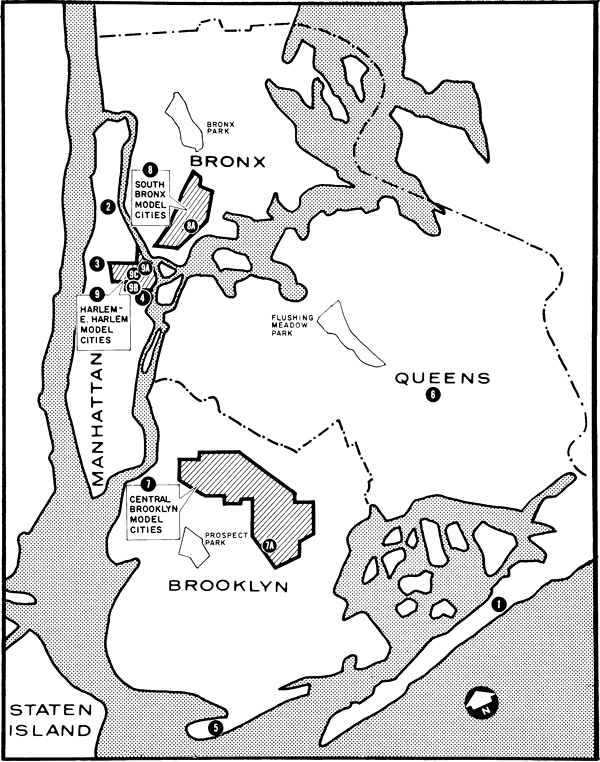
    New York City neighborhoods designated for revitalization with funding from the Model Cities Program.
    The City of New York, Community Development Program: A Progress Report, December 1968.

    To qualify for the program, cities had to apply for planning grants by submitting a detailed proposal that included an analysis of neighborhood conditions, long-term goals and strategies for addressing problems.

    Federal funds went directly to city governments, which then distributed them to local agencies and community organizations through contracts. These funds were relatively flexible but had to be tied to locally tailored plans. For example, Kansas City, Missouri, used Model Cities funding to support a loan program that expanded access to capital for local small businesses, helping them secure financing that might otherwise have been out of reach.

    Unlike previous programs, Model Cities emphasized what Johnson described as “comprehensive” and “concentrated” efforts. It wasn’t just about rebuilding streets or erecting public housing. It was about creating new ways for government to work in partnership with the people most affected by poverty and racism.

    A revolutionary approach to poverty

    What made Model Cities unique wasn’t just its scale but its philosophy. At the heart of the program was an insistence on “widespread citizen participation,” which required cities that received funding to include residents in the planning and oversight of local programs.

    The program also drew inspiration from civil rights leaders. One of its early architects, Whitney M. Young Jr., had called for a “Domestic Marshall Plan” – a reference to the federal government’s efforts to rebuild Europe after World War II – to redress centuries of racial inequality.

    Civil rights activist Whitney M. Young Jr. helped shape the vision of the Model Cities Program.
    Bettmann/Getty Images

    Young’s vision helped shape the Model Cities framework, which proposed targeted systemic investments in housing, health, education, employment and civic leadership in minority communities. In Atlanta, for example, the Model Cities Program helped fund neighborhood health clinics and job training programs. But the program also funded leadership councils that for the first time gave local low-income residents a direct voice in how city funds were spent.

    In other words, neighborhood residents weren’t just beneficiaries. They were planners, advisers and, in some cases, staffers.

    This commitment to community participation gave rise to a new kind of public servant – what sociologists Martin and Carolyn Needleman famously called “guerrillas in the bureaucracy.”

    A Model Cities staffer discusses the program to a group of students gathered at Denver’s Metropolitan Youth Education Center in 1970.
    Bill Wunsch/The Denver Post via Getty Images

    These were radical planners – often young, idealistic and deeply embedded in the neighborhoods they served. Many were recruited and hired through new Model Cities funding that allowed local governments to expand their staff with community workers aligned with the program’s goals.

    Working from within city agencies, these new planners used their positions to challenge top-down decision-making and push for community-driven planning.

    Their work was revolutionary not because they dismantled institutions but because they reimagined how institutions could function, prioritizing the voices of residents long excluded from power.

    Strengthening community ties

    In cities across the country, planners fought to redirect public resources toward locally defined priorities.

    A mobile dentist office in Baltimore.
    Robert Breck Chapman Collection, Langsdale Library Special Collections, University of Baltimore, CC BY-NC-ND

    In some cities, such as Tucson, the program funded education initiatives such as bilingual cultural programming and college scholarships for local students. In Baltimore, it funded mobile health services and youth sports programs.

    In New York City, the program supported new kinds of housing projects called vest-pocket developments, which got their name from their smaller scale: midsize buildings or complexes built on vacant lots or underutilized land. New housing such as the Betances Houses in the South Bronx were designed to add density without major redevelopment taking place – a direct response to midcentury urban renewal projects, which had destroyed and displaced entire neighborhoods populated by the city’s poorest residents. Meanwhile, cities such as Seattle used the funds to renovate older apartment buildings instead of tearing them down, which helped preserve the character of local neighborhoods.

    The goal was to create affordable housing while keeping communities intact.

    An Atlanta neighborhood identified as a candidate for street paving and home rehabilitation as part of the Model Cities Program.
    Georgia State University Special Collections

    What went wrong?

    Despite its ambitious vision, Model Cities faced resistance almost from the start. The program was underfunded and politically fragile. While some officials had hoped for US$2 billion in annual funding, the actual allocation was closer to $500 million to $600 million, spread across more than 60 cities.

    Then the political winds shifted. Though designed during the optimism of the mid-1960s, the program started being implemented under President Richard Nixon in 1969. His administration pivoted away from “people programs” and toward capital investment and physical development. Requirements for resident participation were weakened, and local officials often maintained control over the process, effectively marginalizing the everyday citizens the program was meant to empower.

    In cities such as San Francisco and Chicago, residents clashed with bureaucrats over control, transparency and decision-making. In some places, participation was reduced to token advisory roles. In others, internal conflict and political pressure made sustained community governance nearly impossible.

    Critics, including Black community workers and civil rights activists, warned that the program risked becoming a new form of “neocolonialism,” one that used the language of empowerment while concentrating control in the hands of white elected officials and federal administrators.

    A legacy worth revisiting

    Although the program was phased out by 1974, its legacy lived on.

    In cities across the country, Model Cities trained a generation of Black and brown civic leaders in what community development leaders and policy advocates John A. Sasso and Priscilla Foley called “a little noticed revolution.” In their book of the same name, they describe how those involved in the program went on to serve in local government, start nonprofits and advocate for community development.

    It also left an imprint on later policies. Efforts such as participatory budgeting, community land trusts and neighborhood planning initiatives owe a debt to Model Cities’ insistence that residents should help shape the future of their communities. And even as some criticized the program for failing to meet its lofty goals, others saw its value in creating space for democratic experimentation.

    A housing meeting takes place at a local Model Cities field office in Baltimore in 1972.
    Robert Breck Chapman Collection, Langsdale Library Special Collections, University of Baltimore, CC BY-NC-ND

    Today’s housing crisis demands structural solutions to structural problems. The affordable housing crisis is deeply connected to other intersecting crises, such as climate change, environmental injustice and health disparities, creating compounding risks for the most vulnerable communities. Addressing these issues through a fragmented social safety net – whether through housing vouchers or narrowly targeted benefit programs – has proven ineffective.

    Today, as policymakers once again debate how to respond to deepening inequality and a lack of affordable housing, the lost promise of Model Cities offers vital lessons.

    Model Cities was far from perfect. But it offered a vision of how democratic, local planning could promote health, security and community.

    Deyanira Nevárez Martínez is a trustee of the Lansing School District Board of Education and is currently a candidate for the Lansing City Council Ward 2.

    ref. Could a bold anti-poverty experiment from the 1960s inspire a new era in housing justice? – https://theconversation.com/could-a-bold-anti-poverty-experiment-from-the-1960s-inspire-a-new-era-in-housing-justice-253706

    MIL OSI AnalysisEveningReport.nz

  • MIL-OSI Economics: Give ‘Try Galaxy’ a Go to Experience the Future of Mobile Innovation

    Source: Samsung

    The Samsung Galaxy universe boasts cutting-edge, AI-driven technology across its phones, wearables, and seamlessly connected ecosystem. Whether you’re a current Galaxy user eyeing the new One UI 7 and S25 features, or a non-Galaxy owner curious about the hype, including how products like Buds or the new Galaxy Ring fit in, there’s an easy way to explore. Samsung’s “Try Galaxy” app offers a free, simulated experience of their latest smartphone interface and a peek at their ecosystem devices, no new hardware required.
     
    What You Can Do with Try Galaxy
    
    A post shared by Jacques Snyman (@Jacqie)
     
    Explore the All-New Galaxy S25 Series – Get hands-on with the sleek and powerful Galaxy S25 Ultra, S25+, and S25. Get a peek on how they look (virtually), explore the refined design, and get a taste of the Galaxy AI power and camera upgrades these devices offer.
     
    Test the Galaxy Ring – Intrigued by the Galaxy Ring? Try Galaxy lets you virtually explore this new piece of wearable tech and even helps you determine your ring size – so you’re one step closer to wearable wellness tech that fits your lifestyle.
     
    Virtually Try on Galaxy Watches – Thinking of upgrading your wrist game? Use the app’s try-on feature to see how the latest Galaxy Watch models would look on you – available styles, sizes, and customisations included.
     
    Fold Experience – See the Future, Unfolded – Curious about Samsung’s foldable phones? Get a feel for the Fold Experience, virtually flipping open a Galaxy Z Fold and navigating multitasking features that redefine how you use a phone.


    View this post on Instagram


    A post shared by Tyron Tech (@tyron_tech)
     
    Dive Into One UI 7 – Smarter, Smoother, More Personal
    Morning Brief – Start your day smarter. The Morning Brief gives you a personalised rundown of the day -calendar events, weather updates, to-do lists – all on your lock screen or home screen in an easy-to-read card format.
     
    Seamless Actions Across Apps – Enjoy uninterrupted multitasking with smooth transitions between apps as you move through your day with fluidity. Drag and drop, or switch between apps, reply to messages while watching videos, or take notes while browsing – all without slowing down. Imagine watching a recipe tutorial while jotting ingredients in Samsung Notes, with split-screen multitasking keeping both apps open and usable at once – smooth and lag-free.
     
    Audio Eraser – Tired of background noise ruining your videos? With Audio Eraser, you can remove ambient distractions and keep the focus on your voice or subject – perfect for content creators or casual users alike.
     
    Portrait Filters – Take your selfies up a notch with Portrait Filters that subtly enhance lighting, blur backgrounds, and add mood – all in real time.
     
    Try It. Love It. No Strings Attached.
    What makes Try Galaxy truly amazing is that you can explore all of these without ever switching phones. It’s a no-risk, no-commitment way to test drive the Galaxy experience, including the latest devices and One UI 7 features, right from your current device.No pressure. Just an easy, immersive way to see if the future of mobile innovation fits you.


    View this post on Instagram

    A post shared by Gouwha Latief (@whamp_playz)
     
    Ready for your aha moment? Download Try Galaxy today and virtually step into the Galaxy world.

    MIL OSI Economics

  • MIL-OSI Economics: Samsung Wins MyBroadband 2025 Award for TV Brand of the Year

    Source: Samsung

     
    Samsung has been named the 2025 MyBroadband TV Brand of the Year, a prestigious accolade that recognises the company’s continued leadership and innovation in the television industry.
     
    Presented annually, the MyBroadband Award for TV Brand of the Year honours brands that consistently deliver outstanding products, cutting-edge technology, and exceptional user experiences to South African consumers. Samsung was chosen based on its strong brand reputation, industry-wide innovation, and deep commitment to the local market.
     
    “We are honoured and proud to be recognised as South Africa’s leading TV brand,” said Mike van Lier, Vice President for Consumer Electronics at Samsung Electronics South Africa. “This award reflects our ongoing investment in breakthrough technologies and our dedication to offering our consumers the very best in home entertainment.”
     
    Samsung has long set the standard for what televisions can achieve. The company’s pioneering work in quantum dot technology began in 2001 and led to the creation of the world’s first cadmium-free quantum dot material in 2014. This innovation laid the foundation for Samsung’s highly acclaimed SUHD and QLED TV ranges.
     
    With more than 150 patents in quantum dot technology, Samsung continues to redefine picture quality and performance with each generation of products. Its current line-up, which includes the Neo QLED and OLED ranges, showcases the brand’s commitment to delivering superior brightness, colour precision, and refresh rates for all types of viewing needs.
     
    As a leading brand in South Africa, Samsung continues to deliver TVs that resonate with local audiences, whether for sport, cinema, or gaming. A strong commitment to local customer service and support matches the company’s sustained investment in innovation and product excellence.
     
    “At its core, our business is driven by the consumer. This is why we will continue to push the boundaries of what’s possible in home entertainment. We are particularly excited about the future, especially after this accolade and being named South Africa’s preferred TV brand,” added van Lier.

    MIL OSI Economics

  • MIL-OSI USA: UConn Has Record-Breaking Cohort for Gilman Scholars

    Source: US State of Connecticut

    A record-breaking 31 UConn students have been awarded a Gilman Scholarship in the latest cohort of the prestigious academic award. The award is congressionally funded through the Bureau of Education and Cultural Affairs at the State Department.

    The funding supports expanding student participation in study abroad programs and encourages travel to diverse locations around the globe, along with intensive language study and internship experiences.

    The 31 UConn students, who will study in 14 different countries, will receive a total of nearly $94,000 in scholarship funds through the Gilman program. A total of 40 UConn students have earned Gilman awards in the last two cohorts, this one and October 2024, for a total of more than $121,500 in scholarship funding.

    Students applying for Gilman Scholarships work with advisors in UConn’s Office of National Scholarships & Fellowships (ONSF) and Experiential Global Learning (EGL). Rachel Gleicher, an advisor in EGL, and Michael Cunningham, assistant director of ONSF and UConn’s Fulbright program advisor, are UConn’s two Gilman certifying advisors.

    “We are very excited that the Gilman program has selected so many UConn students this cycle,” says Cunningham. “It’s a testament to the quality of our students and to the hard work that they put into their applications.”

    Upon their return from studying abroad, each Gilman Scholar is required to complete a service project in their campus or home community with the goal of sharing the value of participation in study abroad and promoting the scholarship to prospective students. Applications are reviewed with consideration for the proposed follow-up service project.

    “We are so proud of these students for staying determined and focused on their study abroad goals,” says Gleicher. “Amid uncertain times, with federal funding freezes and broader uncertainty, they remained committed to their aspirations. Now more than ever, it is crucial to ensure students are aware of the funding opportunities available to them.”

    Eligibility for the Gilman Scholarship requires undergraduate students to be Pell Grant-eligible United States citizens who plan to study abroad for academic credit through a program approved by their home institution. Supporting students with high financial need provides access to students who are historically underrepresented in study abroad, including first-generation college students, STEM majors, ethnic and racial minority students, students with disabilities, LGBTQ+ students, and others who experience barriers to participation.

    Students from underrepresented areas of the U.S. are also considered during the application process and this year there are recipients from all 50 states.

    The following UConn students were selected as Gilman Scholars in this cycle, and they are listed with the location of where they will study as part of the program:

    Carina Adams-Szabo ’27 (CLAS), a psychology and political science major from Greenwich, who will be studying neuroscience this summer in Salamanca, Spain.

    Ashley Barragan ’27 (NUR), a nursing major who will be studying at the University of Dublin Summer Applied Research for Nursing Practice in Dublin, Ireland.

    Rhys Brauer ’27 (CLAS), a psychological sciences major, who will be studying neuroscience this summer in Salamanca.

    Brooke Catellier ’26 (CAHNR), an allied health major, who will be studying the Mediterranean diet and Tuscan cuisine in Florence, Italy, this summer.

    Kylene Chino ’26 (CLAS), a human rights and political science major, who will be studying in the fall at the Pusan National University in Shanghai, China.

    Jaiyliah Cochran ’25 (CLAS), a microbiology major, who will be studying field ecology this summer in Limpopo Province, South Africa.

    Mia Dansby ’26 (BUS), a management major, who will be studying this summer at ISI in Florence.

    Andrea D’Oleo ’27 (NUR), a nursing major from East Hartford, who will be studying in the Dublin Summer Applied Research Program for Nursing Practice in Ireland.

    Danyelix Echevarria Figueroa ’28 (ACES), a pre-teaching major from New Britain, who will study next spring at the University of Grenda in Grenda, Spain.

    Dahiana Fernandez-Ramirez ’26 (CLAS), a psychological sciences major, who will be studying this fall at ISI Florence.

    Adiriana Garcia Vazquez ’25 (CLAS), a cognitive science major from Bridgeport, who will be studying this fall at the Interdisciplinary Ethnography Field School in Mauritius.

    Hannah Ginste ’26 (CLAS), a communications major, who will be doing a summer internship in London.

    Jessica Glowacki ’25 (CLAS), a biological sciences major who will be studying field ecology this summer in Limpopo Province, South Africa.

    Emma Hazard ’27 (CAHNR), a diagnostic genetic sciences major, who will be studying the Mediterranean diet and Tuscan cuisine in Florence this summer.

    Danecia Henry ’28 (BUS), a management major from New Haven, will be studying in the summer at Camino de Santiago in Spain.

    Ty’Laisha Huff ’27 (NUR), a nursing major from Hartford, will be studying at the Dublin Summer Applied Research Program for Nursing Practice in Ireland.

    Layan Jahaf ’28 (CLAS), a political science and Arabic and Islam civics major, who will be studying this fall in London.

    Dee Jerome ’26 (CAHNR), an allied health sciences major from Bridgeport, who will be studying this summer in Accra, Ghana.

    Evelyn Pazan ’27 (CLAS), a finance and German major, who will be studying during the 2025-26 academic year at the University of Mannheim in Germany.

    Danielle Phillips ’27 (CLAS), an individualized major in industrial and labor relations from Bridgeport, who will be studying this summer at the Intercultural Leadership Program in Strasbourg, France.

    Jocelyn Ramirez ’26 (BUS), a management major from New Haven, who will be studying this summer at ISI.

    Jamie Ross ’27 (CLAS), a physiology and neurobiology major, who will be studying next winter in Barcelona, Spain.

    Ellie Sanders ’27 (CAHNR), a nutritional sciences major from West Cornwall, who will be studying the Mediterranean diet and Tuscan cuisine in Florence this summer.

    Fabio Silveira ’26 (CLAS), a pathobiology major, who will be studying neuroscience this summer in Salamanca, Spain.

    Amber Szymanski ’26 (CLAS), a political science and human rights major, who will be studying this fall at the Pusan National University in Busan, South Korea.

    Angel Uchupailla ’26 (CAHNR), an allied health major from Stamford, who will be studying this winter in Rome.

    Lyric Vargas ’27 (CLAS), a political science and psychological science major, who will be studying this fall at the University of Lisbon in Portugal.

    Erica Wong ’26 (CLAS), a political science and urban and community studies major, who will be studying this fall at Fudan University in Shanghai, China.

    Morgan Xu ’26 (ENG), a materials science and engineering major from Chesire, who will be studying this fall at the National University of Singapore.

    Ada Yeung ’27 (CLAS), an individualized major, who will be studying next spring at Fudan University.

    Maggie Zheng ’27 (BUS), an accounting major, who will be studying next spring at Fudan University.

    MIL OSI USA News

  • MIL-OSI USA: Investing in Relationships Builds Resilience for Dementia Caregivers, Study Finds

    Source: US State of Connecticut

    When assistant professor of communication Amanda Cooper was in graduate school, her grandparents began to decline. She watched her large family, comprising of her father, his nine siblings, and 50 of her first cousins rally around her grandparents. Because their home was in the Idaho woods, near Yellowstone National Park, their distance from the hospital meant they needed round-the-clock care.  

    “It’s like a crazy storm hits your family,” she says. “Everyone is moving, and there’s all these pieces, and relationships are changing.” 

    Cooper witnessed her family members disagreeing on how to handle tough conversations. After her grandmother’s death, her grandfather would repeatedly ask where his wife was.  

    “My dad said he wouldn’t lie to him,” she says. “He’d say, ‘She’s dead. Stop asking.’”  

    But other family members didn’t want to take this approach, causing tension within the family.  

    That experience sparked a question that became the foundation of Cooper’s research. How can caregivers maintain a relationship with family members with dementia, while preserving their own sanity? 

    More than six million Americans are living with Alzheimer’s disease, the most common form of dementia, and many more live with other types of cognitive decline. The emotional labor of caregiving and the communication breakdowns that happen between patients and their loved ones has only recently become a topic of research.  

    Cooper’s new study reveals that people who invest in their relationships by regularly expressing love, talking about important topics, and spending time together, build what she calls relational reserves. These reserves help caregivers cope more effectively if a loved one begins to change due to dementia. 

    “The theory says, if I’ve built a strong relationship, I’ll have more resources to draw from when things get difficult,” Cooper says.  

    This hypothesis, however, contrasts with another theory: that the more invested you are in a relationship, the more devastating it is to lose. Cooper set out to look at this apparent contrast through a social science lens.  

    In her study, caregivers reported on their past relationships with loved ones; how much they felt like teammates, how often they engaged in affectionate or supportive behavior, and how they approached problems together. Then Cooper looked at how those same caregivers communicated now with their loved ones who had dementia. 

    I just want to help people find a way to keep the love, even when the memory fades.

    She found that developing strong, loving relationships in the past led to more positive communication in the present, even in the face of memory loss or personality changes. 

    “One of the hardest things with the relational side of dementia is that, when it starts, you don’t know what’s going on,” says Cooper “You just think your family member is behaving weirdly, or you’re confused. Usually people get frustrated: they think, ‘I just had this conversation with you. Why are you asking me this again?’” 

    But caregivers who had what Cooper calls a “communal orientation,” or a belief that the caregiver and the person with dementia are in it together, were better able to adapt. 

    “If I view this person as my teammate, it shifts how I interact with them, even when they can’t give back in the same way anymore,” she says. 

    The study also found that caregivers who could mentally separate their loved one from the disease, or who saw the dementia as the cause of difficult behaviors rather than blaming the person, were better able to maintain a sense of compassion. 

    “I think sometimes we imagine that, once someone is diagnosed with dementia, their life is basically over,” Cooper says. “But that’s not true. People live with this for five, eight, even ten years. I’ve talked to so many caregivers who have a pretty rich and full life with their loved one, even through the difficulty.” 

    Cooper’s goal is to help families make the most of those years.

    “I’m a big believer that we should live as much as we can until we die,” she says. “Often, scientific research just goes into a journal to other academics and dies there,” she said. “Research is almost useless if it doesn’t actually get to the right people who can use it.” 

    Her message to families navigating the rocky terrain of dementia is one of hope: it is possible to maintain connection, to adapt, to find meaning in caregiving. 

    “It’s hard. It’s messy. But it can also be beautiful,” says Cooper. “I just want to help people find a way to keep the love, even when the memory fades.”

    MIL OSI USA News

  • MIL-OSI USA: Rudd Center Celebrates 10th Anniversary at UConn

    Source: US State of Connecticut

    In the fall of 2014, researchers, advocates, and community members gathered in the garden at an East Hartford elementary school for an exciting announcement from President Susan Herbst: The Rudd Center was moving to UConn.  

    Founded in 2005 by Kelly Brownell, the Rudd Center enjoyed 10 successful years at Yale University before officially joining UConn’s Institute for Collaboration on Health, Intervention, and Policy (InCHIP) in 2015. Now, as it celebrates its 10th anniversary at UConn, members of the Rudd Center team are reflecting on the past decade and looking forward to what comes next for the Center. 

    Marlene Schwartz, director of the Rudd Center, speaks at an event announcing the move of the Rudd Center to UConn. (Peter Morenus/UConn Photo)

    “UConn’s commitment to multidisciplinary research has made it the perfect home for the Rudd Center,” says Marlene Schwartz, director of the Rudd Center and a professor in the Department of Human Development and Family Sciences. “Connecting with research partners across the University has been a crucial part of our work for the past 10 years, and we look forward to continuing to foster these collaborations.” 

    At the heart of the Rudd Center’s mission is the belief that everyone deserves the opportunity to eat healthfully. While the Center’s areas of research have evolved over the years, its work centers around five core domains:  

    • Charitable food system research led by Caitlin Caspi from the Department of Allied Health Sciences, Maria Gombi-Vaca, and Schwartz
    • Economics of food assistance programs and fiscal policy research led by Tatiana Andreyeva from the Department of Agricultural and Resource Economics
    • Food marketing research led by Fran Fleming-Milici
    • Healthy school environments (including school meals) research led by Schwartz
    • Weight bias research led by Rebecca Puhl from the Department of Human Development and Family Sciences

    “To help further our mission, we focus on translating research into action,” says Puhl, deputy director of the Rudd Center. “This ranges from testifying about legislation at the state and federal levels, sharing our research findings with the media, and creating evidence-based resources to help diverse audiences.” 

    Among the popular tools developed by the Rudd Center are an online assessment to help school districts around the country assess their wellness policies and practices, a training course to help clinicians reduce weight stigma in health care, a cultural food guide to help the charitable food system meet the needs of their neighbors, an image gallery to help content creators find respectful imagery of people in larger bodies, and a calculator to help policymakers assess the potential impact of sugary drink taxes.  

    “As we look back on the past 10 years, I’m so grateful that the Rudd Center has been given the opportunity to grow and thrive at UConn,” says Schwartz. “The many researchers, staff, students, and affiliates who have been a part of our journey are what makes the Rudd Center so special.” 

    For more information about the Rudd Center’s work, visit its website, subscribe to its monthly newsletter, and connect with the Center on LinkedIn and Bluesky.  

    MIL OSI USA News

  • MIL-OSI: SSCP Lager Bidco AB (publ) – Interim report for first quarter 2025

    Source: GlobeNewswire (MIL-OSI)

    SSCP Lager BidCo AB (publ) – Interim report for the period 1 January – 31 March 2025.

    Today SSCP Lager Bidco AB (publ) published an interim report for the first quarter, the report can be downloaded on www.logent.se or via the link below.

    For more information, please contact:
    Andrzej Kulik, CFO, telephone number: +46 738 15 67 00, andrzej.kulik@logent.se or
    Joel Engström, CEO, telephone number: +46 734 36 36 29, joel.engstrom@logent.se

    This press release was published on 27th May at CET 14:00

    This information is of the type that SSCP Lager BidCo AB (publ) is obliged to make public pursuant to the EU Market Abuse Regulation, the Swedish Securities Markets Act and the Swedish Financial Instruments Trading Act. The information was submitted for publication through the agency of the contact persons set out above, on 27-05-2025 at 14:00 CET/CEST

    About Logent Group
    Logent is a comprehensive and independent logistics partner, with a Nordic base and with global networks. We have a wide range of services and create value for our customers through guaranteed cost and quality improvements. Our services include Logistics Services such as Warehouse Management, Transport Management and Customs, Port and Combined Terminals, Staffing Services and Consulting Services. This means that Logent has grown to a turnover of about SEK 2.3 billion from the start in 2006 and employs approximately 2,800 people.

    This information is of the type that SSCP Lager BidCo AB (publ) is obliged to make public pursuant to the EU Market Abuse Regulation, the Swedish Securities Markets Act and the Swedish Financial Instruments Trading Act. The information was submitted for publication through the agency of the contact persons set out above, on 27-05-2025 at 14:00 CET/CEST.

    Attachment

    The MIL Network

  • MIL-OSI: Kaltura Sweeps Eventex 2025 with Five Golds, Redefining the Future of AI-Powered Events

    Source: GlobeNewswire (MIL-OSI)

    New York, May 27, 2025 (GLOBE NEWSWIRE) — Kaltura (Nasdaq: KLTR), the AI Video Experience Cloud, has won five golds in the prestigious 2025 Eventex Awards, winning every category it entered and cementing its leadership in the transformation of digital events through artificial intelligence.  

    This marks the third consecutive year that Kaltura Events, the company’s all-in-one AI-powered platform for webinars and virtual experiences, has earned top honors. In a year with record-breaking global submissions, Kaltura stood out for its relentless innovation in creating personalized, intelligent, and impactful digital engagement

    The Award-Winning Categories: 

    • Best New Event Technology 
    • Best Audience Engagement Technology 
    • Best Data Collection and Event Analytics Technology 
    • Best Event AI Technology 
    • Best Virtual Event Platform 

    “We are delighted to have our event technology recognized once more by Eventex. Winning is never the goal – redefining what’s possible is. We have been focused on leading the way with our new Kaltura Genies and AI live-session agents,” said Eynav (Navi) Azaria, Chief Product and Engineering Officer at Kaltura. “For webinars, events, and digital experiences of every shape and size, it’s no longer a question of ‘should I use AI to drive better results’, but rather ‘how far can AI take my event’, and we are committed to making these experiences much more engaging, hyper-personalized and super impactful.”

    Kaltura Events is an all-in-one, AI-powered platform designed to create, host, manage,  and promote webinars,virtual and hybrid events of all sizes. It powers highly interactive and accessible experiences that set it apart from any other solution. With its real-time AI assistant, attendees’ sentiment analysis, and more, Kaltura Events continuously provides actionable insights to empower organizers looking to boost engagement.   

    Two key new additions drove Kaltura Events to victory, including the Kaltura Genie, an AI-powered agent that enhances event engagement by providing hyper-personalized digital experiences and can answer attendee questions during hybrid events using context-driven responses pulled from event content. Following the event, Genie offers tailored recommendations, automatically generating highlights, summaries, and follow-ups.  

    Additionally, the AI-powered Content Lab identifies key moments from recorded events and generates engaging, digestible content. It produces highlight reels, chaptered summaries, and interactive video quizzes from a single source, maximizing content ROI.  

    “The 15th edition of Eventex Awards has again seen a record-breaking number of entries, which are once again proving that the creativity of the events industry knows no bounds. We feel truly inspired having witnessed ground-breaking projects, all brought to life by exceptional event professionals who continue to push the industry forward. Winning an Eventex award is undoubtedly worth celebrating, so personally and on behalf of the whole Eventex team, I would like to congratulate Kaltura on this truly remarkable achievement,” said Ovanes Ovanessian, Co-founder of Eventex Awards. 

    This year, the Eventex Awards received a record 1239 entries from over 50 countries across six continents, with the number surpassing the previous edition. Major represented brands among winning entries include Volvo, L’Oreal, Lufthansa, AUDI, Netflix, Toyota, Nike, and Formula 1.  

    The full list of winners is available here.  

    About Kaltura  

    Kaltura’s mission is to create and power AI-infused hyper-personalized video experiences that boost customer and employee engagement and success. Kaltura’s AI Video Experience Cloud includes a platform for enterprise and TV content management and a wide array of Gen AI-infused video-first products, including Video Portals, LMS and CMS Video Extensions, Virtual Events and Webinars, Virtual Classrooms, and TV Streaming Applications. Kaltura engages millions of end-users at home, at work, and at school, boosting both customer and employee experiences, including marketing, sales, and customer success; teaching, learning, training and certification; communication and collaboration; and entertainment, and monetization. For more information, visit www.corp.kaltura.com.  

    About Eventex Awards 

    Founded in 2009 to celebrate creativity, innovation, and effectiveness in the industry, today Eventex Awards is the most esteemed international awards in the world of events and experiential marketing. Every year, the awards highlight the best events, brand experiences, tech, suppliers, and venues from the world of events. 

    The MIL Network

  • MIL-OSI: authID Announces its 2025 Board of Directors Nominees Ahead of Annual Meeting

    Source: GlobeNewswire (MIL-OSI)

    Highly Qualified New Board Nominees Will Strengthen authID’s mission to Drive Growth and Value Creation for Shareholders

    2025 Annual Meeting to be Held on June 26, 2025

    DENVER, May 27, 2025 (GLOBE NEWSWIRE) — authID® (Nasdaq: AUID)(“authID” or the “Company”), a leading provider of biometric identity verification and authentication solutions, is nominating four highly qualified executives to the Board of Directors (the “Board”), in addition to the nomination of existing directors, included within the 2025 Proxy Statement filed on May 16, 2025. The 2025 Annual Meeting will be held virtually on June 26, 2025, at 10.00 a.m. EDT. 

    The following new Board nominees will be up for election at the Company’s 2025 Annual Meeting:

    Further information about each nominee is included at the end of this release.

    “authID is fortunate to nominate these talented business leaders to our Board,” said Rhon Daguro, authID’s Chief Executive Officer. “Their willingness to serve demonstrates their belief in our mission to deliver market-leading biometric identity authentication solutions in an increasingly AI-driven world. We look forward to benefitting from their leadership as we continue to focus on driving growth and creating value for shareholders.”

    “With AI evolving rapidly and cybersecurity more critical than ever, biometrics will play a foundational role in shaping our digital future,” said Krish Venkataraman, former President of Dataiku, Co-President/Board member of KnowBe4 (prior ticker: KNBE), and CFO of Socure. “authID has taken a truly differentiated approach to biometrics—one that is well-suited for rapid adoption by large enterprises. I’m deeply impressed by what this talented team of identity and fraud prevention experts has achieved in such a short time, and I’m excited to support their continued growth by joining the Board.”

    “I’ve been fortunate to partner with forward-looking tech companies over the years, and I believe that authID can surpass my expectations for innovation and vision,” said Ram Menghani, Past President of NEC Enterprise Communication Technologies. “They can not only compete but transcend other players in bringing biometric assurance to public and private sector organizations and be a truly great global partner for companies like mine who need the confidence of knowing who is behind each and every device. I look forward to helping authID grow and flourish in its next stage of development by joining the Board.”

    “Like the leadership team at authID, I have worked for decades in cybersecurity, so we share the same vision for safeguarding the enterprise, while protecting user privacy,” said Nick Shevelyov, Founder of vCSO.ai. “I am excited to join the Board as I feel they are the right organization at the right time to provide the best of biometric identity security to a market that absolutely requires security and compliance as the cloud continues to expand not only enterprise opportunities but also enterprise risks.”

    “I have placed my confidence in authID’s technology for many years and now we see that authID is expanding its global presence,” said Stephen J. Garchik, President of SJM Partners. “authID’s biometric identity platform is helping an increasing number of organizations securely manage identities across borders and verticals, while maintaining compliance with international laws. I am delighted for the opportunity to join the Board and help the Company in the next phase of its journey.”

    At the meeting, proposals will be submitted to elect directors, ratify the appointment of auditors and ratify an increase in the shares allocated to the 2024 Equity Incentive Plan.

    In addition to recommending the new Board nominees, authID is proposing the election of six of the current directors. Thomas Szoke, Founder and Chief Technology Officer (CTO), will step down as a director at the meeting, in order to focus on his role as CTO to continue enhancing the Company’s technology.

    “On behalf of the Board, I want to thank Tom for his significant contributions to authID as a board director,” added Daguro. “Fortunately, authID will continue to benefit from Tom’s visionary direction and strategic contributions in his continuing critical role as authID’s CTO.”

    Annual Meeting

    The Company has filed its Proxy Statement with the SEC, which explains all the proposals and provides other information about the Company, and is mailing the Notice of Meeting, the Proxy Statement and additional materials related to the Annual Meeting to stockholders. Stockholders who hold their shares through brokerage accounts will receive the materials via their brokers, either through the mail, or electronically depending on their communication preferences.

    The meeting will be held via a webcast. To join the webcast, investors must register in advance here: authID 2025 Annual Meeting Registration. Participants are advised to pre-register with a validated email address. Registrants will receive a confirmation email and calendar notice to add the meeting to your calendar. During the call, attendees will be invited to ask questions through the Q&A option in the Meeting webcast portal.

    Stockholders will be able to view the materials electronically at the Company’s Investor Relations site at 2024 Annual Reports or at www.investorvote.com/AUID.

    Stockholders will also be able to vote electronically, in accordance with the instructions provided in the materials each will receive. Stockholders are encouraged to vote by proxy ahead of the meeting, whether or not they plan to attend the meeting, to ensure their votes are counted.

    Director Nominee Biographies

    Stephen J. Garchik

    Mr. Garchik has been associated with authID for approximately 10 years as a major investor and supporter and now holder of 10% of the outstanding common stock. Since 1997, Mr. Garchik has been President of SJM Partners, a real estate development, design and construction, leasing and management company. SJM Partners owns over 40 retail, commercial and residential properties. Mr. Garchik has over 40 years of management and business experience and serves on the board of several non-profit institutions. He holds a Bachelor of Science and M.B.A. degree from the Wharton School at the University of Pennsylvania. Mr. Garchik’s extensive experience provides authID’s Board with a valuable perspective regarding business management, operations and strategy, in addition to a broad range of business connections.

    Ram Menghani

    Mr. Menghani has been Past President of NEC Enterprise Communications from 2020 to 2025 and is executive advisor to NEC, having joined NEC Corporation of America in 2001, serving in various roles in product management and development. He has over 30 years of global leadership experience in unified communications, product innovation, and digital transformation. Mr. Menghani’s track record includes forging partnerships with major tech players like Microsoft and Oracle, modernizing legacy systems into cloud-based models, and guiding startups to successful exits. Mr. Menghani has deep expertise in product strategy, global markets, and digital innovation and brings his global high tech business partnerships and scaling expertise to the Board.

    Nicholas “Nick” Shevelyov

    Mr. Shevelyov is a cybersecurity executive with 30 years of experience who served as Chief Security and Privacy Officer and later as Chief Information Officer at Silicon Valley Bank from 2007 to 2021. He led key initiatives in cybersecurity strategy, cloud transformation, and modern software delivery there. Mr. Shevelyov was an early design partner to industry leaders like Palo Alto Networks, Zscaler, and FireEye. In 2021, he published “Cyber War…and Peace” and founded and serves as CEO of vCSO.ai, a cybersecurity advisory firm supporting organizations such as Group 42, the Audubon Society, and multiple cybersecurity product companies. He also serves on the Bay Area CSO Council and Cofense boards. Mr. Shevelyov has a bachelor’s degree in Economics from San Francisco State University and an MBA from University of San Francisco School of Management. Mr. Shevelyov’s CSO experience and expertise will provide authID with invaluable insight and experience in relation to its core activities as well as connections in the cybersecurity industry.

    Shrikrishna “Krish” Venkataraman

    Mr. Venkataraman is a seasoned technology and Wall Street executive with a strong track record of leading IPOs, strategic sales, and large-scale corporate transformations. He represents a new generation of multi-disciplinary executives, having served in roles including President, CFO, COO, CAO, and public/private board member. Beyond traditional finance responsibilities — treasury, controllership, M&A, and investor relations — he has led sales, HR, IT, legal, and operations teams with a strong focus on IT and cybersecurity governance. Mr. Venkataraman served as President of Daitaku a leading AI firm, from 2023 to April 2025. Prior to that from 2022 to 2023 he was the Chief Financial Officer of Socure Inc. Mr. Venkataraman served as Co-President and Chief Financial Officer of KnowBe4 Inc. (Formerly Nasdaq: KNBE) a global security platform offering human risk management, from 2018 to 2022 and for a subsequent year as a Board member. Earlier in his career, he held leadership roles at Dealogic Lehman Brothers, NYSE Euronext, American Express, and Deloitte Consulting. Krish holds a B.S. from Carnegie Mellon University and an MBA from Cornell University’s Johnson Graduate School of Management. He brings his high-tech finance expertise to help authID with strategic deals, strategic capital, and generally in matters of corporate finance. 

    About authID Inc.

    authID (Nasdaq: AUID) ensures enterprises “Know Who’s Behind the Device™” for every customer or employee login and transaction through its easy-to-integrate, patented biometric identity platform. authID powers biometric identity proofing in 700ms, biometric authentication in 25ms, and account recovery with a fast, accurate, user-friendly experience. With our ground-breaking PrivacyKey™ solution, authID provides a 1-to-1-billion false match rate, while storing no biometric data. authID stops fraud at onboarding, blocks deepfakes, prevents account takeover, and eliminates password risks and costs, through the fastest, most frictionless, and most accurate user identity experience demanded by today’s digital ecosystem.

    For further information please visit authid.ai

    Investor Relations Contacts
    authID Investor Relations
    investor-relations@authID.ai

    Media Contacts
    Walter Fowler
    1-631-334-3864
    wfowler@nexttechcomms.com

    The MIL Network

  • MIL-OSI: New Study Reveals Agriculture as Largest, Most Resource-Intensive Industry on Earth

    Source: GlobeNewswire (MIL-OSI)

    BOSTON, May 27, 2025 (GLOBE NEWSWIRE) — RA Capital Management’s Planetary Health Team and The Nature Conservancy have released a groundbreaking analysis that exposes agriculture as the most resource-intensive industry on Earth: it’s the leading contributor to methane emissions, a key driver of water pollution, and it uses roughly half of viable land on Earth. As agriculture is often viewed in silos, its $15T scale and opportunity are often overlooked. The just-released Agriculture Map by RA Capital Management’s Planetary Health team and The Nature Conservancy calls for a systems-level approach to address the urgent risks and transformative opportunities within agriculture through innovation, incentives to change, and direct investment.

    A Media Snippet accompanying this announcement is available in this link.

    The Agricultural Map highlights:

    • Agriculture’s massive footprint means high ROI for broader adoption of best practices: optimizing global yields of staple grains, fruits, and vegetables would allow the world to produce the same amount of food with much less land – freeing up a land area the size of Mexico (~3x the size of Texas).
    • Agriculture produces more methane (a potent greenhouse gas) than any other human activity: Cattle alone produce as much methane as oil, coal, and bioenergy; rice paddies produce more methane than the natural gas industry.
    • Agriculture consumes more water than any other human activity and also causes the most water pollution. Investment in on-field and edge-of-field systems can significantly improve water quality and use. 
    • Fertilizer is important for optimizing crop yields, but fertilizer runoff causes hundreds of billions of dollars worth of losses each year, mostly due to impacts on commercial fishing, tourism, and property values, and creates aquatic dead zones the size of the United Kingdom.

    “Agriculture is the backbone of our global economy, but it’s also the most resource-intensive and environmentally demanding industry on Earth. If we are serious about tackling climate change, water pollution, and food security, we must rethink how we grow, produce, and manage our resources. Sustainable solutions are not just an option – they are a necessity to transform agriculture into a cleaner, more efficient, and resilient industry that can feed the world for generations to come,” noted Kyle Teamey, managing partner, RA Capital Planetary Health.

    Details within the Agriculture Map provide decision-makers with the knowledge they need to navigate the future of agriculture, from sustainable investment strategies to policy reform and innovation in farming technologies. The findings challenge conventional wisdom and call for urgent and coordinated attention from businesses, investors, governments, and philanthropic organizations. The map is a culmination of extensive research led by RA Capital and The Nature Conservancy. It combines proprietary data analysis with a systems-level approach to visualize and communicate the scale and interconnectedness of global agriculture’s planetary impacts while highlighting a range of potential solutions for select problems.

    “The environmental and human health challenges posed by the food system are well-understood in some circles but making this information material and actionable to stakeholders can be a real challenge,” said Stephen Wood, Senior Scientist of Agriculture and Food Systems at The Nature Conservancy. “This map makes it possible for non-experts to quickly understand the scope and scale of the problem, as well as the solutions.”

    The full map is available for download at Agriculture: Hiding in Plain Sight

    About RA Capital Management 

    Founded in 2004, RA Capital Management is a multi-stage investment manager dedicated to evidence-based investing in public and private healthcare, life sciences, and planetary health companies. RA Capital creates and funds innovative companies, from private seed rounds to public follow-on financings, allowing management teams to drive value creation from inception through commercialization and beyond. RA Capital’s knowledge engine is guided by its TechAtlas internal research division, and Raven, RA Capital’s healthcare incubator, offers entrepreneurs and innovators a collaborative and comprehensive platform to explore the novel and the re-imagined. RA Capital has more than 150 employees and over $10 billion in assets under management. 

    RA Capital’s Planetary Health team focuses on creating and funding companies that commercialize scalable, profitable solutions to reduce emissions, increase resource availability, and restore environmental quality, because solutions that heal the planet will yield both healthy people and healthy profits. 

    About The Nature Conservancy

    The Nature Conservancy is a global conservation organization dedicated to conserving the lands and waters on which all life depends. Guided by science, we create innovative, on-the-ground solutions to our world’s toughest challenges so that nature and people can thrive together. We are tackling climate change, conserving lands, waters and oceans at an unprecedented scale, providing food and water sustainably and helping make cities more sustainable. The Nature Conservancy is working to make a lasting difference around the world in 81 countries and territories (40 by direct conservation impact and 41 through partners) through a collaborative approach that engages local communities, governments, the private sector, and other partners. To learn more, visit nature.org or follow @nature_press on X.

    Media Contact:

    Alex Banat for RA Capital

    racapital@v2comms.com

    The MIL Network

  • MIL-OSI: FinWise Bancorp Added to Membership of US Small-Cap Russell 2000® Index

    Source: GlobeNewswire (MIL-OSI)

    MURRAY, Utah, May 27, 2025 (GLOBE NEWSWIRE) — FinWise Bancorp (NASDAQ: FINW) (“FinWise” or the “Company”), parent company of FinWise Bank (the “Bank”), today announced that it was added as a member of the US small-cap Russell 2000® Index, effective after the US market opens on June 30, 2025 as part of the 2025 Russell indexes reconstitution. Membership in the Russell 2000® Index, which remains in place for one year, is based on membership in the broad-market Russell 3000® Index. The stock also was automatically added to the appropriate growth and value indexes.

    “We are proud to have been added as a member of the US small-cap Russell 2000® Index, one of the most respected and widely cited performance benchmarks for U.S. small-cap companies,” said Kent Landvatter, Chairman and CEO of FinWise. “As we maintain our focus on executing our business strategy to position FinWise for long-term growth and shareholder value creation, we look forward to continuing to expand our reach within the investment community.”

    Russell indexes are widely used by investment managers and institutional investors for index funds and as benchmarks for active investment strategies. According to the data as of the end of June 2024, about $10.6 trillion in assets are benchmarked against the Russell US indexes, which belong to FTSE Russell, the global index provider.

    For more information on the Russell 2000® Index and the Russell indexes reconstitution, go to the “Russell Reconstitution” section on the FTSE Russell website.

    About FinWise

    FinWise provides Banking and Payments solutions to fintech brands. Its existing Strategic Program Lending business, conducted through scalable API-driven infrastructure, powers deposit, lending and payments programs for leading fintech brands. As part of Strategic Program Lending, FinWise also provides a Credit Enhanced Balance Sheet Program, which addresses the challenges that lending and card programs face securing warehouse facilities and managing capital requirements. In addition, FinWise manages other Lending programs such as SBA 7(a), Owner Occupied Commercial Real Estate, and Leasing, which provide flexibility for disciplined balance sheet growth. The Company is also expanding and diversifying its business model by incorporating Payments (MoneyRails ™) and BIN Sponsorship offerings. Through its compliance oversight and risk management-first culture, the Company is well positioned to guide fintechs through a rigorous process to facilitate regulatory compliance.

    https://www.finwise.bank/

    About FTSE Russell, an LSEG Business

    FTSE Russell is a global index leader that provides innovative benchmarking, analytics and data solutions for investors worldwide. FTSE Russell calculates thousands of indexes that measure and benchmark markets and asset classes in more than 70 countries, covering 98% of the investable market globally. FTSE Russell index expertise and products are used extensively by institutional and retail investors globally. Approximately $18.1 trillion is benchmarked to FTSE Russell indexes. Leading asset owners, asset managers, ETF providers and investment banks choose FTSE Russell indexes to benchmark their investment performance and create ETFs, structured products and index-based derivatives. A core set of universal principles guides FTSE Russell index design and management: a transparent rules-based methodology is informed by independent committees of leading market participants. FTSE Russell is focused on applying the highest industry standards in index design and governance and embraces the IOSCO Principles. FTSE Russell is also focused on index innovation and customer partnerships as it seeks to enhance the breadth, depth and reach of its offering.

    FTSE Russell is wholly owned by London Stock Exchange Group.

    For more information, visit FTSE Russell.

    Contacts

    investors@finwisebank.com 
    media@finwisebank.com 

    The MIL Network

  • MIL-OSI Africa: APO Group Reveals its Role as Architect Behind Catholic Church in Africa’s Groundbreaking Communications Volunteer Programme

    Source: Africa Press Organisation – English (2) – Report:

    APO Group Reveals its Role as Architect Behind Catholic Church in Africa’s Groundbreaking Communications Volunteer Programme The volunteer task force includes African PR Professionals currently working in major corporations and international NGOs ACCRA, Ghana, May 27, 2025/APO Group/ — APO Group (www.APO-opa.com), a leading award-winning pan-African public relations and communications consultancy, has strategically unveiled a volunteer communications programme comprising experienced communication professionals to support the Symposium of Episcopal Conferences of Africa and Madagascar (SECAM) (www.SECAM.org), the governing body of the Roman Catholic Church in Africa. This groundbreaking initiative, developed and launched by APO Group aims to enhance the Roman Catholic Churches ability to communicate effectively and engage with communities across the African continent. The Catholic Church operates 82,235 Catholic Schools in Africa, educating 30,629,476 pupils. Its extensive network of care includes 13,880 facilities such as hospitals, clinics, dispensaries, leprosy centres, homes for the elderly and chronically ill, centres for disabled people, orphanages, kindergartens, and marriage counselling centres. APO Group and SECAM, the governing body of the Roman Catholic Church in Africa, first entered into their partnership in May 2022 with the shared goal of enhancing media and public relations support for the Catholic Church in Africa. Not only did APO Group conceive the volunteer programme but it also assembled a team of elite, well-experienced African communications professionals. The professionalization of SECAM’s communications capabilities extends beyond standard capacity-building. This initiative includes the development and delivery of a strategic communications framework that aligns with SECAM’s core mission and long-term objectives. The effort also builds upon APO Group’s previous collaborations with the Church, which include the creation and roll-out of a comprehensive communications curriculum and tailored training programme for Catholic institutions across Africa. The volunteer communications team will focus on key priorities, such as:

    • Crafting and executing a long-term communications strategy for SECAM to strengthen the voice of the Roman Catholic Church and increase awareness of its work across Africa.
    • Enhancing media relations to amplify the Church’s presence.
    • Designing effective visibility tools to connect with diverse stakeholders across Africa and beyond.

    Several talented professionals have already joined the SECAM Communications Volunteer Programme, bringing a wealth of expertise and a shared commitment to advancing the Church’s mission across Africa. Among them are Catherine Njoroge (https://apo-opa.co/3HapeKg), Head of Marketing and Strategy, who plays a role in shaping long-term plans to strengthen the Church’s visibility; Nyarai Chapingidza (https://apo-opa.co/4myd1PT), Digital MarComm Manager, who drives efforts to boost SECAM’s online presence; Lucy Kimani (https://apo-opa.co/4mxTKhp), Director of Communications and Advocacy, who steers impactful storytelling and advocacy campaigns; and Eunice Chege (https://apo-opa.co/4dw97mi), Communications Advisor, who contributes her extensive experience in developing and implementing communication strategies. Additionally, professionals joining in the business support functions include Majina Mwasezi (https://apo-opa.co/45pvSq3), Project Coordinator; Pauline Lugalia (https://apo-opa.co/4mAchd2), Executive Assistant to the Head of the Catholic Church in Africa; and Anne Nasumba (https://apo-opa.co/3ZBRqMp), Marketing and Communications Coordinator. Rose Thuo (https://apo-opa.co/4dDCMu0), who joined the programme as Chief of Marketing and Communications, said: “We are witnessing a remarkable convergence of talent and purpose. Each volunteer brings something unique to the table, and together, we are building a communications foundation that will serve the African Catholic Church for years to come.” There is an urgent and immediate need for candidates with HR and recruitment, as well as Graphic Design and website management experience to join the Roman Catholic Church in Africa’s volunteer programme. Individuals with this expertise are encouraged to apply and support the Church’s mission by strengthening its operational capacity across the continent. Interested volunteers are encouraged to apply through the official link: https://apo-opa.co/4dTxLxL. “This pro bono initiative reflects APO Group’s commitment to supporting impactful organisations across Africa. Many high-impact organisations (including NGOs) in Africa face financial barriers to establishing strong communication systems. This should never impede their ability to be seen and heard,” said Nicolas Pompigne-Mognard (www.Pompigne-Mognard.com), Founder and Chairman of APO Group. “Through initiatives like this volunteer programme, we strive to bridge that gap—delivering professional support to elevate their messaging and outreach at the highest possible level.” “Africa is now the future of the Roman Catholic Church,” said Cardinal Fridolin Ambongo, the President of SECAM. “As our communities continue to grow, it becomes ever more important to amplify our voice and share our mission with the world. “We are grateful to APO Group for their support and expertise in making this vision a reality. Their role in designing and implementing this initiative has been invaluable. APO Group’s dedication to empowering impactful organisations aligns perfectly with our mission, and their contribution will undoubtedly leave a legacy in the Church’s journey toward greater visibility and engagement worldwide.” As part of its ongoing partnership with the Roman Catholic Church in Africa, APO Group has delivered a comprehensive range of support initiatives, including complimentary pan-African press release distribution and media monitoring, extensive online and in-person media training for over 22 communication professionals across the continent, and the provision of Zoom licences to Episcopal and Regional Episcopal Conferences. APO Group Founder and Chairman has personally led training sessions and held strategic meetings with Church dignitaries in several African countries to assess further areas of support. Furthermore, a volunteer programme launched in 2024 is now active, enhancing operational assistance for the Church throughout Africa. According to recent data from the Vatican, there are 1.39 billion Catholics worldwide, representing around 18% of the world’s population. Africa’s 236 million Catholics already make up about 20% of the global Catholic population, but they are also the fastest-growing region in the world. By 2050, the World Christian Database estimates that African Catholics will make up 32% of the global Catholic population. According to the United Nations’ 2022 State of the World’s Volunteerism Report, there are an estimated 862.4 million volunteers globally. Engaging in volunteerism offers individuals a unique opportunity to gain practical, hands-on experience, enhance their professional profiles, and develop valuable skills through impactful service. This is a joint press release from APO Group and the Symposium of Episcopal Conferences of Africa and Madagascar (SECAM). Distributed by APO Group on behalf of APO Group. Media contact: marie@apo-opa.com About APO Group: Founded in 2007, APO Group (www.APO-opa.com) is the leading award-winning pan-African communications consultancy and press release distribution service. Renowned for our deep-rooted African expertise and expansive global perspective, we specialise in elevating the reputation and brand equity of private and public organisations across Africa. As a trusted partner, our mission is to harness the power of media, crafting bespoke strategies that drive tangible, measurable impact both on the continent and globally. Our commitment to excellence and innovation has been recognised with multiple prestigious awards, including a Provoke Media Global SABRE Award and multiple Provoke Media Africa SABRE Awards. In 2023, we were named the Leading Public Relations Firm Africa and the Leading Pan-African Communications Consultancy Africa in the World Business Outlook Awards, and the Best Public Relations and Media Consultancy of the Year South Africa in 2024 in the same awards. In 2025, Brands Review Magazine acknowledged us as the Leading Communications Consultancy in Africa for the second consecutive year. They also named us the Best PR Agency and the Leading Press Release Distribution Platform in Africa in 2024. Additionally, in 2025, the Davos Communications Awards 2025 awarded us the Gold Award for Best PR Campaign and the Bronze Award for Special Event. APO Group’s esteemed clientele, which includes global giants such as Canon, Nestlé, Western Union, the UNDP, Network International, African Energy Chamber, Mercy Ships, Marriott, Africa’s Business Heroes, and Liquid Intelligent Technologies, reflects our unparalleled ability to navigate the complex African media landscape. With a multicultural team across Africa, we offer unmatched, truly pan-African insights, expertise, and reach across the continent. APO Group is dedicated to reshaping narratives about Africa, challenging stereotypes, and bringing inspiring African stories to global audiences, with our expertise in developing and supporting public relations campaigns worldwide uniquely positioning us to amplify brand messaging, enhance reputations, and connect effectively with target audiences. About the Symposium of Episcopal Conferences of Africa and Madagascar (SECAM): The Symposium of Episcopal Conferences of Africa and Madagascar (SECAM) (www.SECAM.org) was born out of the decision of the African Bishops during the Second Vatican Council (1962-1965) to establish a forum in which they could speak with one voice on matters pertaining to the Church in Africa. The establishment of SECAM is therefore the result of the Bishops’ resolve to build a continental structure in order to bring forth the African vision to the whole Church. Seeing the importance of such an Association for Africa, the Congregation for the Evangelisation of the Peoples invited the Presidents of the Regional Episcopal Conferences for consultations in 1968. Consequently, the first visit of a Pope to Africa, in modern times, was seen as a very opportune occasion for the launch of the Symposium of Episcopal Conferences of Africa and Madagascar. This was therefore done during the visit of His Holiness Pope Paul VI in Kampala (Uganda) in July, 1969. Thereafter, it was agreed to establish the Headquarters / Secretariat of SECAM in Accra, Ghana. There are three official languages of SECAM, namely, English, French and Portuguese. SECAM functions through eight regional conferences, each made up of a cluster of national episcopal conferences.

    Text copied to clipboard.

    MIL OSI Africa

  • MIL-OSI United Kingdom: Household Support Fund us available to support residents in Preston

    Source: City of Preston

    Preston City Council has secured additional funding through the Household Support Fund to continue supporting local residents, following its conclusion of the sixth round of funding in March 2025. This vital fund has been in place for several years to assist those most affected by the ongoing rise in living costs.

    Applications for the latest round will open Monday 27 May, and close on 31 March 2026 or until the funds have been exhausted.

    Councillor Peter Kelly, cabinet member of communities, social justice and night-time economy, said:

    “We’re delighted that we can continue this scheme and help those who need help and support to Preston residents. I would urge all eligible residents in need of help and assistance with energy and water bills, food and essential items to apply.”

    The Household Support Fund is designed to help the households in greatest need, particularly families with children, older residents and anyone facing hardship with essential living costs such as food, energy and water bills. Special consideration will be given to supporting low-income households with energy costs during this period.

    The Household Support Fund has helped keep the Food Banks/Hubs in Preston operating and has helped through each round of the scheme.

    The scheme can provide short-term assistance with essential living expenses, including food, utility bills, essential household appliances and more. Where larger items like fridges or washing machines are needed, these will be purchased through the fund and delivered directly to the applicant.

    In addition to direct support, as part of our preventative support, the scheme offers guidance and referrals to other local services, ensuring residents receive the assistance they may need including help with finances, debt, and welfare benefits to improve longer-term financial security.

    To apply, applicants must live within the Preston City Council area with only one application per household will be considered. The fund is open to anyone vulnerable or struggling to cover essential costs.

    It’s important to note you do not need to be receiving benefits to qualify for help through this fund — and any payments received will not affect existing benefits.

    For full details on how to apply and eligibility, see Household Support Fund.

    MIL OSI United Kingdom

  • MIL-OSI Security: Holyrood — Four drivers stopped by RCMP NL Traffic Services East last week

    Source: Royal Canadian Mounted Police

    Last week, RCMP NL Traffic Services East stopped four motorists in Tilton, Harbour Grace and Holyrood for various traffic offences.

    Shortly after 5:50 p.m. on Thursday, May 22, 2025, police observed a vehicle on Route 70 in Tilton, travelling at 115 km/h in a 60km/h zone, entering a residential area. The 22-year-old driver from Victoria was ticketed for excessive speeding. The vehicle was seized and impounded and the driver was issued a seven-day licence suspension.

    At approximately 7:15 p.m. on Friday, May 23, 2025, police observed a vehicle travelling at a high rate of speed in a residential area on Harvey Street in Harbour Grace. The vehicle was confirmed to be travelling at 108 km/h in a 50km/h zone. The driver, a 71-year-old from Spaniards Bay, was ticketed for excessive speeding, operating a vehicle without an insurance policy, and operating a vehicle without valid registration. The vehicle was seized and impounded and the driver was issued a seven-day licence suspension.

    On Sunday, May 25, 2025, around 3:30 p.m., police responded to a report of a suspected impaired driver. The vehicle was located on Harvey Street in Harbour Grace. The driver, a 49-year-old man, failed the roadside breath test and was arrested. He was transported to Harbour Grace Detachment where he provided further breath samples over the legal limit. He now faces charges of impaired operation of a motor vehicle. His vehicle was seized and impounded and his licence was suspended.

    Later that day, shortly after 8:35 p.m., police responded to a report of a possible impaired driver. The vehicle was located on the Trans-Canada Highway near Holyrood. The driver, a 30-year-old from Harbour Grace, provided a roadside breath sample that was above the provincial limit but below the criminal threshold. The vehicle was impounded and the driver’s licence was suspended for seven days.

    Those who choose to drive while impaired and/or in a dangerous manner place themselves and all others who share the roadway at increased risk of serious injury or death. RCMP NL is dedicated to maintaining road safety. If you suspect a driver is operating a vehicle while impaired or in a dangerous manner, please immediately contact your local police to make a report.

    MIL Security OSI

  • MIL-OSI Europe: Irish Customs seize over 4000 illegally imported e-bikes in OLAF-led crackdown

    Source: European Anti-Fraud Offfice

    Press release no 14/2025
    PDF version

    On 20 May 2025 and over the following days, Irish customs authorities seized over 4000 electric bikes and a number of e-scooters worth €4,5 million illegally imported into the European Union during targeted searches at two warehouses. The operation followed coordinated efforts by the European Anti-Fraud Office (OLAF) to identify and disrupt fraudulent import schemes involving e-commerce warehouses across the EU. 

    The seizures form part of a wider action led by OLAF and supported by multiple EU Member States, targeting the unlawful import and sale of electric bikes and scooters. OLAF provided national authorities with evidence of fraud techniques used to avoid import duties, anti-dumping and countervailing duties, and VAT. Countervailing duties are a specific form of duty that the governments impose in order to protect domestic producers by countering the negative impact of import subsidies. 

    Methods observed by OLAF include false declarations of goods, unauthorised removal from customs transit procedures, and fabricated claims that goods had left the EU. Once inside the EU, the products were delivered to e-commerce warehouses and sold to consumers without proper VAT payments, giving the perpetrators an unfair competitive advantage. 

    OLAF plays a key role in disrupting these complex fraud networks. Thanks to the coordinated approach, Irish customs authorities were able to carry out their successful action. In this case, the estimated loss in unpaid import duties alone is €2.3 million. 

    OLAF Director-General Ville Itälä said: “This case highlights the value of close cooperation between OLAF and Member State authorities in protecting the EU’s financial interests, ensuring fair competition, and safeguarding the integrity of the single market. By working closely with Member States, OLAF helps ensure that those who try to exploit EU rules are identified and stopped. Together, we are making it clear that such abuse will not go unchecked.” 

    For more details, see the press release of the Irish Customs Authorities.

    OLAF mission, mandate and competences:
    OLAF’s mission is to detect, investigate and stop fraud with EU funds.    

    OLAF fulfils its mission by:
    •    carrying out independent investigations into fraud and corruption involving EU funds, so as to ensure that all EU taxpayers’ money reaches projects that can create jobs and growth in Europe;
    •    contributing to strengthening citizens’ trust in the EU Institutions by investigating serious misconduct by EU staff and members of the EU Institutions;
    •    developing a sound EU anti-fraud policy.

    In its independent investigative function, OLAF can investigate matters relating to fraud, corruption and other offences affecting the EU financial interests concerning:
    •    all EU expenditure: the main spending categories are Structural Funds, agricultural policy and rural development funds, direct expenditure and external aid;
    •    some areas of EU revenue, mainly customs duties;
    •    suspicions of serious misconduct by EU staff and members of the EU institutions.

    Once OLAF has completed its investigation, it is for the competent EU and national authorities to examine and decide on the follow-up of OLAF’s recommendations. All persons concerned are presumed to be innocent until proven guilty in a competent national or EU court of law.

    For further details:

    Pierluigi CATERINO
    Spokesperson
    European Anti-Fraud Office (OLAF)
    Phone: +32(0)2 29-52335  
    Email: olaf-media ec [dot] europa [dot] eu (olaf-media[at]ec[dot]europa[dot]eu)
    https://anti-fraud.ec.europa.eu
    LinkedIn: European Anti-Fraud Office (OLAF)
    Bluesky: euantifraud.bsky.social

    If you’re a journalist and you wish to receive our press releases in your inbox, please leave us your contact data.

    MIL OSI Europe News

  • Bharat, the Sutradhar

    Source: Government of India

    Source: Government of India (4)

    At the WAVES Summit earlier this month, the icons of an industry that once framed itself as the voice of India stood still for a moment, not on a set, not in a scene, but in real time. Khans and Kapoors, studio heads and screenwriters, streaming moguls and old-guard directors — all of them under one roof, hosted not by a production house, but by a government they had, not long ago, considered creatively toxic. The man whose rise to power had been declared the death of free speech in India was now sharing the stage with them, gently inviting creators to tell the story of Bharat to the world — and in doing so, nudging them to first listen to Bharat themselves.

    But WAVES is not the story. It is only the stage.

    The real story lies in what led up to this moment: a quiet, sometimes uncomfortable, but wholly inevitable civilisational shift. A rewriting of the grammar of Indian storytelling. For decades, a small coterie dictated what stories would be told about India — often from the vantage point of metro privilege, Western awards circuits, or elite anxieties. The India that reached our screens was often broken, mocked, exoticised, or aestheticised. The India of slums, scams, and spiritual contradictions. Tradition was treated as burden, faith as fanaticism, and the village as either comic relief or backwardness. For years, audiences were fed a single narrative: that they had no choice but to accept what was being offered — that they were too unsophisticated to expect more.

    But Bharat — patient, poetic Bharat — was listening. Watching. And then it chose.

    It began, as all awakenings do, not with fireworks, but with quiet exits. Audiences stopped showing up. The Friday buzz started fading. And then, the economy of choice — powered by the democratisation of platform thanks to social media — transformed the whole content consumption experience. Viewers discovered that they were no longer bound to whatever landed in the multiplex. They had access to stories that hadn’t passed through the old gatekeepers. Stories that didn’t need to beg for distribution or approval. Stories that simply spoke — in dialects they understood, with values they recognised, and emotions they had lived.

    Narrative Reimagining: From India to Bharat, there has been a change in the stories we tell, the heroes we celebrate, and the India we portray.

    The Stories We Tell. The Heroes We Celebrate. The India We Portray. In the last decade, something subtle yet seismic has shifted in Indian cinema. We are no longer merely telling stories about India. We are beginning to speak as Bharat.

    For too long, the global gaze shaped our storytelling — a cinematic self-consciousness that chased validation from Western film festivals or mimicked Western narrative forms. The India that appeared on screens abroad was either exotic and spiritual or broken and begging for sympathy — poverty porn, partition pain, or palace love stories.

    But today, there’s a slow, confident move from India-as-imagined-by-others to Bharat-as-felt-by-itself. We are witnessing a shift from victimhood to valour — where the once-forgotten warriors of our soil, from Rani Durgavati to Veer Savarkar, are being reclaimed as cinematic protagonists.

    There is a visible shift –
    From metro gaze to mandir towns, where stories now unfold in Ayodhya, Kashi, Bastar, and Bhuj, without apology.
    From mimicry to myth-making, where homegrown philosophies, epics, and aesthetics are stepping forward as source material, not backdrop.

    Cinema is slowly catching up — from mytho-scientific films to historical epics, from women-led entrepreneurship stories to narratives anchored in Kashi, Kedarnath, and Kanyakumari. This is not nostalgia. It is civilisational reclaim. And through cinema — our most powerful export — we are reimagining ourselves and inviting the world to see a new Bharat: rooted, radiant, and ready.

    We stopped exporting sympathy. We started inviting the world to witness a civilisation coming into consciousness — not as a wounded past, but as a living, luminous future. Shrinking the colonial-leftist gaze that showcased India as land of suffering, spiritual detachment, and economic decay, we have slowly and steadily decided to chose civilisational pride over postcolonial pity, and replace cinematic self-pity with cinematic self-respect.

    We have now begun to see ourselves not as a country waiting to be explained, but as a civilisation finally choosing how to be shown.

    And that is how and why the old guard began to flounder. The industry that had once dictated taste — with its boy-meets-girl montages and designer depression — has found itself gasping. Friday releases have dried up. Cinemas play reruns. Star-studded films have crashed at the box office. Bollywood, as we knew it, is experiencing an identity crisis. And which is why the presence of erstwhile ‘Lords’ of the industry at the recently concluded WAVES summit in Mumbai is a story in itself.

    In 2015, Aamir Khan remarked that his wife no longer felt safe in India — a moment that revealed not just his personal fears, but a deeper cultural disconnect. It wasn’t just about intolerance. It was about entitlement. The idea that cultural authority could be claimed, not earned.

    Fast forward to WAVES 2025, and Aamir is back on stage — praising government support, urging for theatres in every corner of India. Not because he changed. But because Bharat did. And he knows it.

    The stars are no longer in the sky. They are on the ground. Because their castles have crashed. They now stand at the shore, waiting — not just for a comeback, but for newer waves. Pun very much intended.

    WAVES 2025, in that sense, wasn’t just a summit. It was a reckoning. The very actors, studios, and production houses that once scoffed at tradition were now attending a government-backed cultural platform with folded hands. And the irony was not lost on anyone. But this wasn’t revenge. It was realignment.

    Prime Minister Modi’s address didn’t speak of censorship or surveillance. He spoke of story. He invoked the Natyashastra. He reminded us that even our gods sing and dance. He urged creators to dream big, to tell the one billion untold stories of Bharat to the world.

    No diktats. Just direction. A gentle, civilisational nudge. Because Bharat, long silenced, is now narrating. It is no longer the subject of someone else’s script. It is the sutradhar — the narrator, the conscience, the cultural compass. It is not waiting to be validated. It is speaking in its own rhythm, its own language, its own light.

    The world doesn’t need a rebranded India. It needs to meet Bharat — as it has always been, and as it is now willing to show itself. The script is being rewritten, many many frames at a time.


    (Harsha Bhat is a versatile writer, journalist, and content strategist with over a decade of experience in storytelling, editing, and campaign curation. Currently working as a freelance writer and content strategist, Harsha has a proven track record of delivering impactful content for diverse platforms, including political campaigns, cultural heritage initiatives, and reputed publications like Swarajya Magazine and South First. Her editorial expertise spans conceptualizing special editions, managing newsroom operations, and mentoring aspiring writers. Notable accomplishments include spearheading acclaimed editorial campaigns like the Kashi and Ayodhya urban rejuvenation stories and publishing the transformative biography From Manjunath to Manjamma (HarperCollins, 2023).

    She holds M.A. in Linguistics from University of Mumbai and a graduate in Journalism (BMM) from St. Xavier’s College, Harsha blends creativity with analytical depth to craft compelling narratives. Beyond writing, Harsha is a sought-after speaker and panelist at literary events and a passionate advocate for linguistic and cultural diversity. As a skilled journalist and cultural chronicler, Harsha’s work delves into heritage, politics, and community-driven stories. Harsha Bhat continues to inspire through stories that bridge tradition and modernity, championing meaningful narratives that leave a lasting impact.)

  • MIL-OSI Russia: Fifty years later: 1975 road workers graduates meet at SPbGASU

    Translation. Region: Russian Federal

    Source: Saint Petersburg State University of Architecture and Civil Engineering – Saint Petersburg State University of Architecture and Civil Engineering – LISI Graduates of 1975

    A meeting of graduates of the road construction faculty of the Leningrad Civil Engineering Institute (LISI, as our university was then called) of 1975 in the specialty “Motorways” was held at SPbGASU.

    The main organizer of the anniversary meeting was the former head of the group, and now professor of the Department of Transport Systems and Road and Bridge Construction of our university, Alexander Solodkiy.

    “Many of my classmates have achieved great professional success: they worked in leading construction and design organizations in the road industry and in executive authorities managing the road sector, became founders and heads of companies, were awarded the title of “Honorary Road Builder of Russia” and other awards. Thus, Vladimir Valentinovich Kalinin heads the ABZ-1 group of companies, Igor Anatolyevich Pichugov heads the Dorservis group of enterprises. I headed the Department of Transport Systems at SPbGASU for nine years, and I have a Doctor of Science degree. Another Doctor of Science was Evgeny Nikolaevich Barinov, who worked at the Department of Highways at LISI. Unfortunately, he is no longer with us,” said Alexander Solodkiy.

    Aleksandr Ivanovich emphasized that graduates do not lose touch with their alma mater. Thus, Vladimir Kalinin has been the chairman of the state examination commission for the training profile “Motorways” for many years. The small innovative enterprise OOO “SPbGASU-Dorservis” is successfully operating.

    The graduates were happy to see their home university and communicate with each other. The meeting began with a photo session on the balustrade and continued in the board of trustees’ meeting room, where the guests were greeted on behalf of the management by the Vice-Rector for Youth Policy Marina Malyutina. Marina Viktorovna spoke about the modern development vectors of SPbGASU. In order to instill an entrepreneurial spirit in young people, the university is implementing the Startup as a Diploma project. To increase practical orientation, it is planned to launch an elective next year, within the framework of which students will work on project tasks together with professionals. Marina Viktorovna noted that the university expects tasks for project-based learning from industry practitioners, and called on graduates to convey this information to enterprises.

    The guests viewed the exposition of the university history museum. LISI graduate Lyudmila Nikolaevna Yakovleva presented the museum with the newspaper “For Construction Personnel” from March 17, 1971. The conversation continued at the Automobile and Road Engineering Faculty.

    We asked graduates to tell us about their professional paths.

    “I consider myself a professionally accomplished person”

    In 1970, Nadezhda Fedosova entered the Leningrad Civil Engineering Institute, Faculty of Mechanical Engineering and Highways, to study in the specialty of “Motorways”. She completed her studies at the Faculty of Road Construction, which was created as a result of the reform of education. Five years of study alternated with industrial practices in Leningrad and trips to student construction teams. In 1972, the student summer was spent in a construction team in the Komi ASSR in the city of Mikun, on the route of the Siyanie Severa gas pipeline, and in 1973 – at the All-Union shock construction site of the Phosphorit nitrogen-phosphorus fertilizer plant. During the time spent in student construction teams and during practice, we had to do all types of road work. In addition, everyone worked on clean-up days during the major repairs of the main building of the institute.

    After graduation, Nadezhda Vasilyevna worked at the Vsevolozhsk DRSU “Lenavtodor”, which she is very happy about, because there she received professional skills in both construction issues and road maintenance.

    Since 2001, Nadezhda Vasilyevna has been working at JSC VAD as an expert in design and estimate documentation and has been assisting students of SPbGASU who come for practical training in preparing their diploma theses. Nadezhda Fedosova has been awarded certificates of honor, the medal “In Memory of the 300th Anniversary of St. Petersburg”, and the title of “Honorary Road Builder of Russia”.

    “I am grateful to fate that I did not make a mistake in choosing my profession. I am proud of it, I consider myself a professionally accomplished person thanks to our teachers, whose lecture notes I looked at even after my studies,” said Nadezhda Vasilyevna.

    “The knowledge I gained at the institute helped me to realize myself as an engineer”

    Evgeny Medres entered LISI following in the footsteps of his older brother, who worked fruitfully at Lenavtodor and advised him to enter here. Evgeny Petrovich never regretted following this advice for a minute in his life. His student life was active: Evgeny Medres played in a basketball team and a musical ensemble. He remembered his work in construction teams: in 1972, at the construction of the Siyanie Severa gas pipeline, and in 1973, at the construction site of the Phosphorit nitrogen-phosphorus fertilizer plant. After graduating from LISI, Evgeny Medres worked as a foreman in Construction Department No. 5 of the Lendorstroy trust. He was a foreman, site manager, and built street and road network facilities. From 1979 to 1993, he worked at the Leningrad branch of GiprodorNII. Since 1993 – First Deputy General Director and Chief Engineer of JSC Petersburg-Dorservice.

    Under his leadership, projects for the construction, reconstruction and major repairs of more than 700 transport infrastructure facilities in various regions of Russia were developed, including the St. Petersburg ring road, the M-11 “Neva” Moscow – St. Petersburg highway, and the Kurortny Prospekt understudy in Sochi. Evgeny Petrovich was awarded the titles of “Honored Worker of Transport of Russia”, “Honored Road Builder of Russia”, and was awarded the medal of the Order “For Merit to the Fatherland” of the 2nd degree.

    Together with SPbGASU, Evgeny Petrovich is actively involved in research work, is the chairman of the State Examination Commission in the direction of “Ground Transport and Technological Means”, and heads the basic department of the automobile and road faculty at JSC “Petersburg-Dorservis”. “The knowledge I received at the institute helped me realize myself as an engineer,” he is sure.

    “Loyalty to the cause”

    Aleksandr Petrov was involved in road cycling in his senior years. “I saw and felt the condition of the roads. I thought that studying at LISI on the “roads” was an opportunity to change the situation for the better. Our coach also graduated from LISI and supported my choice. There were about five of us cyclists who applied in 1970. We could have put together a full-fledged sports team, but I was the only one who got in,” Aleksandr Vasilyevich said.

    Alexander Vasilyevich remembered the following internships: geodetic at the base in Peterhof, hydrological in Daimishche, geological in the Sablinsky caves, as well as competition evenings of faculties, a construction team in Kingisepp at Phosphorite.

    After graduating from the institute, Aleksandr Petrov worked as a foreman at DSU-6 of the Lenavtodor association for the reconstruction and major repairs of highways, rising from a foreman to the director of the Russian-American enterprise. Then he worked at the Leningrad Region Road Committee, where he rose to the rank of department head. He was awarded the titles of Honorary Transport Worker and Honorary Road Builder of Russia.

    “I am proud of my classmates who, from their first working days until their well-deserved rest (but many continue to work!), dedicated themselves to the profession they received at LISI. Deep knowledge, an excellent faculty, and a kind attitude towards students instilled in us loyalty to the cause we dedicated ourselves to in our youth. Over 50 years in the road industry, we can trace the positive changes in this area that have occurred thanks to our activities and education,” noted Alexander Vasilyevich.

    Please note: This information is raw content directly from the source of the information. It is exactly what the source states and does not reflect the position of MIL-OSI or its clients.

    MIL OSI Russia News

  • MIL-OSI Russia: From petunias to marigolds: what annuals will appear in city flowerbeds

    Translation. Region: Russian Federal

    Source: Moscow Government – Government of Moscow –

    Specialists from the city services complex are renovating flower beds in courtyards, squares, parks, on plazas and embankments, as well as along main highways.

    The largest and most beautiful city flower beds can traditionally be found on Manezhnaya Square, near the Bolshoi Theatre, on Novy Arbat and Poklonnaya Gora.

    A wide variety of annual plant varieties have been prepared for city flowerbeds – mainly plants with a long flowering period. Among them are petunia, begonia, ageratum, marigold, pelargonium and others. They will decorate flowerbeds from June to the end of September.

    Bright orange and yellow marigolds, known as tagetes, easily take root in the shade and do not require complex care, so they are often used in the design of city flower beds. They bloom from June until frost.

    Every summer, Moscow flower beds are decorated with various varieties of petunias that are resistant to weather changes and retain their bloom for a long time, as well as begonias and blue or lilac caps of ageratum.

    Seedlings for city flowerbeds are grown in the greenhouses of the State Budgetary Institution “Ozelenenie”. The number and range of plants are selected at the design stage, taking into account the concept of flower arrangement. In this case, not only the appearance of the plants is taken into account, but also their quality – all varieties used are adapted to the Moscow climate.

    Get the latest news quicklyofficial telegram channele of the city of Moscow.

    Please note: This information is raw content directly from the source of the information. It is exactly what the source states and does not reflect the position of MIL-OSI or its clients.

    Please Note; This Information is Raw Content Directly from the Information Source. It is access to What the Source Is Stating and Does Not Reflect

    https: //vv.mos.ru/nevs/ite/154372073/

    MIL OSI Russia News

  • MIL-OSI Russia: About 440 residents began inspecting apartments in a new building under the renovation program in Vykhino-Zhulebino

    Translation. Region: Russian Federal

    Source: Moscow Government – Government of Moscow –

    In Vykhino-Zhulebino, about 440 residents of two old buildings have begun to inspect apartments in a building erected under the renovation program on Tashkentskaya Street. This was reported by the Deputy Mayor of Moscow for Urban Development Policy and Construction Vladimir Efimov.

    “The new building transferred for settlement in the Vykhino-Zhulebino district is located at 15 Tashkentskaya Street. About 440 residents of buildings 2 and 3 of building 20 on Samarkandsky Boulevard will move into it. To make the move more comfortable for Muscovites, an information center for resettlement has been opened. It is located on the first floor of the new building, previously transferred for participants in the renovation program, in building 15/1 on Samarkandsky Boulevard. There, specialists will help residents use the super service “Moving under the renovation program”, and will also answer all their questions. In total, 60 old houses are to be resettled in the Vykhino-Zhulebino district. More than 14 thousand city residents will receive new apartments,” said Vladimir Efimov.

    The residential complex is located near the Yugo-Vostochnaya metro station. There are also educational institutions, a sports club, shops, beauty salons and healthcare facilities nearby.

    “The new building on Tashkentskaya Street was erected using prefab technologies. Thanks to this, the construction period was reduced by five months. It includes 218 apartments with a total area of over 13 thousand square meters. Four of them were equipped for people with limited mobility with disabilities – they made wide corridors and doorways, and handrails were provided in the bathrooms. For the convenience of residents, elevators were installed in the entrances, a concierge room and a storage room for strollers and bicycles were equipped,” added the Minister of the Moscow Government, head of the capital’s Department of Urban Development Policy

    Vladislav Ovchinsky.

    Near the house, a children’s and sports playground with a safe rubber surface, as well as a recreation area for city residents, were arranged. CCTV cameras and lights were also installed in the yard.

    According to Ekaterina Solovieva, Minister of the Moscow Government, head of the capital’s Department of City Property, on May 12, more than 270 Muscovites from house 20, building 2 on Samarkandsky Boulevard, as well as 165 people from the neighboring five-story building – the third building of the same house, began to inspect apartments in the new building on Tashkentskaya Street. The city offered all participants in the program comfortable apartments with improved finishing and the necessary equipment – plumbing and lighting fixtures. This will allow future new residents to save time and not spend money on repairs before moving.

    Earlier Sergei Sobyanin told, that another 131 sites for the construction of houses were included in the renovation program.

    The renovation program was approved in August 2017. It concerns about a million Muscovites and provides for the resettlement of 5,176 houses. At one time, Sergei Sobyanin ordered to increase the pace of implementation of the renovation program twice as much.

    Moscow is one of the leaders among regions in terms of construction volumes. High rates of housing construction correspond to the goals and initiatives of the national project “Infrastructure for life”.

    Get the latest news quicklyofficial telegram channel the city of Moscow.

    Please note: This information is raw content directly from the source of the information. It is exactly what the source states and does not reflect the position of MIL-OSI or its clients.

    Please Note; This Information is Raw Content Directly from the Information Source. It is access to What the Source Is Stating and Does Not Reflect

    https: //vv.mos.ru/nevs/ite/154362073/

    MIL OSI Russia News

  • MIL-OSI United Nations: Global Camp Coordination Camp Management Cluster Condemns Attacks on Displacement Sites in Gaza

    Source: International Organization for Migration (IOM)

    Geneva/ Gaza, 27 May 2025 – The Global Camp Coordination and Camp Management (CCCM) Cluster is deeply alarmed by the escalating humanitarian crisis resulting from the renewed Israeli military offensive across the Gaza Strip, which has forcibly displaced almost 180,000 people between 15-25 May.

    The latest wave of displacement comes as direct attacks on sites have become common, including deadly airstrike on tents in the al-Mawasi area and a school-turned-shelter in Gaza city. Intensifying military operations across North Gaza, eastern Khan Younis, and eastern Deir al Balah over the past ten days have also caused numerous casualties.

    The Global CCCM Cluster unequivocally condemns attacks on displacement sites in the strongest terms. These sites serve to protect displaced civilians, in line with the enduring obligation under international humanitarian law to ensure the safety and dignity of civilian populations in all circumstances.

    As one Palestinian aid worker in al-Mawasi describes, civilians are facing deep exhaustion and trauma of repeated displacement. “I’m so tired. We’ve been forced to move before, and [our family] got split up—it didn’t help. My sibling died in a ‘safe’ zone after they bombed it. They call places safe, then attack them. I’d rather stay home with my family and face whatever comes, at least we all die together, rather than be separated.”

    Since the collapse of the ceasefire on 18 March, nearly 616,000 people have been displaced—multiple times, some as many as ten. During the ceasefire, over half a million people went back to their homes, mostly in the North, to try to rebuild their lives. That fragile progress has now been reversed, as intensified military operations are once again displacing families away from the areas they had only recently returned to.

    Humanitarian partners now estimate that 80 per cent of the Gaza Strip, originally only 365 square kilometers, is under displacement orders or marked as “no-go” zones.  Nowhere in Gaza can be considered safe, however, as airstrikes and fighting affect the entire Strip. Civilians are being pushed into increasingly overcrowded and hazardous displacement sites. Since 18 March, over 260 sites hosting over 125,000 individuals have been impacted by displacement orders, forcing many to relocate once again, while others remain in place, still exposed to hostilities and lacking options for safer refuge.

    With the ongoing aid blockade, there has been no guarantee of shelter, assistance, or protection for civilians. Constant movement restrictions and indiscriminate strikes on civilian infrastructure, including shelters, schools, hospitals, and tents, over the last 19 months have continuously exposed civilians to immense danger and raise grave concern.

    Furthermore, the Cluster also raises significant concern over newly proposed alternative supply modalities. These arrangements risk circumventing established humanitarian coordination mechanisms, undermining humanitarian principles and putting civilians at further risk by promoting displacement without essential protection or adequate access to lifesaving services.

    Humanitarian operations worldwide are guided strictly by the principles of humanity, neutrality, impartiality, and independence–these apply equally in Gaza. Aid must be delivered solely based on needs, not military or political considerations. Humanitarian actors must maintain the ability to meet people where they are, whether in communities or displacement sites, to assess risks, vulnerabilities, and deliver assistance to those most in need. The UN-coordinated plan to resume principled aid delivery is the only humanitarian solution to reach displaced communities in Gaza with the support they need to survive.

    Despite severe restrictions, humanitarian partners have continued to deliver lifesaving assistance and essential services across Gaza. The primary obstacle remains not a lack of will or capacity, but the access constraints imposed by Israel.

    The Global CCCM Cluster calls for an immediate end to attacks on displacement sites, unimpeded and sustained humanitarian access, and the protection of civilians irrespective of their location. We stand in solidarity with displaced communities in Gaza and reaffirm our commitment to a coordinated, community-led, and protection-centered humanitarian response.

    Note to Editors

    Since its activation in February 2024, the Site Management Cluster for the Occupied Palestinian Territory has monitored population movements in Gaza during major waves of displacement, tracking return patterns during the ceasefire and issuing flash updates following its collapse, as displacement orders and militarized “no-go” zones rapidly expanded. This ongoing monitoring directly informs a coordinated, data-driven humanitarian response, ensuring that aid efforts remain grounded in humanitarian principles and tailored to the evolving needs of displaced communities.
     

    For more information and reports on the Occupied Palestinian Territory, please visit the Global CCCM Cluster website.

    For more information, please contact IOM Media Centre 

    MIL OSI United Nations News

  • INDIA’S SANITATION REVOLUTION

    Source: Government of India

    Source: Government of India (4)

    Sitting beneath a neem tree, right outside his house in Dhamnar village of Madhya Pradesh, Lakhan Singh (age – 35) told me about one of his happiest memories – the birth of his son Sachin in September of 2014. However, a little further into this conversation, Lakhan’s smile quickly gave way to a tense expression. This change in mood was triggered by his memories of his son experiencing frequent cases of diarrhoea since he started walking in early 2016. He recounted days when both he and his wife used to make rounds to the local hospital. The first few instances of illness were handled by the family without any major distress. However, when they realised that these cases were repeating frequently, that was when they started to get worried. According to Lakhan, during the monsoon season of 2016, his son suffered five episodes of diarrhoea within a span of two and a half months. This prompted Lakhan to go to a doctor, begging for answers. The answer that the doctor gave Lakhan is still crystal clear in his mind even after several years. The doctor, from the conversation with the family, suspected that Sachin’s frequent episodes of diarrhoea might have primarily been caused by his coming into contact with faecal matter during their visits to a local field for defecation. However, the solution to this problem, according to the doctor, was simple – construction of a toilet in his house. However, being a daily wage earner and the sole breadwinner of his family, Lakhan did not possess the financial means to construct a toilet all by himself. He was, however, advised by his neighbour to reach out to his gram Pradhan to recommend his name for financial incentives for the construction of a toilet in his house. Once his application was filed, within 2 weeks Lakhan received a sum of ₹12,000 in his bank account.  With joy once again in his voice, Lakhan said that he vividly remembers 17th November 2016, the day when the construction of the toilet in his house was finally completed. The biggest beneficiary in this case has been Sachin, who has never experienced such frequent cases of diarrhoea since.

    The story of Sachin is one of hope. However, lakhs of children were not as fortunate as him. Until recently, millions of Indian children were at daily risk from diseases caused by poor sanitation. Until recently majority of the households in our villages did not have personal toilets. This meant people engaged in open defecation which resulted in outbreaks of diarrhoea due to a direct exposure of faecal matter or indirect exposure from contamination of soil and water. Frequent cases of diarrhoea also led to chronic malnutrition in many cases, a fact highlighted in the data from NFHS – 4 (2015-16) which suggested that roughly 38% of children under-fives were stunted in part due to poor sanitation and infections[1]. A grimmer reality according to UNICEF was that nearly 1,00,000 children under five died each year in India from diarrhoea caused by unsafe water and improper sanitation[2]. Sachin was fortunate to be born at a time where India was making major progress towards becoming open-defecation-free, sparing him from these hazards. In fact, studies show that India’s sanitation revolution has already saved countless young lives.

    Swachh Bharat Mission – Origins and Nationwide Rollout 

    The inception of this revolution can be linked to 2nd October 2014, when Prime Minister Narendra Modi initiated the Swachh Bharat Mission (SBM) aiming for an open-defecation-free (ODF) India by 2019. He not only encouraged the public to view sanitation as a national responsibility but also demonstrated this by using a broom in public and calling on citizens in speeches to participate in a “Jan Andolan” for hygiene. The SBM adopted a two-pronged strategy for improving the state of sanitation. On the demand front, it launched extensive awareness initiatives – ranging from school events to television commercials – to encourage changes in behaviour. Officials and volunteers (called as Swachhagrahis) visited homes, raising awareness among villagers about toilet usage, cleanliness, and the health dangers associated with open defecation. From the supply side, the government provided financial aid of ₹12,000 to ensure that even the most impoverished families could construct a toilet. This blend of community-based learning and financial motivation demonstrated significant strength. Residents who previously accepted open defecation as normal started requesting toilets. Further, an innovative use of technology in the provision to track applications by an individual on an online portal or mobile app, transfer of funds for toilet construction using DBTs and verifying the status of toilet construction using geo-tagged images, ensured that the mission remained effective and efficient hence, avoiding the failure of the previous sanitation programs.   

    During the duration of Phase I of SBM (2014-2019), India underwent an unparalleled transformation. Over 100 million toilets for rural households were constructed nationwide, with women and children frequently, taking the lead in the inauguration events for their new latrines. Rural sanitation access surged from about 40% of households in 2014 to near universal coverage by 2019. The Swachh Bharat Mission’s success owed much to political will – with Prime Minister Modi’s constant encouragement – and its blending of patriotism, community pride, and practical support with sanitation.

    Broader Benefits: From Health Gains to Women’s Safety 

    The impact of the Swachh Bharat Mission extends far beyond the convenience of having a toilet. First and foremost, by eliminating open defecation has meant far fewer harmful germs in the environment leading to a sharp decline in occurrences of diseases like cholera, typhoid, and diarrhoea. By 2019, the World Health Organization estimated that improved sanitation under SBM had averted over 300,000 deaths (especially from diarrheal illness and malnutrition) compared to the baseline scenario[3]. Community health workers report seeing far fewer cases of children wracked by dehydration from diarrhoea, and hospitals note declines in water-borne disease outbreaks during monsoon season. Childhood nutrition has improved as well – with kids falling sick less often, they can absorb nutrients better. India’s child stunting rates, while still high, have been dropping faster in areas that eliminated open defecation. In economic terms, sanitation is paying dividends for rural families and the nation. When illnesses decrease, households save on medical bills and parents miss fewer work days. A UNICEF analysis found that a typical family in an ODF (open defecation free) village saved about ₹50,000 per year in health costs and productivity, thanks to better sanitation[4]. This is a huge relief for poor families – money that might otherwise be spent treating recurrent diarrhoea or lost due to sick days can now go towards food, education, and improving livelihoods. Further, the study also highlights that every rupee invested in building toilets is yielding over four rupees in social and economic benefits – a remarkable 430% return on investment according to one independent cost-benefit study.

    Perhaps the most profound change has been brought in the lives of our women and girls. For decades, the lack of a household toilet meant that women had to wait until darkness (either before sunrise or after sunset) to relieve themselves in fields or behind bushes. This was not only uncomfortable and unhealthy, but also dangerous. Countless women often faced embarrassment, harassment and even threats of sexual assault when they went out to defecate in the open. The Swachh Bharat Mission has brought a massive improvement in this aspect of daily life. With nearly every home now equipped with a latrine, women can use a toilet with privacy and security. A survey by the government found that 93% of women reported feeling safer after getting a toilet at home[5]. No longer must they trek to isolated areas late at night, or fear for their safety and dignity while attending to a basic bodily need. Privacy has improved as well – teenage girls, for instance, no longer dread the lack of sanitation during menstruation, and older women speak of a newfound sense of self-respect. Apart from safety, having a toilet has indirect benefits for women’s empowerment: it reduces school absenteeism among girls (who previously might avoid school if no toilets were available). All these changes translate into greater dignity and quality of life.

    The Swachh Bharat Mission – Grameen has been much more than a construction spree; it has been a transformative public health campaign and a social revolution. It has saved lives by the lakhs, cut medical expenses, and improved children’s growth and development. It has given rural women a sense of security and pride that was long denied to them. By coupling data-driven strategy with a people-powered movement, SBM managed to achieve what many once thought impossible – eliminate open defecation across most of rural India – and in doing so, unlocked a cascade of benefits for health, economic development, and human dignity. What began as one leader’s vision quickly became a nationwide celebration of cleanliness. India’s villages are cleaner, safer, and healthier today, and future generations like young Sachin are reaping the rewards of this cleanliness revolution.


    (Ishan Singh is a dedicated public policy professional with hands-on experience in urban governance, policy analysis, and stakeholder mapping. He has worked as a research associate at Tata Institute of Social Sciences (TISS), Hyderabad, and led the “Making of a Cyberabad” project, examining urban growth dynamics by mapping stakeholder linkages, analyzing land-use changes through satellite imagery, and studying institutional frameworks driving urban development.

    Ishan Singh holds an M.A. in Public Policy and Governance from TISS. He completed his undergraduate studies in Economics, Political Science, and Sociology at St. Joseph’s College, Bangalore. With his robust academic background, Ishan contributed to analyzing Delhi’s budget, designing surveys, and leading comprehensive data collection across households while working at the National Institute of Urban Affairs. During his internship at the Public Policy and Good Governance Lab in Jalandhar, he developed actionable reports on MGNREGA policy reforms, optimizing District Mineral Funds, and improving vaccination coverage for persons with disabilities. Ishan has co-authored research on NFHS-5 health indicators and digital democracy during COVID-19. Proficient in policy research qualitative and quantitative analysis. He is passionate about inclusive cities, social equity, regulatory frameworks, and climate change.)

  • MIL-OSI United Kingdom: Vacant plots overlooking Millbay to be auctioned

    Source: City of Plymouth

    Several parcels of land overlooking Millbay docks are to be put up at auction as part of the Council’s ongoing review of its assets and land.

    Brownfield sites on the south side of Caroline Place in Stonehouse are to go to auction on 12 June.

    The vacant plots – which are believed to be the remains of bombed out properties – have lain hidden for many years and the Council is putting them up for sale to see if there is anyone or company willing to put the site to better use.

    The site is bound by Caroline Place to the north and the main access to Millbay Ferry Terminal to the south. The land slopes steeply from north to south and sits within the Stonehouse Peninsula Conservation Area.

    Councillor Chris Penberthy, Cabinet Member responsible for assets said: “This is all part of our constant review of our properties and assets to make sure they help us deliver priorities for the city.

    “Redeveloping these plots will be a challenge and I imagine most people did not even know these parcels of land existed. We are putting them on the market and hopefully someone can put them to good use – perhaps vitally needed new homes.”

    Successfully selling the plots would give the Council a capital receipt, which could be reinvested to support improvements to other council properties. It could also see a brownfield site back into use.

    Any organisation or individual interested in the sites is advised to engage with the Local Planning Authority to allow careful assessment of any proposals.  

    The auction will take place on 12 June. For more information about the plots visit www.cliveemson.co.uk.

    MIL OSI United Kingdom

  • MIL-OSI Russia: Financial news: June 2 is a charity day on the Moscow Exchange futures market

    Translation. Region: Russian Federal

    Source: Moscow Exchange – Moscow Exchange –

    Moscow Exchange announces June 2, 2025 Charity Day on the Futures Market.

    All commission income received on the trading day of June 2 from operations with index futures and options (quarterly and perpetual contracts on the Moscow Exchange and RTS indices, etc.) will be sent to the charity foundation “Give Life” to finance the construction of a playground in the boarding house “Izmalkovo”, where children, wards of the foundation, and their parents live during treatment. On the day of the campaign on the Moscow Exchange website Anyone can see the amount of funds raised and take part in the urgent market charity event through their broker’s app.

    Maria Patrikeeva, Managing Director of the Moscow Exchange Derivatives Market:

    “It is important for us that the market not only performs its economic functions, but can also act as a platform for significant social initiatives. Charity Day on the futures market is an example of how the professional community can join forces to help those who really need it. Every participant in the trading on June 2 will be able to contribute to the common cause – simply by making transactions on the exchange as usual. This is a clear and transparent way of joint charity, and we hope that the initiative will become a good tradition. We are grateful to everyone who joins, and we believe that together we can do more for our children.”

    On International Children’s Day, June 2, 2025, brands from various fields have united to help children with cancer and severe hematological diseases. Detailed information is available at on the website of the charity foundation “Give Life”.

    Moscow Exchange is the largest Russian exchange, the only multifunctional platform in Russia for trading shares, bonds, derivatives, currencies, money market instruments and commodities. The Group includes a central depository, as well as a clearing center that performs the functions of a central counterparty in the markets, which allows Moscow Exchange to provide clients with a full cycle of trading and post-trading services.

    Charitable activities are one of the important areas of implementation of the principles of sustainable development. The Exchange traditionally cooperates with a number of charitable foundations, thus ensuring transparency and efficiency of spending funds and at the same time increasing the number of final beneficiaries. In 2024, 156.1 million rubles were allocated to charitable projects.

    Contact information for media 7 (495) 363-3232
    Pr@moex.kom

    Please note: This information is raw content directly from the source of the information. It is exactly what the source states and does not reflect the position of MIL-OSI or its clients.

    Please Note; This Information is Raw Content Directly from the Information Source. It is access to What the Source Is Stating and Does Not Reflect

    HTTPS: //VVV. MOEX.K.Mom/n90531

    MIL OSI Russia News

  • MIL-OSI Asia-Pac: President Lai meets delegation from European Parliament

    Source: Republic of China Taiwan

    Details
    2025-05-20
    President Lai hosts state banquet for President Surangel Whipps Jr. of Republic of Palau
    On the evening of May 20, President Lai Ching-te, accompanied by Vice President Bi-khim Hsiao, hosted a state banquet at the Presidential Office in honor of President Surangel Whipps Jr. of the Republic of Palau and his wife. In remarks, President Lai said that he looks forward to working closely with President Whipps to promote tourism exchanges and sports cooperation so that Taiwan and Palau shine brightly together on the international stage. A translation of President Lai’s remarks follows: It is a pleasure to host this banquet tonight at the Presidential Office for President Whipps, First Lady Valerie Whipps, and the esteemed members of their delegation. Welcome to Taiwan. During my trips to Palau in 2022 and last year, President and First Lady Whipps received me with great hospitality. Wearing my island shirt, I enjoyed a very friendly reception from the people of Palau. It felt warm and friendly, just like being welcomed back home. The first time I visited Palau, President Whipps and I piloted a boat to the Milky Way lagoon. We both tried volcanic mud facial masks. We also fished together and enjoyed the breeze as we walked on the beach. Last year, on my second visit to Palau, I was honored to be invited to address the National Congress. I also observed the results of the close bilateral cooperation between our two nations. Due to its world-famous ocean scenery, Palau is sometimes referred to as “God’s aquarium.” And it is even possible to snorkel with sharks. It leaves a deep impression. Nothing compares to seeing Palau firsthand. During the COVID-19 pandemic, Taiwan and Palau launched a travel bubble that created a safe means of travel. Now, with the pandemic behind us, I hope that even more Taiwanese can tour Palau and gain a greater understanding of our diplomatic ally. In addition to tourism exchanges, I mentioned on my visit to Palau last year that I hoped Taiwan and Palau could promote sports cooperation by providing training away from home. Next month, Palau will be holding the Pacific Mini Games. And right now, Palau’s national baseball and table tennis teams are holding training sessions here in Taiwan. We will do our utmost to support Palau’s national players and we hope they stand out and achieve outstanding results in the events. I look forward to working closely with President Whipps so that Taiwan and Palau shine brightly together on the international stage. Thank you! Mesulang! President Whipps then delivered remarks, saying that it is truly an honor to be here once again one year after President Lai’s inauguration. Mentioning that this is his first state visit after being reelected to a second term, he said that it is important to be here among friends, and that we are more than friends, we are family. He thanked President Lai for the generous words and, most importantly, Taiwan’s enduring support. He remarked that our relationship continues to get stronger in each passing year. President Whipps said that President Lai’s diplomacy initiative, leadership, and vision deeply resonate with them. Diplomacy must be rooted in our shared values, he said, and an unwavering support for our allies and a commitment to a sustainable, inclusive development are all deeply appreciated by their people. President Whipps emphasized that, as we look into the future and the challenges that we face, from security to climate change, it is so important that we are united. He added that it is important for the world, and especially important for them in Palau, that they stand up for Taiwan, so that Taiwan can participate on international fora that address climate change, security, and health, because they know the world is better when Taiwan has a seat at the table. Mentioning that Palau will host the Pacific Islands Forum next year, President Whipps said that Palau remains committed to working closely with Taiwan to ensure a successful event, and that they will continue to speak up for Taiwan’s indispensable contributions as we stand together against any efforts to silence or isolate democratic partners. President Whipps said that our nations have navigated challenges and emerged stronger, bound by a partnership that is built on trust, respect, and hope for a better world. Whether it is in clean energy, education, smart medicine, or tourism, our shared journey is just beginning, he said, and we are stronger together.  Also in attendance at the banquet were Palauan Minister of State Gustav Aitaro, Minister of Public Infrastructure and Industries Charles Obichang, Minister of Human Resources, Culture, Tourism and Development Ngiraibelas Tmetuchl, Senate Floor Leader Kerai Mariur, House of Delegates Floor Leader Warren Umetaro, High Chief of Ngiwal State Elliot Udui, Governor of Peleliu State Emais Roberts, and Governor of Koror State Eyos Rudimch.

    Details
    2025-05-20
    President Lai and President Surangel S. Whipps, Jr. of Palau hold bilateral talks and witness signing of cooperation agreements  
    On the afternoon of May 20, following a welcome ceremony with military honors for President Surangel S. Whipps, Jr. of the Republic of Palau and his wife, President Lai Ching-te, accompanied by Vice President Bi-khim Hsiao, held bilateral talks with President Whipps at the Presidential Office. The two leaders also jointly witnessed the signing of a technical cooperation agreement and an agreement on diplomatic staff training cooperation. In remarks, President Lai thanked Palau for standing firm in its backing of Taiwan’s international participation as geopolitical tensions continue to increase in the Pacific region. He added that he looks forward to the cooperative ties between Taiwan and Palau continuing to expand into even broader areas, allowing our economies and societies to further progress as we jointly advance peace, stability, and prosperity in the Indo-Pacific region. A translation of President Lai’s remarks follows: I welcome our guests to Taiwan once again. Last year on May 20, President Whipps led a delegation to attend the inauguration ceremony for myself and Vice President Hsiao. I am delighted, on the anniversary of my first year in office, to meet with old friends of Taiwan again, as President Whipps returns for this visit. Taiwan-Palau relations have grown even closer in recent years thanks to the strong support of President Whipps. In 2022, during my term as vice president, I led a delegation to Palau as a demonstration of how our nations were together boosting tourism development as we jointly faced the challenges of the COVID-19 pandemic. Every time I visit Palau, and every time I meet with President Whipps, I feel very deeply that Taiwan and Palau are like family. We are both maritime nations and share a common Austronesian heritage and culture. We are also staunch partners in upholding such values as freedom, democracy, and respect for human rights. Last December, when I went on my first overseas trip since taking office, one of the nations I visited was Palau. We celebrated the 30th anniversary of Palau’s independence and 25 years of diplomatic relations, underscoring our friendly ties. Taiwan and Palau enjoy close exchanges and cooperation in a range of areas, including climate change, education, agriculture and fisheries, healthcare, humanitarian assistance, sports, and culture. After this meeting, President Whipps and I will witness the signing of a technical cooperation agreement and an agreement on diplomatic staff training cooperation, demonstrating once again our diverse collaboration and strong friendship. I believe that by working together, Taiwan and Palau can contribute to each other’s development and overcome the regional and global challenges we currently face. In particular, as geopolitical tensions continue to increase in the Pacific region, Palau has wisely and courageously upheld democratic values and stood firm in its backing of Taiwan’s international participation. Palau has never stopped voicing support for Taiwan, including at the United Nations General Assembly, the World Health Organization, the UN Framework Convention on Climate Change Conference of the Parties, and the UN Ocean Conference. We have been deeply moved by this support. I thank President Whipps again for his high regard and support for Taiwan. I look forward to the cooperative ties between our nations continuing to expand into even broader areas. This will allow our economies and societies to further progress as we jointly advance peace, stability, and prosperity in the Indo-Pacific region. President Whipps then delivered remarks, saying that it is a great honor for him to be here, standing in this historic place – a symbol of strength, resilience, and the democratic spirit of the Taiwanese people. On behalf of the government of Palau, President Whipps extended heartfelt gratitude to President Lai and the people of Taiwan for the warm welcome and gracious hospitality toward him and his delegation. President Whipps then extended sincere thanks for President Lai’s visit to Palau in December – his second visit to Palau – and for having Minister of Foreign Affairs Lin Chia-lung (林佳龍) attend his inauguration as a special envoy. He added that this also marks his third visit to Taiwan since President Lai took office, saying that this demonstrates the strength of our growing relationship. President Whipps indicated that the increased engagements and numerous entrepreneurs that President Lai has brought from Taiwan to Palau have resulted in fruitful visits, and that President Lai’s leadership represents hope, unity, and continued advancement of democracy and freedom, not only for Taiwan, but for the broader Indo-Pacific region. President Whipps went on to say that this visit to Taiwan reaffirms our deep friendship and shared values between our two nations. He emphasized that Palau and Taiwan are bound not by proximity, but by purpose, in that both are island nations and believe in human dignity, the rule of law, and the right of our people to determine their own futures. President Whipps stated that although we are celebrating 26 years of diplomatic relations, Taiwan has been a steadfast partner of Palau for decades, and that one of the MOUs they are signing further extends the relationship that began in December of 1984. From healthcare and medical missions, to education, agriculture, renewable energy, infrastructure, the private sector, tourism development, and climate resilience, he said, our cooperation has improved lives and strengthened our communities. The president also indicated that during the COVID-19 pandemic, Taiwan stood with Palau, noting that both sides began the tourism bubble, and that President Lai came to Palau to reopen the two weekly direct flights that have now been increased to four. That solidarity will never be forgotten, he said. As the world faces growing uncertainty and complex challenges from climate change to global tensions, President Whipps said, this friendship becomes even more vital. The president concluded his remarks by expressing hope that both nations continue to stand together, work together, and advocate together for peace, prosperity, and for the right of small nations to be seen, heard, and respected. After the bilateral talks, President Lai and President Whipps witnessed the signing of the technical cooperation agreement and the agreement on diplomatic staff training cooperation by Minister Lin and Palauan Minister of State Gustav Aitaro. The delegation also included Palauan Minister of Public Infrastructure and Industries Charles Obichang, Minister of Human Resources, Culture, Tourism and Development Ngiraibelas Tmetuchl, Senate Floor Leader Kerai Mariur, House of Delegates Floor Leader Warren Umetaro, High Chief of Ngiwal State Elliot Udui, Governor of Peleliu State Emais Roberts, and Governor of Koror State Eyos Rudimch.  

    Details
    2025-05-20
    President Lai interviewed by Nippon Television and Yomiuri TV
    In a recent interview on Nippon Television’s news zero program, President Lai Ching-te responded to questions from host Mr. Sakurai Sho and Yomiuri TV Shanghai Bureau Chief Watanabe Masayo on topics including reflections on his first year in office, cross-strait relations, China’s military threats, Taiwan-United States relations, and Taiwan-Japan relations. The interview was broadcast on the evening of May 19. During the interview, President Lai stated that China intends to change the world’s rules-based international order, and that if Taiwan were invaded, global supply chains would be disrupted. Therefore, he said, Taiwan will strengthen its national defense, prevent war by preparing for war, and achieve the goal of peace. The president also noted that Taiwan’s purpose for developing drones is based on national security and industrial needs, and that Taiwan hopes to collaborate with Japan. He then reiterated that China’s threats are an international problem, and expressed hope to work together with the US, Japan, and others in the global democratic community to prevent China from starting a war. Following is the text of the questions and the president’s responses: Q: How do you feel as you are about to round out your first year in office? President Lai: When I was young, I was determined to practice medicine and save lives. When I left medicine to go into politics, I was determined to transform Taiwan. And when I was sworn in as president on May 20 last year, I was determined to strengthen the nation. Time flies, and it has already been a year. Although the process has been very challenging, I am deeply honored to be a part of it. I am also profoundly grateful to our citizens for allowing me the opportunity to give back to our country. The future will certainly be full of more challenges, but I will do everything I can to unite the people and continue strengthening the nation. That is how I am feeling now. Q: We are now coming up on the 80th anniversary of the end of World War II, and over this period, we have often heard that conflict between Taiwan and the mainland is imminent. Do you personally believe that a cross-strait conflict could happen? President Lai: The international community is very much aware that China intends to replace the US and change the world’s rules-based international order, and annexing Taiwan is just the first step. So, as China’s military power grows stronger, some members of the international community are naturally on edge about whether a cross-strait conflict will break out. The international community must certainly do everything in its power to avoid a conflict in the Taiwan Strait; there is too great a cost. Besides causing direct disasters to both Taiwan and China, the impact on the global economy would be even greater, with estimated losses of US$10 trillion from war alone – that is roughly 10 percent of the global GDP. Additionally, 20 percent of global shipping passes through the Taiwan Strait and surrounding waters, so if a conflict breaks out in the strait, other countries including Japan and Korea would suffer a grave impact. For Japan and Korea, a quarter of external transit passes through the Taiwan Strait and surrounding waters, and a third of the various energy resources and minerals shipped back from other countries pass through said areas. If Taiwan were invaded, global supply chains would be disrupted, and therefore conflict in the Taiwan Strait must be avoided. Such a conflict is indeed avoidable. I am very thankful to Prime Minister of Japan Ishiba Shigeru and former Prime Ministers Abe Shinzo, Suga Yoshihide, and Kishida Fumio, as well as US President Donald Trump and former President Joe Biden, and the other G7 leaders, for continuing to emphasize at international venues that peace and stability across the Taiwan Strait are essential components for global security and prosperity. When everyone in the global democratic community works together, stacking up enough strength to make China’s objectives unattainable or to make the cost of invading Taiwan too high for it to bear, a conflict in the strait can naturally be avoided. Q: As you said, President Lai, maintaining peace and stability across the Taiwan Strait is also very important for other countries. How can war be avoided? What sort of countermeasures is Taiwan prepared to take to prevent war? President Lai: As Mr. Sakurai mentioned earlier, we are coming up on the 80th anniversary of the end of WWII. There are many lessons we can take from that war. First is that peace is priceless, and war has no winners. From the tragedies of WWII, there are lessons that humanity should learn. We must pursue peace, and not start wars blindly, as that would be a major disaster for humanity. In other words, we must be determined to safeguard peace. The second lesson is that we cannot be complacent toward authoritarian powers. If you give them an inch, they will take a mile. They will keep growing, and eventually, not only will peace be unattainable, but war will be inevitable. The third lesson is why WWII ended: It ended because different groups joined together in solidarity. Taiwan, Japan, and the Indo-Pacific region are all directly subjected to China’s threats, so we hope to be able to join together in cooperation. This is why we proposed the Four Pillars of Peace action plan. First, we will strengthen our national defense. Second, we will strengthen economic resilience. Third is standing shoulder to shoulder with the democratic community to demonstrate the strength of deterrence. Fourth is that as long as China treats Taiwan with parity and dignity, Taiwan is willing to conduct exchanges and cooperate with China, and seek peace and mutual prosperity. These four pillars can help us avoid war and achieve peace. That is to say, Taiwan hopes to achieve peace through strength, prevent war by preparing for war, keeping war from happening and pursuing the goal of peace. Q: Regarding drones, everyone knows that recently, Taiwan has been actively researching, developing, and introducing drones. Why do you need to actively research, develop, and introduce new drones at this time? President Lai: This is for two purposes. The first is to meet national security needs. The second is to meet industrial development needs. Because Taiwan, Japan, and the Philippines are all part of the first island chain, and we are all democratic nations, we cannot be like an authoritarian country like China, which has an unlimited national defense budget. In this kind of situation, island nations such as Taiwan, Japan, and the Philippines should leverage their own technologies to develop national defense methods that are asymmetric and utilize unmanned vehicles. In particular, from the Russo-Ukrainian War, we see that Ukraine has successfully utilized unmanned vehicles to protect itself and prevent Russia from unlimited invasion. In other words, the Russo-Ukrainian War has already proven the importance of drones. Therefore, the first purpose of developing drones is based on national security needs. Second, the world has already entered the era of smart technology. Whether generative, agentic, or physical, AI will continue to develop. In the future, cars and ships will also evolve into unmanned vehicles and unmanned boats, and there will be unmanned factories. Drones will even be able to assist with postal deliveries, or services like Uber, Uber Eats, and foodpanda, or agricultural irrigation and pesticide spraying. Therefore, in the future era of comprehensive smart technology, developing unmanned vehicles is a necessity. Taiwan, based on industrial needs, is actively planning the development of drones and unmanned vehicles. I would like to take this opportunity to express Taiwan’s hope to collaborate with Japan in the unmanned vehicle industry. Just as we do in the semiconductor industry, where Japan has raw materials, equipment, and technology, and Taiwan has wafer manufacturing, our two countries can cooperate. Japan is a technological power, and Taiwan also has significant technological strengths. If Taiwan and Japan work together, we will not only be able to safeguard peace and stability in the Taiwan Strait and security in the Indo-Pacific region, but it will also be very helpful for the industrial development of both countries. Q: The drones you just described probably include examples from the Russo-Ukrainian War. Taiwan and China are separated by the Taiwan Strait. Do our drones need to have cross-sea flight capabilities? President Lai: Taiwan does not intend to counterattack the mainland, and does not intend to invade any country. Taiwan’s drones are meant to protect our own nation and territory. Q: Former President Biden previously stated that US forces would assist Taiwan’s defense in the event of an attack. President Trump, however, has yet to clearly state that the US would help defend Taiwan. Do you think that in such an event, the US would help defend Taiwan? Or is Taiwan now trying to persuade the US? President Lai: Former President Biden and President Trump have answered questions from reporters. Although their responses were different, strong cooperation with Taiwan under the Biden administration has continued under the Trump administration; there has been no change. During President Trump’s first term, cooperation with Taiwan was broader and deeper compared to former President Barack Obama’s terms. After former President Biden took office, cooperation with Taiwan increased compared to President Trump’s first term. Now, during President Trump’s second term, cooperation with Taiwan is even greater than under former President Biden. Taiwan-US cooperation continues to grow stronger, and has not changed just because President Trump and former President Biden gave different responses to reporters. Furthermore, the Trump administration publicly stated that in the future, the US will shift its strategic focus from Europe to the Indo-Pacific. The US secretary of defense even publicly stated that the primary mission of the US is to prevent China from invading Taiwan, maintain stability in the Indo-Pacific, and thus maintain world peace. There is a saying in Taiwan that goes, “Help comes most to those who help themselves.” Before asking friends and allies for assistance in facing threats from China, Taiwan must first be determined and prepared to defend itself. This is Taiwan’s principle, and we are working in this direction, making all the necessary preparations to safeguard the nation. Q: I would like to ask you a question about Taiwan-Japan relations. After the Great East Japan Earthquake in 2011, you made an appeal to give Japan a great deal of assistance and care. In particular, you visited Sendai to offer condolences. Later, you also expressed condolences and concern after the earthquakes in Aomori and Kumamoto. What are your expectations for future Taiwan-Japan exchanges and development? President Lai: I come from Tainan, and my constituency is in Tainan. Tainan has very deep ties with Japan, and of course, Taiwan also has deep ties with Japan. However, among Taiwan’s 22 counties and cities, Tainan has the deepest relationship with Japan. I sincerely hope that both of you and your teams will have an opportunity to visit Tainan. I will introduce Tainan’s scenery, including architecture from the era of Japanese rule, Tainan’s cuisine, and unique aspects of Tainan society, and you can also see lifestyles and culture from the Showa era.  The Wushantou Reservoir in Tainan was completed by engineer Mr. Hatta Yoichi from Kanazawa, Japan and the team he led to Tainan after he graduated from then-Tokyo Imperial University. It has nearly a century of history and is still in use today. This reservoir, along with the 16,000-km-long Chianan Canal, transformed the 150,000-hectare Chianan Plain into Taiwan’s premier rice-growing area. It was that foundation in agriculture that enabled Taiwan to develop industry and the technology sector of today. The reservoir continues to supply water to Tainan Science Park. It is used by residents of Tainan, the agricultural sector, and industry, and even the technology sector in Xinshi Industrial Park, as well as Taiwan Semiconductor Manufacturing Company. Because of this, the people of Tainan are deeply grateful for Mr. Hatta and very friendly toward the people of Japan. A major earthquake, the largest in 50 years, struck Tainan on February 6, 2016, resulting in significant casualties. As mayor of Tainan at the time, I was extremely grateful to then-Prime Minister Abe, who sent five Japanese officials to the disaster site in Tainan the day after the earthquake. They were very thoughtful and asked what kind of assistance we needed from the Japanese government. They offered to provide help based on what we needed. I was deeply moved, as former Prime Minister Abe showed such care, going beyond the formality of just sending supplies that we may or may not have actually needed. Instead, the officials asked what we needed and then provided assistance based on those needs, which really moved me. Similarly, when the Great East Japan Earthquake of 2011 or the later Kumamoto earthquakes struck, the people of Tainan, under my leadership, naturally and dutifully expressed their support. Even earlier, when central Taiwan was hit by a major earthquake in 1999, Japan was the first country to deploy a rescue team to the disaster area. On February 6, 2018, after a major earthquake in Hualien, former Prime Minister Abe appeared in a video holding up a message of encouragement he had written in calligraphy saying “Remain strong, Taiwan.” All of Taiwan was deeply moved. Over the years, Taiwan and Japan have supported each other when earthquakes struck, and have forged bonds that are family-like, not just neighborly. This is truly valuable. In the future, I hope Taiwan and Japan can be like brothers, and that the peoples of Taiwan and Japan can treat one another like family. If Taiwan has a problem, then Japan has a problem; if Japan has a problem, then Taiwan has a problem. By caring for and helping each other, we can face various challenges and difficulties, and pursue a brighter future. Q: President Lai, you just used the phrase “If Taiwan has a problem, then Japan has a problem.” In the event that China attempts to invade Taiwan by force, what kind of response measures would you hope the US military and Japan’s Self-Defense Forces take? President Lai: As I just mentioned, annexing Taiwan is only China’s first step. Its ultimate objective is to change the rules-based international order. That being the case, China’s threats are an international problem. So, I would very much hope to work together with the US, Japan, and others in the global democratic community to prevent China from starting a war – prevention, after all, is more important than cure.

    Details
    2025-05-13
    President Lai interviewed by Japan’s Nikkei  
    In a recent interview with Japan’s Nikkei, President Lai Ching-te responded to questions regarding Taiwan-Japan and Taiwan-United States relations, cross-strait relations, the semiconductor industry, and the international economic and trade landscape. The interview was published by Nikkei on May 13. President Lai indicated that Nikkei, Inc. is a global news organization that has received significant recognition both domestically and internationally, and that he is deeply honored to be interviewed by Nikkei and grateful for their invitation. The president said that he would like to take this rare opportunity to thank Japan’s government, National Diet, society, and public for their longstanding support for Taiwan. Noting that current Prime Minister Ishiba Shigeru and former Prime Ministers Abe Shinzo, Suga Yoshihide, and Kishida Fumio have all strongly supported Taiwan, he said that the peoples of Taiwan and Japan also have a deep mutual affection, and that through the interview, he hopes to enhance the bilateral relationship between Taiwan and Japan, deepen the affection between our peoples, and foster more future cooperation to promote prosperity and development in both countries. In response to questions raised on the free trade system and the recent tariff war, President Lai indicated that over the past few decades, the free economy headed by the Western world and led by the US has brought economic prosperity and political stability to Taiwan and Japan. At the same time, he said, we have also learned or followed many Western values. The president said he believes that Taiwan and Japan are exemplary students, but some countries are not. Therefore, he said, the biggest crisis right now is China, which exploits the free trade system to engage in plagiarism and counterfeiting, infringe on intellectual property rights, and even provide massive government subsidies that facilitate the dumping of low-priced goods worldwide, which has a major impact on many countries including Japan and Taiwan. If this kind of unfair trade is not resolved, he said, the stable societies and economic prosperity we have painstakingly built over decades, as well as some of the values we pursue, could be destroyed. Therefore, President Lai said he thinks it is worthwhile for us to observe the recent willingness of the US to address unfair trade, and if necessary, offer assistance. President Lai emphasized that the national strategic plan for Taiwanese industries is for them to be rooted in Taiwan while expanding their global presence and marketing worldwide. Therefore, he said, while the 32 percent tariff increase imposed by the US on Taiwan is indeed a major challenge, we are willing to address it seriously and find opportunities within that challenge, making Taiwan’s strategic plan for industry even more comprehensive. When asked about Taiwan’s trade arrangements, President Lai indicated that in 2010 China accounted for 83.8 percent of Taiwan’s outbound investment, but last year it accounted for only 7.5 percent. In 2020, he went on, 43.9 percent of Taiwan’s exports went to China, but that figure dropped to 31.7 percent in 2024. The president said that we have systematically transferred investments from Taiwanese enterprises to Japan, Southeast Asia, Europe, and the US. Therefore, he said, last year Taiwan’s largest outbound investment was in the US, accounting for roughly 40 percent of the total. Nevertheless, only 23.4 percent of Taiwanese products were sold to the US, with 76.6 percent sold to places other than the US, he said.  The president emphasized that we don’t want to put all our eggs in one basket, and hope to establish a global presence. Under these circumstances, he said, Taiwan is very eager to cooperate with Japan. President Lai stated that at this moment, the Indo-Pacific and international community really need Japan’s leadership, especially to make the Comprehensive and Progressive Agreement for Trans-Pacific Partnership (CPTPP) excel in its functions, and also requested Japan to support Taiwan’s CPTPP accession. The president said that Taiwan hopes to sign an Economic Partnership Agreement (EPA) with Japan to build closer ties in economic trade and promote further investment, and that we also hope to strengthen relations with the European Union, and even other regions. Currently, he said, we are proposing an initiative on global semiconductor supply chain partnerships for democracies, because the semiconductor industry is an ecosystem. The president raised the example that Japan has materials, equipment, and technology; the US has IC design and marketing; Taiwan has production and manufacturing; and the Netherlands excels in equipment, saying we therefore hope to leverage Taiwan’s advantages in production and manufacturing to connect the democratic community and establish a global non-red supply chain for semiconductors, ensuring further world prosperity and development in the future, and ensuring that free trade can continue to function without being affected by dumping, which would undermine future prosperity and development. The president stated that as we want industries to expand their global presence and market internationally while staying rooted here in Taiwan, having industries rooted in Taiwan involves promoting pay raises for employees, tax cuts, and deregulation, as well as promoting enterprise investment tax credits. He said that we have also proposed Three Major Programs for Investing in Taiwan for Taiwanese enterprises and are actively resolving issues regarding access to water, electricity, land, human resources, and professional talent so that the business community can return to Taiwan to invest, or enterprises in Taiwan can increase their investments. He went on to say that we are also actively signing bilateral investment agreements with friends and allies so that when our companies invest and expand their presence abroad, their rights and interests as investors are ensured.  President Lai mentioned that Taiwan hopes to sign an EPA with Japan, similar to the Taiwan-US Initiative on 21st-Century Trade and the Economic Prosperity Partnership Dialogue, or the Enhanced Trade Partnership arrangement with the United Kingdom, or similar agreements or memorandums of understanding with Canada and Australia that allow Taiwanese products to be marketed worldwide, concluding that those are our overall arrangements. Looking at the history of Taiwan’s industrial development, President Lai indicated, of course it began in Taiwan, and then moved west to China and south to Southeast Asia. He said that we hope to take this opportunity to strengthen cooperation with Japan to the north, across the Pacific Ocean to the east, and develop the North American market, making Taiwan’s industries even stronger. In other words, he said, while Taiwan sees the current reciprocal tariffs imposed by the US as a kind of challenge, it also views these changes positively. On the topic of pressure from China affecting Taiwan’s participation in international frameworks such as the CPTPP or its signing of an EPA with Japan, President Lai responded that the key point is what kind of attitude we should adopt in viewing China’s acts of oppression. If we act based on our belief in free trade, he said, or on the universal values we pursue – democracy, freedom, and respect for human rights – and also on the understanding that a bilateral trade agreement between Taiwan and Japan would contribute to the economic prosperity and development of both countries, or that Taiwan’s accession to the CPTPP would benefit progress and prosperity in the Indo-Pacific region, then he hopes that friends and allies will strongly support us. On the Trump administration’s intentions regarding the reciprocal tariff policy and the possibility of taxing semiconductors, as well as how Taiwan plans to respond, President Lai said that since President Trump took office, he has paid close attention to interviews with both him and his staff. The president said that several of President Trump’s main intentions are: First, he wants to address the US fiscal situation. For example, President Lai said, while the US GDP is about US$29 trillion annually, its national debt stands at US$36 trillion, which is roughly 124 percent of GDP. Second, he went on, annual government spending exceeds US$6.5 trillion, but revenues are only around US$4.5 trillion, resulting in a nearly US$2 trillion deficit each year, about 7 percent of GDP. Third, he said, the US pays nearly US$1.2 trillion in interest annually, which exceeds the US$1 trillion defense budget and accounts for more than 3 percent of GDP. Fourth, President Trump still wants to implement tax cuts, aiming to reduce taxes for 85 percent of Americans, he said, noting that this would cost between US$500 billion and US$1 trillion. These points, President Lai said, illustrate his first goal: solving the fiscal problem. President Lai went on to say that second, the US feels the threat of China and believes that reindustrialization is essential; without reindustrialization, the US risks a growing gap in industrial capacity compared to China. Third, he said, in this era of global smart technology, President Trump wants to lead the nation to become a world center of AI. Fourth, he aims to ensure world peace and prevent future wars, President Lai said. In regard to what the US seeks to achieve, he said he believes these four areas form the core of the Trump administration’s intentions, and that is why President Trump has raised tariffs, demanded that trading partners purchase more American goods, and encouraged friendly and allied nations to invest in the US, all in order to achieve these goals. President Lai indicated that the 32 percent reciprocal tariff poses a critical challenge for Taiwan, and we must treat it seriously. He said that our approach is not confrontation, but negotiation to reduce tariffs, and that we have also agreed to measures such as procurement, investment, resolving non-tariff trade barriers, and addressing origin washing in order to effectively reduce the trade deficit between Taiwan and the US. Of course, he said, through this negotiation process, we also hope to turn challenges into opportunities. The president said that first, we aim to start negotiations from the proposal of zero tariffs and seek to establish a bilateral trade agreement with the US. Second, he went on, we hope to support US reindustrialization and its aim to become a world AI hub through investment, while simultaneously upgrading and transforming Taiwan’s industries, which would help further integrate Taiwan’s industries into the US economic structure, ensuring Taiwan’s long-term development.  President Lai emphasized again that Taiwan’s national industrial strategy is for industries to stay firmly rooted in Taiwan while expanding their global presence and marketing worldwide. He repeated that we have gone from moving westward across the Taiwan Strait, to shifting southbound, to working closer northward with Japan, and now the time is ripe for us to expand eastward by investing in North America. In other words, he said, while we take this challenge seriously to protect national interests and ensure that no industry is sacrificed, we also hope these negotiations will lead to deeper Taiwan-US trade relations through Taiwanese investment in the US, concluding that these are our expectations. The president stated that naturally, the reciprocal tariffs imposed by the US will have an impact on Taiwanese industries, so in response, the Taiwanese government has already proposed support measures for affected industries totaling NT$93 billion. In addition, he said, we have outlined broader needs for Taiwan’s long-term development, which will be covered by a special budget proposal of NT$410 billion, noting that this has already been approved by the Executive Yuan and will be submitted to the Legislative Yuan for review. He said that this special budget proposal addresses four main areas: supporting industries, stabilizing employment, protecting people’s livelihoods, and enhancing resilience. As for tariffs on semiconductors, President Lai said, Taiwan Semiconductor Manufacturing Company (TSMC) has committed to investing in the US at the request of its customers. He said he believes that TSMC’s industry chain will follow suit, and that these are concrete actions that are unrelated to tariffs. However, he said, if the US were to invoke Section 232 and impose tariffs on semiconductors or related industries, it would discourage Taiwanese semiconductor and ICT investments in the US, and that we will make this position clear to the US going forward. President Lai indicated that among Taiwan’s exports to the US, there are two main categories: ICT products and electronic components, which together account for 65.4 percent. These are essential to the US, he said, unlike final goods such as cups, tables, or mattresses. He went on to say that what Taiwan sells to the US are the technological products required by AI designers like NVIDIA, AMD, Amazon, Google, and Apple, and that therefore, we will make sure the US understands clearly that we are not exporting end products, but the high-tech components necessary for the US to reindustrialize and become a global AI center. Furthermore, the president said, Taiwan is also willing to increase its defense budget and military procurement. He stated that Taiwan is committed to defending itself and is strongly willing to cooperate with friends and allies to ensure regional peace and stability, and that this is also something President Trump hopes to see. Asked whether TSMC’s fabs overseas could weaken Taiwan’s strategic position as a key hub for semiconductor manufacturing, and whether that could then give other countries fewer incentives to protect Taiwan, President Lai responded by saying that political leaders around the world including Japan’s Prime Minister Ishiba and former Prime Ministers Abe, Suga, and Kishida have emphasized, at the G7 and other major international fora, that peace and stability in the Taiwan Strait are essential for global security and prosperity. In other words, he explained, the international community cares about Taiwan and supports peace and stability in the Taiwan Strait because Taiwan is located in the first island chain in the Indo-Pacific, directly facing China. He pointed out that if Taiwan is not protected, China’s expansionist ambitions will certainly grow, which would impact the current rules-based international order. Thus, he said, the international community willingly cares about Taiwan and supports stability in the Taiwan Strait – that is the reason, and it has no direct connection with TSMC. He noted that after all, TSMC has not made investments in that many countries, stressing that, on that point, it is clear. President Lai said that TSMC’s investments in Japan, Europe, and the US are all natural, normal economic and investment activities. He said that Taiwan is a democratic country whose society is based on the rule of law, so when Taiwanese companies need to invest around the world for business needs, the government will support those investments in principle so long as they do not harm national interests. President Lai said that after TSMC Chairman C.C. Wei (魏哲家) held a press conference with President Trump to announce the investment in the US, Chairman Wei returned to Taiwan to hold a press conference with him at the Presidential Office, where the chairman explained to the Taiwanese public that TSMC’s R&D center will remain in Taiwan and that the facilities it has already committed to investing in here will not change and will not be affected. So, the president explained, to put it another way, TSMC will not be weakened by its investment in the US. He further emphasized that Taiwan has strengths in semiconductor manufacturing and is very willing to work alongside other democratic countries to promote the next stage of global prosperity and development. A question was raised about which side should be chosen between the US and China, under the current perception of a return to the Cold War, with East and West facing off as two opposing blocs. President Lai responded by saying that some experts and scholars describe the current situation as entering a new Cold War era between democratic and authoritarian camps; others assert that the war has already begun, including information warfare, economic and trade wars, and the ongoing wars in Europe – the Russo-Ukrainian War – and the Middle East, and the Israel-Hamas conflict. The president said that these are all matters experts have cautioned about, noting that he is not a historian and so will not attempt to define today’s political situation from an academic standpoint. However, he said, he believes that every country has a choice, which is to say, Taiwan, Japan, or any other nation does not necessarily have to choose between the US and China. What we are deciding, he said, is whether our country will maintain a democratic constitutional system or regress into an authoritarian regime, and this is essentially a choice of values – not merely a choice between two major powers. President Lai said that Taiwan’s situation is different from other countries because we face a direct threat from China. He pointed out that we have experienced military conflicts such as the August 23 Artillery Battle and the Battle of Guningtou – actual wars between the Republic of China and the People’s Republic of China. He said that China’s ambition to annex Taiwan has never wavered, and that today, China’s political and military intimidation, as well as internal united front infiltration, are growing increasingly intense. Therefore, he underlined, to defend democracy and sovereignty, protect our free and democratic system, and ensure the safety of our people’s lives and property, Taiwan’s choice is clear. President Lai said that China’s military exercises are not limited to the Taiwan Strait, and include the East China Sea, South China Sea, and even the Sea of Japan, as well as areas around Korea and Australia. Emphasizing that Taiwan, Japan, Australia, and the Philippines are all democratic nations, the president said that Taiwan’s choice is clear, and that he believes Japan also has no other choice. We are all democratic countries, he said, whose people have long pursued the universal values of democracy, freedom, and respect for human rights, and that is what is most important. Regarding the intensifying tensions between the US and China, the president was asked what roles Taiwan and Japan can play. President Lai responded that in his view, Japan is a powerful nation, and he sincerely hopes that Japan can take a leading role amid these changes in the international landscape. He said he believes that countries in the Indo-Pacific region are also willing to respond. He suggested several areas where we can work together: first, democracy and peace; second, innovation and prosperity; and third, justice and sustainability. President Lai stated that in the face of authoritarian threats, we should let peace be our beacon and democracy our compass as we respond to the challenges posed by authoritarian states. Second, he added, as the world enters an era characterized by the comprehensive adoption of smart technologies, Japan and Taiwan should collaborate in the field of innovation to further drive regional prosperity and development. Third, he continued, is justice and sustainability. He explained that because international society still has many issues that need to be resolved, Taiwan and Japan can cooperate for the public good, helping countries in need around the world, and cooperating to address climate change and achieve net-zero transition by 2050. Asked whether he hopes that the US will continue to be a leader in the liberal democratic system, President Lai responded by saying that although the US severed diplomatic ties with the Republic of China, for the past few decades it has assisted Taiwan in various areas such as national defense, security, and countering threats from China, based on the Taiwan Relations Act and the Six Assurances. He pointed out that Taiwan has also benefited, directly and indirectly, in terms of politics, democracy, and economic prosperity thanks to the US, and so Taiwan naturally hopes that the US remains strong and continues to lead the world. President Lai said that when the US encounters difficulties, whether financial difficulties, reindustrialization issues, or becoming a global center for AI, and hopes to receive support from its friends and allies to jointly safeguard regional peace and stability, Taiwan is willing to stand together for a common cause. If the US remains strong, he said, that helps Taiwan, the Indo-Pacific region, and the world as a whole. Noting that while the vital role of the US on the global stage has not changed, the president said that after decades of shouldering global responsibilities, it has encountered some issues. Now, it has to make adjustments, he said, stating his firm belief that it will do so swiftly, and quickly resume its leadership role in the world. Asked to comment on remarks he made during his election campaign that he would like to invite China’s President Xi Jinping for bubble tea, President Lai responded that Taiwan is a peace-loving country, and Taiwanese society is inherently kind, and therefore we hope to get along peacefully with China, living in peace and mutual prosperity. So, during his term as vice president, he said, he was expressing the goodwill of Taiwanese society. Noting that while he of course understands that China’s President Xi would have certain difficulties in accepting this, he emphasized that the goodwill of Taiwanese society has always existed. If China reflects on the past two or three decades, he said, it will see that its economy was able to develop with Taiwan as its largest foreign investor. The president explained that every year, 1 to 2 million Taiwanese were starting businesses or investing in China, creating numerous job opportunities and stabilizing Chinese society. While many Taiwanese businesses have profited, he said, Chinese society has benefited even more. He added that every time a natural disaster occurs, if China is in need, Taiwanese always offer donations. Therefore, the president said, he hopes that China can face the reality of the Republic of China’s existence and understand that the people of Taiwan hope to continue living free and democratic lives with respect for human rights. He also expressed hope that China can pay attention to the goodwill of Taiwanese society. He underlined that we have not abandoned the notion that as long as there is parity, dignity, exchange, and cooperation, the goodwill of choosing dialogue over confrontation and exchange over containment will always exist. Asked for his view on the national security reforms in response to China’s espionage activities and infiltration attempts, President Lai said that China’s united front infiltration activities in Taiwan are indeed very serious. He said that China’s ambitions to annex Taiwan rely not only on the use of political and military intimidation, but also on its long-term united front and infiltration activities in Taiwanese society. Recently, he pointed out, the Taiwan High Prosecutors Office of the Ministry of Justice prosecuted 64 spies, which is three times the number in 2021, and in addition to active-duty military personnel, many retired military personnel were also indicted. Moreover, he added, Taiwan also has the Chinese Unification Promotion Party, which has a background in organized crime, Rehabilitation Alliance Party, which was established by retired military personnel, and Republic of China Taiwan Military Government, which is also composed of retired generals. He explained that these are all China’s front organizations, and they plan one day to engage in collaboration within Taiwan, which shows the seriousness of China’s infiltration in Taiwan. Therefore, the president said, in the recent past he convened a high-level national security meeting and proposed 17 response strategies across five areas. He then enumerated the five areas: first, to address China’s threat to Taiwan’s sovereignty; second, to respond to the threat of China’s obscuring the Taiwanese people’s sense of national identity; third, to respond to the threat of China’s infiltrating and recruiting members of the ROC Armed Forces as spies; fourth, to respond to the threat of China’s infiltration of Taiwanese society through societal exchanges and united front work; and fifth, to respond to the threat of China using “integration plans” to draw Taiwan’s young people and Taiwanese businesses into its united front activities. In response to these five major threats, he said, he has proposed 17 response strategies, one of which being to restore the military trial system. He explained that if active-duty military personnel commit military crimes, they must be subject to military trials, and said that this expresses the Taiwanese government’s determination to respond to China’s united front infiltration and the subversion of Taiwan. Responding to the question of which actions Taiwan can take to guard against China’s threats to regional security, President Lai said that many people are worried that the increasingly tense situation may lead to accidental conflict and the outbreak of war. He stated his own view that Taiwan is committed to facing China’s various threats with caution. Taiwan is never the source of these problems, he emphasized, and if there is an accidental conflict and it turns into a full-scale war, it will certainly be a deliberate act by China using an accidental conflict as a pretext. He said that when China expanded its military presence in the East China Sea and South China Sea, the international community did not stop it; when China conducted exercises in the Taiwan Strait, the international community did not take strong measures to prevent this from happening. Now, he continued, China is conducting gray-zone exercises, which are aggressions against not only the Taiwan Strait, the South China Sea, and the East China Sea, but also extending to the Sea of Japan and waters near South Korea. He said that at this moment, Taiwan, the Philippines, Japan, and even the US should face these developments candidly and seriously, and we must exhibit unity and cooperation to prevent China’s gray-zone aggression from continuing to expand and prevent China from shifting from a military exercise to combat. If no action is taken now, the president said, the situation may become increasingly serious. Asked about the view of some US analysts who point out that China will have the ability to invade Taiwan around 2027, President Lai responded that Taiwan, as the country on the receiving end of threats and aggression, must plan for the worst and make the best preparations. He recalled a famous saying from the armed forces: “Do not count on the enemy not showing up; count on being ready should it strike.” This is why, he said, he proposed the Four Pillars of Peace action plan. First, he said, we must strengthen our national defense. Second, he added, we must strengthen economic resilience, adding that not only must our economy remain strong, but it must also be resilient, and that we cannot put all our eggs in the same basket, in China, as we have done in the past. Third, he continued, we must stand shoulder to shoulder with friends and allies such as Japan and the US, as well as the democratic community, and we must demonstrate the strength of deterrence to prevent China from making the wrong judgment. Fourth, he emphasized, as long as China treats Taiwan with parity and dignity, Taiwan is willing to conduct exchanges and cooperate with China and seek cross-strait peace and mutual prosperity through exchanges and cooperation. Regarding intensifying US-China confrontation, the president was asked in which areas he thinks Taiwan and Japan should strengthen cooperation; with Japan’s Ishiba administration also being a minority government, the president was asked for his expectations for the Ishiba administration. President Lai said that in the face of rapid and tremendous changes in the political situation, every government faces considerable challenges, especially for minority governments, but the Japanese government led by Prime Minister Ishiba has quite adequately responded with various strategies. Furthermore, he said, Japan is different from Taiwan, explaining that although Japan’s ruling party lacks a majority, political parties in Japan engage in competition domestically while exhibiting unity externally. He said that Taiwan’s situation is more challenging, because the ruling and opposition parties hold different views on the direction of the country, due to differences in national identity. The president expressed his hope that in the future Taiwan and Japan will enjoy even more comprehensive cooperation. He stated that he has always believed that deep historical bonds connect Taiwan and Japan. Over the past several decades, he said, when encountering natural disasters and tragedies, our two nations have assisted each other with mutual care and support. He said that the affection between the people of Taiwan and Japan is like that of a family. Pointing out that both countries face the threat of authoritarianism, he said that we share a mission to safeguard universal values such as democracy, freedom, and respect for human rights. The president said that our two countries should be more open to cooperation in various areas to maintain regional peace and stability as well as to strengthen cooperation in economic and industrial development, such as for semiconductor industry chains and everyday applications of AI, including robots and drones, adding that we can also cooperate on climate change response, such as in hydrogen energy and other strategies. He said our two countries should also continue to strengthen people-to-people exchanges. He then took the opportunity to once again invite our good friends from Japan to visit Taiwan for tourism and learn more about Taiwan, saying that the Taiwanese people wholeheartedly welcome our Japanese friends.  

    Details
    2025-05-09
    President Lai extends congratulations on election of His Holiness Pope Leo XIV  
    Following the successful election of the 267th pope of the Roman Catholic Church, His Holiness Pope Leo XIV, on May 8, President Lai Ching-te extended sincere congratulations on behalf of the people and government of Taiwan, including its Catholic community. The president stated that he looks forward to working with Pope Leo XIV to continue deepening cooperation in the area of humanitarian aid and jointly defend the universal value of religious freedom, expanding and strengthening the alliance between Taiwan and the Vatican. Upon learning of the election results, President Lai directed the Republic of China (Taiwan) Embassy to the Holy See to convey a message of congratulations. In the message, President Lai extended sincere congratulations to Pope Leo XIV on behalf of the people and government of Taiwan, including its Catholic community, expressing confidence that His Holiness will lead the Catholic Church and its 1.4 billion followers worldwide with profound wisdom. President Lai also emphasized that Taiwan looks forward to continuing to work alongside the Holy See in the shared pursuit of peace, justice, religious freedom, solidarity, friendship, and human dignity. This year marks the 83rd anniversary of the establishment of diplomatic ties between Taiwan and the Vatican. Enjoying a strong alliance, Taiwan and the Vatican share such universal values as freedom of religion, respect for human rights, peace, and benevolence, and conduct close exchanges. Taiwan will continue to engage in exchanges and cooperation with the Holy See, further strengthen bilateral relations, and work alongside the Holy See to contribute even more to the world.  

    Details
    2025-05-20
    President Lai interviewed by Nippon Television and Yomiuri TV
    In a recent interview on Nippon Television’s news zero program, President Lai Ching-te responded to questions from host Mr. Sakurai Sho and Yomiuri TV Shanghai Bureau Chief Watanabe Masayo on topics including reflections on his first year in office, cross-strait relations, China’s military threats, Taiwan-United States relations, and Taiwan-Japan relations. The interview was broadcast on the evening of May 19. During the interview, President Lai stated that China intends to change the world’s rules-based international order, and that if Taiwan were invaded, global supply chains would be disrupted. Therefore, he said, Taiwan will strengthen its national defense, prevent war by preparing for war, and achieve the goal of peace. The president also noted that Taiwan’s purpose for developing drones is based on national security and industrial needs, and that Taiwan hopes to collaborate with Japan. He then reiterated that China’s threats are an international problem, and expressed hope to work together with the US, Japan, and others in the global democratic community to prevent China from starting a war. Following is the text of the questions and the president’s responses: Q: How do you feel as you are about to round out your first year in office? President Lai: When I was young, I was determined to practice medicine and save lives. When I left medicine to go into politics, I was determined to transform Taiwan. And when I was sworn in as president on May 20 last year, I was determined to strengthen the nation. Time flies, and it has already been a year. Although the process has been very challenging, I am deeply honored to be a part of it. I am also profoundly grateful to our citizens for allowing me the opportunity to give back to our country. The future will certainly be full of more challenges, but I will do everything I can to unite the people and continue strengthening the nation. That is how I am feeling now. Q: We are now coming up on the 80th anniversary of the end of World War II, and over this period, we have often heard that conflict between Taiwan and the mainland is imminent. Do you personally believe that a cross-strait conflict could happen? President Lai: The international community is very much aware that China intends to replace the US and change the world’s rules-based international order, and annexing Taiwan is just the first step. So, as China’s military power grows stronger, some members of the international community are naturally on edge about whether a cross-strait conflict will break out. The international community must certainly do everything in its power to avoid a conflict in the Taiwan Strait; there is too great a cost. Besides causing direct disasters to both Taiwan and China, the impact on the global economy would be even greater, with estimated losses of US$10 trillion from war alone – that is roughly 10 percent of the global GDP. Additionally, 20 percent of global shipping passes through the Taiwan Strait and surrounding waters, so if a conflict breaks out in the strait, other countries including Japan and Korea would suffer a grave impact. For Japan and Korea, a quarter of external transit passes through the Taiwan Strait and surrounding waters, and a third of the various energy resources and minerals shipped back from other countries pass through said areas. If Taiwan were invaded, global supply chains would be disrupted, and therefore conflict in the Taiwan Strait must be avoided. Such a conflict is indeed avoidable. I am very thankful to Prime Minister of Japan Ishiba Shigeru and former Prime Ministers Abe Shinzo, Suga Yoshihide, and Kishida Fumio, as well as US President Donald Trump and former President Joe Biden, and the other G7 leaders, for continuing to emphasize at international venues that peace and stability across the Taiwan Strait are essential components for global security and prosperity. When everyone in the global democratic community works together, stacking up enough strength to make China’s objectives unattainable or to make the cost of invading Taiwan too high for it to bear, a conflict in the strait can naturally be avoided. Q: As you said, President Lai, maintaining peace and stability across the Taiwan Strait is also very important for other countries. How can war be avoided? What sort of countermeasures is Taiwan prepared to take to prevent war? President Lai: As Mr. Sakurai mentioned earlier, we are coming up on the 80th anniversary of the end of WWII. There are many lessons we can take from that war. First is that peace is priceless, and war has no winners. From the tragedies of WWII, there are lessons that humanity should learn. We must pursue peace, and not start wars blindly, as that would be a major disaster for humanity. In other words, we must be determined to safeguard peace. The second lesson is that we cannot be complacent toward authoritarian powers. If you give them an inch, they will take a mile. They will keep growing, and eventually, not only will peace be unattainable, but war will be inevitable. The third lesson is why WWII ended: It ended because different groups joined together in solidarity. Taiwan, Japan, and the Indo-Pacific region are all directly subjected to China’s threats, so we hope to be able to join together in cooperation. This is why we proposed the Four Pillars of Peace action plan. First, we will strengthen our national defense. Second, we will strengthen economic resilience. Third is standing shoulder to shoulder with the democratic community to demonstrate the strength of deterrence. Fourth is that as long as China treats Taiwan with parity and dignity, Taiwan is willing to conduct exchanges and cooperate with China, and seek peace and mutual prosperity. These four pillars can help us avoid war and achieve peace. That is to say, Taiwan hopes to achieve peace through strength, prevent war by preparing for war, keeping war from happening and pursuing the goal of peace. Q: Regarding drones, everyone knows that recently, Taiwan has been actively researching, developing, and introducing drones. Why do you need to actively research, develop, and introduce new drones at this time? President Lai: This is for two purposes. The first is to meet national security needs. The second is to meet industrial development needs. Because Taiwan, Japan, and the Philippines are all part of the first island chain, and we are all democratic nations, we cannot be like an authoritarian country like China, which has an unlimited national defense budget. In this kind of situation, island nations such as Taiwan, Japan, and the Philippines should leverage their own technologies to develop national defense methods that are asymmetric and utilize unmanned vehicles. In particular, from the Russo-Ukrainian War, we see that Ukraine has successfully utilized unmanned vehicles to protect itself and prevent Russia from unlimited invasion. In other words, the Russo-Ukrainian War has already proven the importance of drones. Therefore, the first purpose of developing drones is based on national security needs. Second, the world has already entered the era of smart technology. Whether generative, agentic, or physical, AI will continue to develop. In the future, cars and ships will also evolve into unmanned vehicles and unmanned boats, and there will be unmanned factories. Drones will even be able to assist with postal deliveries, or services like Uber, Uber Eats, and foodpanda, or agricultural irrigation and pesticide spraying. Therefore, in the future era of comprehensive smart technology, developing unmanned vehicles is a necessity. Taiwan, based on industrial needs, is actively planning the development of drones and unmanned vehicles. I would like to take this opportunity to express Taiwan’s hope to collaborate with Japan in the unmanned vehicle industry. Just as we do in the semiconductor industry, where Japan has raw materials, equipment, and technology, and Taiwan has wafer manufacturing, our two countries can cooperate. Japan is a technological power, and Taiwan also has significant technological strengths. If Taiwan and Japan work together, we will not only be able to safeguard peace and stability in the Taiwan Strait and security in the Indo-Pacific region, but it will also be very helpful for the industrial development of both countries. Q: The drones you just described probably include examples from the Russo-Ukrainian War. Taiwan and China are separated by the Taiwan Strait. Do our drones need to have cross-sea flight capabilities? President Lai: Taiwan does not intend to counterattack the mainland, and does not intend to invade any country. Taiwan’s drones are meant to protect our own nation and territory. Q: Former President Biden previously stated that US forces would assist Taiwan’s defense in the event of an attack. President Trump, however, has yet to clearly state that the US would help defend Taiwan. Do you think that in such an event, the US would help defend Taiwan? Or is Taiwan now trying to persuade the US? President Lai: Former President Biden and President Trump have answered questions from reporters. Although their responses were different, strong cooperation with Taiwan under the Biden administration has continued under the Trump administration; there has been no change. During President Trump’s first term, cooperation with Taiwan was broader and deeper compared to former President Barack Obama’s terms. After former President Biden took office, cooperation with Taiwan increased compared to President Trump’s first term. Now, during President Trump’s second term, cooperation with Taiwan is even greater than under former President Biden. Taiwan-US cooperation continues to grow stronger, and has not changed just because President Trump and former President Biden gave different responses to reporters. Furthermore, the Trump administration publicly stated that in the future, the US will shift its strategic focus from Europe to the Indo-Pacific. The US secretary of defense even publicly stated that the primary mission of the US is to prevent China from invading Taiwan, maintain stability in the Indo-Pacific, and thus maintain world peace. There is a saying in Taiwan that goes, “Help comes most to those who help themselves.” Before asking friends and allies for assistance in facing threats from China, Taiwan must first be determined and prepared to defend itself. This is Taiwan’s principle, and we are working in this direction, making all the necessary preparations to safeguard the nation. Q: I would like to ask you a question about Taiwan-Japan relations. After the Great East Japan Earthquake in 2011, you made an appeal to give Japan a great deal of assistance and care. In particular, you visited Sendai to offer condolences. Later, you also expressed condolences and concern after the earthquakes in Aomori and Kumamoto. What are your expectations for future Taiwan-Japan exchanges and development? President Lai: I come from Tainan, and my constituency is in Tainan. Tainan has very deep ties with Japan, and of course, Taiwan also has deep ties with Japan. However, among Taiwan’s 22 counties and cities, Tainan has the deepest relationship with Japan. I sincerely hope that both of you and your teams will have an opportunity to visit Tainan. I will introduce Tainan’s scenery, including architecture from the era of Japanese rule, Tainan’s cuisine, and unique aspects of Tainan society, and you can also see lifestyles and culture from the Showa era.  The Wushantou Reservoir in Tainan was completed by engineer Mr. Hatta Yoichi from Kanazawa, Japan and the team he led to Tainan after he graduated from then-Tokyo Imperial University. It has nearly a century of history and is still in use today. This reservoir, along with the 16,000-km-long Chianan Canal, transformed the 150,000-hectare Chianan Plain into Taiwan’s premier rice-growing area. It was that foundation in agriculture that enabled Taiwan to develop industry and the technology sector of today. The reservoir continues to supply water to Tainan Science Park. It is used by residents of Tainan, the agricultural sector, and industry, and even the technology sector in Xinshi Industrial Park, as well as Taiwan Semiconductor Manufacturing Company. Because of this, the people of Tainan are deeply grateful for Mr. Hatta and very friendly toward the people of Japan. A major earthquake, the largest in 50 years, struck Tainan on February 6, 2016, resulting in significant casualties. As mayor of Tainan at the time, I was extremely grateful to then-Prime Minister Abe, who sent five Japanese officials to the disaster site in Tainan the day after the earthquake. They were very thoughtful and asked what kind of assistance we needed from the Japanese government. They offered to provide help based on what we needed. I was deeply moved, as former Prime Minister Abe showed such care, going beyond the formality of just sending supplies that we may or may not have actually needed. Instead, the officials asked what we needed and then provided assistance based on those needs, which really moved me. Similarly, when the Great East Japan Earthquake of 2011 or the later Kumamoto earthquakes struck, the people of Tainan, under my leadership, naturally and dutifully expressed their support. Even earlier, when central Taiwan was hit by a major earthquake in 1999, Japan was the first country to deploy a rescue team to the disaster area. On February 6, 2018, after a major earthquake in Hualien, former Prime Minister Abe appeared in a video holding up a message of encouragement he had written in calligraphy saying “Remain strong, Taiwan.” All of Taiwan was deeply moved. Over the years, Taiwan and Japan have supported each other when earthquakes struck, and have forged bonds that are family-like, not just neighborly. This is truly valuable. In the future, I hope Taiwan and Japan can be like brothers, and that the peoples of Taiwan and Japan can treat one another like family. If Taiwan has a problem, then Japan has a problem; if Japan has a problem, then Taiwan has a problem. By caring for and helping each other, we can face various challenges and difficulties, and pursue a brighter future. Q: President Lai, you just used the phrase “If Taiwan has a problem, then Japan has a problem.” In the event that China attempts to invade Taiwan by force, what kind of response measures would you hope the US military and Japan’s Self-Defense Forces take? President Lai: As I just mentioned, annexing Taiwan is only China’s first step. Its ultimate objective is to change the rules-based international order. That being the case, China’s threats are an international problem. So, I would very much hope to work together with the US, Japan, and others in the global democratic community to prevent China from starting a war – prevention, after all, is more important than cure.

    MIL OSI Asia Pacific News

  • Russian drone attacks dip in intensity after three nights of massive bombardment

    Source: Government of India

    Source: Government of India (4)

    Russia launched 60 drones at Ukraine overnight, injuring several people, officials in Kyiv said on Tuesday, indicating a sharp decrease in the intensity of Moscow’s attacks after it conducted three nights of massive aerial bombardment.

    The earlier attacks – which the Ukrainian Air Force said included a record barrage of 355 drones on Sunday night – prompted U.S. President Donald Trump to say that Russian President Vladimir Putin had “gone absolutely CRAZY” and threaten sanctions.

    The air force said Russia’s latest drone attack hit targets in nine locations and used 60 drones. A 17-year-old boy was among 10 people who were injured overnight and early on Tuesday, officials said.

    “Air defence forces were working during the night in Dnipropetrovsk,” Serhiy Lysak, governor of the central-eastern region, said on the Telegram messaging app.

    The latter attack sparked a fire in a private house and an outbuilding in one district and destroyed an agricultural enterprise, a private house and a car in another, he said.

    A 59-year-old man was injured in a morning drone attack on the southern city of Kherson, the military administration said, while in a separate drone attack close to 8 a.m. (0500 GMT), six city employees were injured.

    The city regularly comes under Russian shelling and drone attacks.

    In the northeastern city of Sumy, a drone strike sparked a fire in a building of an industrial enterprise. An airstrike damaged at least seven private and one two-storey buildings and cars in another area, the military administration said. There were no casualties, it added.

    Russia, which began its full-scale invasion of Ukraine in February 2022, did not immediately comment on the reports.

    Ukrainian President Volodymyr Zelenskiy has repeatedly called for the West to step up sanctions pressure on Russia to force it to accept the need for peace.

    (Reuters)

  • MIL-OSI United Kingdom: ‘They’ve made me a better person’: Jackie Penton on her journey to becoming an award-winning foster carer

    Source: City of Manchester

    A sudden phone call one day in February 2014 would change the course of one foster carer’s life forever.

    Already a busy mum-of-three, Jackie Penton, 56, from West Didsbury, was also a full-time carer for her ex-partner who had been unwell for some time. Frequently, she travelled back and forth to Openshaw to look after him.  

    After her brother, who had two girls and five boys, was unable to care for his children, social workers called to ask if Jackie could take in some of her nieces and nephews who had nowhere to go.  

    Without hesitation, she agreed. Her daughter was expecting her first child and had been planning to move out, whilst her other two children had already flown the nest.  

    Jackie, an ex-nursing home carer, says she now had two spare rooms and took in three of her brother’s kids and the others went to live with her sister, who in end the struggled to cope with the children who ranged from 3-14 years old. 

    By the end of the first year after their dad’s sudden death, one of children was looked after by a recruited carer and another went to live with a family friend.  

    Jackie says she became a kinship carer for four of her nieces and nephews but still looked after her other family members who would “come and go” over the years.  

    Jackie, who had always put others first, saw her life change drastically overnight but credits her beginning her training with the Council in foster caring when that dreaded phone call first occurred, which gave her the knowledge needed to transition from kinship carer to foster carer almost seamlessly.  

    To go from preparing to welcome her first grandchild to being “back on the school run” with her nieces and nephews was a huge change, but Jackie says they just got on with it together. After speaking with her two children about it, they simply told her: “You’ve got to do it mum”.  

    Now in a new home and settling in with a new routine, the children still had to deal with negative comments from school about their circumstances, which prompted Jackie to move them to a new school in West Didsbury from Wythenshawe.  

    It was then when the children really began to thrive and their new family life became their new normal when Jackie thought “things would sort itself out” and she would have them temporarily. 

    But Jackie says she got on with it. They would go for meals out, bowling, cinema and even holidays to Blackpool and Butlins with about 20 family members in total. 

    Just this year, Jackie says she was “shocked” to find out she had been nominated for a Lifetime Achievement Award for her unwavering dedication to being a foster carer and her selfless determination to care for others beyond even herself.  

    She was described as an “exceptional” carer by the city council at the Foster Carer Awards and is an active member of the fostering community, regularly participating in events and training sessions. Her foster children simply told her she had received the award ages ago. 

    It’s been over a decade since Jackie first became a foster carer overnight. Now a proud grandmother-of-four, life has changed even more. Her brother passed away three years ago but she says she and the nieces and nephews she took in as her own are “still close as ever”.  

    With many of them having now moved out, Jackie still isn’t done and continues to look after two of the children she helped raise. Jackie, who’s dedicated her life to caring for others, says they’ve made her a better person.  

    Jackie Penton, a dedicated foster carer, said: “Looking after the children has brought out a confidence in me and resilience, because of how I’ve had to support them. I was fortunate to have been undergoing training which enabled me to gradually become a fully-fledged foster carer while living with me. 

    “They are thriving and I’m so proud of who they have become. It’s tough and you must do a lot of work on yourself to show up for the children, but it’s worth every second – they’ve made me a better person.” 

    Councillor Julie Reid, Executive Member for Children, Early Years and Young People, said: “At a time when the city is working hard to embed the Rights of the Child into everything we do as we work towards becoming a UNICEF Child Friendly City, we’re more acutely aware than ever about the important role our foster carers play.  

    “Their compassion, resilience, and unwavering commitment are the foundation of a brighter future for Manchester’s children. We are so proud to have Jackie Penton as a Lifetime Achievement Award winner and shining example for creating a better tomorrow for our children.” 

    For more information on Manchester City Council’s fostering service, please visit Fostering 

    MIL OSI United Kingdom

  • MIL-OSI United Kingdom: Museum takes time to pay striking tribute to city’s classic clocks

    Source: City of Leeds

    Beautiful vintage clocks will take museum visitors in Leeds on a journey through time this week.

    The carefully curated collection of historic timepieces will be going on show at the Leeds Discovery Centre during a special family workshop exploring the art of clockmaking while looking at some of the museum’s huge collection.

    With examples including cuckoo clocks, long case clocks, better known as Grandfather clocks, and even retro digital bedside alarm clocks, the event will give visitors of all ages the opportunity to find out about some of the city’s esteemed clockmakers while getting an up-close look at their work and taking part in clock-themed some craft activities.

    Among the pieces featured in the event will be elaborate painted clock faces by Leeds artisans J C Elliott and G Winter, who both had local workshops in the late 19th Century, when many such small, family-run shops would have been located in big cities like Leeds.

    An intricate, early 20th Century Swiss-made wooden cuckoo clock and some classic examples of 19th and 20th Century carriage clocks are also included. They will be shown alongside a more modern, 1970s Minitman digital bedside alarm clock.

    Kitty Ross, Leeds Museums and Galleries’ curator of social history, said: “The variety of the timepieces in our collection really demonstrates how keeping time has been a blend of form and function for generations, with people not only wanting an accurate and reliable way to tell the time, but also a decorative and often beautiful one too.

    “This led to a wealth of remarkably talented and artistic clockmakers honing their craft in cities like Leeds, often passing on their skills to their descendants and forming highly respected family businesses which made a lasting contribution to the city.

    “Their work has very much stood the test of time and it’s a tribute to their skill that we’re still able to see and appreciate their work today and share it with visitors and families.”

    Other notable Leeds clockmakers include the famed Potts and Sons, established in Pudsey in 1833 by William Potts.

    As the company grew, they supplied 1,568 clocks for locations including at Leeds Town Hall and Leeds Corn Exchange.

    Potts clocks could also be found at Lerwick Town Hall in the Shetland Islands, the Roman Catholic Church Hall in Melbourne, Australia and the post office in Port Lyttleton, New Zealand.

    As well as learning about clockmakers of the past, visitors and families at this week’s workshop will also have the chance to get hands on and make their own wall clock to take home.

    Councillor Salma Arif, Leeds City Council’s executive member for adult social care, active lifestyles and culture, said: “Leeds has been home to so many talented artisans over the years who have really left their mark on the city and it’s fitting that we’re able to pay tribute to their efforts today.

    “The work of our museums and galleries in preserving and celebrating these important parts of our local heritage also enables us to continue to learn and be inspired by the amazing story of Leeds.”

    Turn Back the Clock takes place at Leeds Discovery Centre on May 28 on a give what you can basis, where visitors choose to pay what they can.

    More information and how to book can be found at: Turn Back the Clock | Leeds Museums and Galleries | Days out and exhibitions

    ENDS

    MIL OSI United Kingdom

  • MIL-OSI: Nokia accelerates mass market multi-Gig broadband with new high-density 25G PON line card

    Source: GlobeNewswire (MIL-OSI)

    Press Release
    Nokia accelerates mass market multi-Gig broadband with new high-density 25G PON line card

    • The new 16-port line card solution is optimized for mass market 25G PON, ensuring multi-gigabit can be delivered in a cost-effective way to everyone without compromise.
    • Nokia’s 25G PON line card, based on the Quillion chipset, supports GPON, XGS, and 25G PON, providing flexible upgrade options that can future-proof fiber access networks.
    • 25G PON is the fastest, greenest and most cost-effective way to deliver multi-gig and 10G+ residential services.

    27 May 2025
    Espoo, Finland – Nokia today announced the launch of a new 25G PON high-density line card designed to deliver mass market, multi-gig, residential broadband services that users expect from a premium broadband experience. Supporting a diverse range of PON technology options, the new solution provides operators with a cost-effective way to deliver true 10Gb/s broadband services in a cost-effective way. The 16-port line card, based on Nokia’s Quillion chipset, supports GPON, XGS-PON, 25G PON and multi-PON variants like GPON + XGS-PON, XGS+25G PON and GPON + XGS + 25G PON on every port, giving operators the flexibility to seamlessly evolve with market demands.         

    The need for multi-gigabit is gaining momentum as operators look to move beyond providing sustained, average bandwidth toward differentiated services that can handle bursty, high-peak traffic demands and deliver superior customer experiences. End-users also increasingly seek high-speed upstream and downstream connectivity for real-time access to the cloud, gaming, home working and Wi-Fi 7. With 10G+ connectivity, games can be downloaded in minutes versus an hour with 1 Gigabit speeds, data and application in the cloud can be accessed instantaneously, and Wi-Fi 7 can be effectively backhauled.

    “We’re helping operators deliver unbeatable multi-gigabit experiences today with our new 25G PON solution. It combines speed, scale, and efficiency — giving service providers an efficient path to new revenue streams, without having to rethink their entire network,” said Geert Heyninck, General Manager, Broadband Networks at Nokia.

    “Being able to cost-effectively scale multi-gigabit and true 10Gb/s services across their entire residential subscriber base is critical for service providers in increasingly competitive broadband markets. The ability to offer the highest speeds, and handle high-peak traffic demands with the lowest latency and jitter is how providers will stand out from the crowd and keep subscribers happy,” said Jeff Heynen, Vice President, Broadband Access and Home Networking at Dell’Oro Group.

    Expanding Nokia’s comprehensive 25G PON portfolio, the new line cards can be paired with Nokia’s fiber modems to provide a future-proof, cost-efficient, end-to-end solution for mass market 25G PON residential and enterprise service deployments. Today 20 operators, including Google Fiber, and Hong Kong Broadband are using Nokia’s proven 25G PON technology to address demand for faster broadband speeds.

    “Fiber is a strategic asset that ensures our network can scale and adapt to changing customer needs. The ability to seamlessly upgrade from GPON to XGS-PON and now 25G PON, along with our unique coexistence technology, reflects our commitment to staying ahead of the curve. 25G PON strengthens our competitive position, enabling us to deliver high-speed, future-proof connectivity for businesses and an expanding base of residential customers who increasingly depend on fast, reliable broadband for cloud services, gaming, and immersive digital experiences,” said Veronica Bloodworth, EVP and Chief Network Officer at Frontier.

    Multimedia, technical information and related news 
    Web Page: Nokia 25G PON

    About Nokia
    At Nokia, we create technology that helps the world act together. 

    As a B2B technology innovation leader, we are pioneering networks that sense, think and act by leveraging our work across mobile, fixed and cloud networks. In addition, we create value with intellectual property and long-term research, led by the award-winning Nokia Bell Labs, which is celebrating 100 years of innovation. 

    With truly open architectures that seamlessly integrate into any ecosystem, our high-performance networks create new opportunities for monetization and scale. Service providers, enterprises and partners worldwide trust Nokia to deliver secure, reliable and sustainable networks today – and work with us to create the digital services and applications of the future.

    Media inquiries
    Nokia Press Office
    Email: Press.Services@nokia.com

    Follow us on social media
    LinkedIn X Instagram Facebook YouTube

    The MIL Network