Category: housing

  • MIL-OSI USA: Murphy, Blumenthal, Colleagues Fight To Protect Head Start, Meals On Wheels, Social Services From Republican Budget Cuts

    US Senate News:

    Source: United States Senator for Connecticut – Chris Murphy

    May 12, 2025

    HARTFORD—U.S. Senators Chris Murphy (D-Conn.) and Richard Blumenthal (D-Conn.) joined the Senate Democratic Caucus in sending an open letter to the public exposing the Trump Administration and Congressional Republicans’ plan to gut Meals on Wheels, Head Start, and other essential social services.
    Republican Senators are currently writing legislation that will give a tax break to the wealthiest by ripping away programs American seniors, children, and working families rely on. Republicans have targeted two essential funding sources for social services programs, the Temporary Assistance for Needy Families (TANF) and the Social Services Block Grant (SSBG), putting nearly 25 million children, seniors, and families at risk across the country.
    “We write to make our position on this legislation perfectly clear: Congress should not give tax breaks to the wealthiest Americans by ripping away programs that almost 25 million Americans – close to 50% of whom are children – rely on for basic needs,” the senators wrote. 
    “Earlier this month, Congressional Republicans in the U.S. House of Representatives and U.S. Senate passed a budget that sets the stage for existential cuts to the safety net. Republican leaders claim they have no plans to eliminate essential services, but tens of billions in catastrophic cuts to these programs appeared on Republicans’ published wish list, alongside cuts to Medicaid and SNAP,” the senators continued. “State and local leaders confirm that eliminating SSBG and TANF would reduce programs that serve our most vulnerable as states and localities are already operating under tight budget constraints.”
     “Right now, Republicans are writing the most consequential legislation contemplated in decades entirely behind closed doors. That’s because Trump and Congressional Republicans must hide the ugly truth – their legislation feeds corporate and wealthy individuals’ greed by abandoning vulnerable children, starving seniors, and cutting off families in need. You, your family, and your neighbors deserve far better. Democrats are fighting to protect your communities from Republican cuts. Join us and keep up the fight,” the senators concluded.
    U.S. Senators Peter Welch (D-Vt.), Ron Wyden (D-Ore.), Jeff Merkley (D-Ore.), Chuck Schumer (D-N.Y.), Jacky Rosen (D-Nev.), Gary Peters (D-Mich.), Ben Ray Luján (D-N.M.), Kirsten Gillibrand (D-N.Y.), Alex Padilla (D-Calif.), Tim Kaine (D-Va.), Chris Van Hollen (D-Md.), Angela Alsobrooks (D-Md.), Cory Booker (D-N.J.), Tammy Baldwin (D-Wis.), Tina Smith (D-Minn.), Richard J. Durbin (D-Ill.), Andy Kim (D-N.J.), Amy Klobuchar (D-Minn.), Martin Heinrich (D-N.M.), Chris Coons (D-Del.), Adam Schiff (D-Calif.), Brian Schatz (D-Hawaii), Jeanne Shaheen (D-N.H.), Sheldon Whitehouse (D-R.I.), Tammy Duckworth (D-Ill.), Elizabeth Warren (D-Mass.), Chris Murphy (D-Conn.), Bernie Sanders (I-Vt.), the Rev. Raphael Warnock (D-Ga.), Ruben Gallego (D-Ariz.), Catherine Cortez Masto (D-Nev.), Michael Bennet (D-Colo.), Lisa Blunt Rochester (D-Del.), Elissa Slotkin (D-Mich.), Jon Ossoff (D-Ga.), Ed Markey (D-Mass.), Patty Murray (D-Wash.), Mark Kelly (D-Ariz.), John Hickenlooper (D-Colo.), Mazie Hirono (D-Hawaii), Jack Reed (D-R.I.), Maria Cantwell (D-Wash.), Mark Warner (D-Va.), John Fetterman (D-Pa.) and Maggie Hassan (D-N.H.) also signed the letter.
    The full text of the letter is available HERE and below.
    An open letter to the public:
    The Trump Administration and Congressional Republicans are planning to give another round of tax handouts to the ultra-wealthy and corporations that are paid for by gutting funding that supports Meals on Wheels, Head Start, and other essential programs that seniors, children, and working families rely on. While Republicans maintain that they are not cutting benefits for people, they have zeroed-in on two essential funding sources for these programs – Temporary Assistance for Needy Families (TANF) and the Social Services Block Grant (SSBG) – putting children, seniors, and families at risk across the country.
    We write to make our position on this legislation perfectly clear: Congress should not give tax breaks to the wealthiest Americans by ripping away programs that almost 25 million Americans – close to 50% of whom are children – rely on for basic needs.
    Earlier this month, Congressional Republicans in the U.S. House of Representatives and U.S. Senate passed a budget that sets the stage for existential cuts to the safety net. Republican leaders claim they have no plans to eliminate essential services, but tens of billions in catastrophic cuts to these programs appeared on Republicans’ published wish list, alongside cuts to Medicaid and SNAP. State and local leaders confirm that eliminating SSBG and TANF would reduce programs that serve our most vulnerable as states and localities are already operating under tight budget constraints.
    These devastating cuts will rip away access to child care and early education for close to 40,000 children, taking away programs that help set them up for successful lives. This will force working parents to walk an even tighter economic tightrope and make impossible choices about whether to cut back their hours or leave their jobs altogether to take care of their children. Moreover, these funding cuts will disproportionately impact kinship families – families in which grandparents or other family members raise children – as TANF is often their sole federal support outside of Social Security and the foster care system.
    Along with children, seniors will bear the brunt of these cuts. For example, in South Carolina, the state’s adult protective services is funded entirely by SSBG, raising questions about how the state will be able to effectively identify and prevent elder abuse without these dollars. SSBG is also a critical funding source for Meals on Wheels programs across the country. If Congressional Republicans get away with eliminating SSBG, the local Meals on Wheels program in Abilene, Texas will be forced to cut services for over half of the 1,700 seniors and people with disabilities across 15 rural communities it currently feeds. It doesn’t get crueler than going after a program that seniors rely on to eat what is often their only meal of the day, and there are programs like these in every community.
    Right now, Republicans are writing the most consequential legislation contemplated in decades entirely behind closed doors. That’s because Trump and Congressional Republicans must hide the ugly truth – their legislation feeds corporate and wealthy individuals’ greed by abandoning vulnerable children, starving seniors, and cutting off families in need. You, your family, and your neighbors deserve far better.
    Democrats are fighting to protect your communities from Republican cuts.
    Join us and keep up the fight.
    MIL OSI USA News

  • MIL-OSI Global: Feeling anxious before surgery? Anxiety can harm healing but innovative mental health support could help

    Source: The Conversation – Canada – By Renée El-Gabalawy, Associate Professor and Clinical Psychologist, University of Manitoba

    Poor mental health before surgery is linked to worse outcomes. (Unsplash), CC BY

    Feeling anxious before surgery is normal — but for many patients, it goes far beyond nerves. There is a growing body of research showing that poor mental health before surgery can derail recovery in ways that extend far beyond the operating room.

    For example, in recent research, my colleagues and I found that anxiety and depressive symptoms before surgery are linked to poorer surgical outcomes. This includes higher complication rates within 30 days and even increased risk of death within a year.

    On top of this, many patients rank anxiety as one of the worst parts of their surgical experience, worse than pain or other aspects of surgical recovery.

    Both patients and clinicians identify a need for mental health support, yet this need is often overlooked. As an expert in perioperative mental health, I have some solutions to offer.

    Demand for surgery is accelerating

    The growing number of surgical patients — driven by an aging population, rising rates of chronic diseases and advancements in medicine — has intensified pressure on the health-care system.

    Rising demand has led to longer wait times and increases in surgery delays and cancellations. This situation has been made even worse by the COVID-19 pandemic. Patients can be left suffering in limbo for weeks, months or even years.

    My colleagues and I have found these surgery delays and cancellations to be linked with even further negative impacts on mental and physical health. Patients are getting worse while they wait.

    While this growing backlog represents a significant challenge, it also presents an opportunity.

    The opportunity

    The surgical waiting period, which is too often prolonged, offers a critical window to identify patients at highest risk for poor mental health. Identifying those in need is critical to deliver targeted and scientifically supported psychological treatments. It’s a time when patients are already engaged with the health-care system, motivated to do well and receptive to guidance.

    Evidence-based psychological treatments like cognitive behavioural therapy before surgery have been shown to improve outcomes like pain and function.

    International organizations, such as the World Health Organization, highlight the importance of including mental health support into hospital settings including surgical care.

    In the United States, the Center for Perioperative Mental Health, originating from Washington University, is one of the first large-scale initiatives of its kind aiming to integrate personalized pathways to support mental health for older adults.

    As the external advisory chair for this centre, I have seen how initiatives like these can significantly enhance perioperative care and patient outcomes.

    Globally, efforts such as pre-habilitation programs — which aim to enhance surgical readiness through exercise, nutrition and mental health support — are emerging. While these represent progress, they are not routinely implemented, often lack integration of evidence-based mental-health care, and show mixed results due to variability in design and delivery.

    There is strong evidence linking poor pre-operative mental health to worse outcomes, along with clear patient demand and promising results from existing programs. Yet, perioperative mental health support in Canada remains underfunded and far from standard clinical care.

    Mental health continues to be unaddressed in surgical settings.

    Leverage technological advancements

    Given the significant shortcomings of accessible mental-health care in Canada, creative solutions are critical. One way forward is to make the most of fast-growing technology.

    For example, our team has developed an innovative virtual reality (VR) program using patient input and strategies backed by science to support mental health before surgery.

    Patients found this both acceptable and helpful. These platforms assist patients to mentally prepare for surgery, familiarize themselves with the environment and feel more in control.

    Other large-scale digital initiatives such as the Power Over Pain Portal offer free evidence-based online psychological treatments for pain management from the comfort of your home. And pain management is especially important for those waiting extended periods for many types of surgeries.

    Our multidisciplinary team at the University of Manitoba believes these types of digital approaches can be delivered at scale, relatively low cost, and with high patient acceptability and satisfaction. This is not meant to replace human care, but to extend it.

    These are not just flashy gadgets but clinical tools with real potential to integrate evidence-based mental health treatments.

    Prepare physically and mentally

    Health-care systems are often under-resourced, and Canada is no exception. To address this, surgical care should prioritize greater investment in mental health support, including integration of technology. These efforts can better prepare patients physically and mentally for surgery and aid in their surgical recovery.

    Encouraging sign made for children with cancer at the National Institutes of Health Clinical Center in Bethesda, Maryland.
    (National Cancer Institute/Unsplash), CC BY

    Mental health is central to surgical outcomes — not secondary. We need a national strategy to fund the research and ultimately routinely apply accessible mental health treatments for surgical patients. This is especially important for those at highest risk.

    Patients have told us what they need. The evidence is undeniable. And the opportunity for change has never been greater. We need to build a system that truly cares for the whole patient.

    Renée El-Gabalawy received research funding for virtual reality projects from the New Frontiers in Research Fund – Exploration, National Research Council New Beginning Initiative, and the Winnipeg Foundation Innovation Fund. She is also the external advisory chair of the Center of Perioperative Mental Health and receives an honorarium for her involvement.

    ref. Feeling anxious before surgery? Anxiety can harm healing but innovative mental health support could help – https://theconversation.com/feeling-anxious-before-surgery-anxiety-can-harm-healing-but-innovative-mental-health-support-could-help-255354

    MIL OSI – Global Reports

  • ED conducts searches in WB over food supply corruption case

    Source: Government of India

    Source: Government of India (2)

    The Enforcement Directorate (ED) is conducting searches at various places in West Bengal today in connection with the food supply and distribution corruption case. The agency has sent teams to many districts including Paschim Medinipur, South 24 Parganas, North 24 Parganas, Nadia and Kolkata. Various godowns, fair price shops and houses of the ration dealers are in the scanner.

  • Bangladesh: 6 killed in Cox’s Bazar landslide

    Source: Government of India

    Source: Government of India (2)

    In Bangladesh, Six people have died after separate landslides hit Cox’s Bazar district late on Thursday night and early on Friday morning.

    Out of these six, three members of the same family died after a landslide at the Ukhiya Rohingya camp in Cox’s Bazar on Friday.


    Cox’s Bazar has been experiencing persistent heavy rain since Wednesday which has caused severe waterlogging in more than fifty villages, including the district town, on Thursday. Several hundred shops and thousands of houses have been inundated, said the Additional District Magistrate of Cox’s Bazar.


    According to media reports, large cracks have appeared on more than 12 hills inside Cox’s Bazar city. There are reports of hill slides in several parts of the city.

  • MIL-OSI Asia-Pac: Multiple agreements reached in Qatar

    Source: Hong Kong Information Services

    Continuing his visit to Qatar, Chief Executive John Lee today met local government and business leaders there, and witnessed the reaching of 35 agreements or memoranda of understanding among government departments, enterprises and institutions from Hong Kong, the Mainland and Qatar.


    In the morning, Mr Lee met Qatar’s Minister of Labour Ali bin Saeed bin Samikh Al Marri to discuss plans for enhancing talent exchanges. Highlighting that Hong Kong is home to five of the world’s top 100 universities and is on a path to become an international hub for post-secondary education, Mr Lee emphasised that the city offers a Belt & Road Scholarship to encourage students from countries or regions in the Belt & Road Initiative to pursue studies in the city. He invited more young people from Qatar to study in Hong Kong and develop careers in the city.


    Afterwards, the Chief Executive and members of his delegation attended a roundtable meeting with representatives of the Qatari Businessmen Association and the Qatar Chamber of Commerce & Industry.


    Extolling Hong Kong’s robust legal system, resilient financial system and simple and low tax regime, Mr Lee said he welcomed Qatari enterprises to capitalise on the city’s advantages in connecting with both Mainland China and other parts of the world under the “one country, two systems” principle. He added that Qatari enterprises can leverage Hong Kong’s financial, logistics and professional services, and its bridging roles, to tap into the Mainland market.


    In the afternoon, Mr Lee attended a business lunch where he spoke of Hong Kong’s development opportunities and business advantages to over 300 local political and business representatives.


    He also took the opportunity to announce that Hong Kong and Qatar have substantially concluded negotiations on an Investment Promotion & Protection Agreement, and will begin discussions on mutual recognition arrangements for their respective Authorized Economic Operator Programmes, in order to create a more favourable environment for the flow of capital and goods.


    In addition, the Chief Executive revealed that Hong Kong Special Administrative Region passport holders can visit Qatar visa-free for up to 30 days. He said he looks forward to deepening co-operation with Qatar, adding that Hong Kong and Qatar can jointly seize development opportunities brought by the Greater Bay Area and the Belt & Road Initiative.


    Government departments, enterprises and institutions from Hong Kong, the Mainland and Qatar also announced 35 memoranda of understanding or agreements covering economic co-operation, investment, technology, legal collaboration, finance, banking, and capital market development.


    Besides co-operation between Hong Kong and Qatar, two agreements were signed directly between Mainland and Qatari enterprises to foster co-operation in financial services and high-end manufacturing. A tripartite agreement was also signed among Hong Kong, the Mainland and Qatar to strengthen co-operation in fintech, covering Web3 and artificial intelligence.


    After the lunch event, Mr Lee visited Hamad International Airport in Doha to learn about an autonomous vehicle pilot project there.


    The project involves participation by UISEE, a Mainland Chinese enterprise which has established its international headquarters in Hong Kong. Having also collaborated with Hong Kong International Airport on autonomous vehicle projects, UISEE has drawn on those experiences to promote its technology to overseas clients.


    Mr Lee and the delegation will depart for Kuwait tonight.

    MIL OSI Asia Pacific News

  • MIL-OSI USA: CLAS Commencement Honors 3,000 Graduates

    Source: US State of Connecticut

    UConn’s College of Liberal Arts and Sciences (CLAS) held its commencement ceremonies on Sunday, May 11 in Harry A. Gampel Pavilion, honoring 3,000 graduates in three separate ceremonies.

    Across the weekend, UConn held 17 graduation ceremonies representing the 146th annual commencement exercises at the University. Students earned degrees from one or more of the College’s 55 majors across the life sciences, physical sciences, social sciences, and humanities.  

    UConn President Radenka Maric congratulated the graduates, recognizing their hard work and honoring the support of families, especially mothers, who received a special shout-out and applause in celebration of Mother’s Day. 

    “The College of Liberal Arts and Sciences has a unique place at UConn,” said Maric. “All UConn students receive a broad, foundational education from the College, which shapes their critical thinking, pursuit of truth, and lifelong dedication to learning.” 

    UConn awarded a total of 5,672 undergraduate and 2,136 graduates over the weekend.

    The graduating class included 1,862 first-generation college graduates and 4,361 Connecticut residents.   

    Student speaker Aish Benzy ’25 (CLAS), a member of the CLAS Student Leadership Board who earned a dual degree in physiology and neurobiology and human rights, reflected that despite UConn’s large size, she found herself at home.  

    Growth doesn’t happen in straight lines. It’s about learning from setbacks and persevering.

    “At UConn, I never felt alone,” Benzy said. “There was always someone there to help, whether it was a professor staying late to answer my questions or a friend offering a listening ear. It made all the difference.” 

    “I had moments of doubt, moments when I thought I couldn’t keep going,” she added. “But I realized that growth doesn’t happen in straight lines. It’s about learning from setbacks and persevering.” 

    Commencement speaker Joe La Puma ’05 (CLAS), host of the award-winning YouTube series Sneaker Shopping, recounted how he navigated an uncertain path to discovering his passion for journalism.  

    “Pay attention to the moments that spark something in you, those flashes of passion,” he advised the graduates. “They’re the secret ingredients that can change everything.”

    “You don’t need to have your entire career path mapped out from the start,” he emphasized, encouraging graduates to embrace uncertainty and trust their ability to adapt.

    At the close of the ceremony, CLAS dean Ofer Harel led students in the traditional turning of tassels on their hats’ mortarboards from the right to the left side.  

    “If you ever forget what side your tassel goes on, remember that you wear it on the left side, over your heart, to remind you of your alma mater,” Harel said.

    MIL OSI USA News

  • MIL-OSI USA: UConn John Dempsey Hospital Recognized as an Age-Friendly Health System

    Source: US State of Connecticut

    As part of the Age-Friendly Health Systems movement, UConn, John Dempsey Hospital has achieved special recognition as an Age-Friendly Health System — Committed to Care Excellence in our ongoing efforts to ensure age-friendly care for all older adults we serve.

    Last year, John Dempsey Hospital was accepted for participation in the movement to improve health care for older adults. Over the last three months, data has been collected about the number of older adults who received a set of evidence-based elements of high-quality care, known as the 4Ms: What Matters, Medication, Mentation, and Mobility. We are excited to continue our ongoing commitment towards reliable practice of the 4Ms.

    As of August 2023, more than 1,900 hospitals, practices, convenient care clinics, and nursing homes have been recognized as Age Friendly Health Systems – Committed to Care Excellence. UConn John Dempsey Hospital is proud to join the growing ranks of these organizations in putting the 4Ms into practice. Globally, more than 2,480,000 older adults have been reached with 4Ms care.

    “Our commitment to sharing data and learning only grows stronger as we further our efforts to improve care delivery for those most in need. We continue to strive toward reliable implementation of age friendly best practices across emergency departments, intensive care units, medical-surgical units, and primary and specialty care settings,” said Caryl Ryan, COO, UConn John Dempsey Hospital, CNO, Vice President, Quality and Patient Care Services,

    “UConn John Dempsey Hospital has always been committed to care excellence and is proud to have achieved this external recognition” said Patrick Coll, Medical Director for Senior Health at UConn Health. We are caring for an increasing number of older adults, and that trend will continue for the foreseeable future.” “Implementing the quality improvement interventions necessary to qualify as an Age-Friendly Health Systems initiative is an important part of our overarching vision to provide every older adult with the best care possible. Above all, we aim every day to earn recognition of excellence from the older adults and carers whom we serve. This partnership with our community is our guiding star.”

    “I want to express my gratitude to the team at UConn John Dempsey Hospital for your dedication to age-friendly care,” said Leslie Pelton, MPA, Vice President, Institute for Healthcare Improvement (IHI). “Age-Friendly Health Systems and IHI celebrate your recognition as an Age-Friendly Health System — Committed to Care Excellence.” Pelton continued, “Because of your efforts, more older adults are receiving safe, high-quality care that is based on what matters most to them as individuals — their specific goals and preferences. And, we can learn from the work you are doing to help inform others across the globe. Thank you for making this happen.”

    Age-Friendly Health Systems is an initiative of The John A. Hartford Foundation and the Institute for Healthcare Improvement (IHI), in partnership with the American Hospital Association (AHA) and the Catholic Health Association of the US (CHA). For more information, visit

    MIL OSI USA News

  • MIL-OSI: NBC Securities Appoints Kim Davis as Chief Growth Officer to Accelerate Strategic Expansion and Innovation

    Source: GlobeNewswire (MIL-OSI)

    BIRMINGHAM, Ala., May 12, 2025 (GLOBE NEWSWIRE) — NBC Securities, a leading independent full-service broker-dealer and registered investment advisor headquartered in Alabama, is pleased to announce the appointment of Kim Davis as its new Chief Growth Officer (CGO). In this strategic leadership role, Davis will be responsible for driving growth initiatives, expanding market reach, and spearheading innovation across business lines.

    With a proven track record in leading the recruitment of financial advisors, boosting productivity and strengthening practice management offerings, Davis brings over 30 years of experience in the financial services industry. She will report directly to John Doody, CEO, working closely with executive leadership to align business development, marketing, and product strategy with the firm’s long-term vision.

    “Throughout her distinguished career, Kim has earned a reputation as a trusted advisor and strategic partner to countless financial professionals. She has extensive experience attracting and developing top talent, as well as designing training and support programs that empower financial advisors to expand their businesses,” said CEO John Doody. “I am excited to collaborate with her as she applies her proven expertise to elevate our practice management platform and drive the ambitious growth objectives we have set for ourselves.”

    Prior to joining NBC, Davis held senior leadership positions at Concourse Financial, Synovus Securities, Morgan Stanley and Stifel Financial, where she led initiatives that drove significant business growth, including positive year-over-year revenue growth, national expansion and digital transformation.

    “I am truly honored to join NBC Securities at such a pivotal time. NBC has long been recognized as a highly respected firm, known for its unwavering commitment to exceptional service, personalized solutions and direct access to the leadership team,” said Davis. “I look forward to building upon on our distinct legacy and continuing to deliver meaningful value to clients, partners, and employees alike.”

    This appointment reflects NBC’s commitment to investing in forward-looking strategies that fuel growth, enhance client experience, and position the firm as a market leader.

    About NBC

    NBC Securities is a privately held, full-service broker-dealer and registered investment advisor, the firm caters to individuals and companies across the United States. They provide private wealth services and asset management strategies from financial professionals who average over 25 years of industry experience, in addition to technology-driven custodial solutions that streamline and optimize operations for advisors nationwide.

    They are independent and employee-owned, committed to building lasting relationships and legacies. The firm achieves this through the combined power of our network of advisors, sophisticated suite of business services, and in-house portfolio products and research that spans equities, fixed income, mutual funds, SMA’s, annuities, and life insurance.

    NBC Securities manages or advises approximately $5 billion in assets with an operating footprint that spans the US with corporate headquarters located in Birmingham, Alabama and 28 branch offices, including Alabama, Florida, Iowa, Maryland, Minnesota, and Ohio.

    For more information, visit www.nbcsecurities.com.

    Contact: press@mbcstrategic.com

    The MIL Network

  • MIL-OSI USA: Chairman Lawler and Chairman Hill Applaud the Release of American-Israeli Hostage Edan Alexander

    Source: US Congressman Mike Lawler (R, NY-17)

    Pearl River, NY – 5/12/2025… Today, Congressman Mike Lawler (NY-17), Chairman of the House Foreign Affairs Committee’s Middle East and North Africa Subcommittee, and Congressman French Hill (AR-2), Chairman of the House Hostage Task Force, praised the return of Edan Alexander, an American-Israeli hostage held by Hamas since the October 7th terrorist attack. 

    On Friday, Reps. Lawler and Hill led a letter with a bipartisan coalition of lawmakers urging the Trump Administration to exert maximum diplomatic pressure in order to return all of the hostages still being held in Gaza. 

    “I’m thrilled by the news that Edan Alexander has returned home. I applaud President Trump for his tireless diplomatic work in securing the release of these hostages. As we continue forward in securing the release of Americans being held hostage abroad, I remain steadfast in my commitment to bring them all home. God be with the families who are still awaiting the release of their loved ones. I stand with you and will not relent until every American abroad is returned home,” stated Chairman Lawler. 

    “I am overjoyed to hear that Edan Alexander is finally coming home after enduring nearly 600 days of unimaginable hardship and suffering. His release is a moment of great relief and joy for his family and for all Americans who have kept him in their prayers. We are deeply grateful to all those whose tireless efforts made this homecoming possible. As Co-Chair of the Hostage Task Force in the House, I know that while we celebrate Edan’s release, we must continue our work to secure the freedom of every American held abroad and to bring home the remains of every American who died at the hands of Hamas,” concluded Chairman Hill. 

    Congressman Lawler is one of the most bipartisan members of Congress and represents New York’s 17th Congressional District, which is just north of New York City and contains all or parts of Rockland, Putnam, Dutchess, and Westchester Counties. He was rated the most effective freshman lawmaker in the 118th Congress, 8th overall, surpassing dozens of committee chairs.

    ###

    MIL OSI USA News

  • MIL-OSI USA: Malliotakis Rallies in Brooklyn for Support for Senior Tax Relief Ahead of Budget Deal

    Source: United States House of Representatives – Congresswoman Nicole Malliotakis (NY-11)

    (BROOKLYN, NY) – Congresswoman Nicole Malliotakis was joined by local senior citizens at the Bay Ridge Center to rally support for her effort to reduce taxes on Social Security income for seniors. As a member of the House Ways & Means Committee, Malliotakis has played a key role in negotiations and is working to build momentum in Washington to pass this big, beautiful bill as part of the upcoming budget reconciliation tax package.


    The Ways & Means Committee is scheduled to meet this week for a markup of the bill text—a critical step toward advancing these tax relief provisions through Congress. The legislation is expected to include a provision that mirrors Malliotakis’ existing legislation and provide a bonus deduction for seniors, offering $4,000 for individuals earning $75,000 or less and $8,000 for married couples earning $150,000 or less.


    Congresswoman Malliotakis has been a leading advocate for raising the SALT cap, which is currently set at $10,000 and has disproportionately impacted seniors and middle-class families in high-tax states like New York. Tripling the cap to $30,000 would provide much needed relief for middle-class families—covering 98% of households in her district. She is also pushing to increase the standard deduction to deliver meaningful relief to hardworking taxpayers and prevent the return of the Alternative Minimum Tax.


    “As Ways & Means meets this week to debate and vote on the tax portion of the reconciliation package, I am excited that key provisions of legislation I’ve introduced will be included to reduce the tax burden on working Americans, senior citizens and middle-class families in our community,” said Rep. Nicole Malliotakis. “Today I joined Brooklyn seniors to rally support for needed tax relief because too many seniors are being forced to stretch their retirement savings further than ever before. After a lifetime of hard work and paying taxes, they deserve to keep more of their Social Security and retirement income without Uncle Sam reaching into their pockets again.”

    Malliotakis is also sponsoring other measures to ease the burden on seniors, including:


    • H.R. 1129, The Tax Relief Unleashed for Seniors by Trump (TRUST) Act, would increase the amount of income that is tax exempt and index the threshold to inflation, allowing seniors to keep more of their benefits. Malliotakis’ legislation would double current exempt income from $25,000 to $50,000 for single filers and from $32,000 to $64,000 for married couples age 65 and older.

    • H.R. 2266, The Reducing Excessive Taxation and Inefficiencies by Reforming Elder Exemptions to Support Fairness, Inflation Relief, and Simpler Taxes Act (RETIREES FIRST Act) aimed at modernizing outdated Social Security tax thresholds to deliver tax relief to middle-class retirees.


    Today, nearly 56% of retirees pay taxes on their Social Security benefits, compared to less than 10% in 1984 when the Social Security exemptions were first established. As this figure is projected to rise further, Malliotakis is taking action having introduced legislation to raise the provisional income thresholds to $34,000 for single filers and $68,000 for married filers—up from the current levels of $25,000 and $32,000, respectively. The legislation would exempt most middle-class retirees from paying taxes on their Social Security benefits by reducing their tax burden.

    The income thresholds for taxation of benefits have remained unchanged since first established by Congress in 1984. At the time, less than 10 percent of beneficiaries paid federal income tax on their benefits, but because wages have increased, the proportion of beneficiaries who must pay federal income tax on benefits has risen over time.

    LINKS TO LEGISLATIVE TEXTS

    H.R. 1130 HERE

    H.R. 1129 HERE

    H.R. 2266 HERE


    In addition to reducing the tax burden on America’s seniors, Malliotakis as a member of the House Committee on Ways & Means and is acutely focused on increasing the State and Local Tax Deduction (SALT), and increasing domestic production by incentivizing companies to bring their manufacturing facilities and supply chains home.

    MIL OSI USA News

  • MIL-OSI USA: SCHUMER – WITH CAPITAL REGION RELIGIOUS LEADERS, FOOD BANKS & FARMERS – SOUNDS ALARM THAT UNDER GOP PLAN TO CUT SNAP – AMERICA’S LARGEST ANTI-HUNGER PROGRAM – THOUSANDS OF KIDS, SENIORS, & FAMILIES…

    US Senate News:

    Source: United States Senator for New York Charles E Schumer

    Already 27 Tractor Trailers, Nearly 1 Million Pounds Of Food, For The Regional Food Bank Of Northeastern NY Has Been Canceled Due To Trump’s Cruel USDA Cuts – Now GOP Wants To Steal Up To $230 Billion From SNAP To Fund Trump’s Tax Breaks For Corporations & Billionaires

    Schumer, With Church Leaders & Advocates, Say This Double Whammy Could Hurtle Families To A Hunger Crisis, Impacting 112,000+ In Capital Region, Millions Nationwide; Demands GOP Block Cruel Cut To SNAP And Protect Anti-Hunger Programs

    Schumer: No Child Should Go To Bed Hungry. This Is Not A Partisan Issue; This Is A Moral Issue

    As Congressional Republicans look to advance the largest potential cut to the anti-hunger program SNAP in American history this week, U.S. Senator Chuck Schumer stood with Capital Region religious leaders, food banks, & farmers to issue a stark warning and demand action against the devastating proposed $230 billion SNAP cut to fund Trump’s tax cuts for corporations & billionaires, that would leave thousands of seniors, families and children hungry. The senator joined with church leaders and hunger advocates to say how this is a moral issue that we should all unite to stop, and Schumer called on the administration to reverse its hunger program cuts and for the NY House Republicans to stand against stealing from SNAP, which over 112,000 in the Capital Region rely on for food.

    “No child should ever go to bed hungry. But Trump’s slashing of anti-hunger programs at the USDA has already cancelled 27 tractor trailers, nearly 1 million pounds of food, for the Regional Food Bank of Northeastern NY. Now, House Republicans are trying to rush through the budget process and make the largest cut to SNAP in history. With food insecurity on the rise, this is a double whammy that could hurtle families to a hunger crisis,” said Senator Schumer. “Stealing from SNAP to pay for Trump’s tax breaks for corporations & billionaires is as backwards as it gets, and will result in thousands of kids, seniors, and families going hungry. It is not a partisan issue, it is a moral issue. That is why I am here to show what these cuts mean for the nuns, priests, and food banks on the frontlines of fighting against hunger. Together we are demanding a stop to this all-out assault on our federal anti-hunger programs and to protect SNAP for our children, veterans, seniors, and families.”

    Sister Betsy Van Deusen, CEO of Catholic Charities of the Diocese of Albany said, “SNAP is a lifeline for so many people in our communities and across the country. Working people who are trying to feed their families depend on this critical resource. The vast and draconian cuts that have been discussed will send children to bed hungry, our elders without basic nutrition and our veterans without dignity. the lives of wealthiest people in our country will not be substantially changed by another tax cut, but the millions on whose backs those cuts come, will be devastated.”

    Schumer added, “It only takes a few NY House Republicans to join us to stop this cruel cut to SNAP. We need NY Republicans to show us which side they are on with their actions. For feeding corporate & billionaires’ greed or for feeding hungry families here in the Capital Region. We need them to join us in demanding the USDA reverse all of Trump’s cuts to our farmers, food banks, and anti-hunger programs and keep their hands off SNAP to fund Trump’s tax breaks.”

    Schumer explained how Trump’s USDA has already cruelly canceled $1 billion in food assistance, hurting the Capital Region’s Food Bank of Northeastern NY, and if these SNAP cuts move forward it would be a double whammy, hurtling us to a hunger crisis. The Supplemental Nutrition Assistance Program (SNAP) is a lifeline for nearly 3 million NY seniors, veterans and families who rely on the critical funding to purchase groceries. Schumer said that we should be investing more not less in anti-hunger programs, but under the Republican proposal, the average family would be reduced to just $5.00 per day per person. A breakdown of SNAP recipients in the Capital Region from the Center for American Progress can be found below:

    County

    SNAP Recipients

    % of County on SNAP

    SNAP Retailers

    Albany

    34,556

    10.9%

    281

    Columbia

    5,546

    9.1%

    82

    Greene

    4,504

    9.5%

    54

    Rensselaer

    15,022

    9.4%

    148

    Saratoga

    13,847

    5.8%

    163

    Schenectady

    22,196

    13.9%

    166

    Schoharie

    3,671

    12.2%

    34

    Warren

    6,726

    10.3%

    75

    Washington

    6,556

    10.8%

    61

    TOTAL

    112,624


    1,064

    Schumer explained the Republican proposal to cut up to $230 billion from SNAP would inevitably mean costs of feeding families shift to states, who simply do not have the capacity to absorb this massive increase in expenses, risking families going hungry. According to the Center on Budget and Policy Priorities, mandating New York State to cover even a modest share of SNAP benefits would shift astronomical costs to the state with even just 5% increasing New York State’s costs by nearly $3.5 billion from FY2026 to FY2034. The senator said it is impossible to cut this much from federal SNAP funding without ripping food away from hungry children, seniors, veterans, people with disabilities, and more.

    These agonizing decisions would be amplified even further at the local level, with non-profits, many of whom have already had their funding cut, unable to fill in the gap. Counties could even be forced to shoulder the burden of increased costs in SNAP, using more local dollars to provide coverage because less federal funding will be coming in.

    According to New York’s Office of Temporary and Disability Assistance, in New York’s 20th Congressional District – which represents all of Albany, Saratoga, and Schenectady counties, and portions of Montgomery and Rensselaer counties – nearly 45,000 households receive an estimated $185 million in annual benefits. 34% of SNAP recipients are children, 15% are elderly, and 12% are people with disabilities. In New York’s 21st Congressional District – which represents all of Clinton, Franklin, St. Lawrence, Lewis, Hamilton, Essex, Warren, Washington, Fulton, Herkimer, Montgomery, and Schoharie counties, and portions of Jefferson, Oneida, and Saratoga counties – more than 52,000 households receive as estimated$194 million in annual benefits. 30% of SNAP recipients are children, 18% are elderly, and 14% are people with disabilities.

    Schumer said, “SNAP is a lifeline that helps uplift everyone, from the NY farms who get direct assistance from the program to the Capital Region families’ kitchen tables. NY Republicans are tying themselves in knots to try to justify these SNAP cuts, but the math shows you cannot make the massive cuts the House’s tax bill proposes without risking the food security for thousands of families. I’m all for reducing any waste or fraud to make the program more efficient, but rushing to pass these massive damaging cuts with no plan while they slash our food banks is a recipe for disaster.”

    The proposed SNAP cuts would be a blow to Capital Region food banks which have already been hit hard by Trump’s funding freezes and canceled payments. Earlier this year, the USDA canceled $1 billion in food assistance for organizations to purchase locally grown food. USDA programs provide food banks, schools, and other organizations with federal support to purchase local food products from NY farms.

    The Regional Food Bank of Northeastern New York has already had 27 tractor-trailers of food canceled, which is nearly 1 million pounds meant to feed Capital Region families. That’s nearly 800,000 meals, and the food bank expects to lose over 200 tractor-trailers over the next year. 80% of this food goes to pantries and soup kitchens like CONSERNS-U in Rensselaer. The food bank also works with religious leaders like Catholic Charities to distribute food to those who need it most.

    Schumer said these proposed cuts will limit food banks’ ability to keep shelves stocked as more people have been forced to rely on food banks to feed their families. Food bank workers and religious leaders across Upstate New York are concerned about the impact of potential cuts to SNAP on the people they serve, and farmers are worried there will be nowhere to sell their food if SNAP funding levels drop.

    “No matter which way you slice it, this Congressional Republican plan will screw Capital Region families, food banks and farmers from farm to table. We need everyone to stand up to these cuts that would take away food from our neighbors in need,” added Schumer.

    “When federal nutrition programs are cut, it’s not just a single plate that goes empty — it’s millions,” said Tom Nardacci, CEO of the Regional Food Bank. “Without federal support, community organizations simply can’t fill the growing gap. Slashing SNAP or canceling USDA food deliveries doesn’t just reduce access — it clears the table entirely for seniors, children, veterans, and families in every community in this country. We appreciate Senator Schumer fighting to save these important programs.”

    “Cutting or reducing budgets for food safety net programs is the exact opposite of what is needed to ensure New Yorkers don’t go hungry,” said Natasha Pernicka, Executive Director for The Food Pantries for the Capital District. “Any reductions to current SNAP will continue to exacerbate the growing strain on our food pantry system. We should be doing much more to help our food-insecure communities, not less.”

    Proposed rollbacks to the country’s most widely utilized nutrition assistance program would strain budgets for Capital Region families. Schumer said decimating funding for SNAP right as costs at grocery stores across the country are skyrocketing will hit the Capital Region hard. According to the New York State Community Action Association, more than 12% of people in Rensselaer County live in poverty, including nearly 20% of children. According to No Kid Hungry, over half of New Yorkers reported going into debt in the past year due to rising food costs, with over 60% of families with children.

    SNAP not only supplements families’ food budgets, it has also generated great economic benefits for New York State and NY-20 specifically. According to the National Grocers Association, grocery stores across New York State sold over $2.1 billion in groceries to people using SNAP benefits, including $99.3 million in NY-20. This created more than 18,500 New York jobs in the grocery industry, including 876 in NY-20, and generated more than $820.8 million in grocery industry wages, including $38.7 million in NY-20.

    MIL OSI USA News

  • MIL-OSI United Kingdom: Avian Influenza Prevention Zone housing measures lifted

    Source: United Kingdom – Executive Government & Departments 2

    Press release

    Avian Influenza Prevention Zone housing measures lifted

    Mandatory housing measures for poultry and captive birds, which were introduced across various counties to prevent the spread of bird flu, will be lifted from Thursday 15 May, the Chief Veterinary Officer has confirmed today.

    Mandatory housing measures for poultry and captive birds, which were introduced across various counties to prevent the spread of bird flu, will be lifted from Thursday 15 May, the Chief Veterinary Officer has confirmed today.

    The latest risk assessment supported by the best scientific evidence shows that the risk of avian influenza levels in wild birds and poultry has reduced. This means poultry and other captive birds will no longer need to be housed and can now be kept outside.

    The lifting of housing measures applies to all areas unless keepers are in a Protection Zone or Captive Bird Monitoring (Controlled) Zone – these are areas where there has been a recent outbreak.

    Scrupulous biosecurity is the best deterrent to stopping the spread of avian influenza. Birdkeepers are legally required to adhere to the highest biosecurity standards with an Avian Influenza Prevention Zone (AIPZ) mandating strict biosecurity remaining in place in England, Scotland and Wales. This includes measures such as disinfecting footwear, clothing and vehicles and equipment before and after entering premises.

    Bird gatherings, such as fairs and markets, remain banned.

    UK Chief Veterinary Officer, Dr Christine Middlemiss, said:

    Following a sustained period of reduced risk from avian influenza, we are now able to lift the mandatory housing measures in effect in various counties, which is testament to the hard work and vigilance of bird keepers across the country who have all played their part in managing the spread of this disease.

    While the lifting of mandatory housing measures will be welcomed by bird keepers, it is imperative that keepers continue to practice stringent biosecurity and that any suspicions of disease are reported to the Animal and Plant Health agency immediately.

    Those who intend to allow their birds outside are advised to use the upcoming days to prepare their outside areas for the safe release of their birds, as ranges and outdoor areas may still be contaminated with avian influenzas virus. This will include cleansing and disinfection of hard surfaces, fencing off ponds or standing water and reintroduction of wild bird deterrents.

    As birds have been housed for several months, it may be necessary for birds to be acclimatised and gradually released over a period of days to minimise welfare issues.

    Keepers are encouraged to take action to prevent bird flu and stop it spreading. Be vigilant for signs of disease and report it to keep your birds safe.

    Check if you’re in a bird flu disease zone on the map and check details of the restrictions for further advice and information.  

    You must register within one month of keeping poultry or other captive birds at any premises in England or Wales, further information is available.

    Updates to this page

    Published 12 May 2025

    MIL OSI United Kingdom

  • MIL-OSI Canada: New lien rules support B.C. service providers

    Source: Government of Canada regional news

    New rules will make it easier for businesses to collect debts for services they provide to repair, store or transport goods.

    The new Commercial Liens Act comes into force on June 30, 2025, creating one clear set of lien rules for anyone who repairs, stores or transports goods. It replaces a patchwork of outdated laws, which created different rules for different services.

    The change reduces risks and costs, meaning service providers will be less likely to lose their liens and the payment that liens secure. Updated rules and processes that are easier to understand benefit businesses and their customers.

    Once in force, the act gives service providers flexibility by allowing them to keep possession of goods or to register the lien in B.C.’s Personal Property Registry. This allows owners to keep using their vehicle or equipment to make money and pay off the debt. It means that liens can be registered on big items that cannot be easily moved or stored.

    The Personal Property Registry, an online system that tracks legal claims on personal property, will be updated on June 30 to so that commercial liens can be registered.

    The changes will also make it easier to enforce liens without going to court, which helps businesses get paid and cuts legal costs.

    The act replaces the Repairers Lien Act, Warehouse Lien Act and Livestock Lien Act. Any existing liens under those acts will continue as commercial liens.

    The changes respond to the B.C. Law Institute’s recommendation to follow Saskatchewan’s lead in adopting the Uniform Liens Act. It uses similar rules used by secured lenders across Canada to collect on loans against personal property.

    This brings B.C. closer to the goal of having one set of lien rules across Canada so businesses that provide services in different provinces do not have to keep track of different rules.

    Learn More:

    For more information about B.C.’s Personal Property Registry, visit: https://www.bcregistry.gov.bc.ca/en-CA/ppr-marketing

    MIL OSI Canada News

  • MIL-OSI Asia-Pac: HKETO, Brussels supports the Hong Kong architecture exhibition at Venice Biennale (with photo)

    Source: Hong Kong Government special administrative region

    The Hong Kong Economic and Trade Office in Brussels (HKETO, Brussels) supports the architecture exhibition “Projecting Future Heritage: A Hong Kong Archive”, staged at the 19th International Architecture Exhibition – Biennale Architectettura 2025 – at La Biennale di Venezia (Venice Biennale) in Venice, Italy, from May 10 until November 3, 2025. 
     
    Addressing at the grand opening of the Hong Kong Exhibition on 9 May (Venice time), the Special Representative for Hong Kong Economic and Trade Affairs to the European Union in Brussels, Miss Shirley Yung, highlighted Hong Kong’s unique urban identity: “From cooperative housing and multifunctional public complexes to modernist industrial buildings, the exhibition showcases how creativity, community, and sustainability underpin Hong Kong’s architectural energy”. Miss Yung added: “As a city where East meets West; Hong Kong’s architecture embodies a vibrant balance of tradition and innovation, local character and international vision, sustainability and forward-thinking design.”
     
    “Projecting Future Heritage: A Hong Kong Archive” is a Collateral Event of the Venice Biennale. It is organised by the Hong Kong Institute of Architects Biennale Foundation, Hong Kong Institute of Architects and the Hong Kong Arts Development Council, and sponsored by the Culture, Sports and Tourism Bureau, the Cultural and Creative Industries Development Agency, HKETO, Brussels and other partners.

    MIL OSI Asia Pacific News

  • MIL-OSI USA: Hawley Op-Ed: Don’t Cut Medicaid

    US Senate News:

    Source: United States Senator Josh Hawley (R-Mo)
    By U.S. Senator Josh Hawley (R-Mo.) | May 12, 2025 | The New York Times
    Polls show Democrats down in the dumps at their lowest approval level in decades, but we Republicans are having an identity crisis of our own, and you can see it in the tug of war over President Trump’s “one big, beautiful bill.” The nub of the conflict: Will Republicans be a majority party of working people, or a permanent minority speaking only for the C suite?
    Mr. Trump has promised working-class tax cuts and protection for working-class social insurance, such as Medicaid. But now a noisy contingent of corporatist Republicans — call it the party’s Wall Street wing — is urging Congress to ignore all that and get back to the old-time religion: corporate giveaways, preferences for capital and deep cuts to social insurance.
    This wing of the party wants Republicans to build our big, beautiful bill around slashing health insurance for the working poor. But that argument is both morally wrong and politically suicidal.
    Let’s begin with the facts of the matter. Medicaid is a federal program that provides health care to low-income Americans in partnership with state governments. Today it serves over 70 million Americans, including well over one million residents of Missouri, the state I represent.
    As for Missouri, it is one of 40 Medicaid expansion states — because our voters wanted it that way. In 2020, the same year Mr. Trump carried the Missouri popular vote by a decisive margin, voters mandated that the state expand Medicaid coverage to working-class individuals unable to afford health care elsewhere. Voters went so far as to inscribe that expansion in our state constitution. Now some 21 percent of Missourians benefit from Medicaid or CHIP, the companion insurance program for lower-income children. And many of our rural hospitals and health providers depend on the funding from these programs to keep their doors open.
    All of which means this: If Congress cuts funding for Medicaid benefits, Missouri workers and their children will lose their health care. And hospitals will close. It’s that simple. And that pattern will replicate in states across the country.
    One of my constituents, a married mother of five, contacted me to explain why Medicaid is vital to her 8-year-old daughter, who depends on a feeding tube to survive. Formula, pump rentals, feeding extensions and other treatments cost $1,500 a month; prescriptions nearly double that cost. These expenses aren’t covered by private insurance. The mother wrote to me, “Without Medicaid, we would lose everything — our home, our vehicles, and eventually, our daughter.”
    Congress should be doing everything possible to aid these working families, to make their health care better and more affordable. We should cap prescription drug costs, as I have recently proposed. We should give every family in America with children a hefty tax cut. What we should not do is eliminate their health care.
    Mr. Trump himself has been crystal clear on this point. Since taking office he has repeatedly rejected calls for Medicaid benefit cuts. Just the other week, he said, “We are doing absolutely nothing to hurt Medicare, Medicaid or Social Security. Nothing at all.” And for good reason. The president understands who his voters are. Recent polling shows that 64 percent of Republicans hold a favorable view of Medicaid. About one in six have personally been on the program. Meanwhile, more than 80 percent of Americans oppose significant cuts to Medicaid and over half — half — have a personal or family connection to the Medicaid program.
    It’s safe to say the Trump coalition was not pulling the lever for Medicaid cuts in November. Mike Johnson, the House speaker, finally woke up to this fact last week, when he withdrew his support from one of the most aggressive reductions to Medicaid on the table. But many of my House and Senate colleagues keep pushing for substantial cuts, and the House will begin to hash out its differences in negotiations this week.
    My colleagues have cited the editorial board of The Wall Street Journal, which has been pushing that line for months, including in a recent editorial that inveighed against my opposition to Medicaid benefit cuts. But following The Journal’s prescriptions would represent the end of any chance of us becoming a working-class party.
    Republicans need to open their eyes: Our voters support social insurance programs. More than that, our voters depend on those programs. And there’s a reason for this that Republicans would do well to ponder. Our economy is increasingly unfriendly to working people and their families.
    For the better part of 50 years, working wages have been flat in real terms. Working people cannot afford to get married when they want to, have the number of children they want to or raise those children as they would like. These days, they can barely afford to put a roof over their kids’ heads, to say nothing of health care.
    Both Democrats and Republicans share the blame for this state of affairs, which is one big reason Mr. Trump got elected. He promised to shake up the status quo. Republicans in Congress should pay attention. Our voters not only want us to protect the social insurance they need to get by; they also want us to fight for a better life — for a better economy with the kinds of jobs and wages that allow working people to get married and start families, to buy homes and have a stake in their towns and neighborhoods.
    That’s the promise of American life. If Republicans want to be a working-class party — if we want to be a majority party — we must ignore calls to cut Medicaid and start delivering on America’s promise for America’s working people.
    Read Senator Hawley’s full op-ed here.

    MIL OSI USA News

  • MIL-OSI USA: Senator Hawley Leads Missouri Delegation in Supporting Governor’s Request for Disaster Relief

    US Senate News:

    Source: United States Senator Josh Hawley (R-Mo)
    U.S. Senator Josh Hawley (R-Mo.) led members of the Missouri congressional delegation — including Senator Eric Schmitt (R-Mo.) and U.S. House Members Ann Wagner, Robert Onder, Mark Alford, Jason Smith, Sam Graves, and Eric Burlison — in support of Governor Mike Kehoe’s request for President Donald Trump to issue a disaster declaration following devastating storms that hit the southern part of the state March 30 to April 8. These storms left over 50,000 Missourians without power in Springfield alone. “This declaration is critical to ensuring Missouri communities receive the immediate resources, technical assistance, and long-term recovery support they need to repair vital infrastructure, assist displaced families, and rebuild communities in the aftermath of these devastating storm,” the Missouri lawmakers wrote.   “We respectfully request your swift action to ensure that these communities receive the necessary support to respond to the disaster,” they continued.  Senator Hawley has also joined his Missouri colleagues in supporting Governor Kehoe’s request for a disaster declaration following the devastating tornadoes in eastern Missouri earlier this year.  Read the full letter here or below. 
    May 9, 2025 The Honorable Donald J. TrumpPresident of the United StatesThe White House1600 Pennsylvania AvenueWashington, DC 20500 Dear President Trump,  We write in support of Missouri Governor Mike Kehoe’s request to approve a major presidential disaster declaration, as authorized by the Stafford Act, for public assistance in 25 of Missouri’s 114 counties, individual assistance in 20 Missouri counties, and hazard mitigation statewide. This declaration is critical to ensuring Missouri communities receive the immediate resources, technical assistance, and long-term recovery support they need to repair vital infrastructure, assist displaced families, and rebuild communities in the aftermath of these devastating storms. On April 30, 2025, Governor Kehoe requested a major disaster declaration following widespread damage caused by severe storms, tornadoes, and flooding that impacted Missouri from March 30 to April 8. The storms resulted in at least six confirmed deaths. Recovery efforts are ongoing, with many communities still focused on rebuilding infrastructure and restoring normalcy. Federal assistance is crucial to support these efforts. A major presidential disaster declaration would allow qualified individuals and families, local governments, and qualified nonprofits to seek federal assistance for reimbursement of emergency response and recovery costs. Importantly, this declaration would help ensure that Missourians have access to the critical assistance needed to begin rebuilding after these devastating storms. We respectfully request your swift action to ensure that these communities receive the necessary support to respond to the disaster. Along with our fellow Missourians, we appreciate your immediate attention to this request and stand ready to assist.                                               Sincerely, Josh HawleyUnited States Senator
    Eric SchmittUnited States Senator
    Ann WagnerMember of Congress
    Robert OnderMember of Congress
    Jason SmithMember of Congress
    Mark AlfordMember of Congress
    Sam GravesMember of Congress
    Eric BurlisonMember of Congress

    MIL OSI USA News

  • MIL-OSI Global: Syria faces renewed sectarian violence as government fails to deliver inclusivity

    Source: The Conversation – UK – By Katya Alkhateeb, Senior Researcher in International Human Rights Law & Humanitarian Law at Essex Law School and Human Rights Centre, University of Essex

    A recent surge in violence against Syria’s Druze religious community has reportedly seen over 100 people killed since the start of May. This is a grim extension of sectarian targeting that began with the massacre of Alawite civilians in March.

    Both crises are grounded in the same religious justifications, revealing problems in Syria’s transition following the end of the Assad family’s 53-year rule.

    Specifically these atrocities are linked by the misuse of nafir aam – a general call to arms or mass mobilisation. It is an Arabic term rooted in classical Islamic jurisprudence, especially in discussions about jihad and collective defence.

    It is declared only when the Muslim community faces an existential threat, such as an invasion or overwhelming danger from an enemy.


    Get your news from actual experts, straight to your inbox. Sign up to our daily newsletter to receive all The Conversation UK’s latest coverage of news and research, from politics and business to the arts and sciences. Join The Conversation for free today.


    Recently though, it has been used by extremist groups such as Islamic State and al-Qaeda to summon Muslims to fight supposed enemies of the faith. These enemies have, in most cases, been innocent civilians.

    In March, when gunmen loyal to Syria’s former leader Bashar al-Assad (who is an Alawite) clashed with security forces, the transitional government issued a nafir aam. Loudspeakers in mosques across northern Syria broadcast mobilisation calls, tribal groups pledged support, and recruitment links flooded social media.

    The UK-based Syrian Observatory for Human Rights reported that close to 1,400 Alawite civilians were subsequently murdered, with the final death toll likely to be much higher.

    A post on the Telegram channel of Syria’s ruling Hayat Tahrir al-Sham organisation reading: ‘General mobilisation now being announced via loudspeakers in Idlib and Aleppo toward the coast. Listen to the important and urgent announcement directly.’
    Telegram

    The same sectarian machinery has now been turned against the Druze. This latest wave of violence was triggered by the unproven allegation that a Druze cleric was responsible for an audio recording containing anti-Islamic remarks. Despite the cleric’s immediate denial, armed groups launched assaults on Druze areas near Syria’s capital, Damascus.

    Israel’s prime minister, Benjamin Netanyahu, vowed to protect the Druze and the Israeli military subsequently carried out a series of airstrikes across Syria. These included strikes near the presidential palace. While Netanyahu has positioned these actions as protecting a vulnerable minority, they risk further destabilising Syria’s fragile transition.

    Deeply entrenched sectarianism

    Syria’s transitional government is led by the Islamist group Hayat Tahrir al-Sham (HTS). Following its campaign against Assad, HTS has been implementing a new policy of tolerance towards minority groups. The Syrian president, Ahmed al-Sharaa, has vowed to protect minorities and pursue more inclusive policies.

    But HTS is arguably failing to deliver the inclusive governance it promised when seizing control of the country in December 2024. The seven-member committee for the national dialogue conference, which began in February to discuss a new path for the nation, lacked Alawite, Kurdish and Druze representation.

    The resulting constitutional declaration offered no explicit protections for Syria’s religious diversity. It also centralises power in ways that undermine pluralism.

    Article 3 of the constitutional declaration states that the “religion of the president of the republic is Islam” and “Islamic jurisprudence is the principal source of legislation”. Officials have clarified that any future parliament would remain subordinate to Islamic law.

    The ideological basis and policy for sectarian violence in Syria remains deeply entrenched. A 14th-century fatwa (a religious edict) by Sunni Muslim scholar Ibn Taymiyyah branded Alawites as “infidels”. This fatwa continues to circulate in areas under government control.

    At the Brussels donors’ conference on Syria in March, Syrian foreign minister Asaad al-Shibani blamed “54 years of minority rule” for mass displacement and deaths – raising concerns about sectarian narratives. And the integrity of the investigation into the recent massacres have been questioned, notably by the Syrians for Truth and Justice human rights group.

    Criticisms have also been made over the inclusion of controversial figures to the newly formed Civil Peace Committee, which is tasked with healing the sectarian wounds left by Assad family rule. One of these figures, Sheikh Anas Ayrout, was reported 12 years ago to have made inciting comments against Alawites.

    Civil society organisations, including the Syrian Observatory for Human Rights, have called on the government to issue protective religious rulings for minority communities. But their appeals have gone unanswered. And violence, particularly against Alawites in Homs and Aleppo, has surged dramatically.

    Five months after Assad’s fall, it seems that Syria is not witnessing the long hoped for fruition of its 2011 revolution, where pro-democracy protests swept through the country, but rather its continuing unravelling.

    The groups now in power had little to do with the revolution’s early democratic hopes. They have emerged from transnational jihadist networks with a radically different vision for Syria’s future.

    In the view of prominent Syrian intellectual Yassin al-Haj Saleh, Syria urgently needs a period of de-escalation and genuine political concessions. He argues for “taking two or three steps back … to move more firmly forward”. Political solutions must precede the creation of public institutions, not the other way around.

    If the cycle of sectarian violence is not broken, Syria risks sliding deeper into communal bloodshed that could permanently fracture the nation’s social fabric.

    The international community must act decisively. It has to apply concrete political pressure that makes the protection of all Syrians – regardless of sect – a non-negotiable foundation for Syria’s path forward.

    The authors do not work for, consult, own shares in or receive funding from any company or organisation that would benefit from this article, and have disclosed no relevant affiliations beyond their academic appointment.

    ref. Syria faces renewed sectarian violence as government fails to deliver inclusivity – https://theconversation.com/syria-faces-renewed-sectarian-violence-as-government-fails-to-deliver-inclusivity-255974

    MIL OSI – Global Reports

  • MIL-OSI Global: How the weather got ‘stuck’ over the UK – and produced an unusually dry and warm spring

    Source: The Conversation – UK – By Simon H. Lee, Lecturer in Atmospheric Science, University of St Andrews

    Wildfires have ignited in forests and on moorland across the UK in recent months. LSP EM/Shutterstock

    A “blocking” weather system lingering high above the UK has produced one of the driest, warmest and brightest starts to spring on record.

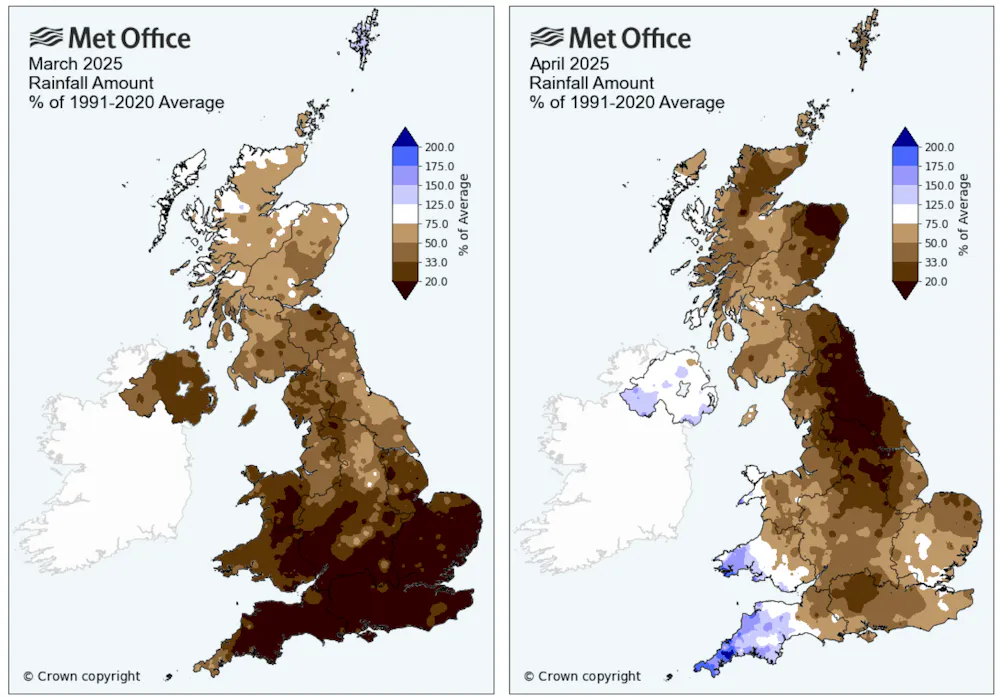
    April 2025 was the sunniest since records began in 1910. This followed the third-sunniest March, and both months saw temperatures well above average nationwide. On May 1, the temperature reached 29.3°C in Kew Gardens in London – a new record for the date.

    Meteorologists are warning of the potential for a summer drought, as the UK has seen roughly half its usual amount of rainfall for March and April. While farmers fret about this year’s harvest, some water companies are urging customers to help reservoir levels recover by limiting water use.

    Meanwhile, wildfires have engulfed forest and moorland in areas of Scotland, Wales and England.

    Most of the UK has experienced a record-dry spring so far.
    Met Office

    For several weeks, a stubborn area of high pressure over the UK has diverted the usual flow of mild, moist air from the North Atlantic like a boulder in a river. This is known as a blocking weather system.

    Within it, air descends, warms and dries, which is why this weather pattern tends to be linked to heatwaves and drought. Blocking is usually persistent, making it seem like the weather is stuck.

    Here’s how climate change may have played a role in setting up this unusual spring.


    Get your news from actual experts, straight to your inbox. Sign up to our daily newsletter to receive all The Conversation UK’s latest coverage of news and research, from politics and business to the arts and sciences. Join The Conversation for free today.


    The human fingerprint

    The warming climate means that unusually warm weather is occurring more often and becoming more intense. At the same time, we can expect more periods of both severe drought and extreme rainfall. Sudden changes from drought to deluge, termed “weather whiplash”, are due to the intensification of the water cycle in a warmer atmosphere that can hold more water vapour.

    However, certain weather patterns are necessary to produce extreme weather. More blocking events in future could increase the chance of heatwaves or drought. But are blocking weather patterns becoming more common?

    It’s difficult to determine how weather patterns will change as a result of the rising concentration of greenhouse gases in the atmosphere, which is predominantly caused by the burning of fossil fuels.

    Part of the difficulty arises from the fact that weather patterns vary year to year. Several years in a row with more blocking events than usual could make it seem like blocking is increasing due to climate change, but it could simply be down to chance.

    As a result, it is difficult to detect the fingerprint of human activity from weather observations alone. For example, blocking weather patterns over Greenland during summer have happened more often in recent decades, which can enhance the melting of the ice sheet. But it isn’t clear that this trend is the result of human-induced climate change.

    Climate models do suggest future changes in the occurrence of blocking, however. These computer simulations, consisting of equations that describe the fundamental physics of the atmosphere, are the main tool scientists use to perform experiments that parse how the climate will behave in future.

    The blocking system is visible in the area of high pressure over Britain and Ireland.
    National Centers for Environmental Prediction/National Center for Atmospheric Research/NOAA Physical Sciences Laboratory, CC BY

    When scientists run climate model simulations with increased greenhouse gas concentrations the results consistently show a decrease in blocking events. But blocking generally happens more often in real life than model simulations, which reduces the confidence scientists have in future projections.

    Keeping track of the jet stream

    The movement of weather systems in Earth’s mid-latitudes – including over the UK – is linked to the jet stream, which is a fast-flowing river of air driven by the contrast in temperature between the poles and mid-latitudes.

    Some researchers have suggested that, because the Arctic is warming faster than the tropics, the jet stream may weaken and become more “wavy”, increasing the occurrence of blocking events, contrary to what most climate models show.

    Outside of the scientific community, this idea has become popular. However, the hypothesis remains controversial among scientists, and observational evidence has weakened in recent years.

    In fact, tens of kilometres above the Earth’s surface, near commercial aircraft cruising altitudes, the opposite trends are occurring: the temperature difference between the Arctic and mid-latitudes is increasing, acting to increase the strength of the jet stream.

    There are considerable challenges with understanding how climate change is affecting the large-scale atmospheric patterns which drive the weather we experience. These include large natural variability and imperfect climate models. Models mostly suggest a decline in blocking events with climate change, though this remains relatively uncertain compared with other aspects of the science.

    Overall, we can be confident that climate change is bringing warmer conditions in all seasons. Scientists also have strong evidence to suggest that drought conditions will become more common. These changes are already affecting food production, energy generation and water availability and these impacts will continue to worsen with climate change.


    Don’t have time to read about climate change as much as you’d like?

    Get a weekly roundup in your inbox instead. Every Wednesday, The Conversation’s environment editor writes Imagine, a short email that goes a little deeper into just one climate issue. Join the 45,000+ readers who’ve subscribed so far.


    Simon H. Lee has received funding from the Natural Environment Research Council and the National Science Foundation.

    Matthew Patterson receives funding from the Natural Environment Research Council in the UK via the the National Centre for Atmospheric Science.

    ref. How the weather got ‘stuck’ over the UK – and produced an unusually dry and warm spring – https://theconversation.com/how-the-weather-got-stuck-over-the-uk-and-produced-an-unusually-dry-and-warm-spring-255987

    MIL OSI – Global Reports

  • MIL-OSI Global: The Climate Fiction Prize 2025: the five shortlisted books reviewed by our experts

    Source: The Conversation – UK – By Louisa Egbunike, Associate Professor in African Literature, Durham University

    Five novels have been shortlisted for the 2025 Climate Fiction Prize. Our academics review the finalists ahead of the announcement of the winner on May 14.

    And So I Roar by Abi Daré

    Abi Daré’s poignant second novel, And So I Roar, charts the parallel stories of Tia, an environmental advocate, and Adunni, a Nigerian teenager first introduced in The Girl with the Louding Voice (2020).

    Now under Tia’s care in Lagos, Adunni has escaped child marriage and domestic abuse.

    When she returns to her village, Ikati, where she and other girls are blamed for the drought and face the threat of violence, the novel unravels long-held secrets. Daré masterfully explores how environmental crises intersect with gendered violence, showing how impoverished women disproportionately bear the burden of climate change.

    And So I Roar highlights intergenerational, inter-ethnic and cross-class solidarity, celebrating the courage of women and girls who defy society’s expectations. It is a powerful testament to resilience, as women and girls confront injustice and find the strength to lift their voices and, finally, roar.

    By Louisa Uchum Egbunike, associate professor in African literature

    The Morningside by Téa Obreht

    Obreht’s The Morningside is a quietly dazzling piece of climate fiction – more adjacent to our world than removed from it, and all the more unsettling for it.

    Set in Island City, a place marked by an unnamed tragedy, the novel centres on Sil, an 11-year-old girl who moves into the Morningside apartment complex with her mother.

    Both are climate refugees, though the novel wears this reality lightly – what matters more are the small acts of home-making, the search for belonging and the ghosts that travel with them. Magical realism is deftly handled here, interlaced with hints of folklore that feel entirely plausible within the book’s fragile ecology.

    The Morningside is deeply readable – generous, tender and brimming with quiet unease. It never tips into bleakness, but its warnings are clear enough. “The things you had, the things you saw,” Sil’s mother tells us, “will probably be gone by the time [your children are] born.”

    By Sam Illingworth, professor of creative pedagogies

    Briefly Very Beautiful by Roz Dineen

    Roz Dineen’s Briefly Very Beautiful immerses readers in a world that both is and is not a familiar fiction. Crisply written, in direct, unfussy prose, it is, at one level, a story of a woman, Cass, trying to protect her children as her relationship unravels.

    At the same time, a parallel social collapse triggered by climate change puts the ordinary in an extraordinary frame.

    Much of the effect of this novel comes from Cass’s utterly believable responses to what is taking place around her, her almost peripheral awareness of other people fleeing the city, her own craving for fresh air “like she’d craved things in pregnancy, with a scary gorging hunger”.

    Briefly Very Beautiful is a novel brave enough to recognise that there is no simple, heroic response to some situations. That sometimes, the determination to live an ordinary life is the truly heroic course of action.

    By Christopher Morash, professor of Irish writing

    Orbital by Samantha Harvey

    Samantha Harvey’s Orbital skilfully exposes the human cost of space flight, set against the urgency of the climate crisis. While a typhoon of life-threatening proportions gathers across south-east Asia, six cosmonauts hurtle around Earth on the International Space Station.

    Their everyday routine of tasteless food and laboratory work is in stark contrast to the awesome spectacle of the blue planet, oscillating between night and day, dark and light, where international borders are meaningless.

    While they teach laboratory mice to orient themselves in micro-gravity, they rigorously document their own bodily functions to satisfy some “grand abstract dream of interplanetary life” away from “the planet held hostage by humans, a gun to its vitals”. These are humans, Harvey tells us, “with a godly view that’s the blessing and also the curse”. Harvey has written a novel for the end of the world as we know it. The hope it offers is that we might learn to know it differently.

    By Debra Benita Shaw, reader in cultural theory

    The Ministry of Time by Kaliane Bradley

    The best novels defy easy categorisation, and The Ministry of Time covers many genres: climate fiction, sci-fi, speculative fiction, romance, action.

    It tells the story of a female civil servant who is a handler for one of five people plucked from history before their death. It was fun to imagine how today’s world would be perceived from various perspectives, including a zesty young lesbian woman from the 17th century, a shy young lieutenant from the first world war and a 19th-century naval officer.

    The story adopts the usual dystopian tropes of a world that has destroyed itself through greed, power-seeking and over-indulgence. In the final plea to the reader not to let this terrible future unfold, the assumption is that if we’re scared enough, we’ll all give up red meat, stop flying and campaign for climate policies.

    My research, and psychological studies of fear caution us that the response is just as likely to be voting for far-right leaders, marginalisation of innocent victims, and buying up all the toilet rolls. I loved this book, but to inspire greener behaviour, showing visions of what a sustainable society might look like if we did things right would be a welcome change.

    By Denise Baden, professor of sustainable business


    Looking for something good? Cut through the noise with a carefully curated selection of the latest releases, live events and exhibitions, straight to your inbox every fortnight, on Fridays. Sign up here.


    The authors do not work for, consult, own shares in or receive funding from any company or organisation that would benefit from this article, and have disclosed no relevant affiliations beyond their academic appointment.

    ref. The Climate Fiction Prize 2025: the five shortlisted books reviewed by our experts – https://theconversation.com/the-climate-fiction-prize-2025-the-five-shortlisted-books-reviewed-by-our-experts-253056

    MIL OSI – Global Reports

  • MIL-OSI United Kingdom: Joint statement on India-Pakistan conflict

    Source: City of Leeds

    Comment issued by civic and faith leaders in Leeds

    “As civic and faith leaders in Leeds, we welcome news of the ceasefire in hostilities between India and Pakistan following the recent terrorist attack in Pahalgam, Kashmir.

    “Terrorism in any form goes against the values of humanity. We condemn all forms of terrorism affecting any communities and countries across the world.

    “We affirm our commitment to stand together at this time of increased tension between India and Pakistan.

    “We are deeply saddened and troubled by the loss of lives, property and livelihoods. Our hearts go out to all those who have been injured, those who are grieving and those who are living in fear of further attacks. We recognise that many in Leeds will also be worried for family and friends in the affected areas. We pray for everyone caught up in the conflict.

    “We have a strong and enduring history in Leeds of caring for one another and of acting responsibly in the face of international events that shake us. We will not let these tensions disrupt the peace we cherish in our neighbourhoods and communities.

    “The faith leaders of Leeds stand firmly against any form of extremism affecting any community in our city. We urge our communities to reject division and to avoid provocation. We would ask all those in our communities to seek to de-escalate tension, recognising our love for our neighbours, reaching out to one another in mutual respect and care. Together, we reaffirm our commitment to peace and concord and to standing against hatred and division.

    “We call on international leaders to continue taking steps to de-escalate the situation through dialogue. Escalation will only lead to the suffering of more innocent people, and everything must be done to prevent further harm.

    “We are a proud city where people of many backgrounds, faiths, and cultures live side by side. Hate has no place on our streets and together we issue this collective call for peace. We have not much control over what is happening internationally, but we can continue to live as neighbours who care for one another and our shared neighbourhoods.

    “In this great city which we all call home, we stand shoulder to shoulder – as part of Team Leeds. One community, one voice, one people. We call on all parties to pray and to work tirelessly for a just peace.”

    Signatories:

    Councillor Abigail Marshall Katung – Lord Mayor of Leeds

    Councillor James Lewis – Leader Leeds City Council

    Ed Whiting – Chief executive Leeds City Council

    Councillor Oliver Edwards – Faith, Religion and Belief Champion

    The Rt. Revd. Arun Arora – Chair Leeds Faith Forum

    Qari Assim MBE – Leeds Faith Forum

    Rasool Bhamani – Leeds Faith Forum

    Dharmesh Mistry – Leeds Faith Forum

    Simon Phillips – Vice Chair Leeds Faith Forum

    Girish Sonigra – Leeds Faith Forum

    Chiragi Solanki – Leeds Faith Forum

    Nirav Thakker – Leeds Faith Forum

    ENDS 

    For media enquiries please contact:

    Leeds City Council communications and marketing,

    Email: communicationsteam@leeds.gov.uk

    Tel: 0113 378 6007

    MIL OSI United Kingdom

  • MIL-OSI USA: LEADER JEFFRIES STATEMENT ON RELEASE OF EDAN ALEXANDER

    Source: United States House of Representatives – Congressman Hakeem Jeffries (8th District of New York)

    Know Your Immigration Rights

    If you or a loved one encounter immigration enforcement officials, it is essential that you know your rights and have prepared your household for all possible outcomes.

    Ask for a warrant: The Fourth Amendment of the Constitution protects you from unreasonable search and seizure. You do not have to open your door until you see a valid warrant to enter your home or search your belongings.

    Your right to remain silent: The Fifth Amendment protects your right to remain silent and not incriminate yourself. You are not required to share any personal information such as your place of birth, immigration status or criminal history.

    Always consult an attorney: You have a right to speak with an attorney. You do not have to sign anything or hand officials any documents without speaking to an attorney. Try to identify and consult one in advance.

    The New York City Office of Civil Justice and the Mayor’s Office of Immigrant Affairs (MOIA) support a variety of free immigration legal services through local nonprofit legal organizations. To access these resources, dial 311 and say “Action NYC,” call the MOIA Immigration Legal Support Hotline at 800-354-0365 Monday through Friday from 9:00 a.m. to 6:00 p.m. or visit MOIA’s website.

    Learn more here: KNOW YOUR IMMIGRATION RIGHTS  – Congressman Hakeem Jeffries

    MIL OSI USA News

  • MIL-OSI USA: Media Alert: Low-level flights to image geology over parts of New England

    Source: US Geological Survey

    The survey is part of USGS Earth Mapping Resources Initiative, a partnership with the geological surveys of Connecticut, Massachusetts, New Hampshire, Rhode Island and Vermont as well as other states.

    “Increasing knowledge of New England’s geologic framework will help with national priorities, like sourcing critical minerals, and regional concerns – like mapping pyrrhotite to minimize its use in local infrastructure,” said Jamey Jones, science coordinator for the USGS Earth Mapping Resources Initiative. 

    Pyrrhotite, a mineral found in bedrock under certain parts of Connecticut and Massachusetts, can cause long-term structural weakness in construction when used in cement.

    The survey is being coordinated by the U.S. Geological Survey as part of a larger, nationwide effort to provide data and images that expand the fundamental knowledge of geology across the nation. The data collected will be made freely available to the public once complete. 

    During the survey, which will be conducted in spring to fall 2025, instruments on the airplane will measure variations in the Earth’s magnetic field and natural, low-level radiation created by different rock types beneath vegetation and up to several miles below the surface. This information will help researchers develop geologic maps of resources and hazards in three dimensions. 

    The aircraft will be equipped with an elongated “boom” that extends either in front of or behind the main cabin that houses sensors. These scientific instruments are completely passive with no emissions that pose a risk to humans, animals, or plant life. No photography or video data will be collected. 

    The aircraft will be flown by experienced pilots who are specially trained and approved for low-level flying. These pilots work with the FAA to ensure flights are safe and in accordance with U.S. law. The surveys will be conducted during daylight hours only. 

    The aircraft will fly along pre-planned fight paths relatively low to the ground at about 300 feet (100 meters) above the surface in some areas. The ground clearance will be increased to 1,000 feet (300+ meters) over populated areas and will comply with Federal Aviation Administration (FAA) regulations. 

    Funding by the Infrastructure Investment and Jobs Act has facilitated coverage of such a large area. 

    Flights will cover areas within the following counties: 

    Connecticut: Fairfield, Hartford, Litchfield, Middlesex, New Haven, New London, Tolland, Windham. Massachusetts: Berkshire, Franklin, Hampden, Hampshire, Middlesex, Worcester. New Hampshire: Cheshire, Hillsborough. Rhode Island: Kent, Providence, Washington. Vermont: Bennington, Windham, as well as Fisher’s Island, New York

    MIL OSI USA News

  • MIL-OSI Global: The Moomins drift through time like a myth – that’s why they resist meaning and endure

    Source: The Conversation – UK – By Steve Nash, Lecturer in Literature, Media, and Creative Writing, Leeds Beckett University

    The Moomins may look like hippos in aprons and top hats, but they’re more than just adorable characters from children’s books. Over the decades, these gentle creatures have become part of a living mythology – one that drifts across time, borders and generations.

    Created by Finnish-Swedish author Tove Jansson in the 1940s, the Moomins live in stories that blur the lines between fairy tale, folk wisdom and quiet philosophy. And perhaps that’s the secret to their enduring appeal: they resist being pinned down.

    Unlike traditional children’s characters tied to a tidy moral or neat storyline, the Moomins meander literally and metaphorically. Their world is one of seasonal migrations, long silences, floods, comets and unexpected departures.


    This is part of a series of articles celebrating the 80th anniversary of the Moomins. Want to celebrate their birthday with us? Join The Conversation and a group of experts on May 23 in Bradford for a screening of Moomins on the Riviera and a discussion of the refugee experience in Tove Jansson’s work. Click here for more information and tickets.


    Moominvalley isn’t a safe haven – it’s a landscape shaped by change. In that sense, Jansson’s stories echo something far older than modern literature: the mythic rhythms of Nordic storytelling, where time loops, endings blur and characters return in altered forms.

    A myth that moves

    The Viking sagas, for instance, were not written down at first but passed from voice to voice, reshaped with each telling. They weren’t concerned with tidy endings or moral clarity. Characters disappeared and reappeared. Time looped and fragmented.

    Similarly, Jansson’s stories don’t build to a climax. They wander. One book might end with a mystery, a quiet mood or a long silence. It’s a narrative style that feels strangely modern – and yet deeply ancient.

    Jansson herself resisted giving her stories a single message. In letters and interviews, she said she disliked moralising and preferred ambiguity. “A good story,” she wrote, “has no need to be explained; its truth lies in its telling, not in its conclusion.” That idea – of a truth that doesn’t depend on being pinned down – is at the heart of what makes the Moomins mythic.

    Of course, myths evolve. And the Moomins have evolved spectacularly. After the books found international success, the characters were adapted into Japanese anime, Nordic theatre, British radio and global branding campaigns.

    Each version tells a slightly different story. In Japan, the Moomins became symbols of warmth and nostalgia – gentle mascots of a simpler life. In the UK and US, early translations softened the melancholy and existential tones. More recently, new editions and critical reappraisals have returned to Jansson’s deeper themes of loss, solitude and transformation.

    The many lives of the Moomins

    This global journey has parallels with the evolution of Viking mythology. Once oral stories shared around fires, Norse myths have been repackaged for everything from national pride to Hollywood action. Like the Moomins, they’ve become flexible cultural symbols – used and re-used in ways that often have little to do with their original context.

    But unlike the fierce warriors of Norse myth, the Moomins are gentle, uncertain creatures. They worry. They drift. They don’t fight monsters – they reflect, explore, adapt. In Moominland Midwinter, Moomintroll wakes from hibernation to find the world cold and unfamiliar.

    His journey isn’t about conquering the landscape, it’s about learning how to live in it. That emotional honesty resonates with readers of all ages. It also reflects something uniquely Nordic: an existential awareness of solitude, change and survival.

    Folklore, loneliness and the Groke

    One character, the Groke, captures this beautifully. She’s a shadowy figure who creates frost wherever she walks. She’s not a villain, she’s just lonely. Children often fear her, but readers grow to understand her.

    She recalls Nordic spirits like the huldra or tomte – ghostly beings that live in the forests, blurring the line between human and otherworldly. In Jansson’s hands, this folklore becomes a way to explore anxiety, estrangement and the human need for warmth.

    The Moomins’ refusal to settle – geographically or philosophically – also speaks to today’s world of cultural fluidity. Jansson was from Finland’s Swedish-speaking minority and grew up between languages, cultures and post-war upheaval.

    Her books reflect that liminal identity, and they’ve found a home among readers who don’t always fit neatly into one place. That might be why the Moomins are particularly popular in countries dealing with identity shifts or cultural nostalgia.

    A myth for a shifting world

    As with all mythologies, there’s also a commercial side. The Moomins are now a global brand, with theme parks, merchandise, museums and a thriving fanbase. Some of this has softened their original complexity.

    But even through plush toys and animation, something essential remains: the feeling that these characters, like the stories they inhabit, can’t be reduced to one message. They are always slightly mysterious, slightly out of reach.

    In a world that often demands quick answers and strong opinions, the Moomins offer something gentler: ambiguity, openness and quiet reflection. They remind us that not all stories are meant to be solved with a neat conclusion. Some are meant to be returned to – revisited like familiar places in the mind, reshaped each time we arrive.

    That’s what makes the Moomins mythic. Not just their age or popularity, but their ability to change – and to change us – with every retelling. They invite us to wander, like Snufkin, and to sit still, like Moominmamma.

    They show us that myth isn’t just about gods and monsters – it’s about living with uncertainty, embracing return, and finding meaning in the stories that help us feel at home in the world.

    Steve Nash works for Leeds Beckett University.

    ref. The Moomins drift through time like a myth – that’s why they resist meaning and endure – https://theconversation.com/the-moomins-drift-through-time-like-a-myth-thats-why-they-resist-meaning-and-endure-254742

    MIL OSI – Global Reports

  • MIL-OSI Global: From Zoo Quest to Ocean: The evolution of David Attenborough’s voice for the planet

    Source: The Conversation – UK – By Neil J. Gostling, Associate Professor in Evolution and Palaeobiology, University of Southampton

    Over the course of seven decades, Sir David Attenborough’s documentaries have reshaped how we see the natural world, shifting from colonial-era collecting trips to urgent calls for environmental action.

    His storytelling has inspired generations, but has only recently begun to confront the scale of the ecological crisis. To understand how far nature broadcasting has come, it helps to return to where it started.

    When Attenborough’s broadcasting career began in the 1950s, Austrian filmmakers Hans and Lotte Hass were already pushing the boundaries of what was possible by taking cameras below the sea and touring the world aboard their schooner, the Xafira.

    In one of their 1953 Galapagos films, a crewman handled a sealion pup, having crawled across the volcanic rock of Fernandina honking at sealions to attract them. A penguin and giant tortoise were brought on board Xafira. And as Lotte Hass took photographs, she’d beseech some poor creature to “not be frightened” and “look pleasant”.

    This is a world away from today’s expectations, where both research scientists and amateur naturalists are taught to observe without touching or disturbing wildlife. When the Hasses visited the Galápagos, it was still five years before the creation of the national park and the founding of the island’s conservation organisation Charles Darwin Foundation. Now, visitors must stay at least two metres from all animals – and never approach them.


    Get your news from actual experts, straight to your inbox. Sign up to our daily newsletter to receive all The Conversation UK’s latest coverage of news and research, from politics and business to the arts and sciences. Join The Conversation for free today.


    At the same time, television was beginning to shape public perceptions of the natural world. In 1954, Attenborough was working as a young producer on Zoo Quest. By chance, he became its presenter when zoologist Jack Lester became ill.

    The programme followed zoologists collecting animals from around the world for London Zoo. Zoo Quest was filmed in exotic locations around the world and then in the studio where the animals found on the expedition were shown “up close”.

    Attenborough has since acknowledged that Zoo Quest reflected attitudes that would not be acceptable today. The series showed animals being captured from the wild and transported to London Zoo – practices which mirrored extractive, colonial-era approaches to science.

    David Attenborough’s Zoo Quest for a Dragon aired in 1956.

    Yet, Zoo Quest was also groundbreaking. The series brought viewers face-to-face with animals they might never have seen before and pioneered a visual style that made natural history television both entertaining and educational. It helped establish Attenborough’s reputation as a compelling communicator and laid the foundations for a new genre of science broadcasting – one that has evolved, like its presenter, over time.

    After a decade in production, Attenborough returned to presenting with Life on Earth (1979), a landmark series that traced the evolution of life from single-celled organisms to birds and apes. Drawing on his long-standing interest in fossils, the series combined zoology, palaeobiology and natural history to create an ambitious new template for science broadcasting.

    Life on Earth helped cement Attenborough’s reputation as a trusted communicator and became the foundation of the BBC’s “blue-chip” natural history format – big-budget, internationally produced films that put high-quality cinematic wildlife footage at the forefront of the story. The series did not simply document the natural world. It reframed it, using presenter-led storytelling and global spectacle to shape how audiences understood evolutionary processes.

    For much of his career, Attenborough has been celebrated for showcasing the beauty of the natural world. Yet, he has also faced criticism for sidestepping the environmental crises threatening it. Commentators such as the environmental journalist George Monbiot argued that his earlier documentaries, while visually stunning, often avoided addressing the human role in climate change, presenting nature as untouched and avoiding difficult truths about ecological decline.

    Building on the legacy of Life on Earth, Attenborough’s later series began to respond to these critiques. Blue Planet (2001) expanded the scope of nature storytelling, revealing the mysteries of the ocean’s most remote and uncharted ecosystems. Its 2017 sequel, Blue Planet II, introduced a more urgent tone, highlighting the scale of plastic pollution and the need for marine conservation.

    Although Blue Planet II significantly increased viewers’ environmental knowledge, it did not lead to measurable changes in plastic consumption behaviour – a reminder that awareness alone does not guarantee action. The subsequent Wild Isles (2023) continued the shift towards conservation messaging. While the main series aired in five parts, a sixth episode – Saving Our Wild Isles – was released separately and drew controversy amid claims the BBC had sidelined it for being too political. In reality, the episode delivered a clear call to action.

    Attenborough’s latest film, Ocean, continues in this more urgent register, pairing breathtaking imagery with an unflinching assessment of ocean health. After decades of gentle narration, he now speaks with sharpened clarity about the scale of the crisis and the need to act.

    A voice for action

    In recent years, Attenborough has taken on a new role – not just as a broadcaster, but as a powerful voice in environmental diplomacy. He has addressed world leaders at major summits such as the UN climate conference Cop24 and the World Economic Forum, calling for urgent action on climate change. He was also appointed ambassador for the UK government’s review on the economics of biodiversity.

    On the subject of environmemtal diplomacy, Monbiot recently wrote: “A few years ago, I was sharply critical of Sir David for downplaying the environmental crisis on his TV programmes. Most people would have reacted badly but remarkably, at 92, he took this and similar critiques on board and radically changed his approach.”

    Attenborough not only speaks. He listens. This is part of his charm and popularity. He is learning and evolving as much as his audience.

    What makes Attenborough stand out is the way he speaks. While official climate treaties often rely on technical or legal language, he communicates in emotional, accessible terms – speaking plainly about responsibility, urgency and the moral imperative to protect life on Earth. His calm authority and familiar voice make complex issues easier to grasp and harder to dismiss.

    Frequently named Britain’s most trusted public figure, Attenborough has become something of an unofficial diplomat for the planet – apolitical, measured, and often seen as a voice of reason amid populist noise. Despite his criticisms, Attenborough’s documentaries walk a careful line between fragility and resilience, using emotionally ambivalent imagery to prompt reflection. He shares his wonder with the natural world and brings people along with him

    Ocean shows our blue planet in more spectacular fashion than Lotte and Hans Hass could ever have imagined. But it is also Attenborough’s most direct reckoning with environmental collapse. With clarity and urgency, it confronts the damage wrought by industrial trawling and habitat destruction.

    After 70 years of gently guiding viewers through the natural world, Attenborough’s voice has sharpened. If he once opened our eyes to nature’s wonders, he now challenges us not to look away. As he puts it: “If we save the sea, we save our world. After a lifetime filming our planet, I’m sure that nothing is more important.”


    Don’t have time to read about climate change as much as you’d like?

    Get a weekly roundup in your inbox instead. Every Wednesday, The Conversation’s environment editor writes Imagine, a short email that goes a little deeper into just one climate issue. Join the 45,000+ readers who’ve subscribed so far.


    The authors do not work for, consult, own shares in or receive funding from any company or organisation that would benefit from this article, and have disclosed no relevant affiliations beyond their academic appointment.

    ref. From Zoo Quest to Ocean: The evolution of David Attenborough’s voice for the planet – https://theconversation.com/from-zoo-quest-to-ocean-the-evolution-of-david-attenboroughs-voice-for-the-planet-251727

    MIL OSI – Global Reports

  • MIL-OSI United Kingdom: Immigration White Paper oral statement

    Source: United Kingdom – Executive Government & Departments

    Oral statement to Parliament

    Immigration White Paper oral statement

    The Home Secretary giving an oral statement to the House of Commons on 12th May to introduce the ‘Restoring Control over the Immigration System’ White Paper.

    Madam Deputy Speaker, with your permission, I will make a statement on the government’s White Paper on Restoring Control over the Immigration System.

    Five months ago, the figures were published that showed net migration had reached a record high of more than 900,000 under the last Conservative government – a figure that had quadrupled in the space of just four years.

    It was the consequence of specific government choices made from 2020 onwards, including introducing what was effectively a free market experiment on immigration – encouraging employers to recruit from abroad, loosening controls in different areas but without any requirement to tackle skills and labour shortages here at home. Choices which undermined the immigration system and the economy too.

    This government is making very different choices. We made clear at that time, just as we had set out in our manifesto, this government would restore order and control to the immigration system, bringing net migration substantially down but also boosting skills and training here at home.

    The White Paper we are publishing today does exactly that and it is built on five core principles.

    First, that net migration must come down so the system is properly managed and controlled.

    Second, that the immigration system must be linked to skills and training here in the UK, so that no industry is allowed to rely solely on immigration to fill its skills shortages. 

    Third, that the system must be fair and effective, with clearer rules in areas like respect for family life, to prevent perverse outcomes that undermine public confidence.

    Fourth, that the rules must be respected and enforced – including tackling illegal and irregular migration and deporting foreign criminals.

    And finally, that the system must support integration and community cohesion, including new rules on the ability to speak English and the contribution that people can bring to the UK.

    The United Kingdom is an interconnected and outward-looking nation. Our history and our geography mean that, for generations, British people have travelled overseas to live and work, and people have come to the UK to study, work, invest or seek refuge. And British citizens draw on heritage from all over the world and that has made us the country we are today.

    Through many years our country has been strengthened by those who have come here to contribute – from the doctors in our NHS to the entrepreneurs founding some of our biggest businesses to those who came through generations to work in jobs from coal mining to caring for our loved ones to serving in our armed forces. People often coming to do some of the most difficult jobs of all.

    Our trading nation, global leading universities and strong historic international connections mean that migration will always be part of our country’s future as well as our past.

    But that is exactly why immigration needs to be properly controlled and managed. It hasn’t been.

    Overseas recruitment shot up while training in the UK was cut.

    Lower skilled migration soared while the proportion of UK residents in work plummeted.

    In 2019 10% of skilled work visas went to non-graduate jobs; by 2024 that had risen to 60%.

    Employers were even given a 20% wage discount if they recruited for shortage jobs from abroad – actively discouraging them from paying the going rate or training here at home.

    Education institutions were allowed to substantially expand the number of overseas students without proper compliance checks.

    Social care providers were encouraged to recruit from abroad with no proper regulation.

    So we saw a serious increase in exploitation – deeply damaging for those who came to work here in good faith, and also for other workers and responsible companies who were being undercut.

    The rules and laws that are supposed to the immigration system were too often ignored.

    By 2024, returns of people with no right to be in the UK were down over a third compared to 2010.  

    And, of course, criminal gangs were allowed to build an entire smuggling industry along our borders, undermining security and creating a crisis in the asylum system.

    Madam Deputy Speaker, later this year we will set out further reforms on asylum and border security, and on tackling illegal and irregular migration, building on the new counter-terrorism powers in the Border Security, Asylum and Immigration Bill before the House this evening, because no one should be making these dangerous crossings on small boats.

    But this White Paper sets out how we restore that control to the legal migration system so it is sustainable, fair and works for the UK.

    First, we are overhauling the approach to labour market policy so for the first time we properly link the immigration system to skills and training here in the UK.

    So that where there are skills or labour shortages in the UK, immigration should not always be the answer to which employers turn. Because that long-term failure to tackle skills shortages, to bring in proper workforce planning, to get UK residents back into work, or to improve pay, terms and conditions here at home is bad for our economy as well as for the immigration system because it undermines our productivity and growth.

    So we will lift the threshold for skilled worker visas back to graduate level and above, removing up to 180 different jobs from the list, increasing salary thresholds.

    Access to the Points-Based System for lower skilled jobs will be limited to areas on a new Temporary Shortage List, including jobs which are critical to the Industrial Strategy, but access will be time limited. There must be a domestic workforce strategy in place, and employers must be acting to increase domestic recruitment.

    We will expect workforce strategies to be drawn up more widely in other higher skilled areas too where there is overreliance on recruitment from abroad.

    To support that work we will establish the new Labour Market Evidence Group, bringing together skills bodies from England, Scotland, Wales and Northern Ireland, the Department for Work and Pensions, the Industrial Strategy Council and the Migration Advisory Committee to gather and share evidence on shortage occupations in different parts of the country and also to highlight the role that skills, training, pay and conditions and other policies can play in improving domestic recruitment, so that increased migration is never again the only answer to the shortages the economy faces.

    This new approach means we also need to act on social care.

    The introduction of the Social Care Visa led not only to a huge increase in migration but also to a shameful and deeply damaging increase in abuse and exploitation.

    When proper checks were finally brought in, 470 care providers had their licence to sponsor international staff suspended. 39,000 care workers were displaced.

    Overseas recruitment for care jobs has since dropped but it must not surge like that again. And it’s time we addressed domestic issues, including a proper Fair Pay Agreement to show respect to people who do some of the most important jobs in the country.

    We are therefore ending overseas recruitment of care workers. It will continue to be possible to extend existing visas and to recruit displaced care workers and people already in the UK with working rights on other visas.

    Alongside the new visa controls and workforce strategies, we will also increase the Immigration Skills Charge paid by employers who recruit from abroad by 32%. That money will be invested through the Spending Review in supporting skills and training here in the UK.

    We will ensure that Britain continues to attract the brightest and best global talent, by enhancing visa routes for very high skilled individuals, top scientific and design talent, and people with the right experience to support growth in key strategic industries.

    Madam Deputy Speaker, international students bring huge benefits to the UK – supporting our world-leading universities, bringing in top talent and investment.

    But we will strengthen compliance requirements and checks to prevent visa misuse.

    Currently, too many people on the Graduate Visa are not doing graduate jobs. So we will reduce the unrestricted period from two years to 18 months. Those who want to stay will need to get a graduate job on a skilled worker visa so that we can ensure they are contributing to the economy.

    Just as our rules on work visas are based on the contribution we expect people to make when they come to our country, we will consult later this year on new earned settlement and citizenship rules that apply the same approach, extending the principles of the Points-Based System, doubling the standard qualifying period for settlement to ten years with provisions to qualify more swiftly that take account of the contribution people have made.

    Because the ability to speak English is integral to the ability for everyone to contribute and integrate, we will introduce new, higher language requirements across a range of visa routes, for both main applicants and their dependants. So family, too, can work, integrate and contribute.

    The system for family migration has become overly complex with policies increasingly developed around case law from court decisions rather than a coordinated framework set out by Parliament. So we will set out a new clearer framework, to be endorsed by Parliament, including clarifying how Article 8 rules should be interpreted and applied to prevent confusion or perverse conclusions.

    We will review current community sponsorship schemes that support recognised refugees and will continue to take action against trafficking and modern slavery. And we will shortly appoint a new Windrush Commissioner to ensure that Windrush lessons continue to be learnt and the Home Office also makes sure its standards are upheld.

    But the rules must be respected and enforced across the board. So we will also bring in stronger controls where there is evidence of visa misuse. We are also rolling out e-visas and digital ID, including better use of technology to monitor when people are overstaying on their visa, or to support the increase in illegal working raids. Since the election we have increased returns and we will go further.

    Those who come to our country must abide by our laws.

    So we will develop new procedures to ensure the Home Office is informed of all foreign nationals convicted of offences – not just those who go to prison – so we can also revoke visas and remove other offenders in a wide range of crimes who are abusing our system.

    Madam Deputy Speaker, already we are reducing the number of visas being granted this year, and updated figures will be published before the end of the month.

    Already we are increasing returns with over 24,000 people in the first 9 months, the highest 9-month period for eight years.

    The impact of the changes to skilled worker visas, care worker visas, settlement, students and English language is expected to reduce visas by around 100,000 a year. In addition, the new workforce strategies, Immigration Skills Charge, family and asylum reforms will further bring numbers down on top of that. And as the Prime Minister has said, where we need to go further to restore a sustainable system, we will.

    Conclusion

    In conclusion, Madam Deputy Speaker, throughout our history, Britain has been strengthened by people coming to start new businesses, study at our universities, contribute to our cultural and sporting excellence, and do some of the toughest, most essential jobs in our country.

    But to be successful, effective and fair, our immigration must be properly controlled and managed. This White Paper sets out how we will restore control, fairness and order to the system, how we will continue to bring net migration down, and how we will turn the page on the chaos and failure of the past. I commend this statement to the House.

    Updates to this page

    Published 12 May 2025

    MIL OSI United Kingdom

  • MIL-OSI Global: Keir Starmer’s immigration plans: research shows you don’t beat the far right by becoming them

    Source: The Conversation – UK – By Katy Brown, Research Fellow in Language and Social Justice, Manchester Metropolitan University

    Keir Starmer gives press conference on migration Flickr/Number 10, CC BY-NC-ND

    As British prime minister Keir Starmer vowed to “finally take back control of our borders” in a landmark speech on immigration on May 12, it felt a little like déjà vu.

    Some nine years earlier, we had heard those exact words repeated over and over in the build-up to the Brexit referendum from former prime minister Boris Johnson and the Leave campaign. It was a refrain also used by Nigel Farage and UKIP.

    Of course, this direct reference was the point. Starmer used it to claim that the Labour government’s white paper on immigration was finally going to deliver on what had been promised and desired for many years.

    In these opening lines, the tone was set. And as the speech went on, there were echoes of far-right language and ideas reverberating throughout. Starmer lamented the “squalid” state of contemporary politics, the “forces” pulling the country apart, and the previous government’s so-called “experiment in open borders”.

    This speech and the white paper that it unveiled are but the latest indication of the rightward direction of travel within UK politics, led by mainstream and far-right parties alike – as exemplified in recent months by the footage released of immigration raids and deportations.

    Some will argue this is Labour’s response to the rising threat of Reform UK, with results in the recent local elections seen as evidence of the far right’s growing popularity. So the story goes, Labour is proving that they can be tough on immigration, showing would-be Reform defectors that they can be trusted after all.

    This familiar narrative seems to follow a prevailing wisdom which is parroted in political, media and public debates – that appeasing the far right is the way to defeat it. Rather than beating the far right at their own game, however, research shows that these techniques simply legitimise their key talking points and further normalise exclusionary politics.

    Starmer’s speech is a case in point. In using “take back control” from the outset, there was no hiding the intended audience or message. Starmer claimed that this project would “close the book on a squalid chapter for our politics, our economy, and our country”, implying that excessive immigration has directly caused these problems and that stopping it solves them. This chimes with classic far-right narratives where migration is framed as the root of all societal ills.

    When these kinds of ideas are pushed by those in government, with great authority and influence, they are given greater credence and weight. A strikingly clear example of this came in the summer of 2024 when participants in racist riots waved posters containing the slogan “stop the boats” (a phrase popularised by the previous Tory government).

    Another component of the speech that was reminiscent of far-right tropes was the idea that increased immigration was a deliberate tactic by the previous government. Starmer suggested that the Conservatives were actively pursuing a “one-nation experiment in open borders” while deceiving the British public of their intentions.

    Far-right conspiracies are often premised on the idea that elites are deliberately encouraging mass immigration. It’s not hard to see how Starmer’s words could act as a dog whistle in this scenario.

    These claims are especially damaging when we think about the draconian measures introduced under former Conservative governments, such as the Rwanda policy. Labour is now indicating that these proposals didn’t go far enough.

    To justify bringing far stricter immigration rules, Starmer stated that “for the vast majority of people in this country, that is what they have long wanted to see”. As far-right parties so often do, Labour suggests that they are delivering on “people’s priorities”. Yet are they really a priority for people, or are we told that they are a priority which then makes them more of a priority?

    Research by Aurelien Mondon, senior lecturer in politics at the University of Bath, illustrates how people’s personal and national priorities differ dramatically. When people in the UK were asked to name the two most important issues facing them personally, immigration didn’t even make it into the top ten.

    However, when asked the same question about the issues facing their country, immigration topped the list. How can something that doesn’t affect you in your day-to-day life suddenly become a top priority for your country? We need to challenge the narrative that the government is simply acting on people’s wishes and acknowledge its own capacity to set the agenda.

    Other priorities

    Some will say that harsher anti-immigration policies are a necessary evil to defeat the far right. However, if people’s personal priorities are really the cost of living, housing and education, why is the government not focusing more of its energy on these things rather than scapegoating migrants?

    What’s more, research shows that even based on these terms, these strategies are ineffective and can actually boost the success of the far right electorally. After all, its ideas are being repeatedly normalised.

    In all this tactical talk, we lose sight of the fact that people are living the consequences of this rhetoric and policies right now. Rather than focus on Reform’s potential performance in a general election that is probably years away, we should recognise the immediate consequences of the rhetoric that has accompanied this white paper. Even if this did put a dent in Reform’s prospects, what is the meaning of defeating them if the policies they promote become part of the mainstream in the process?

    The bottom line is that you do not beat the far right by becoming them. It doesn’t work electorally or ideologically, and even if it did, minoritised communities suffer the consequences regardless. The far right is not some threat lying waiting in the future – its normalisation is happening now.

    Katy Brown has received funding from UK Research and Innovation and the Irish Research Council. She is affiliated with the Reactionary Politics Research Network and Manchester Centre for Research in Linguistics.

    ref. Keir Starmer’s immigration plans: research shows you don’t beat the far right by becoming them – https://theconversation.com/keir-starmers-immigration-plans-research-shows-you-dont-beat-the-far-right-by-becoming-them-256499

    MIL OSI – Global Reports

  • MIL-OSI: Viomi Technology Co., Ltd to Present at the dbVIC – Deutsche Bank ADR Virtual Investor Conference May 15th

    Source: GlobeNewswire (MIL-OSI)

    GUANGZHOU, China, May 12, 2025 (GLOBE NEWSWIRE) — Viomi Technology Co., Ltd (“Viomi” or the “Company”) (NASDAQ: VIOT) based in Guangzhou, and focused on home water solutions, today announced that Mr.Sam Yang, Head of the Company’s Capital and Strategy Department, and Ms. Claire Ji, the Company’s IR contact, will present at the dbVIC – Deutsche Bank American Depositary Receipt (ADR) Virtual Investor Conference on May 15, 2025. This virtual investor conference is aimed exclusively at introducing global companies with ADR programs to investors.

    DATE: May 15, 2025
    TIME: 8:30 AM EDT
    LINK: REGISTER HERE

    This will be a live, interactive online event where investors are invited to ask the company questions in real-time. If attendees are not able to join the event live on the day of the conference, an archived webcast will also be made available after the event.

    It is recommended that online investors pre-register and run the online system check to expedite participation and receive event updates.

    Participation is free of charge.

    Recent Company Highlights

    • The Company achieved strong results with a significant turnaround from previous losses, driven by a strategic shift to focus on home water business. Net revenue for 2024 increased by 29.3% year over year, and net income reached RMB62.3 million, compared to a net loss of RMB89.3 million in 2023. Viomi is now on a fast track to high-quality growth and is well-positioned to seize new market opportunities.

    About Viomi Technology

    Viomi’s mission is “AI for Better Water,” utilizing AI technology to provide better drinking water solutions for households worldwide.

    As an industry-leading technology company in home water solutions, Viomi has developed a distinctive “Equipment + Consumables” business model. By leveraging its expertise in AI technology, intelligent hardware and software development, the Company simplifies filter replacement and enhances water quality monitoring, thereby increasing the filter replacement rate. Its continuous technological innovations extend filter lifespan and lower user costs, promoting the adoption of water purifiers and supporting a healthy lifestyle while effectively addressing the rising global demand for cleaner, fresher and healthier drinking water. The Company operates a world-leading “Water Purifier Gigafactory” with an integrated industrial chain that boasts optimal efficiency and facilitates continuous breakthroughs in water purification. This state-of-the-art facility enables Viomi to achieve economies of scale and accelerate the global popularization of residential water filtration.

    For more information, please visit: https://ir.viomi.com.

    About Virtual Investor Conferences®

    Virtual Investor Conferences (VIC) is the leading proprietary investor conference series that provides an interactive forum for publicly traded companies to seamlessly present directly to investors.

    Providing a real-time investor engagement solution, VIC is specifically designed to offer companies more efficient investor access.  Replicating the components of an on-site investor conference, VIC offers companies enhanced capabilities to connect with investors, schedule targeted one-on-one meetings and enhance their presentations with dynamic video content. Accelerating the next level of investor engagement, Virtual Investor Conferences delivers leading investor communications to a global network of retail and institutional investors.

    CONTACTS:
    Viomi Technology Co., Ltd
    Claire Ji
    E-mail: ir@viomi.com.cn

    Virtual Investor Conferences
    John M. Viglotti
    SVP Corporate Services, Investor Access
    OTC Markets Group
    (212) 220-2221
    johnv@otcmarkets.com

    The MIL Network

  • MIL-OSI Canada: Fresh air, exercise fuel children who join Walking School Bus

    Source: Government of Canada regional news

    The Province of B.C. is supporting the Walking School Bus program, which provides supervised walks to schools for elementary children in select communities, helping them start their day off with fresh air and exercise.

    “Walking to school offers a wonderful opportunity for students and parents to connect with their community,” said Ravi Parmar, MLA for Langford-Highlands, on behalf of Mike Farnworth, Minister of Transportation and Transit. “I’m excited to see this program expand in many parts of the province, especially in the community where I grew up. It’s rewarding to know that students in Langford and other communities in B.C. will benefit from this initiative, helping them develop healthy habits and safer ways to commute.”  

    In partnership with the Society for Children and Youth of BC, this program gives more communities in B.C. the chance to get their kids to school without a vehicle. The program is available to students in Langford, Sooke, Nanaimo, Esquimalt, Saanich and Central Saanich. It will expand to other areas.

    Children learn safe commuting skills and build healthy habits with the Walking School Bus. The program provides paid leaders and volunteers with the essential training to safely lead a group of students to and from their homes and schools. The program will also include a Biking School Bus in some participating communities. Trained cycling leaders from HUB Cycling will bike with groups of students to and from school.

    More than 350 children have participated in similar Walking School Bus programs in B.C. The program offers new communities the funding and tools needed to get their students to and from school safely.

    “After a successful pilot in Metro Vancouver in partnership with the Province and TransLink, we are thrilled to be working with the Province to help more children across British Columbia develop active travel habits through our Walking School Bus program,” said Stephanie Howell, executive director, Society for Children and Youth of BC. “The program will also include bike buses led by our new partners at HUB Cycling, who we are excited to have on board. We look forward to promoting safe routes to school and independent mobility for all.”

    The B.C. government has invested $1.1 million to support 15 schools in B.C. as they offer their elementary students a supervised walk to school.

    MIL OSI Canada News

  • MIL-OSI Global: ‘Elbows up’ in Canada means sustainable resource development

    Source: The Conversation – Canada – By Steven J Cooke, Canada Research Professor, Conservation Physiology, Carleton University

    “Elbows up” means many things today in Canada, including using the country’s rich natural resources more effectively to support a strong, independent economy that benefits people and society.

    We agree with the need to ensure economic stability and independence in Canada — but as scientists, we know this is only possible if resource development and exploitation are done responsibly and sustainably. Otherwise, Canada will be burdening itself and future generations with immeasurable costs to the economy, health and quality of life.

    Politicians and decision-makers from across Canada have called for radical changes to how development proposals are evaluated. The recent federal election saw the leaders of the major parties all signalling that they intend to get resource development projects done faster.

    Several provinces have already brought forward legislation in recent days, including British Columbia’s Infrastructure Projects Act, while an Ontario act aimed ostensibly at “unleashing the economy” is under consideration by the provincial government.

    Cutting red tape can certainly speed up new development, but environmental regulations are not just red tape. They are designed to ensure the short- and long-term potential consequences of development decisions are fully considered, and are then minimized or avoided.

    Without strong environmental impact assessments, development can have devastating impacts on human health, resource sustainability and the rich natural resources Canadians rely upon. We are fearful of a future where obsolete infrastructure and exhausted resources are abandoned by the proponents of development, burdening the public with the cleanup or long-term consequences.

    Resources aren’t infinite

    Canada has a large land mass bordering three oceans and bountiful freshwater resources, including the Great Lakes. But its resources are not infinite.

    Impacts of resource development also extend to people. Effective impact assessment must recognize Indigenous rights and sovereignty, in keeping with the right to self-determination reinforced by the United Nations Declaration on the Rights of Indigenous Peoples.

    Effective land stewardship by Indigenous nations is the foundation of Canada’s rich natural heritage. When Canadian politicians talk about fast-tracking developments and resource exploitation, they inherently ignore the moral and legal rights of Indigenous Peoples and governments that are enshrined in Canada’s Constitution and in international law.


    Read more:
    Mark Carney wants to make Canada an energy superpower — but what will be sacrificed for that goal?


    Circular economy

    Outdated business models that threaten health and the future of resources won’t propel Canada into a new era of prosperity.

    Canada lags behind in innovation and labour productivity growth (GDP per person hour worked), which are predictors of standard of living. This lag is known as Canada’s “innovation problem.”

    Simply harvesting and selling raw logs or minerals as fast as possible will not solve it. However, Canada can escape its innovation problem by using resources more efficiently in a value-added, circular economy.


    Read more:
    Recycling more than pop cans: A circular economy for our energy landscapes


    The boreal forests and wetlands found in Canada represent the lungs and kidneys of the planet. Canada’s boreal forest is the largest intact forest in the world.

    Canada also contains 20 per cent of the Earth’s surface freshwater — more than any other nation — and 10 per cent of the world’s glacial waters.

    Canada’s wildlife is iconic and careful management of our wildlife benefits both Canada and the world. Canada’s current environmental policies and regulations represent the collective effort of opposing political parties that have recognized the shared need for clean air and water are non-partisan issues.

    Environmental requirements

    As Canada aggressively explores markets other than the United States for its resources, including the European Union, it will gain a competitive advantage by ensuring exports are sustainable and extracted without harming the environment and local people.

    That’s because markets like the European Union now require that all importers of many agricultural and household products prove that their production did not contribute to deforestation. As other jurisdictions see the fallacy of short-term gains at the expense of the environment, Canada can be ahead of the curve in providing sustainable products.

    The long-term health of Canada’s economy relies on sustainable resource management, and polling repeatedly shows that Canadians want a healthy environment. Sustainable resource extraction can deliver long-term benefits for nature and future generations, rather than short-term, financial benefits to only a select few.

    Boom-and-bust policies have failed before — think about the collapse of the Atlantic cod fishery, the acid rain crisis associated with unchecked emissions or the Klondike gold rush.

    We implore politicians to ensure that development decisions are informed by rigorous and diverse forms of evidence, and robust and equitable policies that consider environmental justice. They should refrain from focusing solely on the short-term economic windfall. Instead, they must plan for resource use that is sustainable and equitable over the long term.

    Four ways to ensure sustainability

    We recognize that resource development is integral to maintaining Canadian prosperity and sovereignty — and the good news is that it can be done sustainably.

    The details may be complex, but the big picture is simple:

    1. Ensure that Indigenous rights-holders are not simply consulted but actively involved in planning, managing and leading development activities.
    2. Maintain strong environmental protection while cutting truly unnecessary red tape.
    3. Ensure that development does not cause harm to individuals, species or landscapes.
    4. Embrace evidence-informed decision-making processes that are robust, transparent and inclusive.

    Some of Canada’s international neighbours are enacting short-term actions, including cutting environmental regulations and spurring unfettered resource development.

    These actions are simultaneously a threat to Canada and an opportunity for Canadians to reject that approach and do better. If Canada chooses that path, it can gain a distinct competitive advantage today and long into the future and become less vulnerable to the political whims of other countries.

    Elbows up, Canada — let’s be proud of protecting what we have.

    Steven J Cooke receives funding from various government, NGO and industry partners. He is affiliated with the Great Lakes Fishery Commission, the Collaboration for Environmental Evidence, KeepFishWet, and the Canadian Centre for Evidence-Informed Conservation.

    Christina Davy receives funding from various Canadian government, NGO and industry partners. She is affiliated with the Canadian Herpetological Society.

    Dalal Hanna receives funding from various Canadian Government and NGO partners. She is affiliated with Ripara.

    Joseph Bennett receives funding from various government and NGO sources. He is affiliated with the Canadian Institute for Ecology and Evolution and the Canadian Centre for Evidence-Informed Conservation.

    ref. ‘Elbows up’ in Canada means sustainable resource development – https://theconversation.com/elbows-up-in-canada-means-sustainable-resource-development-255669

    MIL OSI – Global Reports

  • MIL-OSI Asia-Pac: DH announces latest situation of Legionnaires’ disease cases

    Source: Hong Kong Government special administrative region

    The Centre for Health Protection (CHP) of the Department of Health today (May 12) reported the latest number of cases of Legionnaires’ disease (LD), and reminded the public of the importance of using and maintaining properly designed man-made water systems, adding that susceptible groups should strictly observe relevant precautions.

         From May 4 to 10, the CHP recorded five community-acquired LD cases. The details of the cases are as follows:
     

    1. A 74-year-old male patient with underlying illnesses living in Wan Chai District;
    2. An 86-year-old male patient with underlying illnesses living in Tuen Mun District;
    3. A 62-year-old male patient with good past health living in Sha Tin District;
    4. An 89-year-old male patient with underlying illnesses living in Central and Western District; and
    5. A 67-year-old male patient with underlying illnesses living in Eastern District.

         The CHP is conducting epidemiological investigations to identify potential sources of infection, high-risk exposure and clusters, if any.

         As of May 10, 49 LD cases had been recorded this year. In 2024 and 2023, there were 135 and 121 LD cases respectively.

         Men, people aged over 50, smokers, alcoholics and persons with weakened immunity are more susceptible to LD. Some situations may also increase the risk of infection, including poor maintenance of water systems; living in areas with old water systems, cooling towers or fountains; using electric water heaters, whirlpools and spas or hot water spring spas; and recent stays in hotels or vessels.

         Legionellae are found in various environmental settings and grow well in warm water (20 to 45 degrees Celsius). They can be found in aqueous environments such as water tanks, hot and cold water systems, cooling towers, whirlpools and spas, water fountains and home apparatus that support breathing. People may become infected when they breathe in contaminated droplets (aerosols) and mist generated by artificial water systems, or when handling garden soil, compost and potting mixes.

         Immunocompromised persons should:
     

    • Use sterile or boiled water for drinking, tooth brushing and mouth rinsing;
    • Avoid using humidifiers, or other mist- or aerosol-generating devices; and
    • If using humidifiers, or other mist- or aerosol-generating devices, fill the water tank with only sterile or cooled freshly boiled water, and not water directly from the tap. Also, clean and maintain humidifiers/devices regularly according to manufacturers’ instructions. Never leave stagnant water in a humidifier/device. Empty the water tank, wipe all surfaces dry, and change the water daily. 

         
    The public should observe the health advice below:
     

    • Observe personal hygiene;
    • Do not smoke and avoid alcohol consumption;
    • Strainers in water taps and shower heads should be inspected, cleaned, descaled and disinfected regularly or at a frequency recommended by the manufacturer;
    • If a fresh-water plumbing system is properly maintained, it is not necessary to install domestic water filters. Use of water filters is not encouraged as clogging occurs easily, which can promote growth of micro-organisms. In case water filters are used, the pore size should be 0.2 micrometres (µm) and the filter needs to be changed periodically according to the manufacturer’s recommendations;
    • Drain and clean water tanks of buildings at least quarterly;
    • Drain or purge for at least one minute infrequently used water outlets (e.g. water taps, shower heads and hot water outlets) and stagnant points of the pipework weekly or before use;
    • Seek and follow doctors’ professional advice regarding the use and maintenance of home respiratory devices and use only sterile water (not distilled or tap water) to clean and fill the reservoir. Clean and maintain the device regularly according to the manufacturer’s instructions. After cleaning/disinfection, rinse the device with sterile water, cooled freshly boiled water or water filtered with 0.2 µm filters. Never leave stagnant water in the device. Empty the water tank, keep all surfaces dry, and change the water daily; and
    • When handling garden soil, compost and potting mixes: 
    1. Wear gloves and a face mask;
    2. Water gardens and compost gently using low pressure;
    3. Open composted potting mixes slowly and make sure the opening is directed away from the face;
    4. Wet the soil to reduce dust when potting plants; and
    5. Avoid working in poorly ventilated places such as enclosed greenhouses.

         â€‹â€‹The public may visit the CHP’s LD page, the Code of Practice for Prevention of LD and the Housekeeping Guidelines for Cold and Hot Water Systems for Building Management of the Prevention of LD Committee, and the CHP’s risk-based strategy for prevention and control of LD.

    MIL OSI Asia Pacific News