Category: housing

  • MIL-OSI Economics: Sony Corporation Exhibits at the International Conference on Accessibility “CSUN Assistive Technology Conference 2025”

    Source: Sony

    March 6, 2025

    Showcasing a variety of products and initiatives incorporating inclusive design.

    Sony Corporation (“Sony”) will participate in the 40th CSUN Assistive Technology Conference, taking place Monday, March 10 to Friday, March 14 in Anaheim, California.

    Sony aims to contribute to an inclusive society by developing technology and products geared towards creating a more accessible and enjoyable experience for everyone, under the theme of “Delivering innovation for an accessible future.”

    The exhibit will showcase accessible products and various inclusive design initiatives, including 4K Mini LED/OLED BRAVIA TVs with new features such as a menu timeout function that allows users to keep menus on the screen longer as well as color inversion and grayscale modes. The LinkBuds Open truly wireless earbuds, which have an open ring design that keeps users connected to their surroundings, will also be on display.

    For more information, visit: CSUN 2025

    Main Exhibits

    4K Mini LED/OLED BRAVIA TVs

    BRAVIA TVs offer a variety of accessibility features, implemented based on feedback from people with disabilities who want to use the TV more independently, including the TalkBack screen reader for initial settings, a menu timeout function that allows users to keep menus on the screen longer, as well as color inversion and grayscale modes for people with low vision or visual sensitivities. Additionally, the tactile dots on the HDMI and S-CENTER terminals of BRAVIA TVs match those found on the BRAVIA Theater products to simplify the process of locating and connecting ports for a smooth setup experience.

    BRAVIA Theater Bar 9/8

    To help people with visual disabilities set up BRAVIA Theater home audio products, a raised square frame on the package indicates a QR code*1 for the BRAVIA Connect app*2, which offers screen reader support. Tactile dots on the back panel of BRAVIA Theater Bar 9 and 8 indicate the eARC HDMI terminal for connecting to a TV.

    LinkBuds Open Truly Wireless Earbuds

    LinkBuds Open have a unique open-ring design that keeps users connected to the outside world while enjoying their favorite tunes. The Fitting Supporters have a tail that is soft and hollow to reduce ear contact and therefore pressure, while the point of attachment is hooked and hard, to prevent accidental dislodging. As a part of efforts to enhance the accessibility of our products and services, the earbuds and the case are designed with non-slip materials and designs, incorporating feedback from people who are blind or partially sighted. In addition, LinkBuds Open work with Eye Navi, a walking support application for people with visual disabilities, developed by Computer Science Institute, for intuitive voice navigation (for customers in Japan only).
    Furthermore, Sony’s audio products have introduced “Guide for QR” to make it easier for users to recognize a QR code on the packaging, allowing them to access information on how to use the product. At CSUN, the packaging of LinkBuds Open with Guide for QR will be on display and handouts will be distributed with semicircular notches and tactile frames to make it easier to find a QR Code.

    For more information, visit: Guide for QR | Sony USA

    Self-fitting Over-the-Counter (OTC) Hearing Aids (only in the U.S. market)

    Self-fitting OTC hearing aids*3 have been available in the U.S. market were developed in collaboration with WS Audiology after listening to users’ opinions through interviews prior to development. Both the Bluetooth ®-compatible CRE-E10*4, with streaming music playback capability, and the virtually invisible CRE-C20 are supported with the Hearing Control smartphone app*5. The Hearing Control app’s self-fitting process customizes a hearing profile for each ear and users can also use the app to manually adjust a variety of sound settings as well. In addition, both the CRE-C20 and CRE-E10 are rechargeable and can be used comfortably for up to 26-28 hours with a single charge.

    Digital Cameras

    Sony will introduce a Screen Reader Function*6 and Enlarge Screen Function*7 incorporated in a selection of Sony’s digital cameras. Users can navigate menus and operation screens audibly instead of visually and can change the magnification of the screen display with the simple press of a button. These features were developed in collaboration with a Sony employee who is blind and has a passion for photography.

    Retina Projection Camera Kit

    Another unique and innovative development is the Retina Projection Camera Kit (DSC-HX99 RNV kit) with a laser retinal projection technology that is less affected by eye’s focusing ability. By combining the Cyber-shot® “DSC-HX99” and QD Laser Co., Ltd.’s “RETISSA NEOVIEWER” viewfinder*8, a digital image from the camera is directly projected to the retina, allowing people with difficulty using a conventional viewfinder to view and photograph the world.

    Accessible Retail Displays

    Sony will showcase a retail display with Braille and audio product description capabilities, created in cooperation with the Braille Institute, a nonprofit organization that supports the lives of people with visual disabilities. The retail displays with audio description capabilities have been installed in 925 Best Buy stores in the U.S.

    In addition to the exhibits above, Sony will hold a session on March 12 to showcase a selection of accessibility initiatives.

    Driving Innovation for an Inclusive Tomorrow

    Kazuo Kii, Executive Deputy President of Sony Corporation, and Neal Manowitz, President and COO of Sony Electronics in North America, will share video messages regarding accessibility at Sony. Additionally, Mike Nejat, Head of Accessibility of Sony Electronics North America, will introduce Sony’s ongoing accessibility initiatives, such as collaboration with organizations for people with disabilities and the latest accessible products.

    “Sony,” “SONY” logo and any other product names, service names or logo marks used in this website are registered trademarks or trademarks of Sony Group Corporation or its affiliates. Other product names, service names, company names or logo marks are trademarked and copyrighted properties of their respective owners and/or licensors.

    • *1:QR Code is a registered trademark of DENSO WAVE INCORPORATED in Japan and in other countries/regions.
    • *2:BRAVIA Connect app must be installed on a smartphone. The smartphone and the product must be connected to the same home network.
    • *3:FDA cleared as OTC self-fitting hearing aid intended to amplify sound for individuals 18 years of age or older with perceived mild to moderate hearing loss.
    • *4:Compatible with iOS devices only.
    • *5:Sony | Hearing control app – Use app on smartphone to personalize settings. Download app at Google Play and the App Store. Network services, content, and operating system and software subject to terms and conditions and may be changed, interrupted or discontinued at any time and may require registration.
    • *6:Currently available on Alpha 7C II, Alpha 7CR, Alpha 7R V, Alpha 7 IV, Alpha 9 III, Alpha 1 II, Alpha 6700, ILX-LR1, FX30, PXW-Z200, HXR-NX800 and Vlog camera ZV-1F, ZV-E1, ZV-1 II, ZV-E10 II sold in North America. Supported languages vary depending on models and regions/countries where sold.
    • *7:Available on Alpha 7C II, Alpha 7CR, Alpha 9 III, Alpha 1 II, ILX-LR1, PXW-Z200, HXR-NX800 and Vlog camera ZV-E10 II.
    • *8:The RETISSA NEOVIEWER is not medical equipment. It is not approved by The Food and Drug Administration (FDA) to diagnose, treat, cure or prevent any specific condition. It may be difficult to recognize images depending on the part and degree of impairment (such as when the function of the retina is degraded). RETISSA and NEOVIEWER are registered trademarks or trademarks of QD Laser. More information here: RETISSA NEOVIEWER – RETISSA
    MIL OSI Economics

  • MIL-OSI Economics: Panasonic’s nanoe(TM) (hydroxyl radicals contained in water) technology achieves 99% inactivation of alcohol- and heat-resistant toxins

    Source: Panasonic

    Headline: Panasonic’s nanoe(TM) (hydroxyl radicals contained in water) technology achieves 99% inactivation of alcohol- and heat-resistant toxins

    Osaka, Japan, March 6, 2025 – Panasonic Corporation (Panasonic) (https://holdings.panasonic/global/) today announced that it has demonstrated the inactivating effect of nanoe (hydroxyl radicals contained in water) technology on endotoxin, which causes aggravation of allergy-like symptoms such as asthma and rhinitis, under the supervision of Masafumi Mukamoto, Professor Emeritus of Osaka Metropolitan University and Visiting Researcher at the University of Hyogo.
    According to the 2023 Patient Survey published by the Ministry of Health, Labour and Welfare, the total number of asthma patients in Japan is approximately 1.85 million.*1 A wide variety of factors are also known to contribute to exacerbation of asthma. Of these, academic studies suggest that endotoxin is one of contributing factors to the aggravation of allergy-like symptoms such as asthma and rhinitis,*2, *3 and its presence in house dust*4 and in air pollutants such as PM 2.5 and Asian sand dust*5, *6 has been confirmed. Endotoxin is also known they derive from gram-negative bacteria such as Escherichia coli and are resistant to alcohol and heat, rendering inactivation by general disinfection methods more difficult.
    Panasonic has demonstrated the inhibitory effect of nanoe (hydroxyl radicals contained in water) technology on 20 types of bacteria, and has also partially identified its inhibitory mechanism on bacteria.*7 In this study, in order to verify its effectiveness against bacterial toxins, Panasonic has newly verified its effects against endotoxin, which is resistant to alcohol and heat. The results demonstrated that exposure to nanoe (hydroxyl radicals contained in water) had an inactivation rate of 99% or higher. Note that this verification was conducted under test conditions and does not attest to effectiveness in actual usage spaces. Also, the test was conducted to verify effectiveness on chemical substances that contribute to the worsening of symptoms, and not on the worsening of the symptoms themselves.
    Panasonic is committed to further advancing nanoe (hydroxyl radicals contained in water) technology and pursuing its possibilities in order to help society by providing safe, secure spaces.

    ■Key points of this test

    According to academic research, endotoxin, which is derived from E. coli and is resistant to alcohol and heat, is a substance that should be carefully monitored because it is contained in Asian sand dust, PM 2.5, and house dust, and is suggested to exacerbate allergy-like symptoms such as asthma and rhinitis.
    The results of irradiating endotoxin with nanoe (hydroxyl radicals contained in water) and comparing it against alcohol and heat treatment confirm that nanoe (hydroxyl radicals contained in water) technology alone is more than 99% effective in inactivating endotoxin. (Test (1))
    The results of endotoxin activity measured by irradiating E. coli with nanoe (hydroxyl radicals contained in water) confirmed an inactivation effect of 99% or higher. (Test (2))

    Test (1)

    Figure 1: Test Overview

    Testing organization: Panasonic Corporation*8
    Test sample: Standard endotoxin
    Test device: nanoe (hydroxyl radicals contained in water) generator
    Test method: A petri dish containing standard endotoxin dissolved in solvent was placed in a 45-liter chamber and exposed to nanoe (hydroxyl radicals contained in water) at a position 5 cm from the petri dish for a predetermined length of time.Endotoxin activity was measured on the samples after exposure.*9Samples with and without exposure to nanoe (hydroxyl radicals contained in water) were compared, and the residual endotoxin activity rate was calculated.*10In order to compare against exposure to nanoe (hydroxyl radicals contained in water), treatment under the conditions in which bacteria are sterilized (heating at 90°C, 10-minute treatment, and ethanol 80 vol%, 5-minute treatment) were performed respectively, and the residual rate of endotoxin activity was calculated.*10

    Test (2)

    Figure 2: Test Overview

    Testing organization: Panasonic Corporation
    Test sample: E. coli
    Test device: nanoe (hydroxyl radicals contained in water) generator
    Test method: A petri dish containing E. coli dissolved in solvent was placed in a 45-liter chamber and exposed to nanoe (hydroxyl radicals contained in water) at a position 5 cm from the petri dish.Endotoxin activity was measured on the samples after exposure.*9Samples with and without exposure to nanoe (hydroxyl radicals contained in water) were compared, and the residual endotoxin activity rate was calculated.*10

    ■Test results

    Test results (1)

    Below are the results of confirming the residual endotoxin activity rate*10 for standard endotoxin exposed to nanoe (hydroxyl radicals contained in water) for 48 hours, treated with alcohol, and treated with heat, respectively. Only nanoe (hydroxyl radicals contained in water) technology showed an inactivation effect of 99% or more.

    Test results (2)

    The results of confirming the residual endotoxin activity rate*10 using E. coli exposed to nanoe (hydroxyl radicals contained in water) for 48 hours are described below. nanoe (hydroxyl radicals contained in water) technology showed an inactivation effect of 99% or more.

    ■Comments from Masafumi Mukamoto, Professor Emeritus, Osaka Metropolitan University and Visiting Researcher, University of Hyogo*

    Endotoxin is a toxin that exists on the surface of gram-negative bacteria such as E. coli. It has various biological activity, and has been suggested to aggravate allergy-like symptoms such as asthma and rhinitis. Endotoxin has been reported as present in air pollutants such as PM 2.5 and Asian sand dust, as well as house dust. Particular attention should be paid to Asian sand dust, as the number of days it is observed increases during spring. In addition, endotoxin is known to be resistant to alcohol and heat, so even if bacterial sterilization is performed, it may not be possible to inactivate endotoxin. Thus, I think it is significant that inactivation of endotoxin by nanoe (hydroxyl radicals contained in water) technology was demonstrated in this test.
    *Edited from comments received at the request of Panasonic.

    ■Principle of nanoe (hydroxyl radicals contained in water) generation

    The atomizing electrode is cooled by a Peltier element, which condenses moisture in the air to create water. Afterwards, a high voltage is applied across the atomizing electrode and the opposite electrode to generate nanoe (hydroxyl radicals contained in water) contained in water that contain hydroxyl radicals of approximately 5 to 20 nanometers in size. (Figure 5)

    Notes:*1: Reference: “2023 Patient Survey” Ministry of Health, Labour and Welfare. https://www.mhlw.go.jp/toukei/saikin/hw/kanja/23/index.html*2: Reference: M. Berger et al. “Lipopolysaccharide amplifies eosinophilic inflammation after segmental challenge with house dust mite in asthmatics,” Allergy, vol. 70, No. 3, pp. 257-264, 2014.*3: Reference: Braga CR et al. “Nasal provocation test (NPT) with isolated and associated dermatophagoides pteronyssinus (Dp) and endotoxin lipopolysaccharide (LPS) in children with allergic rhinitis (AR) and nonallergic controls,” J Investig Allergol Clin Immunol., vol. 14, No. 2, pp. 142-8, 2004.*4: Reference: Peter S. Thorne et al. “Endotoxin Exposure Is a Risk Factor for Asthma The National Survey of Endotoxin in United States Housing,” American Journal of Respiratory and Critical Care Medicine, vol. 172, No. 11, pp. 1371-1377, 2005.*5: Reference: Takamichi Ichinose, “Progress of the research on air pollution (PM 2.5, Asian sand dust, etc.) and allergy,” Japanese Journal of Allergology, vol. 63, No. 8, pp. 1085-1094, 2014.*6: Reference: Yahao Ren et al. “Enhancement of OVA-induced murine lung eosinophilia by co-exposure to contamination levels of LPS in Asian sand dust and heated dust,” Allergy Asthma Clin Immunol., vol. 10, No. 1, pp. 30, 2014.*7: [Press Release] Visual Imaging of Bacterial Inhibition Mechanism by Hydroxyl Radicals Contained in Water in Collaboration with Harvard University (March 29, 2012)*8: Endotoxin testing and data acquisition were conducted in cooperation with FUJIFILM Wako Bio Solutions Corporation.*9: Endotoxin testing was conducted in accordance with the “General Rules” and “General Testing Methods” of the Revised Japanese Pharmacopoeia, 18th Edition.*10: Panasonic’s own calculation of residual endotoxin activity rate = (activity after treatment/untreated activity) x 100

    ◆A summary of this press release can be found here:https://www.panasonic.com/global/consumer/nanoe/ja/topics/250306.html
    ◆Results of research into nanoe (hydroxyl radicals contained in water) technology to date can be found here:https://www.panasonic.com/global/consumer/nanoe/ja.html

    Media Contact:

    Living Appliances and Solutions Company, Panasonic CorporationPublic Relations, Corporate Policy Department, Corporate Planning CenterEmail: las-pr@gg.jp.panasonic.com

    Inquiries:

    Living Appliances and Solutions Company, Panasonic CorporationDevices Products Business Unit, Beauty and Personal Care Business DivisionTelephone: +81-(0)749-27-0485 (available 9:30 a.m. to 5:00 p.m. excluding Saturdays, Sundays, and public holidays)

    About Panasonic Corporation
    Panasonic Corporation offers products and services for a variety of living environments, ranging from homes to stores to offices and cities. There are five businesses at the core of Panasonic Corporation: Living Appliances and Solutions Company, Heating & Ventilation A/C Company, Cold Chain Solutions Company, Electric Works Company and China and Northeast Asia Company. The operating company reported consolidated net sales of 3,494.4 billion yen for the year ended March 31, 2024. Panasonic Corporation is committed to fulfilling the mission of Life Tech & Ideas: For the wellbeing of people, society and the planet, and embraces the vision of becoming the best partner of your life with human-centric technology and innovation. Learn more about Panasonic: https://www.panasonic.com/global/about/

    MIL OSI Economics

  • MIL-OSI Economics: Samsung Electronics Named 2025 Advertiser of the Year by Spikes Asia

    Source: Samsung

     
    Samsung Electronics today announced that it has been honored as the 2025 Advertiser of the Year by Spikes Asia, the oldest and most prestigious award for creativity and marketing effectiveness in the APAC region.
     
    This recognition highlights Samsung’s continued dedication to solving challenges for consumers with innovative and impactful technology solutions, which is brought to life through pioneering campaigns and forward-thinking initiatives that connect with audiences in meaningful ways. The win marks Samsung Electronics’ second time receiving Advertiser of the Year at Spikes Asia, with the first awarded in 2017.
     
    “We are extremely honored to receive this prestigious award. As a company with deeply rooted beliefs in openness, we strive to reflect this ethos in everything we do. This recognition is especially meaningful as we continue to expand our openness storytelling through innovative technologies and marketing experiences that make a positive impact on both people and the industry as a whole,” said Stephanie Choi, EVP & Head of Marketing, Mobile eXperience Business, Samsung Electronics. “By blending technology and storytelling to create deeper connections with consumers, we have worked alongside our amazing agency partners to bring our brand values to life in exciting ways – engaging, inspiring and redefining what’s possible in advertising. We’re thrilled our efforts have been recognized and remain committed to delivering even more impactful experiences to our audiences.”
     
    Consistently delivering groundbreaking creative campaigns over the years, Samsung remains one of the most awarded companies at Spikes Asia. Taking home four awards across multiple categories in 2024 at Spikes Asia, the “Try Galaxy Fold” campaign revolutionized the way consumers engage with foldable technology. By allowing users to sync two phones side by side, the campaign provided curious consumers with a hands-on experience of the Galaxy Z Fold’s expansive display and intuitive interface optimized for seamless multitasking. Taking home a Gold Spike and Silver Spike in Brand Experience & Activation, a Digital Craft Silver Spike and a Direct Bronze Spike, this innovative campaign reinforced the brand values of Galaxy and truly resonated with consumers to create stronger consideration of foldable smartphones moving forward.
     
    Samsung’s “Flipvertising” campaign – which garnered the Grand Prix in both the Creative Data and Direct categories in 2023 – emphasized the brand’s ongoing commitment to excellence in creative advertising. The campaign took a unique approach to reach audiences by enabling them to take ownership of their own search experience. By flipping traditional advertising concepts on their head, Samsung empowered its Gen Z audience to discover an organic, rewarding journey with the Galaxy Z Flip4, demonstrating Samsung’s expertise in delivering captivating yet authentic campaigns.
     
    “Samsung’s groundbreaking work in blending technology with creativity continues to push the boundaries of what’s possible in marketing. Its ability to connect with audiences in such a meaningful way reflects the future of the industry, and we are proud to recognise it as the 2025 Advertiser of the Year,” said Simon Cook, CEO, LIONS and Spikes Asia. “Its achievements inspire marketers globally, and this award acknowledges the incredible impact its campaigns have made across APAC and beyond.”
     
    The Advertiser of the Year Award will be presented to Stephanie Choi, EVP & Head of Marketing, Mobile Experience Business, Samsung Electronics at the 2025 Spikes Asia Awards ceremony which will take place at the Swissôtel The Stamford in Singapore on Thursday, April 24, 2025.

    MIL OSI Economics

  • MIL-OSI USA: Padilla, Colleagues to Trump Administration: Ensure Legal Representation for Children in Immigration System

    US Senate News:

    Source: United States Senator Alex Padilla (D-Calif.)

    Padilla, Colleagues to Trump Administration: Ensure Legal Representation for Children in Immigration System

    WASHINGTON, D.C. — U.S. Senator Alex Padilla (D-Calif.), Ranking Member of the Senate Judiciary Immigration Subcommittee, demanded the Trump Administration protect Congressionally mandated legal representation for unaccompanied children in the immigration system. The letter comes in response to the Trump Administration’s stop work order last month to organizations that provide legal services for unaccompanied children. Last week, following public pressure, the order was rescinded, however confusion and uncertainty still remains.

    Padilla joined 31 other Senators in demanding that Health and Human Services (HHS) Secretary Robert F. Kennedy, Jr. and Secretary of the Interior Doug Burgum continue legal services for unaccompanied children involved in immigration proceedings as required by law. The termination of legal services for unaccompanied children violates the Trafficking Victims Protection Reauthorization Act (TVPRA) and risks the safety of 26,000 unaccompanied children to trafficking, exploitation, and other harm.

    “Cutting off access to legal services makes it more likely that the government will lose track of unaccompanied children, given the challenges such children would face in independently appearing for immigration court hearings, submitting address updates, or otherwise communicating with immigration authorities,” wrote the Senators. “Not only will this make children more vulnerable to trafficking, but it will also create further inefficiencies in an already backlogged immigration court system.”

    “Every day without access to counsel is another day in which vulnerable children face grave danger by human traffickers, abusers, or other bad actors, without an advocate at their side,” continued the Senators.

    Access to legal services, including representation, is essential for providing unaccompanied children fairness in the legal process. Without an attorney, many of these children face enormous roadblocks to advocate for themselves in a challenging immigration system because of their age, development, and language barriers.

    The TVPRA was passed by Congress in a bipartisan manner in 2008 and requires the Department of Health and Human Services (HHS) to provide counsel for unaccompanied children as much as possible by representing them in legal proceedings and protecting them from exploitation and abuse.

    Padilla signed the letter, led by Senators Jon Ossoff (D-Ga.) and Mazie Hirono (D-Hawaii), along with Senators Tammy Baldwin (D-Wis.), Michael Bennet (D-Colo.), Richard Blumenthal (D-Conn.), Lisa Blunt Rochester (D-Del.), Cory Booker (D-N.J.), Chris Coons (D-Del.), Catherine Cortez Masto (D-Nev.), Tammy Duckworth (D-Ill.), Dick Durbin (D-Ill.), Martin Heinrich (D-N.M.), John Hickenlooper (D-Colo.), Mark Kelly (D-Ariz.), Andy Kim (D-N.J.), Angus King (I-Maine), Amy Klobuchar (D-Minn.), Edward J. Markey (D-Mass.), Jeff Merkley (D-Ore.), Patty Murray (D-Wash.), Gary Peters (D-Mich.), Jacky Rosen (D-Nev.), Bernie Sanders (I-Vt.), Adam Schiff (D-Calif.), Jeanne Shaheen (D-N.H.), Chris Van Hollen (D-Md.), Reverend Raphael Warnock (D-Ga.), Elizabeth Warren (D-Mass.), Peter Welch (D-Vt.), Sheldon Whitehouse (D-R.I.), and Ron Wyden (D-Ore.).

    Senator Padilla is a leading voice in Congress opposing President Trump’s anti-immigrant actions and rhetoric. He sharply criticized Trump’s harmful executive orders targeting immigrants at the start of his second Administration. Last week, Padilla denounced Trump’s transfer of immigrants from the United States to Guantánamo as unlawful and demanded answers regarding these transfers. He also condemned the Trump Administration’s intended use of Bureau of Prisons (BOP) facilities to detain immigrants as part of President Trump’s mass deportation plan. Additionally, Padilla cosponsored the Born in the USA Act to effectively block the implementation of Trump’s unconstitutional executive order attempting to end birthright citizenship for certain children born in the United States, or a similar subsequent executive order. Last year, Padilla emphasized the dangers and immense economic costs of the Trump Administration’s mass deportation plans during a Senate Judiciary Committee hearing.

    Earlier this year, Senator Padilla introduced the Access to Counsel Act to ensure that U.S. citizens, green card holders, and other individuals with legal status can consult with an attorney, relative, or other interested parties to seek assistance if they are detained by Customs and Border Protection (CBP) for more than an hour at ports of entry, including airports.

    Full text of the letter is available here and below:

    Dear Secretary Kennedy and Secretary Burgum:

    We write to express our strong opposition to the February 18, 2025 stop work order issued regarding your agencies’ contract for the provision of legal services for unaccompanied children. Although the order has now been rescinded, we are concerned about the chaos and confusion it caused for legal services providers and the children they serve. Any disruption to services for unaccompanied children is alarming, particularly in light of recent reports of the administration’s intent to place unaccompanied children into removal proceedings.

    Pausing or terminating the provision of legal services to unaccompanied children under this contract runs directly counter to the requirements of the Trafficking Victims Protection Reauthorization Act (TVPRA) and places 26,000 unaccompanied children at increased risk of trafficking, exploitation, and other harm. The TVPRA, passed by Congress in 2008 on a bipartisan basis, requires the Department of Health and Human Services (HHS) to ensure, to the greatest extent practicable, that all unaccompanied children have counsel to represent them in legal proceedings and protect them from mistreatment, exploitation, and trafficking. Shirking this statutory mandate heightens the risk of harm for these uniquely vulnerable children.

    Access to legal services often provides unaccompanied children their only hope for a fair legal process. Unaccompanied children’s age, developmental stage, and communication and comprehension constraints make it virtually impossible for them to effectively navigate the complex and adversarial immigration system without an attorney at their side. The government-funded legal services provided under this contract are, in many cases, the only thing preventing a two or three-year-old unaccompanied child from facing court proceedings alone against a government attorney seeking their deportation. 

    Attorneys are vital to unaccompanied children’s comprehension of and compliance with immigration requirements and processes. From fiscal year (FY) 2005 through June of FY 2019, 98 percent of juveniles placed in removal proceedings who were represented by a lawyer appeared for their hearings. Cutting off access to legal services makes it more likely that the government will lose track of unaccompanied children, given the challenges such children would face in independently appearing for immigration court hearings, submitting address updates, or otherwise communicating with immigration authorities. Not only will this make children more vulnerable to trafficking, but it will also create further inefficiencies in an already backlogged immigration court system. Moreover, attorneys help children understand their options and are often in a position to facilitate prompt voluntary departures, where appropriate.

    For these reasons, we urge you to publicly commit to maintaining this contract. We further request a briefing about why the contract was paused and your plan for compliance with your statutory mandate to ensure that children have counsel in immigration proceedings.

    Every day without access to counsel is another day in which vulnerable children face grave danger by human traffickers, abusers, or other bad actors, without an advocate at their side. Thank you for your consideration of this critical issue.

    Sincerely,

    MIL OSI USA News

  • MIL-Evening Report: Cyclone Alfred is slowing down – and that could make it more destructive. Here’s how climate change might have influenced it

    Source: The Conversation (Au and NZ) – By Liz Ritchie-Tyo, Professor of Atmospheric Sciences, Monash University

    Cyclone Alfred has now been delayed, as the slow-moving system stalls in warm seas off southeast Queensland. Unfortunately, the expected slow pace of the cyclone will bring even more rain to affected communities.

    This is because it will linger for longer over the same location, dumping more rain before it moves on. Alfred’s slowing means the huge waves triggered by the cyclone will last longer too, likely making coastal erosion and flooding worse.

    Cyclone Alfred is unusual – the first cyclone in half a century to come this far south and make expected landfall.

    When unusual disasters strike, people naturally want to know what role climate change played – a process known as “climate attribution”. Unfortunately, this process takes time if you want details on a specific event.

    We can’t yet say if Alfred’s unusual path and slow speed are linked to climate change. But climate change is driving very clear trends which can load the dice for more intense cyclones arriving in subtropical regions. These include the warm waters which fuel cyclones spreading further south, and cyclones dumping more rain than they used to.

    So, let’s unpick what’s driving Cyclone Alfred’s behaviour – including the potential role of climate change.

    A Bureau of Meteorology update on Cyclone Alfred dated Thursday, March 6.

    Not necessarily climate linked: Alfred’s southerly path

    Many cyclones make it as far south as Brisbane – but they’re nearly all far out at sea. Weather patterns mean most cyclones heading south are diverted to the east, where remnants can hit New Zealand as large extratropical storms.

    The fact that Alfred is set to make landfall is very unusual. But we can’t yet definitively say this is due to climate change. Cyclones are steered by winds and weather patterns, and the Coral Sea’s complex weather makes cyclone paths here very hard to predict.

    Alfred’s abrupt westward shift is due to a large region of high pressure to its south, which has pushed it directly towards heavily populated areas of southeast Queensland and northern New South Wales. These steering winds are not very strong, which is why Alfred is moving slowly.

    In 2014, researchers showed cyclones are reaching their maximum intensity in areas further south in the southern hemisphere and north in the northern hemisphere than they used to. In 2021, researchers also found cyclones were reaching their maximum intensity closer to coasts, moving about 30 km closer per decade.

    Climate link: Warmer seas

    Cyclones typically need water temperatures of 26.5°C or more to form.

    More than 90% of all extra heat trapped by greenhouse gas emissions is stored in the seas. The oceans are the hottest on record, and records keep falling. But normal seasonal variability and shifting ocean currents are still at work too, and we can get unusually warm waters without climate change as a cause.

    What we do know is that ocean temperatures around much of Australia have been unusually warm.

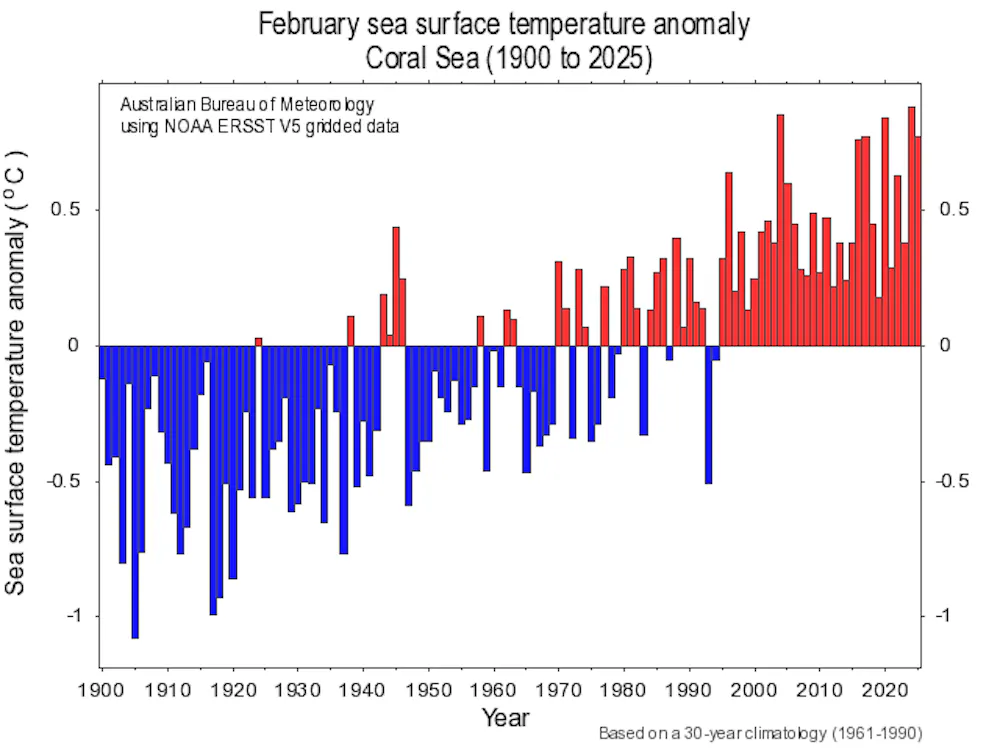
    The northeastern Coral Sea, where Cyclone Alfred formed, experienced the fourth-hottest temperatures on record for February and the hottest on record for January.

    In the Coral Sea, sea surface temperatures were the fourth highest on record in February 2025 and the highest on record in January 2025. This figure shows the trend over time for February.
    Bureau of Meteorology, CC BY-NC-ND

    We also know Australia’s southern waters are warming up too.

    The energy available to power tropical cyclones in subtropical regions has also increased in recent decades, due largely to rising ocean temperatures.

    Average sea surface temperatures in central and southern Queensland on Thursday March 6th. Point Danger is on the Gold Coast.
    Bureau of Meteorology, CC BY-NC-ND

    Climate link: Fewer cyclones but more likely to be intense

    In the northern hemisphere, researchers have found a trend towards fewer cyclones over time. But of those which do form, a higher proportion are more intense.

    It’s not fully clear if the same trend exists in the southern hemisphere, though we are seeing fewer cyclones forming over time.

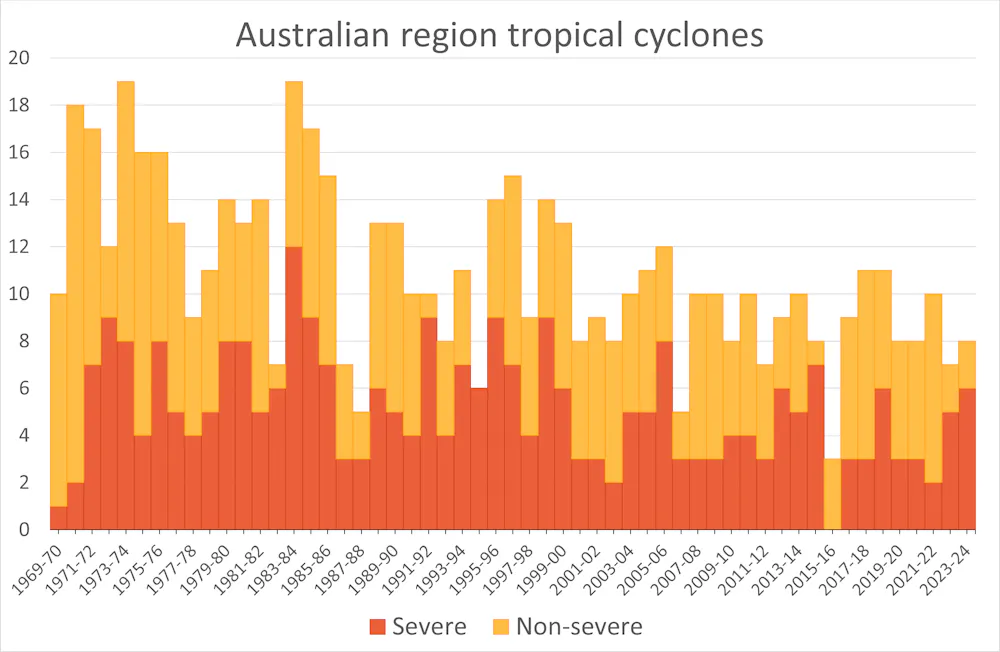
    This summer, eight tropical cyclones have formed in Australian waters. Six were classified as severe (category 3 and up). Historically, Australia has experienced a higher proportion of category 1 and 2 cyclones, which bring weaker wind speeds.

    On average, we see about 11 cyclones form and 4-5 make landfall. There has been a downward trend in the number of cyclones forming in the Australian region in recent decades.

    Fewer cyclones, but more likely to be intense: this figure shows the number of severe (Category 3 and up) and non-severe tropical cyclones (Category 1 and 2) since 1970/71.
    Bureau of Meteorology, CC BY-NC-ND

    Climate link: Cyclones dumping more rain

    The intensity of a cyclone refers to the speed of the wind and size of the wind-affected area.

    But a cyclone’s rain field is also important. This refers to the area of heavy rain produced by storms when they’re at cyclone intensity and afterwards as they decay into tropical lows.

    The rate of rainfall brought by cyclones in Australia isn’t necessarily increasing, but more cyclones are moving slowly, such as Alfred. This means more rain per cyclone, on average.

    Rising ocean temperatures mean more water evaporates off the sea surface, meaning forming cyclones can absorb more moisture and dump more rain when it reaches land.

    Why are cyclones slowing down? This is likely because air current circulation in the tropics has weakened. This has a clear link to climate change. Wind speeds have fallen 5 to 15% in the tropics, depending on where you are in the world. It’s hard to pinpoint the change clearly in our region, because the historic record of cyclone tracks isn’t very long.

    For every degree (°C) of warming, rainfall intensity increases 7%. This is well established. But newer research is showing the rate may actually be double this or even higher, as the process of condensation releases heat which can trigger more rain.

    Clear climate link: Bigger storm surges due to sea level rise

    Sea levels are on average about 20 centimetres higher than they were before 1880.

    When a cyclone is about to make landfall, its intense winds push up a body of seawater ahead of it – the storm surge. In low lying areas, this can spill out and flood streets.

    Because climate change is causing baseline sea levels to rise, storm surges can reach further inland. Sea-level rise will also make coastal erosion more destructive.

    What should we take from this?

    We can’t say definitively that climate change is behind Cyclone Alfred’s unusual track.

    But factors such as rising sea levels, slower cyclones and warmer oceans are changing how cyclones behave and the damage they can do.

    Over time, we can expect to see cyclones arriving in regions not historically affected – and carrying more rain when they arrive.

    Liz Ritchie-Tyo receives funding from The Australian Research Council and the U.S. Office of Naval Research

    Andrew Dowdy receives funding from University of Melbourne as well as supported through the Australian Research Council.

    Hamish Ramsay receives funding from the Australian Climate Service.

    ref. Cyclone Alfred is slowing down – and that could make it more destructive. Here’s how climate change might have influenced it – https://theconversation.com/cyclone-alfred-is-slowing-down-and-that-could-make-it-more-destructive-heres-how-climate-change-might-have-influenced-it-251594

    MIL OSI AnalysisEveningReport.nz

  • MIL-OSI: Bitget Wallet Launches AI Token Analysis for Smarter Onchain Trading

    Source: GlobeNewswire (MIL-OSI)

    SAN SALVADOR, El Salvador, March 06, 2025 (GLOBE NEWSWIRE) — Bitget Wallet, a leading Web3 non-custodial wallet, has introduced AI Token Analysis, a new feature designed to help users make informed trading decisions. By analyzing token narratives, market sentiment, and social media discussions, the feature provides traders with real-time insights and a clearer understanding of market trends.

    Users can access AI Token Analysis within the K-line page of supported tokens in the Bitget Wallet app. The feature delivers real-time sentiment analysis, AI-driven insights, and a curated feed of key discussions, all seamlessly integrated into the trading interface for easy access. It is currently available for select tokens, and support for additional assets will be introduced in the future.

    AI Token Analysis goes beyond traditional data tracking by identifying emerging narratives, market sentiment shifts, and token momentum. It scans social media, whitepapers, on-chain activity, news, and influencer discussions, providing a real-time view of market trends. Users can quickly assess sentiment from X and follow aggregated updates from project teams, influencers, and communities, all within a streamlined, easy-to-use interface.

    AI is rapidly reshaping crypto trading, with AI-driven solutions projected to generate $10.2 billion in revenue by 2030, according to VanEck. Public blockchains are expected to accelerate AI adoption, improving transparency and accessibility in trading. As AI technology advances, Bitget Wallet is expanding its capabilities beyond market analysis to include predictive modeling, automated strategies, and deeper data-driven insights, making trading more efficient and intuitive.

    Crypto moves fast, and traders need reliable insights at their fingertips,” said Alvin Kan, COO of Bitget Wallet. “AI Analysis simplifies market research by delivering clear, real-time intelligence, helping traders make informed decisions faster. This is just the beginning — we are committed to expanding AI-driven tools to enhance the onchain trading experience.

    About Bitget Wallet
    Bitget Wallet is the home of Web3, uniting endless possibilities in one non-custodial wallet. With over 60 million users, it offers comprehensive onchain services, including asset management, instant swaps, rewards, staking, trading tools, live market data, a DApp browser, an NFT marketplace and crypto payment. Supporting over 100 blockchains, 20,000+ DApps, and 500,000+ tokens, Bitget Wallet enables seamless multi-chain trading across hundreds of DEXs and cross-chain bridges, along with a $300+ million protection fund to ensure safety of users’ assets. Experience Bitget Wallet Lite to start a Web3 journey.

    For more information, visit: X | Telegram | Instagram | YouTube | LinkedIn | TikTok | Discord | Facebook
    For media inquiries, please contact media.web3@bitget.com

    A photo accompanying this announcement is available at https://www.globenewswire.com/NewsRoom/AttachmentNg/6c8d43be-7b06-402c-843d-2886776b05a8

    The MIL Network

  • MIL-Evening Report: HILDA data shows income inequality is at a 20-year high

    Source: The Conversation (Au and NZ) – By Ferdi Botha, Senior Research Fellow, Melbourne Institute: Applied Economic & Social Research, The University of Melbourne

    ArliftAtoz2205/Shutterstock

    The 19th annual report from the Household, Income and Labour Dynamics in Australia (HILDA) Survey was released today.

    The HILDA Survey has been following the same people every year since 2001, which makes it possible to examine how the lives of Australians have changed across several aspects.

    With data from 2001 to 2022, in this year’s report we looked at issues including income inequality, household chores, and the impact of natural disasters on Australian households.

    Income inequality is the highest since 2001

    Funded by the Australian government and managed by the Melbourne Institute, the survey is one of Australia’s most valuable social research tools.

    HILDA examined the lives of 14,000 Australians in 2001 and has kept coming back each year to discover what has changed over the course of their lifetimes. It now covers 17,000 Australians, due to the expansion of participants’ families.

    The survey shows that since COVID-era financial support ended, income inequality has risen substantially.

    The increase in inequality stems from growth in higher incomes as compared to middle incomes, as well as a fall in the growth of lower incomes relative to middle incomes.

    This means, relative to the median earner, Australians already earning a high income have seen the growth in their incomes rise. In contrast, Australians with low incomes have seen a decrease in the rate of growth in their incomes.

    Between 2021 and 2022, 51.2% of respondents reported their real incomes have declined. This is up from about 41% in preceding years, suggesting a decrease in people’s purchasing power.

    A technical measure called the Gini coefficient was 0.32 in 2022, the highest since we started the survey in 2001. The measure ranges from 0 to 1 and is an index that measures overall inequality, with higher scores suggesting greater income inequality.

    Older Australians are getting richer too

    Over the same period, household wealth has continued to grow.

    However, there are large and growing age differences in the growth in household wealth. For young people aged between 18 and 34, net wealth rose by 72.4% to $238,942 over the 20 years to 2022.

    But for older Australians aged 65 to 74, net household wealth jumped by 125% to about $1.26 million.

    These age disparities in household wealth are partly explained by rates of home ownership, which are much higher among older Australians.

    Home ownership is also the most important asset component in terms of total wealth. In 2022, almost 65% of households owned their home, and just over 20% of households held investment properties and holiday homes.

    As a proportion of total wealth, the family home accounts for 44.5% and investment properties account for 14.9%.

    Women are still doing most of the housework

    Australian women still undertake the majority of housework, whereas men’s share of housework has remained constant over 20 years.

    Men’s time spent on housework has not changed in 20 years.
    Diego Cervo/Shutterstock

    Women’s time spent on housework (such as cleaning, cooking, running errands) has fallen slightly from 23.8 hours per week in 2002 to 18.4 hours per week in 2022.

    Men spent 12.8 hours per week on housework, precisely the same amount they did 20 years earlier. Thus, women are still doing close to 50% more housework than men are.

    Men have increased the time they spend on caring responsibilities (such as playing with their children, helping with homework, caring for an elderly relative), from 5 hours per week in 2002 to 5.5 hours per week in 2022. The time women spend on care has risen from 10.1 hours per week to 10.7 hours per week over the same period. In 2022, women spent almost double the time on care duties than men.

    Among couples, men are generally more satisfied than women are with the current division of unpaid work. Most women feel they do more than their fair share at home. Men tend to believe they share the housework and care fairly with their partner.

    Surge in home damage due to weather-related disasters

    Respondents were asked if a weather-related disaster (such as floods, bushfires or cyclone) had damaged or destroyed their home in the past 12 months. In 2022, 4.5% reported experiencing such an event.

    This is a substantial increase from the year before, when only 1.3% of Australians reported weather-related home damage, and exceeding the previous peak of 2.7% in 2011.

    There are also regional differences, closely corresponding with the timing of specific floods or bushfires in the states and territories. In 2022, 9% of New South Wales residents and 6% of Queensland reported home damage, consistent with major floods experienced in these regions in the months prior to the survey.

    Among all Australians who in 2022 reported home damage due to a weather-related disaster, 62.5% were in NSW and 27.3% were in Queensland.

    With the current cyclone Alfred forecast to hit Queensland and northern NSW on Friday, we expect a further significant increase in reported home damage.

    Ferdi Botha is affiliated with the ARC Centre of Excellence for Children and Families over the Life Course.

    ref. HILDA data shows income inequality is at a 20-year high – https://theconversation.com/hilda-data-shows-income-inequality-is-at-a-20-year-high-251596

    MIL OSI AnalysisEveningReport.nz

  • MIL-Evening Report: Woolly mice are cute and impressive – but they won’t bring back mammoths or save endangered species

    Source: The Conversation (Au and NZ) – By Emily Roycroft, Research Group Leader & ARC DECRA Fellow, Monash University

    Colossal Biosciences

    US company Colossal Biosciences has announced the creation of a “woolly mouse” — a laboratory mouse with a series of genetic modifications that lead to a woolly coat. The company claims this is the first step toward “de-extincting” the woolly mammoth.

    The successful genetic modification of a laboratory mouse is a testament to the progress science has made in understanding gene function, developmental biology and genome editing. But does a woolly mouse really teach us anything about the woolly mammoth?

    What has been genetically modified?

    Woolly mammoths were cold-adapted members of the elephant family, which disappeared from mainland Siberia at the end of the last Ice Age around 10,000 years ago. The last surviving population, on Wrangel Island in the Arctic Ocean, went extinct about 4,000 years ago.

    The house mouse (Mus musculus) is a far more familiar creature, which most of us know as a kitchen pest. It is also one of the most studied organisms in biology and medical research. We know more about this laboratory mouse than perhaps any other mammal besides humans.

    Colossal details its new research in a pre-print paper, which has not yet been peer-reviewed. According to the paper, the researchers disrupted the normal function of seven different genes in laboratory mice via gene editing.

    By tinkering with different genes, researchers produced mice with different kinds of fur.
    Colossal Biosciences

    Six of these genes were targeted because a large body of existing research on the mouse model had already demonstrated their roles in hair-related traits, such as coat colour, texture and thickness.

    The modifications in a seventh gene — FABP2 — was based on evidence from the woolly mammoth genome. The gene is involved in the transport of fats in the body.

    Woolly mammoths had a slightly shorter version of the gene, which the researchers believe may have contributed to its adaptation to life in cold climates. However, the “woolly mice” with the mammoth-style variant of FABP2 did not show significant differences in body mass compared to regular lab mice.

    What would it mean to de-extinct a species?

    This work shows the promise of targeted editing of genes of known function in mice. After further testing, this technology may have a future place in conservation efforts. But it’s a long way from holding promise for de-extinction.

    Colossal Biosciences claims it is on track to produce a genetically modified “mammoth-like” elephant by 2028, but what makes a mammoth unique is more than skin-deep.

    De-extinction would need to go beyond modifying an existing species to show superficial traits from an extinct relative. Many aspects of an extinct species’ biology remain unknown. A woolly coat is one thing. Recreating the entire suite of adaptations, including genetic, epigenetic and behavioural traits that allowed mammoths to thrive in ice age environments, is another.

    Prehistoric drawings of an ibex (left) and a mammoth (right) found at Rouffignac cave in France.
    Cave Painter / Wikimedia

    Unlike the thylacine (or Tasmanian tiger) — another species Colossal aims to resurrect — the mammoth has a close living relative in the modern Asian elephant. The closer connections between the genomes of these two species may make mammoth de-extinction more technically feasible than that of the thylacine.

    But whether or not a woolly mouse brings us any closer to that prospect, this story forces us to consider some important ethical questions. Even if we could bring back the woolly mammoth, should we? Is the motivation behind this effort conservation, or entertainment? Is it ethical to bring a species back into an environment that may no longer sustain it?

    Focus on conserving what remains

    In Australia alone, we’ve lost at least 100 species to extinction since European colonisation in 1788, largely due the introduction of feral predators and land clearing.

    The idea of reversing extinction is understandably appealing. We might like to think we could undo the past.

    According to Colossal’s website,

    Extinction is a colossal problem facing the world. And Colossal is the company that’s going to fix it.

    It’s hard to argue with the first part of that. But focusing on bringing back extinct species distracts from a more urgent reality: species are going extinct right now, and we are not doing enough to save them.

    We should first focus on promises to save surviving species, rather than promises to bring back the dead.

    With more investment in threatened species monitoring, new pest control methods, and conservation genetic management, we can turn the tide of extinction and secure the future for species that remain.

    There’s a long list of threatened species that are still alive now. With the right funding and conservation attention, we can do something to save them before it’s too late.

    Emily Roycroft receives funding from the Australian Research Council, the L’Oréal-UNESCO For Women in Science Programme, and the Australian Academy of Science.

    ref. Woolly mice are cute and impressive – but they won’t bring back mammoths or save endangered species – https://theconversation.com/woolly-mice-are-cute-and-impressive-but-they-wont-bring-back-mammoths-or-save-endangered-species-251595

    MIL OSI AnalysisEveningReport.nz

  • MIL-OSI United Kingdom: expert reaction to Copernicus data reporting that global sea ice cover at a record low and February 2025 was third warmest on record

    Source: United Kingdom – Executive Government & Departments

    Scientists comment on Copernicus data reporting global sea ice cover is at a record low, and that February was the third warmest on record. 

    Professor Simon Josey, Professor of Oceanography at the UK’s National Oceanography Centre, said:

    “The current record low global sea ice extent revealed by the Copernicus analysis is of serious concern as it reflects major changes in both the Arctic and Antarctic. Warm ocean and atmospheric temperatures will prove critical for Antarctic sea-ice in the coming months as they may lead to an extensive failure of the ice to regrow in southern hemisphere winter. A recent study (Josey et al., 2024) has shown that this can lead to increasingly stormy conditions in the Southern Ocean and altered ocean properties with potential impacts for the wider ocean and atmospheric circulation.”

    Josey, S. A., A. J. S. Meijers, A. T. Blaker, J. P. Grist, J. Mecking and H. C. Ayres, 2024: Record-low Antarctic sea ice in 2023 increased ocean heat loss and storms, Nature, https://doi.org/10.1038/s41586-024-08368-y.


    Dr Robert Larter, Marine Geophysicist, British Antarctic Survey (BAS), said:

    “The results from C3S showing that global sea ice extent reached a new all-time minimum in February highlight the substantial effects climate change is having in polar regions and are a cause for serious concern. These results are consistent with independent analysis from the National Snow and Ice Data Center in the US. Sea ice has an important climate feedback effect because of its high “albedo”, reflecting a large proportion of incident solar radiation back into space. It also plays an important role in the ecology of the polar oceans and helps protect floating ice shelves in Antarctica, which buttress the ice sheet, by suppressing ocean swell. Furthermore, brine rejection during seasonal formation of sea ice is a key process in the formation of dense water masses that sink to the depths of the ocean and are critical to driving the global overturning thermohaline circulation.

    “The near-record low in Antarctic sea-ice extent follows on from extents in the previous two years that were the lowest in the period over which satellite records have been available, and extends the run of years with low minimum sea ice extents that started with a steep decline in 2016. Antarctic sea-ice extent has usually started to grow again before the end of February as the days get shorter in the Southern Ocean, but this year several days into March the data show no sign of significant new sea ice formation.”

    Prof Richard Allan, Professor of Climate Science, University of Reading, said:

    “February 2025 saw the lowest recorded coverage of sea ice globally as the Arctic reached a record low maximum extent of around 14 million square kilometres and sea ice at the fringes of Antarctica stayed near the record low minimum extent of around 2 million square kilometres, which has been reached every February since 2022. Every successive February, the Arctic has been losing on average 42 thousand square kilometres of sea ice, twice the area of Wales. Parts of the high Arctic have been up to 12 degrees Celsius above average while on the other hand the USA and Canada froze, showing that heat can temporarily shift from one place to another. But averaging over all regions, the global warming trend is clear with February 2025 more than 1.5 degrees Celsius above pre-industrial conditions, repeating a level of excess warmth experienced in all but 1 of the past 20 months, despite a weak cooling influence of La Niña conditions in the Pacific. The long term prognosis for Arctic sea ice is grim as the region continues to rapidly heat up and can only be saved with rapid and massive cuts to greenhouse gas emissions that will also limit the growing severity of weather extremes and long term sea level rise across the world.”

    Declared interests

    Dr Robert Larter: No conflicts.

    Professor Richard Allan: no conflicting interests

    For all other experts, no response to our request for DOIs was received.

    MIL OSI United Kingdom

  • MIL-OSI Security: Schenectady Man Pleads Guilty to Possessing with Intent to Distribute Fentanyl

    Source: Office of United States Attorneys

    ALBANY, NEW YORK – Terrell Bell, age 27, of Schenectady, New York, pled guilty today to possessing with intent to distribute fentanyl. Acting United States Attorney Daniel Hanlon and Craig L. Tremaroli, Special Agent in Charge of the Albany Field Office of the Federal Bureau of Investigation (FBI), made the announcement.

    Bell was on parole in January 2024 when law enforcement searched his home in Schenectady and discovered nearly 1,800 fentanyl pills in his bedroom and over $90,000 throughout the home.

    At sentencing scheduled for July 9, 2025, Bell faces a minimum term of 5 years and a maximum term of 40 years in prison, a maximum fine of $5 million, and a term of supervised release after imprisonment of between 4 years and life. A defendant’s sentence is imposed by a judge based on the statute the defendant violated, the U.S. Sentencing Guidelines, and other factors. Bell has also consented to the forfeiture of the currency seized from his home.

    FBI investigated this case with the assistance of the Schenectady Police Department. Assistant U.S. Attorney Mikayla Espinosa is prosecuting this case.

    MIL Security OSI

  • MIL-OSI Security: Binghamton Woman Sentenced to 8 Years in Prison for Escaping Federal Custody and Possessing with Intent to Distribute Methamphetamine

    Source: Office of United States Attorneys

    ALBANY, NEW YORK – Jade A. Pittsley, age 34, of Binghamton, New York, was sentenced today to 8 years in prison following her guilty plea to escaping from federal custody and possessing and intending to distribute methamphetamine. Acting United States Attorney Daniel Hanlon; Erin Keegan, Special Agent in Charge of the Buffalo Field Office of Homeland Security Investigations (HSI); and United States Marshal David L. McNulty made the announcement.

    As part of her prior guilty plea, Pittsley admitted that in November 2023, while she was serving a federal term of imprisonment for a drug offense involving methamphetamine, she was under the supervision of a halfway house.  Pittsley was directed to return to the halfway house but never did.  Days later, law enforcement found Pittsley carrying methamphetamine and drug paraphernalia in her purse.

    United States District Judge Mae A. D’Agostino also imposed a 4-year term of supervised release to begin after Pittsley is released from prison.

    HSI and the U.S. Marshals Service investigated this case with assistance from the Broome County Sheriff’s Office.  Assistant U.S. Attorneys Mikayla Espinosa and Kristen Grabowski prosecuted this case. 

    MIL Security OSI

  • MIL-OSI China: World’s tallest bridge in Guizhou nearing completion

    Source: China State Council Information Office 2

    An aerial panoramic drone photo shows a view of the Huajiang Grand Canyon Bridge in southwest China’s Guizhou, Jan. 14, 2025. [Photo/Xinhua]
    The Huajiang Grand Canyon Bridge in Guizhou province, set to become the world’s tallest bridge, is 95 percent complete, with installation of the bridge deck panels expected to finish by mid-March, a deputy to China’s top legislature said during the ongoing two sessions.
    Zhang Shenglin, a deputy to the 14th National People’s Congress, said the bridge’s main structure was completed in January, and engineers have overcome key technical challenges. The focus has now shifted to installing the deck, followed by anti-corrosion work on the main cables and infrastructure projects such as mechanical and electrical equipment.
    “When the bridge opens in the second half of 2025, this super project spanning the ‘Earth’s crack’ will showcase China’s engineering capabilities and boost Guizhou’s goal of becoming a world-class tourist destination,” said Zhang, who is also chief engineer of Guizhou Highway Engineering Group Co.
    The bridge’s main span stretches 1,420 meters, with a height of 625 meters from deck to water — comparable to a 200-story building — surpassing the 565-meter-high Beipanjiang Bridge as the world’s tallest.
    It is also the world’s longest span bridge to be built in a mountainous area.
    “Its steel trusses weigh about 22,000 metric tons — the equivalent of three Eiffel Towers — and were installed in just two months,” said Zhang.
    The bridge connects Liuzhi to Anlong and is a key link in southwestern China’s highway network. Once operational, it will cut cross-river travel time from about two hours to just two minutes.
    Beyond transportation benefits, Zhang said the bridge is expected to boost the local economy by promoting sales of agricultural products and ethnic handicrafts, as well as encouraging development of homestays and restaurants. At a nearby village, more than 100 young people have returned to their hometown to invest in tourism projects such as cliff hotels and camping sites, she said.
    The Guizhou Transportation Investment Group, responsible for the bridge’s “integrated development of bridge and tourism” program, said it is seeking investment from companies and individuals.
    The project includes the Yundu service center, a commercial complex spanning 21,100 square meters with dining, shopping, entertainment and tourism facilities. The development plan features 13 subcategories, including sightseeing suspension bridges, canyon cable cars, rock climbing, food markets, cultural products, resort hotels, holiday campsites and sky cafes, the company said.

    MIL OSI China News

  • MIL-OSI USA: Cramer Questions Nominees at EPW Hearing on American Excellence Compared to Global Polluters

    US Senate News:

    Source: United States Senator Kevin Cramer (R-ND)
    Click here for audio. Click here for video
    WASHINGTON, D.C. – The Senate Environment and Public Works (EPW) Committee held a hearing today to consider the nominations of David Fotouhi to serve as Deputy Administrator of the Environmental Protection Agency (EPA) and Aaron Szabo to serve as Assistant Administrator for the Office of Air and Radiation of the EPA.
    Fotouhi served in the EPA as Acting General Counsel during the first Trump administration. Szabo previously served on the Nuclear Regulatory Commission and the Council on Environmental Quality. 
    U.S. Senator Kevin Cramer (R-ND) questioned the witnesses on the difference between the United States’ leadership in emissions compared to the rest of the world. Even as the U.S. grows its economy, manufacturing base, and energy sector, emissions have been reduced. In particular, emissions from the energy sector over the last 20 years have sharply decreased. As Szabo explained in his opening statement, since the enactment of Clean Air Act in 1970, “the United States has made remarkable progress in reducing air pollution. We have seen significant decreases in carbon monoxide, sulfur dioxide, lead, ground level, ozone, particulate matter, and other hazardous air pollutants.”
    [embedded content]
    Cramer asked Szabo and Fotohui about why companies would invest in the U.S. if there is a noncompetitive regulatory environment and how the United States measures up.
    “This isn’t going to be shocking anyone, but we have significantly decreased, both our greenhouse gas and traditional air pollution emissions tremendously, especially over the past 20 years,” said Szabo. “Other countries, such as China, have significantly increased their greenhouse gas emissions as well as their traditionally air pollution emissions over the years. What we are seeing now actually is that international emissions, […] traditional air pollution from China impacts states like California, due to the transport from the Pacific. Generally, if we shut off all greenhouse gas emissions in this country tomorrow, that would not have any real impact with the increases that we’ve seen from other countries around the world, specifically China.”
    “American greenhouse gas emissions have decreased by something like a million tons per year while China’s have increased by something like six to seven million tons per year, completely swamping our hard-earned reductions in greenhouse gas emissions,” responded Fotohui. “So I think, to the extent there needs to be work to be done to address that issue, it needs to be done both domestically and globally.”

    MIL OSI USA News

  • MIL-OSI USA: Kaine, Britt, Carbajal, Lawler Lead Introduction of Bipartisan, Bicameral Proposal to Make Child Care More Affordable

    US Senate News:

    Source: United States Senator for Virginia Tim Kaine

    WASHINGTON, D.C. – Yesterday, U.S. Senators Tim Kaine (D-VA) and Katie Britt (R-AL) and U.S. Representatives Salud Carbajal (D-CA-24) and Mike Lawler (R-NY-17) introduced the Child Care Availability and Affordability Act and the Child Care Workforce Act—bipartisan, bicameral legislation that form a bold proposal to make child care more affordable and accessible by strengthening existing tax credits to lower child care costs and increase the supply of child care providers. Over the last few decades, the cost of child care has increased by 263%, forcing families to make impossible choices. More than half of all families live in child care deserts. Meanwhile, child care workers are struggling to make ends meet on the poverty-level wages they are paid and child care providers are struggling to simply stay afloat. The crisis—which was exacerbated by the pandemic—is costing our economy, resulting in $122 billion in economic losses each year.

    “The child care crisis is holding our families and economy back. I hear from Virginia parents all the time about how hard it is to find affordable child care, from child care providers who are forced to leave their jobs because of low wages, and from businesses who are having trouble finding the employees they need,” said Kaine. “I’m proud to join my colleagues in introducing this bipartisan legislation, and I hope more of my colleagues will join us in passing this comprehensive proposal to support child care providers, make it easier for families to access the care they need, and boost economic growth by providing parents with the opportunity to get back into the workforce.”

    “We applaud Sens. Britt and Kaine and Reps. Lawler and Carbajal for their bipartisan, bicameral efforts to identify innovative and impactful policy solutions that will increase access to quality child care for America’s working families, bolstering the workforce and economy. These two bills mark a major milestone to begin addressing employer and employee needs, as well as supply-side issues that impact the availability of care,” says Bipartisan Policy Center Action President Michele Stockwell.

    “The Child Care Availability and Affordability Act and the Child Care Workforce Act is forward-thinking legislation that will tackle the child care challenges plaguing too many working parents, employers, and providers,” said First Five Years Fund Executive Director Sarah Rittling. “By refining tax credits and expanding access, this plan will deliver real relief to countless families. We’re grateful to Senators Britt, Kaine, Ernst, and Shaheen for their leadership in finding bipartisan and practical solutions that put working families first.”

    Kaine has long been pushing to expand access to child care. In 2023, he introduced the Child Care Stabilization Act to expand vital child care funding to help providers keep their doors open, and has championed the Child Care for Working Families Act to expand access to child care, raise wages for providers, and lower costs for families by ensuring no family pays more than 7% of their income on child care. He has also introduced bipartisan legislation to develop, administer, and evaluate early childhood education apprenticeships.

    The proposal contains two bills because one proposes changes to existing tax credits, falling under the jurisdiction of the Senate Finance Committee, and the other authorizes a new pilot program, falling under the jurisdiction of the Senate HELP Committee.

    Child Care Availability and Affordability Act

    The Child Care Availability and Affordability Act would make child care more affordable by:

    • Increasing the size of the Child and Dependent Care Tax Credit (CDCTC) and making it refundable, allowing lower income working families with out-of-pocket child care expenses to benefit from the credit for the first time. The proposal substantially expands the maximum CDCTC to $2,500 for families with one child and $4,000 for families with two or more children.
    • Strengthening the Dependent Care Assistance Program (DCAP) to allow families to deduct 50% more in expenses (up to $7,500).
    • Allowing eligible families to benefit from both the DCAP and the CDCTC when their child care expenses exceed the DCAP threshold. This will have big benefits for middle income families who currently do not access the CDCTC but have particularly high child care costs.
    • Radically bolstering the underutilized Employer-Provided Child Care Tax Credit—commonly referred to as 45F—to encourage businesses to provide child care to their employees. The Kaine-Britt plan would increase the maximum credit from $150,000 to $500,000, and the percentage of expenses covered from 25% to 50%. The legislation also includes a larger incentive for small businesses—a maximum credit of $600,000—and allows for joint applications for groups of small businesses who want to pool resources.

    The Child Care Availability and Affordability Act is cosponsored by Senators Joni Ernst (R-IO), Jeanne Shaheen (D-NH), John Curtis (R-UT), Angus King (I-ME), Shelley Moore Capito (R-WV), Kirsten Gillibrand (D-NY), and Susan Collins (R-ME).

    The Child Care Availability and Affordability Act is endorsed by A+ Education Partnership, Abriendo Puertas/Opening Doors, Alabama Arise, Alabama School Readiness Alliance, American Hotel & Lodging Association (AHLA), Arizona Early Childhood Education Association, Big Blue Marble Academy, Bipartisan Policy Center Action (BPCA), Bright Horizons, Business Council of Alabama, Busy Bees North America, Care.com, Chamber of Progress, Chamber RVA, Child Care Aware of America (CCAoA), Child Care Aware of Virginia, Child Development Schools, Children’s Institute, Cincinnati Regional Chamber, Council for Professional Recognition, Early Care & Education Consortium (ECEC), Early Learning Policy Group, LLC, Eastern Shore Chamber of Commerce, Educare Learning Network, First Five Years Fund (FFYF), Gingerbread Kids Academy, Hampton Roads Chamber, Healthy Families America, Healthy Kids Alabama, Independent Restaurant Coalition, Jesuit Conference of the United States, Kaplan Early Learning Company, Kiddie Academy, KinderCare Learning Companies, Learning Care Group, Lightbright Academy, Low Income Investment Fund (LIIF), Manufacture Alabama, Metrix IQ, Mobile Area Education Foundation, Moms First, National Association of Women Business Owners (NAWBO), National Child Care Association (NCCA), North Carolina Licensed Child Care Association, Northern Virginia Chamber of Commerce (NVC), Ohio Association of Child Care Providers, Parents as Teachers National Center, Prevent Child Abuse America, Primrose Schools, Santa Barbara South Cost Chamber of Commerce, Small Business Majority, Small Business Majority, Start Early, Solvang Chamber of Commerce, Teaching Strategies, Texas Licensed Child Care Association, The Nest Schools, Third Way, U.S. Chamber of Commerce, Ventura Chamber of Commerce, Virginia Beach Vision, Virginia Chamber of Commerce, Virginia Early Childhood Foundation (VECF), VOICES for Alabama’s Children, Voices for Virginia’s Kids, and YMCA of the USA.

    Full text of the Child Care Availability and Affordability Act is available here.

    Child Care Workforce Act

    Because many child care providers are forced out of the industry by low wages—which makes it even harder for families to find affordable child care—the Child Care Workforce Act would make it easier to access child care, by establishing a competitive grant program for states, localities, Tribes, and Tribal organizations that are interested in adopting or expanding pay supplement programs for child care workers to increase supply and reduce turnover. Within that program:

    • Grantees would provide supplements, paid out at least quarterly, directly to both home-based and center-based licensed child care providers licensed by the state.
    • There would be a required evaluation of impacts on turnover, quality of child care, availability of affordable childcare, and alleviating the financial burden on child care providers. Model programs exist in Virginia, Nebraska, Oklahoma, Maine, and the District of Columbia, with evaluations demonstrating large effects on the supply of workers, educator turnover, and worker well-being and satisfaction.

    The Child Care Workforce Act is cosponsored by Senators Jeanne Shaheen (D-NH), Angus King (I-ME), and Kirsten Gillibrand (D-NY).

    The Child Care Workforce Act is endorsed by A+ Education Partnership, Abriendo Puertas/Opening Doors, Alabama Arise, Alabama School Readiness Alliance, Arizona Early Childhood Education Association, Big Blue Marble Academy, Bipartisan Policy Center Action (BPCA), Bright Horizons, Business Council of Alabama, Busy Bees North America, Care.com, Chamber of Progress, Chamber RVA, Child Care Aware of America (CCAoA), Child Care Aware of Virginia, Child Development Schools, Children’s Institute, Cincinnati Regional Chamber, Council for Professional Recognition, Early Care & Education Consortium (ECEC), Early Learning Policy Group, LLC, Eastern Shore Chamber of Commerce, Educare Learning Network, First Five Years Fund (FFYF), First Focus Campaign for Children, Gingerbread Kids Academy, Hampton Roads Chamber, Healthy Families America, Healthy Kids Alabama, Independent Restaurant Coalition, Jesuit Conference of the United States, Kaplan Early Learning Company, Kiddie Academy, KinderCare Learning Companies, Learning Care Group, Lightbright Academy, Low Income Investment Fund (LIIF), Manufacture Alabama, Metrix IQ, Mobile Area Education Foundation, Moms First, National Association for Family Child Care (NAFCC), National Association for the Education of Young Children (NAEYC), National Association of Women Business Owners (NAWBO), National Child Care Association (NCCA), National Council of Jewish Women, National Women’s Law Center (NWLC), North Carolina Licensed Child Care Association, Northern Virginia Chamber of Commerce (NVC), Ohio Association of Child Care Providers, Parents as Teachers National Center, Prevent Child Abuse America, Primrose Schools, Santa Barbara South Cost Chamber of Commerce, Small Business Majority, Small Business Majority, Start Early, Teaching Strategies, Texas Licensed Child Care Association, The Nest Schools, Third Way, UVentura Chamber of Commerce, Virginia Beach Vision, Virginia Chamber of Commerce, Virginia Early Childhood Foundation (VECF), VOICES for Alabama’s Children, Voices for Virginia’s Kids, YMCA of the USA, and ZERO TO THREE.

    Full text of the Child Care Workforce Act are available here.

    MIL OSI USA News

  • MIL-OSI China: Officials explain why China’s 2025 growth target is attainable

    Source: China State Council Information Office

    An aerial drone photo taken on Aug. 28, 2024 shows an interior view of the digital factory at a manufacturing enterprise in Yinchuan, northwest China’s Ningxia Hui Autonomous Region. [Photo/Xinhua]

    China’s economic growth target of around 5 percent for this year is achievable, as it aligns with the country’s actual conditions and the laws governing economic development, an official said Wednesday.

    Achieving this target, however, will not be easy and will require tremendous efforts, said Shen Danyang, head of the group responsible for drafting this year’s government work report, which was submitted to the national legislature for deliberation earlier in the day.

    China’s momentum of economic recovery and growth continues to strengthen, said Shen, director of the Research Office of the State Council, at a press conference while outlining key factors that will support the country in achieving its 2025 growth target.

    China has introduced a package of new policies since September last year, leading to a notable economic rebound, with GDP growth rising to 5.4 percent in the fourth quarter of 2024, he noted.

    Since the beginning of 2025, key indicators such as the purchasing managers’ index for the manufacturing sector, property sales, and container throughput have all signaled a trend of steady economic growth in China, the official said.

    Shen emphasized that favorable conditions are actively supporting economic growth, with new industries and growth drivers rapidly expanding, including new energy vehicles, the photovoltaic sector, shipbuilding and artificial intelligence.

    Meanwhile, factors that were dragging down the economy, such as the real estate sector, are showing positive changes, and their adverse impacts are gradually weakening, he said.

    China plans to implement more proactive and effective macro policies this year, the likes of which have not been seen in many years, and these are expected to provide a strong boost to economic growth, according to Shen.

    There are still options available in China’s policy toolkit, and macro policies will be dynamically adjusted in response to evolving circumstances, he said.

    Emphasizing the role of employment in achieving the economic growth target, Shen said that particular efforts will be made to support the employment of 12.22 million college graduates this year, along with individuals lifted out of poverty and migrant workers.

    Shen also called for invigorating market entities and boosting enterprise confidence, particularly among private businesses. “Authorities will continue working to foster a favorable market environment for fair competition and expand financing support for private businesses, as well as micro and small enterprises.”

    Macro data shows that China has an annual consumption of nearly 50 trillion yuan (about 6.97 trillion U.S. dollars), investment exceeding 50 trillion yuan, and imports of goods and services surpassing 20 trillion yuan, demonstrating a massive economic scale, said Chen Changsheng, deputy director of the State Council Research Office.

    Chen said that building a unified national market requires removing barriers to economic flows and fully leveraging the market’s decisive role in resource allocation, in order to enhance government functions while ensuring smooth domestic economic circulation.

    Chen underlined the positive reassessment of Chinese assets in international capital markets, driven by the growth potential of AI.

    “This year’s government work report calls for advancing the AI Plus initiative. By combining China’s digital tech with its manufacturing prowess and market scale, AI can hopefully empower all industries and reach every household,” Chen said.

    MIL OSI China News

  • MIL-OSI Australia: 3BA The Big Show, Ballarat

    Source: Australian Ministers 1

    PAUL TAYLOR [HOST]: Let’s go local, Ballarat, and I was going to speak to Lilly from Not Your Grandma’s Pantry, but unfortunately Lilly’s not answering her phone. We’ll get her on another time, though. I tell you what, her replacement though this morning has a major announcement to make, that is for sure. And the Honourable Catherine King MP, Minister for Infrastructure, Transport, Regional Development and Local Government – good morning to you, Catherine.

    CATHERINE KING [MINISTER]: Good morning, and also the most important title I have and the one I am proudest of is Federal Member of Ballarat. But I’m doing- I’m here in my ministerial capacity today.

    PAUL TAYLOR: Absolutely you are. Could we add any extra duties to your portfolio, do you think?

    CATHERINE KING: [Laughs] No, I’m pretty busy, to be honest. I’ve got some terrific junior ministers who help me out a fair bit, it’s a big portfolio and really busy. But I’m at home today, which is really lovely to actually be able to be in Ballarat. And I can smell the smoke in the air, and I hope everyone’s all right out at Buninyong Surrounds. That would’ve been a pretty scary event [indistinct] …

    PAUL TAYLOR: [Talks over] Our emergency services once again did a wonderful job in protecting our communities out Mount Clear and Mount Buninyong way.

    Speaking of which, Anthony Albanese up- is he still in Queensland at the moment, with the cyclone happening?

    CATHERINE KING: Yeah, as I understand it that’s where he is. He was certainly there yesterday with the Emergency Services Minister Jenny McAllister. She’s sort of basing herself up there at the moment, and we’ve got the National Emergency Management Agency – obviously the state of Queensland takes the lead, but we’ve got all of those national assets in place who’ve had time to prepare. But yeah, it’s pretty scary watching it. It seems unbelievable to imagine how much rain they’ve had right up the top of the state, and then to see this. And I’m sure there’s many people who know I’ve got family there, I’ve got staff there as well. I know there’s people who know- have lots of family, lots of people who- known up there, so I think our thoughts are all with them at the moment.

    PAUL TAYLOR: Catherine, a lot of pundits were saying Sunday was going to be the day that Mr Albanese would head to the GG’s office. But given Cyclone Alfred, that’s not likely to happen, do you think?

    CATHERINE KING: Well, again, the election timing’s a matter for him. But look, I think that he’s pretty focused on- you know, you’ve got such a big emergency up the top of the country. I don’t think it’s- I think we’re focused on how do we help, what do we do, what do we actually need to do to make sure people are safe. And then if there is, in the event of terrible and- you know, the sort of things we think might happen, then how do we help people recover quickly. And so I think he’s pretty focused on that at the moment. The election obviously is going to have to be held before May, but I think when you’ve got something like that happening, we’re all just like, okay what do we need to do, is really the mode we’re in at the moment, and the election sort of takes a bit of a backseat. But again, that’ll be a matter for him.

    PAUL TAYLOR: Catherine King, let’s get to the announcement at hand. If anyone’s travelled the Western Freeway, in particular around Melton and Caroline Springs, those sorts of areas, it’s a very frustrating drive, especially at peak hour. What’s going on where the Western Freeway is concerned? A lot of money to be thrown at this to make it a lot safer, Catherine King.

    CATHERINE KING: Yeah, absolutely. So the Victorian Government and the Albanese Labor Government, we put in money – about 20 million – to do a joint business case that has finished. There’s still some more work to be done on that, but in order to get the ball really rolling on the highway- it just really can’t wait, it’s at capacity or it’s about to be at capacity in the next five years or so, so we’re being told. So we’re putting in $1 billion- $1.1 billion actually, to- particularly from that Melton to Caroline Springs end to try and look at how can we make the road safer, how can we ease some of that congestion, particularly in those peak hours in the morning as people are coming out of Bacchus Marsh, out of Melton, out of Rockbank and trying to get into work- that really from 6am onwards, it’s very difficult to get through there, and the state of the road is not really keeping up with the demands of the population there. And then obviously the return peak hour, that also is really significant problem. We know that once the West Gate Tunnel is done, there’ll be some alleviation of the sort of bottleneck at the end, but really at the moment the road is just not keeping up.

    So that $1.1 billion, there’s also out of that 100 million to try and really resolve the issue that we’ve got down our end around Brewery Tap Road. It’s a really dangerous intersection there. I’ve had lots of people talking to me about really that needs to be fixed. It’s an accident waiting to happen, so we want to try and get ahead of that. It’s really awful when you’re trying to run the gambit crossing there, so we’ll do the work with the Victorian state government about what the solutions are to try and resolve that. But we’re putting 100 million in there.

    And there’s also a smaller amount of money down a bit further, which is to fix some of the bridges heading towards [indistinct], but all of the remaining money, there’s already $1 billion in the highway to do a range of other things down the other end of the highway. So that’s really what we’re announcing today. I use it- at least weekly I’m down that highway. I know lots of people use it to get to and from work, to get to and from family. It’s a really important piece of infrastructure for the whole west of the state. So we’ll be pleased to be making that announcement today.

    PAUL TAYLOR: Catherine, is that money guaranteed, even though we’ve got an election looming? If the Albanese Government is ousted, does that money stay? What’s …

    CATHERINE KING: Yeah. Well, any announcements we’re making before the election is called are obviously decisions of government. So they’re budgeted decisions that will show up in the Pre-Election Financial Outlook. The only risk, of course, is if the Liberals come in and say they want to cut things. And unfortunately, we do know that they’ve got to find money for the cuts that they do want to make, and that is always a risk when elections change. But this obviously is money that we’re making as a decision of government announced as government.

    PAUL TAYLOR: Well, good to see money being thrown at the Brewery Tap Road intersection at Warrenheip. It is a worrisome intersection and needs to be fixed as soon as possible, as does the congestion further down the Freeway towards Melton and Rockbank, Caroline Springs, those sorts of areas.

    The Honourable Catherine King, MP for Ballarat and all the other titles that you hold nowadays, thank you so much for coming on The Big Show. Few and far between nowadays with you jet setting around and looking after a whole heap of other things in your portfolio, but we appreciate your time this morning, Catherine. And take care on the roads, won’t you?

    CATHERINE KING: I will do. It’s always good to be with you, and a privilege that as the Member for Ballarat, I then get to hold these bigger roles. But it’s only because I’m the Member of Ballarat that I get to hold those bigger roles, so always an incredible privilege to be that and to hold that in the community as well. So I’m very, very appreciative for the opportunity afforded to me by the people of Ballarat, really.

    PAUL TAYLOR: Thank you so much, the Honourable Catherine King MP.

    MIL OSI News

  • MIL-OSI Economics: The IMF at Eighty

    Source: International Monetary Fund

    March 5, 2025

    (As Prepared for Delivery)

    A very good morning to you all. Kudo-san: thank you so much for those kind words. It is a great pleasure to be here in Japan.

    Dear colleagues, let me begin by relaying Managing Director Kristalina Georgieva’s regret for not being able to be with us today. She was very much looking forward to her trip to Tokyo, and has asked me to share with you her best wishes.

    I would like to start with a deep note of appreciation for our host country: a pillar of regional and global stability, a tireless advocate of trade, a technology leader and innovator, and a nation proudly on the move. For the IMF, Japan is a true partner, always generous in its support for our work. To the people of Japan the IMF says: arigatō goza‑i‑mas—thank you.

    As this conference reflects on the state of the world 80 years after the end of World War Two, let me also salute the post-war rebirth of Japan. Who in 1945 could have imagined the economic miracle that would come—and the transformation of former foes into friends and allies? Living proof that prosperity and friendship can triumph.

    So much of the global progress of the post-war decades was the result of a grand experiment in economic cooperation whose roots traced back to a conference of forty nations at Bretton Woods, New Hampshire in July 1944. The core idea at Bretton Woods was both bold and simple: a system where interests would be secured not only by geopolitical heft, but by mutually beneficial cooperation. This is the core principle behind the creation of the IMF. It is the principle we still serve today.

    After the war, reconstruction progressed rapidly, giving rise to new structures, new jobs, new trade, and new members. In 1952, Japan and West Germany were welcomed into the IMF’s family of nations.

    The Fund played its designated part not so much by financing global reconstruction and development—that was the World Bank’s job—but by supporting financial stability. A system of regular peer review of national economic prospects and policies was transformed from the black ink of Article IV of our founding Treaty to a familiar and appreciated reality.

    And thus were established the three core functions of the IMF:

    • First, our macroeconomic surveillance, which would bring in many newly independent nations starting in the late 1950s, followed by the Russian Federation and all the nations of the former Soviet bloc in the 1990s, such that today it spans almost all countries—a global perspective unique to the Fund.
    • Second, our support for macroeconomic programs to restore economic and financial stability to countries rich and poor alike when in distress, combining agreed policy actions to remedy underlying economic weaknesses with IMF lending and reserve creation—the latter again being a unique capacity bestowed upon the Fund.
    • And third, our support for capacity development, most generously financed from the start by Japan, alongside others.

    Through the many post-war episodes of mistrust and confrontation, the IMF has always remained a place where governance works; where information and knowledge are freely exchanged; where policy lessons from one country are shared for the benefit of many others; where efficiency meets effectiveness; and where members at odds with each other sit at one table and discuss matters calmly. This is the tangible, everyday reality of the Fund.

    Over the years we have, of course, had both successes and failures, but I would argue that the former outnumber the latter. I think for instance of our programs with the UK in 1977, India in 1991, or Brazil in 2002, and indeed of the examples being set today by the former program countries of East Asia and the euro area. Successes, yet each difficult in its own way when crisis raged.

    As finance minister of Jamaica during difficult times, I had the opportunity to see the Fund in action from the other side of the table. It was obvious to me then—as it is now—that the IMF teams had the knowledge, the experience, and the systems. They knew what they were doing.

    At the Fund, one foundational reality is well understood: countries are not companies, and in hard times the hardships of the people must always be addressed. It is the IMF that provides the closest thing sovereign states have to a framework to secure a fresh start. It is a unique and vital function for the world.

    And rarely does the IMF see a quiet moment. Today, as we confront a world of low growth, high prices, and high debt, we are warning countries that there is no room for complacency on inflation; advising them on how best to rebuild their macroeconomic buffers for the new shocks that will inevitably come; and getting more granular in our engagement on policies to lift productivity and create better jobs.

    Colleagues, we are at a new time of great flux for the world economy, with many countries reassessing their approaches, including in the face of structural transformations related to technology, demographics, and energy. Across the globe, voters have voiced anger at high prices and, in some cases, mistrust for an internationalist system they perceive as elitist and exclusionary. A chasm has opened between aspiration and reality—and that, in part, is fueling a challenge to the old system, with all the attendant uncertainty.

    So let me conclude by sharing a few forward-looking thoughts on how, as the world navigates these choppy waters, the Fund can help steady the ship.

    Four points:

    • First, in a tightly interconnected world, stability matters to everybody. Our mandate to promote international monetary cooperation sits at the heart of what we do, and has never mattered more than now, after 80 years of ever-closer integration. Like a fireman who douses a fire in one house and thus saves the neighborhood, when the IMF helps stabilize one country, it helps all others—we know how easily something small can become something big. The Fund is a seasoned repository of knowledge on how to do this, and so we shall remain. Whether it be crisis prevention through surveillance, crisis management through policy advice and lending, or resilience through capacity development, stability will remain our core mission. This means helping countries to design well phased and well communicated plans for budget consolidation; to maintain effective monetary policies to contain inflation; to safeguard external stability; to ensure financial systems are robust; and much more. This is our bread and butter.
    • Second, growth requires stability and stability requires growth. Ultimately, the way to ensure that economies can create jobs for their people and shoulder debt is through robust trend growth. And here I mean growth built on productivity gains and efficient resource allocation, not temporary stimulus. At the IMF, helped by our new Advisory Council on Entrepreneurship and Growth, we intend to identify positive lessons wheresoever they may be, and share them across our membership—while also helping countries harness technological advancement, notably in AI. Smaller government footprints will help in some cases, as will smarter tax regimes, more efficient public spending and better infrastructure, stronger bankruptcy frameworks, simpler and better regulations, more flexible labor markets with strong social safety nets, and deeper, more liquid capital markets, including venture capital. It is a broad and ambitious agenda.
    • Third, stability requires global macroeconomic balance. The IMF’s purposes include not only facilitating the expansion of international trade to contribute to the promotion and maintenance of high levels of employment and real income, but helping ensure that trade growth is balanced. Yet we live in an imbalanced world, with excessive external surpluses for some countries and excessive deficits for others, potentially sowing the seeds of future instability. At the Fund we understand that external imbalances reflect domestic imbalances, with some countries consuming or investing too much and others too little: a challenge calling out for the concerted deployment of the full macroeconomic policy toolkit. These are deep-seated problems, reflecting policy-induced distortions, exchange rates, institutional depth, reserve currencies, demographics, wealth and income levels, technology, culture, history, and more. We will continue to work with our members to lessen the degree of disequilibrium in their international balances of payments.
    • Fourth and last, as the global system reconfigures, agility will be key. Already in recent years, as geoeconomic fragmentation set in, many countries coalesced into groupings of common interest. Now, the trend continues, with an increasing emphasis on regional trade and regional financing arrangements. In a variable-geometry world, the IMF will respond as needed, flexibly, including to serve regional needs and explore ways to strengthen the global financial safety net for the good of all. For 80 years, from the gold standard to flexible exchange rates, from engaging with advanced economies to rescuing emerging markets to supporting low-income countries, the Fund has responded to changing circumstances and evolved with the times. We will preserve this tradition.

    In these four points I am offering a vision of an IMF that will remain faithful to, and be guided by, its core purposes as laid out in our 191‑nation Articles of Agreement—yet will be nimble, responding to the changing environment as necessary so that we can continue to serve our membership to good effect. So without further ado, let me leave you to reflect, perhaps, on my four themes—stability, growth, balance, and agility—and how they can fit together to shape a Fund for our changing times.

    I look forward to hearing your discussions today—and will be particularly interested in hearing your thoughts on Japan’s role in this new world as a champion of regional and global economic cooperation.

    Thank you

    IMF Communications Department
    MEDIA RELATIONS

    PRESS OFFICER:

    Phone: +1 202 623-7100Email: MEDIA@IMF.org

    MIL OSI Economics

  • MIL-OSI Russia: The IMF at Eighty

    Source: IMF – News in Russian

    March 5, 2025

    (As Prepared for Delivery)

    A very good morning to you all. Kudo-san: thank you so much for those kind words. It is a great pleasure to be here in Japan.

    Dear colleagues, let me begin by relaying Managing Director Kristalina Georgieva’s regret for not being able to be with us today. She was very much looking forward to her trip to Tokyo, and has asked me to share with you her best wishes.

    I would like to start with a deep note of appreciation for our host country: a pillar of regional and global stability, a tireless advocate of trade, a technology leader and innovator, and a nation proudly on the move. For the IMF, Japan is a true partner, always generous in its support for our work. To the people of Japan the IMF says: arigatō goza‑i‑mas—thank you.

    As this conference reflects on the state of the world 80 years after the end of World War Two, let me also salute the post-war rebirth of Japan. Who in 1945 could have imagined the economic miracle that would come—and the transformation of former foes into friends and allies? Living proof that prosperity and friendship can triumph.

    So much of the global progress of the post-war decades was the result of a grand experiment in economic cooperation whose roots traced back to a conference of forty nations at Bretton Woods, New Hampshire in July 1944. The core idea at Bretton Woods was both bold and simple: a system where interests would be secured not only by geopolitical heft, but by mutually beneficial cooperation. This is the core principle behind the creation of the IMF. It is the principle we still serve today.

    After the war, reconstruction progressed rapidly, giving rise to new structures, new jobs, new trade, and new members. In 1952, Japan and West Germany were welcomed into the IMF’s family of nations.

    The Fund played its designated part not so much by financing global reconstruction and development—that was the World Bank’s job—but by supporting financial stability. A system of regular peer review of national economic prospects and policies was transformed from the black ink of Article IV of our founding Treaty to a familiar and appreciated reality.

    And thus were established the three core functions of the IMF:

    • First, our macroeconomic surveillance, which would bring in many newly independent nations starting in the late 1950s, followed by the Russian Federation and all the nations of the former Soviet bloc in the 1990s, such that today it spans almost all countries—a global perspective unique to the Fund.
    • Second, our support for macroeconomic programs to restore economic and financial stability to countries rich and poor alike when in distress, combining agreed policy actions to remedy underlying economic weaknesses with IMF lending and reserve creation—the latter again being a unique capacity bestowed upon the Fund.
    • And third, our support for capacity development, most generously financed from the start by Japan, alongside others.

    Through the many post-war episodes of mistrust and confrontation, the IMF has always remained a place where governance works; where information and knowledge are freely exchanged; where policy lessons from one country are shared for the benefit of many others; where efficiency meets effectiveness; and where members at odds with each other sit at one table and discuss matters calmly. This is the tangible, everyday reality of the Fund.

    Over the years we have, of course, had both successes and failures, but I would argue that the former outnumber the latter. I think for instance of our programs with the UK in 1977, India in 1991, or Brazil in 2002, and indeed of the examples being set today by the former program countries of East Asia and the euro area. Successes, yet each difficult in its own way when crisis raged.

    As finance minister of Jamaica during difficult times, I had the opportunity to see the Fund in action from the other side of the table. It was obvious to me then—as it is now—that the IMF teams had the knowledge, the experience, and the systems. They knew what they were doing.

    At the Fund, one foundational reality is well understood: countries are not companies, and in hard times the hardships of the people must always be addressed. It is the IMF that provides the closest thing sovereign states have to a framework to secure a fresh start. It is a unique and vital function for the world.

    And rarely does the IMF see a quiet moment. Today, as we confront a world of low growth, high prices, and high debt, we are warning countries that there is no room for complacency on inflation; advising them on how best to rebuild their macroeconomic buffers for the new shocks that will inevitably come; and getting more granular in our engagement on policies to lift productivity and create better jobs.

    Colleagues, we are at a new time of great flux for the world economy, with many countries reassessing their approaches, including in the face of structural transformations related to technology, demographics, and energy. Across the globe, voters have voiced anger at high prices and, in some cases, mistrust for an internationalist system they perceive as elitist and exclusionary. A chasm has opened between aspiration and reality—and that, in part, is fueling a challenge to the old system, with all the attendant uncertainty.

    So let me conclude by sharing a few forward-looking thoughts on how, as the world navigates these choppy waters, the Fund can help steady the ship.

    Four points:

    • First, in a tightly interconnected world, stability matters to everybody. Our mandate to promote international monetary cooperation sits at the heart of what we do, and has never mattered more than now, after 80 years of ever-closer integration. Like a fireman who douses a fire in one house and thus saves the neighborhood, when the IMF helps stabilize one country, it helps all others—we know how easily something small can become something big. The Fund is a seasoned repository of knowledge on how to do this, and so we shall remain. Whether it be crisis prevention through surveillance, crisis management through policy advice and lending, or resilience through capacity development, stability will remain our core mission. This means helping countries to design well phased and well communicated plans for budget consolidation; to maintain effective monetary policies to contain inflation; to safeguard external stability; to ensure financial systems are robust; and much more. This is our bread and butter.
    • Second, growth requires stability and stability requires growth. Ultimately, the way to ensure that economies can create jobs for their people and shoulder debt is through robust trend growth. And here I mean growth built on productivity gains and efficient resource allocation, not temporary stimulus. At the IMF, helped by our new Advisory Council on Entrepreneurship and Growth, we intend to identify positive lessons wheresoever they may be, and share them across our membership—while also helping countries harness technological advancement, notably in AI. Smaller government footprints will help in some cases, as will smarter tax regimes, more efficient public spending and better infrastructure, stronger bankruptcy frameworks, simpler and better regulations, more flexible labor markets with strong social safety nets, and deeper, more liquid capital markets, including venture capital. It is a broad and ambitious agenda.
    • Third, stability requires global macroeconomic balance. The IMF’s purposes include not only facilitating the expansion of international trade to contribute to the promotion and maintenance of high levels of employment and real income, but helping ensure that trade growth is balanced. Yet we live in an imbalanced world, with excessive external surpluses for some countries and excessive deficits for others, potentially sowing the seeds of future instability. At the Fund we understand that external imbalances reflect domestic imbalances, with some countries consuming or investing too much and others too little: a challenge calling out for the concerted deployment of the full macroeconomic policy toolkit. These are deep-seated problems, reflecting policy-induced distortions, exchange rates, institutional depth, reserve currencies, demographics, wealth and income levels, technology, culture, history, and more. We will continue to work with our members to lessen the degree of disequilibrium in their international balances of payments.
    • Fourth and last, as the global system reconfigures, agility will be key. Already in recent years, as geoeconomic fragmentation set in, many countries coalesced into groupings of common interest. Now, the trend continues, with an increasing emphasis on regional trade and regional financing arrangements. In a variable-geometry world, the IMF will respond as needed, flexibly, including to serve regional needs and explore ways to strengthen the global financial safety net for the good of all. For 80 years, from the gold standard to flexible exchange rates, from engaging with advanced economies to rescuing emerging markets to supporting low-income countries, the Fund has responded to changing circumstances and evolved with the times. We will preserve this tradition.

    In these four points I am offering a vision of an IMF that will remain faithful to, and be guided by, its core purposes as laid out in our 191‑nation Articles of Agreement—yet will be nimble, responding to the changing environment as necessary so that we can continue to serve our membership to good effect. So without further ado, let me leave you to reflect, perhaps, on my four themes—stability, growth, balance, and agility—and how they can fit together to shape a Fund for our changing times.

    I look forward to hearing your discussions today—and will be particularly interested in hearing your thoughts on Japan’s role in this new world as a champion of regional and global economic cooperation.

    Thank you

    IMF Communications Department
    MEDIA RELATIONS

    PRESS OFFICER:

    Phone: +1 202 623-7100Email: MEDIA@IMF.org

    https://www.imf.org/en/News/Articles/2025/03/05/sp030625-dmd-imfat80

    MIL OSI

    MIL OSI Russia News

  • MIL-OSI Australia: Australian Deputy PM: Press Conference – Melton

    Source: Minister of Infrastructure

    SAM RAE [FEDERAL MEMBER FOR HAWKE]: …We’re here in the seat of Hawk. I am Sam Rae, the Federal member for Hawke. I’m very happy to be here today. I’m joined by two wonderful ministers, the Federal Minister for Infrastructure, Minister Catherine King and the state minister, Minister Gabrielle Williams. And as you can see, I have a whole host of colleagues from both local government, state government and federal Labor with us here as well. And I’m going to run through – I’m going to look over my shoulder while I do it so I don’t miss anybody. We’ve got the Member for Melton, Steve McGhie here. We have Melton Mayor Steve Abboushi. We have Dr Phillip Zader from LeadWest. We have Brendan O’Connor, the Member for Gorton, a long standing member for Gorton. We have Alice Jordan-Baird, our fantastic new candidate for Gorton. And as I said, the two ministers who are here with us today, we’ve got a very exciting announcement about the Western Freeway. We stood here on the Western Freeway just before the last election. I stood here with Minister King, and we announced that the Labor government, state and federal, would work together to get a business case done to upgrade the Western freeway. And today is a very exciting announcement, building upon that, the delivery of that business case just before Christmas. So hand over to Minister King, great. Thanks so much.

    CATHERINE KING [MINISTER]: Thanks so much, Sam. And it’s terrific to be here with state and local government colleagues, because really, this is a partnership about how we actually get good infrastructure in place for our growing suburbs, and this is a terrific announcement today that we’re making alongside the Victorian Government. This is one of the busiest highways in the state. It is an incredibly important freight route. I live down the other end, down Ballarat end, and used to represent the people of Stawell. Sam and Alice and Brendan and Steve all live around this part of the world, and they know we’ve seen significant growth. There are thousands of people traveling on this road every single day, and the road hasn’t quite kept up with the amount of housing development that we’ve seen in this area. So today, we’re announcing $1.1 billion from the federal government, a decision of government to invest in the Western Highway, in particular, the billion dollars will go towards the Melton and Caroline Springs area, where we know there has been significant growth and there needs to be upgrades in order to keep up with the amount of housing than the amount of people using this road, that work has been underway. As Sam said, the business case has been completed. We needed to make sure we had a good understanding of what are the things that you can do to improve this corridor. $100 million is to go down to the other end of the highway, down to Brewery Tap Road, and there’s also work to be done on additional bridges. This brings the Commonwealth’s total investment in the Western Freeway, Western Highway, to just over $2 billion. We know how important this road is from a freight and logistics point of view, but we also know how important it is to be able to get people to work. I think all of us here use this road on a regular basis. We know what happens from 6am to 9:30am in the morning and when people are trying to get home, that tail back, getting back into Melton in particular, but the Rock Bank area, this is a significant and serious investment from the Albanese Labor Government to make sure we improve these corridors. I do want to particularly welcome both LeadWest and the Melton Council here today, who have been advocating alongside our state and federal members, Sam, Brendan and Steve as well, to advocate for this road project. And I’ll hand over to Gab for a minute, and then I think the mayor will say a few words, and then we’ll take some questions. Thanks, Gab.

    GABRIELLE WILLIAMS [STATE MINISTER FOR TRANSPORT INFRASTRUCTURE]: Thank you. Thanks, minister, and thank you for being here to make what is a wonderful announcement. And can I say how great it is for us as the Allan Labor government to have a partner in Canberra that has been something that has been missing in Victoria for the best part of 10 years. Victorians have been short changed to the tune of billions by successive Liberal National Coalition Governments, and finally, with the Albanese Government, we have a partner, a partner willing to work with us, willing to invest with us on the projects that matter most to Victorians. So, the $1.1 billion announced today is a very welcome investment in one of Melbourne’s fastest growing areas. People love living in the west, that’s the reality, and the population growth shows that. But as Minister King has outlined, we need to make sure that the surrounding infrastructure also keeps pace with that growth, and that we’re investing where it’s most needed, in our community, and out here in the west is a perfect example of that. Minister King also outlined that this has been a partnership with the state government for some time in doing that essential planning work to make sure that we understand where the priorities and the needs are along what is a very long stretch of road in the Western Highway all the way to Adelaide, and making sure that we can deliver the greatest value where it’s needed most. That work has allowed us now, with a funding commitment from the Commonwealth, to then fine tune and determine exactly what that will look like. Now that we’ve got the dollars attached, we can go back to that business case and look at the options that have been put forward in that and start to select our solutions and get moving, most importantly, on the project to deliver the congestion busting solutions that we know this project will deliver, making life easier for people in Melbourne’s west making that commute much easier, and basically catering to the growth that we know is taking place out here in Melbourne’s western suburbs. Can I also thank the many representatives we have here across local and state and federal governments, as well as LeadWest, we have an incredible team of advocates here in Melbourne’s west, those who live in their suburbs, they know their suburbs, and they know and understand the needs. And again, can I say a big thank you to the federal government for partnering with us, for being a part of the solution to being able to meet the growth in Melbourne’s outer suburbs, and for finally giving Victoria its fair share of infrastructure funding. Steve 

    STEVE ABBOUSHI [MAYOR OF MELTON]: Council is very thankful for the recent announcement for the $1.1 billion upgrade. We – it’s been – formed part of our main advocacy priorities for more than nine to 10 years. And finally, we’re seeing, you know, a western upgrade highway going to mean so much for our community. I’d like to thank the state and federal government for partnering with council. We would – we just had a meeting with residents last week around providing a voice for our community on their concerns to the Western Highway. Last year, we had the business case, and now we’ve got an announcement. So, this is what it means to partner, and this is what happens when you partner. It means that our community will see delivery, we’ll see safety. And we’re very, very thankful for this announcement, and we look forward to hearing more about what it means for our community. Thanks very much. 

    JOURNALIST: I’ve got some questions for Minister Catherine King, please. Can you provide us with a breakdown of the $1.1 billion? 

    CATHERINE KING: …So $1 billion is going on the Melton Caroline Springs area. And Minister Williams might talk a little bit more about the business case. There’s been a number of options put forward as part of the business case, and we’ll now go back and fine tune those, to select the projects, but to do a little bit of work to get there, but we’re not far off. And then there’s $100 million for Brewery Tap Road just as you head into Ballarat. And then there’s also $6.1 million to fix two bridges, one around Dadswell Creek and Dimboola is the other one. Those projects have been in planning for a while. They’re not they’re ready to go. They’ll start this year. And then, obviously, there is also money that is already in the Western Highway corridor. And so there’s a number of projects that will continue. There’s one down at Pykes Creek, and there’s further ones further down along Stawell. And those projects will continue as well. 

    JOURNALIST: And what will it actually improve? Is it like a few barriers or?

    CATHERINE KING: So, there’s a range of things. So obviously there’s some safety work that can be done fairly quickly. So that’s, you know, widening shoulders, looking at the road resurfacing where that needs to happen. But when you’re looking at things like as part of the project, when you’re looking at like, you know, more interchanges, they are a bit more complex and take a bit more time to do. But I might ask Minister Williams to talk about more of the data, sure.

    GABRIELLE WILLIAMS: and look in part, it’s a bit of a process question. So what we do when we partner with the Commonwealth to do the planning for this project is look at where, if you like, the biggest choking points were across the Western Highway, where population growth was, meaning that there was particularly acute points of congestion, and then therefore working out where the priorities were. What engineers tend to do is never come to the table with just one option, but come to the table with multiple different options for each priority site. What we can now do, though, that we have a financial commitment money on the table, is go back and start working through the options that we’ve been provided and ensuring that we’re choosing the best possible ones within our funding envelope, and making sure that we’ve got those priorities right now. So this cash injection of $1.1 billion and now allows us to get going and get shovels in the ground and make sure we’re choosing from those options, the best possible ones to meet the priorities that have been identified through that through that process. So Minister King has outlined where some of those, some of the other funding will go, in terms of Dimboola and Dadswell Bridge, and we will now be hard at work in partnership with the Commonwealth Government to go back to that, that planning that business case and then working out from the options that we’ve been provided, which ones will deliver the best outcomes for our communities out here in Melbourne’s west. 

    JOURNALIST: Sure, about the Brewery Tap Road. 

    GABRIELLE WILLIAMS: Yep, there’s some upgrades going there. 

    JOURNALIST: Can you go into more detail? 

    GABRIELLE WILLIAMS: I’ll tell you what I reckon Minister King is the expert on Brewery Tap Road.

    CATHERINE KING: So when, when, when the Western highway, it’s years ago now. So I’ve been driving this road for a long, long time. So there was always meant to be some treatment down at that Warrenheip section. And we know now that what’s happened there, you’ve got a service station. You’ve got a very old hotel on one side that’s now been closed but still utilised at certain times. You’ve got a school up in Warrenheip as well. You’ve got an industrial precinct. And what’s happening is, increasingly, we’ve got truck traffic using that intersection, crossing over the highway, and it’s really become quite a significant safety concern. We’ll have to work with the Victorian Government about this. Again, engineers have come up with a range of solutions for the particular site, but what we’re committing to as part of the $1.1 billion is $100 million to do both the planning, the early services work, and to really start to get moving, to try and deal with that intersection, which, again, has been, you know, really, one of the projects along the highway that has been needed for quite some time, but hasn’t had, but hasn’t had the funding to actually deliver an upgrade there. And that’s what we’re doing today. 

    JOURNALIST: just on the federal election coming up. Is this an attempt to sort of show up support for the government? 

    CATHERINE KING: Well, can I just remind people what’s happened here is that three years ago, both Labor federally and at the state, we weren’t in government, then came together and said, we know we’ve got a problem here. This isn’t a problem the previous LNP government had identified at all. They completely neglected the west, and in fact, neglected Victoria. When we came, and I’ll just remind people, when we came to office,  I think the investment from the federal government in Victoria was around about $17 billion. This announcement today brings it up to $24 billion. We’ve done that in a term of government. And so what we had three years ago was no one other than the Victorian Government, saying we got some problems here. Can you come and partner with us? So what we’ve done is do the business case, which we want to make sure we understand. How do you fix these problems? These are not new, but they are complex problems when you’ve got a highway of this nature that now is reaching capacity. And so we’ve started this work three years ago. This today, we’re making an announcement as a decision of government. We’re not in an election campaign yet that we are putting $1.1 billion now in to actually get this work progress. That’s what this is about, and a billion dollars will go a long way to addressing many of the problems along the highway that we’ve been working together on for some time now. 

    JOURNALIST: And just one more question for me, how concerned is the government about losing Labor votes in the Melbourne south and west? 

    CATHERINE KING: Well, can I just say that every seat matters. Every seat, whether it’s west, whether it’s in the east, whether it’s in Victoria or right the way across the country. We are very determined that the work that we have done as a country together to get the economy back on track, to make sure that we’re actually getting inflation down. We’re keeping people employed. We’re actually investing in the future. Every single seat matters. Every seat matters. The west matters. The east matters. But I know we have got the best member in Sam Rae. We’ve got the best candidate in Alice. She’s going to make an amazing member for Gorton, following, of course, in the footsteps of the fabulous – my fabulous friend and colleague, Brendan O’Connor, who I will miss dearly, but know is going to go on to wonderful things. We have got terrific advocates here in this community. And the only reason, the only reason this announcement is being made today is because the people behind me care about their communities. They care about the west, and we care about it, too.

    MIL OSI News

  • MIL-OSI Australia: Australian Deputy PM: ABC Radio Melbourne, Breakfast with Justin Smith

    Source: Minister of Infrastructure

    JUSTIN SMITH [HOST]: Well, we’ve been hearing your assessments of the current state of the Western Freeway. Is it now about to- and this is obviously not new news. Is it now about to finally get fixed with the Albanese Government today announcing that they’re going to inject $1.1 billion into upgrading the Western Freeway? Catherine King is the Minister for Infrastructure, Transport, Regional Development and also MP for Ballarat, is on the phone. Minister, thank you very much for your time.

    CATHERINE KING [MINISTER, MEMBER FOR BALLARAT]: Really good to be with you, Justin.

    JUSTIN SMITH: A billion dollars for the Western Freeway. You must be really worried about the west.

    CATHERINE KING: Well, this has been a project in the making for some time. We committed with the Victorian state government a few years ago now to do a major study into the Western Highway. Anyone who drives along that road regularly, as I do, knows there’s been significant housing development occur, particularly along Rockbank, Caroline Springs, Melton has been expanding, so that business case has been underway. $20 million has gone to that. And so this is really our now commitment to move the project along beyond the business case, to start to do the work, to try and fix really that area between Melton and Caroline Springs where that significant congestion is occurring.

    JUSTIN SMITH: Is it just- reading through what is being announced today, though? Does it really move it beyond the business case, though? I mean, because the federal government, then you still need to deal with the state government and figure out exactly what you’re going to fix, though, don’t you? So does it really move it beyond the business case?

    CATHERINE KING: Yes, it does. So I mean, what the business case is about is actually trying to work out what do you do to try and actually deal with the congestion there. So we’ve got a fair idea about where widening needs to occur, where there’s overpasses that will need to occur as well. So that business case work has now been done. And really what this is now is a commitment from the federal government to say we are now partnering with the Victorian Government to actually start to deliver projects along this highway. There’s already a billion dollars on projects along the highway, but mostly they are in, you know, the Stawell area. And so those projects are continuing. This is now trying to really deal with the problem that we’ve got, that this highway is now getting or starting to get beyond its capacity, because we’ve seen so many new developments along that area.

    JUSTIN SMITH: But you see what I’m saying? And I’m sorry, I’m not trying to pick a fight, but you’re saying that you’re still yet to identify the areas that you need to prioritise.

    CATHERINE KING: Well, we’ve just said that priority is on that Melton to Caroline Springs area. It’s a very long highway. So that is the area that the billion dollars is being concentrated on. There’s a couple of other projects that are part of the announcement today as well. But the billion dollars really is focused on trying to look at that section and then work with the Victorian Government to actually look at where we can widen, look at where there are safety measures. Those things can happen pretty quickly. Some of the bigger things which are required, which are going to be overpasses, new diamond interchanges, they are going to take a little bit longer because they are bigger to build. But this is really the money being committed. We’ll work with the Victorian Government on the project- the program of works to actually progress this.

    JUSTIN SMITH: How long have you had this money?

    CATHERINE KING: Certainly, this has been part of our upcoming budget cycle. But because we are now making it as a decision of government, this is part of the budget- the upcoming budget process. So we’ve been working on this for a while now because the business case has been underway.

    JUSTIN SMITH: Is it because things look so bad for you in the west at the moment?

    CATHERINE KING: Not at all. Not at all. And so this is what I’ve been at pains to do, is to make sure we are making decisions about our infrastructure investments based on business cases, based on proper planning, and based on where we know the strong need is across the community. There’s a lot of need in terms of our road infrastructure, our rail infrastructure, and what I’ve been at pains to do, as minister, is to really work closely with the Victorian Government to ensure we’re investing where it is needed.

    Now, to be honest, in terms of the Western Highway, I think the growth that we have seen, particularly along that Rockbank area, has sort of outpaced the capacity of the road. Everybody who travels along that is feeling that particularly, you know, between 6:00AM and 9:30 each morning and then coming home. So this is really us stepping in and stepping up with the Victorian Government to really make sure we actually try and resolve this issue.

    JUSTIN SMITH: But again, that is not new. I read out a social media post from somebody from three years ago and they said, you know, when is it going to take the government to do something about this? And they said, is it when Labor starts to lose those safe western suburb seats? Is that when- now, that was- that was from three years ago. So the things that you’re talking about these are not- you would concede, these are not new problems.

    CATHERINE KING: Well again, that’s why we put the investment in to do the business case. And that’s why we’re doing now the investment to put money in to construct new projects along the highway. I’ve lived in this area for- you know, I’ve lived in the east and I’ve lived in the west, and I represent the seat of Ballarat. I drive on the highway two to three times a week, and I am well aware of the problems that are on that highway. I’ve been driving the highway long enough. When we didn’t have Anthony’s Cutting, when we didn’t have the Deer Park Bypass. They are all significant investments Labor governments have made in the Western Highway.

    This is now again a Labor government stepping up, saying, we know we need to resolve the issues that we’re seeing along this part of the corridor and stepping into that space with this $1.1 billion announcement today.

    JUSTIN SMITH: Look, I know that you know the road very well. At Thornhill Park, just east of Melbourne. There are people who …

    CATHERINE KING: [Interrupts] Yes. Huge development. Yeah.

    JUSTIN SMITH: Yeah, and people can’t turn right to go onto the freeway. They’ve got to go and do the U-turn, you understand …

    CATHERINE KING: [Talks over] Yeah.

    JUSTIN SMITH: … and everyone who does that understands exactly what I’m talking about. Is that going to get fixed as part of this?

    CATHERINE KING: Well, certainly that would be our plan is to try and work out how do you get, particularly, as I say, where you’ve had these massive new housing developments and the road is no longer able to meet its capacity, how do you get people on and off the highway more quickly? People will know- you know, the big bank up of people trying to get home from work to Melton. That happens every afternoon as well. How do you actually look at- you know, what do you need to do there as well? So really this is part of putting that investment in where you’re going to need overpasses, where you’re going to need road widening. All of that is part of the billion dollars. The Victorian Government, they’ll be there with us today at the announcement. They’ve got some work to do through their budget process also. But we’re very committed to trying to make sure we try and resolve the issues that this- this has been a long standing issue. We’re stepping in with the money to try and resolve it.

    JUSTIN SMITH: Minister, respectfully, going back to the question, will people not have to do that u-turn to head into the city from Thornhill Park again?

    CATHERINE KING: [Talks over] Again, I’ll work on the …

    JUSTIN SMITH: … is that going to get fixed?

    CATHERINE KING: Again, I’ll work on the specifics with the Victorian Government. I don’t know, and I’m not an engineer. I don’t know what the best solution to that is, but that has been part of the business case planning …

    JUSTIN SMITH: [Talks over] Well …

    CATHERINE KING: … is to look at all of that. So that has been part of the business case to look at, you know, what do you need to do in each of the different sections. And that again will be part of the work we do with the Victorian Government going forward.

    JUSTIN SMITH: But if we don’t know- you concede that Thornhill Park has been a massive development …

    CATHERINE KING: [Interrupts] It’s not the only one. There’s a lot along that …

    JUSTIN SMITH: [Talks over] No, no, no. But …

    CATHERINE KING: … a lot along that highway. And again, that’s- you know, that’s what we’re trying to resolve is how do you get people on and off quickly. But in terms of whether there’s an overpass, whether it’s an extra turning lane, whether there’s some other treatment, that I’ll leave to the experts, and that has been part of the business case planning. We’ve got a fair idea about what we need to do. Each of those projects will …

    JUSTIN SMITH: [Talks over] It doesn’t sound-

    CATHERINE KING: … come on stream. But what we are doing today is putting the money on the table to make sure that the Victorian Government can actually do that work.

    JUSTIN SMITH: So it sounds like it hasn’t been set in stone yet, what’s going to get done.

    CATHERINE KING: There’s a fairly clear idea about what each of those projects will be, but that will be work we’ll need to do with the Victorian Government, who of course deliver these projects. We invest in them, and the Victorian Government will need to deliver these projects.

    JUSTIN SMITH: Maybe not so clear for Thornhill Park. But thank you, Minister. Thank you for your time.

    CATHERINE KING: Yup. Good to be with you. Thank you.

    JUSTIN SMITH: Catherine King is the Minister for Infrastructure, Transport, Regional Development and also the MP for Ballarat.

    MIL OSI News

  • MIL-OSI Australia: Press Conference – Melton

    Source: Australian Ministers for Regional Development

    SAM RAE [FEDERAL MEMBER FOR HAWKE]: …We’re here in the seat of Hawk. I am Sam Rae, the Federal member for Hawke. I’m very happy to be here today. I’m joined by two wonderful ministers, the Federal Minister for Infrastructure, Minister Catherine King and the state minister, Minister Gabrielle Williams. And as you can see, I have a whole host of colleagues from both local government, state government and federal Labor with us here as well. And I’m going to run through – I’m going to look over my shoulder while I do it so I don’t miss anybody. We’ve got the Member for Melton, Steve McGhie here. We have Melton Mayor Steve Abboushi. We have Dr Phillip Zader from LeadWest. We have Brendan O’Connor, the Member for Gorton, a long standing member for Gorton. We have Alice Jordan-Baird, our fantastic new candidate for Gorton. And as I said, the two ministers who are here with us today, we’ve got a very exciting announcement about the Western Freeway. We stood here on the Western Freeway just before the last election. I stood here with Minister King, and we announced that the Labor government, state and federal, would work together to get a business case done to upgrade the Western freeway. And today is a very exciting announcement, building upon that, the delivery of that business case just before Christmas. So hand over to Minister King, great. Thanks so much.

    CATHERINE KING [MINISTER]: Thanks so much, Sam. And it’s terrific to be here with state and local government colleagues, because really, this is a partnership about how we actually get good infrastructure in place for our growing suburbs, and this is a terrific announcement today that we’re making alongside the Victorian Government. This is one of the busiest highways in the state. It is an incredibly important freight route. I live down the other end, down Ballarat end, and used to represent the people of Stawell. Sam and Alice and Brendan and Steve all live around this part of the world, and they know we’ve seen significant growth. There are thousands of people traveling on this road every single day, and the road hasn’t quite kept up with the amount of housing development that we’ve seen in this area. So today, we’re announcing $1.1 billion from the federal government, a decision of government to invest in the Western Highway, in particular, the billion dollars will go towards the Melton and Caroline Springs area, where we know there has been significant growth and there needs to be upgrades in order to keep up with the amount of housing than the amount of people using this road, that work has been underway. As Sam said, the business case has been completed. We needed to make sure we had a good understanding of what are the things that you can do to improve this corridor. $100 million is to go down to the other end of the highway, down to Brewery Tap Road, and there’s also work to be done on additional bridges. This brings the Commonwealth’s total investment in the Western Freeway, Western Highway, to just over $2 billion. We know how important this road is from a freight and logistics point of view, but we also know how important it is to be able to get people to work. I think all of us here use this road on a regular basis. We know what happens from 6am to 9:30am in the morning and when people are trying to get home, that tail back, getting back into Melton in particular, but the Rock Bank area, this is a significant and serious investment from the Albanese Labor Government to make sure we improve these corridors. I do want to particularly welcome both LeadWest and the Melton Council here today, who have been advocating alongside our state and federal members, Sam, Brendan and Steve as well, to advocate for this road project. And I’ll hand over to Gab for a minute, and then I think the mayor will say a few words, and then we’ll take some questions. Thanks, Gab.

    GABRIELLE WILLIAMS [STATE MINISTER FOR TRANSPORT INFRASTRUCTURE]: Thank you. Thanks, minister, and thank you for being here to make what is a wonderful announcement. And can I say how great it is for us as the Allan Labor government to have a partner in Canberra that has been something that has been missing in Victoria for the best part of 10 years. Victorians have been short changed to the tune of billions by successive Liberal National Coalition Governments, and finally, with the Albanese Government, we have a partner, a partner willing to work with us, willing to invest with us on the projects that matter most to Victorians. So, the $1.1 billion announced today is a very welcome investment in one of Melbourne’s fastest growing areas. People love living in the west, that’s the reality, and the population growth shows that. But as Minister King has outlined, we need to make sure that the surrounding infrastructure also keeps pace with that growth, and that we’re investing where it’s most needed, in our community, and out here in the west is a perfect example of that. Minister King also outlined that this has been a partnership with the state government for some time in doing that essential planning work to make sure that we understand where the priorities and the needs are along what is a very long stretch of road in the Western Highway all the way to Adelaide, and making sure that we can deliver the greatest value where it’s needed most. That work has allowed us now, with a funding commitment from the Commonwealth, to then fine tune and determine exactly what that will look like. Now that we’ve got the dollars attached, we can go back to that business case and look at the options that have been put forward in that and start to select our solutions and get moving, most importantly, on the project to deliver the congestion busting solutions that we know this project will deliver, making life easier for people in Melbourne’s west making that commute much easier, and basically catering to the growth that we know is taking place out here in Melbourne’s western suburbs. Can I also thank the many representatives we have here across local and state and federal governments, as well as LeadWest, we have an incredible team of advocates here in Melbourne’s west, those who live in their suburbs, they know their suburbs, and they know and understand the needs. And again, can I say a big thank you to the federal government for partnering with us, for being a part of the solution to being able to meet the growth in Melbourne’s outer suburbs, and for finally giving Victoria its fair share of infrastructure funding. Steve 

    STEVE ABBOUSHI [MAYOR OF MELTON]: Council is very thankful for the recent announcement for the $1.1 billion upgrade. We – it’s been – formed part of our main advocacy priorities for more than nine to 10 years. And finally, we’re seeing, you know, a western upgrade highway going to mean so much for our community. I’d like to thank the state and federal government for partnering with council. We would – we just had a meeting with residents last week around providing a voice for our community on their concerns to the Western Highway. Last year, we had the business case, and now we’ve got an announcement. So, this is what it means to partner, and this is what happens when you partner. It means that our community will see delivery, we’ll see safety. And we’re very, very thankful for this announcement, and we look forward to hearing more about what it means for our community. Thanks very much. 

    JOURNALIST: I’ve got some questions for Minister Catherine King, please. Can you provide us with a breakdown of the $1.1 billion? 

    CATHERINE KING: …So $1 billion is going on the Melton Caroline Springs area. And Minister Williams might talk a little bit more about the business case. There’s been a number of options put forward as part of the business case, and we’ll now go back and fine tune those, to select the projects, but to do a little bit of work to get there, but we’re not far off. And then there’s $100 million for Brewery Tap Road just as you head into Ballarat. And then there’s also $6.1 million to fix two bridges, one around Dadswell Creek and Dimboola is the other one. Those projects have been in planning for a while. They’re not they’re ready to go. They’ll start this year. And then, obviously, there is also money that is already in the Western Highway corridor. And so there’s a number of projects that will continue. There’s one down at Pykes Creek, and there’s further ones further down along Stawell. And those projects will continue as well. 

    JOURNALIST: And what will it actually improve? Is it like a few barriers or?

    CATHERINE KING: So, there’s a range of things. So obviously there’s some safety work that can be done fairly quickly. So that’s, you know, widening shoulders, looking at the road resurfacing where that needs to happen. But when you’re looking at things like as part of the project, when you’re looking at like, you know, more interchanges, they are a bit more complex and take a bit more time to do. But I might ask Minister Williams to talk about more of the data, sure.

    GABRIELLE WILLIAMS: and look in part, it’s a bit of a process question. So what we do when we partner with the Commonwealth to do the planning for this project is look at where, if you like, the biggest choking points were across the Western Highway, where population growth was, meaning that there was particularly acute points of congestion, and then therefore working out where the priorities were. What engineers tend to do is never come to the table with just one option, but come to the table with multiple different options for each priority site. What we can now do, though, that we have a financial commitment money on the table, is go back and start working through the options that we’ve been provided and ensuring that we’re choosing the best possible ones within our funding envelope, and making sure that we’ve got those priorities right now. So this cash injection of $1.1 billion and now allows us to get going and get shovels in the ground and make sure we’re choosing from those options, the best possible ones to meet the priorities that have been identified through that through that process. So Minister King has outlined where some of those, some of the other funding will go, in terms of Dimboola and Dadswell Bridge, and we will now be hard at work in partnership with the Commonwealth Government to go back to that, that planning that business case and then working out from the options that we’ve been provided, which ones will deliver the best outcomes for our communities out here in Melbourne’s west. 

    JOURNALIST: Sure, about the Brewery Tap Road. 

    GABRIELLE WILLIAMS: Yep, there’s some upgrades going there. 

    JOURNALIST: Can you go into more detail? 

    GABRIELLE WILLIAMS: I’ll tell you what I reckon Minister King is the expert on Brewery Tap Road.

    CATHERINE KING: So when, when, when the Western highway, it’s years ago now. So I’ve been driving this road for a long, long time. So there was always meant to be some treatment down at that Warrenheip section. And we know now that what’s happened there, you’ve got a service station. You’ve got a very old hotel on one side that’s now been closed but still utilised at certain times. You’ve got a school up in Warrenheip as well. You’ve got an industrial precinct. And what’s happening is, increasingly, we’ve got truck traffic using that intersection, crossing over the highway, and it’s really become quite a significant safety concern. We’ll have to work with the Victorian Government about this. Again, engineers have come up with a range of solutions for the particular site, but what we’re committing to as part of the $1.1 billion is $100 million to do both the planning, the early services work, and to really start to get moving, to try and deal with that intersection, which, again, has been, you know, really, one of the projects along the highway that has been needed for quite some time, but hasn’t had, but hasn’t had the funding to actually deliver an upgrade there. And that’s what we’re doing today. 

    JOURNALIST: just on the federal election coming up. Is this an attempt to sort of show up support for the government? 

    CATHERINE KING: Well, can I just remind people what’s happened here is that three years ago, both Labor federally and at the state, we weren’t in government, then came together and said, we know we’ve got a problem here. This isn’t a problem the previous LNP government had identified at all. They completely neglected the west, and in fact, neglected Victoria. When we came, and I’ll just remind people, when we came to office,  I think the investment from the federal government in Victoria was around about $17 billion. This announcement today brings it up to $24 billion. We’ve done that in a term of government. And so what we had three years ago was no one other than the Victorian Government, saying we got some problems here. Can you come and partner with us? So what we’ve done is do the business case, which we want to make sure we understand. How do you fix these problems? These are not new, but they are complex problems when you’ve got a highway of this nature that now is reaching capacity. And so we’ve started this work three years ago. This today, we’re making an announcement as a decision of government. We’re not in an election campaign yet that we are putting $1.1 billion now in to actually get this work progress. That’s what this is about, and a billion dollars will go a long way to addressing many of the problems along the highway that we’ve been working together on for some time now. 

    JOURNALIST: And just one more question for me, how concerned is the government about losing Labor votes in the Melbourne south and west? 

    CATHERINE KING: Well, can I just say that every seat matters. Every seat, whether it’s west, whether it’s in the east, whether it’s in Victoria or right the way across the country. We are very determined that the work that we have done as a country together to get the economy back on track, to make sure that we’re actually getting inflation down. We’re keeping people employed. We’re actually investing in the future. Every single seat matters. Every seat matters. The west matters. The east matters. But I know we have got the best member in Sam Rae. We’ve got the best candidate in Alice. She’s going to make an amazing member for Gorton, following, of course, in the footsteps of the fabulous – my fabulous friend and colleague, Brendan O’Connor, who I will miss dearly, but know is going to go on to wonderful things. We have got terrific advocates here in this community. And the only reason, the only reason this announcement is being made today is because the people behind me care about their communities. They care about the west, and we care about it, too.

    MIL OSI News

  • MIL-OSI Australia: ABC Radio Melbourne, Breakfast with Justin Smith

    Source: Australian Ministers for Regional Development

    JUSTIN SMITH [HOST]: Well, we’ve been hearing your assessments of the current state of the Western Freeway. Is it now about to- and this is obviously not new news. Is it now about to finally get fixed with the Albanese Government today announcing that they’re going to inject $1.1 billion into upgrading the Western Freeway? Catherine King is the Minister for Infrastructure, Transport, Regional Development and also MP for Ballarat, is on the phone. Minister, thank you very much for your time.

    CATHERINE KING [MINISTER, MEMBER FOR BALLARAT]: Really good to be with you, Justin.

    JUSTIN SMITH: A billion dollars for the Western Freeway. You must be really worried about the west.

    CATHERINE KING: Well, this has been a project in the making for some time. We committed with the Victorian state government a few years ago now to do a major study into the Western Highway. Anyone who drives along that road regularly, as I do, knows there’s been significant housing development occur, particularly along Rockbank, Caroline Springs, Melton has been expanding, so that business case has been underway. $20 million has gone to that. And so this is really our now commitment to move the project along beyond the business case, to start to do the work, to try and fix really that area between Melton and Caroline Springs where that significant congestion is occurring.

    JUSTIN SMITH: Is it just- reading through what is being announced today, though? Does it really move it beyond the business case, though? I mean, because the federal government, then you still need to deal with the state government and figure out exactly what you’re going to fix, though, don’t you? So does it really move it beyond the business case?

    CATHERINE KING: Yes, it does. So I mean, what the business case is about is actually trying to work out what do you do to try and actually deal with the congestion there. So we’ve got a fair idea about where widening needs to occur, where there’s overpasses that will need to occur as well. So that business case work has now been done. And really what this is now is a commitment from the federal government to say we are now partnering with the Victorian Government to actually start to deliver projects along this highway. There’s already a billion dollars on projects along the highway, but mostly they are in, you know, the Stawell area. And so those projects are continuing. This is now trying to really deal with the problem that we’ve got, that this highway is now getting or starting to get beyond its capacity, because we’ve seen so many new developments along that area.

    JUSTIN SMITH: But you see what I’m saying? And I’m sorry, I’m not trying to pick a fight, but you’re saying that you’re still yet to identify the areas that you need to prioritise.

    CATHERINE KING: Well, we’ve just said that priority is on that Melton to Caroline Springs area. It’s a very long highway. So that is the area that the billion dollars is being concentrated on. There’s a couple of other projects that are part of the announcement today as well. But the billion dollars really is focused on trying to look at that section and then work with the Victorian Government to actually look at where we can widen, look at where there are safety measures. Those things can happen pretty quickly. Some of the bigger things which are required, which are going to be overpasses, new diamond interchanges, they are going to take a little bit longer because they are bigger to build. But this is really the money being committed. We’ll work with the Victorian Government on the project- the program of works to actually progress this.

    JUSTIN SMITH: How long have you had this money?

    CATHERINE KING: Certainly, this has been part of our upcoming budget cycle. But because we are now making it as a decision of government, this is part of the budget- the upcoming budget process. So we’ve been working on this for a while now because the business case has been underway.

    JUSTIN SMITH: Is it because things look so bad for you in the west at the moment?

    CATHERINE KING: Not at all. Not at all. And so this is what I’ve been at pains to do, is to make sure we are making decisions about our infrastructure investments based on business cases, based on proper planning, and based on where we know the strong need is across the community. There’s a lot of need in terms of our road infrastructure, our rail infrastructure, and what I’ve been at pains to do, as minister, is to really work closely with the Victorian Government to ensure we’re investing where it is needed.

    Now, to be honest, in terms of the Western Highway, I think the growth that we have seen, particularly along that Rockbank area, has sort of outpaced the capacity of the road. Everybody who travels along that is feeling that particularly, you know, between 6:00AM and 9:30 each morning and then coming home. So this is really us stepping in and stepping up with the Victorian Government to really make sure we actually try and resolve this issue.

    JUSTIN SMITH: But again, that is not new. I read out a social media post from somebody from three years ago and they said, you know, when is it going to take the government to do something about this? And they said, is it when Labor starts to lose those safe western suburb seats? Is that when- now, that was- that was from three years ago. So the things that you’re talking about these are not- you would concede, these are not new problems.

    CATHERINE KING: Well again, that’s why we put the investment in to do the business case. And that’s why we’re doing now the investment to put money in to construct new projects along the highway. I’ve lived in this area for- you know, I’ve lived in the east and I’ve lived in the west, and I represent the seat of Ballarat. I drive on the highway two to three times a week, and I am well aware of the problems that are on that highway. I’ve been driving the highway long enough. When we didn’t have Anthony’s Cutting, when we didn’t have the Deer Park Bypass. They are all significant investments Labor governments have made in the Western Highway.

    This is now again a Labor government stepping up, saying, we know we need to resolve the issues that we’re seeing along this part of the corridor and stepping into that space with this $1.1 billion announcement today.

    JUSTIN SMITH: Look, I know that you know the road very well. At Thornhill Park, just east of Melbourne. There are people who …

    CATHERINE KING: [Interrupts] Yes. Huge development. Yeah.

    JUSTIN SMITH: Yeah, and people can’t turn right to go onto the freeway. They’ve got to go and do the U-turn, you understand …

    CATHERINE KING: [Talks over] Yeah.

    JUSTIN SMITH: … and everyone who does that understands exactly what I’m talking about. Is that going to get fixed as part of this?

    CATHERINE KING: Well, certainly that would be our plan is to try and work out how do you get, particularly, as I say, where you’ve had these massive new housing developments and the road is no longer able to meet its capacity, how do you get people on and off the highway more quickly? People will know- you know, the big bank up of people trying to get home from work to Melton. That happens every afternoon as well. How do you actually look at- you know, what do you need to do there as well? So really this is part of putting that investment in where you’re going to need overpasses, where you’re going to need road widening. All of that is part of the billion dollars. The Victorian Government, they’ll be there with us today at the announcement. They’ve got some work to do through their budget process also. But we’re very committed to trying to make sure we try and resolve the issues that this- this has been a long standing issue. We’re stepping in with the money to try and resolve it.

    JUSTIN SMITH: Minister, respectfully, going back to the question, will people not have to do that u-turn to head into the city from Thornhill Park again?

    CATHERINE KING: [Talks over] Again, I’ll work on the …

    JUSTIN SMITH: … is that going to get fixed?

    CATHERINE KING: Again, I’ll work on the specifics with the Victorian Government. I don’t know, and I’m not an engineer. I don’t know what the best solution to that is, but that has been part of the business case planning …

    JUSTIN SMITH: [Talks over] Well …

    CATHERINE KING: … is to look at all of that. So that has been part of the business case to look at, you know, what do you need to do in each of the different sections. And that again will be part of the work we do with the Victorian Government going forward.

    JUSTIN SMITH: But if we don’t know- you concede that Thornhill Park has been a massive development …

    CATHERINE KING: [Interrupts] It’s not the only one. There’s a lot along that …

    JUSTIN SMITH: [Talks over] No, no, no. But …

    CATHERINE KING: … a lot along that highway. And again, that’s- you know, that’s what we’re trying to resolve is how do you get people on and off quickly. But in terms of whether there’s an overpass, whether it’s an extra turning lane, whether there’s some other treatment, that I’ll leave to the experts, and that has been part of the business case planning. We’ve got a fair idea about what we need to do. Each of those projects will …

    JUSTIN SMITH: [Talks over] It doesn’t sound-

    CATHERINE KING: … come on stream. But what we are doing today is putting the money on the table to make sure that the Victorian Government can actually do that work.

    JUSTIN SMITH: So it sounds like it hasn’t been set in stone yet, what’s going to get done.

    CATHERINE KING: There’s a fairly clear idea about what each of those projects will be, but that will be work we’ll need to do with the Victorian Government, who of course deliver these projects. We invest in them, and the Victorian Government will need to deliver these projects.

    JUSTIN SMITH: Maybe not so clear for Thornhill Park. But thank you, Minister. Thank you for your time.

    CATHERINE KING: Yup. Good to be with you. Thank you.

    JUSTIN SMITH: Catherine King is the Minister for Infrastructure, Transport, Regional Development and also the MP for Ballarat.

    MIL OSI News

  • MIL-OSI Australia: Boost for health services on the South Coast

    Source: New South Wales Government 2

    Headline: Boost for health services on the South Coast

    Published: 6 March 2025

    Released by: Minister for Regional Health


    The Minns Labor Government has today announced Nowra will benefit from a $21 million investment in health worker housing, as the site of the $438 million Shoalhaven Hospital Redevelopment reached a major milestone.

    These investments will provide a significant boost to healthcare on the South Coast of NSW, a rapidly growing region which deserves the best access to world class healthcare.

    $21 million Key Health Worker Investment

    Nowra will receive new key health worker accommodation which will support staff and the community across the broader Shoalhaven region.

    The Minns Labor Government will invest $21 million as part of the broader $200.1 million Key Health Worker Accommodation program.

    Now funding has been allocated, planning for the health worker accommodation works is underway.

    This planning will determine the best delivery model for Nowra and how many healthcare workers will be accommodated. This will include consultation with health workers and other local stakeholders.

    $438 million Shoalhaven Hospital Redevelopment

    The $438 million Shoalhaven Hospital Redevelopment has reached its highest point, with a topping out of the new seven-storey acute services building.

    As part of the traditional ceremony, a tree was lifted onto the roof, with messages tied to its branches from staff, construction workers, and project team members, sharing their excitement and well wishes for the future redeveloped hospital.

    The new acute services building is a key feature of the redevelopment and will enable the delivery of contemporary health services and facilities for the local community. The Shoalhaven Hospital Redevelopment will become a health hub for the region, providing the majority of emergency, critical care, acute, sub-acute and non-admitted health services locally, reducing the need to transfer patients to Wollongong and Sydney.

    The new acute services building will deliver a range of new and expanded health services including:

    • a new emergency department and emergency short-stay unit
    • new intensive care unit
    • medical wards
    • dedicated acute mental health unit
    • double the number of operating theatres, endoscopy and procedure rooms
    • a dedicated cardiology inpatient unit, coronary care unit and cardiac catheterisation laboratory
    • a new rooftop helipad.

    Consultation with staff, patients and the community has been a key part of planning and design for the redevelopment, ensuring the new hospital meets the unique health needs of the Shoalhaven region.

    The new hospital building is on track for completion in 2026.

    Quotes attributable to Minister for Regional Health, Ryan Park:

    “Today’s topping out ceremony marks a major achievement for the $438 million Shoalhaven Hospital Redevelopment project.

    “The redevelopment will transform healthcare delivery for local residents, and ensure they continue to have access to quality care closer to home without needing to travel to Wollongong or Sydney.

    “Our government is committed to investing in modern, sustainable accommodation options for key health workers who are the backbone of our regional, rural and remote communities.

    “Strengthening our regional health workforce is a key priority for our government and this $21 million investment in accommodation will support attraction of key healthcare workers to Nowra.”

    Quotes attributable to Member for the South Coast, Liza Butler:

    “Funding for Key Health Worker Accommodation in Nowra will enhance the Local Health District’s ability to attract and retain essential healthcare professionals to Shoalhaven Hospital.

    “As work continues on the $438 million Shoalhaven Hospital Redevelopment this will be particularly important, with the project set to transform healthcare services across the region, delivering modern health facilities and expanded health services for communities across the South Coast.

    “Not only is this redevelopment great for healthcare in the region, but it has also been great for local jobs and I am really proud that more than 70 per cent of the construction workforce is based locally.”

    MIL OSI News

  • MIL-OSI USA: Lawmakers Raise Questions about Proposed Trump Administration Selloff of Federal Properties in Oregon

    US Senate News:

    Source: United States Senator Ron Wyden (D-Ore)

    March 05, 2025

    Oregon senators and representatives ask why the rush to dispose of federal properties in Baker City, Eugene, Medford, Portland & Troutdale

    Washington, D.C. – U.S. Sens. Ron Wyden and Jeff Merkley along with U.S. Reps. Suzanne Bonamici, Val Hoyle, Andrea Salinas, Janelle Bynum and Maxine Dexter today asked why the Trump administration proposed earlier this week to dispose of federal properties paid for by taxpayers in Baker City, Eugene, Medford, Portland and Troutdale.

    “Given Donald Trump’s checkered legacy in the private sector of multiple bankruptcies and real estate deals gone awry, forgive me if I’m more than a little skeptical when that dubious record gets applied to the public sector,” Wyden said. “I’m nowhere near convinced this fire sale of federal assets throughout Oregon is in the best interest of U.S. taxpayers who paid for these facilities or for all Oregonians who depend on them for a reliable power grid, a functional court system, constituent services and more.”

    “For a man who spent his whole life treating everything as one big real estate transaction, it’s no surprise Trump doesn’t grasp that federal buildings in our communities provide a central place for folks to access government agencies and the everyday essential services they provide, like keeping our electric grid functioning and providing help with the IRS and Social Security,” said Merkley. “The Department of Government Inefficiency has struck again, and I’ll be pushing to keep this short-sighted deal for Oregonians from closing.”

    “There are many ways to make the government more efficient, but a rushed sale of federal buildings that house agencies and services important to Oregonians will not accomplish that goal,” said Bonamici. “ I will continue to stand against Elon Musk and his team of DOGE bros as they work to undermine government and purge critical federal workers.”

    “It does not make any sense to demand all federal workers to return to in-person work and then turn around and push the sale of the buildings they work in,” said Hoyle. “This is random and reflects the ongoing chaos of this administration.” 

    “From help with filing Social Security claims to accessing veterans’ benefits, federal buildings house a number of important services for Oregonians,” said Salinas. “It is troubling that the Trump Administration would move to sell federal facilities across Oregon without offering a clear reason to the taxpayers who pay for these spaces. To me, it seems like President Trump and Elon Musk are trying to take away critical services from working families. I’m not buying what they’re selling, and I join my colleagues in demanding answers.”

    “This doesn’t do anything to help Oregonians,” said Bynum. “I’m still waiting for this administration to spend their time on lowering costs, creating jobs, and improving our quality of life. That’s my focus.”

    “DOGE wants to sell off the building, our district office, that everyone from Hood River to East Portland depends on for constituent services to the highest bidder,” Dexter said. “This is more of the same from Trump: cruelty in the name of ‘efficiency.’ I will work from a folding table if I have to, but you better believe that I’m going to keep serving our community even if Trump cancels our lease.”

    The list of federal properties in Oregon on the national list of federal properties slated for disposal earlier this week by the General Services Administration include the following:

    • David J. Wheeler Federal Building, Baker City
    • Eugene Federal Building, Eugene
    • James A. Redden U.S. Courthouse, Medford
    • USGS Building, Medford
    • USGS Warehouse, Medford
    • Edith Green-Wendell Wyatt Federal Building, Portland
    • 911 Federal Building, Portland
    • BPA Building, Portland
    • Troutdale Metal Shed, Troutdale
    • Troutdale Warehouse, Troutdale

    MIL OSI USA News

  • MIL-OSI China: Shanxi’s millennium-old porcelain gets modern makeover

    Source: China State Council Information Office 3

    A millennium-old porcelain craft in north China’s Shanxi Province has been pulled back from the brink of extinction and is now poised for a modern renaissance.

    The techniques for making Honglyucai (Red and Green Color) Porcelain of the Bayi kiln, one of China’s earliest producers of the distinctive porcelain, was listed as a national intangible cultural heritage in 2021. The kiln is located in Bayi township, Shangdang district, Changzhi city of Shanxi.

    Archaeological excavations reveal that during the Song Dynasty (960–1279) over 1,000 years ago, the kiln was the largest porcelain production hub in southeastern Shanxi. Porcelain from the kiln became the gold standard of Honglyucai porcelain in China.

    Today, visitors to Honglyucai village, 2 kilometers from the Bayi kiln, can explore a Honglyucai porcelain museum housing over 600 ancient porcelain treasures from the kiln and over 10,000 modern pieces of Honglyucai porcelain.

    Honglyucai porcelain features a signature white base and is adorned with vibrant red, green, and yellow designs depicting auspicious flowers, birds, and figures, according to Li Yamin, a municipal-level representative inheritor of the techniques for making Honglyucai porcelain of the Bayi kiln.

    Li Yamin said more than 100 ancient kiln sites were unearthed in Shangdang district, which is nestled in the Taihang Mountains and characterized by rolling ridges and deep ravines, confirming that Bayi township was a thriving commercial hub as early as the Song Dynasty. The region boasts abundant high-quality kaolin, coal, and water resources essential for porcelain production.

    “Red is one of the most iconic colors in Chinese culture, yet achieving a vibrant red glaze on porcelain was a significant challenge. It wasn’t until the Song Dynasty when the Bayi kiln pioneered the use of iron-red pigment that Honglyucai porcelain products were successfully produced,” Li Yamin noted.

    But the road to revival wasn’t exactly a cakewalk. The Honglyucai porcelain industry was in decline over the past decades due to high production costs and complex craftsmanship.

    Li Yamin’s father Li Jianping grew up hearing stories about Honglyucai porcelain. His grandfather was a kiln worker at the Bayi kiln, and from a young age, Li Jianping learned pottery and painting techniques. After high school, he worked as a farmer and miner, but always dreamed of reviving Bayi kiln porcelain.

    In 2012, as part of an industrial transformation initiative, the local government launched a cultural heritage project for the Bayi kiln. Seeing an opportunity, Li Jianping decided to reignite the kiln fires and restore Honglyucai porcelain production.

    To make a Honglyucai porcelain item, 72 procedures must be followed, including a twice-firing technique.

    The procedures are so complicated that the techniques were lost for decades. Many people told Li Jianping not to waste his time, but he couldn’t bear to see this ancient craft disappear.

    Li Jianping collaborated with Honglyucai village to establish a company and construct a cultural expo center, the Honglyucai porcelain museum, and a production base of Honglyucai porcelain. Meanwhile, he visited local elderly artisans and technical experts to rebuild lost knowledge.

    After years of trial and error, the techniques for making Honglyucai porcelain were recovered by Li Jianping, who became a provincial-level representative inheritor of the craft.

    The father-son duo have adopted a strategy of integrating tradition with innovation to promote the development of Honglyucai porcelain. In recent years, they’ve inked partnerships with prestigious institutions like the Central Academy of Fine Arts and the Academy of Arts & Design under Tsinghua University to tackle everything from material research and color matching to painting skills and product design.

    After years of dedicated efforts, the issues of rough bodies and dull colors of Honglyucai porcelain items were overcome. As a result, these items have gained greater popularity in the market.

    “Thanks to our independently developed new materials that withstand temperatures above 1,300 degrees Celsius without warping, our everyday-use porcelain items are thinner, lighter and more lustrous than traditional ones and are easy to clean,” said Li Yamin.

    In recent years, local rural tourism has thrived thanks to measures including the establishment of organizations aiming at passing on the intangible cultural heritage. The Honglyucai porcelain museum receives over 10,000 tourist visits annually.

    So far, the company has developed over 300 kinds of Honglyucai porcelain products, which have caught the eye of porcelain enthusiasts both at home and abroad, Li Yamin said.

    MIL OSI China News

  • MIL-OSI Australia: UPDATE: Missing Person Located – Tiwi Islands

    Source: Northern Territory Police and Fire Services

    The Northern Territory Police Force can report that the 59-year-old man who went missing near Tarntipi Bush Camp on Bathurst Island earlier this week has been located safe and well.

    Around 3pm on Tuesday, police received reports that the man went missing near Tarntipi Bush Camp. He was travelling with a group who were collecting wood for carving at a local art centre in Wurrumiyanga and did not return.

    An extensive search operation was launched with 22 community and family members and 15 police and Aboriginal Liaison Officers from Wurrumiynaga, Milikapiti, Pirlingimpi and The Specialist Response Division, including the Search and Rescue Section and the Territory Response Group.

    Northern Territory Emergency Service volunteers also remained on standby.

    Search teams deployed as both ground and aerial teams, with the 59-year-old located within the 85sqkm search radius earlier today.

    He was airlifted back to Wurrumiyanga and is currently receiving treatment at the local clinic for exposure.

    Superintendent Jak Evans said “This is a fantastic result that highlights the incredible collaboration between the community and police over the past 2 days.

    “The search area consisted predominantly of light to dense scrubland with pandanis, gum tress and 20m tall thick grassy areas. Not only that, the area is populated by an array of dangerous animals including crocodiles and snakes.

    “Police conducted detailed briefings with the community, whose extensive knowledge of the area and the coordinated search effort has allowed us to effectively cover a large area, which has resulted in this terrific outcome.

    “I would like to commend everyone involved in this search, your tireless work has bought Barry back home safely.”

    MIL OSI News

  • MIL-OSI New Zealand: Recycling Sector – Widespread support to start a Container Return Scheme in NZ

    Source: Zero Waste Network


    A coalition of 84 companies, councils and not for profit organisations have written to the NZ Government asking them to modernise how we handle waste and litter in New Zealand by starting a Container Return Scheme.

    Organisations as diverse and significant as Woolworths, Foodstuffs NZ, Coca Cola, BP, The Warehouse, The University of Auckland, the NZ Beverage Council, the Zero Waste Network and 24 councils, spanning from the Far North to Dunedin, have signed the request and offered to help the Government set up a successful scheme.

    “It is great to see retailers, drink producers, councils, recyclers and community organisations coming together to ask the government to start a Container Return Scheme in New Zealand.” said Zero Waste Network Spokesperson Sue Coutts. “We have a common interest in increasing recycling rates and reducing litter and pollution.”

    The 84 signatories are asking the Government to prioritise a Container Return Scheme because they are proven to increase recycling rates, create new jobs, and provide fundraising mechanisms for community groups, and the charity sector. A Container Return Scheme lines up with the government’s waste objectives and climate goals, as well as being supported by more than 80% of New Zealanders. (Reloop 2022; Kantar, 2023)

    “A 2023 survey showed that 89% New Zealanders like the idea of a Container Return Scheme. Paying a deposit when you buy a drink and getting it back when you drop off the empty bottle or can makes sense to people.” said Sue Coutts. “Communities, clubs and charities could use the scheme to raise funds for sports gear, local projects, school trips and other activities. I know a lot of organisations who would love to be able to do that.”

    2.6 billion drink bottles, cans and cartons get sold in New Zealand each year. Less than half of these are collected for recycling, but overseas Container Return Schemes achieve 90% recycling rates.

    “We know from the international evidence that Container Return Schemes work. A well-designed scheme would double the return rate for drink bottles and cans from 45% to 90%. These schemes are working well in 57 countries and states around the world from Canada to Europe. It’s time for New Zealand to start a Container Return Scheme so we can create good jobs in the recycling industry and in our regions, and feel proud of our clean green reputation.”


    A copy of the full letter to the Minister can be found herehttps://44104809.fs1.hubspotusercontent-na1.net/hubfs/44104809/Documents/Advocacy%20documents/2422025%20CRS%20-%20Broad%20Advocacy%20Letter_FINAL.pdf?utm_medium=email&_hsmi=350289176&utm_content=350289176&utm_source=hs_email

    MIL OSI New Zealand News

  • MIL-OSI United Kingdom: Delivering on affordable homes

    Source: Scottish Government

    Funding to support housing infrastructure.

    A significant project to regenerate the Granton area of Edinburgh has received a grant of almost £16 million to enable the provision of new affordable, energy efficient homes.

    Part of the Scottish Government’s Housing Infrastructure Fund, the grant will allow the City of Edinburgh Council to undertake crucial infrastructure works in preparation for building 847 new homes, including 387 affordable homes. It is part of a wider package of financial support being developed by the Scottish Government at Granton Waterfront, reflecting the commitment to support seven strategic sites as part of the Edinburgh and South East Scotland City Region Deal.

    First Minister John Swinney visited the development to announce the funding and learn about how the project is progressing. He also had the opportunity to meet apprentices working on the construction site.

    The First Minister said:

    “This impressive development is transforming the Granton area of Edinburgh – through the development of new homes, improved infrastructure and low-carbon district heating solutions.

    “Public sector investment in the first phase of Granton Waterfront is estimated to leverage a further £200 million of private sector investment in private housing and the low carbon heat network.

    “The 2025-26 Budget has allocated more than £7 billion for infrastructure and £768 million to ramp up action on delivering affordable homes.

    “This development at Granton Waterfront is an excellent example of how Scottish Government investment is already delivering across my government’s four priorities – to eradicate child poverty, grow the economy, improve public services and protect the planet.”

    Leader of the City of Edinburgh Council Jane Meagher said:

    “We’re making significant progress at Granton Waterfront, with hundreds of affordable homes underway at both Western Villages and Silverlea. I welcome today’s announcement which comes at a critical time, as our city faces an ongoing housing emergency and a severe shortage of homes.

    “This funding forms part of a wider funding package that the Council and Scottish Government continue to develop, allowing the next phase of development in Granton to get underway later this year. This will see further development of much needed new homes, alongside improved infrastructure, and an innovative low-carbon district heating system.

    “The regeneration of Granton will not only help to address the housing shortage but also contribute to our broader goal to become net zero by 2030 and by incorporating cutting-edge technologies, residents will benefit from modern, comfortable, energy efficient homes.

    “We’re working hard to make Granton somewhere people will want to call home, and this is a great example of the success we can have when governments work together in partnership. I look forward to seeing this progress continue.”

    Background

    The 2024-25 Programme for Government expresses a commitment to working with local authorities to accelerate the development of strategic sites such as Granton, unlocking opportunities for investment and economic growth and the provision of new homes of all tenures.

    MIL OSI United Kingdom

  • MIL-OSI Economics: [MWC 2025] Samsung’s Mobile Technology Leadership Shines Through Camera and AI Innovations

    Source: Samsung

    At Mobile World Congress (MWC) 2025 in Barcelona, Samsung Electronics led in-depth discussions on the innovative camera capabilities and human-centric AI experiences of the Galaxy S25 series.
     
    Samsung Newsroom attended the S25 Camera Briefing and the Galaxy AI Tech Forum to learn how Samsung remains at the forefront of mobile technology.
     
     
    S25 Camera Briefing: Pushing the Boundaries of Mobile Photography to the Next Level
    As MWC 2025 kicked off, Samsung hosted the S25 Camera Briefing on March 3. The session showcased the powerful camera capabilities and AI-powered editing features of the Galaxy S25 series that enable users to capture perfect photos anytime, anywhere.
     
    “The Galaxy S25 series will redefine the paradigm of mobile photography,” said Joshua Cho, Executive Vice President and Head of Visual Solution Team, Mobile eXperience (MX) Business at Samsung Electronics. “By integrating AI-powered image processing technology with the latest camera advancements, anyone can effortlessly create high-quality visual content.”
     
    ▲ Joshua Cho from Samsung Electronics
     
    The Galaxy S25 Ultra features a 50MP ultra-wide camera sensor and AI remosaic technology, allowing users to capture high-resolution photos from any distance. AI-based multi-frame processing (MFP) automatically optimizes image quality based on the shooting environment and distance while precisely distinguishing between moving and static subjects — delivering a more dynamic and detailed photography experience. Additionally, AI filters and generative editing tools make it easy to create high-quality, visually striking content.
     
    ▲ S25 Camera Briefing
     
     
    Galaxy AI Tech Forum: The Future of Human-Centric AI
    On March 4, panelists explored the future of mobile AI during a Galaxy AI Tech Forum session titled “Human-Centric AI for a True AI Companion: Overcoming Barriers and What’s Next.”
     
    Patrick Chomet, Executive Vice President at Samsung Electronics; Christopher Patrick, Senior Vice President and General Manager of Mobile Handsets at Qualcomm; Dr. Chris Brauer, Director of Innovation in the Institute of Management Studies at Goldsmiths, University of London, and Chief Innovation Officer at Symmetry; and moderator Ben Wood, Chief Analyst and Chief Marketing Officer at CCS Insight, discussed human-centric AI, the role of mobile technology in shaping consumers’ daily lives and key barriers to AI adoption.
     
    ▲ Galaxy AI Tech Forum
     
    “Millions of users are already experiencing Galaxy AI on their devices,” said Wood, opening the conversation on consumer sentiment toward AI evolution and the industry’s efforts to deliver meaningful experiences. “The launch of the Galaxy S25 series introduced even more ways to integrate AI into daily life.”
     
    ▲ Ben Wood from CCS Insight
     
    The Galaxy S25 series harnesses multimodal AI-based agent experiences to elevate personalization to new heights. However, there is still work to be done to understand what consumers need from AI to make it a truly meaningful part of their everyday lives.
     
    “While AI technology becomes faster, more powerful and more capable, we’re evolving too — as people and as consumers,” said Chomet. “Neither exists in a vacuum, and our role is to ensure that Galaxy AI evolves alongside our users to empower them without overwhelming or leaving them behind.”
     
    ▲ Patrick Chomet from Samsung Electronics
     
    The panelists shared personal anecdotes about how Galaxy AI and the Galaxy S25 series are redefining everyday life before shifting focus to the barriers to AI adoption. “Despite the rise in AI adoption, we identified three key global barriers — lack of confidence in using AI, privacy concerns and doubts about its practical benefits,” explained Dr. Brauer, citing findings from a global study conducted in partnership with Samsung and Symmetry.
     
    While barriers to AI adoption undeniably exist, there are also clear drivers motivating those who use or are willing to use AI. Nearly half of users cite productivity as a key factor, recognizing AI’s potential to streamline tasks and boost efficiency. Additionally, 40% are drawn to AI for creative pursuits, while about a quarter of users believe it will foster new social connections. Building trust and confidence in these benefits will be essential to helping users view AI as a tool for empowerment.
     
    ▲ Dr. Chris Brauer from Goldsmiths, University of London, and Symmetry
     
    “AI experiences developed in collaboration with Samsung allow for more powerful, seamless interactions,” said Patrick, emphasizing Qualcomm’s close collaboration with Samsung. “This is how we continue to introduce AI in a way that feels accessible to consumers who may be more hesitant.”
     
    “From my perspective, on-device AI and powerful performance — driven by partnership between Samsung and Qualcomm — are central to truly optimized AI,” he continued. “Data privacy remains a top priority in our ongoing collaboration with Samsung, and we’ve made significant advancements in enabling advanced AI processing entirely on the device.”
     
    ▲ Christopher Patrick from Qualcomm
     
    The discussion concluded with insights into the development of the Galaxy S25 series and the future of mobile AI.
     
    “Human-centric AI is the cornerstone of Galaxy AI. At the center of every new feature or experience is one thing — the user,” said Chomet, reaffirming Samsung’s commitment to a user-centric approach. “Our goal is to create an experience that feels second nature to users. They shouldn’t need to be technical experts to access all Galaxy AI has to offer.”
     
    ▲ (From left to right) Dr. Chris Brauer, Christopher Patrick, Patrick Chomet and Ben Wood
     
    The S25 Camera Briefing and Galaxy AI Tech Forum at MWC 2025 provided a glimpse into the next-generation mobile experiences powered by the Galaxy S25 series. Samsung is shaping a future where mobile devices transcend functionality, becoming intelligent companions that enhance how users create, connect and engage with the world.

    MIL OSI Economics

  • MIL-OSI China: White House confirms direct talks with Hamas

    Source: China State Council Information Office

    White House press secretary Karoline Leavitt speaks at a press briefing at the White House in Washington, D.C., the United States, on March 5, 2025. [Photo/Xinhua]

    The White House confirmed Wednesday that the Trump administration is having direct talks with Hamas aimed at releasing hostages.

    The talks, first reported by Axios, were held in Doha, Qatar, in recent weeks and were led on the U.S. side by presidential envoy for hostage affairs Adam Boehler.

    Asked about the talks, White House press secretary Karoline Leavitt told reporters during Wednesday’s daily press briefing that “the special envoy who’s engaged in those negotiations does have the authority to talk to anyone,” adding that “Israel was consulted on this matter.”

    Leavitt refused to disclose any details on what she said are “ongoing talks and discussions” when asked if the discussions also involved President Donald Trump’s plan to take over the Gaza Strip, which is now still governed by Hamas.

    “I’m not going to detail them here. There are American lives at stake,” the press secretary said.

    According to a U.S. official cited in the Axios report, the discussions also included a broader deal to release all remaining hostages and reach a long-term truce.

    Altogether 59 hostages are still in Hamas captivity, Axios reported, citing the Israel Defense Forces, which confirmed 35 of them are dead.

    Among those hostages, five are Americans, including just one who is believed to be alive.

    MIL OSI China News