Category: India

  • MIL-OSI: Syncfusion® Announces Sponsorship of the .NET Foundation to Support Open-Source Development

    Source: GlobeNewswire (MIL-OSI)

    RESEARCH TRIANGLE PARK, N.C., March 04, 2025 (GLOBE NEWSWIRE) — Syncfusion®, Inc., the enterprise technology provider of choice, today announced its sponsorship of the .NET Foundation, furthering its support of open-source development and the global .NET community.

    “We are thrilled to support the .NET Foundation and its mission to foster a strong and open .NET ecosystem,” said Daniel Jebaraj, CEO of Syncfusion. “We believe in the power of open-source software to drive innovation, build community, and enable developers to build exceptional applications. This sponsorship aligns with what our mission has been since the beginning: to equip developers with the best tools and resources available.”

    The .NET Foundation is an independent, nonprofit organization that champions an innovative, commercially friendly, open-source ecosystem around the .NET platform. By supporting open-source projects with free administrative services, networking events, and educational resources, the .NET Foundation fosters sustainability, development, and collaboration within the .NET community. As a sponsor, Syncfusion will actively contribute to the foundation’s initiatives to enhance the open-source ecosystem millions of developers rely on daily.

    “Syncfusion has been a key player in the .NET development space for over two decades,” said Mitchel Sellers, vice president of the .NET Foundation. “It’s contributions from sponsorship organizations like Syncfusion that help the .NET Foundation build the programs that enable our open-source project communities to grow and thrive.”

    Syncfusion provides a robust suite of UI controls, data visualization tools, and enterprise-grade solutions that help developers accelerate their projects. Recently, the company announced the release of two sets of open-source .NET MAUI controls to enhance cross-platform development, with more planned for the future. The Syncfusion Toolkit for .NET MAUI, available for free in NuGet and GitHub repositories, provides developers with 19 controls to build beautiful, responsive, feature-rich applications quickly and easily. Syncfusion engineers have already strengthened the .NET MAUI platform, having resolved dozens of issues and accounted for over half of all community contributions in the first three months of their involvement.

    For more information about Syncfusion and its developer tools, visit www.syncfusion.com.

    For more information about the .NET Foundation, visit dotnetfoundation.org.

    About Syncfusion, Inc.
    Headquartered in the technology hub of Research Triangle Park, N.C., Syncfusion®, Inc. delivers an award-winning ecosystem of developer control suites, embeddable BI platforms, and business software. Syncfusion was founded in 2001 with a single software component and a mission to support businesses of all sizes—from individual developers and start-ups to Fortune 500 enterprises. Though its pilot product, the Essential Studio® suite, has grown to over 1,900 developer controls, its mission remains the same. With offices in the U.S., India, and East Africa, Syncfusion prioritizes the customer experience by providing feature-rich solutions to help developers and enterprises solve complex problems, save money, and build high-performance, robust applications.

    Contact: Brittany Kearns
    Phone: 571-271-7211
    Email: brittany@crossroadsb2b.com

    The MIL Network

  • MIL-OSI Security: Convicted Nurse Practitioner to Forfeit over $40 million from Foreign Accounts for Health Care Fraud, Money Laundering

    Source: Office of United States Attorneys

    Trivikram Reddy, 43, a Waxahachie nurse practitioner previously convicted of wire fraud conspiracy and sentenced to 20 years in 2021, will now forfeit over $40 million from foreign accounts into which he moved the funds, announced Acting U.S. Attorney Chad E. Meacham.  

    Following Mr. Reddy’s conviction, the government filed a civil forfeiture action alleging that Mr. Reddy and others transferred and laundered the fraud proceeds to nearly 200 bank accounts located in India.  Through forensic financial analysis, the government traced the proceeds to these accounts and obtained seizure warrants to forfeit and restrain the funds.  On Monday, March 3, 2025, after Mr. Reddy and two family members stipulated up to $41,237,703.16 of the funds’ return from India, U.S. District Judge Ada Brown issued a judgment ordering the funds to be transferred to U.S. government custody.  

    According to court documents, Mr. Reddy, a licensed nurse practitioner, devised a scheme to defraud Medicare, Blue Cross Blue Shield of Texas, Aetna, UnitedHealthcare, Humana, and Cigna.  Mr. Reddy and co-conspirators created false patient bills using the provider numbers of six doctors as the treating physicians on the claims.  All the claims were false, as none of the six doctors provided billable services to any of Mr. Reddy’s medical clinics.  In response to federal agents’ investigative inquiries, Mr. Reddy and his staff manufactured fake medical records in a failed attempt to justify the false claims.  Mr. Reddy pleaded guilty to conspiracy to commit wire fraud in October 2020.  In May 2021, Judge Brown sentenced Mr. Reddy to 20 years imprisonment and ordered over $50 million in restitution to the victims of his offense.

    The civil forfeiture case is being handled by Assistant U.S. Attorney Dimitri Rocha.  Assistant U.S. Attorney Beverly Chapman is handling the restitution.  The case was investigated by the FBI Dallas Field office and Health and Human Services-Office of Inspector General (HHS-OIG). 
     

    MIL Security OSI

  • MIL-OSI USA: Open Borders, Pro EV Mandate Politician to Respond to Joint Address

    US Senate News:

    Source: The White House
    Elissa Slotkin will respond to President Donald J. Trump’s Joint Address to Congress tonight. Senator Slotkin stands opposed to President Trump’s agenda to lower costs, bring back manufacturing, and secure our borders.
    Slotkin voted against overturning Biden’s tailpipe emissions rule, a rule that would force automakers to sell more electric vehicles, killing auto manufacturing jobs. President Trump stood up for American consumers and autoworkers and repealed this de facto electric vehicle mandate.
    Slotkin voted against congressional disapproval of Biden’s EPA rule seeking to limit tailpipe emissions.
    The House Budget Committee called the regulation “a de facto ban on the sale of gas-powered and traditional hybrid vehicles.”
    Research shows that EV mandates would kill thousands of jobs:
    America First Policy Institute: New Report Exposes Biden-Harris’s Proposed EV Mandates to Cost 200,000 American Jobs
    “The Midwest will suffer the most, with Michigan (-37,000), Indiana (-24,000), and Ohio (-21,000) facing the highest job losses.”

    A UAW study from 2019 projected that EVs would kill 35,000 jobs at its plants.
    Slotkin has repeatedly voted for open borders. President Trump has moved swiftly to secure our borders with attempted crossings in February at the lowest number ever recorded.
    In May 2023, Slotkin voted against the H.R. 2, the Secure the Border Act.
    In February 2019, Slotkin voted to terminate President Trump’s declaration of an emergency at the southern border.
    In March 2019, Slotkin again voted again to terminate the declaration in an attempt to override President Trump’s veto.

    In July 2024, Slotkin voted against a resolution “Strongly condemning the Biden Administration and its Border Czar, Kamala Harris’s, failure to secure the United States border.”
    Slotkin said, “I don’t believe that anyone really thinks a wall from sea to shining sea is needed to make us safer.”
    Slotkin is just another out-of-touch politician that wants to hollow out American manufacturing and let criminals flood into our communities.

    MIL OSI USA News

  • MIL-OSI Global: Gifts from top 50 US philanthropists rebounded to $16B in 2024 − Mike Bloomberg; Reed Hastings and Patty Quillin; and Michael and Susan Dell lead the list of biggest givers

    Source: The Conversation – USA – By David Campbell, Professor of Public Administration, Binghamton University, State University of New York

    Mike Bloomberg speaks at the Global Renewables Summit in September 2024. Bryan Bedder/Getty Images for Bloomberg Philanthropies

    The 50 American individuals and couples who gave or pledged the most to charity in 2024 committed US$16.2 billion to foundations, universities, hospitals and more. That total was 33% above an inflation-adjusted $12.2 billion in 2023, according to the Chronicle of Philanthropy’s latest annual tally of these donations. Media mogul and former New York City Mayor Mike Bloomberg led the list, followed by Netflix co-founder and chairman Reed Hastings, along with his wife, Patty Quillin. Businessman Michael Dell and his wife, Susan Dell, pledged the third most in 2024.

    Neither MacKenzie Scott nor Elon Musk, both of whom announced donations large enough to land them on this list, provided enough information for the Chronicle to include them. Musk didn’t name the nonprofits to which he gave stock, and Scott declined to confirm how much money she put into the donor-advised funds through which she gives. Known as DAFs, these funds are savings accounts reserved for charitable giving.

    The Conversation U.S. asked David Campbell, Lindsey McDougle and Susan Appe, three philanthropy scholars, to assess the significance of these gifts and to consider what they indicate about the state of charitable giving in the United States.

    What trends stand out overall?

    Appe: I think it’s good to see that eBay founder Pierre Omidyar, an Iranian-American entrepreneur born in France, with his wife Pam, are among the top 12 donors. Omidyar is the only foreign-born philanthropist on this list who reported giving to democracy promotion in the U.S. through his Democracy Fund. The Omidyars also funded the AI Collaborative, a group that promotes artificial intelligence governance based on democratic values, and their Omidyar Network, an organization promoting responsible technology.

    Given concerns about democratic backsliding around the world, which could arguably include President Donald Trump’s efforts to expand the executive branch’s power, I’m surprised not to see more top donors clearly funding democracy promotion.

    I study philanthropy by U.S. immigrants. They either give more or at the same rate as people born in the United States.

    Omidyar is one of seven immigrants among 2024’s top U.S. donors. The others are Herta Amir, who was born in what was then Czechoslovakia; Sergey Brin, a Russian immigrant; the Pagidipati family, which came from India; K. Lisa Yang, who was born in Singapore; Michele Kang, who immigrated from South Korea; and Joe Wen, a Taiwanese immigrant.

    In 2024, as in most years, many of these wealthy donors supported prestigious universities and large hospitals and stowed millions in their own foundations and donor-advised funds. Although it’s impossible to predict exactly what their foundations and DAFs will support in the future, history suggests that they’re unlikely to focus on addressing systemic issues such as economic inequality.

    McDougle: It doesn’t appear that any of these top 50 donors are Black or Latino. This lack of representation is undoubtedly a reflection of broader societal disparities and may influence how individuals from these groups perceive their own potential as philanthropists.

    Philanthropic capacity often correlates with wealth accumulation, and significant gaps in wealth between racial groups are likely to have a direct influence on who we see in the Philanthropy 50. Black families, for instance, possess just 15% of the wealth of white families, while Hispanic families have only about 22%. These wealth disparities likely prevent many Black and Latino Americans from having the wealth necessary to engage in large-scale philanthropy.

    This reality highlights the need for the nation’s leading philanthropists to fund initiatives that focus on addressing systemic barriers to economic equality. MacKenzie Scott has been doing this through the millions of dollars she has donated to support racial equity and economic mobility.

    Addressing these disparities also involves changing the narrative around who is considered a philanthropist. As I have argued before, underrepresented groups may not always see themselves as philanthropists, partly due to limited resources and the historical portrayal of philanthropy as the domain of the wealthy. But by redefining philanthropy to include a broader spectrum of giving, philanthropy can play a pivotal role in leveling the playing field and creating more opportunities for all.

    What surprises you about the biggest donors?

    Appe: The absence of Oracle co-founder Larry Ellison, Google co-founder Larry Page and former Microsoft CEO Steve Ballmer also stands out due to the presence of many other tech billionaires, including Mark Zuckerberg and Bill Gates, on this list.

    Campbell: In addition to Elon Musk, a South African immigrant, not making this list for the second year in a row – even though he is the richest person in the world – Jeff Bezos isn’t listed either. Few private citizens have sought to change American society more than they have – Musk most recently through his role in the so-called Department of Government Efficiency and Bezos through actions he takes as the owner of The Washington Post and the founder of Amazon, among other initiatives.

    I believe that it is worth asking why neither of these men, who rank among the wealthiest Americans, made the list this year. While Musk gave too little information to make the list, his previous giving choices raise questions about his commitment to philanthropy as a way to advance the public good. In 2022 and 2023, for example, his foundation gave away less money than required by law and supported organizations that benefit him and his interests, such as schools attended by his children.

    Bezos, by contrast, got a lot of attention in 2022 when he announced he would give away his fortune during his lifetime. Yet his giving has come in fits and starts since 2018, when he began to give away billions of dollars to support people experiencing homelessness, preschools for low-income children and efforts to fight climate change.

    Do you have concerns about the big gifts these donors provide?

    McDougle: The nonprofits receiving these large donations can end up in a precarious situation if that funding suddenly stops. When nonprofits rely too heavily on a few wealthy donors, they may be forced to make abrupt decisions like cutting crucial programs or laying off staff. Obviously, this underscores a core problem with overdependence on these types of major gifts: They can leave nonprofits in a bind and unable to sustain their operations without continued long-term support.

    This is particularly problematic if it affects a nonprofit’s ability to engage in long-term planning. As such, when focusing on the giving of the super rich, it is important to consider not just the immediate benefits of their generosity but also the potential instability it can create for the recipients if their gift is not managed strategically.

    Campbell: The total given by America’s top donors in 2024 was the sixth-highest in the past decade, after adjusting for inflation. I’d expected to see a larger amount, given that 2024 was the second straight year of stock market gains of 20% or more.

    In 2020, when the COVID-19 pandemic began, the top donors gave nearly twice as much to charity as they did this past year; and they gave close to $8 billion more than that in 2021. Why haven’t the wealthiest Americans sustained that level?

    Giant gifts to universities, museums and hospitals are surely making a meaningful difference in America and the world. But I wonder why these donors tend not to focus on the challenges facing those who have the least.

    One significant exception is the $1 billion Ruth Gottesman gave the Bronx-based Albert Einstein College of Medicine to allow the school to become tuition-free. Gottesman, a former faculty member at the school, chose to honor and support the many first-generation and low-income students trained there. Bloomberg, upping his commitment to ease the tuition burden at Johns Hopkins University, made a similar gift to the medical school at his alma mater and four medical schools at historically black colleges and universities.

    To be sure, some of these philanthropists use the foundations they or their relatives control to help meet the basic needs of Americans struggling to get by and address issues such as poverty, disease prevention and criminal justice reform. Melinda French Gates, Warren Buffett, and John and Laura Arnold all directed much of their giving in 2024 to those kinds of foundations.

    What do you expect or hope to see in 2025 and beyond?

    Appe: The Trump administration has frozen most U.S. foreign aid, endangering the lives of millions of the world’s poorest people. There are calls for the wealthiest philanthropists to help to fill this void. I hope some big donors respond with large gifts to UNICEF, the United Nations agency for children, and the WHO Foundation, which supports the World Health Organization.

    Top philanthropists have been slow to react so far. However, the MacArthur Foundation just announced plans to increase its giving over the next two years. MacArthur president John Palfrey said this is a response to what he called a “major crisis” brought on by the Trump administration’s spending cuts. I will observe whether other foundations or some of the wealthiest Americans follow suit.

    Still, philanthropy cannot fill all these gaps. The $60 billion in foreign aid cuts represent a sliver of the trillions the Trump administration wants to slice from the federal budget. If it succeeds, donors will have countless other priorities.

    Campbell: Events that took place during the first Trump administration, like the murder of George Floyd, the erosion of democratic norms and the separation of immigrant families, led philanthropists to embrace giving that addressed these issues, notably diversity, equity and inclusion initiatives. In the early days of the second Trump administration, prominent donors like Mark Zuckerberg have enthusiastically backtracked on their own DEI policies. I am now watching how other donors position themselves relative to the Trump administration’s objectives – as cheerleaders, combatants or something in between.

    The Bill & Melinda Gates Foundation and Arnold Ventures have provided funding for The Conversation U.S. in the past. The Gates foundation currently provides funding for The Conversation internationally.

    David Campbell receives grants from the Learning by Giving Foundation and the Conrad and Virginia Klee Foundation to support the experiential philanthropy course he teaches at Binghamton University. He also serves as the chair of the Klee Foundation board.

    Lindsey McDougle and Susan Appe do not work for, consult, own shares in or receive funding from any company or organization that would benefit from this article, and have disclosed no relevant affiliations beyond their academic appointment.

    ref. Gifts from top 50 US philanthropists rebounded to $16B in 2024 − Mike Bloomberg; Reed Hastings and Patty Quillin; and Michael and Susan Dell lead the list of biggest givers – https://theconversation.com/gifts-from-top-50-us-philanthropists-rebounded-to-16b-in-2024-mike-bloomberg-reed-hastings-and-patty-quillin-and-michael-and-susan-dell-lead-the-list-of-biggest-givers-250577

    MIL OSI – Global Reports

  • MIL-OSI Economics: Apple introduces iPad Air with powerful M3 chip and new Magic Keyboard

    Source: Apple

    Headline: Apple introduces iPad Air with powerful M3 chip and new Magic Keyboard

    March 4, 2025

    PRESS RELEASE

    Apple introduces iPad Air with powerful M3 chip and new Magic Keyboard

    CUPERTINO, CALIFORNIA Apple today introduced the faster, more powerful iPad Air with the M3 chip and built for Apple Intelligence. iPad Air with M3 brings Apple’s advanced graphics architecture to iPad Air for the first time — taking its incredible combination of power-efficient performance and portability to a new level. iPad Air with M3 is nearly 2x faster compared to iPad Air with M1,1 and up to 3.5x faster than iPad Air with A14 Bionic.2 Users will feel the speed of M3 in everything they do, from creating engaging content faster than ever to playing demanding, graphics-intensive games. Available in two sizes and four gorgeous finishes that users love, the 11-inch iPad Air is super portable while on the go, and the 13-inch model provides an even larger display for more room to be creative and productive. Designed for iPad Air, the new Magic Keyboard enhances its versatility and delivers more capabilities at a lower price. With iPadOS 18, support for Apple Intelligence, advanced cameras, fast wireless 5G connectivity, and compatibility with Apple Pencil Pro and Apple Pencil (USB-C), the new iPad Air offers an unrivaled experience.

    With the same starting price of just $599 for the 11-inch model and $799 for the 13-inch model, the new iPad Air is a fantastic value. And for education, the 11-inch iPad Air starts at just $549, and the 13-inch model starts at just $749. Customers can pre-order the new iPad Air with M3 and Magic Keyboard for iPad Air starting today, with availability beginning Wednesday, March 12.

    “iPad Air is so popular because of its unmatched combination of powerful performance, portability, and support for advanced accessories, all at an affordable price,” said Bob Borchers, Apple’s vice president of Worldwide Product Marketing. “For everyone from college students taking notes with Apple Pencil Pro, to travelers and content creators who need powerful productivity on the go, iPad Air with M3, Apple Intelligence, and the new Magic Keyboard take versatility and value to the next level.”

    Supercharged Performance with M3

    iPad Air with M3 empowers users to be productive and creative wherever they are, from aspiring creatives using demanding apps and working with large files, to travelers editing content on the go. The powerful M3 chip offers a number of improvements over M1 and previous-generation models. Featuring a more powerful 8-core CPU, M3 is up to 35 percent faster for multithreaded CPU workflows than iPad Air with M1. M3 features a 9-core GPU with up to 40 percent faster graphics performance over M1. M3 also brings Apple’s advanced graphics architecture to iPad Air for the first time with support for dynamic caching, along with hardware-accelerated mesh shading and ray tracing. For graphics-intensive rendering workflows, iPad Air with M3 offers up to 4x faster performance than iPad Air with M1, enabling more accurate lighting, reflections, shadows, and extremely realistic gaming experiences.3

    The faster Neural Engine in M3 means iPad Air users can enjoy even more AI capabilities in iPadOS. Compared to M1, the Neural Engine in M3 is up to 60 percent faster for AI-based workloads. Other improvements over iPad models with A-series chips include support for Apple Intelligence, the choice of 11- and 13-inch sizes, and support for advanced accessories, including the new Magic Keyboard and Apple Pencil Pro.

    iPad Air: Built for Apple Intelligence

    iPad Air is built for Apple Intelligence, the personal intelligence system that delivers helpful and relevant intelligence.4 In Photos, the Clean Up tool makes it easy to remove distracting elements in images, and natural language search allows users to search for just about any photo or video by simply describing what they are looking for. With Image Wand in the Notes app, users can make notes more visually engaging by turning rough sketches into delightful images, just by drawing a circle around the sketch with their Apple Pencil. Users can even circle empty space within a note, and Image Wand will gather context from the surrounding area to create a relevant image that complements the note and makes it more visual.

    Apple Intelligence helps users explore creative new ways to express themselves visually with Image Playground, create the perfect emoji with Genmoji, and make their writing even more dynamic with Writing Tools. Users can now type to Siri, and Siri is more conversational with the ability to follow along if users stumble over their words. Siri can also maintain context from one request to the next, and with extensive product knowledge, Siri can answer thousands of questions about the features and settings of Apple products, so users can learn how to do things like take a screen recording.

    With ChatGPT seamlessly integrated into Writing Tools and Siri, users can tap into ChatGPT’s expertise without jumping between applications, so they can get things done faster and easier than ever before. In addition, users can access ChatGPT for free without creating an account, and privacy protections are built in — their IP addresses are obscured and OpenAI won’t store requests. Users can choose whether to enable ChatGPT integration, and are in full control of when to use it and what information is shared with ChatGPT.

    Designed to protect users’ privacy at every step, Apple Intelligence uses on-device processing, meaning that many of the models that power it run entirely on device. For requests that require access to larger models, Private Cloud Compute extends the privacy and security of iPad into the cloud to unlock even more intelligence. When using Private Cloud Compute, users’ data is never stored or shared with Apple; it is used only to fulfill their request.

    All-New Magic Keyboard for iPad Air

    The all-new Magic Keyboard for iPad Air expands what users can do at an even lower price. The larger built-in trackpad brings greater precision for detail-oriented tasks, and a new 14-key function row allows easy access to features like screen brightness and volume controls. The new Magic Keyboard attaches magnetically, and the Smart Connector immediately connects power and data without the need for Bluetooth; a machined aluminum hinge also includes a USB-C connector for charging. Now starting at just $269 for the 11-inch model and $319 for the 13-inch model, the new Magic Keyboard for iPad Air features the magical floating design customers love and comes in white.

    iPad Updated with Double the Starting Storage and the A16 Chip

    Apple today also updated iPad with double the starting storage and the A16 chip, bringing even more value to customers. The A16 chip provides a jump in performance for everyday tasks and experiences in iPadOS, while still providing all-day battery life. Compared to the previous generation, the updated iPad with A16 is nearly 30 percent faster.5 In fact, compared to iPad with A13 Bionic, users will see up to a 50 percent improvement in overall performance,5 and A16 makes the updated iPad up to 6x faster than the best-selling Android tablet.6

    Powerful and Intelligent Features with iPadOS 18

    iPadOS 18 offers powerful features that enhance the iPad experience, making it more versatile and intelligent than ever:7

    • Designed for the unique capabilities of iPad, Calculator delivers an entirely new way to use Apple Pencil to solve expressions. With Math Notes, users are now able to write out mathematical expressions or type to see them instantly solved in handwriting like their own. They can also create and use variables, and add an equation to insert a graph. Users can access their Math Notes in the Notes app and use all of the math functionality in any of their other notes.
    • In Notes, handwritten notes become more fluid and flexible. Smart Script unleashes powerful new capabilities for users editing handwritten text, allowing them to easily add space or even paste typed text in their own handwriting. And as users write with Apple Pencil, their handwriting will be automatically refined in real time to be smoother, straighter, and more legible.
    • With new Audio Recording and Transcription, iPad can capture a lecture or conversation, and transcripts are synced with the audio, so users can search for an exact moment in the recording.
    • Users now have even more options to express themselves through the Home Screen. App icons and widgets can take on a new look with a dark or tinted effect, and users can make them appear larger to create the experience that’s perfect for them. A redesigned Control Center provides easier access to many of the things users do every day, including the option to organize new controls from third-party apps.

    Better for the Environment

    The new iPad Air and updated iPad are designed with the environment in mind. As part of Apple 2030, the company’s ambitious goal to be carbon neutral across its entire carbon footprint by the end of this decade, Apple is transitioning to renewable electricity for manufacturing, and investing in wind and solar projects around the world to address the electricity used to charge all Apple products, including the new iPad Air and iPad. Today, all Apple facilities run on 100 percent renewable electricity — including the data centers that power Apple Intelligence.

    To achieve Apple 2030, the company is designing products with more recycled and renewable materials, which further drives down the carbon footprint. The new iPad Air and iPad each feature at least 30 percent recycled content overall, including 100 percent recycled aluminum in the enclosure and 100 percent recycled rare earth elements in all magnets. The batteries contain 100 percent recycled cobalt and — in a first for iPad — over 95 percent recycled lithium. The new iPad Air and iPad meet Apple’s high standards for energy efficiency, and are free of mercury, brominated flame retardants, and PVC. The packaging is also entirely fiber-based, bringing Apple closer to its goal of removing plastic from its packaging by the end of this year.8

    Pricing and Availability

    • Customers can pre-order the new iPad Air with M3 starting today, March 4, on apple.com/store, and in the Apple Store app in 29 countries and regions, including the U.S. It will begin arriving to customers, and will be in Apple Store locations and Apple Authorized Resellers, starting March 12.
    • The 11-inch and 13-inch iPad Air with M3 will be available in blue, purple, starlight, and space gray, with 128GB, 256GB, 512GB, and 1TB configurations.
    • The 11-inch iPad Air starts at $599 (U.S.) for the Wi-Fi model, and $749 (U.S.) for the Wi-Fi + Cellular model. The 13-inch iPad Air starts at $799 (U.S.) for the Wi-Fi model, and $949 (U.S.) for the Wi-Fi + Cellular model.
    • For education, the new 11-inch iPad Air starts at $549 (U.S.), and the 13-inch model starts at $749 (U.S.). Education pricing is available to current and newly accepted college students and their parents, as well as faculty, staff, and home-school teachers of all grade levels. For more information, visit apple.com/us-hed/shop.
    • The new Magic Keyboard, available in white, is compatible with the 11-inch and 13-inch iPad Air. The 11-inch Magic Keyboard is available for $269 (U.S.), and the 13-inch Magic Keyboard is available for $319 (U.S.). For education, the 11-inch Magic Keyboard is available for $249 (U.S.), and the 13-inch Magic Keyboard is available for $299 (U.S.).
    • Customers can pre-order the new iPad with A16 starting today, March 4, on apple.com/store, and in the Apple Store app in 29 countries and regions, including the U.S. It will begin arriving to customers, and will be in Apple Store locations and Apple Authorized Resellers, starting March 12.
    • The new iPad starts with 128GB of storage, and is also available in 256GB and a new 512GB configuration. Available in blue, pink, yellow, and silver, Wi-Fi models of the new iPad are available with a starting price of $349 (U.S.), and Wi-Fi + Cellular models start at $499 (U.S.). For education, Wi-Fi models of the new iPad are available with a starting price of $329 (U.S.), and Wi-Fi + Cellular models start at $479 (U.S.).
    • Magic Keyboard Folio for iPad is available for $249 (U.S.) and comes in white. For education, the Magic Keyboard Folio is available for $229 (U.S.).
    • Apple Pencil Pro and Apple Pencil (USB-C) are compatible with the new iPad Air. Apple Pencil (USB-C) and Apple Pencil (1st generation) are compatible with the new iPad. Apple Pencil Pro is available for $129 (U.S.), and $119 (U.S.) for education. Apple Pencil (USB-C) is available for $79 (U.S.), and $69 (U.S.) for education.
    • Apple offers great ways to save on the latest iPad. Customers can trade in their current iPad and get credit toward a new one by visiting the Apple Store online, the Apple Store app, or an Apple Store location. To see what their device is worth and for terms and conditions, customers can visit apple.com/shop/trade-in.
    • Customers in the U.S. who shop at Apple using Apple Card can pay monthly at 0 percent APR when they choose to check out with Apple Card Monthly Installments, and they’ll get 3 percent Daily Cash back — all up front. More information — including details on eligibility, exclusions, and Apple Card terms — is available at apple.com/apple-card/monthly-installments.

    About Apple Apple revolutionized personal technology with the introduction of the Macintosh in 1984. Today, Apple leads the world in innovation with iPhone, iPad, Mac, AirPods, Apple Watch, and Apple Vision Pro. Apple’s six software platforms — iOS, iPadOS, macOS, watchOS, visionOS, and tvOS — provide seamless experiences across all Apple devices and empower people with breakthrough services including the App Store, Apple Music, Apple Pay, iCloud, and Apple TV+. Apple’s more than 150,000 employees are dedicated to making the best products on earth and to leaving the world better than we found it.

    1. Testing conducted by Apple in January and February 2025. See apple.com/ipad-air for more information.
    2. Testing conducted by Apple in January and February 2025 using preproduction iPad Air 11-inch (M3) and iPad Air 13-inch (M3) units as well as production iPad Air (4th generation) units. Tested with Procreate Dreams v1.0.14 by exporting a 29-second project. Performance tests are conducted using specific iPad units and reflect the approximate performance of iPad Air.
    3. Testing conducted by Apple in January and February 2025 using preproduction iPad Air 11-inch (M3) and iPad Air 13-inch (M3) units as well as production iPad Air (5th generation) units. Octane X 2024.1.01 for iPad tested using a scene with 770,000 meshes and 8 million unique primitives, utilizing hardware-accelerated ray tracing on M3-based systems and software-based ray tracing on all other units. Performance tests are conducted using specific iPad units and reflect the approximate performance of iPad Air.
    4. Apple Intelligence is available on iPad mini (A17 Pro) and iPad models with M1 and later, in localized English for Australia, Canada, Ireland, New Zealand, South Africa, the UK, and the U.S. Additional languages — including French, German, Italian, Portuguese (Brazil), Spanish, Japanese, Korean, Chinese (simplified), English (Singapore), and English (India) — will be available in April, with more languages coming over the course of the year, including Vietnamese. Some features, applications, and services may not be available in all regions or all languages.
    5. Testing conducted by Apple in January and February 2025 using preproduction iPad (A16) units as well as production iPad (10th generation) units. Tested with a selection of tasks using Microsoft Excel for iPad v2.93. Performance tests are conducted using specific iPad units and reflect the approximate performance of iPad.
    6. Testing conducted by Apple in January and February 2025 using preproduction iPad (A16) units with Apple A16, as well as production Qualcomm SM6375-based Android tablet units with the latest version of Android 14 available at the time of testing. Best-selling Android tablet based on publicly available sales data over the last 12 months. Tested with common tasks in commercial applications and select industry-standard benchmarks. Performance depends on device settings, usage, environment, and many other factors. Performance tests are conducted using specific systems and reflect the approximate performance of iPad.
    7. Some features may not be available for all countries or all areas. For more information on iPadOS 18, visit apple.com/ipados/ipados-18.
    8. Based on retail packaging as shipped by Apple. Breakdown of U.S. retail packaging by weight. Adhesives, inks, and coatings are excluded from calculations of plastic content and packaging weight.

    Press Contacts

    Tara Courtney

    Apple

    tcourtney@apple.com

    Skylar Eisenhart

    Apple

    s_eisenhart@apple.com

    Apple Media Helpline

    media.help@apple.com

    MIL OSI Economics

  • MIL-OSI Global: Tibet is one of the most linguistically diverse places in the world. This is in danger of extinction

    Source: The Conversation – Global Perspectives – By Gerald Roche, Lecturer in Linguistics, La Trobe University

    Three days after he was released from prison in December, a Tibetan village leader named Gonpo Namgyal died. As his body was being prepared for traditional Tibetan funeral rites, marks were found indicating he had been brutally tortured in jail.

    His crime? Gonpo Namgyal had been part of a campaign to protect the Tibetan language in China.

    Gonpo Namgyal is the victim of a slow-moving conflict that has dragged on for nearly 75 years, since China invaded Tibet in the mid-20th century. Language has been central to that conflict.

    Tibetans have worked to protect the Tibetan language and resisted efforts to enforce Mandarin Chinese. Yet, Tibetan children are losing their language through enrolment in state boarding schools where they are being educated nearly exclusively in Mandarin Chinese. Tibetan is typically only taught a few times a week – not enough to sustain the language.

    My research, published in a new book in 2024, provides unique insights into the struggle of other minority languages in Tibet that receive far less attention.

    My research shows that language politics in Tibet are surprisingly complex and driven by subtle violence, perpetuated not only by Chinese authorities but also other Tibetans. I’ve also found that outsiders’ efforts to help are failing the minority languages at the highest risk of extinction.

    Tibetan culture under attack

    I lived in Ziling, the largest city on the Tibetan Plateau, from 2005 to 2013, teaching in a university, studying Tibetan and supporting local non-government organisations.

    Most of my research since then has focused on language politics in the Rebgong valley on the northeast Tibetan Plateau. From 2014 to 2018, I interviewed dozens of people, spoke informally with many others, and conducted hundreds of household surveys about language use.

    I also collected and analysed Tibetan language texts, including government policies, online essays, social media posts and even pop song lyrics.

    When I was in Ziling, Tibetans launched a massive protest movement against Chinese rule just before the Beijing Olympics in 2008. These protests led to harsh government crackdowns, including mass arrests, increased surveillance, and restrictions on freedom of movement and expressions of Tibetan identity. This was largely focused on language and religion.

    Years of unrest ensued, marked by more demonstrations and individual acts of sacrifice. Since 2009, more than 150 Tibetans have set themselves on fire to protest Chinese rule.

    Not just Tibetan under threat

    Tibet is a linguistically diverse place. In addition to Tibetan, about 60 other languages are spoken in the region. About 4% of Tibetans (around 250,000 people) speak a minority language.

    Government policy forces all Tibetans to learn and use Mandarin Chinese. Those who speak only Tibetan have a harder time finding work and are faced with discrimination and even violence from the dominant Han ethnic group.

    Meanwhile, support for Tibetan language education has slowly been whittled away: the government even recently banned students from having private Tibetan lessons or tutors on their school holidays.

    Linguistic minorities in Tibet all need to learn and use Mandarin. But many also need to learn Tibetan to communicate with other Tibetans: classmates, teachers, doctors, bureaucrats or bosses.

    In Rebgong, where I did my research, the locals speak a language they call Manegacha. Increasingly, this language is being replaced by Tibetan: about a third of all families that speak Manegacha are now teaching Tibetan to their children (who also must learn Mandarin).

    The government refuses to provide any opportunities to use and learn minority languages like Manegacha. It also tolerates constant discrimination and violence against Manegacha speakers by other Tibetans.

    These assimilationist state policies are causing linguistic diversity across Tibet to collapse. As these minority languages are lost, people’s mental and physical health suffers and their social connections and communal identities are destroyed.

    How do Manegacha communities resist and navigate language oppression?

    Why does this matter?

    Tibetan resistance to Chinese rule dates back to the People’s Liberation Army invasion in the early 1950s.

    When the Dalai Lama fled to India in 1959, that resistance movement went global. Governments around the world have continued to support Tibetan self-determination and combat Chinese misinformation about Tibet, such as the US Congress passage of the Resolve Tibet Act in 2024.

    Outside efforts to support the Tibetan struggle, however, are failing some of the most vulnerable people: those who speak minority languages.

    Manegacha speakers want to maintain their language. They resist the pressure to assimilate whenever they speak Manegacha to each other, post memes online in Manegacha or push back against the discrimination they face from other Tibetans.

    However, if Tibetans stop speaking Manegacha and other minority languages, this will contribute to the Chinese government’s efforts to erase Tibetan identity and culture.

    Even if the Tibetan language somehow survives in China, the loss of even one of Tibet’s minority languages would be a victory for the Communist Party in the conflict it started 75 years ago.

    Gerald Roche has received funding for this research from the Australian Research Council. He is also affiliated with the Linguistic Justice Foundation.

    ref. Tibet is one of the most linguistically diverse places in the world. This is in danger of extinction – https://theconversation.com/tibet-is-one-of-the-most-linguistically-diverse-places-in-the-world-this-is-in-danger-of-extinction-246316

    MIL OSI – Global Reports

  • MIL-OSI Global: Melting Antarctic ice will slow the world’s strongest ocean current – and the global consequences are profound

    Source: The Conversation – Global Perspectives – By Taimoor Sohail, Postdoctoral Researcher, School of Geography, Earth and Atmospheric Sciences, The University of Melbourne

    Mongkolchon Akesin, Shutterstock

    Flowing clockwise around Antarctica, the Antarctic Circumpolar Current is the strongest ocean current on the planet. It’s five times stronger than the Gulf Stream and more than 100 times stronger than the Amazon River.

    It forms part of the global ocean “conveyor belt” connecting the Pacific, Atlantic, and Indian oceans. The system regulates Earth’s climate and pumps water, heat and nutrients around the globe.

    But fresh, cool water from melting Antarctic ice is diluting the salty water of the ocean, potentially disrupting the vital ocean current.

    Our new research suggests the Antarctic Circumpolar Current will be 20% slower by 2050 as the world warms, with far-reaching consequences for life on Earth.

    The Antarctic Circumpolar Current keeps Antarctica isolated from the rest of the global ocean, and connects the Atlantic, Pacific and Indian oceans.
    Sohail, T., et al (2025), Environmental Research Letters., CC BY

    Why should we care?

    The Antarctic Circumpolar Current is like a moat around the icy continent.

    The current helps to keep warm water at bay, protecting vulnerable ice sheets. It also acts as a barrier to invasive species such as southern bull kelp and any animals hitching a ride on these rafts, spreading them out as they drift towards the continent. It also plays a big part in regulating Earth’s climate.

    Unlike better known ocean currents – such as the Gulf Stream along the United States East Coast, the Kuroshio Current near Japan, and the Agulhas Current off the coast of South Africa – the Antarctic Circumpolar Current is not as well understood. This is partly due to its remote location, which makes obtaining direct measurements especially difficult.

    Understanding the influence of climate change

    Ocean currents respond to changes in temperature, salt levels, wind patterns and sea-ice extent. So the global ocean conveyor belt is vulnerable to climate change on multiple fronts.

    Previous research suggested one vital part of this conveyor belt could be headed for a catastrophic collapse.

    Theoretically, warming water around Antarctica should speed up the current. This is because density changes and winds around Antarctica dictate the strength of the current. Warm water is less dense (or heavy) and this should be enough to speed up the current. But observations to date indicate the strength of the current has remained relatively stable over recent decades.

    This stability persists despite melting of surrounding ice, a phenomenon that had not been fully explored in scientific discussions in the past.

    What we did

    Advances in ocean modelling allow a more thorough investigation of the potential future changes.

    We used Australia’s fastest supercomputer and climate simulator in Canberra to study the Antarctic Circumpolar Current. The underlying model, ACCESS-OM2-01, has been developed by Australian researchers from various universities as part of the Consortium for Ocean-Sea Ice Modelling in Australia.

    The model captures features others often miss, such as eddies. So it’s a far more accurate way to assess how the current’s strength and behaviour will change as the world warms. It picks up the intricate interactions between ice melting and ocean circulation.

    In this future projection, cold, fresh melt water from Antarctica migrates north, filling the deep ocean as it goes. This causes major changes to the density structure of the ocean. It counteracts the influence of ocean warming, leading to an overall slowdown in the current of as much as 20% by 2050.

    Far-reaching consequences

    The consequences of a weaker Antarctic Circumpolar Current are profound and far-reaching.

    As the main current that circulates nutrient-rich waters around Antarctica, it plays a crucial role in the Antarctic ecosystem.

    Weakening of the current could reduce biodiversity and decrease the productivity of fisheries that many coastal communities rely on. It could also aid the entry of invasive species such as southern bull kelp to Antarctica, disrupting local ecosystems and food webs.

    A weaker current may also allow more warm water to penetrate southwards, exacerbating the melting of Antarctic ice shelves and contributing to global sea-level rise. Faster ice melting could then lead to further weakening of the current, commencing a vicious spiral of current slowdown.

    This disruption could extend to global climate patterns, reducing the ocean’s ability to regulate climate change by absorbing excess heat and carbon in the atmosphere.

    Ocean currents around the world (NASA)

    Need to reduce emissions

    While our findings present a bleak prognosis for the Antarctic Circumpolar Current, the future is not predetermined. Concerted efforts to reduce greenhouse gas emissions could still limit melting around Antarctica.

    Establishing long-term studies in the Southern Ocean will be crucial for monitoring these changes accurately.

    With proactive and coordinated international actions, we have a chance to address and potentially avert the effects of climate change on our oceans.

    The authors thank Polar Climate Senior Researcher Dr Andreas Klocker, from the NORCE Norwegian Research Centre and Bjerknes Centre for Climate Research, for his contribution to this research, and Professor Matthew England from the University of New South Wales, who provided the outputs from the model simulation for this analysis.

    Taimoor Sohail receives funding from the Australian Research Council.

    Bishakhdatta Gayen receives funding from Australian Research Council (ARC). He works at University of Melbourne as ARC Future Fellow and Associate Professor. He is also A/Prof. at CAOS, Indian Institute of Science.

    ref. Melting Antarctic ice will slow the world’s strongest ocean current – and the global consequences are profound – https://theconversation.com/melting-antarctic-ice-will-slow-the-worlds-strongest-ocean-current-and-the-global-consequences-are-profound-251053

    MIL OSI – Global Reports

  • MIL-OSI Africa: Maps showing China’s growing influence in Africa distort reality – but some risks are real

    Source: The Conversation – Africa – By Brendon J. Cannon, Associate Professor, Khalifa University

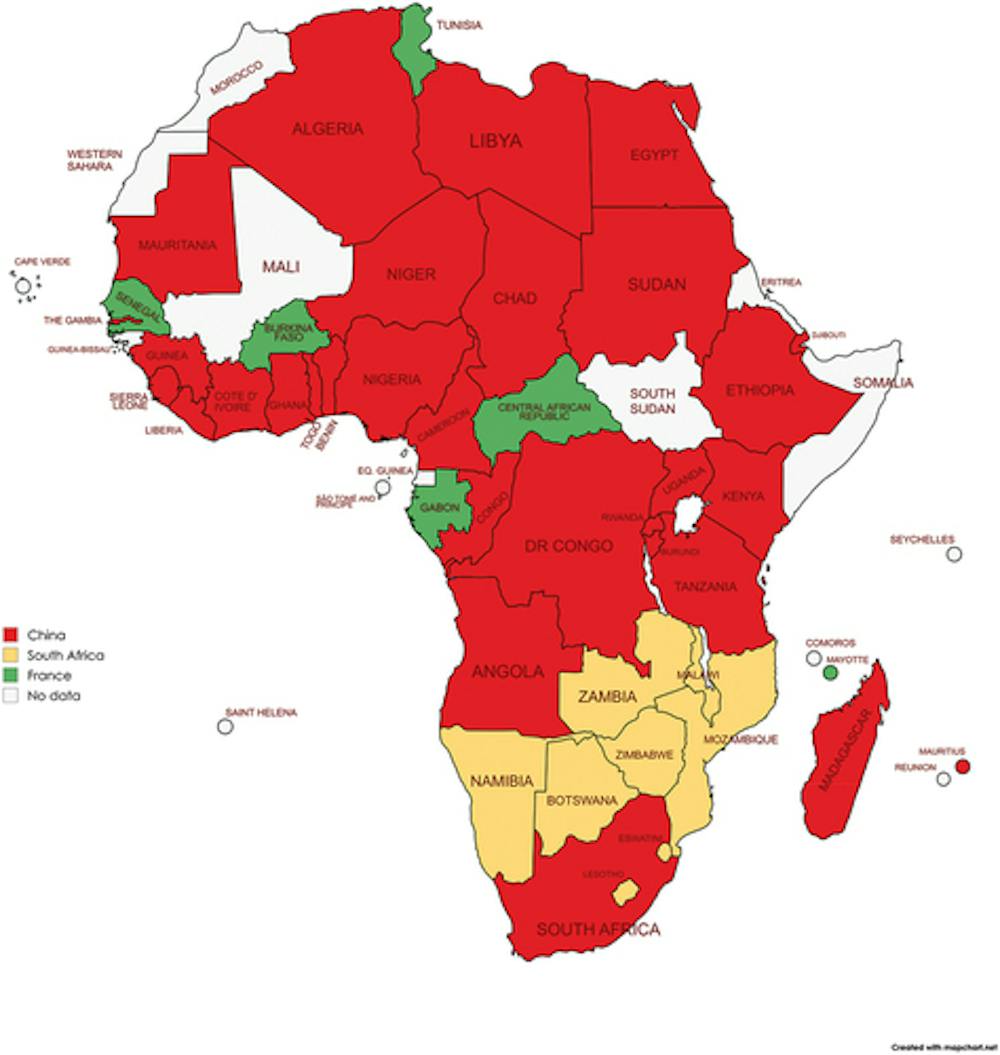
    Global power dynamics in Africa are shifting, with China eclipsing the influence of the US and France. China has become Africa’s single largest trading partner.

    In response, media and policymakers in traditionally dominant states are increasingly using maps drenched in red or stamped with Chinese flags to depict Beijing’s expanding footprint. One map reproduced by a US congressional committee, for instance, showed Beijing’s influence and reach across the continent in red stripes.

    But these visuals oversimplify a complex reality. This is an issue I explore in a new study. For over a decade, I have researched the interactions of sub-Saharan Africa with other states like Turkey, Arab Gulf states, Japan and China.

    In a recent paper I explored the use of maps that have been created of Africa showing China’s projects across the continent. I argue that, by overlaying Chinese flags on maps depicting Africa and its 54 states, media and policymakers turn economic ties into a visual representation of foreign encroachment.

    This process is called securitisation – the framing of something as a threat, even if it’s not one.

    This visual securitisation not only heightens fears of dependency but also primes certain audiences – in the US, Japan and France, for instance – to view China’s presence as a direct challenge to their interests.

    Certain threats – like terrorist groups or nuclear weapons – are self-evident. China’s presence in many African states, however, is different: if it’s a threat, who is threatened and why? Do Chinese-built roads or railways – and the debt African states accrue for this infrastructure – constitute the threat?

    My research shows that the answer to these questions is: it depends.

    Portraying China’s presence in Africa with flags on maps can distort African states’ sovereignty and their power to make decisions based on national interests. This visual portrayal reduces these countries to arenas of global power competition. It fails to recognise them as strategic actors.

    China tops imports to African states

    Illustration of China’s economic influence in 2021 drenched in red and drawn from media, think tanks and related literature. Author’s composite map illustrates securitisation of China in Africa. Brendon J. Cannon

    On the other hand, my research shows that China’s role may not be entirely benign.

    My study focuses mostly on east Africa, to include the Horn of Africa. Much of Beijing’s engagement here remains primarily economic (as it does in west, central and southern Africa). However, China’s growing control over critical infrastructure and digital networks, and its pursuit of military footholds near strategic maritime routes, present real security concerns.

    Policymakers need to separate legitimate risks from exaggerated securitisation narratives. This would help them avoid the pitfalls of reactionary policies.

    Negative consequences

    Presenting China as a threat in Africa has three negative consequences.

    First, it erodes the idea and reality of African sovereignty and agency. Maps portraying Africa as overrun by China suggest that governments and civil society are mere bystanders unable to negotiate their own foreign and domestic agendas.

    The reality is that countries like Kenya actively engage with China to attract investments for development projects, and to balance their relations with other international actors like the US and Japan.

    The result of securitisation is that American or Japanese policymakers, for instance, have begun to view Africa through the lens of their strategic competition with China. This is evident in Washington’s foreign policy rhetoric, for example. This increasingly frames African states not just as partners but also as strategic battlegrounds in the growing US-China rivalry. The risk is that African countries may start being treated as passive players.

    Second, securitisation inflates the perception of China as a global security threat.

    The repeated use of maps with Chinese flags covering ports, railways and industrial zones creates an exaggerated image of unchecked expansion. These maps fail to show the host of other external states operating on the continent.

    The US, multiple European states, Japan, India, Russia, Turkey, the United Arab Emirates and South Korea all have significant interests in Africa. While China is by far the largest, most prominent external actor, with the widest reach throughout Africa, it’s been singled out because of the perceived threats its presence in Africa may pose to the west.

    Third, securitisation can lead to knee-jerk reactions to limit China’s presence rather than engage constructively with Beijing’s investments in Africa. These reactions can result in ill-advised attempts by China’s competitors to push projects that don’t correspond to the needs of African states. This partly explains Ethiopia’s strained relations with the west. Sanctions and aid cuts over the Tigray conflict fuelled a pivot toward China and Russia.

    The security risks

    Securitisation raises valid concerns, but my research also underscores genuine security risks related to China’s presence in Africa. These shouldn’t be overlooked.

    China’s growing role and embeddedness in Africa’s digital ecosystem presents a double-edged sword, for instance. Huawei and other Chinese companies have contributed to Africa’s telecommunications and digital transformation. But these investments also increase Beijing’s potential influence over data security, cyber governance and information flows. These give China the option to exploit networks for surveillance, intelligence gathering or political coercion.

    Chinese-funded, built or operated infrastructure, ports and military bases

    A depiction of China’s infrastructure influence in 2023 from media, think tanks and related literature. Author’s composite map illustrates securitisation of China in Africa. Brendon J. Cannon

    China’s expanding control over dual-use infrastructure is another concern. Chinese-operated ports in Djibouti, for instance, can be used for commercial and military purposes. They potentially grant Beijing a strategic foothold in key maritime corridors, such as the Red Sea. China could restrict access to these ports in times of conflict. Or use them to extend its naval footprint, similar to what it’s done in the South China Sea.

    It’s China’s pursuit of other military facilities beyond its bases in Djibouti that will have the most serious implications for African states’ sovereignty. This is part of a deliberate Chinese strategy to expand its global power projection and protect access to critical resources like oil and gas.

    Agreements on military facilities may end up undermining and even challenging African agency of action. The addition of Chinese ships and soldiers alongside the growing presence of US, European, Indian, Japanese and other regional naval forces could escalate tensions. It also risks entangling African states in power rivalries that aren’t in their national interests.

    China’s presence in Africa has been securitised through maps drenched in red and stamped with flags, framing its engagement as a looming threat rather than a complex geopolitical reality. However, the real challenge for African states is ensuring that China’s growing influence – especially in infrastructure, digital networks, and security – does not erode their sovereignty. Whether Beijing’s presence becomes an opportunity or a liability will depend on how effectively African governments assert their national interests in shaping these partnerships on their own terms.

    – Maps showing China’s growing influence in Africa distort reality – but some risks are real
    – https://theconversation.com/maps-showing-chinas-growing-influence-in-africa-distort-reality-but-some-risks-are-real-249454

    MIL OSI Africa

  • MIL-OSI United Kingdom: expert reaction to unpublished preprint on inducing loss of function of genes in mice to produce woolly mammoth- like hair phenotypes

    Source: United Kingdom – Executive Government & Departments

    An unpublished preprint uploaded to BioRXiv looks at gene editing in mice to create woolly mammoth-like hair phenotypes. 

    Dr Tori Herridge, Senior Lecturer, School of Biosciences, University of Sheffield, said:

    Woolly Mouse in Context

    “Colossal have announced that they have successfully bred ‘woolly mice’, and this is a “water shed moment” in their mission to genetically engineer an arctic adapted elephant, aka “bringing back the mammoth.”

    “Colossal’s team made a number of genetic changes known as “knock outs” in lab mice that are already known to produce longer, thicker, wavier — or woollier — coats in mice. They also made a change known to cause blonde hair colouring in mice.

    “The result, therefore, of various “woolly mice” from these genetic changes is unsurprising: woolly mice have been produced in labs and by mice breeders many times before.”


    Mammoth-like genes?

    “Three of the genetic changes made in some of the mice were inspired by woolly mammoth DNA, but they still only show effects in mice. The mice were not edited to have a precise copy of the mammoth genes, but it is possible that these edits may have had a similar effect in both mice and mammoths (either by stopping the gene from working, or by changing the way the gene worked), but we cannot be sure about this.

    “It is also not possible to tell what impact these ‘mammoth-inspired’ changes had, if any, in the Colossal woolly mouse owing to other gene edits made at the same time.”


    Are we a step closer to ‘bringing back the mammoth’? 

    “A mammoth is much more than just an elephant in a fur coat. While we know a lot about mouse genetics, we know much less about mammoths and elephants. It isn’t yet known which sections of the genome are vital for achieving the characters need to make an elephant fit for life in the Arctic circle. Genes that are linked to fur and fat in well-studied animals like mice are obvious targets, but the devil is in the detail. And what about other characters that are equally important? Which bits of the genome underpin the teeth and jaw changes that might be needed to accommodate an Arctic diet, for example (mammoth teeth were clearly under strong evolutionary pressure to adapt to their diet)? What about things we haven’t even discovered yet, things we don’t know we don’t know?

    “Unless you decide to make EVERY edit necessary to in the genome, you are only ever going to create a crude approximation of any extinct creature, based on an incomplete idea of what it should look like. You are never going to ‘bring back’ a mammoth.

    “Colossal’s Woolly Mouse experiments also show that de-extinction attempts are fraught with failure: most gene-edited embryos failed to result in live pups (less than 10%), and very few of those born were successfully edited for all target genes. This is for experiments that made a small number of relatively simple (loss of function) changes in well understood genes, using a ‘model’ lab animal as a surrogate.

    “Engineering a mammoth-like elephant presents a far greater challenge: the actual number of genes likely to be involved is far higher, the genes are less well understood (and still need to be identified), and the surrogate will be an animal that is not normally experimented upon. Even if success rates are similar to those observed in the woolly mice (and they may well be lower given the greater number of edits and unknowns), there will likely need to be multiple pregnancies before a “successful” calf is born. This equates to either a very large number of surrogate dams, or – given elephant pregnancies last approximately 2-years – a very long time.

    “Mammoth de-extinction doesn’t seem to be on the horizon anytime soon.”

    Ethical Considerations

    “Colossal’s Woolly Mouse experiments show that the physical effect of genome-editing cannot be observed until the animal experimentation stage. This will also be true in elephants.

    “Although it is branded as “woolly mammoth de-extinction”, what is being proposed is an experiment to test the effect of certain gene edits on the appearance of elephants.

    “For the mice in these experiments the risk was small: the effect of these gene edits already known, and were not likely to cause risk or suffering to surrogate or pup.

    “We do not know the risk involved for elephants, but it could be very high.

    “We do know that surrogacy is a burden on the dam, and that captive elephant pregnancies carry risks even under normal circumstances.

    “Placing such a burden of risk on an elephant surrogate in pursuit of an experiment that – at best – will produce a simulacrum of a woolly mammoth, is unjustifiable.”

    Dr Saad Arif, Senior Lecturer, School of Biological and Medical Sciences, Oxford Brookes University, said:

    Is there enough info to comment on the announcement, how well can we judge what has been accomplished and how it has been done?

    “The preprint provides enough information on what has been accomplished and how it was conducted.”


    How novel is the research and techniques to create the mouse, is it more than just genetically engineered lab animals? Is this something more special?

    “One novel element of the work seems to be the use of genome-editing technologies to alter multiple genes at once with high efficiency and speed in mice. Although we have had the ability to alter multiple genes at once for sometime, the efficiency and speed with which these changes can be made could still be improved. Based on the results presented by the authors, their methods for generating transgenic mice with the desired changes appears to be both rapid and highly efficient, which would be extremely desirable when testing for the function of genetic changes in any context, whether it has implications for conservation or disease biology.

    “Genome-editing can also lead to unintended edits in non-targeted parts of the genome resulting in unwanted modifications, so-called off-target effects. Although, the authors report no missense mutations (potentially eradicating or modifying an untargeted gene’s function), this is not demonstrable proof that  gene function hasn’t been altered. Such off-target effects could be detrimental in real world applications of genome-editing e.g. curing a disease or in trying to turn an ‘elephant” into a mammoth’.

    “Another novel aspect of this study is that some of the genes targeted by the authors are based on  their comparisons of ancient mammoth and modern elephant genomes. This set of genes (in contrast to most of the others, which are selected based on information from mice studies) comprise those with identified differences between cold-adapted mammoths and their warm-adapted elephant cousins. Hence differences in these  genes could potentially be part of the cold adaptation repertoire of mammoths. This really paves the way for exploring the consequences of genomic differences in extinct species or populations.”

    How is this proof of principle for the research missions of the company?

    “It shows that Colossal have a model system to validate predicted effects of the DNA differences they have identified between mammoth and elephant genomes and which of these differences is relevant for mammoth’s cold adaptations. For example, they identified differences in DNA sequences of a gene that controls hair length both in Elephants and Mammals, they then introduced that difference in their mouse model, via genome editing, and determined that the  change does indeed affect hair growth. The ability to edit genomes. rapidly and efficiently, to test the role of DNA changes will help them prioritize which genetic modifications are relevant for cold adaptation. 

    “However, it is important to note that their ability to predict whether a gene controls hair growth comes from work done in mice, humans and other organisms. Not all genes will have functional effects that are so easy to predict because not all genes are as well studied and screening for the effect of alterations in these genes may not be as straightforward.  Many genes, unlike those that control hair colour or some aspect of outward appearance, may not have immediate or directly observable effects. Finally, given the idiosyncrasies of mouse biology, some genetic edits will just not manifest themselves in the same way as they would in mammoths or their relatives. The authors acknowledge this and this is a well-known issue with the use of mice in studying human genetics as well. Hence, being able to test whether a specific difference between mammoths and elephants is related to the former’s cold tolerance is still challenging.”

    What are the implications of this research? How close are we getting to the “de-extinction” of the Woolly Mammoth? Does this have significance in conservation biology?
    “I think we are still very far from their “de-extinction” goal. The elephant and mammoth genomes are considered to be 96.4% identical, however, that still leaves potentially another ~13 million changes in DNA sequence to consider! It is also still unclear how mammoth cold adaptation phenotypes without a clear outward manifestation, could be identified or screened in mice.

    “Additionally, at the moment it is difficult to see how they will “birth” a mammoth-like elephant as that may also require some additional technical advances and ethical considerations as this may require elephant surrogacy. Nonetheless, it still remains a goal worth striving for because of potential technical advances they could be achieved along the way. I wouldn’t mind being proven wrong on this.
    “I see this as a fairly small step towards their “de-extinction” goal and I still see us far from any direct impact in conservation biology. Nonetheless, being able to test the genetic effects of DNA differences discovered from extinct species and populations could help us identify the genes and sequence differences involved in making organisms more adaptable to their environments. 

    “Finally, the  efficiency and speed of their multiplex genome-editing technologies is promising and perhaps the most impactful part of their work. These methods could have implications for human disease and biology and help us understand, and potentially treat, complex genetic diseases or traits that are controlled by multiple genes.”

    Is there any ethical significance of this research to consider?

    “I don’t think the results of the current research are of any ethical significance. However, later down the line, the idea of ‘birthing a mammoth’ via an elephant (an endangered species) surrogacy will surely raise ethical concerns.”

    Dr Louise Johnson, Evolutionary Biologist, University of Reading, said:

    “Seeing these mice is a bit like looking back at the past, but with a highly selective telescope. This technology offers an exciting opportunity to test some of our ideas about extinct organisms.

    “It is an interesting piece of work, but the idea that we could bring something back from extinction is false hope.

    “What has been done here is not trivial, but of the ten different mutations engineered into the mice, only a few actually make the mouse gene closer to a known mammoth gene. The result does show that it is possible to genetically engineer many genes at once and still produce some live mice at the end of the process, though. The researchers have succeeded in nudging the mouse genome in the direction of a mammoth genome, which is a first.

    “If we have an idea of what a gene might do in an extinct mammal, this technology can produce powerful results by introducing a very similar sequence into a mouse. But in this particular case, most of the mutations are chosen just because they are already known to make mice have longer, coarser, wavier hair. You could, in theory, produce mice like this by just breeding mice with weird hair together.

    “In theory, you could introduce a gene for hairiness into an elephant and it would look quite mammoth-like, but it wouldn’t be a mammoth in any meaningful way. Elephants would be a terrible species to do this research with – they are huge, have long gestation periods, and require highly specialist housing and care. The mouse is a brilliant lab animal, and we know a lot about the mouse genome and how to alter it effectively. 

    “You do have to know a bit about how the extinct genes might work. For example, it was already known that the genes for coat colour and texture were similar in the mammoth and the mouse. Being able to create and introduce a mouse gene that is somewhat the same as the mammoth opens up a new way to look at evolutionary genetics.”

    Dr Alena Pance, Senior Lecturer in Genetics, University of Hertfordshire, said:

    “Genetic engineering in mice has been performed for a very long time using, developing, and testing a variety of technologies. These modifications include introducing traits from other species, notoriously ‘humanised mice’ that have been used for research related to human traits and disease.

    “The decoding of an extinct species genome to identify specific genes associated with particular traits has also been done before, where the physical characteristics of ancient humans have been deduced from their genomic data.

    “Perhaps the novelty here is using mice to confirm the assumptions about correlations between genes and specific traits. The press release gives the impression that mammoth genes were introduced to mice but from the preprint, it transpires that the genomic editing in these mice consists of inducing loss of function of several genes simultaneously. The choice of these genes comes from observed spontaneous mutations in mice that impact traits such as coat and comparative analyses of elephant and mammoth genomes that reveal similar loss of function in some of these genes.

    “The ability to use mice in order to examine and test gene-trait relationships and hypotheses about physical characteristics specifically using genomes from extinct organisms might prove useful, but overall not particularly novel.”

    Prof Dusko Ilic, Professor of Stem Cell Science, King’s College London, said:

    “The achievement described in the latest press release regarding “woolly mice” is interesting, particularly in terms of the strategy used to refine the list of genes related to hair growth that were also compatible with their model organism—the mouse. This is indeed a noteworthy milestone.

    “Once the gene list has been established, engineering mutations in mice, including those involving seven genes, is a well-established process and not particularly challenging.

    “With mice, the process is relatively straightforward. Their gestation period is only three weeks, and they typically give birth to six to eight pups per litter. However, translating this approach to elephants presents significant challenges. Elephants have the longest gestation period of any mammal—approximately two years—and generally give birth to a single calf. Furthermore, it will take 10-14 years for them to be sexually mature.

    “Assisted reproductive technologies (ART), including in vitro fertilization (IVF), have seen limited success in elephants. The primary ART method employed in elephants has been artificial insemination (AI). The Indianapolis Zoo achieved a significant milestone in 2000 by facilitating the first successful birth of an African elephant conceived through AI. In 2023, the same zoo announced that a 16-year-old African elephant named Zahara was pregnant via AI, marking the first instance where an elephant born through AI is expecting a calf conceived by the same method.

    “This raises critical questions: How many elephant cows would need to undergo experimental pregnancies to give a birth to a “woolly elephant”? And how long would it take before the first such hybrid is born?”

    Dr Denis Headon, Group Leader and Senior Research Fellow, The Roslin Institute, University of Edinburgh, said:

    “With a long-term goal of advancing the de-extinction of the mammoth, the team have managed to alter several mouse genes in one step. They chose these gene alterations based largely on things that we know about mice, rather than what we know about mammoths. This approach produced very shaggy mice with a coat that resembles that of the woolly mammoth remains we find today. While the mice have a striking golden coat, they are otherwise healthy, indicating that the method used is not harmful. Certainly this is an advance in speeding up the rate of genetic modification towards the many changes that distinguish one species from another, though it’s not clear that these changes alone would alter a relatively hairless elephant into a woolly animal. Further work on either synthesising or understanding the mammoth genome would also be required to go beyond these superficial characteristics to generate an animal that would, for example, have the right behaviour to live in Arctic conditions. This paper reports an important advance not only for de-extinction but for animal breeding in general.”

    An unpublished preprint titled ‘Multiplex-edited mice recapitulate woolly mammoth hair phenotypes’ by Rui Chen et al. was uploaded to BioRXiv on 13:00 UK time Tuesday 4 March. 

    Declared interests

    Dr Saad Arif: None

    Dr Louise Johnson: None

    Dr Alena Pance: I can confirm I have no conflict of interest regarding this story

    Prof Dusko Ilic: I declare no conflicts of interest.

    Dr Denis Headon: I don’t have any interests to declare on this paper/story.

    For all other experts, no response for our request for DOIs was received.

    MIL OSI United Kingdom

  • MIL-OSI Global: Maps showing China’s growing influence in Africa distort reality – but some risks are real

    Source: The Conversation – Africa – By Brendon J. Cannon, Associate Professor, Khalifa University

    Global power dynamics in Africa are shifting, with China eclipsing the influence of the US and France. China has become Africa’s single largest trading partner.

    In response, media and policymakers in traditionally dominant states are increasingly using maps drenched in red or stamped with Chinese flags to depict Beijing’s expanding footprint. One map reproduced by a US congressional committee, for instance, showed Beijing’s influence and reach across the continent in red stripes.

    But these visuals oversimplify a complex reality. This is an issue I explore in a new study. For over a decade, I have researched the interactions of sub-Saharan Africa with other states like Turkey, Arab Gulf states, Japan and China.

    In a recent paper I explored the use of maps that have been created of Africa showing China’s projects across the continent. I argue that, by overlaying Chinese flags on maps depicting Africa and its 54 states, media and policymakers turn economic ties into a visual representation of foreign encroachment.

    This process is called securitisation – the framing of something as a threat, even if it’s not one.

    This visual securitisation not only heightens fears of dependency but also primes certain audiences – in the US, Japan and France, for instance – to view China’s presence as a direct challenge to their interests.

    Certain threats – like terrorist groups or nuclear weapons – are self-evident. China’s presence in many African states, however, is different: if it’s a threat, who is threatened and why? Do Chinese-built roads or railways – and the debt African states accrue for this infrastructure – constitute the threat?

    My research shows that the answer to these questions is: it depends.

    Portraying China’s presence in Africa with flags on maps can distort African states’ sovereignty and their power to make decisions based on national interests. This visual portrayal reduces these countries to arenas of global power competition. It fails to recognise them as strategic actors.

    China tops imports to African states

    On the other hand, my research shows that China’s role may not be entirely benign.

    My study focuses mostly on east Africa, to include the Horn of Africa. Much of Beijing’s engagement here remains primarily economic (as it does in west, central and southern Africa). However, China’s growing control over critical infrastructure and digital networks, and its pursuit of military footholds near strategic maritime routes, present real security concerns.

    Policymakers need to separate legitimate risks from exaggerated securitisation narratives. This would help them avoid the pitfalls of reactionary policies.

    Negative consequences

    Presenting China as a threat in Africa has three negative consequences.

    First, it erodes the idea and reality of African sovereignty and agency. Maps portraying Africa as overrun by China suggest that governments and civil society are mere bystanders unable to negotiate their own foreign and domestic agendas.

    The reality is that countries like Kenya actively engage with China to attract investments for development projects, and to balance their relations with other international actors like the US and Japan.

    The result of securitisation is that American or Japanese policymakers, for instance, have begun to view Africa through the lens of their strategic competition with China. This is evident in Washington’s foreign policy rhetoric, for example. This increasingly frames African states not just as partners but also as strategic battlegrounds in the growing US-China rivalry. The risk is that African countries may start being treated as passive players.

    Second, securitisation inflates the perception of China as a global security threat.

    The repeated use of maps with Chinese flags covering ports, railways and industrial zones creates an exaggerated image of unchecked expansion. These maps fail to show the host of other external states operating on the continent.

    The US, multiple European states, Japan, India, Russia, Turkey, the United Arab Emirates and South Korea all have significant interests in Africa. While China is by far the largest, most prominent external actor, with the widest reach throughout Africa, it’s been singled out because of the perceived threats its presence in Africa may pose to the west.

    Third, securitisation can lead to knee-jerk reactions to limit China’s presence rather than engage constructively with Beijing’s investments in Africa. These reactions can result in ill-advised attempts by China’s competitors to push projects that don’t correspond to the needs of African states. This partly explains Ethiopia’s strained relations with the west. Sanctions and aid cuts over the Tigray conflict fuelled a pivot toward China and Russia.

    The security risks

    Securitisation raises valid concerns, but my research also underscores genuine security risks related to China’s presence in Africa. These shouldn’t be overlooked.

    China’s growing role and embeddedness in Africa’s digital ecosystem presents a double-edged sword, for instance. Huawei and other Chinese companies have contributed to Africa’s telecommunications and digital transformation. But these investments also increase Beijing’s potential influence over data security, cyber governance and information flows. These give China the option to exploit networks for surveillance, intelligence gathering or political coercion.

    Chinese-funded, built or operated infrastructure, ports and military bases

    China’s expanding control over dual-use infrastructure is another concern. Chinese-operated ports in Djibouti, for instance, can be used for commercial and military purposes. They potentially grant Beijing a strategic foothold in key maritime corridors, such as the Red Sea. China could restrict access to these ports in times of conflict. Or use them to extend its naval footprint, similar to what it’s done in the South China Sea.

    It’s China’s pursuit of other military facilities beyond its bases in Djibouti that will have the most serious implications for African states’ sovereignty. This is part of a deliberate Chinese strategy to expand its global power projection and protect access to critical resources like oil and gas.

    Agreements on military facilities may end up undermining and even challenging African agency of action. The addition of Chinese ships and soldiers alongside the growing presence of US, European, Indian, Japanese and other regional naval forces could escalate tensions. It also risks entangling African states in power rivalries that aren’t in their national interests.

    China’s presence in Africa has been securitised through maps drenched in red and stamped with flags, framing its engagement as a looming threat rather than a complex geopolitical reality. However, the real challenge for African states is ensuring that China’s growing influence – especially in infrastructure, digital networks, and security – does not erode their sovereignty. Whether Beijing’s presence becomes an opportunity or a liability will depend on how effectively African governments assert their national interests in shaping these partnerships on their own terms.

    Brendon J. Cannon does not work for, consult, own shares in or receive funding from any company or organisation that would benefit from this article, and has disclosed no relevant affiliations beyond their academic appointment.

    ref. Maps showing China’s growing influence in Africa distort reality – but some risks are real – https://theconversation.com/maps-showing-chinas-growing-influence-in-africa-distort-reality-but-some-risks-are-real-249454

    MIL OSI – Global Reports

  • MIL-OSI: Melissa Launches Integrated Datasets and Native Apps in Snowflake

    Source: GlobeNewswire (MIL-OSI)

    RANCHO SANTA MARGARITA, Calif., March 04, 2025 (GLOBE NEWSWIRE) — Melissa, a global leader in data quality and address management solutions, is now available on Snowflake Marketplace. Offering Melissa APIs as Snowflake native apps, and a selection of its comprehensive datasets, Melissa is supporting enterprise users worldwide with enriched customer data for better business intelligence and global customer engagement. This integration simplifies access to Melissa’s high-quality data and verification services, enabling businesses to enrich, validate, and leverage critical customer and location intelligence directly within the Snowflake AI Data Cloud.

    Melissa now offers 19 data products on Snowflake, including 17 datasets featuring phone, email, demographic, property, and geolocation information, and two Snowflake native apps designed to enhance data verification processes within the Snowflake environment. The newly integrated Personator Consumer and Global Address Verification native apps allow Snowflake users to validate customer addresses globally without exporting data, streamlining workflows and reducing errors.

    “With Melissa’s integration into Snowflake Marketplace, businesses can now access our trusted data and verification services natively within the Snowflake platform. Data workflows are optimized and eliminate the traditional complexities of data extraction, transfer, and integration,” said Daniel Kha Le, Chief Data Officer, Melissa. “This partnership ensures that organizations using Snowflake can seamlessly enhance their data quality—a critical value in improving operational efficiency and driving better decision-making.”

    Snowflake is a single, fully managed and integrated platform that businesses securely connect to globally across any type or scale of data to productize AI, applications, and more in the enterprise. This approach eliminates the data silos that lead to complexity and the need to move data to get business value. Snowflake users access all their data from a single platform, including data that is unstructured, in open formats, and from third parties.

    Through the Snowflake Marketplace, businesses can now easily tap into Melissa’s datasets to find information on:

    • 200 million U.S. consumers, including demographic, lifestyle, and contact data
    • 17+ U.S. million companies and organizations, including firmographic and contacts
    • New mover data updated with over 100,000 new records every week
    • New homeowner data updated with over 75,000 new records every week
    • ZIP+4, Carrier Route, Place Name, Congressional District, Lat&Long Coordinates, Parcel and Building Footprints data
    • Geo-referenced and phone data for the U.S. and Canada

    For more information, access Melissa’s Snowflake Marketplace Page, visit www.Melissa.com, or contact sales@Melissa.com.

    About Melissa
    Powering clean customer data for 40 years, Melissa is the Address Expert. Providing address validation, address autocomplete, and geo-verified address data for 240+ countries, Melissa supports global businesses with its offices in the U.S., U.K., Germany, India, Singapore, and Australia. Melissa’s suite of data quality, ID verification, and location data tools and services drives better decision-making, reduced costs, increased efficiency, and improved compliance. Our APIs, CRM and ecommerce integrations, and online tools help Melissa’s 10,000 customers worldwide process billions of addresses daily, fully capitalizing on the business value of customer data. For more information, visit www.Melissa.com or call 1-800-MELISSA (635-4772). 

    Media contacts
    Greg Brown
    Vice President, Global Marketing, Melissa
    greg.brown@Melissa.com
    +1-800-635-4772 x1130

    MPoweredPR for Melissa
    pr@mpoweredpr.com
    +1-877-794-6777

    A photo accompanying this announcement is available at https://www.globenewswire.com/NewsRoom/AttachmentNg/691aaa16-564c-4ea6-b103-0a489043b12b.

    The MIL Network

  • MIL-OSI Economics: Asian Development Blog: Building a $43 Trillion Bridge Across Asia’s Infrastructure Gap

    Source: Asia Development Bank

    Asia and the Pacific face a daunting infrastructure challenge, requiring sustained investment to enhance connectivity, safety, and resilience. While road networks dominate spending, underinvestment in maintenance and limited private-sector involvement threaten long-term sustainability.

    Asia and the Pacific will require about $43 trillion from 2020 to 2035 to develop, maintain, repair, and climate-proof its transport infrastructure, according to the Asian Transport Observatory. This represents about 2% of the region’s GDP, averaging roughly $2.7 trillion annually. 

    Infrastructure investment requirements have tripled, increasing from roughly $750 billion annually between 2000 and 2020 to $2.7 trillion.

    Failing to secure the needed resources risks inadequate infrastructure development, leading to deterioration, costly repairs, and transport disruptions over time.

    Traffic congestion currently represents about 2-4% of GDP in Asia’s major cities. Road traffic fatalities and severe injuries cost $1.5 trillion in 2021, factoring in the loss of lives, assets, and workforce productivity. 

    The health consequences of PM2.5 air pollution also contributed to a further loss of at least $4 trillion in 2019. Climate-related challenges may also bring significant expenses, with potential damages to Asia’s transport infrastructure approaching $54 billion. 

    Moreover, delays and interruptions due to weakened transport infrastructure could lead to logistical losses estimated annually at $43 billion in 2023. It’s estimated that inadequate transport infrastructure directly threatens about 7% of GDP. 

    Tackling these challenges requires a forward-thinking approach emphasizing infrastructure maintenance, capacity enhancement, safety enforcement, and disaster preparedness to mitigate these considerable costs.

    The infrastructure investment needs across the region are vast and varied. The largest share of the investment needs lies within East Asia (58%) and South Asia (17%) sub-regions, representing 73% of the population.

    Our projections suggest that investment in transport infrastructure within high-income economies will stagnate by 2035, influenced by an aging population, stabilized travel demand, and well-established infrastructure networks. 

    On the other hand, low- and middle-income economies are expected to see a sharp rise in investment requirements, driven by inadequate access to transport infrastructure and increasing demand for passenger and freight transport. 

    Upper-middle-income economies are set to spearhead transport infrastructure investments, maintaining a significant share of 67% of total investment from 2000 to 2020, followed by 65% from 2020 to 2035. 

    About 74% of total investment needs over the next decade will be concentrated in East and South Asia, propelled by the ongoing rapid growth of transport demand in India and the People’s Republic of China.

    Road transport will continue to secure bulk investments from 2020 to 2035, accounting for 63% of total investments (approximately 1.3% of GDP). This is required to bridge the infrastructure gap and improve access and connectivity. 

    The remaining investment needs are as follows: 17% for railways, including high-speed rail (around 0.4% of GDP), 11% for raid urban transit (about 0.2% of GDP), 4% for ports (0.1% of GDP), and 5% for airports (0.1% of GDP). 

    Urban rail investment will equal that of heavy rail infrastructure for the first time. Investment in metro systems is expected to increase from 7% of total investments between 2000 and 2020 to 10% from 2020 to 2035. Other than that, we don’t see a significant shift in the pattern of infrastructure spending.  

    Maintenance is crucial for transport infrastructure, guaranteeing assets’ durability, safety, and effectiveness. Studies show that every dollar invested in maintenance saves $4-$5 later required for reconstruction. 

    However, there’s a worrying trend of underinvestment in maintenance. This underinvestment will likely persist. On average, maintenance costs for transport infrastructure are expected to represent approximately 24% of total investment expenses from 2020 to 2035. 

    Nonetheless, maintenance expenditures differ across various modes and countries. New construction projects often receive significant media and political attention, but maintenance initiatives, which are vital for the long-term viability of transport infrastructure, are usually overlooked and go underfunded. 

    Regrettably, the issue of insufficient maintenance funding is a persistent challenge in Asia.    
     

    With nearly 1.8 billion people lacking access to transport infrastructure in Asia, countries are rapidly building infrastructure. But even with a $43 trillion investment by 2035, the infrastructure gap with the global North will continue to exist.

    By 2035, Asia’s average transport infrastructure per capita is projected to still be 70% lower than current levels in wealthier countries, as measured by OECD country levels. However, the silver lining is that we will bridge the gap in specific modes at a lower income level. 

    For example, the average availability of urban rapid transit per capita in Asia and the Pacific is expected to double, rising from 6 kilometers in 2020 to 12 kilometers per million people by 2035. OECD countries had similar access back in 2013, having a GDP per capita nearly four times higher. 

    Maintaining a sustained annual investment rate of 2.3% of GDP is a challenge in itself. Identifying who will provide that investment is another complex question. While infrastructure development offers clear socio-economic benefits, investments in this area have declined as a percentage of GDP. 

    This shift raises concerns, especially given the limited involvement of private funding in the region’s infrastructure development. Historically, governments have been the leading financiers. 

    However, the aftermath of COVID-19 has strained public finances and increased debt burdens. Public-private partnerships show potential but have not expanded enough to meet the growing transport infrastructure demands. 

    There is an urgent need for a significant increase in private investment to bridge this gap. Attracting such capital depends on the government’s ability to create a more favorable regulatory and planning environment.  

    Moreover, there is considerable potential for optimizing public infrastructure investments. Governments should explore alternative funding methods, such as raising user fees, leveraging land value, and adopting innovative financing techniques.

    Strategic investments, regulatory reforms, and innovative funding solutions are essential to ensuring Asia’s transport infrastructure meets future demands.

    The Asian Transport Observatory was developed by the Asian Development Bank to strengthen the knowledge base on transport in Asia and the Pacific, and to support better informed investments and policies in the sector.
     

    MIL OSI Economics

  • MIL-OSI Asia-Pac: All CEOs, DEOs, EROs directed to hold political party meetings regularly and resolve issues within statutory framework

    Source: Government of India (2)

    All CEOs, DEOs, EROs directed to hold political party meetings regularly and resolve issues within statutory framework

    Issue wise action taken reports to be filed by CEOs by 31st March, 2025

    ECI holds conference of CEOs of all States/UTs; Over 100 officials participate

    Posted On: 04 MAR 2025 3:02PM by PIB Delhi

    The Election Commission of India today began a two-day conference of CEOs of all States/UTs at IIIDEM, New Delhi. This is the first such conference to be held since Shri Gyanesh Kumar assumed charge as CEC.  CEC and ECs Dr. Sukhbir Singh Sandhu and Dr. Vivek Joshi interacted with CEOs on a series of topics that will pave the way for improvements in election management in the country within the established legal framework.

    In his address, CEC Shri Gyanesh Kumar exhorted all officials including all CEOs, DEOs, EROs, BLOs across the country to work transparently and fulfill all statutory obligations diligently and as per the existing legal framework i.e. the RP Act 1950 & 1951; Registration of Elector Rules 1960, Conduct of Election Rules 1961 and the instructions issued by ECI from time to time.

    He directed officials to be approachable and responsive to political parties. He added that all party meetings at all statutory levels be held regularly to resolve any issues within the existing statutory framework by the concerned competent authority i.e. ERO or DEO or CEO. The issue wise action taken report by each CEO is to be submitted by March 31, 2025 to their concerned DEC.

    He emphasized that all CEOs, DEOs, ROs, EROs should be thorough with their roles and responsibilities, as clearly delineated within the statute and ECI instructions. He added that officials should ensure that all citizens of India who are above 18 years of age are registered as electors as per Article 325 and Article 326 of the Constitution. He directed that all BLOs be trained to be courteous with electors while also ensuring that no electoral staff or officer is intimidated by anyone using false claims.

    Officials were directed to make efforts to have between 800-1200 electors in each polling booth and ensure that it is within 2 kms distance from the residence of each elector. Polling Booths with proper Assured Minimum Facilities should be established for the ease of voting in rural areas. Polling Booths should also be established in high rise buildings as well as slum clusters to increase voting in urban areas.

    After a comprehensive mapping of the Constitutional framework and statutes, the Commission has identified 28 distinct stakeholders in the entire election process including CEOs, DEOs EROs, political parties, candidates, polling agents etc. The conference aims to strengthen the capacity building of each of the 28 identified stakeholders which have been divided amongst all CEOs in four cohorts namely Electoral Rolls, Conduct of Elections, Supervisory/Enforcement and Political Parties/Candidates, under the guidance of each of the four DECs in the Commission. More details to follow tomorrow after the conclusion of the conference.

    For the first time one DEO and one ERO from each State/UT are taking part in the conference.

    ******

    PK/GDH/RP

    (Release ID: 2108052) Visitor Counter : 30

    MIL OSI Asia Pacific News

  • MIL-OSI Asia-Pac: India’s security apparatus must remain adaptive to emerging threats such as cyber warfare, hybrid warfare, space-based challenges, and transnational organised crime: Raksha Mantri Shri Rajnath Singh

    Source: Government of India

    India’s security apparatus must remain adaptive to emerging threats such as cyber warfare, hybrid warfare, space-based challenges, and transnational organised crime: Raksha Mantri Shri Rajnath Singh

    Advanced systems & technologies must be leveraged not only for security operations but also for disaster management & humanitarian relief: RM

    “It is not enough for security agencies and technology developers to take the lead. Every citizen should know how to respond in times of crisis”

    Posted On: 04 MAR 2025 2:27PM by PIB Delhi

    Raksha Mantri Shri Rajnath Singh inaugurated the Ministry of Home Affairs (MHA) – Defence Research and Development Organisation (DRDO) Collaboration Conference-Cum-Exhibition on ‘Advanced Technologies for Internal Security and Disaster Relief Operations’ at DRDO Bhawan, New Delhi on March 04, 2025. Organised by the Directorate of Low Intensity Conflict (DLIC) under DRDO, the two-day conference aims to equip Central Armed Police Forces (CAPFs) officers with the latest advancements in technology to address challenges in their operations. The event provided a platform for the exchange of ideas and collaboration to strengthen India’s internal security and disaster response framework.

    Addressing the gathering, Shri Rajnath Singh highlighted the growing complexities in global security and the increasing overlap between internal and external threats. “Security challenges in the modern world are evolving rapidly, and the overlap between internal and external security is increasing. It is imperative that our institutions break silos and work collaboratively to ensure a strong, secure, and self-reliant India,” he stated. He stressed that India’s national security must be viewed holistically, integrating efforts across different security agencies and leveraging the latest technological advancements.

    Shri Rajnath Singh underscored that India’s security apparatus must remain adaptive to emerging threats such as cyber warfare, hybrid warfare, space-based challenges, and transnational organised crime. He noted that India’s internal security is not just about managing conventional threats like terrorism, separatist movements, and left-wing extremism but also about preparing for unconventional threats that can destabilise the nation’s economic and strategic interests. “The adversaries of today do not always come with traditional weapons; cyber-attacks, misinformation campaigns, and space-based espionage are emerging as new-age threats that require advanced solutions,” he stated.

    “DRDO has played a pivotal role in enhancing India’s defence capabilities, and its contributions to internal security are equally commendable. From small arms and bulletproof jackets to surveillance and communication systems, DRDO’s innovations are empowering our security forces,” Raksha Mantri underlined. He urged DRDO and MHA to work together to create a common list of scalable products that can be jointly developed and deployed in a time-bound manner. “Our security forces require the best tools and technologies to remain ahead of the curve. It is encouraging to see DRDO’s focus on modernisation, with products like small arms, surveillance equipment and drone systems either inducted or undergoing evaluation for deployment in internal security agencies,” he highlighted.

    Shri Rajnath Singh recalled his tenure as Home Minister, highlighting how the collaboration between security agencies and scientific institutions led to significant technological advancements. He cited examples of DRDO-developed technologies such as the corner shot weapon system, INSAS rifles, IED jammer vehicles and riot control vehicles, which were effectively integrated into the operations of CAPFs.

    Shri Rajnath Singh also spoke about the importance of leveraging technology not just for security but also for disaster management and humanitarian relief. “The role of technology is not just in defence but also in ensuring peace and social welfare. Advanced systems like bulletproof jackets, drones, surveillance equipment and anti-drone technologies must be leveraged not only for security operations but also for disaster management and humanitarian relief,” he said. He cited the increasing frequency of natural calamities like cyclones, avalanches, earthquakes & cloud bursts and underscored the critical need for advanced rescue tools. He mentioned that the use of technologies such as thermal imaging cameras, drone-based detection systems, and victim locating devices can significantly reduce casualties and damage.

    Referring to the recent avalanche in Mana, Uttarakhand, Raksha Mantri lauded the use of advanced rescue equipment in saving lives and reducing the impact of the disaster. He threw light on the fact that although disasters are tragic in themselves, their impact can be minimised with the use of advanced technology and how, in the recent avalanche, technologies like rotary rescue saws, thermal imaging, victim locating cameras, avalanche rods, and drone-based detection systems played a crucial role in saving lives.

    Highlighting the importance of public awareness in disaster management, Shri Rajnath Singh called for greater involvement of civil society in disaster preparedness. “Today, India is a prospering nation, and disaster management must become an integral part of our preparedness. It is not enough for security agencies and technology developers to take the lead; we must also educate the general public. Every citizen should know how to respond in times of crisis,” he urged.

    Raksha Mantri also stressed the need for focused conferences on specific security challenges faced by different regions of the country. “Security threats in India are not uniform. The issues faced in the Northeast due to insurgencies are different from those in Naxal-affected areas or border regions. Similarly, urban security concerns are different from those in rural areas. We need to organise dedicated conferences that focus on region-specific challenges and solutions,” he said.

    As part of the event, the Transfer of Technology (ToT) of the ASMI 9x19mm Machine Pistol was handed over by DRDO to Lokesh Machinery Tool, marking a step forward in the ‘Aatmanirbhar Bharat’ initiative. Shri Rajnath Singh also inaugurated an exhibition showcasing DRDO-designed technologies developed in collaboration with the Indian defence industry, highlighting achievements in indigenisation. Three significant documents were also released to strengthen cooperation and technological advancements in internal security and disaster management. These include:

    1. Compendium of DRDO Products for Internal Security

    2. Compendium of DRDO Products for Police Operations

    3. Compendium of DRDO Products for Disaster Relief Operations

    The conference includes seven technical sessions focusing on key areas such as Left-Wing Extremism, border management, advanced weapon technologies, drone & counter-drone solutions, disaster management, policing & crowd control, and futuristic communication technologies.

    Secretary DDR&D and Chairman DRDO Dr Samir V Kamat during the conference stated that more than 100 products from DRDO developed technologies have been or soon will be inducted into various agencies of MHA. He further mentioned that the technologies which DRDO develops for the services are also being utilised in internal security as well as disaster relief operations. Chief of the Army Staff General Upendra Dwivedi, Secretary (Border Management) MHA Shri Rajendra Kumar, Secretary (Defence Production) Shri Sanjeev Kumar, DG (Production, Coordination & Services Interaction) Dr Chandrika Kaushik, senior officials from Ministry of Defence and MHA were also present on the occasion.

    *****

    VK/SR/KB

    (Release ID: 2108036) Visitor Counter : 62

    MIL OSI Asia Pacific News

  • MIL-OSI Asia-Pac: Prime Minister Shri Narendra Modi addresses the post-budget webinars

    Source: Government of India

    Prime Minister Shri Narendra Modi addresses the post-budget webinars

    MSMEs play a transformative role in the economic growth of our country, We are committed to nurturing and strengthening this sector: PM

    In the last 10 years, India has consistently shown its commitment towards reforms, financial discipline, transparency and inclusive growth: PM

    Consistency and assurance of reforms, is such a change, that has brought new confidence in our industry: PM

    Today every country in the world wants to strengthen its economic partnership with India: PM

    Our manufacturing sector should come forward to take maximum advantage of this partnership: PM

    We took forward the vision of self-reliant India and further accelerated our pace of reforms: PM

    Our efforts reduced the impact of COVID on the economy, helping India become a fast-growing economy: PM

    R&D has played an important role in India’s manufacturing journey ,it needs to be taken forward and accelerated: PM

    Through R&D we can focus on innovative products, as well as add value to the products: PM

    MSME sector is the backbone of India’s manufacturing and industrial growth: PM

    Posted On: 04 MAR 2025 1:36PM by PIB Delhi

    The Prime Minister Shri Narendra Modi today addressed the Post- Budget webinars via video conferencing. The webinars were held on MSME as an Engine of Growth; Manufacturing, Exports and Nuclear Energy Missions; Regulatory, Investment and Ease of doing business Reforms. Addressing the gathering on the occasion, he remarked that the post-budget webinars on manufacturing and export are of great importance. Mentioning that this budget is the first full budget of the Government’s third term, he emphasised that the most notable aspect of this budget is its delivery, which exceeded expectations. Shri Modi pointed out that in several sectors, the Government has taken steps beyond what experts had anticipated. He also highlighted that significant decisions have been made regarding manufacturing and export in this budget. 

    Pointing out that the country has witnessed consistent Government policies for over a decade, the Prime Minister highlighted that in the past 10 years, India had shown a commitment to reforms, financial discipline, transparency, and inclusive growth. He emphasized that the assurance of consistency and reforms has brought new confidence within the industry. He assured every stakeholder in manufacturing and export that this consistency will continue in the coming years. Encouraging stakeholders to take bold steps and open new avenues for manufacturing and export for the country, Shri Modi highlighted that every country in the world wants to strengthen its economic partnership with India. He urged the manufacturing sector to take full advantage of this partnership.

    “Stable policy and a better business environment are crucial for the development of any country”, said the Prime Minister, highlighting that a few years ago, the Government introduced the Jan Vishwas Act and made efforts to reduce compliances. Over 40,000 compliances were eliminated at both central and state levels, promoting ease of doing business, he noted. Emphasizing that this exercise should continue, Shri Modi mentioned that the Government had introduced simplified income tax provisions and is working on the Jan Vishwas 2.0 Bill. A committee has been formed to review regulations in the non-financial sector, aiming to make them modern, flexible, people-friendly, and trust-based, he added further and highlighted the significant role of the industry in this exercise. He encouraged stakeholders to identify problems that take longer to resolve, suggest ways to simplify processes, and guide where technology can be used to achieve quicker and better results.

    “The world is currently experiencing political uncertainty, and the entire world views India as a growth center”, said Shri Modi, highlighting that during the COVID crisis, when the global economy slowed down, India accelerated global growth. He added that this was achieved by advancing the vision of Aatmanirbhar Bharat and accelerating reforms. He emphasized that these efforts minimized the impact of COVID on the economy, helping India become one of the fastest-growing economies. He said, “India remains a growth engine for the global economy and has proven its resilience in challenging situations”. Pointing out that disruptions in the supply chain affect the global economy, and the world needs reliable partners that produce high-quality products and ensure reliable supply, Shri Modi emphasized that India was capable of fulfilling this need, presenting a significant opportunity for the country. He urged the industry not to be mere spectators but to actively seek their role and carve out opportunities. He pointed out that it is easier today compared to the past, as the country has friendly policies and the Government stands shoulder to shoulder with the industry. The Prime Minister called for a strong resolve, objectivity in seeking opportunities in the global supply chain, and accepting challenges. He emphasized that if every industry takes one step forward, collectively, they can achieve significant progress.

    Highlighting that 14 sectors were currently benefiting from the PLI scheme, the Prime Minister said that under the scheme, more than 750 units have been approved, resulting in an investment of over ₹1.5 lakh crore, production worth over ₹13 lakh crore, and exports exceeding ₹5 lakh crore. He emphasized that this demonstrates how entrepreneurs can advance in new areas when given opportunities. Shri Modi announced the decision to launch two missions to promote manufacturing and export. He highlighted the focus on better technology and quality products, as well as the emphasis on skilling to reduce costs. He urged all stakeholders to identify new products in demand globally that can be manufactured in India and encouraged them to approach countries with export potential strategically.

    “R&D has played a crucial role in India’s manufacturing journey and needs further advancement and acceleration”, remarked the Prime Minister. He highlighted that through R&D, the focus can be on innovative products and value addition to existing products. He emphasized that the world recognizes the potential of India’s toy, footwear, and leather industries and by combining traditional crafts with modern technologies, significant success can be achieved. He noted that India can become global champion in these sectors, leading to a substantial increase in exports. Shri Modi highlighted that this growth will create lakhs of job opportunities in labor-intensive sectors and promote entrepreneurship. Mentioning that the PM Vishwakarma Yojana provides end-to-end support to traditional artisans, he urged efforts to connect these artisans with new opportunities and called on all stakeholders to come forward to expand the hidden potential in these sectors.

    “MSME sector is the backbone of India’s manufacturing and industrial growth”, said the Prime Minister. He highlighted that in 2020, the Government made a significant decision to revise the definition of MSMEs after 14 years, which eliminated the fear among MSMEs that they would lose government benefits if they grew. He noted that the number of MSMEs in the country has increased to over 6 crore, providing employment opportunities to crores. Shri Modi emphasized that in this budget, the definition of MSMEs has been further expanded to instill confidence in their continuous growth. This will create more employment opportunities for the youth, he said, highlighting that the biggest problem faced by MSMEs was the difficulty in obtaining loans. He added that ten years ago, MSMEs received loans worth approximately ₹12 lakh crore, which has now increased to around ₹30 lakh crore. The Prime Minister announced that in this budget, the guarantee cover for MSME loans has been doubled to ₹20 crore. Additionally, customized credit cards with a limit of ₹5 lakh will be provided to meet working capital needs.

    Underlining that the Government had facilitated loan access and introduced a new type of loan, Shri Modi highlighted that people are now receiving loans without guarantees, something they never imagined before. Over the past 10 years, schemes like MUDRA, which provide loans without guarantees, have also supported small industries, he said, noting that the Trades portal is resolving many loan-related issues. The Prime Minister emphasized the need to develop new modes of credit delivery, ensuring that every MSME has access to low-cost and timely credit. He announced that five lakh first-time entrepreneurs from women, SC, and ST communities will receive loans of ₹2 crore. He highlighted that first-time entrepreneurs need not only credit support but also guidance and urged the industry to create a mentorship program to help these individuals.

    Underscoring the role of states is crucial in boosting investment, Shri Modi emphasized that the more states promote ease of doing business, the more investors they will attract. He pointed out that this will benefit the respective states the most. He encouraged competition among states to see who can make the most of this budget. He noted that states with progressive policies will attract companies to invest in their regions.

    Expressing confidence that all participants are seriously considering these topics, the Prime Minister emphasized that the webinar aims to determine actionable solutions. He highlighted the importance of participants’ cooperation in preparing policies, schemes, and guidelines. He noted that this will help in formulating implementation strategies post-budget. He concluded by expressing his belief that the participants’ contributions will prove to be very useful.

    Several Union Ministers were present among other dignitaries over video conferencing on the occasion.

    Background

    The webinars will provide a collaborative platform for government officials, industry leaders, and trade experts to deliberate on India’s industrial, trade, and energy strategies. The discussions will focus on policy execution, investment facilitation, and technology adoption, ensuring seamless implementation of the Budget’s transformative measures. The webinars will engage private sector experts, industry representatives, and subject matter specialists to align efforts and drive impactful implementation of Budget announcements.


    ***

    MJPS/SR

    (Release ID: 2108027) Visitor Counter : 106

    MIL OSI Asia Pacific News

  • MIL-OSI Asia-Pac: Prime Minister congratulates H.E. Mr. Christian Stocker on being sworn in as the Federal Chancellor of Austria

    Source: Government of India

    Posted On: 04 MAR 2025 11:47AM by PIB Delhi

    The Prime Minister Shri Narendra Modi today congratulated H.E. Mr. Christian Stocker on being sworn in as the Federal Chancellor of Austria. He added that the India-Austria Enhanced Partnership was poised to make steady progress in the years to come.

    Shri Modi in a post on X wrote:

    “Warmly congratulate H.E. Christian Stocker on being sworn in as the Federal Chancellor of Austria. The India-Austria Enhanced Partnership is poised to make steady progress in the years to come. I look forward to working with you to take our mutually beneficial cooperation to unprecedented heights. @_CStocker”


    ***

    MJPS/SR

    (Release ID: 2107979) Visitor Counter : 53

    MIL OSI Asia Pacific News

  • MIL-OSI Economics: Result of the Daily Variable Rate Repo (VRR) auction held on March 04, 2025

    Source: Reserve Bank of India

    Tenor 1-day
    Notified Amount (in ₹ crore) 25,000
    Total amount of bids received (in ₹ crore) 5,855
    Amount allotted (in ₹ crore) 5,855
    Cut off Rate (%) 6.26
    Weighted Average Rate (%) 6.27
    Partial Allotment Percentage of bids received at cut off rate (%) N.A.

    Ajit Prasad          
    Deputy General Manager
    (Communications)    

    Press Release: 2024-2025/2294

    MIL OSI Economics

  • MIL-OSI Economics: Money Market Operations as on March 03, 2025

    Source: Reserve Bank of India


    (Amount in ₹ crore, Rate in Per cent)

      Volume
    (One Leg)
    Weighted
    Average Rate
    Range
    A. Overnight Segment (I+II+III+IV) 5,77,489.16 6.11 5.15-6.75
         I. Call Money 12,742.85 6.32 5.15-6.45
         II. Triparty Repo 3,90,173.80 6.04 5.25-6.28
         III. Market Repo 1,72,735.61 6.23 5.70-6.75
         IV. Repo in Corporate Bond 1,836.90 6.42 6.35-6.50
    B. Term Segment      
         I. Notice Money** 128.00 6.14 5.80-6.30
         II. Term Money@@ 1,107.00 6.45-7.25
         III. Triparty Repo 350.00 6.24 6.10-6.35
         IV. Market Repo 801.04 6.62 6.60-6.62
         V. Repo in Corporate Bond 0.00
      Auction Date Tenor (Days) Maturity Date Amount Current Rate /
    Cut off Rate
    C. Liquidity Adjustment Facility (LAF), Marginal Standing Facility (MSF) & Standing Deposit Facility (SDF)
    I. Today’s Operations
    1. Fixed Rate          
    2. Variable Rate&          
      (I) Main Operation          
         (a) Repo          
         (b) Reverse Repo          
      (II) Fine Tuning Operations          
         (a) Repo Mon, 03/03/2025 1 Tue, 04/03/2025 16,557.00 6.26
         (b) Reverse Repo          
      (III) Long Term Operations^          
         (a) Repo          
         (b) Reverse Repo          
    3. MSF# Mon, 03/03/2025 1 Tue, 04/03/2025 8,802.00 6.50
    4. SDFΔ# Mon, 03/03/2025 1 Tue, 04/03/2025 1,48,673.00 6.00
    5. Net liquidity injected from today’s operations [injection (+)/absorption (-)]*       -1,23,314.00  
    II. Outstanding Operations
    1. Fixed Rate          
    2. Variable Rate&          
      (I) Main Operation          
         (a) Repo Fri, 21/02/2025 14 Fri, 07/03/2025 41,046.00 6.26
         (b) Reverse Repo          
      (II) Fine Tuning Operations          
         (a) Repo          
         (b) Reverse Repo          
      (III) Long Term Operations^          
         (a) Repo Fri, 21/02/2025 45 Mon, 07/04/2025 57,951.00 6.26
      Fri, 14/02/2025 49 Fri, 04/04/2025 75,003.00 6.28
      Fri, 07/02/2025 56 Fri, 04/04/2025 50,010.00 6.31
         (b) Reverse Repo          
    3. MSF#          
    4. SDFΔ#          
    D. Standing Liquidity Facility (SLF) Availed from RBI$       9,095.71  
    E. Net liquidity injected from outstanding operations [injection (+)/absorption (-)]*     2,33,105.71  
    F. Net liquidity injected (outstanding including today’s operations) [injection (+)/absorption (-)]*     1,09,791.71  
    G. Cash Reserves Position of Scheduled Commercial Banks
         (i) Cash balances with RBI as on March 03, 2025 9,04,036.65  
         (ii) Average daily cash reserve requirement for the fortnight ending March 07, 2025 9,22,740.00  
    H. Government of India Surplus Cash Balance Reckoned for Auction as on¥ March 03, 2025 16,557.00  
    I. Net durable liquidity [surplus (+)/deficit (-)] as on February 07, 2025 -1,973.00  
    @ Based on Reserve Bank of India (RBI) / Clearing Corporation of India Limited (CCIL).
    – Not Applicable / No Transaction.
    ** Relates to uncollateralized transactions of 2 to 14 days tenor.
    @@ Relates to uncollateralized transactions of 15 days to one year tenor.
    $ Includes refinance facilities extended by RBI.
    & As per the Press Release No. 2019-2020/1900 dated February 06, 2020.
    Δ As per the Press Release No. 2022-2023/41 dated April 08, 2022.
    * Net liquidity is calculated as Repo+MSF+SLF-Reverse Repo-SDF.
    ¥ As per the Press Release No. 2014-2015/1971 dated March 19, 2015.
    # As per the Press Release No. 2023-2024/1548 dated December 27, 2023.
    ^ As per the Press Release No. 2024-2025/2013 dated January 27, 2025, Press Release No. 2024-2025/2138 dated February 12, 2025, and Press Release No. 2024-2025/2209 dated February 20, 2025.
    Ajit Prasad          
    Deputy General Manager
    (Communications)    
    Press Release: 2024-2025/2293

    MIL OSI Economics

  • MIL-Evening Report: The US and UK have decimated their aid spending. Australia has a unique opportunity to help fill the vacuum

    Source: The Conversation (Au and NZ) – By Melissa Conley Tyler, Honorary Fellow, Asia Institute, The University of Melbourne

    Hard on the heels of Donald Trump’s dismantling of USAID, the United Kingdom has ripped more than A$12 billion (£6 billion) from its foreign assistance budget.

    The double hit from two of the globe’s biggest contributors to international development has been branded a betrayal of poorer countries that will cost lives.

    What does this mean for Australia as we head towards the federal election?

    Australia is different

    Australia’s aid context is strikingly different.

    International development is deeply integrated in the Department of Foreign Affairs and Trade (DFAT) and can’t easily be pulled apart. There is no separate aid agency to target.

    Recent experience also reminds us why it is unwise to cut overseas assistance. When the Abbott government made major cuts to development spending, other actors including China quickly filled the vacuum throughout the Pacific.

    Most importantly, more than 20 of Australia’s regional neighbours are developing countries. This means an adequate overseas aid budget is non-negotiable if we want to exert influence throughout the region.

    At a minimum, both the Labor Party and the Coalition should commit to maintaining current levels of development assistance.

    If you want to see how every dollar of Australia’s overseas aid is being spent, you can visit the transparency portal on the DFAT website. The portal outlines each investment, which includes peace building in Sri Lanka, countering people trafficking in Vietnam, preventing foot and mouth disease in Indonesia, and disaster preparedness across the Pacific.

    This is cost-effective spending: dealing with the aftermath of a crisis is massively more expensive than the relatively small outlays needed to prevent them from happening in the first place. By way of contrast, the budget for defence is $48 billion each year compared to less than $5 billion for preventive spending on development.

    New opportunities

    Initial reaction to the severe foreign aid cuts focused on how China and Russia could benefit from the void left by Washington and London. But it is now being recognised that their shortsightedness may provide a golden geopolitical opportunity for Australia.

    It is an opportunity that could be seized upon by whoever wins the election.

    Think back to the Boxing Day tsunami, when John Howard’s response transformed the relationship with Indonesia and led to the formation of the Quad grouping.

    When the US withdrew from the Trans-Pacific Partnership Agreement in 2017, Japan stepped up and showed the leadership needed to conclude negotiations. With Australia’s support, the deal went ahead and is now one of the largest free-trade agreements in the world. Major achievements can still be made even without the involvement of the US.

    We are now faced with a similar moment. While Australia cannot compete with the scale of US and UK international development, there is much it can do across the region and throughout the broader global system.

    What Australia can do

    If Australia was to think big, it would announce that it will elevate funding for overseas aid from its current level of 0.68% of the federal budget to 1% over the next two to three years.

    This would generate positive worldwide coverage and differentiate Australia for a relatively small investment. John Howard, Kevin Rudd and Julia Gillard were all able to keep the international development budget at more than 1%, so it’s not impossible.

    There is a perception that a much larger slice of the budget pie currently goes to development assistance. The average Australian believes we spend 14% of the budget helping out our neighbours. In reality the outlay is less than 70 cents per $100.

    Even a smaller increase for emergency funding could be very meaningful. The impact of the US 90-day pause on foreign assistance has been immediate, with charities and contractors left with no income and forced to let staff go and shutter offices. There is a real risk some international aid charities won’t survive the freeze. Emergency funding is needed to stave off collapse and stop the loss of specialist skills.

    At the global level, Australia could help to maintain the essential humanitarian work of organisations like the World Food Programme, UNAIDS, UNHCR and the World Health Organisation, which may face existential funding crises.

    Australia’s national interest

    Australia’s security, stability and prosperity depend on both the region and cultivating wider relationships.

    We could use this moment to partner with critical countries in the Pacific and South East Asia to preserve the programs most at risk. Australia could also build deeper relationships with other donors like Japan, South Korea, India, Indonesia, Canada, and EU members and institutions.

    There are many competing priorities in the budget process, so foreign aid is never an easy sell. But there will be international praise for Australian leadership, including from the US and the UK, if Australian aid helps maintain Western presence in key geopolitical arenas. It would be a diplomatic win and very much in Australia’s interest.

    Now is the time for Australia to announce the steps it will take to preserve and even increase development aid as one of the key tools of statecraft to create a world that Australians want to live in.

    Melissa Conley Tyler is Executive Director at the Asia-Pacific Development, Diplomacy & Defence Dialogue (AP4D), an initiative funded by the foreign affairs and defence portfolios and hosted by the Australian Council for International Development..

    ref. The US and UK have decimated their aid spending. Australia has a unique opportunity to help fill the vacuum – https://theconversation.com/the-us-and-uk-have-decimated-their-aid-spending-australia-has-a-unique-opportunity-to-help-fill-the-vacuum-251156

    MIL OSI AnalysisEveningReport.nz

  • MIL-OSI USA: Remarks by President Trump on Investment Announcement

    US Senate News:

    Source: The White House
    class=”has-text-align-center”>Roosevelt Room
    2:38 P.M. EST
         THE PRESIDENT:  Hello, everybody.  Thank you very much.
         Thank you very much.  This is a very big day for a lot of reasons, but this gentleman is a very unique man.  I think I can say, in the world of chips, certainly, but in the world pretty much of business, nobody has done what he’s done.  For those of you that are into that world, you would say, “Wow, he’s a legend.”  But he is a legend.  And it’s an honor to be with you.  Very great honor.  Thank you very much.
         MR. WEI:  Thank you, Mr. President.
         THE PRESIDENT:  Thank you very much.
         Welcoming, from TSMC — which is the biggest there is, at a level that you can’t even calculate, frankly — C.C. Wei, to the White House for a very historic announcement.  This is a tremendous thing for our country and, hopefully, for his company. 
         We’re also pleased to be joined by Commerce Secretary Howard Lutnick and White House AI and crypto czar, David Sacks, another two very highly respected people.  It’s great to have you guys involved.  And, David, thank you very much for coming on.
         David is sort of the king of intellect in that world.  We have some good people.     Today, Taiwan Semiconductor is announcing that they will be investing at least $100 billion dollars in new capital in the United States over the next short period of time to build state-of-the-art semiconductor manufacturing facilities.  I think, mostly, it’s going to be in Arizona, which is what I understand, which is a great state.  I like it because I won it.  But I won most of them — (laughs) — actually.  So — but I did.  We won it, and we won it big.
         The most powerful AI chips in the world will be made right here in America, and it’ll be a big percentage of the chips made by his company.  But, as you know, they’re based mostly in Taiwan.  And they’re far and away the biggest.  There’s nobody even close. 
         This $100 billion in new investment will go into building five cutting-edge fabrication facilities in the great state that we just discussed, Arizona, and will create thousands of jobs — many thousands of jobs, and they’re high-paying jobs.     In total, today’s announcement brings Taiwan Semiconductor investments to about $165 billion — they’ve started already — among the largest new foreign direct investments in United States.
         Apple, as you know, made a big announcement last week of $500 billion, and we have some others that have announced. 
         We have many that want to announce.  But I don’t have time to do all of these announcements, I tell you.  But, for you, I’m doing the announcement.
         MR. WEI:  Thank you.
         THE PRESIDENT:  This will create hundreds of billions of dollars in economic activity and boost America’s dominance in artificial intelligence and beyond. 
         Semiconductors are the backbone of the 21st century economy — and, really, without the semiconductors, there is no economy — powering everything from AI to automobiles to advanced manufacturing.  And we must be able to build the chips and semiconductors that we need right here, in American factories, with American skill and American labor.  And that’s exactly what we’re doing.
         As you know, Taiwan pretty much has a monopoly on that market.  And I think “pretty much” is not a term that’s even appropriate.  They do have a monopoly.  And this is a tremendous move by the most powerful company in the world. 
         It’s a matter of economic security.  It’s also a matter of national security for us.  And, at the same time, Mr. Wei will be able to diversify and have his tremendous presence in another place and a very safe place.  And I want to thank Taiwan Semiconductor for doing the announcement.  
         And I’d like to ask Mr. Wei to say a few words, if you might.
         And I’d also like to ask Howard and David — you can say a couple of words.  But maybe you should go first because, right now, he’s the most important man in the room.  I’m sorry, fellas.
         Please.
         Thank you very much.  Thank you.  Great honor.  
         MR. WEI:  Thank you, Mr. President.
         THE PRESIDENT:  Thank you.
         MR. WEI:  I’m a — I’m a little bit nervous, so I have to pull out my piece of paper.
         Mr. President, Secretary Lutnick — and, David, I didn’t know that — your title, but — okay.
         First, I want to thank — say thank you to Mr. President to give me this opportunity to announce our big project in the U.S. 
    TSMC is the world’s largest chip manufacturing, founded by Dr. Morris Chang in 1987.  It’s now at the forefront of semiconductor technology, supporting AI advancement and industry growth. 
         In fact, I would like to wind back the time that in 2020 we have to thank President Trump’s vision and his support.  So, TSMC start the journey of establishing the advanced chip manufacturing in Arizona.  And now, let me proudly say, now the vision become reality.  
         In Phoenix, Arizona, with 3,000 employees, we are producing the most advanced chip made on U.S. soil with the success of our first fab. 
         So, we are now very happy to announce we are going to invest additional 100 billion U.S. dollar in addition to our current 65-billion-U.S.-dollars investment in Arizona.  We are going to build three more new fab — be- — after we promised the three fabs already, and another two very advanced packaging fab, and, most important, an R&D center, also in Arizona. 
         For this, all the investment — $165 billion — is going to create thousand of the high-paid job, as the president just announced.  And we are, most important — actually, we are going to produce many AI chips.  We are going to produce many chips to support AI’s progress and to support the smartphone’s progress. And, again, with that, I want to thank President Trump again for his support.  In addition, I also want to thank my customers in the U.S., such as Apple, Nvidia, AMD, Qualcomm, Broadcom.  They all support TSMC’s manufacturing in the U.S.  Without their support, we probably cannot make it true. 
    So, again, I want to thank them.  Also, I’d like to thank the TSMC’s employee.  Without their effort, we just cannot make it today. 
    That’s all I want to say.  And thank you. 
    THE PRESIDENT:  Thank you.  That’s great.  (Applause.)  Thank you very much. 
    Howard, please.  David.
    SECRETARY LUTNICK:  Sure.
    THE PRESIDENT:  Thank you. 
    SECRETARY LUTNICK:  So, I’m thrilled to be here today, because President Trump has made it a fundamental objective to bring semiconductor chip manufacturing home to America. 
    Under the Biden administration, TSMC received a $6 billion grant, and that encouraged them to build $65 billion.  So, America gave TSMC 10 percent of the money to build here.  And now you’re seeing the power of Donald Trump’s presidency, because TSMC, the greatest manufacturer of chips in the world, is coming to America with $100 billion investment.  And, of course, that is backed by the fact that they can come here because they can avoid paying tariffs. 
    So, the idea is: Come to America.  Build greatness in America.  Build for the American customers — the Apple, Nvidia, that whole list that Chairman Wei gave — in order to bring production to America. So, we’re really, really excited.  This continues the most incredible path you’ve ever seen, in these first weeks and months of the Trump administration, of incredible manufacturing coming to America.  The keys that the president has called out are coming here.  They’re coming here in huge size because they want to be in the greatest market in the world, and they want to avoid the tariffs that, if they’re not here, they’d have to suffer. 
    So, I want to congratulate C.C. Wei for bringing in this incredible $100 billion investment, but it’s on the shoulders of our president, Donald Trump, which is why he’s coming. 
    So, thank you.  
    THE PRESIDENT:  Thank you.
    David.  
    MR. SACKS:  Thank you, sir.  Well, the products that TSMC makes are literally the most important products in the world.  I mean, these advanced chips power everything.  They power AI.  They power your phone.  They power your cars.  And without them, the whole modern economy would stop, but they’re not made in the United States. 
    So, for TSMC to move here is a huge, huge development, and we owe that to President Trump’s leadership on the economy and Secretary Lutnick as well.  And, C.C., thank you for — for coming here. 
    Thank you.  Yeah.
    THE PRESIDENT:  Thank you, David. 
    So, thank you very much.  A big percentage of chips with this investment will be made now — a big percentage.  Worldwide, we had very little.  Almost none.  We used to have a lot with Intel.  But we had very little.  And we’ll be at close to 40 percent of the market with this transaction and a couple of others that we’re doing.  That’s a tremendous leap — like, a leap that nobody would have really said was possible. 
    So, I just want to thank you all for being here.  If you want a couple of questions.
    (Cross-talk.)
    Q    On the — 
    THE PRESIDENT:  Ideally on this subject. 
    Yes, please. 
    Q    — specific number of jobs it will create.   He said thousands —
    THE PRESIDENT:  They — yeah.
    Q    — but do you have a better —
    THE PRESIDENT:  They — you’re probably talking about 25,000 jobs.  But it’ll get bigger and bigger with time.  Knowing this gentleman, it’ll get bigger and bigger.  There’ll be no stopping him.  (Laughs.)
    Q    Mr. President, what more —
    THE PRESIDENT:  Yeah.  Brian, go ahead.
    Q    Right.  In addition to the jobs, you talked about national security, and that’s one thing I think a lot of Americans —
    THE PRESIDENT:  Yeah. 
    Q    — at home don’t understand.  Explain the national security aspect of this. 
    THE PRESIDENT:  Well, without the chips and semiconductors, nothing runs today.  You can’t buy a car without them.  You can’t get a radio, a television, nothing — you can’t get anything.  And we thought it was very important — obviously, business was, but we thought even to terms of national security, to have this large percentage of the chips, semiconductors, and other things that they make — the most important product, and not a product that you can really copy.  It takes years and years.  
    You’re on the needle of a pin is total genius.  I mean, they can put things — I mean, something the size of the needle, the point of a pin, they put information that is just not even believable. 
    So, if you would — 
    (Cross-talk.) 
    If you would see this, it’s just really something. 
    Yes, Brian. 
    Q    Can I — one — one more aspect to that.  Honda —
    THE PRESIDENT:  Yeah. 
    Q    — announced they’re coming to Indiana because of the tariffs.  Once again —
    THE PRESIDENT:  That’s right.
    Q    — you’re bringing additional jobs in manufacturing.  Do you want to comment on that as well?
    THE PRESIDENT:  Well, Honda is coming, and I told you about Apple, that they’re going to be starting to build massively here — $500 billion.  And we have many other companies.  It’s going to be announced, but we had many that have already announced.  And no, it’s going to be great.  It’s looking — it’s looking really strong.  I don’t think this country has ever seen anything like we’re seeing right now. 
    Now, the tariffs, as you know, it will start a week earlier than the reciprocal, which is going to be on — a couple of weeks earlier.  Reciprocal tariffs start on April 2nd.  And I wanted to make it April 1st, but I didn’t want to do — I didn’t want to go April Fool’s Day — (laughter) — because that cost me — that costs a lot of money, but — that one day.  So, we’re going April 2nd.
    But very importantly, tomorrow, tariffs — 25 percent on Canada and 25 percent on Mexico, and that’ll start.  So, they’re going to have to have a tariff.  So, what they’ll have to do is build their car plants, frankly, and other things in the United States — in which case, they have no tariffs.  In other words, you build — and this is exactly what Mr. Wei is doing by building here.  Otherwise, they’ll build — if they did them in Taiwan to send them here, they’ll have 25 percent or 30 percent or 50 percent or whatever the number may be someday.  It’ll go only up.  But by doing it here, he has no tariffs, so he’s way ahead of the game. 
    And I would just say this to people in Canada or Mexico, if they’re going to build car plants, the people that are doing them are much better off building here, because we have the market.  We’re the market where they sell the most.  
    And so, I think it’s going to be very exciting.  Very exciting for the automobile companies.  Very exciting for — I can think of any — as an example, North Carolina, they had the great — I used to go there to buy furniture for hotels, and it’s been wiped out.  That business all went to other countries, and now it’s all going to come back into North Carolina — the furniture manufacturing business.
    Please.  
    Q    Mr. President —
    Q    Is the Ukraine minerals deal now dead, or can it be revived?  What — what’s your —
    THE PRESIDENT:  Well, I’ll let you know.  We’re making a speech — you probably heard about it — tomorrow night, so I’ll let you know tomorrow night. 
    But, no, I don’t think so.  I think it’s — look, it’s a great deal for us, because, you know, Biden very, very, foolishly — stupidly, frankly — gave $300 billion and — $350 billion, more accurately — to a country to fight and to try and do things.  And you know what happened?  We get nothing.  We get nothing — just gave it. 
    We could have rebuilt our entire U.S. Navy with $350 billion.  Think of it.  Three hundred and fifty billion, we could have rebuilt our U.S. Navy.
    So, he gave it away as fast as the money could be gone.  And what we’re doing is getting that all back and a lot more than that.  And what we need — it’s very important for this business that we’re talking about here, with chips and semiconductors and everything else — we need rare earths.  And the deal we have is we have the finest rare earths that you can. 
    Q    Sir, on Ukraine.  Sir, on Ukraine.
         Q    Are you going to press back —
    Q    Thank you, Mr. President.  What do you need to see from President Zelenskyy to restart these negotiations?
    THE PRESIDENT:  Well, I just think he should be more appreciative, because this country has stuck with them through thick and thin.  We’ve given them much more than Europe, and Europe should have given more than us, because, as you know, that’s right there.  That’s the border. 
    This country really was like the fence on the border.  It was very important to Europe.  And I’m not knocking Europe, I’m saying they’re just — they were a lot smarter than Joe Biden, because Joe Biden didn’t have a clue.  He just gave money hand over a fist, and they should have been able to equalize with us. 
    In other words, if we gave a dollar, they should have given.  Well, we gave $350 billion.  They probably gave 100, but on top of it all, they get their money back, because they are doing it in the form of a loan, and it’s a secured loan.  
    So, when I saw that, which I’ve known about for a little while, I said, “It’s time for us to be smart.”  At the same time, it’s great for them, because they get us in the country taking the rare earth, which is going to fuel this big engine, and especially the engine that we’ve, in a very short time, created.  And we get something, and we’re in the — we’re there.  We have a presence there. 
    With all of that being said, I want one thing to happen: I want all of those young people to stop being killed.  They’re being killed by the thousands every single week.  Last week, 2,700 were killed.  Twenty-seven hundred young — in this case, just about, all young boys from Ukraine and from Russia.  And that’s not young people from the United States, but it’s on a human basis. 
    I want to see it stop.  The money is one thing, but the death.  And they’re losing thousands of soldiers a week, and that’s not including the people that get killed every time a town goes down or a missile goes into a town.
    (Cross-talk.)
    We — and — and I want to see it stop. 
    Yes.  
    Q    Mr. President, are you considering canceling military aid to Ukraine?  And can we get a reaction to what the Kremlin just said, that your administration is bringing U.S. worldview in alignment with Moscow’s?  
    THE PRESIDENT:  So, this is a deal that should have never happened.  This is a deal that would have never happened, and it didn’t happen — for four years, it didn’t happen.  It was never even close to happening.  If I were president, would not have happened.  And October 7th would have — would not have happened in Israel.  And inflation wouldn’t have happened. 
    And Afghanistan, disastrous — the way they withdrew — not the fact that they withdrew but the way they withdrew — would have never happened.  And we would have had Bagram right now instead of China having it.  It was one hour away from where China makes their nuclear weapons.  We would have kept Bagram — one of the biggest air bases in the world. 
    All of these things happened, and it’s a shame.  But it is what it is, and now we’re here.  I want to see it end fast.  I don’t want to see this go on for years and years.
    Now, President Zelenskyy supposedly made a statement today in AP — I’m not a big fan of AP, so maybe it was an incorrect statement — but he said he thinks the war is going to go on for a long time, and he better not be right about that.  That’s all I’ll say.
    Q    Mr. President, is there any —
         Q    Could this project — could this minimize the impact of the U.S. with chips should China decide to isolate Taiwan or China decide to take Taiwan? 
    THE PRESIDENT:  Well, it’s a very interesting point.  It’s a great question, actually.  But this would certainly — I can’t say “minimize.”  That would be a catastrophic event, obviously.  But it will at least give us a position where we have — in this very, very important business, we would have a very big part of it in the United States.  So, it would have a big impact if something should happen with Taiwan.
    Q    And with Russia sanctions, are you looking at relieving Russian sanctions if there is a peace deal?
    THE PRESIDENT:  Well, we’re going to make deals with everybody to get this war, including Europe and European nations.  And they’ve acted very well.  You know, they’re good people.  I know; most of them are friends of mine — the heads of state, the heads of the various countries, prime ministers from the different — I got four prime ministers and five presidents called me over the last two days, and they want to work it out.  They want to get it worked out.  
    And I think they’re also — you know, they’re talking money, but the money is less important than the deaths.  We’re talking thousands of young people a week.  And people would say why do I care about Ukraine, young people; why do I care about — and not all young, but they’re pretty young.  You know, Ukraine is running a little bit low, and they’re getting older.  They’re recruiting older people.  It’s a very, very sad thing that’s happening over there, and we want to get it finished.  We want to stop the death. 
    (Cross-talk.)
    Q    Mr. President, on the tariffs.  Is there any room left for Canada and Mexico to make a deal before midnight?  And should we expect those Chinese tariffs, the extra 10 percent to take effect tomorrow?
    THE PRESIDENT:  No room left for Mexico or for Canada.  No, the tariffs, you know, they’re all set.  They go into effect tomorrow.
    Q    Mr. President, just a follow-up on my colleague’s question.  Hearing —
    THE PRESIDENT:  And just so you understand, vast amounts of fentanyl have poured into our country from Mexico and, as you know, also from China, where it goes to Mexico and goes to Canada.  And China also had an additional 10, so it’s 10 plus 10.  
    And it comes in from Canada, and it comes in from Mexico, and that’s a very important thing to say.
    Yeah, please.  Go ahead.
    Q    Have you decided if you’re going to suspend military aid to Ukraine?  Have you made that decision?
    THE PRESIDENT:  Well, I haven’t even talked about that right now.  I mean, right now, we’ll see what happens.  A lot of things are happening right now, as we speak — I mean, literally as we speak.  I could give you an answer and go back to my office — the beautiful Oval Office.  I could go back into the Oval Office and find out that the answer is obsolete.
         It’s like his business.  It’s obsolete.  You come up with a new chip, and it’s obsolete about two minutes later, right?  But that’s what’s good about his business.  That’s why he’s the only one that’s successful in it.  But — 
         Q    And on tariffs, sir.
         Q    Mr. President, just to follow up my colleague’s question from Russia is saying that your foreign policy is largely in line with their vision.  Should that be concerning to Americans? 
    THE PRESIDENT:  Said what?
    Q    Should that be concerning to Americans?
    THE PRESIDENT:  Read the statement.
    Q    That Russia — Russia says that your administration’s foreign policy is, quote, “largely in line” with their vision.
    THE PRESIDENT:  Well, I tell you what, I think it takes two to tango, and you’re going to have to make a deal with Russia, and you’re going to have to make a deal with Ukraine.  You’re going to have to have the ascent, and you’re going to have to have the consent from the European nations, because I think that’s important, and from us. 
    I think everybody has to get into a room, so to speak, and we have to make a deal.  And the deal could be made very fast.  It should not be that hard a deal to make.  It could be made very fast. 
    Now, maybe somebody doesn’t want to make a deal, and if somebody doesn’t want to make a deal, I think that person won’t be around very long.  That person will not be listened to very long.  Because I believe that Russia wants to make a deal.  I believe, certainly, the people of Ukraine want to make a deal.  They’ve suffered more than anybody else.  We talk about suffering — they’ve suffered.
    But if you think about it, under President Bush, they got Georgia, right?  Russia got Georgia.  Under President Obama, they got a nice, big submarine base, a nice big chunk of land where they have their submarines.  You know that, right?  Crimea.  Under President Trump, they got nothing.  And under President O-Biden, they tried to get the whole thing.  They tried to get the whole big Ukraine, the whole thing.  If I didn’t get in here, they would’ve gotten the whole thing.  
    So, I can only say — you can go back to Bush, you go back to Obama, and go back to Biden — they took a lot.  The only one they didn’t get — you know what I gave them?  I gave them anti-tank missiles.  That’s what I gave them.  I gave them sanctions on Russia — on Russia.  I gave them Javelins.  You know the Javelins?  You know when they took out all those tanks?
    You know, the tanks were heading to Kyiv by the hundreds, and they were unstoppable, and I gave them Javelins. 
    So, you know, I really — Putin is the one that will tell you this has not been so good for them.  The fact is that I just want fairness.  I want fairness. 
    But think of it.  I gave Russia nothing except grief.  I gave them nothing.  I gave them sanctions and Javelins.  That’s what I gave them. 
    Obama gave them sheets.  And you heard that statement before.  It’s a very famous — Trump gave them Javelins, and Obama gave them sheets.  And then they say how close I am to Russia. 
    Let me tell you, we have to make a deal, because there are a lot of people being killed that shouldn’t be killed.  But remember, Trump gave them nothing, and the other presidents gave them a lot.  They gave them everything.
    Q    Mr. President, on trade.  You met with president — Argentine President Javier Milei at CPAC.  He wants to sign a free trade agreement —
    THE PRESIDENT:  Right. 
    Q    — with the United States.  Is that something that you would consider, even with Argentina, or any other country?
    THE PRESIDENT:  I’ll consider anything.  And Argentina — I think he’s great, by the way.  I think he’s a great leader.  He’s doing a great job.  He’s doing a fantastic job.  Brought it back from oblivion. 
    Yeah, we’ll look at things.  We’re looking at the UK with things.  It doesn’t have to be tariffs.  But tariffs are easy, they’re fast, they’re efficient, and they bring fairness. 
    For instance, when people kill their dollar, their equivalent of the dollar, whatever — whether it’s the yuan or the yen in Japan or the yuan in China — when they drop them down, that gives us — that puts us at a very unfair disadvantage.  So, all I have to do is say, “Howard, we’re going to have to raise the tariffs a little bit.”
    Because I’ve called President Xi, I’ve called the leaders of Japan to say, “You can’t continue to reduce and break down your currency.  You can’t do it, because it’s unfair to us.”  It’s very hard for us to make tractors — Caterpillar — here, when Japan, China, and other places are killing their currency, meaning driving it down. 
    So, all of these things add up, and the way you solve it very easily is with tariffs.  Because when they do that, instead of having to make phone calls every day, like I used to do with certain leaders — President Xi, a little bit — a lot of phone calls talking about the fact that they’re lowering their yuan.  They’re lowering it down.  And that makes it very, very hard for us. 
    So, this way, I just say, “Look, let them do that, and we make up for it with the tariffs.”  But —
    Q    Will you be speaking with Mexican President Claudia Sheinbaum about tariffs today? 
    THE PRESIDENT:  Yeah, sure, I will.  I have a lot of respect for her.  I have a lot of respect for her. 
    (Cross-talk.) 
    Q    After the 10 percent tariff take ef- —
    THE PRESIDENT:  Yeah. 
    Q    — takes effect, it’ll be 20 percent on China now.  How high are you willing to go against China?
    THE PRESIDENT:  Well, I can’t say.  It depends on what they do with their currency.  It depends on what they do in terms of a retaliation with some kind of an economic retaliation, which I don’t think they’re going to retaliate too much.  
    Hey, look, the United States has been taken advantage of for 40 years.  The United States has been a laughing stock for years and years.  That’s why this gentleman has built in Taiwan, instead of building here.  It would have been better if he built here.  
    If we had a president that knew what they were doing — and we had a lot of them very bad on trade.  Look, I’m a huge fan of Ronald Reagan, but he was bad on trade.  Very bad on trade.  He allowed a lot of people, a lot of businesses, to be taken.  So, I say that with due respect, because I — he was so great on other things, but he was bad on trade. 
    We are setting records right now — records like nobody has ever seen before.  When you have companies like this coming in and almost 40 percent of their company, in one signature, is going to be devoted to what he does, which is one of the most important — important businesses in the world, that’s an unbelievable thing.  When Apple now is going to start building all of their plants here, all because of what we’ve done in terms of — it’s not because he likes me or they like me.  They don’t probably like me at all.  I don’t know.  I think he likes me a little bit, at least.  (Laughter.)
    MR. WEI:  No, I like you.
    THE PRESIDENT:  But you know what?  It’s the incentive we’ve created or the negative incentive.  I mean, it’s going to be very costly for people to take advantage of this country.  They can’t come in and steal our money and steal our jobs and take our factories and take our businesses and expect not to be punished, and they’re being punished by tariffs. 
    It’s a very powerful weapon that politicians haven’t used because they were either dishonest, stupid, or paid off in some other form.  And now we’re using them.
    Q    Have you spoken with President Xi?
    Q    Agriculture — 
    THE PRESIDENT:  Say it. 
    Q    Have you spoken with President Xi about this this term?
    THE PRESIDENT:  I don’t want to tell you that. 
    Q    On those incentives, sir.
    THE PRESIDENT:  Thank you very much, everybody. 
    (Cross-talk.) 
    Thank you.  Thank you very much.
                                 END                3:07 P.M. EST

    MIL OSI USA News

  • MIL-OSI Global: How to sustain international order in an ‘America First’ world

    Source: The Conversation – Canada – By Daniel Manulak, Postdoctoral Fellow, History, University of Toronto

    The United States is abandoning its traditional role as the anchor of the liberal world order — a set of norms, rules, customs and international institutions designed to maintain global stability and foster peaceful interchange between states.

    From announcing its intention to withdraw from the World Health Organization (WHO) and the United Nations Human Rights Council to threatening allies — including Canada — with annexation and damaging tariffs, U.S. President Donald Trump has launched an assault on the liberal world order that upholds the post-1945 international system.

    Under these circumstances, it’s more urgent than ever that Canada clarifies its vision in world affairs and accepts its responsibility to sustain the rules-based global order. By looking into the past, we can see what Canada can do in the present.


    Read more:
    Like dictators before him, Trump threatens international peace and security


    How Canada made a difference

    The U.S. isn’t the only country with a vested interest in maintaining the liberal international order — even if it has been the only nation with the will and capacity to serve as its safeguard.

    Canada was also present at the creation of the UN in 1945. They, too, played a fundamental part in the development of its specialized agencies — such as the WHO and the International Civil Aviation Organization.

    In fact, Canada has been an engaged member of the international community. The country played a leading role in establishing the UN Emergency Force during the Suez Crisis, fighting apartheid in South Africa and building a coalition to ban anti-personnel land mines in the 1990s, to name a few examples.

    Canada has done so because it’s been in the best interest of the country. A liberal, rules-based international order is a framework in which Canada can make a meaningful difference in global affairs disproportionate to its limited size and capabilities.

    It also makes for a more prosperous, stable and peaceful world. One where norms, rules and institutions constrain aggressive or malevolent world leaders and facilitates co-operation on global problems.

    But what can lessons from the past offer Canada in sustaining global order in an “America First” world. This is a policy espoused by the Trump administration that is focused inwards. It approaches international affairs as a transactional, zero-sum game.

    Learning from the past

    First, Canada is at its most effective when Canadians act in unison towards a common goal.

    During the Ethiopian famine in the 1980s, Canadians of all stripes and levels of government worked in tandem to organize a truly national response to alleviate the humanitarian crisis. Regular citizens contributed more than $30 million — potentially saving over 700,000 people from starvation.

    This domestic political consensus also provided the requisite support for the federal government to co-ordinate an international famine relief effort. This was despite the resistance of Canada’s major allies in the U.S. and the U.K., due to the Marxist orientation of the Ethiopian government.

    Granted, few international causes offer such grounds for unity. Political polarization has only made this type of unity more difficult. And yet, as recent events (such as Trump’s threat to coerce Canada into becoming the 51st state) make clear, Canadians are willing to put aside their differences and rally together when there’s a coherent vision for the country rooted in its values and aspirations.

    Second, Canada needs to work closely with like-minded states through multilateral institutions — such as the United Nations and the Commonwealth. Under Brian Mulroney’s Progressive Conservative government, Canada relied on its membership in nearly every major international association to build and maintain the global coalition against South African apartheid.


    Read more:
    Brian Mulroney’s tough stand against apartheid is one of his most important legacies


    Australia, India, Zambia and Zimbabwe emerged as key partners. Such efforts entailed both political and economic costs. But there was a reason why one of Nelson Mandela’s first visits following his release from prison in 1990 was to Canada.

    By redoubling its engagement in international organizations, Canada can punch above its weight in world affairs and shape global priorities. It also provides a counter to the influence of the United States in Canadian foreign policy.

    Third, the U.S. is more than its president. Canada can still cultivate ties with Americans beyond the White House. Returning to the Mulroney government, Ottawa’s efforts to persuade the Ronald Reagan administration to negotiate restrictions on emissions resulting in acid rain were unsuccessful.

    Nonetheless, by lobbying congressional leaders in impacted states and partnering with environmental non-governmental organizations, Canada and the U.S. eventually agreed to the 1991 Air Quality Agreement.

    Surviving hostile administrations

    Canada should also be realistic about the degree to which it can diversify its economic and diplomatic relationships outside of the U.S.

    In the early 1970s, President Richard Nixon imposed a 10 per cent surcharge on Canadian imports. Then, just as it is now, Ottawa looked for alternative markets to offset Canada’s dependency on the Americans. These initiatives ultimately failed to materialize — but the surcharge was rescinded. Canada-U.S. relations ultimately survived the Nixon administration.

    Similarly, while Trump has offered a stark reminder that Canada needs to take an active role in sustaining the rules-based international order on which it depends, the ties that bind the two countries together are deeper and longer-lasting than any one administration or government.

    Even so, with a world in chaos, Canada needs to step up to defend international norms and institutions. It has done so in the past and can do so again — provided it develops a coherent foreign policy strategy moving forward.

    Daniel Manulak receives funding from the Social Sciences and Humanities Research Council of Canada.

    ref. How to sustain international order in an ‘America First’ world – https://theconversation.com/how-to-sustain-international-order-in-an-america-first-world-248364

    MIL OSI – Global Reports

  • MIL-OSI Australia: Investing in Asian-Australian representation

    Source: Australian Government – Minister of Foreign Affairs

    Today I am pleased to announce a pilot program that will harness the knowledge and experience of Asian Australians to deepen our understanding of our region and make Australia stronger and more influential in the world.

    Australia’s diversity is one of our strengths – it gives us broader perspectives, deeper connections and a better ability to engage with our region on issues that matter to all Australians.

    The Asian Australian Voices pilot program will equip professionals with the training and skills to contribute to public life.

    The program will help to ensure Australians with deep expertise and personal experience of our region are part of the national conversation on the economic, security and diplomatic challenges and opportunities shaping our future.

    It will also ensure we are using our strengths to Australia’s advantage, building Australia’s Asia literacy and creating a pipeline of senior Asian-Australian representation in civic life.

    In partnership with Asia Society Australia, this initiative is a collaboration between DFAT’s National Foundation for Australia-China Relations, Centre for Australia-India Relations, and ASEAN-Australia Centre.

    It reflects the Albanese Government’s commitment to ensuring all Australians can contribute to our engagement with the world.

    Details about the pilot program can be found here: Asian Australian Voices.

    MIL OSI News

  • MIL-OSI USA: Senator Coons, Young resolution to establish National FFA Week passes Senate

    US Senate News:

    Source: United States Senator for Delaware Christopher Coons

    WASHINGTON – A bipartisan resolution introduced by Senators Chris Coons (D-Del.) and Todd Young (R-Ind.) to establish February 15-22, 2025, as National FFA Week passed the Senate yesterday.

    The resolution highlights the important role of the National FFA Organization in developing the next generation of leaders by providing educational and career opportunities to students. It also commemorates the 75th anniversary of President Harry S. Truman signing into law a bill that provided a federal charter for FFA, acknowledging the significance of agricultural education in America.

    “Young Delawareans learn to meet today’s agricultural challenges and prepare for tomorrow’s opportunities through programs offered by the Delaware FFA and the National FFA Organization,” said Senator Coons. “I’m thrilled this bipartisan resolution honoring this vital organization and its talented educators and members who will become the next generation of leaders passed the Senate.”

    “FFA plays a critical role in the development of students through agricultural education. The lessons, tools, and resources gained through the FFA program equip Indiana’s future leaders with the skills needed to succeed in a variety of fields,” said Senator Young. “I’m glad to lead this resolution establishing National FFA Week in support of the more than 14,000 Hoosier FFA members.”

    “National FFA Week serves as a powerful reminder of the vital role that agricultural education and leadership development play in shaping our future,” said National FFA Advisor Dr. Travis Park. “It’s a time of celebration and reflection as FFA members, advisors, and supporters come together to honor the impact of this extraordinary organization. The week highlights the value of fostering inclusivity and leadership while addressing the critical demand for skilled talent in agriculture and related industries. Through outreach events, community engagement, and heartfelt gratitude to supporters, National FFA Week strengthens the bond between members and their communities, ensuring the legacy of agriculture and education thrives for generations to come.”

    In Delaware, there are 42 FFA chapters, with nearly 4,430 members. 

    In addition to Senators Young and Coons, Senators John Thune (R-S.D.), Jim Banks (R-Ind.), Bill Hagerty (R-Tenn.), Richard Blumenthal (D-Conn.), Jim Justice (R-W. Va.), Cory Booker (D-N.J.), Steve Daines (R-Mont.), Lisa Blunt-Rochester (D-Del.), Thom Tillis (R-N.C.), Catherine Cortez Masto (D-Nev.), Jim Risch (R-Idaho), Dick Durbin (D-Ill.), Susan Collins (R-Maine), John Fetterman (D-Pa.), James Lankford (R-Okla.), Ruben Gallego (D-Ariz.), John Barrasso (R-Wyo.), Maggie Hassan (D-N.H.), Shelley Moore Capito (R-W. Va.), John Hickenlooper (D-Colo.), Roger Marshall (R-Kan.), Tim Kaine (D-Va.), Roger Wicker (R-Miss.), Angus King (I-Maine), Cynthia Lummis (R-Wyo.), Mark Kelly (D-Ariz.), Chuck Grassley (R-Iowa), Amy Klobuchar (D-Minn.), Marsha Blackburn (R-Tenn.), Ben Ray Lujan (D-N.M.), Katie Britt (R-Ala.), Jeff Merkley (D-Ore.), Cindy Hyde-Smith (R-Miss.), Jon Ossoff (D-Ga.), Rick Scott (R-Fla.), Jeanne Shaheen (D-N.H.), Mitch McConnell (R-Ky.), Raphael Warnock (D-Ga.), Pete Ricketts (R-Neb.), John Boozman (R-Ark.), Joni Ernst (R-Iowa), Tim Sheehy (R-Mont.), Deb Fischer (R-Neb.), Tom Cotton (R-Ark.), Markwayne Mullin (R-Okla.), Eric Schmitt (R-Mo.), Ted Budd (R-N.C.), John Hoeven (R-N.D.), Mike Rounds (R-S.D.), and Kevin Cramer (R-N.D.) also cosponsored the resolution.

    U.S. Representatives Tracey Mann (R-Kan.), Jimmy Panetta (D-Calif.), Glenn Thompson (R-Pa.), and Suzanne Bonamici (D-Ore.) introduced a companion resolution in the House of Representatives.

    You can view the full text of the resolution here.

    MIL OSI USA News

  • MIL-OSI USA: Oregon Delegation Demands Reversal of Trump Attacks on Programs Serving Tribal Communities

    US Senate News:

    Source: United States Senator Ron Wyden (D-Ore)
    March 03, 2025
    Washington, D.C. – Oregon’s U.S. Senators Jeff Merkley and Ron Wyden—along with U.S. Representatives Suzanne Bonamici (OR-01), Val Hoyle (OR-04), Andrea Salinas (OR-06), Maxine Dexter (OR-03), and Janelle Bynum (OR-05)—joined over 100 Members of Congress to demand that the Trump Administration stop and reverse its dangerous efforts to fire employees and defund programs that serve Tribes and Tribal members.
    The lawmakers directed President Donald Trump, U.S. Department of the Interior Secretary Doug Burgum, and U.S. Department of Health and Human Services (HHS) Secretary Robert F. Kennedy, Jr. to “take immediate action to halt, exempt, and reverse the impacts to federal employees and funding serving Indian Country, as those positions and programs are essential for the administration of legally mandated Tribal programs and services.”
    Outlining the impact of the Trump administration’s actions to-date, the lawmakers further wrote, “Your administration’s recent executive actions undermine Tribal sovereignty, existing federal law, and the federal-Tribal government-to-government relationship.”
    “In the past month, your administration has taken aim at thousands of federal workers across various government agencies. Reports indicate that this includes more than 2,600 federal employees at the Department of Interior, including more than 100 Bureau of Indian Affairs (BIA) employees, more than 40 Bureau of Indian Education (BIE) employees, several employees at the Office of Indian Affairs, as well as social workers, firefighters, and police that work on behalf of Indian Country, plus some 950 Indian Health Service (IHS) employees at the Department of Health and Human Services,” the lawmakers continued.
    The lawmakers further reminded the President and Secretary Burgum that “Tribal Nations are sovereign governments with a unique legal and political relationship to the United States. The inherent sovereignty of Tribes is recognized in the U.S. Constitution, in treaties, and across many federal laws and policies, and it has been consistently upheld by the U.S. Supreme Court.”
    “These trust and treaty obligations in some cases predate both the establishment of all of the agencies in question as well as the United States itself. Pursuant to those legal obligations, we must adequately fund and staff agencies that provide these essential services and programs, including at BIA, BIE, and IHS,” the lawmakers stressed.
    The letter is the latest in a series of actions by the Oregon delegation to sound the alarm on the Trump Administration’s attacks on Tribal communities, including staffing shortages at the IHS, layoffs at the IHS, and wrongful searches and interrogations of Tribal members by Immigration and Customs Enforcement (ICE) agents.
    The full text of the letter is here.

    MIL OSI USA News

  • MIL-OSI USA: Don’t Wait to Apply for FEMA Assistance in North Carolina

    Source: US Federal Emergency Management Agency

    Headline: Don’t Wait to Apply for FEMA Assistance in North Carolina

    Don’t Wait to Apply for FEMA Assistance in North Carolina

    HICKORY, N.C. – If you had uninsured losses from Tropical Storm Helene, don’t wait any longer to apply for financial help from FEMA. The deadline for applications is Saturday, March 8.FEMA may be able to help with temporary lodging, basic home repairs, personal property loss or other disaster-caused needs. Homeowners and renters in these counties can apply: Alexander, Alleghany, Ashe, Avery, Buncombe, Burke, Caldwell, Catawba, Clay, Cleveland, Gaston, Haywood, Henderson, Jackson, Lincoln, Macon, Madison, McDowell, Mitchell, Polk, Rutherford, Transylvania, Watauga, Wilkes and Yancey; and members of the Eastern Band of Cherokee Indians.There are several ways to apply: Visit a Disaster Recovery Center, go online to DisasterAssistance.gov, use the FEMA App, or call 800-621-3362. If you use a relay service, such as Video Relay Service (VRS), captioned telephone or other, give FEMA your number for that service. To find a Disaster Recovery Center, go online to fema.gov/drc or text DRC & your ZIP code to 43362.To view an accessible video on how to apply visit Three Ways to Apply for FEMA Disaster Assistance – YouTube. 
    angela.ambroise
    Mon, 03/03/2025 – 18:36

    MIL OSI USA News

  • MIL-OSI USA: Going With the Flow: Visualizing Ocean Currents with ECCO

    Source: NASA

    Historically, the ocean has been difficult to model. Scientists struggled in years past to simulate ocean currents or accurately predict fluctuations in temperature, salinity, and other properties. As a result, models of ocean dynamics rapidly diverged from reality, which meant they could only provide useful information for brief periods.
    In 1999, a project called Estimating the Circulation and Climate of the Ocean (ECCO) changed all that. By applying the laws of physics to data from multiple satellites and thousands of floating sensors, NASA scientists and their collaborators built ECCO to be a realistic, detailed, and continuous ocean model that spans decades. ECCO enabled thousands of scientific discoveries, and was featured during the announcement of the Nobel Prize for Physics in 2021.
    NASA ECCO is a powerful integrator of decades of ocean data, narrating the story of Earth’s changing ocean as it drives our weather, and sustains marine life.
    The ECCO project includes hundreds of millions of real-world measurements of temperature, salinity, sea ice concentration, pressure, water height, and flow in the world’s oceans. Researchers rely on the model output to study ocean dynamics and to keep tabs on conditions that are crucial for ecosystems and weather patterns. The modeling effort is supported by NASA’s Earth science programs and by the international ECCO consortium, which includes researchers from NASA’s Jet Propulsion Laboratory in Southern California and eight research institutions and universities.
    The project provides models that are the best possible reconstruction of the past 30 years of the global ocean. It allows us to understand the ocean’s physical processes at scales that are not normally observable.

    Large-scale wind patterns around the globe drag ocean surface waters with them, creating complex currents, including some that flow toward the western sides of the ocean basins. The currents hug the eastern coasts of continents as they head north or south from the equator: These are the western boundary currents. The three most prominent are the Gulf Stream, Agulhas, and Kuroshio. NASA Goddard’s Scientific Visualization Studio.

    Seafarers have known about the Gulf Stream — the Atlantic Ocean’s western boundary current — for more than 500 years. By the volume of water it moves, the Gulf Stream is the largest of the western boundary currents, transporting more water than all the planet’s rivers combined.
    In 1785, Benjamin Franklin added it to maritime charts showing the current flowing up from the Gulf, along the eastern U.S. coast, and out across the North Atlantic. Franklin noted that riding the current could improve a ship’s travel time from the Americas to Europe, while avoiding the current could shorten travel times when sailing back.

    Franklin’s charts showed a smooth Gulf Stream rather than the twisted, swirling path revealed in ECCO data. And Franklin couldn’t have imagined the opposing flow of water below the Gulf Stream. The countercurrent runs at depths of about 2,000 feet (600 meters) in a cold river of water that is roughly the opposite of the warm Gulf Stream at the surface. The submarine countercurrent is clearly visible when the upper layers in the ECCO model are peeled away in visualizations.
    The Gulf Stream is a part of the Atlantic Meridional Overturning Circulation (AMOC), which moderates climate worldwide by transporting warm surface waters north and cool underwater currents south. The Gulf Stream, in particular, stabilizes temperatures of the southeastern United States, keeping the region warmer in winter and cooler in summer than it would be without the current. After the Gulf Stream crosses the Atlantic, it tempers the climates of England and the European coast as well.

    The Agulhas Current flows south along the western side of the Indian Ocean. When it reaches the southern tip of Africa, it sheds swirling vortices of water called Agulhas Rings. Sometimes persisting for years, the rings glide across the Atlantic toward South America, transporting small fish, larvae, and other microorganisms from the Indian Ocean. 
    Researchers using the ECCO model can study Agulhas Current flow as it sends warm, salty water from the tropics in the Indian Ocean toward the tip of South Africa. The model helps tease out the complicated dynamics that create the Agulhas rings and large loop of current called a supergyre that surrounds the Antarctic. The Southern Hemisphere supergyre links the southern portions of other, smaller current loops (gyres) that circulate in the southern Atlantic, Pacific, and Indian oceans. Together with gyres in the northern Atlantic and Pacific, the southern gyres and Southern Hemisphere supergyre influence climate while transporting carbon around the globe. 

    In addition to affecting global weather patterns and temperatures, western boundary currents can drive vertical flows in the oceans known as upwellings. The flows bring nutrients up from the depths to the surface, where they act as fertilizer for phytoplankton, algae, and aquatic plants.
    The Kuroshio Current that runs on the west side of the Pacific Ocean and along the east side of Japan has recently been associated with upwellings that enrich coastal fishing waters. The specific mechanisms that cause the vertical flows are not entirely clear. Ocean scientists are now turning to ECCO to tease out the connection between nutrient transport and currents like the Kuroshio that might be revealed in studies of the water temperature, density, pressure, and other factors included in the ECCO model.

    When viewed through the lens of ECCO’s temperature data, western boundary currents carry warm water away from the tropics and toward the poles. In the case of the Gulf Stream, as the current moves to far northern latitudes, some of the saltwater freezes into salt-free sea ice. The saltier water left behind sinks and then flows south all the way toward the Antarctic before rising and warming in other ocean basins. 

    Currents also move nutrients and salt throughout Earth’s ocean basins. Swirling vortexes of the Agulhas rings stand out in ECCO temperature and salinity maps as they move warm, salty water from the Indian Ocean into the Atlantic.

    ECCO offers researchers a way to run virtual experiments that would be impractical or too costly to perform in real oceans. Some of the most important applications of the ECCO model are in ocean ecology, biology, and chemistry. Because the model shows where the water comes from and where it goes, researchers can see how currents transport heat, minerals, nutrients, and organisms around the planet. 
    In prior decades, for example, ocean scientists relied on extensive temperature and salinity measurements by floating sensors to deduce that the Gulf Stream is primarily made of water flowing past the Gulf rather than through it. The studies were time-consuming and expensive. With the ECCO model, data visualizers at NASA’s Goddard Space Flight Center in Greenbelt, Maryland, virtually replicated the research in a simulation that was far quicker and cheaper.

    The example illustrated here relies on ECCO to track the flow of water by virtually filling the Gulf with 115,000 particles and letting them move for a year in the model. The demonstration showed that less than 1% of the particles escape the Gulf to join the Gulf Stream. 
    Running such particle-tracking experiments within the ocean circulation models helps scientists understand how and where environmental contaminants, such as oil spills, can spread.

    Today, researchers turn to ECCO for a broad array of studies. They can choose ECCO modeling products that focus on one feature – such as global flows or the biology and chemistry of the ocean – or they can narrow the view to the poles or specific ocean regions. Every year, more than a hundred scientific papers include data and analyses from the ECCO model that delve into our oceans’ properties and dynamics. 

    [embedded content]
    Credits: Kathleen Gaeta Greer/ NASA’s Scientific Visualization Studio 

    Composed by James Riordon / NASA’s Earth Science News Team
    Information in this piece came from the resources below and interviews with the following sources: Nadya Vinogradova Shiffer, Dimitris Menemenlis, Ian Fenty, and Atousa Saberi.  

    Liao, F., Liang, X., Li, Y., & Spall, M. (2022). Hidden upwelling systems associated with major western boundary currents. Journal of Geophysical Research: Oceans, 127(3), e2021JC017649.
    Richardson, P. L. (1980). The Benjamin Franklin and Timothy Folger charts of the Gulf Stream. In Oceanography: The Past: Proceedings of the Third International Congress on the History of Oceanography, held September 22–26, 1980 at the Woods Hole Oceanographic Institution, Woods Hole, Massachusetts, USA on the occasion of the Fiftieth Anniversary of the founding of the Institution (pp. 703-717). New York, NY: Springer New York.
    Biastoch, A., Rühs, S., Ivanciu, I., Schwarzkopf, F. U., Veitch, J., Reason, C., … & Soltau, F. (2024). The Agulhas Current System as an Important Driver for Oceanic and Terrestrial Climate. In Sustainability of Southern African Ecosystems under Global Change: Science for Management and Policy Interventions (pp. 191-220). Cham: Springer International Publishing.
    Lee-Sánchez, E., Camacho-Ibar, V. F., Velásquez-Aristizábal, J. A., Valencia-Gasti, J. A., & Samperio-Ramos, G. (2022). Impacts of mesoscale eddies on the nitrate distribution in the deep-water region of the Gulf of Mexico. Journal of Marine Systems, 229, 103721.

    MIL OSI USA News

  • MIL-OSI Video: Meeting with Tribal Advisory Committee

    Source: United States of America – Federal Government Departments (video statements)

    Secretary Kennedy met with tribal leaders and elders from his advisory committee to hear from delegates and affirm his commitment to supporting the health and well-being of Indian Country, a top priority for his administration.

    U.S. Department of Health and Human Services (HHS) | http://www.hhs.gov

    http://www.Twitter.com/HHSGov | http://www.Facebook.com/HHS http://www.Instagram.com/HHSGov
    http://www.LinkedIn.com/company/us-department-of-health-and-human-services

    HHS Privacy Policy: http://www.hhs.gov/Privacy.html

    https://www.youtube.com/watch?v=hYNtfqg-E7E

    MIL OSI Video

  • MIL-OSI Asia-Pac: IIFT Signs MoU with APEC – Antwerp/Flanders Port Training Center, Belgium to Strengthen Trade and Logistics Education

    Source: Government of India

    IIFT Signs MoU with APEC – Antwerp/Flanders Port Training Center, Belgium to Strengthen Trade and Logistics Education

    MoU to build cooperation,provide training and insights into global trade practices: Minister Shri Jitin Prasada

    Posted On: 03 MAR 2025 9:44PM by PIB Delhi

    The Indian Institute of Foreign Trade (IIFT) has signed a Memorandum of Understanding (MoU) with APEC – Antwerp/Flanders Port Training Center, Belgium, marking a significant step towards enhancing academic collaboration and knowledge exchange in the fields of international trade, logistics, and supply chain management.

    The MoU aims to strengthen trade education and training ties between India and Belgium by facilitating faculty and student exchanges for cross-cultural business learning. It includes joint research on port management, global logistics, and trade facilitation, along with specialized training programs, workshops, and industry interactions. Additionally, the collaboration will enhance knowledge transfer in critical areas such as e-governance, digital trade, and emerging business technologies.

    Addressing the gathering, Minister of State for Commerce & Industry,  Shri Jitin Prasada underscored the importance of international partnerships in strengthening India’s trade ecosystem. “India and Belgium have shared strong trade ties for decades. This MoU will further build on our cooperation, ensuring that our future business leaders are equipped with world-class training and insights into global trade practices.”

    The dignitaries from Belgium lauded the initiative, acknowledging the role of such collaborations in strengthening global trade networks. His Excellency Matthias Diependaele remarked that the people of India are making the right choices by choosing democracy, the rule of law, and partnership. He also highlighted Antwerp’s strategic location, noting that it serves as a vital gateway to Europe, facilitating trade and economic connectivity on a global scale. They expressed optimism about the positive impact this partnership will have on trade education and policy development.

    Commerce Secretary Shri Sunil Barthwal expressed his happiness over the signing of the MoU and reaffirmed India’s commitment to becoming globally competitive in international trade logistics through IIFT’s new initiative in collaborative research and training with APEC.

    Following the MoU signing, a roundtable discussion was held between the Minister-President of Belgium and IIFT alumni who had previously visited Flanders, sharing their experiences and key takeaways from the program.

    The MoU was signed in the presence of esteemed dignitaries, including Shri Jitin Prasada, Minister of State for Commerce & Industry; Additional Secretary, Ministry of Commerce & Industry – Ajay Bhadoo; the Belgian delegation – His Excellency Matthias Diependaele, Minister-President of the Flemish Government and Flemish Minister of Economy, Innovation, and Industry, Foreign Affairs, Digitalisation, and Facility Management; Mr. Jacques Vandermeiren, CEO of Port of Antwerp-Bruges; Mr. Dirk De Fauw, President of Port of Antwerp-Bruges International and Mr. Kristof Waterschoot, Managing Director of Port of Antwerp-Bruges International.

    From IIFT, the event was graced by Prof. Rakesh Mohan Joshi, Vice Chancellor, IIFT, along with senior faculty members and distinguished alumni who have previously benefited from exposure to the Port of Antwerp.

    Speaking at the event, Prof. Rakesh Mohan Joshi, Vice Chancellor, IIFT, emphasized the importance of this partnership in providing IIFT students with practical exposure to global trade and logistics operations. “This collaboration will not only enhance our students’ understanding of port operations and global supply chain mechanisms but also create opportunities for joint research, training programs, and faculty exchanges,” he said. He reiterated IIFT’s commitment to offering world-class education with practical insights into international trade and logistics.

    Mr. Kristof Waterschoot, Managing Director of Port of Antwerp-Bruges International, highlighted the longstanding relationship between Port of Antwerp and IIFT, stating, “This MoU will further solidify our efforts in capacity building and knowledge-sharing in trade facilitation.”

    This collaboration builds on the longstanding relationship between IIFT and the Port of Antwerp, which began in 2019 with 206 students from the institute visiting the port for firsthand learning. As an integral part of IIFT’s curriculum, port visits have enriched students’ understanding of supply chain efficiencies, customs regulations, and global trade operations.

    The event concluded with a commitment from both institutions to implement the objectives outlined in the MoU and work towards building a robust framework for academic and industry collaborations in international trade.

    About IIFT: Established in 1963 as an autonomous body under the Ministry of Commerce, the Indian Institute of Foreign Trade (IIFT) has gained Deemed University status and is one of the premier business institutions in India, focusing on Foreign Trade. It is highly regarded as an academic center of excellence in international business research, training, and education.

    About APEC – Antwerp/Flanders Port Training Center: APEC is a leading training institute affiliated with the Port of Antwerp-Bruges, providing specialized programs in port management, trade facilitation, and logistics, contributing to global capacity building in the maritime and trade sectors.
     

    ***

    Abhishek Dayal/Abhijith Narayanan

    (Release ID: 2107942) Visitor Counter : 29

    MIL OSI Asia Pacific News

  • MIL-OSI Asia-Pac: PM to participate in three Post- Budget webinars on 4th March

    Source: Government of India

    PM to participate in three Post- Budget webinars on 4th March

    Webinars on: MSME as an Engine of Growth; Manufacturing, Exports and Nuclear Energy Missions; Regulatory, Investment and Ease of doing business Reforms

    Webinars to act as a collaborative platform to develop action plans for operationalising transformative Budget announcements

    Posted On: 03 MAR 2025 9:43PM by PIB Delhi

    Prime Minister Shri Narendra Modi will participate in three Post- Budget webinars at around 12:30 PM via video conferencing. These webinars are being held on MSME as an Engine of Growth; Manufacturing, Exports and Nuclear Energy Missions; Regulatory, Investment and Ease of doing business Reforms. He will also address the gathering on the occasion.

    The webinars will provide a collaborative platform for government officials, industry leaders, and trade experts to deliberate on India’s industrial, trade, and energy strategies. The discussions will focus on policy execution, investment facilitation, and technology adoption, ensuring seamless implementation of the Budget’s transformative measures. The webinars will engage private sector experts, industry representatives, and subject matter specialists to align efforts and drive impactful implementation of Budget announcements.


    ***

    MJPS/SR

    (Release ID: 2107938) Visitor Counter : 50

    MIL OSI Asia Pacific News

  • MIL-OSI Asia-Pac: A GROUP OF ALUMNI, EMINENT PERSONALITIES AND CONTRIBUTORS TOWARDS CSR CALLS ON THE PRESIDENT OF INDIA

    Source: Government of India

    Posted On: 03 MAR 2025 8:31PM by PIB Delhi

    A group of alumni, eminent personalities and contributors towards CSR called on the President of India, Smt Droupadi Murmu at Rashtrapati Bhavan today (March 3, 2025) on the sidelines of the Visitor’s Conference.

    Welcoming the group at Rashtrapati Bhavan, the President said that she was happy to meet broad-minded and large-hearted successful people like them. She stated that the real ​wealth of nations lies in their people. It is heartening to see that the people of India, including those living abroad feel the strong bond of love for Bharat Mata.

    The President said that along with excellence, social inclusion and sensitivity should also be an essential aspect of our education system. She told them that their success is truly meaningful because it is helping society. She noted that many of them are benefactors of the educational institutions where they studied. She said that by doing so, they have not only helped their old institution, but they have also strengthened great life values. Those life values are gratitude and service.

    The President told them that they are role models for younger generations. When successful people like them demonstrate generosity, younger people are likely to follow their example.

    Dr Krishna Chivukula, Chairman, Indo-MIM Pvt Ltd; Mr Sudhakar Kesavan, former Chairman, ICF International; Mr Anil Bansal, President, First National Realty Management LLC; Mr Hemant Jalan, Chairman and Managing Director, Indigo Paints; Prof Juzer Vasi, former Director, IIT Bombay; Mr Kris Gopalakrishnan, Chairman, Axilor Ventures; Mr Ramesh Srinivasan, President and CEO of Agilysys Inc.; Mr Naresh Jain, Founder, Diamond Express Car Wash Inc.; Mr Ashoke Deysarkar, President, IITKGP Foundation; Mr Arjun Malhotra, Chairman, Magic Software Inc.; and Mr K. Krithivasan, CEO and MD, Tata Consultancy Services Ltd are among who were participated in the interaction.


    ***

    MJPS/SR

    (Release ID: 2107900) Visitor Counter : 29

    MIL OSI Asia Pacific News