Category: Intelligence Agencies

  • MIL-OSI Europe: Press release – Press conference with President Metsola and Prime Minister Frederiksen

    Source: European Parliament

    Following the debate on Denmark’s Council presidency priorities, President Metsola and Danish Prime Minister Frederiksen will hold a press conference at 12:15 today.

    When: Tuesday, 12:15

    Where: Daphne Caruana Galizia press room, Strasbourg, or via Parliament’s webstreaming, Ebs

    From 10:30 on, Mette Frederiksen, Prime Minister of Denmark, will present her country’s priorities for its six-month Council presidency, which began on 1 July. After the debate, at 12:15, European Parliament President Roberta Metsola and Prime Minister Mette Frederiksen will hold a press conference.

    The press conference will be interpreted into English, French, Danish, German, Italian and Maltese.

    MIL OSI Europe News

  • MIL-OSI Economics: Approach to mainframe penetration testing on z/OS. Deep dive into RACF

    Source: Securelist – Kaspersky

    Headline: Approach to mainframe penetration testing on z/OS. Deep dive into RACF

    In our previous article we dissected penetration testing techniques for IBM z/OS mainframes protected by the Resource Access Control Facility (RACF) security package. In this second part of our research, we delve deeper into RACF by examining its decision-making logic, database structure, and the interactions between the various entities in this subsystem. To facilitate offline analysis of the RACF database, we have developed our own utility, racfudit, which we will use to perform possible checks and evaluate RACF configuration security. As part of this research, we also outline the relationships between RACF entities (users, resources, and data sets) to identify potential privilege escalation paths for z/OS users.

    This material is provided solely for educational purposes and is intended to assist professionals conducting authorized penetration tests.

    RACF internal architecture

    Overall role

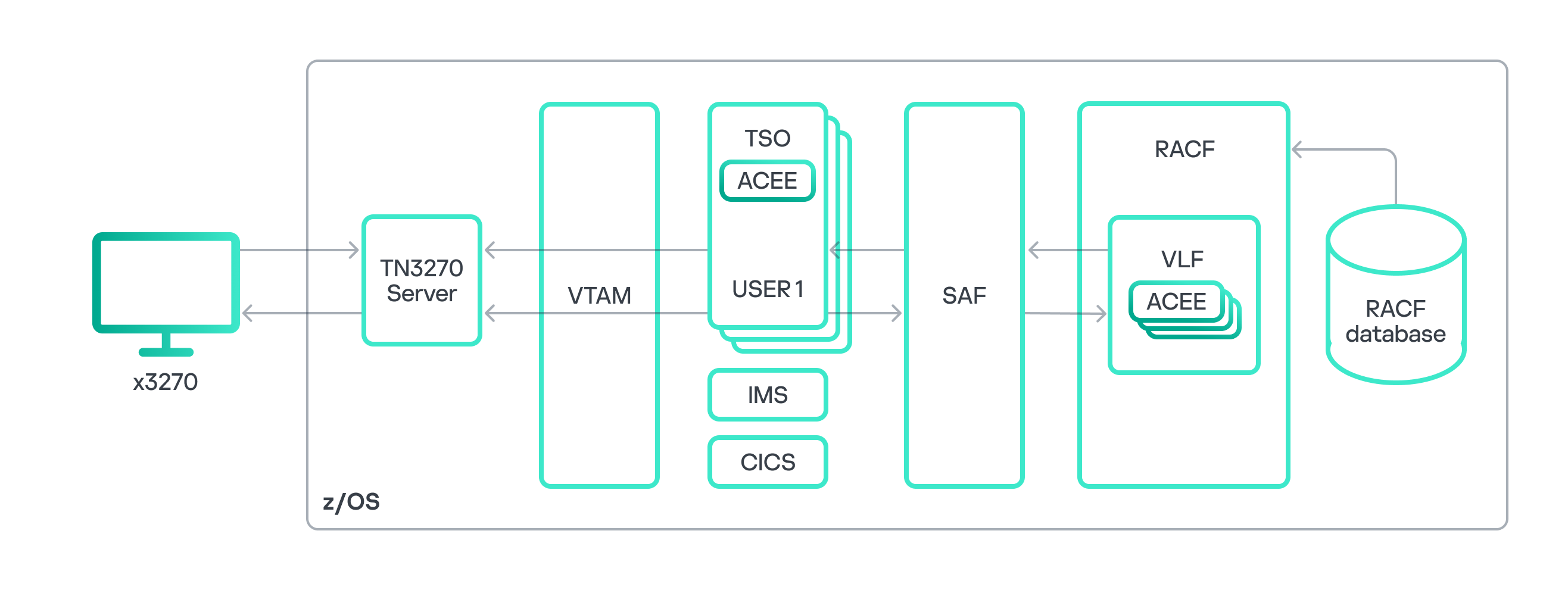
    z/OS access control diagram

    To thoroughly analyze RACF, let’s recall its role and the functions of its components within the overall z/OS architecture. As illustrated in the diagram above, RACF can generally be divided into a service component and a database. Other components exist too, such as utilities for RACF administration and management, or the RACF Auditing and Reporting solution responsible for event logging and reporting. However, for a general understanding of the process, we believe these components are not strictly necessary. The RACF database stores information about z/OS users and the resources for which access control is configured. Based on this data, the RACF service component performs all necessary security checks when requested by other z/OS components and subsystems. RACF typically interacts with other subsystems through the System Authorization Facility (SAF) interface. Various z/OS components use SAF to authorize a user’s access to resources or to execute a user-requested operation. It is worth noting that while this paper focuses on the operating principle of RACF as the standard security package, other security packages like ACF2 or Top Secret can also be used in z/OS.

    Let’s consider an example of user authorization within the Time Sharing Option (TSO) subsystem, the z/OS equivalent of a command line interface. We use an x3270 terminal emulator to connect to the mainframe. After successful user authentication in z/OS, the TSO subsystem uses SAF to query the RACF security package, checking that the user has permission to access the TSO resource manager. The RACF service queries the database for user information, which is stored in a user profile. If the database contains a record of the required access permissions, the user is authorized, and information from the user profile is placed into the address space of the new TSO session within the ACEE (Accessor Environment Element) control block. For subsequent attempts to access other z/OS resources within that TSO session, RACF uses the information in ACEE to make the decision on granting user access. SAF reads data from ACEE and transmits it to the RACF service. RACF makes the decision to grant or deny access, based on information in the relevant profile of the requested resource stored in the database. This decision is then sent back to SAF, which processes the user request accordingly. The process of querying RACF repeats for any further attempts by the user to access other resources or execute commands within the TSO session.

    Thus, RACF handles identification, authentication, and authorization of users, as well as granting privileges within z/OS.

    RACF database components

    As discussed above, access decisions for resources within z/OS are made based on information stored in the RACF database. This data is kept in the form of records, or as RACF terminology puts it, profiles. These contain details about specific z/OS objects. While the RACF database can hold various profile types, four main types are especially important for security analysis:

    1. User profile holds user-specific information such as logins, password hashes, special attributes, and the groups the user belongs to.
    2. Group profile contains information about a group, including its members, owner, special attributes, list of subgroups, and the access permissions of group members for that group.
    3. Data set profile stores details about a data set, including access permissions, attributes, and auditing policy.
    4. General resource profile provides information about a resource or resource class, such as resource holders, their permissions regarding the resource, audit policy, and the resource owner.

    The RACF database contains numerous instances of these profiles. Together, they form a complex structure of relationships between objects and subjects within z/OS, which serves as the basis for access decisions.

    Logical structure of RACF database profiles

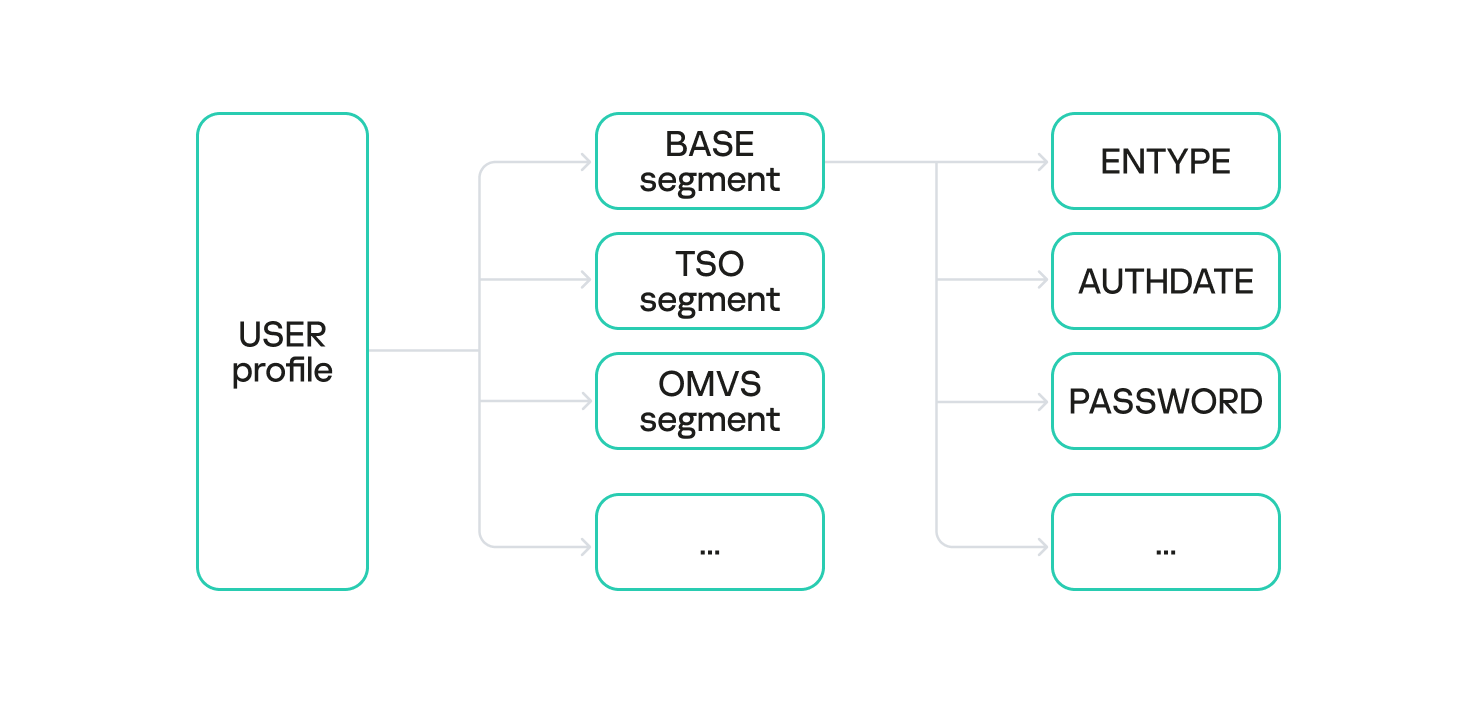
    Each profile is composed of one or more segments. Different profile types utilize different segment types.

    For example, a user profile instance may contain the following segments:

    • BASE: core user information in RACF (mandatory segment);
    • TSO: user TSO-session parameters;
    • OMVS: user session parameters within the z/OS UNIX subsystem;
    • KERB: data related to the z/OS Network Authentication Service, essential for Kerberos protocol operations;
    • and others.

    User profile segments

    Different segment types are distinguished by the set of fields they store. For instance, the BASE segment of a user profile contains the following fields:

    • PASSWORD: the user’s password hash;
    • PHRASE: the user’s password phrase hash;
    • LOGIN: the user’s login;
    • OWNER: the owner of the user profile;
    • AUTHDATE: the date of the user profile creation in the RACF database;
    • and others.

    The PASSWORD and PHRASE fields are particularly interesting for security analysis, and we will dive deeper into these later.

    RACF database structure

    It is worth noting that the RACF database is stored as a specialized data set with a specific format. Grasping this format is very helpful when analyzing the DB and mapping the relationships between z/OS objects and subjects.

    As discussed in our previous article, a data set is the mainframe equivalent of a file, composed of a series of blocks.

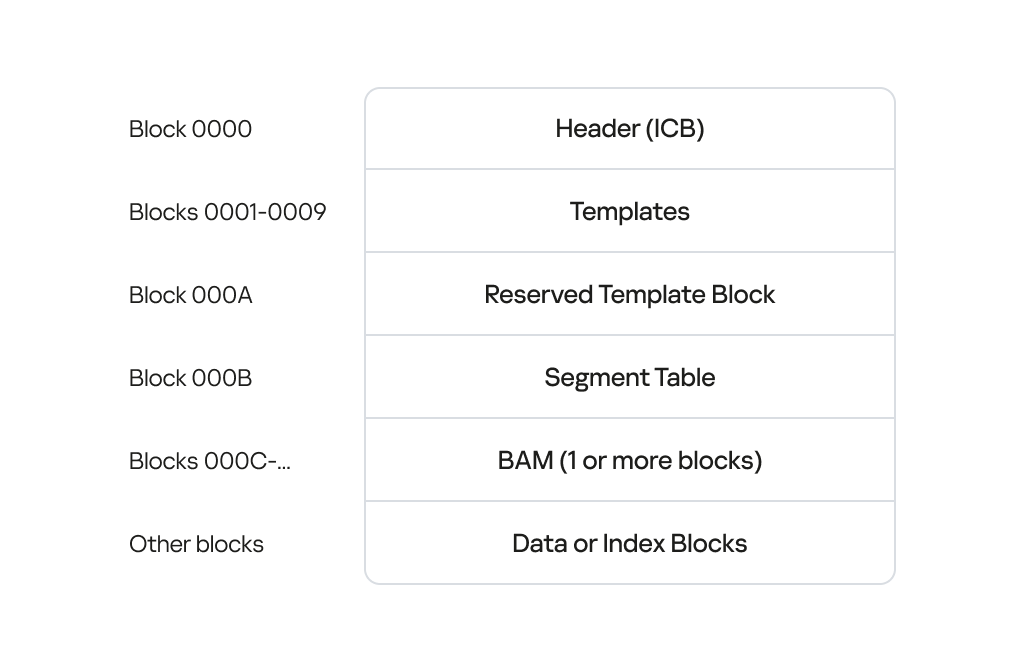
    RACF DB structure

    The image above illustrates the RACF database structure, detailing the data blocks and their offsets. From the RACF DB analysis perspective, and when subsequently determining the relationships between z/OS objects and subjects, the most critical blocks include:

    • The header block, or inventory control block (ICB), which contains various metadata and pointers to all other data blocks within the RACF database. By reading the ICB, you gain access to the rest of the data blocks.
    • Index blocks, which form a singly linked list that contains pointers to all profiles and their segments in the RACF database – that is, to the information about all users, groups, data sets, and resources.
    • Templates: a crucial data block containing templates for all profile types (user, group, data set, and general resource profiles). The templates list fields and specify their format for every possible segment type within the corresponding profile type.

    Upon dissecting the RACF database structure, we identified the need for a utility capable of extracting all relevant profile information from the DB, regardless of its version. This utility would also need to save the extracted data in a convenient format for offline analysis. Performing this type of analysis provides a comprehensive picture of the relationships between all objects and subjects for a specific z/OS installation, helping uncover potential security vulnerabilities that could lead to privilege escalation or lateral movement.

    Utilities for RACF DB analysis

    At the previous stage, we defined the following functional requirements for an RACF DB analysis utility:

    1. The ability to analyze RACF profiles offline without needing to run commands on the mainframe
    2. The ability to extract exhaustive information about RACF profiles stored in the DB
    3. Compatibility with various RACF DB versions
    4. Intuitive navigation of the extracted data and the option to present it in various formats: plaintext, JSON, SQL, etc.

    Overview of existing RACF DB analysis solutions

    We started by analyzing off-the-shelf tools and evaluating their potential for our specific needs:

    • Racf2john extracts user password hashes (from the PASSWORD field) encrypted with the DES and KDFAES algorithms from the RACF database. While this was a decent starting point, we needed more than just the PASSWORD field; specifically, we also needed to retrieve content from other profile fields like PHRASE.
    • Racf2sql takes an RACF DB dump as input and converts it into an SQLite database, which can then be queried with SQL. This is convenient, but the conversion process risks losing data critical for z/OS security assessment and identifying misconfigurations. Furthermore, the tool requires a database dump generated by the z/OS IRRDBU00 utility (part of the RACF security package) rather than the raw database itself.
    • IRRXUTIL allows querying the RACF DB to extract information. It is also part of the RACF security package. It can be conveniently used with a set of scripts written in REXX (an interpreted language used in z/OS). However, these scripts demand elevated privileges (access to one or more IRR.RADMIN.** resources in the FACILITY resource class) and must be executed directly on the mainframe, which is unsuitable for the task at hand.
    • Racf_debug_cleanup.c directly analyzes a RACF DB from a data set copy. A significant drawback is that it only parses BASE segments and outputs results in plaintext.

    As you can see, existing tools don’t satisfy our needs. Some utilities require direct execution on the mainframe. Others operate on a data set copy and extract incomplete information from the DB. Moreover, they rely on hardcoded offsets and signatures within profile segments, which can vary across RACF versions. Therefore, we decided to develop our own utility for RACF database analysis.

    Introducing racfudit

    We have written our own platform-independent utility racfudit in Golang and tested it across various z/OS versions (1.13, 2.02, and 3.1). Below, we delve into the operating principles, capabilities and advantages of our new tool.

    To analyze RACF DB information offline, we first needed a way to extract structured data. We developed a two-stage approach for this:

    • The first stage involves analyzing the templates stored within the RACF DB. Each template describes a specific profile type, its constituent segments, and the fields within those segments, including their type and size. This allows us to obtain an up-to-date list of profile types, their segments, and associated fields, regardless of the RACF version.
    • In the second stage, we traverse all index blocks to extract every profile with its content from the RACF DB. These collected profiles are then processed and parsed using the templates obtained in the first stage.

    The first stage is crucial because RACF DB profiles are stored as unstructured byte arrays. The templates are what define how each specific profile (byte array) is processed based on its type.

    Thus, we defined the following algorithm to extract structured data.

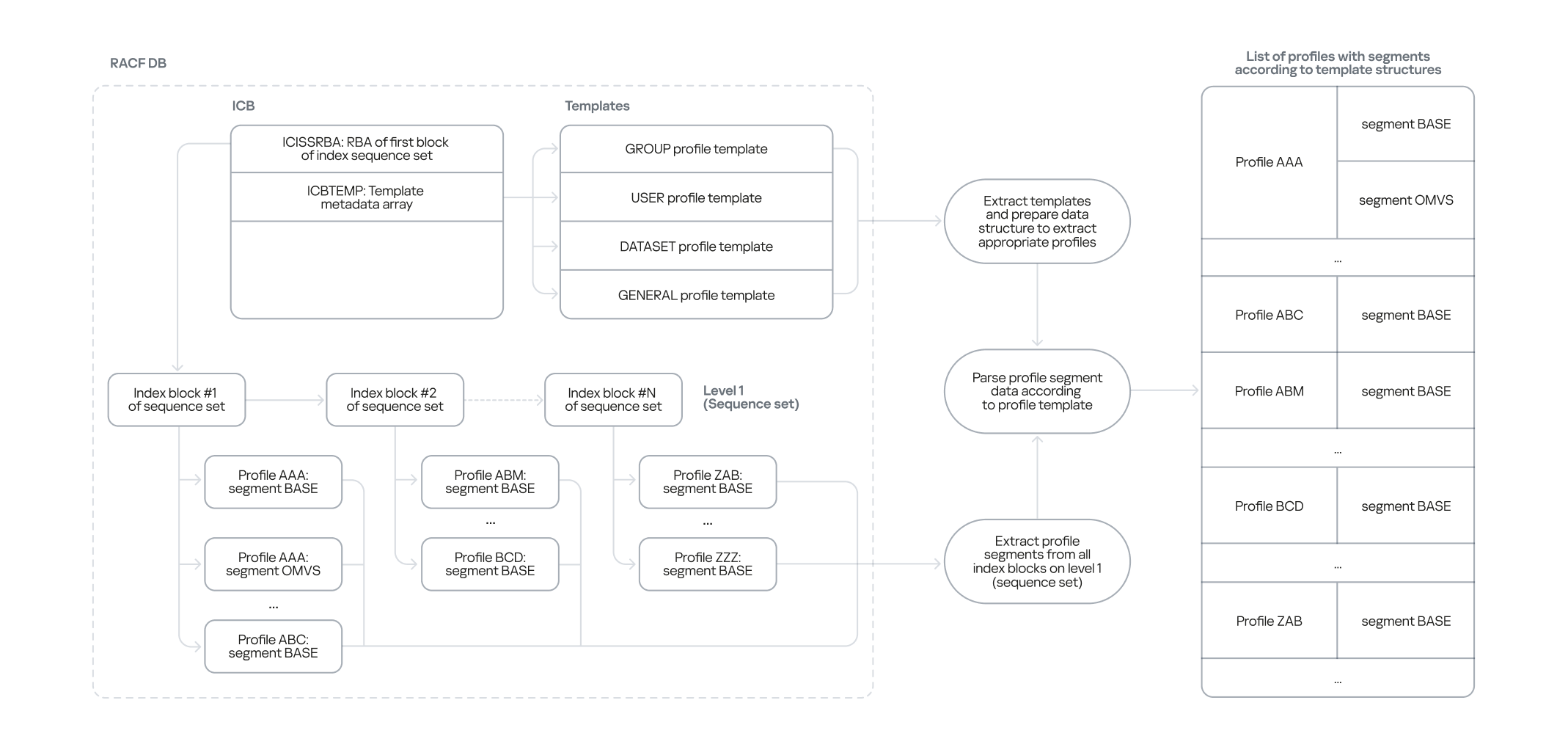
    Extracting data from the RACF DB using templates

    1. We offload the RACF DB from the mainframe and read its header block (ICB) to determine the location of the templates.
    2. Based on the template for each profile type, we define an algorithm for structuring specific profile instances according to their type.
    3. We use the content of the header block to locate the index blocks, which store pointers to all profile instances.
    4. We read all profile instances and their segments sequentially from the list of index blocks.
    5. For each profile instance and its segments we read, we apply the processing algorithm based on the corresponding template.
    6. All processed profile instances are saved in an intermediate state, allowing for future storage in various formats, such as plaintext or SQLite.

    The advantage of this approach is its version independence. Even if templates and index blocks change their structure across RACF versions, our utility will not lose data because it dynamically determines the structure of each profile type based on the relevant template.

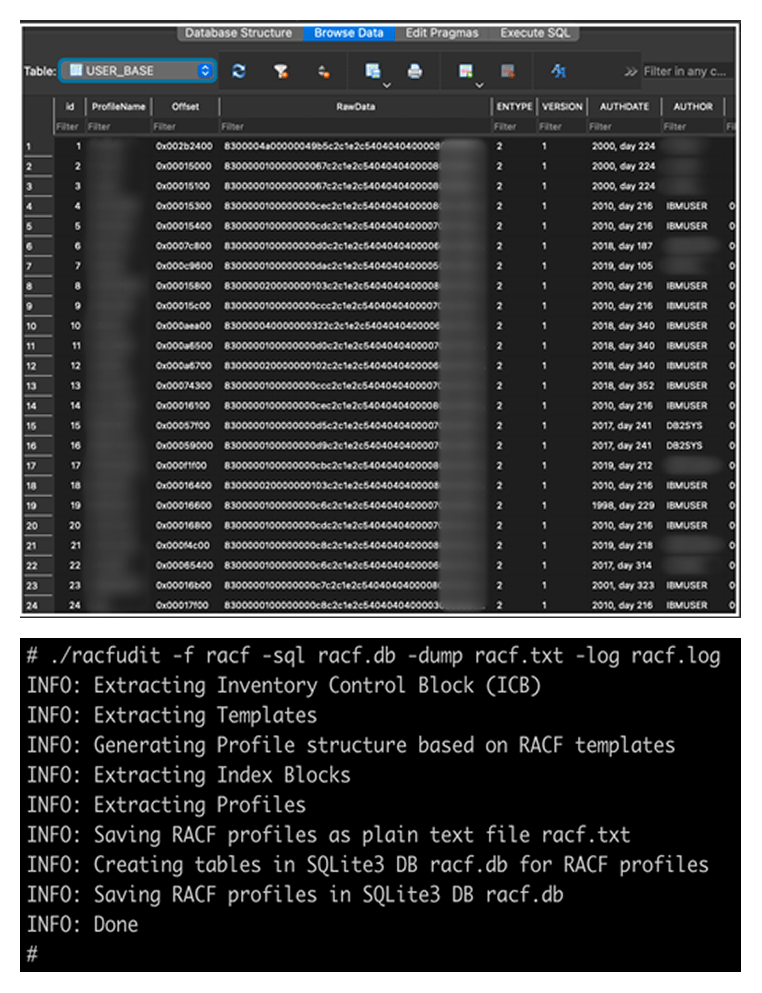
    Our racfudit utility can present collected RACF DB information as an SQLite database or a plaintext file.

    RACF DB information as an SQLite DB (top) and text data (bottom)

    Using SQLite, you can execute SQL queries to identify misconfigurations in RACF that could be exploited for privilege escalation, lateral movement, bypassing access controls, or other pentesting tactics. It is worth noting that the set of SQL queries used for processing information in SQLite can be adapted to validate current RACF settings against security standards and best practices. Let’s look at some specific examples of how to use the racfudit utility to uncover security issues.

    Collecting password hashes

    One of the primary goals in penetration testing is to get a list of administrators and a way to authorize using their credentials. This can be useful for maintaining persistence on the mainframe, moving laterally to other mainframes, or even pivoting to servers running different operating systems. Administrators are typically found in the SYS1 group and its subgroups. The example below shows a query to retrieve hashes of passwords (PASSWORD) and password phrases (PHRASE) for privileged users in the SYS1 group.

    Of course, to log in to the system, you need to crack these hashes to recover the actual passwords. We cover that in more detail below.

    Searching for inadequate UACC control in data sets

    The universal access authority (UACC) defines the default access permissions to the data set. This parameter specifies the level of access for all users who do not have specific access permissions configured. Insufficient control over UACC values can pose a significant risk if elevated access permissions (UPDATE or higher) are set for data sets containing sensitive data or for APF libraries, which could allow privilege escalation. The query below helps identify data sets with default ALTER access permissions, which allow users to read, delete and modify the data set.

    The UACC field is not present only in data set profiles; it is also found in other profile types. Weak control in the configuration of this field can give a penetration tester access to resources.

    RACF profile relationships

    As mentioned earlier, various RACF entities have relationships. Some are explicitly defined; for example, a username might be listed in a group profile within its member field (USERID field). However, there are also implicit relationships. For instance, if a user group has UPDATE access to a specific data set, every member of that group implicitly has write access to that data set. This is a simple example of implicit relationships. Next, we delve into more complex and specific relationships within the RACF database that a penetration tester can exploit.

    RACF profile fields

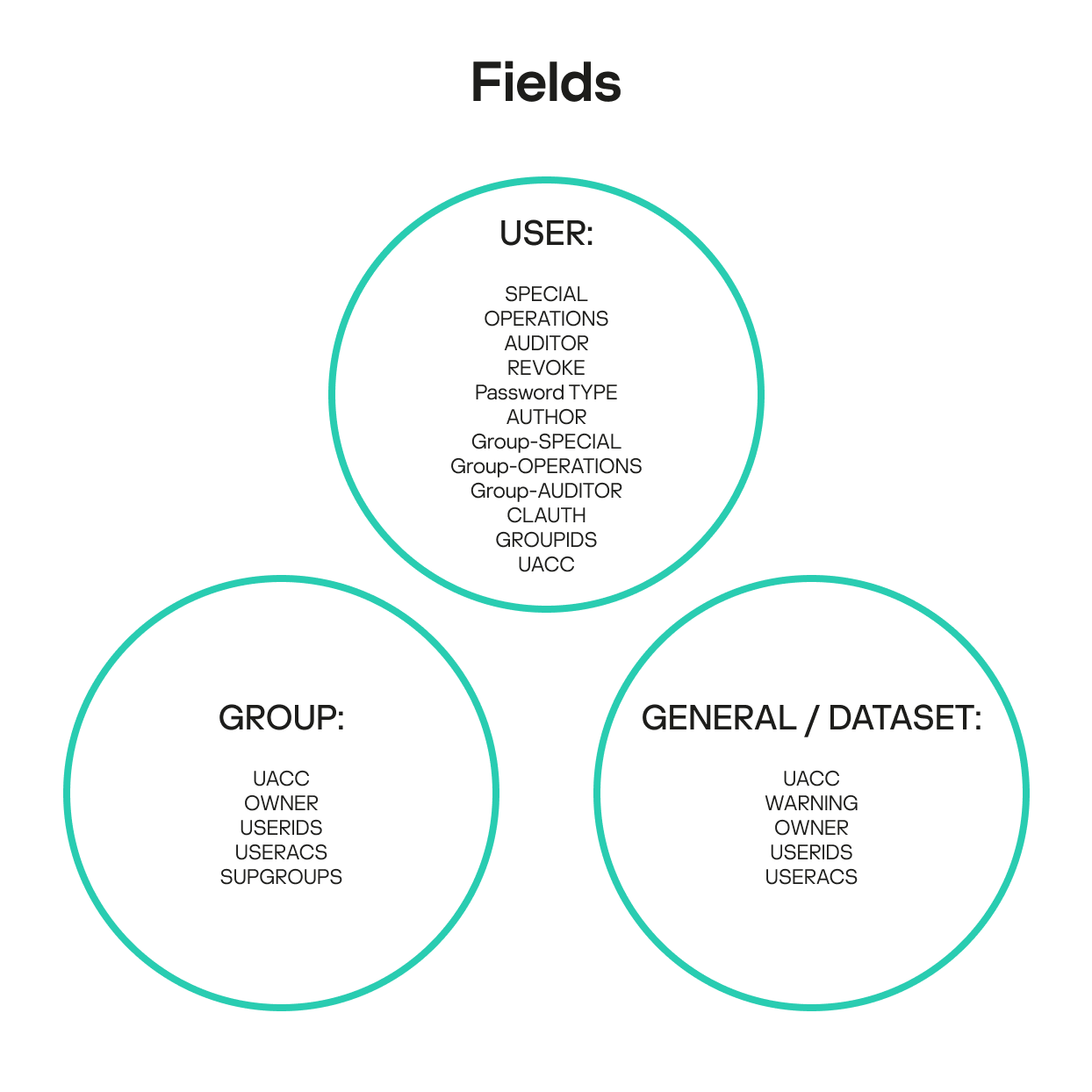
    A deep dive into RACF internal architecture reveals that misconfigurations of access permissions and other attributes for various RACF entities can be difficult to detect and remediate in some scenarios. These seemingly minor errors can be critical, potentially leading to mainframe compromise. The explicit and implicit relationships within the RACF database collectively define the mainframe’s current security posture. As mentioned, each profile type in the RACF database has a unique set of fields and attributes that describe how profiles relate to one another. Based on these fields and attributes, we have compiled lists of key fields that help build and analyze relationship chains.

    User profile fields

    • SPECIAL: indicates that the user has privileges to execute any RACF command and grants them full control over all profiles in the RACF database.
    • OPERATIONS: indicates whether the user has authorized access to all RACF-protected resources of the DATASET, DASDVOL, GDASDVOL, PSFMPL, TAPEVOL, VMBATCH, VMCMD, VMMDISK, VMNODE, and VMRDR classes. While actions for users with this field specified are subject to certain restrictions, in a penetration testing context the OPERATIONS field often indicates full data set access.
    • AUDITOR: indicates whether the user has permission to access audit information.
    • AUTHOR: the creator of the user. It has certain privileges over the user, such as the ability to change their password.
    • REVOKE: indicates whether the user can log in to the system.
    • Password TYPE: specifies the hash type (DES or KDFAES) for passwords and password phrases. This field is not natively present in the user profile, but it can be created based on how different passwords and password phrases are stored.
    • Group-SPECIAL: indicates whether the user has full control over all profiles within the scope defined by the group or groups field. This is a particularly interesting field that we explore in more detail below.
    • Group-OPERATIONS: indicates whether the user has authorized access to all RACF-protected resources of the DATASET, DASDVOL, GDASDVOL, PSFMPL, TAPEVOL, VMBATCH, VMCMD, VMMDISK, VMNODE and VMRDR classes within the scope defined by the group or groups field.
    • Group-AUDITOR: indicates whether the user has permission to access audit information within the scope defined by the group or groups field.
    • CLAUTH (class authority): allows the user to create profiles within the specified class or classes. This field enables delegation of management privileges for individual classes.
    • GROUPIDS: contains a list of groups the user belongs to.
    • UACC (universal access authority): defines the UACC value for new profiles created by the user.

    Group profile fields

    • UACC (universal access authority): defines the UACC value for new profiles that the user creates when connected to the group.
    • OWNER: the creator of the group. The owner has specific privileges in relation to the current group and its subgroups.
    • USERIDS: the list of users within the group. The order is essential.
    • USERACS: the list of group members with their respective permissions for access to the group. The order is essential.
    • SUPGROUP: the name of the superior group.

    General resource and data set profile fields

    • UACC (universal access authority): defines the default access permissions to the resource or data set.
    • OWNER: the creator of the resource or data set, who holds certain privileges over it.
    • WARNING: indicates whether the resource or data set is in WARNING mode.
    • USERIDS: the list of user IDs associated with the resource or data set. The order is essential.
    • USERACS: the list of users with access permissions to the resource or data set. The order is essential.

    RACF profile relationship chains

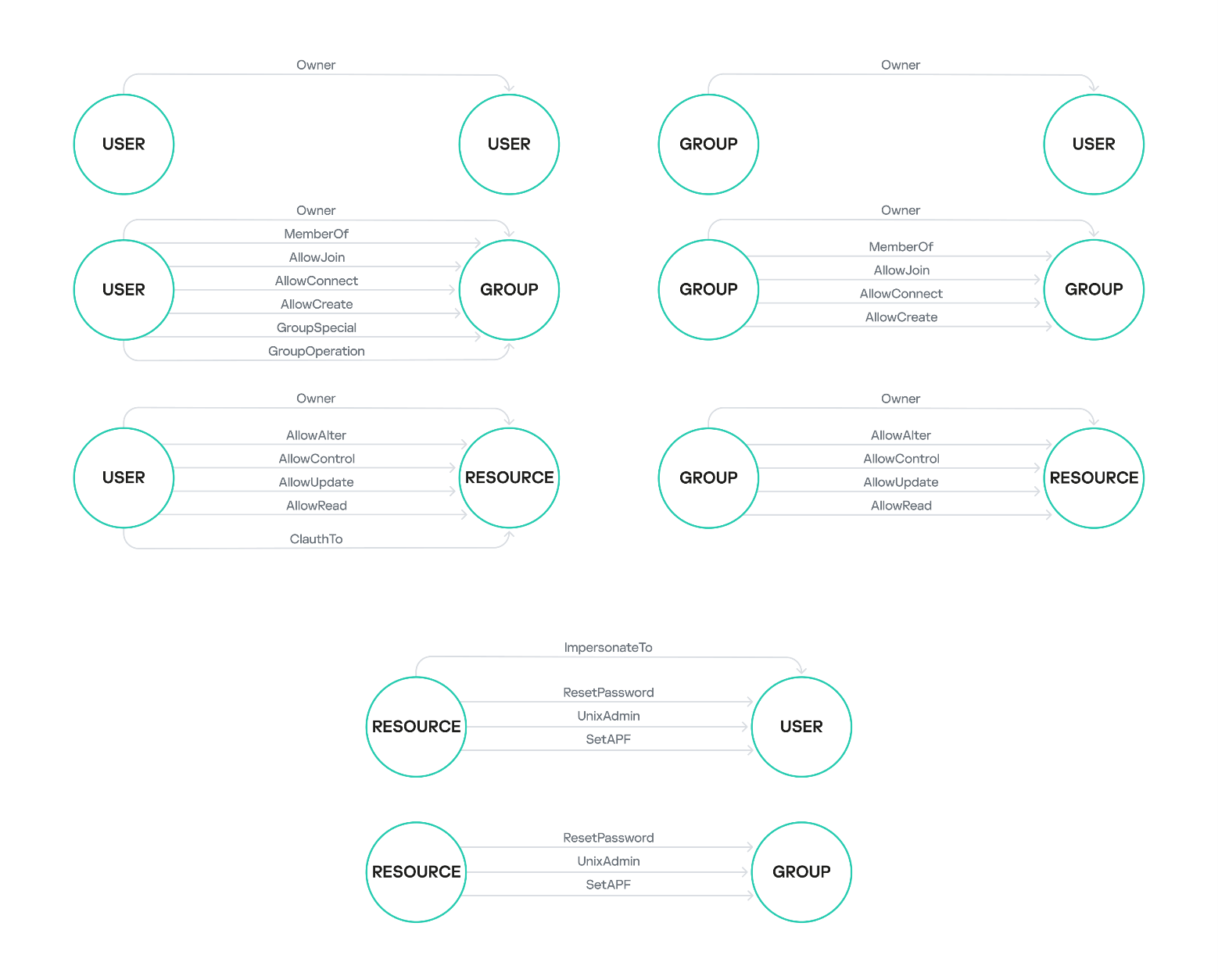
    The fields listed above demonstrate the presence of relationships between RACF profiles. We have decided to name these relationships similarly to those used in BloodHound, a popular tool for analyzing Active Directory misconfigurations. Below are some examples of these relationships – the list is not exhaustive.

    • Owner: the subject owns the object.
    • MemberOf: the subject is part of the object.
    • AllowJoin: the subject has permission to add itself to the object.
    • AllowConnect: the subject has permission to add another object to the specified object.
    • AllowCreate: the subject has permission to create an instance of the object.
    • AllowAlter: the subject has the ALTER privilege for the object.
    • AllowUpdate: the subject has the UPDATE privilege for the object.
    • AllowRead: the subject has the READ privilege for the object.
    • CLAuthTo: the subject has permission to create instances of the object as defined in the CLAUTH field.
    • GroupSpecial: the subject has full control over all profiles within the object’s scope of influence as defined in the group-SPECIAL field.
    • GroupOperations: the subject has permissions to perform certain operations with the object as defined in the group-OPERATIONS field.
    • ImpersonateTo: the subject grants the object the privilege to perform certain operations on the subject’s behalf.
    • ResetPassword: the subject grants another object the privilege to reset the password or password phrase of the specified object.
    • UnixAdmin: the subject grants superuser privileges to the object in z/OS UNIX.
    • SetAPF: the subject grants another object the privilege to set the APF flag on the specified object.

    These relationships serve as edges when constructing a graph of subject–object interconnections. Below are examples of potential relationships between specific profile types.

    Examples of relationships between RACF profiles

    Visualizing and analyzing these relationships helped us identify specific chains that describe potential RACF security issues, such as a path from a low-privileged user to a highly-privileged one. Before we delve into examples of these chains, let’s consider another interesting and peculiar feature of the relationships between RACF database entities.

    Implicit RACF profile relationships

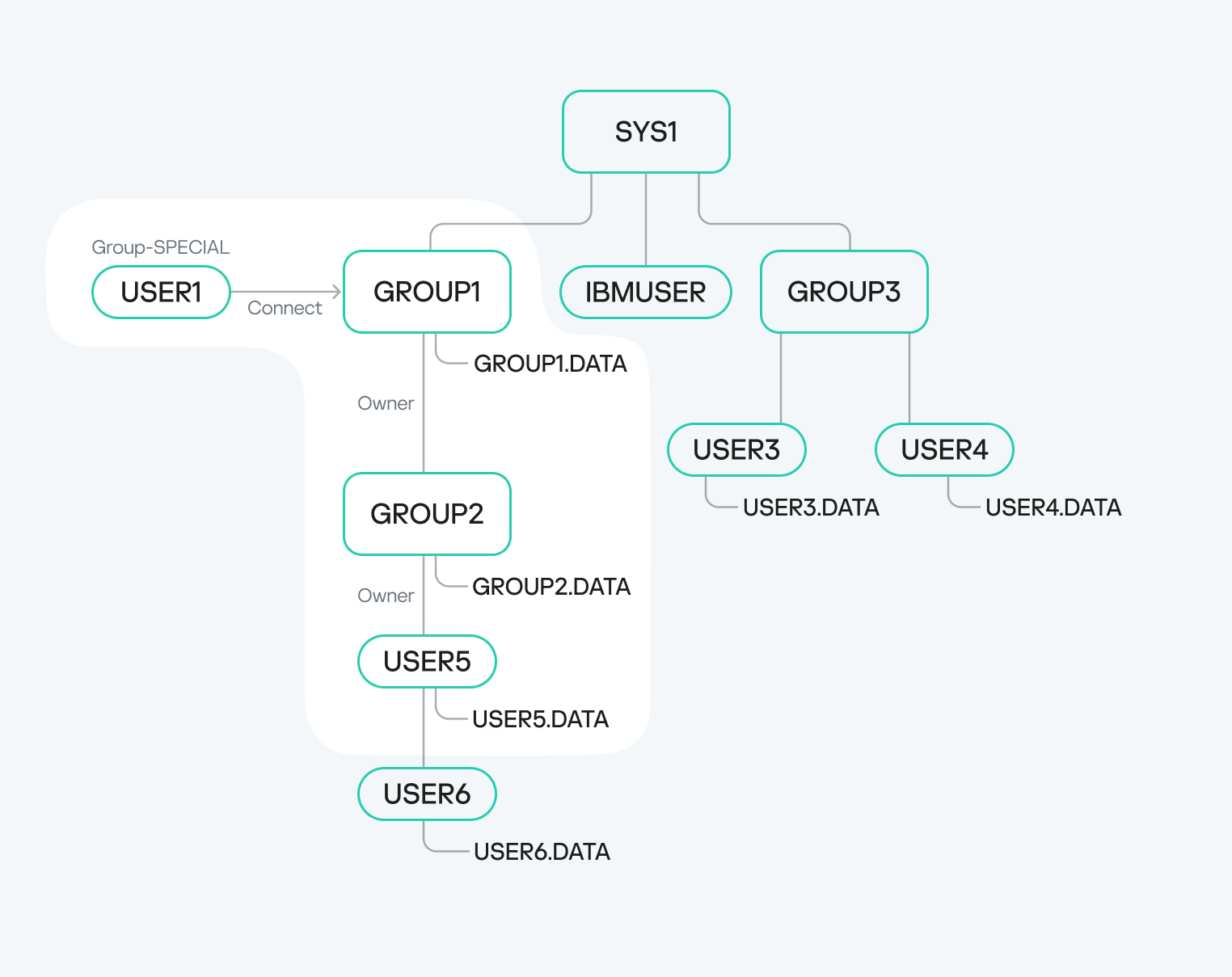
    We have observed a fascinating characteristic of the group-SPECIAL, group-OPERATIONS, and group-AUDITOR fields within a user profile. If the user has any group specified in one of these fields, that group’s scope of influence extends the user’s own scope.

    Scope of influence of a user with a group-SPECIAL field

    For instance, consider USER1 with GROUP1 specified in the group-SPECIAL field. If GROUP1 owns GROUP2, and GROUP2 subsequently owns USER5, then USER1 gains privileges over USER5. This is not just about data access; USER1 essentially becomes the owner of USER5. A unique aspect of z/OS is that this level of access allows USER1 to, for example, change USER5’s password, even if USER5 holds privileged attributes like SPECIAL, OPERATIONS, ROAUDIT, AUDITOR, or PROTECTED.

    Below is an SQL query, generated using the racfudit utility, that identifies all users and groups where the specified user possesses special attributes:

    Here is a query to find users whose owners (AUTHOR) are not the standard default administrators:

    Let’s illustrate how user privileges can be escalated through these implicit profile relationships.

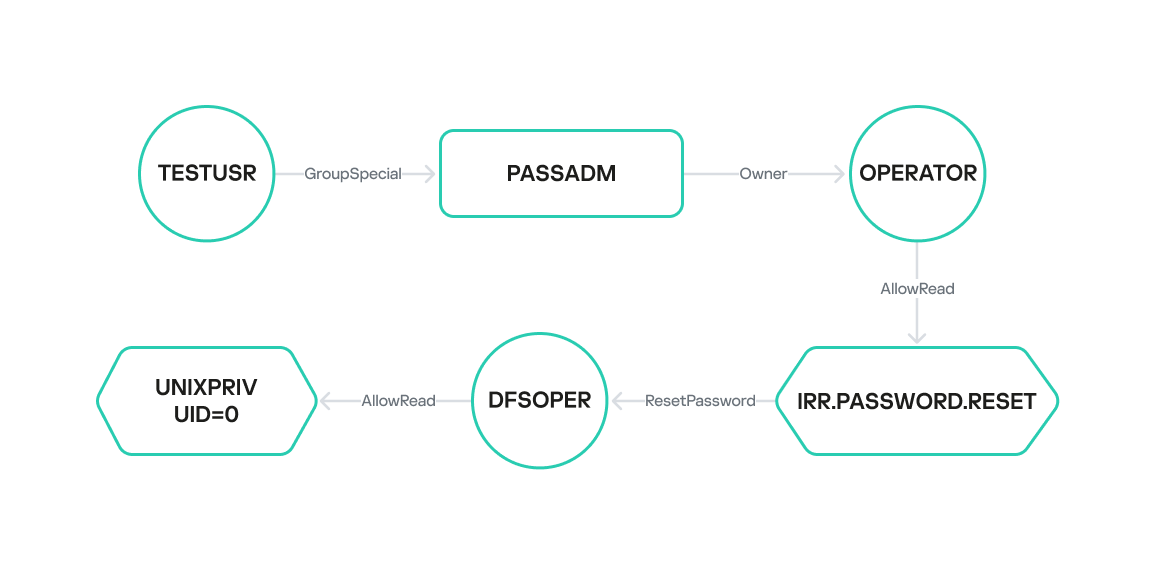
    Privilege escalation via the group-SPECIAL field

    In this scenario, the user TESTUSR has the group-SPECIAL field set to PASSADM. This group, PASSADM, owns the OPERATOR user. This means TESTUSR’s scope of influence expands to include PASSADM’s scope, thereby granting TESTUSR control over OPERATOR. Consequently, if TESTUSR’s credentials are compromised, the attacker gains access to the OPERATOR user. The OPERATOR user, in turn, has READ access to the IRR.PASSWORD.RESET resource, which allows them to assign a password to any user who does not possess privileged permissions.

    Having elevated privileges in z/OS UNIX is often sufficient for compromising the mainframe. These can be acquired through several methods:

    • Grant the user READ access to the BPX.SUPERUSER resource of the FACILITY class.
    • Grant the user READ access to UNIXPRIV.SUPERUSER.* resources of the UNIXPRIV class.
    • Set the UID field to 0 in the OMVS segment of the user profile.

    For example, the DFSOPER user has READ access to the BPX.SUPERUSER resource, making them privileged in z/OS UNIX and, by extension, across the entire mainframe. However, DFSOPER does not have the explicit privileged fields SPECIAL, OPERATIONS, AUDITOR, ROAUDIT and PROTECTED set, meaning the OPERATOR user can change DFSOPER’s password. This allows us to define the following sequence of actions to achieve high privileges on the mainframe:

    1. Obtain and use TESTUSR’s credentials to log in.
    2. Change OPERATOR’s password and log in with those credentials.
    3. Change DFSOPER’s password and log in with those credentials.
    4. Access the z/OS UNIX Shell with elevated privileges.

    We uncovered another implicit RACF profile relationship that enables user privilege escalation.

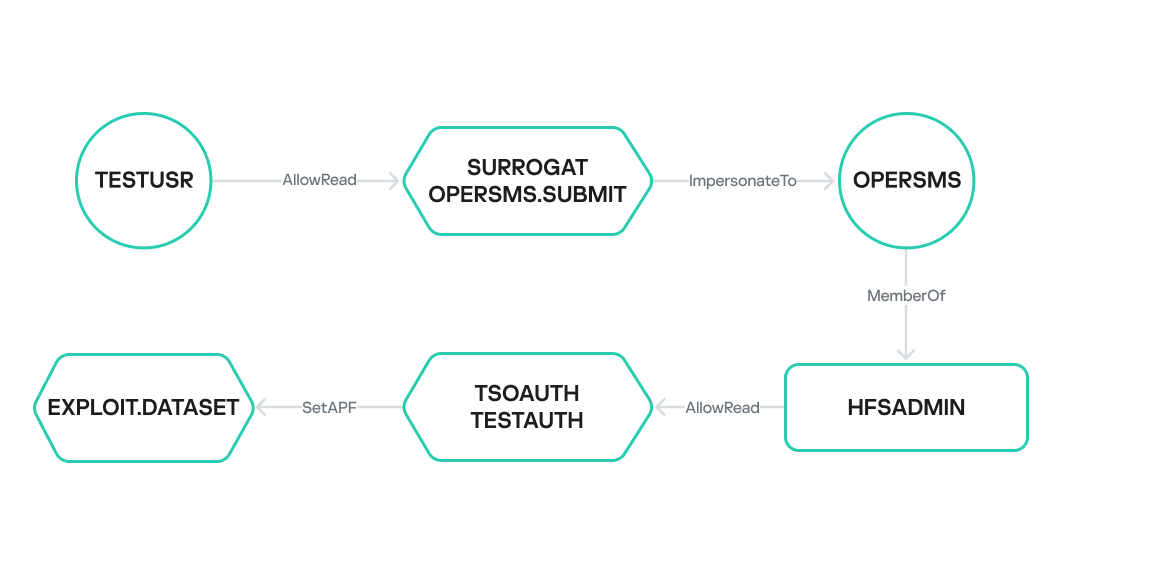
    Privilege escalation from a chain of misconfigurations

    In another example, the TESTUSR user has READ access to the OPERSMS.SUBMIT resource of the SURROGAT class. This implies that TESTUSR can create a task under the identity of OPERSMS using the ImpersonateTo relationship. OPERSMS is a member of the HFSADMIN group, which has READ access to the TESTAUTH resource of the TSOAUTH class. This resource indicates whether the user can run an application or library as APF-authorized – this requires only READ access. Therefore, if APF access is misconfigured, the OPERSMS user can escalate their current privileges to the highest possible level. This outlines a path from the low-privileged TESTUSR to obtaining maximum privileges on the mainframe.

    At this stage, the racfudit utility allows identifying these connections only manually through a series of SQLite database queries. However, we are planning to add support for another output format, including Neo4j DBMS integration, to automatically visualize the interconnected chains described above.

    Password hashes in RACF

    To escalate privileges and gain mainframe access, we need the credentials of privileged users. We previously used our utility to extract their password hashes. Now, let’s dive into the password policy principles in z/OS and outline methods for recovering passwords from these collected hashes.

    The primary password authentication methods in z/OS, based on RACF, are PASSWORD and PASSPHRASE. PASSWORD is a password composed by default of ASCII characters: uppercase English letters, numbers, and special characters (@#$). Its length is limited to 8 characters. PASSPHRASE, or a password phrase, has a more complex policy, allowing 14 to 100 ASCII characters, including lowercase or uppercase English letters, numbers, and an extended set of special characters (@#$&*{}[]()=,.;’+/). Hashes for both PASSWORD and PASSPHRASE are stored in the user profile within the BASE segment, in the PASSWORD and PHRASE fields, respectively. Two algorithms are used to derive their values: DES and KDFAES.

    It is worth noting that we use the terms “password hash” and “password phrase hash” for clarity. When using the DES and KDFAES algorithms, user credentials are stored in the RACF database as encrypted text, not as a hash sum in its classical sense. Nevertheless, we will continue to use “password hash” and “password phrase hash” as is customary in IBM documentation.

    Let’s discuss the operating principles and characteristics of the DES and KDFAES algorithms in more detail.

    DES

    When the DES algorithm is used, the computation of PASSWORD and PHRASE values stored in the RACF database involves classic DES encryption. Here, the plaintext data block is the username (padded to 8 characters if shorter), and the key is the password (also padded to 8 characters if shorter).

    PASSWORD

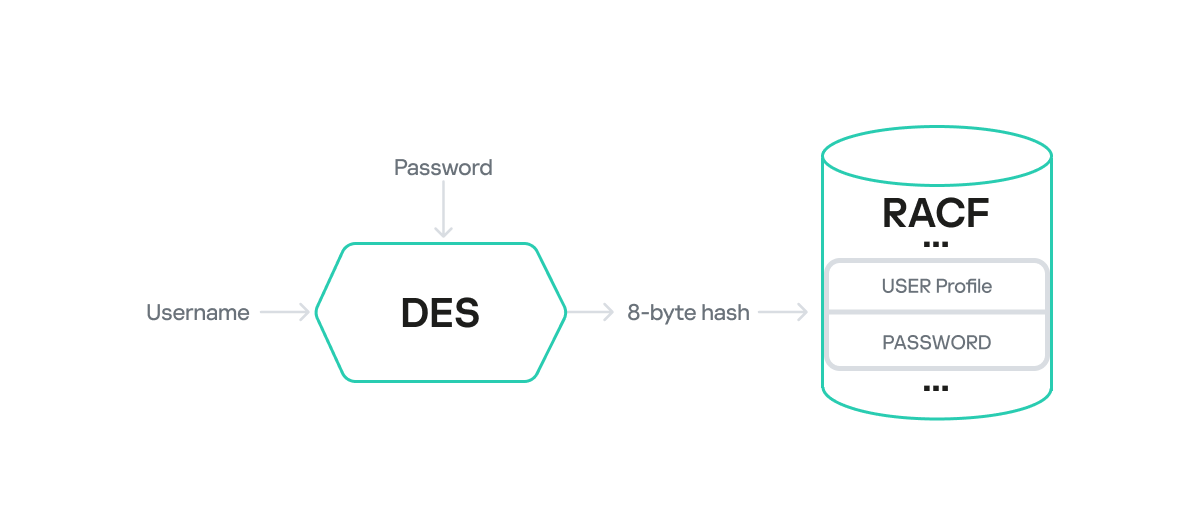
    The username is encrypted with the password as the key via the DES algorithm, and the 8-byte result is placed in the user profile’s PASSWORD field.

    DES encryption of a password

    Keep in mind that both the username and password are encoded with EBCDIC. For instance, the username USR1 would look like this in EBCDIC: e4e2d9f140404040. The byte 0x40 serves as padding for the plaintext to reach 8 bytes.

    This password can be recovered quite fast, given the small keyspace and low computational complexity of DES. For example, a brute-force attack powered by a cluster of NVIDIA 4090 GPUs takes less than five minutes.

    The hashcat tool includes a module (Hash-type 8500) for cracking RACF passwords with the DES algorithm.

    PASSPHRASE

    PASSPHRASE encryption is a bit more complex, and a detailed description of its algorithm is not readily available. However, our research uncovered certain interesting characteristics.

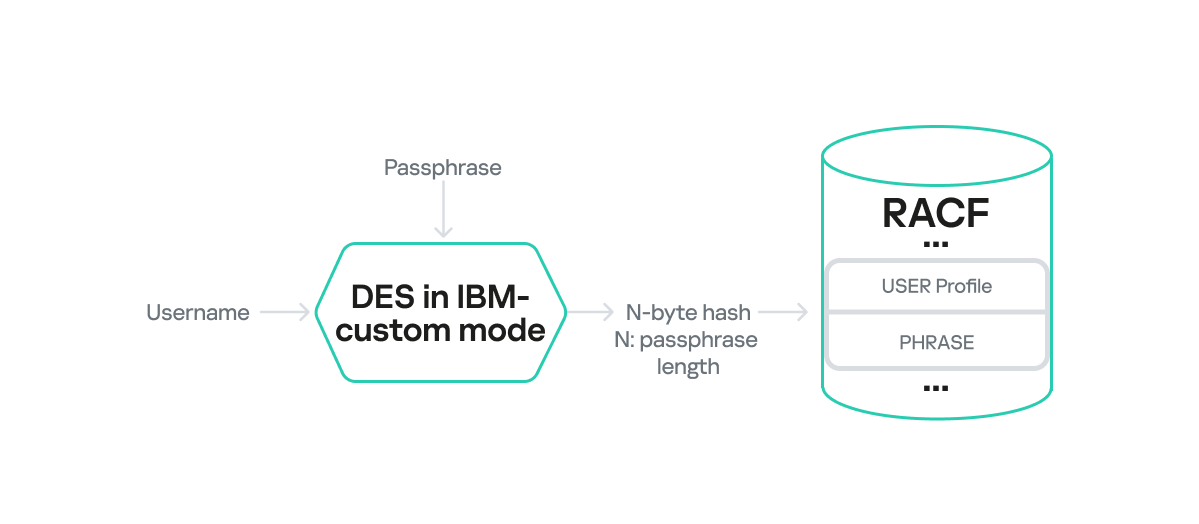
    First, the final hash length in the PHRASE field matches the original password phrase length. Essentially, the encrypted data output from DES gets truncated to the input plaintext length without padding. This design can clearly lead to collisions and incorrect authentication under certain conditions. For instance, if the original password phrase is 17 bytes long, it will be encrypted in three blocks, with the last block padded with seven bytes. These padded bytes are then truncated after encryption. In this scenario, any password whose first 17 encrypted bytes match the encrypted PASSPHRASE would be considered valid.

    The second interesting feature is that the PHRASE field value is also computed using the DES algorithm, but it employs a proprietary block chaining mode. We will informally refer to this as IBM-custom mode.

    DES encryption of a password phrase

    Given these limitations, we can use the hashcat module for RACF DES to recover the first 8 characters of a password phrase from the first block of encrypted data in the PHRASE field. In some practical scenarios, recovering the beginning of a password phrase allowed us to guess the remainder, especially when weak dictionary passwords were used. For example, if we recovered Admin123 (8 characters) while cracking a 15-byte PASSPHRASE hash, then it is plausible the full password phrase was Admin1234567890.

    KDFAES

    Computing passwords and password phrases generated with the KDFAES algorithm is significantly more challenging than with DES. KDFAES is a proprietary IBM algorithm that leverages AES encryption. The encryption key is generated from the password using the PBKDF2 function with a specific number of hashing iterations.

    PASSWORD

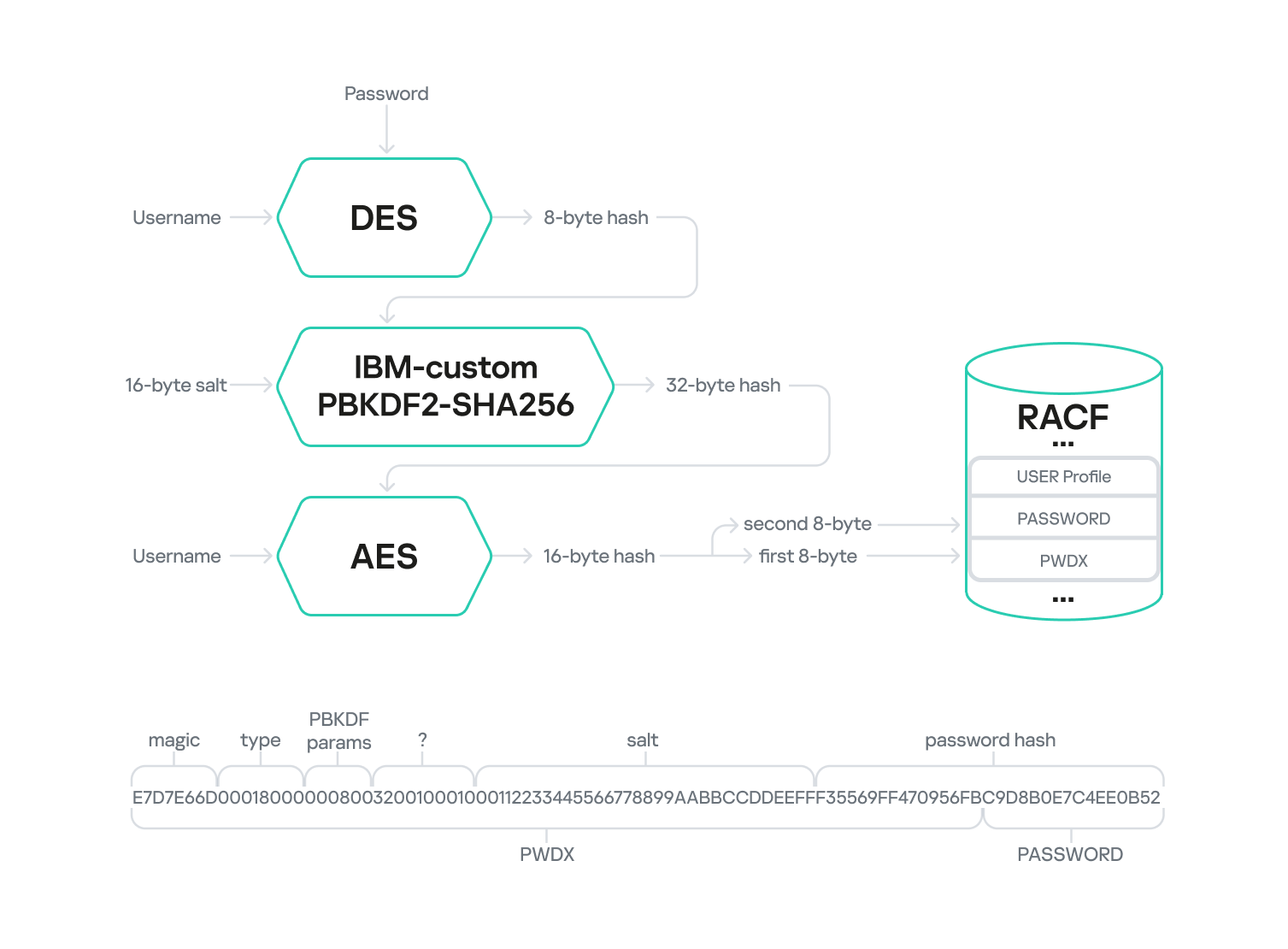
    The diagram below outlines the multi-stage KDFAES PASSWORD encryption algorithm.

    KDFAES encryption of a password

    The first stage mirrors the DES-based PASSWORD computation algorithm. Here, the plaintext username is encrypted using the DES algorithm with the password as the key. The username is also encoded in EBCDIC and padded if it’s shorter than 8 bytes. The resulting 8-byte output serves as the key for the second stage: hashing. This stage employs a proprietary IBM algorithm built upon PBKDF2-SHA256-HMAC. A randomly generated 16-byte string (salt) is fed into this algorithm along with the 8-byte key from the first stage. This data is then iteratively hashed using PBKDF2-SHA256-HMAC. The number of iterations is determined by two parameters set in RACF: the memory factor and the repetition factor. The output of the second stage is a 32-byte hash, which is then used as the key for AES encryption of the username in the third stage.

    The final output is 16 bytes of encrypted data. The first 8 bytes are appended to the end of the PWDX field in the user profile BASE segment, while the other 8 bytes are placed in the PASSWORD field within the same segment.

    The PWDX field in the BASE segment has the following structure:

    Offset Size Field Comment
    0–3 4 bytes Magic number In the profiles we analyzed, we observed only the value E7D7E66D
    4–7 4 bytes Hash type In the profiles we analyzed, we observed only two values: 00180000 for PASSWORD hashes and 00140000 for PASSPHRASE hashes
    8–9 2 bytes Memory factor A value that determines the number of iterations in the hashing stage
    10–11 2 bytes Repetition factor A value that determines the number of iterations in the hashing stage
    12–15 4 bytes Unknown value In the profiles we analyzed, we observed only the value 00100010
    16–31 16 bytes Salt A randomly generated 16-byte string used in the hashing stage
    32–39 8 bytes The first half of the password hash The first 8 bytes of the final encrypted data

    You can use the dedicated module in the John the Ripper utility for offline password cracking. While an IBM KDFAES module for an older version of hashcat exists publicly, it was never integrated into the main branch. Therefore, we developed our own RACF KDFAES module compatible with the current hashcat version.

    The time required to crack an RACF KDFAES hash has significantly increased compared to RACF DES, largely due to the integration of PBKDF2. For instance, if the memory factor and repetition factor are set to 0x08 and 0x32 respectively, the hashing stage can reach 40,000 iterations. This can extend the password cracking time to several months or even years.

    PASSPHRASE

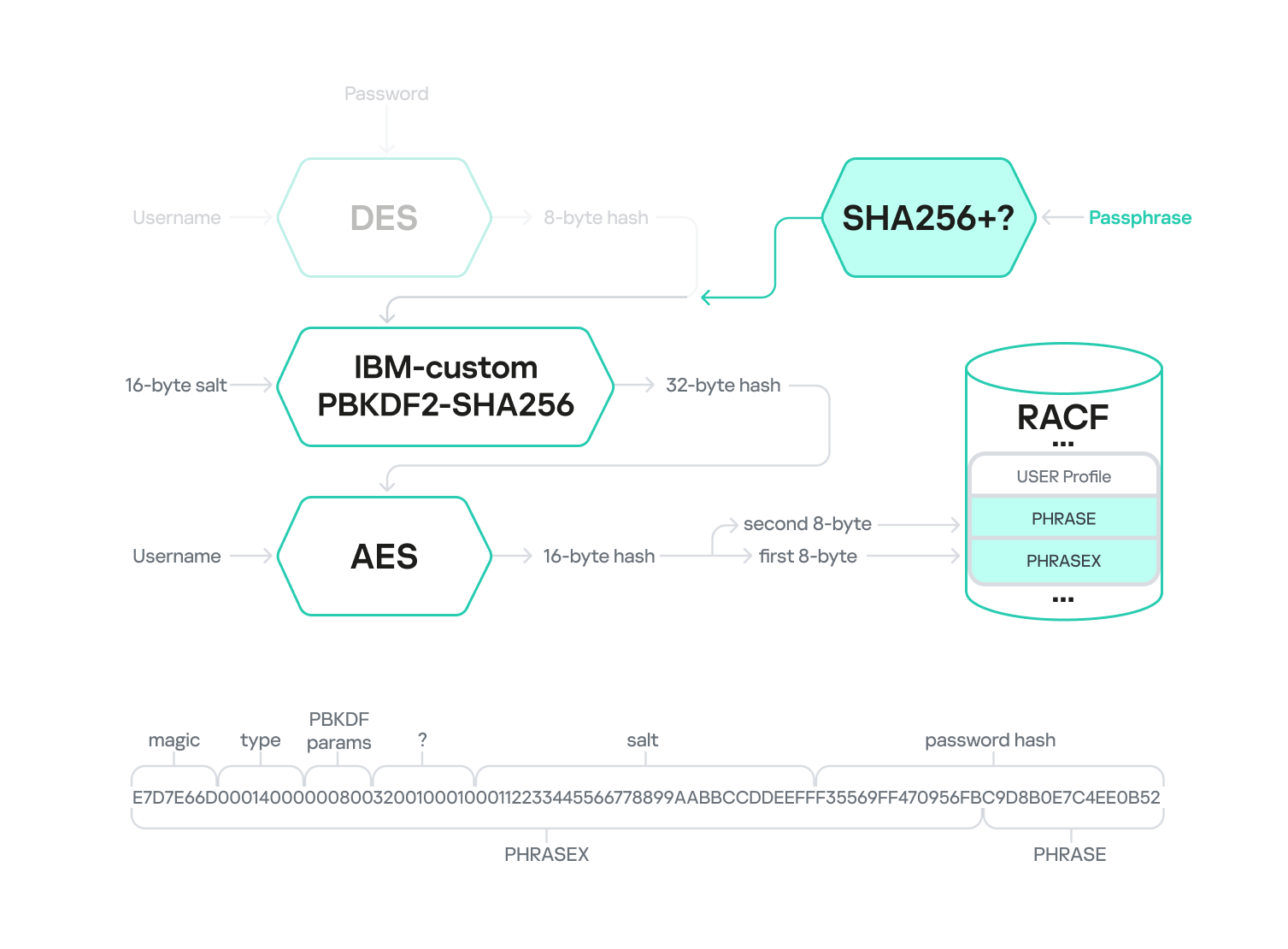
    KDFAES encryption of a password phrase

    Encrypting a password phrase hash with KDFAES shares many similarities with encrypting a password hash. According to public sources, the primary difference lies in the key used during the second stage. For passwords, data derived from DES-encrypting the username was used, while for a password phrase, its SHA256 hash is used. During our analysis, we could not determine the exact password phrase hashing process – specifically, whether padding is involved, if a secret key is used, and so on.

    Additionally, when using a password phrase, the PHRASE and PHRASEX fields instead of PASSWORD and PWDX, respectively, store the final hash, with the PHRASEX value having a similar structure.

    Conclusion

    In this article, we have explored the internal workings of the RACF security package, developed an approach to extracting information, and presented our own tool developed for the purpose. We also outlined several potential misconfigurations that could lead to mainframe compromise and described methods for detecting them. Furthermore, we examined the algorithms used for storing user credentials (passwords and password phrases) and highlighted their strengths and weaknesses.

    We hope that the information presented in this article helps mainframe owners better understand and assess the potential risks associated with incorrect RACF security suite configurations and take appropriate mitigation steps. Transitioning to the KDFAES algorithm and password phrases, controlling UACC values, verifying access to APF libraries, regularly tracking user relationship chains, and other steps mentioned in the article can significantly enhance your infrastructure security posture with minimal effort.

    In conclusion, it is worth noting that only a small percentage of the RACF database structure has been thoroughly studied. Comprehensive research would involve uncovering additional relationships between database entities, further investigating privileges and their capabilities, and developing tools to exploit excessive privileges. The topic of password recovery is also not fully covered because the encryption algorithms have not been fully studied. IBM z/OS mainframe researchers have immense opportunities for analysis. As for us, we will continue to shed light on the obscure, unexplored aspects of these devices, to help prevent potential vulnerabilities in mainframe infrastructure and associated security incidents.
    MIL OSI Economics

  • MIL-OSI: PU Prime and Argentina Football Association Celebrate Official Signing Ceremony in Madrid

    Source: GlobeNewswire (MIL-OSI)

    MADRID, July 08, 2025 (GLOBE NEWSWIRE) — PU Prime and the Argentina Football Association (AFA) formally commemorated their strategic partnership during a signing ceremony at the Argentina Football Academy Vallecas in Madrid.

    This significant event marked the strengthening of a long-term global collaboration between two institutions united by shared values of discipline, strategy, and precision.

    The day began with a meet-and-greet between PU Prime and AFA representatives, setting the tone for a day of collaboration and celebration. At the heart of the ceremony was the official contract signing and a ceremonial shirt exchange, symbolising the enduring partnership and mutual commitment between PU Prime and AFA. This was followed by a guided tour of the Academy’s world-class facilities, home to some of Argentina’s most promising young football talents.

    Delivering the keynote address, Mr. Daniel Bruce, Managing Director of PU Prime, shared:
    “Today, we’re here in beautiful Madrid to celebrate a partnership that brings together two forces committed to excellence — PU Prime and the Argentine Football Association.
    “The AFA is famous for building world-class talent and having a brand that is known throughout the world. This is something that PU Prime is constantly striving toward and is well on its way to achieving.
    “The partnership represents a significant step forward in the growth of our business, and we are honoured to be named alongside such a prestigious organisation.
    “Thank you to the AFA for being a part of this exciting new chapter. We look forward to a long and fruitful partnership, one that pushes the boundaries of what success looks like, and drives growth for both organisations.”

    Mr. Leandro Petersen, Chief Commercial and Marketing Officer of AFA, expressed his support for the partnership, stating:
    “Football is a global language, and today, we add a new voice to our story by welcoming PU Prime as a valued regional partner in the world of Argentine football. We are honoured to have this exciting partnership with a partner that shares our values of excellence, innovation, and commitment to performance. Together with PU Prime, we look forward to creating meaningful experiences that unite football supporters and celebrate the spirit of the beautiful game. PU Prime, we are proud to have you with us. Welcome to the AFA family.”

    Wrapping up the day was a live Q&A session with Mr. Javier Saviola, the legendary former Argentine footballer. Attendees had the exclusive chance to gain firsthand insights on leadership, legacy, and the value of global partnerships from one of the sport’s most admired icons.

    Mr. Javier Saviola shared his thoughts on the collaboration:
    “It’s something truly special. Representing Argentina has always been a great honor, and seeing PU Prime support the AFA means a lot to all of us. This partnership reflects the spirit of our team and helps share that passion with people all around the world.”

    This event signals the beginning of a long-term partnership between PU Prime and AFA, dedicated to inspiring, engaging, and creating enduring value across both fields.

    To read the full article, visit our PU Prime Newsroom.

    About PU Prime
    Founded in 2015, PU Prime is a leading global fintech company providing innovative online trading solutions. Today, we offer regulated financial products across various asset classes, including forex, commodities, indices, and shares. Committed to providing advanced technology and educational resources, PU Prime supports traders and investors at every stage, from beginner to professional. With a presence in over 190 countries and exceeding 40 million app downloads, PU Prime is dedicated to enabling financial success and fostering a global community of empowered traders. Discover PU Prime’s latest promotions and join us for a fruitful trading journey today.

    Chloe Lee

    media@puprime.com

    A photo accompanying this announcement is available at https://www.globenewswire.com/NewsRoom/AttachmentNg/653b62e2-7c2e-41c5-a9fc-d432e066560d

    The MIL Network

  • MIL-OSI USA: Congressman García Votes No on Trump’s Cruel Spending Bill

    Source: United States House of Representatives – Representative Jesús Chuy García (IL-04)

    WASHINGTON, D.C. — Congressman Jesús “Chuy” García (IL-04) issued the following statement after voting against H.R.1, the “One Big, Ugly Bill”:

    “I cannot support a bill that strips health care from working families while writing checks to billionaires and ICE.

    “Trump’s ‘Big, Ugly Bill’ includes the largest Medicaid cuts in American history, leaving 17 million people with no health care. In my district, 278,000 people are enrolled in Medicaid, and thousands will lose their coverage under this bill. It raises costs, eliminates care, and punishes everyday families. 

    “It jeopardizes nutrition benefits for more than 40 million people, taking food off the table for children, seniors, veterans, and people with disabilities.

    “If that was not enough, this bill will pour $100 billion into ICE, building it into the largest police force in the country—even bigger than the FBI—and with more detention capacity than the entire federal prison system. All to supercharge Trump and Stephen Miller’s deportation agenda, which means more raids, more kidnappings, more people taken from the streets with no regard for due process, and more families separated. 

    “My vote is for working families—not for billionaires, not for fear, and not for cruelty.”

    # # #

    MIL OSI USA News

  • MIL-OSI: Diginex Announces Plans for Eight-for-One Forward Stock Split

    Source: GlobeNewswire (MIL-OSI)

    LONDON, July 07, 2025 (GLOBE NEWSWIRE) — Diginex Limited (“Diginex” or the “Company”) (NASDAQ: DGNX), a leading provider of Sustainability RegTech solutions, today announced that on July 1, 2025 the Diginex Board of Directors (the “Board”) adopted resolutions recommending that its shareholders approve an eight-for-one (8:1) forward stock split. 

    The Board has scheduled an extraordinary general meeting of its shareholders to be held on July 29, 2025 (the “EGM”) for shareholders of record as of July 3, 2025 (the “Record Date”) to vote on the forward stock split and the filing of a second amended and restated memorandum and articles of association (the “Proposals”). Should the Proposals be approved by shareholders the forward stock split will be effective from August 1, 2025. 

    Should the Proposals be approved at the EGM, (i) each ordinary share of US$0.00005 par value shall be subdivided into eight (8) ordinary shares of US$0.00000625 par value each; (ii) each preferred share of US$0.00005 par value shall be subdivided into eight (8) preferred shares of US$0.00000625 par value each; and (iii) the authorized share capital of the Company shall become US$50,000 divided into 7,680,000,000 ordinary shares of par value US$0.00000625 each and 320,000,000 preferred shares of par value US$0.00000625 each. Any fractional shares, as a result of the forward stock split, will be rounded up. There will be no cash in lieu shares payments.

    The forward stock split is intended to make Diginex’s shares more accessible to a wider range of investors while maintaining the company’s market capitalization.

    “We are pleased to propose this forward stock split, which reflects our commitment to enhancing shareholder accessibility and liquidity,” said Miles Pelham, Chairman and Founder of Diginex. “This move aligns with our strategic goals to broaden our investor base and support the long-term growth of our business.” 

    The forward stock split will not affect the total value of an investor’s holdings of Diginex shares at the time of the forward split. The Notice of the Extraordinary General Meeting, Proxy Statement and Proxy Card has been mailed on or about July 7, 2025, to all shareholders of the Company as of the Record Date. Shareholders can review copies the Notice of the Extraordinary General Meeting, Proxy Statement and Proxy Card at www.sec.gov in the Company’s Form 6-K and at https://www.cstproxy.com/diginex/2025

    About Diginex

    Diginex Limited (Nasdaq: DGNX; ISIN KYG286871044), headquartered in London, is a sustainable RegTech business that empowers businesses and governments to streamline ESG, climate, and supply chain data collection and reporting. The Company utilizes blockchain, AI, machine learning and data analysis technology to lead change and increase transparency in corporate regulatory reporting and sustainable finance. Diginex’s products and services solutions enable companies to collect, evaluate and share sustainability data through easy-to-use software. 

    The award-winning diginexESG platform supports 17 global frameworks, including GRI (the “Global Reporting Initiative”), SASB (the “Sustainability Accounting Standards Board”), and TCFD (the “Task Force on Climate-related Financial Disclosures”). Clients benefit from end-to-end support, ranging from materiality assessments and data management to stakeholder engagement, report generation and an ESG Ratings Support Service.

    For more information, please visit the Company’s website:

    https://www.diginex.com/.

    Forward-Looking Statements
    Certain statements in this announcement are forward-looking statements. These forward-looking statements involve known and unknown risks and uncertainties and are based on the Company’s current expectations and projections about future events that the Company believes may affect its financial condition, results of operations, business strategy and financial needs. Investors can identify these forward-looking statements by words or phrases such as “approximates,” “believes,” “hopes,” “expects,” “anticipates,” “estimates,” “projects,” “intends,” “plans,” “will,” “would,” “should,” “could,” “may” or other similar expressions. The Company undertakes no obligation to update or revise publicly any forward-looking statements to reflect subsequent occurring events or circumstances, or changes in its expectations, except as may be required by law. Although the Company believes that the expectations expressed in these forward-looking statements are reasonable, it cannot assure you that such expectations will turn out to be correct, and the Company cautions investors that actual results may differ materially from the anticipated results and encourages investors to review other factors that may affect its future results disclosed in the Company’s filings with the SEC.

    Diginex
    Investor Relations
    Email: ir@diginex.com 

    IR Contact – Europe
    Anna Höffken
    Phone: +49.40.609186.0
    Email: diginex@kirchhoff.de 

    IR Contact – US
    Jackson Lin
    Lambert by LLYC
    Phone: +1 (646) 717-4593
    Email: jian.lin@llyc.global 

    IR Contact – Asia
    Shelly Cheng
    Strategic Financial Relations Ltd.
    Phone: +852 2864 4857
    Email: sprg_diginex@sprg.com.hk 

    The MIL Network

  • MIL-OSI: Diginex Announces Plans for Eight-for-One Forward Stock Split

    Source: GlobeNewswire (MIL-OSI)

    LONDON, July 07, 2025 (GLOBE NEWSWIRE) — Diginex Limited (“Diginex” or the “Company”) (NASDAQ: DGNX), a leading provider of Sustainability RegTech solutions, today announced that on July 1, 2025 the Diginex Board of Directors (the “Board”) adopted resolutions recommending that its shareholders approve an eight-for-one (8:1) forward stock split. 

    The Board has scheduled an extraordinary general meeting of its shareholders to be held on July 29, 2025 (the “EGM”) for shareholders of record as of July 3, 2025 (the “Record Date”) to vote on the forward stock split and the filing of a second amended and restated memorandum and articles of association (the “Proposals”). Should the Proposals be approved by shareholders the forward stock split will be effective from August 1, 2025. 

    Should the Proposals be approved at the EGM, (i) each ordinary share of US$0.00005 par value shall be subdivided into eight (8) ordinary shares of US$0.00000625 par value each; (ii) each preferred share of US$0.00005 par value shall be subdivided into eight (8) preferred shares of US$0.00000625 par value each; and (iii) the authorized share capital of the Company shall become US$50,000 divided into 7,680,000,000 ordinary shares of par value US$0.00000625 each and 320,000,000 preferred shares of par value US$0.00000625 each. Any fractional shares, as a result of the forward stock split, will be rounded up. There will be no cash in lieu shares payments.

    The forward stock split is intended to make Diginex’s shares more accessible to a wider range of investors while maintaining the company’s market capitalization.

    “We are pleased to propose this forward stock split, which reflects our commitment to enhancing shareholder accessibility and liquidity,” said Miles Pelham, Chairman and Founder of Diginex. “This move aligns with our strategic goals to broaden our investor base and support the long-term growth of our business.” 

    The forward stock split will not affect the total value of an investor’s holdings of Diginex shares at the time of the forward split. The Notice of the Extraordinary General Meeting, Proxy Statement and Proxy Card has been mailed on or about July 7, 2025, to all shareholders of the Company as of the Record Date. Shareholders can review copies the Notice of the Extraordinary General Meeting, Proxy Statement and Proxy Card at www.sec.gov in the Company’s Form 6-K and at https://www.cstproxy.com/diginex/2025

    About Diginex

    Diginex Limited (Nasdaq: DGNX; ISIN KYG286871044), headquartered in London, is a sustainable RegTech business that empowers businesses and governments to streamline ESG, climate, and supply chain data collection and reporting. The Company utilizes blockchain, AI, machine learning and data analysis technology to lead change and increase transparency in corporate regulatory reporting and sustainable finance. Diginex’s products and services solutions enable companies to collect, evaluate and share sustainability data through easy-to-use software. 

    The award-winning diginexESG platform supports 17 global frameworks, including GRI (the “Global Reporting Initiative”), SASB (the “Sustainability Accounting Standards Board”), and TCFD (the “Task Force on Climate-related Financial Disclosures”). Clients benefit from end-to-end support, ranging from materiality assessments and data management to stakeholder engagement, report generation and an ESG Ratings Support Service.

    For more information, please visit the Company’s website:

    https://www.diginex.com/.

    Forward-Looking Statements
    Certain statements in this announcement are forward-looking statements. These forward-looking statements involve known and unknown risks and uncertainties and are based on the Company’s current expectations and projections about future events that the Company believes may affect its financial condition, results of operations, business strategy and financial needs. Investors can identify these forward-looking statements by words or phrases such as “approximates,” “believes,” “hopes,” “expects,” “anticipates,” “estimates,” “projects,” “intends,” “plans,” “will,” “would,” “should,” “could,” “may” or other similar expressions. The Company undertakes no obligation to update or revise publicly any forward-looking statements to reflect subsequent occurring events or circumstances, or changes in its expectations, except as may be required by law. Although the Company believes that the expectations expressed in these forward-looking statements are reasonable, it cannot assure you that such expectations will turn out to be correct, and the Company cautions investors that actual results may differ materially from the anticipated results and encourages investors to review other factors that may affect its future results disclosed in the Company’s filings with the SEC.

    Diginex
    Investor Relations
    Email: ir@diginex.com 

    IR Contact – Europe
    Anna Höffken
    Phone: +49.40.609186.0
    Email: diginex@kirchhoff.de 

    IR Contact – US
    Jackson Lin
    Lambert by LLYC
    Phone: +1 (646) 717-4593
    Email: jian.lin@llyc.global 

    IR Contact – Asia
    Shelly Cheng
    Strategic Financial Relations Ltd.
    Phone: +852 2864 4857
    Email: sprg_diginex@sprg.com.hk 

    The MIL Network

  • MIL-OSI: NIO’s firefly brand taps HERE Technologies to power smart, connected EV journeys

    Source: GlobeNewswire (MIL-OSI)

    • firefly will use HERE’s high-quality map data in global markets to enhance advanced driver assistance and safety functions, including Intelligent Speed Assistance within the European Union.
    • Through its partnership with Telenav Inc., HERE provides firefly users with seamless in-car navigation, including real-time traffic updates, for a software-defined vehicle experience.

    Shanghai – HERE Technologies, the leading location data and technology platform, is proud to announce its collaboration with NIO’s latest car brand, firefly. HERE is providing firefly with high-quality map data and location services used to enhance the electric vehicle (EV) and advanced driver assistance systems (ADAS). The collaboration is focused on improving the safety, efficiency and overall driving experience of firefly’s intelligent EVs.

    firefly is NIO’s newest sub-brand, designed to bring premium EV technology to a broader audience with a focus on urban mobility, smart connectivity and safety. firefly will utilize the rich details within HERE global maps, including connected navigation and ADAS. Additionally, firefly will leverage HERE’s speed limit data, incorporating fresh speed limit information to support the Intelligent Speed Assistance (ISA) requirement across the European Union.

    Additionally, through HERE’s partnership with Telenav Inc., firefly will integrate a suite of HERE location services—enhancing digital cockpit and navigation experiences tailored for EVs, including real-time traffic insights.

    Chris Chen, Vice President of NIO Global Business Development said, “To bring firefly to Europe, we needed to collaborate with a partner who understands the complexities of global mobility. HERE is a trusted partner, providing us with the high-quality, automotive-grade location technology required to meet international safety and regulatory standards. With HERE’s expertise, we can ensure that firefly drivers experience the same seamless and intelligent mobility solutions, no matter where they are.”

    A pioneer and a leading company in the global smart EV market, NIO has rapidly expanded its footprint, delivering over 42,094 vehicles worldwide in the first quarter of 2025, marking a 40.1% year-on-year increase1 from the same period in 2024. With a strong presence in China and Europe, NIO continues to push the boundaries of intelligent electric mobility. The launch of firefly is set to accelerate this momentum, expanding NIO’s reach to a new segment of EV consumers.

    Deon Newman, Senior Vice President and General Manager for Asia Pacific at HERE Technologies said, “HERE is proud to support NIO in expanding its ecosystem with firefly. As Chinese EV brands scale their global presence, HERE is committed to equipping them with the AI-powered location intelligence solutions that set the global standard for automotive-grade live maps. Our collaboration with NIO underscores our dedication to enabling Chinese automakers in their export ambitions while delivering world-class driving experiences.”

    As HERE strengthens its presence in the Chinese automotive sector, this partnership highlights the company’s role in powering next-generation mobility solutions for global EV leaders.

    Media contacts

    firefly

    press@firefly.world

    HERE Technologies

    Vanessa Lee
    +65 9188 6199

    Vanessa.lee@here.com

    About firefly
    firefly is NIO’s answer to the global compact electric car market, further expanding NIO’s portfolio to drive growth efficiently. A sub-brand of NIO, firefly was officially launched in December 2024 and is to NIO a symbol of innovation and sophistication in a smaller package, building on NIO’s decade-long expertise in the premium electric vehicle market. Its first model, the ‘firefly’ – sharing the name of the brand itself, is a small, smart, high-end electric car with a key focus on design, safety, space, intelligence and energy efficiency for active urban lifestyle users. Sales will start in China in April 2025 before expanding to global markets. Learn more at www.firefly.world and on Instagram: firefly.car.

    About NIO
    NIO is a global smart electric vehicle company founded in November 2014. Dedicated to shaping a sustainable and brighter future together by providing high-performance smart electric vehicles and exceptional user experiences, NIO is the first car company listed on the NYSE, HKEX and SGX. NIO currently has three major brands under its umbrella: NIO, ONVO and firefly.

    Ten years into establishment, NIO is now one of the leading companies in the global premium smart electric vehicle market, committed to fostering its own research and development capabilities for core technologies. As of the end of September 2024, the company had filed for and obtained over 9,500 patents. Additionally, NIO has developed NIO Full Stack, a collection of 12 technology domains.

    NIO has R&D and manufacturing facilities in Shanghai, Hefei, Beijing, Nanjing, Shenzhen, Hangzhou, Wuhan, San Jose, Munich, Oxford, Berlin, Budapest, Singapore and Abu Dhabi. The company has also established sales and service networks in China, Norway, Germany, the Netherlands, Sweden, Denmark and the UAE.

    NIO Inc. currently offers eight premium smart electric vehicle models under the NIO brand and recently launched its first model under the ONVO brand as well as its first model under the firefly brand. As of November 30, 2024, NIO Inc. had delivered a total of 640,426 vehicles, leading the premium BEV segment priced above RMB 300,000. Learn more at nio.com.

    About HERE Technologies
    HERE has been a pioneer in mapping and location technology for 40 years. Today, HERE’s location platform is recognized as the most complete in the industry, powering location-based products, services and custom maps for organizations and enterprises across the globe. From autonomous driving and seamless logistics to new mobility experiences, HERE allows its partners and customers to innovate while retaining control over their data and safeguarding privacy. Find out how HERE is moving the world forward at here.com


    1 NIO Inc. Reports Unaudited First Quarter 2025 Financial Results | NIO Inc.

    Attachment

    The MIL Network

  • MIL-OSI: $HAREHOLDER ALERT: Class Action Attorney Juan Monteverde Investigates the Merger of Olo Inc. (NYSE: OLO)

    Source: GlobeNewswire (MIL-OSI)

    NEW YORK, July 07, 2025 (GLOBE NEWSWIRE) — Class Action Attorney Juan Monteverde with Monteverde & Associates PC (the “M&A Class Action Firm”), has recovered millions of dollars for shareholders and is recognized as a Top 50 Firm in the 2024 ISS Securities Class Action Services Report. The firm is headquartered at the Empire State Building in New York City and is investigating Olo Inc. (NYSE: OLO) related to its sale to Thoma Bravo for $10.25 per share in cash to Olo shareholders. Is it a fair deal?

    Click here for more info https://monteverdelaw.com/case/olo-inc/#. It is free and there is no cost or obligation to you.

    NOT ALL LAW FIRMS ARE EQUAL. Before you hire a law firm, you should talk to a lawyer and ask:

    1. Do you file class actions and go to Court?
    2. When was the last time you recovered money for shareholders?
    3. What cases did you recover money in and how much?

    About Monteverde & Associates PC

    Our firm litigates and has recovered money for shareholders…and we do it from our offices in the Empire State Building. We are a national class action securities firm with a successful track record in trial and appellate courts, including the U.S. Supreme Court.

    No one is above the law. If you own common stock in the above listed company and have concerns or wish to obtain additional information free of charge, please visit our website or contact Juan Monteverde, Esq. either via e-mail at jmonteverde@monteverdelaw.com or by telephone at (212) 971-1341.

    Contact:
    Juan Monteverde, Esq.
    MONTEVERDE & ASSOCIATES PC
    The Empire State Building
    350 Fifth Ave. Suite 4740
    New York, NY 10118
    United States of America
    jmonteverde@monteverdelaw.com
    Tel: (212) 971-1341

    Attorney Advertising. (C) 2025 Monteverde & Associates PC. The law firm responsible for this advertisement is Monteverde & Associates PC (www.monteverdelaw.com).  Prior results do not guarantee a similar outcome with respect to any future matter.

    The MIL Network

  • MIL-OSI: $HAREHOLDER ALERT: Class Action Attorney Juan Monteverde Investigates the Merger of Olo Inc. (NYSE: OLO)

    Source: GlobeNewswire (MIL-OSI)

    NEW YORK, July 07, 2025 (GLOBE NEWSWIRE) — Class Action Attorney Juan Monteverde with Monteverde & Associates PC (the “M&A Class Action Firm”), has recovered millions of dollars for shareholders and is recognized as a Top 50 Firm in the 2024 ISS Securities Class Action Services Report. The firm is headquartered at the Empire State Building in New York City and is investigating Olo Inc. (NYSE: OLO) related to its sale to Thoma Bravo for $10.25 per share in cash to Olo shareholders. Is it a fair deal?

    Click here for more info https://monteverdelaw.com/case/olo-inc/#. It is free and there is no cost or obligation to you.

    NOT ALL LAW FIRMS ARE EQUAL. Before you hire a law firm, you should talk to a lawyer and ask:

    1. Do you file class actions and go to Court?
    2. When was the last time you recovered money for shareholders?
    3. What cases did you recover money in and how much?

    About Monteverde & Associates PC

    Our firm litigates and has recovered money for shareholders…and we do it from our offices in the Empire State Building. We are a national class action securities firm with a successful track record in trial and appellate courts, including the U.S. Supreme Court.

    No one is above the law. If you own common stock in the above listed company and have concerns or wish to obtain additional information free of charge, please visit our website or contact Juan Monteverde, Esq. either via e-mail at jmonteverde@monteverdelaw.com or by telephone at (212) 971-1341.

    Contact:
    Juan Monteverde, Esq.
    MONTEVERDE & ASSOCIATES PC
    The Empire State Building
    350 Fifth Ave. Suite 4740
    New York, NY 10118
    United States of America
    jmonteverde@monteverdelaw.com
    Tel: (212) 971-1341

    Attorney Advertising. (C) 2025 Monteverde & Associates PC. The law firm responsible for this advertisement is Monteverde & Associates PC (www.monteverdelaw.com).  Prior results do not guarantee a similar outcome with respect to any future matter.

    The MIL Network

  • MIL-OSI: $HAREHOLDER ALERT: Class Action Attorney Juan Monteverde Investigates the Merger of WNS (Holdings) Limited (NYSE: WNS)

    Source: GlobeNewswire (MIL-OSI)

    NEW YORK, July 07, 2025 (GLOBE NEWSWIRE) — Class Action Attorney Juan Monteverde with Monteverde & Associates PC (the “M&A Class Action Firm”), has recovered millions of dollars for shareholders and is recognized as a Top 50 Firm in the 2024 ISS Securities Class Action Services Report. The firm is headquartered at the Empire State Building in New York City and is investigating WNS (Holdings) Limited (NYSE: WNS) related to its sale to Capgemini, S.E. for $76.50 per share in cash to WNS shareholders. Is it a fair deal?

    Click here for more info https://monteverdelaw.com/case/wns-holding-limited/. It is free and there is no cost or obligation to you.

    NOT ALL LAW FIRMS ARE EQUAL. Before you hire a law firm, you should talk to a lawyer and ask:

    1. Do you file class actions and go to Court?
    2. When was the last time you recovered money for shareholders?
    3. What cases did you recover money in and how much?

    About Monteverde & Associates PC

    Our firm litigates and has recovered money for shareholders…and we do it from our offices in the Empire State Building. We are a national class action securities firm with a successful track record in trial and appellate courts, including the U.S. Supreme Court. 

    No one is above the law. If you own common stock in the above listed company and have concerns or wish to obtain additional information free of charge, please visit our website or contact Juan Monteverde, Esq. either via e-mail at jmonteverde@monteverdelaw.com or by telephone at (212) 971-1341.

    Contact:
    Juan Monteverde, Esq.
    MONTEVERDE & ASSOCIATES PC
    The Empire State Building
    350 Fifth Ave. Suite 4740
    New York, NY 10118
    United States of America
    jmonteverde@monteverdelaw.com
    Tel: (212) 971-1341

    Attorney Advertising. (C) 2025 Monteverde & Associates PC. The law firm responsible for this advertisement is Monteverde & Associates PC (www.monteverdelaw.com).  Prior results do not guarantee a similar outcome with respect to any future matter.

    The MIL Network

  • MIL-OSI Security: U.S. Attorney’s Office Warns of Fraud Schemes Following Texas Floods

    Source: United States Department of Justice (National Center for Disaster Fraud)

    SAN ANTONIO – The U.S. Attorney’s Office for the Western District of Texas is on alert for fraudsters seeking to profit off the catastrophic and deadly flooding in Texas.

    Millions of people fall victim to scams every year. Natural disasters and severe weather can create opportunities for fraud, occurring at a time when people may be especially vulnerable, or targeting charitable intentions.

    Scammers are known to carry out a variety of fraud schemes, targeting those in the in affected communities. These methods include using phone, text, mail, email, and even going door to door to target residents impacted by damaging storms.

    If you think you may have been preyed upon, submit a report to the Justice Department’s National Center for Disaster Fraud at 866-720-5721 or www.justice.gov/disastercomplaintform.

    Learn how you can donate safely and avoid scams at the Federal Trade Commission’s Consumer Advice webpage.

    You can also report disaster related complaints to your local FBI field office by calling 1-800-CALL-FBI (1-800-225-5324). For more information on common charity and disaster fraud schemes, visit FBI.gov/how-we-can-help-you.

    ###

    MIL Security OSI

  • MIL-OSI Security: U.S. Attorney’s Office Warns of Fraud Schemes Following Texas Floods

    Source: United States Department of Justice (National Center for Disaster Fraud)

    SAN ANTONIO – The U.S. Attorney’s Office for the Western District of Texas is on alert for fraudsters seeking to profit off the catastrophic and deadly flooding in Texas.

    Millions of people fall victim to scams every year. Natural disasters and severe weather can create opportunities for fraud, occurring at a time when people may be especially vulnerable, or targeting charitable intentions.

    Scammers are known to carry out a variety of fraud schemes, targeting those in the in affected communities. These methods include using phone, text, mail, email, and even going door to door to target residents impacted by damaging storms.

    If you think you may have been preyed upon, submit a report to the Justice Department’s National Center for Disaster Fraud at 866-720-5721 or www.justice.gov/disastercomplaintform.

    Learn how you can donate safely and avoid scams at the Federal Trade Commission’s Consumer Advice webpage.

    You can also report disaster related complaints to your local FBI field office by calling 1-800-CALL-FBI (1-800-225-5324). For more information on common charity and disaster fraud schemes, visit FBI.gov/how-we-can-help-you.

    ###

    MIL Security OSI

  • MIL-OSI Security: U.S. Attorney’s Office Warns of Fraud Schemes Following Texas Floods

    Source: United States Department of Justice (National Center for Disaster Fraud)

    SAN ANTONIO – The U.S. Attorney’s Office for the Western District of Texas is on alert for fraudsters seeking to profit off the catastrophic and deadly flooding in Texas.

    Millions of people fall victim to scams every year. Natural disasters and severe weather can create opportunities for fraud, occurring at a time when people may be especially vulnerable, or targeting charitable intentions.

    Scammers are known to carry out a variety of fraud schemes, targeting those in the in affected communities. These methods include using phone, text, mail, email, and even going door to door to target residents impacted by damaging storms.

    If you think you may have been preyed upon, submit a report to the Justice Department’s National Center for Disaster Fraud at 866-720-5721 or www.justice.gov/disastercomplaintform.

    Learn how you can donate safely and avoid scams at the Federal Trade Commission’s Consumer Advice webpage.

    You can also report disaster related complaints to your local FBI field office by calling 1-800-CALL-FBI (1-800-225-5324). For more information on common charity and disaster fraud schemes, visit FBI.gov/how-we-can-help-you.

    ###

    MIL Security OSI

  • MIL-OSI: WTF Rings Nasdaq Bell, Preparing to Provide Brokerage Services to AIs

    Source: GlobeNewswire (MIL-OSI)

    NEW YORK, July 07, 2025 (GLOBE NEWSWIRE) — Waton Financial Limited (NASDAQ: WTF) (“Waton” or the “Company”), a holding company registered in the British Virgin Islands and engaged primarily in securities brokerage and fintech services through its Hong Kong subsidiaries, Waton Securities International Limited and Waton Technology International Limited, today commemorated its recent initial public offering by ringing the opening bell at the Nasdaq Stock Market in New York.

    Waton’s ordinary shares began trading on the Nasdaq under the ticker symbol “WTF” on April 1, 2025.

    “This is a defining moment for Waton,” said Mr. Kai Zhou, Chairman of the Board of Waton Financial Limited. “Our Nasdaq listing marks both a recognition of our team’s work and the beginning of a new chapter in our evolution. We remain focused on long-term value creation for our customers, shareholders, and broader society.”

    Launch of a Global AI Strategy

    During the ceremony, Waton Financial Limited introduced its global AI strategy, signaling a long-term vision to transition from a broker-serving model to exploring how it may serve AI-based entities. This strategic initiative aims to evaluate the integration of advanced AI technologies across Waton’s operations, with the goal of evolving how products and services are delivered in an increasingly digitized financial ecosystem.

    “Our aspiration is to become a pioneer in offering brokerage infrastructure that supports AI-driven participants,” said Mr. Kai Zhou, Chairman of the Board of the Company. “We believe AI is emerging as a new category of economic agent, and we are beginning to explore how financial institutions may one day support such entities responsibly, in parallel with human clients.”

    FORWARD-LOOKING STATEMENTS

    Certain statements in this press release constitute “forward-looking statements” within the meaning of federal securities laws, including, but not limited to statements regarding plans, objectives, strategies, future events, performance, and underlying assumptions and other statements that are not historical facts. These forward-looking statements involve known and unknown risks and uncertainties and are based on the Company’s current expectations and projections about future events, which may affect the Company’s financial condition, operating results, business strategy, and capital needs. Investors can identify these forward-looking statements by words such as “believe,” “plan,” “expect,” “intend,” “should,” “seek,” “estimate,” “will,” “target,” “anticipate,” or similar expressions. Except as required by law, the Company does not undertake any obligation to publicly update or revise any forward-looking statements to reflect subsequent events or circumstances or changes in its expectations. While the Company believes the expectations reflected in these forward-looking statements are reasonable, it cannot guarantee these expectations will prove correct and cautions investors that actual results may differ materially from anticipated results, and encourages investors to review the Company’s registration statements and other filings with the U.S. Securities and Exchange Commission for additional factors that could affect its future performance.

    ABOUT WATON FINANCIAL LIMITED (“WATON”)

    Waton Financial Limited is a holding company registered in the British Virgin Islands, conducting business primarily through its wholly-owned subsidiaries in Hong Kong. Waton offers comprehensive financial services, including securities brokerage, asset management, and software licensing to retail and institutional investors. Driven by technology and a customer-centric philosophy, Waton is committed to delivering innovative and reliable financial solutions.

    CONTACTS

    Media Inquiries
    pr@waton.com

    Investor Relations
    ir@waton.com
    Waton Financial Limited

    Photos accompanying this announcement are available at

    https://www.globenewswire.com/NewsRoom/AttachmentNg/fb0da1ed-da9c-4b1e-a58c-db19d2b337ae

    https://www.globenewswire.com/NewsRoom/AttachmentNg/9df492d7-3e3c-4b4b-b0b5-92963328759e

    The MIL Network

  • MIL-OSI: WTF Rings Nasdaq Bell, Preparing to Provide Brokerage Services to AIs

    Source: GlobeNewswire (MIL-OSI)

    NEW YORK, July 07, 2025 (GLOBE NEWSWIRE) — Waton Financial Limited (NASDAQ: WTF) (“Waton” or the “Company”), a holding company registered in the British Virgin Islands and engaged primarily in securities brokerage and fintech services through its Hong Kong subsidiaries, Waton Securities International Limited and Waton Technology International Limited, today commemorated its recent initial public offering by ringing the opening bell at the Nasdaq Stock Market in New York.

    Waton’s ordinary shares began trading on the Nasdaq under the ticker symbol “WTF” on April 1, 2025.

    “This is a defining moment for Waton,” said Mr. Kai Zhou, Chairman of the Board of Waton Financial Limited. “Our Nasdaq listing marks both a recognition of our team’s work and the beginning of a new chapter in our evolution. We remain focused on long-term value creation for our customers, shareholders, and broader society.”

    Launch of a Global AI Strategy

    During the ceremony, Waton Financial Limited introduced its global AI strategy, signaling a long-term vision to transition from a broker-serving model to exploring how it may serve AI-based entities. This strategic initiative aims to evaluate the integration of advanced AI technologies across Waton’s operations, with the goal of evolving how products and services are delivered in an increasingly digitized financial ecosystem.

    “Our aspiration is to become a pioneer in offering brokerage infrastructure that supports AI-driven participants,” said Mr. Kai Zhou, Chairman of the Board of the Company. “We believe AI is emerging as a new category of economic agent, and we are beginning to explore how financial institutions may one day support such entities responsibly, in parallel with human clients.”

    FORWARD-LOOKING STATEMENTS

    Certain statements in this press release constitute “forward-looking statements” within the meaning of federal securities laws, including, but not limited to statements regarding plans, objectives, strategies, future events, performance, and underlying assumptions and other statements that are not historical facts. These forward-looking statements involve known and unknown risks and uncertainties and are based on the Company’s current expectations and projections about future events, which may affect the Company’s financial condition, operating results, business strategy, and capital needs. Investors can identify these forward-looking statements by words such as “believe,” “plan,” “expect,” “intend,” “should,” “seek,” “estimate,” “will,” “target,” “anticipate,” or similar expressions. Except as required by law, the Company does not undertake any obligation to publicly update or revise any forward-looking statements to reflect subsequent events or circumstances or changes in its expectations. While the Company believes the expectations reflected in these forward-looking statements are reasonable, it cannot guarantee these expectations will prove correct and cautions investors that actual results may differ materially from anticipated results, and encourages investors to review the Company’s registration statements and other filings with the U.S. Securities and Exchange Commission for additional factors that could affect its future performance.

    ABOUT WATON FINANCIAL LIMITED (“WATON”)

    Waton Financial Limited is a holding company registered in the British Virgin Islands, conducting business primarily through its wholly-owned subsidiaries in Hong Kong. Waton offers comprehensive financial services, including securities brokerage, asset management, and software licensing to retail and institutional investors. Driven by technology and a customer-centric philosophy, Waton is committed to delivering innovative and reliable financial solutions.

    CONTACTS

    Media Inquiries
    pr@waton.com

    Investor Relations
    ir@waton.com
    Waton Financial Limited

    Photos accompanying this announcement are available at

    https://www.globenewswire.com/NewsRoom/AttachmentNg/fb0da1ed-da9c-4b1e-a58c-db19d2b337ae

    https://www.globenewswire.com/NewsRoom/AttachmentNg/9df492d7-3e3c-4b4b-b0b5-92963328759e

    The MIL Network

  • MIL-OSI: AC Reports Preliminary June 30 Book Value of $43.20 to $43.40 Per Share

    Source: GlobeNewswire (MIL-OSI)

    GREENWICH, Conn., July 07, 2025 (GLOBE NEWSWIRE) — Associated Capital Group, Inc. (“AC” or the “Company”) (NYSE:AC), announced today a preliminary range for its second quarter book value of $43.20 to $43.40 per share. This compares to $42.51 per share at March 31, 2025 and $42.14 per share at December 31, 2024.

    AC will be issuing further details on its financial results in August.

    About Associated Capital Group, Inc.
    Associated Capital Group, Inc. (NYSE: AC), based in Greenwich, Connecticut, is a diversified global financial services company that provides alternative investment management through Gabelli & Company Investment Advisers, Inc. (“GCIA”). We have also earmarked proprietary capital for our direct investment business that invests in new and existing businesses. The direct investment business is developing along several core pillars including Gabelli Private Equity Partners, LLC (“GPEP”), formed in August 2017 with $150 million of authorized capital as a “fund-less” sponsor. We also created Gabelli Principal Strategies Group, LLC (“GPS”) in December 2015 to pursue strategic operating initiatives.

    SPECIAL NOTE REGARDING FORWARD-LOOKING INFORMATION
    Our disclosure and analysis in this press release contain “forward-looking statements”. Forward-looking statements convey our current expectations or forecasts of future events. You can identify these statements because they do not relate strictly to historical or current facts. They use words such as “anticipate,” “estimate,” “expect,” “project,” “intend,” “plan,” “believe,” and other words and terms of similar meaning. They also appear in any discussion of future operating or financial performance. In particular, these include statements relating to future actions, future performance of our products, expenses, the outcome of any legal proceedings, and financial results. Although we believe that we are basing our expectations and beliefs on reasonable assumptions within the bounds of what we currently know about our business and operations, the economy and other conditions, there can be no assurance that our actual results will not differ materially from what we expect or believe. Therefore, you should proceed with caution in relying on any of these forward-looking statements. They are neither statements of historical fact nor guarantees or assurances of future performance.

    Ian J. McAdams
    Chief Financial Officer
    (914) 921-5078
    Associated-Capital-Group.com 

    The MIL Network

  • MIL-OSI Security: Repeat Sex Trafficker Is Sentenced To 27 Years In Prison

    Source: United States Department of Justice (Human Trafficking)

    Defendant Recruited the Underage Victim While on Federal Supervision for Sex Trafficking a Minor

    CHARLOTTE, N.C. – Yusef Reynolds, 34, formerly of Delaware, was sentenced today to 27 years in prison followed by a lifetime of supervised release for sex trafficking of a minor by force, fraud, or coercion, announced Russ Ferguson, U.S. Attorney for the Western District of North Carolina. Reynolds was on supervised release for a prior federal sex trafficking conviction in Delaware when he met and lured the underage victim, forcing her to engage in commercial sex.

    James C. Barnacle, Jr., Special Agent in Charge of the FBI in North Carolina, and Chief Johnny Jennings, of the Charlotte-Mecklenburg Police Department (CMPD) join U.S. Attorney Ferguson in making today’s announcement.

    “Today’s lengthy sentence is appropriate for a defendant who while on supervised release for sex trafficking a minor engaged in the same behavior—using violence and physical abuse to control a minor and force her to engage in sexual acts for his profit,” said U.S. Attorney Ferguson.  “I am proud of the hard work of my office to protect children and hold accountable those who prey on them.”

    “After serving federal prison time for sex trafficking an underage girl, Yusef Reynolds went right back to his predatory ways. Once again, he lured a victim through social media and exploited her for his own profit. The FBI will continue to work with our partners and prioritize punishing those who abuse children,” said Special Agent in Charge Barnacle.

    According to court documents, in 2012, Reynolds was convicted of federal charges for sex trafficking a minor and illegal possession of firearms in Delaware and was sentenced to 10 years in prison. Reynolds was released in 2021 and was placed under federal supervision. Court records show that, from December 2021 through January 2022, while on federal supervised release, Reynolds sex trafficked a 16-year-old runaway from Massachusetts he met online. According to court documents, Reynolds used Facebook to contact the minor, who at the time was in North Carolina. Using promises of a better life to lure the victim, Reynolds convinced her to join him in Delaware even though he knew the victim was underage.

    Filed court documents show that Reynolds sent two other individuals to pick up the minor victim and bring her to Delaware. Once there, Reynolds immediately began to sex traffic the minor. Reynolds took pictures of the minor and posted them on a website advertising for commercial sex. After that, Reynolds, either himself or through other individuals he knew or controlled, booked commercial sex appointments for the victim and took all the money the victim earned from the sexual encounters. During that time, Reynolds used a combination of physical and sexual violence, threats, and verbal abuse to force the victim to engage in commercial sex acts and plied the victim with drugs to further coerce her to continue to engage in the commercial sex trade.

    On March 29, 2024, Reynolds pleaded guilty to sex trafficking of a minor by force, fraud, or coercion. He will be transferred to the custody of the Federal Bureau of Prisons upon designation of a federal facility.

    In making the announcement, U.S. Attorney Ferguson credited the FBI’s Child Exploitation and Human Trafficking Task Force for its investigative work and thanked CMPD and the Gaston County Sheriff’s Office, both task force members, for their coordination and partnership with the FBI, which led to today’s outcome. FBI Child Exploitation and Human Trafficking Task Forces operate in nearly every FBI field office. The most effective way to investigate human trafficking is through a collaborative, multi-agency approach among federal, state, local, and tribal partners. The ultimate goal of the task forces is to recover victims and investigate traffickers at the state and federal level.

    Assistant U.S. Attorney Stephanie Spaugh of the U.S. Attorney’s Office in Charlotte prosecuted the case.


    MIL Security OSI

  • MIL-OSI Europe: EUROPE/ITALY – Father Francesco Rapacioli elected Superior General of the Pontifical Institute for Foreign Missions (PIME)

    Source: Agenzia Fides – MIL OSI

    Monday, 7 July 2025

    pime.org

    Rome (Agenzia Fides) – Father Francesco Rapacioli, a missionary in Bangladesh, is the new Superior General of the Pontifical Institute for Foreign Missions (PIME). He was elected today by the XVI General Assembly of the Missionary Institute, which has been taking place since June 22 in Rome at the International Center for Missionary Animation (CIAM). The new Superior succeeds Father Ferruccio Brambillasca, who led PIME for two consecutive terms, since 2013. Along with the new Superior, reports the PIME Asianews Agency, a new general leadership has also been elected, who will remain in office for the next six years.Francesco Rapacioli, 62, was until now Regional Superior for South Asia. Born in Paris in 1963 and raised in the Italian diocese of Piacenza-Bobbio, he joined PIME after graduating from medical school and was ordained a priest in 1993. As a missionary, he was first sent to the seminary in Pune, India, where he carried out his ministry until his transfer to Bangladesh in 1997. Returning to Italy in 2012, he served as Rector of the PIME International Seminary in Monza until 2018. Back in Dhaka, in 2020, he launched initiatives to help people recover from alcoholism and drug addiction.PIME – Asianews continues – “currently has around 400 missionaries of 17 different nationalities who carry out their ministry in 20 countries across all continents.” The most recent presence, born from the collaboration with other institutes created in mission following the same charism as PIME, is taking its first steps in Borneo, Indonesia, in the diocese of Tanjung Selor”. (Agenzia Fides, 7/7/2025)
    Share:

    MIL OSI Europe News

  • MIL-OSI Europe: Press release – Agriculture Committee sets priorities for post-2027 CAP funding

    Source: European Parliament

    The Agriculture and Rural Development Committee is calling for an increased and standalone post-2027 CAP budget and a reduced administrative burden for farmers.

    In the current geopolitical context, EU farming that secures constant access to food is a critical component of EU security and defence policies, say MEPs. Their report on the future of agriculture and the post-2027 common agricultural policy (CAP) was adopted by the Agriculture and Rural Development (AGRI) Committee on Monday by 29 votes in favour, 9 votes against, and with 8 abstentions.

    MEPs therefore demand an increased and standalone CAP budget. The CAP must not be integrated with other funding areas in a single fund or become part of a total envelope used by member states for purposes other than agriculture.

    Direct income support for all active, professional farmers following an area-based model should be reinforced. To support rural development efficiently, the CAP’s second pillar must remain independent from cohesion policies. Voluntary coupled income support payments for sectors in difficulty should be maintained or increased, add MEPs.

    Simplification and digitalisation

    Reducing the administrative burden for farmers must be one of the CAP’s guiding principles. MEPs call for an incentive-based system for farmers to achieve environmental and social objectives. Eco-schemes should therefore remain voluntary and be accompanied by remuneration. The implementation of good agricultural and environmental conditions (GAEC) requirements must take existing farming practices into account.

    All farmers must have access to innovative and digital solutions that support sustainable agriculture, boost their income and reduce the administrative workload. To minimise stressful farm inspection procedures, monitoring of the use of CAP funds should be based on satellite imagery and self-certification, in a centralised, electronic reporting system, say MEPs.

    Generational renewal on farms

    Generational renewal is essential for the future of EU agriculture. Yet almost 58% of farmers in the EU are over 55 years of age while those aged under 35 represent only 6% of all farmers. The AGRI Committee therefore wants to increase financing from the CAP and raise the number of tax and loan incentives, so as to remove barriers to becoming a farmer.

    Harmonised EU labelling of agri-food products

    More than 70% of consumers in the EU decide what to buy based on the information on packaging. To prevent them from being misled, MEPs are calling for harmonised European labelling including information about the origin, quality and production standards of agri-food products.

    Quote

    Rapporteur Carmen Crespo Díaz (EPP, ES) said: “We need a CAP that strengthens food supply, supports rural communities, and empowers farmers through innovation, generational renewal, and fair market conditions. But we strongly reject any attempts to nationalise the CAP or merge its funding with other EU instruments. It must remain a true common policy with dedicated funds and independent pillars, ensuring equal support for all European farmers.”

    Follow a press conference with the rapporteur on Tuesday at 9:00 CEST.

    Next steps

    The report will now be put to a plenary vote, possibly during the 8‑11 September session.

    Background

    The European Commission plans to announce the 2028-2034 common agriculture policy proposal together with the next long‑term budget in mid-July 2025.

    MIL OSI Europe News

  • MIL-OSI Security: West Virginia Resident Charged with Distributing Child Sexual Abuse Material and Interstate Transmission of Extortionate Communication

    Source: US FBI

    PITTSBURGH, Pa. – A resident of Fairmont, West Virginia, has been indicted by a federal grand jury in Pittsburgh on charges of distribution of child sexual abuse material and interstate transmission of extortionate communication, Acting United States Attorney Troy Rivetti announced today.

    The two-count Indictment named Ronald John Kirkham Jr., 56, as the sole defendant.

    According to the Indictment, Kirkham met his victim online when the victim was 17. In or around 2017, Kirkham persuaded the victim to send naked pictures and videos of herself engaging in sexually explicit acts. Years later, Kirkham sent the victim’s photographs back to her, threatening to publish the material online if the victim did not either send him additional photos or videos, or pay him money.

    The law provides for a maximum total sentence of up to 20 years in prison, a fine of up to $250,000, or both. Under the federal Sentencing Guidelines, the actual sentence imposed would be based upon the seriousness of the offenses and the prior criminal history, if any, of the defendant.

    Assistant United States Attorney Kelly M. Locher is prosecuting this case on behalf of the government.

    The Federal Bureau of Investigation, Pennsylvania Office of Attorney General, and North Fayette Police Department conducted the investigation leading to the Indictment.

    This case was brought as part of Project Safe Childhood, a nationwide initiative launched in May 2006 by the Department of Justice to combat the growing epidemic of child sexual exploitation and abuse. Led by the United States Attorneys’ Offices and the Criminal Division’s Child Exploitation and Obscenity Section (CEOS), Project Safe Childhood marshals federal, state, and local resources to locate, apprehend, and prosecute individuals who sexually exploit children, and to identify and rescue victims. For more information about Project Safe Childhood, please visit www.justice.gov/psc.

    An indictment is an accusation. A defendant is presumed innocent unless and until proven guilty.

    MIL Security OSI

  • MIL-OSI USA: LEADER JEFFRIES: “HEALTHCARE SHOULDN’T SIMPLY BE A PRIVILEGE, IT SHOULD BE A RIGHT”

    Source: United States House of Representatives – Congressman Hakeem Jeffries (8th District of New York)

    New York, NY – Today, Democratic Leader Hakeem Jeffries appeared on ABC’s The View where he highlighted the devastating impacts of Donald Trump and House Republicans’ One Big Ugly Bill that was signed into law last week.

    SARA HAINES: Well, when you first started speaking, people thought that you would delay the vote by an hour. And instead, you spoke on the Senate floor for eight hours and 44 minutes. This is becoming a trend for you. What was behind the decision to keep going?

    LEADER JEFFRIES: Well, I thought first of all, that this kind of bill, which is going to have such a dramatic impact on people all across the country. I mean, literally millions of everyday Americans are going to be hurt. And it’s all being done to reward billionaires—Unacceptable, right, unconscionable, un-American—that it needed to be debated in the light of day, not passed in the middle of the night, which was the original intention. This debate started at 3:28 a.m. And so, you know, this is such an unprecedented assault on healthcare, on the economy, on nutritional assistance, on higher education, on everything, that we just wanted to be able to do everything that we could to fully air the challenges with the bill, but also see if we can persuade just a handful of Republicans to do the right thing by the American people.

    SUNNY HOSTIN: Well, you persuaded two and one person as I understand was absent from the vote, which could’ve changed it. But you’re calling this the One Big Ugly Bill. And not only is it projected by the Congressional Budget Office to add $3.4 trillion to our national debt, it extends tax cuts for the rich, as you mentioned. It also includes though, big cuts to healthcare programs, such as Medicaid, cuts to SNAP benefits for the poor. My understanding is in New York, about 1 million people will be affected by this. Can you talk about the implications for healthcare and how it affects people who don’t even use these programs?

    LEADER JEFFRIES: Well, first of all, like, in America, healthcare shouldn’t simply be a privilege, it should be a right to every single American. Presidents throughout the years, whether that’s, you know, Roosevelt or Truman, you know, President Johnson, President Clinton, President Obama, President Biden, have all worked to expand access to healthcare. But what’s so extraordinary about this bill is that more than 17 million people will lose healthcare as a result of the, you know, cuts to Medicaid, the attack on Medicare, the attack on the Affordable Care Act, the Children’s Health Insurance Program and Planned Parenthood.

    ANA NAVARRO: And by the way, MAGA kept saying that it was illegal aliens that were going to be kicked out. Explain to folks that there’s not 17 million illegal aliens that are receiving free Medicaid.

    LEADER JEFFRIES: Actually federal law, to your point, Ana, explicitly prohibits federal dollars from being used to provide healthcare to undocumented immigrants. And so, that was always a lie. But we’re dealing with some folks where facts don’t matter, hypocrisy is not a constraint to their behavior and people actually have concluded that shamelessness is a superpower. And so, our view is we just have to aggressively push back with righteous intensity, continue to press on, as I indicated, as John Lewis would always inspire us to do, speak up, show up, stand up so we can get the type of America that this country deserves.

    SUNNY HOSTIN: But don’t you then also—I think that’s right—shouldn’t you and other Democrats be screaming from the mountaintops and tether the Republicans to this bill, tether because there’s going to be true human loss here, right? People are going to really feel it.

    LEADER JEFFRIES: Yeah, real pain and suffering. I mean, the attack on healthcare is not just going to result on millions of people losing access, but hospitals will close, nursing homes will shut down, community-based health clinics won’t be able to provide assistance.

    SUNNY HOSTIN: Rural hospitals.

    LEADER JEFFRIES: Rural hospitals in particular are at great risk. And in fact, people who have private insurance, once you attack the healthcare ecosystem, premiums, co-pays and deductibles for tens of millions of others are going to go up. And so it’s a big problem. It’s an immoral thing that just took place on the floor of the House of Representatives. An immoral thing.

    ANA NAVARRO: And at the same time that this bill—by the way, I think instead of calling it the Big Ugly Bill, you should call it BUL—Big Ugly Law. But at the same time that it cuts SNAP benefits and it cuts healthcare for the neediest amongst us, it sets aside 170 billion for ICE mass deportation efforts, a bigger budget than the FBI and federal prison system combined. And last week, we saw the administration opened a new migrant detention center in my home state of Florida. They’re calling it Alligator Alcatraz. And we’ve also seen military style ICE raids throughout cities in this country. People are being imprisoned and deported and disappeared and taken away by masked men without any due process. And the worst part is, you know, my community in particular, Latinos, are being racially profiled and targeted. Communities and families are being torn apart. But for me, the saddest part is that people feel helpless and hopeless, that there is nothing they can do. They feel there’s nothing you can do, as a minority in the House. What’s your message to these people that feel such lack of hope and such fear?

    LEADER JEFFRIES: Well, you know, we are seeing sort of an unprecedented flood of extremism being unleashed on the American people. And it’s happened from the very beginning, January 20, months and months and months, you know, of chaos, of cruelty, of corruption. But I think we can never lose hope in the resilience of the American people to face turbulence—and this is an incredibly turbulent moment—but to power our way through it and to come out stronger on the other side. It’s not to say it’s going to be easy. It will be challenging. But I think I still believe in the fundamental goodness of the American people. A recognition—one of the reasons why this bill is so deeply unpopular and it is, is because they recognize that this is not what America should be all about in terms of the deportation situation. One, we have to, of course, secure the border. We have a broken immigration system. We need to fix it. We should fix it in a bipartisan and comprehensive way. But we should also never abandon the fact that, yes, we are a nation anchored in the rule of law. We are also a nation of immigrants. E pluribus unum. Out of many, one. It’s one of the great strengths of the United States of America. We should not abandon it. And so, as House Democrats, our view is that while we, you know, work on making sure the border can remain secure, while we work to fix our broken immigration system, we also are going to stand up for Dreamers, for farmworkers and for law-abiding immigrant families at all times, at all times.

    […]

    ALYSSA FARAH GRIFFIN: So Leader Jeffries, you wear many hats, and one of your jobs is to try to win back the House for Democrats. I mean, we were talking about immigration before we went to break. Now, some Democrats, amid the criticisms of ICE right now to do these ICE raids, have started calling for defunding ICE. Do you think that’s effective going into the midterms, and do you support those calls?

    LEADER JEFFRIES: Well, I definitely think that we need aggressive oversight as it relates to the overly aggressive behavior that we’ve seen, you know, from ICE, from the Department of Homeland Security. It’s not what the American people actually, in my view, voted for. Donald Trump and Republicans promised to go after violent felons. But instead, they’re going after law-abiding immigrant families, and in fact, in some cases, deporting American citizens and children, some with cancer. And America is better than this, and that’s the reality. In terms of what House Democrats stand for, we believe that in this country, you work hard and you play by the rules, you should be able to experience the American dream. You should able to afford to live the good life. And we believe that that’s, you know, that’s a good paying job, good healthcare, good housing, good education for your children and a good retirement. And a good retirement, by the way, means keep your hands off of Social Security and Medicare, now and at all times. That’s the good life.

    ALYSSA FARAH GRIFFIN: I also want to ask you, because I could argue you’re the most important Democrat in New York right now, and Zohran Mamdani won the Democratic primary, is poised to become the next mayor of New York City. Now, he ran as an avowed socialist. He called for defunding the police in 2020. That would mean the New York Police Department. You have yet to endorse him. Will you be endorsing him, and do you have any concerns about some of his past positions?

    LEADER JEFFRIES: Well, you know, he’s actually said that he plans to keep the police fully funded. I’m scheduled to meet with him next week, and we’ll have a conversation about his vision. He did run a campaign that was actually focused largely on affordability, and that was the right issue to focus on because New York City’s too expensive. America right now is too expensive.

    WHOOPI GOLDBERG: Ain’t nobody got any money because money is all dissipated.

    LEADER JEFFRIES: It’s a very—you’re right—it’s a very challenging situation in terms of affordability that we have to lean in on. In fact, Donald Trump promised that he would lower costs on day one. Costs haven’t gone down, they’re going up in America. And now we have to deal with the consequences of this One Big Ugly Bill, which is now One Big Ugly Law, Ana, as you pointed out. So, we’ll sit down, we’ll talk. I also want to talk to him about the importance of Democrats taking back control of the United States House of Representatives next year so we can have some balance in the country, which is what the founders envisioned.

    SUNNY HOSTIN: Can’t you also roll back this Big Ugly Bill some, because it doesn’t take effect until after the midterms, correct?

    LEADER JEFFRIES: It has several provisions in the legislation that will not take effect until after the 2026 midterm elections.

    ANA NAVARRO: Before you go, I want to ask you—I want you to say something about Texas, because the entire country is in mourning and people have questions about why this happened, and could it have been avoided? Is there something that you can do?

    LEADER JEFFRIES: Yeah, it’s an unspeakable and horrific tragedy. And, you know, our thoughts and prayers go out to every single family that has experienced a loss. And we know, you know, I mean, no parent should ever have to bury their child. And dozens will now have to bury their children. And so, with extreme weather events and the climate crisis and these natural disasters, we should never play politics, ever. Not play politics with the wildfires, not play politics with these floods and get the American people the relief that they need and deserve. That’s my commitment.

    WHOOPI GOLDBERG: Our thanks to House Democratic Leader Hakeem Jeffries. 

    Full interview can be watched here.

    ###

    MIL OSI USA News

  • MIL-OSI: Driving Dogecoin Growth: Ethransaction Offers Secure and Accessible Cloud Mining Solutions

    Source: GlobeNewswire (MIL-OSI)

    LONDON, UK, July 07, 2025 (GLOBE NEWSWIRE) — ETHRANSACTION, a leading cloud mining platform established in 2017, today announced its continued commitment to providing secure and stable passive income opportunities, particularly for Dogecoin (DOGE) enthusiasts. In a dynamic cryptocurrency market, ETHRANSACTION offers a reliable avenue for users worldwide to participate in digital asset accumulation.

    As global interest in Dogecoin’s ecosystem expands, driven by its growing utility and community, ETHRANSACTION positions itself as a robust solution for those seeking consistent returns. The platform’s strategic approach allows users to navigate market fluctuations by focusing on predictable daily income streams from cloud mining.

    “In today’s fast-paced digital economy, the demand for stable and accessible ways to earn cryptocurrency is higher than ever,” said a spokesperson for ETHRANSACTION. “Our platform is meticulously designed to offer just that, providing a secure and straightforward path for individuals to generate passive income from Dogecoin, regardless of daily market movements.”

    ETHRANSACTION’s core advantages are built upon a foundation of security, high returns, and extreme simplicity. The platform implements Triple Security Protection to safeguard user capital. Each contract is underwritten by the British century-old insurance giant Legal & General, providing comprehensive asset insurance. Furthermore, the system employs military-grade EV SSL encryption, McAfee® anti-hacking systems, and cold wallet isolated storage, ensuring a zero-security incident record since its inception. As a fully compliant entity, ETHRANSACTION holds all necessary licenses issued by the British government and is actively preparing for a potential stock listing.

    The platform streamlines the user experience, enabling individuals to “turn on DOGE automatic money printing mode” through a few simple steps. Users can register an account with their email to receive an immediate $19 bonus, allowing them to experience mining instantly. A variety of profitable mining plans are available to meet diverse financial needs, from short-term gains to long-term returns, with daily DOGE income easily viewable and collectible without any active management.

    “We believe in empowering our users with transparent and reliable tools,” the spokesperson added. “Our focus on green mining, coupled with our robust security and user-friendly interface, ensures that ETHRANSACTION remains a trusted pioneer in the digital asset space, enabling our community to confidently build their wealth.”

    ETHRANSACTION is also a Green Mining Pioneer, with its mining operations driven by 100% renewable energy. This commitment means that every DOGE mined through the platform contributes to reducing carbon emissions, aligning profitability with environmental responsibility. Additionally, a lucrative invitation rewards program allows users to earn a lifetime 6% commission reward by inviting friends, fostering a strong and engaged community.

    About ETHRANSACTION: Established in 2017, ETHRANSACTION is a world-renowned cloud mining company dedicated to providing secure, stable, and accessible cryptocurrency earning opportunities. With a focus on Dogecoin and a commitment to triple-layered security, green mining practices, and a user-friendly platform, ETHRANSACTION empowers millions of users globally to generate passive income from digital assets.

    For more information, please visit the official website: https://ethransaction.vip & connect via Email: info@ethransaction.vip

    Media Contact:
    Name: Renee E Long
    City/Country: 45 Bishopthorpe Road, York, United Kingdom, YO23 1NX
    Email: info@ethransaction.vip
    Website: https://ethransaction.vip

    Attachment

    The MIL Network

  • MIL-OSI Security: Federal Inmate Indicted for Threatening Bureau of Prisons Administrator

    Source: US FBI

    BEAUMONT, Texas – A federal inmate has been charged with violations in the Eastern District of Texas, announced Acting U.S. Attorney Jay R. Combs.

    John Robert Bond, 55, was named in an indictment returned by a federal grand jury this week in the Eastern District of Texas charging him with making threats against a federal official.

    The indictment alleges that on May 25, 2025, Bond, a federal inmate housed with the Bureau of Prisons in Beaumont, threatened to assault and murder the Federal Bureau of Prisons Camp Administrator.

    This case is part of Operation Take Back America, a nationwide initiative that marshals the full resources of the Department of Justice to repel the invasion of illegal immigration, achieve the total elimination of cartels and transnational criminal organizations (TCOs), and protect our communities from the perpetrators of violent crime. Operation Take Back America streamlines efforts and resources from the Department’s Organized Crime Drug Enforcement Task Forces (OCDETFs) and Project Safe Neighborhood (PSN).

    If convicted, Bond faces up to 10 years in federal prison.

    This case is being investigated by the FBI and prosecuted by Assistant U.S. Attorney John B. Ross.

    A federal indictment is not evidence of guilt.  All defendants are presumed innocent until proven guilty beyond a reasonable doubt in a court of law.

    ###

    MIL Security OSI

  • MIL-OSI Security: Federal Inmate Indicted for Assaulting Corrections Officers

    Source: US FBI

    BEAUMONT, Texas – A federal inmate has been charged with violations in the Eastern District of Texas, announced Acting U.S. Attorney Jay R. Combs.

    Juan Arturo Mendoza, 32, was named in an indictment returned by a federal grand jury this week in the Eastern District of Texas charging him with assault, resisting or impeding a federal correctional officer.

    The indictment alleges that on November 13, 2024, Mendoza, a federal inmate housed with the Bureau of Prisons in Beaumont, had a physical altercation with two corrections officers resulting in bodily injuries to the officers.

    This case is part of Operation Take Back America, a nationwide initiative that marshals the full resources of the Department of Justice to repel the invasion of illegal immigration, achieve the total elimination of cartels and transnational criminal organizations (TCOs), and protect our communities from the perpetrators of violent crime. Operation Take Back America streamlines efforts and resources from the Department’s Organized Crime Drug Enforcement Task Forces (OCDETFs) and Project Safe Neighborhood (PSN).

    If convicted, Mendoza faces up to 20 years in federal prison.

    This case is being investigated by the FBI and prosecuted by Assistant U.S. Attorney Russell James.

    A federal indictment is not evidence of guilt.  All defendants are presumed innocent until proven guilty beyond a reasonable doubt in a court of law.

    ###

    MIL Security OSI

  • MIL-OSI Security: Nespelem Man Sentenced to Four Years in Prison for Assaulting His Intimate Partner with a Firearm and Attempted Witness Tampering

    Source: US FBI

    Spokane, Washington – Acting United States Attorney Richard R. Barker announced that Jered Shay Picard, age 35, of Nespelem, Washington, was sentenced after pleading guilty to Assault with a Dangerous Weapon in Indian Country and Attempted Witness Tampering. United States District Judge Thomas O. Rice sentenced Picard to 48 months in prison to be followed by three years of supervised release.

    According to court documents and information presented at the sentencing hearing, on December 13, 2024, Picard got into a fight with the victim, his intimate partner. The victim locked herself inside a pickup truck to get away from Picard. Picard then pointed a rifle at the victim’s face before firing a shot into the sky. When the victim tried to start the truck and escape, Picard shot out the front driver side tire so she could not leave. The victim recorded the incident on video. 

    The next morning, the Colville Tribal Police Department located and arrested Picard and booked him into jail.

    During several jail telephone calls with the victim, Picard told her to tell investigators she did not want to press charges, avoid meeting with the FBI, delete the video of the incident, and tell investigators she and Picard were drunk at the time of the incident. Picard also implied the victim should not show up to court if the case was federally prosecuted.

    “Mr. Picard’s actions were both life-threatening and deeply disturbing,” said Acting U.S. Attorney Richard R. Barker. “He used a firearm to terrorize his intimate partner and then attempted to manipulate her into obstructing justice. This sentence reflects the grave danger posed by armed domestic abusers—not only to their current victims, but to future partners and to the integrity of the justice system itself.”

    “Mr. Picard’s violent and intimidating actions were inexcusable, continuing in an aggressive and dangerous pursuit even when his victim tried to flee in a vehicle. He then compounded his crimes by continuing to intimidate the victim in a brazen attempt to avoid accountability for his actions,” said W. Mike Herrington, Special Agent in Charge of the FBI Seattle field office. “I hope this sentence provides the first steps to closure and reinforces our commitment to combatting violent crime in all its forms. Along with our partners, the FBI is dedicated to making our state’s tribal lands a safer place.”

    Data shows that offenders with domestic violence in their past pose a high risk of homicide. In fact, domestic violence abusers with a gun in the home are five times more likely to kill their partners, and in addition to their lethality, firearms are used by abusers to inflict fear, intimidation, and coercive control. Additionally, when a violent intimate partner has access to a firearm, nonfatal abuse may increase in severity, even when firearms are not directly used in a violent incident.

    This case was investigated by the FBI and the Colville Tribal Police Department. It was prosecuted by Special Assistant United States Attorney Michael L. Vander Giessen.

    2:25-cr-00013-TOR

    MIL Security OSI

  • MIL-OSI Security: Convicted Killer Sentenced to 35½ Years for RICO Conspiracy and VICAR Kidnapping

    Source: US FBI

               WASHINGTON – U.S. Attorney Jeanine Ferris Pirro announced that Christopher Green, 39, of the District of Columbia, was sentenced today to a total of 35 ½ years in prison for conspiracy in violation of the Racketeer Influenced and Corrupt Organizations Act (RICO), violent crime in aid of racketeering (VICAR) kidnapping, first degree murder while armed (with aggravating circumstances), attempted robbery while armed, assault with a dangerous weapon, and firearms offenses, in connection with a series of violent crimes he committed in early 2017.  The prosecution had asked the judge to impose a sentence of 60 years.

               In addition to the 426-month prison sentence, U.S. District Court Judge Randolph D. Moss ordered that the defendant also serve five years of supervised release.

              The sentencing today follows a 12-day re-trial, earlier this year, in which a federal jury found Green, aka “Twin,” guilty of RICO conspiracy and VICAR kidnapping.

              At his initial trial in 2021, Green was found guilty of the murder, assault and attempted robbery offenses. However, the jury was unable to reach a verdict on the RICO conspiracy and VICAR charges, which led to the recent trial and convictions.

               Green was sentenced today with respect to the charges he was convicted of in both trials.

             According to the government’s evidence, Green was a core member of a criminal organization that operated in the District of Columbia, Prince George’s County, Maryland, and elsewhere, primarily making money through a series of armed robberies. Green’s actions in Southeast Washington, D.C., on April 9, 2017, led to the death of 25-year-old Zaan Scott. Mr. Scott, a swim coach at the Eastern Market pool, was on his way home when Green attempted to rob him at gunpoint. Mr. Scott died on May 17, 2017, of a blood clot that the medical examiner determined was a result of the shooting. Green was also found guilty at the initial trial of firing gunshots at another victim on February 23, 2017.

               In the recent re-trial, the evidence established that Green and a co-conspirator committed a series of violent acts and were working as an “enterprise” to enrich themselves. The VICAR kidnapping conviction in the re-trial involved an incident on April 8, 2017, in which Green and a co-conspirator confronted a young man at gunpoint as the man was getting out of his car in a convenience store parking lot. Green ordered the victim back into the car and robbed him of his ATM card. He then forced the victim to drive to a nearby apartment complex, where he forced him to take off his clothes, and then robbed him of his sneakers and other belongings.

               Joining in the announcement were Assistant Director in Charge Steven J. Jensen of the FBI Washington Field Office, and Chief Pamela Smith of the Metropolitan Police Department (MPD).

               This case was investigated by the FBI’s Washington Field Office, the Metropolitan Police Department, and the Prince George’s County Police Department. It was prosecuted by Assistant U.S. Attorney Nihar R. Mohanty of the Violent Crime and Narcotics Trafficking Section of the U.S. Attorney’s Office for the District of Columbia and Assistant U.S. Attorney Michael Liebman of the Superior Court Division Homicide Section.

    19cr19

    MIL Security OSI

  • MIL-OSI Security: Four Years in Prison for Prior Felon on Supervised Release Found in Possession of a Glock

    Source: US FBI

                WASHINGTON – Robert Varez Williams, 28, of the District of Columbia, was sentenced today in U.S. District Court to 48 months in federal prison for being a previously convicted felon in possession of a loaded Glock 23, a semiautomatic pistol fitted with an extended capacity magazine, while he was on supervised release for a prior violent firearm offense, announced U.S. Attorney Jeanine Ferris Pirro.

                Williams pleaded guilty March 25 before the Honorable Dabney L. Friedrich to being a felon in unlawful possession of a firearm. In addition to the 48-month prison term, Judge Friedrich ordered Williams to serve three years of supervised release.

                According to court documents, on Jan. 10, 2024, officers from the Metropolitan Police Department’s Robbery Suppression Unit were on patrol when they spotted Williams driving erratically in a silver Volkswagen. Williams fled as the officers attempted a traffic stop. A short while later the officers located the VW on the 900 block of R Street, NW. Williams jumped out of the car and sprinted away on foot. An officer caught Williams in an alley off R Street.

                Another officer who remained with the car, saw a gun on the front driver’s seat where Williams had been sitting. Police later identified the firearm as a Glock, Model 23, .40 caliber semi-automatic pistol loaded with 21 rounds of ammunition. An additional officer pulled a passenger from the car as another conducted a search of the vehicle. That officer found a second Glock pistol outfitted with a machine gun conversion device, under a coat on the front passenger seat, 44 pills that tested positive for MDMA, suspected PCP in a vial, additional rounds of ammunition, and a bottle of alcohol on the car’s center consol.

                At the time he was arrested in this case, Williams was on supervised release in the District for attempted assault with a deadly weapon and an unlawful possession of a firearm.

                This case was investigated by the Metropolitan Police Department and the FBI Washington Field Office. It was prosecuted by Assistant U.S. Attorney Shehzad Akhtar and Special Assistant U.S. Attorney Haley M. Pennington of the District of Columbia.

    Investigators recovered a Glock 23, .40 caliber semi-automatic pistol, loaded with 21 rounds, from Williams’ car.

    An officer found a second Glock pistol outfitted with a machine gun conversion in Williams’ Volkswagen under a coat.

    25cr23

    MIL Security OSI

  • MIL-OSI Security: Marijuana Dealer Who Possessed Machine Gun Sentenced to 30 Months in Federal Prison

    Source: US FBI

                WASHINGTON – U.S. Attorney Jeanine Ferris Pirro announced that Zimarie Bryant, 20, of the District of Columbia, was sentenced today to 30 months in federal prison in connection with marijuana trafficking and illegally possessing a machine gun.

                Bryant, an aspiring rapper aka “Cruddy Marie,” pleaded guilty on March 13, 2025, to one count of possession with intent to distribute marijuana and to one count of unlawful possession of a machine gun. In addition to the 30-month prison term, U.S. District Court Judge Amy Berman Jackson ordered Bryant to serve three years of supervised release.

                According to court documents, on Aug. 31, 2023, FBI agents went to an apartment in the 3600 Block of Jay Street, NE, to execute a federal arrest warrant. Agents knocked on the door but did not gain entry for more than 20 minutes. Agents obtained a search warrant and recovered numerous firearms, including a 9mm Glock 45 that had been modified with a switch to make it a functionally fully automatic machine gun.

                Agents also recovered about 12 pounds of marijuana, ammunition, and a firearm magazine. As part of this plea, Bryant acknowledged that he possessed the marijuana with the intent to distribute it, that he possessed the machine gun in connection with that possession with intent to distribute, and that he knew the firearm was a machine gun.

                While Bryant was released from the apartment, messages from his Instagram account from around the time of the search acknowledge his presence at the scene. On Aug. 31, 2023, Bryant sent an Instagram message to another user saying, “I was just locked up and got picked up by the fbi.” In a separate conversation that day, another Instagram user asked him, “Ever found some thunder 1” “? *”, which refers to marijuana. Bryant responded, “I had some but fbi ran in our spot and took everything”.

                On May 30, 2024, Bryant was arrested at an apartment in Southeast Washington, D.C. Law enforcement recovered a disassembled Glock 19 handgun, two 9mm magazines with 15 rounds each, a black scale, and two additional 9mm rounds. When Bryant was shown his arrest warrant during booking, he denied having a machine gun but did admit he had a Glock 19.

                Bryant has a history of using and possessing firearms unlawfully. On June 30, 2023, he posted a video on Instagram showing him possessing what appears to be the same firearm involved in this case.

                Joining in the announcement were Assistant Director in Chief Steven J. Jensen of the FBI Washington Field Office, Special Agent in Charge Ibrar A. Mian of the Drug Enforcement Administration (DEA) Washington Division, and Chief Pamela Smith of the Metropolitan Police Department (MPD).

                This case was investigated by the FBI Washington Field Office, the DEA, and MPD. It was prosecuted by Assistant U.S. Attorney Solomon Eppel.

    MIL Security OSI

  • MIL-OSI Security: Convicted Sex Trafficker Sentenced to 30 Years in Prison

    Source: US FBI

                WASHINGTON – U.S. Attorney Jeanine Ferris Pirro announces that James E. Coleman, 29, of the District of Columbia, was sentenced today to 30 years in prison for trafficking a 14-year-old victim from Virginia in 2020 for commercial sex with strangers, announced U.S. Attorney Jeanine Ferris Pirro.

                Coleman pleaded guilty on May 17, 2022, to conspiracy to commit sex trafficking of a child, to production of child pornography, and to first-degree child sexual abuse. In addition to the 360-month prison term, U.S. District Court Judge Randolph D. Moss ordered Coleman to serve 15 years of supervised release, to register as a sex offender and to pay $25,000 in restitution to the victim.

                According to court documents, Coleman worked with a co-conspirator with the goal of trafficking the victim for commercial sex and knew that the victim was a minor. Beginning on June 30, 2020, Coleman took sexually explicit photographs and videos of the victim to market her on websites advertising commercial sex services.

                Coleman gave the victim directions regarding how much to charge for sexual services, with specific monetary amounts for increments of time she spent with the commercial sex customers. Coleman then pocketed the payments for sexual services the victim provided. He told the victim to tell commercial sex clients she was 21 years old, if she was asked.

                Coleman also used his cell phone to record a video of himself engaging in sex acts with the victim.

                In July of 2020 Coleman ordered the victim to give him money. When she refused, he beat her with a broomstick, assaulted her with a knife, cut off her clothing, and left her nude in the hallway of his building.

                Coleman was arrested by U.S. Marshals on Oct. 22, 2020, and has been held without bond since.

                This case was investigated by the FBI Washington Field Office’s Child Exploitation and Human Trafficking Task Force. It was prosecuted by Assistant U.S. Attorneys Caroline Burrell, Meredith Mayer-Dempsey, and Angela Buckner.

                This case was brought as part of the Department of Justice’s Project Safe Childhood initiative. In February 2006, the Attorney General created Project Safe Childhood, a nationwide initiative designed to protect children from online exploitation and abuse. Led by the U.S. Attorney’s Offices, Project Safe Childhood marshals federal, state, and local resources to better locate, apprehend, and prosecute individuals who exploit children via the Internet, as well as identify and rescue victims. For more information about Project Safe Childhood, please visit www.projectsafechildhood.gov.

    21cr210

    MIL Security OSI

  • MIL-OSI Security: The New England Strike Force Joins Nationwide Crackdown on Health Care Fraud

    Source: US FBI

    CONCORD- Acting U.S. Attorney Jay McCormack, together with Acting U.S. Attorneys Michael P. Drescher of the District of Vermont and Craig M. Wolff of the District of Maine, announces a sweeping enforcement action aimed at combatting health care fraud across New England. The enforcement action is a result of the collaboration and partnership between the Districts of New Hampshire, Vermont, and Maine, and the New England Strike Force.

    The New England Strike Force charged six defendants in connection with unrelated allegations including conspiracies to defraud the State of New Hampshire’s Medicaid program (NH Medicaid), Medicare, and other federal benefit programs, totaling over $14 million. The charges filed in federal court throughout New England are part of the Department of Justice’s 2025 National Health Care Fraud Takedown. The charges stem from various schemes, including a previously convicted social worker who submitted claims to NH Medicaid following his disbarment from billing federal health care programs, a conspiracy to submit false and fraudulent claims to Medicare for wrist, knee, and back braces and other equipment that were medically unnecessary, and a conspiracy to fulfill illegitimate prescriptions for drugs including Ozempic.

    The schemes charged in the District of New Hampshire include:

    Previously Convicted Felon Charged in New Scheme Fraudulently Billing Medicaid and Exploiting a Vulnerable Patient

    • United States v. Erik Alonso: Erik Alonso, age 54, of Miami, Florida, was charged by indictment with eight counts of health care fraud in connection with an alleged scheme to submit claims to NH Medicaid, despite being barred from billing federally funded health care programs following a previous heath care fraud related conviction in 2015. Alonso failed to disclose his exclusion to his employer, a Laconia, New Hampshire-based telehealth psychotherapy provider, and purportedly provided psychotherapy treatments to NH Medicaid beneficiaries between March 2022 and July 2024 via telehealth. In addition, Alonso allegedly exploited a psychotherapy patient by using purported psychotherapy sessions to seek and obtain assistance from that client with personal tasks, including preparing an application for a presidential pardon of his prior conviction and assisting him with applying for licensure in other New England states.  The case is being prosecuted by DOJ Trial Attorneys Danielle Sakowski, Thomas Campbell, and John Howard, and Assistant United States Attorney Matthew Vicinanzo of the U.S. Attorney’s Office for the District of New Hampshire.

    Straw Owner of Health Care Company Used to Commit Fraud and Launder Illicit Proceeds

    • United States v. Leo Anzivino Jr.: Leo Anzivino, Jr., age 34, of Teaticket, MA, was charged by indictment with conspiracy to commit health care fraud, conspiracy to commit money laundering, and four counts of money laundering in connection with an alleged scheme to fraudulently obtain over $6 million in Medicare funds. According to the indictment, Anzivino, Jr. acted as the straw owner of a durable medical equipment (“DME”) company, Advanced Medical Supply (Advanced), and conspired with others to cause the submission of false and fraudulent claims to Medicare for DME.  The indictment further alleges that Anzivino falsified bank account documents, including beneficial ownership information, and conspired to launder fraudulent funds from the DME scheme to conceal and disguise the nature, source, origin, and control of the proceeds of the DME fraud.  Anzivino, Jr., made four transfers from one Advanced account at a New Hampshire bank to another Advanced account at a Massachusetts bank, totaling over $3 million dollars, to conceal a co-conspirator’s control over the funds. The government seized approximately $353,768.29 in assets tied to the alleged scheme.  This case is being prosecuted by DOJ Trial Attorneys Danielle Sakowski, Thomas Campbell, and Tiffany Wynn, and Assistant United States Attorney Matthew Vicinanzo of the U.S. Attorney’s Office for the District of New Hampshire.

    The schemes charged in the District of Vermont include:

    Global Pharma and Money Laundering Scheme

    • United States v. Manthan Rohit Shah: Manthan Rohit Shah, 37, of Mumbai, India, was charged by indictment with misbranding prescription medication, conspiring to import controlled substances, and conspiring to commit international concealment money laundering.  As alleged in the indictment, Shah owned and operated Company-1, a pharma company based in Mumbai, India. Company-1 allegedly shipped controlled substances and misbranded pharmaceutical drugs, including drugs that contained potentially potent, dangerous, and/or addictive substances, into New England and across the United States.  Shah and Company-1 used fake prescriptions to provide a veneer of legitimacy for customer orders, despite the customers never obtaining such prescriptions.  Shah undertook various acts in furtherance of the drug conspiracy. For example, on or about May 6, 2025, Shah sent a text message to an undercover law enforcement agent regarding Company-1’s fulfillment of illegitimate prescriptions for 50 pens of the drug Ozempic, costing approximately $6,200, to be shipped from a location outside the United States to an address in Vermont.  Shah also conspired with others to direct the shipment of pharmaceutical drugs without valid prescriptions to a network of online pharmacies and call centers that fulfilled orders placed by customers in New England and across the United States. Shah then conspired with others to launder the funds from financial accounts in the United States, through shell companies, and to Shah’s company in India.  The case is being prosecuted by DOJ Trial Attorneys Patrick Brown, John Howard, and Thomas Campbell.

    Health Care Scheme Involving Purchase of Tulum Penthouse, High-Volume Cash Withdrawals

    • United States v. Evelyn Herrera: Evelyn Herrera, 61, of Loxahatchee, Florida, was charged by complaint with conspiracy to commit health care fraud in connection with an alleged scheme to fraudulently obtain approximately $6.5 million in Medicare funds.  According to the charging documents, Herrera, the owner of Merida Medical Supplies Inc., a purported DME company, submitted false and fraudulent claims to Medicare from individuals residing across New England for wrist, knee, and back braces and other equipment, which were medically unnecessary and ineligible for reimbursement by Medicare.  After the funds from these fraudulent services were deposited into a bank account controlled by Herrera, she allegedly conducted financial transactions and attempted to conceal the source, origin, and control of the health care fraud proceeds generated by Merida. For example, Herrera allegedly sent an international wire from her bank account, indicating it was to be used to purchase property in Mexico, and sent other funds to a cryptocurrency wallet that she controlled.  During the scheme, the Centers for Medicare and Medicaid Services (“CMS”) issued a payment suspension to Herrera for suspected fraud, after which Herrerra allegedly attempted to withdraw large amounts of cash from a bank and siphon funds off to other individuals.  The case is being prosecuted by Trial Attorneys Sarah Rocha, Thomas Campbell, and Tiffany Wynn.  The complaint was filed in the District of Vermont.

    Health Care CEO Indicted in Cross-Border Health Care Fraud Scheme

    • United States v. Donald Jani: Donald Jani, 39, of Maharashtra, India, was charged by indictment with health care fraud and conspiracy to commit health care fraud in connection with an alleged scheme to fraudulently obtain approximately $1.9 million in Medicare funds.  According to the indictment, Jani, the CEO of CSS Pain Relief, Inc., a purported DME company, submitted false and fraudulent claims to Medicare for DME.  Jani and his co-conspirators allegedly used the personal identifying information of elderly and disabled New England residents to fraudulently bill Medicare.  As part of the conspiracy, Jani unlawfully used the personal identifying information of medical providers in the District of Vermont and elsewhere to create the false appearance that the DME claims were premised on legitimate medical orders. The case is being prosecuted by Trial Attorneys Sarah Rocha, John Howard and Thomas Campbell.  The indictment was brought in the District of Vermont.

    The scheme charged in the District of Maine includes:

    Individual Charged in Health Care and Identity Theft Scheme

    • United States v. Joseph Dobie: Joseph Dobie, 36, of Lewiston, Maine, was charged by complaint with aggravated identity theft, false statements relating to health care matters, and unlawful use of Supplemental Nutritional Assistance Program (“SNAP”) benefits in connection with an identity-theft scheme. As alleged in the complaint, Dobie used a stolen identity to fraudulently obtain Medicaid and SNAP benefits in Maine, while simultaneously receiving SNAP benefits in New York.  The case is being prosecuted by Assistant United States Attorney Nicholas Scott. The complaint was filed in the District of Maine.

    Additionally, the New England Strike Force provided valuable support in a nationwide investigation:

    Operation Gold Rush: Transnational Criminal Organization-Led Health Care Fraud and Money Laundering Scheme

    Outside of New Hampshire, Vermont, and Maine, the New England Strike Force also supported a nationwide investigation, Operation Gold Rush, which resulted in charges in the Eastern District of New York, the Northern District of Illinois, the Central District of California, the Middle District of Florida, and the District of New Jersey against 19 defendants in connection with the largest loss amount ever charged in a health care fraud case brought by the Department at $10.6 billion. Twelve of these defendants have been arrested, including four defendants who were apprehended in Estonia as a result of international cooperation with Estonian law enforcement and seven defendants who were arrested at U.S. airports and the U.S. border with Mexico, cutting off their intended escape routes as they attempted to avoid capture. The criminal case is being prosecuted by DOJ Fraud Section Assistant Chiefs Kevin Lowell and Shankar Ramamurthy, and Trial Attorneys Sara Porter, Andres Almendarez, Leonid Sandlar, Monica Cooper, Thomas Campbell, Danielle Sakowski, and Matthew Belz.  Trial Attorney Sara Porter initiated the investigation, which has been supported by members of multiple Strike Forces. The civil forfeiture proceeding is being prosecuted by Assistant U.S. Attorney David C. Nelson of the District of Connecticut and Money Laundering and Asset Recovery Section Trial Attorneys Emily Cohen and Chelsea Rooney. Office of Public Affairs | National Health Care Fraud Takedown Results in 324 Defendants Charged in Connection with Over $14.6 Billion in Alleged Fraud | United States Department of Justice

    These charges are part of a strategically coordinated, nationwide law enforcement action that resulted in criminal charges against 324 defendants for their alleged participation in health care fraud and illegal drug diversion schemes that involved the submission of over $14.6 billion in intended loss and over 15 million pills of illegally diverted controlled substances. The defendants allegedly defrauded programs entrusted for the care of the elderly and disabled to line their own pockets. The United States has seized over $245 million in cash, luxury vehicles and other assets in connection with the takedown. Descriptions of each case involved in the national enforcement action are available at Criminal Division | 2025 National Health Care Fraud Takedown.

    The New England Strike Force’s cases are the result of investigations conducted by the Federal Bureau of Investigation; the United States Department of Health and Human Services, Office of Inspector General; the Food and Drug Administration, Office of Criminal Investigations; Internal Revenue Service Criminal Investigation; and the United States Department of Defense Office of Inspector General, Defense Criminal Investigative Service.

    Leveraging advanced data analytics, forensic accounting, interagency collaboration, and subject-matter expertise, the New England Strike Force investigates and prosecutes complex health care fraud and money laundering schemes across the region, focusing on both individuals and corporations engaged in criminal conduct. DOJ Fraud Section Assistant Chief Kevin Lowell leads the Strike Force.

    The details contained in the charging document are allegations. The defendant is presumed to be innocent unless and until proven guilty beyond a reasonable doubt in the court of law.

    ###

    MIL Security OSI