UK Statement at Madagascar’s World Trade Organization Trade Policy Review. Delivered on 12 February 2025.
Let me begin by offering a warm welcome to the delegation from Madagascar led by Her Excellency Priscilla Andrianarivo. I thank Madagascar for the significant preparations and work which I know go into a Trade Policy Review and we express our gratitude to colleagues from the WTO Secretariat for their respective reports, and as ever, to our Discussant, Her Excellency Ms Clara Delgado Jesus, for their insightful comments.
Chair, we are grateful for the Reports provided by this Trade Policy Review, which have given us important insights into Madagascar’s own economic efforts, and reforms, over the review period.
As we have heard this morning regarding Madagascar’s aspirations on trade, the Reports highlights the growth in trade Madagascar has seen over the period of review, initially accounting for just under half of GDP to now over two thirds.
We welcome continued efforts to integrate into global supply chains and note that this is key to addressing the severe levels of poverty that are present. The Reports note the importance of Madagascar realising its growth potential through improving the economy and tackling corruption; we look forward to supporting Madagascar to go further and faster on this.
We hope to also see further growth in Foreign Direct Investment; Madagascar’s location and array of resources make it an attractive destination for this and we hope to see the recent reforms to the Mining Code and the introduction of the new Investment Law create even more opportunities here. In this context it would be remiss of me not to mention the opportunities that the International Foodservices Distribution Association (IFDA) could afford here and we encourage Madagascar to consider their participation.
Chair, the UK and Madagascar have a positive and longstanding relationship. As well as being the first official diplomatic partner Madagascar ever had, the UK and the English language has been a consistently trusted and regular feature in Madagascar. We are particularly pleased to see this relationship marked last November by Lord Collins, FCDO Minister for Africa, meeting with General Ravalomanana.
This was a valuable conversation and we were particularly pleased to hear of the focus on deforestation and the importance of raising awareness on its impact. One of the first things most people picture when thinking of Madagascar is your beautiful landscapes. These initiatives are crucial in preserving Madagascar’s natural environment, ensuring its beauty and biodiversity remain intact for future generations, as well as visitors.
In this conversation we also encouraged Madagascar to interrogate the decline in per capita income since independence in 1960 and promoted the need for national industrialisation to tackle extreme poverty. We discussed economic diversification and the value of new partnerships. We look forward to seeing increased efforts to deliver regulatory reforms and the types of government-backed initiatives that make Madagascar a more accessible and easier-to-navigate option for foreign investors.
Our relationship recently reached another significant milestone with Madagascar entering into our regional Economic Partnership Agreement. This will offer better access to the UK market, stimulate growth through foreign investment and increase development cooperation, which can support infrastructure, natural resources, and environmental projects in Madagascar. We hope this year we can propel our technical engagement in order to see trade between our countries flourish.
There are also some exciting engagements to look forward to. Next week, the International Trade Centre and the UK Trade Partnerships Programme bring together operators in the textile industry to prepare Malagasy enterprises on the new sustainability regulations for UK market and the EU.
I also welcome Madagascar’s efforts to support women in trade and gender equality, in particular its work to meet AfCFTA protocols [the African Continental Free Trade Area]. The UK encourages Madagascar’s engagement in the important work happening here in Geneva too, to which they can make valuable contribution, not least the Informal Working Group on Trade and Gender, of which my Ambassador co-chairs, along with our esteemed discussant today.
As a member of several negotiation groups at the WTO, such as the G90, the African Group, ACP, the LDC group and the G33, we hope Madagascar continues to make the most of support available to LDC Members. For example, the Enhanced Integrated Framework, providing in-country technical assistance and the Advisory Centre on WTO Law which provides legal support on WTO issues, both of which the UK is very pleased to support.
As we consider participation in activities here in Geneva, and the opportunities, I would also like to take this opportunity to encourage Madagascar to ratify the ‘Fish 1’ agreement, as well as to consider their participation in the e-commerce JI, and on domestic regulation, in addition to the aforementioned IFDA.
Chair, Trade Policy Reviews are an important time of reflection. It is a time to both take stock of successes and to set goals. In this regard, it is positive to hear that the government has expressed willingness to liberalise the market and to attract more investors, notably with the promotion of the Special Economic Zone and the new Investment Law.
We encourage Madagascar to address barriers around monopolies and dominance in certain markets. We look forward to proactive steps to encourage competition, particularly in the telecommunications, vanilla, lychee, and renewables industries.
I’d also like to take this chance to underline the valuable potential for expansion in renewable energy in Madagascar and say that the UK is committed to accelerating the global clean power transition and to work with countries who share our ambitions on this.
Finally, Chair, I wanted to end with a few words of Malagasy wisdom, from the epic poem Ibonia: “So long as this tree is green and healthy, I will be all right”. Cultivating an economy aligned with the international rules-based order of which the WTO is part of will mean not just Madagascar, or the WTO blossoms: we all do.
Again, I would like to thank the WTO Secretariat, the discussant and Madagascar for the huge amount of work that goes into a Trade Policy Review, and for the informative answers to our questions. We hope this will be a valuable exercise in transparency.
Officers investigating a serious assault near Archway Station have arrested a man on suspicion of attempted murder, as detectives continue to appeal for witnesses.
Police were called at 22:28hrs on Saturday, 15 February after a man was admitted to hospital with stab wounds. Enquiries indicated that the assault had occurred in Navigator Square, N19.
The man, who is in his 20’s remains in hospital in a life-threatening condition.
Enquiries indicated that the assault occurred in Navigator Square, N19, close to Archway Station. A cordon remains in place.
A 22-year-old man was arrested on Sunday, 16 February, on suspicion of attempted murder and remains in custody.
Investigating officers are carrying out multiple enquiries in the local area and appealing to anyone who may have witnessed anything to contact police.
Detective Inspector Anna Deighton, of Central North Local Investigations said:
“Our officers worked quickly to establish where this assault occurred, putting a cordon in place and carrying out enquiries in the area. Yesterday evening, a man was arrested on suspicion of attempted murder and he remains in custody.
“Residents and visitors to the area will have noticed an increased police presence whilst this investigation remains ongoing.
“We have designated officers on reassurance patrols, to answer questions that the public may have.
“I encourage anyone who has information but may not have contacted police yet to get in touch and assist with this investigation.”
Anyone with any information is asked to contact police quoting CAD 7159/15FEB.
Alternatively you can contact the independent charity Crimestoppers anonymously on 0800 555 111 or visit crimestoppers-uk.org.
Source: State University of Management – Official website of the State –
This year marks the 66th anniversary of the Russian student brigade movement. And 10 years ago, by Decree of the President of Russia Vladimir Putin, an official holiday was established for the participants of student brigade groups.
The spring of 1959 is considered to be the time when the detachments emerged, when a group of 339 students from the Lomonosov Moscow State University went to work on a construction site in the North Kazakhstan region, where virgin lands were being developed at the time. However, this date is also very conditional, since university students had been involved in agricultural work, large construction projects, and laying railways since 1920.
In the summer of 1962, the commanders of student detachments from leading Moscow universities wrote a collective letter to the General Secretary of the CPSU Central Committee Nikita Khrushchev asking him to support their movement. He gave the go-ahead, and on November 15, 1963, the first All-Union Rally of the VSSO took place in the Kremlin Palace of Congresses, where a single Charter for all student detachments was adopted.
Since then, the movement has acquired a truly grand scale. Student brigades participated in the development of virgin lands, the development of gas fields in Tyumen, the construction of the BAM, the Moscow metro, the VAZ and KAMAZ plants, the Sayano-Shushenskaya hydroelectric power station and other large facilities. Thanks to their activities, many settlements were founded, including the cities of Bratsk and Ust-Ilimsk. Over the years of the movement’s existence, tens of millions of students passed through it. The apogee was reached in 1982, when the one-time number of construction brigade fighters reached almost 550 thousand people.
During their student years, the current President of Russia Vladimir Putin, the Minister of Foreign Affairs Sergey Lavrov, the Chairperson of the Federation Council Valentina Matviyenko and many other famous people had the opportunity to work in construction teams.
Of course, this movement did not pass by the State University of Management, which in the heyday of student brigades was called the Moscow Engineering and Economic Institute. The modern campus of the university was built with the most active participation of its students. Among them were the current professor of the Department of Information Systems Vladimir Godin, professor of the Department of Project Management Alexey Lyalin, deputy chairman of the primary trade union organization of GUU employees Nikolay Nesterov, professor of the Department of Management Theory of the Institute of Public Administration and Law Alexander Raichenko and others. We talked with the latter about the history of student brigades at GUU.
Alexander Vasilyevich, please tell us how the student work brigade movement began at our State University of Management and about your experience in them.
— It all started for us much earlier than I started participating in it. I first came to the construction team in August 1968, after I was enrolled as a first-year student. That year, we were sent to prepare the construction site of the university complex in the garden near the metro station, which is now called Vykhino. In addition, we already had construction teams in the Moscow region and teams that were engaged in harvesting agricultural products on state farms in the Moscow and Astrakhan regions. Then, starting in 1969, we began very large-scale construction of our complex.
Every year, 300 to 700 students worked here – this was our main construction site. Some worked not only in the summer months. In connection with this, their curriculum was redrawn, but they completed it in full. The next most important detachment was the agricultural harvesting detachment of approximately 600 people, who went to work in the Astrakhan region almost every year from 1969 to 1981.
Where else in the country, besides Astrakhan, did our detachments work? After all, the movement is known for its all-Union construction projects.
— Large construction teams worked in Siberia. Every year, two or three teams worked on the construction of the first line of the Baikal-Amur Mainline. We worked on the construction of the Khrebtovaya-Ust-Ilimsk branch, the settlement of Igirma. 120 of our students worked there for two years. And some time later, we worked for another two years in the settlement of Zvezdny, also on the BAM. We also had teams in the Gorno-Altai Region. In 1969, there were about eight teams there, from each faculty. And in the Uzhur District of the Krasnoyarsk Territory, in the settlement of Shchetinkino, they were building a large residential complex. There were also some rather exotic places to work. One of the teams worked on industrial and civil construction in the settlement of Mirny, in Yakutia, the diamond capital of Russia. This was an unexpected appointment for us, but our students showed themselves well there.
What practical benefits did these works provide to students?
— The experience that students gained in construction teams was very helpful. I know more than 30 current managers who gained their first experience in production activities in student teams. Today they hold respectable positions, from the head of the construction and installation department to the governor of the region.
And who from the current faculty of the State University of Management used to work in construction teams?
— I know more than 20 people working at the university today who had such experience. The thing is that this work was considered as industrial practice. Rector of MIEI Olimpiada Vasilyevna Kozlova defined this activity as the first immersive industrial practice. It was not industry-specific, but it provided real and useful experience. Almost 100% of students, with the exception of those who could not participate in the work due to physical condition, were involved in one or another detachment. And the most active did this throughout the entire period of study. That is, every year, starting in May, when our quartermasters left, and ending in October, when the final results were summed up and we settled accounts with our customers, they actively participated in this work.
We have an archive photo of MIE students in Czechoslovakia. Did our guys go anywhere else abroad?
— What you are talking about was an interesting practice, it was called “currency-free exchange”. Student teams from our university were sent to four countries: the German Democratic Republic, Czechoslovakia (Charles University was a major partner of ours), Bulgaria (we had strong and long-term ties with it, our teams went there almost every year), and there were also ties with the Polish People’s Republic, although to a lesser extent. The same number of students from the universities with which we cooperated came from these countries. They worked for us, as a rule, on the construction of buildings for our university. Our students abroad worked at various sites, on construction sites of the national economy and the like.
Today, RSO is 400 thousand young people from 85 regions of Russia who cooperate with more than 1000 employers, including Russian Railways, Rosatom, Gazprom, EkoNiva, Artek and other large organizations. Thus, students not only gain practical skills in professional activities, but also help solve important economic problems, form the country’s personnel reserve.
“This is a unique school of life that shapes not only professional and personal qualities, but also the desire to live and develop in the native country. We are proud that the guys are becoming part of a big cause – strengthening the economy and social sphere of Russia. The contribution of the student brigades is an investment in the future of our country,” said the head of the Federal Agency for Youth Affairs (Rosmolodezh), associate professor of the Department of State and Municipal Administration of the State University of Management Grigory Gurov.
Let us recall that at the end of last year, the State University of Management signed a cooperation agreement with the RSO and this spring will begin active joint work in the area of pedagogical and educational activities, as well as the work of service departments.
We congratulate everyone involved in the movement on the holiday! We wish you success in work and study, as well as a lot of pleasant impressions from business trips and communication with new acquaintances.
Subscribe to the TG channel “Our GUU” Date of publication: 02/17/2025
Please note: This information is raw content directly from the source of the information. It is exactly what the source states and does not reflect the position of MIL-OSI or its clients.
Source: Bundesanstalt für Finanzdienstleistungsaufsicht – In English
The financial supervisory authority BaFin warns against investment offers, in particular via WhatsApp, which allegedly originate from SimCorp GmbH, Bad Homburg, or another company of the SimCorp Group. According to their findings, unknown persons using unauthorised names and photos of members of the SimCorp Group are providing financial and investment services without permission. In particular, they offer the brokerage of pre-IPO shares in connection with upcoming IPOs. This is a case of identity fraud.
Anyone providing financial or investment services in Germany may do so only with authorisation from BaFin. However, some companies offer these services without the necessary authorisation
The information provided by BaFin is based on section 37 (4) of the German BankingAct (Kreditwesengesetz – KWG)..
Please be aware:
BaFin, the German Federal Criminal Police Office (Bundeskriminalamt – BKA) and the German state criminal police offices (Landeskriminalämter) recommend that consumers seeking to invest money online should exercise the utmost caution and do the necessary research beforehand in order to identify fraud attempts at an early stage.
A man has been sentenced to life in prison for the murder of Robert Weston in Harrow, following an investigation by the Met’s Specialist Crime Command.
Jaden Sheriff, 20 (22.01.05) of Forston Street, Hackney, was sentenced at the Old Bailey on Friday, 14 February to life with a minimum term of 19 years’ imprisonment.
Detectives launched a murder investigation after police were called at 14:05hrs on Monday, 26 February 2024 to Hamilton Crescent, Harrow following reports that a man had been stabbed.
Robert, a Hackney resident, was found with two stab wounds, including one to the heart. Despite the best efforts of the emergency services, he was pronounced dead at the scene.
Detective Inspector Devan Taylor, who led the investigation into the murder, said:
“Robert was just 37-years-old when he lost his life in this senseless attack, killed by someone who should have been a friend and neighbour.
“Jaden Sheriff now has to spend the rest of his life knowing he killed a man.
“No amount of time will make up for the pain Robert’s family have endured at losing their loved one.
“They have conducted themselves with great dignity throughout the trial and our thoughts remain with them as they continue to process what happened.”
In initial interviews with officers, Sheriff claimed he accidentally stabbed Robert in self-defence, alleging he had pulled a knife on him.
However, witnesses gave police a different account, saying Sheriff had set upon Robert following a dispute.
Forensic evidence revealed his wounds could only have been caused by a deliberate stabbing to the chest.
Investigators obtained phone records, which showed Robert had called 999 to complain about Sheriff just three days before he was stabbed.
He told police that he’d been “threatened” in his own house after an argument with the Sheriff; a statement which was used at trial to illustrate the spiralling relationship between the two men, culminating in murder just days later.
Officers worked quickly to arrest Sheriff the day after the incident.
He was arrested on suspicion of murder on Tuesday, 27 February 2024 and subsequently charged with murder and possession of an offensive weapon in the early hours of Thursday, 29 February 2024.
He was found guilty of murder by a jury at the Old Bailey on Thursday, 30 January.
Trained security staff who provide support on Leeds’s streets have received a special commendation for their work after saving a woman’s life earlier this year.
The street marshals are out in the city centre most Friday and Saturday nights offering support and assistance to anyone who needs it between 3pm and 3am.
During a shift in January they responded to a call about a woman in need, and as they approached her they discovered she was not in a good state of mind and at risk. The marshals quickly intervened with care and compassion and supported her until the police and ambulance arrived.
At a Night Safe Leeds partnership street briefing on Friday night (14 February), the street marshals received a commendation from the council for their outstanding contributions to public safety and for averting many potentially serious situations.
The street marshals are an integral part of Night Safe Leeds, an initiative bringing together all the on-street support available to people who live, work and visit the city centre, and raising awareness of how to stay safe.
As they patrol the streets in high vis orange jackets, the marshals provide reassurance to the public, look out for vulnerable people to offer help, and step in to diffuse situations before they escalate.
They are operationally contactable via the Business Against Crime in Leeds (BACIL) radio system, which links into the Safer Leeds LeedsWatch CCTV control room, West Yorkshire Police, British Transport Police, Street Support, the Women’s Night Safe Space, Youth Services, Angels of Freedom and other organisations who are offering support on the streets.
Councillor Mary Harland, Leeds City Council’s executive member for communities, customer service and community safety, said: “We launched the Night Safe Leeds initiative to spread the word on the measures you can take to keep yourself safe when you’re out and about in the city centre. Any form of anti-social behaviour and crime is unacceptable, and we want people to feel safe and be safe whatever time of day or night they are out in Leeds.
“This commendation is so well deserved by the street marshals, they are doing a vital job in supporting our residents and visitors. Nightlife is a big part of what makes Leeds the place that it is and if something doesn’t feel right, there is support around.”
Simon Hodgson, Leeds City Council’s head of community safety, said: “The street marshals are a truly valued part of Night Safe Leeds. They’ve really shown how important their work is, not only during this incident but also in diffusing situations so people get home safely. Positive feedback from the hospitality and retail sector also indicates their value in supporting people’s safety.”
The street marshals are employed by Controlled Space, a Yorkshire-based security service. They are fully SIA licensed and undertake rigorous training in de-escalation techniques, safeguarding, and vulnerability of people, including the safety of women and risks associated with drug and/or alcohol use.
The street marshals are funded by the UK Shared Prosperity Fund (UKSPF). The service is being delivered by Leeds City Council and BACIL in partnership with the West Yorkshire Combined Authority, who administer UKSPF funds locally.
Two Palestinian resistance groups have condemned “the brutal assault” on prisoners at Ofer Prison, saying it was “barbaric criminal behaviour that reflects the fascist and terrorist nature of” Israel.
In the joint statement, Hamas and Palestine Islamic Jihad (PIJ) called the attack a “miserable attempt” by Israel “to restore its shattered prestige”, reports Al Jazeera.
They called on the world to expose “these inhuman crimes against the prisoners”, which “blatantly violate all international conventions and norms”.
The statement called on the international community to intervene to protect the “prisoners, stop criminal violations against them, document them and work to hold the criminal occupation leaders accountable”.
The statement came after Palestinian authorities said Israeli forces had raided a section of Ofer Prison, west of Ramallah in the occupied West Bank, and assaulted detainees.
“Prisoners were beaten and sprayed with gas,” the Palestinian Prisoners Media Office said.
Persistent serious allegations of torture and abuse of Palestinian prisoners — many who have not been charged or are held on administrative detention — and beatings right up until the release of detainees under the ceasefire have been made over all six exchange events so far.
Medical director severely tortured Last week, lawyers representing Kamal Adwan Hospital’s medical director Dr Hussam Abu Safiya met him for the first time since he was detained by Israeli forces in north Gaza last December 27.
He told them he was severely tortured with electric shocks and was being denied needed medication.
Lawyer spells out torture allegations over Israeli detention of doctor. Video: Al Jazeera
Samir Al-Mana’ama, a lawyer with the Al Mazan Center for Human Rights, described his brutal torture in a failed attempt to “extract a confession” from him in an interview with Al Jazeera.
Al-Mana’ama said Dr Abu Safiya suffered from “an enlarged heart muscle and from high blood pressure” and was beaten up and refused treatment for the heart condition.
Transferred to Ofter Prison on January 9, he was held in solitary confinement for 25 days and interrogated nonstop by the Israeli army, Israeli intelligence and police, the lawyer added.
There was “no legal justification” for Abu Safia’s arrest and no evidence against him, the lawyer said.
Since the interview, Israeli authorities said he was being held under an “unlawful combatant” law — despite his status as a civilian doctor — stripping him of any rights as a detainee.
Al Jazeera’s Nour Odeh, reporting from Amman in Jordan, said the doctor was one of hundreds of medical workers taken from Gaza by Israeli forces to the notorious Sde Teiman detention camp and other Israeli military prisons.
Birmingham City Council is launching a targeted outreach campaign to support vulnerable pension-age residents aged 70-79, ensuring they receive the financial assistance they are entitled to.
Many older residents may be missing out on vital support, with Pension Credit not only increasing income to help with living and housing costs but also unlocking additional benefits such as the Winter Fuel Payment, Council Tax Reduction and free TV licences (for those over 75) and discounts on services like NHS dental costs and glasses. The Council aims to identify and contact eligible residents, raise awareness of available benefits, and provide direct support to help them access financial assistance.
The initiative will begin with outreach to 20 residents via letters and SMS, followed by an assessment of engagement levels. A second phase will expand the outreach to an additional 30 pensioners. The Council will also evaluate whether residents require in-person support, such as home visits or assistance with completing benefit applications.
Beyond financial support, this initiative will explore other needs of pension-age residents, ensuring they can access wider council services, community support, and technology assistance if required. A strengths-based approach will be used, empowering residents to make informed decisions about their entitlements.
Birmingham City Council urges all residents aged 70-79 who need support for Pension Credit or any other benefit support to get in touch. The outreach campaign is part of a wider commitment to reducing financial hardship and ensuring older residents can live with dignity and security.
Councillor Nicky Brennan, Cabinet Member for Social Justice, Community Safety and Equalities, said: “Too many older residents are missing out on vital financial support that could significantly improve their quality of life. This initiative is about making sure they receive the help they are entitled to, ensuring no one is left behind.
“By proactively reaching out, we are not only increasing awareness of Pension Credit but also identifying other support needs to help our pension-age citizens live with dignity and security. I encourage anyone who thinks they may be eligible to get in touch—this support is here for you.”
For more information or to check eligibility contact Birmingham City Council’s Contact Centre on 0121 216 3030 or visit the Council’s website.
Housing Benefit, Winter Fuel Payment, Council Tax Reduction, and a free TV licence if you are aged 75 or over.
Source: United Kingdom – Executive Government & Departments
Investigation into a fatal accident involving a child at Bourneview footpath crossing, Kenley, London Borough of Croydon, 23 January 2025.
Bourneview footpath crossing (courtesy of British Transport Police).
At around 08:04 on 23 January 2025, a child was struck by a train and fatally injured while crossing the railway on Bourneview footpath crossing, situated between Whyteleafe and Kenley in the London Borough of Croydon. The train involved was travelling at about 50 mph (80 km/h) at the time of the accident.
Bourneview footpath crossing provides access for pedestrians between two residential areas of Kenley. The crossing has gates on either side of the railway and is provided with signage which instructs users how to cross.
Our investigation will determine the sequence of events that led to the accident and will include consideration of:
the factors which may have affected the decisions and actions of the child as they used the crossing
any previous incidents at Bourneview footpath crossing and how these may be relevant to this accident
the management of risk at this crossing and Network Rail’s wider strategy for assessing and mitigating risks at footpath crossings
any relevant underlying factors
Our investigation is independent of any investigation by the railway industry or by the industry’s regulator, the Office of Rail and Road.
We will publish our findings, including any recommendations to improve safety, at the conclusion of our investigation. This report will be available on our website.
You can subscribe to automated emails notifying you when we publish our reports.
Amidst the grandeur of Mahakumbh 2025, the Central Reserve Police Force (CRPF) is fully committed to ensuring the safety and service of devotees. Their dedication and patriotism are setting a remarkable example at this grand religious gathering.
CRPF personnel are maintaining security round the clock at ghats, the Mela grounds, and key routes. With modern technology and vigilant monitoring, they are well-prepared to handle any emergency situation.
Crucial Role in Crowd Management and Guidance
In the midst of massive crowds, CRPF personnel are actively providing guidance and assistance to devotees. Their polite demeanor and readiness are ensuring a smooth experience for visitors. The CRPF’s disaster management team is on high alert to respond swiftly to any crisis. Additionally, the force is playing a crucial role in reuniting lost children and elderly individuals with their families.
Nation First: A Testament to Service and Dedication
Every CRPF personnel is performing their duty at Maha Kumbh with the spirit of ‘Nation First’. Their unwavering commitment and dedication are further enhancing the spiritual essence of the event. The selfless service and devotion of CRPF at Mahakumbh 2025 are not only instilling a sense of security but also serving as an inspiration for the entire nation.
Source: Hong Kong Government special administrative region
In connection with a murder and wounding case happened in Yuen Long on January 22, Police further arrested one 18-year-old man and 25-year-old man for murder, wounding and trafficking in dangerous drug; and one 26-year-old man for trafficking in dangerous drug and assisting offenders in Castle Peak on February 15. In the murder and wounding case, a 24-year-old man died and a 28-year-old man was injured.
The 18-year-old man and 25-year-old man were laid holding charges with one count of murder, one count of wounding and one count of trafficking in dangerous drug respectively; while the 26-year-old man was laid holding charges with one count of trafficking in dangerous drug and one count of assisting offenders. The case will be mentioned at Fanling Magistrate’s Courts in tomorrow morning (February 18).
Police arrested another eight men and two women, aged between 19 to 31, in suspected connection with the case earlier, for offenses such as murder, wounding and assisting offenders.
For the four men who had been charged earlier, the case was mentioned at Tuen Mun Magistrates’ Courts and Fanling Magistrates’ Courts on January 25 and 27 respectively. The other four men and two women were released on bail and are required to report back to Police in late February and early March.
Active investigation by the Regional Crime Unit of New Territories North is under way. Anyone who witnessed the case or has any information to offer is urged to contact the investigating officers on 3661 3356.
Young people across Derby have made their voices heard in a landmark election, choosing their next Youth Mayor in a record-breaking vote.
India Johal, a student at Littleover Community School, has been elected as Derby’s Youth Mayor for 2025, with Maryam Riaz from Derby Moor Academy taking on the role of Deputy Youth Mayor. Both will officially take up their positions at Derby City Council’s Annual General Meeting in May 2025.
This year’s election saw unprecedented participation with 12,024 votes cast by young people from schools across the city – the highest turnout in the history of Derby’s Youth Mayor elections. The impressive turnout highlights the growing enthusiasm among young people to take an active role in local democracy.
The success of the election was made possible by a collaborative effort between Derby City Council’s Democracy and Early Help teams, local schools and Derbyshire Police Cadets, who played a key role in counting the votes.
Councillor Paul Hezelgrave, Cabinet Member for Children, Young People and Skills, praised the high level of engagement and congratulated the newly elected Youth Mayor and Deputy Youth Mayor:
This record turnout shows the enthusiasm of our young people to get involved in local democracy and it’s inspiring to see them taking such an active role in shaping the future of their city. India and Maryam should be incredibly proud of their achievement, and I have no doubt that they will be fantastic representatives of Derby’s young people. Congratulations to both and well done to all the candidates who put themselves forward – it’s encouraging to see so many young people passionate about making a difference.
Taking part in elections (whether for Youth Mayor, school councils or national elections) gives young people a voice in the decisions that affect their lives. The record turnout in this year’s Youth Mayor election proves that young people in Derby are engaged and want to make a difference. By voting, they are helping to shape policy and influence the future of their communities. If you want to get involved and find out more about youth democracy, local decision-making and how to make your voice heard, visit the Your Voice: Children and Young People website: www.derby.gov.uk/council-and-democracy/your-voice-children-young-people.
As India and Maryam prepare to take up their new roles, Derby City Council would like to congratulate them and thank all the young people who took part in making this a landmark moment for youth engagement in Derby.
What We Heard report released on child naming and parentage laws jlutz
The Government of Yukon has released the Inclusive Yukon Families: What We Heard report, summarizing feedback on child naming and parentage laws. The public-engagement, which took place from February to April 2024, aimed to understand barriers, burdens and inequities within the current legislative framework and explore how the Yukon’s laws can be modernized to better reflect the diversity of Yukon families.
The report identifies key challenges in the Yukon’s current naming and parentage laws. It highlights barriers faced by Indigenous communities seeking to reclaim traditional names, 2SLGBTQIA+ families striving for legal recognition and individuals using assisted reproduction or surrogacy to grow their families.
Key findings in this report include the following.
44 per cent of respondents agreed that parents should be able to include letters and characters that are not part of the Roman alphabet in their child’s name.
Many Indigenous respondents emphasized the importance of name reclamation as a step toward reconciliation and cultural preservation.
Feedback on parentage laws indicated a need for more inclusive definitions that recognize diverse family compositions, including families formed through surrogacy, egg and sperm donation and polyamorous relationships.
There is broad support for ensuring children’s rights and best interests remain central in determining legal parentage.
This report will inform the Government of Yukon’s next steps in potential legislative changes to the Children’s Law Act, Vital Statistics Act and Change of Name Act.
Related information:
Read the Inclusive Yukon Families: What We Heard report
Liverpool has once again been awarded Purple Flag status, receiving accreditation by the international scheme for the 15th year in a row.
This recognition highlights the Liverpool’s commitment to being one of the UK’s safest night-time economies, where residents and visitors can enjoy a secure and vibrant nightlife experience. It is one of only a handful of cities that has retained the status since 2010.
Run by the Association of Town and City Management (ATCM), the Purple Flag scheme recognises places that have a dynamic, secure, and vibrant evening and night-time economy, similar to a Green Flag for parks, or Blue Flag for beaches.
The prestigious award highlights Liverpool’s diverse range of entertainment, dining and culture throughout the night, as well as its commitment to the welfare and safety of visitors and residents.
The report from ATCM praised the city for its range of local and high-end venues, and its ‘iconic and unique appearance and reputation’. The wellbeing of visitors was also rated highly, with strong partnerships between the Council, Liverpool One, Merseyside Police, Liverpool BID and students’ groups contributing to a welcoming, clean, and safe night-time environment.
People’s safety is a priority for Liverpool City Council, who work closely with the police to tackle crime and anti-social behaviour on the streets. In 2024, the Council’s CCTV network helped to deal with over 3,000 incidents, including assaults, thefts, and criminal damage.
There are over 80 Purple Flag destinations around the globe across the UK, Ireland, Sweden, Malta, New Zealand and Australia.
More than thirty IFEA members toured the city in December to learn about its thriving nightlife and are hoping to use this knowledge to apply for Purple Flag status in Asian cities for the first time.
In April, Liverpool City Council and partners will officially accept the title at a special event.
Councillor Laura Robertson-Collins, Liverpool City Council’s Cabinet Member for Communities, Neighbourhoods and Streetscene said: “I am delighted that Liverpool has once again been recognised for its outstanding night-time economy.
“Our excellent nightlife here in the city is no secret, and we’re proud that Liverpool is seen as an exciting, engaging, and safe place for people to visit.
“This accreditation is down to all the hard work from our staff and partners across the city, who work incredibly hard every single day to make sure that the city remains a great place to live in and come to.”
Shaun Holland, Director of Operations at Liverpool BID Company said: “I am delighted that Liverpool has once again been awarded Purple Flag status. The tireless work that takes place between partners in the city, the night-time venues and community are reflected in this welcomed recognition.
“Liverpool is recognised nationally as one of the best and safest places to visit for a memorable night or weekend experience. We are blessed in Liverpool to have great people who work and live here.
“Visitors are warmly welcomed and encouraged to explore and experience all the wonderful sights, sounds, hospitality and food outlets enriching their experience.”
Emily Spurrell, Merseyside’s Police Commissioner, said: “I’m delighted that Liverpool has retained its Purple Flag for the fifteenth year running. To be awarded this status once again only serves to reaffirm what we already know that our city is a safe and welcoming place for people to visit from all walks of life.
“Millions of visitors, from near and far, come to our city each year to see our iconic buildings and landmarks, whilst enjoying a safe night out in our many pubs, bars, clubs and restaurants, so it is fantastic to see this being recognised, once again, on a national level by a team of independent assessors.
“The Purple Flag status is testament to those who work tirelessly to keep our nighttime economy safe and inclusive, and my thanks go to Merseyside Police and Liverpool City Council, who are committed, with the support of our partner agencies, to deliver a comprehensive and proactive plan to ensure the city centre is a place for people of all ages, interests and backgrounds to enjoy.
“The safety of our residents and visitors is always our number one priority and whilst the retention of this status gives reason to celebrate, we remain wholly focussed on getting even better at what we are doing, to ensure that Liverpool continues to be the best place in the UK to come for a night out, for many years to come.”
Source: Northern Territory Police and Fire Services
The Northern Territory Police Force is investigating the circumstances of a suspicious death of a 39-year-old female at Royal Darwin Hospital this afternoon.
Around 9:00am, Emergency Services received reports of a seriously ill woman at a residence in Humpty Doo. St John Ambulance attended and conveyed the woman to Royal Darwin Hospital in a critical condition where she later passed away. Police attended the hospital and have since commenced an investigation into the circumstance of her death.
A crime scene has been established at a rural residence.
A 39-year-old male, known to the woman, was arrested and is assisting police with enquiries.
Investigations remain ongoing into the exact circumstances and cause of the woman’s death. Police will release further information as the investigation progresses.
A spontaneous memorial of flowers in St Petersburg, Russia, on the day of Alexei Navalny’s death, February 16 2024.Aleksey Dushutin/Shutterstock
This is the best day of the past five months for me … This is my home … I am not afraid of anything and I urge you not to be afraid of anything either.
These were Alexei Navalny’s words after landing at Moscow’s Sheremetyevo Airport on January 17 2021. Russia’s leading opposition figure had spent the past months recovering in Germany from an attempt on his life by the Russian Federal Security Service (FSB). Minutes after making his comments, Navalny was detained at border control. And he would remain behind bars until his death on February 16 2024, in the remote “Polar Wolf” penal colony within the Arctic Circle.
“Why did he return to Russia?” That’s the question I’m asked about Navalny most frequently. Wasn’t it a mistake to return to certain imprisonment, when he could have maintained his opposition to Russia’s president, Vladimir Putin, from abroad?
But Navalny’s decision to return didn’t surprise me. I’ve researched and written about him extensively, including co-authoring Navalny: Putin’s Nemesis, Russia’s Future?, the first English-language, book-length account of his life and political activities. Defying the Kremlin by returning was a signature move, reflecting both his obstinacy and bravery. He wanted to make sure his supporters and activists in Russia did not feel abandoned, risking their lives while he lived a cushy life in exile.
The Insights section is committed to high-quality longform journalism. Our editors work with academics from many different backgrounds who are tackling a wide range of societal and scientific challenges.
Besides, Navalny wasn’t returning to certain imprisonment. A close ally of his, Vladimir Ashurkov, told me in May 2022 that his “incarceration in Russia was not a certainty. It was a probability, a scenario – but it wasn’t like he was walking into a certain long-term prison term.”
Also, Navalny hadn’t chosen to leave Russia in the first place. He was unconscious when taken by plane from Omsk to Berlin for treatment following his poisoning with the nerve agent Novichok in August 2020. Navalny had been consistent in saying he was a Russian politician who needed to remain in Russia to be effective.
In a subsequent interview, conducted in a forest on the outskirts of the German capital as he slowly recovered, Navalny said: “In people’s minds, if you leave the country, that means you’ve surrendered.”
Video: ACF.
Outrage, detention and death
Two days after Navalny’s final return to Russia, the Anti-Corruption Foundation (ACF) – the organisation he established in 2011 – published its biggest ever investigation. The YouTube video exploring “Putin’s palace” on the Black Sea coast achieved an extraordinary 100 million views within ten days. By the start of February 2021, polling suggested it had been watched by more than a quarter of all adults in Russia.
Outrage at Navalny’s detention, combined with this Putin investigation, got people on to the streets. On January 23 2021, 160,000 people turned out across Russia in events that did not have prior approval from the authorities. More than 40% of the participants said they were taking part in a protest for the first time.
But the Russian authorities were determined to also make it their last time. Law enforcement mounted an awesome display of strength, detaining protesters and sometimes beating them. The number of participants at protests on January 31 and February 2 declined sharply as a result.
Between Navalny’s return to Russia in January 2021 and his death in February 2024, aged 47, he faced criminal case after criminal case, adding years and years to his time in prison and increasing the severity of his detention. By the time of his death, he was in the harshest type of prison in the Russian penitentiary system – a “special regime” colony – and was frequently sent to a punishment cell.
The obvious intent was to demoralise Navalny, his team and supporters – making an example of him to spread fear among anyone else who might consider mounting a challenge to the Kremlin. But Navalny fought back, as described in his posthumously published memoir, Patriot. He made legal challenges against his jailers. He went on hunger strike. And he formed a union for his fellow prisoners.
He also used his court appearances to make clear his political views, including following Russia’s full-scale invasion of Ukraine in February 2022, declaring: “I am against this war. I consider it immoral, fratricidal, and criminal.”
Navalny’s final public appearance was via video link. He was in good spirits, with his trademark optimism and humour still on display. Tongue firmly in cheek, he asked the judge for financial help:
Your Honour, I will send you my personal account number so that you can use your huge salary as a federal judge to ‘warm up’ my personal account, because I am running out of money.
Navalny died the following day. According to the prison authorities, he collapsed after a short walk and lost consciousness. Although the Russian authorities claimed he had died of natural causes, documents published in September 2024 by The Insider – a Russia-focused, Latvia-based independent investigative website – suggest Navalny may have been poisoned.
A mourner adds her tribute to Alexei Navalny’s grave in Moscow after his burial on March 1 2024. Aleksey Dushutin/Shutterstock
Whether or not Putin directly ordered his death, Russia’s president bears responsibility – for leading a system that tried to assassinate Navalny in August 2020, and for allowing his imprisonment following Navalny’s return to Russia in conditions designed to crush him.
Commenting in March 2024, Putin stated that, just days before Navalny’s death, he had agreed for his most vocal opponent to be included in a prisoner swap – on condition the opposition figure never returned to Russia. “But, unfortunately,” Putin added, “what happened, happened.”
‘No one will forget’
Putin is afraid of Alexei, even after he killed him.
Yulia Navalnaya, Navalny’s wife, wrote these words on January 10 2025 after reading a curious letter. His mother, Lyudmila Navalnaya, had written to Rosfinmonitoring – a Russian state body – with a request for her son’s name to be removed from their list of “extremists and terrorists” now he was no longer alive.
The official response was straight from Kafka. Navalny’s name could not be removed as it had been added following the initiation of a criminal case against him. Even though he was dead, Rosfinmonitoring had not been informed about a termination of the case “in accordance with the procedure established by law”, so his name would have to remain.
This appears to be yet another instance of the Russian state exercising cruelty behind the veil of bureaucratic legality – such as when the prison authorities initially refused to release Navalny’s body to his mother after his death.
“Putin is doing this to scare you,” Yulia continued. “He wants you to be afraid to even mention Alexei, and gradually to forget his name. But no one will forget.”
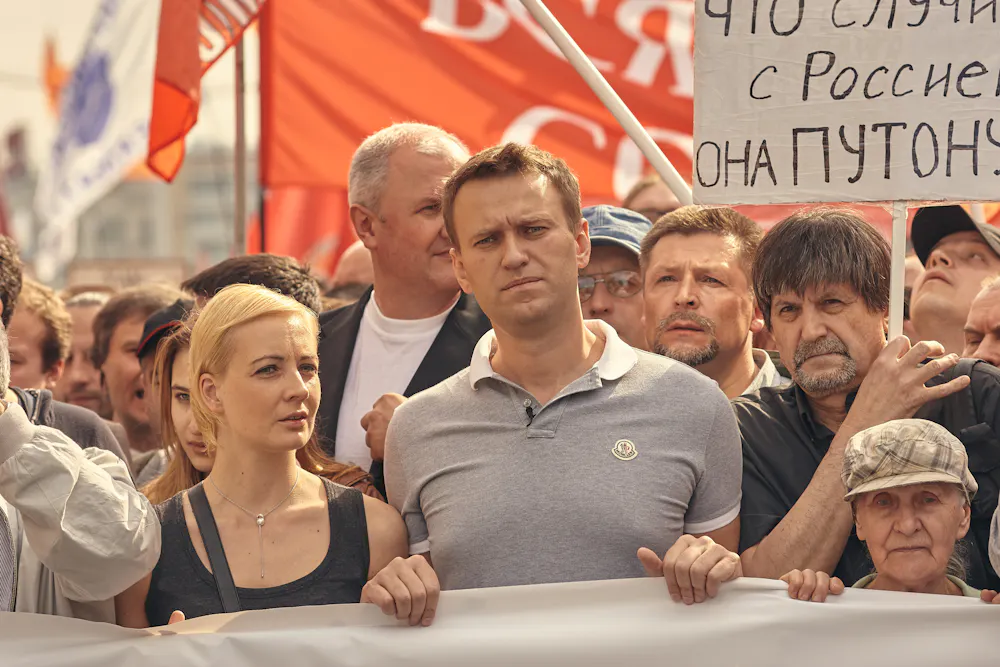
Alexei Navalny and his wife, Yulia Navalnaya, at a protest rally in Moscow, May 2012. Dmitry Laudin/Shutterstock
Today, Navalny’s family and team continue his work outside of Russia – and are fighting to keep his name alive back home. But the odds are against them. Polling suggests the share of Russians who say they know nothing about Navalny or his activities roughly doubled to 30% between his return in January 2021 and his death three years later.
Navalny fought against an autocratic system – and paid the price with his life. Given the very real fears Russians may have of voicing support for a man still labelled an extremist by the Putin regime, it’s not easy to assess what people there really think of him and his legacy. But we will also never know how popular Navalny would have been in the “normal” political system he fought for.
What made Navalny the force he was?
Navalny didn’t mean for the humble yellow rubber duck to become such a potent symbol of resistance.
In March 2017, the ACF published its latest investigation into elite corruption, this time focusing on then-prime minister (and former president), Dmitry Medvedev. Navalny’s team members had become masters of producing slick videos that enabled their message to reach a broad audience. A week after posting, the film had racked up over 7 million views on YouTube – an extraordinary number at that time.
The film included shocking details of Medvedev’s alleged avarice, including yachts and luxury properties. In the centre of a large pond in one of these properties was a duck house, footage of which was captured by the ACF using a drone.
Video: ACF.
Such luxuries jarred with many people’s view of Medvedev as being a bit different to Putin and his cronies. As Navalny wrote in his memoir, Medvedev had previously seemed “harmless and incongruous”. (At the time, Medvedev’s spokeswoman said it was “pointless” to comment on the ACF investigation, suggesting the report was a “propaganda attack from an opposition figure and a convict”.)
But people were angry, and the report triggered mass street protests across Russia. They carried yellow ducks and trainers, a second unintended symbol from the film given Medvedev’s penchant for them.
Another reason why so many people came out to protest on March 26 2017 was the organising work carried out by Navalny’s movement.
The previous December, Navalny had announced his intention to run in the 2018 presidential election. As part of the campaign, he and his team created a network of regional headquarters to bring together supporters and train activists across Russia. Although the authorities had rejected Navalny’s efforts to register an official political party, this regional network functioned in much the same way, gathering like-minded people in support of an electoral candidate. And this infrastructure helped get people out on the streets.
The Kremlin saw this as a clear threat. According to a December 2020 investigation by Bellingcat, CNN, Der Spiegel and The Insider, the FSB assassination squad implicated in the Novichok poisoning of Navalny had started trailing him in January 2017 – one month after he announced his run for the presidency.
At the protests against Medvedev, the authorities’ growing intolerance of Navalny was also on display – he was detained, fined and sentenced to 15 days’ imprisonment.
The Medvedev investigation was far from the beginning of Navalny’s story as a thorn in the Kremlin’s side. But this episode brings together all of the elements that made Navalny the force he was: anti-corruption activism, protest mobilisation, attempts to run as a “normal” politician in a system rigged against him, and savvy use of social media to raise his profile in all of these domains.
Courting controversy
In Patriot, Navalny writes that he always “felt sure a broad coalition was needed to fight Putin”. Yet over the years, his attempts to form that coalition led to some of the most controversial points of his political career.
In a 2007 video, Navalny referred to himself as a “certified nationalist”, advocating for the deportation of illegal immigrants, albeit without using violence and distancing himself from neo-Nazism. In the video, he says: “We have the right to be Russians in Russia, and we’ll defend that right.”
Although alienating some, Navalny was attempting to present a more acceptable face of nationalism, and he hoped to build a bridge between nationalists and liberals in taking on the Kremlin’s burgeoning authoritarianism.
But the prominence of nationalism in Navalny’s political identity varied markedly over time, probably reflecting his shifting estimations of which platform could attract the largest support within Russia. By the time of his thwarted run in the 2018 presidential election, nationalist talking points were all but absent from his rhetoric.
However, some of these former comments and positions continue to influence how people view him. For example, following Russia’s annexation of Crimea in 2014, Navalny tried to take a pragmatic stance. While acknowledging Russia’s flouting of international law, he said that Crimea was “now part of the Russian Federation” and would “never become part of Ukraine in the foreseeable future”.
Many Ukrainians take this as clear evidence that Navalny was a Russian imperialist. Though he later revised his position, saying Crimea should be returned to Ukraine, some saw this as too little, too late. But others were willing to look past the more controversial parts of his biography, recognising that Navalny represented the most effective domestic challenge to Putin.
Another key attempt to build a broad political coalition was Navalny’s Smart Voting initiative. This was a tactical voting project in which Navalny’s team encouraged voters to back the individual thought best-placed to defeat the ruling United Russia candidate, regardless of the challenger’s ideological position.
The project wasn’t met with universal approval. Some opposition figures and voters baulked at, or flatly refused to consider, the idea of voting for people whose ideological positions they found repugnant – or whom they viewed as being “fake” opposition figures, entirely in bed with the authorities. (This makes clear that Navalny was never the leader of the political opposition in Russia; he was, rather, the leading figure of a fractious constellation of individuals and groups.)
But others relished the opportunity to make rigged elections work in their favour. And there is evidence that Smart Voting did sometimes work, including in the September 2020 regional and local elections, for which Navalny had been campaigning when he was poisoned with Novichok.
In an astonishing moment captured on film during his recovery in Germany, Navalny speaks to an alleged member of the FSB squad sent to kill him. Pretending to be the aide to a senior FSB official, Navalny finds out that the nerve agent had been placed in his underpants.
How do Russians feel about Navalny now?
It’s like a member of the family has died.
This is what one Russian friend told me after hearing of Navalny’s death a year ago. Soon afterwards, the Levada Center – an independent Russian polling organisation – conducted a nationally representative survey to gauge the public’s reaction to the news.
The poll found that Navalny’s death was the second-most mentioned event by Russian people that month, after the capture of the Ukrainian city of Avdiivka by Russian troops. But when asked how they felt about his death, 69% of respondents said they had “no particular feelings” either way – while only 17% said they felt “sympathy” or “pity”.
And that broadly fits with Navalny’s approval ratings in Russia. After his poisoning in 2020, 20% of Russians said they approved of his activities – but this was down to 11% by February 2024.
Video: BBC.
Of course, these numbers must be taken for what they are: polling in an authoritarian state regarding a figure vilified and imprisoned by the regime, during a time of war and amid draconian restrictions on free speech. To what extent the drop in support for Navalny was real, rather than reflecting the increased fear people had in voicing their approval for an anti-regime figure, is hard to say with certainty.
When asked why they liked Navalny, 31% of those who approved of his activities said he spoke “the truth”, “honestly” or “directly”. For those who did not approve of his activities, 22% said he was “paid by the west”, “represented” the west’s interests, that he was a “foreign agent”, a “traitor” or a “puppet”.
The Kremlin had long tried to discredit Navalny as a western-backed traitor. After Navalny’s 2020 poisoning, Putin’s spokesman, Dmitry Peskov, said that “experts from the United States’ Central Intelligence Agency are working with him”. The Russian state claimed that, rather than a patriot exposing official malfeasance with a view to strengthening his country, Navalny was a CIA stooge intent on destroying Russia.
Peskov provided no evidence to back up this claim – and the official propaganda wasn’t believed by all. Thousands of Russians defied the authorities by coming out to pay their respects at Navalny’s funeral on March 1 2024. Many, if not all, knew this was a significant risk. Police employed video footage to track down members of the funeral crowd, including by using facial recognition technology.
The first person to be detained was a Muscovite the police claimed they heard shouting “Glory to the heroes!” – a traditional Ukrainian response to the declaration “Glory to Ukraine!”, but this time referencing Navalny. She spent a night in a police station before being fined for “displaying a banned symbol”.
Putin always avoided mentioning Navalny’s name in public while he was alive – instead referring to him as “this gentleman”, “the character you mentioned”, or the “Berlin patient”. (The only recorded instance of Putin using Navalny’s name in public when he was alive was in 2013.)
However, having been re-elected president in 2024 and with Navalny dead, Putin finally broke his long-held practice, saying: “As for Navalny, yes he passed away – this is always a sad event.” It was as if the death of his nemesis diminished the potency of his name – and the challenge that Navalny had long presented to Putin.
Nobody can become another Navalny
Someone else will rise up and take my place. I haven’t done anything unique or difficult. Anyone could do what I’ve done.
So wrote Navalny in the memoir published after his death. But that hasn’t happened: no Navalny 2.0 has yet emerged. And it’s no real surprise. The Kremlin has taken clear steps to ensure nobody can become another Navalny within Russia.
In 2021, the authorities made a clear decision to destroy Navalny’s organisations within Russia, including the ACF and his regional network. Without the organisational infrastructure and legal ability to function in Russia, no figure has been able to take his place directly.
More broadly, the fate of Navalny and his movement has had a chilling effect on the opposition landscape. So too have other steps taken by the authorities.
Russia has become markedly more repressive since the start of its war on Ukraine. The human rights NGO First Department looked into the number of cases relating to “treason”, “espionage” and “confidential cooperation with a foreign state” since Russia introduced the current version of its criminal code in 1997. Of the more than 1,000 cases, 792 – the vast majority – were initiated following Russia’s full-scale invasion of Ukraine in 2022.
Russian law enforcement has also used nebulous anti-extremism and anti-terrorism legislation to crack down on dissenting voices. Three of Navalny’s lawyers were sentenced in January 2025 for participating in an “extremist organisation”, as the ACF was designated by a Moscow court in June 2021. The Russian legislature has also passed a barrage of legislation relating to so-called “foreign agents”, to tarnish the work of those the regime regards as foreign-backed “fifth columnists”.
Mass street protests are largely a thing of the past in Russia. Restrictions were placed on public gatherings during the COVID pandemic – but these rules were applied selectively, with opposition individuals and groups being targeted. And opportunities for collective action were further reduced following the full-scale invasion of Ukraine.
Freedom of speech has also come under assault. Article 29, point five of the Russian constitution states: “Censorship shall be prohibited.” But in September 2024, Kremlin spokesperson Peskov said: “In the state of war that we are in, restrictions are justified, and censorship is justified.”
Legislation passed very soon after the 2022 invasion of Ukraine made it illegal to comment on the Russian military’s activities truthfully – and even to call the war a war.
YouTube – the platform so central to Navalny’s ability to spread his message – has been targeted. Without banning it outright – perhaps afraid of the public backlash this might cause – the Russian state media regulator, Roskomnadzor, has slowed down internet traffic to the site within Russia. The result has been a move of users to other websites supporting video content, including VKontakte – a Russian social media platform.
In short, conditions in Russia are very different now compared to when Navalny first emerged. The relative freedom of the 2000s and 2010s gave him the space to challenge the corruption and authoritarianism of an evolving system headed by Putin. But this space has shrunk over time, to the point where no room remains for a figure like him within Russia.
In 2019, Navalny told Ivan Zhdanov, who is now director of the ACF: “We changed the regime, but not in the way we wanted.” So, did Navalny and his team push the Kremlin to become more authoritarian – making it not only intolerant of him but also any possible successor?
There may be some truth in this. And yet, the drastic steps taken by the regime following the start of the war on Ukraine suggest there were other, even more significant factors that have laid bare the violent nature of Putin’s personal autocracy – and the president’s disdain for dissenters.
Plenty for Russians to be angry about
How can we win the war when dedushka [grandpa] is a moron?
In June 2023, Evgeny Prigozhin – a long-time associate of Putin and head of the private military Wagner Group – staged an armed rebellion, marching his forces on the Russian capital. This was not a full-blown political movement against Putin. But the target of Prigozhin’s invective against Russia’s military leadership had become increasingly blurry, testing the taboo of direct criticism of the president – who is sometimes referred to, disparagingly, as “grandpa” in Russia.
And Prigozhin paid the price. In August 2023, he was killed when the private jet he was flying in crashed after an explosion on board. Afterwards, Putin referred to Prigozhin as a “talented person” who “made serious mistakes in life”.
In the west, opposition to the Kremlin is often associated with more liberal figures like Navalny. Yet the most consequential domestic challenge to Putin’s rule came from a very different part of the ideological spectrum – a figure in Prigozhin leading a segment of Russian society that wanted the Kremlin to prosecute its war on Ukraine even more aggressively.
Video: BBC.
Today, there is plenty for Russians to be angry about, and Putin knows it. He recently acknowledged an “overheating of the economy”. This has resulted in high inflation, in part due to all the resources being channelled into supporting the war effort. Such cost-of-living concerns weigh more heavily than the war on the minds of most Russians.
A favourite talking point of the Kremlin is how Putin imposed order in Russia following the “wild 1990s” – characterised by economic turbulence and symbolised by then-president Boris Yeltsin’s public drunkenness. Many Russians attribute the stability and rise in living standards they experienced in the 2000s with Putin’s rule – and thank him for it by providing support for his continued leadership.
The current economic problems are an acute worry for the Kremlin because they jeopardise this basic social contract struck with the Russian people. In fact, one way the Kremlin tried to discredit Navalny was by comparing him with Yeltsin, suggesting he posed the same threats as a failed reformer. In his memoir, Navalny concedes that “few things get under my skin more”.
Although originally a fan of Yeltsin, Navalny became an ardent critic. His argument was that Yeltsin and those around him squandered the opportunity to make Russia a “normal” European country.
Navalny also wanted Russians to feel entitled to more. Rather than be content with their relative living standards compared with the early post-Soviet period, he encouraged them to imagine the level of wealth citizens could enjoy based on Russia’s extraordinary resources – but with the rule of law, less corruption, and real democratic processes.
‘Think of other possible Russias’
When looking at forms of criticism and dissent in Russia today, we need to distinguish between anti-war, anti-government, and anti-Putin activities.
Despite the risk of harsh consequences, there are daily forms of anti-war resistance, including arson attacks on military enlistment offices. Some are orchestrated from Ukraine, with Russians blackmailed into acting. But other cases are likely to be forms of domestic resistance.
Criticism of the government is still sometimes possible, largely because Russia has a “dual executive” system, consisting of a prime minister and presidency. This allows the much more powerful presidency to deflect blame to the government when things go wrong.
There are nominal opposition parties in Russia – sometimes referred to as the “systemic opposition”, because they are loyal to the Kremlin and therefore tolerated by the system. Within the State Duma, these parties often criticise particular government ministries for apparent failings. But they rarely, if ever, now dare criticise Putin directly.
Nothing anywhere close to the challenge presented by Navalny appears on the horizon in Russia – at either end of the political spectrum. But the presence of clear popular grievances, and the existence of organisations (albeit not Navalny’s) that could channel this anger should the Kremlin’s grip loosen, mean we cannot write off all opposition in Russia.
Navalny’s wife, Yulia, has vowed to continue her husband’s work. And his team in exile maintain focus on elite corruption in Russia, now from their base in Vilnius, Lithuania. The ACF’s most recent investigation is on Igor Sechin, CEO of the oil company Rosneft.
But some have argued this work is no longer as relevant as it was. Sam Greene, professor in Russian politics at King’s College London, captured this doubt in a recent Substack post:
[T]here is a palpable sense that these sorts of investigations may not be relevant to as many people as they used to be, given everything that has transpired since the mid-2010s, when they were the bread and butter of the Anti-Corruption Foundation. Some … have gone as far as to suggest that they have become effectively meaningless … and thus that Team Navalny should move on.
Navalny’s team are understandably irritated by suggestions they’re no longer as effective as they once were. But it’s important to note that this criticism has often been sharpest within Russia’s liberal opposition. The ACF has been rocked, for example, by recent accusations from Maxim Katz, one such liberal opposition figure, that the organisation helped “launder the reputations” of two former bank owners. In their response, posted on YouTube, the ACF referred to Katz’s accusations as “lies” – but this continued squabbling has left some Russians feeling “disillusioned and unrepresented”.
So, what will Navalny’s long-term legacy be? Patriot includes a revealing section on Mikhail Gorbachev – the last leader of the Soviet Union, whom Navalny describes as “unpopular in Russia, and also in our family”. He continues:
Usually, when you tell foreigners this, they are very surprised, because Gorbachev is thought of as the person who gave Eastern Europe back its freedom and thanks to whom Germany was reunited. Of course, that is true … but within Russia and the USSR he was not particularly liked.
At the moment, there is a similar split in perceptions of Navalny. Internationally, he was nominated for the Nobel Peace Prize, awarded the Sakharov Prize by the European Parliament, and a documentary about him won an Oscar.
But there are also those outside of Russia who remain critical: “Navalny’s life has brought no benefit to the Ukrainian victory; instead, he has caused considerable harm,” wrote one Ukrainian academic. “He fuelled the illusion in the west that democracy in Russia is possible.”
Trailer for the Oscar-winning documentary Navalny.
Inside Russia, according to Levada Center polling shortly after his death, 53% of Russians thought Navalny played “no special role” in the history of the country, while 19% said he played a “rather negative” role. Revealingly, when commenting on Navalny’s death, one man in Moscow told RFE/RL’s Russian Service: “I think that everyone who is against Russia is guilty, even if they are right.”
But, for a small minority in Russia, Navalny will go down as a messiah-like figure who miraculously cheated death in 2020, then made the ultimate sacrifice in his battle of good and evil with the Kremlin. This view may have been reinforced by Navalny’s increasing openness about his Christian faith.
Ultimately, Navalny’s long-term status in Russia will depend on the nature of the political system after Putin has gone. Since it seems likely that authoritarianism will outlast Putin, a more favourable official story about Navalny is unlikely to emerge any time soon. However, how any post-Putin regime tries to make sense of Navalny’s legacy will tell us a lot about that regime.
While he was alive, Navalny stood for the freer Russia in which he had emerged as a leading opposition figure – and also what he called the “Beautiful Russia of the Future”. Perhaps, after his death, his lasting legacy in Russia remains the ability for some to think – if only in private – of other possible Russias.
To hear about new Insights articles, join the hundreds of thousands of people who value The Conversation’s evidence-based news. Subscribe to our newsletter.
Ben Noble has previously received funding from the British Academy and the Leverhulme Trust. He is an Associate Fellow of Chatham House.
Clarification of the duties owed by insolvency practitioners appointed to corporate trustee entities4 min read
Further to our previous Insight, the High Court has confirmed that a successor trustee does not owe a fiduciary obligation to a former trustee in respect of the entitlement of the former trustee to indemnification out of the trust assets. Nor does the successor trustee owe a fiduciary obligation to a former trustee in respect of the commensurate beneficial interest that the former trustee has in the trust assets.
Background
Anthony Naaman was a judgment creditor of a former trustee and was subrogated to the former trustee’s entitlement to indemnification. Jaken Properties Australia Pty Limited (Jaken) was the successor trustee. During its time as the successor trustee, Jaken transferred trust assets to third parties leaving insufficient trust assets to satisfy the former trustee’s entitlement to indemnification (Third Parties). Mr Naaman sought relief in the Supreme Court of New South Wales to enforce his judgment debt. Mr Naaman claimed that Jaken’s transfers of trust assets to the Third Parties were part of a dishonest and fraudulent design in breach of fiduciary duties owed by Jaken to the former trustee.
The decisions
Supreme Court decision
At first instance, the primary judge determined that a successor trustee owes a former trustee a fiduciary obligation not to deal with the trust assets so as to destroy, diminish or jeopardise the former trustee’s entitlement to indemnification. The court found that Jaken had ‘engaged in a dishonest and fraudulent design to strip itself of assets that might otherwise be available to satisfy [the former trustee’s] power of indemnity’ to which Mr Naaman was subrogated. In light of the identified fiduciary obligation, the court found that the Third Parties had knowingly assisted in the dishonest and fraudulent breach of that identified fiduciary obligation, and were amenable to orders for equitable compensation and to account.
Court of Appeal decision
On appeal, Justice Leeming, with whom Justice Kirk agreed in separate reasons, concluded that Jaken did not owe a fiduciary obligation to the former trustee at any time. Instead, the majority held that the only final recourse the former trustee had against Jaken was the appointment of a receiver. While Justice Leeming accepted that a successor trustee ‘is subject to a duty not to deal with [the trust] assets so as to prejudice the former trustee’s entitlement to be indemnified from those assets’, this duty was not fiduciary.
High Court decision
In Anthony Naaman v Jaken Properties Australia Pty Limited ACN 123 423 432 & Ors [2025] HCA 1, the sole question for determination was whether a successor trustee owes a fiduciary obligation to a former trustee in respect of the former trustee’s entitlement to indemnification out of trust assets or the commensurate beneficial interest in the trust assets that the former trustee retains following replacement of the former trustee by the successor trustee. By a 4:3 majority, the Court held that a successor trustee does not owe such a fiduciary duty to the former trustee. The explanation for that answer lies in the nature of a trustee’s entitlement to indemnification out of the trust assets being an entitlement to have the trust assets applied for the purpose of recouping expenditure or exonerating liability properly incurred by the trustee.
Further, the majority noted that one person does not come into a fiduciary relationship with another person merely by reason of holding property in which the other person has an equitable proprietary interest. Nor is a fiduciary relationship between the person holding the property and the other person having the equitable proprietary interest brought into existence merely by adding the circumstance that the person holding the property knows the other person has such an interest in the property or knows the other person claims to have such an interest in it.
In coming to its decision the Court noted that, all times since its replacement by Jaken:
the former trustee was able to enforce its entitlement by bringing a proceeding against Jaken for final relief in the form of an order for the sale of the trust assets or for payment out of trust funds; and
the former trustee was able to protect its entitlement from being destroyed, diminished or jeopardised by the conduct of Jaken by filing an interlocutory injunction or appointing a receiver.
However, despite being available to the former trustee, no such action was taken.
Given Jaken did not owe the former trustee a fiduciary obligation, the remedies of equitable compensation and account were not available to the former trustee against the Third Parties.
Key takeaways
It is not uncommon for insolvency practitioners to be appointed to insolvent former trustee companies. The conventional approach taken by insolvency practitioners to satisfy a former corporate trustee’s right of indemnity against trust assets it no longer has ownership of is to apply to a court for the appointment of a receiver over those assets. This generally remains the most effective way for a former corporate trustee to satisfy its right of indemnity.
However, in cases where there is a risk that the successor trustee will dissipate trust assets, the High Court’s decision tells us that insolvency practitioners should consider promptly seeking interlocutory injunctive relief to preserve the status quo, even before a court hears an application to appoint a receiver.
Should you wish to discuss further, please do not hesitate to contact one of our experts.
Police are investigating after a Dog Operations vehicle was set alight over the weekend.
Just before 10.30pm on Sunday 16 February, police were called to Sussex Court at Oakden in response to a disturbance.
A Dog Operations patrol was called in to assist and the officer parked the vehicle on Sussex Court.
PD Jax and his handler exited the car and began searching the area, while PD Gus remained in the rear of the vehicle.
About 15 minutes later the officer noticed a dark figure near the rear of the vehicle and saw something impact the rear open tailgate and burst into flames.
The officer quickly approached the vehicle and put the fire out. Thankfully, PD Gus did not require treatment and was unaffected by the fire.
MFS crews attended and checked the utility and advised only minor damage was caused and it was safe to continue driving.
Crime Scene officers attended to examine the car and the scene.
Police are investigating the incident and ask anyone who saw any suspicious activity in the area, has CCTV or dashcam footage or has information that may assist to please contact Crime Stoppers.
You can anonymously provide information to Crime Stoppers online at www.crimestopperssa.com.au or call 1800 333 000.
Despite the perceived outrage at Khaled Sabsabi’s depiction of Hassan Nasrallah in his 2007 work You, Australian art has long made subjects of outlaws and questionable figures. And it is all the richer for it.
Why is the Albanese government allowing a person who highlights a terrorist leader in his artwork to represent Australia on the international stage at the Venice Biennale?
I agree with you that any glorification of the Hezbollah leader Nasrallah is inappropriate.
This was followed by disapproval from Arts Minister Tony Burke. Within 24 hours, Creative Australia’s board announced Khaled Sabsabi and curator Michael Dagostino, the nominated artistic team for the Australian Pavilion at the 2026 Venice Biennale, had been scratched.
The news sparked shock resignations at Creative Australia, private funding retractions and widespread outrage across the Australian and international arts sectors.
The work in question, You, isn’t related to Sabsabi’s proposed 2026 Biennale work. It is an experimental video artwork which engages with the complexities of the 2006 Lebanon War and how Sabsabi, who was born in Tripoli and migrated to Australia in 1978, may have experienced this war remotely via newsfeed.
The work features images of now-deceased Lebanese Hezbollah leader Hassan Nasrallah. It should be noted the work was made in 2007, 14 years before Australia determined Hezbollah to be a terrorist organisation. It resides in the prestigious collection of Sydney’s Museum of Contemporary Art.
A double standard
Prior to Sabsabi, a number of prominent Australian artists have depicted outlaws and controversial figures in their work. So how were those works received?
Let’s look at Sidney Nolan’s Ned Kelly series as an example. These 27 famous paintings depict the notorious bushranger Edward (Ned) Kelly’s final days in 1880. Nolan painted the series between 1946 and 1947, in the aftermath of the catastrophic second world war.
The works can be understood as an effort to investigate homegrown violence in Australia’s history, wherein the outlaw is a metaphor used to explore conflicting migrant/settler cultures among the bright and dusty central Victorian landscape.
Similarly, late Australian painter and 2000 Archibald Prize winner Adam Cullen did not meet much controversy when his 2002 portrait of convicted violent criminal Mark “Chopper” Read was installed in the Art Gallery of NSW. That same year, Cullen illustrated Mark Read’s children’s book, Hooky the Cripple.
An acclaimed artist, Cullen is revered for depicting violence and darkness in Australian culture. His works reside in most state and national collections.
Art thrives through diverse perspectives
Marri Ngarr artist Ryan Presley’s 2018 series Blood Money revises Australian banknotes to feature historical First Nations figures, and forms part of the Reserve Bank of Australia’s art collection.
Works in the series include First Nations colonial resistance fighters and outlaws Jandamarra (1873–97), Woloa (1800-31), Pemulwuy (1750-1802) and Dundalli (circa 1820-55).
These individuals waged violence against the Crown and were classified as enemy combatants in their time. Yet it’s fair to say they make compelling and appropriate subjects for Presley’s art, which helps us better understand Australia’s complex and violent history.
Iranian-born Australian photographer Hoda Afshar’s Agonistes (2020), an award-winning portrait series with accompanying video, features various Australian whistleblowers, including Witness K Lawyer Bernard Collaery and the incarcerated Afghan Files whistleblower David McBride.
Each figure depicted in Afshar’s portraits has faced punishment and persecution by local authorities, in part due to Australia’s weak whistleblower protection laws.
Khaled Sabsabi is a distinguished Australian artist whose Biennale proposal won a rigorous open tender to be exhibited in Venice 2026. Spanning 30 years, his work examines spiritualism, optimism and the intricate beauty of a migrant Australian experience that’s particularly unique to the global microcosm of Western Sydney.
If artists are to be cancelled for making works that spark “divisive debate”, as Creative Australia has called it, there won’t be much art left to see.
Ella Barclay has previously received funding from Creative Australia.
After a rainbow event at Te Atatū Community Centrewas stormed and shut down over the weekend, ACT Justice spokesperson Todd Stephenson is calling for cross-party commitment to free speech, freedom of assembly, and the rule of law.
“A group of Kiwis should be able to get together at a private event to share values and ideas. On Saturday, a group was denied that right. Brian Tamaki’s mob used sheer numbers to push past library staff and shut down a rainbow event.
“Activists on the political left have spent years embracing cancel culture, deplatforming, and the thug’s veto. Now their conservative opponents are using the exact same tactics.
“Two years ago, a left-wing mob shut down a transgender-critical event in Albert Park, assaulting some of the attendees. Labour and Green MPs celebrated the success of the thug’s veto – the same MPs who are now aghast at Tamaki’s successful use of the same tactic.
“When it comes to free speech, you don’t get to pick and choose. Parties on both sides of politics need to loudly and consistently stand up for the rights of not just their allies, but their political opponents, to peacefully assemble and speak.
“Supporters of the thug’s veto often justify violence on the basis of safety. Brian Tamaki has suggested children at the Te Atatu event were being put at risk. If you think that’s the case, you should call the Police, not call up your mates to deal out vigilante justice. And if it’s found the speaker isn’t breaking any law, you can use your democratic rights to get the law changed. That’s how things work under rule of law and democracy.”
It’s an unfortunate fact that bad people sometimes want guns. And while laws are designed to prevent guns falling into the wrong hands, the determined criminal can be highly resourceful.
There are three main ways to source an illegal weapon: find a lawful owner willing to provide one unlawfully, buy one from another criminal, or make your own.
The first two options aren’t as easy as they sound. The buyer might “know a guy” willing to sell, but the seller generally has good reason to be cautious about who they sell to.
The price of the right firearm can be high, too, as is how “clean” its history is. No criminal wants to be connected to someone else’s crimes by their weapon’s history.
Which leads us to the third option. Privately made firearms, manufactured to avoid detection by the authorities, are nothing new. What has grown is the computer-aided manufacture, of which 3D-printing technology is the best known form, enabling manufacture without traditional gunsmithing skills.
The resulting “ghost guns” will potentially become more prevalent in New Zealand, and are already posing a significant challenge in overseas jurisdictions. With public submissions on the planned rewriting of the Arms Act closing at the end of February, it’s an issue we can’t ignore.
No room for complacency
Although blueprints of fully 3D-printed firearms are most common, hybrid designs, conversion kits, and firearms components sold as a kit or as separate pieces, are all gaining ground.
These are all far more advanced and deadly than the homemade wood and metal weapon used in 2022 to kill former Japanese Prime Minister Shinzo Abe.
Their ease of manufacture, improved reliability and performance, non-traceability and lower cost all appear to be driving demand. There is also the ideological attraction of avoiding state scrutiny that makes 3D-printing popular with far-right extremist groups.
This growth mirrors overseas trends. But it’s important to keep the numbers in perspective. Of the 9,662 firearms (including airguns) the New Zealand Police seized between August 2016 and July 2022, the most common were conventional rifles and shotguns.
However, that is no cause for complacency. If proposed firearms law reforms – such as a new registry – help shrink the black market, we can expect the ghost gun market to grow.
3D printed guns and gun conversion devices held by the US National Firearm Reference Vault. Getty Images
Gaps in the law
Legislation passed in 2020 makes the crime of illegal manufacturing (by unlicensed people) punishable by up to ten years’ imprisonment.
Additional penalties can be added for making certain prohibited items, such as large-capacity magazines. In October last year, an Otago man became the first to be imprisoned in New Zealand for 3D-printing firearms.
Despite this, and the foreseeable risk, there are several significant gaps in New Zealand law.
1. Making guns detectable
Unlike the US and some other countries, New Zealand does not mandate that every gun be detectable by containing enough metal to set off X-ray machines and metal detectors.
The US also prohibits any firearms with major components that do not show up accurately in standard airport imaging technology.
2. Penalties for obtaining blueprints
While the manufacture of 3D-printed firearms is illegal, there is nothing specific in New Zealand law about downloading blueprints.
There may be scope within existing censorship laws around downloading objectionable material. But this may be limited by the need to classify each plan or blueprint as objectionable. And artificial intelligence means these plans can change and evolve rapidly.
More wholesale laws covering the computer-aided manufacture of firearms or their individual parts would be preferable.
Canada, for example, introduced recent changes to firearms law making it a crime to access or download plans or graphics. Knowingly sharing or selling such data online for manufacturing or trafficking is also a crime, with penalties of up to ten years in prison.
New South Wales, Tasmania and South Australia are all making new laws in this area. In the case of South Australia, offenders face up to 15 years in prison for the possession of 3D-printer firearms blueprints.
3. Preventing ‘ghost ammunition’
Privately manufactured firearms still require ammunition to be effective, and the Arms Act is only partly effective in this area.
But that obligation does not apply when firearms licence holders give, share or otherwise supply ammunition among themselves. Furthermore, there are only limited regulations around obtaining the precursors or tools for making ammunition, with only a few key ingredients, like gunpowder, restricted to licence holders.
This is similar to the Australian approach. But Australia also requires licensed owners to purchase only the type of ammunition required for their specific firearms type.
Trying to the correct balance here is tricky: the law must be practical to work but also ensure a potential ghost gun market does not create a “ghost ammunition” market, too.
The ability to privately manufacture firearms, by computer-aided methods in particular, is a foreseeable and potentially hard-to-police problem. But by learning from other jurisdictions and making a few simple law changes, New Zealand can move now to make communities safer.
The author thanks Clementine Annabell for assisting with the research for this article.
Alexander Gillespie is a recipient of a Borrin Foundation Justice Fellowship to research comparative best practice in the regulation of firearms. He is also a member of the Ministerial Arms Advisory Group. The views expressed here are his own and not to be attributed to either of these organisations.
SALT LAKE CITY, Utah — The first woman presidentially appointed as the United States Attorney for the District of Utah and sworn into office as the 38th United States Attorney to serve in the State of Utah, leaves the U.S. Attorney’s Office. The Honorable Trina A. Higgins was nominated by President Joseph R. Biden Jr. on January 31, 2022. Her last day as United States Attorney is February 16, 2025.
Under Higgins’ leadership, the U.S. Attorney’s Office in Utah focused on cases that have the largest impact and cause the most harm to Utah citizens. Working with federal, state, local, and tribal law enforcement partners, the U.S. Attorney’s Office significantly increased the number of financial crime prosecutions in Utah; brought more complex narcotics and firearm cases focused on defendants higher in criminal organizations; and prosecuted many significant violent crime cases, including murders, sexual assaults, child exploitation, human trafficking, robberies, and carjackings.
During her tenure, The U.S. Attorney’s Office tried 35 jury trials, including three homicides committed in Tribal communities. United States Attorney Higgins was the trial attorney in one case where a man brutally murdered a Navajo woman in front of her two young daughters in the Navajo Nation. The jury found him guilty, and he was sentenced to life in prison.
United States Attorney Higgins also served on several Attorney General’s Advisory Committee subcommittees for Attorney General Merrick B. Garland. Those included the Environmental Justice Subcommittee, the Terrorism and National Security Subcommittee, and the Native American Issues Subcommittee.
Maintaining the United States Attorney’s strong partnerships with federal, state, local, and tribal law enforcement agencies, United States Attorney Higgins made it a priority to strengthen and build upon those relationships to pursue justice and better serve the people of Utah.
Leaders in the law enforcement community offered comments regarding U.S Attorney Higgins’ service.
“Strong partnerships between law enforcement and prosecutors are essential to upholding the rule of law. U.S. Attorney Higgins has been an invaluable friend to the FBI and a staunch supporter of our mission,” said Mehtab Syed, Special Agent in Charge of the Salt Lake City FBI. “During her tenure, she championed the safety of Utahns, and we thank her for her years of dedicated public service.”
“United States Attorney Trina Higgins has been an engaged and dedicated law enforcement partner as well as a steadfast advocate of Project Safe Neighborhoods,” said ATF Special Agent in Charge Brent Beavers. “Her extensive experience as a career prosecutor, and unwavering commitment in her pursuit of justice have been pivotal in the successful prosecution of many complex cases.”
“I would like to thank United States Attorney Higgins for her many years of dedicated service as a federal prosecutor and as the U.S. Attorney for the District of Utah,” said U.S. Marshal Justin Martinez of the District of Utah. “USA Higgins is a consummate professional and has always kept the lines of communication open. USA Higgins is an extremally effective leader and a real change agent. She will be greatly missed by the U.S. Marshals Service and every federal, state and local agency she works with.”
“With appreciation, we thank United States Attorney Higgins for her dedication to DEA efforts in the state of Utah,” said DEA Rocky Mountain Field Division Special Agent in Charge Jonathan Pullen. “Cooperation and hard work between DEA and the U.S. Attorney’s Office for the District of Utah, has led to many successful prosecutions. On behalf of the men and women of DEA, we wish nothing but the best for United States Attorney Higgins now and into the future.”
“HSI is grateful for its long-standing relationship with United States Attorney Higgins and her staff,” said HSI Utah Assistant Special Agent in Charge Brandon Crane. “The collaboration has had a significant impact on public safety throughout Utah and stands as an example for future collaborations.”
“United States Attorney Higgins has been a tremendous partner in supporting the U.S. Postal Inspection Service’s efforts to safeguard the U.S. Mail, postal workers, and the public,” said Glen Henderson, Inspector in Charge of the Phoenix Division. “United States Attorney Higgins was committed to holding accountable those who harm postal employees or exploit the U.S. Mail for illicit activities, including narcotics distribution. It has been a pleasure to collaborate with United States Attorney Higgins and we wish her continued success in all her future endeavors.”
“I want to thank United States Attorney Higgins for her partnership and outstanding leadership in working with our local law enforcement agencies,” said Salt Lake County Sheriff Rosie Rivera. “She prioritized complex and violent offender cases to improve safety within the communities we serve.”
“United States Attorney Trina Higgins’ dedication to justice and service to the community is truly exceptional and will be greatly missed,” said Salt Lake City Police Chief Mike Brown. “Her career as a dedicated prosecutor made our city safer—whether it was prosecuting some of our first Project Safe Neighborhood cases or complex, high-profile, or challenging cases. United States Attorney Higgins handled every case with professionalism and a true sense of duty. Never did she hide from the difficult cases. We will always remember USA Higgins’ compassion for crime victims and their families. She made sure victims’ voices were heard and understood in the pursuit of justice. While we will miss United States Attorney Higgins greatly, I know her legacy will endure through the District of Utah because of her distinguished career.”
United States Attorney Higgins has been in public service for 30 years. Prior to her leadership role as U.S. Attorney, Higgins served as an Assistant United States Attorney for over two decades and as a Salt Lake County Deputy District Attorney. At the time of her nomination, Higgins was serving as the Mediterranean Legal Advisor at the United States embassies in Valletta, Malta and Nicosia, Cyprus. A Utah native, Higgins earned her undergraduate degree from Weber State University and Juris Doctor degree from the S.J. Quinney College of Law at the University of Utah, where she also worked as an adjunct professor for a decade.
DLE NEWS RELEASE – Warning Public of Latest Phone Scam 2025
Posted on Feb 14, 2025 in Latest Department News, Newsroom
DEPARTMENTOFLAWENFORCEMENT
KaʻOihanaHoʻokōKānāwai
JOSHGREEN,M.D.
GOVERNOR
KEKIAʻĀINA
MIKE LAMBERT
DIRECTOR
KALUNAHO‘OKELE
SHERIFF IMPERSONATORS, EXTORTION SCAM ALERT
FOR IMMEDIATE RELEASE
February 14, 2025
HONOLULU – Recurring Sheriff impersonator incidents have prompted the Department of Law Enforcement (DLE) to issue additional scam warnings. In recent weeks, several people have had callers claiming to be deputy sheriffs tell them that they have outstanding warrants because they failed to appear in court. These are similar to scam calls that happened around this time last year.
Hawaiʻi residents are also advised not to provide credit card numbers, bank account information or other personal information to callers claiming to represent a law enforcement agency.
If you receive a call, text or email matching this scam, please alert the DLE Criminal Investigation Division by calling 808-587-5050.
TIPS TO PROTECT YOURSELF:
Do not communicate with unsolicited email or phone text senders.
Do not open emails, attachments or links sent by text from unknown individuals.
Never provide personal information of any sort via phone, text or email. Be aware that many emails requesting your personal information appear to be legitimate.
SACRAMENTO – Governor Gavin Newsom today announced his appointment of 14 Superior Court Judges: seven in Los Angeles County; one in Modoc County; two in Riverside County; one in San Diego County; one in San Mateo County; one in Tulare County; and one in Ventura County.
Los Angeles County Superior Court
Phu Nguyen, of Los Angeles County, has been appointed to serve as a Judge in the Los Angeles County Superior Court. Nguyen has served the Los Angeles County Superior Court as Court Counsel since 2017. She has been a Lecturer in Law at UCLA School of Law since 2022. Nguyen served as Senior Counsel at Dykema Gossett from 2014 to 2017, an Associate at Fayer Gipson from 2013 to 2014, and an Associate at Huron Law Group from 2008 to 2012. Nguyen was an Associate at Irell & Manella from 2006 to 2007. She received a Juris Doctor degree from Yale Law School. She fills the vacancy created by the retirement of Judge Louise Suzette Clover. Nguyen is a Democrat.
Sonia Dujan, of Ventura County, has been appointed to serve as a Judge in the Los Angeles County Superior Court. She has served as a Commissioner at the Los Angeles County Superior Court since 2024. Dujan has been a sole practitioner since 2004. She received a Juris Doctor degree from University of San Francisco School of Law. She fills the vacancy created by the retirement of Judge Margaret Oldendorf. Dujan is a Democrat.
Mike Madokoro, of Los Angeles County, has been appointed to serve as a Judge in the Los Angeles County Superior Court. Madokoro has been a Partner at Bowman and Brooke LLP since 1999, served as a Managing Partner or Co-Managing Partner from 2006 to 2024. He previously worked as an Associate at Morgan, Wenzel and McNicholas from 1990 to 1994. Madokoro served as a Law Clerk and Associate at Adams and Kirkpatrick from 1989 to 1990. Madokoro received a Juris Doctor degree from McGeorge School of Law. He fills the vacancy created by the retirement of Judge Gergory Keosian. Madokoro is a Republican.
James Montgomery Jr., of Los Angeles County, has been appointed to serve as a Judge in the Los Angeles County Superior Court. Montgomery has served as a Commissioner at Los Angeles County Superior Court since 2023. He was a Partner at Gibbs Giden Locher Turner Senet & Wittbrodt LLP from 1999 to 2023. He served as an attorney at Daniels, Fine, Israel, Schonbuch & Lebovits, LLP from 1982 to 1999. Montgomery received a Juris Doctor degree from UCLA School of Law. He fills the vacancy created by the retirement of Judge Yvette Palazuelos. Montgomery is a Democrat.
Jacob Yim, of Los Angeles County, has been appointed to serve as a Judge in the Los Angeles County Superior Court. Yim has served as the Deputy-in-Charge of the Real Estate Fraud Section in the White Collar Crime Division of the Los Angeles County District Attorney’s Office since 2022. Yim has served as a deputy in several roles and units of the Los Angeles County District Attorney’s Office from 2000 to 2008 and 2009 to 2022. He was a Special Assistant United States Attorney at the United States Attorney’s Office – Domestic Security and Immigration Crimes Section from 2008 to 2009. Yim received a Juris Doctor degree from Southwestern University School of Law. He fills the vacancy created by the retirement of Judge Carol Elswick. Yim is a Democrat.
Helen Yang, of Los Angeles County, has been appointed to serve as a Judge in the Los Angeles County Superior Court. Yang was a Partner at Squire Patton Boggs since 2016 and an Associate at Squire Patton Boggs from 2005 to 2008 and 2009 to 2016. She was Deputy in the Riverside County Counsel’s Office from 2008 to 2009. Yang received a Juris Doctor degree from Cornell Law School. She fills the vacancy created by the retirement of Judge Michael Linfield. Yang is registered as no party preference.
Louis Parise, of Los Angeles County, has been appointed to serve as a Judge in the Los Angeles County Superior Court. Parise has served various roles as a Deputy District Attorney at the Los Angeles County District Attorney’s Office since 1998. He was an Associate Attorney at Ferrari, Olsen, Ottoboni, and Bebb from 1997 to 1998. Parise received a Juris Doctor degree from Santa Clara School of Law. He fills the vacancy created by the retirement of Judge Martin L. Herscovitz. Parise is registered as no party preference.
Modoc County Superior Court
Randall Harr, of Shasta County, has been appointed to serve as a Judge in the Modoc County Superior Court. Harr was a Partner at Maire & Deedon since 2022. He worked at the Law Office of Randall Harr from 2011 to 2022. Harr served as a Partner at Gifford & Harr from 2009 to 2011. He was a Partner at Harr Arthofer & Ayres from 2001 to 2009. Harr worked at Borton Petrini & Conron as a Partner from 1985 to 2000 and an Associate Attorney from 1982 to 1985. Harr received a Juris Doctor degree from McGeorge School of Law. He fills the vacancy created by the retirement of Judge Francis W. Barclay. Harr is registered as no party preference.
Riverside County Superior Court
Mickie Reed, of Riverside County, has been appointed to serve as a Judge in the Riverside County Superior Court. Reed has served as a Commissioner in the Riverside County Superior Court since 2014. She previously worked as a Professor of Professional Responsibility at the California Desert Trial Academy from 2014 to 2018. Reed was a sole practitioner from 1996 to 2014. She worked as a Planning Commissioner at the City of Indio from 2004 to 2010. Reed received a Juris Doctor degree from Western State University School of Law. She fills the position created by the retirement of Judge Gregory Olson. Reed is a Democrat.
Michael Martin, of Riverside County, has been appointed to serve as a Judge in the Riverside County Superior Court. Martin previously served as Lead Appellate Court Attorney at the Second District Court of Appeal, Division 6 since 2017. Martin worked as an Adjunct Professor at The Santa Barbara and Ventura Colleges of Law from 2017 to 2022. He was an Adjunct Professor at the University of California College of Law, San Francisco in 2021. Martin was a Legal Research Assistant at the San Francisco County Superior Court from 2014 to 2017. He served as a Contract Attorney at Valdez Todd & Doyle LLP in 2014. Martin was a Contract Attorney at Harowitz & Tigerman LLP in 2014. He served as a Contract Attorney at Podo Legal in 2013. Martin worked as a Contract Attorney at the Law Office of E. Craig Moody in 2013. He was a Bridge Fellow at Legal Services of Northern California in 2012. Martin received a Juris Doctor degree from University of California College of Law, San Francisco. He fills the vacancy created by the retirement of Judge Irma Asberry. Martin is a Democrat.
San Diego County Superior Court
Chandra Reid, of San Diego County, has been appointed to serve as a Judge in the San Diego County Superior Court. Reid has served as a Commissioner at the San Diego County Superior Court since 2021. She served as a Deputy District Attorney in several roles at the San Diego County District Attorney’s Office from 2005 to 2021. She served as a Deputy City Attorney at the San Diego City Attorney’s Office from 2001 to 2004. Reid received a Juris Doctor degree from Catholic University Law School. She fills the vacancy created by the retirement of Judge Kenneth Medel. Reid is a Democrat.
San Mateo County Superior Court
Mark McCannon, of San Francisco County, has been appointed to serve as a Judge in the San Mateo County Superior Court. McCannon has served at Alameda County Superior Court as a Superior Court Judge since 2013. He worked as a Deputy District Attorney at the Alameda County District Attorney’s Office from 1997 to 2013. McCannon received a Juris Doctor degree from the University of Pacific, McGeorge School of Law. He fills the vacancy created by the retirement of Judge Marie S. Weiner. McCannon is a Democrat.
Tulare County Superior Court
Jason Taylor, of Kings County, has been appointed to serve as a Judge in the Tulare County Superior Court. Taylor has worked as a sole practitioner since 2014. He worked at the Tulare County Public Defender Conflict Panel as a Contract Attorney from 2018 to 2025. Taylor served at the Kings County Public Defender’s Office as a Contract Attorney from 2019 to 2022. He worked at the Tulare County Public Defender’s Office as a Deputy Public Defender in 2014. Taylor received a Juris Doctorate degree from the San Joaquin College of Law. He fills the vacancy created by the retirement of Judge Walter L. Gorlick. Taylor is registered as no party preference.
Ventura County Superior Court
Amy Van Sickle, of Ventura, has been appointed to serve as a Judge in the Ventura County Superior Court. Van Sickle has served as a Commissioner at the Ventura County Superior Court since 2023. She worked at the Law Office of Amy Van Sickle as an Attorney from 2012 to 2023. Van Sickle worked as an Attorney at Van Sickle & Rowley, LLP from 2003 to 2012. Van Sickle received a Juris Doctorate degree from the Ventura College of Law. She fills the vacancy created by the retirement of Judge Patricia M. Murphy. Van Sickle is a Republican.
The compensation for each of these positions is $244,727.
Press Releases, Recent News
Recent news
Feb 14, 2025
News What you need to know: Governor Newsom today announced that the Delta Conveyance Project has received a required permit to advance the project, which will upgrade the State Water Project to allow the state to capture and move more water efficiently. SACRAMENTO —…
Feb 13, 2025
News What you need to know: Governor Newsom today issued an executive order to cut more red tape and continue streamlining rebuilding, recovery, and relief for survivors of the Los Angeles area firestorms. SACRAMENTO — Today, Governor Gavin Newsom issued an executive…
Feb 12, 2025
News Kate Hoit, of Sacramento, has been appointed Deputy Secretary of Communications at the California Department of Veterans Affairs. Hoit has been the PACT Act Enterprise Program Management Office Communications and Outreach Lead at the U.S. Department of Veterans…
– having regard to its previous resolutions on Georgia, in particular that of 28 November 2024 on Georgia’s worsening democratic crisis following the recent parliamentary elections and alleged electoral fraud(1),
– having regard to Georgia’s status as an EU candidate country, granted by the European Council at its summit of 14 and 15 December 2023,
– having regard to Article 78 of the Georgian Constitution, which demands the implementation of all possible measures to guarantee Georgia’s complete integration into the EU and NATO,
– having regard to the final report of the Organization for Security and Co-operation in Europe (OSCE) on the parliamentary elections held in Georgia on 26 October 2024,
– having regard to Rules 136(2) and (4) of its Rules of Procedure,
A. whereas the democratic backsliding in Georgia has dramatically accelerated since the parliamentary elections of 26 October 2024, which were deeply flawed and marked by grave irregularities, and failed to meet international democratic standards and Georgia’s OSCE commitments; whereas these elections violated the democratic norms and standards set for free and fair elections, failing to reflect the will of the people and rendering the resulting ‘parliament’, and subsequently the ‘president’, devoid of any democratic legitimacy; whereas from the very beginning of its activity, the current Georgian parliament has operated as a one-party (Georgian Dream) organ, which is incompatible with the essence of pluralistic parliamentary democracy;
B. whereas Article 2 of the EU-Georgia Association Agreement(2) concerns the general principles of the agreement, which include democratic principles, human rights and fundamental freedoms;
C. whereas Article 78 of the Georgian Constitution states that the constitutional bodies must take all measures within the scope of their competences to ensure the full integration of Georgia into the European Union;
D. whereas the President of Georgia, Salome Zourabichvili, publicly condemned the parliamentary elections as rigged, declared that she would not recognise them and called for an international investigation; whereas the current Georgian regime, led by the Georgian Dream party and its founder, Bidzina Ivanishvili, has orchestrated an unconstitutional usurpation of power, systematically dismantling democratic institutions, undermining judicial independence and eroding fundamental freedoms and the rule of law, thereby deepening Georgia’s political and constitutional crisis;
E. whereas Georgia has officially held the status of EU candidate country since December 2023; whereas on 28 November 2024, Irakli Kobakhidze announced that Georgia would delay initiating accession talks with the EU and reject its financial assistance until the end of 2028, disregarding the country’s constitutional commitment to European integration and effectively undermining Georgia’s sovereign Euro-Atlantic aspirations;
F. whereas on 28 November 2024, peaceful mass anti-government protests began across the country, demanding new, free and fair elections, an end to political violence and repression, and the return of the country to its European path; whereas the protests have been taking place without interruption for over 75 days;
G. whereas on 14 December 2024, the de facto parliament held a ‘presidential election’ with a single candidate from the Georgian Dream party, former footballer Mikheil Kavelashvili, elected with 224 out of 225 votes cast;
H. whereas Georgia’s self-appointed authorities have plunged the country into a fully fledged constitutional and political crisis, as well as a human rights and democracy crisis; whereas this has been marked by the brutal repression of peaceful protesters, political opponents and media representatives, with judges, prosecutors and police officers actively fabricating politically motivated administrative and criminal charges against protesters, journalists and opposition figures detained during peaceful anti-government demonstrations; whereas, as of December 2024, more than 460 people have been arrested or punished since the protests began, with this number growing by the day;
I. whereas riot police deliberately lacking force identification numbers have forcefully dispersed protesters with tear gas and water cannons; whereas numerous journalists have reported being targeted and beaten, and having their equipment destroyed and personal items stolen; whereas dozens of protesters have been brutally assaulted, and several hundred people have been arrested; whereas Georgia’s Public Defender has revealed that 80 % of those detained reported experiencing violence and inhumane treatment at the hands of law enforcement officers; whereas despite international condemnation, the illegitimate Georgian Government has awarded medals to officials involved in the crackdown;
J. whereas independent media outlets, including TV Formula, TV Mtavari and TV Pirveli, face severe operational and financial constraints due to the regime’s interference, while dozens of media representatives are being subjected to various forms of intense physical and psychological pressure; whereas numerous violent attacks on journalists have been documented, including the severe beatings of Aleksandre Keshelashvili, Maka Chikhladze and Giorgi Shetsiruli, and the harassment of detained journalist Saba Kevkhishvili; whereas on 12 January 2025, the Georgian authorities arrested journalist Mzia Amaghlobeli, who has been in pre-trial detention since then and is on hunger strike in solidarity with all political prisoners in Georgia; whereas she faces between four and seven years in prison;
K. whereas, on the night of 14 January 2025, Giorgi Gakharia, opposition leader of the For Georgia party and former Prime Minister, and Zviad Koridze, journalist and Transparency International activist, were physically assaulted by Georgian Dream officials in separate incidents at the same venue in Batumi;
L. whereas on 2 February 2025, Nika Melia, a leader of the pro-European Akhali party, and Gigi Ugulava, the former mayor of Tbilisi, were arrested during the anti-government protests and subjected to physical violence in detention; whereas on 12 January 2025, Elene Khoshtaria, leader of the Droa political movement, was detained in Batumi;
M. whereas the de facto Georgian authorities have used disproportionate force and excessive violence against peaceful protesters and resorted to arbitrary mass arrests to thwart dissent; whereas independent human rights organisations have reported the systemic mistreatment of detainees, including torture; whereas to date, not a single law enforcement official involved in the brutal crackdowns, arbitrary arrests and mistreatment has been brought to justice;
N. whereas the self-appointed authorities introduced new draconian legislation that came into force on 30 December 2024 and amended the Criminal Code, the Code of Administrative Offences and the Law on Assemblies and Manifestations, imposing further arbitrary restrictions on the rights to freedom of expression and peaceful assembly, introducing, among other things, hefty fines for putting up protest slogans and posters, and granting police the power to detain individuals ‘preventively’ for 48 hours on suspicion of planning to violate the rules governing public assembly; whereas on 3 February 2025, the Georgian Dream party unveiled further draft legislation designed to tighten control, ramping up penalties for a variety of offences directly targeting protestors, critics and political dissent, such as harsher punishments for ‘insulting officials’, the criminalisation of road blocks and an increase in the duration of administrative detention from 15 to 60 days;
O. whereas on 27 January 2025, the Council decided to suspend parts of the EU-Georgia visa facilitation agreement for Georgian diplomats and officials, but failed to impose individual sanctions in response to the continued crackdown; whereas the Hungarian and Slovak Governments have been consistently blocking impactful EU-wide sanctions, preventing the remaining 25 Member States (EU-25) from effectively introducing sanctions against the self-appointed Georgian authorities;
P. whereas several Member States, including Lithuania, Estonia, Latvia and Czechia, have imposed bilateral sanctions on some Georgian politicians, judges and other officials responsible for the brutal crackdown on protesters, violations of human rights and abuse of the rule of law; whereas in December 2024, the United States sanctioned Bidzina Ivanishvili, alongside Georgia’s ‘Minister of Internal Affairs’ Vakhtang Gomelauri and Deputy Head of the Special Tasks Department Mirza Kezevadze, for their involvement in brutal crackdowns on media representatives, opposition figures and protesters; whereas the UK and Ukraine have imposed similar sanctions on high-level Georgian officials; whereas Ivanishvili, through hastily adopted laws tailored to his personal situation, is moving his offshore assets to Georgia in anticipation of further sanctions;
Q. whereas on 29 January 2025, Georgian Dream announced that it would withdraw its delegation from the Parliamentary Assembly of the Council of Europe (PACE) after it demanded new, genuinely democratic parliamentary elections, the release of political prisoners and accountability for perpetrators of violence; whereas UN experts have condemned the pattern of repression and human rights violations in Georgia, while the OSCE has called this suppression a serious breach of the right to freedom of assembly;
R. whereas the ruling Georgian Dream party convened the new parliament in violation of the country’s constitution, resulting in a boycott of parliament by the opposition; whereas on 5 February 2025, the self-appointed ‘parliament’ voted to approve the early termination of the mandates of 49 out of 61 members of parliament, representing the Coalition for Change, Strong Georgia and the United National Movement, in order to strip them of their immunity and facilitate their arrest and prosecution; whereas the same ‘parliament’ established a commission to punish former ruling party United National Movement;
S. whereas a growing number of civil servants have been dismissed after speaking out against the halting of Georgia’s EU accession process; whereas Georgian Dream has amended laws on public service, simplifying procedures to dismiss public servants, several of whom have been dismissed for participating in protests, in a clear attempt to silence critical voices;
1. Condemns the Georgian Dream ‘authorities’ and urges them to immediately cease the violent repression of peaceful protesters, political opponents and media representatives; underlines that Georgia’s self-appointed authorities are currently violating fundamental freedoms, basic human rights and the core international obligations of the country, thereby undermining decades of democratic reforms driven by the country’s political class and civil society; considers Georgia as a state captured by the illegitimate Georgian Dream regime; expresses deep regret over the fact that the ruling Georgian Dream party has abandoned its path towards European integration and NATO membership; recalls that the ongoing democratic backsliding and adoption of anti-democratic laws has effectively suspended Georgia’s EU integration process; reiterates its unwavering support for the Georgian people’s legitimate European aspirations and their wish to live in a prosperous and democratic country;
2. Does not recognise the self-proclaimed authorities of the Georgian Dream party established following the rigged election of 26 October 2024, which was neither free nor fair, was held in violation of democratic norms and standards, and did not reflect the will of the people of Georgia; underlines that the extensive electoral fraud has undermined the integrity of the election process, cast doubt on the legitimacy of the result and eroded public trust, both domestically and internationally, in any new government;
3. Calls for the EU and its Member States, as well as national parliaments and interparliamentary institutions, not to recognise the legitimacy of the Georgian Dream one-party parliament and their appointed president; calls, therefore, on the international community to join the boycott of the self-proclaimed Georgian authorities;
4. Continues to recognise Salome Zourabichvili as the legitimate President of Georgia and representative of the Georgian people; praises her efforts to peacefully steer the country back towards a democratic and European path of development; calls on the President of the European Council to invite President Zourabichvili to represent Georgia at an upcoming European Council meeting and at the next European Political Community summit;
5. Underlines that the settlement of the current political and constitutional crisis in Georgia can only be achieved by way of new parliamentary elections; demands that new elections take place in Georgia within the next few months in an improved electoral environment, overseen by an independent and impartial election administration and monitored through diligent international observation to guarantee a genuinely fair, free and transparent process; encourages the Member States and EU officials to firmly demand new elections and to make any future engagement explicitly conditional on setting a new date for parliamentary elections and establishing a mechanism to ensure they are free and fair;
6. Calls on the Council and the Member States, particularly the EU-25 on a bilateral and coordinated basis, to impose immediate and targeted personal sanctions on Bidzina Ivanishvili, his family and his companies, and to freeze all his assets within the EU for his role in the deterioration of the political process in Georgia, enabling democratic backsliding and acting against the country’s constitutionally declared interests of Euro-Atlantic integration; calls on the French Government to strip Bidzina Ivanishvili of the Legion of Honour and impose individual sanctions on him; welcomes, in this regard, the sanctions imposed bilaterally by Estonia, Latvia, Lithuania and Czechia, as well as those already imposed by the US and the UK;
7. Calls for the EU and its Member States, in particular the EU-25 on a bilateral and coordinated basis, to impose personal sanctions on the officials and political leaders in Georgia responsible for democratic backsliding, electoral fraud, human rights violations and the persecution of political opponents and activists, including Irakli Kobakhidze, Shalva Papuashvili, Vakhtang Gomelauri, Mayor of Tbilisi and Secretary General of the ruling Georgian Dream party Kakha Kaladze, and Chair of the Georgian Dream party Irakli Garibashvili; calls for them to extend these sanctions to judges, including those of the Constitutional Court of Georgia who are passing politically motivated sentences, and representatives of the law enforcement services, as well as to financial enablers tacitly or openly supporting the regime and the owners of regime-aligned media outlets, including TV Imedi, Pos TV and Rustavi 2 TV, for their role in spreading disinformation and seeking to manipulate public discourse in order to sustain the current ruling party’s authoritarian rule;
8. Calls on the Council and the Member States to impose sanctions on Bidzina Ivanishvili’s network of enablers, elite entourage, corrupt financial operatives, propagandists and those facilitating the repressive state apparatus, including, among others, Ekaterine Khvedelidze, Uta Ivanishvili, Tsotne Ivanishvili, Bera Ivanishvili, Gvantsa Ivanishvili, Alexander Ivanishvili, Shmagi Kobakhidze, Ucha Mamatsashvili, Natia Turnava, Ivane Chkhartishvili, Sulkhan Papashvili, Giorgi Kapanadze, Tornike Rizhvadze, Ilia Tsulaia, Kakha Bekauri, Lasha Natsvlishvili, Vasil Maglaperidze, Grigol Liluashvili, Mikheil Chinchaladze, Levan Murusidze, Irakli Rukhadze, Tinatin Berdzenishvili, Tamaz Gaiashvili, Anton Obolashvili and Gocha Enukidze;
9. Maintains the view that the measures taken so far by the EU in response to the flagrant democratic backsliding and reneging on previous commitments does not yet fully reflect the severity of the situation in Georgia and the latest developments; welcomes the Council’s decision to suspend visa-free travel for Georgian diplomats and officials, but considers it as only a first step, which must be followed by tougher measures; deplores the obstruction by the Hungarian and Slovak Governments of the Council decisions on introducing sanctions against individuals responsible for democratic backsliding in Georgia;
10. Emphasises that respect for fundamental rights is vital to the EU’s visa liberalisation benchmarks; reiterates its call on the Commission and the Council to review Georgia’s visa-free status, with the possibility of suspension if it is considered that EU standards on democratic governance and freedoms are not being upheld;
11. Strongly condemns the brutal violence and repression used by Georgia’s ruling regime against peaceful protesters since 28 November 2024; calls for the immediate and unconditional release of all political prisoners and those detained during the anti-government protests; demands the release of journalist Mzia Amaghlobeli, who has been on hunger strike for over four weeks now because of her unjust detention and risks facing critical, irreversible and life-threatening consequences; denounces the assault and beating of former Prime Minister Giorgi Gakharia, resulting in his hospitalisation, followed by the arrest on 2 February 2025 of political leaders including Nika Melia and Gigi Ugulava, as a shocking escalation of state-orchestrated violence by Georgian Dream and its allies against peaceful demonstrators and political opponents; reminds of the detention of Elene Khoshtaria on 12 January 2025 in Batumi;
12. Reiterates its solidarity with the people of Georgia and its vibrant civil society in fighting for their legitimate democratic rights and for a European future for their country; urges the Georgian Government to reverse its current political course and return to implementing the will of the Georgian people for continued democratic reforms that would reopen the prospect of future EU membership;
13. Strongly condemns the enactment of draconian legislation that imposes unjustified restrictions on freedoms of expression and peaceful assembly, and demands the annulment of such recently adopted repressive legislation; urges the Georgian authorities to immediately and unconditionally release all individuals detained for peacefully exercising their fundamental rights to freedoms of expression and peaceful assembly, and to ensure prompt, thorough and impartial investigations into all allegations of unlawful and disproportionate use of force by the law enforcement agencies; considers that the Georgian justice system has been weaponised to stifle dissent, instil fear and silence free speech;
14. Calls for the ‘Georgian authorities’ to take immediate action to ensure the safety and freedom of journalists and to investigate all instances of violence and misconduct by law enforcement agencies; emphasises the importance of fostering a democratic environment where media, civil society and the opposition can operate freely without fear of retaliation or censorship;
15. Demands an independent, transparent and impartial investigation into police brutality and the excessive use of force against peaceful demonstrators; calls for those responsible for human rights violations, including law enforcement and government officials ordering acts of repression, to be held fully accountable before the law;
16. Denounces the launch of an investigation by the Prosecutor’s Office on 8 February 2025 into non-governmental organisations accused of aggravated sabotage, attempted sabotage and assisting foreign and foreign-controlled organisations in hostile activities aimed at undermining the state interests of Georgia, for which they could receive multiple-year sentences; views this action as further escalation of repression by the regime, misuse of the judicial system and accelerated democratic backsliding;
17. Condemns the broader campaign of attacks by the Georgian authorities vilifying civil society organisations and reputable international donors that support democracy, the rule of law and the protection of human rights in Georgia;
18. Denounces the termination by Georgian Dream of the mandates of 49 opposition members of parliament as a sign of further democratic backsliding, and considers this the latest move in Georgian Dream’s attack on political pluralism in the country;
19. Welcomes PACE’s decision to challenge the credentials of Georgia’s parliamentary delegation due to democratic backsliding and human rights abuses; supports PACE’s call for Georgia to immediately initiate an inclusive process involving all political and social actors, including the ruling party, the opposition and civil society, to urgently address the deficiencies and shortcomings noted during the recent parliamentary elections and to create an electoral environment conducive to new, genuinely democratic elections to be announced in the coming months;
20. Notes that Georgia, once a front runner for Euro-Atlantic integration, is undergoing an accelerated process of democratic backsliding, in a seemingly deliberate attempt to demonstrate that the will of the Georgian people no longer determines the country’s future, which could result in the country taking the Belarussian path of political development, transitioning from the current authoritarian state to a dictatorial regime;
21. Deplores the decision of Irakli Kobakhidze to suspend accession talks and reject EU funding until the end of 2028; recalls that all polls consistently show the overwhelming support of the Georgian population for a Euro-Atlantic future; expresses strong support for the Euro-Atlantic aspirations of the Georgian people;
22. Calls for an immediate and comprehensive audit of EU policy towards Georgia due to the democratic backsliding; calls on the Commission to review the EU-Georgia Association Agreement in the light of the self-declared Georgian authorities’ breach of the general principles, as laid down in Article 2, namely respect for democratic principles, the rule of law and fundamental freedoms; points out that non-fulfilment of obligations may result in the conditional suspension of economic cooperation and privileges afforded by the Agreement;
23. Welcomes the Commission’s decision to cease all budgetary support to the Georgian authorities and to suspend the initiation of any future investment projects; encourages the Commission to terminate all financial support for ongoing projects; calls for a moratorium on all investment projects in the field of connectivity; calls on the Commission to start identifying economic sectors of relevance to the oligarchic interests that support and sustain the current authoritarian rule, with a view to a potential future decision about restrictive measures or economic sanctions; calls on the Commission to start identifying connectivity projects that support and sustain the current authoritarian rule and to consider their suspension until a rerun of the parliamentary elections;
24. Condemns the climate of intimidation and polarisation fuelled by statements by Georgian Government representatives and political leaders, as well as by attacks against political pluralism, including through disturbing cases of intimidation and violence against the Georgian democratic political forces and repeated threats to ban opposition parties, to arrest their leaders and even ordinary supporters, and to silence dissent; underlines that anything but the full restoration of Georgia’s democratic standards will entail a further deterioration of EU-Georgia relations, make any move towards EU accession impossible and result in additional sanctions;
25. Calls on the Commission to swiftly redirect the frozen EUR 120 million originally intended as support for the Georgian authorities to enhance the EU’s support for Georgia’s civil society, in particular the non-governmental sector and independent media, which are increasingly coming under undue pressure from the ruling political party and the authorities, as well as to support programmes supporting democratic resilience and electoral integrity; calls for the EU’s funding mechanisms to be adjusted to take into account the needs that arise in a more hostile and anti-democratic environment; highlights the urgency of the need to support civil society in the light of growing repression and the suspension of activities of the US Agency for International Development (USAID), and therefore urges the Commission to ramp up support without delay;
26. Expresses deep concern about the increasing Russian influence in the country and about the Georgian Dream government’s actions in pursuing a policy of rapprochement and collaboration with Russia, in spite of its creeping occupation of Georgian territory; deplores, in this regard, the growing anti-Western and hostile rhetoric of the Georgian Dream party’s representatives towards Georgia’s strategic Western partners, including the EU, and its MEPs and officials, and Georgian Dream’s promotion of Russian disinformation and manipulation;
27. Strongly reiterates its urgent demand for the immediate release of former President Mikheil Saakashvili on humanitarian grounds, specifically for the purpose of seeking medical treatment abroad; emphasises that the self-appointed authorities bear full and undeniable responsibility for the life, health, safety and well-being of former President Mikheil Saakashvili and must be held fully accountable for any harm that befalls him; calls, furthermore, on the Georgian Dream authorities to ensure that Members of the European Parliament are granted unhindered access to Mikheil Saakashvili;
28. Instructs its President to forward this resolution to the Vice-President of the Commission / High Representative of the Union for Foreign Affairs and Security Policy, the Council, the Commission, the governments and parliaments of the Member States, the Council of Europe, the Organization for Security and Co-operation in Europe and the self-appointed authorities of Georgia.
Two independent Jewish Voices groups in Aotearoa New Zealand have written an open letter to the government condemning the Zionist “colonisation” project leading to genocide and criticising the role of the NZ Jewish Council for its “unelected” and “uncritical support” for Israel.
The groups, Alternative Jewish Voices and Dayenu: New Zealand Jews Against Occupation, have also criticised a scheduled meeting this week between Prime Minister Christopher Luxon and other ministers and the NZJC.
“The NZJC is an extremist voice. Their politics are harmful, and their actions jeopardise the good standing of Jews in Aotearoa,” the open letter said.
“We protest in the strongest terms that Israel’s advocates are being given Prime Ministerial access.”
The alternative voices also appealed to be consulted along with representatives of the Muslim and Palestinian communities “who have lost the most to racism in recent years”.
“Hear us out before you act,” the open letter said.
We are Jewish New Zealanders, members of Alternative Jewish Voices and Dayenu: New Zealand Jews Against Occupation. We understand that your office has scheduled a meeting this week with the NZ Jewish Council (NZJC) and additional ministers. We object in the strongest terms. The NZJC is unelected coterie, forever uncritically aligned with Israel. That is not the Jewish community.
We have documented in depth that the NZJC is not representative. They are not elected. Their constitution outlines a regional structure for indirect democracy, but much of that structure does not seem to exist.
They are not accountable to the community. Their president has broadcast her intention to “disempower as much as possible” Jews like Alternative Jewish Voices (AJV) members who “raise their voices”.
Several of us attended the Wellington Regional Jewish Council’s last community meeting, in 2021. The meeting roundly disavowed the Jewish Council’s tone and their relentless focus on Israel.
Indeed, the NZJC’s constitution does not even mention Israel or Zionism. The Wellington Regional Jewish Council dissolved itself after that meeting, acknowledging that they have no community mandate. They haven’t been heard from since. So much for regional representation.
They interpret objections to Israel’s occupation as a security threat to the New Zealand Jewish community, and they share their views of individual Palestinian, Muslim and other New Zealanders with a regime accused of genocide against Palestinians. This creates particular risk for Palestinian New Zealanders, should they ever travel to Israel or the Occupied Palestinian Territories to visit family and whānau.
Let us say this clearly: there is nothing essentially Jewish about Zionism. Zionism is a project of colonisation, erasure, apartheid, ethnic cleansing — finally, of genocide. Institutions that wrap their nationalism in our Jewishness are shielding the brutality that we witness daily.
In this country, the NZJC has been a leading voice in the campaign to confuse Jewish with Zionist, enabling decades of oppression in our names.
The NZJC does not serve, represent or account to the Jewish community. How many Jewish New Zealanders would choose a representative who, like NZJC president Juliet Moses, retweets defences of Elon Musk’s Nazi salute?
A Juliet Moses retweeting of the defence of a “Nazi salute” by US billionaire Elon Musk who is unelected head of the controversial US Department of Government Efficiency (DOGE). Image: Screenshot Alternative Voices
The NZJC is an extremist voice. Their politics are harmful, and their actions jeopardise the good standing of Jews in Aotearoa. We protest in the strongest terms that Israel’s advocates are being given Prime Ministerial access.
It’s not hard to guess what the NZJC will be asking for: some special “antisemitism regime” that uses our Jewish identity to shield Israel from the directives of the International Court of Justice (ICJ). They will be asking to divorce the Jewish community from our shared mahi of antiracism and our human rights framework. They will be seeking some exceptional status, suppressing principled protest for Palestinian rights and the criminal accountability of Israeli leaders.
That conversation should not take place without representation from the Muslim and Palestinian communities. They are the New Zealanders whose voices are being silenced, and frankly they are the communities who have lost the most to racism in recent years.
Prime Minister, any meeting with the NZJC ought to be recorded in the ministerial diaries as a session with Israel’s ambassadors. And damn it, they will be doing it in our name. We are also the New Zealand Jewish community, and we are so tired of being used this way.
We would like to join your meeting with the NZJC, bringing Jewish diversity into the room. If you will not open this meeting to the real breadth of the Jewish community, then we wish to schedule a second meeting which includes Muslim and Palestinian representation.
We work closely with the Muslim and Palestinian communities in Aotearoa, modelling the change that we would like to see in the Middle East.
Distinguished audience, this is my maiden visit to this prestigious university. While I hold the office of the Vice-President of the country, and by that virtue I happen to be ex-officio chairman of the Council of States, commonly referred to as the Rajya Sabha.
My recent public life started in 2019, when the honourable President on 20th of July signed a warrant appointing me Governor, State of West Bengal. It was an act of providence, because that happened to be the birthday of my wife. Another providential convergence, it was 50th anniversary of Neil Armstrong’s landing on the moon but for me, it was painful, because for three decades as a Senior Advocate, and for four decades as an advocate, I was with the jealous mistress, the legal profession.
The jealous mistress left me, and my wife got liberated so my active connection with the institution was virtual, not physical. But I can assure anyone who is listening to me, I jealously pondered the jealous mistress. And I thoroughly relished being an advocate for about ten and a half years, and thereafter senior advocate for three decades.
Given this background, I will not fail in availing an opportunity on this platform to reflect on issues that are dominating discourse at the present, and the largest democracy on the planet, the oldest, the most vibrant, and home to one-sixth of humanity. I would reflect on constitutional institutions that define democracy, that is, legislature, judiciary, executive but before that, let me advert, democracy has been evolved and defined by two words, One, expression. You must have right to express. If that right is compromised, throttled, or diluted, democracy gets thinner and thinner and thinner.
It is your right of expression that makes you the most important factor in the democracy, the stakeholder. One facet of expression is right to vote. But more important is to express your views, your point of view. You participate in governance, administration, by having a voice of expression. This expression is not standalone, this expression requires dialogue. Expression without dialogue means my way or no way.
Dialogue is nothing but reflection, either approval of your expression or the other point of view. My own experience says that in life, the other point of view is not only important but more often than not the correct point of view. But lending consideration to the other point of view is quintessential for humanity’s development, because consideration does not mean you concede a point. Consideration means you respect all points of view, and you can find a way out.
If the two points cannot be reconciled, herein comes the human spirit of cooperation, convergence, coordination. A difference of opinion should not result in confrontation. A difference of opinion must ignite an urge to converge to find a common ground. Sometimes yielding is a better part of discretion.
In this backdrop, let me focus on the state of the nation. I say so because I had the occasion to see the state of the nation in 1989 when I was elected to the Parliament for the first time. Also when I became a Union Minister then and I had the occasion to see the state of the nation now, also last decade or so.
In last few years, as a consequence of affirmative governance, innovative policies, the nation is filled with an environment of hope and possibility that can be seen all around. It is all prevailing. We have witnessed economic upsurge that is being accoladed by global institutions like the International Monetary Fund or the World Bank.
Economic growth of this country amongst large economies is outstanding because we are at the peak. This economic growth has fuelled a phenomenal infrastructure growth which everyone has come across. Unimaginable, beyond dreams, people-centric policies have led to ground realisation of facilities that are very wholesome to the people at large. Every house with electric connection, with toilet, with cooking gas availability, with banking inclusion. Ongoing schemes like pipe water, roof top solar schemes. There has been handholding of those who are in the last row by way of making available resources to them including affordable housing or Pradhan Mantri Awas Yojana.
What has impressed our young people, and the public at large is deep digital penetration. The technological accessibility and adaptation have been massive, stunning the world. This has enhanced both easy service delivery and ease of governance, ease of business. Once there was a system when because of lack of transparency, lack of accountability, power corridors were infested with agents known as liaison. They corrupted the system; technology has neutralised that.
Therefore, to cut it short, no country in the world has grown so fast as Bharat in last few years. Now, this development that the people have tasted has converted our Bharat at the moment as the most aspirational Nation in the world and imagine, a one-sixth of humanity is in high aspirational gear. There are chances of people getting restive or getting in restlessness but if unleashed, this nuclear energy can take us to great heights and that is a challenge before institutions that define our democracy. This calls for optimal performance by pillars of democracy, the legislature, the judiciary and the executive.
Friends, time constraint permits me only suggestive focus and for the kind of intelligence that is there in the audience, a suggestion or even a subtle suggestion will make my point.
India’s democratic framework did not start in 1947. We have several millennia of rich jurisprudence and that demands careful preservation of institutional autonomy and mutual respect amongst its pillars. Jurisdictional respect and deference require that these institutions operate within defined constitutional bounds while maintaining cooperative dialogue, keeping national interest ever in mind. The principle of separation of powers, necessitates clear demarcation of responsibilities to prevent institutional overreach.
Legislatures to begin with because I am directly connected with this in my position as Chairman of the Council of States. Our Parliament, once a theatre of profound dialogue and debate, has yielded to disruption and disturbance. You all are aware.
The deliberative dignity envisioned by our Constitution makers stands compromised today with partisan interpretations even on matters of National Security prevailing. How can we ever sacrifice Nation-First principle! How can we relegate national interest to any other interest!
Friends, Parliament’s transformation from deliberative dignity to disruptive discord virtually threatens democratic essence. Let me remind you of the Constituent Assembly that, painstakingly, over 18 sessions, spread over little less than three years, dealt with issues that were highly contentious. They were divisive, but there were no disruptions. Tough issues and tough terrain were negotiated with the spirit to find solutions through dialogue, debate, consensus, give and take.
Through dialogue of the highest order, these institutions now must achieve, in contemporary times, synergy in serving greater national causes. While doing so, they can maintain their distinct identities. It is concerning because I see day in and day out.
Friends, I was inviting your attention that the high standards set by the Constituent Assembly are today compromised. How can we allow in temples of democracy disturbance and disruption? That means the public representatives are not mindful of their constitutional ordinance. How can national interest be overtaken by partisan concerns? How can confrontational stance, and often of irretrievable nature, show exit door to consensus? I urge all through this platform to be cognisant of alarmingly potential and dangers inherent in such kind of derailments undermining the sanctity of parliamentary institutions. To sacrifice such institutions is to taint and tarnish democracy and this indicates lack of commitment to national development. Time for us to be in togetherness, in tandem, to get a reprieve from this malady. I said, I am in a diagnostic clinic of the highest order.
Coming to Judiciary, being a member of the bar, I have association. I am therefore a foot soldier. Lawyers are extension of the Bench. They work in togetherness with mutual respect and admiration. Judgements are as good as the assistance of the Bench. It is one of the factors.
Like legislature, the judicial architecture also faces critical structural changes. When I became a parliamentary affairs minister in 1990, I went to that room from where the Supreme Court operated. For many years it operated from the Parliament building. There were eight judges, they were not sitting on odd days because there was no work. More often than not, all the eight judges sat together. Gradually we know the situation that is now, and rightly reflected by Justice Bose, but I invite to steer your minds on one aspect. When the strength of the Supreme Court was eight judges, under Article 145(3) there was a stipulation that interpretation of the Constitution will be by a bench of five judges or more.
Please note, when the strength was eight, it was five and Constitution allows the highest court of the land to interpret the Constitution. You interpret what is interpretable. In the guise of interpretation, there can be no arrogation of authority. That being the situation, without reflecting more, for fear of being understood or misunderstood, understood in one pretext or misunderstood in another pretext, we need to urgently focus to ensure that the essence and sprit which the founding fathers had in mind under Article 145(3) about interpretation of the Constitution must be respected. If I analyse arithmetically, they were very sure interpretation will be by a majority of judges because the strength then was eight. That five stands as it is and the number is more than fourfold.
I seek to recall observations made in speech imparted by a former Chief Justice of India, Shri Gogoi, as nominated Member of Rajya Sabha, nominated by the Honourable President of India in the distinguished category of 12. The former Chief Justice of India as sitting member of Rajya Sabha in the nominated category which is elevated, reflected, I seek to quote him, “The law may not be to be my liking but that does not make it arbitrary. Does it violate the basic feature of the Constitution? I have to say something about the basic structure. There is a book by former Solicitor-General of India Andhyarujina on the Kesavananda Bharati case. Having read the book, my view is that the doctrine of the basic structure of the Constitution has a debatable, very debatable jurisprudential basis. I would not say anything more than this.”
The basic structure doctrine debate reflects our institutional tendency to question foundations while ignoring structural cracks.
Slightly digressing, we are a country where iconic status is accorded to parameters that are baffling. We don’t scrutinise or probe and that reputation becomes a serious cause of concern because we label someone a jurist without proper analysis. Time for us to give it up. And as much as I have reflected on occasions, we can’t allow others to calibrate us.
Another facet, and I try to make it as noticeable as possible, the Judiciary’s public presence must be primarily through judgments. Judgments speak for themselves. Judgments carry weightage and under the Constitution, if the judgement emanates from the highest court of the land, it has binding presidential value. Any other mode of expression other than through judgments avoidably undermines institutional dignity. Again, with the total command that I have, I exercise restraint to assert I seek revisitation of the present state of affairs, so that we get back to the groove, a groove that can give sublimity to our judiciary.
When we look around the globe, we never find judges reflecting the way we see here on all issues. I must indicate there is a soothing development. Of late, the storm is withering, calm is prevailing. I hope it continues because we really had a very stormy session echoed in the country, outside the country, on issues, and on occasion so personalised through public domain reflections that sanctity of the highest court was compromised when a judgement of the Supreme Court was called, that it is final because it is the last one. Someday, my view will prevail.
Sir, I have known you from a distance. In the High Court at Jharkhand, even if I did not have a case in your court, I used to sit in the last row. There is an aura of the court. Judgments are read, and they will be read by generations that come. When institutions compete instead of complement, democracy pays the price. For Constitutional democracy to survive, institutions must learn to differ without disrupting. And dissent without destroying. Democracy thrives not on institutional isolation, but in coordinated autonomy. Indisputably, institutions contribute productively and optimally while working in their respective domains. Out of difference, I will not advert to instances, except observe that executive governance by judiciary is being frequently noticed and discussed nearly in all quarters.
We are a sovereign nation, our sovereignty resides in the people. The constitution given by the people makes this sovereignty inviolable. Executive governance reflecting the will of the people is constitutionally sanctified. Accountability is enforceable when executive roles are performed by elected government. Governments are accountable to legislature and periodically accountable to the electorate but if executive governance is arrogated or outsourced, enforceability of accountability will not be there.
Exclusively, governance lies with the government. Sir, with utmost respect, from any other source in the country or outside, from legislature or judiciary, it is antithetical to Constitutionalism and certainly not in consonance with fundamental premise of democracy. Sir, executive governance by judicial decree is a Constitutional paradox that largest democracy on the planet cannot afford any longer. When institutions forget their bounds, democracy is remembered by the wounds this forgetfulness imparts. The constitution envisions harmony, synergetic approach, to be in sync, surely, a concert of chaos was never in the contemplation of the founding fathers of the Constitution. Constitutional consultation without institutional coordination is mere Constitutional tokenism.
Sir, let me give one illustration, when two words were interpreted for the first time, consultation and concurrence, and it was indicated that consultation will be concurrence by a judicial directive. Those who engaged in this interpretation conveniently did not avert to article 370 where both the words are used. Article 370 of the Constitution, which is no longer therefortunately, because it was the only temporary article of the Constitution, uses both, consultation and concurrence. How can the two words forget the lexical premise of it used in the constitution? I have distinguished people on the academic side be so taken. I have often said, when it comes to gender discrimination, if it is obvious, is tolerable but when gender discrimination is subtle, it is very painful. That has to be remedied. Similarly, the line between judicial activism and overreach is thin, but the impact on democracy is thick.
Sir, you are aware of a case decided, if I’m not mistaken, by Justice Vivian Bose. The line between may be true and must be true is very thin. It has to be negotiated by unimpeachable evidence of great veracity. Similarly, the situation when we come to revenue matters, tax planning, tax evasion, tax avoidance. The line is very thin. Justice Desai, while sitting with Justice Krishna Iyer, had said so and it says, if you are a good chartered accountant, plan. If you are a powerful man, it is avoidance. If you are vulnerable, then you know, wrath of love.
Similarly, I say, the line is thin, but this thin line is between democracy and despotism. To stir your minds, how can in a country like ours, or in any democracy, by statutory prescription, Chief Justice of India participates in the selection of the CBI director. Can there be any legal rationale for it? I can appreciate that a statutory prescription took shape because executive of the day yielded to a judicial verdict. But time has come to revisit. This surely does not merge with democracy. How can we involve Chief Justice of India with any executive appointment?
I have no doubt the nation is on its way to emerging as a developed nation.
For the first time, Bharat is not a nation with a potential. Potential is getting harnessed and exploited day in and day out. Viksit Bharat is not our dream. It is a definitive object we are bound to achieve but this requires earnest, coordinated functioning of the three vital institutions. I therefore, strongly suggest evolution of a structured dialogue mechanism must be there for inter-institutional coordination. Thereby, national interest will be served. Constitutional consultationsmust have a protocol for the same.
Sir, the blurring line again between judicial review as you are aware was evolved in the American Supreme Court long back. It’s very blurred, Judicial review and judicial overreach. Let me invite attention of all of you. In the Supreme Court of America, before 1869 had judges varying in number, six, eight, but strength was in single digit. In 1869, they decided eight judges. Today, there are eight judges, all the eight judges sit together with quorum being six. They have no pendency.
It is this place where you can examine that the jurisdiction of the American Supreme Court is nearly the same as our jurisdiction. Is there a matter in judicial domain which lies exclusively with the magistrate or a district judge or the High Court not being dealt by the Supreme Court? The structure of the Constitution is very categorical. Judicial governance is left to the High Courts in their areas. There’s a constitutional prescription, all subordinate courts and tribunals in the jurisdictional area of the High Court are subject to the control of the High Court but there is no similar control of the Supreme Court of either the High Courts or subordinate judiciary.
When I analyse the disposals, Sir, to play and fudge it with figures, it’s very dangerous because we are monetising ignorance of the people. If informed minds get into the habit of exploiting the ignorance of others, nothing can be more dangerous than this. I have examined the recent two volumes sent by the Supreme Court registry. The disposal has to be two-faceted.
Dismissal at the threshold of Article 136 that is largely their disposal. The disposal after leave is granted or otherwise the statutory appeals are there is the only real disposal. And how can there be disposal when in a country unknown to the other dispensations in the world we have a PIL court, we have Suo moto cognizance. Day in and day out we are appointing committees, SITs, groups. I wouldn’t say more, except executive decision-making. The autonomy is not autonomy. The autonomy comes with a great sense of accountability and that accountability is enforceable rigorously and on occasions in a stringent way by several agencies that virtually are at the neck of the bureaucrats or politicians deciding it. Let us preserve it.
Parliamentary supremacy in law-making I concede is subject to judicial review. It’s a good thing, the judicial review has to be on the anvil that the legislation is in conformity with the Constitution but when it comes to making an amendment in the Indian Constitution, the ultimate repository, the ultimate power, the ultimate authority and the last authority is only the Indian Parliament. There can be no intervention from any quarter whatsoever on any pretext whatsoever because will of the people is reflected in a representative manner on the most sanctified platform through elections.
The world and the nation face existential challenges today. Our institutions cannot afford to be standalone. Our institutions cannot believe as being a repository of an authority dictating others how to conduct their affairs. Neither the legislature can do it nor any other institution, climate change means a global existential challenge. Within our country we have challenges of illegal migrants, demographic dislocations. These are not small issues, conversion through allurements. These issues must engage our attention. We have to find solutions to the problems and neutralise these menacing forces that have sinister design and are activating perniciously anti-national narratives.
I conclude that time has come for each one of us individually and for each institution collectively to introspect, reform and return to the Constitutional groove as envisioned by our founding fathers, ensuring democracy’s sustainable growth through proper jurisdictional deference and coordination.
I am grateful for the patient hearings, and I am sure this institution will emerge as a think tank to discuss issues because there is no other platform to sum up. I have reflected only on tip of the iceberg.
Source: Hong Kong Government special administrative region
The Secretary for Justice, Mr Paul Lam, SC, will depart for Malaysia tomorrow (February 16) to attend the China Conference: Southeast Asia and relevant activities to be held in Kuala Lumpur the next day.
At a fireside chat session of the conference, Mr Lam will share views on how Hong Kong, leveraging its unique advantages under “one country, two systems”, plays its role as a “super connector” in fostering ties between the Mainland and various regions, including Southeast Asia, through its top-quality legal services.
​Mr Lam will return to Hong Kong on February 17. During his absence, the Deputy Secretary for Justice, Dr Cheung Kwok-kwan, will be the Acting Secretary for Justice.
Source: Hong Kong Government special administrative region
The Chief Executive, Mr John Lee, and his wife, Mrs Janet Lee, today (February 15) visited Hong Kong Ocean Park to attend the Giant Panda Twin Cubs Greeting Ceremony.
Other officiating guests include the Director of the Liaison Office of the Central People’s Government in the Hong Kong Special Administrative Region (HKSAR), Mr Zheng Yanxiong; Deputy Commissioner of the Office of the Commissioner of the Ministry of Foreign Affairs in HKSAR Mr Pan Yundong; Deputy Commander-in-chief of the Chinese People’s Liberation Army Hong Kong Garrison Mr Tan Zhiwei; the Secretary for Culture, Sports and Tourism, Miss Rosanna Law; and the Chairman of the Board of the Ocean Park Corporation (OPC), Mr Paulo Pong. Before the ceremony, the officiating guests visited the giant panda twins cubs which will soon make their public debut as well as their mother Ying Ying at the Giant Panda Adventure, and celebrated the sixth-month birthday of the cubs.
Mr Lee expressed heartfelt gratitude to the experts of the China Conservation and Research Centre for the Giant Panda and the animal care team of Ocean Park for taking excellent care of the giant panda twin cubs round the clock and provide professional postnatal care to Ying Ying after her giving birth to the cubs. He said, “Ying Ying, the mother of the twin cubs is on record the world’s oldest giant panda to give birth for the first time. The birth of the twin cubs not only solidifies the outstanding achievements of our country in giant panda conservation, but also demonstrates the OPC’s leading position as an important conservation and education base in Hong Kong. With our country’s efforts over the years, giant pandas have been downgraded from ‘Endangered’ to ‘Vulnerable’ on the global list of species at risk of extinction. This represents the success of our country’s conservation work in this area. Together with our country, the HKSAR Government will continue to advance and promote conservation of giant pandas and thereby tell the good stories of our country, Hong Kong and the giant pandas.”
Besides, Mr Lee announced at the ceremony the launch of the Giant Panda Twin Cubs Naming Competition organised by the Culture, Sports and Tourism Bureau and co-organised by the OPC begins today. At present, members of the public are calling the twin cubs “Elder Sister” and “Little Brother”. These affectionate names will be retained as their nicknames. Hong Kong residents are encouraged to suggest a pair of names for the twin cubs through observing their physical features and characteristics, as well as the interaction between the cubs and their daily lives. The competition is open for entries from noon today to March 7. Results will be announced in the first half of this year and winners will be notified individually by correspondence. For details of the competition, including terms and conditions, means for submission of entries, judging criteria, etc., please visit Ocean Park’s dedicated website at www.oceanpark.com.hk/en/park-experience/giant-panda-twin-cubs-naming-competition.
The pigeon pair of giant panda cubs was born on August 15 of last year and their parents are Ying Ying and Le Le, the giant pandas gifted by the Central People’s Government to the HKSAR in 2007. They are also the first pair of giant pandas born in Hong Kong. Over the past six months, the cubs have grown healthily from around 120g at birth to more than 12kg now. They are also adapting well at the Giant Panda Adventure, their habitat at Ocean Park.
Starting from tomorrow (February 16), the public can visit the lovely twin cubs at Ocean Park in person and at the same time drop by the other four members of the Hong Kong giant panda family, namely, Ying Ying, Le Le, An An and Ke Ke.
Shri Vineet Jain ji, industry leaders, CEOs, all other esteemed dignitaries, ladies and gentlemen! Greetings to all of you…
Last time when I attended the ET Summit, elections were just around the corner. At that time, I had humbly said that Bharat would work at a new speed in our third term. I am satisfied that this speed is now visible, and the country is also supporting it. After the formation of the new government, the BJP-NDA has been continuously receiving the blessings of the people in various states across the country! In June, the people of Odisha accelerated the resolution of a ‘Viksit Bharat’ (Developed India), then the people of Haryana extended their support, and now the people of Delhi have given us overwhelming support. This is an acknowledgment of how the people of the country are standing shoulder to shoulder in pursuit of the goal of a ‘Viksit Bharat’.
Friends,
As you mentioned, I just returned last night from my visit to the U.S. and France. Today, whether it’s the world’s major countries or global forums, the level of trust they have in Bharat is unprecedented. This was also reflected in the discussions during the AI Action Summit in Paris. Today, Bharat is at the centre of global discussions about the future, and in some areas, it is even leading. Sometimes, I wonder—if in 2014, the people of this country had not blessed us, just think—if a new wave of reforms had not begun in Bharat, would we have seen this transformation? I don’t think so, not at all. And I am sure you would not be convinced otherwise either. Would so many changes have taken place? Those of you who understand Hindi must have immediately grasped my point. The country was functioning before as well. But back then, Bharat witnessed two things—the Congress speed of development and the Congress speed of corruption. If that had continued, what would have happened? A crucial time period for the country would have been wasted. In 2014, the Congress government had set a target—that by 2044, they would make Bharat the third-largest economy. That means they were thinking in terms of a 30-year timeline. That was the Congress speed of development. And now, you have also seen the speed of development of a ‘Viksit Bharat’. In just one decade, Bharat has made it to the top five economies of the world. And friends, I say this with full responsibility—you will see Bharat becoming the world’s third-largest economy in the next few years. Just do the math—2044 vs. today’s speed. A young nation like ours needs this very speed, and today, Bharat is moving forward with exactly that momentum!
Friends,
Previous governments avoided reforms, and we must not forget this. The ET folks may forget, but I remind them. The reforms that were eventually implemented in the past were not out of conviction but out of compulsion. Today, the reforms happening in Bharat are being carried out with conviction. The earlier mindset was—why put in so much effort? Why bother with reforms? We’ve been elected, let’s just enjoy, complete five years, and think about elections when they come. There was hardly any discussion about how major reforms could transform the country. You all belong to the business world. You don’t just deal with numbers—you review your strategies, discard old methods, even if they were profitable once. No industry moves forward by carrying the burden of outdated practices—it lets them go. Unfortunately, governments developed a habit of living under the burden of colonial rule in Bharat. Therefore, British-era policies and systems were carried forward mindlessly even after independence. We often hear a phrase—Justice delayed is justice denied. It’s spoken like a sacred mantra. We’ve been hearing this for years, but did anyone work seriously to fix it? No. Over time, we became so accustomed to these inefficiencies that we stopped noticing the need for change. And then, there’s an ecosystem—some of them may be present here too—that actively prevents discussions on positive developments. Their entire energy is spent on blocking progress. But in a democracy, it’s equally important to discuss and reflect on good things as it is to critique the negatives. Yet, a mindset has been created where spreading negativity is considered democratic, and if positive developments are highlighted, democracy is labelled as weak. It’s critical to break free from this mentality. Let me give you some examples…
Friends,
Until recently, the penal codes in Bharat were from 1860. Yes, 1860! The country became independent, but we never thought of changing them because we had developed a habit of living with a colonial mindset. What was the purpose of these 1860 laws? Their aim was to strengthen British rule in Bharat and punish Indian citizens. When a system is built with punishment at its core, how can justice be delivered? That’s why, justice used to take years under this system. We made a massive change. It wasn’t easy—it took tremendous effort, millions of human hours—but we finally brought in the Bharatiya Nyaya Sanhita (BNS). The Indian Parliament approved it, and now, even though it has been only 7–8 months since its implementation, the changes are already visible. You may not see it in newspapers, but if you go among the people, you’ll notice it. Let me share some real examples of how justice delivery has transformed since Nyaya Sanhita has been introduced. It took just 14 days to solve a triple murder case —from FIR to final judgment! The accused was sentenced to life imprisonment. In one such case, a minor’s murder case was resolved within 20 days. In regard to a gang rape case in Gujarat —FIR was filed on October 9, the charge sheet was submitted by October 26, and today, February 15, the court has convicted the accused. In Andhra Pradesh, the court sentenced the accused to 25 years of imprisonment in a crime against a 5-month-old child. Digital evidence played a crucial role in this case. In another case of rape and murder, the suspect was tracked through the e-prison module. Similarly, a rape and murder case was registered in another state, which revealed that the accused had already been jailed for another crime in a different state. His arrest happened without delay. There are countless such cases where justice is being delivered swiftly.
Friends,
A major reform has also been undertaken in property rights. A UN study has identified the lack of property rights as a major challenge for people in many countries. Across the world, millions of people do not have legal documents for their property. But having clear property rights helps in reducing poverty. Earlier governments didn’t even realize this, and even if they did, who would take on the headache? Who would put in the effort? After all, this kind of work doesn’t make it to ET headlines, so why bother? But this is not how nations are run or built! That’s why we launched the Svamitva Yojana. Drone surveys have been conducted in over 3 lakh villages under the Svamitva Yojana. More than 2.25 crore people have received property cards. And today, I’m giving ET a headline: I know writing about Svamitva might not be easy for ET, but with time, even habits change!
Due to the Svamitva Yojana, property worth 100 lakh crore rupees has been unlocked in rural areas of the country. This means that these properties worth 100 lakh crore rupees already existed in villages, belonging to the poor, but it could not be utilized for economic development. Since people in villages did not have property rights, they could not avail loans from banks. However, this issue has now been permanently resolved. Today, reports from across the country highlight how property cards under the Svamitva Yojana are benefiting people. A few days ago, I spoke to a sister from Rajasthan who had received a property card under this scheme. Her family had been living in a small house for 20 years. As soon as they got the property card, they were able to secure a loan of 8 lakh rupees from the bank. With this money, she started a shop, and the income from it is now helping her family support their children’s higher education. This is how change happens! In another state, a person in a village used his property card to get a loan of 4.5 lakh rupees from the bank. With that money, he purchased a vehicle and started a transportation business. In yet another village, a farmer took a loan against his property card and set up modern irrigation facilities in his fields. There are many such examples where new earning opportunities are emerging for villagers and the poor. These are the real stories of reform, perform, and transform—stories that don’t make it to newspaper headlines or TV channels.
Friends,
After independence, there were many districts in our country where governments failed to bring development. This was a failure of governance—not a lack of budget. Funds were allocated, announcements were made, and even stock market reports were published about rising and falling indices. But what should have been done was a focused effort on these districts. Instead, these districts were labelled as backward districts and left to fend for themselves. No one was willing to work on them. Even government officials posted there considered it a punishment posting.
Friends,
Amidst this negativity, I took this challenge head-on and completely changed the approach. We identified more than 100 districts across the country, which were once called backward districts, but I called them Aspirational Districts—not backward. We started assigning young officers to these districts and worked on improving governance at the micro level. We focused on the indicators where these districts lagged the most. Then, we implemented the government’s flagship schemes in these areas in mission mode through special camps. Today, many of these aspirational districts have transformed into inspirational districts.
I want to talk about some of the Aspirational Districts in Assam—those that previous governments labelled as backward—and I want to highlight their transformation. Take Barpeta district in Assam, for example. Back then in 2018, only 26% of elementary schools had the correct student-to-teacher ratio. Only 26%. Today, that number has reached 100% in that district, ensuring that every school meets the required teacher-student balance. Similarly, in Begusarai, Bihar, only 21% of pregnant women were receiving supplementary nutrition, despite the availability of budget and resources. But despite that only 21% women were receiving supplementary nutrition. In Chandauli, Uttar Pradesh, the figure was even lower at 14%. But today, this number has reached 100% in both districts. We’ve also made remarkable progress in child vaccination campaigns. In Shravasti, Uttar Pradesh, vaccination coverage has increased from 49% to 86%. In Ramanathapuram, Tamil Nadu, it has improved from 67% to 93%. Seeing these successes, we realized that this grassroots transformation model was highly effective. So, after successfully identifying and working on 100 Aspirational Districts, we have now taken this mission to the next level. We have identified 500 Aspirational Blocks, where we are now focusing on rapid development. Just imagine—when these 500 blocks experience fundamental improvements, the entire nation’s development indicators will transform!
Friends,
Here, we have a large number of industry leaders present. You have seen multiple decades and have been in business for a long time. The kind of business environment Bharat should have was often part of your wish list. Now, think—where were we 10 years ago, and where are we today? A decade ago, Bharat’s banking system was in crisis. It was fragile, and millions of Indians were outside the formal banking network. As Vineet ji just mentioned about Jan-Dhan accounts, Bharat was one of the few countries where accessing credit was very difficult.
Friends,
We worked on multiple levels simultaneously to strengthen the banking sector. Our strategy has been: Banking the unbanked, Securing the unsecured and Funding the unfunded. Ten years ago, the argument was that financial inclusion was impossible because there weren’t enough bank branches. But today, nearly every village in Bharat has a bank branch or banking correspondent within 5 km. One example of how credit access has improved is the MUDRA Yojana, which has provided 32 lakh crore rupees to those who would have never qualified for loans under the old banking system. This is a huge change. MSME loans have become much easier to access. Today, even street vendors are getting collateral-free loans, and loans for farmers have more than doubled. We are not only disbursing more loans with bigger amounts but also ensuring that our banks remain profitable. A decade ago, even Economic Times was publishing headlines about banking scams and record NPAs (Non-Performing Assets). Editorials were filled with concerns about the fragility of our banking system. And today what is being published? Between April and December, public sector banks have recorded over 1.25 lakh crore rupees in profits! Friends, this is not just a change in headlines. This is a change in the system, driven by our banking reforms. It proves that the pillars of our economy are growing stronger than ever.
Friends,
In the past decade, we have transformed the fear of business into the ease of doing business. With GST, Bharat now has a Single Large Market, which has significantly benefited industries. Our unprecedented infrastructure development has reduced logistics costs and increased efficiency. We have eliminated hundreds of unnecessary compliances and are now further reducing them through Jan Vishwas 2.0. I firmly believe that government intervention should be minimized. To achieve this, we are also setting up a Deregulation Commission to streamline regulations even further.
Friends,
Today, Bharat is witnessing another major transformation—one that is preparing us for the future. When the First Industrial Revolution began, Bharat was sinking deeper into colonial rule. During the Second Industrial Revolution, while the world was witnessing new inventions and factories, Bharat’s local industries were being destroyed. Raw materials were being exported out of Bharat, leaving us behind. Even after independence, the situation didn’t change much. When the world was moving toward the computer revolution, Indians had to get a licence just to buy a computer! Bharat missed out on the benefits of the first three industrial revolutions, but in the Fourth Industrial Revolution, we are ready to move forward alongside the world!
Friends,
In its journey toward becoming a ‘Viksit Bharat’, our government considers the private sector a key partner. The government has opened several new sectors for private participation, including the space sector. Today, many young entrepreneurs and start-ups are making significant contributions in this space sector. Similarly, the drone sector, which was once closed to the public, now offers huge opportunities for youth. We have also opened up commercial coal mining for private firms, making auctions more liberalised. The private sector has played a major role in the country’s renewable energy achievements, and now, we are also expanding private participation in the power distribution sector to enhance efficiency. One of the biggest reforms in this year’s budget is something that no one dared to do before—we have opened the nuclear sector for private participation as well!
Friends,
Today, our politics has also become performance-oriented. The people of Bharat have made it clear—only those who stay connected to the ground and deliver real results will survive. A government must be sensitive to people’s problems—that is the first requirement of good governance. Unfortunately, those who handled policy-making before us often lacked both sensitivity and willpower to bring real change. Our government, however, has listened to people’s problems with empathy and taken bold, decisive steps to solve them with passion and commitment. Various global studies confirm that because of the basic facilities provided to citizens and their empowerment in the last decade, 25 crore Indians have moved out of poverty. This massive shift has created a new neo-middle class, which is now aspiring to buy their first two-wheeler, first car, and first home. To support the middle class, we made a significant change in this year’s budget—we increased the zero-tax limit from 7 lakh rupees to 12 lakh rupees. This decision will strengthen the middle class and further boost economic activity across the country. This is possible only with a government that is both proactive and sensitive to the needs of the people!
Friends,
A ‘Viksit Bharat’ is built on a foundation of trust—trust among citizens, the government, and business leaders. This element of trust is essential for progress. Our government is working tirelessly to strengthen this trust among the people. We are creating an environment of confidence for innovators, where they can incubate their ideas freely. We are ensuring that businesses can rely on stable and supportive policies for sustainable growth. I hope that this ET Summit will further reinforce this trust. With these words, I conclude my remarks. Best wishes to all of you. Thank you very much!
DISCLAIMER: This is the approximate translation of PM’s speech. Original speech was delivered