MILES AXLE Translation. Region: Russian Federation –
Source: Moscow Exchange – Moscow Exchange –
10/18/2024
11:18
In accordance with the Methodology for determining the risk parameters of the stock market and deposit market of Moscow Exchange PJSC by NCO NCC (JSC), on 18.10.2024, 11-18 (Moscow time), the values of the upper limit of the price corridor (up to 95.79) and the range of market risk assessment (up to 423.03 rubles, equivalent to a rate of 8.75%) of the RU000A0ZYDU3 (SverdlOb4) security were changed.
Please note: This information is raw content directly from the source of the information. It is exactly what the source states and does not reflect the position of MIL-OSI or its clients.
Please note; This information is raw content directly from the information source. It is accurate to what the source is stating and does not reflect the position of MIL-OSI or its clients.
MILES AXLE Translation. Region: Russian Federation –
Source: Moscow Exchange – Moscow Exchange –
10/18/2024
10:42
In accordance with the Methodology for determining the risk parameters of the stock market and deposit market of Moscow Exchange PJSC by NCO NCC (JSC), on 18.10.2024, 10-42 (Moscow time), the values of the lower limit of the repo price corridor with settlement code Y0/Y1Dt (up to -47.69%), the transfer rate and the range of interest rate risk assessment (up to -0.55 rubles, equivalent to a rate of 73.36%) of the EUTR (EuroTrans) security were changed.
Please note: This information is raw content directly from the source of the information. It is exactly what the source states and does not reflect the position of MIL-OSI or its clients.
Please note; This information is raw content directly from the information source. It is accurate to what the source is stating and does not reflect the position of MIL-OSI or its clients.
MILES AXLE Translation. Region: Russian Federation –
Source: Moscow Exchange – Moscow Exchange –
10/18/2024
10:58
In accordance with the Methodology for determining the risk parameters of the stock market and deposit market of Moscow Exchange PJSC by NCO NCC (JSC), on 18.10.2024, 10-58 (Moscow time), the values of the lower limit of the repo price corridor with settlement code Y0/Y1Dt (up to -62.56%), the transfer rate and the range of interest rate risk assessment (up to -0.71 rubles, equivalent to a rate of 89.72%) of the EUTR (EuroTrans) security were changed.
Please note: This information is raw content directly from the source of the information. It is exactly what the source states and does not reflect the position of MIL-OSI or its clients.
Please note; This information is raw content directly from the information source. It is accurate to what the source is stating and does not reflect the position of MIL-OSI or its clients.
MILES AXLE Translation. Region: Russian Federation –
Source: Central Bank of Russia –
On October 18, 2024, the Bank of Russia will issue into circulation commemorative silver coins in denominations of 3 and 200 rubles “300th Anniversary of the St. Petersburg Mint” of the “Historical Events” series.
The Saint Petersburg Mint is one of the largest in the world. It was founded by decree of Peter I and is located in the most protected place of the Northern capital – on the territory of the Peter and Paul Fortress. Commemorative and investment coins made of precious metals, state awards, commemorative medals, and various tokens are minted here. The hallmark of the Saint Petersburg Mint is on the largest gold and silver commemorative coins of the Bank of Russia weighing 5 kilograms.
Silver coins of 3 rubles (pure precious metal content – 31.1 g, alloy fineness – 925) and 200 rubles (pure precious metal content – 3000.0 g, alloy fineness – 925) have a round shape with a diameter of 39.0 and 130.0 mm, respectively.
There is a raised edge along the circumference of both the obverse and reverse sides of the coins.
On the obverse of the coins there is a relief image of the State Emblem of the Russian Federation, there are inscriptions: “RUSSIAN FEDERATION”, “BANK OF RUSSIA”, coin denomination “3 RUBLES”, “200 RUBLES”, date “2024”, designation of the metal according to the Periodic Table of Elements of D.I. Mendeleyev, alloy fineness, trademark of the St. Petersburg Mint and pure mass of precious metal.
On the reverse side:
— the 3-ruble coin (catalogue number 5111-0512) features relief images of a screw press for minting coins, the obverse of a 1724 ruble and the reverse of a 1924 fifty-kopeck coin, and an image of the St. Petersburg Mint building, made using laser matting; the background areas around the press are made using laser matting, the background above the image of the mint building is made using microrelief with a light interference effect; there are relief inscriptions: along the rim — “SAINT PETERSBURG MINT”, at the bottom in two lines — “300 YEARS”.
The side surface of the coin is ribbed.
The coin is made in proof quality.
The mintage of the coin is 3.0 thousand pieces;
— the 200-ruble coin (catalog No. 5119-0008) features relief images of the mint’s founder, Peter I, a medal-copying machine, the reverse of a chervonets of 1923, the reverse of the “St. George the Victorious” investment coin, the reverse of a ruble minted in 1724, reverses and obverses of change coins of different periods, a coin die, an image of the St. Petersburg Mint building bounded by a circle against a background of geometric images made using laser matting; there are inscriptions: “300 YEARS” at the top, and “ST. PETERSBURG MINT” in three lines at the bottom.
The side surface of the coin is ribbed.
The coin is made in proof-like quality.
The mintage of the coin is 0.05 thousand pieces.
The issued coins are legal tender in the Russian Federation and must be accepted at face value for all types of payments without restrictions.
When using the material, a link to the Press Service of the Bank of Russia is required.
Please note: This information is raw content directly from the source of the information. It is exactly what the source states and does not reflect the position of MIL-OSI or its clients.
Please note; This information is raw content directly from the information source. It is accurate to what the source is stating and does not reflect the position of MIL-OSI or its clients.
MILES AXLE Translation. Region: Russian Federation –
Source: Moscow Exchange – Moscow Exchange –
10/18/2024
10:25
In accordance with the Methodology for determining the risk parameters of the stock market and deposit market of Moscow Exchange PJSC by NCO NCC (JSC) on 18.10.2024, 10-25 (Moscow time), the values of the lower limit of the repo price corridor with settlement code Y0/Y1Dt (up to -24.26%), the transfer rate and the range of interest rate risk assessment (up to -0.127 rubles, equivalent to a rate of 47.59%) of the ALRS security (ALROSA ao) were changed.
Please note: This information is raw content directly from the source of the information. It is exactly what the source states and does not reflect the position of MIL-OSI or its clients.
Please note; This information is raw content directly from the information source. It is accurate to what the source is stating and does not reflect the position of MIL-OSI or its clients.
MILES AXLE Translation. Region: Russian Federation –
Source: Moscow Exchange – Moscow Exchange –
10/18/2024
10:18
In accordance with the Methodology for determining the risk parameters of the stock market and deposit market of Moscow Exchange PJSC by NCO NCC (JSC), on 18.10.2024, 10-18 (Moscow time), the values of the upper limit of the price corridor (up to 90.62) and the range of market risk assessment (up to 942.24 rubles, equivalent to a rate of 11.25%) of the RU000A100YQ0 (Rosnft2P9) security were changed.
Please note: This information is raw content directly from the source of the information. It is exactly what the source states and does not reflect the position of MIL-OSI or its clients.
Please note; This information is raw content directly from the information source. It is accurate to what the source is stating and does not reflect the position of MIL-OSI or its clients.
Source: Hong Kong Government special administrative region
SFST to attend Annual Conference of Financial Street Forum 2024 in Beijing SFST to attend Annual Conference of Financial Street Forum 2024 in Beijing **************************************************************************
The Secretary for Financial Services and the Treasury, Mr Christopher Hui, will depart for Beijing tomorrow (October 19) to attend the Annual Conference of the Financial Street Forum 2024. This year’s annual conference, themed “Trust and Confidence – Work Together to Promote Financial Openness, Cooperate for Shared Economic Stability and Growth”, will be held in Beijing from October 18 to 20. More than 500 guests from over 30 countries and regions worldwide will attend the annual conference to exchange views on current economic and financial hot topics. Mr Hui will deliver a keynote speech at the main forum tomorrow on empowering industries through financial support to drive high-quality development. The Financial Street Forum was founded in 2012. The Annual Conference of the Financial Street Forum has been enhanced as a national, global and professional forum since 2020. This year’s annual conference is jointly hosted by the Beijing Municipal People’s Government, the People’s Bank of China, the National Financial Regulatory Administration, the China Securities Regulatory Commission, Xinhua News Agency and the State Administration of Foreign Exchange. Mr Hui will return to Hong Kong on October 20. During his absence, the Under Secretary for Financial Services and the Treasury, Mr Joseph Chan, will act as the Secretary for Financial Services and the Treasury.
Source: Hong Kong Government special administrative region
CSSA caseload for September 2024 CSSA caseload for September 2024 ********************************
The overall Comprehensive Social Security Assistance (CSSA) caseload in September showed a drop of 758 cases, representing a decrease of 0.4 per cent compared with that of August, according to the latest CSSA caseload statistics released by the Social Welfare Department today (October 18). The total CSSA caseload at the end of September stood at 197 013 (see attached table), with a total of 264 829 recipients. Analysed by case nature, low-earnings cases registered a month-to-month decrease of 2.9 per cent to 1 425 cases. Single parent cases decreased by 1.4 per cent to 19 549 cases. Unemployment cases declined by 0.7 per cent to 16 459 cases. Permanent disability cases dropped by 0.4 per cent to 16 936 cases. Ill-health cases dropped by 0.3 per cent to 27 974 cases. Old age cases slightly decreased by 0.1 per cent to 110 777 cases.
Source: Hong Kong Government special administrative region
Organised by Invest Hong Kong (InvestHK) along with media partner South China Morning Post, the InnoTech Forum 2024 took place today (October 18) at the Hong Kong Ocean Park Marriott Hotel and was attended by over 200 guests. Through keynote addresses, in-depth panel discussions and presentations, the full-day forum provided audience members with an engaging discussion on the development of Hong Kong’s innovation ecosystem, long-term strategic plans and the practical applications of artificial intelligence (AI) and new energy technologies in reshaping the city and the economy.
During his keynote address at the forum, the Secretary for Innovation, Technology and Industry, Professor Sun Dong, said, “AI remains a key driver of I&T and business development. The Government has invested billions of dollars in cultivating an all-round AI ecosystem here in Hong Kong. Cyberport will soon put into operation its AI Supercomputing Centre (AISC) to support the strong computing demand from universities, research institutes and the industry. To support the commissioning of the AISC, the Government has allocated $3 billion to launch a three-year AI Subsidy Scheme. The Policy Address announced that the Government will pilot the use of a generative AI document processing copilot application, developed on the basis of a locally trained large language model, within the Government. In fact, a number of the hundred digital government and smart city initiatives that the Government presses ahead for rollout this year and next will make use of AI technology. Hong Kong stands on the cusp of making ground-breaking strides by capitalising on the vast potential of AI and other cutting-edge technologies. We are partners in this journey to seize the opportunities that lie ahead.”
The Secretary for Environment and Ecology, Mr Tse Chin-wan, said, “In pursuit of carbon neutrality, green transformation is becoming a global trend and this will continue in the coming decades, triggering tremendous demands for green energy and various low-carbon technologies. Hydrogen is a secondary carrier of energy and is highly energy-efficient with less polluting potential. The Government published the Strategy of Hydrogen Development in Hong Kong in June this year. The Strategy puts forward four major strategies, namely improving legislations, establishing standards, aligning with the market, and advancing with prudence, with a view to getting the laws, standards and the basic infrastructure ready so as to create an environment conducive to the development of hydrogen energy in a prudent and orderly manner. By leveraging our advantage as an international hub, backed by our motherland and with innovation and devotion of the city, we can position Hong Kong as a key driver of hydrogen economy, towards carbon neutrality as well as a sustainable and prosperous future.”
The discussion at the forum explored the importance of AI and new energy in integrating sustainability and resilience into modern cities, with panel discussions on the following topics:
developing the AI ecosystem for long-term success with a focus on recent advancements in Hong Kong, including the development of cutting-edge infrastructure, talent cultivation, commercialisation of research, and financial incentives, and how a robust and sustainable AI ecosystem can benefit Hong Kong; real-life applications of AI in Hong Kong and beyond highlighting the latest trends and developments of AI innovations and how the city’s connected innovation system supports their growth on a global scale; How hydrogen is emerging as a core new energy priority, in line with the Hong Kong Government’s recently published hydrogen development strategy; and imagining Hong Kong’s future with innovative energy projects and how the city will evolve as these technologies mature and scale.
The Director-General of Investment Promotion at InvestHK, Ms Alpha Lau, said, “This Forum has fostered meaningful dialogue, inspired new ideas and catalysed further collaboration between the Government, industry, academia and relevant stakeholders. As indicated in “The Chief Executive’s 2024 Policy Address” a couple of days ago, the Government has always spearheaded and enhanced the development of Hong Kong’s I&T industries and will continue to do so. Working together, we believe Hong Kong can remain at the forefront of innovation, harnessing the power of both AI and energy technologies to build a prosperous and sustainable future.”
The Head of Innovation and Technology at InvestHK, Mr Andy Wong, said, “AI is one of the strategic pillars in our Government’s agenda to drive digital economy. To accelerate its development, the Government is establishing the AI Supercomputing Centre (AISC) and has set aside $3 billion to support the use of AISC financially. On the hydrogen front, legislation and standards shall be optimised to align with technology and market development, as well as enabling the trial of different hydrogen-related projects. All these will further propel Hong Kong to be a top-notch international innovation and technology hub, as well as a ‘living lab’ for technology to be adopted in other markets.”
The overall Comprehensive Social Security Assistance caseload dropped by 758 cases to 197,013 in September, down 0.4% from August, the Social Welfare Department announced today.
The total number of recipients was 264,829.
Low-earnings cases registered a month-to-month decrease of 2.9% to 1,425. Single parent cases fell 1.4% to 19,549, while unemployment cases dipped 0.7% to 16,459.
Permanent disability cases dropped 0.4% to 16,936, while ill-health cases dipped 0.3% to 27,974 cases. Old age cases registered a 0.1% decrease to 110,777 cases.
Source: Royal Australasian College of Surgeons (RACS)
The Royal Australasian College of Surgeons (RACS) is set to implement one of the most significant governance overhauls in its near 100-year history.
After receiving overwhelming support from its membership, with 82.6 per cent of votes in favour, the College has an updated Constitution to strengthen financial and risk management as it navigates the complexities of the modern governance environment.
Since its founding in 1927, the College has played a pivotal role in shaping surgical standards, education, and professionalism in Australia and Aotearoa New Zealand. While it continues to be at the forefront of surgical leadership, it became increasingly clear in recent years that the structure of the College was no longer fit-for-purpose.
The constitutional update, which was the result of an extensive period of consultation with RACS Fellows, surgical specialty societies and other interested parties, provides for the establishment of a skills-based, professional-led governance Board. The Board will take on fiduciary responsibilities such as finance, audit, and risk management, leaving the RACS Council to carry out the core College business.
The new governance model represents a unified vision for a stronger, more resilient College—one that is well-positioned to lead the way in surgical care and education for years to come.
“The passing of these constitutional updates is a testament to the power of collaboration and what can be achieved when stakeholders from across our network come together for a common purpose,” said Professor Owen Ung, RACS vice president and chair of the College’s Governance Committee.
“It is heartening to see the unity of feeling that a strong College benefits everyone involved—our members, our patients, and the wider healthcare community.”
As the College prepares to implement these changes, RACS president Associate Professor Kerin Fielding said there is a renewed sense of optimism and momentum.
“We are entering a new era for our College. With these updates, we are well-positioned to embrace future challenges and opportunities, ensuring that we continue to lead with excellence in surgical care, education, and advocacy.”
About the Royal Australasian College of Surgeons (RACS)
RACS is the leading advocate for surgical standards, professionalism and surgical education in Australia and Aotearoa New Zealand. The College is a not-for-profit organisation that represents more than 8000 surgeons and 1300 surgical trainees and Specialist International Medical Graduates. RACS also supports healthcare and surgical education in the Asia-Pacific region and is a substantial funder of surgical research. There are nine surgical specialties in Australasia being: Cardiothoracic Surgery, General Surgery, Neurosurgery, Orthopaedic Surgery, Otolaryngology Head and Neck Surgery, Paediatric Surgery, Plastic and Reconstructive Surgery, Urology and Vascular Surgery. http://www.surgeons.org
The registration platform for media representatives of the 2nd China International Supply Chain Expo (CISCE, hereinafter referred to as “Supply Chain Expo”) will be open to both domestic and international media from October 18th to November 10th, 2024.
Journalists can register through official platforms, such as the Media Registration Section of the Online Media Center on official website of the Supply Chain Expo (https://media.cisce.org.cn/register) and the WeChat mini program named “Supply Chain Media Home”.
For domestic media, it is necessary to submit their valid press cards issued by the General Administration of Press and Publication of China, screenshots of articles published within the last six months, or a certificate of employment issued by their media organizations. Foreign media are required to register using their permanent journalist permits or proof of their media organizations. Notifications will be dispatched via phone, SMS, or email. The details will be announced on official platforms of the Supply Chain Expo in a timely manner.
The 2nd CISCE is scheduled on November 26th-30th, 2024, at the China International Exhibition Center in Beijing. With the theme of “Connecting the World for a Shared Future”, this year’s exhibition covers more than 100,000 square meters with 6 key industrial chains and 1 exhibition area: Advanced Manufacturing Chain, Clean Energy Chain, Smart Vehicle Chain, Digital Technology Chain, Healthy Life Chain, Green Agriculture Chain, and Supply Chain Service Area. It vertically showcases advanced concepts, products, and technologies of relevant industrial chains, and horizontally showcases supporting services such as finance and insurance, logistics and distribution, business consulting, legal services, etc.
Media Registration Entry for Supply Chain Expo
Access the Media Registration Area of the Online Media Center on the official website of the Supply Chain Expo (https://media.cisce.org.cn/register) or scan the QR of the “Supply Chain Media Home” WeChat mini-app to register.
This aerial photo taken on July 14, 2023 shows the night view in Chengdu of southwest China’s Sichuan Province. [Photo/Xinhua]
Idemitsu Kosan, a Fortune Global 500 company, has announced an investment increase in the southwestern Chinese metropolis of Chengdu, aiming to establish its Chinese headquarters there, local authorities said on Thursday.
Idemitsu Kosan and Xi’an Manareco New Materials Co., Ltd., have reached cooperation agreement and two sides intended to increase investment and expand production of the former’s manufacturing base in the Chengdu high-tech zone.
The new development aims to transform the electronic material manufacturing base into a Chinese headquarters that integrates research and development, manufacturing, sales and other functions, and contribute to the development of local new display sector.
Founded in 1911, Idemitsu Kosan is one of the largest petrochemical enterprises in Japan. As one of the earlier Japanese companies to enter the Chinese market, Idemitsu Kosan’s investments in the Chinese mainland cover various fields including energy, chemicals, lubricants, high-performance materials and electronic materials.
In May 2018, Idemitsu Kosan invested 240 million yuan (about 33.7 million U.S. dollars) in Chengdu to build its electronic material manufacturing base. This project is Idemitsu Kosan’s first OLED emissive material manufacturing plant in China.
This panoramic aerial photo taken on Jan. 10, 2023 shows a view of Lujiazui area in the China (Shanghai) Pilot Free Trade Zone in east China’s Shanghai. [Photo/Xinhua]
Shanghai, China’s financial hub and a popular foreign investment destination, is home to 998 regional headquarters of multinational companies at present, said the Shanghai Foreign Investment Association.
Shanghai has over 75,000 foreign-invested enterprises, with the cumulative actual use of foreign capital reaching 350 billion U.S. dollars.
Among them, 258 enterprises made it onto Shanghai’s top 100 rankings across four key categories in 2023, namely operating revenue, total imports and exports, tax contributions and job creation, according to the association’s announcement of the city’s top foreign-invested enterprises.
In terms of the origin of investors, companies from the United States ranked first, with a total of 83 enterprises represented in the rankings, followed by 32 Japanese firms and 28 German companies. In 2023, Tesla Shanghai Co., Ltd. was the only enterprise to rank in the top 10 for all four categories, said the association.
The municipal government of Shanghai issues certification to foreign companies’ regional headquarters as official recognition. In July, the certification was given to 30 regional headquarters of multinational companies and 15 foreign-funded research and development centers.
Nearly half of them are from key industries prioritized by the city, such as electronic information, life sciences, advanced equipment, and consumption, including British pharmaceutical giant GlaxoSmithKline, French exhibition company GL events and global mining leader Anglo American.
“Shanghai is one of the most attractive destinations for foreign investment globally,” said Liu Ping, deputy secretary-general of the Shanghai municipal government, describing the foreign-invested enterprises gathered in Shanghai as a key engine driving the city’s industrial upgrades and a major force in promoting technological innovation.
Official data indicates that foreign-invested enterprises in Shanghai contribute significantly to the city’s economy, accounting for nearly 60 percent of the city’s total imports and exports, 40 percent of its industrial output, one-third of its tax revenue, one-quarter of its GDP and one-fifth of its employment.
Source: The Conversation – UK – By Chee Meng Tan, Assistant Professor of Business Economics, University of Nottingham
During a Taiwan National Day speech on October 10, Taiwanese president Lai Ching-te said that Taipei was determined to defend Taiwan’s sovereignty against “annexation and encroachment”, and emphasised that “China has no right to represent Taiwan”.
China’s response was swift. Less than a week after Lai’s provocative speech, a record 153 Chinese war planes swarmed and surrounded Taiwan during a Chinese military exercise over 24 hours. Beijing’s intention was simple: issue Taipei a “stern warning” for what China considers a “separatist act”.
Though Washington doesn’t have diplomatic relations with Taipei officially, it does have regular communication through back channels and a strong economic relationship. The island is a key US trading partner and is a major supplier of semiconductors which are critical to the production of computers and other technologies. It also sells arms to Taiwan, although this has reduced significantly under Joe Biden.
China has not ruled out taking Taiwan by force, and if it does, the US might come to the self-ruling island’s defence as indicated by Washington in the past.
China holds extensive military exercises around the island of Taiwan in October 2024.
But Xi will be hoping the outcome of the 2024 US presidential election might bring a leader that would have a different attitude to Taiwan as well as helping China resolve its economic storm, which has resulted in a rising number of protests. So, between an outspoken Donald Trump and a seemingly even-tempered Kamala Harris, does Beijing have a favourite? And do either of them offer Xi anything new?
Taiwan and Xi’s legitimacy
Aside from Mao Zedong, the founder of the People’s Republic of China, Xi is the only sitting Chinese head of state without term limits and whose political ideology is enshrined in the Chinese constitution.
Xi could potentially prove his place in history by resolving China’s economic crisis. However, Beijing’s increasing isolation from the west due to its support of Russia’s Ukraine conquest makes this doubly hard.
Like it or not, Xi might have to ramp up whatever agenda Beijing has for Taiwan. If he could make sufficient progress towards unification, he may be hailed as one of the greats of the Chinese Communist Party, which would consolidate his status within the party, and distract from the nation’s economic woes.
Unlike Harris, who appears to take take alliances and partnerships seriously, Trump questions the benefits of many alliances forged by the US. In fact, the few times that he spoke about Taiwan centres on how the island state has taken America’s semiconductor business, and should pay more to the US for its defence.
So, would Trump come to Taiwan’s aid if China does invade Taiwan? Given the importance of semiconductors to electronics and AI, he just might. But Trump also has a reputation as a “dealmaker-in-chief”, so he might just cut a deal with Beijing, which erodes Taiwan’s independence. And that is likely to worry Taipei.
The Russia dilemma
As Russia’s “partner of no limits”, China has been supplying Russia with technology that fuels Russia’s war machinery against Ukraine. But this has strained Sino-western relations and earned Beijing trade and import restrictions, which hampers China’s economic recovery.
China could halt its aid to Russia to avoid western scrutiny, but that is not likely. Beijing needs a strong Russia to be a viable ally in its battle against a US-led world order, and to avoid being the focus of the west if Russia falters amid its conquest in Ukraine.
A future Trump administration might strengthen Russia by withdrawing support for Ukraine and lifting sanctions against Russia. And a more robust Russia is good news for Beijing.
US economic hostility
So, at first glance, Trump and Harris’s approaches towards China are different. Trump’s return to the White House could also intensify the trade war that he started in 2018, as tariffs on Chinese goods could go to as high as 60%. This might hasten the economic decoupling between the US and China.
Harris, on the other hand, wishes to “de-risk” China. This approach seeks to maintain US global interest while engaging with the east Asian economic behemoth. In such a scenario, Beijing might prefer a Harris presidency as it leaves room for negotiation.
How much influence the tech multi-billionaire actually has over Trump is uncertain. However, it’s worth noting that Musk has substantial business dealings in China, and might seek to lean on Trump if the former president’s policies harms Tesla’s interests.
With many of these factors unclear at the moment, Beijing will be hoping for a US leader who is more interested in economic wins than protecting Taiwan, and one that Xi can negotiate with to warm up relations between the two countries.
Chee Meng Tan does not work for, consult, own shares in or receive funding from any company or organisation that would benefit from this article, and has disclosed no relevant affiliations beyond their academic appointment.
The spectre of the Reform party has been haunting the Tories since the general election. There is a general consensus that Reform split the vote on the right of the ideological spectrum, and this significantly contributed to the Tory defeat.
And now that the more centrist candidate James Cleverly has been eliminated from the leadership contest, the party is heading in a rightward direction. Both of the two finalists, Robert Jenrick and Kemi Badenock are on the right of the party and appear to think the next election will hinge on winning votes back from Reform.
But are they right to see Reform as their main threat? The results of the last election are still being analysed but it already looks like our perception of how the rightwing vote played out may be wrong. The perception is that in many constituencies, Reform ate into votes that would have otherwise gone to the Conservatives, costing them parliamentary seats. But that isn’t quite right.
The chart below shows the relationship between the vote shares for the Conservatives and Reform in Britain in the general election, with each dot representing a constituency. The summary line shows that the correlation between the Reform vote and the Conservative vote is positive (+0.21). This means that the two parties were in effect electoral allies rather than rivals. Their vote shares increased in tandem. To be fair, the correlation is modest, so they were rather weak allies, but who can ask for more than that in this electoral climate?
It’s interesting to contrast this with the relationship between Labour and Conservative voting in the election. Their correlation was strong and negative (-0.54), indicating that they were clearly rivals. When Labour did well, the Conservatives did badly and vice versa. If Reform was a strong rival to the Conservatives, we would see the same pattern.
Rivals or allies? Constituency level votes
The Relationship between Conservative and Reform Vote Shares in 2024. P Whiteley, CC BY-ND
Why does the positive correlation show that Reform was an ally of the Conservatives in the election rather than a rival taking votes that would have gone to the Conservatives? The answer lies in the detail. The two parties did well in the same constituencies but appealed to different demographic groups within those constituencies. If they were campaigning for support in the same group of voters they would be rivals, but for the most part they relied on support from different groups.
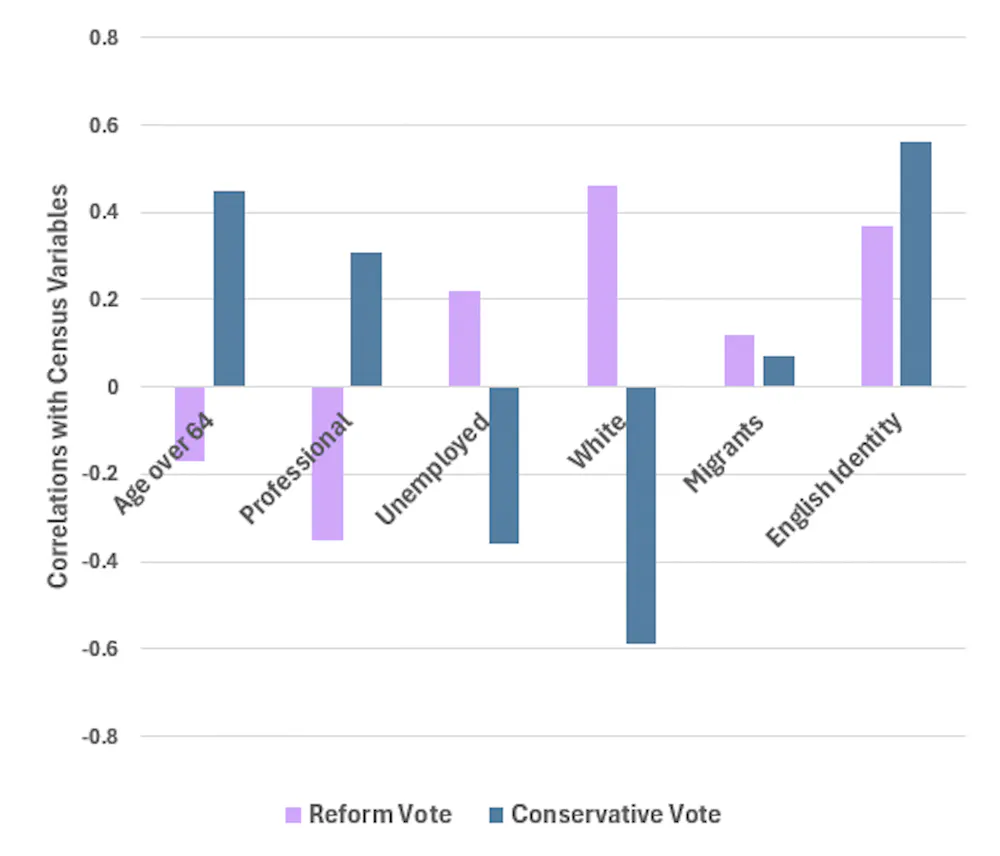
This is illustrated in the chart below which looks at the social characteristics of constituencies using data from the 2021 census. It shows how different groups supported the two parties in the election.
The chart shows the correlations between the size of a particular group and voting for Reform and the Conservatives in the election. It looks at the 575 parliamentary constituencies in England and Wales, since the Scottish data is not yet available.
The relationships between constituency characteristics and voting in 2024
Less in common than you might think. P Whiteley, CC BY-NC-ND
We observe large differences between support for the two parties among the different groups. For example, looking at the percentage of people in constituencies over the age of 64, most of whom were retired, we see a big difference. There is a strong positive correlation between this measure and voting Conservative (0.45), indicating that the Tories did well among older people. The opposite is true for Reform, since the relationship is negative (although relatively weak at -0.17). Reform did not rely on older people’s support in the same way as the Conservatives.
Want more politics coverage from academic experts? Every week, we bring you informed analysis of developments in government and fact check the claims being made.
A similar point can be made about the percentages who worked in professional and higher management occupations. The Tories did well in this group, whereas Reform did badly. Among constituencies with high levels of unemployment, the reverse was true. A high proportion of unemployed people boosted the Reform vote and undermined the Conservative vote.
If we look at ethnicity, a high proportion of ethnically white people in constituencies helped Reform, but it weakened support for the Conservatives. This seems surprising at first sight until one remembers that many of them voted for Labour, the Liberal Democrats and Greens. The Tories lost a good proportion of the white vote in the election.
The census provided information about the numbers of people who had moved into constituencies from abroad in the previous year. Not surprisingly, given their anti-immigration positioning, large numbers of newly arrived migrants helped both parties, with Reform doing better in these areas than the Conservatives. That said, the correlations were modest and so did not play a large part in explaining the overall results.
Finally, the 2021 census asked people about their national identities and in this case there was an interesting difference between respondents who claimed they were exclusively “English” rather than ‘British’ or some other identity. Englishness helped both parties, but it helped the Conservatives more than Reform. It appears that the Tories are more of an English National Party than Reform.
The next general election is a long way off, but these results mean that if the Labour government fails to deliver growth and curb illegal immigration, it will face a pincer movement from the Conservative and Reform. The Tories will pick up votes in constituencies with a high proportion of prosperous, middle class, retired people and Reform will pick up votes from deprived areas with high levels of young unemployed people.
Paul Whiteley has received funding from the British Academy and the ESRC.
Source: The Conversation – UK – By Austin Kay, Researcher in Sustainable Advanced Materials, Centre for Integrative Semiconductor Materials, Swansea University
As the world races to meet net-zero targets, emissions from all industrial sectors must be reduced more urgently than ever. Agriculture is an important area of focus as it contributes up to 22% of global greenhouse gas emissions – almost as much as the energy sector.
One approach to decarbonising the agricultural sector is agrivoltaics. It involves integrating solar panels – or photovoltaics (PVs) – into fields of crops, greenhouses and livestock areas, which can help farmers reduce their carbon footprint while continuing to produce food.
Agrivoltaics can also mitigate one of the main criticisms often made of solar power – that solar farms “waste” vast tracts of agricultural land that could otherwise be used for food production. In reality, solar farms currently occupy only 0.15% of the UK’s total land – not much compared to its 70% agricultural land.
The simplest example of an agrivoltaic system would be conventional, crystalline silicon PVs (the market-leading type of solar panels), installed in fields alongside livestock. This method of farm diversification has become increasingly popular in recent years for three main reasons.
First, it enhances biodiversity as the fields are not seeing a regular crop rotation, being monocultured, or being harvested for silage. Second, it increases production as livestock benefit from the shade and the healthier pasture growth.
Finally, the solar farm has reduced maintenance costs because livestock can keep the grass short. All this is achieved while the solar panels provide locally-generated, clean energy.
But if they’re not set up properly, agrivoltaics may cause problems. One of the most important challenges is balancing the need for sunlight between crops and solar panels. Crops need light to grow, and if solar panels block too much sunlight, they can negatively impact crop yields.
This issue varies from place to place. In countries with fewer sunny days like the UK, the panels need to let more sunlight through. But in places like Spain or Italy, some shade can actually help crops by reducing the stress of intense heat during summer months. Finding the right balance is tricky, as it depends on local conditions, the type of crop, and even the needs of pollinators like bees.
The complexity deepens when we consider the type of PV material used. Traditional solar panels aren’t always suitable because they often block the wavelengths (colours) of light needed by plants.
This is where newer materials, like organic semiconductors and perovskites, are ideal as they can be customised to let crops get the light they need while still generating energy. Unlike traditional inorganic semiconductors, which are essentially crystals of metal and metalloid atoms, organic semiconductors are molecules mainly made of carbon and hydrogen. Perovskites, meanwhile, are like a hybrid of the two.
But there are thousands of combinations of these materials to choose from, with scientific literature containing a plethora of options. Figuring out which one works best can be a daunting task.
This is where computational tools can make a big difference. Instead of testing each material in real-world conditions – which would take years and be incredibly expensive – researchers can use simulations to predict their performance. These models can help identify the best materials for specific crops and climates, saving both time and resources.
The tool
We have developed an open-source tool that helps compare various PV materials, making it easier to identify the best options for agrivoltaics. Our tool uses geographical data and realistic simulations of how different PV materials perform.
It considers how light travels through these materials and reflects off them, as well as other important performance measures like voltage and power output. The tool can also take lab-based measurements of PV materials and apply them to real-world scenarios.
Using this tool, we simulated how much power different PV materials could generate per square metre over the course of a year, across various regions. And we calculated how much light passed through these materials to ensure it was enough for crops to thrive.
By running these simulations for multiple materials, we could identify the most suitable options for specific crops and climates.
Tools like ours could play a critical role in decarbonising the agricultural sector by guiding the design of agrivoltaic systems. Future research could combine these simulations with economic and environmental impact analyses. This would help us understand how much energy we can expect from a solar panel over its lifetime compared to the resources and costs involved in producing it.
Ultimately, our tool could help researchers and policymakers in selecting the most efficient, cost-effective and eco-friendly ways to decarbonise agriculture and move us closer to achieving global net-zero emissions.
Don’t have time to read about climate change as much as you’d like?
Austin Kay is a Postgraduate Student at Swansea University and receives funding from the Engineering and Physical Sciences Research Council (EPSRC) through program grant EP/T028513/1 Application Targeted and Integrated Photovoltaics.
MILES AXLE Translation. Region: Russian Federation –
Source: Saint Petersburg State University of Architecture and Civil Engineering – Saint Petersburg State University of Architecture and Civil Engineering –
On October 7, 2024, the acceptance of applications for study in Russia in the 2025/2026 academic year within the quota of the Government of the Russian Federation began.
A foreign citizen wishing to study under a quota must:
register in the state information system “Education in the Russian Federation for Foreigners” (GIS “ORFI”); fill out the form; attach a photo, scanned copies of your passport and education document (or certificate of the period of study); send the completed form through the GIS “ORFI”, transferring the electronic application to the “for verification” status.
For questions regarding the selection of candidates in foreign countries, please contact the Rossotrudnichestvo representative offices abroad or the diplomatic missions of the Russian Federation.
Please note: This information is raw content directly from the source of the information. It is exactly what the source states and does not reflect the position of MIL-OSI or its clients.
Please note; This information is raw content directly from the information source. It is accurate to what the source is stating and does not reflect the position of MIL-OSI or its clients.
MILES AXLE Translation. Region: Russian Federation –
Source: Rosneft – Rosneft – An important disclaimer is at the bottom of this article.
Scientists from the Siberian Federal University, with the support of RN-Vankor (the operator of Rosneft’s flagship project Vostok Oil), conducted a comprehensive census of musk oxen in the western part of Taimyr. The research is being conducted within the framework of the enterprise’s grant program.
Preservation of the environment for future generations is an integral part of the corporate culture of Rosneft Oil Company. The Company’s subsidiaries implement comprehensive programs for the conservation and restoration of biological resources, including the use of advanced technological solutions.
For the survey work, the researchers used air and water transport. The total length of all routes exceeded 12 thousand km, of which more than 2.8 thousand km were water expeditions along the Pyasina River and its tributaries, Lake Pyasino.
Scientists have obtained up-to-date data on the number, age and sex structure, and distribution of the musk ox population in Western Taimyr. All encounters and tracks of animals were documented using photo and video equipment, GPS recorders, and coordinates were recorded on a cartographic basis. In addition, scientists conducted a survey of the indigenous population, including fishermen and hunters, about the places of encounters with musk oxen.
On the right bank of the Pyasina River, near the mouth of the Khanchecha River, scientists have noted for the first time a group of musk oxen: an adult male and female, a yearling bull and two yearlings (calves born this year). The data obtained indicate successful reproduction of mammals in the territory of Western Taimyr. In addition, according to scientists, it is possible to speak with a high degree of probability about the gradual dispersal of musk oxen in Western Taimyr.
In order to resettle the species in this territory, scientists from the Siberian Federal University will develop recommendations and measures for the conservation and further rational use of this biological resource in Taimyr as a whole. Let us recall that the musk ox population in Taimyr was revived by Soviet scientists during a unique project in 1974. By the mid-1990s, the number of musk oxen on the peninsula was about 1 thousand individuals, and in the early 2000s, more than 4 thousand.
Reference:
The implementation of environmental and social projects of practical importance for Taimyr and its population is carried out within the framework of the grant program “RN-Vankor”. This year, with the support of oil workers, projects are being implemented to assess the state of the populations of the main commercial fish of the reservoirs of Taimyr using express analysis technologies, and to create a textbook “Reindeer of Taimyr”.
In 2023, the winners of the grant competition were projects to assess the state of aquatic biological resources of the Yenisei Gulf of the Kara Sea, analyze the number and distribution of anseriformes in Western Taimyr, and assess the state and dynamics of vegetation in the western part of Taimyr based on remote sensing data.
Department of Information and Advertising of PJSC NK Rosneft October 18, 2024
Please note: This information is raw content directly from the source of the information. It is exactly what the source states and does not reflect the position of MIL-OSI or its clients.
Please note; This information is raw content directly from the information source. It is accurate to what the source is stating and does not reflect the position of MIL-OSI or its clients.
MILES AXLE Translation. Region: Russian Federation –
Source: Novosibirsk State University – Novosibirsk State University –
At the second stage of the modern NSU campus — in the buildings of the educational and scientific center of the Institute of Medicine and Medical Technologies (UNC IMMT) and the scientific research center (SRC) — work has begun on installing ventilated facades. Work is also underway to install translucent enclosing structures (stained glass). The construction readiness of the facilities is 18.2% and 15.4%, respectively. The construction of the facilities is carried out within the framework of national project “Science and Universities”.
According to the adopted architectural solution, in the buildings of the UNC and NIC, not standard windows are installed, but stained glass ones, which assume a larger glazing area. Their size is 3-4 times larger than a regular window.
The buildings of the UNC and NIC, as well as the building of the flow auditoriums, have an atrium, but only of a smaller size. This is a central distribution space, illuminated through a zenith skylight located in the ceiling, the installation of which began this week in both buildings. Work is also continuing on the installation of an external storm and domestic sewage system, and work on laying the external block of “Sibit”. Work on installing temporary heat supply to the UNC has been completed.
— The construction of the second stage of the NSU campus will create the latest infrastructure for educational and research activities in the region. A pilot pharmaceutical production facility will be created on the site of a modern research center, and laboratories for training students in a wide range of areas will be located in the equipped premises of the educational and scientific center of the NSU Institute of Medicine. This will bring the educational process to a new level and implement the goals and objectives that will be laid down in the new national project “Youth and Children”, created on behalf of President Vladimir Putin, — commented Deputy Governor of the Novosibirsk Region Irina Manuilova.
— We are planning to launch new network educational programs — Medical Cybernetics and Pharmacy, an agreement on the implementation of this project was signed with the Moscow State University Engineering School within the framework of the Technoprom forum. The research center will be used to develop advanced areas in which NSU occupies a leading position — space instrumentation, synchrotron-neutron research, artificial intelligence and others, — noted NSU Rector, Academician of the Russian Academy of Sciences Mikhail Fedoruk.
In the building of continuous auditoriums, which also belongs to the second stage facilities, finishing works are being completed, commissioning works of engineering systems are underway. The construction readiness of the facility is 86%. In parallel, documents are being prepared for obtaining acts of admission in Rostekhnadzor and permission for commissioning. The construction of the building of continuous auditoriums is planned to be completed by the end of 2024.
Please note: This information is raw content directly from the source of the information. It is exactly what the source states and does not reflect the position of MIL-OSI or its clients.
Please note; This information is raw content directly from the information source. It is accurate to what the source is stating and does not reflect the position of MIL-OSI or its clients.
A new exhibition at Manchester Central Library is set to focus on some of the skilled craftspeople, artisan trades and construction team behind the current transformation of Manchester’s Town Hall.
Extraordinarily little is known about the artisans who built the Town Hall between 1868 and 1877, and certainly no photographs exist.
Fast forward around 150 years and today’s skilled workers are no strangers to the lens of Manchester City Council photographer Barrie Leach, whose visual catalogue captures portraits of those working on the Town Hall since the beginning of the project to repair, restore and refurbish this much-loved building.
The exhibition’s focus is to highlight some of the people behind the work. As well as modern construction workers and the behind-the-scenes staff who make it all possible there are some incredible heritage trades involved. Stonemasonry, mosaic making, stained glass repair and manufacture, horology: these are all crafts that would have been widespread in the 1870s but are now very much specialist – and rare – trades. They are, however, critical to our restoration project.
The project to safeguard the building for current and future generations needed hundreds of these time-served tradespeople, who have come together to make the building safe and accessible. As a result of bringing in these expert professionals, hundreds more Mancunians have had the opportunity to gain – or be inspired by – these skills, through school and work placements, apprenticeships and new jobs. These trainees and employees play a key part in keeping these precious skills alive.
Thirty large portraits and 60 smaller contextual images in the exhibition show the pride that the modern team have discovered in being able to lovingly restore, and give new life to, the work of the forgotten workforce who went before them.
The exhibition is divided into 10 zones concentrating on the people and work taking place throughout the building where work has been happening including; ground floor and courtyard, interiors, state rooms, Great Hall, Clock Tower, collections, exterior, roof, Albert Square and Albert Memorial, and behind the scenes.
As work on the Our Town Hall project continues to bring it up to modern safety standards, improving access to the building and its artefacts, and creating a new visitor attraction, the photographic record is also ongoing: only a small selection of the images is on show in this first exhibition. The full collection will form part of the historical archive, telling the stories of the people who lovingly restored the Town Hall for all to see.
The exhibition will run in Manchester Central Library’s first floor exhibition space from Friday 18 October 2024 until June 2025.
Councillor Garry Bridges, Deputy Leader of Manchester City Council said: “This new exhibition is a celebration of the work taking place behind the Town Hall hoardings which few people have had the privilege to witness. It is our way of ensuring that today’s artisans will not be forgotten. Just as the skills of those who helped create the building in the 19th Century have left the city a magnificent legacy, so will today’s project team. Working on this project is a real labour of love.
“We knew from the outset that this was going to be a mammoth task, and we wanted to capture and share the journey of all those who have taken part. We wanted to celebrate the role of all the workers on the team and show as much of the range of trades – modern and not–so–modern – required to complete the transformation of our iconic Town Hall. The bonus is that – in doing so – we have also created a wonderful visual archive for reference in years and generations to come. We can’t wait to share it with Manchester people and visitors.”
Leah Finch, a Construction Manager for Lendlease, started work on the project as an apprentice. She said: “I completely fell into this opportunity, and I’m thankful. I applied through the Government website as I was looking for an apprenticeship. Every day offers a new reason to have a great day: delivering a meeting, speaking to new people, handing over an element of work or seeing progress in my work areas.
It’s given me so much responsibility and accountability. I’m proudest of managing the lower ground floor: co-ordinating all trade work on that level, working through blockers, ensuring a high standard of quality, and ultimately driving for completion. I feel heard and respected; I am a valued member of the team. The people truly make working on the Town Hall special.”
A new Chief Executive at Together for Children (TfC) and director of Children’s Services has been appointed.
Simon Marshall (56) is a former headteacher and has been Sunderland’s Director of Education since 2017. He succeeds TfC’s Chief Executive Jill Colbert OBE who has joined Nottingham City Council.
As TfC lead and children’s services director, Mr Marshall said he will continue delivering the highest quality children’s social care, education and early help services, all the necessary infrastructure, and leading 1,100 members of staff.
In its most recent full Ofsted inspection in 2021, TfC and Sunderland Children’s Services were rated as ‘outstanding’. In the last 18 months, Ofsted inspections of children’s homes and child protection plans have also been rated ‘outstanding’ and ‘timely and effective’, respectively.
Mr Marshall was a headteacher for 12 years before being appointed as the city’s Director of Education. This included being head at Sunderland’s Highfield Primary School where he was recognised nationally for developing innovative school-based mental health services to support children and families. In 2014 he was named School Leader of the year in the National Wellbeing School Awards.
The City Council’s Cabinet Member for Children’s Services, Child Poverty and Skills, Councillor Michael Butler said: “We are delighted to confirm Simon’s appointment as Chief Executive and children’s services director. We all look forward to more work with him and continuing to ensure that we offer and provide the very best for children, young people and families across the city.”
As education director, Mr Marshall has in the last five years overseen more than £24m of extra investment in Special Educational Needs (SEND) provision, including extra places for more than 250 children and expanded facilities. He has also developed a highly successful school improvements service that delivers training to schools across the city and the North East region.
Commenting on his new appointment as TfC Chief Executive and children’s services lead, Mr Marshall said: “I want to put on the record a thanks to my predecessor Jill Colbert OBE for the exemplary leadership, team and partnership work that she helped inspire at Together for Children.
“We will continue to deliver services for all our children and young people so they lead safe, happy, healthy and successful lives, and in a city where they can fulfil and realise their full potential.”
City of York Council has topped a new list of the most productive English councils, meaning that we achieve the highest value for residents per pound of council spending.
Independent consultancy, IMPOWER, analysed 149 councils across eight core areas using their index.
These are the areas where councils spend the most money and include:
housing
homelessness
waste and recycling
high needs
children’s social care
working age adults
older adults
health
They used nationally available metrics to determine the top 10 and found York is achieving the best outcomes for people, for a relatively low spend.
Leader of City of York Council, Cllr Claire Douglas said:
“This is fantastic news and testament to the hard work of staff right across the council.
“York is amongst the lowest funded councils in the country and we’ve long been committed to making the best of what we have in delivering good quality services and value for money for the citizens of York.
“Despite a very challenging situation, we pull together and strive for excellence in all we do. We thank our fantastic workforce that continues to make this possible”.
Ian Floyd, Chief Operating Officer of City of York Council, welcomed the news, saying:
“I’m extremely proud that, despite the financial challenges, we, and councils across the country are facing, York’s commitment to delivering value for money for our residents has been recognised.
“Our staff work tirelessly each and every day and the news that we have been named England’s most productive council is testament to their dedication and diligence – I’d like to take this opportunity to thank them for everything that they do.
“While this achievement is a welcome endorsement of our work, we cannot afford to be complacent and we will continue to work together as one council, delivering for the people of York.”
Sunderland’s Armed Forces Partnership (AFP) is celebrating winning a prestigious award for supporting the city’s Armed Forces community.
The partnership has won the Working Together award in this year’s Soldiering On Awards, which were held on Wednesday, 16th October 2024.
The Working Together award honours a group of people, team or organisation that has successfully taken a collaborative approach to supporting the Armed Forces community.
Sunderland’s AFP is an alliance between the council and the University of Sunderland, Sunderland College, Sunderland AFC, Northumbria Police, Tyne and Wear Fire and Rescue Service, Veterans in Crisis, Gentoo, NE Reserve Force and Cadet Association, North East and North Cumbria Integrated Care Board ICB, 8 Rifles, Together for Children, and South Tyneside and Sunderland- NHS Foundation Trust, set up to jointly address the needs of veterans, reservists and their families in Sunderland.
The partnership was recognised for providing wide ranging support for those serving in the military and the 11,000 veterans living in Sunderland. The AFP’s work has included making Sunderland one of the very few cities where no veterans are street homeless.
Sunderland City Council’s Armed Forces Champion, Councillor Harry Trueman, said: “We are absolutely delighted to be named the winner of the Working Together award. All organisations in the partnership work hard to support our local armed forces services and veterans, and it is fantastic to see this work recognised in this way.
“Sunderland as a city has a strong connection to the Armed Forces and the AFP helps to facilitate smooth transitions both into and out of military service so our servicemen and veterans don’t have to fend for themselves.”
Ger Fowler, Founder and CEO of Veterans in Crisis, said: “Sunderland Armed Forces Partnership is one of the reasons Veterans in Crisis has been so successful, it’s all the main sectors in Sunderland working in harmony with the sole focus of making Sunderland the best place in the country to be a Veteran, we are proud to be a part of it. Winning this National award is a huge honour.”
Now in their 14th year, the Soldiering On Awards celebrate excellence within the Armed Forces community across twelve categories, aiming to highlight ordinary individuals accomplishing extraordinary feats.
Dubai, United Arab Emirates, Oct. 18, 2024 (GLOBE NEWSWIRE) — – ChainSwap, the cross-chain swap platform, has announced during its attendance at the major Dubai conference Future Blockchain Summit, its plans to integrate Solana into its decentralized application (dApp), further expanding its multi-chain transaction capabilities. This planned integration will allow ChainSwap users to perform same-chain and cross-chain token swaps on the Solana network, known for its high-speed transactions and low fees. The integration, expected to launch in the coming months, will enable faster and more efficient token swaps across Solana and other popular blockchain networks such as Ethereum, Binance Smart Chain, and Polygon. “Integrating Solana into our platform is a strategic step to improve the user experience and expand the range of supported blockchains,” said Fitzy, CEO and Founder of ChainSwap. “Solana’s fast and affordable transactions make it a perfect fit for our platform, and we are excited to bring this option to our users in the near future.” Once completed, the integration will offer:
Same-Chain Swaps: Users will be able to swap tokens within the Solana network, leveraging its fast transaction speeds and low costs.
Cross-Chain Swaps: Users will benefit from secure and efficient token swaps between Solana and other major networks like Ethereum, Polygon, and Avalanche.
Solana’s integration is a crucial step forward in ChainSwap’s mission to deliver an accessible and scalable platform for decentralized finance (DeFi) users, offering a broad range of multi-chain options to meet the growing needs of the DeFi ecosystem. -END-About ChainSwap ChainSwap is a platform at the forefront of Web3 innovation, facilitating seamless transactions across multiple blockchains and servicing any blockchain where demand arises. Leveraging cutting-edge security protocols such as Chainlink’s CCIP, ChainSwap provides a secure layer 5 environment for cross-chain transactions. ChainSwap’s multi-chain DEX simplifies swaps, ensuring privacy and effortless token distribution within a unified ecosystem, and allows for users to eliminate the need for bridges and decentralised exchanges that do not provide cross-chain support. ChainSwap revolutionises blockchain communication, enhancing chain interoperability and security to unprecedented levels. Discover more on https://www.chain-swap.org Media Contacts: LJ Collier lj@lunapr.io
PUBLIC DEALING DISCLOSURE BY AN EXEMPT PRINCIPAL TRADER WITH RECOGNISED INTERMEDIARY STATUS DEALING IN A CLIENT-SERVING CAPACITY Rule 8.5 of the Takeover Code (the “Code”)
1. KEY INFORMATION
(a) Name of exempt principal trader:
Shore Capital Stockbrokers Ltd
(b) Name of offeror/offeree in relation to whose relevant securities this form relates: Use a separate form for each offeror/offeree
Brown (N) Group Plc
(c) Name of the party to the offer with which exempt principal trader is connected:
Brown (N) Group Plc
(d) Date dealing undertaken:
17 October 2024
(e) Has the EPT previously disclosed, or is it today disclosing, under the Code in respect of any other party to this offer?
No
2. DEALINGS BY THE EXEMPT PRINCIPAL TRADER
(a) Purchases and sales
Class of relevant security
Purchases/ sales
Total number of securities
Highest price per unit paid/received
Lowest price per unit paid/received
Ordinary
Purchases
755,146
38.802p
38.5p
Ordinary
Sales
804,984
38.8p
38.54p
(b) Derivatives transactions (other than option)
Class of relevant security
Product description e.g. CFD
Nature of dealing e.g. opening/closing a long/short position, increasing/reducing a long/short position
Number of reference securities
Price per unit
(c) Options transactions in respect of existing securities
(i) Writing, selling, purchasing or varying
Class of relevant security
Product descriptione.g. call option
Writing, purchasing, selling, varying etc.
Number of securities to which option relates
Exercise price per unit
Type e.g. American, European etc.
Expiry date
Option money paid/ received per unit
(ii) Exercising
Class of relevant security
Product description e.g. call option
Number of securities
Exercise price per unit
(d) Other dealings (including subscribing for new securities)
Class of relevant security
Nature of dealing e.g. subscription, conversion
Details
Price per unit (if applicable)
The currency of all prices and other monetary amounts should be stated.
Where there have been dealings in more than one class of relevant securities of the offeror or offeree named in 1(b), copy table 2(a), (b), (c) or (d) (as appropriate) for each additional class of relevant security dealt in.
3. OTHER INFORMATION
(a) Indemnity and other dealing arrangements
Details of any indemnity or option arrangement, or any agreement or understanding, formal or informal, relating to relevant securities which may be an inducement to deal or refrain from dealing entered into by the exempt principal trader making the disclosure and any party to the offer or any person acting in concert with a party to the offer: If there are no such agreements, arrangements or understandings, state “none”
None
(b) Agreements, arrangements or understandings relating to options or derivatives
Details of any agreement, arrangement or understanding, formal or informal, between the exempt principal trader making the disclosure and any other person relating to: (i) the voting rights of any relevant securities under any option; or (ii) the voting rights or future acquisition or disposal of any relevant securities to which any derivative is referenced: If there are no such agreements, arrangements or understandings, state “none”
None
Date of disclosure:
18 October 2024
Contact name:
Laura Parmenter
Telephone number:
0207 648 8154
Public disclosures under Rule 8 of the Code must be made to a Regulatory Information Service and must also be emailed to the Takeover Panel atmonitoring@disclosure.org.uk. The Panel’s Market Surveillance Unit is available for consultation in relation to the Code’s dealing disclosure requirements on +44 (0)20 7638 0129. The Code can be viewed on the Panel’s website athttp://www.thetakeoverpanel.org.uk.
Cost of living advice available at North West Information and Support Event
18 October 2024
Foyle and Lisnagelvin Jobs and Benefits Offices, in partnership with Derry and Strabane Labour Market Partnership, are hosting a special information event in the Guildhall next week to allow people to avail of advice and guidance from local organisations and community support services.
The free event in the Guildhall will take place on Thursday October 24th from 11am to 2pm and no prebooking is required.
A range of community and voluntary organisations and partners will be in attendance to give information on the help and support available.
Attendees will be able to access free advice on a range of cost-of-living issues surrounding housing, mortgages and benefits as well as general tips and advice.
Department for Communities’ Make the Call and Finance Support staff will also be on hand to advise people on any additional supports they may be entitled to regarding pension credits, working tax credits, tax-free childcare or benefit entitlements and financial support.
Representatives from Council will be in attendance to give advice on some of the services available.
A spokesperson for Derry City and Strabane District Council encouraged people to take advantage of the chance to learn more about the range of support available in the Council area.
“This event is open to everyone and is an ideal way to find out important information on a range of topics including cost of living support, wellbeing, benefits and employability.
“Whether it’s advice support from the local Jobs and Benefits Offices or from Make the Call to ensure you’re getting the benefits, services and supports you’re entitled to, the correct entitlements or pension credits you need, or you’re just looking to find out what independent and community support is available, there is something for everyone.”
Kinship carers – family members or close friends who step in to provide love, stability, and a nurturing home to children within their own network – are the backbone of many families, offering unwavering support and guidance.
The event, last week, was filled with heartwarming moments as families shared stories of resilience, love, and the unique bonds they share with the children in their care. Guests took part in a creative scrapbook making activity, where both adults and children had the opportunity to reflect on and capture their most cherished family memories.
Alison Hinds, the City of Wolverhampton Council’s Director of Children’s Services, said: “Kinship carers are the heart of our community. Their selflessness and commitment to providing a safe and loving environment for children is truly inspiring. We are incredibly thankful for all they do.”
The tea party served as both a celebration and a reminder of the essential role kinship carers play in shaping the future of young people in Wolverhampton. Events like this aim to recognise and support these incredible families, ensuring they feel appreciated and valued for their contributions.
Source: People’s Republic of China – State Council News
China likely to further slash reserve requirement ratio before year-end: official
BEIJING, Oct. 18 — China’s central bank is considering a cut of 0.25 to 0.5 percentage points in reserve requirement ratio at an appropriate time before the end of 2024, depending on market liquidity situations, Pan Gongsheng, governor of the People’s Bank of China, said on Friday.
The loan prime rate (LPR), which will be released on Oct. 21, is expected to move downward by 0.2 to 0.25 percentage points, Pan said at the Annual Conference of Financial Street Forum 2024.
China has recently introduced a package of financial measures to support the economy, and these policy moves have received positive feedback from both home and abroad, according to Pan. He added that these policies have bolstered social confidence and contributed to the stable operation of the economy and financial markets.
The reserve requirement ratio was cut by 0.5 percentage points in late September. Major state-owned commercial banks announced reductions in deposit interest rates on Friday morning.
The recent cut in mortgage rates for existing home loans is expected to benefit 50 million households and reduce total interest expenses for households by approximately 150 billion yuan (about 21.05 billion U.S. dollars) per year, Pan said.