Source: United States House of Representatives – Congressman Steve Cohen (TN-09)
MEMPHIS – Congressman Steve Cohen (TN-9) learned of the passing of former New York Congressman Charles B. Rangel on Sunday at 94 and made the following statement:
“I had the honor of serving with Charlie Rangel for 10 years. A gentleman and a legislative giant, honored by Memphis with the I AM A MAN award, we stood together on healthcare, drug reform, Cuba and much more. I was always proud to vote alongside him and the Congressional Black Caucus he founded. He was one of the greats. May he rest in peace.”
Source: United States House of Representatives – Representative Nydia M Velázquez (D-NY)
WASHINGTON – Representative Nydia M. Velázquez (D- NY) led five members in urging the House Appropriations Committee to direct the Treasury Department to report on Internal Revenue Service’s (IRS) efforts to identify and address tax avoidance under Puerto Rico’s Acts 22 and 20 (now consolidated into Act 60), and to estimate federal revenue losses attributable to these laws.
Originally enacted to attract wealthy individuals and businesses, Acts 22 and 20 offer sweeping tax breaks. Act 22 grants a 0% tax rate on interest, dividends, and capital gains for individuals who establish residency in Puerto Rico, while Act 20 provides a 4% corporate tax rate and full dividend exemptions for firms exporting services.
“Although these provisions were intended to grow the economy and promote socioeconomic development by retaining foreign capital, the available data on their impact suggests otherwise,” said the lawmakers. “For example, according to the Puerto Rico Tax Expenditure Report for Tax Year 2024, Puerto Rico stands to lose an estimated $4.5 billion in foregone revenue related to Act 22 between 2020 and 2026.”
Most Act 20 businesses are in consulting and professional services, which generate fewer jobs and limited economic impact. The tax breaks under Acts 22 and 20 have also fueled short-term rentals, cash property deals, and real estate speculation, displacing working-class Puerto Ricans.
“In terms of job creation, Act 22 has underperformed,” said the lawmakers. “A study by the firm Estudios Técnicos concluded that between 2015 and 2019, the 2,202 individuals with an Act 22 decree exemption had created 4,400 jobs, which represents less than 3 jobs per exemption. On the other hand, Act 20 has a minimal job hiring requisite. A company with a decree exemption is required to hire at least one full-time employee if it has more than $3 million in revenue.”
Amid concerns over tax avoidance, in 2021 the IRS launched an audit campaign targeting individuals improperly claiming Act 22 benefits without meeting residency rules. By July 2023, around 100 beneficiaries were under investigation. In March 2025, the DOJ charged businessman Suresh Gajwani with evading taxes on $80 million by falsely claiming Act 22 eligibility.
“Given the damaging effects of Acts 22 and 20 on Puerto Rico and the continental United States, it is urgent that the Federal government continues its oversight efforts regarding these laws, while informing the public about such work,” continued the lawmakers.
In the letter, the lawmakers call for an update to the IRS’s 2020 report to Congress on Act 22 that adds details on current audit efforts related to Act 20 and the associated federal revenue losses.
The letter has strong support from local advocacy groups.
“We commend Congresswoman Velázquez’s continued efforts to increase transparency around these tax incentives,” said Iris Figueroa, Senior Policy Strategist at the Center for Popular Democracy. “Despite repeated Congressional inquiries and persistent advocacy from our organization, the public still has virtually no insight into the agency’s Act 22 audit process, launched in 2021. The recent federal charges against an Act 22 beneficiary involving $80 million in unpaid capital gains taxes, highlights the serious risk and potential tax evasion these incentives pose to both U.S. taxpayers and Puerto Rican communities. We hope additional members of Congress, including Resident Commissioner Hernández Rivera, will join us in these crucial efforts.”
“The state government claims that Acts 20 and 22 are beneficial for the people of Puerto Rico but does not provide enough data and insight to actually prove it,” Issel Masses, Executive Director, Sembrando Sentido.“What we have access to is an estimate of the amount of lost revenue, which by itself represents a significant cost that does not quantify other negative effects on social and economic conditions. In the context of deep federal budget cuts and a very vulnerable Puerto Rican economy, there is an even greater need for transparency about the implications of Acts 20 and 22 for both the United States and Puerto Rico. As an organization that advocates for fairness, transparency and accountability in public administration, Sembrando Sentido supports Congresswoman Velazquez’s efforts to follow up on the IRS’s auditing of decree holders and urges the government of Puerto Rico to provide the information requested by interested parties, including the IRS, in a timely and complete manner.”
The letter was signed by Rep. Alexandria Ocasio-Cortez (D-NY), Rep. Rashida Talib (D-MI), Rep. Delia Ramirez (D-IL), Rep. Dan Goldman (D-NY), and Rep. Jared Huffman (D-CA).
Source: United States House of Representatives – Congressman Gregory W Meeks (5th District of New York)
Washington, D.C. – Representative Gregory W. Meeks, Ranking Member of the House Foreign Affairs Committee, issued the following statement applauding the Court of International Trade’s decision to block President Trump’s “liberation day” tariffs, unlawfully imposed under the guise of a “national emergency.” Rep. Meeks who co-led an amicus brief in support of the plaintiffs, argued that the move was an illegal abuse of the International Emergency Economic Powers Act (IEEPA).
“I’m encouraged by the court’s decision today to block President Trump’s so-called ‘liberation day’ tariffs, confirming what we’ve long known: these tariffs are an illegal abuse of executive power. Trump’s declaration of a bogus national emergency to justify his global trade war was an absurd and unlawful use of IEEPA. That is why I co-led an amicus brief supporting twelve states in challenging this abuse in court,” said Ranking Member Meeks.
In April, Meeks introduced aresolutionto terminate the national emergency behind the April 2nd tariffs, following the earlier resolutions seeking to end Trump’s Canada & Mexico tariffs. House Republicans have used procedural tactics to block these votes—tactics Meeks is attempting to bypass throughdischarge petitions.
“Trump’s chaotic tariffs are nothing but a tax on American families, raising prices, shuttering small businesses, and harming the economy. They are also deeply unpopular, which is why Speaker Johnson refuses to allow a vote. It’s time for Republican’s to stop enabling this economic sabotage. I urge them to join my discharge petitions to strike down not only Trump’s April 2nd national emergency declaration, but also the Canada and Mexico national emergencies that remain in effect. The lawlessness must end.
Source: United States House of Representatives – Congresswoman Doris Matsui (D-CA)
WASHINGTON, D.C. – Congresswoman Doris Matsui (CA-07) and Congresswoman Nikki Budzinski (IL-13) led 15 lawmakers in a letter to Department of Health and Human Services (HHS) Secretary Robert F. Kennedy urging him to protect funding for the Certified Community Behavioral Health Clinic (CCBHC) Expansion Grant Program. CCBHCs provide lifesaving care to millions of Americans; however, a leaked draft of President Trump’s fiscal year 2026 budget called for the elimination of their funding.
The members write, “Eliminating the CCBHC program would immediately disrupt these critical services, potentially leading to increased, more costly hospitalization rates and exacerbating homelessness. Such cuts would reverse the significant progress that has been made in ameliorating the opioid crisis and in building a more efficient and comprehensive mental health and substance use care system. These cuts would also put our most vulnerable populations, such as veterans and those in rural communities, at risk.
“From the start, CCBHCs have been a bipartisan effort. The clear evidence of CCBHCs’ effectiveness and related cost savings makes this a wise investment for our country.”
CCBHCs offer a broad range of critical mental health and substance use care services to meet individuals’ needs in their community and include requirements to provide tailored community-based services for our veterans.
Today, more than 500 CCBHCs operate across 46 states, the District of Columbia, and Puerto Rico. These centers provide comprehensive behavioral health care to over 3 million Americans annually. In the past year alone, CCBHCs hired 11,000 new staff positions, strengthening our country’s workforce.
The letter is also signed by Representatives Sharice Davids (KS-03), Andrea Salinas (OR-06), Eric Sorensen (IL-17), Paul Tonko (NY-21), Stephen Lynch (MA-08), Timothy Kennedy (NY-26), Linda Sánchez (CA-38), Gabe Vasquez (NM-02), Danny Davis (IL-07), Dwight Evans (PA-03), Raja Krishnamoorthi (IL-08), Seth Moulton (MA-06), Eleanor Holmes Norton (DC-AL), John Mannion (NY-22), and Nanette Barragán (CA-44). It is endorsed by the National Alliance on Mental Illness (NAMI) and the American Psychiatric Association (APA).
The full text of the letter is HERE and below:
Dear Secretary Kennedy,
We write to express our strong opposition to the reported elimination of the Certified Community Behavioral Health Clinic (CCBHC) Expansion Grant program in President Trump’s fiscal year (FY) 2026 budget proposal. While the President’s recent “skinny budget” does not explicitly mention Certified Community Behavioral Health Clinics (CCBHCs), it proposes severe cuts to behavioral health programs. Moreover, a leaked early draft of the budget from April reportedly called for eliminating the program entirely. Such an elimination would severely worsen the nation’s ongoing mental health and substance use crisis at a crucial moment when demand for these critical and lifesaving services is increasing.
Since FY 2018, the CCBHC Expansion Grant program has helped make the CCBHC model of care available to Americans by providing comprehensive and integrated behavioral health services to millions of children, families, and adults across our country. These centers offer a broad range of critical mental health and substance use care services to meet individuals’ needs in their community and include requirements to provide tailored community-based services for our veterans. CCBHCs offer comprehensive behavioral health services all at one location, 24 hours a day, 7 days a week, while adhering to rigorous federal criteria and utilizing evidence-based practices for high-quality care.
Today, more than 500 CCBHCs operate across 46 states, the District of Columbia, and Puerto Rico, and provide comprehensive behavioral health care to over 3 million Americans annually. In the past year alone, CCBHCs hired 11,000 new staff positions, strengthening our country’s workforce.
CCBHCs are also key to ameliorating chronic disease in our country. People with serious mental illness and substance use conditions experience disproportionately higher rates of chronic disease, and CCBHCs are designed to support improved coordination with and access to primary care. CCBHCs screen for weight/BMI, blood pressure, blood sugar, cholesterol, and other chronic disease indicators.
Providing effective care in local communities has also helped to decrease the use of more costly levels of care. Studies have shown that people who receive care at a CCBHC experience a 55 percent reduction in hospitalization, a 31 percent reduction in homelessness, and a 60 percent reduction in time in jails. In fact, CCBHCs have been shown to provide savings for law enforcement due to their collaborative work with law enforcement agencies.
Additionally, 87 percent of CCBHCs provide Medication-Assisted Treatment for Opioid Use Disorder (MOUD) directly, with the remainder of centers making this care available through partnerships with MOUD providers, which has been a significant tool in addressing the ongoing opioid epidemic and providing treatment that leads to long-term recovery.
Eliminating the CCBHC program would immediately disrupt these critical services, potentially leading to increased, more costly hospitalization rates and exacerbating homelessness. Such cuts would reverse the significant progress that has been made in ameliorating the opioid crisis and in building a more efficient and comprehensive mental health and substance use care system. These cuts would also put our most vulnerable populations, such as veterans and those in rural communities, at risk.
From the start, CCBHCs have been a bipartisan effort. The clear evidence of CCBHCs’ effectiveness and related cost savings makes this a wise investment for our country. We therefore urge the Department of Health and Human Services to ensure funding for CCBHCs is protected and can continue to provide critical and lifesaving care to millions of Americans.
Source: United States House of Representatives – Representative Darren Soto (D-FL)
The Protect Patriot Spouses Act would help military families of mixed immigration statuses remain together in the United States
WASHINGTON, D.C. — This week, Congressman Darren Soto (D-FL-09), Congresswoman María Elvira Salazar (R-FL-27), and Congressman Salud Carbajal (D-CA-24) re-introduced H.R. 3524, the Protect Patriot Spouses Act, in support of the Juarez family and military spouses facing deportation. The bill would render military spouses eligible for adjustment to permanent resident status by amending the Immigration and Nationality Act to remove the inadmissibility standard because of an unlawful entry into the United States by the migrant spouse. It would also allow eligible veteran spouses who have already been removed or voluntarily departed the United States to apply for an immigrant visa from abroad and then become authorized to return to the country while their application is pending.
In August of 2018, Alejandra Juarez, a Polk County resident of over 20 years, was deported from the United States to Mexico. Alejandra’s husband, Sgt. Temo Juarez, is an Iraq combat veteran who served in the Marines and the Infantry Regiment of the Army National Guard. Together, they raised their two U.S.-born daughters, Pamela and Estela, in Davenport, Florida. Alejandra Juarez was previously granted humanitarian parole by the Biden Administration.
“In 2018, seven years ago, I joined the Juarez family at the airport in Orlando on the day of Alejandra’s deportation. In that moment, I promised Alejandra and her daughters that we would never stop fighting for them to be reunited. Under the Biden Administration, we were thrilled to see Alejandra receive humanitarian parole and return to Central Florida to be with her family,” said Rep. Soto. “However, this was only a temporary fix, and families are under increased risk due to the current Administration. With the Protect Patriot Spouses Act, we will create a permanent solution for families in this situation.’”
“The brave men and women who serve our country deserve our complete support and protection. The spouses and families of those who put their lives on the line to protect us should be honored by a grateful nation, not harmed by our broken immigration system,” said Rep. Salazar. “I am proud to join my colleagues, Representatives Soto and Carbajal, in introducing this critical legislation to protect the families of our veterans.”
“As a veteran and immigrant myself, I find it unconscionable that someone could step up to serve in the military and be willing to sacrifice their life for our country, only to have their family torn apart,” said Rep. Carbajal. “I’m proud to join Congressman Soto in renewing this push to shape an immigration system that is fair, keeps families together, and recognizes the positive contributions immigrants make to our country.”
During the 117th Congress, the Protect Patriot Spouses Act was included as a provision in H.R. 7946, the Veteran Service Recognition Act, which passed the House of Representatives in December of 2022.
Earlier this week, Congressman Soto participated in a press conference with Reps. Carbajal and Lou Correa (D-CA-46) to discuss the importance of passing legislation that prevents the deportation and separation of military families. Click here to watch the press conference.
As we head into a new month of streaming, here’s a fresh wave of TV ready to challenge, transport and entertain you.
This month’s picks span genre and geography, from an eerie dystopian Buenos Aires, to a witty, awkward cyborg hero. Reality TV also gets a scandalous twist with the return of The Secret Lives of Mormon Wives. And Deaf President Now! delivers a powerful documentary on a historical milestone for Deaf rights.
There’s something for every kind of viewer — and every kind of mood.
The Eternaut
Netflix
Argentine sci-fi The Eternaut opens with a group of old friends in Buenos Aires meeting to play the card game truco on a hot summer night – when things suddenly get eerie.
The power goes out and a poisonous snowfall starts to blanket the city, killing thousands of people instantly. The survivors must get answers, quickly, as they start to grasp the true strength of their invisible enemy.
Based on Héctor Germán Oesterheld’s 1950s comic of the same name, The Eternaut portrays apocalypse through a deeply local and political lens – and in doing so has struck a chord in Argentina.
Directed by Bruno Stagnaro and led by Argentine film icon Ricardo Darín, as protagonist Juan Salvo, the series emphasises the power of collective heroism, and subtly critiques the current government’s uncompromising neoliberal approach.
It also pulses with national pride. Buenos Aires is not glamorized; real neighbourhoods are shown as classic Argentine tango, rock and folk plays in the background. Most importantly, Argentine identity is celebrated through themes of community spirit, grassroots resistance, and ingenuity in times of crisis.
The Eternaut feels both timely and timeless. Its slogan, “no one survives alone,” resonates for a country that has been long marked by both trauma and resistance efforts.
Its emotional weight is further deepened by Oesterheld’s legacy, including the tragic disappearance of him and his family members under the military rule of the 1970s.
With a second season on the way, this series is a powerful ode to Argentina.
Murderbot, Apple’s adaptation of Martha Wells’ science-fiction novella, All Systems Red (2017) is a satisfying combination of action, sci-fi and comedy. The show centres on a security unit (SecUnit) – an indentured private security cyborg – who secretly cracks the programming of its governing chip, granting itself autonomy.
Murderbot (Alexander Skarsgård), as it dubs itself, is both horrified and fascinated by humans. It’s far more afraid of eye contact, emotions and direct conversation than any physical danger. It’s also obsessed with mainlining media, particularly the ridiculous soap opera The Rise and Fall of Sanctuary Moon.
Murderbot is hired, reluctantly, by some hippy scientists from a group of “freehold” planets – ones that exist outside the Corporation Rim – to act as protection on a scientific expedition. It goes quickly awry.
Wells’ award-winning novella, the first in an equally good series, limits us to the first-person perspective of the sarcastic cyborg. The series expands this frame beautifully, building on the source material’s dry humour to create a world that is both goofy and grounded.
And while there are serious themes at play, such as the way SecUnits are effectively enslaved, and the violent capitalist dominance of the Corporation Rim, the show is not heavy. Skarsgård offers a pitch-perfect performance of the awkward, anxious robot – its eyes flickering in horror as the scientists try to befriend it.
The opening minutes of the first episode are clumsy and on-the-nose, but ignore them. This otherwise well-designed and well-directed show cracks along with brisk, highly-entertaining 22-minute episodes.
– Erin Harrington
The Secret Lives of Mormon Wives, season two
Disney+
Season one of The Secret Lives of Mormon Wives had us hooked at the end of 2024. Now, the women have returned for an explosive 10-episode second season.
The reality series follows a group of Mormon women living in Utah. While the title may have you anticipating stories of faith and motherhood, the show is more focused on the personal lives of Mormon mothers who rose to TikTok fame due to scandal and infamy.
Season one saw the women grapple with balancing traditional Mormon values with their online lives and subsequent businesses (along with the fallout from a “soft-swinging scandal”). Season two further highlights infidelity, jealously and money.
Old characters are brought back, with finger-pointing ex-husbands and former alienated friends adding to the fray. Police are called, insults are thrown and many of the women delve deeper into their pasts.
The show flips flops between difficult moments such as processing the death of loved ones and difficult pregnancies, with parties and poorly executed party games. At one point the women play pregnancy roulette (a game no one should recommend), and take pregnancy tests which are anonymously read out to the group. Chaos ensues.
And after watching, you can search for the TikTok accounts of the stars and watch new drama unfold in real-time – or watch them “correct” and expand on past situations based on their own perspectives – far removed from show’s editors.
– Edith Jennifer Hill
Deaf President Now!
Apple TV+
Deaf President Now! is a stirring documentary about an iconic student uprising at Gallaudet University, the world’s only Deaf university, in 1988. The film chronicles how Deaf students – tired of being led by hearing leadership – decided to take things in their own hands come the 1988 Gallaudet presidential election.
With two of the three candidates being Deaf, the appointment of Elisabeth Zinser, a hearing candidate unfamiliar with Deaf culture, sparked outrage. Fuelled by decades of marginalisation, the students barricaded campus gates, burned effigies of Zinser and marched to the Capitol, calling for Deaf leadership in Deaf spaces.
It worked. The protest forced Zinser’s resignation and ushered in Irving King Jordan, Gallaudet’s first Deaf president.
The film juxtaposes historic footage with present-day interviews with key leaders of the movement, allowing them to tell their stories their own way. These reflections, delivered in American Sign Language (ASL), underscore how storytelling itself can become an act of resistance for Deaf people.
At the same time, the documentary wrestles with a paradox. Co-directed by Deaf activist Nyle DiMarco and hearing filmmaker Davis Guggenheim, the film exemplifies how Deaf storytelling still often has hearing involvement, especially when the story is packaged for a mainstream audience.
Nevertheless, the release of Deaf President Now! couldn’t have been more timely. With disability rights in the United States threatened under Trump, the film is a call to action. It reminds us Deaf culture isn’t just about language: it’s about Pride, self-determination and visibility.
In Lorcan Finnegan’s The Surfer, our unnamed protagonist (Nicolas Cage) is returning to his former Australian home from the United States. He is newly divorced, and trying to buy a beachside property to win back his family.
He takes his teenage son (Finn Little) for a surf near the property, but they are run off by an unfriendly pack of locals.
Returning alone to the beachside car park to make some calls, he is besieged there by the same gang, and this continues over the next several days. The gang is led by a terrifying middle-aged Andrew Tate-esque influencer, Scally (Julian McMahon), who runs the beach like a combination of a frat bro party and wellness retreat.
It is impossible to think of an actor other than Cage who could make a character like this so enjoyable to watch. Cage’s distinctively American confidence has no resistance to the terrifying switches of Australian masculinity from friendly to teasing to violent.
The Surfer is an absolute blast. A lot of the fun is in anticipating each dreadful humiliation – and it somehow turning out worse than you could have expected.
The Surfer beautifully captures the natural surroundings, stunning views and shimmering heat of Australian coastal summer. At the same time, a confined, semi-urban feature like a beachside car park feels bleak and uninviting.
As a film setting, it is both a spectacular wide-open vista and stiflingly claustrophobic – a perfect mechanism for The Surfer’s psychological horror.
The story of serial killers, Fred and Rose West, has been highly narrativised since their shocking crimes were discovered in Gloucester in 1994. The horror of the Wests lies in the juxtaposition of their seemingly ordinary suburban family and what was hidden beneath the foundations of their home.
Fred and Rose West: A British Horror Story takes us back to the moment of that revelation via previously unheard interview tapes and recordings of the property search – and of Rose while she was kept in a safe house. Family home videos add to the disturbing sense of the couple’s duplicity.
Interviews with the family of some of the victims emphasise the ongoing pain caused by the Wests, who preyed on vulnerable young women. Meanwhile, Fred’s interviews reinforce his determination to protect his wife: “I trained Rose to do what I wanted. That is why our marriage worked out so well.”
Many details of the Wests’ true horror, however, are absent: the incredible torture suffered by the victims; Fred and Rose’s own childhoods of abuse and Fred’s earlier assault of young girls, including his own sister; and any reference to the couple’s surviving children and the extraordinary abuse they suffered.
The horror of this new documentary is present in the couple’s habitual lies, their casual attitude to violence and murder, and their refusal to take responsibility for their many crimes. Yet it only scratches the surface of the Wests’ true horror story.
– Jessica Gildersleeve
The Four Seasons
Netflix
The Four Seasons follows three 50-something affluent couples as they holiday together over the course of a year.
Friends since college, the group’s easy camaraderie is upended by Nick’s (Steve Carroll) bombshell decision to leave his seemingly unsuspecting wife, Anne (Kerri Kenney-Silver), after 25 years of marriage. The announcement sends shockwaves through the other couples, testing their own relationships.
Adapted from Alan Alda’s bittersweet 1981 comedy of the same name, the series preserves the film’s narrative conceit, unfolding over four seasonal mini trips. Episode one opens in full spring at Nick and Anne’s bucolic lake house.
Given the luxury on display, you’d be forgiven for mistaking The Four Seasons as another entry in the “rich-people-behaving-badly” genre. But while there’s plenty of quips and snarky humour, what unfolds is ultimately much kinder – less a scathing indictment of wealth and more a gentle exploration of the banalities of love and middle age.
The show’s creators make the most of the expanded running time to humanise the sextet. The open marriage between gregarious Italian Claude (Marco Calvini) and husband Danny (a marvellous Colman Domingo) updates the source material without sliding into tokenism or homonormativity.
The prickly Type-A Kate (Tina Fey) and peacekeeper Jack (Will Forte) provide the series’ beating heart, in a relationship that feels lived-in and familiar.
Despite its focus on ageing, loss, mortality and grief, The Four Seasons offers comfort viewing at its finest, best enjoyed with a cup of tea and a loved one who’s known you for decades.
– Rachel Williamson
Gemma King receives funding from the Australian Research Council.
Claudia Sandberg, Edith Jennifer Hill, Erin Harrington, Grace Russell, Jessica Gildersleeve, Rachel Williamson, Samuel Martin, and Sofya Gollan do not work for, consult, own shares in or receive funding from any company or organisation that would benefit from this article, and have disclosed no relevant affiliations beyond their academic appointment.
Source: United States House of Representatives – Congresswoman Sylvia Garcia (TX-29)
MEXICO – Today, Congresswoman Sylvia R. Garcia (D-TX-29) joined a Congressional Hispanic Caucus (CHC) delegation to Mexico, alongside CHC Chair Adriano Espaillat (D-NY-13) and Congressman Joaquin Castro (D-TX-20). They traveled there to meet with a mixed-status family that was detained and deported by immigration authorities while driving to Houston for an emergency medical appointment for their 11-year-old daughter, a U.S. citizen recovering from brain cancer.
The family, two parents and five children, four of whom are U.S. citizens, was stopped at an immigration checkpoint in Texas in early February. Although they had letters from doctors and lawyers, they were taken into custody and deported the next day without due process. The young girl, who had recently undergone brain surgery to remove a tumor, has not been able to continue her regular treatment since being removed to Mexico, where the family says they now fear for their safety.
Congresswoman Garcia released the following statement:
“I came to Mexico because what’s happening to this family is a warning to all of us. When a U.S. citizen child with a serious medical condition is deported alongside her entire family without a hearing, without medical care, and without basic human decency, that’s not just an immigration issue. It’s a Constitutional crisis. And if we don’t push back now, it won’t stop with immigrant families. The rights and protections that every American depends on will be put in danger.
My district knows this story too well. It’s home to working families, many of them of mixed status, who live with the fear that a medical emergency, a traffic stop, or a checkpoint could tear their family apart. We’re here to expose Trump’s cruelty, to stand with this family, and to remind the Trump-Vance administration that due process isn’t optional. It’s a constitutional right. And it’s one I intend to defend.”
The family is now seeking humanitarian parole so their daughter can return to the U.S. and resume her treatment. Garcia and her colleagues are calling for a full investigation into the case and for accountability from the Trump administration and federal immigration agencies.
Source: United States House of Representatives – Congresswoman Susie Lee (NV-03)
Utah Land Sale Could be Used for Controversial Pipeline to Take Water Away from Nevada
DOWNLOAD VIDEO OF TESTIMONY AND QUESTIONING HERE
WASHINGTON – Today, Congresswoman Susie Lee (NV-03) testified before the Rules Committee in support of her amendment to stop House Republicans from moving forward with Congressman Mark Amodei’s (NV-02) Trojan horseUtah land grabthat jeopardizes Nevada’s and the Southwest’s water security. Amodei’s proposal is currently included in the House Republicans’ budget reconciliation bill but could be removed by House Republican leadership.
Lee has been working with House Republicans to have Amodei’s proposal removed in an expected “manager’s amendment” from Republican leadership. Parcels of land marked for sale inAmodei’s proposalline up with the public land that Utah has been targeting for its Lake Powell Pipeline. If this land is sold and the pipeline is built, it could divert 28 billion gallons of water each year from Lake Powell and the Colorado River to communities in southern Utah, away from Nevada and the other Basin states. Six of the seven Colorado River Basin states — that is, all the Basin states but Utah — have previouslyhighlighted‘outstanding legal and operational concerns raised by the proposed Lake Powell Pipeline project.’
TRANSCRIPT OF REP. LEE’S REMARKS:
“I’m here to ask for support to my amendment to this big, bad, billionaire bill or whatever it’s called. It’s not about the nearly 100,000 Nevadans who will be left without healthcare. It’s not about the thousands of homebound seniors who will no longer receive Meals on Wheels. It’s not about the trillions that will be added to our national deficit.
It’s about water, something so precious and important to my home district in southern Nevada.
My amendment aims to stop Congressman Mark Amodei and the House Republicans from moving forward with a Trojan horse Utah land grab that jeopardizes Nevada’s water security and could very well derail sensitive and complicated negotiations about the future of the Colorado River.
I’m here because two weeks ago, literally in the middle of the night — seems to be a recurring theme for how Republicans legislate — Rep. Amodei advanced legislation in the Natural Resources Committee to sell off thousands of acres of federal land in Nevada and Utah. The proceeds from those sales would go to Washington to pay for billionaire tax breaks in the budget bill.
Mr. Amodei claims that this sell-off is necessary to lower the cost of housing. I’ve always supported releasing more federal land for housing in Nevada. In fact, I’ve introduced and passed bipartisan legislation to do exactly that.
My first problem is that Rep. Amodei’s proposal isn’t really about housing. The Amodei proposal doesn’t require that the land sold in Nevada be used for housing. In fact, there is very little information on how exactly this land would be used.
Which leads me to my second issue with the proposal. For decades, the law has ensured that proceeds from federal land sales in southern Nevada stay in Nevada.
Rep. Amodei’s proposal would instead send these proceeds to the federal government, and Nevada would lose billions in revenue as a result. This would mean less money to build more schools, water infrastructure, and so much more.
In fact, federal land sales in southern Nevada have generated about half a billion dollars to date to invest directly in southern Nevada water priorities.
Under Rep. Amodei’s own projection, this move could divert nearly $10 billion from Nevada. Think about it, who would then pay for things like water and parks and schools? Nevada homeowners. So, the Amodei move actually increases housing costs for Nevadans, not decreases them.
And let me remind you that Rep. Amodei doesn’t represent any part of Clark County, and his proposal is not supported by the county government or any member of Nevada’s federal delegation elected by the voters of Clark County.
I would never introduce a bill to sell off land in another congressperson’s district without consulting with them.
Congresswoman Titus just proposed an amendment to stop the land sales in southern Nevada, which I support.
I finally want to talk about the third issue with this proposal and the purpose of my amendment, which relates to Nevada’s and the southwest’s water security.
Arizona Congressman Greg Stanton and I have been alerted by water officials in Nevada and Arizona that the public land that Amodei wants to sell off in Utah could be used for a controversial water pipeline. The parcels of land marked for sale in his proposal coincidentally line up with the land in Utah that has been targeted for the so-called Lake Powell Pipeline.
This proposed pipeline has greatly concerned water managers in Nevada, Arizona, California, Colorado, New Mexico, and Wyoming. These are six of the seven states that depend on the Colorado River — every one except Utah.
If this land is sold and the pipeline is built, this could divert 28 billion gallons of water each year from Lake Powell and the Colorado River to communities in southern Utah — away from Nevada, Arizona, and other Basin states.
Look, Amodei did not consult local authorities in southern Nevada, and it shows, because he clearly doesn’t understand the relationship between water and development and housing costs.
I support the Titus amendment, and I’m asking you to advance my amendment to repeal the Amodei land sale in Utah so we can stop this Trojan horse to steal Nevada’s water. Thank you.”
Source: United States House of Representatives – Congresswoman Alexandria Ocasio-Cortez (D-NY)
Washington, D.C.– Today, Representatives Alexandria Ocasio-Cortez (D-NY)and Nydia M. Velázquez (D-NY)sent a letter to the Secretary of the U.S. Department of Health and Human Services (HHS) Robert F. Kennedy Jr. to stop the reduction in force (RIF) and reorganization plans at the Food and Drug Administration (FDA) impacting FDA’s San Juan Medical Products Laboratory (SJNLMP).
The SJNLMP is one of the few FDA-owned and operated facilities specializing in pharmaceutical drug analysis. It has evaluated and led to removal of thousands of adulterated products from the market that otherwise would have exposed American consumers to unsafe products. The laboratory also plays a critical role in ensuring that the drugs and medical products that are part of HHS’ Strategic National Stockpile (SNS) remain safe and available for the nation’s armed forces and civilian populations during emergencies and conflicts.
According to constituents, on April 1st, 2025, a RIF notice was distributed to the 20 laboratory employees and since then the laboratory has ceased operations.
“Shutting down this laboratory is against your commitment to protect “essential services” and “frontline jobs” as doing so jeopardizes the safety of millions of Americans by weakening FDA’s ability to detect contaminated pharmaceuticals, respond to health emergencies, and safeguard national security,” wrote the lawmakers.“Additionally, this decision would eliminate over 20 highly skilled jobs in Puerto Rico.”
“April 1 was the worst day of my life — receiving the RIF notice shattered me,” a SJNLMP employee said.“After years of dedication to public health, I felt abandoned, invisible, and heartbroken.”
“Receiving the RIF notice felt like having the ground pulled from under us,” a SJNLMP employee said.“After years of sacrifice and commitment to public health, it was devastating to be dismissed so suddenly, without acknowledgment of our work or our worth.”
“Receiving the RIF notice was devastating and left me feeling discarded after years of dedicated public service,” a SJNLMP employee said.“It created uncertainty, fear, and a deep sense of injustice. We were blindsided despite the critical role we played in protecting public health.”
“When I received the RIF notice, I felt an overwhelming sense of shock and betrayal,” a SJNLMP employee said.“It was heartbreaking to see our vital work disregarded so abruptly. The uncertainty about our future was deeply unsettling.”
HHS’ RIF plans at SJNLMP will impact various FDA initiatives. Some are the Health Fraud Program, which focuses on identifying and removing dietary supplements that are unsafe or advertised with misleading claims from the market, the Shelf-Life Extension Program, which verifies the stability of SNS drugs and medical products, an existent Cooperative Research and Development Agreement (CRADA) to advance analytical methods for drug safety, and various Import and Surveillance Programs designed to monitor the safety of pharmaceutical imports. “We urge you to prioritize the health of the American people and the integrity of our pharmaceutical supply chain by ensuring that the San Juan Medical Products Laboratory remains fully staffed and operational,” wrote the lawmakers.
Source: People’s Republic of China – State Council News
BEIJING, June 1 — China on Sunday began implementing a trial policy that unilaterally grants visa-free entry to citizens of Brazil, Argentina, Chile, Peru and Uruguay. It is the first time that China has extended such access to nations in Latin America and the Caribbean.
Under the policy, which will remain in effect through May 31, 2026, holders of ordinary passports from these five countries can enter China without a visa for up to 30 days for purposes including business, tourism, family visits, cultural exchange, and transit.
The move is part of China’s broader efforts to expand visa-free access in line with its commitment to high-level opening-up. With this expansion, China now offers unilateral visa-free entry to 43 countries.
Once made difficult by distance and complex visa procedures, travel between Latin America and China is increasingly accessible thanks to improved air connectivity and relaxed entry policies. In 2024, a direct flight was launched between Mexico City and south China’s Shenzhen, spanning a distance of over 14,000 kilometers to become China’s longest direct international passenger route.
Other routes, such as the Beijing-Madrid-Sao Paulo, Beijing-Madrid-Havana and Beijing-Tijuana-Mexico City routes, have also strengthened links between China and Latin America and the Caribbean.
Carolina Araya, a Chilean citizen and Spanish instructor at Anhui International Studies University in east China, was quick to share the news on social media after learning of the new policy, garnering many likes from friends and family.
“With this visa-free policy, it will be so much easier for my parents to visit us,” she said. “I’m looking forward to welcoming them here in China.”
Carola Ramon with the Argentine Council of Foreign Relations noted that recent years have seen growing cooperation between Argentina and China in areas such as student exchange, cultural collaboration and sports.
She believes China’s visa-free entry initiative will enhance people-to-people ties and broaden exchange — not only between China and Argentina but across the broader China-Latin America region.
Economic ties between China and Latin America have also deepened significantly. Bilateral trade has doubled over the past decade, surpassing 500 billion U.S. dollars in 2024. Chinese exports, including electric vehicles, are increasingly popular in the region, while Latin American goods such as Chilean cherries and Argentine beef have become Chinese household staples.
China has been steadily adjusting and optimizing its visa policies to boost cross-border mobility. Since late 2023, the country has rolled out a series of traveler-friendly measures. In late May, it announced that citizens of four Gulf countries — Saudi Arabia, Oman, Kuwait and Bahrain — will also enjoy visa-free entry for up to 30 days, from June 9, 2025, through June 8, 2026.
Additionally, China’s visa-free transit period has been extended to 240 hours for travelers from 54 countries.
These policies have already had a notable impact. In 2024, China recorded 3.39 million entries under its unilateral visa-free policy, representing a 1,200 percent increase from the previous year. During this year’s May Day holiday alone, 380,000 people entered China visa-free, a 72.7 percent year-on-year jump.
Yu Haibo, an associate professor of tourism management at Nankai University in Tianjin, said that China’s continued expansion of its visa-free policies reflects its commitment to high-standard opening-up.
“These measures demonstrate China’s resolve to foster a more dynamic, inclusive and resilient form of economic globalization,” he said.
Secondly, experts disagree on whether populism is a threat or corrective to democracy. Some think it can be both.
Populism: left or right?
Much of the confusion about populism stems from the fact that it can appear across the ideological spectrum.
This is because “the people” and “the elite” are flexible terms, and populists can characterise them in very different ways.
Right-wing populists tend to characterise “the people” in socio-cultural terms, and often combine their populism with nativism.
Think for instance, of how Trump’s “people” are coded as White Americans.
Or, how Indian Prime Minister Narendra Modi evokes Hindu nationalism in his definition of “the people”.
Other prominent right-wing populist leaders include the likes of Viktor Orban of Hungary, Nigel Farage of the United Kingdom, Geert Wilders of the Netherlands, and Australia’s Pauline Hanson.
Left-wing populists, meanwhile, tend to characterise “the people” in socio-economic terms. They often combine their populism with calls for economic redistribution or shifts in power.
In the US, Bernie Sanders’ 2016 and 2020 presidential primary campaigns put the working class and people in precarious work at the heart of his “people”.
Other examples of left-wing populism include the Podemos and Syriza parties in Spain and Greece respectively.
This also means the way populists tend to define “the elite” is quite different.
Right-wing populist targets often include:
government and policy elites (think of Trump’s “drain the swamp”)
cultural elites (Trump’s attacks on media as “fake news”)
academics (attacks on the “ivory tower”) and
transnational bodies (such as attacks on the United Nations).
These groups are connected in right-wing populist discourse and purported to be undermining “the people’s” livelihood by abetting increased immigration or the destruction of “traditional values”.
Left-wing populists tend to target business and power elites, who they see as fleecing “the people” economically and keeping them from expressing their popular power (think of Occupy Wall Street’s divide between the 99% and the 1%).
Populists also tend to have a suspicion of transnational organisations. But while right-wing populists tend to focus on the likes of the United Nations and World Health Organisation, left-wing populists are more suspicious of business transnationals such as the World Trade Organization or World Economic Forum.
These metaphors suggest populism has come out of nowhere, and is causing a major and unexpected shock to the system.
But that’s simply not the case.
If anything, the story of 21st century politics has been one in which populism has become “normalised” and “mainstreamed”.
Populists are no longer merely “challenger” parties nor minor parties.
They increasingly are among the top three parties in their respective countries (particularly in Europe), and have won government in places from the US to India to the Netherlands to Italy to Greece.
This success has seen them steadily viewed as viable and “normal” political players.
Meanwhile, mainstream parties and leaders have increasingly adopted elements of populists’ discourse, platforms and political styles, as a way to compete with populists.
This, ironically, has had the effect of legitimising populists in many countries; it makes their policies and discourse look more “acceptable”.
It’s important to be cynical about any pundit crowing about the “death” of populism – or, on the flipside, the idea it has come out of nowhere.
Populism is here to stay. Acknowledging that can help us better understand its appeal, which in turn, can provide hints about how to best deal with it.
Benjamin Moffitt receives or has received funding from the Australian Research Council and the Marianne and Marcus Wallenberg Foundation.
U.S. Coast Guard 7th District PA Detachment Jacksonville Contact: Coast Guard PA Detachment Jacksonville Office: 904-714-7606/7607 After Hours: 786-393-4138 PA Detachment Jacksonville online newsroom
06/01/2025 04:57 PM EDT
MIAMI — The Coast Guard reminds mariners and residents of South Carolina, Georgia, Florida, Puerto Rico and the U.S. Virgin Islands to prepare for the 2025 hurricane season.
As we head into a new month of streaming, here’s a fresh wave of TV ready to challenge, transport and entertain you.
This month’s picks span genre and geography, from an eerie dystopian Buenos Aires, to a witty, awkward cyborg hero. Reality TV also gets a scandalous twist with the return of The Secret Lives of Mormon Wives. And Deaf President Now! delivers a powerful documentary on a historical milestone for Deaf rights.
There’s something for every kind of viewer — and every kind of mood.
The Eternaut
Netflix
Argentine sci-fi The Eternaut opens with a group of old friends in Buenos Aires meeting to play the card game truco on a hot summer night – when things suddenly get eerie.
The power goes out and a poisonous snowfall starts to blanket the city, killing thousands of people instantly. The survivors must get answers, quickly, as they start to grasp the true strength of their invisible enemy.
Based on Héctor Germán Oesterheld’s 1950s comic of the same name, The Eternaut portrays apocalypse through a deeply local and political lens – and in doing so has struck a chord in Argentina.
Directed by Bruno Stagnaro and led by Argentine film icon Ricardo Darín, as protagonist Juan Salvo, the series emphasises the power of collective heroism, and subtly critiques the current government’s uncompromising neoliberal approach.
It also pulses with national pride. Buenos Aires is not glamorized; real neighbourhoods are shown as classic Argentine tango, rock and folk plays in the background. Most importantly, Argentine identity is celebrated through themes of community spirit, grassroots resistance, and ingenuity in times of crisis.
The Eternaut feels both timely and timeless. Its slogan, “no one survives alone,” resonates for a country that has been long marked by both trauma and resistance efforts.
Its emotional weight is further deepened by Oesterheld’s legacy, including the tragic disappearance of him and his family members under the military rule of the 1970s.
With a second season on the way, this series is a powerful ode to Argentina.
Murderbot, Apple’s adaptation of Martha Wells’ science-fiction novella, All Systems Red (2017) is a satisfying combination of action, sci-fi and comedy. The show centres on a security unit (SecUnit) – an indentured private security cyborg – who secretly cracks the programming of its governing chip, granting itself autonomy.
Murderbot (Alexander Skarsgård), as it dubs itself, is both horrified and fascinated by humans. It’s far more afraid of eye contact, emotions and direct conversation than any physical danger. It’s also obsessed with mainlining media, particularly the ridiculous soap opera The Rise and Fall of Sanctuary Moon.
Murderbot is hired, reluctantly, by some hippy scientists from a group of “freehold” planets – ones that exist outside the Corporation Rim – to act as protection on a scientific expedition. It goes quickly awry.
Wells’ award-winning novella, the first in an equally good series, limits us to the first-person perspective of the sarcastic cyborg. The series expands this frame beautifully, building on the source material’s dry humour to create a world that is both goofy and grounded.
And while there are serious themes at play, such as the way SecUnits are effectively enslaved, and the violent capitalist dominance of the Corporation Rim, the show is not heavy. Skarsgård offers a pitch-perfect performance of the awkward, anxious robot – its eyes flickering in horror as the scientists try to befriend it.
The opening minutes of the first episode are clumsy and on-the-nose, but ignore them. This otherwise well-designed and well-directed show cracks along with brisk, highly-entertaining 22-minute episodes.
– Erin Harrington
The Secret Lives of Mormon Wives, season two
Disney+
Season one of The Secret Lives of Mormon Wives had us hooked at the end of 2024. Now, the women have returned for an explosive 10-episode second season.
The reality series follows a group of Mormon women living in Utah. While the title may have you anticipating stories of faith and motherhood, the show is more focused on the personal lives of Mormon mothers who rose to TikTok fame due to scandal and infamy.
Season one saw the women grapple with balancing traditional Mormon values with their online lives and subsequent businesses (along with the fallout from a “soft-swinging scandal”). Season two further highlights infidelity, jealously and money.
Old characters are brought back, with finger-pointing ex-husbands and former alienated friends adding to the fray. Police are called, insults are thrown and many of the women delve deeper into their pasts.
The show flips flops between difficult moments such as processing the death of loved ones and difficult pregnancies, with parties and poorly executed party games. At one point the women play pregnancy roulette (a game no one should recommend), and take pregnancy tests which are anonymously read out to the group. Chaos ensues.
And after watching, you can search for the TikTok accounts of the stars and watch new drama unfold in real-time – or watch them “correct” and expand on past situations based on their own perspectives – far removed from show’s editors.
– Edith Jennifer Hill
Deaf President Now!
Apple TV+
Deaf President Now! is a stirring documentary about an iconic student uprising at Gallaudet University, the world’s only Deaf university, in 1988. The film chronicles how Deaf students – tired of being led by hearing leadership – decided to take things in their own hands come the 1988 Gallaudet presidential election.
With two of the three candidates being Deaf, the appointment of Elisabeth Zinser, a hearing candidate unfamiliar with Deaf culture, sparked outrage. Fuelled by decades of marginalisation, the students barricaded campus gates, burned effigies of Zinser and marched to the Capitol, calling for Deaf leadership in Deaf spaces.
It worked. The protest forced Zinser’s resignation and ushered in Irving King Jordan, Gallaudet’s first Deaf president.
The film juxtaposes historic footage with present-day interviews with key leaders of the movement, allowing them to tell their stories their own way. These reflections, delivered in American Sign Language (ASL), underscore how storytelling itself can become an act of resistance for Deaf people.
At the same time, the documentary wrestles with a paradox. Co-directed by Deaf activist Nyle DiMarco and hearing filmmaker Davis Guggenheim, the film exemplifies how Deaf storytelling still often has hearing involvement, especially when the story is packaged for a mainstream audience.
Nevertheless, the release of Deaf President Now! couldn’t have been more timely. With disability rights in the United States threatened under Trump, the film is a call to action. It reminds us Deaf culture isn’t just about language: it’s about Pride, self-determination and visibility.
In Lorcan Finnegan’s The Surfer, our unnamed protagonist (Nicolas Cage) is returning to his former Australian home from the United States. He is newly divorced, and trying to buy a beachside property to win back his family.
He takes his teenage son (Finn Little) for a surf near the property, but they are run off by an unfriendly pack of locals.
Returning alone to the beachside car park to make some calls, he is besieged there by the same gang, and this continues over the next several days. The gang is led by a terrifying middle-aged Andrew Tate-esque influencer, Scally (Julian McMahon), who runs the beach like a combination of a frat bro party and wellness retreat.
It is impossible to think of an actor other than Cage who could make a character like this so enjoyable to watch. Cage’s distinctively American confidence has no resistance to the terrifying switches of Australian masculinity from friendly to teasing to violent.
The Surfer is an absolute blast. A lot of the fun is in anticipating each dreadful humiliation – and it somehow turning out worse than you could have expected.
The Surfer beautifully captures the natural surroundings, stunning views and shimmering heat of Australian coastal summer. At the same time, a confined, semi-urban feature like a beachside car park feels bleak and uninviting.
As a film setting, it is both a spectacular wide-open vista and stiflingly claustrophobic – a perfect mechanism for The Surfer’s psychological horror.
The story of serial killers, Fred and Rose West, has been highly narrativised since their shocking crimes were discovered in Gloucester in 1994. The horror of the Wests lies in the juxtaposition of their seemingly ordinary suburban family and what was hidden beneath the foundations of their home.
Fred and Rose West: A British Horror Story takes us back to the moment of that revelation via previously unheard interview tapes and recordings of the property search – and of Rose while she was kept in a safe house. Family home videos add to the disturbing sense of the couple’s duplicity.
Interviews with the family of some of the victims emphasise the ongoing pain caused by the Wests, who preyed on vulnerable young women. Meanwhile, Fred’s interviews reinforce his determination to protect his wife: “I trained Rose to do what I wanted. That is why our marriage worked out so well.”
Many details of the Wests’ true horror, however, are absent: the incredible torture suffered by the victims; Fred and Rose’s own childhoods of abuse and Fred’s earlier assault of young girls, including his own sister; and any reference to the couple’s surviving children and the extraordinary abuse they suffered.
The horror of this new documentary is present in the couple’s habitual lies, their casual attitude to violence and murder, and their refusal to take responsibility for their many crimes. Yet it only scratches the surface of the Wests’ true horror story.
– Jessica Gildersleeve
The Four Seasons
Netflix
The Four Seasons follows three 50-something affluent couples as they holiday together over the course of a year.
Friends since college, the group’s easy camaraderie is upended by Nick’s (Steve Carroll) bombshell decision to leave his seemingly unsuspecting wife, Anne (Kerri Kenney-Silver), after 25 years of marriage. The announcement sends shockwaves through the other couples, testing their own relationships.
Adapted from Alan Alda’s bittersweet 1981 comedy of the same name, the series preserves the film’s narrative conceit, unfolding over four seasonal mini trips. Episode one opens in full spring at Nick and Anne’s bucolic lake house.
Given the luxury on display, you’d be forgiven for mistaking The Four Seasons as another entry in the “rich-people-behaving-badly” genre. But while there’s plenty of quips and snarky humour, what unfolds is ultimately much kinder – less a scathing indictment of wealth and more a gentle exploration of the banalities of love and middle age.
The show’s creators make the most of the expanded running time to humanise the sextet. The open marriage between gregarious Italian Claude (Marco Calvini) and husband Danny (a marvellous Colman Domingo) updates the source material without sliding into tokenism or homonormativity.
The prickly Type-A Kate (Tina Fey) and peacekeeper Jack (Will Forte) provide the series’ beating heart, in a relationship that feels lived-in and familiar.
Despite its focus on ageing, loss, mortality and grief, The Four Seasons offers comfort viewing at its finest, best enjoyed with a cup of tea and a loved one who’s known you for decades.
– Rachel Williamson
Gemma King receives funding from the Australian Research Council.
Claudia Sandberg, Edith Jennifer Hill, Erin Harrington, Grace Russell, Jessica Gildersleeve, Rachel Williamson, Samuel Martin, and Sofya Gollan do not work for, consult, own shares in or receive funding from any company or organisation that would benefit from this article, and have disclosed no relevant affiliations beyond their academic appointment.
Union Commerce and Industry Minister Piyush Goyal began his three-day official visit to France on Sunday as part of a five-day tour of France and Italy from June 1 to 5. The visit is aimed at further strengthening India’s strategic and economic partnerships with key European nations.
During his stay in France, the Minister will hold bilateral meetings with senior French officials, including Minister of Economy Eric Lombard and Trade Minister Laurent Saint-Martin. The discussions will focus on enhancing Indo-French economic ties, trade collaboration, and exploring investment opportunities in priority sectors.
As part of his engagements, Goyal will participate in the India-France Business Round Table and the India-France CEO Forum. He is expected to meet senior leadership from leading French companies such as Vicat, TotalEnergies, L’Oréal, Renault, Valeo, EDF and ATR. The forums aim to deepen industry-level cooperation and foster greater dialogue between businesses from both countries.
Speaking ahead of the visit, Goyal said, “France is a longstanding partner in India’s growth journey. This visit is an opportunity to reinforce our economic collaboration, encourage two-way investments, and support innovation-led partnerships.”
The Minister will also represent India at the informal gathering of World Trade Organization (WTO) Ministers, held on the sidelines of the OECD Ministerial Council Meeting in Paris. He will articulate India’s views on key global trade issues, including reform of the multilateral trading system and inclusive growth.
Goyal will hold a series of bilateral meetings with international counterparts during the visit. These include the UK Secretary of State for Business and Trade Jonathan Reynolds, Singapore’s Deputy Prime Minister and Minister for Trade and Industry Gan Kim Yong, and Saudi Arabia’s Minister of Commerce Dr. Majid bin Abdullah Al-Kasabi.
The Minister will also meet Israel’s Minister for Trade and Investment Nir Barkat, Nigeria’s Minister for Trade, Industry and Investment Dr. Jumoke Oduwole OON, and Brazil’s Foreign Minister Mr. Mauro Luis Iecker Vieira. These interactions are expected to advance India’s global trade outreach and provide momentum to the ongoing India-EU Free Trade Agreement negotiations.
In addition, Goyal will engage with senior EU officials, including European Commissioner for Trade and Economic Security Maroš Šefčovič and Agriculture Commissioner Christophe Hansen. The talks will focus on boosting India-EU cooperation in trade, technology, and agriculture.
Goyal will continue the second leg of his visit in Italy from June 3, where further engagements with industry leaders and government officials are scheduled.
Source: People’s Republic of China in Russian – People’s Republic of China in Russian –
Source: People’s Republic of China – State Council News
BEIJING, June 1 (Xinhua) — China launched a trial visa-free regime for citizens of Brazil, Argentina, Chile, Peru and Uruguay on Sunday, which will last until May 31, 2026.
This is the first time that China has extended its visa-free policy to Latin American and Caribbean countries. Thus, China has now unilaterally introduced a visa-free regime for 43 countries.
During the above-mentioned period, citizens of these five countries with their ordinary passports can enter China without a visa for the purpose of doing business, making tourist trips, visiting relatives and friends, conducting exchanges and visits, and for transit, and their stay in the country should not exceed 30 days.
Recently, the Chinese side also announced that a visa-free policy will be introduced on a trial basis from June 9, 2025 to June 8, 2026 for those holding ordinary passports from Saudi Arabia, Oman, Kuwait and Bahrain. -0-
But, how do they know what’s likely to happen months in the future?
I’m an atmospheric scientist who studies extreme weather. Let’s take a look at what Atlantic hurricane forecasts are based on and why those forecasts can shift during the season, which runs from June 1 to Nov. 30.
What goes into a seasonal forecast
Think of the preseason hurricane forecast as the 30,000-foot view: It can’t predict if or when a storm will hit a particular location, but it can offer insight into how many storms are likely to form throughout the entire Atlantic, and how active the season overall might be.
These outlooks rely heavily on two large-scale climate factors.
The first is the sea surface temperature in areas where tropical cyclones tend to form and grow. Hurricanes draw their energy from warm ocean water. So when the Atlantic is unusually warm, as it has been in recent years, it provides more fuel for storms to form and intensify.
Once water temperatures are 79 degrees Fahrenheit (26 degrees Celsius), hurricanes can form. Most of the Gulf was above that by late May 2025. NOAA/NESDIS
The second key ingredient that meteorologists have their eye on is the El Niño–Southern Oscillation, which forecasters refer to as ENSO. ENSO is a climate cycle that shifts every few years between three main phases: El Niño, La Niña, and a neutral space that lives somewhere in between.
During El Niño, winds over the Atlantic high up in the troposphere – roughly 25,000 to 40,000 feet – strengthen and can disrupt storms and hurricanes. La Niña, on the other hand, tends to reduce these winds, making it easier for storms to form and grow. When you look over the historical hurricane record, La Niña years have tended to be busier than their El Niño counterparts, as we saw from 2020 through 2023.
We’re in the neutral phase as the 2025 hurricane season begins, and probably will be for at least a few more months. That means upper-level winds aren’t particularly hostile to hurricanes, but they’re not exactly rolling out the red carpet either.
At the same time, sea surface temperatures are running warmer than the 30-year average, but not quite at the record-breaking levels seen in some recent seasons.
It’s important to emphasize that these factors merely load the dice, tilting the odds toward more or fewer storms, but not guaranteeing an outcome. A host of other variables influence whether a storm actually forms, how strong it becomes, and whether it ever threatens land.
The smaller influences forecasters can’t see yet
Once hurricane season is underway, forecasters start paying close attention to shorter-term influences.
These subseasonal factors evolve quickly enough that they don’t shape the entire season. However, they can noticeably raise or lower the chances for storms developing in the coming two to four weeks.
These dust plumes tend to suppress hurricanes by drying out the atmosphere and reducing sunlight that reaches the ocean surface. Dust outbreaks are next-to-impossible to predict months in advance, but satellite observations of growing plumes can give forecasters a heads-up a couple weeks before the dust reaches the primary hurricane development region off the coast of Africa.
Dust blowing in from the Sahara Desert can tamp down hurricane activities by shading the ocean over the main development region for hurricanes and drying out the atmosphere, just off the African coast. This plume spread over 2,000 miles in June 2020. NASA
Another key ingredient that doesn’t go into seasonal forecasts but becomes important during the season are African easterly waves. These “waves” are clusters of thunderstorms that roll off the West African coast, tracking from east to west across the ocean. Most major storms in the Atlantic basin, especially in the peak months of August and September, can trace their origins back to one of these waves.
Forecasters monitor strong waves as they begin their westward journey across the Atlantic, knowing they can provide some insight about potential risks to U.S. interests one to two weeks in advance.
Also in this subseasonal mix is the Madden–Julian Oscillation. The MJO is a wave-like pulse of atmospheric activity that moves slowly around the tropics every 30 to 60 days. When the MJO is active over the Atlantic, it enhances the formation of thunderstorms associated with hurricanes. In its suppressed phase, storm activity tends to die down. The MJO doesn’t guarantee storms – or a lack of them – but it turns up or down the odds. Its phase and position can be tracked two or three weeks in advance.
Lastly, forecasters will talk about the Loop Current, a deep river of warm water that flows from the Caribbean into the Gulf of Mexico.
When storms pass over the Loop Current or its warm eddies, they can rapidly intensify because they are drawing energy from not just the warm surface water but from warm water that’s tens of meters deep. The Loop Current has helped power several historic Gulf storms, including Hurricanes Katrina in 2005 and Ida in 2021.
The Loop Current stretched well into the Gulf in May 2022. The scale, in meters, shows the maximum depth at which temperatures were 78 F (26 C) or greater. Nick Shay/University of Miami, CC BY-ND
But the Loop Current is always shifting. Its strength and location in early summer may look very different by late August or September.
Combined, these subseasonal signals help forecasters fine-tune their outlooks as the season unfolds.
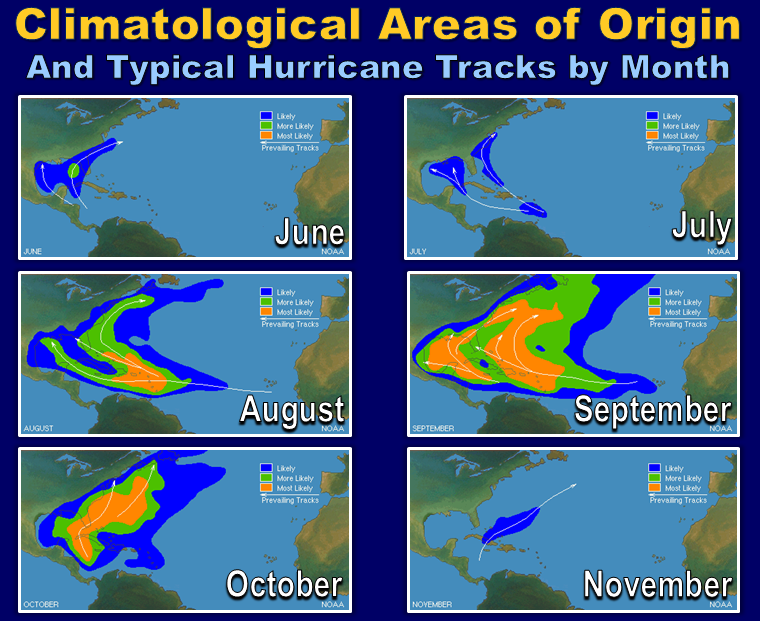
In early summer, the Gulf of Mexico warms up faster than the open Atlantic, making it a notable hotspot for early-season tropical storm development, especially in June and July. The Texas coast, Louisiana, and the Florida Panhandle often face a higher early-season risk than locations along the Eastern seaboard.
These are generally the busiest areas during each month of hurricane season, but that doesn’t mean hurricanes won’t make landfall elsewhere. NOAA
By August and September, the season reaches its peak. This is when those waves moving off the coast of Africa become a primary source of storm activity. These long-track storms are sometimes called “Cape Verde hurricanes” because they originate near the Cape Verde Islands off the African coast. While many stay over open water, others can gather steam and track toward the Caribbean, Florida or the Carolinas.
Later in the hurricane season, storms are more likely to form in the western Atlantic or Caribbean, where waters are still warm and upper-level winds remain favorable. These late-season systems have a higher probability of following atypical paths, as Sandy did in 2012 when it struck the New York City region and Milton did in 2024 before making landfall in Florida.
At the end of the day, the safest way to think about hurricane season is this: If you live along the coast, don’t let your guard down. Areas susceptible to hurricanes are never totally immune from hurricanes, and it only takes one to make it a dangerous – and unforgettable – season.
Colin Zarzycki’s research lab receives funding from the U.S. National Science Foundation, Department of Energy, and National Oceanic and Atmospheric Administration.
SINGAPORE, May 31, 2025 (GLOBE NEWSWIRE) — As the price of Bitcoin surpassed the $100,000 mark and subsequently stabilized above $100,000, many analysts believe that it will enter a long-term high-volatility market. Holding spot positions may not continue to generate profits in the short term. BexBack Exchange is stepping up its efforts to provide traders with irresistible preferential packages. The platform now offers a 100% deposit bonus, a $50 welcome bonus for new users, and a 100x leverage on cryptocurrency trading, creating unparalleled opportunities for investors.
What Is 100x Leverage and How Does It Work?
Simply put, 100x leverage allows you to open larger trading positions with less capital. For example:
Suppose the Bitcoin price is $100,000 that day, and you open a long contract with 1 BTC. After using 100x leverage, the transaction amount is equivalent to 100 BTC.
One day later, if the price rises to $105,000, your profit will be (105,000 – 100,000) * 100 BTC / 100,000 = 5 BTC, a yield of up to 500%.
With BexBack’s deposit bonus
BexBack offers a 100% deposit bonus. If the initial investment is 2 BTC, the profit will increase to 10 BTC, and the return on investment will double to 1000%.
Note: Although leveraged trading can magnify profits, you also need to be wary of liquidation risks.
How Does the 100% Deposit Bonus Work? The deposit bonus from BexBack cannot be directly withdrawn but can be used to open larger positions and increase potential profits. Additionally, during significant market fluctuations, the bonus can serve as extra margin, effectively reducing the risk of liquidation.
About BexBack?
BexBack is a leading cryptocurrency derivatives platform that offers 100x leverage on BTC, ETH, ADA, SOL, XRP,and 50+ others futures contracts. It is headquartered in Singapore with offices in Hong Kong, Japan, the United States, the United Kingdom, and Argentina. It holds a US MSB (Money Services Business) license and is trusted by more than 500,000 traders worldwide. Accepts users from the United States, Canada, and Europe. There are no deposit fees, and traders can get the most thoughtful service, including 24/7 customer support.
Why recommend BexBack?
No KYC Required: Start trading immediately without complex identity verification.
High-Leverage Trading: Offers up to 100x leverage, maximizing investors’ capital efficiency.
Demo Account: Comes with 10 BTC and 1M USDT in virtual funds, ideal for beginners to practice risk-free trading.
Comprehensive Trading Options: Feature-rich trading available via Web and mobile applications.
Convenient Operation: No slippage, no spread, and fast, precise trade execution.
Global User Support: Enjoy 24/7 customer service, no matter where you are.
Lucrative Affiliate Rewards: Earn up to 50% commission, perfect for promoters.
Take Action Now—Don’t Miss Another Opportunity!
If you missed the previous crypto bull run, this could be your chance. With BexBack’s 100x leverage and 100% deposit bonus and $50 bonus for new users (Deposit greater than 0.001BTC or 100 USDT, complete one trade within one week of registration), you can be a winner in the new bull run.
Sign up on BexBack now, claim your exclusive bonus and start accumulating more BTC today!
Disclaimer: This content is provided by BexBack.The statements, views, and opinions expressed in this content are solely those of the content provider and do not necessarily reflect the views of this media platform or its publisher. We do not endorse, verify, or guarantee the accuracy, completeness, or reliability of any information presented. We do not guarantee any claims, statements, or promises made in this article. This content is for informational purposes only and should not be considered financial, investment, or trading advice. Investing in crypto and mining-related opportunities involves significant risks, including the potential loss of capital. It is possible to lose all your capital. These products may not be suitable for everyone, and you should ensure that you understand the risks involved. Seek independent advice if necessary. Speculate only with funds that you can afford to lose. Readers are strongly encouraged to conduct their own research and consult with a qualified financial advisor before making any investment decisions. However, due to the inherently speculative nature of the blockchain sector—including cryptocurrency, NFTs, and mining—complete accuracy cannot always be guaranteed. Neither the media platform nor the publisher shall be held responsible for any fraudulent activities, misrepresentations, or financial losses arising from the content of this press release. In the event of any legal claims or charges against this article, we accept no liability or responsibility. Globenewswire does not endorse any content on this page.
Legal Disclaimer: This media platform provides the content of this article on an “as-is” basis, without any warranties or representations of any kind, express or implied. We assume no responsibility for any inaccuracies, errors, or omissions. We do not assume any responsibility or liability for the accuracy, content, images, videos, licenses, completeness, legality, or reliability of the information presented herein. Any concerns, complaints, or copyright issues related to this article should be directed to the content provider mentioned above.
Congress MP Shashi Tharoor, leading an all-party delegation to Colombia, stressed that there can be no dialogue with Pakistan until it takes concrete steps to dismantle terrorist networks operating from its territory. He emphasised that while India recognises the importance of resolving disputes through dialogue, such engagement cannot occur “with a gun pointed at its forehead.”
“We do not dispute the value of dialogue, but no nation can be expected to negotiate with a gun pointed at its forehead,” Tharoor said, leading an all-party parliamentary delegation to Latin America. He emphasized that Mahatma Gandhi’s philosophy of non-violence coexisted with an unwavering commitment to justice and freedom.
“Gandhiji taught us Ahimsa, but he also led a determined struggle for independence. Peace must be accompanied by self-respect, and freedom must come without fear,” he asserted.
Tharoor made it clear that India is open to dialogue — but only once Pakistan takes credible steps to dismantle terror infrastructure on its soil.
The Congress MP cited the April 22 terror attack in Pahalgam, which claimed 26 civilian lives, as a turning point. “This was not just an act of terror — it was a targeted attack, where the victims were asked their religion before being shot. Such acts not only claim innocent lives but also affect the livelihoods of the people of Kashmir,” he said.
In response, India launched Operation Sindoor, targeting known terror launch pads and infrastructure across the border. “We struck nine identified terror bases with precision, avoiding civilian areas. Our message was clear: we will respond strongly, but responsibly,” Tharoor explained.
Tharoor condemned Pakistan’s retaliatory shelling of civilian areas and reiterated India’s policy of proportionate response. “If you hit us, we will hit you hard. If you stop, we stop. After 18 hours, they stopped.”
Tharoor also drew attention to the unity of the Indian delegation, which comprises MPs from five political parties, seven states, and three religions. “We are united in our message: India stands firmly against terrorism and will continue to engage the world on this front.”
The delegation, part of India’s diplomatic outreach, has visited Panama, Guyana, and Colombia, and is scheduled to travel next to Brazil and the United States.
The 55th Watch and Jewellery Middle East Show opened in Sharjah, running through June 1, 2025, with India mounting a significant pavilion showcasing 11 companies as part of the region’s premier luxury accessories exhibition. Organized by Expo Centre Sharjah with support from the Sharjah Chamber of Commerce and Industry, the biannual event features over 500 local and international exhibitors representing major global companies in luxury gold jewellery, timepieces, and precious gemstones.
India’s participation is coordinated by the Gem and Jewellery Export Promotion Council (GJEPC), which established a dedicated India Pavilion to highlight the country’s design excellence and craftsmanship. According to GJEPC Chairman Kirit Bhansali, “The Watch and Jewellery Show Middle East in Sharjah is a key platform to highlight India’s design excellence and craftsmanship to a vital trade partner. Our continued presence at the show through the India Pavilion reflects this market’s growing importance.”
The UAE represents a vital trade partner, with gem and jewellery exports surging over 60 percent following the India-UAE Comprehensive Economic Partnership Agreement. Exports grew from $4.95 billion in fiscal year 2022 to $8.04 billion in fiscal year 2024, demonstrating the strategic importance of such partnerships.
The exhibition attracts over 1,800 high-profile designers, manufacturers, and industry professionals from countries including Russia, Mexico, Tanzania, Egypt, India, Italy, the United Kingdom, the United States, Singapore, China, Japan, Saudi Arabia, Bahrain, and Lebanon. Visitor turnout is projected to exceed 80,000, with the timing coinciding with the Eid Al Adha holiday, further enhancing its appeal among jewellery enthusiasts.Among the exhibition’s highlights is a record-breaking 108-meter diamond necklace presented by Amaar Jewels, designed to enter the Guinness World Records.
According to the World Gold Council, gold sales in the UAE totaled 23.4 tonnes valued at $1.8 billion in the first half of 2024, representing 17.3 percent of the Middle East’s total sales. These figures underscore the exhibition’s strategic role in advancing the regional gold and jewellery industry.
Spanning 30,000 square meters, the exhibition serves as a platform for deals, partnerships, and insights into design trends. Specialized programs and workshops run alongside the main exhibition, offering participants opportunities to enhance their skills and knowledge about recent developments in the global jewelry industry.
The show represents the largest and longest-running jewelry exhibition in the UAE and broader region, having grown from a handful of exhibitors when first launched in 1993 to become an indispensable part of the regional jewellery industry calendar.
Colombia’s Vice Minister of Foreign Affairs, Rosa Yolanda Villavicencio, on Friday said that Bogota was withdrawing an earlier statement expressing condolences for those killed in Pakistan during India’s counter-terror operation, ‘Operation Sindoor’.
The statement came after a meeting with an Indian parliamentary delegation led by Congress MP Shashi Tharoor, who said Colombia had “fully understood India’s position” on the matter.
“The Vice Minister very graciously mentioned that they have withdrawn the statement we had expressed concern about, and that they fully understand our position on the matter, which is something we really value,” Tharoor told reporters after the meeting.
Earlier, India had expressed disappointment over the Colombian statement, which appeared to equate terrorists killed in the Indian strike with the victims of the Pahalgam terror attack, carried out by The Resistance Front — an affiliate of Pakistan-based Lashkar-e-Taiba.
Standing alongside Tharoor, Villavicencio said: “We are very confident that with the explanations we received today, and the detailed information we now have regarding the real situation in Kashmir, we can continue the dialogue.”
Colombia’s course correction comes as it prepares to join the UN Security Council next year, where it is running unopposed for the Latin American seat.
Speaking to local media on Thursday, Tharoor said India had been “a little disappointed” that Colombia had issued condolences for those killed in Pakistan “rather than sympathising with the victims of terrorism” in Jammu and Kashmir.
Colombia acted promptly on India’s concerns. Former President Cesar Augusto Gaviria Trujillo, leader of the country’s largest political party, said, “Colombia has solidarity with India. We check any kind of terrorism, and under any circumstances, we will be on your side.”
Following the meeting with Villavicencio, BJP MP Tejasvi Surya, in a post on X, said that the Indian delegation had briefed her “on the sequence of events, from the Pahalgam terror attack to India’s calibrated response under Operation Sindoor.”
The MPs also met members of Colombia’s Congress, including Alejandro Toro, president of the Second Commission, which handles international relations, and Jaime Raul.
During their visit, Colombian leaders gifted Tharoor a wool poncho and traditional hat. The delegation also interacted with the Consejo Colombiano de Relaciones Internacionales (CORI), a leading foreign affairs think tank, and paid tribute at the Mahatma Gandhi statue at Tadeo University.
Tharoor is leading a cross-party Indian delegation that includes BJP’s Tejasvi Surya, Bhubaneswar Kalita, and Shashank Mani Tripathi; GM Harish Balayogi of the Telugu Desam Party; Milind Murli Deora of the Shiv Sena; Sarfaraz Ahmad of the Jharkhand Mukti Morcha; and Shambhavi of the Lok Janshakti Party (Ram Vilas).
The delegation has already visited Guyana and Panama — both non-permanent members of the Security Council — and will next travel to Brazil and then Washington, DC.
At the joint invitation of the Secretary-General of the OECD, Mathias Cormann, and the President of the Republic of Costa Rica, Rodrigo Chaves Robles, Secretary-General of ASEAN Dr. Kao Kim Hourn will participate in the 2025 Meeting of the OECD Council at Ministerial Level (MCM), which will take place at the OECD Headquarters in Paris, France, on 3-4 June 2025. Dr. Kao will be delivering remarks at the Opening Ceremony of the OECD MCM, during the handover ceremony from Australia and Viet Nam to Canada and the Philippines, as the incoming Chairs of OECD Southeast Asia Regional Programme (SEARP).
Dr. Kao will also participate in several breakout sessions, highlighting ASEAN-OECD potential collaboration in advancing rules-based multilateral trading system, promoting inclusive and sustainable growth, and harnessing the opportunities of digital transformation. Taking the opportunity of his time in Paris, Dr. Kao will also engage with ministers and high-level officials from ASEAN and ASEAN’s external partners, business communities, as well as media representatives in Paris, on 5-6 June 2025.
The post Secretary-General of ASEAN to participate in the 2025 Meeting of the OECD Council at Ministerial Level (MCM) and Related Meetings in Paris, France appeared first on ASEAN Main Portal.
Source: People’s Republic of China – State Council News
U.S. President Donald Trump walks to board Marine One at the White House in Washington, D.C., the United States, on May 30, 2025. [Photo/Xinhua]
U.S. Supreme Court on Friday lifted a federal district court order that kept humanitarian parole protections in place for more than 500,000 migrants from four countries of Cuba, Haiti, Nicaragua and Venezuela.
The court has also allowed the Trump administration to revoke temporary legal status for about 350,000 Venezuelan migrants in another case.
The move has cleared the way for the Trump administration to strip temporary legal protections for hundreds of thousands of immigrants for now, and pushed the total number of people who could be exposed to deportation to nearly one million, local media reported Friday.
To address the growing number of migrants arriving at the U.S.-Mexico border, the Biden administration created a parole program for Cubans, Haitians, Nicaraguans and Venezuelans in late 2022 and early 2023, authorizing them to work in the United States for two years after going through certain process. The program protected roughly 532,000 people from the risk of deportation.
But soon after beginning his second term, President Donald Trump issued an executive order directing the Homeland Security Secretary Kristi Noem to terminate all parole programs. Acting on the executive order, Noem in March announced ending the parole program, with any grants of parole still in effect expiring by April 24.
A federal district court judge in Massachusetts agreed to halt Noem’s blanket revocation of migrants’ temporary legal status when a group of 23 individuals including several parolees and a nonprofit organization challenged Noem’s termination of the program.
The Trump administration first appealed to the U.S. Court of Appeals for the 1st Circuit, which declined to pause the district court’s order pending appeal; and then sought the Supreme Court’s intervention.
Source: People’s Republic of China – State Council News
Chinese Foreign Minister Wang Yi, also a member of the Political Bureau of the Communist Party of China Central Committee, poses for a group photo with other guests at the signing ceremony of the Convention on the Establishment of the International Organization for Mediation (IOMed) in Hong Kong, south China, May 30, 2025. The signing ceremony was held here on Friday. Wang Yi attended the ceremony and delivered a speech. [Photo/Xinhua]
HONG KONG, May 30 — The International Organization for Mediation (IOMed) serves as an important public good in the field of the rule of law for better global governance, Chinese Foreign Minister Wang Yi said here on Friday.
Wang, also a member of the Political Bureau of the Communist Party of China Central Committee, delivered a speech at the signing ceremony of the Convention on the Establishment of the IOMed in Hong Kong.
Wang said that as an innovative step in international rule of law, the IOMed has great significance in the history of international relations.
Wang noted that the establishment of the IOMed is an actualization of the purposes and principles of the UN Charter and will fill an institutional gap in international mediation.
The birth of the IOMed can help transcend the “you-lose-I-win” zero-sum mentality, promote the amicable resolution of international disputes, and foster more harmonious international relations, Wang said.
The IOMed respects the wishes of parties concerned, and draws upon the strengths of being more flexible, cost-effective, convenient, and efficient, he said, adding that it will complement and form synergies with litigation, arbitration and other existing international dispute settlement mechanisms.
Emphasizing the importance of enhancing the participation of developing countries and improving the representation and say of the Global South in international governance, Wang called on parties to put in place at an early date a set of world-class mediation rules and mechanisms featuring autonomy, flexibility, pragmatism and high efficiency.
As decided through consultation among countries participating in the negotiation of the convention, the IOMed will be headquartered in Hong Kong, Wang said, adding that the city, with affinity to the motherland and connection to the world, enjoys exceptional advantages in international mediation.
China looks forward to the signatories’ early ratification of the convention and welcomes the active participation of more countries, said the foreign minister.
About 400 high-level representatives from 85 countries and nearly 20 international organizations attended Friday’s signing event. Among them, 33 countries signed the convention on-site, making them the founding members of the IOMed.
Pakistani Deputy Prime Minister and Foreign Minister Mohammad Ishaq Dar, Zimbabwean Minister of Foreign Affairs and International Trade Amon Murwira, Nicaragua’s Attorney General Wendy Carolina Morales Urbina, Serbian Minister of Justice Nenad Vujic, Swiss Foreign Minister Ignazio Cassis and UN Under-Secretary-General Li Junhua delivered speeches at the event.
Acknowledging that the IOMed is in line with the purposes and principles of the UN Charter, they stressed its importance to multilateralism, global governance and global rule of law, and called on more countries to sign and ratify the convention.
They also appreciated China’s role as a major country and expected the IOMed’s contribution to the peaceful settlement of disputes and friendly cooperation among countries.
John Lee, chief executive of the Hong Kong Special Administrative Region, welcomed the establishment of the world’s first intergovernmental international legal organization dedicated to resolving international disputes through mediation in Hong Kong, adding that Hong Kong will give full play to its institutional advantages of “one country, two systems” and fully support the operation of the IOMed.
Chinese Foreign Minister Wang Yi, also a member of the Political Bureau of the Communist Party of China Central Committee, attends the signing ceremony of the Convention on the Establishment of the International Organization for Mediation (IOMed) and delivers a speech, in Hong Kong, south China, May 30, 2025. The signing ceremony was held here on Friday. [Photo/Xinhua]
Hurricane season is here, but FEMA’s policy change could leave low-income areas less protected Source: The Conversation (Au and NZ) – By Ivis García, Associate Professor of Landscape Architecture and Urban Planning, Texas A&M University Hurricane Harvey inundated the Cottage Grove neighborhood of Houston in 2018. Scott Olson/Getty Images When powerful storms hit your city, which neighborhoods are most likely to flood? In many cities, they’re typically low-income areas.
Shock NSW Senate result as One Nation beats Labor to win final seat Source: The Conversation (Au and NZ) – By Adrian Beaumont, Election Analyst (Psephologist) at The Conversation; and Honorary Associate, School of Mathematics and Statistics, The University of Melbourne The button was pressed to electronically distribute preferences for the New South Wales Senate today. All analysts expected Labor to win the final seat, for a three
GPs will be a great help for managing ADHD medications. But many patients will still need specialists Source: The Conversation (Au and NZ) – By Adam Guastella, Professor and Clinical Psychologist, Michael Crouch Chair in Child and Youth Mental Health, University of Sydney The New South Wales government this week announced reforms that will allow some GPs to treat and potentially diagnose attention-deficit hyperactivity disorder (ADHD). This aims to make ADHD care
Will elections for judges make Mexico the ‘most democratic country in the world’? Critics fear the opposite Source: The Conversation (Au and NZ) – By Luis Gómez Romero, Senior Lecturer in Human Rights, Constitutional Law and Legal Theory, University of Wollongong On Sunday, Mexico will hold an unprecedented election, becoming the first country in the world to allow voters to elect judges at every level. Voters will elect approximately half the judges
What is mantle cell lymphoma? Magda Szubanski’s ‘rare and fast-moving’ cancer, explained Source: The Conversation (Au and NZ) – By John (Eddie) La Marca, Senior Research Officer, Blood Cells and Blood Cancer, WEHI (Walter and Eliza Hall Institute of Medical Research) Lisa Maree Williams/Getty Beloved Australian actor, Magda Szubanski, has revealed she’s been diagnosed with a “very rare, very aggressive, very serious” blood cancer called mantle cell
Keith Rankin Analysis – Who, neither politician nor monarch, executed 100,000 civilians in a single night? Analysis by Keith Rankin. Who, neither politician nor monarch, executed 100,000 civilians in a single night? Answer: Curtis LeMay, American Air Force General, in the wee hours of 10 March 1945. While authorised by his immediate superior, this firebombing of Tokyo was a decentralised military operation which received subsequent popular approval. It was called ‘Operation
Source: United States Senator for New Mexico Martin Heinrich
WASHINGTON — U.S. Senator Martin Heinrich (D-N.M.), Ranking Member of the Senate Energy and Natural Resources Committee, sent a letter to U.S. Department of the Interior Secretary Doug Burgum demanding answers on the Department’s plans to transfer National Park System units out of federal management. The letter follows Heinrich’squestioning of Secretary Burgum during a Senate Interior, Environment, and Related Agencies Appropriations Subcommittee hearing, where Burgum failed to provide sufficient answers on the Trump Administration’s plan to transfer hundreds of sites managed by the National Park Service (NPS) to the states.
“The Administration’s budget proposes a $900 million reduction to the operation of the National Park System – approximately a 30 percent cut. In the same budget submission, the Administration proposed ‘transferring smaller, lesser visited parks to [s]tate and tribal governments,” Heinrich wrote in his letter to Secretary Burgum.
The Administration’s proposal to reduce NPS’s budget and transfer management responsibilities of park system units to states threatens local economies and businesses. In fact, national parks are engines of economic growth. In 2023, visitors to NPS sites contributed an estimated $55.6 billion to the economy and supported over 400,000 jobs.
Heinrich noted that only Congress has authority to transfer NPS units in most circumstances, stating clearly his opposition to transferring these sites to the states, “As you know, most NPS units were established legislatively, and transferring them out of federal management would require legislation from Congress. As the Ranking Member of the Senate Committee on Energy and Natural Resources, which has jurisdiction over legislation regarding the National Park System, I am opposed to the Administration’s proposal to transfer NPS sites to the states.”
Heinrich continued, emphasizing his concerns over the Secretary’s lack of information on the units under consideration, and what states the Administration hopes to transfer the units to,“You told me that you have not yet consulted with the states that you hope to transfer these units to, nor have you determined which units are under consideration… You told the House Committee on Appropriations, Subcommittee on Interior, Environment, and Related Agencies, that there are ‘over 400 other locations that the National Park Service manages’ that are under consideration for divestment, but you did not provide any detail about which units those are, other than that they are not the ‘crown Jewels.”’
Heinrich concluded his letter by asking for detailed answers from Secretary Burgum to the following questions:
At the hearing in the House Appropriations Committee, you said the administration is not considering transferring any of the “crown jewel” national parks. Please list which NPS units the administration is not considering transferring to states and which units the administration is considering transferring to states. For each unit the administration is considering transferring to states, please describe why the administration is considering the transfer.
What factors will the administration consider when generating its list of which NPS units to transfer and which units not to transfer? In responding to this question, please provide a comprehensive list of all factors the Department will consider.
For each NPS unit the Department is considering transferring to a state, has the Department conducted or does the Department plan to conduct a comprehensive analysis to understand the economic impact to local gateway communities? If so, please provide a copy of the analysis.
For each NPS unit the Department is considering transferring to a state, has the Department conducted or does the Department plan to conduct a comprehensive analysis to understand if the state is equipped (e.g., possesses sufficient resources and funding) to manage the site? If so, please provide a copy of the analysis.
Read the full letter here and below.
Dear Secretary Burgum:
Earlier this month, the Trump administration released its preliminary 2026 budget request outlining significant cuts to government agencies, including steep cuts to the Department of the Interior’s National Park Service (NPS). The administration’s budget proposes a $900 million reduction to the operation of the National Park System – approximately a 30 percent cut.
In the same budget submission, the administration proposed “transferring smaller, lesser visited parks to [s]tate and tribal governments.” The administration’s proposal to reduce NPS’ budget and transfer management responsibilities of park system units to states threatens local economies and businesses. In fact, national parks are engines of economic growth. In 2023, visitors to NPS sites contributed an estimated $55.6 billion to the economy and supported over 400,000 jobs.
As you know, most NPS units were established legislatively, and transferring them out of federal management would require legislation from Congress. As the ranking member of the Senate Committee on Energy and Natural Resources, which has jurisdiction over legislation regarding the National Park System, I am opposed to the administration’s proposal to transfer NPS sites to the states. States do not have the same resources as the Federal government to manage and maintain these sites that tell the complex story of our nation. The budget proposal makes clear that the administration expects the states to shoulder the burden of managing these sites without any additional funding or resources, many of which have significant and costly deferred maintenance backlogs.
You appeared before the Senate Committee on Appropriations, Subcommittee on Interior, Environment, and Related Agencies, earlier this week to outline the administration’s budget submission. At that hearing, I asked you about the administration’s plan to transfer hundreds of NPS units to the states. You told me that you have not yet consulted with the states that you hope to transfer these units to, nor have you determined which units are under consideration. Earlier in the week, you told the House Committee on Appropriations, Subcommittee on Interior, Environment, and Related Agencies, that there are “over 400 other locations that the national park service manages” that are under consideration for divestment, but you did not provide any detail about which units those are, other than that they are not the “crown Jewels.”
In light of these outstanding questions and concerns, I request you provide comprehensive responses to the following questions by June 6, 2025:
1. At the hearing in the House Appropriations Committee, you said the administration is not considering transferring any of the “crown jewel” national parks. Please list which NPS units the administration is not considering transferring to states and which units the administration is considering transferring to states. For each unit the administration is considering transferring to states, please describe why the administration is considering the transfer.
2. What factors will the administration consider when generating its list of which NPS units to transfer and which units not to transfer? In responding to this question, please provide a comprehensive list of all factors the Department will consider.
3. For each NPS unit the Department is considering transferring to a state, has the Department conducted or does the Department plan to conduct a comprehensive analysis to understand the economic impact to local gateway communities? If so, please provide a copy of the analysis.
4. For each NPS unit the Department is considering transferring to a state, has the Department conducted or does the Department plan to conduct a comprehensive analysis to understand if the state is equipped (e.g., possesses sufficient resources and funding) to manage the site? If so, please provide a copy of the analysis.
Thank you, in advance, for your prompt responses to these questions. If you have any questions or need additional information, please do not hesitate to contact my staff at (202) 224-4971.
Sincerely,
Source: United States Senator for New Mexico Martin Heinrich
Heinrich and Senators to the DOI Acting Inspector General: “We are concerned that the Administration’s actions to gut the agency of qualified public servants could leave critical water infrastructure and communities vulnerable to operational disruptions”
WASHINGTON — U.S. Senator Martin Heinrich (D-N.M.), Ranking Member of the Senate Energy and Natural Resources Committee, led seven Democratic Senate Energy and Natural Resources Committee colleagues in a letter urging the U.S. Department of the Interior Acting Inspector General (IG) Caryl Brzymialkiewicz to evaluate the extent to which the Trump Administration’s workforce reductions at the Bureau of Reclamation (BOR) prevent the agency from fulfilling its statutory mission and implementing relevant programs and activities authorized by Congress.
“Recent reductions in workforce significantly threaten BOR’s ability to safely and reliably deliver water to communities and farmers, keep waterways flowing for fish and wildlife across the western United States, and produce reliable electricity,” the senators began.
The BOR is the largest wholesale water supplier in the United States – delivering trillions of gallons of water to more than 31 million people. The BOR also is the second largest producer of hydroelectric power in the country. The facilities the BOR operate generate 40 million megawatt-hours of electricity each year.
According to reports, the BOR has lost 1,400 public servants, around 25 percent of the agency’s entire workforce, since the Administration began its assault on the federal workforce.
The senators continued, expressing concern over the lack of strategy and harm to public safety that workforce reductions pose, “Rapid reductions to BOR’s workforce raise significant concerns about the Bureau’s ability to meet its core responsibilities, particularly inspecting dams and identifying threats to public safety.”
“BOR needs experienced personnel with the necessary expertise to manage critical infrastructure. We are concerned that the Administration’s actions to gut the agency of qualified public servants could leave critical water infrastructure and communities vulnerable to operational disruptions,” the senators continued.
The senators concluded their letter by requesting that the IG evaluate whether recent workforce reductions at BOR inhibit the Bureau from carrying out its obligations.
The letter is led by Ranking Member Martin Heinrich (D-N.M.). The letter is signed by Senate Committee on Energy and Natural Resources Democratic members U.S. Senators Ron Wyden (D-Ore.), Mazie Hirono (D-Hawaii), John Hickenlooper (D-Colo.), Alex Padilla (D-Calif.), and Rueben Gallego (D-Ariz.), Catherine Cortez Masto (D-Nev.), and Maria Cantwell (D-Wash.).
The full text of the letter is here and below:
Dear Acting Inspector General Brzymialkiewicz:
We write to request that your office evaluate the extent to which workforce reductions at the Bureau of Reclamation (“Bureau” or “BOR”) prevent the agency from fulfilling its statutory mission and implementing relevant programs and activities authorized by Congress. The Bureau is the largest wholesaler of water in the United States—delivering trillions of gallons of water to more than 31 million people. The Bureau is also the second largest producer of hydroelectric power in the country. The facilities BOR operate generate 40 million megawatt-hours of electricity each year. However, recent reductions in workforce significantly threaten BOR’s ability to safely and reliably deliver water to communities and farmers, keep waterways flowing for fish and wildlife across the western United States, and produce reliable electricity.
According to reports, BOR has lost 1,400 public servants since the administration began its assault on the federal workforce. The positions reportedly eliminated include mechanics, engineers, and fish biology specialists—personnel with considerable expertise. Through firings of probational workers, buyouts, early retirements, and other related actions, BOR has shrunk by 25 percent. This workforce reduction has lacked a coherent, mission- and safety- driven strategy and instead led to the departure of experienced personnel—some with over 20 years of experience—leaving the Bureau susceptible to operational disruptions.
Rapid reductions to BOR’s workforce raise significant concerns about the Bureau’s ability to meet its core responsibilities, particularly inspecting dams and identifying threats to public safety. BOR manages over 450 dams throughout 17 western states. Previously, BOR’s dam safety program identified over 300 high and significant hazard dams at more than 200 facilities. The age and complex nature of dam systems necessitates having experienced staff trained in the operation of such systems. In fact, as your office identified in a September 2023 report, approximately 90 percent of BOR’s dams are more than 50 years old and “[a]ging dams increaset he risk of dam failures.” BOR needs experienced personnel with the necessary expertise to manage critical infrastructure. We are concerned that the administration’s actions to gut the agency of qualified public servants could leave critical water infrastructure and communities vulnerable to operational disruptions.
Your office is responsible for promoting “accountability, integrity, economy, efficiency, and effectiveness within” the DOI and identifying “ways to improve the DOI’s programs and operations by offering specific, actionable recommendations that lead to positive change.” We therefore urge you to evaluate whether recent workforce reductions at BOR inhibit the Bureau from carrying out its obligations.
Thank you for your attention to this important matter.
Sincerely,
Source: United States Senator for New Mexico Martin Heinrich
WASHINGTON — U.S. Senator Martin Heinrich (D-N.M.), Ranking Member of the Senate Energy and Natural Resources Committee, sent a letter inviting U.S. Forest Service Chief Tom Schultz to visit the Upper Pecos Watershed in Northern New Mexico and hear from local leaders, Tribes, community members, farmers, business owners, and recreationists about the importance of protecting the Upper Pecos Watershed from new mining operations.
“For decades, the community in the Upper Pecos Watershed of New Mexico has been united in an effort to protect the river basin from the very real threat of mine waste pollution. Everyone in the community can agree that the Pecos River is an invaluable lifeline. With headwaters in Northern New Mexico, the Pecos supports a wide range of uses from recreation and agriculture to traditional use by the Pueblos in the area. Unfortunately, this region has a history of poorly managed mining projects,”Heinrich wrote to U.S. Forest Service Chief Tom Schultz.
“The area is still recovering from a devastating 1991 mine spill, which threatened the health and economic survival in the immediate community and for hundreds of miles throughout the state. Thanks to decades of hard work and millions of dollars, this watershed is once again one of the cleanest and most productive in the state – though the remediation is not complete,” Heinrich stated.
In 1991, a toxic waste spill from a closed mine in the Upper Pecos Watershed caused more than 11 miles of fish kill in the river and required a clean up effort that took decades and millions of dollars to complete. For years, there has been a community-led effort to protect the area from future mining claims to avoid similar threats and pollution.
In response to a letter sent by Heinrich and the N.M. Congressional Delegation, in December 2024, President Biden’s Bureau of Land Management (BLM) and Forest Service initiated a process to propose a 20-year withdrawal to help secure the region’s water and air quality, cultural resources, critical fish and wildlife habitat, and recreational opportunities. The withdrawal, for lands in San Miguel and Santa Fe counties, encompassed multiple Pecos River tributaries, including Dalton Canyon, Macho Canyon, Wild Horse Creek, Indian Creek, and Doctor Creek.
On December 16, 2024, the BLM and Forest Service initiated a 90-day public comment period to gather input on the proposal. During the comment period, the two agencies were scheduled to host a public meeting for the proposed Upper Pecos River Watershed Protection Area withdrawal on February 26, 2025. This public meeting was cancelled by the Trump Administration on February 19, 2025, with no further explanation. Despite the cancellation, the Administration received hundreds of public comments in support of the mineral withdrawal.
On April 7, 2025, reporting from Source New Mexico revealed the Trump Administration plans to reverse the BLM and the Forest Service’s decision to protect the Upper Pecos Watershed from new mining operations.
“I am concerned by the Forest Service’s decision to reverse the temporary protection and discontinue the process for a longer-term withdrawal. This decision was made without proper community engagement or review of the hundreds of positive comments that were submitted during the public comment period,” Heinrich continued in his letter to Chief Schultz.
In response to the Trump Administration’s reversal, Heinrich reintroduced his Pecos Watershed Protection Act to permanently withdraw all federally managed minerals in the watershed from development — preventing the leasing, patent, or sale of all publicly owned minerals.
To continue the effort to protect the Pecos, Heinrich invited Chief Schultz at the end of his letter, writing, “I would like to extend an invitation to you to visit New Mexico and the Pecos area so you can hear firsthand from local leaders, Tribes, community members, farmers, business owners, recreationists, and others while experiencing the beauty of this watershed. While there, you can see why this river is so valuable and witness the very real threat of mining pollution that still exists.”
At the end of his letter, Heinrich included invitations to Chief Schultz from local and Tribal leaders that show the widespread community support for permanently protecting the Pecos.
Read the community letter from over 20 local leaders and members of the Hispanic Conservation Leadership Council here.
Read the invitation from the Pueblo of Jemez here.
Read the invitation from the Pueblo of Tesuque here.
Read Heinrich’s full letter here and below:
Dear Chief Schultz:
For decades, the community in the Upper Pecos Watershed of New Mexico has been united in an effort to protect the river basin from the very real threat of mine waste pollution. Everyone in the community can agree that the Pecos River is an invaluable lifeline. With headwaters in Northern New Mexico, the Pecos supports a wide range of uses from recreation and agriculture to traditional use by the Pueblos in the area. Unfortunately, this region has a history of poorly managed mining projects. The area is still recovering from a devastating 1991 mine spill, which threatened the health and economic survival in the immediate community and for hundreds of miles throughout the state. Thanks to decades of hard work and millions of dollars, this watershed is once again one of the cleanest and most productive in the state – though the remediation is not complete.
To New Mexicans who are facing a threat to their way of life and cultural heritage, there is no doubt that this area should be permanently protected. The spill in 1991 left scars on the landscape and with those who depend on the river. We celebrated when the Forest Service and the Bureau of Land Management announced last year that they would be pursuing a 20-year mineral withdrawal in the basin. The long-overdue action by the last Administration was a major victory for the Pecos Valley.
However, I am concerned by the Forest Service’s decision to reverse the temporary protection and discontinue the process for a longer-term withdrawal. This decision was made without proper community engagement or review of the hundreds of positive comments that were submitted during the public comment period. The Administration also cancelled a public forum that would have allowed for discussion of the administrative withdrawal and demonstrated to your agency that this community is united by the beauty and health of the Pecos River.
Therefore, I would like to extend an invitation to you to visit New Mexico and the Pecos area so you can hear firsthand from local leaders, Tribes, community members, farmers, business owners, recreationists, and others while experiencing the beauty of this watershed. While there, you can see why this river is so valuable and witness the very real threat of mining pollution that still exists.
I am including letters and invites from local and tribal leaders that show the widespread support for this effort in the area. They represent just a few of many examples of community support for protecting the Pecos. Thank you for your attention to this request and I hope I can see you in New Mexico soon.
Sincerely,
SAN DIEGO – Hector Alejandro Paez Garcia, a Mexico City-based attorney, has pleaded guilty in federal court, admitting that he and others conspired to transport, transmit, and transfer tens of millions of dollars in drug trafficking proceeds from the United States to Mexico.
Paez’s plea is part of a long-term FBI investigation targeting a Mexico-based money laundering organization (MLO) that is believed to have laundered at least $52.7 million for the Sinaloa Cartel before the organization’s leaders were arrested.
According to court documents, the MLO utilized a network of shell companies in San Diego to launder tens of millions of dollars in bulk cash from across the country generated through the Sinaloa Cartel’s drug importation and distribution operations. MLO employees travelled to dozens of U.S. cities to pick up this bulk cash in amounts up to $200,000. The money was then funneled through the San Diego-based shell companies and delivered to money laundering accounts in Mexico controlled by Paez, who in his plea agreement admitted serving a managerial role in the MLO’s operations.
During the investigation, FBI agents seized 66 money laundering bank accounts throughout the United States. As the FBI began to target and seize the MLO’s assets, Paez turned to the use of cryptocurrency in an attempt to shield those assets from law enforcement. But the FBI was able to infiltrate and take down the MLO’s cryptocurrency laundering network.
To date, the investigation has resulted in the arrests of 11 people on money laundering charges and the seizure of more than $3.1 million in illicit assets. A related DEA investigation led to 24 additional arrests and asset seizures totaling $450,000.
Paez is scheduled to be sentenced on August 15, 2025.
To date, in addition to Paez, additional participants in the scheme have been charged, including the following:
Miguel Angel Encinas Gomez of Mexicali, México, leader of a Mexicali-based cell of MLO. Encinas pleaded guilty to laundering $35 million in bulk cash narcotics proceeds in July 2023.
Hugo Andres Velasquez Pantza, a Colombian national who allegedly assisted the MLO in the implementation of cryptocurrency into their operations. Velasquez was subsequently targeted in an undercover FBI operation and arrested in Rome, Italy in January 2025. Velasquez was extradited to the United States in April 2025 and awaits trial.
James Harmon Yarbrough of Apopka, Florida, who worked in partnership with Cevallos to receive $326,000 in illicit proceeds in a scheme to converting the funds to cryptocurrency. Yarbrough pleaded guilty in July 2023.
Victoria Johanna Lopez, Jose Jesus Lopez, Jose Mayorga Martinez, and Gerardo Vasquez Jr. who allegedly worked as bulk cash couriers who handled and deposited bulk cash for the MLO. Victoria Lopez, Jose Lopez, Mayorga have pleaded guilty. Vazquez’s case is set for trial in September 2024.
Jhonatan Suarez Florez of Auburndale, Florida, who used accounts associated with his Florida-based construction and door manufacturing businesses to receive and transmit funds belonging to the criminal organization. Suarez Florez pleaded guilty in December 2024.
Alberto David Benguait Jimenez, an alleged leader of the MLO, remains a fugitive at this time. If anyone has information related to this individual, please contact the FBI at 858-320-1800.
This case is being prosecuted by Assistant U.S. Attorneys Paul Benjamin and Robert Miller. Former Assistant U.S. Attorney Owen Roth contributed significantly to the case. The FBI worked in close partnership with the Drug Enforcement Administration, Imperial County District Office, as well as Panamanian authorities, to seize the MLO’s assets and arrest multiple participants in the scheme.
The Justice Department’s Office of International Affairs worked with law enforcement partners in Italy to secure the arrest and extradition of Velasquez Pantza.
DEFENDANT Case Number 23cr0446
Hector Alejandro Paez Garcia Age: 43 Mexico City, Mexico
SUMMARY OF CHARGES
International Money Laundering Conspiracy – Title 18, U.S.C., Section 1956(h), and 1956(a)(2)(B)(i)
Maximum penalty: Twenty years in prison and $500,000 fine
INVESTIGATING AGENCY
Federal Bureau of Investigation
*The charges and allegations contained in an indictment or complaint are merely accusations, and the defendants are considered innocent unless and until proven guilty.
This case is part of Operation Take Back America, a nationwide initiative that marshals the full resources of the Department of Justice to repel the invasion of illegal immigration, achieve the total elimination of cartels and transnational criminal organizations (TCOs), and protect our communities from the perpetrators of violent crime. [use if applicable] Operation Take Back America streamlines efforts and resources from the Department’s Organized Crime Drug Enforcement Task Forces (OCDETFs) and Project Safe Neighborhood (PSN).
This case is the result of ongoing efforts by the Organized Crime Drug Enforcement Task Force (OCDETF), a partnership that brings together the combined expertise and unique abilities of federal, state and local law enforcement agencies. The principal mission of the OCDETF program is to identify, disrupt, dismantle and prosecute high-level members of drug trafficking, weapons trafficking and money laundering organizations and enterprises.
PHOENIX, Ariz. – During the week of enforcement operations from May 24, 2025, through May 30, 2025, the U.S. Attorney’s Office for the District of Arizona brought immigration-related criminal charges against 257 individuals. Specifically, the United States filed 125 cases in which aliens illegally re-entered the United States, and the United States also charged 124 aliens for illegally entering the United States. In its ongoing effort to deter unlawful immigration, the United States filed 7 cases against 8 individuals responsible for smuggling illegal aliens into and within the District of Arizona.
These cases were referred or supported by federal law enforcement partners, including Immigration and Customs Enforcement’s Enforcement and Removal Operations (ICE ERO), ICE Homeland Security Investigations (HSI), U.S. Border Patrol, the Drug Enforcement Administration (DEA), the Federal Bureau of Investigation (FBI), the U.S. Marshals Service (USMS), and the Bureau of Alcohol, Tobacco, Firearms and Explosives (ATF).
Recent matters of interest include:
United States v. Hugo Antonio Martinez-Lopez: On May 24, 2025, an Integrated Fixed Tower operator observed an individual come out of the brush and enter a truck, driven by Hugo Antonio Martinez-Lopez, on Federal Route 19 near mile marker 1 in Newfield, Arizona, on the Tohono O’odham Nation. BPAs located the truck and attempted a stop, but Martinez-Lopez failed to yield. While BPAs were pursuing the truck, Martinez-Lopez abruptly stopped on the right shoulder of the road and an individual exited the passenger’s side of the vehicle and ran into the brush. Martinez-Lopez then fled at a high rate of speed. After a foot chase, BPAs apprehended the individual who had run into the bush and determined that they were a citizen of Mexico, illegally present in the United States. Other BPAs continued to pursue Martinez-Lopez and successfully deployed a vehicle immobilization device (VID), which punctured one of the truck’s tires. The truck then came to a stop and Martinez-Lopez fled from the vehicle. BPAs also apprehended Martinez-Lopez after a short foot pursuit. Martinez-Lopez was charged by complaint with Transportation of an Illegal Alien. [Case Number: MJ-25-2029]
United States v. Jesus Fernando Jimenez Rodriguez: On May 28, 2025, Mesa Police Department executed a search warrant on a residence in Mesa, Arizona. Jesus Fernando Jimenez Rodriguez, a citizen of Mexico, was one of the occupants of the residence. Inside the residence, readily visible in the living room and stacked against the wall, law enforcement found 10,000 rounds of PMC 5.56 ammunition and 25,000 rounds of Wolf .223 ammunition. Jimenez Rodriguez was charged by complaint with one count of Alien in Possession of Ammunition and Illegal Re-entry. [Case Number: MJ-25-9221]
United States v. Nicholas Anthony Lawrence: On May 28, 2025, Nicholas Anthony Lawrence, a citizen of Jamaica and illegal alien, was charged by indictment with Aggravated Identity Theft, Fraud and Misuse of Visas, Permits, and Other Documents, Failure to Register as a Sex Offender, and Reentry of Removed Alien. Lawrence was previously convicted on or about December 4, 2017, of Attempt to Commit Molestation of Child, and Attempt to Commit Sexual Conduct with Minor, both felony offenses, in the Superior Court of Arizona, County of Maricopa. Lawrence was sentenced to seven years in prison, and lifetime probation, respectively. Lawrence was previously removed from the United States in November 2022. [Case Number: CR-25-00817-PHX-GMS]
Criminal complaints and indictments are methods by which a person is charged with criminal activity and raise no inference of guilt. An individual is presumed innocent until evidence is presented to a jury that establishes guilt beyond a reasonable doubt.
These cases are part of Operation Take Back America, a nationwide initiative that marshals the full resources of the Department of Justice to repel the invasion of illegal immigration, achieve the total elimination of cartels and transnational criminal organizations (TCOs), and protect our communities from the perpetrators of violent crime. Operation Take Back America streamlines efforts and resources from the Department’s Organized Crime Drug Enforcement Task Forces (OCDETFs) and Project Safe Neighborhood (PSN).
For more information on the U.S. Attorney’s Office, District of Arizona, visit http://www.justice.gov/usao/az/ Follow the U.S. Attorney’s Office, District of Arizona, on X @USAO_AZfor the latest news.
Source: United States Bureau of Alcohol Tobacco Firearms and Explosives (ATF)
MARTINSBURG, WEST VIRGINIA – Three people have admitted to working in a large-scale drug operation in Berkeley and Jefferson Counties.
Juan Carlos Suarez-Lugo, age 55, of Martinsburg, West Virginia, and Alexis Alvarado, age 38, of Ranson, West Virginia, each pled guilty to conspiracy to possess with intent to distribute and to distribute 500 grams or more of cocaine. Mauricio Antonio Alvarado-Flores, age 38, a citizen of El Salvador, pled guilty to conspiracy to possess with intent to distribute and to distribute 500 grams or more of cocaine and illegal reentry.
According to court documents and statements made in court, Suarez-Lugo, Alvarado, and Alvarado-Flores were working together and with others to sell drugs for the drug trafficking organization.
Suarez-Lugo, Alvarado, and Alvarado-Flores each face at least five years and up to 40 years in federal prison for the drug charge. Alvarado-Flores faces up to two years in prison for the illegal reentry charge. A federal district court judge will determine any sentence after considering the U.S. Sentencing Guidelines and other statutory factors.
Assistant U.S. Attorney Lara Omps-Botteicher is prosecuting the cases on behalf of the government.
The Eastern Panhandle Drug Task Force was the lead investigative unit. Other investigative agencies that assisted include the Federal Bureau of Investigation, including the Pittsburgh, San Francisco, San Juan, and Philadelphia Field Offices; United States Marshals Service; Homeland Security Investigations; United States Postal Service; Drug Enforcement Administration, the Louisville and Chicago Divisions; Bureau of Alcohol, Tobacco, Firearms, and Explosives; West Virginia State Police; Martinsburg Police Department; Ranson Police Department; Charles Town Police Department; Berkeley County Sheriff’s Office; Jefferson County Sheriff’s Office; West Virginia Air National Guard; Mineral County Sheriff’s Office; Grant County Sheriff’s Office; Hampshire County Sheriff’s Department; Keyser Police Department; Northwest Regional Drug Task Force, Virginia; Pennsylvania State Police; Franklin County Sheriff’s Office, Pennsylvania; Winchester Police Department, Virginia; Frederick County Sheriff’s Office, Virginia; Virginia State Police; Sunnyvale Police Department, California.
U.S. Magistrate Judge Robert W. Trumble presided.
This case is part of Operation Take Back America, a nationwide initiative that marshals the full resources of the Department of Justice to repel the invasion of illegal immigration, achieve the total elimination of cartels and transnational criminal organizations (TCOs), and protect our communities from the perpetrators of violent crime. Operation Take Back America streamlines efforts and resources from the Department’s Organized Crime Drug Enforcement Task Forces (OCDETFs) and Project Safe Neighborhood (PSN).