Category: Latin America

  • MIL-OSI USA: ICE removes Salvadoran national wanted for rape against a minor in his home country

    Source: US Immigration and Customs Enforcement

    SAN ANTONIO — U.S. Immigration and Customs Enforcement removed Christopher Alexis Rodriguez Flores, 24, a Salvadoran national wanted for rape against a minor in his home country, April 9.

    Enforcement and Removal Operations San Antonio officers, in coordination with ICE ERO El Salvador and its Security Alliance for Fugitive Enforcement taskforce, removed Rodriguez on an ICE Air Operation Charter flight to El Salvador where he was turned over to local authorities without incident.

    “This removal exemplifies our commitment to deport illegal aliens who flee their countries after committing crimes,” said ICE ERO San Antonio acting Field Office Director Sylvester M. Ortega. “They will find no refuge in the United States.”

    U.S. Border Patrol agents near Eagle Pass, Texas, encountered Rodriguez on July 16, 2024. He was arrested and processed for removal. On July 18, 2024, Rodriguez was transferred to ICE ERO San Antonio custody to continue his immigration proceedings. He remained in ERO custody and on Jan. 29, an immigration judge ordered Rodriguez’ removal to El Salvador.

    Members of the public can report crimes or suspicious activity by dialing the ICE Tip Line at 866-DHS-2-ICE (866-347-2423) or completing the online tip form.

    For more news and information on ICE’s efforts to enforce our nation’s immigration laws in Central Texas, follow us on X @EROSanAntonio.

    MIL OSI USA News

  • MIL-OSI USA: Durbin Joins Klobuchar to Press U.S. Trade Representative On Impacts Of Tariff Taxes On Farmers

    US Senate News:

    Source: United States Senator for Illinois Dick Durbin
    April 15, 2025
    WASHINGTON — U.S. Senate Democratic Whip Dick Durbin (D-IL), a member of the U.S. Senate Committee on Agriculture, Nutrition, and Forestry, joined U.S. Senator Amy Klobuchar (D-MN) and 17 of their colleagues to ask U.S. Trade Representative (USTR) Ambassador Jamieson Greer for information on how the Administration’s tariff taxes will impact farmers across the nation.
    “We write with great concern about the impact of the Administration’s reckless tariff agenda on our nation’s farmers,” wrote the Senators. “Farmers not only have billions of dollars in commodities from last year waiting to be sold, but also have started spring planting and rely on stable markets for their planning.”
    “As farm organizations and economists have been warning for months, key trading partners will continue to retaliate against U.S. agricultural products as a result of President Trump’s tariffs,” the Senators continued. “The direct economic impact and uncertainty on America’s farmers stands to change the future of agricultural trade relationships for generations.”
    Along with Durbin and Klobuchar, the letter was signed by U.S. Senators Patty Murray (D-WA), Ron Wyden (D-WA), Mark Warner (D-VA), Jeff Merkley (D-OR), Kirsten Gillibrand (D-NY), Chris Coons (D-DE), Tammy Baldwin (D-WI), Martin Heinrich (D-NM), Gary Peters (D-MI), Chris Van Hollen (D-MD), Tina Smith (D-MN), Ben Ray Luján (D-NM), Raphael Warnock (D-GA), Peter Welch (D-VT), Adam Schiff (D-CA), Elissa Slotkin (D-MI), and Angela Alsobrooks (D-MD).
    The full letter is available here and below:
    April 11, 2025
    Dear Ambassador Greer, 
    We write with great concern about the impact of the Administration’s reckless tariff agenda on our nation’s farmers. Farmers not only have billions of dollars in commodities from last year waiting to be sold, but also have started spring planting and rely on stable markets for their planning. These farmers have made planting decisions and purchased key inputs such as seeds and fertilizer, selected crop insurance coverage, and even began marketing their expected production. Long before the President’s across-the-board tariff announcement, millions of acres of fall-planted crops like winter wheat were already in the ground and farmers already have enough uncertainty without tariffs adding more volatility. 
    We continue to hear from farmers and businesses across the agricultural supply chain who are bearing the brunt of the negative impacts of the global tariffs announced by President Trump on April 2, 2025, and earlier tariffs on Canada and Mexico. These actions and the resulting retaliation have injected further uncertainty into the farm economy and continue to rattle commodity markets. Heading into this year, farmers were already facing tightened margins resulting from declining commodity prices and heightened input costs. Many farmers are in a much worse position than they were heading into the 2018-2019 trade war and so are less equipped to withstand the impacts of continued volatility. 
    As farm organizations and economists have been warning for months, key trading partners will continue to retaliate against U.S. agricultural products as a result of President Trump’s tariffs. For example, on April 3rd, China announced a 34 percent retaliatory tariff on all products from the U.S. A major export destination for U.S.-grown soybeans, futures prices dropped 34 cents on Friday, with an estimated loss in value of unsold 2024 soybeans of nearly $300 million. That Friday drop would also cost farmers nearly $1.4 billion on the 2025 crop. Cotton, another crop that is heavily reliant on exports followed a similar steep decline. Since then, volatility in the markets has continued as the Administration has continued to change the tariffs day-by-day and sometimes hour-by-hour. While the tariffs are currently 10 percent across-the-board for nearly all countries except China, this continued uncertainty is the last thing farmers need as they begin planting season.
    Farmers are also continuing to experience the long-term implications of the 2018-2019 trade war when structural trade flows shifted to favor farmers in Brazil and Argentina. A prolonged trade war now with key trading partners will just further exacerbate those trade shifts. This market share that farmers are losing is the result of more than $15 billion in investments by both taxpayers and the farmers themselves through trade promotion programs over the last 50 years. 
    The direct economic impact and uncertainty on America’s farmers stands to change the future of agricultural trade relationships for generations. As such, we request responses to the following questions:  
    Did USTR perform any analysis on the impact of the across-the-board tariff policy on farmers prior to implementation? If so, please share that analysis with us. 
    What do you expect to be the short- and long-term impacts of tariffs on farmers? 

    There have been conflicting reports as to whether tariffs are being used as leverage in trade negotiations or as a long-term structural shift in trade policy. 
    Can you provide clarity on the goals of the administration’s trade policy?
    If tariffs are being used as leverage in trade negotiations, what are your top agriculture priorities and markets?  What countries are you prioritizing in negotiations, and what is the basis for determining those countries?

    President Trump indicated that U.S. farmers need to get ready to supply the domestic market instead of the international markets.  
    Has USTR or have other agencies done analysis to show how production and consumption of crops would need to shift, or what domestic processing would be necessary to accomplish this goal?  For example, there is very limited domestic cotton spinning, weaving or apparel manufacturing. 
    Significant parts of the agricultural trade imbalance are related to imports of specialty crops, many of which are either grown in tropical regions or imported during the off-season.  U.S. farmers will not be able to produce these commodities in the same volume or season.  Will consumers need to shift from fresh produce in the off season or be forced to pay a higher price due to the tariffs on these products? 

    Prior to the announcement of the across-the-board tariffs and per-country rates, the USDA announced plans for trade missions to several countries including some with tariffs as high as 46%.    
    Did USTR consult with USDA on the trade missions or setting tariffs based on targets for opening markets?   

       
    We have serious concerns about the haphazard approach taken by the Administration to tariffs that cause unnecessary uncertainty and harm for U.S. farmers and their markets.  We look forward to a prompt response. 
    -30-

    MIL OSI USA News

  • MIL-OSI Security: Mexican National Sentenced to Nearly 5 Years in Prison for Trafficking 230 Pounds of Methamphetamine and 5 Pounds of Fentanyl

    Source: Office of United States Attorneys

    FRESNO, Calif. — Isaac Abraham Sandoval Lopez, 36, of Sinaloa, Mexico, was sentenced Monday by U.S. District Judge Kirk E. Sherriff to four years and nine months in prison for possessing with intent to distribute methamphetamine, fentanyl, and heroin, Acting U.S. Attorney Michele Beckwith announced.

    According to court documents, on June 26, 2024, officers stopped Sandoval Lopez for a traffic infraction while driving northbound on Interstate 5 in Fresno County. A subsequent search of his car revealed several bags, suitcases, and backpacks throughout the car containing different types of narcotics. In total, officers seized approximately 230 pounds of methamphetamine, 5 pounds of fentanyl, and 2 pounds of heroin.

    This case was the product of an investigation by the California Highway Patrol and the Federal Bureau of Investigation. Assistant U.S. Attorney Cody S. Chapple prosecuted the case.

    MIL Security OSI

  • MIL-OSI USA: Vermont Businesses Talk Tariffs and Trump’s Trade War at Welch’s Roundtable

    US Senate News:

    Source: United States Senator Peter Welch (D-Vermont)

    “This is essentially a tax on the consumer.”
    “Tariffs radically affect our manufacturing arm.”
    “We don’t know how they’re going to affect us, we just know they’re going to affect us.”
    “How can you navigate the playbook if you don’t know what the rules of the board are”
    “This is long-lasting damage to a relationship and emotional damage takes time to heal.”
    “What happens in five months, ten months, 12 months, two years?”
    “If a bunch of local kids aren’t going to get to learn to ski and snowboard because millionaires and billionaires are getting a tax cut that really doesn’t sit well with me at all.”
    STOWE, VT—On Monday, U.S. Senator Peter Welch (D-Vt.), hosted a conversation at The Alchemist Brewery on the impact of President Trump’s trade war on Vermont’s outdoor and tourism economy. Vermont businesses voiced their frustrations with Trump’s tariffs, which are negatively affecting business in Vermont. 
    Senator Welch’s panel included representatives from The Alchemist Brewery, the Old Stagecoach Inn, Mad River Distillers, Burton, J Skis, Waterbury Sports & Power Play Sports, and Hen of the Wood. 
    “You’re running a real business, with real employees, with real customers, with real expenses. And every one of you has an obligation to your employees, you have an obligation to your shareholders and owners, you have an obligation to producing a quality product. And it’s pretty inspiring. That is, so much, in contrast with these tariffs. It’s about an abstract policy. It’s not grounded in the reality of your businesses—whether it’s retail, or food, or hospitality. And that’s what is so maddening to me. My colleagues—we represent everybody in the country, and there are a lot of different points of view—but we could have a group just like you in Texas, in Iowa. These are people who have your responsibility in those communities and they would be, I’m sure, saying the exact same thing. My challenge is to bring this to the attention of some of my colleagues who are willing to go down with the ship, which is what is going to happen with these tariffs. And these concrete examples that you’ve given are really compelling,” said Senator Welch at the conclusion of the event. 
    Read remarks shared during the event by Vermont business leaders:  
    “These tariffs are really going to affect us a lot. But I think I speak for all of us when I say we don’t know how they’re going to affect us, we just know they’re going to affect us. And that’s really the hardest thing as a businessperson—because you want to have a budget; you want to do projections; you want to plan for your year. But we can’t do that. What we do know is that these tariffs are happening. We do know prices are going to go up, but we don’t know how much.” said Jen Kimmich, co-founder of The Alchemist.  
    On tariffs that will impact production costs, Jen said: “We have a global economy that works. So that recycled aluminum goes from Brazil, goes to Canada where it is made into big, recycled aluminum sheets, and then it comes to the United States…Beyond that, our lids come from Mexico. Those are subject to a tariff, and we don’t know what’s going to happen. All of our malt comes from the U.K. It’s a special malt that we have grown by a small family farm we’ve invested in. Right now, it doesn’t get hit by a tariff because it’s a food product, but we’re told that it might.  
    “Beyond that, our other big concern is the decline in tourism, so that stings. Third, we have a looming recession. So even with these increasing prices and decreased business, we can’t increase prices. And number four—and this is the thing that concerns me the most, concerns our employees the most—is cuts to local organizations and social services. If Medicaid gets cut and Copley closes down, or Central Vermont, because they can’t stay profitable, then we’re screwed. We do not have a hospital within an hour of The Alchemist. What about our employees that have students that need special education? Our business—we’re scared. But that is a drop in the bucket compared to the fear I feel for our community, our state, and our country, when our services are cut. And then beyond those things, there’s ICE. We have a huge international population here in Stowe—people working—and I know people who are scared,” Jen concluded.  

    “We sell about 40% of our product in November and December, so we don’t really know how it’s going to affect us until it’s too late for the year-end. The recession, the lack of consumer confidence that’s coming, we need to really hedge our bets. We’ve already planned on cutting 70% of our marketing, and there’s really no other choice. We have to cut because we’re going to pay more for product. Our product is made in Canada, just over the border. I’m very proud to be making it in Canada. I’ve had a relationship with them over a decade…there’s no other factory in North America, that close to us, even as an option. We already placed our order last year for this product. No matter what policy changes are made we can do nothing about it at this point, because our product has been ordered for months. And what we pay we don’t know—depending on where that tariff is it could be anywhere from 10-25%,” shared Jason Levinthal, Founder of J Skis. “And unfortunately, a lot of people in America just don’t understand that this is essentially a tax on the consumer. That’s a huge challenge, and that message has to get out. It needs to be crystal clear, very simple. So, there’s more pressure to change than simply politicians telling them to change. It has to come from the people—the power of the people.” 

    “Tariffs radically affect our manufacturing arm by raising the price of raw materials. In our case, glass bottles and cardboard packaging sourced from Canada, and the sugar we use to make rum, which is imported from Africa…Although we don’t export abroad, many American whiskey companies do, and we expect there to be an oversupply of domestic whiskey this year that was bound for international markets, particularly Asia. That will now stay in the United States. We anticipate prices will fall even though our raw material prices will increase, as large companies need to liquidate the oversupply. And also keep in mind that everything we’re selling today was made years ago, so yes, we can lower our production because of rising costs but that won’t affect us for years.” said Mimi Buttenheim, President of Mad River Distillers. “On the home front we have retail stores in both Burlington and Stowe, which are typically filled with Canadian visitors over the summer…all of these factors are similar for the 22 members of the Distilled Spirits Council of Vermont. In addition, several of our members who export to Canada have had contracts stalled as the provinces have pulled American spirits off their shelves. 
    “For our small businesses, it’s the uncertainty that’s the worst part. Because our businesses are seasonal and occasion-based, and they’re susceptible to changing consumer sentiment. We don’t have large reserve coffers to fall back on,” Mimi Buttenheim concluded.  

    “This is having a major impact on our business…We have over 800 employees around the world, 400 of which are based in the Burlington area, and that’s inclusive of our retail store, but primarily manufacturing, sales, service, marketing, you name it. The way we look at this—the one thing is a distraction for our organization. Our time is being absorbed across all elements of the company to figure out what the hell is going on. We’re trying to navigate in the uncertainty of the reality that we are in. We source two-thirds of our product across far-east Asia—be it Vietnam, China, or in all areas of Europe—and this uncertainty plays everyday with some new level of potential cost. Some level of how we’ll be able to import goods. What are the rules on manufacturing when it comes to raw material? And how that’s all going to add up and impact the consumer…” John Lacy, CEO of Burton Snowboards, shared. “Knowing we’ve got two-thirds of our goods, and you’re looking at 46-145% increases on the cost of goods, it goes directly to the consumer…This is tough as a private company.”  
    “There’s not a lot of options to pick up and move. It takes three, four years. We had moved to Vietnam 8-10 years ago because it was a safe haven, according to our Administration. There’s nothing safe any longer. We are exploring other alternatives and different areas of manufacturing, but by the time we set up who knows what will happen next,” John Lacy continued. “…We’ve received a lot of input on things to do, but how can you navigate the playbook if you don’t know what the rules of the board are?”  

    “As an inn, 95% of my business is tourism, and about 5% locals…Of that 95%, typically 15% are Canadian. We were all excited about having a banner ski season and it was good, but it wasn’t amazing. It was down about 4% over last year. When you start to look at it month-by-month and look at the timing of certain events and rhetoric, January was actually up 16%, February down 15%, March down 9%, the trend is continuing…But the other concern for me is some of the forward-leaning indicators—when we look at our web traffic, as people plan a vacation they’re doing web searches and that predicts our revenues for the rest of the year. Canada, last year, represented 27% of our web searches. This year it’s 4%. Last year, five of the top ten locations in our city data were Canadian cities. This year, there isn’t one in the top ten year-to-date. And as you look at the April data, as more of this has had chance to build, there is not a Canadian city in our top 150 cities. And Canadian search volume is 1.6%, down from 27%,” said Christa Bowdish, owner of the Old Stagecoach Inn. 
    Christa Bowdish shared a letter from a Canadian tourist that canceled because of President Trump’s rhetoric against Canada and Canada’s leaders, and then said: “It’s not just the tariffs. It’s not something that will be solved as soon as we conclude trade negotiations. This is long-lasting damage to a relationship and emotional damage takes time to heal. While people aren’t visiting Vermont, they’ll be finding new places to visit, making new memories, building new family traditions, and we will not recapture all of that.” 

    “My bigger concerns are more broad, big picture social concerns and bigger economic concerns—and how they’ll be making their way to Vermont. If Burton would have been hiring however-many people next year, and now maybe they’re not hiring anyone. Bigger companies that were going to grow. Kids out of school that thought they were going to have a job and now they’re not going to have one? What happens in five months, ten months, 12 months, two years? That’s where I get a little bit more nervous—the ups and downs of the economy and what happens to people coming to the state of Vermont,” said Eric Warnstedt, the Hen of the Wood. “We’ve had people that have been coming to us for almost 20 years: ‘We love you, thank you, just so you know we’re not coming this summer.’ That hurts, that’s disappointing. I think they know most of us are on their side and my hope is that maybe when some of the heat gets turns down, summer comes, maybe they’ll put that aside.”  

    “The big challenge for me is going to be supply chain issues. At my two stores, because we’re general sporting goods stores, I work with over 100 vendors who are making products literally across the globe—from Dubai, to China, to right down the road in Waterbury. So now a huge number of those products are going to be affected by these tariffs. Not a day that goes by I’m not getting an email from one of those vendors saying ‘Here’s what we think’ and of course—they don’t know what to do and they don’t know what’s going to happen because nobody knows what’s going to happen because it’s such a moving target,” said Caleb Magoon, Owner of Waterbury Sports & Power Play Sports. “Your quality of life and my bottom line are all being impacted by these decisions…We’re really worried about price increases. Some [vendors] are pausing shipments of their products. We got pretty good gear this year, and that was really nice, But if those products are paused before they get sent over here, we’re worried about availability in the fall. If I don’t have the product, I can’t sell it.” 
    “As Jason [of J Skis] said, these tariffs are a tax. They are a tax on you and me. We’re all going to pay for it. It’s all going to get passed on to us. And what really is unsettling to me is, where is that money going to go? If a bunch of local kids aren’t going to get to learn to ski and snowboard because millionaires and billionaires are getting a tax cut that really doesn’t sit well with me at all,” Caleb Magoon concluded. 
    View photos from the event here: 

    Media Note: A recording of the event is available on request.  
    Read more about the event. 

    MIL OSI USA News

  • MIL-OSI USA: ICE removes Guatemalan national wanted for gender crimes in his home country

    Source: US Immigration and Customs Enforcement

    MINNEAPOLIS – U.S. Immigration and Customs Enforcement in St. Paul removed illegally present Leonardo Elias Chicoj Mejia, 26, to his home country April 9 to face charges of gender based violence which includes charges such as domestic violence.

    Upon arrival in Guatemala, Chicoj was arrested by Guatemalan authorities in close coordination with the Security Alliance for Fugitive Enforcement taskforce and turned over to the courthouse for criminal proceedings

    Chicoj entered the United States at an unknown location and location without admission by an immigration official. He was encountered by ICE officers at the Beadle County Jail, in Huron, South Dakota, Feb. 4 where he was being held on local charges for assault, obstructing an officer and resisting arrest.

    He was moved Feb. 6 to ICE custody at the Minnehaha County Jail in Sioux Falls, South Dakota, for removal proceedings.

    “We appreciate the cooperation of our partners in South Dakota to assist in removing this illegal alien from our community,” said ICE Enforcement and Removal Operation St. Paul Field Office Director Peter Berg. “We also appreciate the efforts of our ICE office in Guatemala in making this a smooth transition so Chicoj can face justice in his home country.”

    Learn more about ICE’s mission to increase public safety in Minnesota, North Dakota, South Dakota, Iowa, and Nebraska on X, @EROSaintPaul

    MIL OSI USA News

  • MIL-OSI Security: Coast Guard, Puerto Rico Police rescue 3 boaters from grounded vessel on Morillo Cay, Guayama, Puerto Rico

    Source: United States Coast Guard


    04/15/2025 12:17 PM EDT

    A Coast Guard aircrew and a Puerto Rico Police marine crew rescued three boaters, two men and a woman, from a grounded recreational vessel on Morillo Cay in Guayama, Puerto Rico, Thursday night. The 19-foot recreational vessel reportedly was transiting at high speed when it ran hard aground ejecting one of the three passengers onboard who sustained an open wound to his forehead. “The teamwork and coordination between the Coast Guard and responding Puerto Rico Police enabled us to successfully execute this mission and we are grateful for their partnership,” said Lt. Christian Welch, Coast Guard MH-60T Jayhawk co-pilot for the case. “This case emphasizes the importance of safe boating practices, especially while operating at night.”

    For more breaking news follow us on Twitter and Facebook.

    MIL Security OSI

  • MIL-OSI USA: ICE arrests Guatemalan alien charged with murder, assault after release by noncooperative jurisdiction

    Source: US Immigration and Customs Enforcement

    BALTIMORE — U.S. Immigration and Customs Enforcement arrested Rene Pop-Chub, 32, an illegal alien and Guatemalan citizen, April 12, in Hyattsville, Maryland, after Prince Georges County Department of Corrections failed to honor an ICE immigration detainer, releasing him back into the public.

    Pop is pending charges for murder, second-degree assault, and reckless endangerment.

    “The arrest of Rene Pop-Chub underscores the critical importance of cooperation between federal and local counterparts,” said ICE Baltimore Acting Field Office Director Nikita Baker. “When jurisdictions refuse to honor our immigration detainers, they put their own communities at risk — as was the case here, where a dangerous illegal alien charged with murder and assault was released back onto the streets. Thanks to the unwavering dedication and tireless efforts of our officers, this individual has been taken back into custody. Their work ensures that he will now face justice and will no longer pose a threat to public safety in Maryland.”

    The U.S. Border Patrol arrested Pop June 13, 2013, in Falfurrias, Texas, and issued him an order of expedited removal. Pop was removed from the United States to Guatemala Sept. 24, 2013. The Border Patrol arrested Pop in Cowlic, Arizona, Dec. 11, 2017, after he illegally reentered the U.S. and issued him a notice of intent to reinstate a prior order of removal. ICE removed Pop from the U.S. to Guatemala Dec. 28, 2017.

    Pop reentered the United States for a third time on an unknown date at an unknown location without being inspected, admitted, or paroled by an immigration officer. The Prince George’s County Police Department arrested Pop Aug. 19, 2024, and charged him with first-degree assault. ICE Baltimore lodged an immigration detainer with the Prince George’s County Department of Corrections Oct. 9, 2024. The District Court for Prince George’s County forwarded Pop’s case to the Circuit Court for Prince George’s County Oct. 31, 2024, for the offense of murder, assault first-degree, second-degree assault, and reckless endangerment. The charges are currently pending. The PGCDC declined to honor ICE’s immigration detainer and released Pop from custody April 8. ICE Baltimore arrested Pop in Hyattsville, April 12, and issued him a notice of intent to reinstate a prior order of removal. Pop has been transferred to the custody of the U.S. Marshals Service.

    Members of the public can report crimes and suspicious activity by dialing 866-DHS-2-ICE (866-347-2423) or completing the online tip form.

    Learn more about ICE’s mission to increase public safety in our communities on X, formerly known as Twitter, at @EROBaltimore.

    MIL OSI USA News

  • MIL-OSI USA: These Sick Criminals Are Who Democrats and the Legacy Media Are Defending

    US Senate News:

    Source: The White House

    Luis Olmedo Quishpi-Poalasin, a 35-year-old citizen of Ecuador, was arrested by ICE New York City. Quishpi has convictions for forcible rape, sexual abuse contact by forcible compulsion, rape and anal sexual contact with a person incapable of consent, unlawful imprisonment, forcible touching of intimate parts of another person, sexual misconduct by vaginal sexual contact without consent, and subjecting another person to sexual contact without consent in Brooklyn, New York.

    MIL OSI USA News

  • MIL-OSI United Nations: IOM Chief Urges Greater Global Support to Haiti Amid Growing Crisis

    Source: International Organization for Migration (IOM)

    Port-au-Prince, 15 April 2025 – Amid a worsening humanitarian emergency in Haiti, International Organization for Migration (IOM) Director General Amy Pope concluded a high-level visit this week urging the international community to step up and support for communities uprooted by violence and instability.

    More than 1 million people are now displaced inside of Haiti – triple the number from just a year ago. Gang control over vast areas of Port-au-Prince has forced families to flee repeatedly, leaving them without access to shelter, water, or medical care. At the same time, nearly 200,000 Haitians were deported back from neighboring countries last year, adding pressure to already overwhelmed local systems.

    “This is one of the most complex and urgent crises in the world, with implications for regional and global stability,” said DG Pope. “When we invest in humanitarian support, we don’t just save lives – we build resilience and safety to helps stabilize communities and reduce the conditions that cause forced migration.”

    During her visit, DG Pope met with displaced families at a Port-au-Prince site, listening to their experiences and assessing their most pressing needs. “A mother told me she had fled her neighborhood three times in two months. She was living under a tarp with her children, with no idea where they could go next,” DG Pope said. “These are not just statistics—they are lives caught in crisis over and over.”

    DG Pope also held discussions with Haitian Government officials, including the Minister of Foreign Affairs, Religious Affairs, and Haitians Living Abroad, to identify concrete ways to reinforce migration governance, broaden access to legal documentation, and strengthen reintegration.

    IOM is currently leading efforts across more than 50 displacement sites, including shelter, camp management, protection, and emergency water, sanitation and hygiene services – even in areas affected by violence. The organization is also working with communities to rehabilitate infrastructure and expand access to education and livelihoods.

    Beyond immediate relief, IOM is also helping people reintegrate into communities, including through the rehabilitation of public infrastructure to expand access to essential services in areas that are hosting displaced people.

    “The Haitian people are showing remarkable strength in the face of unthinkable hardship,” DG Pope said. “But relying on resilience alone is not a strategy. The Haitian people need support—and they need it now. The cost of inaction will not only be measured in lives lost, but also in broader instability that affects us all.”

    IOM remains committed to working alongside the Haitian people and the Haitian Government to restore safety, dignity, and opportunities for people across the country.

    For more information please contact: 


    In Haiti: Antoine Lemonnier, alemonnier@iom.int 

    In Panama: Jorge Gallo, jgallo@iom.int 

    In Geneva: Daniela Rovina, drovina@iom.int 

    MIL OSI United Nations News

  • MIL-OSI USA: Panamanian Doctor Pleads Guilty in Criminal Fraud Case Expected to Save U.S. Government $25M

    Source: US Justice – Antitrust Division

    Headline: Panamanian Doctor Pleads Guilty in Criminal Fraud Case Expected to Save U.S. Government $25M

    Based on assistance provided by the United States, Panamanian authorities have obtained a criminal plea from Dr. Rolando Chin, a surgeon residing in Panama, in connection with a widespread fraud scheme perpetrated against the Department of Veterans Affairs (VA) by Dr. Chin and others in Panama.

    MIL OSI USA News

  • MIL-OSI Security: Panamanian Doctor Pleads Guilty in Criminal Fraud Case Expected to Save U.S. Government $25M

    Source: United States Attorneys General

    Based on assistance provided by the United States, Panamanian authorities have obtained a criminal plea from Dr. Rolando Chin, a surgeon residing in Panama, in connection with a widespread fraud scheme perpetrated against the Department of Veterans Affairs (VA) by Dr. Chin and others in Panama.

    The Department of Justice, the Department of State, and VA initially uncovered rampant fraud perpetrated by various medical doctors and pharmacies in Panama making claims to the VA’s Foreign Medical Program (FMP), which supports vital medical care for U.S. veterans living abroad. The agencies found evidence that Panamanian doctors and pharmacies were submitting false and inflated claims to the FMP, including claims for services never rendered or medicines never received, as well as deceptive billing for services performed.

    “The Department is committed to combating fraud against the United States wherever such conduct occurs,” said Acting Assistant Attorney General Yaakov Roth of the Justice Department’s Civil Division. “Our efforts in this case have not only recovered funds on behalf of the American taxpayers, but have also prevented significant future losses. We are grateful to our Panamanian colleagues for their ongoing cooperation and collaboration in this matter.”     

    In December 2022, the United States filed a criminal complaint with Public Ministry of Panama against almost 40 Panamanian defendants, including doctors, pharmacies, corporations, and a hospital, for aggravated fraud and money laundering. Working closely with the Department of Justice, Panamanian prosecutors subsequently initiated an investigation, and in August 2023, brought the first set of formal charges based on the U.S. complaint. Earlier this year, the Panamanian prosecutors successfully obtained the first guilty plea from Dr. Chin to certain fraud charges, which led to a contemporaneous restitution agreement with the United States. Panamanian prosecutors are continuing to pursue proceedings against the other indicted individuals, as well as their investigation of the other defendants named in the U.S. complaint.

    Following the United States’ filing of its complaint in Panama, the VA instituted a government-wide suspension of the defendants, which took effect in August 2024. As a result of this suspension, the VA projected that its FMP expenditures in Panama for Fiscal Year 2025 will be cut in half from the previous year. This represents a projected savings of almost $25 million.

    This ongoing matter is a coordinated effort between the Department of Justice’s Office of Foreign Litigation (OFL) and the VA, with support from the VA Office of Inspector General, as well as the U.S. Department of State. OFL’s Attorney-in-Charge of Latin American Litigation Christine Brennan and Assistant Director Kiesha Minyard are handling the case.

    MIL Security OSI

  • MIL-OSI Security: Brazilian National Sentenced to 30 Months in Prison for Trafficking Firearms

    Source: Office of United States Attorneys

    BOSTON – A Brazilian national, who previously resided in Massachusetts unlawfully, was sentenced yesterday for trafficking firearms.

    Matheus Peroba, 21, who last resided in Summerville, S.C., was sentenced by U.S. District Court Judge Margaret R. Guzman to 30 months in prison. He is subject to deportation proceedings upon completion of his sentence. In December 2024, Peroba pleaded guilty to one count of trafficking in firearms and one count of unlawful shipment of a firearm through the United States mail.

    Peroba is a Brazilian national who illegally entered the United States in approximately 2019. Peroba previously resided in Fall River and Braintree, Mass. from approximately 2019-2022, before relocating to South Carolina.  

    Peroba was identified as a source of supply for firearms being illegally shipped from South Carolina to Massachusetts. Some of the firearms seized over the course of an investigation included: a Glock 26, model Gen5, 9mm semiautomatic pistol; a Diamondback Firearms, model DB9, 9mm semiautomatic pistol; a 31-round large capacity 9mm magazine; and a 10-round 9mm magazine: 
     

    In addition, law enforcement seized: a Glock 43, 9mm semiautomatic pistol; two 6-round 9mm magazines; and approximately 51 rounds of 9mm ammunition:
     

    United States Attorney Leah B. Foley; James M. Ferguson, Special Agent in Charge of the Bureau of Alcohol, Tobacco, Firearms & Explosives, Boston Field Division; and Ketty Larco-Ward, Inspector in Charge of the U.S. Postal Inspection Service’s Boston Division made the announcement today. Valuable assistance in the investigation was provided by the Milford Police Department. Assistant U.S. Attorney Danial E. Bennett of the Worcester Branch Office prosecuted the case. 
     

    MIL Security OSI

  • MIL-OSI Africa: G20 Finance Ministers set to meet in US

    Source: South Africa News Agency

    The Group of Twenty (G20) Finance Ministers and Central Bank Governors are set to convene a two-day meeting on the sidelines of the International Monetary Fund (IMF) and World Bank Spring Meetings, taking place in the United States, later this month.

    The G20 is an international forum of both developing and developed countries, which seeks to find solutions to global economic and financial issues. 

    This meeting is part of the Finance Track under South Africa’s G20 Presidency, which will gather Finance Ministers and Central Bank Governors of G20 member countries, invited countries, and international organisations to discuss global economic challenges, financial stability, and policies aimed at fostering economic growth. 

    South Africa’s G20 Presidency commenced on 1 December 2024 and will run until 30 November 2025. It is taking place under the theme: “Solidarity, Equality, and Sustainability.”

    The Finance Track is co-chaired by Finance Minister, Enoch Godongwana, and South African Reserve Bank Governor, Lesetja Kganyago. 

    G20 members include the world’s major economies, representing 85% of global GDP, 75% of international trade, and two-thirds of the world’s population.

    The G20 comprises 19 countries (including Argentina, Australia, Brazil, Canada, China, France, Germany, India, Indonesia, Italy, Japan, Republic of Korea, Mexico, Russia, Saudi Arabia, South Africa, Türkiye, the United Kingdom, and the United States), the European Union, and since 2023, the African Union.

    The two-day meeting will take place from 23-24 April 2025, in Washington, D.C.

    MIL OSI Africa

  • MIL-OSI Security: Brazilian National Indicted for Selling 12 Firearms

    Source: United States Bureau of Alcohol Tobacco Firearms and Explosives (ATF)

    BOSTON – A Brazilian national, living in Massachusetts, was indicted on April 10th by a federal grand jury in Boston for firearm offenses.  

    Lucas Ferreira-Da Silva, 27, was indicted on one count of dealing firearms without a license. Ferreira-DaSilva was arrested and charged by criminal complaint on Nov. 7, 2024.

    According to the charging documents, between September and November 2024, Ferreira-Da Silva sold 12 firearms and ammunition across six different dates and offered others for sale. The sold firearms included rifles, shotguns and pistols. Four of these firearms had obliterated serial numbers.  

    The charge of engaging in the business of dealing firearms without a license provides for a sentence of up to five years in prison, three years of supervised release and a fine of up to $250,000. The defendant will also be subject to deportation upon completion of any sentence imposed. Sentences are imposed by a federal district court judge based upon the U.S. Sentencing Guidelines and statutes which govern the determination of a sentence in a criminal case.

    United States Attorney Leah B. Foley; James M. Ferguson, Special Agent in Charge of the Bureau of Alcohol, Tobacco, Firearms and Explosives, Boston Field Division; Michael J. Krol, Special Agent in Charge of Homeland Security Investigations in New England; and Patricia H. Hyde, Field Office Director, Boston, U.S. Immigration and Customs Enforcement’s Enforcement and Removal Operations made the announcement today. Valuable assistance was provided by the Massachusetts State Police, Malden, Chelsea and Revere Police Departments. Assistant U.S. Attorney Michael J. Crowley and John Reynolds, of the Organized Crime & Gang Unit are prosecuting the case.

    The details contained in the charging documents are allegations. The defendant is presumed innocent unless and until proven guilty beyond a reasonable doubt in a court of law.
     

    MIL Security OSI

  • MIL-OSI Security: Former Fargo Businessman Sentenced to Federal Prison for Leading a Large-Scale Cocaine Distribution Enterprise

    Source: United States Bureau of Alcohol Tobacco Firearms and Explosives (ATF)

    Fargo – Acting United States Attorney Jennifer Klemetsrud Puhl announced that Barrett Clair Prody, Age 52 of Fort Lauderdale, FL, appeared in United States District Court today and was sentenced by Chief Judge Peter Welte to serve 190 months in federal prison, followed by five years of supervised release for the offenses of Continuing Criminal Enterprise, Money Laundering Conspiracy, and Obstruction of Justice.  Prody was also ordered to pay a $300 special assessment fee.

    As reflected in court documents, for nearly four years, former businessman Barrett Prody led a cocaine distribution enterprise in the Fargo-Moorhead area. In total, Prody’s organization distributed as much as 25 kilograms of cocaine. A financial investigation showed Prody reaped hundreds of thousands of dollars in drug proceeds, which he then laundered through ostensibly legitimate business accounts. Prody used drug proceeds to pay for a condominium in Fort Lauderdale, Florida, to rent an apartment in Medellin, Colombia, and to stash more than $100,000 in an investment account. After his arrest in April 2024, Prody attempted to obstruct justice by directing a third party to transfer his condominium and investment account ownership to avoid forfeiture.

    “Barrett Prody pushed a substantial amount of cocaine into Fargo and Moorhead, with little concern for the lives impacted and families destroyed by this poisonous product,” Drug Enforcement Administration Omaha Division Acting Special Agent in Charge Rafael Mattei said. “Traffickers like Prody see only personal gain, not individual human lives or the life-altering consequences that can come from drug use.”

    “Barrett Prody’s greed fueled a yearslong cocaine enterprise that profited off addiction and human suffering,” said Assistant U.S. Attorney Matthew Kopp. “Today’s sentence ensures accountability for his crimes.”

    This case is part of Operation Winter Weather, an Organized Crime Drug Enforcement Task Force (OCDETF) investigation targeting cocaine trafficking in North Dakota. OCDETF identifies, disrupts, and dismantles the highest-level drug traffickers, money launderers, gangs, and transnational criminal organizations that threaten the United States by using a prosecutor-led, intelligence-driven, multi-agency approach that leverages the strengths of federal, state, and local law enforcement agencies against criminal networks.

    This case was investigated by the Drug Enforcement Administration; the Internal Revenue Service; the Bureau of Alcohol, Tobacco, Firearms and Explosives; and the Cass County Drug Task Force. The case was prosecuted by the United States Attorney’s Office, District of North Dakota, Assistant U.S. Attorneys Matthew P. Kopp and Christopher C. Myers.           

    # # #

    MIL Security OSI

  • MIL-OSI: BexBack Launches 100x Leverage, No KYC, $50 Welcome Bonus and Double Deposit Rewards – Start Trading Today!

    Source: GlobeNewswire (MIL-OSI)

    SINGAPORE, April 15, 2025 (GLOBE NEWSWIRE) — As Bitcoin continues to trade below $90,000 and analysts predict that the crypto market will remain volatile, holding spot positions may not generate short-term profits. Recent economic shifts, including policy announcements such as President Trump’s tariff decisions, have brought some stabilization, but the volatility remains. For investors seeking to maximize returns in these uncertain times, BexBack Exchange offers a powerful solution. With 100x leverage, a 100% deposit bonus, and a $50 welcome bonus for new users, BexBack empowers traders to seize market opportunities. And with no KYC requirements, it provides a seamless and efficient way to trade.

    100x Leverage: Make Doubling or Even 10x Gains in a Single Day Possible

    What Is 100x Leverage and How Does It Work?

    Simply put, 100x leverage allows you to open larger trading positions with less capital. For example:

    Suppose the Bitcoin price is $60,000 that day, and you open a long contract with 1 BTC. After using 100x leverage, the transaction amount is equivalent to 100 BTC.

    One day later, if the price rises to $63,000, your profit will be (63,000 – 60,000) * 100 BTC / 60,000 = 5 BTC, a yield of up to 500%.

    With BexBack’s deposit bonus

    BexBack offers a 100% deposit bonus. If the initial investment is 2 BTC, the profit will increase to 10 BTC, and the return on investment will double to 1000%.

    Note: Although leveraged trading can magnify profits, you also need to be wary of liquidation risks.

    How Does the 100% Deposit Bonus Work?
    The deposit bonus from BexBack cannot be directly withdrawn but can be used to open larger positions and increase potential profits. Additionally, during significant market fluctuations, the bonus can serve as extra margin, effectively reducing the risk of liquidation.

    About BexBack?

    BexBack is a leading cryptocurrency derivatives platform that offers 100x leverage on BTC, ETH, ADA, SOL, XRP, and more than 50 other major altcoins. Headquartered in Singapore, with offices in Hong Kong, Japan, the United States, the United Kingdom, and Argentina, BexBack holds a US MSB (Money Services Business) license and is trusted by over 500,000 traders worldwide. The platform accepts users from the United States, Canada, and Europe, and offers no deposit fees, along with exceptional customer service, including 24/7 support.

    Why recommend BexBack?

    No KYC Required: Start trading immediately without complex identity verification.

    100% Deposit Bonus: Double your funds, double your profits.

    High-Leverage Trading: Offers up to 100x leverage, maximizing investors’ capital efficiency.

    Demo Account: Comes with 10 BTC and 1M USDT in virtual funds, perfect for practicing leveraged trading without risk.

    Comprehensive Trading Options: Feature-rich trading available via Web and mobile applications.

    Convenient Operation: No slippage, no spread, and fast, precise trade execution.

    Global User Support: Enjoy 24/7 customer service, no matter where you are.

    Lucrative Affiliate Rewards: Earn up to 50% commission, perfect for promoters.

    Take Action Now—Don’t Miss Another Opportunity!

    If you missed the previous crypto bull run, this could be your chance. With BexBack’s 100x leverage and 100% deposit bonus and $50 bonus for new users (complete one trade within one week of registration), you can be a winner in the new bull run.

    Sign up on BexBack now, claim your exclusive bonus and start accumulating more BTC today!

    Website: www.bexback.com

    Contact: business@bexback.com

    Contact:
    Amanda
    business@bexback.com

    Disclaimer: This content is provided by BexBack. The statements, views, and opinions expressed in this content are solely those of the content provider and do not necessarily reflect the views of this media platform or its publisher. We do not endorse, verify, or guarantee the accuracy, completeness, or reliability of any information presented. This content is for informational purposes only and should not be considered financial, investment, or trading advice. Investing in crypto and mining related opportunities involves significant risks, including the potential loss of capital. Readers are strongly encouraged to conduct their own research and consult with a qualified financial advisor before making any investment decisions. However, due to the inherently speculative nature of the blockchain sector–including cryptocurrency, NFTs, and mining–complete accuracy cannot always be guaranteed. Neither the media platform nor the publisher shall be held responsible for any fraudulent activities, misrepresentations, or financial losses arising from the content of this press release. Speculate only with funds that you can afford to lose. Neither the media platform nor the publisher shall be held responsible for any fraudulent activities, misrepresentations, or financial losses arising from the content of this press release. In the event of any legal claims or charges against this article, we accept no liability or responsibility.

    Legal Disclaimer: This media platform provides the content of this article on an “as-is” basis, without any warranties or representations of any kind, express or implied. We do not assume any responsibility or liability for the accuracy, content, images, videos, licenses, completeness, legality, or reliability of the information presented herein. Any concerns, complaints, or copyright issues related to this article should be directed to the content provider mentioned above.

    Photos accompanying this announcement are available at:

    https://www.globenewswire.com/NewsRoom/AttachmentNg/79407705-26b3-4d2a-bfda-97c63787ef7f

    https://www.globenewswire.com/NewsRoom/AttachmentNg/553f712e-f71c-4a4a-9819-e0c799ad1aa8

    https://www.globenewswire.com/NewsRoom/AttachmentNg/ca7f67e5-026e-4ff3-8382-70443dadc0a9

    https://www.globenewswire.com/NewsRoom/AttachmentNg/34e3583f-bf8f-4c28-82f5-80a782ee3f1f

    The MIL Network

  • MIL-OSI USA: Law Library Publishes New Report on Permitted Uses of Antimicrobials in Animal Agriculture

    Source: US Global Legal Monitor

    Antimicrobials are medicines used to prevent and treat infections in humans, animals, and plants. However, the misuse and overuse of antimicrobials in people and animals, especially food-producing animals, may lead to antimicrobial resistance (AMR), meaning “the ability of bacteria, parasites, viruses and fungi to resist these medicines.” In 2019, the World Health Organization (WHO) named AMR one of the top 10 threats to global health. Similarly, in 2022, the European Union’s (EU’s) Health Emergency Preparedness and Response Authority (HERA), together with the EU member states, identified threats resulting from AMR as one of the top three serious cross-border health threats in the EU. Data from the WHO shows that AMR resulted in over 1.27 million global deaths in 2019 and contributed to 4.95 million deaths. The U.S. Centers for Disease Control and Prevention (CDC) has reported that more than 2.8 million antimicrobial-resistant infections occur each year in the U.S., and that more than 35,000 people die as a result.

    The Global Legal Research Directorate (GLRD) of the Law Library of Congress recently completed research on the permitted uses of antimicrobials in animal agriculture in selected jurisdictions, namely Argentina, Brazil, Canada, the EU, Great Britain, Japan, New Zealand, Norway, and Russia. The report that resulted from this research focuses on whether antimicrobials are allowed as food and feed additives to promote growth and increase yield, or to prevent, control, or treat disease in animals. In addition, it provides information on whether the surveyed jurisdictions follow a “One Health Approach” concerning AMR. One Health recognizes that the health of humans, domestic and wild animals, plants, and the environment are closely linked and interdependent. Lastly, the report includes statistics on antimicrobial use (AMU), antimicrobial consumption (AMC), and AMR.

    We invite you to review the information provided in our report here. 

    The report is an addition to the Law Library’s Legal Reports (Publications of the Law Library of Congress) collection, which includes over 4,000 historical and contemporary legal reports covering a variety of jurisdictions, researched and written by foreign law specialists with expertise in each area. To receive alerts when new reports are published, you can subscribe to email updates and the RSS feed for Law Library Reports (click the “subscribe” button on the Law Library’s website). The Law Library also regularly publishes articles related to agriculture and food, animals, and the food industry in the Global Legal Monitor.


    Subscribe to In Custodia Legis – it’s free! – to receive interesting posts drawn from the Law Library of Congress’s vast collections and our staff’s expertise in U.S., foreign, and international law.

    MIL OSI USA News

  • MIL-OSI Security: Jury Convicts Dominican National For Attempting To Import At Least Five Kilograms Of Cocaine Into The United States

    Source: Office of United States Attorneys

    Tampa, Florida – United States Attorney Gregory W. Kehoe announces that a federal jury has found Santo Tavarez Mateo (43), a Dominican national, guilty of attempting to import cocaine into the United States. Tavarez Mateo faces a minimum sentence of 10 years, up to life, in federal prison. His sentencing hearing has not yet been set. 

    According to testimony and evidence presented during the three-day trial, Colombian National Police officers investigated a package at the Ernesto Cortissoz International Airport in Barranquilla, Colombia, before an airline transported the cargo from Barranquilla to Miami, and then on to Amsterdam. During the inspection, Colombian National Police officials found various food products in the cargo, including coconut cream, quinoa powder, and granulated quinoa. The cargo also contained cocaine mixed in with some of the food products, as a Colombian National Police chemist later confirmed. Colombian National Police officials seized the cargo and learned that it was shipped by a company that belonged to Tavarez Mateo. Tavarez Mateo operated this company, Industria Derividos del Coco S.A.S., under the alias “Aristides Castillo Castillo,” and using a fake Colombian identity. Tavarez Mateo later admitted to a Drug Enforcement Administration special agent that he had shipped the drug-laden cargo and that he did so under this false identity.

    This case was investigated by the Drug Enforcement Administration, with assistance from the Colombian National Police. It is being prosecuted by Assistant United States Attorneys Michael J. Buchanan and Lauren Stoia.

    MIL Security OSI

  • MIL-OSI Global: Mysterious objects from other stars are passing through our solar system. Scientists are planning missions to study them up close

    Source: The Conversation – UK – By Billy Bryan, Research Leader, RAND Europe

    NASA/ESA/STScI

    In late 2017, a mysterious object tore through our solar system at breakneck speed. Astronomers scrambled to observe the fast moving body using the world’s most powerful telescopes. It was found to be one quarter mile (400m) long and very elongated – perhaps 10 times as long as it was wide. Researchers named it ‘Oumuamua, Hawaiian for “scout”.

    ‘Oumuamua was later confirmed to be the first object from another star known to have visited our solar system. While these interstellar objects (ISO) originate around a star, they end up as cosmic nomads, wandering through space. They are essentially planetary shrapnel, having been blasted out of their parent star systems by catastrophic events, such as giant collisions between planetary objects.

    Astronomers say that ‘Oumuamua could have been travelling through the Milky Way for hundreds of millions of years before its encounter with our solar system. Just two years after this unexpected visit, a second ISO – the Borisov Comet – was spotted, this time by an amateur astronomer in Crimea. These celestial interlopers have given us tantalising glimpses of material from far beyond our solar system.

    But what if we could do more than just watch them fly by?

    Studying ISOs up close would offer scientists the rare opportunity to learn more about far off star systems, which are too distant to send missions to.

    There may be over 10 septillion (or ten with 24 zeros) ISOs in the Milky Way
    alone. But if there are so many of them, why have we only seen two? Put simply, we cannot accurately predict when they will arrive. Large ISOs like ‘Oumuamua, that are more easily detected, do not seem to visit the solar system that often and they travel incredibly fast.

    Ground- and space-based telescopes struggle to respond quickly to incoming ISOs, meaning that we are mostly looking at them after they pass through our cosmic neighbourhood. However, innovative space missions could get us closer to objects like ‘Oumuamua, by using breakthroughs in artificial intelligence (AI) to guide spacecraft safely to future visitors. Getting closer means we can get a better understanding of their composition, geology, and activity – gaining insights into the conditions around other stars.

    Emerging technologies being used to approach space debris could help to approach
    other unpredictable objects, transforming these fleeting encounters into profound
    scientific opportunities. So how do we get close? Speeding past Earth at an average of 32.14 km/s, ISOs give us less than a year for our spacecraft to try and intercept them after detection. Catching up is not impossible – for example, it could be done via gravitational slingshot manoeuvres. However, it is difficult, costly and would take years to execute.

    The good news is that the first wave of ISO-hunting missions is already in motion:
    Nasa’s mission concept is called Bridge and the European Space Agency (Esa) has a mission called Comet Interceptor. Once an incoming ISO is identified, Bridge would
    depart Earth to intercept it. However, launching from Earth currently requires a 30-day launch window after detection, which would cost valuable time.

    The Comet Interceptor mission is scheduled to launch in 2029.
    ESA / Work performed by ATG under contract to ESA, CC BY-SA

    Comet Interceptor is scheduled for launch in 2029 and comprises a larger spacecraft and two smaller robotic probes. Once launched, it will lie in wait a million miles from Earth, waiting to ambush a long period comet (slower comets that come from further away) – or potentially an ISO. Placing spacecraft in a “storage orbit” allows for rapid deployment when a suitable ISO is detected.

    Another proposal from the Institute for Interstellar Studies, Project Lyra, assessed the feasibility of chasing down ‘Oumuamua, which has already sped far beyond Neptune’s orbit. They found that it would be possible in theory to catch up with the object, but that this would also be very technically challenging.

    The fast and the curious

    These missions are a start, but, as described, their biggest limitation is speed. To chase down ISOs like ‘Oumuamua, we’ll need to move a lot faster – and think smarter.

    Future missions may rely on cutting-edge AI and related fields such as deep learning – which seeks to emulate the decision making power of the human brain – to identify and respond to incoming objects in real time. Researchers are already testing small spacecraft that operate in coordinated “swarms”, allowing them to image targets from multiple angles and adapt mid-flight.

    At the Vera C Rubin Observatory in Chile, a 10-year survey of the night sky is due to begin soon. This astronomical survey is expected to find dozens of ISOs each year. Simulations suggest we may be on the cusp of a detection boom.

    Any spacecraft would need to reach high speeds once an object is spotted and
    ensure that its energy source doesn’t degrade, potentially after years waiting in
    “storage orbit”. A number of missions have already utilised a form of propulsion called a solar sail.

    These use sunlight on the lightweight, reflective sail to push the spacecraft through space. This would dispense with the need for heavy fuel tanks. The next generation of solar sail spacecraft could use lasers on the sails to reach even higher speeds, which would offer a nimble and low cost solution compared to other futuristic fuels, such as nuclear propulsion.

    The Vera Rubin Observatory in Chile should discover more interstellar objects.
    RubinObs/NOIRLab/SLAC/NSF/DOE/AURA/Y. AlSayyad

    A spacecraft approaching an ISO will also need to withstand high temperatures and possibly erosion from dust being ejected from the object as it moves. While traditional shielding materials can protect spacecraft, they add weight and may slow them down.

    To address this, researchers are exploring novel technologies for lightweight, more durable and resistant materials, such as advanced carbon fibres. Some could even be 3D printed. They are also looking at innovative uses of traditional materials such as cork and ceramics.

    A suite of different approaches is needed that involve ground-based telescopes and space based missions, working together to anticipate, chase down and observe ISOs.

    New technology could allow the spacecraft itself to identify and predict the trajectories of incoming objects. However, potential cuts to space science in the US, including to observatories like the James Webb Space Telescope, threaten such progress.

    Emerging technologies must be embraced to make an approach and rendezvous with an ISO a real possibility. Otherwise, we will be left scrabbling, taking pictures from afar as yet another cosmic wanderer speeds away.

    Billy Bryan works on projects at RAND Europe that are funded by the UK Space Agency and DG DEFIS. He is affiliated with RAND Europe’s Space Hub and is lead of the civil space theme, the University of Sussex Students’ Union as a Trustee, and Rocket Science Ltd. as an advisor.

    Chris Carter works on projects at RAND Europe that are funded by the UK Space Agency and DG DEFIS. He is affiliated with RAND Europe’s Space Hub and is a researcher in the civil space theme.

    Theodora (Teddy) Ogden is a Senior Analyst at RAND Europe, where she works on defence and security issues in space. She was previously a fellow at Arizona State University, and before that was briefly at Nato.

    ref. Mysterious objects from other stars are passing through our solar system. Scientists are planning missions to study them up close – https://theconversation.com/mysterious-objects-from-other-stars-are-passing-through-our-solar-system-scientists-are-planning-missions-to-study-them-up-close-254404

    MIL OSI – Global Reports

  • MIL-OSI Global: Beggar thy neighbor, harm thyself: Tariffs like Trump’s come with pitfalls, history shows

    Source: The Conversation – USA – By Bedassa Tadesse, Professor of Economics, University of Minnesota Duluth

    Feeling tariff whiplash? You’re not alone. On April 2, 2025, President Donald Trump announced sweeping new tariffs – a 10% levy on nearly all U.S. imports, along with targeted duties aimed at punishing countries he accuses of exploiting American markets. Just a week later, on April 9, his administration abruptly paused much of the plan for 90 days, leaving markets and allies scrambling for clarity.

    The proposed tariffs were pitched as a way to revive U.S. manufacturing, reclaim jobs and counter what Trump considers unfair trade practices. But they immediately rattled the financial markets and raised alarms among economists and America’s global partners. Critics across the political spectrum revived a familiar warning: “beggar-thy-neighbor.”

    History shows that such policies rarely succeed. In today’s interconnected world, they’re more likely to provoke swift, precise and painful retaliation.

    What is the ‘beggar-thy-neighbor’ strategy?

    The phrase comes from economic history and refers to protectionist measures – tariffs, import restrictions or currency manipulation – designed to boost one country’s economy at the expense of its trading partners. Think of it like cleaning your yard by dumping the trash into your neighbor’s property: It looks tidy on your side until they respond.

    This approach starkly contrasts with the principles laid out by Adam Smith. In “The Wealth of Nations,” he argued that trade is not a zero-sum game. Specialization and open markets, he observed, create mutual benefit – a rising tide that lifts all boats. Trump’s tariffs disregard this logic.

    And history backs Smith. In the 1930s, the U.S. adopted a similar strategy to the one Trump is experimenting with through the Smoot-Hawley Tariff Act, raising duties to protect domestic jobs. The result was a wave of global retaliation that choked international trade and worsened the Great Depression.

    A case in point: Lesotho

    As an example, consider the 50% tariff the United States imposed on imports from Lesotho, a small landlocked African nation. The measure took effect at midnight on April 3 but was reportedly subject to the 90-day pause starting midday April 4.

    The tariff rate was calculated by taking the U.S. trade deficit with Lesotho – US$234.5 million in 2024 – dividing that by the total value of Lesotho’s exports to the U.S., or $237.3 million, and dividing that by two.

    The 50% tariff would have a negligible effect on the U.S. economy – after all, out of the $3.3 trillion the U.S. imported in 2024, only a tiny fraction came from Lesotho. But for Lesotho, a nation that relies heavily on garment exports and preferential U.S. market access, the consequences would be severe. Using the same tariff logic across all partners, big or small, overlooks basic economic realities: differences in scale, trade capacity and vulnerability. It epitomizes beggar-thy-neighbor thinking: offloading domestic frustrations onto weaker economies for short-term political optics.

    Lesotho is just one example. Even countries that import more from the U.S. than they export, such as Australia and the U.K., haven’t been spared. This “scoreboard” mentality – treating trade deficits as losses and surpluses as wins – risks reducing the complexity of global commerce to a tit-for-tat game.

    The return of a familiar — and risky — playbook

    Such thinking has consequences. During Trump’s first term, China retaliated against U.S. tariffs by slashing imports of American soybeans and pork. As a result, those exports plummeted from $14 billion in 2017 to just $3 billion in 2018, hitting politically sensitive states like Iowa hard. The European Union responded to U.S. steel and aluminum tariffs by threatening to target bourbon from Kentucky and motorcycles from Wisconsin – iconic products from the home states of former GOP leaders Mitch McConnell and Paul Ryan. Canada and the European Union have shown a willingness to use similar tactics this time around.

    This isn’t new. In 2002, President George W. Bush imposed tariffs of up to 30% on imported steel, prompting the European Union to threaten retaliatory tariffs targeting products such as Florida citrus and Carolina textiles made in key swing states. Facing domestic political pressure and a World Trade Organization ruling against the measure, Bush reversed course within 21 months.

    A decade earlier, the Clinton administration endured a long-running trade dispute with the EU known as the “banana wars,” in which European regulators structured import rules that disadvantaged U.S.-backed Latin American banana exporters in favor of former European colonies.

    During the Obama years, the U.S. increased visa fees that disproportionately impacted India’s technology services sector. India responded by delaying approvals for American drugmakers and large retail investments.

    Not all forms of trade retaliation grab headlines. Many are subtle, slow and bureaucratic – but no less damaging. Customs officials can delay paperwork or may impose arbitrary inspection or labeling requirements. Approval for U.S. pharmaceuticals, tech products or chemicals can be stalled for vague procedural reasons. Public procurement rules can be quietly rewritten to exclude U.S. companies.

    While these tactics rarely draw public attention, their cumulative cost is real: missed delivery deadlines, lost contracts and rising operational costs. Over time, American businesses may shift operations abroad – not because of labor costs or regulation at home, but to escape the slow drip of bureaucratic punishment they experience elsewhere.

    Tariffs in a connected economy

    Supporters of tariffs often argue that they protect domestic industries and create jobs. In theory, they might. But in practice, recent history shows they are more likely to invite retaliation, raise prices and disrupt supply chains.

    Modern manufacturing is deeply interconnected. A product may involve assembling components from a dozen countries, moving back and forth across borders. Tariffs hurt foreign suppliers and American manufacturers, workers and consumers.

    More strategically damaging, they erode U.S. influence. Allies grow weary of unpredictable trade moves, and rivals, including China and Russia, step in to forge deeper partnerships. Countries may reduce their exposure to the U.S. dollar, sell off Treasury bonds, or align with regional blocs like the BRICS group – led by Brazil, Russia, India, China and South Africa – not out of ideology, but necessity.

    In short, the U.S. weakens its own strategic hand. The long-term cost isn’t just economic – it’s geopolitical.

    Rather than resorting to beggar-thy-neighbor tactics, the U.S. could secure its future by investing in what truly drives long-term strength: smart workforce development, breakthrough innovation and savvy partnerships with allies. This approach would tackle trade imbalances through skillful diplomacy instead of brute force, while building resilience at home by equipping American workers and companies to thrive – not by scapegoating others.

    History makes a clear case: Ditching the obsession with bilateral trade deficits and focusing instead on value creation pays off. The U.S. can source components from around the world and elevate them through unmatched design, innovation and manufacturing excellence. That’s the heartbeat of real economic might.

    Bedassa Tadesse does not work for, consult, own shares in or receive funding from any company or organization that would benefit from this article, and has disclosed no relevant affiliations beyond their academic appointment.

    ref. Beggar thy neighbor, harm thyself: Tariffs like Trump’s come with pitfalls, history shows – https://theconversation.com/beggar-thy-neighbor-harm-thyself-tariffs-like-trumps-come-with-pitfalls-history-shows-254141

    MIL OSI – Global Reports

  • MIL-OSI Global: Volcanic ash is a silent killer, more so than lava: What Alaska needs to know with Mount Spurr likely to erupt

    Source: The Conversation – USA – By David Kitchen, Associate Professor of Geology, University of Richmond

    One of two main craters on Alaska’s Mount Spurr, shown in 1991. Earthquake activity suggests the volcano is close to erupting again in 2025. R.G. McGimsey/Alaska Volcano Observatory/U.S. Geological Survey, CC BY

    Volcanoes inspire awe with spectacular eruptions and incandescent rivers of lava, but often their deadliest hazard is what quietly falls from the sky.

    When a large volcano erupts, as Mount Spurr appears close to doing about 80 miles from Anchorage, Alaska, it can release enormous volumes of ash. Fine ash can infiltrate the lungs of people and animals who breathe it in, poison crops and disrupt aquatic life. Thick deposits of ash can collapse roofs, cripple utilities and disrupt transport networks.

    Ash may lack the visual impact of flowing lava, but as a geologist who studies disasters, I’m aware that ash travels farther, lasts longer and leaves deep scars.

    Ash buried cars and buildings after the 1984 eruption of Rabaul in Papua New Guinea.
    Volcano Hazards Program, U.S. Geological Survey

    Volcanic ash: What it is, and why it matters

    Volcanic ash forms when viscous magma – molten rock from deep beneath Earth’s surface – erupts, exploding into shards of rock, mineral and glass carried in a near-supersonic stream of hot gas.

    Towering clouds of ash rise several miles into the atmosphere, where the ash is captured by high-altitude winds that can carry it hundreds or even thousands of miles.

    As the volcanic ash settles back to Earth, it accumulates in layers that typically decrease in thickness with distance from the eruption source. Near the vent, the ash may be several feet deep, but communities farther away may see only a dusting.

    When Mount Spurr erupted in 1992, a dark column of ash and gas shot into the atmosphere from the volcano’s Crater Peak vent. Wind patterns determine where the ash will fall.
    U.S. Geological Survey

    Breathing danger: Health risks from ash

    Breathing volcanic ash can irritate the throat and lungs, trigger asthma attacks and aggravate chronic respiratory conditions such as COPD.

    The finest particles pose the greatest risk because they can penetrate deep into the lungs and cause death by asphyxiation in the worst cases. Mild, short-term symptoms often resolve with rest. However, the long-term consequences of ash exposure can include silicosis, a lung disease and a possible cause of cancer.

    The danger increases in dry regions where fallen ash can be kicked up into the air again by wind or human activity.

    Risks to pets and livestock

    Humans aren’t the only ones at risk. Animals experience similar respiratory symptoms to humans.

    Domestic pets can develop respiratory distress, eye inflammation and paw irritation from exposure to ash.

    Ash covers sheep in Argentina after the 2011 Puyehue volcanic eruption in Chile.
    Federico Grosso/U.S. Geological Survey

    Livestock face greater dangers. If grazing animals eat volcanic ash, it can damage their teeth, block their intestines and poison them.

    During the 2010 Eyjafjallajökull eruption in Iceland, farmers were advised to shelter sheep and cattle because the ash contained fluoride concentrations above the recognized safety threshold of 400 parts per million. Animals that remained exposed became sick and some died.

    Harm to crops, soil and water

    Soil and crops can also be damaged. Volcanic ash alters the acidity of soil and introduces harmful elements such as arsenic and sulfur into the environment.

    While the ash can add nutrients such as potassium and phosphorus that enhance fertility, the immediate impact is mostly harmful.

    Ash can smother crops, block sunlight and clog the tiny stomata, or pores, in leaves that allow plants to exchange gases with the atmosphere. It can also introduce toxins that render food unmarketable. Vegetables, fruit trees and vines are particularly vulnerable, but even sturdy cereals and grasses can die if ash remains on leaves or poisons emerging shoots.

    Following the 1991 Mount Pinatubo eruption, vast tracts of farmland in central Luzon in the Philippines were rendered unproductive for years due to acidic ash and buried topsoil. If multiple ashfalls occur in a growing season, crop failure becomes a near certainty. It was the cause of a historic famine that followed the eruption of Mount Tambora in 1815.

    Ash from a 1953 eruption of Mount Spurr included very fine grains, like powder. The ash cloud reached about 70,000 feet high and left Anchorage under a blanket of ash up to a quarter-inch deep, according to a U.S. Geological Survey report at the time.
    James St. John via Wikimedia Commons, CC BY
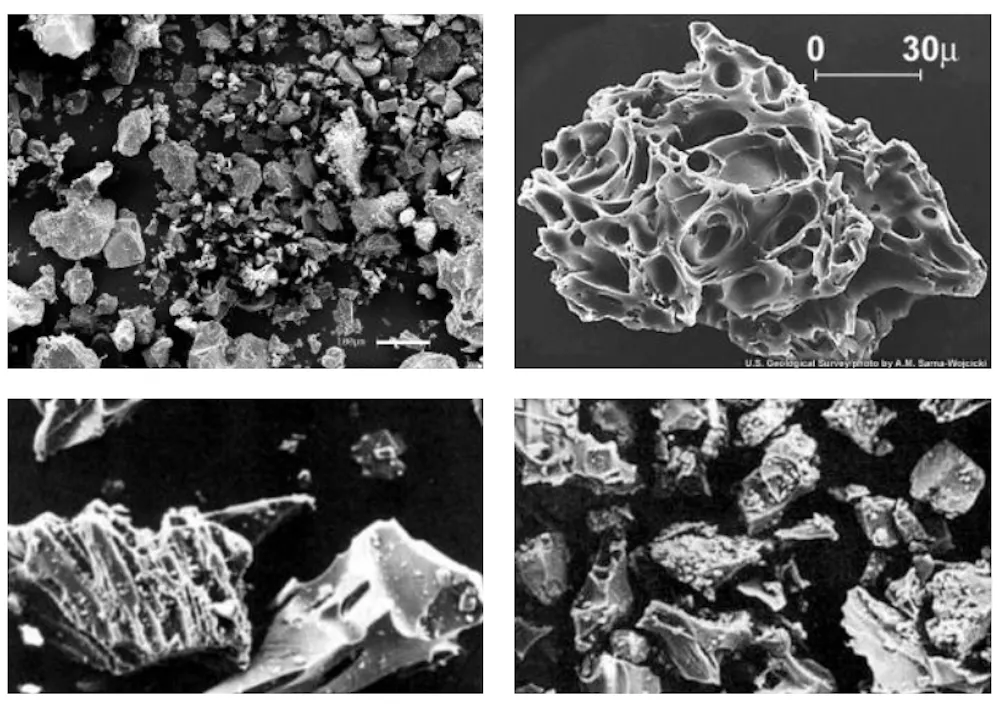
    Electron microscope images of ash show how sharp the shards are. The top left image of shards from Mount Etna in 2002 is 1 mm across. Top right is an ash particle from Mount St. Helens magnified 200 times. The shards in the lower images are less than 0.064 mm.
    Volcano Hazards Program, U.S. Geological Survey

    Ash can also contaminate surface water by introducing toxins and increasing the water’s acidity. The toxins can leach into groundwater, contaminating wells. Fine ash particles can also settle in waterways and smother aquatic plants and animals. During the 2008 Chaitén eruption in Chile, ash contamination led to widespread fish deaths in the Río Blanco.

    Ash can ground airplanes, gum up infrastructure

    Ash clouds are extremely dangerous to aircraft. The glassy ash particles melt when sucked into jet turbines, clog fuel systems and can stall engines in midair.

    In 1982, British Airways Flight 9 lost power in all four engines after flying through an ash cloud. A similar incident occurred in 1989 to KLM Flight 867 over Alaska. In 2010, Iceland’s Eyjafjallajökull eruption grounded more than 100,000 flights across Europe, disrupting travel for over 10 million passengers and costing the global economy billions of dollars.

    Volcanic ash can also wreak havoc on infrastructure by clogging water supplies, short-circuiting electrical systems and collapsing roofs under its weight. It can disrupt transportation, communication, rescue and power networks, as the 1991 eruption of Mount Pinatubo in the Philippines dramatically demonstrated.

    What to do during ashfall

    During an ashfall event, the most effective strategy to stay safe is to stay indoors as much as possible and avoid inhaling ash particles.

    Anyone who must go outside should wear a properly fitted N95 or P2 mask. Cloth masks provide little protection against fine ash. Rainwater tanks, troughs and open wells should be covered and monitored for contamination. Livestock should be moved to clean pastures or given uncontaminated fodder.

    The challenges Alaska is facing if Mount Spurr erupts.

    To reduce structural damage, ash should be cleared from roofs and gutters promptly, especially before rainfall.

    Older adults, children and people who are sick are at greatest risk, particularly those living in poorly ventilated homes. Rural communities that are dependent on agriculture and livestock are disproportionately affected by ashfall, as are low-income people who lack access to clean water, protective masks or safe shelter.

    Communities can stay informed about ash risks through official alerts, including those from the Volcanic Ash Advisory Centers, which monitor ash dispersion and issue timely warnings. The International Volcanic Health Hazard Network also offers guidelines on personal protection, emergency planning and ash cleanup.

    The long tail of ash

    Volcanic ash may fall quietly, but its effects are widespread, persistent and potentially deadly. It poses a chronic threat to health, agriculture, infrastructure and aquatic systems.

    Recognizing the risk is a crucial first step to protecting lives. Effective planning and public awareness can further help reduce the damage.

    David Kitchen does not work for, consult, own shares in or receive funding from any company or organization that would benefit from this article, and has disclosed no relevant affiliations beyond their academic appointment.

    ref. Volcanic ash is a silent killer, more so than lava: What Alaska needs to know with Mount Spurr likely to erupt – https://theconversation.com/volcanic-ash-is-a-silent-killer-more-so-than-lava-what-alaska-needs-to-know-with-mount-spurr-likely-to-erupt-254461

    MIL OSI – Global Reports

  • MIL-OSI Global: How bird flu differs from seasonal flu − an infectious disease researcher explains

    Source: The Conversation – USA – By Hanna D. Paton, PhD Candidate in Immunology, University of Iowa

    There is currently no bird flu vaccine for people. Digicomphoto/ Science Photo Library via Getty Images

    The flu sickens millions of people in the U.S. every year, and the past year has been particularly tough. Although infections are trending downward, the Centers for Disease Control and Prevention has called the winter of 2024-2025 a “high severity” season with the highest hospitalization rate in 15 years.

    Since early 2024, a different kind of flu called bird flu, formally known as avian influenza, has been spreading in birds as well as in cattle. The current bird flu outbreak has infected 70 Americans and caused two deaths as of April 8, 2025. Public health and infectious disease experts say the risk to people is currently low, but they have expressed concern that this strain of the bird flu virus may mutate to spread between people.

    As a doctoral candidate in immunology, I study how pathogens that make us sick interact with our immune system. The viruses that cause seasonal flu and bird flu are distinct but still closely related. Understanding their similarities and differences can help people protect themselves and their loved ones.

    What is influenza?

    The flu has long been a threat to public health. The first recorded influenza pandemic occurred in 1518, but references to illnesses possibly caused by influenza stretch back as as early as 412 B.C., to a treatise called Of the Epidemics by the Greek physician Hippocrates.

    Today, the World Health Organization estimates that the flu infects 1 billion people every year. Of these, 3 million to 5 million infections cause severe illness, and hundreds of thousands are fatal.

    Influenza is part of a large family of viruses called orthomyxoviruses. This family contains several subtypes of influenza, referred to as A, B, C and D, which differ in their genetic makeup and in the types of infections they cause. Influenza A and B pose the largest threat to humans and can cause severe disease. Influenza C causes mild disease, and influenza D is not known to infect people. Since the turn of the 20th century, influenza A has caused four pandemics. Influenza B has never caused a pandemic.

    A notice from Oct. 18, 1918, during the Spanish flu pandemic, about protecting yourself from infection.
    Illustrated Current News/National Library of Medicine, CC BY

    An influenza A strain called H1N1 caused the famous 1918 Spanish flu pandemic, which killed about 50 million people worldwide. A related H1N1 virus was responsible for the most recent influenza A pandemic in 2009, commonly referred to as the swine flu pandemic. In that case, scientists believe multiple different types of influenza A virus mixed their genetic information to produce a new and especially virulent strain of the virus that infected more than 60 million people in the U.S. from April 12, 2009, to April 10, 2010, and caused huge losses to the agriculture and travel industries.

    Both swine and avian influenza are strains of influenza A. Just as swine flu strains tend to infect pigs, avian flu strains tend to infect birds. But the potential for influenza A viruses that typically infect animals to cause pandemics in humans like the swine flu pandemic is why experts are concerned about the current avian influenza outbreak.

    Seasonal flu versus bird flu

    Different strains of influenza A and influenza B emerge each year from about October to May as seasonal flu. The CDC collects and analyzes data from public health and clinical labs to determine which strains are circulating through the population and in what proportions. For example, recent data shows that H1N1 and H3N2, both influenza A viruses, were responsible for the vast majority of cases this season. Standard tests for influenza generally determine whether illness is caused by an A or B strain, but not which strain specifically.

    Officials at the Food and Drug Administration use this information to make strain recommendations for the following season’s influenza vaccine. Although the meeting at which FDA advisers were to decide the makeup of the 2026 flu vaccine was unexpectedly canceled in late February, the FDA still released its strain recommendations to manufacturers.

    The recommendations do not include H5N1, the influenza A strain that causes avian flu. The number of strains that can be added into seasonal influenza vaccines is limited. Because cases of people infected with H5N1 are minimal, population-level vaccination is not currently necessary. As such, seasonal flu vaccines are not designed to protect against avian influenza. No commercially available human vaccines currently exist for avian influenza viruses.

    How do people get bird flu?

    Although H5N1 mainly infects birds, it occasionally infects people, too. Human cases, first reported in 1997 in Hong Kong, have primarily occurred in poultry farm workers or others who have interacted closely with infected birds.

    Initially identified in China in 1996, the first major outbreak of H5 family avian flu occurred in North America in 2014-2015. This 2014 outbreak was caused by the H5N8 strain, a close relative of H5N1. The first H5N1 outbreak in North America began in 2021 when infected birds carried the virus across the ocean. It then ripped through poultry farms across the continent.

    The H5N1 strain of influenza A generally infects birds but has infected people, too.
    NIAID and CDC/flickr, CC BY

    In March 2024, epidemiologists identified H5N1 infections in cows on dairy farms. This is the first time that bird flu was reported to infect cows. Then, on April 1, 2024, health officials in Texas reported the first case of a person catching bird flu from infected cattle. This was the first time transmission of bird flu between mammals was documented.

    As of March 21, 2025, there have been 988 human cases of H5N1 worldwide since 1997, about half of which resulted in death. The current outbreak in the U.S. accounts for 70 of those infections and one death. Importantly, there have been no reports of H5N1 spreading directly from one person to another.

    Since avian flu is an influenza A strain, it would show up as positive on a standard rapid flu test. However, there is no evidence so far that avian flu is significantly contributing to current influenza cases. Specific testing is required to confirm that a person has avian flu. This testing is not done unless there is reason to believe the person was exposed to sick birds or other sources of infection.

    How might avian flu become more dangerous?

    As viruses replicate within the cells of their host, their genetic information can get copied incorrectly. Some of these genetic mutations cause no immediate differences, while others alter some key viral characteristics.

    Influenza viruses mutate in a special way called reassortment, which occurs when multiple strains infect the same cell and trade pieces of their genome with one another, potentially creating new, unique strains. This process prolongs the time the virus can inhabit a host before an infection is cleared. Even a slight change in a strain of influenza can result in the immune system’s inability to recognize the virus. As a result, this process forces our immune systems to build new defenses instead of using immunity from previous infections.

    Reassortment can also change how harmful strains are to their host and can even enable a strain to infect a different species of host. For example, strains that typically infect pigs or birds may acquire the ability to infect people. Influenza A can infect many different types of animals, including cattle, birds, pigs and horses. This means there are many strains that can intermingle to create novel strains that people’s immune systems have not encountered before – and are therefore not primed to fight.

    It is possible for this type of transformation to also occur in H5N1. The CDC monitors which strains of flu are circulating in order prepare for that possibility. Additionally, the U.S. Department of Agriculture has a surveillance system for monitoring potential threats for spillover from birds and other animals, although this capacity may be at risk due to staff cuts in the department.

    These systems are critical to ensure that public health officials have the most up-to-date information on the threat that H5N1 poses to public health and can take action as early as possible when a threat is evident.

    Hanna D. Paton does not work for, consult, own shares in or receive funding from any company or organization that would benefit from this article, and has disclosed no relevant affiliations beyond their academic appointment.

    ref. How bird flu differs from seasonal flu − an infectious disease researcher explains – https://theconversation.com/how-bird-flu-differs-from-seasonal-flu-an-infectious-disease-researcher-explains-248407

    MIL OSI – Global Reports

  • MIL-OSI: Bitget Wallet Supports Babylon Mainnet for Seamless BABY and BTC Staking

    Source: GlobeNewswire (MIL-OSI)

    SAN SALVADOR, El Salvador, April 15, 2025 (GLOBE NEWSWIRE) — Bitget Wallet, a leading Web3 non-custodial wallet, has announced official support for the Babylon Genesis mainnet. With this integration, users can now easily add the Babylon network in-app, transfer and receive $BABY, and participate in native staking for both $BABY and $BTC directly within the wallet. A dedicated Babylon DApp section has also been launched, allowing users to quickly discover and interact with the growing Babylon ecosystem.

    Babylon introduces a new layer of utility for Bitcoin by enabling it to secure proof-of-stake (PoS) networks. With Babylon Genesis now live, users can stake $BTC and $BABY onchain via Bitget Wallet, unlocking new yield opportunities while contributing to the security and liquidity of PoS chains. Bitget Wallet users can also connect directly to Babylon’s website for one-click $BTC staking, simplifying access to Babylon’s staking functions and reducing the technical barriers for participation.

    As one of the wallets with the broadest support for public blockchains, Bitget Wallet offers an extensive multichain infrastructure that supports over 130 blockchain networks and seamless access to nearly a million tokens and over 20,000 DApps. The Babylon integration further reinforces Bitget Wallet’s commitment to enabling real onchain participation through secure and accessible tools. By supporting both Bitcoin-native and Babylon-native assets, Bitget Wallet empowers users to bridge liquidity and security between ecosystems in a single interface.

    As the Web3 ecosystem matures, it’s important to lower barriers to participation in emerging networks like Babylon,” said Alvin Kan, COO of Bitget Wallet.By supporting native $BABY and $BTC staking in a secure and accessible way, we aim to contribute to a more inclusive onchain environment—where crypto is usable and relevant for everyone.

    Experience Babylon mainnet on Bitget Wallet.

    About Bitget Wallet
    Bitget Wallet is the home of Web3, uniting endless possibilities in one non-custodial wallet. With over 60 million users, it offers comprehensive onchain services, including asset management, instant swaps, rewards, staking, trading tools, live market data, a DApp browser and crypto payment solutions. Supporting over 130 blockchains, 20,000+ DApps, and millions of tokens, Bitget Wallet enables seamless multi-chain trading across hundreds of DEXs and cross-chain bridges, along with a $300+ million protection fund to ensure safety of users’ assets.

    For more information, visit: XTelegramInstagramYouTubeLinkedInTikTokDiscordFacebook
    For media inquiries, please contact media.web3@bitget.com

    A photo accompanying this announcement is available at https://www.globenewswire.com/NewsRoom/AttachmentNg/be6e8c40-e822-4b34-b6e4-0642d9127c4f

    The MIL Network

  • MIL-OSI Europe: AFRICA/DEMOCRATIC REPUBLIC OF CONGO – Appointment of bishop of Molegbe

    Source: Agenzia Fides – MIL OSI

    Tuesday, 15 April 2025

    Vatican City (Agenzia Fides) – The Holy Father has appointed the Reverend Joseph Mopepe Ngongo, doctoral candidate in theology at the Université Catholique du Congo, as bishop of the diocese of Molegbe, Democratic Republic of the Congo.Msgr. Joseph Mopepe Ngongo was born on 15 July 1966 in Gemena, diocese of Molegbe. He entered the Saint François d’Assise Preparatory Seminary of Katokoli and studied philosophy at the Saint Jean-Baptiste Major Seminary of Bamanya and theology at the Université Catholique du Congo.He received priestly ordination on 19 March 1995.After ordination, he was awarded a licentiate in theology from the Université Catholique du Congo (1995-1997), and held the roles of formator (1997-2002) and rector (2002-2011) of the Saint Pierre et Saint Paul Interdiocesan Major Seminary in Lisala.In 2011 he began his studies for a doctorate in France where, at the same time, he served as vicar of the Notre Dame Saint Jacques Cathedral in Reims (2011-2021). In addition, he was moderator of the parishes of the Espace missionnaire Sedan-Yvois and chaplain of the Equipes du Rosaire of the metropolitan archdiocese of Reims (2021-2024).In 2024 he returned to the Democratic Republic of the Congo to conclude his doctoral studies at the Université Catholique du Congo in Kinshasa. (EG) (Agenzia Fides, 15/4/2025)
    Share:

    MIL OSI Europe News

  • MIL-OSI Europe: AMERICA/PARAGUAY – Appointment of vicar apostolic of Pilcomayo

    Source: Agenzia Fides – MIL OSI

    Tuesday, 15 April 2025

    Vatican City (Agenzia Fides) – The Holy Father has appointed the Reverend Fr. Miguel Fritz, O.M.I., until now apostolic administrator of Pilcomayo, Paraguay, as vicar apostolic of the same apostolic vicariate.The Reverend Fr. Miguel Fritz, O.M.I., was born on 10 May 1955 in Hannover, Germany. He obtained a diploma in theology from the Gutenberg University of Mainz and a licentiate in anthropology from the Universidad Politécnica Salesiana of Quito.He gave his perpetual vows in 1980 and was ordained a priest on 28 May 1981.He has held the following offices: deputy parish priest in Gelsenkirchen, Germany (1981-1984), deputy parish priest in Colonia Independencia, diocese of Villarrica del Espíritu Santo (1985-1987), service in the O.M.I. House of Formation in Lambaré, Asunción (1987-1988), deputy parish priest of Santa María, in the apostolic vicariate of Pilcomayo (1988-1994), vicar general of Pilcomayo and parish priest of Santa María (1995-2006), superior of the O.M.I. in the province of Paraguay (2007-2010), member of the O.M.I. General Council at the General House in Rome (2010-2016), and vicar general of Pilcomayo and parish priest of San Leonardo (2016-2022).Since 2022, he has served as apostolic administrator sede vacante et ad nutum Sanctae Sedis of the apostolic vicariate of Pilcomayo. (EG) (Agenzia Fides, 15/4/2025)
    Share:

    MIL OSI Europe News

  • MIL-OSI: Intermex Empowers Store Owners With Launch of Intermex SOMA: A Game-Changing Mobile App for Business Management on the Go

    Source: GlobeNewswire (MIL-OSI)

    MIAMI, April 15, 2025 (GLOBE NEWSWIRE) — International Money Express, Inc. (NASDAQ: IMXI), a leading money remittance provider to Latin America and the Caribbean, has officially launched a new mobile platform designed to give Intermex agents real-time visibility into their business, right from the palm of their hand.

    Intermex SOMA, short for Store Owner Management App, was built with one goal in mind: to make life easier for store owners. With just a few taps, agents can now track performance metrics, monitor commissions, stay updated on deals with real-time alerts, and even connect directly with their Intermex teams. It’s fast, intuitive, and created specifically to meet the day-to-day needs of our agent partners, most of whom are small business owners juggling multiple responsibilities.

    “At Intermex, we believe technology should work for our partners, not the other way around,” said Marcelo Theodoro, Chief Product, Marketing & Digital Officer at Intermex. “Intermex SOMA is our way of saying, ‘We see you. We hear you. And we’re building tools that make your life easier and your business stronger.’ It’s all about giving our agents more control, more clarity, and more convenience.”

    The Intermex SOMA app provides a simple yet powerful dashboard, offering monthly-to-date (MTD), year-to-date (YTD), month-over-month (MoM), and year-over-year (YoY) performance views, so agents can better understand how their Intermex services are performing. Instant push notifications alert them of important activity, while built-in contact features make it easy to get the support they need when they need it. Intermex SOMA takes everything that used to require a call, a spreadsheet, or a visit and puts it in one streamlined mobile experience.

    Intermex SOMA reflects a broader commitment from Intermex to innovate with purpose. The launch is a major step forward in the company’s digitization and omnichannel strategies. And this is only the beginning. Future updates will expand Intermex SOMA’s functionality even further, offering tools for managing deals, accessing marketing materials, and unlocking new service features.

    About International Money Express, Inc. (Intermex):
    Founded in 1994, Intermex applies proprietary technology to enable consumers to send money from the United States, Canada, Spain, Italy, the United Kingdom, and Germany to more than 60 countries. The company facilitates digital money movement through its website and mobile app, as well as through a vast network of retail agents and company-operated stores. Headquartered in Miami, Florida, Intermex also operates international offices in Puebla, Mexico; Guatemala City, Guatemala; London, England; and Madrid, Spain. Learn more at www.intermexonline.com.

    Investor Relations Contact:
    Alex Sadowski
    Investor Relations Coordinator
    ir@intermexusa.com
    305-671-8000

    The MIL Network

  • MIL-OSI Video: President Donald J. Trump and President Nayib Bukele of El Salvador

    Source: United States of America – The White House (video statements)

    “I love the people of El Salvador and they have one hell of a President.” –President Donald J. Trump

    https://www.youtube.com/watch?v=7P9XcjXlyYs

    MIL OSI Video

  • MIL-Evening Report: Does Russia have military interest in Indonesia? Here’s what we know – and why Australia would be concerned

    Source: The Conversation (Au and NZ) – By Matthew Sussex, Associate Professor (Adj), Griffith Asia Institute; and Fellow, Strategic and Defence Studies Centre, Australian National University

    A news report that Russia has sought to base long-range aircraft in Indonesia caught Australia’s political leaders by surprise during an already hectic election campaign.

    The military publication Janes reported on Tuesday that Russia had requested permission for its aircraft to be based at the Manuhua Air Force Base in Indonesia’s easternmost province of Papua.

    The base is just 1,300 kilometres away from Darwin.

    Australian Defence Minister Richard Marles issued a statement denying the report, saying his Indonesian counterpart assured him there would be no Russian planes based in Indonesia. Australian Prime Minister Anthony Albanese said he was seeking “further clarification” with Jakarta about the Janes report.

    Janes is a respected outlet when it comes to defence news, so it’s likely the Russians did float the idea, even if it might have been done at lower levels.

    Why would Russia be cosying up to Indonesia?

    Since Prabowo Subianto came to power as Indonesia’s new president last October, Moscow and Jakarta have sought to deepen their military ties. In fact, the two countries conducted their first-ever joint naval exercises a month after Prabowo took office.

    But this isn’t a totally new strategy by Moscow, which has tried on numerous occasions to pivot to Asia to give itself more economic heft and leverage in the region.

    The Kremlin is also cognisant that Europe won’t be a friend for the foreseeable future. As such, it’s even more pressing for Russia to establish itself as a player in the Indo-Pacific region – and with that comes a miltary and security presence.

    About ten years ago, for instance, the Russian regime secured an agreement with Vietnam to allow its air force to refuel their aircraft at a former US base in the country. Russia also had interest in reestablishing a submarine base in Vietnam and has sold submarines to the country.

    In addition, Moscow has sought to sell defence technology and fighter jets to Indonesia for some time, seeing it as a potentially lucrative market for Russian arms. Beyond defence, the bilateral relationship has also focused on energy and education.

    These attempts to deepen Moscow-Jakarta ties form part of a targeted Russian campaign to boost its relationships with a number of Southeast Asian nations.

    What about the timing?

    If the Janes report is accurate, the timing of the purported approach from Russia would be interesting. The report said it came after a meeting between Sergei Shoigu (recently demoted from Russia’s defence minister to an inferior role as secretary of the Russian Security Council) and Indonesia’s defence minister in February of this year.

    At the time, the United States was distracted by the first chaotic weeks of US President Donald Trump’s second term in office.

    So, if Russia did make such a request, it would be highly opportunistic, especially given Jakarta has been keen to deepen ties with Moscow.

    It is also noteworthy that Indonesia recently joined the BRICS, the group of rapidly emerging economies that also includes Brazil, Russia, India, China, and Russia, among others.


    Read more:
    Indonesia’s BRICS agenda: 2 reasons Prabowo’s foreign policy contrasts with Jokowi’s


    How concerned should Australia be?

    Even though both Canberra and Jakarta dismissed the report, there was good reason for Australia to be concerned.

    Russia’s long-range aviation assets, notably the venerable Tu-95, which is used for reconnaissance as well as strategic bombing, can easily travel over 10,000 kilometres.

    From a base in Indonesia, this would give the Russian air force the ability to conduct ISR (intelligence, surveillance and reconnaisance) missions during Australian military exercises, gather data on military installations in the Northern Territory (which also host US Marines), and even conduct surveillance on US military activities in Guam.

    Equally, given the closeness of ties between Beijing and Moscow, any Russian intelligence that was gathered could be shared with China.

    The reported Russian military interest in Indonesia will also have irritated Australian foreign policy makers, especially since Canberra has invested significant diplomatic capital in boosting Australia-Indonesia ties.

    Fortunately, the closeness of the relationship, which includes recently upgraded defence ties, will also have allowed for some plain speaking from Australian interlocutors.

    They will doubtless have pointed out that agreeing to any such Kremlin request would cast significant doubt on Indonesian claims about non-alignment. It would also be viewed unfavourably by other regional actors, who have no interest in seeing an enhanced Russian military presence in the region.

    The assurance from Jakarta that no Russian planes would be based in Indonesia is therefore a positive development.

    But ultimately the reported Russian request is another example of the messy and fragmented world we now live in.

    It highlights the reality that Australia will sometimes have to do business with partners who have friends we don’t like. Under those conditions, being firm on issues that threaten our national interests – like the prospective basing of military assets by a hostile power close to our shores – becomes all the more important.

    Matthew Sussex has received funding from the Australian Research Council, the Atlantic Council, the Fulbright Foundation, the Carnegie Foundation, the Lowy Institute and various Australian government departments and agencies.

    ref. Does Russia have military interest in Indonesia? Here’s what we know – and why Australia would be concerned – https://theconversation.com/does-russia-have-military-interest-in-indonesia-heres-what-we-know-and-why-australia-would-be-concerned-254601

    MIL OSI AnalysisEveningReport.nz

  • MIL-OSI Asia-Pac: Union Minister Shri Shivraj Singh Chouhan to attend 15th BRICS Agriculture Ministers Meeting at Brasilia, Brazil

    Source: Government of India

    Union Minister Shri Shivraj Singh Chouhan to attend 15th BRICS Agriculture Ministers Meeting at Brasilia, Brazil

    Shir Chouhan to hold bilateral meetings with Brazil Minister of Agriculture & Livestock Mr Carlos Henrique Baqueta Fávaro, Minister of Agrarian Development and Family Farming Mr Luiz Paulo Teixeira,

    Theme of 15th BRICS Agricultural Ministerial Meeting is “Promoting Inclusive and Sustainable Agriculture through Cooperation, Innovation, and Equitable Trade among BRICS Countries”

    Posted On: 15 APR 2025 10:54AM by PIB Delhi

    Union Minister for Agriculture & Farmers’ Welfare and Rural Development, Shri Shivraj Singh Chouhan, is leading the Indian delegation to the 15th BRICS Agriculture Ministers’ Meeting (AMM), scheduled to be held on 17th April, 2025 in Brasilia, Brazil. The theme of 15th BRICS AMM is “Promoting Inclusive and Sustainable Agriculture through Cooperation, Innovation, and Equitable Trade among BRICS Countries”. Agriculture Ministers and senior officials from BRICS member countries, including Brazil, Russia, India, China, South Africa, Saudi Arabia, Egypt, United Arab Emirates, Ethiopia, Indonesia, and Iran are expected to attend the Meeting.

    During the visit, Shri Chouhan will hold bilateral meetings with key Brazilian counterparts, including Mr. Carlos Henrique Baqueta Fávaro, Minister of Agriculture and Livestock, and Mr. Luiz Paulo Teixeira, Minister of Agrarian Development and Family Farming (MDA). These meetings will focus on enhancing collaboration between India and Brazil in various areas of agriculture, agri-technology, rural development, and food security.

    The Minister will interact with leaders of major Brazilian agribusiness companies and representatives of the Brazilian Association of Vegetable Oil Industries in São Paulo, exploring avenues for partnership and investment in the agriculture value chain. As part of his visit, the Minister will also participate in a tree plantation drive at the Embassy of India in Brasilia, under the noble initiative “Ek Ped Maa Ke Naam”, aimed at raising environmental consciousness and honouring motherhood. In addition, the Minister will interact with the vibrant Indian diaspora in São Paulo, acknowledging their role as cultural ambassadors and contributors to bilateral ties. This visit reaffirms India’s commitment to deepen cooperation with BRICS nations and to advance South-South cooperation in agricultural innovation, resilience, and sustainability.

    ***

    PSF/KSR/AR

    (Release ID: 2121725) Visitor Counter : 83

    MIL OSI Asia Pacific News

  • MIL-OSI USA: NASA Announces 31st Human Exploration Rover Challenge Winners

    Source: NASA

    NASA has announced the winning student teams in the 2025 Human Exploration Rover Challenge. This year’s competition challenged teams to design, build, and test a lunar rover powered by either human pilots or remote control. In the human-powered division, Parish Episcopal School in Dallas, Texas, earned first place in the high school division, and the Campbell University in Buies Creek, North Carolina, captured the college and university title. In the remote-control division, Bright Foundation in Surrey, British Columbia, Canada, earned first place in the middle and high school division, and the Instituto Tecnologico de Santa Domingo in the Dominican Republic, captured the college and university title.
    The annual engineering competition – one of NASA’s longest standing student challenges – wrapped up on April 11 and April 12, at the U.S. Space & Rocket Center in Huntsville, Alabama, near NASA’s Marshall Space Flight Center. The complete list of 2025 award winners is provided below:

    First Place: Parish Episcopal School, Dallas, Texas
    Second Place: Ecambia High School, Pensacola, Florida
    Third Place: Centro Boliviano Americano – Santa Cruz, Bolivia

    First Place: Campbell University, Buies Creek, North Carolina
    Second Place: Instituto Tecnologico de Santo Domingo, Dominican Republic
    Third Place: University of Alabama in Huntsville

    First Place: Bright Foundation, Surrey, British Columbia, Canada
    Second Place: Assumption College, Brangrak, Bangkok, Thailand
    Third Place: Erie High School, Erie, Colorado

    First Place: Instituto Tecnologico de Santo Domingo, Dominican Republic
    Second Place: Campbell University, Buies Creek, North Carolina
    Third Place: Tecnologico de Monterey – Campus Cuernvaca, Xochitepec, Morelos, Mexico

     Queen’s University, Kingston, Ontario, Canada

    Human-Powered

    High School Division: International Hope School of Bangladesh, Uttara, Dhaka, Bangladesh
    College/University Division: Auburn University, Auburn, Alabama

    Remote-Control

    Middle School/High School Division: Bright Foundation, Surrey, British Columbia, Canada
    College/University Division: Southwest Oklahoma State University, Weatherford, Oklahoma

    Remote-Control

    Middle School/High School Division: Assumption College, Bangrak, Bangkok, Thailand
    College/University Division: Instituto Tecnologico de Santo Domingo, Dominican Republic

    Human-Powered

    High School Division: Parish Episcopal School, Dallas, Texas
    College/University Division: Campbell University, Buies Creek, North Carolina

    Remote-Control

    Middle School/High School Division: Bright Foundation, Surrey, British Columbia, Canada
    College/University Division: Instituto Tecnologico de Santo Domingo, Dominican Republic

    Campbell University, Buies Creek, North Carolina

    Human-Powered

    High School Division: Parish Episcopal School, Dallas, Texas
    College/University Division: University of Alabama in Huntsville

    Universidad de Monterrey, Nuevo Leon, Mexico (Human-Powered Division)

    Instituto Tecnologico de Santo Domingo, Dominican Republic (Human-Powered Division)

    Human-Powered

    High School Division: Albertville Innovation School, Albertville, Alabama
    College/University Division: Instituto Tecnologico de Santo Domingo, Dominican Republic

    Remote-Control

    Middle School/High School Division: Instituto Salesiano Don Bosco, Santo Domingo, Dominican Republic
    College/University Division: Tecnologico de Monterrey, Nuevo Leon, Mexico

    Human-Powered

    High School Division: International Hope School of Bagladesh, Uttara, Dhaka, Bangladesh
    College/University Division: Universidad Catolica Boliviana “San Pablo” La Paz, Bolivia

    Remote-Control

    Middle School/High School Division: ATLAS SkillTech University, Mumbai, Maharashtra, India
    College/University Division: Instituto Salesiano Don Bosco, Santo Domingo, Dominican Republic

    Human-Powered

    High School Division: Space Education Institute, Leipzig, Germany
    College/University Division: Purdue University Northwest, Hammond, Indiana

    Remote-Control

    Middle School/High School Division: Erie High School, Erie, Colorado
    College/University Division: Campbell University, Buies Creek, North Carolina

    Human-Powered

    High School Division: Academy of Arts, Career, and Technology, Reno, Nevada
    College/University Division: Queen’s University, Kingston, Ontario, Canada

    Fabion Diaz Palacious from Universidad Catolica Boliviana “San Pablo” La Paz, Bolivia

    Deira International School, Dubai, United Arab Emirates

    More than 500 students with 75 teams from around the world participated in the  31st year of the competition. Participating teams represented 35 colleges and universities, 38 high schools, and two middle schools from 20 states, Puerto Rico, and 16 other nations. Teams were awarded points based on navigating a half-mile obstacle course, conducting mission-specific task challenges, and completing multiple safety and design reviews with NASA engineers. 
    NASA expanded the 2025 challenge to include a remote-control division, Remote-Operated Vehicular Research, and invited middle school students to participate. 
    “This student design challenge encourages the next generation of scientists and engineers to engage in the design process by providing innovative concepts and unique perspectives,” said Vemitra Alexander, who leads the challenge for NASA’s Office of STEM Engagement at Marshall. “This challenge also continues NASA’s legacy of providing valuable experiences to students who may be responsible for planning future space missions, including crewed missions to other worlds.”
    The rover challenge is one of NASA’s eight Artemis Student Challenges reflecting the goals of the Artemis campaign, which will land Americans on the Moon while establishing a long-term presence for science and exploration, preparing for future human missions to Mars. NASA uses such challenges to encourage students to pursue degrees and careers in the fields of science, technology, engineering, and mathematics. 
    The competition is managed by NASA’s Southeast Regional Office of STEM Engagement at Marshall. Since its inception in 1994, more than 15,000 students have participated – with many former students now working at NASA, or within the aerospace industry.    
    To learn more about the Human Exploration Rover Challenge, please visit: 
    https://www.nasa.gov/roverchallenge/home/index.html

    Taylor GoodwinMarshall Space Flight Center, Huntsville, Ala.256.544.0034taylor.goodwin@nasa.gov

    MIL OSI USA News