Category: Latin America

  • MIL-OSI: Nvni Group Engages MZ Group to Lead Investor Relations and Shareholder Communications Program

    Source: GlobeNewswire (MIL-OSI)

    Identifies Current and Future Shareholder Resources

    Encourages Investors to Sign up for Email Alerts to Stay up to Date on Company

    NEW YORK, March 03, 2025 (GLOBE NEWSWIRE) — Nvni Group Limited (Nasdaq: NVNI) (“Nuvini” or the “Company”), a leading acquirer of private SaaS B2B companies in Latin America, today announced the engagement of international investor relations specialists MZ Group (MZ) to develop its investor relations and financial communications program across all key markets.

    MZ Group will work closely with Nuvini management to increase the Company’s visibility throughout the retail and institutional investment community. The initiative is focused on educating the investment community on the fundamentals of Nuvini’s uniquely defined acquisition strategy driven by management’s direct access network supplying a pipeline in the highly fragmented SaaS B2B markets Brazil and Latin America. Nuvini’s current portfolio of seven (7) multi-vertical SaaS solutions underwent thorough due diligence to verify suitability with the Company’s core investment criteria including positive cash generation and high growth potential. Importantly, the Company operates with a focus on generating and delivering value to all stakeholders. This includes providing a foundation for its portfolio of entrepreneurial management teams to execute operations while remaining diligent capital allocators to provide attractive long-term shareholder returns.

    To track Nuvini’s operational progress and remain updated on investor materials, please visit the Company’s Investor Relations website at https://ir.nuvini.co/.

    • Press Release alerts are the most effective way to stay up to date on the latest Company announcements and milestones. Investors and analysts interested in staying up to date can sign up for email alerts here.
    • If you have questions, please visit our FAQ page here, or email NVNI@mzgroup.us.
    • To schedule a conference call with management, please email your request to NVNI@mzgroup.us.

    About MZ Group

    MZ North America is the US division of MZ Group, a global leader in investor relations with over 250 employees, 800 clients across 12 different exchanges. For over 25 years, MZ has implemented award winning programs and developed a reputation for delivering tangible results for public and private companies via strategic communications, industry-leading investor outreach, public relations, a market intelligence desk, and a suite of technology solutions, spanning websites, conference call/webcasting, video production and XBRL/Edgar filing services. MZ maintains a global footprint with professionals located throughout every time zone in North America, as well as Taipei and São Paulo. For more information, please visit www.mzgroup.us.

    About Nuvini

    Headquartered in São Paulo, Brazil, Nuvini is the leading private serial software business acquirer in Latin America. The Nuvini Group acquires software companies within SaaS markets in Latin America. It focuses on acquiring profitable “business-to-business” SaaS companies with a consolidated business model, recurring revenue, positive cash generation and relevant growth potential. The Nuvini Group enables its acquired companies to provide mission-critical solutions to customers within its industry or sector. Its business philosophy is to invest in established companies and foster an entrepreneurial environment that would enable companies to become leaders in their respective industries. The Nuvini Group’s goal is to buy, retain and create value through long-term partnerships with the existing management of its acquired companies.

    Forward-Looking Statements

    Some of the statements contained in this press release include or may include “forward-looking statements” within the meaning of Section 27A of the Securities Act of 1933, as amended, and Section 21E of the Exchange Act of 1934, as amended, which are intended to be covered by the safe harbors created by those laws. These forward-looking statements include, but are not limited to, statements regarding the expectations, hopes, beliefs, intentions or strategies regarding the future. The forward-looking statements contained in this press release are based on current expectations and beliefs concerning future developments and their potential effects on Nuvini. There can be no assurance that future developments affecting Nuvini will be those that we have anticipated. Where a forward-looking statement expresses or implies an expectation or belief as to future events or results, such expectation or belief is expressed in good faith and believed to have a reasonable basis. All statements other than statements of historical fact may be forward-looking statements. The words “anticipate,” “believe,” “estimate,” “expect,” “intend,” “forecast,” “outlook,” “aim,” “target,” “will,” “could,” “should,” “may,” “likely,” “plan,” “probably” or similar words may identify forward-looking statements, but the absence of these words does not mean that a statement is not forward-looking. Forward-looking statements contained in this press release include, but are not limited to, statements about the ability of Nuvini to: realize the benefits expected from this strategic partnership; achieve projections and anticipate uncertainties relating to the business, operations and financial performance of Nuvini, including (i) expectations with respect to financial and business performance, including financial projections and business metrics and any underlying assumptions, (ii) expectations regarding market size, future acquisitions, partnerships or other relationships with third parties, (iii) expectations on Nuvini’s proprietary technology and related intellectual property rights, and (iv) future capital requirements and sources and uses of cash, including the ability to obtain additional capital in the future; enhance future operating and financial results; comply with applicable laws and regulations; stay abreast of modified or new laws and regulations applying to its business, including privacy regulation; anticipate rapid technological changes; and effectively respond to general economic and business conditions.

    While forward-looking statements reflect Nuvini’s good faith beliefs, they are not guarantees of future performance. Nuvini disclaims any obligation to publicly update or revise any forward-looking statement to reflect changes in underlying assumptions or factors, new information, data or methods, future events or other changes after the date of this press release, except as required by applicable law. For a further discussion of these and other factors that could cause Nuvini’s future results, performance or transactions to differ significantly from those expressed in any forward-looking statement, please see the section “Risk Factors” of the Registration Statement in Form F-4 filed by Nuvini with the U.S. Securities and Exchange Commission on September 6, 2023 under number 333-272688. You should not place undue reliance on any forward-looking statements, which are based only on information currently available to Nuvini.

    Investor Relations Contact:

    Sofia Toledo
    ir@nuvini.co

    The MIL Network

  • MIL-OSI Global: How are clouds’ shapes made? A scientist explains the different cloud types and how they help forecast weather

    Source: The Conversation – USA – By Ross Lazear, Instructor in Atmospheric and Environmental Sciences, University at Albany, State University of New York

    Lenticular clouds, like this one over a mountain in Chile, can look like flying saucers. Bilderbuch/Design Pics Editorial/Universal Images Group via Getty Images

    Curious Kids is a series for children of all ages. If you have a question you’d like an expert to answer, send it to curiouskidsus@theconversation.com.


    “How are clouds’ shapes made?” – Amanda, age 5, Chile


    I’m a meteorologist, and I’ve been fascinated by weather since I was 8 years old. I grew up in Minnesota, where the weather changes from wind-whipping blizzards in winter to severe thunderstorms – sometimes with tornadoes – in the summer. So, it’s not all that surprising that I’ve spent most of my life looking at clouds.

    All clouds form as a result of saturation – that’s when the air contains so much water vapor that it begins producing liquid or ice.

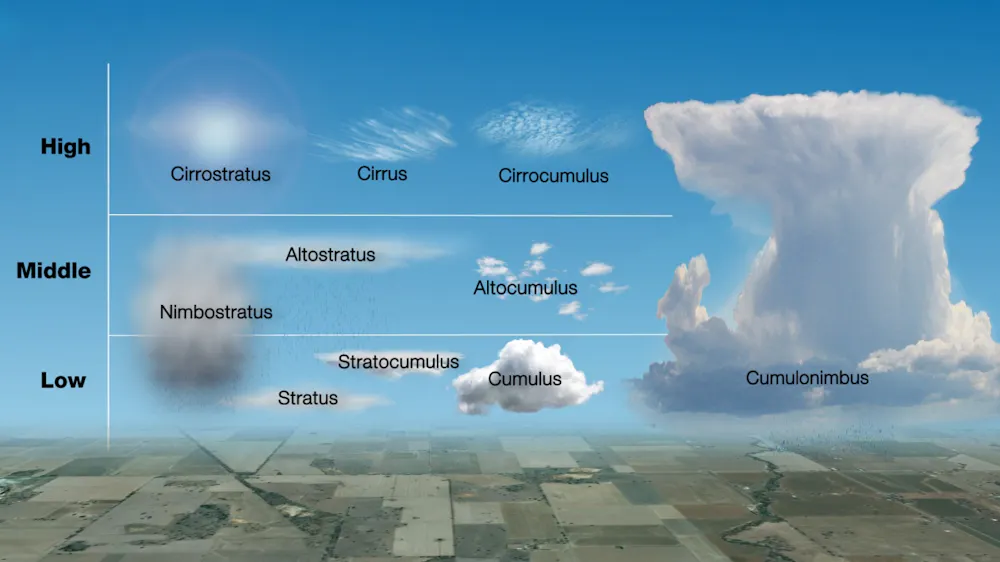
    Once you understand how certain clouds develop their shapes, you can learn to forecast the weather.

    Cloud types show their general heights.
    Australian Bureau of Meteorology

    Cotton ball cumulus clouds

    Clouds that look like cartoon cotton balls or cauliflower are made up of tiny liquid water droplets and are called cumulus clouds.

    Often, these are fair-weather clouds that form when the Sun warms the ground and the warm air rises. You’ll often see them on humid summer days.

    Cumulus clouds over Lander, Wyo.
    Ross Lazear, CC BY-ND

    However, if the air is particularly warm and humid, and the atmosphere above is much colder, cumulus clouds can rapidly grow vertically into cumulonimbus. When the edges of these clouds look especially crisp, it’s a sign that heavy rain or snow may be imminent.

    Wispy cirrus are ice clouds

    When cumulonimbus clouds grow high enough into the atmosphere, the temperature becomes cold enough for ice clouds, or cirrus, to form.

    Clouds made up entirely of ice are usually more transparent. In some cases, you can see the Sun or Moon through them.

    Cirrus clouds over the roof of Bard College in Annandale-on-Hudson, N.Y.
    Ross Lazear, CC BY-ND

    Cirrus clouds that forms atop a thunderstorm spread outward and can form anvil clouds. These clouds flatten on top as they reach the stratosphere, where the atmosphere begins to warm with height.

    However, most cirrus clouds aren’t associated with storms at all. There are many ice clouds associated with tranquil weather that are simply regions of the atmosphere with more moisture but not precipitation.

    Fog and stratus clouds

    Clouds are a result of saturation, but saturated air can also exist at ground level. When this occurs, we call it fog.

    In temperatures below freezing, fog can actually deposit ice onto objects at or near the ground, called rime ice.

    Reading clouds, with the National Oceanic and Atmospheric Administration.

    When clouds form thick layers, we add the word “stratus,” or “layer,” to the name. Stratus can occur just above the ground, or a bit higher up – we call it altostratus then. It can occur even higher and become cirrostratus, or a layer or ice clouds.

    If there’s enough moisture and lift, stratus clouds can create rain or snow. These are nimbostratus.

    How mountains can create their own clouds

    There are a number of other unique and beautiful cloud types that can form as air rises over mountain slopes and other topography.

    Lenticular clouds, for example, can look like flying saucers hovering just above, or near, mountaintops. Lenticular clouds can actually form far from mountains, as wind over a mountain range creates an effect like ripples in a pond.

    A banner cloud appears to stream out from the Matterhorn, in the Alps on the border between Italy and Switzerland.
    Zacharie Grossen via Wikimedia, CC BY

    Rarer are banner clouds, which form from horizontally spinning air on one side of a mountain.

    Wind plays a big role

    You might have looked up at the sky and noticed one layer of clouds moving in a different direction from another. Clouds move along with the wind, so what you’re seeing is the wind changing direction with height.

    Cirrus clouds at the level of the jet stream – often about 6 miles (10 kilometers), above the ground – can sometimes move at over 200 miles per hour (320 kilometers per hour). But because they are so high up, it’s often hard to tell how fast they are moving.

    Ross Lazear does not work for, consult, own shares in or receive funding from any company or organization that would benefit from this article, and has disclosed no relevant affiliations beyond their academic appointment.

    ref. How are clouds’ shapes made? A scientist explains the different cloud types and how they help forecast weather – https://theconversation.com/how-are-clouds-shapes-made-a-scientist-explains-the-different-cloud-types-and-how-they-help-forecast-weather-247682

    MIL OSI – Global Reports

  • MIL-OSI Global: America’s designs on annexing Canada have a long history − and record of political failures

    Source: The Conversation – USA – By G. Patrick O’Brien, Assistant Teaching Professor of History, University of Tampa

    Donald Trump has repeatedly raised the specter of annexing Canada since his inauguration to a second term as president.

    The president’s rhetoric about making Canada “the 51st state” may seem to project confidence, a 21st-century vision of manifest destiny, a belief in the United States’ right and obligation to expand.

    Trump is not the first American leader to dream of northern expansion. To me, a historian of early U.S.-Canadian relations, these designs suggest not power, but weakness and simmering divisions inside the United States.

    Early Americans’ lust for Canada

    Even before independence, social conflict helped turn American eyes northward. Throughout the 18th century, England’s Colonial population in North America doubled every 25 years. Successive generations of Colonists along the Eastern Seaboard had to compete with each other, and with Indigenous people, for resources, arable land and trade.

    These unhappy, land-hungry Colonists clamored for expansion, instigating a series of wars against both the French and Spanish empires for control of the northeastern half of the continent, culminating in the French and Indian War, from 1754 to 1763.

    While these Colonists were animated by their thirst for expansion, they had little else unifying them. Many Americans today are familiar with the “Join, or Die” cartoon Ben Franklin printed, featuring a segmented snake with each section representing one of the Colonies. However, few realize that it was not crafted during the Revolution to unite Colonists against Britain, but in 1754, to rally divided British Colonists in their war against France.

    This famous image urging the American Colonies to unite was in support of a war against France, not Britain.
    Benjamin Franklin via Wikimedia Commons

    Britain finished conquering Canada in 1763, but the empire never fully supported Colonial expansion northward. In the 1750s and 1760s, British troops forcibly removed French colonists from Acadia in Nova Scotia and recruited thousands of Colonists from neighboring New England to move north. These settlers had long imagined the region rich in fishing and timber to be a land of opportunity. But disillusioned by the financial cost of sustaining their settlements, many of these Colonists returned to New England by the early 1770s.

    Attempts to settle other lands ceded by France were no more successful. Fearful that Colonists might provoke a costly war with Indigenous people, Parliament issued the Proclamation of 1763, which attempted to protect native land by discouraging Colonial expansion westward. Many Colonists turned against Britain in response, especially those like George Washington, who had speculated in the land west of the Appalachian Mountains.

    The failed invasion of Canada

    In the earliest months of the Revolution, the Continental Congress authorized an American invasion of British-occupied Quebec. In a letter addressed to “Friends and Brethren” of Canada, Washington himself implored Canadians to join invading troops. “The Cause of America, and of Liberty, is the Cause of every virtuous American Citizen,” he wrote. “Come then, ye generous Citizens, range yourselves under the Standard of general Liberty.”

    But at home, Colonists were far from united in their rebellion. Historians estimate that around 20% of the white Colonial population, more than 500,000 people, remained loyal to Britain, and an even larger number hoped to remain neutral.

    The difficult realities of conquest also turned many soldiers against the invasion of Canada. In late October 1775, nearly a quarter of the underfed and overworked troops under the command of soon-to-be turncoat Benedict Arnold abandoned their arduous journey through interior Maine toward Canada. The soldiers who carried on prayed these deserters “might die by the way, or meet with some disaster, Equal to the Cowardly dastardly and unfriendly Spirit they discover’d in returning Back without orders.”

    The more resilient troops who reached Quebec were emphatically defeated by British forces in December, making Washington skeptical of any future efforts to attack Canada.

    American troops clash with British soldiers and the French defenders of Quebec in December 1775.
    Charles William Jefferys, cover art for ‘The Father of British Canada: A Chronicle of Carleton,’ Volume 12 by William Wood, 1916

    19th-century divisions

    Following American independence, tens of thousands of loyal Colonists sailed north to Canada, determined to build British colonies that would become what one of these refugees called “the envy of the American States.” Their presence on the contested northern border was an unsettling reminder to the new American nation about the power Britain still exerted on the continent.

    Conflict with Britain over land and trade in the early 1800s reopened old divisions among Americans. Virginia Congressman John Randolph expressed his frustrations with renewed calls for a northern invasion. “We have but one word, like the whip-poor-will, but one eternal monstrous tone,” an exasperated Randolph noted, “Canada! Canada! Canada!”

    The debate over Canada was one of many issues dividing the nation, and as President James Madison would later explain, he hoped that war would help unify a polarized nation. His gamble paid off, but only after opponents from New England flirted with the idea of secession to negotiate their own end to conflict.

    When the popular editor and columnist John O’Sullivan called for the annexation of Texas and war with Mexico in 1845, he also suggested the annexation of Canada would naturally follow. The anti-expansionist response united pacifists, abolitionists and a variety of religious and literary figures, helping deepen the divides that would lead to the Civil War.

    Annexation talk in the 20th century

    Trump’s posturing has served to unite Canadians and revive Canadian nationalism. In the U.S., most people seem to understand the practical hurdles of adding a new state or dismiss the idea altogether.

    A Canadian demonstrates in Washington, D.C., against President Donald Trump’s policies on Feb. 17, 2025.
    Dominic Gwinn/Middle East Images/AFP via Getty Images

    One example of annexation talk from the 20th century, however, might serve as a warning to Trump, showing how aggressive rhetoric toward Canada has led to political defeat. In 1911, a bill creating free trade with Canada passed Congress with the support of President William Taft, despite objections from protectionists in both parties.

    In an attempt to have the agreement defeated in the Canadian Parliament, U.S. opponents from both sides of the aisle attempted to stir popular sentiment against the U.S. in Canada. Champ Clark, the Democratic speaker of the House and a front-runner for the presidential nomination in 1912, seized on the moment.

    “I hope to see the day when the American flag will float over every square foot of the British North American possessions, clear to the North Pole,” Champ proclaimed on the House floor. William Stiles Bennet, a Republican, proposed a resolution that would authorize the president to begin negotiations for annexation.

    Their approach to defeating the trade agreement worked, at least in Canada. In the general election of September 1911, worried Canadian voters ousted the Liberal Party, which had supported free trade, and the new Conservative majority rejected the agreement.

    Back home, however, the plan backfired. Woodrow Wilson, not Clark, secured the Democratic nomination in 1912 and would go on to defeat both the incumbent Taft and former President Theodore Roosevelt. The bluster led not to success and victory, but loss and defeat.

    G. Patrick O’Brien does not work for, consult, own shares in or receive funding from any company or organization that would benefit from this article, and has disclosed no relevant affiliations beyond their academic appointment.

    ref. America’s designs on annexing Canada have a long history − and record of political failures – https://theconversation.com/americas-designs-on-annexing-canada-have-a-long-history-and-record-of-political-failures-250229

    MIL OSI – Global Reports

  • MIL-OSI Global: What is Tren de Aragua? How the Venezuelan gang started − and why US policies may only make it stronger

    Source: The Conversation – USA – By Verónica Zubillaga, Mellon Visiting Professor, University of Illinois Chicago

    A viral surveillance video allegedly shows armed members of the Tren de Aragua gang at an apartment building in Aurora, Colo. RJ Sangosti/MediaNews Group/The Denver Post via Getty Images

    When the U.S. government deported 177 Venezuelans on Feb. 20, 2025, the Department of Homeland Security alleged that 80 of the deportees were members of the Venezuelan gang Tren de Aragua.

    U.S. news outlets report that members have set up shop in at least 16 states and are “wreaking havoc on communities across the nation.”

    According to Fox News, in February 2025 there was an “infestation” of Tren de Aragua members in an apartment building in Aurora, Colorado.

    Suspected Tren de Aragua members have been arrested in Florida, Pennsylvania, New York, California, Texas and other states.

    The U.S. State Department went so far as to designate Tren de Aragua a foreign terrorist organization in an effort to stop “the campaigns of violence and terror committed by international cartels and transnational organizations.”

    There is little reliable information about Tren de Aragua – but no shortage of sensationalist news reports and Immigration and Customs Enforcement raids claiming to target them.

    We are sociologists who have spent a combined 37 years researching gangs, crime and policing in Venezuela. Our research in Venezuela, and our colleagues’ research in other countries, suggests that incarceration and mass deportations of Venezuelans living in the U.S., whether they have ties to the group or not, will likely strengthen Tren de Aragua rather than cripple it.

    Indeed, we have already seen how these strategies contributed to the expansion of street gangs in El Salvador and Honduras by creating new opportunities for members to network and become more organized.

    What is Tren de Aragua?

    According to investigative journalists and a handful of academic studies, Tren de Aragua was initially founded by Hector “El Niño” Guerrero and two other men in 2014. The three men were imprisoned in Tocorón prison in the state of Aragua.

    By 2017, Tren de Aragua began to be known as a “megabanda,” a category the local press in Venezuela use to refer to large organized criminal groups. The term arose to highlight the size of some street gangs, which at the time was unprecedented in Venezuela.

    Since its beginning, the gang has depended heavily on extortion. It also sells street drugs, but that has been a much less important source of revenue for it.

    Tren de Aragua’s growth surged as a result of mass incarceration policies that began under Venezuela’s former President Hugo Chávez and expanded under current President Nicolás Maduro. Incarceration rates began to increase in 2009 and were exacerbated by police raids deployed in 2010 in marginalized neighborhoods across the country. Venezuela’s prisons became filled with young, poor men.

    Crowded together in inhumane conditions, the men began to organize into prison gangs with clear hierarchies. They accumulated vast profits by charging prisoners fees for food, use of space and protection from inmate violence. They also opened and ran businesses, including a club, inside Tocorón prison.

    Members of different gangs in and outside the prison also began to communicate and share information about criminal activities such as kidnapping and extortion. This strengthened social networks and expanded their illegal enterprises.

    Tren de Aragua eventually took control of Tocorón prison as the government became unable to manage daily life inside its walls. It had become one of the largest and best organized gangs in Venezuela.

    A view inside the notoriously dangerous and violent Tocorón prison in 2011.
    Franklin Suarez via Getty Images

    Criminal enterprise grows

    Since 2014, an economic and humanitarian crisis has devastated Venezuela, causing many Venezuelans to migrate.

    Venezuela had one of the highest displacement rates in the world between 2014 and 2018, when at least 3 million people left the country.

    Tren de Aragua, still based in the Tocorón prison at that time, took advantage of this mass migration. It expanded the group’s business portfolio to include human trafficking and sexual exploitation of Venezuelan female migrants in Chile, Colombia and Peru.

    It’s unclear how far beyond Venezuela Tren de Aragua has spread. While the group has certainly expanded operations into the Latin American countries mentioned above, research shows common criminals have posed as Tren de Aragua members in both Colombia and Chile.

    Moreover, the arrest of alleged Tren de Aragua members for committing crimes in the U.S. and other countries does not mean that the gang has set up shop in those places. Gang members, same as non-gang members, migrate during crises. They may continue to commit crimes in new places after they arrive. However, it’s important to note that immigration in the U.S. is consistently linked with decreasesnot increases – in both violent crime and property crime.

    Even some local police departments have questioned the gang’s expansion into the U.S.

    In Aurora, police refuted both the mayor’s and President Donald Trump’s claims about the apartment complex being taken over by the gang. And the New York Police Department recently reported that suspected Tren de Aragua members there are largely focused on snatching mobile phones and robbing department stores – hardly the crimes of a transnational criminal empire or terrorist organization.

    Venezuelan security forces wrested control of Tocorón prison from the Tren de Aragua gang in 2023.
    Yuri Cortez/AFP via Getty Images

    Making matters worse

    Deportations do not address the urgent situation faced by many migrants who leave their homelands in search of a better, safer future.

    When governments prioritize the spectacle of deportations to deal with migration, they contribute to the expansion of even more resilient networks of criminal enterprises.

    Recent history bears this out.

    In El Salvador in the 1990s and early 2000s, incarceration, deportations and repressive policing policies contributed to the evolution of youth street gangs such as the Mara Salvatrucha, or MS-13, into transnational extortion rackets that spread across Central America.

    These same policies could also contribute to the growth of Tren de Aragua within Latin America.

    Prison isolates large groups of excluded and marginalized people and constrains them to brutal conditions. This enables and encourages the social networks that fuel illegal markets and criminal activity beyond the walls of prisons.

    Rising xenophobia

    Another harmful outcome of the policies we have discussed here is that they may fuel xenophobia toward and criminalization of Venezuelan immigrants living in the U.S.

    This closes off opportunities and harms people already devastated by economic, political and humanitarian crises in their home country.

    Venezuelans have responded with their characteristically incisive and biting humor.

    Many have used social media to parody news outlets and political speeches, and Venezuelans regularly post memes and videos that mock the automatic association made between them and Tren de Aragua.

    The satiric news site El Chigüire Bipolar posted stories titled “The United States confirms that Venezuelans are Tren de Aragua members from birth” and “ICE agents detain newborn that might be Tren de Aragua leader in the future.”

    Meanwhile, recent cuts in U.S. foreign aid to countries with large Venezuelan populations, such as Colombia and Peru, will likely exacerbate the migration crisis by constraining opportunities for Venezuelans.

    Future waves of migrants will be easy prey for criminal organizations like Tren de Aragua, which has turned human trafficking into a lucrative business. And with current policies of cutbacks, incarceration and repression, Tren de Aragua will likely continue to grow and fill its coffers.

    The authors do not work for, consult, own shares in or receive funding from any company or organization that would benefit from this article, and have disclosed no relevant affiliations beyond their academic appointment.

    ref. What is Tren de Aragua? How the Venezuelan gang started − and why US policies may only make it stronger – https://theconversation.com/what-is-tren-de-aragua-how-the-venezuelan-gang-started-and-why-us-policies-may-only-make-it-stronger-250007

    MIL OSI – Global Reports

  • MIL-OSI USA: Super Invaders

    Source: US State of Connecticut

    Invasive plants introduced by humans to new environments can outcompete native species and disrupt entire ecosystems, and some introduced invasive species called “super invaders” have qualities that allow them to grow more rapidly than native species.

    UConn Department of Geography, Sustainability, Community, and Urban Studies researcher Julissa Rojas-Sandoval is studying the impact of super invaders across the Americas as part of an international collaboration, leading experiments in Connecticut, Puerto Rico, and Costa Rica. This project seeks to understand why super invaders appear to “play by different rules” than natives in the same environment.

    UConn Greenhouses and the UConn Forest serve as living laboratories, where students Charlotte Melnitsky ’25 (CLAS) and Morgan Reynolds ’25 (CLAS) are helping to determine what gives super invaders the competitive advantage and experiment with different methods to measure resource capture and defense trade-offs. This information can help with the development of effective management strategies to preserve crucial forest ecosystems.

    This research is in collaboration with Jason Fridley (Clemson University), Michele Dechoum (Federal University of Santa Catarina, Brazil), Patrick Martin (University of Denver), Guadalupe Williams (Institute of Ecology, Mexico), Eduardo Chacon (University of Costa Rica) and Alana Freytes and José Fumero (University of Puerto Rico). The project is funded by the National Science Foundation (NSF) and is made possible with the crucial support of the Institute of the Environment, UConn Forest staff members, Robert Fahey and Thomas Worthley (UConn-NRE), and UConn Floriculture Greenhouse staff members Frederick Pettit and Shelley Durocher.

    MIL OSI USA News

  • MIL-OSI: New Stratus Energy Announces Award of a Transformative Production Sharing Contract for a Significant Oil Field in Ecuador, Funding and Offtake Agreement, and Concurrent Offerings

    Source: GlobeNewswire (MIL-OSI)

    NOT FOR DISTRIBUTION TO UNITED STATES NEWSWIRE SERVICES OR FOR DISSEMINATION IN THE UNITED STATES

    CALGARY, Alberta, March 03, 2025 (GLOBE NEWSWIRE) — New Stratus Energy Inc. (TSX.V – NSE) (“New Stratus”, “NSE” or the “Corporation”) is pleased to announce that a consortium formed by subsidiaries of Sinopec International Petroleum E&P Corporation (60%) (“Sinopec”) and New Stratus (40%) (the “Consortium”) has reached an agreement for an award by the Ministry of Energy and Mines of Ecuador (“MEM”) of a 20-year (renewable) production sharing contract (the “PSC”) for crude oil production and additional exploration relating to Block 60 in Ecuador, also known as the “Sacha Block”, for an upfront cash entry bonus of US$1.5 billion (US$600 million payable by NSE). Formal execution of the PSC (“PSC Execution”) by the Consortium and MEM is expected to occur in March 2025 and upon which the Corporation will acquire a 40% interest (the “Acquired Interest”) in the Sacha Block.

    Highlights:

    • Average production in 2024 for the Sacha Block was approximately 77,191 barrels per day (bbl/d) of medium oil (25 degrees API gravity). Average gross production(1) in 2024 attributable to the Acquired Interest was approximately 30,876 bbl/d, implying US$19,433 per flowing barrel.
    • The average prices for WTI and Oriente Blend in December 2024 were US$70.12 and US$64.11, respectively. Currently, production from the Sacha Block receives a positive quality adjustment over Oriente Blend pricing of approximately US$2.50. Accordingly, using average production for December 2024 of 73,711 bbl/d, gross revenue(2) for the month of December 2024 attributable to the Acquired Interest was approximately US$60.9 million (approximately C$87.7 million).
    • As at December 31, 2024, proved developed producing (“PDP”) gross reserves(3) for the Acquired Interest are estimated at 67.8 million barrels, implying US$8.85 per barrel.
    • As at December 31, 2024, before-tax PDP reserve net present value of future net revenue(4) at a 10% discount rate (“PDP NPV 10”) for the Acquired Interest is estimated at US$2.4 billion (approximately C$3.5 billion), implying 0.25x before-tax PDP reserve net present value. The before-tax PDP NPV10 for the Acquired Interest is described in more detail in the chart below and implies a 1.13x before-tax PDP NPV10 for 2025.
      Period Ending
    Decembe31,
        PDP NPV10(4) for
    Acquired Interest
     
      2025     US$ 530.8 million  
      2026     US$ 413.1 million  
      2027     US$ 317.7 million  
      2028-2044     US$ 1,148.4 million  
      Total    

    US$ 2,410.1million(5)


    PSC Award and Terms

    On February 28, 2025, the official Committee for Hydrocarbons Tenders formed by the MEM, the Ministry of Finance and a representative of the President of Ecuador, approved the PSC and recommended to the MEM to grant the PSC to the Consortium. The PSC Execution by the Consortium and MEM is expected to occur in March 2025 and upon the Consortium paying an upfront cash entry bonus (“Entry Bonus”) to the Republic of Ecuador in the amount of US$1.5 billion (approximately C$2.2 billion), or US$600 million (approximately C$864 million) payable by NSE in accordance with its Acquired Interest.

    The PSC will be awarded for an initial 20-year term (the “Initial Term”) and pursuant to which the Consortium shall receive a share of production (known as the “X Factor”) calculated on a sliding scale basis depending on the prevailing Oriente Blend price (which is correlated to the price of WTI). At a WTI price of US$65 per barrel, the government production share is anticipated to be 18%, resulting in a Consortium production share, or X Factor, of 82%.

    In addition to the Entry Bonus, the Consortium has agreed to invest (the “Capital Investment”) amounts in excess of US$1.7 billion (approximately C$2.4 billion) during the Initial Term to finance a development plan approved by MEM (the “Approved Development Plan”). The Corporation’s share of the Capital Investment is approximately US$680 million (approximately C$979 million), of which approximately US$64 million (approximately C$92 million) and US$159 million (approximately C$229 million) are expected to be invested in 2025 and 2026, respectively. NSE expects to fund its share of the Capital Investment primarily through cash flow from operations, as well as from additional debt financing. The objectives of the Approved Development Plan are, among other things: (i) to replace and upgrade current facilities; (ii) for the expansion and construction of new facilities; (iii) for drilling new wells, workovers, recompletions, and water injection wells; (iv) for the drilling of two exploration wells; (v) for projects to eliminate gas flaring; and (vi) for secondary recovery which is intended to take the current oil recovery rate from 23% to 30%.

    No other royalties, or other similar production share arrangements, are payable and all operating expenses, capital expenses and taxes are on the account of the Consortium.

    The PSC Execution is subject to customary approval by the TSX Venture Exchange (“TSXV”). No finder’s fee is payable in connection with the PSC. The PSC, and the transactions contemplated thereby, are arm’s length.

    Ecuadorian Regulatory Framework

    The Ecuadorian government recently implemented policies to optimize the production from its oil and gas assets and aimed at attracting private investment, including reinstating production sharing contracts pursuant to the country’s Hydrocarbons Law and the 2018 executive decree no. 449. In accordance with the reinstated production sharing contracts, the Ecuadorian government may enter into production sharing contracts whereby the investing entity receives a share of the oil produced. The term for a production sharing contract is generally four years for exploration (extendable for two additional years) and 20 years for production, subject to an extension if reserves have been added and new investments are committed. The PSC includes the continuation and increase of production by the Consortium, as well as additional exploration in the Sacha Block.

    Sacha Block

    With an approximate area of 355 km2 and located in Central Ecuador, the Sacha Block has been operated by EP Petroecuador since 1990. The Sacha Block main reservoir is the Lower Cretaceous Hollin sandstone, with secondary reservoirs in the Upper Cretaceous Napo ‘T’ and ‘U’ sands.

    Pursuant to the PSC, the Consortium has committed to increase production for the Sacha Block to over 105,000 bbl/d by the end of 2029 (the “Production Increase”) and intends to achieve the Production Increase by providing the Capital Investment and completing the Approved Development Plan.

    Acquired Interest Funding

    NSE’s portion of the Entry Bonus will be satisfied through a combination of the following funding sources: (i) a funding and off-take agreement with a leading global off-taker (the “Off-Taker”) in the amount of US$480 million (approximately C$691 million); (ii) the Subscription Receipt Offering (as defined below) for aggregate gross proceeds of approximately US$70 million (C$100 million); (iii) the Common Share Offering (as defined below) for aggregate gross proceeds of approximately US$10 million (C$14 million); and (iv) additional amounts through a combination of debt, convertible debt or other equity financing sources (collectively, the “Additional Financing”).

    Off-take Mandate and Senior Secured Prepayment Facility

    NSE has appointed the Off-Taker as exclusive mandated lead arranger of an up to US$480 million (approximately C$691 million) senior secured prepayment facility (the “Facility”) and exclusive off-taker. The Facility has a cost of SOFR + 9.5%, a five-year final maturity date, and a minimum amortization equal to 1/16th of the original principal amount per quarter after a one-year grace period. As exclusive off-taker, the Off-Taker will have the right to purchase NSE’s share of the production from the Sacha Block for five years.

    Concurrent Offerings

    NSE intends to complete brokered private placements of (i) subscription receipts of the Corporation (“Subscription Receipts”) for gross proceeds of up to approximately US$70 million (C$100 million) (the “Subscription Receipt Offering”); and (ii) common shares of the Corporation (“Common Shares”) for gross proceeds of up to approximately US$10 million (C$14 million) (the “Common Share Offering” and together with the Subscription Receipt Offering, the “Concurrent Offerings”). The number of Subscription Receipts and Common Shares to be sold, the offering price (the “Offering Price”) of the Subscription Receipts and Common Shares, and the terms of the Concurrent Offerings will be determined in the context of the market. NSE expects to issue a subsequent news release containing the final terms of the Concurrent Offerings following the time of pricing.

    New Stratus has received lead indications of interest: (i) for the Common Share Offering from a U.S.-based energy specialist institutional investor; and (ii) for the Subscription Receipt Offering from a group of global energy specialist institutional investors, all based on an expected Offering Price reflecting the customary discount to the trading price for financings of this nature.

    The Concurrent Offerings are being co-led by Ventum Financial Corp. (“Ventum”) and Cormark Securities Inc. (“Cormark” and together with Ventum, the “Lead Agents”) on their own behalf, and in respect of the Subscription Receipt Offering, on behalf of a syndicate of agents (the “Agents”). Each Subscription Receipt will entitle the holder thereof to automatically receive, without payment of any additional consideration or further action on the part of the holder, one Common Share upon completion of certain escrow release conditions in accordance with the terms of a subscription receipt agreement to be entered into between the Corporation, the Lead Agents and Odyssey Trust Company, as subscription receipt agent (the “Subscription Receipt Agent”), including, among other things, the completion of all conditions precedent to the PSC Execution other than payment of the Entry Bonus.

    In addition, NSE will grant the Agents an option (the “Agents’ Option”) to increase the size of the Subscription Receipt Offering by up to 15% by giving written notice of the exercise of the Agents’ Option, or a part thereof, to NSE at any time up to 48 hours prior to closing of the Subscription Receipt Offering.

    In consideration for their services, the Agents will receive a commission equal to 6.0% of the gross proceeds (the “Subscription Receipt Commission”) of the Subscription Receipt Offering and the Lead Agents will receive a commission equal to 6.0% of the gross proceeds of the Common Share Offering.

    The proceeds from the sale of the Subscription Receipts less 50% of the Subscription Receipt Commission and the Agents’ expenses incurred in connection with the Subscription Receipt Offering (the “Escrowed Proceeds”) will be held by the Subscription Receipt Agent. If (i) an escrow release notice and direction is not delivered to the Subscription Receipt Agent prior to by 5:00 p.m. (Calgary time) on May 15, 2025; (ii) the Corporation gives notice to the Agents that it does not intend to proceed with the PSC Execution; or (iii) the Corporation announces to the public that it does not intend to proceed with the PSC Execution (each, a “Termination Event” and the time of the earliest of such Termination Event to occur, the “Termination Time” and the date on which such Termination Time occurs, the “Termination Date”), the Subscription Receipt Agent will pay to each holder of Subscription Receipts, no earlier than the third business day following the Termination Date, an amount per Subscription Receipt equal to the issue price in respect of such Subscription Receipt, plus such holder’s proportionate share of any interest and other income received or credited on the investment of the Escrowed Proceeds between the closing date and the Termination Date.

    The securities to be issued under the Concurrent Offerings will be offered by way of private placement in (i) all of the provinces of Canada, (ii) the United States and (iii) such other jurisdictions as may be determined by the Corporation, in each case, pursuant to applicable exemptions from the prospectus requirements under applicable securities laws. The Concurrent Offerings are expected to close on or about March 25,
    2025, subject to TSXV approval and other customary closing conditions.

    The securities issued pursuant to the Concurrent Offerings, and any securities issued on exchange or conversion thereof, are subject to a statutory four-month hold period from the date(s) of closing of the Concurrent Offerings and applicable U.S. resale restrictions.

    Additional Financing

    The Corporation expects to issue a subsequent news release containing the details of the Additional Financing once an agreement has been reached in respect of same, which will include the material terms of such transaction.

    Disposition of Interest in Venezuela

    NSE also announces that it has entered into a termination agreement pursuant to which it has formally dissolved its joint venture for the development of four oil fields located in eastern Venezuela. This joint venture was structured through an indirect 40% equity participation in Vencupet SA, facilitated via Gold Pillar International SPC Ltd. (“GP”), a British Virgin Islands-based fund that holds 40% of Vencupet.

    The Vencupet oil fields development project included a financing arrangement under which GP would provide funding for the rehabilitation of these oil wells. In return, PDVSA was to repay the financing and to compensate GP with oil produced through the assignment of crude oil shipments.

    Following the termination of its joint venture, NSE has relinquished its entire equity stake in DOOG at no cost. Additionally, all shareholder loans extended by NSE to DOOG in the amount of approximately US$4.1 million have been forgiven, and all counterparty agreements and consideration arrangements have been terminated, without any further obligation or liability to NSE, except for specific compensation to GP’s principal shareholder, in the event that certain anticipated project costs cannot be recovered from PDVSA within fourteen months of the termination date.

    For two years from the termination, NSE will be allowed to negotiate the terms to reacquire its shareholding in DOOG and in the Vencupet project, in terms to be agreed between the Parties.

    Financial Advisors

    Ventum, Cormark and Horizon Partners are acting as financial advisors to the Corporation with respect to the transaction. ECM Capital Advisors Inc. is acting as strategic advisor to the Corporation with respect to the transaction.

    Contact Information:

    Jose Francisco Arata
    Chairman & Chief Executive Officer
    jfarata@newstratus.energy

    Wade Felesky
    President & Director
    wfelesky@newstratus.energy

    Mario Miranda
    Chief Financial Officer
    mmiranda@newstratus.energy – (647) 498-9109

    Notes:

    (1) Average gross production attributable to the Acquired Interest is presented before any deductions relating to the government share, because the government share was not payable as at December 31, 2024. Applying an example government share of 18%, net production attributable to the Acquired Interest would have been 25,319 bbl/d.
    (2) Gross revenue for December 2024 attributable to the Acquired Interest is calculated using December 2024 average production and December 2024 average pricing (being Oriente Blend pricing plus the positive quality adjustment), and is presented before any deductions relating to the government share, because the government share was not payable as at December 31, 2024. Applying an example government share of 18%, net revenue for the month of December 2024 attributable to the Acquired Interest would have been approximately US$49.9 million (approximately C$71.9 million).
    (3) As at December 31, 2024, Netherland, Sewell & Associates, Inc. (“NSAI”) estimates the gross PDP reserves for the Sacha Block (100% working interest) to be 169.5 million barrels. Gross reserves attributable to the Acquired Interest are based on a 40% working interest and are presented before any deductions relating to the government share.
    (4) As at December 31, 2024, NSAI estimates the net present value of future net revenue before income taxes discounted at 10 percent for the PDP reserves for the Sacha Block (100% working interest) to be US$6.0 billion. Net present value of future net revenue attributable to the Acquired Interest is based on a 40% working interest and is presented before any deductions relating to the government share, because the government share was not payable as at December 31, 2024. Following the acquisition of the Acquired Interest, NSE will be required to pay the government share, which is estimated to be 18% at a WTI price of US$65 per barrel.
    (5) Total value may not add due to rounding.

    Note on Currency and Exchange Rates

    In this news release, references to “C$” or “$” are to Canadian dollars and references to “US$” are to United States dollars. In this news release, the Corporation has used a currency exchange rate of US$1.00 = C$1.44.

    Forward-Looking Information

    Certain information set forth in this news release constitutes “forward-looking statements”, and “forward-looking information” under applicable securities legislation (collectively, “forward-looking statements”). All statements other than statements of historical fact are forward-looking statements. Forward-looking statements may be identified by the use of conditional or future tenses or by the use of words such as “will”, “expects”, “intends”, “may”, “should”, “estimates”, “anticipates”, “believes”, “projects”, “plans”, and similar expressions, including variations thereof and negative forms. Forward-looking statements in this news release include, among others, timing of the PSC Execution; satisfaction or waiver of the conditions precedent to the PSC Execution, including the funding and payment of the Entry Bonus; receipt of required legal and regulatory approvals for the PSC Execution (including approval of the TSXV); expected production and revenue related to the Sacha Block; the anticipated dates of the PSC Execution; the terms (including the Offering Price), timing and completion of the Concurrent Offerings; the indications of interest and the lead orders for the Concurrent Offerings; the timing and completion of the Additional Financing and the terms thereof; the closing of the Facility and the terms thereof; the use of proceeds from the Concurrent Offerings, the Additional Financing and the Facility; the amount, terms and timing of the Capital Investment, and the resulting effect thereof on production levels, including the Production Increase; the terms and timing of the Approved Development Plan, and the resulting effect thereof on production levels, including the Production Increase; and the Consortium’s ability to replicate past performance in the Sacha Block. Forward-looking statements are based on the Corporation’s current internal expectations, estimates, projections, assumptions and beliefs, which may prove to be incorrect. Forward-looking statements are not guarantees of future performance and undue reliance should not be placed on them.

    In respect of the forward-looking statements contained herein, the Corporation has provided them in reliance on certain key expectations and assumptions made by management, including expectations and assumptions concerning the receipt of all approvals and satisfaction of all conditions to the completion of the PSC Execution, the Concurrent Offerings, and the Facility, the operational and financial performance of the Sacha Block, the geological characteristics of the Sacha Block, the availability of debt and equity financing on terms acceptable to the Corporation, the cooperation of the Consortium, prevailing weather conditions, prevailing legislation affecting the oil and gas industry, commodity prices and exchange rates.

    Although NSE believes that the expectations and assumptions on which the forward-looking statements are based are reasonable, undue reliance should not be placed on the forward-looking statements because NSE can give no assurance that they will prove to be correct. Such forward-looking statements necessarily involve known and unknown risks and uncertainties, which may cause actual performance and financial results in future periods to differ materially from any projections of future performance or results expressed or implied by such forward-looking statements. These risks and uncertainties include, but are not limited to: risks associated with the oil and gas industry in general (e.g., operational risks in development, exploration and production; the uncertainty of reserve estimates; the uncertainty of estimates and projections relating to production, costs and expenses, and health, safety and environmental risks); risks associated with negotiating with foreign governments as well as country risk associated with conducting international activities; the impact of general economic conditions in Canada and Ecuador; prolonged volatility in commodity prices; the risk that the new U.S. administration imposes tariffs affecting the oil and gas industry in Ecuador or globally, and that such tariffs (and/or retaliatory tariffs in response thereto) adversely affect the demand for the Corporation’s production, or otherwise adversely affects the Corporation’s business or operations; the risk that Oriente Blend oil prices are lower than anticipated; determinations by OPEC and other countries as to production levels; the risk of changes in government policy on resource development; industry conditions including changes in laws and regulations including adoption of new environmental laws and regulations, and changes in how they are interpreted and enforced; the timing for conducting planned operations and the results of such operations, including flow rates and resulting production; the availability of the requisite personnel and equipment to conduct operations; the ability to successfully integrate operations and realize the anticipated benefits of acquisitions; the ability to increase production, and the anticipated cost associated therewith; failure of counterparties to perform under contracts; changes in currency exchange rates; interest rate fluctuations; the ability to secure adequate equity and debt financing; and management’s ability to anticipate and manage the foregoing factors and risks.

    There can be no assurance that forward-looking statements will prove to be accurate, and actual results and future events could differ materially from those anticipated in such statements. New Stratus undertakes no obligation to update forward-looking statements if circumstances or management’s estimates or opinions should change except as required by applicable securities laws. Actual results, performance or achievement could differ materially from those   expressed in, or implied by, these forward-looking statements and, accordingly, no assurance can be given that any of the events anticipated by the forward-looking statements will transpire or occur, or if any of them do so, what benefits may be derived therefrom.

    Oil & Gas Matters Advisory

    The reserves information included in this news release attributable to the Acquired Interest has been derived from a report prepared by Netherland, Sewall & Associates, Inc. (“NSAI”) effective as of December 31, 2024 (the “NSAI Report”). The reserves information was prepared in accordance with the Canadian Oil and Gas Evaluation Handbook and National Instrument 51-101 Standards of Disclosure for Oil and Gas Activities.

    Statements relating to reserves are deemed to be forward-looking statements, as they involve the implied assessment, based on certain estimates and assumptions, that the reserves described exist in the quantities predicted or estimated. The reserve estimates described herein are estimates only. The actual reserves may be greater or less than those calculated.

    It should not be assumed that the estimates of future net revenues presented herein represent the fair market value of the reserves. There are numerous uncertainties inherent in estimating quantities of crude oil, reserves and the future net revenues attributed to such reserves.

    References in this news release to historical production rates are not indicative of long term performance or of ultimate recovery. Readers are cautioned not to place reliance on such rates in assessing the future production rates for the Corporation.

    “Proved Developed Producing Reserves” are those reserves that are expected to be recovered from completion intervals open at the time of the estimate. These reserves may be currently producing or, if shut-in, they must have previously been on production, and the date of resumption of production must be known with reasonable certainty.

    Medium crude oil is crude oil with a relative density greater than 22.3 degrees API gravity and less than or equal to 31.1 degrees API gravity.

    General Advisory

    This announcement does not constitute an offer to sell or a solicitation of an offer to buy securities in the United States, nor may any securities referred to herein be offered or sold in the United States absent registration or an exemption from registration under the United States Securities Act of 1933, as amended (the “U.S. Securities Act”) and the rules and regulations thereunder. The securities referred to herein have not been and will not be registered under the U.S. Securities Act or any state securities laws. Accordingly, the securities may not be offered or sold within the United States except in transactions exempt from the registration requirements of the U.S. Securities Act and applicable state securities laws.

    Neither TSX Venture Exchange nor its Regulation Services Provider (as that term is defined in policies of the TSX Venture Exchange) accepts responsibility for the adequacy or accuracy of this release.

    The MIL Network

  • MIL-OSI: First Busey Corporation Completes Acquisition of CrossFirst Bankshares, Inc. and CrossFirst Bank

    Source: GlobeNewswire (MIL-OSI)

    CHAMPAIGN, Il. and LEAWOOD, Kan., March 03, 2025 (GLOBE NEWSWIRE) — First Busey Corporation (“Busey”) (NASDAQ: BUSE), the holding company for Busey Bank, announced today the completion of its acquisition by merger of CrossFirst Bankshares, Inc. (“CrossFirst”) (NASDAQ: CFB), the holding company for CrossFirst Bank, effective March 1, 2025. The transaction was previously jointly announced on August 27, 2024.

    Busey will operate CrossFirst Bank as a separate banking subsidiary of Busey until it is merged with Busey Bank, which is expected to occur in June 2025. At the time of the bank merger, CrossFirst Bank’s banking centers will become branches of Busey Bank and operate under the Busey brand, creating a premier full-service commercial bank serving clients from 77 locations across 10 states with combined total assets of approximately $20 billion, $17 billion in total deposits, $15 billion in total loans and $14 billion in wealth assets under care. The holding company will be headquartered in Leawood, Kansas in the Kansas City metro area, which is central to the combined footprint. Busey Bank’s headquarters will remain in Champaign, Illinois.

    The combination extends Busey’s regional operating model into high-growth metro markets—bolstering its commercial banking relationships and offering additional opportunities to grow its wealth management business and payment technology solutions subsidiary, FirsTech, Inc.

    “This is a transformational partnership that advances our organization and will ultimately benefit each of our Pillars—associates, customers, communities and shareholders,” said Van Dukeman, Chairman and CEO of Busey and Chairman of Busey Bank. “Over the past few years, we have been keenly focused on maintaining Busey’s fortress balance sheet—featuring exceptional credit quality, strong liquidity, excess capital and diversified revenue streams buttressed by our wealth management and payments processing businesses—to be well positioned to capitalize on a financially and strategically compelling opportunity of size and scale. This is that opportunity and we look forward to fully integrating our banks while leveraging the talent, expertise, increased scale and market presence to benefit our Pillars.”

    “Taking our organization to new heights, this partnership combines our growing commercial bank with the power of Busey’s core deposit franchise, exceptional wealth management platform and the impressive payment tech solutions at FirsTech, Inc.,” said Mike Maddox, former CrossFirst CEO, President and Director who now serves as Vice Chairman and President of Busey and President and CEO of Busey Bank. “We firmly believe our strong metro market footprint, commercial focus and growth potential will help elevate the combined company to be a leading regional banking institution throughout the Midwest and Southwestern regions of the U.S. We look forward to building upon the strong legacy of outstanding service and community engagement that both organizations have developed to create even more opportunities for our teams and clients.”

    Board of Directors
    Effective immediately, Busey and Busey Bank will be governed by a Board of Directors comprised of 13 directors, eight from Busey or Busey Bank and five from CrossFirst:

    • Van Dukeman, Chairman and CEO
    • Mike Maddox, Vice Chairman and President
    • Rod Brenneman, Lead Independent Director
    • Stan Bradshaw
    • Steve Caple
    • Michael Cassens
    • Jennifer Grigsby
    • Karen Jensen
    • Fred Kenney
    • Steve King
    • Kevin Rauckman
    • Scott Wehrli
    • Tiffany White

    Transaction Details
    Under the terms of the merger agreement, at the effective time of the merger on March 1, 2025, each share of CrossFirst’s common stock was converted into the right to receive 0.6675 of a share of Busey common stock, with CrossFirst shareholders receiving cash in lieu of fractional shares. Former CrossFirst common shareholders are eligible to receive Busey’s ongoing dividends as declared. With the transaction now complete, former CrossFirst shareholders own approximately 36.5% of the combined company, on a fully-diluted basis.

    Shares of CrossFirst common stock ceased trading after the closing of the NASDAQ stock market on February 28, 2025. The combined company’s common shares will continue trading on the NASDAQ under the “BUSE” ticker symbol.

    About First Busey Corporation
    As of December 31, 2024, First Busey Corporation (Nasdaq: BUSE) was a $12.05 billion financial holding company headquartered in Champaign, Illinois.

    Busey Bank, a wholly-owned bank subsidiary of First Busey Corporation, had total assets of $12.01 billion as of December 31, 2024, and is headquartered in Champaign, Illinois. Busey Bank currently has 62 banking centers, with 21 in Central Illinois markets, 17 in suburban Chicago markets, 20 in the St. Louis Metropolitan Statistical Area, three in Southwest Florida, and one in Indianapolis. More information about Busey Bank can be found at busey.com. CrossFirst Bank—also a wholly-owned bank subsidiary of First Busey Corporation as of March 1, 2025—had total assets of $7.7 billion as of December 31, 2024, and is a full-service financial institution with locations in Kansas, Missouri, Oklahoma, Texas, Arizona, Colorado and New Mexico.

    Through its Wealth Management division, Busey Bank provides a full range of asset management, investment, brokerage, fiduciary, philanthropic advisory, tax preparation, and farm management services to individuals, businesses, and foundations. Assets under care totaled $13.83 billion as of December 31, 2024. More information about Busey Bank’s Wealth Management services can be found at busey.com/wealthmanagement.

    Busey Bank’s wholly-owned subsidiary, FirsTech, Inc., specializes in the evolving financial technology needs of small and medium-sized businesses, highly regulated enterprise industries, and financial institutions. FirsTech provides comprehensive and innovative payment technology solutions, including online, mobile, and voice-recognition bill payments; money and data movement; merchant services; direct debit services; lockbox remittance processing for payments made by mail; and walk-in payments at retail agents. Additionally, FirsTech simplifies client workflows through integrations enabling support with billing, reconciliation, bill reminders, and treasury services. More information about FirsTech can be found at firstechpayments.com.

    For the first time, Busey Bank was named among the World’s Best Banks for 2024 by Forbes, earning a spot on the list among 68 U.S. banks and 403 banks worldwide. Additionally, Busey Bank was honored to be named among America’s Best Banks by Forbes magazine for the third consecutive year. Ranked 40th overall in 2024, Busey Bank was the second-ranked bank headquartered in Illinois of the six banks that made this year’s list and the highest-ranked bank of those with more than $10 billion in assets. Busey Bank is humbled to be named among the 2024 Best Banks to Work For by American Banker, the 2024 Best Places to Work in Money Management by Pensions and Investments, the 2024 Best Places to Work in Illinois by Daily Herald Business Ledger, the 2024 Best Places to Work in Indiana by the Indiana Chamber of Commerce, and the 2024 Best Companies to Work For in Florida by Florida Trend magazine. We are honored to be consistently recognized globally, nationally and locally for our engaged culture of integrity and commitment to community development.

    For more information about us, visit busey.com.

    First Busey Corporation Contacts
    For Financials:                         
    Scott Phillips, Interim CFO                    
    First Busey Corporation            
    (239) 689-7167                        
    scott.phillips@busey.com          
    For Media:
    Amy L. Randolph, EVP & COO
    First Busey Corporation
    (217) 365-4049
    amy.randolph@busey.com

    Forward-Looking Statements
    This press release includes “forward-looking statements” within the meaning of the Private Securities Litigation Reform Act of 1995, Section 27A of the Securities Act of 1933, as amended. These forward-looking statements are covered by the safe harbor provisions for forward-looking statements contained in the Private Securities Litigation Reform Act of 1995. These statements, which are based on certain assumptions and estimates and describe Busey’s future plans, strategies, and expectations, can generally be identified by the use of the words “may,” “will,” “should,” “could,” “would,” “goal,” “plan,” “potential,” “estimate,” “project,” “believe,” “intend,” “anticipate,” “expect,” “target,” “aim” and similar expressions. These forward-looking statements include statements relating to Busey’s projected growth, anticipated future financial performance, financial condition, credit quality, and management’s long-term performance goals, as well as statements relating to the anticipated effects on results of operations and financial condition from expected developments or events, business and growth strategies, and any other statements that are not historical facts.

    These forward-looking statements are subject to significant risks, assumptions, and uncertainties, and could be affected by many factors. Factors that could have a material adverse effect on Busey’s financial condition, results of operations, and future prospects can be found under the “Special Cautionary Note Regarding Forward-Looking Statements” and “Item 1A. Risk Factors” sections of Busey’s Annual Report on Form 10-K for the year ended December 31, 2024, and other reports Busey files with the U.S. Securities and Exchange Commission (the “SEC”).

    Because of those risks and other uncertainties, Busey’s actual future results, performance, achievement, or industry results, may be materially different from the results indicated by these forward-looking statements. In addition, Busey’s past results of operations are not necessarily indicative of its future results.

    You should not place undue reliance on any forward-looking statements, which speak only as of the dates on which they were made. Busey does not undertake an obligation to update these forward-looking statements, even though circumstances may change in the future, except as required under federal securities law. Busey qualifies all of its forward-looking statements by these cautionary statements.

    The MIL Network

  • MIL-OSI Global: Who’s who at the Vatican?

    Source: The Conversation – USA – By Daniel Speed Thompson, Associate Professor of Religious Studies, University of Dayton

    Deacons take part in a mass in St. Peter’s Basilica that was supposed to be presided over by Pope Francis. AP Photo/Alessandra Tarantino

    For more than two weeks, eyes have been on the Vatican, awaiting news about Pope Francis’ health. The pope has been at Rome’s Gemelli Hospital since Feb. 14, 2025, being treated for double pneumonia and other complications.

    When a pope is ill, resigns or passes away, who steps in? And who else helps lead the Holy See? The Conversation U.S. asked Daniel Speed Thompson, a theologian at the University of Dayton, for some insight into Vatican City.

    Who are the most powerful people at the Vatican, besides the pope?

    The Vatican houses the central government of the Catholic Church and is also an independent city-state. The pope is both the head of the Catholic Church and head of state.

    In order to govern both, he has the Roman Curia, meaning “court.” In modern terms, the Curia is the papal bureaucracy. It is an extension of the pope’s authority.

    In Catholic doctrine, the pope has the highest authority in the church. He can exercise it alone or with the College of Bishops, made up of all the bishops in the world. Bishops named by the pope to the office of “cardinal” can, if under 80 years old, vote to elect a new pope. Some cardinals, but by no means all, serve in the papal Curia in Rome.

    Besides the pope, curial officials who oversee important aspects of the church’s political and religious life are often powerful figures. For example, the secretariat of state, headed by Cardinal Pietro Parolin, oversees relations with other countries and international organizations. It also oversees the Vatican’s diplomatic corps.

    Pope Francis smiles as he walks alongside Vatican Secretary of State Pietro Parolin, left, and Cardinal Giuseppe Versaldi at the Vatican in 2014.
    AP Photo/Gregorio Borgia

    The Dicastery – “department” – for the Doctrine of the Faith, led by Cardinal Víctor Manuel Fernández, addresses questions about correct Catholic teaching on faith and morals. The Dicastery of Bishops, headed by Cardinal Robert Prevost, coordinates the nominations of new bishops around the world.

    All these officials work under the authority of the pope, advocating for and implementing his agenda. For example, Prevost has suggested that all Catholics should be involved in the selection of bishops. This idea is linked with Francis’ call for a more “synodal” church: one that is less hierarchical and shaped by lay Catholics’ concerns and challenges.

    If a pope can’t fulfill his duties, who steps in?

    When a pope dies – or resigns, like Benedict XVI did in 2013 – the governance of the Catholic Church formally falls to the College of Cardinals. However, the authority of the college is very limited. On their own, cardinals cannot make any significant decisions concerning faith, morals and worship. Nor can they undo previous papal decisions or change church laws about electing a new pope.

    All the heads of the dicasteries lose their office upon the death or resignation of a pope. The College of Cardinals serves as a caretaker government whose primary purpose is to prepare for the election of the new pope and oversee day-to-day workings of the Vatican.

    One cardinal, known as the “camerlengo,” is responsible for confirming the pope’s death or resignation. He then assumes control over the pope’s residence and coordinates the funeral, if needed. The camerlengo also takes custody of the Vatican’s property in Rome and supervises details for the upcoming conclave.

    Cardinal Camerlengo Kevin Farrell talks with The Associated Press in his office in Rome in 2018.
    AP Photo/Paolo Santalucia

    The day-to-day business of the Catholic Church continues, but no big decisions can be made in the absence of a pope. The church cannot appoint new bishops, and the Vatican cannot start new diplomatic efforts.

    Are officials at the Vatican often nominated to be pope?

    Sometimes. Francis was a cardinal from Argentina before his election as pope and had not served in the Roman Curia. However, Benedict XVI, Francis’ predecessor, did serve as the prefect of the Congregation – now called Dicastery – for the Doctrine of the Faith. Some recent popes served in the Curia earlier in their career but not immediately before their election.

    What do you wish more people understood about the Vatican?

    Three things. First, the Vatican is unlike any organization in the world. Its religious mission and political status rest on nearly 2,000 years of history. This complicated story provides a unique tradition that anchors the institution of the Catholic Church, but can also block the church from critical self-examination and renewal.

    Second, the Vatican is like every organization in the world. Vatican officials can be faithful to the highest standards of their religion, truly wishing to serve the church and the common good of humanity. But they can also be flagrantly immoral, even criminals, and careerist seekers of status or luxury. Francis has consistently called out priests and bishops who see themselves as somehow superior by virtue of their office or their ordination.

    Finally, compared with the massive bureaucracies of modern governments and corporations, the Vatican is relatively small and not as wealthy as it is often portrayed.

    Although the Curia manages a vast international organization, its resources are far closer to my own midsize Catholic university than to the U.S. government or Apple. Vatican City and the Holy See employ about 2,000 people, with an operating budget of about US$835 million.

    Yes, the Catholic Church has wealth – and the ongoing problem of deficits and financial corruption. But the Vatican’s resources pale in comparison with what a modern state or large company can muster.

    Daniel Speed Thompson does not work for, consult, own shares in or receive funding from any company or organization that would benefit from this article, and has disclosed no relevant affiliations beyond their academic appointment.

    ref. Who’s who at the Vatican? – https://theconversation.com/whos-who-at-the-vatican-250874

    MIL OSI – Global Reports

  • MIL-OSI Europe: AMERICA/ARGENTINA – Popular religiosity: distinctive feature of the City of All Saints of Nueva Rioja

    Source: Agenzia Fides – MIL OSI

    Monday, 3 March 2025

    Diocesis de La Rioja

    La Rioja (Agenzia Fides) – La Rioja is known for its rich popular religiosity, which reflects a combination of indigenous beliefs, colonial traditions and Christian elements. In other words, religious celebrations are not only influenced by Catholicism, but also reflect the cultural legacy of the native peoples, who have kept many of their traditions and rites alive over the centuries. “Often, these celebrations represent the link between indigenous spirituality and Christian beliefs,” explains to Fides Sister Silvia Somaré, missionary of the Sisters Slaves of the Heart of Jesus (ECJ) in La Rioja, and member of the Communications Office of the diocese. “Popular religiosity – she continues – is a distinctive feature of our land and of the identity of La Rioja.”This religiosity is manifested mainly through various celebrations that connect the community with its faith, its history and its culture. Pope Benedict XVI himself, at the Shrine of Aparecida on May 13, 2007, stressed that popular religiosity is the diamond of Latin America. The feasts of La Rioja represent a space where the sacred and the everyday intertwine, creating a unique cultural identity. Respect for tradition, strong community participation and attention to customs are some of its distinctive features. These festivities are deeply rooted in the social life of the communities, centered on devotion to the patron saints, the Virgin Mary and the celebration of events that mark both the rural and urban calendar. “Hence,” explains Sister Silvia, “the syncretism, the fusion of indigenous beliefs with Catholicism. This mixture is reflected in the rituals, dances and traditions that symbolize the inhabitants’ connection with their ancestral past and their current faith, as is observed mainly in Tinkunaco” (see Fides, 13/2/2025).Numerous feasts are celebrated throughout the country, the core of which is the simple faith of the people, who live the celebrations of their saints and the Virgin in a festive way. It is no coincidence that La Rioja was founded in 1591 as the City of All Saints of Nueva Rioja.Some especially celebrated anniversaries are those of Saint Nicholas of Bari, every December 6. The Saint known for his generosity, represents a symbol of hope and charity. As well as the festival of the Virgin of the Rosary of Tama, which takes place on the first weekend of October. On this occasion, the inhabitants of the town and its surroundings gather in an emotional procession to the church, where the Virgin of the Rosary is honored, who is considered the protector of the community.During the feast, masses, cultural activities, dances and typical foods are celebrated, creating an atmosphere of joy and unity. The devotion to the Virgin of the Rosary is also manifested in the creation of altars and offerings that the faithful place along the way, an emblematic element of popular religiosity in the region.Another very popular religious feast is that of Saint Rita de Chilecito celebrated on May 22, in honor of “the advocate of impossible cases.” The celebration begins with a novena, where the community gathers to pray and ask for the intercession of the saint. The faithful participate in an emotional procession that culminates with a mass, where testimonies of miracles attributed to Saint Rita are highlighted.At Christmas, in the foothills of the Andes, in the area of Jagüe, the Virgin of Andacollo is celebrated where the miners venerate her and pay homage. And the same devotion is experienced in the area of Sanagasta for the Virgin of India. During Holy Week, a tradition of faith and art is celebrated in Famatina, where everything is deeply rooted in local faith and tradition. What distinguishes it from other commemorations is the presence of an articulated wooden Christ, a unique religious image that is central to processions and liturgical acts. (AP) (Agenzia Fides, 3/3/2025)
    Share:

    MIL OSI Europe News

  • MIL-OSI: Bitfarms Provides February 2025 Production and Operations Update  

    Source: GlobeNewswire (MIL-OSI)

    – Operational hashrate of 16.1 EH/s –
    – Acquisition of Stronghold Digital Mining & sale of Yguazu site on track for Q1 2025 close –
    -Appoints Craig Hibbard to SVP of Infrastructure-

    This news release constitutes a “designated news release” for the purposes of the Company’s second amended and restated prospectus supplement dated December 17, 2024, to its short form base shelf prospectus dated November 10, 2023.

    TORONTO, March 03, 2025 (GLOBE NEWSWIRE) — Bitfarms Ltd. (NASDAQ/TSX: BITF), a global Bitcoin and vertically integrated data center company, today issued its latest monthly production report. All financial references are in U.S. dollars.

    CEO Ben Gagnon stated, “We are on track to close our acquisition of Stronghold Digital Mining (“Stronghold”) following the recent successful shareholder vote which Stronghold shareholders voted overwhelmingly in support. Combined with the strategic sale of our 200 MW Yguazu, Paraguay data center, also on track for a Q1 2025 close, these accretive transactions will improve our energy portfolio and transform Bitfarms into a North American energy and compute infrastructure company with lower-cost energy and high-quality assets, suitable for both HPC/AI and Bitcoin mining.

    “In addition, I am thrilled to welcome our new SVP of Infrastructure, Craig Hibbard. Craig joins us from Mawson Infrastructure Group where he was Chief Development Officer. He has over 25 years of experience leading large-scale real estate development projects, including the recent rapid design and construction of over 200 MW of digital infrastructure for a U.S. firm specializing in digital assets and HPC/AI. Based in Pennsylvania, Craig will play a critical role in managing infrastructure development for our rapidly expanding PJM portfolio and advancing our HPC/AI business.”

    SVP of Global Mining Operations Alex Brammer said, “During February we grew our operational hashrate 6% to 16.1 EH/s and grew our average operational hashrate 20% to 13.4 EH/s, achieving new all-time highs in three out of four countries. This growth will continue as we deploy miners in the U.S. and Argentina and optimize performance across all of our data centers.”

    February 2025 Select Operating Highlights

    Key Performance Indicators February 2025 January 2025
    Total BTC earned 213 201
    Month End Operating EH/s 16.1 15.2
    BTC/Avg. EH/s 16 18
    Average Operating EH/s 13.4 11.2
    Energized Capacity (MW) 437 437
    Hydropower (MW) 256 256
    Watts/Terahash Efficiency (w/TH) 20 20
    BTC Sold 75 42
    • 16.1 EH/s operational at February 28, 2025, up 6% M/M.
    • 13.4 EH/s average operational, up 20% M/M.
    • 16 BTC/average EH/s, 11% lower M/M.
    • 213 BTC earned, 6% higher M/M.
    • 7.6 BTC earned daily on average, equal to ~$638,400 per day based on a BTC price of $84,000 at February 28, 2025.

    February 2025 Financial Update

    • Sold 75 of the 213 BTC earned as part of the Company’s regular treasury management practice for total proceeds of $6.5 million.
    • Added 108 BTC, bringing Treasury to 1,260 BTC, up from 1,152 BTC last month and representing $105.8 million based on the Bitcoin price of $84,000 at February 28, 2025. This includes the transfer of 30 BTC to a third party as collateral for active option contracts during the month.

    Upcoming Conferences and Events

    • March 12, 2025: Cantor Fitzgerald Global Technology Conference (NYC)
    • March 17-18, 2025: 37th Annual ROTH Conference (Dana Point, CA)

    About Bitfarms Ltd.

    Founded in 2017, Bitfarms is a global vertically integrated Bitcoin data center company that sells its computational power to one or more mining pools from which it receives payment in Bitcoin. Bitfarms develops, owns, and operates vertically integrated mining facilities with in-house management and company-owned electrical engineering, installation service, and multiple onsite technical repair centers.

    Bitfarms currently has 13 operating Bitcoin data centers, as well as hosting agreements with two data centers, in four countries: Canada, the United States, Paraguay, and Argentina. Powered predominantly by environmentally friendly hydro-electric and long-term power contracts, Bitfarms is committed to using sustainable and often underutilized energy infrastructure.

    To learn more about Bitfarms’ events, developments, and online communities:

    www.bitfarms.com
    https://www.facebook.com/bitfarms/
    https://twitter.com/Bitfarms_io
    https://www.instagram.com/bitfarms/
    https://www.linkedin.com/company/bitfarms/

    Glossary of Terms

    • Y/Y or M/M= year over year or month over month
    • BTC or BTC/day = Bitcoin or Bitcoin per day
    • EH or EH/s = Exahash or exahash per second
    • MW or MWh = Megawatts or megawatt hour
    • GW or GWh= Gigawatts or gigawatt hour
    • w/TH = Watts/Terahash efficiency (includes cost of powering supplementary equipment)
    • HPC/AI = High Performance Computing / Artificial Intelligence
    • Energized capacity= Power available
    • Operational capacity= Power and infrastructure being used for current operations
    • PJM= Pennsylvania- New Jersey- Maryland Interconnection LLC

    Forward-Looking Statements

    This news release contains certain “forward-looking information” and “forward-looking statements” (collectively, “forward-looking information”) that are based on expectations, estimates and projections as at the date of this news release and are covered by safe harbors under Canadian and United States securities laws. The statements and information in this release regarding projected growth, target hashrate, opportunities relating to the Company’s geographical diversification and expansion, the merits of the rebalancing operations to North America and projected growth, the North American energy and compute infrastructure strategy, deployment of miners as well as the timing therefor, closing of the Stronghold acquisition on a timely basis and on the terms as announced, the positive impact of the Stronghold acquisition and the ability to gain access to additional electrical power and grow hashrate of the Stronghold business, the sale of the Yguazu, Paraguay Site and the reinvestment of the proceeds of the sale for growth, opportunities relating to the potential of the Company’s data centers for HPC/AI, performance of the plants and equipment upgrades and the impact on operating capacity including the target hashrate and multi-year expansion capacity, the opportunities to leverage Bitfarms’ proven expertise to successfully enhance energy efficiency and hashrate, the benefits of diversification and other statements regarding future growth, plans and objectives of the Company are forward-looking information. Any statements that involve discussions with respect to predictions, expectations, beliefs, plans, projections, objectives, assumptions, future events or performance (often but not always using phrases such as “expects”, or “does not expect”, “is expected”, “anticipates” or “does not anticipate”, “plans”, “budget”, “scheduled”, “forecasts”, “estimates”, “prospects”, “believes” or “intends” or variations of such words and phrases or stating that certain actions, events or results “may” or “could”, “would”, “might” or “will” be taken to occur or be achieved) are not statements of historical fact and may be forward-looking information and are intended to identify forward-looking information.

    This forward-looking information is based on assumptions and estimates of management of the Company at the time they were made, and involves known and unknown risks, uncertainties and other factors which may cause the actual results, performance, or achievements of the Company to be materially different from any future results, performance or achievements expressed or implied by such forward-looking information. Such factors include, among others, risks relating to: the construction and operation of the Company’s facilities may not occur as currently planned, or at all; there is no guarantee that the Company will be able to complete the acquisition of Stronghold Digital Mining, Inc. or the sale of the Yguazu, Paraguay Site on the terms as announced, or at all; expansion may not materialize as currently anticipated, or at all; the anticipated merits of the HPC/AI strategy, the benefits and programs of the PJM deregulated market and the objectives of diversification in general may not be realized as planned; efforts to improve and optimize the performance of equipment may not be successful; the digital currency market; the ability to successfully mine digital currency; revenue may not increase as currently anticipated, or at all; it may not be possible to profitably liquidate the current digital currency inventory, or at all; a decline in digital currency prices may have a significant negative impact on operations; an increase in network difficulty may have a significant negative impact on operations; the volatility of digital currency prices; the anticipated growth and sustainability of hydroelectricity for the purposes of cryptocurrency mining in the applicable jurisdictions; the inability to maintain reliable and economical sources of power for the Company to operate cryptocurrency mining assets; the risks of an increase in the Company’s electricity costs, cost of natural gas, changes in currency exchange rates, energy curtailment or regulatory changes in the energy regimes in the jurisdictions in which the Company operates and the adverse impact on the Company’s profitability; future capital needs and the ability to complete current and future financings, including Bitfarms’ ability to utilize an at-the-market offering program ( “ATM Program”) and the prices at which securities may be sold in such ATM Program, as well as capital market conditions in general; share dilution resulting from an ATM Program and from other equity issuances; the risk that a material weakness in internal control over financial reporting could result in a misstatement of the Company’s financial position that may lead to a material misstatement of the annual or interim consolidated financial statements if not prevented or detected on a timely basis; any regulations or laws that will prevent Bitfarms from operating its business; historical prices of digital currencies and the ability to mine digital currencies that will be consistent with historical prices; and the adoption or expansion of any regulation or law that will prevent Bitfarms from operating its business, or make it more costly to do so. For further information concerning these and other risks and uncertainties, refer to the Company’s filings on www.sedarplus.ca (which are also available on the website of the U.S. Securities and Exchange Commission at www.sec.gov), including the restated MD&A for the year-ended December 31, 2023, filed on December 9, 2024. Although the Company has attempted to identify important factors that could cause actual results to differ materially from those expressed in forward-looking statements, there may be other factors that cause results not to be as anticipated, estimated or intended, including factors that are currently unknown to or deemed immaterial by the Company. There can be no assurance that such statements will prove to be accurate as actual results and future events could differ materially from those anticipated in such statements. Accordingly, readers should not place undue reliance on any forward-looking information. The Company undertakes no obligation to revise or update any forward-looking information other than as required by law . Trading in the securities of the Company should be considered highly speculative. No stock exchange, securities commission or other regulatory authority has approved or disapproved the information contained herein. Neither the Toronto Stock Exchange, Nasdaq, or any other securities exchange or regulatory authority accepts responsibility for the adequacy or accuracy of this release.

    Additional Information about the Stronghold Acquisition and Where to Find It

    This communication relates to a proposed merger between Stronghold and Bitfarms. In connection with the proposed merger, Bitfarms has filed the registration statement with the SEC. After the registration statement is declared effective, Stronghold will mail the proxy statement/prospectus to its shareholders. This communication is not a substitute for the registration statement, the proxy statement/prospectus or any other relevant documents Bitfarms and Stronghold has filed or will file with the SEC. Investors are urged to read the proxy statement/prospectus (including all amendments and supplements thereto) and other relevant documents filed with the SEC carefully and in their entirety if and when they become available because they will contain important information about the proposed merger and related matters.

    Investors may obtain free copies of the registration statement, the proxy statement/prospectus and other relevant documents filed by Bitfarms and Stronghold with the SEC, when they become available, through the website maintained by the SEC at www sec.gov. Copies of the documents may also be obtained for free from Bitfarms by contacting Bitfarms’ Investor Relations Department at investors@bitfarms.com and from Stronghold by contacting Stronghold’s Investor Relations Department at SDIG@gateway-grp.com.

    No Offer or Solicitation

    This communication is not intended to and does not constitute an offer to sell or the solicitation of an offer to buy, sell or solicit any securities or any proxy, vote or approval, nor shall there be any sale of securities in any jurisdiction in which such offer, solicitation or sale would be unlawful prior to registration or qualification under the securities laws of any such jurisdiction. No offer of securities shall be deemed to be made except by means of a prospectus meeting the requirements of Section 10 of the Securities Act of 1933, as amended.

    Participants in Solicitation Relating to the Stronghold Acquisition

    Bitfarms, Stronghold, their respective directors and certain of their respective executive officers may be deemed to be participants in the solicitation of proxies from Stronghold’s shareholders in respect of the proposed merger. In connection with the proposed merger, Bitfarms has filed with the SEC a registration statement on Form F-4 on December 19, 2024, which includes a proxy statement of Stronghold that also constitutes a prospectus of Bitfarms. This communication may be deemed to be solicitation material in respect of the proposed merger. Additional information regarding the interests of such potential participants, including their respective interests by security holdings or otherwise, will be set forth in the proxy statement/prospectus and other relevant documents filed with the SEC in connection with the proposed merger if and when they become available. These documents are available free of charge on the SEC’s website and from Bitfarms using the sources indicated above.

    Investor Relations Contact:

    Bitfarms
    Tracy Krumme
    SVP, Head of IR & Corp. Comms.
    +1 786-671-5638
    tkrumme@bitfarms.com

    Media Contact: 

    Bitfarms
    Caroline Brady Baker 
    Director, Communications   
    cbaker@bitfarms.com 

    The MIL Network

  • MIL-OSI United Nations: Message from the Director of World Heritage, Lazare Eloundou Assomo, for World Wildlife Day 2025

    Source: United Nations

    Mr. Lazare Eloundou Assomo, Director of the World Heritage Centre (WHC), shares a message for World Wildlife Day 2025.

    Today, World Wildlife Day is a powerful reminder of the urgent need to protect and conserve biodiversity. Around the globe, countless plant and animal species face unprecedented threats, with many on the brink of extinction. This includes some of the rarest and most extraordinary species that inhabit sites protected under the World Heritage Convention.

    UNESCO World Heritage sites exemplify our cultural treasures and the most outstanding natural places. They protect over a fifth of the planet’s mapped species richness.

    World Heritage sites include the mangrove ecosystems of the Sundarbans in Bangladesh and India, home to the largest remaining population of the Bengal tiger. The Rainforests of the Atsinanana in Madagascar and Manú National Park in Peru, are among the most biodiverse places on Earth. World Heritage sites also show how wildlife conservation supports livelihoods and promotes sustainable socio-economic development.

    However, the extraordinary biodiversity found in UNESCO World Heritage sites must be protected from threats such as overexploitation and illegal wildlife trade. To combat these threats, UNESCO and site managers work closely with CITES and other key actors. We need all hands on deck. To protect these irreplaceable places, it is crucial to give site managers the financial resources they need to sustain the rich life these sites support.

    On this World Wildlife Day, I urge everyone to look for innovative financial solutions that will allow wild species of plants and animals to thrive for generations to come. Together, we can ensure the survival of wildlife and the preservation of the planet’s natural wonders.

    Lazare Eloundou Assomo, Director of World Heritage

    MIL OSI United Nations News

  • MIL-OSI USA: Summer Heat Wave in South America

    Source: NASA

    In February 2025, an area of high pressure parked over the southern Atlantic Ocean, causing temperatures to soar in parts of South America. In Brazil, the heat led officials in Rio Grande do Sul to delay the start of school and people in Rio de Janeiro to flock to the beach.
    The summer heat wave is depicted on this map, which shows air temperatures modeled at 2 meters (6.5 feet) above the ground on February 17. It was produced by combining satellite observations with temperatures predicted by a version of the GEOS (Goddard Earth Observing System) model, which uses mathematical equations to represent physical processes in the atmosphere. The darkest reds indicate areas where temperatures reached or exceeded 38 degrees Celsius (100 degrees Fahrenheit).
    The city of Rio de Janeiro saw especially warm conditions on February 17. According to news reports, a weather station in the Guaratiba neighborhood recorded temperatures of up to 44°C that day(111°F)—the hottest temperature measured since the development of the city’s climate alert system 10 years ago.
    Brazil’s National Institute of Meteorology (INMET) noted several other municipalities across the state of Rio de Janeiro where temperatures exceeded 40°C (104°F) on February 17, such as Silva Jardim, which hit 42°C (108°F). The region’s heat wave continued through the week before returning closer to normal as the focus of the heat shifted south into Argentina.
    Heat was already evident in northern Argentina on February 17, when the country’s National Weather Service (SMN-Arg) reported highs reaching up to 40°C. As of February 27, SMN-Arg noted that six provinces were under a red-level (very dangerous) alert for extreme heat.
     
    NASA Earth Observatory image by Michala Garrison, using GEOS-5 data from the Global Modeling and Assimilation Office. Story by Kathryn Hansen.

    MIL OSI USA News

  • MIL-OSI USA: 2025-31 – ATTORNEY GENERAL ANNE LOPEZ CALLS ON COURT TO KEEP NATIONAL LABOR BOARD FUNCTIONING

    Source: US State of Hawaii

    2025-31 – ATTORNEY GENERAL ANNE LOPEZ CALLS ON COURT TO KEEP NATIONAL LABOR BOARD FUNCTIONING

    Posted on Mar 1, 2025 in Latest Department News, Newsroom


    STATE OF HAWAIʻI

    KA MOKU ʻĀINA O HAWAIʻI


    DEPARTMENT OF THE ATTORNEY GENERAL

    KA ʻOIHANA O KA LOIO KUHINA


    JOSH GREEN, M.D.
    GOVERNOR

    KE KIAʻĀINA


    ANNE LOPEZ

    ATTORNEY GENERAL


    ATTORNEY GENERAL ANNE LOPEZ CALLS ON COURT TO KEEP NATIONAL LABOR BOARD FUNCTIONING


    News Release 2025-31


    FOR IMMEDIATE RELEASE                                                       

    February 28, 2025


    HONOLULU – Today, Attorney General Anne Lopez joined a coalition of 20 attorneys general in filing an amicus brief in Wilcox v. Trump in the U.S. District Court for the District of Columbia supporting Gwynne Wilcox, a member of the National Labor Relations Board (NLRB), in her lawsuit against President Donald Trump. 


    On January 27, 2025, President Trump purported to dismiss Wilcox from the NLRB during the middle of her five-year appointment, leaving just two members remaining on the five-member Board. As the NLRB cannot act without a quorum of at least three members, it has been incapacitated by Wilcox’s purported dismissal. The amici states argue that a functioning NLRB is necessary for the enforcement of labor laws across the United States and urge the court to order the defendants to allow Wilcox to continue performing her responsibilities as an NLRB member. 


    In 1935, President Roosevelt signed the National Labor Relations Act (NLRA) into law, which guarantees to American workers the right to join a union, bargain for better wages and working conditions, and engage in activities like strikes and pickets, and which protects workers from retaliation due to certain union-related activities. The Act also created the NLRB, an independent, quasi-judicial federal agency with the authority to enforce the NLRA, investigate violations of labor laws, adjudicate labor disputes, and certify the results of union elections. 


    In their brief, the states note that Supreme Court precedent gives the NLRB broad authority over the conduct of labor relations and preempts states from regulating that conduct. As a result, if the NLRB cannot issue rules or adjudicate unfair labor practices, it creates a significant vacuum that harms workers everywhere. This regulatory vacuum is deeply troubling given the importance and scale of the work done by the NLRB. In the past decade, the NLRB reviewed almost 3,000 allegations of unfair labor practices. In fact, there are currently 130 cases of unfair labor practices pending in Hawai‘i alone. 


    The amici states note in their filing that union employees earn higher wages and receive better benefits than their non-union counterparts, and that even non-union employees benefit from this as an increase in private-sector union membership often coincides with an increase in wages for non-union workers. 


    For these reasons, the amici states urge the Court to grant Wilcox’s motion for expedited summary judgment and order the defendants to allow her to continue performing her responsibilities as an NLRB member. 


    Joining Attorney General Lopez in submitting this brief, are the attorneys general from Arizona, California, Colorado, Connecticut, Delaware, the District of Columbia, Illinois, Maryland, Massachusetts, Michigan, Minnesota, Nevada, New Jersey, New Mexico, New York, Oregon, Rhode Island, Vermont and Wisconsin.


    # # #


    Media contacts:

    Dave Day

    Special Assistant to the Attorney General

    Office: 808-586-1284                                                  

    Email: [email protected]        

    Web: http://ag.hawaii.gov


    Toni Schwartz
    Public Information Officer
    Hawai‘i Department of the Attorney General
    Office:
    808-586-1252
    Cell: 808-379-9249
    Email:
    [email protected] 

    Web: http://ag.hawaii.gov

    MIL OSI USA News

  • MIL-OSI USA: 2025-32 – AG ANNE LOPEZ JOINS MOTION FOR ENFORCEMENT OF COURT ORDER STOPPING TRUMP ADMINISTRATION’S FEDERAL FUNDING FREEZE

    Source: US State of Hawaii

    2025-32 – AG ANNE LOPEZ JOINS MOTION FOR ENFORCEMENT OF COURT ORDER STOPPING TRUMP ADMINISTRATION’S FEDERAL FUNDING FREEZE

    Posted on Mar 1, 2025 in Latest Department News, Newsroom


    STATE OF HAWAIʻI

    KA MOKU ʻĀINA O HAWAIʻI


    DEPARTMENT OF THE ATTORNEY GENERAL

    KA ʻOIHANA O KA LOIO KUHINA


    JOSH GREEN, M.D.
    GOVERNOR

    KE KIAʻĀINA


    ANNE LOPEZ

    ATTORNEY GENERAL

    LOIO KUHINA


    ATTORNEY GENERAL ANNE LOPEZ JOINS MOTION FOR ENFORCEMENT OF COURT ORDER STOPPING TRUMP ADMINISTRATION’S FEDERAL FUNDING FREEZE


    News Release 2025-32


    FOR IMMEDIATE RELEASE                                                       

    February 28, 2025


    HONOLULU – Attorney General Anne Lopez today joined a coalition of 22 other attorneys general in filing a second motion for enforcement in its ongoing lawsuit against the Trump administration’s illegal and destructive freeze of federal funding. Despite multiple court orders, the administration has continued to block hundreds of millions of dollars in grants to the states from the Federal Emergency Management Agency (FEMA). This funding freeze threatens critical emergency preparedness and recovery programs to address wildfires, floods, cybersecurity threats, and more.


    “The Trump administration continues to interfere with access to federal funds despite multiple court orders,” said Attorney General Lopez. “We will not allow any noncompliance with court orders to go unchallenged. My top priority is always to ensure Hawai‘i residents have access to the services and programs to which they are legally entitled.”


    Attorney General Lopez and the coalition sued the administration over the freeze on January 28, and on January 31, the court granted the attorneys generals’ request for a temporary restraining order (TRO) blocking implementation of the freeze until further order from the court. On February 7, Attorney General Lopez and the coalition filed motions for enforcement and a preliminary injunction to stop the illegal freeze and preserve federal funding relied upon by families, communities, and states. On February 8, the court granted the motion for enforcement, ordering the administration to immediately comply with the TRO and stop freezing federal funds.


    Despite the TRO, the coalition has found that the administration continues to withhold essential funding, and that states, grantees and programs are continuing to experience a significant lack of access to funds, putting lives and jobs at risk. The funding that remains frozen includes hundreds of millions of dollars in FEMA grants to essential state programs that are responsible for wildfire prevention response, cybersecurity, flood mitigation and emergency management.


    Attorney General Lopez and the coalition’s second motion for enforcement, filed today in the U.S. District Court for the District of Rhode Island, seeks a court order requiring the release of funds if the Trump administration is unable to provide the court with evidence that they have been unfrozen and made available to recipients.


    Attorney General Lopez is joined in this motion by the attorneys general of Arizona, California, Colorado, Connecticut, Delaware, Illinois, Maine, Maryland, Massachusetts, Michigan, Minnesota, Nevada, New Jersey, New Mexico, New York, North Carolina, Oregon, Rhode Island, Vermont, Washington, Wisconsin and the District of Columbia. 


    # # #


    Media contacts:

    Dave Day

    Special Assistant to the Attorney General

    Office: 808-586-1284                                                  

    Email: [email protected]        

    Web: http://ag.hawaii.gov


    Toni Schwartz
    Public Information Officer
    Hawai‘i Department of the Attorney General
    Office:
    808-586-1252
    Cell: 808-379-9249
    Email:
    [email protected] 

    Web: http://ag.hawaii.gov

    MIL OSI USA News

  • MIL-OSI USA: What they are saying: Governor Newsom’s latest economic investments will help bolster LA firestorm recovery

    Source: US State of California 2

    Feb 28, 2025

    What you need to know: Local community leaders are praising Governor Newsom’s announcement this week of new financial investments to help boost LA’s economic recovery, as well as the launch of California’s Economic Blueprint and the Los Angeles County Jobs First Regional Plan.

    LOS ANGELES – This week, Governor Newsom announced $24 million in investments towards the economic recovery of Los Angeles following January’s devastating firestorms. The announcement came during the seventh stop of the Governor’s statewide Jobs First tour, where the Governor received the Los Angeles Regional Plan — a community-driven strategy to leverage the innovation, social infrastructure, and LA-area industries — and debuted the statewide California Jobs First Economic Blueprint.

    Funds announced will strengthen infrastructure, and provide support for small business and workers in the LA region, including disaster response: 

    • $10 million in partnership with LA Rises, Maersk and APM Terminals to the LA Region Small Business Relief Fund, a grant program run by the City and County of LA that will provide direct financial support to businesses and nonprofits in fire-impacted communities. This is the first investment by LA Rises, the unified recovery effort launched by the Governor in January and led by Dodgers Chairman Mark Walter, business leader and basketball legend Earvin “Magic” Johnson, and Casey Wasserman.
    • $3 million toward the Los Angeles Jobs First Collaborative in their recovery efforts for the region, including for the launch of public-facing campaigns to promote small business support and additional capacity for near-term business and economic recovery. 
    • $11 million toward High Road Training Partnerships with workforce training organizations based in Los Angeles. 

    Here’s what leaders in the Los Angeles community are saying:

    State leaders 

    Senator Sasha Renée Pérez (D – Pasadena): “The Governor’s Jobs First Economic Blueprint will create good-paying jobs in regions across the state, and reduce barriers for students to access job opportunities through career education. In addition, the plan contains funding to help small businesses recover from the Los Angeles County wildfires that devastated the Altadena and Pasadena region in my district. The recovery will take ongoing support. This Blueprint is an important component that will help brighten our state’s future.”

    Assemblymember Mike Fong (D-Alhambra): “Cultivating one of the best economies in the world starts with our communities.  Governor Newsom’s economic plan is reflective of statewide and regional needs, while utilizing work-based learning opportunities in connection to the state’s upcoming Master Plan for Career Education. Our Los Angeles community was devastated by the fires in our region, and I look forward to working with the Governor on a recovery plan which draws on our higher education institutions to rebuild and strengthen our local and statewide economies.”

    Los Angeles County 

    Kathryn Barger, Los Angeles County Chair and Supervisor for the Fifth District: “I appreciate Governor Newsom‘s plan to invest in our local workforce. Our local economy will greatly benefit from investments that focus on local implementation as Los Angeles County recovers and rebuilds. Strengthening our workforce is key to long-term resilience, and I look forward to seeing these investments create lasting opportunities for our residents.”

    Hilda L. Solis, Los Angeles County Chair Pro Tem and Supervisor for the First District: “Across Los Angeles County, residents have been experiencing job loss by the wildfires in Pacific Palisades and Altadena, including nannies, in-home health workers, landscapers, actors, stagehands, and many others who work in these areas. This week’s announcement, which includes $10 million in funding to the LA Regional Small Business Fund, will be crucial in accelerating economic recovery and providing relief to our impacted families. I am deeply grateful to the Governor for his demonstrated commitment to our relief efforts and look forward to continuing to implement California Jobs First locally. Together, we will ensure an equitable recovery for all Angelenos.”

    Lindsey Horvath, Los Angeles County Supervisor for the Third District: “More support is on the way for small businesses and workers impacted by the Palisades and Eaton fires thanks to this $10 million investment from Governor Newsom that will bolster LA County’s Small Business and Worker Relief Funds. Los Angeles County and our State partners, with support from philanthropy, are marshalling unprecedented financial resources to help fire-affected communities fill gaps in monthly expenses and heal. We thank Governor Newsom for his continued support.”

    City leaders

    Karen Bass, Mayor of Los Angeles: “Thank you Governor Newsom, for your continued support through LA’s unprecedented recovery. As we make urgent progress months faster than expected to get residents back home, we also need to ensure that small businesses have the support they need and deserve while navigating through this devastating time. Together, we will get residents home as quickly and as safely as possible, and we will give the Los Angeles workforce the support they deserve. We are grateful for your partnership as we continue our urgent recovery work.”

    Vinh T. Ngo, Mayor of Monterey Park: “We are very excited to see the new economic jobs plan laid out by Governor Newsom that will have direct benefit not just the wildfire impacted areas but all of California. I’m proud that the Governor chose the City of Monterey Park to make this critical announcement this week.”  

    Victoria Knapp, Chair of the Altadena Town Council: “As Chair of the Altadena Town Council, I want to express our deep gratitude to Governor Newsom for his leadership and steadfast commitment to the region since the early days of this disaster. His administration’s continued support has been a lifeline for our communities as we navigate the long road to recovery. This much-needed infusion of aid will be critical in helping our small businesses rebuild, creating new job opportunities, and ensuring our local workforce has access to the training needed to thrive in high-growth industries. With this investment, we are not just restoring what was lost—we are building a more resilient and prosperous future for Altadena and the entire Los Angeles region.”

    Business Leaders 

    Stephen Cheung, President and CEO of the Los Angeles County Economic Development Corporation: “We applaud Governor Newsom and the State of California for their leadership in supporting Los Angeles County’s economic recovery. The $3 million investment in the California Jobs First initiative will strengthen our efforts to create quality jobs and economic opportunities for local communities, especially those most impacted by economic challenges. Additionally, the $10 million in small business relief funding will provide critical support to the backbone of our economy—our small businesses—helping them rebuild, innovate, and thrive. LAEDC is committed to working with our partners across the region to ensure these investments drive inclusive and sustainable economic growth for all Angelenos.”

    Maria Salinas, President and CEO of the LA Area Chamber of Commerce: “Governor Newsom’s announcement marks an exciting step forward in realizing California Jobs First—turning a bold vision into local impact. By investing in key industry sectors and aligning workforce development with economic priorities, this initiative will create accessible, good-paying jobs and drive sustainable growth across our communities. We are proud of the vision set forth in this economic blueprint and the additional investment to help Los Angeles recover and rebuild. This ensures our region continues to lead in innovation, opportunity, and economic resilience.”

    Tracy Hernandez, CEO of BizFed & New California Coalition: “Governor Newsom took talk to action this week delivering much needed real time funding to super charge the LA firestorm rebuilding process and accelerate the vital long term economic resiliency of our state.”

    Alysia Bell, President of UNITE-LA: “Governor Newsom’s leadership drives California’s progress and elevates the triple bottom line: economy, equity, and environment. UNITE-LA, a nonprofit intermediary committed to equitable economic mobility, applauds the state’s continued investment in innovation and regional collaboration, essential for Los Angeles’ wildfire recovery.”

    Judy Matthews, President of the Altadena Chamber of Commerce: “As President of the Altadena Chamber of Commerce, I want to express my strong support for Governor Newsom’s announcement of the California Jobs First Economic Blueprint and its potential impact on Southern California. The focus on job apprenticeship programs and support for small businesses including home-base affected by the fires will generate significant employment opportunities and drive economic growth in our Altadena community. By investing in workforce development and entrepreneurship, these initiatives will create a more resilient economy and attract investments that will revitalize our community and strengthen our local economy.”

    Read more about California’s response to the LA firestorms and support to help speed the recovery and rebuilding of Los Angeles here. For the latest information, resources, and services, visit ca.gov/LAfires

    Press Releases, Recent News

    Recent news

    News SACRAMENTO – Governor Gavin Newsom today announced the appointment of Nani Coloretti as his new Cabinet Secretary and expressed deep gratitude to departing Cabinet Secretary Ann Patterson for her six years of exemplary service. Patterson, who had planned to step…

    News SACRAMENTO – Governor Gavin Newsom today announced the following appointments:Aaron Maguire, of Roseville, has been appointed Executive Officer of the Board of State and Community Corrections, where he has been Acting Executive Officer at the Board of State and…

    News SACRAMENTO – California and a consortium of 21 Brazilian states are partnering together to combat pollution and foster sustainable economic growth. Governor Gavin Newsom and Governor Renato Casagrande of the Brazilian state of Espírito Santo signed a Memorandum…

    MIL OSI USA News

  • MIL-OSI USA: Governor Newsom announces executive staff transitions with appointments of Nani Coloretti, Ann Patterson

    Source: US State of California 2

    Feb 28, 2025

    SACRAMENTO – Governor Gavin Newsom today announced the appointment of Nani Coloretti as his new Cabinet Secretary and expressed deep gratitude to departing Cabinet Secretary Ann Patterson for her six years of exemplary service. Patterson, who had planned to step down, has agreed to extend her public service as Senior Counselor to the Governor, primarily supporting the administration’s recovery initiatives for Los Angeles.

    “I am profoundly grateful for Ann’s guidance over these last six years — helping me navigate some of the most meaningful, as well as the most challenging, moments of my governorship.

    “Ann was ready to take the next step, but her willingness to stay to help us transition during LA’s recovery speaks volumes about her dedication to California.

    “During this transition, I am thrilled to welcome Nani as she steps into this critical role. Nani’s decades of experience navigating complex policy issues at all levels of government make her uniquely qualified to lead our cabinet in continuing to deliver bold solutions to improve the health, well-being, and safety of all Californians.” 

    Governor Gavin Newsom

    Coloretti previously held the position of Deputy Director of the Office of Management and Budget under President Joe Biden, where she helped manage the nation’s nearly $7 trillion federal budget and implement key initiatives across all areas of government. She has also held senior leadership roles at the U.S. Department of Housing and Urban Development and the U.S. Department of the Treasury and played a pivotal role in establishing the Consumer Financial Protection Bureau.

    During her tenure as Cabinet Secretary, Patterson guided California through historic challenges, including the state’s response to multiple natural disasters and the COVID-19 pandemic. She played a pivotal role in advancing nearly all of Governor Newsom’s efforts, including PAGA reform, historic laws protecting ratepayers and wildfire survivors, establishing the world’s largest aerial wildfire-fighting fleet, improving public safety through the California Model, and implementing universal free school meals for all kids in California.

    Nani Coloretti, of Sacramento, has been appointed Cabinet Secretary in the Office of Governor Gavin Newsom. Coloretti has been Senior Counselor in the Office of Governor Gavin Newsom since 2025. Coloretti was Deputy Director at the United States Office of Management and Budget from 2022 to 2025. She was Senior Vice President for Business and Financial Strategy at The Urban Institute from 2017 to 2022. Coloretti was Deputy Secretary at the United States Department of Housing and Urban Development from 2014 to 2017. She served in multiple roles at the United States Department of the Treasury from 2009 to 2014, including Assistant Secretary for Management, Acting Chief Operating Officer for the Consumer Financial Protection Bureau, and Deputy Assistant Secretary of Management and Budget. Coloretti was San Francisco Budget Director in the Office of Mayor Gavin Newsom from 2006 to 2009. She served in multiple roles in the Office of Mayor Gavin Newsom from 2005 to 2006, including Policy Director and Deputy Policy Director. Coloretti earned a Master of Public Policy degree from University of California, Berkeley and a Bachelor of Arts degree in Economics and Communications from University of Pennsylvania. This position does not require Senate confirmation, and the salary is $235,344. Coloretti is a Democrat.

    Ann Patterson, of Sacramento, has been appointed Senior Counselor at the Office of Governor Gavin Newsom. Patterson has been Cabinet Secretary at the Office of Governor Gavin Newsom since 2022 and has served in multiple roles in the Office of Governor Newsom since 2019, including Legal Affairs Secretary and Chief Deputy Legal Affairs Secretary. Patterson was a Partner at Orrick, Herrington, and Sutcliffe from 2005 to 2018. This position does not require Senate confirmation, and the compensation is $235,344. Patterson is a Democrat.

    Press Releases, Recent News

    Recent news

    News SACRAMENTO – Governor Gavin Newsom today announced the following appointments:Aaron Maguire, of Roseville, has been appointed Executive Officer of the Board of State and Community Corrections, where he has been Acting Executive Officer at the Board of State and…

    News SACRAMENTO – California and a consortium of 21 Brazilian states are partnering together to combat pollution and foster sustainable economic growth. Governor Gavin Newsom and Governor Renato Casagrande of the Brazilian state of Espírito Santo signed a Memorandum…

    News SACRAMENTO – Governor Gavin Newsom today announced multiple clemency actions. He granted pardons in three cases. He also sent multiple clemency cases to the Board of Parole Hearings, initiating the process for granting clemency in fifteen cases. He also sent two…

    MIL OSI USA News

  • MIL-OSI Economics: Trade and Gender Group launches new edition of equality prize, consultations on future work

    Source: WTO

    Headline: Trade and Gender Group launches new edition of equality prize, consultations on future work

    The co-chairs of the Informal Working Group (IWG) — Ambassador Clara Delgado of Cabo Verde, Ambassador Patricia Benedetti of El Salvador and Ambassador Simon Manley of the United Kingdom — looked back at key achievements in 2024. They highlighted the specific wording on trade and gender in the Abu Dhabi Ministerial Declaration WT/MIN(24)/DEC, the launch of a new trade policy tool in support of women entrepreneurs’ financial inclusion, and progress on “sharing experiences” on gender-responsive trade policy making.
    Progress was also made in integrating gender issues into the work of various WTO bodies, such as the Informal Working Group on Micro, Small and Medium-sized Enterprises (MSMEs), they added. 
    Members welcomed the co-chairs’ initiative to launch consultations on the IWG’s work plan for 2025-26, including on potential outcomes at the 14th Ministerial Conference, to be held in March 2026.
    Members also agreed to launch the second edition of the International Prize for Gender Equality in Trade to support members’ work on inclusive trade. The call for applications is now open via this form.
    Presentations
    The United Kingdom presented its work on the implementation of gender equality in free trade agreements (FTAs), including the UK-New Zealand FTA and the UK-Japan Comprehensive Economic Partnership Agreement.
    The importance of mainstreaming gender across trade agreements was highlighted. In addition, cooperation provisions are key for collecting gender-disaggregated data and for monitoring the impact of trade agreements on women, the UK said. The United Kingdom also noted that it is crucial to secure an institutional mechanism for discussing and implementing cooperation activities with stakeholders such as trade associations and women entrepreneurs. 
    Australia introduced its recently launched “International Gender Equality Strategy for a Safer and More Prosperous Indo-Pacific and the World”. Developed following consultations with over 600 stakeholders, the strategy aims to support gender equality in trade commitments at the WTO and other international and regional organizations
    Mexico reported on a recent capacity-building workshop on trade and gender organized by the countries of the Global Trade and Gender Arrangement (GTAGA) in coordination with the WTO Secretariat. Bringing together experts, government representatives, academics and women entrepreneurs, the event looked into the challenges and opportunities in mainstreaming gender into global trade.
    The International Trade Centre (ITC) provided an update on the Women Exporters in the Digital Economy (WEIDE) Fund, launched at MC13. This WTO-ITC initiative will provide grants and technical assistance regarding digital trade to support export growth in women-led businesses. Following a call for applications in September 2024, the Fund will work with a number of business support organizations to be announced  in early March.
    The WTO Secretariat provided an update on its activities, highlighting training programmes, collaborative research projects, and outreach initiatives. The Secretariat emphasized progress in capacity-building initiatives with the Latin American Integration Association, the Food and Agriculture Organization of the United Nations (FAO), and various universities. A thematic course on trade, gender and agriculture will be launched with the FAO in 2025 as a follow-up to the WTO-FAO Memorandum of Understanding signed  in 2024.
    The Trade and Gender Office also underlined its collaboration with the Secretariat of the Convention on the Elimination of All Forms of Discrimination Against Women (CEDAW) on drafting a recommendation (General Recommendation number 40) on women’s access to decision-making positions and its ongoing work.

    Share

    MIL OSI Economics

  • MIL-OSI Economics: Mobile malware evolution in 2024

    Source: Securelist – Kaspersky

    Headline: Mobile malware evolution in 2024

    These statistics are based on detection alerts from Kaspersky products, collected from users who consented to provide statistical data to Kaspersky Security Network. The statistics for previous years may differ from earlier publications due to a data and methodology revision implemented in 2024.

    The year in figures

    According to Kaspersky Security Network, in 2024:

    • A total of 33.3 million attacks involving malware, adware or unwanted mobile software were prevented.
    • Adware, the most common mobile threat, accounted for 35% of total detections.
    • A total of 1.1 million malicious and potentially unwanted installation packages were detected, almost 69,000 of which associated with mobile banking Trojans.

    In 2024, cybercriminals launched a monthly average of 2.8 million malware, adware or unwanted software attacks targeting mobile devices. In total, Kaspersky products blocked 33,265,112 attacks in 2024.

    Attacks on Kaspersky mobile users in 2024 (download)

    At the end of 2024, we discovered a new distribution scheme for the Mamont banking Trojan, targeting users of Android devices in Russia. The attackers lured users with a variety of discounted products. The victim had to send a message to place an order. Some time later, the user received a phishing link to download malware disguised as a shipment tracking app.

    The phishing link as seen in the chat with the fraudsters

    See translation

    Your order has shipped.
    42609775
    Your order tracking code.
    You can track your order in the mobile app:
    https://.pilpesti573.ru/page/e5d565fdfd7ce
    Tracker
    To pay for your order AFTER YOU RECEIVE IT, enter your tracking code IN THE APP above and wait for your order details to load. We recommend keeping the app open while you are doing so. Loading the track code may take more than 30 minutes.

    In August 2024, researchers at ESET described a new NFC banking scam discovered in the Czech Republic. The scammers employed phishing websites to spread malicious mods of the legitimate app NFCGate. These used a variety of pretexts to persuade the victim to place a bank card next to the back of their phone for an NFC connection. The card details were leaked to the fraudsters who then made small contactless payments or withdrew money at ATMs.

    A similar scheme was later spotted in Russia, where malware masqueraded as banking and e-government apps. The SpyNote RAT was occasionally used as the malware dropper and NFC activator.

    A screenshot of the fake mobile app

    See translation

    Hold your card against the NFC contactless payment module for verification.
    Ready to scan

    Also in 2024, we detected many new preinstalled malicious apps that we assigned the generalized verdict of Trojan.AndroidOS.Adinstall. A further discovery, made in July, was the LinkDoor backdoor, also known as Vo1d, installed on Android-powered TV set-top boxes. It was located inside an infected system application com.google.android.services. The malware was capable of running arbitrary executables and downloading and installing any APKs.

    On top of the above, we discovered several apps on Google Play, each containing a malicious SDK implant named “SparkCat”, which began to spread at least as early as March 2024. Infected apps were deleted by the store in February 2025: nevertheless, our telemetry data shows that other apps containing SparkCat are distributed through unofficial sources.

    This SDK received a C2 server command with a list of keywords or dictionaries to search the gallery on the device for images to exfiltrate. Our data suggests that the Trojan was aimed at stealing recovery phrases for cryptocurrency wallets of Android users primarily in the UAE, Europe and Asia.

    It is worth noting that the same implant for iOS was delivered via the App Store, which makes it the first known OCR malware to sneak into Apple’s official marketplace. Apple removed the infected apps in February 2025.

    Mobile threat statistics

    We discovered 1,133,329 malicious and potentially unwanted installation packages in 2024. This was below the 2023 figure, but the difference was smaller than the year before. The trend in the number of new unique malware installation packages appears to be plateauing.

    Detected Android-specific malware and unwanted software installation packages in 2021–2024 (download)

    Detected packages by type

    Detected mobile apps by type in 2023 and 2024 (download)

    Adware and RiskTool apps continued to dominate the rankings of detected threats by type. The BrowserAd (22.8%), HiddenAd (20.3%) and Adlo (16%) families accounted for the largest number of new installation packages in the former category. RiskTool’s share grew largely due to an increase in the number of Fakapp pornographic apps.

    Share* of users attacked by the given type of malware or unwanted software out of all targeted Kaspersky mobile users in 2023–2024 (download)

    *The total may exceed 100% if the same users experienced multiple attack types.

    Banking Trojans gained three positions as compared with 2023 to occupy fourth place, following the usual leaders: adware, Trojans, and RiskTool.

    TOP 20 most frequently detected types of mobile malware

    Note that the malware rankings below exclude riskware and potentially unwanted apps, such as adware and RiskTool.

    Verdict %* 2023 %* 2024 Difference in p.p. Change in ranking
    Trojan.AndroidOS.Fakemoney.v 11.76 16.64 +4.88 +2
    DangerousObject.Multi.Generic. 14.82 11.13 –3.70 –1
    Trojan.AndroidOS.Triada.ga 0.00 6.64 +6.64
    Trojan-Banker.AndroidOS.Mamont.bc 0.00 5.36 +5.36
    Trojan.AndroidOS.Boogr.gsh 6.81 4.71 –2.10 –3
    Trojan.AndroidOS.Triada.fd 1.16 4.45 +3.29 +19
    DangerousObject.AndroidOS.GenericML 2.39 4.35 +1.96 +3
    Trojan-Downloader.AndroidOS.Dwphon.a 0.77 3.59 +2.82 +26
    Trojan-Spy.AndroidOS.SpyNote.bz 0.43 3.40 +2.97 +48
    Trojan-Spy.AndroidOS.SpyNote.bv 0.37 2.69 +2.32 +57
    Trojan.AndroidOS.Fakeapp.hk 0.00 2.51 +2.51
    Trojan.AndroidOS.Triada.gs 0.00 2.50 +2.50
    Trojan.AndroidOS.Triada.gn 0.00 2.02 +2.02
    Trojan-Downloader.AndroidOS.Agent.mm 1.46 1.91 +0.45 +6
    Trojan.AndroidOS.Triada.gm 0.00 1.84 +1.84
    Trojan.AndroidOS.Generic. 3.63 1.83 –1.80 –8
    Trojan.AndroidOS.Fakemoney.bw 0.00 1.82 +1.82
    Trojan-Banker.AndroidOS.Agent.rj 0.00 1.63 +1.63
    Trojan.AndroidOS.Fakemoney.bj 0.00 1.61 +1.61
    Trojan-Spy.AndroidOS.SpyNote.cc 0.06 1.54 +1.47

    * Share of unique users who encountered this malware as a percentage of all attacked Kaspersky mobile users

    Fakemoney, a family of investment and payout scam apps, showed the highest level of activity in 2024. Third-party WhatsApp mods with the Triada.ga embedded Trojan were third, following the generalized cloud-specific verdict of DangerousObject.Multi.Generic. Many other messaging app mods in the same family, namely Triada.fd, Triada.gs, Triada.gn and Triada.gm, hit the TOP 20 too.

    Mamont banking Trojans, ranking fourth by number of attacked users, gained high popularity with cybercriminals. These malicious apps come in a multitude of variants. They typically target users’ funds via SMS or USSD requests. One of them spreads under the guise of a parcel tracking app for fake online stores.

    Various malware files detected by machine learning technology ranked fifth (Trojan.AndroidOS.Boogr.gsh) and seventh (DangerousObject.AndroidOS.GenericML). They were followed by the Dwphon Trojan that came preinstalled on certain devices. The SpyNote RAT Trojans, which remained active throughout the year, occupied ninth, tenth and twentieth places.

    Region-specific malware

    This section describes malware types that mostly affected specific countries.

    Verdict Country* %**
    Trojan-Banker.AndroidOS.Agent.nw Turkey 99.58
    Trojan.AndroidOS.Piom.axdh Turkey 99.58
    Trojan-Banker.AndroidOS.BrowBot.q Turkey 99.18
    Trojan-Banker.AndroidOS.BrowBot.w Turkey 99.15
    Trojan.AndroidOS.Piom.bayl Turkey 98.72
    Trojan-Banker.AndroidOS.BrowBot.a Turkey 98.67
    Trojan-Spy.AndroidOS.SmsThief.wp India 98.63
    Trojan-Banker.AndroidOS.Rewardsteal.fa India 98.33
    Trojan.AndroidOS.Piom.bbfv Turkey 98.31
    Trojan-Banker.AndroidOS.BrowBot.n Turkey 98.14
    HackTool.AndroidOS.FakePay.c Brazil 97.99
    Backdoor.AndroidOS.Tambir.d Turkey 97.87
    Trojan.AndroidOS.Piom.bcqp Turkey 97.79
    HackTool.AndroidOS.FakePay.i Brazil 97.65
    Backdoor.AndroidOS.Tambir.a Turkey 97.62
    Trojan-Banker.AndroidOS.Coper.b Turkey 97.45
    HackTool.AndroidOS.FakePay.h Brazil 97.39
    Trojan-Spy.AndroidOS.SmsThief.ya India 97.09
    Trojan-Spy.AndroidOS.SmsThief.wm India 97.09
    Trojan-Banker.AndroidOS.Rewardsteal.hi India 96.68

    * Country where the malware was most active
    * Share of unique users who encountered the malware in the indicated country as a percentage of all Kaspersky mobile security users attacked by the malware

    Turkey and India accounted for the majority of region-specific threats in 2024. A variety of banking Trojans continued to be active in Turkey. Piom Trojans were associated with GodFather and BrowBot banker campaigns.

    Users in India were attacked by Rewardsteal bankers and a variety of SmsThief SMS spies. Our quarterly reports have covered FakePay utilities widespread in Brazil and designed to defraud sellers by imitating payment transactions.

    Mobile banking Trojans

    The number of new banking Trojan installation packages dropped again to 68,730 as compared to the previous year.

    The number of mobile banking Trojan installation packages detected by Kaspersky in 2021–2024 (download)

    The total number of banker attacks increased dramatically over 2023’s level despite the drop in the number of unique installation packages. The trend has persisted for years. This may suggest that scammers began to scale down their efforts to generate unique applications, focusing instead on distributing the same files to a maximum number of victims.

    TOP 10 mobile bankers

    Verdict %* 2023 %* 2024 Difference in p.p. Change in ranking
    Trojan-Banker.AndroidOS.Mamont.bc 0.00 36.70 +36.70
    Trojan-Banker.AndroidOS.Agent.rj 0.00 11.14 +11.14
    Trojan-Banker.AndroidOS.Mamont.da 0.00 4.36 +4.36
    Trojan-Banker.AndroidOS.Coper.a 0.51 3.58 +3.07 +30
    Trojan-Banker.AndroidOS.UdangaSteal.b 0.00 3.17 +3.17
    Trojan-Banker.AndroidOS.Agent.eq 21.79 3.10 –18.69 –4
    Trojan-Banker.AndroidOS.Mamont.cb 0.00 3.05 +3.05
    Trojan-Banker.AndroidOS.Bian.h 23.13 3.02 –20.11 –7
    Trojan-Banker.AndroidOS.Faketoken.z 0.68 2.96 +2.29 +18
    Trojan-Banker.AndroidOS.Coper.c 0.00 2.84 +2.84

    * Share of unique users who encountered this malware as a percentage of all users of Kaspersky mobile security solutions who encountered banking threats

    Conclusion

    The number of unique malware and unwanted software installation packages continued to decline year to year in 2024. However, the rate of that decline slowed down. The upward trend in mobile banking Trojan activity persisted despite the years-long decrease in unique installation packages.

    Cybercriminals kept trying to sneak malware into official app stores like Google Play, but we also discovered a fair number of diverse preinstalled malicious apps in 2024. Speaking of interesting techniques first spotted last year, the use of NFC for stealing bank card data stands out.

    MIL OSI Economics

  • MIL-OSI Europe: ASIA/SOUTH KOREA – Three priests go on a mission and the Pope’s blessing for the “Korea Mission Society” on the occasion of the 50th anniversary of its foundation

    Source: Agenzia Fides – MIL OSI

    Saturday, 1 March 2025

    Committee for Communications, Archdiocese of Seoul

    Seoul (Agenzia Fides) – The work of missionaries is an action that “touches hearts and leads to a deeper encounter with Jesus Christ”. This is the wish that Pope Francis, hospitalized at the Gemelli Hospital in Rome for more than two weeks, addresses to the “Korea Mission Society”, which is celebrating its golden Jubilee these days, that is, 50 years since its foundation (see Fides, 14/10/2024).The “Korea Mission Society” was in fact founded on February 26, 1975 (about 22 years after the end of the Korean War) thanks to an intuition of the Bishop Emeritus of Busan, John A. Choi Jae-seon. Approved by the Korean Episcopal Conference, it currently has 87 members, including missionary priests and lay people. Legally speaking, it now presents itself as a Society of Apostolic Life of diocesan law, under the responsibility of the Archdiocese of Seoul.The Society, which also has a “missionary school”, says it is “open to the whole world, wherever there is a need for missionaries”, with a particular interest in Asia. To date, in fact, dozens of missionaries have been sent outside Korean territory and are working in 9 countries, including Papua New Guinea, Taiwan and Hong Kong, but also in other countries in Africa and the American continent.Several events have accompanied February 26 in recent months, such as conferences, seminars and the ceremony of sending three diocesan priests as new missionaries.The ceremony, which took place on Friday, February 28, was presided over by Archbishop Peter Soon-taick Chung, who presented Joseph Yoon-sang Yoon, John Dae-yong Kim (who will travel to Taiwan), and Peter Byung-woong Oh (the latter bound for South America) with a wooden crucifix, a symbol of their commitment to the missionary path and their dedication to spreading the Gospel.“Although I feel anxious about leaving for such a distant land, I remember the words of a nun who reassured me: ‘God will be there before you, so do not worry.’ I will do my best to live joyfully alongside God, who is already here,” said Peter Byung-woong Oh. The celebration follows the solemn ceremony of the last hours, which also took place in the Cathedral of Myeongdong, during which the Apostolic Nuncio in Korea, Archbishop Giovanni Gasparri, read the message that the Pope wrote for the occasion and sent through the Cardinal Secretary of State.The Pontiff asked the missionaries to consider this important anniversary not as an end, but as “an inspiration for continued dedication to the spread of the Gospel”, overcoming the religious indifference that permeates our society in order “to proclaim the Good News effectively, even in difficult situations”.The celebration, presided over by Archbishop Jeong Soon-taek of the Archdiocese of Seoul and concelebrated by Cardinal Yeom Soo-jung and a large group of bishops and priests, was opened by a procession with the flags of the countries where the “Korea Mission Society” is present. A procession attended by representatives of the nine countries where the Korea Mission Society is present, with representatives from Papua New Guinea, Taiwan, China, Cambodia, Mozambique, the Philippines, Mexico and the United States.In his homily, Archbishop Jeong expressed his gratitude for the sacrifices and missionary work that the Society carries out, recalling that “mission is the very essence of the Church and its reason for being. Because we Christians, who have encountered God personally, do not keep God’s love locked up in our hearts”. (FB) (Agenzia Fides, 1/3/2025)
    Share:

    MIL OSI Europe News

  • MIL-OSI Europe: EU+ asylum applications decrease by 11% in 2024, and some changing trends established

    Source: European Asylum Support Office

    The number of asylum applications received in the EU+ decreased by over one tenth (11 %) in 2024, with applications from Syrians, Afghans and Turks all decreasing significantly. While Germany continued to receive the most applications in the EU+, these were down by one third last year. Cyprus continued to receive the most applications per capita. In 2024, almost half of all received applications (48 %) were from citizenships for which the recognition rate is low (≤ 20 %).

    The European Union Agency for Asylum (EUAA) has just published its annual analysis of asylum trends in 2024. Some 1 014 000 asylum applications were received in the EU+, an 11 % decrease year-over-year. Several of the main citizenships of asylum applicants in the EU+ each recorded a significant decrease in 2024. Applications from Syrians (151 000), Afghans (87 000), and Turks (56 000), each decreased by 17 %, 24 % and 45 %, respectively, compared to 2023.

    Latin American citizenships also recorded notable changes in protection requests in 2024. Venezuelans (74 000) lodged a record number of applications, up by around a tenth (9 %) compared to 2023; while applications from Colombians (52 000) decreased by almost a fifth (- 18 %) in 2024. Taken together, not only did these two nationalities account for a majority of all visa-free applicants in the EU+, they also represented over three fifths of applicants in Spain. After a surge of boat arrivals in the Canary Islands, Malians (17 000) and Senegalese (14 000) both lodged more than twice as many applications in the EU+, compared to 2023.

    Changing trends in key receiving EU+ countries

    In 2024, Germany (237 000) again received the most asylum applications in the EU+, though the number was a third lower (- 29 %), year-over-year. While Spain (166 000), Italy (159 000) and France (159 000) received rather similar numbers of asylum applications in 2024, at around 16 % of the EU+ total, each; these Member States were faced with new dynamics. For example, Peruvians (27 000), who continued to lodge significant numbers of applications in the EU+, shifted to applying mostly in Italy in 2024, where they became the 2nd most populous citizenship.

    However, the number of asylum applications received does not convey the full measure of protection needs in the EU+. In December 2024, around 4.4 million persons displaced from the Russian invasion of Ukraine were receiving temporary protection. Ukrainians (27 000) lodged significantly more asylum applications in 2024 in the EU+, up by 90 % compared to 2023; half did so in France and one quarter in Poland. The number of Ukrainian applications received in 2024 was reminiscent of initial figures in 2022, after the full-scale Russian invasion of Ukraine began.

    Evaluating which EU+ countries receive the most applications for asylum is important, but a simple like-for-like comparison is not always appropriate because their asylum and reception capacities can vary. Cyprus (6 800) has long been the recipient of the most applications per capita. By the end of 2024, Greece (74 000) received the 2nd most applications per capita. In 2024, both countries received around 1 application for every 140 residents.

    State of decision-taking on international protection

    In 2024, the EU+ recognition rate remained stable at 42 %, though this aggregate figure masks significant variations across nationalities and a tendency to grant subsidiary protection, rather than refugee status.

    The Syrian recognition rate has been above 90% for most of the last two years. However, while recognition rates for Syrians remained relatively aligned among decision-making countries including Greece (90 %), Germany (92 %), and Austria (95 %), there was significant variation in the type of protection granted.

    On the other hand, the Afghan recognition rate stood at 63 % at EU+ level, and there was significant variation across EU+ countries including Belgium (39 %), Germany (41 %), France (67 %), Austria (76%), Switzerland (90 %), and Greece (98 %). However, EU+ countries tended to grant refugee status more often than subsidiary protection.

    The EUAA notes that in 2024 almost half of all applications received (48 %) were from citizenships for which the recognition rate is low (≤ 20 %). Citizenships in this group included Bangladeshi, Moroccan and Tunisian nationals. The future Asylum Procedure Regulation provides that applications from applicants from countries with a low recognition rate should be subjected to an accelerated examination procedure, and to an asylum border procedure when the relevant conditions are met.

    For more information and a series of interactive data visualisations, please visit the EUAA Latest Asylum Trends

    MIL OSI Europe News

  • MIL-OSI: Nokia partners with Carrix to introduce private wireless solutions in key U.S. container terminals #MWC25

    Source: GlobeNewswire (MIL-OSI)

    Press Release
    Nokia partners with Carrix to introduce private wireless solutions in key U.S. container terminals #MWC25

    • Nokia DAC helps Carrix enhance operations at several leading marine terminals in the United States.

    3 March 2025
    Espoo, Finland – Carrix, one of the world’s leading independent marine terminal and rail yard operators, is partnering with Nokia to introduce Nokia DAC, a private wireless solution to help enhance the company’s operations at several leading marine terminals in the United States, including in Jacksonville, Florida; Long Beach, California; Oakland, California; and Seattle, Washington.

    Founded in 1949, Carrix operates more than 250 terminal facilities and rail yards in the United States, Canada, Mexico, Central America, South America, and Asia.

    Nokia DAC underpins Carrix’s operations providing highly reliable wireless connectivity built for the company’s industrial marine terminal environments, while enhancing security, providing greater scalability, and building a foundation for future digital innovations.

    Nokia is the leading global vendor of private wireless solutions to enterprises, with 850 customers in asset-intensive industries such as mining, manufacturing, and ports.

    Hugh Gallagher, Director of IT Services at Carrix, said: “Nokia DAC has greatly improved our network security, performance, and reliability while also simplifying the maintenance and support needed to sustain technical operations effectively. Simply put, the reliability provided by Nokia DAC has enhanced our efficiency and advanced our technology initiatives.”

    Harsha Bhat, Head of Enterprise Campus Edge Global Accounts at Nokia, said: “The marine terminals industry faces complex challenges to improving connectivity and security in asset-intensive industries. Nokia Edge Compute and AI platform for industrial sites provides private wireless connectivity as a digital foundation to quickly introduce new use cases and applications, driving innovation and collaboration in the port while ensuring data sovereignty and security.”

    Multimedia, technical information and related news
    Web Page: Port terminal operations | Nokia DAC
    Product Page: DAC private wireless | Nokia DAC

    About Nokia
    At Nokia, we create technology that helps the world act together. 

    As a B2B technology innovation leader, we are pioneering networks that sense, think and act by leveraging our work across mobile, fixed and cloud networks. In addition, we create value with intellectual property and long-term research, led by the award-winning Nokia Bell Labs, which is celebrating 100 years of innovation.

    With truly open architectures that seamlessly integrate into any ecosystem, our high-performance networks create new opportunities for monetization and scale. Service providers, enterprises and partners worldwide trust Nokia to deliver secure, reliable and sustainable networks today – and work with us to create the digital services and applications of the future.

    About Carrix
    Carrix and its subsidiary SSA Marine are among the world’s leading independent, privately held marine terminal operators, with activities at more than 250 terminal facilities and rail yards in the U.S., Canada, Mexico, Central America, South America, and Asia. Its subsidiary, Tideworks Technology, offers innovative technology solutions for the transportation industry. Founded in 1949, Carrix has continuously expanded its global footprint while always prioritizing customer interests, and now employs more than 20,000 people worldwide.

    Media inquiries
    Nokia Press Office
    Email: Press.Services@nokia.com

    Follow Nokia on social media
    LinkedIn X Instagram Facebook YouTube

    The MIL Network

  • MIL-OSI China: Xi’s special envoy attends inauguration of Uruguay’s new president

    Source: People’s Republic of China – State Council News

    MONTEVIDEO, March 2 — Chinese President Xi Jinping’s special envoy and Minister of Agriculture and Rural Affairs Han Jun on Saturday attended the inauguration ceremony of Uruguay’s new President Yamandu Orsi.

    On Sunday, Orsi met with Han at the presidential palace, where Han conveyed Xi’s cordial greetings and best wishes to Orsi.

    Since the establishment of bilateral diplomatic relations 37 years ago, China-Uruguay relations have maintained sound and steady development, becoming a model of mutual respect, harmonious coexistence and win-win cooperation between countries with different political systems and economic sizes, said Han.

    China attaches great importance to the development of China-Uruguay relations and is willing to work hand in hand with Uruguay to lift bilateral relations to higher levels so as to better benefit the two peoples, inject more stability and certainty into Latin America and the international community, and promote the building of a community with a shared future for mankind, he said.

    Orsi asked Han to convey his sincere greetings and best wishes to Xi, and sincerely thanked Xi for sending a special envoy to attend his inauguration ceremony.

    Successive governments of Uruguay, he said, have attached great importance to developing relations with China, and there is broad consensus on this across all sectors of society.

    The new Uruguayan government is willing to work with China to continuously deepen the comprehensive strategic partnership between the two countries, steadily strengthen practical cooperation in various fields, and make joint effort to defend multilateralism and free trade and cope with global challenges, he added.

    MIL OSI China News

  • MIL-OSI Economics: African Development Bank reiterates commitment to bold action on energy and climate finance at 2025 Finance in Common Summit

    Source: African Development Bank Group

    Energy access and sustainable finance took center stage at the 2025 Finance in Common Summit, where two roundtable discussions addressed critical financing gaps and highlighted pathways to achieving universal energy access in Africa. 

    During the discussions, the African Development Bank reiterated its commitment to unlocking investment for Africa’s energy future and scaling climate financing as part of its recently-launch Mission 300 initiative, in anticipation of COP30.

    With 600 million people in Sub-Saharan Africa still without electricity, the urgency of addressing energy access cannot be overstated. The first roundtable convened Local Finance Institutions (LFIs), national and local governments, utilities, and private sector leaders to explore solutions to financing constraints. Participants shared best practices, tackled investment bottlenecks, and discussed innovative de-risking mechanisms for energy projects.

    “LFIs are the lifeblood of our economies, possessing a unique understanding of local contexts, needs, and opportunities,” noted African Development Bank Vice President, Nnenna Nwabufo, who moderated the session. “They are essential for mobilizing the necessary capital, fostering local entrepreneurship, and scaling sustainable energy projects.”

    While significant progress has been made in expanding energy access across Africa, major challenges remain. In January 2025, the Mission 300 Energy Summit generated strong political momentum, with 48 African Heads of State committing to accelerating policy reforms, and 12 countries presenting National Energy Compacts outlining clear targets for energy access.

    Backed by the World Bank, the African Development Bank and other development partners, Mission 300  aims to provide  300 million Africans with electricity access by 2030. “This ambitious goal is within reach, but it demands concerted action, innovative financing solutions, and strong partnerships,” emphasized Nwabufo.

    However, financing remains a major bottleneck, particularly for last-mile connectivity and off-grid solutions. Public development banks and local finance institutions play a pivotal role in mobilizing the estimated $170 billion needed to achieve universal access. “Traditional financing models often fall short in meeting the specific needs of local communities and small-scale energy projects…this is where LFIs, with their local expertise, can make a transformative difference,” Nwabufo added.

    Private funds such as the Gaia Energy Impact, a venture capital firm dedicated to renewable energy, are crucial for financing early-stage innovation and making projects investment-ready to attract more capital. “However, de-risking tools provided by public institutions, such as concessional funding, blended finance and guarantees, play a major role in leveraging private capital,” explained Hélène Demaegdt, President and Founder, of the impact fund.

    A united vision for the future of energy access

    The second roundtable shifted focus to Latin America and the Caribbean (LAC), where development banks have been at the forefront of climate finance. Experts from sovereign wealth funds, vertical funds, and private investors joined key institutional players to explore pathways for scaling sustainable financing.

    With COP30 on the horizon, panelists emphasized the importance of a robust taxonomy to attract global capital. Brazil’s pioneering efforts—through initiatives like the Brazil Climate and Ecological Transformation Investment Platform (BIP) and Eco Invest Brazil—served as a model for emerging markets.

    “As we move to COP30 we are committed to doubling down on looking at all sources of revenues and pulling all levers,” said Tatiana Rosito, Secretary for International Affairs for Brazil’s Ministry of Finance.

    Discussions reinforced the necessity of blended finance models, philanthropic support, and sovereign wealth funds to bridge the climate adaptation and mitigation financing gap. The session set the stage for deeper engagements leading up to COP30, ensuring that emerging markets secure the capital needed for a just energy transition.

    “COP30 will be a defining moment for Africa and the world. We cannot afford another cycle of pledges without action,” insisted Nwabufo.

    “This needs to be an accountability COP,” echoed Mafalda Duarte, Executive Director of the Green Climate Fund. “We need less big announcements but more giving a sense of trust and confidence that we will focus deliberately on critical partnerships, implementation and results.”

    Duarte also emphasized the need to broaden the investor base beyond multilateral development banks. “We know that the private investors are not doing as much as they could and should, so should be included as part of a more integrated narrative.”

    “We must demonstrate that finance will not remain a barrier to Africa’s sustainable future but a catalyst for shared prosperity. It is not just about securing financing for Africa’s climate goals; it is about demonstrating that investing in Africa’s climate resilience is smart economics, benefitting both Africa and the global economy,” Nwabufo affirmed.

    MIL OSI Economics

  • MIL-OSI Australia: Australia’s energy transition: capitalising on global investment shifts post-US election

    Source: Allens Insights

    An increasingly complex global environment 13 min read

    Within hours of his inauguration on 20 January 2025, President Trump signed almost 100 executive orders and issued several memorandums and announcements. These included a wind-back of the Inflation Reduction Act (the IRA), withdrawal from The Paris Agreement, halting approvals for new offshore wind farm projects, fast-tracking approval processes for fossil fuels and implementing tariffs on Canada, China and Mexico, some of which were subsequently paused.

    It is early days, so there is limited evidence as to whether this will result in a meaningful change to actual investment allocations in sectors such as renewable energy, but it certainly demonstrates that the global investment environment is becoming increasingly complex, and we believe there is potential for some portion of capital to be redirected away from the US.

    While a potential global reallocation of debt and equity capital and other key energy transition resources such as labour and equipment may be advantageous for a number of countries, the extent to which Australia will be able to capitalise on these opportunities will be tested by the many existing challenges that remain and need to be solved.

    In this Insight, we reflect on the potential consequences of recent policy changes in the US following the re-election of the Trump administration and how this may impact the energy transition in Australia.

    Key takeaways

    • The winding back of the Inflation Reduction Act and other renewables policies under the new US administration may lead to a global redirection of capital away from the US to other jurisdictions, with the reallocation of key resources such as labour and materials easing global supply chain pressures in some pockets.
    • Features specific to Australia’s clean energy market, including our debt and equity markets, and supportive legislative environment may be attractive to certain classes of investors seeking to reallocate capital that was previously earmarked for the US.
    • Similarly, certain local projects experiencing challenges with labour and materials shortages will welcome the potential redistribution and freeing up of such resources.
    • However, the upcoming federal election adds uncertainty to the future direction of Australia’s clean energy policy. Anti-ESG sentiment, fuelled by the renewed emphasis of this theme from the US, may have a further chilling effect on investor confidence.
    • In addition to political uncertainties, Australia’s energy transition continues to face domestic challenges such as approval and connection delays, skilled labour and materials shortages (which are not easily solved even if there is a global redistribution of such resources), and a slow transmission infrastructure build-out. These challenges need to be addressed to fully attract inbound capital.
    • While recognising the very real ongoing local challenges, on the global stage Australia will still be viewed as an attractive investment destination for renewable energy, including relative to the US and parts of Europe. The competitive advantages that are specific to the Australian renewables sector will help Australia compete for the redirection of global capital flows.

    Recent policy changes in the US

    The new US administration has wasted no time in implementing executive orders with the intention of sending policy signals and directing investment in the energy industry in the US in the short to medium term. While the policy situation in the US continues to change on a daily basis, key policies and actions that are expected to directly curb investment in the renewable energy industry in the US are:

    Winding back of the IRA

    Trump’s ‘Unleashing American Energy’ executive order pauses the disbursement of funds allocated under the IRA. This will have direct impacts on existing and planned energy transition projects, including Australian investment into the US in areas such as hydrogen.

    While the IRA is not expected to be fully repealed given a number of projects benefiting from the IRA are in Republican states, the change in stance under the new administration certainly represents a significant shift in direction, given that—up until the commencement of the new administration—the IRA was widely promoted as the single biggest climate investment in US history, with more than US$369 billion of government spending earmarked for energy transition projects, including a vast range of renewable energy technologies. Indeed, it is estimated that as at January 2025, the IRA in its previous form had attracted nearly US$500 billion of investment in low carbon energy and domestic manufacturing, with private investment exceeding public spending by five to six fold.1

    Offshore wind ban

    The withdrawal by President Trump of the Offshore Continental Shelf (OCS) from wind energy leasing is anticipated to create major hurdles for the offshore wind industry in the US. The terms of the withdrawal will mean new offshore wind projects are unlikely to get off the ground, as they will not be able to get leases on the OCS. Projects with existing leases may also be at risk of review, which may result in revisions to the sizing of such leases, or even their cancellation.

    Drill, baby drill

    Trump’s energy strategy pivots away from the clean energy initiatives under the Biden administration towards a prioritisation of oil and gas. Through a number of executive orders, President Trump has decreased regulatory roadblocks to new oil and gas projects, expanded the areas in which hydrocarbon exploration can take place, restarted approval processes for LNG export projects and initiated a renewed push for the adoption of fracking across the US mainland.

    As a result, the US will immediately become a more attractive destination for oil and gas companies to deploy capital and develop new projects. This is in distinct contrast to the Australian investment landscape. Despite the change in the discourse relating to gas that we’ve seen over the past few years, with both the federal and various state governments now publicly calling out the role of gas as an important part of the energy transition, new projects are still facing long delays in securing approvals and opposition from community groups.

    Anti-ESG investment sentiment

    All of these and many other actions and policies under the new US administration have contributed to a further rise in anti-ESG investment sentiment. Globally, and in part as a possible reaction to that sentiment, we have seen major financial institutions and asset managers pulling back from public net zero and other climate-related commitments.

    Australia’s clean energy investment landscape

    Australia’s clean energy landscape is likely to be influenced by a number of global shifts arising from key US policy changes, including the global reallocation of debt and equity capital, disruption and redistribution of supply chains, key materials and labour, and a changing political environment and public sentiment.

    While these shifts may, in some respects, be positive for Australian clean energy projects and investment, our energy transition continues to face significant challenges. The impact on energy policy following a possible change in federal government is significant, with uncertainty around whether a number of the key initiatives pursued over the past few years will continue. These include the Rewiring the Nation initiative, which funds the construction of new transmission infrastructure, and the offshore wind industry which is underpinned by federal legislation. Of course, there is then the issue of the Coalition’s nuclear policy and how this might impact the direction of the energy market in Australia.

    In addition to this sovereign risk, Australia continues to grapple with significant approval delays and transmission connection issues for energy transition projects, preventing developers from fully capitalising on the opportunity to attract capital. We will cover these issues in more detail in future Insights in this series.

    Many of the orders and policies under the Trump administration are expected to:

    • present significant hurdles for new projects in the US (particularly in the renewable energy sector and generation projects both onshore and offshore);
    • create or exacerbate delays and challenges for certain existing US projects, some of which may be shelved or abandoned completely; and
    • increase political and social complexity and scrutiny of investment policies that are explicitly linked to decarbonisation or climate-related targets.

    In particular, the winding back of the IRA is expected to result in capital of up to US$80 billion being diverted away from the US.2 Should this eventuate, a huge global reallocation of capital can be expected to occur, potentially creating new opportunities for certain segments and projects in the Australian energy sector.

    Emerging technologies and non-traditional revenue structures

    While Australia benefits from a mature, sophisticated and liquid project finance market, for certain clean energy projects, such as those involving newer and emerging technologies or non-traditional revenue profiles (like hydrogen, batteries and other storage assets), there is often a need for support from a range of traditional and non-traditional funding sources. These can include government lender support or private debt providers who may be willing to provide greater flexibility in their terms for certain projects that are higher up the risk curve given their different investment mandates and risk appetite.

    The capital expected to ‘free up’ as a result of a more challenging investment environment in the US will come from a wide range of sources, including commercial banks, private debt lenders and funds. With strong existing liquidity in the Australian project finance bank debt market, we see opportunities for non-traditional lenders, particularly private debt lenders who may be looking to reallocate their investment, to increase their participation in the Australian energy market, especially on projects involving emerging technologies or with non-traditional revenue profiles. We may see more of those types of lenders providing standalone funding or supplementing and sitting alongside traditional bank debt and government funding on certain clean energy projects.

    This activity may be facilitated by other current features of the Australian market, such as the RBA recently starting a gradual easing cycle on interest rates, as well as industry-specific features that support new project development and funding, such as legislated emissions reduction targets, and government-led funding and revenue underwriting initiatives, at both a federal and state level, such as the Commonwealth Capacity Investment Scheme and NSW’s Electricity Infrastructure Roadmap for renewable energy zones and Long Term Energy Services Agreements. It remains to be seen what effect the Australian election outcome may have on federal energy policy, and we have already seen a shift in Queensland in terms of government support for energy transition-related targets and projects.

    M&A activity and expansion of energy platform investment

    On the equity side, for similar reasons noted earlier, we anticipate that Australia should be viewed as a relatively attractive jurisdiction for increased investment from equity investors who may be pulling back their investment allocations in projects in the US. In the Australian context, potential increased equity interest from investors looking for scale and diversification may further drive the proliferation of energy platforms and portfolios. This is a major trend that has proven to be highly attractive and viable for sponsors in the local market across the past 12-24 months, leading to a number of platforms and portfolios becoming available in the pipeline and seeking to be connected with equity and debt capital providers. Investors with more specific asset or technology-based mandates may also look to increase their investment in sectors that have proven to be increasingly bankable, such as the utility-scale batteries sector or, depending on their investment mandate, sectors involving more emerging technologies.

    The extent to which these potential opportunities will result in a net benefit for Australia will be tested by a number of existing sector challenges. These include political uncertainty and a possible pullback by certain investors from the sector generally in the context of heightened scrutiny from stakeholders around ‘environmental agendas’. We have also seen a retreat by certain investors from some technologies such as utility-scale solar, and there are, of course, the pain points with permitting, connection, access and social licence affecting all projects. All of these factors lessen competition for assets, placing downward pressure on returns and presenting issues for Australia as an investment destination for capital seeking a home.

    The significant hurdles, delays and other challenges for renewable energy projects in the US, combined with more general measures such as tariffs, leading to potential trade wars, are expected to significantly disrupt supply chains, key materials and labour. Looking at some of Australia’s existing challenges under these themes, we anticipate that there may be upside for certain segments of the clean energy industry.

    Labour and supply chain opportunities

    The redistribution of resources such as labour and equipment that is no longer required for projects in the US may present opportunities for Australian projects such as solar, wind and storage, as well as facilitating the buildout of transmission infrastructure. Shortages in skilled labour and materials have been a key hurdle facing Australia’s ambitious pipeline of energy development projects and transmission infrastructure buildout. Key equipment and components for energy projects are in high demand globally. Production slots for these items can be booked out years in advance and prices have continually been increasing. Program timing for these large-scale projects is critical, with delays resulting in projects losing their position in the queue for both key components and grid access, which is contributing to cost overruns and blowouts.

    While there is no easy solution to existing supply chain problems, we expect that a redistribution of supply of material, transportation and labour resources away from the US may provide some assistance with overcoming these challenges.

    Offshore wind sector

    The sweeping actions taken by the Trump administration raise serious concerns for the offshore wind industry in the US. From a global perspective, it will mean a huge volume of such development projects may be withdrawn from the US or delayed for some time. In addition to the associated equity and debt investment that will no longer be deployed for those projects and will therefore need to be reallocated, this also means key resources such as contractors, suppliers and operators, as well as key materials, transportation and components, which were previously committed to that project pipeline, will become available globally. The freeing up of some of these resources may assist to address existing shortages in the Australian offshore industry.

    This redistribution presents opportunities for Australia, in particular when we consider some of the current regulatory and policy settings already in place for our offshore wind industry. While still in its early stages, the federal and Victorian governments have been at the forefront of developing an offshore wind market in Australia, with the introduction of an offshore electricity licensing framework at a federal level and a clear policy direction from the Victorian Government outlining its offshore wind targets.

    That said, the offshore wind industry in Australia is still very much in its infancy, and the progress that has been made under current Labor governments at the state level is at risk of being paused or wound back should we see a change of federal government at the upcoming election.

    The substantial shift in stance that the new US administration has taken on energy policy has heightened criticism of energy investment from certain political and social voices and, relatedly, has contributed to a general anti-ESG and anti-woke narrative.

    This increases the complexity of the investment environment surrounding the energy sector globally. In Australia, we see this potentially amplifying certain political and social licence challenges, but will not necessarily be a significant detractor from opportunities for the energy transition in Australia given that, as an investment destination, it remains attractive relative to other parts of the world.

    Emboldening political and community challengers

    We expect to see key planning and environment approvals required under federal and state legislation remaining a challenge for developers, both in terms of delays in securing those approvals and increasingly stringent assessment requirements and conditions once those approvals have been obtained.

    This may be exacerbated depending on the outcome of the upcoming federal election this year. The Coalition has taken a considerably stronger stance against renewables generally, and this may be further fuelled by the renewed emphasis on anti-ESG investing and anti-woke sentiment from the US. For example, we have seen the federal opposition’s recent announcement of its intention to revoke the Southern Ocean Offshore Wind Zone if elected, criticism from federal opposition leader, Peter Dutton, of ‘woke’ bankers who refuse lending to certain sectors on environmental grounds and a promise that, if elected, the opposition would unwind emissions reporting rules that came into effect on 1 January.

    Similarly, we may see community opposition and social licence challengers emboldened by that anti-ESG and anti-woke narrative. In the context of the build-out of generation and transmission projects, this may result in even more protracted stakeholder consultation and negotiations with underlying tenure owners, as well as legal challenges to approved and operating projects.

    Green lending and investment policies

    There is increased complexity and uncertainty around ESG investment and, as part of that, renewable energy investment. As discussed earlier, the political climate in the US has contributed to this and that climate is potentially emboldening certain local political players to more explicitly support policies that curb renewables investment. It may be that we see Australian businesses feeling pressure to follow what we have seen globally in terms of businesses withdrawing or distancing themselves from explicit climate-related commitments. However, we see limited evidence and rationale that this alone will drive a substantive diversion of capital away from the renewables sector, especially where the investment case for projects is commercially and scientifically compelling.

    Further, while we have seen certain anti-woke and anti-ESG sentiment echoed in Australia and specifically in the renewable sector, this has not been at the same level of intensity as in the US and so, from that perspective, it is another consideration for investors who are seeking to redeploy capital that was previously committed to US renewables projects, when assessing Australia as a relatively appealing destination.

    That said, shifts in sentiment against ESG agendas will certainly add to the already growing scrutiny from corporate, political and community stakeholders, and this may become more pronounced should there be a change of government at the next election. Against this backdrop, to ensure the Australian renewables sector can capitalise on the potential opportunities presented by the global reallocation of capital and resources, it has never been more important to demonstrate a compelling investment case to equity and debt investors. Crucially, this will involve continued work to overcome the many industry, community and project-level hurdles in the sector.

    Looking to the future

    Despite these local challenges, there remain many reasons why Australia should still be viewed as an attractive investment destination for renewable energy. The advantages Australia has in terms of its stable legal and political system (including bipartisan support for 2050 net zero targets and significant government support for industry at both state and federal level) and its vast, high quality renewable energy sources will continue to bolster Australia’s ability to compete for global capital flows.

    MIL OSI News

  • MIL-OSI USA: News 02/28/2025 Blackburn, Cassidy, Colleagues Applaud Senate Committee Passage of Bipartisan Legislation to Combat Fentanyl Crisis

    US Senate News:

    Source: United States Senator Marsha Blackburn (R-Tenn)
    NASHVILLE, Tenn. – U.S. Senator Marsha Blackburn (R-Tenn.) joined Senator Bill Cassidy, M.D. (R-La.) and their colleagues in applauding the passage of their Halt Lethal Trafficking (HALT) Fentanyl Act by the Senate Judiciary Committee. The HALT Fentanyl Act would make permanent the temporary classification of fentanyl-related substances as a Schedule I drug of the Controlled Substances Act (CSA). The drug’s Schedule I classification is set to expire on March 31, 2025. This legislation builds on the momentum of the Stopping Overdoses of Fentanyl Analogues (SOFA) Act introduced by Senator Ron Johnson (R-Wisc.).
    “Border Patrol officers have caught more fentanyl nationwide over the last two years than ever before in history, and Tennessee communities are paying the tragic price,” said Senator Blackburn. “The HALT Fentanyl Act would help law enforcement crack down on fentanyl trafficking, and I’m pleased it is one step closer to becoming law.”
    “Chinese fentanyl was pouring into the U.S. under President Biden’s open border. Law enforcement needs every tool possible to combat this,” said Dr. Cassidy. “I am grateful for Chairman Grassley’s quick work to move this through the Judiciary Committee. Let’s make it law.”
    BACKGROUND
    Drug overdoses, largely driven by fentanyl, are the leading cause of death among young adults 18 to 45 years old. Synthetic opioids like fentanyl account for 66 percent of U.S. overdose deaths.
    According to the U.S. Centers for Disease Control and Prevention (CDC), there were an estimated 107,543 drug overdose deaths in the U.S. in 2023. This was primarily fueled by synthetic opioids, including illegal fentanyl, which are largely manufactured in Mexico from raw materials supplied by China. 
    In 2022, there were over 50.6 million fentanyl-laced fake prescription pills seized by the U.S. Drug Enforcement Administration (DEA), more than double the amount seized in 2021.
    In 2017, Senator Johnson introduced the SOFA Act following the Wisconsin legislature’s unanimous adoption of a bill that mirrors the HALT Fentanyl Act. 
    CO-SPONSORS
    The HALT Fentanyl Act is also co-sponsored by Senators Martin Heinrich (D-N.M.), Chuck Grassley(R-Iowa), Roger Marshall (R-Kan.), Todd Young (R-Ind.), Steve Daines (R-Mont.), Mike Rounds (R-S.D.), Shelley Moore Capito (R-W.Va.), Eric Schmitt (R-Mo.), John Kennedy (R-La.), Ruben Gallego(D-Ariz.), Maggie Hassan (D-N.H.), Catherine Cortez Masto (D-Nev.), Jeanne Shaheen (D-N.H.), Angus King (I-Maine), Mark Kelly (D-Ariz.), John Cornyn (R-Texas), Josh Hawley (R-Mo.), Thom Tillis (R-N.C.), Lindsey Graham (R-S.C.), Ted Cruz (R-Texas), Katie Britt (R-Ala.), Mike Lee (R-Utah), and Ashley Moody (R-Fla.). 

    MIL OSI USA News

  • MIL-Evening Report: Submarine cables keep the world connected. They can also help us study climate change

    Source: The Conversation (Au and NZ) – By Cynthia Mehboob, PhD Scholar in Department of International Relations, Australian National University

    Gail Johnson/Shutterstock

    Last month tech giant Meta announced plans to build the world’s longest submarine communication cable.

    Known as Project Waterworth, the 50,000-kilometre cable would link five continents. Meta says it would improve connectivity and technological development in countries including the United States, India and Brazil.

    Improving global connectivity has been the main purpose of submarine cables since the first one was laid across the Atlantic Ocean in 1858.

    Globally, there are currently around 1.4 million kilometres of these garden hose-sized, plastic-wrapped cables. The optical fibres inside can transmit data at speeds of up to 300 terabits per second.

    But submarine cables can do far more than just enhance telecommunications. In fact, a recent conference I attended in London highlighted how a relatively new generation of cables can also be used to keep us safe from threats such as climate change and natural disasters.

    Multipurpose cables

    SMART – short for Scientific Monitoring and Reliable Telecommunications – cables are designed for environmental monitoring. They are a joint initiative by the International Telecommunications Union, the World Meteorological Organization and UNESCO’s Intergovernmental Oceanographic Commission.

    The Transatlantic submarine cable, connecting British North America to Ireland, was laid in 1858.
    Rod Allday, CC BY-SA

    These cables are equipped with sensors that measure vital environmental data in the ocean. This data includes seismic activity, temperature fluctuations and pressure changes. It can be used to improve early-warning systems for tsunamis and earthquakes as well as tracking changes in the climate.

    OFS – short for optical fibre sensing – cables are aimed at protecting critical infrastructure. They use the fibre within to detect vibrations surrounding the cable. This allows cable operators to identify potential disruptions from fishing activity, ship anchors and other physical disturbances.

    A handful of countries, including France and Portugal, are actively investing in these cables. The European Commission is also supporting SMART cable projects within broader infrastructure strategies.

    A slow uptake

    The topic of sensing cables comes up at conferences, thanks to industry professionals who work on it pro bono. But the technology isn’t widely adopted by the broader industry and governments. For example, SMART cables have been around since 2010, but there are only two projects in development.

    The reasons for this slow uptake boil down to three major concerns, as discussed at the conference.

    1. Outdated regulation

    The legal framework governing undersea cables is outdated.

    While the United Nations Convention on the Law of the Sea regulates international waters, it doesn’t address cables equipped with environmental sensors.

    This legal ambiguity introduces additional complexities to already lengthy and complex processes for obtaining permits when sensing technologies are integrated into cables.

    2. No clear business model

    Industry executives question the financial feasibility of sensing cables. For example, during the conference in London, several industry executives suggested adding sensors raises costs by approximately 15%, with no clear revenue return.

    Unlike data traffic, environmental data doesn’t directly generate income. Unless governments intervene with funding, tax incentives or expedited permits, cable operators have little incentive to absorb these added costs and complexities.

    3. Security risks

    At the subsea cable conference in London, several industry insiders also warned embedding sensors in cables could create new security risks.

    Some governments might view sensing-equipped cables as surveillance tools rather than neutral scientific infrastructure.

    There is also concern such cables could become attractive targets for malicious actors.

    Large ships are used to deploy and repair submarine cables in the ocean.
    Korn Srirawan/Shutterstock

    A need for more ocean data

    But there are good reasons for more countries and industry to invest in SMART cables.

    For example, information on ocean depth, seabed composition and temperature fluctuations is valuable. A wide array of industries, from shipping and offshore energy to fisheries and insurance, could leverage this data to enhance their operations and mitigate risks.

    Scientists have also pointed out that in order to better understand climate change, we need more and better data about what’s happening in the ocean.

    Current subsea cable regulatory hurdles make investing in sensing technology challenging. But if regulation is updated, projects such as Meta’s Waterworth Project could more easily integrate sensors.

    With experts suggesting the Waterworth Project be viewed as multiple cables instead of one, sensors could just be deployed on less geopolitically sensitive cable branches.

    They could facilitate the creation of an open-access, publicly funded database for ocean observation data. Such a platform could consolidate real-time data from sensing cables, satellites and marine sensors. This would provide a transparent, shared resource for scientists, policymakers and industries alike.

    Of course, deploying sensing technology may not be feasible in volatile regions such as the Baltic or South China seas.

    But there is potential in areas especially vulnerable to climate change, such as the Pacific. Here, scientific data could be harnessed to model oceanic changes and explore solutions to rising sea levels and extreme weather patterns.

    Data collected from submarine cables can help us better understand the effects of climate change on the ocean.
    somavarapu madhavi/Shutterstock

    A path forward

    Portugal demonstrates a path forward for SMART cables. Despite the regulatory challenges, it is actively investing in SMART cables in order to improve climate data.

    Other governments can learn from this if they wish to fulfil their moral duty to invest in infrastructure that serves as a public good.

    The idea of embedding sensors in cables may not be the perfect climate change fix. But it’s a step toward understanding the ocean’s invisible rhythms – a small but necessary gesture to stop pretending our planet’s breakdown will fix itself.

    Cynthia Mehboob does not work for, consult, own shares in or receive funding from any company or organisation that would benefit from this article, and has disclosed no relevant affiliations beyond their academic appointment.

    ref. Submarine cables keep the world connected. They can also help us study climate change – https://theconversation.com/submarine-cables-keep-the-world-connected-they-can-also-help-us-study-climate-change-251046

    MIL OSI AnalysisEveningReport.nz

  • MIL-OSI Global: The Canada Carbon Rebate is still widely misunderstood — here’s why

    Source: The Conversation – Canada – By Ruolz Ariste, Adjunct Professor, School of Public Policy and Administration, Carleton University

    As Canada’s federal parties gear up for the upcoming federal election, one of the key issues on the campaign trail will be how Canada will meet its climate policy targets.

    Several strategies exist to meet these targets, including: a border charge on imports, a border rebate for exports, a domestic output-based subsidy or a consumer-based carbon rebate like the Canada Carbon Rebate (CCR).

    The CCR, introduced by Prime Minister Justin Trudeau’s administration to curb carbon emissions, is designed to offset the costs of carbon pricing by providing rebates to households.


    Read more:
    The upcoming election is a critical juncture for Canada’s carbon tax and climate policies


    However, both leading candidates for Liberal Party leadership, Mark Carney and Chrystia Freeland, have said they will drop the CCR if elected. Carney has proposed replacing it with a green incentive program, while Conservative leader Pierre Poilievre has been a vocal opponent of the CCR altogether.

    The debate surrounding the CCR is crucial, as carbon pricing is the most effective measure to reduce greenhouse gas emissions when paired with accompanying measures. Yet, despite its effectiveness, Canada’s major political parties are willing to scrap it because it’s not politically rewarding.

    CCR is widely misunderstood

    The CCR is widely misunderstood in Canada, leading to misleading narratives about its economic and environmental impacts.

    A recent report from the Parliamentary Budget Office (PBO) argues that industries facing pollution charges could become less competitive because of the CCR, potentially increasing Canada’s federal budget deficit by $4 billion by 2030, and making Canadians worse off.

    Similarly, a Fraser Institute report argues Canada’s global emission footprint is too small for the CCR to make a difference, even if environmental benefits are accounted for.

    However, these reports fail to fully assess the impacts of carbon pricing and risk distorting the debate and influencing policy in ways that could weaken Canada’s climate strategy.

    Yet an overlooked crucial fact in the debate on the CCR is that 80 per cent of Canadian families received more in rebates than they paid in pollution pricing in 2024 because major polluters bear the highest costs under the system.

    The missing perspective in assessments

    While the PBO’s report may be valid from a business standpoint, the report didn’t run a full cost-benefit analysis, which would have weighed both the economic costs and the social benefits of reducing greenhouse gas emissions.

    In climate policy, the social perspective is much more important than the business one. Without this context, reports like the PBO’s risk being misinterpreted, particularly by politicians opposed to climate action. This could have significant negative consequences for environmental policy in Canada.


    Read more:
    The carbon tax needs fixing, not axing — Canada needs a progressive carbon tax


    A major issue in economic assessments is that the benefits of greenhouse gas reduction are typically excluded because they extend beyond national borders. As a result, emissions reduction can appear to be a poor investment, when in reality, its global and long-term benefits far outweigh the initial expenses.

    The Treasury Board of Canada Secretariat’s cost-benefit guide acknowledges this issue. Under normal circumstances, global benefits should be excluded in cost-benefit analysis. However, given the nature of climate change, the guide states that the costs and benefits of greenhouse gas reductions — calculated using the social cost of greenhouse gas — are appropriate to include in cost-benefit analysis.

    A recent UN report supports this approach, estimating that while global carbon policy measures could cost more than US$1 trillion annually, the economic benefits will be far greater. Shifting to a green economy could yield US$26 trillion by 2030, compared to maintaining business as usual.

    Carbon leakage challenge

    A major challenge for Canada’s carbon pricing strategy is that many of its key trading partners don’t impose similar emissions pricing on consumers.

    For example, the United States and China don’t, even though they are the world’s two biggest polluters. While some jurisdictions, like California’s Cap-and-Trade Program and China’s national emissions trading system, have introduced emissions regulations, these programs are not as widespread as Canada’s.

    This imbalance puts Canadian producers at a competitive disadvantage. In response, some businesses may choose to move their production operations to countries with weaker environmental regulations to avoid higher carbon pricing in Canada — a phenomenon known as “carbon leakage.”

    Instead of reducing emissions, this carbon leakage simply shifts emissions elsewhere, undermining global efforts to address climate change. To counter this, there has been a growing interest in policies designed to prevent this from happening, such as border carbon adjustments.

    This issue is critical to Canada’s ability to meet its climate policy targets. Without effective measures to prevent carbon leakage, the country could face higher costs and less impact on global emissions reduction efforts.

    Can Canada still compete?

    Given the U.S. President Donald Trump administration’s withdrawal from the Paris Accord, one might wonder whether Canada should continue pursuing the CCR program.

    Ideally, Canada would not have to choose between strong climate policy and economic competitiveness. However, without a co-ordinated global approach to carbon policy, Canada faces difficult trade-offs.

    International organizations like the World Trade Organization (WTO) could step up by actively promoting carbon tariffs similar to the EU’s Carbon Border Adjustment Mechanism (CBAM).

    At the heart of this debate is the “polluter-pays principle,” which holds that those who pollute must bear the costs of their actions. This principle is central to climate justice.


    Read more:
    Carbon pricing works: the largest-ever study puts it beyond doubt


    Carbon pricing is the only abatement instrument that can implement the polluter-pays principle, but additional policies — such as border charges on imports, border rebates for exports or domestic output-based subsidies — are required to make it more efficient and politically viable.

    Currently, 75 carbon taxes and emissions trading systems are in operation worldwide, covering approximately 24 per cent of global emissions.

    Canada is considering its own CBAM, but challenges remain. Implementing such a policy could lead to heightened trade tensions with the U.S. or even provoke retaliatory actions.

    Need for international co-operation

    To make carbon pricing and border adjustments work, international organizations must help close the knowledge and information gaps. One way to do this is by providing more accurate data on embedded carbon prices to improve the calculation of carbon prices down the road.

    Further research is also needed to understand how domestic climate policies impact other nations and how to ensure CBAM’s interoperability with other climate measures. Such work will contribute to the optimization of climate policies for the benefit of all.

    In the meantime, Canada’s climate policy must strive to integrate CBAM in a way that aligns with global trade systems like the WTO. Some trade law experts have expressed concerns that CBAM may not be compatible with the WTO General Agreement on Tariffs and Trade, and this must be addressed.

    If Canada were to keep the CCR, this integration would be especially important as Canada navigates future trade relations with the U.S. under Trump’s unpredictable administration. Canada doesn’t want to fall behind in its climate action efforts.

    Canadians would like the country to lead on climate action while staying competitive. A public consultation on this matter would be a good move from any elected political leader.

    Ruolz Ariste is currently affiliated with Carleton University and Université du Québec en Outaouais.

    ref. The Canada Carbon Rebate is still widely misunderstood — here’s why – https://theconversation.com/the-canada-carbon-rebate-is-still-widely-misunderstood-heres-why-249097

    MIL OSI – Global Reports

  • MIL-OSI Security: Federal Grand Jury in Louisville Indicts Three Illegal Aliens

    Source: Federal Bureau of Investigation (FBI) State Crime News

    Louisville, KY – A federal grand jury in Louisville, Kentucky, returned indictments on February 19, 2025, charging 3 illegal aliens with federal criminal offenses.   

    U.S. Attorney Michael A. Bennett of the Western District of Kentucky, Special Agent in Charge Michael E. Stansbury of the FBI Louisville Field Office, Special Agent in Charge Rana Saoud of Homeland Security Investigations, Nashville, Police Chief Mike Canon of the Calvert City Police Department, and Sam Olson, Field Office Director for Enforcement and Removal Operations (ERO) Chicago, U.S. Immigration Customs Enforcement made the announcement.

    According to the indictments:

    Juan Baltazar Felipe-Pedro, age 26, a citizen of Guatemala, was charged with reentry after deportation or removal. On or about January 23, 2025, Felipe-Pedro was an alien found in the United States after having been denied admission, excluded, deported, and removed from the United States on or about April 25, 2019. If convicted he faces a maximum sentence of 2 years in prison. This case is being investigated by HSI and ICE/ERO.

    Jhoandiris Jimenez-Barrio, age 26, and Yirvel Yonaker Rios-Castro, age 20, citizens of Venezuela, were indicted for conspiracy to commit bank larceny and attempted bank larceny. On or about January 31, 2025, they conspired with each other and others to break into and steal money from an automated teller machine (ATM). They traveled to a bank in Calvert City, Kentucky and attempted to open an ATM to steal money. Homeland Security Investigations verified that Jimenez-Barrio and Rios-Castro are Venezuelan and entered the United States illegally. If convicted, the men face a maximum sentence of 50 years in prison. The case is being investigated by the FBI, Calvert City Police Department, and HSI.

    A federal district court judge will determine any sentence after considering the sentencing guidelines and other statutory factors.

    There is no parole in the federal system.

    Assistant U.S. Attorneys A. Spencer McKiness, Seth Hancock, and Raymond McGee are prosecuting the cases.

    An indictment is merely an allegation. All defendants are presumed innocent until proven guilty beyond a reasonable doubt in a court of law.

    ###

    MIL Security OSI

  • MIL-OSI Video: Cyber Expert’s Safety Tips & UN Chief Talks Humanitarian Crises | WEF | Top Stories Week

    Source: World Economic Forum (video statements)

    This week’s top stories of the week include:

    0:15 Online safety tips from cyber expert – Rupal Hollenbeck leads cybersecurity firm Check Point Software. Today’s online space is much more hyperconnected than it used to be, she says. Gen Z uses the internet in a different way to older users, says Hollenbeck, who may be alarmed at what young people choose to share online. But the cybersecurity industry needs to accept this new reality and ‘lean into it’, she says.

    4:16 UN chief talks humanitarian crises – In December, the UN released its annual review of the scale of worldwide need. In total, 305 million people need urgent humanitarian aid from Syria and sub-Saharan Africa to Myanmar, Venezuela and Ukraine. At the same time, 2024 was the deadliest year ever to be a humanitarian worker. Tom Fletcher took over the UN humanitarian affairs office in October. He says that while the task is daunting, multilateral cooperation is essential to success.

    8:49 How history can help leaders today – According to Mohit Joshi, CEO of Tech Mahindra, understanding history can shape better leaders by offering valuable insights into how societies adapt to change. As the world navigates the rapid transformation brought by the AI revolution, Joshi highlights how past events like the Industrial Revolution, the rise of railroads, and mechanization provide a template for understanding technological adoption and its long-term societal impact.

    12:00 Climate scientists’ warning to business – Even as the world strives to hit net-zero targets, things will get worse before they get better. But for businesses that take action today, there will be opportunities amid the upheaval. Every $1 that businesses invest in climate adaptation and resilience today could generate up to $19 in returns tomorrow. These benefits will appear from several directions, says Johan Rockström, Director of Potsdam Institute for Climate Impact Research.

    _____________________________________________

    The World Economic Forum is the International Organization for Public-Private Cooperation. The Forum engages the foremost political, business, cultural and other leaders of society to shape global, regional and industry agendas. We believe that progress happens by bringing together people from all walks of life who have the drive and the influence to make positive change.

    World Economic Forum Website ► http://www.weforum.org/
    Facebook ► https://www.facebook.com/worldeconomicforum/
    YouTube ► https://www.youtube.com/wef
    Instagram ► https://www.instagram.com/worldeconomicforum/ 
    Twitter ► https://twitter.com/wef
    LinkedIn ► https://www.linkedin.com/company/world-economic-forum
    TikTok ► https://www.tiktok.com/@worldeconomicforum
    Flipboard ► https://flipboard.com/@WEF

    #WorldEconomicForum

    https://www.youtube.com/watch?v=XqaNb1gBykE

    MIL OSI Video

  • MIL-OSI USA: Padilla Cosponsors Bipartisan Legislation to Boost Wildfire Mitigation and Research

    US Senate News:

    Source: United States Senator Alex Padilla (D-Calif.)

    Padilla Cosponsors Bipartisan Legislation to Boost Wildfire Mitigation and Research

    As wildfires have devastated California and the West, bipartisan bill would create career pathways to tackle growing wildfire threats

    WASHINGTON, D.C. — U.S. Senator Alex Padilla (D-Calif.) joined his colleagues in introducing the bipartisan Regional Leadership in Wildland Fire Research Act, legislation that would establish regional research centers at institutions of higher education across the country to boost wildfire mitigation and research. These regional centers would be tasked with developing next-generation fire and vegetation models and technologies to support wildland fire management and address the specific needs of the region in which they are situated. Additionally, this bill would establish a National Center Coordination Board to manage the work of regional centers and establish Regional Advisory Boards from wildfire management agencies, state and tribal governments, and other stakeholders to provide input and assistance.

    According to the U.S. Fire Administration, current wildfire models are failing to adequately predict fire behavior under extreme conditions and in more complex environments, like last month’s Southern California fires, which occurred under severe winds. These models also struggle to reproduce recent catastrophic wildfires, making them more likely to fail at predicting future wildfires or determining when and where it is safe to conduct prescribed burns. That’s why next-generation fire and vegetation models are essential to supporting effective wildland fire management and preparing firefighters against evolving risks.

    Senator Padilla joined Senators Ben Ray Luján (D-N.M.), Dan Sullivan (R-Alaska), and Tim Sheehy (R-Mont.) in introducing the legislation.

    “Californians are all too familiar with the devastating toll catastrophic wildfires can take on their communities, burning down homes and businesses, and uprooting families’ livelihoods,” said Senator Padilla. “As the climate crisis makes wildfires more dangerous and harder to predict, expanding our wildland fire research would help us better prepare for wildfires and safely conduct prescribed burns ahead of peak fire season. California universities are already the nation’s leading hub for wildfire research and technology, and this bipartisan effort is a critical step forward in expanding next-generation fire mitigation efforts.”

    “Far too many communities in New Mexico and in states across the country know that wildfire season can cost you everything. We must do everything possible to understand the root causes of these wildfires and how local communities can improve wildfire mitigation efforts and save lives and livelihoods,” said Senator Luján. “I’m proud to partner with Senator Sullivan to reintroduce this bipartisan legislation to establish regional research centers tasked with developing next-generation fire and vegetation models and technologies to boost wildfire mitigation. Each of these regional centers will help boost wildland fire management across the country while creating more opportunities for a good-paying job through career training for wildfire research. I look forward to working with my colleagues to get this bill signed into law.”

    “Wildfires burn millions of acres in Alaska every year—sometimes as much or more than the combined acreage burned in the rest of the country,” said Senator Sullivan. “To better protect lives, homes and critical infrastructure, we need to invest in research that will produce more accurate models and empower our wildland firefighters to better predict and extinguish fires before they become full-scale natural disasters. I’m glad to reintroduce legislation with Senator Luján to establish wildland fire research centers at our universities with specialized expertise in this space—like UAF in Interior Alaska—and develop more effective firefighting strategies that respond to the unique circumstances of each of our states.”

    “If we’ve learned anything from recent wildfire tragedies across the country, it’s that the threat of catastrophic wildfires isn’t seasonal, nor is it isolated to one region; it’s a year-round, nationwide threat. I’m proud to join this bipartisan effort with my colleagues to invest in better anticipating wildland fires, streamlining our response, and ensuring we are fighting these fires faster and more effectively to keep communities safe,” said Senator Sheehy.

    Each regional research center would:

    • Conduct research to improve our understanding of wildland fire, including causes and associated risks for fires, rehabilitation of affected ecosystems, mitigation strategies that improve firefighter safety, and more;
    • Develop, maintain, and operate next-generation fire and vegetation models and technologies to support wildland fire management; and
    • Develop a career pathway training program to help carry out wildland fire research.

    The bill is supported by the Federation of American Scientists, Megafire Action, National Association of State Foresters, National Federation of Federal Employees, the Nature Conservancy, the University of New Mexico, and the University of Alaska Fairbanks.

    “We spend billions on improving our understanding of disasters like hurricanes and tornadoes — that hasn’t happened yet with megafire. The Regional Leadership in Wildland Fire Research Act recognizes and invests in our research community to produce region specific scientific research and solutions to catastrophic wildfires, allowing innovators and wildland firefighters to use this information to directly leverage technology to predict, detect, and prevent megafire,” said Matt Weiner, CEO of Megafire Action.

    Senator Padilla has long been a leader in strengthening the federal and state response to wildfires. Earlier this month, Padilla introduced bipartisan legislation to create a national Wildfire Intelligence Center to streamline federal response and create a whole-of-government approach to combat wildfires. He also announced a package of three bipartisan bills to bolster fire resilience and proactive mitigation efforts, including the Wildfire Emergency Act, the Fire-Safe Electrical Corridors Act, and the Disaster Mitigation and Tax Parity Act. Last month, Padilla introduced another suite of bipartisan bills to strengthen wildfire recovery and resilience. Additionally, Padilla’s legislation to strengthen FEMA’s wildfire preparedness and response efforts, the FIRE Act, became law in 2022.

    A one-pager on the bill is available here.

    Full text of the bill is available here.

    MIL OSI USA News