NewzIntel.com

    • Checkout Page
    • Contact Us
    • Default Redirect Page
    • Frontpage
    • Home-2
    • Home-3
    • Lost Password
    • Member Login
    • Member LogOut
    • Member TOS Page
    • My Account
    • NewzIntel Alert Control-Panel
    • NewzIntel Latest Reports
    • Post Views Counter
    • Privacy Policy
    • Public Individual Page
    • Register
    • Subscription Plan
    • Thank You Page

Category: Latin America

  • MIL-OSI Europe: Written question – Import tariffs as a means of getting countries of origin to take back their nationals who do not have residency status in the EU – E-000349/2025

    Source: European Parliament

    Question for written answer  E-000349/2025
    to the Commission
    Rule 144
    Marieke Ehlers (PfE)

    On 26 January 2025, US President Trump announced sanctions against Colombia after the Colombian Government refused to allow to land two US planes carrying deported Colombian illegal immigrants. These sanctions included a 25 % import tax on goods from Colombia, with a possible increase to 50 % after seven days, visa sanctions for Colombian Government representatives, tougher border controls for Colombian residents and imports, and additional financial sanctions. Six minutes after the sanctions were announced, the Colombian Government proposed to pick up the Colombian illegal immigrants itself using the presidential plane.

    • 1.Does the Commission agree that this type of sanction works to get countries of origin or departure to take back asylum seekers and criminal migrants who have been deported?
    • 2.Is the Commission considering using such sanctions to facilitate the implementation of the Return Directive and the Pact on Migration and Asylum?
    • 3.If not, why not?

    Submitted: 27.1.2025

    Last updated: 3 February 2025

    MIL OSI Europe News –

    February 4, 2025
  • MIL-OSI Security: Coast Guard rescues 5 boaters from vessel taking on water off Cabo Rojo, Puerto Rico

    Source: United States Coast Guard


    02/03/2025 01:45 PM EST

    Coast Guard Cutter Joseph Napier rescued five boaters from a disabled vessel 13 nautical miles off Cabo Rojo, Puerto Rico, Saturday afternoon.  Rescued are four men and a woman, who came into distress after their 18-foot recreational vessel Michelle Marie II became disabled in eight-foot seas and started taking on water.   “The situation and conditions on-scene could have caused this vessel to capsize at any given moment,” said Capt. Robert E. Stiles, Coast Guard Sector San Juan Search and Rescue mission coordinator for the case. “Thanks to the quick response and swift coordination between Coast Guard watchstanders and the Coast Guard Cutter Joseph Napier crew all five lives were saved, and a tragic outcome was averted. Although we are very glad everyone aboard the Michelle Marie II is safe, we can’t overemphasize the importance heeding small craft advisories and paying close attention to projected sea-states and weather conditions before going out to sea.” 

    For more breaking news follow us on Twitter and Facebook.

    MIL Security OSI –

    February 4, 2025
  • MIL-OSI: Red Cat Holdings to Host Investor and Analyst Day on February 27, 2025, in New York City

    Source: GlobeNewswire (MIL-OSI)

    SAN JUAN, Puerto Rico, Feb. 03, 2025 (GLOBE NEWSWIRE) — Red Cat Holdings, Inc. (Nasdaq: RCAT) (“Red Cat” or the “Company”), a drone technology company integrating robotic hardware and software for military, government, and commercial operations, will host an Investor and Analyst Day on Thursday, February 27 from 11:00 a.m. – 1:00 p.m. eastern time at the Nasdaq MarketSite in New York City.

    The event will feature presentations by Jeff Thompson, Red Cat’s CEO; Geoffrey Hitchcock, Red Cat’s chief revenue officer and other members of the executive leadership team. Robert Imig, Head of USG Research and Development at Palantir Technologies, Inc. (Nasdaq: PLTR) will also present a roadmap for its recently announced strategic partnership with RedCat.

    Registration for the event is available on the Investor Relation’s section of Red Cat’s website https://redcat.red/investor-day/. Registrants that are not attending in person will be emailed a link to a video recording of the event once it is available.

    About Red Cat Holdings, Inc.

    Red Cat (Nasdaq: RCAT) is a drone technology company integrating robotic hardware and software for military, government, and commercial operations. Through two wholly owned subsidiaries, Teal Drones and FlightWave Aerospace, Red Cat has developed a Family of Systems. This includes the Black Widow™, a small unmanned ISR system that was awarded the U.S. Army’s Short Range Reconnaissance (SRR) Program of Record contract. The Family of Systems also includes TRICHON™, a fixed-wing VTOL for extended endurance and range, and FANG™, the industry’s first line of NDAA-compliant FPV drones optimized for military operations with precision strike capabilities. Learn more at www.redcat.red.

    Forward Looking Statements
    This press release contains “forward-looking statements” that are subject to substantial risks and uncertainties. All statements, other than statements of historical fact, contained in this press release are forward-looking statements. Forward-looking statements contained in this press release may be identified by the use of words such as “anticipate,” “believe,” “contemplate,” “could,” “estimate,” “expect,” “intend,” “seek,” “may,” “might,” “plan,” “potential,” “predict,” “project,” “target,” “aim,” “should,” “will” “would,” or the negative of these words or other similar expressions, although not all forward-looking statements contain these words. Forward-looking statements are based on Red Cat Holdings, Inc.’s current expectations and are subject to inherent uncertainties, risks and assumptions that are difficult to predict. Further, certain forward-looking statements are based on assumptions as to future events that may not prove to be accurate. These and other risks and uncertainties are described more fully in the section titled “Risk Factors” in the Form 10-K filed with the Securities and Exchange Commission on July 27, 2023. Forward-looking statements contained in this announcement are made as of this date, and Red Cat Holdings, Inc. undertakes no duty to update such information except as required under applicable law.

    Contact:

    INVESTORS:
    E-mail: Investors@redcat.red

    NEWS MEDIA:
    Phone: (347) 880-2895
    Email: peter@indicatemedia.com

    The MIL Network –

    February 4, 2025
  • MIL-OSI Global: Addicted: how the world got hooked on illicit drugs – and why we need to view this as a global threat like climate change

    Source: The Conversation – UK – By Ian Hamilton, Honorary Fellow, Department of Health Sciences, University of York

    Alex Solyanik/Shutterstock

    It has taken decades for some to accept the devastating effects of climate change on our planet. Despite scientific evidence that was available years ago, many people were reluctant to make the connection between increasing use of fossil fuels, rising global temperatures and devastating weather events.

    A key reason for this reluctance is the dislocation of cause and effect, both in time and geography. And here there are clear parallels with another deadly human activity that is causing increasing levels of suffering across the planet: the production, trafficking and consumption of illicit drugs. Here are some troubling “highlights” from the UN’s latest World Drugs Report:

    Cocaine production is reaching record highs, with production climbing in Latin America coupled with drug use and markets expanding in Europe, Africa and Asia.

    Synthetic drugs are also inflicting great harm on people and communities, caused by an increase in methamphetamine trafficking in south-west Asia, the near and Middle East and south-eastern Europe, and fentanyl overdoses in North America.

    Meanwhile, the opium ban imposed by the de facto authorities in Afghanistan is having a significant impact on farmers’ livelihoods and incomes, necessitating a sustainable humanitarian response.

    The report notes how organised criminal groups are “exploiting instability and gaps in the rule of law” to expand their trafficking operations, “while damaging fragile ecosystems and perpetuating other forms of organised crime such as human trafficking”.


    Illicit drug use is damaging large parts of the world socially, politically and environmentally. Patterns of supply and demand are changing rapidly. In our new longform series Addicted, leading drug experts bring you the latest insights on drug use and production as we ask: is it time to declare a planetary emergency?


    At every stage of the process of producing drugs such as cocaine, there are not only societal impacts but environmental ones too. An example of the interconnected relationship between climate change and drugs is demonstrated in the use of land.

    Demand for cocaine has grown rapidly across many western countries, and meeting this can only be met by changing how land is used. Forests are cleared in South America to make way for growing coca plants. The refinement of coca into cocaine involves toxic chemicals that pollute the soil and nearby watercourses. This in turn compromises those living in these areas as access to clean water and fertile land is reduced.

    Until this is reversed, these local communities will not be able to cultivate the land to earn an income or rely on water sources to live. And each year, some of their number will add to the hundreds of thousands of people around the world who die, directly or indirectly, as a result of illicit drug use.

    People in the world with drug use disorders (1990-2021)


    Our World in Data, CC BY

    Having spent most of my career researching the human toll of drug use at almost every stage of the supply and consumption chain, I believe a complete shift in the way we think about the world’s drug problem is required.

    We already have many years of evidence of the ways that drugs – both natural and (increasingly) synthetic – are destabilising countries’ legal and political institutions, devastating entire communities, and destroying millions of lives. My question is, as with climate change, why are we so slow to recognise the existential threat that drug use poses to humanity?

    The disconnect between users and producers

    For decades, problems with drugs have been viewed as a mainly western issue, affecting Europe, North America and Australasia in terms of drug taking. This perception was fostered in part by US president Richard Nixon’s “war on drugs” announcement in June 1971, when he declared drug abuse to be “public enemy number one”.

    This western-centric focus has come at a cost – we still have little data and information about drug use and problems in Africa, for example. But we are beginning to see how far drugs and their associated devastation has reached beyond traditional western borders.

    Deaths attributed to illicit drug use (2021):


    Our World in Data, CC BY

    Illicit drug use has increased by 20% over the past decade, only partly due to population growth. Almost 300 million people are estimated to consume illicit drugs regularly, with the three most popular being cannabis (228 million users), opioids (60 million) and cocaine (23 million). According to the UN report:

    The range of drugs available to consumers has expanded, making patterns of use increasingly complex and polydrug use a common feature in most drug markets. One in 81 people (64 million) worldwide were suffering from a drug use disorder in 2022, an increase of 3% compared with 2018.

    There are multiple harmful consequences of drug use. The largest global burden of disease continues to be attributed to opioids, use of which appears to have remained stable at the global level since 2019, in contrast to other drugs.

    In the same way that climate change has threatened whole populations, so too have drugs. Yet many of us remain disconnected from how they are produced and distributed – and the misery they cause throughout the supply chain, all over the world.

    The production of cocaine, for example, is associated with violence and exploitation at every stage of the manufacturing process. Death threats to farmers and unwilling traffickers have all increased in parallel with the growing demand for cocaine in the US and Europe.

    Global drug use disorder deaths by substance (2000-21):


    Our World in Data, CC BY

    Organised crime groups not only supply and distribute drugs but also trade in people, whether for the commercial sex trade or other forms of modern slavery. This makes sense as the infrastructure and contacts to move drugs are similar to those used to move humans across borders and even continents. Yet many cocaine users are oblivious – wilfully or otherwise – of the violence associated with how this drug is supplied to them. As the UK National Crime Agency points out:

    Reducing demand is another critical factor in reducing the supply of illegal drugs. Many people see recreational drug use as a victimless crime. The reality is that the production of illegal drugs for western markets has a devastating impact in source countries in terms of violence, exploitation of vulnerable and indigenous people and environmental destruction.

    While some of the suffering associated with the production of drugs like cocaine makes the headlines, it’s often overshadowed by the glamorisation of criminal drug gangs in films and on TV. To the extent that people worry about the impact of drugs, it’s usually focused on those in our immediate communities, such as people dependent on heroin who are sleeping rough and vulnerable to exploitation. But there have already been other victims before the drug reaches our streets.

    Shifts in the global supply chain

    Tracking heroin routes demonstrates the way that drug supply is an international effort which affects every community on its journey, from the Afghan farmer to officials who are bribed so the drug can cross borders or be let through ports without being seized, to the person injecting or smoking the finished product.

    Much of Europe’s heroin is produced in Afghanistan by small farming operations growing opium, which is then transformed into the drug. Most Afghan farmers are simply surviving growing the crop, and don’t reap significant wealth from their harvest. It is those supplying and distributing the opium as heroin who can make serious money from it.

    Meanwhile, following the return of the Taliban to power in Afghanistan in August 2021, those farmers’ livelihoods have faced a new threat.

    The Taliban is ideologically opposed to the production of opium. Soon after assuming control, its leaders issued a decree banning farmers from growing opium. They have enforced this by destroying crops when farmers have ignored the ban – although there is still believed to be a significant stockpile of heroin in the country, meaning that as yet, there has not been a big impact on supply to Europe and the UK. But this could change amid the emergence of more deadly synthetic alternatives, including nitazenes and other new synthetic opioids.

    Heroin trafficking flows based on reported seizures (2019-22):


    UN World Drug Report, CC BY

    Either way, the drug gangs who traffic heroin won’t worry about the opium farmers’ wellbeing. As so often happens with changes in the availability of illicit drugs, when there is a shortage, these groups prove adaptable and nimble at providing alternatives quickly.

    While gathering intelligence about organised crime gangs is difficult and potentially dangerous, the European Union Drugs Agency (EUDA) has provided some insights about who these groups are and how they operate. The Netherlands remains an important hub for the distribution of heroin, with several Dutch criminal groups involved in importing and distributing heroin from Afghanistan.

    But others are involved too: the EUDA’s intelligence shows that criminal networks with members from Kurdish background are central to the wholesale supply and have control over many parts of the supply chain. These professional, well-organised groups have established legal businesses throughout the route of supply that facilitate their illicit activities – largely along the Balkan route with hubs in Europe.

    Intermediate & final recipients of heroin shipments (2019-22):


    UN World Drug Report, CC BY

    Unlike these organised crime gangs, governments and law enforcement appear to respond to emerging threats slowly and lack the flexibility and ingenuity that the gangs repeatedly demonstrate.

    As drug detection techniques have improved, organised crime has shown how inventive it can be. Taking advantage of the COVID-19 pandemic, dealers used consignments of surgical masks to conceal large quantities of cocaine being trafficked to China and Hong Kong from South America.

    And as western markets for cocaine become saturated, organised crime gangs have exploited new markets in Asia, where cocaine seizures, a proxy for use of cocaine, have increased. But the shifting landscape is also reflected in changes in consumption, with use of the synthetic stimulant methamphetamine growing rapidly in Asia – reflected in record levels of seizures in the region in 2023.

    Main methamphetamine trafficking flows (2019-22):


    UN World Drug Report, CC BY

    For the organised crime gangs, production and supply of synthetic drugs is in many ways easier, as it is not reliant on an agricultural crop in the way that heroin and cocaine are and can be manufactured locally. This reduces the distribution logistics and distance needed for an effective supply chain. According to the UN Office on Drugs and Crime, organised crime gangs are exploiting gaps in law enforcement and state governance to both traffic large volumes of drugs and expand their production in the region.

    Where there is destabilisation, there is opportunity for those who seek to profit from drug addiction. In Syria, Russia and Ukraine, war has made some people very rich.

    Syria and Russia: the new drug hotspots

    The wars in Syria and Ukraine bear testament to the way drugs provide solutions to people who are experiencing the worst of times – and to governments that are ready to exploit evolving situations.

    As the war in Syria progressed, the Bashar Al-Assad regime actively developed a strategy to dominate the captagon market in the Middle East and North Africa. First produced in the 1960s in Germany to treat conditions such as attention deficit disorders and narcolepsy and other conditions, captagon is a stimulant that staves off hunger and sleep, making it ideal for military use – particularly in countries where food supplies are inconsistent. It has been referred to as the “drug of jihad” used by Islamic fighters in the region.

    As the war progressed in Syria, the country and its leader became increasingly isolated, its economy crashed creating the perfect conditions to develop the trade in captagon. Rather than drug production leading to the collapse of law and order, it was the other way round.

    Isolated by the west and with a historically strained relationship with its neighbours including Saudi Arabia, the Assad regime – under the guidance, reportedly, of Assad’s brother Maher al-Assad– ruthlessly positioned itself as the world’s main producer and distributor of this drug, then used this position to leverage its influence and try to reintegrate into the Arab world.

    Video by TRT World.

    Captagon also provided much-needed revenue for the Assad regime. The drug was estimated to be worth US$5.7 billion annually to the Syrian economy – at a time when western governments have placed severe sanctions on the country, restricting its ability to raise revenue. Saudi Arabia was one of the main countries being supplied captagon by Syria. Until the fall of Assad, it was the senior leadership in Syria that controlled the supply and distribution of the drug – giving rise to the label “the world’s largest narco state”.

    The Assad government achieved this position by making captagon good value – a viable alternative to alcohol in terms of price and for those who don’t drink. Exploiting many of its own citizens, the regime encouraged individuals and businesses to participate in manufacturing and distributing the drug.

    The fall of Assad and his hurried escape to Russia left the rebel fighters to pick up vast hauls of captagon and other drug ingredients. “We found a large number of devices that were stuffed with packages of captagon pills meant to be smuggled out of the country. It’s a huge quantity,” one fighter belonging to the Hayat Tahrir al-Sham (HTS) group told the Guardian. What this will do to drug production and supply in the region is unclear.


    Read more:
    What is the drug captagon and how is it linked to Syria’s fallen Assad regime?


    While the latest UN World Drug Report highlights “a rapid increase in both the scale and sophistication of drug trafficking operations in the region over the past decade”, it goes on to highlight that “one of the most striking changes worldwide in drug trafficking and drug use over the past decade has taken place in Central Asia, Transcaucasia [Armenia, Azerbaijan and Georgia] and eastern Europe”, where there has been a shift “away from opiates, mostly originating in Afghanistan – towards the use of synthetic stimulants, notably cathinones … There is hardly any other region where cathinones play such a significant role.”

    This is part of “a groundbreaking shift in the global drug trade, pioneered in Russia and now spreading globally,” according to the Global Initiative Against Transnational Organized Crime. This shift is changing the nature of drug sales, using “darknet markets and cryptocurrency for anonymous transactions, allowing buyers to retrieve drugs from hidden physical locations or ‘dead drops’, rather than direct exchanges.”

    The rise of Russia’s dead drop drug trade stems from several unique national factors: restrictive anti-drug policies, strained western trade relations, and a strong technological foundation. Enabled by these conditions, the dead drop model has reshaped how drugs are distributed in Russia.

    Drug transactions now involve no face-to-face interactions; instead, orders are placed online, paid for with cryptocurrency, and retrieved from secret locations across cities within hours. This system, offering convenience and anonymity, has seen synthetic drugs – especially synthetic cathinones like mephedrone – overtake traditional imported substances like cocaine and heroin in Russia … These potent synthetic drugs are cheap, easy to manufacture, and readily distributed through Russia’s vast delivery networks.

    The report notes that this shift in drug distribution has been accompanied by rising levels of violence including punishment beatings, and a public health crisis.

    Podcast by the Global Initiative Against Transnational Organized Crime.

    Yet officially, there is very little reliable data about drug use in Russia. Under the premiership of Vladimir Putin, Russia has no sympathy with those who are dependent, viewing them as weak and without value. And its invasion of Ukraine three years ago has had ramifications for Ukraine’s users too.

    Prior to the war, Ukraine had demonstrated an increasingly progressive policy towards those who had problems with drugs, establishing treatment centers and encouraging access to treatment. Since Russia invaded Ukraine in February 2022, this strategy has been severely set back, with many people who need access to substitute treatments such as methadone unable to secure consistent supply of these drugs.

    Another global blind spot is China, where, like Russia, little is known about the extent or type of problems that drugs are causing. Both regimes are ideologically opposed to recreational or problem drug use and, as far as we know, there is no state-funded rehabilitation provided in either country; the approach is to criminalise people rather than offer health-based interventions.

    We shouldn’t be too critical as many western countries, including the UK, also need to pivot from a criminal approach to drug problems towards a health-focused one. Portugal made such a policy change several years ago, recognising that people who develop problems with drugs such as dependency need help rather than punishment.

    This radical shift in thinking has made a significant change to the way those using drugs are treated, in the main offered help and specialist support rather than being arrested and sent to jail, only to be released and then repeat the same cycle of drug use, arrest and prison.

    The evidence of this policy change is impressive: not only have drug-related deaths fallen, but population-level drug use is among the lowest in Europe. Nowhere is this policy shift more urgent than the US.

    North America: epicentre of the opioid crisis

    In the US, the synthetic opioids fentanyl and oxycodone have contributed to more than 100,000 fatal overdoses each year since 2021. While there are signs this deaths toll is at last beginning to fall, the harm and pain of addiction and overdose affects every strata of American society – as shown in moving portrayals of America’s opioid crisis such as Painkiller and Dopesick. Most fatalities are caused by respiratory depression where breathing is significantly slowed or stops altogether.

    Official trailer for Painkiller (Netflix)

    Fentanyl is an analgesic drug that is 50-100 times more potent than heroin or morphine. Where China used to be the principal manufacturer and supplier of fentanyl to the US, Mexico is now the primary source. In December 2024, Mexican authorities announced “the largest mass seizure of fentanyl pills ever made” – amounting to more than 20 million doses of fentanyl pills worth nearly US$400 million. The pills were found in Mexico’s Sinaloa state, home of the Sinaloa drug cartel and a hub of fentanyl production,

    “This is what makes us rich,” one fentanyl cook recently told the New York Times. He was scathing about the idea that Donald Trump would be able to stamp out the supply of fentanyl from Mexico to the US by threatening Mexico’s government with tariffs. “Drug trafficking is the main economy here.”

    However, the introduction of synthetic opioids to the US came not via organised crime but through a deliberate strategy of the pharmaceutical industry. Upon launching its prescription opioid painkiller OxyContin (a brand name for oxycodone) in 1996, Perdue Pharma, owned by the Sackler family, devised a plan to increase prescriptions of the drug by incentivizing and rewarding doctors to give these drugs to their patients. On a business level, this was a success; on a human level, it has been a disaster.

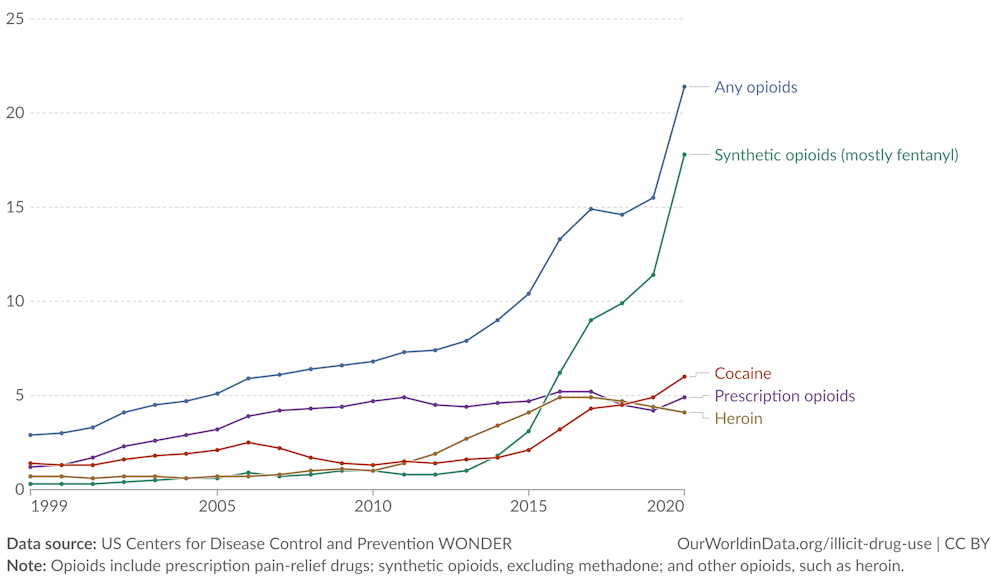
    As patients quickly developed tolerance to drugs such as OxyContin, they had to take higher doses to avoid withdrawal symptoms or the positive feelings it gave them. Taking more of these opiates increases the risk of accidental overdose, many of which proved to be fatal. It has also driven those dependent on drugs to the black market, and into the hands of organised drug gangs, as they seek the drugs in greater quantities.

    US overdose death rates by drug type (1999-2020):


    Our World in Data, CC BY

    Dependency on fentanyl and other opioids is all-consuming. When not using these drugs, people are entirely focused on ensuring sufficient supply of the next dose. This includes funding supply which can take people to places they thought they would never be, for example breaking the law, shoplifting or getting involved in commercial sex to make enough money to buy drugs.

    Synthetic opiates like OxyContin and fentanyl have proved to be classless, ageless and sex blind. The first-hand experience of addiction and fatalities have radically altered the way many Americans think about drugs and the problems they cause. Canada, too, is suffering a major crisis.

    Compounding this tragedy is the failure of the state to provide interventions and treatment that could have reduced fatal and non-fatal overdoses. It is only now that evidence-based interventions are beginning to be made widely available, such as access to Naloxone – a drug that can reverse the effects of opiates and potentially save a life.

    Of course, it isn’t just hospitals and health professionals that are challenged by the results of widespread use of opioids, but public services like the police and fire service. In some areas of the US, there have been so many daily overdoses that every service was called on to try and deal with it. Local mayors have made it a priority to train police and fire personnel to be trained as first responders, such is the scale of the problem.

    But it is not just in North America that we see the failure of politicians and the state to act when faced with growing problems with drugs. In the UK, where record numbers are dying because of using drugs such as heroin, the government has not invested in overdose prevention strategies. At a time when fatal overdoses increase year on year, budgets for specialist treatment have been reduced. It remains to be seen what the recently elected Labour government will do, if anything, to tackle the tragic rise in drug related fatalities.

    Death rates from opioid use disorders (2021):


    Our World in Data, CC BY

    What connects both examples from the US and UK is the attitude and perception of drug use many of us have. Drug use and the heavy use of prescription painkillers is still heavily stigmatised. Many of us still view this as something individuals bring on themselves or have a choice about.

    So, if we don’t care about what happens to people who develop problems with drugs, why should our elected representatives? In part, it is our bigotry that is enabling the lack of timely intervention, despite us possessing the knowledge and evidence of how drug harms can be minimised.

    Latin America: breakdown of the rule of law

    Under the last Conservative government, the UK Home Office asserted that people who used cocaine recreationally are supporting violence not only in the UK but in the countries that produce its raw ingredients. It’s not clear if this has made any difference to those using cocaine in the UK – personally, I doubt many people consider or are aware of how cocaine is produced or its provenance.

    Perhaps if those using cocaine, mainly in western countries, realised the extent of violence and suffering that cocaine manufacture causes they might think again. Latin America has suffered enormously, with few countries there not touched in some way by the violence and breakdown of law associated with drug production and supply. According to the latest UN World Drugs Report:

    Global cocaine supply reached a record high in 2022, with more than 2,700 tons of cocaine produced that year, 20% more than in the previous year … The impact of increased cocaine trafficking has been felt in Ecuador in particular, which has seen a wave of lethal violence in recent years linked to both local and transnational crime groups, most notably from Mexico and the Balkan countries.

    Cocaine seizures and homicide rates increased five-fold between 2019 and 2022 in Ecuador, with the highest such rates reported in the coastal areas used for trafficking the drug to major destination markets in North America and Europe.

    Cocaine trafficking flows based on reported seizures (2019-22):


    UN World Drug Report, CC BY

    As with opium production in Afghanistan, it is small-scale farmers in Colombia, Peru and Bolivia that grow the coca plant that will be turned into cocaine. Like their Afghan counterparts, they grow coca as it is more profitable than alternatives such as coffee. While it may be profitable in the short term, there are greater costs to them and their society.

    Cocaine production brings with it violence as those further up the drug production chain try to control its trade. Few parts of these societies are unscathed, from bribing local politicians through to whole regions that are controlled by organised crime. Keeping control means that the use of firearms and violence increases. Against this backdrop, it is unsurprising that basic health and social services suffer.

    So, while a coca grower may have more money, every other aspect of their life is negatively impacted. Whether it is regional or state institutions, both are compromised by the drug trade and those that control it. While this may not lead to the total collapse of law and order, it does create injustice and distorts the rule of law in many areas of Latin America and the Caribbean, where competition between gangs has also resulted in an increase in homicides.

    The impact is on all sectors of society, now and into the future. For example, while historically the role of women has been largely underrepresented in research and drug policy, the UN report recognises that this is changing:

    As women increasingly participate in economic activities, the role that women play in the drug phenomenon may become increasingly important. For example, a shift away from plant-based drug production may affect many women in rural households involved in opium poppy and coca bush cultivation.

    The UN also identifies the specific risk to young people and the drugs trade, highlighting:

    Long-term efforts to dismantle drug economies must provide socioeconomic opportunities and alternatives, which go beyond merely replacing illicit crops or incomes and instead address the root structural causes behind illicit crop cultivation, such as poverty, underdevelopment, and insecurity. They must also target the factors driving the recruitment of young people into the drug trade, who are at particular risk of synthetic drug use.

    Meanwhile, demand for treatment in Europe due to problems with cocaine has risen significantly in recent years, since 2011 there has been an 80% increase in treatment presentations. This reflects the growing number of people using cocaine and the rise in purity of the drug.

    Death rates from cocaine use disorders (2021):


    Our World in Data, CC BY

    Change is possible

    Amid what may seem to be a story of unrelenting despair and hopelessness, there are local initiatives and even a few state-wide policies that provide optimism that change is possible.

    In my roles both as clinician and scientist, I’ve often been amazed by how ingenious people can be when faced with the apparently impossible. For example, the way some people use heroin to dampen their psychotic symptoms, such as auditory and visual hallucinations – or the development of Naloxone, a drug that can temporarily reverse the effects of opioids, providing a short window for emergency services to treat people who have overdosed.

    Early in my career, I witnessed the emergence of HIV in the UK in the 1980s. The speed at which this disease spread was not matched by our ability to treat it. Our response to HIV was undoubtedly hampered by prejudice and stigma towards marginalised groups in society, namely gay men and those using drugs (particularly injecting them).

    However, unexpectedly and courageously, the Conservative government recognised those who were most at risk of contracting HIV, and organised a package of measures to contain the spread of infection. One part of this was a media campaign based on public health messaging designed to reduce the risk of contracting the disease. But the government also invested in treatment for those who had been infected and engaged with people at high risk, such as those intravenously injecting drugs.


    Read more:
    Drug consumption facilities: they’ve been around since 1986 and now Scotland has one – but do they work?


    I worked in specialist HIV clinics for those using drugs. At the time, methadone and diamorphine were provided as an alternative to heroin. Regulations and protocols that restricted the prescribing of these medical opioids were eased, so we could ensure patients attending these clinics were given sufficient oral and injectable opioids that they didn’t need to source street heroin.

    This meant they had access to medical grade opioids and, crucially, were given regular supplies of sterile injecting equipment. It was this that reduced the risk of contracting HIV, as some people would share injecting equipment when using heroin.

    This impressive policy ran counter to the Conservative party’s ideology at the time, which was to punish rather than help those using drugs like heroin. It showed me how, even with traditional mindsets, it is possible to shift policy thinking in the face of a health crisis. And make no mistake, the global drug problem is an ongoing health crisis. Today, the UN points to the risks that intravenous users of drugs still face:

    An estimated 13.9 million people injected drugs in 2022, with the largest number living in North America and East and South-East Asia … The relative risk of acquiring HIV is 14 times higher for those who inject drugs than in the wider population globally.

    There are, though, signs of positive change in the way some countries and regions are changing their drug policies. Scotland recently opened a drug consumption facility in Glasgow – a safe place for people to use their drugs, usually injecting drugs like heroin. Such spaces provide access to sterile injecting equipment, reducing the risk of blood-borne infections such as HIV or Hepatitis. At the same time, they offer the opportunity to engage with people who have not accessed traditional health services.


    Read more:
    Why Colombia sees legalising drugs as the way forward. Here’s what’s being proposed


    Portugal, as mentioned earlier, has made substantial changes to the way it approaches drug use and the problems associated with it. This policy shift since 2000 has saved lives and brought a more humane way of treating people who develop problems with drugs.

    Contrast this with the wasted effort and resources ploughed into the war on drugs – initiated by Nixon and followed by so many western governments ever since. My plea to policymakers is simple: employ the same evidence-based science you use for health issues towards drugs and problem drug use.

    Science and research can help in many ways, if given the chance. Some of it might seem radical, like providing safe drug consumption spaces. Some of it is more mundane, but vital – like tackling inequality, a clear driver of problem drug use across the world.

    But while we often look to politicians to take the lead on change, it is people – us – that really hold the solution. By far the greatest threat to people and society from drugs is ignorance and bigotry. So many lives have been lost to drugs because of shame, either as a driver of drug use or a barrier to seeking help.

    Beliefs are notoriously difficult to shift. As with climate change, the most powerful driver of change is personal experience. We know that when a family or community is affected by a drug overdose, their beliefs and perceptions change. But this is not the way any of us should want to see change happen.


    For you: more from our Insights series:

    • ‘When he’s not on drugs, he’s a good person’ – one community’s story of meth use and domestic violence

    • For people with mental illness, drugs and alcohol can be a key survival strategy. I’ve learned they shouldn’t have to ‘get clean’ to get treatment

    • Drug deaths are rising and overdose prevention centres save lives, so why is the UK unwilling to introduce them?

    • What my 20 years in Afghanistan taught me about the Taliban – and how the west consistently underestimates them

    To hear about new Insights articles, join the hundreds of thousands of people who value The Conversation’s evidence-based news. Subscribe to our newsletter.

    Ian Hamilton does not work for, consult, own shares in or receive funding from any company or organisation that would benefit from this article, and has disclosed no relevant affiliations beyond their academic appointment.

    – ref. Addicted: how the world got hooked on illicit drugs – and why we need to view this as a global threat like climate change – https://theconversation.com/addicted-how-the-world-got-hooked-on-illicit-drugs-and-why-we-need-to-view-this-as-a-global-threat-like-climate-change-248401

    MIL OSI – Global Reports –

    February 4, 2025
  • MIL-OSI USA: Notes From the Field: Black-bellied Whistling Duck movement ecology and survival study

    Source: US Geological Survey

    “Notes From the Field” news articles highlight the continued importance of bird banding. This article was contributed by Paul Link with Louisiana Department of Wildlife & Fisheries who began researching Black-bellied Whistling Ducks in 2011, and Pam Garrettson and Joshua Dooley with the U.S. Fish and Wildlife Service, who are assisting with the band-recovery data analyses. 

    Today, banding allows scientists to investigate bird behavior, migration, lifespans, populations, diseases and levels of environmental contaminants. Information gathered through the North American Bird Banding Program helps inform management and conservation decisions for game and non-game species, such as protecting or restoring habitat, setting hunting regulations and determining plans for human-led development. The North American Bird Banding Program depends on a network of over 10,000 permitted bird banders working in the United States, Canada and Trust Territories. Each year these banders help us add up to 1.2 million new banding records to our century-long dataset. 

    Holding banded Black-bellied Whistling Ducks are band resight extraordinaire Alvin Attenhofer on the left and on the right Paul Link, Research Program Manager of LA Department of Wildlife & Fisheries. Photo courtesy of Michael Slazer. 
    How do you use bird banding in your research?  

    We initiated our research in 2011 to answer questions related to the movement ecology and survival of Black-bellied Whistling Ducks in south Louisiana. We started out opportunistically banding this species with standard aluminum butt-end bands for a couple years, but upon realizing encounter rates were much lower than expected, we greatly increased our banding effort. We plan to utilize both live recaptures and dead recoveries to estimate annual survival. Our banding season is February through May, which is an ideal period for captures as the ducks are still gregarious prior to dispersing for nesting. At the onset of our research, we hypothesized that they migrated south to Texas or Mexico during winter, but we hope to use recovery data to better describe movements and habitat use throughout the annual cycle. 

    Why is your study species so interesting?  

    Black-bellied Whistling Ducks are found only in the Western Hemisphere. They are more arboreal than other whistling-ducks; they nest primarily in natural tree cavities and readily utilize artificial nest boxes, but also commonly nest on the ground. Unlike most ducks, both the male and female take part in incubation and brood rearing. In North America, this species historically nested mainly along Mexico and south Texas coasts. However, their range began expanding northward mid-20th century, with sightings in Arizona, Louisiana, and Florida by the 1960s. They are a game species with liberal regulations; however, they are only lightly harvested because of their nocturnal nature. Furthermore, traditional waterfowl surveys are inadequate for this species due to low detection probabilities. Many Black-bellied Whistling Ducks congregate in or under trees in urban, suburban, or industrial areas during fall and winter where they are difficult to harvest and/or survey, which makes estimating vital rates such as survival and harvest probabilities more challenging than for most other waterfowl species.   

     What have you found so far?   

    Since 2011, we have banded over 40,000 Black-bellied Whistling Ducks and have recaptured >4,200. Interestingly, we have similar numbers of resights versus shot or found dead. The vast majority of those resights are by a single citizen scientist that devotes most evenings for several months each year observing and documenting the ducks’ movements, pair associations, and family status. Roughly 80% of the banded Black-bellied Whistling Ducks are subsequently encountered in Louisiana, with 10% encountered in Mississippi (where we band ~150/year and the previously mentioned citizen scientist resights and reports individuals once per calendar year), 8% in Texas, and 1% or less in Arkansas, Florida, Tennessee, Alabama, and North Carolina. We’ve had just one report of a band recovered in Mexico, from a duck found dead in a grain cargo ship that set sail from the Port of New Orleans days earlier. Thus, most Black-bellied Whistling Ducks appear to be transient residents that concentrate in safe places during the fall and winter and disperse throughout Louisiana during spring and summer to breed. Their apparent survival rates (calculated using only live recapture data) were lower than expected; we are currently incorporating both live and dead recoveries to calculate actual annual survival. We’ve documented multiple large die-offs of up to 3,000 Black-bellied Whistling Ducks due to unintentional poisoning at water treatment and grain handling facilities. Avian cholera outbreaks are also common among this species. An unknown number are also killed via shooting or avicide under agricultural depredation and aircraft bird strike prevention orders. Due to their highly gregarious behavior, Black-bellied Whistling Ducks are particularly susceptible to communicable diseases. Thus, their population seems to self-regulate under conditions of minimal recreational harvest.   

    Why do you think projects like yours are so important?  

    This banding project will help us understand the movements and vital rates for a poorly understood, yet very common, waterfowl species along the Gulf Coast, improving population management options. Black-bellied Whistling Ducks are considered a nuisance by many (such as agriculture producers, golf course managers, and aircraft strike prevention personnel); however, amidst long-term declining trends in most resident and migratory waterfowl in Louisiana, waterfowl hunters welcome the sight of this relative newcomer on the landscape. 

    What are the next steps for your project?  

    We’ll continue to band a maintenance number of approximately 3,000 individuals per year to explore changes in vital rates amidst a rapidly changing landscape. We are also currently analyzing results from a pilot study utilizing satellite transmitters, as well as working with a transmitter manufacturer to design a miniaturized GPS/GSM device to collect higher quality and greater quantity movement data to better understand their local and long-range movements, use of habitats, nesting and non-breeding ecology, and seasonal survival rates. 

    Adult and juvenile Black-bellied Whistling Ducks in flight. Photo courtesy of John K. Flores. 

    The “Notes From the Field” series highlights current banding projects and the continued importance of bird banding and the Bird Banding Lab. Want to see your project featured in a future “Notes From the Field” article? Email Kyra Harvey kharvey@usgs.gov for submission details. 

    MIL OSI USA News –

    February 4, 2025
  • MIL-OSI USA: Honduran national sentenced for illegal reentry into the US

    Source: US Immigration and Customs Enforcement

    February 3, 2025Tampa, FL, United StatesEnforcement and Removal

    TAMPA, Fla. – An investigation by U.S. Immigration and Customs Enforcement has led to Jonathan Javier Godoy-Pivaral, 29, an illegal alien from Honduras who was previously deported from the United States, being sentenced to more than five months in prison for illegally reentering the U.S. Godoy-Pivaral pleaded guilty on Nov. 6, 2024.

    According to court documents, Godoy-Pivaral was removed from the U.S on Feb. 26, 2018. He later unlawfully reentered the U.S. and was arrested for burglary on June 19, 2024, in Hillsborough County, Fla.

    This case was prosecuted by Assistant U.S. Attorney Lindsey Schmidt and Special Assistant U.S. Attorney Joseph Wheeler, III.

    MIL OSI USA News –

    February 4, 2025
  • MIL-OSI USA: ICE arrests 32 illegal aliens in Palm Beach County enforcement action

    Source: US Immigration and Customs Enforcement

    February 3, 2025Tampa, FL, United StatesEnforcement and Removal

    ICE Miami, Stuart Sub-office @HSI_Miami @CBPHQ & the Florida Fish & Wildlife Conservation Commission conducted a multi-agency immigration enforcement operation spanning several counties in Southern Florida, netting 32 arrests of criminal illegal aliens. The illegal aliens were from Guatemala, Haiti, Mexico, Honduras, El Salvador, Venezuela, Colombia, Brazil, Cuba, Nicaragua with criminal convictions including prostitution, robbery, fraud, larceny, DUI, & narcotics possession.

    STUART, Fla. – U.S. Immigration and Customs Enforcement activities in Palm Beach County, Fla., recently netted 32 illegal aliens from various counties with criminal convictions which included drug possession, prostitution, illegal re-entry, resisting an officer, robbery, probation violation, fraud (illegal use of a credit card), larceny, cocaine possession, driving under the influence and possession of stolen property.

    ICE officers and agents in Miami, in coordination with the U. S. Border Patrol, conducted targeted immigration enforcement operations in Palm Beach County from January 27 to 28. The operation netted 32 illegal aliens from Guatemala, Haiti, Mexico, Honduras, El Salvador, Venezuela, Colombia, Brazil, Cuba, and Nicaragua.

    All illegal aliens arrested during this operation will be detained pending their removal from the United States or a hearing before an immigration judge.

    Some highlights from the arrests include:

    • A 30-year-old Venezuelan male with criminal convictions for resisting officer, drug possession, and robbery who is being detained pending his removal from the United States.
    • A 44-year-old Haitian female with criminal convictions for battery, drug possession, prostitution, and narcotic equipment possession who is awaiting a removal hearing by an immigration judge.
    • A 24-year-old Cuban male with criminal convictions for fraud, failure to appear, larceny, and probation violation who is in custody pending removal from the U.S.
    • A 25-year-old Guatemalan male with criminal convictions for illegal re-entry, cocaine possession, and driving under the influence who is being detained pending removal from the U.S.

    MIL OSI USA News –

    February 4, 2025
  • MIL-OSI Security: Mexican National Arrested For Illegal Reentry Into The United States

    Source: Office of United States Attorneys

    Ocala, Florida – United States Attorney Roger B. Handberg announces the filing of a criminal complaint charging Antonio Candia-Bautista (45, Mexico) with illegal reentry into the United States by a previously deported alien. If convicted, Candia-Bautista faces a maximum penalty of two years in federal prison.

    According to the complaint, Candia-Bautista was deported from the United States on October 4, 2016. At some time thereafter, he unlawfully reentered the United States. He was recently arrested during a state investigation into an automobile accident in Sumter County on January 28, 2025. A records check confirmed that Candia-Bautista was a citizen of Mexico with no lawful permission to be present in the United States.

    A complaint is merely a formal charge that a defendant has committed one or more violations of federal criminal law, and every defendant is presumed innocent unless, and until, proven guilty.

    This case was investigated by the United States Border Patrol. It is being prosecuted by Assistant United States Attorney Tyrie K. Boyer. 

    MIL Security OSI –

    February 4, 2025
  • MIL-OSI Security: Dominican National Charged With False Statement To Federally Licensed Firearms Dealer

    Source: Office of United States Attorneys

    Orlando, FL – United States Attorney Roger B. Handberg announces the  unsealing of an indictment charging Eugenio Gonzalez-Paredes (53, Dominican Republic) with making a false statement to a federally licensed firearms dealer. If convicted, Gonzalez-Paredes faces a maximum penalty of 5 years in federal prison. 

    According to the indictment, Gonzalez-Paredes made a false statement on a Bureau of Alcohol, Tobacco, Firearms and Explosives Form 4473 stating that he had not previously been convicted of a crime punishable by more than a year in prison. At the time Gonzalez-Paredes made the statement, he had previously been convicted twice in the United States District Court in the District of Puerto Rico for illegal reentry by a previously deported alien.

    An indictment is merely a formal charge that a defendant has committed one or more violations of federal criminal law, and every defendant is presumed innocent unless, and until, proven guilty.

    This case was investigated by U.S. Customs and Border Protection. It will be prosecuted by Assistant United States Attorney Megan Testerman.

    This case is part of Project Safe Neighborhoods (PSN), a program bringing together all levels of law enforcement and the communities they serve to reduce violent crime and gun violence, and to make our neighborhoods safer for everyone.  On May 26, 2021, the Department launched a violent crime reduction strategy strengthening PSN based on these core principles: fostering trust and legitimacy in our communities, supporting community-based organizations that help prevent violence from occurring in the first place, setting focused and strategic enforcement priorities, and measuring the results.

    MIL Security OSI –

    February 4, 2025
  • MIL-OSI Security: Honduran National Indicted For Illegal Reentry Into The United States

    Source: Office of United States Attorneys

    Jacksonville, Florida – United States Attorney Roger B. Handberg announces the return of an indictment charging Alex Rafael Gonzalez-Morales (35, Honduras) with illegal reentry by a deported alien. If convicted, Gonzalez-Morales faces a maximum penalty of 10 years in federal prison. His trial is set for March 3, 2025.   

    According to the indictment, Gonzalez-Morales was previously convicted of of unlawful reentry of a removed alien and was subsequently removed from the United States in November 2019. Following his removal, Gonzalez-Morales did not receive the consent of the Attorney General or the Secretary of Homeland Security to reapply for admission to the United States. On or about January 14, 2025, Gonzalez-Morales was found to be voluntarily in the United States.

    An indictment is merely a formal charge that a defendant has committed one or more violations of federal criminal law, and every defendant is presumed innocent unless, and until, proven guilty.

    This case is being investigated by Immigration and Customs Enforcement (ICE) Enforcement and Removal Operations (ERO) Miami – Jacksonville sub-office It is being prosecuted by Assistant United States Attorney Rachel Lasry.

    MIL Security OSI –

    February 4, 2025
  • MIL-OSI USA: ICE Boston arrests illegal Dominican national convicted of murder in Massachusetts

    Source: US Immigration and Customs Enforcement

    BOSTON — U.S. Immigration and Customs Enforcement apprehended an illegally present Dominican national convicted for murder in Massachusetts in 2007 when officers arrested Cesar Augusto Polanco, 59, January 24 at the Massachusetts Correctional Institution in Norfolk after he was released from state custody.

    “Cesar Augusto Polanco came to this country lawfully; however, his horrendous actions have deemed him a significant threat to the residents here,” said acting ICE Enforcement and Removal Operations Boston Field Office Director Patricia H. Hyde. “We will not allow our communities to be subjected to the danger posed by violent alien offenders. ICE ERO Boston will continue to prioritize public safety by arresting and removing these criminals from New England.”

    Polanco lawfully entered the United States at John F. Kennedy International Airport March 18, 1990 and later violated the terms of his lawful admission.

    Polanco was convicted of murder March 8, 2007, and sentenced to life in prison with the possibility of parole. ICE issued an immigration detainer against Polanco June 20, 2013, with the Massachusetts Correctional Institution.

    ICE served Polanco with a notice to appear before a Department of Justice immigration judge December 20, 2013, and was ordered removed from the U.S. to the Dominican Republic June 25, 2014.

    The Massachusetts Correctional Institution honored the immigration detainer and informed ICE Boston of Polanco’s release. Polanco remains in ICE custody pending removal proceedings.

    “ICE recognizes the importance of our relationships with state and local law enforcement partners, and we will continue to share information and coordinate operations with those partners in a way that ensures safety within our community,” Hyde said. “As a result of this partnership, the Massachusetts Correctional Institution contacted ICE and allowed for a safe transfer of a violent criminal. In doing so, they enabled us to make the arrest in the safety of a jail cell rather than sending a team of officers into the community to make a potentially dangerous arrest.”

    The 287(g) program – through the delegation of some immigration officer duties – allows ICE to cooperate with its state and local law enforcement partners to protect the homeland through the arrest and removal of noncitizens who undermine the safety of U.S. communities and the integrity of U.S. immigration laws. While the 287(g) Program has yielded successes, ICE recognizes the program is not universally regarded as the most effective or appropriate model in every jurisdiction. Accordingly, ICE maintains its authority to utilize 287(g) agreements and exercise strict oversight. ICE continually evaluates the overall effectiveness of the program.

    Members of the public with information regarding child sex offenders can report crimes or suspicious activity by dialing the ICE Tip Line at 866-DHS-2-ICE (866-347-2423) or completing the online tip form.

    Learn more about ERO Boston’s mission to increase public safety in our New England communities on X at @EROBoston.

    MIL OSI USA News –

    February 4, 2025
  • MIL-OSI USA: ICE Washington, D.C. arrests illegal Salvadoran national who sexually assaulted Virginia resident

    Source: US Immigration and Customs Enforcement

    FAIRFAX COUNTY, Va. — U.S. immigration and Customs Enforcement apprehended an illegally present Salvadoran national convicted of sexually assaulting a Virginia resident when officers with ICE Washington, D.C. arrested Nicolas Alberto Hernandez-Lopez, 46, Jan. 15 in Fairfax County, Virginia.

    “Nicolas Alberto Hernandez-Lopez illegally reentered the United States, and then victimized a resident of our Virginia community. This is not something that the officers of ICE Washington, D.C. will tolerate,” said ICE Enforcement and removal Operations Washington, D.C. acting Field Office Director Patrick Divver. “We will continue our mission of arresting public safety threats and removing egregious alien offenders from our Washington, D.C. and Virginia neighborhoods.”

    Hernandez-Lopez lawfully entered the U.S. and later violated the terms of his lawful admission.

    Officials in Fairfax County, Virginia convicted Hernandez-Lopez of second-degree sexual assault March 7, 2019, and sentenced him to prison.

    Officers with ICE arrested Hernandez-Lopez April 7, 2023, and served him with a notice to appear before a Department of Justice immigration judge. The immigration judge ordered Hernandez-Lopez removed from the U.S. on May 23, 2023, and ICE officers removed Hernandez-Lopez to El Salvador June 9, 2023.

    Hernandez-Lopez unlawfully re-entered the United States on an unknown date, at an unknown location, and without being inspected, admitted, or paroled by a U.S. immigration official.

    Officers with ICE Washington, D.C. arrested Hernandez-Lopes January 15 in Fairfax County, Virginia. He remains in ICE custody.

    Members of the public with information regarding child sex offenders can report crimes or suspicious activity by dialing the ICE Tip Line at 866-DHS-2-ICE (866-347-2423) or completing the online tip form.

    Learn more about ERO Boston’s mission to increase public safety in our New England communities on X at @EROWashington.

    MIL OSI USA News –

    February 4, 2025
  • MIL-OSI USA: ICE Boston arrests illegal Haitian national charged with assault, sex crime against a Massachusetts resident

    Source: US Immigration and Customs Enforcement

    BOSTON — U.S. Immigration and Customs Enforcement apprehended an illegally present Haitian national charged with assault and battery and indecent assault and battery of a person 14 years or older when ICE officers arrested Jean Yves Yves Ovilme, 37, January 22 in Boston.

    “Mr. Ovilme will have his day in court, but he stands accused of horribly victimizing a Massachusetts resident,” said ICE Enforcement and Removal Operations Boston acting Field Office Director Patricia H. Hyde. “Mr. Ovilme posed a significant danger to our Massachusetts neighborhoods, and we will not tolerate such threats to our New England community. ICE Boston will continue our mission of arresting and removing illegal alien offenders.”

    Ovilme legally entered the United States Nov. 10, 2023, at Fort Lauderdale, Florida, but he later violated the terms of his lawful admission.

    The West Roxbury District Court in Boston arraigned Ovilme Nov. 20, 2024, for the charges of indecent assault and battery on a person 14 or older as well as assault and battery. ICE issued an immigration detainer against Ovilme with the court later that day.

    ICE determined that the state of Massachusetts ignored the immigration detainer and released Ovilme on Jan. 3. Ovilme remains in ERO custody.

    Members of the public with information regarding child sex offenders can report crimes or suspicious activity by dialing the ICE Tip Line at 866-DHS-2-ICE (866-347-2423) or completing the online tip form.

    Learn more about ERO Boston’s mission to increase public safety in our New England communities on X at @EROBoston.

    MIL OSI USA News –

    February 4, 2025
  • MIL-OSI USA: Attorney General James and Coalition of 22 Attorneys General Celebrate Court Victory Stopping Federal Funding Freeze

    Source: US State of New York

    NEW YORK – New York Attorney General Letitia James and a coalition of 22 attorneys general today celebrated winning a court order halting the implementation of a Trump administration policy that would block many federal agency grants, loans, and other financial assistance programs. On Friday, Judge John J. McConnell of the U.S. District Court for the District of Rhode Island granted a temporary restraining order (TRO) blocking the administration’s illegal funding freeze after Attorney General James and the coalition filed a lawsuit to stop the policy.

    “The power of the purse belongs to Congress – not the President of the United States,” said Attorney General James. “Last week, I led a coalition of attorneys general in suing to stop this dangerous and chaotic policy, and we won a court order to stop it while our lawsuit proceeds. Now, New Yorkers can rest assured that federal funds for critical services – meals for our seniors, health care, community public safety, disaster relief, and so much more – are currently not at risk. I will continue to fight in court to defend the essential programs and services New Yorkers need.”

    The TRO won by Attorney General James prohibits federal agencies from taking any action that would “pause, freeze, block, cancel or terminate” the provision of federal funding, unless otherwise permitted by existing statute or the terms of the grant. Because of Attorney General James’ immediate intervention, programs that provide critical health and childcare services to families in need, deliver support to public schools, combat violence and expand public safety, provide life-saving disaster relief to states, and more are no longer at immediate risk of losing their funding.

    In a notice sent to federal agencies and filed with the court this morning, the Department of Justice (DOJ) indicated its intent to comply with the court order and affirmed that the TRO blocking the illegal freeze applied to all federal funding awards or obligations, including those made to recipients such as hospitals, non-profits, or other organizations. The TRO applied to both current and future grants of federal assistance.

    This morning, Attorney General James also sent a letter to hundreds of recipients of federal funding informing them that federal financial assistance cannot be frozen as a result of the administration’s policy, which is now blocked. This included health care providers, who were informed that funding cannot be frozen or withdrawn on the basis of providing gender affirming care to minors. Attorney General James also reminded providers that regardless of funding, all providers in New York are obligated to comply with New York state laws, including those that prohibit discrimination against individuals based on their sex, gender identity or expression, sexual orientation, or membership in other protected classes. To comply with New York law, Attorney General James warns all providers that they must continue to provide health care services, including gender affirming care, to transgender or gender nonconforming individuals.

    This lawsuit was led by Attorney General James and the attorneys general of California, Illinois, Massachusetts, New Jersey and Rhode Island. Joining the lawsuit are the attorneys general of Arizona, Colorado, Connecticut, Delaware, Hawaii, Maine, Maryland, Michigan, Minnesota, Nevada, New Mexico, North Carolina, Oregon, Vermont, Washington, Wisconsin, and the District of Columbia. 


    MIL OSI USA News –

    February 4, 2025
  • MIL-OSI United Nations: Secretary-General Appoints Arnaud Peral of France United Nations Resident Coordinator in Philippines

    Source: United Nations General Assembly and Security Council

    United Nations Secretary-General António Guterres has appointed Arnaud Peral of France as the United Nations Resident Coordinator in the Philippines, with the host Government’s approval, on 1 February.

    Mr. Peral was most recently the United Nations Resident Coordinator in Tunisia since 2020.  Prior to that, he served successively as United Nations Resident Coordinator and United Nations Development Programme (UNDP) Resident Representative in Ecuador, UNDP Country Director in Colombia, UNDP Deputy Resident Representative in México and then Brazil, Programme Manager and Chief of Staff in UNDP´s Regional Bureau for Latin America and the Caribbean in New York and Programme Officer in UNDP Cuba.

    Prior to joining the UN system in 2000, Mr. Peral served as Cooperation Counsellor for Scientific and Technical Cooperation in the French Embassy in Cuba, Research Assistant in the Ministry of Environment in France and Research Assistant in public policy in the Ministry of Agriculture in Chile.

    Mr. Peral holds a master’s degree in development economics from the University of Paris X-Nanterre and a bachelor’s degree in economic policy from the University Pierre Mendes France, Grenoble.

    __________

    * This supersedes Press Release SG/A/1982 of 17 September 2020.

    MIL OSI United Nations News –

    February 4, 2025
  • MIL-OSI Security: Three Mexican Nationals Sentenced for $4.7 Million Methamphetamine, Heroin Conspiracy

    Source: Federal Bureau of Investigation (FBI) State Crime Alerts (b)

    Mexican Drug-Trafficking Organization Distributed Over 335 Kilos of Meth, 22 Kilos of Heroin

    KANSAS CITY, Mo. – Three Mexican nationals were sentenced in federal court this week for their roles in a $4.7 million conspiracy to distribute more than 335 kilograms of methamphetamine and 22 kilograms of heroin.

    Jesus Morales-Garcia, also known as “Don Jesus,” 46, was sentenced by U.S. District Judge Beth Phillips on Wednesday, Jan. 29, to 18 years in federal prison without parole. Co-defendant Santiago Raul Mendieta-Sanchez, 43, also was sentenced to seven years in federal prison without parole.

    On Tuesday, Jan. 28, co-defendant Baltazar Flores-Norzagaray, 53, was sentenced to 16 years and three months in federal prison without parole.

    On Aug. 28, 2024, Morales-Garcia pleaded guilty to one count of participating in a continuing criminal enterprise, one count of conspiracy to distribute methamphetamine and heroin, and one count of illegally reentering the United States after having been deported. Mendieta-Sanchez and Flores-Norzagaray also have pleaded guilty to their roles in the drug-trafficking conspiracy that continued from Feb. 28, 2020, to Sept. 20, 2022. Flores-Norzagaray also pleaded guilty to possessing firearms in furtherance of a drug-trafficking crime.

    Morales-Garcia admitted that he was a chief local operative of a drug-trafficking organization that distributed hundreds of kilograms of illegal drugs sourced from Mexico into the Kansas City region.

    Morales-Garcia also admitted that he was found in the United States after having been deported twice in 2016.

    Flores-Norzagaray also admitted that he was in possession of a Hammerli .22-LRcaliber rifle, a Taurus 9mm handgun, and a Taurus .38-caliber revolver when he was arrested on Oct. 7, 2021. Flores-Norzagaray sold hundreds of grams of methamphetamine to a confidential informant on at least four separate occasions.

    The conspiracy involved the distribution of more than 335.5 kilograms of methamphetamine, with an average street price of $300 per ounce, and more than 22.1 kilograms of heroin, with an average street price of $1,500 per ounce.

    On June 8, 2022, Homeland Security Investigations (HSI) led an operation that involved 140 officers and agents from 14 state, local and federal law enforcement agencies. On the day of the takedown, officers executed 16 search warrants and seized 84.4 kilograms of methamphetamine, 4.5 kilograms of heroin, 10.4 kilograms of fentanyl, 7.6 kilograms of cocaine, 10.5 kilograms of marijuana, 687 Xanax pills, 3.1 kilograms of unknown pills, a quantity of bulk cash, five firearms, a 3D printer with manufactured ghost gun parts, and a liquid methamphetamine conversion lab.

    With these sentencings, 24 defendants have now been sentenced in this case in which 44 defendants were indicted.

    This case is being prosecuted by Assistant U.S. Attorney Megan A. Baker. It was investigated by Homeland Security Investigations, U.S. Customs and Border Protection, the Drug Enforcement Administration, the Jackson County Drug Task Force, IRS-Criminal Investigation, the Kansas Bureau of Investigation, the Kansas City, Mo., Police Department, the Kansas City, Kan., Police Department, the Missouri State Highway Patrol, the Kansas Highway Patrol, the Independence, Mo., Police Department, the Minnesota Bureau of Criminal Apprehension, the Minnesota State Patrol, the Olmsted County, Minn., Sheriff’s Office, the Texas Department of Public Safety, the FBI, the Clay County, Mo., Sheriff’s Department, the Bureau of Alcohol, Tobacco, Firearms and Explosives, and the U.S. Marshals Service.

    Organized Crime and Drug Enforcement Task Force

    This case is part of an Organized Crime Drug Enforcement Task Forces (OCDETF) operation. OCDETF identifies, disrupts, and dismantles the highest-level criminal organizations that threaten the United States using a prosecutor-led, intelligence-driven, multi-agency approach. Additional information about the OCDETF Program can be found at https://www.justice.gov/OCDETF.

    KC Metro Strike Force

    This prosecution was brought as a part of the Department of Justice’s Organized Crime Drug Enforcement Task Forces (OCDETF) Co-located Strike Forces Initiative, which provides for the establishment of permanent multi-agency task force teams that work side-by-side in the same location. This co-located model enables agents from different agencies to collaborate on intelligence-driven, multi-jurisdictional operations against a continuum of priority targets and their affiliate illicit financial networks. These prosecutor-led co-located Strike Forces capitalize on the synergy created through the long-term relationships that can be forged by agents, analysts, and prosecutors who remain together over time, and they epitomize the model that has proven most effective in combating organized crime. The principal mission of the OCDETF program is to identify, disrupt, and dismantle the most serious drug trafficking organizations, transnational criminal organizations, and money laundering organizations that present a significant threat to the public safety, economic, or national security of the United States.

    MIL Security OSI –

    February 4, 2025
  • MIL-OSI USA: ICYMI: Chairman Mast discusses foreign aid review, DEI on “Face the Nation”

    Source: US House Committee on Foreign Affairs

    Media Contact 202-321-9747

    WASHINGTON, D.C. – Yesterday, House Foreign Affairs Committee Chairman Brian Mast joined Margaret Brennan on CBS’ “Face the Nation” to discuss the review of foreign assistance and the Biden State Department’s fixation on DEI.


    WATCH HERE

    -Transcript-

    MARGARET BRENNAN: And we’re joined now by Florida Republican Congressman Brian Mast, who is the chairman of the Foreign Affairs Committee, which has oversight over the State Department and its programs.

    He joins us from Fort Pierce, Florida.

    Good morning to you.

    CHAIRMAN BRIAN MAST (R-Florida): Good morning.

    BRENNAN: I want to start first on the tariffs that were announced overnight by President Trump. You know there’s a free trade agreement with Mexico and Canada. President Trump negotiated it during his first term.

    The tariffs may violate that deal. If he’s invoking tariffs on a national security basis, can you explain the threat posed by Canada?

    CHAIRMAN MAST: Yes, and he was – President Trump, that is to say, was very specific in his executive order, outlined that it’s specifically related to fentanyl. It’s specifically related to human trafficking.

    And there’s a trust, but verify situation that has to go on here.

    BRENNAN: Through Canada?

    CHAIRMAN MAST: Through Canada as well, absolutely, fentanyl through Canada, human trafficking through Canada, also with China in that mix for fentanyl as well.

    That was specifically outlined in it. And until that comes to an end, this is what’s going to be on the table. And bear in mind as well that USMCA reauthorization is coming up in the coming-up months and years.

    BRENNAN: So you don’t believe that this violates the trade agreement, the treaty?

    CHAIRMAN MAST: The violation has been to the United States of America. It’s been to our sovereignty. It’s been to our people. We’ve been taken for granted.

    BRENNAN: Right, but Congress votes on these things. So…

    CHAIRMAN MAST: And I will make sure certainly, as the Foreign Affairs chairman, that we give every single authority as we go through State Department reauthorization, to make sure that this moves forward, as well as purging of people throughout the State Department, other agencies, where we’re freezing aid.

    These are all very important and necessary steps to make sure that we secure America. And we’re going to support that.

    BRENNAN: I’m sorry. Can I follow up on what you just said there?

    CHAIRMAN MAST: Please do.

    BRENNAN: You want to authorize purging of State Department personnel? What does that mean exactly?

    CHAIRMAN MAST: Well, if you want to take a look at the State Department, where DEI has been a priority over, let’s say, diplomacy on many accounts, I can give you hundreds of examples of where they were authorizing…

    BRENNAN: What proof do you have of that?

    CHAIRMAN MAST: Sure, let’s list them off, half-a-million dollars to expand atheism in Nepal, $50,000 to do, let’s see, a transgender opera in Colombia, $47,000 to do an LGBTQ trans comic book in Peru, $20,000 a pop to do drag shows in Ecuador.

    Shall I continue with more examples of where DEI was a priority?

    BRENNAN: Oh, it certainly seems like there could be a review of things. Foreign aid, as you know, is less than 1 percent of the entire federal budget. So we’re talking small amounts of money by comparison. But when…

    CHAIRMAN MAST: We’re still talking about tens and tens of billions of dollars.

    And if you want to go to somebody else, on the other side of the aisle, Samantha Power, she had a worthy goal, although it was a stupid goal. She said she was hoping to get the amount of foreign aid, U.S. aid dollars that go to actual aid up to 30 cents on the dollar from 10 cents on the dollar. That’s a major problem that we have this agency that that’s all that goes abroad…

    BRENNAN: I think you’re talking about…

    CHAIRMAN MAST: … when it should be the American worker’s dollar.

    BRENNAN: I think now you’re talking about the USAID, the aid agency…

    CHAIRMAN MAST: Yes.

    BRENNAN: … which is a – separate from the State Department currently and has about $40 billion worth…

    CHAIRMAN MAST: Which is likely going to be rolled more closely under Secretary Rubio.

    BRENNAN: Tell – yes, tell me about that, because that’s where I was going.

    Has the Trump administration informed you of plans to dismantle or significantly shrink this agency?

    CHAIRMAN MAST: This is something that I’m working on very specifically, in conjunction with Secretary Rubio, to make sure that there’s the appropriate command-and-control of these agencies, where, again, to make that same point, right now, maybe 10 to 30 cents…

    BRENNAN: They already report to the secretary of state.

    CHAIRMAN MAST: But 10 to 30 cents on the dollar is what actually goes to aid. So there’s not the right amount of command-and- control that’s going on with the way that it’s set up currently.

    And let’s make another point on this as well.

    BRENNAN: Congress – Congress authorizes and earmarks funding.

    CHAIRMAN MAST: Most of these dollars – most of these dollars that go out of USAID, 70-plus percent don’t come from U.S. growers, U.S. farmers, U.S. ranchers, or go through us ports. And that’s another big problem for America.

    BRENNAN: So – I’m sorry. If Congress already authorizes and earmarks the funding, just to be very clear, you’re not endorsing getting rid of USAID as a separate department, which already reports to the secretary of state, are you?

    CHAIRMAN MAST: I would be absolutely for, if that’s the path we go down, removing USAID as a separate department and having it fall under one of the other parts of United States Department of State, because of its failure.

    I just went over the numbers twice with you in the amount of aid that actually makes it into the hands. I mean, you could you could almost say – this is a little bit hyperbole – but there’s probably more dollars that go towards state dinners around the D.C. Beltway than what actually goes into rice and beans abroad.

    That’s the state of what’s going on with USAID. And Samantha Power said no less herself.

    BRENNAN: Well, I think every single administration authorizes reviews, could increase efficiencies. There are plenty of people who propose bringing it more under the authority of the State Department. Madeleine Albright tried to do that. That’s not a new MAGA idea.

    I think the question here, though, is about how you do it. Do you still believe that in the law signed in the 1960s that Congress has to sign off on any changes to USAID? Or do you think President Trump can just make all of this happen through executive order?

    CHAIRMAN MAST: So, all of those examples that you just gave of those historical figures, the difference is now the job is going to get done.

    It’s going to be 99.99 percent of cents on the dollar actually go towards what it’s intended, instead of people around the Beltway.

    BRENNAN: OK, so you’re talking about – you’re talking about…

    CHAIRMAN MAST: That’s what’s going to happen. That’s the change.

    BRENNAN: … efficiencies in aids versus restructuring.

    So let me ask you about that. Well, like I said…

    CHAIRMAN MAST: Well, that requires restructuring, 100 percent. You can’t create that efficiency just by wishing it into existence.

    BRENNAN: Sure.

    CHAIRMAN MAST: You have to restructure where the failures are and put the right things in place.

    BRENNAN: Of course.

    But what we’re hearing from many of these aid organizations and officials is that, can you restructure after you finish the review and not freeze funding now, immediately? I spoke to former USAID global health head Atul Gawande yesterday. He told me this isn’t a pause in foreign aid. It is a demolition of USAID.

    As he put it, you can’t pause a flight in midair. That’s what’s happening.

    CHAIRMAN MAST: Let’s…

    BRENNAN: This immediate freeze in funding is stopping agencies in the field from being able to do the work they do.

    CHAIRMAN MAST: Let’s say why that is so important. And let’s talk about the real facts on the ground.

    The Trump administration comes in or representatives like myself that do oversight. The agencies will literally not tell us what they are writing grants for, literally, or they will lie about it, or they will tell the new political appointees under the Trump administration, I’m just not going to tell you that. Those are real things that have happened.

    So the way that you make them come and answer for where they are actually sending dollars is to say, we’re freezing that. We’re putting it on hold. You need to come to us and explain what it is you’re doing, why you’re doing it and where it’s actually saving life. And guess what?

    BRENNAN: But…

    CHAIRMAN MAST: When they don’t come explain something, that also begs the question, why were they doing it in the first place?

    BRENNAN: But the way these things work is, the contractors have to front the cash, then go to the U.S. government for reimbursement.

    So when you put in an immediate freeze, that means drugs don’t get delivered. That means they don’t get distributed. That means bomb disposal units don’t get to go out there in places like Cambodia and remove ordnance or provide help to people who receive it.

    That’s the pushback from aid organizations, who are saying they’re going to have to carry out layoffs in the thousands in the coming week. Does that concern you at all?

    CHAIRMAN MAST: They will have an opportunity. It doesn’t concern me because of the grift that has been going on to the American taxpayer, the American worker.

    That’s what needs to be answered for. And so you look at this. Let’s use PEPFAR as an example. You were talking about drugs going to individuals. There was a release of that hold that was put – that was authorized. But it shouldn’t be the case that the American people fund HIV and AIDS drugs for 20 million people across Africa, where many of these countries are working very directly with our adversaries like China.

    That is an example of them taking us for granted. We need to be asking the question, should they be weaning off of this? Should we be paying it for these very expensive HIV and AIDS drugs?

    BRENNAN: Yes.

    CHAIRMAN MAST: Should the American worker be footing the bill for that? Those are real questions.

    BRENNAN: Yes, real questions, but, in the meantime, people need their drugs while you ask those questions. So that’s where the disagreement is with the aid organizations.

    But let me ask you about air traffic controllers and what’s happening here at home.

    CHAIRMAN MAST: Not with all the leaders of other countries, though. I believe I saw the leader of Kenya as one step up and say, hey, this is an example where we need to step up for ourselves and show how we can take care of ourselves. And I believe that was the president there.

    BRENNAN: I want to ask you, as I was saying, about another committee you sit on, Transportation Committee.

    The FAA hiring policy for air traffic controllers, including under the first Trump administration, offered equal opportunity to those with targeted disabilities, including, as the president read, hearing, vision, missing extremities, partial paralysis, complete paralysis, severe intellectual debility – disability. Excuse me.

    The president singled this out, this policy, as a contributor possibly to the crash. Do you agree with the diversity policy, or do you agree with the president? I know you lost two limbs serving this country in Afghanistan. Do you hear those words and take offense to them or…

    CHAIRMAN MAST: No, no offense. Let’s unpack it.

    Number one, I will use myself as an example, right? There are things that I am suited to do, no doubt. But flying an aircraft, to stick with the subject at hand, would not be one of them. I could fly a personal – a personal aircraft.

    BRENNAN: This is air traffic controllers.

    CHAIRMAN MAST: But to put me in charge of traffic or 150 lives, that would not be the right case for me personally, given my physical disabilities and foot pedals on an aircraft.

    To go to the diversity side of it and the actual crash, yes, there were very real errors that took place both in the air traffic control tower and with the helicopter pilots, it seems. But, more systemically, is there a big hiring problem across all federal agencies, to include the FAA, where they made the priority diversity and inclusion…

    BRENNAN: Yes.

    CHAIRMAN MAST: … instead of excellence and performance? Yes, that’s the case. They made the priority appearance and lifestyle and not the big deal.

    BRENNAN: Congressman, thank you for your time today.

    ###

    MIL OSI USA News –

    February 4, 2025
  • MIL-OSI USA: ICE arrests suspected Tren de Aragua member with history of sexual harassment

    Source: US Immigration and Customs Enforcement

    PHILADELPHIA – U.S. Immigration and Customs Enforcement arrested Luis Gualdron-Gualdron, a citizen and national of Venezuela who previously entered the United States without inspection, Jan. 31 without incident near the Northampton County Prison shortly after an immigration detainer was not honored. Gualdron is a suspected Tren de Aragua gang member and has a criminal record in Pennsylvania, including arrests for indecent assault of a person less than 16 years of age and harassment. He will be detained in ERO custody without bond.

    “The arrest of Luis Gualdron-Gualdron, a suspected Tren de Aragua gang member with a serious criminal record, exemplifies our commitment to public safety and immigration law enforcement,” said Enforcement and Removal Operations Philadelphia acting Field Office Director Brian McShane. “Working closely with our partners in Homeland Security Investigations, we will continue to ensure that those who pose a threat to our communities are apprehended and removed.”

    The U.S. Border Patrol arrested Gualdron near Brownsville, Texas on Dec. 13, 2023, for entering the U.S. without inspection or parole by an immigration official. He was served the next day with a notice to appear before an immigration judge charging inadmissibility and, since he was traveling with his spouse and children, released on an order of recognizance.

    The Bethlehem Police Department in Pennsylvania arrested Gualdron May 27, 2024, for indecent assault without consent, indecent assault on a person less than 16 years of age, and harassment.

    ICE encountered Gualdron at the Northampton County Prison in Easton, Pennsylvania, and lodged an immigration detainer with the facility on May 28, 2024.

    The Court of Common Pleas of Northampton County, Pennsylvania convicted Gualdron of harassment and sentenced him to incarceration for three to six months with credit for time served.

    Members of the public with information can report crimes or suspicious activity by dialing the ICE Tip Line at 866-DHS-2-ICE (866-347-2423) or completing the online tip form.

    Learn more about ICE Philadelphia’s mission to increase public safety in our Pennsylvania, Delaware and West Virginia communities on X: @EROPhiladelphia.

    MIL OSI USA News –

    February 4, 2025
  • MIL-OSI USA: ICE El Paso arrests previously removed Mexican national

    Source: US Immigration and Customs Enforcement

    February 3, 2025El Paso, TX, United StatesEnforcement and Removal

    U.S. Immigration and Customs Enforcement’s Enforcement and Removal Operations, arrested 43-year-old Mexican national Jorge Ivan Romero, in El Paso, Texas, Jan. 29. Romero had multiple convictions for offences including theft by check, aggravated robbery, evading arrest, and re-entry after deportation.

    EL PASO, Texas – U.S. Immigration and Customs Enforcement arrested Mexican national Jorge Ivan Romero, 43, in El Paso, Texas, Jan. 29.

    Romero has multiple convictions for offences including theft by check, aggravated robbery, evading arrest, and re-entry after deportation. Romero had previously been removed to Mexico Aug. 13, 2003, and Sept. 30, 2011.

    Members of the public can report crime and suspicious activity by calling 866-347-2423 or completing the online tip form.

    Learn more about ERO El Paso’s mission to increase public safety in our Dallas communities on X at @EROElPaso.

    MIL OSI USA News –

    February 4, 2025
  • MIL-OSI United Kingdom: expert reaction to a study investigating the accumulation of microplastics in human organs

    Source: United Kingdom – Executive Government & Departments

    February 3, 2025

    A study published in Nature Medicine looks at microplastic accumulation in human organs. 

    Prof Oliver Jones, Professor of Chemistry, RMIT University, said:

    “I can see this paper getting a lot of attention due to its scary-sounding title, but I’d urge caution. Before we get headlines like “Our brains are now made of plastics,” we need to step back and look at how this study was conducted and what that might mean for the results. 

    “There are two main questions to consider with this study: 1) Are the results correct (exceptional claims need exceptional evidence)? 2) If so, what would that mean for human health? 

    “Let’s look at the data first. I have questions here.

    “The press release says the authors tested 28 brain samples from 2016 and 24 from 2024, which is only 52 samples in total. There is not enough data to make firm conclusions on the occurrence of microplastics in New Mexico, let alone globally. 

    “Only data from two years – 2016 and 2024 are presented. It is not explained why only these two years were studied, but regardless, you simply can’t make a trend from data from just two years. Data from 2017-2023 would be needed to say if there was an actual trend or if it was just a random variation. 

    “The concentrations of microplastics in brain samples from 2024 have much less variation than any of the other data. This does not seem likely to me, but it is not explained. Similarly, in 2016, the kidney samples seemed to contain a more diverse range of plastics than liver samples, but in 2024, the liver had a more diverse range. The brain samples are consistent at both time points. This also seems odd but is not discussed.

    “The main analytical method used in this study was pyrolysis gas chromatography-mass spectrometry. This method can give false results when used to measure plastics because fats (which the brain is mainly made of) give the same pyrolysis products as polyethylene (the main plastic reported) [1]. The authors did try to address this concern but I am not certain they were able to account for everything. 

    “It is also challenging to properly account for potential contamination while handling or analysing samples in microplastic studies. This paper says that the findings are not likely to be lab contamination because samples were consistently handled and processed. I don’t think this is necessarily true. After all, consistent protocols could potentially result in consistent contamination. Even standard lab equipment, such as disposable lab gloves, can give false microplastic readings [2]. We also don’t know what happened to the samples during the original autopsy (bodybags are made of polyethylene, for example). There is also the issue of background contamination in any laboratory that needs to be controlled for [3]. Plastic contamination is almost everywhere, so how can we be confident that any particles found are evidence that plastic is crossing membranes in the human body or if it is just contamination from plastic in the clothes or lab equipment or background contamination in the air, etc?

    “But let’s assume there are plastics in our brains. What would that mean? 

    “There is a suggestion that microplastics might be associated with brain disease based on testing the brains from 12 people with dementia. This is not enough data to base this conclusion on (the patients didn’t all have the same kind of dementia). 

    “To get to the brain, microplastics would need to cross the gut wall (which is relatively thick and well-regulated), be transported in the blood, and then cross the blood-brain barrier, which is also very well-regulated. Certainly, more work would be needed to see if this was even possible. 

    “If microplastics could get into the brain, then theoretically, so could other small particulates that we are exposed to every day, e.g. from air pollution. If so any actual effects might be down to those substances – but the authors only tested for microplastics.

    “We don’t know if microplastics or any other particles would stay in the brain or if they would be removed by the body. Again more work would be needed to test this.

    “Overall, the work is interesting, but the low sample numbers and potential analytical issues mean that care should be taken when interpreting the results. While it is not impossible that there are microplastics in the brains of some people, this study does not prove that this occurs, and, as the authors themselves note, there is as yet no strong evidence of any health effects.”

    [1] Rauert C. et al. Extraction and pyrolysis-GC-MS analysis of polyethylene in samples with medium to high lipid content. Journal of Environmental Exposure Assessment 2022. 1(2): p. 13. http://dx.doi.org/10.20517/jeea.2022.04  

    [2] Witzig C.S. et al. When good intentions go bad—false positive microplastic detection caused by disposable gloves. Environmental Science & Technology 2020. 54(19): p. 12164-12172. https://doi.org/10.1021/acs.est.0c03742

    [3] Rauert C. et al. Blueprint for the design construction and validation of a plastic and phthalate-minimised laboratory. Journal of Hazardous Materials 2024. 468: p. 133803. https://doi.org/10.1016/j.jhazmat.2024.133803  

    Prof Tamara Galloway, Professor of Ecotoxicology, University of Exeter, said:

    “Microplastics are a ubiquitous consequence of modern life, present in air, water and food and it should come as no surprise to find that most people have microplastics present in their bodies. What we don’t yet know is what the implications are for human health.

    “To understand more about this, Nihart and colleagues took a detailed look at how microplastics were distributed in the human brain, using postmortem samples. Their study identified tiny shards and flakes of plastic in the brains they studied, most of which were made out of polyethylene, a plastic widely used in food and drinks packaging and the most common component of plastic litter. 

    “Two things stand out from this study. The first is that there was no relationship between the age of the subjects and the amount of microplastics present in the brain samples. This is important because it suggests that microplastics do not accumulate continuously in brain tissues as we age. 

    “The second thing to stand out is the increase in levels of contamination over time, with a 50% increase in levels of microplastics present in the brain samples collected over the last 8 years, reflecting the increased production and use of plastics over a similar timeframe. This is significant because it suggests that if we were to reduce environmental contamination with microplastics, the levels of human exposure would also decrease, offering a strong incentive to focus on innovations that reduce exposure.

    “A final note of interest is in the nature of the contamination. Polyethylene (PE) is the most widely encountered polymer in environmental plastic litter, it is used for making disposable food and drinks packaging amongst other uses and its abundance in human brain tissues reflects its abundance in wildlife samples. Perhaps of more concern is the apparent presence of other polymers including polyvinylchloride (PVC) and styrene butadiene rubber (SBD), both of which were present in smaller amounts in the samples. PVC has many uses eg. in construction and packaging, and SBD rubber is used in car tyres and other items.

    “Both substances have raised concerns over their potential environment and human health effects and whilst the current study offers no evidence that they are causing harm, it does highlight the importance of understanding more about the many materials we use in daily life.”

    Prof Theodore B. Henry, Professor of Environmental Toxicology from the School of Energy, Geoscience, Infrastructure and Society at Heriot-Watt University, said:

    “The Nihart et al. (2025) article presents interesting initial results about contamination of human tissues by plastics, and, as with any such results, we must be careful not to speculate about the implications until independent confirmation can validate the findings. 

    “Without doubt the increasing presence of plastic particles in the environment and potential negative effects on humans are a concern. 

    “The difficulty in assessing the accumulation of plastic particles in internal organs because of a lack of analytical methods is addressed to some extent in this paper and this advancement is noteworthy. 

    “A disadvantage of the pyrolysis-GC-MS analytical method used in the study is that because any plastic polymers present are disintegrated into small fragments in the process it is then not possible to determine the size, characteristics, or number of particles present in the original sample.  Another challenge of interpretation of these results is the difficulty in finding suitable control tissues, or tissues that have not been exposed to plastics, for which presence of polymers does not occur and the presence in the tissues can be compared (essentially all tissues had plastic polymers, which does suggest that there could be artifacts or analytical issues that are affecting the analyses that are not accounted for). 

    “The reported presence of plastic particles in histological sections of tissues by polarised wave microscopy should be verified independently and could readily be done within existing banks of preserved human tissue sections held at many institutions.  Given the levels of particles that are reported in the present study it is surprising that similar particles have not been detected in other studies or examinations of the same tissues that have applied the same techniques.  The authors of this article correctly note in their conclusion that their results of detection of plastic polymers in tissues are associative and not linked to any negative health outcome.”


    Dr Antonis Myridakis, Lecturer in Environmental Sciences, Brunel University of London, said:

    “The study by Nihart et al. provides compelling evidence that microplastics (MPs) and nanoplastics (NPs) (plastic particles from 500 µm down to 1 nm) can cross the blood-brain barrier (the security filter protecting the brain from harmful entities) and accumulate in human brain tissue, particularly polyethylene, with concentrations increasing over time. The authors employ state-of -the-art and complimentary methodologies to detect, identify and quantify these particles (Py-GC-MS, SEM-EDS, ATR-FTIR), strengthening the credibility of their findings.”

     Does the press release accurately reflect the science?

    “Yes, the study does support convincingly the claim that these particles are detectable in human brains. However, it is crucial to emphasise that the study does not establish causality between MPs/NPs and any negative health impacts.”

    Is this good quality research? Are the conclusions backed up by solid data?

    “The methodology is robust and multidisciplinary, using complementary analytical techniques to measure MPs and NPs. The data show a trend of increasing microplastic accumulation over time and higher concentrations in dementia cases. However, the sample size remains relatively small, and causation cannot be inferred at this stage.”

    How does this work fit with existing evidence?

    “This study aligns with recent findings that MPs/NPs are present in blood and major organs. The discovery of MPs in cerebrovascular walls and immune cells adds new insight into their potential role in neuroinflammation and warrants further investigation.”

    Have the authors accounted for confounders? Are there important limitations?

    “The study controls for key demographic factors (age, sex, cause of death) and finds no correlation between age and MP accumulation, suggesting environmental exposure may be increasing over time. However, it does not account for lifestyle-related factors (diet, occupation, regional pollution exposure), which could influence individual MP burdens. The inevitable use of post-mortem samples also limits the ability for functional assessments of MP toxicity in living brains.”

    Real-world implications: Over-speculation or justified concern?

    “The finding that MPs are accumulating in human brains is concerning, however, it is too early to draw conclusions about direct health risks. Further research is needed to determine whether MPs actively contribute to neurological disorders or if they are merely bystanders in an increasingly plastic-polluted environment.”

    ‘Bioaccumulation of microplastics in decedent human brains’ by Nihart et al. was published in Nature Medicine at 16:00 UK time on Monday 3rd February. 

    DOI: 10.1038/s41591-024-03453-1

    Declared interests:

    Prof Oliver Jones “I am a Professor of Chemistry at RMIT University in Melbourne. I have no conflicts of interest to declare, but I have previously published research on microplastics in the environment. I have in the past received funds from the Environment Protection Authority Victoria and various Australian Water utilities for research into environmental pollution.”

    Prof Tamara Galloway “None”

    Prof Theodore B. Henry “None”

    Dr Antonis Myridakis “None”

    MIL OSI United Kingdom –

    February 4, 2025
  • MIL-OSI USA: Attorney General James and Multistate Coalition Block Trump Administration from Freezing Essential Federal Funding

    Source: US State of New York

    NEW YORK – New York Attorney General Letitia James today released the following statement after a court granted a motion filed by her office and a coalition of 22 other attorneys general to halt the implementation of a new Trump administration policy that would block federal agency grants, loans, and other financial assistance programs:

    “This administration’s reckless plan to block federal funding has already caused chaos, confusion, and conflict throughout our country. In the short time since this policy was announced, families have been cut off from childcare services, essential Medicaid funds were disrupted, and critical law enforcement efforts were put in jeopardy. I led a coalition of attorneys general in suing to stop this cruel policy, and today we won a court order to stop it. The President cannot unilaterally halt congressional spending commitments. I will continue to fight against these illegal cuts and protect essential services that New Yorkers and millions of Americans across the country depend on.”

    Today, the U.S. District Court for the District of Rhode Island granted Attorney General James and the coalition’s request for a temporary restraining order, halting the implementation of the administration’s policy. This temporary restraining order extends beyond the January 28 administrative stay granted by the U.S. District Court for the District of Columbia in response to a lawsuit brought by nonprofit groups that receive federal funds.

    The proposed policy, as initially articulated by the President’s Office of Management and Budget (OMB) on January 27, would put an indefinite pause on the majority of federal assistance, jeopardizing funds for health care, education, law enforcement, disaster relief, infrastructure, and more. On January 28, Attorney General James and attorneys general from 22 other states sued to immediately stop the enforcement of this policy and preserve trillions of dollars in essential funding.

    While the administration has rescinded the memo announcing the policy, states and organizations that receive federal funding continue to be at risk for major disruptions. Following the first announcement of the policy, Medicaid funds in New York and multiple other states were frozen. Head Start programs across the country were cut off from funds, leading some childcare centers to close. In Syracuse, a community health center serving low-income communities announced plans to borrow funding to meet payroll and warned it would close within weeks if the policy was implemented. The chaos continues.

    The lawsuit was led by Attorney General James and the attorneys general of California, Illinois, Massachusetts, New Jersey, and Rhode Island. Joining the lawsuit are the attorneys general of Arizona, Colorado, Connecticut, Delaware, Hawaii, Maine, Maryland, Michigan, Minnesota, Nevada, New Mexico, North Carolina, Oregon, Vermont, Washington, Wisconsin, and the District of Columbia.

    MIL OSI USA News –

    February 4, 2025
  • MIL-OSI USA: Luján: Trump Tariffs Will Hit New Mexico Families, Increase Everyday Prices

    US Senate News:

    Source: United States Senator Ben Ray Luján (D-New Mexico)

    Reporting Shows Tariffs Could Lead to Cost Increase for Gas, Groceries

    Washington, D.C. – Today, U.S. Senator Ben Ray Luján (D-N.M.), a member of the Senate Committee on Finance, issued the following statement on President Trump’s announcement to impose 25% tariffs on Mexico and Canada and 10% tariffs on China:

    “From the price at the pump to the cost of groceries, President Trump’s tariffs will leave New Mexico families footing the bill. The Trump Tariffs will drive up costs for groceries, gas, cars, and electronics that Americans depend on. At the same time President Trump is pushing a tax scam that benefits the wealthiest Americans, working families will be forced to pay the price. 

    “The Trump Tariffs will result in tariffs against American products, putting American jobs, businesses, and industries at risk. These tariffs will weaken the economy, raise prices for everyday families, and hurt the American people. Republicans and Democrats, and all Americans, should be concerned that the Trump administration is needlessly threatening the economy that we worked hard to rebuild and grow.   

    “My colleagues and I remain committed to combating the fentanyl crisis, and I have long called for increased resources to stop the flow of fentanyl and save lives, but these tariffs will not accomplish that.” 

    MIL OSI USA News –

    February 4, 2025
  • MIL-OSI Security: Two Chinese Chemical Company Executives Convicted And Multiple Websites And Cryptocurrency Accounts Seized In Connection With Fentanyl Precursor Importation And Money Laundering Schemes

    Source: Office of United States Attorneys

    Qingzhou Wang, the Company’s Principal Executive, and Yiyi Chen, the Company’s Marketing Manager, Conspired to Import Ton Quantities of Fentanyl Precursors from China to the United States in Exchange for Payment in Cryptocurrency

    Danielle R. Sassoon, the United States Attorney for the Southern District of New York, and Derek S. Maltz, the Acting Administrator of the U.S. Drug Enforcement Administration (“DEA”), announced that a jury returned a guilty verdict against QINGZHOU WANG, a/k/a “Bruce” (“WANG”), and YIYI CHEN, a/k/a “Chiron” (“CHEN”), on fentanyl precursor importation and money laundering charges.  WANG was also convicted of importing a methamphetamine precursor.  WANG and CHEN, both nationals of China, were found guilty following a two-week trial before U.S. District Judge Paul G. Gardephe.

    U.S. Attorney Danielle R. Sassoon and Acting Administrator Derek S. Maltz also announced today the seizure of domain names for seven websites and four cryptocurrency accounts, totaling approximately $900,000 worth of digital funds, tied to the illicit precursor chemical business of WANG and CHEN’s company, HUBEI AMARVEL BIOTECH CO., LTD., a/k/a “AmarvelBio,” (“AMARVEL BIOTECH”), its related entities, and its executives and employees.  Five additional websites tied to AMARVEL BIOTECH, including its principal website, were previously seized in June 2023.

    U.S. Attorney Danielle R. Sassoon said: “Qingzhou Wang and Yiyi Chen conspired to import massive amounts of fentanyl precursors from China into the United States.  They did so with callous disregard for the effect that such deadly chemicals would ultimately have here in the United States.  Now, they stand convicted in an American courtroom and face a substantial term of imprisonment for their crimes.  And we are not done.  The seizures announced today continue the ongoing fight against the fentanyl supply chain.  The message should be clear:  we are watching, and we will continue to dismantle these fentanyl precursor operations, and bring the individuals responsible to justice.”

    Acting Administrator Derek S. Maltz said: “I have personally seen the devastation that illicit fentanyl has had on American families. I have looked into the eyes of hundreds of mothers, fathers, sisters, and brothers, who would give anything to have one more moment with their loved one. The DEA’s top priority is protecting the safety of the American people. These convictions, and the seizures of these websites and accounts, show that no matter where you live in the world or where you operate in the fentanyl supply chain, the DEA will utilize all of our resources to bring you to justice. I’m incredibly proud of the men and women of DEA, alongside our law enforcement partners, who worked tirelessly on this investigation and the unrelenting fight against illicit fentanyl.”

    As reflected in the Indictment, public filings, and the evidence presented at trial:

    AMARVEL BIOTECH was a chemical manufacturer based in the city of Wuhan, in Hubei province, China, that exported vast quantities of the precursor chemicals used to manufacture fentanyl and its analogues. A synthetic opioid that is 50 times more potent than heroin, fentanyl is now the leading cause of death for Americans ages 18 to 49.  Fentanyl analogues, similar in chemical makeup and effect to fentanyl, can be even more potent and lethal than fentanyl.  Fentanyl and its analogues have devastated communities across the U.S. and are fueling the ongoing opioid epidemic, which killed at least 105,263 Americans between February 2022 and January 2023 alone.

    During the course of an undercover investigation by the Drug Enforcement Administration (“DEA”), AMARVEL BIOTECH and its principal executive, WANG, its marketing manager, CHEN, and a sales representative, FNU LNU, a/k/a “Er Yang,” a/k/a “Anita” (“YANG”), shipped more than 200 kilograms from China to the United States of precursor chemicals used to make fentanyl and its analogues.  AMARVEL BIOTECH, WANG, CHEN, and YANG shipped the precursors to the U.S. after being told that the chemicals would be used to produce fentanyl in New York, and they agreed to supply multi-ton shipments of fentanyl precursors despite being told that Americans had died after consuming fentanyl made from the chemicals that the defendants had sold.

    For example, on or about November 17, 2022, a DEA confidential source (“CS-1”) wrote to YANG using an encrypted messaging application, “You know I making fentanyl,” and “Is not safe.”  YANG replied, “i know.”  On or about December 1, 2022, YANG wrote to CS-1, promising that CS-1 would be “happy with our product” and noting that CS-1 would “be able to synthesize fentanyl.” In exchange for payment in cryptocurrency, AMARVEL BIOTECH thereafter shipped from China to New York approximately 999.7 grams of the fentanyl precursor 1-boc-4-AP, approximately 1,002.6 grams of the fentanyl precursor 1-boc-4-piperidone, and approximately 893.6 grams of the methamphetamine precursor methylamine.

    In or about March 2023, WANG and CHEN traveled from China to Bangkok, Thailand, to meet with an individual whom CS-1 represented was CS-1’s boss, but was in fact another DEA confidential source (“CS-2”).  During the meeting, WANG and CHEN discussed AMARVEL BIOTECH’s ability to supply ton-quantities of fentanyl precursors to New York for CS-1 and CS-2’s fentanyl manufacturing operation.  After CS-2 stated that CS-2 wanted a different formula for manufacturing fentanyl and that several of CS-2’s American customers had purportedly died, WANG and CHEN advised they had “a lot of customers in America and Mexico” who could provide technical assistance with fentanyl production.                        

    After the March 2023 meeting in Bangkok, AMARVEL BIOTECH, WANG, CHEN, and YANG agreed to sell CS-1 and CS-2 approximately 210 kilograms of fentanyl precursors in exchange for payment in cryptocurrency.  During an April 10, 2023 video call with WANG and CHEN, CS-2 stated that the approximately 210 kilograms of fentanyl precursors would be used to manufacture approximately 50 to 55 kilograms of fentanyl—an amount that could contain approximately 25 million deadly doses.   

    In or about May 2023, AMARVEL BIOTECH, WANG, CHEN, and YANG sent to the U.S. the shipment ordered by CS-1 and CS-2.  On or about May 5, 2023, the DEA retrieved the precursor shipment from a warehouse near Los Angeles, California.  Lab testing confirmed the presence of a precursor chemical for a fentanyl analogue. In an encrypted messaging group chat with CS-1, CS-2, WANG, and CHEN, YANG explained that “New York, the United States, has been strict in checking the precursors of the ‘final product’ some time ago, so for the sake of safety, this time it is sent to California.”

    In or about June 2023, WANG and CHEN traveled from China to meet again with CS-2.  During the meeting, WANG and CHEN discussed with CS-2 a multi-ton order of fentanyl precursor chemicals.  WANG and CHEN also discussed the need to take additional measures to protect themselves from detection and interdiction of their shipments “because recently American government . . . seized some Mexican group and they followed the routes to China,” where the U.S. Government found “our competitor in China”—an apparent reference to fentanyl-related charges filed in the Southern District of New York and announced in April 2023 against, among others, leadership of the Sinaloa Cartel and certain China-based precursor chemical company executives.

    AMARVEL BIOTECH openly advertised online its sale of precursor chemicals for use in manufacturing fentanyl.  Through its website and a host of other storefront sites, AMARVEL BIOTECH targeted precursor chemical customers in Mexico, where drug cartels operate clandestine laboratories and distribute finished fentanyl into and throughout the United States, including by advertising fentanyl precursors as a “Mexico hot sale,” guaranteeing “100% stealth shipping” abroad, and posting to its websites documentation of AMARVEL BIOTECH shipping chemicals to Culiacan, the home city of the Sinaloa Cartel, one of the dominant drug trafficking organizations in the Western Hemisphere and which is largely responsible for the massive influx of fentanyl into the U.S. in recent years.  Below is a screenshot of one of AMARVEL BIOTECH’s store pages for a fentanyl precursor:

    AMARVEL BIOTECH also endeavored to thwart law enforcement interdiction of its precursor chemical shipments.  AMARVEL BIOTECH advertised online the business’s ability to use deceptive packaging—such as packaging indicating the contents are dog food, nuts, or motor oil—to ensure “safe” delivery of the illicit contents such shipments.  An example of one of AMARVEL BIOTECH’s online advertisements are shown below:

    *                *                *

    WANG, 36, of China, and CHEN, 32, of China, were each convicted of:  one count of conspiracy to import the fentanyl precursor chemical 1-boc-4-AP, knowing or having reasonable cause to believe it will be used to manufacture fentanyl, which carries a maximum sentence of 20 years in prison, and one count of conspiracy to commit money laundering, which carries a maximum sentence of 20 years in prison.  WANG was also convicted of: one count of importation of the fentanyl precursor chemical 1-boc-4-AP, knowing or having reasonable cause to believe it will be used to manufacture fentanyl, which carries a maximum sentence of 20 years in prison, and one count of importation of the methamphetamine precursor chemical methylamine, which carries a maximum sentence of 10 years in prison.  WANG and CHEN were each acquitted of one count of conspiracy to manufacture, distribute, and possess with intent to distribute fentanyl and a fentanyl-related substance.

    The maximum penalties are prescribed by Congress and are provided here for informational purposes only, as any sentencing of the defendants will be determined by a judge.

    A table listing the websites for which the domain names have been seized pursuant Title 21, U.S. Code, Sections 853 and 970 is set forth below:

    Internet users attempting to access the seized domains now see the following:

    Ms. Sassoon praised the outstanding efforts of the DEA’s Special Operations Division Bilateral Investigations Unit.  Ms. Sassoon also thanked the DEA Bangkok Country Office, DEA Wellington Country Office, DEA Beijing Country Office, DEA Honolulu District Office, DEA New York Organized Crime Drug Enforcement Task Force (“OCDETF”) Strike Force, DEA Riverside District Office, DEA Special Testing Laboratory, the DEA Southwest Laboratory, the Office of International Affairs of the Department of Justice’s Criminal Division, the Royal Thai Police Narcotics Suppression Bureau, the Fiji Police Force Narcotic Bureau, the Fiji Office of the Director of Public Prosecutions, and the U.S. Attorney’s Office for the District of Hawaii for their assistance.

    This case is being handled by the Office’s National Security and International Narcotics Unit.  Assistant U.S. Attorneys Alexander Li and Kevin Sullivan are in charge of the prosecution, with assistance from Paralegal Specialist Sabrina Jim Munoz.

    MIL Security OSI –

    February 4, 2025
  • MIL-OSI USA News: Imposing Duties to Address the Situation at Our Southern Border

    Source: The White House

              By the authority vested in me as President by the Constitution and the laws of the United States of America, including the International Emergency Economic Powers Act (50 U.S.C. 1701 et seq.) (IEEPA), the National Emergencies Act (50 U.S.C. 1601 et seq.) (NEA), section 604 of the Trade Act of 1974, as amended (19 U.S.C. 2483), and section 301 of title 3, United States Code,

              I, DONALD J. TRUMP, President of the United States of America, find that the sustained influx of illegal aliens and illicit opioids and other drugs has profound consequences on our Nation, endangering lives and putting a severe strain on our healthcare system, public services, communities, and schools.  Since the end of my first term, U.S. Customs and Border Protection (CBP) within the Department of Homeland Security has recorded more than three times as many inadmissible encounters nationwide as during my first term.

         These challenges threaten the fabric of our society.  Gang members, smugglers, human traffickers, and illicit drugs of all kinds have poured across our borders and into our communities.  Mexico has played a central role in these challenges, including by failing to devote sufficient attention and resources to meaningfully stem the tide of unlawful migration and illicit drugs.

         Mexican drug trafficking organizations (DTOs) are the world’s leading traffickers of fentanyl, methamphetamine, cocaine, and other illicit drugs, and they cultivate, process, and distribute massive quantities of narcotics that fuel addiction and violence in communities across the United States.  These DTOs collaborate and conspire with transnational cartels and other global partners to smuggle drugs into the United States, utilizing clandestine airstrips, maritime routes, tunnels, and overland corridors, and both willing and unwilling human couriers.  

         The Mexican DTOs have an intolerable alliance with the government of Mexico. This alliance endangers the national security of the United States, and we must eradicate the influence of these dangerous cartels from the bilateral environment. The government of Mexico has afforded safe havens for the cartels to engage in the manufacturing and transportation of illicit drugs, which collectively have led to the overdose deaths of hundreds of thousands of American victims.

         Mexican cartels are also implicated in human trafficking and smuggling operations, enabling the illegal migration of millions across our borders.  These operations are often tied to organized crime, and they create pathways for cartel activities to expand into the United States.  Furthermore, violent criminals originating from Central and South America easily transit into and through Mexico, and into the United States, where they cause irreparable harm to our citizens.  These dangerous criminals are involved in drug-related violence, gang activity, and other crimes that endanger the safety of American communities.
     
         Immediate action is required to address the national emergency I declared in Proclamation 10886 of January 20, 2025 (Declaring a National Emergency at the Southern Border of the United States), and to finally end the public health crisis caused by opioid use and addiction, which will not happen unless the compliance and cooperation of the government of Mexico is assured.

         I hereby determine and order:
         Section 1.  (a)  As President of the United States, my highest duty is the defense of the country and its citizens.  A Nation without borders is not a Nation at all.  I will not stand by and allow our sovereignty to be eroded, our laws to be trampled, our citizens to be endangered, or our borders to be disrespected anymore.

         I previously declared a national emergency with respect to the grave threat to the United States posed by the influx of illegal aliens and illicit drugs into the United States in Proclamation 10886.  Pursuant to the NEA, I hereby expand the scope of the national emergency declared in that proclamation to cover the failure of Mexico to arrest, seize, detain, or otherwise intercept DTOs, other drug and human traffickers, criminals at large, and illicit drugs.  In addition, this failure to act on the part of the government of Mexico constitutes an unusual and extraordinary threat, which has its source in substantial part outside the United States, to the national security, foreign policy, and economy of the United States.  I hereby declare and reiterate a national emergency under the NEA and IEEPA to deal with that threat.  This national emergency requires decisive and immediate action, and I have decided to impose, consistent with law, ad valorem tariffs on articles that are products of Mexico as set forth in this order.  In doing so, I invoke my authority under section 1702(a)(1)(B) of IEEPA, and specifically find that action under other authority to impose tariffs is inadequate to address this unusual and extraordinary threat.

         Sec. 2.  (a)  All articles that are products of Mexico, as defined by the Federal Register notice described in section 2(d) of this order (the Federal Register notice), shall be, consistent with law, subject to an additional 25 percent ad valorem rate of duty.  Such rate of duty shall apply with respect to goods entered for consumption, or withdrawn from warehouse for consumption, on or after 12:01 a.m. eastern time on February 4, 2025, except that goods entered for consumption, or withdrawn from warehouse for consumption, after such time that were loaded onto a vessel at the port of loading or in transit on the final mode of transport prior to entry into the United States before 12:01 a.m. eastern time on February 1, 2025, shall not be subject to such additional duty, only if the importer certifies to CBP as specified in the Federal Register notice. 
         (b)  The rates of duty established by this order are in addition to any other duties, fees, exactions, or charges applicable to such imported articles. 
         (c)  Should the government of Mexico retaliate against the United States in response to this action through import duties on United States exports to Mexico or similar measures, the President may increase or expand in scope the duties imposed under this Executive Order to ensure the efficacy of this action. 
         (d)  In order to establish the duty rate on imports of articles that are products of Mexico, the Secretary of Homeland Security shall determine the modifications necessary to the Harmonized Tariff Schedule of the United States (HTSUS) in order to effectuate this order consistent with law and shall make such modifications to the HTSUS through notice in the Federal Register.  The modifications made to the HTSUS by this notice shall be effective with respect to goods entered for consumption, or withdrawn from warehouse for consumption, on or after 12:01 a.m. eastern time on February 4, 2025, except as otherwise noted in subsection 2(a) of this section, and shall continue in effect until such actions are expressly reduced, modified, or terminated.
         (e)  Articles that are products of Mexico, except those that are eligible for admission under “domestic status” as defined in 19 CFR 146.43, which are subject to the duties imposed by this order and are admitted into a United States foreign trade zone on or after 12:01 a.m. eastern time on February 4, 2025, except as otherwise noted in subsection 2(a) of this section, must be admitted as “privileged foreign status” as defined in 19 CFR 146.41.  Such articles will be subject upon entry for consumption to the rates of duty related to the classification under the applicable HTSUS subheading in effect at the time of admittance into the United States foreign trade zone. 
         (f)  No drawback shall be available with respect to the duties imposed pursuant to this order.
         (g)  For avoidance of doubt, duty-free de minimis treatment under 19 U.S.C. 1321 shall not be available for the articles described in subsection (a) of this section.
         (h)  Any prior Presidential Proclamation, Executive Order, or other presidential directive or guidance related to trade with Mexico that is inconsistent with the direction in this order is hereby terminated, suspended, or modified to the extent necessary to give full effect to this order. 
         (i)  The articles described in subsection (a) of this section shall exclude those encompassed by 50 U.S.C. 1702(b).

         Sec. 3.  (a)  The Secretary of Homeland Security shall regularly consult with the Secretary of State, the Attorney General, the Assistant to the President for National Security Affairs, and the Assistant to the President for Homeland Security on the situation at our southern border.  The Secretary of Homeland Security shall inform the President of any circumstances that, in the opinion of the Secretary of Homeland Security, indicate that the government of Mexico has taken adequate steps to alleviate the illegal migration and illicit drug crisis through cooperative actions.  Upon the President’s determination of sufficient action to alleviate the crisis, the tariffs described in section 2 of this order will be removed.
         (b)  The Secretary of Homeland Security, in coordination with the Secretary of State, the Attorney General, the Assistant to the President for National Security Affairs, and the Assistant to the President for Homeland Security shall recommend additional action, if necessary, should the government of Mexico fail to take adequate steps to alleviate the illegal migration and illicit drug crises through cooperative enforcement actions.

         Sec. 4.  The Secretary of Homeland Security, in consultation with the Secretary of the Treasury, the Attorney General, and the Secretary of Commerce, is hereby authorized to take such actions, including adopting rules and regulations, and to employ all powers granted to me by IEEPA as may be necessary to implement this order.  The Secretary of Homeland Security may, consistent with applicable law, redelegate any of these functions within the Department of Homeland Security.  All agencies shall take all appropriate measures within their authority to implement this order.

           Sec. 5.  The Secretary of Homeland Security, in coordination with the Secretary of the Treasury, the Attorney General, the Secretary of Commerce, the Assistant to the President for National Security Affairs,  and the Assistant to the President for Homeland Security, is hereby authorized to submit recurring and final reports to the Congress on the national emergency under IEEPA declared in this order, consistent with section 401(c) of the NEA (50 U.S.C. 1641(c)) and section 204(c) of IEEPA (50 U.S.C. 1703(c)).

         Sec. 6.  General Provisions.  (a)  Nothing in this order shall be construed to impair or otherwise affect:
         (i)   the authority granted by law to an executive department, agency, or the head thereof; or
         (ii)  the functions of the Director of the Office of Management and Budget relating to budgetary, administrative, or legislative proposals.
         (b)  This order shall be implemented consistent with applicable law and subject to the availability of appropriations.
         (c)  This order is not intended to, and does not, create any right or benefit, substantive or procedural, enforceable at law or in equity by any party against the United States, its departments, agencies, or entities, its officers, employees, or agents, or any other person.

    THE WHITE HOUSE, 
        February 1, 2025.

    MIL OSI USA News –

    February 4, 2025
  • MIL-OSI USA News: Imposing Duties to Address the Flow of Illicit Drugs Across Our Northern Border

    Source: The White House

         By the authority vested in me as President by the Constitution and the laws of the United States of America, including the International Emergency Economic Powers Act (50 U.S.C. 1701 et seq.) (IEEPA), the National Emergencies Act (50 U.S.C. 1601 et seq.) (NEA), section 604 of the Trade Act of 1974, as amended (19 U.S.C. 2483), and section 301 of title 3, United States Code,

    I, DONALD J. TRUMP, President of the United States of America, find that the sustained influx of illicit opioids and other drugs has profound consequences on our Nation, endangering lives and putting a severe strain on our healthcare system, public services, and communities.

    This challenge threatens the fabric of our society.  Gang members, smugglers, human traffickers, and illicit drugs of all kinds have poured across our borders and into our communities.  Canada has played a central role in these challenges, including by failing to devote sufficient attention and resources or meaningfully coordinate with United States law enforcement partners to effectively stem the tide of illicit drugs.

    Drug trafficking organizations (DTOs) are the world’s leading producers of fentanyl, methamphetamine, cocaine, and other illicit drugs, and they cultivate, process, and distribute massive quantities of narcotics that fuel addiction and violence in communities across the United States.  These DTOs often collaborate with transnational cartels to smuggle illicit drugs into the United States, utilizing clandestine airstrips, maritime routes, and overland corridors. 

    The challenges at our southern border are foremost in the public consciousness, but our northern border is not exempt from these issues.  Criminal networks are implicated in human trafficking and smuggling operations, enabling unvetted illegal migration across our northern border.  There is also a growing presence of Mexican cartels operating fentanyl and nitazene synthesis labs in Canada.  The flow of illicit drugs like fentanyl to the United States through both illicit distribution networks and international mail — due, in the case of the latter, to the existing administrative exemption from duty and taxes, also known as de minimis, under section 1321 of title 19, United States Code — has created a public health crisis in the United States, as outlined in the Presidential Memorandum of January 20, 2025 (America First Trade Policy) and Executive Order 14157 of January 20, 2025 (Designating Cartels and Other Organizations as Foreign Terrorist Organizations and Specially Designated Global Terrorists).  With respect to smuggling of illicit drugs across our northern border, Canada’s Financial Transactions and Reports Analysis Centre recently published a study on the laundering of proceeds of illicit synthetic opioids, which recognized Canada’s heightened domestic production of fentanyl, largely from British Columbia, and its growing footprint within international narcotics distribution.  Despite a North American dialogue on the public health impacts of illicit drugs since 2016, Canadian officials have acknowledged that the problem has only grown.  And while U.S. Customs and Border Protection (CBP) within the Department of Homeland Security seized, comparatively, much less fentanyl from Canada than from Mexico last year, fentanyl is so potent that even a very small parcel of the drug can cause many deaths and destruction to America families.  In fact, the amount of fentanyl that crossed the northern border last year could kill 9.5 million Americans.

    Immediate action is required to finally end this public health crisis and national emergency, which will not happen unless the compliance and cooperation of Canada is assured.

    I hereby determine and order:

         Section 1.  (a)  As President of the United States, my highest duty is the defense of the country and its citizens.  A Nation without borders is not a nation at all.  I will not stand by and allow our sovereignty to be eroded, our laws to be trampled, our citizens to be endangered, or our borders to be disrespected anymore.

    I previously declared a national emergency with respect to the grave threat to the United States posed by the influx of illegal aliens and illicit drugs into the United States in Proclamation 10886 of January 20, 2025 (Declaring a National Emergency at the Southern Border).  Pursuant to the NEA, I hereby expand the scope of the national emergency declared in that Proclamation to cover the threat to the safety and security of Americans, including the public health crisis of deaths due to the use of fentanyl and other illicit drugs, and the failure of Canada to do more to arrest, seize, detain, or otherwise intercept DTOs, other drug and human traffickers, criminals at large, and drugs.  In addition, this failure to act on the part of Canada constitutes an unusual and extraordinary threat, which has its source in substantial part outside the United States, to the national security and foreign policy of the United States.  I hereby declare and reiterate a national emergency under the NEA and IEEPA to deal with that threat.  This national emergency requires decisive and immediate action, and I have decided to impose, consistent with law, ad valorem tariffs on articles that are products of Canada set forth in this order.  In doing so, I invoke my authority under section 1702(a)(1)(B) of IEEPA and specifically find that action under other authority to impose tariffs is inadequate to address this unusual and extraordinary threat.

         Sec. 2.  (a)  All articles that are products of Canada as defined by the Federal Register notice described in subsection (e) of this section (Federal Register notice), and except for those products described in subsection (b) of this section, shall be, consistent with law, subject to an additional 25 percent ad valorem rate of duty.  Such rate of duty shall apply with respect to goods entered for consumption, or withdrawn from warehouse for consumption, on or after 12:01 a.m. eastern time on February 4, 2025, except that goods entered for consumption, or withdrawn from warehouse for consumption, after such time that were loaded onto a vessel at the port of loading or in transit on the final mode of transport prior to entry into the United States before 12:01 a.m. eastern time on February 1, 2025, shall not be subject to such additional duty, only if the importer certifies to CBP as specified in the Federal Register notice. 

    (b)  With respect to energy or energy resources, as defined in section 8 of Executive Order 14156 of January 20, 2025 (Declaring a National Energy Emergency), and as otherwise included in the Federal Register notice, such articles that are products of Canada as defined by the Federal Register notice shall be, consistent with law, subject to an additional 10 percent ad valorem rate of duty.  Such rate of duty shall apply with respect to goods entered for consumption, or withdrawn from warehouse for consumption, on or after 12:01 a.m. eastern time on February 4, 2025, except that goods entered for consumption, or withdrawn from warehouse for consumption, after such time that were loaded onto a vessel at the port of loading or in transit on the final mode of transport prior to entry into the United States before 12:01 a.m. eastern time on February 1, 2025, shall not be subject to such additional duty, only if the importer certifies to CBP as specified in the Federal Register notice.  

    (c)  The rates of duty established by this order are in addition to any other duties, fees, exactions, or charges applicable to such imported articles. 

    (d)  Should Canada retaliate against the United States in response to this action through import duties on United States exports to Canada or similar measures, the President may increase or expand in scope the duties imposed under this order to ensure the efficacy of this action.

    (e)  In order to establish the duty rate on imports of articles that are products of Canada, the Secretary of Homeland Security shall determine the modifications necessary to the Harmonized Tariff Schedule of the United States (HTSUS) in order to effectuate this order consistent with law and shall make such modifications to the HTSUS through notice in the Federal Register.  The modifications made to the HTSUS by this notice shall be effective with respect to goods entered for consumption, or withdrawn from warehouse for consumption, on or after 12:01 a.m. eastern time on February 4, 2025, and shall continue in effect until such actions are expressly reduced, modified, or terminated.

    (f)  Articles that are products of Canada, except those that are eligible for admission under “domestic status” as defined in 19 CFR 146.43, which are subject to the duties imposed by this order and are admitted into a United States foreign trade zone on or after 12:01 a.m. eastern time on February 4, 2025, except as otherwise noted in subsections (a) and (b) of this section, must be admitted as “privileged foreign status” as defined in 19 CFR 146.41.  Such articles will be subject upon entry for consumption to the rates of duty related to the classification under the applicable HTSUS subheading in effect at the time of admittance into the United States foreign trade zone. 

    (g)  No drawback shall be available with respect to the duties imposed pursuant to this order. 

    (h)  For avoidance of doubt, duty-free de minimis treatment under 19 U.S.C. 1321 shall not be available for the articles described in subsection (a) and subsection (b) of this section.

         (i)  Any prior Presidential Proclamation, Executive Order, or other Presidential directive or guidance related to trade with Canada that is inconsistent with the direction in this order is hereby terminated, suspended, or modified to the extent necessary to give full effect to this order. 

         (j)  The articles described in subsection (a) and subsection (b) of this section shall exclude those encompassed by 50 U.S.C. 1702(b).

         Sec. 3.  (a)  The Secretary of Homeland Security shall regularly consult with the Secretary of State, the Attorney General, the Assistant to the President for National Security Affairs, and the Assistant to the President for Homeland Security on the situation at our northern border.  The Secretary of Homeland Security shall inform the President of any circumstances that, in the opinion of the Secretary of Homeland Security, indicate that the Government of Canada has taken adequate steps to alleviate this public health crisis through cooperative enforcement actions.  Upon the President’s determination of sufficient action to alleviate the crisis, the tariffs described in section 2 of this order shall be removed.

    (b)  The Secretary of Homeland Security, in coordination with the Secretary of State, the Attorney General, the Assistant to the President for National Security Affairs, and the Assistant to the President for Homeland Security, shall recommend additional action, if necessary, should the Government of Canada fail to take adequate steps to alleviate the illegal migration and illicit drug crises through cooperative enforcement actions.

         Sec. 4.  The Secretary of Homeland Security, in consultation with the Secretary of the Treasury, the Attorney General, and the Secretary of Commerce, is hereby authorized to take such actions, including adopting rules and regulations, and to employ all powers granted to the President by IEEPA as may be necessary to implement this order.  The Secretary of Homeland Security may, consistent with applicable law, redelegate any of these functions within the Department of Homeland Security.  All executive departments and agencies shall take all appropriate measures within their authority to implement this order.

         Sec. 5.  The Secretary of Homeland Security, in coordination with the Secretary of the Treasury, the Attorney General, the Secretary of Commerce, the Assistant to the President for National Security Affairs, and the Assistant to the President for Homeland Security, is hereby authorized to submit recurring and final reports to the Congress on the national emergency under IEEPA declared in this order, consistent with section 401(c) of the NEA (50 U.S.C. 1641(c)) and section 204(c) of IEEPA (50 U.S.C. 1703(c)).

         Sec. 6.  General Provisions.  (a)  Nothing in this order shall be construed to impair or otherwise affect:

    (i)   the authority granted by law to an executive department, agency, or the head thereof; or

    (ii)  the functions of the Director of the Office of Management and Budget relating to budgetary, administrative, or legislative proposals.

    (b)  This order shall be implemented consistent with applicable law and subject to the availability of appropriations.

    (c)  This order is not intended to, and does not, create any right or benefit, substantive or procedural, enforceable at law or in equity by any party against the United States, its departments, agencies, or entities, its officers, employees, or agents, or any other person.

    THE WHITE HOUSE,

        February 1, 2025.

    MIL OSI USA News –

    February 4, 2025
  • MIL-OSI Global: Rare portraits reveal the humanity of the slaves who revolted on the Amistad

    Source: The Conversation – USA – By Kate McMahon, Historian of Global Slavery, Smithsonian Institution

    John Warner Barber’s ‘Death of Capt. Ferrer,’ 1839. Sepia Times/Universal Images Group via Getty Images

    On the night of July 1, 1839, 53 enslaved Africans revolted aboard the slaving schooner La Amistad – Spanish for “Friendship” – while they were being shipped to a plantation in Puerto Príncipe, Cuba.

    Kidnapped and trafficked from modern-day Sierra Leone to Havana on a larger vessel, they had been transferred to the smaller La Amistad to reach Puerto Príncipe.

    A 25-year-old man named Sengbe Pieh led the rebels, who suffered 10 fatalities in the fray. They still managed to kill the captain, Ramon Ferrer, and take control of the ship, ordering the surviving crew to return them to Sierra Leone. But the crew instead sailed the vessel north, where it was captured in Long Island Sound.

    With the rebels detained in Connecticut, their fate would be decided by the state’s legal system.

    A remarkable set of 22 drawings reveal the faces of these rebels, providing a rare glimpse into their humanity when they were affirming their right to live free.

    I served as the lead historian and researcher for an exhibition where three of these portraits are now on display, “In Slavery’s Wake: Making Black Freedom in the World,” at the Smithsonian National Museum of African American History and Culture.

    Few images exist

    In 1808, the United States, along with a host of other countries, banned the participation of its citizens in the transportation of enslaved people from Africa to the Americas. Nonetheless, at least 2.8 million Africans were brought to the Americas between 1808 and 1866, primarily to work on sugar plantations in Brazil and Cuba. Shippers, plantation owners, merchants and crews reaped massive profits.

    But historians know very little about the individuals aboard these slave ships. More often than not, their existence was reflected in numbers on ledgers and spreadsheets. Their birth names, birth dates, family histories – anything that would have humanized them – were hard to come by.

    Portraits of enslaved people from the 19th century were also unusual. Enslavers often viewed them as mere chattel and not worth the expense and effort of commissioning a painting. If they did appear in art, it was in the background as loyal servants, helpless victims or stereotypical brutes.

    Putting faces to the names

    That’s what makes these drawings, created by Connecticut artist William H. Townsend during the trial, so remarkable.

    ‘Fuli,’ by William H. Townsend.
    Beinecke Rare Book and Manuscript Library, Yale University

    Historians don’t know exactly why Townsend decided to draw them, only that he lived locally and sat in the courtroom during the trial. In 1934, these portraits were donated to Yale University’s Beinecke Library by one of Townsend’s descendants.

    While his motivations for drawing these portraits remain unclear, the humanity he depicted is clear. The expressions of his subjects often evoke both their resistance and their desire for freedom.

    Fuli, one of several captives who had stolen water on board the vessel and had been ordered flogged by Captain Ferrer during the voyage, gazes at the viewer with a solemn, self-possessed air. It’s easy to imagine him as a leader steeled by all the suffering he experienced over the course of his journey.

    Marqu – or Margru – was one of the three young girls who were aboard the Amistad. In her portrait, she gently smiles – a glint of a personality that’s persevered despite the trauma of the voyage and her time spent in prison awaiting trial.

    Marqu, drawn by William H. Townsend, was one of three enslaved girls aboard the Amistad.
    Library of Congress

    Grabo – or Grabeau – was second-in-command to Pieh in the revolt. He was a rice planter and was married at the time of his capture, and was enslaved to repay a debt his family owed. In his portrait, he gazes with his eyebrows raised – inquisitive, proud and at ease.

    Lights of freedom

    Despite their different facial expressions, the three appear to be united in their collective determination to be agents in their own liberation. In Pieh’s words: “Brothers, we have done that which we purposed. … I am resolved it is better to die than to be a white man’s slave.”

    Grabo, second-in-command of the rebels aboard the Amistad, drawn by William H. Townsend.
    Library of Congress

    The lawyers hired by abolitionists to represent the 53 surviving rebels – Roger S. Baldwin, Theodore Sedgwick and Seth Staples – argued that they rebelled because “each of them are natives of Africa and were born free, and ever since have been and still of right are and ought to be free and not slaves.”

    Eventually, the case made it to the U.S. Supreme Court. The court found that because the captives aboard the Amistad were free at the time of their capture in Long Island, they could not be considered property of Spain.

    The verdict became a landmark case for litigating the illegal slave trade, which continued to expand over the next two decades until finally ending in the 1860s. The Amistad rebels inspired other captives: In 1841, as the American ship Creole traveled between Richmond, Virginia, and New Orleans, those on board revolted, wresting control of the ship and sailing it to the Bahamas, where they eventually gained their freedom.

    These portraits, like the testimony in court and the revolt onboard the Amistad, bring the massive, messy, contested story of slavery down to the scale of individual humans. Their visages call upon present and future generations to collectively imagine not only the horrors of the slave trade, but also the power of individual dignity and collective resistance.

    They light the darkness – in the 1840s and in the world today.

    Kate McMahon does not work for, consult, own shares in or receive funding from any company or organization that would benefit from this article, and has disclosed no relevant affiliations beyond their academic appointment.

    – ref. Rare portraits reveal the humanity of the slaves who revolted on the Amistad – https://theconversation.com/rare-portraits-reveal-the-humanity-of-the-slaves-who-revolted-on-the-amistad-245133

    MIL OSI – Global Reports –

    February 4, 2025
  • MIL-OSI Global: Drought can hit almost anywhere: How 5 cities that nearly ran dry got water use under control

    Source: The Conversation – USA – By Sara Hughes, Adjunct Professor of Environment and Sustainability, University of Michigan

    Las Vegas’ water supplier offers rebates to residents who tear out their grass lawns to save water. LPETTET/iStock/Getty Images Plus

    Water scarcity is often viewed as an issue for the arid American West, but the U.S. Northeast’s experience in 2024 shows how severe droughts can occur in just about any part of the country.

    Cities in the Northeast experienced record-breaking drought conditions in the second half of 2024 after a hot, dry summer in many areas. Wildfires broke out in several states that rarely see them.

    By December, much of the region was experiencing moderate to severe drought. Residents in New York City and Boston were asked to reduce their water use, while Philadelphia faced risk to its water supply due to saltwater coming up the Delaware River.

    Parts of the Northeastern U.S. were so dry in summer 2024 that several large wildfires burned in New Jersey, as well as in New York, Connecticut, Massachusetts and even in New York City.
    New Jersey Department of Environmental Protection via AP

    Before the drought, many people in the region weren’t prepared for water shortages or even paying much attention to their water use.

    As global temperatures rise, cities throughout the U.S. are more likely to experience hotter, drier conditions like this. Those conditions increase evaporation, drying out vegetation and soil and lowering groundwater tables.

    The Northeast drought was easing in much of the region in early 2025, but communities across the U.S. should take note of what happened. They can learn from the experiences of cities that have had to confront major water supply crises – such as Cape Town, South Africa; São Paulo, Brazil; Melbourne, Australia; Las Vegas; and New Orleans – and start planning now to avoid the worst impacts of future droughts.

    Lessons from cities that have seen the worst

    Our new analysis of these five cities’ experiences provides lessons on how to avoid a water supply crisis or minimize the effects through proactive policies and planning.

    Many cities have had to confront major water supply crises in recent years. Perhaps the most well-known example is Cape Town’s “Day Zero.”

    After three years of persistent drought in the region, Cape Town officials in fall 2017 began a countdown to Day Zero – the point at which water supplies would likely run so low that water would be turned off in neighborhoods and residents would need to fetch a daily allocation of water at public distribution points. Initially it was forecast to occur in April 2018.

    Residents in Cape Town, South Africa, line up to fill water jugs during a severe drought in 2018.
    AP Photo/Bram Janssen

    Water rates were raised, and some households installed flow restrictors, which would automatically limit the amount of water that could be used. Public awareness and conservation efforts cut water consumption in half, allowing the city to push back its estimate for when Day Zero would arrive. And when the rains finally came in summer 2018, Day Zero was canceled.

    A second example is São Paulo, which similarly experienced a severe drought between 2013 and 2015. The city’s reservoirs were reduced to just 5% of their capacity, and the water utility reduced the pressure in the water system to limit water use by residents.

    Water pricing adjustments were used to penalize high water users and reward water conservation, and a citywide campaign sought to increase awareness and encourage conservation. As in Cape Town, the crisis ended with heavy rains in 2016. Significant investments have since been made in upgrading the city’s water distribution infrastructure, preventing leaks and bringing water to the city from other river basins.

    Planning ahead can reduce the harm

    The experiences of Cape Town and São Paulo – and the other cities in our study – show how water supply crises can affect communities.

    When major changes are made to reduce water consumption, they can affect people’s daily lives and pocketbooks. Rapidly designed conservation efforts can have harmful effects on poor and vulnerable communities that may have fewer alternatives in the event of restrictions or shutoffs or lack the ability to pay higher prices for water, forcing tough choices for households between water and other necessities.

    Planning ahead allows for more thoughtful policy design.

    For example, Las Vegas has been grappling with drought conditions for the past two decades. During that time, the region implemented water-conservation policies that focus on incentivizing and even requiring reduced water consumption.

    Lake Mead, a huge reservoir on the Colorado River that Las Vegas relies on for water, reached record low levels in 2022.
    AP Photo/John Locher

    Since 2023, the Las Vegas Valley Water District has implemented water rates that encourage conservation and can vary with the availability of water supplies during droughts. In its first year alone, the policy saved 3 billion gallons of water and generated US$31 million in fees that can be used by programs to detect and repair leaks, among other conservation efforts. A state law now requires businesses and homeowner associations in the Las Vegas Valley to remove their decorative grass by the end of 2026.

    Since 2002, per capita water use in Las Vegas has dropped by an impressive 58%.

    Solutions and strategies for the future

    Most of the cities we studied incorporated a variety of approaches to building water security and drought-proofing their community – from publishing real-time dashboards showing water use and availability in Cape Town to investing in desalination in Melbourne.

    But we found the most important changes came from community members committing to and supporting efforts to conserve water and invest in water security, such as reducing lawn watering.

    There are also longer-term actions that can help drought-proof a community, such as fixing or replacing water- and energy-intensive fixtures and structures. This includes upgrading home appliances, such as showers, dishwashers and toilets, to be more water efficient and investing in native and drought-tolerant landscaping.

    Prioritizing green infrastructure, such as retention ponds and bioswales, that help absorb rain when it does fall and investing in water recycling can also diversify water supplies.

    Taking these steps now, ahead of the next drought, can prepare cities and lessen the pain.

    Michael Wilson is an employee of RAND, a nonprofit, nonpartisan research organization. This research was funded by the RAND Center for Climate and Energy Futures.

    Sara Hughes does not work for, consult, own shares in or receive funding from any company or organization that would benefit from this article, and has disclosed no relevant affiliations beyond their academic appointment.

    – ref. Drought can hit almost anywhere: How 5 cities that nearly ran dry got water use under control – https://theconversation.com/drought-can-hit-almost-anywhere-how-5-cities-that-nearly-ran-dry-got-water-use-under-control-248760

    MIL OSI – Global Reports –

    February 4, 2025
  • MIL-OSI Global: Trump’s tariff threats fit a growing global phenomenon: hardball migration diplomacy

    Source: The Conversation – USA – By Nicholas R. Micinski, Assistant Professor of Political Science and International Affairs, University of Maine

    View at the entrance of the United States Embassy taken in Bogota, Colombia Pablo Vera/AFP via Getty Images

    As diplomatic spats go, it was short-lived.

    On Jan 26, 2025, Colombian President Gustavo Petro turned away American military planes carrying people being deported from the United States. In response, U.S. President Donald Trump threatened 25% tariffs and travel bans on Colombian government officials. Despite insisting that “the U.S. cannot treat Colombian migrants as criminals” and needed to “establish a protocol for the dignified treatment of migrants before we receive them,” Petro’s government backed down and resumed cooperation with U.S. immigration officials.

    All this took place in the span of just a few hours. But “migration diplomacy” – the use of diplomatic tools and threats to control the number and flow of migrants – isn’t new. Indeed, it was a feature of Trump’s first administration. And it is not unique to Trump; it has been in the foreign policy playbook of previous U.S. presidents as well as the European Union and governments around the world.

    As an expert on migration policy and international affairs, I have observed the evolution of this global trend, in which nations leverage migration policies for geopolitical ends.

    Richer countries with increasingly populist, nationalist bases are putting in place anti-migrant policies. But these same nations depend on poorer countries to accept deportations and host the majority of the world’s refugees – governments can’t unilaterally “dump” deported immigrants back into the home country, or in a third country.

    And while migration diplomacy can be cooperative, there’s always the possibility a disagreement will spiral into diplomatic spats or outright conflict.

    Threats to control migration

    Migration diplomacy is a relatively recent academic term. But the practice of using foreign policy tools to control migration is centuries old. Common tools of migrant diplomacy fall between the “carrots” of bilateral treaties, development aid and infrastructure investment, and the “sticks” of tariffs, travel bans and sanctions.

    Trump, during his first term, focused more on the sticks, frequently threatening tariffs or cuts in aid to push through deals on migration. For example, in 2018, Trump posted on Twitter that if Honduras and other Central American governments did not stop migrant caravans to the U.S., he would cut all aid: “no more money or aid will be given … effective immediately!”

    A few months later, Trump followed through with the threat, suspending US$400 million in aid to Guatemala, Honduras and El Salvador.

    Trump then upped the ante, posting: “Now we are looking at the ‘BAN,’ … Tariffs, Remittance Fees, or all of the above. Guatemala has not been good.”

    Within three days, Guatemala signed a deal with the U.S. to cooperate on asylum and deportations. Honduras and El Salvador followed suit two months later.

    Similarly, in 2019, Trump threatened Mexico that the U.S. would impose a 5% tariff on goods “until such time as illegal migrants coming through Mexico, and into our Country, STOP.”

    Within 11 days, Mexico signed the Migrant Protection Protocols, known as the “Remain in Mexico” policy, institutionalizing what human rights groups called “illegal pushbacks” that put people at risk of torture, sexual violence and death.

    Imposing visa restrictions

    Under the Immigration and Nationality Act, the U.S. government can stop granting visas to any country that “denies or unreasonably delays accepting an alien who is a citizen.”

    And during his first term, Trump imposed visa restrictions on people from Cambodia, Eritrea, Ghana, Guinea, Laos, Myanmar, Pakistan and Sierra Leone because those countries were deemed to be not cooperating with deportations.

    Such visa restrictions worked with Guinea and Ghana, which both began accepting deportations of their citizens from the U.S.

    Migration as diplomatic weapon

    Nations also use migration policy as tools to push other foreign policy goals not necessarily related to migration. As political scientist Kelly Greenhill explored in her book “Weapons of Mass Migration,” governments are using coercive engineered migration to create pressure against other rival nations. This was seen in 2021 when Belarus bused asylum seekers to the Polish border in an apparent effort to overwhelm the EU’s asylum system.

    Migrants at the Belarusian-Polish border in 2021.
    Leonid Shcheglov/BELTA/AFP via Getty Images

    Similarly, Trump used migration policies to bully other nations into cooperating with the United States. The “Muslim ban” of his first administration – rebranded in later iterations as travel bans – banned entry of citizens from Chad, Iran, Iraq, Libya, Somalia, Sudan, Syria and Yemen. While the first executive order pertaining to the ban was immediately criticized as Islamophobic, the administration changed legal reasoning in front of the Supreme Court, arguing that the ban stemmed from nations not sharing information about potential terrorists and due to their passports being vulnerable to fraud.

    The travel bans were an attempt to coerce nations into sharing information with the U.S. and enforcing U.S. standards of identity documents. Indeed, Chad was later removed from the ban when it adopted these standards.

    The use of migration diplomacy by the U.S. government predates Trump. Tit-for-tat restrictions on travel were common throughout the Cold War. In 2001, President George W. Bush applied visa sanctions to Guyana when its government refused to cooperate on deportations. In 2016, President Barack Obama also applied retaliatory visa restrictions on Gambia for failing to accept U.S. deportation flights.

    Conditional aid from EU

    The European Union tends to use carrots rather than sticks to encourage cooperation on deportations. For example, a 2016 EU-Turkey deal provided 6 billion euros (US$6.25 million) in aid for refugees in Turkey in exchange for accepting the deportation of what the EU describes as “irregular migrants.” In 2023, the EU also struck a 105 million euro ($109 million) deal with Tunisia in return for the North African country’s cooperation on preventing irregular migration.

    But like Trump, the EU is not opposed to punishing states for refusing to cooperate on deportations. In April 2024, the EU tightened rules on visas for Ethiopians because their government refused to accept the return of citizens who had asylum claims denied. Earlier, the EU suspended 15 million euros ($15.6 million) in development aid to Ethiopia on similar grounds.

    Migration interdependence

    Trump’s threats and EU migration deals reveal a type of migration interdependence: Rich states in the Global North don’t want to host large numbers of migrants and refugees and need willing partners in the Global South to accept deportations, enforce emigration restrictions and continue hosting the majority of the world’s refugees.

    This interdependence is typically balanced by rich countries footing the bill and poor countries accepting deportations. But migration diplomacy is also used by less powerful nations aware of the opportunity of exacting concessions out of countries, blocs or international bodies. For example, the Kenyan government repeatedly threatened to close the Dadaab refugee camp and expel all Somali refugees unless it received more international aid. Similarly, Pakistan threatened to deport Afghan refugees unless the international community did more, but backed down after significant increases in aid.

    Rwanda extracted around $310 million from the British government without resettling a single person after a 2022 plan aimed at deterring asylum seekers to the U.K. by deporting them to Rwanda – where their cases would be reviewed and eventually settled – was blocked by the European Court of Human Rights and the U.K.’s Supreme Court.

    Similarly, the small South Pacific island nation of Nauru was paid more than $118 million with the aim of hosting all asylum seekers to Australia. The policy broke down after reports of abysmal conditions in Nauru’s detention facilities.

    While migration diplomacy does work both ways, richer countries by and large have the upper hand. And Trump’s threats against Colombia – and others – are just one example of this hardball migration diplomacy.

    Nicholas R. Micinski does not work for, consult, own shares in or receive funding from any company or organization that would benefit from this article, and has disclosed no relevant affiliations beyond their academic appointment.

    – ref. Trump’s tariff threats fit a growing global phenomenon: hardball migration diplomacy – https://theconversation.com/trumps-tariff-threats-fit-a-growing-global-phenomenon-hardball-migration-diplomacy-248380

    MIL OSI – Global Reports –

    February 4, 2025
  • MIL-OSI Global: Fossil shark teeth are abundant and can date the past in a unique way

    Source: The Conversation – USA – By Stephanie Killingsworth, Ph.D. Student in Geological Sciences, University of Florida

    A paleontologist holds a megalodon fossil tooth. Kristen Grace/FLMNH, CC BY-SA

    The ratios of strontium isotopes in fossil shark teeth can be used to better understand how coastal environments evolved in ancient times, according to our newly published work.

    As paleontologists with the Florida Museum of Natural History, we’re interested in understanding ancient Florida environments.

    Our study was one of the first to date Florida coastal deposits using fossil shark teeth and a technique that looks at variations in ocean strontium. Strontium is a chemical element that occurs naturally in rock, soil and water.

    Ocean strontium values change over time, which makes measuring the levels of the chemical element a unique global system for determining the age of similar coastal sedimentary rock deposits worldwide.

    Changes in strontium isotope ratios have multiple causes. Land erosion deposits strontium into oceans, while carbonate-producing marine life produce and release strontium when building their skeletons. Strontium is also released by deep-sea vents.

    Geochemist Donald DePaolo and geologist B. Lynn Ingram discovered variations in ocean strontium by examining strontium isotopes ratios in marine sediments, including fossils. The levels of strontium isotopes in marine sediments provide a “time stamp” that correlates to the strontium value of the seawater at that time.

    That data allowed scientists to map out ratios of strontium isotopes in seawater over time. This global strontium seawater curve correlates to the geologic timescale. Scientists use the curve to reconstruct past ocean chemistry and climate conditions, as well as the age of mollusks and other shell-producing marine fossils.

    Why it matters

    Properly dating ancient sites is key to understanding how Earth and its living creatures evolved over time.

    But historically, strontium dating, while reliable, had limitations.

    For example, it works best in fully marine environments and is challenging to use in fossil sites along coastlines. That’s because the strontium values might be influenced by land sediments and freshwater rivers.

    Additionally, material used for strontium dating must not have undergone considerable physical and chemical change during fossilization, the preservation of once living things from the past. Any major chemical alteration to the fossil can affect the strontium value and give an inaccurate date.

    Our study shows that fossil shark teeth are more resistant to these types of changes due to their outer enamel-like surface.

    Remarkably, fossil shark teeth are also incredibly abundant. Sharks ruled the earth’s oceans for 400 million years, and every individual grows and sheds thousands of teeth in their lifetime.

    How we did our work

    Florida fossil sites are unique in that they possess some of the richest fossil sediments for important times in geologic history. These sites can help us understand changing climates, vegetation and sea levels over time.

    The Florida Museum of Natural History has a collection of over 115,000 shark tooth specimens from Florida alone.

    To do our study, we selected shark tooth specimens from two significant Neogene-period fossil sites in Florida. The Neogene, from 2.6 to 23.5 million years ago, was a time of immense change in biodiversity because of changing climates.

    We analyzed the strontium present in powdered samples collected by shaving a thin layer from the surfaces of the teeth. The age of the teeth helped to clarify the age of the fossil sites where they were collected. This data enabled us to calibrate and differentiate the ages of our two sites, Montbrook and Palmetto Fauna Bone Valley, by about 600,000 years.

    Before our study, scientists could estimate the age of the sites based only on mammal fossils. The sites were thought to be the same age. Our work provides a more precise date.

    These ages offer new insights into what happened in the southeastern region of North America, some 5 million to 6 million years ago. Our revised age calibrations coincide with global events, including major sea-level fluctuations and the Great American Biotic Interchange – the migration of land mammals between North and South America after the formation of the Isthmus of Panama 4 million to 5 million years ago.

    For example, because certain species of ground sloths are not found at the Montbrook site (5.85 million years old) but are found at the Palmetto Fauna Bone Valley site (5.22 million years old), it suggests the immigration of ground sloths into North America occurred between these two dates.

    The Research Brief is a short take on interesting academic work.

    Bruce J. MacFadden receives funding from the National Science Foundation.

    Stephanie Killingsworth does not work for, consult, own shares in or receive funding from any company or organization that would benefit from this article, and has disclosed no relevant affiliations beyond their academic appointment.

    – ref. Fossil shark teeth are abundant and can date the past in a unique way – https://theconversation.com/fossil-shark-teeth-are-abundant-and-can-date-the-past-in-a-unique-way-247749

    MIL OSI – Global Reports –

    February 4, 2025
  • MIL-OSI United Kingdom: New partnerships for growth: FCDO Minister’s speech at the LSE

    Source: United Kingdom – Executive Government & Departments

    FCDO Minister for Development Anneliese Dodds gave a keynote speech to the UK financial sector at the London Stock Exchange today on partnerships for growth.

    Thank you so much, Julia [Dame Julia Hoggett, CEO of the London Stock Exchange], and a very good morning to all of you.

    Thank you so much for joining us today, I really appreciate it.

    It was an absolute thrill to see the market open this morning.

    I am very keen to hear from as many of you as possible, so I’m not going to speak for too long.

    I want to leave plenty of time for questions.

    But I do want to share a few reflections with you this morning.

    This is, as Dame Julia kindly said, the second time I had the privilege of opening the London Stock Exchange.

    I had the privilege of speaking in this room almost two years ago, and it was then as now a very moving moment, because sat in the front row were some of the first women, in fact the first women, and others who set foot on the London Stock Exchange because they had not been allowed to do so until then.

    What a privilege to have been there for that moment, as for this moment.

    Two years ago, when I was here, I spoke about my own family background – with my dad having worked in financial services.

    And I want again to place on record, my respect for the work that goes on in this building, and across the country.

    Businesses in the financial sector power jobs and growth across the UK, and indeed often around the world as we’ve just heard.

    Well, of course, a lot has changed in the last two years, since I was last here.

    I am addressing you, not as a shadow minister – but now as the Minister for Development, and for Women and Equalities.

    We have a new government focused on growth and restoring our reputation on the world stage.

    And the Prime Minister and the Chancellor have set us all a guiding mission to grow our economy, and bring opportunity to people across our country.

    They have been clear that supporting growth and development around the globe is not just the right thing to do.

    It is an essential part of how we unlock growth, jobs, trade, investment, and pride in our economy here at home as well.

    Indeed, as the Foreign Secretary said in a major speech at the start of the new year, in today’s contested, competitive world, what we need now is a whole new level of global engagement – drawing on our greatest strengths.

    That absolutely includes the expertise, experience, and dynamism in this room.

    Clearly, the City of London and wider UK financial sector must be at the heart of how we meet the opportunities and challenges of our time.

    Twenty years ago, people marched and campaigned to Make Poverty History.

    [Political content redacted]

    That call was heeded and huge progress was made.

    Debt was cancelled, and development assistance was ramped up.

    Lives were saved and lives were changed.

    Today, the challenges we face are growing and becoming increasingly complex – not least because our world is so deeply interconnected.

    We have all seen how shocks can indeed reverberate across the globe.

    A vicious cycle of conflicts.

    The pandemic.

    The climate and nature crisis, and others.

    We have seen supply chains disrupted, and investor confidence shaken – harming our economy, here at home.

    Yet we have all seen the power of harnessing this interconnectedness as well.

    By working together – we can get ahead of global shocks, mitigate their impact, and unlock new opportunities for growth.

    For outward investment by UK businesses.

    To build future markets for UK exports.

    To support low-and-middle-income countries to grow their economies as well.

    As the UK’s Minister for Development, and for Women and Equalities, I am determined to build genuine partnerships across the Global South, based on genuine respect, and in service of our mutual interests.

    Indeed, in all of the visits I’ve undertaken over the last 6 months, from Indonesia to Malawi, to the major global gatherings of the UN General Assembly, the World Bank Annual Meetings, and the climate summit at COP29 – I heard loud and clear that our drive for growth is an ambition our partners all share.

    They want respectful, modern partnerships that benefit us all, too.

    They want to tap into your expertise and the innovative financial solutions you are pioneering – to harness the power of private finance.

    They want to work with us to build resilience to shocks.

    To escape the trap of unsustainable debt.

    To break down the barriers to private investment.

    And they want to work with us to champion much-needed reform of the global financial system, so we unlock more opportunities for everyone – from millions of women and girls around the world whose game-changing potential has yet to be unleashed, to investors right here in the City of London.

    Your hard work is at the heart of these partnerships.

    Already, 115 African companies are listed here.

    London is the world’s number one hub as I said before for green finance.

    All of this puts the UK in pole position to be the leading source of investment for emerging markets – and to build on the reputation you have worked so hard to develop.

    So today, I want to focus on four key areas, where the government and the City can make the most of the important roles we have to play – to support stable, resilient long-term growth, here at home, and around the world.

    Mobilising private capital – to help us maximise the impact of public and private finance.

    Reforming international financial institutions – to make sure they are bigger, better, and fit for the future.

    Tackling unsustainable debt – to achieve the fast, orderly restructuring that helps countries avoid default and supports stability.

    And scaling up insurance – to get more finance in place before disasters strike, to protect and promote growth across the world.

    First – mobilising private capital.

    Together, we can maximise the impact of billions of dollars of public money – and unlock many billions more.

    Consider that globally, there are some $121 trillion of assets under management.

    Currently, Africa accounts for less than 1% of the overseas portfolio allocation of UK pension funds.

    Yet Africa’s GDP growth – and I know I don’t need to tell many in this room of this – is projected to outpace the global average – and almost 70% of UK savers say they want their investments to consider impact on people and the planet.

    It is time to lean in.

    So, I was delighted to hear the Chancellor announce her plans – to consolidate the UK’s fragmented £1.3 trillion pension fund landscape, and create larger, more agile funds, capable of investing in high-growth emerging and developing markets.

    This is exactly the kind of opportunity we need to embrace.

    And I’m delighted that today, a new report from leading UK-based institutional investors sets out how the UK can continue to be the climate finance hub for the world.

    The report makes it clear that investing in other countries to accelerate the transition to clean energy is critical – to growing our economy at home, and to building financial stability long-term, in the UK, and right around the world.

    The Energy Secretary is rightly championing this through the new Global Clean Power Alliance, that the Prime Minister launched at the G20 in Rio.

    Well, today I am pleased to announce that alongside the Economic Secretary to the Treasury, I am convening an Investor Taskforce – to increase UK private investment for climate and development, in markets around the world.

    We are building partnerships with public markets like the London Stock Exchange to pursue this.

    In just four years, our flagship MOBILIST initiative has mobilised almost $250 million for listed products focussed on climate and development globally – including recent investments, like the infrastructure securitisation through Bayfront.

    This method of structuring bank infrastructure loans makes it possible for institutional investors to purchase them through investment-grade listed instruments.

    MOBLIST also helped achieve a $100 million first close for the Green Guarantee Company that will provide up to $1 billion of guarantees – for institutional investors buying green bonds, including those listed on the London Stock Exchange, and green loans issued in the private credit market.

    Today, I am pleased to announce up to £100 million of additional funding for MOBILIST – so we can build on this innovative work pioneering public market investment in emerging markets.

    This will allow MOBILIST to provide a platform for even more partners to draw on UK financial expertise – unlocking opportunities for investments in green growth, and helping more businesses to access new and affordable sources of capital across Asia, Africa, and Latin America.

    MOBILIST is not the only way that we are doing this.

    When I visited the London-based Private Infrastructure Development Group, funded by the UK and others – I saw how they are developing and de-risking infrastructure projects across Africa and Asia.

    The UK financial sector has been a key partner for them.

    For example, one arm of the group – GuarantCo – has guaranteed bonds and loans, to unlock $5.7 billion of private investment in infrastructure, benefitting over 44 million people.

    And – breaking news – I am delighted that a new $50 million deal with Standard Chartered Bank – signed today – will allow them to expand further.

    As another example, take British International Investment, or BII – the world’s oldest Development Finance Institution, at the forefront for 75 years.

    The BII teams were full of ambition when I visited their HQ in November.

    I am always proud to tell our partners that 25% of BII’s new investment commitments already meet the 2X Challenge standard – to increase investment in women.

    By making this a priority, BII is funding everything from affordable housing led by women in India, to making lines of credit accessible to small-scale retailers run by women in Nigeria – supporting jobs and growth.

    And when I sat down with key African investors alongside partners from the City in the autumn, I was able to highlight that over half of BII’s portfolio is invested in Africa, and at least 30% of BII’s investments are in climate finance.

    So today, I want to encourage you to engage with their live call for proposals that is open right now.

    BII are looking for innovative pilots to be funded through a new facility announced by the PM at UNGA in New York – that we expect to mobilise over $500 million of institutional investment.

    We are supporting public markets to mobilise finance in other ways as well.

    UK support has been instrumental in helping Ethiopia to launch its first public stock exchange just a few weeks ago, with support from the UK government through Financial Sector Deepening Africa – or ‘FSD Africa’ for short.

    This exchange brings transparency and international-standard accounting to listed companies – and the diverse ownership that should improve accountability, and broaden both the gains from growth, and the buy-in.

    We are sharing UK expertise on financial regulation with our partners as well.

    Through a partnership with the Foreign, Commonwealth, and Development Office, the Bank of England is now supporting more than 10 countries to improve monetary policy and strengthen financial stability – from Nigeria to South Africa, and from Bangladesh to Indonesia.

    And in the last few days we have signed a new partnership with the Financial Conduct Authority, that will lead to them sharing knowledge with partner countries – to ensure that markets are competitive and fair.

    That is good for our partners – and it is good for us as well.

    Last year, Tanzania’s NMB Bank cross-listed East Africa’s first sustainability bond on the London Stock Exchange and the Dar es Salaam Stock Exchange – again, with support from FSD Africa, and an anchor investment from BII.

    The $73 million raised through this ‘Jamii’ Bond will support renewable energy, food security, jobs, and growth.

    In fact, thanks in no small part to your hard work, these sorts of listing are becoming a trend on the London Stock Exchange.

    Last year, the Brazilian Government dual-listed its first $2 billion sovereign sustainable bond on the London Stock Exchange.

    That was followed by a full listing of its second $2 billion sustainable bond, a few weeks later.

    All of this was enabled by UK support that helped Brazil develop a Sovereign Sustainable Bonds framework.

    Now, as we heard earlier, just a few weeks ago, the first $500 million Climate Investment Funds Capital Markets Mechanism bond was issued on the London Stock Exchange.

    It generated considerable investor interest.

    As has already been mentioned of course, it was over-subscribed six times over.

    Further issuances could raise up to $7.5 billion over ten years, for new investments in clean energy in developing countries – leveraging UK government contributions, and those from our international partners.

    So, I could not have been more delighted to open the market this morning – and to congratulate the Climate Investment Funds and World Bank Treasury on issuing this promising new bond today.

    Now, of course, no one in this room is going to invest in developing economies, or provide climate finance – simply because it is a nice thing to do.

    You are making those investments and building those partnerships because they represent a remarkable opportunity – to marry investment in the economies and technologies of the future, with the experience and expertise of the City of London.

    [Political content redacted]

    Let us keep up the momentum – so the London Stock Exchange continues to be the preferred choice.

    My second point is about reforming international financial institutions.

    We are asking a lot of all of you – but of course, there are certain things that only governments can do.

    And reforming the multilateral development banks or MDBs is one of the biggest ways that we are holding up our end of the bargain.

    Every year, the World Bank Group and various regional development banks multiply every pound the UK government and other shareholders put in.

    Last year alone, they raised around £30 billion from bond issuances in London.

    Together with finance raised on other markets around the world, this allowed them to deploy over $170 billion to low-and-middle-income countries.

    This finance is on much more affordable terms than many of our partners could access directly – thanks to the banks’ triple-A credit ratings.

    They use this to invest in high-impact public and private projects.

    Green infrastructure, healthcare, education, women and girls – all underpinning the foundations for growth around the world, and here in the UK.

    So clearly, pursuing reforms that make the MDBs bigger, better, and fit for the future is key.

    As the Prime Minister set out at the UN General Assembly last year –that is exactly what we are using the UK’s influence to do, in partnership with the Global South.

    Indeed, when I travelled to Washington D.C in October, as the UK Governor of the World Bank Group, I made it my priority to agree changes to its risk appetite, that will unlock an additional $30 billion over ten years.

    This builds on UK government guarantees that have made it possible for the World Bank and other MDBs to lend an additional $6 billion, across Africa, Asia, and the Pacific.

    Ahead of the next big ‘Financing for Development’ summit in Seville this summer – we must do more.

    To make sure the MDBs can shoulder more risk.

    To create more opportunities for private companies to invest in emerging markets.

    And to empower the women and girls who have the power to lift up whole families, communities, countries, and economies.

    Thirdly – we have to tackle the unsustainable debt that is dampening global growth.

    As we take the next steps now, we need the City to be at the forefront of expertise and solutions, to make sure that countries facing unsustainable debt burdens can restructure it effectively.

    Clearly, fast, orderly restructuring can help countries avoid default, and support stability.

    This is squarely in the interest of lenders, such as bondholders and commercial lenders here in the City.

    Obviously, it is squarely in the interests of borrowers too.

    I heard that loud and clear from the governments of Malawi and Zambia during my visit at the end of last year.

    With some 95% of African bonds issued under English Law, the UK has a key role to play.   We need to leverage this.

    Half of the lowest income countries are now in debt distress, or at high risk of it.

    Some 3.3 billion people are living in countries that are spending more on servicing their debt, than on the health and education services that underpin long-term, global growth.

    So, I want us to build on the successes of Collective Action Clauses that featured in over 90% of new bond issuances.

    These have been rolled out widely since their introduction in 2004.

    They have played an important role in ensuring a smooth process and strong private sector participation, in recent debt restructuring negotiations in Ghana and Zambia – avoiding situations where one or two bondholders can hold up a deal.

    This is a great example of what market-friendly innovation can achieve.

    My challenge to the commercial banks now is to introduce the equivalent clauses for syndicated lending – that the UK government has worked with the International Capital Markets Association, legal and financial advisors based in the City, and international partners to develop.

    No lender has implemented them – yet.

    So today, I am announcing that the UK government will offer support for the first ten transactions that put ‘majority voting provisions’ into existing or new lending to low-or-middle-income countries.

    Together, we can speed up debt restructuring negotiations with syndicated lenders – and get growth recovering more quickly in cases where debt has become unmanageable.

    We can do more on Climate Resilient Debt Clauses as well.

    The UK government was the first bilateral creditor to offer these clauses.

    Several other lenders have followed since.

    The difference they can make is significant.

    They allow repayments to be paused when a shock hits.

    This frees up fiscal space for countries responding to a crisis.

    Helps avoid default.

    Supports stability.

    And safeguards growth.

    Just look at Grenada.

    At the end of last year, following Hurricane Beryl – these clauses were triggered on government-issued bonds

    The result was $30 million of interest payments being suspended over the following year – thanks to the bondholders who pioneered these clauses.

    Already, we are going further.

    In October, I announced that the UK will support small states to take up Climate Resilient Debt Clauses in their World Bank loans, by covering the fees.

    In the long run these should be offered at no cost – improving sustainability, and offering benefits both to borrowers and lenders.

    All of this builds on the leadership of countries like Grenada and Barbados who championed these clauses.

    Today, I am reiterating our call on all creditors to offer these clauses in their sovereign lending, by the end of this year – including private sector lenders here in the City.

    I want to see greater transparency on debt as well.

    This improves investors’ understanding – and reduces the hidden debt that poses substantial risks for creditors here in the City.

    It lowers the cost of borrowing for our partners.

    And it allows citizens across the world to hold their governments to account for borrowing and using resources.

    Already, the UK government publishes all its new lending quarterly, on a loan-by-loan basis.

    Now, we want to see other public and private creditors meeting the same standards of transparency in their lending – especially to low-income countries.

    The UK will keep under review if further action is needed – working together with the private sector, to combat high levels of indebtedness.

    Fourth and finally, we need to get insurance and other contingent finance in place before disasters strike, so we protect and promote growth around the world.

    Extreme weather events are on the rise, as we all know.

    Millions of the world’s poorest and most vulnerable people are bearing the brunt of repeated shocks.

    Yet currently, less than 2% of crisis finance is of the ‘pre-arranged’ variety – that makes sure every pound spent yields three or four times its worth in benefits.

    Changing that is so important – to help countries receive the rapid payments they need to avoid losses.

    To reduce the need for humanitarian support.

    And to protect growth and jobs.

    Once again, the City is well-placed to meet the needs of this growing, and largely untapped market – as a global leader in innovative insurance and managing risk.

    In Africa, the Caribbean, South-East Asia and the Pacific, the FCDO has helped to establish regional insurance schemes – helping countries get cheaper prices by buying insurance from the private sector as a group, pooling their risk.

    London reinsurers underwrote a quarter of the first eight pools that have allowed Africa to transfer over $1 billion of risk, through the UK-funded African Risk Capacity.

    On a visit at the end of last year, I saw first-hand the difference that payouts from the African Risk Capacity are making to people in Zambia and Malawi, as they respond to a devastating recent drought.

    I was proud to tell them that this was made possible by UK government subsidies for insurance premiums – for countries that otherwise wouldn’t have been able to afford them.

    Now, I want us all to engage with the ground-breaking report published by a high-level industry panel, that I helped to launch last week – on how we can strengthen the provision of insurance and other contingent finance, and scale up the use of pre-arranged finance.

    Improving modelling, and the way we price risk.

    Championing innovative parametric insurance.

    De-risking investments upfront.

    This work is so important for giving investors confidence, expanding markets in development economies, improving returns, and strengthening the UK’s role as a leading global financial hub.

    Cultivating a virtuous cycle of global resilience and growth is in all our best interests.

    Your expertise, innovation, and investment are critical.

    So, my pledge to you is that I will make it a priority to build stronger partnerships between the Foreign, Commonwealth, and Development Office and the City.

    So we face up to unprecedented challenges.

    Embrace new opportunities.

    And reinvigorate hope for our shared future – and for sustained and sustainable economic growth here and overseas – by working towards it together, in the months and years ahead.

    Thank you.

    Updates to this page

    Published 3 February 2025

    MIL OSI United Kingdom –

    February 4, 2025
←Previous Page
1 … 288 289 290 291 292 … 358
Next Page→
NewzIntel.com

NewzIntel.com

MIL Open Source Intelligence

  • Blog
  • About
  • FAQs
  • Authors
  • Events
  • Shop
  • Patterns
  • Themes

Twenty Twenty-Five

Designed with WordPress