Category: Latin America

  • MIL-OSI Security: U.S. Attorney, HSI and ATF Charge Belen Teen with Federal Firearms Offenses

    Source: United States Bureau of Alcohol Tobacco Firearms and Explosives (ATF)

    ALBUQUERQUE – A Belen teen faces federal charges for allegedly possessing a machine gun conversion device.

    Christopher Gammon II, 19,is charged with unlawful possession of a machine gun. Specifically, the indictment alleges that on June 28, 2024, Gammon possessed a machine gun conversion device.

    Machine gun conversion devices and auto sears are illegal devices designed to modify a semi-automatic firearm so it is capable of fully automatic fire, that is, continuous firing with a single trigger pull. The possession, manufacture, and/or sale of machine gun conversion devices without proper licensing is a federal offense punishable by severe penalties, including up to 10 years in prison and fines up to $250,000. The use of machinegun conversion devices poses a significant public safety risk, as they transform semi-automatic firearms into dangerous machine guns capable of causing catastrophic harm.

    Gammon appeared before a federal judge and will remain in custody pending trial, which is currently set for February 10, 2025.

    If convicted, Gammon faces up to 10 years in prison followed by three years of supervised release.

    U.S. Attorney Alexander M.M. Uballez, Jason T. Stevens, Acting Special Agent in Charge of Homeland Security Investigations (HSI) El Paso and Brendan Iber, Special Agent in Charge of the Bureau of Alcohol, Tobacco, Firearms and Explosives, made the announcement today.

    Homeland Security Investigations and the ATF jointly investigated this case with assistance from the New Mexico State Police and U.S. Postal Inspection Service. Assistant United States Attorney Rachel Eagle is prosecuting the case.

    An indictment is merely an allegation. All defendants are presumed innocent until proven guilty beyond a reasonable doubt in a court of law.

    # # #

    MIL Security OSI

  • MIL-OSI Russia: Dmitry Chernyshenko awarded employers participating in the Abilympics championship

    Translation. Region: Russian Federation –

    Source: Government of the Russian Federation – An important disclaimer is at the bottom of this article.

    Previous news Next news

    Dmitry Chernyshenko awarded employers participating in the Abilympics championship

    The National Championship of Professional Skills among the Disabled and People with Limited Health Abilities “Abilympics” has ended in Moscow. 450 winners were awarded certificates for additional professional education and the purchase of technical rehabilitation equipment. Deputy Prime Minister Dmitry Chernyshenko congratulated the winners of the championship.

    “It was a truly great success. Over the past 10 years, we have come a long way and have become convinced that the order of President Vladimir Putin to realize the capabilities and talents of each person in our country does not encounter any barriers. Every year, the championship is becoming more and more popular – it has already covered 120 thousand participants from all regions of Russia. And this is, of course, the merit of our regions,” the Deputy Prime Minister emphasized.

    Dmitry Chernyshenko also noted that Abilympics faces important challenges.

    “The kids need support, it is important for them to see role models in front of them who give them hope and confirm that every person in our country is in demand and can be useful to the Motherland, themselves and their families,” said the Deputy Prime Minister.

    The Deputy Prime Minister recalled that more than 2.5 thousand enterprises joined the Abilympics championship, creating jobs and conditions for young specialists. He emphasized that 93% of participants are already employed, which is a very good indicator.

    Dmitry Chernyshenko presented letters of gratitude from the Russian Government Office to employers who employ the largest number of participants in the Abilympics championships and provide internships in the constituent entities of the Russian Federation. Thus, the Izhevsk Mechanical Plant, the United Engine Corporation, the Bank of Russia, Mobile TeleSystems and Ozon Holding were noted.

    The Deputy Prime Minister also presented awards to the regions that demonstrated the best results in employing participants in the Abilympics championships and involving people with disabilities and people with limited health capabilities in the movement’s events. Among them are Moscow, the Republic of Tatarstan, Krasnoyarsk Krai, Ulyanovsk and Rostov Regions. The Republic of North Ossetia-Alania received an award for high indicators of the Abilympics movement development based on the results of 2023 and 2024.

    On behalf of the regions, the awards were accepted by the Governor of Krasnoyarsk Krai Mikhail Kotyukov, the Minister of the Moscow Government, the Head of the Department of Labor and Social Protection of the Population of the City of Moscow Evgeny Struzhak, the Minister of Education and Science of the Republic of Tatarstan Ilsur Khadiullin and others.

    Head of the Russian Presidential Administration for Public Projects Sergei Novikov emphasized that over ten seasons, the participants of the Abilympics championship have become a big family, they are constantly in touch and support each other. He added that thanks to the movement, people with disabilities motivate each other to develop in their chosen specialty, compete successfully and show excellent results.

    Sergey Novikov presented awards to representatives of the countries that won the overall team standings of the competitions with friendly countries. The first place was taken by the national team of the Russian Federation. The award for second place was received by the national team of the Republic of Belarus. Third place went to the Republic of Abkhazia.

    First Deputy Minister of Education of Russia Alexander Bugaev expressed gratitude to everyone who created the Abilympics movement in all regions of Russia over the course of ten years.

    “I would like to thank the huge army of participants in the movement over all these years – 120 thousand people. You can come to any region of our country and find your comrade, like-minded person. I am sure that each of those who participate in the tenth season of the Abilympics championship is already a winner. We must name the winners, but the best is everyone who is present in this hall today. Thank you for this, and always remain as wonderful,” said Alexander Bugayev.

    In the overall team standings of the Abilympics championship, the Moscow team took first place. The Republic of Tatarstan team took second place. The St. Petersburg team came in third.

    The 2024 National Abilympics Championship was held from October 26 to 29, 2024, at the Gostiny Dvor Exhibition Center, as well as at six additional venues of professional educational organizations in Moscow and the Diana Gurtskaya Social Integration Center. The contestants were 869 people from 73 constituent entities of the Russian Federation, including 290 schoolchildren, 276 students, and 303 specialists. The judging was carried out by 276 experts from 52 constituent entities of the Russian Federation.

    The championship’s competition program included 50 competencies in the fields of education, IT technologies, decorative and applied arts, creative industries, industry, public catering, services, economics and management, construction, and medical professions.

    Representatives of foreign countries competed in 12 main and 1 presentation competencies. Participants from Azerbaijan, Abkhazia, Belarus, Zimbabwe and Qatar demonstrated their skills in person. Contestants from Armenia, Nicaragua and China took part in the competition remotely.

    For participants with severe and multiple developmental disabilities, including intellectual disabilities, a Festival of Opportunities was held. It included competitions in 11 competencies. The Festival of Introduction to the Profession brought together 50 preschool and primary school children with disabilities aged 6 years and older. They competed in 10 competencies.

    The project operator is the National Center “Abilympics” of the Institute for the Development of Professional Education of the Ministry of Education of the Russian Federation.

    Please note: This information is raw content directly from the source of the information. It is exactly what the source states and does not reflect the position of MIL-OSI or its clients.

    MIL OSI Russia News

  • MIL-OSI Security: Coast Guard repatriates 47 migrants to Dominican Republic following 3 at-sea interdictions near Puerto Rico

    Source: United States Coast Guard


    10/29/2024 02:08 PM EDT

    The Coast Guard returned 47 migrants to the Dominican Republic between Thursday and Sunday, following three separate interdictions of irregular, unlawful maritime migration voyages in Mona Passage waters near Puerto Rico. Ten of the interdicted migrants remain in U.S. custody to face federal prosecution by the U.S. District Court of Puerto Rico on a range of separate charges including attempted reentry into the United States under 8 U.S.C. 1326, unlawful entry into the United States under 8 U.S.C. 1325, and failure to heave under 18 U.S.C. 2237.

    For more breaking news follow us on Twitter and Facebook.

    MIL Security OSI

  • MIL-OSI China: Foreign Minister Lin to attend Saint Vincent and Grenadines’ 45th Independence Day celebrations as presidential envoy and visit Guatemala, Saint Lucia, Belize, and Saint Christopher and Nevis

    Source: Republic of Taiwan – Ministry of Foreign Affairs

    Foreign Minister Lin to attend Saint Vincent and Grenadines’ 45th Independence Day celebrations as presidential envoy and visit Guatemala, Saint Lucia, Belize, and Saint Christopher and Nevis

    • Date:2024-10-23
    • Data Source:Department of Latin American and Caribbean Affairs

    October 23, 2024 

    No. 362

    Saint Vincent and the Grenadines will celebrate the 45th anniversary of independence on October 27. Underscoring the importance that Taiwan attaches to its diplomatic relations between the two countries, President Lai Ching-te appointed Minister of Foreign Affairs Lin Chia-lung as his special envoy to extend congratulations to Saint Vincent and the Grenadines on behalf of the people and government of the Republic of China (Taiwan). During his visit, Minister Lin will attend various celebration activities and meet with Governor-General Susan Dougan and Prime Minister Ralph Gonsalves to exchange views on issues of mutual concern and the direction of future cooperation. 


    To further deepen Taiwan’s friendships with its Latin American and Caribbean allies, Minister Lin will also visit four other countries—Guatemala, Saint Lucia, Belize, and Saint Christopher and Nevis. He will hold meetings with their respective heads of state and government and conduct an inspection tour of bilateral collaboration projects. The delegation led by Minister Lin will depart on October 23 and return to Taipei on November 2. Minister Lin’s wife will accompany him on his visit to Guatemala. She has been invited by Guatemalan First Lady Lucrecia Peinado, who recently traveled to Taiwan for National Day celebrations.


    On this trip, Minister Lin will discuss in detail the content and vision of the Taiwan government’s Diplomatic Allies Prosperity Project. This initiative will mark a new chapter of bilateral cooperation based on mutual benefits and shared prosperity, with a shift from consolidating alliances to creating prosperity. Taiwan and its allies will build on the existing solid foundations to further deepen collaboration, support national development programs, and enhance people’s well-being.


    Taiwan and its allies in Latin America and the Caribbean enjoy robust relations, having long engaged in close cooperation across such domains as public health, health care, agriculture, education, ICT, and women’s empowerment. Joint endeavors aimed at benefiting the economy and people’s livelihoods have achieved significant success and earned widespread acclaim. (E)

    MIL OSI China News

  • MIL-OSI Economics: Lumma/Amadey: fake CAPTCHAs want to know if you’re human

    Source: Securelist – Kaspersky

    Headline: Lumma/Amadey: fake CAPTCHAs want to know if you’re human

    Attackers are increasingly distributing malware through a rather unusual method: a fake CAPTCHA as the initial infection vector. Researchers from various companies reported this campaign in August and September. The attackers, primarily targeting gamers, initially delivered the Lumma stealer to victims through websites hosting cracked games.

    Our recent research into the adware landscape revealed that this malicious CAPTCHA is spreading through a variety of online resources that have nothing to do with games: adult sites, file-sharing services, betting platforms, anime resources, and web apps monetizing through traffic. This indicates an expansion of the distribution network to reach a broader victim pool. Moreover, we discovered that the CAPTCHA delivers not only Lumma but also the Amadey Trojan.

    Malicious CAPTCHA in ad networks

    To avoid falling for the attackers’ tricks, it’s important to understand how they and their distribution network operate. The ad network pushing pages with the malicious CAPTCHA also includes legitimate, non-malicious offers. It functions as follows: clicking anywhere on a page using the ad module redirects the user to other resources. Most redirects lead to websites promoting security software, ad blockers, and the like – standard practice for adware. However, in some cases, the victim lands on a page with the malicious CAPTCHA.

    Examples of sites redirecting the user to a CAPTCHA

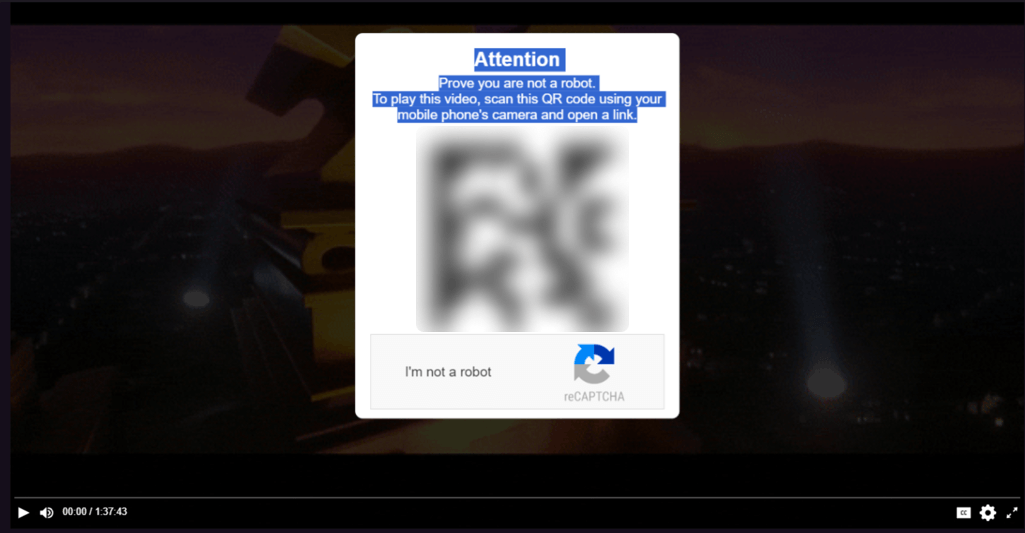
    Unlike genuine CAPTCHAs designed to protect websites from bots, this imitation serves to promote shady resources. As with the previous stage, the victim doesn’t always encounter malware. For example, the CAPTCHA on one of the pages prompts the visitor to scan a QR code leading to a betting site:

    CAPTCHA with QR code

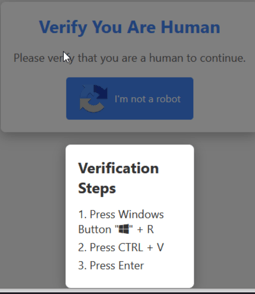
    The Trojans are distributed through CAPTCHAs with instructions. Clicking the “I’m not a robot” button copies the line powershell.exe -eC bQBzAGgAdABhAMAIgA= to the clipboard and displays so-called “verification steps”:

    • Press Win + R (this opens the Run dialog box);
    • Press CTRL + V (this pastes the line from the clipboard into the text field);
    • Press Enter (this executes the code).

    CAPTCHA with instructions

    We’ve also come across similar instructions in formats other than CAPTCHAs. For instance, the screenshot below shows an error message for a failed page load, styled like a Chrome message. The attackers attribute the problem to a “browser update error” and instruct the user to click the “Copy fix” button. Although the page design is different, the infection scenario is identical to the CAPTCHA scheme.

    Fake update error message

    The line from the clipboard contains a Base64-encoded PowerShell command that accesses the URL specified there and executes the page’s content. Inside this content is an obfuscated PowerShell script that ultimately downloads the malicious payload.

    Payload: Lumma stealer

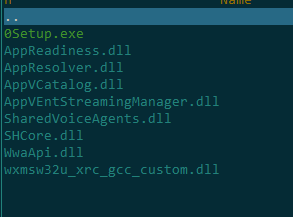
    Initially, the malicious PowerShell script downloaded and executed an archive with the Lumma stealer. In the screenshot below, the stealer file is named 0Setup.exe:

    Contents of the malicious archive

    After launching, 0Setup.exe runs the legitimate BitLockerToGo.exe utility, normally responsible for encrypting and viewing the contents of removable drives using BitLocker. This utility allows viewing, copying, and writing files, as well as modifying registry branches – functionality that the stealer exploits.

    Armed with BitLocker To Go, the attackers manipulate the registry, primarily to create the branches and keys that the Trojan needs to operate:

    That done, Lumma, again using the utility, searches the victim’s device for files associated with various cryptocurrency wallets and steals them:

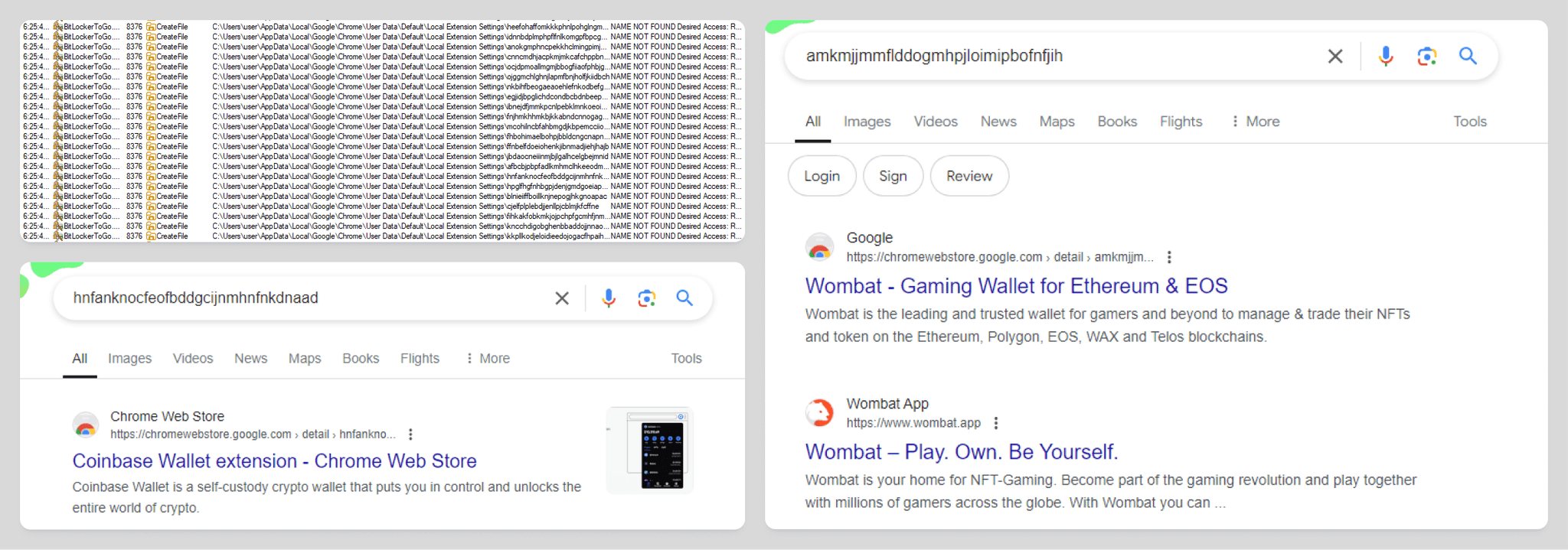
    Then, the attackers view browser extensions related to wallets and cryptocurrencies and steal data from them:

    Following this, the Trojan attempts to steal cookies and other credentials stored in various browsers:

    Finally, the malware searches for password manager archives to steal their contents as well:

    Throughout the data collection process, the Trojan tries to use the same BitLocker To Go to send the stolen data to the attackers’ server:

    Once the malware has found and exfiltrated all valuable data, it starts visiting the pages of various online stores. The purpose here is likely to generate further revenue for its operators by boosting views of these websites, similar to adware:

    Payload: Amadey Trojan

    We recently discovered that the same campaign is now spreading the Amadey Trojan as well. Known since 2018, Amadey has been the subject of numerous security reports. In brief, the Trojan downloads several modules for stealing credentials from popular browsers and various Virtual Network Computing (VNC) systems. It also detects crypto wallet addresses in the clipboard and substitutes them with those controlled by the attackers. One of the modules can also take screenshots. In some scenarios, Amadey downloads the Remcos remote access tool to the victim’s device, giving the attackers full access to it.

    Snippet of Amadey code used in this campaign

    Statistics

    From September 22 to October 14, 2024, over 140,000 users encountered ad scripts. Kaspersky’s telemetry data shows that out of these 140,000, over 20,000 users were redirected to infected sites, where some of them saw a fake update notification or a fake CAPTCHA. Users in Brazil, Spain, Italy, and Russia were most frequently affected.

    Conclusion

    Cybercriminals often infiltrate ad networks that are open to all comers. They purchase advertising slots that redirect users to malicious resources, employing various tricks to achieve infections. The above campaign is of interest because (a) it leverages trust in CAPTCHA to get users to perform unsafe actions, and (b) one of the stealers makes use of the legitimate BitLocker To Go utility. The malware works to enrich its operators both by stealing victims’ credentials and crypto wallets, and by exploiting online stores that pay money for traffic to their websites.

    Indicators of compromise

    e3274bc41f121b918ebb66e2f0cbfe29
    525abe8da7ca32f163d93268c509a4c5
    ee2ff2c8f49ca29fe18e8d18b76d4108
    824581f9f267165b7561388925f69d3av

    MIL OSI Economics

  • MIL-OSI Video: Embargo against Cuba: Vote on draft resolution – General Assembly | United Nations

    Source: United Nations (Video News)

    Necessity of ending the economic, commercial and financial embargo imposed by the United States of America against Cuba.

    Item 38: report of the Secretary-General (A/79/80)
    ● Draft resolution (A/79/L.6) ■ Continuation of the debate and action on the draft resolution

    https://www.youtube.com/watch?v=ZYvBW1ka37M

    MIL OSI Video

  • MIL-OSI Video: Sudan, Middle East, Lebanon/Israel & other topics – Daily Press Briefing (28 Oct) | United Nations

    Source: United Nations (Video News)

    Noon Briefing by Stéphane Dujarric, Spokesperson for the Secretary-General.

    Highlights:
    -Secretary-General travel /Colombia
    -Sudan
    -Sudan/humanitarian
    -Middle East
    -Deputy Secretary-General
    -Lebanon/Israel
    -Lebanon/humanitarian
    -Occupied Palestinian territory
    -Gaza
    -Ukraine
    -Philippines
    -Abyei
    -Sahel and Lake Chad region
    -Briefings today and tomorrow

    Secretary-General travel /Colombia
    The Secretary-General will travel to Cali, in Colombia, to attend the high-level segment of the16th meeting of the Conference of Parties to the Convention on Biological Diversity (COP16). And he is heading out this afternoon.
    On Tuesday, in Cali, he will deliver remarks at the opening of the plenary session of the COP. In his remarks, he is expected to highlight that nature is life, and yet we are waging a war against it – a war where there can be no winner. He is expected to stress that biodiversity is humanity’s ally, and that we must move from plundering to preserving. He will also call for the promises made at the Framework adopted two years ago in Montreal to be turned into actions.
    While attending COP16, the Secretary-General will also meet and engage in discussions with Indigenous people and local communities, as well as other representatives of society, including youth groups and women’s groups. He will also meet with President Gustavo Petro of Colombia.
    On the sidelines of the COP, the Secretary-General will speak at an event on plastic pollution organized by the UN Environment Programme.
    And we expect the Secretary-General back in New York on Wednesday evening.

    Sudan
    In an open session this morning, the Secretary-General briefed the Security Council on the situation in Sudan. As you know, Security Council resolution 2736 that was adopted in June requested that the Secretary-General make recommendations to protect civilians in Sudan. He submitted that to the Security Council last week.
    In his remarks, Mr. Guterres outlined three key priorities from his recommendations: First, both sides must immediately agree to a cessation of hostilities; secondly, that civilians must be protected, and his third priority is related to the flow of humanitarian aid.
    Mr. Guterres added that at present, the conditions do not exist for the successful deployment of a UN force to protect civilians in Sudan.
    However, he said, he stands ready to engage with the Council and others on the range of operational modalities that can meaningfully contribute to the reduction in violence and the protection of civilians.
    Moreover, he urged the Council to continue supporting his Special Envoy, Ramtane Lamamra in his diplomatic efforts.
    Mr. Guterres spoke at length about the humanitarian situation and the suffering in Sudan, which is growing by the day. He also spoke of the shocking reports of mass killings and sexual violence in villages in Aj Jazirah State in the eastern part of the country.

    Sudan/Humanitarian
    The Office for the Coordination of Humanitarian Assistance is expressing concerns at escalating armed violence in Aj Jazirah State.
    Joyce Msuya, our Acting Under-Secretary-General for Humanitarian Affairs says that we received horrific reports of entire villages being attacked, with civilians killed, detained and displaced in huge numbers, and those reports talk about actions between October 20th and 25th. During that time, the Rapid Support Forces reportedly launched a major assault across 30 towns and villages and towns in Aj Jazirah State.
    An estimated 47,000 people have fled the fighting, including to other parts of Aj Jazirah State. We and our partners are continuing to provide assistance to nearly 40,000 people who have sought shelter in Gedaref and Kassala states.
    Those displaced by the violence urgently need food, shelter, health care and protection support. Many of the wounded also need medical attention.
    We and our partners are concerned about civilians who remain trapped in those areas and are unable to escape due to insecurity and fear of abduction, as well as those on the move in search of safety, protection and urgent assistance.
    Also, to flag that the Director General of the International Migration agency, Amy Pope, began today a three-day visit to assess the rapidly deteriorating humanitarian situation and the increasing displacement crisis. The visit in Sudan will focus on rallying international support for the humanitarian response, ensuring that the ongoing crisis in Sudan remains at the forefront of global attention. The Director General will visit various displacement sites to engage directly with impacted communities.

    Full Highlights: https://www.un.org/sg/en/content/noon-briefing-highlight?date%5Bvalue%5D%5Bdate%5D=28%20October%202024

    https://www.youtube.com/watch?v=gLkC0_Y0uHE

    MIL OSI Video

  • MIL-OSI USA: Administrator Samantha Power at a Swearing-in Ceremony for Emily Coffman-Krunic as Mission Director for Bosnia and Herzegovina

    Source: USAID

    ADMINISTRATOR SAMANTHA POWER: Dobro jutro [good morning], here. Dobar dan [good evening], there. 

    It’s really great to be part of this event. Jim [Hope], really lovely to hear from your perspective. Jim has most recently been our Mission Director in Ukraine, and this is the first ceremony that I’ve had the chance to hear him emcee. But, it’s great to hear from a fellow Mission Director what these ceremonies mean. Certainly, they mean the world to us. 

    Ambassador [Michael] Murphy, as much as you think you know about Emily, you are about to learn much more. You will have a lot more ammo to use in various interagency deliberations. But, I want to thank you for joining and doing so in the spirit you did, I’ve actually – we haven’t had the chance to meet in person – but I devour your cables and your tweets. But above all, I have the greatest respect for just how you have not taken the easy path there and really stood. I think, very strongly in the face of an awful lot of resistance and many many headwinds – for not only American values but ultimately for the dignity of the people of the country and of the region. Really, really grateful to you for that. I’ve admired you from afar for a long time. 

    I do want to recognize – and Emily and I just talked about the tragedy of the historic floods that have really besieged really small communities in Bosnia and Herzegovina, very specifically Jablanica and Konjic. I know that Ambassador Murphy and Emily are already working with affected communities to support recovery efforts and even visited and met with the affected people. That means the world, I’m sure, to them, that someone has their back. But, our thoughts, of course, go out to those communities. There’s a lot coming at the people of Bosnia and Herzegovina, and when the floods pile on, it must be very overwhelming. So again, just a reflection of how much the American people care about the people of the country, and you all are incredible ambassadors for that. 

    Emily has a full house here today, in person and online, and maybe breaking some records if we add up all the miles traveled for each of the family members. But, we have her father Daniel and her mother Blanche, beaming in on the screen. And, here in the audience, we have her sisters Elizabeth, Ginny, and Julie. Ginny flew in all the way from England, and, incredibly, Julie has made the time to be here today after spending the past few weeks helping hurricane recovery efforts in western North Carolina. 

    And again, the parallel between what happens in Bosnia and the extremity of that and what happens here is just a reminder of the universality, sadly, of these challenges these days. 

    Thank you to the sisters, you seem like an incredibly close-knit group. I was like, “Are you thinking of visiting?” And they were like, “Ah, we’ve been there many times, you know!” So, I know Emily is incredibly lucky to have you in her corner. 

    We’re also joined by Emily’s children, of course – by Adrian, who studies engineering at the University of North Florida, and Emily’s daughter Stella, who began her own studies recently in anthropology in Amsterdam. I know that through your lives you’ve had to make big changes often to accommodate mom’s spirit of public service – leaving schools, and friends, and communities. So, thank you for your own sacrifices. You are the reason your mom does everything she does. So, thank you. 

    Alright, this is your life portion. 

    Emily was born in Jacksonville, Florida, to two parents we just got to see, who instilled in her the value of helping others. Her mom was a nurse before becoming a great caretaker for her four daughters, and then her mom worked at a local school. Emily’s dad was a pilot in the Navy and then a lawyer. 

    As a child, Emily was a go-getter who loved adventure, apparently. Although she was not the oldest, I’m told that she was the one who always directed the games among the girls. Emily went on to earn her degree in philosophy from Texas Christian University, before working at Merrill Lynch, where she saved up enough money to keep fueling her adventures. 

    She went to Guatemala for three months to learn Spanish and to Chile for six months to teach English to children of the indigenous Mapuche people, where she caught the spark, I guess, for international development work. Emily went on to earn her master’s in international peace and conflict resolution at American University, while also volunteering at the International Rescue Committee. 

    One day, Emily heard that the Organization for Security and Cooperation in Europe, OSCE, was looking for people to support Bosnia and Herzegovina’s very first municipal elections since the war. The country, as all of you know, had emerged from a horrific conflict with the signing of the U.S.-brokered Dayton Accords just the year before, and tensions were high as elections neared – with the question of whether the Dayton agreement could result in lasting peace and whether democracy really could be meaningfully ushered in. 

    Emily still had two months left in her degree program, but everyone she talked to, including the professors whose classes she would be skipping out on, said, “You have to do this. This is too important not to do.” 

    But, she was conflicted, because she was clearly a better student than I was. And so, she called her dad, and he was the last person she just had to make sure that she wasn’t doing something crazy. Her dad, Dan, of course, was worried about her going to war-torn Bosnia – again, the bullets had barely ceased firing, and this election was really soon after the war had ended.

    But, Emily asked him, and he expressed some reluctance, you know, given that the headlines had recently been very grim. But, Emily asked him, “Dad, what exactly were you doing when you were 27?”

    And his answer was, “I guess I was flying jets off aircraft carriers in the ocean…”

    So, Emily went on, booked her ticket with everybody’s full support. As you heard, she went on to work in Bosnia and Herzegovina for eight years, eventually joining the World Conference of Religions for Peace, one of USAID’s partners in Bosnia and Herzegovina as the Chief of Party.

    Emily knew that for development efforts to be effective there, after such vicious inter-ethnic conflict, there needed to be enhanced communication and cooperation. The demonization across lines had been very, very intense.

    Muslims, Croats, Bosnian Serbs, Orthodox Christians, Catholics, Jews – everyone kind of had to come together in dialogue. So, as you heard again from Ambassador Murphy, she and her team founded this inter-religious council of Bosnia and Herzegovina, and it really has, over the years, worked to mobilize faith leaders, faith communities, in service of reconciliation and rebuilding. 

    The work has never been easy. The demons, not only from the wars of the 1990s, but dating even further back, loom large. The misinformation which really impedes, you know, the ability to sustain, sometimes, that trust that those encounters can breed – all of that makes it immensely challenging.

    But, Emily continued to help the council members establish common ground and find productive ways to work together. Over these last decades, this Council has played an important role on everything from organizing youth reconciliation, to addressing gender-based violence, to facilitating the protection of holy sites for all groups.

    I think this shows a characteristic that has defined Emily’s work over the years. Even in incredibly difficult environments where the odds seem low of succeeding, she has managed to help people see that there is a path forward, if they can come together.

    In Rwanda, Emily arrived at a time when the democracy team’s funding had been nearly zeroed out for two years in a row. The Mission was actually considering stopping all democracy and governance programming. But, Emily understood that supporting democracy, again as Ambassador Murphy reinforced, was, in fact, fundamental to advancing development. 

    To make enduring progress on any front, developmentally, citizens have to be empowered to demand and work toward the change that they want in their own communities. They also have to be able to, through raising their voice at the ballot, be able to get rid of leaders who are corrupt or governing poorly and in a way that isn’t bettering the lives of citizens. 

    In the words of Joseph Rurangwa, an FSN in Rwanda, Emily “fought for DG’s identity” – fought for democracy and governance’s identity. Apparently, she worked day and night to convince partners, donors, and colleagues that democracy and governance was worth the investment. 

    Emily went to battle, and Emily won. The Mission in Rwanda didn’t just revitalize the small democracy team that Emily had come to lead. It created an entirely new standalone democracy and governance office. The office went from having two activities in other portfolios to an entire portfolio of 13 democracy and governance activities: from training journalists, to hosting election roundtables for citizens and human rights training for Rwandan youth, to even creating the Mission’s first-ever activity supporting the LGBTQI+ community in Rwanda. Joseph says, “Emily steered the boat in troubled waters, and with her at the helm, 800,000 flowers bloomed all at once.” 

    In Jordan, where Emily started as the Democracy, Rights, and Governance Office Director and ultimately became the Deputy Mission Director, she helped manage a portfolio completely unknown to her: water. Water is a huge, huge issue, as everyone knows. For Jordan, specifically, the country is the third most water scarce country in the entire world. And, while a country is considered to face water scarcity when it has less than 500 cubic meters of water per person per year, Jordan has just one-fifth of that. Just to give you a sense of the magnitude of this challenge. And water, as we know, again, all of us, from our own lives, is necessary for just about everything. 

    Jordan’s water portfolio is the largest budget for any single portfolio for USAID, and it is also a country – one of the few countries in the world – where USAID finances large infrastructure projects. So, it was a huge task, and though Emily had no formal background in water, she quickly became fluent in everything from project finance to major infrastructure construction. One colleague at the time says, “Emily came to the job with so much humility and curiosity. It really inspired all of us to feel like we were all in this together.”

    Emily led the team as they took on two tasks. First, while Jordan had an existing water sharing agreement with its neighbor Israel, Emily knew that in spite of the complex relationship between the countries, they could and should share more water. 

    So, she and the team helped negotiate an agreement in which the two countries agreed to double the volume of water that they shared. This was a historic agreement that spared further water rationing in Jordan. But, Emily also knew that to meet the scale of need, Jordan needed to develop its own desalination ability, turning saltwater into drinkable water. So, she oversaw the design and procurement of the third-largest desalination project in the world, leading it through political negotiations, financial hurdles, and technical discussions, as donors, partners, diplomats, and elected officials came together to achieve a workable plan. Emily’s efforts paid off. 

    USAID was able to catalyze nearly $3 billion against our $300 million pledge from donors like the Development Finance Corporation, the European Union, and the Islamic Development Bank. When construction is complete, slated to be in about five years, the project will pump newly desalinated water from the south of Jordan, 280 miles uphill, to the population centers of Jordan, who need the water for daily life – through pipes that are so big that you can actually drive a car through them. This single desalination project will meet a full 40 percent of Jordan’s water needs, transforming its water security.

    Emily has spent the past year, of course, applying the skills that she honed leading these kinds of ambitious projects in difficult environments in the Mission in Bosnia and Herzegovina, where she returned to serve as Deputy Mission Director. We are told that the first two weeks that Emily was back on the ground in Bosnia and Herzegovina, she met every single person at the Mission, from the Ambassador to the Foreign Service Officers to the Foreign Service Nationals to the cleaning staff, to get to know all of those who are part of her new team.

    When it was announced that she was going to be the new Mission Director, her predecessor, Courtney Chubb – an extraordinary Mission Director in her own right – but as Courtney described it, when word went out that she was going to be promoted, the Ambassador was completely overjoyed. And, as Courtney put it, “I’ve never seen so many smiles on the faces of our Mission staff.”

    And just to say a word about that Mission staff and having a chance to engage you all directly, you’re extraordinary. Our Foreign Service Nationals – as Courtney and I discussed when I was on the ground there on a visit, and Emily and I just discussed – you all are really some of the leading lights in the world. The amount you know, the amount you have achieved, the amount you have circumnavigated, all that stands in your way to make the peace enduring and to try to strengthen checks and balances and institutions. Many of our FSNs in Bosnia and Herzegovina have been there more than 20 years, some more than 30 years. It’s just an incredible team. And to have as a Mission Director, as you do, someone who so values you and recognizes how much she has to learn from you every day, that’s the best kind of teamwork that can be expected.

    So, there is no better person, I think, in something of a returning home, second home really, to Emily but for Emily Coffman-Krunic to be taking the helm as the Mission Director in Bosnia and Herzegovina.

    Bosnia and Herzegovina is a special place. It is a country whose people continue to experience incredible hardship. I talked earlier about the flooding, but there’s a lot of man-made disasters happening in Bosnia and Herzegovina, because so many elected leaders do not put their people first. Some do, and they are extraordinary, what they put up with as well.

    But, when institutions don’t work always on behalf of the people, it makes what the people do to make development happen even more impressive. And, the efforts that the people of Bosnia and Herzegovina have made, initially, to rebuild, to revitalize, to grow, really speak just to the resilience of all communities, and it’s an inspiration for those of us who only get to visit every now and then. 

    Since 1996, the U.S. government has provided more than $2 billion, including $1.5 billion from USAID alone, in assistance in efforts to support, again, those on the ground who are building a democratic and inclusive European country. One of the most complicated government structures in the world, makes things very, very challenging. It is hard, often, for leaders to agree on the kinds of basic policies or basic initiatives that the people really expect from them. When they agree, it can be very challenging to operationalize those efforts. But nonetheless, again, there is so much good that is happening on the ground. 

    The virulent nationalism that lives on, usually most vocally in those who don’t know how to or don’t care to deliver basic services for the citizens of the country, continues to threaten the progress that has been made. We see the direct targeting of NGOs and development partners. We see attacks on independent media. We see, basically, threats to this effort to build a strong, independent, and vibrant European country, which is so clearly what young people in the country want. 

    USAID has an incredibly important role to play in support of the whole country team’s effort to push back against these challenges. We are working to counter harmful nationalistic rhetoric and narrative, with the goal of strengthening the security and the dignity for individuals and for communities within the country. We are expanding our work with independent media, with civil society, with investigative journalists. We are working to contribute to economic development, to help the private sector drive growth, and to include all groups like LGBTQI+ communities, women and Roma populations, in the progress that the people of Bosnia and Herzegovina are trying to drive. 

    Now, Emily, I want to end these remarks on something your son Adrian told us. We asked Adrian what it was like to grow up and to travel the world with you. And Adrian said, “I always knew that what my mom did was helping people. It made me want to be a better person.” 

    So, Emily, I think it’s safe to say you’ve made so many of us here want to be better people, even I, just listening to your journey, but also seeing what you’ve been doing on the grounds in Bosnia and Herzegovina, and in Jordan, just during my time here. And, what I love about your spirit is you never give up. You don’t care about the odds. You just invest body and soul, bring questions and not answers in the first instance, empower your teams, and you have one of the best teams in the world there, as you well know, and you do it all with an eye to future generations and what would mean the most. 

    So, we are thrilled that you’re our Mission Director in Bosnia and Herzegovina, and I look forward to making it official and swearing you in. Congratulations.

    MIL OSI USA News

  • MIL-OSI USA: Governor Newsom visits Tijuana River rehabilitation efforts, assesses impact of sewage crisis

    Source: US State of California 2

    Oct 28, 2024

    What you need to know: The Tijuana River sewage crisis has been impacting communities for far too long, and Governor Newsom has pushed federal and international partners to fund repairs and complete infrastructure improvements to finally address this crisis. 

    TIJUANA RIVER VALLEY – Governor Gavin Newsom visited wastewater treatment facilities on both sides of the border to assess rehabilitation efforts and the ongoing sewage crisis, a long-standing environmental and public health issue. 

    Working alongside federal, state, and local partners, Governor Newsom has helped secure critical funding and support to address cross-border pollution from the Tijuana River while holding authorities accountable to expedited timelines. With upgrades to facilities on both sides of the border, sewage flows are expected to be reduced by up to 90%.

    “The Tijuana River sewage crisis has impacted our communities for far too long. Thanks to our partnership with international, federal, and local partners, we are making real progress. But our work is far from over — we need serious, continued action to protect public health and restore our environment.”

    Governor Gavin Newsom

    “Pollution in the Tijuana River Valley is the number one environmental health crisis impacting our region, and Governor Newsom coming to San Diego for today’s briefing shows his steadfast commitment to our communities,” said San Diego County Board of Supervisors Chairwoman Nora Vargas.I have said time and again that the only way we will solve this crisis is by working together. Our collaboration with Governor Newsom, as well as our federal partners, is critically important.  We’re working to put forward our best collective efforts to restore and protect our region.”

    Addressing this decades-long crisis

    Securing federal funding: In partnership with California’s congressional delegation and the Biden-Harris Administration, Governor Newsom helped secure $453 million in federal funding — $103 million this year and $350 million last year— for critical upgrades to the South Bay International Wastewater Treatment Plant. The upgrades will significantly reduce the flow of untreated sewage into California’s coastal waters.

    State investments to clean up the area, provide air filters to communities: Earlier this month, the County announced plans to purchase and distribute $2.7 million worth of air purifiers for local residents, which will be reimbursed by the state. Since 2019, California has allocated $35 million in state funding to address pollution in the Tijuana River Valley and support cleanup efforts:

    • $1 million to fund Tijuana River Valley Recovery Team projects in the Tijuana River Valley. 
    • $9 million to operate and maintain Goat Canyon sediment and trash basins.
    • $4.7 million to Rural Community Assistance Corporation’s Tijuana River Trash Boom pilot Project.
    • $14.25 million for the Smuggler’s Gulch Improvement Project. 
    • $3.3 million for the Tijuana River Valley Habitat and Hydrology Restoration Project. 
    • $3 million to develop a model to forecast the presence of pathogens in San Diego coastal and tidal waters and help measure the effectiveness of potential projects in the Tijuana River Valley.

    Expedited timelines: Federal authorities committed to expediting construction timelines to more quickly repair infrastructure to mitigate sewage flows.

    Public health and air quality monitoring: California public health officials have been working closely with local authorities to monitor air quality and support public health efforts to protect the community. The state helped get the CDC to deploy resources on the ground and assess public health conditions. The state has also supported the local air district on air monitoring, planning, and mitigation strategies to protect public health. 

    Water quality and timeline accountability: State authorities have been using enforcement tools to compel infrastructure improvements to the federal wastewater treatment plant, with the San Diego Water Board holding the federal facility to timelines for several repair and maintenance actions, including replacing and installing additional pumps, cleaning out sedimentation tanks, replacing a junction box and temporary influent pipe, and rehabilitating all mechanical parts for sedimentation tanks.

    Continued federal and Mexico partnerships: The Governor has urged federal and Mexican partners to address this crisis. When Governor Newsom traveled to Mexico for President Claudia Sheinbaum’s inauguration, he discussed with Mexican authorities this crisis and repairing wastewater treatment facilities to prevent excess flows from reaching the U.S. During today’s visit, the Governor also met with Baja Governor Marina del Pilar Ávila Olmeda. In February and October of this year, the Governor met with White House officials to push for action to address this crisis.

    Recent news

    News What you need to know: In late 2023, California distributed over $267 million to local law enforcement agencies and prosecutors across the state to combat organized retail and property crime. In the first nine months, local law enforcement agencies that received…

    News What you need to know: Governor Gavin Newsom is launching a new California Highway Patrol (CHP) operation with the city of San Bernardino to address the city’s higher crime rates and gun violence. The Inland Operation team will assist the San Bernardino Police…

    News What you need to know: California’s Film & Television Tax Credit Program has generated tens of billions of dollars in investments while creating nearly 200,000 jobs, and Governor Newsom is proposing to expand it to outpace other states and bring more business…

    MIL OSI USA News

  • MIL-OSI USA: EPA announces public comment period for a NPDES permit modification for Ocean Era off the Florida coast

    Source: US Environment Protection Agency

    Comments must be received by November 25, 2024

    SARASOTA, Fla. (October 25, 2024) – Today, The U.S. Environmental Protection Agency Region 4 (EPA) is announcing the release of a draft modification to a National Pollutant Discharge Elimination System (NPDES) permit previously issued to Ocean Era, Inc. (Ocean Era), for a small-scale marine aquaculture facility approximately 45 miles from Sarasota, off the coast of Florida, in federal waters of the Gulf of Mexico. The draft modification will be subject to a 30-day public comment period.

    EPA issued a NPDES permit to Ocean Era in 2022 that allows the discharge of wastewater from an Aquatic Animal Production Facility producing up to 80,000 pounds/year for one production cycle. The Facility is not yet operating and has not yet been constructed. Information regarding the 2022 permit issuance can be accessed at www.epa.gov/npdes-permits/ocean-era-inc-velella-epsilon-aquatic-animal-production-facility-national-pollutant.
     

    In 2023, Ocean Era submitted a request for permit modification indicating that it will not proceed with the aquaculture project as currently permitted because it intends to make changes to certain aspects of the operation. Specifically, Ocean Era has requested to: 1) change the cultured fish species (from almaco jack to red drum); 2) change the cage net material (from copper to monofilament); and 3) change the type of rearing system (from swivel point mooring system to a stationary cage mooring system).Many communities that are under economic stress, particularly those located in areas that have experienced long periods of disinvestment, lack the resources needed to initiate brownfield cleanup and redevelopment projects. As brownfield sites are transformed into community assets, they attract jobs, promote economic revitalization and transform communities into sustainable and environmentally just places.

    EPA has made a tentative determination to modify the permit based on the project alterations and new information received from Ocean Era. On October 24, 2024, EPA public noticed the draft modified permit package on Regulations.gov. EPA is taking comments for a minimum of 30-days on the draft modified permit through Regulations.gov using Docket ID EPA–R04-OW-2024-0113. EPA notes that in the case of a permit modification, only the permit conditions that are proposed to be modified are reopened and subject to public comment. The draft modified permit and other supporting documents can also be accessed on EPA’s website at www.epa.gov/publicnotices/ocean-era-draft-modified-npdes-permit-fl0a00001.

    For more information on EPA’s NPDES Program visit EPA’s NPDES webpage    

    ###

    MIL OSI USA News

  • MIL-OSI USA: Administrator Samantha Power Meets with Executive Chairman of the Tony Blair Institute for Global Change Tony Blair

    Source: USAID

    The below is attributable to Spokesperson Benjamin Suarato:‎

    Today, Administrator Samantha Power met with former Prime Minister of the United Kingdom Tony Blair to discuss cooperation between USAID and the Tony Blair Institute for Global Change (TBI). Administrator Power and former Prime Minister Blair discussed TBI’s longstanding partnership with Power Africa and progress on rural electrification and other shared priorities aimed at improving access to affordable and reliable electricity in sub-Saharan Africa.

    Administrator Power and former Prime Minister Blair also discussed humanitarian efforts to meet the ongoing and urgent needs in the Middle East, initiatives for advancing digital development, and opportunities to support countries experiencing democratic openings, including Guatemala.

    MIL OSI USA News

  • MIL-OSI USA: Acting Deputy Administrator Michele Sumilas During the World Bank Annual Meetings

    Source: USAID

    The below is attributable to Deputy Spokesperson Shejal Pulivarti:‎

    From October 23 through 25, Acting Deputy Administrator Michele Sumilas participated in various engagements during the World Bank Annual Meetings. Throughout the week, she engaged USAID’s partners on shared priorities, including boosting food security and climate action, as well as collaborating on humanitarian assistance.

    On Wednesday, Acting Deputy Administrator Sumilas represented USAID at a signing ceremony, where Secretary of the Treasury Janet L. Yellen and Ukrainian Minister of Finance Sergii Marchenko marked the intention of the United States to join G7 efforts to make lending available to Ukraine, and provide a $20 billion U.S. loan to Ukraine that will be repaid by proceeds derived from Russia’s frozen assets. 

    Acting Deputy Administrator Sumilas then participated in a roundtable hosted by the Coalition on Disaster Resilient Infrastructure (CDRI), which featured Ministers from Angola, Bhutan, Chad, Comoros, India, Nigeria, and Madagascar. The roundtable provided an opportunity for participants to discuss how the Coalition can be responsive to infrastructure needs in Africa. 

    On Thursday, Acting Deputy Administrator Sumilas met with Denmark’s State Secretary for Development Policy Lotte Machon to discuss cooperation on food security, climate action, advancing democracy, and joint efforts on humanitarian assistance in Gaza and Ukraine. 

    The Acting Deputy Administrator also participated in a fireside chat, along with Norway’s Minister of International Development Anne Beathe Tvinnereim and Investisseurs & Partenaires (I&P’s) Jean-Michel Severino, Chair of the Supervisory Board, at the Financing for Agricultural Small-and-Medium Enterprises in Africa (FASA) Fund Launch, hosted by the Embassy of Norway. USAID and Norway announced that the United Kingdom and Republic of Korea have joined USAID as partners in the FASA Fund, which will help unlock additional commercial capital. In addition, Norway and USAID announced that Investisseurs and Partenaires (I&P) – a pioneering impact investment group dedicated to financing and supporting African entrepreneurs while strengthening entrepreneurial ecosystems across the African continent – was competitively selected as the FASA fund manager. 

    On Friday, Acting Deputy Administrator Sumilas met with the United Kingdom’s Second Permanent Under-Secretary Nick Dyer to discuss U.S.-UK shared priorities. She also met Brazil’s Ambassador to the United States Maria Luiza Viotti to discuss key development priorities of Brazil’s G20 presidency, including the Global Alliance Against Hunger and Poverty to include recognition of Brazil’s support for their role in Multi-National Security Support Missions in Haiti, and continued efforts to aid Venezuelan migrants and refugees in Brazil. 

    MIL OSI USA News

  • MIL-OSI: Bitfarms Appoints Rachel Silverstein as U.S. General Counsel

    Source: GlobeNewswire (MIL-OSI)

    This news release constitutes a “designated news release” for the purposes of the Company’s prospectus supplement dated March 8, 2024, to its short form base shelf prospectus dated November 10, 2023.

    TORONTO, Ontario and BROSSARD, Québec, Oct. 28, 2024 (GLOBE NEWSWIRE) — Bitfarms Ltd. (NASDAQ/TSX: BITF), a global leader in vertically integrated Bitcoin data center operations, today announced that it has appointed Rachel Silverstein as U.S. General Counsel, a newly created role, effective November 1, 2024.

    Ms. Silverstein has been a practicing attorney for over 16 years and is one of the most experienced Bitcoin mining-focused attorneys in the U.S., having served as lead counsel on well over a gigawatt worth of Bitcoin mining transactions across multiple states and countries. She is the co-founder of Firm 21m, a law firm dedicated to representing primarily Bitcoin miners, energy companies, investors and data center builders in all manner of commercial transactions, mergers and acquisitions, strategic financings, energy supply agreements and hosting agreements. Prior to founding the firm, Ms. Silverstein held the positions of General Counsel at CleanSpark, Inc. from 2020 to 2023, and Corporate Counsel at Zappos, among others. She earned a bachelor’s degree from The George Washington University and a juris doctorate degree from William S. Boyd School of Law, University of Nevada-Las Vegas.

    “We continue to strengthen the Bitfarms team and are thrilled to have a thought leader like Rachel join our team,” stated Ben Gagnon, Chief Executive Officer. “Internalizing this function will drive improved operating efficiencies, further enhance our corporate governance and reduce legal expenses. Rachel’s extensive expertise and proven track record with Bitcoin miners and data center builders will be invaluable as we continue to scale in the U.S. We look forward to her contributions as we continue to execute on our strategic initiatives and create further shareholder value.”

    Ms. Silverstein stated, “Ben and the management team at Bitfarms are passionate, thoughtful and innovative leaders, and I am honored and excited to join the Company during such a pivotal time of growth. The Company has a compelling strategic vision, and I intend to leverage my industry acumen, deal-closing experience and operations-centric focus to execute on that vision with clarity, diligence and efficiency.”

    About Bitfarms Ltd.

    Founded in 2017, Bitfarms is a global vertically integrated Bitcoin data center company that contributes its computational power to one or more mining pools from which it receives payment in Bitcoin. Bitfarms develops, owns, and operates vertically integrated data centers with in-house management and company-owned electrical engineering, installation service, and multiple onsite technical repair centers. The Company’s proprietary data analytics system delivers best-in-class operational performance and uptime.

    Bitfarms currently has 12 operating Bitcoin data centers and two under development situated in four countries: Canada, the United States, Paraguay, and Argentina. Powered predominantly by environmentally friendly hydro-electric and long-term power contracts, Bitfarms is committed to using sustainable and often underutilized energy infrastructure.

    To learn more about Bitfarms’ events, developments, and online communities:

    www.bitfarms.com
    https://www.facebook.com/bitfarms/
    https://twitter.com/Bitfarms_io
    https://www.instagram.com/bitfarms/
    https://www.linkedin.com/company/bitfarms/

    Forward-Looking Statements

    This news release contains certain “forward-looking information” and “forward-looking statements” (collectively, “forward-looking information”) that are based on expectations, estimates and projections as at the date of this news release and are covered by safe harbors under Canadian and United States securities laws. The statements and information in this release regarding projected growth and expansion, and other statements regarding future plans and objectives of Bitfarms, improved operating efficiencies, financial performance and cost savings in general, and other statements regarding future growth, plans and objectives of the Company are forward-looking information.

    Any statements that involve discussions with respect to predictions, expectations, beliefs, plans, projections, objectives, assumptions, future events or performance (often but not always using phrases such as “expects”, or “does not expect”, “is expected”, “anticipates” or “does not anticipate”, “plans”, “budget”, “scheduled”, “forecasts”, “estimates”, “prospects”, “believes” or “intends” or variations of such words and phrases or stating that certain actions, events or results “may” or “could”, “would”, “might” or “will” be taken to occur or be achieved) are not statements of historical fact and may be forward-looking information. This forward-looking information is based on assumptions and estimates of management of Bitfarms at the time they were made, and involves known and unknown risks, uncertainties and other factors which may cause the actual results, performance, or achievements of Bitfarms to be materially different from any future results, performance or achievements expressed or implied by such forward-looking information. Such factors include, among others, risks relating to: the construction and operation of new facilities may not occur as currently planned, or at all; expansion of existing facilities may not materialize as currently anticipated, or at all; new miners may not perform up to expectations; revenue may not increase as currently anticipated, or at all; the ongoing ability to successfully mine Bitcoin is not assured; failure of the equipment upgrades to be installed and operated as planned; the availability of additional power may not occur as currently planned, or at all; expansion may not materialize as currently anticipated, or at all; the power purchase agreements and economics thereof may not be as advantageous as expected; For further information concerning these and other risks and uncertainties, refer to Bitfarms’ filings on www.sedarplus.ca (which are also available on the website of the U.S. Securities and Exchange Commission (the “SEC”) at www.sec.gov), including the MD&A for the year-ended December 31, 2023, filed on March 7, 2024 and the MD&A for the three and six months ended June 30, 2024 filed on August 8, 2024. Although Bitfarms has attempted to identify important factors that could cause actual results to differ materially from those expressed in forward-looking statements, there may be other factors that cause results not to be as anticipated, estimated or intended, including factors that are currently unknown to or deemed immaterial by Bitfarms. There can be no assurance that such statements will prove to be accurate as actual results, and future events could differ materially from those anticipated in such statements. Accordingly, readers should not place undue reliance on any forward-looking information. Bitfarms undertakes no obligation to revise or update any forward-looking information other than as required by law. Trading in the securities of the Company should be considered highly speculative. No stock exchange, securities commission or other regulatory authority has approved or disapproved the information contained herein. Neither the Toronto Stock Exchange, Nasdaq, or any other securities exchange or regulatory authority accepts responsibility for the adequacy or accuracy of this release.

    Investor Relations Contact:

    Bitfarms
    Tracy Krumme
    SVP, Head of IR & Corp. Comms.
    +1 786-671-5638
    tkrumme@bitfarms.com

    Media Contact:

    Québec: Tact
    Louis-Martin Leclerc
    +1 418-693-2425
    lmleclerc@tactconseil.ca

    The MIL Network

  • MIL-OSI USA: U.S. ethane production reached a record 3.0 million barrels per day in May 2024

    Source: US Energy Information Administration

    In-brief analysis

    October 28, 2024


    U.S. ethane production increased steadily over the last decade and reached a record of 3.0 million barrels per day (b/d) in May 2024. Ethane production in the first half of 2024 (1H24) averaged a record 2.8 million b/d, according to data from our Petroleum Supply Monthly. The increase was driven by more natural gas and ethane production in the Permian Basin, which spans Texas and New Mexico.

    Ethane serves mainly as a petrochemical feedstock to produce ethylene, which is used to make plastics and resins. Continued growth in ethane consumption in the global petrochemical sector, increasing proportions of ethane derived from U.S. natural gas production, and favorable production economics have driven steady increases in ethane production in recent years.

    In the United States, almost all ethane is recovered at natural gas processing plants, which remove ethane and other natural gas plant liquids (NGPL) from raw natural gas. During 1H24, U.S. marketed natural gas production, which includes dry natural gas and NGPLs before they are separated out, averaged a record 112.8 billion cubic feet per day (Bcf/d), 1.0 Bcf/d more than the 1H23 average.

    Ethane production in the Texas Inland and New Mexico refining districts, which include the Permian Basin, accounted for 62% of U.S. ethane production during 1H24, slightly more than the 60% share in 1H23. Ethane production in these two districts averaged 1.7 million b/d in 1H24, a 7% (0.1 million b/d) increase from 1H23. Ethane production in the Appalachian No. 1 refining district, which straddles most of the Appalachian Basin production area in Pennsylvania and West Virginia, also increased during 1H24, averaging 327,000 b/d, up from 292,000 b/d in 1H23. Ethane production in other refining districts remained essentially unchanged from 1H23.


    U.S. ethane production continued increasing to meet growing demand from domestic and international consumers. Consumption of ethane in the United States in 1H24 averaged 2.3 million b/d, up from 2.1 million b/d in 1H23, while U.S. ethane exports averaged 470,000 b/d, down 17,000 b/d compared with 1H23. The United States began exporting ethane in 2014 to petrochemical plants in Canada and became the world’s largest exporter of ethane in 2015, when tanker exports to Europe began. The most common destinations for ethane exports in 1H24 were China (45% of U.S. ethane exports; 212,000 b/d), Canada (15%; 70,000 b/d), and India (14%; 65,000 b/d).


    In our Short-Term Energy Outlook, we expect ethane production to average 2.8 million b/d in both 2024 and 2025, a 5% increase compared with 2023. We expect domestic ethane consumption to average 2.3 million b/d in both 2024 and 2025, a 5% increase compared with 2023. We expect U.S. net ethane exports to rise to 490,000 b/d in 2024 and 520,000 b/d in 2025, an 11% increase from 2023 to 2025.

    Principal contributor: Jordan Young

    MIL OSI USA News

  • MIL-OSI USA: Non-Profit Organizations Benefit from FEMA Funds

    Source: US Federal Emergency Management Agency 2

    strong>Guaynabo, PUERTO RICO ― The Support and Therapy Center of the Puerto Rico Spina Bifida and Hydrocephalus Association is one of the non-profit organizations that recently received funds from the Federal Emergency Management Agency (FEMA) to repair its infrastructure after Hurricane María and to continue offering its services for the development of its participants.
    The organization, which focuses on promoting the functioning, independence and integration of people with developmental disabilities, also offers services in social work, physical and occupational therapy, and assistance with the purchase of orthopedic equipment.
    “The social and health needs of our island are different and precise. We have the great talent and dedication of communities that are ready to meet these needs and FEMA remains committed to assisting in the recovery of these organizations,” said Federal Disaster Recovery Coordinator José Baquero. 
    The Support and Therapy Center serves over 200 people. It also offers educational workshops on the management and prevention of births with neural tube defects and supports families during and after a pregnancy with a neural tube defect diagnosis. 
    The Association’s director, Isolina Laboy Arroyo, said that they recently discharged a 3-year-old participant, who “lives a full life, participates in extracurricular activities such as gymnastics and is a girl who enjoys having reached her full potential thanks to early intervention.” 
    The organization offered direct services to the mother during her pregnancy and after a surgery to treat the infant’s spina bifida from the womb. After birth, the entity offered direct occupational and physical therapy services to the girl from 5 months to 2 years old.
    Laboy Arroyo stated that “over the years, this organization has been able to fulfill its mission of offering direct services to participants to promote the functioning, independence and integration in the community of people with developmental disabilities. This entity has played an important role in being able to provide patients with the opportunity to become as independent as possible within the limits that their condition allows.”
    The Association has about $35,000 from the agency to replace the roof waterproofing system, the air conditioners, floor mats for therapy rooms and some office equipment, among others. Mitigation funds within this allocation will anchor the water cistern tank and improve the facilities’ infrastructure against infiltration. 
    On the other hand, FEMA also obligated funds for Bill’s Kitchen, an entity that has been providing food security along with nutritional counseling for 31 years.
    Bill’s Kitchen was born in memory of a young architect named Bill, who died of AIDS in Seattle in 1992. His mother Sara Metcalf, who lived in Puerto Rico, decided to help people on the island living with this condition by providing food to everyone who needed it, replicating several service programs in New York, Seattle, San Francisco and Washington, DC. Today, Bill’s Kitchen serves more than 30 towns in the northeastern area of the island: they serve about 1,175 people a year, distribute over 11,000 bags of food for two weeks, and coordinate thousands of clinical and support services for their participants.
    Bill’s Kitchen Executive Director Sandra Torres Rivera explained that its participants also have services in place to ensure they maintain their treatments for HIV and other chronic health conditions.
    “Our nutritional services program complements the provision of food, offering food security to the medical and nutritional counseling, to give the participant the tools to combat not only hunger, but also prevailing health conditions on the island such as diabetes, hypertension and gastrointestinal problems. Through the Intégrate Program we offer medical transportation, oral health and visual health services, which include the purchase of eyeglasses, laboratories and emergency assistance, among other services that our participants cannot access through their health insurance coverage,” said Torres Rivera.
    This organization received about $470,000 for its infrastructure. The work includes the replacement of equipment, such as the mezzanine and kitchen air conditioners. More than $78,000 of the funds were destined to mitigation measures aimed at ensuring proper drainage and preventing infiltration to the roof and interior of the facilities.
    For his part, the executive director of the Central Office for Recovery, Reconstruction and Resiliency (COR3), Manuel A. Laboy Rivera, said that “our work team assists non-profit organizations such as Bill’s Kitchen, an entity that is currently in the construction acquisition phase to make way for the reconstruction of the facilities where they offer services aimed at a population in need. Puerto Rico has thousands of non-profit entities like this one, which have the commendable work of supporting and contributing to the quality of life of our citizens. At COR3 we will continue to guide them in the process so that they can complete their works.”
    To date, FEMA has allocated over $34.2 billion for more than 11,000 projects to address Puerto Rico’s recovery following Hurricane María. A total of over $1.4 billion are destined exclusively to support the recovery of 1,105 non-profit projects across the island.
    For more information about Puerto Rico’s recovery,  visit fema.gov/disaster/4339, fema.gov/disaster/4473 and recovery.pr. Follow us on our social media at Facebook.com/FEMAPuertoRico, Facebook.com/COR3pr and Twitter @COR3pr.


    MIL OSI USA News

  • MIL-OSI: QuestionPro Appoints Chris Robson as Vice President, Managed Services

    Source: GlobeNewswire (MIL-OSI)

    SAN FRANCISCO, Oct. 28, 2024 (GLOBE NEWSWIRE) — QuestionPro, a global leader in online survey and research services announces Chris Robson has joined the company in the newly created position of Vice President, Managed Services. Robson will create this new division which is focused on helping QuestionPro customers get the most out of its robust research platform.

    Well known as a research industry thought-leader, Robson is a mathematician by training who has worked at both large enterprises as well as startups. Immediately prior to joining QuestionPro, he was the Global Head of Data Science at Human8, a global brand consultancy where he developed new methodologies including the application of Generative AI and LLMs. Earlier in his career he managed advanced research teams and large software teams (70+ people) at HP.

    He was also Chief Innovation Officer and Global Head of Research Science at ORC, where he led a team of analysts and statisticians to embrace and adopt new approaches for data-centered insights. Robson also co-founded and ran two successful research analytics agencies: Parametric Marketing and Deckchair Data. He holds a Bachelor of Science with Honors in Mathematics from the Brunel University of London.

    Robson will have overall responsibility for establishing and growing QuestionPro’s Managed Services Group which provides services to clients who need assistance to go above and beyond the capabilities of the company’s existing suite of research platforms. This can include project management, study design, custom programming, reporting and analytics. Whether it is providing end-to-end project support, simply customizing the appearance of a single question or running advanced analytic methods the group ensures that clients can get the answers they need for their business decisions.

    In particular, Robson will apply his deep expertise in Artificial Intelligence (AI) to not only integrate AI across the QuestionPro platform, but also leverage it for new ways to drive consumer insights through emerging techniques like synthetic data.

    “I’ve known and worked with Chris for close to 20 years,” said Vivek Bhaskaran, founder and CEO of QuestionPro. “In fact, he helped build some of our early features like MaxDiff and others. It’s great to have him on board full time to launch a new division and also ensure our customers benefit from the application of AI across our platform.”

    About QuestionPro:
    Founded in 2006, QuestionPro is a global provider of online survey and research services that help companies make better decisions through data. Our fully integrated online platform includes surveys, research & insights, customer experience (CX) and workforce/employee experience software. We additionally offer polling, journey mapping, employee 360s and data visualization. Our clientele ranges from small businesses to Fortune 100 companies, who rely on us for insights about customers, employees, and the marketplace. With offices in the US, Canada, Mexico, U.K., Germany, Japan, Australia, the United Arab Emirates and India, we offer customers 24-7 access to highly trained support specialists and engineers. More information is available at www.questionpro.com.

    A photo accompanying this announcement is available at https://www.globenewswire.com/NewsRoom/AttachmentNg/c9035859-cb80-41e3-be32-21eab55be2d3

    The MIL Network

  • MIL-OSI: Baker Hughes Awarded Contracts to Supply Petrobras with Flexible Pipe Systems, Associated Services across Several Fields

    Source: GlobeNewswire (MIL-OSI)

    • Company to support projects in Brazil’s pre-salt fields, reinforcing position as a leading provider of flexible pipe for deepwater and high CO2projects
    • Local manufacturing boost Brazilian economy, strengthen energy supply chain

    HOUSTON and LONDON, Oct. 28, 2024 (GLOBE NEWSWIRE) — Baker Hughes (NASDAQ: BKR), an energy technology company, announced Monday significant contracts with Petrobras to provide 77 km of flexible pipe systems to be deployed in Brazil’s pre-salt fields. The agreement was signed Oct. 15, 2024, following an open tender.

    The multi-year project includes risers and flowlines for hydrocarbon production and associated gas and water injection with support for equipment storage, maintenance and installation. Delivery is scheduled to begin in mid-2026, and the equipment will be utilized across Petrobras’ Búzios, Libra, Berbigão, Sururu and Sépia fields.

    These systems will also address the critical issue of stress-induced corrosion cracking from CO2 (SCC-CO2), which can affect flexible pipes in pre-salt fields with high concentrations of the gas. Baker Hughes’ flexible pipes have proven effective at mitigating this issue, which can arise as gas is reinjected into wells to reduce flaring and enhance oil recovery. Petrobras has committed to limiting CO2 emissions to the atmosphere in their operations, and CO2 storage is an important tool for producing lower-carbon barrels.

    “Brazil’s Santos Basin contains incredible potential to help power Latin America into the future,” said Amerino Gatti, executive vice president, Oilfield Services & Equipment at Baker Hughes. “Operating in deep waters with high CO2 concentrations presents unique challenges. Baker Hughes’ combination of industry-leading subsea technology and engineering, expertise in offshore operations, and extensive experience in the region will assist Petrobras to unlock and develop this potential, delivering these vital resources safely and efficiently.”

    Baker Hughes has been deeply involved in the development of Brazil’s offshore oil and gas fields for decades, and its localization strategy contributes to the nation’s economy while strengthening its energy supply chain. The company’s plant in Niteroi, Brazil, where these systems will be manufactured, is a major supplier of flexible pipe systems for the industry and employs hundreds of people in the state of Rio de Janeiro.

    The company has announced several agreements with Petrobras throughout 2024, including additional contracts for 69.1 km of flexible pipe systems and associated services in the third quarter. Other awards have included integrated well construction services in the Buzios field and integrated solutions for workover and plug and abandonment services across Petrobras’ pre-salt and post-salt fields.

    About Baker Hughes
    Baker Hughes (NASDAQ: BKR) is an energy technology company that provides solutions to energy and industrial customers worldwide. Built on a century of experience and conducting business in over 120 countries, our innovative technologies and services are taking energy forward – making it safer, cleaner and more efficient for people and the planet. Visit us at bakerhughes.com.

    For more information, please contact:

    Media Relations

    Brian Reynolds
    +1 346-315-6663
    brian.reynolds@bakerhughes.com

    Investor Relations

    Chase Mulvehill
    +1 346-297-2561
    investor.relations@bakerhughes.com

    The MIL Network

  • MIL-OSI NGOs: Echoes from Darfur Sudan

    Source: Médecins Sans Frontières –

    One and a half years into the conflict in Sudan, refugees are still fleeing to eastern Chad in search for safety, where they arrive at camps in dire conditions. Access to clean water, sanitation and healthcare facilities is limited. We met Aziz, Youssef, Salwa, and Amina to hear their stories of fleeing the Darfur region of Sudan and survival in eastern Chad.

    Aziz Adam, displaced from West Darfur

    “My family is incomplete here. My mom, my dad, seven of us siblings- there’s nine of us in total. But the war separated us. Some of my family made it out of West Darfur, but the rest haven’t joined us yet. 

    We fled in a state of panic, terrified of the war. We didn’t have time to take anything with us, and some of us even arrived barefoot. 

    We walked 20 kilometres to get here, on foot. Along the way, we encountered the Rapid Support Forces who threatened us. Some of the young men traveling with us were accused of belonging to the Masalit tribe. They were arrested and killed. We thought we would die too. I couldn’t imagine we’d survive.

    The memories of fleeing stay with me. When I think about the tragedies, what pain we left behind, there’s no way I can go back.

    But I hear some people say they would rather return to the war in Sudan than endure the hell we face in the camp.

    I got here in July of last year, so it’s been almost a year, and now I’m 24 years old. Our situation is tragic. We left one difficult situation, only to find ourselves in an even worse one. 

    We lack the basic necessities for living— drinking water and food. It’s been four or five months in Iridimi camp since we last received any food aid. 

    Now, my family and I are desperate. We need education, healthcare, and a better future. But the reality we live in is bleak. I feel stuck, caught between Sudan, where the future is uncertain, and Chad, where I don’t belong.”

    Salwa Saleh, displaced from South Darfur

    “We used to live an urban life, but we’ve been displaced from our cities. It’s hard to accept living in a camp. And even some of my family members are still in Sudan. They always say they won’t leave because Sudan is their country. We all hope the war will end soon, we all want to return to our homeland.

    The war took us by surprise. We left in such a rush that we didn’t have time to take any of our important belongings or memories. I left behind so many beautiful things in Nyala. My children lost their father; now they are orphans. To get here we had to journey from Nyala to Tina, and that usually takes two days. But it took us four. We passed through areas of fighting between the Rapid Support Forces and the Sudanese Armed Forces. It was terrifying and exhausting.

    I’ve been in this camp for a year and two months. Living here, it’s like living in a house without walls or a fence. We still suffer from a lack of food, clean drinking water, proper education, hospitals, and medical care.

    Before the war, we would go to work and return home to our children. We could easily meet our needs. But since the war started, life has become much more difficult. I hope for the day when life returns to normal, when we find security and stability. When our children can go back to their schools.

    I hope for a better future for my children. When the war in Sudan ends, I dream of having the chance to travel, completing my education, learning new languages, and finding a job. I want to provide for my children and support my family.”

    Youssef Mohamed, displaced from North Darfur

    “I think constantly, which makes it hard to sleep. My family is far away, the war is ongoing, and every day brings news of more deaths. I have my wife and two children, a boy and a girl, but they are all in Kabkabiya, about 156 kilometres west of El Fasher.

    I’ve been here for about eight months, and I’m originally from North Darfur, 57 years old now. I came here to Iriba in east Chad coming from Adre, looking for work, but unfortunately, I couldn’t find a job. I left my family behind for this, so it’s difficult. My wife, my brothers, and sisters are scattered in different places. My children have been out of school for almost a year. They haven’t studied since last June. The war has destroyed everything.

    I’ve been living with diabetes for 12 years. Before the war, I would go to Khartoum for treatment. I was in Khartoum when the war broke out. I spent a month there, then moved to Gezira State for five months before heading to El Fasher. Along the way, I faced harassment, beatings, threats, and humiliation from the armed forces.

    As a diabetic, I need regular medical care, including eye, liver, and kidney tests every three months. But since coming here, I haven’t found any of these services. The treatment for diabetes is either too expensive or unavailable in Chad. I also need a specific diet, but here, things like vegetables and fruits are hard to find.

    Before the war, I had my own office in the market and was the principal of a school. I used to grow beans, sesame, and maize, but the war disrupted all of that.

    Educating my children is the most important thing for me now, but they are still in Kabkabiya, and I don’t know their fate. Sometimes there are airstrikes, and I worry they might be hit because the area is at war.
    My mother, brother, and sisters live in Shaqra, but even there, no place in Sudan is safe from the shells. I brought with me only a few photos of my children and family, as well as some teaching materials on flash drives.

    I hope to return to Sudan. I want my children to go to school, for my family to be stable, and for Sudan to be better than it was before.”

    Amina Suleiman, displaced from Central Darfur

    “The war started in Zalingei, where I’m from, on 15 April 2023- the same day it started in Khartoum. We kept hoping it would end, but it didn’t. What I witnessed in Zalingei and during our displacement will never leave me. The memories are etched in my mind, and they haunt our children too. They are playing with sticks, pretending they have weapons. Children are living with the trauma of war.

    In Sudan, we used to hide under beds to shield ourselves from the bombings. Those memories are painful, but here, we face even greater hardships. I’m 24 now, and I don’t know if I have a future. The children here, some are two or three years old, they deserve something better.

    I’ve been living in this camp for a year and a month, since 4 August 2023. Life here is hard. We’ve only received financial aid five times since we arrived. And food and water are scarce. We normally get them every two days, but even sometimes it’s after waiting four days.

    There are no jobs here, even for those of us who are educated. Our situation is critical. We’re also facing a health crisis. There is no health centre in the camp. We don’t have specialist doctors for heart or eye diseases, and many are suffering, including women needing obstetric care. In our previous camp, that health centre didn’t have medicines.

    We need psychological support. Many of us have lost family members to the war. People are missing, scattered across Sudan, or still in Darfur. The war has torn us apart, separating us from our loved ones. All of us here in the camp are missing someone.

    If I had the choice, I’d rather return to Sudan, even if it meant dying there. That would be better than dying in this camp.”

    MIL OSI NGO

  • MIL-OSI: Ormat Commences Commercial Operation of Bottleneck Storage Facility in California, Delivering 80MW/320MWh of Energy Storage Capacity

    Source: GlobeNewswire (MIL-OSI)

    RENO, Nev., Oct. 28, 2024 (GLOBE NEWSWIRE) — Ormat Technologies Inc. (NYSE: ORA), a leading renewable energy company, announces the successful commencement of commercial operations for its largest energy storage facility, the Bottleneck project. This 80MW/320MWh Battery Energy Storage System (BESS), located in the Central Valley of California, will provide energy, capacity, and ancillary services to San Diego Gas & Electric (SDG&E) under a 15-year Power Purchase Agreement (also known as a Tolling Agreement) signed in 2022.

    The Bottleneck project is expected to be eligible for a 40% Investment Tax Credit, which the Company plans to monetize by the end of the year. The project represents Ormat’s continued commitment to strategically growing its Energy Storage segment in the key California energy market.

    Doron Blachar, CEO of Ormat Technologies, stated, “We are happy to announce the commencement of operations at Ormat’s Bottleneck Battery Storage Facility. This milestone reflects our dedication to expanding our energy storage portfolio in strategic U.S. markets while improving our profitability. With the addition of Bottleneck, we now operate 270MW/638MWh of storage projects and we have six additional projects currently under construction with a total capacity of 355MW/920MWh, demonstrating our strong development capabilities and commitment to achieving our 950MW-1050MW/2.5GWh-2.9GWh 2028 portfolio capacity target.” 

    Blachar continued, “The addition of the Bottleneck project, supported by a 15-year PPA, brings long-term contracted revenues with improved margins to our Storage segment. We look forward to continuing to support the state of California with our premium renewable power generation and energy storage solutions as the state continues to advance towards its clean energy goals.”

    ABOUT ORMAT TECHNOLOGIES

    With over five decades of experience, Ormat Technologies, Inc. is a leading geothermal company and the only vertically integrated company engaged in geothermal and recovered energy generation (“REG”), with robust plans to accelerate long-term growth in the energy storage market and to establish a leading position in the U.S. energy storage market. The Company owns, operates, designs, manufactures and sells geothermal and REG power plants primarily based on the Ormat Energy Converter – a power generation unit that converts low-, medium- and high-temperature heat into electricity. The Company has engineered, manufactured and constructed power plants, which it currently owns or has installed for utilities and developers worldwide, totaling approximately 3,400MW of gross capacity. Ormat leveraged its core capabilities in the geothermal and REG industries and its global presence to expand the Company’s activity into energy storage services, solar Photovoltaic (PV) and energy storage plus Solar PV. Ormat’s current total generating portfolio is 1,500MW with a 1,230MW geothermal and solar generation portfolio that is spread globally in the U.S., Kenya, Guatemala, Indonesia, Honduras, and Guadeloupe, and a 270MW energy storage portfolio that is located in the U.S.

    ORMAT’S SAFE HARBOR STATEMENT

    Information provided in this press release may contain statements relating to current expectations, estimates, forecasts and projections about future events that are “forward-looking statements” as defined in the Private Securities Litigation Reform Act of 1995. All statements, other than statements of historical facts, included in this press release that address activities, events or developments that we expect or anticipate will or may occur in the future, including such matters as our projections of annual revenues, expenses and debt service coverage with respect to our debt securities, future capital expenditures, business strategy, competitive strengths, goals, development or operation of generation assets, market and industry developments and the growth of our business and operations, are forward-looking statements. When used in this press release, the words “may”, “will”, “could”, “should”, “expects”, “plans”, “anticipates”, “believes”, “estimates”, “predicts”, “projects”, “potential”, or “contemplate” or the negative of these terms or other comparable terminology are intended to identify forward-looking statements, although not all forward-looking statements contain such words or expressions. These forward-looking statements generally relate to Ormat’s plans, objectives and expectations for future operations and are based upon its management’s current estimates and projections of future results or trends. Although we believe that our plans and objectives reflected in or suggested by these forward-looking statements are reasonable, we may not achieve these plans or objectives. Actual future results may differ materially from those projected as a result of certain risks and uncertainties and other risks described under “Risk Factors” as described in Ormat’s annual report on Form 10-K filed with the Securities and Exchange Commission (“SEC”) on February 23, 2024, and in Ormat’s subsequent quarterly reports on Form 10-Q that are filed from time to time with the SEC.

    These forward-looking statements are made only as of the date hereof, and, except as legally required, we undertake no obligation to update or revise the forward-looking statements, whether as a result of new information, future events or otherwise.

    Ormat Technologies Contact:
    Smadar Lavi
    VP Head of IR and ESG Planning & Reporting
    775-356-9029 (ext. 65726)
    slavi@ormat.com
    Investor Relations Agency Contact:
    Alec Steinberg or Joseph Caminiti
    Alpha IR Group
    312-445-2870
    ORA@alpha-ir.com

    The MIL Network

  • MIL-OSI NGOs: Ecuador: One year into his term, president Noboa must avoid abuses and opacity in security policies

    Source: Amnesty International –

    On the eve of President Daniel Noboa’s first year in office, the evidence suggests that human rights have suffered under the current administration, Amnesty International said today in a briefing detailing its concerns, ahead of the UN Human Rights Committee’s review of Ecuador, which begins today in Geneva.

    In the face of rising violence, the President has opted for a hardline approach to security policies, labelling drug-trafficking organizations as “terrorists”, declaring an “internal armed conflict”, and continuously renewing states of emergency, as part of the so-called “Plan Fenix.” Amnesty International is concerned about allegations of human rights violations committed in this context, including thousands of arrests with little evidence of due process, torture and other ill-treatment inside prisons, and extrajudicial executions and enforced disappearances, allegedly committed by the armed forces during security operations. These operations have been conducted with opacity, and human rights defenders denouncing violations have faced stigmatization by high-level authorities, including the president.

    “Exceptional powers restricting human rights that were intended as temporary have become the new norm in Ecuador, and the negative impact has become clear. People in Ecuador deserve to live in safety without having to give up their human rights,” said Ana Piquer, Americas director at Amnesty International. “The international community has a key role in demanding transparency and accountability of Ecuadorian authorities, and the time to do so is now. The United States, which provides significant funding to Ecuador, must ensure that security assistance is not used to undermine human rights.”

    Exceptional powers restricting human rights that were intended as temporary have become the new norm in Ecuador, and the negative impact has become clear. People in Ecuador deserve to live in safety without having to give up their human rights. The international community has a key role in demanding transparency and accountability of Ecuadorian authorities, and the time to do so is now.

    Ana Piquer, Americas director at Amnesty International.

    MIL OSI NGO

  • MIL-OSI Global: Why donors should ask local communities what matters to them while deciding what success looks like

    Source: The Conversation – USA – By Erin K. McFee, Professor of Practice of Climate Security, National Defense University

    Members of the Leonor Cuadras cooperative sort nursery-grown oysters in La Reforma, Mexico, in December 2023. Jonathan Röders, CC BY-ND

    Have you ever asked a teacher whether something will be on an upcoming test to decide whether to closely pay attention to a particular lesson? Taken the long way back from a lunch break to get enough exercise to meet a goal monitored by a fitness app? Logged on to a virtual meeting to be seen showing up, even as you worked on other tasks?

    It’s human nature to adapt your behavior to meet evaluation criteria – even when meeting those targets comes at the expense of attaining more meaningful goals. Most donors, whether they are governments providing foreign aid, foundations making grants or individual people who give nonprofits money, expect or demand reports on what was accomplished with their funding. And what is measured for that purpose and how it’s measured tend to shape entire programs – often missing the mark on what truly matters to the communities involved.

    While spending years conducting fieldwork everywhere from Colombia to the Kenya-Uganda border as a political anthropologist and a political scientist, we’ve witnessed firsthand the absurdities of the bureaucratic hoops people must jump through to access vital aid. We’ve watched both genuine efforts to abide by the guidelines donors set and the cynical exploitation of them. We have also spent years engaged in international development efforts, both with and through nonprofits that sought to resolve some of the world’s most intractable problems.

    There’s a glaring and crucial question we’ve rarely heard asked when projects are being designed: What does success look like to the people meant to benefit from development funding?

    Promoting environmental sustainability

    We conducted an exploratory field study in La Reforma, a small coastal town located in the Mexican state of Sinaloa.

    We focused on the Leonor Cuadras Oyster Aquaculture Cooperative, a locally led initiative supported by the seafood company Marine Edén and SUCEDE, a Mexican nongovernmental organization that’s dedicated to promoting individual, social and environmental well-being in La Reforma and other nearby communities.

    This particular project sought to create jobs for women in La Reforma, while promoting environmental sustainability through oyster farming. The cooperative’s objectives included empowering women, fostering collective work and contributing to local environmental restoration by improving water quality through oyster filtration. Traditional metrics for projects like this would tally labor hours, harvest size and jobs created – all important but incomplete insights into the whole story.

    Our study was unusual because it was designed as an exploratory effort to help shape future metrics in a participatory manner. We sought to understand the cooperative’s internal dynamics and challenges so we could create metrics that reflected what the cooperative members wanted and needed.

    After several weeks of fieldwork, multiple focus group discussions and eight interviews with people involved in the cooperative in the last quarter of 2023, we found that success is not solely defined by the number of oysters they produce or the dollar signs next to their names in a report submitted to donors.

    In their view, success is framed around dignity, gender equity and the well-being of their families and the environment. We also learned that their work together had increased a sense of collective commitment to the project and each other.

    Measuring success in terms that make sense to locals

    Most donors love numbers. They want to know how many people attended an event, how much money was spent, how many widgets were produced. But while such outcomes are easily measurable, they are not always meaningful.

    In La Reforma, the women who belong to the Leonor Cuadras cooperative told us that they define success differently. Their primary goal isn’t just to grow oysters. They see their co-op as a tool for social transformation, not just a source of income.

    One woman we’ll call Aurelia to protect her anonymity proudly shared that working with the cooperative has proved that “we can do things on par with men.”

    Julia, another cooperative member, put it this way: “We are not just working for ourselves – we are working for the future of our families and our community.”

    This version of success includes improving their family’s prospects and safeguarding their marine environment for future generations. As the oysters they grow naturally filter and clean the bay’s waters, so too does their collaborative work improve the social fabric of this violence-affected community in ways that won’t show up on a balance sheet.

    Finding participatory approaches

    When donors impose their own frameworks and set their own goals for the projects they fund, they usually miss what truly defines success for local communities. In La Reforma, the women are acquiring technical skills related to oyster farming, but they seem to see more value in the empowerment that comes with leading a project that reflects their realities and needs.

    If the cooperative’s donors had chosen to focus on traditional production metrics, such as the number of participants, the scale of the harvest and the hours of labor involved, they would have surely overlooked the deeper social shifts, such as women’s leadership in a male-dominated profession or a greater commitment to collective well-being.

    What if, instead of dictating outcomes from the start, donors worked collaboratively with communities to define success? The cooperative’s members want independence. They hope that someday they will run their own oyster farms or support other aquaculture initiatives. These are aspirations that don’t fit into traditional donor checkboxes. But that kind of approach is critical for the project’s sustainability.

    Some donors and development agencies are beginning to integrate this approach. For example, the International Organization for Migration consults with community members when writing performance reviews. Some donors have embraced an approach called trust-based philanthropy, which largely removes reporting burdens altogether. They focus instead on collaborative relationships with their grantees.

    What is measured matters. It can shape the goals and the limits of projects long before a single dollar is spent.

    Setting goals that are more relevant to local conditions requires a radical shift in how development projects are designed and evaluated. Rather than imposing predetermined outcomes, we believe that it is crucial to ask of the communities and individuals on the ground: What does success look like to you?

    Erin McFee is the founder and president of the Corioli Institute, which conducted this study. The research for this article was funded by the UK Research and Innovation Future Leader Fellows Program. The views expressed in this article are those of the author and do not reflect official policies or positions of the National Defense University, the Department of Defense or the U. S. government.

    Jonathan Röders is Director of Projects & Programs at the Corioli Institute, which conducted this study. His contribution to this research was funded by UK Research and Innovation.

    ref. Why donors should ask local communities what matters to them while deciding what success looks like – https://theconversation.com/why-donors-should-ask-local-communities-what-matters-to-them-while-deciding-what-success-looks-like-241196

    MIL OSI – Global Reports

  • MIL-OSI Global: Trump’s anti-Haitian rhetoric reflects America’s long-standing racism against Haiti and its people

    Source: The Conversation – USA – By Thurka Sangaramoorthy, Professor of Anthropology, American University

    Pastor Dieufort Fleurissaint denounces the hateful rhetoric aimed at Haitian migrants in Springfield, Ohio, during a Sept. 24, 2024, rally in Boston. Jessica Rinaldi/The Boston Globe/Getty Images)

    Since 2021, about 15,000 Haitians have found new lives in Springfield, Ohio, after fleeing the violence of Haiti, their native country.

    But a wave of baseless rumors and hate, amplified by former President Donald Trump and his running mate, U.S. Sen. JD Vance, has shattered that sense of safety. Many of the city’s Haitian immigrants are left questioning whether their vision of an American dream is still possible.

    Frightened and worried, many Haitians say they are fearful of going outside and staying in Springfield.

    The morning after the presidential debate, a Haitian woman who had moved to Springfield six years ago told a newspaper reporter that “they’re attacking us in every way.”

    In addition to the anxiety, the woman, who asked not to be identified, said that her car windows had been broken in the middle of the night. “I’m going to have to move because this area is no longer good for me,” the woman said. “I can’t even leave my house to go to Walmart. I’m anxious and scared.”

    Trump’s inflammatory statements, which have included wrongful allegations of Haitians eating pets, are part of a broader historical pattern of racism and anti-Black xenophobia in the U.S. aimed at Haitians. Days after the debate, Trump further explained how he would start his mass deportation program in Springfield. “Illegal Haitian migrants have descended upon a town of 58,000 people, destroying their way of life,” Trump said.

    The comments have not only stoked existing racial tensions but have also sparked racist discourse and violent threats against Haitians across the country.

    As a scholar of migration who has studied Haitian immigrants in the U.S. for over 25 years, I have seen how Haitians, as Black immigrants, are doubly marginalized, by not only the structural racism embedded in U.S. immigration policies but also the broader societal racism experienced by Black Americans.

    In my view, Trump’s baseless allegations reflect America’s deeply rooted history of systemic racism against Haiti and its people.

    A flawed history

    The roots of anti-Haitian racism in the U.S. can be traced to the Haitian Revolution in 1804 in which Black Haitians who were enslaved rose up and overthrew the French colonial government.

    Haiti became the first independent Black republic in the world, and the country’s independence terrified many in the U.S., especially white slaveholders. They feared the revolution might inspire slave revolts at home.

    Illustration depicting the Haitian Revolution led by Toussaint Louverture.
    Bettmann/Getty Images

    For much of the 19th century, the U.S. refused to recognize Haiti as a legitimate nation. It wasn’t until 1862, during the Civil War, that the U.S. finally established diplomatic relations with the country.

    But the U.S. continued to exploit Haiti for its own economic and military interests, occupying the country with the military from 1915 to 1934. During this period, the U.S. controlled Haiti’s government and finances, installed a pro-American president and helped establish a brutal military force.

    The occupation worsened racial and economic inequality in Haiti and further destabilized the nation.

    This history of exploitation and interference has had long-lasting effects on Haiti’s ability to develop economically and politically, a situation exacerbated by continued U.S. intervention throughout the Cold War era.

    During the nearly 30-year dictatorships of François “Papa Doc” and Jean-Claude “Baby Doc” Duvalier between 1957 and 1986, for example, the U.S. government provided approximately US$900 million in financial support to these repressive regimes, despite their notorious human-rights abuses.

    Anti-Black immigration policies

    All the history of U.S. involvement in Haiti set the stage for the mass migration of Haitians to the U.S. since the early 1960s.

    Over the years, about 200,000 Haitians have sought to escape violence and poverty to the U.S.

    Those with resources, such as the Haitian elite and middle class, migrated legally, settling in New York and Miami. Many of them organized ways to send aid to Haiti and brought attention to human-rights abuses being committed by the Duvalier regimes.

    Poor Haitians soon followed, arriving by crude boats.

    In September 1963, the first boatload of Haitian refugees landed in Miami. But instead of finding freedom, all 23 Haitians were denied asylum and sent back to Haiti by the U.S. immigration authorities.

    Since then, Haitians arriving by boat have faced arrest, detention, asylum denials and deportation as successive U.S. governments refused to recognize the political repression in Haiti. Instead, Haitians were labeled economic migrants who sought a better standard of living and, as such, were not eligible for asylum.

    From 1981 to 1991, for instance, 433 boats carrying approximately 25,580 Haitians were intercepted by U.S. immigration authorities. Only 28 people were allowed to pursue refugee claims.

    The Haitian experience in the US

    Often portrayed by white policymakers as disease carriers and criminals, Haitian immigrants have long suffered discrimination and dehumanization in the U.S.

    In the 1980s, during the HIV crisis, U.S. health officials wrongly labeled Haitians as high-risk carriers of the virus, reinforcing harmful racial and ethnic stereotypes.

    Despite a lack of scientific evidence, Haitians were stigmatized as a group, leading to economic and social exclusion within the U.S. Many Haitians lost jobs, housing and faced threats of violence simply because of their nationality and ethnicity.

    My research has shown this portrayal of Haitians as dangerous and undesirable persists today, as reflected in Trump’s and Vance’s recent claims. The narrative of immigrants eating pets and spreading diseases is a recycled trope in American history, used by white conservative politicians to stoke fears about foreigners to reinforce white supremacy.

    Historically, these kinds of claims have been used to justify exclusionary immigration policies and racial violence against nonwhite populations.

    A group of Haitian Americans in Springfield, Ohio, listen to area residents denounce the town’s growing Haitian population during a public meeting on Sept. 24, 2024.
    Dominic Gwinn/Middle East Images /Getty Images

    The accusations against Haitians in Springfield have not only triggered immediate threats of violence but have also reinforced deep-seated, anti-Black xenophobia that continues to plague U.S. society.

    In recent years, hate speech and attacks against Black immigrants, including Haitians, have been on the rise. Black immigrants, regardless of their legal status, face higher rates of deportation and are more likely to be targeted than white immigrants by law enforcement.

    Addressing anti-Haitian racism

    The allegations made by Trump and Vance represent a dangerous escalation of rhetoric that has real-life consequences for Haitians in the U.S.

    The demonization of Haitians in Springfield is not just a political ploy – it is part of a broader strategy to uphold systems of exclusion that have historically been used to marginalize Black people, both immigrants and citizens.

    Thurka Sangaramoorthy receives funding from the National Institutes of Health.

    ref. Trump’s anti-Haitian rhetoric reflects America’s long-standing racism against Haiti and its people – https://theconversation.com/trumps-anti-haitian-rhetoric-reflects-americas-long-standing-racism-against-haiti-and-its-people-240975

    MIL OSI – Global Reports

  • MIL-OSI Security: Defense News: Winnsboro native serving at U.S. Navy Medicine Readiness and Training Command Guantanamo Bay on the path to becoming an officer

    Source: United States Navy

    Peay graduated from Fairfield Central High School in 2006.

    The skills and values needed to succeed in the Navy are similar to those found in Winnsboro.

    “Growing up in Winnsboro, I learned the value of hard work and determination,” said Peay. “It’s a small town where everyone knows each other, and the sense of community taught me the importance of perseverance and supporting one another. That work ethic, ingrained in me from my early days, has been my guiding light throughout my Navy career. It’s the backbone of every challenge I’ve faced and every goal I’ve achieved. The lessons from Winnsboro have stayed with me, reminding me to always give my best, no matter the circumstances. It’s that unwavering commitment to hard work and community spirit that has shaped who I am today.”

    Peay joined the Navy 18 years ago. Today, Peay serves as a hospital corpsman.

    “I joined the Navy because I wanted to carve my own path and take control of my future.” said Peay “I dreamed of going to college, but I also wanted to earn that opportunity myself, to stand tall knowing I worked hard for it. The Navy offered me that chance—to learn, grow, and serve my country, all while building a foundation for my dreams. It was a decision fueled by a desire for independence and a commitment to my own potential. Every challenge I’ve faced and every lesson I’ve learned has been a step toward becoming the person I always hoped to be.”

    Naval Hospital Guantanamo Bay provides health care to the U.S. Naval Station Guantanamo Bay community, which consists of approximately 4,500 military members, federal employees, U.S. and foreign national contractors and their families. The hospital also operates the only overseas military home health care facility providing care to elderly special category residents who sought asylum on the installation during the Cuban Revolution.

    With 90% of global commerce traveling by sea and access to the internet relying on the security of undersea fiber optic cables, Navy officials continue to emphasize that the prosperity of the United States is directly linked to recruiting and retaining talented people from across the rich fabric of America.

    Peay serves a Navy that operates far forward, around the world and around the clock, promoting the nation’s prosperity and security.

    “We will earn and reinforce the trust and confidence of the American people every day,” said Admiral Lisa Franchetti, Chief of Naval Operations. “Together we will deliver the Navy the nation needs.”

    Peay has many opportunities to achieve accomplishments during military service.

    “My proudest accomplishment in the Navy was the moment I saw my name on the list for Medical Service Corps Officer,” said Peay. “It felt like a culmination of all the sleepless nights, relentless training, and unwavering commitment. That moment was a testament to the perseverance and dedication that fueled my journey. It wasn’t just about the rank; it was about the recognition of all the sacrifices and hard work. Knowing that I had earned this honor through sheer determination made it incredibly fulfilling. It’s a milestone continually reminding me of the power of resilience and the incredible heights we can reach when we commit fully to our goals.”

    Peay can take pride in serving America through military service.

    “Serving in the Navy means everything to me,” said Peay. “It’s about safeguarding the freedom we all cherish, ensuring the security of our nation, and creating a pathway to a better life—for myself and countless others. It’s a profound commitment to a cause greater than any individual, and it’s given me a sense of purpose and belonging. The Navy has not only provided me with a stable and secure career but also with the opportunity to grow, learn, and forge a life filled with meaning and pride. Every day I serve, I’m reminded of the incredible impact we have on the world, and that is the greatest honor of all.”

    MIL Security OSI

  • MIL-OSI Global: What you need to know about clonazepam, the drug found in Liam Payne’s hotel room

    Source: The Conversation – UK – By Michael Cole, Professor of Forensic Science, Anglia Ruskin University

    Early toxicology reports suggest that former One Direction singer Liam Payne had several drugs in his system when he fell to his death from a hotel balcony in Buenos Aires, Argentina. These include pink cocaine (which comprises several drugs), cocaine, benzodiazepine and crack.

    While the type of benzodiazepine wasn’t mentioned in the toxicology report, it is known that the police found a blister pack of clonazepam in the singer’s hotel room.

    Although there has been a general fall in the use of benzodiazepines, clonazepam has bucked that trend. The reason for this is unclear, but it could be the drug’s potency. It is not without reason that on the street it is sometimes referred to as “super Valium”.

    Clonazepam was first approved by the US Food and Drug Administration in 1975. It is used to treat a range of conditions, including epileptic seizures, muscle spasms, anxiety and panic disorders. Doses range from 0.5mg to 2mg in tablet or liquid forms. (By comparison, a teaspoon of sugar weighs about 5,000mg.) It is also 20 times more potent than diazepam (Valium), with 0.5mg of clonazepam being equivalent to 10mg diazepam.

    The onset time for clonazepam – that is, the time to have an effect – is an hour or more. Xanax, also a benzodiazepine, starts to act within ten minutes, while Valium takes between 15 and 60 minutes.

    Although slower to start acting, the effects of clonazepam are longer lasting than many benzodiazepines. For example, the half-life (the time taken for the body to reduce the amount of drug in the body by 50%) of Xanax is six to 25 hours, of Valium 48 hours and clonazepam up to 54 hours.

    In recreational use, tablets are powdered and then snorted. The drug enters the bloodstream through the membranes in the nose. Taken this way the drug is faster to act and more is available in the bloodstream to have an effect.

    The drug is thought to work by enhancing the activity of a brain chemical (neurotransmitter) called Gaba. It dampens brain activity by blocking the signals between neurons. Boosting Gaba is known to reduce anxiety, promote relaxation and help with sleep.

    Steady rise

    Recently there has been a rise in the use and misuse of clonazepam in the UK. Prescriptions for the drug increased by 12% in 2023. The UK Rehab website states: “The rise in clonazepam addiction reflects a larger trend in the misuse of prescription medications, a public health crisis that has escalated into epidemic proportions in some regions.”

    Google searches for clonazepam have increased, with a particular interest in the drug in parts of the US. There are also reports of new polydrug mixtures containing clonazepam, such as karkoubi, which has been reported in Algeria and Morocco, mixing clonazepam with cannabis and tobacco.

    Taking clonazepam is not without dangers. Even under medical supervision, people can develop tolerance to it and become dependent.

    Doctors tend to prescribe low doses and then gradually increase the dose until the desired therapeutic effect is achieved. However, if the drug is taken over long periods (four weeks is often cited) people can become dependent. Withdrawal symptoms – such as tremors, sweating and nausea – are then experienced when the patient stops taking the drug.

    Clonazepam also causes side-effects that can include trouble speaking, feeling sleepy, a slower heartbeat and excitability. Although rarer, some people hallucinate.

    When mixed with other drugs or alcohol, the problems are compounded. For example, mixing with opiates and opioids (for example, codeine, methadone, morphine, oxycodone and tramadol) or alcohol can lead to sedation, slower breathing and heart rate, coma and even death.

    Taking drugs in combination is known to be extremely dangerous. More than 93% of drug deaths in Scotland in 2021 involved more than one drug.

    With these potential dangers, clonazepam is tightly controlled internationally. In the UK, it is a class C drug under the Misuse of Drugs Act. Other class C drugs include GHB, tramadol, cathinone and anabolic steroids.

    But tough laws alone will not stop drugs from being misused. So when people choose to take drugs, including clonazepam, it is important that they understand what the drug might do and what the risks might be.

    Michael Cole receives funding and “in kind” support from the European Union and a number police forces and forensic science organisations around the world to carry out research.

    ref. What you need to know about clonazepam, the drug found in Liam Payne’s hotel room – https://theconversation.com/what-you-need-to-know-about-clonazepam-the-drug-found-in-liam-paynes-hotel-room-241853

    MIL OSI – Global Reports

  • MIL-OSI: Mimecast fuels leading Human Risk Management strategy in first half of fiscal year

    Source: GlobeNewswire (MIL-OSI)

    LEXINGTON, Mass., Oct. 28, 2024 (GLOBE NEWSWIRE) — Mimecast, a leading global Human Risk Management (HRM) platform, closed the first half of its fiscal year reaching new revenue heights and citing significant steps toward its vision to transform how organizations manage and mitigate risk. The company started strong with the unveiling of its comprehensive HRM platform; and followed up in the second quarter with two strategic acquisitions, new geographical expansions and a record number of advancements in its technology alliances and partner integrations. 

    The Mimecast platform secures 27 million end users around the globe across their 42,000+ customers. Customers span more than 100 countries, and on average, each organization uses 4.9 Mimecast services. Mimecast has cemented its standing as an industry-leading security partner trusted by major organizations across the globe.  

    The value Mimecast delivers for companies was highlighted in the recent Total Economic Impact™ study conducted by Forrester Consulting. Based on Forrester’s interviews and financial analysis, a composite organization experienced benefits of $2.13 million over three years, with $1.53 million in net value and 255% ROI. The news was followed by the announcement that Mimecast was recognized as a strong performer in The Forrester Wave™: Human Risk Management Solutions, Q3 2024 report. 

    Forging the future of HRM – the next generation of cybersecurity  

    Early in its fiscal half, Mimecast unveiled its AI-powered, API-enabled Human Risk Management platform. In response to customer and market demand for a more effective way to mitigate risk brought on by employee mistakes and user errors, this new platform provides unprecedented visibility into an organization’s risk profile, scoring users by risk and allowing security teams to educate and protect the riskiest part of their employee base.   

    A key pillar to the platform is the company’s new human risk awareness training offering, Mimecast Engage™, which is built to redefine how security leaders can manage human risk. Mimecast Engage, the result of the integration of Elevate Security technology acquired in December 2023 with Mimecast’s awareness training product, will soon be available to organizations across the globe.  

    In an effort to bolster the platform and further protect customers from risks associated with human activity, Mimecast closed two industry-shaping acquisitions in Q2: Code42 and Aware.

    “Our momentum over these six months is a testament to our commitment and progress toward charting the future of human risk management,” said Marc van Zadelhoff, Chief Executive Officer of Mimecast, “Our acquisitions and solution enhancements continue to elevate our platform and support our aim of helping businesses of all sizes manage and mitigate human risk. I am also incredibly proud to see the significant progress we’ve made in expanding our tech integrations and channel partners, recognizing the demands of a complex threat landscape and the importance of collaboration on a global level. As the attack surface grows and evolves, so too will Mimecast, remaining one step ahead for our customers.” 

    Thousands of organizations tapping into Mimecast’s powerful integrations  

    In Q2, Mimecast further strengthened its partnership with CrowdStrike by integrating Mimecast Advanced Email Security and CrowdStrike Falcon Next-Gen SIEM. Building on the existing integrations of CrowdStrike Falcon® Insight XDR, CrowdStrike Falcon® LogScale and CrowdStrike Falcon® Fusion SOAR, this development provides a robust multifaceted defense strategy for Mimecast customers.  

    The combination of Mimecast and CrowdStrike Falcon Next-Gen SIEM will empower thousands of organizations to understand a bad actor’s complete attack path, improving their ability to rapidly investigate, detect, and mitigate accurately, and demonstrating the power of combining two leading solutions can effectively tackle the intricate challenges of today’s threat landscape.  

    Almost one third of Mimecast’s addressable customer base is connected to at least one of Mimecast’s technology alliance partners. In total, Mimecast’s technology integrates into over 300 security products. 

    Mimecast expands channel partnerships into Mexico  

    Following successful expansions in France, Singapore, Hong Kong and Malaysia, Mimecast furthered their geographic reach in Q2 by making its industry-leading AI-powered email security solutions available Mexico-wide, including the new Human Risk Management platform.    

    With an expanded product portfolio, new revenue opportunities and enhanced credibility, Mimecast’s channel partners can now offer end-to-end protection for their clients in more regions around the world.  

    Additional expansion on the horizon includes the launch of the Partner ONE MSP Program. Building mutually beneficial partnerships with organizations, this new program extends Mimecast’s market presence to new audiences and provides partners with a range of resources, including enhanced training, ongoing support and market resources.  

    Innovation underpinned by research 

    Mimecast continues to conduct leading research into the state of the cybersecurity environment, offering critical insights and guidance on how businesses can prepare for the future.   

    In August 2024, Mimecast published its most recent Threat Intelligence report. Based on an analysis of more than 1.7 billion messages daily over a six-month period, the report offers unparalleled insight into the current threat landscape as well as new and emerging attack methods and vulnerabilities. 

    About Mimecast 
    Mimecast is a leading AI-powered, API-enabled connected Human Risk Management platform, purpose-built to protect organizations from the spectrum of cyber threats. Integrating cutting-edge technology with human-centric pathways, our platform is engineered to enhance visibility. It provides strategic insight that enables decisive action and empowers businesses to protect their collaborative environments, safeguard their critical data and actively engage employees in reducing risk and enhancing productivity. More than 42,000 businesses worldwide trust Mimecast to help them keep ahead of the ever-evolving threat landscape. From insider risk to external threats, with Mimecast customers get more. More visibility. More insight. More agility. More security.  

    Mimecast and the Mimecast logo are either registered trademarks or trademarks of Mimecast Services Limited in the United States and/or other countries. All other third-party trademarks and logos contained in this press release are the property of their respective owners.   

    Press Contacts
    Tim Hamilton
    Principal Public Relations Manager
    +1 603-918-6757
    thamilton@mimecast.com

    General inquiries
    press@mimecast.com

    The MIL Network

  • MIL-OSI Europe: AMERICA/HAITI – Celebration in Pourcine for access to drinking water and the launch of the Scout movement of the Catholic Church

    Source: Agenzia Fides – MIL OSI

    Monday, 28 October 2024

    Pourcine (Agenzia Fides) – While Haiti remains immersed in a deep crisis, the small mountain town of Pourcine has found reasons to celebrate: the arrival of drinking water and the launch of its first group of Scouts of the Catholic Church.“In the parish of Our Lady of Help, 70 children, young people and adults have participated in the inauguration of the KIRO movement, a Catholic branch of Scouts. It was a weekend of training, games and songs,” said Father Massimo Miraglio, Camillian missionary and parish priest of this community in the mountainous hinterland of Jérémie, to Fides.Meanwhile, the construction of the aqueduct continues with the help of the local population, who transport materials, often on foot and barefoot, despite the climatic difficulties. “Although the bad weather has slowed down the work, we have reached the water tanks,” reports Father Miraglio. “While the connection of the reservoirs and the main pipeline to the springs of Pourcine is being completed, residents have begun to drink water from a temporary pipeline, a moment of celebration for the community that can now access clean water close to their homes.”“All this always with hope and with the aim of building an increasingly united, supportive and willing to work together Christian community,” concludes the Camillian.Returning to the social context of the entire Caribbean country, local agencies report that after a period of relative calm, the “Viv Ansanm” gang coalition has intensified its attacks in the suburbs of the capital in recent days, where they now control up to 80% of the capital. This violence has aggravated food insecurity, with transport routes blocked and the countryside taken over by gangs. Despite the approval of the UN Security Council to deploy a multinational force to support the Haitian police, the operation lacks the resources and personnel necessary to deal with the crisis. The Haitian transitional government has asked that this force be transformed into a UN Blue Helmets peacekeeping mission, but this initiative has not gone ahead. In addition, gangs that previously mainly attacked Haitian police, militias and government infrastructure now appear to be targeting foreign mission vehicles.Amid this chaos, forced displacement has also increased. More than 10,000 Haitians left their homes in the last week alone, and last September the number of displaced is estimated to have exceeded 700,000, almost doubling in just six months. (AP) (Agenzia Fides, 28/10/2024)
    [embedded content]
    [embedded content]
    MM

    Share:

    MIL OSI Europe News

  • MIL-OSI: U.S. Representatives Ritchie Torres (NY-15) and Gregory Meeks (NY-5) Announce Federal Home Loan Bank of New York Now Accepts Mortgage Collateral Using VantageScore 4.0

    Source: GlobeNewswire (MIL-OSI)

    NEW YORK, Oct. 28, 2024 (GLOBE NEWSWIRE) — United States Representatives Ritchie Torres (NY-15) and Gregory Meeks (NY-5) announced today that members of the Federal Home Loan Bank of New York (“FHLBNY”) can now pledge mortgage collateral using VantageScore 4.0 credit scores, which considers rental payments and other data points that are not included in traditional scoring models – expanding the number of diverse and creditworthy mortgage applicants and creating more opportunities across the region to help narrow the racial homeownership gap.

    In August 2024, Reps. Torres and Meeks formally requested that the FHLBNY consider accepting mortgage collateral originated using alternative credit scores such as VantageScore to expand homeownership opportunities across the FHLBNY’s District. In response, the FHLBNY initiated a review of its ability to incorporate VantageScore 4.0 into its collateral processes, and today’s announcement marks the culmination of this effort to offer this option to its membership of more than 330 local lenders.

    “In partnership with Congressman Meeks, I worked with the Federal Home Loan Bank of New York to implement Vantage Score 4.0, which will provide liquidity for mortgages that had originated on the basis of a credit score that includes alternative data like rent payments. The decision by the Federal Home Loan Bank of New York to recognize Vantage Score 4.0 lays a critical foundation for broad base wealth creation in America,” said Congressman Ritchie Torres. “I have constituents who have reliably paid their rent in full and on time for decades, and yet none of their rental history is taken into account by conventional credit scoring. The inclusion of alternative data like rent payments in credit scoring is a simple, sensible policy change that will revolutionize access to credit for the lowest income families.”

    “I remain committed to creating more wealth building opportunities for the people of Southeast Queens, and homeownership is the best route to do so,” said Congressman Gregory W. Meeks. “My family’s own experience is a personal attestation to the importance of home ownership. By allowing for the use of VantageScore 4.0 credit scores, the Federal Home Loan Bank of New York is broadening opportunity and ensuring that people who have been traditionally left out will have the ability to begin their homeownership journeys. Addressing racial homeownership disparities is a key step in bridging the wealth gap and I commend the FHLBNY for taking this important step.”

    “The Federal Home Loan Bank of New York is grateful to Representatives Ritchie Torres and Gregory Meeks for their continued efforts to address housing affordability across New York and throughout our District, and for their focus on ensuring that the FHLBNY remains best-positioned to meet the needs of the communities we all serve,” said José R. González, president and CEO of the Federal Home Loan Bank of New York. “We are excited to incorporate VantageScore 4.0 into our collateral practices, providing another tool for our cooperative to support inclusive housing and community development efforts throughout our region.”

    The FHLBNY joins the Federal Home Loan Banks of Chicago and San Francisco in accepting mortgage collateral originated using VantageScore 4.0. In October 2022, the Federal Housing Finance Agency – the regulator of the Federal Home Loan Bank System – announced its approval of VantageScore 4.0 for Fannie Mae and Freddie Mac. VantageScore estimates that using the VantageScore 4.0 credit model will result in approximately 33 million more consumers nationwide having access to a credit score that may aid them in obtaining a mortgage. This includes an estimated 3.1 million consumers within the FHLBNY’s District, which comprises New York, New Jersey, Puerto Rico and the U.S. Virgin Islands.

    “The Federal Home Loan Bank of New York’s decision to accept mortgage collateral backed by VantageScore is a significant step forward in expanding access to homeownership for creditworthy individuals, particularly in underserved communities,” said Anthony Hutchinson, SVP of Government and Industry Relations, VantageScore. “By addressing the long-standing disparities in mortgage lending, this initiative supports our shared goal of narrowing the homeownership gap in communities of color while ensuring financial stability and inclusion for all.”

    Broad Community Support

    Through the first 10 months of 2024, the FHLBNY has made $135 million in affordable housing and community support available through multiple programs:

    • $70.8 million in grant funding through its 2024 Affordable Housing Program Round
    • $28.9 million in grant funding through its 2024 Homebuyer Dream Program® (“HDP®”) Round
    • $10.3 million in grant funding through inaugural HDP Plus Round
    • $15 million in interest rate credits through its 2024 0% Development Advance Program
    • $5 million in supplemental credits for low-to-moderate income mortgages sold into its Mortgage Asset Program
    • $5 million in grant funding through its 2024 Small Business Recovery Grant Program Round

    These programs are funded directly by the FHLBNY’s earnings and are incorporated into its strategy, reflecting the FHLBNY’s continuing commitment to strengthening the communities it serves. The FHLBNY makes its broadest impact through the execution of its foundational liquidity mission, through which it provides its members with a stable source of liquidity to facilitate the extension of credit to consumers, communities, and small businesses across its region.

    Federal Home Loan Bank of New York
    The Federal Home Loan Bank of New York is a Congressionally chartered, wholesale Bank. It is part of the Federal Home Loan Bank System, a national wholesale banking network of 11 regional, stockholder-owned banks. As of September 30, 2024, the FHLBNY serves 338 financial institutions and housing associates in New Jersey, New York, Puerto Rico, and the U.S. Virgin Islands. The mission of the FHLBNY is to provide members with reliable liquidity in support of housing and local community development.

    Safe Harbor Statement Under the Private Securities Litigation Reform Act of 1995
    This report may contain forward-looking statements within the meaning of the “safe harbor” provisions of the Private Securities Litigation Reform Act of 1995. These statements are based upon our current expectations and speak only as of the date hereof. These statements may use forward-looking terms, such as “projected,” “expects,” “may,” or their negatives or other variations on these terms. The Bank cautions that, by their nature, forward-looking statements involve risk or uncertainty and that actual results could differ materially from those expressed or implied in these forward-looking statements or could affect the extent to which a particular objective, projection, estimate, or prediction is realized. These forward-looking statements involve risks and uncertainties including, but not limited to, the Risk Factors set forth in our Annual Reports on Form 10-K and our Quarterly Reports on Form 10-Q filed with the SEC, as well as regulatory and accounting rule adjustments or requirements, changes in interest rates, changes in projected business volumes, changes in prepayment speeds on mortgage assets, the cost of our funding, changes in our membership profile, the withdrawal of one or more large members, competitive pressures, shifts in demand for our products, and general economic conditions. Forward-looking statements speak only as of the date they are made, and we undertake no obligation to revise or update publicly any forward-looking statements for any reason.

    CONTACT:   Brian Finnegan
    (212) 441-6877
    brian.finnegan@fhlbny.com       

    The MIL Network

  • MIL-OSI Global: My family lived the horrors of Native American boarding schools – why Biden’s apology doesn’t go far enough

    Source: The Conversation – USA – By Rosalyn R. LaPier, Professor of History, University of Illinois at Urbana-Champaign

    A photograph archived at the Center for Southwest Research at the University of New Mexico in Albuquerque shows a group of Indigenous students who attended the Ramona Industrial School in Santa Fe. AP Photo/Susan Montoya Bryan

    I am a direct descendant of family members that were forced as children to attend either a U.S. government-operated or church-run Indian boarding school. They include my mother, all four of my grandparents and the majority of my great-grandparents.

    On Oct. 25, 2024, Joe Biden, the first U.S. president to formally apologize for the policy of sending Native American children to Indian boarding schools, called it one of the most “horrific chapters” in U.S. history and “a mark of shame.” But he did not call it a genocide.

    Yet, over the past 10 years, many historians and Indigenous scholars have said that what happened at the Indian boarding schools “meets the definition of genocide.”

    From the 19th to 20th century, children were physically removed from their homes and separated from their families and communities, often without the consent of their parents. The purpose of these schools was to strip Native American children of their Indigenous names, languages, religions and cultural practices.

    The U.S. government operated the boarding schools directly or paid Christian churches to run them. Historians and scholars have written about the history of Indian boarding schools for decades. But, as Biden noted, “most Americans don’t know about this history.”

    As an Indigenous scholar who studies Indigenous history and the descendant of Indian boarding school survivors, I know about the “horrific” history of Indian boarding schools from both survivors and scholars who contend they were places of genocide.

    Was it genocide?

    The United Nations defines “genocide” as the “intent to destroy, in whole or in part, a national, ethnical, racial or religious group.” Scholars have researched different cases of genocide of Indigenous peoples in the United States.

    Historian Jeffery Ostler, in his 2019 book “Surviving Genocide,” argues that the unlawful annexation of Indigenous lands, the deportation of Indigenous peoples and the numerous deaths of children and adults that occurred as they walked hundreds of miles from their homelands in the 19th century constitute genocide.

    The mass killings of Indigenous peoples after gold was found in the 19th century in what is now California also constitutes genocide, writes historian Benjamin Madley in his 2017 book “An American Genocide.” At the time, a large migration of new settlers to California to mine gold brought with it the killing and displacement of Indigenous peoples.

    Other scholars have focused on the forced assimilation of children at Indian boarding schools. Sociologist Andrew Woolford argues that scholars need to start calling what happened at Indian boarding schools in the 19th and 20th century “genocide” because of the “sheer destructiveness of these institutions.”

    Woolford, a former president of the International Association of Genocide Scholars, explains in his 2015 book “This Benevolent Experiment” that the goal of Indian boarding schools was the “forcible transformation of multiple Indigenous peoples so that they would no longer exist as an obstacle (real or perceived) to settler colonial domination on the continent.”

    First- and second-grade students sit in a classroom at the former Genoa Indian Industrial School in Genoa, Neb. Researchers are now trying to locate the bodies of more than 80 Native American children buried near the school.
    National Archives/AP

    Indigenous writers have explained how this transformation at Indian boarding schools occurred. “Federal agents beat Native children in such schools for speaking Native languages, held them in unsanitary conditions, and forced them into manual and dangerous forms of labor,” writes Indigenous law professor Maggie Blackhawk.

    What my grandmother witnessed

    Secretary of the Interior Debra Anne Haaland has stated that every Native American family has been impacted by the “trauma and terror” of Indian boarding schools. And my family is no different.

    One of the more horrific stories that my maternal grandmother shared with her grandchildren was that she witnessed the death of another student. They were both under the age of 10. The student died of poisoning after lye soap was put in her mouth as a punishment for speaking her Indigenous language.

    We know that similar punishments happened and children died at Indian boarding schools. The Department of Interior reported in 2024 that 973 children died at Indian boarding schools.

    Tribes are increasingly seeking the return of the remains of children who died and are buried at Indian boarding schools.

    A worker digs for the suspected remains of children who once attended the Genoa Indian Industrial School, on July 11, 2023, in Genoa, Neb.
    AP Photo/Charlie Neibergall

    Lasting legacy

    The U.S. government is beginning to encourage survivors to tell their stories of their Indian boarding school experiences. The Department of the Interior is in the process of recording and documenting their stories on digital video, and they will be placed in a government repository.

    At 84 years old, my mother is the only living Indian boarding school survivor in our family. She shared her story with the Department of the Interior this past summer, as did dozens of other survivors.

    Haaland stated these “first person narratives” can be used in the future to learn about the history of Indian boarding schools, and to “ensure that no one will ever forget.”

    “For too long, this nation sought to silence the voices of generations of Native children,” Biden added at the apology ceremony, “but now your voices are being heard.”

    As a descendant of Indian boarding school survivors, I appreciate President Biden’s apology and his effort to break the silence. But, I am also convinced that what my mother, grandmother and other survivors experienced was genocide.

    Rosalyn R. LaPier does not work for, consult, own shares in or receive funding from any company or organization that would benefit from this article, and has disclosed no relevant affiliations beyond their academic appointment.

    ref. My family lived the horrors of Native American boarding schools – why Biden’s apology doesn’t go far enough – https://theconversation.com/my-family-lived-the-horrors-of-native-american-boarding-schools-why-bidens-apology-doesnt-go-far-enough-242249

    MIL OSI – Global Reports

  • MIL-OSI Security: Windsor Mill Woman Sentenced to More Than Five Years’ Imprisonment in Connection with Conspiracy Involving Fraudulently Obtaining and Attempting to Obtain More Than $3 Million in COVID-19 Cares Act Loans

    Source: Federal Bureau of Investigation (FBI) State Crime Alerts (b)

    Glenn Used COVID-19 CARES Act Funds to Pay for a Vacation to Jamaica, a Mercedes-Benz, Luxury Jewelry, including a 31 Carat Diamond Necklace and items from Luis Vuitton, Neiman Marcus, Dior, Cartier, Gucci, Chanel and Hermes.

    Baltimore, Maryland – On October 23, 2024, Tomeka Glenn, a/k/a “Tomeka Harris” and “Tomeka Davis,” age 47, of Windsor Mill, Maryland, was sentenced by United States District Judge Richard D. Bennett to 65 months’ imprisonment and 3 years of supervised release in connection with her conviction on conspiracy to commit wire fraud relating to the submission of millions of dollars in fraudulent COVID-19 CARES Act Paycheck Protection Program and Economic Injury Disaster Loan applications.  Judge Bennett also directed Glenn to pay restitution in the amount of $3,016,275.62.

    Glenn’s co-defendant Kevin Davis, age 43, also of Windsor Mill, Maryland, pleaded guilty on January 25, 2024 to being a felon in possession of a firearm and ammunition.  Judge Bennett on May 22, 2024 sentenced him to 24 months’ imprisonment.

    The sentence was announced by Erek L. Barron, U.S. Attorney for the District of Maryland; Special Agent in Charge William J. Delbagno of the Federal Bureau of Investigation (“FBI”) Baltimore Field Office; and Chief Robert McCullough of the Baltimore County Police Department.

    Financial assistance offered through the CARES Act included forgivable loans to small businesses for job retention and certain other expenses through the Paycheck Protection Program, administered through the Small Business Administration (“SBA”).  The SBA also offered an Economic Injury Disaster Loan (EIDL) and/or an EIDL advance to help businesses meet their financial obligations.  An EIDL advance did not have to be repaid, and small businesses could receive an advance, even if they were not approved for an EIDL loan. The maximum advance amount was $10,000.

    According to Glenn’s plea agreement, beginning in June 2020 and continuing through March 2021,  Glenn and various co-conspirators prepared numerous false and fraudulent EIDL and PPP loan applications for various businesses (including some that did not exist in any legitimate capacity)  that included false information concerning, among other things, number of employees, monthly payroll costs, and revenue.  The PPP applications also routinely included false and fraudulent Internal Revenue Service (“IRS”) tax forms and bank statements, which were submitted by Glenn to substantiate the false representations made in the applications. 

    Glenn admitted that she received kickback payments from the loan borrowers in exchange for her assistance in connection with the submission of fraudulent PPP and EIDL applications, ultimately receiving more than $400,000 in kickbacks in connection with the scheme.  These kickbacks typically amounted to 10% to 20% of the loan amount.  In total, the kickback scheme resulted in the disbursement of at least $2,715,649.12 in fraudulently obtained PPP and EIDL funds in connection with 23 fraudulent PPP and EIDL loans.

    According to Glenn’s plea agreement, Glenn and Davis, received $300,726.50 in PPP/EIDL funds for various entities that they controlled, and Glenn attempted to obtain $601,511.20 in additional fraudulent PPP and EIDL funds too. 

    Glenn used the fraudulently obtained funds to pay for a luxury vacation at a resort in Jamaica, to purchase a 2021 Mercedes-Benz S580 sedan valued at $148,171.60, to buy thousands of dollars in luxury jewelry, as well as numerous other luxury goods, including items from Luis Vuitton, Neiman Marcus, Dior, Cartier, Gucci, Chanel, and Hermes.

    At the time of her scheme, neither Glenn nor Davis had any legitimate source of income, and in May 2020, each applied for unemployment insurance benefits in the State of Maryland.  In addition, as detailed in Davis and Glenn’s plea agreements, on January 6, 2023, law enforcement executed a federal search warrant at their residence.  Davis and Glenn were present at the residence at the time of the search and were arrested in connection with the fraudulent COVID-19 CARES Act loans.  According to Davis’s plea agreement, during the execution of the search warrant, law enforcement found and seized four firearms loaded with ammunition—a 9mm firearm, and three .40 caliber firearms.  Later investigation revealed that  one of the .40 caliber firearms had earlier been reported stolen by its owner.  As further detailed in Davis’s plea, the firearms were hidden by Davis in the air ducts of the residence: two firearms were hidden in the main bedroom air duct where Davis slept and kept his personal effects; the other two firearms were in the air duct of the bathroom closets to the main bedroom.  Moreover, two of the firearms were further stuffed in socks in an attempt to hide them.  Davis admitted that he possessed and secreted the firearms in the air ducts of his home (and in the socks) in an attempt to conceal them from law enforcement after learning that federal agents had a warrant to search his home.  As admitted to at his plea, Davis’s concealment of the firearms constitutes attempted obstruction of the administration of justice with respect to the investigation.  Each of the four firearms recovered from Davis’s home on January 6, 2023 were later found to have his DNA on them.  A later review of Davis’s iCloud account revealed the existence of, among other things, a series of videos depicting Davis handling firearms, including a shotgun and an assault rifle.  Davis knew that his previous felony conviction prohibited him from possessing firearms or ammunition.

    As part of their plea agreements, Glenn and Davis will be required to forfeit their interest in any assets derived from or obtained by them as a result of, or used to facilitate the commission of, their illegal activities. Specifically, Glenn is required to forfeit a money judgment in the amount of at least $700,726.50; the 2021 Mercedes-Benz; cash in bank accounts she controlled that were held in the names of business entities; and jewelry, including her 3.03 carat yellow diamond engagement ring, Rolex, Cartier and Breitling watches, and a Diamond Miami Cuban Link Chain with 31.5 carats of VS1 diamonds.  Davis must forfeit the firearms and ammunition.

    The District of Maryland Strike Force is one of five strike forces established throughout the United States by the U.S. Department of Justice to investigate and prosecute COVID-19 fraud, including fraud relating to the Coronavirus Aid, Relief, and Economic Security (“CARES”) Act.  The CARES Act was designed to provide emergency financial assistance to Americans suffering the economic effects caused by the COVID-19 pandemic.  The strike forces focus on large-scale, multi-state pandemic relief fraud perpetrated by criminal organizations and transnational actors.  The strike forces are interagency law enforcement efforts, using prosecutor-led and data analyst-driven teams designed to identify and bring to justice those who stole pandemic relief funds.

    For more information on the Department’s response to the pandemic, please visit https://www.justice.gov/coronavirus.  Anyone with information about allegations of attempted fraud involving COVID-19 can report it by calling the Department of Justice’s National Center for Disaster Fraud (NCDF) Hotline at 866-720-5721 or via the NCDF Web Complaint Form at: https://www.justice.gov/disaster-fraud/ncdf-disaster-complaint-form.

    U.S. Attorney Barron commended the FBI, the SBA-OIG, and the Baltimore County Police Department for their work in the investigation.  Mr. Barron thanked Assistant U.S. Attorney Paul A. Riley, who is prosecuting the case.  He also recognized the assistance of the Maryland COVID-19 Strike Force Paralegal Specialist Joanna B.N. Huber and Paralegal Specialist Juliette Jarman. 

    For more information on the Maryland U.S. Attorney’s Office, its priorities, and resources available to help the community, please visit www.justice.gov/usao/md.

    # # #


    MIL Security OSI

  • MIL-OSI Security: Jury Convicts Mexican National of $4.7 Million Methamphetamine Heroin Conspiracy

    Source: Federal Bureau of Investigation (FBI) State Crime Alerts (b)

    KANSAS CITY, Mo. – A Mexican national who worked with a drug-trafficking organization tied to the Cárteles Unidos cartel in Michoacán, Mexico, was convicted by a federal trial jury today of his role in a $4.7 million conspiracy to distribute more than 335 kilograms of methamphetamine and 22 kilograms of heroin in the Kansas City, Mo., metropolitan area and throughout the United States.

    Luis Eduardo Pineda-Zarao, 29, a citizen of Mexico residing in Lebanon, Tennessee, was found guilty of participating in a conspiracy to distribute methamphetamine and heroin from Feb. 28, 2020, to June 1, 2022.

    The indictment alleges the conspiracy involved the distribution of more than 335.5 kilograms of methamphetamine, with an average street price of $300 per ounce, and more than 22.1 kilograms of heroin, with an average street price of $1,500 per ounce.

    During the investigation, federal agents with Homeland Security Investigations conducted two undercover bulk cash pickups totaling $308,775 and seized $610,400 in bulk cash, over 56 kilograms of methamphetamine, 5.5 kilograms of heroin, 2.6 kilograms of marijuana, and at least eight firearms, two of which were stolen. Law enforcement officers also seized $277,863 during a vehicle stop and $114,863 while executing search warrants at four Kansas City, Mo., residences.

    Pineda-Zarao is among 44 defendants charged in this case. Nine co-defendants have been sentenced and 34 co-defendants have pleaded guilty and await sentencing.

    Following the presentation of evidence, the jury in the U.S. District Court in Kansas City, Mo., deliberated for less than an hour before returning guilty verdicts to U.S. District Judge Greg Kays, ending a trial that began Monday, Oct. 21.

    Under federal statutes, Pineda-Zarao is subject to a mandatory minimum sentence of 10 years in federal prison without parole, up to a sentence of life in federal prison without parole. The maximum statutory sentence is prescribed by Congress and is provided here for informational purposes, as the sentencing of the defendant will be determined by the court based on the advisory sentencing guidelines and other statutory factors. A sentencing hearing will be scheduled after the completion of a presentence investigation by the United States Probation Office.

    This case is being prosecuted by Assistant U.S. Attorneys Patrick C. Edwards and Megan Baker. It was investigated by Homeland Security Investigations, U.S. Customs and Border Protection, the Drug Enforcement Administration, the Jackson County Drug Task Force, IRS-Criminal Investigation, the Kansas Bureau of Investigation, the Kansas City, Mo., Police Department, the Kansas City, Kan., Police Department, the Missouri State Highway Patrol, the Kansas Highway Patrol, the Independence, Mo., Police Department, the Minnesota Bureau of Criminal Apprehension, the Minnesota State Patrol, the Olmsted County, Minn., Sheriff’s Office, the Texas Department of Public Safety, the FBI, the Clay County, Mo., Sheriff’s Department, the Bureau of Alcohol, Tobacco, Firearms and Explosives, and the U.S. Marshals Service.

    Organized Crime and Drug Enforcement Task Force

    This case is part of an Organized Crime Drug Enforcement Task Forces (OCDETF) operation. OCDETF identifies, disrupts, and dismantles the highest-level criminal organizations that threaten the United States using a prosecutor-led, intelligence-driven, multi-agency approach. Additional information about the OCDETF Program can be found at https://www.justice.gov/OCDETF.

    KC Metro Strike Force

    This prosecution was brought as a part of the Department of Justice’s Organized Crime Drug Enforcement Task Forces (OCDETF) Co-located Strike Forces Initiative, which provides for the establishment of permanent multi-agency task force teams that work side-by-side in the same location. This co-located model enables agents from different agencies to collaborate on intelligence-driven, multi-jurisdictional operations against a continuum of priority targets and their affiliate illicit financial networks. These prosecutor-led co-located Strike Forces capitalize on the synergy created through the long-term relationships that can be forged by agents, analysts, and prosecutors who remain together over time, and they epitomize the model that has proven most effective in combating organized crime. The principal mission of the OCDETF program is to identify, disrupt, and dismantle the most serious drug trafficking organizations, transnational criminal organizations, and money laundering organizations that present a significant threat to the public safety, economic, or national security of the United States.

    MIL Security OSI