NewzIntel.com

    • Checkout Page
    • Contact Us
    • Default Redirect Page
    • Frontpage
    • Home-2
    • Home-3
    • Lost Password
    • Member Login
    • Member LogOut
    • Member TOS Page
    • My Account
    • NewzIntel Alert Control-Panel
    • NewzIntel Latest Reports
    • Post Views Counter
    • Privacy Policy
    • Public Individual Page
    • Register
    • Subscription Plan
    • Thank You Page

Category: Latin America

  • MIL-OSI Submissions: Gaza: Deadly Israeli-US supply distribution scheme must be dismantled and siege lifted – MSF

    Source: Médecins Sans Frontières (MSF)

    28 June, Gaza: The Israeli-US food distribution scheme in Gaza, launched one month ago, is degrading Palestinians by design, forcing them to choose between starvation or risking their lives for minimal supplies. With over 500 people killed and nearly 4,000 wounded while seeking food, this scheme is slaughter masquerading as humanitarian aid and must be immediately dismantled. Médecins Sans Frontières (MSF) calls on the Israeli authorities and their allies to lift the siege on food, fuel, medical, and humanitarian supplies and to revert to the pre-existing principled humanitarian system, coordinated by the UN.

    This disaster has been orchestrated by the Israeli-US proxy operating under the name Gaza Humanitarian Foundation (GHF). The way supplies are distributed forces thousands of Palestinians, who have been starved by an over 100 day-long Israeli siege, to walk long distances to reach the four distribution sites and fight for scraps of food supplies. These sites hinder women, children, the elderly, and people with disabilities from accessing aid and people are killed and wounded in the chaotic process. Yet each renewed atrocity now happens with barely a shrug, let alone condemnation, from an international community seemingly resigned to its role in allowing and perpetuating a campaign consistent with patterns of genocide. This cannot be allowed to continue.

    “The four distribution sites, all located in areas under the full control of Israeli forces after people had been forcibly displaced from there, are the size of football fields surrounded by watch points, mounds of earth and barbed wire. The fenced entrance gives only one access point in or out,” says Aitor Zabalgogeazkoa, MSF emergency coordinator in Gaza. “GHF workers drop the pallets and the boxes of food and open the fences, allowing thousands in all at once to fight down to the last grain of rice.

    “If people arrive early and approach the checkpoints, they get shot. If they arrive on time, but there is an overflow and they jump over the mounds and the wires, they get shot,” says Zabalgogeazkoa. “If they arrive late, they shouldn’t be there because it is an ‘evacuated zone’, they get shot.”

    Every day, MSF teams see patients who have been killed or wounded trying to get food at one of these sites.

    “A lot of people were getting directly shot at. This is not aid – it’s a death trap,” says Hani Abu Soud, a community member at Al-Mawasi primary healthcare centre. “They were going to kill us one by one.  We were hungry, we were just trying to feed our children. What else can I do?  A bag of lentils costs around 30-40 shekels [€6 – €10]”.

    “We do not have that kind of money. Death has become cheaper than survival.”

    As the distributions have continued, medical teams have noticed a stark increase in the number of patients with gunshot wounds. In the MSF field hospital in Deir Al-Balah the number of patients with gunshot wounds increased by 190 per cent the week of 8 June, compared to the week before. The still barely functioning hospitals in Gaza are devastated; running on minimal supplies of pain relief, anaesthetic and blood. Fully functioning hospitals would struggle to cope with such a high number of trauma patients flooding emergency rooms every day.

    Injured patients seek help at basic healthcare clinics or field hospitals, since larger hospitals better equipped to provide treatment for violent trauma have been damaged by Israel’s attacks on healthcare facilities, with many no longer functioning. The MSF clinic in Al Mawasi, which is not typically equipped to treat trauma patients, has received 423 people wounded from the distribution sites since 7 June.  Ten or more patients with violent injuries arrive from distribution sites each day. These injuries require immediate life-saving treatment, like blood transfusions or surgery, that our medical teams cannot provide in a basic healthcare clinic. Patients are referred to the few remaining hospitals still functioning like Nasser hospital, but with healthcare so scarce, MSF has received reports of people wounded at aid distribution sites dying from their injuries before they can receive treatment.

    With no food in the tent he shared with his family, seventeen-year-old Ashraf went to a distribution site on 23 June. “I told him it was too dangerous. He said he wanted to get something for his sister,” says Hanan, Ashraf’s mother. “Thirty minutes later he called me, crying for help. He had been shot. This ‘aid’ is soaked in blood.”

    Ashraf was being treated at Al Mawasi basic healthcare clinic.

    Aid must not be controlled by a warring party to further its military objectives. The Israeli authorities have used a deliberate tactic of food deprivation against Palestinians in Gaza. They have weaponised food supply by denying it to people, then by limiting it to a trickle, in a complete violation of international humanitarian law. Humanitarian principles exist to enable the facilitation of aid to those who need it most, with dignity. Aid must be delivered at scale, consistent with these principles. The people of Gaza are in vital and immediate need of the re-establishment of a genuine aid system, and a sustained ceasefire, for their very survival.

    MSF is an international, medical, humanitarian organisation that delivers medical care to people in need, regardless of their origin, religion, or political affiliation. MSF has been working in Haiti for over 30 years, offering general healthcare, trauma care, burn wound care, maternity care, and care for survivors of sexual violence. MSF Australia was established in 1995 and is one of 24 international MSF sections committed to delivering medical humanitarian assistance to people in crisis. In 2022, more than 120 project staff from Australia and New Zealand worked with MSF on assignment overseas. MSF delivers medical care based on need alone and operates independently of government, religion or economic influence and irrespective of race, religion or gender. For more information visit msf.org.au  
    MIL OSI – Submitted News –

    June 30, 2025
  • MIL-OSI Economics: Samsung Showcases AI Home Appliance Innovations at DA Global Tech Seminars Across Five Regions

    Source: Samsung

    From March to June, Samsung Electronics hosted Digital Appliances (DA) Global Tech Seminars across five regions — the United States, Europe, Latin America, Southeast Asia and Southwest Asia — to showcase its latest innovations to audiences around the world. The seminars welcomed about 240 media representatives and tech influencers from 40 countries to experience Samsung’s latest AI home appliances firsthand and observe how the company is tailoring features to meet the unique needs of each region.1 Attendees also participated in Q&A sessions with product developers, who shared in-depth insights and explanations.
     
    Samsung Newsroom recaps each regional seminar with on-site highlights and photos.
     
     
    United States: Large-Capacity Washer-Dryers Win Praise for Practicality and Efficiency
    ▲ 2025 DA Global Tech Seminar held in the U.S.
     
    The U.S. Tech Seminar took place on March 18 at Samsung Home, a Bespoke AI experience space in SoHo, New York City — a neighborhood synonymous with art and creative living.
     
    American consumers tend to prioritize practicality and efficiency. Taking this into account, Samsung set up a dedicated experience zone for the large-capacity Bespoke AI Laundry Vented Combo, featuring a product cutaway mock-up that allowed visitors to intuitively understand the product’s core technologies and features. In addition, a live cooking demonstration showcased the AI capabilities of the Bespoke AI Oven, while the Bespoke AI Hybrid Refrigerator — which boosts energy efficiency using a semiconductor-based Peltier module — also mesmerized guests.
     
     
    Europe: Bespoke AI Jet Ultra Takes Center Stage With Industry-Leading Suction Power
    ▲ 2025 DA Global Tech Seminar held in Germany
     
    On the same day, the European Tech Seminar kicked off in Frankfurt, Germany, at World of Samsung — a global showcase designed to provide an in-depth look at Samsung’s products.
     
    A key highlight was the Bespoke AI Jet Ultra, which features the world’s most powerful suction for a cordless stick vacuum cleaner at 400W. Samsung developers gave presentations, offering insight into the vacuum cleaner’s high-performance engineering. The Bespoke AI Jet Ultra recently earned 4.5 out of 5 stars from U.K.-based review outlet Trusted Reviews and ranked first among 43 cordless vacuums tested by German IT outlet Chip.
     
     
    Latin America: SmartThings-Connected Home Appliances Growing at Twice the Global Rate
    ▲ 2025 DA Global Tech Seminar held in Mexico
     
    The Latin America Tech Seminar took place on June 3 in the vibrant metropolis of Mexico City, Mexico, drawing media and influencers from 13 countries to experience Samsung’s new lineup firsthand. Consumers in the region have shown high interest in connected living, with SmartThings-connected appliance adoption growing at more than twice the global average.2
     
    Reflecting this demand, demonstrations highlighted various features including Map View, Bixby, Routines — all easily accessible via SmartThings or the AI Home screen. Attendees also visited Sam’s House, a premium residential showroom where they engaged in hands-on interactions with Samsung’s connected products.
     
     
    Southeast Asia: AI Appliances Optimized for Hot, Humid Climates
    ▲ 2025 DA Global Tech Seminar held in Thailand
     
    On June 20, Samsung held the Southeast Asia Tech Seminar at a showroom in Bangkok, Thailand, where attendees explored the company’s latest products in settings simulating both commercial and residential spaces.
     
    Through demonstrations, attendees experienced how the Voice ID feature on the Bespoke AI Family Hub refrigerator can recognize individual voices to deliver personalized responses. They also saw how Samsung is localizing AI home appliances to better suit Southeast Asia’s hot and humid climate — for example, the 1-Way Cassette system air conditioner and the Bespoke AI Top Load Washer. “The use of AI to enhance user experience and facilitate both usage and energy savings is particularly valuable and useful,” said Kemachad Gunpai of Future Trends Thailand who attended the seminar.
     
     
    Southwest Asia: AI-Powered, Efficient Cooling Solutions in the Spotlight
    ▲ 2025 DA Global Tech Seminar held in India
     
    Held on June 25 in Gurugram, India, the Southwest Asia Tech Seminar focused on SmartThings-connected solutions and energy-efficient features tailored to local preferences.
     
    Among the demonstrations were AI appliances responding to sleep patterns detected by motion sensors, alongside cooling solutions tailored for Indian consumers. Attendees also received detailed explanations on how to track energy usage via SmartThings, a particularly relevant feature amid rising electricity costs. Samsung employees also explained how each product operates in AI Energy Mode to maximize efficiency and minimize energy consumption.
     
    “Samsung will continue to develop and expand the Global Tech Seminars in ways that reflect the unique local characteristics of each region,” said Soohyuk Ro, Vice President and Head of Tech Insight Group at Digital Appliances (DA) Business, Samsung Electronics, as the seminars came to an end. “In doing so, we will provide even deeper insights into how Samsung’s AI Home and innovative AI appliances can bring meaningful benefits to daily life for everyone.”
     
     
    1 Product names and features mentioned in this article may vary by region.
    2 Based on internal data from Samsung, aggregated via BDC (BI & Analytics), reflecting the cumulative annual ratio of Wi-Fi-connected devices.

    MIL OSI Economics –

    June 30, 2025
  • MIL-OSI USA: McCaul Discusses Importance of USAGM’s Work in Iran with Kari Lake at House Foreign Affairs Committee Hearing

    Source: United States House of Representatives – Congressman Michael McCaul (10th District of Texas)

    WASHINGTON – Today, U.S. Congressman Michael McCaul (R-Texas) — chairman emeritus of the House Committee on Foreign Affairs — discussed the importance of the U.S. Agency for Global Media’s work in Iran with Senior Advisor for USAGM Kari Lake.

    Click to watch

    Full exchange below:

     Chair Emeritus McCaul: Thank you, Mr. Chairman. Ms. Lake, thanks for being here today. I want to thank you for visiting with me in my office to talk about these challenges that you’ve outlined. I think the chairman has outlined them quite well. I want to commend you for reforming USAGM. I think every new administration has a right and responsibility to do so. Your testimony has highlighted systemic problems that must be addressed — more importantly, security lapses, misuse of visas, weak editorial oversight, and much more. I look forward to authorizing this agency with the chairman and his authorization bill to correct these abuses.

     I remember President Reagan used Voice of America when I was entering college, as a frontline voice against Soviet oppression. It was the Voice of America, not the Voice of anti-America. 

    Recently, I used the Voice of America and the Open Technology Fund to translate my report on the origins of COVID-19. We disseminated it through mainland China — broke through the firewall. It went viral [and] got the attention of the CCP foreign minister, who spoke out against me and the report. That’s the kind of impact this agency needs to reach. 

    With the events in Iran — we need America’s voice in Iran right now. We need to ensure the Iranian people hear the truth: that we do not intend to harm them, but rather their oppressor and this theocratic regime of the Ayatollah. We need communications inside and outside of Iran. 

    This week, General Vogel, the CENTCOM commander, said the Voice of America is a critical tool for American security. You’ve outlined why there are many insecurities. I hope we can go back to that core mission.

    So my question is, Ms. Lake, how are you working to fix the Voice of America so it is the Voice of America — and not anti-America — in Iran? And [how are you using] the Open Technology Fund to achieve the mission — the core mission that Congress intended?

    Ms. Lake: Thank you for that question, and thank you for laying out when it was a better agency. You’re right, Ronald Reagan used it — a great broadcaster, one of the great communicators — and he used it, but times have changed, and it’s still doing 1990-style television in a world where people are getting their information right here on their smartphones. It’s in the back pocket, and so we need to update it and modernize it. But President Trump’s executive order dated March 14th has called for this agency to be brought to its statutory minimum. 

    I’m glad that you mentioned Iran, because one of the languages that is required in the statute is Farsi, and we are still broadcasting in Farsi. And Ranking Member Meeks said that we have not been, and that in a panic we started to put news out in Farsi. That is actually not true. We were in the process of effectuating President Trump’s executive order, and in the process of doing that, several malicious lawsuits were started up, and the judge froze us from being able to get news on. We literally were frozen in place because of all these lawsuits.

    Once we were freed to start putting news on, we immediately went to what the statutory minimum is, and one of the languages is Farsi going into Iran. I’m very proud to say that when President Trump — when the bombings happened over the weekend on Saturday and when President Trump started to speak, we had a crew in on Saturday delivering President Trump’s message to the people of Iran in Farsi. It was translated and it went out. Sometimes a lean and mean and smaller staff makes it easier to get things done. In one of the emails that I got from our Persian team, they actually said that. They were able to move quicker because it was smaller, the bloat had been diminished. And I’m really proud of the fact that we got that on.

    We are going to continue to operate at the statutory minimum. We are putting out content in Pashto, Dari, Mandarin, Farsi, and Spanish through the Office of Cuba Broadcasting. 

    Chair Emeritus McCaul: Thank you for that response. I think it’s very important right now that the Iranian people hear the American story and the American message, and I commend you for your efforts to reform. I encourage you to get that message into Iran right now. Communication inside and out is so important for those people if they’re going to rise up against this oppressive theocracy that we’ve endured since 1979. I yield back.

    ###

    MIL OSI USA News –

    June 30, 2025
  • MIL-OSI USA: SPC MD 1511

    Source: US National Oceanic and Atmospheric Administration

    MD 1511 CONCERNING SEVERE POTENTIAL…WATCH UNLIKELY FOR SOUTHEAST CO AND NORTHEAST NM

    Mesoscale Discussion 1511
    NWS Storm Prediction Center Norman OK
    0300 PM CDT Sun Jun 29 2025

    Areas affected…southeast CO and northeast NM

    Concerning…Severe potential…Watch unlikely

    Valid 292000Z – 292130Z

    Probability of Watch Issuance…20 percent

    SUMMARY…Isolated severe gusts and small to marginally severe hail
    will be possible through late afternoon across southeast Colorado
    into northeast New Mexico. After coordination with WFO PUB, watch
    issuance in the near-term is unlikely, but may increase later
    towards the Kansas border.

    DISCUSSION…Several cells have formed from the Pikes Peak region
    southward along the Sangre de Cristo Mountains. Much of this region
    lies on the fringe of meager buoyancy with a deep, well-mixed
    boundary layer across the adjacent High Plains. PUB VWP data sampled
    slightly stronger low-level northeasterlies relative to mid-level
    westerlies, indicative of the modest deep-layer flow and shear
    environment. Nevertheless, the large surface temperature-dew point
    spreads will be favorable for microbursts capable of strong to
    severe gusts. Convection is expected to remain disorganized over the
    next few hours. There is signal that some uptick may occur into
    early evening as outflows impinge on increasingly greater buoyancy
    towards the KS border.

    ..Grams/Hart.. 06/29/2025

    …Please see www.spc.noaa.gov for graphic product…

    ATTN…WFO…AMA…PUB…ABQ…

    LAT…LON 38630494 38980467 38720418 38430412 38370334 38380309
    38260286 37650284 36940287 36600286 36210318 35730460
    35810497 37100483 38260499 38630494

    MOST PROBABLE PEAK WIND GUST…55-70 MPH
    MOST PROBABLE PEAK HAIL SIZE…UP TO 1.25 IN

    Read more

    MIL OSI USA News –

    June 30, 2025
  • MIL-OSI NGOs: Battle of Ideas: Political Lawfare and the Destitution of Pedro Castillo

    Source: Council on Hemispheric Affairs –

    COHA

    On June 29, Radio Negro Primero, a community-based station in Venezuela, and affiliates, will examine the jailing and prosecution of Peru’s constitutional president, Pedro Castillo. The program, Battle of Ideas, hosted by William Camacaro (Senior Analyst for COHA) and Mary Dugarte (Venezuelan Journalist), will feature distinguished panelists: Roger Waters (renowned musician and human rights defender), Lilia Paredes de Castillo (wife of President Castillo), and Walter Ayala (constitutional lawyer and former Minister of Defense for President Pedro Castillo).

    Pedro Castillo’s 2021 presidential victory marked a historic shift: a rural schoolteacher and union leader, propelled by Peru’s rural poor, Indigenous communities, and working-class voters, defeated Keiko Fujimori by just over 44,000 votes. Although he won by a narrow margin, his win nevertheless signaled a rupture with Lima’s political elite and a call for reform.

    From the outset, his administration was besieged. A right-wing Congress, dominated by Fujimoristas, obstructed his agenda and launched three impeachment attempts in 18 months. Cabinet instability—dozens of ministerial changes in his first year—reflected both internal tensions and external obstructionism.

    On December 7, 2022, facing imminent removal, Castillo announced the dissolution of Congress and called for new elections. Lacking institutional support, he was swiftly arrested and charged with rebellion, conspiracy, and abuse of authority. The stakes are high. Prosecutors are seeking a 34-year sentence. After his ouster, Dina Boluarte took office with right-wing backing, unleashing state violence against protesters—predominantly Indigenous and rural—that human rights groups have condemned as serious violations.

    Critics argue Castillo’s case exemplifies the weaponization of legal tools to neutralize progressive leadership. For example, the vague constitutional clause of ‘moral incapacity’ was invoked during the impeachment process in lieu of a legitimate legal rationale. Moreover, his legal defenders maintain that his trial, now underway in a highly politicized climate, is marred by procedural irregularities and prolonged detention.

    Castillo’s removal reveals the fragility of Peru’s democratic institutions when faced with demands for structural change. This episode also reflects a broader pattern in Latin America: the criminalization of leftist leaders who challenge entrenched power. Castillo’s plight is not just legal—it’s part of an ongoing struggle against oligarchic resistance to a politics of liberation.

    Zoon Link: https://mailchi.mp/7dd44aa5e764/peru-pedro-castillo-a-kidnapped-president

    MIL OSI NGO –

    June 29, 2025
  • EU plans to add carbon credits to new climate goal, document shows

    Source: Government of India

    Source: Government of India (4)

    The European Commission is set to propose counting carbon credits bought from other countries towards the European Union’s 2040 climate target, a Commission document seen by Reuters showed.

    The Commission is due to propose a legally binding EU climate target for 2040 on July 2.

    The EU executive had initially planned a 90% net emissions cut, against 1990 levels, but in recent months has sought to make this goal more flexible, in response to pushback from governments including Italy, Poland and the Czech Republic, concerned about the cost.

    An internal Commission summary of the upcoming proposal, seen by Reuters, said the EU would be able to use “high-quality international credits” from a U.N.-backed carbon credits market to meet 3% of the emissions cuts towards the 2040 goal.

    The document said the credits would be phased in from 2036, and that additional EU legislation would later set out the origin and quality criteria that the credits must meet, and details of how they would be purchased.

    The move would in effect ease the emissions cuts – and the investments required – from European industries needed to hit the 90% emissions-cutting target. For the share of the target met by credits, the EU would buy “credits” from projects that reduce CO2 emissions abroad – for example, forest restoration in Brazil – rather than reducing emissions in Europe.

    Proponents say these credits are a crucial way to raise funds for CO2-cutting projects in developing nations. But recent scandals have shown some credit-generating projects did not deliver the climate benefits they claimed.

    The document said the Commission will add other flexibilities to the 90% target, as Brussels attempts to contain resistance from governments struggling to fund the green transition alongside priorities including defence, and industries who say ambitious environmental regulations hurt their competitiveness.

    These include integrating credits from projects that remove CO2 from the atmosphere into the EU’s carbon market so that European industries can buy these credits to offset some of their own emissions, the document said.

    The draft would also give countries more flexibility on which sectors in their economy do the heavy lifting to meet the 2040 goal, “to support the achievement of targets in a cost-effective way”.

    A Commission spokesperson declined to comment on the upcoming proposal, which could still change before it is published next week.

    EU countries and the European Parliament must negotiate the final target and could amend what the Commission proposes.

    (Reuters)

    June 29, 2025
  • MIL-Evening Report: A return to Nature.

    Headline: A return to Nature. – 36th Parallel Assessments

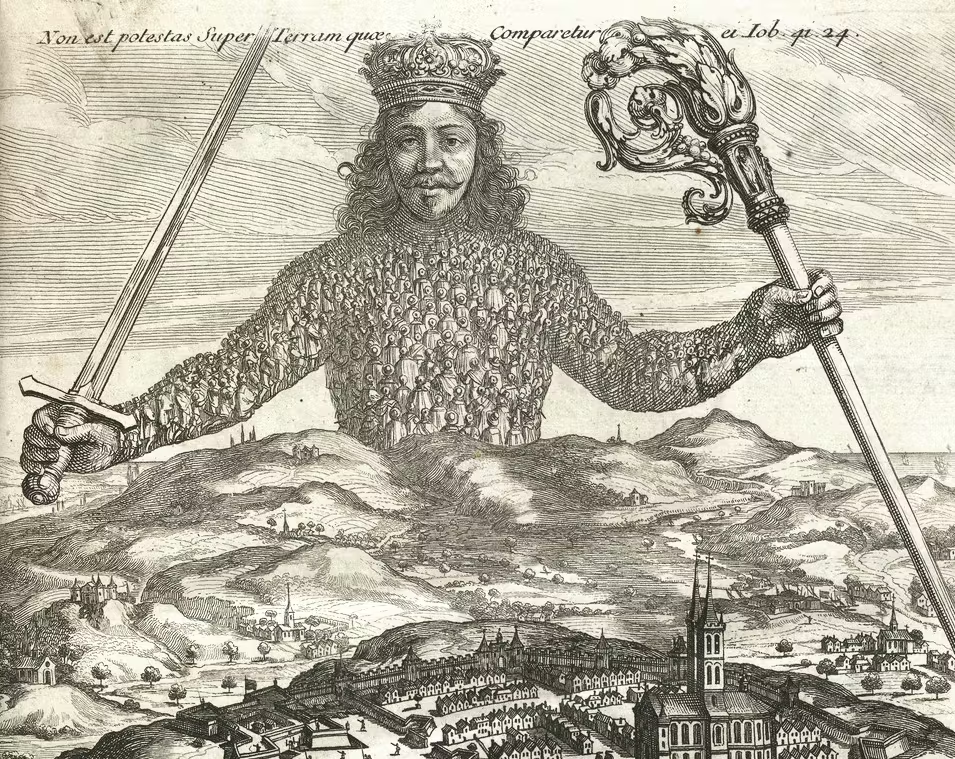
    Thomas Hobbes wrote his seminal work Leviathan in 1651. In it he describes the world system as it was then as being in “a state of nature,” something that some have interpreted as anarchy. However, anarchy has order and purpose. It is not chaos. In fact, if we think of Adam Smith’s “invisible hand of the market” we get something similar to what anarchy is in practice: the aggregate of individual acts of self-interest can lead to the optimisation of value and outcomes at the collective level. Anarchy clears; chaos does not.

    For Hobbes, the state of nature was chaos. Absent a “Sovereign” (i.e. a government) that could impose order on global and domestic societies, humans were destined to lead lives the were “solitary, poor, nasty, brutish and short.” This has translated into notions of “might makes right,” “survival of the fittest,” “to the victor goes the spoils” and other axioms of so-called power politics. The most elaborate of these, international relations realism, is a school of thought that is based on the belief that because the international system has no superseding Sovereign in the form of world government with comprehensive enforcement powers, and because there are no universally shared values and mores throughout the globe community that ideologically bind cultures, groups and individuals, global society exists as a state of nature where, even if there are attempts to manage the relationships between States (and other actors) via rules, norms, institutions and the like, the bottom line is that States (and other actors) have interests, not friends.

    Interests are pursued in a context of power differentials. Alliances are temporary and based on the convergence of mutual interests. Values are not universal and so are inconsequential. International exchange is transactional, not altruistic. Actors with greater resources at their disposal (human, natural, intellectual) prevail over those that have less. In case of resource parity between States or other actors, balances of power become systems regulators, but these are fluid and contingent, not permanent. Geography matters in that regard, which is why geopolitics (the relationship of power to geography) is the core of international relations.

    It is worth remembering this when evaluating contemporary international relations. It has been well established by now that the liberal international order of the post WW2 era has largely been dismantled in the context of increasing multipolarity in inter-State relations and the rise of the Global South within the emerging order. As I have written before, the long transition and systemic realignment in international affairs has led to norm erosion, rules violations, multinational institutional and international organizational decay or irrelevance and the rise of conflict (be it in trade, diplomacy or armed force) as the new systems regulator.

    These developments have accentuated over the last decade and now have a catalyst for a full move into a new global moment–but not into a multipolar or multiplex constellation arrangement in which rising and established powers move between multilateral blocs depending on the issues involved. Instead, the move appears to be one towards a modern Hobbesian state of nature, with the precipitant being the MAGA administration of Donald Trump and its foreign policy approach.

    We must be clear that it is not Trump who is the architect of this move. As mentioned in pervious posts, he is an empty vessel consumed by his own self-worth. That makes him a useful tool of far smarter people than he, people who work in the shadow of relative anonymity and who cut their teeth in rightwing think tanks and policy centres. In their view the liberal internationalist order placed too many constraints on the exercise of US power while at the same time requiring the US to over-extend itself as the “world’s policeman” and international aid donor . Bound by international conventions on the one hand and besieged by foreign rent-seekers and adversaries on the other, the US was increasingly bent under the weight of overlapped demands in which existential national interests were subsumed to a plethora of frivolous diversions (such as human rights and democracy promotion).

    For these strategists, the solution to the dilemma was not to be found in any new multipolar (or even technopolar) constellation but in a dismantling of the entire edifice of international order, something that was based on an architecture of rules, institutions and norms nearly 500 years in the making. Many have mentioned Trump’s apparent mercantilist inclinations and his admiration for former US president William McKinley’s tariff policies in the late 1890s. Although that may be true, the Trump/MAGA agenda is far broader in scope than trade. In fact, the US had its greatest period of (neo-imperial) expansion during McKinley’s tenure as president (1897-1901), winning the Spanish-American War and annexing Hawai’i, Puerto Rico, Guam, American Samoa and the Philippines, so Trump’s admiration for him may well be based on notions of territorial expansionism as well.

    Whatever Trump’s views of McKinley, the basic idea under-riding his foreign policy team’s approach is that in a world where the exercise of power is the ultimate arbiter of a State’s international status, the US remains the greatest Power of them all. It does not matter if the PRC or Russia challenge the US or if other emerging powers join the competition. Without the hobbling effect of its liberal obligations the US can and will dominate them all. This involves trade but also the exercise of raw (neo) imperialist ambitions in places like Greenland, the Panama Canal and even Canada. It involves sidelining the UN, NATO, EU and other international organisations where the US had to share equal votes with lesser powers who flaunted the respect and tribute that should naturally be given in recognition of the US’s superior power base.

    There appears to be a belief in this approach that the US can be a new hegemon–but not Sovereign–in a unipolar world, even more so than during the post-USSR-pre 9/11 interregnum. In a new state of nature it can sit at the core of the international system, orbited by constellations of lesser Great Powers like the PRC, Russia, the EU, perhaps India, who in turn would be circled by lesser powers of various stripes. The US will not seek to police the world or waste time and resources on well-meaning but ultimately futile soft power exercises like those involving foreign aid and humanitarian assistance. Its power projection will be sharp on all dimensions, be it trade, diplomacy or in military-security affairs. It will use leverage, intimidation and varying degrees of coercion as well as persuasion (and perhaps even bribery) as diplomatic tools. It will engage the world primarily in bilateral fashion, eschewing multilateralism for others to pursue according to their own interests and power capabilities. That may suit them, but for the US multilateralism is just another obsolescent vestige of the liberal internationalist past.

    Source: Northrop-Grumman.

    A possible (and partial) explanation for the change in the US foreign policy approach may be the learning effect in the US of Russia’s invasion of Ukraine and Israel’s scorched earth campaign in Gaza. Trump and his advisors may have learned that impunity has its own rewards, that no country or group of countries other than the US (if it has the will) can effectively confront a state determined to pursue its interests regardless of international law, the laws of war or institutional censorship (say, by the UN or International Criminal Court), or any other type of countervailing power. The Russians and Israelis have gotten away with their behaviour because, all rhetoric and hand-wringing aside, there is no actor or group of actors who have the will or capability to stop them. For Trump strategists, these lesser powers are pursuing their interests regardless of diplomatic niceties and international conventions, and they are prevailing precisely because of that. Other than providing military assistance to Ukraine, no one has lifted a serious finger against the Russians other than the Ukrainians themselves, and even fewer have seriously moved to confront Israel’s now evident ethnic cleansing campaign in part because the US has backed Israel unequivocally. The exercise of power in each case occurred in a norm enforcement vacuum in spite of the plethora of agencies and institutions designed to prevent such egregious violations of international standards.

    Put another way: if Israel and Russia can get away with their disproportionate and indiscriminate aggression, imagine what the US can do.

    If we go on to include the PRC’s successful aggressive military “diplomacy” in East/SE Asia, the use of targeted assassinations, hacking, disinformation and covert direct influence campaigns overseas by various States and assorted other unpunished violations of international conventions, then it is entirely plausible that Trump’s foreign policy brain trust sees the moment as ripe for finally breaking the shackles of liberal internationalism. Also recall that many in Trump’s inner circle subscribe to chaos or disruption theory, in which a norms-breaking “disruptor” like Trump seizes the opportunities presented by the breakdown of the status quo ante.

    Before the US could hollow out liberal internationalism abroad and replace it with a modern international state of nature it had to crush liberalism at home. Using Executive Orders as a bludgeon and with a complaint Republican-dominated Congress and Republican-adjacent federal courts. the Trump administration has openly exercised increasingly authoritarian control powers with the intention of subjugating US civil society to its will. Be it in its deportation policies, rollbacks of civil rights protections, attacks on higher education, diminishing of federal government capacity and services (except in the security field), venomous scapegoating of opponents and vulnerable groups, the Trump/MAGA domestic agenda not only seeks to turn the US into a illiberal or “hard” democracy (what Spanish language scholars call a “democradura” as a play on words mixing the terms democracia and dura (hard)). It also serves notice that the US under Trump/MAGA is willing to do whatever is necessary to re-impose its supremacy in world affairs, even if it means hurting its own in order to prove the point. By its actions at home Trump’s administration demonstrates capability, intent and steadfast resolve as it establishes a reputation for ruthless pursuit of its policy agenda. Foreign interlocutors will have to take note of this and adjust accordingly. Hence, for Trump’s advisors, authoritarianism at home is the first step towards undisputed supremacy abroad.

    The Trump embrace of international state of nature differs from Hobbes because it does not see the need for a superseding global governance network but instead believes that the US can dominate the world without the encumbrances of power-sharing with lesser players. In this view hegemony means domination, no more or less. It implies no attempt at playing the role of a Sovereign imposing order on a disorderly and recalcitrant community of Nation-States and non-State actors that do not share common values, much less interests.

    This is the core of the current US foreign policy approach. It is not about reorganising the international order within the extant frameworks as given. It is about removing those frameworks entirely and replacing them with an America First, go it alone agenda where the US, by virtue of its unrivalled power differential relative to all other States and global actors, can maximise its self-interest in largely unconstrained fashion. Some vestiges of the old international order may remain, but they will be marginalised and crippled the longer the US project is in force.

    What does not seem to be happening in Trump’s foreign policy circle are three things. First, recognition that other States and international actors may band together against the US move to unipolarity in a new state of nature and that for all its talk the US may not be able to impose unipolar dominance over them. Second, understanding that States like the PRC, Russia and other Great Powers and communities (like the EU) may resist the US move and challenge it before it can consolidate the new international status quo. Third, foreseeing that the technology titans who today are influential in the Trump administration may decide to transfer there loyalties elsewhere, especially if Trump’s ego starts becoming a hindrance to their (economic and digital) power bases. The fusion of private technology control and US State power may not be as compatible over time as presently appears to be the case, something that may not occur with States such as the PRC, India or Japan that have different corporate cultures and political structures. As the current investment in the Middle Eastern oligarchies shows, the fusion of State and private techno power may be easier to accomplish in those contexts rather than the US.

    In any event, whether it be a short-term interlude or a longue durée feature of international life, a modern state of nature is now our new global reality.

    Analysis syndicated by 36th Parallel Assessments –

    MIL OSI Analysis – EveningReport.nz –

    June 29, 2025
  • MIL-OSI USA: June 28th, 2025 BREAKING: Heinrich Announces Public Lands Sales Provisions Struck from Reconciliation

    US Senate News:

    Source: United States Senator for New Mexico Martin Heinrich

    WASHINGTON — U.S. Senate Energy and Natural Resources Committee Ranking Member Martin Heinrich (D-N.M.) today issued the following statement announcing that public lands sales provisions included in Republicans’ so-called “Big, Beautiful Bill” were stricken from the legislation after thousands of Americans raised their voices to demand that public lands stay in public hands:  

    “Today is a major victory for our public lands. Thank YOU for your incredible outpouring in defense of our American birthright. Because of you, the lands that we cherish will remain OURS. 

    “And to those already plotting to go after our public lands another way: Don’t. Unless you like losing.” 

    MIL OSI USA News –

    June 29, 2025
  • MIL-OSI Canada: Joint statement on International LGBTQI+ Pride Day 2025

    Source: Government of Canada News

    June 28, 2025 – Ottawa, Ontario – Global Affairs Canada

    The foreign ministers of Canada, Spain, Australia, Belgium, Brazil, Cape Verde, Chile, Colombia, Iceland, Ireland, Netherlands, Norway, Portugal, Slovenia and Uruguay today issued the following statement:

    “On the occasion of International LGBTQI+ Pride Day 2025, we, the Foreign Ministers of Canada, Spain, Australia, Belgium, Brazil, Cape Verde, Chile, Colombia, Iceland, Ireland, Netherlands, Norway, Portugal, Slovenia and Uruguay are speaking and acting as one to champion the rights of LGBTQI+ people.

    “At a time when hate speech and hate crimes are on the rise, and in view of efforts to strip LGBTQI+ people of their rights, we reject all forms of violence, criminalization, stigmatization or discrimination, which constitute human rights violations.

    “It is our understanding that respect for diversity, equality and tolerance require the support, at the international level, of measures aimed at decriminalization, and at preventing and eliminating harassment of all kinds—including homophobic and transphobic harassment. Also measures to advance the implementation of diversity policies and the fight against discrimination, and to favour the inclusion of LGBTQI+ people, especially transgender people in society and in the workplace.

    “We recognize that LGBTQI+ people face multiple and intersecting forms of discrimination, particularly when they are also part of other historically marginalized groups, communities, and populations, such as indigenous peoples, afro-descendants, people with disabilities, migrants, elderly people, or those who living in poverty. Promoting their full and effective inclusion requires an intersectional approach that structurally addresses these inequalities.

    “We are joining forces to work hand in hand for the equal rights of LGBTQI+ people and to bring the criminalization of same-sex relations worldwide to an end.

    “We call on all States to join us on this path, repealing discriminatory laws and refusing to adopt new laws that criminalize relations between persons of the same sex or punish people for their sexual orientation or gender identity. We call for an end to the prosecution of LGBTI+ people, and especially to the application of imprisonment and capital punishment. We further call for an end to so-called conversion “therapy” practices intended to change a person’s sexual orientation or gender identity, which can cause psychological and physical pain and suffering and are inherently discriminatory. What is at stake here is a matter of full respect for human rights and human dignity, of strengthening equality, diversity and prosperity, leaving no one behind.

    “Therefore, we, the public authorities, must implement policy that, in alignment with international human rights standards, pursues effective equality of LGBTQI+ people and seeks to combat all forms of discrimination. We celebrate sexual diversity and family diversity, in the conviction that inclusive, equitable, and tolerant societies founded on solidarity are also stronger, healthier and more resilient.

    “Lastly, we reassert our commitment to respecting the human rights of LGBTQI+ people, to ensuring that their equality before the law is incontestable and that no one is prosecuted or subject to discriminated because of their sexual orientation or gender identity. Let us build societies in which all human beings are free to live and love as they choose.”

    MIL OSI Canada News –

    June 29, 2025
  • MIL-OSI USA: Jayapal Statement on Termination of TPS for Haiti

    Source: United States House of Representatives – Congresswoman Pramila Jayapal (7th District of Washington)

    SEATTLE, W.A. — U.S. Representative Pramila Jayapal, Ranking Member of the Subcommittee on Immigration, Integrity, Security, and Enforcement, released the following statement regarding the Trump Administration’s decision to withdraw Temporary Protected Status (TPS) for Haitians.

    “The Trump administration’s decision to terminate Temporary Protected Status (TPS) for Haiti is out of touch with reality. 

    “The Department of State currently has a ‘Do Not Travel’ advisory in place for Haiti due to rampant violence, kidnappings, and political instability. Yet, this administration wants to deport 

    hundreds of thousands of Haitian nationals—people who have lived here lawfully for years, raised families, contributed to our economy, and become deeply rooted in our communities — back to those same deadly conditions.

    “Forcing people to return to dangerous, life-threatening conditions is inhumane and un-American. I stand with the Haitian community and TPS holders across this country. We have a moral obligation to pass permanent protections for TPS holders and to hold this administration accountable for its relentless attacks on immigrant communities.”

    TPS is a designation that temporarily allows foreign nationals who are already in the United States to remain lawfully during periods that would prevent the country’s nationals from returning safely. TPS for Haiti will now end on September 2, 2025. 

    MIL OSI USA News –

    June 29, 2025
  • MIL-OSI USA: CONGRESSWOMAN PLASKETT EXPRESSES DEEP CONCERN OVER THE TRUMP ADMINISTRATION’S DECISION TO END PROTECTIONS FOR HAITIAN IMMIGRANTS

    Source: United States House of Representatives – Congresswoman Stacey E. Plaskett (USVI)

    For Immediate Release                                          Contact: Tionee Scotland
    June 28, 2025                                                           202-808-6129

    PRESS RELEASE

    CONGRESSWOMAN PLASKETT EXPRESSES DEEP CONCERN OVER THE TRUMP ADMINISTRATION’S DECISION TO END PROTECTIONS FOR HAITIAN IMMIGRANTS

    Washington, DC – Congresswoman Stacey E. Plaskett (VI-AL) today strongly condemned the Trump administration’s announcement that it will terminate Temporary Protected Status (TPS) for more than 300,000 Haitian immigrants currently living in the United States, calling the decision “morally unconscionable and recklessly shortsighted to our national interest.”

    “The Trump administration’s decision to end TPS for Haitians is not just cruel—it is potentially deadly. Haiti remains in a state of complete collapse, overrun by gangs, wracked with violence, and under a state of emergency. The State Department itself warns Americans not to travel there due to widespread violent crime. Furthermore, the U.S. State Department has been in negotiations with multiple country partners to find ways to stem the continued collapse of the country. How can this administration claim it is safe to deport hundreds of thousands of people to a country they themselves have designated as too dangerous for American tourists and a threat to regional stability?

    “The Department of Homeland Security’s announcement on Friday that the protections, which have shielded Haitians from deportation since 2010 following the devastating earthquake, will expire on September 2, 2025. The administration justified the decision by claiming that, ‘the environmental situation in Haiti has improved enough that it is safe for Haitian citizens to return home’—a statement that directly contradicts the State Department’s actions regarding Haiti. 

    “This administration is playing politics with people’s lives. These are families who have built lives here, contribute to our communities, pay taxes from their wages and deserve our protection—not deportation to a nation in chaos. Throughout my tenure in Congress, I have worked tirelessly to ensure that our immigration policies reflect our values of compassion and humanity. This includes my work as a Co-Chair of the Congressional Caribbean Caucus to push back against discriminatory policies, to recognize the national security threat to the United States from a de-stabled Haiti, and my efforts to secure humanitarian aid for the Caribbean region.

    “This is part of a systematic campaign to dismantle protections for the world’s most vulnerable people. Congress must act swiftly to provide legislative protections for these families. We cannot stand by while this administration turns its back on our moral obligations and puts hundreds of thousands of lives at risk. Additionally, the financial support those in the United States provide to families back in Haiti through remittances have been key to staving off poverty and additional instability in the country. In 2023, U.S. remittances to Haiti were over $3.8 Billion dollars. 

    Plaskett went on to discuss, “As a member of the Intelligence Committee, I have focused quite a bit on our third border—the Caribbean region—and threats to the United States. Instability in the Caribbean presents threats of increased human and drug trafficking into the mainland, democratic collapse with malign influence of China and Russia, and reduced economic trade.” 

    “This action does not advance American interests.  The administration’s actions betray the best of American values, Western Hemisphere interests and Caribbean solidarity.”

    ###

    MIL OSI USA News –

    June 29, 2025
  • MIL-OSI USA: CONGRESSWOMAN PLASKETT APPLAUDS RUM COVER OVER PERMANENCY EFFECTIVE DECEMBER 2025 IN LATEST SENATE RECONCILIATION BILL

    Source: United States House of Representatives – Congresswoman Stacey E. Plaskett (USVI)

    For Immediate Release                                          Contact: Tionee Scotland
    June 28, 2025                                                           202-808-6129

    PRESS RELEASE

    CONGRESSWOMAN PLASKETT APPLAUDS RUM COVER OVER PERMANENCY EFFECTIVE DECEMBER 2025 IN LATEST SENATE RECONCILIATION BILL

    Washington, DC – Early this morning, the Senate released the latest version of the Senate companion to H.R. 1, the Reconciliation package known as the “One Big Beautiful Bill,” which cuts Medicaid massively and provides massive tax cuts for the wealthiest Americans. The bill now provides a provision which permanently provides the increased rum cover over rate of $13.25 for Puerto Rico and the Virgin Islands. 

    On May 22, 2025, the House of Representatives passed H.R. 1, the One Big Beautiful Bill Act, and since that time, the Senate has drafted several versions of the reconciliation bill. The Senate is expected to begin voting as early as this afternoon, and if passed, it will return to the House of Representatives, where it will receive a vote on the House floor. If the bill is passed by the House of Representatives, it will be sent to the President’s desk for signature. Republicans’ reconciliation bill will make everyday life more expensive for Americans, and it also removes programs which gave opportunities and support for working Americans and those trying to get ahead. 

    Congresswoman Plaskett shared, “While I cannot support the bill in its entirety, I applaud the Senate’s provision to permanently provide the increased rum cover over rate of $13.25, effective December 31, 2025. This provision is not retroactive to the last expiration of the increased rate on January 1, 2022, which means the increased rate of $13.25 will not be recovered for that period of January 2022 to December 2025.

    “I am pleased that the Senate has recognized the importance of the rum cover over to the Virgin Islands and Puerto Rico and that at this stage, the provision is included. However, this is a fluid situation that is constantly evolving. This is not the first version of this bill, and we cannot guarantee that this provision will be included in the final version. I am hopeful that the increased rum cover over rate remains in the bill.” 

    Rum cover over is the rebate of federal excise taxes on distilled spirits produced in or imported into the rest of the United States from the Virgin Islands and Puerto Rico. Under current law, excise tax collections on imported rum are transferred to Puerto Rico and the U.S. Virgin Islands at the rate of $13.25 per proof gallon; $10.50 per proof gallon is in permanent law, and the remaining $2.75 per proof gallon requires periodic reauthorization by Congress. These funds, which represent nearly 25% of the Virgin Islands Government’s annual budget, are critical for stabilizing the government employees’ pension program, supporting infrastructure projects, and attracting investments to diversify the economy beyond tourism. 

    In the 119th Congress, Congresswoman Plaskett and Congressman Ron Estes (KS-4) introduced rum cover legislation (H.R. 1378), which is supported by 24 of her colleagues – 16 Republicans and 8 Democrats. During the 18-hour markup in the Ways and Means Committee for the tax provisions of the House-version of the reconciliation bill, Congresswoman Plaskett offered an amendment to increase the rate of the rum cover offer, to publicly demonstrate the bipartisan support for this provision. Both Democrats and Republicans, including the Ways and Means Chairman, Jason Smith, acknowledged the importance of the increased rum cover over rate. The House version placed in provisions to fix tax issues in the Virgin Islands and also stop effective tariffs on rum coming into the United States 

    Congresswoman Plaskett shared, “I would like to thank our partners for their collective advocacy for the increased rum cover over rate, including Congressman Ron Estes, Congressman Pablo Hernandez, Governor Albert Bryan, Governor Jenniffer Gonzalez-Colon, Senator Cassidy, and the rum industry.”

    ###

    MIL OSI USA News –

    June 29, 2025
  • MIL-OSI United Kingdom: Organization of American States: Baroness Chapman Intervention

    Source: United Kingdom – Executive Government & Departments

    Speech

    Organization of American States: Baroness Chapman Intervention

    Baroness Chapman delivers intervention on the Falkland Islands at the Organization of American States

    Secretary General, Assistant Secretary General, ministers, delegates, friends.

    On behalf of the United Kingdom, I would like to thank Antigua and Barbuda for hosting this important assembly. 

    The UK’s relationships with our friends and allies across the Americas are important to all of us.

    Be it climate change, security, or sustainable development – we face the greatest challenges together.

    And indeed, for more than two centuries now, the UK and Argentina have shared bilateral relationships – as part of a long, rich history.

    My friend the UK Prime Minister, Sir Keir Starmer, has met President Milei a number of times.

    Earlier this year, Security Minister Patricia Bullrich enjoyed a highly successful visit to the UK. 

    And even where we disagree, we are working together to reduce tensions.

    So, in September 2024, my friend the Foreign Secretary and the former Argentine Foreign Minister Diana Mondino announced a new package of cooperation.

    This recognised that while we may not agree on sovereignty, there is much we can achieve by working together in the South Atlantic.

    The UK and Falkland Islanders have come together to implement this – including support for Argentine families travelling to the Falkland Islands in December last year, to visit graves from the 1982 conflict.

    For a community living with the trauma of invasion and occupation, that was not easy.

    Yet, Falkland Islanders wanted to do the right thing.

    Both the UK and Falkland Islanders look forward to seeing Argentina making good on their commitments.

    That includes cooperation on fisheries for the benefit of all, and the resumption of the flight between the Islands and São Paulo.

    The UK remains determined to work with all our partners, including Argentina.

    And the UK’s support for the Falkland Islanders’ inalienable right of self-determination remains undiminished. 

    Falkland Islanders alone should decide their future.

    In the referendum they held in 2013, Islanders voted to maintain their status as a self-governing UK Overseas Territory – overwhelmingly.

    Five of the six observers of the referendum came from the OAS Member States – reporting that it was free, fair, and reflected the will of the voters. 

    Today, the Falkland Islands are a democratic and prosperous community – showing the world what is possible on sustainable fisheries and environmental conservation.

    They are determining their own future.

    And their success has been recognised by S&P Global Ratings – who have given the Falkland Islands an impressive A Plus.

    And this is an objective recognition of the stable and thriving community that the Islanders have built.

    And later this year, the Falkland Islands will hold a general election to decide their next government.

    They will vote on issues such as education, the economy, and the environment.

    So, I hope this assembly will recognise that we cannot pick and choose who is entitled to the basic human right of democracy.

    The people of the Falkland Islands are rightly proud of their vibrant, small-island, big ocean democracy.

    And they are clear – that neither the UK nor Argentina can negotiate the future that they are determining for themselves. So let me be clear: my government will not negotiate on the future of the Falkland Islands, unless the Islanders themselves wish it. And they do not.

    I was delighted that many of your governments continue to engage constructively with the Falkland Islanders and have expressed your support for their democratic rights, and I hope that members of the Assembly will agree that we cannot selectively choose when democratic rights apply to a community.

    The UK has no doubt about its sovereignty over the Falkland Islands, South Georgia and South Sandwich Islands, and the surrounding maritime areas.

    And we have no doubt about the principle and the right of self-determination enshrined in the UN Charter and in article one of the 2 UN Covenants on human rights.

    By virtue of this, Falkland Islanders can determine their political status and pursue their economic, social, and cultural development – freely.

    So, the UK asks that the General Assembly takes note of the Islanders’ right of self-determination – and that this statement is read into the record of this meeting.

    Thank you.

    Updates to this page

    Published 28 June 2025

    MIL OSI United Kingdom –

    June 29, 2025
  • MIL-OSI: BexBack Launches Limited-Time $50 Welcome Bonus and 100% Deposit Match for New Crypto Futures Traders

    Source: GlobeNewswire (MIL-OSI)

    SINGAPORE, June 28, 2025 (GLOBE NEWSWIRE) — BexBack, a rapidly growing crypto derivatives exchange, has announced a limited-time promotional campaign offering new users a $50 welcome bonus and a 100% deposit match when they join the platform. Amid renewed volatility in the crypto market, the campaign aims to help retail traders take advantage of 100x leveraged futures trading with zero KYC requirements. The offer is available now for a short window, providing users with an accessible, high-reward opportunity to capitalize on market momentum.

    Whether you’re aiming to capitalize on Bitcoin’s price swings or tap into the momentum of emerging altcoins, BexBack empowers every trader with institutional-grade tools and unmatched promotional offers.

    Why 100x Leverage Matters in Today’s Market

    In times of uncertainty, leverage transforms small price moves into big opportunities. With 100x leverage, traders can:

    • Multiply Profit Potential: Open positions worth 100x your initial margin, significantly amplifying gains.
    • Maximize Capital Efficiency: Put less in, get more out. Keep the rest of your capital flexible.
    • Trade Both Directions: Go long or short. Make profits whether prices rise or fall.
    • Respond Quickly: High-frequency opportunities become viable with minimal capital.
    • Level the Playing Field: Retail traders now have access to strategies once reserved for institutions.

    A Real Example: How 100x Leverage Boosts ROI

    Let’s say Bitcoin is priced at $100,000. You open a long position with 1 BTC using 100x leverage—equivalent to $10 million in market exposure. If BTC rises to $105,000:

    • Your profit is 5 BTC, or 500% ROI on your initial margin.
    • With BexBack’s 100% deposit bonus, your trading power doubles, potentially increasing that profit to 10 BTC—a 1000% return.

    Note: Leverage can amplify both gains and losses. Always manage risk wisely.

    How the BexBack Bonuses Work

    • 100% Deposit Bonus: Double your margin power. The bonus is credited to your account and usable for trading and loss coverage.
    • $50 Welcome Bonus: New users who make their first deposit (More than 100 USDT or 0.001 BTC) and trade within 7 days will receive an instant $50 credit in their USDT-M account.
    • No KYC Required: Sign up, deposit, and start trading within minutes—no complex verification needed.

    Why Choose BexBack?

    BexBack is a next-generation crypto derivatives exchange trusted by over 500,000 global traders, offering futures contracts on BTC, ETH, XRP, ADA, SOL, and 50+ top assets. With headquarters in Singapore and operations in Hong Kong, Japan, the U.S., the U.K., and Argentina, BexBack is fully licensed with a U.S. MSB (Money Services Business) registration.

    Key Highlights:

    • 100x Leverage across all major cryptocurrencies
    • 100% Deposit Bonus with no hidden fees
    • $50 Welcome Bonus for new users
    • No KYC Required — Privacy-first trading
    • Zero Deposit Fees — Keep more of your crypto
    • Demo Account with 10 BTC for practice
    • No Spread, No Slippage — Just precise execution
    • Available Worldwide, including the U.S., Canada, and Europe
    • 24/7 Multilingual Support — Real humans, real fast
    • Up to 50% Commission for Affiliates — Invite & earn

    Join the Next Wave of Crypto Success

    The crypto market waits for no one. If you missed the last bull run, now is the time to get ahead. With BexBack’s cutting-edge features and unbeatable offers, every trader—from beginner to pro—can trade like a whale.

    Sign Up Now on BexBack — Break the 100x Leverage and KYC Barriers, Get Double Deposit Bonus and $50 Welcome Bonus Instantly

    Website: www.bexback.com

    Contact: business@bexback.com

    Contact:
    Amanda
    business@bexback.com

    Disclaimer: This content is provided by BexBack The statements, views, and opinions expressed in this content are solely those of the content provider and do not necessarily reflect the views of this media platform or its publisher. We do not endorse, verify, or guarantee the accuracy, completeness, or reliability of any information presented. We do not guarantee any claims, statements, or promises made in this article. This content is for informational purposes only and should not be considered financial, investment, or trading advice.Investing in crypto and mining-related opportunities involves significant risks, including the potential loss of capital. It is possible to lose all your capital. These products may not be suitable for everyone, and you should ensure that you understand the risks involved. Seek independent advice if necessary. Speculate only with funds that you can afford to lose. Readers are strongly encouraged to conduct their own research and consult with a qualified financial advisor before making any investment decisions. However, due to the inherently speculative nature of the blockchain sector—including cryptocurrency, NFTs, and mining—complete accuracy cannot always be guaranteed.Neither the media platform nor the publisher shall be held responsible for any fraudulent activities, misrepresentations, or financial losses arising from the content of this press release. In the event of any legal claims or charges against this article, we accept no liability or responsibility. Globenewswire does not endorse any content on this page.

    Legal Disclaimer: This media platform provides the content of this article on an “as-is” basis, without any warranties or representations of any kind, express or implied. We assume no responsibility for any inaccuracies, errors, or omissions. We do not assume any responsibility or liability for the accuracy, content, images, videos, licenses, completeness, legality, or reliability of the information presented herein. Any concerns, complaints, or copyright issues related to this article should be directed to the content provider mentioned above.

    Photos accompanying this announcement are available at:
    https://www.globenewswire.com/NewsRoom/AttachmentNg/4a986727-71d0-4c8b-9443-a773107d101f
    https://www.globenewswire.com/NewsRoom/AttachmentNg/db119e10-fe18-4d72-8454-47b686fc6bad
    https://www.globenewswire.com/NewsRoom/AttachmentNg/126f6d03-b53d-45d0-b3a1-884e1d0294b5
    https://www.globenewswire.com/NewsRoom/AttachmentNg/0e1312b5-f75e-4566-b309-315fd75bc1ed

    The MIL Network –

    June 29, 2025
  • MIL-OSI Russia: Foreign diplomats stressed the importance of cooperation in the peaceful use of nuclear technology

    Translation. Region: Russian Federal

    Source: People’s Republic of China in Russian – People’s Republic of China in Russian –

    Source: People’s Republic of China – State Council News

    BEIJING, June 28 (Xinhua) — Ambassadors and envoys from the permanent missions of eight countries to the United Nations and other international organizations in Vienna stressed cooperation in the peaceful use of nuclear technology during a visit to China.

    Foreign envoys from Ghana, Brazil, Namibia, Bangladesh, Nigeria, Pakistan, Venezuela and Indonesia visited nuclear technology demonstration and innovation sites in China’s Shandong Province (east China) and Beijing.

    They exchanged views with Chinese officials and experts and attended a symposium in Beijing on cooperation in the peaceful use of nuclear technology.

    The event, which took place from June 22 to 27, was jointly organized by the China National Atomic Energy Agency (CAEA) and the Permanent Mission of China to the United Nations and other international organizations in Vienna.

    CAEA noted China’s efforts to promote safe and sustainable development of nuclear energy, use of nuclear technology for social welfare, as well as its extensive practice and future plans to deepen cooperation in peaceful uses of nuclear technology with developing countries.

    The foreign diplomats noted that China’s achievements in nuclear energy and nuclear technology have attracted the world’s attention, adding that China has played a vital role in promoting the peaceful use of nuclear energy among countries in the Global South. They also expressed their willingness to cooperate with China at the bilateral and multilateral levels in areas such as nuclear agronomy, nuclear medicine, nuclear safety and security.

    CAEA said it would work with the International Atomic Energy Agency (IAEA) and partners from the Global South to jointly advance innovation and development in nuclear energy technologies. -0-

    MIL OSI Russia News –

    June 29, 2025
  • MIL-OSI Africa: Visit of Prime Minister to Ghana, Trinidad & Tobago, Argentina, Brazil, and Namibia (July 02 – 09)


    Download logo

    Prime Minister Shri Narendra Modi will undertake a visit to Ghana from July 02-03, 2025. This will be Prime Minister’s first ever bilateral visit to Ghana. This Prime Ministerial visit from India to Ghana is taking place after three decades. During the visit, Prime Minister will hold talks with the President of Ghana to review the strong bilateral partnership and discuss further avenues to enhance it through economic, energy, and defence collaboration, and development cooperation partnership. This visit will reaffirm the shared commitment of the two countries to deepen bilateral ties and strengthen India’s engagement with the ECOWAS [Economic Community of West African States] and the African Union.

    In the second leg of his visit, at the invitation of the Prime Minister of the Republic of Trinidad & Tobago, H.E. Kamla Persad-Bissessar, Prime Minister will pay an Official Visit to Trinidad & Tobago (T&T) from July 03 – 04, 2025. This will be his first visit to the country as Prime Minister and the first bilateral visit at the Prime Ministerial level to T&T since 1999. During the visit, Prime Minister will hold talks with the President of Trinidad & Tobago, H.E. Christine Carla Kangaloo, and Prime Minister H.E. Kamla Persad-Bissessar and discuss further strengthening of the India-Trinidad & Tobago relationship. Prime Minister is also expected to address a Joint Session of the Parliament of T&T. The visit of Prime Minister to T&T will impart fresh impetus to the deep-rooted and historical ties between the two countries.

    In the third leg of his visit, at the invitation of the President of Republic of Argentina, H.E. Mr. Javier Milei, Prime Minister will travel to Argentina on an Official Visit from July 04-05, 2025. Prime Minister is scheduled to hold bilateral talks with President Milei to review ongoing cooperation and discuss ways to further enhance India-Argentina partnership in key areas including defence, agriculture, mining, oil and gas, renewable energy, trade and investment, and people-to-people ties. The bilateral visit of Prime Minister will further deepen the multifaceted Strategic Partnership between India and Argentina.

    In the fourth leg of his visit, at the invitation of President of the Federative Republic of Brazil, H.E. Luiz Inacio Lula da Silva, Prime Minister will travel to Brazil from July 5-8, 2025 to attend the 17th BRICS Summit 2025 followed by a State Visit. This will be Prime Minister’s fourth visit to Brazil. The 17th BRICS Leaders’ Summit will be held in Rio de Janeiro. During the Summit, Prime Minister will exchange views on key global issues including reform of global governance, peace and security, strengthening multilateralism, responsible use of artificial intelligence, climate action, global health, economic and financial matters. Prime Minister is also likely to hold several bilateral meetings on the sidelines of the Summit. For the State Visit to Brazil, Prime Minister will travel to Brasilia where he will hold bilateral discussions with President Lula on the broadening of the Strategic Partnership between the two countries in areas of mutual interest, including trade, defence, energy, space, technology, agriculture, health and people to people linkages.

    In the final leg of his visit, at the invitation of the President of the Republic of Namibia, H.E. Dr. Netumbo Nandi-Ndaitwah, Prime Minister will embark on a State Visit to Namibia on July 09, 2025. This will be the first visit of Prime Minister to Namibia, and the third ever Prime Ministerial visit from India to Namibia. During his visit, Prime Minister will hold bilateral talks with President Nandi-Ndaitwah. Prime Minister will also pay homage to the Founding Father and first President of Namibia, Late Dr. Sam Nujoma. He is also expected to deliver an address at the Parliament of Namibia. The visit of Prime Minister is a reiteration of India’s multi-faceted and deep-rooted historical ties with Namibia.

    Distributed by APO Group on behalf of Ministry of External Affairs – Government of India.

    MIL OSI Africa –

    June 28, 2025
  • MIL-Evening Report: Eugene Doyle: Why Asia-Pacific should be cheering for Iran and not US bomb-based statecraft

    ANALYSIS: By Eugene Doyle

    Setting aside any thoughts I may have about theocratic rulers (whether they be in Tel Aviv or Tehran), I am personally glad that Iran was able to hold out against the US-Israeli attacks this month.

    The ceasefire, however, will only be a pause in the long-running campaign to destabilise, weaken and isolate Iran. Regime change or pariah status are both acceptable outcomes for the US-Israeli dyad.

    The good news for my region is that Iran’s resilience pushes back what could be a looming calamity: the US pivot to Asia and a heightened risk of a war on China.

    There are three major pillars to the Eurasian order that is going through a slow, painful and violent birth.  Iran is the weakest.  If Iran falls, war in our region — intended or unintended – becomes vastly more likely.

    Mainstream New Zealanders and Australians suffer from an understandable complacency: war is what happens to other, mainly darker people or Slavs.

    “Tomorrow”, people in this part of the world naively think, “will always be like yesterday”.

    That could change, particularly for the Australians, in the kind of unfamiliar flash-boom Israelis experienced this month following their attack on Iran. And here’s why.

    US chooses war to re-shape Middle East
    Back in 2001, as many will recall, retired General Wesley Clark, former Supreme Commander of NATO forces in Europe, was visiting buddies in the Pentagon. He learnt something he wasn’t supposed to: the Bush administration had made plans in the febrile post 9/11 environment to attack seven Muslim countries.

    In the firing line were: Saddam Hussein’s Iraq, the Assad regime in Syria, Hezbollah-dominated Lebanon, Gaddafi’s Libya, Somalia, Sudan and the biggest prize of all — the Islamic Republic of Iran.

    One would have to say that the project, pursued by successive presidents, both Democrat and Republican, has been a great success — if you discount the fact that a couple of million human beings, most of them civilians, many of them women and children, nearly all of them innocents, were slaughtered, starved to death or otherwise disposed of.

    With the exception of Iran, those countries have endured chaos and civil strife for long painful years.  A triumph of American bomb-based statecraft.

    Now — with Muammar Gaddafi raped and murdered (“We came, we saw, he died”, Hillary Clinton chuckled on camera the same day), Saddam Hussein hanged, Hezbollah decapitated, Assad in Moscow, the genocide in full swing in Palestine — the US and Israel were finally able to turn their guns — or, rather, bombs — on the great prize: Iran.

    Iran’s missiles have checked US-Israel for time being
    Things did not go to plan. Former US ambassador to Saudi Arabia Chas Freeman pointed out this week that for the first time Israel got a taste of the medicine it likes to dispense to its neighbours.

    Iran’s missiles successfully turned the much-vaunted Iron Dome into an Iron Sieve and, perhaps momentarily, has achieved deterrence. If Iran falls, the US will be able to do what Barack Obama and Joe Biden only salivated over — a serious pivot to Asia.

    Could great power rivalry turn Asia-Pacific into powderkeg?
    For us in Asia-Pacific a major US pivot to Asia will mean soaring defence budgets to support militarisation, aggressive containment of China, provocative naval deployments, more sanctions, muscling smaller states, increased numbers of bases, new missile systems, info wars, threats and the ratcheting up rhetoric — all of which will bring us ever-closer to the powderkeg.

    Sounds utterly mad? Sounds devoid of rationality? Lacking commonsense? Welcome to our world — bellum Americanum — as we gormlessly march flame in hand towards the tinderbox. War is not written in the stars, we can change tack and rediscover diplomacy, restraint, and peaceful coexistence. Or is that too much to ask?

    Back in the days of George W Bush, radical American thinkers like Robert Kagan, Dick Cheney and Donald Rumsfeld created the Project for a New American Century and developed the policy, adopted by succeeding presidents, that promotes “the belief that America should seek to preserve and extend its position of global leadership by maintaining the preeminence of US military forces”.

    It reconfirmed the neoconservative American dogma that no power should be allowed to rise in any region to become a regional hegemon; anything and everything necessary should be done to ensure continued American primacy, including the resort to war.

    What has changed since those days are two crucial, epoch-making events: the re-emergence of Russia as a great power, albeit the weakest of the three, and the emergence of China as a genuine peer competitor to the USA. Professor  John Mearsheimer’s insights are well worth studying on this topic.

    The three pillars of multipolarity
    A new world order really is being born. As geopolitical thinkers like Professor Glenn Diesen point out, it will, if it is not killed in the cradle, replace the US unipolar world order that has existed since the dissolution of the Soviet Union in 1991.

    Many countries are involved in its birthing, including major players like India and Brazil and all the countries that are part of BRICS.  Three countries, however, are central to the project: Iran, Russia and, most importantly, China.  All three are in the crosshairs of the Western empire.

    If Iran, Russia and China survive as independent entities, they will partially fulfill Halford MacKinder’s early 20th century heartland theory that whoever dominates Eurasia will rule the world. I don’t think MacKinder, however, foresaw cooperative multipolarity on the Eurasian landmass — which is one of the goals of the SCO (Shanghai Cooperation Organisation) – as an option.

    That, increasingly, appears to be the most likely trajectory with multiple powerful states that will not accept domination, be that from China or the US.  That alone should give us cause for hope.

    Drunk on power since the collapse of the Soviet Union, the US has launched war after war and brought us to the current abandonment of economic sanity (the sanctions-and-tariff global pandemic) and diplomatic normalcy (kill any peace negotiators you see) — and an anything-goes foreign policy (including massive crimes against humanity).

    We have also reached — thanks in large part to these same policies — what a former US national security advisor warned must be avoided at all costs. Back in the 1990s, Zbigniew Brzezinski said, “The most dangerous scenario would be a grand coalition of China, Russia, and perhaps Iran.”

    Belligerent and devoid of sound strategy, the Biden and Trump administrations have achieved just that.

    Can Asia-Pacific avoid being dragged into an American war on China?
    Turning to our region, New Zealand and Australia’s governments cleave to yesterday: a white-dominated world led by the USA.  We have shown ourselves indifferent to massacres, ethnic cleansing and wars of aggression launched by our team.

    To avoid war — or a permanent fear of looming war — in our own backyards, we need to encourage sanity and diplomacy; we need to stay close to the US but step away from the military alliances they are forming, such as AUKUS which is aimed squarely at China.

    Above all, our defence and foreign affairs elites need to grow new neural pathways and start to think with vision and not place ourselves on the losing side of history. Independent foreign policy settings based around peace, defence not aggression, diplomacy not militarisation, would take us in the right direction.

    Personally I look forward to the day the US and its increasingly belligerent vassals are pushed back into the ranks of ordinary humanity. I fear the US far more than I do China.

    Despite the reflexive adherence to the US that our leaders are stuck on, we should not, if we value our lives and our cultures, allow ourselves to be part of this mad, doomed project.

    The US empire is heading into a blood-drenched sunset; their project will fail and the 500-year empire of the White West will end — starting and finishing with genocide.

    Every day I atheistically pray that leaders or a movement will emerge to guide our antipodean countries out of the clutches of a violent and increasingly incoherent USA.

    America is not our friend. China is not our enemy. Tomorrow gives birth to a world that we should look forward to and do the little we can to help shape.

    Eugene Doyle is a writer based in Wellington. He has written extensively on the Middle East, as well as peace and security issues in the Asia Pacific region. He contributes to Asia Pacific Report and Café Pacific, and hosts the public policy platform solidarity.co.nz

    MIL OSI Analysis – EveningReport.nz –

    June 28, 2025
  • MIL-OSI China: China loses to Italy at 2025 Volleyball Men’s Nations League

    Source: People’s Republic of China – State Council News

    The Chinese men’s volleyball team lost 3-0 to 5th-ranked Italy at the 2025 Volleyball Men’s Nations League (VNL) Chicago leg on Friday.

    China, ranked 24th in the world, briefly led 2-0 in the opening set, but Italy responded with four straight points during Alessandro Michieletto’s service rotation to take control. In the second set, Italy opened with a dominant 8-2 run. Although China managed to cut the deficit to 14-18, Michieletto’s successive service points and Daniele Lavia’s powerful spikes broke through China’s defense. The third set saw China edge ahead 5-3 early, but Italy soon widened the gap thanks to Gianluca Galassi’s blocking and Riccardo Sbertoli’s counterattacks, sealing the match with set scores of 25-18, 25-15, and 25-19.

    “It is acceptable to play against the Italian team with such a result,” Chinese team opposite hitter Wen Zihua said. “Competing with high-level players allows us to learn a lot. We can improve significantly during the game.”

    Outside hitter Wang Bin said he felt he had performed to his potential. “I really need opportunities like this to play and gain experience. It’s very important to me.”

    “There’s a difference between result and how we play,” China’s Belgian head coach Vital Heynen said. “Italy is the world champion. They play with their best team. We choose to have a lot of players. We have a lot of small injuries to play with, a lot of young guys who never played against Italy. Then they were fighting good, but Italy is better. That’s no discussion.”

    Heynen is satisfied with the way the Chinese players were fighting and playing. “Of course they make some mistakes, we can do better. But that’s why we try this kind of matches.”

    “We were trying to fight, and the most important is that you play at your maximum, but you have to accept sometimes that other teams are better,” Heynen said.

    With two more injuries from the match and only eight players available, “we have different idea than that we tried to win. Here was for learning and I was satisfied with it,” Heynen said.

    The Chinese team has no competition scheduled on June 28 local time following three consecutive days of intense matches against the United States, Brazil, and Italy. When a reporter mentioned that the players could take a day off, Heynen replied earnestly, “we have a day to prepare. This is different.”

    China is scheduled to face Canada on Sunday. 

    MIL OSI China News –

    June 28, 2025
  • MIL-OSI NGOs: New wealth of top 1% surges by over $33.9 trillion since 2015 – enough to end poverty 22 times over, as Oxfam warns global development “abysmally off track” ahead of crunch talks

    Source: Oxfam –

    • Oxfam condemns “private finance takeover” of development efforts, as over 3.7 billion people remain in poverty ten years after the Sustainable Development Goals were agreed. 
       
    • New Oxfam analysis unveils “astronomical rise in private wealth”. Between 1995 and 2023, global private wealth grew by $342 trillion – 8 times more than public wealth.  
       
    • Oxfam analysis also shows governments are making the largest cuts to life-saving aid since aid records began. Aid cuts could cause 2.9 million more children and adults to die by 2030, from HIV/AIDS causes alone. 
    • Results of a new global survey show 9 out of 10 people support paying for public services and climate action through taxing the super-rich. 
    • Oxfam urges new strategic alliances to address inequality; urgently revitalize aid and tax the super-rich; and assert new “public-first” approach over private finance. 

    The world’s richest 1% increased their wealth by more than $33.9 trillion in real terms since 2015, reveals new Oxfam analysis ahead of the world’s largest development financing talks in a decade, in Seville, Spain. This is more than enough to eliminate annual poverty 22 times over at the World Bank’s highest poverty line of $8.30 a day. The wealth of just 3,000 billionaires has surged $6.5 trillion in real terms since 2015, and now comprises the equivalent of 14.6% of global GDP.

    Oxfam’s new briefing paper, “From Private Profit to Public Power: Financing Development, Not Oligarchy”, launches today ahead of the June 30 fourth International Conference on Financing for Development, hosted by Spain and joined by over 190 countries.  

    Wealthy governments are making the largest cuts to life-saving development aid since aid records began in 1960. Oxfam analysis finds that G7 countries alone, who account for around three-quarters of all official aid, are cutting aid by 28% for 2026 compared to 2024. Whilst critical aid is cut, the debt crisis is bankrupting governments – 60% of low-income countries are at the edge of a debt crisis – with the poorest countries paying out far more to repay their rich creditors than they are able to spend on classrooms or clinics. Only 16% of the targets for the Global Goals are on track for 2030. 

    Oxfam’s new analysis examines the failures of a private investor-focused approach to funding development. A decade-long effort by major development actors to recast their mission as one of supporting powerful Global North financial actors has led in fact to a host of harms and at the same time only mobilized paltry sums. The analysis also looks at the role of private creditors, who now outpace bilateral lenders by five times and account for more than half the debt owed by low- and middle-income countries, in exacerbating the debt crisis with their refusal to negotiate and their punitive terms. 

    “Seville is the first major gathering of countries worldwide at a time that life-saving aid is being decimated, a trade war has started, and multilateralism being fractured – all in the backdrop of the second Trump administration. There is glaring evidence that global development is desperately failing because – as the last decade shows – the interests of a very wealthy few are put over those of everyone else,” said Amitabh Behar, Executive Director of Oxfam International. 

    What the World Bank described as a “billions to trillions” paradigm shift has been a boon for wealthy investors – the richest 1% own 43% of global assets – but now faces overwhelming evidence of failure, even according to former champions. Alarmingly, there is new momentum behind the idea of diverting the little aid that remains to private financial actors. 

    “Rich countries have put Wall Street in the driver’s seat of global development. It’s a global private finance takeover which has overrun the evidence-backed ways to tackle poverty through public investments and fair taxation. It is no wonder governments are abysmally off track, be it on fostering decent jobs, gender equality, or ending hunger. This much wealth concentration is choking efforts to end poverty”, said Behar. 

    New Oxfam analysis shows that between 1995 and 2023, global private wealth grew by $342 trillion – 8 times more than global public wealth, which grew by just $44 trillion. Global public wealth – as a share of total wealth – actually fell between 1995 and 2023.  

    Oxfam is urging governments to rally behind policy and political proposals that offer a change in course by tackling extreme inequality and transforming the development financing system:  

    • New strategic alliances against inequality. Governments must band together in new coalitions to oppose extreme inequality. Countries such as Brazil, South Africa and Spain are offering leadership to do so internationally. A new ‘Global Alliance Against Inequality’ supported by Germany, Norway, Sierra Leone and others sets an example for nations to back.  
    • Public-first approach – reject the Wall Street Consensus. Governments should reject private finance as the silver bullet to funding development. Instead, governments should invest in state-led development – to ensure universal high-quality healthcare, education and care services, and explore publicly-delivered goods in sectors from energy to transportation.  
    • Total rethink of development financing – tax the ultra-rich, revitalize aid, reform debt architecture, and move beyond GDP indicators. Global North donors must urgently reverse catastrophic cuts to lifesaving aid and meet the 0.7% ODA target as minimum. Governments must back efforts for a new UN debt convention, and support the UN tax convention, building on Brazil’s G20 effort to tax high-net-worth-individuals.   

    “Trillions of dollars exist to meet the global goals, but they’re locked away in private accounts of the ultra-wealthy. It’s time we rejected the Wall Street Consensus and instead put the public in the driving seat. Governments should heed widespread demands to tax the rich – and match it with a vision to build public goods from healthcare to energy. It’s a hopeful sign that some governments are banding together to fight inequality – more should follow their lead, starting in Seville”, said Behar. 

    Oxfam’s media briefing note, “From Private Profit to Public Power: Financing Development, Not Oligarchy” can be downloaded here.  

    Oxfam’s analysis of the historic cuts to development aid and their impact on the poorest can be found here. The modelling on HIV/AIDS deaths was published in the Lancet HIV. 

    The study that surveyed global opinion on taxing the super-rich was commissioned by Greenpeace and Oxfam International. The research was conducted by first party data company Dynata in May-June 2025, in Brazil, Canada, France, Germany, Kenya, Italy, India, Mexico, the Philippines, South Africa, Spain, the UK and the US. The survey had approximately 1200 respondents per country, with a margin of error of +-2.83%. Together, these countries represent close to half the world’s population. See the results here. 

    The cost of ending poverty is based on the annual cost of ending poverty in 2024 for one year, for the over 3.7 billion people living below the $8.30 a day poverty line, according to World Bank data. The increase in wealth of the 1% since 2015 would be more than enough to meet this cost 22 times over. Another way of expressing this is that the total amount is more than enough to completely end poverty for 22 years. This is only indicative, as the cost of ending poverty would likely fall over the next 22 years anyway as the numbers living in poverty reduce, and the value of the wealth would increase as it would not be spent all at once. But nevertheless this comparison indicates the extent to which more wealth, which is being greatly concentrated in the hands of a few, could be directed to ending poverty instead of further inflating the fortunes of the richest. For further information on the calculations see the media briefing paper. 

    Oxfam will be hosting a major high-level event together with Club de Madrid, at 7pm on July 1, 2025, in Seville, joined by high-level government representatives on the media briefing note. Journalists are invited to attend and will be prioritized for questions. Please register here. 

    Moreover, an official side event on inequality and tax reform will take place at 2.30pm on July 1, 2025, at the FIBES Exhibition Centre room 20 joined by high-level government representatives from Brazil, Spain and South Africa, international organizations and global experts. See note here. 

    MIL OSI NGO –

    June 28, 2025
  • MIL-OSI NGOs: Oxfam reaction: 2025 Bonn climate negotiations

    Source: Oxfam –

    In response to the outcome of the 2025 UN Bonn climate meetings, Oxfam Climate Policy Lead Nafkote Dabi said: 

    “The Bonn climate talks once again exposed the deep divide over who should bear the cost of climate harms, adaptation, and the shift to fossil fuel alternatives in the Global South. Rich countries’ refusal to accept responsibility alongside their go-slow tactics are wearing thin and ultimately benefit no-one. The world needs them to step up and pay their climate debt through public, grant-based finance to support climate action in developing countries.  

    In a world on track for 3°C or more of warming, all countries – especially the riches and biggest polluters – must push for ambitious climate plans ahead of COP30 in Brazil. We need urgent action now. 

    We are highly concerned that rich countries are opening the door ever wider for private investors from the global north to reap the profits from the climate crisis. This is simply another attempt to avoid their own commitments to mobilize publicly sourced climate finance at the scale needed. Rich countries are selling global development, humanitarianism and energy transition as profit-making centres to the highest bidder. This approach is not only unjust – the world’s poorest and most impacted people are being denied much needed public finance – but also threatens to worsen their lives. 

    “Private finance” will likely become the drumbeat from now through to COP30. But people’s lives must clearly be put front and center and big business not simply given the green light to access climate finance for their own profiteering.  

    These talks did however maintain the chance for a breakthrough in the process for a transformative and equitable shift away from fossil fuels and a just transition for all. If adopted in Belem, this text could help workers confronted with losing jobs or communities impacted by the risk of an extractive transition. It could potentially bring the world closer to the Paris goal and climate justice. We witnessed parties working cooperative and in good faith, and civil society organizations playing a pivotal role in negotiations.” 

    MIL OSI NGO –

    June 28, 2025
  • MIL-OSI Russia: Sanxia Hydropower Station Contributes to Clean Energy in China and Abroad

    Translation. Region: Russian Federal

    Source: People’s Republic of China in Russian – People’s Republic of China in Russian –

    Source: People’s Republic of China – State Council News

    Yichang /China/, June 28 /Xinhua/ – The great, proud and wild Yangtze River, its energy has been “tamed” and used for good thanks to the many hydroelectric power plants on it. Among them, the most grandiose is the Sanxia /Three Gorges/ hydroelectric power station, the largest hydroelectric project in the world.

    The Sanxia Dam is located in Yichang City, Hubei Province, Central China. Its construction began in late 1994 and was completed in 2009. The length of the Sanxia Dam is 2,309 m, the design mark is 185 m.

    The Sanxia hydroelectric power station has 34 hydroelectric units and a generating capacity of 22.5 million kilowatts. Its design electricity generation capacity is 88.2 billion kWh per year.

    The Sanxia hydropower station has set an example of combining the power of engineering with environmental care. As of December 2024, the Sanxia hydropower station has generated more than 1.7 trillion kWh of electricity, the amount of clean electricity equivalent to the electricity generated by more than 550 million tons of standard coal, reducing carbon dioxide emissions by about 1.49 billion tons and promoting the construction of a clean, low-carbon, safe and highly efficient energy system in China.

    At the same time, the environmental situation of the Sanxia hydroelectric complex is also improving. As of the end of 2024, the daily wastewater treatment capacity of the reservoir has increased by 1.58 million tons. In the main zones, forest and grass coverage has expanded, and the forest cover has reached 50 percent, which has increased the ability to preserve soil and water.

    China Electric Power Corporation Sanxia, as the world’s largest hydropower producer and a leader in clean energy in China, supports global energy transformation through the “Chinese technology, Chinese standards” scheme, said Qu Weihua, vice president of China Yangtze Power International of Sanxia Corporation. According to him, the installed generation capacity of the clean energy operator in China has exceeded 130 million kW. Sanxia Corporation is also developing operations in more than 20 countries, such as Pakistan, Peru, Brazil, etc. Its total installed capacity abroad has exceeded 20 million kW.

    He noted that in the future, Sanxia Group will continue to deepen international cooperation so that China’s clean energy solutions can benefit more countries. –0–

    MIL OSI Russia News –

    June 28, 2025
  • MIL-OSI Europe: Minister for Public Administration highlights 150 years of diplomatic relations between Sweden and Colombia

    Source: Government of Sweden

    In connection with the 150th anniversary of diplomatic relations between Sweden and Colombia, Minister for Public Administration Erik Slottner is visiting Colombia this week. The aim of his visit is to further develop cooperation on digitalisation and cybersecurity, and to present Sweden as an innovative, sustainable country in the area of digitalisation, with an advanced security approach.

    MIL OSI Europe News –

    June 28, 2025
  • MIL-OSI: ReadyPaydayLoans.com Launches “Ready Pay” App to Help Americans Access the Best Personal Loans by State with Same Day Results

    Source: GlobeNewswire (MIL-OSI)

    Apply now at ReadyPaydayLoans.com to get matched with a lender offering fast personal loans, no credit check loans, or payday loans — anytime, anywhere in the U.S.

    LONG BEACH, Calif., June 27, 2025 (GLOBE NEWSWIRE) — In response to rising demand for faster, simpler personal financing, ReadyPaydayLoans.com has launched its latest innovation: the Ready Pay App. This new tool connects users across all 50 states with same day results on a variety of loan types — including payday loans, bad credit loans, and no credit check loans — using an ultra-fast, mobile-friendly experience.

    “The Ready Pay App is something we all have been excited about for months. We are glad it is finally here and ready for the public to use,” said Randy Murrie, VP at Ready Payday Loans.

    Unlike traditional lenders, ReadyPaydayLoans.com is not a direct lender. Instead, the company acts as a lead generation platform, instantly matching users with reputable third-party lenders based on their location, preferences, and financial profile — without requiring a minimum credit score.

    Why Ready Pay Is a Game-Changer

    With so many Americans facing unexpected expenses — medical bills, car repairs, rent payments — fast access to emergency funds is more critical than ever.

    Key Benefits of the Ready Pay App:

    • Same day results for qualified users
    • No credit score required to apply
    • 24/7 availability, even on weekends and holidays
    • 100% free to use — no fees to get matched
    • Private and secure application process
    • Compatible with desktop and mobile devices

    Whether you’re in a major city or small town, ReadyPaydayLoans.com helps users find the best personal loan options in their local area.

    How It Works

    Getting started with the Ready Pay App takes less than 3 minutes:

    1. Fill out a short form on ReadyPaydayLoans.com
    2. Get matched with a lender based on your location and needs
    3. Review and accept offers (or decline without obligation)
    4. Get same day results from a verified third-party lender


    Local Loan Options for All 50 States

    Ready Payday Loans now connects users to tailored solutions nationwide. Here’s how they’re serving borrowers with localized, and varied loan options.  Users of the Reay Pay App can find their city or state below, along with their varied loan option. 

    Best Personal Loans in Miami, Florida, Same-Day Payday Loans in Chicago, Illinois, No Credit Check Loans in Las Vegas, Nevada, Bad Credit Loans in Atlanta, Georgia, Emergency Loans in Los Angeles, California, Installment Loans in Dallas, Texas, Quick Cash Loans in Phoenix, Arizona, Best Personal Loans in New York City, New York, Fast Payday Loans in Charlotte, North Carolina, Best Personal Loans in Seattle, Washington, Instant Personal Loans in Denver, Colorado, Low Credit Personal Loans in Detroit, Michigan, Online Loans in Boston, Massachusetts, Best Personal Loans in Indianapolis, Indiana, Emergency Payday Loans in Columbus, Ohio, Best Personal Loans in Nashville, Tennessee, Bad Credit Personal Loans in Milwaukee, Wisconsin, No Credit Check Loans in Baltimore, Maryland, Best Personal Loans in Portland, Oregon, Same Day Loans in Oklahoma City, Oklahoma, Quick Personal Loans in Louisville, Kentucky, Fast Cash Loans in Albuquerque, New Mexico, Best Personal Loans in Kansas City, Missouri, Best Personal Loans in Minneapolis, Minnesota, Online Payday Loans in Omaha, Nebraska, Best Personal Loans in Jacksonville, Florida, Bad Credit Loans in Salt Lake City, Utah, Best Personal Loans in Philadelphia, Pennsylvania, No Credit Check Loans in Boise, Idaho, Emergency Loans in Honolulu, Hawaii, Best Personal Loans in Charleston, South Carolina, Quick Personal Loans in Baton Rouge, Louisiana, Fast Loans in Des Moines, Iowa, Best Personal Loans in Fargo, North Dakota, Instant Loans in Sioux Falls, South Dakota, Best Personal Loans in Anchorage, Alaska, Bad Credit Loans in Wilmington, Delaware, Best Personal Loans in Manchester, New Hampshire, Same Day Payday Loans in Burlington, Vermont, Online Loans in Billings, Montana, Best Personal Loans in Cheyenne, Wyoming, Emergency Loans in Little Rock, Arkansas, Best Personal Loans in Providence, Rhode Island, Fast Online Loans in Hartford, Connecticut, Best Personal Loans in Richmond, Virginia, Payday Loans in Birmingham, Alabama, No Credit Check Loans in Jackson, Mississippi, Best Personal Loans in Columbia, South Carolina, Installment Loans in Augusta, Maine, Quick Personal Loans in Topeka, Kansas.

    And there you have it.  Ready Pay App users have access to varied loan options in all 50 states as outlined above.

    Important Note

    ReadyPaydayLoans.com is not a direct lender. It is a lead generation platform that connects users with third-party lenders across the United States. Loan terms, eligibility, and availability vary by state and provider.

    Frequently Asked Questions

    What is the Ready Pay App?

    The Ready Pay App is a new digital tool by ReadyPaydayLoans.com that connects users with lenders offering personal loans, payday loans, and emergency loans with same day results.

    Is there a credit score requirement?

    No. Users can apply with any credit score, including bad or no credit.

    Is Ready Payday Loans a direct lender?

    No. Ready Payday Loans is a lead generation service that helps users get matched with licensed third-party lenders in their area.

    Does it cost anything to use the service?

    No. The service is completely free to use and carries no obligation.

    When can I apply?

    You can apply 24/7, including weekends and holidays.

    Get Matched Today – Same Day Results Available

    Don’t let unpaid bills or urgent expenses pile up. With the new Ready Pay App, you can apply in minutes and get matched with a lender offering the best personal loan options near you — no credit score required.

    Apply now at ReadyPaydayLoans.com and get same day results.

    A photo accompanying this announcement is available at https://www.globenewswire.com/NewsRoom/AttachmentNg/b33aa85a-1fe7-4846-9f42-0e1db83b3e32

    The MIL Network –

    June 28, 2025
  • PM Modi to embark on multi-nation visit to Ghana, Trinidad & Tobago, Argentina, Brazil, and Namibia

    Source: Government of India

    Source: Government of India (4)

    Prime Minister Narendra Modi will undertake a significant multi-nation tour from July 2 to July 9,  visiting Ghana, Trinidad & Tobago, Argentina, Brazil, and Namibia to strengthen India’s bilateral ties and global partnerships.

    The tour begins in Ghana from July 2-3, marking the first bilateral visit by an Indian Prime Minister to the country in three decades. During his stay, PM Modi will engage in discussions with the President of Ghana to review and enhance the robust bilateral partnership, focusing on economic cooperation, energy, defense, and development initiatives. This visit underscores India’s commitment to deepening ties with Ghana, the Economic Community of West African States (ECOWAS), and the African Union.

    From Ghana, Prime Minister Modi will travel to Trinidad & Tobago from July 3-4, at the invitation of Prime Minister Kamla Persad-Bissessar. This marks his first visit to the country as Prime Minister and the first such bilateral visit since 1999. In Trinidad & Tobago, he will hold talks with President Christine Carla Kangaloo and Prime Minister Persad-Bissessar to further strengthen historical and deep-rooted ties. Additionally, he is expected to address a Joint Session of the Parliament of Trinidad & Tobago, giving fresh impetus to India’s relationship with the Caribbean nation.

    The third leg of the tour takes Prime Minister Modi to Argentina from July 4-5, at the invitation of President H.E. Javier Milei. The visit aims to deepen the multifaceted Strategic Partnership between India and Argentina through discussions on defense, agriculture, mining, oil and gas, renewable energy, trade, investment, and people-to-people connections.

    From Argentina, the Prime Minister will proceed to Brazil from July 5-8 to attend the 17th BRICS Summit in Rio de Janeiro and undertake a State Visit. During the Summit, he will exchange views on critical global issues, including global governance reform, peace and security, multilateralism, responsible artificial intelligence use, climate action, global health, and economic matters. Several bilateral meetings are also anticipated on the sidelines. In Brasilia, PM Modi will hold discussions with President Luiz Inacio Lula da Silva to expand the Strategic Partnership in areas such as trade, defense, energy, space, technology, agriculture, health, and cultural linkages.

    The final stop of the tour is Namibia on July 9, at the invitation of President Dr. Netumbo Nandi-Ndaitwah. This visit, the third by an Indian Prime Minister to Namibia, will include bilateral talks with President Nandi-Ndaitwah and a tribute to Namibia’s Founding Father, Late Dr. Sam Nujoma. Prime Minister Modi is also expected to address the Namibian Parliament, reinforcing India’s deep historical ties with the nation.

    June 28, 2025
  • PM Modi to embark on multi-nation visit to Ghana, Trinidad & Tobago, Argentina, Brazil, and Namibia

    Source: Government of India

    Source: Government of India (4)

    Prime Minister Narendra Modi will undertake a significant multi-nation tour from July 2 to July 9,  visiting Ghana, Trinidad & Tobago, Argentina, Brazil, and Namibia to strengthen India’s bilateral ties and global partnerships.

    The tour begins in Ghana from July 2-3, marking the first bilateral visit by an Indian Prime Minister to the country in three decades. During his stay, PM Modi will engage in discussions with the President of Ghana to review and enhance the robust bilateral partnership, focusing on economic cooperation, energy, defense, and development initiatives. This visit underscores India’s commitment to deepening ties with Ghana, the Economic Community of West African States (ECOWAS), and the African Union.

    From Ghana, Prime Minister Modi will travel to Trinidad & Tobago from July 3-4, at the invitation of Prime Minister Kamla Persad-Bissessar. This marks his first visit to the country as Prime Minister and the first such bilateral visit since 1999. In Trinidad & Tobago, he will hold talks with President Christine Carla Kangaloo and Prime Minister Persad-Bissessar to further strengthen historical and deep-rooted ties. Additionally, he is expected to address a Joint Session of the Parliament of Trinidad & Tobago, giving fresh impetus to India’s relationship with the Caribbean nation.

    The third leg of the tour takes Prime Minister Modi to Argentina from July 4-5, at the invitation of President H.E. Javier Milei. The visit aims to deepen the multifaceted Strategic Partnership between India and Argentina through discussions on defense, agriculture, mining, oil and gas, renewable energy, trade, investment, and people-to-people connections.

    From Argentina, the Prime Minister will proceed to Brazil from July 5-8 to attend the 17th BRICS Summit in Rio de Janeiro and undertake a State Visit. During the Summit, he will exchange views on critical global issues, including global governance reform, peace and security, multilateralism, responsible artificial intelligence use, climate action, global health, and economic matters. Several bilateral meetings are also anticipated on the sidelines. In Brasilia, PM Modi will hold discussions with President Luiz Inacio Lula da Silva to expand the Strategic Partnership in areas such as trade, defense, energy, space, technology, agriculture, health, and cultural linkages.

    The final stop of the tour is Namibia on July 9, at the invitation of President Dr. Netumbo Nandi-Ndaitwah. This visit, the third by an Indian Prime Minister to Namibia, will include bilateral talks with President Nandi-Ndaitwah and a tribute to Namibia’s Founding Father, Late Dr. Sam Nujoma. Prime Minister Modi is also expected to address the Namibian Parliament, reinforcing India’s deep historical ties with the nation.

    June 28, 2025
  • PM Modi to embark on multi-nation visit to Ghana, Trinidad & Tobago, Argentina, Brazil, and Namibia

    Source: Government of India

    Source: Government of India (4)

    Prime Minister Narendra Modi will undertake a significant multi-nation tour from July 2 to July 9,  visiting Ghana, Trinidad & Tobago, Argentina, Brazil, and Namibia to strengthen India’s bilateral ties and global partnerships.

    The tour begins in Ghana from July 2-3, marking the first bilateral visit by an Indian Prime Minister to the country in three decades. During his stay, PM Modi will engage in discussions with the President of Ghana to review and enhance the robust bilateral partnership, focusing on economic cooperation, energy, defense, and development initiatives. This visit underscores India’s commitment to deepening ties with Ghana, the Economic Community of West African States (ECOWAS), and the African Union.

    From Ghana, Prime Minister Modi will travel to Trinidad & Tobago from July 3-4, at the invitation of Prime Minister Kamla Persad-Bissessar. This marks his first visit to the country as Prime Minister and the first such bilateral visit since 1999. In Trinidad & Tobago, he will hold talks with President Christine Carla Kangaloo and Prime Minister Persad-Bissessar to further strengthen historical and deep-rooted ties. Additionally, he is expected to address a Joint Session of the Parliament of Trinidad & Tobago, giving fresh impetus to India’s relationship with the Caribbean nation.

    The third leg of the tour takes Prime Minister Modi to Argentina from July 4-5, at the invitation of President H.E. Javier Milei. The visit aims to deepen the multifaceted Strategic Partnership between India and Argentina through discussions on defense, agriculture, mining, oil and gas, renewable energy, trade, investment, and people-to-people connections.

    From Argentina, the Prime Minister will proceed to Brazil from July 5-8 to attend the 17th BRICS Summit in Rio de Janeiro and undertake a State Visit. During the Summit, he will exchange views on critical global issues, including global governance reform, peace and security, multilateralism, responsible artificial intelligence use, climate action, global health, and economic matters. Several bilateral meetings are also anticipated on the sidelines. In Brasilia, PM Modi will hold discussions with President Luiz Inacio Lula da Silva to expand the Strategic Partnership in areas such as trade, defense, energy, space, technology, agriculture, health, and cultural linkages.

    The final stop of the tour is Namibia on July 9, at the invitation of President Dr. Netumbo Nandi-Ndaitwah. This visit, the third by an Indian Prime Minister to Namibia, will include bilateral talks with President Nandi-Ndaitwah and a tribute to Namibia’s Founding Father, Late Dr. Sam Nujoma. Prime Minister Modi is also expected to address the Namibian Parliament, reinforcing India’s deep historical ties with the nation.

    June 28, 2025
  • PM Modi to embark on multi-nation visit to Ghana, Trinidad & Tobago, Argentina, Brazil, and Namibia

    Source: Government of India

    Source: Government of India (4)

    Prime Minister Narendra Modi will undertake a significant multi-nation tour from July 2 to July 9,  visiting Ghana, Trinidad & Tobago, Argentina, Brazil, and Namibia to strengthen India’s bilateral ties and global partnerships.

    The tour begins in Ghana from July 2-3, marking the first bilateral visit by an Indian Prime Minister to the country in three decades. During his stay, PM Modi will engage in discussions with the President of Ghana to review and enhance the robust bilateral partnership, focusing on economic cooperation, energy, defense, and development initiatives. This visit underscores India’s commitment to deepening ties with Ghana, the Economic Community of West African States (ECOWAS), and the African Union.

    From Ghana, Prime Minister Modi will travel to Trinidad & Tobago from July 3-4, at the invitation of Prime Minister Kamla Persad-Bissessar. This marks his first visit to the country as Prime Minister and the first such bilateral visit since 1999. In Trinidad & Tobago, he will hold talks with President Christine Carla Kangaloo and Prime Minister Persad-Bissessar to further strengthen historical and deep-rooted ties. Additionally, he is expected to address a Joint Session of the Parliament of Trinidad & Tobago, giving fresh impetus to India’s relationship with the Caribbean nation.

    The third leg of the tour takes Prime Minister Modi to Argentina from July 4-5, at the invitation of President H.E. Javier Milei. The visit aims to deepen the multifaceted Strategic Partnership between India and Argentina through discussions on defense, agriculture, mining, oil and gas, renewable energy, trade, investment, and people-to-people connections.

    From Argentina, the Prime Minister will proceed to Brazil from July 5-8 to attend the 17th BRICS Summit in Rio de Janeiro and undertake a State Visit. During the Summit, he will exchange views on critical global issues, including global governance reform, peace and security, multilateralism, responsible artificial intelligence use, climate action, global health, and economic matters. Several bilateral meetings are also anticipated on the sidelines. In Brasilia, PM Modi will hold discussions with President Luiz Inacio Lula da Silva to expand the Strategic Partnership in areas such as trade, defense, energy, space, technology, agriculture, health, and cultural linkages.

    The final stop of the tour is Namibia on July 9, at the invitation of President Dr. Netumbo Nandi-Ndaitwah. This visit, the third by an Indian Prime Minister to Namibia, will include bilateral talks with President Nandi-Ndaitwah and a tribute to Namibia’s Founding Father, Late Dr. Sam Nujoma. Prime Minister Modi is also expected to address the Namibian Parliament, reinforcing India’s deep historical ties with the nation.

    June 28, 2025
  • MIL-OSI USA: Pressley Condemns Trump’s Cruel Termination of TPS for Haitians

    Source: United States House of Representatives – Congresswoman Ayanna Pressley (MA-07)

    Trump Administration Deems Humanitarian Crisis in Haiti “Improved Enough” to Deport Haitian Nationals Living in U.S.

    WASHINGTON – Today, Congresswoman Ayanna Pressley (MA-07), Co-Chair of the House Haiti Caucus, issued the following statement condemning the Trump Administration’s abominable termination of Temporary Protected Status (TPS) for Haiti effective September 2nd, 2025.

    “Trump’s decision to officially terminate Temporary Protected Status for more than 500,000 Haitian nationals living in the United States is an act of policy violence that could literally be a death sentence for Haitian nationals in my district and across the country,” said Rep. Ayanna Pressley. “To send vulnerable families back to a country plagued with violence and a horrific humanitarian crisis is unconscionable, shameful, and dangerous. Haitians of all ages who have planted and grown roots in the United States over the past 15 years, are now at risk of being removed from safe communities, taken from their families, and having their lives uprooted. We should be promoting peace and stability in Haiti, not endangering the innocent, vulnerable Haitians who bring joy and prosperity to our communities. I stand with our Haitian neighbors everywhere and urge the Trump Administration to reverse course.”

    ###

    MIL OSI USA News –

    June 28, 2025
  • MIL-OSI Canada: Tariff-rate quotas on imports of steel mill products

    Source: Government of Canada News

    Backgrounder

    The Government of Canada announced the implementation of tariff rate quotas (TRQs) on imports of steel mill products from non-free trade agreement partners, effective June 27, 2025. This measure will help stabilize the Canadian market and prevent harmful diversion of foreign steel from third countries into Canada while minimizing impacts on Canadian importers and downstream users.

    The Government of Canada announced the implementation of tariff rate quotas (TRQs) on imports of steel mill products from non-free trade agreement partners, effective June 27, 2025. This measure will help stabilize the Canadian market and prevent harmful diversion of foreign steel from third countries into Canada while minimizing impacts on Canadian importers and downstream users.

    The TRQs will be administered on the basis of five steel product categories: flat, long, pipe and tube, semi-finished, and stainless steel (see Annex A for list of tariff classifications applicable to each category). A 50 per cent surtax will be applied on imports of covered products that exceed the specified quantity threshold from non-FTA partners.

    The quotas will be reviewed in 30 days to ensure their appropriateness and effectiveness in light of evolving market circumstances, and periodically thereafter. The reviews will be supported by the newly established industry-government steel task force.

    Administration of the Tariff-Rate Quotas

    Global Affairs Canada will be responsible for administering the quota of products that may be imported without this additional surtax through the issuance of shipment-specific import permits. To facilitate the administration of the TRQs, the subject products are being added to the Import Control List. Importations made without the applicable shipment-specific import permit will be assessed the 50 per cent surtax by the CBSA. This surtax would be additive to any existing surtaxes or anti-dumping and countervailing duty measures, as well as forthcoming tariff measures based on the country of “melt and pour” for steel or “smelt and cast” for aluminum.

    Key elements of the tariff-rate quota include:

    • Total quota volume: For each of the five steel product categories, a limit is imposed on the quantity of goods that may be imported without a surtax. The one-year limit corresponds to  all of 2024 imports from non-FTA countries. 
    • Quota periods: The annual quota will be administered on the basis of three-month quarterly periods. Once the quota for a category in a quarter has been filled, imports under that category will be subject to a surtax for the remainder of that period. Any quota remaining at the end of a quarter will be rolled over into the following one.
    • Country share limit: For each category, there is a limit on the share of the total quarterly quota that imports from a single country of origin can fill. The limits are based on historical trade patterns. If imports from a country reaches the specified limit in a category, all subsequent imports from that country in that category will be subject to the surtax, until the end of the quarter.

    See Annex B for additional details on the tariff-rate quota volume and limits.

    The TRQs will apply to imports originating in any country that does not have a free trade agreement in force with Canada. The list of countries excluded from the tariff-rate quotas are set out in Annex C.

    Global Affairs Canada and the Canada Border Services Agency will be responsible for administering the tariff-rate quota for each steel product category. Additional information on the administration of these measures can be found at the links below:

    • GAC Notice to Importers (will follow)
    • CBSA Customs Notice (will follow)

    Annex A – Steel Products Subject to Provisional Safeguards

    Steel Products Subject to Provisional Safeguards
    Product Category

    Applicable Tariff Classifications

    Flat

    7208.10.00; 7208.25.00; 7208.26.00; 7208.27.00; 7208.36.00; 7208.37.00; 7208.38.00; 7208.39.00; 7208.40.00; 7208.51.00; 7208.52.00; 7208.53.00; 7208.54.00; 7208.90.00; 7209.15.00; 7209.16.00; 7209.17.00; 7209.18.00; 7209.25.00; 7209.26.00; 7209.27.00; 7209.28.00; 7209.90.00; 7210.11.00; 7210.12.00; 7210.49.00; 7210.50.00; 7210.61.00; 7210.69.00; 7210.70.00; 7210.90.00; 7211.14.00; 7211.19.00; 7211.23.00; 7211.29.00; 7211.90.00; 7212.10.00; 7212.30.00; 7212.40.00; 7212.50.00; 7225.19.00; 7225.30.00; 7225.40.00; 7225.50.00; 7225.91.00; 7225.92.00; 7225.99.00; 7226.91.00; 7226.92.00; 7226.99.00

    Long

    7213.10.00; 7213.20.00; 7213.91.00; 7213.99.00; 7214.10.00; 7214.20.00; 7214.91.00; 7214.99.00; 7216.10.00; 7216.21.00; 7216.22.00; 7216.31.00; 7216.32.00; 7216.33.00; 7216.40.00; 7216.50.00; 7216.99.00; 7217.10.00; 7217.20.00; 7217.30.00; 7217.90.00; 7224.10.00; 7227.10.00; 7227.20.00; 7227.90.00; 7228.30.00; 7228.40.00; 7228.50.00; 7228.60.00; 7228.70.00; 7228.80.00; 7229.20.00; 7229.90.00; 7301.10.00; 7301.20.00

    Pipe and Tube

    7304.19.00; 7304.22.00; 7304.23.00; 7304.24.00; 7304.29.00; 7304.39.00; 7304.59.00; 7304.90.00; 7305.11.00; 7305.12.00; 7305.19.00; 7305.20.00; 7305.31.00; 7305.39.00; 7305.90.00; 7306.19.00; 7306.29.00; 7306.30.00; 7306.50.00; 7306.61.00; 7306.69.00; 7306.90.00

    Semi-finished

    7206.10.00; 7206.90.00; 7207.11.00; 7207.12.00; 7207.19.00; 7207.20.00; 7224.90.00

    Stainless

    7218.10.00; 7218.91.00; 7218.99.00; 7222.30.00; 7222.40.00; 7304.49.00

    Annex B – Tariff-Rate Quota Volumes

    Tariff-Rate Quota Volumes
    Product Quota for each three-month quarterly period (tonnes) Maximum Share of Total Quota per Country
    Flat 186,856 36%
    Long 178,512 28%
    Pipe and Tube 117,406 47%
    Semi-finished 152,383 72%
    Stainless 5,568 91%

    Annex C – Excluded Countries of Origin

    • Australia
    • Austria
    • Belgium
    • Brunei Darussalam
    • Bulgaria
    • Canada
    • Chile
    • Colombia
    • Costa Rica
    • Croatia
    • Cyprus
    • Czechia
    • Denmark
    • Estonia
    • Finland
    • France
    • Germany
    • Greece
    • Honduras
    • Hungary
    • Iceland
    • Ireland
    • Israel
    • Italy
    • Japan
    • Jordan
    • South Korea
    • Latvia
    • Liechtenstein
    • Lithuania
    • Luxembourg
    • Malaysia
    • Malta
    • Mexico
    • Netherlands
    • New Zealand
    • Norway
    • Panama
    • Peru
    • Poland
    • Portugal
    • Romania
    • Singapore
    • Slovakia
    • Slovenia
    • Spain
    • Sweden
    • Switzerland
    • Ukraine
    • United Kingdom
    • United States
    • Vietnam

    MIL OSI Canada News –

    June 28, 2025
  • MIL-OSI USA: Congresswoman Cherfilus-McCormick Statement Condemning Decision to End Temporary Protected Status for Haiti 

    Source: United States House of Representatives – Congresswoman Sheila Cherfilus-McCormick (D-Florida 20th district))

    WASHINGTON, D.C. — Today, Congresswoman Sheila Cherfilus-McCormick (D-FL) released the following statement regarding the termination of Temporary Protected Status (TPS) for Haiti: 
     
    “The Department of Homeland Security’s decision to end Temporary Protected Status (TPS) for Haiti is deeply concerning. It impacts thousands of Haitian families who have lived in the United States legally for over a decade—contributing to their communities, paying taxes, and raising American-born children. 
     
    “While DHS claims that conditions in Haiti have improved, this assessment appears inconsistent with the State Department’s own travel advisory, which warns of widespread violence, kidnappings, and civil unrest. If the country is considered unsafe for U.S. travelers, it raises serious concerns about sending families back at this time. 
     
    “The economic impact is also significant. TPS holders and their households contribute an estimated $2.3 billion in federal and $1.3 billion in state and local taxes annually. The removal of hundreds of thousands of workers would affect not only South Florida, but also the national economy. 
     
    “Our immigration policies should reflect compassion, consistency, and respect for those who have built their lives here under legal protections. I urge the Administration to reconsider this decision and call on Congress to provide a permanent solution for TPS holders.” 

    ###

    MIL OSI USA News –

    June 28, 2025
←Previous Page
1 … 58 59 60 61 62 … 358
Next Page→
NewzIntel.com

NewzIntel.com

MIL Open Source Intelligence

  • Blog
  • About
  • FAQs
  • Authors
  • Events
  • Shop
  • Patterns
  • Themes

Twenty Twenty-Five

Designed with WordPress