Category: Law

  • MIL-OSI Global: Kwame Akoto-Bamfo: the Ghanaian artist using work about slavery to find justice and healing

    Source: The Conversation – Africa – By Rachel Ama Asaa Engmann, Associate Professor and Director of Christiansborg Archaeological Heritage Project, Associate Graduate Faculty, Rutgers University

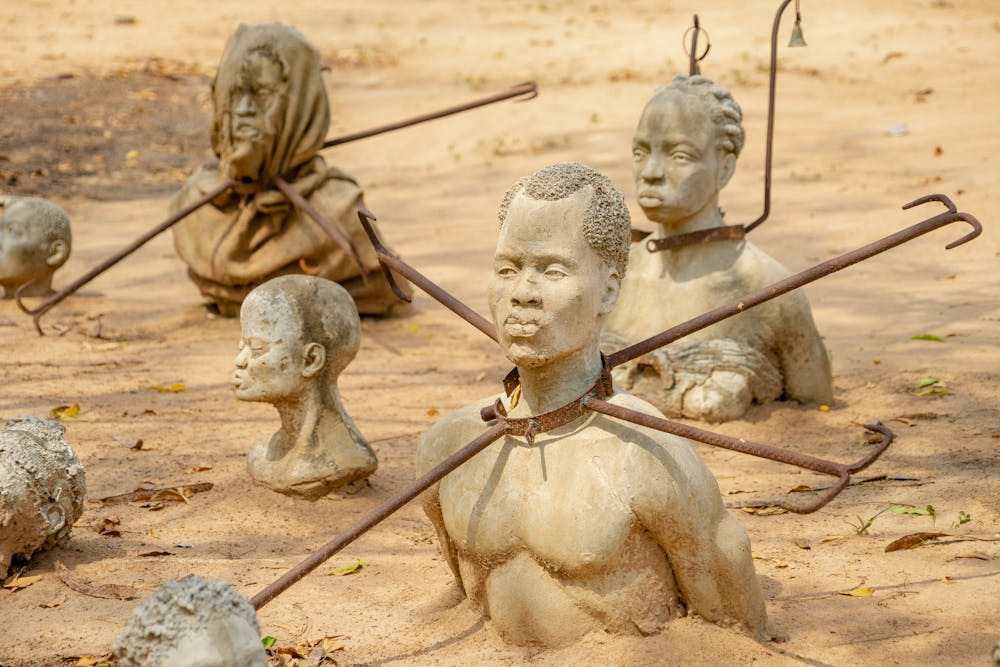
    Thousands of sculpted heads – captive African men, women, and children – meticulously created by the artist Kwame Akoto-Bamfo, emerge from the soil at the Nkyinkyim Museum, as a sacred gathering of ancestors. Together, they form a powerful monument to the horror, violence, and resistance to enslavement, as well as the ongoing work of remembrance and healing.

    Kwame Akoto-Bamfo is a Ghanaian multidisciplinary artist who engages with the histories and legacies of the transatlantic slave trade and colonialism at home and, increasingly, internationally, on both sides of the Atlantic.

    As an archaeologist who works in the field of critical heritage studies, Akoto-Bamfo’s work is important for its powerful engagement with memory, material culture and restorative justice. I feature it in a chapter of a new book that I co-edited called Architectures of Slavery: Ruins and Reconstructions.

    Who is Kwame Akoto-Bamfo?

    Akoto-Bamfo studied at the Kwame Nkrumah University of Science and Technology in Kumasi. He obtained his bachelor’s and master of fine arts degrees, both in sculpture. After graduating, the artist worked as a school teacher and a university lecturer.

    In 2015, Akoto-Bamfo rose to international fame through a series of large-scale installations. He called it ‘Nkyinkyim’ (“twisting” in the Ghanaian Twi language, as in the proverb, “Life’s journey is twisted”).


    Read more:
    Book review: how Africa was central to the making of the modern world


    Four years later, he established the ‘Nkyinkyim Museum’, a non-profit organisation known as the ‘Ancestor Project’. This open-air museum is located in Nuhalenya-Ada, a two-hour drive from Accra. It has become a space for people of African descent to engage in restorative healing through art and education.

    Nkyinkyim Museum

    At the site’s entrance, three twenty-five-foot monuments are displayed. They are made of stone, concrete and wood. The first is inspired by North and Eastern Africa, and the second by Sudano-Sahelian architecture. The third is inspired by the Forest regions in Central and West Africa.

    The collection includes multiple installations in collaboration with the local community. They illustrate “the diversity in our narratives surrounding history, philosophy, and religious beliefs”. The artist himself, demonstrates a mastery of multimedia art forms, working in cement, terracotta, brass, copper, and wood, noting “one can reach different heights with different technologies.”

    Today, the museum features a sacred healing space with a compelling display of thousands of unique concrete life size heads and 7,000 terracotta miniature sculpted heads. They include captive Africans abducted, sold and forcibly trafficked during the transatlantic slave trade.

    His sculptures capture captives’ shock, horror, anger, distress and fear—emotions. This is communicated through their facial expressions in an installation that is disturbingly evocative and profoundly haunting. It is inspired by ‘nsodie’, an Akan funerary sculpture tradition, that dates back to approximately the twelfth century. Akoto-Bamfo explains during our conversations relating to the research for book:

    I wanted to draw upon Akan belief in commemoration and remembrance after death in order to honour the young, old, men and women, who originated from various ethnic groups and who died in the Atlantic Ocean during the Middle Passage and did not get that chance.

    Each year, the annual ‘Ancestor Veneration’ ceremony takes place under the guidance of chiefs, priests, and priestess from various ethnic groups.

    Visitors are invited to participate in certain Akan rites and ceremonies – free from photography and selfies that undermine or commercialise sacred funerary art practices. Says Akoto-Bamfo:

    I am Akan, so initially I began with Akan traditional rites, but now our ceremonies welcome other African ethnic groups including the Ga-Dangme, Ewe, and Yoruba, from Ghana and Nigeria, as well as African descendant people in the African diaspora.

    In contrast, the ‘Freedom Parade Festival’ allows participants to creatively express and contribute to an evolving heritage tradition, without the specified observances. For example, painted bodily adornment applied directly onto the skin, yet without the necessary spiritual rites.

    A protest monument

    Akoto-Bamfo’s sculptures have also gained recognition beyond Ghana’s borders. For instance, the permanent installation at the Legacy Museum and National Museum for Peace and Justice in Montgomery, Alabama in the US.

    More recently, in 2021, his Blank Slate Project Monument toured throughout the United States. This included stops at Times Square in New York and the King Center in Atlanta. It depicts an enslaved ancestor, bent forward with his hands behind his back, head turned sideways, face on the ground, with a booted foot on his head.

    Akoto-Bamfo describes this work as “a noisy one — a protest piece that speaks against racist Civil War monuments.” The work was completed prior to the police killing of George Floyd that led to widespread protests in the US in 2020. It was first unveiled in a private viewing in Ghana, prior to its shipment to the United States.

    He says:

    We had a lot of discussions among those involved in the project: some feared it might incite violence, others said that it was a prediction.

    The work is interactive. It holds a removable placard that invites viewers to inscribe their reactions to the statue, which are then exhibited. Akoto-Bamfo emphasises:

    I wanted ordinary people, both individuals and communities, to relate, and to contribute to, not only towards my artwork but also to the wider ongoing discussions. As an artist, I believe that I do not have the sole right to speak. I wanted ordinary Americans to add their voices because I am already contributing.

    In Europe too, his work is featured at the 169 Museum in Germany.

    In Ghana, Akoto-Bamfo’s work was initially seen as too controversial. The artist shares:

    At first, I had to be extremely resilient because my work was concerned with the slave trade, slavery, colonialism, racism, and human rights. I embraced uncomfortable dialogue. Yet these were difficult topics for galleries and the art world at that time in Ghana.

    He adds:

    Today, however, some even view me as a spiritual leader… but I have always had an innate antipathy towards injustice. My work is not only about the past but what is unfolding now.

    Akoto-Bamfo offers a closing reflection on why this kind of memory work matters:

    I just want to use the little knowledge that I have to contribute towards the work of restorative and transformative justice.

    Rachel Ama Asaa Engmann does not work for, consult, own shares in or receive funding from any company or organisation that would benefit from this article, and has disclosed no relevant affiliations beyond their academic appointment.

    ref. Kwame Akoto-Bamfo: the Ghanaian artist using work about slavery to find justice and healing – https://theconversation.com/kwame-akoto-bamfo-the-ghanaian-artist-using-work-about-slavery-to-find-justice-and-healing-259184

    MIL OSI – Global Reports

  • MIL-OSI Global: Kwame Akoto-Bamfo: the Ghanaian artist using work about slavery to find justice and healing

    Source: The Conversation – Africa – By Rachel Ama Asaa Engmann, Associate Professor and Director of Christiansborg Archaeological Heritage Project, Associate Graduate Faculty, Rutgers University

    Thousands of sculpted heads – captive African men, women, and children – meticulously created by the artist Kwame Akoto-Bamfo, emerge from the soil at the Nkyinkyim Museum, as a sacred gathering of ancestors. Together, they form a powerful monument to the horror, violence, and resistance to enslavement, as well as the ongoing work of remembrance and healing.

    Kwame Akoto-Bamfo is a Ghanaian multidisciplinary artist who engages with the histories and legacies of the transatlantic slave trade and colonialism at home and, increasingly, internationally, on both sides of the Atlantic.

    As an archaeologist who works in the field of critical heritage studies, Akoto-Bamfo’s work is important for its powerful engagement with memory, material culture and restorative justice. I feature it in a chapter of a new book that I co-edited called Architectures of Slavery: Ruins and Reconstructions.

    Who is Kwame Akoto-Bamfo?

    Akoto-Bamfo studied at the Kwame Nkrumah University of Science and Technology in Kumasi. He obtained his bachelor’s and master of fine arts degrees, both in sculpture. After graduating, the artist worked as a school teacher and a university lecturer.

    In 2015, Akoto-Bamfo rose to international fame through a series of large-scale installations. He called it ‘Nkyinkyim’ (“twisting” in the Ghanaian Twi language, as in the proverb, “Life’s journey is twisted”).


    Read more:
    Book review: how Africa was central to the making of the modern world


    Four years later, he established the ‘Nkyinkyim Museum’, a non-profit organisation known as the ‘Ancestor Project’. This open-air museum is located in Nuhalenya-Ada, a two-hour drive from Accra. It has become a space for people of African descent to engage in restorative healing through art and education.

    Nkyinkyim Museum

    At the site’s entrance, three twenty-five-foot monuments are displayed. They are made of stone, concrete and wood. The first is inspired by North and Eastern Africa, and the second by Sudano-Sahelian architecture. The third is inspired by the Forest regions in Central and West Africa.

    The collection includes multiple installations in collaboration with the local community. They illustrate “the diversity in our narratives surrounding history, philosophy, and religious beliefs”. The artist himself, demonstrates a mastery of multimedia art forms, working in cement, terracotta, brass, copper, and wood, noting “one can reach different heights with different technologies.”

    Today, the museum features a sacred healing space with a compelling display of thousands of unique concrete life size heads and 7,000 terracotta miniature sculpted heads. They include captive Africans abducted, sold and forcibly trafficked during the transatlantic slave trade.

    His sculptures capture captives’ shock, horror, anger, distress and fear—emotions. This is communicated through their facial expressions in an installation that is disturbingly evocative and profoundly haunting. It is inspired by ‘nsodie’, an Akan funerary sculpture tradition, that dates back to approximately the twelfth century. Akoto-Bamfo explains during our conversations relating to the research for book:

    I wanted to draw upon Akan belief in commemoration and remembrance after death in order to honour the young, old, men and women, who originated from various ethnic groups and who died in the Atlantic Ocean during the Middle Passage and did not get that chance.

    Each year, the annual ‘Ancestor Veneration’ ceremony takes place under the guidance of chiefs, priests, and priestess from various ethnic groups.

    Visitors are invited to participate in certain Akan rites and ceremonies – free from photography and selfies that undermine or commercialise sacred funerary art practices. Says Akoto-Bamfo:

    I am Akan, so initially I began with Akan traditional rites, but now our ceremonies welcome other African ethnic groups including the Ga-Dangme, Ewe, and Yoruba, from Ghana and Nigeria, as well as African descendant people in the African diaspora.

    In contrast, the ‘Freedom Parade Festival’ allows participants to creatively express and contribute to an evolving heritage tradition, without the specified observances. For example, painted bodily adornment applied directly onto the skin, yet without the necessary spiritual rites.

    A protest monument

    Akoto-Bamfo’s sculptures have also gained recognition beyond Ghana’s borders. For instance, the permanent installation at the Legacy Museum and National Museum for Peace and Justice in Montgomery, Alabama in the US.

    More recently, in 2021, his Blank Slate Project Monument toured throughout the United States. This included stops at Times Square in New York and the King Center in Atlanta. It depicts an enslaved ancestor, bent forward with his hands behind his back, head turned sideways, face on the ground, with a booted foot on his head.

    Akoto-Bamfo describes this work as “a noisy one — a protest piece that speaks against racist Civil War monuments.” The work was completed prior to the police killing of George Floyd that led to widespread protests in the US in 2020. It was first unveiled in a private viewing in Ghana, prior to its shipment to the United States.

    He says:

    We had a lot of discussions among those involved in the project: some feared it might incite violence, others said that it was a prediction.

    The work is interactive. It holds a removable placard that invites viewers to inscribe their reactions to the statue, which are then exhibited. Akoto-Bamfo emphasises:

    I wanted ordinary people, both individuals and communities, to relate, and to contribute to, not only towards my artwork but also to the wider ongoing discussions. As an artist, I believe that I do not have the sole right to speak. I wanted ordinary Americans to add their voices because I am already contributing.

    In Europe too, his work is featured at the 169 Museum in Germany.

    In Ghana, Akoto-Bamfo’s work was initially seen as too controversial. The artist shares:

    At first, I had to be extremely resilient because my work was concerned with the slave trade, slavery, colonialism, racism, and human rights. I embraced uncomfortable dialogue. Yet these were difficult topics for galleries and the art world at that time in Ghana.

    He adds:

    Today, however, some even view me as a spiritual leader… but I have always had an innate antipathy towards injustice. My work is not only about the past but what is unfolding now.

    Akoto-Bamfo offers a closing reflection on why this kind of memory work matters:

    I just want to use the little knowledge that I have to contribute towards the work of restorative and transformative justice.

    Rachel Ama Asaa Engmann does not work for, consult, own shares in or receive funding from any company or organisation that would benefit from this article, and has disclosed no relevant affiliations beyond their academic appointment.

    ref. Kwame Akoto-Bamfo: the Ghanaian artist using work about slavery to find justice and healing – https://theconversation.com/kwame-akoto-bamfo-the-ghanaian-artist-using-work-about-slavery-to-find-justice-and-healing-259184

    MIL OSI – Global Reports

  • MIL-OSI Global: Kenya’s police still kill with impunity – what needs to be done to stop them

    Source: The Conversation – Africa – By Kamau Wairuri, Lecturer in criminology, Edinburgh Napier University

    Weeks ahead of the first anniversary in Kenya of the Gen Z-led anti-government protests that resulted in at least 60 deaths and displays of police brutality, news broke that Albert Ojwang, a young Kenyan blogger, had died in police detention. Kamau Wairuri who has studied the politics of policing in Kenya, sets out why these events aren’t outliers, what efforts have been made to reform Kenya’s security forces, and what still needs to be done.

    When did this all begin?

    Recent events are part of a long history of police brutality in Kenya that can be traced back to colonial times.

    Historians (colonial and post-colonial Kenya) such as David Anderson and Caroline Elkins present gruesome details of how state authorities brutalised indigenous Africans during colonial times.

    The colonial origins of the police – largely modelled along the approaches of the Royal Ulster Constabulary known for its brutality in Ireland – partly explains why Kenya’s policing is the way it is. The police force was never designed for service. It was designed to safeguard the interests of the white minority ruling elite.

    While there have been important changes in the architecture of policing since independence, subsequent post-colonial Kenyan regimes have adopted the same brutal approaches to stay in power. My previous work demonstrates this use of state security apparatuses to enhance the capacity of incumbents to crack down on opposition protests.

    The brutal policing experienced under the current Kenya Kwanza regime falls within this broader historical trajectory.

    The ruling elite see and use the police as their last line of defence against challenges to their misrule.

    But police brutality goes beyond the policing of politics to everyday crime control. Police violence is a common occurrence, especially against poor young men.

    What’s changed

    Kenya’s history has been marked by strong agitation for justice and reform. Again, this goes back to colonial times.

    There have been important legal and institutional changes since independence. The most important was the disbandment of the Special Branch in 1998, an intelligence unit of the police responsible for political repression. It was replaced by the National Security Intelligence Service. This then became the National Intelligence Service.

    The most important changes came about through the constitutional reform of 2010. This saw a change in the architecture of the police, including:

    Internal Affairs, a unit within the police service, is supposed to investigate police misconduct. The policing oversight agency is a civilian-led institutions with a similar mandate. Ideally, the two institutions should work together in executing crucial investigations. Internal affairs should provide access to information from within the police service that would be difficult for outsiders to access.

    The National Police Service Commission was set up to handle the management of personnel. It’s mandated to address the challenges of corruption, nepotism and negative ethnicity that have characterised recruitment into the police service.

    But it’s clear from the continued police brutality that these institutions aren’t achieving the intended effect. This means that police officers can expect to continue acting with relative impunity despite the control measures in place.

    What still needs to be done

    Policing is often imagined as the investigation of crimes, arresting suspects, and presenting them to court for prosecution and punishment if guilty. In Kenya, the actions of the police often appear to substitute for the entire criminal justice system.

    In many cases, officers go beyond the metaphor of judge, jury and executioner to also become the complainant, mortician and undertaker. For instance, Mbaraka Karanja died in police custody in 1987 and officers proceeded to incinerate his body.

    In my view, the brutality won’t end until the following steps have been taken.

    First, the National Police Service Commission needs to reclaim its mandate. It seems to have completely abdicated duty, transferring crucial responsibilities back to the inspector general of the police service. As the human resource unit of the police, the commission has an important role of professionalising the service and maintaining discipline. It’s presently not doing so.

    Second, the Internal Affairs Unit needs to be strengthened and given more autonomy. So far, it has been difficult to assess the effectiveness the unit given the secrecy that characterises the police service. A better-resourced unit will enhance investigations of police misconduct. It would unearth obscure squads within the police service and reveal evidence to help identify perpetrators.

    Third, the Independent Policing Oversight Authority needs to defend its independence and develop popular legitimacy. With its limited success in prosecuting police officers – despite the prevalence of police abuse – many Kenyans have lost confidence in it. Crucially, the authority has failed in it’s deterrence role.

    Fourth, the independence of the National Police Service needs to be safeguarded. The police service leadership continues to serve at the pleasure of the prevailing regime. This in turn shapes the priorities of the service. Inspectors-general have been forced to resign. President William Ruto confessed to having fired the director of criminal investigations when he took power. Ruto had initially claimed that the director had resigned.

    Crucially, and in fifth place, there needs to be a change in policing culture alongside broader governance culture in Kenya. Impunity is rampant across the public service. Kenya won’t have a highly accountable police force while other agencies and senior officials are operating with significant impunity.

    Identifying the levers of cultural change isn’t easy. There are many proposals to alter policing culture. These include a complete redesign of Kenya’s Penal Code to dislodge its colonial roots, transforming the training of police officers, and strengthening the policing oversight authority’s capacity to investigate cases.

    But, in my mind, a crucial starting point is citizen agitation and demand for accountability. The light that Gen Z protesters, the media and civil society organisations are shining on police abuses should be encouraged. A clear signal that Kenyans will no longer tolerate police abuse is crucial for culture change within the service and among the political elite.

    However, this needs to be understood within the reality that many Kenyans support police violence, believing it to be the most effective way of dealing with crime as my earlier research demonstrates. In another study, I note how police abuse is endorsed by politicians and religious leaders as a way of responding to crime and punishing groups of people they don’t like.

    Combined with ineffective accountability mechanisms, this popular support for police violence, both tacit and explicit, gives the police the belief that they are the thin blue line between order and chaos. That they have the popular mandate to use any means they consider necessary – often brutal violence – to keep society safe.

    In other words, the conversation on police reform requires a fundamental reframing to kick start the journey towards democratic policing. At present, we’re not only way off the mark, we seem to be heading in the wrong direction.

    Kamau Wairuri does not work for, consult, own shares in or receive funding from any company or organisation that would benefit from this article, and has disclosed no relevant affiliations beyond their academic appointment.

    ref. Kenya’s police still kill with impunity – what needs to be done to stop them – https://theconversation.com/kenyas-police-still-kill-with-impunity-what-needs-to-be-done-to-stop-them-259326

    MIL OSI – Global Reports

  • MIL-OSI Africa: Kwame Akoto-Bamfo: the Ghanaian artist using work about slavery to find justice and healing

    Source: The Conversation – Africa – By Rachel Ama Asaa Engmann, Associate Professor and Director of Christiansborg Archaeological Heritage Project, Associate Graduate Faculty, Rutgers University

    Thousands of sculpted heads – captive African men, women, and children – meticulously created by the artist Kwame Akoto-Bamfo, emerge from the soil at the Nkyinkyim Museum, as a sacred gathering of ancestors. Together, they form a powerful monument to the horror, violence, and resistance to enslavement, as well as the ongoing work of remembrance and healing.

    Kwame Akoto-Bamfo.

    Kwame Akoto-Bamfo is a Ghanaian multidisciplinary artist who engages with the histories and legacies of the transatlantic slave trade and colonialism at home and, increasingly, internationally, on both sides of the Atlantic.

    As an archaeologist who works in the field of critical heritage studies, Akoto-Bamfo’s work is important for its powerful engagement with memory, material culture and restorative justice. I feature it in a chapter of a new book that I co-edited called Architectures of Slavery: Ruins and Reconstructions.

    Who is Kwame Akoto-Bamfo?

    Akoto-Bamfo studied at the Kwame Nkrumah University of Science and Technology in Kumasi. He obtained his bachelor’s and master of fine arts degrees, both in sculpture. After graduating, the artist worked as a school teacher and a university lecturer.

    In 2015, Akoto-Bamfo rose to international fame through a series of large-scale installations. He called it ‘Nkyinkyim’ (“twisting” in the Ghanaian Twi language, as in the proverb, “Life’s journey is twisted”).


    Read more: Book review: how Africa was central to the making of the modern world


    Four years later, he established the ‘Nkyinkyim Museum’, a non-profit organisation known as the ‘Ancestor Project’. This open-air museum is located in Nuhalenya-Ada, a two-hour drive from Accra. It has become a space for people of African descent to engage in restorative healing through art and education.

    Nkyinkyim Museum

    At the site’s entrance, three twenty-five-foot monuments are displayed. They are made of stone, concrete and wood. The first is inspired by North and Eastern Africa, and the second by Sudano-Sahelian architecture. The third is inspired by the Forest regions in Central and West Africa.

    Sculptures at the museum entrance. Kwame Akoto-Bamfo

    The collection includes multiple installations in collaboration with the local community. They illustrate “the diversity in our narratives surrounding history, philosophy, and religious beliefs”. The artist himself, demonstrates a mastery of multimedia art forms, working in cement, terracotta, brass, copper, and wood, noting “one can reach different heights with different technologies.”

    Today, the museum features a sacred healing space with a compelling display of thousands of unique concrete life size heads and 7,000 terracotta miniature sculpted heads. They include captive Africans abducted, sold and forcibly trafficked during the transatlantic slave trade.

    An installation of the heads of enslaved people. Kwame Akoto-Bamfo

    His sculptures capture captives’ shock, horror, anger, distress and fear—emotions. This is communicated through their facial expressions in an installation that is disturbingly evocative and profoundly haunting. It is inspired by ‘nsodie’, an Akan funerary sculpture tradition, that dates back to approximately the twelfth century. Akoto-Bamfo explains during our conversations relating to the research for book:

    I wanted to draw upon Akan belief in commemoration and remembrance after death in order to honour the young, old, men and women, who originated from various ethnic groups and who died in the Atlantic Ocean during the Middle Passage and did not get that chance.

    Each year, the annual ‘Ancestor Veneration’ ceremony takes place under the guidance of chiefs, priests, and priestess from various ethnic groups.

    The museum displays 7,000 terracotta sculpted heads. Kwame Akoto-Bamfo

    Visitors are invited to participate in certain Akan rites and ceremonies – free from photography and selfies that undermine or commercialise sacred funerary art practices. Says Akoto-Bamfo:

    I am Akan, so initially I began with Akan traditional rites, but now our ceremonies welcome other African ethnic groups including the Ga-Dangme, Ewe, and Yoruba, from Ghana and Nigeria, as well as African descendant people in the African diaspora.

    In contrast, the ‘Freedom Parade Festival’ allows participants to creatively express and contribute to an evolving heritage tradition, without the specified observances. For example, painted bodily adornment applied directly onto the skin, yet without the necessary spiritual rites.

    A protest monument

    Akoto-Bamfo’s sculptures have also gained recognition beyond Ghana’s borders. For instance, the permanent installation at the Legacy Museum and National Museum for Peace and Justice in Montgomery, Alabama in the US.

    More recently, in 2021, his Blank Slate Project Monument toured throughout the United States. This included stops at Times Square in New York and the King Center in Atlanta. It depicts an enslaved ancestor, bent forward with his hands behind his back, head turned sideways, face on the ground, with a booted foot on his head.

    The Blank Slate Monument in New York. Roshi Sariaslan

    Akoto-Bamfo describes this work as “a noisy one — a protest piece that speaks against racist Civil War monuments.” The work was completed prior to the police killing of George Floyd that led to widespread protests in the US in 2020. It was first unveiled in a private viewing in Ghana, prior to its shipment to the United States.

    He says:

    We had a lot of discussions among those involved in the project: some feared it might incite violence, others said that it was a prediction.

    The work is interactive. It holds a removable placard that invites viewers to inscribe their reactions to the statue, which are then exhibited. Akoto-Bamfo emphasises:

    I wanted ordinary people, both individuals and communities, to relate, and to contribute to, not only towards my artwork but also to the wider ongoing discussions. As an artist, I believe that I do not have the sole right to speak. I wanted ordinary Americans to add their voices because I am already contributing.

    In Europe too, his work is featured at the 169 Museum in Germany.

    The effects of enslavement are still felt today. Kwame Akoto-Bamfo

    In Ghana, Akoto-Bamfo’s work was initially seen as too controversial. The artist shares:

    At first, I had to be extremely resilient because my work was concerned with the slave trade, slavery, colonialism, racism, and human rights. I embraced uncomfortable dialogue. Yet these were difficult topics for galleries and the art world at that time in Ghana.

    He adds:

    Today, however, some even view me as a spiritual leader… but I have always had an innate antipathy towards injustice. My work is not only about the past but what is unfolding now.

    Akoto-Bamfo offers a closing reflection on why this kind of memory work matters:

    I just want to use the little knowledge that I have to contribute towards the work of restorative and transformative justice.

    – Kwame Akoto-Bamfo: the Ghanaian artist using work about slavery to find justice and healing
    – https://theconversation.com/kwame-akoto-bamfo-the-ghanaian-artist-using-work-about-slavery-to-find-justice-and-healing-259184

    MIL OSI Africa

  • MIL-OSI Africa: Kenya’s police still kill with impunity – what needs to be done to stop them

    Source: The Conversation – Africa – By Kamau Wairuri, Lecturer in criminology, Edinburgh Napier University

    Weeks ahead of the first anniversary in Kenya of the Gen Z-led anti-government protests that resulted in at least 60 deaths and displays of police brutality, news broke that Albert Ojwang, a young Kenyan blogger, had died in police detention. Kamau Wairuri who has studied the politics of policing in Kenya, sets out why these events aren’t outliers, what efforts have been made to reform Kenya’s security forces, and what still needs to be done.

    When did this all begin?

    Recent events are part of a long history of police brutality in Kenya that can be traced back to colonial times.

    Historians (colonial and post-colonial Kenya) such as David Anderson and Caroline Elkins present gruesome details of how state authorities brutalised indigenous Africans during colonial times.

    The colonial origins of the police – largely modelled along the approaches of the Royal Ulster Constabulary known for its brutality in Ireland – partly explains why Kenya’s policing is the way it is. The police force was never designed for service. It was designed to safeguard the interests of the white minority ruling elite.

    While there have been important changes in the architecture of policing since independence, subsequent post-colonial Kenyan regimes have adopted the same brutal approaches to stay in power. My previous work demonstrates this use of state security apparatuses to enhance the capacity of incumbents to crack down on opposition protests.

    The brutal policing experienced under the current Kenya Kwanza regime falls within this broader historical trajectory.

    The ruling elite see and use the police as their last line of defence against challenges to their misrule.

    But police brutality goes beyond the policing of politics to everyday crime control. Police violence is a common occurrence, especially against poor young men.

    What’s changed

    Kenya’s history has been marked by strong agitation for justice and reform. Again, this goes back to colonial times.

    There have been important legal and institutional changes since independence. The most important was the disbandment of the Special Branch in 1998, an intelligence unit of the police responsible for political repression. It was replaced by the National Security Intelligence Service. This then became the National Intelligence Service.

    The most important changes came about through the constitutional reform of 2010. This saw a change in the architecture of the police, including:

    Internal Affairs, a unit within the police service, is supposed to investigate police misconduct. The policing oversight agency is a civilian-led institutions with a similar mandate. Ideally, the two institutions should work together in executing crucial investigations. Internal affairs should provide access to information from within the police service that would be difficult for outsiders to access.

    The National Police Service Commission was set up to handle the management of personnel. It’s mandated to address the challenges of corruption, nepotism and negative ethnicity that have characterised recruitment into the police service.

    But it’s clear from the continued police brutality that these institutions aren’t achieving the intended effect. This means that police officers can expect to continue acting with relative impunity despite the control measures in place.

    What still needs to be done

    Policing is often imagined as the investigation of crimes, arresting suspects, and presenting them to court for prosecution and punishment if guilty. In Kenya, the actions of the police often appear to substitute for the entire criminal justice system.

    In many cases, officers go beyond the metaphor of judge, jury and executioner to also become the complainant, mortician and undertaker. For instance, Mbaraka Karanja died in police custody in 1987 and officers proceeded to incinerate his body.

    In my view, the brutality won’t end until the following steps have been taken.

    First, the National Police Service Commission needs to reclaim its mandate. It seems to have completely abdicated duty, transferring crucial responsibilities back to the inspector general of the police service. As the human resource unit of the police, the commission has an important role of professionalising the service and maintaining discipline. It’s presently not doing so.

    Second, the Internal Affairs Unit needs to be strengthened and given more autonomy. So far, it has been difficult to assess the effectiveness the unit given the secrecy that characterises the police service. A better-resourced unit will enhance investigations of police misconduct. It would unearth obscure squads within the police service and reveal evidence to help identify perpetrators.

    Third, the Independent Policing Oversight Authority needs to defend its independence and develop popular legitimacy. With its limited success in prosecuting police officers – despite the prevalence of police abuse – many Kenyans have lost confidence in it. Crucially, the authority has failed in it’s deterrence role.

    Fourth, the independence of the National Police Service needs to be safeguarded. The police service leadership continues to serve at the pleasure of the prevailing regime. This in turn shapes the priorities of the service. Inspectors-general have been forced to resign. President William Ruto confessed to having fired the director of criminal investigations when he took power. Ruto had initially claimed that the director had resigned.

    Crucially, and in fifth place, there needs to be a change in policing culture alongside broader governance culture in Kenya. Impunity is rampant across the public service. Kenya won’t have a highly accountable police force while other agencies and senior officials are operating with significant impunity.

    Identifying the levers of cultural change isn’t easy. There are many proposals to alter policing culture. These include a complete redesign of Kenya’s Penal Code to dislodge its colonial roots, transforming the training of police officers, and strengthening the policing oversight authority’s capacity to investigate cases.

    But, in my mind, a crucial starting point is citizen agitation and demand for accountability. The light that Gen Z protesters, the media and civil society organisations are shining on police abuses should be encouraged. A clear signal that Kenyans will no longer tolerate police abuse is crucial for culture change within the service and among the political elite.

    However, this needs to be understood within the reality that many Kenyans support police violence, believing it to be the most effective way of dealing with crime as my earlier research demonstrates. In another study, I note how police abuse is endorsed by politicians and religious leaders as a way of responding to crime and punishing groups of people they don’t like.

    Combined with ineffective accountability mechanisms, this popular support for police violence, both tacit and explicit, gives the police the belief that they are the thin blue line between order and chaos. That they have the popular mandate to use any means they consider necessary – often brutal violence – to keep society safe.

    In other words, the conversation on police reform requires a fundamental reframing to kick start the journey towards democratic policing. At present, we’re not only way off the mark, we seem to be heading in the wrong direction.

    – Kenya’s police still kill with impunity – what needs to be done to stop them
    – https://theconversation.com/kenyas-police-still-kill-with-impunity-what-needs-to-be-done-to-stop-them-259326

    MIL OSI Africa

  • MIL-OSI New Zealand: Serious crash, Great North Road

    Source: New Zealand Police

    Great North Road in Glen Eden is closed following a serious crash.

    Police were notified at around 4.30pm of the multiple-vehicle crash, which happened between Brandon Road and Westech Place.

    Indications are that there are serious injuries.

    The road is closed and diversions are in place.

    Police ask motorists to avoid the area and delay travel if possible.

    ENDS

    MIL OSI New Zealand News

  • MIL-OSI Security: Defense News in Brief: NCIS Major Case Response Team Basic Training Program Earns FLETA Accreditation

    Source: United States Navy

    QUANTICO, Va. – The NCIS Major Case Response Team Basic Training Program, hosted by the Office of Forensic Support’s Pacific Forensic Training Center, has officially earned accreditation from the Federal Law Enforcement Training Accreditation Board as of May 15.

    MIL Security OSI

  • MIL-OSI Security: Defense News in Brief: USS Cole Assists Royal Canadian Navy, U.S. Coast Guard, Conduct At-Sea Transfer of Intercepted Contraband

    Source: United States Navy

    CARIBBEAN SEA – The Arleigh Burke-class guided missile destroyer USS Cole (DDG 67), supporting maritime southern border operations, conducted a hold-and-transfer of 245 kilograms of contraband recovered by the Royal Canadian Navy Harry DeWolf-class offshore patrol vessel HMCS William Hall (AOPV 433) in the Caribbean Sea June 9. The Reliance-class U.S. Coast Guard (USCG) Cutter Vigorous (WMEC 627) accepted the contraband from the Cole’s embarked USCG Law Enforcement Detachment (LEDET) June 11 during a rendezvous at sea in the Caribbean.

    MIL Security OSI

  • MIL-Evening Report: What is a ‘bunker buster’? An expert explains what the US dropped on Iran – and what might happen now

    Source: The Conversation (Au and NZ) – By James Dwyer, Lecturer, School of Social Sciences, University of Tasmania

    The jagged silhouette of a B2 stealth bomber seen during a 2015 flyover in the US. Jonathan Daniel / Getty Images

    Late on Saturday night, local time, the United States carried out strikes against Iranian nuclear enrichment sites at Fordow, Natanz and Isfahan, marking its open participation in the conflict between Iran and Israel.

    The US says it fired 30 submarine-launched missiles at the sites in Natanz and Isfahan, as well as dropping more than a dozen “bunker buster” bombs at Fordow and Natanz.

    The kind of bomb in question is the extremely destructive GBU-57 Massive Ordance Penetrator, or MOP, which weighs around 13.5 tonnes.

    The attacks raise a lot of questions. What are these enormous bombs? Why did the US feel it had to get involved in the conflict? And, going forward, what does it mean for Iran’s nuclear ambitions?

    What are ‘bunker busters’, and why are they used?

    Bunker busters are weapons designed to destroy heavily protected facilities such as bunkers deep underground, beyond the reach of normal bombs.

    Bunker busters are designed to bury themselves into the ground before detonating. This allows more of the explosive force to penetrate into the ground, rather than travelling through the air or across the surface.

    Iran’s nuclear enrichment sites at Fordow, Natanz and Isfahan are built deep underground. Estimates suggest that Fordow for example could be 80m beneath the surface, and capped with layers of reinforced concrete and soil.

    What is the MOP?

    The bunker buster used in this particular operation is the largest in the US arsenal. Leaving aside nuclear weapons, the MOP is the largest known buster buster in the world.

    Weighing some 13.5 tonnes, the MOP is believed to be able to penetrate up to 60 metres below ground in the right conditions. It is not known how many the US possesses, but the numbers are thought to be small (perhaps 20 or so in total).

    We also don’t know exactly how many were used in Iran, though some reports say it was 14. However, it is likely to be a significant portion of the US MOP arsenal.

    Why does only the US possess this capability?

    The US is not the only state with bunker-busting weaponry. However, the size of MOP means it requires very specialised bombers to carry and drop it.

    Only the B2 stealth bomber is currently able to deploy the MOP. Each B2 can carry at most two MOPs at a time. Around seven of America’s 19 operational B2s were used in the Iran operation.

    There has been some consideration whether large transport aircraft such as the C-130 Hercules could be modified to carry and drop the MOP from its rear cargo doors. While this would allow other countries (including Israel) to deploy the MOP, it is for now purely hypothetical.

    Why has the US (apparently) used them in Iran

    The Trump administration claims Iran may be only a few weeks from possessing a nuclear weapon, and that it needed to act now to destroy Iranian nuclear enrichment sites. This claim is notably at odds with published assessments from the US intelligence community.

    However, Israel lacks bunker busting weaponry sufficient to damage the deeply buried and fortified enrichment sites at Fordow, Natanz and Isfahan.

    An F-15E Strike Eagle releases a GBU-28 ‘bunker buster’ laser-guided bomb, a smaller equivalewnt of the 13,600 kg GBU-57 ‘Massive Ordnance Penetrator’ believed to have been used in Iran.
    Michael Ammons / US Air Force

    Only the MOP could do the job (short of using nuclear weapons). Even then, multiple MOPs would have been required to ensure sufficient damage to the underground facilities.

    The US has claimed that these sites have been utterly destroyed. We cannot conclusively say whether this is true.

    Iran may also have other, undeclared nuclear sites elsewhere in the country.

    Iran’s reaction

    The US has reportedly reached out to Iran via diplomatic channels to emphasise that this attack was a one-off, not part of a larger project of regime change. It is hard to say what will happen in the next few weeks.

    Iran may retaliate with large strikes against Israel or against US forces in the region. It could also interrupt shipping in the Strait of Hormuz, which would affect a large portion of global oil shipments, with profound economic implications.

    Alternatively, Iran could capitulate and take steps to demonstrate it is ending its nuclear program. However, capitulation would not necessarily mean the end of Iran’s nuclear ambitions.

    The value of nuclear weapons

    Perhaps a greater concern is that the attack will reinforce Iran’s desire to go nuclear. Without nuclear weapons, Iran was unable to threaten the US enough to deter today’s attack.

    Iran may take lessons from the fate of other states. Ukraine (in)famously surrendered its stockpile of former Soviet nuclear weapons in the early 1990s. Russia has since felt emboldened to annex Crimea in 2014 and launch an ongoing invasion in 2022. Other potential nuclear states, such as Iraq and Gadaffi’s regime in Libya, also suffered from military intervention.

    By contrast, North Korea successfully tested its first nuclear weapon in 2006. Since then there has been no serious consideration of military intervention in North Korea.

    Iran may yet have the ability to produce useful amounts of weapons-grade uranium. It may now aim to buy itself time to assemble a relatively small nuclear device, similar in scale to the bombs used in Hiroshima and Nagasaki.

    Depending on what facilities and resources have survive the US strikes, the attack has likely reinforced that the only way the Iranian regime can guarantee its survival is to possess nuclear weapons.

    James Dwyer does not work for, consult, own shares in or receive funding from any company or organisation that would benefit from this article, and has disclosed no relevant affiliations beyond their academic appointment.

    ref. What is a ‘bunker buster’? An expert explains what the US dropped on Iran – and what might happen now – https://theconversation.com/what-is-a-bunker-buster-an-expert-explains-what-the-us-dropped-on-iran-and-what-might-happen-now-259508

    MIL OSI AnalysisEveningReport.nz

  • MIL-OSI Asia-Pac: Security Bureau holds Flag Raising Ceremony by Disciplined Services and Youth Groups for Commemorating 5th Anniversary of Promulgation and Implementation of Hong Kong National Security Law

    Source: Hong Kong Government special administrative region

    Security Bureau holds Flag Raising Ceremony by Disciplined Services and Youth Groups for Commemorating 5th Anniversary of Promulgation and Implementation of Hong Kong National Security LawIssued at HKT 11:40

    NNNN

    MIL OSI Asia Pacific News

  • MIL-OSI USA: LEADER JEFFRIES STATEMENT ON TRUMP’S UNILATERAL MILITARY ACTION IN IRAN

    Source: United States House of Representatives – Congressman Hakeem Jeffries (8th District of New York)

    Know Your Immigration Rights

    If you or a loved one encounter immigration enforcement officials, it is essential that you know your rights and have prepared your household for all possible outcomes.

    Ask for a warrant: The Fourth Amendment of the Constitution protects you from unreasonable search and seizure. You do not have to open your door until you see a valid warrant to enter your home or search your belongings.

    Your right to remain silent: The Fifth Amendment protects your right to remain silent and not incriminate yourself. You are not required to share any personal information such as your place of birth, immigration status or criminal history.

    Always consult an attorney: You have a right to speak with an attorney. You do not have to sign anything or hand officials any documents without speaking to an attorney. Try to identify and consult one in advance.

    The New York City Office of Civil Justice and the Mayor’s Office of Immigrant Affairs (MOIA) support a variety of free immigration legal services through local nonprofit legal organizations. To access these resources, dial 311 and say “Action NYC,” call the MOIA Immigration Legal Support Hotline at 800-354-0365 Monday through Friday from 9:00 a.m. to 6:00 p.m. or visit MOIA’s website.

    Learn more here: KNOW YOUR IMMIGRATION RIGHTS  – Congressman Hakeem Jeffries

    MIL OSI USA News

  • MIL-OSI New Zealand: Body found in search for Elisabeth Nicholls

    Source: New Zealand Police

    Attributable to: Detective Sergeant Luke Vaughan, Canterbury CIB.

    Police searching for missing woman Elisabeth ‘Lis’ Nicholls in central Christchurch have today found a body.

    While formal identification is yet to take place, it is believed to be the body of the 79-year-old, reported missing from Riccarton on 4 June.

    Canterbury Police, along with Land Search and Rescue volunteers, have been scouring areas in the city working to locate Lis, and we hope today’s discovery will help provide some closure for her family and loved ones.

    Our thoughts are with them at this incredibly difficult time, and we thank the public and everyone who helped in the search for their efforts.

    The death will be referred to the Coroner.

    ENDS

    MEDIA NOTE – Elisabeth’s family do not wish to be contacted by media at this time.

    Issued by Police Media Team

    MIL OSI New Zealand News

  • MIL-OSI USA: Attorney General James Announces 367 Guns Turned in at Schenectady Gun Buyback

    Source: US State of New York

    Today’s buyback event in Schenectady resulted in 367 guns being turned in, including 147 assault weapons, 92 handguns, and 65 long guns, among others. Following today’s gun buyback event, Attorney General James has helped remove more than 9,500 guns out of New York communities.

    “The State Police is proud to partner with the New York State Attorney General’s Office on this initiative, with the shared goal of preventing senseless gun-involved tragedies and improving safety in our local communities,” said New York State Police Superintendent Steven G. James. “Gun buyback programs can prevent firearms from falling into the wrong hands, and are a compliment to our overall strategy to reduce gun violence.”

    “This gun buyback is a safe and approachable way to remove unwanted weapons from the community,” said Schenectady Mayor Gary McCarthy. “I am pleased that our city was able to support the Attorney General’s Office and our other local law enforcement partners to work together on this important initiative.”

    “We thank the Attorney General for partnering with departments across Schenectady County to give folks a safe, simple way to turn in guns they no longer want or need,” said Gary Hughes, Chair of the Schenectady County Legislature. “Programs like this reduce risk and help make our neighborhoods safer.”

    “Gun buyback events give people a safe and responsible way to dispose of firearms they no longer want or need. It’s a personal decision — and for many, it brings peace of mind,” said Assemblymember Angelo Santabarbara. “These programs help reduce the risk of accidents, theft, or misuse, especially in homes with children or vulnerable individuals. It’s a practical approach to public safety, and it allows people to take meaningful action on their own terms. I thank Attorney General James and our partners in law enforcement for organizing today’s event and providing community members the opportunity to be a part of the solution to senseless gun violence.”

    “Gun safety continues to be one of the most pressing issues we face across the country,” said Assemblymember Phil Steck. “Events like this gun buyback are critical tools in helping to reduce violence and get as many firearms off our streets as possible. I commend Attorney General James, the Schenectady Police Department, and local law enforcement for their leadership and commitment to public safety, and I’m proud to see initiatives like this happening in our community.”

    “I applaud Attorney General James, the New York State Police, and all our law enforcement partners for coordinating today’s gun buyback event in Schenectady,” said Chief Michael Brown, Rotterdam Police Department. “These events allow community members to take action against gun violence and turn in unwanted firearms. Our community is safer because of gun buyback events like these, and I look forward to working with our law enforcement partners in the future to protect our communities and our streets.”

    “The Scotia Police Department is proud to work alongside our partner agencies in Schenectady County and the New York State Attorney General’s Office for this important gun buyback event,” said Chief Adam Halbfinger, Scotia Police Department. “Collaborative efforts like this are vital to making our community a safer place for everyone.” 

    MIL OSI USA News

  • MIL-OSI New Zealand: Flawed Law Turns Blind Eye To Child Prostitution

    Source: Family First

    MEDIA RELEASE – 21 June 2025

    PROSTITUTION LAW REVIEW: BENEFITS EXAGGERATED, SHORTCOMINGS IGNORED, DENIED OR HIDDEN

    Family First says that a TVNZ report on child prostitution is no surprise, given the lack of oversight of the law and a failure to formally review its many failings.

    An indepth review in 2021 of the effects of the 2003 prostitution law change revealed a huge gap between the reputation of the law and its actual impact. The detailed analysis challenged the assumption that the decriminalisation of prostitution has been a success, finding the benefits of the Prostitution Reform Act 2003 (PRA) have been exaggerated and its shortcomings ignored, denied or hidden.

    IS IT WORKING? An evidenced-based review of the decriminalisation of prostitution in New Zealand” highlighted several significant concerns:

    Increased numbers of prostitutes. The New Zealand Prostitutes’ Collective has failed to collect accurate data on the numbers of people involved in prostitution, despite being contracted by the Government to do so.

    Health and safety violations – and the reality of violence. Continuing health and safety violations include coercion into unwanted sex acts, high levels of violence, physical injury, unsafe sex, and exploitative practices such as long working hours. Violence is a risk every prostitute takes on a daily basis. Assault, rape and strangulation are not uncommon.

    What other business or sector of society in New Zealand would tolerate this – and yet the sex industry is sold as a success story. Where is the Occupational Safety and Health? No other work employment sector has a risk factor where rape is considered an inherent part of the work, and why would we want a family member to be in a type of work where there is a 35% chance of being sexually molested i.e forced to accept sex from a man they did not want to.

    Fuelled by increasingly violent pornography and a notorious drinking culture, punters frequently enjoy hurting women; overseas studies show that some men think raping a prostitute is not even possible. As a result, studies continue to document depression, post-traumatic stress disorder (PTSD), anxiety disorders, dissociative disorders and bipolar disorder in women involved in prostitution.

    Yet New Zealand’s official Health and Safety Manual for prostitution normalises violence and coercion by advising prostitutes to ‘identify potentially dangerous situations,’ and to devise strategies ‘to protect themselves.’ The prostitutes’ collective stated openly in 2016 that it was impossible to wipe out violence in the industry.

    Low rates of reporting and prosecuting violations. Fewer than 20% of those who had been physically assaulted reported it to the police. Since 2003 there have been only two prosecutions for coercion – committed usually by women’s managers (pimps) – despite repeated reports that it happens frequently.

    Street workers experience 2 to 3 times more violence than other workers, and actual serious violence (rape, holding against will, and physical violence) are significantly underreported to the Police. Even the Prostitute Collective’s reports to the Ministry of Health make frequent mention of violence and coercion, often by brothel ‘managers’ (pimps).

    The black market. The industry realities of gang involvement, child exploitation and internal trafficking are largely denied or ignored by the NZPC. The Ministry for Children confirmed that under-age prostitution was not a target area and that no funding had been made available to tackle it.

    Lack of support for exiting the industry. No resources have been provided to support women who wish to exit the industry. When the law reform was being debated, it was promoted as helping to prevent entry and facilitate exiting, however the NZPC does not support that approach.

    Failure to implement recommended changes: A review of the law reform in 2008 made 28 recommendations, however, only 11 have been followed through in any way.

    Despite dangerous conditions continuing, New Zealand’s prostitution law reform has been widely lauded – particularly overseas – as beneficial for the women involved. The report identifies the main reason for this misinformation: the conversation is dominated by the New Zealand Prostitutes Collective (NZPC), a lobby group whom the Government relies on overwhelmingly for information regarding any issue related to prostitution.

    TVNZ also fell into this same trap.

    The report found that the NZPC does not provide support for those wishing to exit, has no official contact with the black market of prostitution, and plays down the industry-wide realities of violence and exploitation – denying the existence of under-age abuse and internal trafficking, rejecting the voices of exited women, and amplifying the voices of pimps.

    When implementing the law reform in 2003, Parliament was clear that its impact should be fully scrutinised. Five years later, in 2008, the Prostitution Law Reform Committee’s review of the new law recommended assessing it again in 2018. Such an assessment never happened, and the Ministry of Justice says there are no plans to review the law again –  in spite of the fact only 11 of the 28 recommendations made by the 2008 review have been implemented.

    The report makes a number of recommendations, including a focus on child sexual exploitation and trafficking; funding and resourcing exiting & prevention (including awareness of the impacts of pornography); and ultimately, the recriminalisation of brothels and pimping.

    READ THE FULL REPORT

    MIL OSI New Zealand News

  • MIL-OSI New Zealand: Road Closed, State Highway 2 East, Waimana

    Source: New Zealand Police

    Motorists are advised to take alternative routes due to a blockage on State Highway 2 East, between Stanley Road and Fraser Road, following a serious crash this morning.

    Police were alerted to the two-vehicle crash at around 11:30am.

    Indications are people have been seriously injured.

    The road will remain closed for some time.

    ENDS.

    Issued by Police Media Centre

    MIL OSI New Zealand News

  • MIL-OSI New Zealand: Appeal for information following assault in Newtown

    Source: New Zealand Police

    Please attribute to Detective Inspector Haley Ryan, Wellington District CIB:

    Wellington Police investigating an assault on a woman in Newtown this morning are seeking information and footage from the public.

    The incident occurred on the footpath on Colombo Street at around 7:30am. The woman was approached from behind and when she turned around she was confronted by a man holding a knife. The victim found an opportunity to run from the man into a nearby address and call Police. 

    Police are offering support to the victim, after what was a deeply concerning incident.

    While the victim was not physically injured, she is understandably extremely shaken.

    Police will also ensure we increase our presence in the Newton area to provide reassurance to that community. 

    As part of our ongoing enquiries, we are seeking the public’s assistance to help identify and locate the alleged offender.

    He is reported as being in his late 20s, Caucasian, and about 5’7 [170cm] in height, with a medium build.

    He was wearing a grey jumper with a red hoodie underneath, grey pants and a hospital face mask.

    We are asking for anyone who was in the areas of Colombo Street, Rintoul Street, Adelaide Road, and Riddiford Street, between the hours of 7am and 8am today and may have seen this man, to please contact Police. 

    This male is probably a local resident and someone in our community may recognise the description provided by the victim.  We ask anyone who may know the identity of this male to also make contact with us. 

    Additionally, if anyone has CCTV, dashcam, or video footage from the mentioned areas that may have captured the man at any point, please contact Police and we can come and collect the footage from you.

    You can report information to Police via 105, either over the phone or online, referencing event number 250622/1969.

    Information can also be provided anonymously via Crime Stoppers on 0800 555 111.

    We’d also like to remind people to be vigilant and report any suspicious behaviour to Police, by calling 111 if it is happening now, or 105 if it is after the fact.

    ENDS.

    Issued by Police Media Centre

    MIL OSI New Zealand News

  • MIL-OSI New Zealand: Enquiries into Pakuranga Night Market assault ongoing

    Source: New Zealand Police

    A scene examination is ongoing following last night’s assault at Pakuranga Night Market, which left two people critically injured.

    Emergency services were called to Aylesbury Street around 6:45pm.

    Locals can expect to see an increased Police presence today as we work to gather further information about what happened.

    The two injured people have undergone surgery and are in a stable condition at hospital.

    Police continue to follow positive lines of enquiry to locate the alleged offender.

    If anyone has any information that can further assist the investigation please call Police on 105 and refer to file number: 250621/0744.

    ENDS

    MIL OSI New Zealand News

  • MIL-OSI Australia: Arrests – Aggravated Burglary – Palmerston

    Source: Northern Territory Police and Fire Services

    Northern Territory Police have arrested 5 youths after they allegedly forced their way into a Palmerston home and stole 2 vehicles early this morning.

    At 1:16am the Joint Emergency Services Communication Centre received information that a number of offenders armed with edged weapons had entered a home in Rosebery.

    Earlier the victims had locked themselves in a bedroom before the offenders smashed the bedroom door with a machete and demanded money and keys to 2 vehicles.

    After locating the keys the offenders left the scene and a short time later they allegedly burgled a shop at Frances Bay where they stole a large quantity of alcohol.

    General Duties officers attended the Rosebery home and a crime scene was established.

    Members from Strike Force Trident and the K9 unit were also called out before the stolen vehicles were located on police CCTV and tracked.

    Police then engaged in a short pursuit in Palmerston before the offenders stopped the vehicles and ran.

    The K9 unit then tracked the offenders to an address in Moulden where police arrested a 15-year-old male, 17-year-old male and three 16-year-old males.

    Investigations are continuing.

    Police are urging anyone who may have information about the incidents to contact police on 131 444 as soon as possible and quote reference number P25167478.

    Anonymous reports can be made through Crime Stoppers on 1800 333 000 or online via https://crimestoppersnt.com.au/.

    MIL OSI News

  • MIL-OSI New Zealand: Road Closed, State Highway 2, Pukehina

    Source: New Zealand Police

    Motorists are advised to take alternative routes due to a blockage on State Highway 2, near Otamarakau Valley Road, Pukehina following a serious crash this morning.

    Police were alerted to the two-vehicle crash at around 10am.

    Indications are people have been injured.

    The road will remain closed for some time.

    ENDS.

    Issued by Police Media Centre

    MIL OSI New Zealand News

  • MIL-OSI New Zealand: Serious crash, Stoke.

    Source: New Zealand Police

    The passenger in a crash has been critically injured following a crash on Main Road Stoke, Stoke.

    At about 5.20am on Sunday 22 June, Police were called to a car that had crashed into a trailer.

    The critically injured person has been flown to Wellington Hospital.

    The driver received minor injuries and is speaking to Police.

    Enquiries are ongoing with the Serious Crash Unit conducting a scene examination.

    ENDS

    Issued by the Police Media Team

    MIL OSI New Zealand News

  • MIL-OSI New Zealand: Fatal crash, Springs Road, East Tamaki

    Source: New Zealand Police

    A person has died after a single-vehicle crash on Springs Road, between Kerwyn Avenue and Smales Road, last night.

    Emergency services were called at around 10:40pm after a vehicle rolled.

    Sadly, one person, who was the sole occupant of the vehicle, died at the scene.

    The cause of the crash is under investigation.

    Police will be ensuring support to the victim’s family.

    ENDS.

    Issued by Police Media Centre

    MIL OSI New Zealand News

  • MIL-OSI USA: Governor Kehoe Requests Federal Disaster Declarations for 2 Storm Systems that Resulted in Damage in Southwest Missouri

    Source: US State of Missouri

    JUNE 21, 2025

     — Today, Governor Mike Kehoe requested two federal disaster declarations in response to severe storms that resulted in heavy damage to homes, businesses, and public infrastructure in a total of eight counties in southwest Missouri this spring:

    • A U.S. Small Business (SBA) Disaster Declaration to provide low interest SBA Disasters Loans for Greene, Lawrence, and Newton counties in response to severe storms, tornadoes, heavy rains, hail, and flooding that occurred on April 29; and
    • A federal Major Disaster Declaration to provide federal assistance to Dade, Douglas, Ozark, Vernon, and Webster counties in response to the severe storms, straight-line winds, hail, heavy rains, and flooding that occurred throughout Memorial Day weekend, May 23-26.

    “The State Emergency Management Agency (SEMA) and local partners worked in close coordination with FEMA and the Small Business Administration and once again documented large amounts of costly damage and response expenditures that meet thresholds for federal assistance to these impacted areas,” Governor Kehoe said. “Today, we are requesting a federal disaster declaration for the May 23-26 storms to rebuild damaged infrastructure in five counties and low interest loans to support homeowners, renters, and businesses in the three counties hardest by the April 29 storms.”  

    Joint preliminary damage assessments conducted by the SBA, SEMA, and local officials authorities documented that at least 80 homes and five businesses in Greene, Lawrence, and Newton counties sustained major damage and uninsured losses of more than 40% in the April 29 storms and warrant low interest disaster loans that would be made available through a Small Business Administration Disaster Declaration for physical and economic injury. President Donald Trump previously, on June 9, approved a federal Major Disaster Declaration for Public Assistance to repair and replace public infrastructure damaged in the April 29 storms, which included Greene, Lawrence and Newton counties.

    Joint preliminary damage assessments conducted by FEMA, SEMA, and local officials estimated more than $18 million in emergency response costs and damage to public infrastructure in Dade, Douglas, Ozark, Vernon, and Webster counties as a result of the May 23-26 storms. The federal Major Disaster Declaration the Governor is seeking for this period would make the FEMA Public Assistance program available to local governments and qualifying nonprofits for the repair and rebuilding of damaged roads, bridges, and other public infrastructure as well as reimbursement of emergency response costs and debris removal.

    Missourians with unmet needs are encouraged to contact United Way by dialing 2-1-1 or the American Red Cross at 1-800-733-2767. For additional resources and information about disaster recovery in Missouri, including general clean-up information, housing assistance, and mental health services, please visit recovery.mo.gov.

    The following outlines the current status of Governor Kehoe’s additional federal assistance requests from this spring:

    March 14 – 15 Storms

    Status: Major Disaster Declaration Approved

    March 30 – April 8 Storms

    Status: Major Disaster Declaration Approved

    April 29 Storms

    Status: Major Disaster Declaration Approved

                SBA Physical Disaster Declaration Requested on June 21

    May 16 Storms

    Status: Major Disaster Declaration Approved

    May 23 – 26 Storms

    Status: Major Disaster Declaration Requested on June 21

    ###

    MIL OSI USA News

  • MIL-OSI Asia-Pac: Security law forum held

    Source: Hong Kong Information Services

    The 5th Anniversary of Promulgation & Implementation of Hong Kong National Security Law Forum was held today, inviting renowned legal experts and academics to review the legislative intent and background of the security law, and discuss its fruitful achievements.

    CPC Central Committee Hong Kong & Macao Work Office Director and State Council Hong Kong & Macao Affairs Office Director Xia Baolong officiated at the forum’s opening ceremony and delivered a keynote speech. Chief Executive and Hong Kong National Security Committee Chairman John Lee also delivered a keynote speech at the event.

    Director of the Liaison Office of the Central People’s Government in the Hong Kong Special Administrative Region and National Security Adviser to the Committee for Safeguarding National Security of the Hong Kong SAR Zhou Ji, Vice-Chairperson of the Basic Law Committee of the Standing Committee of the National People’s Congress Zhang Yong, Head of the Office for Safeguarding National Security of the Central People’s Government in the Hong Kong SAR Dong Jingwei, Commissioner of the Ministry of Foreign Affairs in the Hong Kong SAR Cui Jianchun and Commander-in-Chief of the Chinese People’s Liberation Army Hong Kong Garrison Peng Jingtang also delivered speeches at the ceremony.

    Mr Xia said the implementation of the security law over the past five years has proven the law to be a “guardian” in defending the “one country, two systems” principle and in safeguarding the prosperity and stability of Hong Kong.

    He added that Hong Kong must safeguard national security in the full process of implementing the “one country, two systems” principle, ensure that the governance of the Hong Kong SAR is firmly in the hands of the patriots, be steadfast in safeguarding security and promoting development as well as effectively protect the human rights and freedoms of Hong Kong people and maintain the city’s unique position and advantages.

    Looking to the future, Mr Xia said the security law will surely safeguard the steady and far-reaching journey of the “one country, two systems” principle, enabling Hong Kong to achieve new and greater accomplishments in the grand endeavour of building a strong nation and realising national rejuvenation.

    The Chief Executive thanked Mr Xia for his heartfelt review of the positive significance of the security law in restoring Hong Kong’s stability and implementing the “one country, two systems” principle in the past five years, and for providing direction for Hong Kong’s future security and development.

    Mr Lee put forward several main points, stressing that Hong Kong must fully and accurately implement the “one country, two systems” principle and thoroughly adopt a holistic approach to national security; adhere to the solid foundation of the rule of law and leverage Hong Kong’s international advantages; cherish the stable situation and seize development opportunities; and enhance traditional advantages, focusing on reform and innovation.

    He also noted that Hong Kong should continue to safeguard national security and make use of the stable situation to develop a vibrant economy, achieving prosperous development and improving people’s livelihoods.

    Secretary for Justice Paul Lam said in his welcome remarks that the most important direction for safeguarding national security in the future is to balance the relation between security and development, strictly adhering to the principle of rule of law and the requirements of respecting and protecting human rights and freedoms set out in Articles 4 and 5 of the security law.

    This would enable people to study, work and live with peace of mind and unite to seek breakthroughs and changes, overcoming various challenges to consolidate Hong Kong’s status as an international centre and encouraging people from abroad to come to Hong Kong for development, Mr Lam added.

    There were two panel sessions in the forum, with the first session reviewing the legislative intent and background of the security law.

    In the second session, Mr Lam engaged with young leaders from various sectors to explore the vital role of the youth in safeguarding national security, and envisage further joint endeavours between the Government and the community in enhancing legal literacy.

    Concluding the forum, Deputy Secretary for Justice Cheung Kwok-kwan said that today’s event aimed to provide an in-depth and broad discussion loaded with insights and humour.

    MIL OSI Asia Pacific News

  • MIL-OSI Security: Officers appeal for witnesses after pedestrian left in critical condition in Harrow

    Source: United Kingdom London Metropolitan Police

    Police are investigating a serious road traffic collision in South Harrow.

    On Saturday, 21 June, just after 06:00hrs, a car and pedestrian were involved in a collision on Eastcote Lane.

    The pedestrian, a 69-year-old woman, suffered serious injuries and remains in hospital in a critical condition.

    The driver of the car stopped at the scene and is helping police with their enquiries, which are ongoing.

    No arrests have been made.

    Detectives from the Serious Collision Investigation Unit are investigating the collision and would like to hear from anyone in the area who witnessed what happened or might have caught dash cam footage of the incident, or the time leading up to it.

    Please call police on 101 or call the witness line directly on 020 8246 9820 quoting the reference 1569/21JUN.

    To remain 100% anonymous, you can contact the independent charity Crimestoppers on 0800 555 111.

    MIL Security OSI

  • MIL-OSI USA: Refreshments Now Allowed While While Waiting to Vote

    Source: US State of New York

    overnor Kathy Hochul today signed legislation repealing an outdated section of New York’s election law — the new legislation now supports voters by allowing refreshments to be provided as they wait in line to exercise their civic duty. Across the State, voters will be heading to the polls to cast their ballots during a heat wave, with peak temperatures expected to reach upper 90s and “feels-like” temperatures ranging from 85-110 degrees statewide. The Governor updated New Yorkers on the severe weather alert and encouraged voters to cast their ballot during the early voting period ending June 22 — with extreme heat being the number one cause of weather-related deaths, New Yorkers need to take measures to keep cool.

    “Our democracy works best when every eligible voter has a chance to cast their ballot,” Governor Hochul said. “Providing water to voters waiting in line is a common-sense way to ensure New Yorkers have an easy, safe and secure experience in the voting booth. I’m committing to protecting the right to vote for all eligible New Yorkers.”

    The bill repeals New York State Election Law Section 17-140, which allowed for criminal penalties against individuals who provided items of small value to voters at polling sites, including food and water. The legislation removes limitations so that New York voters can be provided with the items such as water without infringing on their right to cast their vote or discouraging voters from participating in any given election.

    State Senator Zellnor Myrie said, “Voting is a civil right, not an endurance contest. With extreme heat forecast for the upcoming election, it’s important that voters at polling places can legally be given water and refreshments while they wait. I’m grateful to Governor Hochul, Assemblymember Simon and the voting rights advocates who helped advance this important bill. New York will always keep fighting to make voting easier and more accessible.”

    State Senator Kristen Gonzalez said, “With a record-setting heatwave set to peak on Election Day, this signing couldn’t have been more timely. New Yorkers shouldn’t be turned off from voting because of uncomfortable line experiences, and people who wish to provide voters with refreshments should not be criminalized. Repealing this provision makes it clear that New York puts people before red tape, and that we’re committed to building a more inclusive, participatory democracy. Thank you to Governor Hochul for signing this bill into law.”

    Assemblymember Jo Anne Simon said, “With high voter turnout and record-breaking temperatures on Primary day, New Yorkers will no longer have to worry about being arrested if someone gives them water or a snack while waiting in line. Voting shouldn’t be an endurance test. This bill removes an outdated barrier and restores common sense to exercising the franchise. I’m grateful to Senator Myrie for his partnership and to Governor Hochul for signing this bill into law.”

    In signing the bill today, Governor Hochul is building on her strong record of strengthening voting rights and expanding access to the ballot throughout her administration. In June 2022, the Governor enacted the John R. Lewis Voting Rights Act, the strongest state-level voting rights act in the nation, protecting New York voters against voter dilution, suppression, intimidation and other barriers to voter participation.

    In December 2022, the Governor enacted legislation expanding the amount of time New Yorkers have to register to vote, moving the deadline for voter registration from 25 days ahead of an election to the constitutionally-allowed minimum of just 10 days ahead of an election. In September 2023, Governor Hochul signed legislation establishing a system for early voting by mail, creating a process allowing all eligible, registered New York voters the opportunity to vote early by mail in advance of an election.

    MIL OSI USA News

  • President participates in mass yoga event in Uttarakhand

    Source: Government of India

    Source: Government of India (4)

    President Droupadi Murmu on Saturday participated in a mass yoga demonstration at the Uttarakhand State Police Line Maidan in Dehradun to mark the 10th International Day of Yoga, joining thousands across the globe in celebrating the ancient Indian tradition.
     
    Addressing participants after the session, the President extended her greetings to all those practising yoga worldwide. Reflecting on the global recognition of yoga since the United Nations designated June 21 as International Yoga Day in 2015, President Murmu described yoga as a shared heritage of humanity and an example of India’s growing soft power.
     
    “Yoga is not just about physical fitness, it is the art of living a healthy and balanced life,” the President said, adding that its practice contributes to the well-being of not just individuals, but also families, societies, and nations. “When a person is healthy, the family tends to remain healthy. When the family and society remain healthy, the country remains healthy.”
     
    President Murmu also underscored the deeper meaning of yoga, noting that the word itself means ‘to connect’. “The practice of yoga connects the body, mind, and soul of a person and promotes overall health. But it also fosters connection among individuals, communities, and even countries,” she said.
     
    Emphasising the preventive benefits of yoga, the President referred to the commonly accepted notion that prevention is better than cure, and urged people to adopt yoga as a daily discipline. “Yoga is very useful in prevention. I urge all to make it an integral part of life and inspire others to do the same,” she said.
     
    The mass demonstration in Dehradun was part of a nationwide celebration that saw citizens from all walks of life participating in yoga sessions at schools, public parks, and cultural institutions. This year’s theme, ‘Yoga for One Earth, One Health’, aligns with India’s ongoing efforts to promote holistic wellness at both the individual and collective levels.
  • MIL-OSI Asia-Pac: Xia Baolong attends NSL forum

    Source: Hong Kong Information Services

    CPC Central Committee Hong Kong & Macao Work Office Director and State Council Hong Kong & Macao Affairs Office Director Xia Baolong today attended the 5th Anniversary of Promulgation & Implementation of Hong Kong National Security Law Forum and visited the National Security Exhibition Gallery in Hong Kong.

    In the morning, Mr Xia attended the forum held at the Convention & Exhibition Centre and delivered a keynote speech. Chief Executive John Lee also gave a keynote address at the forum.

    Organised by the Hong Kong Special Administrative Region Government, the forum aimed to review and preview the development of Hong Kong’s legal system in safeguarding national security, and enhance the understanding and awareness of various sectors of the community regarding the protection of national security.

    Mr Xia, accompanied by Mr Lee, then visited the National Security Exhibition Gallery at the Museum of History to view the 5th Anniversary of Promulgation & Implementation of Hong Kong National Security Law Thematic Exhibition.

    MIL OSI Asia Pacific News

  • MIL-OSI Asia-Pac: Legal experts, academics and young leaders participate in afternoon session of 5th Anniversary of Promulgation & Implementation of Hong Kong National Security Law Forum (with photos)

    Source: Hong Kong Government special administrative region

    Legal experts, academics and young leaders participate in afternoon session of 5th Anniversary of Promulgation & Implementation of Hong Kong National Security Law Forum  
    In the afternoon session of the Forum, Mr Lam said in his welcome remarks that the most important direction for safeguarding national security in the future is to balance the relation between security and development, strictly adhering to the principle of rule of law and the requirements of respecting and protecting human rights and freedoms set out in Articles 4 and 5 of the HKNSL. This, he said, would enable members of the public to study, work and live with peace of mind and unite to seek breakthroughs and changes, overcoming various challenges to consolidate Hong Kong’s status as an international centre in several areas and encouraging people from abroad to be willing and eager to come to Hong Kong for their development.
     
    The Director of the Research Office of the HKSAR Basic Law Committee and Macao Special Administrative Region Basic Law Committee of the Standing Committee of the National People’s Congress, Mr Yang Zhaoye, delivered a keynote speech in which he examined the significance and remarkable achievements of the implementation of the HKNSL over the past five years, as well as its key role in safeguarding Hong Kong’s prosperity, stability and people’s livelihood.
     
    There were two panel sessions in the Forum. With the theme of “The legal great wall for refining and safeguarding national security”, legal experts and academics reviewed in the first session the legislative intent and background of the HKNSL. They also had an in-depth discussion on how national security is effectively safeguarded under the compatibility and complementary of the laws including the HKNSL and the Safeguarding National Security Ordinance, and looked ahead to the future development of the HKSAR’s legal system for safeguarding national security.
     
    In the second session, titled “An arduous and important journey – our youth sharing the mission to safeguard national security”, Mr Lam engaged with young leaders from various sectors to explore the vital role of young people in safeguarding national security, and envisage further joint endeavours between the Government and the community in enhancing legal literacy. This, he said, would better jointly promote the concepts of “security brings prosperity” and “respecting and observing the law”, and have them rooted in the community, enabling members of the public to identify themselves closely with the harmony and stability brought about by national security, making “being patriotic and loving Hong Kong” a mainstream value among the city’s younger generation.
     
    Concluding the Forum, the Deputy Secretary for Justice, Dr Cheung Kwok-kwan, said that today’s Forum aimed to provide an in-depth and broad discussion loaded with insights and humour. He added that the number of young attendees of the Forum was believed to be the highest in the history of national security legal forums held by the Department of Justice. He said that safeguarding national security is the responsibility of every generation and must be passed from generation to generation. Dr Cheung also emphasised that Hong Kong has built legal protection measures for safeguarding national security, and that Hong Kong’s future will be bright as long as the city remains vigilant at all times, seizing the opportunity to integrate into the national development and deepening international exchanges and co-operation.
    Issued at HKT 22:40

    NNNN

    MIL OSI Asia Pacific News

  • MIL-OSI Russia: Biography of Singapore Prime Minister Lawrence Wong

    Translation. Region: Russian Federal

    Source: People’s Republic of China in Russian – People’s Republic of China in Russian –

    Source: People’s Republic of China – State Council News

    BEIJING, June 21 (Xinhua) — Singaporean Prime Minister Lawrence Wong will pay an official visit to China from June 22 to 26 at the invitation of Chinese Premier Li Qiang.

    Lawrence Wong was born in December 1972. He was elected to the Singapore Parliament in 2011 and has served successively as Minister for Culture, Community and Youth, Minister for National Development, Minister for Education and Minister for Finance.

    In 2022, the politician took up the post of Deputy Prime Minister, simultaneously serving as Minister of Finance. In May 2024, he became Prime Minister, retaining the post of head of the Ministry of Finance, and in May 2025, he began his second term in this post. –0–

    MIL OSI Russia News

  • MIL-OSI United Kingdom: Statement: Palestine Action

    Source: Scottish Greens

    Using terrorism legislation against non-violent protestors is deeply authoritarian

    Following news reports that the UK plans to proscribe Palestine Action, the Scottish Greens warned of the deeply authoritarian implications of using terrorism legislation to go after non-violent protesters.

    Patrick Harvie MSP said:

    “Labour’s use of terrorism legislation against non-violent protesters is deeply authoritarian, and it’s astonishing that a former human rights lawyer is doing this.

    “Palestine Action have been accused by Keir Starmer of ‘vandalism’ – which the RAF said would have no impact on their operations. It’s obviously absurd that throwing red paint on things could cause a group to be listed alongside Al Qaeda, ISIS and Russia’s Wagner Group, with membership carrying a 14-year prison sentence.

    “Human rights groups like Amnesty International have rightly raised significant concerns over this aggressive use of powers that should be reserved for only the most extreme and dangerous organisations.

    “And while Labour pull out all the stops to prosecute these protesters, they continue to train, arm and support Israel as it regularly and openly commits war crimes as part of an ongoing genocide. It’s impossible to overstate how backwards Labour’s priorities are here.”

    MIL OSI United Kingdom