NewzIntel.com

    • Checkout Page
    • Contact Us
    • Default Redirect Page
    • Frontpage
    • Home-2
    • Home-3
    • Lost Password
    • Member Login
    • Member LogOut
    • Member TOS Page
    • My Account
    • NewzIntel Alert Control-Panel
    • NewzIntel Latest Reports
    • Post Views Counter
    • Privacy Policy
    • Public Individual Page
    • Register
    • Subscription Plan
    • Thank You Page

Category: Middle East

  • MIL-Evening Report: ER Report: A Roundup of Significant Articles on EveningReport.nz for June 16, 2025

    ER Report: Here is a summary of significant articles published on EveningReport.nz on June 16, 2025.

    ‘No kings!’: like the LA protesters, the early Romans hated kings, too
    Source: The Conversation (Au and NZ) – By Peter Edwell, Associate Professor in Ancient History, Macquarie University Protesters across the United States have brandished placards declaring “no kings!” in recent days, keen to send a message one-man rule is not acceptable. The defeat of the forces of King George III in the United States’ revolutionary

    Keith Rankin Analysis – Clio: Whose side is ‘History’ on?
    Analysis by Keith Rankin. Is history binary? A judge of past behaviour with just two available options: thumbs-up, or thumbs-down? If you are not on the ‘right side’ of history, are you therefore on the ‘wrong side’? Can there be a ‘right side of history’? Given the contexts that we now proclaim to be the

    Millions rally against authoritarianism, while the White House portrays protests as threats – a political scientist explains
    Source: The Conversation (Au and NZ) – By Jeremy Pressman, Professor of Political Science, University of Connecticut Protesters parade through the Marigny neighborhood of New Orleans as part of the nationwide No Kings protest against President Donald Trump, on June 14, 2025. Patt Little/Anadolu via Getty Images At the end of a week when President

    A 3-tonne, $1.5 billion satellite to watch Earth’s every move is set to launch this week
    Source: The Conversation (Au and NZ) – By Steve Petrie, Earth Observation Researcher, Swinburne University of Technology Artist’s concept of the NISAR satellite in orbit over Earth. NASA/JPL-Caltech In a few days, a new satellite that can detect changes on Earth’s surface down to the centimetre, in almost real time and no matter the time

    Decades on from the Royal Commission, why are Indigenous people still dying in custody?
    Source: The Conversation (Au and NZ) – By Thalia Anthony, Professor of Law, University of Technology Sydney Rose Marinelli/Shutterstock Aboriginal and Torres Strait Islander readers are advised that this article contains the name of an Indigenous person who has died. The recent deaths in custody of two Indigenous men in the Northern Territory have provoked

    Need to see a specialist? You might have to choose between high costs and a long wait. Here’s what needs to change
    Source: The Conversation (Au and NZ) – By Peter Breadon, Program Director, Health and Aged Care, Grattan Institute If you have cancer, a disease such as diabetes or dementia, or need to manage other complex health conditions, you often need expert care from a specialist doctor. But as our new Grattan Institute report shows, too

    Small businesses are an innovation powerhouse. For many, it’s still too hard to raise the funds they need
    Source: The Conversation (Au and NZ) – By Colette Southam, Associate Professor of Finance, Bond University The federal government wants to boost Australia’s productivity levels – as a matter of national priority. It’s impossible to have that conversation without also talking about innovation. We can be proud of (and perhaps a little surprised by) some

    A solar panel recycling scheme would help reduce waste, but please repair and reuse first
    Source: The Conversation (Au and NZ) – By Deepika Mathur, Senior Research Fellow, Northern Institute, Charles Darwin University tolobalaguer.com, Shutterstock Australia’s rooftop solar industry has renewed calls for a mandatory recycling scheme to deal with the growing problem of solar panel waste. Only about 10% of panels are currently recycled. The rest are stockpiled, sent

    Why Israel’s shock and awe has proven its power but lost the war
    COMMENTARY: By Antony Loewenstein War is good for business and geopolitical posturing. Before Israeli Prime Minister Benjamin Netanyahu arrived in Washington in early February for his first visit to the US following President Donald Trump’s inauguration, he issued a bold statement on the strategic position of Israel. “The decisions we made in the war [since

    Netanyahu has two war aims: destroying Iran’s nuclear program and regime change. Are either achievable?
    Source: The Conversation (Au and NZ) – By Ian Parmeter, Research Scholar, Middle East Studies, Australian National University Israeli Prime Minister Benjamin Netanyahu has said Israel’s attack on Iran’s nuclear facilities could last for at least two weeks. His timing seems precise for a reason. The Israel Defence Forces and the country’s intelligence agencies have

    Israel’s attacks on Iran are already hurting global oil prices, and the impact is set to worsen
    Source: The Conversation (Au and NZ) – By Joaquin Vespignani, Associate Professor of Economics and Finance, University of Tasmania The weekend attacks on Iran’s oil facilities – widely seen as part of escalating hostilities between Israel and Iran – represent a dangerous moment for global energy security. While the physical damage to Iran’s production facilities

    Vehicle issued to Fiji assistant minister involved in fatal accident – driver’s son implicated
    By Anish Chand in Suva The son of a Fiji assistant minister is under investigation for allegedly driving a government vehicle without authority and causing an accident that killed two men. The accident took place along Bau Road, Nausori, last night. The vehicle involved in the accident was the official government vehicle issued for the

    Caitlin Johnstone: We are, of course, being lied to about Iran
    Report by Dr David Robie – Café Pacific. – COMMENTARY: By Caitlin Johnstone Iran and Israel are at war, with the US already intimately involved and likely to become more so. Which of course means we’ll be spending the foreseeable future getting bashed in the face with lies from the most powerful people in the
    MIL OSI Analysis – EveningReport.nz –

    June 16, 2025
  • MIL-OSI China: Dozens of families leave notorious camp in NE Syria

    Source: People’s Republic of China – State Council News

    Dozens of displaced Syrian families departed the notorious al-Hol camp in northeastern Syria on Sunday, in a humanitarian transfer coordinated between the Kurdish-led autonomous administration and Syria’s interim government, a coordinator confirmed.

    The convoy, consisting of 43 families, nearly 190 people, left the camp and traveled to the interim government-held areas in Aleppo province, according to Manal Haj Ali, a coordinator from the Syrian Center for Dialogue and Studies, an independent, non-profit civil society organization that works to publish research and studies related to Syrian affairs.

    “This evacuation is for humanitarian and medical cases that cannot be treated in the camp or surrounding areas,” Haj Ali told Xinhua. “Coordination began in December 2024, when the autonomous administration announced it would open the door for families and urgent cases to leave. Now that coordination with Damascus has resulted in this transfer,” she said.

    Located roughly 13 kilometers from the Iraqi border, al-Hol is one of the most overcrowded and controversial displacement camps in the region.

    An earlier report by the International Committee of the Red Cross estimated that the camp once held over 55,000 people.

    According to Manal Haj Ali, as of early 2025, the population had declined to around 40,000, including nearly 16,000 Syrians. Women and children made up around 90 percent of the camp’s residents, representing over 60 nationalities. Iraqis constituted the largest group.

    Many of those residing in the camp are believed to be family members of former Islamic State (IS) fighters, contributing to the camp’s infamy and heightened security concerns.

    The journey from al-Hol to Aleppo is part of a broader, phased process. On May 31, a separate group of IS-linked families was repatriated to Iraq, part of the ongoing effort to reduce the camp’s population and ease humanitarian strain.

    International concern has grown in recent years over the camp’s dire living conditions, recurring security incidents, and the prolonged detention of women and children with limited access to essential services.

    Earlier this year, U.S. foreign aid programs, including those supporting operations at al-Hol, were suspended following a global freeze in American assistance funding under the Trump administration, further complicating relief efforts.

    The latest transfer aims to reduce pressure on the facility and promote the reintegration of displaced families not linked to IS. Syrian families in this week’s convoy had long awaited clearance, citing medical needs, poverty, and a desire to rebuild their lives.

    For many, returning to Aleppo offers a sliver of hope.

    “We hope to return to our homes and land,” said a woman traveling with the convoy. “We’ve lived for years in tents, under the sun and cold. We’re just waiting for the world to open its arms to us,” she added, declining to provide her name.

    Another woman, recalling her rushed departure from war-torn Aleppo years ago, said: “We left everything, our belongings, our official papers. We miss the smell of our homes. We just want to return in safety and peace.”

    “There are still many hesitant to leave,” said a third woman, “but we all hope the situation will calm down so that everyone can go back. People here are still clinging to that dream.”

    MIL OSI China News –

    June 16, 2025
  • MIL-OSI China: 33 Palestinians killed in Israeli attacks across Gaza

    Source: People’s Republic of China – State Council News

    Palestinians are seen in the Sudaniya area, northern Gaza City, on June 12, 2025. [Photo/Xinhua]

    At least 33 Palestinians have been killed, and dozens wounded in Israeli attacks on various areas of the Gaza Strip since dawn on Sunday, according to Palestinian medical sources.

    Nasser Hospital said in a press statement that at least 10 people were killed in the southern Gaza Strip city of Khan Younis after a series of Israeli airstrikes.

    Three members of the same family were also killed in Khan Younis while trying to reach their homes, according to Palestinian medical sources.

    In addition, an Israeli drone strike on a gathering of Palestinians in the south of Khan Younis killed five Palestinians, according to the sources.

    In the north, al-Shifa Hospital said in a statement that seven people were transferred to the hospital after the Israeli army targeted civilians in the Beit Lahia area.

    In a separate statement, the hospital said it received two bodies after an Israeli attack near an aid distribution center, northwest of Gaza City.

    In another attack, two people were killed and more than 50 wounded near an aid distribution center in the southern Gaza Strip city of Rafah. Three others were killed near an aid distribution center in the central Gaza Strip, according to Palestinian medical sources.

    In Nuseirat, in the central Gaza Strip, a Palestinian was killed and several others wounded in an artillery attack targeting an apartment.

    The Israeli army has not commented on these incidents yet.

    On March 18, Israel resumed its military operations in the enclave. At least 5,071 Palestinians had been killed and 16,700 others injured since Israel renewed its intensive strikes, bringing the total death toll since October 2023 to 55,362, and injuries to 128,741, Gaza-based health authorities said on Sunday.

    MIL OSI China News –

    June 16, 2025
  • MIL-OSI China: Israeli strikes kill 244, injure 1,277 in Iran

    Source: People’s Republic of China – State Council News

    This photo taken on June 13, 2025 shows buildings damaged during Israeli strikes in Tehran, Iran. [Photo/Xinhua]

    Iran’s Health Ministry spokesman Hossein Kermanpour said on Sunday that 244 people have been killed in Israeli airstrikes on Iran over the past 65 hours.

    In a post on the social media platform X, Kermanpour noted that women and children were among the dead, and that 1,277 people had been hospitalized.

    He added that that over 90 percent of the casualties were civilians.

    Early Friday, Israel launched airstrikes on Tehran and several other cities across Iran, killing a number of the country’s top military commanders and nuclear scientists. The strikes continued across various parts of Iran on Saturday and Sunday.

    In response, Iran has launched missile attacks on multiple targets in Israel since Friday, causing casualties and significant damage.

    MIL OSI China News –

    June 16, 2025
  • MIL-OSI New Zealand: PSNA Statement – New lows of cowardice and complicity from our Foreign Minister

    Source: Palestinian Solidarity Network Aotearoa


    Fresh from refusing to condemn Israel for its egregious war crimes of industrial-scale killing and mass starvation of civilians in Gaza, our Foreign Minister has outdone himself with the most craven of tweets on Israel’s massive attack on Iran.


    Winston Peters has said he is “gravely concerned by the escalation in tensions between Israel and Iran” and that “all actors” must “prioritise de-escalation”.


    There is no mention of Israel as the aggressor and no condemnation of Israel’s attack launched in the middle of negotiations between Iran and the US on Iran’s nuclear programme.


    “It’s Mr Peters’ most obsequious tweet yet which leaves a cloud of shame hanging over the country” 

    “Appeasement of this rogue state, as our government and other western countries have done over 20 months, have led Israel to believe it can attack any country it likes with absolute impunity”


    “Israel has conducted mass killing and mass starvation of Palestinians and then attacked any country which has objected to its barbarity – namely Yemen, Lebanon, Syria and now Iran”

    Mr Peters’ tweet continues the government’s fact-free and principle free line that Israel has the right to defend (by attacking other countries) but Iran does not”


    “Holding Israel to account based on international law and United Nations resolutions is the magic solution to end forever the ongoing crises in the Middle East”


    Maher Nazzal

    Co-Chair PSNA

    MIL OSI New Zealand News –

    June 16, 2025
  • MIL-OSI China: Israel military announces new wave of airstrikes on Iranian missile sites

    Source: People’s Republic of China – State Council News

    The Israeli air force unleashed a new wave of airstrikes in Iran on Sunday night, targeting surface-to-surface missile sites in the west of the country, the Israeli military announced in a statement.

    Smoke rises following an explosion in Tehran, capital of Iran, June 15, 2025. Explosions shook Tehran as Iran’s tensions with Israel escalated. (Xinhua/Shadati)

    The strikes aimed to destroy “dozens” of missile targets, according to the statement.

    Israel carried out its heaviest aerial assault on Iran on Friday, striking nuclear facilities in Tehran and other locations across the country. The attack killed dozens of scientists, senior security officials, and civilians in Iran, and triggered retaliatory missile and drone attacks that killed at least 14 people in Israel.

    On Sunday, Israeli Defense Minister Israel Katz said the airstrikes would continue and would target not only nuclear-related facilities but also missile sites, weapons production facilities, aerial defense systems, and “regime targets in Tehran.”

    In a public update, Israeli Prime Minister Benjamin Netanyahu said Israel was “determined to complete the mission of removing the double threat” from Iran.

    MIL OSI China News –

    June 16, 2025
  • MIL-OSI China: China lose to Turkey to wrap up VNL Xi’an leg

    Source: People’s Republic of China – State Council News

    Host China lost to Turkey 3-0 at the 2025 FIVB Men’s Volleyball Nations League Xi’an leg on Sunday, wrapping up the opening leg with two wins and two defeats.

    After conceding its opener to Japan, China bounced back with back-to-back victories over Serbia and the Netherlands. Turkey, meanwhile, had suffered three consecutive losses before the encounter with China.

    Ramazan Efe Mandiraci (L) of Türkiye vies with Jiang Chuan of China during the Pool 3 match between China and Türkiye at the Men’s Volleyball Nations League (VNL) 2025 in Xi’an, northwest China’s Shaanxi Province, June 15, 2025. (Xinhua/Zhang Bowen)

    Turkey came out strong in the first set, taking advantage of powerful attacking to win 25-22. China raced to a 5-2 lead in the second set, but Turkey’s superior blocking shut down China’s attack to win the second set 25-21.

    China once again started fast in the third set, surging into a 5-2 lead, but Turkey countered with a four-point run to flip the score. In the final stages, Turkey pulled away with a decisive 6-2 run to close out the match 25-20, registering its first win of the season.

    China captain Jiang Chuan admitted frustration after the defeat, pointing to execution and endurance issues as key factors. “After the first three matches, we were quite fatigued physically in the fourth match, but that’s not an excuse. We need to learn how to handle such situations,” he said.

    Despite the loss, China head coach Vital Heynen expressed satisfaction with his team’s performance, especially with key players like Zhang Jingyin and Wang Jingyi sidelined with injury. “We have to be realistic that we came here without two core players. We made one good step already, winning two matches in the tournament,” he said.

    According to the schedule, China will next compete in the Chicago leg in late June, followed by the Gdansk leg in mid-July.

    Heynen emphasized that his team will not fear strong opponents, whether at home or abroad. “This year in VNL, a lot of teams are at the same level, so there will be a chance in other matches also. It will be about us. When we get better, we will get more matches,” he added.

    In other matches on Sunday, Poland beat Serbia 3-0 (25-21, 25-20, 25-23) to stay undefeated, while Japan swept the Netherlands 3-0 (25-18, 25-23, 25-18).

    MIL OSI China News –

    June 16, 2025
  • MIL-Evening Report: ‘No kings!’: like the LA protesters, the early Romans hated kings, too

    Source: The Conversation (Au and NZ) – By Peter Edwell, Associate Professor in Ancient History, Macquarie University

    Protesters across the United States have brandished placards declaring “no kings!” in recent days, keen to send a message one-man rule is not acceptable.

    The defeat of the forces of King George III in the United States’ revolutionary war of 1775–83 saw the end of royal rule in the US. Touting itself as the world’s leading democracy, kings have not been welcome in America for 250 years. But for many, Donald Trump is increasingly behaving as one and now is the time to stop him.

    Having studied ancient Roman politics for years, America’s rejection of kingship reminds me vividly of the strong aversion to it in the Roman republic.

    Early Romans too, sought a society with “no kings!” – up until, that is, the period following the assassination of Julius Caesar, when everything changed.

    The seven kings of Rome

    Seven kings ruled Rome, one after the other, after the city was founded in 753 BCE. The first was Romulus who, according to some legends, gave the city its name.

    When the last of the kings of Rome was driven from the city in 509 BCE, his key opponent, Lucius Junius Brutus, vowed:

    I will pursue Lucius Tarquinius Superbus and his wicked wife and all his children, with sword, with fire, with whatever violence I may; and I will suffer neither him nor anyone else to be king in Rome!

    Tarquinius Superbus (meaning “the proud”) had ruled Rome for 25 years. He began his reign by executing uncooperative Senators.

    When Tarquinius’ son raped a noblewoman named Lucretia, the Roman population rebelled against the king’s long-running tyranny. The hubris of the king and his family was finally too much. They were driven from Rome and never allowed to return.

    A new system of government was ushered in: the republic.

    The rise of the Roman republic

    In the new system, power was shared among elected officials – including two consuls, who were elected annually.

    The consuls were the most powerful officials in the republic and were given power to wage war.

    The Senate, which represented the wealthiest sections of society (initially the patrician class), held power in some key areas, including foreign policy.

    Less affluent citizens elected tribunes of the plebs who had various powers, including the right to veto laws.

    In the republican system, the term king (rex in Latin) quickly became anathema.

    “No kings” would effectively remain the watchword through the Roman republic’s entire history. “Rex” was a word the Romans hated. It was short-hand for “tyranny”.

    The rise and fall of Julius Caesar

    Over time, powerful figures emerged who threatened the republic’s tight power-sharing rules.

    Figures such as the general Pompey (106–48 BCE) broke all the rules and behaved in suspiciously kingly ways. With military success and vast wealth, he was a populist who broke the mould. Pompey even staged a three-day military parade, known as a triumph, to coincide with his birthday in 61 BCE.

    But the ultimate populist was Julius Caesar.

    Born to a noble family claiming lineage from the goddess Venus, Caesar became fabulously wealthy.

    He also scored major military victories, including subduing the Gauls (across modern France and Belgium) from 58–50 BCE.

    In the 40s BCE, Caesar began taking offices over extended time frames – much longer periods than the rules technically allowed.

    Early in 44 BCE he gave himself the formal title “dictator for life” (Dictator Perpetuo), having been appointed dictator two years earlier. The dictatorship was only meant to be held in times of emergency for a period of six months.

    When Caesar was preparing a war against Parthia (in modern day Iran), some tried to hail him as king.

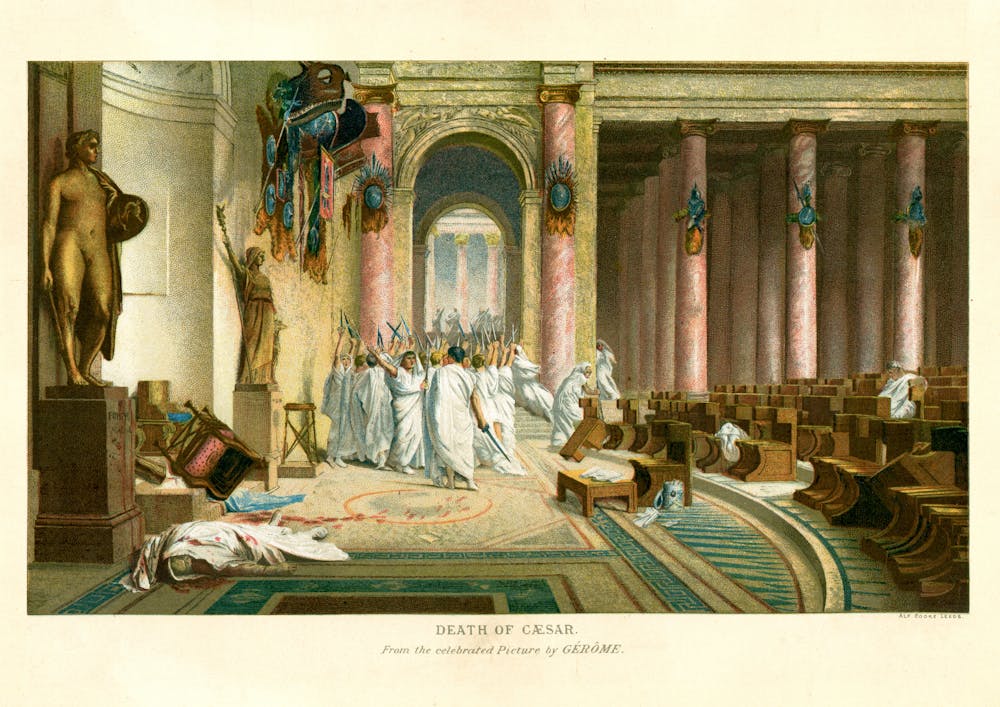
    Soon after, an angry group of 23 senators stabbed him to death in a vain attempt to save the republic. They were led by Marcus Junius Brutus, a descendant of the Brutus who killed the last Roman king, Tarquinius Superbus.

    The Roman republic was beyond saving despite Caesar’s death.
    duncan1890/Getty Images

    However, the Roman republic was beyond saving despite Caesar’s death. His great nephew Octavian eventually emerged as leader and became known as Augustus (27 BCE – 14 CE). With Augustus, an age of emperors was born.

    Emperors were kings in all but name. The strong aversion to kingship in Rome ensured their complete avoidance of the term rex.

    ‘No kings!’

    American protesters waving placards shouting “no kings!” are expressing clear concerns that their beloved democracy is under threat.

    Donald Trump has already declared eight national emergencies and issued 161 executive orders in his second term.

    When asked if he needs to uphold the Constitution, Trump declares “I don’t know.” He has joked about running for a third term as president, in breach of the longstanding limit of two terms.

    Like Caesar, is Donald Trump becoming a king in all but name? Is he setting a precedent for his successors to behave increasingly like emperors?

    The American aversion to “king” likely ensures the term will never return. But when protesters and others shout “no kings!”, they know the very meaning of the term “president” is changing before their eyes.

    Peter Edwell receives funding from the Australian Research Council.

    – ref. ‘No kings!’: like the LA protesters, the early Romans hated kings, too – https://theconversation.com/no-kings-like-the-la-protesters-the-early-romans-hated-kings-too-259011

    MIL OSI Analysis – EveningReport.nz –

    June 16, 2025
  • MIL-OSI Global: Netanyahu has two war aims: destroying Iran’s nuclear program and regime change. Are either achievable?

    Source: The Conversation – Global Perspectives – By Ian Parmeter, Research Scholar, Middle East Studies, Australian National University

    Israeli Prime Minister Benjamin Netanyahu has said Israel’s attack on Iran’s nuclear facilities could last for at least two weeks.

    His timing seems precise for a reason. The Israel Defence Forces and the country’s intelligence agencies have clearly devised a methodical, step-by-step campaign.

    Israeli forces initially focused on decapitating the Iranian military and scientific leadership and, just as importantly, destroying virtually all of Iran’s air defences.

    Israeli aircraft can not only operate freely over Iranian air space now, they can refuel and deposit more special forces at key sites to enable precision bombing of targets and attacks on hidden or well-protected nuclear facilities.

    In public statements since the start of the campaign, Netanyahu has highlighted two key aims: to destroy Iran’s nuclear program, and to encourage the Iranian people to overthrow the clerical regime.

    With those two objectives in mind, how might the conflict end? Several broad scenarios are possible.

    A return to negotiations

    US President Donald Trump’s special envoy for the Middle East, Steve Witkoff, was to have attended a sixth round of talks with his Iranian counterparts on Sunday aimed at a deal to replace the Iran nuclear agreement negotiated under the Obama administration in 2015. Trump withdrew from that agreement during his first term in 2018, despite Iran’s apparent compliance to that point.

    Netanyahu was opposed to the 2015 agreement and has indicated he does not believe Iran is serious about a replacement.

    So, accepting negotiations as an outcome of the Israeli bombing campaign would be a massive climbdown by Netanyahu. He wants to use the defanging of Iran to reestablish his security credentials after the Hamas attacks of October 2023.

    Even though Trump continues to press Iran to accept a deal, negotiations are off the table for now. Trump won’t be able to persuade Netanyahu to stop the bombing campaign to restart negotiations.

    Complete destruction of Iran’s nuclear program

    Destruction of Iran’s nuclear program would involve destroying all known sites, including the Fordow uranium enrichment facility, about 100 kilometres south of Tehran.

    According to International Atomic Energy Agency (IAEA) Director General Rafael Grossi, the facility is located about half a mile underground, beneath a mountain. It is probably beyond the reach of even the US’ 2,000-pound deep penetration bombs.

    The entrances and ventilation shafts of the facility could be closed by causing landslides. But that would be a temporary solution.

    Taking out Fordow entirely would require an Israeli special forces attack. This is certainly possible, given Israel’s success in getting operatives into Iran to date. But questions would remain about how extensively the facility could be damaged and then how quickly it could be rebuilt.

    And destruction of Iran’s nuclear centrifuges – used to enrich uranium to create a bomb – would be only one step in dismantling its program.

    Israel would also have to secure or eliminate Iran’s stock of uranium already enriched to 60% purity. This is sufficient for up to ten nuclear bombs if enriched to the weapons-grade 90% purity.

    But does Israeli intelligence know where that stock is?

    Collapse of the Iranian regime

    Collapse of the Iranian regime is certainly possible, particularly given Israel’s removal of Iran’s most senior military leaders since its attacks began on Friday, including the heads of the Islamic Revolutionary Guard Corps and the Iranian armed forces.

    And anti-regime demonstrations over the years, most recently the “Women, Life, Freedom” protests after the death in police custody of a young Iranian woman, Mahsa Amini, in 2022, have shown how unpopular the regime is.

    That said, the regime has survived many challenges since coming to power in 1979, including war with Iraq in the 1980s and massive sanctions. It has developed remarkably efficient security systems that have enabled it to remain in place.

    Another uncertainty at this stage is whether Israeli attacks on civilian targets might engender a “rally round the flag” movement among Iranians.

    Netanyahu said in recent days that Israel had indications the remaining senior regime figures were packing their bags in preparation for fleeing the country. But he gave no evidence.

    A major party joins the fight

    Could the US become involved in the fighting?

    This can’t be ruled out. Iran’s UN ambassador directly accused the US of assisting Israel with its strikes.

    That is almost certainly true, given the close intelligence sharing between the US and Israel. Moreover, senior Republicans, such as Senator Lindsey Graham, have called on Trump to order US forces to help Israel “finish the job”.

    Trump would probably be loath to do this, particularly given his criticism of the “forever wars” of previous US administrations. But if Iran or pro-Iranian forces were to strike a US base or military asset in the region, pressure would mount on Trump to retaliate.

    Another factor is that Trump probably wants the war to end as quickly as possible. His administration will be aware the longer a conflict drags on, the more likely unforeseen factors will arise.

    Could Russia become involved on Iran’s side? At this stage that’s probably unlikely. Russia did not intervene in Syria late last year to try to protect the collapsing Assad regime. And Russia has plenty on its plate with the war in Ukraine.

    Russia criticised the Israeli attack when it started, but appears not to have taken any action to help Iran defend itself.

    And could regional powers such as Saudi Arabia or the United Arab Emirates become involved?

    Though they have a substantial arsenal of US military equipment, the two countries have no interest in becoming caught up in the conflict. The Gulf Arab monarchies have engaged in a rapprochement with Iran in recent years after decades of outright hostility. Nobody would want to put this at risk.

    Uncertainties predominate

    We don’t know the extent of Iran’s arsenal of missiles and rockets. In its initial retaliation to Israel’s strikes, Iran has been able to partially overwhelm Israel’s Iron Dome air defence system, causing civilian casualties.

    If it can continue to do this, causing more civilian casualties, Israelis already unhappy with Netanyahu over the Gaza war might start to question his wisdom in starting another conflict.

    But we are nowhere near that point. Though it’s too early for reliable opinion polling, most Israelis almost certainly applaud Netanyahu’s action so far to cripple Iran’s nuclear program. In addition, Netanyahu has threatened to make Tehran “burn” if Iran deliberately targets Israeli civilians.

    We can be confident that Iran does not have any surprises in store. Israel has severely weakened its proxies, Hezbollah and Hamas. They are clearly in no position to assist Iran through diversionary attacks.

    The big question will be what comes after the war. Iran will almost certainly withdraw from the Nuclear Non-Proliferation Treaty and forbid more inspections by the International Atomic Energy Agency.

    Israel will probably be able to destroy Iran’s existing nuclear facilities, but it’s only a question of when – not if – Iran will reconstitute them.

    This means the likelihood of Iran trying to secure a nuclear bomb in order to deter future Israeli attacks will be much higher. And the region will remain in a precarious place.

    Ian Parmeter does not work for, consult, own shares in or receive funding from any company or organisation that would benefit from this article, and has disclosed no relevant affiliations beyond their academic appointment.

    – ref. Netanyahu has two war aims: destroying Iran’s nuclear program and regime change. Are either achievable? – https://theconversation.com/netanyahu-has-two-war-aims-destroying-irans-nuclear-program-and-regime-change-are-either-achievable-259014

    MIL OSI – Global Reports –

    June 16, 2025
  • MIL-OSI Europe: Egypt and EIB Global set to deploy EU grant aimed at greening Egyptian economy

    Source: European Investment Bank

    The European Investment Bank’s development arm (EIB Global) and Egypt have signed an agreement for the use of a €21 million grant to help green the Egyptian economy. The grant, funded by the European Union and managed by EIB Global, is intended to accelerate efforts by the Egyptian private and public sectors to decarbonise and promote environmental sustainability.

    MIL OSI Europe News –

    June 16, 2025
  • MIL-OSI New Zealand: Peace Action Wellington – Israel’s pre-emptive war illegal, unjustified

    Source: Peace Action Wellington

    14 June 2025 – Israel’s unprovoked and extensive bombing of Iran yesterday is illegal under international law. There is no allowable claim of self-defence for a pre-emptive attack; such a claim would validate Russia’s aggression in Ukraine, and the US’s attack on Iraq in 2003. 

    “The New Zealand Government needs to be unequivocal in its condemnation of Israel now,” said Valerie Morse, member of Peace Action Wellington.

    “The bombing of Iran has no justification. The Israeli state appears to consider itself beyond reproach in its conduct: in the past six months, it has bombed Lebanon, Syria, Yemen and Iran all while it conducts the most vile genocide against Palestinians in Gaza and daily attacks against civilians in the occupied West Bank.” 

    “No one believes Israel’s lies anymore. Time after time, Israel’s claims have been shown to be completely fabricated. We didn’t buy US President George W. Bush’s claims about Iraq having ‘weapons of mass destruction’ in 2003 that precipitated the US invasion and murder of 1 million Iraqi people; and we are not about to buy Netanyahu’s claims about an ‘existential threat’ now. ”

    “No one is buying Israel’s false victimhood either: it possesses nuclear weapons and continues to be the largest recipient of US aid and weapons. Netanyahu has spent all of Israel’s political capital with his craven determination to remain in power. The international consensus that has funded and facilitated the ongoing occupation of Palestinian lands is crumbling. Now he is trying to drag the entire world into war. He will be the last Israeli prime minister because he will destroy the Israeli state with his self-serving violence and war-making.”

    “Aggressive war cannot be tolerated. Genocide cannot be tolerated. New Zealanders want our government to take concrete actions: expel the Israeli Ambassador, sanction the Israeli state and recognise Palestine.”

    MIL OSI New Zealand News –

    June 16, 2025
  • MIL-OSI NGOs: UK: Amnesty International calls for the release of British father, Ahmed Al-Doush, ahead of appeal hearing on Father’s Day

    Source: Amnesty International –

    As families across the UK celebrate Father’s Day on June 15, British national Ahmed Al-Doush will have a scheduled appeal hearing to review his ten-year prison sentence in Saudi Arabia.

    Manchester-based Ahmed was sentenced to ten years in prison last month on May 10, 2025. His family and UK legal team understand that he was tried and convicted under terrorism legislation for social media posts and for associating with an individual critical of the Saudi government.

    However, the trial has been marred by a lack of transparency regarding the exact charges and evidence, even to the UK government. Information indicates that he is being tried for exercising his right to free expression and has faced multiple violations of his fair trial rights.

    Ahmed, a senior business analyst with Bank of America, was arrested while on a family holiday in August 2024. His domestic lawyer in Saudi Arabia has refused to share details of the charges and evidence nor provided a copy of the judgment and sentence to Ahmed’s family or UK legal team. At the time of arrest, his wife, Amaher, was in the late stages of pregnancy, meaning Ahmed missed the birth of his fourth child.

    Ahmed has faced numerous violations of his fair trial rights following his arrest. He has been subjected to extensive interrogation without legal representation, where he was forced to sign a statement before being informed of the charges against him. For over two and a half months after he was first detained, his family had no contact with him and received no information about his condition or the reasons for his detention. He was also denied consular access. Since then, contact with his family and UK-based legal team has been severely restricted, and he has been threatened with losing access to communication with them if he tries to disclose anything regarding his trial, proceedings, treatment, or health.

    Haydee Dijkstal, Barrister at 33 Bedford Row Chambers and counsel for Ahmed Al-Doush, stated: “The UK government must demand answers and clarity on a process that has been marked by a lack of transparency, even to the UK government regarding its own citizen. It should take a strong stand against a British national’s imprisonment for ten years for allegedly exercising his right to free expression. This is essential to fully protect a British national’s rights, as well as the rights of his wife and four British children living in the UK who have been thrown into an unexpected and incomprehensible nightmare.”

    Amaher Al-Doush, wife of Ahmed, expressed her feelings: “Frankly, I have no faith in the Saudi government to deliver justice in the appeal. I’m completely disillusioned with both the Saudi and UK governments on every level. The children have been making Father’s Day cards at school, at a time when other families are celebrating it’s incredibly painful for them, especially as we prepare to mark Eid without their father once again. They’re really struggling.

    “I’m exhausted too. The pressure is relentless, not just emotionally, but physically and mentally. Honestly, I’m so overwhelmed that I struggle to even speak about it anymore. At the heart of it all, what matters most is that my husband, the father of my children, is still not home. None of the efforts so far have brought him back.”

    Eilidh Macpherson, Campaigns Manager for Individuals at Risk at Amnesty International UK, said: “We reiterate our urgent call on the Saudi authorities to immediately and unconditionally release Ahmed Al-Doush if he is being held solely for peacefully exercising his human rights. He must be allowed to return to his family in the UK without delay. In the meantime, Saudi authorities must uphold his fair trial rights, promptly share his court documents, and guarantee regular access to both his family and legal counsel.

    “We also urge the UK government to take all necessary steps to secure his immediate and unconditional release. The arbitrary detention of another British national abroad cannot be tolerated. Immediate and decisive action is essential.”

    ENDS

    Amnesty media contacts: 

    Out of hours: media@amnesty.org.uk / 07721 398984 

    MIL OSI NGO –

    June 16, 2025
  • MIL-OSI Russia: Iran Launches New Air Attack on Israel, Injures 2

    Translation. Region: Russian Federal

    Source: People’s Republic of China in Russian – People’s Republic of China in Russian –

    Source: People’s Republic of China – State Council News

    JERUSALEM, June 15 (Xinhua) — Iran launched another airstrike on Israel on Sunday evening, injuring at least two people and starting fires, Israeli authorities said.

    The attack came shortly after Israel announced that its warplanes had launched a new series of strikes targeting missile launchers in western Iran.

    Air raid sirens sounded in many areas in the north, south and central parts of the Jewish state, as well as in the occupied Golan Heights, warning residents to take shelter, the Israeli military said. Loud explosions were heard in Tel Aviv and other cities, according to eyewitnesses.

    Israeli Magen David Adom ambulance service spokesman Zaki Heller said rockets and rocket fragments hit three locations, leaving two people lightly injured and several others treated for panic attacks. –0–

    MIL OSI Russia News –

    June 16, 2025
  • MIL-OSI Russia: Israeli army announces new series of airstrikes on Iranian missile sites

    Translation. Region: Russian Federal

    Source: People’s Republic of China in Russian – People’s Republic of China in Russian –

    Source: People’s Republic of China – State Council News

    JERUSALEM, June 15 (Xinhua) — The Israeli Air Force carried out a new round of airstrikes on Iran on Sunday evening, hitting surface-to-surface missile sites in the country’s west, the Israeli military said in a statement.

    It is noted that the strikes were aimed at destroying “dozens” of missile targets.

    On June 13, Israel launched its largest air attack on Iran, striking nuclear facilities in Tehran and elsewhere across the country, killing dozens of Iranian scientists, senior security officials and civilians, prompting the Islamic Republic to retaliate with missiles and drones that killed at least 14 people in Israel.

    Israeli Defense Minister Israel Katz said Sunday that airstrikes would continue, targeting not only nuclear sites but also missile bases, weapons factories, air defense systems and “the regime in Tehran.”

    Israeli Prime Minister Benjamin Netanyahu says the Jewish state is “determined to carry out the mission to eliminate the double threat” from Iran. –0–

    MIL OSI Russia News –

    June 16, 2025
  • MIL-OSI United Kingdom: PM call with President of the United Arab Emirates His Highness Sheikh Mohamed bin Zayed Al Nahyan: 15 June 2025

    Source: United Kingdom – Government Statements

    Press release

    PM call with President of the United Arab Emirates His Highness Sheikh Mohamed bin Zayed Al Nahyan: 15 June 2025

    The Prime Minister spoke to His Highness Sheikh Mohamed bin Zayed Al Nahyan, President of the United Arab Emirates, from Ottawa this afternoon.

    The Prime Minister spoke to His Highness Sheikh Mohamed bin Zayed Al Nahyan, President of the United Arab Emirates, from Ottawa this afternoon.

    They discussed the grave situation in the Middle East. The Prime Minister reiterated that his priority is diplomacy and dialogue, in order to de-escalate as quickly as possible. 

    The Prime Minister said this would be top of the agenda during his conversations with G7 partners in the next two days. They also discussed Gaza, and the need to bring an end to the devastation there. 

    They agreed to stay in close touch.

    Share this page

    The following links open in a new tab

    • Share on Facebook (opens in new tab)
    • Share on Twitter (opens in new tab)

    Updates to this page

    Published 15 June 2025

    MIL OSI United Kingdom –

    June 16, 2025
  • MIL-OSI Russia: Iran Launches New Missile Attack on Israel

    Translation. Region: Russian Federal

    Source: People’s Republic of China in Russian – People’s Republic of China in Russian –

    Source: People’s Republic of China – State Council News

    JERUSALEM, June 15 (Xinhua) — Iran launched a new missile attack on Israel on Sunday, triggering air raid sirens across the Jewish state, the Israel Defense Forces (IDF) said, sending millions of people running for cover.

    There have been no reports of casualties or damage yet.

    The IDF said “several” rockets were fired from Iranian territory toward Israel, most of which were intercepted.

    “There were no reports of any projectiles falling,” the statement said.

    The attack began at around 4pm local time /1300 GMT/, marking the first Iranian attack in daylight since Israel’s surprise strikes on the Islamic republic on June 13 triggered the current escalation.

    The body of another victim was pulled from the rubble of a building hit by a rocket overnight on Sunday, police said, and the search continues for three other people still missing.

    The death toll from Iranian attacks since June 13 has reached 14, according to Israeli state television Kan. –0–

    MIL OSI Russia News –

    June 16, 2025
  • MIL-OSI Russia: Iran confirms 8 more senior commanders killed in Israeli attacks

    Translation. Region: Russian Federal

    Source: People’s Republic of China in Russian – People’s Republic of China in Russian –

    Source: People’s Republic of China – State Council News

    TEHRAN, June 15 (Xinhua) — Iran’s Islamic Revolutionary Guard Corps (IRGC) has confirmed the deaths of eight more senior commanders of its Aerospace Forces in Israeli airstrikes on Tehran on June 13.

    A statement released by the IRGC’s official Sepah News expressed condolences over the “martyrdom” of senior military officials.

    Among the killed commanders are Mahmoud Bagheri, Davoud Sheikhian, Mohammad Bagher Taherpour, Mansour Safarpour, Masoud Tayeb, Khosrow Hassani, Javad Jorsara and Mohammad Agajafari.

    In the early hours of June 13, Israel launched air strikes on the Iranian capital Tehran and other cities in the country, hitting nuclear facilities and killing several top military commanders, nuclear scientists and civilians. Israeli attacks on various parts of Iran continued on Saturday and Sunday.

    Israeli airstrikes on Tehran killed Chief of the General Staff of the Iranian Armed Forces (Iranian Armed Forces) Mohammad Bagheri, IRGC Commander-in-Chief Hossein Salami, Commander-in-Chief of the Khatam al-Anbiya Central Headquarters (air defense forces) Gholam Ali Rashid, and Commander of the IRGC Aerospace Forces Amir Ali Hajizadeh.

    In response to the attacks, Iran launched a series of missile strikes on targets in Israel on the evening of June 13 and 14, causing casualties and significant damage. –0–

    MIL OSI Russia News –

    June 16, 2025
  • MIL-OSI Africa: Egypt: President El-Sisi Follows Up on Martyrs and Victims Fund Activities and Initiatives

    Source: Africa Press Organisation – English (2) – Report:

    Download logo

    Today, President Abdel Fattah El-Sisi met with Chairman of the Board of Directors of the Martyrs and Victims Honoring Fund, Major General El-Sayed El-Ghaly, and the Fund’s Executive Director, Major General Ahmed Al-Ashaal. The fund honors the martyrs, as well as victims, missing and the injured of military and security operations and terror attacks and their families.

    Spokesman for the Presidency, Ambassador Mohamed El-Shennawy, said the President was briefed on the progress of the Fund’s activities and the services extended to beneficiaries, including the families of martyrs, victims, and those injured in military, terrorist, and security operations, in coordination with relevant state entities.

    President El-Sisi was also updated on the Fund’s upcoming initiatives. The President emphasized the need to further improve the services offered by the Fund, develop its resources, and foster its management mechanisms to strengthen its ability to respond to the needs of its beneficiaries.

    The President approved the launch of the “Egypt is with You” initiative for underage children of martyrs and victims from the Armed Forces, Police, and civilians. This initiative focuses on investing the allocated funds to ensure the highest investment return for these minor children when they reach legal age, in coordination with the Central Bank, the Sovereign Fund of Egypt, and Misr Insurance Company.

    President El-Sisi also approved the inclusion of martyrs and injured officers and other ranks from the Armed Forces in special operations, as well as civilian martyrs in the war effort during previous wars, under the umbrella of the Fund. The President stressed that Egypt will never forget the sacrifices of its loyal sons, and that fitting tributes are being offered to the martyrs and injured who sacrificed their lives for the nation.

    Furthermore, the President directed the Ministry of Higher Education and Scientific Research to take the necessary measures to determine exemption and discount rates for various scholarships from public, private, and national universities, as well as private higher institutes, for the Fund’s beneficiaries, along with the method and mechanisms for implementation.

    The President affirmed that the Egyptian people hold deep respect and appreciation for all their sons, the martyrs and those injured in military, terrorist, and security operations, who paid a heavy price for the Egyptian people to live in security and prosperity.

    – on behalf of Presidency of the Arab Republic of Egypt.

    MIL OSI Africa –

    June 16, 2025
  • MIL-OSI Security: Family pays tribute as victim of Hammersmith shooting named

    Source: United Kingdom London Metropolitan Police

    The 30-year-old who was fatally shot in an incident in Claxton Grove, Hammersmith, on Wednesday, 11 June, has been named as Northolt resident Jordan Oliver Rodney.

    In a statement, Mr Rodney’s family said: “It is with unimaginable heartbreak that we confirm the tragic loss of our beloved Jordan Olivier Rodney, who was taken from us far too soon.

    “Jordan was a man who touched the lives of everyone who knew him. He was warm, funny, and loving. Always quick with a smile or a joke that could brighten the dark day.

    “His kindness, generosity, and humour left a lasting impression on friends and family alike. Our son, brother, uncle, and friend was so much more than the circumstances of his death. He brought joy to our lives every single day, and his absence leaves a hole that can never be filled.

    “We will remember Jordie for the love he shared so freely, the laughter he inspired, and the way he made us all feel seen and valued. We ask for privacy as we grieve this devastating loss and whilst we work to come to terms with what has happened.

    “We are eternally grateful for the outpouring of love and support during this incredibly difficult time.”

    A post-mortem examination has taken place.

    A second victim, also in his 30s, has been discharged from hospital.

    Jahmel Joseph, 28 (05.12.1996), of Eaton Rise, Ealing, has been charged with murder, attempted murder, possession of a firearm with intent to endanger life, possession of a prohibited weapon and dangerous driving.

    Joseph appeared in custody at Bromley Magistrates’ Court on Saturday, 14 July. He has been remanded to appear before the Old Bailey on Wednesday, 18 July.

    MIL Security OSI –

    June 16, 2025
  • MIL-OSI Global: The politics of blame: Accusing immigrants won’t solve Germany’s antisemitism problem

    Source: The Conversation – Canada – By Oliver Schmidtke, Professor, Director of the Centre for Global Studies, University of Victoria

    In response to a report on the virulence of antisemitism in Germany, Chancellor Friedrich Merz recently cast the blame on attitudes held by immigrants.

    Merz stated in a Fox News interview that Germany has “imported antisemitism with the big numbers of migrants we have within the last 10 years.”

    Merz is pointing to a real and pressing issue. Yet his emphasis on so-called “imported antisemitism” serves as a convenient diversion from Germany’s persistent failure to confront home-grown antisemitism.

    His remarks also risk emboldening those who weaponize antisemitism as a rhetorical tool to fuel anti-immigrant sentiments.

    Antisemitism in Germany

    Antisemitic incidents in Germany have been on the rise since the Oct. 7, 2023 attack on Israel by Hamas and the subsequent war in Gaza.

    According to a survey by the Research and Information Centre on Antisemitism (RIAS), antisemitic occurrences rose by more than 80 per cent in 2023. That year, 4,782 occurrences were documented, the highest number since the organization began tracking such cases in 2017.

    However, RIAS’s most recent report found that the primary motive behind antisemitic crimes remained right-wing extremist ideology (48 per cent). It also noted that, since 2023, there has been a marked increase in incidents attributed to “foreign ideology.” These are understood as originating outside Germany and often linked to Islamist or anti-Israel sentiments, which accounted for 31 per cent of cases in 2024.

    It should be noted that RIAS’s approach to classifying antisemitism has been subject to controversy, especially with regard to its treatment of criticism of or protest against the Israeli government’s actions.

    The ‘imported antisemitism’ narrative

    A recent survey of antisemitic attitudes among immigrants in Germany found that such attitudes are more prevalent among Muslim respondents compared to their Christian or religiously unaffiliated counterparts. The study revealed particularly high levels of antisemitism among individuals from the Middle East and North Africa.

    Approximately 35 per cent of Muslim respondents — especially those with strong religious convictions and lower levels of formal education — “strongly agreed with classical antisemitic statements.” These statements reflect classical antisemitic tropes, such as attributing too much influence over politics or finance to Jews, accusing Jews of driving the world into disaster or relativizing the Holocaust.

    At the same time, there is evidence that immigrants successfully integrating into German society is associated with lower levels of antisemitism.

    Yet blaming a rise in antisemitism on “imported” attitudes or “foreign ideologies” signals a crude simplification. Antisemitism has remained prevalent in German society even after the Second World War, and political movements or leaders can easily mobilize it.

    Although Holocaust education is mandatory in German schools, knowledge about the Shoah and the legacy of antisemitism remains limited among younger generations. A recent study by the Jewish Claims Conference found that among Germans aged 18 to 29, around 40 per cent were not aware that approximately six million Jews were killed by the Nazis and their collaborators.

    According to a 2023 MEMO survey, more than 50 per cent of 14- to 16-year-old students in Germany did not know what Auschwitz was.

    Blaming immigrants for challenges in Germany’s memory culture oversimplifies a deeper issue: the growing difficulty of making the country’s dominant remembrance — centred on the horrors of the Nazi dictatorship and the Holocaust — politically meaningful and emotionally resonant for younger generations.

    For many young Germans, the memory of the Holocaust feels increasingly remote, lacking the emotional immediacy that vanishing eyewitnesses once provided.

    This problem is further exacerbated by the absence of innovative, impactful teaching capable of conveying the continued relevance of Holocaust memory and its political message.

    In a 2023 article, American journalist Masha Gessen highlighted how Holocaust remembrance in Germany was becoming an elite-driven ritual, one that risks preventing a meaningful connection between its moral imperatives and today’s political realities.

    The threat from Alternative for Germany

    At the same time, the rise of the far-right Alternative for Germany (AfD) party poses a direct threat to Germany’s culture of remembrance.

    The AfD has made it a central objective to challenge the primacy of Holocaust memory, calling for a U-turn in Germany’s remembrance culture.

    Leading party members have labelled Holocaust memorials “monuments of shame,” reflecting the party’s broader effort to promote nationalist reinterpretations of history.

    Furthermore, the AfD’s staunchly anti-immigrant stance exposes a fundamental flaw in the imported antisemitism narrative. Across Europe, populist right-wing movements have increasingly mobilized anti-Muslim rhetoric under the banner of defending so-called “Judeo-Christian values,” even as they simultaneously draw on classic antisemitic tropes targeting “globalist elites” and conspiratorial power structures.

    This use of Jewish identity as a rhetorical weapon against Islam, while perpetuating antisemitism in other forms, reveals the deep contradictions and opportunism underlying imported antisemitism claims.

    Blaming Muslim immigrants for the rise of antisemitism offers German political leaders a convenient excuse for their own failure to confront entrenched antisemitic beliefs within German society.

    In addition, Holocaust remembrance can sometimes exclude immigrants. For example, Germany recently added questions about the Holocaust and Nazi crimes to its citizenship test, committing newcomers to its memory culture.

    Research shows this kind of policy can have unintended effects. It can make immigrants feel excluded if they are seen as not fully sharing in “our” nation and “our” history. Given the universalist values it is meant to embody, the commemoration of the Holocaust can also serve to alienate immigrants from full cultural citizenship.

    Framing antisemitism primarily as an imported problem risks strengthening those forces that actively seek to undermine and ignore Germany’s confrontation with its Nazi past.

    Instead, what is needed is a more nuanced approach, one that bridges the divide between antiracist and anti-antisemitism efforts, and aligns more faithfully with the moral and political commitments that this collective memory is meant to uphold.

    Oliver Schmidtke receives funding from the Social Sciences and Humanities Research Council of Canada.

    – ref. The politics of blame: Accusing immigrants won’t solve Germany’s antisemitism problem – https://theconversation.com/the-politics-of-blame-accusing-immigrants-wont-solve-germanys-antisemitism-problem-258705

    MIL OSI – Global Reports –

    June 16, 2025
  • MIL-OSI Economics: CBB holds third Board meeting for 2025

    Source: Central Bank of Bahrain

    CBB holds third Board meeting for 2025

    Published on 15 June 2025

    Manama, Kingdom of Bahrain – 15 June 2025 – The Central Bank of Bahrain’s (CBB) Board of Directors held its third meeting for the year 2025, chaired by Mr. Hassan Khalifa Al Jalahma on Sunday, 15 June 2025.

    The Board reviewed the topics on the agenda and was presented with key developments related to the CBB’s priorities by HE Khalid Humaidan.  In addition, the Board reviewed the CBB’s licensing activities, policies, and other achievements thus far in 2025.

    The Board also reviewed key monetary and banking indicators for the period up to April 2025 including the money supply, which increased by BD5.2 billion to reach BD 16.8 billion at the end of April 2025, compared to the same period in 2024. As for retail banks, total private deposits increased to around BD 0.5 billion at the end of April 2025, an increase of 3.5% compared to the end of April 2024. The outstanding balance of total loans and credit facilities extended to resident economic sectors increased to BD12.4 billion at the end of April 2025, an increase of 1.8% compared April 2024, with the Business Sector accounting for 43.3% and the Personal Sector at 48.9% of total loans and credit facilities.  The balance sheet of the banking system (retail banks and wholesale sector banks) increased to $244.7 billion at the end of April 2025, an increase of 2.3% compared to the end April of 2024.

    Point of Sales (POS) data for April 2025 totaled 21.5 million transactions (77.6% of which were contactless), an increase of 28.5% compared to the same period in 2024. The total value of POS transactions for April 2025 totaled BD 428.2 million (52.5% of which were contactless), an increase of 17.3% compared to the same period in 2024.

    The banking sector capital adequacy ratio reached 20.6% in Q1 2025 compared with 22.2% in Q1 2024. The capital adequacy ratio for the various banking sectors was 29.4% for conventional retail banks, 16.6% for conventional wholesale banks, 23.8% for Islamic retail banks, and 21.1% for Islamic wholesale banks in Q1 2025.

    The total number of registered Collective Investment Undertakings (CIUs) as of March 2025 stood at 1737 CIUs, compared to 1699 CIUs as of March 2024. The net asset value (NAV) of the CIUs decreased from US $11.551 billion in Q1 2024 to US $11.269 billion in Q1 2025, reflecting a decrease of 2.4%. The NAV of Bahrain domiciled CIUs decreased from US $4.586 billion in Q1 2024 to US $4.411 billion in Q1 2025, reflecting a decrease of 3.8%. The NAV of overseas domiciled CIUs decreased from US $6.965 billion in Q1 2024 to US $6.858 billion in Q1 2025, reflecting a decrease of 1.5%. Additionally, the NAV of Shari’a-compliant CIUs increased from US $1.743 billion in Q1 2024 to US $2.004 billion in Q1 2025, reflecting an increase of 15%.

    Share this

    MIL OSI Economics –

    June 16, 2025
  • MIL-OSI Africa: Egypt: President El-Sisi Speaks with President of Cyprus Christodoulides

    Source: Africa Press Organisation – English (2) – Report:

    Download logo

    Today, President Abdel Fattah El-Sisi received a phone call from President of the Republic of Cyprus, Nikos Christodoulides.

    Spokesman for the Presidency, Ambassador Mohamed El-Shennawy, said the call focused on regional developments. President El-Sisi emphasized Egypt’s categorical rejection of any expansion of the cycle of conflict in the region, underscoring the crucial importance of ending Israel’s military operations across all regional fronts. President El-Sisi warned that the continuation of the current approach will inflict grave and formidable harm on all peoples of the region, with no exception.

    President El-Sisi affirmed the vital necessity for the international community to assume a more effective role in compelling regional parties to act responsibly. The President asserted that peaceful solutions remain the sole viable means to ensure security and stability in the region. President El-Sisi underlined the urgent need to resume the US-Iranian negotiations, under the auspices of the Sultanate of Oman, which represents the best solution to the current tension. President El-Sisi reiterated Egypt’s unequivocal stance with regard to the imperative for establishing a Middle East free of weapons of mass destruction, encompassing all states of the region.

    President El-Sisi emphasized that a just and comprehensive resolution to the Palestinian issue remains the sole guarantor for achieving enduring peace and stability in the Middle East. This necessitates an immediate ceasefire in the Gaza Strip, the release of hostages and detainees, the establishment of an independent Palestinian State along the June 4, 1967 borders, with East Jerusalem as its capital, as well as providing security for all peoples of the region.

    – on behalf of Presidency of the Arab Republic of Egypt.

    MIL OSI Africa –

    June 16, 2025
  • MIL-OSI Africa: Egypt: President El-Sisi Meets the Managing Director of the International Finance Corporation

    Source: Africa Press Organisation – English (2) – Report:

    Download logo

    Today, President Abdel Fattah El-Sisi met with Managing Director of the International Finance Corporation (IFC), Mr. Makhtar Diop. The meeting was also attended by Vice President and General Counsel for IFC, Mr. Ethiopis Tafara, and Minister of Planning, Economic Development, and International Cooperation, Dr. Rania Al Mashat.

    Spokesman for the Presidency, Ambassador Mohamed El-Shennawy, said President El-Sisi appreciated IFC’s cooperative relations with Egypt over the past years. The President emphasized Egypt’s keenness on further strengthening this collaboration, particularly in light of the ongoing regional developments, which create formidable challenges on development programs. Mr. Diop agreed with the President and stressed the Corporation’s commitment to its fruitful cooperation with Egypt.

    The meeting explored opportunities for joint efforts to enhance investment flows into Egypt and to facilitate financing for the private sector. President El-Sisi confirmed the importance of providing competitive financing rates to reduce costs. He noted that Egypt is adopting a series of policies as well as structural and economic reforms aimed at maintaining financial and economic stability. The President affirmed that the state is committed to boosting the private sector’s role in economic activity and development and is working to bolster private sector confidence in the economy by offering numerous tax and customs facilities to reduce costs and streamline procedures. Additionally, the government is launching initiatives aimed at increasing exports, developing productive and service activities, and expanding public-private partnership projects.

    The IFC’s Managing Director lauded Egypt’s economic reform measures, which enhance investor confidence and improve the investment climate. He asserted that joint programs between both parties will continue to further advance cooperation and support the competitiveness of the Egyptian economy.

    – on behalf of Presidency of the Arab Republic of Egypt.

    MIL OSI Africa –

    June 16, 2025
  • MIL-OSI Russia: 6 killed, at least 140 injured in Iranian missile strikes in central Israel – authorities

    Translation. Region: Russian Federal

    Source: People’s Republic of China in Russian – People’s Republic of China in Russian –

    Source: People’s Republic of China – State Council News

    JERUSALEM, June 15 (Xinhua) — At least six people were killed and 140 others were wounded in Iranian airstrikes on Israel early Sunday, Israeli authorities said.

    Air raid sirens and explosions sent millions of people fleeing for shelters in dozens of cities across Israel, the military said in a statement.

    A rocket hit a residential building in Bat Yam, south of Tel Aviv, causing it to collapse. Another rocket hit a residential area in Rehovot, a city in central Israel, injuring dozens of people.

    A police statement said at least two of the dead were children, adding that at least seven people were still missing.

    Several buildings on the Weizmann Institute of Science campus in Rehovot were damaged by Iranian rocket fire, but there were no reports of casualties, the institute said in a statement.

    At least 140 people were wounded in the two attacks, Israel’s Magen David Adom rescue service said, adding that the vast majority were lightly injured.

    Also overnight, the death toll from a rocket attack on Tamra, an Arab town in Israel’s Northern District, on Saturday night rose to four, Magen David Adom reported. Among the dead were a mother, her two daughters and another relative. Dozens were injured.

    On Sunday morning, the Israeli Air Force said it had intercepted seven drones launched toward northern and southern Israel in about an hour.

    Israeli warplanes continued to strike targets in Iran overnight, including the capital Tehran, fuel tankers and suspected nuclear sites, the Israeli military said in a statement. A second wave of airstrikes targeted missile launchers and storage facilities in western Iran. –0–

    MIL OSI Russia News –

    June 16, 2025
  • MIL-OSI Russia: Egypt delays opening of Grand Egyptian Museum amid Israel-Iran tensions

    Translation. Region: Russian Federal

    Source: People’s Republic of China in Russian – People’s Republic of China in Russian –

    Source: People’s Republic of China – State Council News

    CAIRO, June 15 (Xinhua) — Egypt has postponed the long-awaited grand opening of the Grand Egyptian Museum (GEM) due to the escalation of military confrontation between Israel and Iran, Prime Minister Mostafa Madbouly announced Saturday.

    Speaking at a press conference during a tour of the northern province of Beheira, Madbouly said the current regional climate was not conducive to hosting a major international event. The museum’s opening, originally scheduled for July 3, has now been postponed to the fourth quarter of this year.

    “Tensions in the region could persist for several weeks,” Madbouly said. “We have concluded that the right decision is to postpone this major event so that it gains the right global momentum and takes place in the right atmosphere.”

    He added that a new opening date will be announced depending on future developments in the region.

    Madbouly also issued a stark warning about the wider implications of the Israeli-Iranian conflict, noting the growing risk of a wider confrontation in the Middle East.

    Situated near the famous Giza pyramids and covering an area of almost 500,000 square meters, the Grand Egyptian Museum is considered the world’s largest archaeological museum dedicated to a single civilization. According to Egypt’s Ministry of Tourism and Antiquities, it will house some 57,000 artifacts. –0–

    MIL OSI Russia News –

    June 15, 2025
  • MIL-OSI Russia: Iran Launches New Wave of Attacks on Israel – Official Media

    Translation. Region: Russian Federal

    Source: People’s Republic of China in Russian – People’s Republic of China in Russian –

    Source: People’s Republic of China – State Council News

    TEHRAN, June 15 (Xinhua) — Iran’s Islamic Revolutionary Guard Corps (IRGC) launched a “large-scale combined offensive operation” against Israel late on Saturday, using a large number of missiles and drones, the IRGC’s official Sepah News reported.

    The IRGC’s aerospace unit carried out the attack, saying it was in response to Israel’s “repeated aggression” against Iran, Sepah reported.

    A rocket hit a residential building in a northern community in Israel, killing one woman and wounding 13 others, the national emergency medical service Magen David Adom reported. Several others were moderately and lightly wounded, and four were treated for anxiety, the service said.

    Earlier in the day, Magen David Adom reported that at least three people had been killed and 204 others wounded since the Iranian offensive began.

    Following the latest wave of attacks, Israel’s Home Front Command advised residents outside Haifa and areas in the north of the country to leave bomb shelters but remain near secure areas.

    The Israeli military said its air defense systems were actively intercepting incoming projectiles while Israeli Air Force units were striking military targets in Tehran.

    Iran’s Oil Ministry confirmed that two oil depots in Tehran were damaged in the attacks. Residents reported two powerful explosions in the capital that were felt in both western and northern areas. The ministry said the situation was under control.

    Meanwhile, Jordan temporarily closed its airspace late on Saturday as a precaution following a rocket attack from Iran. The country’s Civil Aviation Regulatory Commission said the move was taken to ensure the safety of civil aviation.

    The Iranian offensive was in response to Israeli airstrikes early Friday in Tehran and several other cities. Iranian officials said the Israeli strikes killed several senior military commanders, nuclear scientists and dozens of civilians. –0–

    MIL OSI Russia News –

    June 15, 2025
  • MIL-Evening Report: Why Israel’s shock and awe has proven its power but lost the war

    COMMENTARY: By Antony Loewenstein

    War is good for business and geopolitical posturing.

    Before Israeli Prime Minister Benjamin Netanyahu arrived in Washington in early February for his first visit to the US following President Donald Trump’s inauguration, he issued a bold statement on the strategic position of Israel.

    “The decisions we made in the war [since 7 October 2023] have already changed the face of the Middle East,” he said.

    “Our decisions and the courage of our soldiers have redrawn the map. But I believe that working closely with President Trump, we can redraw it even further.”

    How should this redrawn map be assessed?

    Hamas is bloodied but undefeated in Gaza. The territory lies in ruins, leaving its remaining population with barely any resources to rebuild. Death and starvation stalk everyone.

    Hezbollah in Lebanon has suffered military defeats, been infiltrated by Israeli intelligence, and now faces few viable options for projecting power in the near future. Political elites speak of disarming Hezbollah, though whether this is realistic is another question.

    Morocco, Bahrain and the UAE accounted for 12 percent of Israel’s record $14.8bn in arms sales in 2024 — up from just 3 percent the year before

    In Yemen, the Houthis continue to attack Israel, but pose no existential threat.

    Meanwhile, since the overthrow of dictator Bashar al-Assad in late 2024, Israel has attacked and threatened Syria, while the new government in Damascus is flirting with Israel in a possible bid for “normalisation“.

    The Gulf states remain friendly with Israel, and little has changed in the last 20 months to alter this relationship.

    According to Israel’s newly released arms sales figures for 2024, which reached a record $14.8bn, Morocco, Bahrain and the United Arab Emirates accounted for 12 percent of total weapons sales — up from just 3 percent in 2023.

    It is conceivable that Saudi Arabia will be coerced into signing a deal with Israel in the coming years, in exchange for arms and nuclear technology for the dictatorial kingdom.

    An Israeli and US-assisted war against Iran began on Friday.

    In the West Bank, Israel’s annexation plans are surging ahead with little more than weak European statements of concern. Israel’s plans for Greater Israel — vastly expanding its territorial reach — are well underway in Syria, Lebanon and beyond.

    Shifting alliances
    On paper, Israel appears to be riding high, boasting military victories and vanquished enemies. And yet, many Israelis and pro-war Jews in the diaspora do not feel confident or buoyed by success.

    Instead, there is an air of defeatism and insecurity, stemming from the belief that the war for Western public opinion has been lost — a sentiment reinforced by daily images of Israel’s campaign of deliberate mass destruction across the Gaza Strip.

    What Israel craves and desperately needs is not simply military prowess, but legitimacy in the public domain. And this is sorely lacking across virtually every demographic worldwide.

    It is why Israel is spending at least $150 million this year alone on “public diplomacy”.

    Get ready for an army of influencers, wined and dined in Tel Aviv’s restaurants and bars, to sell the virtues of Israeli democracy. Even pro-Israel journalists are beginning to question how this money is being spent, wishing Israeli PR were more responsive and effective.

    Today, Israeli Jews proudly back ethnic cleansing and genocide in Gaza in astoundingly high numbers. This reflects a Jewish supremacist mindset that is being fed a daily diet of extremist rhetoric in mainstream media.

    There is arguably no other Western country with such a high proportion of racist, genocidal mania permeating public discourse.

    According to a recent poll of Western European populations, Israel is viewed unfavourably in Germany, Denmark, France, Italy and Spain.

    Very few in these countries support Israeli actions. Only between 13 and 21 percent hold a positive view of Israel, compared to 63-70 percent who do not.

    The US-backed Pew Research Centre also released a global survey asking people in 24 countries about their views on Israel and Palestine. In 20 of the 24 nations, at least half of adults expressed a negative opinion of the Jewish state.

    A deeper reckoning
    Beyond Israel’s image problems lies a deeper question: can it ever expect full acceptance in the Middle East?

    Apart from kings, monarchs and elites from Dubai to Riyadh and Manama to Rabat, Israel’s vicious and genocidal actions since 7 October 2023 have rendered “normalisation” impossible with a state intent on building a Jewish theocracy that subjugates millions of Arabs indefinitely.

    While it is true that most states in the region are undemocratic, with gross human rights abuses a daily reality, Israel has long claimed to be different — “the only democracy in the Middle East”.

    But Israel’s entire political system, built with massive Western support and grounded in an unsustainable racial hierarchy, precludes it from ever being fully and formally integrated into the region.

    The American journalist Murtaza Hussain, writing for the US outlet Drop Site News, recently published a perceptive essay on this very subject.

    He argues that Israeli actions have been so vile and historically grave — comparable to other modern holocausts — that they cannot be forgotten or excused, especially as they are publicly carried out with the explicit goal of ethnically cleansing Palestine:

    “This genocide has been a political and cultural turning point beyond which we cannot continue as before. I express that with resignation rather than satisfaction, as it means that many generations of suffering are ahead on all sides.

    “Ultimately, the goal of Israel’s opponents must not be to replicate its crimes in Gaza and the West Bank, nor to indulge in nihilistic hatred for its own sake.

    “People in the region and beyond should work to build connections with those Israelis who are committed opponents of their regime, and who are ready to cooperate in the generational task of building a new political architecture.”

    The issue is not just Netanyahu and his government. All his likely successors hold similarly hardline views on Palestinian rights and self-determination.

    The monumental task ahead lies in crafting an alternative to today’s toxic Jewish theocracy.

    But this rebuilding must also take place in the West. Far too many Jews, conservatives and evangelical Christians continue to cling to the fantasy of eradicating, silencing or expelling Arabs from their land entirely.

    Pushing back against this fascism is one of the most urgent generational tasks of our time.

    Antony Loewenstein is an Australian/German independent, freelance, award-winning, investigative journalist, best-selling author and film-maker. In 2025, he released an award-winning documentary series on Al Jazeera English, The Palestine Laboratory, adapted from his global best-selling book of the same name. It won a major prize at the prestigious Telly Awards. This article is republished from Middle East Eye with permission.

    MIL OSI Analysis – EveningReport.nz –

    June 15, 2025
  • MIL-Evening Report: Why Israel’s shock and awe has proven its power but lost the war

    COMMENTARY: By Antony Loewenstein

    War is good for business and geopolitical posturing.

    Before Israeli Prime Minister Benjamin Netanyahu arrived in Washington in early February for his first visit to the US following President Donald Trump’s inauguration, he issued a bold statement on the strategic position of Israel.

    “The decisions we made in the war [since 7 October 2023] have already changed the face of the Middle East,” he said.

    “Our decisions and the courage of our soldiers have redrawn the map. But I believe that working closely with President Trump, we can redraw it even further.”

    How should this redrawn map be assessed?

    Hamas is bloodied but undefeated in Gaza. The territory lies in ruins, leaving its remaining population with barely any resources to rebuild. Death and starvation stalk everyone.

    Hezbollah in Lebanon has suffered military defeats, been infiltrated by Israeli intelligence, and now faces few viable options for projecting power in the near future. Political elites speak of disarming Hezbollah, though whether this is realistic is another question.

    Morocco, Bahrain and the UAE accounted for 12 percent of Israel’s record $14.8bn in arms sales in 2024 — up from just 3 percent the year before

    In Yemen, the Houthis continue to attack Israel, but pose no existential threat.

    Meanwhile, since the overthrow of dictator Bashar al-Assad in late 2024, Israel has attacked and threatened Syria, while the new government in Damascus is flirting with Israel in a possible bid for “normalisation“.

    The Gulf states remain friendly with Israel, and little has changed in the last 20 months to alter this relationship.

    According to Israel’s newly released arms sales figures for 2024, which reached a record $14.8bn, Morocco, Bahrain and the United Arab Emirates accounted for 12 percent of total weapons sales — up from just 3 percent in 2023.

    It is conceivable that Saudi Arabia will be coerced into signing a deal with Israel in the coming years, in exchange for arms and nuclear technology for the dictatorial kingdom.

    An Israeli and US-assisted war against Iran began on Friday.

    In the West Bank, Israel’s annexation plans are surging ahead with little more than weak European statements of concern. Israel’s plans for Greater Israel — vastly expanding its territorial reach — are well underway in Syria, Lebanon and beyond.

    Shifting alliances
    On paper, Israel appears to be riding high, boasting military victories and vanquished enemies. And yet, many Israelis and pro-war Jews in the diaspora do not feel confident or buoyed by success.

    Instead, there is an air of defeatism and insecurity, stemming from the belief that the war for Western public opinion has been lost — a sentiment reinforced by daily images of Israel’s campaign of deliberate mass destruction across the Gaza Strip.

    What Israel craves and desperately needs is not simply military prowess, but legitimacy in the public domain. And this is sorely lacking across virtually every demographic worldwide.

    It is why Israel is spending at least $150 million this year alone on “public diplomacy”.

    Get ready for an army of influencers, wined and dined in Tel Aviv’s restaurants and bars, to sell the virtues of Israeli democracy. Even pro-Israel journalists are beginning to question how this money is being spent, wishing Israeli PR were more responsive and effective.

    Today, Israeli Jews proudly back ethnic cleansing and genocide in Gaza in astoundingly high numbers. This reflects a Jewish supremacist mindset that is being fed a daily diet of extremist rhetoric in mainstream media.

    There is arguably no other Western country with such a high proportion of racist, genocidal mania permeating public discourse.

    According to a recent poll of Western European populations, Israel is viewed unfavourably in Germany, Denmark, France, Italy and Spain.

    Very few in these countries support Israeli actions. Only between 13 and 21 percent hold a positive view of Israel, compared to 63-70 percent who do not.

    The US-backed Pew Research Centre also released a global survey asking people in 24 countries about their views on Israel and Palestine. In 20 of the 24 nations, at least half of adults expressed a negative opinion of the Jewish state.

    A deeper reckoning
    Beyond Israel’s image problems lies a deeper question: can it ever expect full acceptance in the Middle East?

    Apart from kings, monarchs and elites from Dubai to Riyadh and Manama to Rabat, Israel’s vicious and genocidal actions since 7 October 2023 have rendered “normalisation” impossible with a state intent on building a Jewish theocracy that subjugates millions of Arabs indefinitely.

    While it is true that most states in the region are undemocratic, with gross human rights abuses a daily reality, Israel has long claimed to be different — “the only democracy in the Middle East”.

    But Israel’s entire political system, built with massive Western support and grounded in an unsustainable racial hierarchy, precludes it from ever being fully and formally integrated into the region.

    The American journalist Murtaza Hussain, writing for the US outlet Drop Site News, recently published a perceptive essay on this very subject.

    He argues that Israeli actions have been so vile and historically grave — comparable to other modern holocausts — that they cannot be forgotten or excused, especially as they are publicly carried out with the explicit goal of ethnically cleansing Palestine:

    “This genocide has been a political and cultural turning point beyond which we cannot continue as before. I express that with resignation rather than satisfaction, as it means that many generations of suffering are ahead on all sides.

    “Ultimately, the goal of Israel’s opponents must not be to replicate its crimes in Gaza and the West Bank, nor to indulge in nihilistic hatred for its own sake.

    “People in the region and beyond should work to build connections with those Israelis who are committed opponents of their regime, and who are ready to cooperate in the generational task of building a new political architecture.”

    The issue is not just Netanyahu and his government. All his likely successors hold similarly hardline views on Palestinian rights and self-determination.

    The monumental task ahead lies in crafting an alternative to today’s toxic Jewish theocracy.

    But this rebuilding must also take place in the West. Far too many Jews, conservatives and evangelical Christians continue to cling to the fantasy of eradicating, silencing or expelling Arabs from their land entirely.

    Pushing back against this fascism is one of the most urgent generational tasks of our time.

    Antony Loewenstein is an Australian/German independent, freelance, award-winning, investigative journalist, best-selling author and film-maker. In 2025, he released an award-winning documentary series on Al Jazeera English, The Palestine Laboratory, adapted from his global best-selling book of the same name. It won a major prize at the prestigious Telly Awards. This article is republished from Middle East Eye with permission.

    MIL OSI Analysis – EveningReport.nz –

    June 15, 2025
  • MIL-OSI Global: 5 indie art spaces in African cities worth knowing more about

    Source: The Conversation – Africa – By Kim Gurney, Senior Researcher, Centre for Humanities Research — Platform: SA-UK Bilateral Digital Humanities Chair in Culture & Technics, University of the Western Cape

    Independent art spaces are collectives of artists (and others) who club together to set up a communal space – often in former industrial sites and more affordable parts of the city – to further their practice. These spaces are DIY art institutions, if you like, that operate largely under the radar. In art world lingo, “offspaces”.

    Designed for purpose over profit, they encourage experimental work and creative risk-taking. They also favour art in public space, which provides an intriguing lens on the city.

    My Africa-wide research took me to five such spaces, each at least 10 years old, so that I could learn their secret sauce of sustainability. I found it’s largely about shapeshifting, a capacity for constant reinvention. The key ingredient is artistic thinking, made up of five key principles highlighted in the examples below.


    Read more:
    Koyo Kouoh – tribute to a curator who fiercely promoted African art


    Offspaces are found everywhere but have notably grown across Africa over the past couple of decades, along with fast-changing cities and a resurgent art scene. One big picture point is crucial, and that’s about urbanisation. Globally, more and more people are moving to cities and most of them are young – by 2050, one in three young people in the world will be of African origin and the continent will be largely urban.

    There can be a lack of imagination about what all this means and that’s where artists come in. They offer new ideas to help build the world we want to live in, rather than reinforce the one we already have.

    Offspaces in Africa have to navigate prevailing uncertainty, which is a daily reality for most people living in cities. In response, artists band together to build their own pseudo institutions, bit by bit. These self-made pathways offer useful navigational tactics for others – or “panya routes”, as Kenyans call the trails that motorbike taxis invent.

    The spaces I visited were all moving away from reliance on foreign donor funding (given little or no state support) towards a hybrid model that blends with local philanthropy, collaborative economies and self-generated income schemes. They also want to own their own land and hold assets so that they can think about the future.

    1. The GoDown Arts Centre – Nairobi, Kenya

    Murals at the former GoDown (2010), currently being rebuilt.
    Katy Fentress/Flickr, CC BY-NC-SA

    The GoDown Arts Centre was established in 2003. Previously a large compound of repurposed warehouses (“godowns”) in Nairobi’s industrial area, right now it’s a construction site as it morphs into an iconic cultural hub. GoDown 2.0 is a multipurpose vision that works at different scales, like a fractal. There will be a large, welcoming facade leading into a semi-public section for music and dance, with artist studios at the heart. Plus galleries, library, museum, auditorium, offices, hotel, a restaurant, conference facilities and parking.


    Read more:
    Kenyan artists reflect Gen Z hopes and frustrations in new exhibition


    Its rebuild is a great example of how artists create public space: in phases. It follows a radical “design-with-people” approach, starting with years of input from all directions to reconsider the building and its relationship to the city.

    This ground-up ethos of horizontality, the first key principle, also shapes its signature event, an annual public arts festival called Nai Ni Who? (Who is Nairobi?). Local residents are the curators, and the everyday city is the artwork. Participants are taken around neighbourhoods on foot to experience the good, the bad, and the possibilities. These grounded insights also inform ongoing engagements GoDown has with policymakers about the shape of a future Nairobi.

    2. ANO Institute – Accra, Ghana

    ANO, established in 2002, repurposed a former workshop for car repairs into a gallery, after starting life in a public park. On the other side of the road, opposite the gallery, stood its office, residency space and growing library.

    Most intriguingly, a striking rectilinear structure was positioned alongside. This Mobile Museum mimics the trading kiosks that line every street. Many are also shapeshifters: kindergarten by day, church by night, for example.

    ANO’s empty museum, collapsible and see-through, went on a countrywide adventure in 2018 and 2019, asking people to imagine its contents, and later revisited with the results. It signalled a larger and ongoing effort, Future Museum, to find a more relevant exhibition form that’s alive to the fluid way culture is threaded here into everyday life.

    ANO demonstrates the second principle of performativity – that is, not only saying things with art but doing things too. More recently, it rebuilt on a new site in central Accra, designed by 87-year-old Ophelia Akiwumi, entirely from raffia palm in a focus on indigenous knowledge systems.

    3. Townhouse Gallery – Cairo, Egypt

    I visited Townhouse just after it reclaimed its inner-city premises following a partial physical collapse. But this turned out to be a false restart. It closed for good not long after, citing a complex brew of factors that ended 21 years of various battles and resurrections. That it survived so long – from 1998 until 2019 – is remarkable for an offspace.

    Part of the reason was its solidarity networks, including with neighbourhood communities – mostly mechanic shops and other artisanal trades who even helped Townhouse rebuild. In its heyday, Townhouse comprised an art gallery, library, theatre and performance venue, and notably hatched other spaces.

    The latest rose like a phoenix from its ashes – Access Art Space, which reanimates the same physical space with visual art exhibitions. The legacy of Townhouse is the third principle of elasticity – responding nimbly to constant flux but also being able to refuse impossible conditions with “the right no” (a necessary response in certain situations).

    4. ZOMA Museum – Addis Ababa, Ethiopia

    ZOMA Museum has also lived many lives. Starting small, its roots were in a three-day public arts festival called Giziawi #1 (Temporary). It comprised performances and exhibitions across the city but focused on Meskel Square, a key public space.

    Zoma Contemporary Art Centre grew out of that in 2002, followed in 2019 by Zoma Museum when its co-founders bought a plot of polluted land. Its rehabilitation into an ecological haven has become a case study in sustainable architecture.

    Zoma is built by local artisans from mud and straw using indigenous technologies going back centuries. Yet its elegant buildings look futuristic. Zoma is all about the fourth principle of convergence – the past, present and future all happening at once. It’s also about doing multiple things, like running Zoma School, an inherited kindergarten. The land is part of the curriculum.

    Just a year after it opened, Zoma spawned yet another life, an offshoot in a newly opened park blending nature with culture and recreation.

    5. Nafasi Art Space – Dar es Salaam, Tanzania

    Nafasi is Swahili for opportunity or chance, which fittingly describes the workings of Nafasi Art Space, established in 2008 – that is, second chance. This fifth and final principle of artistic thinking means giving materials, people and situations another go.

    A good example of this is Nafasi’s new art school, built using repurposed shipping containers, like the rest of its premises – artist studios, a spacious gallery and performance arena. In the 2022 academy cohort, a general practice lawyer and an accountant were learning alongside artists, with a biologist at the helm.

    Nafasi Art Academy cites the city’s biggest local market, Kariakoo, as design reference, particularly its distinctive elevated canopy and swirling stairwell. The curriculum also takes local context as a starting point, structured in themes to answer community-led questions. Its key function, like all the other offspaces, is storytelling. And the story it tells best is about institution-building as art.

    The research behind this article was supported by the South African Research Chair in Urban Policy at UCT’s African Centre for Cities, where the author was previously affiliated.

    – ref. 5 indie art spaces in African cities worth knowing more about – https://theconversation.com/5-indie-art-spaces-in-african-cities-worth-knowing-more-about-258009

    MIL OSI – Global Reports –

    June 15, 2025
  • MIL-OSI Global: 5 indie art spaces in African cities worth knowing more about

    Source: The Conversation – Africa – By Kim Gurney, Senior Researcher, Centre for Humanities Research — Platform: SA-UK Bilateral Digital Humanities Chair in Culture & Technics, University of the Western Cape

    Independent art spaces are collectives of artists (and others) who club together to set up a communal space – often in former industrial sites and more affordable parts of the city – to further their practice. These spaces are DIY art institutions, if you like, that operate largely under the radar. In art world lingo, “offspaces”.

    Designed for purpose over profit, they encourage experimental work and creative risk-taking. They also favour art in public space, which provides an intriguing lens on the city.

    My Africa-wide research took me to five such spaces, each at least 10 years old, so that I could learn their secret sauce of sustainability. I found it’s largely about shapeshifting, a capacity for constant reinvention. The key ingredient is artistic thinking, made up of five key principles highlighted in the examples below.


    Read more:
    Koyo Kouoh – tribute to a curator who fiercely promoted African art


    Offspaces are found everywhere but have notably grown across Africa over the past couple of decades, along with fast-changing cities and a resurgent art scene. One big picture point is crucial, and that’s about urbanisation. Globally, more and more people are moving to cities and most of them are young – by 2050, one in three young people in the world will be of African origin and the continent will be largely urban.

    There can be a lack of imagination about what all this means and that’s where artists come in. They offer new ideas to help build the world we want to live in, rather than reinforce the one we already have.

    Offspaces in Africa have to navigate prevailing uncertainty, which is a daily reality for most people living in cities. In response, artists band together to build their own pseudo institutions, bit by bit. These self-made pathways offer useful navigational tactics for others – or “panya routes”, as Kenyans call the trails that motorbike taxis invent.

    The spaces I visited were all moving away from reliance on foreign donor funding (given little or no state support) towards a hybrid model that blends with local philanthropy, collaborative economies and self-generated income schemes. They also want to own their own land and hold assets so that they can think about the future.

    1. The GoDown Arts Centre – Nairobi, Kenya

    Murals at the former GoDown (2010), currently being rebuilt.
    Katy Fentress/Flickr, CC BY-NC-SA

    The GoDown Arts Centre was established in 2003. Previously a large compound of repurposed warehouses (“godowns”) in Nairobi’s industrial area, right now it’s a construction site as it morphs into an iconic cultural hub. GoDown 2.0 is a multipurpose vision that works at different scales, like a fractal. There will be a large, welcoming facade leading into a semi-public section for music and dance, with artist studios at the heart. Plus galleries, library, museum, auditorium, offices, hotel, a restaurant, conference facilities and parking.


    Read more:
    Kenyan artists reflect Gen Z hopes and frustrations in new exhibition


    Its rebuild is a great example of how artists create public space: in phases. It follows a radical “design-with-people” approach, starting with years of input from all directions to reconsider the building and its relationship to the city.

    This ground-up ethos of horizontality, the first key principle, also shapes its signature event, an annual public arts festival called Nai Ni Who? (Who is Nairobi?). Local residents are the curators, and the everyday city is the artwork. Participants are taken around neighbourhoods on foot to experience the good, the bad, and the possibilities. These grounded insights also inform ongoing engagements GoDown has with policymakers about the shape of a future Nairobi.

    2. ANO Institute – Accra, Ghana

    ANO, established in 2002, repurposed a former workshop for car repairs into a gallery, after starting life in a public park. On the other side of the road, opposite the gallery, stood its office, residency space and growing library.

    Most intriguingly, a striking rectilinear structure was positioned alongside. This Mobile Museum mimics the trading kiosks that line every street. Many are also shapeshifters: kindergarten by day, church by night, for example.

    ANO’s empty museum, collapsible and see-through, went on a countrywide adventure in 2018 and 2019, asking people to imagine its contents, and later revisited with the results. It signalled a larger and ongoing effort, Future Museum, to find a more relevant exhibition form that’s alive to the fluid way culture is threaded here into everyday life.

    ANO demonstrates the second principle of performativity – that is, not only saying things with art but doing things too. More recently, it rebuilt on a new site in central Accra, designed by 87-year-old Ophelia Akiwumi, entirely from raffia palm in a focus on indigenous knowledge systems.

    3. Townhouse Gallery – Cairo, Egypt

    I visited Townhouse just after it reclaimed its inner-city premises following a partial physical collapse. But this turned out to be a false restart. It closed for good not long after, citing a complex brew of factors that ended 21 years of various battles and resurrections. That it survived so long – from 1998 until 2019 – is remarkable for an offspace.

    Part of the reason was its solidarity networks, including with neighbourhood communities – mostly mechanic shops and other artisanal trades who even helped Townhouse rebuild. In its heyday, Townhouse comprised an art gallery, library, theatre and performance venue, and notably hatched other spaces.

    The latest rose like a phoenix from its ashes – Access Art Space, which reanimates the same physical space with visual art exhibitions. The legacy of Townhouse is the third principle of elasticity – responding nimbly to constant flux but also being able to refuse impossible conditions with “the right no” (a necessary response in certain situations).

    4. ZOMA Museum – Addis Ababa, Ethiopia

    ZOMA Museum has also lived many lives. Starting small, its roots were in a three-day public arts festival called Giziawi #1 (Temporary). It comprised performances and exhibitions across the city but focused on Meskel Square, a key public space.

    Zoma Contemporary Art Centre grew out of that in 2002, followed in 2019 by Zoma Museum when its co-founders bought a plot of polluted land. Its rehabilitation into an ecological haven has become a case study in sustainable architecture.

    Zoma is built by local artisans from mud and straw using indigenous technologies going back centuries. Yet its elegant buildings look futuristic. Zoma is all about the fourth principle of convergence – the past, present and future all happening at once. It’s also about doing multiple things, like running Zoma School, an inherited kindergarten. The land is part of the curriculum.

    Just a year after it opened, Zoma spawned yet another life, an offshoot in a newly opened park blending nature with culture and recreation.

    5. Nafasi Art Space – Dar es Salaam, Tanzania

    Nafasi is Swahili for opportunity or chance, which fittingly describes the workings of Nafasi Art Space, established in 2008 – that is, second chance. This fifth and final principle of artistic thinking means giving materials, people and situations another go.

    A good example of this is Nafasi’s new art school, built using repurposed shipping containers, like the rest of its premises – artist studios, a spacious gallery and performance arena. In the 2022 academy cohort, a general practice lawyer and an accountant were learning alongside artists, with a biologist at the helm.

    Nafasi Art Academy cites the city’s biggest local market, Kariakoo, as design reference, particularly its distinctive elevated canopy and swirling stairwell. The curriculum also takes local context as a starting point, structured in themes to answer community-led questions. Its key function, like all the other offspaces, is storytelling. And the story it tells best is about institution-building as art.

    The research behind this article was supported by the South African Research Chair in Urban Policy at UCT’s African Centre for Cities, where the author was previously affiliated.

    – ref. 5 indie art spaces in African cities worth knowing more about – https://theconversation.com/5-indie-art-spaces-in-african-cities-worth-knowing-more-about-258009

    MIL OSI – Global Reports –

    June 15, 2025
←Previous Page
1 … 127 128 129 130 131 … 427
Next Page→
NewzIntel.com

NewzIntel.com

MIL Open Source Intelligence

  • Blog
  • About
  • FAQs
  • Authors
  • Events
  • Shop
  • Patterns
  • Themes

Twenty Twenty-Five

Designed with WordPress