Category: Middle East

  • MIL-OSI Africa: Global crises have hit education hard: 24 years of research offers a way forward for southern Africa

    Source: The Conversation – Africa – By Emmanuel Ojo, Associate Professor, University of the Witwatersrand

    Global crises have shaped our world over the past two decades, affecting education systems everywhere. Higher education researcher Emmanuel Ojo has studied the impact of these disruptions on educational opportunities, particularly in southern Africa.

    He looked at 5,511 peer-reviewed articles published between 2000 and 2024 to explore what the research suggests about making education systems more resilient. Here, he answers some questions about his review.


    What are the global crises that have undermined education?

    In my review I drew up a table documenting how multiple crises have disrupted education systems worldwide.

    The cycle began with the 2000-2002 dot-com bubble collapse, which reduced education funding and slowed technological integration. This was followed by the 2001 terrorist attacks, Severe Acute Respiratory Syndrome (SARS) outbreak (2002-2004), Iraq War (2003-2011), Indian Ocean tsunami (2004), and Hurricane Katrina (2005). The Israeli-Palestinian conflict since 2000, global food crisis (2007-2008), financial crisis (2007-2008), and European debt crisis (2010-2012) continued this pattern of disruption.

    More recently, the Ebola epidemic, COVID-19 pandemic, and Russia-Ukraine war have destabilised education systems. Meanwhile, the ongoing climate crisis creates challenges, particularly in southern Africa where environmental vulnerability is high.

    Who suffers most, and in what ways?

    Education has consistently been among the hardest-hit sectors globally. According to Unesco, the COVID pandemic alone affected more than 1.6 billion students worldwide.

    But the impact is not distributed equally.

    My research shows crises have put vulnerable populations at a further disadvantage through school closures, funding diversions, infrastructure destruction and student displacement. Quality and access decline most sharply for marginalised communities. Costs rise and mobility is restricted. Food insecurity during crises reduces attendance among the poorest students.

    In southern Africa, the Covid-19 disruption highlighted existing divides. Privileged students continued learning online. Those in rural and informal settlements were completely cut off from education.

    Climate change compounds these inequalities. Unicef highlights that climate disasters have a disproportionate impact on schooling for millions in low-income countries, where adaptive infrastructure is limited.

    What’s at stake for southern Africa is the region’s development potential and social cohesion. The widening of educational divides threatens to create a generation with unequal opportunities and capabilities.

    What makes southern African education systems fragile?

    My review focused on the 16 countries of the Southern African Development Community, revealing what makes them vulnerable to crisis impacts.

    Southern Africa’s geographic exposure to climate disasters combines with pre-existing economic inequalities. The region’s digital divide became starkly visible during the Covid-19 pandemic. Some students were excluded from learning by limited connectivity and unreliable electricity.

    The region’s systems also rely on external funding. The Trump administration’s sudden foreign aid freeze was a shock to South Africa’s higher education sector. It has affected public health initiatives and university research programmes.

    Research representation itself is unequal. Within the region, South African researchers dominate and other nations make only limited contributions. This creates blind spots in understanding context-specific challenges and solutions.

    Each successive crisis deepens educational divides, making recovery increasingly difficult and costly. Weaker education systems make the region less able to respond to other development challenges, too.

    How can southern Africa build education systems to withstand crises?

    One striking finding from my review was the surge in educational research after the Covid-19 pandemic began – from 229 studies in 2019 to nearly double that in 2020, with continued rapid growth thereafter. This indicates growing recognition that education systems must be redesigned to withstand future disruptions, not merely recover from current ones.

    Research points to a number of ways to do this:

    • Strategic investment in educational infrastructure, particularly digital technologies, to ensure learning continuity.

    • Equipping educators with skills to adapt teaching methods during emergencies.

    • Innovative, context-appropriate teaching approaches that empower communities.

    • Integration of indigenous knowledge systems into curricula, enhancing relevance, adaptability and community ownership.

    • Interdisciplinary and cross-national research collaborations.

    • Protection of education budgets, recognising education’s role in crisis recovery and long-term stability.

    • Community engagement in education, ensuring interventions are culturally appropriate and widely accepted.

    In my view, African philanthropists have a duty to provide the independent financial base that education systems need to withstand external funding fluctuations.

    What’s the cost of doing nothing?

    The economic and social costs of failing to build resilient education systems are profound and long-lasting. Each educational disruption creates negative effects that extend far beyond the crisis period.

    When students miss critical learning periods, it reduces their chances in life. The World Bank estimates that learning losses from the Covid-19 pandemic alone could result in up to US$17 trillion in lost lifetime earnings for affected students globally.

    Social costs are equally severe. Educational disruptions increase dropout rates, child marriage, early pregnancy, and youth unemployment. These outcomes create broader societal challenges that require costly interventions across multiple sectors.

    Spending on educational resilience avoids those costs.

    The question isn’t whether southern African nations can afford to invest in educational resilience, but whether they can afford not to.

    The choices made today will determine whether education systems merely survive crises or make society better. Evidence-based policies and regional cooperation are essential for building education systems that can fulfil Southern Africa’s human potential.

    – Global crises have hit education hard: 24 years of research offers a way forward for southern Africa
    – https://theconversation.com/global-crises-have-hit-education-hard-24-years-of-research-offers-a-way-forward-for-southern-africa-251833

    MIL OSI Africa

  • MIL-OSI United Nations: 17 March 2025 Statement Third meeting of the International Health Regulations (2005) Emergency Committee regarding the upsurge of mpox 2024

    Source: World Health Organisation

    The Director-General of the World Health Organization (WHO) is hereby transmitting the report of the third meeting of the International Health Regulations (2005) (IHR) Emergency Committee (Committee) regarding the upsurge of mpox 2024, held on Tuesday, 25 February 2025, from 12:00 to 17:00 CET.

    Concurring with the advice unanimously expressed by the Committee during the meeting, the WHO Director-General determined that the upsurge of mpox 2024 continues to meet the criteria of a public health emergency of international concern (PHEIC) and, accordingly, on 27 February 2025, issued temporary recommendations to States Parties.

    The WHO Director-General expresses his most sincere gratitude to the Chair, Members, and Advisors of the Committee.

    Proceedings of the meeting

    Sixteen (16) Members of, and two Advisors to, the International Health Regulations (2005) (IHR) Emergency Committee (Committee) were convened by teleconference, via Zoom, on Tuesday, 25 February 2025, from 12:00 to 17:00 CET. Fourteen (14) of the 16 Committee Members, and one of the two Advisors to the Committee participated in the meeting.

    On behalf of the Director-General of the World Health Organization (WHO), the Deputy Director-General welcomed Members of and Advisors to the Committee, as well as Government Officials designated to present their views to the Committee on behalf of the ten invited States Parties – Burundi, Canada, China, the Democratic Republic of the Congo (DRC), Nepal, Nigeria, Rwanda, Sierra Leone, Uganda, United Arab Emirates and United Kingdom of Great Britain and Northern Ireland (United Kingdom).

    In his opening remarks, the WHO Deputy Director-General recalled that, on 14 August 2024, the upsurge of mpox was determined to constitute a public health emergency of international concern (PHEIC). He noted that, over the three years from 1 January 2022 through 31 January 2025, almost 130 000 confirmed cases of mpox, including over 280 deaths, were reported to WHO from 130 countries and territories in all six WHO Regions, including seven countries and territories that had reported their first mpox cases since the previous meeting of the Committee on 22 November 2024. The WHO African Region, where some States Parties are continuing to experience sustained community transmission, accounts for 61% of the cases and 72% of the deaths reported globally over the past 12 months.

    The WHO Deputy Director-General highlighted that, since the last meeting of the Committee, the epidemiological situation continues to be volatile. Despite observed improvements pertaining to several aspects of the response – emergency coordination, surveillance, laboratory diagnostics, empowerment of communities, furthering equitable access to medical countermeasures and tools – several critical challenges had emerged, including: (a) rising geopolitical instability in the DRC due to escalating conflict affecting mpox response operations resulting in temporary pauses in operation, relocation of staff and restricted access to affected populations; (b) concurrent health emergencies requiring States Parties and partners to respond (e.g. Sudan virus disease outbreak in Uganda); and (c) uncertainties related to the pause in financial support from the United States of America (United States) occurring in the broader landscape of declining foreign assistance. To date, globally, one-third of the funds supporting the response to mpox had been pledged by the United States. Without sufficient funds, the ability of States Parties, WHO and partners to maintain, sustain, and expand the response to mpox would be compromised.

    The Representative of the Office of Legal Counsel then briefed the Members and Advisors on their roles and responsibilities and identified the mandate of the Committee under the relevant articles of the IHR. The Ethics Officer from the Department of Compliance, Risk Management, and Ethics provided the Members and Advisors with an overview of the WHO Declaration of Interests process. The Members and Advisors were made aware of their individual responsibility to disclose to WHO, in a timely manner, any interests of a personal, professional, financial, intellectual or commercial nature that may give rise to a perceived or actual conflict of interest. They were additionally reminded of their duty to maintain the confidentiality of the meeting discussions and the work of the Committee. Each Member and Advisor was surveyed, with no conflicts of interest identified.

    The meeting was handed over to the Chair who introduced the objectives of the meeting, which were to provide views to the WHO Director-General on whether the event continues to constitute a PHEIC, and if so, to provide views on the potential proposed temporary recommendations.

    Session open to representatives of States Parties invited to present their views

    The WHO Secretariat presented an overview of the global epidemiological situation of mpox, including all circulating clades of monkeypox virus (MPXV). Outside the WHO African Region, cases of mpox reported to WHO are associated with the spread of MPXV clade IIb, with a decline in the number of cases reported in recent months. In the WHO African Region, amid the circulation of multiple MPXV clades, the still growing number of cases reported monthly is driven by the spread of MPXV clade Ib. Since the Committee last met, on 22 November 2024, exported travel-related cases of confirmed MPXV clade Ib infection have been detected in eight additional countries outside the WHO African Region.

    The WHO Secretariat then focused on the three countries reporting most cases of MPXV clade Ib since January 2024 – the DRC (over 15 000 cases, including cases in areas where MPXV clade Ia is circulating); Burundi (over 3000 cases, with a sustained decrease reported weekly and a geographic shift to the administrative capital Gitega since the Committee last met); and Uganda (nearly 3000 cases, with an exponential increase in and around the capital Kampala since the Committee last met). Notwithstanding changes in the case definition of mpox cases, uneven surveillance coverage (including due to the conflict in the eastern provinces of the country), and limited laboratory testing capacity in the DRC introducing some challenges in the interpretation of data , the number of mpox cases reported weekly is plateauing and the geographic distribution of cases, in all provinces in the country, remained very similar to the situation presented at the previous meeting of the Committee. Mathematical modelling work suggests that, since the PHEIC was determined in mid-August 2024 in the DRC, the transmission rate has decreased in certain health zones of the North Kivu and South Kivu Provinces, as well as in some health zones of the capital Kinshasa where vaccination efforts are underway.

    The spread of MPXV clade Ia and Ib, in North Kivu, South Kivu, and Kinshasa Provinces of the DRC, as well as in Burundi and Uganda, appears to have started among adults, including through sexual networks involving commercial sex workers and their clients, disproportionately affecting the 20–39 years age group. Since then, in North Kivu and South Kivu Provinces of the DRC, more age group became affected reflecting community transmission through close contact, including household, whereas, in the capital Kinshasa, the spread has remained within the adult population. In Burundi and Uganda, the age distribution of mpox cases shows a bimodal pattern, with high incidence observed among young adults and younger children. This pattern reflects both ongoing sexual transmission and close contact transmission in household settings. The strikingly high proportion of cases among younger children (0-9 age group) observed in Burundi is possibly attributable to transmission occurring within health care facilities settings.

    In addition to the three aforementioned countries, community transmission of MPXV clade Ib is also observed in Kenya, Rwanda, and Zambia, while travel-related imported cases have been reported both, by countries in the WHO African Region (Angola, Zimbabwe, with cases in Tanzania being under investigation), and by 14 countries in the five remaining WHO Regions. Most travel-related imported cases are male and, in instances where limited secondary transmission in the country of importation has occurred, a few children have been infected through household contact, including child-to-child transmission on one occasion. The five imported cases with sole travel history to the United Arab Emirates may signal wider mpox transmission in that country.

    Mortality associated with the different MPXV clades in the WHO African Region, and notwithstanding the limitation of surveillance and laboratory diagnostics in the DRC, clade Ia accounts for the majority of fatal cases (1345), corresponding to an average case fatality rate (CFR%) of 2.5-3%, being highest in children under 1 year of age (4–5%). The CFR attributed with clade Ib infection remains very low at around 0.2%, and similar to the that attributed to clade IIb, with recorded deaths associated with specific risk factors such as uncontrolled HIV and other comorbidities.

    The WHO Secretariat also noted an increase in mpox cases reported in West African countries since the PHEIC was determined in mid-August 2024, including the first cases of mpox, due to MPXV clade IIa, reported by Sierra Leone.

    The WHO Secretariat presented the assessed risk by MPXV clades and further expressed in terms of overall public health risk where any given clade/s is/are circulating, as: Clade Ib – high public health risk in the DRC and neighbouring countries; Clade Ia – moderate public health risk in the DRC; Clade II – moderate public health risk in Nigeria and countries of West and Central Africa where mpox is endemic; and lade IIb – moderate public health risk globally.

    The WHO Secretariat subsequently provided an update on response actions taken together with States Parties and partners since the Committee last met. In addition to the overview provided by the WHO Deputy Director-General, and in the epidemiological overview, the WHO Secretariat provided details on progress and challenges focusing on the aspects of the response outlined below.

    The coordination of emergency operations by the WHO Secretariat was readjusted – including based on action reviews and leveraging the comparative advantages of WHO, State Parties, and partners –prioritizing a flexible, agile, and delivery-focused response. However, while decentralized field operations have intensified, such shifts take time, particularly in specific settings in the DRC and amid changes in geopolitical partnerships. The operational decentralization continues to emphasize increased laboratory diagnostic support, increased dissemination of standards and guidance to deliver safe clinical care, and empowering communities to enhance their efforts to protect themselves from risks associated with mpox.

    Additionally, through the Access and Allocation Mechanism (AAM), WHO and partners (Africa Centres for Disease Control and Prevention (Africa CDC), the Coalition for Epidemic Preparedness Innovations (CEPI), Gavi, The Vaccine Alliance (Gavi), and the United Nations Children’s Fund (UNICEF)) are continuing coordinated and multifaceted efforts to prioritize access to and roll out mpox vaccines in an equitable manner.

    With the WHO Mpox global strategic preparedness and response plan, September 2024-February 2025 (SPRP) reaching the end of its initial timeframe, and considering the response strategy it outlines as still fit for purpose, the WHO Secretariat is planning to release an extension of the plan in the coming weeks.

    In September 2024, the WHO Secretariat launched an appeal for US$ 87.4 million to support mpox response efforts WHO appeal: mpox public health emergency 2024 with US$ 65.5 million raised by the time of this meeting. The contribution from the United States had accounted for 33% of the funds raised, of which US$ 7.5 million is currently inaccessible due to the freeze of funds from the United States. As part of planning for the extension of the SPRP, the WHO Secretariat is conducting a review of available resources to address priority needs and mitigate potential future gaps in the delivery of the response. While the above-mentioned freeze is expected to primarily impact operations in Burundi, the Central African Republic, the DRC, the Republic of the Congo, and Rwanda, broader challenges are anticipated for the second and third quarters of 2025. Given the evolving epidemiological situation and challenges noted above, the reduction in predictable and flexible funding throughout 2025 will put at risk the progress of the mpox response to date.

    Representatives of Burundi, the DRC, Nigeria, Sierra Leone, and Uganda updated the Committee on the mpox epidemiological situation in their countries and their current control and response efforts, needs and challenges, including those related to the freeze of the funds from the United States. The use of mpox vaccine is contemplated in the response plans of the DRC, Nigeria, Sierra Leone, and Uganda. In Burundi, following action review, community-based interventions that are being strengthened in areas experiencing high incident of mpox include risk communication and awareness raising.

    Members of, and the Advisor to, the Committee then engaged in questions and answers, revolving around the issues and challenges enumerated below, with the presenters from States Parties and the WHO Secretariat, as well as with representatives of States Parties invited to submit a written statement to the Committee ahead of the meeting – Canada, China, Nepal, the United Arab Emirates, and the United Kingdom.

    Funding – The Committee reiterated the importance of efforts to mobilize domestic financial resources to support mpox response activities. Burundi and the DRC indicated the funds allocated to the response by their respective Governments, also providing details of specific activities supported. The DRC indicated that, at present, the freeze of the funds from the United States is impacting the transportation of clinical specimens and laboratory diagnostics, with a decline in the testing rate, and that the Government is exploring solutions with other partners. The WHO Secretariat added that alternative funding sources are being explored with non-traditional donors.

    Age distribution of mpox cases – The WHO Secretariat indicated that (a) there are studies ongoing to determine the secondary attack rate by age group and type of exposure; (b) at least in Burundi, there is no evidence of large outbreaks in settings where children are congregating and, hence, supporting evidence of child-to-child transmission; and (c) in the South Kivu Proving of the DRC, it remains unknown the extent to which transmission to children is occurring beyond the household setting.

    Impact of vaccination on transmission – The DRC indicated that, at present, there is no information about whether the use of the limited amount of mpox vaccine available is being effective in interrupting mpox transmission.

    The DRC – The DRC indicated that, due to insecurity and to decrease in laboratory testing rate, any apparent decrease of the number of reported mpox cases may represent an artifact and should be interpreted with caution. The WHO Secretariat highlighted that, being mpox a relatively mild illness, the rate of underreporting is unknown and that the trends of mpox surveillance data are critical to monitor the evolution of the situation. With respect to detection of a new MPXV clade Ia lineage in Kinshasa, the WHO Secretariat indicated that the strain, similarly to clade Ib, has increased human-to-human transmission potential.

    Uganda – Uganda elaborated on the shift of the dynamics of mpox transmission from lower to higher income groups. The initial spread of MPXV clade Ib initiated long-distance truck drivers, it continued in fishing communities, and then within commercial sex networks in the capital Kampala. The fact that more affluent individuals are now affected poses a public health risk both, nationally and internationally. Therefore, the use of mpox vaccine is focused among sex workers in Kampala.

    Nigeria – Nigeria indicated that, in the context of the mpox response, the human health and animal health sectors are working very closely and that, despite the numerous research initiatives, to date, there is no evidence of animal involvement in sustaining the mpox outbreak in the human population. Nigeria, with a population of 200 million persons, indicated that 20 000 doses of mpox vaccine have been used in the country, targeting health care workers, female sex workers, and men who have sex with men.

    The United Arab Emirates – Considering that, in five instances, travel-related imported cases of MPXV clade Ib infection had sole travel history to the United Arab Emirates, the representative of the country (a) indicated that the National IHR Focal Point reported to WHO the first case of MPXV clade Ib infection; (b) briefly described the surveillance, laboratory diagnostic, case management, and risk communication approaches in place; (c) indicated that mpox vaccine is available to health care workers and as a post-exposure measure; and (d) recalled that the country is bilaterally supporting the response efforts of some African countries.

    The United Kingdom – The United Kingdom (a) described the detection, investigation, and clinical and public health management of the travel-related imported mpox cases; and (b) highlighted that the countries of origin of the imported cases are systematically informed about the occurrences.

    Deliberative session

    Following the session open to invited States Parties, the Committee reconvened in a closed session to examine the questions in relation to whether the event constitutes a PHEIC or not, and if so, to consider the temporary recommendations drafted by the WHO Secretariat in accordance with IHR provisions.

    The Chair reminded the Committee Members of their mandate and recalled that a PHEIC is defined in the IHR as an “extraordinary event, which constitutes a public health risk to other States through the international spread of disease, and potentially requires a coordinated international response”.

    The Committee was unanimous in expressing the views that the ongoing upsurge of mpox still meets the criteria of a PHEIC and that the Director-General be advised accordingly

    The overarching considerations underpinning the advice of the Committee are (a) the insecurity in the eastern provinces and in the capital of the DRC – the State Party epicenter of the MPXV clade Ib outbreak –, hampering mpox response field operations and with the potential to morph into a larger scale humanitarian response; (b) the freeze of funding by the United States both, of specific mpox response activities as well as of other, directly or indirectly related, aid interventions; and (c) the continuing detection of travel-related imported mpox cases in States Parties within and outside the WHO African Region.

    On that basis, the Committee considered that:

    The event is “extraordinary” because of (a) the persistent, if not increasing, challenges in gauging the actual magnitude and trend of the MPXV clade Ib outbreak, especially in the DRC. This is thwarting the ability to assess progress, if any, towards controlling the spread of mpox and to adjust response interventions. The Committee’s reading is that, overall, the epidemiological situation is worryingly similar to that observed in November 2024; (b) the unfolding dynamics of MPXV clade Ib transmission, resulting in the shift in age groups affected and, hence, posing challenges in timely targeting response interventions; (c) the co-circulation and the risk of mutations of MPXV clades in the context of sustained community transmission; and (d) the possibility of change in the severity of disease resulting from food insecurity and interruption in the delivery of HIV-related care due to the freeze of aid.

    The event “constitutes a public health risk to other States through the international spread of disease” because of (a) the doubling of the number of States Parties having detected travel-related imported cases of MPXV clade Ib infection since the Committee last met, both in the WHO African Region and in all five other WHO Regions; (b) the possible influx of refugees from the eastern provinces of the DRC into neighbouring countries.

    The event “requires a coordinated international response” because of the needs (a) to mobilize, and optimize the use, of financial and other resources to sustain response efforts, at the required level, in the medium term, following the freeze of funding by the United States; and (b) to continue facilitating and increasing equitable access to mpox vaccines and diagnostics.

    The Committee subsequently considered the draft of the temporary recommendations proposed by the WHO Secretariat

    Anticipating the possibility that the WHO Director-General may determine that the event continues to constitute a PHEIC, the Committee had received a proposed set of revised temporary recommendations ahead of the meeting. This reflected the proposal to extend most of the temporary recommendations issued on 27 November 2024. The Committee indicated that it would be giving them further consideration with a view to share its advice in that regard with the WHO Director-General as soon as possible. In such a way, should the WHO Director-General determine that the event continues to constitute a PHEIC, he could proceed, without delay, with issuing such communication together with a prospective revised set of temporary recommendations.

    The Committee agreed to finalize the report of its third meeting during the week of 3 March 2025.

    Conclusions

    The Committee reiterated its concern regarding the continuing spread of MPXV in and beyond Africa, considering global geopolitical developments, the humanitarian situation in the DRC, as well as the foreseeable options and opportunities to secure sustainable funding to support response efforts. The Committee considered that the determination by the WHO Director-General that the upsurge of mpox still constitutes a PHEIC would be warranted. However, the Committee cautioned about the possible unintended consequences of determining an event to constitute a PHEIC for extended periods of time, since this could undermine the global public health alert function intrinsic to such a determination and reduce the leverage of a PHEIC in boosting domestic and international response efforts for future events. To that effect, the Committee reiterated the need to elaborate on considerations, related to the three criteria defining a PHEIC, that would inform its future advice to the WHO Director-General as to the termination of this PHEIC.

    The Incident Manager for mpox at WHO headquarters, on behalf of the WHO Deputy Director-General, expressed his gratitude to the Committee’s Officers, its Members and Advisor and closed the meeting.

    MIL OSI United Nations News

  • MIL-OSI Africa: Rescuing Nigeria: how to break the cycle of decline and bring progress

    Source: The Conversation – Africa – By Omano Edigheji, Associate Professor of Practice, University of Johannesburg

    Nigeria has abundant human and natural resources but remains mired in underdevelopment. There are high levels of poverty, corruption, unemployment and inequality. The country is currently witnessing a rise in ethnic militias and terrorism, adding to the threats posed by armed herdsmen’s deadly clashes with rural communities over land.

    The nation suffers from poor economic management and a political leadership that has failed to promote structural transformation of the economy and politics.

    I am a political scientist with research specialisation in the political economy of development. In my view, Nigeria’s social, economic and political crises stem from the absence of a grouping of people who put the country’s interests first. I call this grouping a developmentalist coalition.

    I argue that for Nigeria to realise its potential and forge a prosperous shared future, like-minded individuals motivated by the ideology of development nationalism must come together in a coalition.

    Development nationalism refers to the commitment to advancing one’s country and ensuring its prosperity. This includes enhancing the capabilities of its people so they can reach their potential and contribute to national progress. Individuals like this put loyalty to their country above other identities or considerations.

    This coalition must focus on enhancing the nation’s productive capacity and uplifting the well-being of its citizens. Together, they can break the cycle of underdevelopment and achieve lasting progress.

    And this can be measured through the creation of a predictable governance structure characterised by the rule of law and the provision of essential public goods to citizens.


    Read more: Book review: Nigeria has democracy but not development. How to fix it


    Developmental nationalism

    Developmentalist coalitions shape political and economic affairs in most developed nations. In China, Malaysia, Mauritius, South Korea, Singapore and other countries that have tried to catch up with advanced nations, developmental nationalism has played a significant role.

    In some cases, a developmentalist elite creates its own political party. An example of this is the People’s Action Party founded by Singapore’s first prime minister, Lee Kuan Yew, and his colleagues. The Labour Party in Norway, a coalition mostly of workers and farmers, is another example.

    In other instances, members of this elite join different political parties. When developmentalists are the dominant political elite, any party in power ensures that it upholds standards that reflect the core principles upon which the country is founded.

    Developmental elites articulate values that define and bind their nations. They provide moral and political leadership, as Nelson Mandela did in South Africa.

    Most of these elites want to have inclusive economic and political institutions that help them achieve their development objectives.


    Read more: Calls to restructure Nigeria’s federal system are missing the point: the country needs good governance, not reform


    Why Nigeria needs developmentalist coalitions

    Since Nigeria became independent from Britain in 1960, most of those who have overseen the country’s political and economic landscape have not acted in a nationalistic or patriotic manner.

    Instead, they have followed their self-interest and exploited the Nigerian state for personal gain.

    As a result, the economy remains undiversified, with a small and declining manufacturing sector, thereby missing out on the potential for job creation.

    Successive administrations in the last 26 years have allocated less funding to the education sector than the 26% of the national budget recommended by Unesco.

    The political elite have not built an economy that will create decent jobs for the youth. Also, they have fostered an education system that produces graduates who do not have the skills to start enterprises.

    Most young Nigerians are engaged in the informal sector, with its associated problems: unstable jobs, hazardous working conditions, and a lack of decent wages. Most youths are underemployed and in low value-added economic activities. This means Nigeria is missing out on the potential benefits of its youthful population.

    About 70% of Nigeria’s population of over 200 million are under 30 years old, and 41% are younger than 15.

    Political leaders have failed to create an environment that allows them to achieve their full potential.

    In Nigeria, the issue is not the lack of individuals focused on development. These people exist across all segments of the Nigerian society, including government. The real problem is that they haven’t formed a coalition.

    As a result, they cannot act collectively and cohesively to invest in Nigeria’s greatest asset: its people; and to promote industrialisation.

    Now is the time to form the developmentalist coalition to change the governance and development trajectory of the country.


    Read more: Is Nigeria in danger of a coup? What the country should do to avoid one – political analyst


    What to do

    In Nigeria, a broad-based coalition of developmentalist elites needs to be led by individuals with a clear vision for development and national cohesion.

    Members of this coalition could establish a political party to contest elections, gain political power, and use their positions in government to develop the nation.

    Party members must be disciplined and subordinate their personal ambitions to those of the party and the national interests. The party must not become an empire of powerful individuals: instead, its organs must be allowed to function.

    Establishing this coalition is the way to end Nigeria’s endemic corruption and build a robust manufacturing sector and a thriving digital economy.

    It also needs to promote agro-allied industry, investment in infrastructure, job creation and poverty reduction.

    This coalition should aim to transform Nigeria’s democracy into a system where political parties and elected representatives genuinely serve the people.

    – Rescuing Nigeria: how to break the cycle of decline and bring progress
    – https://theconversation.com/rescuing-nigeria-how-to-break-the-cycle-of-decline-and-bring-progress-251639

    MIL OSI Africa

  • MIL-OSI Global: Global crises have hit education hard: 24 years of research offers a way forward for southern Africa

    Source: The Conversation – Africa – By Emmanuel Ojo, Associate Professor, University of the Witwatersrand

    Global crises have shaped our world over the past two decades, affecting education systems everywhere. Higher education researcher Emmanuel Ojo has studied the impact of these disruptions on educational opportunities, particularly in southern Africa.

    He looked at 5,511 peer-reviewed articles published between 2000 and 2024 to explore what the research suggests about making education systems more resilient. Here, he answers some questions about his review.


    What are the global crises that have undermined education?

    In my review I drew up a table documenting how multiple crises have disrupted education systems worldwide.

    The cycle began with the 2000-2002 dot-com bubble collapse, which reduced education funding and slowed technological integration. This was followed by the 2001 terrorist attacks, Severe Acute Respiratory Syndrome (SARS) outbreak (2002-2004), Iraq War (2003-2011), Indian Ocean tsunami (2004), and Hurricane Katrina (2005). The Israeli-Palestinian conflict since 2000, global food crisis (2007-2008), financial crisis (2007-2008), and European debt crisis (2010-2012) continued this pattern of disruption.

    More recently, the Ebola epidemic, COVID-19 pandemic, and Russia-Ukraine war have destabilised education systems. Meanwhile, the ongoing climate crisis creates challenges, particularly in southern Africa where environmental vulnerability is high.

    Who suffers most, and in what ways?

    Education has consistently been among the hardest-hit sectors globally. According to Unesco, the COVID pandemic alone affected more than 1.6 billion students worldwide.

    But the impact is not distributed equally.

    My research shows crises have put vulnerable populations at a further disadvantage through school closures, funding diversions, infrastructure destruction and student displacement. Quality and access decline most sharply for marginalised communities. Costs rise and mobility is restricted. Food insecurity during crises reduces attendance among the poorest students.

    In southern Africa, the Covid-19 disruption highlighted existing divides. Privileged students continued learning online. Those in rural and informal settlements were completely cut off from education.

    Climate change compounds these inequalities. Unicef highlights that climate disasters have a disproportionate impact on schooling for millions in low-income countries, where adaptive infrastructure is limited.

    What’s at stake for southern Africa is the region’s development potential and social cohesion. The widening of educational divides threatens to create a generation with unequal opportunities and capabilities.

    What makes southern African education systems fragile?

    My review focused on the 16 countries of the Southern African Development Community, revealing what makes them vulnerable to crisis impacts.

    Southern Africa’s geographic exposure to climate disasters combines with pre-existing economic inequalities. The region’s digital divide became starkly visible during the Covid-19 pandemic. Some students were excluded from learning by limited connectivity and unreliable electricity.

    The region’s systems also rely on external funding. The Trump administration’s sudden foreign aid freeze was a shock to South Africa’s higher education sector. It has affected public health initiatives and university research programmes.

    Research representation itself is unequal. Within the region, South African researchers dominate and other nations make only limited contributions. This creates blind spots in understanding context-specific challenges and solutions.

    Each successive crisis deepens educational divides, making recovery increasingly difficult and costly. Weaker education systems make the region less able to respond to other development challenges, too.

    How can southern Africa build education systems to withstand crises?

    One striking finding from my review was the surge in educational research after the Covid-19 pandemic began – from 229 studies in 2019 to nearly double that in 2020, with continued rapid growth thereafter. This indicates growing recognition that education systems must be redesigned to withstand future disruptions, not merely recover from current ones.

    Research points to a number of ways to do this:

    • Strategic investment in educational infrastructure, particularly digital technologies, to ensure learning continuity.

    • Equipping educators with skills to adapt teaching methods during emergencies.

    • Innovative, context-appropriate teaching approaches that empower communities.

    • Integration of indigenous knowledge systems into curricula, enhancing relevance, adaptability and community ownership.

    • Interdisciplinary and cross-national research collaborations.

    • Protection of education budgets, recognising education’s role in crisis recovery and long-term stability.

    • Community engagement in education, ensuring interventions are culturally appropriate and widely accepted.

    In my view, African philanthropists have a duty to provide the independent financial base that education systems need to withstand external funding fluctuations.

    What’s the cost of doing nothing?

    The economic and social costs of failing to build resilient education systems are profound and long-lasting. Each educational disruption creates negative effects that extend far beyond the crisis period.

    When students miss critical learning periods, it reduces their chances in life. The World Bank estimates that learning losses from the Covid-19 pandemic alone could result in up to US$17 trillion in lost lifetime earnings for affected students globally.

    Social costs are equally severe. Educational disruptions increase dropout rates, child marriage, early pregnancy, and youth unemployment. These outcomes create broader societal challenges that require costly interventions across multiple sectors.

    Spending on educational resilience avoids those costs.

    The question isn’t whether southern African nations can afford to invest in educational resilience, but whether they can afford not to.

    The choices made today will determine whether education systems merely survive crises or make society better. Evidence-based policies and regional cooperation are essential for building education systems that can fulfil Southern Africa’s human potential.

    Emmanuel Ojo receives funding from National Research Foundation (NRF).

    ref. Global crises have hit education hard: 24 years of research offers a way forward for southern Africa – https://theconversation.com/global-crises-have-hit-education-hard-24-years-of-research-offers-a-way-forward-for-southern-africa-251833

    MIL OSI – Global Reports

  • MIL-OSI Global: Rescuing Nigeria: how to break the cycle of decline and bring progress

    Source: The Conversation – Africa – By Omano Edigheji, Associate Professor of Practice, University of Johannesburg

    Nigeria has abundant human and natural resources but remains mired in underdevelopment. There are high levels of poverty, corruption, unemployment and inequality. The country is currently witnessing a rise in ethnic militias and terrorism, adding to the threats posed by armed herdsmen’s deadly clashes with rural communities over land.

    The nation suffers from poor economic management and a political leadership that has failed to promote structural transformation of the economy and politics.

    I am a political scientist with research specialisation in the political economy of development. In my view, Nigeria’s social, economic and political crises stem from the absence of a grouping of people who put the country’s interests first. I call this grouping a developmentalist coalition.

    I argue that for Nigeria to realise its potential and forge a prosperous shared future, like-minded individuals motivated by the ideology of development nationalism must come together in a coalition.

    Development nationalism refers to the commitment to advancing one’s country and ensuring its prosperity. This includes enhancing the capabilities of its people so they can reach their potential and contribute to national progress. Individuals like this put loyalty to their country above other identities or considerations.

    This coalition must focus on enhancing the nation’s productive capacity and uplifting the well-being of its citizens. Together, they can break the cycle of underdevelopment and achieve lasting progress.

    And this can be measured through the creation of a predictable governance structure characterised by the rule of law and the provision of essential public goods to citizens.


    Read more:
    Book review: Nigeria has democracy but not development. How to fix it


    Developmental nationalism

    Developmentalist coalitions shape political and economic affairs in most developed nations. In China, Malaysia, Mauritius, South Korea, Singapore and other countries that have tried to catch up with advanced nations, developmental nationalism has played a significant role.

    In some cases, a developmentalist elite creates its own political party. An example of this is the People’s Action Party founded by Singapore’s first prime minister, Lee Kuan Yew, and his colleagues. The Labour Party in Norway, a coalition mostly of workers and farmers, is another example.

    In other instances, members of this elite join different political parties. When developmentalists are the dominant political elite, any party in power ensures that it upholds standards that reflect the core principles upon which the country is founded.

    Developmental elites articulate values that define and bind their nations. They provide moral and political leadership, as Nelson Mandela did in South Africa.

    Most of these elites want to have inclusive economic and political institutions that help them achieve their development objectives.


    Read more:
    Calls to restructure Nigeria’s federal system are missing the point: the country needs good governance, not reform


    Why Nigeria needs developmentalist coalitions

    Since Nigeria became independent from Britain in 1960, most of those who have overseen the country’s political and economic landscape have not acted in a nationalistic or patriotic manner.

    Instead, they have followed their self-interest and exploited the Nigerian state for personal gain.

    As a result, the economy remains undiversified, with a small and declining manufacturing sector, thereby missing out on the potential for job creation.

    Successive administrations in the last 26 years have allocated less funding to the education sector than the 26% of the national budget recommended by Unesco.

    The political elite have not built an economy that will create decent jobs for the youth. Also, they have fostered an education system that produces graduates who do not have the skills to start enterprises.

    Most young Nigerians are engaged in the informal sector, with its associated problems: unstable jobs, hazardous working conditions, and a lack of decent wages. Most youths are underemployed and in low value-added economic activities. This means Nigeria is missing out on the potential benefits of its youthful population.

    About 70% of Nigeria’s population of over 200 million are under 30 years old, and 41% are younger than 15.

    Political leaders have failed to create an environment that allows them to achieve their full potential.

    In Nigeria, the issue is not the lack of individuals focused on development. These people exist across all segments of the Nigerian society, including government. The real problem is that they haven’t formed a coalition.

    As a result, they cannot act collectively and cohesively to invest in Nigeria’s greatest asset: its people; and to promote industrialisation.

    Now is the time to form the developmentalist coalition to change the governance and development trajectory of the country.


    Read more:
    Is Nigeria in danger of a coup? What the country should do to avoid one – political analyst


    What to do

    In Nigeria, a broad-based coalition of developmentalist elites needs to be led by individuals with a clear vision for development and national cohesion.

    Members of this coalition could establish a political party to contest elections, gain political power, and use their positions in government to develop the nation.

    Party members must be disciplined and subordinate their personal ambitions to those of the party and the national interests. The party must not become an empire of powerful individuals: instead, its organs must be allowed to function.

    Establishing this coalition is the way to end Nigeria’s endemic corruption and build a robust manufacturing sector and a thriving digital economy.

    It also needs to promote agro-allied industry, investment in infrastructure, job creation and poverty reduction.

    This coalition should aim to transform Nigeria’s democracy into a system where political parties and elected representatives genuinely serve the people.

    Omano Edigheji receives funding from organisation

    Research Grant from The Ford Foundation

    ref. Rescuing Nigeria: how to break the cycle of decline and bring progress – https://theconversation.com/rescuing-nigeria-how-to-break-the-cycle-of-decline-and-bring-progress-251639

    MIL OSI – Global Reports

  • MIL-OSI Global: From pulpits to protest, the surprising history of the phrase ‘pride and prejudice’

    Source: The Conversation – USA – By Margie Burns, Lecturer of English, University of Maryland, Baltimore County

    Despite the phrase’s rich history, the fame of Jane Austen’s novel ended up drowning out all other associations. Suzy Hazelwood/Pexels

    Most readers hear “pride and prejudice” and immediately think of Jane Austen’s most famous novel, that salty-sweet confection of romance and irony with a fairy-tale ending.

    Few people, however, know the history of the phrase “pride and prejudice,” which I explore in my new book, “Jane Austen, Abolitionist: The Loaded History of the Phrase ‘Pride and Prejudice.’”

    Like most Austen fans and scholars, I had read and loved her novels for years without learning much about the history of the title, which Austen chose after scrapping the original one, “First Impressions.”

    By the 20th century, “pride and prejudice” became solely associated with Austen’s 1813 novel.

    The phrase, which has religious origins, appeared in hundreds of works before Austen was born. From Britain it traveled to America, and from religious tomes it expanded to secular works. It even became a hallmark of abolitionist writing.

    Fighting words for religious factions

    While 2025 marks Austen’s 250th birthday, the phrase “pride and prejudice” first appeared more than 400 years ago, in religious writings by English Protestants. As the daughter, sister, cousin and granddaughter of Church of England ministers, Austen was certainly aware of the tradition.

    If ministers wanted to reproach their parishioners or their opponents, they attributed criticism of their sermons to “pride and prejudice” – as coming from people too arrogant and narrow-minded to entertain their words in good faith.

    While the usage began in the Church of England, other denominations, even radical ones, soon adopted it: “Pride and prejudice” appears in the writings of Nonconformists, Anabaptists, Quakers, Dissenters and other representatives of “Schism, Faction and Sedition,” as one anonymous writer called them.

    One early takeaway is that, amid fervent religious conflicts, various denominations similarly used “pride and prejudice” as a criticism.

    The unnamed minister himself complained that, owing to “the Pride and Prejudice of mens Spirits, the prevailing Interests of some Factions and Parties, the greatest part of the Nation are miserably wanting in their Duty.”

    At the same time, the phrase could be invoked to support religious toleration and in pleas for inclusiveness.

    “When all Pride and Prejudice, all Interests and Designs, being submitted to the Honour of God, and the Discharge of our Duty,” an anonymous clergyman wrote in 1734, “the Holy Scriptures shall again triumph over the vain Traditions of Men; and Religion no longer take its Denomination from little Sects and Factions.”

    From politics to prose

    In the 18th century, advances in publishing led to an explosion of secular writing. For the first time, regular people could buy books about history, politics and philosophy. These popular texts spread the phrase “pride and prejudice” to even more distant shores.

    One fan was American founding father Thomas Paine.

    In his 47-page pamphlet “Common Sense,” Paine argued that kings could not be trusted to protect democracy: “laying aside all national pride and prejudice in favour of modes and forms, the plain truth is, that it is wholly owing to the constitution of the people, and not to the constitution of the government[,] that the crown is not as repressive in England as in Turkey.”

    Others included Daniel Defoe, author of “Robinson Crusoe.” In his 1708 essay “Review of the State of the British Nation,” Defoe satirically exhorted the public to vote Tory rather than electing men of sense, to “dispell the Poisons” that “Sloth, Envy, Pride and Prejudice may have contracted, and bring the Blood of the Party into a true circulation.”

    After the philosophers, the historians and the political commentators came the novelists. And among the novelists, female writers were especially important. My annotated list in “Jane Austen, Abolitionist” includes more than a dozen female writers using the phrase between 1758 and 1812, the year Austen finished revising “Pride and Prejudice.”

    Among them was Frances Burney. Scholars have often attributed Austen’s famous title to Burney, who used the phrase “pride and prejudice” in her novel “Cecilia.”

    But Burney was not alone. Female novelists who used the expression before Austen included Charlotte Lennox, sisters Harriet and Sophia Lee, Charlotte Turner Smith, Mrs. Colpoys, Anne Seymour Damer and mother and daughter Susannah and Elizabeth Gunning, who jointly authored their novel “The Heir Apparent.”

    An abolitionist rallying cry

    As the critique embodied in the phrase progressed beyond religious and partisan conflict, it became increasingly used in the context of ethics and social reform.

    My most striking discovery in this research is the long-standing association of the phrase “pride and prejudice” with abolitionism, the movement to eradicate enslavement and the slave trade.

    The leaders of transnational antislavery organizations used it at their conventions and in the books and periodicals they published. In 1843, 30 years after the publication of Austen’s “Pride and Prejudice,” British Quaker Thomas Clarkson wrote to the General Antislavery Convention, which was meeting in London.

    He exhorted the faithful to repudiate slavery “at once and forever” if there were any among them “whose eyes may be so far blinded, or their consciences so far seared by interest or ignorance, pride or prejudice, as still to sanction or uphold this unjust and sinful system.”

    He even used the phrase twice. Acknowledging that some violent abolitionists had aroused reaction, he warned his audience that “this state of feeling arises as much from pride and prejudice on the one hand, as from indiscretion or impropriety on the other.”

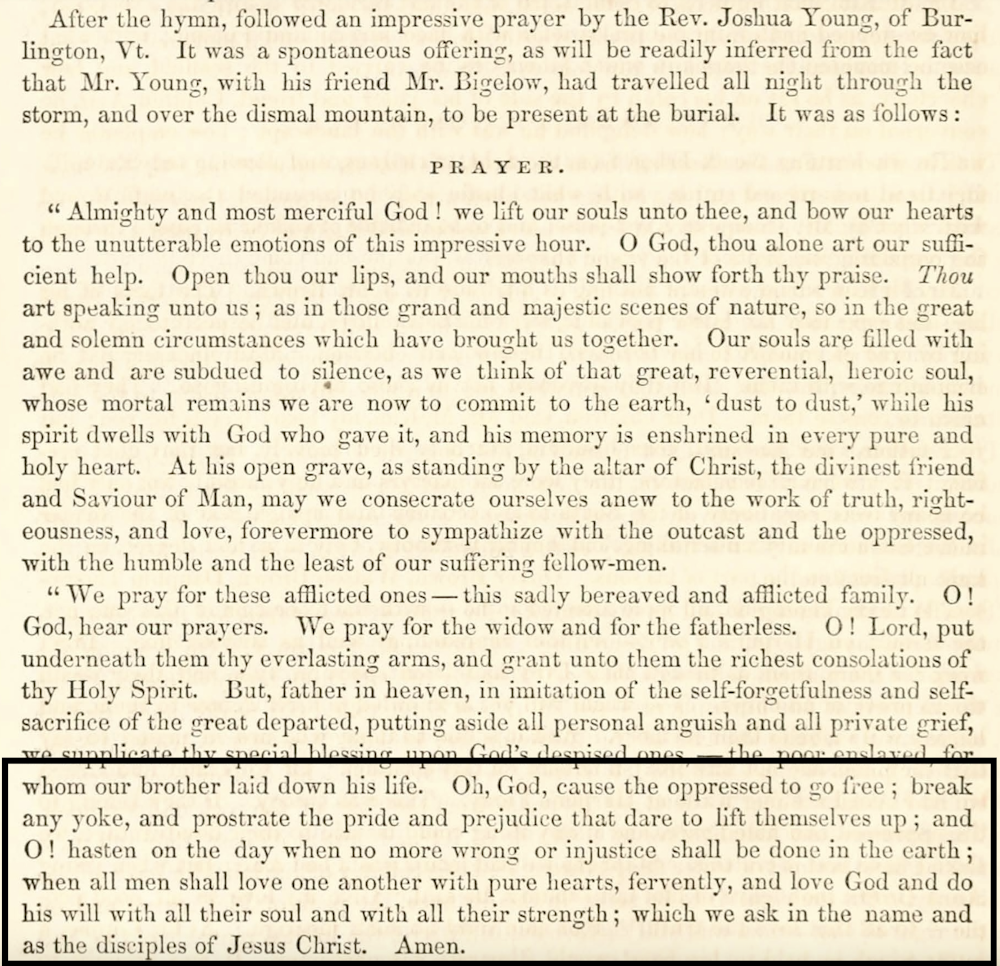
    At the funeral for abolitionist John Brown, the minister prayed over his body, “Oh, God, cause the oppressed to go free; break any yoke, and prostrate the pride and prejudice that dare to lift themselves up.”

    The prayer uttered at John Brown’s burial.
    Library of Congress

    Use of the phrase did not end with Emancipation or the end of the U.S. Civil War.

    In fact, it was one of Frederick Douglass’ favorite phrases. On Oct. 22, 1883, in his “Address at Lincoln Hall,” Douglass excoriated the Supreme Court’s decision rendering the Civil Rights Act of 1875 unconstitutional.

    As was typical of Douglass, the speech ranged beyond racial inequities: “Color prejudice is not the only prejudice against which a Republic like ours should guard. The spirit of caste is malignant and dangerous everywhere. There is the prejudice of the rich against the poor, the pride and prejudice of the idle dandy against the hard-handed workingman.”

    Austen’s independent women

    Early on in “Pride and Prejudice,” the conceited Caroline Bingley snipes that Elizabeth Bennet shows “an abominable sort of conceited independence.” Later, the snobbish Lady Catherine accuses Bennet of being “headstrong.” But near the ending, Mr. Darcy tells Bennet that he loves her for “the liveliness” of her “mind.”

    In this respect, Bennet reflects a quality that all of Austen’s heroines possess. While they try to adhere to standards of courtesy and respect, none are guilty of saying only what the leading man wants to hear.

    Jane Austen.
    Stock Montage/Getty Images

    Given that Austen chose her title to honor the phrase and its history, it is ironic that her own fame ended up drowning out the abolitionist associations of “pride and prejudice” after the Civil War.

    If there is any work of fiction that successfully makes self-sufficiency, independent thinking and open-mindedness look good – and makes sycophants, rigidity and hysterical devotion to rank and status look bad – it is “Pride and Prejudice.”

    Yet the lasting popularity of Austen’s novel demonstrates that the ethics contained in the phrase continue to resonate today, even if its context has been lost.

    Margie Burns does not work for, consult, own shares in or receive funding from any company or organization that would benefit from this article, and has disclosed no relevant affiliations beyond their academic appointment.

    ref. From pulpits to protest, the surprising history of the phrase ‘pride and prejudice’ – https://theconversation.com/from-pulpits-to-protest-the-surprising-history-of-the-phrase-pride-and-prejudice-249836

    MIL OSI – Global Reports

  • MIL-OSI: General Laura J. Richardson Joins Siebert Financial Corp. Advisory Board

    Source: GlobeNewswire (MIL-OSI)

    NEW YORK and MIAMI and LOS ANGELES, March 17, 2025 (GLOBE NEWSWIRE) — General (Ret.) Laura J. Richardson, former Commander of U.S. Southern Command, has joined the Siebert Financial Corp. (“Siebert”) (Nasdaq: SIEB) Advisory Board, the company announced today. A distinguished leader with nearly four decades of military service, General Richardson brings strategic expertise, operational leadership, and a deep understanding of global affairs, reinforcing Siebert’s commitment to expanding financial services for veterans, military personnel, and underserved communities.

    General Richardson’s leadership and global experience will be a tremendous asset to Siebert,” said John J. Gebbia, CEO of Siebert. “Her distinguished national security and diplomacy career aligns with our mission to deliver innovative financial solutions that empower individuals and communities. We are honored to welcome her to our Advisory Board, as we continue expanding our services across key sectors, including military and veteran affairs, international markets, and women’s financial initiatives.”

    Most recently, General Richardson served as the 32nd Commander of U.S. Southern Command (SOUTHCOM), overseeing military operations across Central America, South America, and the Caribbean. She previously led U.S. Army North (Fifth Army) and held multiple high-ranking positions, including Deputy Commanding General of U.S. Army Forces Command, Chief of Army Legislative Liaison to Congress, and Deputy Chief of Staff for Communications for Operation Enduring Freedom.

    As a trailblazer in the U.S. Army, General Richardson has commanded at every level, including leading an Assault Helicopter Battalion in combat during Operation Iraqi Freedom.

    “Muriel Siebert was a pioneer, and I am honored to join an organization that carries forward her legacy of leadership and innovation,” said General Richardson. “Financial security is a critical pillar of long-term stability for individuals, families, and communities. I look forward to working with Siebert to expand opportunities—especially for veterans, women, and those seeking financial independence in an evolving global economy. I am grateful for the opportunity to collaborate with the Gebbia family on this exciting new chapter for Siebert, and I admire their vision for growing the firm’s impact.

    General Richardson joins a prestigious Siebert Advisory Board that includes influential figures from finance, sports, and entertainment, such as international recording artist Akon, NFL Pro Brandon Marshall, Wall Street executives Mick Solimene and Steven Geskos.

    Her addition underscores Siebert’s commitment to leveraging world-class expertise to drive financial growth, foster strategic partnerships, and create meaningful solutions for its diverse client base.

    Strengthening Siebert’s Commitment to the Military and Veteran Community

    Kaj Larsen, Head of Military Investment at Siebert, emphasized the significance of General Richardson’s appointment:
    Welcoming General Richardson to Siebert is a powerful statement about our commitment to those who have served. Her leadership and firsthand understanding of the military community will help us expand financial solutions tailored for veterans, active-duty personnel, and their families. At Siebert, we recognize the unique financial needs of those who have dedicated their lives to service, and this partnership strengthens our mission to support them with the best resources available.”

    About Siebert Financial Corp.
    Siebert is a diversified financial services company and has been a member of the NYSE since 1967 when Muriel Siebert became the first woman to own a seat on the NYSE and the first to head one of its member firms.

    Siebert operates through its subsidiaries Muriel Siebert & Co., LLC, Siebert AdvisorNXT, LLC, Park Wilshire Companies, Inc., RISE Financial Services, LLC, Siebert Technologies, LLC, and StockCross Digital Solutions, Ltd, and Gebbia Media LLC. Through these entities, Siebert provides a full range of brokerage and financial advisory services, including securities brokerage, investment advisory and insurance offerings, securities lending, and corporate stock plan administration solutions, in addition to entertainment and media productions. For over 55 years, Siebert has been a company that values its clients, shareholders, and employees. More information is available at www.siebert.com.

    Cautionary Note Regarding Forward-Looking Statements
    The statements contained in this press release that are not historical facts, including statements about our beliefs and expectations, are “forward-looking statements” within the meaning of the U.S. Private Securities Litigation Reform Act of 1995. Forward-looking statements include statements preceded by, followed by, or that include the words “may,” “could,” “would,” “should,” “believe,” “expect,” “anticipate,” “plan,” “estimate,” “target,” “project,” “intend” and similar words or expressions. In addition, any statements that refer to expectations, projections, or other characterizations of future events or circumstances are forward-looking statements.

    These forward-looking statements, which reflect beliefs, objectives, and expectations as of the date hereof, are based on the best judgment of the management of Siebert. All forward-looking statements speak only as of the date on which they are made. Such forward-looking statements are subject to certain risks, uncertainties and assumptions relating to factors that could cause actual results to differ materially from those anticipated in such statements, including, without limitation, the following: economic, social and political conditions, global economic downturns resulting from extraordinary events; securities industry risks; interest rate risks; liquidity risks; credit risk with clients and counterparties; risk of liability for errors in clearing functions; systemic risk; systems failures, delays and capacity constraints; network security risks; competition; reliance on external service providers; new laws and regulations affecting Siebert’s business; net capital requirements; extensive regulation, regulatory uncertainties and legal matters; failure to maintain relationships with employees, customers, business partners or governmental entities; the inability to achieve synergies or to implement integration plans; and other consequences associated with risks and uncertainties detailed in Part I, Item 1A – Risk Factors of Siebert’s Annual Report on Form 10-K for the year ended December 31, 2023, and Siebert’s filings with the SEC.

    Siebert cautions that the foregoing list of factors is not exclusive, and new factors may emerge, or changes to the foregoing factors may occur that could impact its business. Siebert undertakes no obligation to publicly update or revise these statements, whether as a result of new information, future events, or otherwise, except to the extent required by the federal securities laws.

    Media Contact
    Deborah Kostroun, Zito Partners
    deborah@zitopartners.com
    +1 (201) 403-8185

    A photo accompanying this announcement is available at https://www.globenewswire.com/NewsRoom/AttachmentNg/041ca78e-63d1-4c62-a534-e0c9a1fa3b51

    The MIL Network

  • MIL-OSI: Silynxcom Successfully Completes Field Testing of Enhancing Drone Sound Awareness Technology

    Source: GlobeNewswire (MIL-OSI)

    Strategic Collaboration with a Military Customer in Asia Demonstrates Disruptive Drone Detection Technology, Expanding Global Market Penetration for Silynxcom’s High-Growth Defense Innovation

    Netanya, Israel, March 17, 2025 (GLOBE NEWSWIRE) — Silynxcom Ltd. (NYSE American: SYNX) (“Silynxcom” or the “Company”), a manufacturer and developer of ruggedized tactical communication headset devices, today announced the successful completion of field trials for its innovative product, aimed at boosting situational awareness and safety for armored personnel carrier (“APC”) crews and other heavy military vehicles, with a military force in Asia and conducted in collaboration with a leading global defense contractor.

    The trials demonstrated the Company’s innovative solution that addresses a critical challenge on modern battlefields: detecting the distinct and potentially life-threatening drone humming while simultaneously maintaining hearing protection in high-noise environments. Unlike conventional Active Noise Reduction (ANR) technology that can inadvertently block crucial acoustic threats, Silynxcom’s advanced new APC headset selectively amplifies critical environmental sounds while still providing essential hearing protection.

    Military personnel operating APCs face the triple challenge of protecting their hearing from high-decibel engines and weapons noise, maintaining clear communication through intercom and radio systems, and detecting subtle but potentially lethal threats like approaching drones. We believe that Silynxcom’s technology effectively meets all these requirements during the trials.

    “These successful trials with a new military customer in Asia represent an important strategic expansion for our drone detection technology beyond our initial deployment,” said Nir Klein, Chief Executive Officer of Silynxcom. “Our advanced auditory technology allows for both comprehensive hearing protection and the selective amplification of critical battlefield sounds, giving military personnel the situational awareness they need to identify and respond to emerging threats.”

    The system’s compatibility with popular intercom and radio systems enables plug-and-play integration, allowing for seamless upgrading of existing equipment. This feature proved particularly valuable during these trials, where the technology was tested across different vehicle platforms and communication infrastructures.

    About Silynxcom Ltd.

    Silynxcom Ltd. develops, manufactures, markets, and sells ruggedized tactical communication headset devices as well as other communication accessories, all of which have been field-tested and combat-proven. The Company’s in-ear headset devices, or In-Ear Headsets, are used in combat, the battlefield, riot control, demonstrations, weapons training courses, and on the factory floor. The In-Ear Headsets seamlessly integrate with third party manufacturers of professional-grade ruggedized radios that are used by soldiers in combat or by police officers in leading military and law enforcements units. The Company’s In-Ear Headsets also fit tightly into the protective gear to enable users to speak and hear clearly and precisely while they are protected from the hazardous sounds of combat, riots or dangerous situations. The sleek, lightweight, In-Ear Headsets include active sound protection to eliminate unsafe sounds, while maintaining ambient environmental awareness, giving their customers 360° situational awareness. The Company works closely with its customers and seek to improve the functionality and quality of the Company’s products based on actual feedback from soldiers and police officers “in the field.” The Company sells its In-Ear Headsets and communication accessories directly to military forces, police and other law enforcement units. The Company also deals with specialized networks of local distributors in each locale in which it operates and has developed key strategic partnerships with radio equipment manufacturers.

    Capital Markets & IR Contact

    ARX | Capital Market Advisors
    North American Equities Desk
    ir@silynxcom.com

    The MIL Network

  • MIL-OSI USA: ICE Newark, law enforcement partners arrest illegal alien with arrest warrants

    Source: US Immigration and Customs Enforcement

    NEWARK, N.J. — U.S. Immigration and Customs Enforcement, with assistance from local and federal partners, apprehended Ismail Sayik, a citizen of Turkey illegally present in the United States, March 4 during a routine enforcement operation in New Jersey.

    Sayik, 29, has three arrest warrants overseas, including for allegation of murder, and is currently in ICE custody pending removal proceedings.

    “Once the ICE Homeland Security Investigations attaché office in Turkey alerted HSI Newark that a person of interest overseas was in New Jersey illegally, our team was quick to respond, identify the suspect and arrest him in Queens, New York,” said ICE Homeland Security Investigations Newark Special Agent in Charge Ricky J. Patel. “We are grateful for the entire federal partnership, specifically the FBI and it’s Drug Enforcement Administration for their support to the ICE mission focused on safeguarding our homeland from criminals unlawfully hiding out in our neighborhoods.”

    U.S. Border Patrol arrested Sayik on March 17, 2023, at or near Jacumba, California, after he illegally entered the United States. USBP served Sayik a notice to appear before a Department of Justice immigration judge.

    USBP released Sayik on an Order of Recognizance pending removal proceedings and instructed him to reported to nearest to the nearest ICE office.

    On April 5, 2023, Sayik reported to ICE New York as instructed.

    Personnel with ICE Newark arrested Sayik in Sunnyside, New York, on March 4, and detained him in ICE custody pending removal proceedings.

    MIL OSI USA News

  • MIL-OSI Africa: Africa Finance Corporation (AFC) Sweeps IJGlobal and Global Capital Awards with Hat Trick of Major Wins

    Source: Africa Press Organisation – English (2) – Report:

    LONDON, United Kingdom, March 17, 2025/APO Group/ —

    Africa Finance Corporation (AFC) (www.AfricaFC.org), the continent’s leading infrastructure solutions provider, has been honoured with three prestigious accolades, further underscoring its impact in shaping Africa’s financial landscape. At the IJGlobal Awards 2024 held recently in London, AFC was named Guarantor of the Year, Africa, and also received the Market Innovation Award, Africa. The following evening, AFC was recognised with the African Deal of the Year at the Global Capital Syndicated Loan Awards in London. The trio of awards showcase AFC’s pioneering role in infrastructure financing, risk mitigation, and innovative financial solutions that drive sustainable economic growth across Africa.

    AFC’s triple win highlights its lead role in arranging a record €2 billion syndicated facility for the Bank of Industry (BOI), the largest capital raise in the history of African development finance institutions. AFC served as Global Coordinator, Lead Co-Arranger, Underwriter, Bookrunner, and Guarantor in the successful syndication.

    Leveraging its structuring and credit enhancement, AFC assembled a consortium of international financial institutions for the facility, including Standard Chartered Bank, African Export-Import Bank, First Abu Dhabi Bank PJSC, FirstRand Bank Limited (through its Rand Merchant Bank division – London Branch), Mashreqbank PSC, SMBC Bank International PLC, Absa Bank (Mauritius) Limited, Absa Bank Limited, and the Export-Import Bank of India (London Branch).

    AFC has consistently led the way in unlocking international capital markets for African institutions. In 2023, AFC supported the Egyptian Government as Re-Guarantor on a JPY75 billion Samurai Bond Issue, exemplifying AFC’s role as a key enabler of global financing for African sovereigns. This transaction won AFC the Innovation of the Year Award (MENA) at the IJGlobal Awards 2023.

    Earning Guarantor of the Year, the Market Innovation Award, and African Deal of the Year reaffirms AFC’s expertise in attracting global capital to African markets and its commitment to structuring innovative financing solutions that bridge the continent’s infrastructure gap. AFC’s investment strategies continue to drive economic resilience and industrialization across the continent.

    “We are honored to receive these prestigious awards, which reflect AFC’s ongoing mission to unlock Africa’s infrastructure potential through financial innovation,” commented Samaila Zubairu, President & CEO of Africa Finance Corporation. “These recognitions further validate our credentials as a trusted partner in mobilizing capital to drive sustainable development across the continent. We extend our gratitude to our partners and stakeholders whose collaboration has been instrumental in achieving these milestones.”

    Banji Fehintola, Executive Director and Head of Financial Services at AFC, said: “These recognitions from IJGlobal and Global Capital are a testament to AFC’s leadership in structuring innovative financial solutions that de-risk investments and attract international capital to Africa. The success of the €2 billion syndicated facility for BOI demonstrates our ability to mobilize global funding at scale, supporting economic development and industrialization across the continent.”

    The IJGlobal Awards celebrate outstanding achievements in global greenfield and refinancing deals across various sectors that shape the infrastructure and energy landscape, while the Global Capital Syndicated Loan Awards honor the most significant and innovative syndicated loan transactions worldwide.

    MIL OSI Africa

  • MIL-OSI Security: COMLOG WESTPAC Holds Awards Ceremony, March 13, 2025 [Image 2 of 11]

    Source: United States Navy (Logistics Group Western Pacific)

    Issued by: on


    SINGAPORE (Mar. 13, 2025) Rear Adm. Todd F. Cimicata, left, Commander, Logistics Group Western Pacific/Task Force 73 (COMLOG WESTPAC/CTF 73), recognized Nyuk Phoon Lee for her contributions to the command as comptroller during an awards ceremony on Sembawang Naval Installation, Mar. 13, 2025. COMLOG WESTPAC supports deployed surface units and aircraft carriers, along with regional Allies and partners, to facilitate patrols in the South China Sea, participation in naval exercises and responses to natural disasters. (U.S. Navy photo by Mass Communication Specialist 2nd Class Jordan Jennings/Released)

    Date Taken: 03.13.2025
    Date Posted: 03.14.2025 03:07
    Photo ID: 8915332
    VIRIN: 250313-N-YV347-1027
    Resolution: 6556×4371
    Size: 19.97 MB
    Location: SG

    Web Views: 4
    Downloads: 0

    PUBLIC DOMAIN  

    MIL Security OSI

  • MIL-OSI Russia: Denis Manturov met with the Emir of Qatar Sheikh Tamim Al Thani

    Translartion. Region: Russians Fedetion –

    Source: Government of the Russian Federation – An important disclaimer is at the bottom of this article.

    Denis Manturov met with the Emir of Qatar, Sheikh Tamim Al Thani.

    Emir of Qatar Sheikh Tamim bin Hamad bin Khalifa Al Thani received First Deputy Prime Minister of Russia Denis Manturov. The First Deputy Prime Minister conveyed warm greetings and best wishes from Russian President Vladimir Putin to the country’s leader.

    The meeting discussed priority areas of Russian-Qatari cooperation. The need to support direct contacts between the business circles of the two countries to improve the quality of trade, economic and investment cooperation was identified.

    Denis Manturov is in Doha on a working visit to hold the 5th meeting of the joint Russian-Qatari commission on trade, economic and technical cooperation. The co-chairman from the Qatari side is the Chairman of the Council of Ministers, Minister of Foreign Affairs of Qatar Mohammed bin Abdul Rahman bin Jassim Al Thani.

    Please note: This information is raw content directly from the source of the information. It is exactly what the source states and does not reflect the position of MIL-OSI or its clients.

    MIL OSI Russia News

  • MIL-OSI Russia: The 5th meeting of the Joint Russian-Qatari Commission on Trade, Economic and Technical Cooperation was held in Doha

    Translartion. Region: Russians Fedetion –

    Source: Government of the Russian Federation – An important disclaimer is at the bottom of this article.

    Denis Manturov and the Chairman of the Council of Ministers, Minister of Foreign Affairs of Qatar Mohammed bin Abdul Rahman bin Jassim Al Thani held the 5th meeting of the Joint Russian-Qatari Commission on Trade, Economic and Technical Cooperation.

    First Deputy Prime Minister of Russia Denis Manturov and Chairman of the Council of Ministers, Minister of Foreign Affairs of Qatar Mohammed bin Abdul Rahman bin Jassim Al Thani held the 5th meeting of the Joint Russian-Qatari Commission on Trade, Economic and Technical Cooperation.

    During the meeting, the parties discussed issues of bilateral cooperation in the areas of trade, investment and finance, transport and digital technologies, as well as humanitarian projects, including culture, sports and education. Particular attention was paid to industrial cooperation in such sectors as pharmaceuticals, shipbuilding, power engineering, including in the field of renewable energy.

    Denis Manturov noted that given the scale of foreign trade between Russia and Qatar, the volume of bilateral trade does not fully reflect the existing potential. Opportunities for increasing and diversifying mutual trade, in particular, are associated with food supplies.

    “Cereals, primarily wheat and barley, already predominate in the structure of our trade turnover. We are ready to increase shipments of agricultural products, including halal products. Having in mind not only ensuring food security for Qatar, but also creating a regional agro-industrial hub in your country. Among the promising export products, we can also highlight beef, poultry, sunflower oil and confectionery,” said the First Deputy Prime Minister.

    Speaking about mutually beneficial projects in the pharmaceutical sector, Denis Manturov noted that in addition to supplying a wide range of medicines, Russia is considering localizing production in Qatar with the transfer of relevant technologies. In addition, opportunities for cooperation are opened up by domestic advanced developments in the field of shipbuilding, in particular, this concerns passenger hydrofoils and environmentally friendly silent electric vessels, which are successfully operated in Russia.

    “Interaction in the field of digital technologies contains a capacious potential. Russian companies have unique developments in the field of artificial intelligence, the Internet of things and solutions in the field of information security. I would like to highlight the opportunities for cooperation between Moscow and Doha in such a relevant area as smart city technologies,” Denis Manturov noted.

    A positive trend in the development of cooperation in the field of tourism was noted. “Last year, more than 100 thousand Russian citizens visited Qatar. Reciprocal interest from Qatari citizens is also increasing – in 2024, we received about 11 thousand tourists from your country. This is understandable, since Russia combines unique natural, climatic, cultural and historical features with a dynamically growing level of the hospitality industry and security,” said Denis Manturov.

    Speaking about cooperation in the field of sports, the First Deputy Prime Minister recalled that in November last year, Doha hosted the international rhythmic gymnastics competition “Heavenly Grace Cup”, organized on the initiative of Olympic champion Alina Kabaeva. The interdepartmental Memorandum of Understanding in the field of physical culture and sports, the signing of which is planned for the near future, will contribute to strengthening cooperation.

    In conclusion of his speech, Denis Manturov invited Qatari representatives to take part in the St. Petersburg International Economic Forum scheduled for June, where the country was a guest in 2021, in the Russia-Islamic World International Economic Forum to be held in Kazan in May, the Innoprom International Industrial Exhibition in Yekaterinburg in July, and the Russian Energy Week in Moscow in October. In addition, during the IGC, the Russian side voiced a proposal to hold a Russian-Qatari business forum in Moscow in April 2025.

    Following the meeting, the final protocol of the 5th meeting of the commission was signed.

    Please note: This information is raw content directly from the source of the information. It is exactly what the source states and does not reflect the position of MIL-OSI or its clients.

    MIL OSI Russia News

  • MIL-OSI Asia-Pac: India – New Zealand Joint Statement

    Source: Government of India

    Posted On: 17 MAR 2025 2:39PM by PIB Delhi

    At the invitation of the Prime Minister of India, Shri Narendra Modi, the Prime Minister of New Zealand, Rt Hon Christopher Luxon, is on an Official Visit to India on 16-20 March 2025. Prime Minister Luxon, who is on his first visit to India in his current capacity, is visiting New Delhi and Mumbai, and is accompanied by Hon. Louise Upston, Minister for Tourism and Hospitality, Hon. Mark Mitchell, Minister for Ethnic Communities, and Sport and Recreation, and Hon. Todd McClay, Minister for Trade and Investment, Agriculture, and Forestry, and a high-level delegation comprising of officials, and representatives of businesses, community diaspora, media and cultural groups.

    Prime Minister Luxon was accorded a warm and traditional welcome in New Delhi. Prime Minister Modi held bilateral talks with Prime Minister Luxon. Prime Minister Modi will inaugurate the 10th edition of the Raisina Dialogue on 17 March 2025 in New Delhi with Prime Minister Luxon as the Chief Guest delivering the Inaugural Keynote Address. The Prime Minister laid a wreath at Raj Ghat Mahatma Gandhi Memorial and also called on President Droupadi Murmu.

    The Prime Ministers reaffirmed their shared desire to further strengthen the growing bilateral relationship between India and New Zealand which is anchored in shared democratic values and robust people-to-people ties. Both leaders recognized that there remains significant potential for further growth in the bilateral relationship and agreed to cooperate closely in diverse areas, including trade and investment, defence and security, education and research, science and technology, agri-tech, space, mobility of people and sports.

    The Prime Ministers exchanged views on regional and global developments of mutual interest and agreed to strengthen multilateral cooperation. The Prime Ministers recognised that we face an increasingly uncertain and dangerous world. They noted that, as maritime nations, India and New Zealand have a strong and common interest in an open, inclusive, stable and prosperous Indo-Pacific, where the rules-based international order is upheld.

    The Prime Ministers reaffirmed the right of freedom of navigation and overflight and other lawful uses of the seas in accordance with international law, particularly the 1982 United Nations Convention on the Law of the Sea (UNCLOS). The Prime Ministers reaffirmed the need to pursue peaceful resolution of disputes in accordance with international law, particularly UNCLOS.

    The Prime Ministers noted with satisfaction the strong connections between the people of the two countries, with Indian-origin people making up almost six percent of New Zealand’s population. They appreciated the significant contribution of the Indian diaspora in New Zealand and their positive role in facilitating people-to-people ties between the two countries. Both leaders agreed on the significance of ensuring the safety and security of the Indian community, including students, in New Zealand, and of New Zealanders in India and visitors to India.

    Cooperation in trade, investment and financial matters:

    The Prime Ministers welcomed sustained trade and investment flows between India and New Zealand and called for further exploring the potential to expand bilateral trade. They encouraged businesses on both sides to cultivate links; explore emerging economic and investment opportunities to build upon the complementarities of the two economies.

    The Leaders called for greater two-way investment, reflective of the ongoing strong momentum in bilateral cooperation.

    The Prime Ministers agreed to enhance the trade and investment relationship between India and New Zealand to realise its untapped potential and to contribute to inclusive and sustainable economic growth.

    The Prime Ministers welcomed the launch of FTA negotiations for a balanced, ambitious, comprehensive, and mutually beneficial trade agreement to achieve deeper economic integration. The Leaders agreed that a comprehensive trade agreement offers a significant opportunity to enhance trade and economic cooperation. By leveraging each country’s strengths, addressing their respective concerns, and tackling challenges, a bilateral trade agreement can foster mutually beneficial trade and investment growth, ensuring equitable gains and complementarities for both sides. The Leaders committed to designate senior representatives to steer these negotiations to resolution as soon as reasonably possible.

     Within the context of FTA negotiations, the Leaders agreed to discussions between respective authorities on both sides to explore early implementation of cooperation in the digital payments sector.

    The Prime Ministers welcomed the signing of the Authorized Economic Operators Mutual Recognition Arrangement (AEO-MRA) under the aegis of the Customs Cooperation Arrangement (CCA) signed in 2024, which would facilitate easier movement of goods between the two countries by our respective trusted traders through close cooperation between customs authorities, thereby boosting bilateral trade.

    The Leaders welcomed new cooperation on horticulture and forestry, including: the signing of the Memorandum of Cooperation on Horticulture which would enhance bilateral cooperation by promoting knowledge and research exchanges, development of post-harvest and marketing infrastructure; and the signing of a Letter of Intent on Forestry Cooperation that encourages policy dialogues and technical exchanges.

    The Leaders recognized the positive role played by tourism in generating economic growth, increasing business engagements and generating greater understanding between people of the two countries. They welcomed the growing flows of tourists between India and New Zealand. They appreciated the update to the India-New Zealand Air Services Agreement and agreed to encourage their carriers for commencement of direct (non-stop) flight operations between the two countries.

    Political, defence and security cooperation:

    The Prime Ministers recognised the significance of parliamentary exchanges and encouraged regular visits of parliamentary delegations between the two countries.

    The Prime Ministers acknowledged the shared history of sacrifice of Indian and New Zealand service personnel who fought and served alongside one another around the world over the past century.

    The Prime Ministers welcomed sustained progress in defence engagements, including through participation in military exercises, staff college exchanges, regular port calls by naval ships, and exchange of high-level defence delegations. They recalled that the Indian Naval sailing vessel Tarini made a port call at Lyttelton, Christchurch, New Zealand in December 2024. They also referred to the upcoming port call in Mumbai by the Royal New Zealand Navy Ship HMNZS Te Kaha.

    Both Leaders welcomed the signing of the India-New Zealand Memorandum of Understanding for Defence Cooperation. This will further strengthen bilateral defence cooperation and establish regular bilateral defence engagement. Both sides noted the need for ensuring the safety and security of sea lanes of communication and agreed there needs to be regular dialogue to discuss enhancement of maritime safety.

    New Zealand welcomed India joining the Combined Maritimes Forces. Both Leaders welcomed advancement in defence ties during New Zealand command of Command Task Force 150.

    Both Leaders appreciated the regular training exchanges of officers, including at Defence Colleges on reciprocal basis. Both sides agreed for enhanced capacity building cooperation.

    Prime Minister Luxon expressed New Zealand’s interest in joining the Indo-Pacific Oceans Initiative (IPOI). Prime Minister Modi welcomed New Zealand into this partnership with like-minded countries which seek to manage, conserve and sustain the maritime domain. Further cooperation as maritime nations is also being explored between India and New Zealand with discussions taking place between experts on the National Maritime Heritage Complex (NMHC) which is being established at Lothal, Gujarat.

    Cooperation in science & technology and disaster management:

    The two Leaders noted the significance of research, scientific connections, technology partnerships and innovation as an important pillar of the bilateral partnership and called for exploring such opportunities in mutual interest. Both sides stressed the need for stronger collaboration to develop and commercialize technologies in identified areas through closer collaboration between businesses, and industries.

    The two sides recognized the challenges for their economies presented by climate change and the transition to low emissions climate resilient economies. Prime Minister Luxon welcomed India’s leadership in the International Solar Alliance (ISA) and reiterated New Zealand’s strong support as a member since 2024. Prime Minister Modi welcomed New Zealand joining the Coalition for Disaster Resilient Infrastructure (CDRI), which aims at making systems and infrastructure resilient in order to achieve the objectives of the Sustainable Development Goals (SDGs), the Paris Climate Agreement and the Sendai Framework for Disaster Risk Reduction.

    The two Leaders welcomed work towards a Memorandum of Cooperation on earthquake mitigation cooperation between relevant authorities of India and New Zealand, which would facilitate inter alia exchange of experiences in earthquake preparedness, emergency response mechanism, and capacity building.

    Education, mobility, sports and people to people ties:

    Both Prime Ministers agreed that there exists great potential to further strengthen the growing education and community links between India and New Zealand. They encouraged academic institutions of both countries to build future-oriented partnerships focused on areas of mutual interest including in areas of science, innovation, new and emerging technologies.

    The Leaders encouraged the creation of further opportunities for Indian students seeking quality education programmes in New Zealand. They noted the significance of skill development and mobility of skilled personnel to support expanded engagement in sectors, including science, innovation, and new and emerging technologies. The two Leaders agreed, within the context of the trade agreement negotiations, which the Leaders have agreed to launch, to also launch negotiations on an arrangement facilitating the mobility of professionals and skilled workers between the two countries, while also addressing the issue of irregular migration.

    The Leaders welcomed the signature of the refreshed Education Cooperation Arrangement between the Indian Ministry of Education and the New Zealand Ministry of Education. This Arrangement will facilitate the continued exchange of information on India’s and New Zealand’s respective education systems as the basis for strengthening the bilateral education relationship.

    The Leaders noted that India and New Zealand enjoy close sporting links, particularly in cricket, hockey and other Olympic sports. They welcomed the signing of the Memorandum of Cooperation on Sports to foster greater sporting engagement and collaboration between countries. They also welcomed the “Sporting Unity” events planned in 2026, to recognise and celebrate 100 years of sporting contact between India and New Zealand.

    The Prime Ministers acknowledged the importance of robust systems of traditional medicine in India and New Zealand, and welcomed discussions between experts, including science and research experts, on both sides to understand and explore possible areas of cooperation, including through sharing of information and best practices and visits of experts.

    Both Prime Ministers noted the growing interest among New Zealanders in Yoga and Indian music and dance, as well as the free observance of Indian festivals. They encouraged further promotion of bilateral ties including through music, dance, theatre, films, and festivals.

    Cooperation in regional and multilateral fora:

    Both Prime Ministers reaffirmed their commitment to supporting an open, inclusive, stable and prosperous Indo-Pacific where sovereignty and territorial integrity are respected.

    The Leaders noted cooperation between India and New Zealand in various regional fora, including ASEAN-led fora such as the East Asia Summit, the ASEAN Defence Ministers’ Meeting Plus and the ASEAN Regional Forum. The Leaders reaffirmed the importance of these regional bodies and ASEAN centrality for furthering security and prosperity of the Indo-Pacific region and emphasised the importance of all parties maintaining peace and stability in the region.

    Both Leaders emphasized on the importance of an effective multilateral system, centered on a United Nations that is reflective of contemporary realities, as a key factor in tackling global challenges. The two sides stressed the need for UN reforms, including of the Security Council through expansion in its membership, to make it more representative, credible and effective. New Zealand endorsed India’s candidature for permanent membership in a reformed UN Security Council. The two sides agreed to explore the possibility of extending mutual support to each other’s candidatures at the multilateral fora.

    Both Leaders emphasized the importance of upholding the global nuclear disarmament and non-proliferation regime, and acknowledged the value of India joining the Nuclear Suppliers Group in context of predictability for India’s clean energy goals and its non-proliferation credentials.

    Both Leaders reaffirmed their firm support for peace and stability in the Middle East and welcomed the agreement for the release of hostages and ceasefire of January 2025. They reiterated their call for continued negotiations to secure a permanent peace, which includes the release of all hostages and the rapid, safe and unimpeded humanitarian access throughout Gaza. Both Leaders stressed the importance of a negotiated two-State solution, leading to the establishment of a sovereign, viable and independent state of Palestine, and living within secure and mutually recognized borders, side by side in peace and security with Israel.

    The Leaders exchanged views on the war in Ukraine and expressed support for a just and lasting peace based on respect for international law, principles of the UN charter, and territorial integrity and sovereignty.

    The two Leaders reiterated their absolute condemnation of terrorism in all its forms and manifestations, and the use of terrorist proxies in cross-border terrorism. Both stressed the urgent need for all countries to take immediate, sustained, measurable, and concrete action against UN-proscribed terrorist organizations and individuals. They called for disrupting of terrorism financing networks and safe havens, dismantling of terror infrastructure, including online, and bringing perpetrators of terrorism to justice swiftly. The two leaders agreed to cooperate in combating terrorism and violent extremism through bilateral and multilateral mechanisms.

    The two Prime Ministers noted with satisfaction the progress in ongoing bilateral cooperation and reaffirmed their commitment to further strengthen and deepen the bilateral partnership for mutual benefit as well as for the benefit of the Indo-Pacific Region. They called for exploring the potential to deepen bilateral engagement and explore new avenues of cooperation, including in the fields of green and agriculture technologies.

    Prime Minister Luxon thanked Prime Minister Modi and the Government and the people of India for the warmth and hospitality extended to him and to the members of his delegation during his Official Visit to India. Prime Minister Luxon invited Prime Minister Modi to undertake a reciprocal visit to New Zealand.


    ***

    MJPS/ST

    (Release ID: 2111753) Visitor Counter : 107

    MIL OSI Asia Pacific News

  • MIL-OSI Europe: Answer to a written question – Türkiye’s suspicious role in the illegal migration issue – E-002104/2024(ASW)

    Source: European Parliament

    The EU-Turkey Statement[1] remains valid and is the main framework of cooperation with Türkiye on migration. Despite challenges, the Statement has produced tangible results leading to a significant decrease of loss of human lives and improving the situation of refugees and migrants in Türkiye.

    The number of irregular border crossings between Türkiye and the EU has remained consistently and significantly lower than before the EU-Turkey Statement.

    On 16 October 2023, the Commission presented the EU Action Plan for the Eastern Mediterranean[2] with targeted operational measures aiming at addressing migration management along this route, including Türkiye.

    The Commission is closely monitoring the situation, including the arrivals to the Greek islands, and is discussing with the Turkish authorities on a regular basis.

    Total EU assistance allocated to refugees and host communities in Türkiye since 2011 amounts to just under EUR 11 billion (up until and including 2024). This includes support for refugees to meet their basic needs[3].

    Projects in the areas of education, health, basic needs and socioeconomic support have helped millions of refugees and migrants to have more decent lives, while conditions are not conducive for returns.

    Funding has been increasingly allocated to migration management and to strengthen Türkiye’s capacity to manage migratory pressure along its borders.

    • [1] https://www.consilium.europa.eu/en/press/press-releases/2016/03/18/eu-turkey-statement/
    • [2] https://ec.europa.eu/commission/presscorner/detail/en/ip_23_4994
    • [3] https://enlargement.ec.europa.eu/eighth-annual-report-facility-refugees-turkey_en
    Last updated: 17 March 2025

    MIL OSI Europe News

  • MIL-OSI Europe: Written question – Urgent question regarding Pakistani Prime Minister’s statement of support for the pseudo-state of northern Cyprus – E-000892/2025

    Source: European Parliament

    Question for written answer  E-000892/2025
    to the Commission
    Rule 144
    Loucas Fourlas (PPE)

    In an utterly unacceptable statement made during a joint press conference with Turkish President Tayyip Erdoğan, the Prime Minister of Pakistan, Shehbaz Sharif, said that his country ‘fully supports the cause of northern Cyprus and fully stands by Türkiye on this cause in an unwavering fashion’. Aside from being unacceptable and provocative, this statement is a cause for serious concern as it is indicative of Pakistan’s potential intention to recognise the pseudo-state, in violation of international law, the relevant resolutions adopted by the UN Security Council and EU principles.

    In view of the above, can the Commission answer the following:

    • 1.Is it aware of the contents of the statement in question?
    • 2.What immediate steps will it take to prevent any move that would violate international law and undermine the sovereignty of the Republic of Cyprus?
    • 3.How, in the context of the EU’s external relations, will the Commission remind Pakistan of the commitment to comply with international law and respect the territorial integrity of the EU’s Member States?

    We expect a swift response from the Commission, to ensure the protection of international law and prevent any faits accomplis that would harm European cohesion.

    Submitted: 3.3.2025

    Last updated: 17 March 2025

    MIL OSI Europe News

  • MIL-OSI Europe: Written question – Need for a permanent ceasefire and the escalation of violence in the West Bank – E-000984/2025

    Source: European Parliament

    Question for written answer  E-000984/2025
    to the Council
    Rule 144
    João Oliveira (The Left)

    The ceasefire in the Gaza Strip on 15 January 2025 made it possible to ramp up humanitarian aid, although a far cry from what is really needed. According to figures dating from mid-February from the United Nations Office for the Coordination of Humanitarian Affairs, 91 % of the Palestinian people are still enduring acute food insecurity. More than 48 000 Palestinians have lost their lives and over 111 000 have been wounded owing to Israel’s genocide-like action. On top of this, some 70 % of Palestine’s infrastructure has been razed to the ground, as its territory continues to be destroyed.

    Despite the ceasefire in the Gaza Strip, Israeli military attacks in the West Bank are going from bad to worse. According to the UN, more than 40 000 Palestinians have been forced from their homes and land, on a scale that hasn’t been seen in decades, and between 21 January and 20 February of this year, Israeli forces reportedly killed 51 Palestinians in the West Bank.

    In the light of the above:

    • 1.What measures is the Council taking to ensure that the ceasefire becomes permanent and that humanitarian aid actually finds its way to where it is needed?
    • 2.Is the Council in favour of suspending the EU-Israel Association Agreement and imposing an arms embargo, among other measures?
    • 3.What measures will the Council take to ensure that the Palestinian people can enjoy their rights as a nation, to put an end to the Israeli occupation and to create a Palestine state, as has been called for in UN resolutions?

    Submitted: 6.3.2025

    Last updated: 17 March 2025

    MIL OSI Europe News

  • MIL-OSI Europe: Highlights – DEVE – AFET exchange of views with Philippe Lazzarini, Commissioner-General of UNRWA – Committee on Development

    Source: European Parliament

    UNRWA.jpeg © Image used under license from Adobe Stock

    On 17 March, at 15:00 – 16:30 the AFET and DEVE Committees will meet with the Commissioner-General of the United Nations Relief and Works Agency for Palestine Refugees in the Near East (UNRWA), Philippe Lazzarini for an exchange of views.

    Mr Lazzarini is expected to provide Members with an overview of the latest developments in the Israel-Hamas conflict and how UNRWA operations are affected, in light of the recent Israeli ban on UNRWA in its own territory. UNRWA provides assistance and protection to 5.9 million registered Palestinian refugees in Gaza, the West Bank, Jordan, Lebanon and Syria.

    MIL OSI Europe News

  • MIL-OSI Europe: AMENDMENTS 002-011 – JOINT MOTION FOR A RESOLUTION on the need for EU support towards a just transition and reconstruction in Syria – RC-B10-0157/2025(002-011)

    Source: European Parliament

    AMENDMENTS 002-011
    JOINT MOTION FOR A RESOLUTION
    pursuant to Rule 136(2) and (4) of the Rules of Procedure
    replacing the following motions:
    B10-0157/2025 (S&D)
    B10-0160/2025 (PPE)
    B10-0162/2025 (Verts/ALE)
    B10-0164/2025 (Renew)
    B10-0169/2025 (ECR)
    on the need for EU support towards a just transition and reconstruction in Syria
    (2025/2569(RSP))
    Ingeborg Ter Laak, Michael Gahler, Laurent Castillo, Isabel Wiseler-Lima, Sebastião Bugalho, Andrey Kovatchev, Željana Zovko, François-Xavier Bellamy, Davor Ivo Stier, Antonio López-Istúriz White, Reinhold Lopatka, Wouter Beke, Vangelis Meimarakis, Jan Farský, Nicolás Pascual de la Parte, Daniel Caspary, Ana Miguel Pedro
    on behalf of the PPE Group
    Yannis Maniatis, Nacho Sánchez Amor, Marco Tarquinio, Hana Jalloul Muro, Evin Incir
    on behalf of the S&D Group
    Adam Bielan, Jadwiga Wiśniewska, Małgorzata Gosiewska, Rihards Kols, Emmanouil Fragkos, Waldemar Tomaszewski
    on behalf of the ECR Group
    Nathalie Loiseau, Barry Andrews, Dan Barna, Benoit Cassart, Olivier Chastel, Engin Eroglu, Bernard Guetta, Karin Karlsbro, Ľubica Karvašová, Urmas Paet, Hilde Vautmans, Lucia Yar
    on behalf of the Renew Group
    Hannah Neumann
    on behalf of the Verts/ALE Group

    Source : © European Union, 2025 – EP

    MIL OSI Europe News

  • MIL-OSI Europe: AMENDMENTS 031-033 – JOINT MOTION FOR A RESOLUTION on the need for EU support towards a just transition and reconstruction in Syria – RC-B10-0157/2025(031-033)

    Source: European Parliament

    AMENDMENTS 031-033
    JOINT MOTION FOR A RESOLUTION
    pursuant to Rule 136(2) and (4) of the Rules of Procedure
    replacing the following motions:
    B10-0157/2025 (S&D)
    B10-0160/2025 (PPE)
    B10-0162/2025 (Verts/ALE)
    B10-0164/2025 (Renew)
    B10-0169/2025 (ECR)
    on the need for EU support towards a just transition and reconstruction in Syria
    (2025/2569(RSP))
    Ingeborg Ter Laak, Michael Gahler, Laurent Castillo, Isabel Wiseler-Lima, Sebastião Bugalho, Andrey Kovatchev, Željana Zovko, François-Xavier Bellamy, Davor Ivo Stier, Antonio López-Istúriz White, Reinhold Lopatka, Wouter Beke, Vangelis Meimarakis, Jan Farský, Nicolás Pascual de la Parte, Daniel Caspary, Ana Miguel Pedro
    on behalf of the PPE Group
    Yannis Maniatis, Nacho Sánchez Amor, Marco Tarquinio, Hana Jalloul Muro, Evin Incir
    on behalf of the S&D Group
    Adam Bielan, Jadwiga Wiśniewska, Małgorzata Gosiewska, Rihards Kols, Emmanouil Fragkos, Waldemar Tomaszewski
    on behalf of the ECR Group
    Nathalie Loiseau, Barry Andrews, Dan Barna, Benoit Cassart, Olivier Chastel, Engin Eroglu, Bernard Guetta, Karin Karlsbro, Ľubica Karvašová, Urmas Paet, Hilde Vautmans, Lucia Yar
    on behalf of the Renew Group
    Hannah Neumann
    on behalf of the Verts/ALE Group

    Source : © European Union, 2025 – EP

    MIL OSI Europe News

  • MIL-OSI Europe: AMENDMENTS 001-001 – JOINT MOTION FOR A RESOLUTION on the need for EU support towards a just transition and reconstruction in Syria – RC-B10-0157/2025(001-001)

    Source: European Parliament

    AMENDMENTS 001-001
    JOINT MOTION FOR A RESOLUTION
    pursuant to Rule 136(2) and (4) of the Rules of Procedure
    replacing the following motions:
    B10-0157/2025 (S&D)
    B10-0160/2025 (PPE)
    B10-0162/2025 (Verts/ALE)
    B10-0164/2025 (Renew)
    B10-0169/2025 (ECR)
    on the need for EU support towards a just transition and reconstruction in Syria
    (2025/2569(RSP))
    Ingeborg Ter Laak, Michael Gahler, Laurent Castillo, Isabel Wiseler-Lima, Sebastião Bugalho, Andrey Kovatchev, Željana Zovko, François-Xavier Bellamy, Davor Ivo Stier, Antonio López-Istúriz White, Reinhold Lopatka, Wouter Beke, Vangelis Meimarakis, Jan Farský, Nicolás Pascual de la Parte, Daniel Caspary, Ana Miguel Pedro
    on behalf of the PPE Group
    Yannis Maniatis, Nacho Sánchez Amor, Marco Tarquinio, Hana Jalloul Muro, Evin Incir
    on behalf of the S&D Group
    Adam Bielan, Jadwiga Wiśniewska, Małgorzata Gosiewska, Rihards Kols, Emmanouil Fragkos, Waldemar Tomaszewski
    on behalf of the ECR Group
    Nathalie Loiseau, Barry Andrews, Dan Barna, Benoit Cassart, Olivier Chastel, Engin Eroglu, Bernard Guetta, Karin Karlsbro, Ľubica Karvašová, Urmas Paet, Hilde Vautmans, Lucia Yar
    on behalf of the Renew Group
    Hannah Neumann
    on behalf of the Verts/ALE Group

    Source : © European Union, 2025 – EP

    MIL OSI Europe News

  • MIL-OSI: Tower Semiconductor Recognized by Northrop Grumman with Supplier Excellence Award

    Source: GlobeNewswire (MIL-OSI)

    MIGDAL HAEMEK, Israel, March 17, 2025 – Northrop Grumman Corporation (NYSE:NOC) has recognized Tower Semiconductor as one of its top supplier partners during the company’s Supplier Excellence Awards Ceremony held recently.

    “Tower Semiconductor has supported Northrop Grumman in delivering technologies that enhance national security for the U.S. and our allies,” said Ken Brown, Vice President, Enterprise Global Supply Chain, Northrop Grumman. “The high-quality performance, dedication and partnership of our supplier teams drive operational excellence to ensure warfighters have next generation advantages in advanced weapons, aircraft, missile defense and space.”

    Recognized for Performance Excellence, Tower Semiconductor is instrumental in supporting Northrop Grumman with delivering innovative and cost-effective military and security solutions to give its customers a competitive advantage in a complex field.

    “It is an honor to once again receive the Northrop Grumman Supplier Excellence Award. This recognition underscores Tower Semiconductor’s unwavering commitment to delivering exceptional quality, reliability, and service to our Aerospace & Defense customers,” said Mike Scott, Sr. Director and General Manager of Aerospace & Defense Business Unit, Tower Semiconductor. “We take great pride in supporting Northrop Grumman and the broader defense community with our advanced technologies, manufacturing capabilities and dedicated A&D organization.”

    About Tower Semiconductor         

    Tower Semiconductor Ltd. (NASDAQ/TASE: TSEM), the leading foundry of high-value analog semiconductor solutions, provides technology, development, and process platforms for its customers in growing markets such as consumer, industrial, automotive, mobile, infrastructure, medical and aerospace and defense. Tower Semiconductor focuses on creating a positive and sustainable impact on the world through long-term partnerships and its advanced and innovative analog technology offering, comprised of a broad range of customizable process platforms such as SiGe, BiCMOS, mixed-signal/CMOS, RF CMOS, CMOS image sensor, non-imaging sensors, displays, integrated power management (BCD and 700V), photonics, and MEMS. Tower Semiconductor also provides world-class design enablement for a quick and accurate design cycle as well as process transfer services including development, transfer, and optimization, to IDMs and fabless companies. To provide multi-fab sourcing and extended capacity for its customers, Tower Semiconductor owns one operating facility in Israel (200mm), two in the U.S. (200mm), two in Japan (200mm and 300mm) which it owns through its 51% holdings in TPSCo, shares a 300mm facility in Agrate, Italy with STMicroelectronics as well as has access to a 300mm capacity corridor in Intel’s New Mexico factory. For more information, please visit: www.towersemi.com.

    Safe Harbor Regarding Forward-Looking Statements

    This press release includes forward-looking statements, which are subject to risks and uncertainties. Actual results may vary from those projected or implied by such forward-looking statements. A complete discussion of risks and uncertainties that may affect the accuracy of forward-looking statements included in this press release or which may otherwise affect Tower’s business is included under the heading “Risk Factors” in Tower’s most recent filings on Forms 20-F, F-3, F-4 and 6-K, as were filed with the Securities and Exchange Commission (the “SEC”) and the Israel Securities Authority. Tower does not intend to update, and expressly disclaim any obligation to update, the information contained in this release. 

    ###

    Tower Semiconductor Company Contact: Orit Shahar | +972-74-7377440 | oritsha@towersemi.com

    Investor Relations Contact: Liat Avraham | +972-4-6506154 | liatavra@towersemi.com

    Attachment

    The MIL Network

  • MIL-OSI: CYREBRO’s AI-Native MDR Platform Earns Silver at the 2025 Globee Cybersecurity Awards

    Source: GlobeNewswire (MIL-OSI)

    TEL AVIV, Israel, March 17, 2025 (GLOBE NEWSWIRE) — CYREBRO, the AI-native Managed Detection and Response (MDR) solution, announced today that it won Silver in the category of Security Operations Center (SOC) solutions at the annual 2025 Globee Awards. The program aims to raise awareness about cybersecurity issues and honor those who have made significant contributions in protecting organizations and individuals from cyber threats.

    This award comes on the heels of significant advancements for CYREBRO, solidifying its position as a future-proof cybersecurity leader. The company has recently launched its proprietary security data lake, enabling unparalleled threat analysis and faster, more precise detection. This innovation, coupled with a strategic partnership with Google Cloud, enhances CYREBRO’s ability to scale and deliver cutting-edge security solutions across diverse environments.

    CYREBRO’s commitment to global expansion is evident in its rapidly growing customer base across new markets, demonstrating the universal need for proactive threat detection and response across companies of all sizes.

    CYREBRO remains steadfast in its 100% channel-based strategy, empowering its partners to deliver exceptional MDR services to their clients. This approach ensures seamless integration and personalized service, maximizing the value of CYREBRO’s MDR capabilities.

    “We are honored to receive this prestigious award,” said Ori Arbel, CYREBRO CTO. “This recognition validates our relentless pursuit of innovation and our dedication to empowering businesses with robust cybersecurity defenses. We’re particularly proud of the strides we’ve made in enhancing our platform, directly translating to superior security outcomes for our partners and customers.”

    About CYREBRO

    CYREBRO is an AI-native, end-to-end Managed Detection and Response (MDR) solution, designed for hands-off or hands-on control through its future-proof SOC platform.

    With its advanced Security Data Lake revolutionizing SIEM and SOAR capabilities, CYREBRO includes 24/7 SOC monitoring and threat intelligence, augmented with exceptionally swift incident response and forensic investigations. CYREBRO delivers precision-guided threat detection and response across any tech stack, providing clear, actionable insights to ensure world-class security and compliance.

    With comprehensive visibility and expert guidance, CYREBRO empowers over 900 businesses of all sizes to manage threats proactively, enhancing their security posture and delivering full and complete protection.

    Contact

    CMO

    Gil Harel

    CYREBRO

    media@cyrebro.io

    A photo accompanying this announcement is available at https://www.globenewswire.com/NewsRoom/AttachmentNg/65196b6f-6edb-4169-a4a9-0f187cb480b5

    The MIL Network

  • MIL-OSI Video: President von der Leyen participates in the 9th Brussels Conference on Syria

    Source: European Commission (video statements)

    The European Union will convene its 9th international Conference in support of Syria on 17 March, in Brussels. This year’s edition comes at a historic moment, following the fall of the Assad regime, where the Syrian people have the chance to re-take control of their destiny and rebuild their country.

    Follow us on:
    -X: https://twitter.com/EU_Commission
    -Instagram: https://www.instagram.com/europeancommission/
    -Facebook: https://www.facebook.com/EuropeanCommission
    -LinkedIn: https://www.linkedin.com/company/european-commission/
    -Medium: https://medium.com/@EuropeanCommission

    Visit our website: http://ec.europa.eu

    https://www.youtube.com/watch?v=bcyJTdiTbbs

    MIL OSI Video

  • MIL-OSI Europe: Angelus of the Second Sunday of Lent

    Source: The Holy See

    The following is the text prepared by the Holy Father Francis for the Angelus of this second Sunday of Lent:

    Text prepared by the Holy Father

    Dear brothers and sisters, happy Sunday!
    Today, the second Sunday of Lent, the Gospel tells us about the Transfiguration of Jesus (Lk 9:28-36). Having climbed to the top of a mountain with Peter, James and John, Jesus immerses Himself in prayer and becomes radiant with light. In this way, He shows the disciples what is hidden behind the gestures He performs in their midst: the light of His infinite love.
    I am sharing these thoughts with you while I am facing a period of trial, and I join with so many brothers and sisters who are sick: fragile, at this time, like me. Our bodies are weak but, even like this, nothing can prevent us from loving, praying, giving ourselves, being for each other, in faith, shining signs of hope. How much light shines, in this sense, in hospitals and places of care! How much loving care illuminates the rooms, the corridors, the clinics, the places where the humblest services are performed! That is why I would like to invite you, today, to join me in praising the Lord, who never abandons us and who, in times of sorrow, places people beside us who reflect a ray of His love.
    I thank you all for your prayers, and I thank those who assist me with such dedication. I know that many children are praying for me; some of them came here today to “Gemelli” as a sign of closeness. Thank you, dearest children! The Pope loves you and is always waiting to meet you.
    Let us continue to pray for peace, especially in the countries wounded by war: tormented Ukraine, Palestine, Israel, Lebanon, Myanmar, Sudan, and the Democratic Republic of the Congo.
    And let us also pray for the Church, required to translate into concrete choices the discernment made in the recent Synodal Assembly. I thank the General Secretariat of the Synod, which over the coming three years will accompany the local Churches in this undertaking.
    May the Virgin Mary keep you and help you to be, like Her, bearers of Christ’s light and peace.

    MIL OSI Europe News

  • MIL-OSI Europe: Angelus – Pope Francis from the Gemelli Hospital: “I join with so many brothers and sisters who are sick: Our bodies are weak but, even like this, nothing can prevent us from loving and praying”

    Source: Agenzia Fides – MIL OSI

    Sunday, 16 March 2025

    Vatican Media

    Rome (Agenzia Fides) – In the Transfiguration, “Jesus shows the disciples what is hidden behind the gestures He performs in their midst: the light of His infinite love,” reads Pope Francis’s text for the Angelus prayer, published by the Vatican this Sunday, referring to the Gospel for the second Sunday of Lent.”I am sharing these thoughts with you,” the Pope writes, “while I am facing a period of trial, and I join with so many brothers and sisters who are sick: fragile, at this time, like me. Our bodies are weak but, even like this, nothing can prevent us from loving, praying, giving ourselves, being for each other, in faith, shining signs of hope.””How much light shines,” the Bishop of Rome continues in his reflections, “in this sense, in hospitals and places of care! How much loving care illuminates the rooms, the corridors, the clinics, the places where the humblest services are performed! That is why I would like to invite you, today, to join me in praising the Lord, who never abandons us and who, in times of sorrow, places people beside us who reflect a ray of His love.”The Pope, whose condition is slowly but steadily improving according to medical reports, thanks “everyone for your prayers” and, he writes, “those who assist me with such dedication. I know that many children are praying for me; some of them came here today to “Gemelli” as a sign of closeness. Thank you, dearest children! The Pope loves you and is always waiting to meet you.”In the morning, around 500 children gathered in the square forecourt of the Gemelli Hospital, where the statue of John Paul II stands. This was a delegation of children of many nationalities, supported by UNICEF and the Caritas office of the Diocese of Aversa, who expressed their affection for the Pope in this way.From the hospital, Pope Francis asked again to continue “to pray for peace, especially in the countries wounded by war: tormented Ukraine, Palestine, Israel, Lebanon, Myanmar, Sudan, and the Democratic Republic of the Congo”. (F.B.) (Agenzia Fides, 16/3/2025)
    Share:

    MIL OSI Europe News

  • MIL-OSI: amana Expands Crypto Offering to 450+ Coins – The Largest Selection Among MENA Brokers

    Source: GlobeNewswire (MIL-OSI)

    DUBAI, United Arab Emirates, March 17, 2025 (GLOBE NEWSWIRE) — amana, MENA’s leading neobroker, is redefining trading by adding 300+ new cryptocurrencies, bringing its total to 450+ coins—the most from any local broker. This unmatched range cements amana as the go-to platform for seamless digital and traditional asset trading in one powerful app.

    This milestone fills a major gap: most crypto platforms focus solely on digital assets, while traditional brokers offer little to no crypto access. amana bridges both worlds, giving traders everything they need in one place—no multiple accounts required.

    All-in-One

    With amana, traders no longer need multiple accounts or brokers to access different asset classes.

    • 450+ cryptocurrencies – The widest selection from any broker in MENA, including majors like Bitcoin or Ethereum and XRP, gaming coins like Decentraland, meme coins like the Trump coin, L1/L2s, DeFi, and many more
    • U.S. stocks – Direct access to top companies, like Tesla or Microsoft
    • FX, commodities, gold, futures and CFDs – A full range of trading opportunities
    • Gold and global stocks ETFs, as well as REITs and MENA stocks for investors
    • Automated investment plans – Making wealth building effortless
    • Flexible trading options: Leveraged or unleveraged

    “Trading crypto has never been this effortless,” said Muhammad Rasoul, CEO of amana. “With over 450 coins and a seamless all-in-one platform, we’re making it easier than ever for our customers to trade digital assets alongside stocks, forex, and commodities—all in one place, with zero hassle.”

    Unmatched Access
    This expansion isn’t just about quantity—it’s about seamless access, competitive pricing, and a frictionless trading experience. amana’s intuitive app makes crypto and traditional asset trading as easy as a few taps, empowering both seasoned traders and new investors.

    With the biggest crypto offering among local brokers and unparalleled access to global markets, amana is now MENA’s ultimate one-stop trading platform for a fully diversified investment and trading portfolio.

    This unique positioning has made amana one of the region’s fastest-growing players, with over 320,000 new users since its app launch in Sept 2022.

    About amana

    amana is a leading neobroker. It provides retail investors and active traders with direct access to the global financial markets, serving clients across MENA. It operates multiple offices across Dubai, London, Limassol, and Beirut.

    CONTACT: Contact: Karolina Slowikowska, Director of Communications, at karolina.slowikowska@amanacapital.com

    A photo accompanying this announcement is available at https://www.globenewswire.com/NewsRoom/AttachmentNg/54e1b55b-cf40-483d-ab8c-0bb0caa9d4e6

    The MIL Network

  • MIL-OSI: Bybit Introduces Margin Staked SOL, Balancing Earning Potentials with the Power of Leverage

    Source: GlobeNewswire (MIL-OSI)

    DUBAI, United Arab Emirates, March 17, 2025 (GLOBE NEWSWIRE) —

    Bybit, the world’s second-largest cryptocurrency exchange by trading volume, is thrilled to announce the launch of Margin Staked SOL, an innovative product designed to help users optimize their SOL earnings through leveraged borrowing and staking. With the ability to leverage up to a healthy level of 2x, users can now tap into the demonstrable yield potential of bbSOL, potentially unlocking greater earning opportunities. As of Mar. 17, 2025, the net APR of Bybit Margin Staked SOL on Bybit stood at over 13%.

    Bybit’s Margin Staked SOL redefines earning opportunities on SOL. With the potential to grow SOL holdings by leveraged borrowing and staking, Bybit users stand to significantly enhance on-chain rewards through bbSOL. 

    The platform is designed for a hassle-free experience, allowing for easy borrowing, staking, and earning all in one place. This streamlined approach eliminates the complexities often associated with managing multiple accounts or services. Additionally, users are afforded the flexibility to redeem bbSOL for SOL at any time in two ways—they may opt for Instant Redemption where users can receive their SOL immediately with no gas fee, or for Postponed Redemption for a better exchange rate compared to instant redemption without the gas fee waiver. Both redemption mechanisms ensure user control over their assets and allow them to adapt their strategies as needed.

    How Bybit’s Margin Staked SOL Works:

    • Staking SOL: Users may stake SOL into Margin Staked SOL, enabling the system to automatically borrow funds based on the selected leverage.
    • Earning bbSOL: In return for staking, users will receive bbSOL, Bybit’s Liquid Staking Token, as proof of the staked SOL.
    • Yield Accrual: Users may lock in to grow their bbSOL through optimal rewards allocation managed by Sanctum’s smart contract.
    • Flexible Redemption: bbSOL can be freely redeemed for SOL with any remaining SOL credited to users’ Funding Account after the borrowed amount and borrowed interests are repaid.

    “Our mission is to empower users to help them make the most of their staked assets with innovative solutions,” said Emily Bao, Head of Spot and Web3 at Bybit. “With Margin Staked SOL, we provide a straightforward way for users to leverage their digital assets and take full advantage of the opportunities within decentralized finance.”

    For a detailed guide on how Margin Staked SOL works on Bybit, users may read the Introduction to Margin Staked SOL to get started.

    #Bybit #TheCryptoArk

    About Bybit
    Bybit is the world’s second-largest cryptocurrency exchange by trading volume, serving a global community of over 60 million users. Founded in 2018, Bybit is redefining openness in the decentralized world by creating a simpler, open and equal ecosystem for everyone. With a strong focus on Web3, Bybit partners strategically with leading blockchain protocols to provide robust infrastructure and drive on-chain innovation. Renowned for its secure custody, diverse marketplaces, intuitive user experience, and advanced blockchain tools, Bybit bridges the gap between TradFi and DeFi, empowering builders, creators, and enthusiasts to unlock the full potential of Web3. Discover the future of decentralized finance at Bybit.com.

    For more details about Bybit, please visit Bybit Press
    For media inquiries, please contact: media@bybit.com 

    For updates, please follow: Bybit’s Communities and Social Media

    Discord | Facebook | Instagram | LinkedIn | Reddit | Telegram | TikTok | X | Youtube

    Contact

    Head of PR
    Tony Au
    Bybit
    tony.au@bybit.com

    A photo accompanying this announcement is available at https://www.globenewswire.com/NewsRoom/AttachmentNg/1ef8e80c-e919-4be2-82e9-e7eb22469415

    The MIL Network

  • MIL-OSI New Zealand: Priority News – The Book of Disappearance – Longlisted for the International Booker Prize 2025

    Source: Text Publishing (Melbourne, Australia)


    The Book of Disappearance, by Ibtisam Azem, translated by Sinan Antoon has been Longlisted for the International Booker Prize, 2025.

    This critically acclaimed Arabic novel invites English readers into the complex lives of Palestinians living in Israel.

    What if all the Palestinians in Israel simply disappeared one day?

    The Book of Disappearance is set in contemporary Tel Aviv. Alaa is a young Palestinian man who is haunted by his grandmother’s memories of being displaced from Jaffa and becoming a refugee in her homeland. His Jewish neighbour and friend, Ariel, is a journalist who believes in Israel’s national myth but is critical of the military occupation of the West Bank and Gaza. He begins to search for clues about why Alaa and the Palestinians have vanished. Their stories, and the stories of the ordinary people of Jaffa and Tel Aviv, reveal the fissures at the heart of the Palestinian question.

    Ibtisan Azem’s spare and evocative novel is an unforgettable glimpse into contemporary Palestine as it grapples with both the memory of loss and the loss of memory.

    Ibtisam Azem is a Palestinian novelist, short story writer, and journalist, based in New York. She was born and raised in Taybeh, near Jaffa, the city from which her mother and maternal grandparents were internally displaced in the 1948 Nakba. She lived in Jerusalem before moving to Germany and later to the US. Azem has published two novels in Arabic: The Sleep Thief (2011) and The Book of Disappearance (2014). Her first short story collection, City of Strangers, is forthcoming in Arabic in the summer of 2025.
     
    Sinan Antoon is an Iraqi poet, novelist, translator, and scholar. He holds degrees from Baghdad and Harvard and has published two collections of poetry and five novels in Arabic. Antoon’s writings in English have appeared in the New York Times, the Guardian and the Nation, among others. Antoon returned to his native Baghdad in 2003 to co-direct About Baghdad, a documentary about the lives of Iraqis in a post-Saddam-occupied Iraq. He is an associate professor of Arabic literature at New York University.
     
    Praise for Ibtisam Azem:

    • ‘Brilliantly conceived and searingly executed.’ Claire Messud 
    • ‘In this immensely readable novel, Ms Azem does not resolve for us the calamity of Palestine’s occupation by Israel. But stylishly and with jeweled virtuosity she makes us understand that acts of great and human imagination will be required, and with this potent book points where and how we must all go.’ Richard Ford
    • ‘Speculative and haunting, this is an exceptional exercise in memory-making and psycho-geography.’ The International Booker Prize 2025 Judges
    • ‘Seductively bold…This rich, potent novel reminds us that there are no easy answers.’ Guardian.

    MIL OSI New Zealand News

  • MIL-Evening Report: Trump is surveying Australian academics about gender diversity and China – what does this mean for unis and their research?

    Source: The Conversation (Au and NZ) – By Brendan Walker-Munro, Senior Lecturer (Law), Southern Cross University

    Shortly after taking office, US President Donald Trump issued executive orders banning federal funding on so-called “woke” research.

    This is part of his broader ban on all diversity, equity and inclusion (DEI) policies, grants and programs in the US government.

    These orders are massive in scope, impacting studies as varied as stroke recovery, computing and ancient languages.

    The impact in the United States so far has been dramatic. Some universities are already cutting student admissions and looking at ways to shed academic staff and researchers.

    Now the ban has impacted Australian researchers who have links to US government-funded projects. The Trump Administration is asking for information on how their research fits in with US foreign and domestic policy.

    What has happened?

    The US government has sent a 36-point questionnaire to some Australian researchers who are working on joint projects with US colleagues.

    ABC Radio National reports at least eight Australian universities are involved. Their research areas include foreign aid, medicine, vaccines and defence. The New York Times reports a similar document has also been sent to other overseas organisations with US funding links.

    The questions are wide-ranging and cover academics’ links to China as well as their projects’ focus on topics such as diversity, inclusion and gender identity, as well as climate change.

    Some of the specific questions include:

    Can you confirm that your organisation has not received ANY funding from PRC People’s Republic of China, Russia, Cuba or Iran?

    Can you confirm that this is no DEI [diversity, equity and inclusion] project or DEI elements of the project? [sic]

    Does this project take appropriate measures to protect women and to defend against gender ideology as defined in the below Executive Order?

    Can you confirm this is not a climate or “environmental justice” project or include such elements?

    The survey also covers issues such as secure borders with Mexico, ending government waste, terrorism, the war on opioids, and “eradicating anti-Christian bias”.

    Concern and anger

    In response, the Group of Eight (which represents Australia’s top research universities) and Australian Academy of Science have separately raised concerns with the Australian government about the survey and its impact on Australian research.

    The Group of Eight says the US has already suspended or terminated research grants with six of its eight member universities.

    The National Tertiary Education Union also labelled the survey “blatant foreign interference”.

    A spokesperson for Education Minister Jason Clare says Australia is
    “engaging with the US government to understand what these measures mean for future funding and collaboration”.

    Are Trump’s orders legal?

    Trump’s executive orders are currently the subject of numerous lawsuits in the US. Plaintiffs say Trump’s orders violate the First and Fifth Amendments – those dealing with protection of free speech, equal protection and “due process of law” when depriving a citizen of property.

    Whether Trump’s orders are legal or not is a tricky question, and will likely come down the judges hearing each case.

    In the meantime, US government agencies are withholding funding anyway. Reports also suggests Trump has instructed his administration to ignore court orders – hardly surprising, given Trump’s history of contempt of US courts.

    What does this mean for Australia?

    US involvement in Australian research is significant. According to the Academy of Science, US government research funding involving Australian research organisations was $A386 million in 2024.

    It is arguable Trump’s orders infringe Australian sovereignty. But the US has always had the capacity to interfere in Australian university research – it just hasn’t actually done it until now.

    Research contracts signed between universities and funding bodies can contain all kinds of requirements, so US law can end up applying to Australian researchers. When the AUKUS deal was announced in 2021, a huge question was how universities would comply with notoriously harsh US export control laws.

    The survey indicates it was issued by the US Office of Management and Budget and appears to be supported by the US CHIPS and Science Act (which authorises certain research investments) and National Science Foundation policies. So, while Australian researchers could potentially ignore these questionnaires, that would legally give a US funding body grounds to cancel the funding contract.

    Our foreign interference laws also weren’t designed for situations like this. Even if they did, Trump is the current head of the US government, and is likely to be immune from prosecution

    Statutory tests for foreign interference – including criteria that such acts are covert, and/or involve threats of harm – simply don’t apply to a US president like Trump.

    So legally, it doesn’t look like there is much Australia can do about Trump’s orders.

    What can Australia do?

    Some newly unemployed researchers are now poised to leave the US, taking their research with them. This poses a potential security risk, with countries such as China and Russia both keen to capitalise on Trump’s decisions.

    But other nations are also aware of the possibilities. The European Union has already offered displaced US scientists a more “sympathetic place to work”. South Korea and Canada are also marketing themselves as attractive options. Australia could follow suit.

    The federal government is currently doing a strategic review of Australia’s research and development system. This could make diversifying our research partners a national priority.

    This could include revisiting a 2023 decision, not to join Horizon Europe – the European Union’s key research fund.

    Either way, given such radical changes in the US, Australia needs to seriously reconsider how it is funding and structuring research.

    Brendan Walker-Munro has consulted for the Australian Strategic Policy Institute (ASPI) and the Independent National Security Legislation Monitor, and is also an Adjunct Expert Associate of the National Security College. He has received funding from the Social Cyber Institute and Active Cyber Defence Alliance.

    ref. Trump is surveying Australian academics about gender diversity and China – what does this mean for unis and their research? – https://theconversation.com/trump-is-surveying-australian-academics-about-gender-diversity-and-china-what-does-this-mean-for-unis-and-their-research-252282

    MIL OSI AnalysisEveningReport.nz