Lee esta nota de prensa en español aquí. NASA will provide live coverage of prelaunch and launch activities for Europa Clipper, the agency’s mission to explore Jupiter’s icy moon Europa. NASA is targeting launch at 12:31 p.m. EDT Thursday, Oct. 10, on a SpaceX Falcon Heavy rocket from Launch Complex 39A at NASA’s Kennedy Space Center in Florida. Beyond Earth, Jupiter’s moon Europa is considered one of the solar system’s most promising potentially habitable environments. After an approximately 1.8-billion-mile journey, Europa Clipper will enter orbit around Jupiter in April 2030, where the spacecraft will conduct a detailed survey of Europa to determine whether the icy world could have conditions suitable for life. Europa Clipper is the largest spacecraft NASA has ever developed for a planetary mission. It carries a suite of nine instruments along with a gravity experiment that will investigate an ocean beneath Europa’s surface, which scientists believe contains twice as much liquid water as Earth’s oceans. For a schedule of live events and the platforms they’ll stream on, visit: https://go.nasa.gov/europaclipperlive The deadline for media accreditation for in-person coverage of this launch has passed. NASA’s media credentialing policy is available online. For questions about media accreditation, please email: ksc-media-accreditat@mail.nasa.gov. NASA’s mission coverage is as follows (all times Eastern and subject to change based on real-time operations): Tuesday, Oct. 8 1 p.m. – In-person, one-on-one interviews, open to media credentialed for this launch. 3:30 p.m. – NASA’s Europa Clipper science briefing with the following participants:
Gina DiBraccio, acting director, Planetary Science Division, NASA Headquarters Robert Pappalardo, project scientist, Europa Clipper, NASA JPL Haje Korth, deputy project scientist, Europa Clipper, Applied Physics Laboratory (APL) Cynthia Phillips, project staff scientist, Europa Clipper, NASA JPL
Coverage of the science news conference will stream live on NASA+ and the agency’s website, Learn how to stream NASA content through a variety of platforms, including social media. Media may ask questions in person and via phone. Limited auditorium space will be available for in-person participation. For the dial-in number and passcode, media should contact the NASA Kennedy newsroom no later than one hour before the start of the event at: ksc-newsroom@mail.nasa.gov. Wednesday, Oct. 9 2 p.m. – NASA Social panel at NASA Kennedy with the following participants:
Kate Calvin, chief scientist and senior climate advisor, NASA Headquarters Caley Burke, Flight Design Analyst, NASA’s Launch Services Program Erin Leonard, project staff scientist, Europa Clipper, NASA JPL Juan Pablo León, systems testbed engineer, Europa Clipper, NASA JPL Elizabeth Turtle, principal investigator, Europa Imaging System instrument, Europa Clipper, APL
The panel will stream live on NASA Kennedy’s YouTube, X, and Facebook accounts. Members of the public may ask questions online by posting to the YouTube, X, and Facebook live streams or using #AskNASA. 3:30 p.m. – NASA’s Europa Clipper prelaunch news conference (following completion of the Launch Readiness Review), with the following participants:
NASA Associate Administrator Jim Free Sandra Connelly, deputy associate administrator, Science Mission Directorate, NASA Headquarters Tim Dunn, launch director, NASA’s Launch Services Program Julianna Scheiman, director, NASA Science Missions, SpaceX Jordan Evans, project manager, Europa Clipper, NASA JPL Mike McAleenan, launch weather officer, 45th Weather Squadron, U.S. Space Force
Coverage of the prelaunch news conference will stream live on NASA+, the agency’s website, the NASA app, and YouTube. Media may ask questions in person and via phone. Limited auditorium space will be available for in-person participation. For the dial-in number and passcode, media should contact the NASA Kennedy newsroom no later than one hour before the start of the event at ksc-newsroom@mail.nasa.gov. 5:30 p.m. – NASA’s Europa Clipper rollout show. Coverage will stream live on NASA+, the agency’s website, the NASA app, and YouTube. Thursday, Oct. 10 11:30 a.m. – NASA launch coverage in English begins on NASA+ and the agency’s website. 11:30 a.m. – NASA launch coverage in Spanish begins on NASA+, the agency’s website and NASA’s Spanish YouTube channel. 12:31 p.m. – Launch Audio Only Coverage Audio only of the news conferences and launch coverage will be carried on the NASA “V” circuits, which may be accessed by dialing 321-867-1220, -1240 or -7135. On launch day, “mission audio,” countdown activities without NASA+ media launch commentary, is carried on 321-867-7135. Live Video Coverage Prior to Launch NASA will provide a live video feed of Launch Complex 39A approximately 18 hours prior to the planned liftoff of the mission on the NASA Kennedy newsroom YouTube channel. The feed will be uninterrupted until the launch broadcast begins on NASA+. NASA Website Launch Coverage Launch day coverage of the mission will be available on the agency’s website. Coverage will include links to live streaming and blog updates beginning no earlier than 10 a.m., Oct. 10, as the countdown milestones occur. On-demand streaming video and photos of the launch will be available shortly after liftoff. Follow countdown coverage on the Europa Clipper blog. For questions about countdown coverage, contact the Kennedy newsroom at 321-867-2468. Para obtener información sobre cobertura en español en el Centro Espacial Kennedy o si desea solicitar entrevistas en español, comuníquese con Antonia Jaramillo: antonia.jaramillobotero@nasa.gov o Messod Bendayan: messod.c.bendayan@nasa.gov Attend the Launch Virtually Members of the public can register to attend this launch virtually. NASA’s virtual guest program for this mission also includes curated launch resources, notifications about related opportunities or changes, and a stamp for the NASA virtual guest passport following launch. Watch, Engage on Social Media Let people know you’re following the mission on X, Facebook, and Instagram by using the hashtags #EuropaClipper and #NASASocial. You can also stay connected by following and tagging these accounts: X: @NASA, @EuropaClipper, @NASASolarSystem, @NASAJPL, @NASAKennedy, @NASA_LSP Facebook: NASA, NASA’s Europa Clipper, NASA’s JPL, NASA’s Launch Services Program Instagram: @NASA, @nasasolarsystem, @NASAKennedy, @NASAJPL For more information about the mission, visit: https://science.nasa.gov/mission/europa-clipper -end- Karen Fox / Molly WasserHeadquarters, Washington202-358-1600karen.c.fox@nasa.gov / molly.l.wasser.nasa.gov Leejay LockhartKennedy Space Center, Florida321-747-8310leejay.lockhart@nasa.gov
MILES AXLE Translation. Region: Russian Federation –
Source: Moscow Department of Transport
Nineteen specialists from the Iraqi Department of Traffic Management recently completed an intensive training program on intelligent transportation systems in Moscow. The educational program, initiated by the Department of Transport and Development of Road Transport Infrastructure of Moscow, was conducted by the Smart Cities Department of Synergy University.
The program included a significant emphasis on practical application, with participants visiting key transport infrastructure facilities throughout the city. They learned about modern methods of road marking at the State Budgetary Institution “Motor Roads” and observed the work of the Unified Dispatch Center of the Moscow Metro and the Traffic Management Center.
Upon completion of the training, Iraqi specialists received certificates confirming successful completion of the program. Representatives of the Iraqi Embassy attended the ceremony and expressed gratitude to the Moscow Department of Transport and Synergy University for the high level of organization and implementation of the course.
Previously, similar training programs were conducted for specialists from Uzbekistan and Kyrgyzstan.
EDITOR’S NOTE: This article is a translation. Apologies should the grammar and or sentence structure not be perfect.
MILES AXLE Translation. Region: Russian Federation –
Source: Moscow Department of Transport
Nineteen specialists from the Iraqi Department of Traffic Management recently completed an intensive training program on intelligent transportation systems in Moscow. The educational program, initiated by the Moscow Department of Transport and Development of Road and Transport Infrastructure, was delivered by the Smart Cities Faculty of Synergy University.
The program included a significant focus on practical applications, with participants visiting key transportation infrastructure sites throughout the city. They gained firsthand experience with modern road marking techniques at the Automobile Roads State Budgetary Institution, observed the operations of the Moscow Metro Unified Dispatching Center and the Road Traffic Control Center.
At the conclusion of the training, Iraqi specialists received certificates acknowledging their successful completion of the program. The ceremony was attended by representatives of the Iraqi Embassy, who expressed gratitude to the Moscow Department of Transport and Synergy University for the high standard of organization and delivery of the course.
Previous similar training programs have been conducted for specialists from Uzbekistan and Kyrgyzstan.
EDITOR’S NOTE: This article is a translation. Apologies should the grammar and or sentence structure not be perfect.
Cabinet approves India to Join International Energy Efficiency Hub by signing the Letter of Intent Decision will help India gain access to an exclusive 16 nation group sharing strategic energy practices and innovative solutions
Posted On: 03 OCT 2024 8:25PM by PIB Delhi
The Union Cabinet chaired by the Prime Minister Shri Narendra Modi has approved the signing of ‘Letter of Intent’ thus enabling India to join the ‘Energy Efficiency Hub’.
India will join the International Energy Efficiency Hub (Hub), a global platform dedicated to fostering collaboration and promoting energy efficiency worldwide. This move solidifies India’s commitment to sustainable development and aligns with its efforts to reduce greenhouse gas emissions.
Established in 2020 as the successor to the International Partnership for Energy Efficiency Cooperation (IPEEC), in which India was a member, the Hub brings together governments, international organizations, and private sector entities to share knowledge, best practices, and innovative solutions. By joining the Hub, India will gain access to a vast network of experts and resources, enabling it to enhance its domestic energy efficiency initiatives. As of July, 2024, sixteen countries (Argentina, Australia, Brazil, Canada, China, Denmark, European Commission, France, Germany, Japan, Korea, Luxembourg, Russia, Saudi Arabia, United States and United Kingdom) have joined the Hub.
As a member of the Hub, India will benefit from opportunities for collaboration with other member states, sharing its own expertise and learning from international best practices. The country will also contribute to global efforts to address climate change by promoting energy-efficient technologies and practices.
Bureau of Energy Efficiency (BEE), the statutory agency, has been designated as the implementing agency for the Hub on behalf of India. BEE will play a crucial role in facilitating India’s participation in the Hub’s activities and ensuring that India’s contributions align with its national energy efficiency goals.
By joining the Hub, India is taking a significant step towards more sustainable future. The country’s participation in this global platform will help to accelerate the transition to a low-carbon economy and improve energy security.
SUBJECTS: Planned protests to mark one year anniversary of Oct 7 attacks; Australians in Lebanon; NRL grand final
SARAH ABO, HOST: Well, thousands of protesters will take to the streets this weekend to mark a year of the Israel-Gaza conflict, with authorities calling for calm after the rallies were given the green light. For more, we’re joined by NDIS and Government Services Minister Bill Shorten in Melbourne and opposition leader Peter Dutton in Brisbane. Good to see you both. Pete, I’ll start with you. So, New South Wales tried to block this rally, that was overruled. The SA, in South Australia, the police say they don’t oppose it. Those attending say it’ll be peaceful. So how do we strike the right balance here?
PETER DUTTON, LIBERAL PARTY: Well, Sarah, this is the biggest loss of Jewish life since the Holocaust. And that’s what October 7th is. So, it’s the anniversary of the terrorist attack in the kibbutz’s and where people were slaughtered in the Nova music festival. So, there were no attacks, no rockets launched by Israel on October 7th or October 8th or October 9th. The response came after that, as we know. So, this is an anniversary of 1200 people losing their lives. And that’s why the protests shouldn’t go ahead. And you would only be protesting the anniversary of that loss of life if you were trying to be provocative or difficult. If you were marking the anniversary of the Holocaust, people would be outraged. And I just think it’s completely unacceptable that people would be using this opportunity to essentially rub, you know, I just think they’re compounding the grief of people who have lost lives. And it’s completely unacceptable.
ABO: Yeah, I mean, Pete, I guess despite all of that, they are still going ahead. I mean, there’s nothing we can do to stop it. So, it’s really just about upholding the peaceful intended nature of it.
DUTTON: Well, just again, Sarah, I mean, why would people why would people want to do this? And I think there are people within the community, leaders so-called within the community, who should show greater sensitivity and there are other dates that they can commemorate. But October 7th is an anniversary where 1200 people were killed by a terrorist organization and people who were sympathizers to the terrorist organization in this country, frankly, are at odds with our values and our rule of law.
ABO: And, Bill, there are obviously significant sensitivities around this. And as we know, the tensions are escalating currently in the Middle East. There’s a lot of heat in the community, and it seems little is being done to sort of turn down that temperature. Is the government concerned that these protests may cause further rifts in the community?
BILL SHORTEN, MINISTER FOR THE NDIS AND GOVERNENT SERVICES: Well, I agree with a fair bit of what Peter was saying there. October the 7th was a massacre of Israelis. Hamas crossed the border. They killed young people at a concert. They committed shocking crimes. They kidnapped people. They sexually abused people. I don’t know what someone who’s – I don’t know why someone would protest about that or be in some fashion being seen to lend their weight to it. I mean, we are a free country. We don’t want to become like the countries that we criticize. But I just think on October the 7th, that was a massacre of innocent people. Now, there might be some people watching who say, oh, what about, you know, my side of the argument and my hurt and my pain. I accept that, but one, you’ve got to keep it peaceful. Two, why do it on the day where – you know, if you really think that Hamas was right. I do not understand how you think. I do not understand how people would want to celebrate Hamas’ actions.
ABO: Yeah.
SHORTEN: So yeah, but I think most Australians don’t want to see these arguments from overseas coming to these shores. They certainly expect it to be peaceful. And I’ll just say to any protesters, if you think somehow, you’re convincing or changing anyone’s mind, think again.
ABO: It is truly horrific, that’s for sure. The fresh wave of attacks that we’re seeing, bill in Lebanon at the moment. The UN has called this truly catastrophic. We know that the Australian government is doing what it can, deploying the RAAF planes there to try and evacuate some. How is that all tracking at the moment?
SHORTEN: Yeah. I want to thank our people in the Australian Defence Force. We have military resources to help evacuate people pre-positioned in Cyprus. I know the government’s assisted people on Monday, Tuesday, and Thursday to get commercial flights out. I know there’ll be opportunities on Saturday for 500 Australian citizens and immediate family members. But also, I have to say that the Prime Minister and the government has been saying since last November, please do not go to Lebanon. Whilst it might have been a surprise on which particular day the fighting escalated, the point is there was a big chance the fighting was going to escalate. So please get out now. Do not go to Lebanon. Please get out now. The Australian Government has a phone number. I think it’s 6261 3305. 6261 3305. But yeah, just let’s get out of there. It’s just – there’s nothing going to be good about being in Lebanon right now.
ABO: Yeah. I think both sides are in agreement on that. Look, it’s all very heavy and really tragic and awful. So, let’s focus on something a little bit different now because this weekend of course we have the big NRL grand final decider. It’s less than 48 hours away with the Storm taking on the Panthers. Pete, I wanted to ask you. I mean, seeing as you’re single handedly responsible for the turning of the political tide in Victoria, you would, of course, be backing the Storm right now, right?
DUTTON: Well, I’ve picked. I’ve picked Penrith, I think. Just an amazing –
ABO: What? Pete.
DUTTON: They are an amazing team. They are an amazing team.
ABO: You need to win Melbourne over mate, come on.
DUTTON: I’m still celebrating the Lions win. I’m still, I’m still – every Victorian was going against the New South Wales team last weekend. So, they were all on the Lions and we were on a unity ticket. So, this week – you know I just think I mean storms had had an incredible season as well. But I just think Penrith will be too strong.
ABO: Billy, surely you’ve got the storm, right?
SHORTEN: Yeah. No, I think the Storm’s a really well-run club. I’ve been lucky enough to have a bit to do with them over the journey and, you know they did beat Penrith in 2020. Craig Bellamy, ten grand finals. Penrith is a really strong team. One thing’s for sure. The two best teams are playing in the grand final. But, you know, Pete, there was that chance for you to sort of cement the deal in Victoria, but given two choices –
ABO: I know, I gave him an opportunity.
SHORTEN: But you went the wrong way, I know
ABO: He didn’t take it. . SHORTEN: Sarah just laid it out in the red carpet. I don’t know. I don’t know.
DUTTON: Hey, Bill, I’m just glad that you know there’s an NRL team in in Victoria. Well done.
ABO: We couldn’t leave this chat without a sledge. Right? Okay.
SHORTEN: That’s good. And do you know what? Even though we’re not an NRL, even though we’re not an NRL state, we can still win the flag. I love it. When Victorians turn their mind to something. We’re unstoppable.
ABO: Yes. Let’s go with that.
SHORTEN: It’s actually the third Queensland team anyway.
Ambassador Carolyn Rodrigues-Birkett of Guyana, on behalf of the Security Council’s ten elected members (E10), read a statement expressing concern about the escalation of tensions in the Middle East, condemning the current cycle of violence and calling for an immediate end to all hostilities.
—————————-
Ambassador Carolyn Rodrigues-Birkett of Guyana, on behalf of the Security Council’s ten elected members (E10), today (3 Oct) read a statement expressing concern about the escalation of tensions in the Middle East, condemning the current cycle of violence and calling for an immediate end to all hostilities.
Speaking at the stakeout podium outside the Council, Rodrigues-Birkett said, “we also call on all parties to respect their obligations under international law, including international humanitarian law. We further emphasise that a diplomatic solution is the only appropriate way forward and urge all parties to prioritise dialogue and diplomacy and ensure the protection of civilians.”
The statement also underscoreed their “full support to the United Nations Secretary-General António Guterres and the UN system.”
On Wednesday, the Israeli Government declared the Secretary-General persona non grata, barring him from entering Israeli territory.
Source: United States Senator for Iowa Chuck Grassley
Q: Are you surprised the conflict in the Middle East is escalating?
A: It’s been one year since the horrific terrorist attack in Israel, when the Palestinian terrorist group Hamas launched its brutal assault killing 1,200 people, systematically raping women and taking 250 people hostage, including Americans. Among those taken hostage were elderly people and infants. At least ninety-seven hostages are still believed to be alive in captivity, including two children. Throughout the last year, I’ve worked to keep up the public pressure for their safe return home. Tragically, a month ago, Hamas murdered six Israeli hostages, including an American with dual citizenship. In July, Israeli Prime Minister Benjamin Netanyahu made a historic fourth appearance before a joint session of Congress. He spoke about the ongoing conflict between Israel and Hamas and underscored the strategic partnership between the United States and Israel, the only democracy and our most trusted ally in the Middle East.
For 12 months, Israel has been fighting Hamas in the Gaza strip, where the terrorist group has embedded itself among the civilian population, urging Gazans not to comply with evacuation warnings, using schools and hospitals as military bases and a United Nations headquarters to provide power to its network of terror tunnels. In response to 11 months of constant missile attacks that have forced 68,000 Israelis to flee their homes, Israel recently launched military strikes against Hezbollah in Lebanon. Both fronts underscore the danger of appeasement pushed by the Obama and Biden administrations. Iran’s military and financial support for terrorist groups has one goal: to wipe the Jewish people and the State of Israel off the face of the Earth. Israel must be able to defend itself against attacks from Iran and its proxies and I have supported military aid to uphold U.S. leadership for peace in the world.
Earlier this year, I condemned action by the Biden administration to block or restrict the supply of U.S. ammunition and weapons to Israel. Our commitment to Israel’s security and long-term prosperity must be upheld. Terrorism has no place at home or abroad. That’s also why I’ve called upon the Biden-Harris administration to secure our southern border. The open border policies of this administration are putting national security at risk. Hamas and Hezbollah fighters could take advantage of the lax enforcement at our southern border to plan an attack on U.S. soil. The number one responsibility of the federal government is national security. Complacency is not an option. Peace through strength works. The United States must not bow to our adversaries, such as approving reckless nuclear agreements with Iran. Most recently, I joined dozens of my Senate colleagues to condemn proposals that would strip Israel’s right to self defense. As we observe the one-year anniversary of the barbaric attacks against Jewish civilians, America and the community of nations must stand shoulder to shoulder to support Israel’s sovereignty and unite against terrorists plotting to destroy the historic homeland of the Jewish people.
Q: How are you working to stop antisemitism surging on college campuses?
A: As a member of the Senate Judiciary Committee, I shined a bright light on the rise of antisemitism in the United States during a congressional hearing convened in September. The hearing examined the rising tide of hate crimes in America. Shortly after the attacks last year, I called upon the Biden administration to enforce anti-discrimination laws and protect Jewish students on our college campuses. Since the Oct. 7 attacks, antisemitic threats have spiked, including violent protests, campus encampments and barricades inside of school buildings. Some schools canceled commencement ceremonies to protect public safety. Reports of antisemitic incidents on U.S. college campuses surged 700 percent in the last year. Enough is enough.
In April, I co-sponsored the bipartisan Antisemitism Awareness Act to help combat antisemitic harassment on college campuses. For decades, I have been a staunch defender of free speech on campus, and our bill would help clarify when lawful speech crosses the line into unlawful harassment in violation of federal law. Before the new school year started, I also co-sponsored legislation that would direct universities and the federal Department of Education to immediately address civil rights complaints if a student experiences violence or harassment on campus because of their heritage. It shouldn’t take an act of Congress for academic leaders to protect students and combat antisemitic hate on their campuses. Our Restoring Civility on Campus Act would hold universities and the U.S. Department of Education accountable to meet their legal obligation to stop discrimination and protect Jewish students on campus. Schools that neglect to address on-campus harassment and violent confrontations towards Jewish students are in violation of federal law. Our bill would strengthen processes for reporting and handling hate-motivated crimes. History shows why the world must have zero tolerance for antisemitism.
Group of Seven (G7) leaders on Thursday voiced “deep concern” over the “deteriorating situation” in the Middle East.
The “dangerous cycle of attacks and retaliation risks fuelling uncontrollable escalation in the Middle East, which is in no one’s interest. Therefore, we call on all regional players to act responsibly and with restraint,” said a G7 statement released by 10 Downing Street.
The statement said G7 leaders had discussed “coordinated efforts and actions” to avoid further escalation of conflict in the region, without specifying details.
“We also reiterate our call for an immediate ceasefire in Gaza, the unconditional release of all hostages, a significant and sustained increase in the flow of humanitarian assistance, and an end to the conflict,” it said.
As to the recent escalating conflicts between Israel and Hezbollah in Lebanon, leaders of the seven biggest developed countries urged all actors to protect civilian populations, saying they are committed to providing humanitarian assistance to address the urgent needs of civilians in Lebanon.
In the statement, they stressed “the importance of the United Nations in resolving armed conflict and mitigating the humanitarian impact in the Middle East,” saying that “we are committed to reinforcing our support to the mission, pursuant to applicable UN resolutions.”
The G7 comprises the United States, Britain, Canada, Italy, France, Germany and Japan.
Also on Thursday, Lebanese Health Minister Firas Abiad reported that a total of 1,974 people have been killed, including 127 children and 261 women, since the onset of the Hezbollah-Israeli conflict in October last year. The World Health Organization said on the same day that 28 healthcare workers were killed in the past 24 hours in Lebanon amid escalating hostilities.
Protests across the country this weekend will mark the 12-month anniversary of Israel’s genocide in Gaza.
“We are incredibly proud of New Zealanders who have come out week after week for 12 months to stand with Palestine” says PSNA National Chair John Minto. “As far as we are aware this long-term pattern of solidarity has no precedent in New Zealand’s past”
“The protests have shown the absolute best of kiwi humanity”
“Meanwhile the Luxon government has been shameful and cowardly” says Minto. “It is blindly following the US lead and condemning every act of Palestinian resistance while refusing to utter a single word of condemnation of the rogue state of Israel which has been actively inciting a wider war in the Middle East.”
Israel is dangerous. It is out of control and armed to the teeth by western countries – almost certainly including New Zealand through Auckland’s Rakon Limited.
We are aware of threats by the pro-Israel fringe to disrupt Palestine solidarity action this weekend but we will not be deterred. We have written to the police in the expectation they will deal with anyone making threats against the movement which has a 12-month record of peaceful protest and relentless solidarity with Palestine.
We will be exercising out rights to protest under the Bill of Rights Act and expect the police to take appropriate action to protect those rights.
The demands from the marchers will be for accountability for Israel in line with international law and the rulings of the International Court of Justice which just this year has ruled Israel must
stop any acts of genocide
withdraw its troops from Gaza
end its unlawful occupation of the Occupied Palestinian Territories
Demonstrations and unrest linked to the situation in the Middle East may occur in countries worldwide, including around the 7 October anniversary of the Hamas terror attacks in Israel. If you’re an Australian travelling overseas, be aware of any demonstrations or protests nearby. Protests may occur around embassies.
Source: The Conversation – USA – By Aaron Pilkington, Fellow at the Center for Middle East Studies, University of Denver
Israel and Iran are at war. In truth, the two sides have been fighting for decades, but the conflict has played out largely under the cover of covert and clandestine operations.
The recent actions of both sides in this once “shadow war” have changed the nature of the conflict. It is not clear that de-escalation is on the horizon.
On Oct 1, 2024, Iran launched a massive, direct attack against Israel notionally in retribution for Israel’s dual assassinations of Hamas leader Ismail Haniyeh and Hezbollah’s chief, Secretary General Hassan Nasrallah.
It was the second such barrage in six months.
By many accounts, the previous Iranian attack against Israel on April 13 – which consisted of over 300 ballistic and cruise missiles and attack drones – caused very little damage to Israel. Perhaps because of this, and likely in part due to U.S. encouragement of restraint, Israel’s immediate military response then – an airstrike against a single advanced Iranian air defense system in the Isfahan province – was somewhat measured.
Many onlookers saw the calibrated exchange in April as a possible indication that both sides would prefer to de-escalate rather than engage in ongoing open warfare.
But further Israeli military operations since then have prompted escalatory Iranian military responses, forcing the conflict back out of the shadows.
With Hamas’ capabilities and leadership degraded in the Gaza Strip, Israel’s military leaders announced in June that they were “ready to face” Hezbollah – the Iranian-backed Lebanese militant group whose persistent rocket attacks against northern Israel have caused tens of thousands to evacuate the area.
Israel pivots north
Israel’s pivot from Gaza toward Lebanon coincided with the July 31, 2024, assassination of Hamas’ political bureau chairman, Haniyeh, during his stay in Tehran. The purported Israeli operation was seen as an affront to Iran’s sovereignty. It was also an embarrassment that highlighted the vulnerability and permeability of Iran’s internal security apparatus.
Even though Iran Supreme Leader Ayatollah Khamenei vowed a “harsh response” against Israel, by September Iran had taken no action.
Tehran’s inaction caused many Middle East analysts to question if the Iranian response would ever materialize – and by extension, what that would mean for Khamenei’s commitment to his proxy forces.
If indeed Iran’s leadership opted for restraint following the assassination of Hamas’ top political leader, the same could not be said for its reaction to Israel’s multiphase operation against Hezbollah in mid-September.
Israel began with a clandestine operation to sow chaos and confusion in Hezbollah’s command and control through the means of sabotaged explosive communications devices. Israel then carried out airstrikes eliminating Hezbollah’s top leaders including Nasrallah. The Israeli military then launched what the country’s leaders describe as a “limited [ground] operation” into southern Lebanon to remove Hezbollah positions along the northern border.
Tehran’s Oct 1. attack in response against Israel was, according to many Middle East experts and indeed Iranian military leaders, primarily a retaliation for the two high-profile assassinations against Hamas and Hezbollah leaders.
These were certainly key factors. But as an expert on Iran’s defense strategy, I argue that Iran’s leaders also felt compelled to attack Israel for three equally, if not more important, reasons: to slow Israel’s advance in Lebanon, to save face, and to restore deterrence.
Challenging Israel’s advance
Iran hopes to slow and potentially reverse Israel’s successes against Hezbollah, especially as Israel embarks on ground operations into southern Lebanon. Of course, Israeli ground troops must now deal with what is perhaps the world’s most capable guerrilla fighting force – one that performed quite successfully during the 2006 Israel-Hezbollah war.
Nevertheless, Israel’s ability to achieve a tactical surprise and eliminate Hezbollah’s top leaders – even in the midst of an ongoing localized war, and even after Israel’s leaders announced their intention to engage Hezbollah – reveals a far superior Israeli strategy and operational planning and execution capability than that of Hezbollah.
And that presents a huge blow to what is seen in Iran as the Islamic Republic’s crown jewel within its “Axis of Resistance.”
In this respect, the Oct. 1 retaliatory strike by Iran can be seen as an attempt to afford Hezbollah time to appoint replacement leadership, regroup and organize against Israel’s ground invasion.
The brutal art of save face?
It also serves to help Iran save face, especially in how it’s seen by other parts of its external proxy network.
Orchestrated by the Islamic Revolutionary Guards Corps, or IRGC – Tehran’s primary arm for coordinating external operations – Iranian money, training, guidance and ideological support enabled and encouraged the Oct. 7, 2023, Hamas attack against Israel – even, as it has claimed, Iran had no prior warning of the assault.
Since then, Hamas fighters have received almost no real-time support from Tehran. This lack of support has no doubt contributed to Hamas being successfully degraded as a threat by Israel, with many of its members either dead or in hiding and unable to mount a coherent offensive campaign, leading Israel’s military leaders to claim the group has been effectively defeated.
Unsurprisingly, Iran is glad to enable Palestinians to fight Tehran’s enemies and absorb the human costs of war, because this arrangement primarily benefits the Islamic Republic.
Once the fighting in Gaza started, the IRGC was nowhere to be found.
Now that Israel has shifted its attention to Lebanon and scored several initial tactical successes against Hezbollah, Iran cannot afford to stand back and watch for two main reasons. First, a year of fighting in Gaza has demonstrated that Israel is willing to do whatever it takes to eliminate threats along its borders – including a willingness to withstand international political pressure or operate within Iran’s borders.
And second, Iran’s proxy groups elsewhere are watching to see if Tehran will continue supporting them – or will abandon them, as it seemingly has done with Hamas.
Reclaiming deterrence
Perhaps above all, in Tehran’s calculus over how to respond is Iran’s need to restore a deterrence.
The two defining features of Iran’s interrelated external, or “forward defense,” and deterrence strategies is its regional network of militant proxies and its long-range weapons arsenal, which includes a large number of advanced ballistic missiles, cruise missiles and attack-capable drones.
These Iranian defense strategies seek to dissuade enemies from attacking Iran proper in two ways: first, by threatening Israel and other regional U.S. allies with punishment via proxy militia or long-range weapon attacks; and second, by offering scapegoat targets against which Iran’s enemies can express their rage. In effect, Iran’s proxy forces act as proxy targets that pay the costs for Iran’s hostile policies.
Israel’s degradation of Hamas and ongoing operations against Hezbollah threaten to undermine Iran’s ability to deter attacks against the homeland. For the Islamic Republic’s leaders, this is an unacceptable risk.
Who plays the next move?
These interweaving imperatives likely prompted Iran’s leaders to launch a second massive, direct missile attack on Oct. 1 against Israel. How effective the strike will be in achieving any of Tehran’s aims is unknown.
What is almost certain, however, is that this will not be the last move in the conflict. Israel is unlikely to halt its Lebanon operation until it achieves its border security objectives. And Israeli Prime Minister Benjamin Netanyahu has vowed retaliation against Iran for its latest retaliatory attack.
IRGC leaders met this warning with a counterthreat of their own that if Israel responds to the Oct. 1 attack militarily, Iran will again respond with unspecified “crushing and destructive attacks.”
Rhetorically, neither side is backing down; militarily this may be true, too. The nature and scope of Israel’s next move will dictate how the war with Iran develops – but make no mistake, it is a war.
Dr. Aaron Pilkington is a U.S. Air Force analyst of Middle East affairs and a non-resident fellow at the Center for Middle East Studies at the University of Denver’s Korbel School of International Studies. Dr. Pilkington will soon join the Military & Strategic Studies department at the U.S. Air Force Academy. The views expressed are those of the author and do not reflect the official position of the Department of Defense, Department of the Air Force, the United States Air Force Academy, or any other organizational affiliation.
In view of the rampant human rights violations against migrants, asylum seekers, and refugees in Tunisia, especially those who are Black; Tunisia’s lack of an asylum system; the Tunisian government’s crackdown on civil society, judicial independence, and the media; and the impossibility of fairly and individually determining nationalities or assessing the protection needs of migrants and asylum seekers while at sea, it is clear that Tunisia is not a safe place for the disembarkation of people intercepted or rescued at sea. The ongoing cooperation between the European Union (EU), EU member states, and Tunisia on migration control which includes reliance on the possibility to disembark people rescued or intercepted at sea in Tunisia – similar to previous cooperation with Libya – is contributing to human rights violations.
European policies to externalize border management to Tunisia are supporting security authorities who are committing serious violations. They are also obstructing people’s rights to leave any country and to seek asylum, containing refugees and migrants in countries where their human rights are at risk. Moreover, disembarkation in Tunisia can endanger individuals and expose them to serious harm, and further puts refugees and migrants at high risk of collective expulsion to Libya and Algeria, which can violate the principle of non-refoulement. The establishment on 19 June 2024 of the Tunisian Search and Rescue Region (SRR), called for and supported by the European Commission, risks becoming another tool to violate people’s rights rather than a legitimate fulfillment of the responsibility to protect safety at sea. Mirroring its cooperation with Libya, the EU and its member states’ engagement with Tunisia may have the effect of normalizing serious violations against people seeking protection and undermining the integrity of the international search and rescue system by twisting it to serve migration control purposes. 
As humanitarian and human rights organizations, we call on the EU and its member states to terminate their cooperation on migration control with Tunisian authorities responsible for serious human rights violations at sea and in Tunisia. Search and rescue NGOs and commercial ships should not be instructed to disembark anyone in Tunisia.
Widespread and repeated violations of human rights
Findings from Tunisian and international organizations, as well as UN bodies, over the past two years indicate that Tunisia cannot be considered a ‘Place of Safety’ for people intercepted or rescued at sea, most notably Black people as defined by the 1979 SAR Convention, the Maritime Safety Committee (MSC) and UN bodies.
Despite being party to the 1951 UN Refugee Convention, Tunisia has no national asylum law or system. People who enter, stay in, or exit the country irregularly are criminalized by law. Following interceptions at sea or after arbitrary arrests on Tunisian territory, Tunisian authorities have repeatedly abandoned refugees, asylum seekers, and migrants in the Tunisian desert or remote border regions with Libya and Algeria. These practices can amount to unlawful collective expulsions, demonstrate a total disregard for refugees’ and migrants’ right to life, and may violate the principle of non-refoulement. People expelled face the risk of serious human rights violations in Libya and onward expulsions from Algeria to Niger. According to reports citing information from the UN, Tunisian security forces have notably rounded up people presumed to be irregular migrants on land and directly transferred them to Libyan authorities, who subsequently subjected them to arbitrary detention, forced labour, extortion, torture and other ill-treatment, and unlawful killings.
According to the accounts of refugees, migrants and asylum seekers documented by Amnesty International, Human Rights Watch, OMCT, and Alarm Phone, Tunisian authorities at sea have committed abuses and put lives at risk during boat interceptions – including by high-speed manoeuvers threatening to capsize the boats, physical violence, firing tear gas at close range, and colliding with the boats – followed by a failure to systematically ensure individualized assessments of protection needs at disembarkation. Tunisian authorities have also subjected refugees, asylum seekers and migrants to torture and other ill-treatment in the contexts of disembarkations, detention, or collective expulsions.
At the same time, several international and local organizations, human rights defenders and lawyers have reported an alarming deterioration of civil liberties and fundamental rights in Tunisia, impacting both the migrant population and Tunisian citizens.. Since 2021, the country has witnessed a significant rollback of human rights, characterized by a dismantling of institutional safeguards for their protection, an erosion of judicial independence and a clampdown on freedom of expression, association and peaceful assembly. The disembarkation in Tunisia of Tunisian nationals intercepted or rescued at sea, which could include people fleeing persecution, torture or other serious harm and intending to seek asylum abroad, could effectively deny the right to seek asylum to those in need of international protection.
The European Union’s complicity in human rights abuses
Despite the documented human rights violations by Tunisian authorities, the EU and its member states have stepped up their support for Kais Saïed’s administration. Through the Memorandum of Understanding signed in July 2023, the EU promised Tunisia 1 billion Euros, including 105 million EUR dedicated to border and migration management, effectively in exchange for preventing sea departures towards Europe, which includes people in need of protection. With the implementation of a Tunisian Search and Rescue Region (SRR), the Tunisian government has met a long-standing priority set by the EU. While on the one hand this represents a formal step towards the fulfillment of Tunisia’s responsibility to protect life at sea, the reality is that European Rescue Coordination Centers (RCC) will now refer boats in distress within the Tunisian SRR to the Tunisian RCC, reinforcing a gradual disengagement of EU actors in favor of actors with a poor human rights record.
By supporting an increased role for the Tunisian Coast Guard (National Guard) – without any human rights benchmarks or monitoring system in place, nor arrangements to ensure that rescued people are disembarked in a place of safety which cannot be Tunisia – the EU is contributing to a risk of further serious human rights violations at sea and in Tunisia against refugees and migrants and people at risk of persecution in the country.
Humanitarian space for search and rescue (SAR) NGOs will also be further curtailed, if European RCCs instruct SAR NGOs to liaise with the newly established Tunisian MRCC for disembarkation, which they may refuse to respect the principle of non-refoulement. The UN refugee agency, UNHCR, has noted that vessels at sea are not the appropriate place for determining protection needs. Under international maritime law, states have the primary responsibility for coordinating rescues within their SRRs and for arranging disembarkation in a place of safety, which may be another state.
European support of human rights violations must end
These developments follow the pattern witnessed in Libya since 2016. In addition to material, technical and political support, the EU and Italy supported the establishment of a Libyan SRR and MRCC, thus leading to a transfer of SAR responsibility to the Libyan Coast Guard and increased pullbacks and disembarkations in Libya, all while being aware that this would expose refugees and migrants to a serious risk of horrific and deadly violations in Libya. Both the Italian government and EU institutions have not only continued this cooperation, but sought to extend it to other countries, including in Tunisia.
We therefore urge the EU and its member states to:
Call on Tunisian authorities to end human rights violations against refugees, asylum seekers, and migrants, including urgently with regards to life-threatening and unlawful collective expulsions.
Call on Tunisian authorities to end the crackdown on civil society.
Ensure that SAR NGOs and commercial ships are not instructed to disembark people they rescue at sea in Tunisia, given the risks of human rights violations there, and given that fair individual assessments concerning these risks cannot be made at sea. Tunisia cannot be considered a place of safety for people rescued at sea under applicable international law.
Terminate financial and technical support to Tunisian authorities responsible for serious human rights violations in relation to border and migration control.
Afrique-Europe Interact
Alarme Phone Sahara (APS)
All Included Amsterdam
Amnesty International
Associazione per gli Studi Giuridici sull’Immigrazione (ASGI)
Association CALAM
Association for Justice, Equality and Peace
Association Lina Ben Mhenni
Association Marocaine d’aide des Migrants en Situation Vulnérable (AMSV)
Association pour la promotion du droit à la différence (ADD)
Association Sentiers-Massarib
Association tunisienne de défense des libertés individuelles
Aswat Nissa
Avocats Sans Frontières (ASF)
BAOBAB EXPERIENCE
Campagna LasciateCIEntrare – MaipiuCIE
Carovane Migranti
CCFD-Terre Solidaire
Chkoun? Collective
Comité de Sauvegarde de la LADDH
Comité pour le respect des libertés et des droits de l’Homme en Tunisie (CRLDHT)
CompassCollective
Damj – l’Association Tunisienne pour la justice et l’égalité
Dance Beyond Borders
EMERGENCY
Fédération des Tunisiens pour une Citoyenneté des deux Rives (FTCR)
Fédération Internationale pour les Droits Humains (FIDH)
Forum Tunsien pour les Droits Economiques et Sociaux (FTDES)
FUNDACION SOLIDAIRE
Human Rights Watch
Intersection pour les droits et les libertés
iuventa-crew
L’association Tunisienne pour les Droits et les Libertés (ADL)
La Cimade
LDH (Ligue des droits de l’Homme)
Maldusa
Médecins Sans Frontières
MEDITERRANEA Saving Humans
Melting Pot Europa
migration-control.info project
Migreurop
Missing Voices (REER)
Mission Lifeline International e.V.
PRO ASYL Bundesweite Arbeitsgemeinschaft für Flüchtlinge e.V.
r42-SailAndRescue
Reclaim the Sea
Refugees in Libya – APS
Refugees Platform In Egypt (RPE) منصة اللاجئين في مصر
Resqship
SALVAMENTO MARITIMO HUMANITARIO -SMH
SARAH Seenotrettung gUG
Sea-Eye e.V.
Sea-Watch e.V.
Search and Rescue Malta Network
Seebrücke
SOS Humanity e.V.
SOS MEDITERRANEE
Statewatch
Union des diplômés-chômeurs (UDC)
United4Rescue – Gemeinsam retten e.V.
Univ. of Southern California Gould School of Law Immigration Clinic
As the violence in the Middle East escalates, and with the approaching anniversary of the brutal 7 October attacks by Hamas and the start of Israel’s devastating and continuing response, the President of the Australian Human Rights Commission has reiterated its call for upholding human rights and international humanitarian law.
President Hugh de Kretser: “The toll of human suffering and death across Israel, Gaza and now Lebanon is horrifying. I acknowledge the ongoing and escalating impact of the war on communities in Australia. We have heard from affected communities about their feelings of loss, uncertainty, fear, anger and grief at what is happening. We recognise the disturbing rise in incidents of antisemitism, Islamophobia and anti-Arab and anti-Palestinian racism in Australia.
“The Commission will continue to support and engage with all communities to address discrimination and hate speech. The Commission continues to provide access to justice services for all people affected by racial discrimination and vilification by investigating and conciliating complaints under the Racial Discrimination Act. Complaints that are not resolved through our processes can be taken for determination through the Federal Court system.
“The Commission has been funded to undertake a program of community engagement and awareness raising about racism to support safety in Jewish, Palestinian, Muslim and Arab communities across Australia. We have also been funded by the Australian Government to conduct a Study into the Prevalence and Impact of Racism in Australian Universities. The study will have a significant focus on antisemitism as well as Islamophobia.
“I call on Australian governments to protect people’s rights to peacefully assemble and protest. Any limitation on protest rights must be strictly necessary and reasonable. In general, protests should not be restricted based on the ideas or viewpoints taken by protesters. However, governments must address hate speech and the incitement of violence.
“I urge the Australian Government to adopt a compassionate, sustainable, non-discriminatory humanitarian response to people fleeing the violence.
“At the international level, I urge the Australian Government to support efforts to achieve a sustainable ceasefire, the protection of civilians, the return of hostages and accountability for violations of international humanitarian law.
“The Advisory Opinion of the International Court of Justice on 19 July 2024 should be supported. I endorse the statement of Volker Türk, UN High Commissioner for Human Rights:
‘As the world reflects on and considers its inability to prevent this carnage, I urge all parties to agree to an immediate ceasefire, lay down their arms and stop the killing once and for all. The hostages must be released. Palestinians arbitrarily detained must be freed. Israel’s illegal occupation must end and the internationally agreed two-State solution must become a reality.’
“I urge the Australian Government to support international efforts towards achieving a lasting peace and a two-state solution that addresses the root causes of the violence.”
Source: Australian Government – Minister of Foreign Affairs
As part of the Albanese Government’s ongoing work to assist Australians seeking to depart Lebanon, two Government-supported charter flights carrying up to 500 passengers will depart Beirut Airport tomorrow for Larnaca, Cyprus.
This continues the Australian Government’s work with partners and commercial airlines, which has seen seats secured on several flights this week, including a Canadian assisted-departure flight last night which had 41 Australians on board.
Further flights are planned for subsequent days and will be subject to demand.
Operation of the Australian Government-supported charter flights is subject to the airport in Beirut remaining open and other operational constraints.
Onward travel to Australia is being arranged for those landing in Cyprus. Qantas has confirmed two flights from Cyprus to Sydney and we are grateful for their assistance. We are working with other airlines to confirm additional flights.
These flights will be free-of-charge for those eligible Australians, permanent residents and their immediate family members with a right of entry to Australia. Vulnerable passengers will be prioritised.
The Department of Foreign Affairs and Trade will be in contact with registered Australians to facilitate their departure and will continue to provide updates to registered Australians.
Australians in Lebanon who wish to leave should ensure they are registered via DFAT’s Crisis Portal or by calling the Australian Government’s 24-hour Consular Emergency Centre on +61 2 6261 3305.
Our message to Australians in Lebanon remains – now is the time to leave. Please take the first flight option that is available. There is no guarantee of preferred flights or that these flights will continue.
Media note: Images from last night’s flight are available via DFAT’s Media Library.
Source: United Kingdom – Executive Government & Departments 3
£10 million humanitarian package will support thousands of people who have been displaced and impacted by the conflict
The Foreign Secretary continues to work with his counterparts to reduce tensions in the Middle East.
Comes as the UK Government has chartered more flights to help British nationals leave Lebanon
The UK is boosting its humanitarian support for Lebanon with a further £10 million to respond to the mass displacement of people, as well as the growing number of civilian casualties.
The funding comes as the UK continues to urge all British nationals to leave the country as soon as possible, and for an immediate ceasefire between Lebanese Hizballah and Israel. A ceasefire would provide the space necessary to find a political solution in line with Resolution 1701 and enable civilians on both sides to return to their homes.
The aid package responds to serious concerns over a widespread lack of shelter, and reduced access to clean water, hygiene and healthcare. It will be delivered through trusted humanitarian organisations, who have a long-established presence delivering aid within Lebanon.
The announcement follows the £5 million humanitarian package delivered through UNICEF to support access to clean water and sanitation, health, and nutrition supplies.
The UN’s Central Emergency Response Fund (CERF), which the UK is the largest donor to, this week also allocated £7.6m to respond to the urgent conflict-related needs and displacement in Lebanon.
Anneliese Dodds, Minister of State for Development and Minister of State for Women and Equalities, said:
The human cost of the conflict in Lebanon is clear for all to see. This additional funding from the UK will help to address the rapidly deteriorating humanitarian situation, providing relief for people displaced by the continuing violence.
This lifesaving aid is vital, but not a long-term solution. The only way to truly address the growing humanitarian crisis is an immediate ceasefire adhered to by both sides.
We continue to urge British nationals in Lebanon to leave immediately.
The Government yesterday (3 October) announced that it is also chartering more flights to help British nationals leave Lebanon. More than 150 British nationals and dependants left Beirut on a government-chartered flight on Wednesday (2 October).
British nationals and their spouse or partner, and children under the age of 18 are eligible. All passengers must hold a valid travel document. Dependants who are not British nationals will require a valid visa that has been granted for a period of stay in the UK of more than 6 months.
The UK continues to work with partners to increase capacity on commercial flights for British nationals. Around 700 troops and Foreign Office and Home Office staff, including Border Force officers, have been deployed to Cyprus for contingency planning.
Defence Secretary John Healey travelled to Cyprus yesterday to meet and thank deployed military personnel.
Background
Today’s funding announcement comes from pre-existing Official Development Assistance budgets and is already accounted for.
The UK is committed to supporting the most vulnerable in Lebanon, including refugees and Lebanese communities, with timely, flexible assistance to address basic needs and reduce suffering.
The UK’s bilateral humanitarian support to Lebanon this financial year through the Lebanon Humanitarian Programme – including this £10 million – is focussed on:
Supporting the most vulnerable refugee and Lebanese communities to meet their basic needs
Providing essential education and child protection services to over 5,000 of the most vulnerable and marginalised out of school children and
Supporting the Government of Lebanon to develop more inclusive, sustainable, and accountable social protection systems
Through the Lebanon Humanitarian Programme, the UK is one of the largest donors to UN OCHA’s Lebanon Humanitarian Fund which has allocated $14.7 million to a range of non-governmental organisations for preparedness and response to displacement.
In addition to the $10m announced this week, earlier this year a CERF allocation of $9 million was released to support UN partners response to the rising needs in Southern Lebanon.
$2.2 million Education Cannot Wait (ECW) funding has been released to support 5,000 children affected by the crisis. The UK is the second largest donor to ECW.
Source: United Kingdom – Executive Government & Departments
£10 million humanitarian package will support thousands of people who have been displaced and impacted by the conflict
The Foreign Secretary continues to work with his counterparts to reduce tensions in the Middle East.
Comes as the UK Government has chartered more flights to help British nationals leave Lebanon
The UK is boosting its humanitarian support for Lebanon with a further £10 million to respond to the mass displacement of people, as well as the growing number of civilian casualties.
The funding comes as the UK continues to urge all British nationals to leave the country as soon as possible, and for an immediate ceasefire between Lebanese Hizballah and Israel. A ceasefire would provide the space necessary to find a political solution in line with Resolution 1701 and enable civilians on both sides to return to their homes.
The aid package responds to serious concerns over a widespread lack of shelter, and reduced access to clean water, hygiene and healthcare. It will be delivered through trusted humanitarian organisations, who have a long-established presence delivering aid within Lebanon.
The announcement follows the £5 million humanitarian package delivered through UNICEF to support access to clean water and sanitation, health, and nutrition supplies.
The UN’s Central Emergency Response Fund (CERF), which the UK is the largest donor to, this week also allocated £7.6m to respond to the urgent conflict-related needs and displacement in Lebanon.
Anneliese Dodds, Minister of State for Development and Minister of State for Women and Equalities, said:
The human cost of the conflict in Lebanon is clear for all to see. This additional funding from the UK will help to address the rapidly deteriorating humanitarian situation, providing relief for people displaced by the continuing violence.
This lifesaving aid is vital, but not a long-term solution. The only way to truly address the growing humanitarian crisis is an immediate ceasefire adhered to by both sides.
We continue to urge British nationals in Lebanon to leave immediately.
The Government yesterday (3 October) announced that it is also chartering more flights to help British nationals leave Lebanon. More than 150 British nationals and dependants left Beirut on a government-chartered flight on Wednesday (2 October).
British nationals and their spouse or partner, and children under the age of 18 are eligible. All passengers must hold a valid travel document. Dependants who are not British nationals will require a valid visa that has been granted for a period of stay in the UK of more than 6 months.
The UK continues to work with partners to increase capacity on commercial flights for British nationals. Around 700 troops and Foreign Office and Home Office staff, including Border Force officers, have been deployed to Cyprus for contingency planning.
Defence Secretary John Healey travelled to Cyprus yesterday to meet and thank deployed military personnel.
Background
Today’s funding announcement comes from pre-existing Official Development Assistance budgets and is already accounted for.
The UK is committed to supporting the most vulnerable in Lebanon, including refugees and Lebanese communities, with timely, flexible assistance to address basic needs and reduce suffering.
The UK’s bilateral humanitarian support to Lebanon this financial year through the Lebanon Humanitarian Programme – including this £10 million – is focussed on:
Supporting the most vulnerable refugee and Lebanese communities to meet their basic needs
Providing essential education and child protection services to over 5,000 of the most vulnerable and marginalised out of school children and
Supporting the Government of Lebanon to develop more inclusive, sustainable, and accountable social protection systems
Through the Lebanon Humanitarian Programme, the UK is one of the largest donors to UN OCHA’s Lebanon Humanitarian Fund which has allocated $14.7 million to a range of non-governmental organisations for preparedness and response to displacement.
In addition to the $10m announced this week, earlier this year a CERF allocation of $9 million was released to support UN partners response to the rising needs in Southern Lebanon.
$2.2 million Education Cannot Wait (ECW) funding has been released to support 5,000 children affected by the crisis. The UK is the second largest donor to ECW.
Source: Africa Press Organisation – English (2) – Report:
CAIRO, Egypt, October 4, 2024/APO Group/ —
African Export-Import Bank (Afreximbank) (www.Afreximbank.com) has approved a US$20.8 million financing facility for Nigeria-based Starlink Global & Ideal Limited to enable the company construct and operate a 30,000-metric tonne per annum cashew processing factory in Lagos.
According to the facility agreement signed in on July 22, 2024, Afreximbank will provide the funds in two tranches with the first tranche of US$7.48M going toward capital expenditure for the construction of the factory and the second, totalling US$13.25M to be deployed as working capital for the operations of the factory.
The facility is expected to promote value addition which will guarantee increased earnings to the company while also fostering the creation of about 400 new jobs once the factory becomes operational. It is also expected to support about 40 small and medium-sized enterprises.
Commenting on the transaction, Mrs. Kanayo Awani, Executive Vice President, Intra Africa Trade and Export Development, Afreximbank, said that by supporting Starlink Global to establish a modern processing facility, Afreximbank is making it possible for Africa to add value to its agro-commodities, thereby facilitating exports and subsequent inflow of much-needed foreign exchange into the continent.
“We are delighted at this partnership which promises to deliver significant impact on employment in Nigeria. It will contribute to value creation and to the development of the local community while also improving the lots of smallholder farmers and small business suppliers that will work with Starlink across the value chain,” Mrs. Awani added.
Current account surplus at €381 billion (2.6% of euro area GDP) in four quarters to second quarter of 2024, after a €76 billion surplus (0.5% of GDP) a year earlier.
Geographical counterparts: largest bilateral current account surpluses vis-à-vis United Kingdom (€215 billion) and Switzerland (€79 billion) and largest deficits vis-à-vis China (€78 billion) and United States (€18 billion).
The current account of the euro area recorded a surplus of €381 billion (2.6% of euro area GDP) in the four quarters to the second quarter of 2024, following a €76 billion surplus (0.5% of GDP) a year earlier (Table 1). This development was mainly driven by a larger surplus for goods (from €72 billion to €358 billion) and, to a lesser extent, by widening surpluses for services (from €134 billion to €149 billion) and for primary income (from €34 billion to €37 billion). Moreover, the deficit for secondary income decreased slightly from €164 billion to €163 billion.
The estimates on goods trade broken down by product group show that, in the four quarters to the second quarter of 2024, the increase in the goods surplus was mainly due to a smaller deficit in energy products (from €454 billion to €275 billion). In addition, the surplus for machinery and manufactured products increased from €240 billion to €318 billion, while the balance for other products switched from a €28 billion deficit to a €2 billion surplus.
The higher surplus for services in the four quarters to the second quarter of 2024 was mainly due to larger surpluses for telecommunication, computer and information (from €159 billion to €184 billion) and for travel (from €47 billion to €57 billion), and a lower deficit for other business services (from €54 billion to €42 billion). This was partly offset by a widening deficit for other services (from €55 billion to €75 billion) and a decreasing surplus for transport (from €16 billion to €1 billion).
The increase in the primary income surplus in the four quarters to the second quarter of 2024 was mainly due to larger surpluses in direct investment (from €73 billion to €100 billion) and other primary income (from €5 billion to €14 billion), partly offset by a larger deficit in portfolio equity (from €143 billion to €182 billion).
Table 1
Current account of the euro area
(EUR billions, unless otherwise indicated; transactions during the period; non-working day and non-seasonally adjusted)
Source: ECB. Notes: “Equity” comprises equity and investment fund shares. Goods by product group is an estimated breakdown using a method based on statistics on international trade in goods. Discrepancies between totals and their components may arise from rounding.
Data on the geographical counterparts of the euro area current account (Chart 1) show that in the four quarters to the second quarter of 2024, the euro area recorded its largest bilateral surpluses vis-à-vis the United Kingdom (€215 billion, up from €184 billion a year earlier) and Switzerland (€79 billion, down from €89 billion). The euro area also recorded a surplus vis-à-vis the residual group of other countries of €96 billion, after a €21 billion deficit a year earlier. The largest bilateral deficits were recorded vis-à-vis China(€78 billion, down from €135 billion a year earlier) and the United States (€18 billion, down from €32 billion).
The most significant changes in the geographical components of the current account relative to the previous year were as follows: the goods deficit vis-à-vis China declined from €166 billion to €105 billion, while the balance vis-à-vis Russia shifted from a deficit (€41 billion) to a surplus (€3 billion). Furthermore, the balance vis-à-vis the residual group of Other countries shifted from a deficit (€104 billion) to a surplus (€39 billion), which was partly explained by a smaller deficit vis-à-vis Norway (from €39 billion to €21 billion) and a shift from a deficit (€6 billion) to a surplus (€5 billion) vis-à-vis Saudi Arabia. The goods surplus increased vis-à-vis the United Kingdom (from €116 billion to €148 billion) and vis-à-vis the United States (from €169 billion to €191 billion). In services, the deficit vis-à-vis the United States increased (from €117 billion to €141 billion), which was more than offset by a shift from a deficit (€15 billion) to a surplus (€18 billion) vis-à-vis Offshore centres. In primary income, the deficit vis-à-vis Offshore centres (€11 billion) turned to a surplus (€21 billion), while a smaller deficit is recorded vis-à-vis the United States (from €82 billion to €67 billion). The deficit in secondary income vis-à-vis the EU Member States and EU institutions outside the euro area decreased (from €77 billion to €71 billion).
Chart 1
Geographical breakdown of the euro area current account balance
(four-quarter moving sums in EUR billions; non-seasonally adjusted)
Source: ECB. Note: “EU non-EA” comprises the non-euro area EU Member States and those EU institutions and bodies that are considered for statistical purposes as being outside the euro area, such as the European Commission and the European Investment Bank. “Other countries” includes all countries and country groups not shown in the chart, as well as unallocated transactions.
At the end of the second quarter of 2024, the international investment position of the euro area recorded its largest net assets on record, increasing to €1.18 trillion vis-à-vis the rest of the world (8.0% of euro area GDP), up from €0.76 trillion in the previous quarter (Chart 2 and Table 2).
Chart 2
Net international investment position of the euro area
(net amounts outstanding at the end of the period as a percentage of four-quarter moving sums of GDP)
The €423 billion increase in net assets was mainly driven by lower net liabilities in other investment (down from €0.76 trillion to €0.63 trillion) and in portfolio equity (from €3.31 trillion to €3.19 trillion), as well as larger net assets in direct investment (up from €2.41 trillion to €2.52 trillion) and in reserve assets (up from €1.22 trillion to €1.27 trillion).
Table 2
International investment position of the euro area
(EUR billions, unless otherwise indicated; amounts outstanding at the end of the period, flows during the period; non-working day and non-seasonally adjusted)
Source: ECB. Notes: “Equity” comprises equity and investment fund shares. Net financial derivatives are reported under assets. “Other volume changes” mainly reflect reclassifications and data enhancements. Discrepancies between totals and their components may arise from rounding.
The developments in the euro area’s net international investment position in the second quarter of 2024 were driven mainly by positive price changes, transactions and other volume changes which were slightly offset by negative exchange rate changes (Table 2 and Chart 3). The large positive price changes reflect the divergent evolution of the stock exchange markets in the euro area and outside the euro area.
At the end of the second quarter of 2024, direct investment assets of special purpose entities (SPEs) amounted to €3.52 trillion (28% of total euro area direct investment assets), down from €3.59 trillion at the end of the previous quarter (Table 2). Over the same period, direct investment liabilities of SPEs decreased from €3.26 trillion to €3.25 trillion (33% of total direct investment liabilities).
At the end of the second quarter of 2024 the gross external debt of the euro area amounted to €16.52 trillion (112% of euro area GDP), down by €78 billion compared with the previous quarter.
Chart 3
Changes in the net international investment position of the euro area
(EUR billions; flows during the period; non-working day and non-seasonally adjusted)
Source: ECB. Note: “Other volume changes” mainly reflect reclassifications and data enhancements.
This statistical release incorporates revisions to the data for the reference periods between the first quarter of 2020 and the first quarter of 2024. The revisions reflect revised national contributions to the euro area aggregates as a result of the incorporation of newly available information, including from major regular revisions.
While trying to deliver malware on victims’ devices and stay on them as long as they can, sometimes attackers are using quite unusual techniques. In a recent campaign starting in 2022, unknown malicious actors have been trying to mine cryptocurrency on victims’ devices without user consent; they’ve used large amounts of resources for distribution, but what’s more, used multiple unusual vectors for defense evasion and persistence. One of these vectors was abusing the open-source SIEM “Wazuh” agent.
We are quite sure that this campaign was a global one, but in this article, we’ll focus on an infection chain that, according to our telemetry, was targeting mainly Russian-speaking users. The attackers distributed the malicious files using websites for downloading popular software (uTorrent, Microsoft Office, Minecraft, etc.) for free. These websites were shown to users in the top search results in Yandex. Malware was also distributed through Telegram channels targeted at crypto investors and in descriptions and comments on YouTube videos about cryptocurrency, cheats and gambling.
Infection
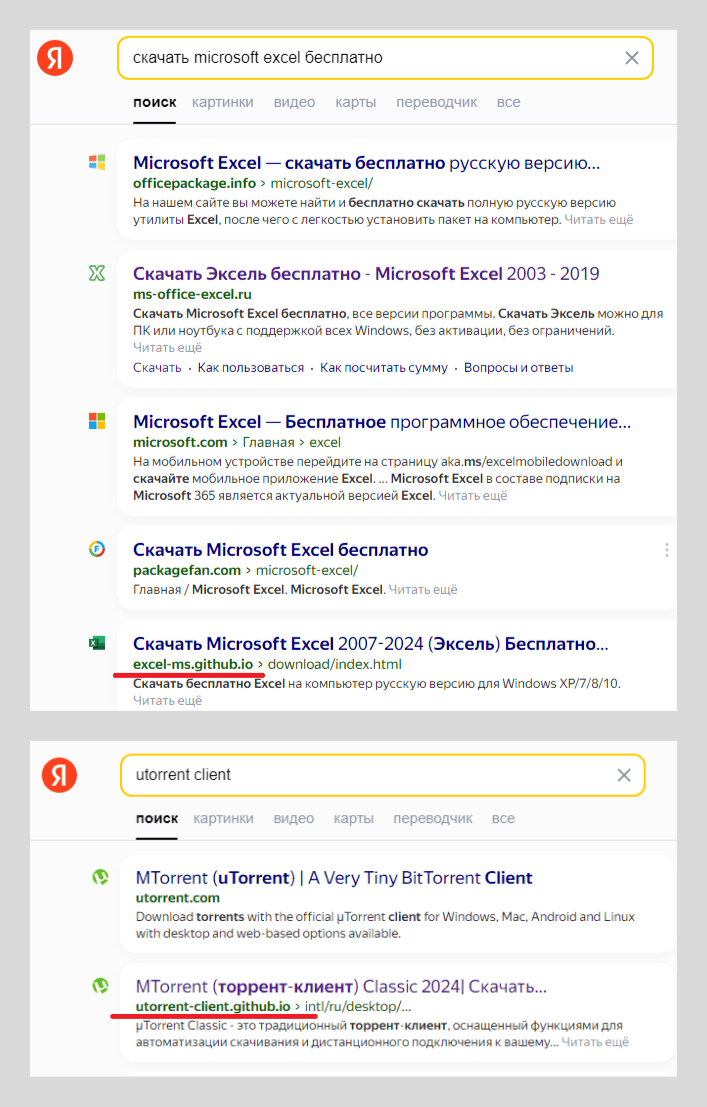
The attackers were advertising their websites in Yandex search results. Users would see these malicious sites in the top results when searching for resources freely distributing popular software like uTorrent, MS Excel, MS Word, Minecraft, Discord and so on.
Links to malicious websites in Yandex search results
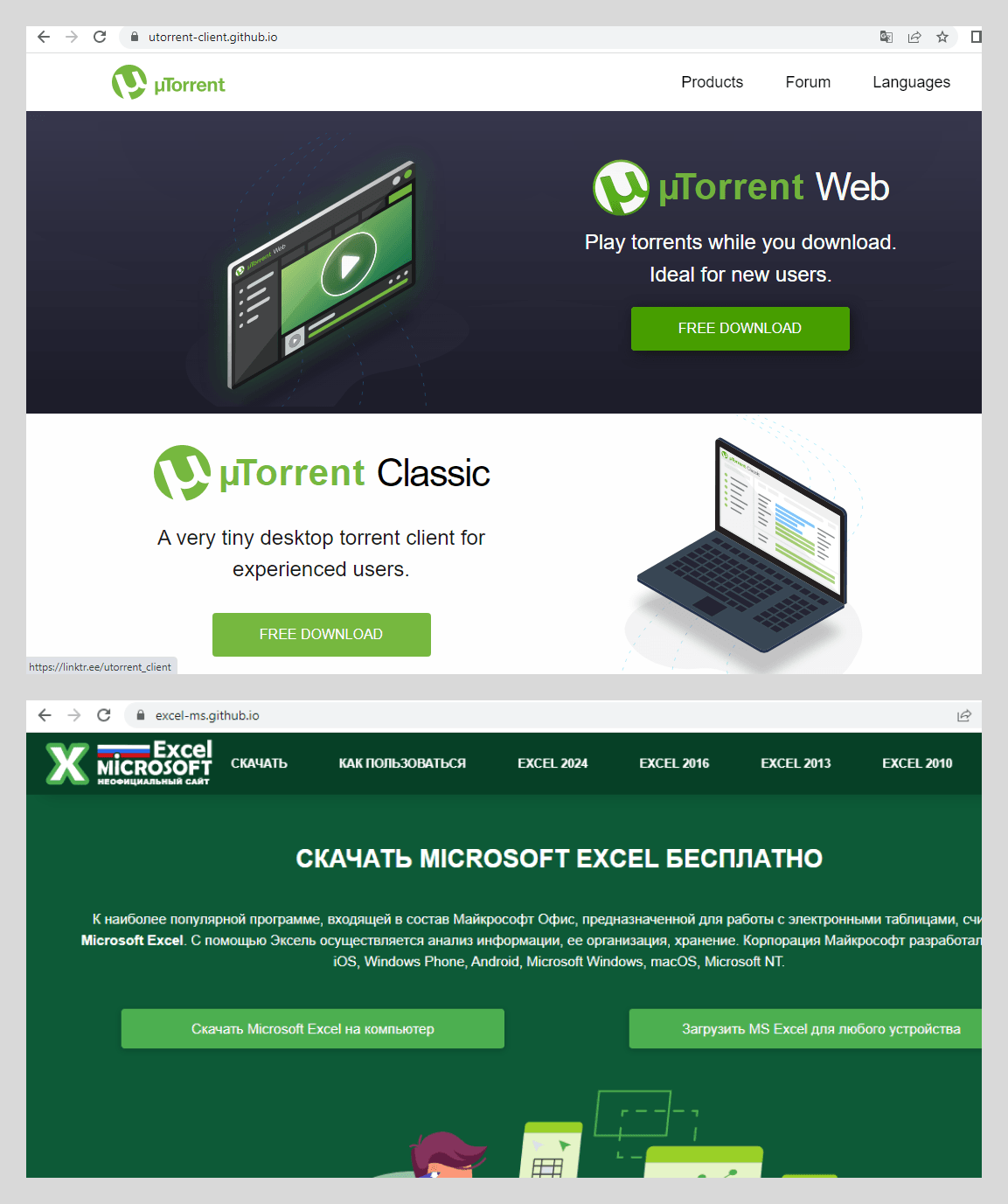
The frontend of these websites is a copy of either the official software website or a known piracy website distributing this kind of software:
Malicious websites
The attackers are running multiple Telegram channels distributing the malware in question. These channels are most definitely targeted at cryptocurrency owners or cheating gamers: they are offered to download specific software that presumably might be of interest to them. To prevent anyone trying to disclose information about these channels and the fraudulent activity of their creators, the administrators disabled message forwarding, screenshots, and previews of these channels in the Telegram web-version.
Malware in the attackers’ Telegram channel
Even more, the malware was also distributed via YouTube. The attackers uploaded numerous videos in English from multiple accounts which were presumably stolen. It’s also possible that the video content was downloaded from other YouTube channels and reuploaded without the authors’ consent. In the video description and in the top comment the attackers left links to their resources and instructions on how to launch the malware. Some of these links redirected users immediately to malicious websites, while others led to the aforementioned Telegram channels. We have also seen links to known IP logging websites, allowing the malicious actors to collect the IP addresses of anyone who follows the link and gets redirected to the malware-carrying website.
Examples of videos with malicious links in their description or comments
Comment with a link to a malicious Telegram channel
Persistence and defense evasion
After visiting the attackers’ website or channel, users might download a ZIP file being falsely advertised as popular software. Inside the archive is an MSI file and a TXT file with a password required for installation. There are also instructions on how to install the software, in which the attackers recommend disabling any installed antivirus and Windows Defender beforehand. In many cases, the instructions and the password are also provided on the websites and channels from which the user downloaded the malicious archive.
Content of text file
When launched, the MSI file asks for the password from the TXT file, which is one of the first countermeasures against sandbox analysis. If the user specifies the right password, the CustomAction field value of the MSI file is executed — this is effectively a VB script. This script launches a BAT file which extracts the next element of the attack chain from an encrypted archive. The first step is to escalate privileges by adding another BAT file to autorun, granting SYSTEM privileges for a single execution. After that, the system reboots.
CustomAction field value in the MSI file
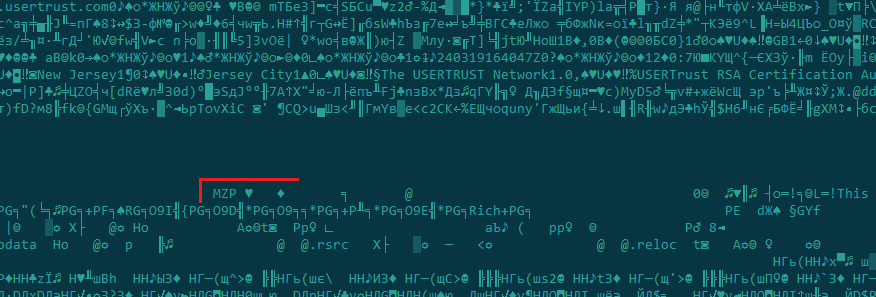
The BAT file from autorun extracts the encrypted RAR archive and runs the “start” command with two DLL files as arguments — these were previously extracted from the archive. One of these files is a legitimate AutoIt interpreter and the second is a legitimate dynamic library with a valid digital signature. The malicious payload is an A3X script which was compiled into an EXE file and injected right inside the second DLL file signature.
Malicious payload hidden inside a legit dynamic library signature
This technique is interesting for two reasons. First, the A3X script is added to the signature in such a way that its validity remains intact and the whole file is still considered as signed, even with the payload. Such a malicious addition is almost impossible to detect without file content analysis. Second, the AutoIt interpreter has an interesting way of reading files that were specified in its launch argument. The file is scanned for a specific AutoIt signature which is present only in compiled scripts, and all other contents of the file are ignored. This behavior allows the attackers to hide their malicious payload anywhere in the file where it won’t be harmful for the container itself.
Signature at the beginning of the A3X script
Placing malicious payloads in an arbitrary section of a file is not new. Such techniques have been used not only with AutoIt, but with other platforms too. But what makes this attack stand out is the bypass of signature verification, making it possible for the payload-bearing file to seem legitimate.
File with payload successfully bypasses signature verification
If the “start” command failed, the BAT file removes the entire directory with the installed files, including itself. Otherwise, the malicious A3X implant is launched, which checks all active processes in attempt to find anything related to debugging or anti-malware products. If anything is found, the script immediately exits, as you can see in the snippet of deobfuscated code below.
Security process name check by malicious implant
The compiled A3X script contains multiple FileInstall function calls. This function takes two arguments: a path to the file that will be installed, and its destination path. Before compilation, this call just copies the file from its source path to its destination, but during the compilation the interpreter stores the files for installation right inside the compiled script.
The resulting file contains not only the executable code itself, but also additional malicious files which will be installed directly from the implant. These files are required for persistence and to execute the next steps of the infection chain. The files are installed to the following paths:
For persistence purposes, the directories containing the installed files have system, hidden and read-only attributes. In addition, using the icacls utility, the implant forbids all users across all domains to remove these folders, change their permissions, own them, add any files or subdirectories, write to them any attributes (including extended ones), or remove files from them.
Files are copied to directories with unusual names for a reason. For example, the folder name “Classic.{BB64F8A7-BEE7-4E1A-AB8D-7D8273F7FDB6}” is treated specially by Windows Shell: Explorer will find the GUID in its name and treat it as a link — in this case to the Action Center. As a result, the user will not be able to view the contents of the directory.
Malicious directory in Explorer
After installing all the necessary files, the implant establishes persistence using WMI by creating filters which are activated by common events — common enough to guarantee filter activation. For each created filter, a polling frequency is specified. When a filter is activated, a specific command is executed using the __FilterToConsumerBinding class.
Once every three minutes, the netcat utility masked as StartMenuExperienceHost.exe is launched with the C&C address of the attackers (sportjump[.]ru) and “-e cmd.exe” as its arguments. It is then used as a reverse shell by the attackers.
Once every five to ten minutes, files named “nun.bat” are executed. They are copies of the same file which starts the next step of the infection chain. The attackers created two copies to increase the chance of malware execution, but if there are no outages, both of them are launched.
Once every fifteen minutes, the next step of the infection chain is launched directly via the “start” command.
All these methods are used again for a better persistence by launching the “insta.bat” file right before the end of the A3X implant execution.
Launch of the netcat utility
Persistence is established not only through WMI; the implant also directly starts netcat, the “nun.bat” files, and the “start” command. After that, it also abuses the registry keys “Image File Execution Options”, “Debugger” and “MonitorProcess” with the same goals.
One of the most interesting things about some variants of the malware is the download and use of the Wazuh SIEM agent for remote access and telemetry harvesting. To ensure that the attackers can execute any arbitrary command on the victim’s device, during the agent installation, the “remote_commands” option is set.
Installation and launch of the Wazuh agent
The first stage of the A3X implant collects the following information: computer name, username, OS version and architecture, CPU name, data about the GPU and installed AV software. All this information along with the current time is sent to a special Telegram bot chat controlled by the attackers. We’ve also seen some of the malware variants sending a screenshot of the user’s desktop or installing a malicious browser extension, which may replace cryptocurrency wallets in the clipboard.
Malicious browser extension
The next stage of the infection chain consists of two DLL files, that use the same technique as the first stage: a legitimate AutoIt interpreter and another A3X implant, located in the signature of the legitimate dynamic library. This implant is the final payload in the malware variant described here. It injects into a newly created explorer.exe process memory an open-source miner named SilentCryptoMiner, which contains the URL of the attacker’s mining configuration. This configuration specifies the cryptocurrency to be mined, the wallet, and so on. In the analyzed variants, we could see that the attackers mostly use anonymous cryptocurrencies like Monero or Zephyr.
Example of the miner configuration
Aside from its main purpose of generating cryptocurrency, SilentCryptoMiner can also hide its own activity from the processes specified in the “stealth-targets” argument and stop processes from the “kill-targets” process names list.
Attack geography
Most of the attacks with this infection chain targeted Russian users (87.63%). After that, the other top ten countries with the highest number of users affected by these attacks were Belarus, India, Uzbekistan, Kazakhstan, Germany, Algeria, Czech Republic, Mozambique, and Turkey.
TOP 10 countries where users were affected by the described infection chain, June — August 2024 (download)
Conclusion
The attack described in this article vividly illustrates the fact that even mass campaigns can be quite complex and open up a wide range of opportunities for attackers. As a result of the multistage infection chain, the attackers can establish persistence in users’ systems in multiple ways, gaining full access. Even though the main goal of the attackers is to make profit by stealthily mining cryptocurrency, some variants of the malware can perform additional malicious activity, such as replacing cryptocurrency wallets in the clipboard and taking screenshots. The most interesting action in this attack was the implementation of unusual techniques like using an SIEM agent as backdoor, adding the malicious payload to a legitimate digital signature, and hiding directories containing malicious files.
It’s important to mention that the websites, videos, and Telegram channels created by the attackers primarily target users seeking free versions of popular software or videogame cheats. This audience makes an easy target for the attackers because they are open to installing unofficial software from obscure sources and disabling security measures.
Our products detect this malware with the following names:
HEUR:Trojan-Dropper.OLE2.Agent.gen
HEUR:Trojan.BAT.Agent.gen
HEUR:Trojan.VBS.Agent.gen
Trojan.Script.AutoIt.ak
Trojan.BAT.Agent.cix
Trojan.BAT.Miner.id
HEUR:Trojan.Multi.Agent.gen
PDM:Trojan.Win32.Generic
MITRE ATT&CK Matrix
Tactic
Technique ID
Technique
Resource Development
T1608.006
Stage Capabilities: SEO Poisoning
T1608.001
Stage Capabilities: Upload Malware
Execution
T1204.001
User Execution: Malicious Link
T1204.002
User Execution: Malicious File
T1059.010
Command and Scripting Interpreter: AutoHotKey & AutoIT
T1059.003
Command and Scripting Interpreter: Windows Command Shell
Deputy President Paul Mashatile says he is confident that his working visit to the United Kingdom and Ireland will improve trade and investment relations, which have been stagnant for years.
The Deputy President spoke during an engagement with the South African Chamber of Commerce (SACC) in London on Thursday. The SACC is an umbrella organisation and conduit for trade, community and investment into and out of South Africa.
The country’s second-in-command is in the United Kingdom for the second leg of his working visit to improve trade and investment relations between the nations and to woo investors following his travels to Ireland.
The country’s second-in-command reiterated that the political environment in South Africa is stable for investment because of the newly established GNU, which has been operational for less than 100 days and is already yielding results.
“Our numerous meetings with potential investors have revealed a shift in their attitudes and perceptions towards South Africa, indicating an optimistic outlook.
“Our alliance, based not on personal sentiments but on the aspiration to enhance South Africa and, consequently, the lives of our citizens, will undoubtedly sustain the GNU administration for five years.”
However, he said they will measure the GNU’s success based on the number of employment and entrepreneurs they assist in establishing sustainable enterprises.
“Businesses hope to continue working with the government in the public-private partnership that has reduced load shedding, improved transport and logistics infrastructure, and strengthened national capacity to combat crime and corruption,” the Deputy President said.
Shifting his focus to energy, he stated that investors have demonstrated that ending the load shedding that began in 2007 is the most positive news.
“They confirmed that it allows them to conduct business without uncertainty. The elimination of power outages was largely due to a series of measures implemented by the State-owned power utility, Eskom and government over the past two years.”
He also told the SACC that government was addressing the obstacles in the freight logistics system that continue to impede competitiveness and undermine economic growth.
“We are on a mission to create and sustain a bankable investment pipeline of priority, credible, quality and high-impact projects that span the country through Infrastructure South Africa, the primary driver of the National Infrastructure Plan 2050,” he explained.
Mashatile believes that the SACC plays an essential role in engaging with businesses to promote bilateral trade and investment links between the United Kingdom and South Africa.
“It is our responsibility as leaders in our respective regions to foster an atmosphere that encourages entrepreneurship, fosters innovation, and drives inclusive growth.”
In addition, he expressed his desire to increase South Africa’s exports of valuable goods and services to the United Kingdom.
“It is excellent that the two countries already exchange food and beverages. It is critical that we collaborate to create strategies to accelerate international trade and investment.”
Mashatile announced that the State was simplifying regulatory procedures through the Red Tape Task Team, making it easier for businesses to operate and invest locally.
He concluded his address with South Africa’s stance on peace and stability in Africa and globally, stressing that the nation is anti-war and pro-peace.
“We reaffirm our commitment to the inviolability of sovereignty and the importance of national security.
“More immediately, we support [silencing the guns]. We want to see peaceful and mutual coexistence between Russia, Ukraine, Israel, Sudan, and the rest of the globe, because war is terrible for business.” – SAnews.gov.za
Question for written answer E-001800/2024 to the Commission Rule 144 Michalis Hadjipantela (PPE)
On 6 July 2024, Hungarian Prime Minister Viktor Orbán and Hungarian Minister of Foreign Affairs Péter Szijjártó participated in the informal summit of the Organization of Turkic States, held in Shusha, Azerbaijan and hosted by H.E. Ilham Aliyev, President of the Republic of Azerbaijan. The Organization of Turkic States, currently chaired by H.E. Kassym-Jomart Tokayev, President of the Republic of Kazakhstan, invited the leader of the illegal Turkish Cypriot secessionist entity known as the ‘Turkish Republic of Northern Cyprus’ as a ‘head of state’. This coincided with Hungary holding the rotating presidency of the Council of the European Union.
This action flagrantly violates international law and disregards the territorial integrity of the Republic of Cyprus, as affirmed by relevant UN Security Council resolutions. The Republic of Cyprus is internationally recognised as the sole legitimate government of the entire island. Given these provocative violations and disrespect towards the territorial integrity of an EU Member State:
1.What measures does the Commission intend to take in response to Hungary’s participation in this summit?
2.How does the Commission plan to deal with this incident and ensure that all Member States adhere to the principles of international law and EU solidarity?
Question for written answer E-001810/2024/rev.1 to the Commission Rule 144 Loucas Fourlas (PPE)
Despite the European Union’s efforts to promote peace and stability in the Eastern Mediterranean region, Türkiye continues to take unilateral and provocative actions, such as drilling in the territorial waters the Republic of Cyprus, an EU Member State. Furthermore, Türkiye still refuses to recognise the Republic of Cyprus. This poses a major obstacle to stability and peaceful coexistence in the region.
In view of the above:
What concrete steps will the European Commission take to prevent Türkiye’s violations in the Cypriot EEZ and in the Eastern Mediterranean more generally?
Briefing by Mr. James Swan, the Acting Special Representative of the Secretary-General for Somalia and Head of the United Nations Assistance Mission in Somalia, on the Somalia – Security Council, 9740th meeting.
———————————
The chief of the UN mission in Somalia (UNSOM) James Swan said that the mission will work closely with the Federal Government to implement the transition from UNSOM to a UN country team and to continuing its support to Somalia’s national priorities once a mandate is received from this Council.
The Acting Special Representative for Somalia briefed the Council today (03 Oct) on the situation in the country.
On elections, Swan noted that the transition from the previous indirect electoral system to the planned new system of universal suffrage will require broad and inclusive consultations, and a willingness of all stakeholders to engage in dialogue in order to build political consensus. He welcomed the meeting of the National Consultative Council.
He said that the adoption of implementable electoral laws and the establishment of an independent elections commission will be important indicators of progress toward delivering universal suffrage elections.
Swan stressed, “The United Nations is committed to supporting Somalia to address technical, logistical and other challenges and to mobilize financial support from donors to deliver timely and credible elections.”
The fight against Al-Shabaab continues to be the key security priority for the Government of Somalia, the Mission’s chief reiterated, adding that while making commendable efforts to sustain military operations against Al Shabaab, Somalia is at the same time tackling the challenges of force generation; taking over security responsibilities from the African Union Transition Mission in Somalia (ATMIS); planning the transition to the African Union Support and Stabilisation Mission in Somalia (AUSSOM); and implementing crucial stabilisation programmes in recovered areas.
“The United Nations continues to support the Federal Government on these activities, working closely with the African Union and other partners,” Swan reiterated.
He continued, “The United Nations Support Office in Somalia (UNSOS) continues to enable the ATMIS drawdown while fulfilling its ongoing support responsibilities.”
The Acting Special Representative continued, “ The lifting of the arms embargo on the national government has facilitated its access to additional weapons and supplies, and I remind other entities operating in Somalia of the requirement to respect the arms embargo established by resolution 2713.”
Al-Shabaab continues to demonstrate its disregard for civilian life, through its use of indirect fire on population centres, mainly Mogadishu and Baidoa, the use of improvised explosive devices, and suicide attacks against civilians, including the heinous 2 August attack on the Lido Beach in Mogadishu.
Swan underscored the condemnation issued by the Secretary-General of such attacks and reiterated the United Nations’ support to the Government and people of Somalia as” they stand against terrorism and violent extremism.”
He also note with concern the increased presence and activities of the Islamic State in Iraq and the Levant (Da’esh).
The provisional agenda for the 17-18 October European Council meeting has three main topics. First, EU Heads of State or Government will address Russia’s war of aggression against Ukraine, and the EU’s support to Ukraine and its people. Second, they will consider the situation in the Middle East, amid concerns over regional escalation following Israel’s targeting of Hezbollah in Lebanon and Iran’s missile strikes on Israel. Third, EU leaders will discuss competitiveness, with a first exchange on the report by Mario Draghi on ‘The future of European competitiveness’; they will also be called on to endorse the integrated country-specific recommendations, and thus conclude the 2024 European Semester cycle. In addition, EU leaders could hold a strategic debate on migration, and review progress on security and defence initiatives. Discussions could also touch upon developments in Georgia and Moldova, preparations for the COP29 on climate change and the COP16 on biological diversity, as well as the impact of the recent heavy flooding in central Europe.
Current account surplus at €381 billion (2.6% of euro area GDP) in four quarters to second quarter of 2024, after a €76 billion surplus (0.5% of GDP) a year earlier.
Geographical counterparts: largest bilateral current account surpluses vis-à-vis United Kingdom (€215 billion) and Switzerland (€79 billion) and largest deficits vis-à-vis China (€78 billion) and United States (€18 billion).
International investment position showed net assets of €1.2 trillion (8.0% of euro area GDP) at end of second quarter of 2024.
Current account
The current account of the euro area recorded a surplus of €381 billion (2.6% of euro area GDP) in the four quarters to the second quarter of 2024, following a €76 billion surplus (0.5% of GDP) a year earlier (Table 1). This development was mainly driven by a larger surplus for goods (from €72 billion to €358 billion) and, to a lesser extent, by widening surpluses for services (from €134 billion to €149 billion) and for primary income (from €34 billion to €37 billion). Moreover, the deficit for secondary income decreased slightly from €164 billion to €163 billion.
The estimates on goods trade broken down by product group show that, in the four quarters to the second quarter of 2024, the increase in the goods surplus was mainly due to a smaller deficit in energy products (from €454 billion to €275 billion). In addition, the surplus for machinery and manufactured products increased from €240 billion to €318 billion, while the balance for other products switched from a €28 billion deficit to a €2 billion surplus.
The higher surplus for services in the four quarters to the second quarter of 2024 was mainly due to larger surpluses for telecommunication, computer and information (from €159 billion to €184 billion) and for travel (from €47 billion to €57 billion), and a lower deficit for other business services (from €54 billion to €42 billion). This was partly offset by a widening deficit for other services (from €55 billion to €75 billion) and a decreasing surplus for transport (from €16 billion to €1 billion).
The increase in the primary income surplus in the four quarters to the second quarter of 2024 was mainly due to larger surpluses in direct investment (from €73 billion to €100 billion) and other primary income (from €5 billion to €14 billion), partly offset by a larger deficit in portfolio equity (from €143 billion to €182 billion).
Table 1
Current account of the euro area
(EUR billions, unless otherwise indicated; transactions during the period; non-working day and non-seasonally adjusted)
Source: ECB. Notes: “Equity” comprises equity and investment fund shares. Goods by product group is an estimated breakdown using a method based on statistics on international trade in goods. Discrepancies between totals and their components may arise from rounding.
Data for the current account of the euro area
Data on the geographical counterparts of the euro area current account (Chart 1) show that in the four quarters to the second quarter of 2024, the euro area recorded its largest bilateral surpluses vis-à-vis the United Kingdom (€215 billion, up from €184 billion a year earlier) and Switzerland (€79 billion, down from €89 billion). The euro area also recorded a surplus vis-à-vis the residual group of other countries of €96 billion, after a €21 billion deficit a year earlier. The largest bilateral deficits were recorded vis-à-vis China (€78 billion, down from €135 billion a year earlier) and the United States (€18 billion, down from €32 billion).
The most significant changes in the geographical components of the current account relative to the previous year were as follows: the goods deficit vis-à-vis China declined from €166 billion to €105 billion, while the balance vis-à-vis Russia shifted from a deficit (€41 billion) to a surplus (€3 billion). Furthermore, the balance vis-à-vis the residual group of Other countries shifted from a deficit (€104 billion) to a surplus (€39 billion), which was partly explained by a smaller deficit vis-à-vis Norway (from €39 billion to €21 billion) and a shift from a deficit (€6 billion) to a surplus (€5 billion) vis-à-vis Saudi Arabia. The goods surplus increased vis-à-vis the United Kingdom (from €116 billion to €148 billion) and vis-à-vis the United States (from €169 billion to €191 billion). In services, the deficit vis-à-vis the United States increased (from €117 billion to €141 billion), which was more than offset by a shift from a deficit (€15 billion) to a surplus (€18 billion) vis-à-vis Offshore centres. In primary income, the deficit vis-à-vis Offshore centres (€11 billion) turned to a surplus (€21 billion), while a smaller deficit is recorded vis-à-vis the United States (from €82 billion to €67 billion). The deficit in secondary income vis-à-vis the EU Member States and EU institutions outside the euro area decreased (from €77 billion to €71 billion).
Chart 1
Geographical breakdown of the euro area current account balance
(four-quarter moving sums in EUR billions; non-seasonally adjusted)
Source: ECB. Note: “EU non-EA” comprises the non-euro area EU Member States and those EU institutions and bodies that are considered for statistical purposes as being outside the euro area, such as the European Commission and the European Investment Bank. “Other countries” includes all countries and country groups not shown in the chart, as well as unallocated transactions.
international investment position of the euro area recorded its largest net assets on record, increasing to €1.18 trillion vis-à-vis the rest of the world (8.0% of euro area GDP), up from €0.76 trillion in the previous quarter (Chart 2 and Table 2).
Chart 2
Net international investment position of the euro area
(net amounts outstanding at the end of the period as a percentage of four-quarter moving sums of GDP)
Source: ECB.
The €423 billion increase in net assets was mainly driven by lower net liabilities in other investment (down from €0.76 trillion to €0.63 trillion) and in portfolio equity (from €3.31 trillion to €3.19 trillion), as well as larger net assets in direct investment (up from €2.41 trillion to €2.52 trillion) and in reserve assets (up from €1.22 trillion to €1.27 trillion).
Table 2
International investment position of the euro area
(EUR billions, unless otherwise indicated; amounts outstanding at the end of the period, flows during the period; non-working day and non-seasonally adjusted)
Source: ECB. Notes: “Equity” comprises equity and investment fund shares. Net financial derivatives are reported under assets. “Other volume changes” mainly reflect reclassifications and data enhancements. Discrepancies between totals and their components may arise from rounding.
Note: “Other volume changes” mainly reflect reclassifications and data enhancements.
The Lebanese authorities, communities and humanitarian agencies are struggling to shelter and provide the necessities of life to over one million people fleeing Israel’s airstrikes and invasion to the south, Oxfam said today.
Oxfam is working with local partners in Lebanon and alongside other aid agencies as part of the government’s humanitarian response plan following Israel’s invasion of Southern Lebanon and aerial bombardment.
Oxfam assessments in shelters across Lebanon have found people most need mattresses, bedding, and cooking and sanitation items. Women also need sanitary pads, towels, and underwear. Oxfam and partners have started distributing some of this aid as well as water.
“People are coming to us traumatized. Most of them have lost their houses and relatives. Some of them are scared because of the scale of bombardment as they were fleeing.”
Gheith Bittar, Executive Director of SHIFT
Oxfam partner SHIFT – Social Innovation Hub
Gheith Bittar, Executive Director for Oxfam partner SHIFT – Social Innovation Hub, said more displaced people are arriving by the day and he fears shelters may buckle under the strain.
“The shelters are not ready to host the number of displaced people we are taking on and 629 are already full. They are public schools that are not equipped to be shelters and we are facing problems. For example, we don’t have hot water for showers. We will get to a point where we won’t be able to cope. Without funds, we cannot sustain our support to the shelters. The ground invasion will only increase the number of refugees, and we have already seen an increase in the number of displaced people on a daily basis with the continuous bombardment. The situation will only get worse as winter approaches.
“People are coming to us traumatized. Most of them have lost their houses and relatives. Some of them were scared because of the scale of bombardment as they were fleeing, and many others because of their fear of the unknown coming to a new city. People are suffering, they have many, many, issues to think about,”
Oxfam says without a ceasefire, the greenlight by Israel to a ground invasion in southern Lebanon will likely lead to a further escalation of the conflict and fighting, that will cause even more destruction of communities and inflame an already volatile region.
“The ground invasion and bombardment that includes Beirut and the southern suburbs will create a serious challenge for the humanitarian system in a few short days. People are being forced to flee with little to no notice, and often having to leave everything behind to shelters that are inadequate or sharing crowded homes with few essential supplies. None know when they can return. Without a ceasefire, the number of people desperately in need will only grow, as will their needs. The shelter system is set to collapse if there is no peace on the horizon,” said Oxfam’s Lebanon Country Director, Bachir Ayoub.
Oxfam is appealing for donations globally. “The needs of people in Lebanon who’ve been injured, traumatized and displaced, in fear of what the future might hold for them, are already huge. No other solution other than a ceasefire can alleviate the crisis they are facing,” Ayoub said.
There must be an end to this violence. All parties must stop fighting. We need safe space to get people the aid they need,” he said.
Headline: DHS’ 2025 Homeland Threat Assessment Indicates the Threat of Domestic and Foreign Terrorism in the Homeland Remains High
“The Homeland Security Assessment provides an important overview of the dynamic and evolving threat landscape, illustrating just how varied and challenging the threats we confront are,” said Secretary of Homeland Security Alejandro N. Mayorkas. “It is because of the remarkable DHS workforce, and our close collaboration with our federal, state, local, tribal, territorial, and private sector partners, that we are able to meet the challenges and keep the American people safe and secure.”
Assessments from the 2025 HTA:
Public Safety and Security: The terrorism threat environment in the Homeland is expected to remain high over the coming year. This is due to a confluence of factors, including potential violent extremist responses to domestic sociopolitical developments — particularly the 2024 election cycle — and international events like the ongoing Israel-Hamas conflict. Lone offenders and small groups continue to pose the greatest threat. Meanwhile, foreign terrorist organizations, including ISIS and al Qa’ida maintain their enduring intent to conduct or inspire attacks in the Homeland.
Illegal Drugs: Illegal drugs smuggled into and sold in the United States by transnational and domestic criminal actors continue to pose a lethal threat to communities in the United States. DHS has surged resources to address this threat, seized more fentanyl in the last two fiscal years than in the prior five years combined, and is investing in new technology to increase detection capabilities. Thanks to these and other efforts, the number of overdose deaths have declined by more than 10 percent in the 12 months leading up to April 2024 – the largest drop in overdose deaths in recorded history. That said, fentanyl and other synthetic opioids remain the most lethal of drugs trafficked into the country and continue to pose a national security threat. Adulterated cocaine and methamphetamine also pose a threat.
Influence Operations and Transnational Repression: We expect the Homeland will face threats to public safety from state actors using subversive tactics in an effort to stroke discord and undermine confidence in U.S. domestic institutions. Malign foreign actors seek to target ethnic and religious minorities, political dissidents, and journalists in the United States to silence and harass its critics abroad.
Border and Immigration Security: Migrant encounters at our border have steadily declined since the beginning of 2024 and have declined even further since the issuance of the Presidential Proclamation and complementary Interim Final Rule (IFR) were announced on June 4 – decreasing more than 55% in the past four months. We nonetheless expect some individuals with criminal connections to seek to continue to exploit migrants. DHS remains acutely focused on identifying those who may present a threat to public safety or national security and stopping them from entering the United States.
Critical Infrastructure Security: Domestic and foreign adversaries are expected to continue to target our critical infrastructure via prepositioning, cyber, and physical attacks. The People’s Republic of China (PRC), Russia, and Iran are expected to remain the most pressing foreign threats to our critical infrastructure. Nation-states, criminal hacktivists, and financially motivated criminals will likely hone their techniques to disrupt U.S. services or to conduct espionage focused on gaining access to U.S. networks and critical infrastructure entities. We assess that domestic and foreign violent extremists will continue to call for physical attacks on critical infrastructure in furtherance of their ideological goals and, in response to international conflicts and crises.
Economic Security: Our adversaries – including the PRC – will continue non-market policies and practices, economic espionage and coercive economic tools, and illicit acquisition of technologies and intellectual property to undercut U.S. and partner competitiveness.
Operational components and offices across the Department are involved in combatting threats and working alongside our federal, state, and local partners. Some examples of these efforts include:
DHS conducts screening and vetting of individuals encountered at the border to identify national security or public safety threats and refers any individuals who are identified as posing a threat to public safety or national security to the appropriate law enforcement authority for detention, removal, and potential prosecution. DHS continually monitors available sources of intelligence and law enforcement information to identify new threats and public safety risks. If and when any new information emerges, DHS, including ICE and CBP, works closely with the FBI and other partners to take appropriate action.
In addition to biometric and biographic screening and vetting of every individual encountered, U.S. Customs and Border Protection (CBP) has expanded information sharing agreements with international partners to enhance their ability to prevent, detect, and investigate trafficking and other crimes. CBP’s National Targeting Center continuously works to detect individuals and travelers that threaten our country’s security, while also building a network of partner nations committed to fighting global threats.
DHS, through CBP and Homeland Security Investigations (HSI), has stopped more illicit fentanyl and arrested more individuals for fentanyl-related crimes in the last two fiscal years than in the previous five years combined.
DHS is leading the federal effort to combat fentanyl internationally, through information-sharing, multinational enforcement operations, and global cooperation with federal, state, and local partners and stakeholder to disrupt fentanyl networks within our communities.
DHS has arrested over 3,600 subjects connected to fentanyl-seizure events, which directly degrades the organized criminal networks responsible for bringing fentanyl into our communities, seized over 2,200 pill presses, and seized over 27,000 pounds of illicit fentanyl to stop it at our borders and in our communities before it can hurt the American public.
Source: United States Senator for New Hampshire Jeanne Shaheen
(Washington, DC) – U.S. Senator Jeanne Shaheen (D-NH), senior member of the U.S. Senate Foreign Relations and Armed Services Committees, released the following statement in response to Iran’s direct attack on Israel and the escalating violence across the region:
“Iran’s attack on Israel is a dangerous, reckless escalation that risks innocent lives in Israel and across the region. Through its terrorist proxies, Iran continues to try to destabilize the region and preserve its own authoritarian agenda.
“Thanks to U.S.-supported Israeli defense systems, Iran’s attack on civilian populations was rebuffed.
“The current conflict is on the verge of spiraling into all-out war, with the people of Israel, Gaza, the West Bank, Lebanon and other innocent civilians bearing the consequences of escalation.
Source: United States House of Representatives – Congressman John Sarbanes (3rd District of Maryland)
WASHINGTON, D.C. – Congressman John Sarbanes (MD-03) released the following statement today regarding Iran’s recent attack on Israel:
“I am grateful that Israel’s defenses succeeded in thwarting yesterday’s missile attack by Iran. This reinforces the critical importance of ongoing U.S. support for Israel’s security apparatus as well as careful coordination among Israel’s allies. I join President Biden and Vice President Harris in expressing solidarity with the Israeli people and commend the Administration for its continued diplomatic efforts to de-escalate conflict in the region, avert civilian casualties and reestablish a framework for achieving peace and stability.”
Source: United States House of Representatives – Congresswoman Bonnie Watson Coleman
October 02, 2024
Today, Rep. Bonnie Watson Coleman (NJ-12) issued the following statement regarding escalating violence in the Middle East:
“I’m praying for the innocent civilians in harm’s way in Tel Aviv, and across Israel. I’m grateful that it appears relatively few were harmed by last night’s attack. The defense of innocent life must be the primary goal of U.S. foreign policy.
“We must ensure Israel has the defensive weapons it needs to defend its people from attacks from Iran, Hezbollah, and Hamas. Defensive systems undoubtedly saved countless lives last night. At the same time, to further supply the reckless Netanyahu government, which has shown little interest in de-escalation, with offensive weapons risks a large-scale regional war which the United States could quickly be drawn into.
“The American people don’t want to be drawn into a regional war in the Middle East. It’s time for the United States to show its leadership and demand an end to escalation of this conflict. For the sake of the lives of millions of people caught in the crossfire I implore President Biden to take action to prevent further escalation.”