NewzIntel.com

    • Checkout Page
    • Contact Us
    • Default Redirect Page
    • Frontpage
    • Home-2
    • Home-3
    • Lost Password
    • Member Login
    • Member LogOut
    • Member TOS Page
    • My Account
    • NewzIntel Alert Control-Panel
    • NewzIntel Latest Reports
    • Post Views Counter
    • Privacy Policy
    • Public Individual Page
    • Register
    • Subscription Plan
    • Thank You Page

Category: Eurozone

  • MIL-OSI Analysis: The AI therapist will see you now: Can chatbots really improve mental health?

    Source: The Conversation – USA (3) – By Pooja Shree Chettiar, Ph.D. Candidate in Medical Sciences, Texas A&M University

    Chatbot ‘therapists’ use artificial intelligence to mimic real-life therapeutic conversations. Pooja Shree Chettiar/ChatGPT, CC BY-SA

    Recently, I found myself pouring my heart out, not to a human, but to a chatbot named Wysa on my phone. It nodded – virtually – asked me how I was feeling and gently suggested trying breathing exercises.

    As a neuroscientist, I couldn’t help but wonder: Was I actually feeling better, or was I just being expertly redirected by a well-trained algorithm? Could a string of code really help calm a storm of emotions?

    Artificial intelligence-powered mental health tools are becoming increasingly popular – and increasingly persuasive. But beneath their soothing prompts lie important questions: How effective are these tools? What do we really know about how they work? And what are we giving up in exchange for convenience?

    Of course it’s an exciting moment for digital mental health. But understanding the trade-offs and limitations of AI-based care is crucial.

    Stand-in meditation and therapy apps and bots

    AI-based therapy is a relatively new player in the digital therapy field. But the U.S. mental health app market has been booming for the past few years, from apps with free tools that text you back to premium versions with an added feature that gives prompts for breathing exercises.

    Headspace and Calm are two of the most well-known meditation and mindfulness apps, offering guided meditations, bedtime stories and calming soundscapes to help users relax and sleep better. Talkspace and BetterHelp go a step further, offering actual licensed therapists via chat, video or voice. The apps Happify and Moodfit aim to boost mood and challenge negative thinking with game-based exercises.

    Somewhere in the middle are chatbot therapists like Wysa and Woebot, using AI to mimic real therapeutic conversations, often rooted in cognitive behavioral therapy. These apps typically offer free basic versions, with paid plans ranging from US$10 to $100 per month for more comprehensive features or access to licensed professionals.

    While not designed specifically for therapy, conversational tools like ChatGPT have sparked curiosity about AI’s emotional intelligence.

    Some users have turned to ChatGPT for mental health advice, with mixed outcomes, including a widely reported case in Belgium where a man died by suicide after months of conversations with a chatbot. Elsewhere, a father is seeking answers after his son was fatally shot by police, alleging that distressing conversations with an AI chatbot may have influenced his son’s mental state. These cases raise ethical questions about the role of AI in sensitive situations.
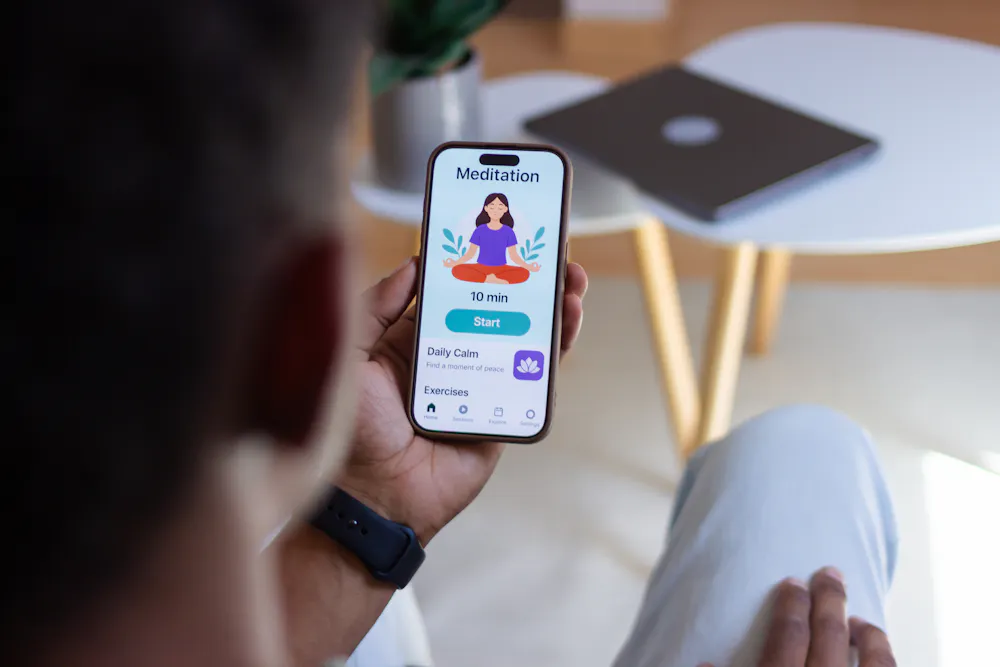
    Guided meditation apps were one of the first forms of digital therapy.
    IsiMS/E+ via Getty Images

    Where AI comes in

    Whether your brain is spiraling, sulking or just needs a nap, there’s a chatbot for that. But can AI really help your brain process complex emotions? Or are people just outsourcing stress to silicon-based support systems that sound empathetic?

    And how exactly does AI therapy work inside our brains?

    Most AI mental health apps promise some flavor of cognitive behavioral therapy, which is basically structured self-talk for your inner chaos. Think of it as Marie Kondo-ing, the Japanese tidying expert known for helping people keep only what “sparks joy.” You identify unhelpful thought patterns like “I’m a failure,” examine them, and decide whether they serve you or just create anxiety.

    But can a chatbot help you rewire your thoughts? Surprisingly, there’s science suggesting it’s possible. Studies have shown that digital forms of talk therapy can reduce symptoms of anxiety and depression, especially for mild to moderate cases. In fact, Woebot has published peer-reviewed research showing reduced depressive symptoms in young adults after just two weeks of chatting.

    These apps are designed to simulate therapeutic interaction, offering empathy, asking guided questions and walking you through evidence-based tools. The goal is to help with decision-making and self-control, and to help calm the nervous system.

    The neuroscience behind cognitive behavioral therapy is solid: It’s about activating the brain’s executive control centers, helping us shift our attention, challenge automatic thoughts and regulate our emotions.

    The question is whether a chatbot can reliably replicate that, and whether our brains actually believe it.

    A user’s experience, and what it might mean for the brain

    “I had a rough week,” a friend told me recently. I asked her to try out a mental health chatbot for a few days. She told me the bot replied with an encouraging emoji and a prompt generated by its algorithm to try a calming strategy tailored to her mood. Then, to her surprise, it helped her sleep better by week’s end.

    As a neuroscientist, I couldn’t help but ask: Which neurons in her brain were kicking in to help her feel calm?

    This isn’t a one-off story. A growing number of user surveys and clinical trials suggest that cognitive behavioral therapy-based chatbot interactions can lead to short-term improvements in mood, focus and even sleep. In randomized studies, users of mental health apps have reported reduced symptoms of depression and anxiety – outcomes that closely align with how in-person cognitive behavioral therapy influences the brain.

    Several studies show that therapy chatbots can actually help people feel better. In one clinical trial, a chatbot called “Therabot” helped reduce depression and anxiety symptoms by nearly half – similar to what people experience with human therapists. Other research, including a review of over 80 studies, found that AI chatbots are especially helpful for improving mood, reducing stress and even helping people sleep better. In one study, a chatbot outperformed a self-help book in boosting mental health after just two weeks.

    While people often report feeling better after using these chatbots, scientists haven’t yet confirmed exactly what’s happening in the brain during those interactions. In other words, we know they work for many people, but we’re still learning how and why.

    AI chatbots don’t cost what a human therapist costs – and they’re available 24/7.

    Red flags and risks

    Apps like Wysa have earned FDA Breakthrough Device designation, a status that fast-tracks promising technologies for serious conditions, suggesting they may offer real clinical benefit. Woebot, similarly, runs randomized clinical trials showing improved depression and anxiety symptoms in new moms and college students.

    While many mental health apps boast labels like “clinically validated” or “FDA approved,” those claims are often unverified. A review of top apps found that most made bold claims, but fewer than 22% cited actual scientific studies to back them up.

    In addition, chatbots collect sensitive information about your mood metrics, triggers and personal stories. What if that data winds up in third-party hands such as advertisers, employers or hackers, a scenario that has occurred with genetic data? In a 2023 breach, nearly 7 million users of the DNA testing company 23andMe had their DNA and personal details exposed after hackers used previously leaked passwords to break into their accounts. Regulators later fined the company more than $2 million for failing to protect user data.

    Unlike clinicians, bots aren’t bound by counseling ethics or privacy laws regarding medical information. You might be getting a form of cognitive behavioral therapy, but you’re also feeding a database.

    And sure, bots can guide you through breathing exercises or prompt cognitive reappraisal, but when faced with emotional complexity or crisis, they’re often out of their depth. Human therapists tap into nuance, past trauma, empathy and live feedback loops. Can an algorithm say “I hear you” with genuine understanding? Neuroscience suggests that supportive human connection activates social brain networks that AI can’t reach.

    So while in mild to moderate cases bot-delivered cognitive behavioral therapy may offer short-term symptom relief, it’s important to be aware of their limitations. For the time being, pairing bots with human care – rather than replacing it – is the safest move.

    Pooja Shree Chettiar does not work for, consult, own shares in or receive funding from any company or organization that would benefit from this article, and has disclosed no relevant affiliations beyond their academic appointment.

    – ref. The AI therapist will see you now: Can chatbots really improve mental health? – https://theconversation.com/the-ai-therapist-will-see-you-now-can-chatbots-really-improve-mental-health-259360

    MIL OSI Analysis –

    July 11, 2025
  • MIL-OSI United Kingdom: Report of the External Auditor, Audit Committee and Financial Report: UK statement to the OSCE, July 2025

    Source: United Kingdom – Government Statements

    Speech

    Report of the External Auditor, Audit Committee and Financial Report: UK statement to the OSCE, July 2025

    Ambassador Holland thanks Austria’s Court of Audit for their professional work as External Auditor, and urges other participating States to engage constructively towards agreeing an OSCE Unified Budget.

    The United Kingdom thanks the Secretary General, and representatives of the Austrian Court of Audit and the Audit Committee for their presentations today and their comprehensive reports.

    The External Auditor and Audit Committee reports provide an important overview of the OSCE’s financial health, and oversight of the organisation’s administration and internal controls. We recognise that the audit assessments have been made in the context of significant ongoing challenges – including the impact of Russia’s aggression against Ukraine, and the continued non-agreement of the OSCE Unified Budget.

    The UK welcomes the unqualified opinion of the External Auditor that the OSCE’s financial statements for 2024 presented fairly the financial position of the organisation. We appreciate the Austrian Court of Audit’s professional work in this role, and warmly welcome your earlier agreement to extend for a further two audit cycles until July 2026.

    Mr Chair, it is vital for the work of all OSCE structures that participating States agree a Unified Budget for 2025 and beyond. As the Reports and presentations this morning clearly illustrate, the continued non-agreement of the Unified Budget – and the lack of an updated Post Table – continue to severely constrain all parts of the organisation in delivering their mandates. We again urge all participating States to engage constructively with budget proposals and ensure the organisation is able to carry out its work effectively in line with the OSCE principles we have all signed up to.

    We welcome the assessments in the Reports that the OSCE’s overall financial liquidity remains sound. We commend the OSCE executive structures for their ongoing work to adapt to the financial challenges facing the organisation, and for helping to maintain continuity of business. We also appreciate the tireless efforts of successive Chairs-in-Office – Malta and Finland – in advancing budget proposals and agreeing additional expenditure authorisations.

    I again thank the Austrian Court of Audit and the Audit Committee for the comprehensive reports. As always, the UK looks forward to engaging constructively on the report recommendations.

    Thank you, Mr Chair.

    Updates to this page

    Published 10 July 2025

    MIL OSI United Kingdom –

    July 11, 2025
  • MIL-OSI Africa: Sudan: Children reveal harrowing violence in latest North Darfur mass displacement

    Source: APO


    .

    Save the Children and its partners spoke to over 450 of these displaced children in Tawila for the assessment “Children Caught in Conflict”, with children describing traumatic journeys and expressing fear, grief, and a profound sense of uncertainty about their futures. 

    Hundreds of children have recounted harrowing stories of terror and loss after their homes in Sudan’s North Darfur region were attacked, with many telling Save the Children how they lost contact with friends and loved ones [1].  

    Violence is happening daily in North Darfur, the epicentre of Sudan’s two-year conflict,  with fighting intensifying over the past 12 months and spiking in April this year when the Zamzam camp housing people forced from their homes was viciously attacked.  

    Nearly 500,000 people – including 260,000 children – were displaced from Zamzam camp between April and May, which amounts to 99% of the camp’s population. About  75% of the displaced people ended up in the Tawila camp [2], which is located around 60km southeast of Zamzam.  

    Save the Children and its partners spoke to over 450 of these displaced children in Tawila for the assessment “Children Caught in Conflict”, with children describing traumatic journeys and expressing fear, grief, and a profound sense of uncertainty about their futures. 

    Many children witnessed killings and dead bodies in the streets, with some reporting witnessing young people being arrested or killed, and more than half of the girls interviewed (53%) reported incidents of sexual violence during their journey out of Zamzam to Tawila.  

    Three children reported that their mothers died during the journey to Tawila, while four others said they lost a brother, and five reported the death of their fathers. 

    Some children recounted supporting elderly relatives travelling long distances on donkeys, with others saying they were forced to leave behind exhausted family members under threat of violence.  

    Salma*, 12, originally from El Fasher, was displaced twice — first to Zamzam, then to Tawila. She described witnessing rape, killings, and looting along the road. Her grandfather died during the journey due to exhaustion and lack of care. Upon arrival in Tawila, her family had no food or shelter and slept in the open.  

    Talha*, 12, was fetching water for his family when the Zamzam camp came under attack. He witnessed shootings, and widespread panic. He ran home to find his family but discovered the house empty. He searched the schools where people were hiding but couldn’t find them. Believing his family had fled to Tawila, Talha followed the crowds on foot. After arriving, he stayed with a host family for seven days before they too left, leaving him alone. Talha told the survey team his only wish is to return to El Fasher and reunite with his family — though he doesn’t know if they are still alive. 

    While some children said they feel relatively safe in Tawila, many — especially girls — expressed deep grief over the loss of family members and fear of ongoing violence. 

    Children cited poor living conditions, including sleeping on the ground, extreme heat, food shortages, and the presence of armed individuals, as sources of distress.  

    Girls reported high levels of fear and vulnerability, particularly when using toilets or traveling long distances for water. Many shared that friends were raped during displacement or in the camps. Both boys and girls acknowledged a rise in sexual violence, with girls aged 12–18 being the most affected. Boys were also aware of the abuse experienced by their sisters and peers.  

    Francesco Lanino, Deputy Country Director of Programmes and Operations for Save the Children in Sudan, said: 

    “Children in North Darfur have been to hell and back. They are grieving deeply, while contemplating uncertain futures. Many lost family members before and during their displacement, and don’t have adequate tools to process their experiences. Some children have described to our staff harrowing experiences of parting with older family members on the route, many of whom they haven’t seen since.  

    “Since the conflict began, children’s lives have been upended. They now wake to the sound of gunfire and shelling. Families dig trenches for protection, schools are closed, and access to healthcare is limited. Many children reported that their peers have joined armed groups or been forced into early marriage due to economic hardship.  

    “Children’s rights have been completely ignored in Sudan. They are being separated from their families, seeing loved ones killed or maimed, and have already missed years of critical education, with terrible consequences for their long-term well-being. We are incredibly concerned for these children’s futures – and the future of Sudan – if this conflict doesn’t end now.” 

    Save the Children is urging the international community to redouble efforts to demand a ceasefire in Sudan, to allow safe and unhindered humanitarian access and a drastic scale-up of humanitarian assistance.  

    Save the Children has worked in Sudan since 1983 and is currently supporting children and their families across Sudan providing health, nutrition, education, child protection and food security and livelihoods support. Save the Children is also supporting refugees from Sudan in Egypt and South Sudan. 

    Since April 2025, Save the Children has been leading a major humanitarian response in North Darfur, addressing the urgent needs of displaced populations following mass displacement from Zamzam camp and El Fasher. With hundreds of thousands of internally displaced persons across the region, Save the Children has scaled up operations in El Fasher, Tawila and Central Darfur, delivering life-saving services in health, nutrition, water and sanitation, protection, and shelter. 

    Distributed by APO Group on behalf of Save the Children.

    MIL OSI Africa –

    July 11, 2025
  • MIL-OSI Europe: AFRICA – “Neocolonialism in fishing”: The fishing industry in West African countries is in crisis

    Source: Agenzia Fides – MIL OSI

    photo nigrizia.it

    by Cosimo GrazianiBanjul (Agenzia Fides) – In West African countries, the local fishing industry is in crisis. European countries are also to blame for this. Gambian activist Mustapha Manneh also spoke out at the United Nations World Oceans Conference, which took place this year in Nice from June 9 to 13.The core of the problem is the fishing of local species to produce fish feed for aquaculture farms in Greece and Turkey. The phenomenon affects the entire region and has the same characteristics: local species such as sardines and bonga are caught in large quantities and processed locally into fish feed for aquaculture; the produced material is shipped to Turkey, Greece, and China (these are the currently known destinations), where it is used in fish farms. The fish produced, in the case of Turkish farms, are mainly sea bream and bass. These farmed fish reach the stores of the destination countries and the tables of consumers, unaware that the consumed fillets are causing social and economic problems for entire populations on the African continent, where in the meantime, hundreds of families have lost their only source of income. As Manneh points out, the fishermen can no longer bring home enough fish to feed their families and face ever-increasing fuel costs: Whereas they used to be able to catch large quantities of fish in a shorter time, using only 20 liters of diesel, they now have to stay away longer to ensure a sufficient catch, and the amount of fuel required has at least tripled.The fishermen are not the only ones hit hard: an entire social fabric has been affected by this problem. In Senegal and Gambia, the fish was caught by men and sold by women, a system that, in its own way, also ensured relative social and economic equality. Now that catches are scarce, markets have disappeared in many cases, along with the stalls run by women, who must now find other sources of income. Another problem that fishermen in West Africa have faced in recent years is the presence of fishing boats from other countries—for example, from China—which significantly reduces the availability of fish to catch. In Guinea-Bissau, fishing boats from other countries often use trawling, which is prohibited due to the damage it can cause to ecosystems. The presence of foreign fishing boats in African waters is often regulated by agreements such as those concluded by the European Union with these countries. According to Manneh, their presence in Gambia is viewed with growing hostility by the local population, especially young people. The EU signed the last of a long line of fishing protocols with Gambia in 2019, which expire on July 30. This protocol stipulated that vessels from Spain, Greece, and France could fish in Gambian territorial waters for an annual fee of €550,000, a fee that was intended, among other things, to finance measures to protect the marine ecosystem. Similar agreements have been concluded with other countries in the region: In the case of Guinea-Bissau, the agreement was approved by the European Parliament last April and provides for compensation of up to €100 million per year. Alongside this agreement, the Parliament adopted a recommendation calling on the European Commission and Guinea-Bissau to improve fishing controls in the African country’s territorial waters. The fishing crisis in West African countries is also fueling illegal emigration to Europe. From the coasts of Senegal, it is possible to reach the Canary Islands, which belong to Spain. While reaching the Canary Islands represents an alternative to poverty for many, others become smugglers for the same reason, earning a living by transporting migrants. In Gambia, earnings for a single trip on a boat full of migrants can reach up to €200,000, an unimaginable sum for a Gambian fisherman. (Agenzia Fides, 10/7/2025)
    Share:

    MIL OSI Europe News –

    July 11, 2025
  • MIL-OSI United Kingdom: Celebrating 75 years of Portsmouth’s friendship with Duisburg

    Source: City of Portsmouth

    Portsmouth is celebrating 75 years of twinning and friendship with Duisburg and the many connections forged between the two cities over the years.

    Portsmouth schoolchildren have been busy designing Duisburg 75 logos to mark the major anniversary. And the winners – Amelie Allen and Roxanne Richardson from Springfield School – had their design engraved on a silver salver that’s ben gifted to the German city. Fellow Springfield pupils Ashmika Sujith and Emma Butcher won best concept for their design.

    The salver was presented to the Lord Mayor of Duisburg, Sören Link, as part of his recent visit to Portsmouth with a group of delegates.

    As part of the anniversary trip, Portsmouth Lord Mayor Cllr Gerald Vernon-Jackson joined to unveil a selection of new German books, available to borrow in Central Library, which have been funded by Snows BMW and MINI Portsmouth. Books have also gone to Portsmouth schools where German is taught, continuing a tradition of exchanging books since the cities were twinned in 1950.

    A display showing the rich history between Portsmouth and Duisburg is also available to visit in Portsmouth History Centre – located on floor 2 of Central Library, Guildhall Square.

    As part of the visit, Duisburg guests visited Southsea Food Festival, toured the new sea defences and took in other Portsmouth landmarks.

    Over 75,000 people from the two cities are estimated to have taken part in exchanges since they were officially twinned in 1950, and over 75 years, many friendships, and even families, have been created.

    Doreen from Portsmouth and Heinz from Duisburg were the first couple to marry after their cities were twinned, having met in Duisburg in 1948.  Heinz died last year aged 102 and Doreen died several years before, and their niece, Rosy Danbar, who had been researching her family history, joined the latest visit to share her family stories.

    Cllr Chris Attwell, Portsmouth City Council Cabinet Member for Communities and Central Services and chair of the twinning advisory group said:

    “Portsmouth and Duisburg were one of the very first Anglo-German twinning links following the Second World War, which left both cities crippled by bombing.

    “Once enemies, a great friendship was forged out of understanding and hope in 1950, and over 75 years that bond has grown ever stronger. Residents of both cities have made life-long friends by taking part in visits, and we look forward to many more decades of friendship together.”

    To further mark the occasion a 75th anniversary flower display has been created outside The D-Day Story museum in Southsea.

    And earlier in the summer, a group of Portsmouth City Council staff travelled to Germany to take part in the Duisburg Fun Dragonboat Regatta, the biggest in the world.

    Anyone interested in the link between the cities can join The Duisburg Portsmouth Twinning Association

    MIL OSI United Kingdom –

    July 11, 2025
  • MIL-OSI United Kingdom: TAK£500+ Community campaign – the public has spoken!

    Source: Northern Ireland City of Armagh

    Lord Mayor of Armagh City, Banbridge and Craigavon, Alderman Stephen Moutray with participants from Bleary Primary School presenting their outdoor learning project at the recent Tak£500+ event held at South Lake Leisure Centre.

    For the last few months, communities from right across every corner of the borough have been putting forward ideas that they think will have a positive impact on their area – with over 150 applications in total coming through!

    Three incredible events were then held at different venues across the borough where these groups came along to showcase their fantastic ideas, in the hope that members of the public would vote for them to receive funding to bring their ideas to life!

    Overall, 3,423 votes were cast by you – residents of this borough – for your favourite projects. And an amazing 116 projects have received funding to the tune of over £114,000 to carry out their projects for the benefit of their communities!

    This was all made possible through the ‘TAK£500+ Participatory Budget Fund’ – a project that has enabled local people to decide how public funds are used to address needs in their area. Communities were able to apply for up to £1,000, with local residents deciding which projects should go ahead!

    The variety of successful projects is quite simply amazing and includes sporting activities for all ages, community gardens, intergenerational initiatives, projects to protect our industrial heritage and so much more!

    “This the fourth year of the Tak£500+ Project and the response this time was even bigger and better,” commented the Lord Mayor of Armagh City, Banbridge and Craigavon, Alderman Stephen Moutray.

    “We were delighted to see so many residents getting involved – both with ideas for projects as well has coming out to cast their votes. The variety of ideas that were put forward and the reasons why were truly inspirational in how they will benefit communities. I can’t wait to see these projects coming to life over the next few months and seeing the impact they will have across the borough!”

    All ideas were based around the ‘Take 5 Ways of Wellbeing’ – five simple steps to help maintain and improve your wellbeing on a daily basis.

    View the list of successful projects here. 

    Find out more about Tak£500+ here. 

    MIL OSI United Kingdom –

    July 11, 2025
  • MIL-OSI: Enphase Energy Expands IQ EV Charger 2 in Europe with New Markets, Certifications, and Smart Meter Integration

    Source: GlobeNewswire (MIL-OSI)

    FREMONT, Calif., July 10, 2025 (GLOBE NEWSWIRE) — Enphase Energy, Inc. (NASDAQ: ENPH), a global energy technology company and the world’s leading supplier of microinverter-based solar and battery systems, today announced that production shipments of its newest electric vehicle (EV) charger, the IQ® EV Charger 2, have expanded across Europe to now include Greece, Romania, Ireland, and Poland. The IQ EV Charger 2 is a smart charger designed to work seamlessly with Enphase solar and battery systems or as a powerful standalone charger. Additionally, in France, the IQ EV Charger 2 has received one of the country’s highest quality standards, the E.V. READY certification, and can now integrate with the “Linky” meter to enable dynamic load balancing for standalone charger installations.

    The Enphase IQ EV Charger 2 is designed to deliver high performance, intelligent energy management, and exceptional flexibility for homeowners and fleets. It supports both single-phase and three-phase wiring with configurable power up to 32 A per phase and features automatic phase switching to enable charging with as little as 1.38 kW of solar production. Smart features include AI-powered optimization using real-time rates and forecasts, dynamic load balancing, and a certified MID energy meter for accurate tracking. The charger is also future-ready, with built-in hardware and software to support AC bidirectional charging for potential vehicle-to-home (V2H) and vehicle-to-grid (V2G) applications.

    The IQ EV Charger 2 is available in socketed and tethered variants, featuring a rugged Type-2 connector that is fully compatible with the majority of EVs sold in Europe. Installation is fast and efficient, featuring a 7.5-meter cable for added flexibility and a streamlined setup process that minimizes labor time and installation costs. It is housed in an IP55-rated enclosure, making it weatherproof and safe for indoor and outdoor installations. All IQ EV Charger 2 products activated in Greece, Romania, Ireland, and Poland are backed by an industry-leading five-year warranty and 24/7 customer support from Enphase – ensuring exceptional peace of mind.

    “The Enphase IQ EV Charger 2 uses solar power to help homeowners reduce costs and grid reliance,” said Tomasz Noga, owner of iPowerInstall, an installer of Enphase products in Poland. “It integrates seamlessly with the rest of the Enphase Energy System.”

    The IQ EV Charger 2 now also integrates with the Linky meter, enabling dynamic load balancing for standalone EV charger installations. The Linky meter is France’s leading smart electricity meter technology, developed by Enedis, the country’s main electricity distribution system operator. The IQ EV Charger 2 connects via USB to the Linky meter and reads the entire home consumption data. It dynamically adjusts the EV charging rate based on the total home consumption shared by the meter.

    The IQ EV Charger 2 has received the E.V. READY certification, which is the leading standard for EV charging in France. E.V. READY is designed to help ensure product reliability, safety, and long-term compatibility with a wide range of EVs and smart home systems. Certification from ASEFA, the independent body that administers the program, signifies rigorous compliance with industry benchmarks for manufacturing, performance, and interoperability with vehicles and grids.

    “The new certification and integrations reinforce the high quality of the Enphase IQ EV Charger 2,” said Mickaêl Garcia, general manager at NRJ Ingénierie, an installer of Enphase products in France. “It gives our customers additional confidence in the product’s long-term reliability and compatibility with future energy systems.”

    “Our IQ EV Charger 2 is designed for performance, safety, and reliability, and is now officially certified to meet these key values,” said Jayant Somani, senior vice president and general manager of the digital business unit at Enphase Energy. “Expanding to more European countries accelerates Enphase’s growth strategy, allowing us to bring comprehensive energy management solutions to these dynamic markets as homeowners increasingly demand an intelligent, integrated charging technology. The E.V. READY certification helps give our customers and partners greater peace of mind that the charger can perform in harmony with local grid requirements and future energy technologies in Europe.”

    Enphase launched the IQ EV Charger 2 in 14 European markets in March 2025. For more information about the IQ EV Charger 2 launch, please visit the Enphase websites for Greece, Romania, Ireland, and Poland.

    About Enphase Energy, Inc.

    Enphase Energy, a global energy technology company based in Fremont, CA, is the world’s leading supplier of microinverter-based solar and battery systems that enable people to harness the sun to make, use, save, and sell their own power—and control it all with a smart mobile app. The company revolutionized the solar industry with its microinverter-based technology and builds all-in-one solar, battery, and software solutions. Enphase has shipped approximately 81.5 million microinverters, and approximately 4.8 million Enphase-based systems have been deployed in over 160 countries. For more information, visit https://enphase.com/.

    ©2025 Enphase Energy, Inc. All rights reserved. Enphase Energy, Enphase, the “e” logo, IQ, IQ8, and certain other marks listed at https://enphase.com/trademark-usage-guidelines are trademarks or service marks of Enphase Energy, Inc. Other names are for informational purposes and may be trademarks of their respective owners.

    Forward-Looking Statements

    This press release may contain forward-looking statements, including statements related to the expected capabilities and performance of Enphase Energy’s technology and products, including safety, quality, and reliability; and expectations regarding the features of the IQ EV Charger 2 . These forward-looking statements are based on Enphase Energy’s current expectations and inherently involve significant risks and uncertainties. Actual results and the timing of events could differ materially from those contemplated by these forward-looking statements as a result of such risks and uncertainties including those risks described in more detail in Enphase Energy’s most recently filed Quarterly Report on Form 10-Q, Annual Report on Form 10-K, and other documents filed by Enphase Energy from time to time with the SEC. Enphase Energy undertakes no duty or obligation to update any forward-looking statements contained in this release as a result of new information, future events or changes in its expectations, except as required by law.

    Contact:

    Enphase Energy

    press@enphaseenergy.com

    This press release was published by a CLEAR® Verified individual.

    The MIL Network –

    July 11, 2025
  • MIL-OSI China: China honors international contributors to cultural exchange

    Source: People’s Republic of China – State Council News

    BEIJING, July 10 — The second Orchid Awards ceremony was held in Beijing on Thursday, honoring China’s foreign friends and organizations that have promoted the shared values of humanity, facilitated cultural exchange between China and the rest of the world, and strengthened popular support for jointly building a community with a shared future for humanity.

    Among the awardees were nine foreign nationals, including Irina Bokova from Bulgaria, Rashid Alimov from Tajikistan and Maxime Vivas from France. The Philadelphia Orchestra from the United States also received the award.

    In their remarks, awardees stressed the importance of cultural dialogue in a world facing growing uncertainty. They said that the world should seek common ground while shelving differences, deepen mutual learning, and make a shared commitment to peace and cooperation.

    Hosted by the China International Communication Group, the event drew over 300 participants from relevant central departments, international organizations, diplomatic envoys in China, and representatives of Chinese and foreign think tanks and media organizations.

    MIL OSI China News –

    July 11, 2025
  • MIL-OSI: AleAnna, Inc. Announces Strong Early Production and Revenue Results at Longanesi Field

    Source: GlobeNewswire (MIL-OSI)

    • AleAnna and its partner Societa Padana Energia have recorded more than 6 weeks of continuous production history at the Longanesi Field, with steadily growing daily rates.
    • Results have been above expectations, with a stabilized natural gas production rate of approximately 28 MM cubic feet per day, which was achieved well ahead of the anticipated 3-month timeline for this milestone.
    • Strong natural gas prices in Italy, averaging about $13.50 / Mcf over the last 6 weeks, are providing AleAnna > $100,000 / day in revenues.
    • The European Union’s (EU) stated goal of eliminating Russian natural gas imports by year-end 2027 should create a longer-term demand for domestic natural gas in Italy.

    DALLAS and ROME, July 10, 2025 (GLOBE NEWSWIRE) — AleAnna, Inc. (“AleAnna” or the “Company”) (Nasdaq: ANNA) is pleased to announce strong early performance from the Longanesi Field. All five wells in the Phase 1 development are contributing to current daily production averaging 28 million cubic feet per day, which was AleAnna’s budgeted maximum rate for 2025. While striving to prevent damage to the reservoirs from early over-production, the impressive growth rate in daily production over the first 6 full weeks of production nonetheless signals potential for the Phase 1 development to outperform initial expectations.

    Combined with average Italian natural gas prices over this 6-week period of about $13.50 per thousand cubic feet, current production is generating in excess of $100,000 in revenue per day net to AleAnna’s account. In addition, the Company expects further expansions of reserves and additional increases in daily production, highlighting Longanesi’s importance as a driver of mid-to-longer term growth for AleAnna.

    Advantaged Natural Gas Environment in the EU
    About 20% of the EU’s natural gas supply continues to come from Russia. As part of a broader plan to improve energy security and independence, the EU has stated an overarching goal to completely eliminate Russian natural gas supply by year-end 2027. The need to replace this supply, combined with gas storage levels at 34% of capacity, has created an increased demand for new sources of domestic natural gas and a near-to-mid-term increase in the price of natural gas in the EU.

    AleAnna is committed to strengthening Italy’s long-term energy security while supporting the global transition to cleaner and more sustainable sources of energy. By advancing current and future investments at Longanesi, AleAnna aims to address the gap in natural gas supply left by the loss of Russian natural gas imports.

    Management Commentary
    Marco Brun, Chief Executive Officer of AleAnna, emphasized the importance of the positive early results from Longanesi, stating: “Strong early results from Longanesi are a signal of AleAnna’s growth potential and profitability. With an advantaged environment for natural gas producers in the EU, and the opportunity to further grow our Longanesi production, we are excited about the future of the Company.”

    About AleAnna
    AleAnna is a technology-driven energy company focused on bringing sustainability and new supplies of low-carbon natural gas and RNG to Italy, aligning traditional energy operations with renewable solutions, with developments like the Longanesi field leading the way in supporting a responsible energy transition. With three conventional gas discoveries in Italy already made and fourteen new natural gas exploration projects planned this decade, AleAnna plays a pivotal role in Italy’s energy transition. Italy’s extensive infrastructure, featuring 33,000 kilometers of gas pipelines, three major gas storage facilities, and a strong base of existing RNG facilities, aligns with AleAnna’s commitment to sustainability. AleAnna’s RNG projects’ portfolio includes three plants under development and almost 100 projects representing approximately €1.1 billion potential investment in the next few years. AleAnna operates regional headquarters in Dallas, Texas, and Rome, Italy.

    Forward-Looking Statements
    The information included herein contains “forward-looking statements” within the meaning of Section 27A of the Securities Act of 1933, as amended, and Section 21E of the Securities Exchange Act of 1934, as amended. Certain statements, other than statements of present or historical fact included herein regarding AleAnna’s future operations, financial position, plans and objectives are forward-looking statements. When used herein, including any statements made in connection herewith, the words “could,” “should,” “will,” “may,” “believe,” “anticipate,” “intend,” “estimate,” “expect,” “project,” and other similar expressions are forward-looking statements. However, not all forward-looking statements contain such identifying words. Forward-looking statements are neither historical facts nor assurances of future performance. Instead, they are based only on AleAnna’s current beliefs, expectations and assumptions regarding the future of its business, future plans and strategies, the economy and other future conditions. Because forward-looking statements relate to the future, they are subject to inherent uncertainties, risks and changes in circumstances that are difficult to predict and many of which are outside of AleAnna’s control. AleAnna’s actual results and financial condition may differ materially from those indicated in the forward-looking statements. Therefore, you should not rely on any of these forward-looking statements, which speak only as of the date made. Important factors that could cause our actual results and financial condition to differ materially from those indicated in the forward-looking statements include, but are not limited to, those under “Risk Factors” in AleAnna’s definitive proxy statement/prospectus filed by AleAnna with the SEC on November 21, 2024, as well as general economic conditions; AleAnna’s need for additional capital; risks associated with the growth of AleAnna’s business; and changes in the regulatory environment in which AleAnna operates. Additional information concerning these and other factors that may impact AleAnna’s expectations and projections can be found in filings it makes with the SEC, and other documents filed or to be filed with the SEC by AleAnna. SEC filings are available on the SEC’s website at www.sec.gov. Except as otherwise required by applicable law, AleAnna disclaims any duty to update any forward-looking statements, all expressly qualified by the statements in this section, to reflect events or circumstances after the date hereof.

    Investor Relations Contact
    Bill Dirks
    wkdirks@aleannagroup.com

    Website
    https://www.aleannainc.com/

    The MIL Network –

    July 10, 2025
  • MIL-OSI Europe: President Meloni participates in Ukraine Recovery Conference

    Source: Government of Italy (English)

    Vai al Contenuto Raggiungi il piè di pagina

    10 Luglio 2025

    The President of the Council of Ministers, Giorgia Meloni, is participating in the Ukraine Recovery Conference today, being held at the La Nuvola convention centre in Rome.
    This morning, after welcoming the Heads of State and Government attending the conference, President Meloni delivered an opening address to the plenary session.

    [President Meloni’s speech]

    [Ukraine Recovery Conference welcome ceremony]

    MIL OSI Europe News –

    July 10, 2025
  • MIL-OSI Europe: President Meloni participates in Ukraine Recovery Conference

    Source: Government of Italy (English)

    Vai al Contenuto Raggiungi il piè di pagina

    10 Luglio 2025

    The President of the Council of Ministers, Giorgia Meloni, is participating in the Ukraine Recovery Conference today, being held at the La Nuvola convention centre in Rome.
    This morning, after welcoming the Heads of State and Government attending the conference, President Meloni delivered an opening address to the plenary session.

    [President Meloni’s speech]

    [Ukraine Recovery Conference welcome ceremony]

    MIL OSI Europe News –

    July 10, 2025
  • MIL-OSI Europe: President Meloni participates in Ukraine Recovery Conference

    Source: Government of Italy (English)

    Vai al Contenuto Raggiungi il piè di pagina

    10 Luglio 2025

    The President of the Council of Ministers, Giorgia Meloni, is participating in the Ukraine Recovery Conference today, being held at the La Nuvola convention centre in Rome.
    This morning, after welcoming the Heads of State and Government attending the conference, President Meloni delivered an opening address to the plenary session.

    [President Meloni’s speech]

    [Ukraine Recovery Conference welcome ceremony]

    MIL OSI Europe News –

    July 10, 2025
  • MIL-OSI United Kingdom: expert reaction to the latest heatwave

    Source: United Kingdom – Executive Government & Departments

    July 10, 2025

    Scientists react to the latest heat wave in the UK. 

    On buildings:

    Anni Feng, built environment expert at the Institution of Engineering and Technology said:

    “When it’s really hot outside, many of us feel uncomfortable indoors too. That’s not just because of the building itself, but also because of what’s around it.

    “Think of it like this: buildings don’t stand alone. The materials used in roads and nearby buildings can trap heat, making the whole area hotter. This extra heat can make people try to cool things down with fans or turn up air conditioning units.

    “But if too many people do that at once, the local energy system might struggle to keep up. That can lead to problems like cooling systems not working properly, which could even affect things like computers and other equipment inside buildings.

    “When considering how we adapt for hotter temperatures, we should ask the questions like what this might mean for surrounding buildings, the environment and people in the communities – both short term and long term – and are they contributing positively to the future we aspire to create?” 

    On infrastructure:

    John Lawrence, Chair of the Institution of Engineering and Technology’s Railway Technical Network said:

    “Heat is a significant issue for the railway, affecting infrastructure and trains alike. The management of it is a cross-industry whole year exercise fitting into the seasonal preparation activities done by maintenance teams and planners across the network. The most noticeable areas affected by heat are also the ones causing the most significant disruption. Ambient temperature and solar gain combine to create very high temperatures at track level and in equipment location cases trackside. Track buckles and dewirements are the most significant thing that keep engineers up at night – even with the amount of focus, investment and improvements made in recent years, situations still arise where rails buckle in the heat. This can lead to potential derailment risks and overhead lines can sag and snag on the pantographs of trains leading to train movements stopping or being rerouted for a significant period of time.

    “There are also hidden failures, too. Much equipment on the railway can suffer heat stress, with signalling control, power supplies and telecoms systems trackside particularly affected, switch-creep caused by rail expansion at points can affect detection and stop trains being routed across them, so where the passenger may see signalling failure, this could very well be caused by overtemperature somewhere on the network. Lineside fires can also be a problem, maybe caused by discarded rubbish, sparks from steam locomotives or maintenance trains, causing significant disruption, whether they arise on the infrastructure or even in a lineside neighbour’s premises.

    “Managing these issues is costly and time consuming and with the greater prevalence of high temperatures, it is becoming more of a hazard over time. You may notice rails being painted white to reflect solar gain at specific risk points on the network, improved tensioning equipment on overhead line gantries to managed dynamic tension, fresh ballast dropped to hold rails in position and rail joints lubricated to enable expansion.

    “What you may not see as a passenger, however, is the hidden technology and processes monitoring condition and taking action to provide early warning of failure. Such as, short, medium and long-term weather reporting to give planners a chance to react. Rail stressing to maintain equal tension for expansion and contraction. Vision systems monitoring pantograph contact, yellow trains on the network monitoring dynamic track stability, critical rail temperature sensors providing warning of danger or signalling systems and points being monitored for a range of defects that can affect operation. You might also be surprised to find thermal imaging drones and helicopters monitoring equipment for overheating and visual inspection and defect correction taking place overnight.

    “Temperature management is a huge issue for the railway and the focus of much research, development and activity across the season. But with the changing climate, it is an ever-present issue for the day-to-day operation of the railway.”


    Dr John Easton, an executive panel member of the Institution of Engineering and Technology’s Railway Technical Network, said:

    “One of the key ways that networks prevent tracks from overheating is by painting them white.  This can reduce the track temperature by 5°C and reduces signalling failures which lead to significant disruption. 

    “This technique is also used in countries where high temperatures are more commonplace, such as Italy, where engineers often paint the inside faces of the rails white to reflect the sunlight and lower the risk of buckling.”


    On weather and climate:

    Prof Gareth Phoenix, Professor of Plant and Global Change Ecology in the School of Biosciences, University of Sheffield, said:

    “With climate change, we are already experiencing hotter and drier summers in the UK, and this trend will continue. Events that we once might have thought of as extreme will start to feel more normal. One of the main problems is that although the amount of rainfall the UK gets over a whole year is expected to stay roughly the same, we are getting more of that rain in winter and less in summer. So, we can expect more droughts, like we are experiencing at the moment, and wetter winters with more flooding – something people will also see they are experiencing more of.

    “Droughts, heatwaves and heavy rainfall are also linked. Warm air holds more moisture, allowing it to build up for longer, which creates bigger gaps between rainfall events and can contribute to drought. But then when it does rain, it can rain a lot more heavily. Also, evaporation from the ground is the Earth’s way of sweating – it helps keep the ground cool. But if there is less moisture in the ground, there can be less evaporation and, consequently, less of a cooling effect, adding to the heatwave.”

    All our previous output on this subject can be seen at this weblink: https://www.sciencemediacentre.org/?s=heatwave&cat=

    Declared interests

    Anni Feng: “No conflicts of interest”

    John Lawrence: “No conflicts of interest”

    For all other experts, no reply to our request for DOIs was received.

    MIL OSI United Kingdom –

    July 10, 2025
  • MIL-OSI United Nations: UN disaster chief urges integrating risk reduction in development finance

    Source: UNISDR Disaster Risk Reduction

    Kamal Kishore says crisis-response funding isn’t enough — resilience and risk reduction need to underpin all development finance.

    The United Nations’ top official for disaster risk reduction is calling on governments, lenders, and the private sector to ensure that risk reduction is fully embedded in every aspect of development finance, warning that crisis-response funding alone will not prevent mounting losses.

    Kamal Kishore, the U.N. secretary-general’s special representative for disaster risk reduction and head of UNDRR, told Devex that while countries know more than ever about the risks they face, that knowledge still fails to shape mainstream planning and investment.

    “I think our understanding of disaster risk is at an all-time high. We have a better way of modeling different kinds of hazards. We have a better way of keeping track of exposure. … But all of that understanding is not underpinning our development thinking, unfortunately,” he said on Monday during an interview at Casa Devex in Sevilla, Spain, on the sidelines of the Fourth International Conference on Financing for Development, or FFD4.

    […]

    MIL OSI United Nations News –

    July 10, 2025
  • MIL-OSI United Kingdom: Scotland’s ancient Hawaii: The volcanic vents that forged the Hebrides discovered A discovery likened to finding a needle in a haystack has confirmed that Scotland’s dramatic volcanic landscape once rivalled the fiery activity of modern-day Hawaii

    Source: University of Aberdeen

    A discovery likened to finding a needle in a haystack has confirmed that Scotland’s dramatic volcanic landscape once rivalled the fiery activity of modern-day Hawaii
    Geologists from the University of Aberdeen have confirmed that cracks in the Earth, called volcanic fissures, helped create many of the Inner Hebrides.
    Scientists have long understood that islands such as Skye, Mull, Eigg, Canna and Staffa as well as parts of the mainland were formed from lava flows, however, the way the lava came to the surface has been debated by scientists for over 100 years.
    In contrast to the calm, picturesque scenery of today, 60 million years ago, the west coast of Scotland was erupting with lava fountains and other volcanic events.
    The new discovery by geoscientists from the University of Aberdeen provides the strongest evidence yet that some of Scotland’s most iconic islands were born not from a single large volcano, but from a network of erupting fissures, just like those found in Hawaii and Iceland.
    The research, published in The Journal of the Geological Society, settles the century-old debate over how the lava fields of the Inner Hebrides islands were formed.
    The team has, for the first time, uncovered physical proof of an ancient volcanic fissure that fed lava into the surrounding landscape.

    Finding a preserved fissure is a bit like discovering a dinosaur fossil with skin – it tells us far more than lava alone can. Typically, a very small fraction of a lava field contains these fissures, so it’s an extraordinarily significant find.” Dr Jessica Pugsley

    The site, a 5km-long stretch near Calgary Bay on the Isle of Mull, reveals preserved deposits from one of these fissures, where magma once erupted in spectacular displays.
    Dr Jessica Pugsley from the University of Aberdeen, who led the project, said: “For over 100 years, scientists have debated whether the lava flows on Skye and Mull came from a single volcano or from many fissures like those we see in Iceland and Hawaii today.
    “Finding a preserved fissure is a bit like discovering a dinosaur fossil with skin – it tells us far more than lava alone can. Typically, a very small fraction of a lava field contains these fissures, so it’s an extraordinarily significant find.”
    The volcanic activity occurred as the Atlantic Ocean began to form, ripping apart ancient land and allowing magma to surge up through the crust. This zone of volcanic remnants is called the British Paleogene Volcanic Province and reaches from the west of Scotland over to parts of Northern Ireland, including the famous Giants Causeway.
    The preserved fissure found by the Aberdeen team through fieldwork aided by 3D drone modelling technology, shows exactly where lava once fountained out of the Earth, before being buried by later eruptions and finally revealed by millions of years of erosion.
    “To be able to stand and walk on a feature that played such a key role in shaping Scotland’s geography – and to realise it erupted like Iceland and Hawaii’s volcanoes do today – is pretty incredible,” says Dr Pugsley.

    Related Content

    MIL OSI United Kingdom –

    July 10, 2025
  • MIL-OSI NGOs: USA: Sanctions against UN Special Rapporteur Francesca Albanese are a disgraceful affront to international justice

    Source: Amnesty International –

    In response to US Secretary of State Marco Rubio announcing sanctions against the UN Special Rapporteur on the Occupied Palestinian Territory, Francesca Albanese, Amnesty International’s Secretary General Agnès Callamard said:

    “This is a shameless and transparent attack on the fundamental principles of international justice. Special Rapporteurs are not appointed to please governments or to be popular but to deliver their mandate. Francesca Albanese’s mandate is to advocate for human rights and international law, essential at a time when the very survival of Palestinians in the occupied Gaza Strip is at stake. These sanctions come just days after she published a new report detailing how companies have profited from Israel’s illegal occupation, its brutal system of apartheid and its ongoing genocide in Gaza.

    This is a shameless and transparent attack on the fundamental principles of international justice.

    Amnesty International’s Secretary General Agnès Callamard

    “Following the recent sanctions against the International Criminal Court, the measures announced today are a continuation of the Trump administration’s assault on international law and its efforts to protect the Israeli government from accountability at all costs. They are the latest in a series of Trump administration policies seeking to intimidate and silence those that dare speak out for Palestinians’ human rights. Instead of attacking the Special Rapporteur and further undermining the rule-based order, the US government should focus on putting an end to its unconditional support to Israel, enabling total impunity for its crimes in the Occupied Palestinian Territory.

    “States must forcefully reject these disgraceful, vindictive sanctions and exert maximum diplomatic pressure on the US government to reverse them. The United Nations must also fully support her as an independent UN expert appointed by the UN Human Rights Council. Governments around the world and all actors who believe in the rule-based order and international law must do everything in their power to mitigate and block the effect of the sanctions against Francesca Albanese and more generally to protect the work and independence of Special Rapporteurs.”

    MIL OSI NGO –

    July 10, 2025
  • MIL-OSI NGOs: UK: Government’s unchecked use of tech and AI systems leading to exclusion of people with disabilities and other marginalized groups 

    Source: Amnesty International –

    People with disabilities, those living in poverty or who have serious health conditions are being left in a bureaucratic limbo due to digital exclusion caused by the Department of Work and Pensions’ (DWP) unchecked roll-out of technologies, Amnesty International said today in a new report. 

    The report, “Too Much Technology, Not Enough Empathy” exposes how the DWP’s constant testing, rolling out, and rolling back of costly artificial intelligence (AI) and digital technologies for Universal Credit (UC), Personal Independence Payment (PIP), and other social security schemes has created an inaccessible social security system for people who are already marginalized and at risk of poverty in the UK.  

    Many people requiring social security do not have access to digital technologies, internet or internet connected devices. Their affordability coupled with language barriers and long waiting times for telephone services have led to digital exclusion from DWP’s systems. 

    “The DWP’s mission to reduce ‘costs’ is the beating heart of fascination with, and overreliance on, problematic tech. People are struggling to make ends meet and put food on the table due to cuts in social security and yet the DWP is more concerned about experimental technologies to surveil claimants,” said Imogen-Richmond Bishop, Researcher on Technology, Economic, Social and Cultural Rights. 

    “The tech-enabled system to claim and manage welfare benefits is resulting in relentless dehumanization and strain for people who are already wrestling to access their basic needs in a broken system.” 

    The research is an extension of Amnesty International’s 2025 report, “Social Insecurity: The devastating human rights impact of social security system failures in the UK”that details how the UK’s social security system requires a wholesale overhaul to put it back on track to being human rights compliant and ensure a decent standard of living. The struggles in accessing adequate social security payments to prevent poverty are intersectional and complex, with technology forming one component of the broader social support ecosystem. 

    The tech-enabled system to claim and manage welfare benefits is resulting in relentless dehumanization and strain for people who are already wrestling to access their basic needs in a broken system.

    Imogen-Richmond Bishop, Researcher on Technology, Economic, Social and Cultural Rights

    Both investigations draw their findings from questionnaires, focus group interviews with social security recipients and social security advisors, and build on previous work done by civil society. In total, views of 782 people were captured through this process that took place from October 2024 to January 2025. 

    Perfect storm of pre-existing flaws and new problems 

    The use of digital technologies combined with further cuts to the UK’s social security system after years of austerity has created a perfect storm, where pre-existing flaws are being exacerbated, and new problems linked to these new technologies are being created. 

    Automated systems and the use of AI in the assessment and provision of social security can introduce a significant risk of errors in decision making, due to biased or discriminatory algorithms, with serious consequences for claimants.  

    Digital exclusion can be experienced due to a person’s living conditions, educational attainment, health status, and income levels – complex factors that are not always fully captured by automated social security systems.   

    For one of the claimants interviewed by Amnesty International, gender, and socio-economic status all represented barriers to her access to services online. 

    “You know, have some form of compassion, you know, make the forms and things easier. I mean, I’m quite illiterate. I mean, a lot of women, and men of my age, can’t use them […] So they’re stuffed. They send me letters on my phone. I can’t open them. So I ring up. I can’t open it. I haven’t got an iPad. I can’t afford an iPad, you know,” the claimant told Amnesty International. 

    Human rights implications 

    The digitized and sweeping data collection has also created an all-seeing social security system that impacts claimants’ rights to privacy, data protection, and human dignity. 

    Using extensive amounts of data to determine eligibility for state support is not new. However, the scale and the breadth of the data used, and the speed with which it is processed now is new and can bring with it new unintended consequences and human rights risks.  

    “DWP’s experimentation with tech systems has jeopardised human rights and reduced people in need to data points. The success of a claim can be dependent on whether they neatly fit into a box or meet set criteria rather than their actual eligibility. Technology in this instance has oversimplified people’s complex realities and this demeans people’s needs especially when they are unable to get the support they need from a human case worker,” said Imogen Richmond-Bishop. 

    Amnesty International wrote to the DWP ahead of the publication of the report and provided a comprehensive summary of the research findings and the methodology. DWP declined to comment on the substance of the report at this time of publication.  

    The UK authorities must carry out an independent, and impartial review of the social security system as well as the digital systems used by the DWP and scrap any that violate human rights. We need laws to regulate AI to ensure it doesn’t contribute to human rights violations. Digital systems must be transparent, explainable, and never mandatory.  

    Background: 

    In May 2025, Amnesty International’s “Social Insecurity” report, exposed how cuts, sanctions and systemic failings of the UK’s social security system are pushing people deeper into poverty. 

    Amnesty International has also done research on public sector automation and digitalization in Denmark, Netherlands, India, Serbia, and supported work in France and Sweden on the resulting human rights risks and impacts of algorithmic decision-making in these jurisdictions.   

    MIL OSI NGO –

    July 10, 2025
  • MIL-OSI Europe: Written question – Labour market inclusion of persons with disabilities in Italy and application of Directive 2000/78/EC – E-002694/2025

    Source: European Parliament

    Question for written answer  E-002694/2025
    to the Commission
    Rule 144
    Valentina Palmisano (The Left)

    According to the XXVI CNEL Report on the Labour Market (2023) in Italy, only 33 % of people with disabilities of working age are in employment, compared to 62 % of the general population. The gap is even more pronounced among women and young people with disabilities, who experience multiple forms of exclusion. Although Directive 2000/78/EC lays down clear obligations for employers, particularly regarding the introduction of ‘reasonable accommodation’, many Italian companies continue to offer jobs that are clearly inaccessible to the disabled (e.g. crane operators, welders, lift technicians), thereby undermining the principle of equal opportunities.

    Besides this, Italian Law 68/1999, which sets mandatory recruitment quotas for persons with disabilities, is often circumvented through legal loopholes and fictitious offers of employment. Collective agreements rarely contain inclusion clauses and lack effective monitoring and sanction mechanisms.

    In the light of the above, can the Commission answer the following questions:

    • 1.Does it consider that Italy is fully complying with the obligations laid down in Directive 2000/78/EC on employment and disability?
    • 2.Will it launch new checks on compliance with the obligation on reasonable accommodation and effective inclusion in the labour market?
    • 3.Is it contemplating a reinforcement of the conditions for access to European funds linked to the adoption of inclusive practices?

    Submitted: 2.7.2025

    Last updated: 10 July 2025

    MIL OSI Europe News –

    July 10, 2025
  • MIL-OSI: Codere Improves Position in Spain’s Brand Finance Ranking

    Source: GlobeNewswire (MIL-OSI)

    Madrid, Spain, July 10, 2025 – (GLOBE NEWSWIRE) Codere Online (Nasdaq: CDRO / CDROW, the “Company”), a leading online gaming operator in Spain and Latin America, today announced that the Codere brand1 has improved its position to 77th, up from 85th in 2024, in a ranking of Spain’s most valuable brands, according to Brand Finance.

    Codere remains the only gaming brand on the list, marking its leadership in the sector, and maintains its record of consistently being named on the Top 100 list since 2010, putting it alongside household names such as Zara, Vueling and Movistar as titans in Spanish business.

    The last year has seen Codere Online continue to expand in its core markets of Spain and Mexico, as well as leverage partnerships with footballing giants Real Madrid and C.F. Monterrey to further boost its brand awareness, including activations around the FIFA Club World Cup.

    Alberto Telias, Chief Marketing Officer of Codere Online, said: “Our marketing and sponsorship efforts over the last 12 months have been reflected in the consolidation of our status as a market leading brand in Spain. We’re proud of the experiences we offer our customers, that truly allow them to connect with the Codere brand.”

    Codere Online started operations in Spain in 2014. In the twelve months ended March 31, 2025, the Company generated more than 87 million euros of net gaming revenue in Spain, with more than 50,000 average monthly active players in the country.

    About Codere Online
    Codere Online refers, collectively, to Codere Online Luxembourg, S.A. and its subsidiaries. Codere Online launched in 2014 as part of the renowned casino operator Codere Group. Codere Online offers online sports betting and online casino through its state-of-the art website and mobile applications. Codere currently operates in its core markets of Spain, Mexico, Colombia, Panama and Argentina. Codere Online’s online business is complemented by Codere Group’s physical presence in Spain and throughout Latin America, forming the foundation of the leading omnichannel gaming and casino presence.

    About Codere Group
    Codere Group is a multinational group devoted to entertainment and leisure. It is a leading player in the private gaming industry, with four decades of experience and with presence in seven countries in Europe (Spain and Italy) and Latin America (Argentina, Colombia, Mexico, Panama, and Uruguay).

    Contacts:

    Investors and Media
    Guillermo Lancha
    Director, Investor Relations and Communications
    Guillermo.Lancha@codere.com
    (+34) 628 928 152


    1 Pursuant to the terms of a relationship and license agreement, Codere Group granted Codere Online a license to use certain “Codere” trademarks.

    The MIL Network –

    July 10, 2025
  • MIL-OSI: How Ethereum’s Newest PayFi Solution ‘Remittix’ Is Rapidly Dominating The Payments & Presale Arena… Simultaneously!

    Source: GlobeNewswire (MIL-OSI)

    KOŠICE, Slovakia, July 10, 2025 (GLOBE NEWSWIRE) — Ethereum remains the top smart contract platform, currently at $2,561.97 with a market cap of $309.36 billion. But in all this upgrade and DeFi growth, one Ethereum project—Remittix—is currently causing a stir. With a presale price of just $0.0811, this new kid on the block is already shifting the way crypto payments are done.

    Remittix Is Creating a Stir in the Ethereum Community

    The name Remittix has quickly evolved from under-the-radar to top-of-mind for crypto investors.

    Founded on Ethereum, it offers an on-chain bank-to-crypto bridge through which users can transfer tokens like ETH, BTC, and XRP to bank accounts in fiat in minutes. This kind of utility does not exist in many new projects, and it’s fast making Remittix popular.

    More than 549 million tokens have been sold to date, and over $15.9 million have been raised a clear sign of investor confidence. At this pace, it’s guaranteed to break its $18 million softcap in a flash.

    Two Fronts Down: Real-World Payments and Presale Momentum

    Whereas the majority of tokens either focus on hype or utility, Remittix is winning by dominating both.

    On the utility side, it’s solving a real-world problem: cross-border crypto payment friction. On the presale side, it’s offering solid growth, 429% since founding, with a 50% token bonus currently active for new investors.

    The upcoming Q3 release of the Remittix wallet will only add to adoption. It’s a crucial next step in making way for a smooth user experience for frictionless PayFi transactions.

    Why Remittix Could Outperform Most Altcoins in 2025

    According to crypto experts, Remittix is set on a par with early Ripple (XRP) or Stellar (XLM) but with a faster and more approachable model.

    Its solution targets a $190 trillion international payments market. If the project does keep to its roadmap, RTX can potentially spike 100x or higher in the next bull cycle.

    And as Ethereum’s own scalability solutions make dApps more streamlined, RTX could benefit from improved gas fees and network speed.

    Is Remittix the Next Big Ethereum Gem?

    While Ethereum remains a crypto behemoth, lesser tokens like Remittix are proving that there is still space for massive growth under its wing.

    With unmatched momentum in both presale volumes and product development, Remittix (RTX) might well prove to be the most promising Ethereum-based token heading into 2025.

    For those investors looking for utility and potential, this might be the token to watch before it launches.

    Discover the future of PayFi with Remittix by checking out their presale here:

    Website: https://remittix.io/

    Socials: https://linktr.ee/remittix  

    Contact:
    Andy Černý
    andy@remittix.io

    Disclaimer: This content is provided by Remittix. The statements, views, and opinions expressed in this content are solely those of the content provider and do not necessarily reflect the views of this media platform or its publisher. We do not endorse, verify, or guarantee the accuracy, completeness, or reliability of any information presented. We do not guarantee any claims, statements, or promises made in this article. This content is for informational purposes only and should not be considered financial, investment, or trading advice.Investing in crypto and mining-related opportunities involves significant risks, including the potential loss of capital. It is possible to lose all your capital. These products may not be suitable for everyone, and you should ensure that you understand the risks involved. Seek independent advice if necessary. Speculate only with funds that you can afford to lose. Readers are strongly encouraged to conduct their own research and consult with a qualified financial advisor before making any investment decisions. However, due to the inherently speculative nature of the blockchain sector—including cryptocurrency, NFTs, and mining—complete accuracy cannot always be guaranteed.Neither the media platform nor the publisher shall be held responsible for any fraudulent activities, misrepresentations, or financial losses arising from the content of this press release. In the event of any legal claims or charges against this article, we accept no liability or responsibility.Globenewswire does not endorse any content on this page.

    Legal Disclaimer: This media platform provides the content of this article on an “as-is” basis, without any warranties or representations of any kind, express or implied. We assume no responsibility for any inaccuracies, errors, or omissions. We do not assume any responsibility or liability for the accuracy, content, images, videos, licenses, completeness, legality, or reliability of the information presented herein. Any concerns, complaints, or copyright issues related to this article should be directed to the content provider mentioned above.

    Photos accompanying this announcement are available at
    https://www.globenewswire.com/NewsRoom/AttachmentNg/a639e7fd-3c10-4629-bf0f-caecb0adafc6
    https://www.globenewswire.com/NewsRoom/AttachmentNg/5df28e99-88d4-445c-a642-9fbee6824116
    https://www.globenewswire.com/NewsRoom/AttachmentNg/a171a858-b65b-47e0-8a02-268b6058b067

    The MIL Network –

    July 10, 2025
  • MIL-OSI: How Ethereum’s Newest PayFi Solution ‘Remittix’ Is Rapidly Dominating The Payments & Presale Arena… Simultaneously!

    Source: GlobeNewswire (MIL-OSI)

    KOŠICE, Slovakia, July 10, 2025 (GLOBE NEWSWIRE) — Ethereum remains the top smart contract platform, currently at $2,561.97 with a market cap of $309.36 billion. But in all this upgrade and DeFi growth, one Ethereum project—Remittix—is currently causing a stir. With a presale price of just $0.0811, this new kid on the block is already shifting the way crypto payments are done.

    Remittix Is Creating a Stir in the Ethereum Community

    The name Remittix has quickly evolved from under-the-radar to top-of-mind for crypto investors.

    Founded on Ethereum, it offers an on-chain bank-to-crypto bridge through which users can transfer tokens like ETH, BTC, and XRP to bank accounts in fiat in minutes. This kind of utility does not exist in many new projects, and it’s fast making Remittix popular.

    More than 549 million tokens have been sold to date, and over $15.9 million have been raised a clear sign of investor confidence. At this pace, it’s guaranteed to break its $18 million softcap in a flash.

    Two Fronts Down: Real-World Payments and Presale Momentum

    Whereas the majority of tokens either focus on hype or utility, Remittix is winning by dominating both.

    On the utility side, it’s solving a real-world problem: cross-border crypto payment friction. On the presale side, it’s offering solid growth, 429% since founding, with a 50% token bonus currently active for new investors.

    The upcoming Q3 release of the Remittix wallet will only add to adoption. It’s a crucial next step in making way for a smooth user experience for frictionless PayFi transactions.

    Why Remittix Could Outperform Most Altcoins in 2025

    According to crypto experts, Remittix is set on a par with early Ripple (XRP) or Stellar (XLM) but with a faster and more approachable model.

    Its solution targets a $190 trillion international payments market. If the project does keep to its roadmap, RTX can potentially spike 100x or higher in the next bull cycle.

    And as Ethereum’s own scalability solutions make dApps more streamlined, RTX could benefit from improved gas fees and network speed.

    Is Remittix the Next Big Ethereum Gem?

    While Ethereum remains a crypto behemoth, lesser tokens like Remittix are proving that there is still space for massive growth under its wing.

    With unmatched momentum in both presale volumes and product development, Remittix (RTX) might well prove to be the most promising Ethereum-based token heading into 2025.

    For those investors looking for utility and potential, this might be the token to watch before it launches.

    Discover the future of PayFi with Remittix by checking out their presale here:

    Website: https://remittix.io/

    Socials: https://linktr.ee/remittix  

    Contact:
    Andy Černý
    andy@remittix.io

    Disclaimer: This content is provided by Remittix. The statements, views, and opinions expressed in this content are solely those of the content provider and do not necessarily reflect the views of this media platform or its publisher. We do not endorse, verify, or guarantee the accuracy, completeness, or reliability of any information presented. We do not guarantee any claims, statements, or promises made in this article. This content is for informational purposes only and should not be considered financial, investment, or trading advice.Investing in crypto and mining-related opportunities involves significant risks, including the potential loss of capital. It is possible to lose all your capital. These products may not be suitable for everyone, and you should ensure that you understand the risks involved. Seek independent advice if necessary. Speculate only with funds that you can afford to lose. Readers are strongly encouraged to conduct their own research and consult with a qualified financial advisor before making any investment decisions. However, due to the inherently speculative nature of the blockchain sector—including cryptocurrency, NFTs, and mining—complete accuracy cannot always be guaranteed.Neither the media platform nor the publisher shall be held responsible for any fraudulent activities, misrepresentations, or financial losses arising from the content of this press release. In the event of any legal claims or charges against this article, we accept no liability or responsibility.Globenewswire does not endorse any content on this page.

    Legal Disclaimer: This media platform provides the content of this article on an “as-is” basis, without any warranties or representations of any kind, express or implied. We assume no responsibility for any inaccuracies, errors, or omissions. We do not assume any responsibility or liability for the accuracy, content, images, videos, licenses, completeness, legality, or reliability of the information presented herein. Any concerns, complaints, or copyright issues related to this article should be directed to the content provider mentioned above.

    Photos accompanying this announcement are available at
    https://www.globenewswire.com/NewsRoom/AttachmentNg/a639e7fd-3c10-4629-bf0f-caecb0adafc6
    https://www.globenewswire.com/NewsRoom/AttachmentNg/5df28e99-88d4-445c-a642-9fbee6824116
    https://www.globenewswire.com/NewsRoom/AttachmentNg/a171a858-b65b-47e0-8a02-268b6058b067

    The MIL Network –

    July 10, 2025
  • MIL-OSI: How Ethereum’s Newest PayFi Solution ‘Remittix’ Is Rapidly Dominating The Payments & Presale Arena… Simultaneously!

    Source: GlobeNewswire (MIL-OSI)

    KOŠICE, Slovakia, July 10, 2025 (GLOBE NEWSWIRE) — Ethereum remains the top smart contract platform, currently at $2,561.97 with a market cap of $309.36 billion. But in all this upgrade and DeFi growth, one Ethereum project—Remittix—is currently causing a stir. With a presale price of just $0.0811, this new kid on the block is already shifting the way crypto payments are done.

    Remittix Is Creating a Stir in the Ethereum Community

    The name Remittix has quickly evolved from under-the-radar to top-of-mind for crypto investors.

    Founded on Ethereum, it offers an on-chain bank-to-crypto bridge through which users can transfer tokens like ETH, BTC, and XRP to bank accounts in fiat in minutes. This kind of utility does not exist in many new projects, and it’s fast making Remittix popular.

    More than 549 million tokens have been sold to date, and over $15.9 million have been raised a clear sign of investor confidence. At this pace, it’s guaranteed to break its $18 million softcap in a flash.

    Two Fronts Down: Real-World Payments and Presale Momentum

    Whereas the majority of tokens either focus on hype or utility, Remittix is winning by dominating both.

    On the utility side, it’s solving a real-world problem: cross-border crypto payment friction. On the presale side, it’s offering solid growth, 429% since founding, with a 50% token bonus currently active for new investors.

    The upcoming Q3 release of the Remittix wallet will only add to adoption. It’s a crucial next step in making way for a smooth user experience for frictionless PayFi transactions.

    Why Remittix Could Outperform Most Altcoins in 2025

    According to crypto experts, Remittix is set on a par with early Ripple (XRP) or Stellar (XLM) but with a faster and more approachable model.

    Its solution targets a $190 trillion international payments market. If the project does keep to its roadmap, RTX can potentially spike 100x or higher in the next bull cycle.

    And as Ethereum’s own scalability solutions make dApps more streamlined, RTX could benefit from improved gas fees and network speed.

    Is Remittix the Next Big Ethereum Gem?

    While Ethereum remains a crypto behemoth, lesser tokens like Remittix are proving that there is still space for massive growth under its wing.

    With unmatched momentum in both presale volumes and product development, Remittix (RTX) might well prove to be the most promising Ethereum-based token heading into 2025.

    For those investors looking for utility and potential, this might be the token to watch before it launches.

    Discover the future of PayFi with Remittix by checking out their presale here:

    Website: https://remittix.io/

    Socials: https://linktr.ee/remittix  

    Contact:
    Andy Černý
    andy@remittix.io

    Disclaimer: This content is provided by Remittix. The statements, views, and opinions expressed in this content are solely those of the content provider and do not necessarily reflect the views of this media platform or its publisher. We do not endorse, verify, or guarantee the accuracy, completeness, or reliability of any information presented. We do not guarantee any claims, statements, or promises made in this article. This content is for informational purposes only and should not be considered financial, investment, or trading advice.Investing in crypto and mining-related opportunities involves significant risks, including the potential loss of capital. It is possible to lose all your capital. These products may not be suitable for everyone, and you should ensure that you understand the risks involved. Seek independent advice if necessary. Speculate only with funds that you can afford to lose. Readers are strongly encouraged to conduct their own research and consult with a qualified financial advisor before making any investment decisions. However, due to the inherently speculative nature of the blockchain sector—including cryptocurrency, NFTs, and mining—complete accuracy cannot always be guaranteed.Neither the media platform nor the publisher shall be held responsible for any fraudulent activities, misrepresentations, or financial losses arising from the content of this press release. In the event of any legal claims or charges against this article, we accept no liability or responsibility.Globenewswire does not endorse any content on this page.

    Legal Disclaimer: This media platform provides the content of this article on an “as-is” basis, without any warranties or representations of any kind, express or implied. We assume no responsibility for any inaccuracies, errors, or omissions. We do not assume any responsibility or liability for the accuracy, content, images, videos, licenses, completeness, legality, or reliability of the information presented herein. Any concerns, complaints, or copyright issues related to this article should be directed to the content provider mentioned above.

    Photos accompanying this announcement are available at
    https://www.globenewswire.com/NewsRoom/AttachmentNg/a639e7fd-3c10-4629-bf0f-caecb0adafc6
    https://www.globenewswire.com/NewsRoom/AttachmentNg/5df28e99-88d4-445c-a642-9fbee6824116
    https://www.globenewswire.com/NewsRoom/AttachmentNg/a171a858-b65b-47e0-8a02-268b6058b067

    The MIL Network –

    July 10, 2025
  • MIL-OSI Analysis: The enduring anti-fascist legacy of places that mark Italy’s wartime resistance – podcast

    Source: The Conversation – UK – By Gemma Ware, Host, The Conversation Weekly Podcast, The Conversation

    A memorial in the town of Stazzema in Italy, site of a brutal Nazi massacre in 1944. Federico Neri/Shutterstock

     Across Europe, far-right movements are gaining ground. From the Netherlands, to Germany and Italy, they’re winning seats in parliaments and sometimes joining ruling coalitions. By normalising nationalist rhetoric and challenging democratic institutions, these parties raise comparisons with former periods of fascism on the continent.

    Between 1943 and 1945, when Nazi forces occupied northern Italy, ordinary people in towns and villages across the country took up arms against fascism in one of Europe’s largest resistance movements. Now, 80 years later, in many of these same towns, anti-fascist sentiment remains unusually strong.

    In this episode of The Conversation Weekly podcast, we speak to political scientist Juan Masullo at Leiden University, who’s been finding out about the enduring legacy of these anti-fascist movements.

    The town of Sant’Anna di Stazzema, tucked away in the mountains of Tuscany, is a place haunted by its wartime past. The site of a notorious Nazi massacre during the Italian civil war it’s become a memorial to Italian resistance, and what Massulo describes as a “bastion of anti-fascist, left-wing progressive thinking”.

    In 2021, the mayor of Stazzema began collecting signatures from around Italy to a petition calling for a ban on every form of fascist or neo-fascist propaganda. It needed 50,000 signatures to be discussed in parliament, and 240,000 signed it.

    Masullo saw this as an opportunity to answer a question about political resistance and its legacy: was there an association between places with a lot of anti-fascist resistance during the war, and places that supported the petition? “We did find out that there was an association,” he told us. And when he began interviewing people in places where the correlation was particularly strong to try and find out why, he said “ these people spend a lot of time memorialising what happened”.

    Listen to the full episode of The Conversation Weekly to hear our conversation with Juan Masullo about his research.


    This episode of The Conversation Weekly was written and produced by Mend Mariwany with mixing and sound design by Eloise Stevens and theme music by Neeta Sarl. Gemma Ware is the executive producer.

    Newsclips in this episode from DW News, BBC News, BattleForTelenuovo, Hindustan Times, Look in the Past War Archives, Archivio Luce Cinecittà, Tele Liguria Sud.

    Listen to The Conversation Weekly via any of the apps listed above, download it directly via our RSS feed or find out how else to listen here. A transcript of this episode is available on Apple Podcasts or Spotify.

    Juan Masullo has received funding for this research from UNUWIDER and Leiden University. He is affiliated with the University of Milan.

    – ref. The enduring anti-fascist legacy of places that mark Italy’s wartime resistance – podcast – https://theconversation.com/the-enduring-anti-fascist-legacy-of-places-that-mark-italys-wartime-resistance-podcast-260741

    MIL OSI Analysis –

    July 10, 2025
  • MIL-OSI Europe: Written question – Portugal-Spain cross-border connection project in Alcoutim and recovery and resilience plan deadline of 30 June 2026 – E-002722/2025

    Source: European Parliament

    Question for written answer  E-002722/2025
    to the Commission
    Rule 144
    Isilda Gomes (S&D)

    Portugal included in its recovery and resilience plan (RRP) two cross-border connections with Spain in sparsely populated areas. One of them is the long-awaited bridge between Alcoutim and Sanlúcar de Guadiana, some 3 kilometres long, over the Guadiana river, connecting the Algarve to Andalusia. The project, set to receive an estimated EUR 15 million in investment, seeks to infuse new life into border areas.

    Although the Municipality of Alcoutim has been ready since August 2024 to launch the tender for the works, the bilateral agreement between Portugal and Spain was only signed in October 2024 and ratified by the two countries in 2025. Publication in the Official State Gazette (Spain) is imminent.

    Only a fortnight after it is published will the joint technical committee be able to meet to approve the final design, a step which is essential for launching the call for tenders. The work is expected to take 18 months, missing the current RRP deadline for concluding projects of 30 June 2026.

    I would therefore like to ask the Commission whether it would be possible to:

    • 1.extend the deadline for completion of the project;
    • 2.finance the project through RRP loans with extended terms; or
    • 3.integrate the project into the current multiannual financial framework 2021–2027?

    Submitted: 3.7.2025

    Last updated: 10 July 2025

    MIL OSI Europe News –

    July 10, 2025
  • MIL-OSI Europe: Written question – Critical situation affecting cereal crops in Spain – E-002546/2025

    Source: European Parliament

    Question for written answer  E-002546/2025/rev.1
    to the Commission
    Rule 144
    Mireia Borrás Pabón (PfE)

    The European cereal sector, especially in Spain, is going through a severe crisis, driven by high production costs, low prices and massive imports from third countries.

    Over the last 20 years, Spain has lost almost 1 000 000 hectares of cereal-growing land. At the same time, its imports and dependency on third countries have increased exponentially. Since 2022 alone, Spain has gone from importing around 3 million tonnes of maize, wheat and barley annually from Ukraine to over 10 million tonnes.

    In view of the above, and considering the fall in cereal prices (40 % lower than in 2022, 15 % lower than in 2024):

    • 1.Does the Commission intend to grant direct aid to farmers affected by low prices and high production costs?
    • 2.Does the Commission plan to substantially change the preferential quotas under the future EU-Ukraine Association Agreement in order to protect EU farmers?

    Submitted: 25.6.2025

    Last updated: 10 July 2025

    MIL OSI Europe News –

    July 10, 2025
  • MIL-OSI Europe: Minutes – Wednesday, 9 July 2025 – Strasbourg – Final edition

    Source: European Parliament

    PV-10-2025-07-09

    EN

    EN

    iPlPv_Sit

    Minutes
    Wednesday, 9 July 2025 – Strasbourg

    IN THE CHAIR: Roberta METSOLA
    President

    1. Opening of the sitting

    The sitting opened at 09:02.


    2. Negotiations ahead of Parliament’s first reading (Rule 72) (action taken)

    The decisions of the JURI, TRAN, BUDG, ECON, REGI and EMPL committees to enter into interinstitutional negotiations had been announced on 7 July 2025 (minutes of 7.7.2025, item 5).

    As no request for a vote pursuant to Rule 72(2) had been made, the committees responsible had been able to enter into negotiations upon expiry of the deadline.


    3. Conclusions of the European Council meeting of 26 June 2025 (debate)

    European Council and Commission statements: Conclusions of the European Council meeting of 26 June 2025 (2025/2981(RSP))

    The President provided some clarifications on the way in which the debate would be conducted, as a new format was being tested.

    António Costa (President of the European Council) and Ursula von der Leyen (President of the Commission) made the statements.

    The following spoke: Dolors Montserrat, on behalf of the PPE Group, Kathleen Van Brempt, on behalf of the S&D Group, Kinga Gál, on behalf of the PfE Group, Nicolas Bay, on behalf of the ECR Group, Valérie Hayer, on behalf of the Renew Group, Bas Eickhout, on behalf of the Verts/ALE Group, Manon Aubry, on behalf of The Left Group, René Aust, on behalf of the ESN Group, Paulo Cunha, Nicola Zingaretti, Paolo Borchia, Carlo Fidanza, Estrella Galán, Milan Uhrík, Kostas Papadakis, Luděk Niedermayer, Dan Nica, Marieke Ehlers, Reinhold Lopatka and Javier Moreno Sánchez.

    IN THE CHAIR: Christel SCHALDEMOSE
    Vice-President

    The following spoke: Anna Bryłka, Gaetano Pedulla’, Seán Kelly, Marta Temido, who also answered a blue-card question from João Oliveira, and Csaba Dömötör.

    The following spoke under the catch-the-eye procedure: Juan Fernando López Aguilar, Sebastian Tynkkynen, Maria Grapini, João Oliveira, Alexander Jungbluth, Vytenis Povilas Andriukaitis, Malika Sorel and Milan Mazurek.

    The following spoke: Maroš Šefčovič (Member of the Commission) and António Costa.

    The debate closed.


    4. The EU’s post-2027 long-term budget: Parliament’s expectations ahead of the Commission’s proposal (debate)

    Council and Commission statements: The EU’s post-2027 long-term budget: Parliament’s expectations ahead of the Commission’s proposal (2025/2803(RSP))

    Marie Bjerre (President-in-Office of the Council) and Piotr Serafin (Member of the Commission) made the statements.

    The following spoke: Siegfried Mureşan, on behalf of the PPE Group, Mohammed Chahim, on behalf of the S&D Group, Tamás Deutsch, on behalf of the PfE Group, Patryk Jaki, on behalf of the ECR Group, Fabienne Keller, on behalf of the Renew Group, Terry Reintke, on behalf of the Verts/ALE Group, João Oliveira, on behalf of The Left Group, Alexander Jungbluth, on behalf of the ESN Group, Karlo Ressler, Carla Tavares, Angéline Furet, Johan Van Overtveldt, Lucia Yar, Rasmus Nordqvist, Younous Omarjee, Milan Mazurek, Thomas Geisel, Herbert Dorfmann, Victor Negrescu, Ruggero Razza, Ľubica Karvašová, Andrey Novakov, Nicola Zingaretti, Jaak Madison, Rasmus Andresen, Christian Ehler, Andreas Schieder, Isabel Benjumea Benjumea, Jean-Marc Germain, Tomasz Buczek, Bogdan Rzońca, Anouk Van Brug, Danuše Nerudová, Sandra Gómez López, Moritz Körner and Janusz Lewandowski.

    The following spoke under the catch-the-eye procedure: Georgios Aftias, Thomas Bajada, Arkadiusz Mularczyk, Petras Gražulis, Branislav Ondruš, Dariusz Joński, Hélder Sousa Silva and Nina Carberry.

    The following spoke: Piotr Serafin and Marie Bjerre.

    The debate closed.

    (The sitting was suspended at 11:56.)


    IN THE CHAIR: Roberta METSOLA
    President

    5. Resumption of the sitting

    The sitting resumed at 12:00.

    ⁂

    The following spoke: Terry Reintke.


    6. Requests for the waiver of immunity

    The competent Austrian authorities had sent the President a request for Harald Vilimsky’s immunity to be waived in connection with legal proceedings in Austria.

    Pursuant to Rule 9(1), the request had been referred to the committee responsible, in this case the JURI Committee.


    7. Voting time

    For detailed results of the votes, see also ‘Results of votes’ and ‘Results of roll-call votes’.


    7.1. European Climate Law ***I (vote)

    European Climate Law (COM(2025)0524 – C10-0137/2025 – 2025/0524(COD)) – ENVI Committee

    REQUESTS FOR AN URGENT DECISION from the Verts/ALE, Renew and S&D groups (Rule 170(5))

    Rejected

    The following had spoken:

    Gerben-Jan Gerbrandy, Lena Schilling and Tiemo Wölken (movers of the requests), and Jeroen Lenaers (against the requests), before the vote.

    (‘Results of votes’, item 1)


    7.2. Objection pursuant to Rule 114(3): amending Delegated Regulation (EU) 2016/1675 to add certain countries to the list of high-risk third countries, and to remove other countries from that list (vote)

    Motions for resolutions B10-0311/2025, B10-0315/2025, B10-0316/2025 and B10-0318/2025 pursuant to Rule 114(3) (minutes of 9.7.2025, item I)

    (Majority of Parliament’s component Members required)

    MOTION FOR A RESOLUTION B10-0311/2025

    Rejected

    MOTION FOR A RESOLUTION B10-0315/2025

    Rejected

    MOTION FOR A RESOLUTION B10-0316/2025

    Rejected

    MOTION FOR A RESOLUTION B10-0318/2025

    Rejected

    The following had spoken:

    Maria Luís Albuquerque (Member of the Commission), before the vote, to make a statement.

    (‘Results of votes’, item 2)


    7.3. Objection pursuant to Rule 115(2) and (3): Deforestation Regulation – list of countries presenting a low or high risk (vote)

    Motion for a resolution tabled by the ENVI Committee pursuant to Rule 115(2) and (3), on the draft Commission regulation on Commission Implementing Regulation (EU) 2025/1093 of 22 May 2025 laying down rules for the application of Regulation (EU) 2023/1115 of the European Parliament and of the Council as regards a list of countries that present a low or high risk of producing relevant commodities for which the relevant products do not comply with Article 3, point (a) (2025/2739(RPS)) (B10-0321/2025) – Member responsible: Alexander Bernhuber

    (Majority of the votes cast)

    MOTION FOR A RESOLUTION

    Adopted (P10_TA(2025)0149)

    (‘Results of votes’, item 3)


    7.4. Amending Regulation (EU) No 1026/2012 on certain measures for the purpose of the conservation of fish stocks in relation to countries allowing non-sustainable fishing ***I (vote)

    Report on the proposal for a regulation of the European Parliament and of the Council amending Regulation (EU) No 1026/2012 on certain measures for the purpose of the conservation of fish stocks in relation to countries allowing non-sustainable fishing [COM(2024)0407 – C10-0098/2024 – 2024/0224(COD)] – Committee on Fisheries. Rapporteur: Thomas Bajada (A10-0070/2025)

    (Majority of the votes cast)

    PROVISIONAL AGREEMENT

    Adopted (P10_TA(2025)0150)

    Parliament’s first reading thus closed.

    The following had spoken:

    Thomas Bajada, before the vote, to make a statement on the basis of Rule 165(4).

    (‘Results of votes’, item 4)


    7.5. Draft amending budget No 1/2025: entering the surplus of the financial year 2024 (vote)

    Report on the Council position on Draft amending budget No 1/2025 of the European Union for the financial year 2025 entering the surplus of the financial year 2024 [09619/2025 – C10-0125/2025 – 2025/0091(BUD)] – Committee on Budgets. Rapporteur: Victor Negrescu (A10-0116/2025)

    (Majority of the votes cast)

    MOTION FOR A RESOLUTION

    Adopted (P10_TA(2025)0151)

    The following had spoken:

    Victor Negrescu, before the vote, to make a statement on the basis of Rule 165(4).

    (‘Results of votes’, item 5)


    7.6. Mobilisation of the European Union Solidarity Fund: assistance to Austria, Poland, Czechia, Slovakia and Moldova relating to floods that occurred in September 2024 and Bosnia and Herzegovina relating to floods that occurred in October 2024 (vote)

    Report on the proposal for a decision of the European Parliament and of the Council on the mobilisation of the European Union Solidarity Fund to provide assistance to Austria, Poland, Czechia, Slovakia and Moldova relating to floods occurred in September 2024 and Bosnia and Herzegovina relating to floods occurred in October 2024 [COM(2025)0250 – C10-0102/2025 – 2025/0138(BUD)] – Committee on Budgets. Rapporteur: Andrzej Halicki (A10-0114/2025)

    (Majority of the votes cast)

    MOTION FOR A RESOLUTION

    Adopted (P10_TA(2025)0152)

    (‘Results of votes’, item 6)


    7.7. Mobilisation of the European Globalisation Adjustment Fund: Application EGF/2025/000 TA 2025 – Technical assistance at the initiative of the Commission (vote)

    Report on the proposal for a decision of the European Parliament and of the Council on the mobilisation of the European Globalisation Adjustment Fund for Displaced Workers – EGF/2025/000 TA 2025 – Technical assistance at the initiative of the Commission [COM(2025)0680 – C10-0103/2025 – 2025/0135(BUD)] – Committee on Budgets. Rapporteur: Jean-Marc Germain (A10-0115/2025)

    (Majority of the votes cast)

    MOTION FOR A RESOLUTION

    Adopted (P10_TA(2025)0153)

    The following had spoken:

    Jean-Marc Germain, before the vote, to make a statement on the basis of Rule 165(4).

    (‘Results of votes’, item 7)


    7.8. Product safety and regulatory compliance in e-commerce and non-EU imports (vote)

    Report on product safety and regulatory compliance in e-commerce and non-EU imports [2025/2037(INI)] – Committee on the Internal Market and Consumer Protection. Rapporteur: Salvatore De Meo (A10-0133/2025)

    (Majority of the votes cast)

    MOTION FOR A RESOLUTION

    Adopted (P10_TA(2025)0154)

    (‘Results of votes’, item 8)


    7.9. 2023 and 2024 reports on Albania (vote)

    Report on the 2023 and 2024 Commission reports on Albania [2025/2017(INI)] – Committee on Foreign Affairs. Rapporteur: Andreas Schieder (A10-0106/2025)

    (Majority of the votes cast)

    MOTION FOR A RESOLUTION

    Adopted (P10_TA(2025)0155)

    (‘Results of votes’, item 9)


    7.10. 2023 and 2024 reports on Bosnia and Herzegovina (vote)

    Report on the 2023 and 2024 Commission reports on Bosnia and Herzegovina [2025/2018(INI)] – Committee on Foreign Affairs. Rapporteur: Ondřej Kolář (A10-0108/2025)

    (Majority of the votes cast)

    MOTION FOR A RESOLUTION

    Adopted (P10_TA(2025)0156)

    (‘Results of votes’, item 10)


    7.11. 2023 and 2024 reports on North Macedonia (vote)

    Report on the 2023 and 2024 Commission reports on North Macedonia [2025/2021(INI)] – Committee on Foreign Affairs. Rapporteur: Thomas Waitz (A10-0118/2025)

    (Majority of the votes cast)

    MOTION FOR A RESOLUTION

    Adopted (P10_TA(2025)0157)

    (‘Results of votes’, item 11)


    7.12. 2023 and 2024 reports on Georgia (vote)

    Report on the 2023 and 2024 Commission reports on Georgia [2025/2024(INI)] – Committee on Foreign Affairs. Rapporteur: Rasa Juknevičienė (A10-0110/2025)

    (Majority of the votes cast)

    MOTION FOR A RESOLUTION

    Adopted (P10_TA(2025)0158)

    The following had spoken:

    – Rasa Juknevičienė, to move an oral amendment to Amendment 9. Parliament had agreed to put the oral amendment to the vote.

    – Urmas Paet, to move an oral amendment to paragraph 16. Parliament had agreed to put the oral amendment to the vote.

    (‘Results of votes’, item 12)


    7.13. Implementation and delivery of the Sustainable Development Goals in view of the 2025 High-Level Political Forum (vote)

    Report on implementation and delivery of the Sustainable Development Goals in view of the 2025 High-Level Political Forum [2025/2014(INI)] – Committee on Development – Committee on the Environment, Climate and Food Safety. Rapporteurs: Robert Biedroń and Nikolas Farantouris (A10-0125/2025)

    (Majority of the votes cast)

    MOTION FOR A RESOLUTION

    Adopted (P10_TA(2025)0159)

    The following had spoken:

    Robert Biedroń and Nikolas Farantouris, before the vote, to make a statement on the basis of Rule 165(4).

    (‘Results of votes’, item 13)


    7.14. The human cost of Russia’s war against Ukraine and the urgent need to end Russian aggression: the situation of illegally detained civilians and prisoners of war, and the continued bombing of civilians (vote)

    Motions for resolutions RC-B10-0304/2025, B10-0303/2025, B10-0304/2025, B10-0305/2025, B10-0306/2025, B10-0307/2025 and B10-0308/2025 (2025/2710(RSP))

    The debate had taken place on 16 June 2025 (minutes of 16.6.2025, item 21).

    (Majority of the votes cast)

    JOINT MOTION FOR A RESOLUTION RC-B10-0304/2025

    Adopted (P10_TA(2025)0160)

    (Motion for a resolution B10-0303/2025 fell.)

    (‘Results of votes’, item 14)

    (The sitting was suspended at 13:01.)


    IN THE CHAIR: Sabine VERHEYEN
    Vice-President

    8. Resumption of the sitting

    The sitting resumed at 13:05.


    9. Approval of the minutes of the previous sitting

    The minutes of the previous sitting were approved.


    10. Lessons from Budapest Pride: the urgent need for an EU wide anti-discrimination law and defending fundamental rights against right-wing attacks (topical debate)

    The following spoke: Ana Catarina Mendes to open the debate proposed by the S&D Group.

    The following spoke: Marie Bjerre (President-in-Office of the Council) and Michael McGrath (Member of the Commission).

    The following spoke: Sven Simon, on behalf of the PPE Group, Klára Dobrev, on behalf of the S&D Group, Jorge Buxadé Villalba, on behalf of the PfE Group, Alessandro Ciriani, on behalf of the ECR Group, Fabienne Keller, on behalf of the Renew Group, Alice Kuhnke, on behalf of the Verts/ALE Group, Manon Aubry, on behalf of The Left Group (the President reminded the speaker of the rules on conduct), Zsuzsanna Borvendég, on behalf of the ESN Group, Maria Walsh, Marc Angel, Tom Vandendriessche, Paolo Inselvini, Sophie Wilmès, Tineke Strik, Irene Montero, Irmhild Boßdorf (the President reminded the House of the rules on conduct), Michał Wawrykiewicz, Raphaël Glucksmann, András László, Georgiana Teodorescu, Veronika Cifrová Ostrihoňová, Nicolae Ștefănuță, Özlem Demirel, Ewa Zajączkowska-Hernik, Sirpa Pietikäinen, Evin Incir, Petra Steger, Maciej Wąsik, Moritz Körner, Kim Van Sparrentak, Carolina Morace, Markus Buchheit, Adrián Vázquez Lázara, Birgit Sippel, Jaroslava Pokorná Jermanová, Marlena Maląg, Hilde Vautmans (the President reminded the speaker of the rules on conduct), Daniel Freund, Li Andersson, Milan Uhrík, Rosa Estaràs Ferragut, Krzysztof Śmiszek, Julien Sanchez, Claudiu-Richard Târziu, Cynthia Ní Mhurchú, Mélissa Camara, Mary Khan, Alessandro Zan, Juan Carlos Girauta Vidal, Cristian Terheş, Lukas Sieper on the previous speaker’s remarks (the President took note of this and again reminded the House of the rules on conduct), and Juan Fernando López Aguilar.

    The following spoke: Michael McGrath.

    IN THE CHAIR: Younous OMARJEE
    Vice-President

    The following spoke: Marie Bjerre.

    The debate closed.


    11. EU-US trade negotiations (debate)

    Council and Commission statements: EU-US trade negotiations (2025/2804(RSP))

    Marie Bjerre (President-in-Office of the Council) and Maroš Šefčovič (Member of the Commission) made the statements.

    The following spoke: Jörgen Warborn, on behalf of the PPE Group, Kathleen Van Brempt, on behalf of the S&D Group, Enikő Győri, on behalf of the PfE Group, Rihards Kols, on behalf of the ECR Group, Karin Karlsbro, on behalf of the Renew Group, Anna Cavazzini, on behalf of the Verts/ALE Group, Martin Schirdewan, on behalf of The Left Group, Michał Szczerba, Bernd Lange, Séverine Werbrouck, Svenja Hahn, Virginijus Sinkevičius, Lynn Boylan, Luis-Vicențiu Lazarus, Željana Zovko, Brando Benifei, Jorge Martín Frías, Dick Erixon, Dan Barna, Sergey Lagodinsky, Marina Mesure, Kateřina Konečná, Daniel Caspary, who also answered a blue-card question from Lukas Sieper, Alex Agius Saliba, Gilles Pennelle, Adrian-George Axinia, João Cotrim De Figueiredo, who also answered a blue-card question from Bruno Gonçalves, Catarina Vieira, Pasquale Tridico, Branislav Ondruš, Juan Ignacio Zoido Álvarez, Javier Moreno Sánchez, Silvia Sardone, Jacek Ozdoba, Sophie Wilmès, Lukas Sieper, Céline Imart, Evin Incir, Pierre Pimpie, Anna Zalewska, Massimiliano Salini, Jean-Marc Germain, Francisco José Millán Mon, Cristina Maestre, Miriam Lexmann, Mika Aaltola, Jessika Van Leeuwen, Nina Carberry, Luděk Niedermayer, Paulo Do Nascimento Cabral, Wouter Beke, Ingeborg Ter Laak, Maria Walsh and Michalis Hadjipantela.

    The following spoke under the catch-the-eye procedure: Regina Doherty, Maria Grapini, Sebastian Tynkkynen and Oihane Agirregoitia Martínez.

    The following spoke: Maroš Šefčovič and Marie Bjerre.

    The debate closed.


    12. EU Preparedness Union in light of the upcoming wildfire and droughts season (debate)

    Council and Commission statements: EU Preparedness Union in light of the upcoming wildfire and droughts season (2025/2771(RSP))

    Marie Bjerre (President-in-Office of the Council) made the statement.

    IN THE CHAIR: Antonella SBERNA
    Vice-President

    Hadja Lahbib (Member of the Commission) made the statement.

    The following spoke: Lena Düpont, on behalf of the PPE Group, Antonio Decaro, on behalf of the S&D Group, Sergio Berlato, on behalf of the ECR Group, Grégory Allione, on behalf of the Renew Group, Benedetta Scuderi, on behalf of the Verts/ALE Group, Valentina Palmisano, on behalf of The Left Group, Raúl de la Hoz Quintano, Marta Temido, Csaba Dömötör, who also answered a blue-card question from Stine Bosse, Diego Solier, Gerben-Jan Gerbrandy, Vicent Marzà Ibáñez, Elena Kountoura, Nikolaos Anadiotis, Matej Tonin, Leire Pajín, Julien Leonardelli, who also answered blue-card questions from Grégory Allione and Thomas Pellerin-Carlin, Ruggero Razza, who also answered a blue-card question from Gerben-Jan Gerbrandy, Mārtiņš Staķis, Lefteris Nikolaou-Alavanos, Ana Miguel Pedro, who also declined to take a blue-card question from Ana Miranda Paz, Thomas Pellerin-Carlin, Ana Vasconcelos, Ana Miranda Paz, Péter Magyar, Victor Negrescu, Marjan Šarec, Dimitris Tsiodras, Sofie Eriksson, Giusi Princi, Sakis Arnaoutoglou, Daniel Buda, Hannes Heide, Sunčana Glavak, Rosa Serrano Sierra, Sérgio Humberto and Michalis Hadjipantela.

    The following spoke under the catch-the-eye procedure: Francisco José Millán Mon, Vytenis Povilas Andriukaitis, Viktória Ferenc, Sebastian Tynkkynen, Ciaran Mullooly, Diana Riba i Giner, Maria Zacharia and Diana Iovanovici Şoşoacă.

    The following spoke: Hadja Lahbib and Marie Bjerre.

    IN THE CHAIR: Martin HOJSÍK
    Vice-President

    The debate closed.


    13. Composition of committees and delegations

    The ECR Group had notified the President of the following decision changing the composition of the committees and delegations:

    – Delegation to the Africa-EU Parliamentary Assembly: Galato Alexandraki was no longer a member

    The decision took effect as of that day.


    14. Presentation of stockpiling strategies – strengthening response capacities for a changing risk and threat landscape (debate)

    Commission statement: Presentation of stockpiling strategies – strengthening response capacities for a changing risk and threat landscape (2025/2790(RSP))

    Hadja Lahbib (Member of the Commission) made the statement.

    The following spoke: Tomislav Sokol, on behalf of the PPE Group, Christophe Clergeau, on behalf of the S&D Group, Valérie Deloge, on behalf of the PfE Group, Kosma Złotowski, on behalf of the ECR Group, Grégory Allione, on behalf of the Renew Group, Pär Holmgren, on behalf of the Verts/ALE Group, Catarina Martins, on behalf of The Left Group, Christine Anderson, on behalf of the ESN Group, Mirosława Nykiel, Nicolás González Casares, Stine Bosse, Ruth Firmenich, Paulius Saudargas, Marta Temido, Liesbet Sommen and Michalis Hadjipantela.

    The following spoke under the catch-the-eye procedure: Vytenis Povilas Andriukaitis and Sebastian Tynkkynen.

    The following spoke: Hadja Lahbib.

    The debate closed.


    15. Alleged misuse of EU funds by Members of the far-right and measures to ensure institutional integrity (debate)

    Statements by Parliament: Alleged misuse of EU funds by Members of the far-right and measures to ensure institutional integrity (2025/2808(RSP))

    The following spoke: Niclas Herbst, on behalf of the PPE Group, Chloé Ridel, on behalf of the S&D Group, Moritz Körner, on behalf of the Renew Group, Mélissa Camara, on behalf of the Verts/ALE Group, Manon Aubry, on behalf of The Left Group, Arno Bausemer, on behalf of the ESN Group, Tomáš Zdechovský, who also answered a blue-card question from Raquel García Hermida-Van Der Walle, Giuseppe Lupo, Raquel García Hermida-Van Der Walle, who also answered blue-card questions from Tomáš Zdechovský and Sebastian Tynkkynen, Daniel Freund, who also answered blue-card questions from Arno Bausemer and Moritz Körner (the President reminded the speaker to keep to the subject of the debate), Jonas Sjöstedt, Reinhold Lopatka, Andreas Schieder and Helmut Brandstätter.

    The following spoke under the catch-the-eye procedure: Juan Fernando López Aguilar.

    The debate closed.


    16. Democratic Republic of the Congo-Rwanda peace deal agreement (debate)

    Council and Commission statements: Democratic Republic of the Congo-Rwanda peace deal agreement (2025/2792(RSP))

    Jozef Síkela (Member of the Commission) made the statement on behalf of the Commission.

    The following spoke: Ingeborg Ter Laak, on behalf of the PPE Group, Marit Maij, on behalf of the S&D Group, Philippe Olivier, on behalf of the PfE Group, Nicolas Bay, on behalf of the ECR Group, Hilde Vautmans, on behalf of the Renew Group, Mounir Satouri, on behalf of the Verts/ALE Group, Marc Botenga, on behalf of The Left Group, Wouter Beke and Francisco Assis.

    IN THE CHAIR: Victor NEGRESCU
    Vice-President

    The following spoke: France Jamet, Jan-Christoph Oetjen, Pernando Barrena Arza, Jan Farský and Hannes Heide.

    The following spoke under the catch-the-eye procedure: Juan Fernando López Aguilar.

    The following spoke: Jozef Síkela.

    The debate closed.


    17. Outcome of the Conference on the Financing for Development in Seville (debate)

    Council and Commission statements: Outcome of the Conference on the Financing for Development in Seville (2025/2793(RSP))

    Marie Bjerre (President-in-Office of the Council) and Jozef Síkela (Member of the Commission) made the statements.

    The following spoke: Lukas Mandl, on behalf of the PPE Group, Marit Maij, on behalf of the S&D Group, Jorge Buxadé Villalba, on behalf of the PfE Group, Mario Mantovani, on behalf of the ECR Group, Barry Andrews, on behalf of the Renew Group, Isabella Lövin, on behalf of the Verts/ALE Group, Marc Jongen, on behalf of the ESN Group, Udo Bullmann, Tiago Moreira de Sá, Beatrice Timgren, Charles Goerens, Leire Pajín, Juan Carlos Girauta Vidal, Robert Biedroń, Murielle Laurent, Francisco Assis and Joanna Scheuring-Wielgus.

    The following spoke: Jozef Síkela and Marie Bjerre.

    The debate closed.


    18. 51 years after the Turkish invasion of the Republic of Cyprus: condemning the continued Turkish occupation and supporting the resumption of negotiations for a comprehensive solution in line with international law, the UNSC resolutions, EU principles and acquis (debate)

    Commission statement: 51 years after the Turkish invasion of the Republic of Cyprus: condemning the continued Turkish occupation and supporting the resumption of negotiations for a comprehensive solution in line with international law, the UNSC resolutions, EU principles and acquis (2025/2794(RSP))

    Jozef Síkela (Member of the Commission) made the statement.

    The following spoke: Loucas Fourlas, on behalf of the PPE Group, Costas Mavrides, on behalf of the S&D Group, Afroditi Latinopoulou, on behalf of the PfE Group, Geadis Geadi, on behalf of the ECR Group, Kai Tegethoff, on behalf of the Verts/ALE Group, Giorgos Georgiou, on behalf of The Left Group, and Marc Jongen, on behalf of the ESN Group.

    The following spoke: Jozef Síkela.

    The debate closed.


    19. Debate on cases of breaches of human rights, democracy and the rule of law (debate)

    (For the titles and authors of the motions for resolutions, see minutes of 9.7.2025, item I.)


    19.1. Case of Ryan Cornelius in Dubai

    Motions for resolutions B10-0328/2025, B10-0333/2025, B10-0336/2025, B10-0340/2025 and B10-0341/2025 (2025/2796(RSP))

    Seán Kelly and Aodhán Ó Ríordáin introduced their groups’ motions for resolutions.

    IN THE CHAIR: Javi LÓPEZ
    Vice-President

    Petras Auštrevičius and Catarina Vieira introduced their groups’ motions for resolutions.

    The following spoke: Reinhold Lopatka, on behalf of the PPE Group, and Barry Andrews, on behalf of the Renew Group.

    The following spoke: Jozef Síkela (Member of the Commission).

    The debate closed.

    Vote: 10 July 2025.


    19.2. Arbitrary arrest and torture of Belgian-Portuguese researcher Joseph Figueira Martin in the Central African Republic

    Motions for resolutions B10-0323/2025, B10-0327/2025, B10-0334/2025, B10-0339/2025 and B10-0342/2025 (2025/2797(RSP))

    Wouter Beke, Francisco Assis, Hilde Vautmans, Saskia Bricmont and Catarina Martins introduced their groups’ motions for resolutions.

    The following spoke: Kathleen Van Brempt, on behalf of the S&D Group, and João Cotrim De Figueiredo, on behalf of the Renew Group.

    The following spoke under the catch-the-eye procedure: Seán Kelly.

    The following spoke: Jozef Síkela (Member of the Commission).

    The debate closed.

    Vote: 10 July 2025.


    19.3. Urgent need to protect religious minorities in Syria following the recent terrorist attack on Mar Elias Church in Damascus

    Motions for resolutions B10-0325/2025, B10-0335/2025, B10-0338/2025, B10-0343/2025, B10-0344/2025, B10-0345/2025, B10-0346/2025 and B10-0347/2025 (2025/2798(RSP))

    Ingeborg Ter Laak, Marco Tarquinio, Nathalie Loiseau, Hannah Neumann, Nikolas Farantouris, Silvia Sardone, Bert-Jan Ruissen and Tomasz Froelich introduced their groups’ motions for resolutions.

    The following spoke: Sander Smit, on behalf of the PPE Group, Yannis Maniatis, on behalf of the S&D Group, Matthieu Valet, on behalf of the PfE Group, Małgorzata Gosiewska, on behalf of the ECR Group, Michalis Hadjipantela, Evin Incir, Margarita de la Pisa Carrión, Laurence Trochu, Christophe Gomart, Paolo Inselvini, Joachim Stanisław Brudziński and Geadis Geadi.

    The following spoke under the catch-the-eye procedure: Fredis Beleris and Costas Mavrides.

    The following spoke: Jozef Síkela (Member of the Commission).

    The debate closed.

    Vote: 10 July 2025.


    20. Explanations of votes in writing (Rule 201)

    Explanations of votes given in writing would appear on the Members’ pages on Parliament’s website.


    21. Agenda of the next sitting

    The next sitting would be held the following day, 10 July 2025, starting at 09:00. The agenda was available on Parliament’s website.


    22. Approval of the minutes of the sitting

    In accordance with Rule 208(3), the minutes of the sitting would be put to the House for approval at the beginning of the afternoon of the next sitting.


    23. Closure of the sitting

    The sitting closed at 22:02.


    LIST OF DOCUMENTS SERVING AS A BASIS FOR THE DEBATES AND DECISIONS OF PARLIAMENT


    I. Motions for resolutions tabled

    Case of Ryan Cornelius in Dubai

    The following Members or political groups had requested that a debate be held, in accordance with Rule 150, on the following motions for resolutions:

    on the case of Ryan Cornelius in Dubai (2025/2796(RSP)) (B10-0328/2025)
    Rasmus Andresen, Villy Søvndal, Maria Ohisalo, Nicolae Ștefănuță, Mélissa Camara, Mounir Satouri, Catarina Vieira, Ville Niinistö
    on behalf of the Verts/ALE Group

    on the case of Ryan Cornelius in Dubai (2025/2796(RSP)) (B10-0333/2025)
    Petras Auštrevičius, Malik Azmani, Dan Barna, Benoit Cassart, Olivier Chastel, Engin Eroglu, Karin Karlsbro, Ilhan Kyuchyuk, Hilde Vautmans, Lucia Yar
    on behalf of the Renew Group

    on the case of Ryan Cornelius in Dubai (2025/2796(RSP)) (B10-0336/2025)
    Yannis Maniatis, Francisco Assis, Aodhán Ó Ríordáin
    on behalf of The Left Group

    on the case of Ryan Cornelius in Dubai (2025/2796(RSP)) (B10-0340/2025)
    Sebastião Bugalho, Seán Kelly, Tomáš Zdechovský, Ingeborg Ter Laak, Isabel Wiseler-Lima, Tomas Tobé, Wouter Beke, Davor Ivo Stier, Łukasz Kohut, Mirosława Nykiel, Michał Wawrykiewicz, Inese Vaidere
    on behalf of the PPE Group

    on the case of Ryan Cornelius in Dubai (2025/2796(RSP)) (B10-0341/2025)
    Adam Bielan, Joachim Stanisław Brudziński, Marlena Maląg, Sebastian Tynkkynen, Bogdan Rzońca, Arkadiusz Mularczyk, Ivaylo Valchev, Anna Zalewska, Waldemar Tomaszewski, Ondřej Krutílek, Veronika Vrecionová
    on behalf of the ECR Group

    Arbitrary arrest and torture of Belgian-Portuguese researcher Joseph Figueira Martin in the Central African Republic

    The following Members or political groups had requested that a debate be held, in accordance with Rule 150, on the following motions for resolutions:

    on the arbitrary arrest and torture of Belgian-Portuguese researcher Joseph Figueira Martin in the Central African Republic (2025/2797(RSP)) (B10-0323/2025)
    Catarina Martins
    on behalf of The Left Group

    on the arbitrary arrest and torture of Belgian-Portuguese researcher Joseph Figueira Martin in the Central African Republic (2025/2797(RSP)) (B10-0327/2025)
    Yannis Maniatis, Kathleen Van Brempt, Francisco Assis
    on behalf of the S&D Group
    Saskia Bricmont, Mélissa Camara, Catarina Vieira, Maria Ohisalo, Mounir Satouri, Nicolae Ștefănuță, Ville Niinistö
    on behalf of the Verts/ALE Group

    on the arbitrary arrest and torture of Belgian-Portuguese researcher Joseph Figueira Martin in the Central African Republic (2025/2797(RSP)) (B10-0334/2025)
    Hilde Vautmans, Oihane Agirregoitia Martínez, Petras Auštrevičius, Malik Azmani, Dan Barna, Benoit Cassart, Olivier Chastel, Engin Eroglu, Svenja Hahn, Karin Karlsbro, Ilhan Kyuchyuk, Jan-Christoph Oetjen, Marie-Agnes Strack-Zimmermann, Lucia Yar
    on behalf of the Renew Group

    on the arbitrary arrest and torture of Belgian-Portuguese researcher Joseph Figueira Martin in the Central African Republic (2025/2797(RSP)) (B10-0339/2025)
    Sebastião Bugalho, Wouter Beke, Ingeborg Ter Laak, Željana Zovko, Isabel Wiseler-Lima, Andrey Kovatchev, Tomas Tobé, Tomáš Zdechovský, Davor Ivo Stier, Łukasz Kohut, Liudas Mažylis, Vangelis Meimarakis, Loránt Vincze, Seán Kelly, Mirosława Nykiel, Michał Wawrykiewicz, Inese Vaidere
    on behalf of the PPE Group

    on the arbitrary arrest and torture of Belgian-Portuguese researcher Joseph Figueira Martin in the Central African Republic (2025/2797(RSP)) (B10-0342/2025)
    Adam Bielan, Aurelijus Veryga, Carlo Fidanza, Marlena Maląg, Joachim Stanisław Brudziński, Sebastian Tynkkynen, Alexandr Vondra, Bogdan Rzońca, Arkadiusz Mularczyk, Ondřej Krutílek, Veronika Vrecionová, Ivaylo Valchev, Alberico Gambino, Anna Zalewska, Małgorzata Gosiewska, Assita Kanko, Michał Dworczyk, Waldemar Tomaszewski
    on behalf of the ECR Group

    Urgent need to protect religious minorities in Syria following the recent terrorist attack on Mar Elias Church in Damascus

    The following Members or political groups had requested that a debate be held, in accordance with Rule 150, on the following motions for resolutions:

    on the urgent need to protect religious minorities in Syria following the recent terrorist attack on Mar Elias Church in Damascus (2025/2798(RSP)) (B10-0325/2025)
    Nikolas Farantouris, Özlem Demirel
    on behalf of The Left Group

    on the urgent need to protect religious minorities in Syria following the recent terrorist attack on Mar Elias Church in Damascus (2025/2798(RSP)) (B10-0335/2025)
    Hannah Neumann, Maria Ohisalo, Katrin Langensiepen, Nicolae Ștefănuță, Mounir Satouri, Catarina Vieira
    on behalf of the Verts/ALE Group

    on the urgent need to protect religious minorities in Syria following the recent terrorist attack on Mar Elias Church in Damascus (2025/2798(RSP)) (B10-0338/2025)
    Tomasz Froelich, Petr Bystron, Alexander Sell, Marc Jongen
    on behalf of the ESN Group

    on the urgent need to protect religious minorities in Syria following the recent terrorist attack on Mar Elias Church in Damascus (2025/2798(RSP)) (B10-0343/2025)
    Silvia Sardone, Susanna Ceccardi, Roberto Vannacci, Matthieu Valet, Pierre-Romain Thionnet, António Tânger Corrêa, Afroditi Latinopoulou, Hermann Tertsch
    on behalf of the PfE Group

    on the urgent need to protect religious minorities in Syria following the recent terrorist attack on Mar Elias Church in Damascus (2025/2798(RSP)) (B10-0344/2025)
    Nathalie Loiseau, Oihane Agirregoitia Martínez, Petras Auštrevičius, Malik Azmani, Dan Barna, Engin Eroglu, Svenja Hahn, Karin Karlsbro, Jan-Christoph Oetjen, Urmas Paet, Marie-Agnes Strack-Zimmermann, Hilde Vautmans, Lucia Yar
    on behalf of the Renew Group

    on the urgent need to protect religious minorities in Syria following the recent terrorist attack on Mar Elias Church in Damascus (2025/2798(RSP)) (B10-0345/2025)
    Adam Bielan, Bert-Jan Ruissen, Aurelijus Veryga, Carlo Fidanza, Marlena Maląg, Joachim Stanisław Brudziński, Sebastian Tynkkynen, Bogdan Rzońca, Arkadiusz Mularczyk, Alexandr Vondra, Reinis Pozņaks, Ondřej Krutílek, Veronika Vrecionová, Emmanouil Fragkos, Ivaylo Valchev, Małgorzata Gosiewska, Guillaume Peltier, Alberico Gambino, Marion Maréchal, Nicolas Bay, Laurence Trochu, Anna Zalewska, Assita Kanko, Waldemar Tomaszewski
    on behalf of the ECR Group

    on the urgent need to protect religious minorities in Syria following the recent terrorist attack on Mar Elias Church in Damascus (2025/2798(RSP)) (B10-0346/2025)
    Sebastião Bugalho, Ingeborg Ter Laak, David McAllister, François-Xavier Bellamy, Andrzej Halicki, Wouter Beke, Željana Zovko, Isabel Wiseler-Lima, Andrey Kovatchev, Tomas Tobé, Tomáš Zdechovský, Davor Ivo Stier, Sander Smit, Elissavet Vozemberg-Vrionidi, Eleonora Meleti, Vangelis Meimarakis, Georgios Aftias, Dimitris Tsiodras, Emmanouil Kefalogiannis, Antonio López-Istúriz White, Matej Tonin, Massimiliano Salini, Łukasz Kohut, Loránt Vincze, Seán Kelly, Mirosława Nykiel, Michał Wawrykiewicz, Inese Vaidere, Michalis Hadjipantela, Miriam Lexmann
    on behalf of the PPE Group

    on the urgent need to protect religious minorities in Syria following the recent terrorist attack on Mar Elias Church in Damascus (2025/2798(RSP)) (B10-0347/2025)
    Yannis Maniatis, Francisco Assis, Marco Tarquinio, Hana Jalloul Muro, Evin Incir, Nikos Papandreou
    on behalf of the S&D Group

    Objection pursuant to Rule 114(3): amending Delegated Regulation (EU) 2016/1675 to add certain countries to the list of high-risk third countries, and to remove other countries from that list

    Motion for a resolution tabled under Rule 114(3) by Jorge Buxadé Villalba, on behalf of the PfE Group, on the Commission delegated regulation of 10 June 2025 amending Delegated Regulation (EU) 2016/1675 to add Algeria, Angola, Côte d’Ivoire, Kenya, Laos, Lebanon, Monaco, Namibia, Nepal and Venezuela to the list of high-risk third countries which have provided a written high-level political commitment to address the identified deficiencies and have developed an action plan with the FATF, and to remove Barbados, Gibraltar, Jamaica, Panama, the Philippines, Senegal, Uganda and the United Arab Emirates from that list (C(2025)3815) – 2025/2740(DEA)) (B10-0311/2025)

    Motion for a resolution tabled under Rule 114(3) by Rasmus Andresen, Kira Marie Peter-Hansen, on behalf of the Verts/ALE Group, Murielle Laurent, Brando Benifei, Kathleen Van Brempt, Francisco Assis, Raphaël Glucksmann, Aurore Lalucq, Cecilia Strada, Christophe Clergeau, Eric Sargiacomo, Nora Mebarek, Chloé Ridel, Claire Fita, Thomas Pellerin-Carlin, Birgit Sippel, Gabriele Bischoff, Lucia Annunziata, Sandro Ruotolo, Emma Rafowicz, Pina Picierno, Alessandra Moretti, Pierre Jouvet, Annalisa Corrado, Evelyn Regner, Jean-Marc Germain, Marco Tarquinio, Udo Bullmann, Alessandro Zan, on the Commission delegated regulation of 10 June 2025 amending Delegated Regulation (EU) 2016/1675 to add Algeria, Angola, Côte d’Ivoire, Kenya, Laos, Lebanon, Monaco, Namibia, Nepal and Venezuela to the list of high-risk third countries which have provided a written high-level political commitment to address the identified deficiencies and have developed an action plan with the FATF, and to remove Barbados, Gibraltar, Jamaica, Panama, the Philippines, Senegal, Uganda and the United Arab Emirates from that list (C(2025)3815) – 2025/2740(DEA)) (B10-0315/2025)

    Motion for a resolution tabled under Rule 114(3) by Damien Carême, Jussi Saramo, on behalf of The Left Group, on the Commission delegated regulation of 10 June 2025 amending Delegated Regulation (EU) 2016/1675 to add Algeria, Angola, Côte d’Ivoire, Kenya, Laos, Lebanon, Monaco, Namibia, Nepal and Venezuela to the list of high-risk third countries which have provided a written high-level political commitment to address the identified deficiencies and have developed an action plan with the FATF, and to remove Barbados, Gibraltar, Jamaica, Panama, the Philippines, Senegal, Uganda and the United Arab Emirates from that list (C(2025)03815 – 2025/2740(DEA)) (B10-0316/2025)

    Motion for a resolution tabled under Rule 114(3) by Luděk Niedermayer, Javier Zarzalejos, Fernando Navarrete Rojas, Isabel Benjumea Benjumea, Maravillas Abadía Jover, Carmen Crespo Díaz, Francisco José Millán Mon, Rosa Estaràs Ferragut, Gabriel Mato, Pilar del Castillo Vera, Esther Herranz García, Borja Giménez Larraz, Raúl de la Hoz Quintano, Susana Solís Pérez, Alma Ezcurra Almansa, Dolors Montserrat, Elena Nevado del Campo, Adrián Vázquez Lázara, Juan Ignacio Zoido Álvarez, Antonio López-Istúriz White, Marco Falcone, Esteban González Pons, Pablo Arias Echeverría, Nicolás Pascual de la Parte, Danuše Nerudová, David Casa, Tomáš Zdechovský, Kinga Kollár, Gabriella Gerzsenyi, Herbert Dorfmann, Christophe Gomart, Ondřej Kolář, Jan Farský, Michalis Hadjipantela, Siegfried Mureşan, Dan-Ştefan Motreanu, Virgil-Daniel Popescu, Iuliu Winkler, Gheorghe Falcă, Mircea-Gheorghe Hava, Daniel Buda, Paulius Saudargas, Maria Walsh, Loucas Fourlas, Verena Mertens, François-Xavier Bellamy, Karlo Ressler, Laurent Castillo, Sirpa Pietikäinen, Andrzej Halicki, on the Commission delegated regulation of 10 June 2025 amending Delegated Regulation (EU) 2016/1675 to add Algeria, Angola, Côte d’Ivoire, Kenya, Laos, Lebanon, Monaco, Namibia, Nepal and Venezuela to the list of high-risk third countries which have provided a written high-level political commitment to address the identified deficiencies and have developed an action plan with the FATF, and to remove Barbados, Gibraltar, Jamaica, Panama, the Philippines, Senegal, Uganda and the United Arab Emirates from that list (C(2025)03815 – 2025/2740(DEA)) (B10-0318/2025)

    The human cost of Russia’s war against Ukraine and the urgent need to end Russian aggression: the situation of illegally detained civilians and prisoners of war, and the continued bombing of civilians

    Motions for resolutions tabled under Rule 136(2) to wind up the debate:

    on the human cost of Russia’s war against Ukraine and the urgent need to end Russian aggression: the situation of illegally detained civilians and prisoners of war, and the continued bombing of civilians (2025/2710(RSP)) (B10-0303/2025)
    Özlem Demirel, Danilo Della Valle
    on behalf of The Left Group

    on the human cost of Russia’s war against Ukraine and the urgent need to end Russian aggression: the situation of illegally detained civilians and prisoners of war, and the continued bombing of civilians (2025/2710(RSP)) (B10-0304/2025)
    Sergey Lagodinsky, Markéta Gregorová, Ville Niinistö, Jutta Paulus, Mārtiņš Staķis
    on behalf of the Verts/ALE Group

    on the human cost of Russia’s war against Ukraine and the urgent need to end Russian aggression: the situation of illegally detained civilians and prisoners of war, and the continued bombing of civilians (2025/2710(RSP)) (B10-0305/2025)
    Yannis Maniatis, Nacho Sánchez Amor, Thijs Reuten
    on behalf of the S&D Group

    on the human cost of Russia’s war against Ukraine and the urgent need to end Russian aggression: the situation of illegally detained civilians and prisoners of war, and the continued bombing of civilians (2025/2710(RSP)) (B10-0306/2025)
    Michael Gahler, Andrzej Halicki, Sebastião Bugalho, David McAllister, Siegfried Mureşan, Isabel Wiseler-Lima, Nicolás Pascual de la Parte, Mika Aaltola, Wouter Beke, Krzysztof Brejza, Lena Düpont, Jan Farský, Mircea-Gheorghe Hava, Rasa Juknevičienė, Ewa Kopacz, Andrey Kovatchev, Reinhold Lopatka, Antonio López-Istúriz White, Danuše Nerudová, Mirosława Nykiel, Liudas Mažylis, Ana Miguel Pedro, Paulius Saudargas, Oliver Schenk, Michał Szczerba, Davor Ivo Stier, Alice Teodorescu Måwe, Ingeborg Ter Laak, Riho Terras, Pekka Toveri, Inese Vaidere
    on behalf of the PPE Group

    on the human cost of Russia’s war against Ukraine and the urgent need to end Russian aggression: the situation of illegally detained civilians and prisoners of war, and the continued bombing of civilians (2025/2710(RSP)) (B10-0307/2025)
    Petras Auštrevičius, Malik Azmani, Dan Barna, Anna-Maja Henriksson, Ľubica Karvašová, Ilhan Kyuchyuk, Nathalie Loiseau, Urmas Paet, Marie-Agnes Strack-Zimmermann, Eugen Tomac, Hilde Vautmans, Lucia Yar, Dainius Žalimas
    on behalf of the Renew Group

    on the human cost of Russia’s war against Ukraine and the urgent need to end Russian aggression: the situation of illegally detained civilians and prisoners of war, and the continued bombing of civilians (2025/2710(RSP)) (B10-0308/2025)
    Michał Dworczyk, Małgorzata Gosiewska, Anna Zalewska, Reinis Pozņaks, Roberts Zīle, Sebastian Tynkkynen, Arkadiusz Mularczyk, Bogdan Rzońca, Rihards Kols, Alexandr Vondra, Ondřej Krutílek, Veronika Vrecionová, Aurelijus Veryga, Charlie Weimers, Joachim Stanisław Brudziński, Assita Kanko, Jadwiga Wiśniewska, Adam Bielan, Mariusz Kamiński
    on behalf of the ECR Group

    Joint motion for a resolution tabled under Rule 136(2) and (4):

    on the human cost of Russia’s war against Ukraine and the urgent need to end Russian aggression: the situation of illegally detained civilians and prisoners of war, and the continued bombing of civilians (2025/2710(RSP)) (RC-B10-0304/2025)
    (replacing motions for resolutions B10-0304/2025, B10-0305/2025, B10-0306/2025, B10-0307/2025 and B10-0308/2025)
    Michael Gahler, Andrzej Halicki, Sebastião Bugalho, David McAllister, Siegfried Mureşan, Isabel Wiseler-Lima, Nicolás Pascual de la Parte, Mika Aaltola, Wouter Beke, Krzysztof Brejza, Lena Düpont, Jan Farský, Mircea-Gheorghe Hava, Rasa Juknevičienė, Sandra Kalniete, Ewa Kopacz, Andrey Kovatchev, Reinhold Lopatka, Antonio López-Istúriz White, Liudas Mažylis, Danuše Nerudová, Mirosława Nykiel, Ana Miguel Pedro, Paulius Saudargas, Oliver Schenk, Michał Szczerba, Davor Ivo Stier, Alice Teodorescu Måwe, Ingeborg Ter Laak, Riho Terras, Matej Tonin, Pekka Toveri, Inese Vaidere
    on behalf of the PPE Group
    Yannis Maniatis, Nacho Sánchez Amor, Thijs Reuten
    on behalf of the S&D Group
    Adam Bielan, Michał Dworczyk, Małgorzata Gosiewska, Sebastian Tynkkynen, Roberts Zīle, Reinis Pozņaks, Ivaylo Valchev, Aurelijus Veryga, Mariusz Kamiński, Charlie Weimers, Alexandr Vondra, Assita Kanko, Joachim Stanisław Brudziński
    on behalf of the ECR Group
    Petras Auštrevičius, Malik Azmani, Dan Barna, Anna-Maja Henriksson, Ľubica Karvašová, Ilhan Kyuchyuk, Nathalie Loiseau, Urmas Paet, Marie-Agnes Strack-Zimmermann, Eugen Tomac, Hilde Vautmans, Lucia Yar, Dainius Žalimas
    on behalf of the Renew Group
    Sergey Lagodinsky
    on behalf of the Verts/ALE Group


    II. Documents received

    The following documents had been received from other institutions:

    – Proposal for transfer of appropriations INF 6/2025 – Section VI – Economic and Social Committee (N10-0026/2025 – C10-0131/2025 – 2025/2123(GBD))
    referred to committee responsible: BUDG

    – Proposal for transfer of appropriations V/INF-01/C/25 – Section V – Court of Auditors (N10-0027/2025 – C10-0132/2025 – 2025/2124(GBD))
    referred to committee responsible: BUDG

    – Proposal for transfer of appropriations V/INF-02/C/25 – Section V – Court of Auditors (N10-0028/2025 – C10-0133/2025 – 2025/2125(GBD))
    referred to committee responsible: BUDG

    – Proposal for transfer of appropriations V/INF-03/T/25 – Section V – Court of Auditors (N10-0029/2025 – C10-0134/2025 – 2025/2126(GBD))
    referred to committee responsible: BUDG

    – Proposal for transfer of appropriations V/INF-04/A/25 – Section V – Court of Auditors (N10-0030/2025 – C10-0135/2025 – 2025/2127(GBD))
    referred to committee responsible: BUDG

    – Proposal for transfer of appropriations V/INF-05/C/25 – Section V – Court of Auditors (N10-0031/2025 – C10-0136/2025 – 2025/2128(GBD))
    referred to committee responsible: BUDG

    – Proposal for transfer of appropriations 1/2025 – Section VIII – European Ombudsman (N10-0032/2025 – C10-0138/2025 – 2025/2129(GBD))
    referred to committee responsible: BUDG


    III. Delegated acts (Rule 114(2))

    Draft delegated acts forwarded to Parliament

    – Commission Delegated Regulation supplementing Regulation (EU) 2023/1114 of the European Parliament and of the Council with regard to regulatory technical standards specifying the minimum contents of the liquidity management policy and procedures for certain issuers of asset-referenced tokens and e-money tokens (C(2025)00602 – 2025/2777(DEA))

    Deadline for raising objections: 3 months from the date of receipt of 27 June 2025

    referred to committee responsible: ECON

    – Commission Delegated Regulation amending the regulatory technical standards laid down in Delegated Regulations (EU) 2017/583 and (EU) 2017/587 as regards transparency requirements for trading venues and investment firms in respect of bonds, structured finance products, emission allowances and equity instruments (C(2025)03104 – 2025/2773(DEA))

    Deadline for raising objections: 3 months from the date of receipt of 18 June 2025

    referred to committee responsible: ECON

    – Commission Delegated Regulation amending Regulation (EU) 2019/1241 of the European Parliament and of the Council as regards an increase of the minimum mesh size when fishing for squid in the North Sea and North Western Waters (C(2025)03720 – 2025/2769(DEA))

    Deadline for raising objections: 2 months from the date of receipt of 16 June 2025

    Extension of the deadline for raising objections: 2 months at the European Parliament’s request

    referred to committee responsible: PECH

    – Commission Delegated Regulation correcting certain language versions of Delegated Regulation (EU) 2024/1366 supplementing Regulation (EU) 2019/943 of the European Parliament and of the Council by establishing a network code on sector-specific rules for cybersecurity aspects of cross-border electricity flows (C(2025)03833 – 2025/2774(DEA))

    Deadline for raising objections: 2 months from the date of receipt of 19 June 2025

    referred to committee responsible: ITRE

    – Commission Delegated Directive adapting to scientific and technical progress Annexes I and II to Directive (EU) 2022/1999 of the European Parliament and of the Council on uniform procedures for checks on the transport of dangerous goods by road (C(2025)03886 – 2025/2775(DEA))

    Deadline for raising objections: 2 months from the date of receipt of 23 June 2025

    referred to committee responsible: TRAN

    – Commission Delegated Regulation amending Commission Delegated Regulation (EU) 2023/2534 on household tumble dryers regarding information on repairability and clarifying some aspects of the measurements and calculation methods, the product information sheet, the technical documentation and the verification procedure (C(2025)03986 – 2025/2782(DEA))

    Deadline for raising objections: 2 months from the date of receipt of 1 July 2025

    referred to committee responsible: ITRE

    – Commission Delegated Regulation amending Regulation (EU) 2019/1241 as regards the correction of the territorial scope of provisions concerning short-necked clam and red seabream (C(2025)04074 – 2025/2778(DEA))

    Deadline for raising objections: 2 months from the date of receipt of 27 June 2025

    referred to committee responsible: PECH

    – Commission Delegated Regulation supplementing Regulation (EU) No 575/2013 of the European Parliament and of the Council with regard to regulatory technical standards specifying the method for identifying the main risk driver of a position and for determining whether a transaction represents a long or a short position as referred to in Articles 94(3), 273a(3) and 325a(2) (C(2025)04105 – 2025/2781(DEA))

    Deadline for raising objections: 3 months from the date of receipt of 1 July 2025

    referred to committee responsible: ECON

    – Commission Delegated Regulation supplementing Directive (EU) 2024/1275 of the European Parliament and of the Council as regards the establishment of a comparative methodology framework for calculating cost-optimal levels of minimum energy performance requirements for buildings and building elements (C(2025)04133 – 2025/2779(DEA))

    Deadline for raising objections: 2 months from the date of receipt of 30 June 2025

    referred to committee responsible: ITRE
    opinion: TRAN

    – Commission Delegated Regulation supplementing Regulation (EU) No 575/2013 of the European Parliament and of the Council with regard to regulatory technical standards specifying the conditions for assessing the materiality of extensions of, and changes to, the use of alternative internal models, and changes to the subset of the modellable risk factors (C(2025)04338 – 2025/2805(DEA))

    Deadline for raising objections: 3 months from the date of receipt of 3 July 2025

    referred to committee responsible: ECON

    – Commission Delegated Regulation supplementing Regulation (EU) 2022/2065 of the European Parliament and of the Council by laying down the technical conditions and procedures under which providers of very large online platforms and of very large online search engines are to share data with vetted researchers (C(2025)04340 – 2025/2799(DEA))

    Deadline for raising objections: 3 months from the date of receipt of 2 July 2025

    referred to committee responsible: IMCO
    opinion: ITRE, JURI, LIBE

    – Commission Delegated Regulation amending Commission Delegated Regulation (EU) 2021/2178 as regards the simplification of the content and presentation of information to be disclosed concerning environmentally sustainable activities and Commission Delegated Regulations (EU) 2021/2139 and (EU) 2023/2486 as regards simplification of certain technical screening criteria for determining whether economic activities cause no significant harm to environmental objectives (C(2025)04568 – 2025/2806(DEA))

    Deadline for raising objections: 4 months from the date of receipt of 4 July 2025

    referred to committee responsible: ECON, ENVI

    Draft delegated act for which the period for raising objections had been extended

    – Commission Delegated Regulation on the implementation of the Union’s international obligations, as referred to in Article 15(2) of Regulation (EU) No 1380/2013 of the European Parliament and of the Council, under the Trade and Cooperation Agreement between the European Union and the European Atomic Energy Community, of the one part, and the United Kingdom of Great Britain and Northern Ireland, of the other part, as regards picked dogfish C(2025)03715 – 2025/2768(DEA)

    Deadline for raising objections: 2 months from the date of receipt of 13 June 2025

    Extension of the deadline for raising objections: 2 months at the request of the European Parliament

    referred to committee responsible: PECH


    IV. Transfers of appropriations and budgetary decisions

    In accordance with Article 31(1) of the Financial Regulation, the Committee on Budgets had decided to approve the European Commission’s transfers of appropriations DEC 08/2025, DEC 09/2025 and DEC 10/2025 – Section III – Commission.


    V. Action taken on Parliament’s positions and resolutions

    The Commission communication on the action taken on the resolutions adopted by Parliament during the March 2025 part-session (third part) was available on Parliament’s website.


    ATTENDANCE REGISTER

    Present:

    Aaltola Mika, Abadía Jover Maravillas, Adamowicz Magdalena, Aftias Georgios, Agirregoitia Martínez Oihane, Agius Peter, Agius Saliba Alex, Alexandraki Galato, Allione Grégory, Al-Sahlani Abir, Anadiotis Nikolaos, Anderson Christine, Andersson Li, Andresen Rasmus, Andrews Barry, Andriukaitis Vytenis Povilas, Androuët Mathilde, Angel Marc, Annemans Gerolf, Annunziata Lucia, Antoci Giuseppe, Arias Echeverría Pablo, Arłukowicz Bartosz, Arnaoutoglou Sakis, Arndt Anja, Arvanitis Konstantinos, Asens Llodrà Jaume, Assis Francisco, Attard Daniel, Aubry Manon, Auštrevičius Petras, Axinia Adrian-George, Azmani Malik, Bajada Thomas, Baljeu Jeannette, Ballarín Cereza Laura, Bardella Jordan, Barley Katarina, Barna Dan, Barrena Arza Pernando, Bartulica Stephen Nikola, Bartůšek Nikola, Bausemer Arno, Bay Nicolas, Bay Christophe, Beke Wouter, Beleris Fredis, Bellamy François-Xavier, Benjumea Benjumea Isabel, Beňová Monika, Bentele Hildegard, Berendsen Tom, Berger Stefan, Berg Sibylle, Berlato Sergio, Bernhuber Alexander, Biedroń Robert, Bielan Adam, Bischoff Gabriele, Blaha Ľuboš, Blinkevičiūtė Vilija, Blom Rachel, Bloss Michael, Bocheński Tobiasz, Boeselager Damian, Bogdan Ioan-Rareş, Bonaccini Stefano, Bonte Barbara, Borchia Paolo, Borrás Pabón Mireia, Borvendég Zsuzsanna, Borzan Biljana, Bosanac Gordan, Boßdorf Irmhild, Bosse Stine, Botenga Marc, Boyer Gilles, Boylan Lynn, Brandstätter Helmut, Brasier-Clain Marie-Luce, Braun Grzegorz, Brejza Krzysztof, Bricmont Saskia, Brnjac Nikolina, Brudziński Joachim Stanisław, Bryłka Anna, Buchheit Markus, Buczek Tomasz, Buda Daniel, Buda Waldemar, Bugalho Sebastião, Buła Andrzej, Bullmann Udo, Buxadé Villalba Jorge, Bystron Petr, Bžoch Jaroslav, Camara Mélissa, Canfin Pascal, Carberry Nina, Cârciu Gheorghe, Carême Damien, Casa David, Caspary Daniel, Cassart Benoit, Castillo Laurent, del Castillo Vera Pilar, Cavazzini Anna, Cavedagna Stefano, Ceccardi Susanna, Cepeda José, Ceulemans Estelle, Chahim Mohammed, Chaibi Leila, Chastel Olivier, Chinnici Caterina, Christensen Asger, Ciccioli Carlo, Cifrová Ostrihoňová Veronika, Ciriani Alessandro, Cisint Anna Maria, Clausen Per, Clergeau Christophe, Cormand David, Corrado Annalisa, Costanzo Vivien, Cotrim De Figueiredo João, Cowen Barry, Cremer Tobias, Crespo Díaz Carmen, Cristea Andi, Crosetto Giovanni, Cunha Paulo, Dahl Henrik, Danielsson Johan, Dauchy Marie, Dávid Dóra, David Ivan, Decaro Antonio, de la Hoz Quintano Raúl, Della Valle Danilo, Deloge Valérie, De Masi Fabio, De Meo Salvatore, Demirel Özlem, Deutsch Tamás, Devaux Valérie, Dibrani Adnan, Diepeveen Ton, Dieringer Elisabeth, Dîncu Vasile, Di Rupo Elio, Disdier Mélanie, Dobrev Klára, Doherty Regina, Doleschal Christian, Dömötör Csaba, Do Nascimento Cabral Paulo, Donazzan Elena, Dorfmann Herbert, Dostalova Klara, Dostál Ondřej, Droese Siegbert Frank, Düpont Lena, Dworczyk Michał, Ecke Matthias, Ehler Christian, Ehlers Marieke, Eriksson Sofie, Erixon Dick, Eroglu Engin, Estaràs Ferragut Rosa, Everding Sebastian, Ezcurra Almansa Alma, Falcă Gheorghe, Falcone Marco, Farantouris Nikolas, Farreng Laurence, Farský Jan, Ferber Markus, Ferenc Viktória, Fernández Jonás, Fidanza Carlo, Fiocchi Pietro, Firmenich Ruth, Fita Claire, Flanagan Luke Ming, Fourlas Loucas, Fourreau Emma, Fragkos Emmanouil, Freund Daniel, Frigout Anne-Sophie, Fritzon Heléne, Froelich Tomasz, Fuglsang Niels, Funchion Kathleen, Furet Angéline, Furore Mario, Gahler Michael, Gál Kinga, Galán Estrella, Gálvez Lina, Gambino Alberico, García Hermida-Van Der Walle Raquel, Garraud Jean-Paul, Gasiuk-Pihowicz Kamila, Geadi Geadis, Gedin Hanna, Geese Alexandra, Geier Jens, Geisel Thomas, Gemma Chiara, Georgiou Giorgos, Gerbrandy Gerben-Jan, Germain Jean-Marc, Gerzsenyi Gabriella, Geuking Niels, Gieseke Jens, Giménez Larraz Borja, Girauta Vidal Juan Carlos, Glavak Sunčana, Glück Andreas, Glucksmann Raphaël, Goerens Charles, Gomart Christophe, Gomes Isilda, Gómez López Sandra, Gonçalves Bruno, Gonçalves Sérgio, González Casares Nicolás, González Pons Esteban, Gori Giorgio, Gosiewska Małgorzata, Gotink Dirk, Gozi Sandro, Grapini Maria, Gražulis Petras, Gregorová Markéta, Grims Branko, Griset Catherine, Gronkiewicz-Waltz Hanna, Groothuis Bart, Grossmann Elisabeth, Grudler Christophe, Gualmini Elisabetta, Guarda Cristina, Guetta Bernard, Guzenina Maria, Győri Enikő, Gyürk András, Hadjipantela Michalis, Hahn Svenja, Haider Roman, Halicki Andrzej, Hansen Niels Flemming, Hassan Rima, Hauser Gerald, Häusling Martin, Hava Mircea-Gheorghe, Heide Hannes, Heinäluoma Eero, Henriksson Anna-Maja, Herbst Niclas, Herranz García Esther, Hohlmeier Monika, Hojsík Martin, Holmgren Pär, Hölvényi György, Homs Ginel Alicia, Humberto Sérgio, Ijabs Ivars, Imart Céline, Incir Evin, Inselvini Paolo, Iovanovici Şoşoacă Diana, Jamet France, Jarubas Adam, Jerković Romana, Jongen Marc, Joński Dariusz, Joron Virginie, Jouvet Pierre, Joveva Irena, Juknevičienė Rasa, Junco García Nora, Jungbluth Alexander, Kabilov Taner, Kalfon François, Kaliňák Erik, Kaljurand Marina, Kalniete Sandra, Kamiński Mariusz, Kanev Radan, Kanko Assita, Karlsbro Karin, Kartheiser Fernand, Karvašová Ľubica, Katainen Elsi, Kefalogiannis Emmanouil, Kelleher Billy, Keller Fabienne, Kelly Seán, Kemp Martine, Kennes Rudi, Khan Mary, Kircher Sophia, Knafo Sarah, Knotek Ondřej, Kobosko Michał, Köhler Stefan, Kohut Łukasz, Kokalari Arba, Kolář Ondřej, Kollár Kinga, Kols Rihards, Konečná Kateřina, Kopacz Ewa, Körner Moritz, Kountoura Elena, Kovatchev Andrey, Krištopans Vilis, Kruis Sebastian, Krutílek Ondřej, Kubín Tomáš, Kuhnke Alice, Kulja András Tivadar, Kulmuni Katri, Kyllönen Merja, Kyuchyuk Ilhan, Lagodinsky Sergey, Lakos Eszter, Lalucq Aurore, Lange Bernd, Laššáková Judita, László András, Latinopoulou Afroditi, Laurent Murielle, Laureti Camilla, Laykova Rada, Lazarov Ilia, Lazarus Luis-Vicențiu, Le Callennec Isabelle, Leggeri Fabrice, Lenaers Jeroen, Leonardelli Julien, Lewandowski Janusz, Lexmann Miriam, Liese Peter, Lins Norbert, Loiseau Nathalie, Løkkegaard Morten, Lopatka Reinhold, López Javi, López Aguilar Juan Fernando, López-Istúriz White Antonio, Lövin Isabella, Luena César, Łukacijewska Elżbieta Katarzyna, Lupo Giuseppe, McAllister David, Madison Jaak, Maestre Cristina, Magoni Lara, Magyar Péter, Maij Marit, Maląg Marlena, Manda Claudiu, Mandl Lukas, Maniatis Yannis, Mantovani Mario, Maran Pierfrancesco, Marczułajtis-Walczak Jagna, Maréchal Marion, Marino Ignazio Roberto, Marquardt Erik, Martín Frías Jorge, Martins Catarina, Martusciello Fulvio, Marzà Ibáñez Vicent, Mato Gabriel, Matthieu Sara, Mavrides Costas, Maydell Eva, Mayer Georg, Mazurek Milan, Mažylis Liudas, McNamara Michael, Mebarek Nora, Mehnert Alexandra, Meimarakis Vangelis, Meleti Eleonora, Mendes Ana Catarina, Mendia Idoia, Mertens Verena, Mesure Marina, Metsola Roberta, Metz Tilly, Mikser Sven, Milazzo Giuseppe, Millán Mon Francisco José, Minchev Nikola, Miranda Paz Ana, Molnár Csaba, Montero Irene, Montserrat Dolors, Morace Carolina, Morano Nadine, Moreira de Sá Tiago, Moreno Sánchez Javier, Moretti Alessandra, Motreanu Dan-Ştefan, Mularczyk Arkadiusz, Müller Piotr, Mullooly Ciaran, Mureşan Siegfried, Muşoiu Ştefan, Nagyová Jana, Nardella Dario, Navarrete Rojas Fernando, Negrescu Victor, Nemec Matjaž, Nerudová Danuše, Nesci Denis, Neuhoff Hans, Neumann Hannah, Nica Dan, Niebler Angelika, Niedermayer Luděk, Niinistö Ville, Nikolaou-Alavanos Lefteris, Nikolic Aleksandar, Ní Mhurchú Cynthia, Noichl Maria, Nordqvist Rasmus, Novakov Andrey, Nykiel Mirosława, Obajtek Daniel, Ódor Ľudovít, Oetjen Jan-Christoph, Oliveira João, Olivier Philippe, Omarjee Younous, Ondruš Branislav, Ó Ríordáin Aodhán, Orlando Leoluca, Ozdoba Jacek, Paet Urmas, Pajín Leire, Palmisano Valentina, Panayiotou Fidias, Papadakis Kostas, Papandreou Nikos, Pappas Nikos, Pascual de la Parte Nicolás, Patriciello Aldo, Paulus Jutta, Pedro Ana Miguel, Pedulla’ Gaetano, Pellerin-Carlin Thomas, Peltier Guillaume, Penkova Tsvetelina, Pennelle Gilles, Pérez Alvise, Peter-Hansen Kira Marie, Petrov Hristo, Picaro Michele, Picierno Pina, Picula Tonino, Piera Pascale, Pietikäinen Sirpa, Pimpie Pierre, Piperea Gheorghe, de la Pisa Carrión Margarita, Pokorná Jermanová Jaroslava, Polato Daniele, Polfjärd Jessica, Popescu Virgil-Daniel, Pozņaks Reinis, Prebilič Vladimir, Princi Giusi, Protas Jacek, Pürner Friedrich, Rackete Carola, Radev Emil, Radtke Dennis, Ratas Jüri, Razza Ruggero, Rechagneux Julie, Regner Evelyn, Repasi René, Repp Sabrina, Ressler Karlo, Riba i Giner Diana, Ricci Matteo, Ridel Chloé, Riehl Nela, Ripa Manuela, Rodrigues André, Ros Sempere Marcos, Roth Neveďalová Katarína, Rougé André, Ruissen Bert-Jan, Ruotolo Sandro, Rzońca Bogdan, Saeidi Arash, Salini Massimiliano, Salis Ilaria, Salla Aura, Sánchez Amor Nacho, Sanchez Julien, Sancho Murillo Elena, Saramo Jussi, Sardone Silvia, Šarec Marjan, Sargiacomo Eric, Satouri Mounir, Saudargas Paulius, Sbai Majdouline, Sberna Antonella, Schaldemose Christel, Schaller-Baross Ernő, Schenk Oliver, Scheuring-Wielgus Joanna, Schieder Andreas, Schilling Lena, Schneider Christine, Schnurrbusch Volker, Schwab Andreas, Scuderi Benedetta, Seekatz Ralf, Sell Alexander, Serrano Sierra Rosa, Sidl Günther, Sienkiewicz Bartłomiej, Sieper Lukas, Simon Sven, Singer Christine, Sinkevičius Virginijus, Sippel Birgit, Sjöstedt Jonas, Śmiszek Krzysztof, Smith Anthony, Smit Sander, Sokol Tomislav, Solier Diego, Solís Pérez Susana, Sommen Liesbet, Sonneborn Martin, Sorel Malika, Sousa Silva Hélder, Søvndal Villy, Squarta Marco, Staķis Mārtiņš, Stancanelli Raffaele, Ștefănuță Nicolae, Steger Petra, Stier Davor Ivo, Storm Kristoffer, Stöteler Sebastiaan, Stoyanov Stanislav, Strack-Zimmermann Marie-Agnes, Strada Cecilia, Streit Joachim, Strik Tineke, Strolenberg Anna, Sturdza Şerban Dimitrie, Stürgkh Anna, Sypniewski Marcin, Szczerba Michał, Szekeres Pál, Szydło Beata, Tamburrano Dario, Tânger Corrêa António, Tarczyński Dominik, Tarquinio Marco, Tarr Zoltán, Târziu Claudiu-Richard, Tavares Carla, Tegethoff Kai, Temido Marta, Teodorescu Georgiana, Teodorescu Måwe Alice, Terheş Cristian, Ter Laak Ingeborg, Terras Riho, Tertsch Hermann, Thionnet Pierre-Romain, Timgren Beatrice, Tinagli Irene, Tobback Bruno, Tobé Tomas, Tolassy Rody, Tomac Eugen, Tomašič Zala, Tomaszewski Waldemar, Tomc Romana, Tonin Matej, Toom Jana, Topo Raffaele, Torselli Francesco, Tosi Flavio, Toussaint Marie, Tovaglieri Isabella, Toveri Pekka, Tridico Pasquale, Trochu Laurence, Tsiodras Dimitris, Turek Filip, Tynkkynen Sebastian, Uhrík Milan, Vaidere Inese, Valchev Ivaylo, Vălean Adina, Valet Matthieu, Van Brempt Kathleen, Van Brug Anouk, van den Berg Brigitte, Vandendriessche Tom, Van Dijck Kris, Van Lanschot Reinier, Van Leeuwen Jessika, Vannacci Roberto, Van Overtveldt Johan, Van Sparrentak Kim, Varaut Alexandre, Vasconcelos Ana, Vasile-Voiculescu Vlad, Vautmans Hilde, Vedrenne Marie-Pierre, Ventola Francesco, Verheyen Sabine, Verougstraete Yvan, Veryga Aurelijus, Vešligaj Marko, Vicsek Annamária, Vieira Catarina, Vigenin Kristian, Vilimsky Harald, Vincze Loránt, Vind Marianne, Vistisen Anders, Vivaldini Mariateresa, Volgin Petar, von der Schulenburg Michael, Vondra Alexandr, Voss Axel, Vozemberg-Vrionidi Elissavet, Vrecionová Veronika, Vázquez Lázara Adrián, Waitz Thomas, Walsh Maria, Walsmann Marion, Warborn Jörgen, Warnke Jan-Peter, Wąsik Maciej, Wawrykiewicz Michał, Wcisło Marta, Wechsler Andrea, Weimers Charlie, Werbrouck Séverine, Wiesner Emma, Wiezik Michal, Wilmès Sophie, Winkler Iuliu, Winzig Angelika, Wiseler-Lima Isabel, Wiśniewska Jadwiga, Wölken Tiemo, Wolters Lara, Yar Lucia, Yon-Courtin Stéphanie, Yoncheva Elena, Zacharia Maria, Zajączkowska-Hernik Ewa, Zalewska Anna, Žalimas Dainius, Zan Alessandro, Zarzalejos Javier, Zdechovský Tomáš, Zdrojewski Bogdan Andrzej, Zijlstra Auke, Zingaretti Nicola, Złotowski Kosma, Zoido Álvarez Juan Ignacio, Zovko Željana, Zver Milan

    Excused:

    Burkhardt Delara, Friis Sigrid, Hazekamp Anja

    MIL OSI Europe News –

    July 10, 2025
  • MIL-OSI Europe: Written question – Failures in monitoring imports of fishery products – E-002721/2025

    Source: European Parliament

    Question for written answer  E-002721/2025
    to the Commission
    Rule 144
    Nicolás González Casares (S&D)

    The Long Distance Fisheries Advisory Council and Market Advisory Council recently issued a serious warning about the lack of monitoring of and failure to comply with EU law on inspecting imports of fishery products, which could be allowing products from fleets linked to illegal, unreported and unregulated (IUU) fishing to be entering the EU.

    In terms of numbers, the two advisory councils report that only 0.29 % of the almost 800 000 catch certificates for imports between 2020 and 2023 were subject to verification requests. In addition, only 0.01 % of imports were rejected, with huge differences between countries: while Spain sent hundreds of verification requests, Italy, Sweden and Portugal made hardly any requests.

    In addition, the legal obligation to inspect at least 5 % of landings by third-country fleets is reportedly not being complied with. Again, there are huge differences between Member States: while Spain inspects over 80 % of such landings, the Netherlands and Poland only inspect 3 % and 2 % respectively.

    Considering the above:

    • 1.What will the Commission do to urge Member States to fulfil their verification obligations and to make monitoring more consistent between different countries?
    • 2.Will the Commission initiate infringement procedures against Member States that fail to comply with the minimum legal inspection standards, therefore exposing the EU to imports of IUU fishing products?

    Submitted: 3.7.2025

    Last updated: 10 July 2025

    MIL OSI Europe News –

    July 10, 2025
  • MIL-OSI Europe: Written question – Compatibility of the fees for early termination of electricity contracts, as laid down in Latvia’s legislation, with EU regulations. Part one – E-002705/2025

    Source: European Parliament

    Question for written answer  E-002705/2025
    to the Commission
    Rule 144
    Vilis Krištopans (PfE)

    • 1.Is the fee for the early termination of a contract provided for in Articles 23 and 27 of Latvia’s Regulation No 635 of 7 November 2023 entitled ‘Regulation on the trade in and use of electricity’[1] to be regarded as a fee related to switching electricity supplier within the meaning of Article 12 of Directive (EU) 2019/944 of the European Parliament and of the Council?[2]
    • 2.Is the fee for the early termination of a contract provided for in Latvia’s Regulation No 635 of 7 November 2023 entitled ‘Regulation on the trade in and use of electricity’ incompatible with Directive (EU) 2019/944 if the above-mentioned regulation does not impose a ceiling on fees for the early termination of a contract?
    • 3.Is the fee for the early termination of a contract provided for in Latvia’s Regulation No 635 of 7 November 2023 entitled ‘Regulation on the trade in and use of electricity’ incompatible with Directive (EU) 2019/944 if the above-mentioned regulation does not lay down criteria for ensuring that fees for the early termination of a contract are proportionate?

    Submitted: 2.7.2025

    • [1] https://likumi.lv/ta/id/347235-elektroenergijas-tirdzniecibas-un-lietosanas-noteikumi.
    • [2] https://eur-lex.europa.eu/eli/dir/2019/944/oj/?locale=LV.
    Last updated: 10 July 2025

    MIL OSI Europe News –

    July 10, 2025
  • MIL-OSI Asia-Pac: Speech by SJ at Hong Kong legal services seminar in Paris, France (English only) (with photo)

    Source: Hong Kong Government special administrative region – 4

         Following is the keynote speech by the Secretary for Justice, Mr Paul Lam, SC, at the “Paris Seminar: Hong Kong Legal Services – Gateway to China and Beyond” organised by the Department of Justice in Paris, France on July 9 (Paris time):
     
    His Excellency Mr Deng Li (Ambassador Extraordinary and Plenipotentiary of the People’s Republic of China to the French Republic), distinguished guests, ladies and gentlemen,
     
    Good afternoon. Firstly, on behalf of the Department of Justice, I would like to welcome all of you joining our seminar this afternoon. I have to express my gratitude to Mr Deng Li for giving the very important opening remarks, and for helping the Department of Justice in organising this very important seminar. Second, I also wish to express my gratitude to all the supporting organisations, which include the legal professional bodies in Hong Kong, the important arbitration institutions, and leading law firms. This is in fact my first official visit to this part of the world, including France, and I think this is also the first occasion that the Department of Justice organised a seminar focusing on the legal services of Hong Kong. I’m very pleased and honoured to be able to invite very eminent speakers from both Hong Kong and France to share their experience with you in a minute. There will be two panel discussions this afternoon. I would also like to take the opportunity to thank all the speakers.
     
    What I intend to do is just to set the scene and give an overview of the theme of today’s seminar. The topic for today is Hong Kong’s legal services. There is only one important message that I wish to convey successfully at the end of today, that is Hong Kong’s common law system serves as a unique gateway to China and beyond.
     
    Why Hong Kong is a unique gateway? The short answer is that under the very important principle of “one country, two systems”, on the one hand, Hong Kong’s common law system has a number of very essential elements which are crucial and important to the business community. But at the same time, precisely because Hong Kong is a part of China, we also have very unique and important connection with the Mainland’s legal system, which is unparalleled. So this is the short answer. But to make good my point, I would like to focus on, in my belief, six very important characteristics of Hong Kong’s common law system.
     
    My first point is that Hong Kong’s common law system is very stable. Hong Kong is the only common law jurisdiction within China and the continuation of the practice of common law system is guaranteed by the Basic Law, which is a constitutional document. So this is something that is not going to change. I also wish to use a very recent example to demonstrate the confidence that both China and the international community has in Hong Kong. On May 30, 2025, the convention concerning the establishment of the International Organization for Mediation was signed in Hong Kong. It was signed by 33 countries around the world including China and many countries in Southeast Asia, Africa, Latin America and even in Europe. I think the population of all these countries added together, cost you about one third of this world’s population.
     
    The Minister of Foreign Affairs, Mr Wang Yi, came to Hong Kong and gave a very important speech. He explained why the party decided to hold the signing ceremony in Hong Kong, and more importantly, to set up the headquarters of the International Organization for Mediation in Hong Kong. The reason is that, because of “one country, two systems”, Hong Kong has the best of both worlds. On the one hand, we have a very strong common law tradition. But on the other hand, the People’s Republic of China is a civil law system. So we are a common law system in the context of a civil law system. That gives us a unique strength which makes it the perfect place to host the headquarters of the International Organization for Mediation. This is my first point – Hong Kong’s common law system is very, very stable.
     
    The second point is that Hong Kong’s common law system is very user-friendly. Hong Kong is in fact the only bilingual common law system in the world, using both English and Chinese. So all our statutes will be written in both languages. And of course, English is the language for the international business community. But apart from language, we have been working very hard to ensure that our legislation and   common law will meet the demand of the changing needs of the international community, or make it even more attractive. I wish to cite one recent example. In mid-May this year, we have just amended our company law to make it easier for companies being operated overseas to re-domicile to Hong Kong, so that these overseas companies can take advantage of the tax policy and regulatory regime in Hong Kong. And I understand that two major insurance companies have indicated that they will re-domicile to Hong Kong in November this year.
     
    My third point is that Hong Kong’s common law system provides a very safe and secure environment. Under the Basic Law, free flow of capital is guaranteed, free movement of properties including money in all forms of property is guaranteed. For as long as your investment, your money, your property, your business in Hong Kong, they are well protected by a very sophisticated regulatory regime administered by bodies such the Securities and Futures Commission, our Independent Commission Against Corruption and so on and so forth. One of the good reputation that Hong Kong enjoys is that corruption or malpractice is almost absent. So there’s no concern of corruption and other sort of malpractice. At the same time, we also make tremendous effort in ensuring that people can explore new opportunities in the safe environment. The recent example is the Stablecoins Ordinance. The Stablecoins Ordinance was enacted and will come into effect on August 1. Under this new ordinance, there will be a licensing regime for people or for traders in stablecoins. So we will allow trading and use of stablecoins subject to a very strict set of regulation to ensure that people will not be exposed to unnecessary risks. So this is my third point – Hong Kong’s common law system provides a very safe and secure environment.
     
    The fourth point is that Hong Kong’s common law system is extremely credible. One of the key reasons is that Hong Kong has a very independent and reputable judiciary. Our courts enjoy the final power of adjudication. And one special feature is that in our Court of Final Appeal, we have invited eminent judges from other common law jurisdictions to sit on a part-time basis. So at the moment, there are six foreign non-permanent judges. Two come from England, they are Lord Hoffmann and Lord Neuberger, three from Australia and one from New Zealand. The most recent appointment was made and confirmed in June, Sir William Young, who used to be a judge of the Supreme Court of New Zealand. Apart from Court of Final Appeal, we also invite judges from other common law jurisdictions to sit in our Court of First Instance.
     
    But litigation is not the only means of resolving disputes. Hong Kong is also very famous for its international arbitration service. In the very recent Queen Mary University of London’s survey, which is the most important international survey on arbitration, Hong Kong ranked second in the world after London, Hong Kong and Singapore both ranked the second. The important thing that’s worth noting is that among the cases handled by the most important institution, the Hong Kong International Arbitration Centre (HKIAC), almost 70 per cent of those cases are international in nature in the sense that either one of the parties would be a party not from Hong Kong. Even more importantly, around 15 per cent of cases handled by the HKIAC, in those cases, neither party came from Asia. So the only reason that they chose Hong Kong is, of course, because they’re confident in our arbitration service. This is my fourth point – Hong Kong’s system is very credible.
     
    My fifth point is that Hong Kong has an abundant supply of high-quality legal professionals with rich experience in handling cross-boundary or transboundary matters. Hong Kong’s legal profession is divided into two branches based on the English system. We have around 1 700 barristers who are specialists in dispute resolution. They will be engaged and instructed to appear in court in litigation and very often in arbitration. There are around 110 Senior Counsel, which will be equivalent to King’s Counsel in England. And on top of that, we adopt a very open policy. So on some cases, we will allow London Silk, a Senior Counsel, a King’s Counsel from London to take part in litigations in Hong Kong.
     
    Turning to another branch of the legal profession, the solicitors, I think there are more than 11 000 solicitors in Hong Kong, more than 900 law firms, and almost 400 of these law firms would either have offices outside Hong Kong or representative offices in Mainland China. And insofar as France is concerned, I think there are around 14 law firms in Hong Kong which have offices in France and there are also five French law firms having office in Hong Kong. So France does have a significant presence in Hong Kong. And also we have offices, lawyers practicing here in Paris. The point that I wish to make is that the legal service provided in Hong Kong is very international, so if you instruct a Hong Kong lawyer, you are not simply receiving Hong Kong legal service, you are receiving global legal service, so this is my fifth point.
     
    The last point is the very special and unique connection between the Hong Kong’s common law system and the Mainland’s civil law system. I wish to use a few examples. Up to the present, Hong Kong and the Mainland have signed nine very important mutual legal assistance arrangements. And the most often used arrangement concerns the recognition and enforcement of arbitration awards. So an arbitration award in Hong Kong can be easily enforced and recognised on the Mainland under the scheme substantially the same as that under the New York Convention. And more importantly, back in 2019, Hong Kong and Mainland China have entered into a very special arrangement, under which for arbitrations administered by specific arbitration institution in Hong Kong, the parties will be at liberty to appear or to apply before the Mainland Court for interim measures. For example, interim injunctions preserving assets or evidence that turn out to be an extremely important practical tool. So ever since the scheme came into effect on October 1, 2019, up to May this year, there were around 146 applications and the amount involved in these interim injunctions will be in the region of about US$5 billion. That’s a piece of evidence demonstrating the practical utility of this measure.
     
    My last example concerns a very recent measure introduced in February this year. It concerns the Greater Bay Area, which consists of Hong Kong, Macau, and also nine important cities in the Guangdong Province. The size of the Greater Bay Area is more like Croatia, and the population is around 86 million. And the GDP of the Greater Bay Area has already exceeded Australia, which would be the top 10 to consider as a single economic entity. So back in February, we introduced a new measure, which allows Hong Kong enterprises in certain cities in the Greater Bay Area to have the option of choosing Hong Kong law as the governing law to regulate their contracts, and also to choose Hong Kong as the seat for arbitration. Because in the past, if a foreign company or even a Hong Kong company set up an establishment on the Mainland, you have to use Mainland law. And for arbitration, you can only do the arbitration on the Mainland, so the options that I’ve just mentioned were not open. The other important point is that, insofar on the definition of Hong Kong enterprise is concerned, it doesn’t matter the percentage of interest owned by the Hong Kong party. For example, it’s very easy for a French company to come to Hong Kong to find a partner, a Hong Kong partner, which may hold a very small interest, say one per cent. So as long as there’s some common interest, it will be qualified as a Hong Kong enterprise, and that will give you the liberty to choose Hong Kong law or to use Hong Kong as a place of arbitration, so this is my sixth point.
     
    To sum up, Hong Kong’s common law system is stable, it’s very user-friendly, it’s very safe and secure, it’s very credible, and we have an abundant supply of international legal professionals. And lastly, we have very unique connection with the Mainland system. And my dear friends, it’s really the combination, it’s really the sum total of these six elements, which in my view, render Hong Kong a unique gateway. Hong Kong is definitely not the only gateway, but I’m very confident to say that because of the matters that I mentioned, Hong Kong as a gateway is unique. It’s unparalleled. It’s something that you cannot find elsewhere.
     
    President Xi Jinping said that the rule of law provides the best business environment (法治是最好的營商環境). I think Hong Kong offers the best business environment because we have a very strong rule of law based on a common law system, which has all the unique characteristics that I said. I think Hong Kong’s reputation is very recognised internationally. According to a survey done by the IMD, the International Institute for Management Development based in Switzerland very recently, in terms of global competitiveness, Hong Kong ranked the third. Hong Kong actually ranked the second in terms of government efficiency and business efficiency. When it comes to our tax policy and business legislation, Hong Kong actually ranked the first. I think this is a very objective assessment of the reputation enjoyed by Hong Kong.
     
    Ladies and gentlemen, I’m sure that you will be more convinced by what I have just said after hearing from our very eminent speakers who will share their experience in handling legal matters or in relation to China, Hong Kong and also France in the next two hours or so. Now, to conclude, I would like to thank all of you again for joining this legal seminar, and I sincerely hope that you will find today’s seminar constructive and enjoyable. Thank you very much.

    MIL OSI Asia Pacific News –

    July 10, 2025
  • MIL-OSI Asia-Pac: SJ attends DoJ seminar to promote Hong Kong legal services in Paris (with photos)

    Source: Hong Kong Government special administrative region – 4

    The Secretary for Justice, Mr Paul Lam, SC, arrived in Paris, France, on July 8 (Paris time) to continue his European visit. He attended a Hong Kong legal services seminar organised by the Department of Justice (DoJ) and met with representatives of international organisations to introduce Hong Kong’s advantages in legal services and its arbitration system.
     
    In Paris, Mr Lam first met with the President of the Financial Action Task Force (FATF), Ms Elisa de Anda Madrazo. Noting that the FATF leads global action to tackle money laundering and terrorist financing, Mr Lam said that Hong Kong, as an international financial centre, has always supported the FATF’s work in maintaining the stability of the international financial system, and that the DoJ has actively participated in mutual evaluations among FATF member jurisdictions.
     
    Afterwards, Mr Lam visited the Paris Maritime Arbitration Chamber (Chambre arbitrale maritime de Paris) and met with the Secretary General of the Paris Maritime Arbitration Chamber, Mrs Pascale Mesnil, to learn about its operation and the situation in the French arbitration sector, as well as developments in resolving international maritime disputes through arbitration. Mr Lam said that Hong Kong has been committed to optimising its arbitration system through multi-pronged policy measures, enhancing and consolidating its status as an international legal and dispute resolution services centre in the Asia-Pacific region. Mr Lam also expressed hope for deepening exchanges and co-operation with the French arbitration sector.
     
    On the morning of July 9 (Paris time), Mr Lam visited the office of the French National and Olympic Sports Committee (CNOSF) and met with representatives of the Chamber of Arbitration for Sport (Chambre Arbitrale du Sport) and the Conference of Conciliators of the CNOSF to learn about the committee’s services in sports arbitration and conciliation, and he introduced the DoJ’s work in promoting the development of sports dispute resolution in Hong Kong.
     
    At noon, Mr Lam attended a luncheon hosted by the Ambassador Extraordinary and Plenipotentiary of the People’s Republic of China to the French Republic, Mr Deng Li, and briefed him on Hong Kong’s efforts in safeguarding national security, ensuring the implementation of the principle of “one country, two systems” by rule of law, and leveraging its unique advantages to promote development in various aspects.
     
    In the afternoon, Mr Lam attended the Paris Seminar entitled “Hong Kong Legal Services – Gateway to China and Beyond”, which was organised by the DoJ, sharing with about 130 guests and participants the unique advantages of Hong Kong’s legal services under the principle of “one country, two systems” with guests. In his keynote speech, Mr Lam said that Hong Kong is the only common law jurisdiction in China and the only jurisdiction in the world with a bilingual common law system in both Chinese and English. As an international legal and dispute resolution service centre, Hong Kong’s common law system is rigorous and mature, belonging to the same legal system as the world’s major economies and in line with international trade and business rules. Hong Kong’s legal services industry is professional and comprehensive, providing high-quality legal services to global financial and commercial activities. Two panel sessions were held afterwards to discuss the co-operation between Hong Kong and France in commercial law, as well as the latest developments in the mechanism of arbitration and alternative dispute resolution.
     
    During the Paris Seminar, Mr Lam also witnessed the signing of a Memorandum of Understanding between the eBRAM International Online Dispute Resolution Centre and Jus Mundi, an AI-powered legal research platform based in Paris, to further enhance co-operation in legal and alternative dispute resolution between the two places.
     
    Mr Lam will depart for Rome, Italy, today (July 10, Paris time) to continue his visit programme.


    MIL OSI Asia Pacific News –

    July 10, 2025
←Previous Page
1 … 44 45 46 47 48 … 190
Next Page→
NewzIntel.com

NewzIntel.com

MIL Open Source Intelligence

  • Blog
  • About
  • FAQs
  • Authors
  • Events
  • Shop
  • Patterns
  • Themes

Twenty Twenty-Five

Designed with WordPress