NewzIntel.com

    • Checkout Page
    • Contact Us
    • Default Redirect Page
    • Frontpage
    • Home-2
    • Home-3
    • Lost Password
    • Member Login
    • Member LogOut
    • Member TOS Page
    • My Account
    • NewzIntel Alert Control-Panel
    • NewzIntel Latest Reports
    • Post Views Counter
    • Privacy Policy
    • Public Individual Page
    • Register
    • Subscription Plan
    • Thank You Page

Category: Technology

  • MIL-OSI: Click Holdings Limited (CLIK) Pioneers Cryptocurrency Revolution in Senior Care: Exploring $100M Treasury in Bitcoin and Solana to Drive Innovation in the Booming Silver Economy

    Source: GlobeNewswire (MIL-OSI)

    Hong Kong, July 14, 2025 (GLOBE NEWSWIRE) — Click Holdings Limited (“Click Holdings” or “we” or “us”, NASDAQ: CLIK) and its subsidiaries (collectively, the “Company”), a leading human resources and senior care solutions provider based in Hong Kong, today announced its senior services sector. By integrating secure cryptocurrency solutions, including building a substantial treasury in Bitcoin and Solana, and developing crypto-enabled payment systems, CLIK aims to revolutionize payment efficiency, transparency, and accessibility for its growing portfolio of senior care services.

    CLIK’s exploration focuses on harnessing the power of cryptocurrencies to enhance its core offerings while capitalize on the appreciating value of these assets. CLIK is evaluating the development of a cryptocurrency treasury, with a particular emphasis on Bitcoin and Solana. This treasury could scale up to a value of US$100 million as the first step, and shall escalate further alongside business expansion.

    In addition, CLIK is exploring the implementation of cryptocurrency-enabled payment systems to enhance the efficiency and security of salary disbursements for its talent pool of over 20,500 registered professionals. CLIK is also assessing the potential of crypto-enabled payments to streamline billing processes for customers who opt to transact using cryptocurrency.

    “This initiative represents a bold step forward for CLIK, merging financial innovation with our mission to empower seniors through reliable, modern services,” said Jeffrey Chan, CEO of Click Holdings. “As the Silver Economy surges—driven by an aging population with significant spending power—we see immense potential in cryptocurrency to streamline operations, attract tech-savvy investors, and unlock new revenue streams. By building a robust Bitcoin and Solana treasury and integrating crypto payments, we’re not just adapting to the future; we’re leading it, delivering enhanced value to our shareholders through innovation and growth.”

    CLIK remains committed to regulatory compliance and will conduct thorough feasibility studies, including risk assessments and pilot programs, to ensure these innovations align with global standards and deliver tangible benefits to seniors and their families.

    About Click Holdings Limited

    Click Holdings Limited (NASDAQ: CLIK) is a Hong Kong-based leader in AI-powered human resources and senior care solutions. Through its proprietary platform, CLIK connects clients with a talent pool of over 20,500 professionals, serving nursing, logistics, and professional services sectors.

    For more information, please visit https://clicksc.com.hk.

    Safe Harbor Statement

    This press release contains forward-looking statements. These forward-looking statements involve known and unknown risks and uncertainties and are based on the Company’s current expectations and projections about future events that the Company believes may affect its financial condition, results of operations, business strategy and financial needs. Investors can identify these forward-looking statements by words or phrases such as “may,” “will,” “expect,” “anticipate,” “aim,” “estimate,” “intend,” “plan,” “believe,” “is/are likely to,” “potential,” “continue” or other similar expressions. The Company undertakes no obligation to update or revise publicly any forward-looking statements to reflect subsequent occurring events or circumstances, or changes in its expectations, except as may be required by law. Although the Company believes that the expectations expressed in these forward-looking statements are reasonable, it cannot assure you that such expectations will turn out to be correct, and the Company cautions investors that actual results may differ materially from the anticipated results and encourages investors to review other factors that may affect its future results in the Company’s registration statement and other filings with the SEC, which are available for review at www.sec.gov.

    For enquiry, please contact:

    Click Holdings Limited
    Unit 1709-11, 17/F
    Tower 2, The Gateway
    Harbour City, Kowloon
    Hong Kong
    Email: jack.wong@jfy.hk
    Phone: +852 2691 8200

    The MIL Network –

    July 14, 2025
  • MIL-OSI: Tower Semiconductor Announces Second Quarter 2025 Financial Results and Conference Call

    Source: GlobeNewswire (MIL-OSI)

    MIGDAL HAEMEK, Israel – July 14, 2025 – Tower Semiconductor (NASDAQ/ TASE: TSEM), the leading foundry of high value analog semiconductor solutions, will issue its second quarter 2025 earnings release on Monday, August 4, 2025. The Company will hold a conference call to discuss its second quarter 2025 financial results and third quarter 2025 guidance on Monday, August 4, 2025, at 10:00 a.m. Eastern Time (09:00 a.m. Central, 08:00 a.m. Mountain, 07:00 a.m. Pacific and 05:00 p.m. Israel time).

    The call will be webcast live and accessible via the Investor Relations section of Tower Semiconductor’s website at https://ir.towersemi.com/. The pre-registration form required for dial-in participation is available both on the Investor Relations section and the Company’s homepage at https://www.towersemi.com. Upon completing registration, participants will receive dial-in details, a unique PIN, and a confirmation email with all necessary information. The teleconference will be available for replay for 90 days.

    About Tower Semiconductor         

    Tower Semiconductor Ltd. (NASDAQ/TASE: TSEM), the leading foundry of high-value analog semiconductor solutions, provides technology, development, and process platforms for its customers in growing markets such as consumer, industrial, automotive, mobile, infrastructure, medical and aerospace and defense. Tower Semiconductor focuses on creating a positive and sustainable impact on the world through long-term partnerships and its advanced and innovative analog technology offering, comprised of a broad range of customizable process platforms such as SiGe, BiCMOS, mixed-signal/CMOS, RF CMOS, CMOS image sensor, non-imaging sensors, displays, integrated power management (BCD and 700V), photonics, and MEMS. Tower Semiconductor also provides world-class design enablement for a quick and accurate design cycle as well as process transfer services including development, transfer, and optimization, to IDMs and fabless companies. To provide multi-fab sourcing and extended capacity for its customers, Tower Semiconductor owns one operating facility in Israel (200mm), two in the U.S. (200mm), two in Japan (200mm and 300mm) which it owns through its 51% holdings in TPSCo, shares a 300mm facility in Agrate, Italy with STMicroelectronics as well as has access to a 300mm capacity corridor in Intel’s New Mexico factory. For more information, please visit: www.towersemi.com.

    ###

    Contact Information:
    Liat Avraham
    Investor Relations
    liatavra@towersemi.com | +972 4 650 6154

    Attachment

    • TSEM_Tower_Q22025_PRDate_1

    The MIL Network –

    July 14, 2025
  • MIL-OSI: Tower Semiconductor Announces Second Quarter 2025 Financial Results and Conference Call

    Source: GlobeNewswire (MIL-OSI)

    MIGDAL HAEMEK, Israel – July 14, 2025 – Tower Semiconductor (NASDAQ/ TASE: TSEM), the leading foundry of high value analog semiconductor solutions, will issue its second quarter 2025 earnings release on Monday, August 4, 2025. The Company will hold a conference call to discuss its second quarter 2025 financial results and third quarter 2025 guidance on Monday, August 4, 2025, at 10:00 a.m. Eastern Time (09:00 a.m. Central, 08:00 a.m. Mountain, 07:00 a.m. Pacific and 05:00 p.m. Israel time).

    The call will be webcast live and accessible via the Investor Relations section of Tower Semiconductor’s website at https://ir.towersemi.com/. The pre-registration form required for dial-in participation is available both on the Investor Relations section and the Company’s homepage at https://www.towersemi.com. Upon completing registration, participants will receive dial-in details, a unique PIN, and a confirmation email with all necessary information. The teleconference will be available for replay for 90 days.

    About Tower Semiconductor         

    Tower Semiconductor Ltd. (NASDAQ/TASE: TSEM), the leading foundry of high-value analog semiconductor solutions, provides technology, development, and process platforms for its customers in growing markets such as consumer, industrial, automotive, mobile, infrastructure, medical and aerospace and defense. Tower Semiconductor focuses on creating a positive and sustainable impact on the world through long-term partnerships and its advanced and innovative analog technology offering, comprised of a broad range of customizable process platforms such as SiGe, BiCMOS, mixed-signal/CMOS, RF CMOS, CMOS image sensor, non-imaging sensors, displays, integrated power management (BCD and 700V), photonics, and MEMS. Tower Semiconductor also provides world-class design enablement for a quick and accurate design cycle as well as process transfer services including development, transfer, and optimization, to IDMs and fabless companies. To provide multi-fab sourcing and extended capacity for its customers, Tower Semiconductor owns one operating facility in Israel (200mm), two in the U.S. (200mm), two in Japan (200mm and 300mm) which it owns through its 51% holdings in TPSCo, shares a 300mm facility in Agrate, Italy with STMicroelectronics as well as has access to a 300mm capacity corridor in Intel’s New Mexico factory. For more information, please visit: www.towersemi.com.

    ###

    Contact Information:
    Liat Avraham
    Investor Relations
    liatavra@towersemi.com | +972 4 650 6154

    Attachment

    • TSEM_Tower_Q22025_PRDate_1

    The MIL Network –

    July 14, 2025
  • MIL-OSI: Tower Semiconductor Announces Second Quarter 2025 Financial Results and Conference Call

    Source: GlobeNewswire (MIL-OSI)

    MIGDAL HAEMEK, Israel – July 14, 2025 – Tower Semiconductor (NASDAQ/ TASE: TSEM), the leading foundry of high value analog semiconductor solutions, will issue its second quarter 2025 earnings release on Monday, August 4, 2025. The Company will hold a conference call to discuss its second quarter 2025 financial results and third quarter 2025 guidance on Monday, August 4, 2025, at 10:00 a.m. Eastern Time (09:00 a.m. Central, 08:00 a.m. Mountain, 07:00 a.m. Pacific and 05:00 p.m. Israel time).

    The call will be webcast live and accessible via the Investor Relations section of Tower Semiconductor’s website at https://ir.towersemi.com/. The pre-registration form required for dial-in participation is available both on the Investor Relations section and the Company’s homepage at https://www.towersemi.com. Upon completing registration, participants will receive dial-in details, a unique PIN, and a confirmation email with all necessary information. The teleconference will be available for replay for 90 days.

    About Tower Semiconductor         

    Tower Semiconductor Ltd. (NASDAQ/TASE: TSEM), the leading foundry of high-value analog semiconductor solutions, provides technology, development, and process platforms for its customers in growing markets such as consumer, industrial, automotive, mobile, infrastructure, medical and aerospace and defense. Tower Semiconductor focuses on creating a positive and sustainable impact on the world through long-term partnerships and its advanced and innovative analog technology offering, comprised of a broad range of customizable process platforms such as SiGe, BiCMOS, mixed-signal/CMOS, RF CMOS, CMOS image sensor, non-imaging sensors, displays, integrated power management (BCD and 700V), photonics, and MEMS. Tower Semiconductor also provides world-class design enablement for a quick and accurate design cycle as well as process transfer services including development, transfer, and optimization, to IDMs and fabless companies. To provide multi-fab sourcing and extended capacity for its customers, Tower Semiconductor owns one operating facility in Israel (200mm), two in the U.S. (200mm), two in Japan (200mm and 300mm) which it owns through its 51% holdings in TPSCo, shares a 300mm facility in Agrate, Italy with STMicroelectronics as well as has access to a 300mm capacity corridor in Intel’s New Mexico factory. For more information, please visit: www.towersemi.com.

    ###

    Contact Information:
    Liat Avraham
    Investor Relations
    liatavra@towersemi.com | +972 4 650 6154

    Attachment

    • TSEM_Tower_Q22025_PRDate_1

    The MIL Network –

    July 14, 2025
  • MIL-OSI: Everything Blockchain Inc. to Launch MemeStrategy and Plans to Distribute Shares to Shareholders as Stock Dividend

    Source: GlobeNewswire (MIL-OSI)

    Jacksonville, Florida, July 14, 2025 (GLOBE NEWSWIRE) — Everything Blockchain Inc. (OTC: $EBZT), a public company combining a diversified crypto treasury with validator infrastructure income, today announced the formation and planned spin off of MemeStrategy Inc., a new public vehicle designed to bridge the world of internet meme culture with traditional equity markets.

    Under the proposed structure, EBZT shareholders will receive one share of MemeStrategy Inc. for every six shares of EBZT held, following the successful completion of the spin off. MemeStrategy will file a registration statement (Form S-1) with the U.S. Securities and Exchange Commission (SEC) and, upon approval, pursue quotation through FINRA to become a fully independent public company.

    What Is MemeStrategy?

    MemeStrategy aims to become the first public company focused exclusively on memecoins and viral digital assets, beginning with a concentrated treasury in PEPE, BONK, and SPX6900. Its mission is to become the most memeable stock on the market, with the long term ambition to represent digital culture inside major financial indices.

    “We built MemeStrategy to be the most viral stock in the market. The goal is simple, take something like SPX6900 and give it a real shot at the S&P 500.” said Arthur Rozenberg, CEO of Everything Blockchain Inc.

    Why the Spin Off Now?

    The launch of MemeStrategy strengthens EBZT’s broader mission: to become the market’s leading public crypto yield vehicle. EBZT will continue acquiring high conviction digital assets like SOL, TAO, and XRP while generating cash flow through validator operations and on chain strategies. MemeStrategy adds a complementary exposure to memedriven market cycles, letting EBZT shareholders benefit from both structural blockchain growth and viral retail momentum.

    “MemeStrategy captures the upside of market narrative and momentum. Together, they give our shareholders exposure to crypto’s two strongest forces: capital and attention,” said Arthur Rozenberg, CEO of Everything Blockchain Inc.

    Next Steps for Shareholders

    • Dividend ratio: 1 share of MemeStrategy for every 6 shares of EBZT held
    • Distribution timeline: Once the S-1 is filed and approved by the SEC, MemeStrategy will seek FINRA clearance for public trading
    • Official record and payable dates will be announced following regulatory approvals

    MemeStrategy will operate independently with its own roadmap, leadership team, and capital strategy.

    Check out the official launch site for MemeStrategy updates, filings, and dividend details: www.memestrategy.lol

    About Everything Blockchain Inc.

    Everything Blockchain Inc. (OTC: EBZT) is a public company focused on identifying and capitalizing on opportunities within the rapidly evolving blockchain and cryptocurrency sectors. The company’s strategy centers on building a diversified portfolio of leading crypto networks, with primary focus on Solana infrastructure, while pioneering innovative approaches to public company operations through blockchain technology. EBZT is positioned to become the first U.S. OTC-listed company to fully tokenize its equity.
    For more information, visit: www.everythingblockchain.io

    Contact Information

    Arthur Rozenberg

    CEO, Everything Blockchain, Inc.

    arthur.rozenberg@everythingblockchain.io

    Forward Looking Statements

    This press release contains forward-looking statements within the meaning of the Private Securities Litigation Reform Act of 1995, including but not limited to plans related to tokenization, treasury strategy, market opportunities, capital raises, and anticipated benefits of proposed initiatives. These statements are based on current expectations and involve risks and uncertainties, including but not limited to: the completion of necessary financing, regulatory approval, technical execution, market acceptance, competitive factors, and general economic conditions.
    Actual results may differ materially from those expressed or implied in forward-looking statements. Everything Blockchain Inc. undertakes no obligation to update any forward-looking statements, whether as a result of new information, future events, or otherwise, except as required by applicable securities laws.

    The MIL Network –

    July 14, 2025
  • MIL-OSI: Enerflex Ltd. Announces Extension of Revolving Credit Facility and Timing of Second Quarter Release

    Source: GlobeNewswire (MIL-OSI)

    All amounts presented in this release are in U.S. Dollar (“USD”) unless otherwise stated.

    CALGARY, Alberta, July 14, 2025 (GLOBE NEWSWIRE) — Enerflex Ltd. (TSX: EFX) (NYSE: EFXT) (“Enerflex” or the “Company”) is pleased to announce that the Company has entered into an amended and restated credit agreement dated July 11, 2025 with respect to its syndicated secured revolving credit facility (the “RCF”). The maturity date of the RCF has been extended by three years to July 11, 2028 and availability is unchanged at $800 million. As at March 31, 2025, the Company had drawn $117 million on its RCF. Led by the Royal Bank of Canada as agent, Enerflex received renewed lending commitments from all current syndicate members.

    The Company also continues to maintain a $70 million unsecured credit facility (the “LC Facility”) with one of the lenders in its RCF syndicate. The LC Facility is supported by performance security guarantees provided by Export Development Canada.

    Joe Ladouceur, Enerflex’s CFO (Interim), commented, “We appreciate the strong support and continued partnership from our lending syndicate. The renewal of the RCF provides Enerflex with strong liquidity and improved terms, supporting efforts to deliver long-term growth and value creation for Enerflex shareholders.

    Enerflex’s near-term priorities remain unchanged and include: (1) enhancing the profitability of core operations; (2) leveraging the Company’s leading position in core operating countries to capitalize on expected increases in natural gas and produced water volumes; and (3) maximizing free cash flow to further strengthen Enerflex’s financial position, provide direct shareholder returns, and invest in selective customer supported growth opportunities.”

    Q2 Earnings Release

    Enerflex plans to release its financial results and operating highlights for the three and six months ended June 30, 2025, prior to the markets opening on Thursday, August 7, 2025. Results will be communicated by news release and will be available on the Company’s website at www.enerflex.com and under the electronic profile of the Company on SEDAR+ and EDGAR at www.sedarplus.ca and www.sec.gov/edgar, respectively.

    Investors, analysts, members of the media, and other interested parties, are invited to listen to or participate in a conference call and audio webcast on Thursday, August 7, 2025 at 8:00 a.m. (MDT), where members of senior management will discuss the Company’s results. A question-and-answer period will follow.

    Those wishing to listen or participate may register at https://register-conf.media-server.com/register/BI5f86b18a965d4257a4408154efdc3493. Once registered, participants will receive the dial-in numbers and a unique PIN to enter the call. The audio webcast of the conference call will be available on the Enerflex website at www.enerflex.com under the Investors section or can be accessed directly at https://edge.media-server.com/mmc/p/b7388nss/.

    ADVISORY REGARDING FORWARD-LOOKING INFORMATION

    This news release contains “forward-looking information” within the meaning of applicable Canadian securities laws and “forward-looking statements” (and together with “forward-looking information”, “FLI”) within the meaning of the safe harbor provisions of the US Private Securities Litigation Reform Act of 1995. All statements other than statements of historical fact are FLI. The use of any of the words “efforts”, “expected”, “may”, “plan”, “will”, and similar expressions, are intended to identify FLI. In particular, this news release includes (without limitation) FLI pertaining to the Company’s (i) continuing efforts to deliver long-term growth and value creation for Enerflex shareholders and the nature and success of such efforts, if at all; (ii) expectations for increases in natural gas and produced water volumes and the ability of the Company to capitalize on these increases; (iii) ability to continue to deliver direct shareholder returns; and (iv) expectation to release its financial results and operating highlights for the three and six months ended June 30, 2025, prior to the markets opening on Thursday, August 7, 2025.

    FLI reflects management’s current beliefs and assumptions with respect to such things as the impact of general economic conditions; commodity prices; the markets in which Enerflex’s products and services are used; general industry conditions, forecasts, and trends; changes to, and introduction of new, governmental regulations, laws, and income taxes; increased competition; availability of qualified personnel; political unrest and geopolitical conditions; and other factors, many of which are beyond the control of Enerflex. More specifically, Enerflex’s expectations in respect of its FLI are based on a number of assumptions, estimates and projections developed based on past experience and anticipated trends and, in respect of increases in natural gas and produced water volumes, industry third party data. As a result of the foregoing, actual results, performance, or achievements of Enerflex could differ and such differences could be material from those expressed in, or implied by, the FLI. The principal risks, uncertainties and other factors affecting Enerflex and its business are identified under the heading “Risk Factors” in: (i) Enerflex’s Annual Information Form for the year ended December 31, 2024, dated February 27, 2025; and (ii) Enerflex’s Annual Report dated February 26, 2025, copies of which are available under the electronic profile of the Company on SEDAR+ and EDGAR at www.sedarplus.ca and www.sec.gov/edgar, respectively.

    Readers are cautioned that the foregoing list of assumptions and risk factors should not be construed as exhaustive. The FLI included in this news release are made as of the date of this news release and are based on the information available to the Company at such time and, other than as required by law, Enerflex disclaims any intention or obligation to update or revise any FLI, whether as a result of new information, future events, or otherwise. This news release and its contents should not be construed, under any circumstances, as investment, tax, or legal advice.

    ABOUT ENERFLEX

    Enerflex is a premier integrated global provider of energy infrastructure and energy transition solutions, deploying natural gas, low-carbon, and treated water solutions – from individual, modularized products and services to integrated custom solutions. With over 4,600 engineers, manufacturers, technicians, and innovators, Enerflex is bound together by a shared vision: Transforming Energy for a Sustainable Future. The Company remains committed to the future of natural gas and the critical role it plays, while focused on sustainability offerings to support the energy transition and growing decarbonization efforts.

    Enerflex’s common shares trade on the Toronto Stock Exchange under the symbol “EFX” and on the New York Stock Exchange under the symbol “EFXT”. For more information about Enerflex, visit www.enerflex.com.

    For investor and media enquiries, contact:

    Preet S. Dhindsa
    President and Chief Executive Officer (Interim)
    E-mail: PDhindsa@enerflex.com

    Joe Ladouceur
    Chief Financial Officer (Interim)
    E-mail: JLadouceur@enerflex.com

    Jeff Fetterly
    Vice President, Corporate Development and Capital Markets
    E-mail: JFetterly@enerflex.com

    The MIL Network –

    July 14, 2025
  • MIL-OSI: Enerflex Ltd. Announces Extension of Revolving Credit Facility and Timing of Second Quarter Release

    Source: GlobeNewswire (MIL-OSI)

    All amounts presented in this release are in U.S. Dollar (“USD”) unless otherwise stated.

    CALGARY, Alberta, July 14, 2025 (GLOBE NEWSWIRE) — Enerflex Ltd. (TSX: EFX) (NYSE: EFXT) (“Enerflex” or the “Company”) is pleased to announce that the Company has entered into an amended and restated credit agreement dated July 11, 2025 with respect to its syndicated secured revolving credit facility (the “RCF”). The maturity date of the RCF has been extended by three years to July 11, 2028 and availability is unchanged at $800 million. As at March 31, 2025, the Company had drawn $117 million on its RCF. Led by the Royal Bank of Canada as agent, Enerflex received renewed lending commitments from all current syndicate members.

    The Company also continues to maintain a $70 million unsecured credit facility (the “LC Facility”) with one of the lenders in its RCF syndicate. The LC Facility is supported by performance security guarantees provided by Export Development Canada.

    Joe Ladouceur, Enerflex’s CFO (Interim), commented, “We appreciate the strong support and continued partnership from our lending syndicate. The renewal of the RCF provides Enerflex with strong liquidity and improved terms, supporting efforts to deliver long-term growth and value creation for Enerflex shareholders.

    Enerflex’s near-term priorities remain unchanged and include: (1) enhancing the profitability of core operations; (2) leveraging the Company’s leading position in core operating countries to capitalize on expected increases in natural gas and produced water volumes; and (3) maximizing free cash flow to further strengthen Enerflex’s financial position, provide direct shareholder returns, and invest in selective customer supported growth opportunities.”

    Q2 Earnings Release

    Enerflex plans to release its financial results and operating highlights for the three and six months ended June 30, 2025, prior to the markets opening on Thursday, August 7, 2025. Results will be communicated by news release and will be available on the Company’s website at www.enerflex.com and under the electronic profile of the Company on SEDAR+ and EDGAR at www.sedarplus.ca and www.sec.gov/edgar, respectively.

    Investors, analysts, members of the media, and other interested parties, are invited to listen to or participate in a conference call and audio webcast on Thursday, August 7, 2025 at 8:00 a.m. (MDT), where members of senior management will discuss the Company’s results. A question-and-answer period will follow.

    Those wishing to listen or participate may register at https://register-conf.media-server.com/register/BI5f86b18a965d4257a4408154efdc3493. Once registered, participants will receive the dial-in numbers and a unique PIN to enter the call. The audio webcast of the conference call will be available on the Enerflex website at www.enerflex.com under the Investors section or can be accessed directly at https://edge.media-server.com/mmc/p/b7388nss/.

    ADVISORY REGARDING FORWARD-LOOKING INFORMATION

    This news release contains “forward-looking information” within the meaning of applicable Canadian securities laws and “forward-looking statements” (and together with “forward-looking information”, “FLI”) within the meaning of the safe harbor provisions of the US Private Securities Litigation Reform Act of 1995. All statements other than statements of historical fact are FLI. The use of any of the words “efforts”, “expected”, “may”, “plan”, “will”, and similar expressions, are intended to identify FLI. In particular, this news release includes (without limitation) FLI pertaining to the Company’s (i) continuing efforts to deliver long-term growth and value creation for Enerflex shareholders and the nature and success of such efforts, if at all; (ii) expectations for increases in natural gas and produced water volumes and the ability of the Company to capitalize on these increases; (iii) ability to continue to deliver direct shareholder returns; and (iv) expectation to release its financial results and operating highlights for the three and six months ended June 30, 2025, prior to the markets opening on Thursday, August 7, 2025.

    FLI reflects management’s current beliefs and assumptions with respect to such things as the impact of general economic conditions; commodity prices; the markets in which Enerflex’s products and services are used; general industry conditions, forecasts, and trends; changes to, and introduction of new, governmental regulations, laws, and income taxes; increased competition; availability of qualified personnel; political unrest and geopolitical conditions; and other factors, many of which are beyond the control of Enerflex. More specifically, Enerflex’s expectations in respect of its FLI are based on a number of assumptions, estimates and projections developed based on past experience and anticipated trends and, in respect of increases in natural gas and produced water volumes, industry third party data. As a result of the foregoing, actual results, performance, or achievements of Enerflex could differ and such differences could be material from those expressed in, or implied by, the FLI. The principal risks, uncertainties and other factors affecting Enerflex and its business are identified under the heading “Risk Factors” in: (i) Enerflex’s Annual Information Form for the year ended December 31, 2024, dated February 27, 2025; and (ii) Enerflex’s Annual Report dated February 26, 2025, copies of which are available under the electronic profile of the Company on SEDAR+ and EDGAR at www.sedarplus.ca and www.sec.gov/edgar, respectively.

    Readers are cautioned that the foregoing list of assumptions and risk factors should not be construed as exhaustive. The FLI included in this news release are made as of the date of this news release and are based on the information available to the Company at such time and, other than as required by law, Enerflex disclaims any intention or obligation to update or revise any FLI, whether as a result of new information, future events, or otherwise. This news release and its contents should not be construed, under any circumstances, as investment, tax, or legal advice.

    ABOUT ENERFLEX

    Enerflex is a premier integrated global provider of energy infrastructure and energy transition solutions, deploying natural gas, low-carbon, and treated water solutions – from individual, modularized products and services to integrated custom solutions. With over 4,600 engineers, manufacturers, technicians, and innovators, Enerflex is bound together by a shared vision: Transforming Energy for a Sustainable Future. The Company remains committed to the future of natural gas and the critical role it plays, while focused on sustainability offerings to support the energy transition and growing decarbonization efforts.

    Enerflex’s common shares trade on the Toronto Stock Exchange under the symbol “EFX” and on the New York Stock Exchange under the symbol “EFXT”. For more information about Enerflex, visit www.enerflex.com.

    For investor and media enquiries, contact:

    Preet S. Dhindsa
    President and Chief Executive Officer (Interim)
    E-mail: PDhindsa@enerflex.com

    Joe Ladouceur
    Chief Financial Officer (Interim)
    E-mail: JLadouceur@enerflex.com

    Jeff Fetterly
    Vice President, Corporate Development and Capital Markets
    E-mail: JFetterly@enerflex.com

    The MIL Network –

    July 14, 2025
  • MIL-OSI Economics: Forensic journey: Breaking down the UserAssist artifact structure

    Source: Securelist – Kaspersky

    Headline: Forensic journey: Breaking down the UserAssist artifact structure

    Introduction

    As members of the Global Emergency Response Team (GERT), we work with forensic artifacts on a daily basis to conduct investigations, and one of the most valuable artifacts is UserAssist. It contains useful execution information that helps us determine and track adversarial activities, and reveal malware samples. However, UserAssist has not been extensively examined, leaving knowledge gaps regarding its data interpretation, logging conditions and triggers, among other things. This article provides an in-depth analysis of the UserAssist artifact, clarifying any ambiguity in its data representation. We’ll discuss the creation and updating of artifact workflow, the UEME_CTLSESSION value structure and its role in logging the UserAssist data. We’ll also introduce the UserAssist data structure that was previously unknown.

    UserAssist artifact recap

    In the forensics community, UserAssist is a well-known Windows artifact used to register the execution of GUI programs. This artifact stores various data about every GUI application that’s run on a machine:

    • Program name: full program path.
    • Run count: number of times the program was executed.
    • Focus count: number of times the program was set in focus, either by switching to it from other applications, or by otherwise making it active in the foreground.
    • Focus time: total time the program was in focus.
    • Last execution time: date and time of the last program execution.

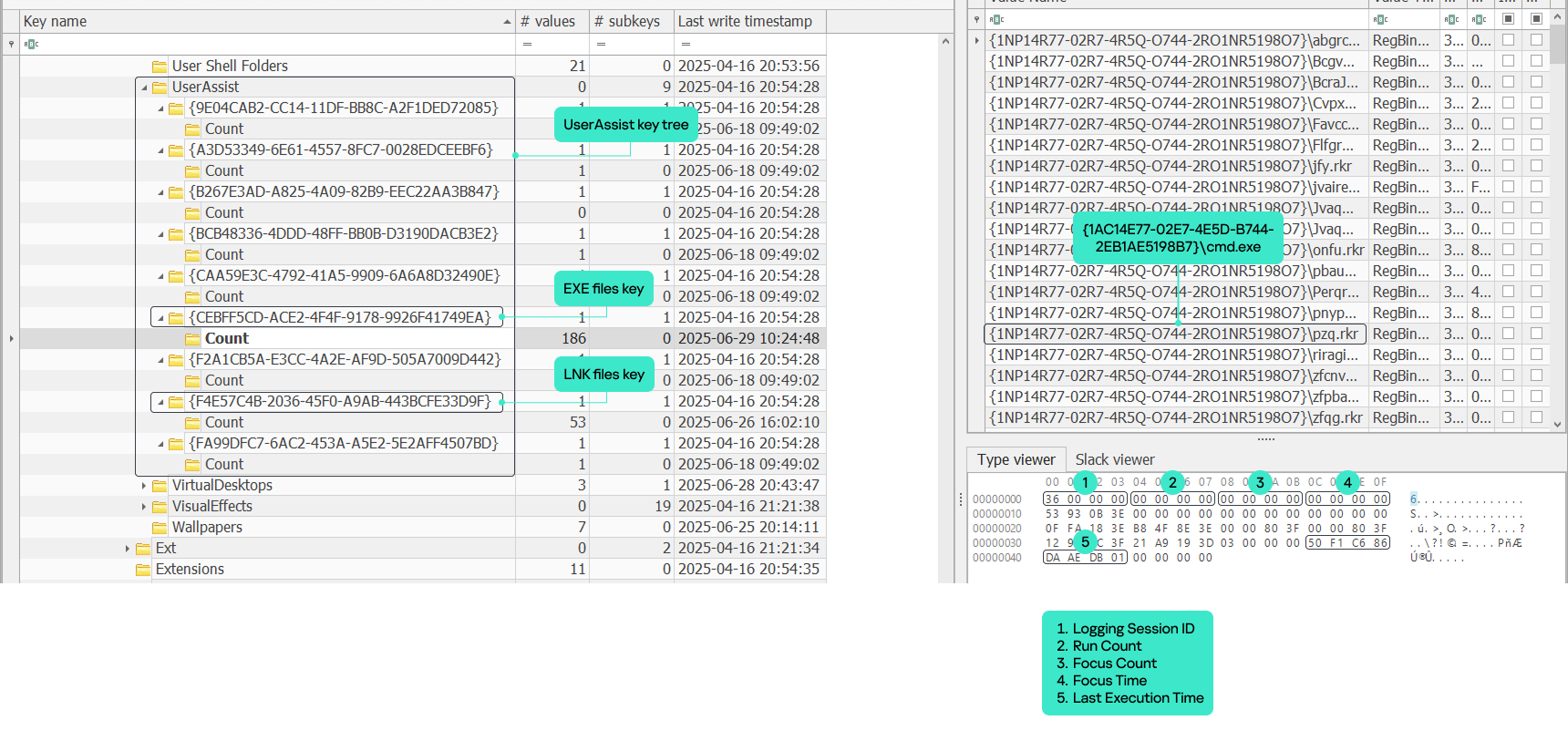
    The UserAssist artifact is a registry key under each NTUSER.DAT hive located at SoftwareMicrosoftWindows‌CurrentVersionExplorerUserAssist. The key consists of subkeys named with GUIDs. The two most important GUID subkeys are:

    • {CEBFF5CD-ACE2-4F4F-9178-9926F41749EA}: registers executed EXE files.
    • {F4E57C4B-2036-45F0-A9AB-443BCFE33D9F}: registers executed LNK files.

    Each subkey has its own subkey named “Count”. It contains values that represent the executed programs. The value names are the program paths encrypted using the ROT-13 cipher.

    The values contain structured binary data that includes the run count, focus count, focus time and last execution time of the respective application. This structure is well-known and represents the CUACount object. The bytes between focus time and last execution time have never been described or analyzed publicly, but we managed to determine what they are and will explain this later in the article. The last four bytes are unknown and contained a zero in all the datasets we analyzed.

    UserAssist artifact

    Data inconsistency

    Over the course of many investigations, the UserAssist data was found to be inconsistent. Some values included all of the parameters described above, while others, for instance, included only run count and last execution time. Overall, we observed five combinations of UserAssist data inconsistency.

    Cases Run Count Focus Count Focus Time Last Execution Time
    1 ✓ ✓ ✓ ✓
    2 ✓ ✕ ✕ ✓
    3 ✕ ✓ ✓ ✕
    4 ✓ ✕ ✓ ✓
    5 ✕ ✕ ✓ ✕

    Workflow analysis

    Deep dive into Shell32 functions

    To understand the reasons behind the inconsistency, we must examine the component responsible for registering and updating the UserAssist data. Our analysis revealed that the component in question is shell32.dll, more specifically, a function called FireEvent that belongs to the CUserAssist class.

    1

    virtual long CUserAssist::FireEvent(struct _GUID const *, enum  tagUAEVENT, unsigned short const *, unsigned long)

    The FireEvent arguments are as follows:

    • Argument 1: GUID that is a subkey of the UserAssist registry key containing the registered data. This argument most often takes the value {CEBFF5CD-ACE2-4F4F-9178-9926F41749EA} because executed programs are mostly EXE files.
    • Argument 2: integer enumeration value that defines which counters and data should be updated.
      • Value 0: updates the run count and last execution time
      • Value 1: updates the focus count
      • Value 2: updates the focus time
      • Value 3: unknown
      • Value 4: unknown (we assume it is used to delete the entry).
    • Argument 3: full executable path that has been executed, focused on, or closed.
    • Argument 4: focus time spent on the executable in milliseconds. This argument only contains a value if argument 2 has a value of 2; otherwise, it equals zero.

    Furthermore, the FireEvent function relies heavily on two other shell32.dll functions: s_Read and s_Write. These functions are responsible for reading and writing the binary value data of UserAssist from and to the registry whenever a particular application is updated:

    static long CUADBLog::s_Read(void *, unsigned long, struct NRWINFO *)

    static long CUADBLog::s_Write(void *, unsigned long, struct NRWINFO *)

    The s_Read function reads the binary value of the UserAssist data from the registry to memory, whereas s_Write writes the binary value of the UserAssist data to the registry from the memory. Both functions have the same arguments, which are as follows:

    • Argument 1: pointer to the memory buffer (the CUACount struct) that receives or contains the UserAssist binary data.
    • Argument 2: size of the UserAssist binary data in bytes to be read from or written to registry.
    • Argument 3: undocumented structure containing two pointers.
      • The CUADBLog instance pointer at the 0x0 offset
      • Full executable path in plain text that the associated UserAssist binary data needs to be read from or written to the registry.

    When a program is executed for the first time and there is no respective entry for it in the UserAssist records, the s_Read function reads the UEME_CTLCUACount:ctor value, which serves as a template for the UserAssist binary data structure (CUACount). We’ll describe this value later in the article.

    It should be noted that the s_Read and s_Write functions are also responsible for encrypting the value names with the ROT-13 cipher.

    UserAssist data update workflow

    Any interaction with a program that displays a GUI is a triggering event that results in a call to the CUserAssist::FireEvent function. There are four types of triggering events:

    • Program executed.
    • Program set in focus.
    • Program set out of focus.
    • Program closed.

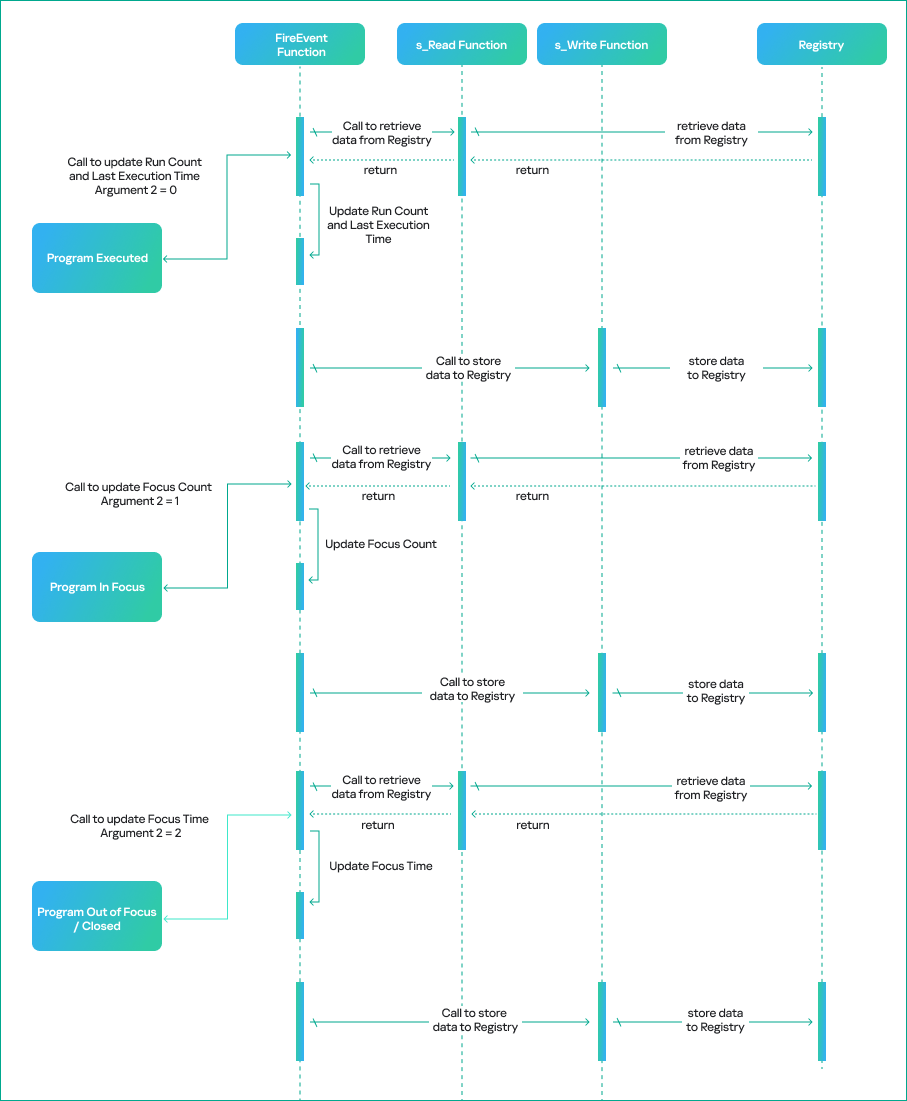
    The triggering event determines the execution workflow of the CUserAssist::FireEvent function. The workflow is based on the enumeration value that is passed as the second argument to FireEvent and defines which counters and data should be updated in the UserAssist binary data.

    The CUserAssist::FireEvent function calls the CUADBLog::s_Read function to read the binary data from registry to memory. The CUserAssist::FireEvent function then updates the respective counters and data before calling CUADBLog::s_Write to store the data back to the registry.

    The diagram below illustrates the workflow of the UserAssist data update process depending on the interaction with a program.

    UserAssist data update workflow

    The functions that call the FireEvent function vary depending on the specific triggering event caused by interaction with a program. The table below shows the call stack for each triggering event, along with the modules of the functions.

    Triggering event Module Call Stack Functions Details
    Program executed (double click) SHELL32 CUserAssist::FireEvent This call chain updates the run count and last execution time. It is only triggered when the executable is double-clicked, whether it is a CLI or GUI in File Explorer.
    Windows.storage UAFireEvent
    Windows.storage NotifyUserAssistOfLaunch
    Windows.storage CInvokeCreateProcessVerb::
    _OnCreatedProcess
    Program in focus SHELL32 CUserAssist::FireEvent This call chain updates the focus count and only applies to GUI executables.
    Explorer UAFireEvent
    Explorer CApplicationUsageTracker::
    _FireDelayedSwitch
    Explorer CApplicationUsageTracker::
    _FireDelayedSwitchCallback
    Program out of focus SHELL32 CUserAssist::FireEvent This call chain updates the focus time and only applies to GUI executables.
    Explorer UAFireEvent
    Explorer ac47d9dd501738f1>::operator()
    Explorer shell::TaskScheduler::
    CSimpleRunnableTaskParam
    ac47‌d9dd501738f1>‌,
    CMemString_PolicyCoTaskMem>
    >::InternalResumeRT
    Program closed SHELL32 CUserAssist::FireEvent This call chain updates the focus time and applies to GUI and CLI executables. However, CLI executables are only updated if the program was executed via a double click or if conhost was spawned as a child process.
    Explorer UAFireEvent
    Explorer shell::TaskScheduler::
    CSimpleRunnableTaskParamlambda_5b4995a8d0f55408566e‌10
    b459ba2cbe>‌,CMemStringCMemString‌_PolicyCoTaskMem> >
    ::InternalResumeRT

    Inconsistency breakdown

    As previously mentioned, we observed five combinations of UserAssist data. Our thorough analysis shows that these inconsistencies arise from interactions with a program and various functions that call the FireEvent function. Now, let’s examine the triggering events that cause these inconsistencies in more detail.

    1.   All data

    The first combination is all four parameters registered in the UserAssist record: run count, focus count, focus time, and last execution time. In this scenario, the program usually follows the normal execution flow, has a GUI and is executed by double-clicking in Windows Explorer.

    • When the program is executed, the FireEvent function is called to update the run count and last execution time.
    • When it is set in focus, the FireEvent function is called to update the focus count.
    • When it is set out of focus or closed, the FireEvent function is called to update focus time.

    2.   Run count and last execution time

    The second combination occurs when the record only contains run count and last execution time. In this scenario, the program is run by double-clicking in Windows Explorer, but the GUI that appears belongs to another program. Examples of this scenario include launching an application with an LNK shortcut or using an installer that runs a different GUI program, which switches the focus to the other program file.

    During our test, a copy of calc.exe was executed in Windows Explorer using the double-click method. However, the GUI program that popped up was the UWP app for the calculator Microsoft.WindowsCalculator_8wekyb3d8bbwe!App.

    There is a record of the calc.exe desktop copy in UserAssist, but it contains only the run count and last execution time. However, both focus count and focus time are recorded under the UWP calculator Microsoft.WindowsCalculator_8wekyb3d8bbwe!App UserAssist entry.

    3.   Focus count and focus time

    The third combination is a record that only includes focus count and focus time. In this scenario, the program has a GUI, but is executed by means other than a double click in Windows Explorer, for example, via a command line interface.

    During our test, a copy of Process Explorer from the Sysinternals Suite was executed through cmd and recorded in UserAssist with focus count and focus time only.

    4.   Run count, last execution time and focus time

    The fourth combination is when the record contains run count, last execution time and focus time. This scenario only applies to CLI programs that are run by double-clicking and then immediately closed. The double-click execution leads to the run count and last execution time being registered. Next, the program close event will call the FireEvent function to update the focus time, which is triggered by the lambda function (5b4995a8d0f55408566e10b459ba2cbe).

    During our test, a copy of whoami.exe was executed by a double click, which opened a console GUI for a split second before closing.

    5.   Focus time

    The fifth combination is a record with only focus time registered. This scenario only applies to CLI programs executed by means other than a double click, which opens a console GUI for a split second before it is immediately closed.

    During our test, a copy of whoami.exe was executed using PsExec instead of cmd. PsExec executed whoami as its own child process, resulting in whoami spawning a conhost.exe process. This condition must be met for the CLI program to be registered in UserAssist in this scenario.

    We summed up all five combinations with their respective interpretations in the table below.

    Inconsistency combination Interpretation Triggering events
    All Data GUI program executed by double
    click and closed normally.
    ·        Program Executed
    ·        Program In Focus
    ·        Program Out of Focus
    ·        Program Closed
    Run Count and Last Execution Time GUI program executed by double
    click but focus switched to another
    program.
    ·        Program Executed
    Focus Count and Focus Time GUI program executed by other means. ·        Program In Focus
    ·        Program Out of Focus
    ·        Program Closed
    Run Count, Last Execution Time and Focus Time CLI program executed by double
    click and then closed.
    ·        Program Executed
    ·        Program Closed
    Focus Time CLI program executed by other
    means than double click, spawned
    conhost process and then closed.
    ·        Program Closed

    CUASession and UEME_CTLSESSION

    Now that we have addressed the inconsistency of the UserAssist artifact, the second part of this research will explain another aspect of UserAssist: the CUASession class and the UEME_CTLSESSION value.

    The UserAssist database contains value names for every executed program, but there is an unknown value: UEME_CTLSESSION. Unlike the binary data that is recorded for every program, this value contains larger binary data: 1612 bytes, whereas the regular size of values for executed programs is 72 bytes.

    CUASession is a class within shell32.dll that is responsible for maintaining statistics of the entire UserAssist logging session for all programs. These statistics include total run count, total focus count, total focus time and the three top program entries, known as NMax entries, which we will describe below. The UEME_CTLSESSION value contains the properties of the CUASession object. Below are some functions of the CUASession class:

    CUASession::AddLaunches(uint) CUASession::GetTotalLaunches(void)
    CUASession::AddSwitches(uint) CUASession::GetTotalSwitches(void)
    CUASession::AddUserTime(ulong) CUASession::GetTotalUserTime(void)
    CUASession::GetNMaxCandidate(enum _tagNMAXCOLS, struct SNMaxEntry *) CUASession::SetNMaxCandidate(enum _tagNMAXCOLS, struct SNMaxEntry const *)

    In the context of CUASession and UEME_CTLSESSION, we will refer to run count as launches, focus count as switches, and focus time as user time when discussing the parameters of all executed programs in a logging session as opposed to the data of a single program.

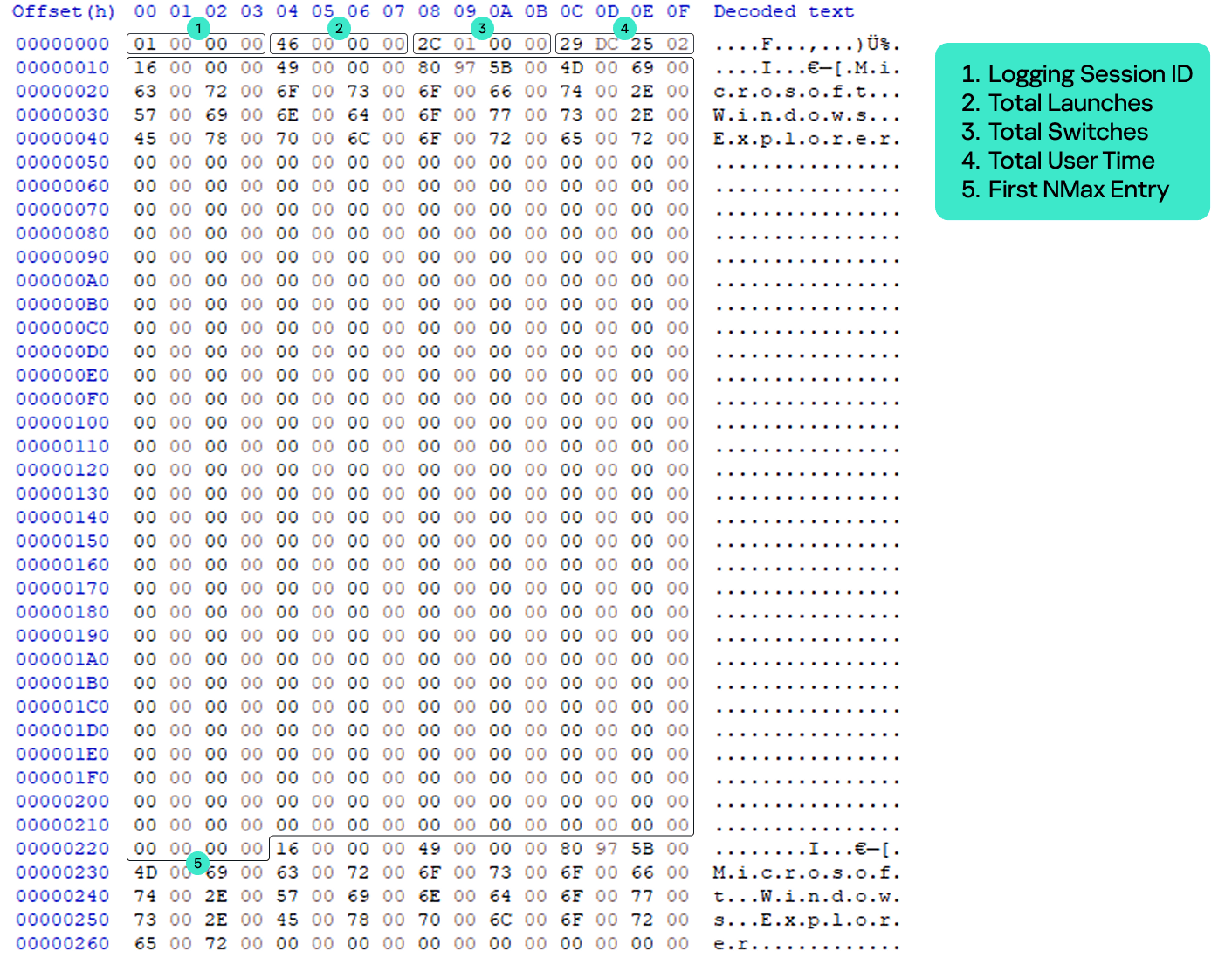
    The UEME_CTLSESSION value has the following specific data structure:

    • 0x0 offset: general total statistics (16 bytes)
      • 0x0: logging session ID (4 bytes)
      • 0x4: total launches (4 bytes)
      • 0x8: total switches (4 bytes)
      • 0xC: total user time in milliseconds (4 bytes)
    • 0x10 offset: three NMax entries (1596 bytes)
      • 0x10: first NMax entry (532 bytes)
      • 0x224: second NMax entry (532 bytes)
      • 0x438: third NMax entry (532 bytes)

    UEME_CTLSESSION structure

    Every time the FireEvent function is called to update program data, CUASession updates its own properties and saves them to UEME_CTLSESSION.

    • When FireEvent is called to update the program’s run count, CUASession increments Total Launches in UEME_CTLSESSION.
    • When FireEvent is called to update the program’s focus count, CUASession increments Total Switches.
    • When FireEvent is called to update the program’s focus time, CUASession updates Total User Time.

    NMax entries

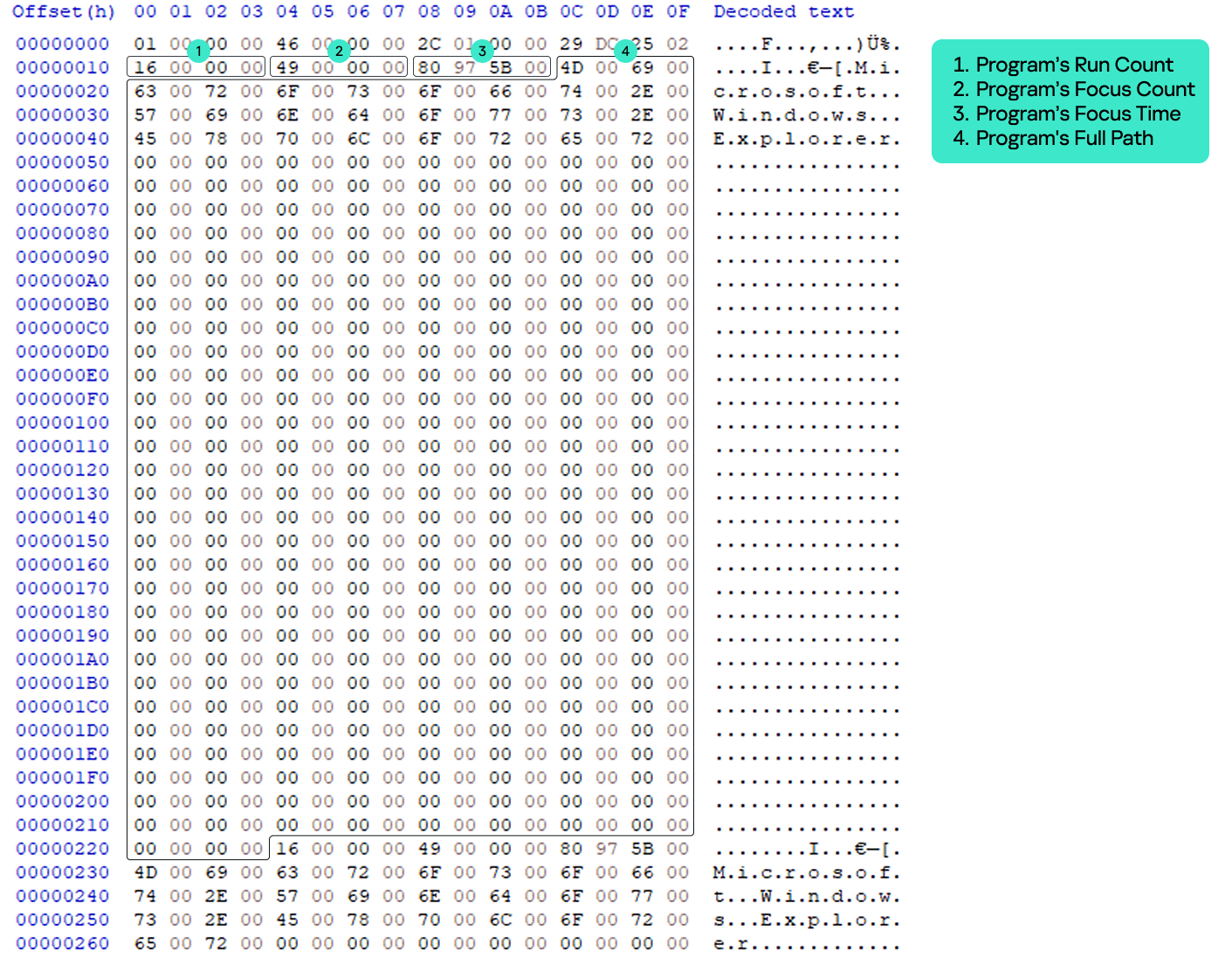
    The NMax entry is a portion of the UserAssist data for the specific program that contains the program’s run count, focus count, focus time, and full path. NMax entries are part of the UEME_CTLSESSION value. Each NMax entry has the following data structure:

    • 0x0 offset: program’s run count (4 bytes)
    • 0x4 offset: program’s focus count (4 bytes)
    • 0x8 offset: program’s focus time in milliseconds (4 bytes)
    • 0xc offset: program’s name/full path in Unicode (520 bytes, the maximum Windows path length multiplied by two)

    NMax entry structure

    The NMax entries track the programs that are executed, switched, and used most frequently. Whenever the FireEvent function is called to update a program, the CUADBLog::_CheckUpdateNMax function is called to check and update the NMax entries accordingly.

    The first NMax entry stores the data of the most frequently executed program based on run count. If two programs (the program whose data was previously saved in the NMax entry and the program that triggered the FireEvent for update) have an equal run count, the entry is updated based on the higher calculated value between the two programs, which is called the N value. The N value equation is as follows:

    N value = Program’s Run Count*(Total User Time/Total Launches) + Program’s Focus Time + Program’s Focus Count*(Total User Time/Total Switches)

    The second NMax entry stores the data of the program with the most switches, based on its focus count. If two programs have an equal focus count, the entry is updated based on the highest calculated N value.

    The third NMax entry stores the data of the program that has been used the most, based on the highest N value.

    The parsed UEME_CTLSESSION structure with NMax entries is shown below.

    1

    2

    3

    4

    5

    6

    7

    8

    9

    10

    11

    12

    13

    14

    15

    16

    17

    18

    19

    20

    21

    22

    23

    24

    25

    26

    27

    28

    {

            “stats”: {

                “Session ID”: 40,

                “Total Launches”: 118,

                “Total Switches”: 1972,

                “Total User Time”: 154055403

            },

            “NMax”: [

                {

                    “Run Count”: 20,

                    “Focus Count”: 122,

                    “Focus Time”: 4148483,

                    “Executable Path”: “Microsoft.Windows.Explorer”

                },

                {

                    “Run Count”: 9,

                    “Focus Count”: 318,

                    “Focus Time”: 34684910,

                    “Executable Path”: “Chrome”

                },

                {

                    “Run Count”: 9,

                    “Focus Count”: 318,

                    “Focus Time”: 34684910,

                    “Executable Path”: “Chrome”

                }

            ]

        }

    UEME_CTLSESSION data

    UserAssist reset

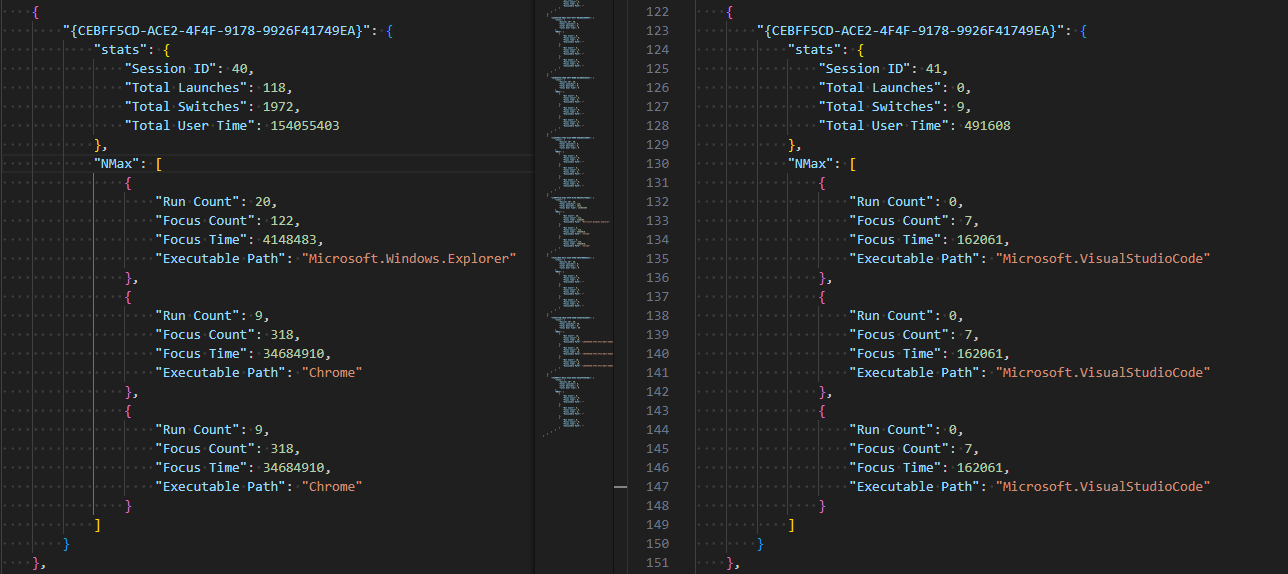
    UEME_CTLSESSION will persist even after logging off or restarting. However, when it reaches the threshold of two days in its total user time, i.e., when the total focus time of all executed programs of the current user equals two days, the logging session is terminated and almost all UserAssist data, including the UEME_CTLSESSION value, is reset.

    The UEME_CTLSESSION value is reset with almost all its data, including total launches, total switches, total user time, and NMax entries. However, the session ID is incremented and a new logging session begins.

    UEME_CTLSESSION comparison before and after reset

    The newly incremented session ID is copied to offset 0x0 of each program’s UserAssist data. Besides UEME_CTLSESSION, other UserAssist data for each program is also reset including run count, focus count, focus time, and the last four bytes, which are still unknown and always contain zero. The only parameter that is not reset is the last execution time. However, all this data is saved in the form of a usage percentage before resetting.

    Usage percentage and counters

    We analyzed the UserAssist data of various programs to determine the unknown bytes between the focus time and last execution time sections. We found that they represent a list of a program’s usage percentage relative to the most used program at that session, as well as the rewrite counter (the index of the usage percentage last written to the list) for the last 10 sessions. Given our findings, we can now revise the structure of the program’s UserAssist binary data and fully describe all of its components.

    UserAssist revised structure

    • 0x0: logging session ID (4 bytes).
    • 0x4: run count (4 bytes).
    • 0x8: focus count (4 bytes).
    • 0xc: focus time (4 bytes).
    • 0x10: element in usage percentage list [0] (4 bytes).
    • 0x14: element in usage percentage list [1] (4 bytes).
    • 0x18: element in usage percentage list [2] (4 bytes).
    • 0x1c: element in usage percentage list [3] (4 bytes).
    • 0x20: element in usage percentage list [4] (4 bytes).
    • 0x24: element in usage percentage list [5] (4 bytes).
    • 0x28: element in usage percentage list [6] (4 bytes).
    • 0x2c: element in usage percentage list [7] (4 bytes).
    • 0x30: element in usage percentage list [8] (4 bytes).
    • 0x34: element in usage percentage list [9] (4 bytes).
    • 0x38: index of last element written in the usage percentage list (4 bytes).
    • 0x3c: last execution time (Windows FILETIME structure) (8 bytes).
    • 0x44: unknown value (4 bytes).

    The values from 0x10 to 0x37 are the usage percentage values that are called r0 values and calculated based on the following equation.

    r0 value [Index] = N Value of the Program / N Value of the Most Used Program in the session (NMax entry 3)

    If the program is run for the first time within an ongoing logging session, its r0 values equal -1, which is not a calculated value, but a placeholder.

    The offset 0x38 is the index of the last element written to the list, and is incremented whenever UEME_CTLSESSION is reset. The index is bounded between zero and nine because the list only contains the r0 values of the last 10 sessions.

    The last four bytes equal zero, but their purpose remains unknown. We have not observed them being used other than being reset after the session expires.

    The table below shows a sample of the UserAssist data broken down by component after parsing.

    UserAssist revised data structure parsed

    Forensic value

    The r0 values are a goldmine of valuable information about a specific user’s application and program usage. These values provide useful information for incident investigations, such as the following:

    • Programs with many 1 values in the r0 values list are the programs most frequently used by the user.
    • Programs with many 0 values in the r0 values list are the programs that are least used or abandoned by the user, which could be useful for threat hunting and lead to the discovery of malware or legitimate software used by adversaries.
    • Programs with many -1 values in the r0 values list are relatively new programs with data that has not been reset within two days of the user interactive session.

    UserAssist data template

    As mentioned above, when the program is first executed and doesn’t yet have its own UserAssist record (CUACount object), a new entry is created with the UEME_CTLCUACount:ctor value. This value serves as a template for the program’s UserAssist binary data with the following values:

    • Logging session ID = -1 (0xffffffff). However, this value is copied to the UserAssist entry from the current UEME_CTLSESSION session.
    • Run count = 0.
    • Focus count = 0.
    • Focus time = 0.
    • Usage percentage list [0-9] = -1 (0xbf800000) because these values are float numbers.
    • Usage percentage index (counter) = -1 (0xffffffff).
    • Last execution time = 0.
    • Last four bytes = 0.

    UEME_CTLCUACount:ctor data

    New parser

    Based on the findings of this research, we created a new parser built on an open source parser. Our new tool parses and saves all UEME_CTLSESSION values as a JSON file. It also parses UserAssist data with the newly discovered r0 value structure and saves it as a CSV file.

    Conclusion

    We closely examined the UserAssist artifact and how its data is structured. Our thorough analysis helped identify data inconsistencies. The FireEvent function in shell32.dll is primarily responsible for updating the UserAssist data. Various interactions with programs trigger calls to the FireEvent function and they are the main reason for the inconsistencies in the UserAssist data.

    We also studied the UEME_CTLSESSION value. It is mainly responsible for coordinating the UserAssist logging session that expires once the accumulated focus time of all programs reaches two days. Further investigation of UEME_CTLSESSION revealed the purpose of previously undocumented UserAssist binary data values, which turned out to be the usage percentage list of programs and the value rewrite counter.

    The UserAssist artifact is a valuable tool for incident response activities, and our research can help make the most of the data it contains.

    MIL OSI Economics –

    July 14, 2025
  • MIL-OSI Economics: [Design Story] The Next Chapter in Innovation: Galaxy Z Fold7 and Galaxy Z Flip7

    Source: Samsung

     
    The Galaxy Z series has set the standard for foldable phones from its very first launch, with a new release every year. Now in its seventh chapter, the latest design revisits where it all started. The Galaxy Z Fold7 and Z Flip7 are the result of refinements made over each year of innovation. Samsung Newsroom spoke with Hubert Lee, Head of the Design Team and Huichul Yang, Head of the UX (User eXperience) Team, both part of the Mobile eXperience (MX) Business at Samsung Electronics, to discover the story behind the products and the designers’ persistent pursuit of incredible design.
     
    * Content images simulated for illustrative purposes only and may differ from the actual product. Product specifications may vary by country, region, model and carrier.
     
    Hubert Lee
    Executive Vice President, MX Business, Samsung Electronics
    Since joining as Head of the MX Design Team in late 2022, Lee has overseen the design direction for all MX product launches. With the launch of the new Galaxy Z Fold7 and Z Flip7, Lee showcases Galaxy’s ultimate pursuit of ultra-sleek and modern design.
     
    Huichul Yang
    Vice President, MX Business, Samsung Electronics
    Since joining Samsung in 2005, Yang has played a pivotal role in advancing mobile UX innovation as an HCI (Human Computer Interaction) expert. Since late 2023, Yang has led the UX Team in the MX Business, crafting the mobile experiences powered by Galaxy AI.


    The Essence of Foldable Design


    Q. The Galaxy Z Fold7 and Z Flip7 have finally been unveiled. As the heads of the Design and UX teams, it must mean a lot to both of you.
     
    Lee: Among the products I’ve designed at Samsung, the Galaxy Z Fold7 stands out as the one I am most proud of. Most people said, “Wow!” as soon as they saw it. It’s the thinnest, lightest Galaxy Z Fold series model yet. I believe it captures the essence of what a foldable phone can be. It’s only just been unveiled at Galaxy Unpacked 2025 in New York, but I’m confident that customers will understand its true value as they see it up close and get a feel for it in their hands.
     
    Yang: Alongside the Galaxy Z Fold7 and Z Flip7, we also introduced One UI 8, an interface optimized for the AI experience. I believe that a sleek, modern design — paired with an intuitive interface — can really resonate with users seeking a more elevated mobile experience in this age of AI.
     
    “The Galaxy Z series isn’t just well-made — it reaffirms our position as a pioneer and benchmark in the foldable phone market.”
    — Hubert Lee, EVP, Samsung Electronics


    Q. It’s clear you’re both really proud of the products. It must have taken a lot of work to get it out into the world.
     
    Lee: The Galaxy Z series marked the very beginning of foldable phones. To solidify that symbolism, we knew we had to create a product that felt truly impressive to anyone who saw it. There was a shared understanding within the team that simply repeating what we had done in the past wouldn’t be enough to meet customer expectations. Change wasn’t a choice; it was a must. That’s why with the seventh models of the Galaxy Z series, we didn’t approach it as a refinement — we approached it as a redesign from the ground up. We approached it as if we were starting completely from scratch.
     
    We design lifestyle products. To be part of people’s daily lives, portability is essential and reducing weight was key to achieving that. Our mobile R&D office put in a huge amount of effort in that respect. The nature of the hardware meant there was a certain weight we had to carry, but we kept wondering if we could make it just a little bit lighter. That led to a lot of research and testing. As it became lighter, it became thinner and the display larger, until we arrived at the sleek, modern form we had envisioned. The product you see is the result of countless hours of deliberation, passion and engineering.


    Q. How did changes to the design of products affect the user interface?
     
    Yang: Since One UI 6, we’ve been introducing a range of AI features as an AI companion. With One UI 8, we focused on meaningful productivity. We took advantage of the Galaxy Z Fold7’s large-screen form factor to enable users to easily compare original and AI-generated content side by side and move it seamlessly between apps.
     
     
    Q. What are the changes to the Galaxy Z Flip7 UX?
     
    Yang: One of the standout features of the Z Flip7 is its full-front FlexWindow. Gemini is now optimized for the FlexWindow, enabling quick and seamless interaction with AI — anytime you need it. It’s our new take on an AI companion — one that unfolds right in the palm of your hand. Notably, the form factor is such that the main camera faces you when folded, so now you can launch Gemini Live from the FlexWindow and ask about everyday things, like if your outfit is appropriate for the weather or your schedule for the day.
     
    “We envisioned a new future with One UI 8 on the Galaxy Z Flip7 as an AI companion in your hand.”
     — Huichul Yang, VP, Samsung Electronics
     

    * This background image has been created by generative AI (Macnific AI, Midjourney).


    Q. The products come in a range of colors. Which one is your favorite?
     
    Lee: I love them all but if I had to choose one, it would have to be Silver Shadow. It’s the most straightforward and simple one, but I think it represents Galaxy’s “Ultra Sleek, Ultra Modern” concept really well.
     
    When customers buy premium products like the Galaxy Z Fold7, they tend to prefer values that feel timeless, so we really took that into consideration when choosing the colors for this series. We leveraged the metallic material to bring the colors to life in a way that expresses our design intent and complements the foldable form factor. One of the standout colors of this series is Blue Shadow. As you move the product around, the shine and sophistication are noticeable from all angles.


    Let’s Design Together!


    Q. Even though you’re on different teams, you’ve been working on the same product. How did the Design and UX teams get connected?
     
    Yang: Wallpaper design is where we really tend to collaborate closely. We work together to make sure the message the Design team wants to convey is properly communicated through the wallpaper, the face of the product. For One UI 7, we aligned the product’s corner radius with the One UI icon geometry. We’ll continue to align the GUI (Graphic user interface) with the underlying style of the product for future releases, too.
     
    “Designing with the authentic mindset that we are all one team — this, I believe, is the most important attitude we need to break silos and grow together.”
     — Hubert Lee, EVP, Samsung Electronics


    Q. How do the team members collaborate?
     
    Lee: The Design team holds a session called Design Clinic. Group leaders and managers come together to share ongoing projects and insights. It’s not a formal meeting, but rather a relaxed gathering to share ideas over coffee and dessert. It’s an open discussion where even criticism is seen as a way to make our products better and support each other. In the MX Business’s Design team, we cover everything from smartphones and wearables to PCs, tablets, CMF (Color, material and finish) and packaging, each item with its own functions. The Design Clinic helps us gain insights from other fields or discover early-stage ideas.
     
     
    Q. How do you encourage synergy between designers on the team?
     
    Lee: I often emphasize the phrase, “Let’s Design Together.” Rather than just holding onto what they’ve been assigned, I encourage the team to think collectively about what we’re making and how we can improve it. If feedback or advice isn’t sincere, it just leads to silos between teams. Designing together as one team with an authentic, shared mindset is what I emphasize most within the organization.


    Reframing the Future
     
    Q. Aside from designers’ intuition, sensibilities and qualitative insights, do you also incorporate user testing or quantitative validation during the design planning phase?
     
    Lee: The Design team has established a Galaxy Design principle called “Essential Design,” aimed at focusing on core value and removing unnecessary elements. It’s based on three key elements: Simple, Impactful and Emotive. We believe that when these three elements come together in harmony, they create a truly aspirational product. We use the principle and its key elements as evaluation tools during the design planning stage; through a process we call Design Analytics. We conduct evaluations with internal employees to make sure our design intent is being communicated to users effectively. We use the data and insights from this to refine current designs and even identify future products. It’s how we strengthen our design identity, and it’s an integral part of the Galaxy design process.
     
     
    Q. Do you use AI in your work?
     
    Yang: We refer to AI tools during the testing process. We’ve observed that results from AI-based virtual user testing are fairly close to tests done by recruiting actual users. This leads us to expect that AI can play a significant role in UX evaluation going forward. We’re also experimenting with AI in other ways, like testing multiple versions of motion or animation effects, or turning 2D assets into 3D or animated formats. In this way, we’re continuously learning more about how to enhance our designs with AI.
     
    “Amid the momentum of AI, the ability to direct design will become one of the most valuable assets in making your work truly meaningful.”
     — Huichul Yang, VP, Samsung Electronics


    Q. The age we live in is constantly changing. What kind of mindset and vision should guide designers today?
     
    Yang: AI is a new momentum for designers. There are more and more of us thinking about how to use AI to make our work more meaningful. I believe those who show interest in how the world is changing and make new tools their own will be the ones leading in the age of AI. Some say designers will fade away as AI advances, but I see it differently. Design direction, the ability to guide AI creations and enrich them, is bound to become even more essential.
     
    Lee: When it comes to new devices like foldable products, we’re not designing features. We’re designing the entire experience. I believe it’s our role as designers to deeply consider why a device folds, why it unfolds and what kind of value and convenience those actions should provide. That’s because we’re not just product designers, we’re lifestyle designers, and in the end, the user is the most important part of all. We have to read the trends constantly and keep asking ourselves what users truly need. To me, design that makes their lives better is design that’s truly meaningful.
     
    For more information about Samsung Electronics’ design, please visit the Samsung Design website.


    MIL OSI Economics –

    July 14, 2025
  • MIL-OSI Economics: [Design Story] The Next Chapter in Innovation: Galaxy Z Fold7 and Galaxy Z Flip7

    Source: Samsung

     
    The Galaxy Z series has set the standard for foldable phones from its very first launch, with a new release every year. Now in its seventh chapter, the latest design revisits where it all started. The Galaxy Z Fold7 and Z Flip7 are the result of refinements made over each year of innovation. Samsung Newsroom spoke with Hubert Lee, Head of the Design Team and Huichul Yang, Head of the UX (User eXperience) Team, both part of the Mobile eXperience (MX) Business at Samsung Electronics, to discover the story behind the products and the designers’ persistent pursuit of incredible design.
     
    * Content images simulated for illustrative purposes only and may differ from the actual product. Product specifications may vary by country, region, model and carrier.
     
    Hubert Lee
    Executive Vice President, MX Business, Samsung Electronics
    Since joining as Head of the MX Design Team in late 2022, Lee has overseen the design direction for all MX product launches. With the launch of the new Galaxy Z Fold7 and Z Flip7, Lee showcases Galaxy’s ultimate pursuit of ultra-sleek and modern design.
     
    Huichul Yang
    Vice President, MX Business, Samsung Electronics
    Since joining Samsung in 2005, Yang has played a pivotal role in advancing mobile UX innovation as an HCI (Human Computer Interaction) expert. Since late 2023, Yang has led the UX Team in the MX Business, crafting the mobile experiences powered by Galaxy AI.


    The Essence of Foldable Design


    Q. The Galaxy Z Fold7 and Z Flip7 have finally been unveiled. As the heads of the Design and UX teams, it must mean a lot to both of you.
     
    Lee: Among the products I’ve designed at Samsung, the Galaxy Z Fold7 stands out as the one I am most proud of. Most people said, “Wow!” as soon as they saw it. It’s the thinnest, lightest Galaxy Z Fold series model yet. I believe it captures the essence of what a foldable phone can be. It’s only just been unveiled at Galaxy Unpacked 2025 in New York, but I’m confident that customers will understand its true value as they see it up close and get a feel for it in their hands.
     
    Yang: Alongside the Galaxy Z Fold7 and Z Flip7, we also introduced One UI 8, an interface optimized for the AI experience. I believe that a sleek, modern design — paired with an intuitive interface — can really resonate with users seeking a more elevated mobile experience in this age of AI.
     
    “The Galaxy Z series isn’t just well-made — it reaffirms our position as a pioneer and benchmark in the foldable phone market.”
    — Hubert Lee, EVP, Samsung Electronics


    Q. It’s clear you’re both really proud of the products. It must have taken a lot of work to get it out into the world.
     
    Lee: The Galaxy Z series marked the very beginning of foldable phones. To solidify that symbolism, we knew we had to create a product that felt truly impressive to anyone who saw it. There was a shared understanding within the team that simply repeating what we had done in the past wouldn’t be enough to meet customer expectations. Change wasn’t a choice; it was a must. That’s why with the seventh models of the Galaxy Z series, we didn’t approach it as a refinement — we approached it as a redesign from the ground up. We approached it as if we were starting completely from scratch.
     
    We design lifestyle products. To be part of people’s daily lives, portability is essential and reducing weight was key to achieving that. Our mobile R&D office put in a huge amount of effort in that respect. The nature of the hardware meant there was a certain weight we had to carry, but we kept wondering if we could make it just a little bit lighter. That led to a lot of research and testing. As it became lighter, it became thinner and the display larger, until we arrived at the sleek, modern form we had envisioned. The product you see is the result of countless hours of deliberation, passion and engineering.


    Q. How did changes to the design of products affect the user interface?
     
    Yang: Since One UI 6, we’ve been introducing a range of AI features as an AI companion. With One UI 8, we focused on meaningful productivity. We took advantage of the Galaxy Z Fold7’s large-screen form factor to enable users to easily compare original and AI-generated content side by side and move it seamlessly between apps.
     
     
    Q. What are the changes to the Galaxy Z Flip7 UX?
     
    Yang: One of the standout features of the Z Flip7 is its full-front FlexWindow. Gemini is now optimized for the FlexWindow, enabling quick and seamless interaction with AI — anytime you need it. It’s our new take on an AI companion — one that unfolds right in the palm of your hand. Notably, the form factor is such that the main camera faces you when folded, so now you can launch Gemini Live from the FlexWindow and ask about everyday things, like if your outfit is appropriate for the weather or your schedule for the day.
     
    “We envisioned a new future with One UI 8 on the Galaxy Z Flip7 as an AI companion in your hand.”
     — Huichul Yang, VP, Samsung Electronics
     

    * This background image has been created by generative AI (Macnific AI, Midjourney).


    Q. The products come in a range of colors. Which one is your favorite?
     
    Lee: I love them all but if I had to choose one, it would have to be Silver Shadow. It’s the most straightforward and simple one, but I think it represents Galaxy’s “Ultra Sleek, Ultra Modern” concept really well.
     
    When customers buy premium products like the Galaxy Z Fold7, they tend to prefer values that feel timeless, so we really took that into consideration when choosing the colors for this series. We leveraged the metallic material to bring the colors to life in a way that expresses our design intent and complements the foldable form factor. One of the standout colors of this series is Blue Shadow. As you move the product around, the shine and sophistication are noticeable from all angles.


    Let’s Design Together!


    Q. Even though you’re on different teams, you’ve been working on the same product. How did the Design and UX teams get connected?
     
    Yang: Wallpaper design is where we really tend to collaborate closely. We work together to make sure the message the Design team wants to convey is properly communicated through the wallpaper, the face of the product. For One UI 7, we aligned the product’s corner radius with the One UI icon geometry. We’ll continue to align the GUI (Graphic user interface) with the underlying style of the product for future releases, too.
     
    “Designing with the authentic mindset that we are all one team — this, I believe, is the most important attitude we need to break silos and grow together.”
     — Hubert Lee, EVP, Samsung Electronics


    Q. How do the team members collaborate?
     
    Lee: The Design team holds a session called Design Clinic. Group leaders and managers come together to share ongoing projects and insights. It’s not a formal meeting, but rather a relaxed gathering to share ideas over coffee and dessert. It’s an open discussion where even criticism is seen as a way to make our products better and support each other. In the MX Business’s Design team, we cover everything from smartphones and wearables to PCs, tablets, CMF (Color, material and finish) and packaging, each item with its own functions. The Design Clinic helps us gain insights from other fields or discover early-stage ideas.
     
     
    Q. How do you encourage synergy between designers on the team?
     
    Lee: I often emphasize the phrase, “Let’s Design Together.” Rather than just holding onto what they’ve been assigned, I encourage the team to think collectively about what we’re making and how we can improve it. If feedback or advice isn’t sincere, it just leads to silos between teams. Designing together as one team with an authentic, shared mindset is what I emphasize most within the organization.


    Reframing the Future
     
    Q. Aside from designers’ intuition, sensibilities and qualitative insights, do you also incorporate user testing or quantitative validation during the design planning phase?
     
    Lee: The Design team has established a Galaxy Design principle called “Essential Design,” aimed at focusing on core value and removing unnecessary elements. It’s based on three key elements: Simple, Impactful and Emotive. We believe that when these three elements come together in harmony, they create a truly aspirational product. We use the principle and its key elements as evaluation tools during the design planning stage; through a process we call Design Analytics. We conduct evaluations with internal employees to make sure our design intent is being communicated to users effectively. We use the data and insights from this to refine current designs and even identify future products. It’s how we strengthen our design identity, and it’s an integral part of the Galaxy design process.
     
     
    Q. Do you use AI in your work?
     
    Yang: We refer to AI tools during the testing process. We’ve observed that results from AI-based virtual user testing are fairly close to tests done by recruiting actual users. This leads us to expect that AI can play a significant role in UX evaluation going forward. We’re also experimenting with AI in other ways, like testing multiple versions of motion or animation effects, or turning 2D assets into 3D or animated formats. In this way, we’re continuously learning more about how to enhance our designs with AI.
     
    “Amid the momentum of AI, the ability to direct design will become one of the most valuable assets in making your work truly meaningful.”
     — Huichul Yang, VP, Samsung Electronics


    Q. The age we live in is constantly changing. What kind of mindset and vision should guide designers today?
     
    Yang: AI is a new momentum for designers. There are more and more of us thinking about how to use AI to make our work more meaningful. I believe those who show interest in how the world is changing and make new tools their own will be the ones leading in the age of AI. Some say designers will fade away as AI advances, but I see it differently. Design direction, the ability to guide AI creations and enrich them, is bound to become even more essential.
     
    Lee: When it comes to new devices like foldable products, we’re not designing features. We’re designing the entire experience. I believe it’s our role as designers to deeply consider why a device folds, why it unfolds and what kind of value and convenience those actions should provide. That’s because we’re not just product designers, we’re lifestyle designers, and in the end, the user is the most important part of all. We have to read the trends constantly and keep asking ourselves what users truly need. To me, design that makes their lives better is design that’s truly meaningful.
     
    For more information about Samsung Electronics’ design, please visit the Samsung Design website.


    MIL OSI Economics –

    July 14, 2025
  • MIL-OSI USA: DBEDT NEWS RELEASE: Hawai’i Tourism Authority Advisory Board Applications Open

    Source: US State of Hawaii

    DBEDT NEWS RELEASE: Hawai’i Tourism Authority Advisory Board Applications Open

    Posted on Jul 11, 2025 in Latest Department News, Newsroom


    STATE OF HAWAIʻI

    KA MOKU ʻĀINA O HAWAIʻI


    JOSH GREEN, M.D.
    GOVERNOR

    KE KIAʻĀINA

    DEPARTMENT OF BUSINESS, ECONOMIC DEVELOPMENT AND TOURISM

    KA ʻOIHANA HOʻOMOHALA PĀʻOIHANA, ʻIMI WAIWAI A HOʻOMĀKAʻIKAʻI


    JAMES KUNANE TOKIOKA

    DIRECTOR

    KA LUNA HOʻOKELE

    HAWAI‘I TOURISM AUTHORITY ADVISORY BOARD APPLICATIONS OPEN

    State Boards and Commissions Seeking Applicants


    FOR IMMEDIATE RELEASE

    July 11, 2025


    HONOLULU – The state of Hawai‘i Office of Boards and Commissions is seeking individuals interested in serving on the advisory board for the Hawai‘i Tourism Authority (HTA), a state agency administratively attached to the Department of Business, Economic Development and Tourism (DBEDT).

    Per Act 132, the HTA shall be headed by an advisory board of directors that shall consist of 12 members including at least one representative each from the city and county of Honolulu and the counties of Hawai‘i, Kaua‘i and Maui. At least six members shall have knowledge, experience and expertise in the area of accommodations, transportation, retail, entertainment, or attractions, and at least one member shall represent a tourism-impacted entity. At least one member appointed by the Governor shall have knowledge, experience and expertise in the area of Hawaiian cultural practices. Members appointed by the Governor are subject to advice and consent of the state Senate.

    Interested applicants are invited to apply online through the Governor’s boards and commissions portal (https://boards.hawaii.gov/apply/apply-for-a-board/).

    About the Hawai‘i Tourism Authority
    The Hawaiʻi Tourism Authority is the state agency responsible for representing the Hawaiian Islands around the world — and for holistically managing tourism in a sustainable manner consistent with community desires, economic goals, cultural values, preservation of natural resources and visitor industry needs. HTA works with the community and industry to mālama Hawaiʻi — care for our beloved home. For more information about HTA, visit hawaiitourismauthority.org or follow @HawaiiHTA on Facebook, Instagram, Threads, and X.

    About the Department of Business, Economic Development and Tourism

    DBEDT is Hawai‘i’s resource center for economic and statistical data, business development opportunities, energy and conservation information, as well as foreign trade advantages. DBEDT’s mission is to achieve a Hawai‘i economy that embraces innovation and is globally competitive, dynamic and productive, providing opportunities for all Hawai‘i’s citizens. Through its attached agencies, the department fosters planned community development, creates affordable workforce housing units in high-quality living environments and promotes innovation-sector job growth.

    # # #


    Media Contacts:


    Laci Goshi

    Communications Officer

    Department of Business, Economic Development and Tourism, State of Hawai‘i

    Cell: 808-518-5480

    Email: [email protected]


    Jill Radke

    Public Affairs Officer

    Hawai‘i Tourism Authority

    Cell: 808-451-9386

    Email: [email protected]

    MIL OSI USA News –

    July 14, 2025
  • MIL-OSI NGOs: 29 human rights wins to be proud of

    Source: Amnesty International –

    Over the past six months, the headlines have been dominated by stories of fear, division and hatred. However, activists around the world are working away to ensure hope prevails. Here are some of the human rights wins we can be proud of from January to June 2025.  

    January

    Afghanistan

    In 2023, Amnesty International released a report on the Taliban’s war on women. Following its findings, the International Criminal Court (ICC) Prosecutor filed a request for arrest warrants against the Taliban’s Supreme Leader and their Chief Justice, citing crimes against humanity.

    The request charges the Taliban’s Supreme Leader and their Chief Justice for gender persecution against women, girls, and LGBTI people since their return to power in August 2021. Although the warrants are still subject to the approval of ICC judges these are the first public arrest warrants sought by the ICC in Afghanistan since the country became a member of the court in 2003.

    Cameroon

    Dorgelesse Nguessan was released on 16 January after spending more than four years in prison for participating in a protest. The hairdresser and single mother had never been politically active yet joined a protest after growing concerned about the high cost of living. She was charged with insurrection, tried by a military court and sentenced to five years in prison on 7 December 2021.

    I thank those who directly or indirectly work for your organization and contributed to my release.

    Dorgelesse Nguessan

    Dorgelesse was part of Amnesty International’s 2022 Write for Rights campaign, where thousands of supporters called for her release. Amnesty also provided short-term relief support to assist Dorgelesse and her family through the difficult moments of her detention. On 16 January, the Court of Appeal reduced her sentence.

    “I thank you for all the efforts you have devoted as I was arbitrarily detained,” said Dorgelesse. “I thank those who directly or indirectly work for your organization and contributed to my release.”

    Chile

    On 2 January, two police [Carabineros] officers were sentenced to prison for shooting activist Renzo Inostroza and blinding him in one eye. The court concluded that their actions violated both Chile’s national regulations and international obligations. This conviction set a judicial precedent in the struggle to ensure the Chilean justice system pursues criminal responsibility for the unlawful actions of the Carabineros. This conviction follows Amnesty’s landmark Eyes on Chile report, which analyzed patterns and individual cases of police violence during the social unrest that broke out in Chile in October 2019. Renzo’s case was part of the report.

    Saudi Arabia

    From January to February, Amnesty successfully campaigned for the release of several human rights defenders in Saudi Arabia. On 7 January, human rights defender and former prisoner of conscience, Mohammed al-Qahtani, was conditionally released after spending 12 years in prison for his human rights work. On 13 February, 47-year-old teacher Asaad bin Nasser al-Ghamdi was released from prison following an unfair trial before the notorious Specialized Criminal Court (SCC). Asaad was arrested in 2022 and initially sentenced to 20 years in prison for social media posts criticizing the government’s Vision 2030 programme. On 10 February 2025, Leeds University PhD student and mother of two, Salma al-Shehab, was released from prison after completing a four-year prison term following an unfair trial before the SCC. Following a grossly unfair trial, the SCC had convicted Salma al-Shehab of terrorism-related offences for publishing tweets in support of women’s rights.

    USA 

    The United States sanctioned a number of companies involved in the transfer of weapons into Sudan and Darfur. These sanctions follow Amnesty’s innovative briefing, published in July 2024, that combined business trade data and video analysis to show how the constant import of foreign-manufactured arms into Sudan was fuelling relentless civilian suffering.

    © Gavrilah Wells

    Amnesty International members long campaigned for the release of Native American activist Leonard Peltier and most recently called on President Biden to grant Leonard Peltier clemency on humanitarian grounds and as a matter of justice.

    USA

    Leonard Peltier, a Native American activist, was imprisoned for nearly 50 years in the USA for a crime he maintains he did not commit. There were serious concerns about the fairness of his trial and conviction. Tribal Nations, Nobel Peace Laureates, former FBI agents, numerous others, and even the former U.S. Attorney, James Reynolds, whose office handled the prosecution, have called for Leonard Peltier’s release. Amnesty International members had long campaigned for his release, and most recently called on President Biden to grant Leonard Peltier clemency on humanitarian grounds and as a matter of justice. In the final hour of his presidency, former President Biden commuted Peltier’s life sentence to home confinement. Amnesty recently offered him short-term relief support as he works to rebuild his life after his release.  

    February

    Algeria

    Thanks to sustained advocacy work from Amnesty International Algeria and several national women’s rights organizations, Algeria’s president Abdelmadjid Tebboune announced a series of concrete measures to combat violence against women – moving from commitment to action.

    The Ministry of Solidarity has since launched a national toll-free helpline, available 24/7 across the country, enabling victims to report abuse, be referred to appropriate support services, and receive emergency assistance when in danger. It is already proving effective. A Guide for Women Victims of Violence has been published in Arabic and English and is currently being distributed nationwide. New legal measures, including the possibility of issuing an immediate restraining order against perpetrators of violence, have also been announced.

    Benin

    Thousands of Beninese families living in coastal areas have been living an endless nightmare, victims of forced evictions orchestrated in the name of tourism development. However, in February the authorities issued a public call for people awaiting proper compensation to come forward so their case can be followed up. The National Agency for Land and Property’s direct also asked Amnesty International for a list of people who have not received appropriate reparations.  

    The move follows the release of an Amnesty International report on forced evictions in Benin in December 2023 and a subsequent campaign calling for proper compensation for those who have been unfairly evicted, which proved vital in securing this positive outcome.

    China

    Idris Hasan, an ethnic Uyghur man detained in Morocco for three-and-a-half years and at risk of extradition to China, was finally freed in February

    Thank you all very much. Without your help, we could not have saved my husband.

    Zaynura Hasan

    Amnesty International had been campaigning for his freedom since he was initially detained in July 2021. Zaynura Hasan, Idris’ wife, thanked the organization for the relentless support.

    “Thank you all very much. Without your help, we could not have saved my husband.”

    Serbia

    Recent research by Amnesty International’s Security Lab and European Regional Office documented how Serbian police and intelligence authorities are using advanced phone spyware alongside mobile phone forensic products to unlawfully target journalists, environmental activists and other individuals in a covert surveillance campaign.

    In a significant human rights win, Cellebrite (a company specialising in digital intelligence and forensics) announced it will stop the use of its digital forensic equipment for some of its customers in Serbia as a direct result of Amnesty’s research. Simultaneously, Serbia’s Prosecutor for High Technological Crime, the Ombudsman and Data Protection Commissioner started separate investigations based on the research findings.

    Senegal

    In a positive step forward, the Senegalese government invited Amnesty International to provide support and assistance for people who have been arrested for participating in protests, as well as former detainees.

    Since 2021, Amnesty International has denounced the unlawful use of force by security forces during protests, compiled a list of those who have been killed, and condemned the arbitrary detention of hundreds of people for having called for or participated in protests. According to figures gathered by Amnesty International and other civil society organizations, at least 65 people were killed, the majority by firearms, with at least 1,000 wounded. A further 2,000 people were arrested.  

    Amnesty International continues to call for the repeal of the amnesty law adopted by the former government, for justice and reparation for the victims and their family members.   

    © Amnesty International

    Taner Kılıç, a refugee rights lawyer and former Chair of Amnesty International’s Türkiye section, was finally acquitted after nearly eight years of judicial proceedings.

    Türkiye

    Taner Kılıç, a refugee rights lawyer and former Chair of Amnesty International’s Türkiye section, was finally acquitted after nearly eight years of judicial proceedings.

    Arrested in June 2017 and imprisoned for over 14 months, he was unjustly convicted in 2020 despite no credible evidence. He faced more than six years in prison for “membership of a terrorist organization”. Amnesty provided relief support to him and his family as they navigated the difficulty of his imprisonment.

    Reflecting on the case, Taner said: “This nightmare that has gone on for almost eight years is finally over… The only thing I was sure of throughout this process was that I was right and innocent, and the support from all over the world gave me strength. I thank each and every one who stood up for me.”

    March

    © Amnesty International Argentina

    In a landmark ruling, Brazilian actor Juan Darthés was found guilty for the rape of Argentinian actress Thelma Fardin. Amnesty provided legal and psychosocial support to Thelma.

    Latin America

    In a landmark ruling for women’s rights in Latin America, a Brazilian court convicted actor Juan Darthés of sexual violence against Argentine actress Thelma Fardin, who accused him in 2018 of abusing her when she was 16. Amnesty provided support for transport related costs, and psychosocial support for Thelma throughout her case. The sentence sets an important precedent for sexual violence cases in the region.

    After a five-year legal battle across three countries, Thelma stated: “Today I can look my 16-year-old self in the eye and say we did it.” 

    Philippines

    Former Philippine President Rodrigo Duterte was arrested by police on the basis of an arrest warrant issued by the International Criminal Court (ICC) for crimes against humanity.

    Thousands of people, mostly from poor and marginalized communities, were unlawfully killed by the police – or by armed individuals suspected to have links to the police – during Duterte’s so-called “war on drugs”. Amnesty has been calling for his arrest for a number of years and described it as “a long-awaited and monumental step for justice”. He is now due to stand trial at the ICC.

    Sierra Leone

    Hawa Hunt, a reality TV star, was freed from detention on 4 March and cleared of all the cybercrime related charges against her. She was arrested on live television in December 2024 and charged with insulting the President and First Lady in a social media video.

    Amnesty International called on authorities to release her and to ensure her rights were upheld.

    Her daughter Alicia said: “In one of the very few phone calls I was able to have with my mother as she was in jail, I told her how Amnesty International spoke up for her. She and our whole family were very touched by the support. We believe it played a very key role in her being released.”

    © Amnesty International Türkiye

    Since May 1995, the Saturday Mothers have held peaceful weekly protests demanding justice for relatives forcibly disappeared in the eighties and nineties.

    Türkiye

    Since May 1995, the Saturday Mothers have held regular peaceful protests at Galatasaray Square every Saturday, demanding justice for relatives forcibly disappeared in the eighties and nineties. Their 700th vigil on 25 August 2018 was banned and violently dispersed by police using tear gas and water cannons.

    Forty-six people were detained and later released, but in 2020, they were prosecuted for “attending illegal meetings and marches without weapons and not dispersing despite warnings”.

    Thanks to the determination of the Saturday Mothers and their supporters – including Amnesty International who provided legal aid – all were acquitted in March 2025.

    USA

    On March 17, US immigration authorities detained Alberto, the father of a Venezuelan family of four, separating him from his wife and two children. Despite the family having pending asylum applications, he was charged with “illegal” entry to the United States. His case was an example of the Trump administration’s use of a provision of immigration law to target individuals and families that have been in the United States for years, rather than recent arrivals at the US-Mexico border. On April 21, 2025, Alberto was granted bond and released from ICE detention, following calls from Amnesty International and reunited with his wife and two children.

    May

    Chile

    Romario Veloz was shot and killed by an army captain during social unrest in La Serena, Chile, in 2019. The police officer who shot Romario Veloz was imprisoned in May 2025 – setting a precedent in cases of human rights violations committed by state agents. Despite the victory, widespread impunity for police violence continues. Romario was also part of Amnesty’s Eyes on Chile investigation (2020). Amnesty provided support to Romario’s young child, helping her access education as well as covering the legal expenses for the family’s quest to seek justice.    

    Alongside the report, Amnesty was part of the Advisory Unit for Police Reform, wrote letters to the Chilean president and gave numerous media interviews on police violence. Amnesty Chile’s relentless campaigning paid off and helped to stop the implementation of the use of tasers by Chilean police forces.

    Côte d’Ivoire

    On 7 May, Ghislain Duggary Assy, Communications Secretary of the Movement of Teachers for the Dignity Dynamic union, was provisionally released pending his trial, due to international pressure from Amnesty International. A month earlier, he had been sentenced to two years’ imprisonment solely for having called for strike action in primary and secondary schools.

    Amnesty International condemned the flagrant violation of workers’ rights, in particular the right to strike and freedom of association and will continue to call for his unconditional release. 

    Greece

    Two years ago, the Pylos shipwreck led to the death of more than 600 people. Now, 17 Greek coastguard officers face charges in connection with it, including causing a shipwreck, exposure to danger and failure to provide assistance. These developments may pave the way towards accountability for the worst shipwreck in the Mediterranean in recent years.

    Amnesty has been calling for justice through sustained advocacy and campaigning.

    Türkiye

    Afghan asylum seeker Tabriz Saifi is blind due to chronic diabetes and relies on dialysis three times a week. However, his international protection application was rejected by the Turkish authorities on 28 February, which meant he no longer had access to life-saving healthcare. Amnesty International immediately launched an urgent action, calling for the decision to be reversed.

    On 2 May, his family was informed that the decision had been reversed and that his asylum seeker status had been reinstated, along with full access to free healthcare.

    June

    © Tomas Ramirez Labrousse / Amnistía Internacional Argentina

    Girls and women support the right to abortion in Argentina.

    Argentina

    An Argentine private health insurer was fined over $4,000 USD for denying a legal abortion to a woman whose pregnancy posed serious health risks — a clear violation of the country’s reproductive rights law.

    Amnesty International Argentina provided legal advice and stressed that rulings like this reinforce the need to guarantee access to legal abortion as a right, not an exception subject to individual or institutional discretion.

    Council of Europe

    Following sustained advocacy by Amnesty International and the Omega Research Foundation, the Council of Europe’s Steering Committee for Human Rights (CDDH) adopted a report on measures against the trade in goods used for death penalty, torture and other cruel, inhuman  or degrading treatment or punishment.

    Georgia

    After months of public pressure, protests and legal action, the Georgian Ministry of Justice announced it would end the humiliating practice of fully stripping detainees during body searches.

    The decision followed a lawsuit from the Public Defender in February, a report from Amnesty International condemning the practice as degrading and unlawful, as well as a video featuring Georgian artist and activist Kristina Botkoveli, who was subjected to a forced strip search, harassment, and threats after participating in protests.

    © Kukka Ranta

    Following calls from Amnesty International and other organizations, the revised Sámi Parliament Act has now been approved by the Finnish parliament.

    Finland

    The Sámi are a group of Indigenous people that come from the region of Sápmi, which stretches across the northern parts of Norway, Sweden, Finland and the Kola peninsula in Russia.

    For a number of years, they have been subjected to human rights violations. However, following calls from Amnesty International and other organizations, the revised Sámi Parliament Act has now been approved by the Finnish parliament.

    The amended Act strengthens Indigenous Sámi people’s right to self-determination and improves the way in which the Sámi Parliament operates. It also corrects human rights violations highlighted by international human rights treaty bodies.

    Hungary

    On 28 June, Budapest Pride proceeded despite restrictive anti-Pride laws and police targeting the march. Around 200,000 people, including over 280 Amnesty International activists and staff from Hungary and 22 other countries, peacefully demanded equality and assembly rights. This was Budapest’s largest Pride in 30 years, symbolizing strong public resistance to discrimination and highlighting the resilience of Hungary’s LGBTI community. Amnesty’s Let Pride March campaign helped raise awareness, mobilize activists, and urged police to respect peaceful protest. With over 120,000 global actions supporting the event – it demonstrated that solidarity can overcome oppression, though challenges for LGBTI rights in Hungary persist.

    © M-A Ventoura/Amnesty International UK

    Activists and speakers – including King Okabi of the Ogale community – call for an end to Shell’s pollution of the Niger Delta and compensation outside the Royal Courts of Justice in London, on day one of the Ogale and Bille communities vs Shell trial, 13 February 2025.

    Nigeria/UK

    After a decade-long fight for justice, a UK court ruled that Shell can be held liable for the oil spills and leaks it has failed to clean up in the Niger Delta – regardless of how long ago they happened.  

    The judgement is an important step towards justice for communities in the Niger Delta and a vital opportunity to make Shell pay for the devastating pollution it has caused to the Ogale and Bille communities’ lands.

    In parallel with this decision, the Nigerian government also pardoned the Ogoni Nine. The group of activists, led by Ken Saro-Wiwa, Nigerian author and campaigner, were executed 30 years ago by a government that wanted to hide the crimes of Shell and other oil companies that were destroying the lives and livelihoods of tens of thousands of people across the Niger Delta.  

    Amnesty has been supporting and campaigning for justice for the Ogoni Nine for years and documenting the destruction Shell has left behind through a series of powerful reports. While these are positive outcomes, much more needs to be done to ensure justice is achieved for communities in the Niger Delta, including holding Shell and other oil companies to account for the damage they have done and continue to do – and Amnesty will be there every step of the way!

    Ukraine

    On 24 June, President Volodymyr Zelenskyy and Secretary General of the Council of Europe Alain Berset signed an agreement establishing a Special Tribunal for the Crime of Aggression Against Ukraine in Strasbourg, following calls from Amnesty International and others. It is hoped this will help hold perpetrators of the crime of aggression accountable. 

    © Courtesy of Mahmoud Khalil’s family

    Mahmoud Khalil, a Palestinian activist and student organizer who recently graduated from Columbia University, was targeted for his role in student protests at Columbia University.

    USA

    On March 9, US immigration authorities unlawfully arrested and arbitrarily detained Mahmoud Khalil, a Palestinian activist, lawful permanent resident of the USA, and student organizer who recently graduated from Columbia University. Mahmoud was targeted for his role in student protests at Columbia University, where he was exercising his rights to freedom of expression and peaceful assembly. He was not charged with a crime yet was held in a detention centre, told that his permanent residency status was “revoked”, and placed in deportation proceedings. Amnesty International demanded that authorities release Mahmoud immediately and respect his rights to freedom of expression, peaceful assembly, and due process. After 104 days in a Louisiana immigration detention centre, Mahmoud Khalil was released on bail in June 21, however he’s still facing threats of deportation by US authorities. He has since filed a $20 million USD lawsuit against the Trump administration.

    MIL OSI NGO –

    July 14, 2025
  • MIL-OSI Russia: Yandex Education student camp on natural language processing has started at Novosibirsk State University

    Translation. Region: Russian Federal

    Source: Novosibirsk State University –

    An important disclaimer is at the bottom of this article.

    Today, the Yandex Education student camp on NLP (Natural Language Processing) started at the Novosibirsk State University. It is attended by 100 students from IT departments of universities from all over the country. In two weeks, the participants will master key approaches to text processing, as well as work with large language models BERT, GPT and YandexGPT (used for content analysis and generation) in practice. At the end of the student camp, students will defend team projects that they can add to their own portfolios. Participants will teach artificial intelligence to structure information, find contradictions in texts, search for data in complex documents where text, tables and graphs are mixed, and also improve the reasoning skills of language models.

    Minister of Digital Development and Communications of the Novosibirsk Region Sergey Tsukar emphasized: The Novosibirsk Region, as the capital of IT personnel, always supports the holding of various educational events on digital topics and is happy to host IT students from all over the country.

    — In the Novosibirsk Region, 10 universities and 14 colleges train IT specialists. NSU is our reliable partner. The guys had a chance to study at one of the best universities — world-class and at one of the leading scientific centers of Russia — Akademgorodok. This is a unique opportunity — to get concentrated, fundamental knowledge in the field of artificial intelligence in two weeks, which usually takes months to study. Artificial intelligence is no longer just a trend, it is our reality today. I thank Yandex for such relevant, interesting, free educational projects, — noted Sergey Tsukar.

    NSU has been cooperating with Yandex for many years. Based on Faculty of Mechanics and Mathematics of NSU A master’s program was opened with the support of the School of Data Analysis – “Applied Machine Learning and Big Data”. Many graduates of the program work in large IT companies.

    — It is an honor for us that such an event is held at Novosibirsk University. The student camp is an intensive course in IT areas, which is held by Yandex Education together with the leading universities of our country. Of course, our university, which is located in the very center of Akademgorodok, is one of such universities. I hope that these two weeks will be truly intensive for you, there will be intense work. There was a very big competition for the student camp, the best were selected. You will leave here not only with new acquaintances, friends, new impressions, but also with new knowledge. You will be taught by experts from Yandex and our university. I think this will help you in your professional career, and in some time, I am sure, we will be proud of many of you, — said the rector of NSU, academician of the Russian Academy of Sciences Mikhail Fedoruk.

    The first week of the student camp is devoted to getting acquainted with key approaches to NLP. Participants will understand the architecture of transformers (models that use the attention mechanism for fast learning), study methods of adaptation and interpretation of models, and master the tasks of classification, generation and error tolerance. They will also study advanced technologies: attention mechanisms, autoregressive models, multimodality and RAG (Retrieval Augmented Generation). In the second week, students will focus on practice: they will work with data analysis and the final defense of a project that solves real problems at the intersection of science and industry.

    Kirill Barannikov, Head of Strategic Development of Higher Education at Yandex Education, notes:

    — We focus on new formats of education, and student camps are one of them. Full-time intensive programs are open to students from all over Russia. They provide not only relevant knowledge, access to big tech technologies, but also the opportunity to meet practicing industry experts and teachers from the country’s strongest universities. In addition, in two weeks, participants have time to put together a full-fledged project for their portfolio and immerse themselves in a new socio-cultural environment – the city and university where the student camp is taking place. Almost 1,200 students from 200 universities applied for the NLP program at NSU – the competition was about 12 people per place. The selected participants will study natural language processing technologies, which are used today in various fields: from developing voice assistants to analyzing big data.

    More information about the student camp

    Reference:

    Yandex Education student camps are two-week intensive courses in mathematics, IT and artificial intelligence, which are held at leading Russian universities in a face-to-face format. Participating students come to the university for two weeks to immerse themselves in an educational program on a specific topic and create a team project for their own portfolio.

    Experts from Yandex, SHAD and the host university participate in creating content for student camps. The creators of the program include both practicing specialists and theorists with experience in teaching.

    The project is designed for 3rd-4th year undergraduate students who are already studying computer science at the university and have a base in programming and mathematics. Junior students can also participate in the selection if their knowledge allows them to master the program.

    Please note: This information is raw content obtained directly from the source of the information. It is an accurate report of what the source claims and does not necessarily reflect the position of MIL-OSI or its clients.

    .

    MIL OSI Russia News –

    July 14, 2025
  • MIL-OSI China: UAE minister’s China visit boosts climate, agriculture ties

    Source: People’s Republic of China – State Council News

    Amna bint Abdullah Al Dahak, the UAE’s minister of climate change and environment, concluded a high-level visit to China from July 7-10, the UAE Embassy in Beijing said, as the two countries seek to deepen cooperation on climate action, sustainable agriculture and food security.

    UAE Ambassador to China Hussein Ibrahim Al Hammadi (R) and UAE Minister of Climate Change and Environment Amna bint Abdullah Al Dahak (L) pose for photo in Beijing, July 7, 2025. [Photo Provided to China.org.cn]

    Al Dahak described UAE-China relations as “a comprehensive and interconnected strategic partnership and a unique model for successful cooperation across various fields and projects.”

    She said the UAE views China as an important partner and hopes to combine China’s agricultural innovation capabilities with the UAE’s National Food Security Strategy 2051 to boost food production in both countries while expanding climate cooperation and people-to-people exchanges.

    UAE Ambassador to China Hussain bin Ibrahim Al Hammadi said the visit “opens a new chapter for cooperation between the two countries in climate, agriculture and other fields, reflecting the vision of leaders of both countries to build a prosperous future.”

    Representatives from China and the UAE pose for a group photo at the UAE-China Friendship Forest of Date Palm in Wenchang, Hainan province, July 10, 2025. [Photo Provided to China.org.cn]

    A key part of the delegation’s itinerary was a visit to the UAE-China Friendship Forest of Date Palm in Wenchang, south China’s Hainan province. The project, launched by UAE President Sheikh Mohamed bin Zayed Al Nahyan during his 2019 visit to China, aims to plant 100,000 date palm seedlings.

    Two phases of planting have been completed so far, totaling 25,000 seedlings. The remaining 75,000 will be planted in two phases in 2026 and 2028.

    The delegation also visited institutions including the Beijing Tongzhou International Seed Industry Science and Technology Centre, Tsinghua University and the Chinese Academy of Agricultural Sciences to exchange views on seed science, the circular economy and the transfer of sustainable agricultural technologies.

    Meetings on air pollution control and solid waste management were conducted with the Chinese Research Academy of Environmental Sciences, alongside discussions on data transparency with the Institute of Public and Environmental Affairs. Some members also visited technology firm Inspur Group to explore tech-based environmental solutions.

    The delegation comprised senior officials from the UAE Ministry of Climate Change and Environment, agricultural institution heads and university experts. 

    The embassy said the visit reflects the UAE’s comprehensive determination to deepen cooperation with China at the government, academic and private sector levels.

    MIL OSI China News –

    July 14, 2025
  • MIL-OSI Europe: Text adopted – Future of the EU biotechnology and biomanufacturing sector: leveraging research, boosting innovation and enhancing competitiveness – P10_TA(2025)0165 – Thursday, 10 July 2025 – Strasbourg

    Source: European Parliament

    The European Parliament,

    –  having regard to the Treaty on the Functioning of the European Union (TFEU), in particular Articles 9, 151, 152, 153(1) and (2) thereof, as well as Articles 173 and 179 thereof, which concern EU industrial policy and research and refer to, among other things, the competitiveness of the Union’s industry and the strengthening of the Union’s scientific and technological bases,

    –  having regard to the Treaty on European Union, in particular Article 5(3) thereof and Protocol No 2 thereto on the application of the principles of subsidiarity and proportionality,

    –  having regard to the Commission communication of 20 March 2024 entitled ‘Building the future with nature: Boosting Biotechnology and Biomanufacturing in the EU’ (COM(2024)0137),

    –  having regard to the report by Mario Draghi of 9 September 2024 entitled ‘The future of European competitiveness’,

    –  having regard to the Commission communication of 29 January 2025 entitled ‘A Competitiveness Compass for the EU’ (COM(2025)0030),

    –  having regard to the Commission communication of 26 February 2025 entitled ‘The Clean Industrial Deal: A joint roadmap for competitiveness and decarbonisation’ (COM(2025)0085),

    –  having regard to the Commission communication of 11 December 2019 entitled ‘The European Green Deal’ (COM(2019)0640),

    –  having regard to the report by Enrico Letta of 10 April 2024 entitled ‘Much more than a market’,

    –  having regard to the Commission communication of 19 February 2025 entitled ‘A Vision for Agriculture and Food – Shaping together an attractive farming and agri-food sector for future generations’ (COM(2025)0075),

    –  having regard to Rule 55 and Rule 148(2) of its Rules of Procedure,

    –  having regard to the report of the Committee on Industry, Research and Energy (A10-0123/2025),

    A.  whereas the EU biotechnology and biomanufacturing sector has been recognised as one of 10 strategic technology sectors for Europe’s competitiveness, economic security and sustainability; whereas the sector is characterised by very high productivity, growth and employment, and delivers globally competitive, cutting-edge solutions in healthcare, life sciences, industrial production and transformation, sustainable biomanufacturing, energy and food security; whereas biotechnology and biomanufacturing are important enablers of the bioeconomy at large; whereas biotechnology and biomanufacturing can help enhance the EU’s strategic autonomy, resilience and circularity by reducing industry’s dependency on fossil-based input and other external dependencies in various sectors; whereas the biotechnology and biomanufacturing sector still faces regulatory and financial obstacles and an incomplete internal market; whereas the Commission is expected to present an EU biotech act, an updated EU bioeconomy strategy, an EU life sciences strategy, an EU innovation act and an EU circular economy act;

    B.  whereas according to the Organisation for Economic Co-operation and Development (OECD), biotechnology is defined as the application of science and technology to living organisms, as well as parts, products and models thereof, to alter living or non-living materials for the production of knowledge, goods and services; whereas biomanufacturing is not clearly defined and the Commission should therefore propose such a definition; whereas a definition of biomanufacturing should be future-proof, open to scientific and technological developments, and technology neutral, so as to broadly encompass the use of biotechnology or other technologies for the production of bio-based material products and solutions including, but not limited to, chemical, mechanical or thermal processes;

    C.  whereas the biotech and biomanufacturing industries have led the development and deployment of breakthrough innovations in healthcare, such as mRNA-based vaccines; whereas biotechnology processes can be used to manufacture active pharmaceutical ingredients and key manufacturing inputs for medicines;

    D.  whereas the COVID-19 pandemic highlighted the importance of having robust raw material value chains and manufacturing capabilities within Europe, to ensure security of supply of critical products and to mitigate shortages, for example of essential medicines;

    E.  whereas artificial intelligence (AI) can help drive biotechnology innovation – e.g. in personalised medicine and drug discovery – resulting in health and environmental benefits; whereas the use of AI in biotechnology can also present ethical challenges and risks, related to the protection of private data, which need to be addressed in order to maintain public trust and acceptance;

    F.  whereas biotechnology is applied in various aspects of animal and plant-based agriculture and also indirectly, through its use in activities such as waste management;

    G.  whereas biotechnology can strengthen the resilience of forests and, in the case of biomanufacturing, the forest sector can offer sustainably produced, renewable and recyclable raw materials that can be used in high-value innovative products, materials and applications;

    H.  whereas the EU is a global leader in research and biomanufacturing capacity, yet its potential remains unexploited due to the lack of a sufficiently coordinated policy framework that enables the efficient scaling up of innovation, the attraction of investment and the commercialisation of new technologies; whereas the ‘one in, one out’ approach ensures that all burdens introduced by Commission initiatives are considered, and administrative burdens are offset by removing burdens of equivalent value in the same policy area at EU or Member State level; whereas Parliament has called for the EU’s research budget to be doubled; whereas EU private investment in research, development and innovation is lagging behind other major economies; whereas promoting investment in pioneering demo and commercial production plants can accelerate the commercialisation of EU innovation in the bio-based industries;

    I.  whereas urgent, coherent and consistent action needs to be taken during the next few years to make the EU a world leader in biotechnology, biomanufacturing and life sciences effecting a bold level of change, in accordance with due process and supported by competitiveness checks and adequate funding;

    J.  whereas lengthy and complex authorisation procedures, particularly concerning approval times, represent a competitive disadvantage for EU operators and drive project developers out of the EU, and hinder industrial deployment and growth;

    K.  whereas current EU regulatory frameworks do not cater precisely to the specificities of bio-based products; whereas the existing regulatory authorisation processes for biotech products needs to be urgently addressed to ensure that the EU remains globally competitive; whereas an effective regulatory framework for conducting clinical research is essential for the competitiveness of the most innovation-intensive aspects of the EU’s pharmaceutical and biotechnology sectors; whereas the Commission should take account of the regulatory frameworks of non-EU countries leading in the biotechnology and biomanufacturing sector, in the context of existing and future EU legislation covering the industry, to ensure compatibility without lowering existing EU safety and environmental standards;

    L.  whereas the EU’s biotechnology and biomanufacturing investment and venture capital ecosystem remains fragmented; whereas high energy prices, regulatory burdens, barriers, and a lack of available key feedstock, raw materials and components are limiting the ability of start-ups and other small and medium-sized enterprises (SMEs) to scale up, and limit large-scale deployment; whereas EU biomanufacturing capacity and supply chain resilience, including the availability of feedstock, are essential to reduce dependence on non-EU actors; whereas effective global supply chains – including strategic partnerships with reliable global actors – are also important to secure stable access to critical resources, avoid supply disruptions and foster continuous innovation in essential technologies;

    M.  whereas bio-based feedstocks, such as sustainably sourced biomass, recycled waste and CO2 captured from biogenic sources, could be used as alternative feedstocks for the manufacturing of, for example, polymers, plastics, solvents, paints, detergents, cosmetics and pharmaceuticals, thereby contributing to EU emission reduction, resource efficiency and strategic autonomy; whereas the EU could further incentivise market demand and market uptake for sustainable bio-based products and materials;

    N.  whereas it is vital to increase the use of sustainable bio-based raw materials as part of the means of reaching the EU’s 2050 climate targets; whereas biotechnology has the potential to transform the refinery and chemical industry towards biomanufacturing, thereby reducing greenhouse gas emissions, in line with the EU’s climate objectives;

    O.  whereas biotechnology and biomanufacturing are regulated across many different regulatory frameworks; whereas current EU regulatory frameworks for biotechnology and biomanufacturing are inconsistent across sectors, creating legal uncertainty and slowing market access for innovative solutions; whereas the lengthy authorisation processes, particularly concerning approval times, need to be urgently addressed and improved, while maintaining a risk- and science-based approach, to compete with corresponding time frames outside the EU; whereas the use of regulatory sandboxes should be expanded to ensure that emerging technologies have a clear development pathway; whereas new EU-wide regulation in the form of an EU biotech act should be duly justified based on examples of concrete gaps and shortcomings in current legislation and implementation, focusing on the specificities of the industry;

    P.  whereas a coherent, robust and future-proof intellectual property (IP) framework is essential, ideally resulting in economic, environmental and societal benefits;

    Q.  whereas public awareness in the EU of biotechnology and biomanufactured products should be further strengthened, in order to boost public acceptance; whereas the ethical aspects of biotechnology should be considered; whereas stakeholder consultation plays a crucial role in shaping responsible and ethical biotechnology policies; whereas civil society can play an essential role in ensuring public trust;

    R.  whereas the engineering of DNA and organisms is increasingly carried out in automated biofoundries, which produce a wealth of data and improved designs and knowledge of biological functions;

    S.  whereas the EU’s regulatory framework needs to adequately address evolving risks, opportunities and responsibilities associated with the handling, trade and synthesis of biological material, particularly in the context of synthetic biology; whereas existing biosecurity gaps need to be addressed by the EU and through international cooperation;

    Criteria for a comprehensive EU biotech act

    1.  Emphasises the growth potential of the European biotechnology and biomanufacturing sector and the need for the EU to remain world-leading in this field; underlines the commitment to the principles of better regulation and lawmaking, simplification and administrative burden reduction; underlines that the simplification of EU legislation must not endanger any of the fundamental rights of citizens, workers and businesses or risk regulatory uncertainty; believes that any simplification proposal should not be rushed and proposed without proper consideration, consultation and impact assessments; therefore asks the Commission, if it proposes a new EU-wide regulation in the form of an EU biotech act, to address concrete gaps and shortcomings in current legislation and implementation, and to present legislation that can be revised, simplified, streamlined, repealed and which reduces bureaucratic burdens, focusing on the specificities of the industry and maintaining relevant safety and security standards; asks that an EU biotech act adopt a comprehensive cross-sectoral scope and that it be accompanied by an impact and cost assessment, competitiveness checks as well as a comprehensive assessment by the Regulatory Scrutiny Board, taking due consideration of the impact on SMEs, start-ups and scale-ups, as well as the interaction with other relevant legislative and non-legislative initiatives, including proposals currently undergoing the co-legislative procedure;

    2.  Recalls that according to the OECD, biotechnology is defined as the application of science and technology to living organisms, as well as parts, products and models thereof, to alter living or non-living materials for the production of knowledge, goods and services; notes, however, that biomanufacturing is not clearly defined and calls on the Commission to propose such a definition;

    3.  Recommends streamlining and harmonising existing and upcoming initiatives relating to biotechnology and biomanufacturing, with the objective of strengthening the biotechnology and biomanufacturing industry through clear industrial and research and development (R & D) competences;

    4.  Urges the Commission to ensure coherence and consistency across all initiatives and legislative measures that may affect biotechnology and biomanufacturing innovations and companies, especially start-ups and scale-ups;

    5.  Calls on the Commission to ensure that any future relevant legislative initiatives have a broad enough scope to capture the width of the biotechnology and biomanufacturing industry and its full range of applications; recommends facilitating a fast and efficient uptake of biotechnology and biomanufacturing through clear regulatory frameworks;

    6.  Calls on the Commission to implement measures within its structures in order to ensure coordination, coherence and complementarity across its relevant directorates-general, and to enable more efficient scale-up and commercialisation of research, development and innovation results; highlights the importance of efforts to improve policy coherence and coordination at national level;

    7.  Calls on the Commission to take account of regulatory frameworks of non-EU countries leading in the biotechnology and biomanufacturing sector, in the context of existing and future EU legislation covering the industry, to ensure compatibility, where possible and without compromising consumer safety, and a level playing field for EU biotech companies competing internationally, and to learn from best practices from outside the EU without lowering existing EU standards;

    8.  Calls on the Commission to present a report on the implementation of current legislation in the field of biotechnology and biomanufacturing, including identifying potential gaps and regulatory barriers hampering the growth of the industries applying these technologies and manufacturing processes, including barriers to improving the EU’s self-sufficiency in key feedstocks, raw materials and components; recalls the precautionary principle laid down in Article 191 TFEU; urges the Commission to share with Parliament the preliminary findings of its study on regulatory burden, in this regard, and the potential need to review legislation related to biotechnology and biomanufacturing; calls for a simplification of current requirements for the sector across regulatory frameworks to enable faster approval procedures and market access, while maintaining a risk- and science-based approach and avoiding regulatory uncertainty;

    9.  Welcomes the recently launched Biotech and Biomanufacturing Hub; requests that the Commission provide further guidance to EU biotechnology and biomanufacturing companies and the Member States with regard to the Net-Zero Industry Act(1) and the new Clean Industrial Deal in terms of permitting and financing, and to consider the creation of supporting hubs, in order to improve guidance and advice to companies navigating through the regulatory framework;

    10.  Calls on the Commission to urgently streamline, simplify and shorten the time required for authorisation procedures, particularly approval time frames, for biotechnology materials and products throughout their manufacturing- and life-cycles, and to facilitate the market uptake of bio-based solutions, including the provision of pre-authorisation guidance, while maintaining a risk- and science-based approach, particularly in the context of its regular review of EU agencies such as the European Food Safety Authority, the European Medicines Agency and the European Chemicals Agency; calls on the Commission to ensure that the relevant EU agencies are adequately resourced, to enhance their capacity for conducting authorisation procedures in a timely manner;

    11.  Calls on the Commission to consider the possibility of a simplified approvals procedure for biotechnology products that have already been approved by trusted regulatory bodies in like-minded countries with EU-equivalent standards;

    12.  Calls on the Commission to consider simplifying labelling practices, such as the use of QR codes, and ensure fair market conditions between biotechnology and other products, such as marketing and advertising, without compromising consumer safety or access to relevant consumer information;

    13.  Recalls that harmonised, predictable, future-proof and internationally competitive IP and data protection rules for biotechnology and biomanufacturing patents are essential for the development of the industry, resilient supply chains and sustainable economic growth; underlines the importance of improving IP protection rules by longer terms for patented technologies to strengthen the EU’s competitiveness, foster innovation and the EU’s strategic autonomy, protect cutting-edge technologies, reward long-term investments, and support high-risk research; considers that a coherent, robust and future-proof IP framework is essential; welcomes, in this regard, the EU’s recently established unitary patent system;

    14.  Calls for a common clinical trials framework with streamlined approval procedures across the Member States to minimise administrative burdens and delays, and which allows for the use of real-world evidence for biotechnology therapies; asks the Commission to present the current situation in this regard, as well as potential improvements; calls for the swift implementation of the Clinical Trials Regulation(2) and the use of the EU’s Clinical Trials Information System;

    15.  Underlines the strategic importance for the EU of a strong biotechnology ecosystem to support R & D, manufacturing, and patient access to innovative medicines; points out that biotechnology processes can be used to manufacture active pharmaceutical ingredients and key manufacturing inputs for both off-patent and innovative medicines;

    16.  Recommends using the next generation of regulatory sandboxes to assess the specific impacts and possibilities of emerging biotechnology and biomanufacturing applications, ensuring that new technologies can be trialled in a controlled but flexible and future-proof regulatory environment; stresses the importance of ensuring that EU policy takes account of technological and scientific developments to safeguard the EU’s global competitiveness;

    17.  Recommends developing a strategy to support biotechnology and biomanufacturing companies transitioning from the regulatory sandbox regime to full market access; requests that the strategy include, but not be limited to, support mechanisms, regulatory assistance and guidance on compliance with EU legislation;

    The need to promote the advantages and specificities of the biotechnology and biomanufacturing industry

    18.  Underlines that effectively scaling up biotechnology and biomanufacturing in the EU hinges on a robust, competitive and circular bioeconomy; calls on the Commission to present an updated bioeconomy strategy, which takes account of current challenges and reinforces the bioeconomy’s industrial dimension and its links to biotechnology and biomanufacturing, incentivising the development and production of sustainable, innovative, high-value added bio-based materials, products and solutions, to contribute to EU competitiveness and strategic autonomy;

    19.  Acknowledges the important role biomass plays in biomanufacturing; recalls, in this regard, the importance of adopting an approach open to different sustainable biomass technologies grounded in robust analysis, and with the aim of enhancing feedstock access and use, as well as harnessing international supply chains, while aiming to avoid unintended environmental externalities;

    20.  Underlines the need to account for the specificities of biogenic carbon, bio-based products and processes, and to differentiate them from petrochemical and fossil-based products, in the context of EU and national chemical, materials and environmental legislation;

    21.  Points out that essential components, such as enzymes, lactic acid bacteria and other microorganisms, run the risk of being prohibited or unduly disincentivised by EU regulations primarily designed for petrochemical and synthetic substances, such as the REACH Regulation(3);

    22.  Is concerned that the European Investment Bank (EIB)’s interpretation of sustainability criteria under the EIB Group Paris alignment framework may result in access to funding for bio-based materials and projects being denied; asks the Commission to examine relevant definitions accordingly and encourage biotechnology- and biomanufacturing-friendly interpretations; calls on the EIB to propose de-risking instruments for biotechnology and biomanufacturing, in order to raise capital; calls, moreover, on the EIB to improve outreach, advisory support and information on financing instruments and opportunities for eligible biotechnology and biomanufacturing projects, in particular SMEs, start-ups and scale-ups;

    23.  Underlines the benefit and contribution of bio-based products and processes to the EU’s CO2 reduction objectives, which, given the potential of these products to increase sustainability and lower the EU’s environmental footprint, need to be reflected in respective life cycle assessments, information for consumers and public procurement;

    24.  Considers that, in order to accelerate the substitution of fossil-based feedstocks, the market demand and market uptake of sustainable bio-based products could be further incentivised in the EU; considers that bio-based feedstocks, such as sustainably sourced biomass, recycled waste and CO2 captured from biogenic sources, could be used as alternative feedstocks for the manufacturing of various products, contributing to the EU’s emissions reduction, resource efficiency and strategic autonomy; in this context, recalls the commitment in the EU’s Competitiveness Compass to develop policies to reward early movers; considers that coherent and adequate sustainability criteria should be ensured for biomass;

    25.  Underlines the importance of upholding the EU’s high standards of food and consumer safety and the potential of biotechnology applications when assessing biotechnology applications in food and feed to protect consumer health, assess impact on circularity and sustainability, and to consider social, ethical, economic, environmental and cultural aspects of food innovation; calls on the Commission to identify smooth routes to market for safe applications of biotechnology in food products, while reiterating that such biotechnology applications need to be properly examined, prior to any future authorisation and subsequent placing on the EU market, including gathering toxicological information and clinical and pre-clinical studies where relevant, and ensuring traceability;

    26.  Underlines that biosecurity risks, including bioethical considerations, must be addressed in conjunction with biotechnology and biomanufacturing innovation, ensuring responsible access to and use of synthetic biology tools, genetic editing technologies and biological materials; calls for the establishment of an EU biosecurity registry for synthetic DNA, benchtop synthesis equipment and genetic engineering tools, improving transparency and risk-assessment mechanisms, in consultation with relevant stakeholders, such as industry and civil society, and while ensuring sensitive data is adequately protected; stresses the importance of EU strategic autonomy in biotechnology supply chains, ensuring that critical biomanufacturing inputs and expertise remain within Europe; calls for stronger international cooperation on biosecurity standards, including mandatory international screening standards, ensuring that EU-based biotechnology and biomanufacturing companies benefit from global best practice while maintaining competitiveness;

    27.  Urges the Commission to conduct a study on biological materials and to present an updated communication and an action plan on chemical, biological, radiological and nuclear risks, in particular regarding bioterrorism and bio-risks;

    Horizontal issues

    28.  Underlines the importance for supply chain security of ensuring a sufficient, stable and competitive supply of feedstock, raw materials and essential components, such as sustainable biomass and enzymes for biotechnology and biomanufacturing companies; calls for potential risks, gaps and dependencies to be closely monitored while safeguarding company-sensitive data and the functioning of the internal market;

    29.  Stresses the importance of developing EU raw material value chains and manufacturing, and enhancing self-sufficiency where possible, while also fostering strategic partnerships and cooperation with like-minded non-EU countries to secure resilient and diversified access to critical inputs of biotechnology and biomanufacturing industries in the EU;

    30.  Stresses that, in an increasingly tense geopolitical context, biotechnology and biomanufacturing should be fully leveraged to strengthen the EU’s strategic autonomy, enhance food security and reduce dependence on non-EU countries; highlights the need to stimulate market demand and uptake of bio-based products to boost the growth, competitiveness and sustainability of the EU biotechnology and biomanufacturing sector;

    31.  Notes that the scale-up and commercialisation of research results remains a major challenge in the EU, and stresses the need to improve knowledge and technology transfer between academia and industry to ensure that EU-funded biotechnology and biomanufacturing research leads to commercial applications and industrial deployment; highlights the importance of strengthening public-private collaboration and supporting universities and research institutions with high levels of technology transfer, spin-offs, and start-up creation, for example by applying the CERN model of building start-up studios within research institutions; calls for strategic investments in shared EU infrastructure – such as pilot facilities, biobanks or innovation accelerators – to support the scale-up of prototypes and the market uptake of innovative biotechnology and biomanufacturing solutions; underlines that innovation cannot solely take place for short-term economic benefit, and that biotechnology and biomanufacturing innovation should be driven through a bottom-up approach under a standalone and long-term framework programme; calls on the Commission to facilitate the creation of world-leading research hubs for biotechnology and biomanufacturing to drive innovation and collaboration between academia, industry and venture capital; emphasises the need for robust physical testing facilities in the biotechnology and biomanufacturing sector to drive innovation and facilitate the production and market access for SMEs and start-ups;

    32.  Stresses the need to ensure access to affordable energy for biotechnology and biomanufacturing operators, given the high energy intensity of large-scale biological production processes; underlines the importance of facilitating the authorisation and validation of large industrial plants, such as bioreactors, which are essential for scale-up but also face significant construction and operating risks; welcomes the latest revision of the Renewable Energy Directive(4) and its provisions to simplify permitting procedures, and calls on the Member States to swiftly implement relevant measures to support the deployment of biotechnology and biomanufacturing infrastructure;

    33.  Underlines the need for a skilled and diverse European workforce in the biotechnology and biomanufacturing sector and for the promotion of entrepreneurial skills, in close collaboration with industry and research institutions; calls for increased investment in biotechnology and biomanufacturing education and targeted professional training, including in but not limited to areas such as regulatory compliance, quality assurance and process engineering; supports the development of competence centres and public-private training initiatives across all Member States to enable upskilling, reskilling and lifelong learning to safeguard the attractiveness of the biotechnology and biomanufacturing industry; highlights the importance of adapting educational curricula to the evolving needs of the sector, and of promoting science, technology, engineering and mathematics (STEM) subjects, with a particular focus on attracting more girls and women into biotechnology and biomanufacturing careers; encourages more public awareness about career opportunities in the field to attract talent from non-EU countries and suggests exploring the potential for transatlantic cooperation; welcomes the recently launched Choose Europe for Science pilot scheme to attract top non-EU researchers, scientists and academics to Europe;

    34.  Calls for the urgent completion of the capital markets union to attract institutional investors to the biotechnology and biomanufacturing industry, including venture capital, pension funds and private equity; underlines that the sector is characterised by high levels of risk and that reducing the cost of failure in the EU is necessary for attracting large-scale capital investment; calls for dedicated support to ensure that biotechnology and biomanufacturing SMEs, start-ups and scale-ups can access sufficient funding and compete globally; stresses that cross-border investment barriers must be reduced to facilitate investment in biotechnology and biomanufacturing scale-ups;

    35.  Notes that public-private partnerships and mission-driven EU investment strategies, such as the Circular Bio-based Europe Joint Undertaking, are essential for de-risking biotechnology and biomanufacturing innovation and for increasing the likelihood that IP and industrial capacity remain in Europe; urges EU investment instruments, such as the InvestEU programme, to be strengthened to support biotechnology and biomanufacturing projects considered as high-risk from an investment perspective; underlines that the sector is characterised by a high concentration of SMEs, which face disproportionate barriers in accessing capital despite being critical drivers of innovation; supports the exploration of a biotechnology Important Project of Common European Interest to facilitate industrial deployment and first-mover investments in bio-based chemicals, materials, and products and solutions;

    36.  Notes that public awareness of biotechnology and biomanufactured products in the EU should be further strengthened to boost public acceptance; recommends engaging with citizens and civil society organisations to communicate the characteristics, benefits and implications of the growing presence of biotechnology-based products and services in the European market;

    Future-proof research and innovation

    37.  Regrets that European private investment in research, development and innovation is lagging behind other major economies and that the scale-up and commercialisation of research results remain a major challenge in Europe; highlights the fact that European and national public systems for R & D funding remain complex and insufficiently coordinated, resulting in duplications and inefficiencies; calls for an EU-wide approach to coordinating public investment in R & D for biotechnology and biomanufacturing, with the dual objective of closing excellence and innovation gaps and accelerating commercialisation; underlines the importance of strengthening European collaboration, pooling knowledge and resources, and leveraging public funding with private investment; recalls the key role of framework programmes such as Horizon Europe in fostering scientific excellence, innovation and technical development and calls for targeted investment in strategic biotechnology and biomanufacturing subfields, such as industrial, environmental, marine, health and agri-food biotechnology;

    38.  Reiterates the call to double the EU’s research budget and to reach the target of 3 % of EU gross domestic product being devoted to R & D by 2030;

    39.  Notes the growing role of synthetic biology, bioinformatics, data and game-changing AI-driven biotechnology and biomanufacturing research; calls on the Commission to integrate biotechnology and biomanufacturing innovation into the EU digital and AI strategies, ensuring interoperability between biotechnology and biomanufacturing data infrastructure and AI-driven discovery platforms; notes that AI capabilities are dependent on the efficient use of data; considers that the creation of industrial data spaces for biotechnology and biomanufacturing is important for efficient data sharing;

    40.  Acknowledges that, while AI systems and quantum computing can significantly speed up research and lead to new innovations, enabling better computational designs of biological systems, they can also increase the risk of biological threats; underlines, therefore, the need to apply a risk-based approach to the use of AI in scientific research and manufacturing;

    41.  Considers that the ethical use of AI, bioinformatics and synthetic biology is crucial for building trust and for society at large to benefit from these technologies; underlines the need to safeguard data privacy, data security, transparency and human oversight of the use of AI systems in the health biotechnology sector;

    o
    o   o

    42.  Instructs its President to forward this resolution to the Council and the Commission.

    (1) Regulation (EU) 2024/1735 of the European Parliament and of the Council of 13 June 2024 on establishing a framework of measures for strengthening Europe’s net-zero technology manufacturing ecosystem and amending Regulation (EU) 2018/1724 (OJ L, 2024/1735, 28.6.2024, ELI: http://data.europa.eu/eli/reg/2024/1735/oj).
    (2) Regulation (EU) No 536/2014 of the European Parliament and of the Council of 16 April 2014 on clinical trials on medicinal products for human use, and repealing Directive 2001/20/EC (OJ L 158, 27.5.2014, p. 1, ELI: http://data.europa.eu/eli/reg/2014/536/oj).
    (3) Regulation (EC) No 1907/2006 of the European Parliament and of the Council of 18 December 2006 concerning the Registration, Evaluation, Authorisation and Restriction of Chemicals (REACH), establishing a European Chemicals Agency, amending Directive 1999/45/EC and repealing Council Regulation (EEC) No 793/93 and Commission Regulation (EC) No 1488/94 as well as Council Directive 76/769/EEC and Commission Directives 91/155/EEC, 93/67/EEC, 93/105/EC and 2000/21/EC (OJ L 396, 30.12.2006, p. 1, ELI: http://data.europa.eu/eli/reg/2006/1907/oj).
    (4) Directive (EU) 2023/2413 of the European Parliament and of the Council of 18 October 2023 amending Directive (EU) 2018/2001, Regulation (EU) 2018/1999 and Directive 98/70/EC as regards the promotion of energy from renewable sources, and repealing Council Directive (EU) 2015/652 (OJ L, 2023/2413, 31.10.2023, ELI: http://data.europa.eu/eli/dir/2023/2413/oj).

    MIL OSI Europe News –

    July 14, 2025
  • MIL-OSI United Kingdom: Diplomacy in the digital age: Foreign Secretary’s speech, July 2025

    Source: United Kingdom – Government Statements

    Speech

    Diplomacy in the digital age: Foreign Secretary’s speech, July 2025

    Foreign Secretary David Lammy delivered a speech on diplomacy in the digital age whilst in Singapore.

    It’s great to be here today.  

    As you have heard, I recently marked 25 years as a member of Parliament and this week one year as Foreign Secretary. It’s a pleasure to visit your great country following your sixtieth birthday as a nation. 

    Whenever I’ve come to Singapore and the wider ASEAN region, I’m struck by the innovative spirit, the creativity and the optimism.  

    Sixty years ago, Prime Minister Harold Wilson talked of the “white heat of technology” transforming British society and industry. Today, the whole world is being radically reconfigured by technology, but nowhere faster, or more successfully, than here.  

    I’m particularly pleased to be here after my second ASEAN foreign ministers meeting in Malaysia. In Laos last year, I promised to reconnect Britain to the Indo-Pacific and that is well underway.  

    In just over a year, I’ve made 5 visits spanning 10 countries to the region. I’ve no doubt this will rise during my time in this job.   

    The Indo-Pacific matters to the UK. ASEAN will be the world’s fastest-growing economic bloc over the next decade. Your investments into Britain like Malaysian firm SMD Semiconductor’s new R&D hub in Wales, your market of 700 million consumers are a huge part of our growth ambitions.  

    Over the past year, we have been delivering on our promise to bring our economies closer together. Our CPTPP membership now ratified, our free trade agreement with India now signed our Industrial and Trade Strategies now published all speak to a hugely ambitious future for Britain in the Indo-Pacific.  

    But we want to go much further.  We’re working with ASEAN on their Power Grid and economic resilience.  We support CPTPP widening, deepening, and starting dialogues with trading blocs like ASEAN and the EU.  

    We are exploring other agreements, too, like a deeper FTA with South Korea or accession to the Digital Economic Partnership Agreement which Singapore co-founded. Today’s ‘digital trade’ will tomorrow simply be ‘trade’, and Britain is committed to making it faster, cheaper and easier. 

    As you in Singapore know very well this region is the crucible for global security. Partner countries like Britain must stand up for an open, stable and rules-based international system because our region’s security and your region’s security are inextricably linked. 

    Russia’s illegal invasion of Ukraine drove market turbulence in Asia. Any major supply chain disruption in Asia could push prices up in Britain. If we have learnt one lesson over the past decade, it is that economic security does not respect borders.  

    That is why Britain’s new National Security Strategy recommitted to the vision of a free and open Indo-Pacific region. Our Carrier Strike Group recently sailed through your waters – a deployment involving 12 other nations.  

    We’re deepening our many regional security partnerships including AUKUS and the Five Power Defence Arrangements. 

    HMS Prince of Wales, as we’ve heard, is participating in Exercise Bersama Lima in September and the Malaysian chair kindly invited me to the ASEAN Regional Forum just yesterday, where I underlined British support for ASEAN centrality and our growing cooperation against transnational crime and illicit finance. 

    In Singapore, you have proven over generations that it is not size which determines success it is strategic clarity. This is true of technology more than any other area. Singapore has shown what’s possible when digital innovation is matched with long-term thinking and national purpose.  

    Back in 1981, when most of us were still working out what a computer was, your leaders set up a National Computerisation Committee. In 2014, Prime Minister Lee Hsien Loong launched the whole-of-government Smart Nation initiative. Then in 2019, Teo Chee Hean unveiled a National AI Strategy.  

    Each time, your leaders were ahead of the game. Each time there was a broader lesson. Singapore didn’t get ahead by throwing money at the private sector and hoping for the best.

    Instead, you built serious public capability like SingPass, thanks to deep technical expertise inside government and investments in areas like compute and data infrastructure.  

    Starting in this job, I said that Britain needed to do more listening and less lecturing. A huge part of my trip this week has been to listen and, I hope, learn lessons on how we can pursue a similarly long-term strategy embracing technology. That vision must include specific focus on the intersection of AI and diplomacy.  

    This is not yet a staple of foreign ministry and foreign ministers’ discussions at least in my experience. But I believe that unless we lift our heads above the rat-race of crises and summits and examine the longer-term trends reshaping our world we will be boiled like the proverbial frog.   

    AI is not just the next rung in the technological ladder. It will deliver a paradigm shift in the distribution and exercise of power. It will redefine how nations project influence how threats emerge and how we defend ourselves. It will therefore transform how diplomacy is conducted. 

    As Prime Minister Wong said earlier this year: “The once-rising tide of global cooperation that defined the past decades is giving way to one of growing competition and distrust.  As a result, the world is becoming more fragmented and disorderly”.

    There is much evidence of emerging technology catalysing the deterioration of both domestic and international norms. AI is at the spearhead of hybrid threats like disinformation. It is not enough for responsible states to complain about others’ reckless behaviour.  

    If we do not invest in gaining technological edge then our influence will inevitably decline. So today I want to outline a more hopeful vision of a sovereign, AI-enabled foreign policy. 

    I am proud of the role British diplomacy played at the Bletchley AI Safety Summit, our creation of the AI Security Institute, our plans for a new counter-hybrid taskforce in the FCDO to ready us for this new age. 

    I’m pleased also to see our work with Singapore in areas such as Responsible AI in the Military Realm and with ASEAN on AI for development. 

    But there has been little discussion between Britain and partners in the Indo-Pacific and beyond on how to use AI and advanced technology to make our diplomacy more effective.   

    I am determined to address this gap as Foreign Secretary, bringing AI to the centre of the FCDO’s policy machine. Like most foreign ministries, too many Foreign Office practices have changed little over the past half century. But the old levers of government – briefings, memos, lengthy debates on drafting – are too slow and cumbersome for the pace of modern statecraft.  

    In an age of ever-accelerating speed and complexity we need the tools to match. Let me be clear: AI will obviously not solve foreign policy. It will not eliminate risk, nor remove the need for careful human judgement and the ability of people to build trusting relationships, as I have been doing with ASEAN partners this week.  

    Diplomacy in 2025 needs machine speed and a human touch. It can help us to make better decisions amidst rising uncertainty. It can improve our ability to detect early signals of crisis, to simulate the likely effects of policy choices and to respond with speed and confidence. 

    Imagine for a moment an AI-powered unit at the heart of a foreign ministry. That could catalyse patterns of military movement, energy flows, and online narratives, model how a diplomatic crisis in one part of the world will have ripple effects elsewhere, red-team our response to a crisis – attacking our own policies before others can. Or flag emerging risks that human analysts might miss, especially when they emerge in grey zones favoured by adversaries.

    These capabilities are not science fiction. They are already being employed. The United States’ DARPA and KAIROS projects already simulate complex political developments and anticipate conflict escalation. Estonia’s STRATCOM Centre uses AI-enabled systems to detect disinformation campaigns in real time.  

    Of course, Singapore’s Ministry of Trade and Industry uses predictive analytics to flag risks to critical supply chains. 

    The question before us is not whether AI will shape foreign policy. It is who will shape it, and how.  

    In the British Foreign Office, this government is investing £290 million in reforming our Department, helping to equip our teams with the capabilities and technologies that the modern era demands.

    But outside of the United States and China, no country has the scale to deliver all the capabilities we need independently.  

    My call today is therefore for more collaboration, more AI diplomacy within a perimeter of values. I want partners such as Britain and Singapore to align standards, share tools and develop models that reflect our shared principles.  

    Deep bilateral partnerships will be at the core of Britain’s approach. For us, our special relationship with the United States will remain foundational rooted in particular on our deep security links.  

    With the European Union, we can pursue AI cooperation through the prism of foreign policy and security, not just regulation, and I will be discussing this with Kaja Kallas as part of our recently agreed Security and Defence Partnership.  

    With India through the ‘Technology Security Initiative’ we agreed last year, we will focus collaboration more sharply in critical and emerging technologies.  

    And with other Indo-Pacific partners I hope that we can build on initiatives like the UK-ASEAN AI Innovation Summit later this year and extend cooperation to AI-enabled foreign policy.  

    I said that you in Singapore have shown the power of long-term thinking. The importance of a long-term vision, and I hope we can apply that same approach to breaking down the silos between foreign policy and technology.  

    We live in a volatile world. Technology is reshaping our societies, making power more diffuse. Nations like Britain and Singapore need to equip ourselves with the tools to navigate these shifts and that means fusing AI and diplomacy, focusing on a long view of change and doubling down on our shared interests.  

    Thank you.

    Updates to this page

    Published 12 July 2025

    MIL OSI United Kingdom –

    July 14, 2025
  • MIL-OSI Africa: Seychelles represented at the 47th Ordinary Session of the Executive Council of the African Union

    Source: APO


    .

    Ambassador Selby Pillay represented Mr Sylvestre Radegonde, Minister of Foreign Affairs and Tourism of the Republic of Seychelles, at the 47th Ordinary Session of the Executive Council of the African Union in Malabo, Equatorial Guinea from 10th to 11th July 2025.

    The 47th Ordinary Session was conducted under the theme: “Justice for Africans and People of African Descent through reparations”. It adopted the African Union Commission budget for 2026, assessed the implementation of the Agenda 2063, considered the roadmap on the theme of the year 2026, and endorsed decisions on critical issues affecting the African Continent.

    During the discussions on the roadmap of the theme for the year 2026: “Assuring Sustainable Water Availability and Safe Sanitation Systems to Achieve the Goals of Agenda 2063”, Ambassador Pillay recognised the inseparable linkage between water and other factors such as health, agriculture, and climate resilience. He further underscored that “Seychelles, as a Small Island Developing State, will always be a strong advocate for environment sustainability and climate change, due to its vulnerabilities mainly from the devasting effects of climate change”.

    The Ordinary Session further witnessed the election of Professor Gaspard Banyankimbona from Burundi as the new African Union Commissioner for Education, Science, Technology and Innovation (ESTI) and Mrs Francisca Tatchouop Belobe from Equatorial Guinea as the new Commissioner for Economic Development, Trade, Tourism, Industry and Minerals (ETTIM). This completes the election and appointment process of the Senior Leadership of the African Union Commission, a process which started in February 2025.

    Ambassador Pillay was accompanied by Mrs Patricia Ilunga, Second Secretary at the Embassy of Seychelles in Addis Ababa.

    Distributed by APO Group on behalf of Ministry of Foreign Affairs and Tourism, Republic of Seychelles.

    MIL OSI Africa –

    July 14, 2025
  • MIL-OSI Africa: CSIR’s Dr Tenza seconded to the Department of Science, Technology and Innovation

    Source: Government of South Africa

    The Minister of Science, Technology, and Innovation, Professor Blade Nzimande, has announced the secondment of Dr Kenny Tenza from the Council for Scientific and Industrial Research (CSIR) to the Department of Science, Technology, and Innovation (DSTI).

    Tenza has taken on the role of Acting Deputy Director-General for Technology Innovation, effective 1 July 2025. This secondment will last for 12 months.

    The Minister highlighted Tenza’s qualifications, referring to him as an accomplished academic and a highly decorated scientist. 

    He emphasised Tenza’s extensive knowledge of the technology innovation field and noted that he has held prominent positions in leading scientific organisations both in the country and worldwide.

    In his current position as the Business Development and Commercialisation Executive at the CSIR’s Advanced Chemistry and Life Sciences Division, he oversees the commercialisation of proprietary intellectual property in the agriculture, food, chemicals, and health industries. 

    Nzimande said that Tenza is making a significant contribution to the re-industrialisation of South Africa through innovations in science.

    “Dr Tenza also possesses a unique blend of executive leadership skills, which includes strategic leadership, culture change management, strategy development and implementation, financial sustainability, capability development, performance, operations, and governance.”

    The Minister believes that Tenza’s experience and expertise will be essential in driving the department’s efforts to reposition their technology innovation instruments and programmes. 

    “I also wish to urge the staff in the department and from our entities to support Dr Tenza in his new role.” – SAnews.gov.za

    MIL OSI Africa –

    July 14, 2025
  • MIL-OSI: UFLY Capital Delivers 6.25% Net Return and 20.05% Annualized IRR in H1 2025, Surpassing S&P 500 and Bitcoin

    Source: GlobeNewswire (MIL-OSI)

    SINGAPORE, July 14, 2025 (GLOBE NEWSWIRE) — UFLY Capital is proud to report a strong performance for the first half of 2025, achieving a net return of 6.25% (after management fees) and an annualized internal rate of return (IRR) of 20.05% as of June 30. This performance notably outpaced key benchmarks, including the S&P 500 (+4.21%) and Bitcoin (~+7.5%).

    Founded by the co-founders of UXLINK along with a group of seasoned investors and entrepreneurs, UFLY Capital—through its venture arm UFLY Labs—is committed to supporting the UXLINK ecosystem and advancing early-stage innovation across blockchain and artificial intelligence (AI).

    H1 2025 Highlights:

    • Successfully completed full regulatory compliance and CIMA registration
    • Maintained high-conviction, long-term positions in Bitcoin (BTC), AI, and UXLINK
    • Employed a barbell strategy across traditional finance, including strategic allocations to U.S. and Hong Kong equities, USD-denominated bonds, and gold
    • Invested in 23 high-potential Web3 and AI projects—with 60% having conducted token generation events (TGEs) and 40% currently listed on top-tier exchanges such as Binance, OKX, Bybit, UPbit, and Bithumb
    • Leveraged the UXLINK global community to provide a robust ecosystem advantage and accelerate portfolio growth

    Strategic Outlook for H2 2025:

    • Continued strategic exposure to Bitcoin and UXLINK, with a focus on selective primary market opportunities
    • Increased allocations toward Nasdaq-listed technology stocks and high-growth Hong Kong tech equities
    • Strengthened support for XerpaAI, a next-generation AI platform designed to scale emerging tech ventures
    • Ongoing investments in high-yield, long-duration USD bonds to ensure stable cash flow, coupled with expanded gold holdings to mitigate inflation risk

    “UFLY Capital remains committed to disciplined investing with a focus on innovation, compliance, and sustainable value creation,” said Neal Wong,Co founder and Limited Partner, uflycapital “We continue to position ourselves at the intersection of blockchain, AI, and traditional finance, leveraging global communities and market insight to drive long-term performance.”

    For media inquiries or additional information,

    Please contact:
    https://www.uflycapital.com/
    ir@uflycapital.com

    Media Contact:

    Rachita Chettri
    rachita@mediax.agency

    Disclaimer: This content is provided by UFLY Capital . The statements, views, and opinions expressed in this content are solely those of the content provider and do not necessarily reflect the views of this media platform or its publisher. We do not endorse, verify, or guarantee the accuracy, completeness, or reliability of any information presented. We do not guarantee any claims, statements, or promises made in this article. This content is for informational purposes only and should not be considered financial, investment, or trading advice.Investing in crypto and mining-related opportunities involves significant risks, including the potential loss of capital. It is possible to lose all your capital. These products may not be suitable for everyone, and you should ensure that you understand the risks involved. Seek independent advice if necessary. Speculate only with funds that you can afford to lose. Readers are strongly encouraged to conduct their own research and consult with a qualified financial advisor before making any investment decisions. However, due to the inherently speculative nature of the blockchain sector—including cryptocurrency, NFTs, and mining—complete accuracy cannot always be guaranteed.Neither the media platform nor the publisher shall be held responsible for any fraudulent activities, misrepresentations, or financial losses arising from the content of this press release. In the event of any legal claims or charges against this article, we accept no liability or responsibility. Globenewswire does not endorse any content on this page.

    Legal Disclaimer: This media platform provides the content of this article on an “as-is” basis, without any warranties or representations of any kind, express or implied. We assume no responsibility for any inaccuracies, errors, or omissions. We do not assume any responsibility or liability for the accuracy, content, images, videos, licenses, completeness, legality, or reliability of the information presented herein. Any concerns, complaints, or copyright issues related to this article should be directed to the content provider mentioned above.

    A photo accompanying this announcement is available at https://www.globenewswire.com/NewsRoom/AttachmentNg/7c36b1b4-4290-4b35-ac89-adaa02d59f6b

    The MIL Network –

    July 14, 2025
  • MIL-OSI: UFLY Capital Delivers 6.25% Net Return and 20.05% Annualized IRR in H1 2025, Surpassing S&P 500 and Bitcoin

    Source: GlobeNewswire (MIL-OSI)

    SINGAPORE, July 14, 2025 (GLOBE NEWSWIRE) — UFLY Capital is proud to report a strong performance for the first half of 2025, achieving a net return of 6.25% (after management fees) and an annualized internal rate of return (IRR) of 20.05% as of June 30. This performance notably outpaced key benchmarks, including the S&P 500 (+4.21%) and Bitcoin (~+7.5%).

    Founded by the co-founders of UXLINK along with a group of seasoned investors and entrepreneurs, UFLY Capital—through its venture arm UFLY Labs—is committed to supporting the UXLINK ecosystem and advancing early-stage innovation across blockchain and artificial intelligence (AI).

    H1 2025 Highlights:

    • Successfully completed full regulatory compliance and CIMA registration
    • Maintained high-conviction, long-term positions in Bitcoin (BTC), AI, and UXLINK
    • Employed a barbell strategy across traditional finance, including strategic allocations to U.S. and Hong Kong equities, USD-denominated bonds, and gold
    • Invested in 23 high-potential Web3 and AI projects—with 60% having conducted token generation events (TGEs) and 40% currently listed on top-tier exchanges such as Binance, OKX, Bybit, UPbit, and Bithumb
    • Leveraged the UXLINK global community to provide a robust ecosystem advantage and accelerate portfolio growth

    Strategic Outlook for H2 2025:

    • Continued strategic exposure to Bitcoin and UXLINK, with a focus on selective primary market opportunities
    • Increased allocations toward Nasdaq-listed technology stocks and high-growth Hong Kong tech equities
    • Strengthened support for XerpaAI, a next-generation AI platform designed to scale emerging tech ventures
    • Ongoing investments in high-yield, long-duration USD bonds to ensure stable cash flow, coupled with expanded gold holdings to mitigate inflation risk

    “UFLY Capital remains committed to disciplined investing with a focus on innovation, compliance, and sustainable value creation,” said Neal Wong,Co founder and Limited Partner, uflycapital “We continue to position ourselves at the intersection of blockchain, AI, and traditional finance, leveraging global communities and market insight to drive long-term performance.”

    For media inquiries or additional information,

    Please contact:
    https://www.uflycapital.com/
    ir@uflycapital.com

    Media Contact:

    Rachita Chettri
    rachita@mediax.agency

    Disclaimer: This content is provided by UFLY Capital . The statements, views, and opinions expressed in this content are solely those of the content provider and do not necessarily reflect the views of this media platform or its publisher. We do not endorse, verify, or guarantee the accuracy, completeness, or reliability of any information presented. We do not guarantee any claims, statements, or promises made in this article. This content is for informational purposes only and should not be considered financial, investment, or trading advice.Investing in crypto and mining-related opportunities involves significant risks, including the potential loss of capital. It is possible to lose all your capital. These products may not be suitable for everyone, and you should ensure that you understand the risks involved. Seek independent advice if necessary. Speculate only with funds that you can afford to lose. Readers are strongly encouraged to conduct their own research and consult with a qualified financial advisor before making any investment decisions. However, due to the inherently speculative nature of the blockchain sector—including cryptocurrency, NFTs, and mining—complete accuracy cannot always be guaranteed.Neither the media platform nor the publisher shall be held responsible for any fraudulent activities, misrepresentations, or financial losses arising from the content of this press release. In the event of any legal claims or charges against this article, we accept no liability or responsibility. Globenewswire does not endorse any content on this page.

    Legal Disclaimer: This media platform provides the content of this article on an “as-is” basis, without any warranties or representations of any kind, express or implied. We assume no responsibility for any inaccuracies, errors, or omissions. We do not assume any responsibility or liability for the accuracy, content, images, videos, licenses, completeness, legality, or reliability of the information presented herein. Any concerns, complaints, or copyright issues related to this article should be directed to the content provider mentioned above.

    A photo accompanying this announcement is available at https://www.globenewswire.com/NewsRoom/AttachmentNg/7c36b1b4-4290-4b35-ac89-adaa02d59f6b

    The MIL Network –

    July 14, 2025
  • MIL-OSI: Find Mining detonates a new trend in cryptocurrencies: Use XRP to remotely start Bitcoin mining machines for free and easily earn daily passive income

    Source: GlobeNewswire (MIL-OSI)

    New York City, NY, July 14, 2025 (GLOBE NEWSWIRE) — Find Mining, a leading blockchain cloud computing platform, officially launched an innovative strategy: users can now use XRP (Ripple) as a remote startup medium for free, start Bitcoin mining machines with one click, and obtain passive income every day. This move not only opens up the combination of XRP, an efficient settlement currency, and computing power mining, but also provides users with a new crypto asset growth channel without high hardware costs and zero technical barriers.

    As the world’s top free and trusted cloud mining brand, Find Mining is providing XRP holders with a new and stable way to generate continuous passive income.

    Highlight 1: Using XRP as the launch medium to release its settlement advantages

    In the traditional mining model, users usually need to deploy expensive mining machines, pay high electricity bills, and face complex configuration and technical maintenance. Find Mining’s new strategy completely subverts this model: users only need to remotely trigger the cloud mining machine to run through the platform application, and they can receive Bitcoin income every day.

    As the world’s leading high-speed settlement digital currency, XRP’s fast transaction confirmation and low fees make it an ideal launch medium, which also improves the response speed and user experience of the entire platform.

    Highlight 2: Daily passive income, no hardware required

    Find Mining integrates high-performance Bitcoin mining machines in the cloud and connects to multiple computing power pools around the world. Users only need to remotely activate the cloud mining contract to participate in daily settlement dividends. The income model is based on:

    • The platform’s daily unified settlement mechanism
    •  User-initiated behavior records can be viewed at any time on the dashboard

    The core advantage of this strategy is that users can easily achieve the dual-income model of “holding coins and mining at the same time” without actually running mining machines or consuming local resources.

    Cloud computing and blockchain: leading the new Web3 financial scenario

    Find Mining is building a new ecosystem that uses XRP as a bridge to integrate cloud computing resources and blockchain economy. The implementation of this application strategy means:

    • XRP is used as a cross-platform launch medium for the first time in the field of computing power finance on a large scale
    • Democratize cloud computing mining and lower the user threshold
    • Provide a more flexible and real-time way to increase the value of digital assets

    Industry experts analyzed that “this is an unprecedented integration of blockchain payment systems and Find Mining cloud mining resources”, which is expected to promote the application scenarios of XRP from financial payments to the entire chain of digital asset value-added.

    How can users participate?

    Users only need three steps to join this new passive income plan:
    1. Register a member account:
    Visit Find Mining official website and register a member account

    2. Deposit XRP
    After successful registration, click “Recharge” in the background. After selecting XRP, the system will automatically generate a dedicated wallet address. Copy the address to transfer XRP from your wallet or exchange.

    3. Choose the contract that suits you to purchase
    “Flexibly choose short-term, long-term or high-yield XRP cloud mining plans based on your investment preferences and confirm your purchase immediately.” The platform is currently running a limited-time promotion, and new users will receive a $15 registration bonus when they register, truly realizing “zero-cost trial mining.”

    Conclusion: Find Mining lays out the future, XRP drives new dividends

    The new strategy launched by Find Mining fully taps into the underlying technical advantages of XRP and allows ordinary users to enjoy the passive income dividends brought by Bitcoin mining through innovative connections of cloud computing power.

    Whether you are a crypto novice or a veteran in digital assets, this may be your new gateway to Web3 wealth freedom.

    Official Website:https://findmining.com/

    One-click download of official Google Play applications

    Attachment

    • FINDMINING

    The MIL Network –

    July 14, 2025
  • MIL-OSI: Find Mining detonates a new trend in cryptocurrencies: Use XRP to remotely start Bitcoin mining machines for free and easily earn daily passive income

    Source: GlobeNewswire (MIL-OSI)

    New York City, NY, July 14, 2025 (GLOBE NEWSWIRE) — Find Mining, a leading blockchain cloud computing platform, officially launched an innovative strategy: users can now use XRP (Ripple) as a remote startup medium for free, start Bitcoin mining machines with one click, and obtain passive income every day. This move not only opens up the combination of XRP, an efficient settlement currency, and computing power mining, but also provides users with a new crypto asset growth channel without high hardware costs and zero technical barriers.

    As the world’s top free and trusted cloud mining brand, Find Mining is providing XRP holders with a new and stable way to generate continuous passive income.

    Highlight 1: Using XRP as the launch medium to release its settlement advantages

    In the traditional mining model, users usually need to deploy expensive mining machines, pay high electricity bills, and face complex configuration and technical maintenance. Find Mining’s new strategy completely subverts this model: users only need to remotely trigger the cloud mining machine to run through the platform application, and they can receive Bitcoin income every day.

    As the world’s leading high-speed settlement digital currency, XRP’s fast transaction confirmation and low fees make it an ideal launch medium, which also improves the response speed and user experience of the entire platform.

    Highlight 2: Daily passive income, no hardware required

    Find Mining integrates high-performance Bitcoin mining machines in the cloud and connects to multiple computing power pools around the world. Users only need to remotely activate the cloud mining contract to participate in daily settlement dividends. The income model is based on:

    • The platform’s daily unified settlement mechanism
    •  User-initiated behavior records can be viewed at any time on the dashboard

    The core advantage of this strategy is that users can easily achieve the dual-income model of “holding coins and mining at the same time” without actually running mining machines or consuming local resources.

    Cloud computing and blockchain: leading the new Web3 financial scenario

    Find Mining is building a new ecosystem that uses XRP as a bridge to integrate cloud computing resources and blockchain economy. The implementation of this application strategy means:

    • XRP is used as a cross-platform launch medium for the first time in the field of computing power finance on a large scale
    • Democratize cloud computing mining and lower the user threshold
    • Provide a more flexible and real-time way to increase the value of digital assets

    Industry experts analyzed that “this is an unprecedented integration of blockchain payment systems and Find Mining cloud mining resources”, which is expected to promote the application scenarios of XRP from financial payments to the entire chain of digital asset value-added.

    How can users participate?

    Users only need three steps to join this new passive income plan:
    1. Register a member account:
    Visit Find Mining official website and register a member account

    2. Deposit XRP
    After successful registration, click “Recharge” in the background. After selecting XRP, the system will automatically generate a dedicated wallet address. Copy the address to transfer XRP from your wallet or exchange.

    3. Choose the contract that suits you to purchase
    “Flexibly choose short-term, long-term or high-yield XRP cloud mining plans based on your investment preferences and confirm your purchase immediately.” The platform is currently running a limited-time promotion, and new users will receive a $15 registration bonus when they register, truly realizing “zero-cost trial mining.”

    Conclusion: Find Mining lays out the future, XRP drives new dividends

    The new strategy launched by Find Mining fully taps into the underlying technical advantages of XRP and allows ordinary users to enjoy the passive income dividends brought by Bitcoin mining through innovative connections of cloud computing power.

    Whether you are a crypto novice or a veteran in digital assets, this may be your new gateway to Web3 wealth freedom.

    Official Website:https://findmining.com/

    One-click download of official Google Play applications

    Attachment

    • FINDMINING

    The MIL Network –

    July 14, 2025
  • MIL-OSI: Toobit Launches Break Even Price Feature to Give Traders Instant Profit Clarity

    Source: GlobeNewswire (MIL-OSI)

    GEORGE TOWN, Cayman Islands, July 14, 2025 (GLOBE NEWSWIRE) — Toobit, the award-winning global cryptocurrency exchange, today introduces its new Break Even Price feature. This innovative tool allows traders to instantly identify the exact price point at which their open positions transition from loss to profit, with all transaction fees and costs automatically factored in.

    Trading in volatile markets often involves complex manual calculations and guesswork to determine true position profitability, a process prone to errors and overlooked costs.

    The Break Even Price feature tackles this challenge, instantly displaying the precise market price needed to exit a position without loss, while intuitive green signals confirm profitability.

    Toobit’s Break Even Price feature in action on the Futures platform, providing real-time visual confirmation as a trade turns profitable and the indicator turns green.

    “We understand how important immediate, actionable insights are for traders, especially in volatile markets,” said Mike Williams, Chief Communication Officer at Toobit. “Our new Break Even Price feature empowers users with unparalleled transparency into their trade performance, fostering greater confidence and enabling truly informed decisions.”

    Key benefits of the Break Even Price feature include:

    • Fee-inclusive accuracy: Provides precise profitability calculations by seamlessly accounting for all trading and funding fees, eliminating hidden costs.
    • Real-time visual cues: Offers immediate, at-a-glance status updates as the indicator turns green upon profitability, streamlining position monitoring.

    The Break Even Price feature is now available for all perpetual contracts on Toobit’s Futures platform.

    About Toobit

    Toobit is where the future of crypto trading unfolds—an award-winning cryptocurrency derivatives exchange built for those who thrive exploring new frontiers. With deep liquidity and cutting-edge technology, Toobit empowers traders worldwide to navigate the digital asset markets with confidence. We offer a fair, secure, seamless, and transparent trading experience, ensuring every trade is an opportunity to discover what’s next.

    For more information about Toobit, visit: Website | X | Telegram | LinkedIn | Discord | Instagram

    Contact: Davin C.

    Email: market@toobit.com

    Website: www.toobit.com

    Disclaimer: This content is provided by Toobit. The statements, views, and opinions expressed in this content are solely those of the content provider and do not necessarily reflect the views of this media platform or its publisher. We do not endorse, verify, or guarantee the accuracy, completeness, or reliability of any information presented. We do not guarantee any claims, statements, or promises made in this article. This content is for informational purposes only and should not be considered financial, investment, or trading advice.Investing in crypto and mining-related opportunities involves significant risks, including the potential loss of capital. It is possible to lose all your capital. These products may not be suitable for everyone, and you should ensure that you understand the risks involved. Seek independent advice if necessary. Speculate only with funds that you can afford to lose. Readers are strongly encouraged to conduct their own research and consult with a qualified financial advisor before making any investment decisions. However, due to the inherently speculative nature of the blockchain sector—including cryptocurrency, NFTs, and mining—complete accuracy cannot always be guaranteed.Neither the media platform nor the publisher shall be held responsible for any fraudulent activities, misrepresentations, or financial losses arising from the content of this press release. In the event of any legal claims or charges against this article, we accept no liability or responsibility. Globenewswire does not endorse any content on this page.

    Legal Disclaimer: This media platform provides the content of this article on an “as-is” basis, without any warranties or representations of any kind, express or implied. We assume no responsibility for any inaccuracies, errors, or omissions. We do not assume any responsibility or liability for the accuracy, content, images, videos, licenses, completeness, legality, or reliability of the information presented herein. Any concerns, complaints, or copyright issues related to this article should be directed to the content provider mentioned above.

    Photos accompanying this announcement are available at :

    https://www.globenewswire.com/NewsRoom/AttachmentNg/2668030a-5a1f-4832-8bcb-9db50a4ed4c0

    https://www.globenewswire.com/NewsRoom/AttachmentNg/33e8bad1-7733-46cc-bddb-d226d06d798a

    The MIL Network –

    July 14, 2025
  • MIL-OSI Russia: /Roundtable on China’s Economy/ China’s state-level economic and technological development zones promote regional coordinated development

    Translation. Region: Russian Federal

    Source: People’s Republic of China in Russian – People’s Republic of China in Russian –

    An important disclaimer is at the bottom of this article.

    Source: People’s Republic of China – State Council News

    BEIJING, July 14 (Xinhua) — China’s national-level economic and technological development zones (NTDZs) have served as powerful engines of regional growth, spurring industrial development in both prosperous and less developed regions, a guest speaker said at the latest edition of the China Economic Roundtable hosted by Xinhua News Agency.

    These national-level economic and technological development zones play a leading role in their respective provinces or regions. Specializing in key industries, the economic and technological development zones expand the economic influence of developed regions and accelerate the development of less developed regions, said Ji Xiaofeng, spokesperson for the Department of Foreign Investment of the Ministry of Commerce.

    Ji Xiaofeng noted that economic and technological development zones not only function as platforms for global opening-up, but also as centers for the orderly movement of industries across regions. By strengthening the cluster development of competitive and leading industries, the Ministry of Commerce of the People’s Republic of China will fully utilize the beneficial influence of the zones on the regions, she added.

    For example, the Beijing Economic and Technological Development Zone is actively expanding its industrial and supply chains to neighboring areas, allowing local enterprises to benefit and achieve mutual growth.

    According to Ji Xiaofeng, the Ministry of Commerce of the People’s Republic of China also gives priority to deepening ties between leading regional enterprises in the industry through interaction between eastern and western economic and technological development zones.

    In 1984, China established its first national-level economic and technological development zone in the northeastern city of Dalian. By 2024, the number of such zones had reached 232, with a gross regional product of 16.9 trillion yuan (about $2.36 trillion). -0-

    Please note: This information is raw content obtained directly from the source of the information. It is an accurate report of what the source claims and does not necessarily reflect the position of MIL-OSI or its clients.

    .

    MIL OSI Russia News –

    July 14, 2025
  • MIL-OSI Russia: Chinese and Foreign Experts Discuss Sustainable Development of the SCO in Shanghai

    Translation. Region: Russian Federal

    Source: People’s Republic of China in Russian – People’s Republic of China in Russian –

    An important disclaimer is at the bottom of this article.

    Source: People’s Republic of China – State Council News

    SHANGHAI, July 14 (Xinhua) — The SCO Think Tank Forum 2025, themed “Promoting Sustainable Development Guided by the Shanghai Spirit,” was held from Saturday to Sunday at the SCO Center for International Legal Training and Cooperation (China) based at the Shanghai University of Political Science and Law.

    Nearly 100 experts and scholars from leading universities and think tanks in China and abroad attended the forum. They held in-depth exchanges of views on the issues of “SCO and the Transformation of the Global Governance System,” “SCO’s Own Construction and Reform,” “Striving for Sustainable Common Security,” “Inclusiveness, Win-Win, Mutually Beneficial Cooperation, and Striving for Common Prosperity,” “Searching for Universal Values in the Diversity of Civilizations,” and “Development Prospects for the SCO.”

    Rector of Shanghai University of Political Science and Law, Director of the Office of the Center for International Legal Training and Cooperation of the SCO /China/ Liu Xiaohong noted that over the past 20 years, guided by the “Shanghai Spirit”, the SCO has achieved significant success in regional security, economic cooperation and humanitarian exchanges and serves as an important example of a new type of regional cooperation mechanism. She also expressed hope that the forum will give new impetus to regional cooperation.

    According to Sun Zhuangzhi, Director of the Institute of Russia, Eastern Europe and Central Asia at the Chinese Academy of Social Sciences (CASS), the launch of the “SCO Year of Sustainable Development” within the framework of China’s rotating chairmanship of the SCO will contribute to the development of global governance in a more just and rational direction and will make the SCO’s contribution to promoting peace and development throughout the world.

    Speaking at the event, former SCO Secretary-General Vladimir Norov suggested that SCO think tanks focus on priority tasks, including aligning national strategies for transport infrastructure development, developing a unified mechanism for monitoring carbon emissions with the involvement of national environmental agencies, and expanding research into SCO humanitarian diplomacy, which, he said, not only reflect the realities of the current geopolitical and economic context, but also outline a concrete agenda that can transform the SCO from a platform of declarations into a mechanism for practical solutions.

    The forum was jointly organized by the Shanghai University of Political Science and Law, the SCO Center for International Legal Training and Cooperation (China), the China Institute of International Studies (CIIS) and the China Center for SCO Studies. -0-

    Please note: This information is raw content obtained directly from the source of the information. It is an accurate report of what the source claims and does not necessarily reflect the position of MIL-OSI or its clients.

    .

    MIL OSI Russia News –

    July 14, 2025
  • MIL-OSI Banking: India’s Top Gamers Compete in Samsung’s #PlayGalaxy Cup Season 4; Delhi AI Legends Crowned Champions

    Source: Samsung

    Aditya Babbar, VP, MX Business, handing over the trophy to Delhi AI Legends, the winners of the #PlayGalaxy Cup Season 4
     
    Samsung, India’s largest consumer electronics brand, today announced the fourth season of #PlayGalaxy Cup – with the Samsung Galaxy Z Fold7. Top gamers from across the country participated in the nailbiting contest, with Delhi AI Legends (featuring Techno Gamerz) being crowned as the coveted champion.
     
    The #PlayGalaxy Cup 4.0 was livestreamed on Samsung India’s YouTube channel and select Samsung exclusive stores across the country – and reached over 350 million+ users. The #PlayGalaxy Cup has grown into one of India’s most anticipated esports events, with the fourth edition witnessing participation from 48 top gamers and creators. The event witnessed head-to-head participation between the gamers for around four and a half hours.
     
    The winning team – Delhi AI Legends – featured top gamers and creators from the country such as Techno Gamerz, iPreet, Mayur Gaming and Tahir Feugo FF
     
    “At Samsung, we’re proud to empower India’s vibrant esports community with Galaxy devices designed for high-performance gaming. It’s a remarkable achievement that within a span of two years, we’ve brought so many people together under one platform – #PlayGalaxy Cup – which has now entered its fourth edition. More than just a gaming tournament, the #PlayGalaxy Cup has become a celebration of skill, passion and innovation, and this season we’ve taken it to the next level with even bigger battles and exclusive experiences – thanks to the most powerful foldable from Samsung – the Galaxy ZFold7. The stellar performance, the reduced thickness and lighter weight of the device provide an immersive experience like no other,” said Aditya Babbar, Vice President, MX Business, Samsung India.
     
    The winning team – Delhi AI Legends – featured top gamers and creators from the country such as Techno Gamerz, iPreet, Mayur Gaming and Tahir Feugo FF. Finishing as the first runners up were Guwahati Galaxy Guardians (Soneeta, Desi Chora, Wariya Gaming and GW Manish) while Ahmedabad AI Avengers (Regaltos, Trevo Gaming, OP Chiku & Ashi is Live) were the second runners up for the tournament conducted in New Delhi.
     
    The fourth season of #PlayGalaxy Cup 4.0 witnessed intense game play, thanks to the thinner, lighter and more powerful Galaxy Fold7, powered by the flagship Snapdragon 8 Elite chipset. Samsung is committed to transforming the experience for every gamer, with a dedicated line-up of smartphones that offer premium, gaming-optimized features to ensure smooth visuals and precise gameplay.
     

    MIL OSI Global Banks –

    July 14, 2025
  • MIL-OSI: Bitcoin Joins Forces with AI Mining: PFMCrypto Launches Hassle-Free XRP Cloud Mining with Daily Payouts

    Source: GlobeNewswire (MIL-OSI)

    New York, NY, July 14, 2025 (GLOBE NEWSWIRE) — As Bitcoin’s ecosystem gains global momentum, PFMCrypto is proud to introduce a major leap in accessible crypto mining: the launch of BTC-focused cloud mining contracts. Now available on both web and mobile platforms, these flexible short-term contracts allow users to mine BTC remotely and receive daily BTC rewards—no mining hardware, no complex setup, and no prior experience required. For the first time, retail participants can engage with the Bitcoin economy through a streamlined, fully integrated platform.
    Explore the PFMCrypto website or download the app today.

    BTC Cloud Mining Is Here—Simple, Smart, and Rewarding:
    Traditionally known as the world’s first and most decentralized digital asset, Bitcoin now enters a new chapter with PFMCrypto’s latest innovation: easy-to-use cloud mining. Users can mine BTC directly or leverage PFMCrypto’s intelligent AI engine to automatically switch between the most profitable assets—including ETH, XRP, DOGE, USDC, and more—for optimized returns. All earnings are paid out daily in your chosen cryptocurrency, providing reliable income regardless of market fluctuations.
    Designed for both everyday users and professional investors, this platform empowers users to generate consistent crypto earnings from anywhere, at any time.

    Key Features of PFMCrypto’s BTC Cloud Mining Contracts:
    –  Full BTC Integration: Deposit, purchase, mine, and withdraw BTC directly within the platform.
    –  Multi-Coin Mining Support: Mine and receive earnings in ETH, XRP, DOGE, USDC, USDT, SOL, LTC, and BCH.
    –  AI Revenue Optimization: Proprietary algorithms automatically allocate mining power to the top-performing assets to maximize returns.
    –  100% Remote Access: No mining equipment needed—fully accessible via the PFMCrypto mobile app or browser.
    –  Capital Protection: All contracts include full principal return upon maturity, reducing risk while growing crypto assets.

    Mining Contracts for Every Budget and Strategy:
    PFMCrypto offers a broad range of mining contracts that support BTC-based deposits and withdrawals. Each contract is crafted for flexibility, predictable income, and effective risk management:
    $10 Contract – 1 Day – Earn $0.66 (Free with signup bonus)
    $100 Contract – 2 Days – Earn $3.00 daily + $2 reward
    $500 Contract – 5 Days – Earn $6.15 daily
    $5,000 Contract – 30 Days – Earn $78.50 daily
    $20,000 Contract – 45 Days – Earn $380.00 daily
    Whether you’re testing the waters or building a long-term portfolio, PFMCrypto provides low-risk, high-transparency contracts that deliver stable daily income in BTC.
    Click here to explore more BTC cloud contracts.

    Why PFMCrypto’s BTC Mining Stands Out?
    –  Accessible to Everyone: No mining rigs, no setup, no complexity—just tap and earn.
    –  BTC-Native Integration: Deposit, mine, and withdraw BTC in one seamless ecosystem.
    –  Stable Returns, Smart Allocation: An AI-powered engine dynamically adjusts mining strategies to maximize rewards and ensure daily income across all supported coins.
    –  Multi-Asset Flexibility: Mine BTC directly or diversify earnings into other top digital assets—all with one contract.
    –  Instant Setup, Global Access: Mine from anywhere using your phone or browser—securely and remotely.

    Get Started Today in 3 Easy Steps:
    1.  Sign Up – Create your account and receive a $10 welcome bonus
    2.  Choose a Plan – Select a short- or long-term contract (1–60 days available)
    3.  Start Earning – Track daily profits and withdraw in the token of your choice

    Start mining BTC now at: https://pfmcrypto.net 
    Or download the PFMCrypto mobile app (available for iOS & Android).

    BTC Mining for a Digital Future:
    Since 2018, PFMCrypto has helped millions of users around the world generate passive crypto income through secure, smart, cloud-based mining. With the introduction of BTC mining, the platform offers the ideal combination of institutional-grade infrastructure and retail accessibility. Now, users can choose to earn directly in BTC or diversify into major digital assets—all within a secure, fully remote environment.
    “Bitcoin has always been secure, decentralized, and globally trusted,” said a PFMCrypto spokesperson. “Now, it’s also mineable—securely, remotely, and profitably. We’ve eliminated the barriers so anyone can participate in Bitcoin’s future growth.”
    Markets may shift—but daily mining income can remain steady.

    Join the BTC mining revolution today at: https://pfmcrypto.net

    The MIL Network –

    July 14, 2025
  • MIL-OSI: Himax and Rabboni Join Forces to Launch World’s First Scalable Multi-Scenario Endpoint AI Sensing System – bboni Ai Enabling Real-Time AI Inference on Wearable Devices

    Source: GlobeNewswire (MIL-OSI)

    TAINAN, Taiwan and HSINCHU, Taiwan, July 14, 2025 (GLOBE NEWSWIRE) — Himax Technologies, Inc. (Nasdaq: HIMX) (“Himax” or “Company”), a leading supplier and fabless manufacturer of display drivers and other semiconductor products, and Rabboni Co., Ltd. (“Rabboni”), a Taiwan-based company integrating next-generation semiconductor sensing and edge computing to enable smart living, smart sensing and wearable devices, today jointly announced the unveiling of bboni Ai, the world’s first multi-scenario endpoint AI sensing system. bboni Ai integrates Rabboni’s high-precision IMU (Inertial Measurement Unit) motion sensors with Himax’s ultralow power WiseEye2 AI processor, opening a new chapter for real-time endpoint AI inference for wearable devices and accelerating the transition of AI from concept to real-world implementation.

    WiseEye2 AI processor features a high-performance architecture built on Cortex-M55 cores and is equipped with the Ethos-U55 AI inference engine. It supports always-on sensing, dynamic voltage and frequency scaling (DVFS), and a multi-level power management structure. The design empowers dynamic adjustments in core voltage and frequency based on the scenarios of wearable devices, enabling data collection, event triggering, and endpoint AI inference at ultralow power consumption of just a few milliwatts. This architecture significantly reduces reliance on cloud transmission, effectively lowering latency and power consumption. It also enhances real-time responsiveness and data privacy, delivering a commercially viable endpoint AI solution for devices requiring long-hour operation. Notably, WiseEye™ AI can also collaborate with cloud-based large language models (LLMs), further enhancing the device’s ability to perceive, understand, and interact with complex real -world scenarios.

    bboni Ai Brings AI to the Endpoint: On-Device AI Processing. No Cloud Needed

    Featuring integrated motion sensing capability and ultralow power AI powered by Himax’s WiseEye2 AI processor, the bboni Ai system enables real-time motion analysis, posture recognition, and behavior interpretation directly on the endpoint device, eliminating the need for cloud computing. With low-latency, high-efficiency, and privacy-preserving on-device AI, bboni Ai delivers a truly scalable and deployable endpoint AI solution. bboni Ai not only enhances system stability but also meets the stringent requirements for data immediacy and security in applications such as healthcare and education.

    bboni Ai Transforms Everyday Life Across Diverse Wearable Applications: Demonstrates broad real-world readiness across multiple use cases

    • Smart Healthcare: Supports WHO’s ICOPE (Integrated Care for Older People) framework, facilitating seniors to monitor physical function and rehabilitation progress at home, reducing the cost of care
    • Sports Technology: Real-time detection of user movements and behavior, providing instant motion feedback, optimizing training postures through AI analysis, improving training efficiency and reducing the risk of injury
    • Education and Interaction: Enables hands-on STEM and AI education by leveraging motion sensing and behavior analysis to foster interdisciplinary learning and innovation, cultivating the next generation of talent

    Powered by Taiwan–Based Team with bboni Ai Developer Program to Launch in July 2025

    To accelerate the development of innovative AI applications, Himax will officially launch the bboni Ai Developer Program in late-July 2025. This initiative will provide a complete set of APIs and SDKs, inviting developers, academic institutions, and corporate partners jointly to create a robust and commercial-ready endpoint AI ecosystem, advancing Taiwan’s AI technology around the globe.

    “The bboni Ai system was entirely developed by a Taiwanese team, integrating key technologies such as semiconductor design, sensor technology, AI algorithms, and software-hardware integration, showcasing Taiwan’s technical strength in smart sensing and endpoint AI,” said Richard Chiang, Chairman of Rabboni.

    “WiseEye’s ultralow power and always-on sensing capabilities make it a perfect fit for power-constrained endpoint devices, especially wearable applications in smart care, interactive education, and health monitoring that require long-hour operation,” said Mark Chen, Vice President of Smart Sensing Business at Himax. “Himax is excited to collaborate with Rabboni to integrate our respective technological strengths and bring AI out of the conceptual stage and into everyday life, enabling truly meaningful smart applications.”

    About Rabboni Co., Ltd.

    Rabboni Co., Ltd., originating from Silicon Instruments Co., Ltd. founded in 2009, is dedicated to integrating next-generation semiconductor sensing and edge computing to build the foundation of smart living. The company empowers professionals across various service domains to achieve digital and AI transformation, thereby enhancing their value-added services. For years, Rabboni has supported National Yang Ming Chiao Tung University (NYCU) in university social responsibility (USR) programs and MIT-collaborated science outreach projects, as well as medical research initiatives. Through these efforts, Rabboni has developed interdisciplinary platform technologies and established a comprehensive industry chain for smart sensing and wearable technologies.

    Rabboni also introduced the TEA Innovation Service Platform, inspired by the concept: “Technology x Experts x Aids = Brew better futures.” In collaboration with Himax’s engineering team, Rabboni successfully completed the development of the bboni Ai platform. An Endpoint AI Startup Competition will soon be co-hosted by Himax, Rabboni, and NYCU, featuring the world’s tiniest and ultralow power bboni Ai system.

    About Himax Technologies, Inc.

    Himax Technologies, Inc. (NASDAQ: HIMX) is a leading global fabless semiconductor solution provider dedicated to display imaging processing technologies. The Company’s display driver ICs and timing controllers have been adopted at scale across multiple industries worldwide including TVs, PC monitors, laptops, mobile phones, tablets, automotive, ePaper devices, industrial displays, among others. As the global market share leader in automotive display technology, the Company offers innovative and comprehensive automotive IC solutions, including traditional driver ICs, advanced in-cell Touch and Display Driver Integration (TDDI), local dimming timing controllers (Local Dimming Tcon), Large Touch and Display Driver Integration (LTDI) and OLED display technologies. Himax is also a pioneer in tinyML visual-AI and optical technology related fields. The Company’s industry-leading WiseEyeTM Ultralow Power AI Sensing technology which incorporates Himax proprietary ultralow power AI processor, always-on CMOS image sensor, and CNN-based AI algorithm has been widely deployed in consumer electronics and AIoT related applications. Himax optics technologies, such as diffractive wafer level optics, LCoS microdisplays and 3D sensing solutions, are critical for facilitating emerging AR/VR/metaverse technologies. Additionally, Himax designs and provides touch controllers, OLED ICs, LED ICs, EPD ICs, power management ICs, and CMOS image sensors for diverse display application coverage. Founded in 2001 and headquartered in Tainan, Taiwan, Himax currently employs around 2,200 people from three Taiwan-based offices in Tainan, Hsinchu and Taipei and country offices in China, Korea, Japan, Germany, and the US. Himax has 2,609 patents granted and 370 patents pending approval worldwide as of June 30, 2025.

    http://www.himax.com.tw

    Forward Looking Statements

    Factors that could cause actual events or results to differ materially from those described in this conference call include, but are not limited to, the effect of the Covid-19 pandemic on the Company’s business; general business and economic conditions and the state of the semiconductor industry; market acceptance and competitiveness of the driver and non-driver products developed by the Company; demand for end-use applications products; reliance on a small group of principal customers; the uncertainty of continued success in technological innovations; our ability to develop and protect our intellectual property; pricing pressures including declines in average selling prices; changes in customer order patterns; changes in estimated full-year effective tax rate; shortage in supply of key components; changes in environmental laws and regulations; changes in export license regulated by Export Administration Regulations (EAR); exchange rate fluctuations; regulatory approvals for further investments in our subsidiaries; our ability to collect accounts receivable and manage inventory and other risks described from time to time in the Company’s SEC filings, including those risks identified in the section entitled “Risk Factors” in its Form 20-F for the year ended December 31, 2024 filed with the SEC, as may be amended.

    Company Contacts:

    Karen Tiao, Head of IR/PR
    Himax Technologies, Inc.
    Tel: +886-2-2370-3999
    Fax: +886-2-2314-0877
    Email: hx_ir@himax.com.tw
    www.himax.com.tw

    Mark Schwalenberg, Director
    Investor Relations – US Representative
    MZ North America
    Tel: +1-312-261-6430
    Email: HIMX@mzgroup.us
    www.mzgroup.us

    The MIL Network –

    July 14, 2025
  • MIL-OSI New Zealand: Rural News – New finance rules risk cutting off rural lending – Federated Farmers

    Source: Federated Farmers

    Federated Farmers is calling for new proposed ‘green’ finance rules to be scrapped, warning they’re ideologically driven, unworkable, and risk doing real harm to rural communities.
    In a letter sent to Ministers and key officials on July 11, the organisation outlined a series of serious concerns with the Sustainable Finance Taxonomy.
    “This framework is fundamentally flawed,” Federated Farmers banking spokesperson Mark Hooper says.
    “It has been created without meaningful input from working farmers, it imposes unrealistic standards, and it risks cutting off financial services to legitimate, productive rural businesses.”
    The Sustainable Finance Taxonomy is being developed by the Centre for Sustainable Finance and the Ministry for the Environment to provide a consistent framework for defining what is ‘green’ or ‘sustainable’ in financial markets.
    Federated Farmers says it would create major risks for New Zealand’s agricultural sector and is urging the Government to halt the process entirely.
    “One of our core concerns is the lack of practical farming expertise involved in developing the taxonomy,” Hooper says.
    “There are no hands-on farmers involved with the Technical Advisory Group. Instead, it’s full of shiny-shoed bankers, sustainability advisors, and forestry lobbyists.
    “If you’re designing a finance framework for agriculture, farmers must be at the table. This is a total governance failure.”
    Without real-world knowledge of farming systems, the framework fails to reflect the operational realities and sustainability efforts already embedded in New Zealand’s primary sector.
    For example, the proposed taxonomy defines ‘green’ farming as producing less than one tonne of CO₂ equivalent per hectare per year.
    “This threshold is so low that no working New Zealand farm could realistically qualify, even though we’re home to the most emissions-efficient food producers in the world,” Hooper says.
    “It s

    MIL OSI New Zealand News –

    July 14, 2025
  • MIL-OSI China: China’s national economic development zones foster coordinated regional development

    Source: People’s Republic of China – State Council News

    China’s national economic development zones foster coordinated regional development

    BEIJING, July 14 — China’s national economic development zones serve as powerful engines for regional growth, driving industrial advancement across both prosperous and less-developed regions, according to a guest speaker on the latest episode of the China Economic Roundtable, the all-media talk show hosted by Xinhua News Agency.

    The zones play a leading role in their respective provinces or regions. Specializing in core industries, the zones extend developed areas’ economic influence and accelerate development in less-developed regions, said Ji Xiaofeng, an official from the Ministry of Commerce’s Department of Foreign Investment Administration.

    Ji noted that the zones function not only as platforms for global openness but also as hubs for orderly cross-regional industrial transfers. While strengthening clustered development of competitive and leading industries, the ministry fully leverages the zones’ radiating effects on their host regions, she added.

    For example, the Beijing Economic-Technological Development Area has proactively expanded its production and supply chains to neighboring areas, enabling local businesses to benefit from its flagship enterprises and achieve mutual growth.

    The ministry also prioritizes deepening ties between regional industry leaders through the interaction between eastern and western development zones, Ji said.

    China established its first national-level economic development zone in the northeastern city of Dalian in 1984. By 2024, the number of such zones reached 232, generating a regional GDP of 16.9 trillion yuan (about 2.36 trillion U.S. dollars).

    MIL OSI China News –

    July 14, 2025
←Previous Page
1 … 98 99 100 101 102 … 423
Next Page→
NewzIntel.com

NewzIntel.com

MIL Open Source Intelligence

  • Blog
  • About
  • FAQs
  • Authors
  • Events
  • Shop
  • Patterns
  • Themes

Twenty Twenty-Five

Designed with WordPress