US President Donald Trump has been diagnosed with “chronic venous insufficiency” after experiencing some mild swelling in his lower legs.
According to a letter the White House published from the president’s doctor, the condition is common and not harmful, and the 79-year-old “remains in excellent health”.
But what is chronic venous insufficiency? What causes it, and can it lead to other health problems? Let’s take a look.
When someone has this condition, it becomes more difficult for the blood to flow back to the heart. In other words, blood pools in the legs, rather than travelling up easily through the legs, pelvis and abdomen to the heart.
Blood pooling in the legs creates increased pressure in the veins in the legs and feet. This can cause swelling (called oedema), skin discolouration, varicose veins, and even skin ulcers (the skin stretches because of the increased pressure and becomes weak and can tear).
What causes chronic venous insufficiency?
There are several potential causes of chronic venous insufficiency, including damaged valves inside the veins in the legs.
When we’re standing, blood has to flow back to the heart from the legs against gravity. Veins have valves inside them which ensure this one-way flow and stop blood from running back the wrong way.
When valves in the veins – either the deeper veins or those closer to the skin’s surface – are damaged, this allows blood to flow backwards and pool in the legs.
Damage to the inside lining of the vein wall can also cause chronic venous insufficiency. When the lining is damaged, it becomes less smooth and blood cells can stick to the wall and build up. This can block the inside of the vein and impede the return of blood to the heart. Smoking is a major cause of this, though it also happens naturally with age.
Physical compression of a vein in the pelvis from the outside can also be a factor. Pregnancy, obesity or a tumour can push on a pelvic vein from the outside. This makes it harder for blood to flow through that vein, which causes back up of blood in the veins of the leg.
Deep vein thrombosis (DVT) also increases the risk of chronic venous insufficiency. This is where blood clots form in the deep veins, most commonly in the legs. It can block blood flow or damage the vein wall, and increase blood pooling further down the leg.
In a study I did with colleagues looking at people with chronic venous insufficiency, about 10% had a previous deep vein thrombosis. However, Trump’s doctor said there was no evidence of deep vein thrombosis in his case.
Who gets it?
The data on how many people get chronic venous insufficiency vary, but it is relatively common. In the United States, an estimated 10% to 35% of adults have the condition.
A number of factors increase a person’s likelihood of developing chronic venous insufficiency. Smoking and having previously had a deep vein thrombosis are strongly linked to this condition. Other risk factors include older age, pregnancy, obesity, and prolonged periods of standing still.
Is it dangerous?
On its own, chronic venous insufficiency is not life-threatening, but it is a progressive condition. It increases the risk of other conditions which can be more serious.
Interestingly, while deep vein thrombosis increases the risk of chronic venous insufficiency, people with chronic venous insufficiency also have a higher risk of deep vein thrombosis. This is because pooled blood doesn’t move as much, so it can start to form a clot.
Deep vein thrombosis then increases the risk of pulmonary embolism, blood clots in the lungs, which are life threatening.
In the legs, the most serious consequence of chronic venous insufficiency is developing a venous ulcer. Venous ulcers can be painful, are prone to infection (such as cellulitis), and have a high rate of recurring.
Research has shown 4% of adults aged 65 and older in the US develop venous ulcers as a result of chronic venous insufficiency.
Can it be treated?
Whether and how chronic venous insufficiency can be treated depends somewhat on the cause.
Initial conservative treatment usually involves elevating the legs and wearing compression stockings. Elevating the legs higher than the body means gravity will help blood flow back to the heart. Compression stockings help to push blood from the leg veins towards the heart.
Exercise such as walking also helps because when the muscles in the legs contract, this moves more blood from the legs back to the heart. Exercise and diet changes may also be recommended to address any weight-related issues.
Overall, Trump has been diagnosed with a common condition for someone of his age, and his doctors have ruled out severe underlying disease. But this is a reminder of the importance of healthy veins and of the risk factors for venous disease.
Theresa Larkin does not work for, consult, own shares in or receive funding from any company or organisation that would benefit from this article, and has disclosed no relevant affiliations beyond their academic appointment.
US President Donald Trump has been diagnosed with “chronic venous insufficiency” after experiencing some mild swelling in his lower legs.
According to a letter the White House published from the president’s doctor, the condition is common and not harmful, and the 79-year-old “remains in excellent health”.
But what is chronic venous insufficiency? What causes it, and can it lead to other health problems? Let’s take a look.
When someone has this condition, it becomes more difficult for the blood to flow back to the heart. In other words, blood pools in the legs, rather than travelling up easily through the legs, pelvis and abdomen to the heart.
Blood pooling in the legs creates increased pressure in the veins in the legs and feet. This can cause swelling (called oedema), skin discolouration, varicose veins, and even skin ulcers (the skin stretches because of the increased pressure and becomes weak and can tear).
What causes chronic venous insufficiency?
There are several potential causes of chronic venous insufficiency, including damaged valves inside the veins in the legs.
When we’re standing, blood has to flow back to the heart from the legs against gravity. Veins have valves inside them which ensure this one-way flow and stop blood from running back the wrong way.
When valves in the veins – either the deeper veins or those closer to the skin’s surface – are damaged, this allows blood to flow backwards and pool in the legs.
Damage to the inside lining of the vein wall can also cause chronic venous insufficiency. When the lining is damaged, it becomes less smooth and blood cells can stick to the wall and build up. This can block the inside of the vein and impede the return of blood to the heart. Smoking is a major cause of this, though it also happens naturally with age.
Physical compression of a vein in the pelvis from the outside can also be a factor. Pregnancy, obesity or a tumour can push on a pelvic vein from the outside. This makes it harder for blood to flow through that vein, which causes back up of blood in the veins of the leg.
Deep vein thrombosis (DVT) also increases the risk of chronic venous insufficiency. This is where blood clots form in the deep veins, most commonly in the legs. It can block blood flow or damage the vein wall, and increase blood pooling further down the leg.
In a study I did with colleagues looking at people with chronic venous insufficiency, about 10% had a previous deep vein thrombosis. However, Trump’s doctor said there was no evidence of deep vein thrombosis in his case.
Who gets it?
The data on how many people get chronic venous insufficiency vary, but it is relatively common. In the United States, an estimated 10% to 35% of adults have the condition.
A number of factors increase a person’s likelihood of developing chronic venous insufficiency. Smoking and having previously had a deep vein thrombosis are strongly linked to this condition. Other risk factors include older age, pregnancy, obesity, and prolonged periods of standing still.
Is it dangerous?
On its own, chronic venous insufficiency is not life-threatening, but it is a progressive condition. It increases the risk of other conditions which can be more serious.
Interestingly, while deep vein thrombosis increases the risk of chronic venous insufficiency, people with chronic venous insufficiency also have a higher risk of deep vein thrombosis. This is because pooled blood doesn’t move as much, so it can start to form a clot.
Deep vein thrombosis then increases the risk of pulmonary embolism, blood clots in the lungs, which are life threatening.
In the legs, the most serious consequence of chronic venous insufficiency is developing a venous ulcer. Venous ulcers can be painful, are prone to infection (such as cellulitis), and have a high rate of recurring.
Research has shown 4% of adults aged 65 and older in the US develop venous ulcers as a result of chronic venous insufficiency.
Can it be treated?
Whether and how chronic venous insufficiency can be treated depends somewhat on the cause.
Initial conservative treatment usually involves elevating the legs and wearing compression stockings. Elevating the legs higher than the body means gravity will help blood flow back to the heart. Compression stockings help to push blood from the leg veins towards the heart.
Exercise such as walking also helps because when the muscles in the legs contract, this moves more blood from the legs back to the heart. Exercise and diet changes may also be recommended to address any weight-related issues.
Overall, Trump has been diagnosed with a common condition for someone of his age, and his doctors have ruled out severe underlying disease. But this is a reminder of the importance of healthy veins and of the risk factors for venous disease.
Theresa Larkin does not work for, consult, own shares in or receive funding from any company or organisation that would benefit from this article, and has disclosed no relevant affiliations beyond their academic appointment.
This year is the 250th anniversary of Jane Austen’s birth and she hasn’t aged a bit as the cultural touchstone of classy romance. Her Pride and Prejudice anti-hero, Mr Darcy, perennially pops up in his breeches in Instagram memes, while Regency feminist, Elizabeth Bennet has been brought to life by a host of contemporary actors.
Along with new screen versions of Austen’s Sense and Sensibility (starring Daisy Edgar-Jones) and a Netflix version of P & P, there have been adaptations of her classics Persuasion, Emma, Northanger Abbey, and Mansfield Park. And, there are numerous biographies and biopics including a TV drama about Jane’s sister, Cassandra, who burnt most of Jane’s letters.
Review: The Novel Life of Jane Austen: A Graphic Biography –
Janine Barchas, Isabel Greenberg (Hachette)
Now, there is also a graphic biography: The Novel Life of Jane Austen, written by Janine Barchas and illustrated by Isabel Greenberg.
Together, they have co-created a storyboard for the domestic life that framed Austen’s writing, encompassing her closeness to both Cassandra and her brother Frank, who joined the navy and liked to sew.
Unlike a “cradle to grave” biography, Barchas begins with a teenage Jane in London with Frank touring an exhibition about Shakespeare and his work. We then follow her, in illustrative comic boxes and speech bubbles, through her publishing rejections, her breakthrough debut Sense and Sensibility, and her rise to become one of most beloved writers in the canon of English literature.
The book ends beyond the grave, flashing forward to the present, in a scene where contemporary fans – Janeites – visit Jane Austen’s House, the cottage in Hampshire where Austen lived when she revised and published her six novels.
It’s also a sign of subtle structural polish. Now Jane Austen is as deserving of her own gallery as Shakespeare was when we first met Jane as a young, unpublished author.
Thinking in pink
Barchas – an “Austenite”, as Austen scholars are called – is the author of The Lost Books of Jane Austen, a study of the mass market editions of Austen’s work. (The Novel Life touches on Austen’s posthumous appeal with a scene where readers buy Austen books for one shilling at a railway station after her death, aged 41.)
Barchas is the co-creator of the interactive digital exhibition, What Jane Saw, which invites us to visit two art exhibitions witnessed by Jane Austen: the Sir Joshua Reynolds retrospective in 1813 or the Shakespeare Gallery as it looked in 1796. The Novel Life, however, is a more definitive life story. It’s also best read in print (although it is available as an e-book) to appreciate Greenberg’s illustrations and graphic format.
The Novel Life is a gentler, less dramatic style than traditional comics with six-pack superheroes or Japanese manga, similar to Greenberg’s previous literary graphic biography foray, Glass Town, about the Bronte sisters.
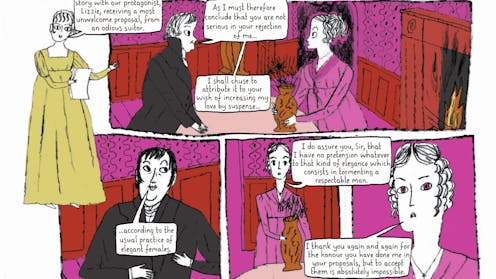
For the Novel Life, Greenberg has drawn a world in which Austen is whimsical, with expressive eyes looming under her signature bangs. She and her sister Cassandra appear in bright yellow or blue empire line dresses.
Most scenes are illustrated in a muted palette of yellow, blue and grey. This palette, Barchas reflects in the preface, represents “the relative quiet of her (Austen’s) life”.
When Jane is thinking or writing however, the pages transform into vivid shades of pink to symbolise her imagination and inspiration. In these pages, The Novel Life is at its best, showing graphic biography can be both captivating and deceptively sophisticated.
Archival nods
Is a graphic biography really a biography in the conventional understanding of the genre? It can upset the perceived rules. Anticipating this, in the preface, Barchas reminds us:
Any biography of Austen, and there are many, exists at the intersection of speculation and research.
This book is at this intersection. While the dialogue is largely invented, it is grounded in Barchas’ expertise and there is a glossary of sources at the end.
Throughout, there are also nods to the archive. Barchas begins with a scene of Jane in 1796 writing a letter to Cassandra at a desk while staying in London – one of the few not burnt.
A speech bubble quotes an extract from it:
Here I am once more in this scene of dissipation and vice, and I begin already to find my morals corrupted.
There are also Post-it style notes, separate to the bubbles, offering extra biographical context for readers less familiar with the intricacies of Austen’s story. A key scene happens when Jane, 22, receives her first rejection by a publisher for her manuscript “First Impressions” and is comforted by the loyal Cassandra. The note reads:
Jane would carry out more than a decade and a half of revisions before she dared to offer the manuscript to another publisher, who released it in 1813 as Pride and Prejudice.
Because of their visual casualness, importantly the notes don’t interfere with the intimate, engaging tone of the story.
‘Easter eggs’
For Austen’s committed “Janeite” fan base, Barchas promises “cheeky easter eggs” in the preface. Janeites can delight in well-quoted lines from the novels that appear as dialogue or a character’s thoughts.
Look, for instance, for Jane reading at a dinner party from P & P: “It’s a truth universally acknowledged […]” and “she is tolerable but not handsome enough to tempt me […]”.
It’s a truth universally acknowledged too that graphic biography can be confused with the graphic novel, now the third most popular literary genre in sales after general fiction and romance.
But, dear reader, there’s a tradition of life writing in the medium. The Pulitzer Prize winning graphic biography/memoir, The Complete Maus, told Art Spiegelman’s father’s story of the Holocaust to his son, (Art) who struggled to understand his father. Maus portrayed Jewish people anthropomorphically as mice and Nazis as cats. It was described by The New Yorker “as the first masterpiece of comic book history”.
Other high points in graphic biography include Peter Bagge’s Woman Rebel, the story of birth control campaigner Margaret Sanger, published in 2013.
Not everyone will appreciate a work diverging so dramatically from the expectations of a traditional biography. And those who will most appreciate or scrutinise The Novel Life are yes, the Janeites and Austenites.
Regardless, Austen comes to graphic life in the mind and hands of Barchas and Greenberg. More generally, for those of us who like our biographies in vivid colour – literally – and enjoy experiments in nonfiction storytelling, it’s a delightful reading experience, just like Jane Austen.
Kerrie Davies does not work for, consult, own shares in or receive funding from any company or organisation that would benefit from this article, and has disclosed no relevant affiliations beyond their academic appointment.
This year is the 250th anniversary of Jane Austen’s birth and she hasn’t aged a bit as the cultural touchstone of classy romance. Her Pride and Prejudice anti-hero, Mr Darcy, perennially pops up in his breeches in Instagram memes, while Regency feminist, Elizabeth Bennet has been brought to life by a host of contemporary actors.
Along with new screen versions of Austen’s Sense and Sensibility (starring Daisy Edgar-Jones) and a Netflix version of P & P, there have been adaptations of her classics Persuasion, Emma, Northanger Abbey, and Mansfield Park. And, there are numerous biographies and biopics including a TV drama about Jane’s sister, Cassandra, who burnt most of Jane’s letters.
Review: The Novel Life of Jane Austen: A Graphic Biography –
Janine Barchas, Isabel Greenberg (Hachette)
Now, there is also a graphic biography: The Novel Life of Jane Austen, written by Janine Barchas and illustrated by Isabel Greenberg.
Together, they have co-created a storyboard for the domestic life that framed Austen’s writing, encompassing her closeness to both Cassandra and her brother Frank, who joined the navy and liked to sew.
Unlike a “cradle to grave” biography, Barchas begins with a teenage Jane in London with Frank touring an exhibition about Shakespeare and his work. We then follow her, in illustrative comic boxes and speech bubbles, through her publishing rejections, her breakthrough debut Sense and Sensibility, and her rise to become one of most beloved writers in the canon of English literature.
The book ends beyond the grave, flashing forward to the present, in a scene where contemporary fans – Janeites – visit Jane Austen’s House, the cottage in Hampshire where Austen lived when she revised and published her six novels.
It’s also a sign of subtle structural polish. Now Jane Austen is as deserving of her own gallery as Shakespeare was when we first met Jane as a young, unpublished author.
Thinking in pink
Barchas – an “Austenite”, as Austen scholars are called – is the author of The Lost Books of Jane Austen, a study of the mass market editions of Austen’s work. (The Novel Life touches on Austen’s posthumous appeal with a scene where readers buy Austen books for one shilling at a railway station after her death, aged 41.)
Barchas is the co-creator of the interactive digital exhibition, What Jane Saw, which invites us to visit two art exhibitions witnessed by Jane Austen: the Sir Joshua Reynolds retrospective in 1813 or the Shakespeare Gallery as it looked in 1796. The Novel Life, however, is a more definitive life story. It’s also best read in print (although it is available as an e-book) to appreciate Greenberg’s illustrations and graphic format.
The Novel Life is a gentler, less dramatic style than traditional comics with six-pack superheroes or Japanese manga, similar to Greenberg’s previous literary graphic biography foray, Glass Town, about the Bronte sisters.
For the Novel Life, Greenberg has drawn a world in which Austen is whimsical, with expressive eyes looming under her signature bangs. She and her sister Cassandra appear in bright yellow or blue empire line dresses.
Most scenes are illustrated in a muted palette of yellow, blue and grey. This palette, Barchas reflects in the preface, represents “the relative quiet of her (Austen’s) life”.
When Jane is thinking or writing however, the pages transform into vivid shades of pink to symbolise her imagination and inspiration. In these pages, The Novel Life is at its best, showing graphic biography can be both captivating and deceptively sophisticated.
Archival nods
Is a graphic biography really a biography in the conventional understanding of the genre? It can upset the perceived rules. Anticipating this, in the preface, Barchas reminds us:
Any biography of Austen, and there are many, exists at the intersection of speculation and research.
This book is at this intersection. While the dialogue is largely invented, it is grounded in Barchas’ expertise and there is a glossary of sources at the end.
Throughout, there are also nods to the archive. Barchas begins with a scene of Jane in 1796 writing a letter to Cassandra at a desk while staying in London – one of the few not burnt.
A speech bubble quotes an extract from it:
Here I am once more in this scene of dissipation and vice, and I begin already to find my morals corrupted.
There are also Post-it style notes, separate to the bubbles, offering extra biographical context for readers less familiar with the intricacies of Austen’s story. A key scene happens when Jane, 22, receives her first rejection by a publisher for her manuscript “First Impressions” and is comforted by the loyal Cassandra. The note reads:
Jane would carry out more than a decade and a half of revisions before she dared to offer the manuscript to another publisher, who released it in 1813 as Pride and Prejudice.
Because of their visual casualness, importantly the notes don’t interfere with the intimate, engaging tone of the story.
‘Easter eggs’
For Austen’s committed “Janeite” fan base, Barchas promises “cheeky easter eggs” in the preface. Janeites can delight in well-quoted lines from the novels that appear as dialogue or a character’s thoughts.
Look, for instance, for Jane reading at a dinner party from P & P: “It’s a truth universally acknowledged […]” and “she is tolerable but not handsome enough to tempt me […]”.
It’s a truth universally acknowledged too that graphic biography can be confused with the graphic novel, now the third most popular literary genre in sales after general fiction and romance.
But, dear reader, there’s a tradition of life writing in the medium. The Pulitzer Prize winning graphic biography/memoir, The Complete Maus, told Art Spiegelman’s father’s story of the Holocaust to his son, (Art) who struggled to understand his father. Maus portrayed Jewish people anthropomorphically as mice and Nazis as cats. It was described by The New Yorker “as the first masterpiece of comic book history”.
Other high points in graphic biography include Peter Bagge’s Woman Rebel, the story of birth control campaigner Margaret Sanger, published in 2013.
Not everyone will appreciate a work diverging so dramatically from the expectations of a traditional biography. And those who will most appreciate or scrutinise The Novel Life are yes, the Janeites and Austenites.
Regardless, Austen comes to graphic life in the mind and hands of Barchas and Greenberg. More generally, for those of us who like our biographies in vivid colour – literally – and enjoy experiments in nonfiction storytelling, it’s a delightful reading experience, just like Jane Austen.
Kerrie Davies does not work for, consult, own shares in or receive funding from any company or organisation that would benefit from this article, and has disclosed no relevant affiliations beyond their academic appointment.
Source: The Conversation – Global Perspectives – By Mathieu Duval, Adjunct Senior Researcher at Griffith University and La Trobe University, and Ramón y Cajal (Senior) Research Fellow, Centro Nacional de Investigación sobre la Evolución Humana (CENIEH)
Fossils are invaluable archives of the past. They preserve details about living things from a few thousand to hundreds of millions of years ago.
Studying fossils can help us understand the evolution of species over time, and glimpse snapshots of past environments and climates. Fossils can also reveal the diets or migration patterns of long-gone species – including our own ancestors.
But when living things turn to rock, discerning those details is no easy feat. One common technique for studying fossils is micro-computerised tomography or micro-CT. It’s been used to find the earliest evidence of bone cancer in humans, to study brain imprints and inner ears in early hominins, and to study the teeth of the oldest human modern remains outside Africa, among many other examples.
However, our new study, published today in Radiocarbon, shows that despite being widely regarded as non-destructive, micro-CT may actually affect fossil preservation and erase some crucial information held inside.
Preserving precious specimens
Fossils are rare and fragile by nature. Scientists are constantly evaluating how to balance their impact on fossils with the need to study them.
When palaeontologists and palaeoanthropologists (who work on human fossils) analyse fossils, they want to minimise any potential damage. We want to preserve fossils for future generations as much as possible – and technology can be a huge help here.
Micro-CT works like the medical CT scans doctors use to peek inside the human body. However, it does so at a much smaller scale and at a greater resolution.
This is perfect for studying small objects such as fossils. With micro-CT, scientists can take high-resolution 3D images and access the inner structure of fossils without the need to cut them open.
These scans also allow for virtual copies of the fossils, which other scientists can then access from anywhere in the world. This significantly reduces the risk of damage, since the scanned fossils can safely remain in a museum collection, for example.
Micro-CT is popular and routinely used. The scientific community widely regards it as “non-destructive” because it doesn’t cause any visual damage – but it could still affect the fossil.
Jaw bone of the human fossil species Homo antecessor from Spain. Left: micro-CT scan with a cutting plane to visualise the inner structures, bone and teeth; right: 3D reconstruction based on the high-resolution micro-CT images. Laura Martín-Francés
How does micro-CT imaging work?
Micro-CT scanning uses X-rays and computer software to produce high-resolution images and reconstruct the fossil specimens in detail. Typically, palaeontologists use commercial scanners for this, but more advanced investigations may use powerful X-ray beams generated at a synchrotron.
The X-rays go through the specimen and are captured by a detector on the other end. This allows for a very fine-grained understanding of the matter they’ve passed through – especially density, which then provides clues about the shape of the internal structures, the composition of the tissues, or any contamination.
The scan produces a succession of 2D images from all angles. Computer software is then used to “clean up” these high-resolution images and assemble them into a 3D shape – a virtual copy of the fossil and its inner structures.
Example of micro-CT results on a hominin fossil known as Little Foot, from southern Africa.
But X-rays are not harmless
X-rays are a type of ionising radiation. This means they have a high level of energy and can break electrons away from atoms (this is called ionisation).
However, despite what we know about the impact of X-rays on living cells, the potential impact of X-rays on fossils through micro-CT imaging has never been deeply investigated.
What did our study find?
Using standard settings on a typical micro-CT scanner, we scanned several modern and fossil bones and teeth from animals. We also measured their collagen content before and after scanning.
Collagen is useful for many analytical purposes, such as finding out the age of the fossils using radiocarbon dating, or for stable isotope analysis – a method used to infer the diet of the extinct species, for example. The collagen content in fossils is usually much lower than in modern specimens because it slowly breaks down over time.
After comparing our measurements with unscanned samples taken from the same specimens, we found two things.
First, the radiocarbon age remained unchanged. In other words, micro-CT scanning doesn’t affect radiocarbon dating. That’s the good news.
The bad news is that we did observe a significant decrease in the amount of collagen present. In other words, the micro-CT scanned samples had about 35% less collagen than the samples before scanning.
This shows micro-CT imaging has a non-negligible impact on fossils that contain collagen traces. While this was to be expected, the impact hasn’t been experimentally confirmed before.
It’s possible some fossil samples won’t have enough collagen left after micro-CT scanning. This would make them unsuitable for a range of analytical techniques, including radiocarbon dating.
What now?
In a previous study, we showed micro-CT can artificially “age” fossils later dated with a method called electron spin resonance. It’s commonly used to date fossils older than 50,000 years – beyond what the radiocarbon method can discern.
This previous study and our new work show that micro-CT scanning may significantly and irreversibly change the fossil and the information it holds.
Despite causing no visible damage to the fossil, we argue that in this context the technique should no longer be regarded as non-destructive.
Micro-CT imaging is highly valuable in palaeontology and palaeoanthropology, no doubt about that. But our results suggest it should be used sparingly to minimise how much fossils are exposed to X-rays. There are guidelines scientists can use to minimise damage. Freely sharing data to avoid repeated scans of the same specimen will be helpful, too.
Mathieu Duval receives funding from the Spanish State Research Agency (Agencia Estatal de Investigación). He is currently the recipient of a Ramón y Cajal fellowship (RYC2018-025221-I) funded by MCIN/AEI/10.13039/501100011033 and by ‘‘ESF Investing in your future”. This work is also part of Spanish Grant PID2021-123092NB-C22 funded by MCIN/AEI/10.13039/501100011033/FEDER, UE, and by ‘‘ERDF A way of making Europe”.
Laura Martín-Francés receives funding from Marie Sklodowska-Curie Actions of the EU Ninth programme (2021-2027) under the HORIZON-MSCA-2021-PF-01-Project: 101060482.
I once leapt out of a train carriage because two strangers were loudly discussing the ending of the last Harry Potter book. Okay – I didn’t leap, but I did plug my ears and flee to another carriage.
Recently, I found myself in a similar predicament, trapped on a bus, entirely at the mercy of two passengers dissecting the Severance season two finale.
But not everyone shares my spoiler anxiety. I have friends who flip to the last page of a book before they’ve read the first one, or who look up the ending before hitting play. According to them, they simply need to know.
So why do some of us crave surprise and suspense, while others find comfort in instant resolution?
What’s in a spoiler?
Spoilers have become a cultural flashpoint in the age of streaming, social media and shared fandoms.
Researchers define “spoiler” as undesired information about how a narrative’s arc will conclude. I often hear “spoilers!” interjected mid-sentence, a desperate protest to protect narrative ignorance.
Hitchcock’s twist-heavy Psycho elevated spoiler sensitivity. Its release came with an anti-spoilers policy including strict viewing times, lobby warnings recorded by the auteur himself, and even real policemen urging “total enjoyment”. A bold ad campaign implored audiences against “cheating yourselves”.
The twists were fiercely protected.
Even the Star Wars cast didn’t know Darth Vader’s paternity twist until premiere night. Avenger’s Endgame filmed multiple endings and used fake scripting to mislead its stars. And Andrew Garfield flat-out lied about his return to Spider-Man: No Way Home – a performance worthy of an Oscar – all for the sake of fan surprise and enjoyment.
But do spoilers actually ruin the fun, or just shift how we experience it?
The satisfaction of a good ending
In 2014, a Dutch study found that viewers of unspoiled stories experienced greater emotional arousal and enjoyment. Spoilers may complete our “mental models” of the plot, making us less driven to engage, process events, or savour the unfolding story.
But we are also likely to overestimate the negative effect of a spoiler on our enjoyment. In 2016, a series of studies involving short stories, mystery fiction and films found that spoiled participants still reported high levels of enjoyment – because once we’re immersed, emotional connection tends to eclipse what we already know.
But suspense and enjoyment are complex bedfellows.
American media psychology trailblazer Dolf Zillmann said that suspense builds tension and excitement, but we only enjoy that tension once the ending lands well.
The thrill isn’t fun while we’re hanging in uncertainty – it’s the satisfying resolution that retroactively makes it feel good.
That could be why we scramble for an “ending explained” when a film or show drops the ball on closure. We’re trying to resolve uncertainty and settle our emotions.
Spoilers can also take the pressure off. A 2009 study of Lost fans found those who looked up how an episode would end actually enjoyed it more. The researchers found it reduced cognitive pressure, and gave them more room to reflect and soak in the story.
Spoilers put the audience back in the driver’s seat – even if filmmakers would rather keep hold of the wheel. People may seek spoilers out of curiosity or impatience, but sometimes it’s a quiet rebellion: a way to push back against the control creators hold over when and how things unfold.
That’s why spoilers are fertile ground for power dynamics. Ethicists even liken being spoiled to kind of moral trespass: how dare someone else make that decision for me?!
But whether you avoid spoilers or seek them out, the motive is often the same: a need to feel in control.
Shaping your emotions
Spoiler avoiders crave affect: they want emotional transportation.
When suspense is part of the pleasure, control means choosing when and how that knowledge lands. There’s a mental challenge to be had in riding the story as it unfolds, and a joy in seeing it click into place.
That’s why people get protective, and even chatter about long-aired shows can spark outrage. It’s an attempt to police the commentary and preserve the experience for those still waiting to be transported.
Spoiler seekers want control too, just a different kind. They’re not avoiding emotion, they’re just managing it. A spoiler affords control over our negative emotions, but also softens the blow, and inoculates us against anxiety.
Psychologists dub this a “non-cognitive desensitisation strategy” to manage surprise, a kind of “emotional spoiler shield” to protect our attachments to shows and characters, and remind us that TV, film and book narratives are not real when storylines hit close to home.
Knowing what happens turns into a subtle form of self-regulation.
So, what did I do when Severance spoilers floated by? Did I get off the bus? Nope, I stayed put and faced the beast. As I tried to make sense of the unfamiliar plot points (The macrodata means what? Mark stays where?), I found the unexpected chance to dive deeper.
Maybe surprise is not the sum of what makes something entertaining and worth engaging with. Spoiler alert! It’s good to have an end to journey towards, but it’s the journey that matters, in the end.
Anjum Naweed does not work for, consult, own shares in or receive funding from any company or organisation that would benefit from this article, and has disclosed no relevant affiliations beyond their academic appointment.
Source: The Conversation – Global Perspectives – By Rachel Fitzgerald, Associate Professor and Deputy Associate Dean (Academic), Faculty of Business, Economics and Law, The University of Queensland
Artificial intelligence is rapidly becoming an everyday part of lives. Many of us use it without even realising, whether it be writing emails, finding a new TV show or managing smart devices in our homes.
But apart from a handful of computing-focused and other STEM programs, most Australian university students do not receive formal tuition in how to use AI critically, ethically or responsibly.
Here’s why this is a problem and what we can do instead.
But this does not teach students how these tools work or what responsible use involves.
Using AI is not as simple as typing questions into a chat function. There are widely recognised ethical issues around its use including bias and misinformation. Understanding these is essential for students to use AI responsibly in their working lives.
So all students should graduate with a basic understanding of AI, its limitations, the role of human judgement and what responsible use looks like in their particular field.
We need students to be aware of bias in AI systems. This includes how their own biases could shape how they use the AI (the questions they ask and how they interpret its output), alongside an understanding of the broader ethical implications of AI use.
For example, does the data and the AI tool protect people’s privacy? Has the AI made a mistake? And if so, whose responsibility is that?
What about AI ethics?
The technical side of AI is covered in many STEM degrees. These degrees, along with philosophy and psychology disciplines, may also examine ethical questions around AI. But these issues are not a part of mainstream university education.
This is a concern. When future lawyers use predictive AI to draft contracts, or business graduates use AI for hiring or marketing, they will need skills in ethical reasoning.
Ethical issues in these scenarios could include unfair bias, like AI recommending candidates based on gender or race. It could include issues relating to a lack of transparency, such as not knowing how an AI system made a legal decision. Students need to be able to spot and question these risks before they cause harm.
In healthcare, AI tools are already supporting diagnosis, patient triage and treatment decisions.
For example, if a teacher relies on AI carelessly to draft a lesson plan, students might learn a version of history that is biased or just plain wrong. A lawyer who over-relies on AI could submit a flawed court document, putting their client’s case at risk.
How can we do this?
There are international examples we can follow. The University of Texas at Austin and University of Edinburgh both offer programs in ethics and AI. However, both of these are currently targeted at graduate students. The University of Texas program is focused on teaching STEM students about AI ethics, whereas the University of Edinburgh’s program has a broader, interdiscplinary focus.
Implementing AI ethics in Australian universities will require thoughtful curriculum reform. That means building interdisciplinary teaching teams that combine expertise from technology, law, ethics and the social sciences. It also means thinking seriously about how we engage students with this content through core modules, graduate capabilities or even mandatory training.
It will also require investment in academic staff development and new teaching resources that make these concepts accessible and relevant to different disciplines.
Government support is essential. Targeted grants, clear national policy direction, and nationally shared teaching resources could accelerate the shift. Policymakers could consider positioning universities as “ethical AI hubs”. This aligns with the government-commissioned 2024 Australian University Accord report, which called for building capacity to meet the demands of the digital era.
Today’s students are tomorrow’s decision-makers. If they don’t understand the risks of AI and its potential for error, bias or threats to privacy, we will all bear the consequences. Universities have a public responsibility to ensure graduates know how to use AI responsibly and understand why their choices matter.
The authors do not work for, consult, own shares in or receive funding from any company or organisation that would benefit from this article, and have disclosed no relevant affiliations beyond their academic appointment.
In the thrilling finale of the TV series The Americans, set during the Reagan administration, deep-cover KGB operatives Philip and Elizabeth Jennings are faced with a difficult decision. Posing as an ordinary American married couple, for decades they have raised children, filed tax returns and slipped effortlessly into the rhythms and routines of everyday suburban existence in Washington, D.C.
All the while, they’ve been spying – gathering intelligence and surreptitiously feeding it to their communist masters in Soviet Moscow. Now, with the FBI closing in and their cover on the brink of collapse, they must decide whether to stay and face arrest or flee the country they’ve come to call home. There’s also their teenage children to consider.
The story seemed too incredible to be true – but in fact it was based in part on Donald Heathfield and Ann Foley, subsequently outed as Andrei Bezrukov and Elena Vavilova, a Russian couple who had spent more than 20 years masquerading as Canadians. At the time of their unmasking, they were living quietly in the United States with Tim and Alex, their two sons.
Review: The Illegals: Russia’s Most Audacious Spies and the Plot to Infiltrate the West – Shaun Walker (Profile)
A new book, The Illegals, tells of a network of Russian agents operating across the US, during the late 20th and early 21st centuries – including Bezrukov and Vavilova. It opens with their dramatic 2010 arrest, part of ten Russian spies (mostly illegals like them) detained by the FBI.
Author Shaun Walker, the Guardian’s central and eastern Europe correspondent, draws on declassified archival material and first-hand interviews. The result is an engrossing, eye-opening account of the secret world of the Soviet “illegals programme”: embedded spies who lived surreptitiously in the West without the safety blanket of diplomatic protection.
As Walker explains, “legals” were Russian operatives working under official cover – as diplomats or embassy staff, privy to diplomatic immunity. By contrast, “illegals” operated off the grid. They crept silently into Western countries under false identities, often stolen from the dead. This made them harder to detect, but left them far more vulnerable if exposed.
One of the most high-profile figures in the 2010 spy bust was Anna Chapman. Unlike many other illegals, Chapman didn’t even bother to disguise her Russian identity. Instead, as Walker recounts, she entered America using a British passport – acquired through a brief marriage to a UK citizen – and worked as a New York real estate broker.
Her photogenic looks and media-friendly persona made her the public face of the scandal. After being deported, Chapman reinvented herself as a television host, runway model and pro-Kremlin influencer.
The real Americans
Walker outlines how Bezrukov and Vavilova first met in the early 1980s, as history students in Siberia. There, KGB “spotters” identified them for potential recruitment. Later, he adds,
they progressed to an arduous training programme lasting several years, moulding their language, mannerisms and identities into those of an ordinary couple. They left the Soviet Union separately in 1987, staged a meeting in Canada, and began a relationship as if they had just met.
Having married under their assumed names, Andrei and Elena adopted the habits and customs of an ordinary middle-class life. After the collapse of the Soviet Union in 1991, the couple were cut off from Moscow, but by the end of the decade they were reactivated by the SVR, Russia’s new foreign intelligence agency. Around this time, Andrei won a place at Harvard’s Kennedy School, allowing the family to move to Massachusetts and integrate further into American society.
As Andrei networked in academic and policy circles, Elena maintained the illusion of domestic normality, fashioning herself as a doting “soccer mom”, raising the kids and keeping house. Meanwhile, she was secretly decoding encrypted radio messages in the back room.
This went on for years. Then, one day, an unexpected knock on the door as they celebrated their son Tim’s 20th birthday brought the charade crashing down. FBI agents burst in, handcuffed the couple in front of their sons and marched them out into the street.
Soon after their arrest, Andrei and Elena were deported to Russia in a high-profile spy swap. They were awarded state honours by Vladimir Putin and briefly became minor celebrities in Moscow. Their sons, both born in Canada, were left reeling.
In 2016, Walker tracked the sons down for a piece he was writing for The Guardian: they were in the process of suing the Canadian government to have their citizenship reinstated, having been stripped of it when everything kicked off. In 2019, a court ruled Tim and Alex (who was 16 when the FBI arrested his parents) could keep their citizenship. Both insisted they had known nothing about their parents’ espionage work.
Alex Valivov, son of Russian ‘illegal’ spies disguised as Americans, talked to the media after he won a court bid to keep his Canadian citizenship.
Putin ‘beside himself’
As Walker recounts, the raid had been coordinated by then-FBI director Robert Mueller. It had been timed to avoid derailing a carefully planned diplomatic summit.
In 2009, Barack Obama launched a high-profile “reset” of relations with Russia. Obama wanted to woo Dmitry Medvedev – a moderate political figurehead standing in for Putin, who remained the real power behind the scenes in Russia.
A planned summit in Washington intended to cement the spirit of renewed cooperation. But as the scale of Russia’s covert operation became apparent, the White House was faced with a dilemma: how to respond without jeopardising the reset.
According to Walker, Obama was irked by the whole situation. He quipped that it felt like something out of a John Le Carré novel. Eventually, a compromise was reached: the arrests would happen, but only after Medvedev’s visit, so as not to cause undue embarrassment.
Colonel Aleksandr Poteyev, deputy head of Directorate “S” of the SVR, was the man overseeing the illegals scheme. After the arrests were made, he quietly walked out of the agency headquarters in Yasenevo for the last time. He was the mole who had tipped off the Americans. From there, he made his way to Ukraine, where the CIA could safely extricate him to the US. On hearing the news, Putin was reportedly beside himself with rage, Walker writes.
Intrigued by this “twisted family story”, Walker started to look into the illegals venture in greater depth. He quickly realised “there was nothing quite like it in the history of espionage”. At times, various intelligence agencies had deployed operatives as foreign nationals, “but never with the scope or scale of the KGB programme”.
A century of dramatic, bloody history
The illegals were, in Walker’s reckoning, something uniquely Russian, rooted in the country’s complex historical experience. The more he read, the more he came to view the programme as a lens through which he could “tell a much bigger story, of the whole Soviet experiment and its ultimate failure, a century of dramatic and bloody history”.
To understand how the illegals project came about, Walker winds the clock all the way back to 1917, when the Bolsheviks seized power – and espionage became a cornerstone of the nascent Soviet state. He reminds us while Lenin and his comrades had won formal control of the nation, “they still faced the colossal task of implementing and retaining it across the vast Russian landmass”.
Lenin was sure that state institutions would eventually wither away, the evolving worker’s paradise rendering them meaningless. However, to achieve this happy end point, he believed an interim period of ruthless state violence was required.
The Cheka: precursor to the KGB
This helps to explain why he established the Cheka, a secret police force tasked with crushing counterrevolutionary activity and enforcing Bolshevik rule. At its head was Feliks Dzerzhinsky, a fanatical Polish ideologue who had spent years in Siberian exile. Far from a temporary measure, the Cheka “quickly grew to a huge fighting force that could be unleashed on political and class enemies”, Walker writes.
Feliks Dzierzynski was the head of the Cheka, the Russian secret police force that preceded the KGB. Wikimedia Commons
The Cheka was an important player in the Russian Civil War, which pitted Lenin’s Reds against the Whites – a loose alliance of pro-tsarist regiments and foreign mercenaries, often united by little more than their implacable hatred of Bolshevism. The situation on the ground was chaotic and unpredictable; both sides engaged in ruthless violence.
Here, in this blood-drenched crucible, the Bolsheviks honed their clandestine methods – konspiratsiya (subterfuge) – perfecting the use of disguises, false identities and underground communication. In areas where the Whites gained a territorial foothold, agents were ordered to stay behind and coordinate resistance, laying the groundwork for what would become the illegals programme.
When the Bolsheviks emerged victorious in 1921, the Cheka was not disbanded – but repurposed. The practice of planting operatives deep inside enemy lines survived the war and expanded in scope. Lenin’s idea of combining legal diplomatic work with illegal undercover infiltration became a defining feature of how the Soviet Union would run its intelligence services for the next 70 years.
Stalin’s secret police
Under Lenin’s successor, Joseph Stalin, the secret police was transformed into an all-encompassing instrument of surveillance, repression and domination.
Purges consumed the party. Ideological fervour curdled into show trials and murderous terror. And paranoia became an organising principle of Soviet political life. The demand for vigilance intensified – not just at home, where informants and denunciations became routine, but also abroad. Real and purported enemies were seen lurking in the democratic institutions of the West.
Ironies abound here. The very methods that helped to sustain the early Soviet state – secrecy, trickery, duplicity – soon became grounds for suspicion on Stalin’s watch. The generation of illegals trained and embedded during the 1920s and early 1930s were among those earmarked for liquidation, Walker writes. Stalin, ever wary of plots against him, came to view his own spies as potential traitors.
He ignored – or wilfully dismissed – much of the intelligence they had risked their lives to gather, often with disastrous consequences. When advance warnings of Operation Barbarossa, Hitler’s secret plan to betray Stalin and launch a massive invasion of the Soviet Union, landed on his desk in 1941, for instance, they were waved away as provocation or outright fabrication. In some cases, he had his spies tortured or shot. Loyalty was no protector against paranoia.
Dmitry Bystrolyotov was a legend in Soviet intelligence circles. Alchetron
Among the casualties was Dmitry Bystrolyotov, who Walker describes as “perhaps the most talented illegal in the history of the programme”. A truly chameleonic figure, Bystrolyotov was a dashing and multilingual agent whose exploits in Western Europe made him a legend in Soviet intelligence circles. “His speciality was the recruitment of agents who had access to diplomatic codes and ciphers,” the Russian scholar Emil Draitser attests, “and his modus operandi involved women”.
Through a series of painstakingly crafted affairs, Bystrolyotov gained access to confidential dispatches, internal memos and state secrets. His work offered Stalin a rare glimpse into the inner workings of Europe’s ruling elite. But when The Great Terror rolled around in 1937, none of it mattered. He was arrested, sentenced and dispatched to the Gulag, callously tossed aside by the system he had served with such distinction.
Walker emphasises:
the history of the illegals offers a neat reflection of the story of Russia itself. The early programme, with its soaring ambition, its obsession with subterfuge, and its disregard for the well-being of individuals, holds up a mirror to the fiery utopianism of the early Soviet Union.
Did the Cold War really end?
These were people expected to vanish into enemy territory, sacrifice their identifies and live double lives, all in service of a revolutionary vision. But by the time the Soviet Union spluttered to an ignominious halt in 1991, that dream had long since died.
As Walker shows, most of the operatives who followed in the footsteps of Bystrolyotov were not darkly romantic infiltrators scaling embassy walls or charming secrets out of countesses. They were “sleepers” – often efficient, occasionally incompetent – blending quietly into Western cities and suburbs, awaiting a call to action that, in many cases, never came. The glitz had given way to the grind.
The Americans ends with Phillip and Elizabeth, the couple based on Bezrukov and Vavilova, gazing out across the Moscow skyline. Two weary spies coming in from the cold, they have returned to a rapidly unravelling motherland that may not understand – let alone appreciate – the sacrifices they have made in the service of its ideology.
As Walker discovered, Berzukov, when he isn’t being paid handsomely by an oil company, now lectures in international relations at one of Russia’s most prestigious universities. Vavilova, fittingly enough, now writes spy fiction.
Yet in real life, the story doesn’t end quite there. Under Putin, a former KGB officer who cut his teeth in the culture of espionage, Russia’s intelligence services have returned to the illegals programme with a renewed sense of purpose (though stripped of the ideological zeal that once propelled it).
Walker is careful not to indulge in idle speculation, but he points to compelling evidence suggesting the illegals programme has evolved rather than vanished. High-profile attacks on UK soil – including the poisoning of form spy Sergei Skripal – suggest Russian intelligence agencies remain willing to operate far beyond their national borders.
In the same breath, Walker describes what might be termed the digital turn of the illegals programme. In the place of suburban sleepers decoding radio signals, Russia has backed teams of online operatives – “troll illegals” – tasked with wrecking havoc across Western social media platforms.
These paid agents don’t gather intelligence so much as sow discord. They stoke culture wars, amplify political divisions and undermine trust in democratic institutions. Walker offers Russia’s meddling in the rancorous 2016 American election as an illustrative case in point.
In Putin’s merciless autocracy, secrecy has once again became a virtue – and the spy, far from being a dusty relic of the 20th century, is once again a symbol of national strength.
In that sense, The Illegals is not just a history of espionage. It is a timely reminder that, at least for some, the Cold War never really ended. It just burrowed deeper underground.
Alexander Howard does not work for, consult, own shares in or receive funding from any company or organisation that would benefit from this article, and has disclosed no relevant affiliations beyond their academic appointment.
The kettle is a household staple practically everywhere – how else would we make our hot drinks?
But is it okay to re-boil water that’s already in the kettle from last time? While bringing water to a boil disinfects it, you may have heard that boiling water more than once will somehow make the water harmful and therefore you should empty the kettle each time.
Such claims are often accompanied by the argument that re-boiled water leads to the accumulation of allegedly hazardous substances including metals such as arsenic, or salts such as nitrates and fluoride.
This isn’t true. To understand why, let’s look at what is in our tap water and what really happens when we boil it.
What’s in our tap water?
Let’s take the example of tap water supplied by Sydney Water, Australia’s largest water utility which supplies water to Sydney, the Blue Mountains and the Illawarra region.
From the publicly available data for the January to March 2025 quarter for the Illawarra region, these were the average water quality results:
pH was slightly alkaline
total dissolved solids were low enough to avoid causing scaling in pipes or appliances
fluoride content was appropriate to improve dental health, and
it was “soft” water with a total hardness value below 40mg of calcium carbonate per litre.
The water contained trace amounts of metals such as iron and lead, low enough magnesium levels that it can’t be tasted, and sodium levels substantially lower than those in popular soft drinks.
These and all other monitored quality parameters were well within the Australian Drinking Water Guidelines during that period. If you were to make tea with this water, re-boiling would not cause a health problem. Here’s why.
It’s difficult to concentrate such low levels of chemicals
To concentrate substances in the water, you’d need to evaporate some of the liquid while the chemicals stay behind. Water evaporates at any temperature, but the vast majority of evaporation happens at the boiling point – when water turns into steam.
During boiling, some volatile organic compounds might escape into the air, but the amount of the inorganic compounds (such as metals and salts) remains unchanged.
While the concentration of inorganic compounds might increase as drinking water evaporates when boiled, evidence shows it doesn’t happen to such an extent that it would be hazardous.
Let’s say you boil one litre of tap water in a kettle in the morning, and your tap water has a fluoride content of 1mg per litre, which is within the limits of Australian guidelines.
You make a cup of tea taking 200ml of the boiled water. You then make another cup of tea in the afternoon by re-boiling the remaining water.
On both occasions, if heating was stopped soon after boiling started, the loss of water by evaporation would be small, and the fluoride content in each cup of tea would be similar.
But let’s assume that when making the second cup, you let the water keep boiling until 100ml of what’s in the kettle evaporates. Even then, the amount of fluoride you would consume with the second cup (0.23mg) would not be significantly higher than the fluoride you consumed with the first cup of tea (0.20mg).
The same applies to any other minerals or organics the supplied water may have contained. Let’s take lead: the water supplied in the Illawarra region as mentioned above, had a lead concentration of less than 0.0001mg per litre. To reach an unsafe lead concentration (0.01mg per litre, according to Australian guidelines) in a cup of water, you’d need to boil down roughly 20 litres of tap water to just that cup of 200ml.
Practically that is unlikely to happen – most electric kettles are designed to boil briefly before automatically shutting off. As long as the water you’re using is within the guidelines for drinking water, you can’t really concentrate it to harmful levels within your kettle.
But what about taste?
Whether re-boiled water actually affects the taste of your drinks will depend entirely on the specifics of your local water supply and your personal preferences.
The slight change in mineral concentration, or the loss of dissolved oxygen from water during boiling may affect the taste for some people – although there are a lot of other factors that contribute to the taste of your tap water.
The bottom line is that as long as the water in your kettle was originally compliant with guidelines for safe drinking water, it will remain safe and potable even after repeated boiling.
Faisal Hai does not work for, consult, own shares in or receive funding from any company or organisation that would benefit from this article, and has disclosed no relevant affiliations beyond their academic appointment.
Source: The Conversation – Global Perspectives – By Mathieu Duval, Adjunct Senior Researcher at Griffith University and La Trobe University, and Ramón y Cajal (Senior) Research Fellow, Centro Nacional de Investigación sobre la Evolución Humana (CENIEH)
Fossils are invaluable archives of the past. They preserve details about living things from a few thousand to hundreds of millions of years ago.
Studying fossils can help us understand the evolution of species over time, and glimpse snapshots of past environments and climates. Fossils can also reveal the diets or migration patterns of long-gone species – including our own ancestors.
But when living things turn to rock, discerning those details is no easy feat. One common technique for studying fossils is micro-computerised tomography or micro-CT. It’s been used to find the earliest evidence of bone cancer in humans, to study brain imprints and inner ears in early hominins, and to study the teeth of the oldest human modern remains outside Africa, among many other examples.
However, our new study, published today in Radiocarbon, shows that despite being widely regarded as non-destructive, micro-CT may actually affect fossil preservation and erase some crucial information held inside.
Preserving precious specimens
Fossils are rare and fragile by nature. Scientists are constantly evaluating how to balance their impact on fossils with the need to study them.
When palaeontologists and palaeoanthropologists (who work on human fossils) analyse fossils, they want to minimise any potential damage. We want to preserve fossils for future generations as much as possible – and technology can be a huge help here.
Micro-CT works like the medical CT scans doctors use to peek inside the human body. However, it does so at a much smaller scale and at a greater resolution.
This is perfect for studying small objects such as fossils. With micro-CT, scientists can take high-resolution 3D images and access the inner structure of fossils without the need to cut them open.
These scans also allow for virtual copies of the fossils, which other scientists can then access from anywhere in the world. This significantly reduces the risk of damage, since the scanned fossils can safely remain in a museum collection, for example.
Micro-CT is popular and routinely used. The scientific community widely regards it as “non-destructive” because it doesn’t cause any visual damage – but it could still affect the fossil.
Jaw bone of the human fossil species Homo antecessor from Spain. Left: micro-CT scan with a cutting plane to visualise the inner structures, bone and teeth; right: 3D reconstruction based on the high-resolution micro-CT images. Laura Martín-Francés
How does micro-CT imaging work?
Micro-CT scanning uses X-rays and computer software to produce high-resolution images and reconstruct the fossil specimens in detail. Typically, palaeontologists use commercial scanners for this, but more advanced investigations may use powerful X-ray beams generated at a synchrotron.
The X-rays go through the specimen and are captured by a detector on the other end. This allows for a very fine-grained understanding of the matter they’ve passed through – especially density, which then provides clues about the shape of the internal structures, the composition of the tissues, or any contamination.
The scan produces a succession of 2D images from all angles. Computer software is then used to “clean up” these high-resolution images and assemble them into a 3D shape – a virtual copy of the fossil and its inner structures.
Example of micro-CT results on a hominin fossil known as Little Foot, from southern Africa.
But X-rays are not harmless
X-rays are a type of ionising radiation. This means they have a high level of energy and can break electrons away from atoms (this is called ionisation).
However, despite what we know about the impact of X-rays on living cells, the potential impact of X-rays on fossils through micro-CT imaging has never been deeply investigated.
What did our study find?
Using standard settings on a typical micro-CT scanner, we scanned several modern and fossil bones and teeth from animals. We also measured their collagen content before and after scanning.
Collagen is useful for many analytical purposes, such as finding out the age of the fossils using radiocarbon dating, or for stable isotope analysis – a method used to infer the diet of the extinct species, for example. The collagen content in fossils is usually much lower than in modern specimens because it slowly breaks down over time.
After comparing our measurements with unscanned samples taken from the same specimens, we found two things.
First, the radiocarbon age remained unchanged. In other words, micro-CT scanning doesn’t affect radiocarbon dating. That’s the good news.
The bad news is that we did observe a significant decrease in the amount of collagen present. In other words, the micro-CT scanned samples had about 35% less collagen than the samples before scanning.
This shows micro-CT imaging has a non-negligible impact on fossils that contain collagen traces. While this was to be expected, the impact hasn’t been experimentally confirmed before.
It’s possible some fossil samples won’t have enough collagen left after micro-CT scanning. This would make them unsuitable for a range of analytical techniques, including radiocarbon dating.
What now?
In a previous study, we showed micro-CT can artificially “age” fossils later dated with a method called electron spin resonance. It’s commonly used to date fossils older than 50,000 years – beyond what the radiocarbon method can discern.
This previous study and our new work show that micro-CT scanning may significantly and irreversibly change the fossil and the information it holds.
Despite causing no visible damage to the fossil, we argue that in this context the technique should no longer be regarded as non-destructive.
Micro-CT imaging is highly valuable in palaeontology and palaeoanthropology, no doubt about that. But our results suggest it should be used sparingly to minimise how much fossils are exposed to X-rays. There are guidelines scientists can use to minimise damage. Freely sharing data to avoid repeated scans of the same specimen will be helpful, too.
Mathieu Duval receives funding from the Spanish State Research Agency (Agencia Estatal de Investigación). He is currently the recipient of a Ramón y Cajal fellowship (RYC2018-025221-I) funded by MCIN/AEI/10.13039/501100011033 and by ‘‘ESF Investing in your future”. This work is also part of Spanish Grant PID2021-123092NB-C22 funded by MCIN/AEI/10.13039/501100011033/FEDER, UE, and by ‘‘ERDF A way of making Europe”.
Laura Martín-Francés receives funding from Marie Sklodowska-Curie Actions of the EU Ninth programme (2021-2027) under the HORIZON-MSCA-2021-PF-01-Project: 101060482.
Source: The Conversation – Global Perspectives – By Nicole Rinehart, Nicole Rinehart, Professor, Clinical Psychology, Director of the Neurodevelopment Program, School of Psychological Sciences, Faculty of Medicine, Nursing and Health Sciences, Monash University
Autism is a neurodevelopmental condition that affects how people’s brains develop and function, impacting behaviour, communication and socialising. It can also involve differences in the way you move and walk – known as your “gait”.
Having an “odd gait” is now listed in the Diagnostic and Statistical Manual of Mental Disorders as a supporting diagnostic feature of autism.
What does this look like?
The most noticeable gait differences among autistic people are:
toe-walking, walking on the balls of the feet
in-toeing, walking with one or both feet turned inwards
out-toeing, walking with one or both feet turned out.
spending longer in the “stance” phase, when the foot leaves the ground
taking more time to complete each step.
Autistic people show much more personal variability in the length and speed of their strides, as well as their walking speed.
Gait differences also tend to occur alongside other motor differences, such as issues with balance, coordination, postural stability and handwriting. Autistic people may need support for these other motor skills.
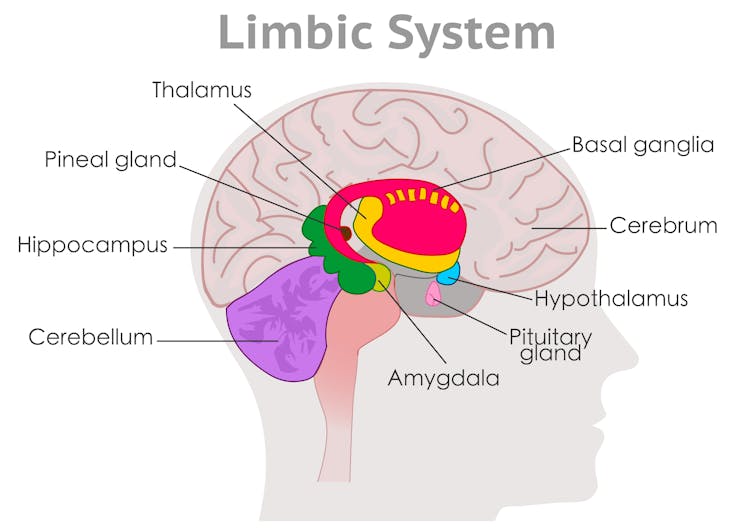
The basal ganglia are broadly responsible for sequencing movement including through shifting posture. It ensures your gait appears effortless, smooth and automatic.
The cerebellum then uses visual and proprioceptive information (to sense the body’s position and movement) to adjust and time movements to maintain postural stability. It ensures movement is controlled and coordinated.
Developmental differences in these brain regions relate to the way the areas look (their structure), how they work (their function and activation) and how they “speak” to other areas of the brain (their connections).
While some researchers have suggested that autistic gait occurs due to delayed development, we now know gait differences persist across the lifespan. Some differences actually become clearer with age.
In addition to brain-based differences, the autistic gait is also associated with factors such as the person’s broader motor, language and cognitive capabilities.
People with more complex support needs might have more pronounced gait or motor differences, together with language and cognitive difficulties.
Not all differences need to be treated. Instead, clinicians take an individualised and goals-based approach.
Some autistic people might have subtle gait differences that are observable during testing. But if these differences don’t impact a person’s ability to participate in everyday life, they don’t require support.
An autistic person is likely to benefit from support for gait differences if they have a functional impact on their daily life. This might include:
increased risk of, or frequent, falls
difficulty participating in the physical activities they enjoy
physical consequences such as tightness of the Achilles and calf muscles, or associated pain in other areas, such as the feet or back.
Some children may also benefit from support for motor skill development. However this doesn’t have to occur in a clinic.
Given children spend a large portion of their time at school, programs that integrate opportunities for movement throughout the school day allow autistic children to develop motor skills outside of the clinic and alongside peers. We developed the Joy of Moving Program in Australia, for example, which gets students moving in the classroom.
Our community-based intervention studiesshow autistic children’s movement abilities can improve after engaging in community-based interventions, such as sports or dance.
Community-based support models empower autistic children to have agency in how they move, rather than seeing different ways of moving as a problem to be fixed.
Where to from here?
While we have learnt a lot about autistic gait at a broad level, researchers and clinicians are still seeking a better understanding of why and when individual variability occurs.
We’re also still determining how to best support individual movement styles, including among children as they develop.
However there is growing evidence that physical activity enhances social skills and behavioural regulation in preschool children with autism.
So it’s encouraging that states and territories are moving towards more community-based foundational supports for autistic children and their peers, as governments develop supports outside the National Disability Insurance Scheme (NDIS).
Nicole Rinehart receives funding from: Moose Happy Kids Foundation, MECCA M-Power, the Grace & Emilio Foundation, Ferrero Australia, as part of the global Kinder Joy of moving program, Aspen Pharmacare Australia Pty Ltd, Jonathan and Simone Wenig, Adam Krongold, the Grosman Family Foundation, the Shoreline Foundation, the Victorian Department of Education, the NSW Department of Education, and the Department of Social Services – Information, Linkages and Capacity Building (ILC) Program, and has worked in partnership with the Australian Football League.
Chloe Emonson works on projects that receive funding from: Moose Happy Kids Foundation, MECCA M-Power, the Grace & Emilio Foundation, Ferrero Australia, as part of the global Kinder Joy of moving program, Aspen Pharmacare Australia Pty Ltd, Jonathan and Simone Wenig, Adam Krongold, the Grosman Family Foundation, the Shoreline Foundation, the Victorian Department of Education, the NSW Department of Education, and the Department of Social Services – Information, Linkages and Capacity Building (ILC) Program, and has worked in partnership with the Australian Football League.
Ebony Lindor works on projects that receive funding from: Moose Happy Kids Foundation, MECCA M-Power, the Grace & Emilio Foundation, Ferrero Australia, as part of the global Kinder Joy of moving program, Aspen Pharmacare Australia Pty Ltd, Jonathan and Simone Wenig, Adam Krongold, the Grosman Family Foundation, the Shoreline Foundation, the Victorian Department of Education, the NSW Department of Education, and the Department of Social Services – Information, Linkages and Capacity Building (ILC) Program, and has worked in partnership with the Australian Football League.
Breakups hurt. Emotional and psychological distress are common when intimate relationships break down. For some people, this distress can be so overwhelming that it leads to suicidal thoughts and behaviours.
This problem seems especially the case for men. Intimate partner problems including breakups, separation and divorce feature in the paths to suicide among one in three Australian men aged 25 to 44 who end their lives.
Men account for three in every four suicides in many nations worldwide, including Australia. So improving our understanding of links between relationship breakdown and men’s suicide risk has life-saving potential.
Our research, published today, is the first large-scale review of the evidence to focus on understanding men’s risk of suicide after a breakup. We found separated men were nearly five times more likely to die by suicide compared to married men.
What did we find?
We brought together findings from 75 studies across 30 countries worldwide, involving more than 106 million men.
We focused on understanding why relationship breakdown can lead to suicide in men, and which men are most at risk. We might not be able to prevent breakups from happening, but we can promote healthy adjustment to the stress of relationship breakdown to try and prevent suicide.
Overall, we found divorced men were 2.8 times more likely to take their lives than married men.
For separated men, the risk was much higher. We found that separated men were 4.8 times more likely to die by suicide than married men.
Most strikingly, we found separated men under 35 years of age had nearly nine times greater odds of suicide than married men of the same age.
Some men’s difficulties regulating the intense emotional stress of relationship breakdown can play a role in their suicide risk. For some men, the emotional pain tied to separation – deep sadness, shame, guilt, anxiety and loss – can be so intense it feels never-ending.
Overall, our research found relationship breakdown may lead to suicide for some men because of the complex interaction between the individual (emotional distress) and interpersonal (changes in their social network and availability of support) impacts of a breakup.
Many of these impacts don’t seem to feature in the paths to suicide after a breakup for women in the same way.
Breakups also impact social networks
As intimate relationships become more serious, we tend to spend less time investing in our friendships, especially if juggling the demands of a career and family.
This can create a risky situation if relationships break down, as it seems many men are left with little support to turn to. This rang true in our research, as men’s social disconnection and loneliness seemed to increase their suicide risk following relationship breakdown.
We also know people can struggle to know how to support men after a breakup. Research has found some men who ask for support are told to just “get back on the horse”. Such a response invalidates men’s pain and reinforces masculine stereotypes that relationship breakdown doesn’t affect them.
So, what can we do?
There is no simple answer to preventing suicide following relationship breakdown, but a range of opportunities exist.
We can embed support groups and other opportunities for connection and peer support in relationship services that are regularly in contact with those navigating separation, to help combat loneliness.
We can ensure mental health practitioners are equipped with the skills necessary to engage and respond effectively to men who seek help following a breakup, to help keep them safe until they can get back on their feet.
Most importantly, if men come to any of us seeking support after a breakup, we can remember that time is often a great healer. The best we can do is sit with men in their pain, rather than try and get them to stop feeling it. This connection could be life-saving.
Support and information is available at Relationships Australia and MensLine Australia. If this article has raised issues for you, or if you’re concerned about someone you know, call Lifeline on 13 11 14.
Michael Wilson works for The University of Melbourne and consults to Movember. He receives funding from the Australian Government Research Training Program Scholarship, provided by the Australian Commonwealth Government and the University of Melbourne.
Jacqui Macdonald receives funding from the National Health and Medical Research Council’s Medical Research Future Fund and the Australian Research Council. She convenes the Australian Fatherhood Research Consortium and she is on the Movember Global Men’s Health Advisory Committee.
Zac Seidler has been awarded an NHMRC Investigator Grant. He is also the Global Director of Research with the Movember Institute of Men’s Health. He advises government on men’s suicide, masculinities, violence prevention and social media policy.
Tourists in Kathmandu are tempted everywhere by advertisements for trekking expeditions to Everest Base Camp. If you didn’t know better, you might think it’s just a nice hike in the Nepalese countryside.
Typically the lower staging post for attempts on the summit, the camp is still 5,364 metres above sea level and a destination in its own right. Travel agencies say no prior experience is required, and all equipment will be provided. Social media, too, is filled with posts enticing potential trekkers to make the iconic journey.
But there is a real risk of creating a false sense of security. An exciting adventure can quickly turn into a struggle for survival, especially for novice mountaineers.
Nevertheless, Sagarmatha National Park is deservedly popular for its natural beauty and the allure of the world’s highest peak, Chomolungma (Mount Everest). It is also home to the ethnically distinctive Sherpa community.
Consequently, the routes to Everest Base Camp are among the busiest in the Himalayas, with nearly 60,000 tourists visiting the area each year. There are two distinct trekking seasons: spring (March to May) and autumn (September to October).
High mountains require everyone to be properly prepared. Events which under normal conditions might be a minor inconvenience can be magnified in such an environment and pose a serious risk.
Even at the start of the trek in Lukla (2,860m), one is exposed to factors that can directly or indirectly affect one’s health, especially altitude mountain sickness or unfamiliar bacteria.
We interviewed 24 trekkers in May this year, as well as 60 residents and business owners in May 2023, to explore some of the safety issues anyone considering heading to base camp should be aware of.
Life at high altitude
First, it’s vital to choose goals within one’s technical and physical capabilities. While the human body can adapt to altitudes of up to 5,300m, the potential risk of altitude mountain sickness can occur at only 2,500m – lower than Lukla.
Proper acclimatisation above 3,000m means ascending no more than 500m a day and resting every two to three days at the same altitude. The optimal (though rarely followed) approach is the “saw tooth system” of climbing during the day but descending to sleep at a lower level.
Residents of the Khumbu region (on the Nepalese side of Everest) are familiar with the problem of tourists not acclimatising, or not paying attention to their surroundings. As one hotel owner said, pointing to a trekker setting out:
He’s going uphill and it’s already late. It’s going to get dark and cold soon. He won’t make it to the next settlement. We have to report this to the authorities or go after him ourselves.
Inexperienced trekkers should hire a local guide. Several we interviewed had needed medical evacuation, including a woman in her mid-20s who had to leave base camp after one night. She found her guides – not locals – online. But they never checked her vital signs during the trek:
[The doctors] said that I had high-altitude pulmonary edema […] it was just really important to come down the elevation. And if I had tried to go higher, it probably would have been really bad.
Health checks throughout the trek are imperative. This includes assessing the four main symptoms of altitude mountain sickness: headache, nausea, dizziness and fatigue. If they appear, the trekker shouldn’t go higher and might even need to descend.
A Sherpa woman at the market in Namche Bazar, Nepal: respect the culture, eat local food. Paula Bronstein/Getty Images
Take time to adapt
Using a reputable local trekking agency might be more expensive, but it will help ensure safety and also familiarise the visitor with the local culture, helping avoid negative impacts on the host community.
Too often, the primary goal of trekkers is a photo on the famous rock at base camp. Once obtained, many simply take a helicopter back to Kathmandu. As a helicopter tour agency owner said:
They don’t want to get back on their feet. The goal, after all, has been achieved. In general, tourists used to be much better prepared. Now they know they can return by helicopter.
Helicopter travel can be dangerous on its own, of course. But this tendency to view the trek as a one-way trip also affects host-guest relations and can irritate local communities.
It’s also important to monitor your food and drink intake and watch for signs of food poisoning. Diarrhoea at high altitudes is particularly dangerous because it leads to rapid dehydration – hard to combat in mountain conditions.
Low air pressure and reduced oxygen exacerbate the condition, weakening the body’s ability to recover. Also, the symptoms of dehydration can resemble altitude mountain sickness.
When travelling in other climate zones or countries with different sanitary standards, there is inevitable contact with strains of bacteria not present in one’s natural microbiome.
A good solution is to spend a few days naturally adapting to bacterial flora at a lower altitude in Nepal before heading to the mountains. Also, try to eat the local food, such as daal bhat, Nepal’s national dish. According to one hotel owner in Pangboche:
Tourists demand strange food from us – pizza, spaghetti, Caesar salad – and then are angry that it doesn’t taste the way they want. This is not our food. You should probably eat local food.
Most of the trekkers we interviewed during this spring season reported experiencing gastrointestinal issues, often for several days.
In the end, the commonest cause of failure or accident in the mountains is overestimating one’s abilities – what has been called “bad judgement syndrome” – when the route is too hard, the pace too fast, or there’s been too little time spent acclimatising.
A simple solution: walk slowly and enjoy the views.
Michal Apollo receives funding from the National Science Centre NCN Poland, the small-scale project awarded by the Institute of Earth Sciences, and the Research Excellence Initiative of the University of Silesia in Katowice. He is affiliated with the Global Justice Program, Yale University, and Academics Stand Against Poverty.
Heike Schanzel does not work for, consult, own shares in or receive funding from any company or organisation that would benefit from this article, and has disclosed no relevant affiliations beyond their academic appointment.
Source: The Conversation – Global Perspectives – By Nicole Rinehart, Nicole Rinehart, Professor, Clinical Psychology, Director of the Neurodevelopment Program, School of Psychological Sciences, Faculty of Medicine, Nursing and Health Sciences, Monash University
Autism is a neurodevelopmental condition that affects how people’s brains develop and function, impacting behaviour, communication and socialising. It can also involve differences in the way you move and walk – known as your “gait”.
Having an “odd gait” is now listed in the Diagnostic and Statistical Manual of Mental Disorders as a supporting diagnostic feature of autism.
What does this look like?
The most noticeable gait differences among autistic people are:
toe-walking, walking on the balls of the feet
in-toeing, walking with one or both feet turned inwards
out-toeing, walking with one or both feet turned out.
spending longer in the “stance” phase, when the foot leaves the ground
taking more time to complete each step.
Autistic people show much more personal variability in the length and speed of their strides, as well as their walking speed.
Gait differences also tend to occur alongside other motor differences, such as issues with balance, coordination, postural stability and handwriting. Autistic people may need support for these other motor skills.
The basal ganglia are broadly responsible for sequencing movement including through shifting posture. It ensures your gait appears effortless, smooth and automatic.
The cerebellum then uses visual and proprioceptive information (to sense the body’s position and movement) to adjust and time movements to maintain postural stability. It ensures movement is controlled and coordinated.
Developmental differences in these brain regions relate to the way the areas look (their structure), how they work (their function and activation) and how they “speak” to other areas of the brain (their connections).
While some researchers have suggested that autistic gait occurs due to delayed development, we now know gait differences persist across the lifespan. Some differences actually become clearer with age.
In addition to brain-based differences, the autistic gait is also associated with factors such as the person’s broader motor, language and cognitive capabilities.
People with more complex support needs might have more pronounced gait or motor differences, together with language and cognitive difficulties.
Not all differences need to be treated. Instead, clinicians take an individualised and goals-based approach.
Some autistic people might have subtle gait differences that are observable during testing. But if these differences don’t impact a person’s ability to participate in everyday life, they don’t require support.
An autistic person is likely to benefit from support for gait differences if they have a functional impact on their daily life. This might include:
increased risk of, or frequent, falls
difficulty participating in the physical activities they enjoy
physical consequences such as tightness of the Achilles and calf muscles, or associated pain in other areas, such as the feet or back.
Some children may also benefit from support for motor skill development. However this doesn’t have to occur in a clinic.
Given children spend a large portion of their time at school, programs that integrate opportunities for movement throughout the school day allow autistic children to develop motor skills outside of the clinic and alongside peers. We developed the Joy of Moving Program in Australia, for example, which gets students moving in the classroom.
Our community-based intervention studiesshow autistic children’s movement abilities can improve after engaging in community-based interventions, such as sports or dance.
Community-based support models empower autistic children to have agency in how they move, rather than seeing different ways of moving as a problem to be fixed.
Where to from here?
While we have learnt a lot about autistic gait at a broad level, researchers and clinicians are still seeking a better understanding of why and when individual variability occurs.
We’re also still determining how to best support individual movement styles, including among children as they develop.
However there is growing evidence that physical activity enhances social skills and behavioural regulation in preschool children with autism.
So it’s encouraging that states and territories are moving towards more community-based foundational supports for autistic children and their peers, as governments develop supports outside the National Disability Insurance Scheme (NDIS).
Nicole Rinehart receives funding from: Moose Happy Kids Foundation, MECCA M-Power, the Grace & Emilio Foundation, Ferrero Australia, as part of the global Kinder Joy of moving program, Aspen Pharmacare Australia Pty Ltd, Jonathan and Simone Wenig, Adam Krongold, the Grosman Family Foundation, the Shoreline Foundation, the Victorian Department of Education, the NSW Department of Education, and the Department of Social Services – Information, Linkages and Capacity Building (ILC) Program, and has worked in partnership with the Australian Football League.
Chloe Emonson works on projects that receive funding from: Moose Happy Kids Foundation, MECCA M-Power, the Grace & Emilio Foundation, Ferrero Australia, as part of the global Kinder Joy of moving program, Aspen Pharmacare Australia Pty Ltd, Jonathan and Simone Wenig, Adam Krongold, the Grosman Family Foundation, the Shoreline Foundation, the Victorian Department of Education, the NSW Department of Education, and the Department of Social Services – Information, Linkages and Capacity Building (ILC) Program, and has worked in partnership with the Australian Football League.
Ebony Lindor works on projects that receive funding from: Moose Happy Kids Foundation, MECCA M-Power, the Grace & Emilio Foundation, Ferrero Australia, as part of the global Kinder Joy of moving program, Aspen Pharmacare Australia Pty Ltd, Jonathan and Simone Wenig, Adam Krongold, the Grosman Family Foundation, the Shoreline Foundation, the Victorian Department of Education, the NSW Department of Education, and the Department of Social Services – Information, Linkages and Capacity Building (ILC) Program, and has worked in partnership with the Australian Football League.
Breakups hurt. Emotional and psychological distress are common when intimate relationships break down. For some people, this distress can be so overwhelming that it leads to suicidal thoughts and behaviours.
This problem seems especially the case for men. Intimate partner problems including breakups, separation and divorce feature in the paths to suicide among one in three Australian men aged 25 to 44 who end their lives.
Men account for three in every four suicides in many nations worldwide, including Australia. So improving our understanding of links between relationship breakdown and men’s suicide risk has life-saving potential.
Our research, published today, is the first large-scale review of the evidence to focus on understanding men’s risk of suicide after a breakup. We found separated men were nearly five times more likely to die by suicide compared to married men.
What did we find?
We brought together findings from 75 studies across 30 countries worldwide, involving more than 106 million men.
We focused on understanding why relationship breakdown can lead to suicide in men, and which men are most at risk. We might not be able to prevent breakups from happening, but we can promote healthy adjustment to the stress of relationship breakdown to try and prevent suicide.
Overall, we found divorced men were 2.8 times more likely to take their lives than married men.
For separated men, the risk was much higher. We found that separated men were 4.8 times more likely to die by suicide than married men.
Most strikingly, we found separated men under 35 years of age had nearly nine times greater odds of suicide than married men of the same age.
Some men’s difficulties regulating the intense emotional stress of relationship breakdown can play a role in their suicide risk. For some men, the emotional pain tied to separation – deep sadness, shame, guilt, anxiety and loss – can be so intense it feels never-ending.
Overall, our research found relationship breakdown may lead to suicide for some men because of the complex interaction between the individual (emotional distress) and interpersonal (changes in their social network and availability of support) impacts of a breakup.
Many of these impacts don’t seem to feature in the paths to suicide after a breakup for women in the same way.
Breakups also impact social networks
As intimate relationships become more serious, we tend to spend less time investing in our friendships, especially if juggling the demands of a career and family.
This can create a risky situation if relationships break down, as it seems many men are left with little support to turn to. This rang true in our research, as men’s social disconnection and loneliness seemed to increase their suicide risk following relationship breakdown.
We also know people can struggle to know how to support men after a breakup. Research has found some men who ask for support are told to just “get back on the horse”. Such a response invalidates men’s pain and reinforces masculine stereotypes that relationship breakdown doesn’t affect them.
So, what can we do?
There is no simple answer to preventing suicide following relationship breakdown, but a range of opportunities exist.
We can embed support groups and other opportunities for connection and peer support in relationship services that are regularly in contact with those navigating separation, to help combat loneliness.
We can ensure mental health practitioners are equipped with the skills necessary to engage and respond effectively to men who seek help following a breakup, to help keep them safe until they can get back on their feet.
Most importantly, if men come to any of us seeking support after a breakup, we can remember that time is often a great healer. The best we can do is sit with men in their pain, rather than try and get them to stop feeling it. This connection could be life-saving.
Support and information is available at Relationships Australia and MensLine Australia. If this article has raised issues for you, or if you’re concerned about someone you know, call Lifeline on 13 11 14.
Michael Wilson works for The University of Melbourne and consults to Movember. He receives funding from the Australian Government Research Training Program Scholarship, provided by the Australian Commonwealth Government and the University of Melbourne.
Jacqui Macdonald receives funding from the National Health and Medical Research Council’s Medical Research Future Fund and the Australian Research Council. She convenes the Australian Fatherhood Research Consortium and she is on the Movember Global Men’s Health Advisory Committee.
Zac Seidler has been awarded an NHMRC Investigator Grant. He is also the Global Director of Research with the Movember Institute of Men’s Health. He advises government on men’s suicide, masculinities, violence prevention and social media policy.
Tourists in Kathmandu are tempted everywhere by advertisements for trekking expeditions to Everest Base Camp. If you didn’t know better, you might think it’s just a nice hike in the Nepalese countryside.
Typically the lower staging post for attempts on the summit, the camp is still 5,364 metres above sea level and a destination in its own right. Travel agencies say no prior experience is required, and all equipment will be provided. Social media, too, is filled with posts enticing potential trekkers to make the iconic journey.
But there is a real risk of creating a false sense of security. An exciting adventure can quickly turn into a struggle for survival, especially for novice mountaineers.
Nevertheless, Sagarmatha National Park is deservedly popular for its natural beauty and the allure of the world’s highest peak, Chomolungma (Mount Everest). It is also home to the ethnically distinctive Sherpa community.
Consequently, the routes to Everest Base Camp are among the busiest in the Himalayas, with nearly 60,000 tourists visiting the area each year. There are two distinct trekking seasons: spring (March to May) and autumn (September to October).
High mountains require everyone to be properly prepared. Events which under normal conditions might be a minor inconvenience can be magnified in such an environment and pose a serious risk.
Even at the start of the trek in Lukla (2,860m), one is exposed to factors that can directly or indirectly affect one’s health, especially altitude mountain sickness or unfamiliar bacteria.
We interviewed 24 trekkers in May this year, as well as 60 residents and business owners in May 2023, to explore some of the safety issues anyone considering heading to base camp should be aware of.
Life at high altitude
First, it’s vital to choose goals within one’s technical and physical capabilities. While the human body can adapt to altitudes of up to 5,300m, the potential risk of altitude mountain sickness can occur at only 2,500m – lower than Lukla.
Proper acclimatisation above 3,000m means ascending no more than 500m a day and resting every two to three days at the same altitude. The optimal (though rarely followed) approach is the “saw tooth system” of climbing during the day but descending to sleep at a lower level.
Residents of the Khumbu region (on the Nepalese side of Everest) are familiar with the problem of tourists not acclimatising, or not paying attention to their surroundings. As one hotel owner said, pointing to a trekker setting out:
He’s going uphill and it’s already late. It’s going to get dark and cold soon. He won’t make it to the next settlement. We have to report this to the authorities or go after him ourselves.
Inexperienced trekkers should hire a local guide. Several we interviewed had needed medical evacuation, including a woman in her mid-20s who had to leave base camp after one night. She found her guides – not locals – online. But they never checked her vital signs during the trek:
[The doctors] said that I had high-altitude pulmonary edema […] it was just really important to come down the elevation. And if I had tried to go higher, it probably would have been really bad.
Health checks throughout the trek are imperative. This includes assessing the four main symptoms of altitude mountain sickness: headache, nausea, dizziness and fatigue. If they appear, the trekker shouldn’t go higher and might even need to descend.
A Sherpa woman at the market in Namche Bazar, Nepal: respect the culture, eat local food. Paula Bronstein/Getty Images
Take time to adapt
Using a reputable local trekking agency might be more expensive, but it will help ensure safety and also familiarise the visitor with the local culture, helping avoid negative impacts on the host community.
Too often, the primary goal of trekkers is a photo on the famous rock at base camp. Once obtained, many simply take a helicopter back to Kathmandu. As a helicopter tour agency owner said:
They don’t want to get back on their feet. The goal, after all, has been achieved. In general, tourists used to be much better prepared. Now they know they can return by helicopter.
Helicopter travel can be dangerous on its own, of course. But this tendency to view the trek as a one-way trip also affects host-guest relations and can irritate local communities.
It’s also important to monitor your food and drink intake and watch for signs of food poisoning. Diarrhoea at high altitudes is particularly dangerous because it leads to rapid dehydration – hard to combat in mountain conditions.
Low air pressure and reduced oxygen exacerbate the condition, weakening the body’s ability to recover. Also, the symptoms of dehydration can resemble altitude mountain sickness.
When travelling in other climate zones or countries with different sanitary standards, there is inevitable contact with strains of bacteria not present in one’s natural microbiome.
A good solution is to spend a few days naturally adapting to bacterial flora at a lower altitude in Nepal before heading to the mountains. Also, try to eat the local food, such as daal bhat, Nepal’s national dish. According to one hotel owner in Pangboche:
Tourists demand strange food from us – pizza, spaghetti, Caesar salad – and then are angry that it doesn’t taste the way they want. This is not our food. You should probably eat local food.
Most of the trekkers we interviewed during this spring season reported experiencing gastrointestinal issues, often for several days.
In the end, the commonest cause of failure or accident in the mountains is overestimating one’s abilities – what has been called “bad judgement syndrome” – when the route is too hard, the pace too fast, or there’s been too little time spent acclimatising.
A simple solution: walk slowly and enjoy the views.
Michal Apollo receives funding from the National Science Centre NCN Poland, the small-scale project awarded by the Institute of Earth Sciences, and the Research Excellence Initiative of the University of Silesia in Katowice. He is affiliated with the Global Justice Program, Yale University, and Academics Stand Against Poverty.
Heike Schanzel does not work for, consult, own shares in or receive funding from any company or organisation that would benefit from this article, and has disclosed no relevant affiliations beyond their academic appointment.
I once leapt out of a train carriage because two strangers were loudly discussing the ending of the last Harry Potter book. Okay – I didn’t leap, but I did plug my ears and flee to another carriage.
Recently, I found myself in a similar predicament, trapped on a bus, entirely at the mercy of two passengers dissecting the Severance season two finale.
But not everyone shares my spoiler anxiety. I have friends who flip to the last page of a book before they’ve read the first one, or who look up the ending before hitting play. According to them, they simply need to know.
So why do some of us crave surprise and suspense, while others find comfort in instant resolution?
What’s in a spoiler?
Spoilers have become a cultural flashpoint in the age of streaming, social media and shared fandoms.
Researchers define “spoiler” as undesired information about how a narrative’s arc will conclude. I often hear “spoilers!” interjected mid-sentence, a desperate protest to protect narrative ignorance.
Hitchcock’s twist-heavy Psycho elevated spoiler sensitivity. Its release came with an anti-spoilers policy including strict viewing times, lobby warnings recorded by the auteur himself, and even real policemen urging “total enjoyment”. A bold ad campaign implored audiences against “cheating yourselves”.
The twists were fiercely protected.
Even the Star Wars cast didn’t know Darth Vader’s paternity twist until premiere night. Avenger’s Endgame filmed multiple endings and used fake scripting to mislead its stars. And Andrew Garfield flat-out lied about his return to Spider-Man: No Way Home – a performance worthy of an Oscar – all for the sake of fan surprise and enjoyment.
But do spoilers actually ruin the fun, or just shift how we experience it?
The satisfaction of a good ending
In 2014, a Dutch study found that viewers of unspoiled stories experienced greater emotional arousal and enjoyment. Spoilers may complete our “mental models” of the plot, making us less driven to engage, process events, or savour the unfolding story.
But we are also likely to overestimate the negative effect of a spoiler on our enjoyment. In 2016, a series of studies involving short stories, mystery fiction and films found that spoiled participants still reported high levels of enjoyment – because once we’re immersed, emotional connection tends to eclipse what we already know.
But suspense and enjoyment are complex bedfellows.
American media psychology trailblazer Dolf Zillmann said that suspense builds tension and excitement, but we only enjoy that tension once the ending lands well.
The thrill isn’t fun while we’re hanging in uncertainty – it’s the satisfying resolution that retroactively makes it feel good.
That could be why we scramble for an “ending explained” when a film or show drops the ball on closure. We’re trying to resolve uncertainty and settle our emotions.
Spoilers can also take the pressure off. A 2009 study of Lost fans found those who looked up how an episode would end actually enjoyed it more. The researchers found it reduced cognitive pressure, and gave them more room to reflect and soak in the story.
Spoilers put the audience back in the driver’s seat – even if filmmakers would rather keep hold of the wheel. People may seek spoilers out of curiosity or impatience, but sometimes it’s a quiet rebellion: a way to push back against the control creators hold over when and how things unfold.
That’s why spoilers are fertile ground for power dynamics. Ethicists even liken being spoiled to kind of moral trespass: how dare someone else make that decision for me?!
But whether you avoid spoilers or seek them out, the motive is often the same: a need to feel in control.
Shaping your emotions
Spoiler avoiders crave affect: they want emotional transportation.
When suspense is part of the pleasure, control means choosing when and how that knowledge lands. There’s a mental challenge to be had in riding the story as it unfolds, and a joy in seeing it click into place.
That’s why people get protective, and even chatter about long-aired shows can spark outrage. It’s an attempt to police the commentary and preserve the experience for those still waiting to be transported.
Spoiler seekers want control too, just a different kind. They’re not avoiding emotion, they’re just managing it. A spoiler affords control over our negative emotions, but also softens the blow, and inoculates us against anxiety.
Psychologists dub this a “non-cognitive desensitisation strategy” to manage surprise, a kind of “emotional spoiler shield” to protect our attachments to shows and characters, and remind us that TV, film and book narratives are not real when storylines hit close to home.
Knowing what happens turns into a subtle form of self-regulation.
So, what did I do when Severance spoilers floated by? Did I get off the bus? Nope, I stayed put and faced the beast. As I tried to make sense of the unfamiliar plot points (The macrodata means what? Mark stays where?), I found the unexpected chance to dive deeper.
Maybe surprise is not the sum of what makes something entertaining and worth engaging with. Spoiler alert! It’s good to have an end to journey towards, but it’s the journey that matters, in the end.
Anjum Naweed does not work for, consult, own shares in or receive funding from any company or organisation that would benefit from this article, and has disclosed no relevant affiliations beyond their academic appointment.
Source: The Conversation – Global Perspectives – By Rachel Fitzgerald, Associate Professor and Deputy Associate Dean (Academic), Faculty of Business, Economics and Law, The University of Queensland
Artificial intelligence is rapidly becoming an everyday part of lives. Many of us use it without even realising, whether it be writing emails, finding a new TV show or managing smart devices in our homes.
But apart from a handful of computing-focused and other STEM programs, most Australian university students do not receive formal tuition in how to use AI critically, ethically or responsibly.
Here’s why this is a problem and what we can do instead.
But this does not teach students how these tools work or what responsible use involves.
Using AI is not as simple as typing questions into a chat function. There are widely recognised ethical issues around its use including bias and misinformation. Understanding these is essential for students to use AI responsibly in their working lives.
So all students should graduate with a basic understanding of AI, its limitations, the role of human judgement and what responsible use looks like in their particular field.
We need students to be aware of bias in AI systems. This includes how their own biases could shape how they use the AI (the questions they ask and how they interpret its output), alongside an understanding of the broader ethical implications of AI use.
For example, does the data and the AI tool protect people’s privacy? Has the AI made a mistake? And if so, whose responsibility is that?
What about AI ethics?
The technical side of AI is covered in many STEM degrees. These degrees, along with philosophy and psychology disciplines, may also examine ethical questions around AI. But these issues are not a part of mainstream university education.
This is a concern. When future lawyers use predictive AI to draft contracts, or business graduates use AI for hiring or marketing, they will need skills in ethical reasoning.
Ethical issues in these scenarios could include unfair bias, like AI recommending candidates based on gender or race. It could include issues relating to a lack of transparency, such as not knowing how an AI system made a legal decision. Students need to be able to spot and question these risks before they cause harm.
In healthcare, AI tools are already supporting diagnosis, patient triage and treatment decisions.
For example, if a teacher relies on AI carelessly to draft a lesson plan, students might learn a version of history that is biased or just plain wrong. A lawyer who over-relies on AI could submit a flawed court document, putting their client’s case at risk.
How can we do this?
There are international examples we can follow. The University of Texas at Austin and University of Edinburgh both offer programs in ethics and AI. However, both of these are currently targeted at graduate students. The University of Texas program is focused on teaching STEM students about AI ethics, whereas the University of Edinburgh’s program has a broader, interdiscplinary focus.
Implementing AI ethics in Australian universities will require thoughtful curriculum reform. That means building interdisciplinary teaching teams that combine expertise from technology, law, ethics and the social sciences. It also means thinking seriously about how we engage students with this content through core modules, graduate capabilities or even mandatory training.
It will also require investment in academic staff development and new teaching resources that make these concepts accessible and relevant to different disciplines.
Government support is essential. Targeted grants, clear national policy direction, and nationally shared teaching resources could accelerate the shift. Policymakers could consider positioning universities as “ethical AI hubs”. This aligns with the government-commissioned 2024 Australian University Accord report, which called for building capacity to meet the demands of the digital era.
Today’s students are tomorrow’s decision-makers. If they don’t understand the risks of AI and its potential for error, bias or threats to privacy, we will all bear the consequences. Universities have a public responsibility to ensure graduates know how to use AI responsibly and understand why their choices matter.
The authors do not work for, consult, own shares in or receive funding from any company or organisation that would benefit from this article, and have disclosed no relevant affiliations beyond their academic appointment.
In the thrilling finale of the TV series The Americans, set during the Reagan administration, deep-cover KGB operatives Philip and Elizabeth Jennings are faced with a difficult decision. Posing as an ordinary American married couple, for decades they have raised children, filed tax returns and slipped effortlessly into the rhythms and routines of everyday suburban existence in Washington, D.C.
All the while, they’ve been spying – gathering intelligence and surreptitiously feeding it to their communist masters in Soviet Moscow. Now, with the FBI closing in and their cover on the brink of collapse, they must decide whether to stay and face arrest or flee the country they’ve come to call home. There’s also their teenage children to consider.
The story seemed too incredible to be true – but in fact it was based in part on Donald Heathfield and Ann Foley, subsequently outed as Andrei Bezrukov and Elena Vavilova, a Russian couple who had spent more than 20 years masquerading as Canadians. At the time of their unmasking, they were living quietly in the United States with Tim and Alex, their two sons.
Review: The Illegals: Russia’s Most Audacious Spies and the Plot to Infiltrate the West – Shaun Walker (Profile)
A new book, The Illegals, tells of a network of Russian agents operating across the US, during the late 20th and early 21st centuries – including Bezrukov and Vavilova. It opens with their dramatic 2010 arrest, part of ten Russian spies (mostly illegals like them) detained by the FBI.
Author Shaun Walker, the Guardian’s central and eastern Europe correspondent, draws on declassified archival material and first-hand interviews. The result is an engrossing, eye-opening account of the secret world of the Soviet “illegals programme”: embedded spies who lived surreptitiously in the West without the safety blanket of diplomatic protection.
As Walker explains, “legals” were Russian operatives working under official cover – as diplomats or embassy staff, privy to diplomatic immunity. By contrast, “illegals” operated off the grid. They crept silently into Western countries under false identities, often stolen from the dead. This made them harder to detect, but left them far more vulnerable if exposed.
One of the most high-profile figures in the 2010 spy bust was Anna Chapman. Unlike many other illegals, Chapman didn’t even bother to disguise her Russian identity. Instead, as Walker recounts, she entered America using a British passport – acquired through a brief marriage to a UK citizen – and worked as a New York real estate broker.
Her photogenic looks and media-friendly persona made her the public face of the scandal. After being deported, Chapman reinvented herself as a television host, runway model and pro-Kremlin influencer.
The real Americans
Walker outlines how Bezrukov and Vavilova first met in the early 1980s, as history students in Siberia. There, KGB “spotters” identified them for potential recruitment. Later, he adds,
they progressed to an arduous training programme lasting several years, moulding their language, mannerisms and identities into those of an ordinary couple. They left the Soviet Union separately in 1987, staged a meeting in Canada, and began a relationship as if they had just met.
Having married under their assumed names, Andrei and Elena adopted the habits and customs of an ordinary middle-class life. After the collapse of the Soviet Union in 1991, the couple were cut off from Moscow, but by the end of the decade they were reactivated by the SVR, Russia’s new foreign intelligence agency. Around this time, Andrei won a place at Harvard’s Kennedy School, allowing the family to move to Massachusetts and integrate further into American society.
As Andrei networked in academic and policy circles, Elena maintained the illusion of domestic normality, fashioning herself as a doting “soccer mom”, raising the kids and keeping house. Meanwhile, she was secretly decoding encrypted radio messages in the back room.
This went on for years. Then, one day, an unexpected knock on the door as they celebrated their son Tim’s 20th birthday brought the charade crashing down. FBI agents burst in, handcuffed the couple in front of their sons and marched them out into the street.
Soon after their arrest, Andrei and Elena were deported to Russia in a high-profile spy swap. They were awarded state honours by Vladimir Putin and briefly became minor celebrities in Moscow. Their sons, both born in Canada, were left reeling.
In 2016, Walker tracked the sons down for a piece he was writing for The Guardian: they were in the process of suing the Canadian government to have their citizenship reinstated, having been stripped of it when everything kicked off. In 2019, a court ruled Tim and Alex (who was 16 when the FBI arrested his parents) could keep their citizenship. Both insisted they had known nothing about their parents’ espionage work.
Alex Valivov, son of Russian ‘illegal’ spies disguised as Americans, talked to the media after he won a court bid to keep his Canadian citizenship.
Putin ‘beside himself’
As Walker recounts, the raid had been coordinated by then-FBI director Robert Mueller. It had been timed to avoid derailing a carefully planned diplomatic summit.
In 2009, Barack Obama launched a high-profile “reset” of relations with Russia. Obama wanted to woo Dmitry Medvedev – a moderate political figurehead standing in for Putin, who remained the real power behind the scenes in Russia.
A planned summit in Washington intended to cement the spirit of renewed cooperation. But as the scale of Russia’s covert operation became apparent, the White House was faced with a dilemma: how to respond without jeopardising the reset.
According to Walker, Obama was irked by the whole situation. He quipped that it felt like something out of a John Le Carré novel. Eventually, a compromise was reached: the arrests would happen, but only after Medvedev’s visit, so as not to cause undue embarrassment.
Colonel Aleksandr Poteyev, deputy head of Directorate “S” of the SVR, was the man overseeing the illegals scheme. After the arrests were made, he quietly walked out of the agency headquarters in Yasenevo for the last time. He was the mole who had tipped off the Americans. From there, he made his way to Ukraine, where the CIA could safely extricate him to the US. On hearing the news, Putin was reportedly beside himself with rage, Walker writes.
Intrigued by this “twisted family story”, Walker started to look into the illegals venture in greater depth. He quickly realised “there was nothing quite like it in the history of espionage”. At times, various intelligence agencies had deployed operatives as foreign nationals, “but never with the scope or scale of the KGB programme”.
A century of dramatic, bloody history
The illegals were, in Walker’s reckoning, something uniquely Russian, rooted in the country’s complex historical experience. The more he read, the more he came to view the programme as a lens through which he could “tell a much bigger story, of the whole Soviet experiment and its ultimate failure, a century of dramatic and bloody history”.
To understand how the illegals project came about, Walker winds the clock all the way back to 1917, when the Bolsheviks seized power – and espionage became a cornerstone of the nascent Soviet state. He reminds us while Lenin and his comrades had won formal control of the nation, “they still faced the colossal task of implementing and retaining it across the vast Russian landmass”.
Lenin was sure that state institutions would eventually wither away, the evolving worker’s paradise rendering them meaningless. However, to achieve this happy end point, he believed an interim period of ruthless state violence was required.
The Cheka: precursor to the KGB
This helps to explain why he established the Cheka, a secret police force tasked with crushing counterrevolutionary activity and enforcing Bolshevik rule. At its head was Feliks Dzerzhinsky, a fanatical Polish ideologue who had spent years in Siberian exile. Far from a temporary measure, the Cheka “quickly grew to a huge fighting force that could be unleashed on political and class enemies”, Walker writes.
Feliks Dzierzynski was the head of the Cheka, the Russian secret police force that preceded the KGB. Wikimedia Commons
The Cheka was an important player in the Russian Civil War, which pitted Lenin’s Reds against the Whites – a loose alliance of pro-tsarist regiments and foreign mercenaries, often united by little more than their implacable hatred of Bolshevism. The situation on the ground was chaotic and unpredictable; both sides engaged in ruthless violence.
Here, in this blood-drenched crucible, the Bolsheviks honed their clandestine methods – konspiratsiya (subterfuge) – perfecting the use of disguises, false identities and underground communication. In areas where the Whites gained a territorial foothold, agents were ordered to stay behind and coordinate resistance, laying the groundwork for what would become the illegals programme.
When the Bolsheviks emerged victorious in 1921, the Cheka was not disbanded – but repurposed. The practice of planting operatives deep inside enemy lines survived the war and expanded in scope. Lenin’s idea of combining legal diplomatic work with illegal undercover infiltration became a defining feature of how the Soviet Union would run its intelligence services for the next 70 years.
Stalin’s secret police
Under Lenin’s successor, Joseph Stalin, the secret police was transformed into an all-encompassing instrument of surveillance, repression and domination.
Purges consumed the party. Ideological fervour curdled into show trials and murderous terror. And paranoia became an organising principle of Soviet political life. The demand for vigilance intensified – not just at home, where informants and denunciations became routine, but also abroad. Real and purported enemies were seen lurking in the democratic institutions of the West.
Ironies abound here. The very methods that helped to sustain the early Soviet state – secrecy, trickery, duplicity – soon became grounds for suspicion on Stalin’s watch. The generation of illegals trained and embedded during the 1920s and early 1930s were among those earmarked for liquidation, Walker writes. Stalin, ever wary of plots against him, came to view his own spies as potential traitors.
He ignored – or wilfully dismissed – much of the intelligence they had risked their lives to gather, often with disastrous consequences. When advance warnings of Operation Barbarossa, Hitler’s secret plan to betray Stalin and launch a massive invasion of the Soviet Union, landed on his desk in 1941, for instance, they were waved away as provocation or outright fabrication. In some cases, he had his spies tortured or shot. Loyalty was no protector against paranoia.
Dmitry Bystrolyotov was a legend in Soviet intelligence circles. Alchetron
Among the casualties was Dmitry Bystrolyotov, who Walker describes as “perhaps the most talented illegal in the history of the programme”. A truly chameleonic figure, Bystrolyotov was a dashing and multilingual agent whose exploits in Western Europe made him a legend in Soviet intelligence circles. “His speciality was the recruitment of agents who had access to diplomatic codes and ciphers,” the Russian scholar Emil Draitser attests, “and his modus operandi involved women”.
Through a series of painstakingly crafted affairs, Bystrolyotov gained access to confidential dispatches, internal memos and state secrets. His work offered Stalin a rare glimpse into the inner workings of Europe’s ruling elite. But when The Great Terror rolled around in 1937, none of it mattered. He was arrested, sentenced and dispatched to the Gulag, callously tossed aside by the system he had served with such distinction.
Walker emphasises:
the history of the illegals offers a neat reflection of the story of Russia itself. The early programme, with its soaring ambition, its obsession with subterfuge, and its disregard for the well-being of individuals, holds up a mirror to the fiery utopianism of the early Soviet Union.
Did the Cold War really end?
These were people expected to vanish into enemy territory, sacrifice their identifies and live double lives, all in service of a revolutionary vision. But by the time the Soviet Union spluttered to an ignominious halt in 1991, that dream had long since died.
As Walker shows, most of the operatives who followed in the footsteps of Bystrolyotov were not darkly romantic infiltrators scaling embassy walls or charming secrets out of countesses. They were “sleepers” – often efficient, occasionally incompetent – blending quietly into Western cities and suburbs, awaiting a call to action that, in many cases, never came. The glitz had given way to the grind.
The Americans ends with Phillip and Elizabeth, the couple based on Bezrukov and Vavilova, gazing out across the Moscow skyline. Two weary spies coming in from the cold, they have returned to a rapidly unravelling motherland that may not understand – let alone appreciate – the sacrifices they have made in the service of its ideology.
As Walker discovered, Berzukov, when he isn’t being paid handsomely by an oil company, now lectures in international relations at one of Russia’s most prestigious universities. Vavilova, fittingly enough, now writes spy fiction.
Yet in real life, the story doesn’t end quite there. Under Putin, a former KGB officer who cut his teeth in the culture of espionage, Russia’s intelligence services have returned to the illegals programme with a renewed sense of purpose (though stripped of the ideological zeal that once propelled it).
Walker is careful not to indulge in idle speculation, but he points to compelling evidence suggesting the illegals programme has evolved rather than vanished. High-profile attacks on UK soil – including the poisoning of form spy Sergei Skripal – suggest Russian intelligence agencies remain willing to operate far beyond their national borders.
In the same breath, Walker describes what might be termed the digital turn of the illegals programme. In the place of suburban sleepers decoding radio signals, Russia has backed teams of online operatives – “troll illegals” – tasked with wrecking havoc across Western social media platforms.
These paid agents don’t gather intelligence so much as sow discord. They stoke culture wars, amplify political divisions and undermine trust in democratic institutions. Walker offers Russia’s meddling in the rancorous 2016 American election as an illustrative case in point.
In Putin’s merciless autocracy, secrecy has once again became a virtue – and the spy, far from being a dusty relic of the 20th century, is once again a symbol of national strength.
In that sense, The Illegals is not just a history of espionage. It is a timely reminder that, at least for some, the Cold War never really ended. It just burrowed deeper underground.
Alexander Howard does not work for, consult, own shares in or receive funding from any company or organisation that would benefit from this article, and has disclosed no relevant affiliations beyond their academic appointment.
The kettle is a household staple practically everywhere – how else would we make our hot drinks?
But is it okay to re-boil water that’s already in the kettle from last time? While bringing water to a boil disinfects it, you may have heard that boiling water more than once will somehow make the water harmful and therefore you should empty the kettle each time.
Such claims are often accompanied by the argument that re-boiled water leads to the accumulation of allegedly hazardous substances including metals such as arsenic, or salts such as nitrates and fluoride.
This isn’t true. To understand why, let’s look at what is in our tap water and what really happens when we boil it.
What’s in our tap water?
Let’s take the example of tap water supplied by Sydney Water, Australia’s largest water utility which supplies water to Sydney, the Blue Mountains and the Illawarra region.
From the publicly available data for the January to March 2025 quarter for the Illawarra region, these were the average water quality results:
pH was slightly alkaline
total dissolved solids were low enough to avoid causing scaling in pipes or appliances
fluoride content was appropriate to improve dental health, and
it was “soft” water with a total hardness value below 40mg of calcium carbonate per litre.
The water contained trace amounts of metals such as iron and lead, low enough magnesium levels that it can’t be tasted, and sodium levels substantially lower than those in popular soft drinks.
These and all other monitored quality parameters were well within the Australian Drinking Water Guidelines during that period. If you were to make tea with this water, re-boiling would not cause a health problem. Here’s why.
It’s difficult to concentrate such low levels of chemicals
To concentrate substances in the water, you’d need to evaporate some of the liquid while the chemicals stay behind. Water evaporates at any temperature, but the vast majority of evaporation happens at the boiling point – when water turns into steam.
During boiling, some volatile organic compounds might escape into the air, but the amount of the inorganic compounds (such as metals and salts) remains unchanged.
While the concentration of inorganic compounds might increase as drinking water evaporates when boiled, evidence shows it doesn’t happen to such an extent that it would be hazardous.
Let’s say you boil one litre of tap water in a kettle in the morning, and your tap water has a fluoride content of 1mg per litre, which is within the limits of Australian guidelines.
You make a cup of tea taking 200ml of the boiled water. You then make another cup of tea in the afternoon by re-boiling the remaining water.
On both occasions, if heating was stopped soon after boiling started, the loss of water by evaporation would be small, and the fluoride content in each cup of tea would be similar.
But let’s assume that when making the second cup, you let the water keep boiling until 100ml of what’s in the kettle evaporates. Even then, the amount of fluoride you would consume with the second cup (0.23mg) would not be significantly higher than the fluoride you consumed with the first cup of tea (0.20mg).
The same applies to any other minerals or organics the supplied water may have contained. Let’s take lead: the water supplied in the Illawarra region as mentioned above, had a lead concentration of less than 0.0001mg per litre. To reach an unsafe lead concentration (0.01mg per litre, according to Australian guidelines) in a cup of water, you’d need to boil down roughly 20 litres of tap water to just that cup of 200ml.
Practically that is unlikely to happen – most electric kettles are designed to boil briefly before automatically shutting off. As long as the water you’re using is within the guidelines for drinking water, you can’t really concentrate it to harmful levels within your kettle.
But what about taste?
Whether re-boiled water actually affects the taste of your drinks will depend entirely on the specifics of your local water supply and your personal preferences.
The slight change in mineral concentration, or the loss of dissolved oxygen from water during boiling may affect the taste for some people – although there are a lot of other factors that contribute to the taste of your tap water.
The bottom line is that as long as the water in your kettle was originally compliant with guidelines for safe drinking water, it will remain safe and potable even after repeated boiling.
Faisal Hai does not work for, consult, own shares in or receive funding from any company or organisation that would benefit from this article, and has disclosed no relevant affiliations beyond their academic appointment.
The U.S. Senate narrowly approved on July 16, 2025, a bill that would claw back federal funding for the Corporation for Public Broadcasting, which distributes money to NPR, PBS and their affiliate stations. The US$9 billion rescission package will withdraw $1.1 billion Congress had previously approved for the CPB to receive in the 2026 and 2027 fiscal years. In addition, it makes deep foreign aid cuts. All Democrats present voted against the measure, joined by two Republicans: Sens. Susan Collins of Maine and Lisa Murkowski of Alaska. As long as the House, which approved a previous version, votes in favor of the Senate’s version of the bill by midnight July 18, Trump will be able to meet a budgetary deadline by signing the measure into law in time for it to take effect.
What will happen to NPR, PBS and local stations?
NPR and PBS provide programming to local public television and radio stations across the country. The impact on them will be direct and indirect.
Both NPR and PBS receive money from the Corporation for Public Broadcasting, an independent nonprofit corporation Congress created in 1967 to receive and distribute federal money to public broadcasters. More than 70% of the money it distributes flows directly to local stations. Some stations get up to half of their budgets from the CPB.
But NPR and PBS get much of their funding from foundation grants, viewers’ and listeners’ donations, and corporate underwriting. And local public radio and TV stations also get support from an array of sources besides CPB.
“There’s nothing more American than PBS,” said the network’s CEO, Paula Kerger, at a congressional hearing on March 26, 2025.
The nearly 1,500 public media stations in the U.S. rely on a mix of NPR, PBS and third-party producer programming, such as American Public Media and PRX, for the programs they offer. Local stations also produce and air regional news and provide emergency broadcasts for the government.
In rural areas with few broadcast stations and spotty cellphone coverage, public broadcast stations are vital sources of information about important community news and updates during emergencies. Federal support is essential for the programming and day-to-day operations of many local stations and allows for the maintenance of equipment and personnel to operate these vital community resources.
We believe that stations in communities that most need them, especially in rural locations, would be hit especially hard because they rely heavily on CPB funding.
Why is public media necessary when there’s news on the internet?
As journalism revenue has plummeted, public broadcasting has remained a vital source for news in communities across the nation. This is especially true in rural communities, where economic and political pressures have threatened the survival of local journalism.
In addition, with much online news coverage placed behind paywalls, public radio and television plays an important role in making quality journalism available to the American public.
Want crucial information about water systems in your drought-prone community? Public radio station KVMR in Nevada City, Calif., has a program for you. KVMR screenshot
Why did Congress approve these funds 2 years ahead?
Dozens of Native American stations are at risk of closing once the CPB is defunded. Native Public Media, a network of 57 radio stations and four TV stations, is a key source of news and information for tribal communities across the nation and relies on CPB support.
U.S. Sen. Mike Rounds, a South Dakota Republican, publicly stated that he secured an agreement with the White House to move $9.4 million in Interior Department funding to two dozen Native American stations. But there is no provision related to this promise within the legislation.
Allison Perlman is the co-chair of the Scholars Advisory Committee of the American Archive of Public Broadcasting.
Josh Shepperd and Allison Perlman are under contract to co-author an update of the history of public broadcasting for Current, public media’s trade journal, and the Corporation for Public Broadcasting. Josh and Allison are not paid employees or vendors of either institution.
One of Israel’s ultra-Orthodox Jewish parties, Shas, has announced it will resign from prime minister Benjamin Netanyahu’s government. The party said its decision was made due to the government’s failure to pass a bill exempting ultra-Orthodox students from military service.
Its exit increases the political pressure on Netanyahu. Days earlier, six members of another ultra-Orthodox coalition partner, the United Torah Judaism party, also quit the government citing the same concerns. The moves leave Netanyahu with a minority in parliament, which will make it difficult for his government to function.
Opposition leader Yair Lapid says the government now “has no authority”, and has called for a new round of elections. But even before these developments, Netanyahu was reportedly considering calling an early election in a bid to remain in power despite his unpopularity.
To win another term he would, in my view, have to spin a narrative of victory on three fronts: securing the release of the hostages, defeating Hamas and delivering regional security. It is a tall order.
In his visit to Washington in early July, Netanyahu emphasised his pursuit of a ceasefire in Gaza that facilitates the return of the remaining hostages held by Hamas.
Israelis have grown increasingly weary of the war, with recent surveys showing popular support for ending it if this brings back those still held captive. A ceasefire that sees hostages released would probably help Netanyahu generate support during an election campaign.
But Netanyahu has insisted that, while he wants to reach a hostage-ceasefire deal, he will not agree to one “at any price”. This indicates not only Israel’s refusal to compromise on security but also that any deal Netanyahu does make – whether or not it sees the release of all the hostages – will be presented as a victory to Israeli voters.
To provide the electorate with further hope of an end to the fighting, Netanyahu will also have to claim that the military campaign in Gaza is nearing its goals. Senior military officials stated recently that they have “almost fully achieved” their objectives – namely, defeating Hamas.
Get your news from actual experts, straight to your inbox.Sign up to our daily newsletter to receive all The Conversation UK’s latest coverage of news and research, from politics and business to the arts and sciences.
Netanyahu has, so far, prolonged the war to remain in power. But he will now need to spin the military campaign as a victory if he wants to win votes. This will be especially hard as critics like Yitzhak Brik, a retired Israeli general, claim that the number of Hamas fighters is now back to its pre-war level.
The hard-right members of Netanyahu’s government add another dimension to this equation. His two ultranationalist coalition partners, Jewish Power and Religious Zionism, oppose ending the war entirely. They insist on fighting Hamas to the finish.
Netanyahu will most likely want to keep his options open during an election campaign to then form a coalition with whatever he can pull together at the time. He may calculate that a short-term pause in fighting to free hostages can be spun as a victory to win votes, after which military operations could resume to appease hardliners if he needs them.
A final part of Netanyahu’s electoral strategy will be to push the message that he has delivered regional security. He has declared the war with Iran in June a success, saying “we sent Iran’s nuclear program down the drain”.
And Israel has also continued its campaign of strikes to assert its military dominance in the region, the latest in Syria and Lebanon.
Slim peace prospects
Observers warn that Netanyahu’s approach is about political survival, and will come at the expense of long-term peace prospects for Israelis and Palestinians. According to New York Times, he seems to be “kicking the Palestinian issue once again down the road”.
Indeed, part of Netanyahu’s mooted strategy for claiming victory in Gaza involves supporting a constrained political outcome for the Palestinians that ends the fighting without Israel conceding on core issues.
In this scenario, the Gaza Strip would be carved up and demilitarised under prolonged Israeli security oversight. Some areas would be annexed by Israel. Remaining parts of Gaza, along with fragments of the West Bank, would be handed over to an interim authority to create the appearance of a nascent Palestinian state.
The goal would be to declare that Israel has facilitated Palestinian statehood – but strictly on Israel’s terms – while eliminating Hamas’s rule in Gaza. The reality would probably be a designed chaos to force as many Palestinians as possible to leave.
Such a state, lacking full sovereignty and territorial continuity, would fall far short of the independent state that Palestinians seek. Crucially, this imposed outcome would also bypass substantive negotiation of issues like borders, refugees and Jerusalem, which both Israel and Palestine claim as their capital.
Palestinian leaders would almost certainly reject a curtailed state. And if they did not then ordinary Palestinians – reeling from the war’s devastation – are unlikely to view it as a just peace. A new cycle of violence would probably begin and the Palestinian population will have been heavily concentrated into restricted spaces that would be wide open to Israeli bombardment.
As Netanyahu weighs pulling the election trigger, he is effectively writing the next chapter of the Israel-Palestine conflict. The outcome of this manoeuvring is highly uncertain.
If his three-pronged victory narrative convinces Israeli voters, he could return to power with a fresh mandate and perhaps a retooled coalition. He might seek a broader unity government after an election, sidelining his most hardline partners in favour of centrist voices to navigate post-war diplomacy.
But if the public deems his victories hollow or indeed false, an election could sweep him out of office. This would open the door for opposition leaders who may take a different approach to Gaza and the Palestinians.
Brian Brivati is executive director of the Britain Palestine Project. He is writing this article in a personal capacity.
They persist because they’re made of plastic, a durable material that won’t easily degrade. Plastic can last for decades to hundreds of years. Therefore, governments and manufacturers are eagerly encouraging the use of non-plastics as more “sustainable” alternatives, with the UK banning plastic in wet wipes in 2024.
These textiles can be made from plant or animal fibres such as cotton and wool, or they may be chemically and physically modified, such as rayon or viscose. They are often labelled “biodegradable” on product packaging, suggesting they are environmentally friendly, break down quickly, and are a safe alternative to plastics. But is this really the case?
Get your news from actual experts, straight to your inbox.Sign up to our daily newsletter to receive all The Conversation UK’s latest coverage of news and research, from politics and business to the arts and sciences.
My research focuses on investigating the environmental impact of these non-plastic textiles and their persistence in waterways. My colleagues and I have found that some non-plastic microfibres can be just as problematic or even more harmful than plastic.
While non-plastic textiles are not as long-lived as plastics, with many composting within weeks to months, they can last long enough to accumulate and cause damage to plants, animals and humans. Studies by scientists at the University of Stirling show that biodegradable wet wipes can last up to 15 weeks on beaches, where they can act as a reservoir for faecal bacteria and E.coli. Other studies have highlighted non-plastic textiles lasting for two months or more in rivers and oceans, where they break up into hundreds of thousands of microfibres.
These microfibres are so prevalent in waterways that they have contaminated animals across the food chain, from filter-feeding mussels and oysters to top predators such as sharks and the seafood we eat.
They are also found in remote locations as far away as the Arctic seafloor and deep sea, thousands of miles from civilisation. These discoveries highlight that non-plastics last longer than we think.
The dangers of non-plastics
Once exposed to aquatic life, non-plastic microfibres can be easily ingested or inhaled, where they can become trapped in the body and cause damage. During their manufacture, textile fibres can be modified with various chemical additives to improve their function, such as flame retardants, antibacterials, softeners, UV protection and dyes.
Researchers like me, have only just begun to explore the dangers of non-plastics. Some have shown that non-plastic microfibres and their additives can damage the digestive system, cause stress, hinder development and alter immune responses in animals such as shrimp, mussels, and oysters. However, other studies have shown little to no effect of non-plastic microfibres on animals exposed to them.
We do not yet know how much of a threat these materials are to the environment. Only the manufacturers know exactly what’s in the textiles we use. This makes it hard to understand what threats we are really facing. Nevertheless, assumptions that non-plastics are environmentally friendly and an easy alternative to plastic materials must be challenged and reconsidered.
To do this, we need to push for greater transparency in the contents of our everyday items and test them to make sure that they are truly sustainable and won’t harm the world around us. So next time you are browsing the supermarket aisles and come across a pack of “biodegradable” or “environmentally friendly” wet wipes, just question, are they really?
Don’t have time to read about climate change as much as you’d like?
Daniel James Jolly receives funding from the University of East Anglia, Centre for Environment, Fisheries and Aquaculture Science, and the NERC ARIES doctoral training pathway as part of his PhD studentship.
He is a student member of the UK Green Party.
In Reframing Blackness, writer and curator Alayo Akinkugbe explores the way that art history is taught, and the impact this has had on what we see in national museums in western cities. This teaching has often led to the exclusion of blackness from mainstream art spaces. Akinkugbe challenges this by shifting our gaze – to see blackness first.
Her book interrogates the place of blackness in relation to art history in several ways. First, she observes that the lack of black curators within national museums in western cities means that blackness is subject to “reactive responses”.
For example, when there was a global outcry after the murder of George Floyd in 2020, institutions reacted by foregrounding their efforts to support black artists and pledging commitments for future initiatives.
But many of these initiatives remain on the surface level and temporary, rather than permanently embedded into the institutional fabric. In my experience, long-term change is unlikely to occur when progress is measured by individual projects, while the decision-making remains in the same hands.
Next, the book draws on Akinkugbe’s experience as a history of art student at the University of Cambridge, during which time there was a call to “decolonise” the curriculum.
She then explores the intersection of race, gender and class, highlighting the double-bind of racial and gender bias that black women may encounter. She suggests ways to shift the gaze by focusing on people of colour depicted in historic artworks, including Portrait d’une Femme Noire (Portrait of a Black Woman) (1800) by Marie-Guillemine Benoist.
Along the way, we are acquainted with figures that have always been present on museum and gallery walls – albeit often ignored or faded into obscurity. Akinkugbe speculates about who some of these unnamed figures were, and what worlds they inhabited.
In Jacques Amans’ painting, Bélizaire and the Frey Children (1837), for example, Bélizaire, a black enslaved child, was over time painted over and faded into the background.
Looking for something good? Cut through the noise with a carefully curated selection of the latest releases, live events and exhibitions, straight to your inbox every fortnight, on Fridays. Sign up here.
Akinkugbe provides an overview of exhibitions held between 2022 and 2024 at the Royal Academy in London and the Fitzwilliam Museum in Cambridge. And she has conversations with curators at other museums, whose work contributes to the understanding of the complexity of black life experiences reflected in contemporary art.
By engaging in dialogue with the curators of these pivotal exhibitions, Akinkugbe demonstrates a shared commitment to uncovering what has been overlooked – and a commitment to deepening the discourse around blackness.
Cautious optimism
Reframing Blackness draws attention to important considerations for museums, curators and higher education institutions. There’s also food for thought for students who are keen to understand some of the factors that have contributed to the historic exclusion of blackness within museum walls and art education.
The book raises key questions that black cultural producers have grappled with in the UK since the 1960s, at the height of the Caribbean artists movement, and during the British black arts movement of the early 1980s. These movements created vital opportunities for discussion around issues of racial justice, visibility and representation.
Following the resurgence of the Black Lives Matter movement in mainstream media in 2020, institutions reacted with pledges for self-reflective work that would lead to more black artists’ work being exhibited and collected. Numerous large exhibitions across national museums followed – some of which are discussed in the book, as are the departmental overhauls of art curricula within higher education.
Portrait d’une Femme Noire by Marie-Guillemine Benoist (1880). Louvre Museum
I share in some of Akinkugbe’s optimism – but I do so cautiously.
Following the call to decolonise the curriculum, some art departments in UK higher education have expanded their geographic focus beyond the west. Others have stated their intention to address the legacies of enslavement and colonialism through a commitment to diversity and equality in their job advertisements. Some have done both.
But there are a few hurdles that may limit these efforts. First, newer courses that may not attract sufficient interest are often the first to be cut when budgets are constrained.
Second, if courses offer additional modules that attempt to cover vast areas in the global south, there is a risk of overgeneralising entire continents, marginalising them further. Such symbolic gestures fall short in an attempt to challenge art historical frameworks.
Finally, by adding works by black scholars to reading lists as supplementary instead of core reading, their contributions are treated as being on the margins rather than key producers of knowledge.
Museums have a responsibility to reflect the communities they serve, in a way that respects the individual and collective autonomy of that community. This may be counterintuitive to the museum’s original purpose, which may have been to serve the upper class, showcasing its founders’ interests.
Museums are better equipped to engage communities as partners in shaping their future when permanent staff reflect the diversity of these communities across the intersections of race, gender, class, sexuality and disability. Museum directors have a duty to serve these communities with a long-term commitment to care and accountability.
This book asks us to see blackness first. Akinkugbe guides us closer to a vision that does not require black people to reinsert ourselves, but insists on our resolute presence – both then and now.
This article features references to books that have been included for editorial reasons, and may contain links to bookshop.org. If you click on one of the links and go on to buy something from bookshop.org, The Conversation UK may earn a commission.
Wanja Kimani does not work for, consult, own shares in or receive funding from any company or organisation that would benefit from this article, and has disclosed no relevant affiliations beyond their academic appointment.
Source: The Conversation – UK – By Robyn Klingler-Vidra, Vice Dean, Global Engagement | Associate Professor in Political Economy and Entrepreneurship, King’s College London
Governments around the world are hustling. European policymakers, for example, are eager to boost the region’s industrial relevance in a world where the US and China dominate cutting-edge technologies. They want to move beyond the adage that “the US innovates, China replicates and the EU regulates”.
As part of this, policymakers worldwide are striving to foster their own versions of Silicon Valley. They have invested to create ecosystems abundant with ambitious startups backed by venture capital investors. Their ultimate aim is to see these firms develop into what are known as scale-ups and compete in global markets.
But if governments – from Berlin and Brussels to Ho Chi Minh City – are to find their edge, I argue they should follow a model closer to Seoul or Tokyo’s playbook than that of Silicon Valley.
South Korean and Japanese policymakers have long understood that the proliferation of startup activity should not be an isolated aim. In our 2025 book, Startup Capitalism, my colleague Ramon Pacheco Pardo and I revealed that the approach of these countries sees national champion firms like Samsung and Toyota use startups as resources to help them compete internationally.
As the head of a government-backed startup centre in Seoul told me, a key aim of South Korean government policy for startups is to “inject innovative DNA” into the country’s large firms. Policies attempt to embed startups into the fabric of lead firms, and do not try to disrupt their competitive positions.
For this objective, the Silicon Valley playbook is sub-optimal. US government policy has enabled venture capital investment through regulatory changes and has ensured that talented people are free to challenge their former employers. Classic examples include the so-called “traitorous eight” who left Shockley Semiconductor Laboratory in 1957 to found Fairchild Semiconductor.
A more recent example is Anthony Levandowski, who left Google’s self-driving car project to start his own company, Otto, in 2016. The competition was so close that Google sued Uber – as it had acquired Otto – in 2019 over the trade secrets Levandowski allegedly used to develop his self-driving truck company. Uber eventually paid Google a “substantial portion” of the US$179 million (£134 million) it was awarded initially in arbitration.
Injecting innovative DNA
The Japanese and Korean formula is distinct. South Korea’s 17 Centres for the Creative Economy and Innovation, established about ten years ago to drive innovation and entrepreneurship, each have one of the country’s large firms (chaebol) as an anchor partner. The chaebol’s industrial focus – whether it’s shipbuilding, electronics or heavy machinery – is reflected in the focus of the startups engaging with that centre.
The startups work on issues “that keep the large firm up at night” and, in return, the startups have unparalleled access to distribution channels, marketing and proof-of-concept testing. While the centres have not produced volumes of globally competitive scale-ups, they have delivered on the aim of injecting innovative ideas and talent into large companies like Hyundai, LG Electronics and SK Group.
In Japan, tax incentives encourage big businesses to acquire startups. The “open innovation tax incentive” allows a 25% deduction from the price of the acquisition. The aim here is to encourage Japan’s national champion firms to integrate startups into their core businesses. In 2024, for example, Toyota integrated high-tech wheelchair startup, Whill, into its mobility services offering.
Various government initiatives also aim to provide coaching and mentoring for startups around raising venture capital funding and sharpening a pitch for demo day. In Japan and Korea, these initiatives embed big business throughout.
In J-Startup, an initiative aimed at creating a cohort of so-called unicorns (startups valued at over US$1 billion), the Japanese government involves industrial leaders as judges that help select applicants for the programme. These people then act as coaches and mentors to the startups. Japan’s lead firms are, in return, exposed to innovative technologies and startup culture.
In a similar way, Korea’s K-Startup Grand Challenge connects participating foreign startups with the country’s chaebol for proof-of-concept development. The Korean government cites partnership and licensing agreements between the parties as an important outcome of the programme. Through these connections, Korea’s big businesses have another mechanism for accessing innovative ideas and talent from abroad.
Governments that want to compete with China or the US cannot continue on their existing path. They need to do something different, and Japan and South Korea’s approach offers an alternative.
These approaches are not without downsides. There is, of course, the risk of well-resourced corporations operating “kill zones” around their business lines. This might involve early low-value mergers and acquisitions, or even copying their products in a bid to eliminate them.
The central position of large firms to the economy also means that the innovation agenda of startups is set by incumbent firms. This fosters complementary products, and not those that disrupt – and ultimately improve – domestic firms or technologies. There’s also the worry of perceived corruption.
But I argue that pursuing a half-committed strategy is riskier. If governments maintain a wall between big business and startups, believing this is essential to minimise corruption and that large firms will innovate just as startups will scale-up into larger firms, they risk underwhelming outcomes on all levels.
We may see flailing productivity in the sectors in which countries have excelled. And scale-ups will fail to materialise while populations of “zombie startups”, that simply stagnate while propped up on state largesse, increase.
Startups should be considered as resources to boost nationwide industrial capabilities, not efforts aimed at seeding a country’s answer to Silicon Valley’s Google or OpenAI.
Robyn Klingler-Vidra does not work for, consult, own shares in or receive funding from any company or organisation that would benefit from this article, and has disclosed no relevant affiliations beyond their academic appointment.
Of course, it’s partly because of their ecological importance and economic value – but it’s also because they are beautiful. Healthy coral reefs are among the most visually spectacular ecosystems on the planet – and this beauty is far from superficial. It underpins cultural heritage value, supports tourism industries, encourages ocean stewardship and deepens people’s emotional connections to the sea.
But how can such beauty be measured? And when it is destroyed, can it be rebuilt?
Get your news from actual experts, straight to your inbox.Sign up to our daily newsletter to receive all The Conversation UK’s latest coverage of news and research, from politics and business to the arts and sciences.
Traditionally, many coral reef monitoring and restoration programmes overlook their beauty, considering it too subjective to measure. And as a team of scientists, that frustrated us. We knew that to most effectively draw on this key motivator for coral conservation, we had to be able to measure beauty.
In some ways, it’s an impossible task. But our new study grapples with this challenge, delivering a way of quantifying the aesthetic value of a coral reef, as well as measuring its recovery when previously damaged reefs are restored.
Our international team of marine scientists has been working at the Mars coral restoration programme (the largest project of its kind) in central Indonesia. Here, local communities and international businesses have collaborated for over a decade, rebuilding reefs that were once decimated by dynamite fishing. This illegal fishing method uses explosives to stun and kill fish for easy collection, while shattering coral reefs into rubble – wiping out entire reef communities in seconds.
This Indonesian project has already successfully regrown coral reefs. But we wanted to explore whether this programme had been able to recreate the visual appeal of a natural reef ecosystem.
We took standardised seabed photos using settings that automatically adjust white balance and colour to compensate for underwater light conditions. This enabled us to capture accurate colours under consistent shallow-water conditions across healthy, degraded and restored reef sites.
Then we conducted online surveys with more than 3,000 participants, asking them to compare pairs of photographs and choose which they found more beautiful – enabling us to derive a rating for each photograph. Our results showed that people from very different backgrounds consistently shared similar opinions on which reefs were beautiful.
Whether respondents were young or old, from countries with coral reefs or without, or had different levels of education and familiarity with the ocean, they tended to favour images with high coral cover, vibrant colours and complex coral structures. This suggests there is a shared human appreciation for the beauty of thriving reefs.
We also used these ratings to train a machine-learning algorithm based on AI to reliably predict people’s visual preferences for photographs of different coral habitats.
The results of people’s survey responses and the machine learning algorithm were the same. Images of restored reefs were consistently rated just as beautiful as those of healthy reefs, and far more aesthetically pleasing than degraded reefs. This is encouraging, and important. It shows that efforts to rebuild these charismatic ecosystems can recreate the beauty that makes them so highly valued.
Tracking recovery
We found that beauty was strongly linked to the number of colours present in the picture, the proportion of the image taken up by living coral, and the complexity of shapes exhibited by the corals. Meanwhile, images showing grey rubble fields of dead corals with little life were consistently rated lowest.
Our results suggest that promoting a range of different coral colours and shapes will not only help marine life, but also restore the visual, cultural and tourism value of thriving coral reefs. Reef restoration experts can achieve this by choosing donor corals – healthy corals transplanted to degraded sites to aid recovery – to add colour and variety to the reefs they plant.
This also means that coral reef recovery can be tracked using simple photo-based monitoring, like that used in our study.
Coral reefs need long-term care to help them survive, thrive and maintain their beauty and ecological function. To ensure that initial restoration gains are not quickly lost, such efforts need to be paired with ongoing monitoring and maintenance. Any tourism development around restored reefs also needs to be managed carefully and sustainably.
Restoration and sustainable tourism practices can help protect and sustain the ecological and social benefits of beautiful, healthy reefs. Ultimately, restoring beautiful reefs will be crucial for communities that rely on marine tourism, and for inspiring people to care for the ocean.
Don’t have time to read about climate change as much as you’d like?
Herbs like ashwagandha and turmeric are now widely recognised as part of the global wellness lexicon. But ayurveda, India’s traditional system of medicine with a history spanning more than 3,000 years, encompasses a much broader range of therapeutic plants.
Grounded in principles of balance between body, mind and spirit, ayurvedic medicine relies on diet, lifestyle and natural substances to prevent and treat disease. Beyond the familiar, a number of lesser known herbs and spices are now gaining attention for their potential health benefits.
Here are three ayurvedic botanicals worth knowing more about:
Get your news from actual experts, straight to your inbox.Sign up to our daily newsletter to receive all The Conversation UK’s latest coverage of news and research, from politics and business to the arts and sciences.
1. Bitter melon (momordica charantia)
Despite its name, bitter melon’s benefits may be surprisingly sweet. Also called bitter gourd, this bumpy green vegetable has long been used in Ayurveda to support blood sugar control, combat infections and address inflammation, high cholesterol and even cancer.
Laboratory studies suggest bitter melon can fight microbes like E. coli, Salmonella, herpes viruses and even malaria parasites. Early research also points to potential anti-cancer properties, particularly in breast cancer, where it may interfere with how cancer cells grow and communicate. However, most of this evidence comes from lab and animal studies; large-scale trials in humans are still lacking.
Where bitter melon shows the strongest promise is in diabetes management. It contains several bioactive compounds – charantin (a plant steroid), polypeptide-p (a plant-derived insulin-like protein) and cucurbitanoids (a group of anti-inflammatory compounds) – which may mimic the effects of insulin, support its production, or improve the body’s use of glucose. In one study, bitter melon extract significantly lowered fasting blood glucose in people with type 2 diabetes after four weeks.
How it works isn’t clear. It may help the pancreas produce insulin, protect insulin producing cells, or increase sugar uptake by the muscles. But the effects can be powerful, and when combined with diabetes medications, may cause blood sugar to drop too low. If you’re taking medication, it’s important to monitor your levels closely.
Fenugreek is a botanical multitasker. Depending on the part of the plant used, it can function as a herb, spice, or vegetable. Across various cultures, fenugreek has traditionally been used to relieve menstrual cramps, support breastfeeding and manage blood sugar.
Emerging clinical evidence suggests fenugreek may help regulate cholesterol. It contains several potentially active compounds: sapogenins (plant-based compounds that enhance bile flow), pectin (a type of soluble fibre that binds to cholesterol in the digestive tract) and phytosterols (plant sterols that compete with cholesterol for absorption in the gut). Together, these may reduce fat absorption, block cholesterol uptake and promote cholesterol elimination by the liver. Fenugreek also contains antioxidants that may protect the heart and support healthy fat metabolism.
It’s also gaining attention for blood sugar control. Fenugreek may slow carbohydrate digestion, reduce glucose absorption in the gut and enhance insulin release. Some longer-term studies show it can reduce both post-meal and fasting blood sugar levels, though findings are mixed.
Fenugreek may also support lactation. It’s been classified as a galactagogue – a substance that promotes milk production – possibly by boosting key hormones: insulin (which helps regulate metabolism), prolactin (which stimulates milk production), and oxytocin (which triggers the let-down reflex during breastfeeding). In one study, mothers who drank fenugreek tea produced more breast milk than those in control groups. But as with many natural remedies, evidence is mixed, and placebo effects may play a role. It’s best to consult a healthcare provider before using fenugreek for breastfeeding support.
Some trials suggest fenugreek may help increase testosterone in men – improving libido, reducing body fat and boosting energy – especially when paired with strength training. However, more robust studies are needed.
Side effects are mostly mild and gastrointestinal, such as nausea, bloating or diarrhoea. Most studies have used relatively low doses, so it’s unclear what risks might exist at higher intake levels.
3. Asafoetida (ferula asafoetida)
You might know asafoetida as that strong-smelling spice often used in Indian cooking, but it’s also a respected digestive remedy in Ayurveda. Derived from the dried sap of ferula plant roots, asafoetida is known for easing bloating and gas.
Its active compound, ferulic acid, may help digest complex carbs and reduce flatulence. In a clinical trial, asafoetida supplements significantly improved indigestion symptoms, including bloating, early fullness and heartburn. It appears to stimulate digestive enzymes and bile production, improving fat digestion.
Asafoetida may also support people with irritable bowel syndrome. In one study, two weeks of asafoetida supplements led to improvements in IBS symptoms, though results have been mixed overall.
Early lab studies suggest even more benefits – potential antimicrobial, anti-inflammatory and neuroprotective effects, as well as roles in regulating blood pressure, easing asthma and possibly reducing blood sugar. But again, human trials are needed to confirm these effects.
Caution is warranted if you’re taking blood pressure medications or anticoagulants like warfarin, as asafoetida may lower blood pressure and thin the blood.
Although research in humans is still developing, these lesser-known ayurvedic botanicals have been trusted in traditional medicine for centuries. They may offer promising support in managing chronic conditions or enhancing overall wellbeing, but they’re not without risk.
Small amounts used in cooking are generally safe. But if you’re considering supplements or therapeutic doses, it’s important to speak with a healthcare professional, especially if you’re pregnant, taking medication, or managing a medical condition.
Used wisely, these ancient ingredients could bridge the gap between holistic healing and modern science, bringing a little balance to both your kitchen and your health.
Dipa Kamdar does not work for, consult, own shares in or receive funding from any company or organisation that would benefit from this article, and has disclosed no relevant affiliations beyond their academic appointment.
New government guidance for England will see pupils at secondary schools taught about the risks of choking and suffocation in sex and relationships education. If you’re a parent, the idea of this topic being introduced to your child might sound alarming.
But as an academic expert researching risky sexual practices, I believe this inclusion – and the way it’s presented – is absolutely a good thing. We can’t ignore that choking is becoming a more normalised part of sex for young people. To keep them safe, they need to know about it – and how dangerous it is.
The Department for Education guidance states that by the end of secondary education, schools should cover: “That strangulation and suffocation are criminal offences, and that strangulation (applying pressure to the neck) is an offence, regardless of whether it causes injury. That any activity that involves applying force or pressure to someone’s neck or covering someone’s mouth and nose is dangerous and can lead to serious injury or death.”
Get your news from actual experts, straight to your inbox.Sign up to our daily newsletter to receive all The Conversation UK’s latest coverage of news and research, from politics and business to the arts and sciences.
Though this stipulation does not explicitly link strangulation to sex, it marks a step in the right direction. Add to this acknowledgement that any sexual practice that explores these themes should only occur if participants are informed about the dangers, and we start some of the work of raising awareness of the risks associated with strangulation during sex.
Research from the US which surveyed nearly 5,000 undergraduate students – with an average age of 20 – found that 58% of the women had experienced choking during sex. In the UK, a 2024 survey of 2,344 people found that 16% had taken part in choking during sex. But this rose to over a third of younger people aged 16 to 35.
In 2020, I was teaching a postgraduate module on sexuality, gender and crime. In one of the classes about unconventional sexual expression and sexual subcultures, we were talking about bondage and sadomasochism (BDSM) and rough sex, including practices such as choking and strangulation. I remember one of the students was incredulous – not that people enjoy choking for sexual gratification, but that some people weren’t doing it. “Surely everyone does choking during sex,” she declared.
I was really taken aback by her certainty that this practice was normal. I said to her, and the class, that choking is one of the most dangerous things you can do in a sexual encounter – but it struck me that the message of this risk is getting lost in representations of “kinky” sex in the mainstream.
It has become so ordinary, it is even treated as a joke: in episode four of the new season of the BBC comedy Such Brave Girls, Josie, a lesbian, pretends to be hypersexually attracted to her husband, Seb, and goads him into having sex with her. As she recoils under his touch, she cries “choke me” while thrusting his hand on to her neck.
This, according to social psychologist and sexuality expert Nicola Gavey, is the “mythology of everyday kink”: that everyone is doing it, that this is how we have sex now.
Knowing the risk
Choking really is dangerous. According to campaign group We Can’t Consent To This, instances where women have been killed during a sexual encounter in the UK, often as a result of choking, have increased significantly over the past 50 years.
Since 2020, I have been researching rough sex gone wrong, and what happens when these cases go to court: my book on this topic is coming out later this year. My research demonstrates that more education about unconventional sexual expression is needed, so that people who are curious about it can explore it from a risk-aware, empowered vantage point. This includes knowing which aspects of rough sex can not ever be done safely.
The issue is that people, including young people, are curious about being choked during sex. Some people want to do it. Some people find it arousing. Some find it exciting, even if it is also scary. Simply denying that these desires or curiosities exist makes it much more difficult for people to explore rough sex in an informed or risk-aware way.
It’s only by talking about it candidly that young people can learn there is absolutely no safe way to strangle or choke their partner, and that there are other ways to explore these more unconventional desires.
BDSM educator Jay Wiseman has noted that in his experience, the more people know about how unpredictable and risky suffocation and strangulation is, the fewer choose to do it.
This is how we can deal with dangerous, reckless sexual practice and better protect women, who are disproportionately harmed or killed in these cases.
Alexandra Fanghanel does not work for, consult, own shares in or receive funding from any company or organisation that would benefit from this article, and has disclosed no relevant affiliations beyond their academic appointment.
Sex and relationships education for children at primary and secondary state-funded schools in England will see significant changes following the release of new statutory guidance from the government. There are some stark differences between this and the draft guidance issued by the previous Conservative government in May 2024.
The new guidance also looks different in many ways to the last statutory guidance, released in 2019. It includes many new and valuable topics such as the law around strangulation, sextortion, upskirting, deepfakes, suicide prevention and bereavement. Schools are also required to challenge misogynistic ideas, cover misogynistic influencers and online content, and explore prejudice and pornography.
As a researcher working on sex education and masculinity, I see many positives in how these issues are approached in the government’s new guidance. The new topics are a move in the right direction, meeting the needs of the pupils being taught.
Get your news from actual experts, straight to your inbox.Sign up to our daily newsletter to receive all The Conversation UK’s latest coverage of news and research, from politics and business to the arts and sciences.
Another key change is the removal of the proposal to put age restrictions on the teaching of certain topics. This is welcome news: it aligns with evidence and allows teachers to design sex education that takes context into account. It means they can teach their pupils what they need to know in a proactive and responsive way.
The guidance also explicitly mentions giving pupils the opportunity to discuss incels. Incel, an abbreviation of “involuntary celibate”, refers to those who identify as wanting romantic and sexual partners but find it difficult to achieve this.
Online incel communities are underpinned by hostility towards women, resentment, misogyny and the support of extreme violence against women. They may espouse an ideological position that claims societal structures are set up to unfairly disadvantage them.
Keeping boys in the conversation
One aspect included in the guidance is that it is important for pupils to understand that “most boys and young men are respectful to girls and young women and each other”. It also states that “teachers should avoid language which stigmatises boys, or suggests that boys or men are always perpetrators or that girls or women are always victims”.
These are really important points that need to underpin the teaching of misogyny and online incel culture. A risk is that such teaching may otherwise portray boys, as a group, as perpetrators. This can create a culture of blame that may alienate boys and young men. Instead, seeing boys as valuable contributors to these conversations around misogyny can foster educational progress.
Another important reference in the guidance is that children and young people should have opportunities to develop “positive conceptions of masculinity and femininity”, and how to “identify and learn from positive male role models”.
This focus on positive examples of masculinity is a welcome way to support boys and young men in developing healthy identities – not only considering gender but other intersecting aspects of their identity, such as class, ethnicity, culture and values.
Good relationships and sex education needs dialogue and understanding between pupils, teachers and parents. For adults, this means knowing the landscape first. Familiarisation with why young people may be attracted to problematic online spaces will be useful.
These online spaces often offer a skewed sense of belonging, and offer simplistic answers to complex emotions and questions. Young people’s thoughts and opinions of misogynist online influencers may be contradictory, rather than simple approval or disapproval. This requires thoughtful unpicking of concepts and ideals, and open conversation rather than blame. It is also important to recognise that teaching these topics is not easy, and that teachers may need support too.
New content
While much of the new guidance is welcome, it’s important that teacher training and professional development keeps pace with these changes. Teachers may not feel confident addressing such a broad range of often-sensitive topics without support.
The guidance also falls short of making relationships and sex education statutory for those aged 16-18 in sixth-form colleges, 16-19 academies or further education colleges, despite evidence that it is very much needed for this age group.
The rights of transgender people and the issues affecting them are dealt with in a limited way, which could affect teachers’ ability to have supportive conversationswith trans and non-binary pupils. There is also limited detail for those working in special education for pupils with complex needs.
One of the most important aspects of teaching on sex and relationships is to create a safe space for open discussion.
Young people should be encouraged to provide their own input into how relationships and sex education is taught, and to give their ideas on what they feel they need to learn about – and what they already know. While this approach is oftenoverlooked, meaningful engagement with pupils is highlighted as a key guiding principle in the new guidance.
Source: The Conversation – UK – By Tim Penn, Lecturer in Roman and Late Antique Material Culture, University of Reading
Excavations at the Roman fort of Magna near Hadrian’s Wall in Northumberland in north east England have uncovered some very large leather footwear. Their discovery, according to some news coverage, has “baffled” archaeologists.
The survival of the shoes is not by itself miraculous or unusual. Excellent preservation conditions caused by waterlogged environments with low-oxygen means that leather, and other organic materials, survive in the wet soil of this part of northern England.
Many years of excavations by the Vindolanda Trust at Vindolanda just south of Hadrian’s Wall, and now at Magna, have recovered an enormous collection of Roman shoes. These finds have provided us with an excellent record of the footwear of soldiers and the civilians who lived around them.
The shoes from Magna stand out because many of them are big. Big shoes have also been found at Vindolanda. However, of those whose size can be determined, only 0.4% are big. The average shoe size at Vindolanda is 9.5 to 10.2 inches in length, which is between a modern UK shoe size 7 to 8.
Big shoes make up a much larger share of the shoes at Magna. The biggest shoe is a whopping 12.8 inches long, roughly equivalent to a modern UK size 12 to 14.
This shoe collection raises an immediate and obvious question: why did people at Magna have such large shoes?
The possible answers to this question raise more questions and bring to the fore a central component of archaeological research: a good debate.
This idea of bigger feet, bigger people makes a good deal of sense, though it would suggest that some of the military community at Magna were very tall indeed. And, as the Roman cemeteries of Hadrian’s Wall have been little excavated or studied, we have little information about how tall people were in this part of the Roman world.
Looking for something good? Cut through the noise with a carefully curated selection of the latest releases, live events and exhibitions, straight to your inbox every fortnight, on Fridays. Sign up here.
Other ideas might be worth entertaining too, however. For example, could these be some kind of snowshoes or winter boots meant to allow extra layers of padding or multiple pairs of socks to be worn?
A letter, preserved by similar conditions to the shoes at Vindolanda, refers to a gift of socks and underpants that was sent to someone stationed there, presumably to keep them warm during the cold winter nights. We also know from other evidence that Syrian archers made up one of the units stationed at Magna. These men would not have been used to the frosty climate of northern England.
Could these large shoes be an attempt to cope with the bitter shock of a British winter? Or instead, could these shoes have a medical purpose, perhaps to allow people with swollen feet or people utilising medical dressings to wear shoes?
It’s important to note, I am not claiming to have the answers. I’m simply putting out some hypotheses which could explain the extra-large shoes based on other evidence we have and potential logical explanations for such large footwear.
These kinds of hypotheses lie right at the heart of the archaeological method. Fresh archaeological discoveries are made everyday, and they often make headlines with phrases about “baffled archaeologists.” While this language can spark public interest, it also risks giving a misleading impression of the discipline. In reality, the work archaeologists like me and thousands of my colleagues around the world do is grounded in careful, evidence-based analysis.
The challenge lies not in our lack of expertise, but in the nature of the evidence itself. Much of the distant past has been lost to time, and what we do recover represents only a small fragment of the original picture.
We’re not so much “baffled” as we are rigorously testing multiple hypotheses to arrive at the most plausible interpretations. Interpreting these fragments is a complex process, like piecing together a thousand-piece jigsaw puzzle with many of the most crucial pieces (like the edges) missing.
Sometimes we have exactly the right pieces to understand the big picture, but other times we have gaps, and we have to put forward a series of different suggestions until more evidence comes to light.
Tim Penn does not work for, consult, own shares in or receive funding from any company or organisation that would benefit from this article, and has disclosed no relevant affiliations beyond their academic appointment.