Category: The Conversation

  • MIL-OSI Submissions: Nations are increasingly ‘playing the field’ when it comes to US and China – a new book explains explains why ‘active nonalignment’ is on the march

    Source: The Conversation – Global Perspectives – By Jorge Heine, Outgoing Interim Director of the Frederick S. Pardee Center for the Study of the Longer-Range Future, Boston University

    Brazil President Luiz Inacio Lula da Silva, center, flanked by India Prime Minister Narendra Modi, left, and South Africa President Cyril Ramaphosa, speaks at the summit of Group of 20 leading economies in Rio de Janeiro on Nov. 19, 2024. Mauro Pimentel/AFP via Getty Images

    In 2020, as Latin American countries were contending with the triple challenges of the COVID-19 pandemic, a global economic shock and U.S. policy under the first Trump administration, Jorge Heine, research professor at Boston University and a former Chilean ambassador, in association with two colleagues, Carlos Fortin and Carlos Ominami, put forward the notion of “active nonalignment.”


    Polity Books

    Five years on, the foreign policy approach is more relevant than ever, with trends including the rise of the Global South and the fragmentation of the global order, encouraging countries around the world to reassess their relationships with both the United States and China.

    It led Heine, along with Fortin and Ominami, to follow up on their original arguments in a new book, “The Non-Aligned World,” published in June 2025.

    The Conversation spoke with Heine on what is behind the push toward active nonalignment, and where it may lead.

    For those not familiar, what is active nonalignment?

    Active nonalignment is a foreign policy approach in which countries put their own interests front and center and refuse to take sides in the great power rivalry between the U.S. and China.

    It takes its cue from the Non-Aligned Movement of the 1950s and 1960s but updates it to the realities of the 21st century. Today’s rising Global South is very different from the “Third World” that made up the Non-Aligned Movement. Countries like India, Turkey, Brazil and Indonesia have greater economic heft and wherewithal. They thus have more options than in the past.

    They can pick and choose policies in accordance with what is in their national interests. And because there is competition between Washington and Beijing to win over such countries’ hearts and minds, those looking to promote a nonaligned agenda have greater leverage.

    Traditional international relations literature suggests that in relations between nations, you can either “balance,” meaning take a strong position against another power, or “bandwagon” – that is, go along with the wishes of that power. The notion was that weaker states couldn’t balance against the Great Powers because they don’t have the military power to do so, so they had to bandwagon.

    What we are saying is that there is an intermediate approach: hedging. Countries can hedge their bets or equivocate by playing one power off the other. So, on some issues you side with the U.S., and others you side with China.

    Thus, the grand strategy of active nonalignment is “playing the field,” or in other words, searching for opportunities among what is available in the international environment. This means being constantly on the lookout for potential advantages and available resources – in short, being active, rather than passive or reactive.

    So active nonalignment is not so much a movement as it is a doctrine.

    Tunisian President Habib Bourguiba, right, and Egyptian President Gamal Abdel Nasser attend the first Conference of Non-Aligned Countries in Belgrade, Yugoslavia, in September 1961.
    Keystone/Hulton Archive/Getty Images

    It’s been five years since you first came up with the idea of active nonalignment. Why did you think it was time to revisit it now?

    The notion of active nonalignment came up during the first Trump administration and in the context of a Latin America hit by the triple-whammy of U.S. pressure, a pandemic and the ensuing recession – which in Latin America translated into the biggest economic downturn in 120 years, a 6.6% drop of regional gross domestic product in 2020.

    ANA was intended as a guide for Latin American countries to navigate those difficult moments, and it led us to the publication of a symposium volume with contributions by six former Latin American foreign ministers in November 2021, in which we elaborated on the concept.

    Three months later, with the Russian invasion of Ukraine and the reaction to it by many countries in Asia and Africa, nonalignment was back with a vengeance.

    Countries like India, Pakistan, South Africa and Indonesia, among others, took positions that were at odds with the West on Ukraine. Many of them, though not all, condemned Russian aggression but also wanted no part in the West’s sanctions on Moscow. These sanctions were seen as unwarranted and as an expression of Western double standards – no sanctions were applied on the U.S. for invading Iraq, of course.

    And then there were the Hamas attacks on Israel on Oct. 7, 2023, and the resulting war in the Gaza Strip. Countries across the Global South strongly condemned the Hamas attacks, but the West’s response to the subsequent deaths of tens of thousands of Palestinians brought home the notion of double standards when it came to international human rights.

    Why weren’t Palestinians deserving of the same compassion as Ukrainians? For many in the Global South, that question hit very hard – the idea that “human rights are limited to Europeans and people who looked like them did not go down well.”

    Thus, South Africa brought a case against Israel in the International Court of Justice alleging genocide, and Brazil spearheaded ceasefire efforts at the United Nations.

    A third development is the expansion of the BRICS bloc of economies from its original five members – Brazil, Russia, India, China and South Africa – to 10 members. Although China and Russia are not members of the Global South, those other founding members are, and the BRICS group has promoted key issues on the Global South’s agenda. The addition of countries such as Egypt and Ethiopia has meant that BRICS has increasingly taken on the guise of the Global South forum. Brazil President Luiz Inácio Lula da Silva, a leading proponent of BRICS, is keen on advancing this Global South agenda.

    All three of these developments have made active nonalignment more relevant than ever before.

    How are China and the US responding to active nonalignment – or are they?

    I’ll give you two examples: Angola and Argentina.

    In Angola, the African country that has received most Chinese cooperation to the tune of US$45 billion, you now have the U.S. financing what is known as the Lobito Corridor – a railway line that stretches from the eastern border of the Democratic Republic of the Congo to Angola’s Atlantic coast.

    Ten years ago, the notion that the U.S. would be financing railway projects in southern Africa would have been considered unfathomable. Yet it has happened. Why? Because China has built significant railway lines in countries such as Kenya and Ethiopia, and the U.S. realized that it was being left behind.

    For the longest time, the U.S. would condemn such Chinese-financed infrastructure projects via the “Belt and Road Initiative” as nothing but “debt-trap diplomacy” designed to saddle developing nations with “white elephants” nobody needed. But a couple of years ago, that tune changed: The U.S. and Europe realized that there is a big infrastructure deficit in Asia, Africa and Latin America that China was stepping in to reduce – and the West was nowhere to be seen in this critical area.

    In short, the West changed it approach – and countries like Angola are now able to play the U.S. off against China for its own national interests.

    Then take Argentina. In 2023, Javier Milei was elected president on a strong anti-China platform. He said his government would have nothing to do with Beijing. But just two years later, Milei announced in an Economist interview that he is a great admirer of Beijing.

    Why? Because Argentina has a very significant foreign debt, and Milei knew that a continued anti-China stance would mean a credit line from Beijing would likely not be renewed. The Argentinian president was under pressure from the International Monetary Fund and Washington to let the credit line with China lapse, but Milei refused to do so and managed to hold his own, playing both sides against the middle.

    Milei is a populist conservative; Brazil’s Lula a leftist. So is active nonalignment immune to ideological differences?

    Absolutely. When people ask me what the difference is between traditional nonalignment and active nonalignment, one of the most obvious things is that the latter is nonideological – it can be used by people of the right, left and center. It is a guide to action, a compass to navigate the waters of a highly troubled world, and can be used by governments of very different ideological hues.

    Brazil President Luiz Inacio Lula da Silva and Argentina President Javier Milei at the 66th Summit of leaders of the Mercosur trading bloc in Buenos Aires on July 3, 2025.
    Luis Robayo/AFP via Getty Images

    The book talks a lot about the fragmentation of the rules-based order. Where do you see this heading?

    There is little doubt that the liberal international order that framed world politics from 1945 to 2016 has come to an end. Some of its bedrock principles, like multilateralism, free trade and respect for international law and existing international treaties, have been severely undermined.

    We are now in a transitional stage. The notion of the West as a geopolitical entity, as we knew it, has ceased to exist. We now have the extraordinary situation where illiberal forces in Hungary, Germany and Poland, among other places, are being supported by those in power in both Washington and Moscow.

    And this decline of the West has not come about because of any economic issue – the U.S. still represents around 25% of global GDP, much as it did in 1970 – but because of the breakdown of the trans-Atlantic alliance.

    So we are moving toward a very different type of world order – and one in which the Global South has the opportunity to have much more of a role, especially if it deploys active nonalignment.

    How have events since Trump’s inauguration played into your argument?

    The notion of active nonalignment was triggered by the first Trump administration’s pressure on Latin American countries. I would argue that the measures undertaken in Trump’s second administration – the tariffs imposed on 90 countries around the world; the U.S. leaving the Paris climate agreement, the World Health Organization and the U.N. Human Rights Council; and other “America First” policies – have only underscored the validity of active nonalignment as a foreign policy approach.

    The pressures on countries across the Global South are very strong, and there is a temptation to give in to Trump and align with U.S. Yet, all indications are that simply giving in to Trump’s demands isn’t a recipe for success. Those countries that have gone down the route of giving in to Trump’s demands only see more demands after that. Countries need a different approach – and that can be found in active nonalignment.

    Jorge Heine does not work for, consult, own shares in or receive funding from any company or organization that would benefit from this article, and has disclosed no relevant affiliations beyond their academic appointment.

    ref. Nations are increasingly ‘playing the field’ when it comes to US and China – a new book explains explains why ‘active nonalignment’ is on the march – https://theconversation.com/nations-are-increasingly-playing-the-field-when-it-comes-to-us-and-china-a-new-book-explains-explains-why-active-nonalignment-is-on-the-march-260234

    MIL OSI

  • MIL-OSI Analysis: Social media can support or undermine democracy – it comes down to how it’s designed

    Source: The Conversation – USA – By Lisa Schirch, Professor of the Practice of Peace Studies, University of Notre Dame

    A protester calls out Facebook for facilitating the spread of disinformation. AP Photo/Jeff Chiu

    Every design choice that social media platforms make nudges users toward certain actions, values and emotional states.

    It is a design choice to offer a news feed that combines verified news sources with conspiracy blogs – interspersed with photos of a family picnic – with no distinction between these very different types of information. It is a design choice to use algorithms that find the most emotional or outrageous content to show users, hoping it keeps them online. And it is a design choice to send bright red notifications, keeping people in a state of expectation for the next photo or juicy piece of gossip.

    Platform design is a silent pilot steering human behavior.

    Social media platforms are bringing massive changes to how people get their news and how they communicate and behave. For example, the “endless scroll” is a design feature that aims to keep users scrolling and never reaching the bottom of a page where they might decide to pause.

    I’m a political scientist who researches aspects of technology that support democracy and social cohesion, and I’ve observed how the design of social media platforms affects them.

    Democracy is in crisis globally, and technology is playing a role. Most large platforms optimize their designs for profit, not community or democracy. Increasingly, Big Tech is siding with autocrats, and the platforms’ designs help keep society under control.

    There are alternatives, however. Some companies design online platforms to defend democratic values.

    Optimized for profit

    A handful of tech billionaires dominate the global information ecosystem. Without public accountability or oversight, they determine what news shows up on your feed and what data they collect and share.

    Social media companies say they are in the business of connecting people, but they make most of their money as data brokers and advertising firms. Time spent on platforms translates to profit. The more time you spend online, the more ads you see and the more data they can collect from you.

    This ad-based business model demands designs that encourage endless scrolling, social comparison and emotional engagement. Platforms routinely claim they merely reflect user behavior, yet internal documents and whistleblower accounts have shown that toxic content often gets a boost because it captures people’s attention.

    Tech companies design platforms based on extensive psychological research. Examples include flashing notifications that make your phone jump and squeak, colorful rewards when others like your posts, and algorithms that push out the most emotional content to stimulate your most base emotions of anger, shame or glee.

    How social media algorithms work, explained.

    Optimizing designs for user engagement undermines mental health and society. Social media sites favor hype and scandal over factual accuracy, and public manipulation over designing for safety, privacy and user agency. The resulting prevalence of polarizing false and deceptive information is corrosive to democracy.

    Many analysts identified these problems nearly a decade ago. But now there is a new threat: Some tech executives are looking to capture political power to advance a new era of techno-autocracy.

    Optimized for political power

    A techno-autocracy is a political system where an authoritarian government uses technology to control its population. Techno-autocrats spread disinformation and propaganda, using fear tactics to demonize others and distract from corruption. They leverage massive amounts of data, artificial intelligence and surveillance to censor opponents.

    For example, China uses technology to monitor and surveil its population with public cameras. Chinese platforms like WeChat and Weibo automatically scan, block or delete messages and posts for sensitive words like “freedom of speech.” Russia promotes domestic platforms like VK that are closely monitored and partly owned by state-linked entities that use it to promote political propaganda.

    Over a decade ago, tech billionaires like Elon Musk and Peter Thiel, and now Vice President JD Vance, began aligning with far-right political philosophers like Curtis Yarvin. They argue that democracy impedes innovation, favoring concentrated decision-making in corporate-controlled mini-states governed through surveillance. Embracing this philosophy of techno-autocracy, they moved from funding and designing the internet to reshaping government.

    Techno-autocrats weaponize social media platforms as part of their plan to dismantle democratic institutions.

    The political capture of both X and Meta also have consequences for global security. At Meta, Mark Zuckerberg removed barriers to right-wing propaganda and openly endorsed President Donald Trump’s agenda. Musk changed X’s algorithm to highlight right-wing content, including Russian propaganda.

    Designing tech for democracy

    Recognizing the power that platform design has on society, some companies are designing new civic participation platforms that support rather than undermine society’s access to verified information and places for public deliberation. These platforms offer design features that big tech companies could adopt for improving democratic engagement that can help counter techno-autocracy.

    In 2014, a group of technologists founded Pol.is, an open-source technology for hosting public deliberation that leverages data science. Pol.is enables participants to propose and vote on policy ideas using what they call “computational democracy.” The Pol.is design avoids personal attacks by having no “reply” button. It offers no flashy newsfeed, and it uses algorithms that identify areas of agreement and disagreement to help people make sense of a diversity of opinions. A prompt question asks for people to offer ideas and vote up or down on other ideas. People participate anonymously, helping to keep the focus on the issues and not the people.

    The civic participation platform Pol.is helps large numbers of people share their views without distractions or personal attacks.

    Taiwan used the Pol.is platform to enable mass civic engagement in the 2014 democracy movement. The U.K. government’s Collective Intelligence Lab used the platform to generate public discussion and generate new policy proposals on climate and health care policies. In Finland, a public foundation called Sitra uses Pol.is in its “What do you think, Finland?” public dialogues.

    Barcelona, Spain, designed a new participatory democracy platform called Decidim in 2017. Now used throughout Spain and Europe, Decidim enables citizens to collaboratively propose, debate and decide on public policies and budgets through transparent digital processes.

    Nobel Peace Laureate Maria Ressa founded Rappler Communities in 2023, a social network in the Philippines that combines journalism, community and technology. It aims to restore trust in institutions by providing safe spaces for exchanging ideas and connecting with neighbors, journalists and civil society groups. Rappler Communities offers the public data privacy and portability, meaning you can take your information – like photos, contacts or messages – from one app or platform and transfer it to another. These design features are not available on the major social media platforms.

    Rappler Communities is a social network in the Philippines that combines journalism, community and technology.
    Screenshot of Rappler Communities

    Tech designed for improving public dialogue is possible – and can even work in the middle of a war zone. In 2024, the Alliance for Middle East Peace began using Remesh.ai, an AI-based platform, to find areas of common ground between Israelis and Palestinians in order to advance the idea of a public peace process and identify elements of a ceasefire agreement.

    Platform designs are a form of social engineering to achieve some sort of goal – because they shape how people behave, think and interact – often invisibly. Designing more and better platforms to support democracy can be an antidote to the wave of global autocracy that is increasingly bolstered by tech platforms that tighten public control.

    Lisa Schirch receives funding from the Ford Foundation. I know the founder of Pol.is and Remesh platforms, mentioned in this article, as well as Maria Ressa of Rappler Communities.

    I will not benefit in any way from describing their work.

    ref. Social media can support or undermine democracy – it comes down to how it’s designed – https://theconversation.com/social-media-can-support-or-undermine-democracy-it-comes-down-to-how-its-designed-257103

    MIL OSI Analysis

  • MIL-OSI Analysis: Turbulent research landscape imperils US brain gain − and ultimately American prosperity

    Source: The Conversation – USA – By Marc Zimmer, Professor of Chemistry, Connecticut College

    International students have been a big part of American STEM. Rick Friedman/AFP via Getty Images

    Despite representing only 4% of the world’s population, the United States accounts for over half of science Nobel Prizes awarded since 2000, hosts seven of The Times Higher Education Top 10 science universities, and incubates firms such as Alphabet (Google), Meta and Pfizer that turn federally funded discoveries into billion-dollar markets.

    The domestic STEM talent pool alone cannot sustain this research output. The U.S. is reliant on a steady and strong influx of foreign scientists – a brain gain. In 2021, foreign-born people constituted 43% of doctorate-level scientists and engineers in the U.S. They make up a significant share of America’s elite researchers: Since 2000, 37 of the 104 U.S. Nobel laureates in the hard sciences, more than a third, were born outside the country.

    China, the U.S.’s largest competitor in science, technology, engineering and math endeavors, has a population that is 4.1 times larger than that of the U.S. and so has a larger pool of homegrown talent. Each year, three times as many Chinese citizens (77,000) are awarded STEM Ph.D.s as American citizens (23,000).

    To remain preeminent, the U.S. will need to keep attracting exceptional foreign graduate students, budding entrepreneurs and established scientific leaders.

    Funding and visa policies could flip gain to drain

    This scientific brain gain is being threatened by the Trump administration, which is using federal research funding, scholarships and fellowships as leverage against universities, freezing billions of dollars in grants and contracts to force compliance with its ideological agenda. Its ad hoc approach has been described by higher education leaders as “unprecedented and deeply disturbing,” and a Reagan-appointed judge ruled that 400 National Institutes of Health grants be reinstated because their terminations were “bereft of reasoning, virtually in their entirety.”

    Experts caution that these moves not only risk immediate harm to scientific progress and academic freedom but also erode the public’s trust in science and education, with long-term implications for the nation’s prosperity and security.

    Citing national security concerns, the White House has also targeted visas for Harvard University’s international students and instructed embassies worldwide to halt visa interviews for all international students, citing national security and alleged institutional misconduct. Against a backdrop of court injunctions and legal appeals, the government continues its heightened “national-security” vetting, so thousands of international scholars remain in limbo.

    These measures, combined with travel bans, intensified scrutiny and revocations of existing visas, have disrupted research collaborations and threaten the nation’s continued status as a global leader in science and innovation.

    What US misses with fewer foreign scientists

    The U.S. research brain gain starts with the 281,000 foreign STEM graduate students and 38,000 foreign STEM postdoctoral scholars who annually come to the U.S. I am one of them. After earning my bachelor’s and master’s degrees in South Africa, I left in 1986 to avoid the apartheid‑era military service, completed my chemistry doctorate and postdoc in the U.S., and joined the United States’ brain gain. It’s an opportunity today’s visa climate might have denied me.

    Some other countries are eager to scoop up STEM talent that is unwelcome or unfunded in the U.S.
    Clement Mahoudeau/AFP via Getty Images

    Incentives for the best and brightest foreign science students to come to the U.S. are diminishing at the same time its competitors are increasing their efforts to attract the strongest STEM researchers. For instance, the University of Hong Kong is courting stranded Harvard students with dedicated scholarships, housing and credit-transfer help. A French university program, Safe Place for Science, drew so many American job applicants that it had to shut the portal early. And a Portuguese institute reports a tenfold surge in inquiries from U.S.-based junior faculty.

    Immigrants import new ways of thinking to their research labs. They come from other cultures and have learned their science in different educational systems, which place different emphases on rote learning, historical understanding and interdisciplinary research. They often bring an alternative perspective that a homogeneous scientific community cannot match.

    Immigrants also help move discoveries from the lab to the marketplace. Foreign-born inventors file patents at a higher per‑capita rate than their domestic peers and are 80% more likely to launch a company. Such firms create roughly 50% more jobs than enterprises founded by native-born entrepreneurs and pay wages that are, on average, one percentage point higher.

    The economic stakes are high. Growth models suggest that scientific advances now account for a majority of productivity gains in high‑income countries.

    L. Rafael Reif, the former president of MIT, called international talent the “oxygen” of U.S. innovation; restricting visas chokes that supply. Ongoing cuts and uncertainties in federal funding and visa policy now jeopardize America’s scientific leadership and with it the nation’s long‑term economic growth.

    Marc Zimmer received funding from NIH and NSF.

    ref. Turbulent research landscape imperils US brain gain − and ultimately American prosperity – https://theconversation.com/turbulent-research-landscape-imperils-us-brain-gain-and-ultimately-american-prosperity-258537

    MIL OSI Analysis

  • MIL-OSI Submissions: Misinformation lends itself to social contagion – here’s how to recognize and combat it

    Source: The Conversation – USA (3) – By Shaon Lahiri, Assistant Professor of Public Health, College of Charleston

    Misinformation on social media has the potential to manipulate millions of people. Pict Rider/iStock via Getty Images Plus

    In 2019, a rare and shocking event in the Malaysian peninsula town of Ketereh grabbed international headlines. Nearly 40 girls age 12 to 18 from a religious school had been screaming inconsolably, claiming to have seen a “face of pure evil,” complete with images of blood and gore.

    Experts believe that the girls suffered what is known as a mass psychogenic illness, a psychological condition that results in physical symptoms and spreads socially – much like a virus.

    I’m a social and behavioral scientist within the field of public health. I study the ways in which individual behavior is influenced by prevailing social norms and social network processes, across a wide range of behaviors and contexts. Part of my work involves figuring out how to combat the spread of harmful content that can shape our behavior for the worse, such as misinformation.

    Mass psychogenic illness is not misinformation, but it gives researchers like me some idea about how misinformation spreads. Social connections establish pathways of influence that can facilitate the spread of germs, mental illness and even behaviors. We can be profoundly influenced by others within our social networks, for better or for worse.

    The spreading of social norms

    Researchers in my field think of social norms as perceptions of how common and how approved a specific behavior is within a specific network of people who matter to us.

    These perceptions may not always reflect reality, such as when people overestimate or underestimate how common their viewpoint is within a group. But they can influence our behavior nonetheless. For many, perception is reality.

    Social norms and related behaviors can spread through social networks like a virus can, but with one crucial caveat. Viruses often require just one contact with a potential host to spread, whereas behaviors often require multiple contacts to spread. This phenomenon, known as complex contagion, highlights how socially learned behaviors take time to embed.

    Watch the people in this video and see how you react.

    Fiction spreads faster than fact

    Consider a familiar scenario: the return of baggy jeans to the fashion zeitgeist.

    For many millennials like me, you may react to a friend engaging in this resurrected trend by cringing and lightly teasing them. Yet, after seeing them don those denim parachutes on multiple occasions, a brazen thought may emerge: “Hmm, maybe they don’t look that bad. I could probably pull those off.” That’s complex contagion at work.

    This dynamic is even more evident on social media. One of my former students expressed this succinctly. She was looking at an Instagram post about Astro Boy Boots – red, oversize boots based on those worn by a 1952 Japanese cartoon character. Her initial skepticism quickly faded upon reading the comments. As she put it, “I thought they were ugly at first, but after reading the comments, I guess they’re kind of fire.”

    Moving from innocuous examples, consider the spread of misinformation on social media. Misinformation is false information that is spread unintentionally, while disinformation is false information that is intentionally disseminated to deceive or do serious harm.

    Research shows that both misinformation and disinformation spread faster and farther than truth online. This means that before people can muster the resources to debunk the false information that has seeped into their social networks, they may have already lost the race. Complex contagion may have taken hold, in a malicious way, and begun spreading falsehood throughout the network at a rapid pace.

    People spread false information for various reasons, such as to advance their personal agenda or narrative, which can lead to echo chambers that filter out accurate information contrary to one’s own views. Even when people do not intend to spread false information online, doing so tends to happen because of a lack of attention paid to accuracy or lower levels of digital media literacy.

    Inoculation against social contagion

    So how much can people do about this?

    One way to combat harmful contagion is to draw on an idea first used in the 1960s called pre-bunking. The idea is to train people to practice skills to spot and resist misinformation and disinformation on a smaller scale before they’re exposed to the real thing.

    The idea is akin to vaccines that build immunity through exposure to a weakened form of the disease-causing germ. The idea is for someone to be exposed to a limited amount of false information, say through the pre-bunking with Google quiz. They then learn to spot common manipulation tactics used in false information and learn how to resist their influence with evidence-based strategies to counter the falsehoods. This could also be done using a trained facilitator within classrooms, workplaces or other groups, including virtual communities.

    Then, the idea is to gradually repeat the process with larger doses of false information and further counterarguments. By role-playing and practicing the counterarguments, this resistance skills training provides a sort of psychological innoculation against misinformation and disinformation, at least temporarily.

    Importantly, this approach is intended for someone who has not yet been exposed to false information – hence, pre-bunking rather than debunking. If we want to engage with someone who firmly believes in their stance, particularly when it runs contrary to our own, behavioral scientists recommend leading with empathy and nonjudgmentally exchanging narratives.

    Debunking is difficult work, however, and even strong debunking messages can result in the persistence of misinformation. You may not change the other person’s mind, but you may be able to engage in a civil discussion and avoid pushing them further away from your position.

    Spreading facts, not fiction

    When everyday people apply this with their friends and loved ones, they can train people to recognize the telltale signs of false information. This might be recognizing what’s known as a false dichotomy – for instance, “either you support this bill or you HATE our country.”

    Another signal of false information is the common tactic of scapegoating: “Oil industry faces collapse due to rise in electric car ownership.” And another is the slippery slope of logical fallacy. An example is “legalization of marijuana will lead to everyone using heroin.”

    All of these are examples of common tactics that spread misinformation and come from a Practical Guide to Pre-Bunking Misinformation, created by a collaborative team from the University of Cambridge, BBC Media Action and Jigsaw, an interdisciplinary think tank within Google.

    This approach is not only effective in combating misinformation and disinformation, but also in delaying or preventing the onset of harmful behaviors. My own research suggests that pre-bunking can be used effectively to delay the initiation of tobacco use among adolescents. But it only works with regular “booster shots” of training, or the effect fades away in a matter of months or less.

    Many researchers like me who study these social contagion dynamics don’t yet know the best way to keep these “booster shots” going in people’s lives. But there are recent studies showing that it can be done. A promising line of research also suggests that a group-based approach can be effective in maintaining the pre-bunking effects to achieve psychological herd immunity. Personally, I would bet my money on group-based approaches where you, your friends or your family can mutually reinforce each other’s capacity to resist harmful social norms entering your network.

    Simply put, if multiple members of your social network have strong resistance skills, then your group has a better chance of resisting the incursion of harmful norms and behaviors into your network than if it’s just you resisting alone. Other people matter.

    In the end, whether we’re empowering people to resist the insidious creep of online falsehoods or equipping adolescents to stand firm against peer pressure to smoke or use other substances, the research is clear: Resistance skills training can provide an essential weapon for safeguarding ourselves and young people from harmful behaviors.

    Shaon Lahiri does not work for, consult, own shares in or receive funding from any company or organization that would benefit from this article, and has disclosed no relevant affiliations beyond their academic appointment.

    ref. Misinformation lends itself to social contagion – here’s how to recognize and combat it – https://theconversation.com/misinformation-lends-itself-to-social-contagion-heres-how-to-recognize-and-combat-it-254298

    MIL OSI

  • MIL-OSI Submissions: From Seattle to Atlanta, new social housing programs seek to make homes permanently affordable for a range of incomes

    Source: The Conversation – USA (2) – By Susanne Schindler, Research Fellow at the Joint Center for Housing Studies, Harvard Kennedy School

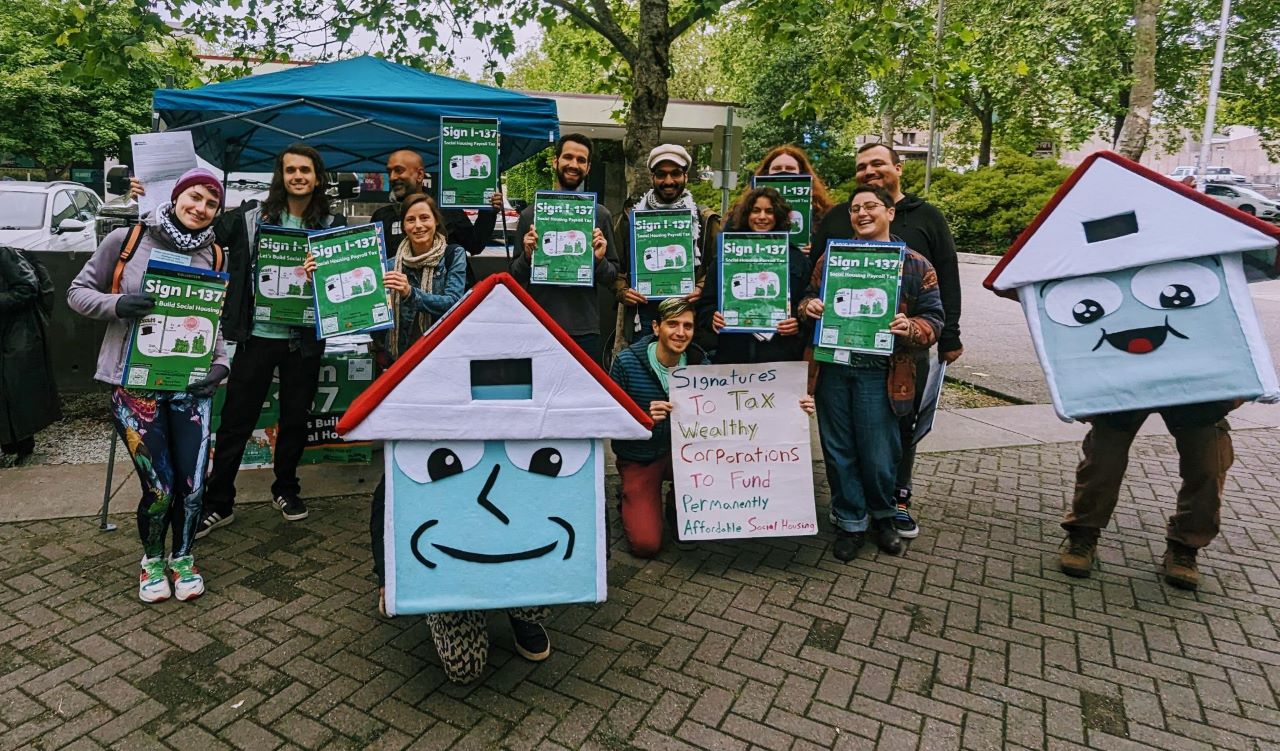
    Activists in Seattle gather signatures to put a social housing initiative on the ballot. In early 2025, voters passed the measure, which implements a payroll tax on high incomes to fund the program. House Our Neighbors, CC BY-SA

    Seattle astounded housing advocates around the country in February 2025, when roughly two-thirds of voters approved a ballot initiative proposing a new 5% payroll tax on salaries in excess of US$1 million.

    The expected revenue – estimated to amount to $52 million dollars annually – would go toward funding a public development authority named Seattle Social Housing, which would then build and maintain permanently affordable homes.

    The city has experienced record high rents and home prices over the past two decades, attributed in part to the high incomes and relatively low taxes paid by tech firms like Amazon. Prior attempts to make these companies do their part to keep the city affordable have had mixed results.

    So despite nationwide, bipartisan skepticism of government and tax increases, Seattle’s voters showed that in light of a severe affordability crisis, a new role for the public sector and a new, dedicated fiscal revenue stream for housing were not only necessary, but possible.

    As a trained architect and urban historian, I study how capitalist societies have embraced – or rejected – housing that’s permanently shielded from market forces and what that means for architecture and urban design.

    To me, Seattle’s social housing initiative shows that the country’s traditional, “either-or” housing model – of unregulated, market-rate housing versus tightly regulated, income-restricted affordable housing – has reached its limits.

    Social housing promises a different path forward.

    The rise of the ‘two-tiered’ system

    After World War I, amid a similarly dire housing crisis, journalist Catherine Bauer traveled to Europe and learned about the continent’s social housing programs.

    She publicized her findings in the 1934 book “Modern Housing,” in which she advocated for housing that would be permanently shielded from the private real estate market. High-quality design was central to her argument. (The book was reissued in 2020, reflecting a renewed hunger for her ideas.)

    Early New Deal programs supported “limited-dividend,” or nonprofit, housing sponsored by civic organizations such as labor unions. The Carl Mackley Houses in Philadelphia exemplified this approach: The government provided low-interest loans to the American Federation of Full-Fashioned Hosiery Workers, which then constructed housing for its workers with rents set at affordable rates. The complex was built with community rooms and a swimming pool for its residents.

    Financed by $1.2 million in federal funds, the Carl Mackley Houses, completed in 1935, provided homes for union workers.
    Alfred Kastner papers, Collection No. 7350, Box 45, Record 12, American Heritage Center, University of Wyoming

    However, the 1937 U.S. Housing Act omitted this form of middle-income housing. Instead, the federal government chose to support public rental housing for low-income Americans and private homeownership, with little in between.

    Historian Gail Radford has aptly termed this a “two-tiered system,” and it was problematic from the start.

    Funding for public housing in the U.S. – as well as for its successor, private-sector-built affordable housing – has always been capped in ways that fall far short of demand, with access to the homes largely restricted to households with the lowest incomes. Private-sector-built affordable housing depends on dangling tax credits for private investors, and rent restrictions can expire.

    While the U.S. promoted this two-tiered system, cities like Vienna pursued a different path.

    In Austria’s culturally vibrant capital, today half of all dwellings are permanently removed from the private market. Roughly 80% of households qualify to live in them. The buildings take a range of forms, are located in all neighborhoods, and are built and operated as rental or cooperative housing either by the city or by nonprofit developers.

    Rents do not rise and fall according to household income, but are instead set to cover capital and operation expenses. These are kept low thanks to long-term, low-interest loans. These loans are funded through a nationwide 1% payroll tax, split evenly between employers and employees. Renters also make a down payment, priced in relation to the size and age of the apartment, which keeps monthly rents down. To guarantee access to low-cost land, the municipality has pursued an active land acquisition policy since the 1980s.

    Vienna’s Pilotengasse Housing Estate, a social housing development featuring low-rise buildings with abundant greenery, was completed in 1992 and serves a range of income groups.
    Viennaslide/Construction Photography/Avalon/Getty Images

    Housing shielded from the private market

    The inequities created by the two-tiered system – along with the absence of viable options for moderate- and middle-income households – are what social housing advocates in the U.S. are trying to address today.

    In 2018, the think tank People’s Policy Project published what was likely the first 21st-century report advocating for social housing in the U.S., citing Vienna as a model.

    Across the U.S., social housing is being used to describe a range of programs, from limited equity cooperatives and community land trusts to public housing.

    They all share a few underlying principles, however.

    First and foremost, social housing calls for permanently shielding homes from the private real estate market, often referred to as “permanent affordability.” This usually means public investment in housing and public ownership of it. Second, unlike the ways in which public housing has traditionally operated in the U.S., most social housing programs aim to serve households across a broader range of incomes. The goal is to create housing that is both financially sustainable and appealing to broad swaths of the electorate. Third, social housing aspires to give residents more control over the governance of their homes.

    Social housing doesn’t all look the same. But thoughtful design is key to its success. It’s built to be owned and operated in the long-term, not for short-term financial gain. Construction quality matters, and developers realize it needs to be appealing to a range of tenants with different needs.

    Early successes

    In recent years, there have been significant wins for the social housing movement at the state and local levels.

    In 2023, Atlanta created a new quasi-public entity to co-develop mixed-income housing on city-owned land. In 2024, Rhode Island voters and the Massachusetts legislature funded pilot projects to test public investment in social housing. And 2025 has seen the the passage of Chicago’s Green Social Housing ordinance.

    Many of these programs were directly inspired by affordable housing initiatives in Montgomery County, Maryland.

    Since 2021, the county’s housing authority has used a $100 million housing fund to invest in new mixed-income developments. Through these investments, the county retains co-ownership and has been able to bring down the cost of development enough to offer 30% of homes at significantly below market rents, in perpetuity. If Vienna is the global paragon for social housing, Montgomery County has become its domestic counterpart.

    In Seattle, social housing will mean homes delivered and permanently owned by Seattle Social Housing, which is funded through the payroll tax on high incomes. The initiative envisions developments featuring a range of apartment sizes to meet the needs of different family sizes, built to high energy-efficiency standards. Homes will be available to households earning up to 120% of area median income, with residents paying no more than 30% of their income on rent. In Seattle, that means that a single-person household making up to $120,000 will qualify.

    Members of the New York City Council hold a rally with housing activists to promote social housing legislation in March 2023.
    William Alatriste/NYC Council Media Unit, CC BY-SA

    Ongoing debates

    Despite these successes, many Americans remain skeptical of social housing.

    Sign up for a webinar on the topic, and you’ll hear participants question the term itself. Isn’t it far too “socialist” to be broadly adopted in the U.S.? And isn’t this just “old wine in new bottles”?

    Join a housing task force, and established nonprofits will be the ones to push back, arguing that they already know how to build and manage housing, and that all they need is money.

    Some housing activists also question whether using scarce public dollars to pay for mixed-income housing will yet again shortchange those who most need governmental assistance – namely, the poor. Others point to the need to provide more ways to build intergenerational wealth, especially for racial minorities, who have historically faced barriers to homeownership.

    Urban planner Jonathan Tarleton has highlighted another important issue: the danger of social housing reverting over time to private ownership, as has been the case with some cooperatives in New York City. Tarleton stresses the need for “social maintenance” – the importance of telling and retelling the story of whom social housing is meant to serve.

    These debates raise important questions. Social housing may be a confusing term and an aspirational concept. But it is here to stay: It has galvanized organizers and policymakers around a new approach to the design, development and maintenance of housing.

    Social housing keeps prices down through long-term public investment, ensuring that future generations will still benefit. Developers can design and provide homes that respond to how people want to live. And in an increasingly polarized country, social housing will allow people of various backgrounds, incomes and ideological persuasions to live together again, rather than apart.

    Whether it’s the kind found in Seattle, in Maryland or somewhere in between, I believe social housing is needed more than ever before to address the country’s twin problems of affordability and a lack of political imagination.

    This article is part of a series centered on envisioning ways to deal with the housing crisis.

    Susanne Schindler receives funding from Harvard’s Joint Center for Housing Studies.

    ref. From Seattle to Atlanta, new social housing programs seek to make homes permanently affordable for a range of incomes – https://theconversation.com/from-seattle-to-atlanta-new-social-housing-programs-seek-to-make-homes-permanently-affordable-for-a-range-of-incomes-255097

    MIL OSI

  • MIL-OSI Submissions: What schools can learn from skate culture

    Source: The Conversation – UK – By Sander Hölsgens, Assistant Professor, Leiden Institute of Cultural Anthropology and Development Sociology, Leiden University

    Dean Drobot/Shutterstock

    At a school in Malmö, Sweden, skateboarding is on the curriculum. John Dahlquist, vice principal of Bryggeriets High School, teaches skate classes and brings lessons from skateboarding into other subjects. By encouraging teenagers to have fun together through skating and beyond, he notices that they want to attend school. Writing in a recent book I co-edited on skateboarding and teaching, Dahlquist notes that he even sees students longing to be back in the classroom after the weekend.

    Skateboarding is creative, requiring ingenuity in adapting to new environments. It’s collaborative and social: skaters cheer each other on when they try to learn something new, acknowledging that everyone operates at a different level and faces a distinct challenge.

    When skateboarding is done well, individual growth takes place among a community of care and mutual support. And it requires a willingness to fail. There’s no way to master a trick without trying and failing, over and over again.

    My colleagues and I have researched the value of a skateboarding philosophy in schools, and how teachers can bring it into their classrooms.


    Get your news from actual experts, straight to your inbox. Sign up to our daily newsletter to receive all The Conversation UK’s latest coverage of news and research, from politics and business to the arts and sciences.


    Take Dahlquist’s teaching in Malmö. He notes that interweaving skate classes with other subjects has multiple noteworthy effects. The physical activity of skateboarding improves levels of concentration. Some students even say that they’d never been successful in any other learning environment. Elsewhere, they’d be unable to focus on the task at hand.

    What’s more, a skateboarding mindset – being prepared to learn difficult tricks in unfamiliar settings – equipped students with the capacity to master other kinds of new skills.

    Able to fail

    The process of overcoming the anxiety to fail is crucial. Skaters cannot be afraid to fall if they want to learn new tricks. The motivation to learn through repeated efforts helps skaters in other areas of life, too. Skaters at Bryggeriet aren’t worried as much about failing grades, precisely because they see it as an opportunity to learn and move forward.

    As Dahlquist says, “At the end of my classes, I usually have to throw my students out of the classroom. A lot of them beg for three more tries: ‘I’ve got this, just give me three more tries. I promise I will learn.‘”

    This mindset decreases grades as education’s cornerstone and, by extension, enhances students’ mental health. My colleague Esther Sayers, who conducted fieldwork at Bryggeriets, found another effect. Teachers help students to develop the skills to get motivated, to reach a point of feeling inspired – or what skaters call “stoke”.

    Skateboarding fosters a non-competitive learning culture.
    PeopleImages.com – Yuri A

    Bryggeriets High School isn’t the only place where skateboarding is helping teach people how to learn. Reaching beyond its historical status as a self-regulated street culture, skateboarding now plays an important role in building engaged learning communities across the globe. Berlin-based skate organisation Skateistan hosts skate classes, gives young people access to education and offers funds for young and upcoming community leaders.

    Concrete Jungle Foundation co-builds skateparks with young people in Peru, Morocco and Jamaica, in order to exchange knowledge and drive local ownership and apprenticeship. Similarly, the New York-based Harold Hunter Foundation runs skate workshops that also provide mentoring and career guidance.

    Colleagues Arianna Gil and Jessica Forsyth have studied working class black and Latin American skate crews, run by genderdiverse community organisers. They found that skate crews such as Brujas and Gang Corp mobilise skaters according to the “for us, by us” spirit.

    Challenging institutional models of authority, these skate crews develop services based on the hopes and aspirations of their communities – ranging from teach-ins to recreational programmes. This includes a talk on the history and meaning of hoodies, and modules on the power of storytelling and the danger of propaganda. The crux, here, is to learn about stuff you encounter in your daily lives.

    Skaters who experience poverty and oppression create their own ecosystem for learning from one another, from being out of an educational system that is organised in a top-down way. This means creating a grassroots school model where skate crews choose what and how they want to learn. Rather than grades and degrees, education here is structured around the process of learning from your peers – with the idea of passing on this knowledge in the near future.

    The effects of this approach are threefold. First, it centers mentorship and apprenticeship, resulting in intergenerational knowledge exchange. Second, skateboarding’s DIY spirit can help overcome access barriers. By embracing grassroots teaching practices and formats, education can be tailored to the specific needs and desires of a community, rather than following standardised learning objectives.

    Third, rather than focusing on memorising facts or learning for grades, this new ecosystem is structured around problem-based learning. Presented with worldly problems such as human rights violations and hostile architecture, skaters learn not just how to analyse their surroundings, but also how to cope with and engage oppressive societal structures.

    As formal education faces incremental budget cuts and deepened governmental influence, skateboarding shows us new ways to organise our learning spaces. Schools and teachers can engage their students by integrating aspects of a learning culture that decentres evaluations and assessments and celebrates attempts, rather than just successes.

    Sander Hölsgens received a ‘starting grant’ from OCW, The Netherlands. He is affiliated with Pushing Boarders, a platform tracing the social impact of skateboarding worldwide.

    ref. What schools can learn from skate culture – https://theconversation.com/what-schools-can-learn-from-skate-culture-255239

    MIL OSI

  • MIL-OSI Submissions: What people really want from their GP – it’s simpler than you might think

    Source: The Conversation – UK – By Helen Atherton, Professor of Primary Care Research, University of Southampton

    Stephen Barnes/Shutterstock.com

    Booking a GP appointment is a routine task, yet for many people it’s a source of frustration. Long waits, confusing systems and impersonal processes have become all too familiar. While much attention has been paid to how difficult it is to get an appointment, less research has asked a more fundamental question: what do patients actually want from their general practice?

    To answer this, my colleagues and I reviewed 33 studies that were a mixture of study designs, and focused on patients’ expectations and preferences regarding access to their GP in England and Scotland.

    What people wanted was not complicated or cutting edge. People were looking for connection; a friendly receptionist and good communication from the practice about how they could expect to make an appointment. And they wanted a general practice in their own neighbourhood with clean, calm waiting rooms. So far, so simple.


    Get your news from actual experts, straight to your inbox. Sign up to our daily newsletter to receive all The Conversation UK’s latest coverage of news and research, from politics and business to the arts and sciences.


    People wanted booking systems that were simple and user-friendly, without long automated phone menus (“press one for reception”). Preferences varied. Some patients valued the option to book appointments in person at the reception desk, while others preferred the convenience of online booking.

    Regardless of how they booked, patients wanted shorter waiting times or, at least, clear information about when they could expect an appointment or a callback.

    Ideally, general practice would be open on Saturdays and Sundays for those who cannot attend during the week.

    Remote consultations – by phone, video or email – have become more common since the pandemic, and many patients found them helpful. For those with caring responsibilities or mobility issues, they offered a convenient way to access care without needing to leave home.

    However, remote appointments weren’t suitable for everyone. Some patients lacked privacy at work, while others – particularly those with hearing impairments – found telephone consultations difficult or impossible to use.

    What patients consistently wanted was choice, particularly when it came to remote consultations. While in-person appointments were seen as the gold standard, many recognised that telephone or video consultations could be useful in certain situations. Preferences varied widely, which made the ability to choose the type of consultation especially important.

    Patients also wanted choice over who they saw, especially for non-urgent issues or when managing ongoing health conditions.

    In today’s general practice, care is often delivered by a range of professionals, including nurses, pharmacists and physiotherapists. While many patients were open to seeing different healthcare professionals, older adults and people from minority ethnic backgrounds were more likely to prefer seeing a GP.

    Overall, patients wanted the option to choose a GP over another healthcare professional – or at least be involved in that decision.

    Satisfaction at all-time low

    Unsurprisingly, what patients want from general practice varies, reflecting different lifestyles, needs and circumstances. But what was equally clear is that many people are not able to get what they want from the appointment system.

    According to a recent British Social Attitudes survey, patient satisfaction with general practice is at an all-time low, with just below one in three people reporting that they are very or quite satisfied with GP services.

    Some elements of the UK government’s recently announced ten-year plan for the NHS in England may address some of these concerns, but it remains far from certain. The emphasis on the NHS app as a “doctor in your pocket” does not align with what many patients are asking for: genuine choice over whether they access care online or in person.


    Read more:
    NHS ten-year plan for England: what’s in it and what’s needed to make it work


    Not everyone wants a doctor in their pocket.
    NHS/Shutterstock.com

    The proposal to open neighbourhood health centres on weekends could benefit those who need more flexible access. However, simply increasing the number of appointments misses the point: patients want more than just availability. They want care that is accessible, personalised and responsive to their individual needs.

    The evidence is clear and the solutions simple, yet patient satisfaction remains at an all-time low. The government must stop assuming technology is the answer and start listening to what patients are actually telling them. The cost of ignoring their voices is a healthcare system that serves no one well.

    Helen Atherton receives funding from the National Institute for Health Research and the Research Council of Norway.

    ref. What people really want from their GP – it’s simpler than you might think – https://theconversation.com/what-people-really-want-from-their-gp-its-simpler-than-you-might-think-260520

    MIL OSI

  • MIL-OSI Submissions: Georgia: how democracy is being eroded fast as government shifts towards Russia

    Source: The Conversation – UK – By Natasha Lindstaedt, Professor in the Department of Government, University of Essex

    Georgia was once considered a post-Soviet success story. After years of authoritarian rule, followed by independence which brought near state collapse, corruption and chaos, Georgia appeared to have transitioned to democracy.

    In a period after independence in 1991 and before 2020, elections were regularly held and were deemed mostly free and fair, the media and civil society were vibrant and corruption levels had diminished significantly.

    The “Rose revolution” in 2003 ushered in an era of unprecedented reform and suggested a move towards democracy and a closer relationship with the west. Georgians were full of hope for the country’s future, and prospects of joining the European Union – or at least moving closer to Europe.

    Fast forward two decades and Georgia has fully returned to authoritarianism. Six opposition leaders are in prison or facing charges and now thinktank leaders are being targeted with investigations that could land them in prison. Typically these charges centre around accepting foreign funding or criticising the government.


    Get your news from actual experts, straight to your inbox. Sign up to our daily newsletter to receive all The Conversation UK’s latest coverage of news and research, from politics and business to the arts and sciences.


    In moves in line with other authoritarian regimes around the world, opposition organisations such as thinktanks are being told to produce financial documents in short timeframes, and accused of financial mismanagement and threatened with prosecution if they don’t.

    In May 2024, Georgia passed a Russian-inspired foreign agent law — which would require non-governmental organisations (NGOs) receiving foreign funding to register themselves and face restrictions. Protests erupted each time Georgia’s parliament debated this measure, but eventually the pro-RussianGeorgia Dream party prevailed. More than 90% of NGOs receive funding from abroad, so the new law cripples the efforts of some 26,000 of them.

    Many Georgians were outraged that the passage of the bill may end dreams of one day becoming a European Union candidate country. Regular surveys have found that about 80% of Georgians have aspirations for their country to join the EU.

    Though Georgia faces a host of economic problems, the Georgia Dream party has campaigned on delivering a return to traditional values. Like Russia they have also passed a series of laws in 2024 that target the LGBTQ+ community, such as banning content that features same-sex relationships and stripping same-sex couples of rights, such as adoption.

    Parallels with Russia?

    Georgia Dream also passed legislation making treason a criminal offence, a clear attempt to eliminate political opponents. Any insults of politicians online are also considered a criminal offence.

    Also, in June of this year civil society organisations in Georgia received court orders requiring them to disclose highly sensitive data. Meanwhile, members of the Georgia Dream party were accused of assaulting opposition party leader Giorgi Gakharia suffering a broken nose and a concussion, which they denied.

    In another effort to exercise greater control over the state, since the beginning of this year more than 800 civil servants have been dismissed. Similar to the purges that took place in Turkey — this is not being done in the name of efficiency, but to ensure that the bureaucracy is loyal to wishes of the Georgia Dream government.

    This hasn’t happened overnight, as the laws had already changed several times to weaken legal protections for civil servants.

    During its time in government, the Georgia Dream party has moved the country much closer to Russia, often by portraying the nation as locked in a cultural struggle against the west. Despite this, 69% of Georgians still see Russia as Georgia’s main enemy, up from 35% in 2012.

    Though the Georgia Dream party faces increasing public opposition to its rule, it gained nearly the same amount of votes in the 2024 elections as it did in 2012 – when it was at its peak of popularity. The election result in October 2024 may be partly explained by accusations of fraud and other irregularities.

    How did this happen?

    One of the first big threats to Georgia’s democracy came in August 2008 when Russia invaded the country to offer support for two breakaway regions in South Ossetia and Abkhazia which declared themselves independent from Georgia. The international community did little to censure Russia, giving Russian president Vladimir Putin the confidence to engage in further acts of aggression.

    Russia has maintained troops in South Ossetia, only about 30 miles from Georgia’s capital Tbilisi, and continues to play an important role in Georgian politics, undermining democracy.

    The next threat came from within. Billionaire Bidzina Ivanishvili was elected prime minister of Georgia in 2012 as the leader of Georgia Dream. despite the fact that he officially stepped down from this position in 2013, he has wielded power behind the scenes and is still widely considered to be the de facto leader of Georgia.

    Though Georgia did not immediately slide towards autocracy under the Georgia Dream party, today there are few remnants of democracy left. The major opposition parties are banned, opposition politicians and journalists are spied on, and protests are repressed by the police.

    Cameras are now installed on the streets of Tbilisi as part of a crackdown on protest and fines for protesting have increased. Elections are no longer considered to be free and fair by the European Union and others as the Georgia Dream party uses its access to the state resources to dole out patronage to its supporters and intimidate voters.

    In just over two decades, Georgia has managed to plunge back to authoritarianism. Once hailed as a beacon of democratic reform, the country is now gripped by a Russian-influenced ruling party that has consolidated power through repression, surveillance and manipulation.

    But while the Georgia Dream party has tried to dismantle the country’s democratic institutions, support for resistance is high. According to a poll in 2025, more than 60% of respondents supported protests against the government and 45% identified as active supporters. And 82% feel Georgia is in crisis, with 78% blaming Georgian Dream.

    It appears that Russia may have succeeded in undermining democracy in Georgia, but not in shaping hearts and minds.

    Natasha Lindstaedt does not work for, consult, own shares in or receive funding from any company or organisation that would benefit from this article, and has disclosed no relevant affiliations beyond their academic appointment.

    ref. Georgia: how democracy is being eroded fast as government shifts towards Russia – https://theconversation.com/georgia-how-democracy-is-being-eroded-fast-as-government-shifts-towards-russia-260430

    MIL OSI

  • MIL-OSI Submissions: US backs Nato’s latest pledge of support for Ukraine, but in reality seems to have abandoned its European partners

    Source: The Conversation – UK – By Stefan Wolff, Professor of International Security, University of Birmingham

    Recent news from Ukraine has generally been bad. Since the end of May, ever larger Russian air strikes have been documented against Ukrainian cities with devastating consequences for civilians, including in the country’s capital, Kyiv.

    Amid small and costly but steady gains along the almost 1,000km long frontline, Russia reportedly took full control of the Ukrainian region of Luhansk, part of which it had already occupied before the beginning of its full-scale invasion of Ukraine in February 2022.

    And according to Dutch and German intelligence reports, some of Russia’s gains on the battlefield are enabled by the widespread use of chemical weapons.


    Get your news from actual experts, straight to your inbox. Sign up to our daily newsletter to receive all The Conversation UK’s latest coverage of news and research, from politics and business to the arts and sciences.


    It was therefore something of a relief that Nato’s summit in The Hague produced a short joint declaration on June 25 in which Russia was clearly named as a “long-term threat … to Euro-Atlantic security”. Member states restated “their enduring sovereign commitments to provide support to Ukraine”. While the summit declaration made no mention of future Nato membership for Ukraine, the fact that US president Donald Trump agreed to these two statements was widely seen as a success.

    Yet, within a week of the summit, Washington paused the delivery of critical weapons to Ukraine, including Patriot air defence missiles and long-range precision-strike rockets. The move was ostensibly in response to depleting US stockpiles.

    This despite the Pentagon’s own analysis, which suggested that the shipment – authorised by the former US president Joe Biden last year – posed no risk to US ammunition supplies.

    This was bad news for Ukraine. The halt in supplies weakens Kyiv’s ability to protect its large population centres and critical infrastructure against intensifying Russian airstrikes. It also puts limits on Ukraine’s ability to target Russian supply lines and logistics hubs behind the frontlines that have been enabling ground advances.

    Despite protests from Ukraine and an offer from Germany to buy Patriot missiles from the US for Ukraine, Trump has been in no rush to reverse the decision by the Pentagon.

    Russia is now claiming to have completed its occupation of the province of Luhansk in eastern Ukraine.
    Institute for the Study of War

    Another phone call with his Russian counterpart, Vladimir Putin, on July 3, failed to change Trump’s mind, even though he acknowledged his disappointment with the clear lack of willingness by the Kremlin to stop the fighting. What’s more, within hours of the call between the two presidents, Moscow launched the largest drone attack of the war against Kyiv.

    A day later, Trump spoke with Zelensky. And while the call between them was apparently productive, neither side gave any indication that US weapons shipments to Ukraine would resume quickly.

    Trump previously paused arms shipments and intelligence sharing with Ukraine in March, 2025 after his acrimonious encounter with Zelensky in the Oval Office. But the US president reversed course after certain concessions had been agreed – whether that was an agreement by Ukraine to an unconditional ceasefire or a deal on the country’s minerals.

    It is not clear with the current disruption whether Trump is after yet more concessions from Ukraine. The timing is ominous, coming after what had appeared to be a productive Nato summit with a unified stance on Russia’s war of aggression. And it preceded Trump’s call with Putin.

    This could be read as a signal that Trump was still keen to accommodate at least some of the Russian president’s demands in exchange for the necessary concessions from the Kremlin to agree, finally, the ceasefire that Trump had once envisaged he could achieve in 24 hours.

    If this is indeed the case, the fact that Trump continues to misread the Russian position is deeply worrying. The Kremlin has clearly drawn its red lines on what it is after in any peace deal with Ukraine.

    These demands – virtually unchanged since the beginning of the war – include a lifting of sanctions against Russia and no Nato membership for Ukraine, while also insisting that Kyiv must accept limits on its future military forces and recognise Russia’s annexation of Crimea and four regions on the Ukrainian mainland.

    This will not change as a result of US concessions to Russia but only through pressure on Putin. And Trump has so far been unwilling to apply pressure in a concrete and meaningful way beyond the occasional hints to the press or on social media.

    Coalition of the willing

    It is equally clear that Russia’s maximalist demands are unacceptable to Ukraine and its European allies. With little doubt that the US can no longer be relied upon to back the European and Ukrainian position, Kyiv and Europe need to accelerate their own defence efforts.

    A European coalition of the willing to do just that is slowly taking shape. It straddles the once more rigid boundaries of EU and Nato membership and non-membership, involving countries such as Moldova, Norway and the UK.
    and including non-European allies including Canada, Japan and South Korea.

    The European commission’s white paper on European defence is an obvious indication that the threat from Russia and the needs of Ukraine are being taken seriously and, crucially, acted upon. It mobilises some €800 billion (£690 billion) in defence spending and will enable deeper integration of the Ukrainian defence sector with that of the European Union.

    At the national level, key European allies, in particular Germany, have also committed to increased defence spending and stepped up their forward deployment of forces closer to the borders with Russia.

    US equivocation will not mean that Ukraine is now on the brink of losing the war against Russia. Nor will Europe discovering its spine on defence put Kyiv immediately in a position to defeat Moscow’s aggression.

    After decades of relying on the US and neglecting their own defence capabilities, these recent European efforts are a first step in the right direction. They will not turn Europe into a military heavyweight overnight. But they will buy time to do so.

    Stefan Wolff is a past recipient of grant funding from the Natural Environment Research Council of the UK, the United States Institute of Peace, the Economic and Social Research Council of the UK, the British Academy, the NATO Science for Peace Programme, the EU Framework Programmes 6 and 7 and Horizon 2020, as well as the EU’s Jean Monnet Programme. He is a Trustee and Honorary Treasurer of the Political Studies Association of the UK and a Senior Research Fellow at the Foreign Policy Centre in London.

    ref. US backs Nato’s latest pledge of support for Ukraine, but in reality seems to have abandoned its European partners – https://theconversation.com/us-backs-natos-latest-pledge-of-support-for-ukraine-but-in-reality-seems-to-have-abandoned-its-european-partners-260334

    MIL OSI

  • MIL-OSI Submissions: Nature-friendly farming budget swells in UK – but cuts elsewhere make recovery fraught

    Source: The Conversation – UK – By Nathalie Seddon, Professor of Biodiversity, Smith School of Enterprise and Environment and Department of Biology, University of Oxford

    Skylarks are a red-listed species, which means they are of high conservation concern in the UK. WildlifeWorld/Shutterstock

    Nature in the UK appeared to receive a rare funding boost in the June spending review, with the government setting a spending target of up to £2 billion a year for England’s environmental land management (ELM) scheme by 2028-29.

    By steering public funds toward farmers who restore hedgerows, soils and wetlands, England’s ELM programme is meant to renew landscapes that absorb carbon, support pollinators and keep water clean while helping rural businesses stay viable in a changing climate.

    If delivered in full, the package would elevate the UK’s post-Brexit model of investing public money in shared ecological care (rather than payments based on acreage) to one of the most generously funded in the world.

    Yet, scrutinise the details and a more complicated story emerges.


    Get your news from actual experts, straight to your inbox. Sign up to our daily newsletter to receive all The Conversation UK’s latest coverage of news and research, from politics and business to the arts and sciences.


    The review has trimmed the day-to-day budget of the Department for Environment, Food and Rural Affairs (Defra) in real terms. Defra now faces the unenviable task of signing and monitoring thousands of new ELM agreements with fewer staff and shrinking data resources. Without the capacity to check whether fields really have become richer in skylarks or streams clearer of fertiliser, large sums could be delayed or misdirected.

    Scale is another challenge. An independent analysis published in 2024 estimated that roughly £6 billion every year across the UK is needed to bring agriculture in line with the Environment Act targets for habitat restoration and net zero commitments.

    Even the full £2 billion promised for England would meet only about half of that evidence-based need. And the “up to” £400 million for trees and peatlands is not new money: it is funding that was first promised in 2024 and the payment schedule has still not been confirmed.

    Money could be paid to farmers for allowing woodlands to regenerate.
    Richard Hepworth, CC BY

    While the review earmarked £4.2 billion for flood and coastal defence, it does not specify how much of that will support nature-based measures such as floodplain restoration, or the creation of saltmarshes or riparian woodlands. The Environment Agency is consulting on a funding model that could embed such solutions, but the Treasury papers are silent on who will pay for that shift.

    Tech spending dwarfs habitat investment

    Contrast this with the sums heading to the Department for Energy Security and Net Zero.

    Roughly £30 billion is earmarked for nuclear fission, fusion research and carbon-capture hubs. These projects are heavy on concrete and steel (materials with a hefty carbon cost) but have no immediate ecological benefit.

    While new low-carbon technologies are crucial, thriving and resilient soils, wetlands and woodlands nourish food systems, safeguard water and hold vast stores of carbon – benefits that deepen and become more cost-effective over time.

    Nature-based solutions can also revitalise local economies. The Office for National Statistics estimates that replacing the benefits flowing from the UK’s forests, rivers and soils – flood buffering, crop pollination, cleaner air, recreation and more – would cost about £1.8 trillion, a figure that only hints at their deeper, immeasurable value.

    Yet the review sets out no plan to safeguard these life-support systems, or to factor their decline into the Treasury’s green book (the rule book used to appraise public investments) or the Bank of England’s stress tests, which check how shocks could ripple through the financial system.

    This is also a matter of fairness and public health. Growing evidence shows that regular contact with nature lowers the risks of heart disease and anxiety, while improving children’s cognitive development. These are benefits with a value that defies any price tag.

    Yet the places with the fewest trees and parks tend to be the same post-industrial towns ministers want to “level up”. The review is silent on biodiversity net gain (the flagship policy meant to channel private finance into local habitats) and on a proposed national nature wealth fund that could blend public and private capital for large-scale restoration.

    Housing money could repeat past mistakes

    One line in the spending review could still shift the balance.

    The chancellor has earmarked £39 billion for building social and affordable housing over the next decade. If every development delivers at least a 10% net gain for biodiversity onsite, and if schemes build in climate-smart design (living roofs, shade-giving street trees, permeable surfaces) with local residents, Britain could pioneer the world’s first large-scale, nature-positive, net-zero housing programme.

    Without those safeguards, “levelling up” risks repeating old mistakes: sealing green space under concrete today and paying tomorrow to retrofit drainage, shade and parks.

    Green space is scarce on this new housing estate near Cardiff, Wales.
    Shutterstock

    That risk is heightened by the government’s planning and infrastructure bill, now before parliament. In an open letter to MPs, economists and ecologists warn that the bill would let developers “pay cash to trash” irreplaceable habitats by swapping onsite protection for a levy, a move they describe as a “licence to kill nature”.

    At the next UN climate summit, Cop30 in Brazil in November 2025, the UK will have to show the world that its domestic spending matches its international rhetoric.

    More than 150 UK researchers made that point in an open letter to the prime minister, urging him to put nature at the centre of the UK’s Cop30 stance. Converting the Treasury’s headline figures into habitat gains and locking robust rules into both the planning bill and the housing drive would give ministers credible proof of progress when they update the UK’s climate and nature pledges on the Cop30 stage.

    The spending review may have nudged farm policy in the right direction and set a new higher water mark for nature-positive agriculture. Yet amid the squeeze on Defra, the recycling rather than expansion of tree and peat budgets and the continued dominance of technology over habitat, nature still comes a distant second to hard infrastructure in the UK growth model.

    There is still time to change course. Guaranteeing Defra’s capacity, publishing a timetable for the tree-and-peat fund, reserving part of the flood budget for community-led nature-based solutions and hardwiring strong biodiversity net gain rules into housing and planning reforms would turn headline promises into projects that enrich daily life while stewarding public money wisely.


    Don’t have time to read about climate change as much as you’d like?

    Get a weekly roundup in your inbox instead. Every Wednesday, The Conversation’s environment editor writes Imagine, a short email that goes a little deeper into just one climate issue. Join the 45,000+ readers who’ve subscribed so far.


    Nathalie Seddon receives funding from UKRI and the Leverhulme Trust and sits on the UK Climate Change Committee. She is also a trustee of the Circular Bioeconomy Alliance and is a non-executive director of the social venture, Nature-based Insights.

    ref. Nature-friendly farming budget swells in UK – but cuts elsewhere make recovery fraught – https://theconversation.com/nature-friendly-farming-budget-swells-in-uk-but-cuts-elsewhere-make-recovery-fraught-259091

    MIL OSI

  • MIL-OSI Analysis: Are people at the South Pole upside down?

    Source: The Conversation – USA (2) – By Abigail Bishop, Ph.D. Student in Physics, University of Wisconsin-Madison

    At the South Pole, which way is up? Abigail Bishop

    Curious Kids is a series for children of all ages. If you have a question you’d like an expert to answer, send it to CuriousKidsUS@theconversation.com.


    Are people on the South Pole walking upside down from the rest of the world? – Ralph P., U.S.


    When I was standing at the South Pole, I felt the same way I feel anywhere on Earth because my feet were still on the ground and the sky was still overhead.

    I’m an astrophysicist from Wisconsin who lived at the South Pole for seven weeks from December 2024 to January 2025 to work on an array of detectors looking for extremely high energy particles from outer space.

    I didn’t feel upside down, but there were some differences that still made the South Pole feel flipped over from what I was used to.

    As someone who loves looking for the Moon, I noticed that the face of the man on the Moon was flipped over, like he went from to . All the craters that I was used to seeing on the top of the Moon from Wisconsin were now on the bottom – because I was looking at the Moon from the Southern Hemisphere instead of the Northern Hemisphere.

    How the Moon looks depends on your point of view.
    The Planetary Society, CC BY-SA

    After noticing this difference, I remembered something similar in the night skies of New Zealand, a country near Antarctica where my fellow travelers and I got our big red coats that kept us warm at the South Pole. I had looked for Orion, a constellation that in the Northern Hemisphere is viewed as a hunter holding a bow and drawing an arrow from his quiver. In the night sky of New Zealand, Orion looked like he was doing a handstand.

    Everything in the sky felt upside down and opposite, compared with what I was used to. A person who lives in the Southern Hemisphere might feel the same about visiting the Arctic or the North Pole.

    ‘The Big Blue Marble’ photo, taken in 1972 by the crew of Apollo 17.
    NASA

    An out-of-this-world perspective

    To understand what’s happening, and why things are really different but also feel very much the same, it might be useful to back up a bit from Earth’s surface. Like into outer space. On space missions to the Moon, astronauts could see one side of the Earth’s sphere at once.

    If they had superhero vision, an astronaut would see the people at the South Pole and North Pole standing upside down from each other. And a person at the equator would look like they were sticking straight out the side of the planet. In fact, even though they might be standing on the equator, people in Colombia and Indonesia would also look like they were upside down from each other, because they would be sticking out from opposite sides of the Earth.

    Of course, if you asked each person, they would say, “My feet are on the ground, and the sky is up.”

    That’s because Earth is essentially a really big ball whose gravitational pull on every one of us points to the center of the planet. The direction that Earth pulls us in is what people call “down” all over the planet. Think about holding a baseball between your pointer fingers. From the perspective of your fingertips on the ball’s surface, both are pointing “down.” But from the perspective of a friend nearby, your fingers are pointing in different directions – though always toward the center of the ball.

    These relationships between people on the Earth’s surface are good for a little bit of fun, though. While I was at the South Pole, I pointed my body in the same direction as my friends in Wisconsin – by doing a handstand. But if you look at the picture the other way around, it looks like I’m holding up the entire planet, like Superman.

    This is the right way up: Abigail Bishop does a handstand at the ceremonial South Pole.
    Abigail Bishop

    Hello, curious kids! Do you have a question you’d like an expert to answer? Ask an adult to send your question to CuriousKidsUS@theconversation.com. Please tell us your name, age and the city where you live.

    And since curiosity has no age limit – adults, let us know what you’re wondering, too. We won’t be able to answer every question, but we will do our best.

    Abigail Bishop receives funding from National Science Foundation Award 2013134 and has received funding from the Belgian American Education Foundation.

    ref. Are people at the South Pole upside down? – https://theconversation.com/are-people-at-the-south-pole-upside-down-256754

    MIL OSI Analysis

  • MIL-OSI Analysis: Are people at the South Pole upside down?

    Source: The Conversation – USA (2) – By Abigail Bishop, Ph.D. Student in Physics, University of Wisconsin-Madison

    At the South Pole, which way is up? Abigail Bishop

    Curious Kids is a series for children of all ages. If you have a question you’d like an expert to answer, send it to CuriousKidsUS@theconversation.com.


    Are people on the South Pole walking upside down from the rest of the world? – Ralph P., U.S.


    When I was standing at the South Pole, I felt the same way I feel anywhere on Earth because my feet were still on the ground and the sky was still overhead.

    I’m an astrophysicist from Wisconsin who lived at the South Pole for seven weeks from December 2024 to January 2025 to work on an array of detectors looking for extremely high energy particles from outer space.

    I didn’t feel upside down, but there were some differences that still made the South Pole feel flipped over from what I was used to.

    As someone who loves looking for the Moon, I noticed that the face of the man on the Moon was flipped over, like he went from to . All the craters that I was used to seeing on the top of the Moon from Wisconsin were now on the bottom – because I was looking at the Moon from the Southern Hemisphere instead of the Northern Hemisphere.

    How the Moon looks depends on your point of view.
    The Planetary Society, CC BY-SA

    After noticing this difference, I remembered something similar in the night skies of New Zealand, a country near Antarctica where my fellow travelers and I got our big red coats that kept us warm at the South Pole. I had looked for Orion, a constellation that in the Northern Hemisphere is viewed as a hunter holding a bow and drawing an arrow from his quiver. In the night sky of New Zealand, Orion looked like he was doing a handstand.

    Everything in the sky felt upside down and opposite, compared with what I was used to. A person who lives in the Southern Hemisphere might feel the same about visiting the Arctic or the North Pole.

    ‘The Big Blue Marble’ photo, taken in 1972 by the crew of Apollo 17.
    NASA

    An out-of-this-world perspective

    To understand what’s happening, and why things are really different but also feel very much the same, it might be useful to back up a bit from Earth’s surface. Like into outer space. On space missions to the Moon, astronauts could see one side of the Earth’s sphere at once.

    If they had superhero vision, an astronaut would see the people at the South Pole and North Pole standing upside down from each other. And a person at the equator would look like they were sticking straight out the side of the planet. In fact, even though they might be standing on the equator, people in Colombia and Indonesia would also look like they were upside down from each other, because they would be sticking out from opposite sides of the Earth.

    Of course, if you asked each person, they would say, “My feet are on the ground, and the sky is up.”

    That’s because Earth is essentially a really big ball whose gravitational pull on every one of us points to the center of the planet. The direction that Earth pulls us in is what people call “down” all over the planet. Think about holding a baseball between your pointer fingers. From the perspective of your fingertips on the ball’s surface, both are pointing “down.” But from the perspective of a friend nearby, your fingers are pointing in different directions – though always toward the center of the ball.

    These relationships between people on the Earth’s surface are good for a little bit of fun, though. While I was at the South Pole, I pointed my body in the same direction as my friends in Wisconsin – by doing a handstand. But if you look at the picture the other way around, it looks like I’m holding up the entire planet, like Superman.

    This is the right way up: Abigail Bishop does a handstand at the ceremonial South Pole.
    Abigail Bishop

    Hello, curious kids! Do you have a question you’d like an expert to answer? Ask an adult to send your question to CuriousKidsUS@theconversation.com. Please tell us your name, age and the city where you live.

    And since curiosity has no age limit – adults, let us know what you’re wondering, too. We won’t be able to answer every question, but we will do our best.

    Abigail Bishop receives funding from National Science Foundation Award 2013134 and has received funding from the Belgian American Education Foundation.

    ref. Are people at the South Pole upside down? – https://theconversation.com/are-people-at-the-south-pole-upside-down-256754

    MIL OSI Analysis

  • MIL-OSI Analysis: Are people at the South Pole upside down?

    Source: The Conversation – USA (2) – By Abigail Bishop, Ph.D. Student in Physics, University of Wisconsin-Madison

    At the South Pole, which way is up? Abigail Bishop

    Curious Kids is a series for children of all ages. If you have a question you’d like an expert to answer, send it to CuriousKidsUS@theconversation.com.


    Are people on the South Pole walking upside down from the rest of the world? – Ralph P., U.S.


    When I was standing at the South Pole, I felt the same way I feel anywhere on Earth because my feet were still on the ground and the sky was still overhead.

    I’m an astrophysicist from Wisconsin who lived at the South Pole for seven weeks from December 2024 to January 2025 to work on an array of detectors looking for extremely high energy particles from outer space.

    I didn’t feel upside down, but there were some differences that still made the South Pole feel flipped over from what I was used to.

    As someone who loves looking for the Moon, I noticed that the face of the man on the Moon was flipped over, like he went from to . All the craters that I was used to seeing on the top of the Moon from Wisconsin were now on the bottom – because I was looking at the Moon from the Southern Hemisphere instead of the Northern Hemisphere.

    How the Moon looks depends on your point of view.
    The Planetary Society, CC BY-SA

    After noticing this difference, I remembered something similar in the night skies of New Zealand, a country near Antarctica where my fellow travelers and I got our big red coats that kept us warm at the South Pole. I had looked for Orion, a constellation that in the Northern Hemisphere is viewed as a hunter holding a bow and drawing an arrow from his quiver. In the night sky of New Zealand, Orion looked like he was doing a handstand.

    Everything in the sky felt upside down and opposite, compared with what I was used to. A person who lives in the Southern Hemisphere might feel the same about visiting the Arctic or the North Pole.

    ‘The Big Blue Marble’ photo, taken in 1972 by the crew of Apollo 17.
    NASA

    An out-of-this-world perspective

    To understand what’s happening, and why things are really different but also feel very much the same, it might be useful to back up a bit from Earth’s surface. Like into outer space. On space missions to the Moon, astronauts could see one side of the Earth’s sphere at once.

    If they had superhero vision, an astronaut would see the people at the South Pole and North Pole standing upside down from each other. And a person at the equator would look like they were sticking straight out the side of the planet. In fact, even though they might be standing on the equator, people in Colombia and Indonesia would also look like they were upside down from each other, because they would be sticking out from opposite sides of the Earth.

    Of course, if you asked each person, they would say, “My feet are on the ground, and the sky is up.”

    That’s because Earth is essentially a really big ball whose gravitational pull on every one of us points to the center of the planet. The direction that Earth pulls us in is what people call “down” all over the planet. Think about holding a baseball between your pointer fingers. From the perspective of your fingertips on the ball’s surface, both are pointing “down.” But from the perspective of a friend nearby, your fingers are pointing in different directions – though always toward the center of the ball.

    These relationships between people on the Earth’s surface are good for a little bit of fun, though. While I was at the South Pole, I pointed my body in the same direction as my friends in Wisconsin – by doing a handstand. But if you look at the picture the other way around, it looks like I’m holding up the entire planet, like Superman.

    This is the right way up: Abigail Bishop does a handstand at the ceremonial South Pole.
    Abigail Bishop

    Hello, curious kids! Do you have a question you’d like an expert to answer? Ask an adult to send your question to CuriousKidsUS@theconversation.com. Please tell us your name, age and the city where you live.

    And since curiosity has no age limit – adults, let us know what you’re wondering, too. We won’t be able to answer every question, but we will do our best.

    Abigail Bishop receives funding from National Science Foundation Award 2013134 and has received funding from the Belgian American Education Foundation.

    ref. Are people at the South Pole upside down? – https://theconversation.com/are-people-at-the-south-pole-upside-down-256754

    MIL OSI Analysis

  • MIL-OSI Analysis: Are people at the South Pole upside down?

    Source: The Conversation – USA (2) – By Abigail Bishop, Ph.D. Student in Physics, University of Wisconsin-Madison

    At the South Pole, which way is up? Abigail Bishop

    Curious Kids is a series for children of all ages. If you have a question you’d like an expert to answer, send it to CuriousKidsUS@theconversation.com.


    Are people on the South Pole walking upside down from the rest of the world? – Ralph P., U.S.


    When I was standing at the South Pole, I felt the same way I feel anywhere on Earth because my feet were still on the ground and the sky was still overhead.

    I’m an astrophysicist from Wisconsin who lived at the South Pole for seven weeks from December 2024 to January 2025 to work on an array of detectors looking for extremely high energy particles from outer space.

    I didn’t feel upside down, but there were some differences that still made the South Pole feel flipped over from what I was used to.

    As someone who loves looking for the Moon, I noticed that the face of the man on the Moon was flipped over, like he went from to . All the craters that I was used to seeing on the top of the Moon from Wisconsin were now on the bottom – because I was looking at the Moon from the Southern Hemisphere instead of the Northern Hemisphere.

    How the Moon looks depends on your point of view.
    The Planetary Society, CC BY-SA

    After noticing this difference, I remembered something similar in the night skies of New Zealand, a country near Antarctica where my fellow travelers and I got our big red coats that kept us warm at the South Pole. I had looked for Orion, a constellation that in the Northern Hemisphere is viewed as a hunter holding a bow and drawing an arrow from his quiver. In the night sky of New Zealand, Orion looked like he was doing a handstand.

    Everything in the sky felt upside down and opposite, compared with what I was used to. A person who lives in the Southern Hemisphere might feel the same about visiting the Arctic or the North Pole.

    ‘The Big Blue Marble’ photo, taken in 1972 by the crew of Apollo 17.
    NASA

    An out-of-this-world perspective

    To understand what’s happening, and why things are really different but also feel very much the same, it might be useful to back up a bit from Earth’s surface. Like into outer space. On space missions to the Moon, astronauts could see one side of the Earth’s sphere at once.

    If they had superhero vision, an astronaut would see the people at the South Pole and North Pole standing upside down from each other. And a person at the equator would look like they were sticking straight out the side of the planet. In fact, even though they might be standing on the equator, people in Colombia and Indonesia would also look like they were upside down from each other, because they would be sticking out from opposite sides of the Earth.

    Of course, if you asked each person, they would say, “My feet are on the ground, and the sky is up.”

    That’s because Earth is essentially a really big ball whose gravitational pull on every one of us points to the center of the planet. The direction that Earth pulls us in is what people call “down” all over the planet. Think about holding a baseball between your pointer fingers. From the perspective of your fingertips on the ball’s surface, both are pointing “down.” But from the perspective of a friend nearby, your fingers are pointing in different directions – though always toward the center of the ball.

    These relationships between people on the Earth’s surface are good for a little bit of fun, though. While I was at the South Pole, I pointed my body in the same direction as my friends in Wisconsin – by doing a handstand. But if you look at the picture the other way around, it looks like I’m holding up the entire planet, like Superman.

    This is the right way up: Abigail Bishop does a handstand at the ceremonial South Pole.
    Abigail Bishop

    Hello, curious kids! Do you have a question you’d like an expert to answer? Ask an adult to send your question to CuriousKidsUS@theconversation.com. Please tell us your name, age and the city where you live.

    And since curiosity has no age limit – adults, let us know what you’re wondering, too. We won’t be able to answer every question, but we will do our best.

    Abigail Bishop receives funding from National Science Foundation Award 2013134 and has received funding from the Belgian American Education Foundation.

    ref. Are people at the South Pole upside down? – https://theconversation.com/are-people-at-the-south-pole-upside-down-256754

    MIL OSI Analysis

  • MIL-OSI Analysis: Are people at the South Pole upside down?

    Source: The Conversation – USA (2) – By Abigail Bishop, Ph.D. Student in Physics, University of Wisconsin-Madison

    At the South Pole, which way is up? Abigail Bishop

    Curious Kids is a series for children of all ages. If you have a question you’d like an expert to answer, send it to CuriousKidsUS@theconversation.com.


    Are people on the South Pole walking upside down from the rest of the world? – Ralph P., U.S.


    When I was standing at the South Pole, I felt the same way I feel anywhere on Earth because my feet were still on the ground and the sky was still overhead.

    I’m an astrophysicist from Wisconsin who lived at the South Pole for seven weeks from December 2024 to January 2025 to work on an array of detectors looking for extremely high energy particles from outer space.

    I didn’t feel upside down, but there were some differences that still made the South Pole feel flipped over from what I was used to.

    As someone who loves looking for the Moon, I noticed that the face of the man on the Moon was flipped over, like he went from to . All the craters that I was used to seeing on the top of the Moon from Wisconsin were now on the bottom – because I was looking at the Moon from the Southern Hemisphere instead of the Northern Hemisphere.

    How the Moon looks depends on your point of view.
    The Planetary Society, CC BY-SA

    After noticing this difference, I remembered something similar in the night skies of New Zealand, a country near Antarctica where my fellow travelers and I got our big red coats that kept us warm at the South Pole. I had looked for Orion, a constellation that in the Northern Hemisphere is viewed as a hunter holding a bow and drawing an arrow from his quiver. In the night sky of New Zealand, Orion looked like he was doing a handstand.

    Everything in the sky felt upside down and opposite, compared with what I was used to. A person who lives in the Southern Hemisphere might feel the same about visiting the Arctic or the North Pole.

    ‘The Big Blue Marble’ photo, taken in 1972 by the crew of Apollo 17.
    NASA

    An out-of-this-world perspective

    To understand what’s happening, and why things are really different but also feel very much the same, it might be useful to back up a bit from Earth’s surface. Like into outer space. On space missions to the Moon, astronauts could see one side of the Earth’s sphere at once.

    If they had superhero vision, an astronaut would see the people at the South Pole and North Pole standing upside down from each other. And a person at the equator would look like they were sticking straight out the side of the planet. In fact, even though they might be standing on the equator, people in Colombia and Indonesia would also look like they were upside down from each other, because they would be sticking out from opposite sides of the Earth.

    Of course, if you asked each person, they would say, “My feet are on the ground, and the sky is up.”

    That’s because Earth is essentially a really big ball whose gravitational pull on every one of us points to the center of the planet. The direction that Earth pulls us in is what people call “down” all over the planet. Think about holding a baseball between your pointer fingers. From the perspective of your fingertips on the ball’s surface, both are pointing “down.” But from the perspective of a friend nearby, your fingers are pointing in different directions – though always toward the center of the ball.

    These relationships between people on the Earth’s surface are good for a little bit of fun, though. While I was at the South Pole, I pointed my body in the same direction as my friends in Wisconsin – by doing a handstand. But if you look at the picture the other way around, it looks like I’m holding up the entire planet, like Superman.

    This is the right way up: Abigail Bishop does a handstand at the ceremonial South Pole.
    Abigail Bishop

    Hello, curious kids! Do you have a question you’d like an expert to answer? Ask an adult to send your question to CuriousKidsUS@theconversation.com. Please tell us your name, age and the city where you live.

    And since curiosity has no age limit – adults, let us know what you’re wondering, too. We won’t be able to answer every question, but we will do our best.

    Abigail Bishop receives funding from National Science Foundation Award 2013134 and has received funding from the Belgian American Education Foundation.

    ref. Are people at the South Pole upside down? – https://theconversation.com/are-people-at-the-south-pole-upside-down-256754

    MIL OSI Analysis

  • MIL-OSI Analysis: Cape Town’s sewage treatment isn’t coping: scientists are worried about what the city is telling the public

    Source: The Conversation – Africa – By Lesley Green, Professor of Earth Politics and Director: Environmental Humanities South, University of Cape Town

    Urban water bodies – rivers, lakes and oceans – are in trouble globally. Large sewage volumes damage the open environment, and new chemicals and pharmaceutical compounds don’t break down on their own. When they are released into the open environment, they build up in living tissues all along the food chain, bringing with them multiple health risks.

    The city of Cape Town, South Africa, is no exception. It has 300km of coastline along two bays and a peninsula, as well as multiple rivers and wetlands. The city discharges more than 40 megalitres of raw sewage directly into the Atlantic Ocean every day. In addition, large volumes of poorly treated sewage and runoff from shack settlements enter rivers and from there into both the Atlantic and the Indian Oceans.

    Over almost a decade, our multi-disciplinary team, and others, have studied contamination risks in Cape Town’s oceans, rivers, aquifers and lakes. Our goal has been to bring evidence of contaminants to the attention of officials responsible for a clean environment.

    Monitoring sewage levels in the city’s water bodies is essential because of the health risks posed by contaminated water to all citizens – farmers, surfers, and everybody eating fish and vegetables. Monitoring needs to be done scientifically and in a way that produces data that is trustworthy and not driven by vested interests. This is a challenge in cities where scientific findings are expected to support marketing of tourism or excellence of the political administration.

    Our research findings have been published in multiple peer-reviewed journals. We have also communicated with the public through articles in the media, a website and a documentary.

    Cape Town’s official municipal responses to independent studies and reports, however, have been hostile. Our work has been unjustifiably denounced by top city officials and politicians. We have been subject to attacks by fake social media avatars. Laboratory studies have even received a demand for an apology from the political party in charge of the city.

    These extraordinary responses – and many others – reflect the extent to which independent scientific inquiry has been under attack.

    We set about tracking the different kinds of denial and attacks on independent contaminant science in Cape Town over 11 years. Our recently published study describes 18 different types of science communication that have minimised or denied the problem of contamination. It builds on similar studies elsewhere.

    Our findings show the extent to which contaminant science in Cape Town is at risk of producing not public knowledge but public ignorance, reflecting similar patterns internationally where science communication sometimes obfuscates more than it informs. To address this risk, we argue that institutionalised conflicts of interest should be removed. There should also be changes to how city-funded testing is done and when data is released to citizens. After all, it is citizens’ rates and taxes that have paid for that testing, and the South African constitution guarantees the right to information.

    We also propose that the city’s political leaders take the courageous step of accepting that the current water treatment infrastructure is unworkable for a city of over 5 million people. Accepting this would open the door to an overhaul of the city’s approach to wastewater treatment.

    The way forward

    We divided our study of contaminant communication events into four sub-categories:

    • non-disclosure of data

    • misinformation that gives a partial or misleading account of a scientific finding

    • using city-funded science to bolster political authority

    • relying on point data collected fortnightly to prove “the truth” of bodies of water as if it never moves or changes, when in reality, water bodies move every second of every day.

    We found evidence of multiple instances of miscommunication. On the basis of these, we make specific recommendations.

    First: municipalities should address conflicts of interest that are built into their organisational structure. These arise when the people responsible for ensuring that water bodies are healthy are simultaneously contracting consultants to conduct research on water contaminants. This is particularly important because over the last two decades large consultancies have established themselves as providers of scientific certification. But they are profit-making ventures, which calls into question the independence of their findings.

    Second: the issue of data release needs to be addressed. Two particular problems stand out:

    • Real-time information. Water quality results for beaches are usually released a week or more after samples have been taken. But because water moves all the time every day, people living in the city need real-time information. Best-practice water contamination measures use water current models to predict where contaminated water will be, given each day’s different winds and temperatures.

    • Poor and incomplete data. When ocean contaminant data is released as a 12-month rolling average, all the very high values are smoothed out. The end result is a figure that does not communicate the reality of risks under different conditions.

    Third: Politicians should be accountable for their public statements on science. Independent and authoritative scientific bodies, such as the Academy of Science of South Africa, should be empowered to audit municipal science communications.

    Fourth: Reputational harm to the science community must stop. Government officials claiming that they alone know a scientific truth and denouncing independent scientists with other data closes down the culture of scientific inquiry. And it silences others.

    Fifth: The integrity of scientific findings needs to be protected. Many cities, including Cape Town, rely on corporate brand management and political reputation management. Nevertheless, cities, by their very nature, have to deal with sewage, wastes and runoff. Public science communication that is based on marketing strategies prioritises advancing a brand (whether of a political party or a tourist destination). The risk is that city-funded science is turned into advertising and is presented as unquestionable.

    Finally, Cape Town needs political leaders who are courageous enough to confront two evident realities. Current science communications in the city are not serving the public well, and wastewater treatment systems that use rivers and oceans as open sewers are a solution designed a century ago. Both urgently need to be reconfigured.

    Next steps

    As a team of independent contaminant researchers we have worked alongside communities where health, ecology, livestock and recreation have been profoundly harmed by ongoing contamination. We have documented these effects, only to hear the evidence denied by officials.

    We recognise and value the beginnings of some new steps to data transparency in Cape Town’s mayoral office, like rescinding the 2021 by-law that banned independent scientific testing of open water bodies, almost all of which are classified as nature reserves.

    We would welcome a dialogue on building strong and credible public science communications.

    This study is dedicated to the memory of Mpharu Hloyi, head of Scientific Services in the City of Cape Town, in acknowledgement of her dedication to the health of urban bodies of water. Her untimely passing was a loss for all.

    This article also drew on Masters theses written by Melissa Zackon and Amy Beukes.

    Lesley Green has received funding from the Science for Africa Foundation; the Seed Box MISTRA Formas Environmental Humanities Collaboratory; and the Science For Africa Foundation’s DELTAS Africa II program (Del:22-010).

    Cecilia Yejide Ojemaye receives funding from the University of Cape Town Carnegie DEAL Sustainable Development Goals Research Fellowship and the National Research Foundation for the SanOcean grant from the South Africa‐Norway Cooperation on Ocean Research (UID 118754).

    Leslie Petrik received funding from National Research Foundation for the SanOcean grant from the South Africa‐Norway Cooperation on Ocean Research (UID 118754) for this study.

    Nikiwe Solomon received funding at different stages for PhD research from the Water Research Commission (WRC) and National Institute for Humanities and Social Sciences (NIHSS), in collaboration with the South African Humanities Deans Association (SAHUDA). Opinions expressed and conclusions arrived at are those of the author and are not necessarily to be attributed to the WRC, NIHSS and SAHUDA.

    Jo Barnes and Vanessa Farr do not work for, consult, own shares in or receive funding from any company or organisation that would benefit from this article, and have disclosed no relevant affiliations beyond their academic appointment.

    ref. Cape Town’s sewage treatment isn’t coping: scientists are worried about what the city is telling the public – https://theconversation.com/cape-towns-sewage-treatment-isnt-coping-scientists-are-worried-about-what-the-city-is-telling-the-public-260317

    MIL OSI Analysis

  • MIL-OSI Analysis: We don’t need deep-sea mining, or its environmental harms. Here’s why

    Source: The Conversation – Global Perspectives – By Justin Alger, Associate Professor / Senior Lecturer in Global Environmental Politics, The University of Melbourne

    Potato-sized polymetallic nodules from the deep sea could be mined for valuable metals and minerals. Carolyn Cole / Los Angeles Times via Getty Images

    Deep-sea mining promises critical minerals for the energy transition without the problems of mining on land. It also promises to bring wealth to developing nations. But the evidence suggests these promises are false, and mining would harm the environment.

    The practice involves scooping up rock-like nodules from vast areas of the sea floor. These potato-sized lumps contain metals and minerals such as zinc, manganese, molybdenum, nickel and rare earth elements.

    Technology to mine the deep sea exists, but commercial mining of the deep sea is not happening anywhere in the world. That could soon change. Nations are meeting this month in Kingston, Jamaica, to agree to a mining code. Such a code would make way for mining to begin within the next few years.

    On Thursday, Australia’s national science agency, CSIRO, released research into the environmental impacts of deep-sea mining. It aims to promote better environmental management of deep-sea mining, should it proceed.

    We have previously challenged the rationale for deep-sea mining, drawing on our expertise in international politics and environmental management. We argue mining the deep sea is harmful and the economic benefits have been overstated. What’s more, the metals and minerals to be mined are not scarce.

    The best course of action is a ban on international seabed mining, building on the coalition for a moratorium.

    The Metals Company spent six months at sea collecting nodules in 2022, while studying the effects on ecosystems.

    Managing and monitoring environmental harm

    Recent advances in technology have made deep-sea mining more feasible. But removing the nodules – which also requires pumping water around – has been shown to damage the seabed and endanger marine life.

    CSIRO has developed the first environmental management and monitoring frameworks to protect deep sea ecosystems from mining. It aims to provide “trusted, science-based tools to evaluate the environmental risks and viability of deep-sea mining”.

    Scientists from Griffith University, Museums Victoria, the University of the Sunshine Coast, and Earth Sciences New Zealand were also involved in the work.

    The Metals Company Australia, a local subsidiary of the Canadian deep-sea mining exploration company, commissioned the research. It involved analysing data from test mining the company carried out in the Pacific Ocean in 2022.

    The company has led efforts to expedite deep-sea mining. This includes pushing for the mining code, and exploring commercial mining of the international seabed through approval from the US government.

    In a media briefing this week, CSIRO Senior Principal Research Scientist Piers Dunstan said the mining activity substantially affected the sea floor. Some marine life, especially that attached to the nodules, had very little hope of recovery. He said if mining were to go ahead, monitoring would be crucial.

    We are sceptical that ecological impacts can be managed even with this new framework. Little is known about life in these deep-water ecosystems. But research shows nodule mining would cause extensive habitat loss and damage.

    Do we really need to open the ocean frontier to mining? We argue the answer is no, on three counts.

    How does deep-sea mining work? (The Guardian)

    1. Minerals are not scarce

    The minerals required for the energy transition are abundant on land. Known global terrestrial reserves of cobalt, copper, manganese, molybdenum and nickel are enough to meet current production levels for decades – even with growing demand.

    There is no compelling reason to extract deep-sea minerals, given the economics of both deep-sea and land-based mining. Deep-sea mining is speculative and inevitably too expensive given such remote, deep operations.

    Claims about mineral scarcity are being used to justify attempting to legitimise a new extractive frontier in the deep sea. Opportunistic investors can make money through speculation and attracting government subsidies.

    2. Mining at sea will not replace mining on land

    Proponents claim deep-sea mining can replace some mining on land. Mining on land has led to social issues including infringing on indigenous and community rights. It also damages the environment.

    But deep-sea mining will not necessarily displace, replace or change mining on land. Land-based mining contracts span decades and the companies involved will not abandon ongoing or planned projects. Their activities will continue, even if deep-sea mining begins.

    Deep-sea mining also faces many of the same challenges as mining on land, while introducing new problems. The social problems that arise during transport, processing and distribution remain the same.

    And sea-based industries are already rife with modern slavery and labour violations, partly because they are notoriously difficult to monitor.

    Deep-sea mining does not solve social problems with land-based mining, and adds more challenges.

    Hidden Gem was the world’s first deep-sea mineral production vessel with seabed-to-surface nodule collection and transport systems.
    Photo by Charles M. Vella/SOPA Images/LightRocket via Getty Images

    3. Common heritage of humankind and the Global South

    Under the United Nations Convention on the Law of the Sea, the international seabed is the common heritage of humankind. This means the proceeds of deep-sea mining should be distributed fairly among all countries.

    Deep-sea mining commercial partnerships between developing countries in the Global South and firms from the North have yet to pay off for the former. There is little indication this pattern will change.

    For example, when Canadian company Nautilus went bankrupt in 2019, it saddled Papua New Guinea with millions in debt from a failed domestic deep-sea mining venture.

    The Metals Company has partnerships with Nauru and Tonga but the latest deal with the US creates uncertainty about whether their agreements will be honoured.

    European investors took control of Blue Minerals Jamaica, originally a Jamaican-owned company, shortly after orchestrating its start up. Any profits would therefore go offshore.

    Australian Gerard Barron is Chairman and CEO of The Metals Company, formerly DeepGreen.
    Carolyn Cole / Los Angeles Times via Getty Images

    A wise investment?

    It is unclear whether deep-sea mining will ever be a good investment.

    Multiple large corporate investors have pulled out of the industry, or gone bankrupt. And The Metals Company has received delisting notices from the Nasdaq stock exchange due to poor financial performance.

    Given the threat of environmental harm, the evidence suggests deep-sea mining is not worth the risk.

    Justin Alger receives funding from the Social Sciences and Humanities Research Council of Canada.

    D.G. Webster receives funding from the National Science Foundation in the United States and various internal funding sources at Dartmouth University.

    Jessica Green receives funding from the Social Sciences and Humanities Research Council of Canada.

    Kate J Neville receives funding from the Social Sciences and Humanities Research Council of Canada.

    Stacy D VanDeveer and Susan M Park do not work for, consult, own shares in or receive funding from any company or organisation that would benefit from this article, and have disclosed no relevant affiliations beyond their academic appointment.

    ref. We don’t need deep-sea mining, or its environmental harms. Here’s why – https://theconversation.com/we-dont-need-deep-sea-mining-or-its-environmental-harms-heres-why-260401

    MIL OSI Analysis

  • MIL-OSI Analysis: We don’t need deep-sea mining, or its environmental harms. Here’s why

    Source: The Conversation – Global Perspectives – By Justin Alger, Associate Professor / Senior Lecturer in Global Environmental Politics, The University of Melbourne

    Potato-sized polymetallic nodules from the deep sea could be mined for valuable metals and minerals. Carolyn Cole / Los Angeles Times via Getty Images

    Deep-sea mining promises critical minerals for the energy transition without the problems of mining on land. It also promises to bring wealth to developing nations. But the evidence suggests these promises are false, and mining would harm the environment.

    The practice involves scooping up rock-like nodules from vast areas of the sea floor. These potato-sized lumps contain metals and minerals such as zinc, manganese, molybdenum, nickel and rare earth elements.

    Technology to mine the deep sea exists, but commercial mining of the deep sea is not happening anywhere in the world. That could soon change. Nations are meeting this month in Kingston, Jamaica, to agree to a mining code. Such a code would make way for mining to begin within the next few years.

    On Thursday, Australia’s national science agency, CSIRO, released research into the environmental impacts of deep-sea mining. It aims to promote better environmental management of deep-sea mining, should it proceed.

    We have previously challenged the rationale for deep-sea mining, drawing on our expertise in international politics and environmental management. We argue mining the deep sea is harmful and the economic benefits have been overstated. What’s more, the metals and minerals to be mined are not scarce.

    The best course of action is a ban on international seabed mining, building on the coalition for a moratorium.

    The Metals Company spent six months at sea collecting nodules in 2022, while studying the effects on ecosystems.

    Managing and monitoring environmental harm

    Recent advances in technology have made deep-sea mining more feasible. But removing the nodules – which also requires pumping water around – has been shown to damage the seabed and endanger marine life.

    CSIRO has developed the first environmental management and monitoring frameworks to protect deep sea ecosystems from mining. It aims to provide “trusted, science-based tools to evaluate the environmental risks and viability of deep-sea mining”.

    Scientists from Griffith University, Museums Victoria, the University of the Sunshine Coast, and Earth Sciences New Zealand were also involved in the work.

    The Metals Company Australia, a local subsidiary of the Canadian deep-sea mining exploration company, commissioned the research. It involved analysing data from test mining the company carried out in the Pacific Ocean in 2022.

    The company has led efforts to expedite deep-sea mining. This includes pushing for the mining code, and exploring commercial mining of the international seabed through approval from the US government.

    In a media briefing this week, CSIRO Senior Principal Research Scientist Piers Dunstan said the mining activity substantially affected the sea floor. Some marine life, especially that attached to the nodules, had very little hope of recovery. He said if mining were to go ahead, monitoring would be crucial.

    We are sceptical that ecological impacts can be managed even with this new framework. Little is known about life in these deep-water ecosystems. But research shows nodule mining would cause extensive habitat loss and damage.

    Do we really need to open the ocean frontier to mining? We argue the answer is no, on three counts.

    How does deep-sea mining work? (The Guardian)

    1. Minerals are not scarce

    The minerals required for the energy transition are abundant on land. Known global terrestrial reserves of cobalt, copper, manganese, molybdenum and nickel are enough to meet current production levels for decades – even with growing demand.

    There is no compelling reason to extract deep-sea minerals, given the economics of both deep-sea and land-based mining. Deep-sea mining is speculative and inevitably too expensive given such remote, deep operations.

    Claims about mineral scarcity are being used to justify attempting to legitimise a new extractive frontier in the deep sea. Opportunistic investors can make money through speculation and attracting government subsidies.

    2. Mining at sea will not replace mining on land

    Proponents claim deep-sea mining can replace some mining on land. Mining on land has led to social issues including infringing on indigenous and community rights. It also damages the environment.

    But deep-sea mining will not necessarily displace, replace or change mining on land. Land-based mining contracts span decades and the companies involved will not abandon ongoing or planned projects. Their activities will continue, even if deep-sea mining begins.

    Deep-sea mining also faces many of the same challenges as mining on land, while introducing new problems. The social problems that arise during transport, processing and distribution remain the same.

    And sea-based industries are already rife with modern slavery and labour violations, partly because they are notoriously difficult to monitor.

    Deep-sea mining does not solve social problems with land-based mining, and adds more challenges.

    Hidden Gem was the world’s first deep-sea mineral production vessel with seabed-to-surface nodule collection and transport systems.
    Photo by Charles M. Vella/SOPA Images/LightRocket via Getty Images

    3. Common heritage of humankind and the Global South

    Under the United Nations Convention on the Law of the Sea, the international seabed is the common heritage of humankind. This means the proceeds of deep-sea mining should be distributed fairly among all countries.

    Deep-sea mining commercial partnerships between developing countries in the Global South and firms from the North have yet to pay off for the former. There is little indication this pattern will change.

    For example, when Canadian company Nautilus went bankrupt in 2019, it saddled Papua New Guinea with millions in debt from a failed domestic deep-sea mining venture.

    The Metals Company has partnerships with Nauru and Tonga but the latest deal with the US creates uncertainty about whether their agreements will be honoured.

    European investors took control of Blue Minerals Jamaica, originally a Jamaican-owned company, shortly after orchestrating its start up. Any profits would therefore go offshore.

    Australian Gerard Barron is Chairman and CEO of The Metals Company, formerly DeepGreen.
    Carolyn Cole / Los Angeles Times via Getty Images

    A wise investment?

    It is unclear whether deep-sea mining will ever be a good investment.

    Multiple large corporate investors have pulled out of the industry, or gone bankrupt. And The Metals Company has received delisting notices from the Nasdaq stock exchange due to poor financial performance.

    Given the threat of environmental harm, the evidence suggests deep-sea mining is not worth the risk.

    Justin Alger receives funding from the Social Sciences and Humanities Research Council of Canada.

    D.G. Webster receives funding from the National Science Foundation in the United States and various internal funding sources at Dartmouth University.

    Jessica Green receives funding from the Social Sciences and Humanities Research Council of Canada.

    Kate J Neville receives funding from the Social Sciences and Humanities Research Council of Canada.

    Stacy D VanDeveer and Susan M Park do not work for, consult, own shares in or receive funding from any company or organisation that would benefit from this article, and have disclosed no relevant affiliations beyond their academic appointment.

    ref. We don’t need deep-sea mining, or its environmental harms. Here’s why – https://theconversation.com/we-dont-need-deep-sea-mining-or-its-environmental-harms-heres-why-260401

    MIL OSI Analysis

  • MIL-OSI Analysis: Ageing bridges around the world are at risk of collapse. But there’s a simple way to safeguard them

    Source: The Conversation – Global Perspectives – By Andy Nguyen, Senior Lecturer in Structural Engineering, University of Southern Queensland

    The Story Bridge, with its sweeping steel trusses and art deco towers, is a striking sight above the Brisbane River in Queensland. In 2025, it was named the state’s best landmark. But more than an icon, it serves as one of the vital arteries of the state capital, carrying more than 100,000 vehicles daily.

    But a recent report revealed serious structural issues in the 85-year-old bridge. These included the deterioration of concrete, corrosion and overloading on pedestrian footpaths.

    The findings prompted an urgent closure of the footpath for safety reasons. They also highlighted the urgency of Brisbane City Council’s planned bridge restoration project.

    But this example – and far more tragic ones from around the world in recent years – have also sparked a broader conversation about the safety of ageing bridges and other urban infrastructure. A simple, proactive step known as structural health monitoring can help.

    A number of collapses

    In January 2022, the Fern Hollow Bridge in Pittsburgh, Pennsylvania, in the United States collapsed and injured several people. This collapse was caused by extensive corrosion and the fracturing of a vital steel component. It stemmed from poor maintenance and failure to act on repeated inspection recommendations. These problems were compounded by inadequate inspections and oversight.

    Three years earlier, Taiwan’s Nanfang’ao Bridge collapsed. Exposure to damp, salty sea air had severely weakened its suspension cables. Six people beneath the bridge died.

    In August 2018, Italy’s Morandi Bridge fell, killing 43 people. The collapse was due to corrosion in pre-stressed concrete and steel tendons. These factors were worsened by inspection and maintenance challenges.

    In August 2007, a bridge in the US city of Minneapolis collapsed, killing 13 people and injuring 145. This collapse was primarily due to previously unnoticed problems with the design of the bridge. But it also demonstrated how ageing infrastructure, coupled with increasing loads and ineffective routine visual inspections, can exacerbate inherent weaknesses.

    A technology-driven solution

    Structural health monitoring is a technology-driven approach to assessing the condition of infrastructure. It can provide near real-time information and enable timely decision-making. This is crucial when it comes to managing ageing structures.

    The approach doesn’t rely solely on occasional periodic inspections. Instead it uses sensors, data loggers and analytics platforms to continuously monitor stress, vibration, displacement, temperature and corrosion on critical components.

    This approach can significantly improve our understanding of bridge performance compared to traditional assessment models. In one case, it updated a bridge’s estimated fatigue life – the remaining life of the structure before fatigue-induced failure is predicted to occur– from just five years to more than 52 years. This ultimately avoided unnecessary and costly restoration.

    Good structural health-monitoring systems can last several decades. They can be integrated with artificial intelligence techniques and bridge information modelling to develop digital twin-based monitoring platforms.

    The cost of structural health monitoring systems varies by bridge size and the extent of monitoring required. Some simple systems can cost just a few thousand dollars, while more advanced ones can cost more than A$300,000.

    These systems require ongoing operational support – typically 10% to 20% of the installation cost annually – for data management, system maintenance, and informed decision-making.

    Additionally, while advanced systems can be costly, scalable structural health monitoring solutions allow authorities to start small and expand over time.

    A model for proactive management

    The design of structural health monitoring systems has been incorporated into new large-scale bridge designs, such as Sutong Bridge in China and Governor Mario M. Cuomo Bridge in the US.

    But perhaps the most compelling example of these systems in action is the Jacques Cartier Bridge in Montreal, Canada.

    Opened in 1930, it shares design similarities with Brisbane’s Story Bridge. And, like many ageing structures, it faces its own challenges.

    Opened in 1930, the Jacques Cartier Bridge in Montreal, Canada, shares design similarities with Brisbane’s Story Bridge.
    Pinkcandy/Shutterstock

    However, authorities managing the Jacques Cartier Bridge have embraced a proactive approach through comprehensive structural health monitoring systems. The bridge has been outfitted with more than 300 sensors.

    Acoustic emission monitoring enables early detection of micro-cracking activity, while long-term instrumentation tracks structural deformation and dynamic behaviour across key spans.

    Satellite-based radar imagery adds a remote, non-intrusive layer of deformation monitoring, and advanced data analysis ensures that the vast amounts of sensor data are translated into timely, actionable insights.

    Together, these technologies demonstrate how a well-integrated structural-health monitoring system can support proactive maintenance, extend the life of ageing infrastructure – and ultimately improve public safety.

    A way forward for Brisbane – and beyond

    The Story Bridge’s current challenges are serious, but they also present an opportunity.

    By investing in the right structural health monitoring system, Brisbane can lead the way in modern infrastructure management – protecting lives, restoring public confidence, preserving heritage and setting a precedent for cities around the world.

    As climate change, urban growth, and ageing assets put increasing pressure on our transport networks, smart monitoring is no longer a luxury – it’s a necessity.

    Andy Nguyen receives funding from the Queensland government, through the Advance Queensland fellowship. He is on the executive committee of Australian Network of Structural Health Monitoring.

    ref. Ageing bridges around the world are at risk of collapse. But there’s a simple way to safeguard them – https://theconversation.com/ageing-bridges-around-the-world-are-at-risk-of-collapse-but-theres-a-simple-way-to-safeguard-them-260005

    MIL OSI Analysis

  • MIL-OSI Analysis: Astronomers have spied an interstellar object zooming through the Solar System

    Source: The Conversation – Global Perspectives – By Kirsten Banks, Lecturer, School of Science, Computing and Engineering Technologies, Swinburne University of Technology

    K Ly / Deep Random Survey

    This week, astronomers spotted the third known interstellar visitor to our Solar System.

    First detected by the Asteroid Terrestrial-impact Last Alert System (ATLAS) on July 1, the cosmic interloper was given the temporary name A11pl3Z. Experts at NASA’s Center for Near Earth Object Studies and the International Astronomical Union (IAU) have confirmed the find, and the object now has an official designation: 3I/ATLAS.

    The orbital path of 3I/ATLAS through the Solar System.
    NASA/JPL-Caltech, CC BY-NC

    There are a few strong clues that suggest 3I/ATLAS came from outside the Solar System.

    First, it’s moving really fast. Current observations show it speeding through space at around 245,000km per hour. That’s more than enough to escape the Sun’s gravity.

    An object near Earth’s orbit would only need to be travelling at just over 150,000km/h to break free from the Solar System.

    Second, 3I/ATLAS has a wildly eccentric orbit around the Sun. Eccentricity measures how “stretched” an orbit is: 0 eccentricity is a perfect circle, and anything up to 1 is an increasingly strung-out ellipse. Above 1 is an orbit that is not bound to the Sun.

    3I/ATLAS has an estimated eccentricity of 6.3, by far the highest ever recorded for any object in the Solar System.

    Has anything like this happened before?

    An artist’s impression of the first confirmed interstellar object, 1I/‘Oumuamua.
    ESO/M. Kornmesser, CC BY

    The first interstellar object spotted in our Solar System was the cigar-shaped ‘Oumuamua, discovered in 2017 by the Pan-STARRS1 telescope in Hawaii. Scientists tracked it for 80 days before eventually confirming it came from interstellar space.

    The interstellar comet 2I/Borisov, imaged by the Hubble Space Telescope.
    NASA, ESA, and D. Jewitt (UCLA), CC BY-NC

    The second interstellar visitor, comet 2I/Borisov, was discovered two years later by amateur astronomer Gennadiy Borisov. This time it only took astronomers a few weeks to confirm it came from outside the Solar System.

    This time, the interstellar origin of 3I/ATLAS has been confirmed in a matter of days.

    How did it get here?

    We have only ever seen three interstellar visitors (including 3I/ATLAS), so it’s hard to know exactly how they made their way here.

    However, recent research published in The Planetary Science Journal suggests these objects might be more common than we once thought. In particular, they may come from relatively nearby star systems such as Alpha Centauri (our nearest interstellar neighbour, a mere 4.4 light years away).

    Alpha Centauri A and Alpha Centauri B, from the triple star system Alpha Centauri.
    ESA/Hubble & NASA, CC BY

    Alpha Centauri is slowly moving closer to us, with its closest approach expected in about 28,000 years. If it flings out material in the same way our Solar System does, scientists estimate around a million objects from Alpha Centauri larger than 100 metres in diameter could already be in the outer reaches of our Solar System. That number could increase tenfold as Alpha Centauri gets closer.

    Most of this material would have been ejected at relatively low speeds, less than 2km/s, making it more likely to drift into our cosmic neighbourhood over time and not dramatically zoom in and out of the Solar System like 3I/ATLAS appears to be doing. While the chance of one of these objects coming close to the Sun is extremely small, the study suggests a few tiny meteors from Alpha Centauri, likely no bigger than grains of sand, may already hit Earth’s atmosphere every year.

    Why is this interesting?

    Discovering new interstellar visitors like 3I/ATLAS is thrilling, not just because they’re rare, but because each one offers a unique glimpse into the wider galaxy. Every confirmed interstellar object expands our catalogue and helps scientists better understand the nature of these visitors, how they travel through space, and where they might have come from.

    A swarm of new asteroids discovered by the NSF–DOE Vera C. Rubin Observatory.

    Thanks to powerful new observatories such as the NSF–DOE Vera C. Rubin Observatory, our ability to detect these elusive objects is rapidly improving. In fact, during its first 10 hours of test imaging, Rubin revealed 2,104 previously unknown asteroids.

    This is an astonishing preview of what’s to come. With its wide field of view and constant sky coverage, Rubin is expected to revolutionise our search for interstellar objects, potentially turning rare discoveries into routine ones.

    What now?

    There’s still plenty left to uncover about 3I/ATLAS. Right now, it’s officially classified as a comet by the IAU Minor Planet Center.

    But some scientists argue it might actually be an asteroid, roughly 20km across, based on the lack of typical comet-like features such as a glowing coma or a tail. More observations will be needed to confirm its nature.

    Currently, 3I/ATLAS is inbound, just inside Jupiter’s orbit. It’s expected to reach its closest point to the Sun, slightly closer than the planet Mars, on October 29. After that, it will swing back out towards deep space, making its closest approach to Earth in December. (It will pose no threat to our planet.)

    Whether it’s a comet or an asteroid, 3I/ATLAS is a messenger from another star system. For now, these sightings are rare – though as next-generation observatories such as Rubin swing into operation, we may discover interstellar companions all around.

    Kirsten Banks does not work for, consult, own shares in or receive funding from any company or organisation that would benefit from this article, and has disclosed no relevant affiliations beyond their academic appointment.

    ref. Astronomers have spied an interstellar object zooming through the Solar System – https://theconversation.com/astronomers-have-spied-an-interstellar-object-zooming-through-the-solar-system-260422

    MIL OSI Analysis

  • MIL-OSI Submissions: Rural hospitals will be hit hard by Trump’s signature spending package

    Source: The Conversation – USA (3) – By Lauren S. Hughes, State Policy Director, Farley Health Policy Center; Associate Professor of Family Medicine, University of Colorado Anschutz Medical Campus

    Health policy experts predict that cuts to Medicaid will push more rural hospitals to close. sneakpeekpic via iStock / Getty Images Plus

    The public health provisions in the massive spending package that President Donald Trump signed into law on July 4, 2025, will reduce Medicaid spending by more than US$1 trillion over a decade and result in an estimated 11.8 million people losing health insurance coverage.

    As researchers studying rural health and health policy, we anticipate that these reductions in Medicaid spending, along with changes to the Affordable Care Act, will disproportionately affect the 66 million people living in rural America – nearly 1 in 5 Americans.

    People who live in rural areas are more likely to have health insurance through Medicaid and are at greater risk of losing that coverage. We expect that the changes brought about by this new law will lead to a rise in unpaid care that hospitals will have to provide. As a result, small, local hospitals will have to make tough decisions that include changing or eliminating services, laying off staff and delaying the purchase of new equipment. Many rural hospitals will have to reduce their services or possibly close their doors altogether.

    Hits to rural health

    The budget legislation’s biggest effect on rural America comes from changes to the Medicaid program, which represent the largest federal rollback of health insurance coverage in the U.S. to date.

    First, the legislation changes how states can finance their share of the Medicaid program by restricting where funds states use to support their Medicaid programs can come from. This bill limits how states can tax and charge fees to hospitals, managed care organizations and other health care providers, and how they can use such taxes and fees in the future to pay higher rates to providers under Medicaid. These limitations will reduce payments to rural hospitals that depend upon Medicaid to keep their doors open.

    Rural hospitals play a crucial role in health care access.

    Second, by 2027, states must institute work requirements that demand most Medicaid enrollees work 80 hours per month or be in school at least half time. Arkansas’ brief experiment with work requirements in 2018 demonstrates that rather than boost employment, the policy increases bureaucracy, hindering access to health care benefits for eligible people. States will also now be required to verify Medicaid eligibility every six months versus annually. That change also increases the risk people will lose coverage due to extra red tape.

    The Congressional Budget Office estimates that work requirements instituted through this legislative package will result in nearly 5 million people losing Medicaid coverage. This will decrease the number of paying patients at rural hospitals and increase the unpaid care hospitals must provide, further damaging their ability to stay open.

    Additionally, the bill changes how people qualify for the premium tax credits within the Affordable Care Act Marketplace. The Congressional Budget Office estimates that this change, along with other changes to the ACA such as fewer and shorter enrollment periods and additional requirements for documenting income, will reduce the number of people insured through the ACA Marketplace by about 3 million by 2034. Premium tax credits were expanded during the COVID-19 pandemic, helping millions of Americans obtain coverage who previously struggled to do so. This bill lets these expanded tax credits expire, which with may result in an additional 4.2 million people becoming uninsured.

    An insufficient stop-gap

    Senators from both sides of the aisle have voiced concerns about the legislative package’s potential effects on the financial stability of rural hospitals and frontier hospitals, which are facilities located in remote areas with fewer than six people per square mile. As a result, the Senate voted to set aside $50 billion over the next five years for a newly created Rural Health Transformation Program.

    These funds are to be allocated in two ways. Half will be directly distributed equally to states that submit an application that includes a rural health transformation plan detailing how rural hospitals will improve the delivery and quality of health care. The remainder will be distributed to states in varying amounts through a process that is currently unknown.

    While additional funding to support rural health facilities is welcome, how it is distributed and how much is available will be critical. Estimates suggest that rural areas will see a reduction of $155 billion in federal spending over 10 years, with much of that concentrated in 12 states that expanded Medicaid under the Affordable Care Act and have large proportions of rural residents.

    That means $50 billion is not enough to offset cuts to Medicaid and other programs that will reduce funds flowing to rural health facilities.

    Americans living in rural areas are more likely to be insured through Medicaid than their urban counterparts.
    Halfpoint Images/Moment via Getty Images

    Accelerating hospital closures

    Rural and frontier hospitals have long faced hardship because of their aging infrastructure, older and sicker patient populations, geographic isolation and greater financial and regulatory burdens. Since 2010, 153 rural hospitals have closed their doors permanently or ceased providing inpatient services. This trend is particularly acute in states that have chosen not to expand Medicaid via the Affordable Care Act, many of which have larger percentages of their residents living in rural areas.

    According to an analysis by University of North Carolina researchers, as of June 2025 338 hospitals are at risk of reducing vital services, such as skilled nursing facilities; converting to an alternative type of health care facility, such as a rural emergency hospital; or closing altogether.

    Maternity care is especially at risk.

    Currently more than half of rural hospitals no longer deliver babies. Rural facilities serve fewer patients than those in more densely populated areas. They also have high fixed costs, and because they serve a high percentage of Medicaid patients, they rely on payments from Medicaid, which tends to pay lower rates than commercial insurance. Because of these pressures, these units will continue to close, forcing women to travel farther to give birth, to deliver before going full term and to deliver outside of traditional hospital settings.

    And because hospitals in rural areas serve relatively small populations, they lack negotiating power to obtain fair and adequate payment from private health insurers and affordable equipment and supplies from medical companies. Recruiting and retaining needed physicians and other health care workers is expensive, and acquiring capital to renovate, expand or build new facilities is increasingly out of reach.

    Finally, given that rural residents are more likely to have Medicaid than their urban counterparts, the legislation’s cuts to Medicaid will disproportionately reduce the rate at which rural providers and health facilities are paid by Medicaid for services they offer. With many rural hospitals already teetering on closure, this will place already financially fragile hospitals on an accelerated path toward demise.

    Far-reaching effects

    Rural hospitals are not just sources of local health care. They are also vital economic engines.

    Hospital closures result in the loss of local access to health care, causing residents to choose between traveling longer distances to see a doctor or forgoing the services they need.

    But hospitals in these regions are also major employers that often pay some of the highest wages in their communities. Their closure can drive a decline in the local tax base, limiting funding available for services such as roads and public schools and making it more difficult to attract and retain businesses that small towns depend on. Declines in rural health care undermine local economies.

    Furthermore, the country as a whole relies on rural America for the production of food, fuel and other natural resources. In our view, further weakening rural hospitals may affect not just local economies but the health of the whole U.S. economy.

    Lauren S. Hughes has received funding for rural health projects from the Sunflower Foundation, The Colorado Health Foundation, the University of Colorado School of Medicine Rural Program Office, the Caring for Colorado Foundation, and the Zoma Foundation. She currently serves as chair of the Rural Health Redesign Center Organization Board of Directors and is a member of the Rural Primary Care Advisory Council with the Weitzman Institute.

    Kevin J. Bennett receives funding from the National Institutes of Health, the Centers for Disease Control & Prevention, the Health Resources and Services Administration and the state of South Carolina. He is currently on the Board of Trustees of the National Rural Health Association as immediate past president.

    ref. Rural hospitals will be hit hard by Trump’s signature spending package – https://theconversation.com/rural-hospitals-will-be-hit-hard-by-trumps-signature-spending-package-260164

    MIL OSI

  • MIL-OSI Analysis: The oldest rocks on Earth are more than four billion years old

    Source: The Conversation – Canada – By Hanika Rizo, Associate Professor, Department of Earth Sciences, Carleton University

    Earth formed about 4.6 billion years ago, during the geological eon known as the Hadean. The name “Hadean” comes from the Greek god of the underworld, reflecting the extreme heat that likely characterized the planet at the time.

    By 4.35 billion years ago, the Earth might have cooled down enough for the first crust to form and life to emerge.

    However, very little is known about this early chapter in Earth’s history, as rocks and minerals from that time are extremely rare. This lack of preserved geological records makes it difficult to reconstruct what the Earth looked like during the Hadean Eon, leaving many questions about its earliest evolution unanswered.

    We are part of a research team that has confirmed the oldest known rocks on Earth are located in northern Québec. Dating back more than four billion years, these rocks provide a rare and invaluable glimpse into the origins of our planet.

    Geologists Jonathan O’Neil and Chris Sole examine rocks in northern Québec.
    (H. Rizo), CC BY

    Remains from the Hadean Eon

    The Hadean Eon is the first period in the geological timescale, spanning from Earth’s formation 4.6 billion years ago and ending around 4.03 billion years ago.

    The oldest terrestrial materials ever dated by scientists are extremely rare zircon minerals that were discovered in western Australia. These zircons were formed as early as 4.4 billion years ago, and while their host rock eroded away, the durability of zircons allowed them to be preserved for a long time.

    Studies of these zircon minerals has given us clues about the Hadean environment, and the formation and evolution of Earth’s oldest crust. The zircons’ chemistry suggests that they formed in magmas produced by the melting of sediments deposited at the bottom of an ancient ocean. This suggests that the zircons are evidence that the Hadean Eon cooled rapidly, and liquid water oceans were formed early on.

    Other research on the Hadean zircons suggests that the Earth’s earliest crust was mafic (rich in magnesium and iron). Until recently, however, the existence of that crust remained to be confirmed.

    In 2008, a study led by one of us — associate professor Jonathan O’Neil (then a McGill University doctoral student) — proposed that rocks of this ancient crust had been preserved in northern Québec and were the only known vestige of the Hadean.

    Since then, the age of those rocks — found in the Nuvvuagittuq Greenstone Belt — has been controversial and the subject of ongoing scientific debate.

    The Nuvvuagittuq Greenstone Belt in northern Québec.
    (H. Rizo), CC BY

    ‘Big, old solid rock’

    The Nuvvuagittuq Greenstone Belt is located in the northernmost region of Québec, in the Nunavik region above the 55th parallel. Most of the rocks there are metamorphosed volcanic rocks, rich in magnesium and iron. The most common rocks in the belt are called the Ujaraaluk rocks, meaning “big old solid rock” in Inuktitut.

    The age of 4.3 billion years was proposed after variations in neodymium-142 were detected, an isotope produced exclusively during the Hadean through the radioactive decay of samarium-146. The relationship between samarium and neodymium isotope abundances had been previously used to date meteorites and lunar rocks, but before 2008 had never been applied to Earth rocks.

    This interpretation, however, was challenged by several research groups, some of whom studied zircons within the belt and proposed a younger age of at most 3.78 billion years, placing the rocks in the Archean Eon instead.

    Confirming the Hadean Age

    In the summer of 2017, we returned to the Nuvvuagittuq belt to take a closer look at the ancient rocks. This time, we collected intrusive rocks — called metagabbros — that cut across the Ujaraaluk rock formation, hoping to obtain independent age constraints. The fact that these newly studied metagabbros are in intrusion in the Ujaraaluk rocks implies that the latter must be older.

    The project was led by masters student Chris Sole at the University of Ottawa, who joined us in the field. Back in the laboratory, we collaborated with French geochronologist Jean-Louis Paquette. Additionally, two undergraduate students — David Benn (University of Ottawa) and Joeli Plakholm (Carleton University) participated to the project.

    We combined our field observations with petrology, geochemistry, geochronology and applied two independent samarium-neodymium age dating methods, dating techniques used to assess the absolute ages of magmatic rocks, before they became metamorphic rocks. Both assessments yielded the same result: the intrusive rocks are 4.16 billion years old.

    Sunset at the Nuvvuagittuq Greenstone Belt.
    (H. Rizo), CC BY

    The oldest rocks

    Since these metagabbros cut across the Ujaraaluk formation, the Ujaraaluk rocks must be even older, placing them firmly in the Hadean Eon.

    Studying the Nuvvuagittuq rocks, the only preserved rocks from the Hadean, provides a unique opportunity to learn about the earliest history of our planet. They can help us understand how the first continents formed, and how and when Earth’s environment evolved to become habitable.

    Hanika Rizo receives funding from the Natural Sciences and Engineering Research Council of Canada (NSERC).

    Jonathan O’Neil receives funding from the Natural Sciences and Engineering Research Council of Canada.

    ref. The oldest rocks on Earth are more than four billion years old – https://theconversation.com/the-oldest-rocks-on-earth-are-more-than-four-billion-years-old-259657

    MIL OSI Analysis

  • MIL-OSI Analysis: The oldest rocks on Earth are 4.3 billion years old

    Source: The Conversation – Canada – By Hanika Rizo, Associate Professor, Department of Earth Sciences, Carleton University

    Earth formed about 4.6 billion years ago, during the geological eon known as the Hadean. The name “Hadean” comes from the Greek god of the underworld, reflecting the extreme heat that likely characterized the planet at the time.

    By 4.35 billion years ago, the Earth might have cooled down enough for the first crust to form and life to emerge.

    However, very little is known about this early chapter in Earth’s history, as rocks and minerals from that time are extremely rare. This lack of preserved geological records makes it difficult to reconstruct what the Earth looked like during the Hadean Eon, leaving many questions about its earliest evolution unanswered.

    We are part of a research team that has confirmed the oldest known rocks on Earth are located in northern Québec. Dating back 4.3 billion years, these rocks provide a rare and invaluable glimpse into the origins of our planet.

    Geologists Jonathan O’Neil and Chris Sole examine rocks in northern Québec.
    (H. Rizo), CC BY

    Remains from the Hadean Eon

    The Hadean Eon is the first period in the geological timescale, spanning from Earth’s formation 4.6 billion years ago and ending around 4.03 billion years ago.

    The oldest terrestrial materials ever dated by scientists are extremely rare zircon minerals that were discovered in western Australia. These zircons were formed as early as 4.4 billion years ago, and while their host rock eroded away, the durability of zircons allowed them to be preserved for a long time.

    Studies of these zircon minerals has given us clues about the Hadean environment, and the formation and evolution of Earth’s oldest crust. The zircons’ chemistry suggests that they formed in magmas produced by the melting of sediments deposited at the bottom of an ancient ocean. This suggests that the zircons are evidence that the Hadean Eon cooled rapidly, and liquid water oceans were formed early on.

    Other research on the Hadean zircons suggests that the Earth’s earliest crust was mafic (rich in magnesium and iron). Until recently, however, the existence of that crust remained to be confirmed.

    In 2008, a study led by associate professor Jonathan O’Neil (then a McGill University doctoral student) proposed that rocks of this ancient crust had been preserved in northern Québec and were the only known vestige of the Hadean.

    Since then, the age of those rocks — found in the Nuvvuagittuq Greenstone Belt — has been controversial and the subject of ongoing scientific debate.

    The Nuvvuagittuq Greenstone Belt in northern Québec.
    (H. Rizo), CC BY

    ‘Big, old solid rock’

    The Nuvvuagittuq Greenstone Belt is located in the northernmost region of Québec, in the Nunavik region above the 55th parallel. Most of the rocks there are metamorphosed volcanic rocks, rich in magnesium and iron. The most common rocks in the belt are called the Ujaraaluk rocks, meaning “big old solid rock” in Inuktitut.

    The age of 4.3 billion years was proposed after variations in neodymium-142 were detected, an isotope produced exclusively during the Hadean through the radioactive decay of samarium-146. The relationship between samarium and neodymium isotope abundances had been previously used to date meteorites and lunar rocks, but before 2008 had never been applied to Earth rocks.

    This interpretation, however, was challenged by several research groups, some of whom studied zircons within the belt and proposed a younger age of at most 3.78 billion years, placing the rocks in the Archean Eon instead.

    Confirming the Hadean Age

    In the summer of 2017, we returned to the Nuvvuagittuq belt to take a closer look at the ancient rocks. This time, we collected intrusive rocks — called metagabbros — that cut across the Ujaraaluk rock formation, hoping to obtain independent age constraints. The fact that these newly studied metagabbros are in intrusion in the Ujaraaluk rocks implies that the latter must be older.

    The project was led by masters student Chris Sole at the University of Ottawa, who joined us in the field. Back in the laboratory, we collaborated with French geochronologist Jean-Louis Paquette. Additionally, two undergraduate students — David Benn (University of Ottawa) and Joeli Plakholm (Carleton University) participated to the project.

    We combined our field observations with petrology, geochemistry, geochronology and applied two independent samarium-neodymium age dating methods, dating techniques used to assess the absolute ages of magmatic rocks, before these become metamorphic rocks. Both assessments yielded the same result: the intrusive rocks are 4.16 billion years old.

    Sunset at the Nuvvuagittuq Greenstone Belt.
    (H. Rizo), CC BY

    The oldest rocks

    Since these metagabbros cut across the Ujaraaluk formation, the Ujaraaluk rocks must be even older, placing them firmly in the Hadean Eon.

    Studying the Nuvvuagittuq rocks, the only preserved rocks from the Hadean, provides a unique opportunity to learn about the earliest history of our planet. They can help us understand how the first continents formed, and how and when Earth’s environment evolved to become habitable.

    Hanika Rizo receives funding from the Natural Sciences and Engineering Research Council of Canada (NSERC).

    Jonathan O’Neil receives funding from the Natural Sciences and Engineering Research Council of Canada.

    ref. The oldest rocks on Earth are 4.3 billion years old – https://theconversation.com/the-oldest-rocks-on-earth-are-4-3-billion-years-old-259657

    MIL OSI Analysis

  • MIL-OSI Analysis: The oldest rocks on Earth are 4.3 billion years old

    Source: The Conversation – Canada – By Hanika Rizo, Associate Professor, Department of Earth Sciences, Carleton University

    Earth formed about 4.6 billion years ago, during the geological eon known as the Hadean. The name “Hadean” comes from the Greek god of the underworld, reflecting the extreme heat that likely characterized the planet at the time.

    By 4.35 billion years ago, the Earth might have cooled down enough for the first crust to form and life to emerge.

    However, very little is known about this early chapter in Earth’s history, as rocks and minerals from that time are extremely rare. This lack of preserved geological records makes it difficult to reconstruct what the Earth looked like during the Hadean Eon, leaving many questions about its earliest evolution unanswered.

    We are part of a research team that has confirmed the oldest known rocks on Earth are located in northern Québec. Dating back 4.3 billion years, these rocks provide a rare and invaluable glimpse into the origins of our planet.

    Geologists Jonathan O’Neil and Chris Sole examine rocks in northern Québec.
    (H. Rizo), CC BY

    Remains from the Hadean Eon

    The Hadean Eon is the first period in the geological timescale, spanning from Earth’s formation 4.6 billion years ago and ending around 4.03 billion years ago.

    The oldest terrestrial materials ever dated by scientists are extremely rare zircon minerals that were discovered in western Australia. These zircons were formed as early as 4.4 billion years ago, and while their host rock eroded away, the durability of zircons allowed them to be preserved for a long time.

    Studies of these zircon minerals has given us clues about the Hadean environment, and the formation and evolution of Earth’s oldest crust. The zircons’ chemistry suggests that they formed in magmas produced by the melting of sediments deposited at the bottom of an ancient ocean. This suggests that the zircons are evidence that the Hadean Eon cooled rapidly, and liquid water oceans were formed early on.

    Other research on the Hadean zircons suggests that the Earth’s earliest crust was mafic (rich in magnesium and iron). Until recently, however, the existence of that crust remained to be confirmed.

    In 2008, a study led by associate professor Jonathan O’Neil (then a McGill University doctoral student) proposed that rocks of this ancient crust had been preserved in northern Québec and were the only known vestige of the Hadean.

    Since then, the age of those rocks — found in the Nuvvuagittuq Greenstone Belt — has been controversial and the subject of ongoing scientific debate.

    The Nuvvuagittuq Greenstone Belt in northern Québec.
    (H. Rizo), CC BY

    ‘Big, old solid rock’

    The Nuvvuagittuq Greenstone Belt is located in the northernmost region of Québec, in the Nunavik region above the 55th parallel. Most of the rocks there are metamorphosed volcanic rocks, rich in magnesium and iron. The most common rocks in the belt are called the Ujaraaluk rocks, meaning “big old solid rock” in Inuktitut.

    The age of 4.3 billion years was proposed after variations in neodymium-142 were detected, an isotope produced exclusively during the Hadean through the radioactive decay of samarium-146. The relationship between samarium and neodymium isotope abundances had been previously used to date meteorites and lunar rocks, but before 2008 had never been applied to Earth rocks.

    This interpretation, however, was challenged by several research groups, some of whom studied zircons within the belt and proposed a younger age of at most 3.78 billion years, placing the rocks in the Archean Eon instead.

    Confirming the Hadean Age

    In the summer of 2017, we returned to the Nuvvuagittuq belt to take a closer look at the ancient rocks. This time, we collected intrusive rocks — called metagabbros — that cut across the Ujaraaluk rock formation, hoping to obtain independent age constraints. The fact that these newly studied metagabbros are in intrusion in the Ujaraaluk rocks implies that the latter must be older.

    The project was led by masters student Chris Sole at the University of Ottawa, who joined us in the field. Back in the laboratory, we collaborated with French geochronologist Jean-Louis Paquette. Additionally, two undergraduate students — David Benn (University of Ottawa) and Joeli Plakholm (Carleton University) participated to the project.

    We combined our field observations with petrology, geochemistry, geochronology and applied two independent samarium-neodymium age dating methods, dating techniques used to assess the absolute ages of magmatic rocks, before these become metamorphic rocks. Both assessments yielded the same result: the intrusive rocks are 4.16 billion years old.

    Sunset at the Nuvvuagittuq Greenstone Belt.
    (H. Rizo), CC BY

    The oldest rocks

    Since these metagabbros cut across the Ujaraaluk formation, the Ujaraaluk rocks must be even older, placing them firmly in the Hadean Eon.

    Studying the Nuvvuagittuq rocks, the only preserved rocks from the Hadean, provides a unique opportunity to learn about the earliest history of our planet. They can help us understand how the first continents formed, and how and when Earth’s environment evolved to become habitable.

    Hanika Rizo receives funding from the Natural Sciences and Engineering Research Council of Canada (NSERC).

    Jonathan O’Neil receives funding from the Natural Sciences and Engineering Research Council of Canada.

    ref. The oldest rocks on Earth are 4.3 billion years old – https://theconversation.com/the-oldest-rocks-on-earth-are-4-3-billion-years-old-259657

    MIL OSI Analysis

  • MIL-OSI Analysis: Parental controls on children’s tech devices are out of touch with child’s play

    Source: The Conversation – Canada – By Sara M. Grimes, Wolfe Chair in Scientific and Technological Literacy and Professor, McGill University

    Parenting in the digital age can be stressful and demands a lot from parents.

    The Family Online Safety Institute (FOSI) recently released its annual Online Safety Survey that discovered almost 50 per cent of parents surveyed aren’t using parental controls to manage their children’s devices. These are tools that would ostensibly help parents filter out inappropriate content or unwanted interactions on their children’s devices.

    The FOSI authors conclude the reason parents aren’t using the tools is because they feel “overwhelmed” and recommend parents educate themselves as a good first step toward broader use.

    While overwhelm is a real thing, we suggest a bigger problem with parental controls is how they are designed. This includes how little attention is given to supporting open communication between parents and children.

    Once a year for the past three years, we’ve asked the same 33 children (initially aged six to 12) what they think about content ratings, online safety, game monetization and privacy.
    Our team’s combined expertise in communication, education, policy and game studies analyzed their answers.

    We also asked their parents how they mediated their kids’ gaming. Nearly half of them don’t use parental controls either. They say parental controls don’t always work as promised, offer little context about how settings affect gameplay and force binary choices that don’t align with household rules or with children’s maturity levels.

    The parents we asked said they aren’t avoiding parental controls because they feel overwhelmed by them. It’s that the tools are poorly designed.

    Parent controls can introduce more problems

    At the same time, many of the parents described themselves as highly engaged in their child’s gameplay; talking with their children regularly or encouraging play in shared, supervised spaces. Several said they choose to trust their child rather than set top-down limits.

    Our findings align with previous research on digital parenting. In one British study, parents said they felt some controls were valuable supplements to mediation, while other controls were poorly designed, introducing more problems than solutions.

    The use of parental controls doesn’t necessarily translate to increased child safety. In fact, using parental controls can create a disconnect between parents and children on key safety issues.

    Awareness of risks

    Six children we interviewed were not aware their parents were using controls, and at least two children revealed they didn’t even know why a parent would use parental controls in the first place. In this context, parents’ efforts to protect their children had the unintended side effect of obscuring vital knowledge, leaving the children unaware of some of the key risks associated with playing online. Parental controls can remove opportunities to teach kids about safety if they aren’t part of the conversation.

    We believe that the behind-the-scenes protections enabled by (some) parental controls can be detrimental to parent-child communication about online safety. What are the risks? How can children avoid the riskiest behaviour? What should they do when or if they’ve encountered danger?

    Meanwhile, parents aren’t always familiar with the features and activities they are asked to restrict or allow. Very few parental controls contain information about how gameplay will be impacted by their settings. Many contain terms only someone familiar with the game would understand, while others are hard to navigate.

    All of this can lead to misinterpretations and parent-child conflicts, making the tools even harder to use.

    Power of communication

    Open communication between parents and children on safety topics fosters trust, which increases the likelihood kids will turn to their parents for help when something dangerous happens.

    It enables children to build resiliency, which in turn reduces the risk they’ll be harmed by negative online encounters.

    Research also suggests that parent-child communication may be more effective at helping to avoid harm than embedded restrictions enabled by parental controls.

    The importance of open communication is also emphasized in the FOSI report. In households where conversations about online safety happened regularly (six times or more a year), parents and children were both more likely to view parental controls as a useful and valuable tool for online safety.

    This, the authors conclude, “supports the view of online safety as a collaborative effort as opposed to a priority imposed by parents on their children.”

    On this point, we couldn’t agree more. Families would benefit from making parental controls and safety settings a family affair. Kids and parents have a lot to learn from each other about the digital world, and reviewing these systems together can provide a much-needed opening for crucial conversations about risk, safety and what kids find meaningful about digital play.

    Rethinking safety tools

    Let’s not pretend parental controls are a panacea for child safety.

    Many parental controls contain serious design flaws and limitations. Very few comprehensively address the needs and concerns of either children or their parents.

    Now that lawmakers are starting to make parental controls a mandatory part of new child safety legislation, we urgently need to start taking a closer and more critical look at what they can and can’t do.

    Parental controls can be a useful tool when they are designed well, applied with transparency, and provide families with ample options so they can be tailored to not only fit with but foster household rules and open communication.

    There’s a lot of work to be done before this is the standard. But also a growing impetus for game and other tech companies to make it happen.

    Sara M. Grimes receives funding from the Social Sciences and Humanities Research Council (SSHRC) of Canada,

    Riley McNair does not work for, consult, own shares in or receive funding from any company or organisation that would benefit from this article, and has disclosed no relevant affiliations beyond their academic appointment.

    ref. Parental controls on children’s tech devices are out of touch with child’s play – https://theconversation.com/parental-controls-on-childrens-tech-devices-are-out-of-touch-with-childs-play-257874

    MIL OSI Analysis

  • MIL-OSI Analysis: Workplaces have embraced mindfulness and self-compassion — but did capitalism hijack their true purpose?

    Source: The Conversation – Canada – By Yasemin Pacaci, Postdoctoral Fellow, Smith School of Business, Queen’s University, Ontario

    When practiced with integrity, mindfulness and self-compassion can improve the collective well-being and personal agency of employees. (Shutterstock)

    Mindfulness and self-compassion have become popular tools for improving mental health and well-being in the workplace. Mindfulness involves paying attention to thoughts, emotions and surroundings without judgment, much like watching clouds pass in the sky. This moment-to-moment awareness helps people respond skilfully rather than react automatically.

    Self-compassion builds on mindfulness by encouraging people to meet difficult feelings and experiences with kindness instead of resistance. In other words, mindfulness helps people first recognize their suffering, while self-compassion helps people respond with kindness.

    Both mindfulness and self-compassion can be practised formally through meditations like body scans, breath awareness or loving-kindness meditation, and informally by bringing mindful attention to mind, emotions and everyday activities.

    Both practices have the potential to transform dysfunctional workplaces by improving the collective well-being and personal agency of employees.

    Yet too often, these practices are introduced superficially to boost productivity and performance, rather than used to address the root causes of workplace stress. It’s a pattern I’ve witnessed repeatedly in my years as a mindfulness teacher and researcher.

    This brings into question whether these practices can thrive in capitalist systems that prioritize profit over people. But rather than rejecting mindfulness and self-compassion as incompatible with capitalism, I argue we need a more thoughtful framework that stays true to their essence while tackling common misunderstandings and misuses.

    How capitalism is co-opting mindfulness

    Academic and practitioner critics have raised concerns about how mindfulness and self-compassion practices are being integrated into corporate life.

    Some of these critics argue that companies are incorporating mindfulness and self-compassion practices not to fix systemic problems, but to boost their own productivity and shift the responsibility for stress onto employees.

    In these cases, critics use the term “McMindfulness” to describe a commodified, diluted version of mindfulness that is stripped of its roots in Buddhist philosophy.

    If organizations want to reap the full benefits of mindfulness and self-compassion, they need to take a more deliberate, systemic approach.
    (Unsplash/Redd Francisco)

    Some critics have gone further, claiming that mindfulness encourages contentment with the status quo and may make employees more vulnerable to exploitation.

    While these critiques raise valid concerns, they often create more confusion and resistance than meaningful dialogue or practical solutions for implementing mindfulness and self-compassion in the workplace.

    Empirical research offers a more nuanced perspective. Mindfulness and self-compassion, when practised consistently, can strengthen employees’ sense of agency, improve their self-confidence, support ethical decision-making and action for meaningful change.

    Done right, mindfulness can help workers

    Employees who develop mindfulness and self-compassion skills tend to respond in three main ways, according to research.

    First, they become more aware of dysfunction in the workplace. This awareness can empower them to speak up and advocate for change if it’s within their control and in their own interest. It can also cause them to engage in more ethical practices, especially in toxic work environments.

    Second, they are more likely to leave toxic work environments. When employees realize change is beyond their control, mindfulness and self-compassion can cause them to lose their motivation for work and, indirectly, might prompt them to leave toxic workplaces altogether.

    Third, for employees who end up staying in their roles, they are better able to acknowledge and become less effected by stressors. However, this doesn’t mean they become more productive or blindly enthusiastic about their jobs. Mindfulness enhances motivation that stems from genuine interest, not from pressure or obligation.

    It’s important to note that mindfulness doesn’t mean these employees condone poor conditions or toxic practices. Rather, it helps them see reality more clearly, without denial or avoidance.

    And for employers hoping mindfulness will instantly boost engagement or drive performance, research shows employees may actually become more critical of their work and less willing to perform mundane tasks.

    Towards true workplace transformation

    Mindfulness alone cannot fix a toxic workplace. When organizations introduce mindfulness programs without first addressing the underlying causes of stress or toxicity, they’re unlikely to see the results they expect.

    If organizations want to reap the full benefits of mindfulness and self-compassion, they need to take a more deliberate, structured approach. Psychologist Kurt Lewin’s three-step change management model offers a useful guide:

    Step 1. Unfreeze: Address the root causes of workplace stress

    • Address systemic stressors. Before introducing any well-being initiative, organizations must confront actual sources of stress such as excessive workloads, toxic leadership and job insecurity.
    • Correct misunderstandings. Clarify what mindfulness and self-compassion actually is to reduce scepticism and confusion.
    • Avoid mandatory participation. Giving employees the freedom to opt in fosters authentic engagement and sustains interest.
    Without addressing the systemic causes of stress, mindfulness practices can prove ineffective.
    (Shutterstock)

    Step 2. Change: Implement practices ethically and intentionally

    • Lead by example at the top. Instead of only offering these programs to employees, leaders should engage with mindfulness and self-compassion practices themselves. When senior figures lead by example, these programs gain legitimacy and workplaces foster more ethical, people-centered leadership that goes beyond performance and productivity.
    • Ensure cultural sensitivity. Small cultural adaptations can improve the inclusion of mindfulness and self-compassion sessions. For instance, research has found that in Hispanic communities, using familiar stories or proverbs can make mindfulness sessions more relatable and improve engagement.
    • Preserve ethical foundations. Present mindfulness and self-compassion as universal practices, not tied to any one religion. This preserves their ethical underpinnings while ensuring they remain universal and accessible to all.

    Step 3. Freeze: Embed mindfulness and self-compassion into workplace culture

    • Encourage small, daily practices. Offer simple tools like journaling or mindful breathing breaks that employees can tailor to their own needs and schedules.
    • Provide ongoing support. Create time and space for continued practice, such as guided meditations, mindfulness moments in meetings or gratitude boards so new habits take root.
    • Measure impact holistically. Consider hiring qualified professionals to evaluate program effectiveness, address emerging needs and keep the organization moving forward.

    Moving beyond wellness window-dressing

    Mindfulness and self-compassion are not magic bullets, but they can still be powerful catalysts for change.

    When introduced with a deliberate and thoughtful approach, mindfulness and self-compassion can help workplaces move beyond shallow wellness “hacks” toward truly transformative practices, even in high-pressure, profit-driven environments.

    Far from serving as a quick fix or a mere productivity tool, these practices encourage employees to challenge the status quo, take meaningful action, build healthier relationships and make more ethical decisions. They can help individual employees flourish within and beyond their workplaces.

    The true value of mindfulness and self-compassion practices lies not in short-term outcomes or surface-level improvements, but in helping individuals be more aware of themselves, their surroundings and the choices they make, which is beyond any outcome or context.

    Yasemin Pacaci does not work for, consult, own shares in or receive funding from any company or organisation that would benefit from this article, and has disclosed no relevant affiliations beyond their academic appointment.

    ref. Workplaces have embraced mindfulness and self-compassion — but did capitalism hijack their true purpose? – https://theconversation.com/workplaces-have-embraced-mindfulness-and-self-compassion-but-did-capitalism-hijack-their-true-purpose-258043

    MIL OSI Analysis

  • MIL-OSI Analysis: Workplaces have embraced mindfulness and self-compassion — but did capitalism hijack their true purpose?

    Source: The Conversation – Canada – By Yasemin Pacaci, Postdoctoral Fellow, Smith School of Business, Queen’s University, Ontario

    When practiced with integrity, mindfulness and self-compassion can improve the collective well-being and personal agency of employees. (Shutterstock)

    Mindfulness and self-compassion have become popular tools for improving mental health and well-being in the workplace. Mindfulness involves paying attention to thoughts, emotions and surroundings without judgment, much like watching clouds pass in the sky. This moment-to-moment awareness helps people respond skilfully rather than react automatically.

    Self-compassion builds on mindfulness by encouraging people to meet difficult feelings and experiences with kindness instead of resistance. In other words, mindfulness helps people first recognize their suffering, while self-compassion helps people respond with kindness.

    Both mindfulness and self-compassion can be practised formally through meditations like body scans, breath awareness or loving-kindness meditation, and informally by bringing mindful attention to mind, emotions and everyday activities.

    Both practices have the potential to transform dysfunctional workplaces by improving the collective well-being and personal agency of employees.

    Yet too often, these practices are introduced superficially to boost productivity and performance, rather than used to address the root causes of workplace stress. It’s a pattern I’ve witnessed repeatedly in my years as a mindfulness teacher and researcher.

    This brings into question whether these practices can thrive in capitalist systems that prioritize profit over people. But rather than rejecting mindfulness and self-compassion as incompatible with capitalism, I argue we need a more thoughtful framework that stays true to their essence while tackling common misunderstandings and misuses.

    How capitalism is co-opting mindfulness

    Academic and practitioner critics have raised concerns about how mindfulness and self-compassion practices are being integrated into corporate life.

    Some of these critics argue that companies are incorporating mindfulness and self-compassion practices not to fix systemic problems, but to boost their own productivity and shift the responsibility for stress onto employees.

    In these cases, critics use the term “McMindfulness” to describe a commodified, diluted version of mindfulness that is stripped of its roots in Buddhist philosophy.

    If organizations want to reap the full benefits of mindfulness and self-compassion, they need to take a more deliberate, systemic approach.
    (Unsplash/Redd Francisco)

    Some critics have gone further, claiming that mindfulness encourages contentment with the status quo and may make employees more vulnerable to exploitation.

    While these critiques raise valid concerns, they often create more confusion and resistance than meaningful dialogue or practical solutions for implementing mindfulness and self-compassion in the workplace.

    Empirical research offers a more nuanced perspective. Mindfulness and self-compassion, when practised consistently, can strengthen employees’ sense of agency, improve their self-confidence, support ethical decision-making and action for meaningful change.

    Done right, mindfulness can help workers

    Employees who develop mindfulness and self-compassion skills tend to respond in three main ways, according to research.

    First, they become more aware of dysfunction in the workplace. This awareness can empower them to speak up and advocate for change if it’s within their control and in their own interest. It can also cause them to engage in more ethical practices, especially in toxic work environments.

    Second, they are more likely to leave toxic work environments. When employees realize change is beyond their control, mindfulness and self-compassion can cause them to lose their motivation for work and, indirectly, might prompt them to leave toxic workplaces altogether.

    Third, for employees who end up staying in their roles, they are better able to acknowledge and become less effected by stressors. However, this doesn’t mean they become more productive or blindly enthusiastic about their jobs. Mindfulness enhances motivation that stems from genuine interest, not from pressure or obligation.

    It’s important to note that mindfulness doesn’t mean these employees condone poor conditions or toxic practices. Rather, it helps them see reality more clearly, without denial or avoidance.

    And for employers hoping mindfulness will instantly boost engagement or drive performance, research shows employees may actually become more critical of their work and less willing to perform mundane tasks.

    Towards true workplace transformation

    Mindfulness alone cannot fix a toxic workplace. When organizations introduce mindfulness programs without first addressing the underlying causes of stress or toxicity, they’re unlikely to see the results they expect.

    If organizations want to reap the full benefits of mindfulness and self-compassion, they need to take a more deliberate, structured approach. Psychologist Kurt Lewin’s three-step change management model offers a useful guide:

    Step 1. Unfreeze: Address the root causes of workplace stress

    • Address systemic stressors. Before introducing any well-being initiative, organizations must confront actual sources of stress such as excessive workloads, toxic leadership and job insecurity.
    • Correct misunderstandings. Clarify what mindfulness and self-compassion actually is to reduce scepticism and confusion.
    • Avoid mandatory participation. Giving employees the freedom to opt in fosters authentic engagement and sustains interest.
    Without addressing the systemic causes of stress, mindfulness practices can prove ineffective.
    (Shutterstock)

    Step 2. Change: Implement practices ethically and intentionally

    • Lead by example at the top. Instead of only offering these programs to employees, leaders should engage with mindfulness and self-compassion practices themselves. When senior figures lead by example, these programs gain legitimacy and workplaces foster more ethical, people-centered leadership that goes beyond performance and productivity.
    • Ensure cultural sensitivity. Small cultural adaptations can improve the inclusion of mindfulness and self-compassion sessions. For instance, research has found that in Hispanic communities, using familiar stories or proverbs can make mindfulness sessions more relatable and improve engagement.
    • Preserve ethical foundations. Present mindfulness and self-compassion as universal practices, not tied to any one religion. This preserves their ethical underpinnings while ensuring they remain universal and accessible to all.

    Step 3. Freeze: Embed mindfulness and self-compassion into workplace culture

    • Encourage small, daily practices. Offer simple tools like journaling or mindful breathing breaks that employees can tailor to their own needs and schedules.
    • Provide ongoing support. Create time and space for continued practice, such as guided meditations, mindfulness moments in meetings or gratitude boards so new habits take root.
    • Measure impact holistically. Consider hiring qualified professionals to evaluate program effectiveness, address emerging needs and keep the organization moving forward.

    Moving beyond wellness window-dressing

    Mindfulness and self-compassion are not magic bullets, but they can still be powerful catalysts for change.

    When introduced with a deliberate and thoughtful approach, mindfulness and self-compassion can help workplaces move beyond shallow wellness “hacks” toward truly transformative practices, even in high-pressure, profit-driven environments.

    Far from serving as a quick fix or a mere productivity tool, these practices encourage employees to challenge the status quo, take meaningful action, build healthier relationships and make more ethical decisions. They can help individual employees flourish within and beyond their workplaces.

    The true value of mindfulness and self-compassion practices lies not in short-term outcomes or surface-level improvements, but in helping individuals be more aware of themselves, their surroundings and the choices they make, which is beyond any outcome or context.

    Yasemin Pacaci does not work for, consult, own shares in or receive funding from any company or organisation that would benefit from this article, and has disclosed no relevant affiliations beyond their academic appointment.

    ref. Workplaces have embraced mindfulness and self-compassion — but did capitalism hijack their true purpose? – https://theconversation.com/workplaces-have-embraced-mindfulness-and-self-compassion-but-did-capitalism-hijack-their-true-purpose-258043

    MIL OSI Analysis

  • MIL-OSI Analysis: University leaders have to make sense of massive disruption — 4 ways they do it

    Source: The Conversation – Canada – By Daniel Atlin, Adjunct Professor, Gordon S. Lang School of Business, University of Guelph

    Trying to navigate an environment where massive disruption and unprecedented change is the norm presents a challenge for business leaders everywhere.

    Social-purpose, multi-stakeholder organizations like post-secondary institutions, hospitals, governments and NGOs are particularly affected.

    The practice of “sense-making” — making sense of the situations people find themselves in, in the words of organizational theorist Karl Weick — offers an innovative and timely framework that can help social-purpose leaders address complexity.

    Senior post-secondary leaders study

    Management experts have described sense-making as the key skill needed in an age of disruption. This has been confirmed through my research while completing a master’s degree in change leadership.

    I interviewed more than two dozen senior leaders in complex organizations in Canada, the United Kingdom, Australia and New Zealand — the majority of whom were in the post-secondary sector. I found the leaders I interviewed were intuitively using elements from Weick’s organizational sense-making framework.

    As one leader shared:

    “The first thing you need to do is to recognize that it’s your role to help the rest of your community make sense of what’s happening around you. It’s something that I take very seriously.”

    Deborah Ancona, professor of management at MIT, says:

    “Sense-making is most often needed when our understanding of the world becomes unintelligible in some way. This occurs when the environment is changing rapidly, presenting us with surprises for which we are unprepared or confronting us with adaptive, rather than technical problems to solve.”

    Leading in ‘age of outrage’

    Social-purpose organizations face common issues such as a lack of funding, system fragmentation, competing stakeholders, new entrants and the challenges of emerging technologies.

    They are also at the centre of what business and public policy professor Karthik Ramana describes as “the age of outrage,” reflected in heightened polarization. Against this backdrop, it’s increasingly challenging to attract and retain leaders.

    I heard from leaders who felt they didn’t have the proper training for the job or support once they started their roles. In part, this is because few of them, including those involved in their hiring, seem to realize the actual messiness inherent within their organizations.

    This brings to mind the parable that writer David Foster Wallace used in his 2005 convocation speech at Kenyon College, in which two young fish are told by an older fish that they are swimming in water. One of the young fish then turns to the other in surprise and says: “What is water anyway?”

    Lack of agency

    I heard from various leaders who experienced an “aha” moment when they realized they were immersed within a fluid and dynamic organizational environment that they were expected to run like a traditional business. This realization gave them a framework to understand the lack of agency they often experienced.

    The challenge with social-purpose organizations is that they’re complex adaptive systems in which individual interactions form an ever-changing array of networks generating emergent behaviours that are often unpredictable. Complex adaptive systems also tend to revert to the status quo when faced with change.

    So how do social-purpose leaders navigate change and this challenging organizational context? They wrap their efforts around purpose. It’s an anchor point and unifying focus for leaders, teams and all stakeholders.

    4 strategies

    Based on my research, I’ve identified four main sense-making strategies that leaders use:

    Exploration and map-making: These pursuits help leaders extract a steady flow of information and data from their interactions both inside and outside their organizations. This allows them to develop high-level, adaptive frameworks that are constantly in flux — similar to Google Maps, as it generates live snapshots of traffic flows and suggested routes.

    Storytelling and narrative development: Leaders use storytelling and narrative development to project ideas, purposes and visions into the future. This allows them to connect emotionally and inspire people and communities. Recognizing their role as storyteller-in-chief can align disparate parts of an organization into a coherent and engaged whole.

    Invention and improvisation: These are employed by leaders to test assumptions as they learn what works and what doesn’t. This approach allows them to respond in real time to the never-ending flow of new information. Without taking risks, leaders are at risk of being stuck in paralysis.

    Adaptation and collaboration allows leaders to help their organizations remain relevant. Leaders spoke about the need to foster adaptation. They also stressed the need to attract new resources through collaboration across like-minded institutions, governments, funding partners and the private sector.

    Embracing a sense-making mindset

    Thinking that benefits the interests and perspectives of the total enterprise is a critical but challenging task for leaders in social- purpose organizations.

    Time and energy — two scarce resources — are necessary to build aligned and high-performing teams and to break down silos. Team alignment cannot be achieved through the occasional team-building session, but requires an ongoing commitment and a well-articulated plan.

    Social-purpose organizations need practices, frameworks and metrics that are tailored to organizations’ unique needs. Rather than spending resources, time and energy on strategic plans, some leaders are building more flexible strategic frameworks or using strategic foresight to guide an innovative vision for the future.

    Leadership can be lonely

    It’s also important to remember that leadership can be lonely. To survive and thrive, social-purpose leaders must remember to seek out their own coaches and build communities of practice to enhance their lived experience and activities.

    Developing an outer shell to weather criticism also helps. While leaders can’t please everyone, sense-making leaders find strength and build endurance in the recognition that the roles they play are meaningful, satisfying and essential — not only within the organizations they serve but through the collective work their organizations accomplish in the world.

    Leaders (and board members) must realize that hiring the same people with the same profile as the past won’t make an organization ready for change, but instead reinforces the status quo.

    By recognizing the messiness of their organizations and using sense-making skills, leaders in social-purpose organizations have better odds of surviving the perils and challenges of massive disruption and unprecedented change.

    Daniel Atlin does not work for, consult, own shares in or receive funding from any company or organisation that would benefit from this article, and has disclosed no relevant affiliations beyond their academic appointment.

    ref. University leaders have to make sense of massive disruption — 4 ways they do it – https://theconversation.com/university-leaders-have-to-make-sense-of-massive-disruption-4-ways-they-do-it-257866

    MIL OSI Analysis

  • MIL-OSI Analysis: ‘Big’ legislative package shifts more of SNAP’s costs to states, saving federal dollars but causing fewer Americans to get help paying for food

    Source: The Conversation – USA (2) – By Tracy Roof, Associate Professor of Political Science, University of Richmond

    People shop for food in Brooklyn in 2023 at a store that makes sure that its customers know it accepts SNAP benefits, also known as food stamps and EBT.
    Spencer Platt/Getty Images

    The legislative package that President Donald Trump signed into law on July 4, 2025, has several provisions that will shrink the safety net, including the Supplemental Nutrition Assistance Program, long known as food stamps. SNAP spending will decline by an estimated US$186 billion through 2034 as a result of several changes Congress made to the program that today helps roughly 42 million people buy groceries – an almost 20% reduction.

    In my research on the history of food stamps, I’ve found that the program was meant to be widely available to most low-income people. The SNAP changes break that tradition in two ways.

    The Congressional Budget Office estimates that about 3 million people are likely to be dropped from the program and lose their benefits. This decline will occur in part because more people will face time limits if they don’t meet work requirements. Even those who meet the requirements may lose benefits because of difficulty submitting the necessary documents.

    And because states will soon have to take on more of the costs of the program, which totaled over $100 billion in 2024, they may eventually further restrict who gets help due to their own budgetary constraints.

    Summing up SNAP’s origins

    Inspired by the plight of unemployed coal miners whom John F. Kennedy met in Appalachia when he campaigned for the presidency in 1960, the early food stamps program was not limited to single parents with children, older people and people with disabilities, like many other safety net programs were at the time. It was supposed to help low-income people afford more and better food, regardless of their circumstances.

    In response to national attention in the late 1960s to widespread hunger and malnutrition in other areas of the country, such as among tenant farmers in the rural South, a limited food stamps program was expanded. It reached every part of the country by 1974.

    From the start, the states administered the program and covered some of its administrative costs and the federal government paid for the benefits in full. This arrangement encouraged states to enroll everyone who needed help without fearing the budgetary consequences.

    Who could qualify and how much help they could get were set by uniform national standards, so that even the residents of the poorest states would be able to afford a budget-conscious but nutritionally adequate diet.

    The federal government’s responsibility for the cost of benefits also allowed spending to automatically grow during economic downturns, when more people need assistance. These federal dollars helped families, retailers and local economies weather tough times.

    The changes to the SNAP program included in the legislative package that Congress approved by narrow margins and Trump signed into law, however, will make it harder for the program to serve its original goals.

    Restricting benefits

    Since the early 1970s, most so-called able-bodied adults who were not caring for a child or an adult with disabilities had to meet a work requirement to get food stamps. Welfare reform legislation in 1996 made that requirement stricter for such adults between the ages of 18 and 50 by imposing a three-month time limit if they didn’t log 20 hours or more of employment or another approved activity, such as verified volunteering.

    Budget legislation passed in 2023 expanded this rule to adults up to age 54. The 2025 law will further expand the time limit to adults up to age 64 and parents of children age 14 or over.

    States can currently get permission from the federal government to waive work requirements in areas with insufficient jobs or unemployment above the national average. This flexibility to waive work requirements will now be significantly limited and available only where at least 1 in 10 workers are unemployed.

    Concerned senators secured an exemption from the work requirements for most Native Americans and Native Alaskans, who are more likely to live in areas with limited job opportunities.

    A 2023 budget deal exempted veterans, the homeless and young adults exiting the foster care system from work requirements because they can experience special challenges getting jobs. The 2025 law does not exempt them.

    The new changes to SNAP policies will also deny benefits to many immigrants with authorization to be in the U.S., such as people granted political asylum or official refugee status. Immigrants without authorization to reside in the U.S. will continue to be ineligible for SNAP benefits.

    Tracking ‘error rates’

    Critics of food stamps have long argued that states lack incentives to carefully administer the program because the federal government is on the hook for the cost of benefits.

    In the 1970s, as the number of Americans on the food stamp rolls soared, the U.S. Department of Agriculture, which oversees the program, developed a system for assessing if states were accurately determining whether applicants were eligible for benefits and how much they could get.

    A state’s “payment error rate” estimates the share of benefits paid out that were more or less than an applicant was actually eligible for. The error rate was not then and is not today a measure of fraud. Typically, it just indicates the share of families who get a higher – or lower – amount of benefits than they are eligible for because of mistakes or confusion on the part of the applicant or the case worker who handles the application.

    Congress tried to penalize states with error rates over 5% in the 1980s but ultimately suspended the effort under state pressure. After years of political wrangling, the USDA started to consistently enforce financial penalties on states with high error rates in the mid-1990s.

    States responded by increasing their red tape. For example, they asked applicants to submit more documentation and made them go through more bureaucratic hoops, like having more frequent in-person interviews, to get – and continue receiving – SNAP benefits.

    These demands hit low-wage workers hardest because their applications were more prone to mistakes. Low-income workers often don’t have consistent work hours and their pay can vary from week to week and month to month. The number of families getting benefits fell steeply.

    The USDA tried to reverse this decline by offering states options to simplify the process for applying for and continuing to get SNAP benefits over the course of the presidencies of Bill Clinton, George W. Bush and Barack Obama. Enrollment grew steadily.

    Penalizing high rates

    Since 2008, states with error rates over 6% have had to develop a detailed plan to lower them.

    Despite this requirement, the national average error rate jumped from 7.4% before the pandemic, to a record high of 11.7% in 2023. Rates rose as states struggled with a surge of people applying for benefits, a shortage of staff in state welfare agencies and procedural changes.

    Republican leaders in Congress have responded to that increase by calling for more accountability.

    Making states pay more

    The big legislative package will increase states’ expenses in two ways.

    It will reduce the federal government’s responsibility for half of the cost of administering the program to 25% beginning in the 2027 fiscal year.

    And some states will have to pay a share of benefit costs for the first time in the program’s history, depending on their payment error rates. Beginning in the 2028 fiscal year, states with an error rate between 6-8% would be responsible for 5% of the cost of benefits. Those with an error rate between 8-10% would have to pay 10%, and states with an error rate over 10% would have to pay 15%. The federal government would continue to pay all benefits in states with error rates below 6%.

    Republicans argue the changes will give states more “skin in the game” and ensure better administration of the program.

    While the national payment error rate fell from 11.68% in the 2023 fiscal year to 10.93% a year later, 42 states still had rates in excess of 6% in 2024. Twenty states plus the District of Columbia had rates of 10% or higher.

    At nearly 25%, Alaska has the highest payment error rate in the country. But Alaska won’t be in trouble right away. To ease passage in the Senate, where the vote of Sen. Lisa Murkowski, an Alaska Republican, was in doubt, a provision was added to the bill allowing several states with the highest error rates to avoid cost sharing for up to two years after it begins.

    Democrats argue this may encourage states to actually increase their error rates in the short term.

    The effect of the new law on the amount of help an eligible household gets is expected to be limited.

    About 600,000 individuals and families will lose an average of $100 a month in benefits because of a change in the way utility costs are treated. The law also prevents future administrations from increasing benefits beyond the cost of living, as the Biden Administration did.

    States cannot cut benefits below the national standards set in federal law.

    But the shift of costs to financially strapped states will force them to make tough choices. They will either have to cut back spending on other programs, increase taxes, discourage people from getting SNAP benefits or drop the program altogether.

    The changes will, in the end, make it even harder for Americans who can’t afford the bare necessities to get enough nutritious food to feed their families.

    Tracy Roof does not work for, consult, own shares in or receive funding from any company or organization that would benefit from this article, and has disclosed no relevant affiliations beyond their academic appointment.

    ref. ‘Big’ legislative package shifts more of SNAP’s costs to states, saving federal dollars but causing fewer Americans to get help paying for food – https://theconversation.com/big-legislative-package-shifts-more-of-snaps-costs-to-states-saving-federal-dollars-but-causing-fewer-americans-to-get-help-paying-for-food-260166

    MIL OSI Analysis

  • MIL-OSI Analysis: ‘Big’ legislative package shifts more of SNAP’s costs to states, saving federal dollars but causing fewer Americans to get help paying for food

    Source: The Conversation – USA (2) – By Tracy Roof, Associate Professor of Political Science, University of Richmond

    People shop for food in Brooklyn in 2023 at a store that makes sure that its customers know it accepts SNAP benefits, also known as food stamps and EBT.
    Spencer Platt/Getty Images

    The legislative package that President Donald Trump signed into law on July 4, 2025, has several provisions that will shrink the safety net, including the Supplemental Nutrition Assistance Program, long known as food stamps. SNAP spending will decline by an estimated US$186 billion through 2034 as a result of several changes Congress made to the program that today helps roughly 42 million people buy groceries – an almost 20% reduction.

    In my research on the history of food stamps, I’ve found that the program was meant to be widely available to most low-income people. The SNAP changes break that tradition in two ways.

    The Congressional Budget Office estimates that about 3 million people are likely to be dropped from the program and lose their benefits. This decline will occur in part because more people will face time limits if they don’t meet work requirements. Even those who meet the requirements may lose benefits because of difficulty submitting the necessary documents.

    And because states will soon have to take on more of the costs of the program, which totaled over $100 billion in 2024, they may eventually further restrict who gets help due to their own budgetary constraints.

    Summing up SNAP’s origins

    Inspired by the plight of unemployed coal miners whom John F. Kennedy met in Appalachia when he campaigned for the presidency in 1960, the early food stamps program was not limited to single parents with children, older people and people with disabilities, like many other safety net programs were at the time. It was supposed to help low-income people afford more and better food, regardless of their circumstances.

    In response to national attention in the late 1960s to widespread hunger and malnutrition in other areas of the country, such as among tenant farmers in the rural South, a limited food stamps program was expanded. It reached every part of the country by 1974.

    From the start, the states administered the program and covered some of its administrative costs and the federal government paid for the benefits in full. This arrangement encouraged states to enroll everyone who needed help without fearing the budgetary consequences.

    Who could qualify and how much help they could get were set by uniform national standards, so that even the residents of the poorest states would be able to afford a budget-conscious but nutritionally adequate diet.

    The federal government’s responsibility for the cost of benefits also allowed spending to automatically grow during economic downturns, when more people need assistance. These federal dollars helped families, retailers and local economies weather tough times.

    The changes to the SNAP program included in the legislative package that Congress approved by narrow margins and Trump signed into law, however, will make it harder for the program to serve its original goals.

    Restricting benefits

    Since the early 1970s, most so-called able-bodied adults who were not caring for a child or an adult with disabilities had to meet a work requirement to get food stamps. Welfare reform legislation in 1996 made that requirement stricter for such adults between the ages of 18 and 50 by imposing a three-month time limit if they didn’t log 20 hours or more of employment or another approved activity, such as verified volunteering.

    Budget legislation passed in 2023 expanded this rule to adults up to age 54. The 2025 law will further expand the time limit to adults up to age 64 and parents of children age 14 or over.

    States can currently get permission from the federal government to waive work requirements in areas with insufficient jobs or unemployment above the national average. This flexibility to waive work requirements will now be significantly limited and available only where at least 1 in 10 workers are unemployed.

    Concerned senators secured an exemption from the work requirements for most Native Americans and Native Alaskans, who are more likely to live in areas with limited job opportunities.

    A 2023 budget deal exempted veterans, the homeless and young adults exiting the foster care system from work requirements because they can experience special challenges getting jobs. The 2025 law does not exempt them.

    The new changes to SNAP policies will also deny benefits to many immigrants with authorization to be in the U.S., such as people granted political asylum or official refugee status. Immigrants without authorization to reside in the U.S. will continue to be ineligible for SNAP benefits.

    Tracking ‘error rates’

    Critics of food stamps have long argued that states lack incentives to carefully administer the program because the federal government is on the hook for the cost of benefits.

    In the 1970s, as the number of Americans on the food stamp rolls soared, the U.S. Department of Agriculture, which oversees the program, developed a system for assessing if states were accurately determining whether applicants were eligible for benefits and how much they could get.

    A state’s “payment error rate” estimates the share of benefits paid out that were more or less than an applicant was actually eligible for. The error rate was not then and is not today a measure of fraud. Typically, it just indicates the share of families who get a higher – or lower – amount of benefits than they are eligible for because of mistakes or confusion on the part of the applicant or the case worker who handles the application.

    Congress tried to penalize states with error rates over 5% in the 1980s but ultimately suspended the effort under state pressure. After years of political wrangling, the USDA started to consistently enforce financial penalties on states with high error rates in the mid-1990s.

    States responded by increasing their red tape. For example, they asked applicants to submit more documentation and made them go through more bureaucratic hoops, like having more frequent in-person interviews, to get – and continue receiving – SNAP benefits.

    These demands hit low-wage workers hardest because their applications were more prone to mistakes. Low-income workers often don’t have consistent work hours and their pay can vary from week to week and month to month. The number of families getting benefits fell steeply.

    The USDA tried to reverse this decline by offering states options to simplify the process for applying for and continuing to get SNAP benefits over the course of the presidencies of Bill Clinton, George W. Bush and Barack Obama. Enrollment grew steadily.

    Penalizing high rates

    Since 2008, states with error rates over 6% have had to develop a detailed plan to lower them.

    Despite this requirement, the national average error rate jumped from 7.4% before the pandemic, to a record high of 11.7% in 2023. Rates rose as states struggled with a surge of people applying for benefits, a shortage of staff in state welfare agencies and procedural changes.

    Republican leaders in Congress have responded to that increase by calling for more accountability.

    Making states pay more

    The big legislative package will increase states’ expenses in two ways.

    It will reduce the federal government’s responsibility for half of the cost of administering the program to 25% beginning in the 2027 fiscal year.

    And some states will have to pay a share of benefit costs for the first time in the program’s history, depending on their payment error rates. Beginning in the 2028 fiscal year, states with an error rate between 6-8% would be responsible for 5% of the cost of benefits. Those with an error rate between 8-10% would have to pay 10%, and states with an error rate over 10% would have to pay 15%. The federal government would continue to pay all benefits in states with error rates below 6%.

    Republicans argue the changes will give states more “skin in the game” and ensure better administration of the program.

    While the national payment error rate fell from 11.68% in the 2023 fiscal year to 10.93% a year later, 42 states still had rates in excess of 6% in 2024. Twenty states plus the District of Columbia had rates of 10% or higher.

    At nearly 25%, Alaska has the highest payment error rate in the country. But Alaska won’t be in trouble right away. To ease passage in the Senate, where the vote of Sen. Lisa Murkowski, an Alaska Republican, was in doubt, a provision was added to the bill allowing several states with the highest error rates to avoid cost sharing for up to two years after it begins.

    Democrats argue this may encourage states to actually increase their error rates in the short term.

    The effect of the new law on the amount of help an eligible household gets is expected to be limited.

    About 600,000 individuals and families will lose an average of $100 a month in benefits because of a change in the way utility costs are treated. The law also prevents future administrations from increasing benefits beyond the cost of living, as the Biden Administration did.

    States cannot cut benefits below the national standards set in federal law.

    But the shift of costs to financially strapped states will force them to make tough choices. They will either have to cut back spending on other programs, increase taxes, discourage people from getting SNAP benefits or drop the program altogether.

    The changes will, in the end, make it even harder for Americans who can’t afford the bare necessities to get enough nutritious food to feed their families.

    Tracy Roof does not work for, consult, own shares in or receive funding from any company or organization that would benefit from this article, and has disclosed no relevant affiliations beyond their academic appointment.

    ref. ‘Big’ legislative package shifts more of SNAP’s costs to states, saving federal dollars but causing fewer Americans to get help paying for food – https://theconversation.com/big-legislative-package-shifts-more-of-snaps-costs-to-states-saving-federal-dollars-but-causing-fewer-americans-to-get-help-paying-for-food-260166

    MIL OSI Analysis