Source: The Conversation – UK – By Anna Matveeva, Visiting Senior Research Fellow, King’s Russia Institute, King’s College London
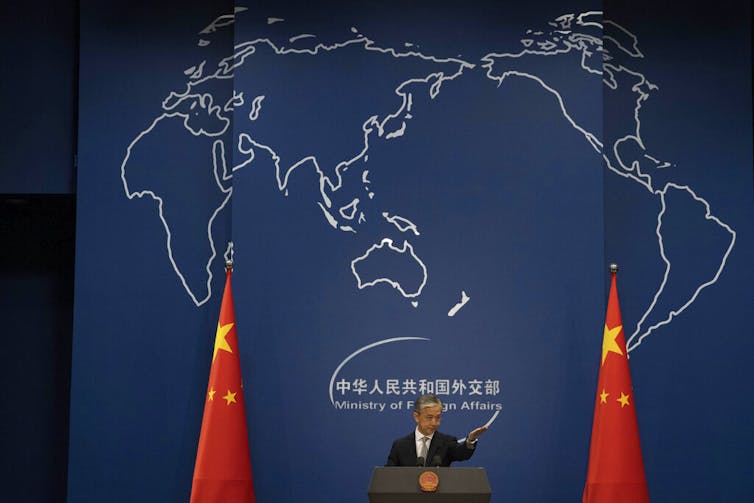
At a time when Vladimir Putin needs friends in his neighbourhood, he appears instead to be losing them in the South Caucasus. After two centuries of Russian involvement in the region, balancing the historical rivalry and at times acting as mediator between Armenia and Azerbaijan, there is growing speculation that the two countries are preparing a major reset in relations.
When Armenia’s prime minister, Nikol Pashinyan, met the Azerbaijani president, Ilham Aliyev, in Abu Dhabi on July 10, they reportedly came close to agreeing a peace treaty. The big question is whether, if these two countries can iron out mistrust and violence born of the territorial conflict, there will still be a role for Russia in the South Caucasus.
To understand the complex geopolitics of the region, you need to go back to the early 19th century, when Azerbaijan and what is now the Republic of Armenia) were ceded to Russia following the Russo-Persian wars. After the Russian revolution, the two countries achieved brief independence between 1918 and 1920 (though not in their present borders) before being incorporated into the Soviet Union.
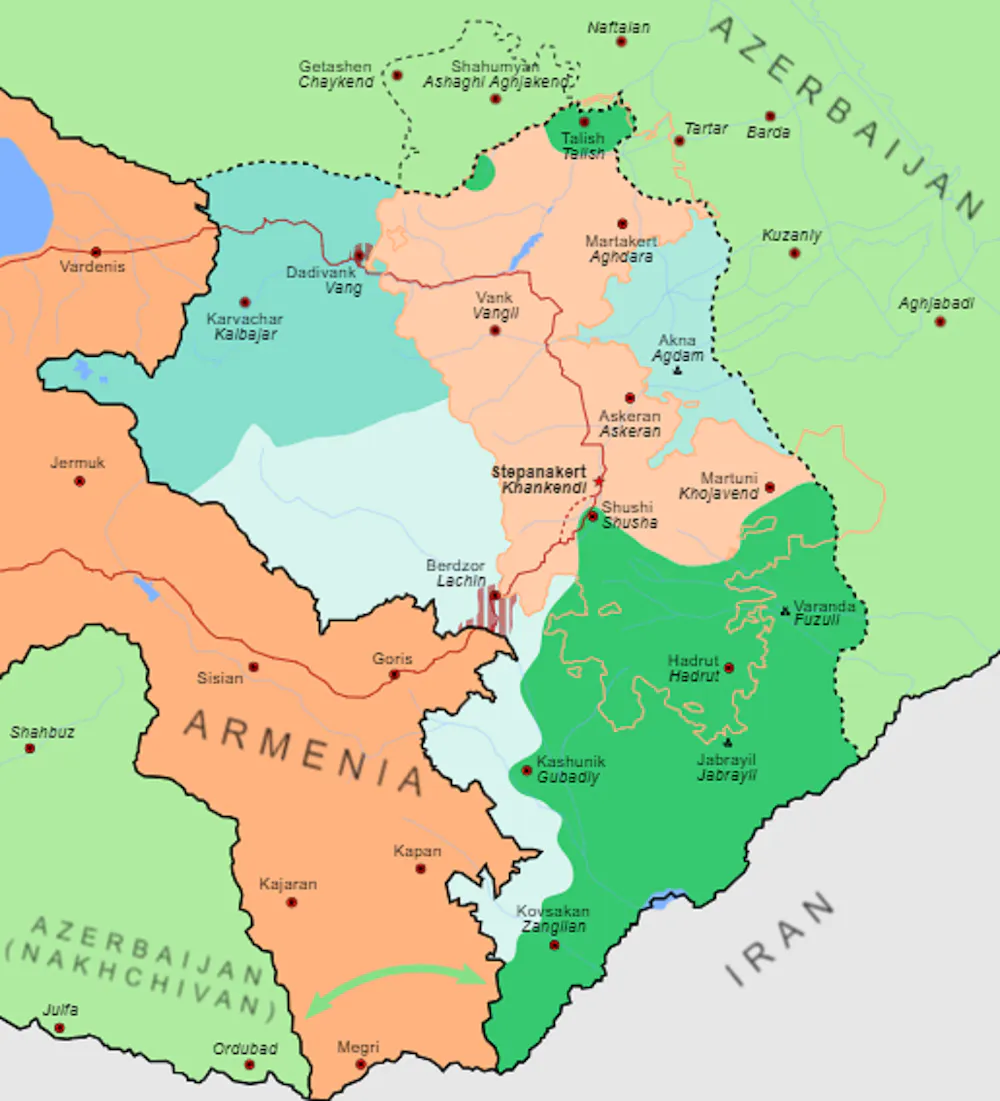
During the Soviet era, the union republics of Armenia and Azerbaijan both felt that Moscow favoured the other. Armenia was unhappy that the Soviet leadership allocated Nagorno-Karabakh, a majority-Armenian exclave surrounded by Azeri-populated lands, to Azerbaijan. Azerbaijan was dissatisfied that its borders denied it a land connection to its population in Nakhchivan, an exclave of ethnic Azeris that could only be reached via southern Armenia.
In the final years of the Soviet Union, as Armenian nationalism began to assert itself during the period of perestroika (restructuring), Nagorno-Karabakh’s legislature passed a law declaring its intention to join Armenia. This move eventually led to armed clashes in the region.
The first Karabakh war, which raged between 1988 and 1994, began before the Soviet break-up but continued after the two countries gained their independence. In 1994, after more than 30,000 casualties, Russia brokered a ceasefire. The settlement favoured Armenia, leaving it in control of Nagorno-Karabakh and another six surrounding Azerbaijani districts.
Things began to change when Putin took power in Russia in 2000. Russia’s relations with Azerbaijan improved, partly due to his personal rapport with the then-president, Heydar Aliyev, and his son Ilham, who would succeed him in 2003. After 9/11, when combating international terrorism became a global priority, Azerbaijan put measures in place to prevent transfer of fighters and weapons through its territory to the war in Chechnya, which further improved relations with Moscow.
At this stage, Azerbaijan was pursuing what it described as a “multi-vector” foreign policy. This allowed it to develop ties with a variety of countries, including the US, Russia and others to whom it sold oil. While remaining in the Commonwealth of Independent States, it did not sign up to the Russia-led Collective Security Treaty Organisation (CSTO).
Nagorno-Karabakh
Armenia, by contrast, was a fully participating member of the CSTO. Having signed an Eternal Friendship Treaty with Russia in 1997, this was a clear strategic choice for Armenia – partly motivated by historical ties.
Russia had traditionally been seen as a defender of Christianity in the days of the Ottomon empire. Many people had fled massacres in Western Armenia (modern-day Turkey) in 1915 to come under the protection of the Russian Tsar. But Armenia also saw Moscow as a vital security guarantor against an increasingly militarised Azerbaijan, which was determined to recover control of Nagorno-Karabakh and other areas occupied by Armenia.
Map showing the concept of the ‘Zanzegur corridor’, which would cut across southernmost Armenia to connect Azerbaijan with Nakhchivan. Mapeh/Wikimedia Commons, CC BY-NC
Indeed, it was Nagorno-Karabakh which really soured relations between Armenia and Moscow. In 2020, when – aided by Turkey – Azerbaijan launched its offensive to retake the territory, Russia failed to come to the aid of its CSTO ally. This was expected, given that relations had begun to deteriorate in 2018 when Pashinyan came to power in Armenia.
In hindsight, most commentators believe Russia had become tired of Armenia’s intransigence over the plan, agreed in Madrid in 2007, for it to cede back the six districts surrounding Nagorno-Karabakh to Azerbaijan.
Instead, Moscow brokered a ceasefire agreement and deployed 2,000 peacekeepers along the Lachin corridor, a strip of land connecting Armenia and Nagorno-Karabakh. But these troops also failed to intervene when an Azeri offensive retook the whole of Nagorno-Karabakh in September 2023, forcing the population of about 100,000 ethnic Armenians to flee.
Relations between Russia and Azerbaijan, meanwhile, have gone downhill rapidly. In December 2024, an Azeri civilian airliner was shot down in Russian airspace. Putin apologised, but Azerbaijan insisted on Moscow disclosing the results of the investigation and paying compensation to the victims.
Things got worse at the end of June, when Russian authorities arrested a group of ethnic Azerbaijanis as part of a decades-old murder case. Two of the men died while being detained. Azerbaijan retaliated by raiding the Baku offices of Russia’s Sputnik news agency and detaining the staff as well as a group of Russian IT workers. When they appeared in court, some of the men appeared to have been beaten in custody.
Azerbaijan also denounced Russia in state media and Russia House, the state-funded Russian cultural agency in Baku, was closed down, with several cultural events cancelled. Security agencies began to enforce documentation checks on all Russian nationals in the country.
At the same time, Azerbaijan and Armenia were already talking about concluding a peace treaty independently, without intermediaries. All this has prompted speculation of a serious loss of influence in the region for Moscow.
However, a complete shutout of Russia in the South Caucasus is unlikely. Both Armenia and Azerbaijan depend on remittance income from their nationals in Russia. Both countries also remain close trading partners with Russia. While Armenia suspended its membership in CSTO, it has not quit the organisation altogether.
Far more likely is that the two countries, mindful of the growing influence of Turkey in the region and the shifts created by Donald Trump in world affairs, are manoeuvring while weighing their options. Geography matters, as Georgia’s example demonstrates – efforts to cut ties with Russia by its former president, Mikheil Saakashvili, have been partially reversed by the current government, which increasingly leans towards Moscow.
In the cases of Armenia and Azerbaijan, economic ties, transport links and human connections still favour a relationship with Russia. So, a temporary breakdown in political relations can be mended – if all three leaders demonstrate enough statesmanship to sail through the troubled waters.
Get your news from actual experts, straight to your inbox.Sign up to our daily newsletter to receive all The Conversation UK’s latest coverage of news and research, from politics and business to the arts and sciences.
Anna Matveeva does not work for, consult, own shares in or receive funding from any company or organisation that would benefit from this article, and has disclosed no relevant affiliations beyond their academic appointment.
Cuba doesn’t have any beggars, according to the country’s minister of labour, Marta Elena Feitó Cabrera. In a speech to the national assembly on July 15, she denied the existence of destitution in the communist country, claiming the problem was actually people “disguised as beggars”.
Her words were greeted by public outcry on social media. They also prompted a swift rebuke from her peers and the president, Miguel Díaz-Canel, who said leadership could not “act with condescension”. The next day, the Cuban government published an official note saying Feitó Cabrera had resigned.
The political vulnerability of the Cuban government explains the urgent need to respond to missteps such as Feitó Cabrera’s. The country is enduring an acute economic crisis, which has seen living standards plummet and over 1 million Cubans leave the country since 2020.
Cubans are leaving en masse:
A severe economic crisis in Cuba has prompted a mass exodus from the island. Oficina Nacional de Estadísticas e Información
The recession has severely strained the system of social protection that the government points to as one of its main achievements since taking power more than 60 years ago. Despite food subsidies and the efforts of welfare services, a growing number of people are now going hungry.
Public confidence in the government has been severely weakened as a result, particularly among young Cubans. The risk of escalating popular protest is magnified by the proliferation of social media channels, emanating from inside and outside the country.
These channels air the many complaints about daily frustrations in Cuba and highlight any failings or signs of hypocrisy on the part of officials. So when Feitó Cabrera’s speech went viral, it was met with inevitable public outrage.
Díaz-Canel’s reaction can be seen as urgent damage limitation. But it is also consistent with his broader approach to managing the crisis facing his country. He has worked tirelessly to try and defuse anger through engagement, touring Cuba for local meetings to search for solutions.
In his comments after Feitó Cabrera’s speech, he insisted that officials should acknowledge the scale of hardship being suffered, and “help, support and show solidarity” with the disadvantaged and most vulnerable.
This need to reach out was all the more important given the grim tone of the national assembly meeting where Feitó Cabrera made her remarks. Ministers appeared one after the other to present dismal reports on the state of almost all sectors of the Cuban economy.
The electricity system remains plagued by breakdowns caused by chronic underinvestment as well as difficulties in obtaining fuel and spare parts. The resulting daily power outages ensure that the sense of crisis is ever-present and frustrate all efforts to boost production.
Doubting official data
While full official national income data for 2024 has not yet been released, Cuba’s economy ministry estimates that real national income contracted by 1.1% in 2024. This leaves it more than 10% below its pre-pandemic level, and 2025 is not expected to show much improvement.
The decline in real disposable income for Cuban households since 2021 has, in reality, been far greater. The official inflation rate indicates that consumer prices have risen fourfold over the past five years. At this rate, living costs would have increased broadly in line with salaries.
Consumer prices have risen fourfold since 2020:
Official inflation data for Cuba. The spike in early 2021 was the result of a monetary reform, which involved a big jump in wages in December 2020 followed by a currency reform in January 2021. Oficina Nacional de Estadísticas e Información
But official figures systematically understate the actual increase in prices faced by Cuban households, due to the weightings used. In 2021, for example, research estimated the inflation rate to be between 174% and 700% – well above the government’s estimate (77.3%).
The rising market prices have put many essential goods beyond the reach of most people who depend on state incomes. This has forced many households to depend on remittances or the informal economy to survive.
Thanks to tight fiscal restraint, the official annual rate of inflation eased to 15% in June. But the wide gap between the increase in the actual cost of living and official inflation index continues to compound distrust of the government and the perception that the country’s leaders are out of touch.
A lack of transparency and long delays in the publication of economic data, together with restrictions on the scope for private enterprise, are widely attributed to the government’s incompetence and reluctance to enact liberalising reforms.
Recovery blocked by US sanctions
For these reasons, the government’s insistence that US sanctions are to blame for limiting the possibilities for economic recovery is increasingly regarded with scepticism. However, the constraint on economic growth imposed by US measures is real and severe.
It is also the deliberate aim of US policy. The unilateral sanctions not only block trade, as well as financial and international travel between the US and Cuba. They also severely hamper all kinds of transactions between Cuba and the rest of the world.
Every branch of the Cuban economy has been affected, including the health service, social safety nets, agriculture and industry. And the lack of hard currency has, in turn, limited the scope for the investments and reforms needed for economic recovery.
The easing inflation rate, together with some new investments in renewable energy, an improved fiscal balance and a recent small increase in pensions, may signal that the end of the economic downturn may be approaching. But neither the government nor the population have any confidence that the crisis will come to an end this year.
No one is expecting US sanctions to be lifted while Donald Trump is president. Before Trump first stood for the presidency he hadn’t given Cuba his attention, but as president he has aligned himself firmly with hardliners.
In his first term, Trump reversed the opening with Cuba initiated by Barack Obama. And his current secretary of state, Marco Rubio, is one of the architects and leading proponents of economic sanctions against Cuba. Trade and investment will thus remain depressed, while shortages, power cuts, a lack of transport and crumbling public services will persist.
But by demanding the resignation of the minister of labour, perhaps Díaz-Canel hopes to demonstrate that his government understands what that the economic asphyxiation means for a majority of Cubans struggling to survive.
Get your news from actual experts, straight to your inbox.Sign up to our daily newsletter to receive all The Conversation UK’s latest coverage of news and research, from politics and business to the arts and sciences.
Emily Morris does not work for, consult, own shares in or receive funding from any company or organisation that would benefit from this article, and has disclosed no relevant affiliations beyond their academic appointment.
The retirement age keeps creeping up. In the UK, the state pension is currently paid to people at 66, but that’s set to rise to 67 in the next couple of years, and a move to 68 might come sooner than previously planned after the government launched a review.
Gradually increasing the working lifespan is never going to be popular. But one way of making this policy more palatable could be to give people early access to some of the free time that retirement promises.
After all, sometimes that promise fails to deliver, because many people die before they reach retirement age.
Globally, about 27% of men and 18% women die before the age of 65 (although this proportion also includes deaths before working age). In wealthy countries, the number of people who die prematurely is lower than the global average, but still significant. In the EU, 16% of men and 8% of women die before 65.
For these people, the promise of free time and leisure in old age never materialises. There will also be many whose physical and mental health will have deteriorated by the time they retire, so that they are less capable of enjoying their free time.
So perhaps slogging away until retirement is not an ideal arrangement.
But what if you could transfer some of the time off that retirement promises to an earlier stage of your life, when everything is a rush, crammed with the demands of work and domestic responsibilities?
Luckily, the stark contrast between a time-poor middle age and a time-rich old age is not unavoidable. Governments can choose different approaches that directly affect how free time is distributed across our life stages.
Japan, for example, is a country which has opted to focus on delaying leisure time, and encourages workers to postpone that enjoyment of free time until old age. It does this in part by rewarding workers with wage increases – known as “seniority-based pay” – if they don’t take career breaks.
Japanese employment law also permits companies to force employees to retire at the age 60. As a result, on average, Japanese workers work 1,680 hours per year and retire at 63.
In the Netherlands by contrast, people work less (1,433 hours per year) and retire later – at 67. Labour laws make it easier for employees to decrease their hours, by going part time, for example.
Discrimination between workers based on work hours is prohibited, so that those who opt for part-time work are guaranteed equal treatment with regard to wages and other benefits. But the high legal age of retirement discourages Dutch workers from early retirement.
So how should we assess these different approaches?
Time on your side?
One way to look at retirement is that it compensates us for our previous hard work. The prospect of compensation might lead us to adopt a relaxed attitude toward long work hours. Once we’ve stopped work, we’ll be rewarded with a large chunk of leisure.
But for those who don’t make it to retirement, this promise of a life of leisure turns out to be a cruel joke. Early deaths are also more prominent among those who have already suffered from poverty and other disadvantages.
The same is true for ill health. The disadvantaged are much more likely to suffer from a variety of conditions that prevent them from being able to fully enjoy retirement.
Another risk for those who are healthy when they retire is that relatives or friends may have died. This reduces the value of the retirees’ free time because the loved ones they hoped to share that time with are no longer around.
So perhaps some of that free time could be better used when workers are younger. Raising a family, for example, is extremely time consuming, and there can’t be many parents of young children who don’t wish for a few extra hours a week to call their own.
Even devoting time to hobbies when we’re younger might be considered more efficient than waiting until we have retired. After all, if you learn a new language or how to paint when you’re in your 40s, you may have much more time to enjoy your new skill over the ensuing decades.
My research suggests that for all these reasons, the state should help people take some of their retirement early.
None of us knows how long we will live, or how healthy we will be in the future. Faced with this uncertainty, it makes sense not to gamble with our opportunities for free time and leave it until it may be too late.
Even those who enjoy their work have strong reasons not to postpone a large proportion of their time off, and governments should help us access more of it while we’re younger.
Get your news from actual experts, straight to your inbox.Sign up to our daily newsletter to receive all The Conversation UK’s latest coverage of news and research, from politics and business to the arts and sciences.
Malte Jauch does not work for, consult, own shares in or receive funding from any company or organisation that would benefit from this article, and has disclosed no relevant affiliations beyond their academic appointment.
I have spent the past two years examining the living conditions in informal refugee camps along the northern coast of France as part of an ongoing research project on borders. These sites are where people gather before attempting to cross the Channel to the UK.
The UK government recently announced a returns agreement to discourage people from making the crossing and economic sanctions
against people smugglers, following an increase in funding for border control and a decision to use counter-terrorism tactics in an effort to “smash the gangs”.
But from what I have observed, such policies appear to do little to stop people from making the journey. Quite the opposite – the more police crack down, the more the smuggling networks take risks to get around difficulties.
My fieldwork has been primarily conducted through volunteer work with Salam, a grassroots organisation that provides hot meals and clothing to the main informal camps in Calais and Dunkirk. I have also collaborated with other groups such as Alors on Aide and Opal Exil.
In the past few years, smuggling networks have adjusted their tactics to evade police. While smugglers used to inflate boats on the beaches between Calais and Dunkirk, they are now mostly using “taxi boats”. These leave further north or south on the coast, as far as Le Touquet. They then pick up groups of refugees waiting in the water along the coast, avoiding police intervention.
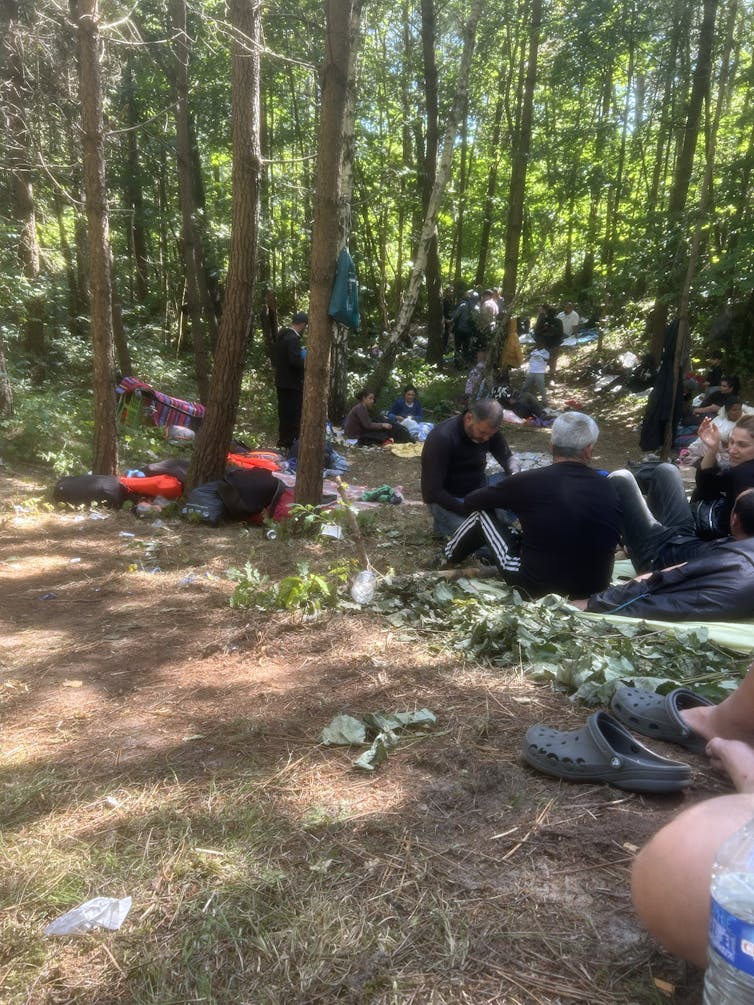
A microcamp in Ecault Forest. Sophie Watt
In response, and in order to intensify the crossings, “microcamps” have emerged – smaller temporary settlements closer to the beach, along the coast between Hardelot and Calais. These microcamps act as connecting points between the larger camps and the coastal departure locations where taxi boats pick them up. They allow for people to make several attempts at crossing without having to return to the large camps, where living conditions are more difficult.
The larger camps (such as Loon Plage and Calais) are the epicentre of the smuggling operations. The camps are evicted at least once a week (every 24 hours in Calais) due to France’s official “zero fixation point” policy. This policy, which bars people from forming long-term settlements, was implemented after the dismantling of the Calais “Jungle” refugee camp in October 2016.
Camp conditions
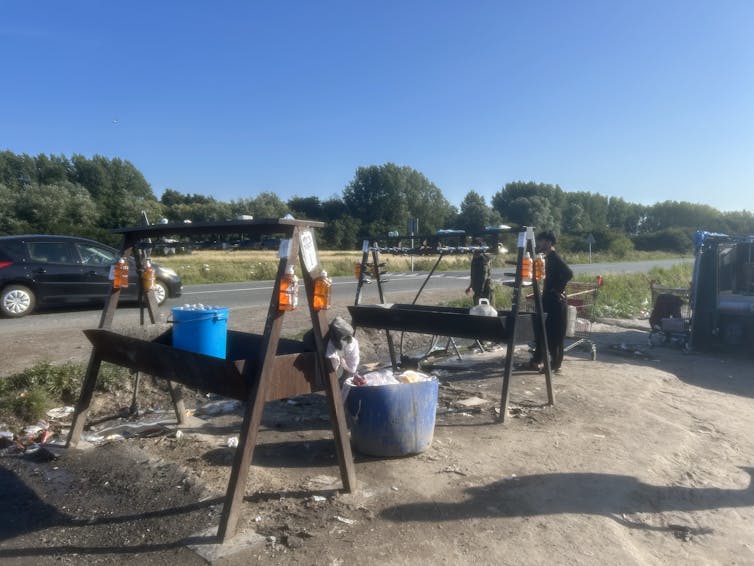
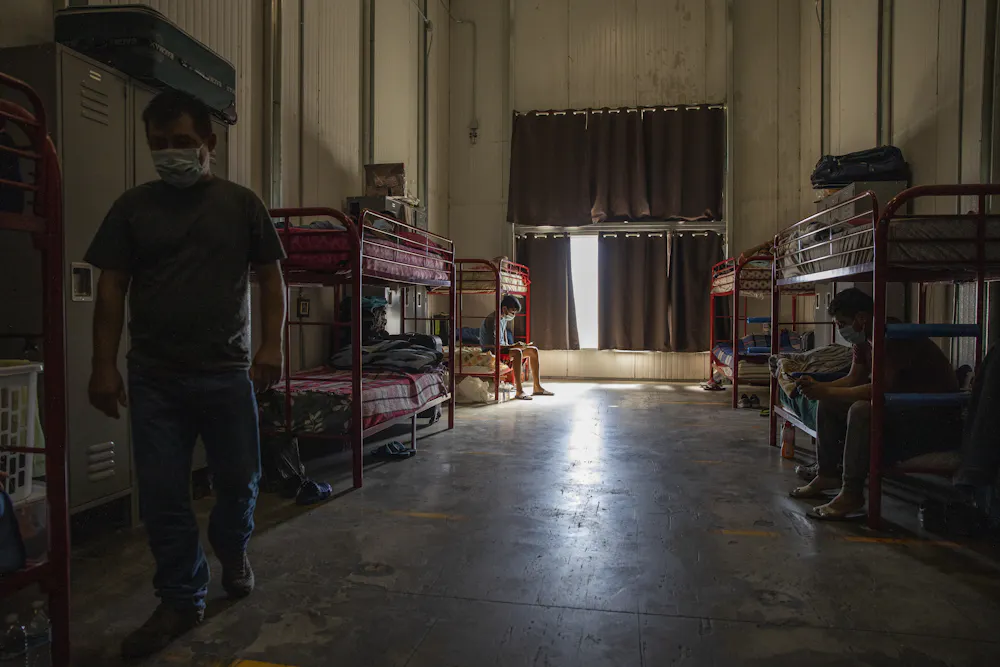
Police efforts to uphold the zero fixation point policy entail frequent evacuations, restrictions of humanitarian aid and physical site disruption. At Loon Plage, I saw that the sole access to water is a livestock trough.
Official guidance from the UN’s refugee agency states that, irrespective of the informality of these camps, their residents should have access to water, sanitation and shelter.
Access to water is limited to troughs. Sophie Watt
The non-profit watchdog group Human Rights Observers has documented instances of police violence and seizures of people’s belongings and tents at the camps.
In addition to regular evictions of the larger camps, the microcamps have recently seen more brutal police action. There have been reports of police using teargas, puncturing life jackets and tents, contributing to untenable living conditions. Violence and shootings between smuggling groups have also been reported in Loon Plage camp.
While working with Alors On Aide and photographer Laurent Prum we met around 50 people, including seven children (ages one-17), in a microcamp on the edge of the Ecault forest near Boulogne-sur-Mer. We immediately noted a tension between the group and the gendarmes who were standing watch.
Most of this group had spent a few years in Germany before being refused asylum. They told me they felt they had been forced to come back to France, because of the deportation measures currently being implemented by the German government.
A few confided that this was their fifth and final try at crossing the Channel. This is a new tactic the smuggling organisations use to make more money more rapidly: while refugees used to be able to try as many times as they needed, they now have to pay again after five failed attempts.
The previous day, this group told us they had been chased out of another part of the forest. There, we had found several empty canisters of tear gas – consistent with reports that French police have deployed tear gas in operations against informal camps.
This group had wanted to stay there because they could use a dilapidated shed to shelter themselves and their children from the rain. Eventually, the gendarmes evicted them, forcing them to spend the night in the rain – the field in question was privately owned. Following the eviction, we witnessed that the landowner had covered the area with manure to stop them returning.
A young Sudanese man showed us videos of the altercation. The exchange, during which five people were arrested, was violent. The children were terrified and the video showed the gendarmes using teargas against the group. A Palestinian mother was arrested and taken into custody, forced to leave her two young daughters. Her husband asked me: “Why did they arrest her when they could see she had two children with her?”
Alors on Aide mobilised several of its members to bring clothes, blankets and food for the group, and got the Palestinian woman released from custody, as she had not been charged with any offence.
While living conditions in camps and the capacity of the French asylum system make staying in France difficult, police are also taking firmer action against boats attempting the crossing.
As part of a coastal patrol (helping refugees after a failed crossing attempt), we arrived on the beach in Équihen at around 7am on July 4 to find that French police had just punctured a boat in the water.
The UK government praised French police for this action, performed in front of international media. The UK and France have also discussed allowing coastguards to intercept taxi boats up to 300 metres off the coast.
This would be a marked change from current regulations, which prohibit French police from intervening offshore except when responding to passengers in distress. Even the border police have doubts about the legal basis for this measure and its practical implications at sea, particularly given the heightened risk of accident.
Trapped between hounding by police on the beaches and constant evacuations from the informal settlements, the refugees have no choice but to try to cross the Channel at any cost. A record number of 89 refugees died at the Franco-British border in 2024. Thirteen deaths at sea have already been recorded in 2025.
In my view, the recently announced French-British measures to intensify policing and border enforcement are unlikely to deter people from attempting dangerous crossings. Instead, they will create an incentive for more dangerous tactics by smugglers, putting more lives at risk and violating human rights. Any agreement to return asylum seekers, restrict their access to asylum or force people back across borders will exacerbate the dangers already experienced by those seeking refuge.
Sophie Watt receives funding from the University of Sheffield and the British Academy / Leverhulme Small Research Grants.
I have spent the past two years examining the living conditions in informal refugee camps along the northern coast of France as part of an ongoing research project on borders. These sites are where people gather before attempting to cross the Channel to the UK.
The UK government recently announced a returns agreement to discourage people from making the crossing and economic sanctions
against people smugglers, following an increase in funding for border control and a decision to use counter-terrorism tactics in an effort to “smash the gangs”.
But from what I have observed, such policies appear to do little to stop people from making the journey. Quite the opposite – the more police crack down, the more the smuggling networks take risks to get around difficulties.
My fieldwork has been primarily conducted through volunteer work with Salam, a grassroots organisation that provides hot meals and clothing to the main informal camps in Calais and Dunkirk. I have also collaborated with other groups such as Alors on Aide and Opal Exil.
In the past few years, smuggling networks have adjusted their tactics to evade police. While smugglers used to inflate boats on the beaches between Calais and Dunkirk, they are now mostly using “taxi boats”. These leave further north or south on the coast, as far as Le Touquet. They then pick up groups of refugees waiting in the water along the coast, avoiding police intervention.
A microcamp in Ecault Forest. Sophie Watt
In response, and in order to intensify the crossings, “microcamps” have emerged – smaller temporary settlements closer to the beach, along the coast between Hardelot and Calais. These microcamps act as connecting points between the larger camps and the coastal departure locations where taxi boats pick them up. They allow for people to make several attempts at crossing without having to return to the large camps, where living conditions are more difficult.
The larger camps (such as Loon Plage and Calais) are the epicentre of the smuggling operations. The camps are evicted at least once a week (every 24 hours in Calais) due to France’s official “zero fixation point” policy. This policy, which bars people from forming long-term settlements, was implemented after the dismantling of the Calais “Jungle” refugee camp in October 2016.
Camp conditions
Police efforts to uphold the zero fixation point policy entail frequent evacuations, restrictions of humanitarian aid and physical site disruption. At Loon Plage, I saw that the sole access to water is a livestock trough.
Official guidance from the UN’s refugee agency states that, irrespective of the informality of these camps, their residents should have access to water, sanitation and shelter.
Access to water is limited to troughs. Sophie Watt
The non-profit watchdog group Human Rights Observers has documented instances of police violence and seizures of people’s belongings and tents at the camps.
In addition to regular evictions of the larger camps, the microcamps have recently seen more brutal police action. There have been reports of police using teargas, puncturing life jackets and tents, contributing to untenable living conditions. Violence and shootings between smuggling groups have also been reported in Loon Plage camp.
While working with Alors On Aide and photographer Laurent Prum we met around 50 people, including seven children (ages one-17), in a microcamp on the edge of the Ecault forest near Boulogne-sur-Mer. We immediately noted a tension between the group and the gendarmes who were standing watch.
Most of this group had spent a few years in Germany before being refused asylum. They told me they felt they had been forced to come back to France, because of the deportation measures currently being implemented by the German government.
A few confided that this was their fifth and final try at crossing the Channel. This is a new tactic the smuggling organisations use to make more money more rapidly: while refugees used to be able to try as many times as they needed, they now have to pay again after five failed attempts.
The previous day, this group told us they had been chased out of another part of the forest. There, we had found several empty canisters of tear gas – consistent with reports that French police have deployed tear gas in operations against informal camps.
This group had wanted to stay there because they could use a dilapidated shed to shelter themselves and their children from the rain. Eventually, the gendarmes evicted them, forcing them to spend the night in the rain – the field in question was privately owned. Following the eviction, we witnessed that the landowner had covered the area with manure to stop them returning.
A young Sudanese man showed us videos of the altercation. The exchange, during which five people were arrested, was violent. The children were terrified and the video showed the gendarmes using teargas against the group. A Palestinian mother was arrested and taken into custody, forced to leave her two young daughters. Her husband asked me: “Why did they arrest her when they could see she had two children with her?”
Alors on Aide mobilised several of its members to bring clothes, blankets and food for the group, and got the Palestinian woman released from custody, as she had not been charged with any offence.
While living conditions in camps and the capacity of the French asylum system make staying in France difficult, police are also taking firmer action against boats attempting the crossing.
As part of a coastal patrol (helping refugees after a failed crossing attempt), we arrived on the beach in Équihen at around 7am on July 4 to find that French police had just punctured a boat in the water.
The UK government praised French police for this action, performed in front of international media. The UK and France have also discussed allowing coastguards to intercept taxi boats up to 300 metres off the coast.
This would be a marked change from current regulations, which prohibit French police from intervening offshore except when responding to passengers in distress. Even the border police have doubts about the legal basis for this measure and its practical implications at sea, particularly given the heightened risk of accident.
Trapped between hounding by police on the beaches and constant evacuations from the informal settlements, the refugees have no choice but to try to cross the Channel at any cost. A record number of 89 refugees died at the Franco-British border in 2024. Thirteen deaths at sea have already been recorded in 2025.
In my view, the recently announced French-British measures to intensify policing and border enforcement are unlikely to deter people from attempting dangerous crossings. Instead, they will create an incentive for more dangerous tactics by smugglers, putting more lives at risk and violating human rights. Any agreement to return asylum seekers, restrict their access to asylum or force people back across borders will exacerbate the dangers already experienced by those seeking refuge.
Sophie Watt receives funding from the University of Sheffield and the British Academy / Leverhulme Small Research Grants.
When we look at how people vote in elections and why they choose certain parties, analysis often focuses on age, education, location or socioeconomic status. Less discussed in Britain is religion. But close to two-thirds of its adults are still religious – expressing either a religious identity, holding religious beliefs, or taking part in religious activities.
For the one-in-three adults in Britain who are Christian, this identity remains an important influence on their political behaviour. New polling, published here for the first time, shows how Reform UK is disrupting our previous understanding of how Christians vote in British elections.
Want more politics coverage from academic experts? Every week, we bring you informed analysis of developments in government and fact check the claims being made.
The relationship between Britain’s Christian communities and the major political parties goes back centuries. The Conservative party has been very close to English Anglicanism since its emergence in the mid-19th century. Catholics and free-church Protestants (such as Baptists and Methodists) have tended towards the Labour and Liberal/Liberal Democrat parties. Even as Britain has become more secular, these relationships have persisted.
Anglicans, for example, have tended to vote Conservative even when the party was in dire straits. In the 2024 election, 39% of Anglicans voted Tory even as the party’s national vote share fell to 24%.
Since the 1980s and particularly in elections since 2015, however, we have started to see changes to the Christian vote. The traditional Catholic attachment to Labour has deteriorated, as has Labour’s appeal to other Christian communities such as Baptists, Methodists and Presbyterians.
Instead, driven by the rising salience of social values (attitudes towards immigration, social change and national identity) as a determinant of political support, the socially conservative leanings of some Christians of all stripes has led to increased support for the Conservatives. And those who traditionally did so – the Anglicans – have become even more supportive. The result has been a steady coalescing of the Christian vote behind the Conservatives.
But now, new polling by YouGov (on June 23-24 2025) for the University of Exeter reveals that this realignment is being disrupted by the growing popularity of Reform UK.
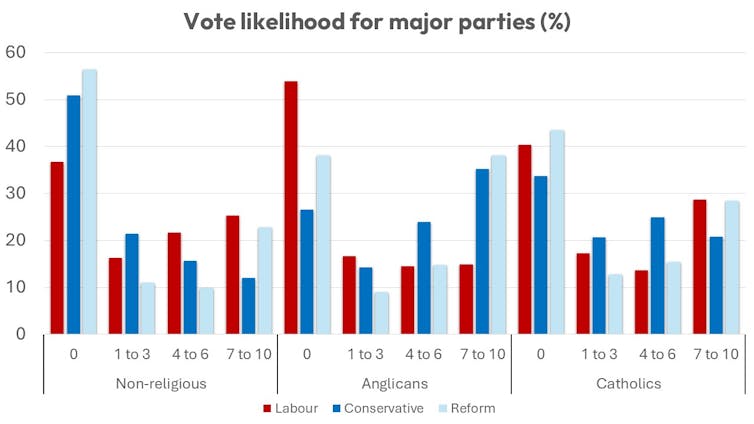
Instead of asking who people would vote for tomorrow, a nationally representative sample of 2,284 adults was asked how likely they were to ever vote for each major party, on a scale from zero (very unlikely) to ten (very likely).
While not the same as a direct question about how someone would vote in an election, the likelihood question provides a much richer measure of the strength of their support for all of the major parties.
Stuart Fox, data by YouGov for the University of Exeter
Among Anglicans, Labour remains deeply unpopular: over half gave the party a 0. In contrast, the Conservatives still enjoy strong support among Anglicans, with 35% giving them a vote likelihood of seven or higher – the kind of support associated with voting for the party in an election.
Reform, however, has caught up. Despite only 15% of Anglicans voting Reform in 2024, 38% now rate their likelihood of voting for the party as high. That’s the same as the proportion who are strongly opposed to Reform – showing that while the party polarises Anglicans more than the Conservatives, Reform could win as much Anglican support as the Tories in an election.
Catholics show a similar trend. Labour’s traditional support is eroding: 40% of Catholics said they had zero likelihood of voting Labour, while 29% are strong supporters. As with Conservatives for the Anglican vote, Reform is almost level-pegging with Labour for the Catholic vote at 28%. It has even supplanted the Conservatives, of whom 22% of Catholics are strong supporters.
It is not yet clear why this is happening. The distinction of Christian (and non-Christian) voting patterns is not an artefact of age – there are manystudies that prove this is the case.
It may be that Reform’s stances on issues such as immigration resonate with Christians’ concerns to the extent that they are willing to set aside their historic party loyalties. Or it may be that Christians are as prone as other British voters to turn to Reform out of frustration with the performances of Labour and the Conservatives in office.
Swing voters and party competition
This data also shows the extent to which voters’ support for parties overlaps or is exclusive. In other words, which voters have a high vote likelihood for only one party (and so are likely committed to backing that party in an election), which do not have such high likelihoods for any party (and so will probably not vote at all), and which have similarly high likelihoods for more than one party (effectively swing voters, persuadable one way or the other).
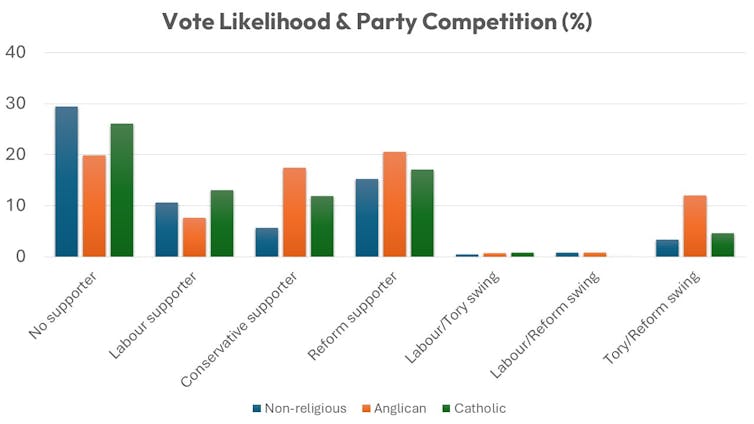
Among the religiously unaffiliated, 29% aren’t strong supporters of any party. For Catholics, it’s 26%. Anglicans are more politically anchored, however, with only 20% in this category.
While traditionally, we would have expected this to reflect Anglicans’ greater tendency to support the Tories, only 17% of Anglicans are strong supporters of only that party, compared with 21% who are firmly behind Reform. These aren’t swing voters; they’ve switched sides.
A further 12% of Anglicans have high vote likelihoods for both the Tories and Reform. These are swing voters that the two parties could realistically expect to win over.
Stuart Fox, data by YouGov for the University of Exeter
Catholics are even more fragmented. Only 13% are strong supporters of Labour alone, along with 12% and 17% who are strong supporters of the Conservatives and Reform alone, respectively.
Few Catholics are torn between Labour and the other parties, but 5% are swing voters between the Conservatives and Reform: the Tories’ gradual winning over of Catholics over the last 50 years is also being challenged by the appeal of Reform.
The party has provided a socially conservative alternative to the Conservatives, with the result that the Christian vote has become more fragmented. The Tories are no longer the main beneficiaries of Labour’s loss of its traditional Catholic vote.
In addition, Reform is as popular as the Conservatives among Anglicans, and as popular as Labour among Catholics. This suggests it is appealing across the traditional denominational divide more successfully than either of the major parties.
If there is to be a single party that attracts the bulk of Britain’s Christian support, at this point it is far more likely to be Reform than anyone else.
This article was based on analysis by Dr Stuart Fox (University of Exeter), Dr Ekaterina Kolpinskaya (University of Exeter), Dr Steven Pickering (University of Amsterdam) and Prof Dan Stevens (University of Exeter), connected to the research project Investigating the individual and contextual role of religion in British electoral politics, funded by the Economic and Social Research Council. Stuart Fox also receives funding from the British Academy.
“We’re actually facing, in many parts of our country, nothing short of societal collapse.” This was the dire warning from Reform UK leader Nigel Farage, in setting out his party’s goal of halving crime.
In an op-ed in the Daily Mail and a press conference, Farage framed Britain as a nation in crisis from rising crime and lawlessness. But, he said, Reform had the solution: mass deportation of foreign offenders, the construction of prefabricated “Nightingale” prisons, and a wholesale crackdown on offending.
He insisted that British streets were out of control (although recent rises in crime come mainly from online fraud and shoplifting, according to the latest data), pledged to simultaneously increase prison sentences and reduce overcrowding, and vowed to restore order with a “higher and physically tougher standard of police officer”.
Speaking after a weekend of violent anti-immigration protests in Epping, Farage also tied Britain’s supposed lawlessness to migration: “Many break the law just by entering the UK, then commit further crimes once here – disrespecting our laws, culture and civility. The only acceptable response is deportation.”
Invoking crime as a threat, and the politician as its solution, is a tried-and-tested political manoeuvre. We’ve seen it deployed from both left and right, in many parts of the world, for decades. Stuart Hall and colleagues famously examined this phenomenon in the 1970s in their seminal book Policing the Crisis.
Our own analysis suggests that the accuracy of crime statistics often matters less than how politicians frame public anxieties – through media, public rhetoric and policy initiatives. In short: the public often responds to emotion as much as evidence.
One tension in England and Wales is that there are two major sources of crime data. The first – on which Farage leans heavily – is police-recorded crime. But, as is widely understood, that data provides only a partial picture of the true extent of crime. Many people, especially those from marginalised or vulnerable groups, choose not to report their experiences of crime.
Moreover, the consistency and accuracy with which police forces record these offences has been questioned over time. Indeed, police-recorded crime statistics are not designated as official national statistics.
The other (and more robust) source is the Crime Survey for England and Wales (CSEW), which asks a representative sample of the public about their experiences of crime over the past 12 months. Notably, it includes those incidents that were not reported to the police.
Running since the early 1980s, the CSEW has demonstrated long-term declines in incidents of theft, criminal damage and violence (with or without injury) since the mid-to-late 1990s. Curiously, Farage told reporters that the CSEW was “based on completely false data”, without providing any evidence.
The Office for National Statistics (ONS), and most criminologists, regard the CSEW as the more accurate metric of long-term crime trends. (The Conversation asked the CSEW to comment but hadn’t received a response when this article was published.)
The political weight of crime
Crime has electoral value. It allows parties and political campaigners to project strength, decisiveness and control. Farage’s rhetoric is designed to provoke urgency and anxiety. It’s a well-worn script. Margaret Thatcher’s government leveraged fears of law and order. New Labour made “anti-social behaviour” a central point of focus at a time when crime was, in fact, falling.
In research conducted with colleagues, we examined how people’s fears about specific crimes are shaped not just by actual crime rates, or by the person’s age, gender or ethnicity, but also by the political context in which they grew up.
Using data from the CSEW and a method called age-period-cohort analysis, we explored how different “political generations” developed and retained distinct concerns about crime.
We found clear patterns. Those who grew up during the James Callaghan era in the mid-to-late 1970s – when politicians repeatedly warned of “muggings” – were more likely to report anxieties about street robbery over time.
Thatcher’s generation, who came of age during a sharp rise in property crime, were more likely than other groups to express long-term fears about burglary. And those who grew up under New Labour – during the height of the “anti-social behaviour” agenda – reported persistent concerns about neighbourhood disorder, even as recorded incidents declined.
In other words, the political rhetoric people are exposed to during their formative years leaves a lasting impression on their relationship to crime. Debates about crime become embedded in personal and generational memory.
Crime is real and victims suffer. But distorting its nature and prevalence can erode public trust in the institutions tasked with protecting us. It can foster punitive and ineffective policy responses. And it can leave whole communities feeling targeted, criminalised or unsafe, based on selective and often sensational narratives.
We absolutely need to talk about crime. But we also need to talk about how we talk about crime. Who frames the debate, which statistics are used, who and how many are left out of the official records, whose fears are being amplified, and who is looking to exploit crime?
Emily Gray has received funding from the Economic and Social Research Council.
Stephen Farrall has received funding from the Economic and Social Research Council.
When we look at how people vote in elections and why they choose certain parties, analysis often focuses on age, education, location or socioeconomic status. Less discussed in Britain is religion. But close to two-thirds of its adults are still religious – expressing either a religious identity, holding religious beliefs, or taking part in religious activities.
For the one-in-three adults in Britain who are Christian, this identity remains an important influence on their political behaviour. New polling, published here for the first time, shows how Reform UK is disrupting our previous understanding of how Christians vote in British elections.
Want more politics coverage from academic experts? Every week, we bring you informed analysis of developments in government and fact check the claims being made.
The relationship between Britain’s Christian communities and the major political parties goes back centuries. The Conservative party has been very close to English Anglicanism since its emergence in the mid-19th century. Catholics and free-church Protestants (such as Baptists and Methodists) have tended towards the Labour and Liberal/Liberal Democrat parties. Even as Britain has become more secular, these relationships have persisted.
Anglicans, for example, have tended to vote Conservative even when the party was in dire straits. In the 2024 election, 39% of Anglicans voted Tory even as the party’s national vote share fell to 24%.
Since the 1980s and particularly in elections since 2015, however, we have started to see changes to the Christian vote. The traditional Catholic attachment to Labour has deteriorated, as has Labour’s appeal to other Christian communities such as Baptists, Methodists and Presbyterians.
Instead, driven by the rising salience of social values (attitudes towards immigration, social change and national identity) as a determinant of political support, the socially conservative leanings of some Christians of all stripes has led to increased support for the Conservatives. And those who traditionally did so – the Anglicans – have become even more supportive. The result has been a steady coalescing of the Christian vote behind the Conservatives.
But now, new polling by YouGov (on June 23-24 2025) for the University of Exeter reveals that this realignment is being disrupted by the growing popularity of Reform UK.
Instead of asking who people would vote for tomorrow, a nationally representative sample of 2,284 adults was asked how likely they were to ever vote for each major party, on a scale from zero (very unlikely) to ten (very likely).
While not the same as a direct question about how someone would vote in an election, the likelihood question provides a much richer measure of the strength of their support for all of the major parties.
Stuart Fox, data by YouGov for the University of Exeter
Among Anglicans, Labour remains deeply unpopular: over half gave the party a 0. In contrast, the Conservatives still enjoy strong support among Anglicans, with 35% giving them a vote likelihood of seven or higher – the kind of support associated with voting for the party in an election.
Reform, however, has caught up. Despite only 15% of Anglicans voting Reform in 2024, 38% now rate their likelihood of voting for the party as high. That’s the same as the proportion who are strongly opposed to Reform – showing that while the party polarises Anglicans more than the Conservatives, Reform could win as much Anglican support as the Tories in an election.
Catholics show a similar trend. Labour’s traditional support is eroding: 40% of Catholics said they had zero likelihood of voting Labour, while 29% are strong supporters. As with Conservatives for the Anglican vote, Reform is almost level-pegging with Labour for the Catholic vote at 28%. It has even supplanted the Conservatives, of whom 22% of Catholics are strong supporters.
It is not yet clear why this is happening. The distinction of Christian (and non-Christian) voting patterns is not an artefact of age – there are manystudies that prove this is the case.
It may be that Reform’s stances on issues such as immigration resonate with Christians’ concerns to the extent that they are willing to set aside their historic party loyalties. Or it may be that Christians are as prone as other British voters to turn to Reform out of frustration with the performances of Labour and the Conservatives in office.
Swing voters and party competition
This data also shows the extent to which voters’ support for parties overlaps or is exclusive. In other words, which voters have a high vote likelihood for only one party (and so are likely committed to backing that party in an election), which do not have such high likelihoods for any party (and so will probably not vote at all), and which have similarly high likelihoods for more than one party (effectively swing voters, persuadable one way or the other).
Among the religiously unaffiliated, 29% aren’t strong supporters of any party. For Catholics, it’s 26%. Anglicans are more politically anchored, however, with only 20% in this category.
While traditionally, we would have expected this to reflect Anglicans’ greater tendency to support the Tories, only 17% of Anglicans are strong supporters of only that party, compared with 21% who are firmly behind Reform. These aren’t swing voters; they’ve switched sides.
A further 12% of Anglicans have high vote likelihoods for both the Tories and Reform. These are swing voters that the two parties could realistically expect to win over.
Stuart Fox, data by YouGov for the University of Exeter
Catholics are even more fragmented. Only 13% are strong supporters of Labour alone, along with 12% and 17% who are strong supporters of the Conservatives and Reform alone, respectively.
Few Catholics are torn between Labour and the other parties, but 5% are swing voters between the Conservatives and Reform: the Tories’ gradual winning over of Catholics over the last 50 years is also being challenged by the appeal of Reform.
The party has provided a socially conservative alternative to the Conservatives, with the result that the Christian vote has become more fragmented. The Tories are no longer the main beneficiaries of Labour’s loss of its traditional Catholic vote.
In addition, Reform is as popular as the Conservatives among Anglicans, and as popular as Labour among Catholics. This suggests it is appealing across the traditional denominational divide more successfully than either of the major parties.
If there is to be a single party that attracts the bulk of Britain’s Christian support, at this point it is far more likely to be Reform than anyone else.
This article was based on analysis by Dr Stuart Fox (University of Exeter), Dr Ekaterina Kolpinskaya (University of Exeter), Dr Steven Pickering (University of Amsterdam) and Prof Dan Stevens (University of Exeter), connected to the research project Investigating the individual and contextual role of religion in British electoral politics, funded by the Economic and Social Research Council. Stuart Fox also receives funding from the British Academy.
“We’re actually facing, in many parts of our country, nothing short of societal collapse.” This was the dire warning from Reform UK leader Nigel Farage, in setting out his party’s goal of halving crime.
In an op-ed in the Daily Mail and a press conference, Farage framed Britain as a nation in crisis from rising crime and lawlessness. But, he said, Reform had the solution: mass deportation of foreign offenders, the construction of prefabricated “Nightingale” prisons, and a wholesale crackdown on offending.
He insisted that British streets were out of control (although recent rises in crime come mainly from online fraud and shoplifting, according to the latest data), pledged to simultaneously increase prison sentences and reduce overcrowding, and vowed to restore order with a “higher and physically tougher standard of police officer”.
Speaking after a weekend of violent anti-immigration protests in Epping, Farage also tied Britain’s supposed lawlessness to migration: “Many break the law just by entering the UK, then commit further crimes once here – disrespecting our laws, culture and civility. The only acceptable response is deportation.”
Invoking crime as a threat, and the politician as its solution, is a tried-and-tested political manoeuvre. We’ve seen it deployed from both left and right, in many parts of the world, for decades. Stuart Hall and colleagues famously examined this phenomenon in the 1970s in their seminal book Policing the Crisis.
Our own analysis suggests that the accuracy of crime statistics often matters less than how politicians frame public anxieties – through media, public rhetoric and policy initiatives. In short: the public often responds to emotion as much as evidence.
One tension in England and Wales is that there are two major sources of crime data. The first – on which Farage leans heavily – is police-recorded crime. But, as is widely understood, that data provides only a partial picture of the true extent of crime. Many people, especially those from marginalised or vulnerable groups, choose not to report their experiences of crime.
Moreover, the consistency and accuracy with which police forces record these offences has been questioned over time. Indeed, police-recorded crime statistics are not designated as official national statistics.
The other (and more robust) source is the Crime Survey for England and Wales (CSEW), which asks a representative sample of the public about their experiences of crime over the past 12 months. Notably, it includes those incidents that were not reported to the police.
Running since the early 1980s, the CSEW has demonstrated long-term declines in incidents of theft, criminal damage and violence (with or without injury) since the mid-to-late 1990s. Curiously, Farage told reporters that the CSEW was “based on completely false data”, without providing any evidence.
The Office for National Statistics (ONS), and most criminologists, regard the CSEW as the more accurate metric of long-term crime trends. (The Conversation asked the CSEW to comment but hadn’t received a response when this article was published.)
The political weight of crime
Crime has electoral value. It allows parties and political campaigners to project strength, decisiveness and control. Farage’s rhetoric is designed to provoke urgency and anxiety. It’s a well-worn script. Margaret Thatcher’s government leveraged fears of law and order. New Labour made “anti-social behaviour” a central point of focus at a time when crime was, in fact, falling.
In research conducted with colleagues, we examined how people’s fears about specific crimes are shaped not just by actual crime rates, or by the person’s age, gender or ethnicity, but also by the political context in which they grew up.
Using data from the CSEW and a method called age-period-cohort analysis, we explored how different “political generations” developed and retained distinct concerns about crime.
We found clear patterns. Those who grew up during the James Callaghan era in the mid-to-late 1970s – when politicians repeatedly warned of “muggings” – were more likely to report anxieties about street robbery over time.
Thatcher’s generation, who came of age during a sharp rise in property crime, were more likely than other groups to express long-term fears about burglary. And those who grew up under New Labour – during the height of the “anti-social behaviour” agenda – reported persistent concerns about neighbourhood disorder, even as recorded incidents declined.
In other words, the political rhetoric people are exposed to during their formative years leaves a lasting impression on their relationship to crime. Debates about crime become embedded in personal and generational memory.
Crime is real and victims suffer. But distorting its nature and prevalence can erode public trust in the institutions tasked with protecting us. It can foster punitive and ineffective policy responses. And it can leave whole communities feeling targeted, criminalised or unsafe, based on selective and often sensational narratives.
We absolutely need to talk about crime. But we also need to talk about how we talk about crime. Who frames the debate, which statistics are used, who and how many are left out of the official records, whose fears are being amplified, and who is looking to exploit crime?
Emily Gray has received funding from the Economic and Social Research Council.
Stephen Farrall has received funding from the Economic and Social Research Council.
“We’re actually facing, in many parts of our country, nothing short of societal collapse.” This was the dire warning from Reform UK leader Nigel Farage, in setting out his party’s goal of halving crime.
In an op-ed in the Daily Mail and a press conference, Farage framed Britain as a nation in crisis from rising crime and lawlessness. But, he said, Reform had the solution: mass deportation of foreign offenders, the construction of prefabricated “Nightingale” prisons, and a wholesale crackdown on offending.
He insisted that British streets were out of control (although recent rises in crime come mainly from online fraud and shoplifting, according to the latest data), pledged to simultaneously increase prison sentences and reduce overcrowding, and vowed to restore order with a “higher and physically tougher standard of police officer”.
Speaking after a weekend of violent anti-immigration protests in Epping, Farage also tied Britain’s supposed lawlessness to migration: “Many break the law just by entering the UK, then commit further crimes once here – disrespecting our laws, culture and civility. The only acceptable response is deportation.”
Invoking crime as a threat, and the politician as its solution, is a tried-and-tested political manoeuvre. We’ve seen it deployed from both left and right, in many parts of the world, for decades. Stuart Hall and colleagues famously examined this phenomenon in the 1970s in their seminal book Policing the Crisis.
Our own analysis suggests that the accuracy of crime statistics often matters less than how politicians frame public anxieties – through media, public rhetoric and policy initiatives. In short: the public often responds to emotion as much as evidence.
One tension in England and Wales is that there are two major sources of crime data. The first – on which Farage leans heavily – is police-recorded crime. But, as is widely understood, that data provides only a partial picture of the true extent of crime. Many people, especially those from marginalised or vulnerable groups, choose not to report their experiences of crime.
Moreover, the consistency and accuracy with which police forces record these offences has been questioned over time. Indeed, police-recorded crime statistics are not designated as official national statistics.
The other (and more robust) source is the Crime Survey for England and Wales (CSEW), which asks a representative sample of the public about their experiences of crime over the past 12 months. Notably, it includes those incidents that were not reported to the police.
Running since the early 1980s, the CSEW has demonstrated long-term declines in incidents of theft, criminal damage and violence (with or without injury) since the mid-to-late 1990s. Curiously, Farage told reporters that the CSEW was “based on completely false data”, without providing any evidence.
The Office for National Statistics (ONS), and most criminologists, regard the CSEW as the more accurate metric of long-term crime trends. (The Conversation asked the CSEW to comment but hadn’t received a response when this article was published.)
The political weight of crime
Crime has electoral value. It allows parties and political campaigners to project strength, decisiveness and control. Farage’s rhetoric is designed to provoke urgency and anxiety. It’s a well-worn script. Margaret Thatcher’s government leveraged fears of law and order. New Labour made “anti-social behaviour” a central point of focus at a time when crime was, in fact, falling.
In research conducted with colleagues, we examined how people’s fears about specific crimes are shaped not just by actual crime rates, or by the person’s age, gender or ethnicity, but also by the political context in which they grew up.
Using data from the CSEW and a method called age-period-cohort analysis, we explored how different “political generations” developed and retained distinct concerns about crime.
We found clear patterns. Those who grew up during the James Callaghan era in the mid-to-late 1970s – when politicians repeatedly warned of “muggings” – were more likely to report anxieties about street robbery over time.
Thatcher’s generation, who came of age during a sharp rise in property crime, were more likely than other groups to express long-term fears about burglary. And those who grew up under New Labour – during the height of the “anti-social behaviour” agenda – reported persistent concerns about neighbourhood disorder, even as recorded incidents declined.
In other words, the political rhetoric people are exposed to during their formative years leaves a lasting impression on their relationship to crime. Debates about crime become embedded in personal and generational memory.
Crime is real and victims suffer. But distorting its nature and prevalence can erode public trust in the institutions tasked with protecting us. It can foster punitive and ineffective policy responses. And it can leave whole communities feeling targeted, criminalised or unsafe, based on selective and often sensational narratives.
We absolutely need to talk about crime. But we also need to talk about how we talk about crime. Who frames the debate, which statistics are used, who and how many are left out of the official records, whose fears are being amplified, and who is looking to exploit crime?
Emily Gray has received funding from the Economic and Social Research Council.
Stephen Farrall has received funding from the Economic and Social Research Council.
I’m not sure if it was the effect of the atomic bomb, but I have always had a weak body, and when I was born, the doctor said I wouldn’t last more than three days.
These are the words of Kazumi Kuwahara, a third-generation hibakusha – a survivor of the atomic bombing of Hiroshima and Nagasaki in Japan 80 years ago.
Kuwahara, who still lives in Hiroshima, was in London on May 6 this year to give a speech at a Victory Over Japan Day conference organised and hosted by the University of Westminster. Now 29, she told the conference that she felt she had been “fighting illness” throughout her 20s. When she was 25, she needed abdominal surgery to remove a tumour which post-surgery tests showed was benign.
When she found out about the operation, her grandmother, Emiko Yamanaka – now aged 91 and a direct survivor of the atomic bombing of Hiroshima – told her: “I’m sorry, it’s my fault.” Kuwahara explained:
Ever since I was young, whenever I became seriously ill, my grandmother would repeatedly say: ‘I’m sorry.’ The atomic bombing didn’t end on that day and the survivors – we hibakusha – continue to live within its shadow.
Kazumi Kuwahara with her grandmother, Emiko Yamanaka, outside Hiroshima Peace Dome in 2025. Kazumi Kuwahara, CC BY-NC-ND
Kuwahara came to stay with me ten years ago during a study abroad break after I had interviewed her grandmother for my doctoral research. When I’d made a film about Yamanaka in 2012, I immediately noticed her reluctance to share her harrowing experience. But she then invited me to interview her in Hiroshima – the first of ten trips I made there for research which would become an interview archive.
I wanted to research hibakusha like Kuwahara and her grandmother as they continue to confront the physical, social and psychological effects of the atomic bombs dropped on August 6 and August 9 1945, on Hiroshima and Nagasaki respectively.
The 16-kiloton bomb dropped on Hiroshima at 8.15am by a US B-29 bomber was codenamed “Little Boy” by the Americans. It exploded about 600 metres above the Shima Hospital in the downtown area of Nakajima – a mix of residential, commercial, sacred and military sites. The bomb emitted a radioactive flash as well as a sonic boom. A gigantic fireball formed (about 3,000–4,000°C), as well as an atomic mushroom cloud which climbed up to 16km in the air.
In Japan in the immediate aftermath of the bombing, people couldn’t even utter the phrase “atomic bomb” due to censorship rules initially enforced by the Japanese military authorities, up until the day of surrender on August 15. The censorship was reinstated and expanded by the US during its occupation of the Japanese islands from September 2 1945.
The Insights section is committed to high-quality longform journalism. Our editors work with academics from many different backgrounds who are tackling a wide range of societal and scientific challenges.
For decades, the hibakusha have faced discrimination and difficulty in obtaining work and finding marriage partners due to a complex combination of suppression, stigma, ignorance and fear around the dropping of the atomic bombs and their aftereffects.
Wartime propaganda in Imperial Japan precluded free speech while also imposing bans on luxury goods, western language and customs (including clothes) and public displays of emotion.
However, the US occupation – which lasted until the San Francisco treaty was signed on April 28 1952 – went further, establishing an extensive Civil Censorship Department (the CCD) which monitored not only all newspapers, magazines, pamphlets, books, films and plays but also radio broadcasts, personal mail, as well as telephone and telegraph communications. Little wonder the scars of the bomb remained untreated, for generations.
Emiko Yamanaka’s story
Yamanaka was 11 years old when she was exposed to the atomic bombing, just 1.4km from ground zero.
Emiko Yamanaka (far left) with her four brothers and parents during wartime before the atomic bombing in 1945. Emiko Yamanaka
She told me about her experiences of surviving on the bank of the River Ota, which divides into seven rivers in the estuary of Hiroshima. Yamanaka was the oldest of five siblings in 1945. Although the family had been evacuated to an island near Kure 25km away, she returned to their home on the outskirts of the city with her mother and nine-year-old brother early on the morning of August 6, so she could attend an appointment with an eye-doctor for a case of conjunctivitis.
Making her way into the city by herself, the tram she was travelling on needed to stop due to an air-raid warning. It was a “light” warning as just two B-29s had been spotted approaching the mainland (a third photography plane was not yet visible on the horizon), so Yamanaka needed to continue her journey on foot. She recalled:
When I got to Sumiyoshi shrine, the strap of one of my wooden geta [Japanese clogs] had snapped off. I tried to fix it with a torn piece of my handkerchief in the shade of a nearby factory building. Then a man came out of the factory and gave me a string of hemp. He advised me to enter the doorway because the sun was very hot already.
When I was repairing my strap, there was a flash. I was blinded for a moment because the light was so strong, as if the sun or a fireball had fallen down over my head. I couldn’t tell where it came from – side, front or behind. I didn’t know what had happened to me. It felt like I was mowed down, pinned or veiled in by something very strong. I couldn’t exhale.
I cried out: “I can’t breathe! I’m choking! Help me!” I fainted. It all happened in a matter of seconds. I heard something rustling nearby and suddenly recovered my senses. “Help me. Help me,” I cried.
A man wearing what seemed like an apron, tattered gaiters and ammo boots came towards her and called out: “Where are you? Where are you?” He pushed aside the debris and extended his arm to Yamanaka:
When I caught his hand, the skin of his hand stripped off and our hands slipped. He adjusted his hand and dragged me out of the debris, grabbing my fingers … I felt a sense of relief, but I forgot to say thank you to him. Everything happened in a moment.
Yamanaka started to run back the way she had come along the river, as “the city was not yet burning”. She saw the shrine just beyond Sumiyoshi bridge, not far from the river. But the bridge had been damaged by the bomb, so she couldn’t cross it.
Yamanaka’s family home was at Eba across the river. In those days, the River Ota was used for river transport and business, and there were huge stone steps going down to the river for loading. She said:
I wanted to get across to the other side. Then the city started to burn: the fires were chasing me and I had to run along the riverbank. I had to keep running as fast as possible until I finally reached Yoshijima jail. I was so scared but the area was not burning yet. I felt so relieved, I lost my consciousness.
She awoke hearing shouts of “is there anyone who is going back to Eba from Funairi?” and recognised a neighbour. She asked him to take her across, but he couldn’t recognise her. “I shed big tears when I heard his voice,” she told me. There were about ten people in a small wooden boat, all with “big swollen grotesque faces and frizzy hair. I thought they were old people. Maybe I also looked like an old woman,” she added.
After crossing the river in the small boat, Yamanaka ran to her Eba home which, even though it was 3km from ground zero, had collapsed. She couldn’t find her mother. Someone told her to go to the air-raid shelter nearby, but there were too many people to fit inside.
When she finally found her mother, she was barely recognisable, wrapped in bandages from her injuries. Yamanaka herself had to go to hospital as tiny pieces of glass from the factory windows where she had been exposed were lodged in her body.
She told me how some shards of glass still emerge from her body occasionally, secreting a chocolate-coloured pus. The family – Yamanaka, her mother and her younger brother (her father, grandparents and the other siblings had remained evacuated) – stayed up all night in a shelter on Eba hill, listening to the sounds of the burning city, the cries for mothers, the sounds of carts filled with refugees.
“All those sounds horrified me,” Yamanaka recalled – decades on from the day that changed everything.
The aftermath of the atomic bomb showing the former Hiroshima Industrial Promotion hall. The Peace Memorial Park, dedicated to the victims, would later be built here. Shutterstock/CG Photographer
The day the world changed
The immediate effects of the bomb, including heat, blast and radiation, extended to a 4km radius – although recent studies show the radioactive fallout from “black rain” extended much further, due to the winds blowing the mushroom cloud. And some survivors told me they witnessed the blast effects of the bomb, including windows blown out or structures disturbed, in outlying towns and villages up to 30km away.
But the closer you were to ground zero, the more likely you were to suffer severe effects. At 0.36km from ground zero, there was almost nothing left; about 4km away, 50% of the inhabitants died. Even 11km away, people suffered from third-degree burns due to the effects of radiation. The neutron rays also penetrated the surface of the earth, causing it to become radioactive.
The mushroom cloud was visible from the hills of neighbouring prefectures. Those who were beyond the immediate blast radius may not have shown any external injuries immediately – but they commonly became sick and died in the days, weeks, months and years that followed.
And those outside the city were exposed to radiation when they tried to enter to help the injured.
Radiation also affected children who were in the womb at the time. Common radiation-related diseases were hair loss, bleeding gums, loss of energy (“no more will” in Japanese) and pain, as well as life-threatening high fever.
About 650,000 people were recognised by the Japanese government as having been affected by the atomic bombings of Hiroshima and Nagasaki. While most have now passed away, figures held by the Ministry of Labour, Health and Welfare from March 31 2025 show there are an estimated 99,130 still alive, whose average age is now 86.
In a radio broadcast following the atomic bombings, Emperor Hirohito announced Japan’s surrender and called on the Japanese people to “bear the unbearable”, referring to the “most cruel weapons” that had been used by the Allied forces without directly identifying the nuclear attack. Due to ill-feeling about the defeat, shame over Japan’s imperial past and role in the war, plus censorship and ignorance about the reality of nuclear weapons, the idea grew that the dead and injured hibakusha were simply “sacrifices” (‘生贄 になる’) for world peace.
Generations affected
It took Yamanaka around seven years to recover her strength enough to lead a relatively normal life, so she barely graduated from high school. She has subsequently been diagnosed with various blood, heart, eye and thyroid diseases as well as low immunity – symptoms that can be related to radiation exposure.
Her daughters also suffered. In 1977, when her eldest daughter was 19, she had three operations for skin cancer. In 1978, when her second daughter was 14, she developed leukaemia. In 1987, her third daughter suffered from a unilateral oophorectomy (a surgical procedure to remove one ovary).
I interviewed Yamanaka’s daughters, granddaughter and several other survivors repeatedly, beginning with experiences prior to the atomic bombing and then continuing up to the present day.
While these interviews generally started in the official location of the Hiroshima Peace Memorial Museum, I also conducted walking interviews and went to sites of special importance to their personal memories. I shared car journeys, coffees and meals with them and their helpers, because I wanted to see their lives in context, as part of a community.
Their trauma and suffering are dealt with socially. For the relatively few survivors who tell their stories in public, it is through the help of strong local networks. While I was at first told I would not find survivors who wanted to share their stories, gradually more came forward through a snowball effect.
Returning to interview Yamanaka in August 2013, we travelled by car to her former home of Eba, pausing at the site where she had alighted after her journey across the river. There, Yamanaka struck up conversation with a fellow survivor who was passing on his bicycle. His name was Maruto-San. They had attended the same temple-based elementary school.
Emiko Yamanaka meets a fellow hibakusha, Maruto San, on a visit to her hometown in Eba with the author in August 2013. Elizabeth Chappell
The two hibakusha, who had both been exposed when young (part of a category known as jakunen hibakusha) exchanged stories about their experiences after “that day” (ano hi) – as August 6 and 9 are still known in the atomic-bombed cities.
They talked about how just one or two friends were still alive – one survivor ran a well-known patisserie in the local department store. Yamanaka informed Maruto-San that she had met a few friends from childhood on a reunion coach trip, during which they had tried to retrieve some happier pre-bomb memories. The meeting offered a rare glimmer of recognition and reconnection.
Keisaburo Toyanaga’s story
In 2014, I travelled to the childhood home of hibakusha Keisaburo Toyanaga, a retired teacher of classical Japanese who was nine on August 6 1945. After visiting his original home in east Hiroshima, we took the route he, his mother, grandfather and three-year-old younger brother had travelled, fleeing Hiroshima towards his grandfather’s house in the suburb of Funakoshi, about 8km away. He told me:
I remember coming this way on that day … My family was just one of many others, we were all travelling with our belongings on push-carts.
The family set up home in this poor suburb, which was shared with many Korean families who could not find a way out of poverty due to historic discrimination. Korea was annexed by Imperial Japan, and Koreans had been recruited en masse into Japan’s war effort. An estimated 40,000-80,000 were in Hiroshima in 1945.
Some high-ranking Koreans were accepted by the Japanese – for example, royals like Prince Yi U who was said to have been astride his horse at the time of the bombing. But ordinary Koreans had to refrain from using their language or wearing Korean clothes in public. Even after the war was over, they needed to use Japanese names outside the home. After the war, Koreans in Hiroshima took menial agricultural work – in Funakoshi, they kept pigs.
Confronted with discrimination in the classroom where he taught at the Electricity Workers’ school, Toyanaga became a campaigner for the right of repatriated South and North Koreans to be officially recognised as hibakusha from the 1970s onwards. He showed me the wooden talisman he wore around his neck, awarded by the Korean community for his support.
The author (far right) with Keisaburo Toyanaga (far left) and Keiko Ogura, both hibakusha, at the Hiroshima Peace Memorial Museum library in 2014. Elizabeth Chappell
The ghosts of Hiroshima
When I was living and working in Japan from 2004, before I started my academic research, I was advised to stay away from the atomic-bombed cities because speaking of the atomic bombings was considered “kanashii” (悲しい) “kowai” (怖い) and “kurushimii” (苦しみい) – sad, scary and painful. Some Japanese friends even expressed horror when I first went to Hiroshima and Nagasaki to do research. They seemed to feel it was like an act of self-harm. A young student I met warned me that the ghosts of the victims of Hiroshima rise at night to take over the city.
On my first visit in 2009, I stayed for one night in a youth hostel beside the railway tracks and the Hiroshima Carp baseball stadium. That night, a friend and I went for a drink with a couple, both second-generation hibakusha or “hibaku nisei”.
This couple, Nishida San and his wife Takeko, were involved in organising the annual Hiroshima Peace Memorial ceremony. Takeko sang in a choir that had been involved in several exchange visits to Europe, including visiting Notre Dame in Paris and Christ Church Cathedral in Oxford.
She said her parents had never told her about their experiences of the bomb, even though her father had been exposed close to ground zero. I was surprised to discover that hibakusha were reluctant to share their stories even within their own families, often for fear of physical and psychological harm being passed through the family line.
After our meeting in the bar, we went to eat okonomiyaki (“delicious food”), a pancake with cabbage, egg, pork and noodles, in a building known as “okonomiyaki mura” or okonomiyaki village. To me, it recalled a New York tenement block with an outdoor staircase serving as the entrance to all floors – the outlines of unbuilt rooms decorating its temporary facade. Such temporariness had lasted from the 1950s when concrete blocks like these went up around the city centre to service a whole new population after Hiroshima’s near-erasure. Since 1945, most inhabitants come from outside the city.
‘Flash … boom’
I was sitting with Nishida San on makeshift bar seats in front of a counter with a huge, heated iron plate. The chef, Shin San, took our order and as we chatted, one of our Hiroshima friends asked him if he remembered the atomic bomb. Shin replied: “Of course I do.”
Then he spread his arms wide and a strange expression appeared on his face, as he said: “Pikaaaaa… doon.” This translates as “flash… boom” – two onomatopoeic words that encapsulate so much for Hiroshima people. Many survivors, especially those downtown, only experienced the flash. Others, usually at some distance, experienced the sonic boom. So these two words were used in place of “gembakudan” (原爆弾) – meaning atomic bomb – due to censorship.
Nobel prize-winning author Kenzaburo Ōe, in his 1981 work Hiroshima Notes, wrote, ‘For 10 years after the atomic bomb was dropped there was so little public discussion of the bomb or of radioactivity that even the Chugoku Shimbun, the major newspaper of the city where the atomic bomb was dropped, did not have the movable [kanji] type for the words “atomic bomb” or “radioactivity.”’ To support this, I noticed how some monuments for those who died in downtown Hiroshima bear the simple inscription E=MC², Einstein’s formula for relativity – the source of the science that created the bomb, but not the actual words for “atomic bomb”.
Keiko Ogura: ‘40 years of nightmares’
The older generation often told me how they dreaded visiting the Hiroshima Peace Memorial Museum and its surrounding park, as they are built over ground zero. However, some found that after encountering visiting foreigners there who had also experienced mass suffering, such as the Holocaust or a nuclear test, they were more able to open up.
Keiko Ogura, now aged 87, was eight on August 6 1945 and was exposed to black rain at her home in Ushitamachi, 5km from the centre of Hiroshima. She said:
For 40 years, I had nightmares and did not want to tell the story. Growing up, our mothers did not speak of the atomic bombing as they were afraid of discrimination and prejudice. Getting older, we started to worry about our children and grandchildren’s health. After the Atomic Bomb Casualty Commission was established in 1947, some people expected to be cured of ABI [atomic bomb injury] … but in fact, the doctors there were just gathering blood and data.
Ogura had thought, as a child, that she would never find a partner due to the discrimination against hibakusha, but she was also acutely aware that other survivors had suffered more than her.
The author outside Mitaki Temple with Keiko Ogura (left) and Shoko Ishida in November 2013. Elizabeth Chappell
However, when Robert Jungk, a Holocaust survivor, came to research his book Children of the Ashes with the help of Kaoru Ogura – a bilingual American who had been interned during the second world war and would become Keiko’s husband – things started to shift for her. Finding out about the Holocaust lent a new dimension to her own experiences of discrimination.
Jungk – along with Robert J. Lifton, a genocide historian – wrote their interview-based studies of Hiroshima in the 1950s and ‘60s, when ordinary citizens around the world were largely ignorant of the enormity of what had happened in Hiroshima, Nagasaki and the nuclear test sites. Lifton, originally a military psychiatrist, explained that after the 1962 Cuban missile crisis, he had been motivated to study in Hiroshima as he was afraid the world was in danger of “making the same mistake again”.
However, the link between Hiroshima and the Holocaust was first made by Otto Frank, Anne Frank’s father, who organised for an Anne Frank rose garden to be planted in the Peace Memorial Park in honour of an 11-year-old girl, Sadako Sasaki, who died from leukaemia nine years after the bomb.
One autumnal afternoon in 2013, after my third round of interviews with my cohort of hibakusha, I visited Mitaki Temple Cemetery, about 6km outside Hiroshima. The graveyard is dedicated to hibakusha, many of whose ashes are kept there. The hibakusha headstones are engraved with haiku written by family members. However, many of the headstones which existed prior to 1945 have been left at jagged angles – positioned as they were after being upset by the seismic effects of the atomic bombing.
In among the recent graves, I was shown some Jewish hanging mobile memorials – gifts from Oświęcim in Poland, location of the Auschwitz concentration camp. The temple’s former head priest had been involved in the Hiroshima-Auschwitz Peace Committee, an interfaith group which had started with a walk around the world to link atomic bomb survivors with Holocaust and other war victims.
Making the connection was important to hibakusha who were accused, then as now, of highlighting the atrocities of the bomb but downplaying the importance of Japan’s role in the war. When visiting Japan’s former colonies and elsewhere, hibakusha still offer apologies for Japanese behaviour in the second world war.
For institutions in Hiroshima, it’s important to change the narrative around nuclear weapons – not only through more and better medical research, but by disseminating hibakusha stories. The local newspaper, Chugoku Shimbun, aims to strengthen informal networks of hibakusha who meet up to share memories of that day. Some local journalists I met, Rie Nii and Yumi Kanazaki, help young people to interview their grandparents’ generation, building up a valuable archive of experiences.
There are two ways the younger generation can carry these stories forward: either by training as denshōsha (ambassadors) or by interviewing family members.
Kazumi Kuwahara decided to do both. When she was just 13, she wanted to pass on her grandmother’s story, becoming the winner of a prefecture-wide speaking competition about the bomb. In her 20s, after graduating from university, she also decided to train as a denshōsha and peace park guide, a role that requires intensive training over a six-month period. As the youngest guide to the Hiroshima Peace Park, she says:
Each visitor has a unique nationality and upbringing and, as I interact with them, I constantly ask myself how best to share Hiroshima’s significant history.
Toward the end of my field work, having gained interviews with three generations of survivors as well as their helpers, I realised this was just the beginning of a much larger conversation.
John Hersey, author of the Pulitzer-prize winning 1946 work Hiroshima, said: “What has kept the world safe from the bomb since 1945 has been the memory of what happened at Hiroshima.”
However, as our memories get more spotty with the passing of time, and as more survivors’ names are added to the roll of the dead at the cenotaphs of Japan’s atomic-bombed cities, perhaps our greatest hope is to grow the cohort of today’s listeners – so that tomorrow’s storytellers may emerge.
To hear about new Insights articles, join the hundreds of thousands of people who value The Conversation’s evidence-based news. Subscribe to our newsletter.
Elizabeth Chappell does not work for, consult, own shares in or receive funding from any company or organisation that would benefit from this article, and has disclosed no relevant affiliations beyond their academic appointment.
The feelings that surged through the pub that I watched the women’s Euro 2022 cup final in were electric. England had won. My friends were in tears. Strangers were shaking hands, patting each other on the back, smiling goofily at anyone who would catch their eye. It was wonderful. I’m hoping for repeat scenes this Sunday when the Lionesses face Spain in the 2025 Uefa European Women’s Championship.
Whether they win or not, the journey has been a joy. I watched the quarter-final between England and Sweden at a pub hosting an Irish trad folk night. With every England goal, the fiddlers celebrated with a rowdy song. The street I was watching the semi-final on erupted as different pockets of fans celebrated as Chloe Kelly scored the goal that would send the Lionesses into the final.
Women’s football has gone from strength to strength since that monumental win in 2022. Many of the Lionesses are now household names (Kelly, Lucy Bronze, Ella Toone and Beth Mead to name a few). As someone who attends women’s games, I’ve never seen the stands so full. You’ve also never been able to see so many games broadcast.
The situation for players has also massively improved with female footballers earning more than ever. In this piece, sports financing expert Christina Philippou, celebrates these many wins but also highlights where there is room for improvement.
A lot of the gains made in women’s football in England can be attributed to that win in 2022. Here’s hoping that on Sunday we see another win, which leads to many more strides for women’s football.
The 2025 Uefa European Women’s Championship final will be available to watch on the BBC at 5pm, July 27.
On Sunday, the Lionesses will march onto the pitch wearing their all-white home kit. The purpose of such clothing is to unite the players, to show they are a team and representatives of a country. In this, we can see how, as the philosopher Kate Moran writes in her new book, clothes are much more than just what we put on.
In A Philosopher Looks at Clothes, Moran shows that what we choose to wear is a worthy topic of deep philosophical inquiry.
Our reviewer, Sarah Richmond, a philosophy expert, found the book an engaging and unpretentious exploration of an ubiquitous aspect of daily life. Clothing provides Moran with fertile ground for ethical, political, aesthetic and identity-related reflections.
Also challenging how we have historically seen things is the new book by writer and curator Alayo Akinkugbe. In Reframing Blackness, Akinkugbe invites the reader to challenge art history and its approach to blackness.
How has the teaching of art history excluded blackness? How does such teaching then affect the creation and curation of art in relation to blackness.
Wanja Kimani, a curator herself, found the book engaged with many of the issues that black artists and those teaching and working in the arts have been grappling with since at least the 1960s in a clear-eyed and refreshingly optimistic manner.
For at least the last ten years there has been a growing trend for exhibitions that tackle climate change and the collapse of nature. Pandora Syperek, an expert in design, and Sarah Wade, an expert in museums, have been great supporters of the ability of such curation to communicate the urgency of such issues.
Putting their research into practice, the pair have put on their first exhibition entitled Sea Inside. Asking the question “can the sea survive us?” the show features art works that show how connected humanity is to the ocean.
These works are, as they write, emotive, imaginative and often very funny. From an aquarium full of tears to videos of jelly fish having sex in a lab, these works hope to move us closer to a care and understanding for fragile sea ecosystems.
Sea Inside is on at Sainsbury Centre in Norwich until 26 October, 2025
At The King’s Gallery, Buckingham Palace you can explore the glamour of the Edwardian age through some of Britain’s most fashionable royal couples – King Edward VII and Queen Alexandra, their son George V and his wife Mary of Teck.
As our reviewer, professor of modern British history Jane Hamlett notes, one of the most interesting things about The Edwardians: Age of Elegance is what it reveals about the personal taste of the royals. Featuring more than 300 objects from the Royal Collection – almost half for the first time – it is fascinating to see what they chose to collect. You’ll get the chance to see work by recognisable artists of the period, including Carl Fabergé, John Singer Sargent and William Morris.
This article features references to books that have been included for editorial reasons, and may contain links to bookshop.org. If you click on one of the links and go on to buy something from bookshop.org The Conversation UK may earn a commission.
Source: The Conversation – UK – By Natasha Lindstaedt, Professor in the Department of Government, University of Essex
As climate change drives rising temperatures and changes in rainfall, Mexico and the US are in the middle of a conflict over water, putting an additional strain on their relationship.
Partly due to constant droughts, Mexico has struggled to maintain its water deliveries for much of the last 25 years, in keeping with a water-sharing agreement between the two countries that has been in place since 1944 (agreements between the two regulating water sharing have existed since the 19th century).
As part of this 1944 treaty, set up when water was not as scarce as it is now, the two nations divide and share the flows from three rivers (the Rio Grande, the Colorado and the Tijuana) that range along their 2,000-mile border. The process is overseen by the International Boundary and Water Commission.
Mexico must send 430 million cubic metres of water per year from the Rio Grande to the US, while the US must send nearly 1.85 billion cubic metres of water from the Colorado River to support the Mexican border cities of Tijuana and Mexicali.
Water deliveries are measured over a five-year cycle, and the current one ends in October. Mexico struggled to deliver its water “debt” in the last cycle which ended in 2020, using waters from reservoirs at the last minute to fulfil its obligations. This left northern Mexico with severely depleted water levels.
Due to growing tensions over water, the Biden administration tried to negotiate and work with the Mexican government to improve the speed with which Mexico’s water deliveries were taking place in 2024.
But with Donald Trump’s return to office, the US has taken a more aggressive stance with Mexico to address its water debts to the US. For the first time in over 50 years, in March of 2025, the US refused to send water from the Colorado River to Tijuana – a city of nearly 2 million people – in order to force Mexico to send more water to Texas.
Mexico has since responded by transferring 75 million cubic metres of water, but this is just a drop in the bucket, as Mexico remains 1.5 billion cubic metres in debt. And this did little to satisfy the Trump administration, which threatened to withhold more water from Mexico. It also demanded the resignation of Maria-Elena Giner, who led the International Boundary and Water Commission, in April.
Rather than looking at diplomatic solutions, Trump has accused Mexico of stealing Texans’ water and has promised to keep escalating consequences if it doesn’t deliver on the treaty terms.
For farmers in Texas, the water shortage has left them unable to plant their crops as they don’t have enough irrigated water to do so. A year ago, the last sugar mill in southern Texas shut down due to the lack of water being delivered by Mexico.
But Mexican farmers believe that the agreement is binding only when Mexico has enough water to satisfy its own needs – and with drought conditions, this means that no excess available water can be sent. Continuing drought conditions in Mexico have plagued farmers in the north, who also rely on water for their crops. Reductions in rainfall in recent years have also left Mexico struggling with water supplies for its own citizens in urban areas.
In recent years, drought has particularly affected the city of Monterrey in northern Mexico. In 2022, taps ran dry with many of its five million residents without running water for months. Flushing toilets, laundering clothing, washing dishes, bathing all required hauling water by hand from wells.
Locals protested the fact that the best water infrastructure went to factories, not residents. One factor is that water demand has skyrocketed due to more manufacturing in border cities in Mexico.
While increased manufacturing poses one problem, an even bigger problem lies with agriculture, and the types of plants being planted, as well as the way they have traditionally been watered. For example, avocados require 91 litres a day – four times more water than the production of oranges, and ten times more than the production of tomatoes.
Alfalfa is another thirsty crop being mass produced in drought-prone states, such as Texas, California and even Arizona.
Citizens in Mexico City sometimes faced weeks of water shortages in recent years.
As much as 80% of the Colorado River basin’s water is used for agriculture and about half of that goes towards the production of alfalfa. Even more concerning is that most of the water is going to feed these thirsty crops. And in the dry south-west states of the US half of its water goes to towards the production of beef and dairy cattle.
This has an impact on cities who are completely dependent on the Colorado River. In the case of Tijuana in Mexico, the Colorado River supplies 90% of its water, while US cities such as Los Angeles and Las Vegas receive 50% and 90% of their water supplies from the Colorado River and basin, respectively.
This is a major concern as both the Colorado River and the Rio Grande are experiencing record low levels of water. And getting more water from Mexico is not a long-term solution.
Though the Biden administration was criticised by farmers for not threatening Mexico, by withholding water, its approach largely focused more on the long-term challenges.
For the previous US administration the solution was to invest more in the Colorado River basin, incentivising California, Arizona and Colorado to conserve three million acre-feet of water through 2026 in return for US$1 billion (£741,000,000) in federal funding.
What drives this conflict?
But under Trump, federal funding for tackling climate change is being slashed. Increased polarisation in US domestic politics and growing tensions between the US and Mexico will make resolving this crisis all the more difficult.
This is a missed opportunity. Even though conflicts over water are becoming more frequent, water scarcity can also be a potential driver of cooperation.
Meanwhile, the US’s relationship with Mexico continues to be rocky. Trump has threatened to put new 30% tariffs on Mexico from August 1, after he claimed it hadn’t done enough to tackle drug cartels.
Mexico’s president, Claudia Sheinbaum, has said her government was destroying drug laboratories every day, and that the US must control weapons travelling over its border into Mexico which were being used for criminal purposes. Meanwhile, high tariffs on Mexican goods are likely to affect US consumers as Mexico is currently the US’s biggest trading partner.
Cooperation, and acknowledging the role played by climate change, and unsustainable forms of development in both agriculture and manufacturing are key to resolving this cross-border water crisis – but these are things that the Trump administration is unlikely to acknowledge, or address.
Get your news from actual experts, straight to your inbox.Sign up to our daily newsletter to receive all The Conversation UK’s latest coverage of news and research, from politics and business to the arts and sciences.
Natasha Lindstaedt does not work for, consult, own shares in or receive funding from any company or organisation that would benefit from this article, and has disclosed no relevant affiliations beyond their academic appointment.
The first Welsh settlers landed on the shores of what is today the Province of Chubut, in Argentinean Patagonia, on 28 July 1865. Carried on the ship Mimosa, this was the first of a series of immigrant contingents to create the Welsh settlement known as Y Wladfa.
The many chronicles and accounts about it have imbued the settlement with a mythical sheen. Today, Y Wladfa is home to the most famous Welsh-speaking community outside Wales. It is often touted in Britain as a little Wales across the sea. In fact, “Welsh Patagonia”, as it’s also known, was established precisely with the aim of preserving the language and culture.
A major aspect of the settlement that is celebrated is the unique friendship with the Indigenous Tehuelche that the Welsh immigrants would have struck up. However, with the commemoration of 160 years of that first group of settlers, the story about this connection is being challenged in a recently launched digital exhibition: Problematising History: Indigenous perspectives on Welsh settlement in Patagonia.
Looking for something good? Cut through the noise with a carefully curated selection of the latest releases, live events and exhibitions, straight to your inbox every fortnight, on Fridays. Sign up here.
Rather than attempting to undo the past, the project aims to address a glaring omission in historical accounts which results in an incomplete understanding of the impacts of the settlement – the lack of indigenous perspectives.
The new trilingual (Spanish, Welsh and English) exhibition challenges romanticised views about the myth of friendship between the Welsh settlers and the Indigenous Tehuelche in Patagonia. Bringing together four Mapuche Tehuelche creative projects, it reflects critically on how the story of Welsh colonisation in Chubut is told by providing a platform for voices previously unheard in Britain.
Little Wales across the sea
In Welsh Patagonia you can see quaint casas de té gales (Welsh tea houses), the ever-present dragons and strangely familiar Welsh street names. You will also see the Welsh language in towns like Gaiman, Trevelin or Trelew. To find a language that is only spoken by less than 20% in Wales itself be so present in this corner of Latin America can make for an odd experience.
The stories of how this place came to be are typical of settler colonial settings. These rose-tinted tales describe the encounter between the Welsh and the Indigenous Tehuelche as a harmonious meeting of cultures that led to a lasting friendship. The assumption is that the largely peaceful coexistence was due to the inherent Welsh benevolence rather than the result of negotiation and relationship building on both sides.
The overlooking of Indigenous agency and resistance is partly due to virtually all of the historical records available in Welsh or English being created by Welsh or European people. Even those appearing to foreground indigenous voices were recorded by non-Indigenous rapporteurs and often include at least one layer of translation.
As voices in the project Puel Willi Mapu Mew: Taiñ Zungun have said about the “Welsh rifleros” (the first Welsh explorers to “go West”):
“Their arrival is commemorated as an epic legend and they are inscribed as heroes who ‘discovered’ our land, silencing our pre-existence as Tehuelche Mapuche people, and leading to the violence of the successive evictions and removals of our lof (community).”
The incorporation of indigenous perspectives on Welsh settlement to the collections of the National Library of Wales represents a groundbreaking development. It is about time that space has been made for Mapuche Tehuelche memories about forced displacement, territorial dispossession and heritage appropriations.
Changing perceptions
The early pioneers were invited by the Argentinean government to settle in the area around the Chubut river. They were then pretty much left to their own devices to endure in the unforgiving and harsh terrain. The Indigenous Tehuelche would have not only provided them with meat but taught them to hunt and survive in their new environment.
An aspect of that good will can be traced to the Chegüelcho agreement, which the Argentine government drew up with the leaders of local Indigenous communities. The agreement stipulated that, provided the Welsh settlement was left to develop on the lands in question, the central government would send regular rations to the communities and provide animals and clothing.
However, the nuances of the coexistence have been removed, leaving a flattened historical narrative. In reality, the relationship was the result of continuous renegotiation of practical necessities and pursuit of reciprocal benefit – but was also fraught.
The Welsh outpost was beneficial to Patagonian indigenous populations in providing a convenient outlet for trading their animal skins and ostrich feathers. However, Y Wladfa was the first step of a broader Argentine project that actively sought to dispossess indigenous peoples and assert state sovereignty over Patagonia.
“The official history of Chubut silences the stories of the Mapuche and allows words like ‘progress’ and ‘Welsh settlers’ to resonate,” contributor Agustín Pichiñan explains.
“With the support of the State, fences were extended all over our territory bringing us subjugation, harassment and discrimination. Yet, we keep on resisting and fighting to recover our history, using the knowledge of our ancestors and the memories of our lof (community).”
Sustaining a simplified historical narrative and ignoring indigenous perspectives allows convenient stories which simply celebrate Y Wladfa. It prevents us from sitting with uncomfortable truths and learning.
Chief among these truths is that as a colonised people themselves the Welsh were agents of colonialism elsewhere. This is part of the wider history of Patagonian settlement and is key to striving for a better present and future for all involved.
Get your news from actual experts, straight to your inbox.Sign up to our daily newsletter to receive all The Conversation UK’s latest coverage of news and research, from politics and business to the arts and sciences.
Geraldine Lublin has received funding for the “Problematising History: Indigenous perspectives on Welsh settlement in Patagonia”.project from the Arts & Humanities Research Council Impact Acceleration Account at Swansea University.
Source: The Conversation – UK – By Indranil Banik, Postdoctoral Research Fellow in Astrophysics, University of Portsmouth
Baryon acoustic oscillations represent the sound of the Big Bang. Gabriela Secara, Perimeter Institute, CC BY-SA
Looking up at the night sky, it may seem our cosmic neighbourhood is packed full of planets, stars and galaxies. But scientists have long suggested there may be far fewer galaxies in our cosmic surroundings than expected.
In fact, it appears we live in a giant cosmic void with roughly 20% lower than the average density of matter.
Not every physicist is convinced that this is the case. But our recent paper analysing distorted sounds from the early universe, published in the Monthly Notices of the Royal Astronomical Society, strongly backs up the idea.
Cosmology is currently in a crisis known as the Hubble tension: the local universe appears to be expanding about 10% faster than expected. The predicted rate comes from extrapolating observations of the infant universe forward to the present day using the standard model of cosmology, known as Lambda-Cold Dark Matter (ΛCDM).
We can observe the early universe in great detail through the cosmic microwave background (CMB), relic radiation from the early universe, when it was 1,100 times smaller than it is today. Sound waves in the early universe ultimately created areas of low and high densities, or temperatures.
By studying CMB temperature fluctuations on different scales, we can essentially “listen” to the sound of the early universe, which is especially “noisy” at particular scales.
These fluctuations are now imprinted in the CMB, and dubbed “baryon acoustic oscillations” (BAOs). Since these became the seeds for galaxies and other structures, the patterns are also visible in the distribution of galaxies.
By measuring these patterns, we can learn how galaxies are clustered at different redshifts (distances). A particularly striking pattern, with lots of clustering, occurs at an angle called the “angular BAO scale”.
Illustration showing that slightly more galaxies formed along the ripples of the primordial sound waves (marked blue) than elsewhere. Then the rings of galaxies stretched with the expansion of the universe. Other galaxies are dimmed in this image to make the effect easier to see. Nasa
This measurement ultimately helps astronomers and cosmologists learn about the universe’s expansion history by providing something physicists call a “standard ruler”. This is essentially an astronomical object or a feature on the sky with a well-known size.
By measuring its angular size on the sky, cosmologists can therefore calculate its distance from Earth using trigonometry. One can also use the redshift to determine how fast the cosmos is expanding. The larger it appears on the sky at a certain redshift, the faster the universe is expanding.
My colleagues and I previously argued that the Hubble tension might be due to our location within a large void. That’s because the sparse amount of matter in the void would be gravitationally attracted to the more dense matter outside it, continuously flowing out of the void.
In previous research, we showed that this flow would make it look like the local universe is expanding about 10% faster than expected. That would solve the Hubble tension.
But we wanted more evidence. And we know a local void would slightly distort the relation between the BAO angular scale and the redshift due to the faster moving matter in the void and its gravitational effect on light from outside.
So in our new paper, Vasileios Kalaitzidis and I set out to test the predictions of the void model using BAO measurements collected over the last 20 years. We compared our results to models without a void under the same background expansion history.
In the void model, the BAO ruler should look larger on the sky at any given redshift. And this excess should become even larger at low redshift (close distance), in line with the Hubble tension.
The observations confirm this prediction. Our results suggest that a universe with a local void is about one hundred million times more likely than a cosmos without one, when using BAO measurements and assuming the universe expanded according to the standard model of cosmology informed by the CMB.
Our research shows that the ΛCDM model without any local void is in “3.8 sigma tension” with the BAO observations. This means the likelihood of a universe without a void fitting these data is equivalent to a fair coin landing heads 13 times in a row. By contrast, the chance of the BAO data looking the way they do in void models is equivalent to a fair coin landing heads just twice in a row. In short, these models fit the data quite well.
In the future, it will be crucial to obtain more accurate BAO measurements at low redshift, where the BAO standard ruler looks larger on the sky – even more so if we are in a void.
The average expansion rate so far follows directly from the age of the universe, which we can estimate from the ages of old stars in the Milky Way. A local void would not affect the age of the universe, but some proposals do affect it. These and other probes will shed more light on the Hubble crisis in cosmology.
Get your news from actual experts, straight to your inbox.Sign up to our daily newsletter to receive all The Conversation UK’s latest coverage of news and research, from politics and business to the arts and sciences.
Indranil Banik receives funding from the Royal Society as part of a University Research Fellowship managed by his boss Harry Desmond. The second author on the paper was Vasileios Kalaitzidis, who received an undergraduate summer project grant from the Royal Astronomical Society to undertake the analysis described here.
As a scholar who examines the history of U.S. immigration law and enforcement, I believe that it remains far from clear whether the Trump White House will significantly reduce the undocumented population. But even if the administration’s efforts fail, the fear and damage to the U.S. immigrant community will remain.
Presidents Bush and Obama
To increase deportations, in 2006 President George W. Bush began using workplace raids. Among these sweeps was the then-largest immigration workplace operation in U.S. history at a meat processing plant in Postville, Iowa in 2008.
U.S. Immigration and Customs Enforcement deployed 900 agents in Postville and arrested 398 employees, 98% of whom were Latino. They were chained together and arraigned in groups of 10 for felony criminal charges of aggravated identity theft, document fraud and use of stolen Social Security numbers. Some 300 were convicted, and 297 of them served jail sentences before being deported.
In 2008, Bush also initiated Secure Communities, a policy that sought to deport noncitizens – both lawful permanent residents as well as undocumented immigrants – who had been arrested for crimes. Some 2 million immigrants were deported during Bush’s two terms in office.
The Obama administration limited Secure Communities to focus on the removal of noncitizens convicted of felonies. It deported a record 400,000 noncitizens in fiscal year 2013, which led detractors to refer to President Barack Obama as the “Deporter in Chief.”
Trump’s first administration broke new immigration enforcement ground in several ways.
He began his presidency by issuing what was called a “Muslim ban” to restrict the entry into the U.S. of noncitizens from predominantly Muslim nations.
Early in Trump’s first administration, federal agents expanded immigration operations to include raids at courthouses, which previously had been off-limits.
In 2019, Trump implemented the Remain in Mexico policy that for the first time forced noncitizens who came to the U.S. border seeking asylum to wait in Mexico while their claims were being decided. He also invoked Title 42 in 2020 to close U.S. borders during the COVID-19 pandemic.
Immigration-rights activists stage a rally outside President Barack Obama’s Democratic Congressional Campaign Committee fundraiser in Los Angeles, after the president signed a bill that tightened security at the Mexico border in August 2010. Mark Ralston/AFP via Getty Images
In January 2025, he announced an expanded, expedited removal process for any noncitizen apprehended anywhere in the country – not just the border region, as had been U.S. practice since 1996.
These issues have not been seriously addressed by any modern U.S. president. Until it is, we can expect the undocumented population to remain in the millions.
Kevin Johnson does not work for, consult, own shares in or receive funding from any company or organization that would benefit from this article, and has disclosed no relevant affiliations beyond their academic appointment.
Demographers generally gauge births in a population with a measure called the total fertility rate. The total fertility rate for a given year is an estimate of the average number of children that women would have in their lifetime if they experienced current birth rates throughout their childbearing years.
Fertility rates are not fixed – in fact, they have changed considerably over the past century. In the U.S., the total fertility rate rose from about 2 births per woman in the 1930s to a high of 3.7 births per woman around 1960. The rate then dipped below 2 births per woman in the late 1970s and 1980s before returning to 2 births in the 1990s and early 2000s.
But while the total fertility rate offers a snapshot of the fertility landscape, it is not a perfect indicator of how many children a woman will eventually have if fertility patterns are in flux – for example, if people are delaying having children.
Picture a 20-year-old woman today, in 2025. The total fertility rate assumes she will have the same birth rate as today’s 40-year-olds when she reaches 40. That’s not likely to be the case, because birth rates 20 years from now for 40-year-olds will almost certainly be higher than they are today, as more births occur at older ages and more people are able to overcome infertility through medically assisted reproduction.
A more nuanced picture of childbearing
These problems with the total fertility rate are why demographers also measure how many total births women have had by the end of their reproductive years. In contrast to the total fertility rate, the average number of children ever born to women ages 40 to 44 has remained fairly stable over time, hovering around two.
In other words, it doesn’t seem to be the case that birth rates are low because people are uninterested in having children; rather, it’s because they don’t feel it’s feasible for them to become parents or to have as many children as they would like.
The challenge of predicting future population size
Standard demographic projections do not support the idea that population size is set to shrink dramatically.
One billion people lived on Earth 250 years ago. Today there are over 8 billion, and by 2100 the United Nations predicts there will be over 10 billion. That’s 2 billion more, not fewer, people in the foreseeable future. Admittedly, that projection is plus or minus 4 billion. But this range highlights another key point: Population projections get more uncertain the further into the future they extend.
Predicting the population level five years from now is far more reliable than 50 years from now – and beyond 100 years, forget about it. Most population scientists avoid making such long-term projections, for the simple reason that they are usually wrong. That’s because fertility and mortality rates change over time in unpredictable ways.
The U.S. population size is also not declining. Currently, despite fertility below the replacement level of 2.1 children per woman, there are still more births than deaths. The U.S. population is expected to grow by 22.6 million by 2050 and by 27.5 million by 2100, with immigration playing an important role.
Despite a drop in fertility rates, there are still more births than deaths in the U.S. andresr/E+ via Getty Images
Will low fertility cause an economic crisis?
A common rationale for concern about low fertility is that it leads to a host of economic and labor market problems. Specifically, pronatalists argue that there will be too few workers to sustain the economy and too many older people for those workers to support. However, that is not necessarily true – and even if it were, increasing birth rates wouldn’t fix the problem.
As fertility rates fall, the age structure of the population shifts. But a higher proportion of older adults does not necessarily mean the proportion of workers to nonworkers falls.
For one thing, the proportion of children under age 18 in the population also declines, so the number of working-age adults – usually defined as ages 18 to 64 – often changes relatively little. And as older adults stay healthier and more active, a growing number of them are contributing to the economy. Labor force participation among Americans ages 65 to 74 increased from 21.4% in 2003 to 26.9% in 2023 — and is expected to increase to 30.4% by 2033. Modest changes in the average age of retirement or in how Social Security is funded would further reduce strains on support programs for older adults.
What’s more, pronatalists’ core argument that a higher birth rate would increase the size of the labor force overlooks some short-term consequences. More babies means more dependents, at least until those children become old enough to enter the labor force. Children not only require expensive services such as education, but also reduce labor force participation, particularly for women. As fertility rates have fallen, women’s labor force participation rates have risen dramatically – from 34% in 1950 to 58% in 2024. Pronatalist policies that discourage women’s employment are at odds with concerns about a diminishing number of workers.
Research shows that economic policies and labor market conditions, not demographic age structures, play the most important role in determining economic growth in advanced economies. And with rapidly changing technologies like automation and artificial intelligence, it is unclear what demand there will be for workers in the future. Moreover, immigration is a powerful – and immediate – tool for addressing labor market needs and concerns over the proportion of workers.
Overall, there’s no evidence for Elon Musk’s assertion that “humanity is dying.” While the changes in population structure that accompany low birth rates are real, in our view the impact of these changes has been dramatically overstated. Strong investments in education and sensible economic policies can help countries successfully adapt to a new demographic reality.
Leslie Root receives funding from the Eunice Kennedy Shriver National Institute of Child Health and Development (NICHD) for work on fertility rates.
Karen Benjamin Guzzo has received funding from the Eunice Kennedy Shriver National Institute of Child Health and Human Development in the United States.
Shelley Clark receives funding from the Social Sciences and Humanities Research Council of Canada.
I saw it firsthand after my cat Murphy died earlier this year. She’d been diagnosed with cancer just weeks before.
She was a small gray tabby with delicate paws who, even during chemotherapy, climbed her favorite dresser perch – Mount Murphy – with steady determination.
The day after she died, a colleague said with a shrug: “It’s just part of life.”
That phrase stayed with me – not because it was wrong, but because of how quickly it dismissed something real.
Murphy wasn’t just a cat. She was my eldest daughter – by bond, if not by blood. My shadow.
But when someone grieves them like family, the cultural script flips. Grief gets minimized. Support gets awkward. And when no one acknowledges your loss, it starts to feel like you weren’t even supposed to love them that much in the first place.
And I’ve seen firsthand how often grief following pet loss gets brushed aside – treated as less valid, less serious or less worthy of support than human loss. After a pet dies, people often say the wrong thing – usually trying to help, but often doing the opposite.
Psychologists describe this kind of unacknowledged loss as disenfranchised grief: a form of mourning that isn’t fully recognized by social norms or institutions. It happens after miscarriages, breakups, job loss – and especially after the death of a beloved animal companion.
The pain is real for the person grieving, but what’s missing is the social support to mourn that loss.
Even well-meaning people struggle to respond in ways that feel supportive.
And when grief gets dismissed, it doesn’t just hurt – it makes us question whether we’re even allowed to feel it.
Here are three of the most common responses – and what to do instead:
‘Just a pet’
This is one of the most reflexive responses after a loss like this. It sounds harmless. But under the surface is a cultural belief that grieving an animal is excessive – even unprofessional.
That belief shows up in everything from workplace leave policies to everyday conversations. Even from people trying to be kind.
Pets often become attachment figures; they’re woven into our routines, our emotional lives and our identities. Recent research shows that the quality of the human-pet bond matters deeply – not just for well-being, but for how we grieve when that connection ends.
What’s lost isn’t “just an animal.” It’s the steady presence who greeted you every morning. The one who sat beside you through deadlines, small triumphs and quiet nights. A companion who made the world feel a little less lonely.
But when the world treats that love like it doesn’t count, the loss can cut even deeper.
It may not come with formal recognition or time off, but it still matters. And love isn’t less real just because it came with fur.
If someone you care about loses a pet, acknowledge the bond. Even a simple “I’m so sorry” can offer real comfort.
‘I know how you feel’
“I know how you feel” sounds empathetic, but it quietly shifts the focus from the griever to the speaker. It rushes in with your story before theirs has even had a chance to land.
That instinct comes from a good place. We want to relate, to reassure, to let someone know they’re not alone. But when it comes to grief, that impulse often backfires. Grief doesn’t need to be matched. It needs to be honored and given time, care and space to unfold, whether the loss is of a person or a pet.
Instead of responding with your own story, try simpler, grounding words:
“You can always get another one” is the kind of thing people offer reflexively when they don’t know what else to say – a clumsy attempt at reassurance.
Underneath is a desire to soothe, to fix, to make the sadness go away. But that instinct can miss the point: The loss isn’t practical – it’s personal. And grief isn’t a problem to be solved.
This type of comment often lands more like customer service than comfort. It treats the relationship as replaceable, as if love were something you can swap out like a broken phone.
But every pet is one of a kind – not just in how they look or sound, but in how they move through your life. The way they wait for you at the door and watch you as you leave. The small rituals that you didn’t know were rituals until they stopped. You build a life around them without realizing it, until they’re no longer in it.
You wouldn’t tell someone to “just have another child” or “just find a new partner.” And yet, people say the equivalent all the time after pet loss.
Rushing to replace the relationship instead of honoring what was lost overlooks what made that bond irreplaceable. Love isn’t interchangeable – and neither are the ones we lose.
So offer care that endures. Grief doesn’t follow a timeline. A check-in weeks or months later, whether it’s a heart emoji, a shared memory or a gentle reminder that they’re not alone, can remind someone that their grief is seen and their love still matters.
When people say nothing
People often don’t know what to say after a pet dies, so they say nothing. But silence doesn’t just bury grief, it isolates it. It tells the griever that their love was excessive, their sadness inconvenient, their loss unworthy of acknowledgment.
And grief that feels invisible can be the hardest kind to carry.
So if someone you love loses a pet, don’t change the subject. Don’t rush them out of their sadness. Don’t offer solutions.
Instead, here are a few other ways to offer support gently and meaningfully:
Say their pet’s name.
Ask what they miss most.
Tell them you’re sorry.
Let them cry.
Let them not cry.
Let them remember.
Because when someone loses a pet, they’re not “just” mourning an animal. They’re grieving for a relationship, a rhythm and a presence that made the world feel kinder. What they need most is someone willing to treat that loss like it matters.
Brian N. Chin does not work for, consult, own shares in or receive funding from any company or organization that would benefit from this article, and has disclosed no relevant affiliations beyond their academic appointment.
Source: The Conversation – USA (2) – By Wilfredo José Burgos Matos, Adjunct Assistant Professor of Latin American and Latino Studies, Lehman College, CUNY
What began as songs about heartbreak in the brothels and barrios of the Dominican Republic in the 1960s has become a worldwide sensation.
Even the Bee Gees have gotten a bachata spin. Prince Royce’s bilingual take on the 1977 hit “How Deep Is Your Love” has topped the Latin music charts this summer and proves bachata is no longer chasing the mainstream but reimagining the pop canon.
I’m a scholar of Dominican culture and the senior researcher for the History of Dominican Music in the U.S. project at the City University of New York’s Dominican Studies Institute. I see bachata as a revealing window into modern post-1960s Dominican history – and one that spotlights the emotional truths and everyday experiences of poor and Black Dominicans in particular.
Music from the margins
Bachata was born in the Dominican countryside and later developed in the shantytowns of Santo Domingo, the capital. In most Latin American dictionaries, the word “bachata” is loosely defined as “revelry” or “a spree.”
The distinctive sound is formed from guitars, bongos, bass and the güira – a percussion instrument also used in merengue music – and accompanied by typically romantic or bittersweet lyrics.
The genre’s first recording came in 1962, just over a year after Rafael Leónidas Trujillo, a brutal dictator who ruled the island for 31 years, was assassinated. Trujillo’s death marked the beginning of a new cultural and political era in the Dominican Republic, although democratic hopes were soon shattered by a military coup, civil war and a second U.S. intervention following an earlier one between 1916-1924.
Urban and middle-class Dominicans looked down on bachata as the music played in brothels and favored by poor, rural people who started to migrate to urban areas in large numbers in the 1960s. It was played almost exclusively on Radio Guarachita, a Santo Domingo station run by Radhamés Aracena, a key promoter of the genre.
Amid a country reeling from political upheaval, bachata emerged as a soundtrack to working-class survival. The guitar-based rhythms were shaped by Cuban bolero and son and Mexican ranchera music, while the lyrics chronicled daily struggles, grief and marginalization.
In most Latin American dictionaries, the word ‘bachata’ is loosely defined as ‘revelry’ or ‘a spree.’ This reflects its early development in informal social spaces where friends gathered to sing their hearts out, share drinks and escape daily hardships. CUNY Dominican Studies Institute Library, The Deborah Pacini Hernández Bachata Music Collection
Bachata’s shifting language
In the 1960s, bachata lyrics centered on heartache and were often directed at a romantic partner.
“Understand me, you know I love only you. Don’t deny me the hope of kissing you again,” Rafael Encarnación sang in Spanish in his 1964 song “Muero Contigo,” or “I Die With You.”
“I gave you everything you ever wanted, but it was all useless because you went looking for another man,” Blas Durán sang in 1985. “I was left like the orange vendor – peeling so someone else could suck the fruit.”
To reclaim respect for bachata, some artists, such as Luis Segura and Leonardo Paniagua, in the mid-1980s began calling their music música de amargue, or “music of romantic bitterness.”
What began as a genre label gradually transformed into a sensibility. “Amargue” came to name a feeling marked by longing, loss and quiet introspection – akin to “feeling the blues” in the U.S.
American blues similarly emerged from the hardships faced by Black Americans in the South and expressed themes of sorrow, resilience and reflection.
As acceptance of the genre grew, traditional bachateros in the Dominican Republic continued releasing bachata albums. However, Dominican pop, rock and other artists also began recording bachatas – such as 1990’s “Yo Quiero Andar” by Sonia Silvestre and 1998’s “Bufeo” by Luis “El Terror” Días.
Migration to the U.S. is a pivotal chapter in Dominican history after the 1960s. The U.S. Immigration Act of 1965 functioned as a de facto immigration policy and encouraged a large-scale exodus from the Dominican Republic.
By the mid-1990s, a strong and vibrant Dominican diaspora was firmly established in New York City. The Bronx became the birthplace of Grupo Aventura, a group that revolutionized bachata by blending its traditional rhythms with urban genres such as hip-hop.
“Obsesión,” released in 2002, was an international hit.
Their music reflected the bicultural diaspora, often torn between nostalgia for their homeland and everyday challenges of urban American life. Against the backdrop of city life, bachata found a new voice that mirrored the immigrant experience. The genre shifted from a shared feeling of loss and longing to a celebration of cultural community.
In 2002, the song “Obsesión” by Aventura and featuring Judy Santos topped music charts in France, Germany, Italy, the U.S. and elsewhere. The group Aventura and, later, lead singer Romeo Santos as a solo artist sold out Madison Square Garden and Yankee Stadium, respectively.
As they rose in fame, Aventura became global ambassadors for Dominican culture and made bachata mainstream.
Puerto Rican bachatero Toby Love performs during an event held by Democratic presidential candidate Hillary Clinton on April 9, 2016, in New York City. Andrew Renneisen via Getty Images
Global spin on bachata
Bachata’s popularity has also spread to other countries in Latin America, and especially among working-class and Afro-descendant communities in Central America that see their own realities reflected in the music.
At the same time, Dominican diasporic communities in countries such as Spain and Italy carried the genre with them, where it continued to evolve.
In Spain, for example, bachata experienced a creative transformation. By the mid-2000s, bachata sensual had emerged as a dance style influenced by zouk and tango, emphasizing smooth, body-led movements and close partner connection.
Around the same time, modern bachata also developed between Spain and New York City. This style is a departure from traditional bachata, which focuses on the box step and fast footwork, and incorporates more turns and other elements from salsa.
Today, bachata’s influence is truly global. International conferences dedicated to the genre attract dancers, musicians and scholars from around the world. Puerto Rican, Colombian and other artists from diverse cultural and racial backgrounds continue to nurture and reinvent bachata.
At the same time, more women, such as Andre Veloz, Judy Santos and Leslie Grace, are building careers as bachata performers and challenging a traditionally male-dominated genre.
Natti Natasha performs at an album release party for ‘En Amargue,’ her 2025 album produced by bachata icon and former Aventura singer Romeo Santos. John Parra/WireImage via Getty Images
Bachata holds a place not only on the world stage but in the hearts of Latino, Black, Asian and many other communities in the U.S. that recognize the genre’s power to tell stories of love, loss, migration and resilience.
Wilfredo José Burgos Matos does not work for, consult, own shares in or receive funding from any company or organization that would benefit from this article, and has disclosed no relevant affiliations beyond their academic appointment.
The U.S. has an important choice to make regarding agriculture.
It can import more people to pick crops and do other kinds of agricultural labor, it can raise wages enough to lure more U.S. citizens and immigrants with legal status to take these jobs, or it can import more food. All three options contradict key Trump administration priorities: reducing immigration, keeping prices low and importing fewer goods and services.
As a professor of Latin American politics and U.S.-Latin American relations, I teach my students to consider the difficult trade-offs that governments face. If the Trump administration removes a significant share of the immigrants living in the U.S. without legal permission from the agricultural labor force to try to meet its deportation goals, farm owners will have few options.
Few options available
First, farm owners could raise wages and improve working conditions enough to attract U.S. citizens and immigrants who are legal permanent residents or otherwise in the U.S. with legal status.
Second, farm owners could employ fewer people. That would require either growing different crops that require less labor or becoming more reliant on machinery to plant and harvest. But that would mean the U.S. could have to import more food. And automation for some crops is very expensive. For others, such as for berries, it’s currently impossible.
It’s also possible that some farm owners could put their land to other uses, ceasing production, but that would also necessitate more imported food.
Trump administration’s suggested fixes
U.S. Agriculture Secretary Brooke Rollins has predicted that farm owners will soon find plenty of U.S. citizens to employ.
She declared on July 8 that the new Medicaid work requirements included in the same legislative package as the immigration enforcement funds would encourage huge numbers of U.S. citizens to start working in the fields instead of losing their health insurance through that government program.
Few people enrolled in Medicaid live close enough to a farm to work at one, and even those who do aren’t capable of doing farmwork. When farm owners tried putting people enrolled in a welfare program to work in the fields in the 1990s, it failed. Another experiment in the 1960s, which deployed teenagers, didn’t pan out either because the teens found the work too hard.
It seems more likely that farm owners will try to hire many more foreign farmworkers to do temporary but legal jobs through the H-2A program.
In June, for example, Trump said his administration was working on “some kind of a temporary pass” for immigrants lacking authorization to be in the U.S. who are working on farms and in hotels.
Farmworkers with H-2A visas spend time in their employer-provided dormitory on April 28, 2020, in King City, Calif. Brent Stirton/Getty Images
Established in 1952, numbers now rising quickly
The guest worker system, established in 1952 and revised significantly in 1986, has become a mainstay of U.S. agriculture because it offers important benefits to both the farm owners who need workers and the foreign workers they hire.
There is no cap on the number of potential workers. The number of H-2A visas issued is based only on how many employers request them. Farm owners may apply for visas after verifying that they are unable to locate enough workers who are U.S. citizens or present in the U.S. with authorization.
To protect U.S. workers, the government mandates that H-2A workers earn an “adverse effect wage rate.” The Labor Department sets that hourly wage, which ranges from $10.36 in Puerto Rico to about $15 in several southern states, to more than $20 in California, Alaska and Hawaii. These wages are set at relatively high levels to avoid putting downward pressure on what other U.S. workers are paid for the same jobs.
After certification, farm owners recruit workers in a foreign country who are offered a contract that includes transportation from their home country and a trip back – assuming they complete the contract.
The program provides farm owners with a short-term labor force. It guarantees the foreign workers who obtain H-2A visas relatively high wages, as well as housing in the U.S. That combination has proven increasingly popular in recent years: The annual number of H-2A visas rose to 310,700 in 2023, a more than fivefold increase since 2010.
Possible downsides
Boosting the number of agricultural guest workers would help fill some gaps in the agricultural labor force and reduce the risk of crops going unharvested. But it seems clear to me that a sudden change would pose risks for workers and farm owners alike.
Relying even more on guest farmworkers than the U.S. does today would also swap workers who have built lives and families north of the border with people who are in the U.S. on a temporary basis. Immigration opponents are unlikely to object to this trade-off, but to immigrant rights groups, this arrangement would be cruel and unfair to workers with years of service behind them.
The U.S. Government Accountability Office has researched the H-2A visa program and observed many problems it recommends be fixed.
For farm owners, the downside of ramping up guest worker programs is that it could increase costs and make production less efficient and more costly. That’s because transporting Mexican farmworkers back and forth each year is complicated and expensive. Farm groups say that compliance with H-2A visa requirements is cumbersome. It can be particularly difficult for small farms to participate in this program.
To be sure, these problems aren’t limited to agriculture. Hotels, restaurants and other hospitality businesses, which rely heavily on undocumented workers, can also temporarily employ some foreigners through the H-2B visa program – which is smaller than the H-2A program, limits the number of visas issued and is available only for jobs considered seasonal.
If the U.S. does deport millions of workers, the price of tomatoes, elder care, restaurant meals and roof repairs would probably rise substantially. A vast increase in the number of guest workers is a potential but partial solution, but it would multiply problems that are inherent in these temporary visa programs.
Scott Morgenstern does not work for, consult, own shares in or receive funding from any company or organization that would benefit from this article, and has disclosed no relevant affiliations beyond their academic appointment.
China has long maintained that it does not supply arms to any party at war – a central tenet of its “noninterference” foreign policy. But in recent years, Beijing has repeatedly faced accusations of doing the opposite: providing direct military assistanceto nations engaged in conflict, while publicly denying doing so and even adopting a position of diplomatic neutrality.
That has seemingly been the case for two of China’s closest allies: Russia in its war against Ukraine and Pakistan during its recent armed standoff with India in May.
Now, Beijing is facing scrutiny over alleged military links to Iran – a country engaged in a long-running shadow conflict with Israel that recently tipped into a short-lived hot war.
After the ceasefire that followed the 12-day war in the Middle East, China reportedly supplied batteries for surface-to-air missiles to Iran in exchange for oil. Such parts are a critical military need for Tehran after its air defense network was severely damaged by Israeli missiles.
The Chinese Embassy in Israel denied the reports, stating that China firmly opposes the proliferation of weapons of mass destruction and does not export arms to countries at war. But China’s Ministry of Foreign Affairs has yet to issue an official statement on the alleged transfer.
As an expert specializing in China’s grand strategy, I think it is highly possible that China would offer Iran military support while denying it publicly. Such plausible deniability would allow Beijing to assert military influence and showcase some of its hardware, while deflecting international criticism and preserving diplomatic flexibility.
But the tactic works only so far. As indirect evidence accumulates, as many suggest it is, such covert action may gradually develop into an open secret – leading to what scholars term “implausible deniability,” where denial is no longer credible even if it is still officially maintained.
An air-to-air missile on display at the 15th China International Aviation and Aerospace Exhibition in November 2024. Shen Ling/VCG via Getty Images
China’s support for Russia’s war
Although Beijing has consistently said it is neutral in the Russia-Ukraine war that broke out in 2022, China has, in practice, quietly supported Russia. In part, that is because China shares the same strategic goal of challenging the Western-led international order.
Recently, Chinese Foreign Minister Wang Yi reportedly told European Union foreign policy chief Kaja Kallas that Beijing cannot afford to see Russia lose the war in Ukraine. He was said to have warned that a Russian defeat would likely bring the full force of U.S. strategic pressure to bear on China.
From Beijing’s perspective, Moscow plays a vital role in keeping the West preoccupied, offering China valuable strategic breathing room by diverting American attention and resources away from the Asia-Pacific region.
Beyond deepening trade relations that have become a lifeline for Moscow’s economy under Western sanctions, China has reportedly supplied Russia with large quantities of dual-use goods – goods that can be used for civilian and military purposes – to enhance both Moscow’s offensive and defensive capabilities, as well as to boost China’s military-industrial production. Beijing has also allegedly provided satellite imagery to assist Russia on the battlefield.
While the U.S. and Europe have repeatedly tried to call out China for aiding Russia militarily, Beijing has consistently denied such claims.
Most recently, on April 18, 2025, Ukraine formally accused China of directly supporting Russia and slapped sanctions on three Chinese-based firms that Kyiv said was involved in weapons production for the Russian war effort.
In what has become a common refrain, China’s Foreign Ministry rejected the Ukrainian accusation, reaffirming that China has never provided lethal weapons to any party in the conflict and reiterating its official stance of promoting a ceasefire and peace negotiations.
A Chinese Foreign Ministry spokesperson gestures for questions during a daily briefing in Beijing in 2020. AP Photo/Ng Han Guan
China’s quiet backing of Pakistan
Beijing has long presented itself as a neutral party in the India-Pakistan conflict, too, and has called for restraint on both sides and urged peaceful dialogue.
But in practice, China is allied with Pakistan. And the direct military support it has provided to Lahore appears driven by China’s desire to curb India’s regional influence, counterbalance the growing U.S.–India strategic partnership and protect the China–Pakistan Economic Corridor, a massive bilateral infrastructure project.
In the latest flare-up between India and Pakistan in May, Pakistan deployed Chinese-made J-10C fighter jets in combat for the first time, reportedly downing five Indian aircraft.
Pakistan’s air defense relied heavily on Chinese equipment during the short conflict, deploying Chinese-made surface-to-air missile systems, air-to-air missiles, advanced radar systems and drones for reconnaissance and strike operations. Overall, more than 80% of Pakistan’s military imports have come from China in the past five years.
In what would be a far more stark example of military support if proven true, the deputy chief of India’s army alleged that China had provided Pakistan with real-time intelligence on Indian troop movements during the conflict.
When asked to respond, a spokesperson for China’s Ministry of Foreign Affairs said they had no knowledge of the matter. They reaffirmed that China’s ties with Pakistan are not directed against any third party and reiterated Beijing’s long-standing position in favor of a peaceful resolution to any India–Pakistan dispute.
Extending ‘deniability’ to Iran?
Like with Russia and Pakistan, Iran has increasingly been seen as a partner to China.
In 2021, China and Iran signed a 25-year, US$400 billion comprehensive cooperation agreement that covered trade, energy and security, signaling the depth of their strategic relationship.
The accord was indicative of the strategic value Beijing places on Iran. From Beijing’s perspective, Tehran presents a counterbalance to the influence of the U.S. and its allies – especially Israel and Saudi Arabia – in the region and helps divert Western resources and attention away from China.
But recently, Tehran’s position in the region has become far weaker. Not only has its air defense infrastructure suffered badly in the confrontations with Israel, but its regional proxies and allies – Hamas, Hezbollah and the Assad regime in Syria – have either been devastated by Israel or collapsed altogether.
If China does do this, I believe it is likely to follow the same playbook it has used elsewhere by denying involvement publicly while covertly providing assistance.
Doing so allows China to maintain diplomatic ties with Iran’s regional rivals, such as Israel and Saudi Arabia, while simultaneously benefiting from a turbulent Middle East that distracts Washington and grants Beijing strategic breathing room.
China’s use of plausible deniability reflects a broader strategic ambition. Namely, it wants to assert influence in key regional conflicts without triggering open backlash. By quietly supporting partners while maintaining a facade of neutrality, Beijing aims to undermine Western dominance, stretch U.S. strategic focus and secure its own interests – and all while avoiding the risks and responsibilities of open military alignment.
Linggong Kong does not work for, consult, own shares in or receive funding from any company or organization that would benefit from this article, and has disclosed no relevant affiliations beyond their academic appointment.
China has long maintained that it does not supply arms to any party at war – a central tenet of its “noninterference” foreign policy. But in recent years, Beijing has repeatedly faced accusations of doing the opposite: providing direct military assistanceto nations engaged in conflict, while publicly denying doing so and even adopting a position of diplomatic neutrality.
That has seemingly been the case for two of China’s closest allies: Russia in its war against Ukraine and Pakistan during its recent armed standoff with India in May.
Now, Beijing is facing scrutiny over alleged military links to Iran – a country engaged in a long-running shadow conflict with Israel that recently tipped into a short-lived hot war.
After the ceasefire that followed the 12-day war in the Middle East, China reportedly supplied batteries for surface-to-air missiles to Iran in exchange for oil. Such parts are a critical military need for Tehran after its air defense network was severely damaged by Israeli missiles.
The Chinese Embassy in Israel denied the reports, stating that China firmly opposes the proliferation of weapons of mass destruction and does not export arms to countries at war. But China’s Ministry of Foreign Affairs has yet to issue an official statement on the alleged transfer.
As an expert specializing in China’s grand strategy, I think it is highly possible that China would offer Iran military support while denying it publicly. Such plausible deniability would allow Beijing to assert military influence and showcase some of its hardware, while deflecting international criticism and preserving diplomatic flexibility.
But the tactic works only so far. As indirect evidence accumulates, as many suggest it is, such covert action may gradually develop into an open secret – leading to what scholars term “implausible deniability,” where denial is no longer credible even if it is still officially maintained.
An air-to-air missile on display at the 15th China International Aviation and Aerospace Exhibition in November 2024. Shen Ling/VCG via Getty Images
China’s support for Russia’s war
Although Beijing has consistently said it is neutral in the Russia-Ukraine war that broke out in 2022, China has, in practice, quietly supported Russia. In part, that is because China shares the same strategic goal of challenging the Western-led international order.
Recently, Chinese Foreign Minister Wang Yi reportedly told European Union foreign policy chief Kaja Kallas that Beijing cannot afford to see Russia lose the war in Ukraine. He was said to have warned that a Russian defeat would likely bring the full force of U.S. strategic pressure to bear on China.
From Beijing’s perspective, Moscow plays a vital role in keeping the West preoccupied, offering China valuable strategic breathing room by diverting American attention and resources away from the Asia-Pacific region.
Beyond deepening trade relations that have become a lifeline for Moscow’s economy under Western sanctions, China has reportedly supplied Russia with large quantities of dual-use goods – goods that can be used for civilian and military purposes – to enhance both Moscow’s offensive and defensive capabilities, as well as to boost China’s military-industrial production. Beijing has also allegedly provided satellite imagery to assist Russia on the battlefield.
While the U.S. and Europe have repeatedly tried to call out China for aiding Russia militarily, Beijing has consistently denied such claims.
Most recently, on April 18, 2025, Ukraine formally accused China of directly supporting Russia and slapped sanctions on three Chinese-based firms that Kyiv said was involved in weapons production for the Russian war effort.
In what has become a common refrain, China’s Foreign Ministry rejected the Ukrainian accusation, reaffirming that China has never provided lethal weapons to any party in the conflict and reiterating its official stance of promoting a ceasefire and peace negotiations.
A Chinese Foreign Ministry spokesperson gestures for questions during a daily briefing in Beijing in 2020. AP Photo/Ng Han Guan
China’s quiet backing of Pakistan
Beijing has long presented itself as a neutral party in the India-Pakistan conflict, too, and has called for restraint on both sides and urged peaceful dialogue.
But in practice, China is allied with Pakistan. And the direct military support it has provided to Lahore appears driven by China’s desire to curb India’s regional influence, counterbalance the growing U.S.–India strategic partnership and protect the China–Pakistan Economic Corridor, a massive bilateral infrastructure project.
In the latest flare-up between India and Pakistan in May, Pakistan deployed Chinese-made J-10C fighter jets in combat for the first time, reportedly downing five Indian aircraft.
Pakistan’s air defense relied heavily on Chinese equipment during the short conflict, deploying Chinese-made surface-to-air missile systems, air-to-air missiles, advanced radar systems and drones for reconnaissance and strike operations. Overall, more than 80% of Pakistan’s military imports have come from China in the past five years.
In what would be a far more stark example of military support if proven true, the deputy chief of India’s army alleged that China had provided Pakistan with real-time intelligence on Indian troop movements during the conflict.
When asked to respond, a spokesperson for China’s Ministry of Foreign Affairs said they had no knowledge of the matter. They reaffirmed that China’s ties with Pakistan are not directed against any third party and reiterated Beijing’s long-standing position in favor of a peaceful resolution to any India–Pakistan dispute.
Extending ‘deniability’ to Iran?
Like with Russia and Pakistan, Iran has increasingly been seen as a partner to China.
In 2021, China and Iran signed a 25-year, US$400 billion comprehensive cooperation agreement that covered trade, energy and security, signaling the depth of their strategic relationship.
The accord was indicative of the strategic value Beijing places on Iran. From Beijing’s perspective, Tehran presents a counterbalance to the influence of the U.S. and its allies – especially Israel and Saudi Arabia – in the region and helps divert Western resources and attention away from China.
But recently, Tehran’s position in the region has become far weaker. Not only has its air defense infrastructure suffered badly in the confrontations with Israel, but its regional proxies and allies – Hamas, Hezbollah and the Assad regime in Syria – have either been devastated by Israel or collapsed altogether.
If China does do this, I believe it is likely to follow the same playbook it has used elsewhere by denying involvement publicly while covertly providing assistance.
Doing so allows China to maintain diplomatic ties with Iran’s regional rivals, such as Israel and Saudi Arabia, while simultaneously benefiting from a turbulent Middle East that distracts Washington and grants Beijing strategic breathing room.
China’s use of plausible deniability reflects a broader strategic ambition. Namely, it wants to assert influence in key regional conflicts without triggering open backlash. By quietly supporting partners while maintaining a facade of neutrality, Beijing aims to undermine Western dominance, stretch U.S. strategic focus and secure its own interests – and all while avoiding the risks and responsibilities of open military alignment.
Linggong Kong does not work for, consult, own shares in or receive funding from any company or organization that would benefit from this article, and has disclosed no relevant affiliations beyond their academic appointment.
The green-headed tanager (_Tangara seledon_) has a hidden layer of plumage that is white underneath the orange feathers and black underneath the blue and green feathers.Daniel Field
Birds are perhaps the most colourful group of animals, bringing a splash of colour to the natural world around us every day. Indeed, exclusively black and white birds – such as magpies – are in the minority.
However, new research by a team from Princeton University in the United States has revealed a surprising trick in which birds use those boring black and white feathers to make their colours even more vivid.
Male golden tanagers (Tangara arthus) have hidden layers of white which make their plumage brighter, while females have hidden layers of black which make their plumage darker. Daniel Field
In the study, published today in Science Advances, Rosalyn Price-Waldman and her colleagues discovered that if coloured feathers are placed over a layer of either white or black underlying feathers, their colours are enhanced.
A particularly striking discovery was that in some species the different colour of males and females wasn’t due to the colour the two sexes put into the feathers, but rather in the amount of white or black in the layer underneath.
Why birds are so bright – and how they do it
Typically, male birds have more vivid colours than females. As Charles Darwin first explained, the most colourful males are more likely to attract mates and produce more offspring than those that aren’t as vivid. This process of “sexual selection” is the evolutionary force that has resulted in most of the colours we see in birds today.
Evolution is a process that rewards clever solutions in the competition among males to stand out in the crowd. Depositing a layer of black underneath patches of bright blue feathers has enabled males to produce that extra vibrancy that helps them in the competition for mates.
The blue feathers of a red-necked tanager (Tangara cyanocephala) stand out against a black underlayer. Rosalyn Price-Waldman
The reason the black layer works so well is that it absorbs all the light that passes through the top layer of coloured feathers. The colour we see is blue because those top feathers have a fine structure that scatters light in a particular way, and reflects light in the blue part of the spectrum.
The feathers appear particularly vivid blue because the light in other wavelengths is absorbed by the under-layer. If the under-layer was paler, some of the light in the other parts of the light spectrum would bounce back and the blue would not “pop out” as much.
Different tricks for different colours
Interestingly, in the new study, the researchers found that for yellow feathers the opposite trick works. Yellow feathers contain yellow pigments – carotenoids – and in this case they are enhanced if they have a white under-layer.
The white layer reflects light that passes through the yellow feathers, and this increases the brightness of these yellow patches, making them more striking in contrast to surrounding patches of colour.
The red feather tips of a scarlet-rumped tanager (Ramphocelus passerinii) are enhanced by the white feathers beneath them. Rosalyn Price-Waldman
A surprisingly common technique
The authors focused most of their work on species of tanager, typically very colourful fruit-eating birds that are native to Central and South America.
However, once they had discovered what was happening in tanagers, they checked to see if it was occurring in other birds.
The vivid blue colouring of the Australian splendid fairy wren (Malurus splendens) is enhanced by an underlayer of colourless feathers. Robbie Goodall / Getty Images
This additional work revealed that the use of black and white underlying feathers to enhance colour is found in many other bird families, including the Australian fairy wrens which have such vivid blue colouration.
This widespread use of black and white across so many different species suggests birds have been enhancing the production of colour in this clever way for tens of millions of years, and that it is widely used across birds.
The color of the vibrant red crown of this red-capped manakin (Ceratopipra mentalis) is magnified by a hidden layer of white plumage. Daniel Field
The study is important because it helps us to understand how complex traits such as colour can evolve in nature. It may also help us to improve the production of vibrant colours in our own architecture, art and fashion.
Simon Griffith receives funding from the Australian Research Council.
In the village of Nagigi, Fiji, the ocean isn’t just a resource – it’s part of the community’s identity. But in recent years, villagers have seen the sea behave differently. Tides are pushing inland. Once abundant, fish are now harder to find. Sandy beaches and coconut trees have been washed away.
Like many coastal communities, including those across the Pacific Islands region, this village is now under real pressure from climate change and declining fish stocks. Methods of fishing are no longer guaranteed, while extreme weather and coastal erosion threaten homes and land. As one villager told us:
we can’t find fish easily, not compared to previous times […] some fish species we used to see before are no longer around.
When stories like this get publicity, they’re often framed as a story of loss. Pacific Islanders can be portrayed as passive victims of climate change.
But Nagigi’s experience isn’t just about vulnerability. As our new research shows, it’s about the actions people are taking to cope with the changes already here. In response to falling fish numbers and to diversify livelihoods, women leaders launched a new aquaculture project, and they have replanted mangroves to slow the advance of the sea.
Adaptation is uneven. Many people don’t want to or can’t leave their homes. But as climate change intensifies, change will be unavoidable. Nagigi’s experience points to the importance of communities working collectively to respond to threats.
Unwelcome change is here
The communities we focus on, Nagigi village (population 630) and Bia-I-Cake settlement (population 60), are located on Savusavu Bay in Vanua Levu, Fiji’s second largest island. Fishing and marine resources are central to their livelihoods and food security.
In 2021 and 2023, we ran group discussions (known as talanoa) and interviews to find out about changes seen and adaptations made.
Nagigi residents have noticed unwelcome changes in recent years. As one woman told us:
sometimes the sea is coming further onto the land, so there’s a lot of sea intrusion into the plantations, flooding even on land where it never used to be
Tides are pushing ashore in Nagigi, threatening infrastructure. Celia McMichael, CC BY-NC-ND
In 2016, the devastating Tropical Cyclone Winston destroyed homes and forced some Nagigi residents to move inland to customary mataqali land owned by their clan.
As one resident said:
our relocation was smooth because […] we just moved to our own land, our mataqali land.
But some residents didn’t have access to this land, while others weren’t willing to move away from the coast. One man told us:
leave us here. I think if I don’t smell or hear the ocean for one day I would be devastated.
Adaptation is happening
One striking aspect of adaptation in Nagigi has been the leadership of women, particularly in the small Bia-I-Cake settlement.
In recent years, the Bia-I-Cake Women’s Cooperative has launched a small-scale aquaculture project to farm tilapia and carp to tackle falling fish stocks in the ocean, tackle rising food insecurity and create new livelihoods.
Women in the cooperative have built fish ponds, learned how to rear fish to a good size and began selling the fish, including by live streaming the sale. The project was supported by a small grant from the United Nations Development Programme and the Women’s Fund Fiji.
Recently, the cooperative’s women have moved into mangrove replanting to slow coastal erosion and built a greenhouse to farm new crops.
As one woman told us, these efforts show women “have the capacity to build a sustainable, secure and thriving community”.
The community’s responses draw on traditional social structures and values, such as respect for Vanua – the Fijian and Pacific concept of how land, sea, people, customs and spiritual beliefs are interconnected – as well as stewardship of natural resources and collective decision-making through clans and elders, both women and men.
Nagigi residents have moved to temporarily close some customary fishing grounds to give fish populations a chance to recover. The village is also considering declaring a locally-managed marine area (known as a tabu). This is a response to climate impacts as well as damage to reefs, pollution and overfishing.
For generations, village residents have protected local ecosystems which in turn support the village. But what is new is how these practices are being strengthened and formalised to respond to new challenges.
A women’s cooperative have built aquaculture ponds to raise and sell fish. Celia McMichael, CC BY-NC-ND
Adaptation is uneven
While adaptation is producing some successes, it is unevenly spread. Not everyone has access to customary land for relocation and not every household can afford to rebuild damaged homes.
What Nagigi teaches us, though, is the importance of local adaptation. Villagers have demonstrated how a community can anticipate risks, respond to change and threats, recover from damage and take advantage of new opportunities.
Small communities are not just passive sites of loss. They are collectives of strength, agency and ingenuity. As adaptation efforts scale up across the Pacific, it is important to recognise and support local initiatives such as those in Nagigi.
Sharing effective adaptation methods can give ideas and hope to other communities under real pressure from climate change and other threats.
Many communities are doing their best to adapt often undertaking community-led adaptation, even despite the limited access Pacific nations have to global climate finance.
Nagigi’s example shows unwelcome climatic and environmental changes are already arriving. But it’s also about finding ways to live well amid uncertainty and escalating risk by using place, tradition and community.
The authors acknowledge the support of the people of Nagigi and Bia-I-Cake, and especially the Bia-I-Cake Women’s Cooperative, for sharing their time and insights.
Celia McMichael receives funding from the Australian Research Council (ARC).
Merewalesi Yee does not work for, consult, own shares in or receive funding from any company or organisation that would benefit from this article, and has disclosed no relevant affiliations beyond their academic appointment.
We’re constantly being reminded by news articles and social media posts that we should be getting more sleep. You probably don’t need to hear it again – not sleeping enough is bad for your brain, heart and overall health, not to mention your skin and sex drive.
But what about sleeping “too much”? Recent reports that sleeping more than nine hours could be worse for your health than sleeping too little may have you throwing up your hands in despair.
It can be hard not to feel confused and worried. But how much sleep do we need? And what can sleeping a lot really tell us about our health? Let’s unpack the evidence.
Sleep is essential for our health
Along with nutrition and physical activity, sleep is an essential pillar of health.
During sleep, physiological processes occur that allow our bodies to function effectively when we are awake. These include processes involved in muscle recovery, memory consolidation and emotional regulation.
The Sleep Health Foundation – Australia’s leading not-for-profit organisation that provides evidence-based information on sleep health – recommends adults get seven to nine hours of sleep per night.
Some people are naturally short sleepers and can function well with less than seven hours.
However, for most of us, sleeping less than seven hours will have negative effects. These may be short term; for example, the day after a poor night’s sleep you might have less energy, worse mood, feel more stressed and find it harder to concentrate at work.
So, it’s clear that not getting enough sleep is bad for us. But what about too much sleep?
Could too much sleep be bad?
In a recent study, researchers reviewed the results of 79 other studies that followed people for at least one year and measured how sleep duration impacts the risk of poor health or dying to see if there was an overall trend.
They found people who slept for short durations – less than seven hours a night – had a 14% higher risk of dying in the study period, compared to those who slept between seven and eight hours. This is not surprising given the established health risks of poor sleep.
However, the researchers also found those who slept a lot – which they defined as more than nine hours a night – had a greater risk of dying: 34% higher than people who slept seven to eight hours.
This supports similar research from 2018, which combined results from 74 previous studies that followed the sleep and health of participants across time, ranging from one to 30 years. It found sleeping more than nine hours was associated with a 14% increased risk of dying in the study period.
Research has also shown sleeping too long (meaning more than required for your age) is linked to health problems such as depression, chronic pain, weight gain and metabolic disorders.
This may sound alarming. But it’s crucial to remember these studies have only found a link between sleeping too long and poor health – this doesn’t mean sleeping too long is the cause of health problems or death.
Multiple factors may influence the relationship between sleeping a lot and having poor health.
It’s common for people with chronic health problems to consistently sleep for long periods. Their bodies may need additional rest to support recovery, or they may spend more time in bed due to symptoms or medication side effects.
People with chronic health problems may also not be getting high quality sleep, and may stay in bed for longer to try and get some extra sleep.
Additionally, we know risk factors for poor health, such as smoking and being overweight, are also associated with poor sleep.
This means people may be sleeping more because of existing health problems or lifestyle behaviours, not that sleeping more is causing the poor health.
Put simply, sleeping may be a symptom of poor health, not the cause.
What’s the ideal amount?
The reasons some people sleep a little and others sleep a lot depend on individual differences – and we don’t yet fully understand these.
Our sleep needs can be related to age. Teenagers often want to sleep more and may physically need to, with sleep recommendations for teens being slightly higher than adults at eight to ten hours. Teens may also go to bed and wake up later.
Older adults may want to spend more time in bed. However, unless they have a sleep disorder, the amount they need to sleep will be the same as when they were younger.
But most adults will require seven to nine hours, so this is the healthy window to aim for.
It’s not just about how much sleep you get. Good quality sleep and a consistent bed time and wake time are just as important – if not more so – for your overall health.
The bottom line
Given many Australian adults are not receiving the recommended amount of sleep, we should focus on how to make sure we get enough sleep, rather than worrying we are getting too much.
To give yourself the best chance of a good night’s sleep, get sunlight and stay active during the day, and try to keep a regular sleep and wake time. In the hour before bed, avoid screens, do something relaxing, and make sure your sleep space is quiet, dark, and comfortable.
If you notice you are regularly sleeping much longer than usual, it could be your body’s way of telling you something else is going on. If you’re struggling with sleep or are concerned, speak with your GP. You can also explore the resources on the Sleep Health Foundation website.
The authors do not work for, consult, own shares in or receive funding from any company or organisation that would benefit from this article, and have disclosed no relevant affiliations beyond their academic appointment.
Never Let Me Go has been translated into over 50 languages. It has been adapted into a film, two stage plays, and a ten-part Japanese television series. A critical and commercial success, the novel has been reissued in an anniversary edition with a fresh introduction from the author.
A spate of reappraisals has accompanied this anniversary: “An impossibly sad novel […] it made me cry several times […] sadness spilled off every page.” “No matter how many times I read it,” one critic wrote, “Never Let Me Go breaks my heart all over again.”
These brief excerpts are clear: the novel pulls us into a morass of sadness that never lets us go. “I’ve usually been praised for producing stuff that makes people cry,” Ishiguro has said. “They gave me a Nobel prize for it.”
Strange and familiar
I want to reconsider the emotional charge of Never Let Me Go.
The deluge of tears attested to by critics hinges on the relationship Ishiguro meticulously crafts between narrator and reader. This is initiated in the novel’s first lines. Ishiguro places us in an alternative 1990s England. His opening gambit will be familiar to novel readers:
My name is Kathy H. I’m thirty-one years old, and I’ve been a carer now for over eleven years. That sounds long enough, I know, but actually they want me to go on for another eight months […] My donors have always tended to do much better than expected.
Within a few pages, the narration slips into Kathy’s recollections of her idyllic 1970s youth at a boarding school called Hailsham. We are immersed in a childhood world of friendship and exclusion, jealousy and love. This is a recognisable world. Ishiguro’s first-person narration affords the reader vicarious access to Kathy’s interior tangle of emotion, desire and reflection, such that we can recognise something of ourselves in her.
Yet something is amiss in her narration. Flat and rather affectless, it is a decidedly less curious, less passionate and more tempered mode of narration than we might expect. The threadbare texture frays the narrative world. What are we to make of the opaque references to “carer”, “they” and “donors”?
This uncanny tension between the strange and the familiar simmers until a third of the way through the novel, when a “guardian” at Hailsham reveals the students’ futures:
Your lives are set out for you. You’ll become adults, then before you’re old, before you’re even middle-aged, you’ll start to donate your vital organs. That’s what each of you was created to do.
Good liberals
Kathy is a clone, condemned to death so her organs can be harvested for “normals”. That this heartless system “reduces the most hardened critics to tears” comes as no surprise. After all, Ishiguro has evoked the familiar genre of the 19th-century boarding-school bildungsroman to encourage us to believe that this is a form of subjectivity we can share. This bildung – the German word for “formation” – is not an integration into society but rather a dismemberment by society.
That this does not provoke anger, in readers and characters alike, does come as a surprise. For if the proclamation of the students’ fates is not distressing enough, Ishiguro forces us to confront the clones’ response or, rather, the lack thereof. There are no incandescent flashes of fury or even mild expressions of dismay.
Instead, the clones are “pretty relieved” when the speech stops. Knowledge of their impending death passes them like a ship in the night, inciting “surprisingly little discussion”. In this disconcerting silence, the relation between reader and clone is mediated through another genre: science fiction.
The bildungsroman and science fiction, identification and misidentification, intimacy and estrangement – these are the tools of Ishiguro’s trade. He manipulates them, and us, with precision. There is intimacy as we recognise that the students’ everyday lives – reading novels, creating art, playing sport – are much like our own. There is estrangement as we realise that the clones are willingly cooperating in their own deaths. They will “donate” and “complete” in the narrative’s chilling terms.
In other words, we cry because the clones are just like us, but our anger towards the machinery of donation is blunted because the clones are not yet us, in that their complicity eerily lacks our instinct for self-preservation.
Confident that we will take ourselves as the measuring stick, Ishiguro compels us to adopt a position of superiority characterised by a paternalistic ethos of sympathy and care. In this way, he persuades us to read as good liberals. We acknowledge the humanity of the clones and embrace the diversity of our common condition. At the same time, we are complacent in the knowledge that we are almost the same, but not quite. We are insulated by a disavowed difference.
An abstract formal equality, evacuated of concrete historical content, is precisely what is expressed when the same critics who praise the novel’s melancholic tone claim that Ishiguro shows us “what it is to be human” or that he enlivens this otherwise “meaningless cliche”.
Is Ishiguro doing anything more than offering a banal endorsement of common humanity? It seems to me that he is, and in doing so he is summoning our liberal sentiments only to turn them against us.
The mechanism he uses is as old as the novel form itself: the romance plot. Romance leads to the happily-ever-after of marriage: a perfect union in which each person completes the other.
Not long after we learn that Kathy and her friends are clones destined to die, we become privy to a rumour: students who can prove they are “properly in love” are eligible for a “deferral” of their donations. To fast-forward through the novel’s tangled romance plot to the denouement, Kathy and Tommy – a fellow clone – track down Hailsham’s former administrator to plead their case. Not only is their request for deferral rejected, but the possibility of deferral is dispelled as a pernicious rumour.
The allure of romance has been a lure, a cold steel trap in the guise of a warm embrace. Ishiguro dangles the promise of romance only to expose its sinister echoes in the donation system.
The “completion” of romance is macabrely inverted. Completion through matrimonial union with an ideal other is transformed into the “donation” of organs, which completes an unknown “normal”, whose life can continue as a result of the clone’s death.
Cover of the first edition of Never Let Me Go (2005)
Ishiguro positions us so that we are unwittingly aligned with the “normal” population, whose “overwhelming concern was that their own children, their spouses, their parents, their friends, did not die from cancer, motor neuron disease, heart disease”.
What we want the clones to do (resist their fates) and the means of doing so (romance) are revealed as responsible for the donation system. If we want Kathy and Tommy to live because they love each other – and we do because Ishiguro has compelled us to care for them – then we are endorsing the logic that designates them as disposable in the first place.
The anger Ishiguro has deliberately blunted returns, redoubled. Our care is transformed into complicity. We, rather than the clones, are the targets of Ishiguro’s ire.
Translating this into political terms, Ishiguro is giving aesthetic form to neoliberalism’s eclipse of liberalism. It is no coincidence that Never Let Me Go takes place in England between the 1970s and 1990s, the exact period of neoliberalism’s emergence and consolidation.
But this is no simple transition. Never Let Me Go implies that liberalism is the ghost in the neoliberal machine. The novel is a representation of a vicious neoliberal class system, where those who can afford replacement parts can substantiate the fantasy of liberal individualism, while those who can’t serve as replacement parts.
In this sense, Ishiguro can be read as posing a series of incisive questions, not simply offering the platitude that we are all human. What are the costs of love? Why is there a trade-off between caring for those close to us and caring for those who are distant? How do our claims of shared humanity pave the way for domination? Why do we assume that our way of life is superior because it is predicated on liberal principles? How do we break from a callous system in which we too are complicit?
Twenty years on, these questions are as relevant as ever. To begin answering them, perhaps we have to wipe the tears from our eyes and turn to anger.
Matthew Taft does not work for, consult, own shares in or receive funding from any company or organisation that would benefit from this article, and has disclosed no relevant affiliations beyond their academic appointment.
In the village of Nagigi, Fiji, the ocean isn’t just a resource – it’s part of the community’s identity. But in recent years, villagers have seen the sea behave differently. Tides are pushing inland. Once abundant, fish are now harder to find. Sandy beaches and coconut trees have been washed away.
Like many coastal communities, including those across the Pacific Islands region, this village is now under real pressure from climate change and declining fish stocks. Methods of fishing are no longer guaranteed, while extreme weather and coastal erosion threaten homes and land. As one villager told us:
we can’t find fish easily, not compared to previous times […] some fish species we used to see before are no longer around.
When stories like this get publicity, they’re often framed as a story of loss. Pacific Islanders can be portrayed as passive victims of climate change.
But Nagigi’s experience isn’t just about vulnerability. As our new research shows, it’s about the actions people are taking to cope with the changes already here. In response to falling fish numbers and to diversify livelihoods, women leaders launched a new aquaculture project, and they have replanted mangroves to slow the advance of the sea.
Adaptation is uneven. Many people don’t want to or can’t leave their homes. But as climate change intensifies, change will be unavoidable. Nagigi’s experience points to the importance of communities working collectively to respond to threats.
Unwelcome change is here
The communities we focus on, Nagigi village (population 630) and Bia-I-Cake settlement (population 60), are located on Savusavu Bay in Vanua Levu, Fiji’s second largest island. Fishing and marine resources are central to their livelihoods and food security.
In 2021 and 2023, we ran group discussions (known as talanoa) and interviews to find out about changes seen and adaptations made.
Nagigi residents have noticed unwelcome changes in recent years. As one woman told us:
sometimes the sea is coming further onto the land, so there’s a lot of sea intrusion into the plantations, flooding even on land where it never used to be
Tides are pushing ashore in Nagigi, threatening infrastructure. Celia McMichael, CC BY-NC-ND
In 2016, the devastating Tropical Cyclone Winston destroyed homes and forced some Nagigi residents to move inland to customary mataqali land owned by their clan.
As one resident said:
our relocation was smooth because […] we just moved to our own land, our mataqali land.
But some residents didn’t have access to this land, while others weren’t willing to move away from the coast. One man told us:
leave us here. I think if I don’t smell or hear the ocean for one day I would be devastated.
Adaptation is happening
One striking aspect of adaptation in Nagigi has been the leadership of women, particularly in the small Bia-I-Cake settlement.
In recent years, the Bia-I-Cake Women’s Cooperative has launched a small-scale aquaculture project to farm tilapia and carp to tackle falling fish stocks in the ocean, tackle rising food insecurity and create new livelihoods.
Women in the cooperative have built fish ponds, learned how to rear fish to a good size and began selling the fish, including by live streaming the sale. The project was supported by a small grant from the United Nations Development Programme and the Women’s Fund Fiji.
Recently, the cooperative’s women have moved into mangrove replanting to slow coastal erosion and built a greenhouse to farm new crops.
As one woman told us, these efforts show women “have the capacity to build a sustainable, secure and thriving community”.
The community’s responses draw on traditional social structures and values, such as respect for Vanua – the Fijian and Pacific concept of how land, sea, people, customs and spiritual beliefs are interconnected – as well as stewardship of natural resources and collective decision-making through clans and elders, both women and men.
Nagigi residents have moved to temporarily close some customary fishing grounds to give fish populations a chance to recover. The village is also considering declaring a locally-managed marine area (known as a tabu). This is a response to climate impacts as well as damage to reefs, pollution and overfishing.
For generations, village residents have protected local ecosystems which in turn support the village. But what is new is how these practices are being strengthened and formalised to respond to new challenges.
A women’s cooperative have built aquaculture ponds to raise and sell fish. Celia McMichael, CC BY-NC-ND
Adaptation is uneven
While adaptation is producing some successes, it is unevenly spread. Not everyone has access to customary land for relocation and not every household can afford to rebuild damaged homes.
What Nagigi teaches us, though, is the importance of local adaptation. Villagers have demonstrated how a community can anticipate risks, respond to change and threats, recover from damage and take advantage of new opportunities.
Small communities are not just passive sites of loss. They are collectives of strength, agency and ingenuity. As adaptation efforts scale up across the Pacific, it is important to recognise and support local initiatives such as those in Nagigi.
Sharing effective adaptation methods can give ideas and hope to other communities under real pressure from climate change and other threats.
Many communities are doing their best to adapt often undertaking community-led adaptation, even despite the limited access Pacific nations have to global climate finance.
Nagigi’s example shows unwelcome climatic and environmental changes are already arriving. But it’s also about finding ways to live well amid uncertainty and escalating risk by using place, tradition and community.
The authors acknowledge the support of the people of Nagigi and Bia-I-Cake, and especially the Bia-I-Cake Women’s Cooperative, for sharing their time and insights.
Celia McMichael receives funding from the Australian Research Council (ARC).
Merewalesi Yee does not work for, consult, own shares in or receive funding from any company or organisation that would benefit from this article, and has disclosed no relevant affiliations beyond their academic appointment.
We’re constantly being reminded by news articles and social media posts that we should be getting more sleep. You probably don’t need to hear it again – not sleeping enough is bad for your brain, heart and overall health, not to mention your skin and sex drive.
But what about sleeping “too much”? Recent reports that sleeping more than nine hours could be worse for your health than sleeping too little may have you throwing up your hands in despair.
It can be hard not to feel confused and worried. But how much sleep do we need? And what can sleeping a lot really tell us about our health? Let’s unpack the evidence.
Sleep is essential for our health
Along with nutrition and physical activity, sleep is an essential pillar of health.
During sleep, physiological processes occur that allow our bodies to function effectively when we are awake. These include processes involved in muscle recovery, memory consolidation and emotional regulation.
The Sleep Health Foundation – Australia’s leading not-for-profit organisation that provides evidence-based information on sleep health – recommends adults get seven to nine hours of sleep per night.
Some people are naturally short sleepers and can function well with less than seven hours.
However, for most of us, sleeping less than seven hours will have negative effects. These may be short term; for example, the day after a poor night’s sleep you might have less energy, worse mood, feel more stressed and find it harder to concentrate at work.
So, it’s clear that not getting enough sleep is bad for us. But what about too much sleep?
Could too much sleep be bad?
In a recent study, researchers reviewed the results of 79 other studies that followed people for at least one year and measured how sleep duration impacts the risk of poor health or dying to see if there was an overall trend.
They found people who slept for short durations – less than seven hours a night – had a 14% higher risk of dying in the study period, compared to those who slept between seven and eight hours. This is not surprising given the established health risks of poor sleep.
However, the researchers also found those who slept a lot – which they defined as more than nine hours a night – had a greater risk of dying: 34% higher than people who slept seven to eight hours.
This supports similar research from 2018, which combined results from 74 previous studies that followed the sleep and health of participants across time, ranging from one to 30 years. It found sleeping more than nine hours was associated with a 14% increased risk of dying in the study period.
Research has also shown sleeping too long (meaning more than required for your age) is linked to health problems such as depression, chronic pain, weight gain and metabolic disorders.
This may sound alarming. But it’s crucial to remember these studies have only found a link between sleeping too long and poor health – this doesn’t mean sleeping too long is the cause of health problems or death.
Multiple factors may influence the relationship between sleeping a lot and having poor health.
It’s common for people with chronic health problems to consistently sleep for long periods. Their bodies may need additional rest to support recovery, or they may spend more time in bed due to symptoms or medication side effects.
People with chronic health problems may also not be getting high quality sleep, and may stay in bed for longer to try and get some extra sleep.
Additionally, we know risk factors for poor health, such as smoking and being overweight, are also associated with poor sleep.
This means people may be sleeping more because of existing health problems or lifestyle behaviours, not that sleeping more is causing the poor health.
Put simply, sleeping may be a symptom of poor health, not the cause.
What’s the ideal amount?
The reasons some people sleep a little and others sleep a lot depend on individual differences – and we don’t yet fully understand these.
Our sleep needs can be related to age. Teenagers often want to sleep more and may physically need to, with sleep recommendations for teens being slightly higher than adults at eight to ten hours. Teens may also go to bed and wake up later.
Older adults may want to spend more time in bed. However, unless they have a sleep disorder, the amount they need to sleep will be the same as when they were younger.
But most adults will require seven to nine hours, so this is the healthy window to aim for.
It’s not just about how much sleep you get. Good quality sleep and a consistent bed time and wake time are just as important – if not more so – for your overall health.
The bottom line
Given many Australian adults are not receiving the recommended amount of sleep, we should focus on how to make sure we get enough sleep, rather than worrying we are getting too much.
To give yourself the best chance of a good night’s sleep, get sunlight and stay active during the day, and try to keep a regular sleep and wake time. In the hour before bed, avoid screens, do something relaxing, and make sure your sleep space is quiet, dark, and comfortable.
If you notice you are regularly sleeping much longer than usual, it could be your body’s way of telling you something else is going on. If you’re struggling with sleep or are concerned, speak with your GP. You can also explore the resources on the Sleep Health Foundation website.
The authors do not work for, consult, own shares in or receive funding from any company or organisation that would benefit from this article, and have disclosed no relevant affiliations beyond their academic appointment.
Never Let Me Go has been translated into over 50 languages. It has been adapted into a film, two stage plays, and a ten-part Japanese television series. A critical and commercial success, the novel has been reissued in an anniversary edition with a fresh introduction from the author.
A spate of reappraisals has accompanied this anniversary: “An impossibly sad novel […] it made me cry several times […] sadness spilled off every page.” “No matter how many times I read it,” one critic wrote, “Never Let Me Go breaks my heart all over again.”
These brief excerpts are clear: the novel pulls us into a morass of sadness that never lets us go. “I’ve usually been praised for producing stuff that makes people cry,” Ishiguro has said. “They gave me a Nobel prize for it.”
Strange and familiar
I want to reconsider the emotional charge of Never Let Me Go.
The deluge of tears attested to by critics hinges on the relationship Ishiguro meticulously crafts between narrator and reader. This is initiated in the novel’s first lines. Ishiguro places us in an alternative 1990s England. His opening gambit will be familiar to novel readers:
My name is Kathy H. I’m thirty-one years old, and I’ve been a carer now for over eleven years. That sounds long enough, I know, but actually they want me to go on for another eight months […] My donors have always tended to do much better than expected.
Within a few pages, the narration slips into Kathy’s recollections of her idyllic 1970s youth at a boarding school called Hailsham. We are immersed in a childhood world of friendship and exclusion, jealousy and love. This is a recognisable world. Ishiguro’s first-person narration affords the reader vicarious access to Kathy’s interior tangle of emotion, desire and reflection, such that we can recognise something of ourselves in her.
Yet something is amiss in her narration. Flat and rather affectless, it is a decidedly less curious, less passionate and more tempered mode of narration than we might expect. The threadbare texture frays the narrative world. What are we to make of the opaque references to “carer”, “they” and “donors”?
This uncanny tension between the strange and the familiar simmers until a third of the way through the novel, when a “guardian” at Hailsham reveals the students’ futures:
Your lives are set out for you. You’ll become adults, then before you’re old, before you’re even middle-aged, you’ll start to donate your vital organs. That’s what each of you was created to do.
Good liberals
Kathy is a clone, condemned to death so her organs can be harvested for “normals”. That this heartless system “reduces the most hardened critics to tears” comes as no surprise. After all, Ishiguro has evoked the familiar genre of the 19th-century boarding-school bildungsroman to encourage us to believe that this is a form of subjectivity we can share. This bildung – the German word for “formation” – is not an integration into society but rather a dismemberment by society.
That this does not provoke anger, in readers and characters alike, does come as a surprise. For if the proclamation of the students’ fates is not distressing enough, Ishiguro forces us to confront the clones’ response or, rather, the lack thereof. There are no incandescent flashes of fury or even mild expressions of dismay.
Instead, the clones are “pretty relieved” when the speech stops. Knowledge of their impending death passes them like a ship in the night, inciting “surprisingly little discussion”. In this disconcerting silence, the relation between reader and clone is mediated through another genre: science fiction.
The bildungsroman and science fiction, identification and misidentification, intimacy and estrangement – these are the tools of Ishiguro’s trade. He manipulates them, and us, with precision. There is intimacy as we recognise that the students’ everyday lives – reading novels, creating art, playing sport – are much like our own. There is estrangement as we realise that the clones are willingly cooperating in their own deaths. They will “donate” and “complete” in the narrative’s chilling terms.
In other words, we cry because the clones are just like us, but our anger towards the machinery of donation is blunted because the clones are not yet us, in that their complicity eerily lacks our instinct for self-preservation.
Confident that we will take ourselves as the measuring stick, Ishiguro compels us to adopt a position of superiority characterised by a paternalistic ethos of sympathy and care. In this way, he persuades us to read as good liberals. We acknowledge the humanity of the clones and embrace the diversity of our common condition. At the same time, we are complacent in the knowledge that we are almost the same, but not quite. We are insulated by a disavowed difference.
An abstract formal equality, evacuated of concrete historical content, is precisely what is expressed when the same critics who praise the novel’s melancholic tone claim that Ishiguro shows us “what it is to be human” or that he enlivens this otherwise “meaningless cliche”.
Is Ishiguro doing anything more than offering a banal endorsement of common humanity? It seems to me that he is, and in doing so he is summoning our liberal sentiments only to turn them against us.
The mechanism he uses is as old as the novel form itself: the romance plot. Romance leads to the happily-ever-after of marriage: a perfect union in which each person completes the other.
Not long after we learn that Kathy and her friends are clones destined to die, we become privy to a rumour: students who can prove they are “properly in love” are eligible for a “deferral” of their donations. To fast-forward through the novel’s tangled romance plot to the denouement, Kathy and Tommy – a fellow clone – track down Hailsham’s former administrator to plead their case. Not only is their request for deferral rejected, but the possibility of deferral is dispelled as a pernicious rumour.
The allure of romance has been a lure, a cold steel trap in the guise of a warm embrace. Ishiguro dangles the promise of romance only to expose its sinister echoes in the donation system.
The “completion” of romance is macabrely inverted. Completion through matrimonial union with an ideal other is transformed into the “donation” of organs, which completes an unknown “normal”, whose life can continue as a result of the clone’s death.
Cover of the first edition of Never Let Me Go (2005)
Ishiguro positions us so that we are unwittingly aligned with the “normal” population, whose “overwhelming concern was that their own children, their spouses, their parents, their friends, did not die from cancer, motor neuron disease, heart disease”.
What we want the clones to do (resist their fates) and the means of doing so (romance) are revealed as responsible for the donation system. If we want Kathy and Tommy to live because they love each other – and we do because Ishiguro has compelled us to care for them – then we are endorsing the logic that designates them as disposable in the first place.
The anger Ishiguro has deliberately blunted returns, redoubled. Our care is transformed into complicity. We, rather than the clones, are the targets of Ishiguro’s ire.
Translating this into political terms, Ishiguro is giving aesthetic form to neoliberalism’s eclipse of liberalism. It is no coincidence that Never Let Me Go takes place in England between the 1970s and 1990s, the exact period of neoliberalism’s emergence and consolidation.
But this is no simple transition. Never Let Me Go implies that liberalism is the ghost in the neoliberal machine. The novel is a representation of a vicious neoliberal class system, where those who can afford replacement parts can substantiate the fantasy of liberal individualism, while those who can’t serve as replacement parts.
In this sense, Ishiguro can be read as posing a series of incisive questions, not simply offering the platitude that we are all human. What are the costs of love? Why is there a trade-off between caring for those close to us and caring for those who are distant? How do our claims of shared humanity pave the way for domination? Why do we assume that our way of life is superior because it is predicated on liberal principles? How do we break from a callous system in which we too are complicit?
Twenty years on, these questions are as relevant as ever. To begin answering them, perhaps we have to wipe the tears from our eyes and turn to anger.
Matthew Taft does not work for, consult, own shares in or receive funding from any company or organisation that would benefit from this article, and has disclosed no relevant affiliations beyond their academic appointment.
Efforts to end the relentless siege of Gaza have been set back by the abrupt end to peace talks in Qatar.
Both the United States and Israel have withdrawn their negotiating teams, accusing Hamas of a “lack of desire to reach a ceasefire”.
US President Donald Trump’s special envoy Steve Witkoff says it would appear Hamas never wanted a deal:
While the mediators have made a great effort, Hamas does not appear to be coordinated or acting in good faith. We will now consider alternative options to bring the hostages home and try to create a more stable environment for the people in Gaza
State Department spokesman Tommy Piggott reads Steve Witkoff’s statement on the collapse of the Gaza peace talks.
The disappointing development coincides with mounting fears of a widespread famine in Gaza and a historic decision by France to formally recognise a Palestinian state.
French President Emmanuel Macron says there is no alternative for the sake of security of the Middle East:
True to its historic commitment to a just and lasting peace in the Middle East, I have decided that France will recognise the State of Palestine
What will these developments mean for the conflict in Gaza and the broader security of the Middle East?
‘Humanitarian catastrophe’
The failure to reach a truce means there is no end in sight to the Israeli siege of Gaza which has devastated the territory for more than 21 months.
Amid mounting fears of mass starvation, Australian Prime Minister Anthony Albanese says Gaza is in the grip of a “humanitarian catastrophe”. He is urging Israel to comply immediately with its obligations under international law:
Israel’s denial of aid and the killing of civilians, including children, seeking access to water and food cannot be defended or ignored.
According to the United Nations Palestinian refugee agency UNRWA, more than 100 people – most of them children – have died of hunger. One in five children in Gaza City is malnourished, with the number of cases rising every day.
Commissioner-General Philippe Lazzarini says with little food aid entering Gaza, people are
neither dead nor alive, they are walking corpses […] most children our teams are seeing are emaciated, weak and at high risk of dying if they don’t get the treatment they urgently need.
The UN and more than 100 aid groups blame Israel’s blockade of almost all aid into the territory for the lack of food.
Lazzarini says UNRWA has 6,000 trucks of emergency supplies waiting in Jordan and Egypt. He is urging Israel – which continues to blame Hamas for cases of malnutrition – to allow the humanitarian assistance into Gaza.
It included a 60-day truce, during which time Hamas would release ten living Israeli hostages and the remains of 18 others. In exchange, Israel would release a number of Palestinian prisoners, and humanitarian aid to Gaza would be significantly increased.
During the ceasefire, both sides would engage in negotiations toward a lasting truce.
While specific details of the current sticking points remain unclear, previous statements from both parties suggest the disagreement centres on what would follow any temporary ceasefire.
Israel is reportedly seeking to maintain a permanent military presence in Gaza to allow for a rapid resumption of operations if needed. In contrast, Hamas is demanding a pathway toward a complete end to hostilities.
A lack of mutual trust has dramatically clouded the negotiations.
From Israel’s perspective, any ceasefire must not result in Hamas regaining control of Gaza, as this would allow the group to rebuild its power and potentially launch another cross-border attack.
However, Hamas has repeatedly said it is willing to hand over power to any other Palestinian group in pursuit of a Palestinian state based on the 1967 borders. This could include the Palestinian National Authority (PNA), which governs the West Bank and has long recognised Israel.
Support for a Palestinian state
Israeli leaders have occasionally paid lip service to a Palestinian state. But they have described such an entity as “less than a state” or a “state-minus” – a formulation that falls short of both Palestinian aspirations and international legal standards.
In response to the worsening humanitarian situation, some Western countries have moved to fully recognise a Palestinian state, viewing it as a step toward a permanent resolution of one of the longest-running conflicts in the Middle East.
Macron’s announcement France will officially recognise a full Palestinian state in September is a major development.
France is now the most prominent Western power to take this position. It follows more than 140 countries – including more than a dozen in Europe – that have already recognised statehood.
While largely symbolic, the move adds diplomatic pressure on Israel amid the ongoing war and aid crisis in Gaza.
However, the announcement was immediately condemned by Israeli Prime Minister Benjamin Netanyahu, who claimed recognition “rewards terror” and
risks creating another Iranian proxy, just as Gaza became. A Palestinian state in these conditions would be a launch pad to annihilate Israel – not to live in peace beside it.
Annexing Gaza?
A Palestinian state is unacceptable to Israel.
Further evidence was recently presented in a revealing TV interview by former Israeli Prime Minister Ehud Barak who stated Netanyahu had deliberately empowered Hamas in order to block a two-state solution.
Instead there is mounting evidence Israel is seeking to annex the entirety of Palestinian land and relocate Palestinians to neighbouring countries.
Given the current uncertainty, it appears unlikely a new ceasefire will be reached in the near future, especially as it remains unclear whether the US withdrawal from the negotiations was a genuine policy shift or merely a strategic negotiating tactic.
Ali Mamouri does not work for, consult, own shares in or receive funding from any company or organisation that would benefit from this article, and has disclosed no relevant affiliations beyond their academic appointment.