Category: Trumpism

  • MIL-OSI USA: McConnell on Continuing U.S. Lethal Assistance to Ukraine

    US Senate News:

    Source: United States Senator for Kentucky Mitch McConnell

    WASHINGTON, D.C.U.S. Senator Mitch McConnell (R-KY) released the following statement today regarding the delivery of weapons to Ukraine:

    “Today, the strategic incoherence of underfunding our military and restricting lethal assistance to partners like Ukraine is measured in the avoidable erosion of American credibility with allies and the mounting deaths of innocents. 

    “I’m glad that President Trump wants to resume deliveries of lethal capabilities to Ukraine. America’s policy of providing lethal support to Ukraine began during his first term, and likely helped deter earlier Russian escalation.

    “This time, the President will need to reject calls from the isolationists and restrainers within his Administration to limit these deliveries to defensive weapons. And he should disregard those at DoD who invoke munitions shortages to block aid while refusing to invest seriously in expanding munitions production. The self-indulgent policymaking of restrainers – from Ukraine to AUKUS – has so often required the President to clean up his staff’s messes. And the budget OMB sent to Congress does not put America on a path to peace through strength.”

    MIL OSI USA News

  • MIL-OSI USA: McConnell on Continuing U.S. Lethal Assistance to Ukraine

    US Senate News:

    Source: United States Senator for Kentucky Mitch McConnell

    WASHINGTON, D.C.U.S. Senator Mitch McConnell (R-KY) released the following statement today regarding the delivery of weapons to Ukraine:

    “Today, the strategic incoherence of underfunding our military and restricting lethal assistance to partners like Ukraine is measured in the avoidable erosion of American credibility with allies and the mounting deaths of innocents. 

    “I’m glad that President Trump wants to resume deliveries of lethal capabilities to Ukraine. America’s policy of providing lethal support to Ukraine began during his first term, and likely helped deter earlier Russian escalation.

    “This time, the President will need to reject calls from the isolationists and restrainers within his Administration to limit these deliveries to defensive weapons. And he should disregard those at DoD who invoke munitions shortages to block aid while refusing to invest seriously in expanding munitions production. The self-indulgent policymaking of restrainers – from Ukraine to AUKUS – has so often required the President to clean up his staff’s messes. And the budget OMB sent to Congress does not put America on a path to peace through strength.”

    MIL OSI USA News

  • MIL-OSI USA: MEDIA ADVISORY: Welch to Hold ‘Pen and Pad’ on His New Bill to Reform FEMA

    US Senate News:

    Source: United States Senator Peter Welch (D-Vermont)

    **THURSDAY**
    Introduction of the Disaster Assistance Improvement and Decentralization (AID) Act will mark the anniversaries of catastrophic flooding across Vermont on July 10-11, 2023, and July 10-11, 2024 
    WASHINGTON, D.C.—U.S. Senator Peter Welch (D-Vt.) will hold a Pen and Pad with reporters this Thursday to discuss his new bill to reform the Federal Emergency Management Agency (FEMA). He will file the bill Thursday morning. 
    Senator Welch’s new Disaster AID Act will cut red tape and empower state and local governments, make the delivery of disaster aid more efficient and effective, provide assistance to small towns and communities impacted by natural disasters, and block the White House from withholding funding for disaster recovery.   
    Last week, Senator Welch visited with Vermonters and community leaders impacted by the July 2023 and July 2024 floods across Vermont—including in Killington, Ludlow, Weston, Barre and Montpelier.  
    LOGISTICS:   
    WHAT: Senator Peter Welch’s Pen and Pad on the need to reform and strengthen FEMA. 
    ***Please RSVP to Aaron_White@welch.senate.gov; 202-960-0677 *** 
    WHEN: Thursday, July 10, 2025; 10:15-10:45 a.m. ET 
    WHERE: Senator Welch’s hideaway—location provided upon RSVP 
    ADDITIONAL BACKGROUND:   
    Senator Welch has been outspoken in opposing threats by President Trump to dismantle FEMA. Earlier this year, Senator Welch published a guest essay in The New York Times entitled: “Don’t Kill FEMA. Fix It.” In his piece, Senator Welch outlined why President Trump’s actions to undermine and potentially dissolve FEMA are misguided—but also committed to working with the President on good faith efforts to reform the agency’s long-term recovery process.   
    In December 2024, Senator Welch helped shape and pass a comprehensive disaster aid package, which delivered more than $100.4 billion of relief for states like Vermont recovering from climate disasters. The disaster aid package contained many of Senator Welch’s top priorities for the State: dedicated help for Vermont’s flood-impacted farmers, flexible spending through the Community Development Block Grant-Disaster Relief fund, money for FEMA’s Disaster Relief Fund, and support for businesses, among many other important provisions.  
    Learn more about the Disaster AID Act.  
    Read a section-by-section summary of the Disaster AID Act.  

    MIL OSI USA News

  • MIL-OSI USA: MEDIA ADVISORY: Welch to Hold ‘Pen and Pad’ on His New Bill to Reform FEMA

    US Senate News:

    Source: United States Senator Peter Welch (D-Vermont)

    **THURSDAY**
    Introduction of the Disaster Assistance Improvement and Decentralization (AID) Act will mark the anniversaries of catastrophic flooding across Vermont on July 10-11, 2023, and July 10-11, 2024 
    WASHINGTON, D.C.—U.S. Senator Peter Welch (D-Vt.) will hold a Pen and Pad with reporters this Thursday to discuss his new bill to reform the Federal Emergency Management Agency (FEMA). He will file the bill Thursday morning. 
    Senator Welch’s new Disaster AID Act will cut red tape and empower state and local governments, make the delivery of disaster aid more efficient and effective, provide assistance to small towns and communities impacted by natural disasters, and block the White House from withholding funding for disaster recovery.   
    Last week, Senator Welch visited with Vermonters and community leaders impacted by the July 2023 and July 2024 floods across Vermont—including in Killington, Ludlow, Weston, Barre and Montpelier.  
    LOGISTICS:   
    WHAT: Senator Peter Welch’s Pen and Pad on the need to reform and strengthen FEMA. 
    ***Please RSVP to Aaron_White@welch.senate.gov; 202-960-0677 *** 
    WHEN: Thursday, July 10, 2025; 10:15-10:45 a.m. ET 
    WHERE: Senator Welch’s hideaway—location provided upon RSVP 
    ADDITIONAL BACKGROUND:   
    Senator Welch has been outspoken in opposing threats by President Trump to dismantle FEMA. Earlier this year, Senator Welch published a guest essay in The New York Times entitled: “Don’t Kill FEMA. Fix It.” In his piece, Senator Welch outlined why President Trump’s actions to undermine and potentially dissolve FEMA are misguided—but also committed to working with the President on good faith efforts to reform the agency’s long-term recovery process.   
    In December 2024, Senator Welch helped shape and pass a comprehensive disaster aid package, which delivered more than $100.4 billion of relief for states like Vermont recovering from climate disasters. The disaster aid package contained many of Senator Welch’s top priorities for the State: dedicated help for Vermont’s flood-impacted farmers, flexible spending through the Community Development Block Grant-Disaster Relief fund, money for FEMA’s Disaster Relief Fund, and support for businesses, among many other important provisions.  
    Learn more about the Disaster AID Act.  
    Read a section-by-section summary of the Disaster AID Act.  

    MIL OSI USA News

  • MIL-OSI USA: MEDIA ADVISORY: Welch to Hold ‘Pen and Pad’ on His New Bill to Reform FEMA

    US Senate News:

    Source: United States Senator Peter Welch (D-Vermont)

    **THURSDAY**
    Introduction of the Disaster Assistance Improvement and Decentralization (AID) Act will mark the anniversaries of catastrophic flooding across Vermont on July 10-11, 2023, and July 10-11, 2024 
    WASHINGTON, D.C.—U.S. Senator Peter Welch (D-Vt.) will hold a Pen and Pad with reporters this Thursday to discuss his new bill to reform the Federal Emergency Management Agency (FEMA). He will file the bill Thursday morning. 
    Senator Welch’s new Disaster AID Act will cut red tape and empower state and local governments, make the delivery of disaster aid more efficient and effective, provide assistance to small towns and communities impacted by natural disasters, and block the White House from withholding funding for disaster recovery.   
    Last week, Senator Welch visited with Vermonters and community leaders impacted by the July 2023 and July 2024 floods across Vermont—including in Killington, Ludlow, Weston, Barre and Montpelier.  
    LOGISTICS:   
    WHAT: Senator Peter Welch’s Pen and Pad on the need to reform and strengthen FEMA. 
    ***Please RSVP to Aaron_White@welch.senate.gov; 202-960-0677 *** 
    WHEN: Thursday, July 10, 2025; 10:15-10:45 a.m. ET 
    WHERE: Senator Welch’s hideaway—location provided upon RSVP 
    ADDITIONAL BACKGROUND:   
    Senator Welch has been outspoken in opposing threats by President Trump to dismantle FEMA. Earlier this year, Senator Welch published a guest essay in The New York Times entitled: “Don’t Kill FEMA. Fix It.” In his piece, Senator Welch outlined why President Trump’s actions to undermine and potentially dissolve FEMA are misguided—but also committed to working with the President on good faith efforts to reform the agency’s long-term recovery process.   
    In December 2024, Senator Welch helped shape and pass a comprehensive disaster aid package, which delivered more than $100.4 billion of relief for states like Vermont recovering from climate disasters. The disaster aid package contained many of Senator Welch’s top priorities for the State: dedicated help for Vermont’s flood-impacted farmers, flexible spending through the Community Development Block Grant-Disaster Relief fund, money for FEMA’s Disaster Relief Fund, and support for businesses, among many other important provisions.  
    Learn more about the Disaster AID Act.  
    Read a section-by-section summary of the Disaster AID Act.  

    MIL OSI USA News

  • MIL-OSI USA: Senator Marshall: China, Get the Hell Out of American Agriculture 

    US Senate News:

    Source: United States Senator for Kansas Roger Marshall
    Senator Marshall Delivers Remarks at Unveiling of USDA’s National Farm Security Action Plan
    Washington – On Tuesday, U.S. Senator Roger Marshall, M.D. (R-Kansas), joined Secretary of Agriculture Brooke Rollins, Secretary of Defense Pete Hegseth, Attorney General Pam Bondi, and Secretary of Homeland Security Kristi Noem, along with Governors from across the country, and other members of Congress, at the USDA, where they unveiled their National Farm Security Action Plan to protect American agriculture from foreign threats like China.
    Click HERE or on the image above to watch Senator Marshall’s full remarks.
    Full remarks as delivered:
    “Well, good morning, everybody. America’s abundant food supply is not guaranteed. It’s a strategic asset we must fiercely protect. Farm and ranch security is national security, and I’m proud today to share how Kansas is at the heart of this mission. Today, we tell China to get the hell out of American agriculture. Today, China, here’s your ticket, do not pass go. Get the hell out of American agriculture, and the Trump administration is going to lead the way.
    “Now, I want to start by just thanking Secretary Rollins, and maybe we can help you get some Angus cattle someday for your farm. But I do want to say thank Secretary Rollins, and President Trump, and his administration, for his unwavering commitment to our farmers, our ranchers, and rural America. The big reconciliation bill we just passed exemplifies this support. It strengthened the farm safety net, including increased reference prices, it makes key business tax deductions permanent, and doubles the estate tax exemption up to $30 million for couples, and streamlines the 45Z tax credit. Folks, 45Z is going to do more for agriculture than all the soybeans and sorghum we sold to China in the past five years.
    “This bill empowers our agriculture communities and secures our family farms for generations to come. Now, as a fifth-generation farm kid, I learned how agriculture underpins our economic stability, our public health, our national defense, our geopolitical autonomy, and our rural way of life.
    “It contributes $1.5 trillion to GDP and supports over 22 million jobs, yet we often take it for granted. Our farmers, ranchers, and our food supply chains face grave threats… specifically bioterrorism, procurement disruptions, and foreign ownership. A virus like COVID, which was made in a lab, could target our beef and dairy cattle industry next, or a fungus could devastate our wheat and our corn. Whether it’s from nature or made in a laboratory by a foreign adversary, these risks demand vigilance.
    “Let me share how Kansas is leading the fight. We’re proud to host the Animal Health Corridor that stretches from Columbia, Missouri, to Manhattan, Kansas – the little apple – to Lincoln, Nebraska, where cutting-edge research thrives. And why in the world would we let scientists from foreign adversaries in those experiments and in those laboratories? I’ll never know. And why we’re doing research with American dollars in those foreign countries, or threats, I’ll never know either.
    “I want to thank President Trump – in his first term, he welcomed the USDA Economic Research Service, the National Institute of Food and Agriculture, to Kansas City, which complements the national bio-agro defense facility in Manhattan. This synergy makes Kansas a global hub for agricultural innovation.
    “Our strength lies in our collaboration by uniting public and private sectors with land grant universities like my alma mater, the fighting, ever-fighting mighty Wildcats of Kansas State University, we’re building a resilient food supply. There you go. Coach Tuberville, ‘Let’s Go Wildcats.’
    “I want to just commend the Department of Defense and all the agencies up here today for your joint efforts to combat diseases like avian influenza, screw worm, and foot and mouth, protecting our farmers and communities. And finally, this, let me just concur with Coach Tuberville that I’m going to champion for the Secretary of Agriculture to be part of CFIUS. President Trump could appoint her, and Congress can make that legal for years to come as well. That’s the best way to counter these emerging threats. Think about it – China, right now, owns land next to Whiteman Air Force Base where our B2s were launched, who did just a spectacular job of, yes, obliterating Iran’s nuclear armament.
    “They own land next to Fort Riley, Kansas, home of the Big Red One Infantry Division as well. We need someone who thinks of agriculture when they wake up in the morning, and they go to bed, and they think of agriculture as national security. Again, we can’t take our food supply for granted. Kansas is leading the way, but it takes a national resolve to protect our farms, to fortify our biosecurity, and keep America’s food in American hands. Thank you so much. God bless.”

    MIL OSI USA News

  • MIL-OSI USA: Lawler Praises Major SALT Victory in One Big Beautiful Bill, Securing $40,000 Cap, 1% Growth on a $500,000 Annual Income

    Source: US Congressman Mike Lawler (R, NY-17)

    Pearl River, N.Y. – 6/28/25… Today, Congressman Mike Lawler issued a statement regarding key Senate provisions of H.R. 1, the One Big Beautiful Bill Act, confirming that the House-negotiated $40,000 cap on State and Local Tax (SALT) deductions will remain in the final bill text. The House passed H.R. 1 on May 22.

    On this latest update, Congressman Lawler said:

     “After months of working closely with my SALT Caucus colleagues, we’ve secured an agreement to raise the SALT cap to $40,000 for five years with a $500,000 income cap and 1% growth, maintaining the House-passed language. This is meaningful relief for middle-class families in the Hudson Valley who have been hit hard by the current $10,000 cap.

    In addition to securing SALT relief, we were able to ensure pass-through entities are able to deduct their state and local taxes as well, a big win for small businesses across the country.

    I want to thank President Trump, Speaker Johnson, and Treasury Secretary Bessent for working with us to make SALT relief a priority. As I have been from the moment I entered Congress, I’m committed to fighting to ensure we deliver real tax relief to the hardworking families of New York.”

    Congressman Lawler is one of the most bipartisan members of Congress and represents New York’s 17th Congressional District, which is just north of New York City and contains all or parts of Rockland, Putnam, Dutchess, and Westchester Counties. He was rated the most effective freshman lawmaker in the 118th Congress, 8th overall, surpassing dozens of committee chairs. 

    ###

    MIL OSI USA News

  • MIL-OSI USA: Sherrill Statement on Voting No on the Republican Price Hike Bill

    Source: United States House of Representatives – Congresswoman Mikie Sherrill (NJ-11)

    WASHINGTON, DC — Representative Mikie Sherrill (NJ-11) released the following statement after voting NO on the Republican Price Hike Bill:

    “Today, I voted no on the Republican Price Hike Bill. This cruel piece of legislation will kick hundreds of thousands of New Jerseyans off their healthcare and raise costs for even more, cut food assistance for working families, and increase the cost of utilities and mortgages. At the same time, they are funneling New Jersey’s hard-earned tax dollars to Trump’s billionaire friends and donors.

    “Our country is built on the promise of the American Dream — that this country provides opportunity for everyone. This bill is ripping apart the very foundation of that dream by giving handouts to the richest Americans while making working families pay the price. As billionaires line their pockets, children will go hungry, seniors will not be able to access health care, and New Jerseyans will see their monthly bills go up. 

    “Once again, I’m disgusted, yet not surprised, that my Washington Republican colleagues could not find the courage to stand up and do what is right by the American people.”

    ### 

    MIL OSI USA News

  • MIL-OSI USA: Kelly leads introduction of Treat and Reduce Obesity Act to combat obesity epidemic, improve Americans’ health

    Source: United States House of Representatives – Representative Mike Kelly (R-PA)

    WASHINGTON, D.C. — Today, U.S. Representatives Mike Kelly (R-PA), Raul Ruiz, M.D. (D-CA), Mariannette Miller-Meeks, M.D. (R-IA), and Gwen Moore (D-WI) introduced the Treat and Reduce Obesity Act (TROA), bipartisan legislation to combat the obesity crisis in the United States by providing regular screenings. 

    The bill would also prevent diseases associated with obesity through expanded coverage of new health care specialists and chronic weight management medications for Medicare recipients.

    “The Treat and Reduce Obesity Act takes a critical step toward improving patient costs and patient outcomes,” said Rep. Kelly. “This bipartisan legislation would allow seniors struggling with obesity to take a responsible, proactive approach to improve their health and live longer, more active lives. I look forward to working with the Trump administration and the team at CMS, including my friend Dr. Mehmet Oz, to make America healthy again!”

    “Obesity is a complex, chronic disease and a growing public health crisis that costs our nation billions each year,” said Congressman Dr. Raul Ruiz. “As an emergency physician, I’ve treated countless patients suffering from diabetes, heart disease, and other serious complications linked to obesity. The bipartisan Treat and Reduce Obesity Act would give seniors struggling with obesity access to Medicare coverage for proven medications and behavioral therapies, empowering them to live healthier, longer lives.”

    “As a physician and former director of the Iowa Department of Public Health, I have seen firsthand how obesity contributes to serious and preventable health conditions. The Treat and Reduce Obesity Act allows Medicare beneficiaries to access life-changing treatments, including behavioral therapy and FDA-approved medications. This bipartisan legislation improves health outcomes, lowers long-term costs, and helps Americans live longer and healthier lives,” said Dr. Miller-Meeks.

    “Obesity poses a growing health risk to millions of Americans, especially older adults. TROA would support critical medical interventions that can help those struggling with obesity, improving the overall health and wellbeing of Medicare beneficiaries,” said Rep. Moore.

    You can find the full bill text here.

    Senator Bill Cassidy leads companion legislation in the U.S. Senate.

    BACKGROUND

    According to the Centers for Disease Control and Prevention, diseases associated with obesity such as heart disease, stroke, type II diabetes, and certain types of cancer are the leading causes of preventable death in the U.S. TROA would work to directly prevent these comorbidities.

    The scientific understanding of obesity has evolved, recognizing it as a complex, chronic, and relapsing disease. Obesity is a public health crisis in the United States. The total economic and societal impact of obesity rose to $1.4 trillion in the United States in 2018, up from $976 billion in 2014.

    A recent study found that Medicare beneficiaries with obesity and at least one other chronic illness could significantly reduce healthcare costs through weight management. Annual savings were estimated at up to 38% or nearly $10,000 in medical cost savings. Additionally, the USC Schaeffer Center found coverage of new obesity treatments could generate approximately $175 billion in cost offsets to Medicare in the first 10 years alone, increasing to $700 billion in 30 years. Coverage of medications to treat obesity will enhance human health and reduce federal healthcare costs by lowering the risks and prevalence of costly obesity-related chronic diseases.

    The following organizations have endorsed TROA this Congress: Academy of Nutrition and Dietetics, American Academy of Pas, American Association of Clinical Endocrinologists, American College of Occupational and Environmental Medicine, American Diabetes Association, American Gastroenterological Association, American Medical Group Association, American Psychological Association, American Society for Metabolic & Bariatric Surgery, American Society for Nutrition, Association of Asian Pacific Community Health Organizations, Association of Diabetes Care and Education Specialists, Black Woman’s Health Imperative, Boehringer-Ingelheim, ConscienHealth, Currax, Diabetes Leadership Council, Diabetes Patient Advocacy Coalition, Eli Lilly and Company, Endocrine Society, Gerontological Society of America, Global Liver Institute, Healthcare Leadership Council, HealthyWomen, Intuitive Surgical, MedTech Coalition for Metabolic Health, National Alliance of Healthcare Purchaser Coalitions, National Consumers League, National Council on Aging, National Hispanic Medical Association, National Kidney Foundation, Novo Nordisk, Obesity Action Coalition, Obesity Medicine Association, Ro, Strategies to Overcome and Prevent (STOP) Obesity Alliance, The Obesity Society, Trust for America’s Health, WW Weight Watchers International, and YMCA of the USA.

    MIL OSI USA News

  • MIL-OSI Submissions: Northern B.C. shows how big resource projects can strain rural health care

    Source: The Conversation – Canada – By Gary N. Wilson, Professor of Political Science, University of Northern British Columbia

    American tariffs and fears of a prolonged recession have increased calls to expand resource development and infrastructure projects in Canada. The pace and scope of expansion projects like these have major implications for Canada on many levels, including: commitments to environmental sustainability, relations with Indigenous Peoples and the quality of local health services.

    In a study that I conducted with environmental health researcher Barbara Oke in northern British Columbia, we found that major resource projects can strain local health-care services in rural and remote regions. In particular, the influx of workers connected with development projects puts significant pressures on health-care providers. This is especially concerning as local health-care services are already experiencing funding, infrastructure and staff shortages.

    Therefore, it’s critical that government and industry actively consider these pressures when planning new projects.

    Health-care services under pressure

    In recent years, northern British Columbia has been home to some of the biggest capital investment projects in Canada, including a major hydroelectric dam, liquefied natural gas (LNG) facilities, pipelines and mines.

    Our interviews with leaders from Northern Health, the region’s main health-care provider, have highlighted the link between major development projects and the pressures experienced by their health-care system.

    Pressures on the local health-care system mainly stem from the influx of a non-local workforce when compared to the size of the nearest community, and local contexts. The smaller the community, the more vulnerable its health-care system is to additional pressures, especially if capacity challenges already exist.

    How well a project manages its health service impacts clearly matters. When project workers resided in well-managed camps supported by competent onsite medical service providers, the pressures on the local system were less than when workforces did not have adequate accommodation and health supports.

    An older workforce

    Contrary to some popular assumptions that itinerant project workforces consist mainly of young, risk-taking individuals, most workers seeking health-care services were older and managing multiple chronic illnesses or disease risk factors.

    Therefore, most of the pressure on health-care services did not come from what one would consider typical “workplace injuries” but, rather, from workers experiencing injuries and illnesses common within any population.

    One health-care interviewee said: “It’s not that [project workers] are asking for special services, but just having more people needing health care adds to [the] pressure.”

    Emergency departments

    Impacts to the health-care system were felt primarily in the emergency departments of local hospitals and health-care centres.

    Many communities in northern B.C. do not have walk-in clinics and most doctor’s offices are already at patient capacity.

    So if a project does not provide its own on-site medical supports, the only option for workers is to seek care at a local emergency department, which are supposed to respond to urgent issues.

    When staff have to deal with non-urgent needs, such as prescription renewals, sick notes or to manage regular ailments, it compounds the challenges and congestion faced by emergency departments.

    Cumulative impacts on health services

    Beyond emergency departments, industry pressures have cascaded throughout the system, affecting services such as primary care, infectious disease, diagnostic and lab services, and administrative and ambulance transfer services.

    Rising workloads, combined with higher private-sector wages and an industry-driven increase in the cost of living, have made it harder to retain and recruit staff — especially in housekeeping, food services, laundry, administration, ambulance services and care aide roles.

    Several people interviewed noted the consistent and cumulative pressures of projects on the health-care system.

    While the pressures from a single project may seem inconsequential, the impacts from multiple projects in the same area pose a significant challenge to health-care services.

    Balancing resource development and health care

    The strategic and economic value of resource development is difficult to ignore.

    Major infrastructure projects contribute to both local and provincial economies. When managed well, the economic benefits of such projects can positively contribute to community health.

    But when not managed properly, the pressures that major infrastructure projects place on local health-care services can be significant. Therefore, we strongly urge governments and businesses to consider their impacts on overburdened and hard-working health-care providers in rural and remote communities.

    Barbara Oke contributed to this article. She recently completed her Master’s of Arts in Political Science at UNBC.

    The authors do not work for, consult, own shares in or receive funding from any company or organisation that would benefit from this article, and have disclosed no relevant affiliations beyond their academic appointment.

    ref. Northern B.C. shows how big resource projects can strain rural health care – https://theconversation.com/northern-b-c-shows-how-big-resource-projects-can-strain-rural-health-care-256059

    MIL OSI

  • MIL-OSI Submissions: There are many things American voters agree on, from fears about technology to threats to democracy

    Source: The Conversation – UK – By Emma Connolly, Research Fellow, Digital Speech Lab, UCL

    During his recent public spat with Donald Trump, Elon Musk tweeted a poll asking if a new political party would better represent the 80% of voters in the middle. Hundreds of thousands of people responded and more than 80% answered “yes”.

    The middle is still overlooked in US politics. This is because there is a perception that Republicans and Democrats have nothing in common, and therefore no issue will win support from both centrist Republicans and Democrats.

    Polarisation is problematic as it is linked to “democratic backsliding” – the use of underhand tactics in political processes. Worst of all, it poses a threat to democracy.

    Many think that polarisation is fuelled by echo chambers created on social media platforms. These only expose people to beliefs similar to their own.

    However, I study how narratives emerge on social media, and ways to investigate them. My work has two aims: first, to identify political issues that are likely to cross party lines, and a wider goal of exploring the role of social media in mitigating, rather than exacerbating, levels of polarisation.


    Get your news from actual experts, straight to your inbox. Sign up to our daily newsletter to receive all The Conversation UK’s latest coverage of news and research, from politics and business to the arts and sciences.


    Earlier this year, for example, I sorted through 12,000 posts from Republican and Democrat voters on subreddits (online forums discussing specific topics). Using a technique I developed in my PhD research, I analysed attitudes to contested political issues around the time of Trump’s inauguration. Like other researchers, I am finding that there are things both sides often agree on, and that not every issue splits neatly across party lines.

    Pew Research shows what Democrats and Republicans agree on.

    Although it’s a complex topic, people from both parties are worried about levels of free speech on social media. According to my work and other sources, some Democrats accuse TikTok of censoring hashtags such as #FreeLuigi (a reference to Luigi Mangione, accused of murdering UnitedHealthcare CEO, Brian Thompson).

    Meanwhile, some Republicans are saying they are flooded with what they see as left-wing content pushed by the algorithms. Despite their differences, Republicans and Democrats agree that social media platforms need to be more transparent about the way they work.

    Both sides worry about the rise of authoritarianism and the growing negative influence of artificial intelligence in shaping the US’s future. There is a sense among some members of the two parties that the real enemies aren’t each other, but powerful corporations who hold too much power.

    People on both sides of the political divide can be distrustful of tech companies and big businesses, where billionaires have power regardless of who’s in charge. Divisions of “up v down” could be alternatives to seeing divisions as “left v right”.

    Some people are worried about the creation of a massive database of citizens’ details, and how their details could be used, or abused. Recently Republican Marjorie Taylor Greene said she would have opposed Trump’s “big, beautiful, bill”, had she read the AI clause thoroughly. The clause stops states from passing laws to regulate AI systems for the next ten years.

    What do people agree on?

    On the topic of protecting democracy, there are some suggestions that many Republicans and Democrats agree this is important, and under threat. In my study, some Republican and Democrat voters object to the possibility of Trump having a third term, aligning with the findings of several recent polls on the subject, and even among Trump’s most loyal support groups.

    Both Republicans and Democrats want “the best” leaders who could get things done fast and efficiently. But it would appear that people on both sides are concerned about the “slash-and-burn” way that Doge (the Department for Government Efficiency, the new agency tasked with cutting federal spending) is working.

    Also, deciding who is the best leader isn’t always about agreeing with specific policies. Instead, it’s about delivering decisive, efficient action. Even Republicans who don’t back everything Trump is doing say that at least he is doing something, especially in relation to immigration.

    Many Republicans criticise the left, and former Democratic presidential candidate Kamala Harris in particular, but for unclear messaging, as much as any one policy. They (and others) put her loss down to a lack of direction and clarity on key issues (among other things). This probably resulted in failing to win votes from independents and moderate Republicans and many Democrats are frustrated that the party still hasn’t addressed this.

    Research suggests that Democrat and Republican voters often agree that polarisation causes gridlock and prevents progress, but believe voices from the middle are not being heard. Some Republicans and Democrats also share a concern that both parties are more focused on fighting each other than on solving problems, with 86% of Americans believing this.

    Some Republican voters in the posts I am analysing suggest that working together to get things done would be positive, supporting findings from the US and abroad. Other important factors rather than political party, such as religion or family or everyday life experiences can bring people from both sides together.

    So, Americans might not be as divided as one might think. Levels of polarisation feel high but this could be skewed by the extreme views of a minority on both sides. And it isn’t helped by some sensationalist media reporting.

    Lots of people get their news from social media platforms which reward and monetise engagement. Posts that fuel division are often the most visible, but they rarely tell the whole story. Divisive views are also often shared by those who are themselves the most polarised.

    Like Musk’s online poll, research is starting to suggest that there is still a sizeable moderate middle in the US today who are open to compromise through clear messaging. These voters can make all the difference, especially if parties can frame issues in ways that appeal across the divide. With the 2026 midterm elections on the horizon, both sides might want to listen to them more.

    Emma Connolly does not work for, consult, own shares in or receive funding from any company or organisation that would benefit from this article, and has disclosed no relevant affiliations beyond their academic appointment.

    ref. There are many things American voters agree on, from fears about technology to threats to democracy – https://theconversation.com/there-are-many-things-american-voters-agree-on-from-fears-about-technology-to-threats-to-democracy-258440

    MIL OSI

  • MIL-OSI Security: Three Law Enforcement Personnel Injured After Horrific Shooting in McAllen Texas

    Source: US Department of Homeland Security

    Shooter was neutralized by brave law enforcement officers

    TEXAS Yesterday morning, a gunman, preliminarily identified as Ryan Louis Mosqued, opened fire at the entrance of the United States Border Patrol (USBP) sector annex in McAllen, Texas.

    The suspect was neutralized by law enforcement who acted heroically to stop the shooter before there was any loss of life, however three were injured. A McAllen police officer was shot in the leg. Both a Border Patrol officer and Border Patrol employee also sustained injuries. All three were taken to the hospital in non-critical condition. This incident is being investigated by CBP’s Office of Professional Responsibility in coordination with the FBI.

    This attack comes as federal law enforcement is facing a staggering surge in assaults and politicians continue to vilify and attack law enforcement. Just yesterday Axios published a post quoting a democratic lawmaker saying: “Our own base is telling us that what we’re doing is not good enough … [that] there needs to be blood to grab the attention of the press and the public.”

    “Yesterday’s heinous and unprovoked attack in McAllen could have been a bloodbath if not for the fearless actions of Border Patrol and McAllen law enforcement,” said DHS Assistant Secretary Tricia McLaughlin. “This vile assault on our officers is a disgusting escalation fueled by toxic rhetoric vilifying those who protect our borders. This must end now, and those stoking this violence will face consequences.”

    ###

    MIL Security OSI

  • MIL-OSI Submissions: Universities in every state care for congressional papers that document US political history − federal cuts put their work at risk

    Source: The Conversation – USA – By Katherine Gregory, Assistant Professor, University Libraries, Mississippi State University

    The papers of members of Congress are fertile ground for research into Congress’ role in shaping U.S. history. cunfek, iStock/Getty Images Plus

    In 1971, the president of Mississippi State University, Dr. William L. Giles, invited President Richard Nixon to attend the dedication of U.S. Sen. John C. Stennis’ papers to the university library’s archives.

    Nixon declined, but the Republican president sent a generous note in support of the veteran Democrat Stennis.

    “Future students and scholars who study there will … familiarize themselves with the outstanding record of a U.S. Senator whose … judgment in complex areas of national security have been a source of strength and comfort to those who have led this Nation and to all who are concerned in preserving the freedom we cherish.”

    Nixon’s prediction came true, perhaps ironically, considering the legal troubles over his own papers during the Watergate crisis. Congress passed the Presidential Records Act of 1978 after Nixon resigned.

    Stennis’ gift to his alma mater caused a windfall of subsequent congressional donations to what is now the Mississippi Political Collections at Mississippi State University Libraries.

    Now, 55 years later, Mississippi State University holds a body of records from a bipartisan group of officials that has positioned it to tell a major part of the state’s story in national and global politics. That story is told to over 100 patrons and dozens of college and K-12 classes each year.

    The papers are fertile ground for scholarly research into Congress’ role in shaping U.S. history, with its extraordinary powers over lawmaking, the economy and one of the world’s largest militaries.

    Mississippi State University, where I work as an assistant professor and director of the Mississippi Political Collections, is not alone in providing such a rich source of history. It is part of a national network of universities that hold and steward congressional papers.

    But support for this stewardship is in jeopardy. With the White House’s proposed elimination of independent granting agencies such as the National Endowment for the Humanities and the Institute of Museum and Library Services, it is unclear what money will be available for this work in the future.

    A 1963 letter from Sen. John Stennis to a constituent about agricultural legislation and also Russians in Cuba.
    Mississippi State University

    From research to public service

    Mississippi State University’s building of an expansive political archive is neither unique nor a break from practices by our national peers:

    The Richard Russell Library for Political Research and Studies at the University of Georgia – named after the U.S. senator from Georgia from 1933 to 1971 – has grown since its founding in 1974 into one of America’s premier research libraries of political history, with more than 600 manuscript collections and an extensive oral history collection.

    • Iowa Sen. Tom Harkin donated his papers to Drake University to form The Harkin Institute, which memorializes Harkin’s role as chief sponsor of the Americans with Disabilities Act through disability policy research and education.

    • Sens. Robert and Elizabeth Dole’s papers are the bedrock of the Dole Institute of Politics at Kansas University.

    • In 2023, retiring Sens. Richard Shelby and Patrick Leahy donated their archives – Shelby to the University of Alabama and Leahy to the University of Vermont.

    By lending their papers and relative political celebrity, members of Congress have laid the groundwork for repositories like these to promote policy research to enable local and state governments to shape legislation on issues central to their states.

    More complete history

    When the repositories are at universities, they also provide educational programming that encourages public service for the next generations.

    At Mississippi State University, the John C. Stennis Institute for Government and Community Development sponsors an organization that allows students to learn about government, voting, organizing and potential careers on Capitol Hill with trips to Washington, D.C.

    Depositing congressional papers in states and districts, to be cared for by professional archivists and librarians, extends the life of the records and expands their utility.

    When elected officials give their papers to their constituents, they ensure the public can see and use the papers. This is a way of returning their history to them, while giving them the power to assemble a more complete, independent version of their political history. While members of Congress are not required by law to donate their papers, they passed a bipartisan concurrent resolution in 2008 encouraging the practice.

    Users of congressional archives range from historians to college students, local investigative journalists, political memoirists and documentary filmmakers. In advance of the 2020 election, we contributed historical materials to CNN’s reporting on Joe Biden’s controversial relationship with the Southern bloc of segregationist senators in his early Senate years.

    A copy of a letter from U.S. Rep. Carl Albert of Oklahoma, who ultimately became the 46th speaker of the U.S. House of Representatives.
    Carl Albert Center Congressional and Political Collections, University of Oklahoma

    Preserving the archives

    While the results contribute to the humanities, the process of archival preservation and management is as complex a science as any other.

    “Congressional records” is a broad term that encompasses many formats such as letters, diaries, notes, meeting minutes, speech transcripts, guestbooks and schedules.

    They also include ephemera such as campaign bumper stickers, military medals and even ceremonial pieces of the original U.S. Capitol flooring. They contain rare photographs of everything from natural disaster damage to state dinners and legacy audiovisual materials such as 8 mm film, cassette tapes and vinyl records. Members of Congress also have donated their libraries of hundreds of books.

    Archival preservation is a constantly evolving science. Only in the mid-20th century was the acid-free box developed to arrest the deterioration of paper records. After the advent of film-based photographs, archivists later learned to keep them away from light and heat, and they observed that audiovisual materials such as 8mm tape decompose from acid decay quickly if not stored in proper conditions.

    Alongside preservation work comes the task of inventorying the records for public use. Archivists write finding aids – itemized, searchable catalogs of the records – and create metadata, which describes items in terms of size, creation date and location.

    Future congressional papers will include born-digital content such as email and social media. This means traditional archiving will give way to digital preservation and data management. Federal law mandates that digital records have alt-text and transcription, and they need specialized expertise in file storage and data security because congressional papers often contain case files with sensitive personal data.

    With congressional materials often clocking in at hundreds or thousands of linear feet, emerging artificial intelligence and automation technologies will usher this field into a new era, with AI speeding metadata and cataloging work to deliver usable records for researchers faster than ever.

    No more funding?

    All of this work takes money; most of it takes staff time. Institutions meet these needs through federal grants – the very grants at risk from the Trump administration’s proposed elimination of the agencies that administer them.

    For example, West Virginia University has been awarded over $400,000 since 2021 from the National Endowment for the Humanities for the American Congress Digital Archives Portal project, a website that centralizes digitized congressional records at the university and a growing list of partners such as the University of Hawaii and the University of Oklahoma.

    Past federal grants have funded other congressional papers projects, from basic supply needs such as folders to more complex repair of film and tape.

    The Howard Baker Center for Public Policy at the University of Tennessee used National Endowment for the Humanities funds to purchase specialized supplies needed to store the papers of its namesake, the Republican senator who also served as chief of staff to President Ronald Reagan.

    National Endowment for the Humanities funds helped process U.S. Rep. Pat Williams’ papers at the University of Montana, resulting in a searchable finding aid for the 87 boxes of records documenting the Montana Democrat’s 18 years in Congress.
    President Franklin D. Roosevelt said, “I have an unshaken conviction that democracy can never be undermined if we maintain our library resources and a national intelligence capable of utilizing them.”

    With the current threat to federal grants – and agencies – that pay for the crucial work of stewarding these congressional papers, it appears that these records of democracy may no longer play their role in supporting that democracy.

    Katherine Gregory received funding from the National Endowment for the Humanities and is a member of the Society of American Archivists.

    ref. Universities in every state care for congressional papers that document US political history − federal cuts put their work at risk – https://theconversation.com/universities-in-every-state-care-for-congressional-papers-that-document-us-political-history-federal-cuts-put-their-work-at-risk-256053

    MIL OSI

  • MIL-OSI Submissions: Universities in every state care for congressional papers that document US political history − federal cuts put their work at risk

    Source: The Conversation – USA – By Katherine Gregory, Assistant Professor, University Libraries, Mississippi State University

    The papers of members of Congress are fertile ground for research into Congress’ role in shaping U.S. history. cunfek, iStock/Getty Images Plus

    In 1971, the president of Mississippi State University, Dr. William L. Giles, invited President Richard Nixon to attend the dedication of U.S. Sen. John C. Stennis’ papers to the university library’s archives.

    Nixon declined, but the Republican president sent a generous note in support of the veteran Democrat Stennis.

    “Future students and scholars who study there will … familiarize themselves with the outstanding record of a U.S. Senator whose … judgment in complex areas of national security have been a source of strength and comfort to those who have led this Nation and to all who are concerned in preserving the freedom we cherish.”

    Nixon’s prediction came true, perhaps ironically, considering the legal troubles over his own papers during the Watergate crisis. Congress passed the Presidential Records Act of 1978 after Nixon resigned.

    Stennis’ gift to his alma mater caused a windfall of subsequent congressional donations to what is now the Mississippi Political Collections at Mississippi State University Libraries.

    Now, 55 years later, Mississippi State University holds a body of records from a bipartisan group of officials that has positioned it to tell a major part of the state’s story in national and global politics. That story is told to over 100 patrons and dozens of college and K-12 classes each year.

    The papers are fertile ground for scholarly research into Congress’ role in shaping U.S. history, with its extraordinary powers over lawmaking, the economy and one of the world’s largest militaries.

    Mississippi State University, where I work as an assistant professor and director of the Mississippi Political Collections, is not alone in providing such a rich source of history. It is part of a national network of universities that hold and steward congressional papers.

    But support for this stewardship is in jeopardy. With the White House’s proposed elimination of independent granting agencies such as the National Endowment for the Humanities and the Institute of Museum and Library Services, it is unclear what money will be available for this work in the future.

    A 1963 letter from Sen. John Stennis to a constituent about agricultural legislation and also Russians in Cuba.
    Mississippi State University

    From research to public service

    Mississippi State University’s building of an expansive political archive is neither unique nor a break from practices by our national peers:

    The Richard Russell Library for Political Research and Studies at the University of Georgia – named after the U.S. senator from Georgia from 1933 to 1971 – has grown since its founding in 1974 into one of America’s premier research libraries of political history, with more than 600 manuscript collections and an extensive oral history collection.

    • Iowa Sen. Tom Harkin donated his papers to Drake University to form The Harkin Institute, which memorializes Harkin’s role as chief sponsor of the Americans with Disabilities Act through disability policy research and education.

    • Sens. Robert and Elizabeth Dole’s papers are the bedrock of the Dole Institute of Politics at Kansas University.

    • In 2023, retiring Sens. Richard Shelby and Patrick Leahy donated their archives – Shelby to the University of Alabama and Leahy to the University of Vermont.

    By lending their papers and relative political celebrity, members of Congress have laid the groundwork for repositories like these to promote policy research to enable local and state governments to shape legislation on issues central to their states.

    More complete history

    When the repositories are at universities, they also provide educational programming that encourages public service for the next generations.

    At Mississippi State University, the John C. Stennis Institute for Government and Community Development sponsors an organization that allows students to learn about government, voting, organizing and potential careers on Capitol Hill with trips to Washington, D.C.

    Depositing congressional papers in states and districts, to be cared for by professional archivists and librarians, extends the life of the records and expands their utility.

    When elected officials give their papers to their constituents, they ensure the public can see and use the papers. This is a way of returning their history to them, while giving them the power to assemble a more complete, independent version of their political history. While members of Congress are not required by law to donate their papers, they passed a bipartisan concurrent resolution in 2008 encouraging the practice.

    Users of congressional archives range from historians to college students, local investigative journalists, political memoirists and documentary filmmakers. In advance of the 2020 election, we contributed historical materials to CNN’s reporting on Joe Biden’s controversial relationship with the Southern bloc of segregationist senators in his early Senate years.

    A copy of a letter from U.S. Rep. Carl Albert of Oklahoma, who ultimately became the 46th speaker of the U.S. House of Representatives.
    Carl Albert Center Congressional and Political Collections, University of Oklahoma

    Preserving the archives

    While the results contribute to the humanities, the process of archival preservation and management is as complex a science as any other.

    “Congressional records” is a broad term that encompasses many formats such as letters, diaries, notes, meeting minutes, speech transcripts, guestbooks and schedules.

    They also include ephemera such as campaign bumper stickers, military medals and even ceremonial pieces of the original U.S. Capitol flooring. They contain rare photographs of everything from natural disaster damage to state dinners and legacy audiovisual materials such as 8 mm film, cassette tapes and vinyl records. Members of Congress also have donated their libraries of hundreds of books.

    Archival preservation is a constantly evolving science. Only in the mid-20th century was the acid-free box developed to arrest the deterioration of paper records. After the advent of film-based photographs, archivists later learned to keep them away from light and heat, and they observed that audiovisual materials such as 8mm tape decompose from acid decay quickly if not stored in proper conditions.

    Alongside preservation work comes the task of inventorying the records for public use. Archivists write finding aids – itemized, searchable catalogs of the records – and create metadata, which describes items in terms of size, creation date and location.

    Future congressional papers will include born-digital content such as email and social media. This means traditional archiving will give way to digital preservation and data management. Federal law mandates that digital records have alt-text and transcription, and they need specialized expertise in file storage and data security because congressional papers often contain case files with sensitive personal data.

    With congressional materials often clocking in at hundreds or thousands of linear feet, emerging artificial intelligence and automation technologies will usher this field into a new era, with AI speeding metadata and cataloging work to deliver usable records for researchers faster than ever.

    No more funding?

    All of this work takes money; most of it takes staff time. Institutions meet these needs through federal grants – the very grants at risk from the Trump administration’s proposed elimination of the agencies that administer them.

    For example, West Virginia University has been awarded over $400,000 since 2021 from the National Endowment for the Humanities for the American Congress Digital Archives Portal project, a website that centralizes digitized congressional records at the university and a growing list of partners such as the University of Hawaii and the University of Oklahoma.

    Past federal grants have funded other congressional papers projects, from basic supply needs such as folders to more complex repair of film and tape.

    The Howard Baker Center for Public Policy at the University of Tennessee used National Endowment for the Humanities funds to purchase specialized supplies needed to store the papers of its namesake, the Republican senator who also served as chief of staff to President Ronald Reagan.

    National Endowment for the Humanities funds helped process U.S. Rep. Pat Williams’ papers at the University of Montana, resulting in a searchable finding aid for the 87 boxes of records documenting the Montana Democrat’s 18 years in Congress.
    President Franklin D. Roosevelt said, “I have an unshaken conviction that democracy can never be undermined if we maintain our library resources and a national intelligence capable of utilizing them.”

    With the current threat to federal grants – and agencies – that pay for the crucial work of stewarding these congressional papers, it appears that these records of democracy may no longer play their role in supporting that democracy.

    Katherine Gregory received funding from the National Endowment for the Humanities and is a member of the Society of American Archivists.

    ref. Universities in every state care for congressional papers that document US political history − federal cuts put their work at risk – https://theconversation.com/universities-in-every-state-care-for-congressional-papers-that-document-us-political-history-federal-cuts-put-their-work-at-risk-256053

    MIL OSI

  • MIL-OSI Analysis: The US has high hopes for a new Gaza ceasefire, but Israel’s long-term aims seem far less peaceful

    Source: The Conversation – Global Perspectives – By Ali Mamouri, Research Fellow, Middle East Studies, Deakin University

    US President Donald Trump has hosted Israeli Prime Minister Benjamin Netanyahu for dinner at the White House, where he has declared talks to end the war in Gaza are “going along very well”.

    In turn, Netanyahu revealed he has nominated Trump for the Nobel Peace Prize, saying:

    he is forging peace as we speak, in one country, in one region, after the other.

    Despite all the talk of peace, negotiations in Qatar between Israeli and Palestinian delegations have broken up without a breakthrough. The talks are expected to resume later this week.

    If an agreement is reached, it will likely be hailed as a crucial opportunity to end nearly two years of humanitarian crisis in Gaza, following the October 7 attacks in which 1,200 Israelis were killed by Hamas-led militants.

    However, there is growing scepticism about the durability of any truce. A previous ceasefire agreement reached in January led to the release of dozens of Israeli hostages and hundreds of Palestinian prisoners.

    But it collapsed by March, when Israel resumed military operations in Gaza.

    This breakdown in trust on both sides, combined with ongoing Israeli military operations and political instability, suggests the new deal may prove to be another temporary pause rather than a lasting resolution.

    Details of the deal

    The proposed agreement outlines a 60-day ceasefire aimed at de-escalating hostilities in Gaza and creating space for negotiations toward a more lasting resolution.

    Hamas would release ten surviving Israeli hostages and return the remains of 18 others. In exchange, Israel is expected to withdraw its military forces to a designated buffer zone along Gaza’s borders with both Israel and Egypt.

    The agreement being thrashed out in Doha includes the release of Israeli hostages, held in Gaza for the past 22 months.
    Anas-Mohammed/Shutterstock

    While the specific terms of a prisoner exchange remain under negotiation, the release of Palestinian detainees held in Israeli prisons is a central component of the proposal.

    Humanitarian aid is also a key focus of the agreement. Relief would be delivered through international organisations, primarily UN agencies and the Palestinian Red Crescent.

    However, the agreement does not specify the future role of the US-backed Gaza Humanitarian Fund, which has been distributing food aid since May.

    The urgency of humanitarian access is underscored by the scale of destruction in Gaza. According to Gaza’s Health Ministry, Israel’s military campaign has killed more than 57,000 Palestinians. The offensive has triggered a hunger crisis, displaced much of the population internally, and left vast areas of the territory in ruins.

    Crucially, the agreement does not represent an end to the war, one of Hamas’s core demands. Instead, it commits both sides to continue negotiations throughout the 60-day period, with the hope of reaching a more durable and comprehensive ceasefire.

    Obstacles to a lasting peace

    Despite the apparent opportunity to reach a final ceasefire, especially after Israel has inflicted severe damage on Hamas, Netanyahu’s government appears reluctant to fully end the military campaign.

    There is scepticism a temporary ceasefire would lead to permanent peace.
    Anas-Mohammed/Shutterstock

    A central reason is political: Netanyahu’s ruling coalition heavily relies on far-right parties that insist on continuing the war. Any serious attempt at a ceasefire could lead to the collapse of his government.

    Militarily, Israel has achieved several of its tactical objectives.

    It has significantly weakened Hamas and other Palestinian factions and caused widespread devastation across Gaza. This is alongside the mass arrests, home demolitions, and killing of hundreds of Palestinians in the West Bank.

    And it has forced Hezbollah in Lebanon to scale back its operations after sustaining major losses.

    Perhaps most notably, Israel struck deep into Iran’s military infrastructure, killing dozens of high-ranking commanders and damaging its missile and nuclear capabilities.

    Reshaping the map

    Yet Netanyahu’s ambitions may go beyond tactical victories. There are signs he is aiming for two broader strategic outcomes.

    First, by making Gaza increasingly uninhabitable, his government could push Palestinians to flee. This would effectively pave the way for Israel to annex the territory in the long term – a scenario advocated by many of his far-right allies.

    Speaking at the White House, Netanyahu says he is working with the US on finding countries that will take Palestinians from Gaza:

    if people want to stay, they can stay, but if they want to leave, they should be able to leave.

    Second, prolonging the war allows Netanyahu to delay his ongoing corruption trial and extend his political survival.

    True intentions

    At the heart of the impasse is the far-right’s vision for total Palestinian defeat, with no concession and no recognition of a future Palestinian state. This ideology has consistently blocked peace efforts for three decades.

    Israeli leaders have repeatedly described any potential Palestinian entity as “less than a state” or a “state-minus”, a formulation that falls short of Palestinian aspirations and international legal standards.

    Today, even that limited vision appears to be off the table, as Israeli policy moves towards complete rejection of Palestinian statehood.

    With Palestinian resistance movements significantly weakened and no immediate threat facing Israel, this moment presents a crucial test of Israel’s intentions.

    Is Israel genuinely pursuing peace, or seeking to cement its dominance in the region while permanently denying Palestinians their right to statehood?

    Following its military successes and the normalisation of relations with several Arab states under the Abraham Accords, Israeli political discourse has grown increasingly bold.

    Some voices in the Israeli establishment are openly advocating for the permanent displacement of Palestinians to neighbouring Arab countries such as Jordan, Egypt and Saudi Arabia. This would effectively erase the prospect of a future Palestinian state.

    This suggests that for certain factions within Israel, the end goal is not a negotiated settlement, but a one-sided resolution that reshapes the map and the people of the region on Israel’s terms.

    The coming weeks will reveal whether Israel chooses the path of compromise and coexistence, or continues down a road that forecloses the possibility of lasting peace.

    Ali Mamouri does not work for, consult, own shares in or receive funding from any company or organisation that would benefit from this article, and has disclosed no relevant affiliations beyond their academic appointment.

    ref. The US has high hopes for a new Gaza ceasefire, but Israel’s long-term aims seem far less peaceful – https://theconversation.com/the-us-has-high-hopes-for-a-new-gaza-ceasefire-but-israels-long-term-aims-seem-far-less-peaceful-260286

    MIL OSI Analysis

  • MIL-OSI Submissions: President Trump’s tug-of-war with the courts, explained

    Source: The Conversation – USA – By Paul M. Collins Jr., Professor of Legal Studies and Political Science, UMass Amherst

    The U.S. Supreme Court in Washington, D.C. Stefani Reynolds/Bloomberg

    The Supreme Court handed President Donald Trump a big win on June 27, 2025, by limiting the ability of judges to block Trump administration policies across the nation.

    But Trump has not fared nearly as well in the lower courts, where he has lost a series of cases through different levels of the federal court system. On June 5, a single judge temporarily stopped the administration from preventing Harvard University from enrolling international students.

    And a three-judge panel of the U.S. Court of International Trade blocked Trump on May 28 from imposing tariffs on China and other nations. The Trump administration has appealed this decision. It will be taken up in July by all 11 judges on the United States Court of Appeals for the Federal Circuit.

    After that, the case can be appealed to the Supreme Court.

    I’m a scholar of the federal courts. The reasons why some courts have multiple judges and others have a single judge can be confusing. Here’s a guide to help understand what’s going on in the federal courts.

    Federal District Courts

    The U.S. District Courts are the trial courts in the federal system and hear about 400,000 cases per year. A single judge almost always presides over cases.

    This makes sense for a jury trial, since a judge might make dozens of spur-of-the-moment decisions during the course of a trial, such as ruling on a lawyer’s objection to a question asked of a witness. If a panel of, say, three judges performed this task, it would prolong proceedings because the three judges would have to deliberate over every ruling.

    A more controversial role of District Courts involves setting nationwide injunctions. This happens when a single judge temporarily stops the government from enforcing a policy throughout the nation.

    There have been more than two dozen nationwide injunctions during Trump’s second term. These involve policy areas as diverse as ending birthright citizenship, firing federal employees and banning transgender people from serving in the military.

    President Donald Trump speaks at the White House on June 27, 2025, after the Supreme Court curbed the power of lone federal judges to block executive actions.
    Andrew Caballero-Reynolds/AFP via Getty Images

    Trump and Republicans in Congress argue that the ability to issue nationwide injunctions gives too much power to a single judge. Instead, they believe injunctions should apply only to the parties involved in the case.

    On June 27, the Supreme Court agreed with the Trump administration and severely limited the ability of District Court judges to issue nationwide injunctions. This means that judges can generally stop policies from being enforced only against the parties to a lawsuit, instead of everyone in the nation.

    In rare instances, a panel of three District Court judges hears a case. Congress decides what cases these special three-judge panels hear, reserving them for especially important issues. For example, these panels have heard cases involving reapportionment, which is how votes are translated into legislative seats in Congress and state legislatures, and allegations that a voter’s rights have been violated.

    The logic behind having three judges hear such important cases is that they will give more careful consideration to the dispute. This may lend legitimacy to a controversial decision and prevents a single judge from exercising too much power.

    There are also specialized courts that hear cases involving particular policies, sometimes in panels of three judges. For instance, three-judge panels on the U.S. Court of International Trade decide cases involving executive orders related to international trade.

    The federal Court of Appeals

    The U.S. Court of Appeals hears appeals from the District Courts and specialized courts.

    The 13 federal circuit courts that make up the U.S. Court of Appeals are arranged throughout the country and handle about 40,000 cases per year. Each circuit court has six to 29 judges. Cases are decided primarily by three-judge panels.

    Having multiple judges decide cases on the Court of Appeals is seen as worthwhile, since these courts are policymaking institutions. This means they set precedents for the judicial circuit in which they operate, which covers three to nine states.

    Supporters of this system argue that by having multiple judges on appellate courts, the panel will consider a variety of perspectives on the case and collaborate with one another. This can lead to better decision-making. Additionally, having multiple judges check one another can boost public confidence in the judiciary.

    The party that loses a case before a three-judge panel can request that the entire circuit rehear the case. This is known as sitting en banc.

    Because judges on a circuit can decline to hear cases en banc, this procedure is usually reserved for especially significant cases. For instance, the U.S. Court of Appeals for the Federal Circuit has agreed to an en banc hearing to review the Court of International Trade’s decision to temporarily halt Trump’s sweeping tariff program. It also allowed the tariffs to remain in effect until the appeal plays out, likely in August.

    The exception to having the entire circuit sit together en banc is the 9th Circuit, based in San Francisco, which has 29 judges, far more than other circuit courts. It uses an 11-judge en banc process, since having 29 judges hear cases together would be logistically challenging.

    Cargo ships are seen at a container terminal in the Port of Shanghai, China, in May 2025. A three-judge panel of the U.S. Court of International Trade blocked Trump from imposing tariffs on China and other nations.
    CFOTO/Future Publishing via Getty Images

    The US Supreme Court

    The U.S. Supreme Court sits atop the American legal system and decides about 60 cases per year.

    Cases are decided by all nine justices, unless a justice declines to participate because of a conflict of interest. As with other multimember courts, advocates of the nine-member makeup argue that the quality of decision-making is improved by having many justices participate in a case’s deliberation.

    Each Supreme Court justice is charged with overseeing one or more of the 13 federal circuits. In this role, a single justice reviews emergency appeals from the District Courts and an appellate court within a circuit. This authorizes them to put a temporary hold on the implementation of policies within that circuit or refer the matter to the entire Supreme Court.

    In February, for example, Chief Justice John Roberts blocked a Court of Appeals order that would have compelled the Trump administration to pay nearly US$2 billion in reimbursements for already completed foreign aid work.

    In March, a 5-4 majority of the high court sent the case back to U.S. District Judge Amir Ali, who subsequently ordered the Trump administration to release some of the funds.

    The federal judicial system is complex. The flurry of executive orders from the Trump administration means that cases are being decided on a nearly daily basis by a variety of courts.

    A single judge will decide some of these cases, and others are considered by full courts. Though the nine justices of the Supreme Court technically have the final say, the sheer volume of legal challenges means that America’s District Courts and Court of Appeals will resolve many of the disputes.

    Paul M. Collins Jr. does not work for, consult, own shares in or receive funding from any company or organization that would benefit from this article, and has disclosed no relevant affiliations beyond their academic appointment.

    ref. President Trump’s tug-of-war with the courts, explained – https://theconversation.com/president-trumps-tug-of-war-with-the-courts-explained-258234

    MIL OSI

  • MIL-OSI Analysis: What is the ‘Seven Mountains Mandate’ and how is it linked to political extremism in the US?

    Source: The Conversation – USA (3) – By Art Jipson, Associate Professor of Sociology, University of Dayton

    People pray before Republican vice presidential nominee J.D. Vance at a town hall hosted by Lance Wallnau on Sept. 28, 2024, in Monroeville, Pa. AP Photo/Rebecca Droke

    Vance Boelter, who allegedly shot Melissa Hortman, a Democratic Minnesota state representative, and her husband, Mark Hortman, on June 14, 2025, studied at Christ for the Nations Institute in Dallas. The group is a Bible school linked to the New Apostolic Reformation, or NAR.

    The NAR is a loosely organized but influential charismatic Christian movement that shares similarities with Pentecostalism, especially in its belief that God actively communicates with believers through the Holy Spirit. Unlike traditional Pentecostalism, however, the organization emphasizes modern-day apostles and prophets as authoritative leaders tasked with transforming society and ushering in God’s kingdom on Earth. Prayer, prophecy and worship are defined not only as acts of devotion but as strategic tools for advancing believers’ vision of government and society.

    After the shooting, the Christ for the Nations Institute issued a statement “unequivocally” denouncing “any and all forms of violence and extremism.” It stated: “Our organization’s mission is to educate and equip students to spread the Gospel of Jesus Christ through compassion, love, prayer, service, worship, and value for human life.”

    But the shooting has drawn attention to the school and the larger Christian movement it belongs to. One of the most important aspects of NAR teachings today is what is called “the Seven Mountain Mandate.”

    The Seven Mountain Mandate calls on Christians to gain influence, or “take dominion,” over seven key areas of culture: religion, family, education, government, media, business and the arts.

    With over three decades of experience studying extremism, I offer a brief overview of the history and core beliefs of the Seven Mountains Mandate.

    ‘Dominion of Christians’

    The Seven Mountains concept was originally proposed in 1975 by evangelical leader Bill Bright, the founder of Campus Crusade for Christ. Now known as “Cru,” the Campus Crusade for Christ was founded as a global ministry in 1951 to promote Christian evangelism, especially on college campuses.

    United by a shared vision to influence society through Christian values, Bright partnered with Loren Cunningham, the founder of Youth With A Mission, a major international missionary training and outreach organization, in the 1970s.

    The Seven Mountains Mandate was popularized by theologian Francis Schaeffer, who linked it to a larger critique of secularism and liberal culture. Over time, it evolved.

    C. Peter Wagner, a former seminary professor who helped organize and name the New Apostolic Reformation, is often regarded as the theological architect of the group. He developed it into a call for dominion. In his 2008 book “Dominion! How Kingdom Action Can Change the World,” he urged Christians to take authoritative control of cultural institutions.

    For Wagner, “dominion theology” – the idea that Christians should have control over all aspects of society – was a call to spiritual warfare, so that God’s kingdom would be “manifested here on earth as it is in heaven.”

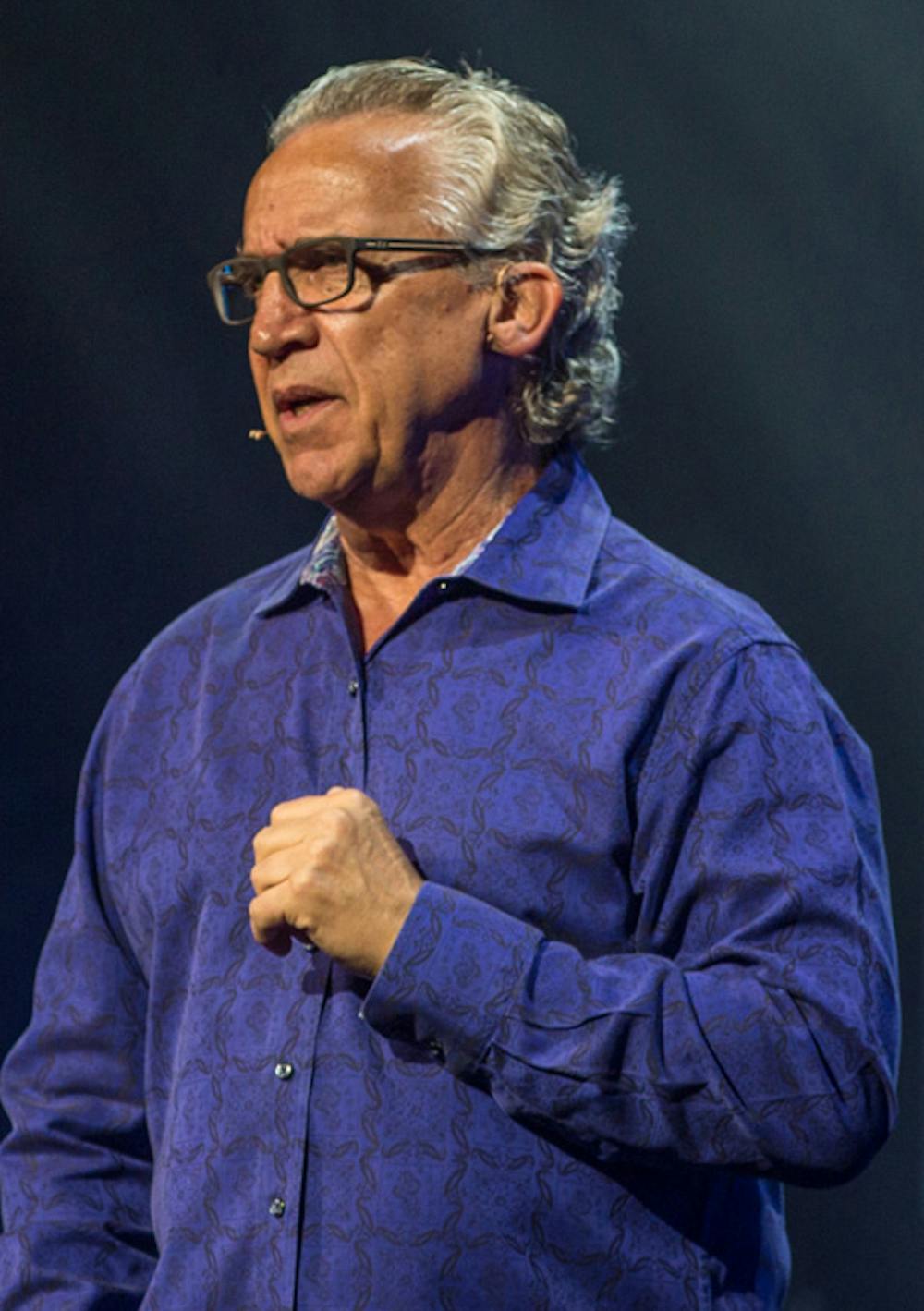
    Bill Johnson.
    Doctorg via Wikimedia Commons

    Since 1996, Bill Johnson, a senior leader of Bethel Church, and Johnny Enlow, a self-described prophet and Seven Mountains advocate, among others, have taken the original idea of the Seven Mountains Mandate and reshaped it into a more aggressive, political and spiritually militant approach. Spiritual militancy reflects an aggressive, us-vs.-them mindset that blurs the line between faith and authoritarianism, promoting dominion over society in the name of spiritual warfare.

    Their version doesn’t just aim to influence culture; it frames the effort as a spiritual battle to reclaim and reshape the nation according to their vision of God’s will.

    Lance Wallnau, another Christian evangelical preacher, televangelist, speaker and author, has promoted dominion theology since the early 2000s. During the 2020 U.S. presidential election, Wallnau, along with several prominent NAR figures, described Donald Trump as anointed by God to reclaim the “mountain” of government from demonic control.

    In their book “Invading Babylon: The 7 Mountains Mandate,” Wallnau and Johnson explicitly call for Christian leadership as the only antidote to perceived moral decay and spiritual darkness.

    The beliefs

    Sometimes referred to as Seven Mountains of Influence or Seven Mountains of Culture, the seven mountains are not neutral domains but seen as battlegrounds between divine truth and demonic deception.

    Adherents believe that Christians are called to reclaim these areas through influence, leadership and even, if necessary, the use of force and to confront demonic political forces, as religion scholar Matthew Taylor demonstrates in his book “The Violent Take It By Force.”

    Diverse perspectives and interpretations surround the rhetoric and actions associated with the New Apostolic Reformation. Some analysts have pointed out how the NAR is training its followers for an active confrontation. Other commentators have said that the rhetoric calling for physical violence is anti-biblical and should be denounced.

    NAR-aligned leaders have framed electoral contests as struggles between “godly” candidates and those under the sway of “satanic” influence.

    Similarly, NAR prophet Cindy Jacobs has repeatedly emphasized the need for “spiritual warfare” in schools to combat what she characterizes as “demonic ideologies” such as sex education, LGBTQ+ inclusion or discussions of systemic racism.

    In the NAR worldview, cultural change is not merely political or social but considered a supernatural mission; opponents are not simply wrong but possibly under the sway of demonic influence. Elections become spiritual battles.

    This belief system views pluralism as weakness, compromise as betrayal, and coexistence as capitulation. Frederick Clarkson, a senior research analyst at Political Research Associates, a progressive think tank based in Somerville, Massachusetts, defines the Seven Mountains Mandate as “the theocratic idea that Christians are called by God to exercise dominion over every aspect of society by taking control of political and cultural institutions.”

    The call to “take back” the culture is not metaphorical but literal, and believers are encouraged to see themselves as soldiers in a holy war to dominate society. Some critics argue that NAR’s call to “take back” culture is about literal domination, but this interpretation is contested.

    Many within the movement see the language of warfare as spiritually focused on prayer, evangelism and influencing hearts and minds. Still, the line between metaphor and mandate can blur, especially when rhetoric about “dominion” intersects with political and cultural action. That tension is part of an ongoing debate both within and outside the movement.

    Networks that spread the beliefs

    This belief system is no longer confined to the margins. It is spread widely through evangelical churches, podcasts, YouTube videos and political networks.

    It’s hard to know exactly how many churches are part of the New Apostolic Reformation, but estimates suggest that about 3 million people in the U.S. attend churches that openly follow NAR leaders.

    At the same time, the Seven Mountains Mandate doesn’t depend on centralized leadership or formal institutions. It spreads organically through social networks, social media – notably podcasts and livestreams – and revivalist meetings and workshops.

    André Gagné, a theologian and author of “American Evangelicals for Trump: Dominion, Spiritual Warfare, and the End Times,” writes about the ways in which the mandate spreads by empowering local leaders and believers. Individuals are authorized – often through teachings on spiritual warfare, prophetic gifting, and apostolic leadership – to see themselves as agents of divine transformation in society, called to reclaim the “mountains,” such as government, media and education, for God’s kingdom.

    This approach, Gagné explains, allows different communities to adapt the action mandate to their unique cultural, political and social contexts. It encourages individuals to see themselves as spiritual warriors and leaders in their domains – whether in business, education, government, media or the arts.

    Small groups or even individuals can start movements or initiatives without waiting for top-down directives. The only recognized authorities are the apostles and prophets running the church or church network the believers attend.

    The framing of the Seven Mountains Mandate as a divinely inspired mission, combined with the movement’s emphasis on direct spiritual experiences and a specific interpretation of scripture, can create an environment where questioning the mandate is perceived as challenging God’s authority.

    Slippery slope

    These beliefs have increasingly fused with nationalist rhetoric and conspiracy theories.

    The ‘Appeal to Heaven’ flags symbolize the belief that people have the right to appeal directly to God’s authority when they think the government has failed.
    Paul Becker/Becker1999 via Flickr, CC BY

    A powerful example of NAR political rhetoric in action is the rise and influence of the “Appeal to Heaven” flags. For those in the New Apostolic Reformation, these flags symbolize the belief that when all earthly authority fails, people have the right to appeal directly to God’s authority to justify resistance.

    This was evident during the Jan. 6, 2021, Capitol insurrection, when these flags were prominently displayed.

    To be clear, its leaders are not calling for violence but rather for direct political engagement and protest. For some believers, however, the calls for “spiritual warfare” may become a slippery slope into justification for violence, as in the case of the alleged Minnesota shooter.

    Understanding the Seven Mountains Mandate is essential for grasping the dynamics of contemporary efforts to align government and culture with a particular vision of Christian authority and influence.

    Art Jipson does not work for, consult, own shares in or receive funding from any company or organization that would benefit from this article, and has disclosed no relevant affiliations beyond their academic appointment.

    ref. What is the ‘Seven Mountains Mandate’ and how is it linked to political extremism in the US? – https://theconversation.com/what-is-the-seven-mountains-mandate-and-how-is-it-linked-to-political-extremism-in-the-us-260034

    MIL OSI Analysis

  • MIL-OSI Analysis: The aftermath of floods, hurricanes and other disasters can be hardest on older rural Americans – here’s how families and neighbors can help

    Source: The Conversation – USA (3) – By Lori Hunter, Professor of Sociology, Director of the Institute of Behavioral Science, University of Colorado Boulder

    Edith Schaecher, center, and her daughter and granddaughter look at a photo album recovered from her tornado-damaged home in Greenfield, Iowa, in May 2024. AP Photo/Charlie Neibergall

    Hurricanes, tornadoes and other extreme weather do not distinguish between urban and rural boundaries. But when a disaster strikes, there are big differences in how well people are able to respond and recover – and older adults in rural areas are especially vulnerable.

    If a disaster causes injuries, getting health care can take longer in rural areas. Many rural hospitals have closed, leaving patients traveling longer distances for care.

    At the same time, rural areas have higher percentages of older adults, a group that is more likely to have chronic health problems that make experiencing natural disasters especially dangerous. Medical treatments, such as dialysis, can be disrupted when power goes out or clinics are damaged, and injuries are more likely around property damaged by flooding or powerful winds.

    As a sociologist who studies rural issues and directs the Institute of Behavioral Science at the University of Colorado Boulder, I believe that understanding the risks is essential for ensuring healthier lives for older adults. I see many different ways rural communities are helping reduce their vulnerability in disasters.

    Disasters disrupt health care, especially in isolated rural regions

    According to the U.S. Census Bureau, about 20% of the country’s rural population is age 65 and over, compared with only 16% of urban residents. That’s about 10 million older adults living in rural areas.

    There are three primary reasons rural America has been aging faster than the rest of the country: Young people have been leaving for college and job opportunities, meaning fewer residents are starting new families. Many older rural residents are choosing to “age in place” where they have strong social ties. And some rural areas are gaining older adults who choose to retire there.

    An aging population means rural areas tend to have a larger percentage of residents with chronic disease, such as dementia, heart disease, respiratory illness and diabetes.

    According to research from the National Council on Aging, nearly 95% of adults age 60 and older have at least one chronic condition, while more than 78% have two or more. Rural areas also have higher rates of death from chronic diseases, particularly heart disease.

    At the same time, health care access in rural areas is rapidly declining.

    Nearly 200 rural hospitals have closed or stopped providing in-patient care since 2005. Over 700 more — one-third of the nation’s remaining rural hospitals — were considered to be at risk of closing even before the cuts to Medicaid that the president signed in July 2025.

    Hospital closures have left rural residents traveling about 20 miles farther for common in-patient health care services than they did two decades ago, and even farther for specialist care.

    Those miles might seem trivial, but in emergencies when roads are damaged or flooded, they can mean losing access to care and treatment.

    After Hurricane Katrina struck New Orleans in 2005, 44% of patients on dialysis missed at least one treatment session, and almost 17% missed three or more.

    When Hurricanes Matthew and Florence hit rural Robeson County, North Carolina, in 2016 and 2018, some patients who relied on insulin to manage their blood sugar levels went without insulin for weeks. The county had high rates of poverty and poor health already, and the healthy foods people needed to manage the disease were also hard to find after the storm.

    Insulin is important for treating diabetes – a chronic disease estimated to affect nearly one-third of adults age 65 and older. But a sufficient supply can be harder to maintain when a disaster knocks out power, because insulin should be kept cool, and medical facilities and drugstores may be harder for patients to reach.

    Rural residents also often live farther from community centers, schools or other facilities that can serve as cooling centers during heat waves or evacuation centers in times of crisis.

    Alzheimer’s disease can make evacuation difficult

    Cognitive decline also affects older adults’ ability to manage disasters.

    Over 11% of Americans age 65 and older – more than 7 million people – have Alzheimer’s disease or related dementia, and the prevalence is higher in rural areas’ older populations compared with urban areas.

    Caregivers for family members living with dementia may struggle to find time to prepare for disasters. And when disaster strikes, they face unique challenges. Disasters disrupt routines, which can cause agitation for people with Alzheimer’s, and patients may resist evacuation.

    Living through a disaster can also worsen brain health over the long run. Older adults who lived through the 2011 Great East Japan earthquake and tsunami were found to have greater cognitive decline over the following decade, especially those who lost their homes or jobs, or whose health care routines were disrupted.

    Social safety nets are essential

    One thing that many rural communities have that helps is a strong social fabric. Those social connections can help reduce older adults’ vulnerability when disasters strike.

    Following severe flooding in Colorado in 2013, social connections helped older adults navigate the maze of paperwork required for disaster aid, and some even provided personal loans.

    Community support through churches, like this one whose building was hit by a tornado in rural Argyle, Wis., in 2024, and other groups can help older adults recover from disasters.
    Ross Harried/NurPhoto via Getty Images

    Friends, family and neighbors in rural areas often check in on seniors, particularly those living alone. They can help them develop disaster response plans to ensure older residents have access to medications and medical treatment, and that they have an evacuation plan.

    Rural communities and local groups can also help build up older adults’ mental and physical health before and after storms by developing educational, social and exercise programs. Better health and social connections can improve resilience, including older adults’ ability to respond to alerts and recover after disasters.

    Ensuring that everyone in the community has that kind of support is important in rural areas and cities alike as storm and flood risks worsen, particularly for older adults.

    Lori Hunter receives funding from the National Institutes of Health and the National Science Foundation.

    ref. The aftermath of floods, hurricanes and other disasters can be hardest on older rural Americans – here’s how families and neighbors can help – https://theconversation.com/the-aftermath-of-floods-hurricanes-and-other-disasters-can-be-hardest-on-older-rural-americans-heres-how-families-and-neighbors-can-help-247691

    MIL OSI Analysis

  • MIL-OSI Analysis: How slashing university research grants impacts Colorado’s economy and national innovation – a CU Boulder administrator explains

    Source: The Conversation – USA (2) – By Massimo Ruzzene, Vice Chancellor of Research and Innovation, University of Colorado Boulder

    Federal funding cuts to the University of Colorado Boulder have already impacted research and could cause even more harm. Glenn J. Asakawa/University of Colorado

    The Trump administration has been freezing or reducing federal grants to universities across the country.

    Over the past several months, universities have lost more than US$11 billion in funding, according to NPR. More than two dozen universities, including the University of Colorado Boulder and the University of Denver, have been affected. Research into cancer, farming solutions and climate resiliency are just a few of the many projects nationally that have seen cuts.

    The Conversation asked Massimo Ruzzene, senior vice chancellor for research and innovation at the University of Colorado Boulder, to explain how these cuts and freezes are impacting the university he works for and Colorado’s local economy.

    How important are federal funds to CU Boulder?

    Federal funding pays for approximately 70% of CU Boulder’s research each year. That’s about $495 million in the 2023-2024 fiscal year.

    The other 30% of research funding comes from a variety of sources. The second-largest is international partnerships at $127 million. Last year, CU Boulder also received $27 million in philanthropic gifts to support research and approximately $29 million from collaborations with industry.

    CU Boulder uses this money to fund research that advances fields like artificial intelligence, space exploration and planetary sciences, quantum technologies, biosciences and climate and energy.

    At CU Boulder, federal funding also supports research projects like the Dust Accelerator Laboratory that helps us understand the composition and structure of cosmic dust. This research allows scientists to reconstruct the processes that formed planets, moons and organic molecules.

    How much federal funding has CU Boulder lost?

    So far in 2025, CU Boulder has received 56 grant cancellations or stop-work orders. Those amount to approximately $30 million in lost funding. This number is not inclusive of awards that are on hold and awaiting action by the sponsor.

    This number also does not include the funds that have not been accessible due the considerable lag in funding from agencies such as the National Science Foundation and the National Institutes of Health.
    Nationwide, National Science Foundation funding has dropped by more than 50% through the end of May of this year compared to the average of the past 10 years. The university anticipates that our funding received from these agencies will drop a similar amount, but the numbers are still being collected for this year.

    What research has been impacted?

    A wide variety. To take just one example, CU Boulder’s Cooperative Institute for Research in Environmental Sciences and the Institute of Arctic and Alpine Research investigate how to monitor, predict, respond to and recover from extreme weather conditions and natural disasters.

    This research directly impacts the safety, well-being and prosperity of Colorado residents facing wildfires, droughts and floods.

    Michael Gooseff, a researcher from the College of Engineering and Applied Science, collects weather data from the McMurdo Dry Valleys in Antarctica.
    Byron Adams/University of Colorado Boulder

    Past research from these groups includes recovery efforts following the 2021 Marshall Fire in the Boulder area. Researchers collaborated with local governments and watershed groups to monitor environmental impacts and develop dashboards that detailed their findings.

    How might cuts affect Colorado’s aerospace economy?

    Colorado has more aerospace jobs per capita than any other state. The sector employs more than 55,000 people and contributes significantly to both Colorado’s economy and the national economy.

    This ecosystem encompasses research universities such as CU Boulder and Colorado-based startups like Blue Canyon Technologies and Ursa Major Technologies. It also includes established global companies like Lockheed Martin and Raytheon Technologies.

    At CU Boulder, the Laboratory for Atmospheric and Space Physics is one of the world’s premier space science research institutions. Researchers at the lab design, build and operate spacecraft and other instruments that contribute critical data. That data helps us understand Earth’s atmosphere, the Sun, planetary systems and deep space phenomena. If the projects the lab supports are cut, then it’s likely the lab will be cut as well.

    The Presidential Budget Request proposes up to 24% cuts to NASA’s annual budget. These include reductions of 47% for the Science Mission Directorate. The directorate supports more than a dozen space missions at CU Boulder. That cut could have an immediate impact on university programs of approximately $50 million.

    Scientists test the solar arrays on NASA’s Mars Atmosphere and Volatile Evolution orbiter spacecraft at Lockheed Martin’s facility near Denver.
    Photo courtesy of LASP

    One of the largest space missions CU Boulder is involved in is the Mars Atmosphere and Volatile Evolution orbiter. MAVEN, as it’s known, provides telecommunications and space weather monitoring capabilities. These are necessary to support future human and robotic missions to Mars over the next decade and beyond, a stated priority for the White House. If MAVEN were to be canceled, experts estimate that it would cost almost $1 billion to restart it.

    Have the cuts hit quantum research?

    While the federal government has identified quantum technology as a national priority, the fiscal year 2026 budget proposal only maintains existing funding levels. It does not introduce new investments or initiatives.

    I’m concerned that this stagnation, amid broader cuts to science agencies, could undermine progress in this field and undercut the training of its critical workforce. The result could be the U.S. ceding its leadership in quantum innovation to global competitors.

    Massimo Ruzzene receives funding from the National Science Foundation.

    ref. How slashing university research grants impacts Colorado’s economy and national innovation – a CU Boulder administrator explains – https://theconversation.com/how-slashing-university-research-grants-impacts-colorados-economy-and-national-innovation-a-cu-boulder-administrator-explains-257869

    MIL OSI Analysis

  • MIL-OSI Russia: Iran did not request talks with US – MFA

    Translation. Region: Russian Federal

    Source: People’s Republic of China in Russian – People’s Republic of China in Russian –

    An important disclaimer is at the bottom of this article.

    Source: People’s Republic of China – State Council News

    TEHRAN, July 8 (Xinhua) — Iran has not requested any meetings with the United States, the Islamic Republic’s Foreign Ministry spokesman Esmail Baghaei said on Tuesday, as quoted by the Tasnim news agency.

    This is how the diplomat responded to the words of US President Donald Trump, who said the day before that Iran had asked for a meeting.

    Speaking to reporters at the White House on Monday alongside Israeli Prime Minister Benjamin Netanyahu, Trump said the United States was ready to negotiate with Iran. “We have a meeting scheduled with Iran, and they want to talk,” he said. “They have requested a meeting, and I am going to attend. If we can put something on paper, that would be good,” the president added.

    From April 12 to May 23, Iran and the United States held five rounds of indirect talks on Tehran’s nuclear program and the lifting of American sanctions. They were mediated by Oman.

    Two days before the sixth round, scheduled for June 15 in the Omani capital Muscat, Israel launched massive airstrikes on a number of Iranian sites, including nuclear and military facilities, killing senior commanders, nuclear scientists and scores of civilians. Tehran responded with a series of missile and drone strikes on Israel.

    On June 22, the United States struck three Iranian nuclear facilities: Natanz, Fordow, and Isfahan. Iran later attacked the U.S. Al Udeid Air Base in Qatar.

    On June 24, after 12 days of fighting, Iran and Israel reached a ceasefire agreement. –0–

    Please note: This information is raw content obtained directly from the source of the information. It is an accurate report of what the source claims and does not necessarily reflect the position of MIL-OSI or its clients.

    .

    MIL OSI Russia News

  • MIL-OSI Russia: Iran did not request talks with US – MFA

    Translation. Region: Russian Federal

    Source: People’s Republic of China in Russian – People’s Republic of China in Russian –

    An important disclaimer is at the bottom of this article.

    Source: People’s Republic of China – State Council News

    TEHRAN, July 8 (Xinhua) — Iran has not requested any meetings with the United States, the Islamic Republic’s Foreign Ministry spokesman Esmail Baghaei said on Tuesday, as quoted by the Tasnim news agency.

    This is how the diplomat responded to the words of US President Donald Trump, who said the day before that Iran had asked for a meeting.

    Speaking to reporters at the White House on Monday alongside Israeli Prime Minister Benjamin Netanyahu, Trump said the United States was ready to negotiate with Iran. “We have a meeting scheduled with Iran, and they want to talk,” he said. “They have requested a meeting, and I am going to attend. If we can put something on paper, that would be good,” the president added.

    From April 12 to May 23, Iran and the United States held five rounds of indirect talks on Tehran’s nuclear program and the lifting of American sanctions. They were mediated by Oman.

    Two days before the sixth round, scheduled for June 15 in the Omani capital Muscat, Israel launched massive airstrikes on a number of Iranian sites, including nuclear and military facilities, killing senior commanders, nuclear scientists and scores of civilians. Tehran responded with a series of missile and drone strikes on Israel.

    On June 22, the United States struck three Iranian nuclear facilities: Natanz, Fordow, and Isfahan. Iran later attacked the U.S. Al Udeid Air Base in Qatar.

    On June 24, after 12 days of fighting, Iran and Israel reached a ceasefire agreement. –0–

    Please note: This information is raw content obtained directly from the source of the information. It is an accurate report of what the source claims and does not necessarily reflect the position of MIL-OSI or its clients.

    .

    MIL OSI Russia News

  • MIL-Evening Report: Academic slams NZ government over ‘compromised’ foreign policy

    Asia Pacific Report

    A prominent academic has criticised the New Zealand coalition government for compromising the country’s traditional commitment to upholding an international rules-based order due to a “desire not to offend” the Trump administration.

    Professor Robert Patman, an inaugural sesquicentennial distinguished chair and a specialist in international relations at the University of Otago, has argued in a contributed article to The Spinoff that while distant in geographic terms, “brutal violence in Gaza, the West Bank and Iran marks the latest stage in the unravelling of an international rules-based order on which New Zealand depends for its prosperity and security”.

    Dr Patman wrote that New Zealand’s founding document, the 1840 Treaty of Waitangi, emphasised partnership and cooperation at home, and, after 1945, helped inspire a New Zealand worldview enshrined in institutions such as the United Nations and norms such as multilateralism.

    Professor Robert Patman . . . “Even more striking was the government’s silence on President Trump’s proposal to own Gaza with a view to evicting two million Palestinian residents.” Image: University of Otago

    “In the wake of Hamas’ terrorist attacks in Israel on October 7, 2023, the National-led coalition government has in principle emphasised its support for a lasting ceasefire in Gaza and the need for a two-state solution to the Israeli-Palestinian conflict over the occupied territories of East Jerusalem, Gaza and the West Bank,” he wrote.

    However, Dr Patman said, in practice this New Zealand stance had not translated into firm diplomatic opposition to the Netanyahu government’s quest to control Gaza and annex the West Bank.

    “Nor has it been a condemnation of the Trump administration for prioritising its support for Israel’s security goals over international law,” he said.

    Foreign minister Winston Peters had described the situation in Gaza as “simply intolerable” but the National-led coalition had little specific to say as the Netanyahu government “resumed its cruel blockade of humanitarian aid to Gaza in March and restarted military operations there”.

    Silence on Trump’s ‘Gaza ownership’
    “Even more striking was the government’s silence on President Trump’s proposal to own Gaza with a view to evicting two million Palestinian residents from the territory and the US-Israeli venture to start the Gaza Humanitarian Foundation (GHF) in late May in a move which sidelined the UN in aid distribution and has led to the killing of more than 600 Palestinians while seeking food aid,” Dr Patman said.

    While New Zealand, along with the UK, Australia, Canada and Norway, had imposed sanctions on two far-right Israeli government ministers, Bezalel Smotrich and Itamar ben Gvir, in June for “inciting extremist violence” against Palestinians — a move that was criticised by the Trump administration — it was arguably a case of very little very late.

    “The Hamas terror attacks on October 7 killed around 1200 Israelis, but the Netanyahu government’s retaliation by the Israel Defence Force (IDF) against Hamas has resulted in the deaths of more than 56,000 Palestinians — nearly 70 percent of whom were women or children — in Gaza.

    Over the same period, more than 1000 Palestinians had been killed in the West Bank as Israel accelerated its programme of illegal settlements there.

    ‘Strangely ambivalent’
    In addition, the responses of the New Zealand government to “pre-emptive attacks” by Israel (13-25 June) and Trump’s United States (June 22) against Iran to destroy Iran’s nuclear capabilities were strangely ambivalent.

    Despite indications from US intelligence and the International Atomic Energy Agency (IAEA) that Iran had not produced nuclear weapons, Foreign Minister Peters had said New Zealand was not prepared to take a position on that issue.

    Confronted with Trump’s “might is right” approach, the National-led coalition faced stark choices, Dr Patman said.

    The New Zealand government could continue to fudge fundamental moral and legal issues in the Middle East and risk complicity in the further weakening of an international rules-based order it purportedly supports, “or it can get off the fence, stand up for the country’s values, and insist that respect for international law must be observed in the region and elsewhere without exception”.

    MIL OSI AnalysisEveningReport.nz

  • MIL-Evening Report: Academic slams NZ government over ‘compromised’ foreign policy

    Asia Pacific Report

    A prominent academic has criticised the New Zealand coalition government for compromising the country’s traditional commitment to upholding an international rules-based order due to a “desire not to offend” the Trump administration.

    Professor Robert Patman, an inaugural sesquicentennial distinguished chair and a specialist in international relations at the University of Otago, has argued in a contributed article to The Spinoff that while distant in geographic terms, “brutal violence in Gaza, the West Bank and Iran marks the latest stage in the unravelling of an international rules-based order on which New Zealand depends for its prosperity and security”.

    Dr Patman wrote that New Zealand’s founding document, the 1840 Treaty of Waitangi, emphasised partnership and cooperation at home, and, after 1945, helped inspire a New Zealand worldview enshrined in institutions such as the United Nations and norms such as multilateralism.

    Professor Robert Patman . . . “Even more striking was the government’s silence on President Trump’s proposal to own Gaza with a view to evicting two million Palestinian residents.” Image: University of Otago

    “In the wake of Hamas’ terrorist attacks in Israel on October 7, 2023, the National-led coalition government has in principle emphasised its support for a lasting ceasefire in Gaza and the need for a two-state solution to the Israeli-Palestinian conflict over the occupied territories of East Jerusalem, Gaza and the West Bank,” he wrote.

    However, Dr Patman said, in practice this New Zealand stance had not translated into firm diplomatic opposition to the Netanyahu government’s quest to control Gaza and annex the West Bank.

    “Nor has it been a condemnation of the Trump administration for prioritising its support for Israel’s security goals over international law,” he said.

    Foreign minister Winston Peters had described the situation in Gaza as “simply intolerable” but the National-led coalition had little specific to say as the Netanyahu government “resumed its cruel blockade of humanitarian aid to Gaza in March and restarted military operations there”.

    Silence on Trump’s ‘Gaza ownership’
    “Even more striking was the government’s silence on President Trump’s proposal to own Gaza with a view to evicting two million Palestinian residents from the territory and the US-Israeli venture to start the Gaza Humanitarian Foundation (GHF) in late May in a move which sidelined the UN in aid distribution and has led to the killing of more than 600 Palestinians while seeking food aid,” Dr Patman said.

    While New Zealand, along with the UK, Australia, Canada and Norway, had imposed sanctions on two far-right Israeli government ministers, Bezalel Smotrich and Itamar ben Gvir, in June for “inciting extremist violence” against Palestinians — a move that was criticised by the Trump administration — it was arguably a case of very little very late.

    “The Hamas terror attacks on October 7 killed around 1200 Israelis, but the Netanyahu government’s retaliation by the Israel Defence Force (IDF) against Hamas has resulted in the deaths of more than 56,000 Palestinians — nearly 70 percent of whom were women or children — in Gaza.

    Over the same period, more than 1000 Palestinians had been killed in the West Bank as Israel accelerated its programme of illegal settlements there.

    ‘Strangely ambivalent’
    In addition, the responses of the New Zealand government to “pre-emptive attacks” by Israel (13-25 June) and Trump’s United States (June 22) against Iran to destroy Iran’s nuclear capabilities were strangely ambivalent.

    Despite indications from US intelligence and the International Atomic Energy Agency (IAEA) that Iran had not produced nuclear weapons, Foreign Minister Peters had said New Zealand was not prepared to take a position on that issue.

    Confronted with Trump’s “might is right” approach, the National-led coalition faced stark choices, Dr Patman said.

    The New Zealand government could continue to fudge fundamental moral and legal issues in the Middle East and risk complicity in the further weakening of an international rules-based order it purportedly supports, “or it can get off the fence, stand up for the country’s values, and insist that respect for international law must be observed in the region and elsewhere without exception”.

    MIL OSI AnalysisEveningReport.nz

  • MIL-OSI Analysis: There are many things Americans voters agree on, from fears about technology to threats to democracy

    Source: The Conversation – UK – By Emma Connolly, Research Fellow, Digital Speech Lab, UCL

    During his recent public spat with Donald Trump, Elon Musk tweeted a poll asking if a new political party would better represent the 80% of voters in the middle. Hundreds of thousands of people responded and more than 80% answered “yes”.

    The middle is still overlooked in US politics. This is because there is a perception that Republicans and Democrats have nothing in common, and therefore no issue will win support from both centrist Republicans and Democrats.

    Polarisation is problematic as it is linked to “democratic backsliding” – the use of underhand tactics in political processes. Worst of all, it poses a threat to democracy.

    Many think that polarisation is fuelled by echo chambers created on social media platforms. These only expose people to beliefs similar to their own.

    However, I study how narratives emerge on social media, and ways to investigate them. My work has two aims: first, to identify political issues that are likely to cross party lines, and a wider goal of exploring the role of social media in mitigating, rather than exacerbating, levels of polarisation.


    Get your news from actual experts, straight to your inbox. Sign up to our daily newsletter to receive all The Conversation UK’s latest coverage of news and research, from politics and business to the arts and sciences.


    Earlier this year, for example, I sorted through 12,000 posts from Republican and Democrat voters on subreddits (online forums discussing specific topics). Using a technique I developed in my PhD research, I analysed attitudes to contested political issues around the time of Trump’s inauguration. Like other researchers, I am finding that there are things both sides often agree on, and that not every issue splits neatly across party lines.

    Pew Research shows what Democrats and Republicans agree on.

    Although it’s a complex topic, people from both parties are worried about levels of free speech on social media. According to my work and other sources, some Democrats accuse TikTok of censoring hashtags such as #FreeLuigi (a reference to Luigi Mangione, accused of murdering UnitedHealthcare CEO, Brian Thompson).

    Meanwhile, some Republicans are saying they are flooded with what they see as left-wing content pushed by the algorithms. Despite their differences, Republicans and Democrats agree that social media platforms need to be more transparent about the way they work.

    Both sides worry about the rise of authoritarianism and the growing negative influence of artificial intelligence in shaping the US’s future. There is a sense among some members of the two parties that the real enemies aren’t each other, but powerful corporations who hold too much power.

    People on both sides of the political divide can be distrustful of tech companies and big businesses, where billionaires have power regardless of who’s in charge. Divisions of “up v down” could be alternatives to seeing divisions as “left v right”.

    Some people are worried about the creation of a massive database of citizens’ details, and how their details could be used, or abused. Recently Republican Marjorie Taylor Greene said she would have opposed Trump’s “big, beautiful, bill”, had she read the AI clause thoroughly. The clause stops states from passing laws to regulate AI systems for the next ten years.

    What do people agree on?

    On the topic of protecting democracy, there are some suggestions that many Republicans and Democrats agree this is important, and under threat. In my study, some Republican and Democrat voters object to the possibility of Trump having a third term, aligning with the findings of several recent polls on the subject, and even among Trump’s most loyal support groups.

    Both Republicans and Democrats want “the best” leaders who could get things done fast and efficiently. But it would appear that people on both sides are concerned about the “slash-and-burn” way that Doge (the Department for Government Efficiency, the new agency tasked with cutting federal spending) is working.

    Also, deciding who is the best leader isn’t always about agreeing with specific policies. Instead, it’s about delivering decisive, efficient action. Even Republicans who don’t back everything Trump is doing say that at least he is doing something, especially in relation to immigration.

    Many Republicans criticise the left, and former Democratic presidential candidate Kamala Harris in particular, but for unclear messaging, as much as any one policy. They (and others) put her loss down to a lack of direction and clarity on key issues (among other things). This probably resulted in failing to win votes from independents and moderate Republicans and many Democrats are frustrated that the party still hasn’t addressed this.

    Research suggests that Democrat and Republican voters often agree that polarisation causes gridlock and prevents progress, but believe voices from the middle are not being heard. Some Republicans and Democrats also share a concern that both parties are more focused on fighting each other than on solving problems, with 86% of Americans believing this.

    Some Republican voters in the posts I am analysing suggest that working together to get things done would be positive, supporting findings from the US and abroad. Other important factors rather than political party, such as religion or family or everyday life experiences can bring people from both sides together.

    So, Americans might not be as divided as one might think. Levels of polarisation feel high but this could be skewed by the extreme views of a minority on both sides. And it isn’t helped by some sensationalist media reporting.

    Lots of people get their news from social media platforms which reward and monetise engagement. Posts that fuel division are often the most visible, but they rarely tell the whole story. Divisive views are also often shared by those who are themselves the most polarised.

    Like Musk’s online poll, research is starting to suggest that there is still a sizeable moderate middle in the US today who are open to compromise through clear messaging. These voters can make all the difference, especially if parties can frame issues in ways that appeal across the divide. With the 2026 midterm elections on the horizon, both sides might want to listen to them more.

    Emma Connolly does not work for, consult, own shares in or receive funding from any company or organisation that would benefit from this article, and has disclosed no relevant affiliations beyond their academic appointment.

    ref. There are many things Americans voters agree on, from fears about technology to threats to democracy – https://theconversation.com/there-are-many-things-americans-voters-agree-on-from-fears-about-technology-to-threats-to-democracy-258440

    MIL OSI Analysis

  • Gaza ceasefire can be reached but may take more time, Israeli officials say

    Source: Government of India

    Source: Government of India (4)

    Gaps in Gaza ceasefire talks under way in Qatar between Israel and Palestinian militant group Hamas can be bridged but it may take more than a few days to reach a deal, Israeli officials said on Tuesday.

    The new push by U.S., Qatari and Egyptian mediators to halt fighting in the battered enclave has gained pace since Sunday when the warring sides began indirect talks in Doha and Israeli Prime Minister Benjamin Netanyahu set out to Washington.

    Netanyahu met on Monday with U.S. President Donald Trump, who said on the eve of their meeting that a ceasefire and hostage deal could be reached this week. The Israeli leader was scheduled to meet Vice President J.D. Vance on Tuesday.

    Trump’s envoy Steve Witkoff, who played a major role in crafting the ceasefire proposal, will travel to Doha this week to join discussions there, White House press secretary Karoline Leavitt told reporters earlier on Monday.

    The ceasefire proposal envisages a phased release of hostages, Israeli troop withdrawals from parts of Gaza and discussions on ending the war entirely.

    Hamas has long demanded an end to the war before it would free remaining hostages; Israel has insisted it would not agree to end the fighting until all hostages are released and Hamas dismantled. At least 20 of the remaining 50 hostages in Gaza are believed to still be alive.

    Palestinian sources said on Monday that there were gaps between the sides on the entry of humanitarian aid into Gaza.

    Senior Israeli officials briefing journalists in Washington said it may take more than a few days to finalize agreements in Doha but they did not elaborate on the sticking points. Another Israeli official said progress had been made.

    Israeli minister Zeev Elkin, who sits in Netanyahu’s security cabinet, said that there was “a substantial chance” a ceasefire will be agreed. “Hamas wants to change a few central matters, it’s not simple, but there is progress,” he told Israel’s public broadcaster Kan on Tuesday.

    The war began on October 7 2023, when Hamas-led militants stormed into Israel, killing around 1,200 people and taking 251 hostages into Gaza.

    Israel’s subsequent campaign against Hamas in Gaza has since killed more than 57,000 Palestinians, according to local health authorities, displaced almost the entire population of more than 2 million people, sparked a humanitarian crisis in the enclave and left much of the territory in ruins.

    In Gaza City, children walked through debris, where residents said an Israeli airstrike had hit overnight, with children among the casualties. The Israeli military did not immediately provide details on the target of the strike.

    “We hope that a ceasefire will be reached and that the massacres against the Palestinian people will stop,” said Mohammed Joundiya, standing in the rubble left in the aftermath of the attack.

    At Israel’s parliament in Jerusalem, former hostage Keith Siegel, who was released in February in a previous ceasefire, described the anguish of those held incommunicado for hundreds of days in Hamas captivity. “We have a window of opportunity to save lives,” he said, “every minute is critical.”

    (Reuters)

  • MIL-OSI Africa: 30% US Tariff Will Be a Blow to Economic Growth, Jobs and Trade Certainty

    Source: APO – Report:

    .

    The Chairperson of the Select Committee on Economic Development and Trade, Ms Sonja Boshoff, has expressed grave concern over the impending 30% tariff imposed by the United States government on key South African exports, as the tariffs will have far-reaching consequences for exporters and on the broader ailing South African economy.

    Ms Boshoff said the US tariff order, which was signed yesterday and is set to come into effect on 1 August 2025, undermines the historical US–SA trade cooperation and poses a serious threat to strategic sectors such as citrus, macadamia, automotive components, steel and aluminium. “These industries are not abstract economic indicators; they are lifelines for tens of thousands of workers, particularly in rural and small-town South Africa,” emphasised Ms Boshoff.

    She said South Africa’s citrus industry alone supports more than 35 000 jobs and contributes over R38 billion annually to the economy. “A tariff of this magnitude threatens not only the profitability of our exporters, but the livelihoods of workers and the economic stability of entire agricultural regions,” stressed Ms Boshoff.

    She said the tariff order also casts a dark shadow over the future of the African Growth and Opportunity Act (AGOA), which has long facilitated preferential access to US markets. With the new duty effectively neutralising those preferences, there is growing uncertainty for producers who depend on predictable market access to plan, invest and grow.

    “It is critical that trade agreements are honoured in good faith. No country can plan its industrial or export strategy under a cloud of sudden and unilateral tariff hikes” said Ms Boshoff.

    The committee recognises that the Department of Trade, Industry and Competition (DTIC) is pursuing negotiations with its US counterparts, reportedly offering strategic Liquefied Natural Gas procurement in exchange for a more reasonable tariff ceiling. However, such engagements must be swift, transparent and rooted in the national interest.

    “We cannot afford diplomatic dithering. Every delay will deepen the uncertainty in our export industries. The government must urgently finalise a sustainable trade path with the United States and, simultaneously, accelerate diversification into new markets across the EU, Asia and Africa,” stressed Ms Boshoff.

    The committee calls on the DTIC and the Department of Agriculture to provide support packages and market reorientation strategies for the most affected industries. This must include logistics relief, export finance support, and new market facilitation, particularly for emerging farmers and SMEs.

    “At a time when South Africa is battling record unemployment and low growth, punitive tariffs by our biggest trading partners are not just economic risks, they are catalysts for deeper inequality. We must respond with urgency, precision and policy agility,” Ms Boshoff noted.

    This unprecedent development cannot be approached with a “let it go” attitude, Ms Boshoff said. She called on the South African government to urgently send a high-level delegation to Washington to undertake repair of diplomatic ties and to reaffirm South Africa’s commitment to constructive engagement.

    President Trump signed the tariff order on Monday, 7 July, after the withdrawal of US grant funding for critical programmes in South Africa. The tariff order, which will apply to all South African products entering the US market, will come into effect from 1 August 2025.

    – on behalf of Republic of South Africa: The Parliament.

    MIL OSI Africa

  • Sensex gains 270 points; investors eye relief in India-US trade talks

    Source: Government of India

    Source: Government of India (4)

    The Indian stock markets closed higher on Tuesday, recovering from a flat opening after reports of a possible mini trade deal between India and the United States surfaced late last night.

    Markets opened under pressure as concerns over US President Donald Trump’s fresh tariff measures weighed on sentiment.

    At the end of the trading session, the Sensex gained 270.01 points or 0.32 per cent to close at 83,712.51, while the Nifty rose 61.20 points or 0.24 per cent to settle at 25,522.50.

    Financial heavyweights helped the Nifty and Nifty Bank end in the green. Kotak Bank led the gains, rising over 3 per cent after a strong first-quarter update.

    On the other hand, Titan was the top loser on the Nifty, slipping 6 per cent after reporting lower-than-expected growth in its jewellery segment.

    “Today marked the third consecutive session where the Nifty opened and closed within a narrow range of 25,400 to 25,500. This shows the market is waiting for a trigger before the next move at the index level,” said VLA Ambala, Co-Founder of Stock Market Today.

    “The market remains in an uptrend with no signs of reversal yet, but volatility is expected as crude oil, gold, and dollar prices may fluctuate depending on the outcome of Donald Trump’s trade deal,” she added.

    Sundar Kewat, Technical and Derivatives Analyst at Ashika Institutional Equity, Ashika Stock Broking, noted that despite global uncertainties triggered by Trump’s announcement of 25–40 per cent tariffs on 14 countries, Indian equity markets opened flat and traded largely sideways throughout the session.

    “Trump’s tariffs took centre stage on Monday as letters detailing the new duties were issued to 14 countries. Markets reacted moderately and did not panic like they did from April 2nd to 9th. Over the past 90 days, markets have become more resilient, looking past Trump’s policy ambiguity to actual measures,” Ajay Bagga, Banking and Market Expert, said.

    He further added, “The key takeaway on Monday was that the July 9th tariff imposition deadline has now been moved to August 1st, giving another 23 days for negotiations with the affected countries.”

    (ANI)

  • MIL-OSI USA: Six months after the LA fires, nation’s fastest residential cleanup nears completion as Governor Newsom signs streamlining executive order, joins local leaders to unveil blueprint for rebuilding

    Source: US State of California 2

    Jul 7, 2025

    Recovery moves into next phase with focused plan to fast-track reconstruction and support impacted communities

    What you need to know: Governor Newsom has announced that debris removal for the Los Angeles firestorm is now substantially complete just six months after the fires ignited and has signed a new executive order to further fast-track rebuilding homes and schools. The Governor announced a blueprint for recovery in partnership with Los Angeles County leaders. 

    LOS ANGELES – On the six month anniversary of the Eaton and Palisades fires, Governor Gavin Newsom today announced the substantial completion of the public debris removal program from more than 10,000 fire damaged parcels — marking the fastest major disaster cleanup in American history. The Governor also signed an executive order shepherding rebuilding homes and schools. He also joined local officials to unveil a new blueprint for recovery, a step-by-step plan to accelerate rebuilding and provide support to impacted families and communities. The near-completion of the public debris removal program comes months ahead of schedule.

    This is the biggest reform of the California mental health system in decades and will finally equip partners to deliver the results all Californians need and deserve. Treatment centers will prioritize mental health and substance use support in the community like never before. Now, it’s time to roll up our sleeves and begin implementing this critical reform – working closely with city and county leaders to ensure we see results.

    Governor Gavin Newsom

    “Visiting LA during the fires and in their devastating aftermath, I met with so many who despite facing so much loss and suffering themselves, were out helping their neighbors—delivering food, donating clothes, rescuing pets, opening up their homes to those who had lost theirs,” said First Partner Jennifer Siebel Newsom. “Although much has been accomplished already in this recovery effort, the work continues. In it, Angelenos continue to show each other—and the world—the very best of us.” 

    Historic debris removal operation 

    The LA Fires cleanup is the second largest in state history after the Camp Fire and was jointly managed by the Governor’s Office of Emergency Services (Cal OES) and United States Army Corps of Engineers, in partnership with Federal Emergency Management Agency (FEMA), as well Los Angeles County and City of Los Angeles. 
    Of the 12,048 total properties destroyed in the twin fires, 9,873 opted to participate in the cost-free public cleanup program and 1,982 opted to complete the work themselves. As of today 9,195 total have been cleared of debris with several hundred more awaiting erosion control measures and final sign-off.
    Any properties whose owner did not opt into the state-federal cleanup or remediate their parcel privately will be subject to a locally led city and county abatement process which is already underway.

    Billions of pounds of debris remediated

    The volume of ash, soot and structural debris cleaned up during this short time is nothing short of breathtaking.
    Crews removed more than 2.5 million tons — or 5.5 billion pounds — of ash, debris, metal, concrete, and contaminated soil in nine months’ time as part of California’s Consolidated Debris Removal Program. The total tonnage removed from the Eaton and Palisades Fires is equivalent to 92 Statues of Liberty. It is twice the amount removed from Ground Zero after 9/11.

    Prioritizing efficient rebuilding

    Today’s executive order fast-tracks the rebuilding of homes and schools affected by the disaster by suspending local permitting laws and building codes, at the request of local officials. The order: 

    • Expands suspensions of the Coastal Act and CEQA in the city of Los Angeles, creating parity among homeowners in the city and allowing homeowners to fast-track their entire rebuilding project.
    • Expands existing Coastal Act and CEQA exemptions to streamline rebuilding public schools, getting kids back in neighborhood public schools faster.
    • Exempts residents who are rebuilding homes from the requirement to install rooftop solar and battery storage systems to reduce up-front costs, while retaining the “Solar Ready” requirement to ensure these structures can support future installation of solar energy systems. 
    • Suspends changes to building codes that would go into effect on January 1, 2026, when not all homeowners will have finalized their plans to rebuild, to create certainty for homeowners and avoid the need to change plans, while retaining updated fire safety requirements.

    A blueprint for recovery 

    The progress made during this effort is due in large part to the unprecedented coordination among city, county, state, and federal partners.

    As the debris-removal work comes to an end and communities set their sights on the next phase of recovery, Los Angeles County embraces its role to lead local rebuilding efforts in unincorporated areas and foster conditions for a successful and equitable reconstruction and recovery in both city and county areas.

    The focus now shifts to the ongoing rebuilding process, where the state is actively supporting local officials in:

    • Identifying community needs for reconstruction
    • Specifying the magnitude and time-sensitivity of community needs, including needs for homeowners, residents, businesses and others.  
    • Defining priorities and what the county can do to move the needle and address identified needs
    • Communicating how it’s partnering to make reconstruction fast and affordable
    • Outlining an implementation roadmap 

    This blueprint will serve the near-term roadmap for the next 120 days, enabling the county to maintain the current pace for rebuilding and not be late to the needs of communities.  

    What they are saying

    “We have made tremendous progress in rebuilding our communities for the thousands of families who lost everything in the Eaton and Palisades fires, but to keep up this momentum, we are going to need more federal support. I will continue to push my colleagues in Congress to approve additional disaster assistance for California, because natural disasters don’t discriminate between red or blue states. We have always been there to help our neighbors, and it’s time for Congress to step up and deliver the disaster aid California needs.” – U.S. Senator Alex Padilla

    “For the past six months, as Los Angeles confronted the most devastating natural disaster in a generation, our communities have rallied to remind the world why we are the City of Angels. First responders, volunteers, friends, and neighbors helped recovery efforts, many of whom I’ve had the good fortune to meet and thank firsthand. In California, we have brought a sense of urgency to the cleanup and rebuilding, united in our goal of rising stronger from this ash and adversity. Senator Padilla and I continue to work with the Governor and the entire California delegation in Congress to supplement local efforts with the overdue federal disaster assistance needed to fully restore these vital neighborhoods,” – U.S. Senator Adam Schiff

    “Six months ago, our community was forever changed by the Los Angeles wildfires. Today, we remember the lives lost, the homes destroyed, and the bravery of those who stood in the face of unimaginable devastation. While we’ve made tremendous progress in delivering critical aid and coordinating relief on the ground, our work is far from over. We still face urgent challenges like securing affordable, long-term housing for those displaced. That’s why I’m incredibly grateful for Governor Newsom’s support and partnership as we fight for additional federal disaster aid to ensure that every survivor has the resources they need to recover and rebuild. As climate change fuels more frequent and devastating natural disasters across the country, we must remember that natural disasters have no political affiliations. And neither should our response. Every American deserves swift and fair federal aid no matter where they live or who they voted for.” – U.S. Representative Judy Chu

    “Reaching the six-month anniversary of the Los Angeles Wildfires reminds us that while recovery is a long journey, progress is possible when we stand together. From day one, Governor Newsom and his Administration have been true partners in this work, helping us cut red tape, bring resources to survivors, and rebuild with urgency and compassion. We have completed the fastest debris cleanup in California history and are now moving forward with an ambitious, people-first recovery blueprint. I remain committed to ensuring every affected community has the support they need to rebuild and thrive.” – Los Angeles County Board of Supervisors Chair Kathryn Barger

    “Six months ago, the Palisades and Eaton Fires put our communities to the ultimate test. In the face of colossal devastation, we witnessed the unshakable resilience of the human spirit. Our residents stood strong, banded together, and reminded us all of the power of community. Thanks to a close partnership with Governor Newsom, governmental coordination at every level, and tireless County teams, we’ve already led the fastest debris removal in history. This is the spirit of Los Angeles County — and our momentum will continue. Together, we are not just restoring what was lost — we are building back stronger, safer, and more united than ever.” – Los Angeles County Supervisor Lindsay Horvath

    “Six months ago, L.A. experienced one of the most unprecedented natural disasters in U.S. history. But this community—from Pacific Palisades to Malibu to Altadena—is resilient. We are L.A. strong. I want to thank Governor Newsom, Supervisor Barger, and all of our federal, state, County, non-profit and philanthropic partners for their collaboration as we continue to lead the fastest recovery in state history as we create clear and supportive pathways for homeowners to rebuild.” – Los Angeles Mayor Karen Bass

    “As we mark six months since the Eaton Fire, I want to thank Governor Newsom for his leadership and steadfast support. I also want to acknowledge our federal, state, and local partners—including Supervisor Kathryn Barger and her team, FEMA, the U.S. Army Corps of Engineers, CalOES, LA County Public Works, and our dedicated City of Pasadena team. Thanks to these strong partnerships, and the strength and heart of our local community, we have forged a path of recovery that is not only steady—it is, by all measures, unprecedented in its pace and coordination.” – Pasadena Mayor Victor Gordo

    “The City of Malibu is grateful for the cooperation of the Governor’s office during this extraordinary time. Additionally, the outstanding teamwork that has developed between the State of California, County of Los Angeles and our Federal partners, including the Army of Corp of Engineers, is something we can all be proud of. All levels of government have looked to find innovative ways to respond and work to create an efficient recovery. We are excited to continue our work to rebuild our communities and find ways to reduce rebuild costs by working together.” – Malibu Mayor Marianne Riggins

    “On this six-month anniversary of the Eaton Fire, I want to extend our sincere gratitude to our federal, state, and county partners, for their continued leadership and support. Thanks to their efforts, we’ve made significant progress toward recovery. Nevertheless, we recognize there is still critical work ahead to fully restore our impacted communities and Sierra Madre remains committed to that path.” – Sierra Madre Mayor Robert Parkhurst

    “This progress is a testament to the unwavering collaboration between FEMA, USACE, CalOES, L.A. County Department of Public Works and all of our federal, state, local and private sector partners. In my 28 years of emergency management, I’ve rarely seen such an effective and united response and recovery effort. Together, we are making significant strides in helping communities rebuild and restore their lives. The dedication and hard work of everyone involved exemplifies the true spirit of American resilience and determination, making this milestone possible.” – FEMA Region 9 Administrator Bob Fenton

    “Over the past six months, the U.S. Army Corps of Engineers, working closely with our federal, state, and local partners, has made significant progress in the Eaton and Palisades Fire debris removal mission. Together, we’ve safely and efficiently cleared thousands of fire-impacted properties, moving quickly to reduce hazards and help communities take the next steps toward recovery. This mission demonstrates what can be achieved through strong partnerships and a shared commitment to fast, safe, and effective operations. USACE remains fully committed to seeing this mission through to completion.” – Colonel Eric R. Swenson, United States Army Corps of Engineers
     

    California’s all-in efforts

    Since the first day these firestorms ignited, Governor Newsom has been on the ground leading an all-in state response and recovery. 

    The Governor deployed resources before the hurricane-force fires broke out – growing to over 16,000 boots on the ground at the peak of the state’s response. And in the hours that followed, Governor Newsom launched historic recovery and rebuilding efforts to help Los Angeles get back on its feet, faster. 

    Even before the fires were out, Governor Newsom worked closely with outgoing President Joe Biden to secure a Presidential Major Disaster Declaration and then coordinated with the Trump Administration to ensure comprehensive federal support for Los Angeles. 

    That work has paid dividends as the current pace of debris and hazardous waste removal is months ahead of the cleanup timeline for the Camp, Woolsey, Hill fires in 2019 and Tubbs Fire in 2017/18, which at the time were themselves the fastest of their kind. 

    State and federal officials worked hand in glove to clear hazardous waste from 9,000 homes in less than 30 days. At the project’s peak, as many as 500 crews of expert heavy equipment operators from the Army Corps of Engineers worked around the clock to rapidly clear ash, soot, and fire debris from structures damaged by the Eaton and Palisades fires. 

    By the numbers 

    • 16,000 first responders and recovery personnel deployed
    • $2.5 billion in Small Business Administration Assistance approved. 
    • $144.2 million in individual assistance disbursed
    • $100 million in dedicated community partnerships through LA Rises
    • 40,000 totals visitors to disaster recovery centers 
    • 30 days to clear properties of hazardous waste
    • 9,195 properties cleared of debris 
    • 2,300 homes cleared of debris 
    • 12,500 right of entry forms submitted 
    • 8 of 8 schools resumed in person instruction 
    • 9 of 9 water systems reactivated  

    California’s historic recovery and rebuilding efforts 

    Cutting red tape to help rebuild Los Angeles faster and stronger

    • The new executive order builds on prior orders to streamline the rebuilding of homes and businesses destroyed — suspending permitting and review requirements under the California Environmental Quality Act (CEQA) and the California Coastal Act. The Governor also issued an executive order further cutting red tape by reiterating that permitting requirements under the California Coastal Act are suspended for rebuilding efforts and directing the Coastal Commission not to issue guidance or take any action that interferes with or conflicts with the Governor’s executive orders. The Governor also issued an executive order removing administrative barriers, extending deadlines, and providing critical regulatory relief to help fire survivors rebuild, access essential services, and recover more quickly.

    Providing tax and mortgage relief to those impacted by the fires

    Fast-tracking temporary housing and protecting tenants

    • To help provide necessary shelter for those immediately impacted by the firestorms, the Governor issued an executive order to make it easier to streamline construction of accessory dwelling units, allow for more temporary trailers and other housing, and suspend fees for mobile home parks. Governor Newsom also issued an executive order that prohibited landlords in Los Angeles County from evicting tenants for sharing their rental with survivors displaced by the Los Angeles-area firestorms.
    • With an eye toward recovery, the Governor directed fast action on debris removal work and mitigating the potential for mudslides and flooding in areas burned. He also signed an executive order to allow expert federal hazmat crews to start cleaning up properties as a key step in getting people back to their properties safely. The Governor also issued an executive order to help mitigate risk of mudslides and flooding and protect communities by hastening efforts to remove debris, bolster flood defenses, and stabilize hillsides in affected areas. 

    Safeguarding survivors from price gouging

    Directing immediate state relief

    Getting kids back in the classroom

    Protecting victims from real estate speculators

    • The Governor issued an executive order to protect firestorm victims in the immediate aftermath of losing their homes from predatory land speculators making aggressive and unsolicited below-market cash offers to purchase their property.

    Helping businesses and workers get back on their feet

    The Governor issued an executive order to support small businesses and workers, by providing relief to help businesses recover quickly by deferring annual licensing fees and waiving other requirements that may impose barriers to recovery.

    Recent news

    News Sacramento, California – Governor Gavin Newsom today issued a proclamation declaring July 4, 2025, as “Independence Day” in the State of California.The text of the proclamation and a copy can be found below: PROCLAMATIONEach year on the Fourth of July, we…

    News SACRAMENTO – A day after announcing California has more than doubled its Film and Television Tax Credit Program, Governor Gavin Newsom today signed legislation to further strengthen the state’s commitment to film and television production:AB 1138 by…

    News What you need to know: As we approach the Fourth of July holiday and weekend, California is taking steps to keep communities safe during festivities by increasing outreach and highlighting resources. Sacramento, California — As Californians gear up to celebrate…

    MIL OSI USA News

  • MIL-OSI Europe: MOTION FOR A RESOLUTION on tackling China’s critical raw materials export restrictions – B10-0332/2025

    Source: European Parliament

    B10‑0332/2025

    European Parliament resolution on tackling China’s critical raw materials export restrictions

    (2025/2800(RSP))

    The European Parliament,

     having regard to Regulation (EU) 2024/1252 of 11 April 2024 on establishing a framework for ensuring a secure and sustainable supply of critical raw materials (the Critical Raw Materials Act)[1],

     having regard to Regulation (EU) 2024/1735 of 13 June 2024 on establishing a framework of measures for strengthening Europe’s net-zero technology manufacturing ecosystem and amending Regulation (EU) 2018/1724[2] ,

     having regard to the upcoming EU-China summit on 24-25 July 2025,

     having regard to Rule 136(2) of its Rules of Procedure,

    A. whereas China dominates in rare earth refining, especially in heavy rare earth elements; whereas China accounts for roughly 70 % of global rare earth mining and over 90 % of the world’s refining capacity; whereas China holds a near monopoly over the global supply chain of several critical minerals, particularly rare earth elements (REEs) and other minerals that are vital for high-tech applications like powerful magnets;

    B. whereas critical minerals and REEs are crucial for both the green and digital transitions, owing to their essential role in enabling technologies in areas including renewable energy, electric vehicles, advanced electronics and defence;

    C. whereas the global demand for REEs, which are critical materials for various technologies including clean energy, is surging, with a significant increase projected for the coming years;

    D. whereas on 4 April 2025, in response to US President Donald Trump’s tariff increases on Chinese products, China imposed export restrictions on 7 of the 17 REEs: samarium, gadolinium, terbium, dysprosium, lutetium, scandium and yttrium;

    E. whereas on 27 June 2025, Washington and Beijing announced a new trade framework, under which China would resume approving export licences for REEs over the following six months;

    F. whereas the new rare earth restrictions are already causing export delays (of up to 45 days for processing a licence application, with additional time needed if the state council or military has to be consulted) as the Chinese Government establishes the licensing system;

    1. Expresses deep concern about and strongly criticises China’s recent and unjustified export restrictions on rare earth materials and magnets, which are crucial for European industries such as automotive manufacturing, renewable energy and defence;

    2. Notes with concern that the EU, which is not responsible for starting the ongoing trade dispute between the United States and China, is nonetheless bearing its economic consequences and should not become collateral damage in this conflict;

    3. Recalls that conservation policies do not allow members of the World Trade Organization to adopt measures to control the international market for a natural resource, which is what the export restrictions do; expresses the view that China’s export restrictions are designed to achieve industrial policy goals rather than conservation; underlines that the export quotas do not work together with measures restricting domestic Chinese use of rare earths, as required by the second part of Article XX of the General Agreement on Tariffs and Trade (GATT) 1994, and are therefore intended to secure preferential use of those materials for Chinese manufacturers;

    4. Calls on China to lift the restrictions and urges both the Commission and the Member States to take a firm and unified stance and engage with the Chinese authorities to seek a structural solution for these unjustified restrictions, which are undermining the global green and digital transitions; calls on the Commission and the Council to address the issue with the Chinese authorities in the upcoming EU-China summit on 24-25 July 2025, with a view to restoring a level playing field as well as securing the lifting of Chinese sanctions against former MEPs and think tanks;

    5. Stresses, however, that the EU must firmly reject any attempts by the Chinese authorities to use these restrictions as a tool of coercion to force concessions in ongoing disputes on other unfair practices, such as the anti-dumping duties on battery electric vehicles;

    6. Is concerned that this may lead to an unfair trade-off between export restrictions and access to European technological know-how, undermining our industrial competitiveness and strategic autonomy;

    7. Urges the Commission to mitigate the risks of the EU’s overdependence on China for critical REEs and regrets that, despite the good intentions and policy initiatives of the Critical Raw Materials Act, the EU’s dependence on China for critical raw materials has continued to grow or, at best, remains stubbornly high;

    8. Underlines the need for a clear strategy to ensure the long-term security of supply by focusing on diversification, increased domestic production and the circular economy, with robust recycling infrastructure at its core for the recovery of critical minerals from end-of-life products;

    9. Calls on the Commission to make full use of the Clean Industrial Deal to build strategic partnerships with resource-rich countries, strengthen domestic capabilities in extraction, processing and recycling, and reduce reliance on single suppliers;

    10. Emphasises the need to secure access to critical raw materials; stresses that the upcoming circular economy act should improve resource efficiency, including through better waste management of products containing critical raw materials, as well as fostering the demand and availability of secondary raw materials; stresses the need to define those secondary raw materials that are strategic and that should be subject to export monitoring, such as steel and metal scrap, and to tackle any imbalance in their supply and demand, including by exploring export restrictions; insists on the effective enforcement of the Waste Shipment Regulation[3];

    11. Welcomes the critical minerals action plan agreed at the G7 leaders’ summit in June 2025;

    12. Instructs its President to forward this resolution to the Council, the Commission, the Vice-President of the Commission / High Representative of the Union for Foreign Affairs and Security Policy, the governments and parliaments of the Member States and the Government of the People’s Republic of China.

    MIL OSI Europe News

  • MIL-OSI Russia: Japanese PM calls Trump’s new tariff decision regrettable

    Translation. Region: Russian Federal

    Source: People’s Republic of China in Russian – People’s Republic of China in Russian –

    An important disclaimer is at the bottom of this article.

    Source: People’s Republic of China – State Council News

    TOKYO, July 8 (Xinhua) — Japanese Prime Minister Shigeru Ishiba on Tuesday called U.S. President Donald Trump’s decision to impose 25 percent tariffs on Japan “truly regrettable,” saying bilateral talks will continue to reach a mutually beneficial deal.

    He said the government would continue to steadfastly defend national interests in future rounds of trade talks and pledged to do its utmost to soften the impact of upcoming tariff increases on Japan’s export-oriented economy.

    “We will continue to negotiate with the United States to explore the possibility of reaching a mutually beneficial deal while protecting our national interests,” the prime minister said. He attributed the lack of progress to “the government avoiding hasty compromises, demanding and defending what is necessary.”

    D. Trump said Monday that a 25 percent tariff on imported goods from Japan would be imposed starting Aug. 1. The U.S. president also warned that any tariff increases on American goods would be met with equivalent measures from his administration. –0–

    Please note: This information is raw content obtained directly from the source of the information. It is an accurate report of what the source claims and does not necessarily reflect the position of MIL-OSI or its clients.

    .

    MIL OSI Russia News