Source: United States House of Representatives – Representative Mike Kelly (R-PA)
WASHINGTON, D.C. — Today, U.S. Rep. Mike Kelly (R-PA) released this statement following military operations in Iran on the evening of Saturday, June 21.
“President Trump is leading with peace through strength. Let’s be clear: Iran cannot have a nuclear weapon. May God protect our brave service members who carried out this operation, and may God bless America,” said Rep. Kelly. “This is the most significant show of American strength, commitment and resolve by any sitting American President in our recent history. God Bless the men and women of our American Military for their courage, dedication, commitment and the Leadership of President Trump. You are all in our prayers!”
PM call with Prime Minister Carney of Canada: 22 June 2025
The Prime Minister spoke to Canadian Prime Minister Mark Carney this evening.
The Prime Minister spoke to Canadian Prime Minister Mark Carney this evening.
They discussed the grave situation in the Middle East and last night’s action by the United States to tackle the severe threat posed by Iran’s nuclear programme.
Both reiterated their support for a diplomatic solution and agreed that Iran must come back to the negotiating table with the United States as soon as possible.
They looked forward to continuing their discussions at NATO this week.
Source: US National Oceanic and Atmospheric Administration
Note: The expiration time in the watch graphic is amended if the watch is replaced, cancelled or extended.Note: Click for Watch Status Reports. SEL3
URGENT – IMMEDIATE BROADCAST REQUESTED Severe Thunderstorm Watch Number 453 NWS Storm Prediction Center Norman OK 400 PM CDT Sun Jun 22 2025
The NWS Storm Prediction Center has issued a
* Severe Thunderstorm Watch for portions of Central Nebraska Southeast South Dakota
* Effective this Sunday afternoon and evening from 400 PM until 1100 PM CDT.
* Primary threats include… Scattered large hail and isolated very large hail events to 2 inches in diameter possible Scattered damaging wind gusts to 70 mph possible A tornado or two possible
SUMMARY…Severe thunderstorms are expected to develop rapidly and move northeast across the watch area through this evening with a risk for damaging wind gusts and large hail. The potential for corridors of more concentrated wind damage may increase towards this evening.
The severe thunderstorm watch area is approximately along and 60 statute miles east and west of a line from 45 miles northeast of Mitchell SD to 60 miles south southeast of North Platte NE. For a complete depiction of the watch see the associated watch outline update (WOUS64 KWNS WOU3).
PRECAUTIONARY/PREPAREDNESS ACTIONS…
REMEMBER…A Severe Thunderstorm Watch means conditions are favorable for severe thunderstorms in and close to the watch area. Persons in these areas should be on the lookout for threatening weather conditions and listen for later statements and possible warnings. Severe thunderstorms can and occasionally do produce tornadoes.
&&
OTHER WATCH INFORMATION…CONTINUE…WW 451…WW 452…
AVIATION…A few severe thunderstorms with hail surface and aloft to 2 inches. Extreme turbulence and surface wind gusts to 60 knots. A few cumulonimbi with maximum tops to 550. Mean storm motion vector 23030.
…Bunting
Note: The Aviation Watch (SAW) product is an approximation to the watch area. The actual watch is depicted by the shaded areas. SAW3 WW 453 SEVERE TSTM NE SD 222100Z – 230400Z AXIS..60 STATUTE MILES EAST AND WEST OF LINE.. 45NE MHE/MITCHELL SD/ – 60SSE LBF/NORTH PLATTE NE/ ..AVIATION COORDS.. 50NM E/W /44NW FSD – 18ENE MCK/ HAIL SURFACE AND ALOFT..2 INCHES. WIND GUSTS..60 KNOTS. MAX TOPS TO 550. MEAN STORM MOTION VECTOR 23030.
LAT…LON 44229618 40329911 40320138 44229860
THIS IS AN APPROXIMATION TO THE WATCH AREA. FOR A COMPLETE DEPICTION OF THE WATCH SEE WOUS64 KWNS FOR WOU3.
Watch 453 Status Report Message has not been issued yet.
Note: Click for Complete Product Text.Tornadoes
Probability of 2 or more tornadoes
Low (20%)
Probability of 1 or more strong (EF2-EF5) tornadoes
Low (5%)
Wind
Probability of 10 or more severe wind events
Mod (50%)
Probability of 1 or more wind events > 65 knots
Low (20%)
Hail
Probability of 10 or more severe hail events
Mod (40%)
Probability of 1 or more hailstones > 2 inches
Mod (30%)
Combined Severe Hail/Wind
Probability of 6 or more combined severe hail/wind events
High (80%)
For each watch, probabilities for particular events inside the watch (listed above in each table) are determined by the issuing forecaster. The “Low” category contains probability values ranging from less than 2% to 20% (EF2-EF5 tornadoes), less than 5% to 20% (all other probabilities), “Moderate” from 30% to 60%, and “High” from 70% to greater than 95%. High values are bolded and lighter in color to provide awareness of an increased threat for a particular event.
There are currently no specific credible threats against the homeland
WASHINGTON – Today, Secretary of Homeland Security Kristi Noem issued a National Terrorism Advisory System (NTAS) Bulletin regarding a heightened threat environment across the United States due to the direct involvement of the United States in the ongoing conflict between the nations of Israel and Iran. There are currently no specific credible threats against the homeland.
“It is our duty to keep the nation safe and informed, especially during times of conflict,” said Secretary Kristi Noem. “The ongoing Israel-Iran conflict brings the possibility of increased threat to the homeland in the form of possible cyberattacks, acts of violence, and antisemitic hate crimes.”
This NTAS Bulletin will expire on September 22, 2025. The public should report any suspicious activity or threats of violence to local law enforcement, FBI Field Offices, or a local Fusion Center.
PM call with President Trump of the United States: 22 June 2025
The Prime Minister spoke to the President of the United States Donald Trump this evening.
The Prime Minister spoke to the President of the United States Donald Trump this evening.
The leaders discussed the situation in the Middle East and reiterated the grave risk posed by Iran’s nuclear programme to international security. They discussed the actions taken by the United States last night to reduce the threat and agreed that Iran must never be allowed to develop a nuclear weapon.
They discussed the need for Iran to return to the negotiating table as soon as possible and to make progress on a lasting settlement.
They agreed to stay in close contact in the coming days.
overnor Kathy Hochul today declared a State of Emergency in 32 counties in response to severe weather and extreme heat impacting communities across New York. A cluster of severe thunderstorms impacted parts of the North Country, Central New York, Southern Tier, and the Capital District early this morning causing downed trees and power lines, structural damage and numerous power outages. Rainfall rates of up to two inches per hour will continue with additional two to four inches totals likely. The heaviest rain will likely continue to fall over areas in Central New York and Southern Tier that have already seen heavy rain. Flash flooding may extend into the Southern Tier and Mid-Hudson regions, especially from Broome to Ulster/Sullivan Counties. Numerous power outages exist from the North Country to the Southern Tier Regions. In addition, a multi-day heatwave will begin today statewide, with a combination of high temperatures and humidity resulting in feels-like temperatures between 90 to over 100 degrees through Wednesday.
“Our hearts break for the tragic loss of life during last night’s storms, and my administration has been in touch with local elected officials offering support,” Governor Hochul said. “State emergency response personnel are already on the ground providing resources and support as we work to recover from this severe weather and restore power quickly. I urge all New Yorkers to stay weather aware and take precautions to stay vigilant and safe as extreme heat and severe weather are expected to continue impacting the State over the next couple of days.”
The State of Emergency includes Albany, Bronx, Broome, Chenango, Clinton, Columbia, Cortland, Delaware, Dutchess, Essex, Greene, Kings, Madison, Nassau, New York, Oneida, Onondaga, Orange, Otsego, Putnam, Queens, Rensselaer, Richmond, Rockland, Saratoga, Schenectady, Suffolk, Tioga, Ulster, Warren, Washington, Westchester and contiguous counties.
At Governor Hochul’s direction, the New York State Division of Homeland Security and Emergency Services has activated the State Emergency Operations Center to Enhanced Monitoring Mode to track the storms and damage. They are working closely with local emergency managers and governments to support requests and provide assistance as requested. State agencies stand ready to respond with equipment and personnel. Light towers have been provided to Oneida County and other materials stored in the State’s nine stockpiles including generators and pumps are also available to support local needs.
The New York State Office of Fire Prevention and Control has activated its Fire Operations Center and can deploy teams, including canine units to provide support. The State’s swift water rescue teams are also prepared to respond.
New Yorkers can sign up for text weather and emergency alerts by texting their county or borough to 333111.
Source: United Kingdom – Executive Government & Departments 3
Speech
Now is the time for de-escalation and a return to diplomacy: UK statement at the UN Security Council
Statement by Ambassador Barbara Woodward, UK Permanent Representative to the UN, at the emergency UN Security Council meeting on Iran.
This is a pivotal moment for the region.
A further spiral of conflict poses serious risks to regional and international peace and stability. Our foremost priority must now be to support de-escalation.
We have long made clear that Iran must not have a nuclear weapon and their nuclear programme represents a serious threat to international peace and security.
The United States took action last night to alleviate that threat.
The United Kingdom did not participate in US or Israeli strikes.
But military action alone cannot bring a durable solution to concerns about Iran’s nuclear programme.
My Prime Minister has been clear. We urge Iran now to show restraint, and we urge all parties to return to the negotiating table and find a diplomatic solution, which stops further escalation and brings this crisis to an end.
It is in the interests of all parties to pursue such a deal.
This was the joint call made by my Prime Minister, with his French and German counterparts earlier today. Together with our E3 partners, the UK has long pursued a diplomatic solution to address Iran’s nuclear escalation. On Friday, alongside E3 and EU colleagues, my Foreign Secretary met Iranian Foreign Minister Araghchi in Geneva to press directly for a return to diplomacy. My Foreign Minister spoke to Foreign Minister Araghchi again today and stressed the urgency of this and we continue to engage partners across the region.
President, the UK reiterates its full support for the IAEA and Director General Grossi for their critical work, professionalism and impartiality. The IAEA and the Non-Proliferation Treaty are key pillars of international security. Threats against IAEA staff and the DG are unacceptable. We urge Iran to cooperate fully with the IAEA. Failure to do so will only further fuel escalation.
President, now is the time for de-escalation and a return to diplomacy. It is essential Iran chooses this path.
Source: US National Oceanic and Atmospheric Administration
Search by city or zip code. Press enter or select the go button to submit request Local forecast by”City, St” or “ZIP”
SPC on Facebook
@NWSSPC
NCEP Quarterly Newsletter
Home (Classic)SPC Products All SPC Forecasts Current Watches Meso. Discussions Conv. Outlooks Tstm. Outlooks Fire Wx Outlooks RSS Feeds E-Mail AlertsWeather Information Storm Reports Storm Reports Dev. NWS Hazards Map National RADAR Product Archive NOAA Weather RadioResearch Non-op. Products Forecast Tools Svr. Tstm. Events SPC Publications SPC-NSSL HWTEducation & Outreach About the SPC SPC FAQ About Tornadoes About Derechos Video Lecture Series WCM Page Enh. Fujita Page Our History Public ToursMisc. StaffContact Us SPC Feedback
Watch 451 Status Reports
Watch 451 Status Message has not been issued yet.
Top/Watch Issuance Text for Watch 451/All Current Watches/Forecast Products/Home
Weather Topics:Watches, Mesoscale Discussions, Outlooks, Fire Weather, All Products, Contact Us
NOAA / National Weather ServiceNational Centers for Environmental PredictionStorm Prediction Center120 David L. Boren Blvd.Norman, OK 73072 U.S.A.spc.feedback@noaa.govPage last modified: June 22, 2025 DisclaimerInformation QualityHelpGlossary Privacy PolicyFreedom of Information Act (FOIA)About UsCareer Opportunities
Source: US National Oceanic and Atmospheric Administration
Note: The expiration time in the watch graphic is amended if the watch is replaced, cancelled or extended.Note: Click for Watch Status Reports. SEL1
URGENT – IMMEDIATE BROADCAST REQUESTED Tornado Watch Number 451 NWS Storm Prediction Center Norman OK 255 PM CDT Sun Jun 22 2025
The NWS Storm Prediction Center has issued a
* Tornado Watch for portions of West-central and Northern Minnesota Eastern North Dakota
* Effective this Sunday afternoon and evening from 255 PM until 1000 PM CDT.
* Primary threats include… A few tornadoes and a couple intense tornadoes possible Scattered large hail and isolated very large hail events to 2.5 inches in diameter possible Scattered damaging wind gusts to 70 mph possible
SUMMARY…Severe thunderstorms are expected to develop and move northeast across the watch area this afternoon and evening. A few tornadoes will be possible, including the potential for a couple strong tornadoes. Large hail and damaging thunderstorm wind gusts will also accompany the most intense storms.
The tornado watch area is approximately along and 70 statute miles east and west of a line from 35 miles west northwest of International Falls MN to 55 miles south southwest of Fargo ND. For a complete depiction of the watch see the associated watch outline update (WOUS64 KWNS WOU1).
PRECAUTIONARY/PREPAREDNESS ACTIONS…
REMEMBER…A Tornado Watch means conditions are favorable for tornadoes and severe thunderstorms in and close to the watch area. Persons in these areas should be on the lookout for threatening weather conditions and listen for later statements and possible warnings.
&&
AVIATION…Tornadoes and a few severe thunderstorms with hail surface and aloft to 2.5 inches. Extreme turbulence and surface wind gusts to 60 knots. A few cumulonimbi with maximum tops to 550. Mean storm motion vector 23030.
…Bunting
SEL1
URGENT – IMMEDIATE BROADCAST REQUESTED Tornado Watch Number 451 NWS Storm Prediction Center Norman OK 255 PM CDT Sun Jun 22 2025
The NWS Storm Prediction Center has issued a
* Tornado Watch for portions of West-central and Northern Minnesota Eastern North Dakota
* Effective this Sunday afternoon and evening from 255 PM until 1000 PM CDT.
* Primary threats include… A few tornadoes and a couple intense tornadoes possible Scattered large hail and isolated very large hail events to 2.5 inches in diameter possible Scattered damaging wind gusts to 70 mph possible
SUMMARY…Severe thunderstorms are expected to develop and move northeast across the watch area this afternoon and evening. A few tornadoes will be possible, including the potential for a couple strong tornadoes. Large hail and damaging thunderstorm wind gusts will also accompany the most intense storms.
The tornado watch area is approximately along and 70 statute miles east and west of a line from 35 miles west northwest of International Falls MN to 55 miles south southwest of Fargo ND. For a complete depiction of the watch see the associated watch outline update (WOUS64 KWNS WOU1).
PRECAUTIONARY/PREPAREDNESS ACTIONS…
REMEMBER…A Tornado Watch means conditions are favorable for tornadoes and severe thunderstorms in and close to the watch area. Persons in these areas should be on the lookout for threatening weather conditions and listen for later statements and possible warnings.
&&
AVIATION…Tornadoes and a few severe thunderstorms with hail surface and aloft to 2.5 inches. Extreme turbulence and surface wind gusts to 60 knots. A few cumulonimbi with maximum tops to 550. Mean storm motion vector 23030.
…Bunting
Note: The Aviation Watch (SAW) product is an approximation to the watch area. The actual watch is depicted by the shaded areas. SAW1 WW 451 TORNADO MN ND 221955Z – 230300Z AXIS..70 STATUTE MILES EAST AND WEST OF LINE.. 35WNW INL/INTERNATIONAL FALLS MN/ – 55SSW FAR/FARGO ND/ ..AVIATION COORDS.. 60NM E/W /30WNW INL – 38SSW FAR/ HAIL SURFACE AND ALOFT..2.5 INCHES. WIND GUSTS..60 KNOTS. MAX TOPS TO 550. MEAN STORM MOTION VECTOR 23030.
LAT…LON 48759257 46179580 46179872 48759565
THIS IS AN APPROXIMATION TO THE WATCH AREA. FOR A COMPLETE DEPICTION OF THE WATCH SEE WOUS64 KWNS FOR WOU1.
Watch 451 Status Report Message has not been issued yet.
Note: Click for Complete Product Text.Tornadoes
Probability of 2 or more tornadoes
Mod (50%)
Probability of 1 or more strong (EF2-EF5) tornadoes
Mod (30%)
Wind
Probability of 10 or more severe wind events
Mod (40%)
Probability of 1 or more wind events > 65 knots
Low (10%)
Hail
Probability of 10 or more severe hail events
Mod (40%)
Probability of 1 or more hailstones > 2 inches
Mod (40%)
Combined Severe Hail/Wind
Probability of 6 or more combined severe hail/wind events
High (70%)
For each watch, probabilities for particular events inside the watch (listed above in each table) are determined by the issuing forecaster. The “Low” category contains probability values ranging from less than 2% to 20% (EF2-EF5 tornadoes), less than 5% to 20% (all other probabilities), “Moderate” from 30% to 60%, and “High” from 70% to greater than 95%. High values are bolded and lighter in color to provide awareness of an increased threat for a particular event.
Source: United States House of Representatives – Congressman Henry Cuellar (TX-28)
Washington, DC – Today, U.S. Congressman Henry Cuellar, Ph.D. (TX-28), released the following statement in response to United States strikes against Iranian nuclear facilities:
“Iran’s pursuit of nuclear weapons is a direct threat to the safety of the United States, our allies, and the stability of the Middle East. The regime has made its intentions clear by developing its nuclear program in secret, violating international agreements, and refusing transparency with global inspectors.
“At the same time, Iran has built and sustained a violent network of terrorist proxies across the region. The regime trains, funds, and commands Hezbollah in Lebanon, Hamas in Gaza, and the Houthis in Yemen. These groups launch attacks on civilians, American military personnel, and our regional partners. Their actions are not spontaneous. They are orchestrated by a regime that embraces terrorism as a tool of statecraft.
“The United States has responded with precision and purpose. Our forces have taken necessary action to dismantle Iran’s nuclear infrastructure and disrupt its military capabilities. These operations reflect our determination to defend American lives, protect our partners, and hold the Iranian regime accountable. But let me be clear: Congress must play a decisive role in any decision involving the deployment of American troops into harm’s way.
“As a senior member of the House Appropriations Subcommittee on Defense, I remain focused on ensuring our military and national security agencies have the tools they need to keep our country safe. We owe it to our servicemembers and the American people to approach this moment with bipartisan resolve and constitutional responsibility. Congress needs to be actively engaged to achieve these goals.”
Source: United States House of Representatives – Congresswoman Sydney Kamlager California (37th District)
WASHINGTON, D.C. — Today, Congresswoman Sydney Kamlager-Dove (CA-37), Ranking Member of the House Foreign Affairs Subcommittee on South and Central Asia, released the following statement on the U.S. strikes in Iran:
“The ‘President of peace’ just bombed Iran without Congressional authorization, without clear evidence that Iran is imminently close to having a nuclear weapon, without properly notifying both parties in Congress, and with no clear plan for what comes next.
“I support the longstanding U.S. policy that Iran, an adversary and state-sponsor of terror, must never acquire a nuclear weapon. However, I have not received any classified briefing on the intelligence that shows Iran could imminently develop a nuclear weapon, which directly contradicts DNI Tulsi Gabbard’s testimony to Congress in March. Equally concerning, President Trump and his incompetent national security team have not shown to the American people what their day after plan is and how they will manage the possibility of another forever war in the Middle East.
“The U.S. must not be dragged into a wider war in the Middle East, and I pray for the U.S. servicemembers Trump has now placed in harm’s way. The Trump Administration must come before Congress to seek approval for further actions and my colleagues on both sides of the aisle must reassert Congress’s constitutional authority to ensure we do not repeat the mistakes of past conflicts.”
I would like to make a small introduction and then my two colleagues will brief the Council.
Excellencies,
Two days ago, in this very chamber, I made a direct appeal: Give peace a chance.
That call was not heeded.
Instead, the bombing of Iranian nuclear facilities by the United States marks a perilous turn in a region that is already reeling.
From the outset of the crisis, I have repeatedly condemned any military escalation in the Middle East.
The people of the region cannot endure another cycle of destruction.
And yet, we now risk descending into a rathole of retaliation after retaliation.
To avoid it, diplomacy must prevail. Civilians must be protected. Safe maritime navigation must be guaranteed.
We must act – immediately and decisively – to halt the fighting and return to serious, sustained negotiations on the Iran nuclear programme.
We need a credible, comprehensive and verifiable solution – one that restores trust – including with full access to inspectors of the IAEA, as the United Nations technical authority in this field.
The Non-Proliferation Treaty is a cornerstone of international peace and security.
Iran must fully respect it.
And all Member States must act in accordance with their obligations under the UN Charter and other rules of international law, including international humanitarian law.
The United Nations stands ready to support any and all efforts toward a peaceful resolution.
But peace cannot be imposed – it must be chosen.
Madam President,
We face a stark choice.
One path leads to wider war, deeper human suffering, and serious damage to the international order.
The other leads to de-escalation, diplomacy and dialogue.
We know which path is right.
I urge this Council – and all Member States – to act with reason, restraint, and urgency.
Source: United States House of Representatives – Congresswoman Jennifer McClellan (Virginia 4th District)
Washington, D.C. – Congresswoman Jennifer McClellan (VA-04) issued the following statement after the U.S. launched direct strikes on Iran:
“President Trump’s decision to launch air strikes on Iran without Congressional consultation or approval absent an imminent threat to the United States risks triggering a broader regional war that drags us deeper into an avoidable conflict with no clear strategy.
“Escalating tensions through force without a coordinated diplomatic effort dangerously undermines our national security and the safety of our allies, and puts our over 40,000 servicemembers stationed throughout the Middle East within reach of Iranian missiles and drones at risk. The American people deserve transparency and accountability when it comes to decisions that could cost American lives. I urge the Administration to brief all members in Congress on the intelligence that compelled these strikes, the effectiveness of the strikes, the plans for what comes next, and the actions that the Administration is taking to protect American servicemembers and potential domestic targets from Iranian reprisals.
“While we remain firm in our commitment to preventing a nuclear armed Iran, using force that at best merely delays nuclear weapons development by a few years will not bring long-term success. Only robust and aggressive diplomatic action has ever successfully contained Iran’s nuclear ambitions in a meaningful way. Unfortunately, the President abandoned the Joint Comprehensive Plan of Action agreement successfully negotiated by the Obama-Biden Administration, without any clear alternatives in mind to avoid the current crisis that we find ourselves in at this moment.
“I urge the Administration to pursue every available diplomatic channel to deescalate this crisis, prevent further bloodshed and achieve a lasting and durable solution to Iran’s nuclear ambitions.”
Source: United States Senator for Vermont – Bernie Sanders
BURLINGTON, Vt. June 22 – Sen. Bernie Sanders (I-Vt.) today released the following statement about President Trump’s military strikes against Iran:
In the 1960s the United States government lied to the American people and took us into a terrible war in Vietnam. The result of that war was that over 58,000 young Americans died and many more came back wounded both in mind and in spirit. Millions of Vietnamese were also killed. Hundreds of billions of dollars of taxpayer money was wasted.
In 2002 we were told that we had to go to war against Iraq, that Iraq was building weapons of mass destruction, and that if we did not act quickly and decisively nuclear weapons would fall on America. Among those who told us that was none other than Benjamin Netanyahu, the Prime Minister of Israel, who stated in testimony before Congress: “There is no question whatsoever that Saddam is seeking… nuclear weapons… If you take out Saddam’s regime, I guarantee you that it will have enormous positive reverberations.” The United States invaded Iraq and became embroiled in a long civil war there. No weapons of mass destruction were ever found. That war was based on a lie – a lie which cost us 4,492 young Americans, 32,000 wounded, over half a million Iraqis and trillions of dollars.
The American people were lied to about Vietnam, with tragic consequences.
The American people were lied to about Iraq, with tragic consequences.
The American people are being lied to again today. We cannot allow history to repeat itself. The U.S. faces enormous problems here at home, which we must address. We cannot allow ourselves to be dragged into another Middle East war based on lies.
Source: United States Senator for New York Kirsten Gillibrand
Addressing U.S. strikes on Iran’s nuclear facilities, U.S. Senator Kirsten Gillibrand, a member of the Senate Armed Services Committee and the Senate Select Committee on Intelligence, issued the following statement:
“I am grateful that no U.S. service members were harmed during the military operation against Iran’s nuclear facilities. I am praying for American troops and citizens in the region, and I will be working with state and local partners to ensure New Yorkers here at home are safe.
Throughout my career, I have been a steadfast champion of Israel, leading U.S. support for Iron Dome and initiatives to strengthen the alliance between our nations. I have long supported efforts to ensure that Iran, the foremost exporter of terrorism in the world, cannot obtain a nuclear weapon.
However, I am deeply concerned by President Trump’s decision to unilaterally launch these attacks without seeking congressional authorization, as required by the Constitution. The Trump administration must fully explain to the American people the rationale for this military action and a strategy to avoid being mired in another Middle Eastern war, and it must give Congress a full intelligence briefing immediately.
No further military actions should be allowed without proper congressional approval.
Avoiding further escalation is essential to the peace and security of Israel, the U.S., and our partners in the region. I urge the president and Iran to pursue a diplomatic resolution to this conflict.”
The International Atomic Energy Agency (IAEA) can confirm that the Iranian nuclear sites of Fordow, Natanz and Esfahan have been hit, following U.S. aerial attacks overnight, Director General Rafael Mariano Grossi said today.
Based on an analysis of the information available to it, the IAEA assessed that there has been extensive additional damage at the sprawling Esfahan site, which had already been struck several times by Israel since it began targeting Iran’s nuclear facilities on 13 June, Director General Grossi said.
The IAEA had previously reported that several buildings at the Esfahan complex were damaged, some of which may have contained nuclear material.
“The latest attacks early this morning damaged other buildings in Esfahan. In addition, we have established that entrances to underground tunnels at the site were impacted,” Director General Grossi said.
The extent of damage to the Fordow uranium enrichment facility – built deep inside a mountain in central Iran – was not immediately possible to assess in view of its underground location and the penetrating nature of the bombs used.
“It is clear that Fordow was also directly impacted, but the degree of damage inside the uranium enrichment halls can’t be determined with certainty,” Director General Grossi said.
Iran’s other enrichment site, Natanz, which has previously been extensively damaged, was again attacked during the strikes last night with ground-penetrating munitions.
The Director General said the IAEA has been informed by the Iranian regulatory authorities that there has been no increase in off-site radiation levels after the latest attacks on the three Iranian nuclear sites.
Director General Grossi stressed the paramount importance of the countries involved urgently embarking on a diplomatic path aimed at ending the hostilities.
This would also enable the IAEA to resume its crucial verification activities in Iran, including of its stockpile of more than 400 kg of highly enriched uranium, which Agency inspectors last verified a few days before the military conflict began.
“We need to try to go back to the negotiating table as soon as possible. We have to allow the IAEA inspectors to return. The IAEA is ready to play its indispensable role in this process. We have been talking to Iran, we have been talking to the United States. We have to work for peace,” Director General Grossi said.
The International Atomic Energy Agency (IAEA) can confirm that the Iranian nuclear sites of Fordow, Natanz and Esfahan have been hit, following U.S. aerial attacks overnight, Director General Rafael Mariano Grossi said today.
Based on an analysis of the information available to it, the IAEA assessed that there has been extensive additional damage at the sprawling Esfahan site, which had already been struck several times by Israel since it began targeting Iran’s nuclear facilities on 13 June, Director General Grossi said.
The IAEA had previously reported that several buildings at the Esfahan complex were damaged, some of which may have contained nuclear material.
“The latest attacks early this morning damaged other buildings in Esfahan. In addition, we have established that entrances to underground tunnels at the site were impacted,” Director General Grossi said.
The extent of damage to the Fordow uranium enrichment facility – built deep inside a mountain in central Iran – was not immediately possible to assess in view of its underground location and the penetrating nature of the bombs used.
“It is clear that Fordow was also directly impacted, but the degree of damage inside the uranium enrichment halls can’t be determined with certainty,” Director General Grossi said.
Iran’s other enrichment site, Natanz, which has previously been extensively damaged, was again attacked during the strikes last night with ground-penetrating munitions.
The Director General said the IAEA has been informed by the Iranian regulatory authorities that there has been no increase in off-site radiation levels after the latest attacks on the three Iranian nuclear sites.
Director General Grossi stressed the paramount importance of the countries involved urgently embarking on a diplomatic path aimed at ending the hostilities.
This would also enable the IAEA to resume its crucial verification activities in Iran, including of its stockpile of more than 400 kg of highly enriched uranium, which Agency inspectors last verified a few days before the military conflict began.
“We need to try to go back to the negotiating table as soon as possible. We have to allow the IAEA inspectors to return. The IAEA is ready to play its indispensable role in this process. We have been talking to Iran, we have been talking to the United States. We have to work for peace,” Director General Grossi said.
Source: International Atomic Energy Agency (IAEA) –
The International Atomic Energy Agency (IAEA) can confirm that the Iranian nuclear sites of Fordow, Natanz and Esfahan have been hit, following U.S. aerial attacks overnight, Director General Rafael Mariano Grossi said today.
Based on an analysis of the information available to it, the IAEA assessed that there has been extensive additional damage at the sprawling Esfahan site, which had already been struck several times by Israel since it began targeting Iran’s nuclear facilities on 13 June, Director General Grossi said.
The IAEA had previously reported that several buildings at the Esfahan complex were damaged, some of which may have contained nuclear material.
“The latest attacks early this morning damaged other buildings in Esfahan. In addition, we have established that entrances to underground tunnels at the site were impacted,” Director General Grossi said.
The extent of damage to the Fordow uranium enrichment facility – built deep inside a mountain in central Iran – was not immediately possible to assess in view of its underground location and the penetrating nature of the bombs used.
“It is clear that Fordow was also directly impacted, but the degree of damage inside the uranium enrichment halls can’t be determined with certainty,” Director General Grossi said.
Iran’s other enrichment site, Natanz, which has previously been extensively damaged, was again attacked during the strikes last night with ground-penetrating munitions.
The Director General said the IAEA has been informed by the Iranian regulatory authorities that there has been no increase in off-site radiation levels after the latest attacks on the three Iranian nuclear sites.
Director General Grossi stressed the paramount importance of the countries involved urgently embarking on a diplomatic path aimed at ending the hostilities.
This would also enable the IAEA to resume its crucial verification activities in Iran, including of its stockpile of more than 400 kg of highly enriched uranium, which Agency inspectors last verified a few days before the military conflict began.
“We need to try to go back to the negotiating table as soon as possible. We have to allow the IAEA inspectors to return. The IAEA is ready to play its indispensable role in this process. We have been talking to Iran, we have been talking to the United States. We have to work for peace,” Director General Grossi said.
Source: United States House of Representatives – Congressman Frank J. Mrvan (IN)
Washington, DC– Today, Congressman Frank J. Mrvan released the following statement regarding the recent U.S. military action in Iran.
“Let me be clear, no one believes Iran should be allowed to possess a nuclear weapon.
However, the decision to conduct military action and send our brave servicemembers into harm’s way must only be made after deliberate and careful consideration, in close consultation with Congress and a coalition of our allies.
“I do not believe that the Administration’s decision has met that standard in this instance.
Our priority now must be to re-engage with our allies and Israel to de-escalate tensions in the Middle East, and prevent our nation from being drawn into another prolonged military conflict in the region.
“The Administration must also fulfill their Constitutional responsibilities to communicate with Congress on this situation and to do so without delay.”
Washington, D.C. – U.S. Senator Ron Wyden, D-Ore., released the following statement in response to Donald Trump ordering airstrikes on Iranian nuclear facilities:
“Keeping a nuclear weapon out of Iran’s hands and securing Israel’s democratic future has always been crucial to America’s national interest. However, Donald Trump’s reckless attack on Iran without congressional authorization has raised the risks that every U.S. servicemember in the Middle East will be a target for retaliation. As senior senator on the Intelligence Committee I’ll be pushing the Trump administration for answers on what plan, if any, it has to prevent an escalation of violence,” Wyden said.
“I heard loud and clear at four town halls in eastern Oregon and the Columbia Gorge this past weekend that Oregonians do not want U.S. troops to be drawn into another foreign war. Just as I opposed George W. Bush’s Iraq War, I reject the idea that sacrificing more American lives in the Middle East will make our country safer.”
Source: United States Senator Alex Padilla (D-Calif.)
Padilla Statement on Trump Administration’s Strikes on Iranian Nuclear Facilities
WASHINGTON, D.C. — Today, U.S. Senator Alex Padilla (D-Calif.) released the following statement after President Trump announced that the United States had completed strikes on three of Iran’s nuclear facilities:
“Dismantling Iran’s nuclear weapons program is imperative for America’s national security and essential to Israel’s safety and right to exist. However, it is unacceptable that the president disregarded his constitutional responsibility to seek and secure congressional authorization before launching these strikes.
“Before any further military action is taken, President Trump must come before Congress. That’s not just a matter of process — it’s a matter of law. Trump risks igniting a wider war in the region that puts American lives at risk and that he himself has warned repeatedly against. That’s why we must exhaust every diplomatic channel, working with our allies and partners to contain escalation in the region.
“I’m praying for the safety of our service members and all Americans in the region.”
Headline: Hegseth, Caine laud success of U.S. strike on Iran nuke sites
During a press conference at the Pentagon, Defense Secretary Pete Hegseth and Air Force Gen. Dan Caine, chairman of the Joint Chiefs of Staff, lauded the success of the U.S. Central Command’s overnight strike on three Iranian nuclear facilities.
During a press conference at the Pentagon, Defense Secretary Pete Hegseth and Air Force Gen. Dan Caine, chairman of the Joint Chiefs of Staff, lauded the success of the U.S. Central Command’s overnight strike on three Iranian nuclear facilities.
Source: United States House of Representatives – Congressman Brad Sherman (D-CA)
WASHINGTON, D.C. – Today, Congressman Brad Sherman (CA-32), Senior Member of the House Foreign Affairs Committee for 29 years, released the following statement on the United States strike against Iran’s nuclear sites:
“The attack on Fordow and other sites nearly destroyed Iran’s ability to enrich uranium in the future. But Iran already has stockpiled enough near-weapons grade uranium for about 9 bombs. Only coercive diplomacy can eliminate that immediate threat. Watch. What does Israel do, or threaten, regarding the Kharg Island oil export facility and Iran’s above-ground strategic and economic infrastructure? Does Iran threaten the Strait of Hormuz, and can the U.S. keep it open? 20% of the world’s oil goes through the Strait.
Iran’s stockpile of 60% enriched uranium probably survived and is immediately dangerous. If Iran can salvage or reconstruct even a small portion of its enrichment capacity, it can turn this stockpile into enough weapons-grade uranium for roughly 9 bombs. And even if they have no enrichment capacity, they can probably create crude bombs out of the 60% uranium, though crude bombs probably could not be delivered by missile. Only diplomacy, backed by coercion, can eliminate the threat posed by Iran’s stockpile of near weapons-grade uranium.
So how dangerous is the stockpile of 60% highly enriched uranium that Iran had yesterday and probably still retains? It’s enough for about 9 bombs when enriched to over 90%, weapons-grade. The experts I’ve consulted conclude: If Iran retains or reconstitutes 12% of its enrichment capacity, it can create enough weapons-grade uranium for a bomb every 2.5 weeks. Only coercive diplomacy can cause Iran to discourage its stockpile.”
Source: United Kingdom – Executive Government & Departments
Press release
E3 leaders’ declaration on the situation in the Middle East / Declaration des dirigeants des E3 sur la situation au Moyen orient
E3 Leaders’ Statement on the Middle East.
We have discussed the latest developments in the Middle East earlier today.
We reiterate our commitment to peace and stability for all countries in the region. We affirm our support for the security of Israel.
We have consistently been clear that Iran can never have a nuclear weapon and can no longer pose a threat to regional security.
Earlier today, the United States has conducted targeted military strikes against nuclear facilities in Fordow, Natanz and Isfahan. Our aim continues to be to prevent Iran from acquiring a nuclear weapon.
We call upon Iran to engage in negotiations leading to an agreement that addresses all concerns associated with its nuclear program. We stand ready to contribute to that goal in coordination with all parties.
We urge Iran not to take any further action that could destabilize the region.
We will continue our joint diplomatic efforts to defuse tensions and ensure the conflict does not intensify and spread further.
During a press conference at the Pentagon, Defense Secretary Pete Hegseth and Air Force Gen. Dan Caine, chairman of the Joint Chiefs of Staff, lauded the success of the U.S. Central Command’s overnight strike on three Iranian nuclear facilities.
WASHINGTON, DC – Today, U.S. Senator Jacky Rosen (D-NV), Ranking Member of the Senate Foreign Relations Committee’s Subcommittee on the Near East, South Asia, Central Asia, and Counterterrorism, and a member of the Senate Armed Services Committee, released a statement following U.S. strikes against Iran’s nuclear facilities.
“While we wait to learn more about the results of U.S. strikes on Iran and whether or not we have damaged Iran’s nuclear infrastructure beyond repair, I thank our U.S. servicemembers for carrying out this limited, targeted, and hopefully decisive action,” said Senator Rosen. “The Iranian Regime has made it clear that they will do everything in their power to destroy the United States and Israel, and their nuclear program has been a means to that end. That is why I have never wavered in my firm belief that Iran cannot be allowed to develop or obtain a nuclear weapon.”
“As we await confirmation of the impact of last night’s mission, the President must involve Congress before taking any further U.S. military action against Iran and must respect Congress’s sole constitutional role in the authorization of the use of force,” Senator Rosen continued. “I look forward to being briefed by the Administration this week on the intelligence that led to U.S. strikes and how we plan to protect American servicemembers from retaliation. My thoughts are with our servicemembers who carried out these strikes, and I continue to pray for the safety of U.S. troops and personnel still in the region.”
Senator Rosen has been a steadfast advocate for strengthening our national security, combating terrorism, supporting Israel and other U.S. allies in the Middle East, and countering threats from Iran’s authoritarian regime and limiting its ability to pursue nuclear weapons. Senator Rosen has led bipartisan efforts to freeze Iranian assets, tighten oil sanctions, and ensure the regime is held accountable. Senator Rosen continues to support strong U.S. foreign policy priorities focused on safeguarding global stability.
This morning, key leaders of the Trump Administration were out across the airwaves with a clear message: the world is safer today because of President Donald J. Trump’s highly successful precision strikes against the Iranian regime’s key nuclear facilities — and that what happens next is up to them.
Here’s what you missed:
Vice President JD Vance on Meet the Press
On the precision strikes: “We’re not at war with Iran … We destroyed the Iranian nuclear program … and we did it without endangering the lives of American pilots. That’s an incredible thing.”
On achieving peace: “We do not want war with Iran. We actually want peace, but we want peace in the context of them not having a nuclear weapons program — and that’s exactly what the President accomplished last night.”
On diplomacy: “They weren’t taking this seriously. They were trying to draw this process out as long as possible so they could rebuild their nuclear weapons program without the threat of American action … We didn’t blow up the diplomacy. The diplomacy never was given a real chance by the Iranians.”
On potential retaliation: “We’re prepared in the event the that the Iranians do retaliate, but … if the Iranians want to enlarge this by attacking American troops, I think that would be a catastrophic mistake.”
On further conflict: “We have no interest in a protracted conflict. We have no interest in boots on the ground. The President has actually been one of the fiercest critics of 25 years of failed foreign policy in the Middle East, which is why he did what he did — a very precise, a very surgical strike tailored to an American national interest.”
On regime change: “Our view has been very clear that we don’t want a regime change … We want to end their nuclear program, and then we want to talk to the Iranians about a long-term settlement.”
Vice President JD Vance on This Week
On Iranian nuclear capabilities: “I can say to the American people with great confidence that [Iran is] much further away from a nuclear program today than they were 24 hours ago. That was the objective of the mission.”
On the nature of the precision strikes: “If the Iranians attack us, they’re going to be met with overwhelming force … We did not attack the nation of Iran. We did not attack any civilian targets. We didn’t even attack military targets outside of the three nuclear weapons facilities.”
On a peaceful solution: “We believe the way that you achieve peace is through strength … You can’t sit there and allow the Iranians to achieve a nuclear weapon and expect that’s going to lead to peace … The President — more than anybody — is worried about protracted military conflicts. That is NOT what we’re getting ourselves involved in.”
Secretary of State Marco Rubio on Face the Nation
On what happens next: “What happens next will now depend on what Iran chooses to do next. If they choose the path of diplomacy, we’re ready. We can do a deal that’s good for them, the Iranian people, and good for the world. If they choose another route, then there’ll be consequences.”
On the reality of Iran’s nuclear development: “They had everything they need to build nuclear weapons. Why would you bury things in a mountain 300 feet under the ground? Why do they have 60% enriched uranium? … The only countries in the world that have uranium at 60% are countries that have nuclear weapons because they can quickly make it 90%.”
On a peaceful resolution: “We’ll defend our people … but let’s hope they don’t choose that route. Let’s all hope that they actually decide, ‘let’s go negotiate’ because we want a diplomatic and peaceful solution.”
On diplomacy: “This is very simple. The President wants to resolve this diplomatically and peacefully. He gave them a chance to do that … What happens next is up to the regime.”
Secretary of State Marco Rubio on Sunday Morning Futures
On President Trump’s decision: “[Iran] tried to play him along the way they’ve played every American president for the last 35 years and the President told them if we don’t get a deal — which is what we wanted — then I’ll have to have to handle it differently … We didn’t make that choice, they did.”
On U.S. military might: “The President said very clearly, ‘We have 60 days to make progress on a deal and if we don’t, I’m going to deal with it differently’ … [Our military] went in, they did what they needed to do with precision and skill that no other military in the world can do, and they left.”
On President Trump’s leadership: “They thought they could do with President Trump what they’ve done with presidents in the past and get it away with it — and they found out last night that they can’t … This is a President that tells you what he’s going to do and then he does it.”
On the evil of the Iranian regime: “Why did Hezbollah exist? Because of Iran. Why does Hamas exist? Because of Iran. How do the Houthis exist? Because of Iran. Who built the IEDs that maimed and killed American soldiers in Iraq? Iran. They’re behind every problem in this region. They are the sole source of instability in the entire Middle East … Imagine those people having a nuclear weapon … That is unacceptable.”
On the Strait of Hormuz: “If they do that, it will be another terrible mistake. It’s economic suicide for them if they do it, and we retain options to deal with that.”
Extreme heat can become lethal quickly. A young man cools off at Washington, D.C.’s Yards Park during a heat wave in 2021.Olivier Douliery/AFP via Getty Images
For many people, summer is their favorite season, a time for cookouts, beach trips and other outdoor activities. However, summer also brings the risk of dangerously high temperatures and humidity.
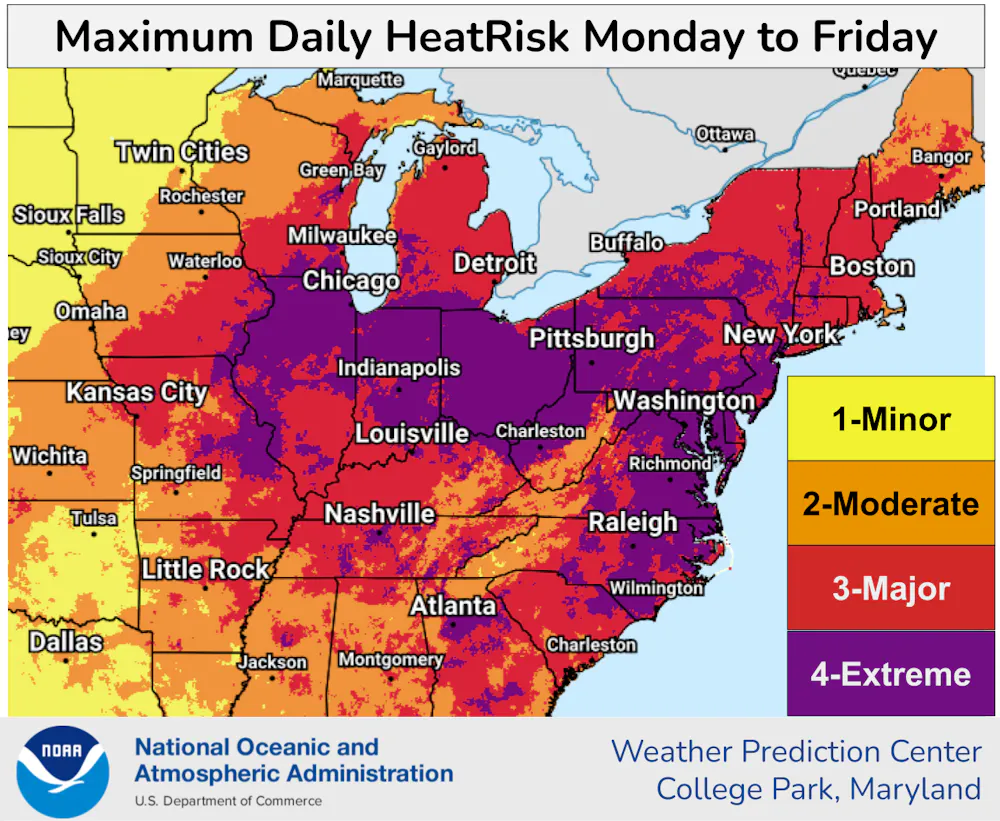
The Weather Prediction Center’s heat forecast shows the maximum temperatures states can expect to see at some point during the week of June 23-27, 2025. NOAA Weather Prediction Center
Even in places where heat is recognized as a dangerous health threat, people can be caught off guard as the thermometer creeps higher, on average, each year. In some cases, dangerous heat can arise quickly. In 2021, a young family died of heat stroke on a California trail after setting out for a hike when temperatures were still in the 70s Fahrenheit (low to mid 20s Celsius).
I study health risks in a warming climate as a professor of public health, and I’ve seen heat become a growing concern. Here are some of the key warning signs to watch for when temperatures rise – and ways to keep cool when the heat and humidity get too high.
Mild forms of heat-related illness include heat cramps and heat rash, both of which can be caused by extensive sweating during hot conditions. Cooling the body and drinking cool fluids can help.
When heat-related illnesses progress into heat exhaustion, the situation is more serious. Heat exhaustion includes symptoms such as dizziness, nausea, excessive sweating, feeling weak, thirst and getting a headache.
Construction workers are often out in the heat for long periods of time, including during this heat wave in Los Angeles in July 2024. Etienne Laurent/AFP via Getty Images
Heat exhaustion is a signal that the body is losing its ability to maintain a stable core temperature. Immediate action such as moving to a cool, ideally air-conditioned space, drinking liquids, loosening clothes and applying wet cloths are some of the recommended steps that can help keep heat exhaustion from progressing to the most dangerous form of heat-related illness, heat stroke.
Signs of heat exhaustion and heat stroke, from the National Weather Service and Centers for Disease Control and Prevention. NOAA/CDC
Typically, someone suffering heat stroke has exhausted their reserves of sweat and salt to stay cool, so sweating eventually stops during heat stroke. Their cognitive ability fails, and they cannot remove themselves from danger. Heat stroke can cause seizures or put someone into a coma as their core temperature rises. If the condition is not treated immediately, and the core temperature continues to rise, heat stroke becomes fatal.
Because heat exhaustion can lead to heat stroke, addressing heat-related illnesses before they progress is vital.
How to tell when the heat is too high
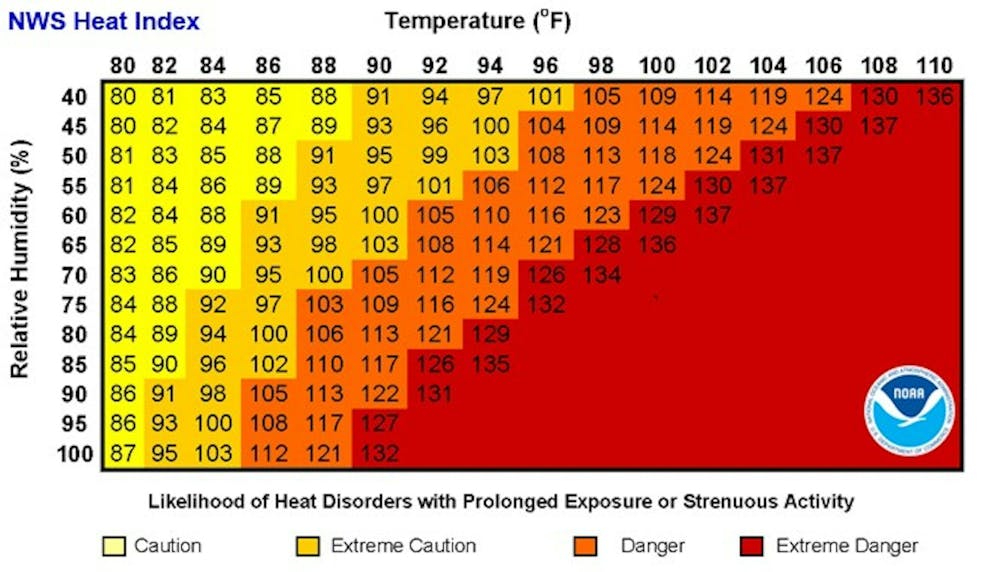
Heat risk isn’t just about temperature – humidity also increases the risk of heat-related illnesses because it affects how well sweating will cool the human body when it gets hot.
Instead of just looking at temperature when planning outdoor activities, check the heat index, which accounts for heat illness risk associated with temperature and relative humidity.
It doesn’t take very high temperatures or very high humidity for the heat index to enter dangerous territory.
A heat index chart shows how heat and humidity combine for dangerous conditions. NOAA
However, the heat index is still a conservative measure of the impact of heat on humans, particularly for outdoor workers and athletes at summer practices. This is because temperature measurements used in weather forecasting are taken in the shade and are not exposed to direct sunlight. If someone is outside and exposed to the direct sun, the actual heat index can be as much as 15 F higher than the heat index chart indicates.
A more sophisticated measurement of heat effects on human health is what’s known as the wet-bulb globe temperature, which takes into account other variables, such as wind speed and cloud cover. Neither takes into account a person’s physical exertion, which also raises their body temperature, whether working at a construction site or playing soccer.
Tips for staying safe in a heat wave
How can you stay cool when heat waves set in? The answer depends in part on where you are, but the main points are the same:
Avoid strenuous outdoor activities in high temperatures if possible. If you start to feel symptoms of heat-related illnesses, drink fluids that will hydrate you. Find shade, rest, and use cool, damp cloths to lower your body temperature. If you see signs of heat stroke in someone else, call for medical help.
Be careful with fans. Fans can be useful if the temperature isn’t too high because they wick sweat away from the body and induce evaporative cooling. But at very high temperatures, they can accelerate heat buildup in the body and lead to dangerous conditions. If indoor temperatures reaches 95 degrees or higher, using fans can actually be dangerous and raise the risk of heat-related illnesses.
Find a cooling center, library or community center where you can get inside and rest in an air-conditioned space in the hottest hours. In places such as Phoenix, where high temperatures are a regular hazard, cooling centers are typically opened in summer. Northern cities are also opening cooling centers as heat waves occur there more frequently than they did in the past. Urban areas with a lot of pavement and buildings – known as heat islands – can have temperatures well above the city’s average.
Hydrate, hydrate, hydrate! Drink plenty of fluids, and don’t forget about the importance of electrolytes. Heat-related dehydration can occur when people sweat excessively, losing water and necessary salts from the body. Some sports drinks or rehydration fluids restore electrolytes and hydration levels.
Older adults and people with disabilities often face higher risks from heat waves, particularly if they can’t easily move to a cooler environment. Communities and neighbors can help protect vulnerable populations by providing cooling centers and bottled water and making regular wellness checks during high heat.
Summer can be a season of fun. Just remember the risks, keep an eye on your friends and neighbors when temperatures rise, and plan ahead so you can beat the heat.
This article, originally published June 19, 2025, has been updated with new heat advisories and forecasts.
Brian Bossak is not currently receiving relevant external funding for heat-related illness research. In 2017-2019, he served as a consultant on a heat-related research award from the Southeastern Coastal Center for Agricultural Health and
Safety at the University of Florida.
Source: The Conversation – USA – By Jeffrey Fields, Professor of the Practice of International Relations, USC Dornsife College of Letters, Arts and Sciences
People observe fire and smoke from an Israeli airstrike on an oil depot in Tehran, Iran, on June 15, 2025. Stringer/Getty Images
The two countries have been particularly hostile to each other since Iranian students took over the U.S. Embassy in Tehran in November 1979, resulting in economic sanctions and the severing of formal diplomatic relations between the nations.
Some of the major events in U.S.-Iran relations highlight the differences between the nations’ views, but others arguably presented real opportunities for reconciliation.
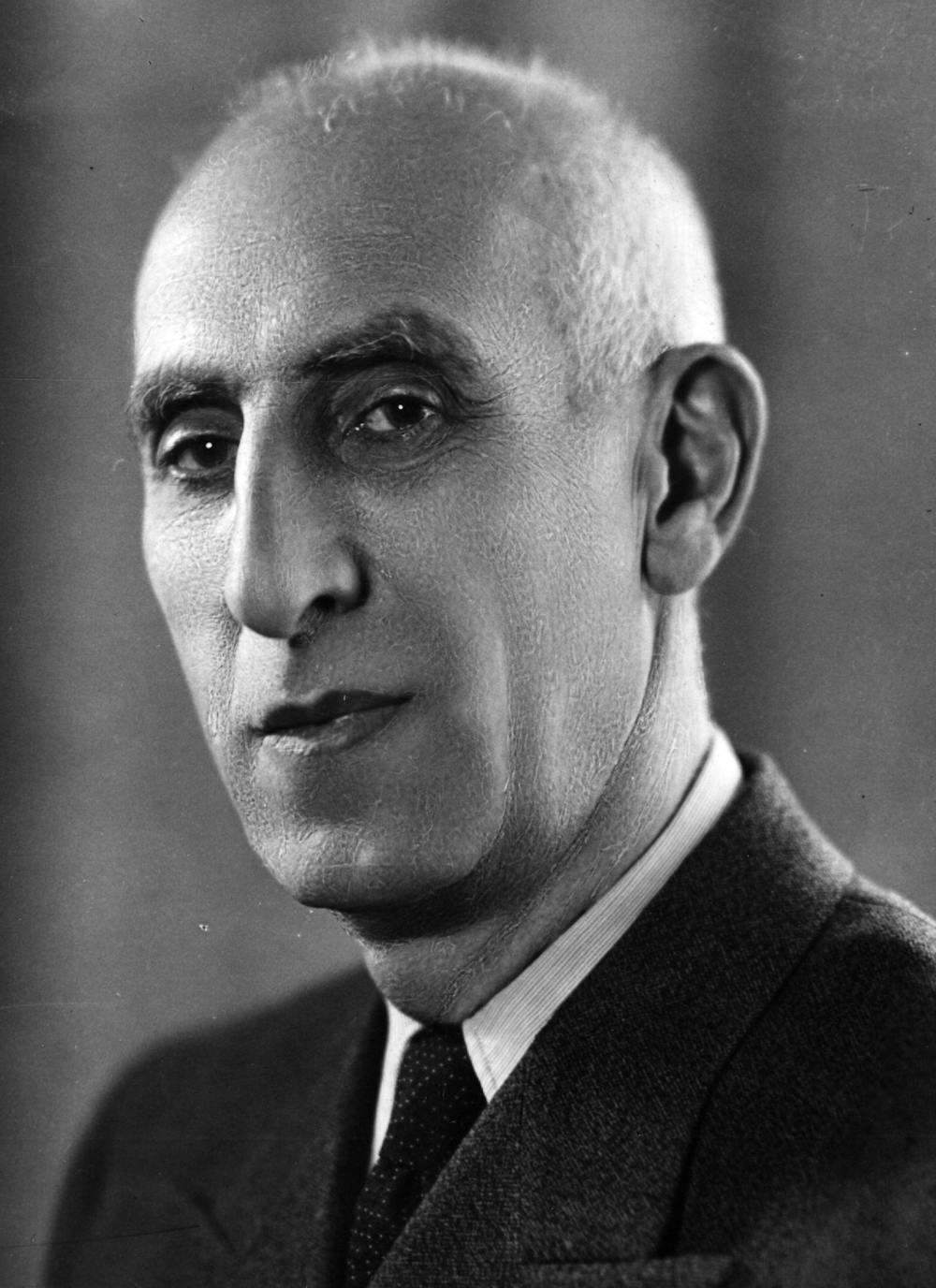
In 1951, the Iranian Parliament chose a new prime minister, Mossadegh, who then led lawmakers to vote in favor of taking over the Anglo-Iranian Oil Company, expelling the company’s British owners and saying they wanted to turn oil profits into investments in the Iranian people. The U.S. feared disruption in the global oil supply and worried about Iran falling prey to Soviet influence. The British feared the loss of cheap Iranian oil.
President Dwight Eisenhower decided it was best for the U.S. and the U.K. to get rid of Mossadegh. Operation Ajax, a joint CIA-British operation, convinced the Shah of Iran, the country’s monarch, to dismiss Mossadegh and drive him from office by force. Mossadegh was replaced by a much more Western-friendly prime minister, handpicked by the CIA.
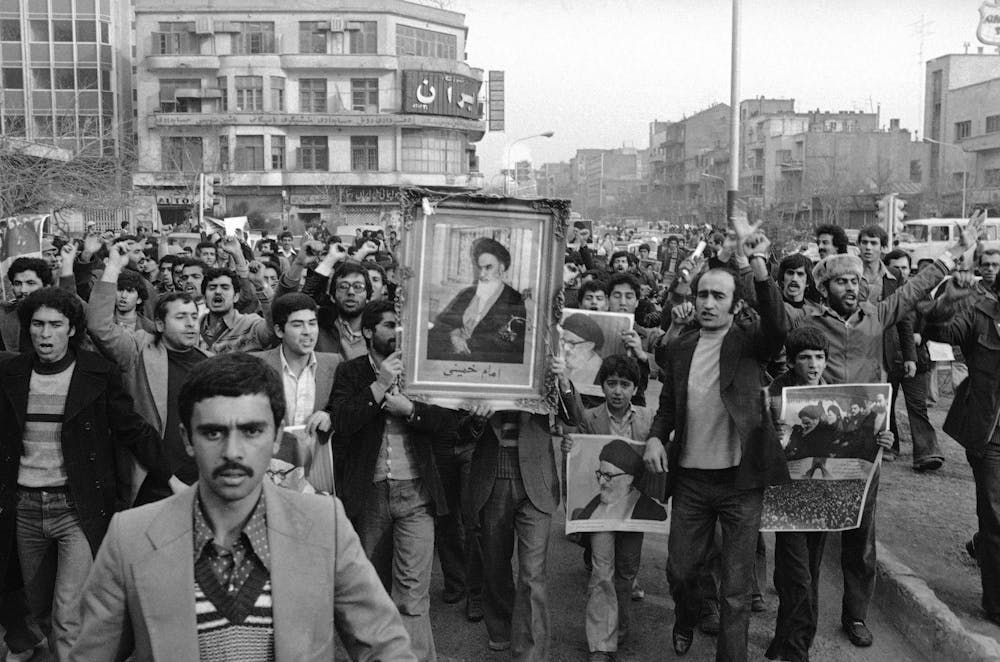
Demonstrators in Tehran demand the establishment of an Islamic republic. AP Photo/Saris
1979: Revolutionaries oust the shah, take hostages
After more than 25 years of relative stability in U.S.-Iran relations, the Iranian public had grown unhappy with the social and economic conditions that developed under the dictatorial rule of Shah Mohammad Reza Pahlavi.
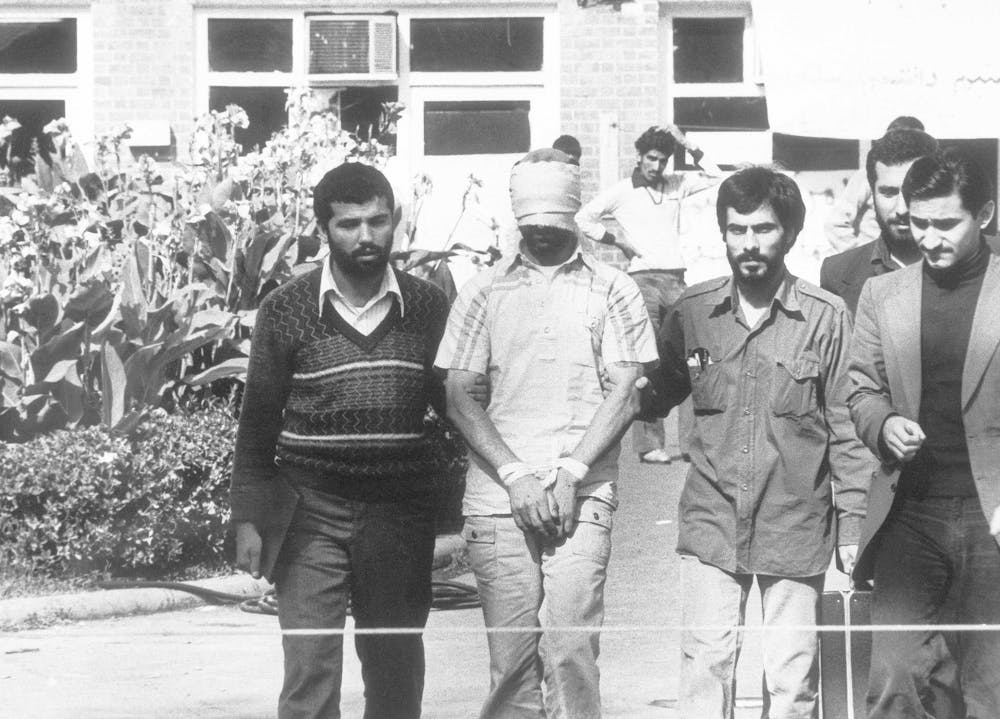
Iranian students at the U.S. Embassy in Tehran show a blindfolded American hostage to the crowd in November 1979. AP Photo
In October 1979, President Jimmy Carter agreed to allow the shah to come to the U.S. to seek advanced medical treatment. Outraged Iranian students stormed the U.S. Embassy in Tehran on Nov. 4, taking 52 Americans hostage. That convinced Carter to sever U.S. diplomatic relations with Iran on April 7, 1980.
Two weeks later, the U.S. military launched a mission to rescue the hostages, but it failed, with aircraft crashes killing eight U.S. servicemembers.
The shah died in Egypt in July 1980, but the hostages weren’t released until Jan. 20, 1981, after 444 days of captivity.
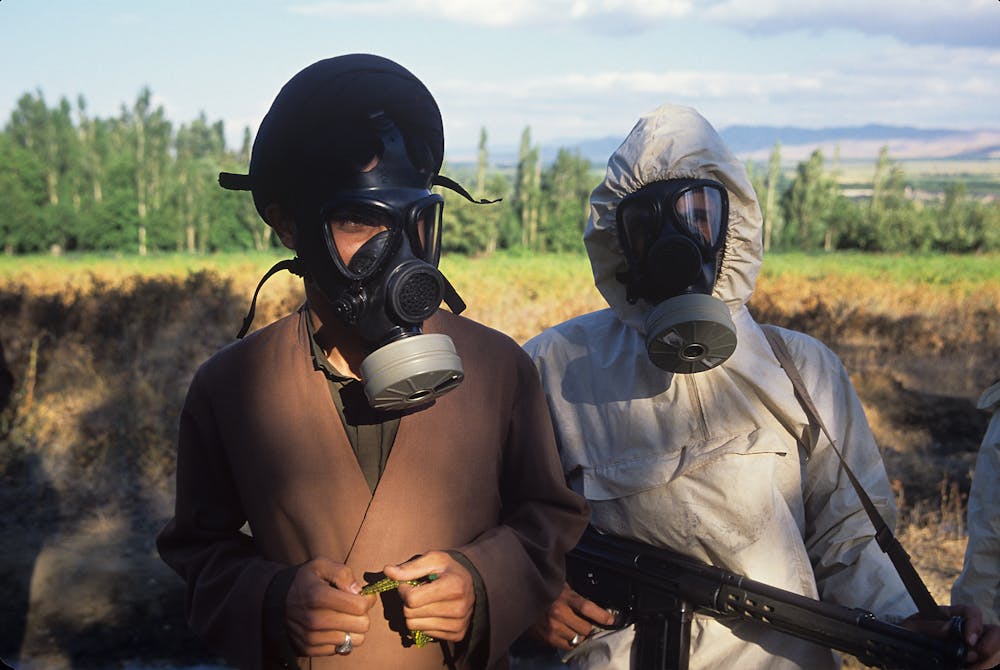
An Iranian cleric, left, and an Iranian soldier wear gas masks to protect themselves against Iraqi chemical-weapons attacks in May 1988. Kaveh Kazemi/Getty Images
The U.S. was concerned that the conflict would limit the flow of Middle Eastern oil and wanted to ensure the conflict didn’t affect its close ally, Saudi Arabia.
U.S. officials moderated their usual opposition to those illegal and inhumane weapons because the U.S. State Department did not “wish to play into Iran’s hands by fueling its propaganda against Iraq.” In 1988, the war ended in a stalemate. More than 500,000 military and 100,000 civilians died.
1981-1986: US secretly sells weapons to Iran
The U.S. imposed an arms embargo after Iran was designated a state sponsor of terrorism in 1984. That left the Iranian military, in the middle of its war with Iraq, desperate for weapons and aircraft and vehicle parts to keep fighting.
The last shipment, of anti-tank missiles, was in October 1986. In November 1986, a Lebanese magazine exposed the deal. That revelation sparked the Iran-Contra scandal in the U.S., with Reagan’s officials found to have collected money from Iran for the weapons and illegally sent those funds to anti-socialist rebels – the Contras – in Nicaragua.
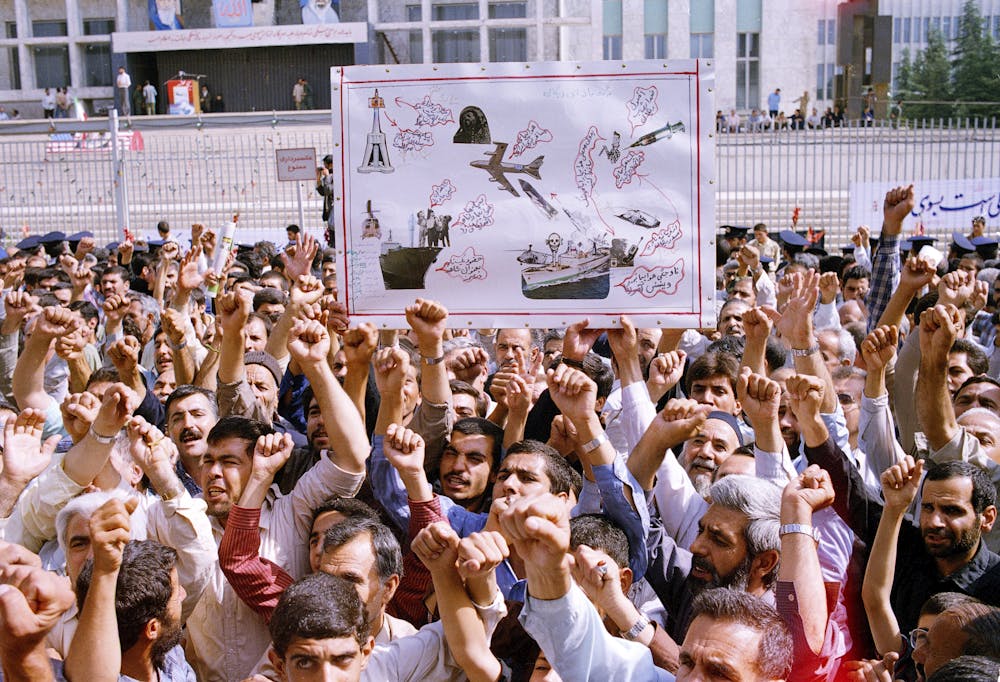
At a mass funeral for 76 of the 290 people killed in the shootdown of Iran Air 655, mourners hold up a sign depicting the incident. AP Photo/CP/Mohammad Sayyad
Either during or just after that exchange of gunfire, the Vincennes crew mistook a passing civilian Airbus passenger jet for an Iranian F-14 fighter. They shot it down, killing all 290 people aboard.
The U.S. called it a “tragic and regrettable accident,” but Iran believed the plane’s downing was intentional. In 1996, the U.S. agreed to pay US$131.8 million in compensation to Iran.
1997-1998: The US seeks contact
In August 1997, a moderate reformer, Mohammad Khatami, won Iran’s presidential election.
U.S. President Bill Clinton sensed an opportunity. He sent a message to Tehran through the Swiss ambassador there, proposing direct government-to-government talks.
Shortly thereafter, in early January 1998, Khatami gave an interview to CNN in which he expressed “respect for the great American people,” denounced terrorism and recommended an “exchange of professors, writers, scholars, artists, journalists and tourists” between the United States and Iran.
However, Supreme Leader Ayatollah Ali Khamenei didn’t agree, so not much came of the mutual overtures as Clinton’s time in office came to an end.
In his 2002 State of the Union address, President George W. Bush characterized Iran, Iraq and North Korea as constituting an “Axis of Evil” supporting terrorism and pursuing weapons of mass destruction, straining relations even further.
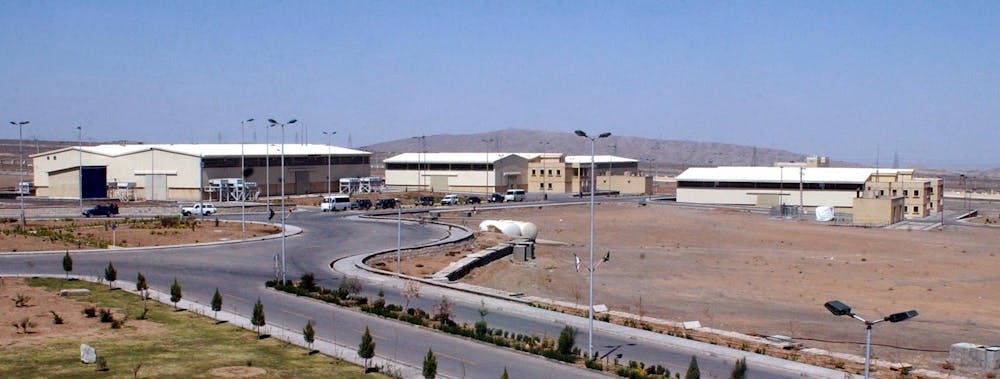
Inside these buildings at the Natanz nuclear facility in Iran, technicians enrich uranium. AP Photo/Vahid Salemi
That was a violation of the terms of the Nuclear Nonproliferation Treaty, which Iran had signed, requiring countries to disclose their nuclear-related facilities to international inspectors.
One of those formerly secret locations, Natanz, housed centrifuges for enriching uranium, which could be used in civilian nuclear reactors or enriched further for weapons.
Starting in roughly 2005, U.S. and Israeli government cyberattackers together reportedly targeted the Natanz centrifuges with a custom-made piece of malicious software that became known as Stuxnet.
An excerpt of the document sent from Iran, via the Swiss government, to the U.S. State Department in 2003, appears to seek talks between the U.S. and Iran. Washington Post via Scribd
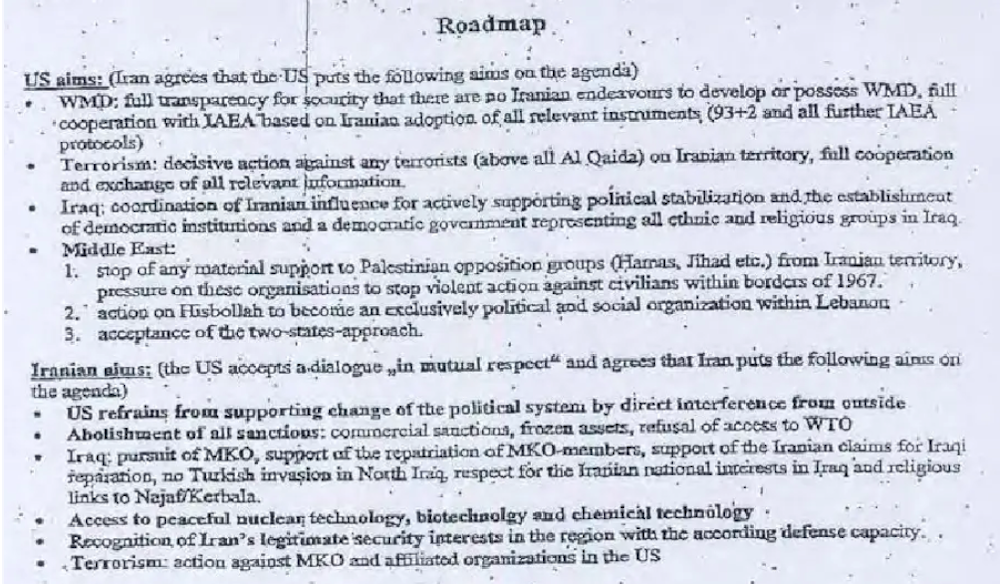
In May 2003, senior Iranian officials quietly contacted the State Department through the Swiss embassy in Iran, seeking “a dialogue ‘in mutual respect,’” addressing four big issues: nuclear weapons, terrorism, Palestinian resistance and stability in Iraq.
Hardliners in the Bush administration weren’t interested in any major reconciliation, though Secretary of State Colin Powell favored dialogue and other officials had met with Iran about al-Qaida.
When Iranian hardliner Mahmoud Ahmadinejad was elected president of Iran in 2005, the opportunity died. The following year, Ahmadinejad made his own overture to Washington in an 18-page letter to President Bush. The letter was widely dismissed; a senior State Department official told me in profane terms that it amounted to nothing.
After a decade of unsuccessful attempts to rein in Iran’s nuclear ambitions, the Obama administration undertook a direct diplomatic approach beginning in 2013.
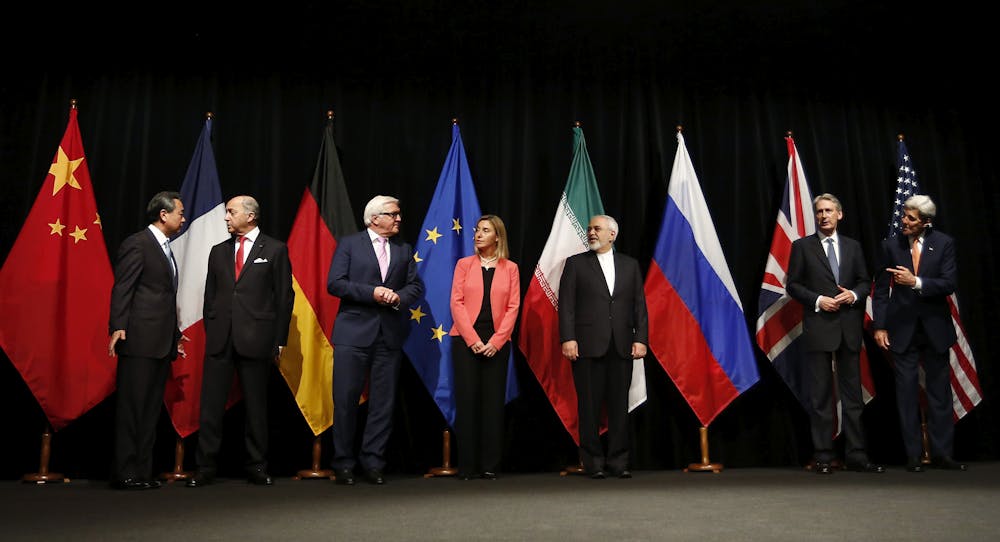
Iran, the U.S., China, France, Germany, Russia and the United Kingdom signed the deal in 2015. It severely limited Iran’s capacity to enrich uranium and mandated that international inspectors monitor and enforce Iran’s compliance with the agreement.
In return, Iran was granted relief from international and U.S. economic sanctions. Though the inspectors regularly certified that Iran was abiding by the agreement’s terms, President Donald Trump withdrew from the agreement in May 2018.
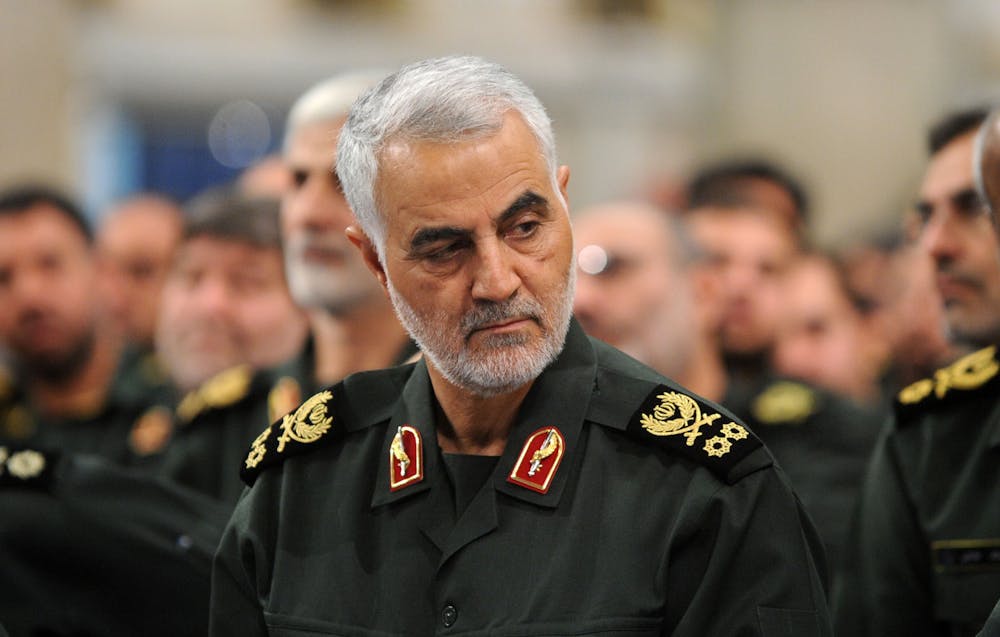
2020: US drones kill Iranian Maj. Gen. Qassem Soleimani
At the time, the Trump administration asserted that Soleimani was directing an imminent attack against U.S. assets in the region, but officials have not provided clear evidence to support that claim.
Hamas’ brazen attack on Israel on Oct. 7, 2023, provoked a fearsome militarized response from Israel that continues today and served to severely weaken Iran’s proxies in the region, especially Hamas – the perpetrator of the attacks – and Hezbollah in Lebanon.
2025: Trump 2.0 and Iran
Trump saw an opportunity to forge a new nuclear deal with Iran and to pursue other business deals with Tehran. Once inaugurated for his second term, Trump appointed Steve Witkoff, a real estate investor who is the president’s friend, to serve as special envoy for the Middle East and to lead negotiations.
Negotiations for a nuclear deal between Washington and Tehran began in April, but the countries did not reach a deal. They were planning a new round of talks when Israel struck Iran with a series of airstrikes on June 13, forcing the White House to reconsider is position.
On June 22, in the early morning hours, the U.S. chose to act decisively in an attempt to cripple Iran’s nuclear capacity, bombing three nuclear sites and causing what Pentagon officials called “severe damage.” Iran vowed to retaliate.
This story has been updated to reflect the U.S. bombing of Iranian nuclear sites on June 22, 2025.
Jeffrey Fields receives funding from the Carnegie Corporation of New York and Schmidt Futures.