The Palestine Solidarity Network Aotearoa has called on New Zealanders to condemn the US bombing of Iran.
PSNA co-chair Maher Nazzal said in a statement that he hoped the New Zealand government would be critical of the US for its war escalation.
“Israel has once again hoodwinked the United States into fighting Israel’s wars,” he said.
“Israel’s Prime Minister has [been declaring] Iran to be on the point of producing nuclear weapons since the 1990s.
“It’s all part of his big plan for expulsion of Palestinians from Palestine to create a Greater Israel, and regime change for the entire region.”
Israel knew that Arab and European countries would “fall in behind these plans” and in many cases actually help implement them.
“It is a dreadful day for the Palestinians. Netanyahu’s forces will be turned back onto them in Gaza and the West Bank.”
‘Dreadful day’ for Middle East “It is just as dreadful day for the whole Middle East.
“Trump has tried to add Iran to the disasters of US foreign policy in Iraq, Syria and Afghanistan. The US simply doesn’t care how many people will die.”
New Zealand’s Foreign Minister Winston Peters “acknowledged the development in the past 24 hours”, including President Trump’s announcement of the US strikes on Iran’s nuclear facilities.
He described it as “extremely worrying” military action in the Middle East, and it was critical further escalation was avoided.
“New Zealand strongly supports efforts towards diplomacy. We urge all parties to return to talks,” he said.
“Diplomacy will deliver a more enduring resolution than further military action.”
The Australian government said in a statement that Canberra had been clear that Iran’s nuclear and ballistic missile programme had been a “threat to international peace and security”.
It also noted that the US President had declared that “now is the time for peace”.
“The security situation in the region is highly volatile,” said the statement. “We continue to call for de-escalation, dialogue and diplomacy.”
Iran calls attack ‘outrageous’ However, the Iranian Foreign Minister, Abbas Araghchi, said the “outrageous” US attacks on Iran’s “peaceful nuclear installations” would have “everlasting consequences”.
His comments come as an Iranian missile attack on central and northern Israel wounded at least 23 people.
In an interview with Al Jazeera, Dr Mehran Kamrava, a professor of government at Georgetown University in Qatar, said the people of Iran feared that Israel’s goals stretched far beyond its stated goal of destroying the country’s nuclear and missile programmes.
“Many in Iran believe that Israel’s end game, really, is to turn Iran into Libya, into Iraq, what it was after the US invasion in 2003, and/or Afghanistan.
“And so the dismemberment of Iran is what Netanyahu has in mind, at least as far as Tehran is concerned,” he said.
US attack ‘more or less guarantees’ Iran will be nuclear-armed within decade
‘No evidence’ of Iran ‘threat’ Trita Parsi, the executive vice president of the Quincy Institute for Responsible Statecraft, said there had been “absolutely no evidence” that Iran posed a threat.
“Neither was it existential, nor imminent,” he told Al Jazeera.
“We have to keep in mind the reality of the situation, which is that two nuclear-equipped countries attacked a non-nuclear weapons state without having gotten attacked first.
“Israel was not attacked by Iran — it started that war; the United States was not attacked by Iran — it started this confrontation at this point.”
Dr Parsi added that the attacks on Iran would “send shockwaves” throughout the world.
Te Kuaka, an independent organisation advocating for a progressive and principled New Zealand foreign policy, expresses grave concern over the United States’ unprovoked bombing of Iranian nuclear facilities. This attack constitutes a clear violation of international law and the sovereignty of states.
This act of aggression was conducted without United Nations authorisation or credible justification under international law and risks catastrophic regional escalation. Furthermore, the US Constitution reserves war powers to Congress, making this attack an alarming breach of US democratic process.
New Zealand can play a role in the world by upholding peace, multilateralism, and international law. We call on the New Zealand government to take the following actions:
Publicly condemn this unlawful military strike and demand an immediate de-escalation.
Commit to no involvement, whether direct or indirect, in US military action against Iran.
Immediately withdraw NZDF personnel from the US-led Red Sea operation.
Pursue diplomatic solutions through the UN rather than unilateral aggression.
Call for other states to denounce these acts as a violation of international law and a challenge to fundamental principles of state conduct within the UN system.
New Zealand demonstrated moral leadership when it refused to join the illegal 2003 invasion of Iraq. This principled stand upheld our nation’s commitment to international law and independent foreign policy. Today, we face a similar test of our values. Just as we rejected participation in that disastrous war, New Zealand must again resist pressure to support unlawful US military action.
Te Kuaka urges the government to uphold an independent foreign policy that prioritises peace, human rights, and international law over militarism and aggression.
Source: United States Senator for Washington State Patty Murray
Washington, D.C.— Today, U.S. Senator Patty Murray (D-WA), Vice Chair of the Senate Appropriations Committee, issued the following statement in response to the Trump administration’s recently announced strikes on Iran:
“We can all agree that Iran should never possess a nuclear weapon. But the American people do not want to begin a war with Iran, and Trump does not have the unilateral authority to start one.
“This strike was unconstitutional. I share the questions the American people have. What is the strategy here? Why are we putting American lives at risk? The administration must now do its utmost to ensure service members and civilians in the region are protected against retaliation.
“The United States of America is a democracy with constitutional separation of powers, and that requires a president—any president—to come to Congress to approve the use of military force.
“It is critical that Congress ask important questions before approval—Congress needs to understand what intelligence the administration is acting upon, what the goal is, what the endgame is, and whether we have built an international coalition of support. None of this happened.
“Congress has not been presented with any evidence that required these strikes tonight. I will continue to demand answers and to speak up on behalf of my constituents, the overwhelming majority of whom do not want to be dragged into yet another forever war.”
The jagged silhouette of a B2 stealth bomber seen during a 2015 flyover in the US.Jonathan Daniel / Getty Images
Late on Saturday night, local time, the United States carried out strikes against Iranian nuclear enrichment sites at Fordow, Natanz and Isfahan, marking its open participation in the conflict between Iran and Israel.
The US says it fired 30 submarine-launched missiles at the sites in Natanz and Isfahan, as well as dropping more than a dozen “bunker buster” bombs at Fordow and Natanz.
The kind of bomb in question is the extremely destructive GBU-57 Massive Ordance Penetrator, or MOP, which weighs around 13.5 tonnes.
The attacks raise a lot of questions. What are these enormous bombs? Why did the US feel it had to get involved in the conflict? And, going forward, what does it mean for Iran’s nuclear ambitions?
What are ‘bunker busters’, and why are they used?
Bunker busters are weapons designed to destroy heavily protected facilities such as bunkers deep underground, beyond the reach of normal bombs.
Bunker busters are designed to bury themselves into the ground before detonating. This allows more of the explosive force to penetrate into the ground, rather than travelling through the air or across the surface.
Iran’s nuclear enrichment sites at Fordow, Natanz and Isfahan are built deep underground. Estimates suggest that Fordow for example could be 80m beneath the surface, and capped with layers of reinforced concrete and soil.
What is the MOP?
The bunker buster used in this particular operation is the largest in the US arsenal. Leaving aside nuclear weapons, the MOP is the largest known buster buster in the world.
Weighing some 13.5 tonnes, the MOP is believed to be able to penetrate up to 60 metres below ground in the right conditions. It is not known how many the US possesses, but the numbers are thought to be small (perhaps 20 or so in total).
We also don’t know exactly how many were used in Iran, though some reports say it was 14. However, it is likely to be a significant portion of the US MOP arsenal.
Why does only the US possess this capability?
The US is not the only state with bunker-busting weaponry. However, the size of MOP means it requires very specialised bombers to carry and drop it.
Only the B2 stealth bomber is currently able to deploy the MOP. Each B2 can carry at most two MOPs at a time. Around seven of America’s 19 operational B2s were used in the Iran operation.
There has been some consideration whether large transport aircraft such as the C-130 Hercules could be modified to carry and drop the MOP from its rear cargo doors. While this would allow other countries (including Israel) to deploy the MOP, it is for now purely hypothetical.
Why has the US (apparently) used them in Iran
The Trump administration claims Iran may be only a few weeks from possessing a nuclear weapon, and that it needed to act now to destroy Iranian nuclear enrichment sites. This claim is notably at odds with published assessments from the US intelligence community.
However, Israel lacks bunker busting weaponry sufficient to damage the deeply buried and fortified enrichment sites at Fordow, Natanz and Isfahan.
An F-15E Strike Eagle releases a GBU-28 ‘bunker buster’ laser-guided bomb, a smaller equivalewnt of the 13,600 kg GBU-57 ‘Massive Ordnance Penetrator’ believed to have been used in Iran. Michael Ammons / US Air Force
Only the MOP could do the job (short of using nuclear weapons). Even then, multiple MOPs would have been required to ensure sufficient damage to the underground facilities.
The US has claimed that these sites have been utterly destroyed. We cannot conclusively say whether this is true.
Iran may also have other, undeclared nuclear sites elsewhere in the country.
Iran’s reaction
The US has reportedly reached out to Iran via diplomatic channels to emphasise that this attack was a one-off, not part of a larger project of regime change. It is hard to say what will happen in the next few weeks.
Iran may retaliate with large strikes against Israel or against US forces in the region. It could also interrupt shipping in the Strait of Hormuz, which would affect a large portion of global oil shipments, with profound economic implications.
Alternatively, Iran could capitulate and take steps to demonstrate it is ending its nuclear program. However, capitulation would not necessarily mean the end of Iran’s nuclear ambitions.
The value of nuclear weapons
Perhaps a greater concern is that the attack will reinforce Iran’s desire to go nuclear. Without nuclear weapons, Iran was unable to threaten the US enough to deter today’s attack.
Iran may take lessons from the fate of other states. Ukraine (in)famously surrendered its stockpile of former Soviet nuclear weapons in the early 1990s. Russia has since felt emboldened to annex Crimea in 2014 and launch an ongoing invasion in 2022. Other potential nuclear states, such as Iraq and Gadaffi’s regime in Libya, also suffered from military intervention.
By contrast, North Korea successfully tested its first nuclear weapon in 2006. Since then there has been no serious consideration of military intervention in North Korea.
Iran may yet have the ability to produce useful amounts of weapons-grade uranium. It may now aim to buy itself time to assemble a relatively small nuclear device, similar in scale to the bombs used in Hiroshima and Nagasaki.
Depending on what facilities and resources have survive the US strikes, the attack has likely reinforced that the only way the Iranian regime can guarantee its survival is to possess nuclear weapons.
James Dwyer does not work for, consult, own shares in or receive funding from any company or organisation that would benefit from this article, and has disclosed no relevant affiliations beyond their academic appointment.
After prevaricating about whether the United States would enter Israel’s war on Iran, President Donald Trump finally made a decision.
Early Sunday, US warplanes struck three of Iran’s nuclear sites at Natanz, Isfahan and Fordow, where the Iranians have a uranium enrichment plant buried about 80 metres beneath a mountain.
These strikes have to be viewed as part of an overall continuum that began with the Gaza war following Hamas’ attack on Israel on October 7, 2023, and then continued with Israel’s attacks on Hezbollah (the Iran-backed militant group in Lebanon) and the fall of the Iran-backed Assad regime in Syria.
Iran has never been weaker than it is now. And when Trump said it may take two weeks for him to decide whether to bomb Iran, the Israelis likely pushed him to act sooner.
We can assume there was a lot of Israeli pressure on Trump to use the massive ordnance penetrators, the 30,000-pound (13,600-kilogram) “bunker buster” bombs that only the US can deploy with its B2 bombers.
Now that Trump has taken the significant step of entering the US in yet another Middle East war, where could things go from here? There are a few possible scenarios.
Iran strikes back
The Iranians know they don’t have the strength to take on the US, and that the Americans can do enormous damage to their country and even put the Iranian regime’s stability at risk.
This is always the prime consideration of of the clerical regime led by Supreme Leader Ali Khamenei – everything else is subordinate to that.
To gauge Iran’s possible reaction, we can look at the how it responded to the first Trump administration’s assassination of the head of the Islamic Revolutionary Guard Corps’ elite Quds Force, Qassem Soleimani, in January 2020.
Iran said there would be a major reaction, but all it did was launch a barrage of missiles at two American bases in Iraq, which caused no US fatalities and very little damage. After that token retaliation, Iran said the matter was closed.
Iran’s reaction to the new US strikes will likely be along these lines. It probably won’t want to get into a tit-for-tat with the US by launching attacks against American facilities in the region. Trump has promised to respond with force:
Iran, a bully of the Middle East, must now make peace. If they do not, future attacks will be far greater and a lot easier.
It’s also unclear how long Iran will be able to prosecute this war. This depends largely on how many ballistic missiles and launchers it has left.
There are various estimates as to how many ballistic missiles Iran may have remaining in its stockpiles. It was believed to have about 2,000 missiles capable of reaching Israel at the start of the war. Some estimates say Iran has fired 700 of them; others say around 400. Whatever the number is, its stockpiles are dwindling quickly.
Israel has also destroyed about a third of Iran’s ballistic missile launchers. If Israel is able to destroy all of them, Iran would have very limited ability to fight back.
Iran backs down
Before the US got involved in the conflict, Iran said it was prepared to negotiate, but it wouldn’t do so while Israel was still attacking.
So, one scenario is that some sort of compromise can now be worked out, in which Israel announces a ceasefire and Iran and the US agree to resume negotiations on Tehran’s nuclear program.
The big problem is that Israeli Prime Minister Benjamin Netanyahu has said he doesn’t trust the negotiating process and he doesn’t want to stop Israel’s military actions until all of Iran’s nuclear facilities have been completely destroyed. He’s also been bombing Iran’s oil terminals and gas facilities to put even more pressure on the regime.
But the regime has shown itself to be incredibly determined not to lose face. It was under great pressure at different times during the Iran-Iraq war in the 1980s and never considered surrendering until a US missile mistakenly took down an Iranian passenger jet, killing 290 people.
Iran then agreed to a UN-brokered ceasefire. But the Iran-Iraq war lasted eight years, causing an estimated one million deaths. And when the then-supreme leader, Ayatollah Ruhollah Khomeini, agreed to the ceasefire, he said it was “worse than drinking poison”.
Given the state of Iran’s military capabilities, Khamenei, the current supreme leader, might surrender simply to try to preserve the regime. But this would be quite a climbdown as far as he’s concerned, and he has been very obstinate in the past.
The regime is very unpopular, but the Iranian people, in my experience, are strongly patriotic – loyal to their country, if not the regime. Though it’s difficult to gauge opinion in a country of 90 million people, a lot of Iranians would not want to be ordered to do anything by the US or Israel, and would rather fight on.
Netanyahu has said he wants to create the conditions for the Iranian people to rise up against the regime.
But it’s worth bearing in mind that the opposite of autocracy is not necessarily democracy. It could possibly be chaos. Iran has a number of different ethnic groups and there may be huge disagreements over what should take the place of the clerical regime, were it to fall.
Though we don’t know his probable successor, the regime has had plenty of time to plan for this. Those in senior positions will also know that a post-Khamenei succession struggle really would put the regime at risk.
The US engagement is limited
According to the new polling by The Economist and YouGov, released on June 17, 60% of Americans were opposed to joining the conflict between Israel and Iran, with just 16% in favour. Among Republicans, 53% opposed military action.
So, these strikes were not an obviously popular move among Americans at this stage. However, if this is an isolated event and succeeds in bringing a swift end to the war, Trump will probably be applauded by a majority of Americans.
If the US has to go back with more bombers – or there are serious attacks on US interests in the region – there could be more adverse reactions among Americans.
If it hasn’t been destroyed, and depending how much damage has been done to its centrifuges, Iran may be able to reconstruct its nuclear program relatively quickly. And it could have more incentive to further enrich this uranium to 90% purity, or weapons-grade level, to build a nuclear device.
Ian Parmeter does not work for, consult, own shares in or receive funding from any company or organisation that would benefit from this article, and has disclosed no relevant affiliations beyond their academic appointment.
BISMARCK, N.D. — On Saturday, President Donald Trump announced his decision for the United States to take military action against Iran in its ongoing conflict with Israel. The president said the United States successfully attacked three nuclear sites in Iran, including Fordow, Natanz, and Esfahan.
U.S. Senator Kevin Cramer (R-ND), a member of the Senate Armed Services Committee (SASC), issued the following statement:
“When the United States alone is able to do what others cannot, we must do what needs to be done, and that is exactly what President Trump ordered today. Iran must be prevented from acquiring a nuclear weapon. The Islamic Republic of Iran is more than a nuisance, it is a dangerous animal that must be stopped, and the firepower of the United States military was up to the task. President Trump is living up to his promise to end wars, which sometimes requires a show of strength. Tonight, the world has seen our strength on full display, and the world is safer for it. God Bless the United States Military and bring peace to our world.”
WASHINGTON, D.C. – Today, House Foreign Affairs Committee Chairman Brian Mast issued the following statement in response to the successful U.S. strikes on three Iranian nuclear sites.
“President Trump assured America and the world that there would be no Iranian nuclear weapons and he has no fictitious red lines. America and Iran both had a choice and we both chose action.”
Source: The Conversation – Africa – By Rachel Ama Asaa Engmann, Associate Professor and Director of Christiansborg Archaeological Heritage Project, Associate Graduate Faculty, Rutgers University
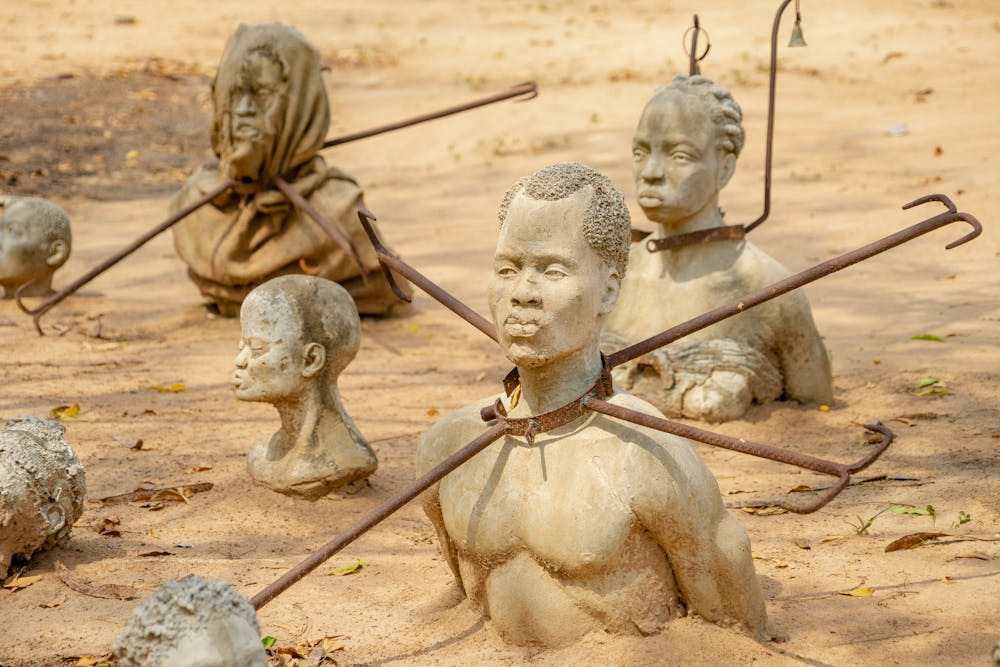
Thousands of sculpted heads – captive African men, women, and children – meticulously created by the artist Kwame Akoto-Bamfo, emerge from the soil at the Nkyinkyim Museum, as a sacred gathering of ancestors. Together, they form a powerful monument to the horror, violence, and resistance to enslavement, as well as the ongoing work of remembrance and healing.
Kwame Akoto-Bamfo is a Ghanaian multidisciplinary artist who engages with the histories and legacies of the transatlantic slave trade and colonialism at home and, increasingly, internationally, on both sides of the Atlantic.
As an archaeologist who works in the field of critical heritage studies, Akoto-Bamfo’s work is important for its powerful engagement with memory, material culture and restorative justice. I feature it in a chapter of a new book that I co-edited called Architectures of Slavery: Ruins and Reconstructions.
Who is Kwame Akoto-Bamfo?
Akoto-Bamfo studied at the Kwame Nkrumah University of Science and Technology in Kumasi. He obtained his bachelor’s and master of fine arts degrees, both in sculpture. After graduating, the artist worked as a school teacher and a university lecturer.
In 2015, Akoto-Bamfo rose to international fame through a series of large-scale installations. He called it ‘Nkyinkyim’ (“twisting” in the Ghanaian Twi language, as in the proverb, “Life’s journey is twisted”).
Four years later, he established the ‘Nkyinkyim Museum’, a non-profit organisation known as the ‘Ancestor Project’. This open-air museum is located in Nuhalenya-Ada, a two-hour drive from Accra. It has become a space for people of African descent to engage in restorative healing through art and education.
Nkyinkyim Museum
At the site’s entrance, three twenty-five-foot monuments are displayed. They are made of stone, concrete and wood. The first is inspired by North and Eastern Africa, and the second by Sudano-Sahelian architecture. The third is inspired by the Forest regions in Central and West Africa.
The collection includes multiple installations in collaboration with the local community. They illustrate “the diversity in our narratives surrounding history, philosophy, and religious beliefs”. The artist himself, demonstrates a mastery of multimedia art forms, working in cement, terracotta, brass, copper, and wood, noting “one can reach different heights with different technologies.”
Today, the museum features a sacred healing space with a compelling display of thousands of unique concrete life size heads and 7,000 terracotta miniature sculpted heads. They include captive Africans abducted, sold and forcibly trafficked during the transatlantic slave trade.
His sculptures capture captives’ shock, horror, anger, distress and fear—emotions. This is communicated through their facial expressions in an installation that is disturbingly evocative and profoundly haunting. It is inspired by ‘nsodie’, an Akan funerary sculpture tradition, that dates back to approximately the twelfth century. Akoto-Bamfo explains during our conversations relating to the research for book:
I wanted to draw upon Akan belief in commemoration and remembrance after death in order to honour the young, old, men and women, who originated from various ethnic groups and who died in the Atlantic Ocean during the Middle Passage and did not get that chance.
Each year, the annual ‘Ancestor Veneration’ ceremony takes place under the guidance of chiefs, priests, and priestess from various ethnic groups.
Visitors are invited to participate in certain Akan rites and ceremonies – free from photography and selfies that undermine or commercialise sacred funerary art practices. Says Akoto-Bamfo:
I am Akan, so initially I began with Akan traditional rites, but now our ceremonies welcome other African ethnic groups including the Ga-Dangme, Ewe, and Yoruba, from Ghana and Nigeria, as well as African descendant people in the African diaspora.
In contrast, the ‘Freedom Parade Festival’ allows participants to creatively express and contribute to an evolving heritage tradition, without the specified observances. For example, painted bodily adornment applied directly onto the skin, yet without the necessary spiritual rites.
A protest monument
Akoto-Bamfo’s sculptures have also gained recognition beyond Ghana’s borders. For instance, the permanent installation at the Legacy Museum and National Museum for Peace and Justice in Montgomery, Alabama in the US.
More recently, in 2021, his Blank Slate Project Monument toured throughout the United States. This included stops at Times Square in New York and the King Center in Atlanta. It depicts an enslaved ancestor, bent forward with his hands behind his back, head turned sideways, face on the ground, with a booted foot on his head.
Akoto-Bamfo describes this work as “a noisy one — a protest piece that speaks against racist Civil War monuments.” The work was completed prior to the police killing of George Floyd that led to widespread protests in the US in 2020. It was first unveiled in a private viewing in Ghana, prior to its shipment to the United States.
He says:
We had a lot of discussions among those involved in the project: some feared it might incite violence, others said that it was a prediction.
The work is interactive. It holds a removable placard that invites viewers to inscribe their reactions to the statue, which are then exhibited. Akoto-Bamfo emphasises:
I wanted ordinary people, both individuals and communities, to relate, and to contribute to, not only towards my artwork but also to the wider ongoing discussions. As an artist, I believe that I do not have the sole right to speak. I wanted ordinary Americans to add their voices because I am already contributing.
In Europe too, his work is featured at the 169 Museum in Germany.
In Ghana, Akoto-Bamfo’s work was initially seen as too controversial. The artist shares:
At first, I had to be extremely resilient because my work was concerned with the slave trade, slavery, colonialism, racism, and human rights. I embraced uncomfortable dialogue. Yet these were difficult topics for galleries and the art world at that time in Ghana.
He adds:
Today, however, some even view me as a spiritual leader… but I have always had an innate antipathy towards injustice. My work is not only about the past but what is unfolding now.
Akoto-Bamfo offers a closing reflection on why this kind of memory work matters:
I just want to use the little knowledge that I have to contribute towards the work of restorative and transformative justice.
Rachel Ama Asaa Engmann does not work for, consult, own shares in or receive funding from any company or organisation that would benefit from this article, and has disclosed no relevant affiliations beyond their academic appointment.
Source: The Conversation – Africa – By Rachel Ama Asaa Engmann, Associate Professor and Director of Christiansborg Archaeological Heritage Project, Associate Graduate Faculty, Rutgers University
Thousands of sculpted heads – captive African men, women, and children – meticulously created by the artist Kwame Akoto-Bamfo, emerge from the soil at the Nkyinkyim Museum, as a sacred gathering of ancestors. Together, they form a powerful monument to the horror, violence, and resistance to enslavement, as well as the ongoing work of remembrance and healing.
Kwame Akoto-Bamfo is a Ghanaian multidisciplinary artist who engages with the histories and legacies of the transatlantic slave trade and colonialism at home and, increasingly, internationally, on both sides of the Atlantic.
As an archaeologist who works in the field of critical heritage studies, Akoto-Bamfo’s work is important for its powerful engagement with memory, material culture and restorative justice. I feature it in a chapter of a new book that I co-edited called Architectures of Slavery: Ruins and Reconstructions.
Who is Kwame Akoto-Bamfo?
Akoto-Bamfo studied at the Kwame Nkrumah University of Science and Technology in Kumasi. He obtained his bachelor’s and master of fine arts degrees, both in sculpture. After graduating, the artist worked as a school teacher and a university lecturer.
In 2015, Akoto-Bamfo rose to international fame through a series of large-scale installations. He called it ‘Nkyinkyim’ (“twisting” in the Ghanaian Twi language, as in the proverb, “Life’s journey is twisted”).
Four years later, he established the ‘Nkyinkyim Museum’, a non-profit organisation known as the ‘Ancestor Project’. This open-air museum is located in Nuhalenya-Ada, a two-hour drive from Accra. It has become a space for people of African descent to engage in restorative healing through art and education.
Nkyinkyim Museum
At the site’s entrance, three twenty-five-foot monuments are displayed. They are made of stone, concrete and wood. The first is inspired by North and Eastern Africa, and the second by Sudano-Sahelian architecture. The third is inspired by the Forest regions in Central and West Africa.
The collection includes multiple installations in collaboration with the local community. They illustrate “the diversity in our narratives surrounding history, philosophy, and religious beliefs”. The artist himself, demonstrates a mastery of multimedia art forms, working in cement, terracotta, brass, copper, and wood, noting “one can reach different heights with different technologies.”
Today, the museum features a sacred healing space with a compelling display of thousands of unique concrete life size heads and 7,000 terracotta miniature sculpted heads. They include captive Africans abducted, sold and forcibly trafficked during the transatlantic slave trade.
His sculptures capture captives’ shock, horror, anger, distress and fear—emotions. This is communicated through their facial expressions in an installation that is disturbingly evocative and profoundly haunting. It is inspired by ‘nsodie’, an Akan funerary sculpture tradition, that dates back to approximately the twelfth century. Akoto-Bamfo explains during our conversations relating to the research for book:
I wanted to draw upon Akan belief in commemoration and remembrance after death in order to honour the young, old, men and women, who originated from various ethnic groups and who died in the Atlantic Ocean during the Middle Passage and did not get that chance.
Each year, the annual ‘Ancestor Veneration’ ceremony takes place under the guidance of chiefs, priests, and priestess from various ethnic groups.
Visitors are invited to participate in certain Akan rites and ceremonies – free from photography and selfies that undermine or commercialise sacred funerary art practices. Says Akoto-Bamfo:
I am Akan, so initially I began with Akan traditional rites, but now our ceremonies welcome other African ethnic groups including the Ga-Dangme, Ewe, and Yoruba, from Ghana and Nigeria, as well as African descendant people in the African diaspora.
In contrast, the ‘Freedom Parade Festival’ allows participants to creatively express and contribute to an evolving heritage tradition, without the specified observances. For example, painted bodily adornment applied directly onto the skin, yet without the necessary spiritual rites.
A protest monument
Akoto-Bamfo’s sculptures have also gained recognition beyond Ghana’s borders. For instance, the permanent installation at the Legacy Museum and National Museum for Peace and Justice in Montgomery, Alabama in the US.
More recently, in 2021, his Blank Slate Project Monument toured throughout the United States. This included stops at Times Square in New York and the King Center in Atlanta. It depicts an enslaved ancestor, bent forward with his hands behind his back, head turned sideways, face on the ground, with a booted foot on his head.
Akoto-Bamfo describes this work as “a noisy one — a protest piece that speaks against racist Civil War monuments.” The work was completed prior to the police killing of George Floyd that led to widespread protests in the US in 2020. It was first unveiled in a private viewing in Ghana, prior to its shipment to the United States.
He says:
We had a lot of discussions among those involved in the project: some feared it might incite violence, others said that it was a prediction.
The work is interactive. It holds a removable placard that invites viewers to inscribe their reactions to the statue, which are then exhibited. Akoto-Bamfo emphasises:
I wanted ordinary people, both individuals and communities, to relate, and to contribute to, not only towards my artwork but also to the wider ongoing discussions. As an artist, I believe that I do not have the sole right to speak. I wanted ordinary Americans to add their voices because I am already contributing.
In Europe too, his work is featured at the 169 Museum in Germany.
In Ghana, Akoto-Bamfo’s work was initially seen as too controversial. The artist shares:
At first, I had to be extremely resilient because my work was concerned with the slave trade, slavery, colonialism, racism, and human rights. I embraced uncomfortable dialogue. Yet these were difficult topics for galleries and the art world at that time in Ghana.
He adds:
Today, however, some even view me as a spiritual leader… but I have always had an innate antipathy towards injustice. My work is not only about the past but what is unfolding now.
Akoto-Bamfo offers a closing reflection on why this kind of memory work matters:
I just want to use the little knowledge that I have to contribute towards the work of restorative and transformative justice.
Rachel Ama Asaa Engmann does not work for, consult, own shares in or receive funding from any company or organisation that would benefit from this article, and has disclosed no relevant affiliations beyond their academic appointment.
The reaction of world leaders after U.S. forces struck three Iranian nuclear sites on Sunday Iran time ranged from Israel lauding President Donald Trump’s decision to the U.N. calling for de-escalation and Iran and some other nations condemning the attacks.
ISRAEL PRIME MINISTER BENJAMIN NETANYAHU, RECORDED STATEMENT:
“Congratulations, President Trump. Your bold decision to target Iran’s nuclear facilities with the awesome and righteous might of the United States will change history… History will record that President Trump acted to deny the world’s most dangerous regime the world’s most dangerous weapons.”
IRAN FOREIGN MINISTER ABBAS ARAQCHI, ON X:
“The United States, a permanent member of the United Nations Security Council, has committed a grave violation of the UN Charter, international law and the NPT by attacking Iran’s peaceful nuclear installations. The events this morning are outrageous and will have everlasting consequences. Each and every member of the UN must be alarmed over this extremely dangerous, lawless and criminal behavior. In accordance with the UN Charter and its provisions allowing a legitimate response in self-defense, Iran reserves all options to defend its sovereignty, interest, and people.”
U.N. SECRETARY-GENERAL ANTONIO GUTERRES, STATEMENT
“I am gravely alarmed by the use of force by the United States against Iran today. This is a dangerous escalation in a region already on the edge – and a direct threat to international peace and security. There is a growing risk that this conflict could rapidly get out of control – with catastrophic consequences for civilians, the region, and the world. I call on Member States to de-escalate and to uphold their obligations under the UN Charter and other rules of international law. At this perilous hour, it is critical to avoid a spiral of chaos. There is no military solution. The only path forward is diplomacy. The only hope is peace.”
NEW ZEALAND FOREIGN MINISTER WINSTON PETERS, STATEMENT:
“We acknowledge developments in the last 24 hours, including President Trump’s announcement of US strikes on nuclear facilities in Iran. Ongoing military action in the Middle East is extremely worrying, and it is critical further escalation is avoided. New Zealand strongly supports efforts towards diplomacy. We urge all parties to return to talks. Diplomacy will deliver a more enduring resolution than further military action.”
AUSTRALIA GOVERNMENT SPOKESPERSON, STATEMENT:
“We have been clear that Iran’s nuclear and ballistic missile program has been a threat to international peace and security. We note the US President’s statement that now is the time for peace. The security situation in the region is highly volatile. We continue to call for de-escalation, dialogue and diplomacy.”
MEXICO FOREIGN MINISTRY, ON X:
“The ministry urgently calls for diplomatic dialogue for peace between the parties involved in the Middle East conflict. In keeping with our constitutional principles of foreign policy and our country’s pacifist conviction, we reiterate our call to de-escalate tensions in the region. The restoration of peaceful coexistence among the states of the region is the highest priority.”
VENEZUELA FOREIGN MINISTER YVAN GIL, ON TELEGRAM:
“Venezuela Condemns U.S. Military Aggression Against Iran and Demands an Immediate Cessation of Hostilities. The Bolivarian Republic of Venezuela firmly and categorically condemns the bombing carried out by the United States military, at the request of the State of Israel, against nuclear facilities in the Islamic Republic of Iran, including the Fordow, Natanz, and Isfahan complexes.”
CUBA PRESIDENT MIGUEL DIAZ-CANEL, ON X:
“We strongly condemn the US bombing of Iran’s nuclear facilities, which constitutes a dangerous escalation of the conflict in the Middle East. The aggression seriously violates the UN Charter and international law and plunges humanity into a crisis with irreversible consequences.”
Momentum for nuclear energy as a key driver toward net-zero is stronger than ever. Now is the time to turn last year’s historic consensus in Dubai into action, advancing nuclear solutions to ensure energy security, achieve climate targets and promote sustainable development.
This year’s COP has climate finance at the top of the agenda. Building on the back of the historic inclusion of nuclear in the COP28 Global Stocktake and the first ever Nuclear Energy Summit in Brussels, Director General Grossi will attend COP29 with a call to increase climate finance for nuclear. At the Financing Low Carbon Technology, Including Nuclear Energy event on 13 November at 16:00, Director General Grossi, as well as the COP29 presidency, ministers, heads of international organizations, multilateral development banks and the private sector will discuss scaling up the financing necessary to expand all low carbon energy technologies, including nuclear power.
In recently published projections, the IAEA increased its forecast for nuclear power generation for the fourth consecutive year. In its high-case scenario, global nuclear capacity by 2050 could reach two and a half times today’s levels, with small modular reactors (SMRs) contributing a quarter of this expansion. The United States Senior Advisor to the President for International Climate Policy, John Podesta, and Director General Grossi will host an event on Accelerating Early Deployment of Small Modular Reactors at 12:45 on 13 November.
Throughout the two-week conference, which runs from 11 to 22 November, the IAEA will also promote the use of nuclear science and technologies for climate change adaptation and monitoring to achieve sustainable water management, protect coastal and marine ecosystems and provide food security.
Millions worldwide still face hunger, and transforming agrifood systems through science and technology is essential to address this challenge amid changing climate conditions. An event on the joint IAEA/FAO Atoms4Food initiative will take place at the China Pavilion on 12 November to present achievements in agriculture and food security in the context of national climate adaptation efforts.
The Atoms4Climate pavilion will be hosted by the IAEA in the Blue Zone at COP and will showcase nuclear power, science and technology solutions for climate change mitigation, adaptation and monitoring.
The IAEA will host and participate in more than 50 events focusing on four thematic areas: energy, food, the ocean and water.
See the IAEA COP29 page for the complete list of IAEA and partner events. Check the individual event pages for updates on livestreaming opportunities.
Nuclear security measures
For the third time, the IAEA is supporting the COP host country to implement nuclear security measures during the two-week conference. In October, the Agency trained more than 100 national first responders and staff from security enforcement bodies, including through hands-on equipment training conducted at the Baku Stadium, the venue for the COP. The Agency has also supplied over 100 radiation detection devices to support the nuclear security measures throughout COP, which is expected to draw around 40 000 participants. Similar assistance was provided by the IAEA at COP27 in Sharm el-Sheikh, Egypt, and COP28 in Dubai, UAE, as part of the IAEA’s two decades worth of support offered to countries, upon their request, for nuclear security at major public events.
IAEA media team contacts
IAEA experts in climate change mitigation, adaptation and monitoring will be available for interviews at COP29.
For interview requests and other media-related questions, please contact Fredrik Dahl, IAEA Spokesperson, at Fredrik.Dahl@iaea.org and copy press@iaea.org.
The IAEA video team will be present at COP29. B-roll footage is available here. For additional requests of B-roll of the Director General, the IAEA pavilion or specific events, please contact multimedia.contact-point@iaea.org and copy press@iaea.org.
Registration
To attend IAEA events in person, you must register for COP29. For media accreditation and all other details concerning the attendance of COP29, please refer to the UNFCCCC online registration page. The IAEA cannot assist with accreditation to COP29.
Media kit
The COP29 media kit provides information on the four key areas highlighted at the #Atoms4Climate pavilion — energy, food, the ocean and water — along with recent reports and further background information.
Source: The Conversation – Africa – By Rachel Ama Asaa Engmann, Associate Professor and Director of Christiansborg Archaeological Heritage Project, Associate Graduate Faculty, Rutgers University
Thousands of sculpted heads – captive African men, women, and children – meticulously created by the artist Kwame Akoto-Bamfo, emerge from the soil at the Nkyinkyim Museum, as a sacred gathering of ancestors. Together, they form a powerful monument to the horror, violence, and resistance to enslavement, as well as the ongoing work of remembrance and healing.
Kwame Akoto-Bamfo.
Kwame Akoto-Bamfo is a Ghanaian multidisciplinary artist who engages with the histories and legacies of the transatlantic slave trade and colonialism at home and, increasingly, internationally, on both sides of the Atlantic.
As an archaeologist who works in the field of critical heritage studies, Akoto-Bamfo’s work is important for its powerful engagement with memory, material culture and restorative justice. I feature it in a chapter of a new book that I co-edited called Architectures of Slavery: Ruins and Reconstructions.
Who is Kwame Akoto-Bamfo?
Akoto-Bamfo studied at the Kwame Nkrumah University of Science and Technology in Kumasi. He obtained his bachelor’s and master of fine arts degrees, both in sculpture. After graduating, the artist worked as a school teacher and a university lecturer.
In 2015, Akoto-Bamfo rose to international fame through a series of large-scale installations. He called it ‘Nkyinkyim’ (“twisting” in the Ghanaian Twi language, as in the proverb, “Life’s journey is twisted”).
Four years later, he established the ‘Nkyinkyim Museum’, a non-profit organisation known as the ‘Ancestor Project’. This open-air museum is located in Nuhalenya-Ada, a two-hour drive from Accra. It has become a space for people of African descent to engage in restorative healing through art and education.
Nkyinkyim Museum
At the site’s entrance, three twenty-five-foot monuments are displayed. They are made of stone, concrete and wood. The first is inspired by North and Eastern Africa, and the second by Sudano-Sahelian architecture. The third is inspired by the Forest regions in Central and West Africa.
Sculptures at the museum entrance.Kwame Akoto-Bamfo
The collection includes multiple installations in collaboration with the local community. They illustrate “the diversity in our narratives surrounding history, philosophy, and religious beliefs”. The artist himself, demonstrates a mastery of multimedia art forms, working in cement, terracotta, brass, copper, and wood, noting “one can reach different heights with different technologies.”
Today, the museum features a sacred healing space with a compelling display of thousands of unique concrete life size heads and 7,000 terracotta miniature sculpted heads. They include captive Africans abducted, sold and forcibly trafficked during the transatlantic slave trade.
An installation of the heads of enslaved people.Kwame Akoto-Bamfo
His sculptures capture captives’ shock, horror, anger, distress and fear—emotions. This is communicated through their facial expressions in an installation that is disturbingly evocative and profoundly haunting. It is inspired by ‘nsodie’, an Akan funerary sculpture tradition, that dates back to approximately the twelfth century. Akoto-Bamfo explains during our conversations relating to the research for book:
I wanted to draw upon Akan belief in commemoration and remembrance after death in order to honour the young, old, men and women, who originated from various ethnic groups and who died in the Atlantic Ocean during the Middle Passage and did not get that chance.
Each year, the annual ‘Ancestor Veneration’ ceremony takes place under the guidance of chiefs, priests, and priestess from various ethnic groups.
The museum displays 7,000 terracotta sculpted heads.Kwame Akoto-Bamfo
Visitors are invited to participate in certain Akan rites and ceremonies – free from photography and selfies that undermine or commercialise sacred funerary art practices. Says Akoto-Bamfo:
I am Akan, so initially I began with Akan traditional rites, but now our ceremonies welcome other African ethnic groups including the Ga-Dangme, Ewe, and Yoruba, from Ghana and Nigeria, as well as African descendant people in the African diaspora.
In contrast, the ‘Freedom Parade Festival’ allows participants to creatively express and contribute to an evolving heritage tradition, without the specified observances. For example, painted bodily adornment applied directly onto the skin, yet without the necessary spiritual rites.
A protest monument
Akoto-Bamfo’s sculptures have also gained recognition beyond Ghana’s borders. For instance, the permanent installation at the Legacy Museum and National Museum for Peace and Justice in Montgomery, Alabama in the US.
More recently, in 2021, his Blank Slate Project Monument toured throughout the United States. This included stops at Times Square in New York and the King Center in Atlanta. It depicts an enslaved ancestor, bent forward with his hands behind his back, head turned sideways, face on the ground, with a booted foot on his head.
The Blank Slate Monument in New York.Roshi Sariaslan
Akoto-Bamfo describes this work as “a noisy one — a protest piece that speaks against racist Civil War monuments.” The work was completed prior to the police killing of George Floyd that led to widespread protests in the US in 2020. It was first unveiled in a private viewing in Ghana, prior to its shipment to the United States.
He says:
We had a lot of discussions among those involved in the project: some feared it might incite violence, others said that it was a prediction.
The work is interactive. It holds a removable placard that invites viewers to inscribe their reactions to the statue, which are then exhibited. Akoto-Bamfo emphasises:
I wanted ordinary people, both individuals and communities, to relate, and to contribute to, not only towards my artwork but also to the wider ongoing discussions. As an artist, I believe that I do not have the sole right to speak. I wanted ordinary Americans to add their voices because I am already contributing.
In Europe too, his work is featured at the 169 Museum in Germany.
The effects of enslavement are still felt today.Kwame Akoto-Bamfo
In Ghana, Akoto-Bamfo’s work was initially seen as too controversial. The artist shares:
At first, I had to be extremely resilient because my work was concerned with the slave trade, slavery, colonialism, racism, and human rights. I embraced uncomfortable dialogue. Yet these were difficult topics for galleries and the art world at that time in Ghana.
He adds:
Today, however, some even view me as a spiritual leader… but I have always had an innate antipathy towards injustice. My work is not only about the past but what is unfolding now.
Akoto-Bamfo offers a closing reflection on why this kind of memory work matters:
I just want to use the little knowledge that I have to contribute towards the work of restorative and transformative justice.
– Kwame Akoto-Bamfo: the Ghanaian artist using work about slavery to find justice and healing – https://theconversation.com/kwame-akoto-bamfo-the-ghanaian-artist-using-work-about-slavery-to-find-justice-and-healing-259184
The Albanese government has given a tepid response to the United States’ bombing of Iran’s nuclear facilities.
The Prime Minister’s Office issued a statement from a government spokesperson, but there were no plans on Sunday afternoon for Anthony Albanese or any minister to front the media.
This contrasted with the full support given by the opposition, which said, “the Coalition stands with the United States of America today. We can never allow the Iranian regime the capacity to enact its objectives of the destruction of the United States and Israel.”
The government has constantly urged deescalation of the Middle East conflict.
The government spokesperson’s statement recognised the threat posed by Iran’s nuclear program but did not specifically refer to the American military action.
It said: “we have been clear that Iran’s nuclear and ballistic missile program has been a threat to international peace and security.”
“We note the US President’s statement that now is the time for peace.
“The security situation in the region is highly volatile.
“We continue to call for de-escalation, dialogue and diplomacy.
“Australians in Israel and Iran and the region should continue to monitor public safety information provided by local authorities, including to shelter in place when required.
“The Department of Foreign Affairs and Trade will be communicating directly with registered Australians about preparations for assisted departures.”
Earlier, Defence Minister Richard Marles, interviewed before news of the US bombing, said the Australian government was making it clear it saw the Iranian program as a threat to the peace and stability of the region and the world.
“What we’re saying in relation to this specific conflict is that we are worried about its prospect for escalation,” he said.
Marles, who will attend this week NATO summit at The Hague, declined to say whether he had conversations or communication with US Defence Secretary Pete Hegseth in the last week or so to discuss the American position.
But he told Sky: “America is considering its position. So, exactly where America stands is a matter which is under consideration right now”.
He said the US had been holding a defensive posture in support of their assets and people in the region.
“We obviously understand that. And they too have been making arguments in relation to there being greater dialogue around this question and in this moment.”
Opposition Leader Sussan Ley and acting Shadow Foreign Affairs Minister Andrew Hastie released a statement saying,
“The world can never accept a nuclear-armed Iranian regime and today the United States military has taken proactive action to ensure that we never need to.
“A nuclear armed Iranian regime would be a serious and direct threat to world peace and stability, especially as it continues to engage in terrorism including by supporting its proxies: Hamas in Gaza, Hezbollah in southern Lebanon and the Houthis in Yemen.”
Michelle Grattan does not work for, consult, own shares in or receive funding from any company or organisation that would benefit from this article, and has disclosed no relevant affiliations beyond their academic appointment.
Source: United States Senator for Massachusetts Ed Markey
Boston (June 21, 2025) – Senator Edward J. Markey (D-Mass.) released the following statement after the U.S. launched strikes on three Iranian nuclear facilities.
“Trump’s military attack on Iran was illegal and unconstitutional. This attack was not approved by Congress and holds dangers for all Americans. The American people do not want another endless war in the Middle East.
This attack may set back but will not stop Iran’s efforts to get a nuclear bomb. The regime can rebuild its program and will now be highly motivated to do so. A diplomatic solution remains the best way to permanently and verifiably prevent Iran from acquiring a nuclear weapon.
Trump’s illegal actions raise the risk of escalation into a wider regional war with grave risks for U.S. troops and personnel and civilians in the region.
Trump must work to stop this war and begin ceasefire talks with Israel and Iran now.”
Source: United States Senator for Massachusetts Ed Markey
Boston (June 21, 2025) – Senator Edward J. Markey (D-Mass.) released the following statement after the U.S. launched strikes on three Iranian nuclear facilities.
“Trump’s military attack on Iran was illegal and unconstitutional. This attack was not approved by Congress and holds dangers for all Americans. The American people do not want another endless war in the Middle East.
This attack may set back but will not stop Iran’s efforts to get a nuclear bomb. The regime can rebuild its program and will now be highly motivated to do so. A diplomatic solution remains the best way to permanently and verifiably prevent Iran from acquiring a nuclear weapon.
Trump’s illegal actions raise the risk of escalation into a wider regional war with grave risks for U.S. troops and personnel and civilians in the region.
Trump must work to stop this war and begin ceasefire talks with Israel and Iran now.”
Source: United States Senator for Nebraska Deb Fischer
Today, U.S. Senator Deb Fischer (R-Neb.), a senior member of the Senate Armed Services Committee, released the following statement in response to the United States striking Iran’s nuclear sites:
“For decades, Iran has chanted ‘death to America’ and pledged to wipe Israel off the map. When foreign adversaries pledge to destroy us, we should believe them.
“President Trump has always been clear: Iran must never obtain a nuclear weapon – and I agree. Today, his administration took the necessary steps to keep a nuclear weapon out of Iran’s reach, and I am grateful to the service members who successfully carried out the mission.”
Source: United States Senator for Nebraska Deb Fischer
Today, U.S. Senator Deb Fischer (R-Neb.), a senior member of the Senate Armed Services Committee, released the following statement in response to the United States striking Iran’s nuclear sites:
“For decades, Iran has chanted ‘death to America’ and pledged to wipe Israel off the map. When foreign adversaries pledge to destroy us, we should believe them.
“President Trump has always been clear: Iran must never obtain a nuclear weapon – and I agree. Today, his administration took the necessary steps to keep a nuclear weapon out of Iran’s reach, and I am grateful to the service members who successfully carried out the mission.”
Source: United States Senator for Kentucky Mitch McConnell
LOUSVILLE, KY-Senator Mitch McConnell (R-KY), Chairman of the Senate Appropriations Subcommittee on Defense, issued the following statement on the United States strikes in Iran:
“Iran’s war on America and Israel spans decades. The history of the Islamic Republic is written in American, Israeli, and Arab blood, as well as that of the Iranian people. The regime’s survival has depended on repression at home and web of proxy terrorism and aggression abroad, underpinned by an obsessive pursuit of nuclear weapons.
“Israel’s bold response to the war thrust upon it by Iran’s proxies has created a unique opportunity to cripple Iran’s nuclear ambitions and strike a lasting blow to its hegemonic aggression. Seizing this opportunity is not an escalation toward war — it is a prudent response to the warmongers in Tehran. Iran would be foolish to misunderstand American resolve.
“I commend the President for authorizing decisive action and all U.S. servicemembers responsible for carrying it out. The United States’ interest in denying Iran a nuclear weapon, in standing with our ally, Israel, and in reestablishing credible deterrent power is undeniable and urgent.”
Source: United States Senator for Kentucky Mitch McConnell
LOUSVILLE, KY-Senator Mitch McConnell (R-KY), Chairman of the Senate Appropriations Subcommittee on Defense, issued the following statement on the United States strikes in Iran:
“Iran’s war on America and Israel spans decades. The history of the Islamic Republic is written in American, Israeli, and Arab blood, as well as that of the Iranian people. The regime’s survival has depended on repression at home and web of proxy terrorism and aggression abroad, underpinned by an obsessive pursuit of nuclear weapons.
“Israel’s bold response to the war thrust upon it by Iran’s proxies has created a unique opportunity to cripple Iran’s nuclear ambitions and strike a lasting blow to its hegemonic aggression. Seizing this opportunity is not an escalation toward war — it is a prudent response to the warmongers in Tehran. Iran would be foolish to misunderstand American resolve.
“I commend the President for authorizing decisive action and all U.S. servicemembers responsible for carrying it out. The United States’ interest in denying Iran a nuclear weapon, in standing with our ally, Israel, and in reestablishing credible deterrent power is undeniable and urgent.”
SKRUNDA, Latvia – As part of exercise Baltic Operations (BALTOPS) 2025, U.S. Navy Seabees, U.S. Marines from 8th Engineer Support Battalion (ESB), and Latvian Army engineers are constructing a fortified trench network designed for survivability in a drone-contested battlespace. The project serves both as a realistic rehearsal and a proof of concept for how modern combat engineers support maneuverability, concealment, and endurance in multi-domain operations.
QUANTICO, Va. – The NCIS Major Case Response Team Basic Training Program, hosted by the Office of Forensic Support’s Pacific Forensic Training Center, has officially earned accreditation from the Federal Law Enforcement Training Accreditation Board as of May 15.
CARIBBEAN SEA – The Arleigh Burke-class guided missile destroyer USS Cole (DDG 67), supporting maritime southern border operations, conducted a hold-and-transfer of 245 kilograms of contraband recovered by the Royal Canadian Navy Harry DeWolf-class offshore patrol vessel HMCS William Hall (AOPV 433) in the Caribbean Sea June 9. The Reliance-class U.S. Coast Guard (USCG) Cutter Vigorous (WMEC 627) accepted the contraband from the Cole’s embarked USCG Law Enforcement Detachment (LEDET) June 11 during a rendezvous at sea in the Caribbean.
Source: United States House of Representatives – Congressman Ron Estes (R-Kansas)
Rep. Estes Reacts to Successful U.S. Airstrikes on Iran Nuclear Sites
WASHINGTON – Rep. Ron Estes (R-Kansas) released the following statement after the United States successfully carried out airstrikes on three Iranian nuclear sites.
“Tonight’s decisive action reflects the United States’ commitment to preventing Iran from becoming a nuclear power,” said Rep. Estes. “Iran – a regime that espouses ‘death to America’ and supports terrorism – chose to continue to pursue the development of nuclear weapons. To do nothing would pose a threat to the U.S. and the rest of the free world. Instead of weak inaction, we have completely obliterated three nuclear sites, thanks to the incredible men and women in uniform who ensure that our nation is safe and free. We pray for our troops and for God’s protection over the United States of America.”
Source: United States House of Representatives – Congressman Ed Case (Hawai‘i – District 1)
Case Statement On The U.S. Attack On Iran
Honolulu, HI, June 21, 2025
(Honolulu, HI) – U.S. Congressman Ed Case (HI-01) today issued his statement following the U.S. attack on Iran:
“Iran under its current leadership has chosen to be our enemy and cannot possess nuclear weapons under any circumstances, but that end doesn’t justify any means.
“The administration has not provided the information required to determine whether this attack was appropriate, including whether diplomatic efforts were exhausted, whether there was a risk of imminent attack on our country, and whether the administration consulted in any way with Congress as required by the Constitution and law.
“I return to DC tomorrow where I expect a full classified briefing addressing all of these issues.”
Source: People’s Republic of China – State Council News
U.S. President Donald Trump said Saturday that Iran will face more military strikes if peace does not come quickly.
Addressing the nation Saturday evening, Trump said that Iran’s key nuclear facilities had been “completely and totally obliterated,” and that future attacks will be “far greater and a lot easier.”
“If peace does not come quickly, we will go after those other targets with precision, speed and skill. Most of them can be taken out in a matter of minutes,” he said.
“Our objective was the destruction of Iran’s nuclear capacity,” he said, calling the bombing a “spectacular” success.
Trump said that he decided a long time ago not to let Iran gain a nuclear weapon and that without peace, there will be “tragedy” for Iran that will far exceed what’s taken place.
Top U.S. military leaders will hold a news conference at 8:00 am (1200 GMT) Sunday morning, he said.
Meanwhile, UN Secretary-General Antonio Guterres said Saturday that U.S. strikes on Iran’s nuclear sites are “a dangerous escalation” and “a direct threat to international peace and security.”
“I am gravely alarmed by the use of force by the United States against Iran today. This is a dangerous escalation in a region already on the edge — and a direct threat to international peace and security,” said Guterres in a statement.
There is a growing risk that this conflict could rapidly get out of control — with catastrophic consequences for civilians, the region and the world, he said.
Guterres called on UN member states to uphold their obligations under the UN Charter and other rules of international law.
“At this perilous hour, it is critical to avoid a spiral of chaos. There is no military solution. The only path forward is diplomacy. The only hope is peace,” he said.
United Nations Secretary-General Antonio Guterres has warned that the “dangerous escalation” of the Iran conflict through US bombing of nuclear sites in the country can catastrophically get out of control.
In a statement minutes before US President Donald Trump’s address to the nation on Saturday night, Guterres said the attack was “a direct threat to international peace and security.”
He said he was “gravely alarmed by the use of force by the United States against Iran today” and warned that “there is a growing risk that this conflict could rapidly get out of control – with catastrophic consequences for civilians, the region, and the world.”
Trump said his “military carried out massive, precision strikes on the three key nuclear facilities in the Iranian regime: Fordo, Natanz, and Esfahan.”
“Our objective was the destruction of Iran’s nuclear enrichment capacity and a stop to the nuclear threat posed by the world’s No. 1 state sponsor of terror,” he said.
The US and Israel, Trump said, worked “as a team like perhaps no team has ever worked before.”
He warned, “There will be either peace or there will be tragedy for Iran, far greater than we have witnessed over the last eight days.”
There are more targets that the US can hit in Iran, he said.
“But if peace does not come quickly, we will go after those other targets with precision, speed, and skill. Most of them can be taken out in a matter of minutes.”
However, in an earlier Truth Social post, Trump also said, “Now is the time for peace! Thank you for your attention to this matter.”
“There’s no military in the world that could have done what we did tonight. Not even close,” he added.
Israel had started attacking Iran’s nuclear facilities on June 13, and Iran retaliated with missiles and drones, some of which managed to penetrate Israel’s defence.
Trump, who had been vacillating between restraint and joining Israel, had said on Thursday that he would decide whether to attack in a two-week frame, but it came two days later.
The US attack followed an apparently failed last-minute diplomatic effort by foreign ministers of Britain, Germany and France, along with the European Union representative, to de-escalate the situation.
Two of the three sites that Trump said had been hit had been attacked earlier by Israel.
They were Fordo and Natanz, which are uranium enrichment facilities where the element is refined to ultimately reach bomb grade.
The third facility attacked was a storage for the enriched uranium.
The jagged silhouette of a B2 stealth bomber seen during a 2015 flyover in the US.Jonathan Daniel / Getty Images
Late on Saturday night, local time, the United States carried out strikes against Iranian nuclear enrichment sites at Fordow, Natanz and Isfahan, marking its open participation in the conflict between Iran and Israel.
The US says it fired 30 submarine-launched missiles at the sites in Natanz and Isfahan, as well as dropping more than a dozen “bunker buster” bombs at Fordow and Natanz.
The kind of bomb in question is the extremely destructive GBU-57 Massive Ordance Penetrator, or MOP, which weighs around 13.5 tonnes.
The attacks raise a lot of questions. What are these enormous bombs? Why did the US feel it had to get involved in the conflict? And, going forward, what does it mean for Iran’s nuclear ambitions?
What are ‘bunker busters’, and why are they used?
Bunker busters are weapons designed to destroy heavily protected facilities such as bunkers deep underground, beyond the reach of normal bombs.
Bunker busters are designed to bury themselves into the ground before detonating. This allows more of the explosive force to penetrate into the ground, rather than travelling through the air or across the surface.
Iran’s nuclear enrichment sites at Fordow, Natanz and Isfahan are built deep underground. Estimates suggest that Fordow for example could be 80m beneath the surface, and capped with layers of reinforced concrete and soil.
What is the MOP?
The bunker buster used in this particular operation is the largest in the US arsenal. Leaving aside nuclear weapons, the MOP is the largest known buster buster in the world.
Weighing some 13.5 tonnes, the MOP is believed to be able to penetrate up to 60 metres below ground in the right conditions. It is not known how many the US possesses, but the numbers are thought to be small (perhaps 20 or so in total).
We also don’t know exactly how many were used in Iran, though some reports say it was 14. However, it is likely to be a significant portion of the US MOP arsenal.
Why does only the US possess this capability?
The US is not the only state with bunker-busting weaponry. However, the size of MOP means it requires very specialised bombers to carry and drop it.
Only the B2 stealth bomber is currently able to deploy the MOP. Each B2 can carry at most two MOPs at a time. Around seven of America’s 19 operational B2s were used in the Iran operation.
There has been some consideration whether large transport aircraft such as the C-130 Hercules could be modified to carry and drop the MOP from its rear cargo doors. While this would allow other countries (including Israel) to deploy the MOP, it is for now purely hypothetical.
Why has the US (apparently) used them in Iran
The Trump administration claims Iran may be only a few weeks from possessing a nuclear weapon, and that it needed to act now to destroy Iranian nuclear enrichment sites. This claim is notably at odds with published assessments from the US intelligence community.
However, Israel lacks bunker busting weaponry sufficient to damage the deeply buried and fortified enrichment sites at Fordow, Natanz and Isfahan.
An F-15E Strike Eagle releases a GBU-28 ‘bunker buster’ laser-guided bomb, a smaller equivalewnt of the 13,600 kg GBU-57 ‘Massive Ordnance Penetrator’ believed to have been used in Iran. Michael Ammons / US Air Force
Only the MOP could do the job (short of using nuclear weapons). Even then, multiple MOPs would have been required to ensure sufficient damage to the underground facilities.
The US has claimed that these sites have been utterly destroyed. We cannot conclusively say whether this is true.
Iran may also have other, undeclared nuclear sites elsewhere in the country.
Iran’s reaction
The US has reportedly reached out to Iran via diplomatic channels to emphasise that this attack was a one-off, not part of a larger project of regime change. It is hard to say what will happen in the next few weeks.
Iran may retaliate with large strikes against Israel or against US forces in the region. It could also interrupt shipping in the Strait of Hormuz, which would affect a large portion of global oil shipments, with profound economic implications.
Alternatively, Iran could capitulate and take steps to demonstrate it is ending its nuclear program. However, capitulation would not necessarily mean the end of Iran’s nuclear ambitions.
The value of nuclear weapons
Perhaps a greater concern is that the attack will reinforce Iran’s desire to go nuclear. Without nuclear weapons, Iran was unable to threaten the US enough to deter today’s attack.
Iran may take lessons from the fate of other states. Ukraine (in)famously surrendered its stockpile of former Soviet nuclear weapons in the early 1990s. Russia has since felt emboldened to annex Crimea in 2014 and launch an ongoing invasion in 2022. Other potential nuclear states, such as Iraq and Gadaffi’s regime in Libya, also suffered from military intervention.
By contrast, North Korea successfully tested its first nuclear weapon in 2006. Since then there has been no serious consideration of military intervention in North Korea.
Iran may yet have the ability to produce useful amounts of weapons-grade uranium. It may now aim to buy itself time to assemble a relatively small nuclear device, similar in scale to the bombs used in Hiroshima and Nagasaki.
Depending on what facilities and resources have survive the US strikes, the attack has likely reinforced that the only way the Iranian regime can guarantee its survival is to possess nuclear weapons.
James Dwyer does not work for, consult, own shares in or receive funding from any company or organisation that would benefit from this article, and has disclosed no relevant affiliations beyond their academic appointment.
Source: United States House of Representatives – Congresswoman Sheila Cherfilus-McCormick (D-Florida 20th district))
WEST PALM BEACH, FL – Today, Congresswoman Sheila Cherfilus-McCormick (D-FL), Ranking Member of the Subcommittee on the Middle East and North Africa, issued the following statement in response to the U.S. airstrikes targeting Iranian nuclear facilities:
“The Constitution is clear: only Congress has the authority to authorize war. The administration must immediately brief Congress, outline its objectives, and make the case to the American people. Without that, further unilateral military action would constitute a troubling overreach and pose unacceptable risks.
“Protecting our troops, diplomats, and U.S. personnel in the region must remain the top priority. As the risk of a broader conflict grows, the American people deserve transparency, accountability, and a clear understanding of how we arrived at this point.
“Iran is a serious threat and must never be allowed to acquire nuclear weapons. But these recent U.S. airstrikes represent a major escalation with potentially far-reaching consequences.”
SYDNEY – Amphibious assault ship USS America (LHA 6), the flagship of the America Strike Group, arrived in Sydney, today, June 14, for a scheduled port visit. The ship carries embarked Marines from the 31st Marine Expeditionary Unit (MEU) and is currently conducting routine operations in the South Pacific.
SYDNEY — Amphibious transport dock ship USS San Diego (LPD 22), amphibious dock landing ship USS Rushmore (LSD 47), and embarked elements from the 31st Marine Expeditionary Unit (MEU) arrived in Sydney, Australia, for a routine port visit while conducting operations in the U.S. 7th Fleet area of operations, June 15.