Category: Military Intelligence

  • MIL-OSI Asia-Pac: List of Outcomes: Visit of Prime Minister to Sri Lanka

    Source: Government of India

    Posted On: 05 APR 2025 1:45PM by PIB Delhi

    S. No. Agreement/MoU Representative from Sri Lankan side Representative from Indian side

    1.

    MoU between the Government of the Republic of India and the Government of the Democratic Socialist Republic of Sri Lanka for Implementation of HVDC Interconnection for Import/Export of Power

    Prof. K.T.M. Udayanga Hemapala
    Secretary, Ministry of Energy

    Shri Vikram Misri,
    Foreign Secretary

    2.

    MoU between the Ministry of Electronics and Information Technology of the Republic of India and the Ministry of Digital Economy of the Democratic Socialist Republic of Sri Lanka on Cooperation in the Field of Sharing Successful Digital Solutions Implemented at Population Scale for Digital Transformation.

    Mr. Waruna Sri Dhanapala, Acting Secretary, Ministry of Digital Economy

    Shri Vikram Misri,
    Foreign Secretary

    3.

    MoU between the Government of the Republic of India, the Government of the Democratic Socialist Republic of Sri Lanka, and the Government of United Arab Emirates for Cooperation in Development of Trincomalee as an Energy Hub

    Prof. K.T.M. Udayanga Hemapala
    Secretary, Ministry of Energy

    Shri Vikram Misri,
    Foreign Secretary

    4.

    MoU between the Government of the Republic of India and the Government of the Democratic Socialist Republic of Sri Lanka on Defence Cooperation

    Air Vice Marshal Sampath Thuyacontha (Retd.)
    Secretary, Ministry of Defence

    Shri Vikram Misri,
    Foreign Secretary

    5.

    MoU on Multi-sectoral Grant Assistance for Eastern Province

    Mr. K.M.M. Siriwardana Secretary, Ministry of Finance, Planning and Economic Development

    Shri Santosh Jha, High Commissioner of India to Sri Lanka

    6.

    MoU between the Ministry of Health and Family Welfare of the Government of the Republic of India and the Ministry of Health & Mass Media of the Democratic Socialist Republic of Sri Lanka on Cooperation in the Field of Health & Medicine.

    Dr. Anil Jasinghe
    Secretary, Ministry of Health and Mass Media

    Shri Santosh Jha, High Commissioner of India to Sri Lanka

    7.

    MoU on Pharmacopoeial Cooperation between the Indian Pharmacopoeia Commission, Ministry of Health and Family Welfare, Government of the Republic of India and The National Medicines Regulatory Authority, Government of Democratic Socialist Republic of Sri Lanka.

    Dr. Anil Jasinghe
    Secretary, Ministry of Health and Mass Media

    Shri Santosh Jha, High Commissioner of India to Sri Lanka

    S. No. Projects

    1.

    Inauguration of upgraded railway track of Maho-Omanthai railway line.

    2.

    Launch of Construction of Signalling System for Maho-Anuradhapura railway line.

    3.

    Ground Breaking ceremony of Sampur Solar power project (virtual).

    4.

    Inauguration of Temperature Controlled Agricultural Warehouse in Dambulla (virtual).

    5.

    Supply of Solar Rooftop Systems for 5000 Religious Institutions across Sri Lanka (virtual).

    Announcements:

    During the visit, Prime Minister Modi announced comprehensive capacity-building programme in India covering 700 Sri Lankans annually; India’s grant assistance for the development of Thirukoneswaram temple in Trincomalee, Sita Eliya temple in Nuwara Eliya, and Sacred City Complex project in Anuradhapura; the Exposition of Lord Buddha relics in Sri Lanka on International Vesak Day 2025; as well as the conclusion of Bilateral Amendatory Agreements on Debt Restructuring.

    *****

    MJPS/SR/SKS

    (Release ID: 2119186) Visitor Counter : 17

    MIL OSI Asia Pacific News

  • MIL-OSI Asia-Pac: PR-EVENT BRIEF INS SUNAYNA – MISSION IOS SAGAR

    Source: Government of India

    Posted On: 05 APR 2025 10:20AM by PIB Delhi

    The Indian Navy Offshore Patrol Vessel (NOPV) INS Sunayna will set sail from Karwar as Indian Ocean Ship (IOS) SAGAR (Security & Growth for All in the Region). The ship is carrying 44 naval personnel from nine Friendly Foreign Nations (FFNs) and will be flagged off by the Hon’ble Raksha Mantri Shri Rajnath Singh from Karwar, today, 05th Apr 25. This mission will mark a significant step in reinforcing India’s commitment to regional maritime security and international cooperation.

    IOS SAGAR is a pioneering effort aimed at bringing together the navies and maritime agencies of the Southwest Indian Ocean Region (IOR) on an Indian Naval platform. The mission will serve as an opportunity to provide comprehensive training to sea-riders from the FFNs and marks an unprecedented collaboration in maritime security.

    INS Sunayna during its deployment will visit Dar-es-Salaam, Nacala, Port Louis and Port Victoria. The international crew aboard will undertake training exercises and apply knowledge gained from various professional training schools at Kochi. The exercises/ training planned include firefighting, damage control, Visit Board Search and Seizure (VBSS), bridge operations, seamanship, engine room management, switchboard operations and boat handling –  all of which will improve interoperability between the Indian Navy and its international partners.

    IOS SAGAR will play a crucial role in shaping the future of the IOR. With this mission, India once again reaffirms its commitment to building stronger ties with its maritime neighbors and working towards a safer, more inclusive and secure maritime environment in the IOR.

    The Flag off Ceremony will be streamed live on the Indian Navy YouTube Channel.

    _____________________________________________________________

    VM/SKS                                                                                                        78/25

    (Release ID: 2119169) Visitor Counter : 65

    MIL OSI Asia Pacific News

  • MIL-OSI USA: President Trump Approves Emergency Declarations for Arkansas, Kentucky and Tennessee to Supplement State-led Response Activities

    Source: US Federal Emergency Management Agency

    Headline: President Trump Approves Emergency Declarations for Arkansas, Kentucky and Tennessee to Supplement State-led Response Activities

    President Trump Approves Emergency Declarations for Arkansas, Kentucky and Tennessee to Supplement State-led Response Activities

    Residents are urged to listen to local officials as severe weather and flooding risk continuesWASHINGTON — FEMA is actively coordinating with states across the mid-west and central U

    S

    affected by recent severe storms and flooding to support their locally-led response efforts

    Residents and visitors should continue to listen to instructions from local officials, monitor local weather alerts and evacuate immediately if told to so

     The President approved emergency declarations for Arkansas, Kentucky and Tennessee, which allows FEMA to identify, mobilize and provide equipment and resources to support state and local efforts

    FEMA is also coordinating with the Department of Defense and other federal agencies to leverage their resources and equipment if requested by the state

    FEMA activated Regional Response Coordination Centers in Georgia and Texas and its National Response Coordination Center in Washington, D

    C

    to support state partners

    Incident Management Teams, as well as emergency communication support and Urban Search and Rescue teams, have been deployed to the area to bolster the state and local responders’ operations

    Federal resources – including meals, water, generators and other commodities – plus additional search and rescue teams are in position and ready to deploy in anticipation of state requests for assistance

    Keep Informed

    Stay Safe

    Even as rainfall amounts in the area begin to decrease, river and flash flooding may become more widespread and create hazardous conditions

    Never walk, swim or drive through floodwaters

    Just six inches of moving water can knock a person down, and one foot of water can carry away a vehicle

      People in the affected area should continue to listen to instructions from local officials to stay safe

    Shelters are open in each state for people who are unable to return home due to the risks from the storm and possible flooding

    Visit redcross

    org or call 1-800-RED CROSS to find the nearest shelter

      While the effects of the storm are widespread and impact many states simultaneously, each disaster is unique

    FEMA continues to work alongside state and local partners to address the specific needs of each affected area

     ArkansasResidents and visitors can get updated weather information on the National Weather Service Little Rock Decision Support Page and can visit the Arkansas Division of Emergency Management online for more information

    Urban Search and Rescue teams and personnel from the U

    S

    Army Corps of Engineers have been deployed for safety and rescue operations

    The state is monitoring power and communication outages and their impacts across the area

     KentuckyResidents and visitors can visit the Kentucky Emergency Management website for the latest information

     Urban Search and Rescue teams are currently deployed to Greenville, Louisville and Moorehead

    FEMA Mobile Emergency Response Support assets are deployed to Frankfort and Louisville, which provide mobile telecommunications, operational support and power generators in support of response officials on the ground

     Emergency Management Assistance Compact task forces, which enable resource sharing across states during disasters, are supporting state and local operations

    Voluntary evacuations are in place for residents of Nelson County

     TennesseeResidents and visitors can visit the TN Emergency Management Agency (TEMA) website for the latest information

    Federal response teams are on the ground and coordinating with local and state search and rescue personnel

    Montgomery and Obion counties have issued voluntary evacuations

    Roads may be impacted by debris or flooding

    Find the latest on road conditions on TDOT’s Smartway map

    mashana

    davis
    Sun, 04/06/2025 – 17:49

    MIL OSI USA News

  • MIL-OSI Asia-Pac: INS TARKASH UNDERTAKES PASSEX WITH ROYAL NEW ZEALAND NAVY SHIP HMNZS TE KAHA

    Source: Government of India

    Posted On: 06 APR 2025 2:15PM by PIB Delhi

    The Indian Navy’s stealth frigate INS Tarkash participated in a PASSEX with the Royal New Zealand Navy’s Anzac-class frigate Te Kaha on 04 Apr 25 in the Gulf of Aden. This exercise marked the culmination of the New Zealand led CTF 150 Joint Focused Operation ANZAC Tiger (27 Mar – 04 Apr 2025), a Combined Maritime Forces (CMF) operation in which INS Tarkash was mission deployed.

    The PASSEX involved a range of interoperability drillsincluding cross-deck landingscross boardingSea Rider exchanges, and tactical manoeuvres, all integrated with communication procedure exercises. This provided a valuable opportunity for the two navies to exchange best practices, further strengthen their bilateral maritime cooperation and enhance interoperability.

    Conducted in the strategic Indian Ocean Region, this event underscores the strong and enduring relationship between India and New Zealand, reaffirming the Indian Navy’s role as a key and preferred security partner committed to regional maritime stability.

    *****

    VM/SKS  

    (Release ID: 2119659) Visitor Counter : 24

    MIL OSI Asia Pacific News

  • MIL-OSI Asia-Pac: SPIRIT OF INDIAN CONSTITUTION IS TO TREAT ALL CITIZENS EQUALLY, PROVIDE THEM WITH EQUAL OPPORTUNITIES, AND INTEGRATE MARGINALIZED AND BACKWARD SECTIONS OF SOCIETY INTO ‘MAINSTREAM OF PROGRESS AND DEVELOPMENT’: LOK SABHA SPEAKER

    Source: Government of India

    SPIRIT OF INDIAN CONSTITUTION IS TO TREAT ALL CITIZENS EQUALLY, PROVIDE THEM WITH EQUAL OPPORTUNITIES, AND INTEGRATE MARGINALIZED AND BACKWARD SECTIONS OF SOCIETY INTO ‘MAINSTREAM OF PROGRESS AND DEVELOPMENT’: LOK SABHA SPEAKER

    IN RECENT YEARS, PARLIAMENT OF INDIA HAS PASSED SEVERAL LEGISLATIONS THAT PROMOTE SOCIAL JUSTICE AND SECURITY AND ENCOURAGE INCLUSION OF ALL SECTIONS OF SOCIETY: LOK SABHA SPEAKER

    INDIA HAS ESTABLISHED PRIMACY OF JUSTICE BY REPLACING ‘INDIAN PENAL CODE’ WITH THE ‘BHARATIYA NYAY SANHITA’: LOK SABHA SPEAKER

    LOK SABHA SPEAKER DELIVERS KEYNOTE ADDRESS AT 150th ASSEMBLY OF INTER PARLIAMENTARY UNION (IPU) IN TASHKENT

    LOK SABHA SPEAKER WISHES THE GATHERING AT 150TH IPU ON THE OCCASION OF RAM NAVAMI

    Posted On: 06 APR 2025 8:20PM by PIB Delhi

    Lok Sabha Speaker Shri Om Birla today highlighted the inclusive and welfarist nature of Constitution of India, mentioning that “the spirit of the Indian Constitution is to treat all citizens equally, provide them with equal opportunities, and integrate the marginalized and backward sections of society into the ‘mainstream of progress.”

    Delivering the Keynote Address on the theme “Parliamentary Action for Social Development and Justice” at the historic 150th Assembly of Inter-Parliamentary Union (IPU) at Tashkent, Uzbekistan,Shri Birla observed that “In recent years, the Indian Parliament has passed several legislations that promote social justice and security and encourage the inclusion of all sections of society.”On the occasion, he also extended Ram Navami greetings to the gathering at the 150thassembly of IPU.

    Referring to the Parliament’s perennial concern for safeguarding the interests of the vulnerable segments of society, he added that “Bills like the ‘Rights of Persons with Disabilities Act-2016’, the ‘Transgender Persons (Protection of Rights) Act, 2019’, and the ‘Nari Shakti Vandan Adhiniyam-2023’ safeguard the interests of all sections of society.”  in this context, he also referred to new Labor laws and codes passed by Parliament for the welfare and social security of workers in the unorganized sector.

    Stressing that Indian Parliament has taken several measures prioritising justice and rule of law, Shri Birla mentioned that “By replacing the ‘Indian Penal Code’ with the ‘BharatiyaNyay Sanhita’, India has established the primacy of justice”. Referring to functioning of Parliamentary Committees in achieving the goals of development and social justice, Shri Birla noted that the various Parliamentary Committees, often referred to as Mini Parliaments, perform a complimentary function to the efforts of Parliament and the government. He highlighted that the Committees on Social Justice and Empowerment; Committee on Women Empowerment; Committee on Labour and Skill Development, and other diverse committees monitor welfare programmes leading to implementation of schemes with effectiveness and accountability. 

    Shri Birla stressed that Government of India works with a mission to achieve targets set for key human development indicators. In this regard, he specifically mentioned that “Under the world’s largest health insurance scheme, Ayushman Bharat Pradhan Mantri – Jan Arogya Yojana (PM-JAY), free health insurance is being provided to the bottom 40% of India’s population”.

    Praising the strong and visionary leadership of Prime Minister, Shri Narendra Modi, Shri Birla said “Under Prime Minister Shri Modi’s leadership, India has achieved the distinction of being the world’s fastest-growing major economy with a 105% GDP growth over the past decade and is rapidly progressing towards its goal of Viksit Bharat in 2047.” Noting that India is the fifth-largest economy in the world and is on its way toward becoming the third-largest economy, Shri Birla said that India is playing a leading role in the world in fields like Innovation, AI, Startups, Space and Defense Technology, IT, Fintech, Pharma, and others.

    He hoped that the discussions at the IPU Assembly would provide all delegations with new perspectives and will allow Parliaments around the world to be able to take concrete steps toward building a just, inclusive, and prosperous society.

    Speaking on the role of IPU in the present world order, Shri Birla mentioned that the IPU continues to add new dimensions to global parliamentary cooperation. He underlined that the theme chosen for the 150th IPU Assembly reflects the expansion of the spirit of ‘VasudhaivaKutumbakam,’ which is deeply rooted in Indian culture, tradition, and philosophy.

    INDIA AND VIETNAM ARE PROGRESSING TOWARD SUSTAINABLE DEVELOPMENT, DRIVEN BY THEIR RESPECTIVE VISIONS AND SHARED GOALS OF DEVELOPMENT

    On the sidelines of the 150th IPU Summit, Lok Sabha Speaker Shri Om Birla met HE. Mr. Tran Thanh Man, President, the National Assembly of Vietnam. Speaking on the occasion, Shri Birla fondly recalled his visit to Vietnam in April 2022, marking the 50th anniversary of diplomatic relations between India and Vietnam. He also emphasized the close cultural and historical ties between the two countries, which have strengthened through high-level discussions in recent years. Shri Birla expressed satisfaction that both countries are progressing toward sustainable development, driven by their respective visions for 2047 (India) and 2045 (Vietnam).

    Shri Birla emphasized that cooperation in various sectors such as defense, technology, infrastructure, and nuclear energy has helped shape their future frameworks. Shri Birla noted that both countries’ parliamentary institutions play a key role in meeting people’s expectations and promoting public welfare, with India utilizing emerging technologies to enhance parliamentary processes and citizen participation. He also informed that the “Digital Parliament” initiative in India has improved efficiency, transparency, and productivity in parliamentary operations. He also highlighted the significant number of Vietnamese students benefiting from educational and training scholarships in India.

    President of the National Assembly of Vietnam emphasized the cultural ties between the two countries. The President also underlined the need for strengthening the close defence and technology ties between India and Vietnam. He extended an invitation to Shri Birla to visit Vietnam. Formation of friendship group between India and Vietnam were also discussed.

    ***

    AM


    (Release ID: 2119611) Visitor Counter : 61

    MIL OSI Asia Pacific News

  • MIL-OSI Europe: Answer to a written question – New European Democracy Shield – E-000752/2025(ASW)

    Source: European Parliament

    As part of the Defence of Democracy Package[1], the Commission presented a proposal for a directive on transparency of third country interest representation[2], which is being discussed by the co-legislators.

    The package also includes a recommendation on promoting civic engagement[3] and a recommendation on inclusive and resilient elections[4].

    The Commission is preparing a report on the elections to the European Parliament assessing, among others, the follow-up to the latter Recommendation.

    Recent elections in the EU show that the threat landscape is increasingly complex, notably marked by foreign interference, information manipulation and disinformation, covert political campaign financing, and direct attacks on electoral processes and institutions, including cyber-attacks, attempting to lower trust in democratic processes.

    The Commission is preparing the European Democracy Shield, as announced in the Political Guidelines[5]. It will better protect and promote democracy, addressing the most severe risks to democracy in the EU, building on the Democracy Action Plan[6] and the Defence of Democracy Package.

    The Shield will take a whole of society approach and address several issues, including foreign information manipulation and interference and disinformation, the fairness and integrity of elections and the strengthening of democratic checks and balances, including the role of civil society and free, independent and pluralistic media, societal resilience and preparedness and citizens’ participation and engagement.

    Putting citizens at the heart of democracy is outlined in the Political Guidelines.

    • [1] COM(2023) 630 final.
    • [2] COM/2023/637 final.
    • [3] C(2023) 8627 final.
    • [4] C(2023) 8626 final.
    • [5] https://commission.europa.eu/document/download/e6cd4328-673c-4e7a-8683-f63ffb2cf648_en?filename=Political%20Guidelines%202024-2029_EN.pdf
    • [6] COM/2020/790 final.

    MIL OSI Europe News

  • MIL-OSI Economics: How ToddyCat tried to hide behind AV software

    Source: Securelist – Kaspersky

    Headline: How ToddyCat tried to hide behind AV software

    To hide their activity in infected systems, APT groups resort to various techniques to bypass defenses. Most of these techniques are well known and detectable by both EPP solutions and EDR threat-monitoring and response tools. For example, to hide their activity in Windows systems, cybercriminals can use kernel-level rootkits, in particular malicious drivers. However, in the latest versions of Windows, kernel-mode drivers are loaded only if digitally signed by Microsoft. Attackers get round this protection mechanism by using legitimate drivers that have the right signature, but contain vulnerable functions that allow malicious actions in the context of the kernel. Monitoring tools track the installation of such drivers and check applications that perform it. But what if a security solution performs unsafe activity? Such software enjoys the trust of monitoring tools and doesn’t raise suspicions.

    And that’s precisely what ToddyCat attackers exploited by running their tool in the context of a security solution.

    Detection

    In early 2024, while investigating ToddyCat-related incidents, we detected a suspicious file named version.dll in the temp directory on multiple devices.

    This 64-bit DLL, written in C++, turned out to be a complex tool called TCESB. Previously unseen in ToddyCat attacks, it is designed to stealthily execute payloads in circumvention of protection and monitoring tools installed on the device.

    Kaspersky products detect this tool as Trojan.Win64.ToddyCat.a, Trojan.Win64.ToddyCat.b.

    DLL proxying

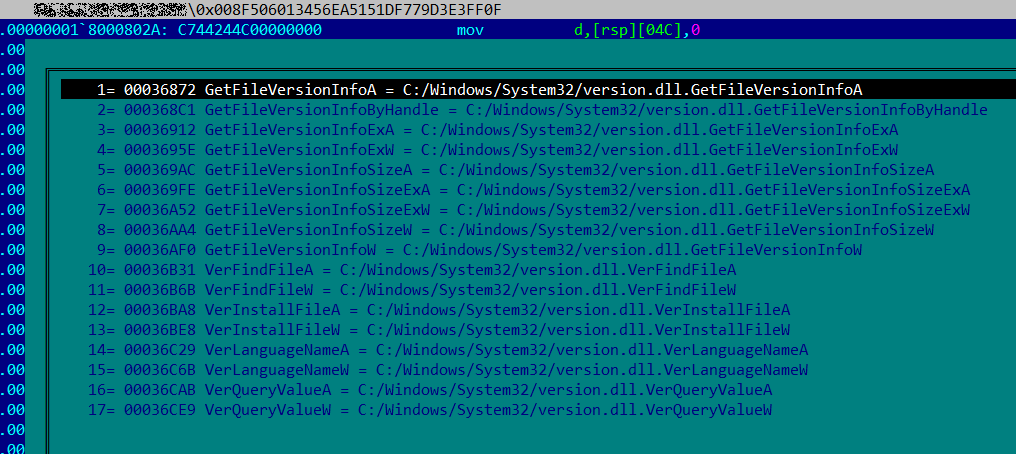
    Static analysis of the DLL library showed that all functions exported by it import functions with the same names from the system file version.dll (Version Checking and File Installation Libraries).

    List of functions exported by TCESB

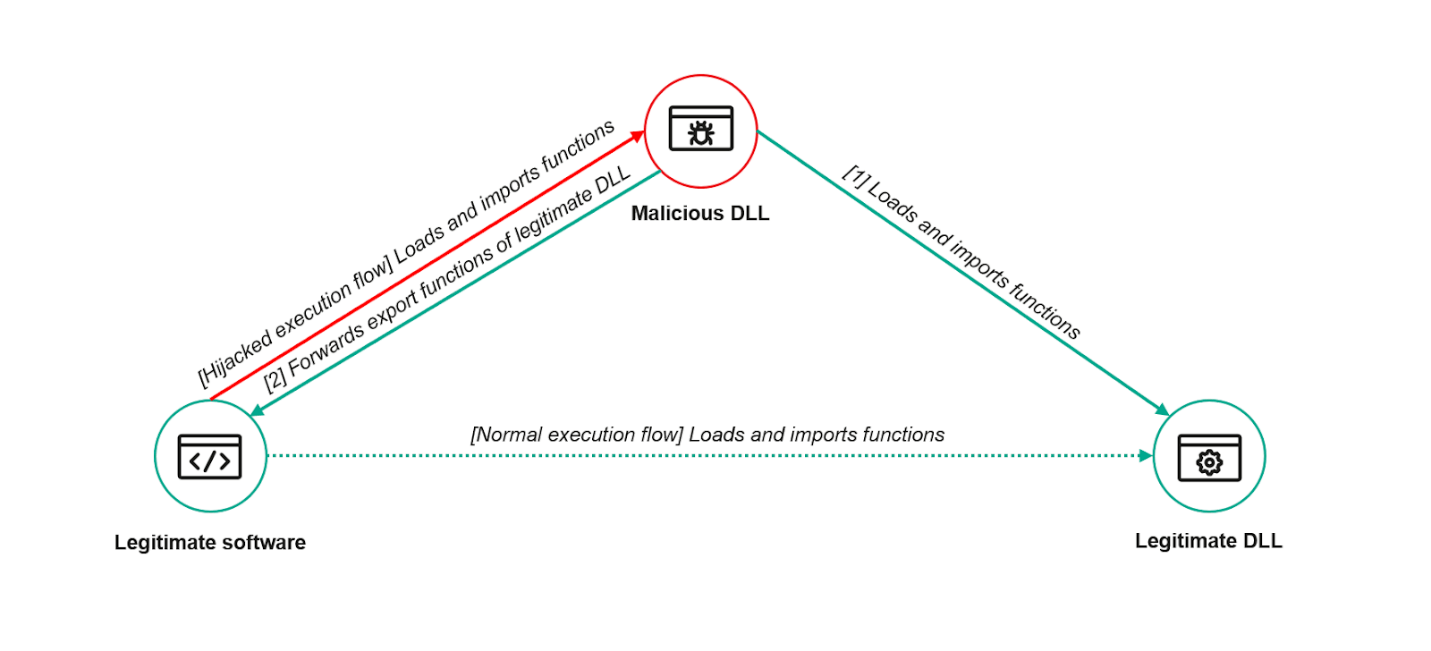
    This indicates that the attackers use a DLL-proxying technique (Hijack Execution Flow, T1574) to run the malicious code. By means of this technique, a malicious DLL exports all functions of a legitimate one, but instead of implementing them, redirects calls to these functions to the original DLL. This way, an application that loads the malicious library will continue to work as normal, with the malicious code running in the context of this application in the background.

    Schematic of DLL proxying

    However, this is not enough to launch malware. For a malicious DLL to be able to take control, the application that loads it must contain insecure code. Such code searches for loaded dynamic library images in folders where they should not be located. If one of these folders contains a malicious library, the vulnerable application will load it instead of the legitimate one. Microsoft has an official advisory on preventing unsafe DLL loading.

    CVE-2024-11859 vulnerability in ESET Command line scanner

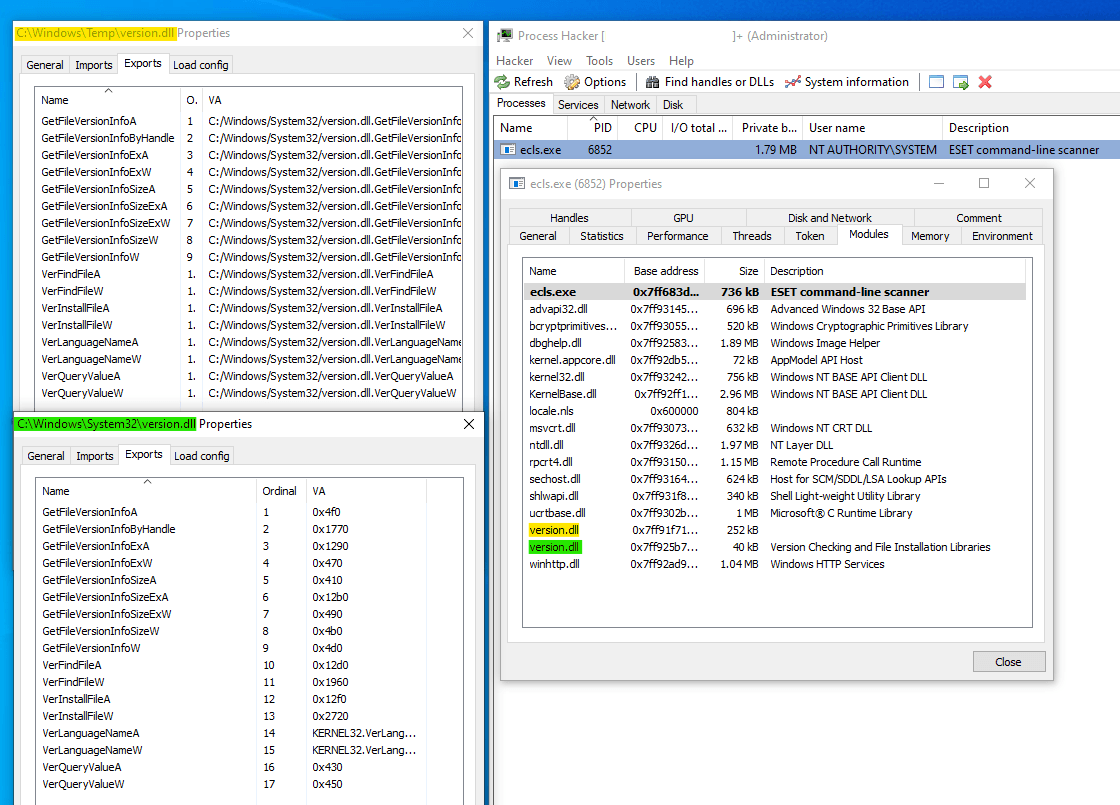
    It took us a while to find the file that loads the TCESB tool. We studied the system directories on devices where the malicious DLLs were found. On one of these, in the same folder as TCESB, there was an extensionless executable file named ecls. We believe that the operator, when transferring files to the device, made a mistake in the filename and moved two copies of it. After performing malicious activity, the file with the extension was deleted, while the other one remained in the system. This file turned out to be a component of ESET’s EPP solution – a scanner launched from the command line (ESET Command line scanner). Dynamic analysis showed that the scanner insecurely loads the system library version.dll, first checking for the file in the current directory, then searching for it in the system directories. This can result in a malicious DLL library being loaded, which constitutes a vulnerability. We compiled a report with a detailed description of it, and sent it to ESET as part of the Coordinated Vulnerability Disclosure process. ESET registered the CVE-2024-11859 vulnerability, then on January 21, 2025 released an update for the ecls file patching the security issue. On April 4, information about this vulnerability appeared in an ESET security advisory.

    To analyze TCESB, we ran it in a virtual environment. In the address space of the ESET Command-line scanner process, we can see two version.dll files. One is the system library, the other is the DLL of the TCESB tool.

    Malicious and legitimate libraries in the memory of the ecls.exe process

    Basic functionality

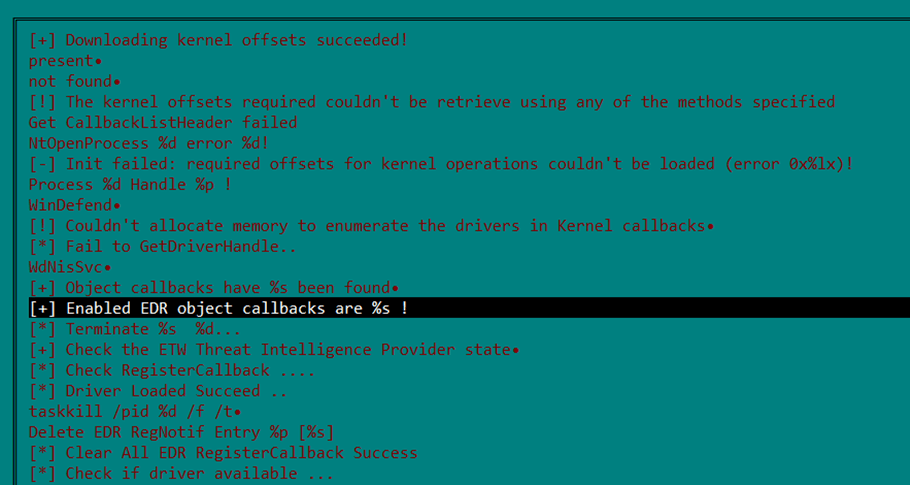
    To determine the main functions of the malicious tool, we examined the strings located in its DLL.

    Snippet of the list of strings that TCESB contains

    The strings are not obfuscated. The search shows that most of them belong to the open-source malicious tool EDRSandBlast, designed to bypass security solutions. Kaspersky solutions detect it with the verdict HEUR:HackTool.Win64.EDRSandblast.a. ToddyCat created the TCESB DLL on its basis, modifying the original code to extend the malware’s functionality. The resulting tool’s capabilities include modifying operating system kernel structures to disable notification routines, for example, about a process creation event in the system or a load event.

    Searching for addresses in the kernel memory

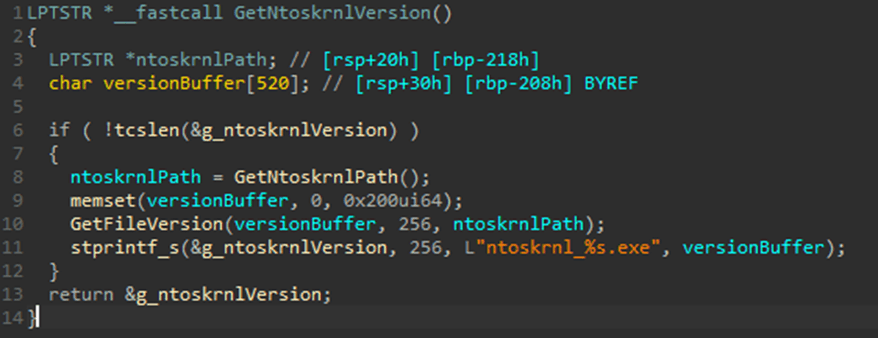
    To find the structures in the kernel memory needed to disable notification routines, TCESB determines the version of the Windows kernel in the context of which it is running. To do this, it uses the GetNtoskrnlVersion() function.

    Function for getting the Windows kernel version implemented in TCESB

    Next, to get information about the memory offsets of the structures corresponding to the operating system kernel version, TCESB uses one of two data sources: a CSV or PDB file.

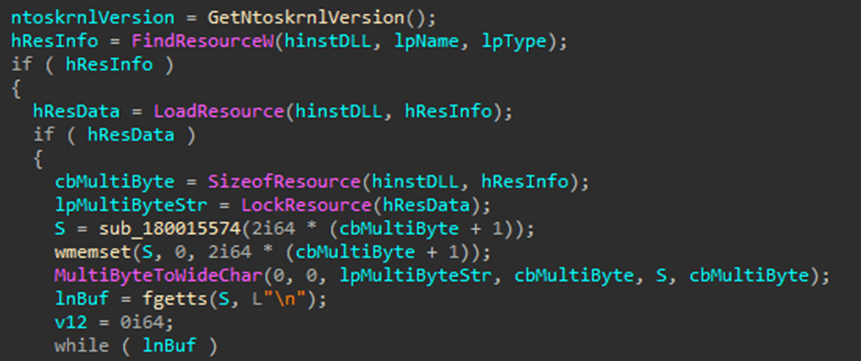
    First, the tool checks the CSV file contained in its own resources section. Stored there in table form is information about several popular kernel versions and their corresponding offsets.

    TCESB searches this file line by line for a match with the previously obtained version of the current Windows kernel.

    Snippet of the function for getting and reading a CSV file from TCESB resources

    We studied the CSV file in the EDRSandBlast repository and its change history. The contents of the TCESB CSV fully match the CSV data in the EDRSandBlast version of August 13, 2022, while the original malware commit of October 6, 2023 adds lines that are missing in the TCESB resource. This indicates a time period during which the creators of TCESB used the EDRSandBlast code.

    If the CSV file does not contain data on structures corresponding to the required kernel version, TCESB reads their addresses from the PDB file. To get it, the malware accesses the file C:WindowsSystem32ntoskrnl.exe, which contains information about the kernel file version, and inserts the data from this file into the following template, generating a URL:

    This is the address of Microsoft debug information server, where TCESB sends a GET request to download the PDB file. The received file is saved in the current TCESB directory, and data on the offsets of the required kernel memory structures are read from it.

    Vulnerable driver

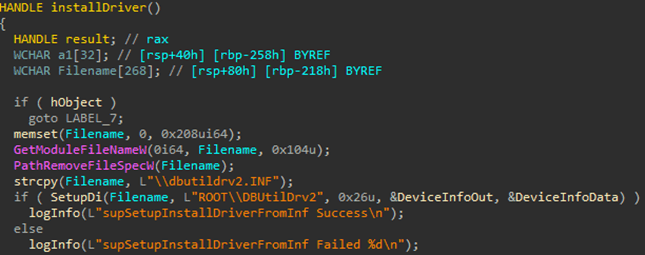
    To modify the kernel structures that store callbacks used to notify applications of system events, TCESB deploys the Bring Your Own Vulnerable Driver (BYOVD) technique (Exploitation for Defense Evasion, T1211). It does this by installing a vulnerable driver in the system through the Device Manager interface, using an INF file with installation information.

    Snippet of decompiled code for installing the TCESB driver

    TCESB uses the Dell DBUtilDrv2.sys driver, which contains the CVE-2021-36276 vulnerability. This is a utility driver used to update PC drivers, BIOS and firmware.

    Launching the payload

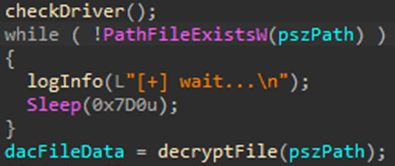
    Once the vulnerable driver is installed in the system, TCESB runs a loop in which it checks every two seconds for the presence of a payload file with a specific name in the current directory – the payload may not be present at the time of launching the tool. Presumably, this is to allow the operator to verify that the tool was run without errors, so that the payload file can be moved without risk of detection. As soon as the file appears in the path being checked, it is passed to the decryption function.

    Snippet of decompiled TCESB code

    The tool creates its own log file for recording all stages of execution in detail.

    Example of log file contents

    We studied two samples of the TCESB tool. Although we were unable to obtain the payload files, our research shows that they have different names ( kesp and ecore) and both are extensionless.

    Our analysis of the tool code found that the data in the payload file is encrypted using AES-128.

    Snippet of code for determining the encryption algorithm

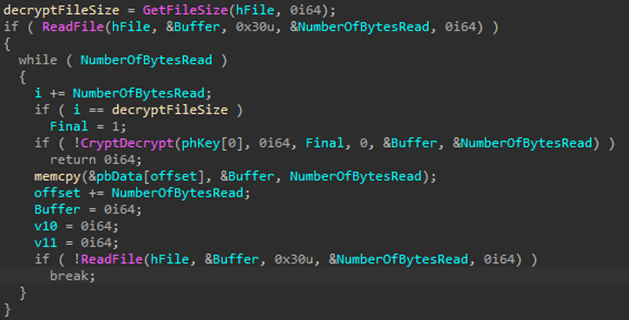
    The decryption key is in the first 32 bytes of the payload file, followed by the encrypted data block. Below is a snippet of code for reading the key:

    Snippet of code for reading the key from the payload file

    The key decrypts the data block:

    Snippet of code for reading and decrypting the payload file

    The read data is placed in memory and executed.

    Takeaways

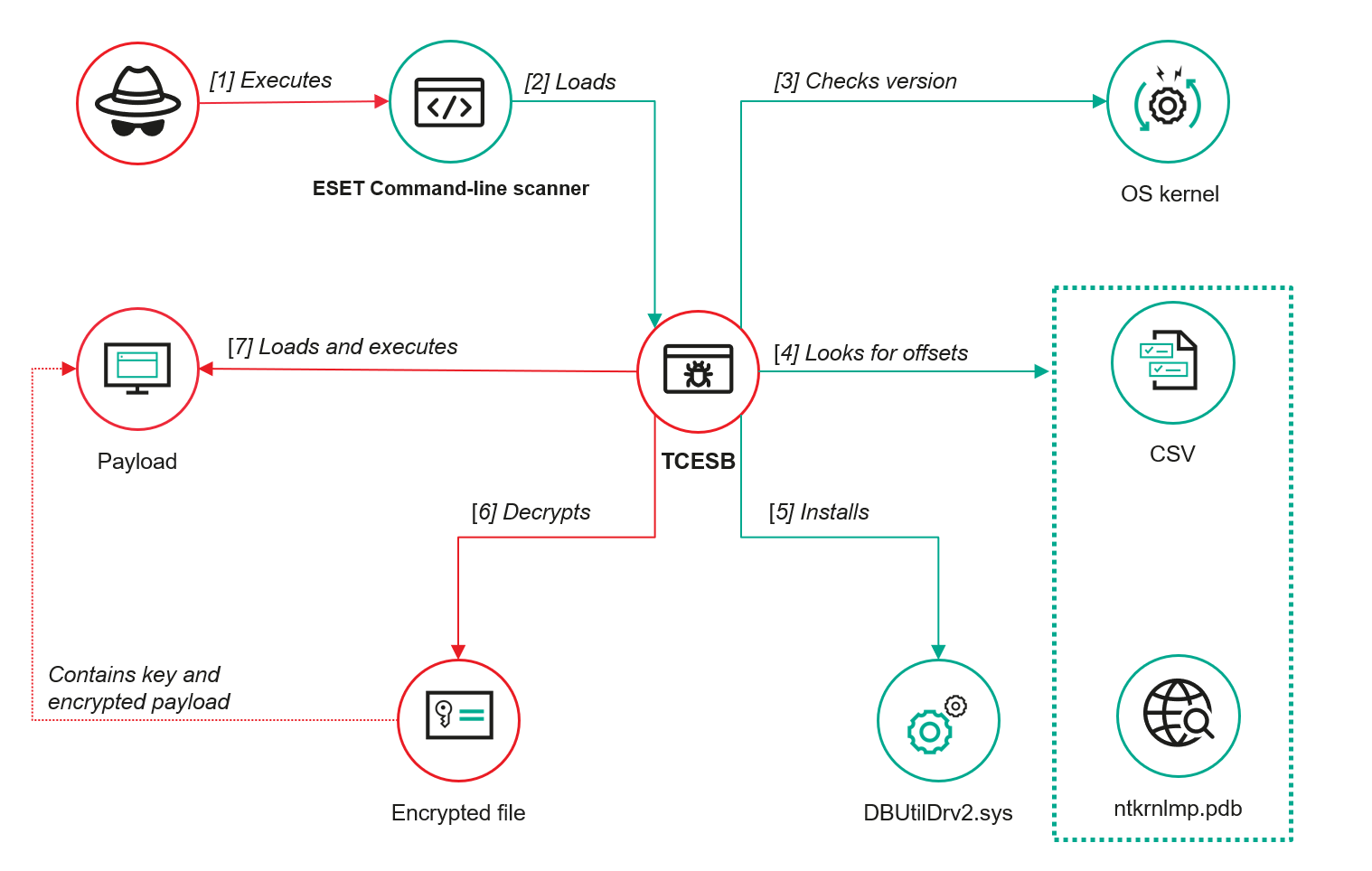
    We discovered a sophisticated tool that the ToddyCat APT group tried to use for stealth execution in compromised systems. This tool exploits a chain of vulnerabilities, as well as an old version of a known open-source malware that the attackers modified to extend its functionality.

    Schematic of tool operation

    To detect the activity of such tools, it’s recommended to monitor systems for installation events involving drivers with known vulnerabilities. Lists of such drivers can be found on the loldrivers project website, for example. It’s also worth monitoring events associated with loading Windows kernel debug symbols on devices where debugging of the operating system kernel is not expected. We also advise using operating system tools to check all loaded system library files for the presence of a digital signature.

    Indicators of compromise

    Malicious Files Hashes

    D38E3830C8BA3A00794EF3077942AD96       version.dll 008F506013456EA5151DF779D3E3FF0F       version.dll

    Legitimate file for DLL proxying

    8795271F02B30980EBD9950FCC141304       ESET Command-line scanner

    Legitimate files for BYOVD

    B87944DCC444E4C6CE9BB9FB8A9C0DEF       dbutildrv2.INF DE39EE41D03C97E37849AF90E408ABBE       DBUtilDrv2.cat DACB62578B3EA191EA37486D15F4F83C       dbutildrv2.sys

    MIL OSI Economics

  • MIL-OSI Europe: Text adopted – Targeted attacks against Christians in the Democratic Republic of the Congo – defending religious freedom and security – P10_TA(2025)0066 – Thursday, 3 April 2025 – Strasbourg

    Source: European Parliament

    The European Parliament,

    –  having regard to its previous resolutions on the Democratic Republic of the Congo (DRC),

    –  having regard to the Universal Declaration of Human Rights,

    –  having regard to the International Covenant on Civil and Political Rights,

    –  having regard to the Constitution of the Democratic Republic of the Congo (DRC), which guarantees the right to freedom of conscience and the free exercise of religious worship for all citizens,

    –  having regard to the UN Declaration on the Elimination of All Forms of Intolerance and of Discrimination Based on Religion or Belief, adopted by the UN General Assembly on 25 November 1981,

    –  having regard to the European Convention on Human Rights,

    –  having regard to Rules 136(2) and (4) of its Rules of Procedure,

    A.  whereas the eastern DRC has endured decades of widespread violence and instability; whereas the situation continues to deteriorate significantly, with persistent human rights violations by armed groups, mass displacement, attacks on civilians and alarming humanitarian conditions further exacerbated by armed conflicts, such as the conflict between the DRC Government, the Rwanda-backed armed rebel group March 23 Movement (M23) and other militias, which has already resulted in the forceful internal displacement of 4,6 million people in the eastern DRC; whereas around 100 separate armed groups are estimated to be operating in the eastern DRC; whereas a series of overlapping issues are driving destabilisation in the country;

    B.  whereas M23 has intensified attacks in North Kivu and on 19 March 2025, it seized the mineral-rich town of Walikale, defying the ceasefire;

    C.  whereas the Allied Democratic Forces (ADF) is one of the most prominent extremist groups with explicitly religious objectives, especially since its leader pledged allegiance to the so-called Islamic State of Iraq and Syria (ISIS) in 2019, becoming its Central Africa Province branch (ISCAP); whereas the ADF’s attacks need to be seen in the wider African context of a rise in the number of Islamist groups, in particular those affiliated to ISIS, in the Sahel region, the Horn of Africa, Mozambique, Nigeria and the DRC; whereas the ADF has been designated a terrorist group by Uganda and the United States;

    D.  whereas in May 2024, the UN Group of Experts on the DRC warned that the ‘armed group established strong networks in prisons, particularly in Kinshasa where ADF detainees were active in recruiting and mobilising combatants and collaborators’, using not only ideological means, but also coercion, deception, abduction and financial incentives to attract members and collaborators;

    E.  whereas the ADF has a long history of committing terrorist attacks in the eastern DRC, particularly in North Kivu and Ituri provinces; whereas North Kivu is a resource-rich region, with vast supplies of critical raw materials including cobalt, gold and tin, which are necessary for the global digital and energy transitions; whereas it is known that the ADF and other armed groups, including M23, have been relying on, among other sources of financing, the illegal exploitation of these resources to fund their activities; whereas the Congolese Catholic Church claims that the ADF is responsible for the deaths of around 6 000 civilians in Beni between 2013 and 2021 and more than 2 000 in Bunia in 2020 alone; whereas in 2024, a large number of Christians were killed in the DRC by jihadists; whereas civilians in the DRC’s eastern provinces are facing an increasing number of attacks, killings and abductions, as well as church bombings and the destruction of (religious) property, perpetrated by armed groups with extremist and jihadist ideologies; whereas most victims of ADF attacks have been Christian; whereas these attacks undermine religious freedom and exacerbate intercommunal tensions; whereas the Catholic bishops of the DRC spoke out in an April 2021 statement about the threat of the ‘Islamization of the region [North Kivu] as a sort of deeper strategy for a long-term negative influence on the general political situation of the country’;

    F.  whereas in 2021, a prominent local Muslim leader received death threats from the ADF, and he was later gunned down; whereas in 2023, the ADF bombed services at a Pentecostal church in Kasindi, killing 14 people; whereas the ADF has been linked to an attack on the village of Mukondi in 2023, in which at least 44 civilians were killed, according to local authorities; whereas the group claimed 48 attacks in December 2024 alone, killing over 200 people; whereas in January 2024, the ADF killed eight people in Beni during an attack on a Pentecostal church and, in May 2024, ADF assailants reportedly killed 14 Catholics in the North Kivu province for refusing to convert to Islam; whereas the ADF also reportedly executed 11 Christians in the village of Ndimo in Ituri province and kidnapped several others;

    G.  whereas local and international human rights organisations have documented numerous instances of religious violence in the DRC, while stressing the urgent need for the state to provide adequate protection; whereas, while the DRC Government has demonstrated a strong intention to address the impacts of armed group violence in the eastern DRC, other recent developments call into question the government’s commitment to safeguarding religious freedom specifically; whereas women and children are particularly vulnerable to rape as weapon of war, human trafficking and sexual slavery;

    H.  whereas the Armed Forces of the DRC have been conducting a joint military offensive, Operation Shujaa, with the Ugandan People’s Defence Force against the ADF and other insurgent forces in the eastern DRC since November 2021; whereas the conflict between the DRC Government and the Rwanda-backed M23 rebels has led to a decrease in the funds, personnel and equipment being allocated to this counterterrorism operation;

    I.  whereas the right to freedom of religion and belief is a fundamental human right and must be protected given the high level of violence and persecution; whereas the Constitution of the DRC provides for freedom of religion and prohibits discrimination based on religious belief;

    J.  whereas over 7 million people in the DRC are currently displaced because of the wider ongoing conflicts, with limited access to food, water, healthcare and essential services; whereas state authorities and rebel groups have obligations to civilians under international humanitarian law, including protecting and facilitating access to humanitarian assistance, and permitting freedom of movement;

    K.  whereas women and children in the DRC face increased levels of sexual and gender-based violence, including rape as a weapon of war, resulting in there being one victim of rape every four minutes;

    L.  whereas the illegal exploitation of mineral resources continues to fuel conflict in the region, necessitating stronger international oversight and responsible sourcing policies;

    M.  whereas in March 2025, President Félix Tshisekedi of the DRC and President Paul Kagame of Rwanda issued a joint statement announcing a ceasefire; whereas despite this, the violence perpetrated by the Rwanda-backed M23 rebels continues;

    N.  whereas the DRC has one of the highest rates of internal displacement in the world; whereas many women and children live in precarious conditions and are being exposed to the risk of harassment, assault, sexual exploitation and forced military recruitment; whereas displaced populations often receive no basic life-saving services and are at risk of malnutrition and disease; whereas cities that host internally displaced people in precarious circumstances are also targets of attacks by different militias, causing great distress to the displaced communities and to the local population;

    O.  whereas the EU has committed to supporting stability in the DRC through diplomatic engagement, financial assistance and targeted sanctions against individuals responsible for violence and human rights abuses; whereas on 17 March 2025, the EU imposed sanctions on nine individuals and one entity responsible for acts that constitute serious human rights violations and abuses or that sustain the conflict in the DRC, including through the illegal exploitation of resources, but further diplomatic and economic measures may be necessary;

    P.  whereas the Council has renewed the EU’s financial support for the deployment of Rwandan Defence Force (RDF) troops in Mozambique under the European Peace Facility (EPF); whereas the head of these forces was previously deployed in the eastern DRC to support abuses committed by the Rwanda-backed M23 rebels, giving rise to serious doubt as to whether there are sufficient safeguards attached to EPF support, including effective vetting and other human rights requirements;

    Q.  whereas the EU has repeatedly affirmed its commitment to the promotion and protection of religious freedom globally, and has taken steps to combat religious persecution and intolerance in various parts of the world; whereas Christians are the largest persecuted religious group in the world;

    R.  whereas Parliament has consistently called for the strengthening of international efforts to combat religious persecution and to hold accountable those responsible for attacks on minority communities;

    1.  Strongly condemns the occupation of Goma and other territories in the eastern DRC by M23 and the RDF as an unacceptable breach of the DRC’s sovereignty and territorial integrity; urges the Rwandan Government to withdraw its troops from DRC territory, the presence of whom is a clear violation of international law and the UN Charter, and cease cooperation with the M23 rebels; demands that Rwanda and all other potential state actors in the region cease their support for M23;

    2.  Expresses deep concern at the alarming continuation of violence; deplores the loss of life and the attacks, both indiscriminate and targeted, against civilians; expresses deep concern over the worsening security and humanitarian crises in the eastern DRC as a whole; calls for the immediate cessation of all forms of violence and for the commitment of all parties involved in the ongoing conflict in the eastern DRC to respect international humanitarian law;

    3.  Strongly condemns the targeted terrorist attacks carried out by the ADF against Christian communities in the eastern DRC, including killings, abductions and the destruction of religious property, and calls for an immediate halt to such acts of violence; expresses its solidarity with the families of the victims and with Christian communities;

    4.  Strongly condemns the Rwanda-backed M23 rebel group and the ADF, as well as other rebel groups, and their egregious human rights abuses that amount to crimes against humanity in accordance with the Rome Statute of the International Criminal Court (ICC); underlines that there must be no impunity for the perpetrators of these acts and that those responsible should be referred to the ICC; encourages the establishment of an international commission of inquiry to examine the human rights violations committed in the DRC, renewed investigations in North Kivu by the ICC Prosecutors Office and the creation of a special tribunal for atrocity crimes in the DRC, including crimes committed against Christian communities; backs the efforts by the National Episcopal Conference of Congo and the Church of Christ in Congo, which launched the ‘Social pact for peace and coexistence in the Democratic Republic of Congo and the Great Lakes Region’, with the aim of restoring peace in the country’s eastern provinces;

    5.  Supports the international efforts against the ADF, including the Shujaa counterterrorism operation carried out jointly by the DRC and Ugandan armed forces; encourages the EU Member States to consider ways of contributing to these efforts, including increased efforts to trace and interdict ISIS secret funds held overseas and to trace any raw materials stemming from their illegal exploitation by the ADF; calls for the EU to support the necessary capacity-building and expertise to combat ADF ideology and rhetoric, particularly within the Muslim communities of both Uganda and the DRC, to prevent recruitment among those communities; requests the application of the EU global human rights sanctions regime to those responsible for planning, ordering or participating in the killing of Christians in the DRC;

    6.  Calls for an immediate and effective ceasefire, and for the full implementation of diplomatic agreements, including the Luanda and Nairobi peace processes; underlines the urgent need for the stabilisation of the country and reiterates its call on M23 to halt its territorial advances and withdraw from the territory of the DRC;

    7.  Reiterates its full support for the UN Organization Stabilization Mission in the DRC (MONUSCO) in protecting civilians and stabilising the region; urges the EU to cooperate with all actors on the ground, in particular MONUSCO, to ensure the protection of civilians in the eastern DRC; calls on the UN to work towards a stronger mandate for MONUSCO in order to enable peacemaking; calls on the UN to ensure the protection of civilians and respect for international humanitarian law;

    8.  Urges the international community to increase support for services in the eastern DRC so that civilians who have been targeted can have access to legal services and psychological support; calls on the DRC Government to counter extremist propaganda; calls for the establishment of early warning mechanisms to more effectively prevent and respond to attacks by the ADF and other armed groups against civilians;

    9.  Reiterates its call for all parties, including armed groups operating in the eastern DRC, to allow and facilitate humanitarian access to address the urgent need for essential services in the eastern DRC and neighbouring countries, notably Burundi; emphasises that humanitarian workers must be able to operate safely to deliver life-saving assistance to Congolese civilians; stresses that this is a central obligation under international humanitarian law, and that perpetrators violating these obligations should be held to account; calls on all parties to provide a safe environment for civil society organisations;

    10.  Is appalled by the shocking use of sexual violence against women and children as a tool of repression and weapon of war in the eastern DRC, and by the unacceptable recruitment of child soldiers by the various rebel groups; demands that these matters be addressed by the international community without delay;

    11.  Calls for stricter enforcement of the EU regulation on conflict minerals(1) to prevent illicit trade from fuelling armed groups in the DRC; reiterates its previous call on the Commission to suspend the EU’s Memorandum of Understanding with Rwanda; requests that the Commission share detailed mapping of current projects with Rwandan authorities and its assessment of whether they may contribute to addressing or may fail to address human rights violations either inside Rwanda or in the DRC;

    12.  Calls for the EU and its Member States to support the DRC in implementing the recommendations of the 2010 mapping report by the Office of the UN High Commissioner for Human Rights (OHCHR), including reforming the security sector, strengthening its efforts to prevent further atrocities against civilians, and ending support for or collaboration with abusive armed groups; urges the DRC Government to ensure accountability for human rights violations and prosecute those responsible for attacks; calls for the EU and its Member States to support the DRC in fighting corruption, strengthening governance and the rule of law, improving security and ensuring the lasting protection of communities at risk, including religious communities, and to ensure that perpetrators of attacks are brought to justice;

    13.  Underlines the role of communities, including religious communities and faith-based organisations in the DRC, in promoting peace, social cohesion and the well-being of local communities;

    14.  Calls on the Commission and the European External Action Service to intensify diplomatic efforts by working closely with regional partners, including the African Union, the East African Community and the United Nations, in order to step up diplomatic efforts to achieve a sustainable resolution to the conflict and prevent extremist groups from using religion as a tool for violence and division;

    15.  Calls on the Commission and the Member States to increase humanitarian aid to address the urgent needs of displaced persons and vulnerable communities in the DRC, ensuring safe access to food, medical care and shelter;

    16.  Supports the imposition of further targeted EU sanctions against individuals and entities responsible for financing or engaging in violence, human rights abuses and resource exploitation; calls for the implementation of the sanctions outlined in the OHCHR mapping report;

    17.  Confirms its commitment to freedom of thought, conscience and religion as a fundamental human right guaranteed by international legal instruments recognised as holding universal value, and to which most countries in the world have committed, and which is enshrined in the Constitution of the DRC;

    18.  Echoes the calls for international solidarity in defending religious freedom and the protection of religious minorities in conflict zones, particularly in the DRC, while addressing the root causes of violent extremism in the DRC and its neighbourhood;

    19.  Urges the EU to uphold its commitment to the promotion of religious freedom and the protection of communities, including religious communities, ensuring that the rights of these groups are prioritised in the EU’s external policies;

    20.  Notes, with concern, the growing influence of the Russian Orthodox Church in Africa, which is a staunch supporter of the Putin regime and its violent, unlawful war in Ukraine; underlines that this development raises significant questions regarding the broader geopolitical and ideological objectives of the Russian Federation in Africa;

    21.  Deplores the fact that Rwanda announced the termination of its diplomatic relations with Belgium, and expresses its solidarity with Belgium;

    22.  Instructs its President to forward this resolution to the Council, the Commission, the Vice-President of the Commission / High Representative of the Union for Foreign Affairs and Security Policy, the Governments and Parliaments of the Democratic Republic of the Congo and Rwanda, the African Union, the secretariats of the United Nations Organization Stabilization Mission in the Democratic Republic of the Congo, the Southern African Development Community and the East African Community, and other relevant international bodies.

    (1) Regulation (EU) 2017/821 of the European Parliament and of the Council of 17 May 2017 laying down supply chain due diligence obligations for Union importers of tin, tantalum and tungsten, their ores, and gold originating from conflict-affected and high-risk areas (OJ L 130, 19.5.2017, p. 1, ELI: http://data.europa.eu/eli/reg/2017/821/oj).

    MIL OSI Europe News

  • MIL-OSI Australia: What it’s really like to volunteer in Canberra

    Source: Northern Territory Police and Fire Services

    Dr Stephen Utick is a volunteer with Rotary through Urban Parks and Places.

    Volunteers make a significant, meaningful and positive impact on Canberra and the people who live here. National Volunteer Week in the ACT runs from 20-26 May. It’s a time to acknowledge and celebrate volunteers in your community.

    Whether you like working with community members, plants or animals, there really is something for every interest and passion.

    Chris, volunteer in the Emergency Department at Canberra Hospital

    Before coming to Canberra, Chris had volunteered at hospitals in Adelaide and Sydney. He worked in the North Canberra Hospital before he started his current volunteer position at The Canberra Hospital.

    “It’s amazing to be there and it’s inspiring being around the doctors and nurses who are just outstanding with their compassion, empathy and kindness,’ Chris said.

    “Just last weekend an elderly gentleman and his wife came into the ED, he wasn’t great. I had a chat with them both and just seeing how she held his hand and after finding out they had been married for 65 years, you could see how fantastic they were together. I got to see that as a volunteer and it doesn’t get much better than that,” Chris said.

    Peter, ParkCare volunteer at Tidbinbilla Nature Reserve

    Accessibility upgrades at Tidbinbilla Nature Reserve mean that Peter can continue to volunteer and enjoy sharing the parks beautiful bushland with visitors.

    “Since I’ve got the scooter, I can now do a whole day’s shift and the upgrades have certainly helped make me feel much more comfortable riding around and talking to people.”

    Peter, volunteer at Taylor Bike Library

    Meanwhile at the Taylor Bike Library, volunteers have found a way for them to combine their love of sustainability, active travel and community.

    Peter is a retiree who came across the Taylor Bike Library when he recently moved to Canberra.

    “The library is a non-profit organisation that provides bikes to families and communities who may not have access to them,” he said.

    Peter describes his time at the library as “an incredibly rewarding experience.”

    “I have learned new skills, met new people, and contributed to a worthy cause. The library provides an excellent opportunity for people like me to stay active and engaged with others in the community.”

    Dr Stephen Utick, volunteer with Rotary through Urban Parks and Places.

    There are over 80 volunteer groups registered with Urban Parks and Places, and activities range from litter collection to habitat enhancement, conservation, training workshops and more.

    One such group is the Weston Park Nursery Heritage Project led by Dr Stephen Utick. This team of volunteers work to remove invasive plants and revegetate the gardens.

    Dr Utick, who is currently a visiting curator at the Sydney Botanic Gardens, was led to volunteering through his professional network.

    “I was initially invited to join Rotary about five years ago by a member who had a background in the navy, after I gave a talk in my (then) capacity as Convenor of Canberra Friends of Dili at the Department of Defence,” he said.

    “First, I had been invited by ACT Urban Parks and Places to identify the camelia collection at this site after I joined Rotary. I was pleased to then showcase a tour of the site to interested members of my Club.”

    There are many different ways to volunteer. Some people like formal roles coordinated through an organisation. Others prefer informal roles where they just help someone in our community. Some people volunteer regularly while others commit to one off activities like volunteering to support a big event.


    Get ACT news and events delivered straight to your inbox, sign up to our email newsletter:


    MIL OSI News

  • MIL-OSI Economics: F-16 fighter jet deal bolsters Philippines air defense amid rising regional tensions, says GlobalData

    Source: GlobalData

    In a significant step toward strengthening the air defense capabilities of the Philippines, the US government has approved the potential sale of 20 F-16 fighter jets valued at approximately $5.6 billion. This acquisition will enhance the Philippine Air Force’s ability to safeguard its airspace, improve regional security, and boost interoperability with allied forces in the Indo-Pacific, says GlobalData, a leading data and analytics company.

    GlobalData’s report, “The Global Military Fixed-Wing Aircraft Market 2025-2035,” reveals that the Philippines will be spending about $5.1 billion on procuring various types of aircrafts over the next 10 years. Out of which, 79% will be directed towards the procurement of combat aircrafts.

    Udayini Aakunoor, Aerospace & Defense Analyst at GlobalData, comments: “Amid the growing geopolitical tensions in the South China Sea, F-16s are expected to serve as a deterrent against potential security threats while reinforcing the country’s territorial defense. The advanced air-to-air and air-to-ground capabilities of the combat-proven F-16 aircraft will allow the Philippine Air Force to conduct more effective patrols, intercept potential threats, and respond to any incursions into its airspace.”

    This procurement aligns with the Philippines’ strategic goal of deepening defense ties with the US. The two countries have maintained a long-standing military partnership, reinforced through the Enhanced Defense Cooperation Agreement (EDCA) and frequent joint military exercises. The F-16’s compatibility with US and NATO-standard weaponry, combined with joint military exercises such as Balikatan, ensures that the Philippines can operate seamlessly alongside allied air forces in the event of a regional security crisis.

    Aakunoor concludes: “With the F-16 acquisition, the Philippines is poised to make significant strides in modernizing its air force under the long-term Horizon 3 military modernization program, equipping the aircraft fleet with the necessary capabilities such as advanced avionics and precision-guided munitions to address current and future security challenges in the Indo-Pacific region. This development underscores the country’s commitment to strengthening its military readiness and strategic partnerships in an increasingly contested geopolitical landscape in the region.”

    MIL OSI Economics

  • MIL-OSI Russia: Everything about admission to GUU: answers to the most important questions

    Translartion. Region: Russians Fedetion –

    Source: State University of Management – Official website of the State –

    The 2025 admissions campaign will begin in June. Information for applicants is available on the official website of the GUU Admissions Committee and in the Telegram channel “Applicant’s Assistant”.

    However, we decided to get answers to the most frequently asked questions directly from the head of the department for organizing admissions of applicants at our university, Vadim Dikikh.

    What applicants need to do now

    At the moment, applicants do not have much time left before the start of the admissions campaign, so it is important to start preparing a portfolio for admission now.

    Applicants to bachelor’s degree programs can pass the GTO, participate in tournaments held by universities and various organizations, and receive volunteer hours.

    Applicants to Master’s programs can take part in SUM tournaments and also publish articles in the Russian Science Citation Index and Higher Attestation Commission.

    Applicants to postgraduate programs can participate in all-Russian and/or international student Olympiads and competitions, publish articles in journals included in the core of the Russian Science Citation Index (RSCI), in the list of the Higher Attestation Commission (HAC) categories K1, K2, K3, monographs indexed in the RSCI database, and also undergo professional retraining.

    In addition to the above, it is necessary to choose the direction and university in which the potential will be best revealed.

    What areas are recruited at the State University of Management?

    In 2025, recruitment is underway in 16 bachelor’s degree programs, 13 master’s degree programs, and 14 postgraduate research specialties.

    How many budget and contract places are provided in 2025

    I would like to note that this year the innovations affected places for training under a contract: now their specific number is set at the beginning of the campaign and does not change anymore, so the competition here may become stricter and you should not postpone the conclusion of the contract until the last days of the campaign.

    In 2025, the State University of Management has allocated 188 budget places and 2029 contract places for undergraduate studies, and 37 and 1206 places for graduate studies, respectively.

    In 2025, 15 budget places and 98 contract places are provided for in scientific specialties of postgraduate studies at the State University of Management.

    Who can apply using the Unified State Exam, and who will have to take entrance examinations

    For applicants to bachelor’s degree programs who graduated from Russian schools and do not have benefits, admission will be based solely on the results of the Unified State Exam; no additional entrance examinations need to be taken.

    For graduates with secondary vocational education (colleges, technical schools, etc.), there is the possibility of admission based on the results of the Unified State Exam and/or based on the results of entrance examinations in a specialized field, conducted by the State University of Management independently.

    Other categories that have the right to take general education entrance examinations (in subjects and assignments of the Unified State Exam), conducted by the State University of Management independently:

    disabled persons; applicants entitled to a separate quota (participants, children of participants of the Secondary Military School); foreign citizens who have not passed the Unified State Exam; graduates of schools located in the territory of foreign states and who do not have the Unified State Exam results.

    Applicants to master’s and postgraduate programs, regardless of category, take entrance examinations.

    What entrance examinations will you have to take and in what form?

    In 2025, entrance examinations at the State University of Management will be held online using neural networks and a proctoring system.

    The full list of entrance examinations required for applicants to bachelor’s degree programs is set out in Appendix No. 1 to the Admission Rules and is available at the link. For convenience, we have prepared visual cards with the names of subjects and the minimum acceptable scores.

    To enroll in a Master’s program, you must pass 1 entrance exam for each area of study, for example, to enroll in the Management area, you must pass the comprehensive entrance exam “Management”. Entrance exams for the corresponding areas of study are taken in a similar manner.

    The minimum score for admission in all areas of study is 40.

    Applicants to postgraduate studies must pass 3 entrance examinations

    Entrance examinations

    Number of points

    Philosophy

    30

    Foreign language

    35

    Special discipline

    45

    A special discipline is a comprehensive entrance examination in the chosen specialty. For example, for applicants to the specialty “Regional and Sectoral Economics”, the entrance examination is “Special Discipline (Regional and Sectoral Economics)”

    What individual achievements are taken into account and for what period

    Infographics with ranking of achievements have been prepared for applicants to the bachelor’s degree. In addition, applicants to targeted training can receive 5 points for participating in career guidance events of customers of targeted training.

    It is important to note that the All-Russian and list Olympiads of the Ministry of Education and Science are taken into account exclusively for the 11th grade, and all other things being equal, the average grade point average will play an important role.

    You can also find out what individual achievements are taken into account on the website of the Admissions Committee of the State University of Management.

    What individual achievements provide the greatest advantages when applying

    The most obvious individual achievement that gives the highest score at all levels of education is an educational document with honors.

    In addition, scientific activity and participation in tournaments and olympiads provide a great advantage in both undergraduate, graduate and postgraduate studies.

    “Today is exactly the time when applicants can get additional points and increase their chances of admission.”

    What documents must be provided to confirm achievements

    The document confirming an individual achievement may vary, depending on the type of achievement.

    Since 2025, most individual achievements will be verified and confirmed through the public services portal when submitting documents.

    For example, to receive additional points for graduating from an educational institution with honors, you must provide a scanned copy or receive confirmation on government services when submitting documents.

    For reliability, we recommend that you attach all documents that confirm individual achievements (diplomas, certificates, etc.).

    Minimum passing scores for budget/contract courses last year

    How to apply for targeted training: step-by-step instructions

    Start filling out an application for admission to a university on public services. Indicate that you are ready to consider targeted training. You will see a list of offers from customers of targeted training. The offer includes the university and the competitive group, the future employer, the conditions of study and work, and support measures. Select the ones you like — at this stage, you can indicate several offers. Finish filling out the application to the university. Make sure that you have selected the competitive groups specified in the application for targeted training. After sending the application, the customer of targeted training will receive your application automatically. If you are under 18, your legal representative must give consent to conclude an agreement on targeted training. He will receive a notification in his personal account. The submitted application will be available in your personal account. Edit it if you find an error. For example, you can check whether the competitive groups from the application for targeted training have been added to it. Pass the competitive selection and wait for enrollment in the university. An agreement on targeted training will be sent to your personal account, sign it in the Gosklyuch application. The terms of the contract can be changed by agreement with the customer. If the terms of the contract are not met, you will have to pay a fine – the details will be specified in the contract

    What documents are needed for admission?

    How to submit documents

    Documents can be submitted in any convenient way:

    in person; online through the unified portal of public services; online through the university’s personal account; via a postal operator.

    Is it possible to submit documents online: pros and cons

    Submitting documents online has many advantages:

    Submission of documents without being tied to a specific location; step-by-step and convenient procedure for submitting documents; the ability to track the status of document processing; a convenient procedure for concluding an agreement on the provision of paid educational services.

    One of the disadvantages is the lack of live communication with university representatives.

    What to do if an applicant is in another city or country and cannot submit documents in person

    In 2025, applicants located in other cities and countries have an excellent opportunity to submit documents for admission to the State University of Management remotely in two ways:

    online through the unified portal of public services; online through the university’s personal account.

    It is important to know that if an applicant does not have a SNILS, application can only be submitted through the university’s personal account.

    The most common mistakes of applicants

    Critical

    changing a passport right before the day of the entrance exam; submitting documents through State Services without having a full account in your personal account; typos in certificates that no one checked when they were received at school.

    Simple but inconvenient

    travel time to the university (if you live in the Moscow region, the university will not be able to provide a dormitory right away, since applicants from distant regions will be given priority); loss of SNILS, passport or even a volunteer book; refusal to take the Unified State Exam in specialized mathematics.

    Frequent changes in statuses on the State Services portal, which can lead to a technical error in the service and universities simply will not see changes in priorities or documents that have changed more than 5-8 times in an hour.

    Advice for applicants for successful admission this year

    Do not miss the admissions campaign checklist dates and get into the desired university. Do not be afraid to participate in the budget competition, use any opportunity to get a higher education. While there is an opportunity, try to participate in Olympiads and competitions, and even if you have not yet tried to engage in volunteer activities, do not waste a minute, you can still manage to gain the necessary 100 hours to qualify for individual points in most universities in the country. Upload all the achievements that you have, and the admissions committee staff will check the entire set of documents and select those achievements that give additional points. Do not make emotional and ill-considered decisions that can only be changed during the next admissions campaign, and thereby lose an entire year of study.

    The most important thing is to make a conscious choice of higher education institution and the field of study. Try to understand the profession now, and if you have any questions, come to the Open Days, we will definitely help you make the right choice.

    Key dates of the admission campaign

    For applicants to bachelor’s degree programs

    June 20 – start of accepting documents; July 15 – end of accepting documents from applicants to the budget based on entrance examinations; July 25 – end of accepting documents from applicants to the budget based on the Unified State Exam results; July 27 – publication of competitive lists of applicants to the budget; August 1, 12:00 – end of submitting consent for enrollment from applicants under quotas; August 3 – publication of the order on enrolling applicants to places within quotas; August 5 – end of submitting consent for enrollment from applicants to the budget; August 7 – publication of the order on enrolling applicants to budget places; August 15 – end of accepting documents from applicants to a contract based on entrance examinations; August 23 – end of accepting documents from applicants to a contract based on the Unified State Exam results; August 24 – end of concluding contracts; August 25 – publication of an order on the enrollment of applicants to contractual places.

    For applicants to Master’s programs

    June 20 – start of accepting documents; August 20 – end of accepting documents from applicants to the budget; August 24 – end of submitting consent for enrollment from applicants to the budget; August 29 – issuing an order on enrolling applicants to budget places; September 10 – end of accepting documents from applicants to a contract; September 18 – end of concluding contracts; September 20 – issuing an order on enrolling applicants to contract places.

    For applicants to postgraduate specialties

    June 20 – start of accepting documents; September 7 – end of accepting documents; September 23 – end of submitting consent for enrollment from applicants to the target quota; September 24 – issuing an order on enrolling applicants to the target quota; September 25 – end of submitting consent for enrollment from applicants to the budget; September 26 – issuing an order on enrolling applicants to the budget; September 27 – end of concluding an agreement; September 28 – issuing an order on enrolling applicants to an agreement.

    How can I get advice and answers to questions from the admissions committee if the applicant cannot come to the university in person?

    We are always available not only in person, but also remotely on social networks VKontakte and Telegram, and during working hours we answer phone calls at 8 (495) 371-00-55.

    If the question includes the need to check a certificate or other copy of a document, it is better to contact via e-mail prkom@guu.ru

    Subscribe to the TG channel “Our GUU” Date of publication: 04/07/2025

    официальном сайте Приёмной комиссии ГУУ и в телеграм-канале «Помощник абитуриента»….” data-yashareImage=”https://guu.ru/wp-content/uploads/ГУУ-2024.1.jpg” data-yashareLink=”https://guu.ru/%d0%b2%d1%81%d1%91-%d0%be-%d0%bf%d0%be%d1%81%d1%82%d1%83%d0%bf%d0%bb%d0%b5%d0%bd%d0%b8%d0%b8-%d0%b2-%d0%b3%d1%83%d1%83-%d0%be%d1%82%d0%b2%d0%b5%d1%82%d1%8b-%d0%bd%d0%b0-%d1%81%d0%b0%d0%bc%d1%8b%d0%b5/”>

    Please note: This information is raw content directly from the source of the information. It is exactly what the source states and does not reflect the position of MIL-OSI or its clients.

    MIL OSI Russia News

  • MIL-OSI United Kingdom: Defence Secretary meets family of the late Agnes Wanjiru in Kenya

    Source: United Kingdom – Government Statements

    Press release

    Defence Secretary meets family of the late Agnes Wanjiru in Kenya

    The UK Defence Secretary, John Healey MP, met family members of the late Agnes Wanjiru,to express his condolences.

    The Defence Secretary meets the family of the late Agnes Wanjiru in Kenya.

    The UK Defence Secretary, John Healey MP, today met family members of the late Agnes Wanjiru, who was killed in Nanyuki, Kenya in 2012 to express his condolences. Fulfilling the commitment he made soon after entering office. 

    This is the first time a UK Government Minister has met with Agnes Wanjiru’s family.  

    Defence Secretary, John Healey MP, said: 

    It was deeply humbling to meet the family of Agnes Wanjiru today. In the 13 years since her death, they have shown such strength in their long fight for justice. I reiterated my determination to see a resolution to the still unresolved case.  

    We will continue to offer our full support to the Kenyan investigatory authorities, which has included visits by Kenyan investigators to the UK to interview witnesses and of the Provost Marshal (Serious Crime) to Kenya. In my meeting with President Ruto later today, I will emphasise the need to accelerate progress in this case. Our Government will continue to do everything we can to help the family secure the justice they deserve.

    The family of Agnes Wanjiru also made a statement after the meeting with the Defence Secretary. They said: 

    The death of our beloved Agnes has had a profound and devastating impact on our family. It was not only the shock of losing Agnes at such a young age, but also the horrific circumstances in which her body was found and all the trauma and struggle our family has been put through in trying to seek justice and accountability for her death that has taken a very heavy toll on all of us. 

    It is now more than 13 years since Agnes was killed and almost 6 years since a Kenyan inquest found that she had been murdered by British soldiers, yet so little progress appears to have been made since then. 

    We are grateful to the Secretary of State for Defence agreeing to meet with us, but we have waited for too many years and been offered too many empty promises. We hope that our meeting with the Secretary of State marks the beginning of the UK government and Ministry of Defence taking decision action to ensure that what happened to Agnes is properly investigated in Kenya and in the UK and to make sure that what happened to Agnes never happens again. We expect the UK and Kenyan governments to act and bring closure to this matter.

    Updates to this page

    Published 7 April 2025

    MIL OSI United Kingdom

  • MIL-OSI Australia: What to do when you move to Canberra

    Source: Northern Territory Police and Fire Services

    In addition to enjoying Canberra’s beautiful scenery, there are a few things you may need to do.

    The to-do list can seem never ending when you move to a new city.

    With Canberra’s population projected to reach 500,000 by 2027, there’s a growing number of people calling Canberra home.

    The ACT is also home to 22,000 veterans and their families.

    We’ve taken the guess work away with this handy list of things you need to do when you move to Canberra.

    This includes:

    • Update your details with Access Canberra
    • Get an ACT driver licence
    • Update your Medicare details
    • Update your details with Access Canberra
    • Update your details on the electoral roll
    • Get familiar with the recycling and waste system
    • Enrol your child in school
    • Register your pet
    • Sign up to MyWay+, Transport Canberra’s ticketing system
    • Find where to go for health care
    • Join the library
    • Find disability support
    • Find support for Defence families
    • Connect with Canberra’s multicultural community.

    Find out more below!

    Update your details with Access Canberra

    If you’ve moved to Canberra from interstate, you have three months to update your details with Access Canberra.

    This will ensure that you don’t miss out on any important reminders.

    You can easily update your details online, and it will apply to other services including:

    • occupational licences
    • building and construction licences
    • Working with Vulnerable People registration.

    Find out how to update your details with Access Canberra.

    Get an ACT driver licence

    If you plan on driving in the ACT, you’ll need to get an ACT driver licence within three months of moving here.

    If you’re moving to Canberra from overseas, what you will need to do depends on the type of license you have and the country that issued it.

    If you’ve moved to Canberra from interstate, you need to visit an Access Canberra Service Centre to get an ACT driver licence. You will need to bring:

    • your proof of identity and residency
    • your current interstate licence
    • your licence history from the state or territory that issued it (you need to take this into an Access Canberra Service Centre within 7 calendar days of receiving it).

    For interstate drivers’ licences, there’s no fee for this transaction if you’re issued with an ACT licence with the same expiry date as your interstate licence.

    Update your Medicare details

    Once you’ve got your ACT driver licence, log onto MyGov to update your Medicare details.

    Update your details on the electoral roll

    Once you’ve lived at your new address for at least one month, you are eligible to enrol at your new address.

    The details on the electoral roll are used for both federal and state elections so you’ll only need to do this once.

    Get familiar with the recycling and waste system

    There are three different types of bins that are collected in the ACT:

    • recycling bins have a yellow lid
    • rubbish/landfill bins have a dark green or red lid
    • garden organic green waste bins with a light green lid.

    The green waste bins are optional. If you don’t have one, you can easily order one.

    Bins are collected on a weekly or fortnightly basis. The bin collection calendar can tell you when bins are collected in your suburb. It will also tell you what can and cannot go in your household bins.

    Enrol your child in school

    Every ACT child or young person from kindergarten to year 12 is guaranteed a place at their local public school, determined by their priority enrolment area.

    Children from the age of 6 must be enrolled in and attending school (or registered for Home Education) until they complete Year 12 or turn 17, whichever happens first.

    Prior to starting school, your child may be eligible for preschool.

    Canberra families can access up to 300 hours of free preschool per year with the three-year-old preschool program offered by participating Early Childhood and Education Care (ECEC) services.

    Register your pet

    All dogs and cats over eight weeks who have been in the ACT for 28 days or more must be registered.

    When you register you pet for the first time, you’ll need to:

    • complete the application form
    • pay a one-off fee.

    Cat and dog owners must renew their pets registration annually.

    Pet services are now a part of the ACT Digital Account. This means that with your online account, you can:

    • register your pet
    • pay online
    • renew, update or change your pet’s registration details.

    Get set up with MyWay+

    Canberra’s public transport system has two main parts: buses and the light rail.

    MyWay+ is the ticketing system used to pay for both services. MyWay+ is as simple as tapping on and off with your regular bank card or payment method on your phone

    You can also download the MyWay+ app and create a MyWay+ account. This gives you the added benefits of personalised journey planning and real time information.

    If you don’t want to use the digital features of MyWay+, you can also purchase a MyWay+ card.

    Find out how to set up a MyWay+ account and download the app.

    Find where to go for health care

    The ACT Government has developed a new online tool to help the community find out more about local health services in Canberra.

    The tool includes information about GP services and public, community-based health care services that people (mostly) don’t need a referral for. It also has information about non-government health related services.

    Join the library

    Libraries ACT has nine branches plus the ACT Heritage Library in Fyshwick.

    Your local library offers so much more than just books to borrow. You can scan and print your important documents for free, use the public PC’s, connect to free Wi-Fi or even meet a, Justice of the Peace.

    Plus, the library is a great way to meet people and connect with your new community with events and programming happening daily such as, Geri-Fit active sessions, children’s school holiday activities and much more.

    Plus, joining Libraries ACT gives you access to free digital resources across categories like language learning, music and film, newspapers and magazines, personal and professional development and more.

    Find disability support

    If you or someone you care for has disability, there are programs and services that can support you.

    Connect with Canberra’s multicultural community

    There are programs and services for members of Canberra’s multicultural community.

    This includes:

    • overseas qualifications assessments
    • work experience and support
    • Translating and Interpreting Service
    • support for migrants, refugees and asylum seekers
    • and more.

    You can also visit the Theo Notaras Multicultural Centre to speak to community organisations that can you give you advice, help you access support services and help you with English.

    Explore your new home!

    Don’t forget to get out and about and enjoy our beautiful city. Here are some stories that you might enjoy as someone new to Canberra:


    Get ACT news and events delivered straight to your inbox, sign up to our email newsletter:


    MIL OSI News

  • MIL-OSI China: Moments in China-Thailand Blue Strike 2025 joint naval training

    Source: People’s Republic of China – Ministry of National Defense

      Chinese and Thai participating naval vessels steam in formation in waters of the South China Sea on March 28, 2025. China-Thailand Blue Strike 2025 joint naval training was held in south China’s Guangdong Province from March 26 to April 2, 2025. During the joint training, both sides’ participating troops conducted joint underwater mine countermeasure operation, anti-ship strike, maritime search and rescue, and field survival operation, as well as other training subjects both in the sea and land domains. (eng.chinamil.com.cn/Photo by Qiao Chenxi)

    loading…

    MIL OSI China News

  • MIL-OSI China: Vehicle-mounted howitzer fires at mock targets

    Source: People’s Republic of China – Ministry of National Defense

      A vehicle-mounted howitzer attached to an army regiment under the Chinese PLA Xinjiang Military Command spits fire at mock targets during a live-fire shooting drill on March 28, 2025, in a bid to test the troops’ training effectiveness. (eng.chinamil.com.cn/Photo by Huang jincai)

    loading…

    MIL OSI China News

  • MIL-OSI China: Naval vessels conduct replenishment-at-sea

    Source: People’s Republic of China – Ministry of National Defense

      Comprehensive supply ship Weishanhu (Hull 887) attached to a naval service group under the Chinese PLA Southern Theater Command steams at sea during a recent maritime maneuver and replenishment training exercise in the South China Sea. (eng.chinamil.com.cn/Photo by Wu Huanqing)

    loading…

    MIL OSI China News

  • MIL-OSI China: Tribute And Remembrance

    Source: People’s Republic of China – Ministry of National Defense

      On the eve of the Qingming Festival, medical staff assigned to the General Hospital of Chinese PLA Xinjiang Military Command, who were on their way of conducting medical outreach tasks, visited the Kangxiwa Martyrs Cemetery to pay tribute to the martyrs.

      (Produced by Bharati, Wang Xinjuan, Dai Xuewu, Liu Yanliang, Zhang Yali, Dong Zhaohui)

    loading…

    MIL OSI China News

  • MIL-Evening Report: Without women, Australia’s defence force will struggle to recruit enough people

    Source: The Conversation (Au and NZ) – By Sarah Percy, Professor of International Relations, The University of Queensland

    Australia faces crisis-level workforce shortfalls in security and defence. Recruiting more people to the defence force is now an urgent matter of national security.

    So, comments – such as those recently made by a Liberal candidate that we “need to remove females from combat corps” in order to “fix” the military – come at the worst possible time.

    Such beliefs are not just unhelpful. They are dangerous.

    Without women in the national security workforce, and in combat roles, Australia will fail to hit its recruitment targets – at a time of critical international insecurity.

    Why is it so hard to attract women to the defence force?

    We know women are interested and engaged in international affairs.

    So, why don’t they want to join the defence force? In short, we don’t know – but we desperately need to find out.

    Women make up just 20.7% of the Australian Defence Force (ADF).

    Compared with a decade ago, this is an improvement. But the improvement has stalled. The latest figure represents a mere 0.1% increase compared with 2021 figures.

    This is serious.

    Australia’s recruitment problems put at risk our ability to:

    • conduct maritime patrols
    • defend against cyber attacks
    • maintain force readiness.

    Other democratic states worldwide are also struggling to achieve recruitment targets.

    Despite ambitious multi-year government programs aimed a boosting women’s participation in national security, and thousands of pages of reports and reviews on the issue, results have been limited and inconsistent.

    Most attempts to attract more women are focused on workplace improvements.

    Efforts include:

    Of the many government reviews and audits analysing the question, the vast majority focused on such workplace solutions.

    But what if the problem doesn’t lie in the workplace, but rather in wider society?

    What if one factor dissuading women was the archaic idea women just don’t really belong in the military at all?

    Societal attitudes matter

    The Liberal candidate who made the recent comments about women in combat roles has now been replaced. It’s positive to see his party saying such views are “inconsistent with the party’s position.”

    However, the incident suggests doubt remains in some quarters about women’s readiness to serve and take up combat roles.

    There’s a dearth of research on why exactly Australian women appear reluctant to join the ADF. Some of the reasons may be linked to the perception the ADF has a problem with sexual assault or sexism.

    But broader social gender norms matter too. When women hear comments reinforcing the idea national security is primarily a male field, they may simply not see a future for themselves or their daughters in it.

    A recent US study found 60% of teenage girls “have never considered joining the military or pictured themselves in uniform”.

    A passing glance at American politics demonstrates the often precarious position of women already working in national security. There, in recent months, debate has turned to:

    Trump’s America is not Australia, of course. But the recent backlash against women in the US security and defence arenas shows how quickly previous progress can be unwound.

    Could these debates be having a chilling effect on women in Australia who might otherwise consider a career in the military?

    More research is required to answer that question. But it’s possible public denigration of women in these roles deters women from seeking them at all, and may reinforce attitudes of those seeking to keep women out.

    Broadening the talent pool

    Australia’s own response to supporting diversity in the military has been mixed. In 2013, Chief of Army David Morrison made international headlines for a powerful speech about diversity.

    But Morrison faced criticism in the aftermath. Petitions called for his resignation and condemnation after he spoke about gender equality (and not veterans’ welfare) at an awards ceremony. He was criticised for caling for non-gendered language in Defence workplaces.

    Women make vital contributions to critical and creative thinking and decision-making in national security.

    Women in the military can do jobs men cannot do. Think, for example, of women who served in Afghanistan or Iraq, where it would be culturally unacceptable for a male soldier to talk to and work with local women. These were roles female soldiers were able to take up.

    Including women in defence increases the available talent pool, addressing pressing issues of workforce capability in the ADF.

    Australia’s national security requires women to be part of our military, including in combat roles. Without them, recruitment targets will fail. It is not diversity, equality and inclusion: it is reality.

    It is critically important to Australia’s national security we resist the trend from the United States. We must find out what’s stopping women from joining our defence force and address those problems urgently.

    Sarah Percy receives funding from the Australian Army History Unit.

    Elise Stephenson receives funding from the Australian Research Council and the Australian government. She is affiliated with Women in International Security Australia.

    Maria Rost Rublee has received funding from the Australian Department of Defence, the Canadian Department of Defence, and the US Institute of Peace. She is affiliated with Women in International Security-Australia and Women in Nuclear-Australia.

    Rebecca Strating receives funding from the Australian Department of Foreign Affairs and Trade.

    Danielle Chubb does not work for, consult, own shares in or receive funding from any company or organisation that would benefit from this article, and has disclosed no relevant affiliations beyond their academic appointment.

    ref. Without women, Australia’s defence force will struggle to recruit enough people – https://theconversation.com/without-women-australias-defence-force-will-struggle-to-recruit-enough-people-253844

    MIL OSI AnalysisEveningReport.nz

  • MIL-OSI New Zealand: NZDF’s Obscene military spending plans – Peace Action Wellington

    Source: Peace Action Wellington

    Monday 7 April 2025 – “The just announced plan to spend $12 billion on weapons is a shocking waste. It shows both that there is plenty of money for desperately needed infrastructure, and that this government’s priorities are entirely in the wrong place. It also shows that this government has no plan and no leadership when it comes to the major security issue in our region: climate change,” said Valerie Morse from Peace Action Wellington.

    “The $12 billion that this government plans intends to funnel to global weapons dealers in the next three years is money that would save New Zealanders’ lives if our health system was prioritised. We can’t afford a proper hospital in Dunedin or emergency care in Dargaville, but we can afford this? It shows that the massive cuts to public services are driven by ideology.”

    “This new Defence Capability Plan talks about a ‘dangerous strategic environment’ but takes no responsibility for the help it has given to make it dangerous by supporting a genocide in Palestine. It says that upholding a ‘rules based international order’ is a key priority, yet it is the NZ government itself that is undermining international law by refusing to apply it to Israel. Neither Luxon, Peters or Collins has dared to say a word about the US’s full-blown attacks on international law and its institutions such as the International Criminal Court.”

    The Defence Capability Plan also clearly ties NZ to deploying with the US against China. It says:

     “New Zealand has a particular interest in Indo-Pacific Security. This is where our security partners are closely engaged, where Defence contributions would be expected, and where our economic and strategic interests converge. Defence will focus on contributing to activities that reinforce the existing international rules-based order.”

    Right now, the Ministry of Foreign Affairs and Trade and security services are all buying into the US’s fear mongering about China. That is where this drive for massive spending comes from. We should be not adopt an anti-China position simply because that is the US position.”

    “Plans to expand the aerospace capability and industry are almost entirely to service the US military. These launches carry classified ‘national security’ payloads doing the dirty work of US targeting and surveillance. We have no idea what is actually being done from our shores, at places like Mahia.”

    “New Zealand’s role must be to push for peaceful solutions and step away from dangerous alliances. The US is a fascist state. It is not a reliable ally as the Europeans are quickly learning, and NZ would be wise to create some distance between it and our international relations.”

    “This Defence Capability Plan will not make New Zealanders safer or more secure. This plan will ensure that desperately needed public services here in Aotearoa are starved of resources and primed for privatisation, while US weapons companies drain our treasury and the US military sets us up to service them in their forever wars.” 

    MIL OSI New Zealand News

  • MIL-OSI New Zealand: Finally, NZ can be taken seriously on defence

    Source: ACT Party

    Welcoming the Government’s Defence Capability Plan, ACT Defence spokesperson Mark Cameron says:

    “This is a major win for New Zealand’s security and a testament to ACT’s push for a robust defence posture. We’ve campaigned for two percent of GDP on defence for years, and today’s plan finally delivers.

    “The global situation is becoming less certain and less secure. Strength-focused leaders demand that allies who want to be taken seriously offer real capability. A $12 billion commitment across four years, with a goal to exceed the two percent-of-GDP target in eight, demonstrates to the world that New Zealand is ready to step up.

    “Enhanced strike capabilities, deeper integration with our ANZAC partners, and innovations like uncrewed vehicles and space tech will make our Defence Force a credible deterrent.

    “I’m especially pleased for our personnel. Finally, the men and woman asked to put their lives on the line will get the respect they deserve. Years of underfunding, MIQ deployment, and attrition hollowed out the Defence Force’s core. A new workforce strategy and equipment upgrades shows we’re serious about giving personnel meaningful roles, extraordinary skills, and fulfilling experiences.

    “ACT will fight to ensure this momentum holds. Protecting Kiwis is the first job of government, and the time for complacence is over.”

    MIL OSI New Zealand News

  • MIL-OSI New Zealand: Government Cuts – Govt must reverse cuts to civilian workforce if Defence spend up is to be effective – PSA

    Source: PSA

    The PSA is calling on the Government to reverse its planned deep cuts to the civilian workforce if it is serious about ensuring our Defence Force can meet our security threats.
    The Government today announced a $12 billion dollar investment in defence capability over the next four years. But at the same time NZDF is planning to slash 374 roles from the civilian workforce, coming on top of cuts late last year which saw 144 civilian workers take voluntary redundancy.
    “Civilians are the backbone of Defence and we call on the Government to stop the damaging cuts if it is serious about boosting the capability of the military,” said Fleur Fitzsimons, National Secretary for the Public Service Association for Te Pūkenga Here Tikanga Mahi.
    “It’s totally hypocritical of the Prime Minister to announce today this huge investment in equipment and technology without any recognition of the critical role the NZDF civilian workforce plays in ensuring our military is combat ready.
    “How can Defence Minister Judith Collins say today that the military ‘cannot do their jobs without the right equipment and conditions’ and make no mention of what civilian workers do?
    “Our civilian workforce are highly skilled engineers, mechanics, software experts and many others who will be key to ensuring the equipment and systems we buy remain ready and effective when threats emerge so the military can do their jobs.
    “These cuts should never have been unveiled before the Defence Capability plan was announced. It’s all about face and will undermine the very intent of this investment.
    “As we said at the time, the cuts to the civilian workforce are all about saving money, not the security of New Zealand. It’s the wrong choice.”

    MIL OSI New Zealand News

  • MIL-OSI Asia-Pac: President Lai delivers remarks on US tariff policy response

    Source: Republic of China Taiwan

    Details
    2025-03-13
    President Lai holds press conference following high-level national security meeting
    On the afternoon of March 13, President Lai Ching-te convened a high-level national security meeting, following which he held a press conference. In remarks, President Lai introduced 17 major strategies to respond to five major national security and united front threats Taiwan now faces: China’s threat to national sovereignty, its threats from infiltration and espionage activities targeting Taiwan’s military, its threats aimed at obscuring the national identity of the people of Taiwan, its threats from united front infiltration into Taiwanese society through cross-strait exchanges, and its threats from using “integrated development” to attract Taiwanese businesspeople and youth. President Lai emphasized that in the face of increasingly severe threats, the government will not stop doing its utmost to ensure that our national sovereignty is not infringed upon, and expressed hope that all citizens unite in solidarity to resist being divided. The president also expressed hope that citizens work together to increase media literacy, organize and participate in civic education activities, promptly expose concerted united front efforts, and refuse to participate in any activities that sacrifice national interests. As long as every citizen plays their part toward our nation’s goals for prosperity and security, he said, and as long as we work together, nothing can defeat us. A translation of President Lai’s remarks follows: At many venues recently, a number of citizens have expressed similar concerns to me. They have noticed cases in which members of the military, both active-duty and retired, have been bought out by China, sold intelligence, or even organized armed forces with plans to harm their own nation and its citizens. They have noticed cases in which entertainers willingly followed instructions from Beijing to claim that their country is not a country, all for the sake of personal career interests. They have noticed how messaging used by Chinese state media to stir up internal opposition in Taiwan is always quickly spread by specific channels. There have even been individuals making careers out of helping Chinese state media record united front content, spreading a message that democracy is useless and promoting skepticism toward the United States and the military to sow division and opposition. Many people worry that our country, as well as our hard-won freedom and democracy and the prosperity and progress we achieved together, are being washed away bit by bit due to these united front tactics. In an analysis of China’s united front, renowned strategic scholar Kerry K. Gershaneck expressed that China plans to divide and conquer us through subversion, infiltration, and acquisition of media, and by launching media warfare, psychological warfare, and legal warfare. What they are trying to do is to sow seeds of discord in our society, keep us occupied with internal conflicts, and cause us to ignore the real threat from outside. China’s ambition over the past several decades to annex Taiwan and stamp out the Republic of China has not changed for even a day. It continues to pursue political and military intimidation, and its united front infiltration of Taiwan’s society grows ever more serious. In 2005, China promulgated its so-called “Anti-Secession Law,” which makes using military force to annex Taiwan a national undertaking. Last June, China issued a 22-point set of “guidelines for punishing Taiwan independence separatists,” which regards all those who do not accept that “Taiwan is part of the People’s Republic of China” as targets for punishment, creating excuses to harm the people of Taiwan. China has also recently been distorting United Nations General Assembly Resolution 2758, showing in all aspects China’s increasingly urgent threat against Taiwan’s sovereignty. Lately, China has been taking advantage of democratic Taiwan’s freedom, diversity, and openness to recruit gangs, the media, commentators, political parties, and even active-duty and retired members of the armed forces and police to carry out actions to divide, destroy, and subvert us from within. A report from the National Security Bureau indicates that 64 persons were charged last year with suspicion of spying for China, which was three times the number of persons charged for the same offense in 2021. Among them, the Unionist Party, Rehabilitation Alliance Party, and Republic of China Taiwan Military Government formed treasonous organizations to deploy armed forces for China. In a democratic and free society, such cases are appalling. But this is something that actually exists within Taiwan’s society today. China also actively plots ways to infiltrate and spy on our military. Last year, 28 active-duty and 15 retired members of the armed forces were charged with suspicion of involvement in spying for China, respectively comprising 43 percent and 23 percent of all of such cases – 66 percent in total. We are also alert to the fact that China has recently used widespread issuance of Chinese passports to entice Taiwanese citizens to apply for the Residence Permit for Taiwan Residents, permanent residency, or the Resident Identity Card, in an attempt to muddle Taiwanese people’s sense of national identity. China also views cross-strait exchanges as a channel for its united front against Taiwan, marking enemies in Taiwan internally, creating internal divisions, and weakening our sense of who the enemy really is. It intends to weaken public authority and create the illusion that China is “governing” Taiwan, thereby expanding its influence within Taiwan. We are also aware that China has continued to expand its strategy of integrated development with Taiwan. It employs various methods to demand and coerce Taiwanese businesses to increase their investments in China, entice Taiwanese youth to develop their careers in China, and unscrupulously seeks to poach Taiwan’s talent and steal key technologies. Such methods impact our economic security and greatly increase the risk of our young people heading to China. By its actions, China already satisfies the definition of a “foreign hostile force” as provided in the Anti-Infiltration Act. We have no choice but to take even more proactive measures, which is my purpose in convening this high-level national security meeting today. It is time we adopt proper preventive measures, enhance our democratic resilience and national security, and protect our cherished free and democratic way of life. Next, I will be giving a detailed account of the five major national security and united front threats Taiwan now faces and the 17 major strategies we have prepared in response. I. Responding to China’s threats to our national sovereignty We have a nation insofar as we have sovereignty, and we have the Republic of China insofar as we have Taiwan. Just as I said during my inaugural address last May, and in my National Day address last October: The moment when Taiwan’s first democratically elected president took the oath of office in 1996 sent a message to the international community, that Taiwan is a sovereign, independent, democratic nation. Among people here and in the international community, some call this land the Republic of China, some call it Taiwan, and some, the Republic of China Taiwan. The Republic of China and the People’s Republic of China are not subordinate to each other, and Taiwan resists any annexation or encroachment upon our sovereignty. The future of the Republic of China Taiwan must be decided by its 23 million people. This is the status quo that we must maintain. The broadest consensus in Taiwanese society is that we must defend our sovereignty, uphold our free and democratic way of life, and resolutely oppose annexation of Taiwan by China. (1) I request that the National Security Council (NSC), the Ministry of National Defense (MND), and the administrative team do their utmost to promote the Four Pillars of Peace action plan to demonstrate the people’s broad consensus and firm resolve, consistent across the entirety of our nation, to oppose annexation of Taiwan by China. (2) I request that the NSC and the Ministry of Foreign Affairs draft an action plan that will, through collaboration with our friends and allies, convey to the world our national will and broad social consensus in opposing annexation of Taiwan by China and in countering China’s efforts to erase Taiwan from the international community and downgrade Taiwan’s sovereignty. II. Responding to China’s threats from infiltration and espionage activities targeting our military (1) Comprehensively review and amend our Law of Military Trial to restore the military trial system, allowing military judges to return to the frontline and collaborate with prosecutorial, investigative, and judicial authorities in the handling of criminal cases in which active-duty military personnel are suspected of involvement in such military crimes as sedition, aiding the enemy, leaking confidential information, dereliction of duty, or disobedience. In the future, criminal cases involving active-duty military personnel who are suspected of violating the Criminal Code of the Armed Forces will be tried by a military court. (2) Implement supporting reforms, including the establishment of a personnel management act for military judges and separate organization acts for military courts and military prosecutors’ offices. Once planning and discussion are completed, the MND will fully explain to and communicate with the public to ensure that the restoration of the military trial system gains the trust and full support of society. (3) To deter the various types of controversial rhetoric and behavior exhibited by active-duty as well as retired military personnel that severely damage the morale of our national military, the MND must discuss and propose an addition to the Criminal Code of the Armed Forces on penalties for expressions of loyalty to the enemy as well as revise the regulations for military personnel and their families receiving retirement benefits, so as to uphold military discipline. III. Responding to China’s threats aimed at obscuring the national identity of the people of Taiwan (1) I request that the Ministry of the Interior (MOI), Mainland Affairs Council (MAC), and other relevant agencies, wherever necessary, carry out inspections and management of the documents involving identification that Taiwanese citizens apply for in China, including: passports, ID cards, permanent residence certificates, and residence certificates, especially when the applicants are military personnel, civil servants, or public school educators, who have an obligation of loyalty to Taiwan. This will be done to strictly prevent and deter united front operations, which are performed by China under the guise of “integrated development,” that attempt to distort our people’s national identity. (2) With respect to naturalization and integration of individuals from China, Hong Kong, and Macau into Taiwanese society, more national security considerations must be taken into account while also attending to Taiwan’s social development and individual rights: Chinese nationals applying for permanent residency in Taiwan must, in accordance with the law of Taiwan, relinquish their existing household registration and passport and may not hold dual identity status. As for the systems in place to process individuals from Hong Kong or Macau applying for residency or permanent residency in Taiwan, there will be additional provisions for long-term residency to meet practical needs. IV. Responding to China’s threats from united front infiltration into Taiwanese society through cross-strait exchanges  (1) There are increasing risks involved with travel to China. (From January 1, 2024 to today, the MAC has received reports of 71 Taiwanese nationals who went missing, were detained, interrogated, or imprisoned in China; the number of unreported people who have been subjected to such treatment may be several times that. Of those, three elderly I-Kuan Tao members were detained in China in December of last year and have not yet been released.) In light of this, relevant agencies must raise public awareness of those risks, continue enhancing public communication, and implement various registration systems to reduce the potential for accidents and the risks associated with traveling to China. (2) Implement a disclosure system for exchanges with China involving public officials at all levels of the central and local government. This includes everyone from administrative officials to elected representatives, from legislators to village and neighborhood chiefs, all of whom should make the information related to such exchanges both public and transparent so that they can be accountable to the people. The MOI should also establish a disclosure system for exchanges with China involving public welfare organizations, such as religious groups, in order to prevent China’s interference and united front activities at their outset. (3) Manage the risks associated with individuals from China engaging in exchanges with Taiwan: Review and approval of Chinese individuals coming to Taiwan should be limited to normal cross-strait exchanges and official interactions under the principles of parity and dignity, and relevant factors such as changes in the cross-strait situation should be taken into consideration. Strict restrictions should be placed on Chinese individuals who have histories with the united front coming to Taiwan, and Chinese individuals should be prohibited from coming to Taiwan to conduct activities related in any way to the united front. (4) Political interference from China and the resulting risks to national security should be avoided in cross-strait exchanges. This includes the review and management of religious, cultural, academic, and education exchanges, which should in principle be depoliticized and de-risked so as to simplify people-to-people exchanges and promote healthy and orderly exchanges. (5) To deter the united front tactics of a cultural nature employed by Chinese nationals to undermine Taiwan’s sovereignty, the Executive Yuan must formulate a solution to make our local cultural industries more competitive, including enhanced support and incentives for our film, television, and cultural and creative industries to boost their strengths in democratic cultural creation, raise international competitiveness, and encourage research in Taiwan’s own history and culture. (6) Strengthen guidance and management for entertainers developing their careers in China. The competent authorities should provide entertainers with guidelines on conduct while working in China, and make clear the scope of investigation and response to conduct that endangers national dignity. This will help prevent China from pressuring Taiwanese entertainers to make statements or act in ways that endanger national dignity. (7) The relevant authorities must adopt proactive, effective measures to prevent China from engaging in cognitive warfare against Taiwan or endangering cybersecurity through the internet, applications, AI, and other such tools. (8) To implement these measures, each competent authority must run a comprehensive review of the relevant administrative ordinances, measures, and interpretations, and complete the relevant regulations for legal enforcement. Should there be any shortcomings, the legal framework for national security should be strengthened and amendments to the National Security Act, Anti-Infiltration Act, Act Governing Relations between the People of the Taiwan Area and the Mainland Area, Laws and Regulations Regarding Hong Kong & Macao Affairs, or Cyber Security Management Act should be proposed. Communication with the public should also be increased so that implementation can happen as soon as possible. V. Responding to threats from China using “integrated development” to attract Taiwanese businesspeople and youth (1) I request that the NSC and administrative agencies work together to carry out strategic structural adjustments to the economic and trade relations between Taiwan and China based on the strategies of putting Taiwan first and expanding our global presence while staying rooted in Taiwan. In addition, they should carry out necessary, orderly adjustments to the flow of talent, goods, money, and skills involved in cross-strait economic and trade relations based on the principle of strengthening Taiwan’s foundations to better manage risk. This will help boost economic security and give us more power to respond to China’s economic and trade united front and economic coercion against Taiwan. (2) I request that the Ministry of Education, MAC, Ministry of Economic Affairs, and other relevant agencies work together to comprehensively strengthen young students’ literacy education on China and deepen their understanding of cross-strait exchanges. I also request these agencies to widely publicize mechanisms for employment and entrepreneurship for Taiwan’s youth and provide ample information and assistance so that young students have more confidence in the nation’s future and more actively invest in building up and developing Taiwan. My fellow citizens, this year marks the 80th anniversary of the end of the Second World War. History tells us that any authoritarian act of aggression or annexation will ultimately end in failure. The only way we can safeguard freedom and prevail against authoritarian aggression is through solidarity. As we face increasingly severe threats, the government will not stop doing its utmost to ensure that our national sovereignty is not infringed upon, and to ensure that the freedom, democracy, and way of life of Taiwan’s 23 million people continues on as normal. But relying solely on the power of the government is not enough. What we need even more is for all citizens to stay vigilant and take action. Every citizen stands on the frontline of the defense of democracy and freedom. Here is what we can do together: First, we can increase our media literacy, and refrain from spreading and passing on united front messaging from the Chinese state. Second, we can organize and participate in civic education activities to increase our knowledge about united front operations and build up whole-of-society defense resilience. Third, we can promptly expose concerted united front efforts so that all malicious attempts are difficult to carry out. Fourth, we must refuse to participate in any activities that sacrifice national interests. The vigilance and action of every citizen forms the strongest line of defense against united front infiltration. Only through solidarity can we resist being divided. As long as every citizen plays their part toward our nation’s goals for prosperity and security, and as long as we work together, nothing can defeat us.

    Details
    2025-02-14
    President Lai holds press conference following high-level national security meeting
    On the morning of February 14, President Lai Ching-te convened the first high-level national security meeting of the year, following which he held a press conference. In remarks, President Lai announced that in this new year, the government will prioritize special budget allocations to ensure that Taiwan’s defense budget exceeds 3 percent of GDP. He stated that the government will also continue to reform national defense, reform our legal framework for national security, and advance our economic and trade strategy of being rooted in Taiwan while expanding globally. The president also proposed clear-cut national strategies for Taiwan-US relations, semiconductor industry development, and cross-strait relations. President Lai indicated that he instructed the national security and administrative teams to take swift action and deliver results, working within a stable strategic framework and according to the various policies and approaches outlined. He also instructed them to keep a close watch on changes in the international situation, seize opportunities whenever they arise, and address the concerns and hope of the citizens with concrete actions. He expressed hope that as long as citizens remain steadfast in their convictions, are willing to work hand in hand, stand firm amidst uncertainty, and look for ways to win within changing circumstances, Taiwan is certain to prevail in the test of time yet again. A translation of President Lai’s remarks follows: First, I would like to convey my condolences for the tragic incident which occurred at the Shin Kong Mitsukoshi department store in Taichung, which resulted in numerous casualties. I have instructed Premier Cho Jung-tai (卓榮泰) to lead the relevant central government agencies in assisting Taichung’s municipal government with actively resolving various issues regarding the incident. It is my hope that these issues can be resolved efficiently. Earlier today, I convened this year’s first high-level national security meeting. I will now report on the discussions from the meeting to all citizens. 2025 is a year full of challenges, but also a year full of hope. In today’s global landscape, the democratic world faces common threats posed by the convergence of authoritarian regimes, while dumping and unfair competition from China undermine the global economic order. A new United States administration was formed at the beginning of the year, adopting all-new strategies and policies to address challenges both domestic and from overseas. Every nation worldwide, including ours, is facing a new phase of changes and challenges. In face of such changes, ensuring national security, ensuring Taiwan’s indispensability in global supply chains, and ensuring that our nation continues to make progress amidst challenges are our top priorities this year. They are also why we convened a high-level national security meeting today. At the meeting, the national security team, the administrative team led by Premier Cho, and I held an in-depth discussion based on the overall state of affairs at home and abroad and the strategies the teams had prepared in response. We summed up the following points as an overall strategy for the next stage of advancing national security and development. First, for overall national security, so that we can ensure the freedom, democracy, and human rights of the Taiwanese people, as well as the progress and development of the nation as we face various threats from authoritarian regimes, Taiwan must resolutely safeguard national sovereignty, strengthen self-sufficiency in national defense, and consolidate national defense. Taiwan must enhance economic resilience, maintain economic autonomy, and stand firm with other democracies as we deepen our strategic partnerships with like-minded countries. As I have said, “As authoritarianism consolidates, democratic nations must come closer in solidarity!” And so, in this new year, we will focus on the following three priorities: First, to demonstrate our resolve for national defense, we will continue to reform national defense, implement whole-of-society defense resilience, and prioritize special budget allocations to ensure that our defense budget exceeds 3 percent of GDP. Second, to counter the threats to our national security from China’s united front tactics, attempts at infiltration, and cognitive warfare, we will continue with the reform of our legal framework for national security and expand the national security framework to boost societal resilience and foster unity within. Third, to seize opportunities in the restructuring of global supply chains and realignment of the economic order, we will continue advancing our economic and trade strategy of being rooted in Taiwan while expanding globally, strengthening protections for high-tech, and collaborating with our friends and allies to build supply chains for global democracies. Everyone shares concern regarding Taiwan-US relations, semiconductor industry development, and cross-strait relations. For these issues, I am proposing clear-cut national strategies. First, I will touch on Taiwan-US relations. Taiwan and the US have shared ideals and values, and are staunch partners within the democratic, free community. We are very grateful to President Donald Trump’s administration for their continued support for Taiwan after taking office. We are especially grateful for the US and Japan’s joint leaders’ statement reiterating “the importance of maintaining peace and stability across the Taiwan Strait as an indispensable element of security and prosperity for the international community,” as well as their high level of concern regarding China’s threat to regional security. In fact, the Democratic Progressive Party government has worked very closely with President Trump ever since his first term in office, and has remained an international partner. The procurement of numerous key advanced arms, freedom of navigation critical for security and stability in the Taiwan Strait, and many assisted breakthroughs in international diplomacy were made possible during this time. Positioned in the first island chain and on the democratic world’s frontline countering authoritarianism, Taiwan is willing and will continue to work with the US at all levels as we pursue regional stability and prosperity, helping realize our vision of a free and open Indo-Pacific. Although changes in policy may occur these next few years, the mutual trust and close cooperation between Taiwan and Washington will steadfastly endure. On that, our citizens can rest assured. In accordance with the Taiwan Relations Act and the Six Assurances, the US announced a total of 48 military sales to Taiwan over the past eight years amounting to US$26.265 billion. During President Trump’s first term, 22 sales were announced totaling US$18.763 billion. This greatly supported Taiwan’s defensive capabilities. On the foundation of our close cooperation with the past eight years’ two US administrations, Taiwan will continue to demonstrate our determination for self-defense, accelerate the bolstering of our national defense, and keep enhancing the depth and breadth of Taiwan-US security cooperation, along with all manner of institutional cooperation. In terms of bilateral economic cooperation, Taiwan has always been one of the US’s most reliable trade partners, as well as one of the most important cooperative partners of US companies in the global semiconductor industry. In the past few years, Taiwan has greatly increased both direct and indirect investment in the US. By 2024, investment surpassed US$100 billion, creating nearly 400,000 job opportunities. In 2023 and 2024, investment in the US accounted for over 40 percent of Taiwan’s overall foreign investment, far surpassing our investment in China. In fact, in 2023 and 2024, Taiwanese investment in China fell to 11 percent and 8 percent, respectively. The US is now Taiwan’s biggest investment target. Our government is now launching relevant plans in accordance with national development needs and the need to establish secure supply systems, and the Executive Yuan is taking comprehensive inventory of opportunities for Taiwan-US economic and trade cooperation. Moving forward, close bilateral cooperation will allow us to expand US investment and procurement, facilitating balanced trade. Our government will also strengthen guidance and support for Taiwanese enterprises on increasing US investment, and promote the global expansion and growth of Taiwan’s industries. We will also boost Taiwan-US cooperation in tech development and manufacturing for AI and advanced semiconductors, and work together to maintain order in the semiconductor market, shaping a new era for our strategic economic partnership. Second, the development of our semiconductor industry. I want to emphasize that Taiwan, as one of the world’s most capable semiconductor manufacturing nations, is both willing and able to address new situations. With respect to President Trump’s concerns about our semiconductor industry, the government will act prudently, strengthen communications between Taiwan and the US, and promote greater mutual understanding. We will pay attention to the challenges arising from the situation and assist businesses in navigating them. In addition, we will introduce an initiative on semiconductor supply chain partnerships for global democracies. We are willing to collaborate with the US and our other democratic partners to develop more resilient and diversified semiconductor supply chains. Leveraging our strengths in cutting-edge semiconductors, we will form a global alliance for the AI chip industry and establish democratic supply chains for industries connected to high-end chips. Through international cooperation, we will open up an entirely new era of growth in the semiconductor industry. As we face the various new policies of the Trump administration, we will continue to uphold a spirit of mutual benefit, and we will continue to communicate and negotiate closely with the US government. This will help the new administration’s team to better understand how Taiwan is an indispensable partner in the process of rebuilding American manufacturing and consolidating its leadership in high-tech, and that Taiwan-US cooperation will benefit us both. Third, cross-strait relations. Regarding the regional and cross-strait situation, Taiwan-US relations, US-China relations, and interactions among Taiwan, the US, and China are a focus of global attention. As a member of the international democratic community and a responsible member of the region, Taiwan hopes to see Taiwan-US relations continue to strengthen and, alongside US-China relations, form a virtuous cycle rather than a zero-sum game where one side’s gain is another side’s loss. In facing China, Taiwan will always be a responsible actor. We will neither yield nor provoke. We will remain resilient and composed, maintaining our consistent position on cross-strait relations: Our determination to safeguard our national sovereignty and protect our free and democratic way of life remains unchanged. Our efforts to maintain peace and stability in the Taiwan Strait, as well as our willingness to work alongside China in the pursuit of peace and mutual prosperity across the strait, remain unchanged. Our commitment to promoting healthy and orderly exchanges across the strait, choosing dialogue over confrontation, and advancing well-being for the peoples on both sides of the strait, under the principles of parity and dignity, remains unchanged. Regarding the matters I reported to the public today, I have instructed our national security and administrative teams to take swift action and deliver results, working within a stable strategic framework and according to the various policies and approaches I just outlined. I have also instructed them to keep a close watch on changes in the international situation, seize opportunities whenever they arise, and address the concerns and hope of the citizens with concrete actions. My fellow citizens, over the past several years, Taiwan has weathered a global pandemic and faced global challenges, both political and economic, arising from the US-China trade war and Russia’s invasion of Ukraine. Through it all, Taiwan has persevered; we have continued to develop our economy, bolster our national strength, and raise our international profile while garnering more support – all unprecedented achievements. This is all because Taiwan’s fate has never been decided by the external environment, but by the unity of the Taiwanese people and the resolve to never give up. A one-of-a-kind global situation is creating new strategic opportunities for our one-of-a-kind Taiwanese people, bringing new hope. Taiwan’s foundation is solid; its strength is great. So as long as everyone remains steadfast in their convictions, is willing to work hand in hand, stands firm amidst uncertainty, and looks for ways to win within changing circumstances, Taiwan is certain to prevail in the test of our time yet again, for I am confident that there are no difficulties that Taiwan cannot overcome. Thank you.

    Details
    2025-01-01
    President Lai delivers 2025 New Year’s Address
    On the morning of January 1, President Lai Ching-te delivered his 2025 New Year’s Address, titled “Bolstering National Strength through Democracy to Enter a New Global Landscape,” in the Reception Hall of the Presidential Office. President Lai stated that today’s Taiwan is receiving international recognition for its performance in many areas, among them democracy, technology, and economy. In this new year, he said, Taiwan must be united, and we must continue on the right course. The president expressed hope that everyone in the central and local governments, regardless of party, can work hard together, allowing Taiwan sure footing as it strides forward toward ever greater achievements.  President Lai emphasized that in 2025, we must keep firm on the path of democracy, continue to bolster our national strength, make Taiwan more economically resilient, enhance the resilience of supply chains for global democracies, and continue working toward a Balanced Taiwan and generational justice, ensuring that the fruits of our economic growth can be enjoyed by all our people. The president said that Taiwan will keep going strong, and we will keep walking tall as we enter the new global landscape. A translation of President Lai’s address follows: Today is the first day of 2025. With a new year comes new beginnings. I wish that Taiwan enjoys peace, prosperity, and success, and that our people lead happy lives. Taiwan truly finished 2024 strong. Though there were many challenges, there were also many triumphs. We withstood earthquakes and typhoons, and stood firm in the face of constant challenges posed by authoritarianism. We also shared glory as Taiwan won the Premier12 baseball championship, and now Taiwanese people around the world are all familiar with the gesture for Team Taiwan. At the Paris Olympics, Wang Chi-lin (王齊麟) and Lee Yang (李洋) clinched another gold in men’s doubles badminton. Lin Yu-ting (林郁婷) took home Taiwan’s first Olympic gold in boxing. At the International Junior Science Olympiad, every student in our delegation of six won a gold medal. And Yang Shuang-zi’s (楊双子) novel Taiwan Travelogue, translated into English by King Lin (金翎), became a United States National Book Award winner and a tour de force of Taiwan literature on the international level. Our heroes of Taiwan are defined by neither age nor discipline. They have taken home top prizes at international competitions and set new records. They tell Taiwan’s story through their outstanding performances, letting the world see the spirit and culture of Taiwan, and filling all our citizens with pride. My fellow citizens, we have stood together through thick and thin; we have shared our ups and downs. We have wept together, and we have laughed together. We are all one family, all members of Team Taiwan. I want to thank each of our citizens for their dedication, fueling Taiwan’s progress and bringing our nation glory. You have given Taiwan even greater strength to stand out on the global stage. In this new year, we must continue bringing Taiwan’s stories to the world, and make Taiwan’s successes a force for global progress. In 2025, the world will be entering a new landscape. Last year, over 70 countries held elections, and the will of the people has changed with the times. As many countries turn new pages politically, and in the midst of rapid international developments, Taiwan must continue marching forward with steady strides. First, we must keep firm on the path of democracy. Taiwan made it through a dark age of authoritarianism and has since become a glorious beacon of democracy in Asia. This was achieved through the sacrifices of our democratic forebears and the joint efforts of all our citizens. Democracy’s value to Taiwan lies not just in our free way of life, or in the force driving the diverse and vigorous growth of our society. Democracy is the brand that has earned us international trust in terms of diplomacy. No matter the threat or challenge Taiwan may face, democracy is Taiwan’s only path forward. We will not turn back. Domestic competition among political parties is a part of democracy. But domestic political disputes must be resolved democratically, within the constitutional system. This is the only way democracy can continue to grow. The Executive Yuan has the right to request a reconsideration of the controversial bills passed in the Legislative Yuan, giving it room for reexamination. Constitutional institutions can also lodge a petition for a constitutional interpretation, and through Constitutional Court adjudication, ensure a separation of powers, safeguard constitutional order, and gradually consolidate the constitutional system. The people also have the right of election, recall, initiative, and referendum, and can bring together even greater democratic power to show the true meaning of sovereignty in the hands of the people. In this new year, the changing international landscape will present democratic nations around the world with many grave challenges. Russia’s invasion of Ukraine and conflict between Israel and Hamas rage on, and we are seeing the continued convergence of authoritarian regimes including China, Russia, North Korea, and Iran, threatening the rules-based international order and severely affecting peace and stability in the Indo-Pacific region and the world at large. Peace and stability in the Taiwan Strait are essential components for global security and prosperity. Taiwan needs to prepare for danger in times of peace. We must continue increasing our national defense budget, bolster our national defense capabilities, and show our determination to protect our country. Everyone has a responsibility to safeguard Taiwan’s democracy and security. We must gather together every bit of strength we have to enhance whole-of-society defense resilience, and build capabilities to respond to major disasters and deter threats or encroachment. We must also strengthen communication with society to combat information and cognitive warfare, so that the populace rejects threats and enticements and jointly guards against malicious infiltration by external forces. Here at home, we must consolidate democracy with democracy. Internationally, we must make friends worldwide through democracy. This is how we will ensure security and peace. The more secure Taiwan, the more secure the world. The more resilient Taiwan, the sounder the defense of global democracy. The global democratic community should work even closer together to support the democratic umbrella as we seek ways to resolve the war in Ukraine and conflict between Israel and Hamas. Together, we must uphold stability in the Taiwan Strait and security in the Indo-Pacific, and achieve our goal of global peace. Second, we must continue to bolster our national strength, make Taiwan more economically resilient, and enhance the resilience of supply chains for global democracies. In the first half of 2024, growth in the Taiwan Stock Index was the highest in the world. Our economic growth rate for the year as a whole is expected to reach 4.2 percent, leading among the Four Asian Tigers. Domestic investment is soaring, having exceeded NT$5 trillion, and inflation is gradually stabilizing. Export orders from January to November totaled US$536.6 billion, up 3.7 percent from the same period in 2023. And compared over the same period, exports saw a 9.9 percent increase, reaching US$431.5 billion. Recent surveys also show that in 2024, the average increase in salaries at companies was higher than that in 2023. Additionally, over 90 percent of companies plan to raise salaries this year, which is an eight-year high. All signs indicate that Taiwan’s economic climate continues to recover, and that our economy is growing steadily. Our overall economic performance is impressive; still, we must continue to pay attention to the impact on Taiwan’s industries from the changing geopolitical landscape, uncertainties in the global economic environment, and dumping by the “red supply chain.”  For a nation, all sectors and professions are equally important; only when all our industries are strong can Taiwan be strong as a nation. Our micro-, small-, and medium-sized enterprises (MSMEs) are the lifeblood of Taiwan, and the development of our various industrial parks has given Taiwan the impetus for our prosperity. We must carry the spirit of “Made in Taiwan” forward, bringing it to ever greater heights. Thus, beyond just developing our high-tech industry, our Executive Yuan has already proposed a solution that will help traditional industries and MSMEs comprehensively adopt technology applications, engage in the digital and net-zero twin transition, and develop channels, all for better operational structures and higher productivity. Taiwan must continue enhancing its economic resilience. In recent years, Taiwan has significantly increased its investments in the US, Japan, Europe, and the New Southbound countries, and such investment has already surpassed investment in China. This indicates that our efforts in diversifying markets and reducing reliance on any single market are working. Moving forward, we must keep providing assistance so that Taiwan industries can expand their global presence and market internationally from a solid base here in Taiwan. At the same time, Taiwan must use democracy to promote economic growth with the rest of the world. We must leverage our strengths in the semiconductor and AI industries. We must link with democratic countries so that we can together enhance the resilience of supply chains for global democracies. And through international cooperation across many sectors, such as UAVs, low-orbit communications satellites, robots, military, security and surveillance, or biopharmaceuticals, renewable energy technology, new agriculture, and the circular economy, we must keep abreast of the latest cutting-edge technology and promote diverse development. This approach will help Taiwan remain a leader in advancing global democratic supply chains, ensuring their security and stability. Third, we must continue working toward a Balanced Taiwan and generational justice, ensuring that the fruits of our economic growth can be enjoyed by all our people. Democracy means the people have the final say. Our nation belongs to all 23 million of us, without regard for ethnic group, generation, political party, or whether we live in urban or rural areas. In this new year, we must continue to pursue policies that promote the well-being of the nation and the people. But to that end, the central government needs adequate financial resources to ensure that it can enact each of these measures. Therefore, I hope that the ruling and opposition parties can each soberly reconsider the amendments to the Act Governing the Allocation of Government Revenues and Expenditures and find a path forward that ensures the lasting peace and stability of our country. For nine consecutive years, the minimum wage has continued to rise. Effective today, the minimum monthly salary is being raised from NT$27,470 to NT$28,590, and the hourly salary from NT$183 to NT$190. We hope by raising the pay for military personnel, civil servants, and educators for two consecutive years, coupled with benefits through wage increases and tax reductions, that private businesses will also raise wages, allowing all our people to enjoy the fruits of our economic growth. I know that everyone wants to pay lower taxes and rent. This year, we will continue to promote tax reductions. For example, unmarried individuals with an annual income of NT$446,000 or less can be exempt from paying income tax. Dual-income families with an annual income of NT$892,000 or less and dual-income families with two children aged six or younger with an annual income of NT$1,461,000 or less are also exempt from paying income tax. Additionally, the number of rent-subsidized housing units will also be increased, from 500,000 to 750,000 units, helping lighten the load for everyone. This year, the age eligibility for claiming Culture Points has been lowered from 16 to 13 years, so that now young people aged between 13 and 22 can receive government support for experiencing more in the arts. Also, our Taiwan Global Pathfinders Initiative is about to take effect, which will help more young people in Taiwan realize their dreams by taking part in education and exchange activities in many places around the world. We are also in the process of establishing a sports ministry to help young athletes achieve their dreams on the field, court, and beyond. The ministry will also be active in developing various sports industries and bringing sports and athletics more into the lives of the people, making our people healthier as a result. This year, as Taiwan becomes a “super-aged society,” we will launch our Long-term Care 3.0 Plan to provide better all-around care for our seniors. And we will expand the scope of cancer screening eligibility and services, all aimed at creating a Healthy Taiwan. In addition, Taiwan will officially begin collecting fees for its carbon fee system today. This brings us closer in line with global practices and helps us along the path to our goal of net-zero emissions by 2050. We will also continue on the path to achieving a Balanced Taiwan. Last month, the Executive Yuan launched the Trillion NT Dollar Investment National Development Plan and its six major regional flagship projects. Both of these initiatives will continue to expand the investment in our public infrastructure and the development of local specialty industries, narrowing urban-rural and wealth gaps so that all our people can live and work in peace and happiness. My fellow citizens, today’s Taiwan is receiving international recognition for its performance in many areas, among them democracy, technology, and economy. This tells us that national development is moving in the right direction. In this new year, Taiwan must be united, and we must continue on the right course. We hope that everyone in the central and local governments, regardless of party, can work hard together to ensure that national policies are successfully implemented, with the people’s well-being as our top priority. This will allow Taiwan sure footing as it strides forward toward ever greater achievements. In this new year, we have many more brilliant stories of Taiwan to share with the world, inspiring all Taiwanese, both here and around the world, to cheer time and again for the glory of Taiwan. Taiwan will keep going strong. And we will keep walking tall as we enter the new global landscape. Thank you.

    Details
    2024-10-10
    President Lai delivers 2024 National Day Address
    President Lai Ching-te on the morning of October 10 attended the ROC’s 113th Double Tenth National Day Celebration in the plaza fronting the Presidential Office Building, and delivered an address titled “Taiwan Together for Our Shared Dream.” A translation of the president’s address follows: National Day Celebration Chairperson Han Kuo-yu (韓國瑜), Vice President Bi-khim Hsiao, Premier Cho Jung-tai (卓榮泰), Prime Minister of Tuvalu Feleti Teo and Madame Tausaga Teo, heads of delegations from diplomatic allies and friendly nations, distinguished guests from home and abroad, and my fellow citizens here in person and watching on TV or online: Good morning. Today, we gather together to celebrate the birthday of the Republic of China, praise the beautiful Taiwan of today, and usher in the better Taiwan for tomorrow. One hundred and thirteen years ago, a group of people full of ideals and aspirations rose in revolt and overthrew the imperial regime. Their dream was to establish a democratic republic of the people, to be governed by the people and for the people. Their ideal was to create a nation of freedom, equality, and benevolence. However, the dream of democracy was engulfed in the raging flames of war. The ideal of freedom had for long eroded under authoritarian rule. But we will never forget the Battle of Guningtou 75 years ago, or the August 23 Artillery Battle 66 years ago. Though we arrived on this land at different times and belonged to different communities, we defended Taiwan, Penghu, Kinmen, and Matsu. We defended the Republic of China. We will never forget the Kaohsiung Incident 45 years ago, or wave after wave of democracy movements. Again and again, people who carried the dream of democracy and the ideal of freedom, through valiant sacrifice and devotion, gave their lives to open the door to democracy. Over more than a century, the people’s desire to master their own destiny has finally been fulfilled. My fellow citizens, though the Republic of China was driven out of the international community, the people of Taiwan have never exiled themselves. On this land, the people of Taiwan toil and labor, but when our friends face natural disasters or an unprecedented pandemic, we do not hesitate to extend a helping hand. “Taiwan Can Help” is not just a slogan. It is a movement by the people of Taiwan to cherish peace and do good for others. In the past, our people, going out into the world equipped with only a briefcase, sparked Taiwan’s economic achievements. Now, Taiwan’s chip technology drives the whole world, and has become a global force for prosperity and development. The people of Taiwan are diverse, and they are fearless. Our own Nymphia Wind is a queen on the world stage. The people of Taiwan are truly courageous. Lin Yu-ting (林郁婷), a daughter of Taiwan, is a queen of the boxing world. At 17 years old, Taiwan’s own Tsai Yun-rong (蔡昀融) put steady hands to work and won first place for woodwork in a global skills competition. Chen Sz-yuan (陳思源), at 20, took first for refrigeration and air conditioning, using the skills passed down by his father. A new generation of “Made in Taiwan” youth is putting a new shine on an old label. I want to thank generation after generation of fellow citizens for coming together and staying together through thick and thin. The Republic of China has already put down roots in Taiwan, Penghu, Kinmen, and Matsu. And the Republic of China and the People’s Republic of China are not subordinate to each other. On this land, democracy and freedom are growing and thriving. The People’s Republic of China has no right to represent Taiwan. The 23 million people of Taiwan, now more than ever, must reach out our branches to embrace the future. My fellow citizens, we have overcome challenge after challenge. All along, the Republic of China has shown steadfast resolve; and all along, the people of Taiwan have shown unwavering tenacity. We fully understand that our views are not all the same, but we have always been willing to accept one another. We fully understand that we have differences in opinion, but we have always been willing to keep moving forward hand in hand. This is how the Republic of China Taiwan became what it is today. As president, my mission is to ensure that our nation endures and progresses, and to unite the 23 million people of Taiwan. I will also uphold the commitment to resist annexation or encroachment upon our sovereignty. It is also my mission to safeguard the lives and property of the public, firmly carry out our Four Pillars of Peace action plan, strengthen national defense, stand side by side with democratic countries, jointly demonstrate the strength of deterrence, and ensure peace through strength, so that all generations can lead good lives. All the more, my mission is to care for the lives and livelihoods of the 23 million people of Taiwan, actively develop our economy, and expand investment in social care. I must also ensure that the fruits of our economic growth can be enjoyed by all our people. However, Taiwan faces relentless challenges, and the world’s challenges are just as much our own. The world must achieve sustainable development as we grapple with global climate change. Sudden outbreaks of infectious diseases impact human lives and health around the globe. And expanding authoritarianism is posing a host of challenges to the rules-based international order, threatening our hard-won free and democratic way of life. For these reasons, I have established three committees at the Presidential Office: the National Climate Change Committee, the Healthy Taiwan Promotion Committee, and the Whole-of-Society Defense Resilience Committee. These committees are interrelated, and they are closely connected by the theme of national resilience. We intend to build up a more resilient Taiwan, proactively deal with challenges, and bring Taiwan into deeper cooperation with the international community. We must strengthen Taiwan’s ability to adapt to the risks associated with extreme weather, continue promoting our second energy transition, and ensure a stable power supply. We must steadily advance toward our goal of net-zero transition by 2050 through the development of more forms of green energy, deep energy saving, and advanced energy storage. In terms of health, we must effectively fight the spread of global infectious diseases, and raise the population’s average life expectancy while reducing time spent living with illness or disability. We must achieve health equality so that people are healthy, the nation is stronger, and so that the world embraces Taiwan. Finally, we must strengthen resilience throughout Taiwan in national defense, economic livelihoods, disaster prevention, and democracy. As the people of Taiwan become more united, our nation grows more stable. As our society becomes better prepared, our nation grows more secure, and there is also greater peace and stability in the Taiwan Strait. Taiwan is resolved in our commitment to upholding peace and stability in the Taiwan Strait and achieving global security and prosperity. We are willing to work with China on addressing climate change, combatting infectious diseases, and maintaining regional security to pursue peace and mutual prosperity for the well-being of the people on the two sides of the Taiwan Strait. For a long time now, countries around the world have supported China, invested in China, and assisted China in joining the World Trade Organization, thereby promoting China’s economic development and enhancing its national strength. This was done out of the hope that China would join the rest of the world in making global contributions, that internally it would place importance on the livelihoods of the people, and that externally it would maintain peace. As we stand here today, international tensions are on the rise, and each day countless innocents are suffering injuries or losing their lives in conflict. We hope that China will live up to the expectations of the international community, that it will apply its influence and work with other countries toward ending Russia’s invasion of Ukraine and conflicts in the Middle East. And we hope that it will take up its international responsibilities and, along with Taiwan, contribute to the peace, security, and prosperity of the region and the globe. In an era when the international landscape is becoming increasingly chaotic, Taiwan will become more calm, more confident, and stronger; it will become a force for regional peace, stability, and prosperity. I believe that a stronger democratic Taiwan is not only the ideal of our 23 million people, but also the expectation of the international community. We will continue to make Taiwan stronger and promote cross-sector economic development. Taiwan’s economic strength is no “miracle”; it is the result of the joint efforts of all the people of Taiwan. We must strive for an innovative economy, a balanced Taiwan, and inclusive growth; we must stay on top of changes in global trends, and continue to remain a key player in supply chains for global democracies. Going forward, in addition to our 5+2 innovative industries plan and Six Core Strategic Industries policy, we will more vigorously develop Taiwan’s Five Trusted Industry Sectors, namely semiconductors, AI, military, security and surveillance, and next-generation communications, and help expand their global presence. We will also promote the transformation and development of medium, small, and micro enterprises and help them develop their international markets. My fellow citizens, we will continue working to achieve a Taiwan that is balanced across all its regions. In the central government’s proposed general budget plan for next year, general grants for local governments and general centrally funded tax revenues increased significantly, by NT$89.5 billion, reaching a total of NT$724.1 billion, a record high. And our budget for flood control will be raised by NT$15.9 billion from this year, bringing the total to NT$55.1 billion. This will help municipalities across the country in addressing the challenges of extreme weather.  We will also expedite improvements to the safety of our national road network and create a human-friendly transportation environment. Furthermore, we will improve our mass rapid transit network and connect the greater Taipei area comprising Taipei, New Taipei, Keelung, and Taoyuan. We will roll out the new Silicon Valley plan for Taoyuan, Hsinchu, and Miaoli to form a central technology cluster connecting the north with the south and launch the Smart Technology Southern Industrial Ecosystem Development Plan. We will accelerate promotion of safety in our eastern transportation network so that locals can go home on safer roads. We will also enhance basic infrastructure in the outlying island areas to raise the quality of life for locals and increase their capacity for tourism. My fellow citizens, we must all the more ensure the well-being of our people across the generations. To our young parents, we will continue to promote version 2.0 of our national childcare policy for ages 0–6. We are going even further by already increasing childcare subsidies, and we will also enhance the quality of preschool services. Children are the future of our country, and the government has the responsibility to help take care of them. To our young students, we will continue to provide free tuition for students of high schools and vocational high schools, and we will also continue to subsidize tuition for students of private junior colleges, colleges, and universities. And we are taking that a step further by establishing the Ten-Billion-Dollar Youth Overseas Dream Fund. Young people have dreams, and the government has the responsibility to help youth realize those dreams. To our young adults and those in the prime of life, next year, the minimum wage will once again be raised, and the number of rent-subsidized housing units will be increased. We will expand investment in society and provide more support across life, work, housing, and health, and support for the young and old. Raising a family is hard work, and the government has a responsibility to help lighten the load. To our senior citizens all around Taiwan, next year, Taiwan will become a “super-aged society.” In advance, we will launch our Long-term Care 3.0 Plan and gradually implement the 888 Program for the prevention and treatment of chronic diseases. We will also establish a NT$10 billion fund for new cancer drugs and advance the Healthy Taiwan Cultivation Plan. We will build a stronger social safety net and provide enhanced care for the disadvantaged. And we will bring mental health support to people of all ages, including the young and middle-aged, to truly achieve care for all people of all ages throughout the whole of our society. I am deeply aware that what everyone cares about the most is the pressure of high housing prices, and that what they most detest is rampant fraud. I give the people my promise that our administration will not shirk these issues; even if it offends certain groups, we will address them no matter the price. We will redouble our efforts to combat fraud and fight housing speculation. We will expand care for renters and strike a balance with the needs of people looking to change homes. We will walk together, continuing down the path toward achieving housing justice. We have with us today former President Chen Shui-bian, former President Tsai Ing-wen, and leaders from different political parties. I want to thank all of you for attending. Your presence represents the strength our nation has built up over generations, as well as the values and significance of Taiwan’s diverse democracy. Our nation must become more united, and our society must grow more stable. I also want to thank Legislative Yuan President Han and Premier Cho for recently initiating cooperation among the ruling and opposition parties to facilitate discussion among the ruling and opposition party caucuses. In democratic countries, political parties internally promote the nation’s progress through competition, and externally they unite to work toward achieving national interests. No matter our political party, no matter our political stances, national interests come before the interests of parties, and the interests of parties can never take precedence over the interests of the people. And this is precisely the spirit upheld by those who sacrificed, who gave everything they had, in order to establish the Republic of China. This is the lesson we take from our predecessors who, generation upon generation, overcame authoritarianism, and sacrificed and devoted themselves to the pursuit of democracy. That is precisely why, regardless of party affiliation or regardless of our differences, we are gathered here today. Regardless of what name we choose to call our nation – the Republic of China; Taiwan; or the Republic of China Taiwan – we must all share common convictions: Our determination to defend our national sovereignty remains unchanged. Our efforts to maintain the status quo of peace and stability in the Taiwan Strait remain unchanged. Our commitment to hoping for parity and dignity, and healthy and orderly dialogue and exchanges between the two sides of the strait remains unchanged. Our determination, from one generation to the next, to protect our free and democratic way of life remains unchanged. I believe this is the dream that Taiwan’s 23 million people all share; it is also the shared ideal that Taiwanese society and the international community hold. The stronger the commitment of the Taiwanese people, the greater the tenacity of democracy around the world. The greater the tenacity of the Taiwanese people, the stronger the commitment of democracy around the world. Let’s keep going, Republic of China! Let’s keep going, Taiwan! Regardless of our differences, let’s keep going forward! Thank you.

    Details
    2024-06-24
    President Lai’s remarks on legislative amendments
    On the morning of June 24, President Lai Ching-te delivered his remarks on recent legislative amendments. In remarks, President Lai emphasized opposition to an expansion of legislative power, not legislative reforms, and said that the legislature should naturally engage in reforms, but refrain from an excessive expansion of power, adding that any proposal for legislative reform should remain legal and constitutional. Particularly, the president said, the investigative powers of the Legislative Yuan should not infringe upon the powers of the judiciary or the Control Yuan, and more importantly, they must not infringe upon people’s basic rights, including the right to privacy, trade secrets, and the freedom to withhold expression. Therefore, on the basis of safeguarding the constitutional order and protecting the rights of the people, the president stated that he will petition the Constitutional Court for a constitutional interpretation, as well as petition for a preliminary injunction. Emphasizing that the president’s role is as a guardian of democratic and constitutional governance, President Lai said that given that there are concerns about the recent amendments being unconstitutional, concerns that they confound constitutional provisions on the separation of powers and those on checks and balances, it is incumbent upon him to perform his duties as president and take action. Today, he said, he has decided to petition the Constitutional Court for a constitutional interpretation to rule on the constitutionality and legitimacy of the recent amendments. Stating that this approach is responsible to our nation and to our history and actually reflects the expectations of the people, the president expressed his hope that all of our fellow citizens can work together to safeguard our constitutional system and more deeply entrench our democracy, allowing for the sustainable development of Taiwan’s democracy. A translation of President Lai’s remarks follows: One month ago, I was sworn in as president, taking an oath before the people to observe the Constitution and faithfully perform my duties. Therefore, following the legislature’s passing of amendments to the Law Governing the Legislative Yuan’s Power and to the Criminal Code, earlier this morning, I signed these amendments into law in accordance with the Constitution, and will promulgate the bills today. However, aside from the deliberative process over the amendments raising pronounced concerns from the public, the contents of the bills also risk compromising the constitutional principle of separation of powers, as well as that of checks and balances. A moment ago, Attorney Hong Wei-sheng (洪偉勝) explained our reasons for seeking to petition for a constitutional interpretation. I would like to share with our fellow citizens that it is the responsibility and mission of the president to safeguard our free and democratic constitutional system and protect the rights of the people. In a free and democratic constitutional system, core principles include separation of powers, checks and balances, and the protection of human rights. Separation of powers should be based on the Constitution, with the branches working independently while respecting one another. Regarding checks and balances, branches should function according to their institutional design to ensure constitutionally responsible government. Therefore, I must emphasize that we are opposing an expansion of legislative power, not legislative reforms. The legislature should naturally engage in reforms, but refrain from an excessive expansion of power. Any proposal for legislative reform should remain legal and constitutional. Particularly, the investigative powers of the Legislative Yuan should not infringe upon the powers of the judiciary or the Control Yuan. More importantly, they must not infringe upon people’s basic rights, including the right to privacy, trade secrets, and the freedom to withhold expression. Therefore, on the basis of safeguarding the constitutional order and protecting the rights of the people, I will petition the Constitutional Court for a constitutional interpretation, as well as petition for a preliminary injunction. On the issue of the president giving an address on the state of the nation at the Legislative Yuan, there are already existing regulations in place in the Constitution and the Law Governing the Legislative Yuan’s Power. During legislative sessions, the legislature may invite the president to give a state of the nation address on national security and major policies. I have previously said that on the condition of legal and constitutional procedures, I am willing to deliver a state of the nation address at the Legislative Yuan. However, recent amendments passed by the legislature redefine the president’s address on the state of the nation as compulsory and require that the address be followed with an on-the-spot question and answer session, in an attempt to change the design of responsible government in the Constitution. This disrupts the institution of the Executive Yuan being responsible to the Legislative Yuan, leading to concerns about an overreaching expansion of the power originally bestowed to legislators by the Constitution. As president, I will not impose my personal opinions on the constitutional order; nor will I place my personal interests before national interests. As a physician, I deeply understand that any diagnosis should be made with care. When performing organ transplants, the physician must carefully evaluate and match various attributes, such as blood type, physical constitution, and other conditions. The same principles for treating illness hold true for governing a country. Institutional or legal transplants performed in the absence of careful evaluation or discussion could lead to negative outcomes for the nation’s constitutional governance and the protection of the people’s rights. We must address these issues seriously. Every law has far-reaching impact on our nation, our society, and the next generation. The president’s role is as a guardian of democratic and constitutional governance. Given that there are concerns about the recent amendments being unconstitutional, concerns that they confound constitutional provisions on the separation of powers and those on checks and balances, it is incumbent upon me to perform my duties as president and take action. Today, I have decided to petition the Constitutional Court for a constitutional interpretation to rule on the constitutionality and legitimacy of the recent amendments. This approach is responsible to our nation and to our history and actually reflects the expectations of the people. The Constitution stands as the supreme legal basis of our nation, and the Constitutional Court is the highest judicial organ that works to maintain the constitutional order and protect the rights of citizens. As to the interpretation, ruling and opposition parties must respect and accept the results, no matter what they turn out to be. And we also hope that the public will be able to support the results. In the coming days, as this process of constitutional interpretation unfolds, there will be much discussion and debate among the public. I am confident that this will be a reaffirmation, by Taiwanese society, of our democratic and constitutional governance, and that it will make our democratic society even more mature. For democracy to be even more deeply entrenched, it needs defending, and it needs dialogue. And the historic moment to defend the constitutional structure of free democracy is now. I hope that all of my fellow citizens can work together to safeguard our constitutional system and more deeply entrench our democracy, allowing for the sustainable development of Taiwan’s democracy. Thank you. Also in attendance were Secretary-General to the President Pan Men-an (潘孟安), Deputy Secretary-General to the President Xavier Chang (張惇涵), and agent ad litem Attorney Hong.

    Details
    2025-04-06
    President Lai delivers remarks on US tariff policy response
    On April 6, President Lai Ching-te delivered recorded remarks regarding the impact of the 32 percent tariff that the United States government recently imposed on imports from Taiwan in the name of reciprocity. In his remarks, President Lai explained that the government will adopt five response strategies, including making every effort to improve reciprocal tariff rates through negotiations, adopting a support plan for affected domestic industries, adopting medium- and long-term economic development plans, forming new “Taiwan plus the US” arrangements, and launching industry listening tours. The president emphasized that as we face this latest challenge, the government and civil society will work hand in hand, and expressed hope that all parties, both ruling and opposition, will support the measures that the Executive Yuan will take to open up a broader path for Taiwan’s economy. A translation of President Lai’s remarks follows: My fellow citizens, good evening. The US government recently announced higher tariffs on countries around the world in the name of reciprocity, including imposing a 32 percent tariff on imports from Taiwan. This is bound to have a major impact on our nation. Various countries have already responded, and some have even adopted retaliatory measures. Tremendous changes in the global economy are expected. Taiwan is an export-led economy, and in facing future challenges there will inevitably be difficulties, so we must proceed carefully to turn danger into safety. During this time, I want to express gratitude to all sectors of society for providing valuable opinions, which the government regards highly, and will use as a reference to make policy decisions.  However, if we calmly and carefully analyze Taiwan’s trade with the US, we find that last year Taiwan’s exports to the US were valued at US$111.4 billion, accounting for 23.4 percent of total export value, with the other 75-plus percent of products sold worldwide to countries other than the US. Of products sold to the US, competitive ICT products and electronic components accounted for 65.4 percent. This shows that Taiwan’s economy does still have considerable resilience. As long as our response strategies are appropriate, and the public and private sectors join forces, we can reduce impacts. Please do not panic. To address the reciprocal tariffs by the US, Taiwan has no plans to adopt retaliatory tariffs. There will be no change in corporate investment commitments to the US, as long as they are consistent with national interests. But we must ensure the US clearly understands Taiwan’s contributions to US economic development. More importantly, we must actively seek to understand changes in the global economic situation, strengthen Taiwan-US industry cooperation, elevate the status of Taiwan industries in global supply chains, and with safeguarding the continued development of Taiwan’s economy as our goal, adopt the following five strategies to respond. Strategy one: Make every effort to improve reciprocal tariff rates through negotiations using the following five methods:  1. Taiwan has already formed a negotiation team led by Vice Premier Cheng Li-chiun (鄭麗君). The team includes members from the National Security Council, the Office of Trade Negotiations, and relevant Executive Yuan ministries and agencies, as well as academia and industry. Like the US-Mexico-Canada free trade agreement, negotiations on tariffs can start from Taiwan-US bilateral zero-tariff treatment. 2. To expand purchases from the US and thereby reduce the trade deficit, the Executive Yuan has already completed an inventory regarding large-scale procurement plans for agricultural, industrial, petroleum, and natural gas products, and the Ministry of National Defense has also proposed a military procurement list. All procurement plans will be actively pursued. 3. Expand investments in the US. Taiwan’s cumulative investment in the US already exceeds US$100 billion, creating approximately 400,000 jobs. In the future, in addition to increased investment in the US by Taiwan Semiconductor Manufacturing Company, other industries such as electronics, ICT, petrochemicals, and natural gas can all increase their US investments, deepening Taiwan-US industry cooperation. Taiwan’s government has helped form a “Taiwan investment in the US” team, and hopes that the US will reciprocate by forming a “US investment in Taiwan” team to bring about closer Taiwan-US trade cooperation, jointly creating a future economic golden age.  4. We must eliminate non-tariff barriers to trade. Non-tariff barriers are an indicator by which the US assesses whether a trading partner is trading fairly with the US. Therefore, we will proactively resolve longstanding non-tariff barriers so that negotiations can proceed more smoothly. 5. We must resolve two issues that have been matters of longstanding concern to the US. One regards high-tech export controls, and the other regards illegal transshipment of dumped goods, otherwise referred to as “origin washing.” Strategy two: We must adopt a plan for supporting our industries. For industries that will be affected by the tariffs, and especially traditional industries as well as micro-, small-, and medium-sized enterprises, we will provide timely and needed support and assistance. Premier Cho Jung-tai (卓榮泰) and his administrative team recently announced a package of 20 specific measures designed to address nine areas. Moving forward, the support we provide to different industries will depend on how they are affected by the tariffs, will take into account the particular features of each industry, and will help each industry innovate, upgrade, and transform. Strategy three: We must adopt medium- and long-term economic development plans. At this point in time, our government must simultaneously adopt new strategies for economic and industrial development. This is also the fundamental path to solutions for future economic challenges. The government will proactively cooperate with friends and allies, develop a diverse range of markets, and achieve closer integration of entities in the upper, middle, and lower reaches of industrial supply chains. This course of action will make Taiwan’s industrial ecosystem more complete, and will help Taiwanese industries upgrade and transform. We must also make good use of the competitive advantages we possess in such areas as semiconductor manufacturing, integrated chip design, ICT, and smart manufacturing to build Taiwan into an AI island, and promote relevant applications for food, clothing, housing, and transportation, as well as military, security and surveillance, next-generation communications, and the medical and health and wellness industries as we advance toward a smarter, more sustainable, and more prosperous new Taiwan. Strategy four: “Taiwan plus one,” i.e., new “Taiwan plus the US” arrangements: While staying firmly rooted in Taiwan, our enterprises are expanding their global presence and marketing worldwide. This has been our national economic development strategy, and the most important aspect is maintaining a solid base here in Taiwan. We absolutely must maintain a solid footing, and cannot allow the present strife to cause us to waver. Therefore, our government will incentivize investments, carry out deregulation, and continue to improve Taiwan’s investment climate by actively resolving problems involving access to water, electricity, land, human resources, and professional talent. This will enable corporations to stay in Taiwan and continue investing here. In addition, we must also help the overseas manufacturing facilities of offshore Taiwanese businesses to make necessary adjustments to support our “Taiwan plus one” policy, in that our national economic development strategy will be adjusted as follows: to stay firmly rooted in Taiwan while expanding our global presence, strengthening US ties, and marketing worldwide. We intend to make use of the new state of supply chains to strengthen cooperation between Taiwanese and US industries, and gain further access to US markets. Strategy five: Launch industry listening tours: All industrial firms, regardless of sector or size, will be affected to some degree once the US reciprocal tariffs go into effect. The administrative teams led by myself and Premier Cho will hear out industry concerns so that we can quickly resolve problems and make sure policies meet actual needs. My fellow citizens, over the past half-century and more, Taiwan has been through two energy crises, the Asian financial crisis, the global financial crisis, and pandemics. We have been able to not only withstand one test after another, but even turn crises into opportunities. The Taiwanese economy has emerged from these crises stronger and more resilient than ever. As we face this latest challenge, the government and civil society will work hand in hand, and I hope that all parties in the legislature, both ruling and opposition, will support the measures that the Executive Yuan will take to open up a broader path for Taiwan’s economy. Let us join together and give it our all. Thank you.

    MIL OSI Asia Pacific News

  • MIL-OSI New Zealand: Multi-billion dollar Defence plan unveiled

    Source: New Zealand Government

    The Coalition Government today released a multi-billion dollar plan for a modern, combat-capable New Zealand Defence Force (NZDF) that pulls its weight internationally and domestically. 
    “Global tensions are increasing rapidly, and New Zealand has stepped up on the world stage, but our current Defence spending is simply too low,” Prime Minister Christopher Luxon says.
    “This new Defence Capability Plan contains $12 billion of funding over the next four years, which includes $9 billion of new spending. This will raise New Zealand’s defence spending from just over one per cent of GDP to more than two per cent in the next eight years.
    “This blueprint has been designed with a 15-year horizon but deliberately focuses on critical investments needed in the next four years to ensure our Defence Force can adapt as the world around us changes.
    “The Government has committed to reviewing the plan every two years. Put simply, this is the floor, not the ceiling, of funding for our Defence Force.
    “I want to acknowledge our coalition partners, New Zealand First and ACT, for their unwavering support in advancing this plan – and note New Zealand First previously drove the procurement of our new P-8A and Hercules aircraft.”. 
    Defence Minister Judith Collins says the world is inherently more dangerous and our personnel are at the frontline of New Zealand’s security. 
    “They cannot do their jobs without the right equipment and conditions. 
    “This plan outlines what resources, equipment and support we need to modernise the NZDF to operate now and in the future,” Ms Collins says. 
    The 2025 Defence Capability Plan outlines indicative investments to ensure the NZDF is: 

    Combat capable with enhanced lethality and deterrent effect: This includes increased strike capabilities which will increase our ability to deter actions counter to New Zealand’s interests. 
    A force multiplier with Australia and interoperable with partners: New Zealand and Australia have committed to modernise our alliance and further strengthen our bilateral defence relationship, including the development of a more greatly integrated “Anzac” force. 
    Innovative and has improved situational awareness: Innovation in this plan covers new ways of doing things, as well as exploring new technologies for the NZDF such as uncrewed vehicles, new space technologies, and increased funding for Defence Science & Technology.  

    Ms Collins says the men and women of the NZDF have endured 35 years of cuts and underfunding. 
    “They join up to serve the people of New Zealand, however that is needed, and we feel immense pride and gratitude when we see them stepping up and into situations that the rest of us are running from,” Ms Collins says. 
    “But the way they were used for a prolonged period of time to patrol Managed Isolation Facilities during Covid led to many experienced personnel – those with 10-15 years’ experience – leaving for other career options. 
    “That has left us with a hollowed-out middle in our personnel, and this plan allows us to address that. Already our attrition has fallen from 15.8 percent in December 2022 to 7.5 percent in February 2025 – but we know we need to rebuild the core of the NZDF so we can fully utilise the ships, aircraft, vehicles and weapons we already have, while looking to what is needed in the future. 
    “Our personnel are expected to be called upon more often, in more places, and for longer. For this, they must be equipped and trained for a range of operations, to be more combat capable and able to deter actions adverse to our interests while also being ready to provide essential humanitarian assistance and disaster relief. 
    “This plan does that. It gets our NZDF out of the intensive care unit and not just growing but growing where we need it to.” 
    Note to editors:

    Defence Capability Plan 2025 is the Government’s plan to rebuild the NZDF and prepare for an increasingly volatile world.
    Major investments 2025-2028:

    Enhanced strike capabilities
    Frigate sustainment programme
    Persistent surveillance (uncrewed autonomous vessels)
    Replacing the maritime helicopters
    Javelin anti-tank missile upgrade
    Network Enabled Army
    Special Operations sustainment
    Vehicles for the NZDF
    Counter uncrewed aerial systems (UAS)
    Long-range remotely piloted aircraft
    Replacing the Boeing 757 fleet
    Space capabilities
    Enhancing cyber security capabilities
    Enterprise resource planning
    Improved intelligence functions
    Updating classified digital services
    Accommodation, messing, and dining modernisation
    Defence estate regeneration
    Defence housing programme
    Future Devonport naval base design
    Ohakea infrastructure programme
    Defence, Science & Technology uplift
    Technology Accelerator
    Information management
    Digital modernisation
    Logistics resilience
    Consolidated Logistics Project infrastructure
    Implementing a workforce strategy

    For the full list of indicative investments over the next 15 years, refer to the 2025 Defence Capability Plan.
    GDP measure: To allow for international comparison we have aligned our forecast calculation to Stockholm International Peace Research Institute (SIPRI) reporting, as recommended by The Treasury.
    The attached graph shows New Zealand’s historic spend profile on Defence, as a percentage of GDP, and the forecast spend as a result of this Defence Capability Plan. The uplift in spending shown in the graph between 2018 and 2021 reflect the investment made in the P-8A Poseidon and C-130J-30 Hercules aircraft.


    MIL OSI New Zealand News

  • MIL-OSI China: Israeli airstrikes kill 44 in Gaza after Hamas rocket fire

    Source: China State Council Information Office

    Israeli airstrikes killed at least 44 Palestinians in the Gaza Strip on Sunday, according to Gaza’s Civil Defense Agency, following a rare rocket barrage fired from the enclave by Hamas militants.

    Separately, Palestinian authorities reported that a 14-year-old Palestinian-American boy was fatally shot by Israeli forces during clashes in the occupied West Bank.

    The violence escalated after Hamas’s armed wing, the Al-Qassam Brigades, launched rockets into southern Israel earlier Sunday, which the group described as retaliation for Israeli “massacres” against Palestinian civilians. Israeli Prime Minister Benjamin Netanyahu condemned the rocket fire as “unacceptable” and vowed a “forceful response.”

    The Israeli military stated that it intercepted most of the projectiles, though one rocket struck the city of Ashkelon, lightly wounding three people. In response, the Israel Defense Forces (IDF) conducted airstrikes targeting suspected rocket launch sites in central Gaza, including Deir al-Balah. Witnesses reported sustained explosions overnight as strikes rocked the area.

    Israel resumed large-scale air and ground operations in Gaza on March 18. Gaza’s health authorities said earlier on Sunday that these renewed offensives have killed at least 1,335 Palestinians and injured 3,297 others.

    In the occupied West Bank, Palestinian officials said a 14-year-old Palestinian-American, Omar Mohammad Rabea, was fatally shot on Sunday during clashes between Israeli forces and Palestinians in Turmus Ayya. The IDF claimed troops engaged “terrorists” throwing stones at civilians, resulting in one death and two injuries. Palestinian officials, however, denounced the shooting as unprovoked, with Turmus Ayya’s mayor accusing an Israeli settler of instigating the violence.

    The West Bank, occupied by Israel since 1967, has experienced intensified military raids since January, which Israel describes as counterterrorism operations. Palestinian leaders and residents accuse Israeli forces and settlers of escalating violence, exacerbating instability in the territory. 

    MIL OSI China News

  • MIL-OSI United Kingdom: Cadet experience gives youngsters a clear advantage at work and further education, new study finds

    Source: United Kingdom – Executive Government & Departments

    Press release

    Cadet experience gives youngsters a clear advantage at work and further education, new study finds

    Young people who join the cadets do better at school, have improved attendance and behaviour and are more likely to go to university, a new report has found.

    Young people who join the cadets do better at school, have improved attendance and behaviour and are more likely to go to university, a new report has found. 

    The Ministry of Defence, in collaboration with the University of Northampton, today launches its latest report, The Impact and Value of School-based Cadet Forces in the UK. It highlights the transformative impact of the Cadet Forces on social mobility, employability and mental health, demonstrating the immense value cadets bring to wider society, but particularly schools.  

    Having a cadet unit in school also has a positive impact on the resilience of pupils that are cadets according to 98.9% of head teachers surveyed. 

    Minister for Veterans and People Alistair Carns said:  

    Joining the cadets is more than just an opportunity—it’s a transformative experience. It empowers young people to build character, resilience, and teamwork. They learn to lead with integrity, serve with purpose, and grow with honour.  

    This new report unequivocally demonstrates that being a cadet gives pupils an ‘edge’ in applications for college, university, apprenticeships and employment. This Government has a Plan for Change, and that includes an unwavering commitment to investing in our youth with programmes like the Cadet Expansion Programme.

    As publicly funded national youth organisations for 12–18-year-olds, the Cadets Forces’ goals and values are reflective of the Government’s aims, as laid out in the Plan for Change. That includes breaking down barriers to opportunity for all and making the country fit and secure for the future. 

    To mark the publication, and celebrate the significance of cadets and their contributions, the Defence Minister Alistair Carns joined active cadets and notable former cadets and advocates at Frimley Park Cadet Training Centre, in Surrey. 

    During the event, Army cadets completed an obstacle course before being joined by the minister – along with Jordan Wylie – for a group race carrying a log. Navy and Sea cadets, meanwhile, competed on a Field Gun run and a rope tying course, while the RAF cadets stepped into an immersive VR activity. 

    Whilst at the training centre, the Minister also awarded the medals to cadets who are medal recipients for their participation in the King’s Coronation in 2023. 

    The report findings build on previous research which found that if every year the cadet experience helps just 1% of cadets change their life outcomes so that they’re in employment, education or training, the annual costs of the cadet forces is completely covered. In terms of health and wellbeing alone, participation in the Cadet Force produce an annual return on investment in the region of about £120 million each year. 

    It has been estimated that each year a lifetime value of vocational qualifications gained by the most disadvantaged cadets is well over £130 million. Adult volunteers also see significant benefits from supporting the cadet forces by gaining confidence and additional skills and qualifications that are transferrable to their wider workplace.

    Updates to this page

    Published 7 April 2025

    MIL OSI United Kingdom

  • MIL-OSI Video: We Always Talk About Bruno

    Source: United States Department of Defense (video statements)

    Bruno, the @USMCRDSanDiego mascot, brought his charisma and good looks to a recent airshow to spread joy and boost morale of attendees.

    For more on the Department of Defense, visit: http://www.defense.gov

    https://www.youtube.com/watch?v=WfeGDS_5FSE

    MIL OSI Video

  • MIL-OSI Video: What does the FIRST day of Basic look like?

    Source: US Army (video statements)

    : AEMO

    About the U.S. Army:

    The Army Mission – our purpose – remains constant: To deploy, fight and win our nation’s wars by providing ready, prompt & sustained land dominance by Army forces across the full spectrum of conflict as part of the joint force.

    Interested in joining the U.S. Army?
    Visit: spr.ly/6001igl5L

    Connect with the U.S. Army online:
    Web: https://www.army.mil
    Facebook: https://www.facebook.com/USarmy/
    X: https://www.twitter.com/USArmy
    Instagram: https://www.instagram.com/usarmy/
    LinkedIn: https://www.linkedin.com/company/us-army
    #USArmy #Soldiers #Military #Shorts

    https://www.youtube.com/watch?v=6U5wURK3uo0

    MIL OSI Video

  • MIL-OSI New Zealand: Government Cuts – Public Defence Service cuts risk reducing access to justice – PSA

    Source: PSA

    The Public Defence Service (PDS) is proposing to take fewer criminal cases to appeal as Government funding restrictions force it to do more with less, the PSA says.
    “The proposed reduction in appeal cases – signalled in change proposal released to staff late last week – raises serious questions about access to justice,” says Public Service Association Te Pūkenga Here Tikanga Mahi National Secretary Fleur Fitzsimons.
    The PDS, which provides lawyers for defendants in criminal trials who have legal aid, is proposing to cut 14 roles (one vacant). The change proposal says this loss of roles would enable a yet to be determined number of lawyers to be hired in the future.
    “These proposed changes undermine the very purpose of the PDS, which is to provide high quality legal representation to everybody – not just a privileged few – and to do so through the use of salaried staff, not contracted lawyers.
    “The proposed changes would disestablish the PDS standalone Appeals Team, with the loss of four out of five roles within the team, and would see the PDS not taking many appeals they have not previously been involved in. This would lead to a decrease in the number of Court of Appeal and Supreme Court cases the PDS accepted each year.”
    The reduction in appeal cases to the Court of Appeal and Supreme Court, which are more complex and time consuming than other cases the PDS takes, is part of efforts to try and fund a “significantly higher annual case load” within the existing PDS budget.
    “The PDS has developed specialist expertise in criminal appeals, which are a critical way miscarriages of justice are uncovered. This proposal will reduce access to justice for people with limited means,” says Fitzsimons, who is a lawyer.
    It is understood work being done by the Appeals Team, approximately 25 cases last year, will be outsourced to external lawyers.
    “It’s a short-sighted approach forced on the PDS by the Government not adequately funding the justice sector,” says Fitzsimons.

    MIL OSI New Zealand News

  • MIL-Evening Report: The graver Israel’s atrocities in Gaza, the quieter the BBC grows

    ANALYSIS: By Jonathan Cook

    The BBC’s news verification service, Verify, digitally reconstructed a residential tower block in Mandalay earlier this week to show how it had collapsed in a huge earthquake on March 28 in Myanmar, a country in Southeast Asia largely cut off from the outside world.

    The broadcaster painstakingly pieced together damage to other parts of the city using a combination of phone videos, satellite imagery and Nasa heat detection images.

    Verify dedicated much time and effort to this task for a simple reason: to expose as patently false the claims made by the ruling military junta that only 2000 people were killed by Myanmar’s 7.7-magnitude earthquake.

    The West sees the country’s generals as an official enemy, and the BBC wanted to show that the junta’s account of events could not be trusted. Myanmar’s rulers have an interest in undercounting the dead to protect the regime’s image.

    The BBC’s determined effort to strip away these lies contrasted strongly with its coverage — or rather, lack of it — of another important story this week.

    Israel has been caught in another horrifying war crime. Late last month, it executed 15 Palestinian first responders and then secretly buried them in a mass grave, along with their crushed vehicles.

    Israel is an official western ally, one that the United States, Britain and the rest of Europe have been arming and assisting in a spate of crimes against humanity being investigated by the world’s highest court. Fourteen months ago, the International Court of Justice ruled it was “plausible” that Israel was committing genocide in Gaza.

    Israeli Prime Minister Benjamin Netanyahu, meanwhile, is a fugitive from its sister court, the International Criminal Court. Judges there want to try him for crimes against humanity, including starving the 2.3 million people of Gaza by withholding food, water and aid.

    Israel is known to have killed tens of thousands of Palestinians, many of them women and children, in its 18-month carpet bombing of the enclave. But there are likely to be far more deaths that have gone unreported.

    This is because Israel has destroyed all of Gaza’s health and administrative bodies that could do the counting, and because it has created unmarked “kill zones” across much of the enclave, making it all but impossible for first responders to reach swathes of territory to locate the dead.

    The latest crime scene in Gaza is shockingly illustrative of how Israel murders civilians, targets medics and covers up its crimes — and of how Western media collude in downplaying such atrocities, helping Israel to ensure that the extent of the death toll in Gaza will never be properly known.

    Struck ‘one by one’
    Last Sunday, United Nations officials were finally allowed by Israel to reach the site in southern Gaza where the Palestinian emergency crews had gone missing a week earlier, on March 23. The bodies of 15 Palestinians were unearthed in a mass grave; another is still missing.

    All were wearing their uniforms, and some had their hands or legs zip-tied, according to eyewitnesses. Some had been shot in the head or chest. Their vehicles had been crushed before they were buried.

    Two of the emergency workers were killed by Israeli fire while trying to aid people injured in an earlier air strike on Rafah. The other 13 were part of a convoy sent to retrieve the bodies of their colleagues, with the UN saying Israel had struck their ambulances “one by one”.

    Even the usual excuses, as preposterous as they are, simply won’t wash in the case of Israel’s latest atrocity — which is why it initially tried to black out the story

    More details emerged during the week, with the doctor who examined five of the bodies reporting that all but one — which had been too badly mutilated by feral animals to assess — were shot from close range with multiple bullets. Ahmad Dhaher, a forensic consultant working at Nasser hospital in Khan Younis, said: “The bullets were aimed at one person’s head, another at their heart, and a third person had been shot with six or seven bullets in the torso.”

    Bashar Murad, the Red Crescent’s director of health programmes, observed that one of the paramedics in the convoy was in contact with the ambulance station when Israeli forces started shooting: “During the call, we heard the sound of Israeli soldiers arriving at the location, speaking in Hebrew.

    “The conversation was about gathering the [Palestinian] team, with statements like: ‘Gather them at the wall and bring some restraints to tie them.’ This indicated that a large number of the medical staff were still alive.”

    Jonathan Whittall, head of the UN office for the coordination of humanitarian affairs in Palestine, reported that, on the journey to recover the bodies, he and his team witnessed Israeli soldiers firing on civilians fleeing the area. He saw a Palestinian woman shot in the back of the head and a young man who tried to retrieve her body shot, too.

    Concealing slaughter
    The difficulty for Israel with the discovery of the mass grave was that it could not easily fall back on any of the usual mendacious rationalisations for war crimes that it has fed the Western media over the past year and a half, and which those outlets have been only too happy to regurgitate.

    Since Israel unilaterally broke a US-backed ceasefire agreement with Hamas last month, its carpet bombing of the enclave has killed more than 1000 Palestinians, taking the official death toll to more than 50,000. But Israel and its apologists, including Western governments and media, always have a ready excuse at hand to mask the slaughter.

    Israel disputes the casualty figures, saying they are inflated by Gaza’s Health Ministry, even though its figures in previous wars have always been highly reliable. It says most of those killed were Hamas “terrorists”, and most of the slain women and children were used by Hamas as “human shields”.

    Israel has also destroyed Gaza’s hospitals, shot up large numbers of ambulances, killed hundreds of medical personnel and disappeared others into torture chambers, while denying the entry of medical supplies.

    Israel implies that all of the 36 hospitals in Gaza it has targeted are Hamas-run “command and control centres”; that many of the doctors and nurses working in them are really covert Hamas operatives; and that Gaza’s ambulances are being used to transport Hamas fighters.

    Even if these claims were vaguely plausible, the Western media seems unwilling to ask the most obvious of questions: why would Hamas continue to use Gaza’s hospitals and ambulances when Israel made clear from the outset of its 18-month genocidal killing rampage that it was going to treat them as targets?

    Even if Hamas fighters did not care about protecting the health sector, which their parents, siblings, children, and relatives desperately need to survive Israel’s carpet bombing, why would they make themselves so easy to locate?

    Hamas has plenty of other places to hide in Gaza. Most of the enclave’s buildings are wrecked concrete structures, ideal for waging guerrilla warfare.

    Israeli cover-up
    Even the usual excuses, as preposterous as they are, simply won’t wash in the case of Israel’s latest atrocity — which is why it initially tried to black out the story.

    Given that it has banned all Western journalists from entering Gaza, killed unprecedented numbers of local journalists, and formally outlawed the UN refugee agency Unrwa, it might have hoped its crime would go undiscovered.

    But as news of the atrocity started to appear on social media last week, and the mass grave was unearthed on Sunday, Israel was forced to concoct a cover story.

    It claimed the convoy of five ambulances, a fire engine, and a UN vehicle were “advancing suspiciously” towards Israeli soldiers. It also insinuated, without a shred of evidence, that the vehicles had been harbouring Hamas and Islamic Jihad fighters.

    Once again, we were supposed to accept not only an improbable Israeli claim but an entirely nonsensical one. Why would Hamas fighters choose to become sitting ducks by hiding in the diminishing number of emergency vehicles still operating in Gaza?

    Why would they approach an Israeli military position out in the open, where they were easy prey, rather than fighting their enemy from the shadows, like other guerrilla armies — using Gaza’s extensive concrete ruins and their underground tunnels as cover?

    If the ambulance crews were killed in the middle of a firefight, why were some victims exhumed with their hands tied? How is it possible that they were all killed in a gun battle when the soldiers could be heard calling for the survivors to be zip-tied?

    And if Israel was really the wronged party, why did it seek to hide the bodies and the crushed vehicles under sand?

    ‘Deeply disturbed’
    All available evidence indicates that Israel killed all or most of the emergency crews in cold blood — a grave war crime.

    But as the story broke on Monday, the BBC’s News at Ten gave over its schedule to a bin strike by workers in Birmingham; fears about the influence of social media prompted by a Netflix drama, Adolescence; bad weather on a Greek island; the return to Earth of stranded Nasa astronauts; and Britain’s fourth political party claiming it would do well in next month’s local elections.

    All of that pushed out any mention of Israel’s latest war crime in Gaza.

    Presumably under pressure from its ordinary journalists — who are known to be in near-revolt over the state broadcaster’s persistent failure to cover Israeli atrocities in Gaza — the next day’s half-hour evening news belatedly dedicated 30 seconds to the item, near the end of the running order.

    This was the perfect opportunity for BBC Verify to do a real investigation, piecing together an atrocity Israel was so keen to conceal

    The perfunctory report immediately undercut the UN’s statement that it was “deeply disturbed” by the deaths, with the newsreader announcing that Israel claimed nine “terrorists” were “among those killed”.

    Where was the BBC Verify team in this instance? Too busy scouring Google maps of Myanmar, it would seem.

    If ever there was a region where its forensic, open-source skills could be usefully deployed, it is Gaza. After all, Israel keeps out foreign journalists, and it has killed Palestinian journalists in greater numbers than all of the West’s major wars of the past 150 years combined.

    This was the perfect opportunity for BBC Verify to do a real investigation, piecing together an atrocity Israel was so keen to conceal. It was a chance for the BBC to do actual journalism about Gaza.

    Why was it necessary for the BBC to contest the narrative of an earthquake in a repressive Southeast Asian country whose rulers are opposed by the West but not contest the narrative of a major atrocity committed by a Western ally?

    Missing in action
    This is not the first time that BBC Verify has been missing in action at a crucial moment in Gaza.

    Back in January 2024, Israeli soldiers shot up a car containing a six-year-old girl, Hind Rajab, and her relatives as they tried to flee an Israeli attack on Gaza City. All were killed, but before Hind died, she could be heard desperately pleading with emergency services for help.

    Two paramedics who tried to rescue her were also killed. It took two weeks for other emergency crews to reach the bodies.

    It was certainly possible for BBC Verify to have done a forensic study of the incident — because another group did precisely that. Forensic Architecture, a research team based at the University of London, used available images of the scene to reconstruct the events.

    It found that the Israeli military had fired 335 bullets into the small car carrying Hind and her family. In an audio recording before she was killed, Hind’s cousin could be heard telling emergency services that an Israeli tank was near them.

    The sound of the gunfire, most likely from the tank’s machine gun, indicates it was some 13 metres away — close enough for the crew to have seen the children inside.

    Not only did BBC Verify ignore the story, but the BBC also failed to report it until the bodies were recovered. As has happened so often before, the BBC dared not do any reporting until Israel was forced to confirm the incident because of physical evidence.

    We know from a BBC journalist-turned-whistleblower, Karishma Patel, that she pushed editors to run the story as the recordings of Hind pleading for help first surfaced, but she was overruled.

    When the BBC very belatedly covered Hind’s horrific killing online, in typical fashion, it did so in a way that minimised any pushback from Israel. Its headline, “Hind Rajab, 6, found dead in Gaza days after phone calls for help”, managed to remove Israel from the story.

    Evidence buried
    A clear pattern thus emerges. The BBC also tried to bury the massacre of the 15 Palestinian first responders — keeping it off its website’s main page — just as Israel had tried to bury the evidence of its crime in Gaza’s sand.

    The story’s first headline was: “Red Cross outraged over killing of eight medics in Gaza”. Once again, Israel was removed from the crime scene.

    Only later, amid massive backlash on social media and as the story refused to go away, did the BBC change the headline to attribute the killings to “Israeli forces”.

    But subsequent stories have been keen to highlight the self-serving Israeli claim that its soldiers were entitled to execute the paramedics because the presence of emergency vehicles at the scene of much death and destruction was “suspicious”.

    In one report, a BBC journalist managed to shoe-horn this same, patently ridiculous “defence” twice into her two-minute segment. She reduced the discovery of an Israeli massacre to mere “allegations”, while a clear war crime was soft-soaped as only an “apparent” one.

    Notably, the BBC has on one solitary occasion managed to go beyond other media in reporting an attack on an ambulance crew. The footage incontrovertibly showed a US-supplied Apache helicopter firing on the crew and a young family they were trying to evacuate.

    There was no possibility the ambulance contained “terrorists” because the documentary team were filming inside the vehicle with paramedics they had been following for months. The video was included near the end of a documentary on the suffering of Palestinians in Gaza, seen largely through the eyes of children.

    But the BBC quickly pulled that film, titled Gaza: How to Survive a War Zone, after the Israel lobby manufactured a controversy over one of its child narrators being the son of Gaza’s deputy Agriculture Minister, who served in the Hamas-run civilian government.

    Wholesale destruction
    The unmentionable truth, which has been evident since the earliest days of the 18-month genocide, is that Israel is intentionally dismantling and destroying Gaza’s health sector, piece by piece.

    According to the UN, Israel’s war has killed at least 1060 healthcare workers and 399 aid workers — those deaths it has been possible to identify — and wrecked Gaza’s health facilities. Israel has rounded up hundreds of medical staff and disappeared many of them into what Israeli human rights groups call torture chambers.

    One doctor, Dr Hussam Abu Safiya, director of the Kamal Adwan hospital in northern Gaza, has been held by Israel since he was abducted in late December. During brief contacts with lawyers, Dr Safiya revealed that he is being tortured.

    Other doctors have been killed in Israeli detention from their abuse, including one who was allegedly raped to death.

    Israel’s destruction of Gaza’s hospitals and execution of medical personnel is part of the same message: there is nowhere safe, no sanctuary, the laws of war no longer apply

    Why is Israel carrying out this wholesale destruction of Gaza’s health sector? There are two reasons. Firstly, Netanyahu recently reiterated his intent to carry out the complete ethnic cleansing of Gaza.

    He presents this as “voluntary migration”, supposedly in accordance with US President Donald Trump’s plan to relocate the enclave’s population of 2.3 million Palestinians to other countries.

    There can be nothing voluntary about Palestinians leaving Gaza when Israel has refused to allow any food or aid into the enclave for the past month, and is indiscriminately bombing Gaza. Israel’s ultimate intention has always been to terrify the population into flight.

    Israel’s ambassador to Austria, David Roet, was secretly recorded last month stating that “there are no uninvolved in Gaza”— a constant theme from Israeli officials. He also suggested that there should be a “death sentence” for anyone Israel accuses of holding a gun, including children.

    Meanwhile, Israeli Defence Minister Israel Katz has threatened the “total devastation” of Gaza’s civilian population should they fail to “remove Hamas” from the enclave, something they are in no position to do.

    Not surprisingly, faced with the prospect of an intensification of the genocide and the imminent annihilation of themselves and their loved ones, ordinary people in Gaza have started organising protests against Hamas — marches readily reported by the BBC and others.

    Israel’s destruction of Gaza’s hospitals and execution of medical personnel is part of the same message: there is nowhere safe, no sanctuary, the laws of war no longer apply, and no one will come to your aid in your hour of need.

    You are alone against our snipers, drones, tanks and Apache helicopters.

    Too much to bear
    The second reason for Israel’s destruction of Gaza’s health sector is that we in the West, or at least our governments and media, have consented to Israel’s savagery — and actively participated in it — every step of the way. Had there been any meaningful pushback at any stage, Israel would have been forced to take another course.

    When David Lammy, Britain’s Foreign Secretary, let slip in Parliament last month the advice he has been receiving from his officials since he took up the job last summer — that Israel is clearly violating international law by starving the population — he was immediately rebuked by Prime Minister Keir Starmer’s office.

    Let us not forget that Starmer, when he was opposition leader, approved Israel’s genocidal blocking of food, water and electricity to Gaza, saying Israel “had that right”.

    In response to Lammy’s comments, Starmer’s spokesperson restated the government’s view that Israel is only “at risk” of breaching international law — a position that allows the UK to continue arming Israel and providing it with intelligence from British spy flights over Gaza from a Royal Air Force base in Cyprus.

    Our politicians have consented to everything Israel has done, and not just in Gaza over the past 18 months. This genocide has been decades in the making.

    Three-quarters of a century ago, the West authorised the ethnic cleansing of most of Palestine to create a self-declared Jewish state there. The West consented, too, to the violent occupation of the last sections of Palestine in 1967, and to Israel’s gradual colonisation of those newly seized territories by armed Jewish extremists.

    The West nodded through waves of house demolitions carried out against Palestinian communities by Israel to “Judaise” the land. It backed the Israeli army creating extensive “firing zones” on Palestinian farmland to starve traditional agricultural communities of any means of subsistence.

    The West ignored Israeli settlers and soldiers destroying Palestinian olive groves, beating up shepherds, torching homes, and murdering families. Even being an Oscar winner offers no immunity from the rampant settler violence.

    The West agreed to Israel creating an apartheid road system and a network of checkpoints that kept Palestinians confined to ever-shrinking ghettoes, and building walls around Palestinian areas to permanently isolate them from the rest of the world.

    It allowed Israel to stop Palestinians from reaching one of their holiest sites, Al-Aqsa Mosque, on land that was supposed to be central to their future state.

    The West kept quiet as Israel besieged the two million people of Gaza for 17 years, putting them on a tightly rationed diet so their children would grow ever-more malnourished. It did nothing — except supply more weapons — when the people of Gaza launched a series of non-violent protests at their prison walls around the enclave, and were greeted with Israeli sniper fire that left thousands dead or crippled.

    The West only found a collective voice of protest on 7 October 2023, when Hamas managed to find a way to break out of Gaza’s choking isolation to wreak havoc in Israel for 24 hours. It has been raising its voice in horror at the events of that single day ever since, drowning out 18 months of screams from the children being starved and exterminated in Gaza.

    The murder of 15 Palestinian medics and aid workers is a tiny drop in an ocean of Israeli criminality — a barbarism rewarded by Western capitals decade after decade.

    This genocide was made in the West. Israel is our progeny, our ugly reflection in the mirror — which is why Western leaders and establishment media are so desperate to make us look the other way. That reflection is too much for anyone with a soul to bear.

    Jonathan Cook is a writer, journalist and media critic, and author of many books about Palestine. He is a winner of the Martha Gellhorn Special Prize for Journalism. Republished from the Middle East Eye and the author’s blog with permission.

    MIL OSI AnalysisEveningReport.nz

  • MIL-OSI United Kingdom: UK and US hit major milestone in development of hypersonic weapons

    Source: United Kingdom – Government Statements

    Press release

    UK and US hit major milestone in development of hypersonic weapons

    UK hypersonic research, which could see weapons travelling at several thousand miles per hour, has reached a landmark moment after successful completion of a major testing programme.

    Hypersonic engine being tested

    • UK scientists complete major hypersonic propulsion test, enabled by close collaboration between UK government, industry and US government.
    • The propulsion system is set to power a cutting-edge hypersonic cruise missile concept.
    • 233 test runs were carried out at a number of hypersonic speeds, marking a critical step forward in UK Defence capabilities.

    This research aims to support delivery of a hypersonic weapon technology demonstrator by 2030 through the MOD’s Team Hypersonics (UK) programme. This will provide a transformational capability that delivers operational advantage for the future UK armed forces.

    National security is a foundation of this government’s Plan for Change and today’s news comes after the Prime Minister announced the biggest sustained increase in defence spending since the end of the Cold War. 

    A joint team led by the Defence Science and Technology Laboratory (Dstl) together with the US Air Force Research Laboratory (AFRL) and supported by industry partners including UK SME Gas Dynamics Ltd, carried out 233 successful static test runs at the NASA Langley Research Centre in Virginia, USA.

    This extensive testing was part of the UK’s Hypersonic Weapons Programme, and took place over six weeks involving real-time data analysis to refine design aspects and boost propulsive performance.

    The trial explored several design variations, ensuring the propulsion system’s readiness for future system design updates. The engine is poised to power a cutting-edge hypersonic cruise missile concept and successfully demonstrated the performance of the high-speed air-breathing engine – enabling greater ranges than a conventional rocket – advancing the UK’s hypersonic weapon capabilities.

    The tests spanned the full flight Mach number range from supersonic to hypersonic speeds, validating the robustness of the engine design and paving the way for future upgrades.

    Defence Secretary, John Healey MP said:

    We are living in a more dangerous world and it has never been more important for us to innovate and stay ahead of our adversaries, equipping our forces with the technologies of the future.

    This milestone moment on hypersonics research, supported by British scientists and British small businesses, demonstrates another crucial area where we are working in lockstep with the United States to bolster our Armed Forces and strengthen our deterrence.

    Dstl’s Chief Executive, Paul Hollinshead said:

    This milestone represents a critical advancement in the UK’s defence capabilities and reinforces our standing in the AUKUS hypersonic weapon development collaboration. The success of these tests highlights the UK’s commitment to technological leadership and innovation in this crucial area.

    Updates to this page

    Published 6 April 2025

    MIL OSI United Kingdom