Category: Military Intelligence

  • MIL-OSI Europe: Latest news – Confirmation hearings – Committee on Industry, Research and Energy

    Source: European Parliament

    The confirmation hearings of Commissioners-designate will take place from 4 to 12 November 2024.

    The ITRE Committee is responsible for organising, either alone or jointly with other committees, the confirmation hearings of:

    – Teresa RIBERA, Clean, Just and Competitive Transition

    – Henna VIRKKUNEN, Tech Sovereignty, Security and Democracy

    – Stéphane SÉJOURNÉ, Prosperity and Industrial Strategy

    – Dan JØRGENSEN, Energy and Housing

    – Ekaterina ZAHARIEVA, Startups, Research and Innovation

    – Wopke HOEKSTRA, Climate, Net-Zero and Clean Growth

    – Andrius KUBILIUS, Defence and Space

    ITRE is also invited to the confirmation hearings of:

    – Jessika ROSWALL, Environment, Water Resilience and a Competitive Circular Economy

    – Olivér VÁRHELYI, Health and Animal Welfare

    For more information on the confirmation hearings.

    MIL OSI Europe News

  • MIL-OSI USA: Governor Newsom announces appointments 10.24.24

    Source: US State of California 2

    Oct 24, 2024

    SACRAMENTO – Governor Gavin Newsom today announced the following appointments:

    Sarah Soto-Taylor, of Sacramento, has been appointed Undersecretary of the Government Operations Agency, where she has been Deputy Secretary for Business Transformation and Strategic Development since 2019. Soto-Taylor was Senior Consultant at Covered California from 2014 to 2019, where she was Deputy Director of Community Relations from 2012 to 2014. She held several positions at the Managed Risk Medical Insurance Board from 2001 to 2012, including Assistant Deputy Director, Senior Eligibility and Enrollment Manager and Eligibility Policy and Enrollment Manager. Soto-Taylor was a Contract and Outreach Manager at the California Department of Health Care Services from 2000 to 2001. She is a member of Hispanas Organized for Political Equality (HOPE). Soto-Taylor earned a Master of Public Health degree and a Bachelor of Science degree in Community Health Education from San Diego State University. This position does not require Senate confirmation and the compensation is $218,388. Soto-Taylor is registered without party preference.

    Erin Suhr, of Sacramento, has been appointed Senior Advisor for Strategic Initiatives at the Government Operations Agency. Suhr has been Director of Operations in the Office of Governor Gavin Newsom since 2019. She was a Senior Advisor on the Newsom Transition Team from 2018 to 2019. Suhr was Director of Strategic Planning and Scheduling at Fahr LLC from 2014 to 2018 and Program Manager at The Center for the Next Generation from 2012 to 2014. Suhr was Deputy Director of Scheduling in the Office of U.S. Vice President Joe Biden from 2009 to 2011. She was a Staff Member at the Presidential Inauguration Committee for the Obama-Biden inauguration from 2008 to 2009. She earned a Bachelor of Arts degree in Sociology from the University of Montana. This position does not require Senate confirmation and the compensation is $198,000. Suhr is a Democrat.

    Adam Ebrahim, of Carmichael, has been appointed Senior Director of Policy and Continuous Improvement at the California Commission on Teacher Credentialing. Ebrahim has been Principal Consultant at Azimuth Learning Partners since 2016. He was Director of Education Strategy at Parsec Education in 2024. Ebrahim was a Staff Consultant at the California Teachers Association from 2020 to 2024 and Director of LCAP and Continuous Improvement at the San Juan Unified School District from 2019 to 2020. Ebrahim was a Project Director at the Californians Dedicated to Education Foundation from 2016 to 2019. He was a Staff Consultant for Fresno County Superintendent of Schools from 2015 to 2016. Ebrahim was a Teacher at the Fresno Unified School District from 2010 to 2015. He was an Enlisted Soldier and Commissioned Officer in the California Army National Guard from 2007 to 2012. Ebrahim earned a Master of Education degree in U.S. Education in a Global Context from National University, a Master of Arts degree in International Affairs from Washington University in Saint Louis and a Bachelor of Arts degree in Political Science from the University of California, Berkeley. This position does not require Senate confirmation and the compensation is $172,704. Ebrahim is a Democrat.

    Clair Whitmer, of Vallejo, has been appointed Deputy Director at the California Office of the Small Business Advocate. Whitmer has served as Assistant Deputy Director of Regional Economic Engagement at the California Office of the Small Business Advocate since 2023 and as Northern California Regional Advisor at the Governor’s Office of Business and Economic Development since 2021. She was CEO of UpBay Express from 2019 to 2023. Whitmer was an Executive Fellow for the City of Fresno Economic Development Department from 2019 to 2021. She was Head of Consumer Experience for Maker Media from 2014 to 2019 and Senior Director of Media Operations for Slashdot Media for Dice Holdings from 2011 to 2014. She was Director of Voter Outreach for the Overseas Vote Foundation from 2009 to 2010. Whitmer was News Editor/Director of Content Services for CNET Networks from 1996 to 2000. She earned a Bachelor of Arts degree in Political Science from San Francisco State University. This position does not require Senate confirmation and the compensation is $152,772. Whitmer is a Democrat. 

    Trelynd D.J. Bradley, of Los Angeles, has been appointed Deputy Director for Innovation and Emerging Technologies at the Governor’s Office of Business and Economic Development. He has served as Deputy Director of Sustainable Freight and Supply Chain Development at the Governor’s Office of Business and Economic Development since 2022 and was Senior Business Development Specialist there from 2019 to 2022. Bradley held several roles at the Governor’s Office of Planning and Research from 2017 to 2019, including Policy Analyst and Executive Fellow with the Capital Fellows Program. He was a Staff Assistant in the Office of Congressman Raul Ruiz from 2016 to 2017. Bradley was a Business Manager for Black Cat Fireworks from 2010 to 2017 and a Policy Intern for the Ontario International Airport Authority in 2016. Bradley is a member of the University of California, Riverside Alumni Association and the Capital Fellows Alumni Association. He earned a Bachelor of Arts degree in Business Economics and Political Science from the University of California, Riverside. This position does not require Senate confirmation and the compensation is $144,492. Bradley is a Democrat.

    Haley Lanham, of San Luis Obispo, has been appointed Assistant Deputy Director of Communications at the Governor’s Office of Business and Economic Development. Lanham has been Brand and Marketing Manager at REACH since 2021. She was a Project Manager at Vibrant Agency from 2020 to 2021. Lanham was a Marketing Coordinator at Visit SLO CAL from 2019 to 2020. She earned a Bachelor of Science degree in Recreation, Parks and Tourism Administration from California Polytechnic State University, San Luis Obispo. This position does not require Senate confirmation and the compensation is $105,000. Lanham is a Republican.  

    Recent news

    News What you need to know: State and federal partners today signed a Memorandum of Understanding (MOU) to boost cooperation on multi-benefit water projects in the Sacramento River Basin.  SACRAMENTO – Governor Gavin Newsom today highlighted a new agreement between…

    News What you need to know: California Highway Patrol officers conducted blitz operations this weekend, targeting sideshows that led to 22 arrests and the seizure of 36 vehicles. These actions are part of the state’s ongoing enforcement surge in the region, in…

    News What you need to know: Since January 2024, California has seized more than $191 million worth of illegal cannabis, with $70.7 million worth of illegal cannabis seized in the last three months alone.  SACRAMENTO – Governor Gavin Newsom today announced the…

    MIL OSI USA News

  • MIL-OSI Security: NATO Allies and experts discuss intensifying hybrid campaigns against the Alliance in Prague

    Source: NATO

    More than 100 Allied experts and representatives met at the NATO Hybrid Symposium in Prague, Czechia on 24-25 October to address the challenges posed by adversarial use of hybrid tactics. Participants discussed the worsening threat environment and how to strengthen NATO`s approach to countering hybrid threats and deter these threats more effectively.

    Opening the conference alongside the Czech hosts, James Appathurai, NATO Deputy Assistant Secretary General for Innovation, Hybrid and Cyber, said: “This meeting comes at an important time. Russia in  particular is stepping up hybrid attacks against NATO Allies. Our partners are also experience increased hostile grey zone activities by various actors. This meeting will help us improve our assessment of the threats, and step up our resilience, defence and deterrence against hybrid threats’’.  

    The Symposium also had sessions with representatives from private sector and academia as well as from NATO partners such as the European Union, Ukraine and Japan to explore their experience in countering hybrid interference. The annual event offers an opportunity for the Allied hybrid community to foster cooperation among experts and exchange views and best practices. The event was co-organised with the Ministry of Defence of the Czech Republic and the Ministry of Foreign Affairs of the Czech Republic.  

    MIL Security OSI

  • MIL-OSI Video: Start the Weekend with a…

    Source: US Army (video statements)

    About the U.S. Army:

    The Army Mission – our purpose – remains constant: To deploy, fight and win our nation’s wars by providing ready, prompt & sustained land dominance by Army forces across the full spectrum of conflict as part of the joint force.

    Interested in joining the U.S. Army?
    Visit: spr.ly/6001igl5L

    Connect with the U.S. Army online:
    Web: https://www.army.mil
    Facebook: https://www.facebook.com/USarmy/
    X: https://www.twitter.com/USArmy
    Instagram: https://www.instagram.com/usarmy/
    LinkedIn: https://www.linkedin.com/company/us-army
    #USArmy #Soldiers #Military #Shorts #BANG

    https://www.youtube.com/watch?v=ROP7I-OB03Q

    MIL OSI Video

  • MIL-OSI Video: 80th Anniversary at Leyte Landing | U.S. Army

    Source: US Army (video statements)

    Maj. Gen. Matthew McFarlane, deputy commanding general of I Corps, gives a speech during the 80th anniversary of the Leyte Landing celebration in Palo, Leyte, Philippines, on Oct. 20, 2024. The event commemorated the historic Leyte Landing on Oct. 20, 1944, which liberated the Philippines during World War II.

    About the U.S. Army:

    The Army Mission – our purpose – remains constant: To deploy, fight and win our nation’s wars by providing ready, prompt & sustained land dominance by Army forces across the full spectrum of conflict as part of the joint force.

    Interested in joining the U.S. Army?
    Visit: spr.ly/6001igl5L

    Connect with the U.S. Army online:
    Web: https://www.army.mil
    Facebook: https://www.facebook.com/USarmy/
    X: https://www.twitter.com/USArmy
    Instagram: https://www.instagram.com/usarmy/
    LinkedIn: https://www.linkedin.com/company/us-army
    #USArmy #Soldiers #Military #80thAnniversary #LeyteLanding

    https://www.youtube.com/watch?v=mAl5EY7jfcM

    MIL OSI Video

  • MIL-OSI Global: Why returning the name Kuwohi to the Great Smoky Mountains matters

    Source: The Conversation – USA – By Seth T. Kannarr, PhD Student in Geography, University of Tennessee

    View from the overlook on Kuwohi of the mountain peaks and ridges of Great Smoky Mountains National Park.

    Getty Images

    It’s not every day that the name of a mountain is restored to the one used by Indigenous peoples for centuries.

    But after nearly two years of trying, the Eastern Band of Cherokee Indians finally convinced the U.S. Board on Geographic Names on Sept. 18, 2024, to formally agree to rename the highest point in the Great Smoky Mountains National Park of Tennessee to Kuwohi (koo-whoa-hee).

    The mountain, known as “Clingmans Dome” since 1859, has been a sacred place for the Cherokee people, serving as a place of prayer, reflection and gathering of mulberries for medicine. In fact, the name Kuwohi translates to “the mulberry place” in Tsalagi, the Cherokee language.

    Though known as Kuwohi by the Cherokee people for hundreds of years, explorer Arnold Guyot effectively ignored that history after he surveyed the mountain range in 1859. Guyot named the peak “Clingmans Dome” after his friend Thomas Lanier Clingman, a North Carolina U.S. senator and a Confederate brigadier general during the Civil War. Clingman never set foot on this mountain, but his name remained there for 165 years until now.

    What is place name repatriation?

    The government’s renaming of the mountain to Kuwohi is a significant example of place name repatriation, or the return of an original, Indigenous name to a particular place or landscape.

    Sometimes the primary motivation for place renaming is to remove an offensive or irrelevant place name from the landscape, such as the renaming of Squaw Peak in Arizona to Piostewa Peak in 2008.

    In other cases, such as the renaming of Mount McKinley in Alaska to Denali in 2016, the motivation was to create a more authentic and historically accurate name for a particular place.

    In the case of Kuwohi, the return to its original name was a mixture of both. The government’s decision recognized the original Indigenous name and removed the name of a white man who defended the enslavement of African people. It is also about restoring a larger sense of respect and recognition of Indigenous identity across the landscape.

    Just as important is the fact that it was individuals from the Eastern Band of Cherokee Indians who put forward this proposal and remained the lead throughout the process.

    Place naming is only truly reparative if these processes truly reflect the agency and intent of these historically oppressed groups. Otherwise, it contributes to the long history of dismissing Indigenous claims to land and culture by not involving them.

    View of observation tower on Kuwohi in Great Smoky Mountains National Park.
    Joshua Moore/Getty Images

    Why does place naming matter?

    A name is one of the most fundamental ways to identify and give meaning to places. In other words, the name of the place makes a big difference in how people perceive it.

    There is growing public recognition that place names can transmit harmful messages that misrepresent the history and identity of minority communities. Place names also can demonstrate how those in power have used them to disrespect and misrepresent ethnic and racial groups that have been historically discriminated against.

    For those groups, the U.S. Department of the Interior’s Advisory Committee on Reconciliation in Place Names found in 2022 that derogatory place names are a source of recurring trauma.

    If place naming did not matter, disputes over name changes would not occur. Some critics find place renaming to be an example of unnecessary political correctness, while others see it as a meaningful solution that will leave a lasting positive impact.

    The elimination of names of Confederate generals from some U.S. military bases provides another example. Former President Donald Trump has pledged to restore the name “Fort Bragg” to the North Carolina Army base that’s known today as Fort Liberty if reelected. Originally named after Braxton Bragg, a slave-owning Confederate general, the fort was one of nine U.S. installations that the Defense Department ordered in 2023 to have their names changed to among 3,700 recommendations.

    Trump’s stance exemplifies the wave of backlash that has occurred against local and state school officials across the country that have removed the names of Confederate generals and others from public buildings.

    Lavita Hill (L) and Mary Crowe in 2022.
    Cherokee One Feather

    Despite such backlash, efforts by Indigenous people and civil rights advocates slowly move forward and are seen across the U.S. in places like streets, neighborhoods, college campuses and beyond.

    For Lavita Hill and Mary Crowe, the two members of the Eastern Band of Cherokee Indians who took the lead on submitting the proposal, the renaming of Kuwohi was a moment of success. Their campaign was heavily inspired by the renaming of Mount Doane to First Peoples Mountain in Yellowstone National Park in 2022.

    Crowe told reporters that she saw friends and relatives shed tears when they learned of the name change. “It was humbling,” she said. “It was beautiful.”

    What comes next?

    The success of the effort to restore the name Kuwohi may help other communities in their ongoing place renaming efforts.

    One such proposal involves a 100-year-old fight to rename Mount Rainier in Washington state to “Tacoma,” the original name given to it by the Salish people of the Pacific Northwest.

    View of the Great Smoky Mountains at sunset from Kuwohi.
    Wolfgang Kaehler/LightRocket/Getty Images

    This movement began in 1924 among the Salish and other groups because its namesake, Peter Rainier, was a British naval officer who was known as being “anti-American.”

    Another example is a push by 20 different Indigenous tribes, including the Lakota Nation and the Oglala Sioux Tribe, to rename Devils Tower in Wyoming to Bear Lodge. The current name of this butte resulted from a poor English translation of the original Indigenous name of “bear lodge” to “bad god’s tower.” Over time, the name was simplified to “Devils Tower.”

    As geographers who have studied the significance of place renaming, we have learned that it is important to engage the folks that these movements will benefit most in all conversations and decisions.

    What is at stake is not just removing insulting names, but also ensuring that the process of changing place names is collaborative of all Americans, especially historically oppressed communities, to truly be restorative and meaningful for society.

    Seth T. Kannarr is affiliated with the Great Smoky Mountains National Park as an Education Branch VIP (Volunteer-In-Parks) part-time.

    Derek H. Alderman once served on the Federal Advisory Committee on Reconciliation in Place Names, U.S. Department of Interior.

    ref. Why returning the name Kuwohi to the Great Smoky Mountains matters – https://theconversation.com/why-returning-the-name-kuwohi-to-the-great-smoky-mountains-matters-240644

    MIL OSI – Global Reports

  • MIL-OSI Global: Threatening ‘the enemy within’ with force: Military ethicists explain the danger to important American traditions

    Source: The Conversation – USA – By Marcus Hedahl, Professor of Philosophy, United States Naval Academy

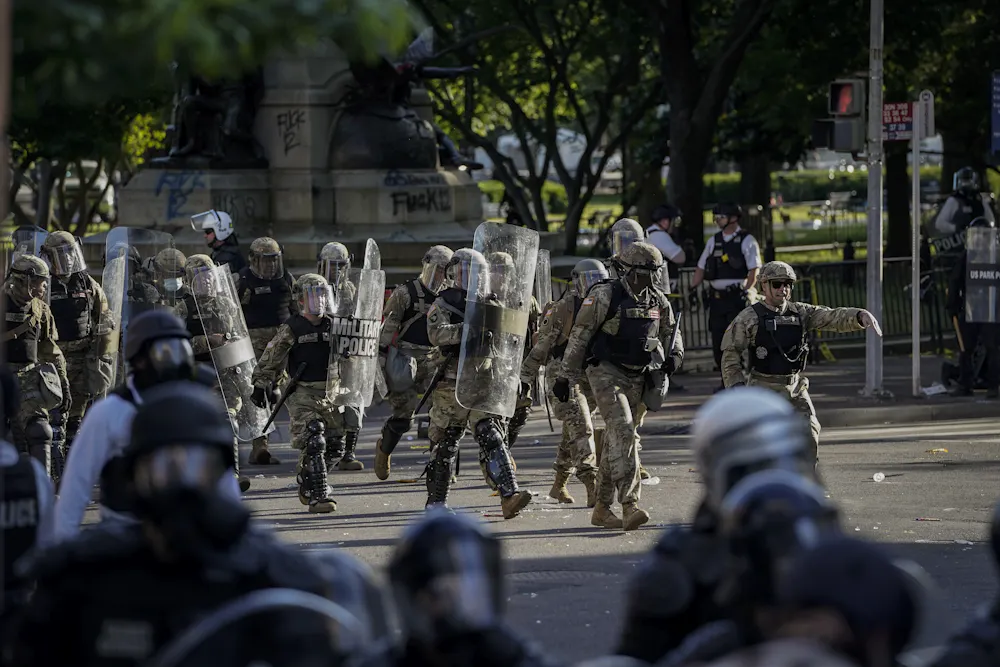
    Members of the Utah National Guard were deployed to Washington in June 2020 in response to public protests and demonstrations. AP Photo/Alex Brandon

    On the campaign trail, former President Donald Trump has declared there are serious threats to the United States. First, he said, there is “the outside enemy, and then we have the enemy from within, and the enemy from within, in my opinion, is more dangerous,” as he told Fox News in an Oct. 13, 2024, interview.

    He went on to say that “the bigger problem are the people from within. We have some very bad people. We have some sick people, radical left lunatics. And I think. And it should be very easily handled by, if necessary, by National Guard or, if really necessary, by the military.”

    Donald Trump discusses ‘the enemy within’ the United States.

    When asked on CNN about Trump’s remarks about using the military on U.S. soil, Mark Esper, one of five people who led the Defense Department during Trump’s presidency, said Americans “should take those words seriously,” most especially because Trump had already tried to do so when he was president.

    As professors of military ethics, we worry that Trump’s actions while president, and his comments about his plans for a potential second term, may put the military in a tough position. The July 1, 2024, Supreme Court ruling giving the president immunity for official acts – potentially including as commander in chief of the military – would make that tough position even more difficult.

    Donald Trump says armed forces should take on ‘the enemy from within’ the U.S.

    Response to demonstrations

    In the summer of 2020, protests, including some violent ones, arose in cities around the U.S. in the wake of the May 25 murder of George Floyd. Then-President Trump announced he was considering sending the U.S. military into the streets of several American cities. He had already deployed some National Guard members in Washington in an effort to control the demonstrations there.

    At the time, the two of us considered the possibility of dissent within the military hierarchy, saying that resistance would be most effective “if it were to come from those at the top.”

    Indeed, many of the highest-ranking generals, admirals and Cabinet-level advisers resisted Trump’s requests to send the military to “beat the f— out” of protesters and “crack their skulls” – or even “just shoot them.”

    Though Trump reportedly wanted to bring as many as 10,000 soldiers to Washington, fewer troops were deployed in the nation’s capital. No federal military personnel were used against public demonstrations in the U.S. that summer. Some National Guard troops were called up by state governors, not federal orders.

    The reasons for civilian control

    For his potential second term, Trump says he wants to hire Cabinet and other government officials who will follow his orders without question, rather than people who might try to prevent his worst inclinations from being enacted.

    Questions about dissent and disobedience will therefore likely fall on those at more junior levels of military service in a second Trump administration than they did in the first.

    The U.S. military has long been dedicated to the principle of civilian control. To minimize the chance of the kind of military occupation they suffered during the Revolutionary War, the country’s founders wrote the Constitution requiring that the president, an elected civilian, would be the commander in chief of the military. In the wake of World War II, Congress went even further, restructuring the military and requiring that the secretary of defense be a civilian as well.

    For that reason, in a time of increasing political polarization, military educational institutions are focusing even more explicitly on the oath military members take to the Constitution, rather than to a person or an office.

    As the Joint Chiefs of Staff reminded the military after the Jan. 6, 2021, insurrection, and just before the inauguration of Joe Biden as president, military personnel serve the nation’s interests, not those of a politician or a political party.

    Nonpartisanship could become partisan

    When faced with a potential order to deploy the U.S. military within the nation’s borders, however, service members may find themselves in a situation where upholding the military’s tradition of staying out of politics could itself appear partisan.

    Military members have a duty to obey orders from superior officers. But as military ethicists, we recognize that the content of an order is not the only factor that determines whether it is a moral one.

    The political motivation for an order may be equally important. That’s because the military’s obligation to stay out of politics is deeply intertwined with the mutual obligation of civilian officials not to use the military for partisan reasons.

    If an elected official were to attempt to use the military for obviously partisan ends, the decisions of military personnel to either follow the order or resist it would open them up to accusations of partisanship – even if their actions were attempts to protect the military’s strict partisan neutrality.

    At the nation’s founding, John Adams and Thomas Jefferson worried about a military that would be loyal to a particular leader rather than to a form of government. James Madison was concerned that soldiers might be used by those in power as instruments of oppression against the citizenry.

    Trump has said the National Guard or the military could “easily handle” political protesters. He has recommended one “really rough, nasty” hour of police violence to curb criminal activity. He has expressed a desire for military officers to be obedient to him and not the Constitution.

    It’s not clear that military members could follow those kinds of orders and remain nonpartisan. By refusing to follow orders about military deployment to U.S. cities for political ends, members of the armed forces could actually be respecting, rather than undermining, the principle of civilian control. After all, the framers always intended it to be the people’s military – not the president’s.

    In 2020, military personnel clear protesters from a park in Washington.
    Drew Angerer/Getty Images

    Risks for military members

    There is a long line of military heroes who had the moral courage not to follow immoral orders. In fact, it was a junior officer who first exposed the widespread use of torture in the global war on terror.

    That particular example may be useful to consider in the weeks and months ahead, given the significant effort at the time to argue that some of those immoral orders could nonetheless be legal.

    Recently, some of Trump’s former military advisers have raised concerns about the the potential use of U.S. troops in American cities. But several of his civilian advisers have already recommended being less reticent about finding legal means to deploy the military within the country. And a July 1, 2024, Supreme Court ruling gave the president criminal immunity for official acts – which almost certainly include giving orders to the military.

    Regardless of who wins the 2024 presidential election, there will likely be significant protests over policy – perhaps even over the results themselves. If the military is ever called in because of those actions, military members would have to consider whether they could ethically follow the orders to do so. To be ready to answer these important questions, they have to consider them now.

    We often ask our students to imagine themselves in numerous different ethical situations, both real and hypothetical. In the present circumstance, we believe one set of ethical questions could quickly become very concrete for those serving:

    “Would you obey an order from a president – a particular president giving an order for a particular reason – to deploy to a U.S. city? What might it mean for the nation if you did? And what might it mean for American democracy if, in some circumstances, you were brave enough not to?”

    Many Americans claim to venerate military men and women, thanking them for their service and standing to celebrate them at sporting events. They may need much more support than that from the American people, and soon.

    The academic views expressed in this article are the views of the authors alone and should not be read as endorsing any candidate for office. They do not reflect the official position of the U.S. Naval Academy, the Naval Postgraduate School, the U.S. Navy, the Department of Defense or any other entity within the U.S. government; the authors are not authorized to provide any official position of these entities.

    This article contains some material previously published on June 11, 2020.

    The authors do not work for, consult, own shares in or receive funding from any company or organization that would benefit from this article, and have disclosed no relevant affiliations beyond their academic appointment.

    ref. Threatening ‘the enemy within’ with force: Military ethicists explain the danger to important American traditions – https://theconversation.com/threatening-the-enemy-within-with-force-military-ethicists-explain-the-danger-to-important-american-traditions-241964

    MIL OSI – Global Reports

  • MIL-OSI Security: Defense News: FY26 Advanced Education Voucher Program Offers Chiefs Mess Path to Master’s Degree

    Source: United States Navy

    The AEV program provides financial assistance to selected senior enlisted personnel to complete post-secondary, Navy-relevant degrees through off-duty education.

    “The AEV program supports the continued educational development of senior enlisted leaders as part of the Navy’s seasoned team of naval warriors,” said Albert Sharlow, NETC AEV program manager. “The program provides the Navy’s chief, senior chief and master chief petty officers a platform to pursue higher education that makes them more effective leaders with varied sets of knowledge, skills and experiences to operate, sustain and maintain an edge in today’s rapidly changing security environment.”

    Who is eligible?

    Applicants must be top performing active-duty senior enlisted personnel (E-7 to E-9) who are transferring to or currently on shore duty with sufficient time ashore to complete a master’s degree program. Applicants on sea duty may apply provided they submit an education plan that shows the ability to complete the degree program as specified above.

    For FY24, applicants must have already earned a baccalaureate degree from an institution of higher learning accredited by an agency recognized by the Department of Education.

    How many quotas are available?

    The AEV program has seven quotas for master’s degrees available for FY26.

    What Navy-relevant degrees are included in the AEV program?

    Degrees considered for the master’s program include, but not limited to the below examples:
    • Emergency and Disaster Management
    • Human Resources
    • Project Management
    • Engineering and Technology
    • Systems Analysis
    • Information Technology
    • Homeland Defense and Security
    • Leadership and Management
    • Business Administration
    • Education and Training Management

    The NETC AEV program manager must validate degree programs other than those listed above as a Navy-relevant degree.

    How much funding does the Navy provide?
    For FY26, AEV Program participants will receive funds for tuition, books, and related fees for completion of their master’s degree with funding limits set at a maximum of $20,000 per fiscal year for up to 24 months from the date of signing a letter of acceptance, not to exceed $40,000 total program cost.

    When does the program begin?

    Applicants should be available to commence their studies in the 2025 fall term (after Oct. 1, 2025).

    Is there a service obligation?

    Participants shall agree to remain on active duty for a period equal to three times the number of months of education completed or three years, whichever is less.

    What is the submission deadline?

    Applications should be e-mailed to the program manager by May 5, 2025.

    Where can I get additional information on the program?

    • Visit the AEV information page on the Navy College Program’s website at https://www.navycollege.navy.mil/sailors/additional-funding-and-programs
    • Contact Albert Sharlow, NETC N525, (850) 452-7271 or DSN 459-7271
    albert.r.sharlow.civ@us.navy.mil

    NETC recruits, trains and delivers those who serve our nation, taking them from “street to fleet,” by transforming civilians into highly skilled, operational, and combat-ready warfighters.

    For more information about NETC, visit the command’s website at https://www.netc.navy.mil/ and follow the command’s social media: Facebook at https://www.facebook.com/NETCHQ, Instagram at https://www.instagram.com/netc_hq, X at https://twitter.com/NETC_HQ and LinkedIn at https://www.linkedin.com/company/netchq/.

    MIL Security OSI

  • MIL-OSI Security: Defense News: SUBASE holds Ceremonial Ribbon Cutting establishing a Micro-grid on the base

    Source: United States Navy

    Connecticut Governor Ned Lamont; U.S. Senator Richard Blumenthal (D-CT); U.S. Representative Joe Courtney (2nd-CT); Assistant Secretary of the Navy for Energy, Installations, and the Environment Meredith Berger; and, Commander of Navy Region Mid-Atlantic, Rear Admiral Carl Lahti, participated in the event near the base’s Power Plant on the SUBASE waterfront.

    “For the Navy, and all military services, October is Energy Action Month, and SUBASE could not be prouder of our ‘energy actions’ today,” said Captain Kenneth M. Curtin Jr., 53rd Commanding Officer of Naval Submarine Base New London, who served as Master of Ceremonies. “Our micro-grid at SUBASE is the first of its kind in the entire Navy to support such a complex electrical infrastructure. And in the parlance of the fall sports season, it’s a ‘game-changer.’”
    Curtin noted that while the base’s award winning Galley fuels the Sailors at the base, energy fuels everything else, from the high-tech trainers and their associated computer systems at the Naval Submarine School on the base, to the Submarines moored at the base’s waterfront, dependent on shore power when in port.
    The SUBASE Micro-grid enhances the base’s power diversification and transforms its electrical infrastructure into a more intelligent, flexible, and robust system. SUBASE benefits not only from automated data gathering and precise peak demand control, but also from the ability to seamlessly disconnect from the public utility grid during an interruption or loss in power, and efficiently dispatch on-site power generation to mission critical loads.
    The State of Connecticut; the Connecticut Municipal Electric Energy Cooperative (CMEEC); FuelCell Energy Incorporated, headquartered in Danbury, Connecticut; NORESCO, headquartered in Westborough, Massachusetts; Groton Utilities; and, a number of area and local contractors and subcontractors have been crucial contributors ensuring SUBASE reached this milestone.
    “We are playing a small role in making this base a little more resilient,” said Lamont. “This is what it’s all about. Whether it is a weather event or a bad actor, the lights will stay on at our Navy base.”
    Assistant Secretary of the Navy Berger thanked the State and partners, who through community and commercial partnerships, brought SUBASE’s energy resiliency to fruition.
    “What we are charged with under Secretary [of the Navy] Del Toro’s leadership is to strengthen our maritime dominance, strengthen our people, and to strengthen our partnerships; and what we do here today does all three,” said Berger.
    The completion of the comprehensive Micro-grid project reflects more than $235M invested in assuring the energy reliability, security, and resiliency of SUBASE.
    Lahti, as the then 50th Commanding Officer of SUBASE, was “the architect moving the initiative from the kernel of an idea, to the growth of the foundational concept, and the development of long range plans and milestones,” said Curtin.
    Pulling them from a folder, Lahti showed the audience the nearly decade old, proof of concept and long range plans. He noted that he had carried those initial documents about the “dream” of a micro-grid at SUBASE to each of his successive commands, and he was proud that the dream had finally become reality.
    “We invest in the base to create the most combat ready Submarines that we can and to train the Submarine Force,” said Lahti, outlining that utilities are part of the foundation that supports combat forces.
    Energy expenses are the single largest cost for Navy installations. Utilities costs are some 38 percent of the Navy’s shore budget. Cost savings created ashore free up dollars that can be used in the Fleet to support operations and improve the tactical performance of forces.
    Energy Reduction and Resiliency Projects under Lahti and his successors at the base, not only resulted in annual operating cost savings of nearly $1.2 million a year, but also laid the foundation for the ultimate micro-grid completion and success.
    CMEEC’s and FuelCell Energy’s Fuel Cell Park, on leased land at the base, provides energy to the public grid in normal operations, but provides SUBASE with the first right to its 7.4MW of on-site power generation during an interruption or loss in power at the base. The State and NORESCO’s efforts established 10.75MW of power generation in the base’s Power Plant thru a Combined Heat & Power system supported by two new generators and high efficiency boilers. All these elements, connected thru NORESCO’s installation of cyber secure controls, fast load shedding, and ‘islanding’ capabilities within the base Power Plant, assure SUBASE’s micro-grid energy resiliency.
    “The First and Finest Submarine Base will not rest on its laurels. We are excited by a grant from the DOD Office of Local Defense Community Cooperation in the amount of $939K in Installation Resilience funding. These funds should allow for our partners to design updated power, water and gas feeds for SUBASE. So, SUBASE’s energy future looks very bright indeed!” concluded Curtin.

    MIL Security OSI

  • MIL-OSI Security: Defense News: CFAS Hosts Women’s Leadership Symposium

    Source: United States Navy

    Senior personnel from various commands offered over 148 years of cumulative military experience and personal insight into topics including mental health, mentorship and leadership development.
    Cmdr. Mariah Rule, Chief Staff Officer at CFAS, was the lead coordinator and mistress of ceremonies for the event.

    “I firmly believe that even natural leaders have to do a lot of inner work to become a great leader,” said Rule. “A solid foundation of understanding how you want to lead will guide how you think, feel and how you make decisions. These decisions produce action that drives results.”

    The first day of the symposium began with a panel of senior female leaders offering their insight to address the development of leadership styles and skills, moderated by Chief Aviation Boatswain’s Mate Aircraft Handling Shawneequa Joyner.
    Members of the panel discussed how assertive and persuasive leadership styles are perceived in the workplace, and how to mitigate misconceptions of female leadership by keeping an open flow of communication between leadership and junior Sailors.

    “I show up as the person I truly am,” said Chief Warrant Officer 2 Latisha Sewell. “Be the type of leader that you want to be even if people try to place labels on you.”

    The event continued with topics such as sexual harassment in the workplace, maintaining a healthy work-life balance as a mother, women’s health, and harnessing your warrior wellness by utilizing mental and physical toughness techniques.
    The day concluded with three mental health exercises that were recommended to alleviate stress. The exercises included listening to meditation music while blind folded, aromatherapy, and unprompted drawing.

    The second day of the symposium focused on mentorship and how to be an effective “wingwoman”, which is defined as a woman who uplifts and guides other women personally and professionally.
    Cmdr. Angelina Violante, Executive Officer at USS Green Bay (LPD 20), was a guest speaker who offered her own approach to actively being a wingwoman for Sailors.

    “I really strive to maintain that supportive, open and empathetic attitude,” said Violante. “Wingwomen are there to guide, lead and set an example.”
    To lead by example is how many other women are able to embody what it means to be an exceptional female leader.

    Being a trailblazer as a female leader was nothing new for Rear Adm. Ryoko Azuma, the Japan Maritime Self-Defense Force (JMSDF) Director of Training, National Defense Academy of Japan, who spoke about “being first”. Throughout her career, Azuma paved the way for women as she became the first woman in 20 years to command a Japanese naval squadron.

    “I don’t think about being a woman,” said Azuma. “I will concentrate my energy on fulfilling my duties as a commander.”
    Azuma gave thorough insight into her backstory and provided Sailors the opportunity to ask questions pertaining to her experience as a woman of firsts.
    “I want to devote myself to becoming a person who will inspire others,” said Azuma.

    Mentorship was also highlighted as a focal point, emphasizing how impactful mentorship amongst men and women is.
    A panel, composed of male senior leadership, gave greater insight of their experiences with female mentorship.
    “I’ve been around female leaders, as a former Yeoman, my whole career,” said Command Master Chief Lance H. Burfict, assigned to Amphibious Squadron 11(CPR 11). I have been mentored by some of the top female leaders and have gotten to this point because they have poured in to me.”

    The symposium then segued into speed mentorship where senior leadership had the opportunity to spend about two to five minutes to connect and share advice with sailors seeking mentorship.
    Afterwards, Rule concluded the symposium with an appreciative acknowledgement of all who attended and participated in the women’s leadership symposium.
    “I’m so impressed with the diverse turnout that we had every single day,” said Rule. “It speaks volumes to the leadership here, and how committed we are to leadership development and mentorship to our Sailors.”

    MIL Security OSI

  • MIL-OSI Security: Chair of the NATO Military Committee: ‘Finland will never again navigate the darkness alone.’

    Source: NATO

    On 24 and 25 October 2024 Chair of the NATO Military Committee Admiral Bauer visited Finland, upon the invitation of its Chief of Defence General Janne Jaakkola. Admiral Bauer’s visit underscored the value of Finland as a NATO Ally and the important contributions it provides to NATO’s deterrence and defence.

    On Thursday 24 October, Admiral Bauer visited the Guards Jaeger Regiment and met with Finnish Defence Support Association members. This gave the opportunity to engage with members and meet current Finnish conscripts.

    In the evening, Admiral Bauer addressed the Finnish National Defence Course Association. This association brings together leaders from across society Finnish society who complete a prestigious national course covering in-depth topics of security and defence. Admiral Bauer’s speech praised the spirit of resilience engraved in Finland’s national defence and emphasised what NATO can learn from Finland’s Comprehensive Security Strategy and Total Defence Concept. 

    Admiral Bauer took the opportunity to discuss Finland’s transition to NATO membership, and looked ahead to the future of its membership in the Alliance. The Chair of the NATO Military Committee stated “Finland’s movement into NATO is a transition, not a transformation. It is an opportunity to inspire Allies, whilst embracing a posture of international resilience. I urge you all to hold the spirit of ‘sisu’ as a firebrand leading the way as you carve out this new path. Knowing that there are friends on either side. And that you need never again navigate the darkness alone.”

    On Friday 25 October, Admiral Bauer met with Prime Minister Petteri Orpo, Minister of Foreign Affairs Elina Valtonen, Minister of Defence Anti Häkkänen and the Finnish Parliamentary Defence Committee. These engagements allowed Admiral Bauer the opportunity to discuss strategic developments in NATO’s deterrence and defence and the need for continued support for Ukraine. In his engagements with the Finnish political and military leadership, Admiral Bauer praised the strength that Finland’s membership brings to NATO. Admiral Bauer commended the synergy of Finland’s civilian and military infrastructures and sectors in contributing towards societal resilience. He also underscored the crucial role of defence industries in Allied deterrence and defence.

    MIL Security OSI

  • MIL-OSI USA: Kennedy in The Hill: Biden admin threatens safety of key military base to appease UN activists

    US Senate News:

    Source: United States Senator John Kennedy (Louisiana)

    MADISONVILLE, La. – Sen. John Kennedy (R-La.) penned this op-ed in The Hill questioning the Biden-Harris administration’s decision to allow the United Kingdom to cede sovereignty of the Chagos Islands to Mauritius. Kennedy argued that this deal jeopardizes the safety of a key base on the island of Diego Garcia and benefits the Chinese Communist Party. 

    Key excerpts of the op-ed are below:

    “The importance of the base at Diego Garcia cannot be overstated. Diego Garcia is one of the only bases in the world where our military can reload submarines. The base also houses several Navy ships and long-range bomber aircraft that we use to carry out missions around the world. These key missions have made it a top target of Chinese Communist Party spies.

    “Today, we know our assets on Diego Garcia are secure because the Chagos Islands are a British territory. The United Kingdom controls the island of Diego Garcia and the surrounding water to protect our shared missions.

    “Our secure arrangement, however, just imploded. The United Kingdom announced that it will turn over control of the Chagos Islands to the island nation of Mauritius.”

    . . .

    “This decision wasn’t about righting the wrongs that the United Kingdom supposedly committed against the people of Chagos, though. Chagossians consider themselves an indigenous people. The Chagos Islands and Mauritius—which are more than 1,200 miles apart—speak different versions of Creole and have no shared pre-colonial historic ties. They are, for all practical purposes, strangers.”

    . . .

    “President Biden and Vice President Harris either truly believe that the government of Mauritius has the ability and the courage to stand up to China to ensure the security of Diego Garcia, or they withheld their objections to avoid being criticized by woke United Nations activists if they stood up for the American people’s best interests.”

    . . .

    “The American people deserve to know why President Biden and Vice President Harris allowed this irreversible deal to move forward. Congress must hold the Biden-Harris administration accountable for this short-sighted and dangerous decision. 

    “So, I repeat: Why? Why put American interests at risk? Why help the Chinese Communist Party?”

    Read Kennedy’s full op-ed here.  

    MIL OSI USA News

  • MIL-OSI Video: Bear Grylls visits Marines

    Source: US Marines (video statements)

    Bear Grylls, an adventurer and television presenter, tours the Pentagon and meets with Marines in Arlington, VA, Oct. 22, 2024.

    Bear Grylls served in the British Army’s Special Air Service and is an honorary Colonel in the Royal Marines.

    https://www.youtube.com/watch?v=NqIiLvxbs2E

    MIL OSI Video

  • MIL-OSI USA: Readout of 35th U.S.-Egypt Military Cooperation Committee

    Source: United States Department of Defense

    Pentagon Spokesperson Tom Crosson provided the following readout:

    The United States and Egypt held the 35th annual U.S.-Egypt Military Cooperation Committee (MCC) in Washington, D.C. on Oct. 23-24, 2024.  Deputy Assistant Secretary of Defense (DASD) for the Middle East Daniel B. Shapiro, and Egypt Assistant Minister of Defense for Foreign Relations Major General Walaa Bibers, co-chaired the event for the United States and Egypt, respectively.

    Building on last year’s strategic forum in Cairo, the MCC reinforced the strong U.S.-Egypt defense partnership through discussions on enhancing security cooperation, shared regional concerns, and building on critical security assistance programs. The delegations exchanged perspectives on regional security challenges, including the conflicts in Gaza, Lebanon, and Sudan, Houthi threats to the free flow of global commerce in the Red Sea, and the destabilizing activities by Iran and Iran-backed terrorist groups. Both sides agreed on the importance of enhancing regional security integration and deepening U.S.-Egyptian military cooperation.

    DASD Shapiro expressed appreciation for Egypt’s ongoing efforts to facilitate Gaza hostage release and ceasefire talks, as well as Egypt’s role in deescalating regional tensions. He reiterated that the United States seeks a diplomatic resolution along the Israel-Lebanon border that would allow civilians on both sides to return safely to their homes, the release of all hostages held by Hamas, and increased delivery of humanitarian assistance to those in need. DASD Shapiro and Major General Bibers reaffirmed the enduring U.S. and Egyptian commitment to the bilateral strategic relationship and preserving regional stability. 

    MIL OSI USA News

  • MIL-OSI Security: Around the Air Force: Test Pilot School Gets Super Tucano, Planning for Mobility Guardian 25, Global Household Goods Contract Program

    Source: United States Air Force

    In this week’s look around the Air Force, three A-29 Super Tucanos join the Air Force Test Pilot School fleet, allies and partners prepare for next summer’s Mobility Guardian 25, and the new Global Household Goods Contract program rolls out.

    MIL Security OSI

  • MIL-OSI Global: From Confederate general to Cherokee heritage: Why returning the name Kuwohi to the Great Smoky Mountains matters

    Source: The Conversation – USA – By Seth T. Kannarr, PhD Student in Geography, University of Tennessee

    View from the overlook on Kuwohi of the mountain peaks and ridges of Great Smoky Mountains National Park.

    Getty Images

    It’s not every day that the name of a mountain is restored to the one used by Indigenous peoples for centuries.

    But after nearly two years of trying, the Eastern Band of Cherokee Indians finally convinced the U.S. Board on Geographic Names on Sept. 18, 2024, to formally agree to rename the highest point in the Great Smoky Mountains National Park of Tennessee to Kuwohi (koo-whoa-hee).

    The mountain, known as “Clingmans Dome” since 1859, has been a sacred place for the Cherokee people, serving as a place of prayer, reflection and gathering of mulberries for medicine. In fact, the name Kuwohi translates to “the mulberry place” in Tsalagi, the Cherokee language.

    Though known as Kuwohi by the Cherokee people for hundreds of years, explorer Arnold Guyot effectively ignored that history after he surveyed the mountain range in 1859. Guyot named the peak “Clingmans Dome” after his friend Thomas Lanier Clingman, a North Carolina U.S. senator and a Confederate brigadier general during the Civil War. Clingman never set foot on this mountain, but his name remained there for 165 years until now.

    What is place name repatriation?

    The government’s renaming of the mountain to Kuwohi is a significant example of place name repatriation, or the return of an original, Indigenous name to a particular place or landscape.

    Sometimes the primary motivation for place renaming is to remove an offensive or irrelevant place name from the landscape, such as the renaming of Squaw Peak in Arizona to Piostewa Peak in 2008.

    In other cases, such as the renaming of Mount McKinley in Alaska to Denali in 2016, the motivation was to create a more authentic and historically accurate name for a particular place.

    In the case of Kuwohi, the return to its original name was a mixture of both. The government’s decision recognized the original Indigenous name and removed the name of a white man who defended the enslavement of African people. It is also about restoring a larger sense of respect and recognition of Indigenous identity across the landscape.

    Just as important is the fact that it was individuals from the Eastern Band of Cherokee Indians who put forward this proposal and remained the lead throughout the process.

    Place naming is only truly reparative if these processes truly reflect the agency and intent of these historically oppressed groups. Otherwise, it contributes to the long history of dismissing Indigenous claims to land and culture by not involving them.

    View of observation tower on Kuwohi in Great Smoky Mountains National Park.
    Joshua Moore/Getty Images

    Why does place naming matter?

    A name is one of the most fundamental ways to identify and give meaning to places. In other words, the name of the place makes a big difference in how people perceive it.

    There is growing public recognition that place names can transmit harmful messages that misrepresent the history and identity of minority communities. Place names also can demonstrate how those in power have used them to disrespect and misrepresent ethnic and racial groups that have been historically discriminated against.

    For those groups, the U.S. Department of the Interior’s Advisory Committee on Reconciliation in Place Names found in 2022 that derogatory place names are a source of recurring trauma.

    If place naming did not matter, disputes over name changes would not occur. Some critics find place renaming to be an example of unnecessary political correctness, while others see it as a meaningful solution that will leave a lasting positive impact.

    The elimination of names of Confederate generals from some U.S. military bases provides another example. Former President Donald Trump has pledged to restore the name “Fort Bragg” to the North Carolina Army base that’s known today as Fort Liberty if reelected. Originally named after Braxton Bragg, a slave-owning Confederate general, the fort was one of nine U.S. installations that the Defense Department ordered in 2023 to have their names changed to among 3,700 recommendations.

    Trump’s stance exemplifies the wave of backlash that has occurred against local and state school officials across the country that have removed the names of Confederate generals and others from public buildings.

    Lavita Hill (L) and Mary Crowe in 2022.
    Cherokee One Feather

    Despite such backlash, efforts by Indigenous people and civil rights advocates slowly move forward and are seen across the U.S. in places like streets, neighborhoods, college campuses and beyond.

    For Lavita Hill and Mary Crowe, the two members of the Eastern Band of Cherokee Indians who took the lead on submitting the proposal, the renaming of Kuwohi was a moment of success. Their campaign was heavily inspired by the renaming of Mount Doane to First Peoples Mountain in Yellowstone National Park in 2022.

    Crowe told reporters that she saw friends and relatives shed tears when they learned of the name change. “It was humbling,” she said. “It was beautiful.”

    What comes next?

    The success of the effort to restore the name Kuwohi may help other communities in their ongoing place renaming efforts.

    One such proposal involves a 100-year-old fight to rename Mount Rainier in Washington state to “Tacoma,” the original name given to it by the Salish people of the Pacific Northwest.

    View of the Great Smoky Mountains at sunset from Kuwohi.
    Wolfgang Kaehler/LightRocket/Getty Images

    This movement began in 1924 among the Salish and other groups because its namesake, Peter Rainier, was a British naval officer who was known as being “anti-American.”

    Another example is a push by 20 different Indigenous tribes, including the Lakota Nation and the Oglala Sioux Tribe, to rename Devils Tower in Wyoming to Bear Lodge. The current name of this butte resulted from a poor English translation of the original Indigenous name of “bear lodge” to “bad god’s tower.” Over time, the name was simplified to “Devils Tower.”

    As geographers who have studied the significance of place renaming, we have learned that it is important to engage the folks that these movements will benefit most in all conversations and decisions.

    What is at stake is not just removing insulting names, but also ensuring that the process of changing place names is collaborative of all Americans, especially historically oppressed communities, to truly be restorative and meaningful for society.

    Seth T. Kannarr is affiliated with the Great Smoky Mountains National Park as an Education Branch VIP (Volunteer-In-Parks) part-time.

    Derek H. Alderman once served on the Federal Advisory Committee on Reconciliation in Place Names, U.S. Department of Interior.

    ref. From Confederate general to Cherokee heritage: Why returning the name Kuwohi to the Great Smoky Mountains matters – https://theconversation.com/from-confederate-general-to-cherokee-heritage-why-returning-the-name-kuwohi-to-the-great-smoky-mountains-matters-240644

    MIL OSI – Global Reports

  • MIL-OSI Security: Defense News: General Counsel of the Navy Recognized for Port Chicago Sailor Exoneration Efforts

    Source: United States Navy

    In the aftermath of the 1944 explosion at the Port Chicago Naval Magazine in California, white officers were granted leave while African-American Sailors were compelled to return to work. When 258 Sailors refused to handle ammunition, they were subsequently convicted in a summary and general courts-martial.

    A comprehensive examination of both trials revealed significant legal errors in the proceedings that compromised the fairness of the trials, which include the defendants being improperly tried together despite conflicting interests and being denied a meaningful right to counsel. Additionally, the courts-martial took place before the Navy’s Court of Inquiry finalized its report on the explosion.

    Following the Navy’s review, Secretary Del Toro officially exonerated the remaining 256 defendants from the 1944 courts-martial. General Counsel Coffey led the legal review efforts and was honored with the “Port Chicago Exoneration Champion Award” from Contra Costa Justice for All for his instrumental contribution to the Sailors’ exoneration.

    General Counsel Coffey’s dedication and expertise were crucial in uncovering that the conduct of the Port Chicago courts-martial were fundamentally unfair and did not result in just outcomes for the defendants or the Navy. This decision demonstrates the Department of the Navy’s commitment to correcting historical injustices and ensuring all service members are treated fairly and equitably.

    If any family members of the defendants of the 1944 Port Chicago general and summary courts-martial would like to reach out to the Department of the Navy for future notifications on the topic or more information, please reach out to PortChicago@us.navy.mil, or 703-697-5342.

    MIL Security OSI

  • MIL-OSI USA: H.R. 8683, Strategic Ports Reporting Act

    Source: US Congressional Budget Office

    H.R. 8683 would require the Department of State, in coordination with the Department of Defense, to develop, update, and submit to the Congress a map of ports that are essential to the national security or economic interests of the United States (called strategic ports). In addition, the bill would authorize those agencies to contract with a federally funded research and development center to conduct a study on those ports. That study would identify any efforts by the People’s Republic of China or Chinese entities to acquire or develop such ports and provide information on U.S. efforts to ensure open access and security for strategic ports. The bill would also require the Department of State to report to the Congress on that study.

    MIL OSI USA News

  • MIL-OSI USA: Around the Air Force: Test Pilot School Gets Super Tucano, Planning for Mobility Guardian 25, Global Household Goods Contract Program

    Source: United States Air Force

    Headline: Around the Air Force: Test Pilot School Gets Super Tucano, Planning for Mobility Guardian 25, Global Household Goods Contract Program

    In this week’s look around the Air Force, three A-29 Super Tucanos join the Air Force Test Pilot School fleet, allies and partners prepare for next summer’s Mobility Guardian 25, and the new Global Household Goods Contract program rolls out.

    MIL OSI USA News

  • MIL-OSI United Kingdom: DIO and Royal Navy sign contract for construction project in Cornwall

    Source: United Kingdom – Executive Government & Departments

    The Defence Infrastructure Organisation and Royal Navy mark milestones in major project at Royal Naval Air Station Culdrose.

    Representatives of RNAS Culdrose, Royal Navy Infrastructure, Kier Construction, Mott MacDonald and Defence Infrastucture Organisation inspect plans to demolish and replace the Engineering Training School. Credit: Crown Copyright

    The Defence Infrastructure Organisation (DIO) and the Royal Navy have concluded a contract-signing and groundbreaking ceremony for a major construction project at Royal Naval Air Station (RNAS) Culdrose in Cornwall. 

    This marks the beginning of work on a £99.5 million project to replace and refurbish the 820 Naval Air Squadron (NAS) hangars, associated office buildings, and the full replacement of the Engineering Training School (ETS).  The contract was awarded to Keir Construction with Mott MacDonald as the designated Technical Services Provider.

    DIO and its contractors will deliver the project on behalf of the Royal Navy, with the first phase seeing the construction of a new air Engineering Training School, a new hangar and refurbishment of existing buildings for 820 Naval Air Squadron, the helicopter unit dedicated to protecting the Navy’s aircraft carrier strike groups. The project covers a combination of demolition, a new build within the same site footprint, and the refurbishment of existing infrastructure. 

    Sustainability will be a key feature of the project which will include integrated water-saving measures, Net Zero carbon emissions, solar photovoltaic panels, energy efficient lighting, and air source heat pumps to improve energy efficiency and contribute to carbon reduction.

    RNAS Culdrose is integral to the UK’s defence posture and is home to the Royal Navy’s anti-submarine warfare helicopter fleet. RNAS Culdrose also houses the Engineering Training School responsible for Air Engineering (AE) specialist training, delivering fully trained engineers to support Merlin helicopter operations.

    L to R: Andy Roberts of Mott MacDonald; Stu Johnson, Head of Navy Infrastructure; Cpt Stuart Irwin, Culdrose CO; Doug Lloyd of Kier Construction; and Dan Ross of DIO. Credit: Crown Copyright

    Daniel Ross, DIO Programme Director, Major Programmes and Projects, said:

    “I am delighted that we can celebrate this significant milestone at RNAS Culdrose, marking the next phase of collaboration with our suppliers and the Royal Navy. Building on the sustainable designs already delivered, the project will continue to contribute towards defence’s Net Zero targets and ultimately enhance our military capability.”

    Captain Stuart Irwin, Commanding Officer, Royal Naval Air Station Culdrose said:

    “This project marks the start of an exciting regeneration and investment in RNAS Culdrose with new, modern facilities. The Engineering Training School is at the heart of our operations to maintain the Merlin helicopter fleet. Our young people, many of whom are just at the start of their naval careers, will learn how to maintain aircraft in a high-tech and modern teaching environment.

    The refurbishment of aircraft hangars and buildings at 820 Naval Air Squadron is another significant investment. It will provide us with more suitable and sustainable places to operate Merlin Helicopter Force now, and into the future.”

    Stu Johnston, Deputy Head, Navy Infrastructure and Projects, Senior Responsible Officer, said:

    “The DIO and Navy infrastructure teams have worked closely to develop what will be hangar and training facilities fit for the 21st Century Royal Navy.  The project will reflect our wider sustainability and energy efficiency ambitions. The team has embraced a collaborative and agile approach built on years of hard work by stakeholders.”

    Doug Lloyd, Regional Director, Kier Construction, said:

    “We are delighted to have the opportunity to work with the Defence Infrastructure Organisation and the Royal Navy to deliver these new facilities.  We have a wealth of experience in delivering buildings of the highest quality across the defence estate and are proud to be creating this important enabler to the UK’s future defence capability.”

    Chris Ackerman, DIO Account Lead for Mott MacDonald, said:

    “We are really pleased to be working for DIO as their Technical Service Provider and alongside Kier, the Principal Contractor.  This project will provide a suite of modern and sustainable infrastructure for the Royal Navy in accordance with the Defence Operational Energy Strategy.”

    The project is scheduled for delivery in the spring of 2028.

    A proposed impression of the new Engineering Training School at RNAS Culdrose. Credit: Crown Copyright

    Updates to this page

    Published 25 October 2024

    MIL OSI United Kingdom

  • MIL-OSI USA: Historic Deployment: First time in 70 years, the Wyoming Army Guard 2-300th Field Artillery Regiment deploys together

    Source: US State of Wyoming

    The Wyoming National Guard held send-off ceremonies for different batteries of the 2nd Battalion, 300th Field Artillery Regiment in Torrington, Gillette, Lander and Casper on July 30, 2024, supporting the Soldiers and their families as they embark on their eighth deployment in the past 20 years.

    The send-off ceremony formally recognizes the Soldiers and their families who are about to deploy. It also demonstrates that they have the full support of their community, leadership and loved ones, according to Lt. Col. Michael Kingman, 2-300th commander. This is the first full battalion deployment in over 70 years to conduct a field artillery mission.

    “This deployment marks the eighth time since September 11, 2001, that this formation has answered the nation’s call,” Kingman said. “Most of those deployments involved only portions of the battalion. This mission marks the first time the battalion has deployed as an integrated whole on a field artillery mission since the Korean War.”

    More than 360 Soldiers will deploy to several Middle Eastern countries to support Operations Spartan Shield and Inherent Resolve.

    The ceremony started with the arrival of the official party.

    Wyoming Governor Mark Gordon presided over the ceremonies, joined by Maj. Gen. Greg Porter, Wyoming adjutant general, Chief Master Sgt. Josh Moore, command senior enlisted leader for the Wyoming Guard, Lt. Col. Michael Kingman, 2-300th commander, Command Sgt. Maj. Spencer Jolly, 2-300th command sergeant major, along with other battery and company leadership.

    In the next part of the ceremony, Governor Gordon, General Porter, and Lieutenant Colonel Kingman shared their commitment to support and gratitude.

    Since taking office in 2019, the governor has made it a point to personally send off each service member and their families during deployments. He shared his thoughts with the Soldiers.

    “You are Wyoming proud, Wyoming strong, Wyoming proficient and Wyoming professional,” the governor said. “Thank you. All of us at home, your families, and all of us will know you are protecting us. We thank you from the depths of our hearts, from the bottom of our souls.”

    Governor Gordon also expressed his commitment to the families.

    “We feel that as much service as our men and women on the front lines give, it is also their families that stand watch,” he said. “We will stand 100 percent with the families as well. Thank you to every family member for your service.”

    General Porter spoke about the 2-300th’s rich history of serving the nation.

    “For over 136 years, Wyoming citizen Soldiers have raised their right hands and said, ‘I will do the nation’s bidding. I will wear the cloth of my country and go forth to do what needs to be done,’” the general said. “That is an incredible sacrifice, and I deeply appreciate all of you here in the community who are here to congratulate and recognize that sacrifice.”

    General Porter also highlighted the role of Soldiers as community members.

    “They are also mothers and fathers, sisters and brothers, friends, family members, coaches, ministers and teachers. Our guardsmen and women are an indelible part of the community, and when they leave, they leave a gap,” Porter said. “We will fill this gap for you. We will ensure your community is safe while you deploy, and more importantly, we will ensure your families are taken care of.”

    Lieutenant Colonel Kingman also thanked the families for their sacrifices and encouraged families to reach out if they need assistance.

    “It’s been said, and I believe it to be true, that they have the tougher task, staying behind,” he said. “For the Soldier who goes forward, time often flies. We will be mission-focused here very soon, and these 60 days will go by quickly because we will be busy. But for all the friends and family at home facing the daily grind, they will be going through that without the needed support from their loved ones at their side. I encourage you all to not suffer in silence. If you need someone to talk to, need encouragement, need a hot water heater fixed, or if a door won’t close properly—whatever it is—reach out. We have someone who is not only willing but eager to assist in solving whatever problem comes up.”

    The following segments are long-standing traditions of presenting an “Entering Wyoming” highway sign, the Wyoming flag and casing the 2-300th colors.

    An “Entering Wyoming” highway sign was presented to each battery. The sign will be displayed at each headquarters. Similar signs have been given to every Wyoming Army National Guard unit that has deployed since the Korean War.

    “For the Wyoming National Guard, this sign serves as a visual reminder to all who enter the area that they are in Cowboy Guard territory,” said 1st Lt. Chad Onthank, 920th Forward Support Command executive officer.

    Next, the governor presented the Wyoming flag to the 2-300th to remind each Soldier that those Wyomingites at home are with you every step of the way.

    Finally, Kingman and Jolly cased the battalion colors to show the unit has a mission forward and will deploy.

    For the deployment, Kingman issued a challenge to his Soldiers.

    “I am committed to ensuring that you have the best possible leadership and training every step of the way,” he said. “I am confident that if you work hard, are a good teammate, and keep a positive attitude, we can all come out of this experience as better friends, spouses, parents, Soldiers and human beings.”

    MIL OSI USA News

  • MIL-OSI Europe: Analysis: Has Azerbaijan Successfully Domesticated Islam?

    Source: Universities – Science Po in English

    With COP29, hosted by Baku, right around the corner, let’s have a look at Azerbaijan and its secular history with Altay Goyushow, professor of history at Baku State University and visiting scholar at Sciences Po Center for International Studies (CERI).

    A fine observer of the Azerbaijani regime, he answers the questions of Miriam Périer (CERI) about the ruling elite’s attitude toward religion, and Islam in particular, and the need to look back at the Soviet period to understand the current situation.

    > Read the full interview on CERI’s website.

    What is the aim of the current Azerbaijani ruling elite’s policies in the field of religion?

    Azerbaijan is a secular state. A genuine secularist movement was started in Azerbaijan in the mid-nineteenth century by the local Russian and European-educated intelligentsia. The greatest success of this movement was the creation of the first secular republic during the First World War and the Russian Revolution.

    In 1920, the Red Army put an end to this republic. However, during Soviet rule the secularist traditions of Azerbaijani society strengthened further, even though, as I said earlier, the collapse of the Soviet Union was accompanied by the impressive revival of religion. Soviet rule eradicated local sources of religious knowledge and because of this, in the 1990s, the revival was led primarily by foreign actors.

    Then, in the late 1990s, local clerics educated abroad took the leading role in religious proselytism. This situation was unacceptable to Azerbaijani authorities, as they wanted religious learning to be concentrated in the hands of locally educated Muslim clerics. The authorities have been pursuing a policy of domesticating Islam. Unlike the Soviets, the current Azerbaijani government does not intend to get rid of religion; they instead want to make Islamic elites into loyal supporters of the secular system and ruling elite.

    This policy has given birth to a complex religious situation in the country. On the one hand, there is an official Islam loyal to the government. On the other hand, there are Islamic communities that aim to exist without the secular state’s interference. The constitution says that the state and religion are separate; however, the real situation is much more complicated.

    Both the government and independent Islamic communities complain about interference from their counterparts. Islamic communities complain that the state infringes on their freedom of conscience, while the government complains that independent communities are a threat to the secular nature of the state.

    You mention that the current ruling elite of Azerbaijan is particularly concerned by Muharram traditions, partly because these do not correspond to so-called “civilised religion” according to the government. Can you tell us why?

    The Azerbaijani government aims to create distinct characteristics of local Islam which it describes as a “civilised” Islam. The methods used to achieve this goal include the implementation of a unique education programme for training Muslim clerics in the newly established Theological Institute, the adaptation of distinct uniforms for Azerbaijani Muslim clerics, the promotion of joint Sunni-Shi’i prayers, among other things.

    “Correcting” rituals of Muharram commemorations are among the planned reforms. It should be noted that Muharram is the most popular religious commemoration in Azerbaijan. It has been for centuries. However, beginning in the early twentieth century, some practices of Muharram commemorations, such as self-flagellation or striking oneself with swords and knives, have been heavily criticised by the local secular intelligentsia as “uncivilised” rituals.

    The Soviets launched multiple campaigns against Muharram observations like these and others. In the post-Soviet era, this approach has been continued, and some practices have been replaced with novelties, such as making blood donations instead of striking themselves with knives or self-flagellation with metal chains.

    During the last decade, another government concern has been the increased pilgrimage of Azerbaijani believers to Shi’i shrines in Iraq and Iran at the end of annual Muharram commemorations. The government considers the rising number of pilgrims to those places as a security risk. So, by implementing various measures and restrictions, the authorities are trying to curb the number of pilgrims.

    Does the Azerbaijani population support the ruling elite’s policies toward religion? What is the position of secular youth movements in the face of the government’s attitude toward independent Muslim communities?

    It is an interesting question. Azerbaijan, despite the impressive religious revival in the post-Soviet period, remains a largely secular country. So, most Azerbaijanis cherish their society’s secular characteristics and do not appreciate the interference of religion or religious communities in state affairs.

    However, state institutions’ deep interference with the life of religious communities in many instances infringes on people’s freedom of conscience. And in this particular matter, there is a generational disruption within society. While the older Soviet-trained and educated part of the society, especially the urbanised part, is not particularly critical of the excesses of the government’s religious policies, the younger population, especially its quite vocal liberal and progressive representatives, despite appreciating and praising the secular fundamentals of the society, is frequently critical of the tough measures implemented by the government in the promotion of religious conformity.

    It should also be added that ethnic nationalism is a strong feature of Azerbaijani society. And traditionally, secular nationalists have been critical of Islamic movements, and on this issue, they tend to align more with the government than Islamic communities.

    Cover image caption: Baku, Taza-Pir mosque, the seat of the Sheikh-ul-Islam, the head of the Caucasus Muslim Board. (credits: Altay Goyushow)

    MIL OSI Europe News

  • MIL-OSI Security: Defense News: U.S. Naval Forces Participate in Republic of Korea Multi-National Mine Warfare Exercise

    Source: United States Navy

    Part of an annual series of exercises hosted by the ROK Navy, MNMIWEX 24 increased proficiency in mine countermeasures (MCM) operations within a multi-national naval force.

    This year’s iteration had 19 nations and approximately 100 personnel participating, making MNMIWEX 24 the largest of the series to be held.

    “I was grateful for the opportunity to work with our hosts, the ROK Navy, and our partner nations and allies,” said Capt. Antonio Hyde, commodore of Mine Counter Measures Squadron (MCMRON) Seven, which belongs to Task Force 76, U.S. 7th Fleet’s expeditionary warfare force. “This multi-national training refines how we operate in a complex maritime environment to maintain open sea-lanes and freedom of navigation for all countries in the region.”

    MCM forces from the U.S., Australia, Canada and New Zealand embarked the tank landing ship ROKS Cheon Wang Bong (LST 686), which teamed with the Avenger-class mine countermeasures ship USS Patriot (MCM 7) to conduct mine hunting operations during the eight-day at-sea phase.

    A multinational watch floor directed MNMIWEX operations ashore. This facilitated a command structure that promoted interchangeability and helped build the capacity of multinational MCM forces to operate effectively as a team.

    “Through this exercise, we improve our abilities to carry out multinational mine operations to protect major ports and sea lines of communication from the complex threats of enemy in case of emergency,” said Capt. Lee Taek-sun, commander of ROK Navy Mine Squadron 52. “We will continue to develop the combat capabilities necessary for mine warfare and further improve mine operation abilities and procedures with multinational forces.”

    MNIMIWEX 24 featured participants from the United States, Republic of Korea, Japan, the United Kingdom, Australia, Canada, New Zealand, the Republic of the Philippines, Italy, Greece, Türkiye, Thailand, Belgium, Malaysia, Oman, Colombia, United Arab Emirates, Chile and the Netherlands.

    The exercise took place in U.S. 7th Fleet, the U.S. Navy’s largest forward-deployed numbered fleet, which routinely interacts and operates with allies and partners in preserving a free and open Indo-Pacific region.

    MIL Security OSI

  • MIL-OSI USA: Senator Marshall on Fox Business: President Trump’s Cabinet Must Be Confirmed ASAP

    US Senate News:

    Source: United States Senator for Kansas Roger Marshall

    Washington, D.C. – U.S. Senator Roger Marshall, M.D. joined Fox Business: The Bottom Line to discuss the Senate’s imminent vote to confirm Pete Hegseth as Secretary of Defense, the determination of the Republican-led Senate to confirm President Trump’s Cabinet and Robert F. Kennedy, Jr.’s upcoming Senate confirmation hearings.
    Senator Marshall sits on both the Senate Finance and Health, Education, Labor, and Pensions (HELP) Committees, both of which will be holding hearings next week to consider the nomination of RFK Jr. for Secretary of the Department of Health and Human Services (HHS). Senator Marshall has met with both Hegseth and RFK Jr. and believes they are the best picks to carry out President Trump’s America First Agenda at the DOD and HHS.

    You may click HERE or on the image above to watch Senator Marshall’s full interview.
    Highlights from Senator Marshall’s interview include:
    On Pete Hegseth being confirmed as Secretary of Defense, other Trump nominees on deck:
    “I’m sure optimistic. [Pete Hegseth is] on second base right now. He passed the procedural vote with one vote to spare. So I’m very optimistic. And I just want to emphasize why this is important. President Trump is issuing all these executive orders. We need these nominees then get in there to do the job and execute those orders. So we need Pete to jump in there. He’s going to do a great job recruiting, a great job with the morale, and just rewarding people for their merit, as opposed to anything else.”
    “[Democrats have] resorted to character assassination…But regardless, I think that once we get Pete across the finish line, Kristi Nome is on deck, she’s going to step up. I expect her to get across pretty easily, as you mentioned. Sean Duffy is there in the hole waiting as well. So I think we’re in good shape.”
    On GOP-led Senate’s determination to confirm President Trump’s Cabinet:
    “We’re willing to stay here and punish the Democrats. The good news is we had them kicking and screaming, so we’re over the target. We’re all committed to staying here this weekend. They can try to slow things down, and as long as they keep jamming us, we’re just going to stay up here and keep working away. I don’t think we’ll have to get to those recess appointments, but if necessary, we will. I’m really optimistic, if we just keep plugging away here, we’re going to get them all across the finish line.”
    On Robert F. Kennedy Jr.’s upcoming Senate confirmation hearing:
    “Look, he has an army of people behind him. I mean, just a groundswell of people out there. 77 million…people voted for President Trump, and one of the reasons was because of Bobby Kennedy Jr….I think that the American public is going to carry Bobby through that nomination process. He’s brilliant. He’s going to do a great job- all those things. And I think when people just listen to his heart, that he loves this country, that he wants to make America healthy again, and he knows how to do it, so I expect that groundswell of support to get him over the finish line.”

    MIL OSI USA News

  • MIL-OSI Security: Defense Contractor Sentenced to 15 Months in Prison for Fraud, Money Laundering, and Unlawful Export of Technical Data

    Source: Federal Bureau of Investigation (FBI) State Crime News

    Yuksel Senbol, 36, of Orlando, Florida, was sentenced today to 15 months in prison for conspiracy to defraud the United States, conspiracy to commit wire fraud, wire fraud, conspiracy to commit money laundering, money laundering, conspiracy to violate the Export Control Reform Act, violating the Export Control Reform Act, and violating the Arms Export Control Act. As part of her sentence, the court also entered an order of forfeiture in the amount of $275,430.90, the proceeds of Senbol’s fraud and money laundering scheme. Senbol entered pleaded guilty on May 7.

    According to facts taken from public filings, beginning in approximately April 2019, Senbol operated a front company in the Middle District of Florida called Mason Engineering Parts LLC. She used this front company to assist her co-conspirators, Mehmet Ozcan and Onur Simsek, to fraudulently procure contracts to supply critical military components to the Department of Defense. These components were intended for use in the Navy Nimitz and Ford Class Aircraft Carriers, Navy Submarines, Marine Corps Armored Vehicles, and Army M-60 Series Tank and Abrahams Battle Tanks, among other weapons systems.

    To fraudulently procure the government contracts, Senbol and her co-conspirators falsely represented to the U.S. government and U.S. military contractors that Mason Engineering Parts LLC was a vetted and qualified manufacturer of military components, when in fact, the parts were being manufactured by Ozcan and Simsek in Turkey. As Senbol knew, Simsek’s involvement had to be concealed from the U.S. government because he had been debarred from contracting with the U.S. government after being convicted of a virtually identical scheme in the Southern District of Florida.

    In order to enable Ozcan and Simsek to manufacture the components in Turkey, Senbol assisted them in obtaining sensitive, export-controlled drawings of critical U.S. military technology. Using software that allowed Ozcan to remotely control her computer — and thus evade security restrictions that limited access to these sensitive military drawings to computers within the United States — Senbol knowingly facilitated the illegal export of these drawings. She did so despite having executed numerous agreements promising to safeguard the drawings from unlawful access or export, and in spite of the clear warnings on the face of each drawing that it could not be exported without obtaining a license.

    Once Ozcan and Simsek manufactured the components in Turkey, they shipped them to Senbol, who repackaged them — making sure to remove any reference to their Turkish origin. The conspirators then lied about the origin of the parts to the U.S. government and a U.S. government contractor to receive payment for the parts. Senbol then laundered hundreds of thousands of dollars in criminal proceeds back to Turkey through international wire transfers.

    This scheme continued until uncovered and disrupted by federal investigators. Parts supplied by Senbol were tested by the U.S. military and were determined not to conform with product specifications. Many of the components supplied to the U.S. military by Senbol were “critical application items,” meaning that failure of these components would have potentially rendered the end system inoperable.

    Alleged co-conspirators Mehmet Ozcan and Onur Simsek are fugitives.

    The General Services Administration, Office of Inspector General; Defense Criminal Investigative Service; Department of Commerce, Bureau of Industry and Security; Air Force Office of Special Investigations; FBI; Homeland Security Investigations; and Department of State, Directorate of Defense Trade Controls are investigating the case.

    Assistant U.S. Attorneys Daniel J. Marcet and Lindsey Schmidt for the Middle District of Florida and Trial Attorney Stephen Marzen of the National Security Division’s Counterintelligence and Export Section are prosecuting the case.

    MIL Security OSI

  • MIL-OSI USA: Defense Official Statement on AUKUS Pillar 2 and Exercise Maritime Big Play

    Source: United States Department of Defense

    The following statement can be attributed to Ms. Madeline Mortelmans who is currently performing the duties of the Assistant Secretary of Defense for Strategy, Plans and Capabilities. Her office is lead for both pillars of AUKUS within the department and is in close partnership with all of the DOD stakeholders.

    “Secretary Austin has said several times in the past that our alliances and partnerships are our greatest global strategic advantage. Specifically, AUKUS presents a unique opportunity for Australia, the United Kingdom and the United States to foster a more capable, more combined force of the future. And in so doing, we will strengthen deterrence in the Indo-Pacific.

    Through AUKUS, we are working across the full spectrum of capability development, generating requirements, co-developing new systems, deepening industrial based collaboration and ultimately delivering advanced capabilities to our forces. AUKUS Pillar 1 focuses these co-development efforts on delivering an advanced nuclear power submarine capability through the optimal pathway.

    Pillar 2 focuses on the development and delivery of emerging technology. AUKUS Pillar 2 is designed to harness the combined industrial and innovation bases of the tri-lateral partners to ensure that our forces are equipped with cutting edge interoperable military capabilities and prepared to face down aggression in whatever form it may take.

    In Pillar 2, we’re building a more capable combined joint force for the future, working across the full spectrum of capability development and we’re already delivering. This year, we’re advancing our undersea warfare capabilities by expanding our ability to launch and recover uncrewed underwater systems from torpedo tubes on current classes of British and US submarines, that will increase the range and capability of our undersea forces.

    We’re integrating the Stingray lightweight torpedo into the P-8A maritime patrol aircraft, which will support our forces in being more interchangeable while providing resilience to munitions stockpiles across AUKUS nations. At the same time, we’re also implementing a fundamental shift to more closely integrate our systems and break down barriers to collaboration at every stage and in every part of our systems.

    We’ve welcomed collaboration with the International Joint Requirements Oversight Council or I-JROC, a critical collaborative forum to identify and validate joint and combined requirements. The I-JROC will ensure that we have prioritized combined and joint solutions from the very start and that the capabilities we develop under Pillar 2 address some of the most pressing challenges our forces face.

    A cornerstone of AUKUS Pillar 2 remains the opportunity to leverage the best of our defense industrial bases in combined innovation communities. This year we executed the first office innovation challenge focused on electronic warfare. We announced the winners last month and our teams are working to develop a robust two-year plan to increase the collaboration between and among our innovation centers of excellence.

    By the end of the year, we’ll have convened meetings with the Advanced Capabilities Industry Forum in each country. Engagements provide an opportunity for representatives across government and industry to exchange ideas and deepen industrial based collaboration.

    This week we’re here in Jervis Bay to observe the Maritime Big Play, which is an important demonstration of AUKUS in action. The Maritime Big Play is a series of integrated trilateral experiments and exercises aimed at enhancing capability development, improving interoperability and increasing the sophistication and scale of autonomous systems in the maritime domain. These experiments address the need to expand the reach, capability and capacity of our forces in the maritime environment through the use of artificial intelligence and autonomous systems.

    Over the past several weeks, we’ve been testing and refining the ability to jointly operate uncrewed maritime systems, to share and process maritime data from all three nations, and to provide real time maritime domain awareness to support decision making. The Maritime Big Play allows AUKUS partners to practice fielding and maintaining thousands of uncrewed systems, gaining valuable experience operating in coalitions to solve realistic operational problems such as improving undersea situational awareness.

    Our work will inform AUKUS partners’ understanding of how crewed and uncrewed capabilities can be integrated to get an operational advantage, and where we can achieve cost savings and improved efficiencies in acquisition, maintenance and sustainment activities.

    Maritime Big Play isn’t just a demonstration for demonstration’s sake. It’s our goal to transition cutting edge technologies into capabilities that give our forces decisive advantage as quickly as we can. This year, Japan joined the Maritime Big Play as an observer. We look forward to deepening their participation in the coming years. All of this together underpins a more strategic approach to ensure that AUKUS and like-minded partners can operate new autonomous uncrewed systems more effectively as a coalition force from the start.

    This is only the first in our series of experiments and demonstrations. Over time, Maritime Big Play will grow and evolve to reflect the emerging technologies, new systems and new operational requirements. I want to emphasize that AUKUS is dynamic. It will grow, it will evolve as the world changes around us, and as we break down the old barriers to cooperation and inevitably discover new ones.

    AUKUS is building a foundation for deep defense industrial cooperation and delivering advanced capabilities that can and will ensure our defense forces succeed in enhancing peace and stability in the Indo-Pacific alongside UK and Australia partners both now and in the years ahead. Thank you.”

    MIL OSI USA News

  • MIL-OSI USA: 10.23.2024 Sen. Cruz Honored for Major South Texas Victory, Awarded Key to the City of Laredo

    US Senate News:

    Source: United States Senator for Texas Ted Cruz
    Laredo, TEXAS – U.S. Sen. Ted Cruz (R-Texas), Ranking Member of the Senate Commerce, Science, and Transportation Committee, was honored today by the city of Laredo and awarded the Key to the City for his leadership in streamlining the presidential permitting process and securing presidential permits to build and expand four major international bridges in South Texas, including two in Laredo.
    Upon receiving the Key to the City, Sen. Cruz said, “I am honored and humbled to receive the Key to the City—an incredible distinction from an amazing place in Texas. I have to say I love South Texas, I love the city of Laredo, it is an incredible hub of commerce and port to the entire world. My passion, my number one priority is jobs, jobs, jobs, and that means fighting for the people of Laredo, fighting for the people of South Texas, to have more jobs, and better jobs, and higher wages.
    “I will say, over the past several years, I’ve been proud to work very closely with Mayor Treviño, and very closely with my friend Congressman Henry Cuellar, and County and business leaders, fighting for jobs here in Laredo and throughout South Texas. We worked together on expediting the permitting of four bridges here in South Texas: two in Laredo, one in Eagle Pass, and one in Brownsville. All four of those bridges were delayed by bureaucratic roadblocks coming from the Biden-Harris White House. A delegation from the city of Laredo asked me to help, asked me to lead the effort to get this done. I told them I’d be proud to do so, and we were able to draft legislation, bipartisan legislation, and pass it through the Senate with bipartisan support. I worked hand in hand with Congressman Cuellar, we passed it through the House with bipartisan support. It was signed into law in December of last year, and just a few months ago those permits were granted.”
    BACKGROUND
    Last year, Sen. Cruz authored and secured into law a provision in the National Defense Authorization Act (NDAA) for Fiscal Year 2024 to streamline the presidential permitting process for new and expanded bridges across the Rio Grande in Webb, Cameron, and Maverick Counties. The language required the State Department to submit for approval and the White House to approve or deny the permits for these projects in 60 days respectively. Sen. Cruz was joined by Sen. John Cornyn (R-Texas), and Reps. Henry Cuellar (D-Texas), Vicente Gonzalez (D-Texas), Monica de la Cruz (R-Texas), Joaquin Castro (D-Texas), and Tony Gonzales (R-Texas) in working to secure this provision.

    MIL OSI USA News

  • MIL-OSI USA: Senators Collins, Shaheen Call on Navy to Protect Employee Pay and Benefits at Portsmouth Naval Shipyard

    US Senate News:

    Source: United States Senator for Maine Susan Collins

    Washington, D.C. – U.S. Senators Susan Collins and Jeanne Shaheen (D-NH) sent a bipartisan letter to the U.S. Department of the Navy urging the branch to reconsider the Office of Civilian Human Resources’ (OCHR) decision to review and modify civilian workforce position classifications across four public shipyards, including Portsmouth Naval Shipyard. In their letter to Secretary Carlos Del Toro and Chief of Naval Operations Admiral Lisa Franchetti, the Senators noted that the review could result in civilian employees losing pay and benefits as well as negatively impact efforts to eliminate submarine maintenance backlogs.

    “Should OCHR’s review result in position description demotions and salary decreases for a significant population of technical professionals, it would cripple efforts to staff and support the needs of the Navy,” the Senators wrote. “We, therefore, ask for your support in protecting our shipyard employees by reconsidering OCHR’s directive and by engaging with OPM to find a position that both maintains the integrity of the Federal and Department of Navy Classification Programs while protecting the wages and benefits of our valued workforce.”

    “Today’s security environment requires the United States to have a combat-credible undersea fleet to maintain a competitive edge over our adversaries.  The overwhelming production capacity of the People’s Republic of China (PRC), Russia’s steady production progress toward fifth generation submarines, and growing cooperation between these authoritarian regimes will create additional demands on the U.S. submarine force. Meanwhile, the U.S. submarine industrial base continues to face maintenance shortfalls at our four public shipyards that affect the Navy’s ability to get boats back into the fleet on time. Reducing these maintenance backlogs is contingent on a robust, well-trained shipyard workforce,” the Senators concluded.

    The complete text of their letter can be read here.

    MIL OSI USA News

  • MIL-OSI USA: Defense Contractor Sentenced to 15 Months in Prison for Fraud, Money Laundering, and Unlawful Export of Technical Data

    Source: US State of California

    Yuksel Senbol, 36, of Orlando, Florida, was sentenced today to 15 months in prison for conspiracy to defraud the United States, conspiracy to commit wire fraud, wire fraud, conspiracy to commit money laundering, money laundering, conspiracy to violate the Export Control Reform Act, violating the Export Control Reform Act, and violating the Arms Export Control Act. As part of her sentence, the court also entered an order of forfeiture in the amount of $275,430.90, the proceeds of Senbol’s fraud and money laundering scheme. Senbol entered pleaded guilty on May 7.

    According to facts taken from public filings, beginning in approximately April 2019, Senbol operated a front company in the Middle District of Florida called Mason Engineering Parts LLC. She used this front company to assist her co-conspirators, Mehmet Ozcan and Onur Simsek, to fraudulently procure contracts to supply critical military components to the Department of Defense. These components were intended for use in the Navy Nimitz and Ford Class Aircraft Carriers, Navy Submarines, Marine Corps Armored Vehicles, and Army M-60 Series Tank and Abrahams Battle Tanks, among other weapons systems.

    To fraudulently procure the government contracts, Senbol and her co-conspirators falsely represented to the U.S. government and U.S. military contractors that Mason Engineering Parts LLC was a vetted and qualified manufacturer of military components, when in fact, the parts were being manufactured by Ozcan and Simsek in Turkey. As Senbol knew, Simsek’s involvement had to be concealed from the U.S. government because he had been debarred from contracting with the U.S. government after being convicted of a virtually identical scheme in the Southern District of Florida.

    In order to enable Ozcan and Simsek to manufacture the components in Turkey, Senbol assisted them in obtaining sensitive, export-controlled drawings of critical U.S. military technology. Using software that allowed Ozcan to remotely control her computer — and thus evade security restrictions that limited access to these sensitive military drawings to computers within the United States — Senbol knowingly facilitated the illegal export of these drawings. She did so despite having executed numerous agreements promising to safeguard the drawings from unlawful access or export, and in spite of the clear warnings on the face of each drawing that it could not be exported without obtaining a license.

    Once Ozcan and Simsek manufactured the components in Turkey, they shipped them to Senbol, who repackaged them — making sure to remove any reference to their Turkish origin. The conspirators then lied about the origin of the parts to the U.S. government and a U.S. government contractor to receive payment for the parts. Senbol then laundered hundreds of thousands of dollars in criminal proceeds back to Turkey through international wire transfers.

    This scheme continued until uncovered and disrupted by federal investigators. Parts supplied by Senbol were tested by the U.S. military and were determined not to conform with product specifications. Many of the components supplied to the U.S. military by Senbol were “critical application items,” meaning that failure of these components would have potentially rendered the end system inoperable.

    Alleged co-conspirators Mehmet Ozcan and Onur Simsek are fugitives.

    The General Services Administration, Office of Inspector General; Defense Criminal Investigative Service; Department of Commerce, Bureau of Industry and Security; Air Force Office of Special Investigations; FBI; Homeland Security Investigations; and Department of State, Directorate of Defense Trade Controls are investigating the case.

    Assistant U.S. Attorneys Daniel J. Marcet and Lindsey Schmidt for the Middle District of Florida and Trial Attorney Stephen Marzen of the National Security Division’s Counterintelligence and Export Section are prosecuting the case.

    MIL OSI USA News

  • MIL-OSI USA: Man Who Murdered Fellow Soldier on Military Base in Germany Sentenced to Prison

    Source: US State of California

    A former U.S. soldier was sentenced today to 30 years in prison for the murder of a pregnant, 19-year-old fellow soldier on a U.S. Army base in Germany over 22 years ago.

    On May 7, a jury in Pensacola, Florida, found Shannon L. Wilkerson, 44, guilty of second-degree murder in the death of Amanda Gonzales.

    According to court documents, Wilkerson beat and strangled Amanda Gonzales to death on Nov. 3, 2001, in her barracks room at Fliegerhorst Kaserne, then a U.S. Army base in Hanau, Germany. Evidence introduced at trial indicated that Wilkerson feared he was the father of Gonzales’ unborn child and that her pregnancy would interfere with his military career and his marriage to another soldier on the base. Wilkerson was a member of the U.S. Armed Forces at the time of the offense but was later discharged.

    “Shannon Wilkerson brutally murdered Amanda Gonzales, a fellow soldier who Wilkerson knew was pregnant at the time,” said Principal Deputy Assistant Attorney General Nicole M. Argentieri, head of the Justice Department’s Criminal Division. “While nothing we can do will reunite Amanda with her family, we hope today’s sentencing brings some measure of closure and comfort to Amanda’s loved ones. I am proud of the dedicated and hardworking members of the Criminal Division and our law enforcement partners, who are committed to pursuing justice for victims of violent crime, no matter how challenging that pursuit may be.”

    “The murder of Amanda Gonzales and her unborn child was a horrific act of violence,” said U.S. Attorney Jason R. Coody for the Northern District of Florida. “This decades-long investigation and resulting prosecution demonstrate the unwavering resolve of our law enforcement partners and their commitment to obtain justice for the victims and their family. The defendant took the life of a 19-year-old woman serving her country far from home — knowing that he was killing her unborn child. The sentence acknowledges the brutal, selfish nature of his crime and imposes just punishment.”

    “Justice for victims is not just a promise, it’s a commitment, no matter how long it takes,” said Assistant Director Chad Yarbrough of the FBI Criminal Investigative Division. “This sentencing comes just as Amanda Gonzales’ family will mark 23 years since she and her unborn child were brutally murdered by Shannon Wilkerson on Nov. 3, 2001. While no amount of prison time will bring the young Army solider back, we hope this will close another chapter in the Gonzales family’s grieving process.”

    The FBI New York and Jacksonville Field Offices investigated this case, with assistance from the Army Criminal Investigative Division, which originally investigated the case.

    Trial Attorney Patrick Jasperse of the Criminal Division’s Human Rights and Special Prosecutions Section and Assistant U.S. Attorney David L. Goldberg for the Northern District of Florida prosecuted the case.

    MIL OSI USA News