Category: Natural Disasters

  • MIL-OSI Analysis: Chaotic new aid system means getting food in Gaza has become a matter of life – and often death

    Source: The Conversation – UK – By Leonie Fleischmann, Senior Lecturer in International Politics, City St George’s, University of London

    With all eyes on the ceasefire between Israel and Iran, which came into effect 12 days after Israel launched a major attack on Iran’s nuclear and military structure, attention towards Gaza has waned. This is at a time when attempting to gain access to food under a new model of aid distribution has been described by the United Nations as a “death trap”.

    According to the UN World Food Programme, more than 470,000 people are facing “catastrophic” hunger and the entire population is experiencing “acute” food insecurity. This was exacerbated when Israel imposed a blockade on the Strip in mid-March 2025, preventing the entry of food, medication and other aid for a period of 70 days.

    Following international pressure, Israel’s prime minister, Benjamin Netanyahu, ordered the resumption of humanitarian aid through a new model of distribution, which bypasses the existing UN and NGO channels. It was devised by Israel and handed to a United States-backed organisation, the Gaza Humanitarian Foundation (GHF) to operate.

    According to Netanyahu, taking control of aid delivery would prevent Hamas from seizing and selling supplies. Two of his cabinet ministers, far-right politicians Bezalel Smotrich and Itamar Ben Gvir, objected to any aid entering Gaza, due to the risk of it serving to bolster Hamas.

    A video was circulated on social media on June 26 allegedly showing armed men from Hamas commandeering aid trucks in northern Gaza. Smotrich threatened to leave the coalition if supplies continued to reach the hands of Hamas. In response, Netanyahu has since halted the entry of humanitarian aid into the north of Gaza.

    GHF was ostensibly established to improve the distribution of aid in Gaza. But the UN swiftly condemned its new distribution model as “inadequate, dangerous and a violation of impartiality rules”.

    Reports from one distribution site on its first day of operation on May 27 showed scenes of chaos and confusion. The site outside Rafah was described as overwhelmed with hundreds of people rushing towards the aid boxes. The New York Times reported that Israel Defense Force (IDF) personnel fired several warning shots, which sent the crowed running away in panic.

    In the past two months, there have been continued reports of violence and chaos at the distribution sites, with deadly incidents a near daily occurrence. On the day the ceasefire between Iran and Israel was confirmed (June 24) at least 46 Palestinians waiting for aid in Gaza were shot by Israeli forces in two separate incidents, according to Gaza’s civil defence agency. Over 400 Palestinians have been killed around the four aid distribution centres since they began operating.

    Inbuilt chaos and lethal violence

    Arguably, this chaos and violence is inbuilt in the new aid delivery system. Even before it began operations, the GHF received widespread criticism.


    Read more:
    Lethal humanitarianism: why violence at Gaza aid centres should not come as a surprise


    A letter signed by leading aid and human rights organisations criticised the GHF for not meeting the four universally recognised principles for humanitarian action: humanity, neutrality, impartiality and independence.

    Critics say that the GHF system effectively militarises aid distribution. GHF’s leadership is made up of retired military officers and private security contractors, with some humanitarian aid officials. It coordinates with a private US security company on the ground in Gaza. Meanwhile the IDF patrols the perimeters at what it calls “secure distribution sites”.

    Critics argued that the proposed model would be insufficient. The plan called for only four aid distribution centres to be established in the southern part of the Gaza Strip, compared with about 400 UN-led sites in operation across Gaza prior to October 7 2023.

    The reduced number and location of the aid sites can be understood as a mechanism of forced displacement. It appears to be consistent with Netanyahu’s plan to relocate Palestinians to a “sterile zone” in Gaza’s far south. UN officials argued that the requirement for civilians to travel long distances and to cross Israeli military lines and combat zones to collect aid from the sites would “put civilian lives in danger and cause mass displacement while using aid as ‘bait’”. Forced displacement is illegal under international law.

    Countering the criticisms

    The GHF rejected claims that the IDF have attacked Palestinians at the aid sites. Reports from Israeli news outlets have also countered the widespread media claims.

    Israel Hayom, a free Israeli Hebrew-language daily newspaper criticised “inflammatory” reports that the IDF had opened fire on Palestinians lining up for food. The right-leaning news outlet, argued that it was Hamas which had shot at Gazan civilians.

    The broadcaster 7 Israel National News reported that Hamas killed eight aid workers from the GHF in early June. A more positive spin from the same news outlet highlighted that improvements that have been made to security at the centres and that enough supplies for 1.4 million meals had been distributed in a single day on June 5.

    Despite these claims from within Israel, evidence presented by the UN has suggested that the aid mechanisms are not only failing to meet the humanitarian needs in Gaza, but are making “a desperate situation worse”.

    Following two months in operation, 15 human rights and legal organisations have called for the GHF to be suspended. They argue that “this new model of privatised, militarised aid distribution constitutes a radical and dangerous shift away from established international humanitarian relief operations”.

    As a consequence of both the controversial establishment of the GHF and its failures on the ground, they believe that its operations may amount to grave violations of international humanitarian, human rights and criminal law.

    Leonie Fleischmann does not work for, consult, own shares in or receive funding from any company or organisation that would benefit from this article, and has disclosed no relevant affiliations beyond their academic appointment.

    ref. Chaotic new aid system means getting food in Gaza has become a matter of life – and often death – https://theconversation.com/chaotic-new-aid-system-means-getting-food-in-gaza-has-become-a-matter-of-life-and-often-death-259815

    MIL OSI Analysis

  • MIL-OSI Analysis: Hurricane Helene set up future disasters, from landslides to flooding – cascading hazards like these are upending risk models

    Source: The Conversation – USA – By Brian J. Yanites, Associate Professor of Earth and Atmospheric Science. Professor of Surficial and Sedimentary Geology, Indiana University

    The Carter Lodge hangs precariously over the flood-scoured bank of the Broad River in Chimney Rock Village, N.C., on May 13, 2025, eight months after Hurricane Helene. AP Photo/Allen G. Breed

    Hurricane Helene lasted only a few days in September 2024, but it altered the landscape of the Southeastern U.S. in profound ways that will affect the hazards local residents face far into the future.

    Mudslides buried roads and reshaped river channels. Uprooted trees left soil on hillslopes exposed to the elements. Sediment that washed into rivers changed how water flows through the landscape, leaving some areas more prone to flooding and erosion.

    Helene was a powerful reminder that natural hazards don’t disappear when the skies clear – they evolve.

    These transformations are part of what scientists call cascading hazards. They occur when one natural event alters the landscape in ways that lead to future hazards. A landslide triggered by a storm might clog a river, leading to downstream flooding months or years later. A wildfire can alter the soil and vegetation, setting the stage for debris flows with the next rainstorm.

    Satellite images before (top) and after Hurricane Helene (bottom) show how the storm altered landscape near Pensacola, N.C., in the Blue Ridge Mountains.
    Google Earth, CC BY

    I study these disasters as a geomorphologist. In a new paper in the journal Science, I and a team of scientists from 18 universities and the U.S. Geological Survey explain why hazard models – used to help communities prepare for disasters – can’t just rely on the past. Instead, they need to be nimble enough to forecast how hazards evolve in real time.

    The science behind cascading hazards

    Cascading hazards aren’t random. They emerge from physical processes that operate continuously across the landscape – sediment movement, weathering, erosion. Together, the atmosphere, biosphere and the earth are constantly reshaping the conditions that cause natural disasters.

    For instance, earthquakes fracture rock and shake loose soil. Even if landslides don’t occur during the quake itself, the ground may be weakened, leaving it primed for failure during later rainstorms.

    That’s exactly what happened after the 2008 earthquake in Sichuan Province, China, which led to a surge in debris flows long after the initial seismic event.

    A strong aftershock after a 7.8 magnitude earthquake in Sichuan province, China, in May 2008 triggered more landslides in central China.
    AP Photo/Andy Wong

    Earth’s surface retains a “memory” of these events. Sediment disturbed in an earthquake, wildfire or severe storm will move downslope over years or even decades, reshaping the landscape as it goes.

    The 1950 Assam earthquake in India is a striking example: It triggered thousands of landslides. The sediment from these landslides gradually moved through the river system, eventually causing flooding and changing river channels in Bangladesh some 20 years later.

    An intensifying threat in a changing world

    These risks present challenges for everything from emergency planning to home insurance. After repeated wildfire-mudslide combinations in California, some insurers pulled out of the state entirely, citing mounting risks and rising costs among the reasons.

    Cascading hazards are not new, but their impact is intensifying.

    Climate change is increasing the frequency and severity of wildfires, storms and extreme rainfall. At the same time, urban development continues to expand into steep, hazard-prone terrain, exposing more people and infrastructure to evolving risks.

    The rising risk of interconnected climate disasters like these is overwhelming systems built for isolated events.

    Yet climate change is only part of the equation. Earth processes – such as earthquakes and volcanic eruptions – also trigger cascading hazards, often with long-lasting effects.

    Mount St. Helens is a powerful example: More than four decades after its eruption in 1980, the U.S. Army Corps of Engineers continues to manage ash and sediment from the eruption to keep it from filling river channels in ways that could increase the flood risk in downstream communities.

    Rethinking risk and building resilience

    Traditionally, insurance companies and disaster managers have estimated hazard risk by looking at past events.

    But when the landscape has changed, the past may no longer be a reliable guide to the future. To address this, computer models based on the physics of how these events work are needed to help forecast hazard evolution in real time, much like weather models update with new atmospheric data.

    A March 2024 landslide in the Oregon Coast Range wiped out trees in its path.
    Brian Yanites, June 2025
    A drone image of the same March 2024 landslide in the Oregon Coast Range shows where it temporarily dammed the river below.
    Brian Yanites, June 2025

    Thanks to advances in Earth observation technology, such as satellite imagery, drone and lidar, which is similar to radar but uses light, scientists can now track how hillslopes, rivers and vegetation change after disasters. These observations can feed into geomorphic models that simulate how loosened sediment moves and where hazards are likely to emerge next.

    Researchers are already coupling weather forecasts with post-wildfire debris flow models. Other models simulate how sediment pulses travel through river networks.

    Cascading hazards reveal that Earth’s surface is not a passive backdrop, but an active, evolving system. Each event reshapes the stage for the next.

    Understanding these connections is critical for building resilience so communities can withstand future storms, earthquakes and the problems created by debris flows. Better forecasts can inform building codes, guide infrastructure design and improve how risk is priced and managed. They can help communities anticipate long-term threats and adapt before the next disaster strikes.

    Most importantly, they challenge everyone to think beyond the immediate aftermath of a disaster – and to recognize the slow, quiet transformations that build toward the next.

    Brian J. Yanites receives funding from the National Science Foundation.

    ref. Hurricane Helene set up future disasters, from landslides to flooding – cascading hazards like these are upending risk models – https://theconversation.com/hurricane-helene-set-up-future-disasters-from-landslides-to-flooding-cascading-hazards-like-these-are-upending-risk-models-259502

    MIL OSI Analysis

  • MIL-OSI Analysis: Checking in on New England’s fishing industry 25 Years after ‘The Perfect Storm’ hit movie theaters

    Source: The Conversation – USA – By Stephanie Otts, Director of National Sea Grant Law Center, University of Mississippi

    Filming ‘The Perfect Storm’ in Gloucester Harbor, Mass.
    The Salem News Historic Photograph Collection, Salem State University Archives and Special Collections, CC BY

    Twenty-five years ago, “The Perfect Storm” roared into movie theaters. The disaster flick, starring George Clooney and Mark Wahlberg, was a riveting, fictionalized account of commercial swordfishing in New England and a crew who went down in a violent storm.

    The anniversary of the film’s release, on June 30, 2000, provides an opportunity to reflect on the real-life changes to New England’s commercial fishing industry.

    Fishing was once more open to all

    In the true story behind the movie, six men lost their lives in late October 1991 when the commercial swordfishing vessel Andrea Gail disappeared in a fierce storm in the North Atlantic as it was headed home to Gloucester, Massachusetts.

    At the time, and until very recently, almost all commercial fisheries were open access, meaning there were no restrictions on who could fish.

    There were permit requirements and regulations about where, when and how you could fish, but anyone with the means to purchase a boat and associated permits, gear, bait and fuel could enter the fishery. Eight regional councils established under a 1976 federal law to manage fisheries around the U.S. determined how many fish could be harvested prior to the start of each fishing season.

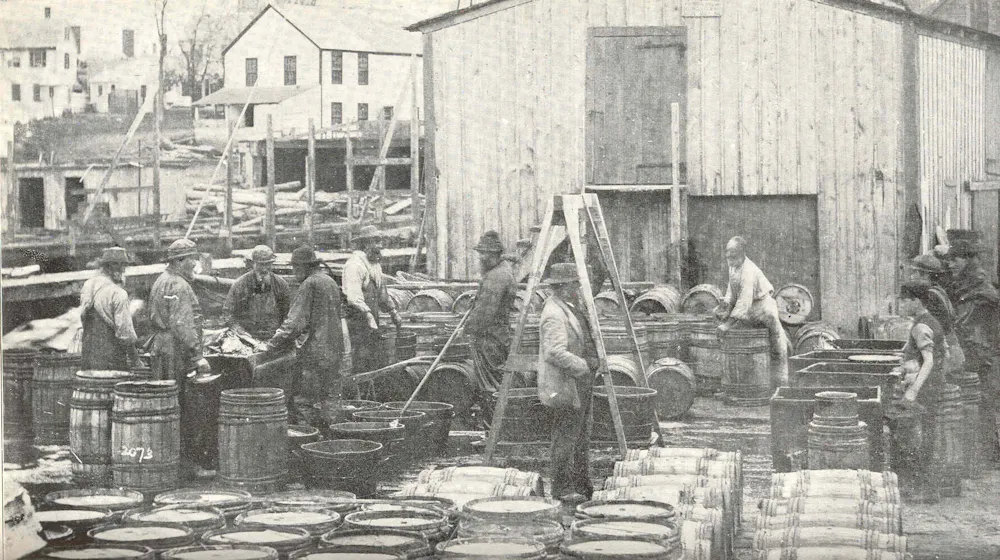
    Fishing has been an integral part of coastal New England culture since its towns were established. In this 1899 photo, a New England community weighs and packs mackerel.
    Charles Stevenson/Freshwater and Marine Image Bank

    Fishing started when the season opened and continued until the catch limit was reached. In some fisheries, this resulted in a “race to the fish” or a “derby,” where vessels competed aggressively to harvest the available catch in short amounts of time. The limit could be reached in a single day, as happened in the Pacific halibut fishery in the late 1980s.

    By the 1990s, however, open access systems were coming under increased criticism from economists as concerns about overfishing rose.

    The fish catch peaked in New England in 1987 and would remain far above what the fish population could sustain for two more decades. Years of overfishing led to the collapse of fish stocks, including North Atlantic cod in 1992 and Pacific sardine in 2015.

    As populations declined, managers responded by cutting catch limits to allow more fish to survive and reproduce. Fishing seasons were shortened, as it took less time for the fleets to harvest the allowed catch. It became increasingly hard for fishermen to catch enough fish to earn a living.

    Saving fisheries changed the industry

    In the early 2000s, as these economic and environmental challenges grew, fisheries managers started limiting access. Instead of allowing anyone to fish, only vessels or individuals meeting certain eligibility requirements would have the right to fish.

    The most common method of limiting access in the U.S. is through limited entry permits, initially awarded to individuals or vessels based on previous participation or success in the fishery. Another approach is to assign individual harvest quotas or “catch shares” to permit holders, limiting how much each boat can bring in.

    In 2007, Congress amended the 1976 Magnuson-Stevens Fishery Conservation and Management Act to promote the use of limited access programs in U.S. fisheries.

    Ships in the fleet out of New Bedford, Mass.
    Henry Zbyszynski/Flickr, CC BY

    Today, limited access is common, and there are positive signs that the management change is helping achieve the law’s environmental goal of preventing overfishing. Since 2000, the populations of 50 major fishing stocks have been rebuilt, meaning they have recovered to a level that can once again support fishing.

    I’ve been following the changes as a lawyer focused on ocean and coastal issues, and I see much work still to be done.

    Forty fish stocks are currently being managed under rebuilding plans that limit catch to allow the stock to grow, including Atlantic cod, which has struggled to recover due to a complex combination of factors, including climatic changes.

    The lingering effect on communities today

    While many fish stocks have recovered, the effort came at an economic cost to many individual fishermen. The limited-access Northeast groundfish fishery, which includes Atlantic cod, haddock and flounder, shed nearly 800 crew positions between 2007 and 2015.

    The loss of jobs and revenue from fishing impacts individual family income and relationships, strains other businesses in fishing communities, and affects those communities’ overall identity and resilience, as illustrated by a recent economic snapshot of the Alaska seafood industry.

    When original limited-access permit holders leave the business – for economic, personal or other reasons – their permits are either terminated or sold to other eligible permit holders, leading to fewer active vessels in the fleet. As a result, the number of vessels fishing for groundfish has declined from 719 in 2007 to 194 in 2023, meaning fewer jobs.

    A fisherman unloads a portion of his catch for the day of 300 pounds of groundfish, including flounder, in January 2006 in Gloucester, Mass.
    AP Photo/Lisa Poole

    Because of their scarcity, limited-access permits can cost upward of US$500,000, which is often beyond the financial means of a small businesses or a young person seeking to enter the industry. The high prices may also lead retiring fishermen to sell their permits, as opposed to passing them along with the vessels to the next generation.

    These economic forces have significantly altered the fishing industry, leading to more corporate and investor ownership, rather than the family-owned operations that were more common in the Andrea Gail’s time.

    Similar to the experience of small family farms, fishing captains and crews are being pushed into corporate arrangements that reduce their autonomy and revenues.

    Consolidation can threaten the future of entire fleets, as New Bedford, Massachusetts, saw when Blue Harvest Fisheries, backed by a private equity firm, bought up vessels and other assets and then declared bankruptcy a few years later, leaving a smaller fleet and some local business and fishermen unpaid for their work. A company with local connections bought eight vessels from Blue Harvest along with 48 state and federal permits the company held.

    New challenges and unchanging risks

    While there are signs of recovery for New England’s fisheries, challenges continue.

    Warming water temperatures have shifted the distribution of some species, affecting where and when fish are harvested. For example, lobsters have moved north toward Canada. When vessels need to travel farther to find fish, that increases fuel and supply costs and time away from home.

    Fisheries managers will need to continue to adapt to keep New England’s fisheries healthy and productive.

    One thing that, unfortunately, hasn’t changed is the dangerous nature of the occupation. Between 2000 and 2019, 414 fishermen died in 245 disasters.

    Stephanie Otts receives funding from the NOAA National Sea Grant College Program through the U.S. Department of Commerce. Previous support for fisheries management legal research provided by The Nature Conservancy.

    ref. Checking in on New England’s fishing industry 25 Years after ‘The Perfect Storm’ hit movie theaters – https://theconversation.com/checking-in-on-new-englands-fishing-industry-25-years-after-the-perfect-storm-hit-movie-theaters-255076

    MIL OSI Analysis

  • MIL-OSI Analysis: Hurricane Helene set up future disasters, from landslides to flooding – cascading hazards like these are now upending risk models

    Source: The Conversation – USA – By Brian J. Yanites, Associate Professor of Earth and Atmospheric Science. Professor of Surficial and Sedimentary Geology, Indiana University

    The Carter Lodge hangs precariously over the flood-scoured bank of the Broad River in Chimney Rock Village, N.C., on May 13, 2025, eight months after Hurricane Helene. AP Photo/Allen G. Breed

    Hurricane Helene lasted only a few days in September 2024, but it altered the landscape of the Southeastern U.S. in profound ways that will affect the hazards local residents face far into the future.

    Mudslides buried roads and reshaped river channels. Uprooted trees left soil on hillslopes exposed to the elements. Sediment that washed into rivers changed how water flows through the landscape, leaving some areas more prone to flooding and erosion.

    Helene was a powerful reminder that natural hazards don’t disappear when the skies clear – they evolve.

    These transformations are part of what scientists call cascading hazards. They occur when one natural event alters the landscape in ways that lead to future hazards. A landslide triggered by a storm might clog a river, leading to downstream flooding months or years later. A wildfire can alter the soil and vegetation, setting the stage for debris flows with the next rainstorm.

    Satellite images before (top) and after Hurricane Helene (bottom) show how the storm altered landscape near Pensacola, N.C., in the Blue Ridge Mountains.
    Google Earth, CC BY

    I study these disasters as a geomorphologist. In a new paper in the journal Science, I and a team of scientists from 18 universities and the U.S. Geological Survey explain why hazard models – used to help communities prepare for disasters – can’t just rely on the past. Instead, they need to be nimble enough to forecast how hazards evolve in real time.

    The science behind cascading hazards

    Cascading hazards aren’t random. They emerge from physical processes that operate continuously across the landscape – sediment movement, weathering, erosion. Together, the atmosphere, biosphere and the earth are constantly reshaping the conditions that cause natural disasters.

    For instance, earthquakes fracture rock and shake loose soil. Even if landslides don’t occur during the quake itself, the ground may be weakened, leaving it primed for failure during later rainstorms.

    That’s exactly what happened after the 2008 earthquake in Sichuan Province, China, which led to a surge in debris flows long after the initial seismic event.

    A strong aftershock after a 7.8 magnitude earthquake in Sichuan province, China, in May 2008 triggered more landslides in central China.
    AP Photo/Andy Wong

    Earth’s surface retains a “memory” of these events. Sediment disturbed in an earthquake, wildfire or severe storm will move downslope over years or even decades, reshaping the landscape as it goes.

    The 1950 Assam earthquake in India is a striking example: It triggered thousands of landslides. The sediment from these landslides gradually moved through the river system, eventually causing flooding and changing river channels in Bangladesh some 20 years later.

    An intensifying threat in a changing world

    These risks present challenges for everything from emergency planning to home insurance. After repeated wildfire-mudslide combinations in California, some insurers pulled out of the state entirely, citing mounting risks and rising costs among the reasons.

    Cascading hazards are not new, but their impact is intensifying.

    Climate change is increasing the frequency and severity of wildfires, storms and extreme rainfall. At the same time, urban development continues to expand into steep, hazard-prone terrain, exposing more people and infrastructure to evolving risks.

    The rising risk of interconnected climate disasters like these is overwhelming systems built for isolated events.

    Yet climate change is only part of the equation. Earth processes – such as earthquakes and volcanic eruptions – also trigger cascading hazards, often with long-lasting effects.

    Mount St. Helens is a powerful example: More than four decades after its eruption in 1980, the U.S. Army Corps of Engineers continues to manage ash and sediment from the eruption to keep it from filling river channels in ways that could increase the flood risk in downstream communities.

    Rethinking risk and building resilience

    Traditionally, insurance companies and disaster managers have estimated hazard risk by looking at past events.

    But when the landscape has changed, the past may no longer be a reliable guide to the future. To address this, computer models based on the physics of how these events work are needed to help forecast hazard evolution in real time, much like weather models update with new atmospheric data.

    A March 2024 landslide in the Oregon Coast Range wiped out trees in its path.
    Brian Yanites, June 2025
    A drone image of the same March 2024 landslide in the Oregon Coast Range shows where it temporarily dammed the river below.
    Brian Yanites, June 2025

    Thanks to advances in Earth observation technology, such as satellite imagery, drone and lidar, which is similar to radar but uses light, scientists can now track how hillslopes, rivers and vegetation change after disasters. These observations can feed into geomorphic models that simulate how loosened sediment moves and where hazards are likely to emerge next.

    Researchers are already coupling weather forecasts with post-wildfire debris flow models. Other models simulate how sediment pulses travel through river networks.

    Cascading hazards reveal that Earth’s surface is not a passive backdrop, but an active, evolving system. Each event reshapes the stage for the next.

    Understanding these connections is critical for building resilience so communities can withstand future storms, earthquakes and the problems created by debris flows. Better forecasts can inform building codes, guide infrastructure design and improve how risk is priced and managed. They can help communities anticipate long-term threats and adapt before the next disaster strikes.

    Most importantly, they challenge everyone to think beyond the immediate aftermath of a disaster – and to recognize the slow, quiet transformations that build toward the next.

    Brian J. Yanites receives funding from the National Science Foundation.

    ref. Hurricane Helene set up future disasters, from landslides to flooding – cascading hazards like these are now upending risk models – https://theconversation.com/hurricane-helene-set-up-future-disasters-from-landslides-to-flooding-cascading-hazards-like-these-are-now-upending-risk-models-259502

    MIL OSI Analysis

  • MIL-OSI USA: It’s Time to Send the One Big Beautiful Bill to President Trump’s Desk

    Source: US State of Idaho

    WASHINGTON—This week, Idaho Congressman Mike Simpson wrote an op-ed in the Washington Reporter regarding his support for the One Big Beautiful Bill Act, a legislative vehicle to advance President Trump’s full policy agenda.
    “The budget reconciliation package—the One Big Beautiful Bill Act—is the legislative vehicle to advance President Trump’s full commonsense policy agenda. To put it simply, this package is truly one big, beautiful bill that reflects the promises President Trump campaigned on and won with.”
    The full op-ed is available here and below.
    It’s Time to Send the One Big Beautiful Bill to President Trump’s Desk 
    By Rep. Mike Simpson
    Opportunities like this don’t come around often. Right now, Congress has the chance to pass legislation that delivers on the American-first agenda that Idahoans and millions of Americans voted for last November. The One Big Beautiful Bill Act is a substantial opportunity we have in front of us, and it is of the utmost importance we get this passed and to President Trump’s desk.
    The budget reconciliation package—the One Big Beautiful Bill Act—is the legislative vehicle to advance President Trump’s full commonsense policy agenda. To put it simply, this package is truly one big, beautiful bill that reflects the promises President Trump campaigned on and won with.
    The mainstream media has made a lot of noise, which we have heard since this reconciliation process began. However, if there is one thing sure, more than 77 million Americans voted for the legislation standing before us in Congress.  
    For Idahoans, two of the biggest concerns in 2024 were getting our economy back on track and securing the southern border. This bill tackles both.
    It includes the largest tax cut in history for working and middle-class families, boosting their take-home pay and wages. If passed, this would deliver up to a $12,200 increase in annual take-home pay for a typical Idaho family of four.
    And let me be clear: failing to extend the 2017 Trump Tax Cuts would stick Americans with the largest tax hike in history – Idahoans would face a 24% tax increase. Rest assured, I’m working alongside my colleagues to prevent that from happening.
    Border security is just as important. We all witnessed what happened to the border during the Biden administration, and the One Big Beautiful Bill works to ensure a crisis like that never happens again.
    I view the One Big Beautiful Bill as a national security investment. The Biden administration’s open-border policies allowed millions of illegal immigrants to flood through the southern border. The result? A catastrophic wave of violent crime that plagued our nation.
    For anyone who argues that the open border did not affect Idaho, every state was a border state under the previous administration. Idahoans felt the consequences. Ask any law enforcement officer about the rates of fentanyl overdoses and the amount of illicit drugs that poured into our state over four years.
    The One Big Beautiful Bill reverses course. It provides funding to help finish President Trump’s border wall and provides our brave Border Patrol and ICE agents with the resources they need to keep our communities safe. These historic investments will strengthen America’s border security for years to come.
    This is more than just a reconciliation package – it’s the only way to get our country back on track.
    Congress has a real opportunity here—a chance to deliver the America-first agenda Idahoans and Americans nationwide voted for in November. We cannot afford to let it slip by. The time to advance President Trump’s policy agenda by passing the One Big Beautiful Bill is now.   

    MIL OSI USA News

  • MIL-OSI Africa: DFFE allocates R9 billion amid budget constraints

    Source: South Africa News Agency

    The Department of Forestry, Fisheries and the Environment (DFFE) has been allocated R9.08 billion for the 2025/26 financial year, accounting for 0.35% of the national appropriation.

    “When adjusted for inflation, this reflects a real decrease of R121.5 million, or 1.4%, compared to last year. In short; the department is being asked to do more, with less,” Minister of Forestry, Fisheries and the Environment, Dr Dion George, said during his Budget Vote speech in Parliament on Friday.

    The Minister said the Budget Vote is being tabled against the backdrop of a constrained fiscal environment. 

    “Following the reversal of the proposed VAT increase in May 2025, the national budget framework was revised, with consolidated government spending projected to grow from R2.4 trillion in 2024/25 to R2.81 trillion in 2027/28.

    “Nearly half the Department’s medium-term budget – R14.5 billion – will go directly to goods and services, including the Expanded Public Works Programme, implementation of the Forestry Master Plan, and rollout of the Waste Management Strategy,” the Minister said.

    Transfers and subsidies to public entities, such as the South African National Bioinformatics Institute (SANBI), South African National Parks (SANParks), iSimangaliso, and South African Weather Service, will account for over R5.5 billion.

    “This department is using every rand to protect ecosystems, grow green jobs, and meet the urgent demands of climate adaptation, regulation, and environmental justice.

    “To achieve these imperatives, the department is focusing on six flagship priorities in the 2025/26 financial year. These “Big 6” priorities shape our work, guide our partnerships, and define the strategic investments proposed in this Budget Vote,” the Minister said.

    He emphasised that climate change is not a distant threat.

    “…It is here, disrupting our communities, economies, and ecosystems. We see it in rising temperatures, intensifying floods, droughts, and fires that affect lives and livelihoods. Through the Climate Change Act, now in force, we have established a unified, whole- of-government response to this urgent crisis.

    “This year, we will deliver new Nationally Determined Contributions, a revised Low Emissions Development Strategy, final Sectoral Emission Targets, and implement the Climate Change Adaptation Response Plan for vulnerable coastal regions,” the Minister said.

    The department has also completed the Highveld Air Quality Management Plan to ensure Eskom complies with air pollution laws — because the constitutional right to clean air cannot be compromised.

    “South Africa’s biodiversity is a powerful engine for development. The revised National Biodiversity Economy Strategy will unlock 397,000 jobs and inject R127 billion annually into the economy by 2036 through eco-tourism, bioprospecting, and sustainable game meat production.

    “South Africa’s fisheries are lifelines for coastal and rural communities. Through Fishing for Freedom, we are securing sustainable access, supporting small-scale fishers, and combating illegal harvesting that threatens biodiversity and food security.

    “We are fast-tracking signage, wreck removal, security and road markings at the 12 proclaimed fishing harbours, implementing co-management systems for nearshore fisheries, and expanding Small, Medium and Micro enterprises (SMMEs) training in the small-scale fisheries sector,” the Minister said.

    This is part of the department’s revitalisation of harbours — unlocking jobs and dignity for coastal communities. – SAnews.gov.za

    MIL OSI Africa

  • MIL-OSI Africa: SA’s G20 Presidency making progress finalising Leaders’ Declaration

    Source: South Africa News Agency

    South Africa’s Group of 20 (G20) Presidency is making significant progress toward a comprehensive Leaders’ Declaration that emphasises sustainable development and addresses pressing global issues. 

    This statement was made by South Africa’s G20 Sherpa and Chair, Zane Dangor, who spoke to the media on Friday as the three-day Sherpa meeting concluded.

    During a briefing with local and international media, Dangor said the gathering highlighted key developments through a collaborative approach that seeks input from all delegates.

    “The past two and a half days have gone really well. Delegates are happy with the progress we’ve made in our working groups and our task forces, but also in the way we are conducting our Presidency.

    “We’re putting forward our priorities in a very consultative manner, and this will help us to shape our Leaders’ Declaration, which was what we discussed in the last session,” the Sherpa said. 

    However, he noted that the draft declaration remains fluid to accommodate ongoing global dynamics.

    “We gave them a framework of what we think should be in the declaration based on our priorities. They’ve agreed with that, and they’ve also asked for certain other things to be included. So, we’re quite confident that we are on track.” 

    However, Dangor announced that the final declaration is expected to emerge after ongoing working group discussions and will be circulated for further input in the coming weeks.

    “We can’t draft something that changes within three or four months, even two weeks…”

    Meanwhile, Dangor stated that the delegates are satisfied with the consultative process and the inclusion of various priorities, including climate change and artificial intelligence.

    The G20 Leaders’ Declaration captures the shared perspectives, commitments, and agreements made by the leaders of the intergovernmental forum, typically outlining the framework for future international collaboration.

    This week, South Africa hosted the world’s largest economies and organisations, which convened at Sun City Resort in the North West for the third G20 Sherpa meeting. 

    In the G20, the Sherpas are the leaders of each country, who take the discussions and agreements to the final summit with Heads of State and Government.

    African agenda

    On advancing the continent’s agenda, Dangor said the African Union’s permanent membership brings “a perspective of 54 countries to the table”, providing a more robust African representation in global discussions.

    “We can see that they’re getting better prepared at making those inputs. The AU and the EU [European Union] bring a grouping of countries to the table… it does bring the African flavour to the G20 in a way that is much appreciated by others.”

    Dangor, who serves as the Director-General of the Department of International Relations and Cooperation, told journalists that South Africa’s G20 Presidency is particularly focused on continuity, addressing a longstanding challenge, where each G20 Presidency traditionally defines its own themes. 

    “We’ve been keen to focus on the sustainable development agenda,” he explained, highlighting a consistent approach across recent Presidencies.

    Geopolitical tensions

    He stressed that geopolitical tensions remain a critical challenge, with discussions centering on principles of international law and territorial integrity. 

    According to Dangor, South Africa’s G20 Presidency is working to draft language that ensures “no exceptions” to holding nations accountable under international frameworks.

    “We’re hoping to get ceasefires to stay in place. We’re hoping for justice to prevail, and we’re hoping for humanitarian access in Sudan, Gaza, and other places to be championed by the international community. These were the issues that we were discussing.”

    While challenges persist, including the absence of United States representatives, Dangor said the G20 leadership remains optimistic about crafting a meaningful declaration that addresses global South priorities and sustainable development goals.

    He mentioned that a Troika meeting has been organised between Brazil, the United States, and South Africa to update America on the current discussions and plans for the upcoming months.

    “The G20 is continuing. The work continues in the working groups, the Sherpa work continues, and we will then have to factor in, based on levels of participation going forward, what we do with the views of the US, if they may, bring it at a later stage.” – SAnews.gov.za

    MIL OSI Africa

  • MIL-OSI China: Tokyo stocks rise as concern eases over U.S. tariff

    Source: People’s Republic of China – State Council News

    Tokyo stocks ended higher Friday for a fourth straight day, with the Nikkei closing above the 40,000 line for the first time since January, as concern over hefty U.S. tariffs eased.

    Japan’s benchmark Nikkei stock index, the 225-issue Nikkei Stock Average, ended up 566.21 points, or 1.43 percent, from Thursday at 40,150.79, its highest level since Dec. 27.

    The broader Topix index, meanwhile, finished 35.85 points, or 1.28 percent, higher at 2,840.54.

    The Nikkei index briefly climbed over 600 points after the U.S. administration said Thursday that President Donald Trump could extend a 90-day pause on so-called reciprocal tariffs set to expire July 9, analysts said.

    Investors also welcomed the easing of tensions in the Middle East, as the cease-fire agreed earlier in the week by Israel and Iran appeared to be holding.

    MIL OSI China News

  • MIL-OSI Analysis: Natural disasters don’t disappear when the storm ends or the earthquake stops – they evolve

    Source: The Conversation – USA – By Brian J. Yanites, Associate Professor of Earth and Atmospheric Science. Professor of Surficial and Sedimentary Geology, Indiana University

    The Carter Lodge hangs precariously over the flood-scoured bank of the Broad River in Chimney Rock Village, N.C., on May 13, 2025, eight months after Hurricane Helene. AP Photo/Allen G. Breed

    Hurricane Helene lasted only a few days in September 2024, but it altered the landscape of the Southeastern U.S. in profound ways that will affect the hazards local residents face far into the future.

    Mudslides buried roads and reshaped river channels. Uprooted trees left soil on hillslopes exposed to the elements. Sediment that washed into rivers changed how water flows through the landscape, leaving some areas more prone to flooding and erosion.

    Helene was a powerful reminder that natural hazards don’t disappear when the skies clear – they evolve.

    These transformations are part of what scientists call cascading hazards. They occur when one natural event alters the landscape in ways that lead to future hazards. A landslide triggered by a storm might clog a river, leading to downstream flooding months or years later. A wildfire can alter the soil and vegetation, setting the stage for debris flows with the next rainstorm.

    Satellite images before (top) and after Hurricane Helene (bottom) show how the storm altered landscape near Pensacola, N.C., in the Blue Ridge Mountains.
    Google Earth, CC BY

    I study these disasters as a geomorphologist. In a new paper in the journal Science, I and a team of scientists from 18 universities and the U.S. Geological Survey explain why hazard models – used to help communities prepare for disasters – can’t just rely on the past. Instead, they need to be nimble enough to forecast how hazards evolve in real time.

    The science behind cascading hazards

    Cascading hazards aren’t random. They emerge from physical processes that operate continuously across the landscape – sediment movement, weathering, erosion. Together, the atmosphere, biosphere and the earth are constantly reshaping the conditions that cause natural disasters.

    For instance, earthquakes fracture rock and shake loose soil. Even if landslides don’t occur during the quake itself, the ground may be weakened, leaving it primed for failure during later rainstorms.

    That’s exactly what happened after the 2008 earthquake in Sichuan Province, China, which led to a surge in debris flows long after the initial seismic event.

    A strong aftershock after a 7.8 magnitude earthquake in Sichuan province, China, in May 2008 triggered more landslides in central China.
    AP Photo/Andy Wong

    Earth’s surface retains a “memory” of these events. Sediment disturbed in an earthquake, wildfire or severe storm will move downslope over years or even decades, reshaping the landscape as it goes.

    The 1950 Assam earthquake in India is a striking example: It triggered thousands of landslides. The sediment from these landslides gradually moved through the river system, eventually causing flooding and changing river channels in Bangladesh some 20 years later.

    An intensifying threat in a changing world

    These risks present challenges for everything from emergency planning to home insurance. After repeated wildfire-mudslide combinations in California, some insurers pulled out of the state entirely, citing mounting risks and rising costs among the reasons.

    Cascading hazards are not new, but their impact is intensifying.

    Climate change is increasing the frequency and severity of wildfires, storms and extreme rainfall. At the same time, urban development continues to expand into steep, hazard-prone terrain, exposing more people and infrastructure to evolving risks.

    The rising risk of interconnected climate disasters like these is overwhelming systems built for isolated events.

    Yet climate change is only part of the equation. Earth processes – such as earthquakes and volcanic eruptions – also trigger cascading hazards, often with long-lasting effects.

    Mount St. Helens is a powerful example: More than four decades after its eruption in 1980, the U.S. Army Corps of Engineers continues to manage ash and sediment from the eruption to keep it from filling river channels in ways that could increase the flood risk in downstream communities.

    Rethinking risk and building resilience

    Traditionally, insurance companies and disaster managers have estimated hazard risk by looking at past events.

    But when the landscape has changed, the past may no longer be a reliable guide to the future. To address this, computer models based on the physics of how these events work are needed to help forecast hazard evolution in real time, much like weather models update with new atmospheric data.

    A March 2024 landslide in the Oregon Coast Range wiped out trees in its path.
    Brian Yanites, June 2025
    A drone image of the same March 2024 landslide in the Oregon Coast Range shows where it temporarily dammed the river below.
    Brian Yanites, June 2025

    Thanks to advances in Earth observation technology, such as satellite imagery, drone and lidar, which is similar to radar but uses light, scientists can now track how hillslopes, rivers and vegetation change after disasters. These observations can feed into geomorphic models that simulate how loosened sediment moves and where hazards are likely to emerge next.

    Researchers are already coupling weather forecasts with post-wildfire debris flow models. Other models simulate how sediment pulses travel through river networks.

    Cascading hazards reveal that Earth’s surface is not a passive backdrop, but an active, evolving system. Each event reshapes the stage for the next.

    Understanding these connections is critical for building resilience so communities can withstand future storms, earthquakes and the problems created by debris flows. Better forecasts can inform building codes, guide infrastructure design and improve how risk is priced and managed. They can help communities anticipate long-term threats and adapt before the next disaster strikes.

    Most importantly, they challenge everyone to think beyond the immediate aftermath of a disaster – and to recognize the slow, quiet transformations that build toward the next.

    Brian J. Yanites receives funding from the National Science Foundation.

    ref. Natural disasters don’t disappear when the storm ends or the earthquake stops – they evolve – https://theconversation.com/natural-disasters-dont-disappear-when-the-storm-ends-or-the-earthquake-stops-they-evolve-259502

    MIL OSI Analysis

  • MIL-OSI Analysis: Natural disasters don’t disappear when the storm ends or the earthquake stops – they evolve

    Source: The Conversation – USA – By Brian J. Yanites, Associate Professor of Earth and Atmospheric Science. Professor of Surficial and Sedimentary Geology, Indiana University

    The Carter Lodge hangs precariously over the flood-scoured bank of the Broad River in Chimney Rock Village, N.C., on May 13, 2025, eight months after Hurricane Helene. AP Photo/Allen G. Breed

    Hurricane Helene lasted only a few days in September 2024, but it altered the landscape of the Southeastern U.S. in profound ways that will affect the hazards local residents face far into the future.

    Mudslides buried roads and reshaped river channels. Uprooted trees left soil on hillslopes exposed to the elements. Sediment that washed into rivers changed how water flows through the landscape, leaving some areas more prone to flooding and erosion.

    Helene was a powerful reminder that natural hazards don’t disappear when the skies clear – they evolve.

    These transformations are part of what scientists call cascading hazards. They occur when one natural event alters the landscape in ways that lead to future hazards. A landslide triggered by a storm might clog a river, leading to downstream flooding months or years later. A wildfire can alter the soil and vegetation, setting the stage for debris flows with the next rainstorm.

    Satellite images before (top) and after Hurricane Helene (bottom) show how the storm altered landscape near Pensacola, N.C., in the Blue Ridge Mountains.
    Google Earth, CC BY

    I study these disasters as a geomorphologist. In a new paper in the journal Science, I and a team of scientists from 18 universities and the U.S. Geological Survey explain why hazard models – used to help communities prepare for disasters – can’t just rely on the past. Instead, they need to be nimble enough to forecast how hazards evolve in real time.

    The science behind cascading hazards

    Cascading hazards aren’t random. They emerge from physical processes that operate continuously across the landscape – sediment movement, weathering, erosion. Together, the atmosphere, biosphere and the earth are constantly reshaping the conditions that cause natural disasters.

    For instance, earthquakes fracture rock and shake loose soil. Even if landslides don’t occur during the quake itself, the ground may be weakened, leaving it primed for failure during later rainstorms.

    That’s exactly what happened after the 2008 earthquake in Sichuan Province, China, which led to a surge in debris flows long after the initial seismic event.

    A strong aftershock after a 7.8 magnitude earthquake in Sichuan province, China, in May 2008 triggered more landslides in central China.
    AP Photo/Andy Wong

    Earth’s surface retains a “memory” of these events. Sediment disturbed in an earthquake, wildfire or severe storm will move downslope over years or even decades, reshaping the landscape as it goes.

    The 1950 Assam earthquake in India is a striking example: It triggered thousands of landslides. The sediment from these landslides gradually moved through the river system, eventually causing flooding and changing river channels in Bangladesh some 20 years later.

    An intensifying threat in a changing world

    These risks present challenges for everything from emergency planning to home insurance. After repeated wildfire-mudslide combinations in California, some insurers pulled out of the state entirely, citing mounting risks and rising costs among the reasons.

    Cascading hazards are not new, but their impact is intensifying.

    Climate change is increasing the frequency and severity of wildfires, storms and extreme rainfall. At the same time, urban development continues to expand into steep, hazard-prone terrain, exposing more people and infrastructure to evolving risks.

    The rising risk of interconnected climate disasters like these is overwhelming systems built for isolated events.

    Yet climate change is only part of the equation. Earth processes – such as earthquakes and volcanic eruptions – also trigger cascading hazards, often with long-lasting effects.

    Mount St. Helens is a powerful example: More than four decades after its eruption in 1980, the U.S. Army Corps of Engineers continues to manage ash and sediment from the eruption to keep it from filling river channels in ways that could increase the flood risk in downstream communities.

    Rethinking risk and building resilience

    Traditionally, insurance companies and disaster managers have estimated hazard risk by looking at past events.

    But when the landscape has changed, the past may no longer be a reliable guide to the future. To address this, computer models based on the physics of how these events work are needed to help forecast hazard evolution in real time, much like weather models update with new atmospheric data.

    A March 2024 landslide in the Oregon Coast Range wiped out trees in its path.
    Brian Yanites, June 2025
    A drone image of the same March 2024 landslide in the Oregon Coast Range shows where it temporarily dammed the river below.
    Brian Yanites, June 2025

    Thanks to advances in Earth observation technology, such as satellite imagery, drone and lidar, which is similar to radar but uses light, scientists can now track how hillslopes, rivers and vegetation change after disasters. These observations can feed into geomorphic models that simulate how loosened sediment moves and where hazards are likely to emerge next.

    Researchers are already coupling weather forecasts with post-wildfire debris flow models. Other models simulate how sediment pulses travel through river networks.

    Cascading hazards reveal that Earth’s surface is not a passive backdrop, but an active, evolving system. Each event reshapes the stage for the next.

    Understanding these connections is critical for building resilience so communities can withstand future storms, earthquakes and the problems created by debris flows. Better forecasts can inform building codes, guide infrastructure design and improve how risk is priced and managed. They can help communities anticipate long-term threats and adapt before the next disaster strikes.

    Most importantly, they challenge everyone to think beyond the immediate aftermath of a disaster – and to recognize the slow, quiet transformations that build toward the next.

    Brian J. Yanites receives funding from the National Science Foundation.

    ref. Natural disasters don’t disappear when the storm ends or the earthquake stops – they evolve – https://theconversation.com/natural-disasters-dont-disappear-when-the-storm-ends-or-the-earthquake-stops-they-evolve-259502

    MIL OSI Analysis

  • MIL-OSI Analysis: Natural disasters don’t disappear when the storm ends or the earthquake stops – they evolve

    Source: The Conversation – USA – By Brian J. Yanites, Associate Professor of Earth and Atmospheric Science. Professor of Surficial and Sedimentary Geology, Indiana University

    The Carter Lodge hangs precariously over the flood-scoured bank of the Broad River in Chimney Rock Village, N.C., on May 13, 2025, eight months after Hurricane Helene. AP Photo/Allen G. Breed

    Hurricane Helene lasted only a few days in September 2024, but it altered the landscape of the Southeastern U.S. in profound ways that will affect the hazards local residents face far into the future.

    Mudslides buried roads and reshaped river channels. Uprooted trees left soil on hillslopes exposed to the elements. Sediment that washed into rivers changed how water flows through the landscape, leaving some areas more prone to flooding and erosion.

    Helene was a powerful reminder that natural hazards don’t disappear when the skies clear – they evolve.

    These transformations are part of what scientists call cascading hazards. They occur when one natural event alters the landscape in ways that lead to future hazards. A landslide triggered by a storm might clog a river, leading to downstream flooding months or years later. A wildfire can alter the soil and vegetation, setting the stage for debris flows with the next rainstorm.

    Satellite images before (top) and after Hurricane Helene (bottom) show how the storm altered landscape near Pensacola, N.C., in the Blue Ridge Mountains.
    Google Earth, CC BY

    I study these disasters as a geomorphologist. In a new paper in the journal Science, I and a team of scientists from 18 universities and the U.S. Geological Survey explain why hazard models – used to help communities prepare for disasters – can’t just rely on the past. Instead, they need to be nimble enough to forecast how hazards evolve in real time.

    The science behind cascading hazards

    Cascading hazards aren’t random. They emerge from physical processes that operate continuously across the landscape – sediment movement, weathering, erosion. Together, the atmosphere, biosphere and the earth are constantly reshaping the conditions that cause natural disasters.

    For instance, earthquakes fracture rock and shake loose soil. Even if landslides don’t occur during the quake itself, the ground may be weakened, leaving it primed for failure during later rainstorms.

    That’s exactly what happened after the 2008 earthquake in Sichuan Province, China, which led to a surge in debris flows long after the initial seismic event.

    A strong aftershock after a 7.8 magnitude earthquake in Sichuan province, China, in May 2008 triggered more landslides in central China.
    AP Photo/Andy Wong

    Earth’s surface retains a “memory” of these events. Sediment disturbed in an earthquake, wildfire or severe storm will move downslope over years or even decades, reshaping the landscape as it goes.

    The 1950 Assam earthquake in India is a striking example: It triggered thousands of landslides. The sediment from these landslides gradually moved through the river system, eventually causing flooding and changing river channels in Bangladesh some 20 years later.

    An intensifying threat in a changing world

    These risks present challenges for everything from emergency planning to home insurance. After repeated wildfire-mudslide combinations in California, some insurers pulled out of the state entirely, citing mounting risks and rising costs among the reasons.

    Cascading hazards are not new, but their impact is intensifying.

    Climate change is increasing the frequency and severity of wildfires, storms and extreme rainfall. At the same time, urban development continues to expand into steep, hazard-prone terrain, exposing more people and infrastructure to evolving risks.

    The rising risk of interconnected climate disasters like these is overwhelming systems built for isolated events.

    Yet climate change is only part of the equation. Earth processes – such as earthquakes and volcanic eruptions – also trigger cascading hazards, often with long-lasting effects.

    Mount St. Helens is a powerful example: More than four decades after its eruption in 1980, the U.S. Army Corps of Engineers continues to manage ash and sediment from the eruption to keep it from filling river channels in ways that could increase the flood risk in downstream communities.

    Rethinking risk and building resilience

    Traditionally, insurance companies and disaster managers have estimated hazard risk by looking at past events.

    But when the landscape has changed, the past may no longer be a reliable guide to the future. To address this, computer models based on the physics of how these events work are needed to help forecast hazard evolution in real time, much like weather models update with new atmospheric data.

    A March 2024 landslide in the Oregon Coast Range wiped out trees in its path.
    Brian Yanites, June 2025
    A drone image of the same March 2024 landslide in the Oregon Coast Range shows where it temporarily dammed the river below.
    Brian Yanites, June 2025

    Thanks to advances in Earth observation technology, such as satellite imagery, drone and lidar, which is similar to radar but uses light, scientists can now track how hillslopes, rivers and vegetation change after disasters. These observations can feed into geomorphic models that simulate how loosened sediment moves and where hazards are likely to emerge next.

    Researchers are already coupling weather forecasts with post-wildfire debris flow models. Other models simulate how sediment pulses travel through river networks.

    Cascading hazards reveal that Earth’s surface is not a passive backdrop, but an active, evolving system. Each event reshapes the stage for the next.

    Understanding these connections is critical for building resilience so communities can withstand future storms, earthquakes and the problems created by debris flows. Better forecasts can inform building codes, guide infrastructure design and improve how risk is priced and managed. They can help communities anticipate long-term threats and adapt before the next disaster strikes.

    Most importantly, they challenge everyone to think beyond the immediate aftermath of a disaster – and to recognize the slow, quiet transformations that build toward the next.

    Brian J. Yanites receives funding from the National Science Foundation.

    ref. Natural disasters don’t disappear when the storm ends or the earthquake stops – they evolve – https://theconversation.com/natural-disasters-dont-disappear-when-the-storm-ends-or-the-earthquake-stops-they-evolve-259502

    MIL OSI Analysis

  • MIL-OSI Analysis: Scandinavia has its own dark history of assimilating Indigenous people, and churches played a role – but are apologizing

    Source: The Conversation – USA – By Thomas A. DuBois, Professor of Scandinavian Studies, Folklore, and Religious Studies, University of Wisconsin-Madison

    A church in Kiruna, Sweden, designed by architect Gustaf Wickman to resemble a Sami hut. Apolline Guillerot-Malick/SOPA Images/LightRocket via Getty Images

    In May 2025, Tapio Luoma, archbishop of the Evangelical Lutheran Church of Finland, delivered an apology to the Sámi, the only recognized Indigenous people in the European Union.

    Speaking on behalf of the church to which more than 6 in 10 of the Finnish populace belong, including most Sámi, Luoma acknowledged its role in past activities that stigmatized Sámi language and culture.

    The church “has not respected the rights to self-determination of the Sámi people,” his address began. “Before God and all of you here assembled, we express our regret and ask forgiveness of the Sámi people.”

    Luoma’s words were the latest in a series of apologies through which the former state churches in Scandinavia have sought to reset their relations with the Indigenous population of Sápmi, the natural and cultural area of Sámi people. Today, the region is divided between Finland, Norway, Sweden and Russia.

    As a scholar of Sámi culture, and as a researcher of Nordic folklore and religion, I have studied the difficult, often painful, relations between Sámi and the various Nordic state churches.

    Church’s power

    For thousands of years, the Sámi population lived by hunting, fishing and reindeer husbandry along the northern edges of Scandinavia. The Sámi possessed their own languages and maintained distinctive spiritual traditions and healing practices, drawing on traditional ecological knowledge that they had accrued over countless generations. In times of crisis or uncertainty, for example, communities used ceremonial drums to communicate with the spirit world and divine the future.

    Conflicts emerged by the 13th century, however, as Christian realms expanded north. Christian clerics condemned Sámi spiritual traditions as “heathen devilry.”

    An 18th-century carving of a Sámi shaman with his drum.
    Beskrivelse over Finnmarkens Lapper, deres Tungemaal, Levemaade og forrige Afgudsdyrkelse/O. H. von Lode/Wikimedia Commons

    During the 16th-century Protestant Reformation, Scandinavian rulers shifted from Catholicism to Lutheranism. In addition to tending to the souls of their flocks, ministers were tasked with keeping track of the comings and goings of congregation members, collecting taxes, and administering justice for lesser crimes.

    They aimed to stamp out the spiritual practices that many Sámi continued to practice alongside Christianity. Church authorities arrested, fined and sometimes even executed practitioners, while confiscating sacred drums to be destroyed or sent to distant museums.

    The church’s ritual of confirmation, which marks the passage from adolescence into adulthood, also acquired legal status. Being confirmed required the ability to read and interpret the Bible and Martin Luther’s Catechism, a summary of the Lutheran Church’s beliefs. As the church became part of the state, people who had not received confirmation could not represent themselves in court, own land or even marry.

    Lake Pielpajarvi Wilderness Church, the oldest Sami church still in use, in Inari Municipality, Lapland, Finland.
    VW PICS/Universal Images Group via Getty Images

    And where Luther had called for religious instruction to occur in one’s native language, most Nordic clergy provided catechesis only in the majority language, considering Sámi language and traditions impediments to true conversion.

    Assimilation efforts

    During the late 19th and early 20th centuries, the new “nation states” of Finland, Norway and Sweden emerged on the world stage. In each country, political leaders conflated what the ancient Greeks called the “demos” – members of a political nation – with an “ethnos,” a cultural group. In order to belong to the Finnish, Norwegian and Swedish political nations, political and cultural leaders of these new states asserted that it was necessary to belong to the majority linguistic and cultural community.

    Finland’s 1919 constitution made provision for Swedish, which is still used by about 5% of the population, as a national language alongside Finnish. However, the government accorded no such status to Sámi.

    Both state-run residential boarding schools and schools run by churches included Lutheranism as a subject and strove relentlessly to assimilate Sámi into the majority culture, language and worldview, teaching children to see their culture as backward and shameful. Some church and school authorities cooperated with pseudoscientific racial researchers measuring students’ heads and excavating Sámi graves.

    A ‘nomad school’ for Sami children in Jukkasjarvi, Sweden, 250 miles north of the Arctic Circle, in 1956.
    John Firth/BIPs/Getty Images

    As a result, many students ceased to identify as Sámi and adopted the majority language as their primary mode of communication. Today, only about half the people who identify as Sámi have any facility in Sámi languages, which are considered endangered.

    After World War II, church attendance in all the Nordic countries began to plummet. Where 98% of the Finnish population belonged to the state church in 1900, by 2024 that percentage had dropped to 62%. The bulk of defections consisted of people who registered as having no religious affiliation. Membership in the national church shifted from compulsory to voluntary.

    Yet as anthropologist David Koester shows, some elements of Lutheran tradition remain extremely popular in all the Nordic countries, particularly Confirmation. The ritual remains a key rite of passage for most Sámi today, yet many of them wrestle with whether they should remain faithful to a church that had worked to suppress their community’s language and culture.

    Reconciliation today

    Searching for a path forward, contemporary Sámi artist and Lutheran catechist Lars Levi Sunna began to produce church art that incorporated and celebrated pre-Christian Sámi symbols – some of the very traditions that had been demonized by clergy of the past.

    For example, in a church in the northern Swedish town of Jukkasjärvi, an image of the sun as it appeared on Sámi ceremonial drums now faces the altar, providing a vivid reminder of the spiritual history and past worldview of the church’s Sámi congregation. The symbol now encloses an image of a communion wafer carved of reindeer antler.

    In 2005, Sunna created a traveling art exhibit that portrayed Sámi Christianization as an act of cultural violence. The exhibit, designed for temporary installation in church sanctuaries, aimed to provoke discussion and encourage open dialogue about the past.

    Similarly, in 2008, Norwegian Sámi filmmaker Nils Gaup produced “Kautokeino Rebellion,” a film recounting clergy’s role in suppressing religious activism among followers of a Swedish Sámi minister, Lars Levi Laestadius. The so-called uprising in 1852 led to the imprisonment of several dozen Sámi and the execution of two men – whose skulls were deposited in a research institute and did not receive proper burial until 1997.

    Descended from one of the punished families, Gaup reminded his audience of past injustice shrouded in shame and silence.

    Since church attendance is infrequent in Nordic countries, art and film serve as important vehicles for raising awareness of the church’s past. In November 2021, the archbishop of Sweden, Antje Jackelén, issued a formal apology to the Sámi. Sámi artist and activist Anders Sunna was invited to temporarily redecorate the sanctuary of the Cathedral of Uppsala for the occasion. His decorations included reminders of past Sámi sacrificial traditions that took place both outdoors and around hearth fires. In place of a grand altar, Sunna erected a simple table, surrounded by an octagon of benches where the bishop and members of the Sámi community would sit face to face with a sense of equality and respect.

    As Sámi theologian Tore Johnsen notes, formal apologies are necessary first steps in a process of reconciliation. But only once they are followed by concrete acts of “restoration” can real reconciliation occur.

    When the Finnish archbishop apologized in May 2025, Sámi in attendance at the Turku Cathedral were appreciative, but they were eager to see what actions might follow, according to reporters at the ceremony. The same wait-and-see attitude characterizes Sámi responses to state-run Truth and Reconciliation processes, which occurred in Norway in 2023 and are currently ongoing in Sweden and Finland.

    The process of healing a society injured by colonialism is difficult and slow, requiring extensive discussion – much of it uncomfortable. With Luoma’s words of apology and the arrival of Sámi to listen and witness, an important step in that process occurred.

    Thomas A. DuBois does not work for, consult, own shares in or receive funding from any company or organization that would benefit from this article, and has disclosed no relevant affiliations beyond their academic appointment.

    ref. Scandinavia has its own dark history of assimilating Indigenous people, and churches played a role – but are apologizing – https://theconversation.com/scandinavia-has-its-own-dark-history-of-assimilating-indigenous-people-and-churches-played-a-role-but-are-apologizing-255827

    MIL OSI Analysis

  • MIL-OSI Analysis: Jews were barred from Spain’s New World colonies − but that didn’t stop Jewish and converso writers from describing the Americas

    Source: The Conversation – USA – By Flora Cassen, Senior Faculty, Hartman Institute and Associate Professor of History and Jewish Studies, Washington University in St. Louis

    An auto-da-fé − a public punishment for heretics − in San Bartolome Otzolotepec, in present-day Mexico. Museo Nacional de Arte via Wikimedia Commons

    Every few years, a story about Columbus resurfaces: Was the Genoese navigator who claimed the Americas for Spain secretly Jewish, from a Spanish family fleeing the Inquisition?

    This tale became widespread around the late 19th century, when large numbers of Jews came from Russia and Eastern Europe to the United States. For these immigrants, 1492 held double significance: the year of Jews’ expulsion from Spain, as well as Columbus’ voyage of discovery. At a time when many Americans viewed the explorer as a hero, the idea that he might have been one of their own offered Jewish immigrants a link to the beginnings of their new country and the American story of freedom from Old World tyranny.

    The problem with the Columbus-was-a-Jew theory isn’t just that it’s based on flimsy evidence. It also distracts from the far more complex and true story of Spanish Jews in the Americas.

    In the 15th century, the kingdom’s Jews faced a wrenching choice: convert to Christianity or leave the land their families had called home for generations. Portugal’s Jews faced similar persecution. Whether they sought a new place to settle or stayed and hoped to be accepted as members of Christian society, both groups were searching for belonging.

    Jewish religious items at the Museo Metropolitano in Monterrey, Mexico.
    Thelmadatter/Wikimedia Commons, CC BY-SA

    We are scholars of Jewish history and have been working on the first English translations of two texts from the 16th century. “The Book of New India,” by Joseph Ha-Kohen, and the spiritual writings of Luis de Carvajal are two of the earliest Jewish texts about the Americas.

    The story of the New World is not complete without the voices of Jewish communities that engaged with it from the very beginning.

    Double consciousness

    The first Jews in the Americas were, in fact, not Jews but “conversos,” meaning “converts,” and their descendants.

    After a millennium of relatively peaceful and prosperous life on Iberian soil, the Jews of Spain were attacked by a wave of mob violence in the summer of 1391. Afterward, thousands of Jews were forcibly converted.

    Synagogue of El Tránsito, a 14th-century Jewish congregation in Toledo, Spain.
    Selbymay/Wikimedia Commons, CC BY-SA

    While conversos were officially members of the Catholic Church, neighbors looked at them with suspicion. Some of these converts were “crypto-Jews,” who secretly held on to their ancestral faith. Spanish authorities formed the Inquisition to root out anyone the church considered heretics, especially people who had converted from Judaism and Islam.

    In 1492, after conquering the last Muslim stronghold in Spain, monarchs Ferdinand and Isabella gave the remaining Spanish Jews the choice of conversion or exile. Eventually, people who converted from Islam would be expelled as well.

    Among Jews who converted, some sought new lives within the rapidly expanding Spanish empire. As the historian Jonathan Israel wrote, Jews and conversos were both “agents and victims of empire.” Their familiarity with Iberian language and culture, combined with the dispersion of their community, positioned them to participate in the new global economy: trade in sugar, textiles, spices – and the trade in human lives, Atlantic slavery.

    Yet conversos were also far more vulnerable than their compatriots: They could lose it all, even end up burned alive at the stake, because of their beliefs. This double consciousness – being part of the culture, yet apart from it – is what makes conversos vital to understanding the complexities of colonial Latin America.

    By the 17th century, once the Dutch and the English conquered parts of the Americas, Jews would be able to live there. Often, these were families whose ancestors had been expelled from the Iberian peninsula. In the first Spanish and Portuguese colonies, however, Jews were not allowed to openly practice their faith.

    Secret spirituality

    One of these conversos was Luis de Carvajal. His uncle, the similarly named Luis de Carvajal y de la Cueva, was a merchant, slave trader and conquistador. As a reward for his exploits he was named governor of the New Kingdom of León, in the northeast of modern-day Mexico. In 1579 he brought over a large group of relatives to help him settle and administer the rugged territory, which was made up of swamps, deserts and silver mines.

    A statue in Monterrey, Mexico, of Luis Carvajal y de la Cueva.
    Ricardo DelaG/Wikimedia Commons, CC BY-SA

    The uncle was a devout Catholic who attempted to shed his converso past, integrating himself into the landed gentry of Spain’s New World empire. Luis the younger, however, his potential heir, was a passionate crypto-Jew who spent his free time composing prayers to the God of Israel and secretly following the commandments of the Torah.

    When Luis and his family were arrested by the Inquisition in 1595, his book of spiritual writings was discovered and used as evidence of his secret Jewish life. Luis, his mother and sister were burned at the stake, but the small, leather-bound diary survived.

    A 19th-century depiction of the execution of Luis de Carvajal the Younger’s sister.
    ‘El Libro Rojo, 1520-1867’ via Wikimedia Commons

    Luis’ religious thought drew on a wide range of early modern Spanish culture. He used a Latin Bible and drew inspiration from the inwardly focused spirituality of Catholic thinkers such as Fray Luis de Granada, a Dominican theologian. He met with the hermit and mystic Gregorio López. He discovered passages from Maimonides and other rabbis quoted in the works of Catholic theologians whom he read at the famed monastery of Santiago de Tlatelolco, in Mexico City, where he worked as an assistant to the rector.

    His spiritual writings are deeply American: The wide deserts and furious hurricanes of Mexico were the setting of his spiritual awakenings, and his encounters with the people and cultures of the emerging Atlantic world shaped his religious vision. This little book is a unique example of the brilliant, creative culture that developed in the crossing from Old World to New, born out of the exchange and conflict between diverse cultures, languages and faiths.

    A glimpse of Luis de Carvajal’s spiritual writings, photographed in New York City.
    Ronnie Perelis

    More than translation

    Spanish Jews who refused to convert in 1492, meanwhile, had been forced into exile and barred from the kingdom’s colonies.

    The journey of Joseph Ha-Kohen’s family illustrates the hardships. After the expulsion, his parents moved to Avignon, the papal city in southern France, where Joseph was born in 1496. From there, they made their way to Genoa, the Italian merchant city, hoping to establish themselves. But it was not to be. The family was repeatedly expelled, permitted to return, and then expelled again.

    Despite these upheavals, Ha-Kohen became a doctor and a merchant, a leader in the Jewish community – earning the respect of the Christian community, too. Toward the end of his life, he settled in a small mountain town beyond the city’s borders and turned to writing.

    After a book on wars between Christianity and Islam, and another one on the history of the Jews, he began a new project. Ha-Kohen adapted “Historia General de las Indias,” an account of the Americas’ colonization by Spanish historian Francisco López de Gómara, reshaping the text for a Jewish audience.

    A 1733 edition of ‘Divrei Ha-Yamim,’ Ha-Kohen’s book about wars between Christian and Muslim cultures.
    John Carter Brown Library via Wikimedia Commons

    Ha-Kohen’s work was the first Hebrew-language book about the Americas. The text was hundreds of pages long – and he copied his entire manuscript nine times by hand. He had never seen the Americas, but his own life of repeated uprooting may have led him to wonder whether Jews would one day seek refuge there.

    Ha-Kohen wanted his readers to have access to the text’s geographical, botanical and anthropological information, but not to Spain’s triumphalist narrative. So he created an adapted, hybrid translation. The differences between versions reveal the complexities of being a European Jew in the age of exploration.

    Ha-Kohen omitted references to the Americas as Spanish territory and criticized the conquistadors for their brutality toward Indigenous peoples. At times, he compared Native Americans with the ancient Israelites of the Bible, feeling a kinship with them as fellow victims of oppression. Yet at other moments he expressed estrangement and even revulsion at Indigenous customs and described their religious practices as “darkness.”

    Translating these men’s writing is not just a matter of bringing a text from one language into another. It is also a deep reflection on the complex position of Jews and conversos in those years. Their unique vantage point offers a window into the intertwined histories of Europe, the Americas and the in-betweenness that marked the Jewish experience in the early modern world.

    The authors do not work for, consult, own shares in or receive funding from any company or organization that would benefit from this article, and have disclosed no relevant affiliations beyond their academic appointment.

    ref. Jews were barred from Spain’s New World colonies − but that didn’t stop Jewish and converso writers from describing the Americas – https://theconversation.com/jews-were-barred-from-spains-new-world-colonies-but-that-didnt-stop-jewish-and-converso-writers-from-describing-the-americas-258278

    MIL OSI Analysis

  • MIL-OSI Analysis: Jews were barred from Spain’s New World colonies − but that didn’t stop Jewish and converso writers from describing the Americas

    Source: The Conversation – USA – By Flora Cassen, Senior Faculty, Hartman Institute and Associate Professor of History and Jewish Studies, Washington University in St. Louis

    An auto-da-fé − a public punishment for heretics − in San Bartolome Otzolotepec, in present-day Mexico. Museo Nacional de Arte via Wikimedia Commons

    Every few years, a story about Columbus resurfaces: Was the Genoese navigator who claimed the Americas for Spain secretly Jewish, from a Spanish family fleeing the Inquisition?

    This tale became widespread around the late 19th century, when large numbers of Jews came from Russia and Eastern Europe to the United States. For these immigrants, 1492 held double significance: the year of Jews’ expulsion from Spain, as well as Columbus’ voyage of discovery. At a time when many Americans viewed the explorer as a hero, the idea that he might have been one of their own offered Jewish immigrants a link to the beginnings of their new country and the American story of freedom from Old World tyranny.

    The problem with the Columbus-was-a-Jew theory isn’t just that it’s based on flimsy evidence. It also distracts from the far more complex and true story of Spanish Jews in the Americas.

    In the 15th century, the kingdom’s Jews faced a wrenching choice: convert to Christianity or leave the land their families had called home for generations. Portugal’s Jews faced similar persecution. Whether they sought a new place to settle or stayed and hoped to be accepted as members of Christian society, both groups were searching for belonging.

    Jewish religious items at the Museo Metropolitano in Monterrey, Mexico.
    Thelmadatter/Wikimedia Commons, CC BY-SA

    We are scholars of Jewish history and have been working on the first English translations of two texts from the 16th century. “The Book of New India,” by Joseph Ha-Kohen, and the spiritual writings of Luis de Carvajal are two of the earliest Jewish texts about the Americas.

    The story of the New World is not complete without the voices of Jewish communities that engaged with it from the very beginning.

    Double consciousness

    The first Jews in the Americas were, in fact, not Jews but “conversos,” meaning “converts,” and their descendants.

    After a millennium of relatively peaceful and prosperous life on Iberian soil, the Jews of Spain were attacked by a wave of mob violence in the summer of 1391. Afterward, thousands of Jews were forcibly converted.

    Synagogue of El Tránsito, a 14th-century Jewish congregation in Toledo, Spain.
    Selbymay/Wikimedia Commons, CC BY-SA

    While conversos were officially members of the Catholic Church, neighbors looked at them with suspicion. Some of these converts were “crypto-Jews,” who secretly held on to their ancestral faith. Spanish authorities formed the Inquisition to root out anyone the church considered heretics, especially people who had converted from Judaism and Islam.

    In 1492, after conquering the last Muslim stronghold in Spain, monarchs Ferdinand and Isabella gave the remaining Spanish Jews the choice of conversion or exile. Eventually, people who converted from Islam would be expelled as well.

    Among Jews who converted, some sought new lives within the rapidly expanding Spanish empire. As the historian Jonathan Israel wrote, Jews and conversos were both “agents and victims of empire.” Their familiarity with Iberian language and culture, combined with the dispersion of their community, positioned them to participate in the new global economy: trade in sugar, textiles, spices – and the trade in human lives, Atlantic slavery.

    Yet conversos were also far more vulnerable than their compatriots: They could lose it all, even end up burned alive at the stake, because of their beliefs. This double consciousness – being part of the culture, yet apart from it – is what makes conversos vital to understanding the complexities of colonial Latin America.

    By the 17th century, once the Dutch and the English conquered parts of the Americas, Jews would be able to live there. Often, these were families whose ancestors had been expelled from the Iberian peninsula. In the first Spanish and Portuguese colonies, however, Jews were not allowed to openly practice their faith.

    Secret spirituality

    One of these conversos was Luis de Carvajal. His uncle, the similarly named Luis de Carvajal y de la Cueva, was a merchant, slave trader and conquistador. As a reward for his exploits he was named governor of the New Kingdom of León, in the northeast of modern-day Mexico. In 1579 he brought over a large group of relatives to help him settle and administer the rugged territory, which was made up of swamps, deserts and silver mines.

    A statue in Monterrey, Mexico, of Luis Carvajal y de la Cueva.
    Ricardo DelaG/Wikimedia Commons, CC BY-SA

    The uncle was a devout Catholic who attempted to shed his converso past, integrating himself into the landed gentry of Spain’s New World empire. Luis the younger, however, his potential heir, was a passionate crypto-Jew who spent his free time composing prayers to the God of Israel and secretly following the commandments of the Torah.

    When Luis and his family were arrested by the Inquisition in 1595, his book of spiritual writings was discovered and used as evidence of his secret Jewish life. Luis, his mother and sister were burned at the stake, but the small, leather-bound diary survived.

    A 19th-century depiction of the execution of Luis de Carvajal the Younger’s sister.
    ‘El Libro Rojo, 1520-1867’ via Wikimedia Commons

    Luis’ religious thought drew on a wide range of early modern Spanish culture. He used a Latin Bible and drew inspiration from the inwardly focused spirituality of Catholic thinkers such as Fray Luis de Granada, a Dominican theologian. He met with the hermit and mystic Gregorio López. He discovered passages from Maimonides and other rabbis quoted in the works of Catholic theologians whom he read at the famed monastery of Santiago de Tlatelolco, in Mexico City, where he worked as an assistant to the rector.

    His spiritual writings are deeply American: The wide deserts and furious hurricanes of Mexico were the setting of his spiritual awakenings, and his encounters with the people and cultures of the emerging Atlantic world shaped his religious vision. This little book is a unique example of the brilliant, creative culture that developed in the crossing from Old World to New, born out of the exchange and conflict between diverse cultures, languages and faiths.

    A glimpse of Luis de Carvajal’s spiritual writings, photographed in New York City.
    Ronnie Perelis

    More than translation

    Spanish Jews who refused to convert in 1492, meanwhile, had been forced into exile and barred from the kingdom’s colonies.

    The journey of Joseph Ha-Kohen’s family illustrates the hardships. After the expulsion, his parents moved to Avignon, the papal city in southern France, where Joseph was born in 1496. From there, they made their way to Genoa, the Italian merchant city, hoping to establish themselves. But it was not to be. The family was repeatedly expelled, permitted to return, and then expelled again.

    Despite these upheavals, Ha-Kohen became a doctor and a merchant, a leader in the Jewish community – earning the respect of the Christian community, too. Toward the end of his life, he settled in a small mountain town beyond the city’s borders and turned to writing.

    After a book on wars between Christianity and Islam, and another one on the history of the Jews, he began a new project. Ha-Kohen adapted “Historia General de las Indias,” an account of the Americas’ colonization by Spanish historian Francisco López de Gómara, reshaping the text for a Jewish audience.

    A 1733 edition of ‘Divrei Ha-Yamim,’ Ha-Kohen’s book about wars between Christian and Muslim cultures.
    John Carter Brown Library via Wikimedia Commons

    Ha-Kohen’s work was the first Hebrew-language book about the Americas. The text was hundreds of pages long – and he copied his entire manuscript nine times by hand. He had never seen the Americas, but his own life of repeated uprooting may have led him to wonder whether Jews would one day seek refuge there.

    Ha-Kohen wanted his readers to have access to the text’s geographical, botanical and anthropological information, but not to Spain’s triumphalist narrative. So he created an adapted, hybrid translation. The differences between versions reveal the complexities of being a European Jew in the age of exploration.

    Ha-Kohen omitted references to the Americas as Spanish territory and criticized the conquistadors for their brutality toward Indigenous peoples. At times, he compared Native Americans with the ancient Israelites of the Bible, feeling a kinship with them as fellow victims of oppression. Yet at other moments he expressed estrangement and even revulsion at Indigenous customs and described their religious practices as “darkness.”

    Translating these men’s writing is not just a matter of bringing a text from one language into another. It is also a deep reflection on the complex position of Jews and conversos in those years. Their unique vantage point offers a window into the intertwined histories of Europe, the Americas and the in-betweenness that marked the Jewish experience in the early modern world.

    The authors do not work for, consult, own shares in or receive funding from any company or organization that would benefit from this article, and have disclosed no relevant affiliations beyond their academic appointment.

    ref. Jews were barred from Spain’s New World colonies − but that didn’t stop Jewish and converso writers from describing the Americas – https://theconversation.com/jews-were-barred-from-spains-new-world-colonies-but-that-didnt-stop-jewish-and-converso-writers-from-describing-the-americas-258278

    MIL OSI Analysis

  • India to host 2029 World Police and Fire Games in Ahmedabad, says Union Home Minister Amit Shah

    Source: Government of India

    Source: Government of India (4)

    Union Home Minister and Minister of Cooperation, Amit Shah on Friday expressed immense pride and joy as India has been selected to host the prestigious 2029 World Police and Fire Games. In a post on X , Shah highlighted that this achievement is a matter of great pride for every Indian citizen and a testament to the country’s growing stature in the global sporting arena.

    The minister attributed India’s successful bid to host the event to the robust sports infrastructure developed under the leadership of Prime Minister Narendra Modi. The World Police and Fire Games, a biennial event that brings together police, fire, and disaster services personnel to compete in over 50 sports, will be held in Ahmedabad, Gujarat.

    Shah emphasized that the selection of Ahmedabad as the venue underscores the city’s rising prominence as a key sporting destination in India.

  • India to host 2029 World Police and Fire Games in Ahmedabad, says Union Home Minister Amit Shah

    Source: Government of India

    Source: Government of India (4)

    Union Home Minister and Minister of Cooperation, Amit Shah on Friday expressed immense pride and joy as India has been selected to host the prestigious 2029 World Police and Fire Games. In a post on X , Shah highlighted that this achievement is a matter of great pride for every Indian citizen and a testament to the country’s growing stature in the global sporting arena.

    The minister attributed India’s successful bid to host the event to the robust sports infrastructure developed under the leadership of Prime Minister Narendra Modi. The World Police and Fire Games, a biennial event that brings together police, fire, and disaster services personnel to compete in over 50 sports, will be held in Ahmedabad, Gujarat.

    Shah emphasized that the selection of Ahmedabad as the venue underscores the city’s rising prominence as a key sporting destination in India.

  • MIL-OSI USA: $200M Boost for Critical Water Infrastructure

    Source: US State of New York

    overnor Kathy Hochul today announced that the Environmental Facilities Corporation Board of Directors approved nearly $200 million in financial assistance for water infrastructure improvement projects across New York State. The Board’s approval authorizes municipal access to low-cost financing and grants to get shovels in the ground for critical water and sewer infrastructure projects, from treatment processes to remove emerging contaminants from drinking water, to replacing lead service lines and modernizing aging systems. These investments protect public health and make projects more affordable, reducing the need for higher rate increases to fund improvements, while also creating good-paying jobs.

    “Clean water is a fundamental right, and New York is leading the way in making sure communities have the resources they need to protect it,” Governor Hochul said. “This funding will help New York City and communities across the state make critical upgrades to aging infrastructure, reduce pollution, and deliver safe, reliable water, while protecting the pockets of New Yorkers.”

    The Board approved a major $50 million investment in New York City, including a $25 million grant from the federal Infrastructure Investment and Jobs Act (IIJA) funding. The grant will be used by New York City exclusively for affordability programs that provide financial assistance to low-income water and sewer customers. The $25 million in interest-free financing will support a stormwater and resiliency project that is a key component of the larger Gowanus Canal Superfund Site cleanup. Construction of underground tanks and a network of improvements will fortify the City’s sewers and reduce combined sewage and stormwater overflows that have polluted the canal for a century.

    Today’s announcement builds on a longstanding State-City partnership that has advanced transformative water and sewer improvements. EFC’s financial assistance over the past 15 years has saved City ratepayers more than $2.7 billion on water infrastructure projects, including more than $400 million in direct grants. Under Governor Hochul’s leadership, the State continues to deliver critical financial resources to complete essential projects, ease the burden on local ratepayers, and build stronger, more resilient neighborhoods for generations to come.

    EFC’s Board approved grants and financings to local governments from the Clean Water and Drinking Water State Revolving Funds – a mix of federal and state dollars dedicated to financing community water infrastructure projects. State Revolving Fund interest rates are below market rate, and with long repayment periods, communities may save significantly on debt service compared to traditional financing. IIJA funding bolstered the State Revolving Funds and accelerated progress on essential clean water and drinking water projects.

    The Board also approved executing previously awarded State grants from the Water Infrastructure Improvement and Lead Infrastructure Forgiveness and Transformation programs. EFC Board approval is a critical step in the funding process and will allow communities to access these funds for project implementation. Leveraging federal funding with state investments maximizes the impact of each dollar spent, empowering local communities to make critical system improvements they need to keep their residents safe and ensuring cost is not a barrier for project implementation.

    Environmental Facilities Corporation President & CEO Maureen A. Coleman said, “Under Governor Hochul’s leadership, we are making historic investments that help communities take on complex, long-needed infrastructure projects without overburdening local ratepayers. Today’s announcement underscores the State’s unwavering commitment to affordable drinking water and wastewater service in New York City and communities statewide. We’re not just financing construction—we’re helping to deliver a cleaner, greener, more resilient future that New Yorkers deserve.”

    New York State Department of Environmental Conservation Commissioner Amanda Lefton said, “Investing in local water infrastructure and ensuring all communities have access to clean water is a top priority for New York. Across the state, municipalities large and small are challenged by aging water mains, crumbling wastewater treatment facilities, and outdated sewer systems. Governor Hochul continues to make generational investments that will help communities address critical infrastructure needs and protect water quality, water quantity, and our environment while keeping costs down for cash-strapped municipalities and New Yorkers.”

    New York State Health Commissioner Dr. James McDonald said, “Governor Hochul has made it clear that access to safe, clean drinking water is a top priority. This latest round of funding helps ensure those critical projects—like removing emerging contaminants—are both an affordable and achievable reality for communities across New York State. The State Health Department will continue to work with local municipalities and our state partners to make sure the water coming from the tap is safe and healthy for all New Yorkers.”

    New York State Secretary of State Walter T. Mosley said, “Governor Hochul recognizes that clean water infrastructure is vital to public health, economic development and community quality of life. The Governor’s visionary commitment of $200 million in low-cost financing and grants provides local governments with the support they need to become more resilient, sustainable and prosperous well into the future.”

    Senator Charles Schumer said, “Everyone deserves access to clean drinking water. These major federal investments will ensure families from Chautauqua to Port Washington have safe drinking water and our beautiful waterways stay clean, all while creating new good-paying jobs, jobs, jobs. I am proud to deliver millions in federal funding and will fight to preserve funding to modernize drinking water and water-sewer systems in the upcoming budget. I am grateful for Governor Hochul’s partnership in the fight to turn the tide on our state’s aging water infrastructure to keep our communities safe and healthy.”

    Representative Grace Meng said, “From combating flooding to ensuring clean drinking water, upgrading our water infrastructure is a crucial investment in our state’s future, and I’m always proud to fight for funding that makes these types of projects possible. I thank Governor Hochul for her leadership and helping to make needed improvements happen across New York.”

    Representative Joe Morelle said, “Everyone deserves to have confidence that the water from their kitchen faucet is clean and safe to use. In Washington, I’m always fighting for projects that support our community’s health and wellbeing. I’m grateful to Governor Hochul for her continued leadership and partnership in building a healthier New York for all.”

    Representative Tom Suozzi said, “The Governor and the state are effectively delivering essential funds to New York’s local water providers from the Bipartisan Infrastructure Law, which I helped negotiate as a member of the Problem Solvers Caucus. The Port Washington project is a crucial investment that will enhance and protect our water infrastructure for future generations while reducing the financial burden on our local taxpayers. I will continue to work with the state to try and bring vital federal resources back to New York.”

    Representative Pat Ryan said, “The freedom to drink clean water is fundamentally American. Our community has been pushing hard to ensure that every Hudson Valley family – especially our kids – has access to clean, safe drinking water. We’ve made real progress, including in Poughkeepsie. Last year, I was proud to work with the Governor to secure critical funds for lead pipe removal in Poughkeepsie. This funding is another step towards ensuring clean water for all, and I thank the Governor and all our partners for their advocacy and commitment to Hudson Valley public health.”

    State Senator Pete Harckham said, “This major investment from the state ensures public health standards while supporting local municipalities. Maintaining safe, accessible drinking water sources and supply systems is integral to future growth and prosperity, and I thank Governor Hochul, my colleagues in the State Legislature and the New York State Environmental Facilities Corporation for making the financial commitment to see this through.”

    Assemblymember Deborah J. Glick said, “Communities across New York are facing mounting challenges when it comes to water infrastructure—whether it’s combating contaminants like PFAS, repairing aging water and sewer systems, or replacing lead service lines. This critical funding provides much-needed support to local governments working to protect public health and ensure clean, safe water. I’m especially grateful that $50 million has been directed to support infrastructure improvements in New York City, and I thank Governor Hochul for her continued leadership in prioritizing these essential investments.”

    New York City Department of Environmental Protection Commissioner Rohit T. Aggarwala said, “New York City is home to nearly half of the State’s population and will make full and beneficial use of this grant and financing, which will help the people of Gowanus as well as low-income water customers across the five boroughs. This commitment from the State represents a new and positive development in the collaboration between EFC and DEP and I’m grateful for this partnership.”

    Funding was approved for projects in the following regions:

    Finger Lakes

    • Town of Leroy – $5 million grant for the formation of Water District No. 12, including installation of approximately 173,000 linear feet of water mains and appurtenances including hydrants, valves, and service meters.
    • Town of Milo – $366,000 grant for the installation of 4,600 linear feet of water main, gate valves, hydrants, meters, and additional appurtenances along NYS Route 54 to form Water District No. 4.
    • City of Rochester – $24 million for the replacement of 3,269 lead service lines, approximately 14% of the total lead and galvanized services lines in the water system. Rochester is one of 12 municipalities to receive a State grant as well as federal IIJA grants and interest-free financing for lead service line replacement. The State grant will reimburse costs that were not fully covered by IIJA grants, so upon completion of this project, the City won’t have to pay back the financing.

    Long Island

    • Village of Farmingdale – $4.6 million grant for the installation of an advanced oxidation process treatment system for the removal of 1,4-dioxane and a granular activated carbon treatment system for removal of PFOA and PFOS at the Ridge Road Well Site Plant No. 2.
    • Port Washington Water District – $5 million in grants for the construction of a granular activated carbon treatment system for the removal of PFOA and PFOS from Hewlett Well No. 4.
    • Suffolk County Water Authority – $1.5 million grant for the installation of approximately 7,500 linear feet of water main, gate valves, hydrants, meters, and additional appurtenances to provide public water to homes with contaminated private wells along Old Country Road.

    Mid-Hudson

    • City of Poughkeepsie – $6.7 million grant and low-cost financing package for the rehabilitation of the Fallkill Trunk portion of the sanitary sewer collection system.

    North Country

    • Village of Port Leyden – $8 million grant and interest-free financing package for the replacement of approximately 18,000 linear feet of water main and associated appurtenances, replacement of water meters, and water treatment plant upgrades.

    New York City

    • New York City Municipal Water Finance Authority – $50 million grant and interest-free financing package for the planning, design, and construction of the Gowanus Canal combined sewer overflow abatement facilities.

    Western New York

    • Village of Andover – $1.4 million grant for the development of a new groundwater well to provide needed source redundancy and replace an existing noncompliant spring source. The Board previously approved an interest-free financing in addition to the grant to support this project.
    • Town of Chautauqua – $7.7 million grant and interest-free financing package for the development of two new groundwater wells and a new treatment plant to replace the existing water source and treatment plant, and installation of approximately 14,000 linear feet of transmission and distribution water mains to extend the water district and serve 345 new residences that are currently dependent on private wells.
    • Town of Clymer – $10.5 million grant and interest-free financing package for the development and installation of a new ground water well to provide additional source capacity, replacement of approximately 26,000 linear feet of watermains, valves, hydrants, and appurtenances and a new 200,000-gallon water storage tank to replace a deteriorated tank.
    • Town of Ellicott – $6.4 million in grants for the design and construction of a sewer district extension.
    • Town of Randolph – $4.5 million grant and low-cost financing package for the planning, design, and construction of wastewater treatment plant improvements.
    • Town of Westfield – $9.5 million grant and interest-free financing for the design and construction of wastewater treatment plant and collection system improvements.

    Refinancing Completed Projects Will Achieve Long-Term Debt Service Savings
    The Board also took action to help ensure continued, long-term affordability of existing projects. EFC provides short-term financing for design and construction of projects. Once project construction is completed, the short-term financing is typically refinanced to long-term financing for up to 30 years. Based on current market conditions, these long-term interest-free financings are projected to save local ratepayers an estimated $51 million in interest payments over the life of the financings.

    The Board approved long-term financing for projects undertaken by communities in the following regions:

    Mohawk Valley

    • Village of Middleburgh – $2.5 million long-term interest-free financing for the planning, design, and construction of upgrades to the wastewater treatment plant.

    New York City

    • New York City Municipal Water Finance Authority – $42 million long-term interest-free financing for the design and construction of new engine generators to utilize digester gas and natural gas to cogenerate power and heat for on-site use at the North River Water Resource Recovery Facility.

    North Country

    • Village of Lowville – $9.3 million long-term interest-free financing for the planning, design, and construction of wastewater treatment plant improvements.

    New York’s Commitment to Water Quality
    New York State continues to increase its nation-leading investments in water infrastructure, including more than $2.2 billion in financial assistance from EFC for local water infrastructure projects in State Fiscal Year 2024 alone. The next round of EFC’s Water Infrastructure Improvement and Intermunicipal Water Infrastructure Grants is now open at www.efc.ny.gov. Governor Hochul has announced $325 million for this round.

    With $500 million allocated for clean water infrastructure in the FY26 Enacted Budget announced by Governor Hochul, New York will have invested a total of $6 billion in water infrastructure between 2017 and this year. Any community needing assistance with water infrastructure projects is encouraged to contact EFC. New Yorkers can track projects benefiting from EFC’s investments using the interactive project impact dashboard.

    MIL OSI USA News

  • MIL-OSI Europe: ASIA – Central Asian countries seek to preserve water resources

    Source: Agenzia Fides – MIL OSI

    unece.org

    by Cosimo GrazianiTashkent (Agenzia Fides) – At the end of May, Kazakhstan, Tajikistan, and Uzbekistan signed a trilateral agreement regarding the allocation of water from the Bahri Tochik reservoir in Tajikistan during the harvest season from June to August. In the allocation of the reservoir’s resources, located on the course of the Syr Darya, one of the region’s two most important rivers, Kazakhstan was allocated 499 million cubic meters of water for agricultural irrigation, reports the Kazinform newspaper. The agreement demonstrates that the countries of the region – Kazakhstan, Kyrgyzstan, Tajikistan, Turkmenistan, and Uzbekistan – have begun to address the issue of water management, often through bilateral agreements. Water in Central Asia is becoming increasingly scarce. As a result of climate change and reckless management during the Soviet period, when canals were built to irrigate cotton fields dozens of kilometers from the riverbeds, the region’s two most important rivers, the Amu Darya and the Syr Darya, have dried up in their final stretches, ultimately leading to the drying up of the Aral Sea. The summer months are the most difficult to manage: the drought is becoming increasingly severe. The agreement between the three countries has positive effects not only on agriculture, but also on the energy policies of the participating countries and, more generally, on the joint management of water resources. In the past, there have been episodes of tensions leading to real conflicts over control of waterways and lakes. Kyrgyzstan has been the most frequently involved in this type of conflict. In 2014, clashes occurred on the border with Tajikistan; a brief armed conflict erupted in 2021, and the crisis continued the following year, resulting in one hundred deaths. The water supply situation calmed down when an agreement was reached in December of last year on border demarcation and, consequently, access to water resources. This was followed by another agreement involving Uzbekistan, which also covered energy supply issues related to water use. The Amu Darya was also at the center of the agreements signed between Uzbekistan and Turkmenistan in 2021 and 2022. According to the 2022 agreement, any decision that could affect the river’s course, including hydropower infrastructure, must first be independently assessed by the two states. Uzbekistan signed a similar agreement with Kazakhstan the same year, likely also due to political changes, on the management of the Pretashkent groundwater, which stretches between the two countries. Although these agreements demonstrate a certain willingness to jointly address the problem of water resources, two problems hamper these attempts. First, there is a lack of consensus in the region that encompasses all states. One attempt has been made in the past with the Interstate Commission for Water Coordination (ICWC), established in 1992 to protect and use the waters of the Aral Sea, and the Chu Talas Water Management Commission, which includes Kazakhstan and Kyrgyzstan. These two initiatives, which have remained isolated, require further support to adequately address the problem. Another problem is the intention of other countries to exploit the region’s water resources. While it is relatively easy to reach an agreement for the Syr Darya, the waters of the Amu Darya form the border between Tajikistan and Afghanistan, and Afghanistan also wishes to use them. The Taliban government plans to build the Qosh Tepa Canal, which will flow south from the river for 285 kilometers and facilitate the resumption of agriculture in the country. Construction was 80% complete in March, and the completion of the canal is causing concern for Turkmenistan and Uzbekistan: the canal is expected to divert up to 20% of the river’s current water flow, reducing their water supplies by 80% and 15%, respectively. Concerns include the impact on agriculture in both countries and the maintenance of the canal, which is feared to be built using poor technology and will lead to further water problems in the region in the future. (Agenzia Fides, 27/6/2025)
    Share:

    MIL OSI Europe News

  • MIL-OSI Europe: AFRICA/DR CONGO – Rwanda and the Democratic Republic of Congo sign a peace agreement in Washington

    Source: Agenzia Fides – MIL OSI

    Friday, 27 June 2025 peace  

    Kinshasa (Agenzia Fides) – A peace agreement to end the conflict in the east of the Democratic Republic of Congo (DRC) is scheduled to be signed today, June 27, between the Democratic Republic of Congo (DRC) and Rwanda. The agreement is based on a Declaration of Principles adopted between the two countries in April and includes provisions for “respect for territorial integrity and a cessation of hostilities” in the east of the DRC.The agreement will be signed at a ministerial meeting in Washington, which will also include US Secretary of State Marco Rubio and his counterparts from the DRC and Rwanda, Thérèse Kayikwamba Wagner and Olivier Nduhungirehe.Both will also be received by Donald Trump at the White House. A complex negotiating strategy was put in place to achieve today’s signing, involving not only the two countries concerned, but also the United States, Qatar, and the African Union. In parallel with the negotiations in Washington between Kigali and Kinshasa, negotiations have been taking place in recent months in Doha (capital of Qatar) between the Congolese authorities and the rebels of the Congo River Alliance/March 23 Movement (AFC/M23).The latter are supported by Rwanda and control most of the provinces of North and South Kivu in eastern DRC. The United States has an interest in achieving peace in the Democratic Republic of Congo and between the Democratic Republic of Congo and Rwanda so that its companies can exploit the immense Congolese mineral resources. In parallel with the peace agreements, the Trump administration intends to sign a mining agreement with the Congolese government. The problem is that several of the most important Congolese mines are located in North and South Kivu, provinces no longer controlled by the government in Kinshasa, but by the AFC/M23. “Furthermore, almost all Congolese mines are controlled by Chinese companies,” states the latest report by the Peace Network for Congo.”The Congolese government therefore has little to offer the United States, which will be forced to negotiate behind the scenes with the Chinese authorities and bypass Kinshasa,” emphasizes the network of missionaries working in the region. According to the missionary network, caution must be exercised regarding the validity of the newly signed agreements.”In the Great Lakes region in general, and in the Democratic Republic of Congo in particular, the numerous conflicts have regularly led to the signing of ceasefires and peace agreements that have never definitively silenced the guns. In the last four years, about a dozen such texts have been signed, which have then been systematically violated and never respected,” the network points out. “The rumors of large-scale arms purchases by the Congolese government and the arrival of former Congolese President Joseph Kabila in Goma, the stronghold of the AFC/M23, are not a sign of a de-escalation of the Congolese crisis, which in many respects is completely beyond the control of the negotiators from Qatar and the United States,” the network’s report continues. Finally,The Peace Network for Congo emphasizes that true peace requires “restorative justice” that takes into account the rights of those affected by the violence perpetrated by all actors in the conflict. Starting with the hundreds of thousands of people (women, girls, children, but also men and boys) who have been victims of rape during the conflict. (L.M.) (Agenzia Fides, 27/6/2025)
    Share:

    MIL OSI Europe News

  • MIL-OSI United Kingdom: Plans submitted to transform city’s iconic Cables Wynd House and Linksview House

    Source: Scotland – City of Edinburgh

    The City of Edinburgh Council’s retrofit project has taken a major step forward this month with the submission of a planning application by Collective Architecture.

    Built in the 1960s and now designated as Category A listed buildings, Cables Wynd House and Linksview House collectively provide 310 homes, the majority of which are owned by the Council for social rent.

    These landmark buildings have served generations of residents, and this project represents a significant investment in securing their future as safe, high-quality homes.

    The proposed works are being driven by the need to meet the Scottish Government’s Energy Efficiency Standard for Social Housing – EESSH2.

    Achieving compliance will require substantial upgrades to both the building fabric and mechanical systems. Alongside this, the Council has identified the opportunity to deliver wider improvements that will bring the buildings in line with modern new-build standards.

    Key elements of the proposal include:

    • Energy Efficiency Upgrades: Improved insulation, window replacements, and energy-efficient heating systems to meet EESSH2 standards.
    • Fire Safety Enhancements: Installation of sprinkler systems, smoke ventilation, a new fire-fighting lift, and improved fire compartmentalisation in communal areas. The removal of legacy bin chutes and inclusion of internal waste management facilities will also contribute to enhanced fire safety.
    • Resident Safety and Security: Upgraded internal and external lighting, a comprehensive review of CCTV systems, and improved access control throughout the buildings.
    • Landscape and Placemaking Improvements: The refurbishment project presents a unique opportunity to reimagine the outdoor environment surrounding both towers. Proposals include new play areas, external seating, wildflower meadows, sustainable urban drainage systems (SUDS), and a full review of parking and waste facilities.

    Housing, Homelessness and Fair Work Convener Lezley Marion Cameron said:

    I am delighted that the proposals for the Council’s £69 million investment in Cables Wynd House and Linksview House have now been submitted to the CEC Planning Service, setting out our plans to make our residents’ homes safer, more comfortable and more energy efficient.  

    Cables Wynd and Linksview House residents have long campaigned for this much needed and substantive investment in their homes to happen.  Their influence and input into our consultation sessions have shaped these proposals and is hugely valued.  I look forward to continuing this positive engagement with Cables Wynd and Linksview House residents and Leith Ward Councillors as the project progresses.

    Carl Baker, Architect, Certified Passivhaus Designer – Collective Architecture said:

    Collective Architecture is proud to be working with The City of Edinburgh Council on the retrofit of Cables Wynd House and Linksview House. Our proposals place residents at the heart of the process, aiming to provide greener, warmer homes, while celebrating and sensitively enhancing the unique character of the Category A listed buildings.

    As part of a just transition, our carefully considered interventions will improve the thermal and environmental performance of the iconic structures – boosting energy efficiency and alleviating the risk of fuel poverty.

    As with many of our projects, meaningful resident engagement has been central to the design process and will remain a key focus through the final design stage and into construction.

    Subject to planning approval, the Council will continue to engage closely with residents throughout the design and construction process, ensuring their needs remain at the heart of the project.

    MIL OSI United Kingdom

  • MIL-OSI Security: Philadelphia Man Sentenced to 12 Years in Prison for Gunpoint Carjacking

    Source: United States Bureau of Alcohol Tobacco Firearms and Explosives (ATF)

    PHILADELPHIA – United States Attorney David Metcalf announced that Kelly Stanton, 55, of Philadelphia, Pennsylvania, was sentenced today to 144 months in prison, followed by five years of supervised release, and restitution in the amount of $12,500 by United States District Judge R. Barclay Surrick for carjacking a woman at gunpoint in January of 2023.

    Stanton was charged by indictment in March 2023 and pleaded guilty to the carjacking in October of last year.

    As detailed in court filings and admitted to by the defendant, around 11 p.m. on January 26, 2023, a woman had parked her car on the 1600 block of Cecil B. Moore Avenue in Philadelphia to pick up a pizza. After she exited the pizza shop and was getting back in her car, Stanton approached. He put a firearm to her head and said, “give me the f[***]ing keys or I’m going to shoot you.”

    After struggling with Stanton, the victim was eventually able to get her keys out of her pocket, give them to him, and run away from the car. The defendant drove off in the vehicle, heading west on Cecil B. Moore. The victim’s car has still not been recovered.

    “The victim in this case was just going about her night when Stanton ambushed and terrorized her, putting his gun to her head and threatening to shoot,” said U.S. Attorney Metcalf. “Anyone who would violently accost a stranger like this for their car, or any other possession, is a clear threat to our community. My office will continue to work with our partners on the Philadelphia Carjacking Task Force to bring these dangerous offenders to justice.”

    “Kelly Stanton’s victim was picking up a pizza when he stuck a gun to her head and demanded her car keys — he’s now facing a dozen years in federal prison,” said Eric DeGree, Special Agent in Charge of the Bureau of Alcohol, Tobacco, Firearms and Explosives (ATF) Philadelphia Field Division. “Carjacking is a violent and dangerous crime. Together with our Carjacking Task Force partners we are using ATF’s unique forensic and investigative tools to stop criminals like this from terrorizing our neighborhoods. We hope this case deters those willing to use violence in our community.”

    The case was investigated by the ATF and the Philadelphia Police Department and is being prosecuted by Special Assistant United States Attorney Meagan Gordon and Assistant United States Attorney Priya De Souza.

    MIL Security OSI

  • MIL-OSI Security: Twelve Defendants Sentenced for Drug and Firearm Offenses Related to Springfield, Vermont Drug Conspiracy

    Source: United States Bureau of Alcohol Tobacco Firearms and Explosives (ATF)

    Burlington, Vermont – The United States Attorney’s Office announced that twelves defendants have been sentenced in connection with drug and firearm charges related to a conspiracy to distribute cocaine base and fentanyl between March  and November 2022 in Springfield, Vermont. The last sentencing occurred June 16, 2025. All twelve defendants previously pleaded guilty to charges including conspiracy to distribute cocaine base and fentanyl, and unlawful possession of a firearm.

    According to court documents, the drug conspiracy involved distribution of controlled substances on Valley Street in Springfield, Vermont and elsewhere. The conspirators armed themselves with firearms in furtherance of the conspiracy. At certain times, firearms were discharged in Springfield in connection with the drug trafficking activity. Several of the conspirators were arrested on November 30, 2022 following the execution of federal search warrants on several addresses on Valley Street.

    Chief United States District Judge Christina Reiss imposed the following sentences, each followed by a three-year term of federal supervised release:

    Anibal Castro, Sr.  – 108 months 
    Jonathan Castro – 98 months
    Alex Barnes – 47 months
    James Hines – 38 months 
    Jessica Auclair – 8 months
    Jennifer Armstrong – Time Served

    United States District Judge Geoffrey W. Crawford imposed the following sentences, each followed by a three-year term of federal supervised release:

    Anibal Castro, Jr.  – 72 months 
    Martine Protas – Time Served

    United States District Judge Frank P. Geraci, Jr. imposed the following sentence, followed by a three-year term of federal supervised release:

    Kerri Yaqoob – 75 months

    United States District Judge Mary Kay Lanthier imposed the following sentence, followed by a three-year term of federal supervised release:

    Todd Amell – Time Served

    United States District Judge William K. Sessions, III imposed the following sentences:

    Michael Cotter – Time Served to be followed by 2 years of supervised release
    Derek Arie  – Time Served to be followed by 1 year of supervised release

    Acting U.S. Attorney Michael P. Drescher commended the investigatory and collaborative efforts of the Federal Bureau of Investigation, the Vermont State Police, the Vermont Drug Task Force, the Drug Enforcement Administration, Homeland Security Investigations, the Bureau of Alcohol, Tobacco, Firearms and Explosives, the Massachusetts State Police, the Springfield Police Department, and the Windsor County State’s Attorney’s Office.

    The United States is represented in this matter by Assistant U.S. Attorney Zachary Stendig.  Assistant United States Attorneys Andrew Gilman and Joe Perella offered valuable assistance.

    Anibal Castro, Sr. is represented by Natasha Sen, Esq.; Jonathan Castro is represented by Robert Behrens, Esq.; Anibal Castro, Jr. is represented by Karen Shingler, Esq.; Derek Arie is represented by Kevin Henry, Esq.; Martine Protas is represented by Michael Shklar, Esq.; Michael Cotter is represented by Mark Oettinger, Esq.; Jessica Auclair is represented by Peter Langrock, Esq.; Kerri Yaqoob is represented by Richard Bothfeld, Esq.; Alex Barnes is represented by John-Claude Charbonneau, Esq.; James Hines is represented by Stephanie Greenlees, Esq.; Todd Amell is represented by Chandler Matson, Esq.; Jennifer Armstrong is represented by Jason Sawyer, Esq.

    MIL Security OSI

  • MIL-OSI Russia: One killed, 11 injured in Israeli airstrikes in southern Lebanon

    Translation. Region: Russian Federal

    Source: People’s Republic of China in Russian – People’s Republic of China in Russian –

    Source: People’s Republic of China – State Council News

    BEIRUT, June 27 (Xinhua) — One woman was killed and 11 others were injured on Friday when an Israeli airstrike hit an apartment in the Lebanese city of Nabatieh, the local Public Health Emergency Operations Center said in a statement.

    The Israeli attack was the second largest on Nabatiyeh since a ceasefire agreement ended fighting last November, the National News Agency reported.

    The current airstrikes began on Friday at around 11:00 local time, targeting the heights of Kfar Tebnit, Upper Nabatieh and Kfar Remen, in the area of former Israeli military outposts. Warplanes reportedly carried out more than 20 strikes within 15 minutes.

    Lebanese Prime Minister Nawaf Salam strongly condemned Israeli airstrikes. –0–

    MIL OSI Russia News

  • MIL-OSI Analysis: Why energy markets fluctuate during an international crisis

    Source: The Conversation – USA – By Skip York, Nonresident Fellow in Energy and Global Oil, Baker Institute for Public Policy, Rice University

    Stock and commodities traders found themselves dealing with various price swings as energy markets responded to Israeli and U.S. attacks on Iran. Timothy A. Clary/AFP via Getty Imagesf

    Global energy markets, such as those for oil, gas and coal, tend to be sensitive to a wide range of world events – especially when there is some sort of crisis. Having worked in the energy industry for over 30 years, I’ve seen how war, political instability, pandemics and economic sanctions can significantly disrupt energy markets and impede them from functioning efficiently.

    A look at the basics

    First, consider the economic fundamentals of supply and demand. The risk most people imagine in the current crisis between Israel, the U.S. and Iran is that Iran, which is itself a major oil-producing country, might suddenly expand the conflict by threatening the ability of neighboring countries to supply oil to the world.

    Oil wells, refineries, pipelines and shipping lanes are the backbone of energy markets. They can be vulnerable during a crisis: Whether there is deliberate sabotage or collateral damage from military action, energy infrastructure often takes a hit.

    For instance, after Saddam Hussein invaded Kuwait in August 1990, Iraqi forces placed explosive charges on Kuwaiti oil wells and began detonating them in January 1991. It took months for all the resulting fires to be put out, and millions of barrels of oil and hundreds of millions of cubic meters of natural gas were released into the environment – rather than being sold and used productively somewhere around the world.

    Scenes of Kuwaiti life during and after the Gulf War of 1990 and 1991 include images of oil wells burning as a result of Iraqi sabotage.

    Logistics can mess markets up too. For instance, closing critical maritime routes like the Strait of Hormuz or the Suez Canal can cause transportation delays.

    Whether supply is lost from decreased production or blocked transportation routes, the effect is less oil available to the market, which not only causes prices to rise in general, but it also makes them more volatile – tending to change more frequently and by larger amounts.

    On the flip side, demand can also shift radically. During the 1990-1991 Gulf War, demand rose: U.S. forces alone used more than 2 billion gallons of fuel, according to an Army analysis. By contrast, during the COVID-19 pandemic, industries shut down, travel came to a halt and energy demand plummeted.

    When crisis looms, countries and companies often start stockpiling oil and other raw materials rather than buying only what they need right now. That creates even more imbalance, resulting in price volatility that leaves everyone, both consumers and producers, with a headache.

    Regional considerations

    In addition to uncertainties around market fundamentals, it’s important to note that many of the world’s energy reserves are located in regions that have not been models of stability. In the Middle East, wars, revolutions and diplomatic disputes there can raise concerns about supply, demand or both.

    Those worries send shock waves through the world’s energy markets. It’s like walking on a tightrope: One wrong move – or even the perception of a misstep – can make the market wobble.

    Governments’ economic sanctions, such as those restricting trade with Iran, Russia or Venezuela, can distort production and investment decisions and disrupt trade flows. Sometimes markets react even before sanctions are officially in place: Just the rumor of a possible embargo can cause prices to spike as buyers scramble to secure resources.

    In 2008, for example, India and Vietnam imposed rice export bans, and rumors of additional restrictions fueled panic buying and nearly doubled prices in months.

    In those scrambles, the role of investor speculation enters the picture. Energy commodities, such as oil and gas, aren’t just physical resources; they’re also traded as financial assets like stocks and bonds. During uncertain times, traders don’t wait around for actual changes in supply and demand. They react to news and forecasts, sometimes in large groups, which can shift the market just with the actions that result from their fears or hopes.

    The events on June 22, 2025, are a good example of how this dynamic works. The Iranian parliament passed a resolution authorizing the country’s Supreme Council to close the Strait of Hormuz. Immediately, oil prices started rising, even though the strait was still open, with oil tankers steaming through unimpeded.

    The next day, Iran launched a missile strike on Qatar, but coordinated in advance with Qatari officials to minimize damage and casualties. Traders and analysts perceived the action as a de-escalatory signal and anticipated that the Supreme Council was not going to close the strait. So prices started to fall.

    It was a price roller coaster, fueled by speculation rather than reality. And computer algorithms and artificial intelligence, which assist in making automated trades, only add to the chaos of price changes.

    Shipping activity in the Persian Gulf and the Strait of Hormuz decreased after Israel’s attacks on Iranian nuclear facilities.

    A broader look

    International crises can also cause wider changes in countries’ economies – or the global economy as a whole – which in turn affect the energy market.

    If a crisis sparks a recession, rising inflation or high unemployment, those tend to cause people and businesses to use less energy. When the underlying situation stabilizes, recovery efforts can mean energy consumption resumes. But it’s like a pendulum swinging back and forth, with energy markets caught in the middle.

    Renewable energy is not immune to international crisis and chaos. The supply is less affected by market forces: The amount of available sunlight and wind isn’t tied to geopolitical relations. But overall economic conditions still affect demand, and a crisis can disrupt the supply chains for the equipment needed to harness renewable energy, like solar panels and wind turbines.

    It’s no wonder energy markets are so jittery during international crises. A mix of imbalances between supply and demand, vulnerable infrastructure, political tensions, corporate worries and speculative trading all weave together into a complex web of volatility.

    For policymakers, investors and consumers, understanding these dynamics is key to navigating the ups and downs of energy markets in a crisis-prone world. The solutions aren’t simple, but being informed is the first step toward stability.

    Skip York is a nonresident fellow for Global Oil and Energy with the Center for Energy Studies at Rice University’s Baker Institute for Public Policy. He also is the Chief Energy Strategist at Turner Mason & Company, an energy consulting firm.

    ref. Why energy markets fluctuate during an international crisis – https://theconversation.com/why-energy-markets-fluctuate-during-an-international-crisis-259839

    MIL OSI Analysis

  • MIL-OSI Analysis: Cyberattacks shake voters’ trust in elections, regardless of party

    Source: The Conversation – USA – By Ryan Shandler, Professor of Cybersecurity and International Relations, Georgia Institute of Technology

    An election worker installs a touchscreen voting machine. Ethan Miller/Getty Images

    American democracy runs on trust, and that trust is cracking.

    Nearly half of Americans, both Democrats and Republicans, question whether elections are conducted fairly. Some voters accept election results only when their side wins. The problem isn’t just political polarization – it’s a creeping erosion of trust in the machinery of democracy itself.

    Commentators blame ideological tribalism, misinformation campaigns and partisan echo chambers for this crisis of trust. But these explanations miss a critical piece of the puzzle: a growing unease with the digital infrastructure that now underpins nearly every aspect of how Americans vote.

    The digital transformation of American elections has been swift and sweeping. Just two decades ago, most people voted using mechanical levers or punch cards. Today, over 95% of ballots are counted electronically. Digital systems have replaced poll books, taken over voter identity verification processes and are integrated into registration, counting, auditing and voting systems.

    This technological leap has made voting more accessible and efficient, and sometimes more secure. But these new systems are also more complex. And that complexity plays into the hands of those looking to undermine democracy.

    In recent years, authoritarian regimes have refined a chillingly effective strategy to chip away at Americans’ faith in democracy by relentlessly sowing doubt about the tools U.S. states use to conduct elections. It’s a sustained campaign to fracture civic faith and make Americans believe that democracy is rigged, especially when their side loses.

    This is not cyberwar in the traditional sense. There’s no evidence that anyone has managed to break into voting machines and alter votes. But cyberattacks on election systems don’t need to succeed to have an effect. Even a single failed intrusion, magnified by sensational headlines and political echo chambers, is enough to shake public trust. By feeding into existing anxiety about the complexity and opacity of digital systems, adversaries create fertile ground for disinformation and conspiracy theories.

    Just before the 2024 presidential election, Director of the Cybersecurity and Infrastructure Security Agency Jen Easterly explains how foreign influence campaigns erode trust in U.S. elections.

    Testing cyber fears

    To test this dynamic, we launched a study to uncover precisely how cyberattacks corroded trust in the vote during the 2024 U.S. presidential race. We surveyed more than 3,000 voters before and after election day, testing them using a series of fictional but highly realistic breaking news reports depicting cyberattacks against critical infrastructure. We randomly assigned participants to watch different types of news reports: some depicting cyberattacks on election systems, others on unrelated infrastructure such as the power grid, and a third, neutral control group.

    The results, which are under peer review, were both striking and sobering. Mere exposure to reports of cyberattacks undermined trust in the electoral process – regardless of partisanship. Voters who supported the losing candidate experienced the greatest drop in trust, with two-thirds of Democratic voters showing heightened skepticism toward the election results.

    But winners too showed diminished confidence. Even though most Republican voters, buoyed by their victory, accepted the overall security of the election, the majority of those who viewed news reports about cyberattacks remained suspicious.

    The attacks didn’t even have to be related to the election. Even cyberattacks against critical infrastructure such as utilities had spillover effects. Voters seemed to extrapolate: “If the power grid can be hacked, why should I believe that voting machines are secure?”

    Strikingly, voters who used digital machines to cast their ballots were the most rattled. For this group of people, belief in the accuracy of the vote count fell by nearly twice as much as that of voters who cast their ballots by mail and who didn’t use any technology. Their firsthand experience with the sorts of systems being portrayed as vulnerable personalized the threat.

    It’s not hard to see why. When you’ve just used a touchscreen to vote, and then you see a news report about a digital system being breached, the leap in logic isn’t far.

    Our data suggests that in a digital society, perceptions of trust – and distrust – are fluid, contagious and easily activated. The cyber domain isn’t just about networks and code. It’s also about emotions: fear, vulnerability and uncertainty.

    Firewall of trust

    Does this mean we should scrap electronic voting machines? Not necessarily.

    Every election system, digital or analog, has flaws. And in many respects, today’s high-tech systems have solved the problems of the past with voter-verifiable paper ballots. Modern voting machines reduce human error, increase accessibility and speed up the vote count. No one misses the hanging chads of 2000.

    But technology, no matter how advanced, cannot instill legitimacy on its own. It must be paired with something harder to code: public trust. In an environment where foreign adversaries amplify every flaw, cyberattacks can trigger spirals of suspicion. It is no longer enough for elections to be secure − voters must also perceive them to be secure.

    That’s why public education surrounding elections is now as vital to election security as firewalls and encrypted networks. It’s vital that voters understand how elections are run, how they’re protected and how failures are caught and corrected. Election officials, civil society groups and researchers can teach how audits work, host open-source verification demonstrations and ensure that high-tech electoral processes are comprehensible to voters.

    We believe this is an essential investment in democratic resilience. But it needs to be proactive, not reactive. By the time the doubt takes hold, it’s already too late.

    Just as crucially, we are convinced that it’s time to rethink the very nature of cyber threats. People often imagine them in military terms. But that framework misses the true power of these threats. The danger of cyberattacks is not only that they can destroy infrastructure or steal classified secrets, but that they chip away at societal cohesion, sow anxiety and fray citizens’ confidence in democratic institutions. These attacks erode the very idea of truth itself by making people doubt that anything can be trusted.

    If trust is the target, then we believe that elected officials should start to treat trust as a national asset: something to be built, renewed and defended. Because in the end, elections aren’t just about votes being counted – they’re about people believing that those votes count.

    And in that belief lies the true firewall of democracy.

    Anthony DeMattee receives funding from National Science Foundation and various academic institutions. He is the Data Scientist in the Democracy Program at The Carter Center.

    Bruce Schneier and Ryan Shandler do not work for, consult, own shares in or receive funding from any company or organization that would benefit from this article, and have disclosed no relevant affiliations beyond their academic appointment.

    ref. Cyberattacks shake voters’ trust in elections, regardless of party – https://theconversation.com/cyberattacks-shake-voters-trust-in-elections-regardless-of-party-259368

    MIL OSI Analysis

  • MIL-OSI Analysis: Cascading disasters like those created by Hurricane Helene show why hazard models can’t rely on the past

    Source: The Conversation – USA – By Brian J. Yanites, Associate Professor of Earth and Atmospheric Science. Professor of Surficial and Sedimentary Geology, Indiana University

    The Carter Lodge hangs precariously over the flood-scoured bank of the Broad River in Chimney Rock Village, N.C., on May 13, 2025, eight months after Hurricane Helene. AP Photo/Allen G. Breed

    Hurricane Helene lasted only a few days in September 2024, but it altered the landscape of the Southeastern U.S. in profound ways that will affect the hazards local residents face far into the future.

    Mudslides buried roads and reshaped river channels. Uprooted trees left soil on hillslopes exposed to the elements. Sediment that washed into rivers changed how water flows through the landscape, leaving some areas more prone to flooding and erosion.

    Helene was a powerful reminder that natural hazards don’t disappear when the skies clear – they evolve.

    These transformations are part of what scientists call cascading hazards. They occur when one natural event alters the landscape in ways that lead to future hazards. A landslide triggered by a storm might clog a river, leading to downstream flooding months or years later. A wildfire can alter the soil and vegetation, setting the stage for debris flows with the next rainstorm.

    Satellite images before (top) and after Hurricane Helene (bottom) show how the storm altered landscape near Pensacola, N.C., in the Blue Ridge Mountains.
    Google Earth, CC BY

    I study these disasters as a geomorphologist. In a new paper in the journal Science, I and a team of scientists from 18 universities and the U.S. Geological Survey explain why hazard models – used to help communities prepare for disasters – can’t just rely on the past. Instead, they need to be nimble enough to forecast how hazards evolve in real time.

    The science behind cascading hazards

    Cascading hazards aren’t random. They emerge from physical processes that operate continuously across the landscape – sediment movement, weathering, erosion. Together, the atmosphere, biosphere and the earth are constantly reshaping the conditions that cause natural disasters.

    For instance, earthquakes fracture rock and shake loose soil. Even if landslides don’t occur during the quake itself, the ground may be weakened, leaving it primed for failure during later rainstorms.

    That’s exactly what happened after the 2008 earthquake in Sichuan Province, China, which led to a surge in debris flows long after the initial seismic event.

    A strong aftershock after a 7.8 magnitude earthquake in Sichuan province, China, in May 2008 triggered more landslides in central China.
    AP Photo/Andy Wong

    Earth’s surface retains a “memory” of these events. Sediment disturbed in an earthquake, wildfire or severe storm will move downslope over years or even decades, reshaping the landscape as it goes.

    The 1950 Assam earthquake in India is a striking example: It triggered thousands of landslides. The sediment from these landslides gradually moved through the river system, eventually causing flooding and changing river channels in Bangladesh some 20 years later.

    An intensifying threat in a changing world

    These risks present challenges for everything from emergency planning to home insurance. After repeated wildfire-mudslide combinations in California, some insurers pulled out of the state entirely, citing mounting risks and rising costs among the reasons.

    Cascading hazards are not new, but their impact is intensifying.

    Climate change is increasing the frequency and severity of wildfires, storms and extreme rainfall. At the same time, urban development continues to expand into steep, hazard-prone terrain, exposing more people and infrastructure to evolving risks.

    The rising risk of interconnected climate disasters like these is overwhelming systems built for isolated events.

    Yet climate change is only part of the equation. Earth processes – such as earthquakes and volcanic eruptions – also trigger cascading hazards, often with long-lasting effects.

    Mount St. Helens is a powerful example: More than four decades after its eruption in 1980, the U.S. Army Corps of Engineers continues to manage ash and sediment from the eruption to keep it from filling river channels in ways that could increase the flood risk in downstream communities.

    Rethinking risk and building resilience

    Traditionally, insurance companies and disaster managers have estimated hazard risk by looking at past events.

    But when the landscape has changed, the past may no longer be a reliable guide to the future. To address this, computer models based on the physics of how these events work are needed to help forecast hazard evolution in real time, much like weather models update with new atmospheric data.

    A March 2024 landslide in the Oregon Coast Range wiped out trees in its path.
    Brian Yanites, June 2025
    A drone image of the same March 2024 landslide in the Oregon Coast Range shows where it temporarily dammed the river below.
    Brian Yanites, June 2025

    Thanks to advances in Earth observation technology, such as satellite imagery, drone and lidar, which is similar to radar but uses light, scientists can now track how hillslopes, rivers and vegetation change after disasters. These observations can feed into geomorphic models that simulate how loosened sediment moves and where hazards are likely to emerge next.

    Researchers are already coupling weather forecasts with post-wildfire debris flow models. Other models simulate how sediment pulses travel through river networks.

    Cascading hazards reveal that Earth’s surface is not a passive backdrop, but an active, evolving system. Each event reshapes the stage for the next.

    Understanding these connections is critical for building resilience so communities can withstand future storms, earthquakes and the problems created by debris flows. Better forecasts can inform building codes, guide infrastructure design and improve how risk is priced and managed. They can help communities anticipate long-term threats and adapt before the next disaster strikes.

    Most importantly, they challenge everyone to think beyond the immediate aftermath of a disaster – and to recognize the slow, quiet transformations that build toward the next.

    Brian J. Yanites receives funding from the National Science Foundation.

    ref. Cascading disasters like those created by Hurricane Helene show why hazard models can’t rely on the past – https://theconversation.com/cascading-disasters-like-those-created-by-hurricane-helene-show-why-hazard-models-cant-rely-on-the-past-259502

    MIL OSI Analysis

  • MIL-OSI Analysis: Toxic algae blooms are lasting longer in Lake Erie − why that’s a worry for people and pets

    Source: The Conversation – USA – By Gregory J. Dick, Professor of Biology, University of Michigan

    A satellite image from Aug. 13, 2024, shows an algal bloom covering approximately 320 square miles (830 square km) of Lake Erie. By Aug. 22, it had nearly doubled in size. NASA Earth Observatory

    Federal scientists released their annual forecast for Lake Erie’s harmful algal blooms on June 26, 2025, and they expect a mild to moderate season. However, anyone who comes in contact with the blooms can face health risks, and it’s worth remembering that 2014, when toxins from algae blooms contaminated the water supply in Toledo, Ohio, was considered a moderate year, too.

    We asked Gregory J. Dick, who leads the Cooperative Institute for Great Lakes Research, a federally funded center at the University of Michigan that studies harmful algal blooms among other Great Lakes issues, why they’re such a concern.

    The National Oceanic and Atmospheric Administration’s prediction for harmful algal bloom severity in Lake Erie compared with past years.
    NOAA

    1. What causes harmful algal blooms?

    Harmful algal blooms are dense patches of excessive algae growth that can occur in any type of water body, including ponds, reservoirs, rivers, lakes and oceans. When you see them in freshwater, you’re typically seeing cyanobacteria, also known as blue-green algae.

    These photosynthetic bacteria have inhabited our planet for billions of years. In fact, they were responsible for oxygenating Earth’s atmosphere, which enabled plant and animal life as we know it.

    The leading source of harmful algal blooms today is nutrient runoff from fertilized farm fields.
    Michigan Sea Grant

    Algae are natural components of ecosystems, but they cause trouble when they proliferate to high densities, creating what we call blooms.

    Harmful algal blooms form scums at the water surface and produce toxins that can harm ecosystems, water quality and human health. They have been reported in all 50 U.S. states, all five Great Lakes and nearly every country around the world. Blue-green algae blooms are becoming more common in inland waters.

    The main sources of harmful algal blooms are excess nutrients in the water, typically phosphorus and nitrogen.

    Historically, these excess nutrients mainly came from sewage and phosphorus-based detergents used in laundry machines and dishwashers that ended up in waterways. U.S. environmental laws in the early 1970s addressed this by requiring sewage treatment and banning phosphorus detergents, with spectacular success.

    How pollution affected Lake Erie in the 1960s, before clean water regulations.

    Today, agriculture is the main source of excess nutrients from chemical fertilizer or manure applied to farm fields to grow crops. Rainstorms wash these nutrients into streams and rivers that deliver them to lakes and coastal areas, where they fertilize algal blooms. In the U.S., most of these nutrients come from industrial-scale corn production, which is largely used as animal feed or to produce ethanol for gasoline.

    Climate change also exacerbates the problem in two ways. First, cyanobacteria grow faster at higher temperatures. Second, climate-driven increases in precipitation, especially large storms, cause more nutrient runoff that has led to record-setting blooms.

    2. What does your team’s DNA testing tell us about Lake Erie’s harmful algal blooms?

    Harmful algal blooms contain a mixture of cyanobacterial species that can produce an array of different toxins, many of which are still being discovered.

    When my colleagues and I recently sequenced DNA from Lake Erie water, we found new types of microcystins, the notorious toxins that were responsible for contaminating Toledo’s drinking water supply in 2014.

    These novel molecules cannot be detected with traditional methods and show some signs of causing toxicity, though further studies are needed to confirm their human health effects.

    Blue-green algae blooms in freshwater, like this one near Toledo in 2014, can be harmful to humans, causing gastrointestinal symptoms, headache, fever and skin irritation. They can be lethal for pets.
    Ty Wright for The Washington Post via Getty Images

    We also found organisms responsible for producing saxitoxin, a potent neurotoxin that is well known for causing paralytic shellfish poisoning on the Pacific Coast of North America and elsewhere.

    Saxitoxins have been detected at low concentrations in the Great Lakes for some time, but the recent discovery of hot spots of genes that make the toxin makes them an emerging concern.

    Our research suggests warmer water temperatures could boost its production, which raises concerns that saxitoxin will become more prevalent with climate change. However, the controls on toxin production are complex, and more research is needed to test this hypothesis. Federal monitoring programs are essential for tracking and understanding emerging threats.

    3. Should people worry about these blooms?

    Harmful algal blooms are unsightly and smelly, making them a concern for recreation, property values and businesses. They can disrupt food webs and harm aquatic life, though a recent study suggested that their effects on the Lake Erie food web so far are not substantial.

    But the biggest impact is from the toxins these algae produce that are harmful to humans and lethal to pets.

    The toxins can cause acute health problems such as gastrointestinal symptoms, headache, fever and skin irritation. Dogs can die from ingesting lake water with harmful algal blooms. Emerging science suggests that long-term exposure to harmful algal blooms, for example over months or years, can cause or exacerbate chronic respiratory, cardiovascular and gastrointestinal problems and may be linked to liver cancers, kidney disease and neurological issues.

    The water intake system for the city of Toledo, Ohio, is surrounded by an algae bloom in 2014. Toxic algae got into the water system, resulting in residents being warned not to touch or drink their tap water for three days.
    AP Photo/Haraz N. Ghanbari

    In addition to exposure through direct ingestion or skin contact, recent research also indicates that inhaling toxins that get into the air may harm health, raising concerns for coastal residents and boaters, but more research is needed to understand the risks.

    The Toledo drinking water crisis of 2014 illustrated the vast potential for algal blooms to cause harm in the Great Lakes. Toxins infiltrated the drinking water system and were detected in processed municipal water, resulting in a three-day “do not drink” advisory. The episode affected residents, hospitals and businesses, and it ultimately cost the city an estimated US$65 million.

    4. Blooms seem to be starting earlier in the year and lasting longer – why is that happening?

    Warmer waters are extending the duration of the blooms.

    In 2025, NOAA detected these toxins in Lake Erie on April 28, earlier than ever before. The 2022 bloom in Lake Erie persisted into November, which is rare if not unprecedented.

    Scientific studies of western Lake Erie show that the potential cyanobacterial growth rate has increased by up to 30% and the length of the bloom season has expanded by up to a month from 1995 to 2022, especially in warmer, shallow waters. These results are consistent with our understanding of cyanobacterial physiology: Blooms like it hot – cyanobacteria grow faster at higher temperatures.

    5. What can be done to reduce the likelihood of algal blooms in the future?

    The best and perhaps only hope of reducing the size and occurrence of harmful algal blooms is to reduce the amount of nutrients reaching the Great Lakes.

    In Lake Erie, where nutrients come primarily from agriculture, that means improving agricultural practices and restoring wetlands to reduce the amount of nutrients flowing off of farm fields and into the lake. Early indications suggest that Ohio’s H2Ohio program, which works with farmers to reduce runoff, is making some gains in this regard, but future funding for H2Ohio is uncertain.

    In places like Lake Superior, where harmful algal blooms appear to be driven by climate change, the solution likely requires halting and reversing the rapid human-driven increase in greenhouse gases in the atmosphere.

    Gregory J. Dick receives funding for harmful algal bloom research from the National Oceanic and Atmospheric Administration, the National Science Foundation, the United States Geological Survey, and the National Institutes for Health. He serves on the Science Advisory Council for the Environmental Law and Policy Center.

    ref. Toxic algae blooms are lasting longer in Lake Erie − why that’s a worry for people and pets – https://theconversation.com/toxic-algae-blooms-are-lasting-longer-in-lake-erie-why-thats-a-worry-for-people-and-pets-259954

    MIL OSI Analysis

  • MIL-OSI Economics: Samsung Onyx Meets Golden Globes® Winner Matīss Kaža, Producer of Flow

    Source: Samsung

    Visual and immersive storytelling is central to how a film is experienced on the big screen by moviegoers. As more people seek premier theatre experiences, filmmakers are increasingly embracing cinema LED screens over projectors to deliver their creations in a way audiences haven’t experienced before, fully immersing the viewer in the worlds they create.
     
    Following the launch of the latest Samsung Onyx (ICD), Matīss Kaža, Golden Globes® winner, Academy Award® winner, and producer of the film ‘Flow’, shared his insights on how Onyx is pushing the boundaries in cinema.
     
    Matīss Kaža is a Latvian director, writer, and producer, renowned for co-writing and co-producing the animated film Flow (2024), which won a Golden Globe® Award for Best Motion Picture – Animated, an Academy Award® for Best Animated Feature, a Toronto International Film Festival – Best Animated Film, a European Film Awards for European Animated Feature Film, and more. His projects have a strong sense of authorship and cinematic vision that resonates beyond national borders.


    Q: Could you tell us a bit about what the film Flow is about?
     
    Flow is an animated film, without any dialogue, telling the story of a solitary, individualist cat who likes to be by himself. Then suddenly comes this huge flood, destroying the cat’s home and forcing it upon a boat with other animals. On this boat, the cat learns to collaborate and become friends with these animals to survive this new, beautiful and humanless world.
     
    Matīss Kaža shares his experience of watching his work on Samsung Onyx (Poster: Courtesy of Sideshow and Janus Films)
     
     
    Q: As a dialogue-free film, how does a Cinema LED screen enhance the viewing experience for the audience?
    One of the goals of Flow as a dialogue-free film is to essentially have the audience come as close to the cat’s experience as possible, since the film is built around the contrast between the main protagonist and the world around it. Cinema is all about detailing in the visual storytelling, and this comes through on Onyx very well. The world is vividly colourful with the yellows, greens, and blues—and then the cat is dark gray. There’s a huge contrast that shines through when watching on the Onyx screen, with its vivid colours and deep blacks.
     
     
    Flow, played on Samsung Onyx
     
     
    Q: How did the team work through the movements of each of the animals?
     
    We studied the movements of these real animals, down to the most meticulous detail, to make sure our approach to the film was naturalistic for the audience. For example, when something attracts the cat’s attention, rather than twisting its head to look, it would just twist the ear.
     
    Each animal moves in different ways and has different silhouettes, weights, and verticality. It was important for us to nail this process when making the film for the audience to feel fully immersed in this world.
     
    Q: How did it feel to watch Flow on the Samsung Onyx Cinema LED screen?
     
    Many scenes in the film feature foreground and background interactions, and the audience can fully enjoy and experience exactly how we wanted the film to look. The movements are also very clear, and you can see how all the different characters have their particularities, down to the most subtle interactions. From the smallest twitching in the ear and the smallest gaze of the eye, or any little interaction, the level of detail on Onyx makes these perfectly visible for the audience.
     
    “I would have to say that Flow on the Onyx screen really flows.”
     
     
    Q: Did you notice anything new or different about Flow after seeing it on Samsung Onyx?
     
    How vivid the colour was in the beginning – where the cat is still in its home, which is a lovely sculpture garden – really stood out to me. The finer details, like the little butterflies and critters flying around, give this emotion of calmness that might not be noticeable on other screens. The Onyx truly shows the film for what it is—there is very crisp detail and clarity—and it displays things that would go unnoticed in other situations.
     
    “On the Onyx, these little details were perfectly visible –
    details which give a lot to the atmosphere, to the peaceful tone of the scene,”
     
     
    Flow, played on Samsung Onyx
     
     
    Q: Water is a core element of the film. Can you tell us more about its purpose and how the team uses it to add to the story?
     
    The most difficult part of making this movie is the water effect. The dynamics of the water in the storytelling is really important because it’s one of the central metaphors of the film.
     
    On an Onyx screen, you can explicitly see the difference between the little waves in the puddle at the beginning and end of the film. These details are so important to the storytelling, and it really comes through here on the Onyx.
     
    Courtesy of Sideshow and Janus Films
     
    Q: How do the colour, image details, and storytelling jump out more on a screen like Onyx compared to other traditional methods?
     
    Because there is no dialogue in this film, we relied solely on visual storytelling. In terms of visual storytelling, colour is essential—setting the right levels of contrast and the exact color palette—for the scene. It’s what creates the mood and the atmosphere.
     
    These aspects are fundamental to the film and are captured precisely, just as we intended. Every detail and colour really shines on the Onyx screen.


    “Cinema is all about the detail in the storytelling, It always comes through in the detail. And that comes through on the Onyx” says Matīss Kaža, co-writer and co-producer of animated film Flow (2024)


    Q: As a filmmaker, do the capabilities of Onyx help inspire your creative direction for upcoming projects?
     
    I love it when the theatrical experience has me in the middle of the experience, trying to decode what is going on. Filmmakers can do a lot of interesting things using environments, visuals, and powerful storytelling to put audience members in an active relationship with the film. The crispness and range of colours offered on the Onyx bring us back to why we love seeing motion pictures on the big screen. It’s super immersive, and the level of detailing is just incredible.
     
     
    Q: Anything else you would like us to know?
     
    “I do filmmaking for the cinema-going experience;
    that’s where the film really shines.”
     
    Cinemas are where you see the picture as you’re supposed to see it. Every cinematographer and director, I think, has had to come to terms with different cinemas showing different images when using traditional projection. With the uniform approach that the Onyx has, I think that problem might be solved.
     
     
    “Every detail and color really shines on the Onyx screen,” says Matīss Kaža, co-writer and co-producer of animated film Flow (2024)

    MIL OSI Economics

  • US stock futures rise ahead of inflation data as investors anticipate dovish Fed

    Source: Government of India

    Source: Government of India (4)

    U.S. stock index futures surged on Friday, putting the S&P 500 and the Nasdaq on track for record highs as investors geared up for a key inflation report amid signs of a dovish policy outlook from the Federal Reserve this year.

    Personal Consumption Expenditure data – the U.S. central bank’s preferred inflation gauge – for May is due to be released at 08:30 a.m. ET and will be scrutinized to assess the Fed’s interest-rate path as tariffs weigh on prices.

    As the ceasefire in the Middle East holds, investor focus has turned to the prospect of a dovish Fed after the Wall Street Journal reported that U.S. President Donald Trump toyed with the idea of announcing Fed Chair Jerome Powell’s replacement by September or October.

    “News that Donald Trump may announce his pick to be the new Fed chair with months to go has led the interest rate futures market to ramp up bets that interest rates in the U.S. will be cut sharply over the coming months and years,” Kathleen Brooks, research director at XTB, said in a note.

    A spate of economic data this week, including a weaker-than-expected first quarter GDP reading as well as jobless claims reaching multi-year highs, has supported the case for the central bank to cut borrowing costs this year.

    Traders now price in a 20.7% chance of a rate cut in July, compared with 14.5% last week, according to CME Group’s FedWatch tool.

    At 06:30 a.m. ET, Dow E-minis YMcv1 were up 103 points, or 0.24%, S&P 500 E-minis EScv1 were up 13.5 points, or 0.22%, and Nasdaq 100 E-minis NQcv1 were up 63.5 points, or 0.28%.

    Nike’s NKE.N shares rose 9.2% in premarket trading after the retailer forecast a smaller-than-expected drop in first-quarter revenue.

    Retailer Lululemon Athletica LULU.O rose 1.4% after Nike’s results, while Hoka-owner Deckers Outdoor DECK.N added 2.1%.

    On the flip side, gold stocks slipped in premarket trading as bullion neared a one-month low. Top miners such as Newmont NEM.N and U.S.-listed Barrick Mining B.N were down 2.3% and 2%, respectively.

    The benchmark S&P 500 .SPX and the Nasdaq .IXIC are on track for their best weekly performance in six weeks, while the blue-chip Dow .DJI is set for a weekly advance, if gains hold.

    UBS Global Wealth Management raised its year-end target for the S&P 500 index .SPX to 6,200 from its prior forecast of 6,000, banking on softening trade uncertainty.

    Adding to the upbeat sentiment, Washington reached an agreement with China on expediting rare-earth shipments to the United States, a White House official said, days ahead of the July 9 deadline for Trump’s “reciprocal” tariffs.

    Also on tap is the final reading of consumer sentiment for June, measured by the University of Michigan Surveys of Consumers, due at 10:00 a.m. ET.

    Remarks from New York Fed President John Williams, Cleveland Fed President Beth Hammack and Fed Board Governor Lisa Cook are expected later in the day.

    (Reuters)

  • MIL-OSI Economics: Big Dreams Take Flight: Delhi-NCR and Chandigarh Youth Shine at Samsung Solve for Tomorrow Open House

    Source: Samsung

    Samsung Solve for Tomorrow applicants at Chandigarh University
     
    In the buzzing classrooms of Khaitan Public School, spirited debates and whiteboard sketches gave way to something bigger — a new generation of changemakers emerging through Samsung Solve for Tomorrow. The national innovation contest, launched on April 29, 2025, continues to energize students across the country, and its recent roadshows in Ghaziabad, Delhi, Noida and Chandigarh are proving just how powerful young minds can be when given the right tools.
     
    The Samsung Solve for Tomorrow programme empowers 14-22-year-olds to identify real-world problems and build tech-based solutions using design thinking. The winning four teams receive INR 1 crore, expert mentorship from Samsung and IIT Delhi, investor connects, and prototyping support to help them bring their vision to life.
     
    In recent weeks, the Samsung team engaged with students at Khaitan Public School in Ghaziabad, Lingua Institute and Galgotias College in Delhi, and ITS College in Noida, sparking curiosity and inviting questions from teens eager to make a difference.
     
    For Ishita, a class 12 student from Khaitan Public School, the roadshow was a wake-up call. “I always thought innovation was something for scientists or tech giants. But now I see that even a student like me can solve a local issue using creativity and tech,” she said, already brainstorming a solution around water conservation in her locality.
     
    Her classmate Tanya Chaudhary came in with a rough idea to help senior citizens navigate healthcare access. “After the session, I feel like I finally know how to start. Samsung Solve for Tomorrow gave me the confidence to build something that matters,” said Tanya.
     
    Astha Nautiyal, also from Khaitan, wants to use AI to address the rise in teenage anxiety. “Mental health is something we all deal with, but no one talks about it enough. I want to create something that helps teens feel seen and supported,” she said.
     
    Enthusiasm was at its peak at Khaitan Public School in New Delhi
     
    At Galgotias, students discussed a range of topics — from pollution control to AI-based traffic solutions. One group even explored using recycled materials to build smart street furniture that serves both utility and sustainability goals.
     
    The open houses weren’t just information sessions — they were a platform for exchange, inspiration, and self-belief. Students walked out not just with ideas, but with a roadmap.
     
    “Through Solve for Tomorrow, I got the opportunity to treat my ideas not just as a concept but a working prototype. What started as a classroom project is now being shaped with feedback from mentors and experts across disciplines. Meeting other young innovators has been incredibly motivating—it made me believe that with the right support, even students like me can solve real-world problems that impact millions. I am really motivated to apply,” said Mahak Singh, Chandigarh University.
     
    As the roadshows continue to roll across India, these open houses in Delhi-NCR are proving that innovation doesn’t start in labs — it starts in classrooms, in conversations, and in the minds of students who dare to ask what if?
     
    Samsung Solve for Tomorrow isn’t just shaping ideas — it’s shaping a generation that’s ready to solve, lead, and inspire.

    MIL OSI Economics