NewzIntel.com

    • Checkout Page
    • Contact Us
    • Default Redirect Page
    • Frontpage
    • Home-2
    • Home-3
    • Lost Password
    • Member Login
    • Member LogOut
    • Member TOS Page
    • My Account
    • NewzIntel Alert Control-Panel
    • NewzIntel Latest Reports
    • Post Views Counter
    • Privacy Policy
    • Public Individual Page
    • Register
    • Subscription Plan
    • Thank You Page

Category: Natural Disasters

  • MIL-OSI Security: Felon Indicted for Illegal Possession of a Firearm Following Arrest in Anacostia

    Source: United States Bureau of Alcohol Tobacco Firearms and Explosives (ATF)

    Defendant Charged as Part of Make D.C. Safe and Beautiful Initiative

                WASHINGTON –Ronald Stevenson Richardson, 29, of the District of Columbia, has been indicted on a federal firearms charge as part of the “Make D.C. Safe and Beautiful” initiative. The indictment was announced by U.S. Attorney Jeanine Ferris Pirro, Special Agent in Charge Anthony Spotswood of the Bureau of Alcohol, Tobacco, Firearms and Explosives (ATF), and Chief Pamela Smith of the Metropolitan Police Department (MPD).

                Richardson is charged with one count of unlawful possession of a firearm and ammunition by a felon.

                According to court documents, on May 6, 2025, members of the Seventh District Special Missions Unit (SMU) were patrolling the area of 1509 W Street SE in Washington, D.C., in the Anacostia neighborhood. While on patrol, police observed allegedly Richardson standing at a bus stop with an open container of alcohol at the intersection of 16th Street SE and W Street SE.

                Richardson was subsequently arrested for possession of an open container of alcohol. During a search incident to the arrest, officers allegedly discovered a firearm in Richardson’s undergarments, beneath his waistband. The firearm was identified as a Glock 42, chambered in .380 auto, loaded with one round in the chamber and four additional rounds in its six-round capacity magazine.

                Richardson is prohibited from possessing a firearm and ammunition due to a prior conviction in D.C. Superior Court for carrying a pistol without a license outside home/business, establishing him as a felon in possession.

                This case is being investigated by the ATF Washington Field Office and the Metropolitan Police Department. Assistant U.S. Attorney Michael Truscott is prosecuting this case.

                The “Make D.C. Safe and Beautiful” initiative is a public safety effort surging resources to reduce violent crime in the District of Columbia. This initiative was created to address gun violence in the District, prioritize federal firearms violations, pursue tougher penalties for offenders, and seek detention for federal firearms violators.

                An indictment is merely an allegation. All defendants are presumed innocent until proven guilty beyond a reasonable doubt in a court of law.

    MIL Security OSI –

    June 27, 2025
  • MIL-OSI Security: McKeesport Felon Sentenced to Prison for Possession of Ammunition Collected from Scene of Fatal Apartment Complex Shooting

    Source: United States Bureau of Alcohol Tobacco Firearms and Explosives (ATF)

    PITTSBURGH, Pa. – A resident of McKeesport, Pennsylvania, was sentenced in federal court to 33 months of imprisonment on his conviction of possession of ammunition by a convicted felon, Acting United States Attorney Troy Rivetti announced today.

    Senior United States District Judge Nora Barry Fischer imposed the sentence on Desmond Dontae Lee, 47.

    According to information presented to the Court, on March 1, 2023, Lee and his son were both part of a group of individuals congregating outside of an apartment in a McKeesport apartment complex. When the resident of the apartment confronted the group and asked them to leave, one of the group members approached the resident and struck him with a closed fist, which led to the resident shooting and killing his attacker. Lee entered and proceeded through the apartment next to the resident’s, exiting that apartment from the rear, and then approached the rear of the resident’s apartment, firing five rounds from a 9mm semi-automatic pistol into the apartment before fleeing the scene. At that time, Lee’s son shot back at and killed the resident at the front of the apartment. The firearm used by Lee was never recovered, but investigators with the Allegheny County Police Department Homicide Unit collected the shell casings fired from Lee’s gun.

    Lee was previously convicted on state drug trafficking and firearms offenses. Federal law prohibits possession of a firearm or ammunition by a convicted felon.

    Assistant United States Attorney V. Joseph Sonson prosecuted this case on behalf of the government.

    Acting United States Attorney Rivetti commended the Allegheny County Police Department and Bureau of Alcohol, Tobacco, Firearms and Explosives for the investigation leading to the successful prosecution of Lee.

    MIL Security OSI –

    June 27, 2025
  • MIL-OSI Security: McKeesport Felon Sentenced to Prison for Possession of Ammunition Collected from Scene of Fatal Apartment Complex Shooting

    Source: United States Bureau of Alcohol Tobacco Firearms and Explosives (ATF)

    PITTSBURGH, Pa. – A resident of McKeesport, Pennsylvania, was sentenced in federal court to 33 months of imprisonment on his conviction of possession of ammunition by a convicted felon, Acting United States Attorney Troy Rivetti announced today.

    Senior United States District Judge Nora Barry Fischer imposed the sentence on Desmond Dontae Lee, 47.

    According to information presented to the Court, on March 1, 2023, Lee and his son were both part of a group of individuals congregating outside of an apartment in a McKeesport apartment complex. When the resident of the apartment confronted the group and asked them to leave, one of the group members approached the resident and struck him with a closed fist, which led to the resident shooting and killing his attacker. Lee entered and proceeded through the apartment next to the resident’s, exiting that apartment from the rear, and then approached the rear of the resident’s apartment, firing five rounds from a 9mm semi-automatic pistol into the apartment before fleeing the scene. At that time, Lee’s son shot back at and killed the resident at the front of the apartment. The firearm used by Lee was never recovered, but investigators with the Allegheny County Police Department Homicide Unit collected the shell casings fired from Lee’s gun.

    Lee was previously convicted on state drug trafficking and firearms offenses. Federal law prohibits possession of a firearm or ammunition by a convicted felon.

    Assistant United States Attorney V. Joseph Sonson prosecuted this case on behalf of the government.

    Acting United States Attorney Rivetti commended the Allegheny County Police Department and Bureau of Alcohol, Tobacco, Firearms and Explosives for the investigation leading to the successful prosecution of Lee.

    MIL Security OSI –

    June 27, 2025
  • MIL-OSI Security: Venezuelan National Residing Unlawfully in the U.S. Indicted on Federal Charges

    Source: United States Bureau of Alcohol Tobacco Firearms and Explosives (ATF)

    TOLEDO, Ohio – A federal grand jury has returned a four-count indictment charging Anthony Emmanuel Labrador-Sierra, 24, a Venezuelan national residing in Perrysburg, Ohio, with possession of a firearm by an alien unlawfully in the United States, making a false statement during the purchase of a firearm, and making or using false writings or documents.

    According to the indictment, the defendant is accused of submitting a false date of birth to U.S. Citizenship and Immigration Services on federal applications for Temporary Protective Status and Employment Authorization Documents in 2024 and 2025.

    In the original criminal complaint and underlying affidavit filed May 22, 2025, investigators learned that Perrysburg Schools reported to the Perrysburg Police Department that they received information that Labrador-Sierra, a student attending Perrysburg High School, was actually a 24-year-old man who enrolled under false pretenses.

    The grand jury further charges that Labrador-Sierra was in possession of a Taurus G3C 9mm, semiautomatic pistol, which he did not have lawful status to purchase or own in the United States, and that he submitted false information on the Bureau of Alcohol, Tobacco, Firearms, and Explosives (ATF) Form 4473 to purchase the firearm. Among the alleged false statements the defendant submitted that were intended and likely to deceive the licensed firearms dealer at the point of sale, were that:

    • He was a United States citizen or national.
    • He was not illegally or unlawfully in the United States.
    • He was not an alien who had entered the United States under a nonimmigrant visa.

    If convicted, Labrador-Sierra faces up to 15 years in prison for possession of a firearm by an alien; 10 years in prison for making a false statement during the purchase of a firearm; and up to five years in prison for making or using false writings or documents.

    This case is being investigated by the City of Perrysburg Police Department, United States Border Patrol−Sandusky Bay Station, the FBI Toledo Field Office, and the ATF, with assistance from the Wood County Prosecutor’s Office.

    The case is being prosecuted by Assistant U.S. Attorneys Robert N. Melching and Tracey Tangeman for the Northern District of Ohio, and Special Assistant U.S. Attorney Paul Dobson.

    This investigation is ongoing. Anyone with knowledge and information about this matter, please call the FBI at 1-800-CALL-FBI (1-800-225-5324) or visit fbi.gov/tips.

    An indictment is merely an allegation. The defendant is presumed innocent until proven guilty beyond a reasonable doubt in a court of law.

    MIL Security OSI –

    June 27, 2025
  • MIL-OSI Analysis: Israel-Iran war recalls the 2003 US invasion of Iraq – a war my undergraduate students see as a relic of the past

    Source: The Conversation – USA – By Andrea Stanton, Associate Professor of Islamic Studies & Faculty Affiliate, Center for Middle East Studies, University of Denver

    American troops topple a statue of Saddam Hussein on April 9, 2003, in Baghdad. Gilles Bassignac/Gamma-Rapho via Getty Images

    After 12 days of trading deadly airstrikes, Israel and Iran confirmed on June 24, 2025, that a ceasefire is in effect, one day after President Donald Trump proclaimed the countries reached a deal to end fighting. Experts are wondering how long the ceasefire, which does not contain any specific conditions, will hold.

    Meanwhile, Republicans and Democrats alike have debated whether the Trump administration’s decision to bomb Iran’s three nuclear facilities on June 22 constituted an unofficial declaration of war – since Trump has not asked Congress to formally declare war against Iran.

    The United States’ involvement in the fighting between Iran and Israel, which Israel started on June 12, has also sparked concerned comparisons with the eight-year war the U.S. waged in Iraq, another Middle Eastern country.

    The U.S. invaded Iraq more than 20 years ago in March 2003, claiming it had to disarm the Iraqi government of weapons of mass destruction and end the dictatorial rule of President Saddam Hussein. U.S. soldiers captured Saddam in December 2003, but the war dragged on through 2011.

    A 15-month search by U.S. and United Nations inspectors revealed in 2004 that Iraq had no weapons of mass destruction to seize.

    The Trump administration, bolstered by the Israeli government, has claimed that Iran’s development of nuclear weapons represents an imminent, dangerous threat to Western countries and the rest of the world. Iran says that its nuclear development program is for civilian use. While the International Atomic Energy Agency, an independent organization that is part of the United Nations, monitors Iran and other countries’ nuclear development work, Iran has not complied with recent IAEA requests for information about its nuclear program.

    Trump has also called for regime change in Iran, writing on his Truth Social media platform on June 22 that he wants to “Make Iran Great Again”, though he has since walked back that plan. The case of U.S. involvement in Iraq might offer some lessons in this current moment.

    The start and cost of the Iraq War

    The conflict between Western powers and Iraq dragged on until 2011. More than 4,600 American soldiers died in combat – and thousands more died by suicide after they returned home.

    More than 288,000 Iraqis, including fighters and civilians, have died from war-related violence since the invasion.

    The war cost the U.S. over $2 trillion.

    And Iraq is still dealing with widespread political violence between rival religious-political groups and an unstable government.

    Most of these problems stem directly or indirectly from the war. The 2003 U.S. invasion of Iraq and the war that followed are defining events in the histories of both countries – and the region. Yet, for many young people in the United States, drawing a connection between the war and its present-day impact is becoming more difficult. For them, the war is an artifact of the past.

    I am a Middle East historian and an Islamic studies scholar who teaches two undergraduate courses that cover the 2003 invasion and the Iraq War. My courses attract students who hope to work in politics, law, government and nonprofit groups, and whose personal backgrounds include a range of religious traditions, immigration histories and racial identities.

    The stories of the invasion and subsequent war resonate with them in the same way that stories of other past events do – they’re eager to learn from them, but don’t see them as directly connected to their lives.

    Former President George W. Bush formally declared war on Iraq in a televised address on March 19, 2003.
    Brooks Kraft LLC/Corbis via Getty Images

    A generational shift

    Since I started teaching courses related to the Iraq War in 2010, my students have shifted from millennials to Generation Z. The latter were born between the mid-1990s and early 2010s. There has also been a change in how these students understand major early 21st-century events, including the U.S. invasion of Iraq.

    I teach this event by showing things like former President George W. Bush’s March 19, 2003, televised announcement of the invasion.

    I also teach it through the flow of my lived experience. That includes remembering the Feb. 15, 2003, anti-war protests that took place in over 600 cities around the world as an effort to prevent what appeared to be an inevitable war. And I show students aspects of material culture, like the “Iraqi most wanted” deck of playing cards, distributed to deployed U.S. military personnel in Iraq, who used the cards for games and to help them identify key figures in the Iraq government.

    The millennial students I taught around 2010 recalled the U.S. invasion of Iraq from their early teen years – a confusing but foundational moment in their personal timelines.

    But for the Gen-Z students I teach today, the invasion sits firmly in the past, as a part of history.

    Why this matters

    Since the mid-2010s, I have not been able to expect students to enroll in my course with personal prior knowledge about the invasion and war that followed. In 2013, my students would tell me that their childhoods had been defined by a United States at war – even if those wars happened far from U.S. soil.

    Millennial students considered the trifecta of 9/11, the war in Afghanistan and the war in Iraq to be defining events in their lives. The U.S. and its allies launched airstrikes against al-Qaida and Taliban targets in Afghanistan on Oct. 7, 2001, less than a month after the Sept. 11 terrorist attacks. This followed the Taliban refusing to hand over Osama bin Laden, the architect of 9/11.

    By 2021, my students considered Bush’s actions with the same level of abstract curiosity that they had brought to the class’s earlier examination of the 1957 Eisenhower Doctrine, which said that a country could request help from U.S. military forces if it was being threatened by another country, and was used to justify U.S. military involvement in Lebanon in 1958.

    On an educational level, this means that I now provide much more background information on the first the Gulf War, the 2000 presidential elections, the Bush presidency, the immediate U.S. responses to 9/11 and the Afghanistan invasion than I had to do before. All of these events help students better understand why the U.S. invaded Iraq and why Americans felt so strongly about the military action – whether they were for or against the invasion.

    The Iraq invasion lost popularity among Americans within two years. In March 2003, 71% of Americans said that the U.S. made the right decision to use military force in Iraq.

    That percentage dropped to 47% in 2005, following the revelation that there were no weapons of mass destruction. Yet those supporters continued to strongly endorse the invasion in later polls.

    In 2018, just over half of Americans believed that the U.S. failed to achieve its goals, however those goals might have been defined in Iraq.

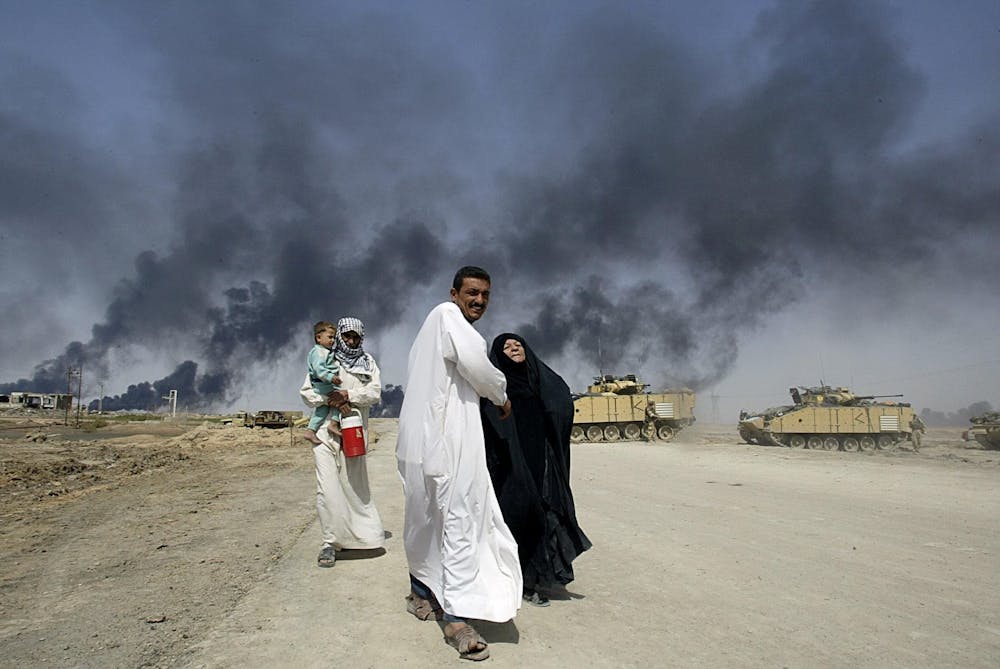
    An Iraqi family flees past British tanks from the city of Basra in March 2003.
    Odd Andersen/AFP via Getty Images

    A new set of priorities

    Older Americans age 65 and up are more likely than young people to prioritize foreign policy issues, including maintaining a U.S. military advantage.

    Younger Americans – age 18 to 39 – say the top issues that require urgency are providing support to refugees and limiting U.S. military commitments abroad, according to a 2021 Pew research survey.

    Generation Z members are also less likely than older Americans to think that the U.S. should act by itself in defending or protecting democracy around the world, according to a 2019 poll by the think tank Center for American Progress.

    They also agree with the statement that the United States’ “wars in the Middle East and Afghanistan were a waste of time, lives, and taxpayer money and they did nothing to make us safer at home.” They prefer that the U.S. use economic and diplomatic means, rather than military intervention, to advance American interests around the world.

    Israel’s conflict with Iran may not flare again and give way to more airstrikes and violence. If the countries resume fighting, however, their conflict threatens to draw in Lebanon, Qatar and other countries in the Middle East, as well as likely the U.S. – and to drag on for a long time.

    This is an update from a story originally published on March 15, 2023.

    Andrea Stanton does not work for, consult, own shares in or receive funding from any company or organization that would benefit from this article, and has disclosed no relevant affiliations beyond their academic appointment.

    – ref. Israel-Iran war recalls the 2003 US invasion of Iraq – a war my undergraduate students see as a relic of the past – https://theconversation.com/israel-iran-war-recalls-the-2003-us-invasion-of-iraq-a-war-my-undergraduate-students-see-as-a-relic-of-the-past-259652

    MIL OSI Analysis –

    June 27, 2025
  • MIL-OSI Analysis: Israel bombed an Iraqi nuclear reactor in 1981 − it pushed program underground and spurred Saddam Hussein’s desire for nukes

    Source: The Conversation – Global Perspectives – By Jeffrey Fields, Professor of the Practice of International Relations, USC Dornsife College of Letters, Arts and Sciences

    The Osirak nuclear power research station in 1981. Jacques Pavlovsky/Sygma via Getty Images

    Israel, with the assistance of U.S. military hardware, bombs an adversary’s nuclear facility to set back the perceived pursuit of the ultimate weapon. We have been here before, about 44 years ago.

    In 1981, Israeli fighter jets supplied by Washington attacked an Iraqi nuclear research reactor being built near Baghdad by the French government.

    The reactor, which the French called Osirak and Iraqis called Tammuz, was destroyed. Much of the international community initially condemned the attack. But Israel claimed the raid set Iraqi nuclear ambitions back at least a decade. In time, many Western observers and government officials, too, chalked up the attack as a win for nonproliferation, hailing the strike as an audacious but necessary step to prevent Iraqi dictator Saddam Hussein from building a nuclear arsenal.

    But the reality is more complicated. As nuclear proliferation experts assess the extent of damage to Iran’s nuclear facilities following the recent U.S. and Israeli raids, it is worth reassessing the longer-term implications of that earlier Iraqi strike.

    The Osirak reactor

    Iraq joined the landmark Nuclear Non-Proliferation Treaty in 1970, committing the country to refrain from the pursuit of nuclear weapons. But in exchange, signatories are entitled to engage in civilian nuclear activities, including having research or power reactors and access to the enriched uranium that drives them.

    The International Atomic Energy Agency is responsible through safeguards agreements for monitoring countries’ civilian use of nuclear technology, with on-the-ground inspections to ensure that civilian nuclear programs do not divert materials for nuclear weapons.

    But to Israel, the Iraqi reactor was provocative and an escalation in the Arab-Israeli conflict.

    Israel believed that Iraq would use the French reactor – Iraq said it was for research purposes – to generate plutonium for a nuclear weapon. After diplomacy with France and the United States failed to persuade the two countries to halt construction of the reactor, Prime Minister Menachem Begin concluded that attacking the reactor was Israel’s best option. That decision gave birth to the “Begin Doctrine,” which has committing Israel to preventing its regional adversaries from becoming nuclear powers ever since.

    Israeli Prime Minister Menachem Begin addresses the press after the 1981 attack on the Osarik nuclear reactor.
    Israel Press and Photo Agency/Wikimedia Commons

    In spring 1979, Israel attempted to sabotage the project, bombing the reactor core destined for Iraq while it sat awaiting shipment in the French town of La Seyne-sur-Mer. The mission was only a partial success, damaging but not destroying the reactor.

    France and Iraq persisted with the project, and in July 1980 – with the reactor having been delivered – Iraq received the first shipment of highly enriched uranium fuel at the Tuwaitha Nuclear Research Center near Baghdad.

    Then in September 1980, during the initial days of the Iran-Iraq war, Iranian jets struck the nuclear research center. The raid also targeted a power station, knocking out electricity in Baghdad for several days. But a Central Intelligence Agency situation report assessed that “only secondary buildings” were hit at the nuclear site itself.

    It was then Israel’s turn. The reactor was still unfinished and not in operation when on June 7, 1981, eight U.S.-supplied F-16s flew over Jordanian and Saudi airspace and bombed the reactor in Iraq. The attack killed 10 Iraqi soldiers and a French civilian.

    Revisiting the ‘success’ of Israeli raid

    Many years later, U.S. President Bill Clinton commented: “Everybody talks about what the Israelis did at Osirak in 1981, which I think, in retrospect, was a really good thing. You know, it kept Saddam from developing nuclear power.”

    But nonproliferation experts have contended for years that while Saddam may have had nuclear weapons ambitions, the French-built research reactor would not have been the route to go. Iraq would either have had to divert the reactor’s highly enriched uranium fuel for a few weapons or shut the reactor down to extract plutonium from the fuel rods – all while hiding these operations from the International Atomic Energy Agency.

    As an additional safeguard, the French government, too, had pledged to shut down the reactor if it detected efforts to use the reactor for weapons purposes.

    In any event, Iraq’s desire for a nuclear weapon was more aspirational than operational. A 2011 article in the journal International Security included interviews with several scientists who worked on Iraq’s nuclear program and characterized the country’s pursuit of a nuclear weapons capability as “both directionless and disorganized” before the attack.

    Iraq’s program begins in earnest

    So what happened after the strike? Many analysts have argued that the Israeli attack, rather than diminish Iraqi desire for a nuclear weapon, actually catalyzed it.

    Nuclear proliferation expert Målfrid Braut-Hegghammer, the author of the 2011 study, concluded that the Israeli attack “triggered a nuclear weapons program where one did not previously exist.”

    In the aftermath of the attack, Saddam decided to formally, if secretively, establish a nuclear weapons program, with scientists deciding that a uranium-based weapon was the best route. He tasked his scientists with pursuing multiple methods to enrich uranium to weapons grade to ensure success, much the way the Manhattan Project scientists approached the same problem in the U.S.

    In other words, the Israeli attack, rather than set back an existing nuclear weapons program, turned an incoherent and exploratory nuclear endeavor into a drive to get the bomb personally overseen by Saddam and sparing little expense even as Iraq’s war with Iran substantially taxed Iraqi resources.

    From 1981 to 1987, the nuclear program progressed fitfully, facing both organizational and scientific challenges.

    As those challenges were beginning to be addressed, Iraq invaded Kuwait in 1990, provoking a military response from the United States. In the aftermath of what would become Operation Desert Storm, U.N. weapons inspectors discovered and dismantled the clandestine Iraqi nuclear weapons program.

    The Tammuz nuclear reactor was hit again during the 1991 Gulf War.
    Ramzi Haidar/AFP via Getty Images

    Had Saddam not invaded Kuwait over a matter not related to security, it is very possible that Baghdad would have had a nuclear weapon capability by the mid-to-late 1990s.

    Similarly to Iraq in 1980, Iran today is a party to the Nuclear Non-Proliferation Treaty. At the time President Donald Trump withdrew U.S. support in 2018 for the Joint Comprehensive Plan of Action, colloquially known as the Iran nuclear deal, the International Atomic Energy Agency certified that Tehran was complying with the requirements of the agreement.

    In the case of Iraq, military action on its nascent nuclear program merely pushed it underground – to Saddam, the Israeli strikes made acquiring the ultimate weapon more rather than less attractive as a deterrent. Almost a half-century on, some analysts and observers are warning the same about Iran.

    Jeffrey Fields receives funding from the Carnegie Corporation of New York and Schmidt Futures.

    – ref. Israel bombed an Iraqi nuclear reactor in 1981 − it pushed program underground and spurred Saddam Hussein’s desire for nukes – https://theconversation.com/israel-bombed-an-iraqi-nuclear-reactor-in-1981-it-pushed-program-underground-and-spurred-saddam-husseins-desire-for-nukes-259618

    MIL OSI Analysis –

    June 27, 2025
  • MIL-OSI: Increasing Adoption of Drones in Commercial Sectors Leading to a Revolution in Big Data Cloud Services

    Source: GlobeNewswire (MIL-OSI)

    PALM BEACH, Fla., June 26, 2025 (GLOBE NEWSWIRE) — FN Media Group News Commentary – The increasing adoption of drones in commercial sectors is leading to a revolution in big data cloud services. Launching a drone to capture images is the preliminary step in the drone information acquisition process. The captured images then require correction, calibration, processing, storage, and efficient evaluation. The increasing need to evaluate imagery is a key factor driving the adoption of drone imagery software and cloud-based applications, which possess the ability to upload, share, store, and process aerial images. Moreover, there has been a steep increase in the use of cloud-based in-memory computing platform amongst businesses as it accelerates analytics, processes, and predictive capabilities. The global drone data service market size is expected to reach USD 15.05 billion by 2030, expanding at a CAGR of 39.0% through 2030, according to a new report by Grand View Research, Inc. The growth can be attributed to the growing usage of information acquired by drones in operational and big data analytics. The increasing need for UAV imagery analysis is presumed to impact the global drone imagery processing software industry positively and add a new horizon in imagery storage technologies. The report said: “By gathering information on a larger scale, service providers can now process unprecedented levels of detailed information and turn it into actionable information. UAV companies, such as PrecisionHawk, are transforming their business processes to enhance their focus on drone data processing rather than UAV manufacturing.” Active Companies in the markets today include ZenaTech, Inc. (NASDAQ: ZENA), Draganfly Inc. (NASDAQ: DPRO), Safe Pro Group Inc. (NASDAQ: SPAI), Teledyne Technologies Incorporated (NYSE: TDY), and AgEagle Aerial Systems Inc. (NYSE: UAVS).

    The article continued: The global drone data service market size is expected to reach USD 15.05 billion by 2030, expanding at a CAGR of 39.0% from 2023 to 2030, according to a new report by Grand View Research, Inc. The growth can be attributed to the growing usage of information acquired by drones in operational and big data analytics. The increasing need for UAV imagery analysis is presumed to impact the global drone imagery processing software industry positively and add a new horizon in imagery storage technologies. The increasing adoption of drones in commercial sectors is leading to a revolution in big data cloud services. Launching a drone to capture images is the preliminary step in the drone information acquisition process. The captured images then require correction, calibration, processing, storage, and efficient evaluation.

    ZenaTech (NASDAQ:ZENA) Signs Offer to Acquire North Carolina Land Surveying Company to Expand State Operations and Government Customers – ZenaTech, Inc. (FSE: 49Q) (BMV: ZENA) (“ZenaTech”), a technology company specializing in AI (Artificial Intelligence) drone, Drone as a Service (DaaS), enterprise SaaS, announces it has signed an offer to acquire a well-established North Carolina-based land surveying company with a strong government customer base. The proposed acquisition expands operations in the state when combined with a previously announced proposed land survey acquisition with operations in North Carolina. With over three decades of success serving government agencies, municipal governments, construction companies, and real estate developers, this strategic acquisition would significantly advance the company’s regional market penetration as well as growth in the US Southeast.

    “This proposed acquisition aligns with our strategy to build a robust, scalable, national Drone as a Service business while empowering strong regional and local hubs and recurring revenue opportunities,” said Shaun Passley, Ph.D., ZenaTech CEO. “We plan to embed AI-powered drone technology into critical land survey workflows providing unparalleled speed and precision. Land surveys are a first step to innovating multiple legacy businesses and inefficient processes with our DaaS model and our drones.”

    The land survey company offers comprehensive services include boundary surveys, topographic and site planning surveys, ALTA (American Land Title Association) / ACSM (American Congress on Surveying and Mapping) surveys, construction staking, and other essential survey solutions for permitting, financing, and construction across city, county, and commercial sectors.

    ZenaTech’s Drone as a Service (DaaS) business model offers both business and government customers reduced costs and convenience to utilize drones to streamline legacy processes and manual tasks such as inspections, surveying, maintenance, precision agriculture and inventory management , there is no need to purchase drone hardware and software, find a drone pilot, manage maintenance and operation, or acquire regulatory approvals. The model also offers scalability to use more often or less often based on business needs and utilizes ZenaDrone’s multifunction AI autonomous drones.

    The company has closed five acquisitions across the US to date as part of its DaaS business model and strategy and has announced it plans to complete 20 more acquisitions in the next 12 months. Continued… Read this full release by visiting: https://www.financialnewsmedia.com/news-zena/

    Other recent developments in the markets include:

    TB2 Aerospace LLC, in collaboration with Draganfly Inc. (NASDAQ: DPRO), a drone solutions, and systems developer, recently said it is proud to announce the successful deployment and performance of the Drone Recharging Operational Payload System (DROPS) during the U.S. Army’s Sustainment Modernization Experiment 2025 (SMEX25).

    Throughout SMEX25’s week-long field exercises, the DROPS system, integrated with Draganfly’s Commander 3XL, achieved a 100% success rate in autonomously deploying, recovering, and recharging TB2’s tactical resupply pods. The event provided an opportunity to validate real-world operational performance in austere and high-demand scenarios, drawing praise from defence evaluators and technology observers alike.

    “The successful deployment of DROPS at SMEX25 underscores our commitment to advancing autonomous logistics solutions,” said Hank Scott, CEO of TB2 Aerospace. “Our system’s performance in a live operational environment validates its potential to revolutionize military tactical resupply and contested logistics.”

    Safe Pro Group Inc. (NASDAQ: SPAI), a leader in AI-powered security solutions, is honored to recently be featured in a recent investigative piece by Grist Magazine, titled “How 3 Years of War Have Ravaged Ukraine’s Forests, and the People Who Depend on Them.”

    Safe Pro AI is helping lead a critical technological response to one of the war’s deadliest and most enduring legacies: land mines and unexploded ordnance (UXO). Utilizing AI and drone-based remote sensing, Safe Pro is working alongside humanitarian organizations and government partners to rapidly detect, map, and facilitate the safer and more efficient removal of UXO. This technology can be especially valuable in areas where land mines have triggered catastrophic wildfires, endangering both people and the environment. According to a report published by the United Nations Economic Commission for Europe, Ukraine has experienced profound socio-economic disruption due to the conflict’s impact on key sectors including timber production with losses amounting to approximately €447.73 million. The primary damages involve the destruction of infrastructure, equipment, and substantial harm to protected natural areas, estimated at over €2.3 billion. Restoring this potential will require considerable effort and resources.

    Teledyne FLIR Defense, part of Teledyne Technologies Incorporated (NYSE: TDY) recently announced that its Black Hornet® 4 Personal Reconnaissance System has successfully completed the required NDAA and cyber security verification process and been approved for the Blue UAS List with an Authority to Operate.

    Led by the Defense Innovation Unit (DIU), Blue UAS vets and verifies commercial drone technology for the Department of Defense and U.S. government. The Blue UAS List gives users access to a wide range of drone systems that can meet their diverse needs. In February, Teledyne FLIR announced that Black Hornet 4 was selected by DoD operators from among more than 35 uncrewed aerial system (UAS) products, all rigorously tested during DIU’s ‘Blue UAS Refresh’ event.

    “We are honored to see Black Hornet 4 added to the Blue UAS List, knowing that more operators across our military and federal government will be able to benefit from this one-of-a-kind drone and its distinct capabilities,” said Dr. JihFen Lei, president of Teledyne FLIR Defense. “DIU is filling a critical national need in meeting mission requirements by executing a more expansive Blue UAS program, and we have valued our partnership with them throughout the verification process.”

    AgEagle Aerial Systems Inc. (NYSE: UAVS), a leading provider of advanced drone and aerial imaging solutions, recently announced the sale of two additional eBee X drones to South Korea, expanding the country’s installed base of AgEagle’s eBee drones to more than 100 units. This milestone strengthens AgEagle’s strategic partnership with South Korea and reinforces its position as a leader in the Asia-Pacific drone market.

    The eBee X, AgEagle’s flagship fixed-wing mapping drone, is engineered for high-precision geospatial data collection and is ideally suited for applications including surveying, mapping, and photogrammetry. This latest sale builds on a well-established fleet, further strengthening AgEagle’s reputation as a trusted provider of cutting-edge unmanned aerial systems.

    About FN Media Group:

    At FN Media Group, via our top-rated online news portal at www.financialnewsmedia.com, we are one of the very few select firms providing top tier one syndicated news distribution, targeted ticker tag press releases and stock market news coverage for today’s emerging companies. #tickertagpressreleases #pressreleases

    Follow us on Facebook to receive the latest news updates: https://www.facebook.com/financialnewsmedia

    Follow us on Twitter for real time Market News: https://twitter.com/FNMgroup

    Follow us on Linkedin: https://www.linkedin.com/in/financialnewsmedia/

    DISCLAIMER: FN Media Group LLC (FNM), which owns and operates FinancialNewsMedia.com and MarketNewsUpdates.com, is a third party publisher and news dissemination service provider, which disseminates electronic information through multiple online media channels. FNM is NOT affiliated in any manner with any company mentioned herein. FNM and its affiliated companies are a news dissemination solutions provider and are NOT a registered broker/dealer/analyst/adviser, holds no investment licenses and may NOT sell, offer to sell or offer to buy any security. FNM’s market updates, news alerts and corporate profiles are NOT a solicitation or recommendation to buy, sell or hold securities. The material in this release is intended to be strictly informational and is NEVER to be construed or interpreted as research material. All readers are strongly urged to perform research and due diligence on their own and consult a licensed financial professional before considering any level of investing in stocks. All material included herein is republished content and details which were previously disseminated by the companies mentioned in this release. FNM is not liable for any investment decisions by its readers or subscribers. Investors are cautioned that they may lose all or a portion of their investment when investing in stocks. For current services performed FNM has been compensated fifty one hundred dollars for news coverage of the current press releases issued by ZenaTech, Inc. by the Company. FNM HOLDS NO SHARES OF ANY COMPANY NAMED IN THIS RELEASE.

    This release contains “forward-looking statements” within the meaning of Section 27A of the Securities Act of 1933, as amended, and Section 21E the Securities Exchange Act of 1934, as amended and such forward-looking statements are made pursuant to the safe harbor provisions of the Private Securities Litigation Reform Act of 1995. “Forward-looking statements” describe future expectations, plans, results, or strategies and are generally preceded by words such as “may”, “future”, “plan” or “planned”, “will” or “should”, “expected,” “anticipates”, “draft”, “eventually” or “projected”. You are cautioned that such statements are subject to a multitude of risks and uncertainties that could cause future circumstances, events, or results to differ materially from those projected in the forward-looking statements, including the risks that actual results may differ materially from those projected in the forward-looking statements as a result of various factors, and other risks identified in a company’s annual report on Form 10-K or 10-KSB and other filings made by such company with the Securities and Exchange Commission. You should consider these factors in evaluating the forward-looking statements included herein, and not place undue reliance on such statements. The forward-looking statements in this release are made as of the date hereof and FNM undertakes no obligation to update such statements.

    Contact Information:

    Media Contact email: editor@financialnewsmedia.com – +1(561)325-8757

    SOURCE: FN Media Group

    The MIL Network –

    June 27, 2025
  • MIL-OSI Africa: Cabinet briefed on ongoing recovery efforts in the EC

    Source: South Africa News Agency

    Cabinet briefed on ongoing recovery efforts in the EC

    Cabinet was, at its ordinary meeting on Wednesday, updated on ongoing recovery efforts in the Eastern Cape and KwaZulu-Natal, following the recent devastating floods. 

    At a national level, the National Joint Flood Coordination Committee, as well as the Interministerial Committee of Disaster Management have been activated and have met on several occasions to assess the situation and decide on how to support the affected provinces.

    Briefing the media on Thursday in Cape Town, Minister in the Presidency Khumbudzo Ntshavheni said the National Disaster Management Centre and respective provincial and municipal disaster management centres continue to provide reports on assessments and response measures.

    “The immediate priority remains to provide emergency shelter and relief materials needed by affected communities to stabilise the situation,” Ntshavheni said. 

    She said work also continues to restore basic services such as water, sanitation and electricity. “This includes ensuring that those affected obtain identity (ID) documents and temporary ID certificates to access essential services”.

    “An assessment of damage to homes and infrastructure and a plan for reconstruction is under way. Once completed, it will allow for the preparation of a comprehensive rehabilitation programme,” Ntshavheni said.

    The Eastern Cape Provincial Government has confirmed that the official death toll from the recent floods has risen to 101, following additional recoveries by search teams.

    The numbers are likely to increase, as there are still individuals who have been reported missing by their families and search operations continue in the affected areas.

     The provincial government has extended heartfelt condolences to the families who have lost their loved ones and “are now left with a profound and multifaceted impact on their lives”. – SAnews.gov.za

    Edwin
    Thu, 06/26/2025 – 11:50

    MIL OSI Africa –

    June 27, 2025
  • MIL-OSI Africa: Government welcomes progress made in the fight against crime

    Source: South Africa News Agency

    Government welcomes progress made in the fight against crime

    Government has welcomed the progress being made in the fight against crime through initiatives such as Operation Shanela and Operation Vala Umgodi. 

    “About 239 suspects were arrested across the country between 1 and 15 June 2025 through Operation Vala Umgodi,” Minister in the Presidency Khumbudzo Ntshavheni said.

    Briefing media in Cape Town on Thursday, on the outcomes of the Cabinet meeting, Ntshavheni said the suspects were arrested for illegal mining-related offences and various other crimes, including attempted murder, possession of unlicensed firearms, possession of unpolished diamonds, unlawful possession of explosives and contravention of the Immigration Act of 2002.

    “Operation Vala Umgodi has, since its inception in December 2023, led to the arrest of more than 27 000 suspects and the seizure of more than 600 firearms that included imitation firearms (toy guns) and 16 000 rounds of ammunition,” Ntshavheni said.

    Ntshavheni said between 16 June to 22 June 2025, the South African Police Service (SAPS), through Operation Shanela, arrested 15 372 suspects. 

    “Some of the key arrests include 2 400 wanted individuals linked to serious and violent crimes (murder, attempted murder, rape and robbery), 159 arrested for murder, 100 arrests for rape, 1 173 arrests for assault with intent to cause grievous bodily harm, 2 602 for drug possession and 64 for hijacked or stolen vehicles,” the Minister said.

    According to SAPS, these successes stem from proactive policing tactics, including high-visibility patrols, roadblocks, stop-and-search initiatives and intelligence-led suspect tracing.

    “SAPS remains committed to relentless, multidisciplinary crime prevention through Operation Shanela and related initiatives. The National Commissioner of Police, General Fannie Masemola, applauds the dedication of all police officers and partners who collaborated with the police,” the South African Police Service said in a statement earlier this week. – SAnews.gov.za

    Edwin
    Thu, 06/26/2025 – 12:06

    MIL OSI Africa –

    June 27, 2025
  • MIL-OSI Security: Two drug kingpins jailed for life following Met EncroChat investigation

    Source: United Kingdom London Metropolitan Police

    Two men have been jailed for life for importing and dealing a tonne of cocaine and plotting a murder.

    The Met’s investigation uncovered the two men’s plan to commit a murder, as well as their role in delivering millions of pounds worth of drugs across the capital and beyond.

    The evidence of the offences were identified after officers trawled through thousands of messages on encrypted communication service EncroChat.

    Thought to be impenetrable by law enforcement, Met officers accessed chats between James Harding and Jayes Kharouti.

    It was identified that James Harding, 34 (01.01.1991), of Alton, Hampshire, was the head of a sophisticated organised drug dealing network, turning over an estimated £5 million profit in just 10 weeks. Harding resided in Dubai at the time of his arrest.

    Detective Chief Inspector Jim Casey, who led the investigation, said:

    “This sentencing shows the severity of the crimes the duo committed.

    “Following one of the largest EncroChat investigations in the Met’s history, I am pleased that both criminals are serving the time they deserve.

    “Not only did they have a detailed plan to kill, their conspiracy to import and deal drugs harmed a number of our communities in London and across the country.

    “This sends a clear message to other potential offenders: we will investigate and we will put you before the courts.”

    Harding was found guilty by the jury of conspiracy to supply Class A drugs and conspiracy to commit murder on Tuesday, 24 June at The Old Bailey, following a seven-week trial.

    He was sentenced to life at The Old Bailey on Thursday, 26 June, and will have to serve a minimum of 32 years’ imprisonment.

    Kharouti, 39, (09.02.1986) of Depot Road, Epsom, previously admitted to his role in supplying drugs on Friday, 8 November 2024 at The Old Bailey. He was also found guilty of conspiracy to commit murder alongside Harding on Tuesday, 24 June at the same court.

    He was sentenced to life at The Old Bailey on Thursday, 26 June, and will have to serve a minimum of 26 years’ imprisonment.

    Chats on the encrypted messaging site unveiled they both spoke, in detail, about their plan to kill a suspected drug courier from a ‘rival crime network’.

    This case is part of a wider operation to take down those who utilised EncroChat, after the National Crime Agency (NCA) passed information onto the Met after European agencies cracked the encrypted communications platform.

    So far, Met investigations have led to more than 5,000 years-worth of prison sentences for criminals on the site.

    The investigation

    Following the thorough investigation into a series of conversations on EncroChat, the Met discovered Harding used the handle “thetopsking”, while Kharouti used “besttops”. They used the platform to confidently communicate with each other about their vast criminal enterprise.

    The Met spent hundreds of hours reviewing and analysing these messages. Among them were clear conspiracies to carry out a murder of a rival drug gang member with detailed plans, involving recruiting paid hitmen, arranging firearms and getaway vehicles. They had also discussed times, dates and locations.

    This was on top of plans to coordinate deliveries of hundreds of kilograms of cocaine across the country, manage their vast finances and discuss security threats.

    The court heard that approximately 50 importations were made into the UK, with a total weight of one tonne, between April and June 2020.

    This allowed Harding to live a lavish lifestyle in the United Arab Emirates, where he conducted his criminal enterprise.

    The arrests

    Harding was arrested on Monday, 27 December 2021 at Geneva Airport, Switzerland. On Friday, 27 May 2022, he was extradited from Switzerland to the UK when he was arrested by Met officers.

    Kharouti’s home was searched in 2020 after he was linked to the messages. Police found a handset with the same number he gave to Harding. He fled the country shortly after this, before being found in Turkey and extradited back to the UK.

    MIL Security OSI –

    June 27, 2025
  • MIL-OSI: Palomar and Neptune Partner to Accelerate Growth in U.S. Flood Insurance Market

    Source: GlobeNewswire (MIL-OSI)

    ~ Palomar to Appoint Neptune as Exclusive Managing General Agent for Flood Insurance ~

    LA JOLLA, Calif. and ST. PETERSBURG, Fla., June 26, 2025 (GLOBE NEWSWIRE) — Palomar Holdings, Inc. (“Palomar” NASDAQ: PLMR), a leading specialty insurer, and Neptune Flood (“Neptune”), the largest provider of private flood insurance in the United States, today announced a strategic partnership under which Neptune will become Palomar’s exclusive managing general agent for flood insurance.

    Palomar will continue its longstanding commitment to the private flood insurance market while gaining access to Neptune’s AI-based technology powered by data science and machine learning. The partnership enables both companies to advance their shared mission to deliver a robust technology driven alternative to the National Flood Insurance Program and make flood coverage more accessible to customers nationwide.

    “Neptune’s technology and underwriting capabilities make them an ideal partner as we continue to grow in the flood insurance space,” said Jon Christianson, President of Palomar. “Together, we are expanding flood insurance availability with a streamlined and scalable solution that delivers strong value to our policyholders and partners.”

    “Neptune is excited to add Palomar to our panel of top-tier carriers,” said Trevor Burgess, Chairman and Chief Executive Officer of Neptune Flood. “We look forward to welcoming Palomar’s flood customers to the Neptune platform and to increasing access to flood insurance nationwide.”

    Through the seamless transition, Palomar’s agents will gain access to Neptune’s platform, offering a streamlined quoting and binding experience with enhanced coverage options.

    About Palomar

    Palomar Holdings, Inc. is the holding company of subsidiaries Palomar Specialty Insurance Company (“PSIC”), Palomar Specialty Reinsurance Company Bermuda Ltd. (“PSRE”), Palomar Insurance Agency, Inc., Palomar Excess and Surplus Insurance Company (“PESIC”), Palomar Underwriters Exchange Organization, Inc. (“PUEO”), First Indemnity of America Insurance Co. (“FIA”), and Palomar Crop Insurance Services, Inc. (“PCIS”). Palomar’s consolidated results also include Laulima Exchange (“Laulima”), a variable interest entity for which the Company is the primary beneficiary. Palomar is an innovative specialty insurer serving residential and commercial clients in five product categories: Earthquake, Inland Marine and Other Property, Casualty, Fronting, and Crop. Palomar’s insurance subsidiaries, PSIC, PSRE, and PESIC, have a financial strength rating of “A” (Excellent) from A.M. Best. FIA carries an “A-” (Stable) rating from A.M. Best.

    To learn more, visit PLMR.com.

    Follow Palomar on LinkedIn: @PLMRInsurance

    About Neptune

    With nearly 250,000 policies in force, Neptune is the largest private flood insurance provider in the United States, revolutionizing the industry with AI-driven underwriting and data science-driven machine learning technology. Neptune simplifies the flood insurance process, offering instant, affordable, and comprehensive coverage in minutes, without the delays and complexities of traditional insurance. Neptune is committed to closing the flood insurance gap and making coverage accessible nationwide.

    Safe Harbor Statement
    Palomar cautions you that statements contained in this press release may regard matters that are not historical facts but are forward-looking statements. These statements are based on the company’s current beliefs and expectations. The inclusion of forward-looking statements should not be regarded as a representation by Palomar that any of its plans will be achieved. Actual results may differ from those set forth in this press release due to the risks and uncertainties inherent in the Company’s business. The forward-looking statements are typically, but not always, identified through use of the words “believe,” “expect,” “enable,” “may,” “will,” “could,” “intends,” “estimate,” “anticipate,” “plan,” “predict,” “probable,” “potential,” “possible,” “should,” “continue,” and other words of similar meaning. Actual results could differ materially from the expectations contained in forward-looking statements as a result of several factors, including unexpected expenditures and costs, unexpected results or delays in development and regulatory review, regulatory approval requirements, the frequency and severity of adverse events and competitive conditions. These and other factors that may result in differences are discussed in greater detail in the Company’s filings with the Securities and Exchange Commission. You are cautioned not to place undue reliance on these forward-looking statements, which speak only as of the date hereof, and the Company undertakes no obligation to update such statements to reflect events that occur or circumstances that exist after the date hereof. All forward-looking statements are qualified in their entirety by this cautionary statement, which is made under the safe harbor provisions of the Private Securities Litigation Reform Act of 1995.

    Contact

    Media Inquiries
    Lindsay Conner
    1-551-206-6217
    lconner@plmr.com

    Investor Relations:
    Jamie Lillis
    1-203-428-3223
    investors@plmr.com

    Neptune Media:
    Loren Pomerantz
    loren@combined-forces.com
    917-902-0219

    Source: Palomar Holdings, Inc.

    The MIL Network –

    June 27, 2025
  • MIL-OSI Africa: Kaspersky: ChatGPT-mimicking cyberthreats surge 115% in early 2025, Small and Medium-Sized Businesses (SMBs) increasingly targeted

    In 2025, nearly 8,500 users from small and medium-sized businesses (SMBs) globally faced cyberattacks where malicious or unwanted software was disguised as popular online productivity tools, Kaspersky reports (www.Kaspersky.co.za). Based on the unique malicious and unwanted files observed, the most common lures included Zoom and Microsoft Office, with newer AI-based services like ChatGPT and DeepSeek being increasingly exploited by attackers. Kaspersky has released threat analysis and mitigation strategies to help SMBs respond. 

    Kaspersky analysts explored how frequently malicious and unwanted software are disguised as legitimate applications commonly used by SMBs, using a sample of 12 online productivity apps. In total, Kaspersky observed more than 4,000 unique malicious and unwanted files disguised as popular apps in 2025. With the growing popularity of AI services, cybercriminals are increasingly disguising malware as AI tools. The number of cyberthreats mimicking ChatGPT increased by 115% in the first four months of 2025 compared to the same period last year, reaching 177 unique malicious and unwanted files. Another popular AI tool, DeepSeek, accounted for 83 files. This large language model launched in 2025 immediately appeared on the list of impersonated tools. 

    “Interestingly, threat actors are rather picky in choosing an AI tool as bait. For example, no malicious files mimicking Perplexity were observed. The likelihood that an attacker will use a tool as a disguise for malware or other types of unwanted software directly depends on the service’s popularity and hype around it. The more publicity and conversation there is around a tool, the more likely a user will come across a fake package on the Internet. To be on the safe side, SMB employees – as well as regular users – should exercise caution when looking for software on the Internet or coming across too-good-to-be-true subscription deals. Always check the correct spelling of the website and links in suspicious emails. In many cases these links may turn out to be phishing or a link that downloads malicious or potentially unwanted software,” says Vasily Kolesnikov, security expert at Kaspersky.  

    Another cybercriminal tactic to look for in 2025 is the growing use of collaboration platform brands to trick users into downloading or launching malware. The number of malicious and unwanted software files disguised as Zoom increased by nearly 13% in 2025, reaching 1,652, while such names as “Microsoft Teams” and “Google Drive” saw increases of 100% and 12%, respectively, with 206 and 132 cases. This pattern likely reflects the normalisation of remote work and geographically distributed teams, which has made these platforms integral to business operations across industries. 

    Among the analysed sample, the highest number of files mimicked Zoom, accounting for nearly 41% of all unique files detected. Microsoft Office applications remained frequent targets for impersonation: Outlook and PowerPoint each accounted for 16%, Excel for nearly 12%, while Word and Teams made up 9% and 5%, respectively. 

    The top threats targeting small and medium businesses in 2025 included downloaders, trojans and adware. 

    Phishing and spam 

    Apart from malware threats, Kaspersky continues to observe a wide range of phishing and scam schemes targeting SMBs. Attackers aim to steal login credentials for various services — from delivery platforms to banking systems — or manipulate victims into sending them money through deceptive tactics. One example is a phishing attempt targeting Google Accounts. Attackers promise potential victims to increase sales by advertising their company on X, with the ultimate goal being to steal their credentials.  

    Beyond phishing, SMBs are flooded with spam emails. Not surprisingly, AI has also made its way into the spam folder — for example, with offers for automating various business processes. 

    In general, Kaspersky observes phishing and spam offers crafted to reflect the typical needs of small businesses, promising attractive deals on email marketing or loans, offering services such as reputation management, content creation, or lead generation, and more. 

    Learn more about the cyber threat landscape for SMBs on Securelist (https://apo-opa.co/3I0itLw). To mitigate threats targeting businesses, their owners and employees are advised to implement the following measures:  

    • Use specialised cybersecurity solutions that provide visibility and control over cloud services (e.g., Kaspersky Next (https://apo-opa.co/4nzvzQm)). 
    • Define access rules for corporate resources such as email accounts, shared folders, and online documents. 
    • Regularly backup important data. 
    • Establish clear guidelines for using external services. Create well-defined procedures for implementing new software with the involvement of IT and other responsible managers. 

    Distributed by APO Group on behalf of Kaspersky.

    For further information please contact: 
    Nicole Allman 
    nicole@inkandco.co.za  

    Social Media:
    Facebook: https://apo-opa.co/4lnbavE
    X: https://apo-opa.co/3TvWkaF
    YouTube: https://apo-opa.co/4nfAq8Z
    Instagram: https://apo-opa.co/4kYTZRl
    Blog: https://apo-opa.co/4emf9q1

    About Kaspersky: 
    Kaspersky is a global cybersecurity and digital privacy company founded in 1997. With over a billion devices protected to date from emerging cyberthreats and targeted attacks, Kaspersky’s deep threat intelligence and security expertise is constantly transforming into innovative solutions and services to protect individuals, businesses, critical infrastructure, and governments around the globe. The company’s comprehensive security portfolio includes leading digital life protection for personal devices, specialized security products and services for companies, as well as Cyber Immune solutions to fight sophisticated and evolving digital threats. We help millions of individuals and over 200,000 corporate clients protect what matters most to them. Learn more at www.Kaspersky.co.za.  

    MIL OSI Africa –

    June 27, 2025
  • MIL-OSI: Churchill Resources Announces Fully Subscribed $700,000 Private Placement and Strategic Leadership Changes to Bolster Growth and Operational Execution

    Source: GlobeNewswire (MIL-OSI)

    TORONTO, June 26, 2025 (GLOBE NEWSWIRE) — Churchill Resources Inc. (“Churchill” or the “Company“) (TSXV: CRI) is pleased to announce a non-brokered private placement of common shares to raise gross proceeds of up to $700,000. The Company is also pleased to announce a strategic leadership transition designed to strengthen the Company’s capital markets presence and operational execution as it advances its projects in Newfoundland and Labrador. Effective today, Paul Sobie, will step down from the role of Chief Executive Officer and continue in his capacity as President of the Company, and Conan McIntyre, a current director of Churchill, will assume the role of Chief Executive Officer.

    Private Placement Financing
    The $700,000 private placement will comprise up to 14,000,000 common shares of the Company at a price of $0.05 per share (the “Private Placement”). The Company intends to use the proceeds from the Private Placement on the advancement of exploration activities at the Company’s key projects and for general corporate purposes. The Private Placement is expected to close on or about July 9, 2025, and remains subject to the approval of the TSX Venture Exchange.

    Strategic Leadership Changes
    The leadership transition is designed to strengthen the Company’s strategic and operational capabilities while maximizing continuity benefits.

    Mr. McIntyre will concentrate on corporate strategy, capital markets activities, and business development, while Paul Sobie will focus on advancing the Company’s exploration programs. Mr. McIntyre and Mr. Sobie will continue to serve on the Company’s board of directors along with Malik Easah and Bill Fisher, who will continue serving as Chairman.

    “This strategic restructuring represents an important evolution for Churchill that will enable us to pursue multiple value-creation opportunities simultaneously while preserving operational expertise and local knowledge,” said Mr. McIntyre.

    Mr. Sobie commented: “I am excited about the opportunity to dedicate my full attention to our exploration activities in Newfoundland and Labrador at Black Raven, as well as at Taylor Brook and Florence Lake. This focused approach will allow me to accelerate our field programs and maximize the value of our exploration assets.”

    Mr. Fisher, Chairman of the Board, stated: “The exciting work being undertaken at Black Raven, in particular, continues to demonstrate the significant potential of our portfolio. Black Raven represents a truly exceptional exploration opportunity, featuring a polymetallic metal assemblage at the site of past producers that has never been drilled using modern exploration techniques. With the focused leadership structure we are implementing, I am confident we will unlock substantial value.”

    About Churchill Resources Inc.

    Churchill Resources Inc. is a Canadian exploration company focused on strategic, critical minerals in Canada, principally at its prospective Black Raven, Taylor Brook and Florence Lake properties in Newfoundland and Labrador. The Company’s flagship Black Raven property features a polymetallic metal assemblage with evidence of historical production, representing a unique exploration opportunity as the site of past producers that has never been systematically drilled using modern techniques. The Churchill management team, board, and advisors have decades of combined experience in mineral exploration and in the establishment of successful publicly listed mining companies, both in Canada and around the world. Churchill’s Newfoundland and Labrador projects have the potential to benefit from the province’s large and diversified minerals industry, which includes world class nickel mines and processing facilities, and a well-developed mineral exploration sector with locally based drilling and geological expertise.

    Further Information

    For further information regarding Churchill, please contact:

    Churchill Resources Inc.
    Conan McIntyre, Chief Executive Officer
    Tel. +1 416.272.4738
    Email: cmcintyre@churchillresources.com

    Paul Sobie, President
    Tel. +1 416.365.0930 (o); +1 647.988.0930
    Email: psobie@churchillresources.com

    Cautionary Note Regarding Forward Looking Information
    This news release contains “forward-looking information” and “forward-looking statements” (collectively, “forward-looking statements”) within the meaning of the applicable Canadian securities legislation. All statements, other than statements of historical fact, are forward-looking statements and are based on expectations, estimates and projections as at the date of this news release. Any statement that involves discussions with respect to predictions, expectations, beliefs, plans, projections, objectives, assumptions, future events or performance (often but not always using phrases such as “expects”, or “does not expect”, “is expected”, “anticipates” or “does not anticipate”, “plans”, “proposed”, “budget”, “scheduled”, “forecasts”, “estimates”, “believes” or “intends” or variations of such words and phrases or stating that certain actions, events or results “may” or “could”, “would”, “might” or “will” be taken to occur or be achieved) are not statements of historical fact and may be forward-looking statements.
    In this news release, forward-looking statements relate to, among other things, the completion of the Private Placement and the management changes; the receipt of all applicable regulatory approvals; the Company’s objectives, goals and exploration activities conducted and proposed to be conducted at the Company’s properties; future growth potential of the Company, including whether any proposed exploration programs at any of the Company’s properties will be successful; exploration results; the effectiveness of the new management structure; the benefits of operational continuity; potential value to be unlocked at the Company’s properties, including at Black Raven; the potential for resource discovery and expansion at Black Raven; and future exploration plans and costs and financing availability.

    These forward-looking statements are based on reasonable assumptions and estimates of management of the Company at the time such statements were made. Actual future results may differ materially as forward-looking statements involve known and unknown risks, uncertainties and other factors which may cause the actual results, performance or achievements of the Company to materially differ from any future results, performance or achievements expressed or implied by such forward-looking statements. Such factors, among other things, include: risks related to the completion of the private placement and management changes; the expected benefits to the Company relating to the exploration conducted and proposed to be conducted at the Company’s properties; failure to identify any mineral resources or significant mineralization; uncertainties relating to the availability and costs of financing needed in the future, including to fund any exploration programs on the Company’s properties; fluctuations in general macroeconomic conditions; fluctuations in securities markets; fluctuations in spot and forward prices of gold, silver, base metals or certain other commodities; fluctuations in currency markets (such as the Canadian dollar to United States dollar exchange rate); change in national and local government, legislation, taxation, controls, regulations and political or economic developments; risks and hazards associated with the business of mineral exploration, development and mining (including environmental hazards, industrial accidents, unusual or unexpected formations pressures, cave-ins and flooding); inability to obtain adequate insurance to cover risks and hazards; the presence of laws and regulations that may impose restrictions on mining and mineral exploration; employee relations; relationships with and claims by local communities and indigenous populations; availability of increasing costs associated with mining inputs and labour; the speculative nature of mineral exploration and development (including the risks of obtaining necessary licenses, permits and approvals from government authorities); the unlikelihood that properties that are explored are ultimately developed into producing mines; geological factors; actual results of current and future exploration; changes in project parameters as plans continue to be evaluated; title to properties; and those factors described in the most recently filed management’s discussion and analysis of the Company.
    Although the forward-looking statements contained in this news release are based upon what management of the Company believes, or believed at the time, to be reasonable assumptions, the Company cannot assure shareholders that actual results will be consistent with such forward-looking statements, as there may be other factors that cause results not to be as anticipated, estimated or intended. Accordingly, readers should not place undue reliance on forward-looking statements and information. There can be no assurance that forward-looking information, or the material factors or assumptions used to develop such forward-looking information, will prove to be accurate. The Company does not undertake to release publicly any revisions for updating any voluntary forward-looking statements, except as required by applicable securities law.
    Neither the TSXV nor its Regulation Services Provider (as that term is defined in the policies of the TSXV) accepts responsibility for the adequacy or accuracy of this release.

    The MIL Network –

    June 26, 2025
  • MIL-OSI: Churchill Resources Announces Fully Subscribed $700,000 Private Placement and Strategic Leadership Changes to Bolster Growth and Operational Execution

    Source: GlobeNewswire (MIL-OSI)

    TORONTO, June 26, 2025 (GLOBE NEWSWIRE) — Churchill Resources Inc. (“Churchill” or the “Company“) (TSXV: CRI) is pleased to announce a non-brokered private placement of common shares to raise gross proceeds of up to $700,000. The Company is also pleased to announce a strategic leadership transition designed to strengthen the Company’s capital markets presence and operational execution as it advances its projects in Newfoundland and Labrador. Effective today, Paul Sobie, will step down from the role of Chief Executive Officer and continue in his capacity as President of the Company, and Conan McIntyre, a current director of Churchill, will assume the role of Chief Executive Officer.

    Private Placement Financing
    The $700,000 private placement will comprise up to 14,000,000 common shares of the Company at a price of $0.05 per share (the “Private Placement”). The Company intends to use the proceeds from the Private Placement on the advancement of exploration activities at the Company’s key projects and for general corporate purposes. The Private Placement is expected to close on or about July 9, 2025, and remains subject to the approval of the TSX Venture Exchange.

    Strategic Leadership Changes
    The leadership transition is designed to strengthen the Company’s strategic and operational capabilities while maximizing continuity benefits.

    Mr. McIntyre will concentrate on corporate strategy, capital markets activities, and business development, while Paul Sobie will focus on advancing the Company’s exploration programs. Mr. McIntyre and Mr. Sobie will continue to serve on the Company’s board of directors along with Malik Easah and Bill Fisher, who will continue serving as Chairman.

    “This strategic restructuring represents an important evolution for Churchill that will enable us to pursue multiple value-creation opportunities simultaneously while preserving operational expertise and local knowledge,” said Mr. McIntyre.

    Mr. Sobie commented: “I am excited about the opportunity to dedicate my full attention to our exploration activities in Newfoundland and Labrador at Black Raven, as well as at Taylor Brook and Florence Lake. This focused approach will allow me to accelerate our field programs and maximize the value of our exploration assets.”

    Mr. Fisher, Chairman of the Board, stated: “The exciting work being undertaken at Black Raven, in particular, continues to demonstrate the significant potential of our portfolio. Black Raven represents a truly exceptional exploration opportunity, featuring a polymetallic metal assemblage at the site of past producers that has never been drilled using modern exploration techniques. With the focused leadership structure we are implementing, I am confident we will unlock substantial value.”

    About Churchill Resources Inc.

    Churchill Resources Inc. is a Canadian exploration company focused on strategic, critical minerals in Canada, principally at its prospective Black Raven, Taylor Brook and Florence Lake properties in Newfoundland and Labrador. The Company’s flagship Black Raven property features a polymetallic metal assemblage with evidence of historical production, representing a unique exploration opportunity as the site of past producers that has never been systematically drilled using modern techniques. The Churchill management team, board, and advisors have decades of combined experience in mineral exploration and in the establishment of successful publicly listed mining companies, both in Canada and around the world. Churchill’s Newfoundland and Labrador projects have the potential to benefit from the province’s large and diversified minerals industry, which includes world class nickel mines and processing facilities, and a well-developed mineral exploration sector with locally based drilling and geological expertise.

    Further Information

    For further information regarding Churchill, please contact:

    Churchill Resources Inc.
    Conan McIntyre, Chief Executive Officer
    Tel. +1 416.272.4738
    Email: cmcintyre@churchillresources.com

    Paul Sobie, President
    Tel. +1 416.365.0930 (o); +1 647.988.0930
    Email: psobie@churchillresources.com

    Cautionary Note Regarding Forward Looking Information
    This news release contains “forward-looking information” and “forward-looking statements” (collectively, “forward-looking statements”) within the meaning of the applicable Canadian securities legislation. All statements, other than statements of historical fact, are forward-looking statements and are based on expectations, estimates and projections as at the date of this news release. Any statement that involves discussions with respect to predictions, expectations, beliefs, plans, projections, objectives, assumptions, future events or performance (often but not always using phrases such as “expects”, or “does not expect”, “is expected”, “anticipates” or “does not anticipate”, “plans”, “proposed”, “budget”, “scheduled”, “forecasts”, “estimates”, “believes” or “intends” or variations of such words and phrases or stating that certain actions, events or results “may” or “could”, “would”, “might” or “will” be taken to occur or be achieved) are not statements of historical fact and may be forward-looking statements.
    In this news release, forward-looking statements relate to, among other things, the completion of the Private Placement and the management changes; the receipt of all applicable regulatory approvals; the Company’s objectives, goals and exploration activities conducted and proposed to be conducted at the Company’s properties; future growth potential of the Company, including whether any proposed exploration programs at any of the Company’s properties will be successful; exploration results; the effectiveness of the new management structure; the benefits of operational continuity; potential value to be unlocked at the Company’s properties, including at Black Raven; the potential for resource discovery and expansion at Black Raven; and future exploration plans and costs and financing availability.

    These forward-looking statements are based on reasonable assumptions and estimates of management of the Company at the time such statements were made. Actual future results may differ materially as forward-looking statements involve known and unknown risks, uncertainties and other factors which may cause the actual results, performance or achievements of the Company to materially differ from any future results, performance or achievements expressed or implied by such forward-looking statements. Such factors, among other things, include: risks related to the completion of the private placement and management changes; the expected benefits to the Company relating to the exploration conducted and proposed to be conducted at the Company’s properties; failure to identify any mineral resources or significant mineralization; uncertainties relating to the availability and costs of financing needed in the future, including to fund any exploration programs on the Company’s properties; fluctuations in general macroeconomic conditions; fluctuations in securities markets; fluctuations in spot and forward prices of gold, silver, base metals or certain other commodities; fluctuations in currency markets (such as the Canadian dollar to United States dollar exchange rate); change in national and local government, legislation, taxation, controls, regulations and political or economic developments; risks and hazards associated with the business of mineral exploration, development and mining (including environmental hazards, industrial accidents, unusual or unexpected formations pressures, cave-ins and flooding); inability to obtain adequate insurance to cover risks and hazards; the presence of laws and regulations that may impose restrictions on mining and mineral exploration; employee relations; relationships with and claims by local communities and indigenous populations; availability of increasing costs associated with mining inputs and labour; the speculative nature of mineral exploration and development (including the risks of obtaining necessary licenses, permits and approvals from government authorities); the unlikelihood that properties that are explored are ultimately developed into producing mines; geological factors; actual results of current and future exploration; changes in project parameters as plans continue to be evaluated; title to properties; and those factors described in the most recently filed management’s discussion and analysis of the Company.
    Although the forward-looking statements contained in this news release are based upon what management of the Company believes, or believed at the time, to be reasonable assumptions, the Company cannot assure shareholders that actual results will be consistent with such forward-looking statements, as there may be other factors that cause results not to be as anticipated, estimated or intended. Accordingly, readers should not place undue reliance on forward-looking statements and information. There can be no assurance that forward-looking information, or the material factors or assumptions used to develop such forward-looking information, will prove to be accurate. The Company does not undertake to release publicly any revisions for updating any voluntary forward-looking statements, except as required by applicable securities law.
    Neither the TSXV nor its Regulation Services Provider (as that term is defined in the policies of the TSXV) accepts responsibility for the adequacy or accuracy of this release.

    The MIL Network –

    June 26, 2025
  • MIL-OSI USA: Forest Protection and Wildland Firefighter Safety Act Passes Committee

    Source: United States House of Representatives – Congressman Doug LaMalfa 1st District of California

    Washington, D.C.—Today, the House Transportation and Infrastructure Committee passed Congressman LaMalfa’s bill, H.R. 3300, the Forest Protection and Wildland Firefighter Safety Act, out of markup as part of a larger package. This legislation ensures that aerial fire retardant remains available for wildfire suppression efforts without being tied up in Clean Water Act permitting delays. The bill clarifies that federal, state, local, and tribal firefighting agencies do not need a National Pollutant Discharge Elimination System (NPDES) permit to use fire retardant from aircraft when responding to wildfires.

    “Firefighters shouldn’t have to wait on a permit to fight a fire. With wildfire racing toward homes and forests, limiting or delaying the use of fire retardant due to waiting for bureaucracy to permit it is backward logic that gets people hurt and leaves entire landscapes scorched,” said Rep. LaMalfa. “Aerial retardant has been used safely for decades. What these lawsuits and delays really do is handcuff the very people trying to stop disaster. I’m glad to see this bill pass through committee, and I’ll keep working to make sure our firefighters can do their jobs without interference from fringe lawsuits or red tape.”

    Background

    In 2022, an environmental group sued the Forest Service over its use of aerial fire retardant, arguing it should be regulated under the Clean Water Act. A federal court ruled in 2023 that the Forest Service must obtain a NPDES permit from the EPA, but declined to issue an injunction that would have halted the use of retardant during fire season. The permitting process is expected to take years, and if future litigation results in a successful injunction, firefighters could be forced to ground aircraft or fly them with only water—putting lives, forests, and property at serious risk. Additionally, every state, local, and tribal fire agency may eventually need to get their own NPDES permit to use retardant, wasting tax dollars, time, and placing people in jeopardy.

    The Forest Service has made clear in testimony that aerial retardant is a critical part of its integrated wildfire strategy and that current operations already prohibit discharge into waterways or buffer zones. Over the past decade, less than 1% of fire retardant drops have affected waterways.

    The bill builds on existing exemptions in the Clean Water Act for fire control activities and ensures continued use of fire retardants that are approved and listed on the Forest Service’s Qualified Products List.

    Congressman Doug LaMalfa is Chairman of the Congressional Western Caucus and a lifelong farmer representing California’s First Congressional District, including Butte, Colusa, Glenn, Lassen, Modoc, Shasta, Siskiyou, Sutter, Tehama and Yuba Counties.

    ###

    MIL OSI USA News –

    June 26, 2025
  • MIL-OSI USA: LaMalfa, Zinke Praise USDA Move to Scrap Roadless Rule Blocking Forest Access

    Source: United States House of Representatives – Congressman Doug LaMalfa 1st District of California

    Washington, D.C.—Today, Congressman Doug LaMalfa (R-Richvale) and Congressman Ryan Zinke (R-MT) released the following statement applauding the U.S. Department of Agriculture’s decision to rescind the Roadless Rule. This rule prevented road construction, reconstruction, and timber harvesting on almost 59 million acres of the National Forest System.

    “I want to thank Secretary Rollins for rescinding the Roadless Rule, a Clinton-era midnight regulation which has done more harm than good in the West,” said Rep. LaMalfa. “This policy blocked responsible forest management, preventing thinning, logging, and the ability to build roads that are critical for wildfire response and public safety. Two decades on, our forests are more overgrown, wildfires are more catastrophic, and rural economies have fewer jobs. Repealing the Roadless Rule is a major step toward restoring common-sense forest management and giving local experts the ability to do their jobs.”

    “The rescission of the outdated Roadless Rule is a victory for Montana, public lands, and forest management everywhere,” said Rep. Zinke. “As I’ve long maintained, one of the biggest obstacles to proper forest management and wildfire prevention has been unnecessary and overbearing regulations like this one. If you can’t build a road, you can’t fight fires, you can’t cut trees, and you can’t properly take care of our national heritage held in our public lands. I applaud the President and Secretary Rollins for their initiative to allow real and needed work to be done on our national forest land.”

    The Roadless Rule tied the hands of land managers for years, especially in Western states where wildfire risk is high and economic opportunities are closely linked to working forests. Its repeal is a long-overdue correction that restores balance between conservation and the practical need to access, manage, and protect our forests.

    Rep. LaMalfa spoke on the House floor in support of this decision and the need for active forest management. You can watch his full remarks here.

    Congressman Doug LaMalfa is Chairman of the Congressional Western Caucus and a lifelong farmer representing California’s First Congressional District, including Butte, Colusa, Glenn, Lassen, Modoc, Shasta, Siskiyou, Sutter, Tehama and Yuba Counties.

    ###

    MIL OSI USA News –

    June 26, 2025
  • MIL-OSI Europe: Press release – EP President Metsola to EU leaders: “Peace may be difficult, but it is not impossible”

    Source: European Parliament 3

    Speaking to EU leaders, Parliament President Metsola said that in a volatile world, Europe must do more for its security.

    On the Middle East, President Metsola said: “What we are witnessing between Israel and Iran, and its potential spill over effects, is a litmus test for us all. The recent ceasefire deal marks a hopeful step forward.” She also stressed that: “Iran cannot acquire a nuclear bomb. That is a threat not just to the region, but to the world.” With regards to Gaza, she said that work for a ceasefire must continue, calling “for the immediate release of all hostages, an end to the terror, and for humanitarian aid to reach those who so desperately need it. Peace may be difficult, but it is not impossible.”

    On Ukraine, she underlined that the EU’s support must remain strong, including support for Ukraine’s future membership: “Ukraine and Moldova have already met the conditions to open the initial set of negotiations – the so-called ‘fundamentals’ cluster. The ball is now in our court. We need to maintain momentum.” On defence, the President referred to NATO’s agreement of upping defence spending targets to 5% and emphasised the that the European Parliament is doing its part by having acted fast on the Common Procurement Act and the Act in Support of Ammunition Production. “The same sense of urgency is what will continue to guide us as we look to finalise the recent Defence Omnibus package by the end of the year. Our processes are reformed and fast,” she said.

    On simplification, she stressed that Europe must deliver and here too, the European Parliament is moving fast having adopted the ‘Stop-the-clock’ mechanism and suspended penalties on the automotive sector. “Processes that used to take 9 months, now can take just a few hours.” But she also warned that “If Europe is to be faster, smarter, and more SME-friendly, we need to go beyond cosmetic changes.”

    On maternity rights, the President informed EU leaders that the European Parliament will table a targeted, narrow and surgical amendment to the EU Electoral Act to allow Members of European Parliament who are pregnant or who have just given birth to delegate their vote. She encouraged EU leaders to support this saying: “No democracy should ever penalise elected representatives for choosing to start a family. Representation should never come at the cost of parenthood.

    Find here the full speech

    MIL OSI Europe News –

    June 26, 2025
  • MIL-OSI Europe: Press release – EP President Metsola to EU leaders: “Peace may be difficult, but it is not impossible”

    Source: European Parliament 3

    Speaking to EU leaders, Parliament President Metsola said that in a volatile world, Europe must do more for its security.

    On the Middle East, President Metsola said: “What we are witnessing between Israel and Iran, and its potential spill over effects, is a litmus test for us all. The recent ceasefire deal marks a hopeful step forward.” She also stressed that: “Iran cannot acquire a nuclear bomb. That is a threat not just to the region, but to the world.” With regards to Gaza, she said that work for a ceasefire must continue, calling “for the immediate release of all hostages, an end to the terror, and for humanitarian aid to reach those who so desperately need it. Peace may be difficult, but it is not impossible.”

    On Ukraine, she underlined that the EU’s support must remain strong, including support for Ukraine’s future membership: “Ukraine and Moldova have already met the conditions to open the initial set of negotiations – the so-called ‘fundamentals’ cluster. The ball is now in our court. We need to maintain momentum.” On defence, the President referred to NATO’s agreement of upping defence spending targets to 5% and emphasised the that the European Parliament is doing its part by having acted fast on the Common Procurement Act and the Act in Support of Ammunition Production. “The same sense of urgency is what will continue to guide us as we look to finalise the recent Defence Omnibus package by the end of the year. Our processes are reformed and fast,” she said.

    On simplification, she stressed that Europe must deliver and here too, the European Parliament is moving fast having adopted the ‘Stop-the-clock’ mechanism and suspended penalties on the automotive sector. “Processes that used to take 9 months, now can take just a few hours.” But she also warned that “If Europe is to be faster, smarter, and more SME-friendly, we need to go beyond cosmetic changes.”

    On maternity rights, the President informed EU leaders that the European Parliament will table a targeted, narrow and surgical amendment to the EU Electoral Act to allow Members of European Parliament who are pregnant or who have just given birth to delegate their vote. She encouraged EU leaders to support this saying: “No democracy should ever penalise elected representatives for choosing to start a family. Representation should never come at the cost of parenthood.

    Find here the full speech

    MIL OSI Europe News –

    June 26, 2025
  • MIL-OSI Analysis: How Nato summit shows Europe and US no longer have a common enemy

    Source: The Conversation – UK – By Andrew Corbett, Senior Lecturer in Defence Studies, King’s College London

    Mark Rutte had an unenviable task at the Hague summit this week. The Nato secretary-general had to work with diverging American and European views of current security threats. After Rutte made extraordinary efforts at highly deferential, overt flattery of Donald Trump to secure crucial outcomes for the alliance, he seems to have succeeded for now.

    But what this meeting and the run-up has made increasingly clear is that the US and Europe no longer perceive themselves as having a single common enemy. Nato was established in 1949 as a defensive alliance against the acknowledged threat from the USSR. This defined the alliance through the cold war until the dissolution of the Soviet Union in 1991. Since Russia invaded Ukraine and annexed Crimea in 2014, Nato has focused on Moscow as the major threat to international peace. But the increasingly bellicose China is demanding more attention from the US.

    There are some symbolic moves that signal how things are changing. Every Nato summit declaration since the Russian invasion of Ukraine in 2022 has used the same form of words: “We adhere to international law and to the purposes and principles of the Charter of the United Nations and are committed to upholding the rules-based international order.”

    The declaration published during the Hague summit on June 25 conspicuously does not mention either. Indeed, in a departure from recent declarations, the five paragraphs of the Hague summit declaration are brutally short and focused entirely on portraying the alliance solely in terms of military capability and economic investment to sustain that. No mention of international law and order this time.

    This appears to be a carefully orchestrated output of a deliberately shortened summit designed to contain Trump’s unpredictable interventions. This also seems symptomatic of a widening division between the American strategic trajectory and the security interests perceived by Canada and the European members of Nato.

    That this declaration was so short, and so focused on such a narrow range of issues suggests there were unusually entrenched differences that could not be surmounted.

    Since the onslaught of the full Russian invasion of Ukraine in February 2022, the Nato allies have been united in their criticism of Russia and support for Ukraine; until now.

    Since January, the Trump administration has not authorised any military aid to Ukraine and significantly reduced material support to Ukraine and criticism of Russia. Trump has sought to end the war rapidly on terms effectively capitulating to Russian aggression; his proposal suggests recognising Russia’s control over Crimea and de facto control over some other occupied territories (Luhansk, parts of Zaporizhzhia, Donetsk, and Kherson) He has also suggested Ukraine would not join Nato but might receive security guarantees and the right to join the EU.

    Meanwhile, European allies have sought to fund and support Ukraine’s defensive efforts, increasing aid and military support, and continuing to ramp up sanctions.

    Another sign of the differing priorities of Europe and Canada v the US, was the decision by Pete Hegseth, US secretary of defense, to step back from leadership of the Ukraine defence contact group, an ad-hoc coalition of states across the world providing military support to Ukraine. Hegseth also symbolically failed to attend the group’s pre-summit meeting in June.

    Trump has long been adamant that Nato members should meet their 2014 commitment to spend 2% of their GDP on defence, and Rutte recognised that. In 2018, Trump suggested that this should be increased to 4 or 5% but this was dismissed as unreasonable. Now, in a decision which indicates increasing concern about both Russia as a threat and US support, Nato members (except for Spain) have agreed to increase spending to 5% of GDP on defence over the next 10 years.

    Donald Trump gives a press conference after the Nato summit.

    Nato’s article 3 requires states to maintain and develop their capacity to resist attack. However, since 2022, it has become increasingly apparent that many Nato members are unprepared for any major military engagement. At the same time, they are increasingly feeling that Russia is more of a threat on their doorsteps. There has been recognition, particularly among the Baltic states, Germany, France and the UK that they need to increase their military spending and preparedness.

    For the US to focus more on China, US forces will shift a greater percentage of the US Navy to the Pacific. It will also assign its most capable new ships and aircraft to the region and increase general presence operations, training and developmental exercises, and engagement and cooperation with allied and other navies in the western Pacific. To do this US forces will need to reduce commitments in Europe, and European allies must replace those capabilities in order to sustain deterrence against Russia.

    The bedrock of the Nato treaty, article 5, is commonly paraphrased as “an attack on one is an attack on all”. On his way to the Hague summit, Trump seemed unsure about the US commitment to Nato. Asked to clarify this at the summit, he stated: “I stand with it [Article 5]. That’s why I’m here. If I didn’t stand with it, I wouldn’t be here.”

    Lord Ismay, the first secretary-general of Nato, famously (if apocryphally) suggested that the purpose of the alliance was to keep the Russians out, the Americans in and the Germans down. Germany is now an integral part of Nato, and the Americans are in, if distracted. But there are cracks, and Rutte will have his hands full managing Trump’s declining interest in protecting Europe if he is to keep the Russians at bay.

    Andrew Corbett does not work for, consult, own shares in or receive funding from any company or organisation that would benefit from this article, and has disclosed no relevant affiliations beyond their academic appointment.

    – ref. How Nato summit shows Europe and US no longer have a common enemy – https://theconversation.com/how-nato-summit-shows-europe-and-us-no-longer-have-a-common-enemy-259842

    MIL OSI Analysis –

    June 26, 2025
  • MIL-OSI Analysis: How Nato summit shows Europe and US no longer have a common enemy

    Source: The Conversation – UK – By Andrew Corbett, Senior Lecturer in Defence Studies, King’s College London

    Mark Rutte had an unenviable task at the Hague summit this week. The Nato secretary-general had to work with diverging American and European views of current security threats. After Rutte made extraordinary efforts at highly deferential, overt flattery of Donald Trump to secure crucial outcomes for the alliance, he seems to have succeeded for now.

    But what this meeting and the run-up has made increasingly clear is that the US and Europe no longer perceive themselves as having a single common enemy. Nato was established in 1949 as a defensive alliance against the acknowledged threat from the USSR. This defined the alliance through the cold war until the dissolution of the Soviet Union in 1991. Since Russia invaded Ukraine and annexed Crimea in 2014, Nato has focused on Moscow as the major threat to international peace. But the increasingly bellicose China is demanding more attention from the US.

    There are some symbolic moves that signal how things are changing. Every Nato summit declaration since the Russian invasion of Ukraine in 2022 has used the same form of words: “We adhere to international law and to the purposes and principles of the Charter of the United Nations and are committed to upholding the rules-based international order.”

    The declaration published during the Hague summit on June 25 conspicuously does not mention either. Indeed, in a departure from recent declarations, the five paragraphs of the Hague summit declaration are brutally short and focused entirely on portraying the alliance solely in terms of military capability and economic investment to sustain that. No mention of international law and order this time.

    This appears to be a carefully orchestrated output of a deliberately shortened summit designed to contain Trump’s unpredictable interventions. This also seems symptomatic of a widening division between the American strategic trajectory and the security interests perceived by Canada and the European members of Nato.

    That this declaration was so short, and so focused on such a narrow range of issues suggests there were unusually entrenched differences that could not be surmounted.

    Since the onslaught of the full Russian invasion of Ukraine in February 2022, the Nato allies have been united in their criticism of Russia and support for Ukraine; until now.

    Since January, the Trump administration has not authorised any military aid to Ukraine and significantly reduced material support to Ukraine and criticism of Russia. Trump has sought to end the war rapidly on terms effectively capitulating to Russian aggression; his proposal suggests recognising Russia’s control over Crimea and de facto control over some other occupied territories (Luhansk, parts of Zaporizhzhia, Donetsk, and Kherson) He has also suggested Ukraine would not join Nato but might receive security guarantees and the right to join the EU.

    Meanwhile, European allies have sought to fund and support Ukraine’s defensive efforts, increasing aid and military support, and continuing to ramp up sanctions.

    Another sign of the differing priorities of Europe and Canada v the US, was the decision by Pete Hegseth, US secretary of defense, to step back from leadership of the Ukraine defence contact group, an ad-hoc coalition of states across the world providing military support to Ukraine. Hegseth also symbolically failed to attend the group’s pre-summit meeting in June.

    Trump has long been adamant that Nato members should meet their 2014 commitment to spend 2% of their GDP on defence, and Rutte recognised that. In 2018, Trump suggested that this should be increased to 4 or 5% but this was dismissed as unreasonable. Now, in a decision which indicates increasing concern about both Russia as a threat and US support, Nato members (except for Spain) have agreed to increase spending to 5% of GDP on defence over the next 10 years.

    Donald Trump gives a press conference after the Nato summit.

    Nato’s article 3 requires states to maintain and develop their capacity to resist attack. However, since 2022, it has become increasingly apparent that many Nato members are unprepared for any major military engagement. At the same time, they are increasingly feeling that Russia is more of a threat on their doorsteps. There has been recognition, particularly among the Baltic states, Germany, France and the UK that they need to increase their military spending and preparedness.

    For the US to focus more on China, US forces will shift a greater percentage of the US Navy to the Pacific. It will also assign its most capable new ships and aircraft to the region and increase general presence operations, training and developmental exercises, and engagement and cooperation with allied and other navies in the western Pacific. To do this US forces will need to reduce commitments in Europe, and European allies must replace those capabilities in order to sustain deterrence against Russia.

    The bedrock of the Nato treaty, article 5, is commonly paraphrased as “an attack on one is an attack on all”. On his way to the Hague summit, Trump seemed unsure about the US commitment to Nato. Asked to clarify this at the summit, he stated: “I stand with it [Article 5]. That’s why I’m here. If I didn’t stand with it, I wouldn’t be here.”

    Lord Ismay, the first secretary-general of Nato, famously (if apocryphally) suggested that the purpose of the alliance was to keep the Russians out, the Americans in and the Germans down. Germany is now an integral part of Nato, and the Americans are in, if distracted. But there are cracks, and Rutte will have his hands full managing Trump’s declining interest in protecting Europe if he is to keep the Russians at bay.

    Andrew Corbett does not work for, consult, own shares in or receive funding from any company or organisation that would benefit from this article, and has disclosed no relevant affiliations beyond their academic appointment.

    – ref. How Nato summit shows Europe and US no longer have a common enemy – https://theconversation.com/how-nato-summit-shows-europe-and-us-no-longer-have-a-common-enemy-259842

    MIL OSI Analysis –

    June 26, 2025
  • MIL-OSI United Kingdom: Public consultation opens into Port Clarence Landfill

    Source: United Kingdom – Executive Government & Departments

    Press release

    Public consultation opens into Port Clarence Landfill

    The Environment Agency has opened a public consultation relating to Augean North Ltd’s revised environmental safety case.

    A public consultation has opened into a new environmental safety case (ESC) submitted by Augean North Ltd related to its environmental permit application in Teesside.

    Augean has applied for permission to dispose of low-level radioactive waste at its Port Clarence Landfill site in Teesside.

    This site has two existing permitted landfills: one for hazardous waste and one for non-hazardous waste. The application seeks to allow low-level radioactive waste disposal in both.  

    Augean submitted its application on 14 August 2019. Following a public consultation, which ended in January 2020, the Environment Agency reviewed the environmental safety case that supported its application.

    An ESC is a comprehensive document that demonstrates how an operator plans to ensure environmental safety.

    In September 2020, the Environment Agency requested more information from the operator, and in response to this request, Augean has now submitted a revised ESC and a document that addresses each of the Environment Agency requests in detail.

    Agency ‘welcomes people’s comments’

    The Environment Agency has opened a public consultation, which will close on 4 August 2025.

    People can view the consultation documents here: Port Clarence Landfill Site Revised Environmental Safety Case – Environment Agency – Citizen Space.

    Gary Wallace, area environment manager at the Environment Agency, said:

    It’s important the community has the opportunity to review the revised environmental safety case, which has changed significantly since the original public consultation.

    We welcome people’s comments on the new information received and relevant environmental factors people feel are important.

    Our technical assessment is ongoing and once we have reviewed the documents and information from the consultation we will make a draft decision on the application.

    The revised ESC is a large document, with the most significant changes below: 

    • a more detailed assessment of the potential evolution of the coastline and Tees Estuary and the impacts this may have on the landfill 
    • a more detailed assessment of the potential for flooding of the site due to extreme weather conditions/storm surge, or as a result of future climate change 
    • new and revised scenarios for assessing impacts to humans and the environment from the waste following closure of the landfill 
    • demonstration that the Port Clarence Landfill provides an optimised approach for the disposal of all low-level streams covered by the permit application 
    • additional information on the proposed environmental monitoring programme 

    People can respond to the consultation directly on the website or alternatively by e-mail to pscpublicresponse@environment-agency.gov.uk

    Background

    Environmental permits 

    • Environmental permits set out strict legal conditions with which an operator must comply in order to protect people and the environment. Should an environmental permit be issued, the Environment Agency has responsibility for enforcing its conditions.
    • The Environment Agency’s powers include enforcement notices, suspension and revocation of permits, fines and ultimately criminal sanctions, including prosecution.
    • The Environment Agency may only refuse a permit if it does not meet one or more of the legal requirements under environmental legislation, including if it will have a significant impact on the environment or harm human health. If all the requirements are met, we are legally required to issue a permit.

    Consultation responses  

    • Responses to the consultation can be made electronically.
    • People can respond directly on the website or alternatively by e-mail to pscpublicresponse@environment-agency.gov.uk
    • Those unable to view the documents or make representation via the consultation website or by e-mail should contact the Environment Agency on 03708 506 506.

    Share this page

    The following links open in a new tab

    • Share on Facebook (opens in new tab)
    • Share on Twitter (opens in new tab)

    Updates to this page

    Published 26 June 2025

    MIL OSI United Kingdom –

    June 26, 2025
  • Heavy rainfall to continue in Kerala, south Karnataka; widespread monsoon activity expected across India: IMD

    Source: Government of India

    Source: Government of India (4)

    The India Meteorological Department (IMD) has forecast extremely heavy rainfall over Kerala and South Interior Karnataka on Thursday, as the southwest monsoon continues to gain momentum across the country. In its latest update, the IMD stated that rainfall activity is expected to intensify across several parts of India over the next seven days, particularly affecting regions in the northwest, central, eastern, and northeastern states.

    The monsoon has advanced further into parts of Rajasthan, Haryana, and Punjab, with the northern limit of monsoon now passing through Jaisalmer, Bikaner, Jhunjhunu, Bharatpur, Rampur, Sonipat, and Anup Nagar.

    Conditions remain favourable for the monsoon to advance into the remaining areas of the country within the next three to four days.

    In addition to the heavy downpour expected in Kerala and South Interior Karnataka, very heavy rainfall is also likely in Konkan & Goa, the ghat areas of Madhya Maharashtra, and Gujarat over the coming week. Similar weather conditions are predicted for Jammu & Kashmir, parts of Tamil Nadu, Vidarbha, Odisha, and Himachal Pradesh.

    Rainfall intensity is expected to peak in states like Uttarakhand, East Rajasthan, Punjab, Uttar Pradesh, and both East and West Madhya Pradesh on varying dates through early July.

    In Delhi and the National Capital Region (NCR), the IMD has forecast light rain accompanied by thunderstorms and lightning between June 26 and June 29. On June 26 and 27, the city will experience partly cloudy skies with maximum temperatures hovering between 36 and 38°C, which are expected to remain near normal. Winds will predominantly blow from the southeast with moderate speeds.

    By June 28 and 29, the skies over Delhi are expected to turn generally cloudy with light to moderate rainfall during the evening and night. Maximum temperatures are forecast to dip to between 32 and 35°C, below normal by 2 to 5°C, while minimum temperatures may range from 25 to 27°C, also slightly below normal. Wind speeds will vary throughout the day but are expected to remain moderate.

    June 26, 2025
  • Heavy rainfall to continue in Kerala, south Karnataka; widespread monsoon activity expected across India: IMD

    Source: Government of India

    Source: Government of India (4)

    The India Meteorological Department (IMD) has forecast extremely heavy rainfall over Kerala and South Interior Karnataka on Thursday, as the southwest monsoon continues to gain momentum across the country. In its latest update, the IMD stated that rainfall activity is expected to intensify across several parts of India over the next seven days, particularly affecting regions in the northwest, central, eastern, and northeastern states.

    The monsoon has advanced further into parts of Rajasthan, Haryana, and Punjab, with the northern limit of monsoon now passing through Jaisalmer, Bikaner, Jhunjhunu, Bharatpur, Rampur, Sonipat, and Anup Nagar.

    Conditions remain favourable for the monsoon to advance into the remaining areas of the country within the next three to four days.

    In addition to the heavy downpour expected in Kerala and South Interior Karnataka, very heavy rainfall is also likely in Konkan & Goa, the ghat areas of Madhya Maharashtra, and Gujarat over the coming week. Similar weather conditions are predicted for Jammu & Kashmir, parts of Tamil Nadu, Vidarbha, Odisha, and Himachal Pradesh.

    Rainfall intensity is expected to peak in states like Uttarakhand, East Rajasthan, Punjab, Uttar Pradesh, and both East and West Madhya Pradesh on varying dates through early July.

    In Delhi and the National Capital Region (NCR), the IMD has forecast light rain accompanied by thunderstorms and lightning between June 26 and June 29. On June 26 and 27, the city will experience partly cloudy skies with maximum temperatures hovering between 36 and 38°C, which are expected to remain near normal. Winds will predominantly blow from the southeast with moderate speeds.

    By June 28 and 29, the skies over Delhi are expected to turn generally cloudy with light to moderate rainfall during the evening and night. Maximum temperatures are forecast to dip to between 32 and 35°C, below normal by 2 to 5°C, while minimum temperatures may range from 25 to 27°C, also slightly below normal. Wind speeds will vary throughout the day but are expected to remain moderate.

    June 26, 2025
  • Sensex surges 1,000 points; banking and heavyweight stocks gain

    Source: Government of India

    Source: Government of India (4)

    The Indian stock markets closed on a strong note on Thursday, with benchmark indices Sensex and Nifty surging over 1 per cent each, led by gains in banking and heavyweight stocks.

    The benchmark index reflected strong investor confidence, underpinned by the apparent stability of the Middle East ceasefire, which has eased concerns over potential supply chain disruptions.

    The Sensex jumped 1,000.36 points, or 1.21 per cent, to settle at 83,755.87. During the session, the index touched an intra-day high of 83,812.09 and a low of 82,816.26.

    The Nifty also gained 304.25 points, or 1.21 per cent, to close at 25,549.00. It hit an intra-day high of 25,565.30 and a low of 25,259.90 during the day.

    “Nifty has given a decisive move above the recent consolidation on the daily chart, indicating growing optimism among traders and investors,” Rupak De of LKP Securities said.

    “Now that the index has broken above the consolidation zone, we continue to maintain our bullish view going forward,” he added.

    Among the Nifty stocks, Shriram Finance, Tata Steel, Bharti Airtel and Hindalco Industries were the top gainers, rising between 2.48 and 3.69 per cent.

    On the other hand, Dr Reddy’s Laboratories, Tech Mahindra, Wipro, SBI, and Hero MotoCorp were the top laggards, slipping between 0.45 and 1.31 per cent.

    In the broader markets, the Nifty Midcap100 and Nifty Smallcap100 indices ended lower, falling 0.59 per cent and 0.42 per cent, respectively, indicating some pressure in mid- and small-cap stocks.

    Banking stocks also witnessed strong buying. The Bank Nifty index touched an intra-day high of 57,263.45 and closed at 57,206.70, up 1.03 per cent.

    Among sectoral indices, all major indices except Realty, IT, and Media ended in the green.

    Nifty Metal was the top performer, gaining 2.31 per cent. This was followed by gains in Nifty Private Bank, Financial Services, and Oil & Gas indices, each rising over 1 per cent.

    Meanwhile, Rupee gained over 33 paise to settle at 85.75, buoyed by a sharp drop in the dollar index below the 97.00 mark.

    “Falling crude prices and a weaker dollar provided strong support to the rupee. With global risk sentiment improving and the potential for continued fund inflows, the rupee may head towards 85.25 in the coming days,” Jateen Trivedi of LKP Securities mentioned.

    “Gold remained range-bound as dollar index weakness provided support, while the Federal Reserve’s stance of no immediate rate cuts weighed on sentiment,” Trivedi stated.

    He added that MCX Gold is expected to trade within a range of Rs 95,500 to Rs 98,500 in the near term.

    (IANS)

    June 26, 2025
  • Sensex surges 1,000 points; banking and heavyweight stocks gain

    Source: Government of India

    Source: Government of India (4)

    The Indian stock markets closed on a strong note on Thursday, with benchmark indices Sensex and Nifty surging over 1 per cent each, led by gains in banking and heavyweight stocks.

    The benchmark index reflected strong investor confidence, underpinned by the apparent stability of the Middle East ceasefire, which has eased concerns over potential supply chain disruptions.

    The Sensex jumped 1,000.36 points, or 1.21 per cent, to settle at 83,755.87. During the session, the index touched an intra-day high of 83,812.09 and a low of 82,816.26.

    The Nifty also gained 304.25 points, or 1.21 per cent, to close at 25,549.00. It hit an intra-day high of 25,565.30 and a low of 25,259.90 during the day.

    “Nifty has given a decisive move above the recent consolidation on the daily chart, indicating growing optimism among traders and investors,” Rupak De of LKP Securities said.

    “Now that the index has broken above the consolidation zone, we continue to maintain our bullish view going forward,” he added.

    Among the Nifty stocks, Shriram Finance, Tata Steel, Bharti Airtel and Hindalco Industries were the top gainers, rising between 2.48 and 3.69 per cent.

    On the other hand, Dr Reddy’s Laboratories, Tech Mahindra, Wipro, SBI, and Hero MotoCorp were the top laggards, slipping between 0.45 and 1.31 per cent.

    In the broader markets, the Nifty Midcap100 and Nifty Smallcap100 indices ended lower, falling 0.59 per cent and 0.42 per cent, respectively, indicating some pressure in mid- and small-cap stocks.

    Banking stocks also witnessed strong buying. The Bank Nifty index touched an intra-day high of 57,263.45 and closed at 57,206.70, up 1.03 per cent.

    Among sectoral indices, all major indices except Realty, IT, and Media ended in the green.

    Nifty Metal was the top performer, gaining 2.31 per cent. This was followed by gains in Nifty Private Bank, Financial Services, and Oil & Gas indices, each rising over 1 per cent.

    Meanwhile, Rupee gained over 33 paise to settle at 85.75, buoyed by a sharp drop in the dollar index below the 97.00 mark.

    “Falling crude prices and a weaker dollar provided strong support to the rupee. With global risk sentiment improving and the potential for continued fund inflows, the rupee may head towards 85.25 in the coming days,” Jateen Trivedi of LKP Securities mentioned.

    “Gold remained range-bound as dollar index weakness provided support, while the Federal Reserve’s stance of no immediate rate cuts weighed on sentiment,” Trivedi stated.

    He added that MCX Gold is expected to trade within a range of Rs 95,500 to Rs 98,500 in the near term.

    (IANS)

    June 26, 2025
  • MIL-OSI Africa: Motorists called to exercise caution amid adverse weather conditions

    Source: South Africa News Agency

    Thursday, June 26, 2025

    The Road Traffic Management Corporation (RTMC) has urged motorists to take extra caution due to the adverse weather conditions in the Eastern Cape, Western Cape and the Northern Cape.

    Earlier this week, the South African Weather Service (SAWS) warned a cold front would make landfall on Wednesday.

    “Wet and slippery roads may result in dangerous driving conditions. Motorists should exercise caution and adhere to safety measures. Heavy rainfall with a risk of localised flooding over the western parts of the Western Cape [is expected], especially in low-lying and poorly drained areas on Wednesday into Thursday (25 – 26 June 2025).

    “Cold to very cold conditions can be expected, along with possible snowfall over the western mountain ranges of the Western Cape, spreading into the south-western interior of the Northern Cape,” SAWS said earlier this week.

    Motorists have been advised to follow these road safety precautions when driving in wet and icy conditions: 

    • Decrease your speed and leave yourself plenty of room to stop. You should allow at least three times more space than usual between you and the car in front of you.
    • Brake gently to avoid skidding. If your wheels start to lock up, ease off the brake.
    • Turn on your lights to increase your visibility to other motorists.
    • Keep your lights and windshield clean.
    • Use low gears to keep traction, especially on hills.
    • Don’t use cruise control or overdrive on icy roads.
    • Be especially careful on bridges, overpasses and infrequently travelled roads, which will freeze first. Even at temperatures above freezing, if the conditions are wet, you might encounter ice in shady areas or on exposed roadways like bridges.
    • Don’t pass snow ploughs and sanding trucks. The drivers have limited visibility, and you’re likely to find the road in front of them worse than the road behind.
    • Don’t assume your vehicle can handle all conditions. Even four-wheel and front-wheel drive vehicles can encounter trouble on winter roads. – SAnews.gov.za

    Share this post:

    MIL OSI Africa –

    June 26, 2025
  • MIL-OSI Africa: Climate change takes centre stage at G20 Sherpa meeting 

    Source: South Africa News Agency

    South Africa’s Group of 20 (G20) Presidency is placing climate resilience and the Just Energy Transition (JET) at the heart of its global agenda, highlighting the escalating environmental challenges facing developing nations.

    In an interview with the media, South Africa’s Permanent Representative to the United Nations, Ambassador Mathu Joyini, empha
    sised the critical importance of disaster resilience, using recent national experiences as a stark illustration of global climate vulnerabilities. 

    “If you look at the flooding that happened in the Eastern Cape a few weeks ago, it exactly shows the relevance of the G20 discussions to our national situation. You can extrapolate it into a country, in the African continent, or the developing south, you do realise that there is no ready capacity or enough resources to deal with disaster resilience,“ he said. 

    “I mean, if you look at KwaZulu-Natal, for example, it’s almost like we are expecting a natural disaster, climate-related, weather-related disaster to come.” 

    According to recent reports, the death toll in the Mthatha, Eastern Cape floods, now stands at 101, as rescue operations are continuing. 

    While specific commitments were not detailed, he said the talks signalled a growing recognition that climate action requires a fundamental reimagining of global economic and environmental policies.

    The G20 Sherpa meeting, which kicked off yesterday, underscored a fundamental shift in approach, recognising that climate change is no longer a future threat but a present reality, particularly for developing countries. 

    The third Sherpa meeting of the G20 kicked off on Wednesday at the Sun City Resort, focusing on global collaboration, sustainable development, and addressing new international challenges.

    Joyini told journalists that South Africa’s Presidency is pushing for a comprehensive strategy that goes beyond traditional environmental discussions, integrating climate action with economic development.

    Meanwhile, the Ambassador stated that critical minerals have emerged as a key focal point, with the delegation advocating for a transformative approach to resource extraction. 

    “We want to stop the old model of exporting raw materials,” he said. 

    “Our goal is to ensure African countries can benefit from the minerals crucial to green energy transitions, particularly for electric vehicles and renewable technologies.”

    The attendees also highlighted the JET as a priority, reflecting a nuanced approach that balances environmental protection with economic development.

    This strategy, he said, aims to create sustainable pathways for countries in the Global South to address climate challenges while maintaining economic growth.

    The meeting also addressed the disproportionate impact of climate change on developing nations, with discussions focusing on how the G20 – representing 85% of global gross domestic product (GDP) – can provide meaningful support to the most vulnerable regions. – SAnews.gov.za

    MIL OSI Africa –

    June 26, 2025
  • MIL-OSI Africa: City of Cape Town urges caution amid heavy rainfall

    Source: South Africa News Agency

    Thursday, June 26, 2025

    The City of Cape Town has called on motorists to exercise extreme caution and avoid driving through flooded areas and low-water crossings, as heavy rainfall continues to affect multiple parts of the city.

    The warning comes amid ongoing downpours that have led to the temporary flooding of low-lying areas.

    City’s Member of the Mayoral Committee (MMC) for Urban Mobility, Rob Quintas, said the sheer volume of ongoing rainfall has caused vleis, rivers and canals to reach capacity.

    “This causes water to back up in the stormwater system and onto our roads which then act as water conduits. Low-lying areas, [including] areas below steep mountainous terrain and areas near canals and other water bodies, will experience localised flooding, whilst rainfall remains heavy,” Quintas said.

    Quintas warned that roads may be closed at short notice in the interest of public safety and security. He said downpours are expected to continue throughout the day and assessments on the ground are ongoing, as reports come in.

    “Most residents would have noticed that flooding of roads usually subsides within less than an hour after the rain has stopped and our stormwater infrastructure has had the opportunity to deal with the large volumes of water that entered the system,” the MMC said.

    The City’s Transport Information Centre (TIC) is currently handling a high volume of calls, with residents reporting flooded roads and mudslides due to adverse weather conditions.

    The City’s Urban Mobility Directorate continues to monitor the situation and will carry out further assessments once the rainfall subsides.

    Residents and road users are urged to report persistent flooding, especially where water remains on roadways with no signs of drainage, by contacting the city on 0800656463, email transport.info@capetown.gov.za, or SMS 31373 (no more than 160 characters). – SAnews.gov.za
     

    Share this post:

    MIL OSI Africa –

    June 26, 2025
  • MIL-OSI United Kingdom: Pupils and council join forces for nature on lough shore

    Source: Northern Ireland City of Armagh

    Pupils from St Mary’s PS pictured at their environmental survey.

    The shores of Lough Neagh have proven to be the perfect location for local school pupils determined to make a positive impact on their environment and wildlife, with the help of Armagh City, Banbridge and Craigavon (ABC) Borough Council.

    Butterflies, wildflowers and a Great Crested Grebe were just some of the wonderful flora and fauna spotted and recorded by the pupils of St Mary’s Primary School in Maghery.

    As part of their project to promote and protect biodiversity, the children have been helping to manage a wild meadow at Maghery Country Park.

    Pupils and staff from St Mary’s PS Maghery pictured with officers from ABC Council at their environmental survey.

    The school adopted an area of wet grassland in Maghery Country Park which frequently flooded and was difficult for the Council’s Ground Maintenance team to manage.  Under the supervision of the Biodiversity Team at Oxford Island the project was agreed.

    The council agreed not to cut the grass area until the end of September allowing native wildflowers to grow and set seed. To assess the impact of their project, the school joined council officers last week, to carry out a survey of the range of native wildflowers growing in the uncut wet grassland, and a butterfly walk to count and identify species.

    The pupils who enjoyed a boat trip, also carried out a successful bird survey, when they spotted a range of species including Grey Heron, Coot, Great Crested Grebe, Mute Swan, Swallow, Mallard and Tufted duck.

    Council officers have praised the work of the pupils who had also participated in a Himalayan Balsam Bash to remove the non-native Himalayan Balsam invasive species which competes with the local wildflowers vital for pollinators.

    To find out more about environmental education programmes at Oxford Island, including an exciting summer programme of environmental activities for children, please visit – www.getactiveabc.com/facility/oxfordisland/

    MIL OSI United Kingdom –

    June 26, 2025
  • MIL-OSI Economics: ASEAN Foreign Ministers’ Statement on the Situation in the Middle East

    Source: ASEAN

    We express concern over the escalation of tensions in the Middle East since 13 June 2025, and welcome the ceasefire between Israel and Iran on 24 June 2025. We urge all parties to respect the ceasefire and avoid further escalation of this conflict.
    We reaffirm the obligation of all States to resolve their differences through peaceful means and to respect the sovereignty and territorial integrity of all nations, in line with international law, including the United Nations (UN) Charter. We further reiterate the obligations to protect civilians and civilian infrastructures in armed conflicts consistent with international law and relevant UN Security Council resolutions.
    We support ongoing efforts, including those led by the UN, aimed at de-escalating tensions and facilitating the resumption of constructive engagement among parties involved.
    We also re-emphasise the shared commitment to provide emergency assistance to ASEAN nationals, in accordance with the ASEAN Declaration on the Guidelines on Consular Assistance by ASEAN Member States’ Missions in Third Countries to Nationals of Other ASEAN Member State and the Guidelines for the Provision of Emergency Assistance by ASEAN Missions in Third Countries to Nationals of ASEAN Member Countries in Crisis Situations.

     
    Download the full statement here.

    The post ASEAN Foreign Ministers’ Statement on the Situation in the Middle East appeared first on ASEAN Main Portal.

    MIL OSI Economics –

    June 26, 2025
←Previous Page
1 … 136 137 138 139 140 … 770
Next Page→
NewzIntel.com

NewzIntel.com

MIL Open Source Intelligence

  • Blog
  • About
  • FAQs
  • Authors
  • Events
  • Shop
  • Patterns
  • Themes

Twenty Twenty-Five

Designed with WordPress