Source: People’s Republic of China – State Council News
China’s Wang Xinyu continued her sensational form on grass courts, storming into her first-ever WTA Tour singles final with a straight-sets victory over world No. 20 Liudmila Samsonova in the semifinals of the WTA 500 Berlin Open on Saturday.
The 23-year-old battled through early nerves in the opening set, exchanging breaks with Samsonova before steadying herself under pressure. After being broken mid-set, Wang responded immediately with a break of her own and went on to take the first set 6-4.
Carrying that momentum into the second set, Wang dominated with aggressive returns and consistent baseline play. Samsonova, plagued by unforced errors, was unable to mount a comeback, and Wang closed out the match convincingly with a 6-1 win.
“This week has been a dream for me. I’ve been playing unbelievable tennis here,” Wang said in her on-court interview. “Coming into every match here, I wasn’t expecting anything. For me, it was really just to enjoy the stage.”
Wang’s breakthrough performance has been one of the standout stories of the grass-court season. After navigating two rounds of qualifying, Wang ousted world No. 16 Daria Kasatkina in the first round, then stunned newly-crowned French Open champion and world No. 2 Coco Gauff 6-3, 6-3 for her first career victory against a top-two player.
In the quarterfinals, Wang took the first set 6-1 before Paula Badosa was forced to retire due to injury. Her win over Samsonova marked her fourth consecutive victory over a top-20 opponent this week, underlining her rise on the WTA Tour and establishing a new personal best on grass.
Wang will face 2023 Wimbledon champion Marketa Vondrousova in Sunday’s final, who earlier defeated world No. 1 Aryna Sabalenka in the other semifinal.
More than 80 firefighters battled a house which was engulfed in flames in Wattle Glen last week.
Twenty-two CFA units responded to the large house fire on Pretty Hill Lane around 4.30am on Thursday, 19 June. On arrival, the house was well alight.
Wattle Glen Fire Brigade and Diamond Creek Fire Brigade were first on scene, and quickly requested additional support, including neighbouring brigades for water supply and extra breathing apparatus.
Thankfully, the occupants had working smoke alarms and had evacuated before crews arrived. They were assessed by paramedics after sustaining minor injuries.
The fire is believed to have started in a storage area beneath the home. The cause remains unknown but is not considered suspicious.
The fire was declared under control by approximately 7am, with crews remaining on scene until around 3pm. Sadly, the house was destroyed.
Captain David Rueter described it as a mammoth effort by everyone involved.
“All crews put in 110% on a complex house fire, working hard to get it safe and under control,” said David.
“There were a number of challenges, the first being water needed for the size of the fire so we called in additional support.
“The structure had also collapsed, and we needed to call in excavators to remove the corrugated iron roof before we could fully extinguish the fire.”
David said the incident serves as a strong reminder about the importance of smoke alarms this winter.
“I know it’s something we always say, but people must ensure they have working smoke alarms in their homes,” David said.
“Make sure they’re installed in bedrooms, hallways and living areas. The sooner you’re alerted to a fire, the more time you have to make a safe escape.”
The Government is attracting new migrants to bring their capital, experience and skills to New Zealand with a flood of formal interest in the new ‘golden’ visa.
Since only April – less than three months – Immigration New Zealand (INZ) has received 189 applications for the Active Investor Plus visa, significantly more than the 116 applications received over more than two-and-a-half years under previous settings, Economic Growth Minister Nicola Willis says.
“New applications under the scheme represent a potential $845 million of new investment in New Zealand business.”
“Attracting investment to New Zealand is crucial to the country’s economic growth. It means Kiwi businesses can expand, hire and grow – and that means more opportunities for New Zealanders.
“Investor migrants are clearly attracted to New Zealand’s growing reputation as a safe, pro-business, high-potential economy. In a world where countries compete for dollars and talent, it’s great to see New Zealand’s growth prospects being recognised.”
“New investors don’t just bring their dollars to our shores, they also bring skills, knowledge and experience that will drive future economic development. It’s a win-win.”
Immigration Minister Erica Stanford says the interest shows investors hear the call loud and clear: New Zealand is open for business.
“We welcome your capital, your knowledge, and your contribution to New Zealand’s economic growth,” Ms Stanford says.
“We’re seeing strong momentum from global investors, particularly across Asia and North America. This reflects our growing reputation as a stable, forward-looking destination for investment and innovation.
“These are smart, flexible and nuanced immigration solutions to help stimulate economic growth.”
On April 1 the Government changed the Active Investor Plus visa to a simple two-pronged system: the Growth category and the Balanced category.
Other changes included expanding the scope of acceptable investments and removing potential barriers to investment, such as the English language requirement.
As at 23 June, 100 applications had been approved in principle, and of those, seven had transferred and invested their funds in New Zealand and had been granted a resident visa. Five of those were invested in the Growth category and two under the Balanced category, totalling a total minimum investment of $45 million.
On this day 80 years ago, victory was wrested from the depths of hell when American forces triumphed over the Imperial Japanese Army in the Battle of Okinawa—a brutal and blood-soaked triumph that was the single costliest victory in the Pacific Theater of World War II.
On April 1, 1945, American forces approached the Japanese island of Okinawa expecting a hard-fought but swift battle to secure the island as a vital airbase for the Allies. Instead, they were met with what was later termed the “Typhoon of Steel”—kamikaze attacks from the air and sea, and Japanese soldiers deeply entrenched in a system of caves, tunnels, and mountain redoubts, committed to fight to the bitter end. For weeks, our Soldiers, Marines, and Sailors endured a prolonged and gruesome battle of attrition, punctuated by relentless ambushes in the rain and mud and unthinkable psychological torment. The Battle of Okinawa demonstrated to the world that, while on the back foot, the Japanese would not easily surrender, and that victory would come at an astounding cost.
Throughout nearly 3 months of grueling warfare, more than 180,000 American service members withstood horrors beyond imagination to secure Okinawa Island. By the time the Allies prevailed on June 22, 1945, more than 12,000 Americans had perished, with tens of thousands more wounded. Months later, on September 2, Japan surrendered unconditionally—finally ending the bloodiest war in the history of the world.
Today, we honor the grit, courage, and unwavering tenacity of every American warrior who withstood unbearable carnage to bring the Allied forces to victory over the forces of imperialism. Their service and sacrifice, along with that of their fellow brothers in arms, are a tribute to the selflessness and stalwart bravery of their generation—the Greatest Generation. The legacy of that sacrifice includes our alliance with Japan—forged after that terrible conflict—that embodies our shared commitment to freedom and openness, which is a beacon for the world. In southern Okinawa, the Cornerstone of Peace monument rests on the site where the fighting ended, serving as a somber reminder that the shared tragedy of war and loss of life touches every generation. Every American soul inscribed on that black granite wall will be forever remembered as an immortal champion of valor, liberty, and sacrifice.
On this 80th anniversary of the Battle of Okinawa, our Nation pays tribute to the fearless young warriors who endured unimaginable devastation—and we honor those who valiantly laid down their lives for the sacred causes of freedom, sovereignty, and human dignity.
Long-serving Federated Farmers chief executive Terry Copeland is stepping down from his role at the end of this month.
“Terry has been the leader we needed in a crisis. He was the man who kept us together through the toughest times, through the Mycoplasma Bovis incursion and then COVID, through droughts, fires and disastrous floods,” Federated Farmers national president Wayne Langford says.
“Terry’s seven years with Feds has also been marked by unprecedented political and advocacy challenges for our members. His cool head in times of need was hugely beneficial for the organisation.”
There are a couple of key achievements to highlight during his time at Federated Farmers. Terry was responsible for setting up the highly successful Primary Industries NZ Summit and Awards, now into its seventh year, attracting over 600 delegates annually.
Continual business improvement is another legacy from Terry’s time leading the organisation.
“His championing and overseeing the investment into better processes and systems across finance, information technology, human resources and project management will ensure the great advocacy and policy work Federated Farmers does is supported by a well-functioning machine,” Wayne says.
Terry says it is time for a new person to lead the membership organisation, and he’s proud to be leaving the influential association stronger than he found it.
“Federated Farmers is a terrific organisation to have been a part of. I have been able to contribute to the powerhouse of New Zealand’s economy – the primary sector – and it has been an honour to work with some of New Zealand’s best farmers,” Terry says.
KANSAS CITY, Mo. – Ten Mexican nationals, one Guatemalan national, and two United States citizens have been indicted by a federal grand jury for conspiracy to distribute methamphetamine and cocaine as well as numerous counts of distribution of those controlled substances, illegal possession of machine guns, alien in possession of firearms, felon in possession of firearms, and illegal reentry of removed aliens.
The investigation began in January of 2024 and continued through June of 2025, during which time investigators seized approximately 40 kilograms of methamphetamine, two kilograms of cocaine, and 11 firearms, three of which had been equipped with machine gun conversion devices and functioned as fully automatic weapons.
A law enforcement operation conducted on June 18, 2025, resulted in nine arrests. Three defendants were already in custody, and one defendant remains at large. More than a dozen law enforcement agencies were involved in the operation which also resulted in the seizure of nine additional firearms.
Uriel Lopez-Farias, 31, a Mexican national; Jesus Adrian Meza-Meza, 42, a Mexican national; Walter Fernandez, 34, of Kansas City, Mo.; Carlos R. Lepe-Virgen, 52, a Mexico national; Pedro Ivan Roldan-Minjares, 44, a Mexican national; Joel Armando Guillen-Rodriguez, 31, a Mexican national; Jose Rodriguez-Vasquez, 44, a Mexican national; Jose Aroldo Troches-Reyes, 33, a Guatemalan national; Adalberto Meza-Meza, 37, a Mexican national; Maximiliano Oliva-Verdin, 30, a Mexican national; Osvaldo Chiapas-Aguilar, 38, a Mexican national; Jesus Alvarez-Giron, 23, a Mexican national; and Kenneth Baez, 25, of Kansas City, Mo., were charged in a forty-count indictment returned under seal by a federal grand jury in Kansas City, Mo., on June 11, 2025. The federal indictment was unsealed and made public today following the initial appearances of those in custody.
Lopez-Farias is charged with conspiracy to distribute controlled substances, distribution of methamphetamine, alien in possession of a firearm, illegal possession of a machine gun, distribution and attempted distribution of cocaine. Under federal statutes, the defendant is subject to a sentence of up to life imprisonment for these charges.
J. Meza-Meza is charged with conspiracy to distribute controlled substances, distribution of methamphetamine, alien in possession of a firearm and reentry of a removed alien. Under federal statutes, the defendant is subject to a sentence of up to life imprisonment for these charges.
Fernandez is charged with conspiracy to distribute controlled substances and distribution of methamphetamine. Under federal statutes, the defendant is subject to a sentence of up to life imprisonment for these charges.
Lepe-Virgen is charged with conspiracy to distribute controlled substances and distribution of methamphetamine and cocaine. Under federal statutes, the defendant is subject to a sentence of up to life imprisonment for these charges.
Roldan-Minjares is charged with conspiracy to distribute controlled substances, distribution of methamphetamine and cocaine and reentry of a removed alien. Under federal statutes, the defendant is subject to a sentence of up to life imprisonment for these charges.
Guillen-Rodriguez is charged with conspiracy to distribute controlled substances and distribution of methamphetamine. Under federal statutes, the defendant is subject to a sentence of up to life imprisonment for these charges.
Rodriguez-Vasquez is charged with conspiracy to distribute controlled substances, distribution of methamphetamine and reentry of a removed alien. Under federal statutes, the defendant is subject to a sentence of up to life imprisonment for these charges.
Troches-Reyes is charged with conspiracy to distribute controlled substances and attempted distribution of cocaine. Under federal statutes, the defendant is subject to a sentence of up to life imprisonment for these charges.
A. Meza-Meza is charged with conspiracy to distribute controlled substances and distribution of methamphetamine. Under federal statutes, the defendant is subject to a sentence of up to life imprisonment for these charges.
Oliva-Verdin is charged with conspiracy to distribute controlled substances and distribution of methamphetamine. Under federal statutes, the defendant is subject to a sentence of up to life imprisonment for these charges.
Chiapas-Aguilar is charged with conspiracy to distribute controlled substances and distribution of methamphetamine. Under federal statutes, the defendant is subject to a sentence of up to life imprisonment for these charges.
Alvarez-Giron is charged with conspiracy to distribute controlled substances and distribution of methamphetamine. Under federal statutes, the defendant is subject to a sentence of up to life imprisonment for these charges.
Baez is charged with illegal possession of a machine gun and felon in possession of a firearm. Under federal statutes, the defendant is subject to a sentence of up to 15 years in federal prison without parole for this charge.
The maximum statutory sentences are prescribed by Congress and are provided here for informational purposes, as the sentencing of the defendants will be determined by the court based on the advisory sentencing guidelines and other statutory factors.
The charges contained in this indictment are simply accusations, and not evidence of guilt. Evidence supporting the charges must be presented to a federal trial jury, whose duty is to determine guilt or innocence.
This case is being prosecuted by Assistant U.S. Attorneys Megan A. Baker and Heather Siegele. It was investigated by the Federal Bureau of Investigation (FBI), the Drug Enforcement Administration (DEA), the Bureau of Alcohol, Tobacco, Firearms and Explosives (ATF), Homeland Security Investigations (HSI), and the Jackson County Drug Task Force in conjunction with other federal, state, and local law enforcement agencies.
Wednesday’s law enforcement operation included the FBI, DEA, ATF, HSI, U.S. Marshals Service, U.S. Immigration and Customs Enforcement, U.S. Postal Service, the Internal Revenue Service, Jackson County (MO) Drug Task Force, Johnson County (KS) Drug Task Force, Kansas City Missouri Police Department, Kansas City Kansas Police Department, the Kansas Bureau of Investigation, Lee’s Summit Police Department, Sugar Creek Police Department, Wyandotte County (KS) Sheriff’s Department, St. Joseph (MO) Police Department, Buchanan County (MO) Drug Strike Force, and the U.S. Attorney’s Offices for the Western District of Missouri and the District of Kansas.
The investigation and arrest operation were part of the Kansas City Regional Homeland Security Task Force (HSTF) which is dedicated to identifying and prosecuting criminal cartels, foreign gangs, and transnational criminal organizations.
Operation Take Back America
This case is part of Operation Take Back America, a nationwide initiative that marshals the full resources of the Department of Justice to repel the invasion of illegal immigration, achieve the total elimination of cartels and transnational criminal organizations (TCOs), and protect our communities from the perpetrators of violent crime. Operation Take Back America streamlines efforts and resources from the Department’s Organized Crime Drug Enforcement Task Forces (OCDETFs) and Project Safe Neighborhood (PSN).
SAN DIEGO – Federal prosecutors in the Southern District of California filed 83 border-related cases this week, including charges of bringing in aliens for financial gain, reentering the U.S. after deportation, and importation of controlled substances.
The U.S. Attorney’s Office for the Southern District of California is the fourth-busiest federal district, largely due to a high volume of border-related crimes. This district, encompassing San Diego and Imperial counties, shares a 140-mile border with Mexico. It includes the San Ysidro Port of Entry, the world’s busiest land border crossing, connecting San Diego (America’s eighth largest city) and Tijuana (Mexico’s second largest city).
In addition to reactive border-related crimes, the Southern District of California also prosecutes a significant number of proactive cases related to terrorism, organized crime, drugs, white-collar fraud, violent crime, cybercrime, human trafficking and national security. Recent developments in those and other significant areas of prosecution can be found here.
A sample of border-related arrests this week:
On June 14, Guillermo Navarro Cinco and Daniel Vazquez Mijares, both Mexican citizens and alleged captains of a smuggling boat, were arrested and charged with Attempted Bringing in Aliens for Financial Gain after they were intercepted by the U.S. Coast guard 25 miles off Point Loma. Librado Lopez Ramirez, who was also aboard the boat and had been previously deported to Mexico, was arrested and charged with Attempted Entry After Deportation. According to a complaint, Navarro Cinco and Vazquez Mijares attempted to smuggle nine people – including Lopez Ramirez – on a small boat; some passengers said they didn’t know how to swim and feared for their lives as the boat faltered under excessive weight.
On June 17, Erik Quintero Baez, a Mexican citizen, was arrested and charged with Importation of a Controlled Substance. According to a complaint, when the defendant attempted to cross the border in his tractor-trailer at the Otay Mesa Port of Entry, Customs and Border Protection Officers found three 20-liter jugs containing 167 pounds of liquid methamphetamine concealed in the cab.
On June 18, Jose Julian Ugalde Ramos and Luis Adrian Carrillo Sandoval, Mexican citizens, were arrested and charged with Deported Alien Found in the United States. According to a complaint, Border Patrol agents found the defendants hiding in large bushes less than a mile north of the U.S.-Mexico border.
Also recently, a number of defendants with criminal records were convicted by a jury or sentenced for border-related crimes such as illegally re-entering the U.S. after previous deportation. Here are a few of those cases:
On June 20, Alejandro Arellano-Mejia, a Mexican national who was previously convicted of felony attempted murder, was sentenced to 15 months in custody for re-entering the U.S illegally. In 2014, a Frenso jury found Arellano-Mejia guilty of attempted murder for shooting another man in the chest with a shotgun following an altercation at an outdoor gathering.
On June 20, Baltazar Mendoza-Giron, a Mexican national, was sentenced to 15 months in custody for illegally re-entering the United States. Part of his sentence was imposed for violating supervised release after a 2024 conviction for illegal reentry. Mendoza-Giron also has previous convictions for harassment, for attempting to elude a pursuing police officer in a vehicle, and for criminally negligent homicide.
On June 20, Alejandro Arellano-Mejia, a Mexican national who was previously convicted of attempted murder with a deadly weapon, was sentenced to 15 months in custody for illegally reentering the U.S.
On June 20, Josue Roberto Suarez Ruiz of Honduras and Jesus Ernesto Peinado Armenta of Mexico were sentenced to 14 months and 12 months and one day, respectively, for transporting undocumented immigrants in an incident that became a high-speed chase. The defendants failed to stop for Border Patrol agents and were ultimately apprehended after fleeing the vehicle and attempting to hide near trash cans on residential properties.
On June 20, Victor Armando Pena was sentenced to 12 months and one day in custody for illegally reentering the United States. After serving a 17-year sentence for attempted murder with an enhancement for committing the act while actively participating in a criminal street gang, he was removed to Mexico on January 17, 2025, only to return illegally less than two weeks later on January 30, 2025. He was arrested by Border Patrol in Imperial Beach after he had illegally entered the U.S. via Jet Ski.
Pursuant to the Department’s Operation Take Back America priorities, federal law enforcement has focused immigration prosecutions on undocumented aliens who are engaged in criminal activity in the U.S., including those who commit drug and firearms crimes, who have serious criminal records, or who have active warrants for their arrest. Federal authorities have also been prioritizing investigations and prosecutions against drug, firearm, and human smugglers and those who endanger and threaten the safety of our communities and the law enforcement officers who protect the community.
The immigration cases were referred or supported by federal law enforcement partners, including Homeland Security Investigations (HSI), Immigration and Customs Enforcement’s Enforcement and Removal Operations (ICE ERO), Customs and Border Protection, U.S. Border Patrol, the Drug Enforcement Administration (DEA), the Federal Bureau of Investigation (FBI), the U.S. Marshals Service (USMS), and the Bureau of Alcohol, Tobacco, Firearms and Explosives (ATF), with the support and assistance of state and local law enforcement partners.
Indictments and criminal complaints are merely allegations and all defendants are presumed innocent until proven guilty beyond a reasonable doubt in a court of law.
SAN ANTONIO –United States Attorney Justin R. Simmons for the Western District of Texas announced today, that federal prosecutors in the district filed 251 new immigration and immigration-related criminal cases from June 13 through 19.
Among the new cases, U.S. citizens Derrick Eugene Huntington, 39, and Michael Jerear Smith Jr., 39, of Arlington, along with Christina Elena Duggan-Rankin, 42, of Huffman, were arrested at an immigration checkpoint near Carrizo Springs after they were allegedly discovered conspiring to transport four illegal aliens concealed in two separate vehicles. A criminal complaint alleges that Huntington and Smith occupied a sedan carrying an illegal alien in the trunk, while Duggan-Rankin drove an SUV with one illegal alien hidden on the floorboard in the passenger compartment and two others in the rear of the vehicle. The complaint further alleges that the three Americans admitted to conspiring with a facilitator to transport the aliens to a location near San Antonio for monetary gain, and that cell phone evidence revealed photos of the smuggled aliens and communications with the facilitator, along with a pin-drop of the pick-up location. Huntington, Smith and Duggan-Rankin are each charged with bringing in and harboring aliens.
In a separate case, U.S. citizens Raul Hilario Alvarado, 24, and Timothey Nathan Easterling, 40, were arrested during a vehicle stop on Highway 85 near Big Wells for allegedly transporting two illegal aliens. During an immigration inspection, a criminal complaint alleges, one backseat passenger was determined to be illegally present in the U.S., while a second illegal alien was found in the trunk of the vehicle. According to the criminal complaint, both defendants admitted to conspiring with a facilitator and that they were going to be paid up to $2,500 for transporting the illegal aliens.
Mexican nationals Israel Moreno-Salgado, 38, and Jose Hector Ramirez Roman, 43, were arrested near Maverick and charged with illegal re-entry felonies. Moreno-Salgado has been previously removed from the U.S. eight times, the most recent being April 1. Ramirez Roman has been removed from the U.S. five times, the latest being Jan. 22. Honduran national Delmar Sanchez-Zuniga, 42, was also arrested near Maverick for illegal re-entry. The three-time felon, with convictions for possession of a controlled substance, possession of a firearm by a felon, and a previous illegal re-entry conviction, has been deported twice before, the last being Dec. 13, 2024.
Mexican national Jose Rodolfo Cruz-Lopez was arrested and charged with illegal re-entry in El Paso. Court documents reveal that, in May 2023, Cruz-Lopez was convicted of three felonies related to child abduction in Elizabethtown, North Carolina. He was removed from the U.S. to Mexico in October 2023. Also a Mexican national, Edwin Enrique Carpio-Lopez was arrested for illegal re-entry, having been removed from the U.S. five times, the last being on Feb. 11. Additionally, immigration records show Carpio-Lopez has been granted four voluntary returns and has been expelled 17 times under Title 42.
On June 14, U.S. Border Patrol agents in El Paso attempted a traffic stop after they allegedly observed multiple individuals enter a pick-up truck near the border. A criminal complaint alleges that the driver of the truck, identified as Mexican national Ruben Alfredo Carrillo-Castruita¸ fled at a high rate of speed in a reckless manner, running several red lights before exiting the vehicle at an intersection and fleeing on foot. An assisting Texas Department of Public Safety trooper was able to apprehend Carrillo-Castruita, while the two passengers who fled from the pick-up were located by Border Patrol agents. The complaint alleges that Carrillo-Castruita admitted to being hired by a smuggler and was going to be paid $300 per illegal alien. The defendant was previously convicted for transporting illegal aliens in New Mexico in May 2023.
Heriberto Betancourt-Morales, a Mexican national, was charged in a criminal complaint for conspiracy to bring in aliens as the result of a U.S. Border Patrol investigation that identified him as a person involved in human smuggling. The complaint alleges that Betancourt-Morales was previously removed from El Paso to Ciudad Juarez on Sept. 21, 2024, and had transported multiple illegal aliens in May 2025. In one victim account, Betancourt-Morales allegedly carried a makeshift ladder for an alien to climb the border fence and pushed them over the fence causing the alien to fall and sustain injuries. Another victim cited in the complaint alleged that Betancourt-Morales and other smugglers transported her to multiple stash houses in Mexico prior to making illegal entry using a makeshift ladder to climb the fence. A third victim also identified Betancourt-Morales as an individual who conducted random checkups and gave orders at a stash house in Ciudad Juarez, where she was harbored with more than 10 other subjects.
These cases were referred or supported by federal law enforcement partners, including Homeland Security Investigations (HSI), Immigration and Customs Enforcement’s Enforcement and Removal Operations (ICE ERO), U.S. Border Patrol, the Drug Enforcement Administration (DEA), the Federal Bureau of Investigation (FBI), the U.S. Marshals Service (USMS), and the Bureau of Alcohol, Tobacco, Firearms and Explosives (ATF), with additional assistance from state and local law enforcement partners.
The U.S. Attorney’s Office for the Western District of Texas comprises 68 counties located in the central and western areas of Texas, encompasses nearly 93,000 square miles and an estimated population of 7.6 million people. The district includes three of the five largest cities in Texas—San Antonio, Austin and El Paso—and shares 660 miles of common border with the Republic of Mexico.
These cases are part of Operation Take Back America, a nationwide initiative that marshals the full resources of the Department of Justice to repel the invasion of illegal immigration, achieve the total elimination of cartels and transnational criminal organizations (TCOs), and protect our communities from the perpetrators of violent crime. Operation Take Back America streamlines efforts and resources from the Department’s Organized Crime Drug Enforcement Task Forces (OCDETFs) and Project Safe Neighborhood (PSN).
Indictments and criminal complaints are merely allegations and all defendants are presumed innocent until proven guilty beyond a reasonable doubt in a court of law.
PORTLAND, Ore.—Six defendants made their first appearances in federal court today after committing various offenses—including assaulting federal officers and creating a hazard on federal property—during ongoing protest gatherings near a U.S. Immigration and Customs Enforcement (ICE) office in South Portland.
Samuel Tate Berry, 29, who has recently resided in Gearhart and Seaside, Oregon, as well as Kelso, Washington, has been charged by criminal complaint with the misdemeanor offenses of assaulting a federal officer and failure to comply with official signs and directions.
Juniper Perry Weed, 21, of Jackson, Michigan, has been charged by criminal complaint with the misdemeanor offenses of assaulting a federal officer and failure to comply with official signs and directions.
Eduardo Diaz Guardado, 22, of Vancouver, Washington, has been charged by criminal complaint with the misdemeanor offense of assaulting a federal officer.
Andrew James Beason, 53, of Beaverton, Oregon, has been charged by information with the misdemeanor offense of failing to obey a lawful order.
Nokomis Lee, 22, of Grand Ronde, Oregon, has been charged by information with the misdemeanor offense of failing to obey a lawful order.
Liam Harry Houpis, 22, also of Vancouver, has been charged by information with the misdemeanor offense of creating a hazard on federal property.
According to court documents and information shared in court, on June 18, 2025, several hundred people gathered near an ICE office in South Portland where, for more than week, individuals have repeatedly targeted the building and various federal law enforcement officers with mortar fireworks, rocks, bricks, glass bottles, signs, and makeshift shields. At approximately 6:38pm, federal officers on site were informed that six official vehicles were en route and needed to enter the property via a vehicle gate blocked by the crowd.
After issuing warnings and asking the group to move, federal officers opened the vehicle gate and advanced on the crowd to clear the driveway for the arriving vehicles. Defendants Berry and Weed failed to comply with the officers’ directions and, while being placed under arrest, assaulted officers. Later the same evening, a crowd again blocked the building’s vehicle gate and, after being warned a second time, were cleared to allow law enforcement vehicles to exit the property. During this second clearing, at approximately 10:55pm, defendants Beason and Lee failed to obey lawful orders issued by law enforcement. A fifth defendant, Guardado, was observed possessing a high-powered laser pointer that he pointed at a federal officer, striking the officer in the eye and temporarily blinding him.
The following evening, on June 19, 2025, several dozen individuals again gathered at the South Portland ICE office, when, at approximately 10:20pm, defendant Houpis was observed using a drill and screws on plywood doors affixed to the building’s exterior in an attempt to prevent federal officers from exiting the building.
All six defendants made their first appearances in federal court today before a U.S. Magistrate Judge and were released on conditions pending future court proceedings.
Misdemeanor assault of a federal officer is punishable by up to one year in federal prison. Failure to obey a lawful order, failure to comply with official signs and directions, and creating a hazard on federal property are all Class C misdemeanors and carry a maximum penalty of 30 days in prison.
These cases are being investigated by the FBI and Federal Protective Service (FPS), and are being prosecuted by the U.S. Attorney’s Office for the District of Oregon.
Criminal informations and complaints are only accusations of a crime, and defendants are presumed innocent unless and until proven guilty.
BUFFALO, N.Y.-U.S. Attorney Michael DiGiacomo announced today that a federal jury has found Alphonso Payne, a/k/a Ajay, 29, of Buffalo, NY, guilty of conspiracy to murder a federal informant, murdering a federal informant, conspiring to possess with intent to distribute and distributing cocaine, possessing with intent to distribute and distributing cocaine, conspiring to retaliate against a federal informant, retaliating against a federal informant, discharge of a firearm in furtherance of crimes of violence and a drug trafficking crime, and discharge of a firearm causing death in furtherance of crimes of violence and a drug trafficking crime. The charges carry a mandatory minimum sentence of life in prison.
Assistant U.S. Attorneys Timothy C. Lynch, Michael J. Adler, and Stacey Jacovetti, who handled the prosecution of the case, stated that between approximately 2016 and August 20, 2019, Payne, co-defendant Gregory Hay and others conspired to sell cocaine, crack cocaine, and heroin. The conspiracy began with Hay selling drugs in the Salamanca, NY, area, before moving his operation to the Olean area, where Payne assisted him with selling drugs. After Gregory Hay’s house was searched on May 7, 2019, by members of the Bureau of Alcohol, Tobacco, Firearms and Explosives and the Buffalo Police Department, and illegal firearms were seized, Hay and Payne suspected Joshua Jalovick was a police informant. In the early evening of July 1, 2019, Payne and Hay lured Jalovick into the backyard of 87 Freund, where Payne used to live. Once Jalovick was in the backyard, Payne shot him multiple times with a semi-automatic pistol, in front of multiple witnesses. Hay then stood over Jalovick and shot him an additional five times with a revolver. Payne and Hay murdered Joshua Jalovick to prevent him from testifying about their alleged drug trafficking crimes and Hay’s firearm crimes.
Gregory Hay was previously convicted of narcotics conspiracy, possession of firearms in furtherance of drug trafficking, and discharge of firearm causing death in furtherance of crimes of violence and a drug trafficking crime and is awaiting sentencing. In addition to defendants Payne and Hay, defendants Daeshawn Stevenson, Raejah Blackwell, Eric Brooks, and Roland Eady were also convicted for their roles in obstructing a grand jury’s investigation into Joshua Jalovick’s murder.
The verdict is the result of an investigation by the Bureau of Alcohol, Tobacco, Firearms, and Explosives, under the direction of Special Agent-in-Charge Bryan Miller, New York Field Division, and the Buffalo Police Department, under the direction of Commissioner Alphonso Wright. Additional assistance was provided by the Federal Bureau of Investigation, under the direction of Acting Special Agent-in-Charge Mark Grimm, the U.S. Secret Service, under the direction of Acting Special Agent-in-Charge Charles Perras, and the Cattaraugus County Sheriff’s Office, under the direction of Sheriff Eric Butler.
Sentencing is scheduled for October 27, 2025, at 11:30 a.m. before U.S. District Judge Richard J. Arcara who presided over the trial.
Source: People’s Republic of China – State Council News
China strongly condemns the U.S. attacks on Iran and bombing of nuclear facilities under the safeguards of the International Atomic Energy Agency, a Chinese foreign ministry spokesperson said on Sunday.
The spokesperson made the remarks when asked to comment on U.S. President Donald Trump’s announcement that the United States carried out strikes on three nuclear facilities in Iran.
The actions of the United States seriously violated the purposes and principles of the UN Charter and international law, and have exacerbated tensions in the Middle East, the spokesperson said.
China calls on the parties to the conflict, Israel in particular, to reach a ceasefire as soon as possible, ensure the safety of civilians, and start dialogue and negotiation, the spokesperson said.
China stands ready to work with the international community to pool efforts together and uphold justice, and work for restoring peace and stability in the Middle East, the spokesperson said.
Secretary-General António Guterres today (20 Jun) called on the parties to the Israel – Iran conflict, as well as potential parties to the conflict, to “give peace a chance,” and said, “let us act — responsibly and together — to pull the region, and our world, back from the brink.”
Addressing the Security Council, Guterres said, “there are moments when the choices before us are not just consequential — they are defining. Moments when the direction taken will shape not only the fate of nations, but potentially, our collective future. This is such a moment.”
Guterres said, “the world is watching with growing alarm. We are not drifting toward crisis – we are racing toward it. We are not witnessing isolated incidents — we are on course to potential chaos. The expansion of this conflict could ignite a fire that no one can control. We must not let that happen.”
He said, “the only thing that is predictable is that the consequences of continuing this conflict are unpredictable. Let us not look back on this decisive moment with regret.”
Under-Secretary-General for Political and Peacebuilding Affairs Rosemary DiCarlo, for her part said, “the intensifying cycle of attacks and counterattacks has resulted in hundreds of civilian casualties, including fatalities, in both Iran and Israel,” reporting to the Council official Iranian figures of 224 people killed and more than 2,500 others injured in Israeli strikes across Iran as of 19 June, 90 percent of them civilians.
Other estimates, she said, “based on local non-governmental organizations and human rights groups, suggest the death toll is at least double the official figure.”
In Israel, DiCarlo continued, “the Office of the Prime Minister stated that, as of 19 June, Iran’s strikes have killed 24 people and injured 915 others, the vast majority civilians. The strikes have also damaged homes, leading to the displacement of Israelis.”
IAEA Director-General Mariano Grossi briefing the Council via video teleconference, said, “attacks on nuclear sites in the Islamic Republic of Iran have caused a sharp degradation in nuclear safety and security in Iran. Though they have not so far led to a radiological release affecting the public, there is a danger this could occur.”
Grossi said, “in case of an attack on the Bushehr Nuclear Power Plant a direct hit could result in a very high release of radioactivity to the environment. Similarly, a hit that disabled the only two lines supplying electrical power to the plant could cause its reactor’s core to melt, which could result in a high release of radioactivity to the environment. In their worst-case, both scenarios would necessitate protective actions, such as evacuations and sheltering of the population or the need to take stable iodine, with the reach extending to distances from a few to several hundred kilometres.”
He said, “any action against the Tehran Nuclear Research Reactor could have severe consequences, potentially for large areas of the city of Tehran and its inhabitants.”
Shea told the Council that “while the United States was not involved in Israel’s strikes, let there be no doubt that the United States continues to stand with Israel and supports its actions against Iran’s nuclear ambitions.”
She said, “Iran’s leaders could have avoided this conflict had they agreed to a deal that would have prevented them from ever obtaining a nuclear weapon, but they refused to do so – choosing instead to delay and deny.”
Iranian Ambassador Amir-Saeid Iravani for his part said Israeli airstrikes were “an assault on the global non-proliferation regime,” and called on the Council to “implement its resolution.”
Iravani said, “if the Council fails to act now, it will send a message that international law and resolutions apply selectively. If the non-proliferation regime collapses, this Council will share responsibility with the Israeli regime.”
The Iranian Ambassador said, “Iran’s nuclear program is peaceful and under the world’s most extensive inspections. Iran has long advocated for a nuclear-weapon-free-zone in the Middle East. Israel is the only possessor of undeclared nuclear weapons in the region. It’s refused to accede to the NPT and blocked regional disarmament efforts.”
Israeli Ambassador Danny Danon, addressing Iravani directly, said, “you are not a victim. You are not even a diplomat. You are a wolf pretending to be a diplomat. And we are done pretending otherwise.”
Danon told the Council that “Iran has already enriched uranium to new weapon-grade levels,” and “has built deep underground facilities designed to survive bunker busting bombs.”
He said Iran “has advanced missile delivery systems, and it has lied to the IAEA and the world at every step,” stressing that “there must finally be an acknowledgment that there is no greater threat to international peace and security than a nuclear Iran.”
PSNA is delighted to announce the visit to Aotearoa New Zealand by Palestinian journalist and author Yousef Aljamal. Yousef will address public meetings across the country as well as talking with faith communities, trade union representatives and media organisations.
Yousef will be here from 16 to 30 June and will have public events inWhangarei, Waitangi, Ngāmotu/New Plymouth, Whanganui, Tauranga-Moana, Thames, Ōtautahi/Christchurch, WellingtonandAuckland.
“This is an opportunity for New Zealanders to hear directly from a key Palestinian journalist and author at a time when Palestinian voices are almost totally absent from our mainstream media” says PSNA Co-national Chair Maher Nazzal.
“For 18 months our media has been flooded with Israeli narratives, Israeli explanations, Israeli justifications and Israeli spokespeople. Israeli propaganda points are relentlessly covered while Palestinians – as the victims of 77 years of brutal oppression, ethnic cleansing and apartheid polices – have been rendered all but invisible”. If they are shown, it is a incoherent victims of overwhelming suffering. They rarely have the opportunity for their humanity to shine.
“New Zealanders need to hear from Yousef Aljamal and our mainstream media has a responsibility to report his visit and what he has to say”
“Palestinians face the most horrendous conditions imaginable with the genocidal attacks on Gaza; the blockade on food, water, fuel and medical supplies to 2 million people; the pogroms against Palestinian towns and villages in the Occupied West Bank; complicit silence from Western governments, New Zealand included, and western media indifference”
Yousef’s biographical details:
Yousef is a Palestinian journalist and author. He holds an MA degree from the Department of International and Strategic Studies at the University of Malaya in Malaysia.
He was awarded his PhD from the Middle East Institute at Sakarya University in Turkey.
In addition to his research interests in diaspora, security, and indigenous studies, Yousef Aljamal has been involved on a number of book projects including translations of books on Palestinian prisoners, among themDreaming of Freedom: Palestinian ChildPrisoners Speak(2016), and a collection of stories about the shared struggle of Palestinian and Irish Hunger Strikers.
Most recently he editedIf I Must Die:Poetry and Prose by the recently assassinated Refaat Alareer.
Yousef Aljamal has published a number of journal articles on topics that include Palestinians in the diaspora, travel restrictions imposed on Palestinians, and struggles for liberation.
He is also the Gaza Coordinator of the American Fri
Source: US National Oceanic and Atmospheric Administration
Note: The expiration time in the watch graphic is amended if the watch is replaced, cancelled or extended.Note: Click for Watch Status Reports. SEL3
URGENT – IMMEDIATE BROADCAST REQUESTED Severe Thunderstorm Watch Number 453 NWS Storm Prediction Center Norman OK 400 PM CDT Sun Jun 22 2025
The NWS Storm Prediction Center has issued a
* Severe Thunderstorm Watch for portions of Central Nebraska Southeast South Dakota
* Effective this Sunday afternoon and evening from 400 PM until 1100 PM CDT.
* Primary threats include… Scattered large hail and isolated very large hail events to 2 inches in diameter possible Scattered damaging wind gusts to 70 mph possible A tornado or two possible
SUMMARY…Severe thunderstorms are expected to develop rapidly and move northeast across the watch area through this evening with a risk for damaging wind gusts and large hail. The potential for corridors of more concentrated wind damage may increase towards this evening.
The severe thunderstorm watch area is approximately along and 60 statute miles east and west of a line from 45 miles northeast of Mitchell SD to 60 miles south southeast of North Platte NE. For a complete depiction of the watch see the associated watch outline update (WOUS64 KWNS WOU3).
PRECAUTIONARY/PREPAREDNESS ACTIONS…
REMEMBER…A Severe Thunderstorm Watch means conditions are favorable for severe thunderstorms in and close to the watch area. Persons in these areas should be on the lookout for threatening weather conditions and listen for later statements and possible warnings. Severe thunderstorms can and occasionally do produce tornadoes.
&&
OTHER WATCH INFORMATION…CONTINUE…WW 451…WW 452…
AVIATION…A few severe thunderstorms with hail surface and aloft to 2 inches. Extreme turbulence and surface wind gusts to 60 knots. A few cumulonimbi with maximum tops to 550. Mean storm motion vector 23030.
…Bunting
Note: The Aviation Watch (SAW) product is an approximation to the watch area. The actual watch is depicted by the shaded areas. SAW3 WW 453 SEVERE TSTM NE SD 222100Z – 230400Z AXIS..60 STATUTE MILES EAST AND WEST OF LINE.. 45NE MHE/MITCHELL SD/ – 60SSE LBF/NORTH PLATTE NE/ ..AVIATION COORDS.. 50NM E/W /44NW FSD – 18ENE MCK/ HAIL SURFACE AND ALOFT..2 INCHES. WIND GUSTS..60 KNOTS. MAX TOPS TO 550. MEAN STORM MOTION VECTOR 23030.
LAT…LON 44229618 40329911 40320138 44229860
THIS IS AN APPROXIMATION TO THE WATCH AREA. FOR A COMPLETE DEPICTION OF THE WATCH SEE WOUS64 KWNS FOR WOU3.
Watch 453 Status Report Message has not been issued yet.
Note: Click for Complete Product Text.Tornadoes
Probability of 2 or more tornadoes
Low (20%)
Probability of 1 or more strong (EF2-EF5) tornadoes
Low (5%)
Wind
Probability of 10 or more severe wind events
Mod (50%)
Probability of 1 or more wind events > 65 knots
Low (20%)
Hail
Probability of 10 or more severe hail events
Mod (40%)
Probability of 1 or more hailstones > 2 inches
Mod (30%)
Combined Severe Hail/Wind
Probability of 6 or more combined severe hail/wind events
High (80%)
For each watch, probabilities for particular events inside the watch (listed above in each table) are determined by the issuing forecaster. The “Low” category contains probability values ranging from less than 2% to 20% (EF2-EF5 tornadoes), less than 5% to 20% (all other probabilities), “Moderate” from 30% to 60%, and “High” from 70% to greater than 95%. High values are bolded and lighter in color to provide awareness of an increased threat for a particular event.
Source: The Conversation (Au and NZ) – By Milton Speer, Visiting Fellow, School of Mathematical and Physical Sciences, University of Technology Sydney
Unexpected severe turbulence injured crew and passengers on a Qantas Boeing 737 during descent at Brisbane on May 4 2024. The subsequent Australian Transport Safety Bureau investigation suggested the severity of the turbulence caught the captain by surprise.
This is not an isolated event. Thunderstorms featuring severe wind gusts such as violent updrafts and downbursts are hazardous to aircraft. Downbursts in particular have been known to cause many serious accidents.
Our new research suggests global warming is increasing the frequency and intensity of wind gusts from thunderstorm “downbursts”, with serious consequences for air travel.
We used machine learning techniques to identify the climate drivers causing more thunderstorm downbursts. Increased heat and moisture over eastern Australia turned out to be the key ingredients.
The findings suggest air safety authorities and airlines in eastern Australia must be more vigilant during takeoff and landing in a warming world.
The weather radar system on a 737 jet plane can detect a microburst just before it causes heavy turbulence. Qantas, annotated by the ATSB
Warm, moist air spells trouble for planes
Global warming increases the amount of water vapour in the lower atmosphere. That’s because 1°C of warming allows the atmosphere to hold 7% more water vapour.
The extra moisture typically comes from adjacent warmer seas. It evaporates from the surface of the ocean and feeds clouds.
Increased heat and water vapour fuels stronger thunderstorms. So climate change is expected to increase thunderstorm activity over eastern Australia
For aircraft, the main problem with thunderstorms is the risk of hazardous, rapid changes in wind strength and direction at low levels.
Small yet powerful
Small downbursts, several kilometres wide, are especially dangerous. These “microbursts” can cause abrupt changes in wind gust speed and direction, creating turbulence that suddenly moves the plane in all directions, both horizontally and vertically.
On descent or ascent, aircraft encountering microbursts can experience sudden, unexpected losses or gains in altitude. This has caused numerous aircraft accidentsin the past. Microbursts will become increasingly problematic in a warming climate.
Delta Flight 191 is the most famous aviation accident caused by a microburst | Smithsonian Channel Aviation Nation
Microburst analysis and prediction
Microbursts are very difficult to predict, because they are so small. So we used machine learning to identify the environmental factors most conducive to the formation of microbursts and associated severe wind gusts.
We accessed observational data from the Bureau of Meteorology’s extensive archives. Then we applied eight different machine learning techniques to find the one that worked best.
Machine learning is a field of study in artificial intelligence using algorithms and statistical models to enable computers to learn from data without explicit programming. It enables systems to identify patterns, make predictions and improve performance over time as they take in more information.
We found atmospheric conditions in eastern Australia are increasingly favouring the development of stronger, more frequent thunderstorm microbursts.
Regional airports in Australia and around the world often use small aircraft. Small planes with 4–50 passenger seats are more vulnerable to the strong, even extreme, wind gusts spawned by thunderstorm microbursts.
Widespread consequences
Our extensive regional case study identified the weather patterns that create severe thunderstorms in eastern Australia during the warmer months.
High cloud water content creates a [downward force] [https://repository.library.noaa.gov/view/noaa/11215] in the cloud. This force induces a descending air current. When the heavier air reaches the ground, wind gusts spray out in multiple directions.
A small yet powerful downburst can deflect a plane from it’s intended path of descent, pushing it down towards the ground. Mehmood, K., et al (2023) Fluids., CC BY
These wind gusts endanger aircraft during takeoff and landing, because rapid wind shifts from tail winds to head winds can cause the aircraft to dangerously gain or lose altitude.
Our analysis highlights the elevated aviation risks of increased atmospheric turbulence from thunderstorm microbursts across eastern Australia.
Smaller aircraft at inland regional airports in southeastern Australia are especially vulnerable. But these sudden microburst-generated wind gusts will require monitoring by major east coast airports, such as Sydney and Brisbane.
Beware of heightened microburst activity
Flying has long been recognised as a very safe mode of travel, with an accident rate of just 1.13 per million flights.
However, passenger numbers worldwide have increased dramatically, implying even a small risk increase could affect a large number of travellers.
Previous research into climate-related risks to air travel has tended to focus on high-altitude cruising dangers, such as clear air turbulence and jet stream instability. In contrast, there has been less emphasis on dangers during low-level ascent and descent.
Our research is among the first to detail the heightened climate risk to airlines from thunderstorm microbursts, especially during takeoff and landing. Airlines and air safety authorities should anticipate more strong microbursts. More frequent wind gust turbulence from microbursts is to be expected over eastern Australia, in our ongoing warming climate.
The authors do not work for, consult, own shares in or receive funding from any company or organisation that would benefit from this article, and have disclosed no relevant affiliations beyond their academic appointment.
Source: The Conversation (Au and NZ) – By Milton Speer, Visiting Fellow, School of Mathematical and Physical Sciences, University of Technology Sydney
Unexpected severe turbulence injured crew and passengers on a Qantas Boeing 737 during descent at Brisbane on May 4 2024. The subsequent Australian Transport Safety Bureau investigation suggested the severity of the turbulence caught the captain by surprise.
This is not an isolated event. Thunderstorms featuring severe wind gusts such as violent updrafts and downbursts are hazardous to aircraft. Downbursts in particular have been known to cause many serious accidents.
Our new research suggests global warming is increasing the frequency and intensity of wind gusts from thunderstorm “downbursts”, with serious consequences for air travel.
We used machine learning techniques to identify the climate drivers causing more thunderstorm downbursts. Increased heat and moisture over eastern Australia turned out to be the key ingredients.
The findings suggest air safety authorities and airlines in eastern Australia must be more vigilant during takeoff and landing in a warming world.
The weather radar system on a 737 jet plane can detect a microburst just before it causes heavy turbulence. Qantas, annotated by the ATSB
Warm, moist air spells trouble for planes
Global warming increases the amount of water vapour in the lower atmosphere. That’s because 1°C of warming allows the atmosphere to hold 7% more water vapour.
The extra moisture typically comes from adjacent warmer seas. It evaporates from the surface of the ocean and feeds clouds.
Increased heat and water vapour fuels stronger thunderstorms. So climate change is expected to increase thunderstorm activity over eastern Australia
For aircraft, the main problem with thunderstorms is the risk of hazardous, rapid changes in wind strength and direction at low levels.
Small yet powerful
Small downbursts, several kilometres wide, are especially dangerous. These “microbursts” can cause abrupt changes in wind gust speed and direction, creating turbulence that suddenly moves the plane in all directions, both horizontally and vertically.
On descent or ascent, aircraft encountering microbursts can experience sudden, unexpected losses or gains in altitude. This has caused numerous aircraft accidentsin the past. Microbursts will become increasingly problematic in a warming climate.
Delta Flight 191 is the most famous aviation accident caused by a microburst | Smithsonian Channel Aviation Nation
Microburst analysis and prediction
Microbursts are very difficult to predict, because they are so small. So we used machine learning to identify the environmental factors most conducive to the formation of microbursts and associated severe wind gusts.
We accessed observational data from the Bureau of Meteorology’s extensive archives. Then we applied eight different machine learning techniques to find the one that worked best.
Machine learning is a field of study in artificial intelligence using algorithms and statistical models to enable computers to learn from data without explicit programming. It enables systems to identify patterns, make predictions and improve performance over time as they take in more information.
We found atmospheric conditions in eastern Australia are increasingly favouring the development of stronger, more frequent thunderstorm microbursts.
Regional airports in Australia and around the world often use small aircraft. Small planes with 4–50 passenger seats are more vulnerable to the strong, even extreme, wind gusts spawned by thunderstorm microbursts.
Widespread consequences
Our extensive regional case study identified the weather patterns that create severe thunderstorms in eastern Australia during the warmer months.
High cloud water content creates a [downward force] [https://repository.library.noaa.gov/view/noaa/11215] in the cloud. This force induces a descending air current. When the heavier air reaches the ground, wind gusts spray out in multiple directions.
A small yet powerful downburst can deflect a plane from it’s intended path of descent, pushing it down towards the ground. Mehmood, K., et al (2023) Fluids., CC BY
These wind gusts endanger aircraft during takeoff and landing, because rapid wind shifts from tail winds to head winds can cause the aircraft to dangerously gain or lose altitude.
Our analysis highlights the elevated aviation risks of increased atmospheric turbulence from thunderstorm microbursts across eastern Australia.
Smaller aircraft at inland regional airports in southeastern Australia are especially vulnerable. But these sudden microburst-generated wind gusts will require monitoring by major east coast airports, such as Sydney and Brisbane.
Beware of heightened microburst activity
Flying has long been recognised as a very safe mode of travel, with an accident rate of just 1.13 per million flights.
However, passenger numbers worldwide have increased dramatically, implying even a small risk increase could affect a large number of travellers.
Previous research into climate-related risks to air travel has tended to focus on high-altitude cruising dangers, such as clear air turbulence and jet stream instability. In contrast, there has been less emphasis on dangers during low-level ascent and descent.
Our research is among the first to detail the heightened climate risk to airlines from thunderstorm microbursts, especially during takeoff and landing. Airlines and air safety authorities should anticipate more strong microbursts. More frequent wind gust turbulence from microbursts is to be expected over eastern Australia, in our ongoing warming climate.
The authors do not work for, consult, own shares in or receive funding from any company or organisation that would benefit from this article, and have disclosed no relevant affiliations beyond their academic appointment.
Source: The Conversation (Au and NZ) – By Christian Jakob, Director, ARC Centre of Excellence for the Weather of the 21st Century, Monash University
Caleb Weiner / Unsplash
At any given time, about two-thirds of Earth’s surface is covered by clouds. Overall, they make the planet much cooler than it would be without them.
But as Earth gets warmer, mostly due to the rise in greenhouse gases in the atmosphere from humans burning fossil fuels, clouds are changing too. And that might already be causing more warming – adding to the greenhouse heat boost, and changing clouds even more.
Over the past few years, the world’s average temperature has increased more than climate scientists were expecting. In our latest research, led by NASA Goddard Institute for Space Studies, we show that changes in clouds have made a significant contribution to turning up the thermostat.
Clouds and climate
Clouds help to keep Earth cool by reflecting sunlight back out to space before it can reach the ground. But not all clouds are equal.
Shiny, white clouds reflect away more sunlight – especially when they are closer to the equator, in the parts of Earth that receive the most sun. Grey, broken clouds reflect less sunlight, as do clouds closer to the poles where less light falls.
Research published last year showed that Earth has been absorbing more sunlight than the greenhouse effect alone can explain. Clouds were involved, but it wasn’t clear exactly how.
Bright cloud zones are shrinking
Our new study shows what is happening. The areas covered by highly reflective clouds are shrinking. At the same time, the areas containing broken, less reflective clouds are growing.
The net effect is that additional energy from sunlight is reaching Earth’s surface. Here it is absorbed, leading to extra heating.
We also looked at the effect of changes in the properties of the highly reflective clouds, caused by things such as changes in the amount of aerosol pollution in the atmosphere. However, we found these effects are much smaller than the effect of the change in area.
The global picture
In the big picture, Earth’s wind patterns are driven by hot air rising near the equator and the rotation of the planet. This creates huge, looping currents of atmospheric circulation around the globe.
Local weather systems – the kind that determine the location and type of clouds – depend on these major, large-scale wind systems. The major circulation patterns in the atmosphere are changing as a result of global warming.
We found much of the cloud action is taking place at the edges of these major wind systems.
Highly reflective clouds are on the decline in a region near the equator called the intertropical convergence zone, and also two other bands called the storm tracks, which lie between 30 and 40 degrees of latitude.
At the same time the subtropical trade-wind regions, home to ever-present but less reflective broken clouds, are expanding.
A feedback loop
In short, the global warming induced by increased greenhouse gases changes the major wind systems on Earth. This in turn reduces the area of highly reflective clouds, leading to additional warming.
Warming changes wind patterns, which changes cloud patterns, which results in more warming. This is what we call a “positive feedback” in the climate system: warming leads to more warming.
We still have a lot to learn about the details of this feedback loop. Our research will use ongoing satellite-based observations of clouds and how much energy Earth receives and radiates back out to space.
Christian Jakob receives funding from the Australian Research Council.
Source: The Conversation (Au and NZ) – By Christian Jakob, Director, ARC Centre of Excellence for the Weather of the 21st Century, Monash University
Caleb Weiner / Unsplash
At any given time, about two-thirds of Earth’s surface is covered by clouds. Overall, they make the planet much cooler than it would be without them.
But as Earth gets warmer, mostly due to the rise in greenhouse gases in the atmosphere from humans burning fossil fuels, clouds are changing too. And that might already be causing more warming – adding to the greenhouse heat boost, and changing clouds even more.
Over the past few years, the world’s average temperature has increased more than climate scientists were expecting. In our latest research, led by NASA Goddard Institute for Space Studies, we show that changes in clouds have made a significant contribution to turning up the thermostat.
Clouds and climate
Clouds help to keep Earth cool by reflecting sunlight back out to space before it can reach the ground. But not all clouds are equal.
Shiny, white clouds reflect away more sunlight – especially when they are closer to the equator, in the parts of Earth that receive the most sun. Grey, broken clouds reflect less sunlight, as do clouds closer to the poles where less light falls.
Research published last year showed that Earth has been absorbing more sunlight than the greenhouse effect alone can explain. Clouds were involved, but it wasn’t clear exactly how.
Bright cloud zones are shrinking
Our new study shows what is happening. The areas covered by highly reflective clouds are shrinking. At the same time, the areas containing broken, less reflective clouds are growing.
The net effect is that additional energy from sunlight is reaching Earth’s surface. Here it is absorbed, leading to extra heating.
We also looked at the effect of changes in the properties of the highly reflective clouds, caused by things such as changes in the amount of aerosol pollution in the atmosphere. However, we found these effects are much smaller than the effect of the change in area.
The global picture
In the big picture, Earth’s wind patterns are driven by hot air rising near the equator and the rotation of the planet. This creates huge, looping currents of atmospheric circulation around the globe.
Local weather systems – the kind that determine the location and type of clouds – depend on these major, large-scale wind systems. The major circulation patterns in the atmosphere are changing as a result of global warming.
We found much of the cloud action is taking place at the edges of these major wind systems.
Highly reflective clouds are on the decline in a region near the equator called the intertropical convergence zone, and also two other bands called the storm tracks, which lie between 30 and 40 degrees of latitude.
At the same time the subtropical trade-wind regions, home to ever-present but less reflective broken clouds, are expanding.
A feedback loop
In short, the global warming induced by increased greenhouse gases changes the major wind systems on Earth. This in turn reduces the area of highly reflective clouds, leading to additional warming.
Warming changes wind patterns, which changes cloud patterns, which results in more warming. This is what we call a “positive feedback” in the climate system: warming leads to more warming.
We still have a lot to learn about the details of this feedback loop. Our research will use ongoing satellite-based observations of clouds and how much energy Earth receives and radiates back out to space.
Christian Jakob receives funding from the Australian Research Council.
overnor Kathy Hochul today declared a State of Emergency in 32 counties in response to severe weather and extreme heat impacting communities across New York. A cluster of severe thunderstorms impacted parts of the North Country, Central New York, Southern Tier, and the Capital District early this morning causing downed trees and power lines, structural damage and numerous power outages. Rainfall rates of up to two inches per hour will continue with additional two to four inches totals likely. The heaviest rain will likely continue to fall over areas in Central New York and Southern Tier that have already seen heavy rain. Flash flooding may extend into the Southern Tier and Mid-Hudson regions, especially from Broome to Ulster/Sullivan Counties. Numerous power outages exist from the North Country to the Southern Tier Regions. In addition, a multi-day heatwave will begin today statewide, with a combination of high temperatures and humidity resulting in feels-like temperatures between 90 to over 100 degrees through Wednesday.
“Our hearts break for the tragic loss of life during last night’s storms, and my administration has been in touch with local elected officials offering support,” Governor Hochul said. “State emergency response personnel are already on the ground providing resources and support as we work to recover from this severe weather and restore power quickly. I urge all New Yorkers to stay weather aware and take precautions to stay vigilant and safe as extreme heat and severe weather are expected to continue impacting the State over the next couple of days.”
The State of Emergency includes Albany, Bronx, Broome, Chenango, Clinton, Columbia, Cortland, Delaware, Dutchess, Essex, Greene, Kings, Madison, Nassau, New York, Oneida, Onondaga, Orange, Otsego, Putnam, Queens, Rensselaer, Richmond, Rockland, Saratoga, Schenectady, Suffolk, Tioga, Ulster, Warren, Washington, Westchester and contiguous counties.
At Governor Hochul’s direction, the New York State Division of Homeland Security and Emergency Services has activated the State Emergency Operations Center to Enhanced Monitoring Mode to track the storms and damage. They are working closely with local emergency managers and governments to support requests and provide assistance as requested. State agencies stand ready to respond with equipment and personnel. Light towers have been provided to Oneida County and other materials stored in the State’s nine stockpiles including generators and pumps are also available to support local needs.
The New York State Office of Fire Prevention and Control has activated its Fire Operations Center and can deploy teams, including canine units to provide support. The State’s swift water rescue teams are also prepared to respond.
New Yorkers can sign up for text weather and emergency alerts by texting their county or borough to 333111.
Source: US National Oceanic and Atmospheric Administration
Note: The expiration time in the watch graphic is amended if the watch is replaced, cancelled or extended.Note: Click for Watch Status Reports. SEL1
URGENT – IMMEDIATE BROADCAST REQUESTED Tornado Watch Number 451 NWS Storm Prediction Center Norman OK 255 PM CDT Sun Jun 22 2025
The NWS Storm Prediction Center has issued a
* Tornado Watch for portions of West-central and Northern Minnesota Eastern North Dakota
* Effective this Sunday afternoon and evening from 255 PM until 1000 PM CDT.
* Primary threats include… A few tornadoes and a couple intense tornadoes possible Scattered large hail and isolated very large hail events to 2.5 inches in diameter possible Scattered damaging wind gusts to 70 mph possible
SUMMARY…Severe thunderstorms are expected to develop and move northeast across the watch area this afternoon and evening. A few tornadoes will be possible, including the potential for a couple strong tornadoes. Large hail and damaging thunderstorm wind gusts will also accompany the most intense storms.
The tornado watch area is approximately along and 70 statute miles east and west of a line from 35 miles west northwest of International Falls MN to 55 miles south southwest of Fargo ND. For a complete depiction of the watch see the associated watch outline update (WOUS64 KWNS WOU1).
PRECAUTIONARY/PREPAREDNESS ACTIONS…
REMEMBER…A Tornado Watch means conditions are favorable for tornadoes and severe thunderstorms in and close to the watch area. Persons in these areas should be on the lookout for threatening weather conditions and listen for later statements and possible warnings.
&&
AVIATION…Tornadoes and a few severe thunderstorms with hail surface and aloft to 2.5 inches. Extreme turbulence and surface wind gusts to 60 knots. A few cumulonimbi with maximum tops to 550. Mean storm motion vector 23030.
…Bunting
SEL1
URGENT – IMMEDIATE BROADCAST REQUESTED Tornado Watch Number 451 NWS Storm Prediction Center Norman OK 255 PM CDT Sun Jun 22 2025
The NWS Storm Prediction Center has issued a
* Tornado Watch for portions of West-central and Northern Minnesota Eastern North Dakota
* Effective this Sunday afternoon and evening from 255 PM until 1000 PM CDT.
* Primary threats include… A few tornadoes and a couple intense tornadoes possible Scattered large hail and isolated very large hail events to 2.5 inches in diameter possible Scattered damaging wind gusts to 70 mph possible
SUMMARY…Severe thunderstorms are expected to develop and move northeast across the watch area this afternoon and evening. A few tornadoes will be possible, including the potential for a couple strong tornadoes. Large hail and damaging thunderstorm wind gusts will also accompany the most intense storms.
The tornado watch area is approximately along and 70 statute miles east and west of a line from 35 miles west northwest of International Falls MN to 55 miles south southwest of Fargo ND. For a complete depiction of the watch see the associated watch outline update (WOUS64 KWNS WOU1).
PRECAUTIONARY/PREPAREDNESS ACTIONS…
REMEMBER…A Tornado Watch means conditions are favorable for tornadoes and severe thunderstorms in and close to the watch area. Persons in these areas should be on the lookout for threatening weather conditions and listen for later statements and possible warnings.
&&
AVIATION…Tornadoes and a few severe thunderstorms with hail surface and aloft to 2.5 inches. Extreme turbulence and surface wind gusts to 60 knots. A few cumulonimbi with maximum tops to 550. Mean storm motion vector 23030.
…Bunting
Note: The Aviation Watch (SAW) product is an approximation to the watch area. The actual watch is depicted by the shaded areas. SAW1 WW 451 TORNADO MN ND 221955Z – 230300Z AXIS..70 STATUTE MILES EAST AND WEST OF LINE.. 35WNW INL/INTERNATIONAL FALLS MN/ – 55SSW FAR/FARGO ND/ ..AVIATION COORDS.. 60NM E/W /30WNW INL – 38SSW FAR/ HAIL SURFACE AND ALOFT..2.5 INCHES. WIND GUSTS..60 KNOTS. MAX TOPS TO 550. MEAN STORM MOTION VECTOR 23030.
LAT…LON 48759257 46179580 46179872 48759565
THIS IS AN APPROXIMATION TO THE WATCH AREA. FOR A COMPLETE DEPICTION OF THE WATCH SEE WOUS64 KWNS FOR WOU1.
Watch 451 Status Report Message has not been issued yet.
Note: Click for Complete Product Text.Tornadoes
Probability of 2 or more tornadoes
Mod (50%)
Probability of 1 or more strong (EF2-EF5) tornadoes
Mod (30%)
Wind
Probability of 10 or more severe wind events
Mod (40%)
Probability of 1 or more wind events > 65 knots
Low (10%)
Hail
Probability of 10 or more severe hail events
Mod (40%)
Probability of 1 or more hailstones > 2 inches
Mod (40%)
Combined Severe Hail/Wind
Probability of 6 or more combined severe hail/wind events
High (70%)
For each watch, probabilities for particular events inside the watch (listed above in each table) are determined by the issuing forecaster. The “Low” category contains probability values ranging from less than 2% to 20% (EF2-EF5 tornadoes), less than 5% to 20% (all other probabilities), “Moderate” from 30% to 60%, and “High” from 70% to greater than 95%. High values are bolded and lighter in color to provide awareness of an increased threat for a particular event.
Source: The Conversation – USA – By Jeffrey Fields, Professor of the Practice of International Relations, USC Dornsife College of Letters, Arts and Sciences
People observe fire and smoke from an Israeli airstrike on an oil depot in Tehran, Iran, on June 15, 2025. Stringer/Getty Images
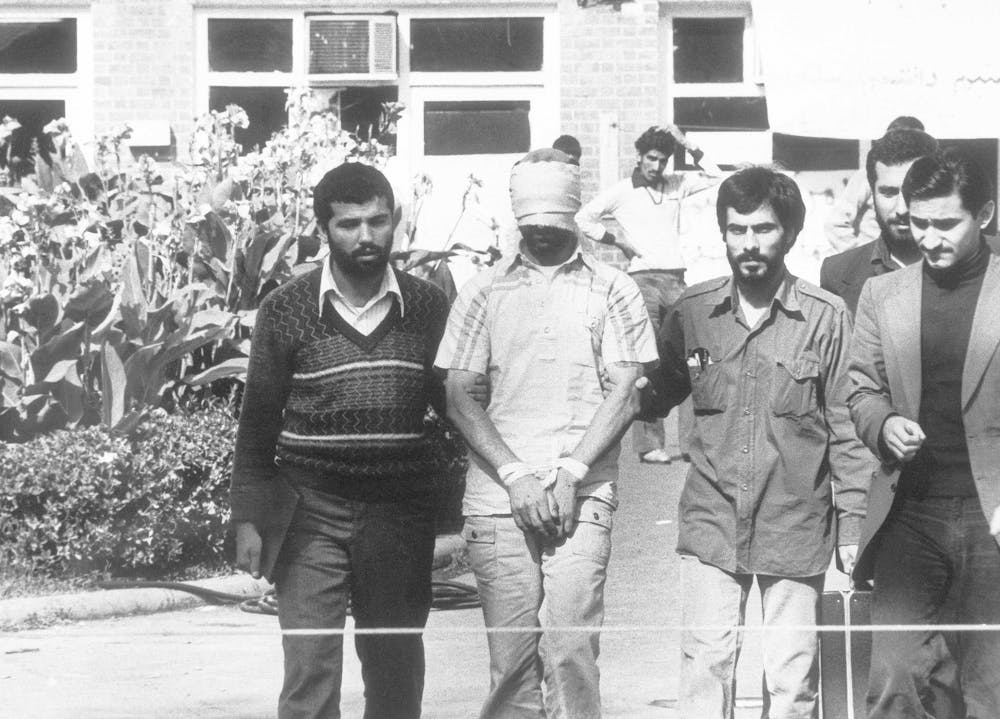
The two countries have been particularly hostile to each other since Iranian students took over the U.S. Embassy in Tehran in November 1979, resulting in economic sanctions and the severing of formal diplomatic relations between the nations.
Some of the major events in U.S.-Iran relations highlight the differences between the nations’ views, but others arguably presented real opportunities for reconciliation.
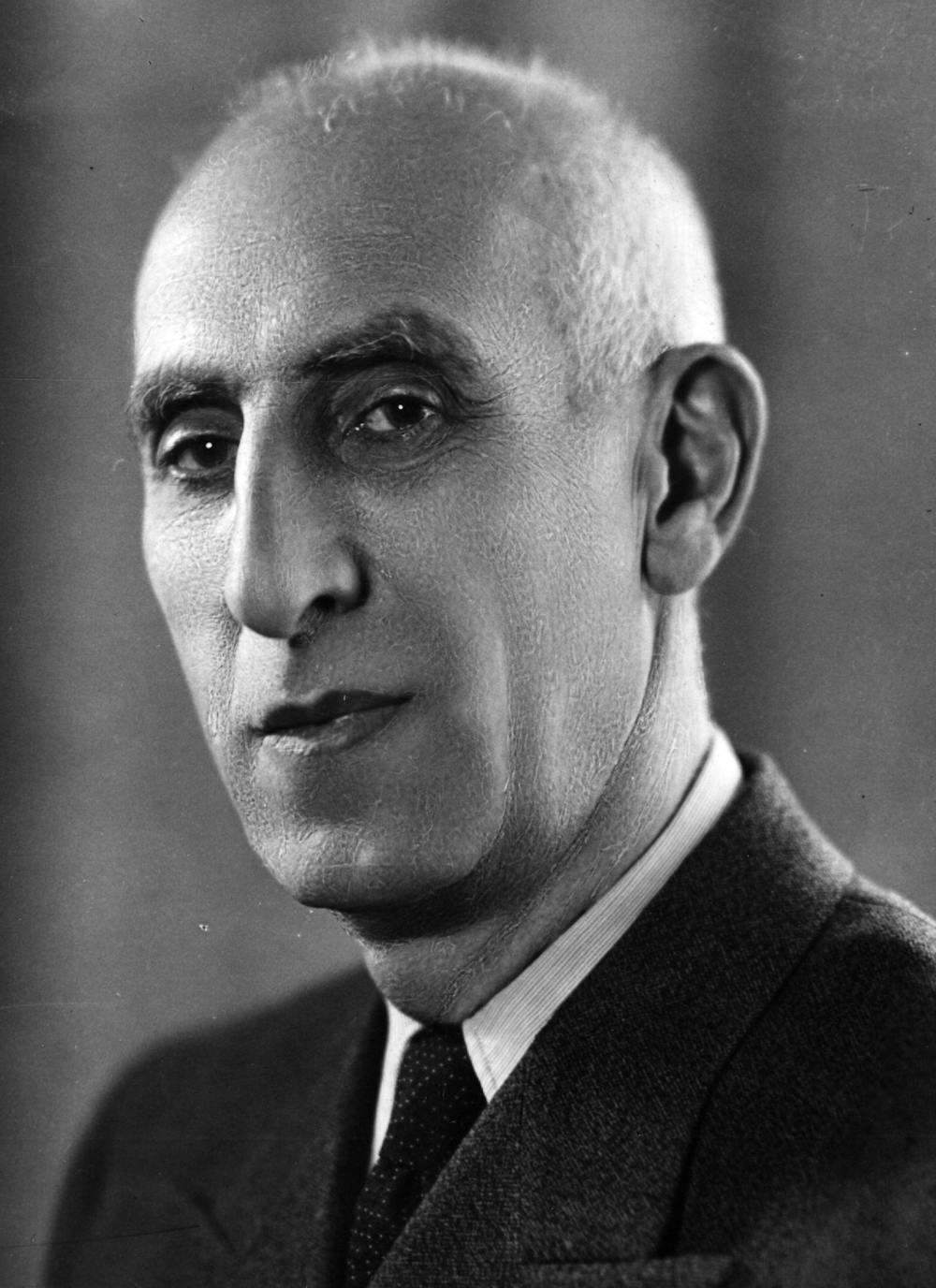
In 1951, the Iranian Parliament chose a new prime minister, Mossadegh, who then led lawmakers to vote in favor of taking over the Anglo-Iranian Oil Company, expelling the company’s British owners and saying they wanted to turn oil profits into investments in the Iranian people. The U.S. feared disruption in the global oil supply and worried about Iran falling prey to Soviet influence. The British feared the loss of cheap Iranian oil.
President Dwight Eisenhower decided it was best for the U.S. and the U.K. to get rid of Mossadegh. Operation Ajax, a joint CIA-British operation, convinced the Shah of Iran, the country’s monarch, to dismiss Mossadegh and drive him from office by force. Mossadegh was replaced by a much more Western-friendly prime minister, handpicked by the CIA.
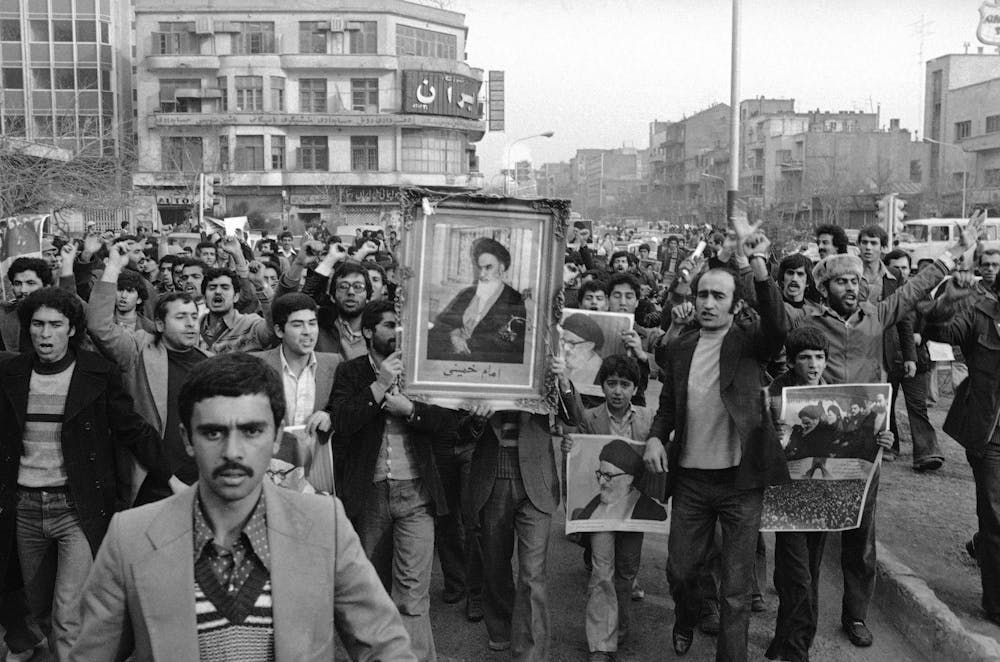
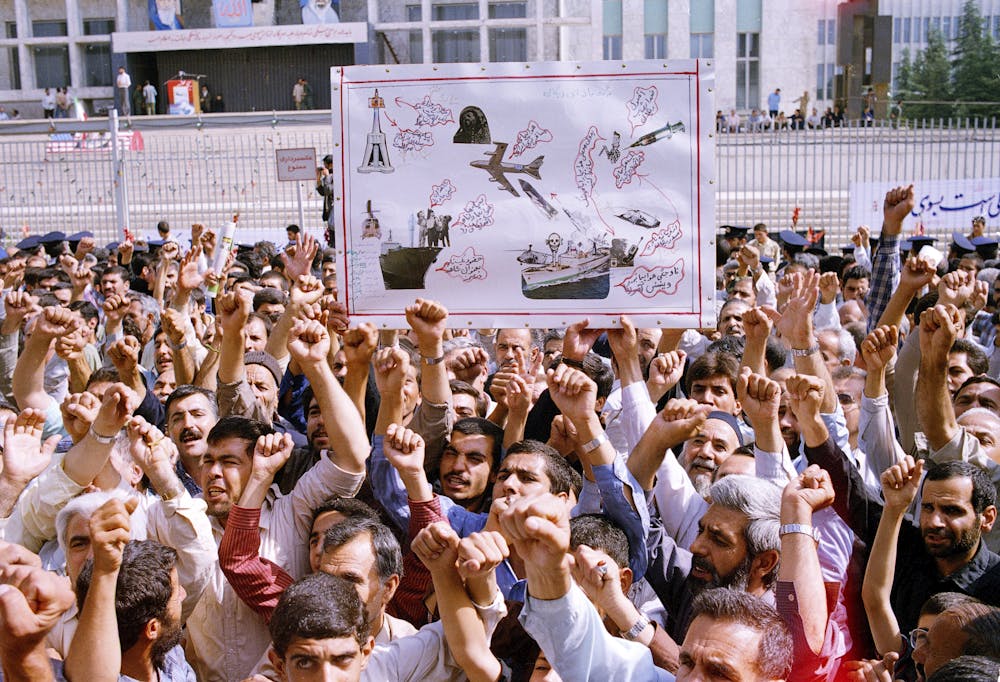
Demonstrators in Tehran demand the establishment of an Islamic republic. AP Photo/Saris
1979: Revolutionaries oust the shah, take hostages
After more than 25 years of relative stability in U.S.-Iran relations, the Iranian public had grown unhappy with the social and economic conditions that developed under the dictatorial rule of Shah Mohammad Reza Pahlavi.
Iranian students at the U.S. Embassy in Tehran show a blindfolded American hostage to the crowd in November 1979. AP Photo
In October 1979, President Jimmy Carter agreed to allow the shah to come to the U.S. to seek advanced medical treatment. Outraged Iranian students stormed the U.S. Embassy in Tehran on Nov. 4, taking 52 Americans hostage. That convinced Carter to sever U.S. diplomatic relations with Iran on April 7, 1980.
Two weeks later, the U.S. military launched a mission to rescue the hostages, but it failed, with aircraft crashes killing eight U.S. servicemembers.
The shah died in Egypt in July 1980, but the hostages weren’t released until Jan. 20, 1981, after 444 days of captivity.
An Iranian cleric, left, and an Iranian soldier wear gas masks to protect themselves against Iraqi chemical-weapons attacks in May 1988. Kaveh Kazemi/Getty Images
The U.S. was concerned that the conflict would limit the flow of Middle Eastern oil and wanted to ensure the conflict didn’t affect its close ally, Saudi Arabia.
U.S. officials moderated their usual opposition to those illegal and inhumane weapons because the U.S. State Department did not “wish to play into Iran’s hands by fueling its propaganda against Iraq.” In 1988, the war ended in a stalemate. More than 500,000 military and 100,000 civilians died.
1981-1986: US secretly sells weapons to Iran
The U.S. imposed an arms embargo after Iran was designated a state sponsor of terrorism in 1984. That left the Iranian military, in the middle of its war with Iraq, desperate for weapons and aircraft and vehicle parts to keep fighting.
The last shipment, of anti-tank missiles, was in October 1986. In November 1986, a Lebanese magazine exposed the deal. That revelation sparked the Iran-Contra scandal in the U.S., with Reagan’s officials found to have collected money from Iran for the weapons and illegally sent those funds to anti-socialist rebels – the Contras – in Nicaragua.
At a mass funeral for 76 of the 290 people killed in the shootdown of Iran Air 655, mourners hold up a sign depicting the incident. AP Photo/CP/Mohammad Sayyad
Either during or just after that exchange of gunfire, the Vincennes crew mistook a passing civilian Airbus passenger jet for an Iranian F-14 fighter. They shot it down, killing all 290 people aboard.
The U.S. called it a “tragic and regrettable accident,” but Iran believed the plane’s downing was intentional. In 1996, the U.S. agreed to pay US$131.8 million in compensation to Iran.
1997-1998: The US seeks contact
In August 1997, a moderate reformer, Mohammad Khatami, won Iran’s presidential election.
U.S. President Bill Clinton sensed an opportunity. He sent a message to Tehran through the Swiss ambassador there, proposing direct government-to-government talks.
Shortly thereafter, in early January 1998, Khatami gave an interview to CNN in which he expressed “respect for the great American people,” denounced terrorism and recommended an “exchange of professors, writers, scholars, artists, journalists and tourists” between the United States and Iran.
However, Supreme Leader Ayatollah Ali Khamenei didn’t agree, so not much came of the mutual overtures as Clinton’s time in office came to an end.
In his 2002 State of the Union address, President George W. Bush characterized Iran, Iraq and North Korea as constituting an “Axis of Evil” supporting terrorism and pursuing weapons of mass destruction, straining relations even further.
Inside these buildings at the Natanz nuclear facility in Iran, technicians enrich uranium. AP Photo/Vahid Salemi
That was a violation of the terms of the Nuclear Nonproliferation Treaty, which Iran had signed, requiring countries to disclose their nuclear-related facilities to international inspectors.
One of those formerly secret locations, Natanz, housed centrifuges for enriching uranium, which could be used in civilian nuclear reactors or enriched further for weapons.
Starting in roughly 2005, U.S. and Israeli government cyberattackers together reportedly targeted the Natanz centrifuges with a custom-made piece of malicious software that became known as Stuxnet.
An excerpt of the document sent from Iran, via the Swiss government, to the U.S. State Department in 2003, appears to seek talks between the U.S. and Iran. Washington Post via Scribd
In May 2003, senior Iranian officials quietly contacted the State Department through the Swiss embassy in Iran, seeking “a dialogue ‘in mutual respect,’” addressing four big issues: nuclear weapons, terrorism, Palestinian resistance and stability in Iraq.
Hardliners in the Bush administration weren’t interested in any major reconciliation, though Secretary of State Colin Powell favored dialogue and other officials had met with Iran about al-Qaida.
When Iranian hardliner Mahmoud Ahmadinejad was elected president of Iran in 2005, the opportunity died. The following year, Ahmadinejad made his own overture to Washington in an 18-page letter to President Bush. The letter was widely dismissed; a senior State Department official told me in profane terms that it amounted to nothing.
After a decade of unsuccessful attempts to rein in Iran’s nuclear ambitions, the Obama administration undertook a direct diplomatic approach beginning in 2013.
Iran, the U.S., China, France, Germany, Russia and the United Kingdom signed the deal in 2015. It severely limited Iran’s capacity to enrich uranium and mandated that international inspectors monitor and enforce Iran’s compliance with the agreement.
In return, Iran was granted relief from international and U.S. economic sanctions. Though the inspectors regularly certified that Iran was abiding by the agreement’s terms, President Donald Trump withdrew from the agreement in May 2018.
2020: US drones kill Iranian Maj. Gen. Qassem Soleimani
At the time, the Trump administration asserted that Soleimani was directing an imminent attack against U.S. assets in the region, but officials have not provided clear evidence to support that claim.
Hamas’ brazen attack on Israel on Oct. 7, 2023, provoked a fearsome militarized response from Israel that continues today and served to severely weaken Iran’s proxies in the region, especially Hamas – the perpetrator of the attacks – and Hezbollah in Lebanon.
2025: Trump 2.0 and Iran
Trump saw an opportunity to forge a new nuclear deal with Iran and to pursue other business deals with Tehran. Once inaugurated for his second term, Trump appointed Steve Witkoff, a real estate investor who is the president’s friend, to serve as special envoy for the Middle East and to lead negotiations.
Negotiations for a nuclear deal between Washington and Tehran began in April, but the countries did not reach a deal. They were planning a new round of talks when Israel struck Iran with a series of airstrikes on June 13, forcing the White House to reconsider is position.
On June 22, in the early morning hours, the U.S. chose to act decisively in an attempt to cripple Iran’s nuclear capacity, bombing three nuclear sites and causing what Pentagon officials called “severe damage.” Iran vowed to retaliate.
This story has been updated to reflect the U.S. bombing of Iranian nuclear sites on June 22, 2025.
Jeffrey Fields receives funding from the Carnegie Corporation of New York and Schmidt Futures.
Source: People’s Republic of China in Russian – People’s Republic of China in Russian –
Source: People’s Republic of China – State Council News
BEIJING, June 22 (Xinhua) — China strongly condemns the U.S. attacks on Iran and the U.S. bombing of nuclear facilities under International Atomic Energy Agency (IAEA) safeguards, a Chinese Foreign Ministry spokesman said Sunday.
The diplomat said this while commenting on the statement by US President Donald Trump that the United States had struck three nuclear facilities in Iran.
As the official representative noted, by its actions the United States seriously violated the purposes and principles of the UN Charter and international law, and also exacerbated tensions in the Middle East.
China calls on all parties to the conflict, first and foremost Israel, to cease fire as soon as possible, ensure the safety of civilians, and begin dialogue and negotiations, the official representative emphasized.
According to him, the Chinese side is ready to cooperate with the international community to consolidate efforts, defend justice, and contribute to the restoration of peace and stability in the Middle East. –0–
Aden, 22 June 2025 – The food security situation in the Government-controlled areas of southern Yemen is dire, with nearly half of the population acutely food insecure and struggling to find their next meal. The Food and Agriculture Organization of the United Nations (FAO), World Food Programme (WFP), and UNICEF have warned that the food insecurity crisis is likely to worsen in the months ahead.
The latest Integrated Food Security Phase Classification (IPC)partial update, released today, paints a grim picture for southern governorates. Between May 2025 and August 2025, around 4.95 million people are facing Crisis-level food insecurity or worse (IPC Phase 3+), including 1.5 million in Emergency (IPC Phase 4). This marks an increase of 370,000 people suffering from severe food insecurity compared to the period November 2024 to February 2025.
Looking ahead, the situation is expected to deteriorate even further. Between September 2025 and February 2026, an additional 420,000 people could fall into IPC Phase 3 or worse, if urgent and sustained assistance is not provided. That would bring the total number of severely food-insecure people in southern governorate areas to 5.38 million—more than half of the population.
Multiple overlapping crises continue to drive food insecurity, including sustained economic decline, currency depreciation in southern governorates, conflict, and increasingly severe weather events. The delayed planting season, heightened likelihood of flood risk in July, and the spread of plant and livestock diseases, especially desert locusts, are further expected to compound pressures on an already fragile situation.
Humanitarian actors including UNICEF, WFP, and FAO are reprioritizing their humanitarian efforts in Yemen, targeting high-risk areas with integrated interventions in food security, nutrition, WASH, health and protection sectors to maximize lifesaving impact.
“The fact that more and more people in Yemen don’t know where their next meal will come from is extremely concerning at a time when we are experiencing unprecedented funding challenges,” said Siemon Hollema, the Deputy Country Director of WFP in Yemen. “Immediate support is needed to ensure that we can continue to serve the most vulnerable families that have nowhere else to turn.”
The agencies are urgently calling for sustained and at-scale humanitarian and livelihoods support assistance to prevent communities from falling deeper into food insecurity, ensure access to essential services and generate economic and livelihood opportunities.
Dr. Hussein Gadain, FAO Representative in Yemen, emphasized, “The situation is dire and requires urgent intervention, with agriculture holding the key to ending Yemen’s food insecurity crisis. Further, delayed and insufficient rainfall in April has cast a shadow over the current planting season, threatening the already fragile farming livelihoods and food availability. With urgent support, we can revitalize local food production, safeguard livelihoods, and move from crisis to resilience building ensuring, efficiency and effectiveness.”
Internally displaced persons, low-income rural households and vulnerable children are particularly affected, facing increased vulnerability due to funding cuts, declining livelihood opportunities, and reduced coping mechanisms.
Peter Hawkins, UNICEF Representative to Yemen, highlighted that “Approximately 2.4 million children under the age of five and 1.5 million pregnant and lactating women suffer from acute malnutrition in Yemen, placing them at greater risk of illness, developmental delays, and death.” “The IPC nutrition data suggests further deterioration in at least 5 out of 17 of the livelihood zones in IRG areas, so UNICEF and partners are making provisions to scale up intervention which needs to be sustained if we are going to overcome the crisis,” added Peter Hawkins.
——End—–
About FAO: The Food and Agriculture Organization (FAO) is a specialized agency of the United Nations that leads international efforts to defeat hunger. Our goal is to achieve food security for all and make sure that people have regular access to high-quality food to lead active, healthy lives. With over 194 members, FAO works in over 130 countries worldwide.
Follow FAO Yemen on X for more: @FAOYemen
About the United Nations World Food Programme (WFP): WFP is the world’s largest humanitarian organization, saving lives in emergencies and using food assistance to build a pathway to peace, stability, and prosperity for people recovering from conflict and disasters.
Follow us on Twitter @WFPYemen
About UNICEF: UNICEF promotes the rights and wellbeing of every child, in everything we do. Together with our partners, we work in 190 countries and territories to translate that commitment into practical action, focusing special effort on reaching the most vulnerable and excluded children, to the benefit of all children, everywhere.
For more information about UNICEF Yemen and its work for children, visit www.unicef.org/yemen
Source: The Conversation – Canada – By Mohammadamin Ahmadfard, Postdoctoral Fellow, Mechanical & Industrial Engineering, Toronto Metropolitan University
Artificial intelligence (AI) is quietly transforming how cities generate, store and distribute energy, acting as the invisible conductor that orchestrates cleaner, smarter and more resilient cities.
By integrating renewables — from solar panels and wind turbines to geothermal grids, hydrogen plants, electric vehicles and batteries — AI can enable cities to manage diverse energy sources as a single, intelligent system.
One striking example is the Oya Hybrid Power Station in South Africa. Here, AI-driven controls seamlessly co-ordinate solar, wind and battery storage to deliver reliable power to up to 320,000 households. Using AI makes this kind of integration not only possible, but dramatically more efficient.
Recent research shows AI can also optimize how batteries, solar and the grid interact in buildings. A 2023 study found that deep learning and real-time data helped a boarding school in Turin, Italy increase low-cost energy purchases and cut its electricity bill by more than half.
Cleaner, smarter energy grids
AI models are increasingly able to predict weather with greater precision. These predictions allow electric grid operators to plan hours ahead, storing excess energy in batteries or adjusting supply to meet demand before a storm or heatwave hits.
Using AI to respond strategically to weather is a game-changer. In Cambridge, England, a system called Aardvark uses satellite and sensor data to generate rapid, accurate forecasts of sun and wind patterns.
Unlike traditional supercomputer-driven weather models, Aardvark’s AI can deliver precise local forecasts in minutes on an ordinary computer. This makes advanced weather prediction more accessible and affordable for cities, utilities and even smaller organizations — potentially transforming how communities everywhere plan for and respond to changing weather.
AI models are increasingly able to predict weather with greater precision, allowing electric grid operators to plan ahead, storing excess energy in batteries or adjusting supply to meet demand before a storm or heat wave hits. (Shutterstock)
AI for smarter district heating and cooling
In Munich, Germany, AI is improving geothermal district heating by using underground sensors to monitor temperature and moisture levels in the ground.
The collected data feeds into a digital simulation model that helps optimize network operations. In more advanced versions, during winter cold snaps, such systems can suggest lowering flow to underused spaces like half-empty offices and boosting heat where demand is higher, such as in crowded apartments.
This intelligent, self-optimizing approach extends the life of equipment and delivers more warmth with the same energy input.
This is a breakthrough with enormous potential for cities in cold climates with established geothermal networks, such as Winnipeg in Canada and Iceland’s Reykjavik.
Although these cities have not yet adopted AI-driven monitoring systems, they could benefit from AI’s real-time improvements in efficiency, comfort and energy savings during harsh winters — a principle that holds true wherever geothermal district heating and cooling exists.
Inside the home, AI-managed smart climate systems can factor in how many people are in each room, which appliances are in use, how much natural sunlight each space receives. (Shutterstock)
Smart buildings
Inside the home, AI-managed smart climate systems can factor in how many people are in each room, which appliances are in use, how much natural sunlight each space receives and how much electricity or heat a home’s solar panels generate throughout the day.
Based on this, AI determines how to heat or cool rooms efficiently, and can transfer energy from one space to another, balancing comfort with minimal energy use.
Coastal cities and those in wind-heavy regions are using AI in other creative ways. In Orkney, Scotland, excess wind and tidal energy are converted into green hydrogen. Instead of letting that surplus power go to waste, an AI system called HyAI controls when to generate hydrogen based on wind forecasts, electricity prices and how full the hydrogen storage tanks are.
When winds are strong at night and electricity is cheap, the AI can divert surplus power to produce hydrogen and store it for later use. On calmer days, that stored hydrogen can power fuel cells or buses.
Energy storage
AI is transforming energy storage into a smart, revenue-generating force. In Finland, a startup called Capalo AI has developed Zeus VPP, an AI-powered virtual power plant that aggregates distributed batteries from homes, businesses and other sites.
Zeus VPP uses advanced forecasting and AI algorithms to decide when batteries should charge or discharge, factoring in energy prices, local consumption and weather forecasts. This enables battery owners to earn revenue by participating in electricity markets, while also supporting grid stability and making better use of renewable energy.
AI-powered dynamic line rating adjusts how much electricity a line can carry in real time, boosting capacity by 15 to 30 per cent when conditions allow. This helps utilities maximize the use of existing infrastructure instead of relying on costly upgrades.
At the local level, AI analyzes smart metre data to predict which transformers are overheating due to rising EV and heat pump use.
By forecasting these stress points, utilities can proactively upgrade equipment before failures happen — a shift from reactive to predictive maintenance that makes the grid stronger and cities more resilient.
AI-powered public transit and mobility
Transportation innovation is becoming part of the energy solution, with AI at the centre of this transformation. In New York City, energy company Con Edison has installed major battery storage systems to help manage peak electricity demand and reduce reliance on polluting peaker plants, which supply energy only during high-demand periods.
More broadly, Con Edison is deploying advanced AI-powered analytics software across its electric grid — optimizing voltage, enhancing reliability and enabling predictive maintenance. Together, these efforts show how combining energy storage and AI-driven analytics can make even the world’s busiest cities more resilient and efficient.
AI is also powering “vehicle-to-grid” innovations in California, where an AI-driven platform manages electric school buses that can supply stored energy back to the grid during periods of high demand.
By carefully managing when buses charge and discharge, these systems help keep the grid reliable and ensure vehicles are ready for their daily routes. As this technology expands, parked electric vehicles could serve as valuable backup resources for the electricity system.
Transportation innovation is becoming part of the energy solution. (Shutterstock)
AI for clean energy initiatives
AI is rapidly transforming cities by revolutionizing how energy is used and managed. Google, for example, has slashed cooling energy at its data centres by up to 40 per cent using AI that fine-tunes fans, pumps and windows more efficiently than any human operator.
Organizations like the Electric Power Research Institute (EPRI), in collaboration with NVIDIA, Microsoft and others, have launched the Open Power AI Consortium, which is creating open-source AI tools for utilities worldwide.
These tools will enable even the most resource-constrained cities to deploy advanced AI capabilities, without having to start from scratch, helping to level the playing field and accelerate the global energy transition.
The result is not just cleaner air and lower energy bills, but a path to fewer blackouts and more resilient homes.
Mohammadamin Ahmadfard receives funding from the Natural Sciences and Engineering Research Council of Canada (NSERC) and Mitacs Inc. for his postdoctoral research at Toronto Metropolitan University.
Source: People’s Republic of China – State Council News
JERUSALEM, June 22 (Xinhua) — The Israel Defense Forces (IDF) said in a statement that its fighter jets struck two warplanes at Dezful airport in western Iran on Sunday morning.
The statement said eight rocket launchers had been “neutralized” in separate strikes earlier in the morning, six of which were poised to fire into Israeli territory.
It reported that on Saturday evening, about 20 Israeli fighter jets struck dozens of military targets in Iran.
According to the statement, the targets hit included a military facility housing components for the production of explosives, a weapons depot and production facilities, as well as air defense systems. –0–
Source: People’s Republic of China in Russian – People’s Republic of China in Russian –
Source: People’s Republic of China – State Council News
BEIJING, June 22 (Xinhua) — Beijing authorities have urged the public to take precautions as the city continues to be gripped by a heat wave.
Temperatures in the central part of the city ranged from 34.7 to 35.6 degrees Celsius at midday on Sunday, according to the Beijing Meteorological Observatory.
A yellow alert for high temperatures was issued in the capital at 2.30pm on Friday, with meteorologists predicting continued hot weather throughout the coming week.
Local authorities advised residents to limit their time outdoors and replenish fluids in a timely manner. Workers working outdoors, such as construction workers, traffic police officers, sanitation workers, and couriers, were advised to adjust their work schedules to prevent negative phenomena such as heatstroke and sunstroke.
Beijing authorities also warned the public to use electricity safely to prevent fires, and urged parents to closely monitor children who could be at risk of drowning while trying to cool off in rivers. -0-
PM call with King Abdullah II of Jordan: 22 June 2025
The Prime Minister spoke to His Majesty the King of Jordan Abdullah II this morning.
The Prime Minister spoke to His Majesty the King of Jordan Abdullah II this morning.
Following US strikes on Iran overnight, he reiterated that Iran’s nuclear programme is a grave threat to international security and they must never be allowed to develop a nuclear weapon.
They called on Iran to return to the negotiating table in pursuit of a diplomatic solution.
Turning to Gaza, they underlined their support for an immediate ceasefire to end the intolerable circumstances facing civilians there.
The Prime Minister offered his strong support to King Abdullah, adding that wider regional stability in the Middle East must be a priority.
The Prime Minister spoke to the Sultan of Oman, His Majesty Haitham bin Tarik al Said, this morning.
The Prime Minister spoke to the Sultan of Oman, His Majesty Haitham bin Tarik al Said, this morning.
Discussing the developments in the Middle East overnight, they agreed on the grave threat posed by Iran’s nuclear programme and reiterated calls for them to return to the negotiating table.
An escalation of the conflict is in no-one’s interests and the focus must be on de-escalation, they added.
Both leaders agreed that the situation in Gaza is intolerable, and we must maintain momentum behind reaching an immediate ceasefire there.
Police have shot and killed an alleged wanted Mozambican kidnapping kingpin during an Anti-kidnapping Task Team operation in Fourways.
In a statement on Saturday, the South African Police Service (SAPS) said the Anti-kidnapping Task Team traced Mauro Mucambe Junior to a block of apartments in Fourways, Johannesburg this week. This came as the team was tracing a kidnapped Pakistani businessman from Pretoria West who is still in captivity.
“The team [is] still searching for the Pakistani national. A ransom demand has been made to the businessman’s family. The team’s tracing operation began at a residential complex in Carlswald, Midrand where they seized a Mercedes Benz, a silver Pajero and arrested two kidnappers.
“They proceeded to Fourways where the task team announced their arrival and a shootout ensued. One suspect was fatally wounded and upon further investigation, it was discovered that 40-year-old Mauro Mucambe Junior is a wanted kidnapping kingpin in Mozambique where he has been linked to several kidnappings. His warrant of arrest was issued by Maputo Police in August 2024,” said the SAPS.
One unlicensed firearm used by Junior was seized including 10 rounds of ammunition as well as four cellphones and four bank cards.
“The SAPS has full faith and confidence in the work of the Anti-kidnapping Task Team to rescue the kidnapped businessman. Since January 2024 to date, the team has arrested more than 170 criminals involved in kidnappings for ransom.
“More than R1.2 million has been recovered. More than 100 victims [have been] rescued mainly in Gauteng and more than 40 vehicles used in kidnapping crimes were also seized by the team. The team recently registered a breakthrough in the Olorato Mongale murder case where they led the tracing operation of Philangenkosi Makhanya. The search is still on for Bongani Mthimkhulu,” said police. SAnews.gov.za
Following the recent floods in the Eastern Cape which claimed the lives of over 90 people, several Deputy Ministers are today visiting the affected areas to assess ongoing relief efforts.
“Human Settlements Deputy Minister Tandi Mahambehlala, together with Deputy Minister in the Presidency, Nonceba Mhlauli, Deputy Minister of Home Affairs, Njabulo Nzuza, and Deputy Minister of COGTA [Cooperative Governance and Traditional Affairs], Zolile Burns-Ncamashe will be in the Eastern Cape to assess ongoing relief efforts, taking into account the plight of affected communities after the disastrous floods two weeks ago, that left many homes destroyed, and more than 90 people losing their lives,” said the Presidency.
The Deputy Ministers visit on Sunday is part of government efforts to enhance the responses and measures that have been put in place to assist those affected by the floods that ravaged areas of Mthatha and Butterworth.
“Government officials from Home Affairs, SASSA [South African Social Security Agency], Human Settlements Emergency Housing and Health have been on the ground since the floods occurred to assist affected communities,” said the Presidency.
The Deputy Ministers will visit the Mnquma Local Municipality’s Home Affairs Mobile Service as well as the Theko Fihla Village. In the KSD Local Municipality, the Deputy Ministers will visit the Slovo Anglican Church in Mthatha and the temporary residential accommodation for flood victims at Innoview Lodge among others.
On Thursday the Eastern Cape Provincial Government held a Provincial Day of Mourning in honour of the victims of the floods.
President Cyril Ramaphosa also visited the province where he expressed his sorrow over the floods. The country’s commander-in-chief emphasised the severity of the situation, noting that while the impact has been tragic, quick response teams prevented an even worse outcome.
“We are very, very disturbed that so many people have passed away, but it could have been much worse. The response teams acted quickly.”
In response to the devastating situation in Mthatha, government officials, key Ministers, the Premier, and local government representatives, visited the area to offer support and assess the damage.