Category: Natural Disasters

  • MIL-OSI Global: Israel’s attacks have exposed weaknesses in Iran, but it’s in little danger of collapsing

    Source: The Conversation – UK – By Farhang Morady, Principal Lecturer in International Development, University of Westminster

    The Israeli prime minister, Benjamin Netanyahu, has said that his country’s campaign in Iran “could certainly” lead to regime change. In an interview with Fox News on June 15, he called the government in Tehran “very weak” and added that, given the opportunity, “80% of the [Iranian] people would throw these theological thugs out”.

    Israel’s military actions so far indicate that its goals probably do extend beyond eliminating Iran’s nuclear programme. Airstrikes have targeted military leadership, internal security facilities and the headquarters of Iran’s state broadcaster. Israel’s aim is seemingly to destabilise the regime by inciting a popular uprising and fragmenting elite support.

    Tehran, meanwhile, has been eager to project an image of strength and stability. It has sought to illustrate its resilience and unity through constant coverage by state media, highlighting its military readiness while also broadcasting public displays of loyalty. Government officials have also visited affected regions.

    This raises the question: is more than four decades of theocratic rule in Iran really as close to collapse as Netanyahu says it is?


    Get your news from actual experts, straight to your inbox. Sign up to our daily newsletter to receive all The Conversation UK’s latest coverage of news and research, from politics and business to the arts and sciences.


    The Israeli attacks have exposed weaknesses in the Iranian state. Several senior military officials and top nuclear scientists have been killed, while Israel has been able to strike targets in the Iranian capital, Tehran, with relative ease after crippling Iran’s air defences.

    Strategic sites in Iran have proven vulnerable, with nuclear sites and military command headquarters hit hard. Many residents of Tehran have fled to other cities fearful that the situation will worsen.

    However, despite inflicting significant damage, the strikes have not caused the downfall of the regime’s core institutions. The deaths of at least 20 key commanders prompted the Iranian supreme leader, Ayatollah Ali Khamenei, to reshuffle Iran’s military leadership to maintain stability and control. New appointments were made swiftly.

    And, at least publicly, the Iranian elite is maintaining its position that the country can endure the crisis without giving in to foreign pressure. Khamenei has even warned the US president, Donald Trump, that the US will “face irreparable harm” should it become involved in the conflict.

    Diplomatic manoeuvres behind the scenes, however, suggest the regime is demonstrating a willingness to compromise to ensure its survival. An unverified Iranian diplomatic statement on June 16 even indicated that the regime would be willing to suspend uranium enrichment to maintain itself.

    The Iranian government is probably displaying confidence in public as a strategic move to prevent domestic unrest. Iran is facing significant economic, political and social challenges. Over 60% of its population is under 30 years old, and this demographic is increasingly disconnected from the principles promoted by the regime.

    Widespread protests erupted in 2022 following the death of a young woman called Mahsa Amini while she was in police custody for allegedly violating hijab regulations. The protests demonstrated deep-seated discontent with the regime and its morality laws that dictate women’s attire and public behaviour.

    The protests were suppressed, but underlying discontent remains. Israeli leaders hope that striking Iran might start a chain reaction leading to an uprising that topples the Islamic Republic. Israel’s defence minister, Israel Katz, hinted as much on June 19. He said the military has been instructed to intensify strikes on targets in Tehran in order to destabilise the “Ayatollah regime”.

    No imminent collapse

    Despite immense pressure, the collapse of Iran’s theocratic regime is not imminent. It continues to hold authority over its military and controls the media. The regime sustains itself through its powerful institutional base rather than public approval.

    Opposition movements are also fragmented and lack an organised structure. Groups like Mojahedin-e-Khalq and the movement led by Reza Pahlavi, the exiled eldest son of the last shah of Iran, have sought to gain influence with western support. However, they lack popular backing within Iran.

    The Islamic Republic appears to be on a path of gradual deterioration rather than complete collapse. However, Trump does appear to be warming to the idea of helping Israel overthrow the government in Tehran. And any US involvement would intensify pressure on the regime significantly.

    On June 17, Trump described Khamenei as an “easy target” who is safe only “for now”. Trump has since said his patience with Iran had run out, saying “I may do it, I may not do it” when asked a question about US involvement in Iran.

    The US possesses the 30,000-pound “bunker buster” bomb capable of damaging Iran’s deep-lying uranium enrichment facilities and the B-2 stealth bomber to carry it. And it has been moving military assets to its bases in the Middle East.

    It is uncertain whether these actions represent direct provocation or simply an attempt by Trump to exert more pressure on Iran to negotiate an end to the conflict.

    Trump’s camp is split over potential US involvement in Iran. Some US military and intelligence officials – including the director of national intelligence, Tulsi Gabbard – have expressed concerns about a direct confrontation.

    It is also possible that Israeli and US attempts to impose a change of government in Iran could even unite the regime. The Islamic Republic has a history of using foreign pressure to justify domestic crackdowns and increase its domestic control.

    The external efforts to accelerate the collapse of the regime could, somewhat counterintuitively, help the regime survive in the short-term while deeper internal problems continue to exist.

    Farhang Morady does not work for, consult, own shares in or receive funding from any company or organisation that would benefit from this article, and has disclosed no relevant affiliations beyond their academic appointment.

    ref. Israel’s attacks have exposed weaknesses in Iran, but it’s in little danger of collapsing – https://theconversation.com/israels-attacks-have-exposed-weaknesses-in-iran-but-its-in-little-danger-of-collapsing-259230

    MIL OSI – Global Reports

  • MIL-OSI Global: Indigenous engagement is essential for small modular nuclear reactor projects

    Source: The Conversation – Canada – By Rhea Desai, Post Doctoral Fellow, Department of Biology, McMaster University

    Urban Indigenous gathering for community well-being, showing the importance of interconnectedness in Indigenous Communities in Hamilton, Ont. in August 2021. This way of being must be reflected in nuclear projects to better work alongside Indigenous Peoples. (Michelle Webb)

    With climate change-fuelled natural disasters becoming more frequent and devastating for communities around the world, the need for cleaner energy solutions is more urgent than ever.

    When it comes to transitioning away from fossil fuels, much of the focus tends to be on solar, wind or hydroelectricity. However, small modular reactors (SMRs) are an emerging technology showing promise globally.

    SMRs are a specific type of nuclear reactor that, as the name suggests, are small in energy output and modular in their manufacturing. Provinces like New Brunswick, Alberta and Saskatchewan have made progress on strategic plans to make SMRs part of their provincial climate action plans.

    Unlike traditional nuclear reactors that generally produce more than 1,000 megawatts of electricity, SMRs are designed to produce as low as five megawatts. The modularity of such reactors allows for manufacturing off-site and installation at the desired location. This can decrease construction time, manufacturing costs and certain environmental costs associated with building on site.

    This means SMRs are more feasible for many off-grid communities that lack reliable access to electricity, many of which are Indigenous. In 2023, the Canada Energy regulator said there were 178 remote Indigenous and northern communities not connected to the North American electricity grid and natural gas infrastructure.

    In an effort to shift reliability from carbon-emitting resources to nuclear power, SMRs provide an exciting alternative, but implementation needs effective engagement with Indigenous communities to flourish.

    Small modular reactors (SMRs) could be relatively feasible way to generate power for many off-grid communities.
    (A. Vargas/IAEA)

    Engaging Indigenous communities

    Much of Canada’s electricity is already generated from low-carbon emission sources. However, there are still areas in northern Canada that are reliant on diesel, and therefore SMR plans are often aimed at providing electricity to these communities.

    While on paper, this might sound like the perfect solution, there’s a lot to consider about SMR siting from an environmental perspective in these remote communities. These considerations include but are not limited to potential locations, source term, refuelling and waste management.

    As research continues into the engineering and science behind SMR technology, meaningful community engagement with Indigenous communities is also required.

    Thoughtfully considered and integrated consultations are necessary to ensure projects respect treaties, land rights and the surrounding environment. Consultation is needed to understand the needs and goals of the community for creating an energy transition plan.

    In addition, incorporating traditional ecological knowledge in environmental risk assessments is vital. Ultimately, projects designed alongside Indigenous communities should strive for Indigenous sovereignty over growing infrastructure.

    Why community engagement is important

    Indigenous communities continue to face challenges as a result of colonization. The Truth and Reconciliation Commission’s (TRC) seventh Call to Action highlights the need to eliminate educational and employment disparity between Indigenous and non-Indigenous Canadians.

    A direct way to address in terms of Canada’s nuclear landscape is to train members of those communities in technical roles related to the planning, deployment and sustained use of a nuclear facility. Specifically, training today’s Indigenous youth so they can fulfil these roles in their future careers.

    The TRC’s Call to Action 92 calls on Canada’s corporate sector to engage in meaningful consultation, respectful relationship-building and equitable access to training and education opportunities that will contribute to long-term benefits from any economic development projects.

    Through understanding the need for this relationship-building, there is a lot that western practices can learn from adopting Indigenous ways of knowing. Indigenous people have a long history of sustainable practices in their culture and traditions, and although western science now consider sustainable practices, it is not deeply woven into community and industrial initiatives.

    As nuclear projects advance in Canada, it’s vital to respect Indigenous knowledge through weaving with western science. Projects can adopt a Two-Eyed seeing approach. This refers to viewing a problem with one eye using an Indigenous knowledge perspective and the other with a western knowledge lens. There is much to learn from understanding the philosophy behind Indigenous ways of knowing that can be applied to protect the environment.

    Indigenous knowledge varies across Canada and comes with different insights, but a commonality is the teaching that all living things are interconnected and must be respected and cared for. This perspective is necessary for the future of nuclear projects to ensure the environment is sustained to support the biodiversity of regions throughout Canada.

    This informed approach of protecting the environment, together with an ecosystem approach that considers the uniqueness and interconectedness of each organism, will ultimately lead to improved nuclear policies and safety.

    The actions that institutions and private industry take today to build strong relationships with Indigenous communities and work towards an increasingly sustainable future will support already resilient communities so they can see growth well beyond the deployment of SMRs. A path to a cleaner future is in reach, but only if we walk beside Indigenous leaders, knowledge holders, community members and, especially, youth.

    The authors do not work for, consult, own shares in or receive funding from any company or organisation that would benefit from this article, and have disclosed no relevant affiliations beyond their academic appointment.

    ref. Indigenous engagement is essential for small modular nuclear reactor projects – https://theconversation.com/indigenous-engagement-is-essential-for-small-modular-nuclear-reactor-projects-252134

    MIL OSI – Global Reports

  • MIL-OSI Canada: Investing in flood reduction capacity in Peterborough

    Source: Government of Canada News (2)

    Peterborough, ON, June 19, 2025 — The new downtown flood reduction project in Peterborough, supported by an $11-million investment from the federal government, will replace an existing storm sewer and help improve water flow and drainage, significantly reducing the impact of extreme weather events for homes and businesses.

    A 2004 storm brought severe rainfall and caused significant flood damage to downtown Peterborough. It disrupted residential living conditions, caused lost income to local businesses, and created financial hardships for affected community members. As part of the City’s strategy to prevent future floods of this magnitude, a 100-year capacity sewer will replace the existing sewer along Charlotte Street from Park Street to Water Street. The project will also improve water flow and drainage from the street, significantly reducing the impact of extreme weather events.

    Investing in public infrastructure projects designed to mitigate current and future climate-related risks supports more resilient Canadian communities. Making adaptation investments now will have major economy-wide benefits later. Every dollar that is invested in adapting and preparing for climate-related disasters can return as much as $13 to $15 in benefits.

    MIL OSI Canada News

  • MIL-OSI Russia: Ceasefire is an urgent priority in resolving the conflict in the Middle East – Xi Jinping

    Translation. Region: Russian Federal

    Source: People’s Republic of China in Russian – People’s Republic of China in Russian –

    Source: People’s Republic of China – State Council News

    BEIJING, June 19 (Xinhua) — A ceasefire is an urgent priority in resolving the conflict in the Middle East, Chinese President Xi Jinping said Thursday.

    The Chinese leader made the corresponding statement in a telephone conversation with Russian President Vladimir Putin. During the conversation, the heads of the two states exchanged views on the situation in the Middle East.

    Xi Jinping outlined China’s principles and position, saying that the current situation in the Middle East is extremely dangerous, proving once again that the world is entering a new turbulent period of fundamental change.

    If the conflict continues to escalate, it will not only lead to increased losses for its participants, but will also cause serious damage to states throughout the region, the Chinese president warned.

    The use of force, Xi Jinping stressed, is not the right way to resolve international disputes and only increases hatred and exacerbates contradictions.

    The conflicting parties, especially Israel, must cease fire as soon as possible to stop the spiral of escalation and under no circumstances allow the war to spread beyond the region, the Chinese leader said.

    Xi said ensuring the safety of civilians is a top priority, adding that the red line of protecting civilians in armed conflicts should never be crossed and the indiscriminate use of force is unacceptable.

    The Chinese President called on the parties to the conflict to strictly adhere to international law, avoid causing harm to innocent civilians and facilitate the safe evacuation of third-country nationals.

    Launching dialogue and negotiations is the fundamental way to resolve the issue, and communication and dialogue are the right path to lasting peace, Xi Jinping is convinced.

    He called on relevant parties to remain firmly committed to finding a political solution to the Iranian nuclear issue and return the issue to the path of political settlement through dialogue and negotiations.

    The international community’s efforts to establish peace are indispensable, Xi Jinping noted, adding that without stability in the Middle East, world peace is unlikely.

    The Chinese President noted that the conflict between Israel and Iran has led to a sudden escalation of tensions in the Middle East and dealt a serious blow to global security.

    The international community, especially large countries with special influence on the parties to the conflict, should make efforts to cool the situation, rather than do the opposite, Xi stressed, calling on the UN Security Council to play a more active role in this regard.

    Xi Jinping said China is willing to continue to strengthen communication and coordination with all parties, pool their efforts, uphold justice and play a constructive role in restoring peace in the Middle East. –0–

    MIL OSI Russia News

  • MIL-OSI USA: Case Proposes Measure To Advance Energy Resiliency For Remote Island, Native Hawaiian and Tribal Communities

    Source: United States House of Representatives – Congressman Ed Case (Hawai‘i – District 1)

    (Washington, DC) – U.S. Congressman Ed Case (HI-01) today announced an effort to codify into law a federal program to expand energy resilience and reliability for some of the nation’s most vulnerable regions – isolated island, Native Hawaiian and Tribal communities – which often face common and unique energy obstacles including limited energy infrastructure, high costs of imported energy and vulnerability to natural disasters.

    “In Hawai‘i, which ranks as the state with the most expensive power in the nation, residential electricity rates average 34 cents per kilowatt, far exceeding the national average by threefold,” said Case. “My bill will ensure continued federal support for Hawaii’s effort to transition to clean, affordable energy sources in ways that address our unique challenges.”

    These unique energy resilience challenges in Hawai‘i, along with remote and Tribal areas, are the focus of the U.S. Department of Energy’s Energy Transitions Initiative Project program. Since its inception, this program has partnered with over 25 Tribal, coastal, remote and island communities across the nation to help them secure reliable and affordable energy. Congressman Case has long supported this program through his assignment on the House Appropriations Committee.

    “Although the Energy Transitions Initiative Partnership Project program has helped Hawai‘i and many other communities many across our great nation, it has never been formally codified,” said Case. “My bill, the Energy Transitions Initiative Authorization Act, will ensure this program can continue the technical assistance offered to remote, island and Tribal communities that is unique and accommodating to their expertise and deep knowledge of local challenges and solutions.”

    The Energy Transitions Initiative Partnership Project program provides customized technical and financial assistance to community projects aimed at accessing reliable and affordable power and increasing energy resilience. Specific community projects include solar power interconnection, analyzing wind energy potential, conducting wildfire preparedness, advancing weatherization retrofits and implementing microgrids and battery storage projects.

    In Hawai‘i, the Energy Transitions Initiative Partnership Project program has provided technical assistance to the City and County of Honolulu to conduct microgrid location analyses for regional hybrid microgrids and map designs.

    Because Hawai‘i is prone to severe weather conditions that have previously caused long-duration power outages, Hawai‘i has identified hybrid microgrids as one method to improve resilience. Microgrids are best suited to areas prone to prolonged outages during weather events, with clusters of customers and potential availability of renewable energy sources.

    The product of this partnership was a map identifying potential locations given a set of criteria that stakeholders prioritized in the areas of criticality, vulnerability and societal impact.

    ###

    Attachments:

    1. Copy of measure is here
    2. Copy of Case remarks on the measure is available here.


    MIL OSI USA News

  • MIL-OSI USA: Governor Newsom proclaims Juneteenth Day of Observance

    Source: US State of California Governor

    Jun 19, 2025

    Sacramento, California – Governor Gavin Newsom today issued a proclamation declaring “Juneteenth National Freedom Day: A Day of Observance” in the State of California.

    The text of the proclamation and a copy can be found below:

    PROCLAMATION

    July 4 is not the only day America celebrates its independence. Each year on June 19, we look back to this day in 1865, when Union General Gordon Granger led troops into Galveston, Texas, to announce the end of the Civil War and the insidious institution of slavery. Thousands of enslaved people in Texas, among the last to learn of their independence, were finally freed, more than two years after President Lincoln signed the Emancipation Proclamation.

    Over the next several decades, Black Americans who journeyed out of the South in search of better lives brought Juneteenth celebrations with them. The thousands who settled in California, especially in Los Angeles and the San Francisco Bay Area, taught our state that America’s struggle for freedom did not end in 1776 or 1865, but continues to this day.

    California is proud to recognize Juneteenth as an official state holiday, honoring the centuries of struggles and triumphs that have brought us to this moment. Misguided efforts to rewrite our nation’s history make our state’s commitment to confronting the dark chapters of our past all the more important, as we move forward in pursuit of a more perfect union.

    This Juneteenth, I urge all Californians to reflect on the ongoing cause of freedom for Black Americans – remembering that, though General Granger’s announcement in 1865 called for “absolute equality,” that vision was, and remains, far from complete. Let us celebrate how far we have come and take stock of how far we must go to truly realize our nation’s founding ideals.

    NOW THEREFORE I, GAVIN NEWSOM, Governor of the State of California, do hereby proclaim June 19, 2025 as “Juneteenth National Freedom Day: A Day of Observance.”

    IN WITNESS WHEREOF I have hereunto set my hand and caused the Great Seal of the State of California to be affixed this 27th day of May 2025.

    GAVIN NEWSOM
    Governor of California

    ATTEST:
    SHIRLEY N. WEBER, Ph.D.
    Secretary of State

    Recent news

    News What you need to know: The Trump administration announced today that is has directed the national suicide prevention hotline to stop offering specialized support to LGBTQ callers. California continues to support this population.  SACRAMENTO – Governor Gavin…

    News SACRAMENTO – Governor Gavin Newsom today announced the following appointments:Dina El-Tawansy, of San Leandro, has been appointed Director of the California Department of Transportation. El-Tawansy has been District 4 Director at the California Department of…

    News What you need to know: President Trump’s illegal militarization of Los Angeles has already left crews fighting fires across the state short-staffed. SACRAMENTO – As multiple fires burn across the state today, a critical firefighting resource is short-staffed due…

    MIL OSI USA News

  • MIL-OSI Global: Liam McIlvanney is joining us for a seriously laid back discussion about crime fiction, academia and a few other matters – come along

    Source: The Conversation – UK – By Stephen Khan, Editor-in-Chief, The Conversation

    If you’re a professor of literature, writing a novel must be pretty easy, right? Or, hang on, maybe not. Perhaps all that knowledge, expertise and awareness of truly great writing makes putting yourself out there even harder?

    It’s a question I’ll ask of Liam McIlvanney of the University of Otago, New Zealand, on July 11 in a Q&A at Auld Hag, The Shoap in Islington, London. McIlvanney, an esteemed academic, is on a world tour to promote his latest work of crime fiction, The Good Father. Full transparency; McIlvanney and I both hail from Kilmarnock, in Ayrshire, Scotland, we’re good friends and share an addiction to following the (often mis-)fortunes of our home town’s storied football club. So, bits of all this may creep into the evening.

    That heritage has also informed the choice of venue, a Scottish cafe, deli and bakery, specialising in lorne sausage, well-fired rolls filled with Ayrshire bacon, and who knows, maybe even a Kilmarnock-style pie or two on the day. A big thank you goes out to Gregg Boyd and the Auld Hag team for making The Shoap available to us.

    Ok, so I’m biased, but I’ve read The Good Father already, and it’s a fantastic piece of work – a psychological thriller described by Val McDermid as “heart-stopping and heart-rending”. The plot charts the disappearance of a child from a beach and the psychological impact on a family desperate for answers. Liam’s previous novels such as The Heretic and The Quaker have received wide acclaim and landed numerous awards. His novels have earned a reputation for delivering a vivid portrait of Scottish life and culture in eloquent, often darkly humorous, prose.

    If the words, “crime fiction, literature, New Zealand and Scotland” catch your eye then do join us at 406 St John Street, Angel, Islington on July 11 for a late afternoon and early evening of seriously laid back discussion. Click here for free tickets. And if you are a long way from London, don’t worry, Liam is also speaking at a number of other venues in Australia, Hong Kong, New Zealand and, of course, Scotland. See below for a full list of dates.

    ref. Liam McIlvanney is joining us for a seriously laid back discussion about crime fiction, academia and a few other matters – come along – https://theconversation.com/liam-mcilvanney-is-joining-us-for-a-seriously-laid-back-discussion-about-crime-fiction-academia-and-a-few-other-matters-come-along-259401

    MIL OSI – Global Reports

  • MIL-OSI Africa: Eritrea: Commemoration of World Drought and Desertification Day

    Source: Africa Press Organisation – English (2) – Report:

    Download logo

    World Drought and Desertification Day was commemorated at the national level at Embasoira Hotel, Asmara, on 17 June under the theme “Restore the Land – Unlock the Opportunity.” The event, organized by the Ministry of Agriculture, was attended by experts from the Ministries of Agriculture and Land, Water and Environment, the Forestry and Wildlife Authority, Higher Education Institutions, stakeholders, national associations, and farmers.

    In his keynote address, Mr. Semere Amlesom, Director General of Agricultural Extension at the Ministry of Agriculture, highlighted the Eritrean Government’s commitment to combating drought and desertification and emphasized the need for collective action to restore degraded land. He further noted that drought and desertification are among the main causes of biodiversity loss, poverty, forced migration, and conflict, and that restoring the land is essential to addressing these issues and reversing their consequences.

    The event featured presentations on various topics, including Eritrea’s commitment and experience in combating drought, land degradation, and desertification; land use change and its impact on poverty and livelihoods; conservation and sustainable land-use management practices; agroforestry systems for restoring land; environmental impact assessments of agricultural farms; and the role of date palms in restoring degraded land, among other relevant subjects.

    The participants, emphasizing the importance of continued efforts to address drought and desertification, called on stakeholders to work in partnership to achieve the intended goals. As the world continues to grapple with the challenges of climate change, it is essential to accelerate the implementation of sustainable land-use practices and conservation measures.

    – on behalf of Ministry of Information, Eritrea.

    MIL OSI Africa

  • MIL-OSI NGOs: 8 in 10 people support taxing oil and gas corporations to pay for climate damages, global survey finds

    Source: Greenpeace Statement –

    Bonn, Germany, 19 June 2025 – A vast majority of people believe governments must tax oil, gas and coal corporations for climate-related loss and damage, and that their government is not doing enough to counter the political influence of super rich individuals and polluting industries. These are the key findings of a global survey – including responses from South Africa and Kenya – which reflect a broad consensus across political affiliations, income levels and age groups.[1]  

    The study, jointly commissioned by Greenpeace International and Oxfam International, was launched today at the UN Climate Meetings in Bonn (SB62), where government representatives are discussing climate policies, including ways to raise at least US$ 1.3 trillion annually in climate finance for Global South countries by 2035. The survey was conducted across 13 countries, including most G7 countries. 

    Sherelee Odayar, Oil and Gas Campaigner for Greenpeace Africa said:

    “In Africa, people are feeling the heat—literally—and they’re done footing the bill for disasters driven by record fossil-fuel profits. This survey sends an unmistakable message: our governments have a popular mandate to make oil, gas and coal corporations pay their fair share for the floods, droughts and hunger they’ve helped unleash. A polluter-pays tax would turn dirty profits into clean investments for frontline communities, and that’s the climate justice Africa has been calling for.”

    Ali Mohamed, Special Envoy for Climate Change, Kenya, said:


    “African Leaders adopted the Nairobi Declaration during the inaugural Africa Climate Summit in Nairobi, which among others, calls for a global carbon taxation regime, including levies on fossil fuel trade. Kenya co-chairs the Global Solidarity Levies Taskforce, which brings together a coalition of willing countries to design and implement progressive levies that reflect the true cost of pollution. The principle is simple, sectors profiting from the increasing greenhouse gas emissions that cause the destructive climate change, must be taxed to support climate impacted vulnerable communities in Africa and other developing world, adapt and recover from the devastating losses and damages being suffered so frequently.”

    Mads Christensen, Executive Director of Greenpeace International said:

    “These survey results send a clear message: people are no longer buying the lies. They see the fingerprints of fossil fuel giants all over the storms, floods, droughts, and wildfires devastating their lives, and they want accountability. By taxing the obscene profits of dirty energy companies, governments can unlock billions to protect communities and invest in real climate solutions. It’s only fair that those who caused the crisis should pay for the damage, not those suffering from it.”

    The study, run by Dynata, was unveiled alongside the Polluters Pay Pact, a global alliance of communities on the frontlines of climate disasters. The Pact demands that – instead of piling the costs on ordinary people – governments make oil, gas and coal corporations pay their fair share for the damages they cause, through the introduction of new taxes and fines.

    The Pact is backed by firefighters and other first responders, trade unions and worker groups, and mayors from countries including Australia, Brazil, Bangladesh, India, the Philippines, Sri Lanka, Nigeria, and South Africa, the US, and plaintiffs in landmark climate cases from Pacific island states to Switzerland.

    The Pact is also supported by over 60 NGOs, including Oxfam International, 350.org, Avaaz, Islamic Relief UK, Asociación Interamericana para la Defensa del Ambiente (AIDA), Indian Hawkers Alliance, Pacific Islands Students Fighting Climate Change, Jubilee Australia and the Greenpeace network.

    The survey’s findings published today reveal broad public support for the core demands of the Polluters Pay Pact, as climate impacts worsen worldwide and global inequality grows.

    Key findings of the survey include:

    • 81% of people surveyed would support taxes on the oil, gas, and coal industry to pay for damages caused by fossil-fuel driven climate disasters like storms, floods, droughts and wildfires.
    • 86% of people in surveyed countries support channeling revenues from higher taxes on oil and gas corporations towards communities most impacted by the climate crisis. Climate change is disproportionately hitting people in Global South countries, who are historically least responsible for greenhouse gas emissions. 
    • When asked who should be taxed to pay for helping survivors of fossil-fuel driven climate disasters, 66% of people across countries surveyed think it should be oil and gas companies, while just 5% support taxes on working people, 9% on goods people buy, and 20% favour business taxes.
    • 68% felt that the fossil fuel industry and the super-rich had a negative influence on politics in their country. 77% say they would be more willing to support a political candidate who prioritises taxing the super-rich and the fossil fuel industry. 

    Amitabh Behar, Executive Director of Oxfam International, said: 

    “Fossil fuel companies have known for decades about the damage their polluting products wreak on humanity. Corporations continue to cash in on climate devastation, and their profiteering destroys the lives and livelihoods of millions of women, men and children, predominantly those in the Global South who have done the least to cause the climate crisis. Governments must listen to their people and hold polluters responsible for their damages. A new tax on polluting industries could provide immediate and significant support to climate-vulnerable countries, and finally incentivise investment in renewables and a just transition.” 

    The Polluters Pay Pact demonstrates popular support for the campaign to make polluters pay. The campaign is being waged throughout 2025 in countries worldwide and in critical international forums, including the 4th International Conference on Financing for Development (FFD4), the UN Climate Change Conference (COP30), and negotiations for a UN tax convention that could include new rules to make multinational oil and gas companies pay their fair share for their pollution.

    ENDS

    Notes:

    [1] The research was conducted by first-party data company Dynata in May-June, 2025, in Brazil, Canada, France, Germany, Kenya, Italy, India, Mexico, the Philippines, South Africa, Spain, the UK and the US, with approximately 1200 respondents in each country and a theoretical margin of error of approximately 2.83%. Together, these countries represent close to half the world’s population. Statistics available here

    Additional background information available here.

    [2] Learn more about the Polluters Pay Pact: polluterspaypact.org

    [3] Additional quotes here from people around the world who are backing the Polluters Pay Pact, including first responders, local administration, youth, union representatives and people bringing climate cases to courts. 

    Contacts

    For Greenpeace Africa:

    Ferdinand Omondi, Communication and Story Manager, Email: [email protected], Cell: +254 722 505 233

    Greenpeace Africa Press Desk: [email protected]

    For Greenpeace International: 

    Tal Harris, Greenpeace International, Global Media Lead – Stop Drilling Start Paying campaign, [email protected], +41-782530550Greenpeace International Press Desk: [email protected], +31 (0) 20 718 2470 (available 24 hours). Follow on X and Bluesky for our latest international press releases.

    MIL OSI NGO

  • MIL-OSI Canada: Crop Report for the Period June 10 to June 16, 2025

    Source: Government of Canada regional news

    Released on June 19, 2025

    With seeding complete in the province, producers are busy with in-field spraying and other activities such as hauling grain. A good general rain is needed to help push crop development and ensure the crop doesn’t begin to deteriorate in condition. 

    There were some isolated showers over the past week with some areas seeing heavy rain and hail. While the moisture was welcome, the intensity of these storms left some crops damaged. The most rainfall reported over the week was in the Meadow Lake area which received 64 millimeters (mm). Other heavy rainfall amounts were reported in the Coleville area with 46 mm, the Bruno area with 40 mm and the Prince Albert area with 31 mm. Many other areas of the province received small spotty rains ranging between two to 10 mm, while others were fortunate enough to get upwards of 20 to 30 mm over the week. 

    Even with the rainfall over the past week, topsoil moisture conditions continue to decline provincially. Cropland topsoil moisture is rated as one per cent surplus, 40 per cent adequate, 45 per cent short and 14 per cent very short. Hay land topsoil moisture is rated as 34 per cent adequate, 41 per cent short and 25 per cent very short. Pasture land topsoil moisture is rated as 27 per cent adequate, 42 per cent short and 31 per cent very short.

    Most crops are reported as being normal in their development for this time of year. However, many producers are reporting that without rain soon crop development will be delayed on later seeded crops and hastened for the more advanced crops as they respond to the drier conditions. Spring cereals are rated as 13 per cent ahead, 72 per cent normal and 15 per cent behind. Oilseeds are rated as five per cent ahead, 68 per cent normal and 27 per cent behind. Finally, pulse crops are 14 per cent ahead, 77 per cent normal and nine per cent behind. Crop conditions across the province are mainly rated as fair to good. Producers are reporting that crop conditions will quickly deteriorate if rain is not received soon. 

    Dry conditions coupled with windy days continues to be the largest source of crop damage and severity ranges from minor to moderate depending on the region. There were many scattered hail events this past week with damage ranging from minor to severe. Fall seeded crops in later development stages were heavily impacted and are unlikely to recover, but less advanced crops should be able to bounce back. The heavy rains resulted in some flooding which has left crops washed out or sitting in standing water. Pressure from grasshoppers and flea beetles remains rated as minor to moderate and producers are actively working to control these pests to minimize damage.

    Producers will continue to actively scout and apply crop protection products to ensure pest pressures are managed while conducting other farming activities. Cattle producers are frequently evaluating pasture conditions and hauling water and feed as necessary. Producers and the public are reminded that conditions remain dry across the province and every precaution should be taken to limit the risk of fires.

    For many producers, this is still a stressful time of year and producers are encouraged to take safety precautions in all the work they do. The Farm Stress Line can help by providing support for producers toll free at 1-800-667-4442.

    A complete, printable version of the Crop Report is available online: download Crop Report.

    Follow the 2025 Crop Report on X/Twitter at @SKAgriculture.

    -30-

    For more information, contact:

    MIL OSI Canada News

  • MIL-OSI Global: Stone tools from a cave on South Africa’s coast speak of life at the end of the Ice Age

    Source: The Conversation – Africa – By Sara Watson, Assistant Professor, Indiana State University

    The Earth of the last Ice Age (about 26,000 to 19,000 years ago) was very different from today’s world.

    In the northern hemisphere, ice sheets up to 8 kilometres tall covered much of Europe, Asia and North America, while much of the southern hemisphere became drier as water was drawn into the northern glaciers.

    As more and more water was transformed into ice, global sea levels dropped as much as 125 metres from where they are now, exposing land that had been under the ocean.

    In southernmost Africa, receding coastlines exposed an area of the continental shelf known as the Palaeo-Agulhas Plain. At its maximum extent, it covered an area of about 36,000km² along the south coast of what’s now South Africa.

    This now – extinct ecosystem was a highly productive landscape with abundant grasslands, wetlands, permanent water drainage systems, and seasonal flood plains. The Palaeo-Agulhas Plain was likely most similar to the present day Serengeti in east Africa. It would likely have been able to support large herds of migratory animals and the people who hunted them.

    We now know more about how these people lived thanks to data from a new archaeological site called Knysna Eastern Heads Cave 1.

    The site sits 23 metres above sea level on the southern coast of South Africa overlooking the Indian Ocean. You can watch whales from the site today, but during the Ice Age the ocean was nowhere to be seen. Instead, the site looked out over the vast grasslands; the coast was 75 kilometres away.

    Archaeological investigation of the cave began in 2014, led by Naomi Cleghorn of the University of Texas. This work shows that humans have been using the site for much of the last 48,000 years or more. Occupations bridge the Middle to Later Stone Age transition, which occurred sometime between about 40,000 and 25,000 years ago in southern Africa.

    That transition is a time period where we see dramatic changes in the technologies people were using, including changes in raw materials selected for making tools and a shift towards smaller tools. These changes are poorly understood due to a lack of sites with occupations dating to this time. Knysna Eastern Heads Cave 1 is the first site on the southern coast that provides a continuous occupational record near the end of the Pleistocene (Ice Age) and documents how life changed for people living on the edge of the Palaeo-Agulhas Plain.

    Before the Ice Age, people there collected marine resources like shellfish when the coastline was close to the site. As the climate began to cool and sea levels dropped, they shifted their focus to land-based resources and game animals.

    I am one of the archaeologists who have been working here. In a new study, my colleagues and I analysed stone tools from the cave that date to about 19,000 to 18,000 years ago, and discussed how the techniques used to make them hint at the ways that prehistoric people travelled, interacted, and shared their craft.

    Based on this analysis, we think the cave may have been used as a temporary camp rather than a primary residence. And the similarity of the tools with those from other sites suggests people were connected over a huge region and shared ideas with each other, much like people do today.

    Robberg technology of southern Africa

    In human history, tools were invented in a succession of styles (“technologies” or “industries”), which can indicate the time and place where they were made and what they were used for.

    The Robberg is one of southern Africa’s most distinctive and widespread stone tool technologies. Robberg tools – which we found at the Knysna site – are thought to be replaceable components in composite tools, perhaps as barbs set into arrow shafts, used to hunt the migratory herds on the Palaeo-Agulhas Plain.

    We see the first appearance of Robberg technology in southern Africa near the peak of the last Ice Age around 26,000 years ago, and people continued producing these tools until around 12,000 years ago, when climate conditions were warmer.


    Read more:
    What stone tools found in southern tip of Africa tell us about the human story


    The particular methods and order of operations that people used to make their tools is something that is taught and learned. If we see specific methods of stone tool production at multiple sites, it indicates that people were sharing ideas with one another.

    Robberg occupations at Knysna date to between 21,000 and 15,000 years ago, when sea levels were at their lowest and the coastline far away.

    The Robberg tools we recovered were primarily made from rocks that were available close to the site. Most of the tools were made from quartz, which creates very sharp edges but can break unpredictably. Production focused on bladelets, or small elongated tools, which may have been replaceable components in hunting weapons.

    Some of the tools were made from a raw material called silcrete. People in South Africa were heat treating this material to improve its quality for tool production as early as 164,000 years ago. The silcrete tools at Knysna were heat treated before being brought to the site. This is only the second documented instance of the use of heat treatment in Robberg technology.

    Silcrete is not available near Knysna. Most of the accessible deposits in the area are in the Outeniqua mountains, at least 50 kilometres inland. We’re not sure yet whether people using the Knysna site were travelling to these raw material sources themselves or trading with other groups.

    Archaeological sites containing Robberg tools are found in South Africa, Lesotho and Eswatini, indicating a widespread adoption by people across southern Africa. The tools from the Knysna site share many characteristics with those from other sites, which suggests people were sharing information through social networks that may have spanned the entire width of the continent.


    Read more:
    65,000-year-old ‘stone Swiss Army knives’ show early humans had long-distance social networks


    Yet there are other aspects that are unique to the Knysna site. Fewer tools are found in the more recent layers than in deeper layers, suggesting that people were using the site less frequently than they had previously. This may suggest that during the Ice Age the cave was used as a temporary camp rather than as a primary residential site.

    Left with questions

    Stone tools can only tell us so much. Was Knysna Eastern Heads Cave 1 a temporary camp? If so, what were they coming to the cave for? We need to combine what we learned from the stone tools with other data from the site to answer these questions.


    Read more:
    Ancient human DNA from a South African rock shelter sheds light on 10,000 years of history


    Something we can say with confidence is that we have a very long and rich history as a species, and our innovative and social natures go back a lot further in time than most people realise. Humans living during the last Ice Age had complex technologies to solve their problems, made art and music, connected with people in other communities, and in some places even had pet dogs.

    Despite the dramatic differences in the world around us, these Ice Age people were not very different from people living today.

    Sara Watson works for the FIeld Museum of Natural History and Indiana State University

    ref. Stone tools from a cave on South Africa’s coast speak of life at the end of the Ice Age – https://theconversation.com/stone-tools-from-a-cave-on-south-africas-coast-speak-of-life-at-the-end-of-the-ice-age-258317

    MIL OSI – Global Reports

  • MIL-OSI Africa: Stone tools from a cave on South Africa’s coast speak of life at the end of the Ice Age

    Source: The Conversation – Africa – By Sara Watson, Assistant Professor, Indiana State University

    The Earth of the last Ice Age (about 26,000 to 19,000 years ago) was very different from today’s world.

    In the northern hemisphere, ice sheets up to 8 kilometres tall covered much of Europe, Asia and North America, while much of the southern hemisphere became drier as water was drawn into the northern glaciers.

    As more and more water was transformed into ice, global sea levels dropped as much as 125 metres from where they are now, exposing land that had been under the ocean.

    In southernmost Africa, receding coastlines exposed an area of the continental shelf known as the Palaeo-Agulhas Plain. At its maximum extent, it covered an area of about 36,000km² along the south coast of what’s now South Africa.

    This now – extinct ecosystem was a highly productive landscape with abundant grasslands, wetlands, permanent water drainage systems, and seasonal flood plains. The Palaeo-Agulhas Plain was likely most similar to the present day Serengeti in east Africa. It would likely have been able to support large herds of migratory animals and the people who hunted them.

    We now know more about how these people lived thanks to data from a new archaeological site called Knysna Eastern Heads Cave 1.

    Archaeologists at Knysna Eastern Heads Cave 1. Sara Watson, Author provided (no reuse)

    The site sits 23 metres above sea level on the southern coast of South Africa overlooking the Indian Ocean. You can watch whales from the site today, but during the Ice Age the ocean was nowhere to be seen. Instead, the site looked out over the vast grasslands; the coast was 75 kilometres away.

    Archaeological investigation of the cave began in 2014, led by Naomi Cleghorn of the University of Texas. This work shows that humans have been using the site for much of the last 48,000 years or more. Occupations bridge the Middle to Later Stone Age transition, which occurred sometime between about 40,000 and 25,000 years ago in southern Africa.

    That transition is a time period where we see dramatic changes in the technologies people were using, including changes in raw materials selected for making tools and a shift towards smaller tools. These changes are poorly understood due to a lack of sites with occupations dating to this time. Knysna Eastern Heads Cave 1 is the first site on the southern coast that provides a continuous occupational record near the end of the Pleistocene (Ice Age) and documents how life changed for people living on the edge of the Palaeo-Agulhas Plain.

    Before the Ice Age, people there collected marine resources like shellfish when the coastline was close to the site. As the climate began to cool and sea levels dropped, they shifted their focus to land-based resources and game animals.

    Archaeologists working at Knysna Eastern Heads site. Sara Watson, Author provided (no reuse)

    I am one of the archaeologists who have been working here. In a new study, my colleagues and I analysed stone tools from the cave that date to about 19,000 to 18,000 years ago, and discussed how the techniques used to make them hint at the ways that prehistoric people travelled, interacted, and shared their craft.

    Based on this analysis, we think the cave may have been used as a temporary camp rather than a primary residence. And the similarity of the tools with those from other sites suggests people were connected over a huge region and shared ideas with each other, much like people do today.

    Robberg technology of southern Africa

    In human history, tools were invented in a succession of styles (“technologies” or “industries”), which can indicate the time and place where they were made and what they were used for.

    The Robberg is one of southern Africa’s most distinctive and widespread stone tool technologies. Robberg tools – which we found at the Knysna site – are thought to be replaceable components in composite tools, perhaps as barbs set into arrow shafts, used to hunt the migratory herds on the Palaeo-Agulhas Plain.

    Stone tools, Robberg technology. Sara Watson, Author provided (no reuse)

    We see the first appearance of Robberg technology in southern Africa near the peak of the last Ice Age around 26,000 years ago, and people continued producing these tools until around 12,000 years ago, when climate conditions were warmer.


    Read more: What stone tools found in southern tip of Africa tell us about the human story


    The particular methods and order of operations that people used to make their tools is something that is taught and learned. If we see specific methods of stone tool production at multiple sites, it indicates that people were sharing ideas with one another.

    Sites in southern Africa where Robberg technology has been found. Sara Watson, Author provided (no reuse)

    Robberg occupations at Knysna date to between 21,000 and 15,000 years ago, when sea levels were at their lowest and the coastline far away.

    The Robberg tools we recovered were primarily made from rocks that were available close to the site. Most of the tools were made from quartz, which creates very sharp edges but can break unpredictably. Production focused on bladelets, or small elongated tools, which may have been replaceable components in hunting weapons.

    Some of the tools were made from a raw material called silcrete. People in South Africa were heat treating this material to improve its quality for tool production as early as 164,000 years ago. The silcrete tools at Knysna were heat treated before being brought to the site. This is only the second documented instance of the use of heat treatment in Robberg technology.

    Silcrete is not available near Knysna. Most of the accessible deposits in the area are in the Outeniqua mountains, at least 50 kilometres inland. We’re not sure yet whether people using the Knysna site were travelling to these raw material sources themselves or trading with other groups.

    Archaeological sites containing Robberg tools are found in South Africa, Lesotho and Eswatini, indicating a widespread adoption by people across southern Africa. The tools from the Knysna site share many characteristics with those from other sites, which suggests people were sharing information through social networks that may have spanned the entire width of the continent.


    Read more: 65,000-year-old ‘stone Swiss Army knives’ show early humans had long-distance social networks


    Yet there are other aspects that are unique to the Knysna site. Fewer tools are found in the more recent layers than in deeper layers, suggesting that people were using the site less frequently than they had previously. This may suggest that during the Ice Age the cave was used as a temporary camp rather than as a primary residential site.

    Left with questions

    Stone tools can only tell us so much. Was Knysna Eastern Heads Cave 1 a temporary camp? If so, what were they coming to the cave for? We need to combine what we learned from the stone tools with other data from the site to answer these questions.


    Read more: Ancient human DNA from a South African rock shelter sheds light on 10,000 years of history


    Something we can say with confidence is that we have a very long and rich history as a species, and our innovative and social natures go back a lot further in time than most people realise. Humans living during the last Ice Age had complex technologies to solve their problems, made art and music, connected with people in other communities, and in some places even had pet dogs.

    Despite the dramatic differences in the world around us, these Ice Age people were not very different from people living today.

    – Stone tools from a cave on South Africa’s coast speak of life at the end of the Ice Age
    – https://theconversation.com/stone-tools-from-a-cave-on-south-africas-coast-speak-of-life-at-the-end-of-the-ice-age-258317

    MIL OSI Africa

  • MIL-OSI Russia: Moscow Calls on Israel to Stop Attacks on Iran’s Nuclear Facilities and Sites — Russian Foreign Ministry

    Translation. Region: Russian Federal

    Source: People’s Republic of China in Russian – People’s Republic of China in Russian –

    Source: People’s Republic of China – State Council News

    St. Petersburg, June 19 /Xinhua/ — The main thing at the moment is to prevent an escalation of violence, achieve a ceasefire and prevent possible strikes on nuclear facilities. Moscow is making political and diplomatic efforts to facilitate the settlement of the Iran-Israel conflict, Russian Foreign Ministry spokeswoman Maria Zakharova said on Thursday.

    “Russia calls on the Israeli leadership to immediately stop raids on nuclear installations and sites that are under safeguards and are the objects of IAEA verification activities, and is particularly concerned about the safety of the Bushehr nuclear power plant, in whose work Russian specialists are involved,” M. Zakharova said during a briefing on the sidelines of the St. Petersburg International Economic Forum.

    “Today, the main thing is to prevent the spiral of violence from further unwinding, to achieve a ceasefire, to restore peace, which in turn will create the preconditions for returning the situation to the negotiating track. We are ready to contribute to this in every possible way and are making political and diplomatic efforts in this direction,” she added. –0–

    MIL OSI Russia News

  • Netanyahu vows to eliminate Iran’s nuclear threat as conflict enters seventh day

    Source: Government of India

    Source: Government of India (4)

    Israeli Prime Minister Benjamin Netanyahu on Thursday reaffirmed his country’s commitment to neutralizing Iran’s nuclear and ballistic missile capabilities, as direct hostilities between the two West Asian powers entered their seventh day, raising fears of a broader regional war.

    Speaking in a nationally televised address, Netanyahu condemned Iran’s latest missile strikes, including a direct hit on the Soroka Medical Center in Beersheba. The attack, which Israeli officials labeled a violation of international humanitarian law, has drawn widespread international condemnation.

    Iran’s Islamic Revolutionary Guard Corps (IRGC) claimed the hospital was not the intended target, asserting that the strike aimed at nearby military infrastructure. However, the missile impact on the medical facility has intensified scrutiny over Iran’s targeting methods amid escalating violence.

    In an extraordinary move, Israeli Defense Minister Israel Katz announced that the elimination of Iran’s Supreme Leader, Ayatollah Ali Khamenei, is now considered a core objective of Israel’s war strategy — a dramatic shift from previous policies centered largely on containing Iran through proxy conflicts.

    Israeli military officials report that Iran has begun deploying advanced multi-warhead missiles capable of evading interception by splitting mid-air into multiple projectiles. These developments pose a significant challenge to Israel’s missile defense systems, which have been stretched thin during sustained barrages.

    In response to Israeli airstrikes on command centers and military bases, Iran has reportedly repositioned several of its missile units from western provinces to central regions of the country. Intelligence assessments suggest the move is defensive in nature, and has temporarily reduced the frequency and scale of Iranian missile attacks on Israeli territory.

    Meanwhile, former U.S. President Donald Trump has maintained a position of strategic ambiguity regarding potential American involvement. Speaking to reporters, Trump stated he had not yet decided whether the United States would support Israel militarily in its campaign against Iran’s nuclear infrastructure.

    Iranian Supreme Leader Ayatollah Khamenei responded defiantly to suggestions of “unconditional surrender,” warning that any American military intervention would result in “severe consequences” for the United States.

    The United Nations has voiced deep concern over the rising civilian toll in the conflict. A UN spokesperson condemned the targeting of non-combatants and called on all parties to uphold international law, urging maximum restraint to prevent further escalation.

    In a coordinated diplomatic response, Indonesia and 23 other Muslim-majority nations — including Saudi Arabia, Türkiye, Egypt, and Pakistan — issued a joint statement under the banner of the Organization of Islamic Cooperation (OIC). The declaration condemned Israel’s attacks on Iranian territory and called for an immediate ceasefire, warning that continued hostilities could spiral into a full-scale regional war with catastrophic implications for global peace and stability.

    The OIC statement emphasized the urgent need for diplomacy, the protection of civilians, and adherence to international humanitarian law.

  • MIL-OSI China: Xi says ceasefire an urgent priority in Middle East

    Source: People’s Republic of China – State Council News

    BEIJING, June 19 — Chinese President Xi Jinping said on Thursday that ceasefire must be an urgent priority in the Middle East.

    Xi made the remarks during his phone talks with Russian President Vladimir Putin. During the call, the two leaders exchanged views regarding the situation in the Middle East.

    Xi outlined China’s principles and position, saying that the current Middle East situation is highly perilous, further proving that the world is entering a new period of turbulence and transformation.

    If the conflict continues to escalate, not only will the parties directly involved suffer greater losses, but countries across the region will also be severely affected, Xi said.

    He said the use of force is not a right way to resolve international disputes and only serves to deepen hatred and confrontation.

    The parties involved in the conflict, especially Israel, should halt military operations as soon as possible to prevent a spiral of escalation and to firmly avoid the spread of war beyond the region, Xi said.

    Xi also said that ensuring civilian safety must be a top priority, adding that the red line of protecting civilians in armed conflicts must not be crossed at any time, and indiscriminate use of force is unacceptable.

    He called on the parties to the conflict to strictly adhere to international law, avoid harming innocent civilians, and facilitate the safe evacuation of third-country nationals.

    Dialogue and negotiation are the fundamental solutions, Xi said, adding that communication and dialogue are the right ways to achieve lasting peace.

    Xi urged the relevant parties to firmly support a political solution to the Iranian nuclear issue, and push the issue back to the track of political solution through dialogue and negotiation.

    The international community’s peacemaking efforts are indispensable, Xi said, adding that without stability in the Middle East, there can hardly be peace in the world.

    The conflict between Israel and Iran has led to a sudden escalation of tensions in the Middle East and severely impacted global security, Xi noted.

    The international community, especially major countries that have a special influence on parties to the conflict, should make efforts to cool down the situation, not the opposite, he said, calling on the UN Security Council to play a bigger role in this regard.

    Xi stressed that China stands ready to continue enhancing communication and coordination with all parties, pool their efforts, uphold justice, and play a constructive role in restoring peace in the Middle East.

    MIL OSI China News

  • MIL-OSI Global: Extreme weather’s true damage cost is a mystery – that’s a problem for understanding storm risk

    Source: The Conversation – USA – By John Nielsen-Gammon, Regents Professor of Atmospheric Sciences, Texas A&M University

    Hail can be destructive, yet the cost of the damage often isn’t publicly tracked. NOAA/NSSL

    On Jan. 5, 2025, at about 2:35 in the afternoon, the first severe hailstorm of the season dropped quarter-size hail in Chatham, Mississippi. According to the federal storm events database, there were no injuries, but it caused $10,000 in property damage.

    How do we know the storm caused $10,000 in damage? We don’t.

    That estimate is probably a best guess from someone whose primary job is weather forecasting. Yet these guesses, and thousands like them, form the foundation for publicly available tallies of the costs of severe weather.

    If the damage estimates from hailstorms are consistently lower in one county than the next, potential property buyers might think it’s because there’s less risk of hailstorms. Instead, it might just be because different people are making the estimates.

    Hail damage in Dallas in June 2012.
    Rondo Estrello/Flickr, CC BY-SA

    We are atmospheric scientists at Texas A&M University who lead the Office of the Texas State Climatologist. Through our involvement in state-level planning for weather-related disasters, we have seen county-scale patterns of storm damage over the past 20 years that just didn’t make sense. So, we decided to dig deeper.

    We looked at storm event reports for a mix of seven urban and rural counties in southeast Texas, with populations ranging from 50,000 to 5 million. We included all reported types of extreme weather. We also talked with people from the two National Weather Service offices that cover the area.

    Storm damage investigations vary widely

    Typically, two specific types of extreme weather receive special attention.

    After a tornado, the National Weather Service conducts an on-site damage survey, examining its track and destruction. That survey forms the basis for the official estimate of a tornado’s strength on the enhanced Fujita scale. Weather Service staff are able to make decent damage cost estimates from knowledge of home values in the area.

    They also investigate flash flood damage in detail, and loss information is available from the National Flood Insurance Program, the main source of flood insurance for U.S. homes.

    Tornadoes in May 2025 destroyed homes in communities in several states, including London, Ky.
    AP Photo/Timothy D. Easley

    Most other losses from extreme weather are privately insured, if they’re insured at all.

    Insured loss information is collected by reinsurance companies – the companies that insure the insurance companies – and gets tabulated for major events. Insurance companies use their own detailed information to try to make better decisions on rates than their competitors do, so event-based loss data by county from insurance companies isn’t readily available.

    Losing billion-dollar disaster data

    There’s one big window into how disaster damage has changed over the years in the U.S.

    The National Oceanic and Atmospheric Administration, or NOAA, compiled information for major disasters, including insured losses by state. Bulk data won’t tell communities or counties about their specific risk, but it enabled NOAA to calculate overall damage estimates, which it released as its billion-dollar disasters list.

    From that program, we know that the number and cost of billion-dollar disasters in the United States has increased dramatically in recent years. News articles and even scientific papers often point to climate change as the primary culprit, but a much larger driver has been the increasing number and value of buildings and other types of infrastructure, particularly along hurricane-prone coasts.

    Critics in the past year called for more transparency and vetting of the procedures used to estimate billion-dollar disasters. But that’s not going to happen, because NOAA in May 2025 stopped making billion-dollar disaster estimates and retired its user interface.

    Previous estimates can still be retrieved from NOAA’s online data archive, but by shutting down that program, the window into current and future disaster losses and insurance claims is now closed.

    Emergency managers at the county level also make local damage estimates, but the resources they have available vary widely. They may estimate damages only when the total might be large enough to trigger a disaster declaration that makes relief funds available from the federal government.

    Patching together very rough estimates

    Without insurance data or county estimates, the local offices of the National Weather Service are on their own to estimate losses.

    There is no standard operating procedure that every office must follow. One office might choose to simply not provide damage estimates for any hailstorms because the staff doesn’t see how it could come up with accurate values. Others may make estimates, but with varying methods.

    The result is a patchwork of damage estimates. Accurate values are more likely for rare events that cause extensive damage. Loss estimates from more frequent events that don’t reach a high damage threshold are generally far less reliable.

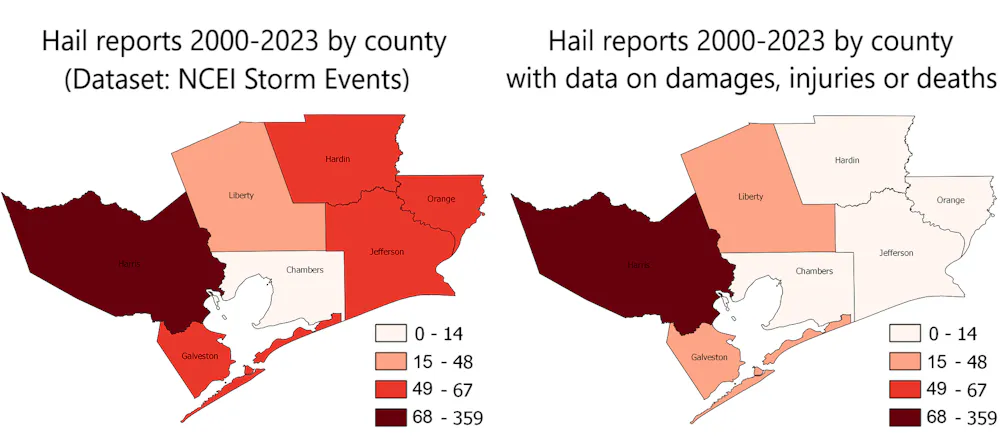
    The number of severe hail reports in southeast Texas listed in the National Centers for Environmental Information’s storm events database is strongly correlated with population. The county with the most reports and greatest detail in those reports is home to Houston. Hailstorms in the three easternmost counties are rarely associated with damage estimates.
    John Nielsen-Gammon and B.J. Baule

    Do you want to look at local damage trends? Forget about it. For most extreme weather events, estimation methods vary over time and are not documented.

    Do you want to direct funding to help communities improve resilience to natural disasters where the need is greatest? Forget about it. The places experiencing the largest per capita damages depend not just on actual damages but on the different practices of local National Weather Service offices.

    Are you moving to a location that might be vulnerable to extreme weather? Companies are starting to provide localized risk estimates through real estate websites, but the algorithms tend to be proprietary, and there’s no independent validation.

    4 steps to improve disaster data

    We believe a few fixes could make NOAA’s storm events database and the corresponding values in the larger SHELDUS database, managed by Arizona State University, more reliable. Both databases include county-level disasters and loss estimates for some of those disasters.

    First, the National Weather Service could develop standard procedures for local offices for estimating disaster damages.

    Second, additional state support could encourage local emergency managers to make concrete damage estimates from individual events and share them with the National Weather Service. The local emergency manager generally knows the extent of damage much better than a forecaster sitting in an office a few counties away.

    Third, state or federal governments and insurance companies can agree to make public the aggregate loss information at the county level or other scale that doesn’t jeopardize the privacy of their policyholders. If all companies provide this data, there is no competitive disadvantage for doing so.

    Fourth, NOAA could create a small “tiger team” of damage specialists to make well-informed, consistent damage estimates of larger events and train local offices on how to handle the smaller stuff.

    With these processes in place, the U.S. wouldn’t need a billion-dollar disasters program anymore. We’d have reliable information on all the disasters.

    John Nielsen-Gammon receives funding from the National Oceanic and Atmospheric Administration and the State of Texas.

    William Baule receives funding from NOAA, the State of Texas, & the Austin Community Foundation.

    ref. Extreme weather’s true damage cost is a mystery – that’s a problem for understanding storm risk – https://theconversation.com/extreme-weathers-true-damage-cost-is-a-mystery-thats-a-problem-for-understanding-storm-risk-257105

    MIL OSI – Global Reports

  • MIL-OSI Global: New start date for the Anthropocene proposed – when humans first changed global methane levels

    Source: The Conversation – UK – By Vincent Gauci, Professorial Fellow, School of Geography, Earth and Environmental Sciences, University of Birmingham

    Robsonphoto/Shutterstock

    Humans have been reshaping the environment for at least 10,000 years. But the Anthropocene is the name given to the specific period of Earth history during which humans have had a global effect on the planet’s climate and ecosystems. Despite formal rejection as a geological epoch, it’s widely understood within academic research as useful shorthand for the age of human interference in the Earth system.

    Various dates have been proposed for when the anthropocene effectively began, from the early 17th century to the mid-20th century, when the first atomic weapons were detonated. My new research into atmospheric methane concentration supports the idea of an early date, when European arrival in the Americas first had a notable impact on the atmosphere, but slightly before previous estimates.

    Ice cores – cylinders of ice drilled from glaciers and ice sheets – provide important evidence of historical changes in the global atmospheric composition. It is from these records that a date for the Anthropocene’s pre-industrial beginnings was first proposed in 2015 by two Earth systems scientists at the University College London, Simon Lewis and Mark Maslin.

    They suggested that an unprecedented drop in the level of CO₂ in the atmosphere that was recorded in ice cores – known as the “Orbis spike” – dates back to 1610. This unusually low level reflects additional atmospheric CO₂ absorption into trees from forest regrowth in the Americas following European arrival in the late 1400s.


    Get your news from actual experts, straight to your inbox. Sign up to our daily newsletter to receive all The Conversation UK’s latest coverage of news and research, from politics and business to the arts and sciences.


    From European arrival in 1492 and colonisation in the 1500s, the introduction of disease, mostly smallpox, resulted in demographic collapse of around 50 million people across the Americas. Lewis and Maslin proposed that, as millions of hectares of farmland went untended, forests could regrow and this increased CO₂ removal from the atmosphere.

    This happened in sufficient quantities to be recorded in glacial ice. And that change became a global marker for the start of the so-called Anthropocene.


    Read more:
    Why the Anthropocene began with European colonisation, mass slavery and the ‘great dying’ of the 16th century


    My own research into changing methane concentrations indicates that the Anthropocene began slightly earlier than that, in 1592. Ice core records show a minimum atmospheric methane concentration exactly 100 years after explorer Christopher Columbus first set foot in the Americas. This, I believe, strengthens support for the hypothesis put forward by Lewis and Maslin a decade ago.

    In a paper published in Nature Reviews, Earth and Environment, I consider the effects of global fluctuations in how trees and forests exchange methane. Methane is a greenhouse gas that is around 80 times more powerful than carbon dioxide over a 20-year period. Crucially, methane has a short lifetime of just under ten years, so any ice core record will be far more responsive to changes to the methane cycle than that of longer-lived CO₂.


    Read more:
    Methane is pitched as a climate villain – could changing how we think about it make it a saviour?


    Trees are a methane sink

    So what’s the link to trees? Trees and their woody bark surfaces, despite their biologically inert appearance when compared to leaves, are important interfaces of methane exchange. In swamps and forested floodplains like the Amazon, they are exit points of methane to the atmosphere from the saturated soils where the methane is formed by anaerobic soil microbes.

    However, last year, my team uncovered how the more extensive areas of forest growing on free-draining soils interact with atmospheric methane. The trees host microbes that directly remove methane from the atmosphere.

    This is one of two mechanisms that, together, might explain an unprecedented drop in atmospheric methane concentrations recorded in Antarctic ice cores in the first century following European arrival in the Americas. This would support Lewis and Maslin’s idea that regrowing forests in that period had global effects.

    With more trees growing on abandoned farmland, there was more woody tree surface area in contact with the atmosphere. This meant more methane being taken up by the microbes they host.

    Measuring methane uptake of trees.
    Vincent Gauci, CC BY-NC-ND

    The second mechanism relates to how trees intercept incoming rainfall. Some rainfall is re-evaporated before reaching the soil. Any rain reaching the soil may then be taken up by tree roots and released back to the atmosphere. The rest moves into the soil or washes off into rivers and wetlands.

    It is possible that the spike in forest regrowth led to more evaporation and transpiration. So more water was released by the trees back to the atmosphere and less washed off over the soil surface.

    This limited water flowing into wetlands. Those wetlands are a major methane source. So a small shrinkage in wetland area, combined with more trees absorbing atmospheric methane, could have reduced the atmospheric methane concentration and explain the minimum methane levels observed in 1592.

    When exactly the Anthropocene began may be an argument that has been overtaken by the decision to not label it a new epoch. Indeed, it’s possible that forest clearance for early agriculture by humans around 5,000-8,000 years ago in the mid-Holocene, (a period of relative climate stability in the Neolithic period) contributed to the atmospheric methane increase observed in Antarctic ice from that time.

    As well as an ancient trace of human influence over our forests, the ice core methane records provide a chance to evaluate newly discovered processes operating in the world’s forests. This is something I’m now investigating with my colleague Peter Hopcroft, a palaeoclimate modeller at the University of Birmingham.

    Whether through forest clearances for early agriculture or through the effects on forests of massive depopulation of Indigenous peoples following European contact, these traces of our past influence point to something significant: that there has always been an intimate and evolving connection between humanity and the natural world. A connection so fundamental that, for the vast span of our existence as a species, we have been inseparable from nature itself.


    Don’t have time to read about climate change as much as you’d like?

    Get a weekly roundup in your inbox instead. Every Wednesday, The Conversation’s environment editor writes Imagine, a short email that goes a little deeper into just one climate issue. Join the 45,000+ readers who’ve subscribed so far.


    Vincent Gauci receives funding from or has received funding from the Natural Environment Research Council, The Royal Society, Spark Climate Solutions, AXA Research Fund, Defra and the JABBS Foundation.

    ref. New start date for the Anthropocene proposed – when humans first changed global methane levels – https://theconversation.com/new-start-date-for-the-anthropocene-proposed-when-humans-first-changed-global-methane-levels-258834

    MIL OSI – Global Reports

  • MIL-OSI Global: Trump administration’s conflicting messages on Chinese student visas reflect complex US-China relations

    Source: The Conversation – USA – By Meredith Oyen, Associate Professor of History and Asian Studies, University of Maryland, Baltimore County

    The U.S. announced plans to scrutinize and revoke student visas for students with ties to the Chinese Communist Party or whose studies are in critical fields, but appears to have reconsidered. The decision and apparent about-face could have a wide-ranging impact on both nations. LAW Ho Ming/Getty Images

    President Donald Trump appears to have walked back plans for the U.S. State Department to scrutinize and revoke visas for Chinese students studying in the country.

    On June 11, 2025, Trump posted on his social media platform TruthSocial that visas for Chinese students would continue and that they are welcome in the United States, as their presence “has always been good with me!”

    The announcement came weeks after Secretary of State Marco Rubio announced that his department would begin scrutinizing and revoking student visas for Chinese nationals with ties to the Chinese Communist Party, or whose studies are in critical fields.

    The contradictory moves have led to confusion among Chinese students attending college or considering studying in the United States.

    Over time, Chinese nationals have faced barriers to studying in the U.S. As a scholar who studies relations between the two nations, I argue that efforts to ban Chinese students in the United States are not unprecedented, and historically they have come with consequences.

    Student visas under fire

    The Trump administration laid out the terms for revoking or denying student visas to Chinese nationals but then backtracked.
    STAP/Getty Images

    Since the late 1970s, millions of Chinese students have been granted visas to study at American universities. That total includes approximately 277,000 who studied in the United States in the 2023-2024 academic year.

    It is difficult to determine how many of these students would have been affected by a ban on visas for individuals with Chinese Community Party affiliations or in critical fields.

    Approximately 40% of all new members of the Chinese Communist Party each year are drawn from China’s student population. And many universities in China have party connections or charters that emphasize party loyalty.

    The “critical fields” at risk were not defined. A majority of Chinese students in the U.S. are enrolled in math, technology, science and engineering fields.

    A long history

    Since the late 1970s, the number of Chinese students attending college in the U.S. has increased dramatically.
    Kenishiroite/Getty Images

    Yung Wing became the first Chinese student to graduate from a U.S. university in 1852.

    Since then, millions of Chinese students have come to the United States to study, supported by programs such as the “Chinese Educational Mission,” Boxer Indemnity Fund scholarships and the Fulbright Program.

    The Institute for International Education in New York estimated the economic impact of Chinese students in the U.S. at over US$14 billion a year. Chinese students tend to pay full tuition to their universities. At the graduate level, they perform vital roles in labs and classrooms. Just under half of all Chinese students attending college in the U.S. are graduate students.

    However, there is a long history of equating Chinese migrants as invaders, spies or risks to national security.

    After the outbreak of the Korean War in 1950, the U.S. Department of Justice began to prevent Chinese scholars and students in STEM fields – science, technology, engineering and math – from returning to China by stopping them at U.S. ports of entry and exit. They could be pulled aside when trying to board a flight or ship and their tickets canceled.

    In one infamous case, Chinese rocket scientist Qian Xuesen was arrested, harassed, ordered deported and prevented from leaving over five years from 1950 to 1955. In 1955, the United States and China began ambassadorial-level talks to negotiate repatriations from either country. After his experience, Qian became a much-lauded supporter of the Communist government and played an important role in the development of Chinese transcontinental missile technology.

    During the 1950s, the U.S. Department of Justice raided Chinatown organizations looking for Chinese migrants who arrived under false names during the Chinese Exclusion Era, a period from the 1880s to 1940s when the U.S. government placed tight restrictions on Chinese immigration into the country. A primary justification for the tactics was fear that the Chinese in the U.S. would spy for their home country.

    Between 1949 and 1979, the U.S and China did not have normal diplomatic relations. The two nations recognized each other and exchanged ambassadors starting in January 1979. In the more than four decades since, the number of Chinese students in the U.S. has increased dramatically.

    Anti-Chinese discrimination

    The idea of an outright ban on Chinese student visas has raised concerns about increased targeting of Chinese in the U.S. for harassment.

    In 1999, Taiwanese-American scientist Wen Ho Lee was arrested on suspicion of using his position at Los Alamos National Laboratory in New Mexico to spy for China. Lee remained imprisoned in solitary confinement for 278 days before he was released without a conviction.

    In 2018, during the first Trump administration, the Department of Justice launched its China Initiative. In its effort to weed out industrial, technological and corporate espionage, the initiative targeted many ethnic Chinese researchers and had a chilling effect on continued exchanges, but it secured no convictions for wrongdoing.

    Trump again expressed concerns last year that undocumented migrants from China might be coming to the United States to spy or “build an army.”

    The repeated search for spies among Chinese migrants and residents in the U.S. has created an atmosphere of fear for Chinese American communities.

    Broader foreign policy context

    An atmosphere of suspicion has altered the climate for Chinese international students.
    J Studios/Getty Images

    The U.S. plan to revoke visas for students studying in the U.S. and the Chinese response is being formed amid contentious debates over trade.

    Chinese Ministry of Foreign Affairs spokesperson Lin Jian accused the U.S. of violating an agreement on tariff reduction the two sides discussed in Geneva in May, citing the visa issues as one example.

    Trump has also complained that the Chinese violated agreements between the countries, and some reports suggest that the announcement on student visas was a negotiating tactic to change the Chinese stance on the export of rare earth minerals.

    When Trump announced his trade deal with China on June 11, he added a statement welcoming Chinese students.

    However, past practice shows that the atmosphere of uncertainty and suspicion may have already damaged the climate for Chinese international students, and at least some degree of increased scrutiny of student visas will likely continue regardless.

    Meredith Oyen does not work for, consult, own shares in or receive funding from any company or organization that would benefit from this article, and has disclosed no relevant affiliations beyond their academic appointment.

    ref. Trump administration’s conflicting messages on Chinese student visas reflect complex US-China relations – https://theconversation.com/trump-administrations-conflicting-messages-on-chinese-student-visas-reflect-complex-us-china-relations-258351

    MIL OSI – Global Reports

  • MIL-OSI Africa: Vala Umgodi operations net over 200 suspects 

    Source: South Africa News Agency

    The South African Police Service’s (SAPS) Vala Umgodi operations continue to make progress with 239 suspects having been arrested throughout the country.

    According to the police, the suspects were arrested for illegal mining-related offences and various other crimes that include, among others, attempted murder, possession of an unlicensed firearm, possession of unpolished diamonds, unlawful possession of explosives and contravention of the Immigration Act.

    On Tuesday, a 42-year-old Sydwell Shane Mkhantswa appeared briefly in the Kwa-Mbonambi Periodical Court in connection with a case of theft of minerals from Richards Bay Minerals (RBM). 

    His arrest relates to a tracing operation on 03 March 2024, when members of Operation Vala Umgodi and Kwa-Mbonambi police officers responded to reports of a truck which was intercepted carrying over R800 000 worth of suspected stolen Zircon from RBM. 

    Further investigation linked the suspect with another Kwa-Mbonambi case of theft of minerals in which he allegedly delivered RBM minerals to Isiphingo in Durban where police found over R24 million worth of suspected stolen minerals.

    After several tracking and tracing operations, the suspect was cornered and arrested at a residence in Germiston, Gauteng on 12 June 2025.

    The accused is scheduled to appear in court again on 24 June 2025, where he is expected to make a formal bail application.

    In operations starting from  01- 15 June 2025, six unlicensed firearms, 26 rounds of ammunition and four vehicles were seized.

    Other highlights per province for the past week include:
    •    Limpopo: Vala Umgodi teams conducted disruptive operations at Sefateng Chrome Mine and Bokone Platinum Mine on 13 June 2025. Four suspects were arrested, and a large quantity of chromite ore and illegal mining equipment was seized.
    •    Free State: Members deployed for Operation Vala Umgodi in Free State, acting on intelligence successful intercepted a white Toyota Quantum panel van travelling from Gauteng province en route to Cape Town, and discovered a consignment of Khat plants worth R210, 000. Police arrested a 43-year-old man on charges of possession of suspected drugs and drug trafficking.
    •    Northern Cape: On 06 June 2025, members attached to Operation Vala Umgodi arrested 11 suspects aged between 29 and 44 years in Kimberley and Kleinzee, respectively. During the operations, members received information about suspected illegal miners hiding at a Game Reserve Farm near Koingnaas. The team operationalised the information, which resulted in the arrest of nine suspects and charged them for various offences, including contravention of Immigration laws, trespassing, and possession of unpolished diamonds.
    •    Mpumalanga: A 30-year-old illegal miner was shot and injured during a shootout with members of Vala Umgodi operation in Sabie, on 11 June 2025. The suspect was initially admitted to Sabie Hospital under police guard and has since been discharged and placed in custody.
    •    Gauteng: A wanted suspect was fatally wounded during a shootout with members of Operation Vala Umgodi on 13 June 2025. He was wanted for shooting at police officers at Zamimpilo Informal Settlement and was located at Soul City Informal Settlement. The team recovered a firearm that will undergo ballistic tests to establish if it was used in the commission of other crimes.
    •    North West: Vala Umgodi operation continued its clampdown on illicit mining and immigration violations in. On 05 June 2025, members conducted disruptive illegal mining operation at Rocin mine in the area of Wolwerand, led to the seizure of illegal mining equipment that include various explosives, four generators, jack hammers, spades, a welding machine, gas bottles, a water pump, four pendukas and gold bearing material.

    “With coordinated operations across the affected provinces, Operation Vala Umgodi continues to deliver results in its mandate to disrupt and dismantle illegal mining activities, specifically within and around mining communities.

    “Since its inception December 2023, Operation Vala Umgodi led to the arrest of more than 27 000 suspects with more than 600 firearms, that include imitation firearms (toy guns) and 16 000 rounds of ammunition seized,” said the police. – SAnews.gov.za

    MIL OSI Africa

  • MIL-OSI Russia: Flood emergency response activated in some parts of China

    Translation. Region: Russian Federal

    Source: People’s Republic of China in Russian – People’s Republic of China in Russian –

    Source: People’s Republic of China – State Council News

    BEIJING, June 19 (Xinhua) — China’s Ministry of Water Resources on Thursday issued a Level 4 flood alert in nine provincial-level regions amid incessant rainfall in parts of the country.

    According to the department, this regime will apply to the provinces of Jiangsu, Zhejiang, Anhui, Henan, Hubei, Hunan and Guizhou, Guangxi Zhuang Autonomous Region, as well as the centrally subordinate city of Chongqing.

    The ministry has dispatched three working teams to Hunan, Hubei and Anhui provinces to lead local flood control efforts amid heavy rainfall.

    The National Meteorological Center (NMC) on Thursday extended a yellow alert for thunderstorms, forecasting heavy rainfall in parts of Anhui, Jiangsu, Hubei, Hunan, Guizhou and Guangxi Zhuang Autonomous Region provinces from 2 p.m. Thursday to 2 p.m. Friday. Severe convective phenomena including thunderstorms and strong winds are also expected in some parts of these regions.

    Local authorities have been urged to strengthen real-time monitoring and early warning systems, ensure timely evacuation of residents from high-risk areas and take precautions against urban flooding, the ministry said.

    Let us recall that China has adopted a four-tier emergency response system for flood-related emergencies, with level 1 being the highest. -0-

    MIL OSI Russia News

  • MIL-OSI Russia: Breaking: Ceasefire is urgent priority in resolving Middle East conflict – Xi Jinping

    Translation. Region: Russian Federal

    Source: People’s Republic of China in Russian – People’s Republic of China in Russian –

    Source: People’s Republic of China – State Council News

    BEIJING, June 19 (Xinhua) — A ceasefire is an urgent priority in resolving the conflict in the Middle East, and the use of force is not the right way to resolve international disputes, Chinese President Xi Jinping said in a phone conversation with his Russian counterpart Vladimir Putin on Thursday.

    Discussing the situation in the Middle East, the Chinese leader called on the conflicting parties, especially Israel, to cease fire as soon as possible.

    Xi Jinping said the top priority is to ensure the safety of civilians amid tensions between Iran and Israel, calling on the conflicting parties to strictly abide by international law and resolutely avoid harming innocent civilians.

    Dialogue and negotiations are the fundamental solution, he said, calling on the international community, especially large countries with special influence on the parties to the conflict, to make efforts to de-escalate the situation.

    China is willing to continue to strengthen communication and coordination with all parties, join their efforts and uphold justice so as to play a constructive role in restoring peace in the Middle East, he said. –0–

    MIL OSI Russia News

  • MIL-OSI United Kingdom: The cost of inaction in Ukraine is much greater than the cost of support: UK statement to the OSCE

    Source: United Kingdom – Government Statements

    Speech

    The cost of inaction in Ukraine is much greater than the cost of support: UK statement to the OSCE

    UK Military Advisor, Lt Col Joby Rimmer, says that our support to Ukraine is not charity – it is a strategic investment in European security. We will continue to stand with Ukraine – today, tomorrow, and for as long as it takes.

    Thank you, Madam Chair.

    I would like to start by offering my condolences to Ukraine. Overnight Russia staged horrific air attacks on cities including Kyiv, killing and wounding over a hundred civilians – one of the most devastating airstrikes on Kyiv since this war began.

    Madam Chair, in February 2022, President Putin launched a full-scale invasion of Ukraine under the guise of a so-called ‘Special Military Operation.’ He expected a swift and decisive victory. Over three years later, that illusion has been shattered. Russia has suffered over one million military casualties – a grim milestone – and more than twenty times the Soviet losses in Afghanistan. The DPRK has suffered over 6,000 casualties – more than half of the 11,000 troops it initially deployed to support Russia’s illegal war. These losses, largely the result of high-risk, poorly-executed attritional assaults, underscore the tragic human cost of this illegal conflict. Let me be clear, we do not celebrate this statistic. Every life lost is a tragedy. Too many families, on both sides, have had their lives irrevocably change by a war of aggression that should never have been launched.

    Ukraine remains steadfast in the face of Russia’s unrelenting and illegal aggression. Through the extraordinary courage of its Armed Forces, the resilience of its people, and the unwavering support of its international partners, Ukraine has reclaimed, and continues to reclaim, its territory, and is liberating thousands of its citizens. This is not just a military achievement – it is a testament to the unbreakable spirit of a nation fighting for its survival, its sovereignty, and its future.

    At the G7 Summit in Canada yesterday, the United Kingdom and its allies reaffirmed their commitment to securing a just and lasting peace in Ukraine. Only increasing pressure on Russia will force Putin to take peace seriously. That is why our Prime Minister announced a new sanctions package to target sectors of the Russian economy critical to its war effort.

    Russia referred to Western Defence spending at last week’s FSC. To clarify – and for transparency – our new Strategic Defence Review does mark a pivotal shift in UK defence policy. It does commit to sustaining £3 billion annually in military support to Ukraine for as long as necessary. It does emphasise the importance of learning from Ukraine’s experience in modern warfare – particularly in drone technology and hybrid conflict – to strengthen NATO’s collective defence. It does signify a landmark change to our deterrence and defence posture: moving to warfighting readiness to deter our adversaries and strengthen security at home and across the Euro-Atlantic area.

    At the 4 June Ukraine Defence Contact Group meeting, the UK announced a tenfold increase in drone deliveries to Ukraine – 100,000 units this financial year alone – demonstrating our resolve to provide Ukraine with the tools it needs to defend itself. The UK has also committed an additional £247 million in 2025 to train Ukrainian forces under Operation INTERFLEX and pledged £40 million to NATO’s Security Assistance and Training for Ukraine (NSATU) mission trust fund. These investments are not acts of charity – they are strategic imperatives. Supporting Ukraine is an investment in our collective security, in the rules-based international order, and in the principle that borders cannot be changed by force.

    We recognise that doing more will not be without cost. But the cost of inaction is far greater. If we allow Russia to succeed in Ukraine, we send a dangerous message to authoritarian regimes around the world: that aggression pays, and that international law can be ignored with impunity. We must stand with Ukraine for however long it takes to ensure that its sovereignty is restored, its people are safe, and its future is secure. The international community must send a clear and united message: we will not tolerate the use of force to redraw borders or subjugate free nations.

    Finally, we must pay tribute to the thousands of women serving in the Ukrainian Armed Forces and to the countless others contributing to humanitarian, political, and security efforts. Their courage and leadership are vital to Ukraine’s defence and to its future. Ukraine continues to stand firmly on the side of peace having committed to an unconditional ceasefire and to making positive progress through diplomatic negotiation. Ukraine has demonstrated resilience and a constructive commitment to international law and human dignity in the face of Russia’s ongoing devastation. We will continue to stand with Ukraine – today, tomorrow, and for as long as it takes.

    Updates to this page

    Published 19 June 2025

    MIL OSI United Kingdom

  • MIL-OSI NGOs: Dire warning on 1.5°C goal must spark urgent climate action

    Source: Greenpeace Statement –

    Bonn, Germany, New data indicating there may be just three years left to keep the Paris Agreement’s 1.5°C goal alive must urgently galvanise accelerated global emissions cuts and enhanced climate action.

    Data from scientists revealed that the available carbon budget is rapidly shrinking and that at the current rate of emissions the remaining carbon budget to limit global warming to 1.5°C goal could be surpassed in three years.[1]

    Shiva Gounden, Head of Pacific, Greenpeace Australia Pacific said: “This message is a matter of survival for us in the Pacific and all small island developing states. The message is clear – we need to end climate and nature destruction and act with the urgency required. The answer is simple: end the production and burning of coal, oil and gas and defend our future.” 

    “We continue to hope and act, but where is the urgency from the major emitters? It’s time to genuinely stand in solidarity with the people on the frontlines of this crisis. The climate is on fire and our way of life is on the line. This is the greatest existential threat for our Pacific to live as Pasifika people.”

    Tracy Carty, Climate Politics Expert, Greenpeace International said: “This is yet another dire warning that must spark a response. Talk must turn into action. But here in Bonn that urgency seems to be lacking. Our backs are against the wall and governments need to step up.”

    “That means unveiling bold and ambitious 2035 climate action plans that rapidly push ahead with the phase out of coal, oil and gas – especially in rich developed countries who need to move the fastest.” 

    “As emissions continue and monthly temperature records stack up, it’s getting harder and harder to achieve the 1.5°C goal, but now is not the time to give up! Every fraction of a degree matters and more action is needed. What matters now is what we do today and tomorrow.”

    An Lambrechts, Biodiversity Politics Expert, Greenpeace International said: “The 1.5°C goal is also hugely reliant on ending deforestation and that’s why governments must agree at COP30 on an action plan to implement existing commitments to end deforestation and forest degradation by 2030. As COP30 heads to the Amazon under Brazil’s presidency, we must seize this significant opportunity to accelerate protection and restoration of critical ecosystems.”

    ENDS

    Notes:
    [1]Scientists find three years left of remaining carbon budget for 1.5°C

    Greenpeace Bonn Climate Change Conference media briefing

    Contacts:
    Aaron Gray-Block, Climate Politics Communications Manager, Greenpeace International, [email protected]

    Gaby Flores, Communications Coordinator, Greenpeace International, +1 214 454 3871, [email protected]

    Greenpeace International Press Desk, +31 (0)20 718 2470 (available 24 hours), [email protected]

    Join the Greenpeace UNFCCC WhatsApp Update Group

    MIL OSI NGO

  • MIL-OSI China: Xi says ceasefire an urgent priority in settling conflict in Middle East 2025-06-19 19:28:10 Chinese President Xi Jinping said on Thursday that ceasefire is an urgent priority in settling the conflict in the Middle East, and the use of force is not the right way to resolve international disputes.

    Source: People’s Republic of China – Ministry of National Defense

      BEIJING, June 19 (Xinhua) — Chinese President Xi Jinping said on Thursday that ceasefire is an urgent priority in settling the conflict in the Middle East, and the use of force is not the right way to resolve international disputes.

      During phone talks with his Russian counterpart, Vladimir Putin, over the situation in the Middle East, he urged the conflicting parties, especially Israel, to cease fire as soon as possible.

      The Chinese president said that protecting civilians’ safety is the top priority amid the Iran-Israel tensions, calling on the conflicting parties to strictly follow international law, and resolutely avoid harming innocent civilians.

      Dialogue and negotiation are the fundamental way out, he said, calling on the international community, particularly major countries that have a special influence on the parties to the conflict, to make efforts to cool down the situation.

      China stands ready to continue to strengthen communication and coordination with all parties, pool their efforts, and uphold justice, so as to play a constructive role in restoring peace in the Middle East, he said. 

    loading…

    MIL OSI China News

  • MIL-OSI China: Xi says ceasefire an urgent priority in settling conflict in Middle East

    Source: People’s Republic of China – State Council News

    Chinese President Xi Jinping said on Thursday that ceasefire is an urgent priority in settling the conflict in the Middle East, and the use of force is not the right way to resolve international disputes.

    During phone talks with his Russian counterpart, Vladimir Putin, over the situation in the Middle East, he urged the conflicting parties, especially Israel, to cease fire as soon as possible.

    The Chinese president said that protecting civilians’ safety is the top priority amid the Iran-Israel tensions, calling on the conflicting parties to strictly follow international law, and resolutely avoid harming innocent civilians.

    Dialogue and negotiation are the fundamental way out, he said, calling on the international community, particularly major countries that have a special influence on the parties to the conflict, to make efforts to cool down the situation.

    China stands ready to continue to strengthen communication and coordination with all parties, pool their efforts, and uphold justice, so as to play a constructive role in restoring peace in the Middle East, he said.

    MIL OSI China News

  • Climate change: As the planet hits record temperatures, what is the science is telling us?

    Source: Government of India

    Source: Government of India (4)

    Concentrations in the atmosphere of carbon dioxide, the main greenhouse gas, reached a fresh high of 422 parts per million in 2024 the European Union’s Copernicus Climate Change Service (C3S) has said.

    After another record-breaking year for global temperatures in 2024, pressure is rising on policymakers to step up efforts to curb climate change.

    The last global scientific consensus on the phenomenon was released in 2021 through the Intergovernmental Panel on Climate Change, but scientists say evidence shows global warming and its impacts have since been unfolding faster than expected.

    Here is some of the latest climate research:

    CRITICAL POINT

    The world may already have hit 1.5 degrees Celsius (2.7 F) of warming above the average pre-industrial temperature – a critical threshold beyond which it is at risk of irreversible and extreme climate change, scientists say.

    A group of researchers made the suggestion in a study released in November based on an analysis of 2,000 years of atmospheric gases trapped in Antarctic ice cores.

    Scientists have typically measured today’s temperatures against a baseline temperature average for 1850-1900. By that measure, the world is now at nearly 1.3 C (2.4 F) of warming.

    But the new data suggests a longer pre-industrial baseline, based on temperature data spanning the year 13 to 1700, which put warming at 1.49 C in 2023, the study published in the journal Nature Geoscience said.

    OCEAN CHANGES

    The warming of the Atlantic could hasten the collapse of a key current system, which scientists warn could already be sputtering.

    The Atlantic Meridional Overturning Circulation (AMOC), which transports warm water from the tropics to the North Atlantic, has helped to keep European winters milder for centuries.

    Research in 2018 showed that AMOC has weakened by about 15% since 1950, while research published in February 2024 in the journal Science Advances suggested it could be closer to a critical slowdown than previously thought.

    In addition, with the world in the throes of a fourth mass coral bleaching event — the largest on record — scientists fear the world’s reefs have passed a point of no return.

    Scientists will be studying bleached reefs from Australia to Brazil for signs of recovery over the next few years if temperatures fall.

    EXTREME WEATHER

    Ocean warming is not only fuelling stronger Atlantic storms, it is also causing them to intensify more rapidly, with some jumping from a Category 1 to a Category 3 storm in just hours.

    Growing evidence shows this is true of other ocean basins. In October 2024 Hurricane Milton needed only one day in the Gulf of Mexico to go from tropical storm to the Gulf’s second most powerful hurricane on record, slamming Florida’s west coast.

    Warmer air can also hold more moisture, helping storms carry and eventually release more rain. As a result, hurricanes are delivering flooding even in mountain towns like Asheville, North Carolina, inundated in September 2024 by Hurricane Helene.

    FORESTS AND FIRES

    Global warming is drying waterways and sapping moisture from forests, creating conditions for bigger and hotter wildfires from the U.S. West and Canada to southern Europe and Russia’s Far East.

    Research published in October in Nature Climate Change calculated that about 13% of deaths associated with toxic wildfire smoke during the 2010s could be attributed to the climate effect on wildfires.

    Brazil’s Amazon in 2024 was in the grip of its worst and most widespread drought since records began in 1950. River levels sank to all-time lows last year, while fires ravaged the rainforest.

    That added concern to scientific findings earlier last year that between 10% and 47% of the Amazon will face combined stresses of heat and drought from climate change, as well as other threats, by 2050.

    That could push the Amazon past a tipping point, with the jungle no longer able to produce enough moisture to quench its own trees, at which point the ecosystem could transition to degraded forests or sandy savannas.

    Globally, forests appear to be struggling. A July 2024 study found that forests overall failed to absorb the year before as much carbon dioxide from the atmosphere as in the past, due largely to the Amazon drought and wildfires in Canada. That means a record amount of CO2 entered the atmosphere.

    In addition, scientists with the U.S. National Oceanic and Atmospheric Administration found in December 2024 that while the vast Arctic tundra has been a carbon sink for thousands of years, rising wildfire emissions mean the tundra is now releasing more carbon than it stores.

    VOLCANIC SURGE

    Scientists fear climate change could even boost volcanic eruptions. In Iceland, volcanoes appear to be responding to rapid glacier retreat. As ice melts, less pressure is exerted on the Earth’s crust and mantle.

    (REUTERS)

  • MIL-OSI Russia: Sergei Sobyanin: An exit to the Southern Rokada will appear from Mosfilmovskaya Street

    Translation. Region: Russian Federal

    Source: Moscow Government – Government of Moscow –

    In the Ramenki district, work is underway to build a street and road network. The project includes an extension of Mosfilmovskaya Street and two new bridges across the Ramenka River. Sergei Sobyanin reported this in his telegram channel.

    “We are implementing a number of important transport projects this year – we are creating connections between districts, convenient approaches to the rail frame stations, and expanding bottlenecks. In the west of Moscow, we will extend Mosfilmovskaya Street. From it, you can go to the Southern Rokada – Aminyevskoye Shosse and Lobachevsky Street,” the Moscow Mayor wrote.

    Source: Sergei Sobyanin’s Telegram channel @mos_sobyanin 

    In the future, it will be possible to go through Mosfilmovskaya Street and Gaidai Street to General Dorokhov Avenue, which connects the Third Transport Ring and the Moscow Ring Road (MKAD). This will also improve transport services for the Ramenki and Ochakovo-Matveyevskoye districts. Almost 300 thousand residents will receive additional routes for travel around the city, including to the nearest metro stations and Moscow Central Diameters.

    In addition, the implementation of the project will eliminate overruns of up to three kilometers and reduce travel time by an average of 10 minutes, reduce the congestion level of Lobachevsky Street by 24 percent, Michurinsky Prospekt by 22 percent, and Gaidai Street by 30 percent, and will help organize new routes of surface urban passenger transport that will connect residential areas with metro stations and Moscow Central Diameters (MCD).

    Construction of a new street and road network in Ramenki began in March 2023 on the territory of the cinema quarter (its 11 streets are named after outstanding Russian directors and actors). The project envisages extending Mosfilmovskaya Street from the intersection of Ramensky Boulevard with Vinnitskaya Street to Gaidai and Aleksey Batalov Streets with a straight line distance of about 1.5 kilometers. Four traffic lanes will be organized here (two in each direction) with the possibility of exiting to the Southern Rokada – Aminyevskoye Highway and Lobachevsky Street via Gaidai and Vasily Lanovoy Streets.

    Part of the future section of Mosfilmovskaya Street will pass along two new bridges across the Ramenka River with a total length of 465 meters. They will offer a picturesque view of the landscape reserve and the adjacent territory. In the evening and at night, the artificial structures will be decorated with lighting.

    Under one of the bridges near the intersection with Ranevskaya Street, a 404-meter-long U-turn with two traffic lanes in one direction will be organized.

    In addition, specialists will reconstruct sections of Gaidai Street from Aminyevskoye Highway to Aleksey Batalov Street (856 meters, two traffic lanes in each direction), Vasily Lanovoy Street from Lobachevsky Street to Aleksey Batalov Street (2.7 kilometers, two traffic lanes in each direction) and Ranevskaya Street in the area where it joins Mosfilmovskaya Street (724 meters, two traffic lanes in each direction).

    In total, the project will involve the construction and reconstruction of over seven kilometers of roads, including access roads to social and engineering infrastructure facilities. It is also planned to lay 93.4 kilometers of engineering communications and build a treatment facility.

    Today the facility is 70 percent complete. Work is scheduled to be completed this fall.

    The plans for 2026 include extending Gaidai Street to General Dorokhov Avenue (1.4 kilometers, two traffic lanes in each direction).

    Construction of road bridges across rivers

    Since 2011, 34 automobile bridges have been built in Moscow across the Moskva River, the Moscow Canal, the Yauza, Bitsa, Desna, Likhoborka, Molodtsy, Pakhra, Pekhorka, Setun, Sosenka, Skhodnya, Tsyganka, Kozhukhovsky Backwater and Novinki Backwater rivers.

    Another six projects with a total length of over 1.2 kilometers are under construction and design. These are bridges across the Moskva River in the line of Beregovoy Proezd and near Novozavodskaya Street with a length of 315 and 250 meters, two bridges across the Ramenka River in the line of the extension of Mosfilmovskaya Street with a length of 465 meters, a 190-meter bridge across the Moskva River as part of the reconstruction of Rublevskoye Highway and a 35-meter bridge across the Pakhra River.

    New roads of Moscow

    In 2011–2024, the Moscow Government built 1,460 kilometers of roads, which is about 25 percent of the existing street and road network. 454 new tunnels, overpasses, and bridges were built — the number of artificial transport structures increased by 65 percent. In addition, 328 off-street pedestrian crossings were built.

    The plans for this year include the construction of 90 kilometers of roads, 19 artificial structures and 18 pedestrian crossings.

    Among the main objects:

    — section of Ivan Franko street from Zhitomirskaya street to Gerasim Kurin street (opened in February 2025);

    — overpasses on the section of the Southern road from Kaspiyskaya Street to 1st Kotlyakovsky Lane;

    — an overpass with an exit from the Moscow High-Speed Diameter (MSD) onto Kashirskoye Shosse towards the Moscow Ring Road (as part of the MSD section from Kuryanovsky Boulevard to Kantemirovskaya Street);

    — section of the Solntsevo-Butovo-Varshavskoe Shosse highway from Edvarda Griga Street to Polyany Street (stage 1.3);

    — street and road network in the territory of the Mnevnikovskaya floodplain;

    — a bridge across the Moscow River connecting Beregovoy Proezd and Shelepikhinskoye Highway;

    — the street and road network in the Ramenka area, including the extension of Mosfilmovskaya Street and two new bridges across the Ramenka River.

    In 2026–2027, it is planned to build 175.5 kilometers of roads, 31 artificial structures and 33 pedestrian crossings.

    Please note: This information is raw content directly from the source of the information. It is exactly what the source states and does not reflect the position of MIL-OSI or its clients.

    Please Note; This Information is Raw Content Directly from the Information Source. It is access to What the Source Is Stating and Does Not Reflect

    https: //vv.mos.ru/mayor/tkhemes/12961050/

    MIL OSI Russia News

  • MIL-OSI Africa: Western Cape prepares for severe cold, wet weather

    Source: South Africa News Agency

    Western Cape MEC for Local Government, Environmental Affairs, and Development Planning, Anton Bredell, has confirmed that the provincial government is ready for the upcoming winter season. 

    Several days of cold and wet weather are forecasted for the remainder of this week and into next week in the Western Cape. 

    Bredell announced that disaster and emergency services will closely monitor the situation to respond swiftly where needed.

    “The Provincial Disaster Management Centre coordinates and supports the district disaster centres, and each local municipality in the province knows what is expected during the coming winter months to keep people safe,” Bredell said.

    In light of the recent tragic drowning of a young woman at a low-level bridge in Slanghoek, Bredell emphasised the importance of reminding the public about safety precautions during inclement weather.

    In addition, the Provincial Disaster Management Centre has advised residents to create a household emergency plan to ensure they know what to do in the event of a flood.

    “Assess where you live, as your home may flood if you are near a river or if there is poor drainage. Assemble a grab-and-go kit and keep it in a designated, easily accessible location,” the centre said.

    The grab-and-go kit should contain:

    •    Important documents such as IDs, passports, birth certificates, policies and clinic cards.

    •    Cellphone charger.

    •    Essential medication and copies of prescriptions.

    •    Credit cards and money.

    •    First aid kit. 

    “We appeal to the public not to litter or dump in stormwater drains, as this will stop the water from draining away and cause even more flooding,” Bredell said.

    When heavy rains occur, it is important to keep the following points in mind:

    •    Stay informed and heed warnings. Listen to the radio or check reliable social media sources, such as the South African Weather Services or your local municipality, for updates on areas at risk of flooding.

    •    Store a supply of drinking water.

    •    If you live in a flood-prone area or are camping in a low-lying area, get to higher ground immediately.

    •    If told to evacuate by authorities, please do so immediately. Lock your home when you leave. If you have time, disconnect utilities and appliances.

    •    Avoid areas, roads, and passes that are subject to sudden flooding.

    •    Avoid damaged live electrical infrastructure.

    •    Avoid walking or driving through flooded roads. Just 15 cm of fast-moving water can knock you down, and a depth of two feet can float a car. Never attempt to walk, swim, or drive through rapidly flowing water.

    •    Avoid contact with flood water as it can be mixed with sewerage, oil, fuel, or dangerous chemicals.

    •    Prevent children from playing in and near flood waters. 

    Bredell asked the public to trust and listen to emergency personnel when instructions are issued relating to flood prevention or during rescue operations. 

    “These men and women are trained to keep us safe, and they risk their own lives to do this. We can reduce these risks by giving our full cooperation and sharing a mindset of rather safe than sorry.” 

    On Friday last week, President Cyril Ramaphosa visited Mthatha in the Eastern Cape to offer support and assess the damage following the recent floods that killed about 90 people.

    The floods have caused widespread destruction to homes, government facilities, roads, hospitals, and schools, highlighting the urgent need to tackle climate change.

    President Ramaphosa said that this is becoming a new reality for South Africa, with both the Eastern Cape and KwaZulu-Natal experiencing recurring annual disasters. – SAnews.gov.za

    MIL OSI Africa

  • MIL-OSI Europe: Written question – The Commission’s use of public money for behind-the-scenes political lobbying – E-002388/2025

    Source: European Parliament

    Question for written answer  E-002388/2025
    to the Commission
    Rule 144
    Mariusz Kamiński (ECR)

    In recent months a number of stories have appeared in the media concerning the Commission’s use of public money to carry out behind-the-scenes political lobbying to push through controversial policies such as the Green Deal and climate policy.

    The reports show that experts advocating the Commission’s preferred views are also receiving funding in the areas of agriculture and the common security and defence policy.

    What is more, reports in the Welt am Sonntag[1] suggest that, in addition to supporting ‘green’ NGOs in their efforts to lobby Member States and independent institutions, including the European Parliament, the Commission has also allegedly provided funding to help NGOs sue European companies.

    One example is ClientEarth, which received EUR 350 000 to take legal action against coal-fired power plants, with the explicit aim of increasing the ‘financial and legal risk’ for their operators.

    In view of the above, please provide specific answers to the following questions, which will speed up the work of the expected committee of inquiry that more than 200 MEPs have already called for:

    • 1.Has the Commission funded and in any way mandated NGOs, consultancy firms or lobbying outfits to influence the decisions and policies of democratic governments and independent institutions?
    • 2.In what areas – other than the already confirmed cases of the Green Deal, security and defence policy and agriculture – has the Commission conducted similar lobbying campaigns, and were activities promoting the agreement with Mercosur also financed?
    • 3.What steps is the Commission intending to take in response to the criticism that there is no credible and transparent overview of the EU funds that are going to NGOs?

    Submitted: 13.6.2025

    • [1] https://www.welt.de/wirtschaft/plus256221718/geheime-vertraege-offengelegt-eu-kommission-bezahlte-aktivisten-fuer-klimalobbyismus.html
    Last updated: 18 June 2025

    MIL OSI Europe News

  • MIL-OSI USA: Water Pours Into Australia’s Lake Eyre

    Source: NASA

    Your browser does not support the video tag.

    Lake Eyre (also called Kati Thanda-Lake Eyre) sits in the heart of the Australian outback, the continent’s most arid area. Receiving an average of 140 millimeters (5.5 inches) of rain each year, the lake is a dry, salty plain much of the time. But every once in a while, it transforms into an expansive inland sea.
    Approximately one-sixth of the Australian continent drains toward Lake Eyre, rather than to an ocean. Water often evaporates before it makes it there, although some will end up in the lake every few years. In 2025, extreme autumn rainfall in Queensland flooded several rivers that flow toward Lake Eyre. Since late March, these floodwaters have been coursing hundreds of kilometers through the desert.
    Around the start of May, water arrived at Lake Eyre—and then kept coming. This animation, composed of 16 images acquired with the MODIS (Moderate Resolution Imaging Spectroradiometer) on NASA’s Terra satellite, shows Lake Eyre’s evolution from April 29 to June 12. The images are false-color to emphasize the presence of water.
    During this period, water can be seen entering the north side of the basin and expanding to cover larger areas every few days. Within weeks, water had reached Madigan Gulf and Belt Bay at the southern part of the lake, some 120 kilometers (75 miles) away. At more than 15 meters (49 feet) below sea level, these bays are the lowest points on the continent and the lake’s deepest areas.
    This year’s flood is shaping up to be quite the spectacle—possibly on a scale not seen since 1974, local observers say. That was the last time Lake Eyre filled to capacity, and it reached a record depth of 6 meters (20 feet) that year.
    Optimism around a complete fill in 2025 abounds, but rangers and area business owners told news outlets they do not anticipate it will quite reach that point. The lake has only filled completely three times in the past 160 years. Rainfall in Queensland and river flow through Channel Country were extraordinarily high earlier in the year, and cooler temperatures may help keep evaporation rates in check, some think. But two consecutive wet years may be needed for a chance at a full lake, locals say.
    Regardless of where the lake level peaks, the influx of water brings with it a profusion of wildlife. The eggs of brine shrimp, which can remain dormant for years in dry soil, hatch. Shield shrimp and freshwater crabs, also with adaptations for the unique environment, emerge. Fish that breed in the river systems come down into the lake, and the newly formed oasis and veritable buffet attract millions of migratory waterbirds. Pelicans, banded stilts, and many other species are known to flock to the area from as far away as China and Japan.
    NASA Earth Observatory images by Wanmei Liang, using MODIS data from NASA EOSDIS LANCE and GIBS/Worldview. Story by Lindsey Doermann.

    MIL OSI USA News