Category: Natural Disasters

  • MIL-OSI Africa: Nelson Mandela Bay surpasses housing targets

    Source: South Africa News Agency

    The Nelson Mandela Bay Municipality has demonstrated its readiness for expanded housing allocations by exceeding its annual delivery target for the 2024/25 financial year, well ahead of schedule.

    The municipality reported that a total of 397 housing units has been delivered by the municipality, as of early June, surpassing its target of 386.

    The municipality highlighted that this is a clear sign of sustained institutional turnaround, improved planning and implementation, and strengthened intergovernmental coordination.

    Despite these gains, the municipality said it still faces a significant housing backlog of more than 100 000 units.

    In response to this, earlier this year, the municipality launched a registration drive aimed at prioritising backyard dwellers in upcoming allocations, with a goal of building news 400 housing units in the next budget year.

    Municipality’s Executive Mayor, Babalwa Lobishe said the municipality has called on the National Department of Human Settlements to consider increasing the metro’s housing allocations, in light of its consistent performance.

    “The Nelson Mandela Bay Municipality has shown its ability to deliver on time, within budget, and wih quality—positioning itself as a reliable implementing partner in addressing the national housing backlog,” Lobishe said.

    The mayor emphasised that in the midst of all the vulnerabilities and challenges remain, including people living in shacks, floodplains, and unsafe conditions, the municipality must still act with the utmost urgency to deliver coordinated and integrated human settlements.

    “Section 26 of the Constitution guarantees everyone the right to access adequate housing [while] Section 152 compels municipalities to ensure the provision of services and promote sustainable communities. We are fulfilling this mandate not only with urgency, but with pride and purpose,” Lobishe said.

    She added that the municipality will pursue the relevant interventions and measures to ensure it engages the Minister of Human Settlement through the appropriate channels and processes, to advocate for increased allocations.

    Backed by a five-year turnaround strategy, the Human Settlements Directorate has introduced reforms in project and beneficiary management, financial controls, and intergovernmental collaboration.

    Communities across the metro, including Polar Park, KwaNobuhle, Jachtvlakte, Masakhane Village, Motherwell NU30, and Red Location, are already benefiting from these initiatives.

    Member of the Mayoral Committee (MMC) for Human Settlements, Thembinkosi Mafana, credited the municipality’s ability to meet and exceed targets to effective oversight, operational effectiveness, and collaboration across all levels of government.

    “The excellent performance speaks for itself. We have consistently delivered on the funding allocations given to the metro, on time, budget and with quality. In certain areas, we have even exceeded our targets.

    “Our housing delivery backlog is a challenge, and we need to fast-track housing delivery. Our quality controls and effectiveness will elevate our status significantly, as we continually improve our ability to deliver with agility,” Mafana said.

    The MMC also acknowledged the contribution of the Standing Committee for Human Settlements, other state entities, the residents, and municipal officials.

    “The administration’s Human Settlement Standing Committee has an all-hands-on deck approach. We also appreciate the dedication and turnaround efforts shown by our officials and contractors,” he said.

    The Nelson Mandela Bay Municipality reiterated its readiness to scale up housing delivery and committed to working with provincial and national government to accelerate sustainable human settlements across the metro. – SAnews.gov.za
     

    MIL OSI Africa

  • MIL-OSI Analysis: Lower revenues, pricier loans: how flooding in Europe affects firms and the financial system they depend on

    Source: The Conversation – France – By Serena Fatica, Principal Economist — Team Leader, Joint Research Centre (JRC)

    In Europe, the fastest-warming continent, the intensification of extreme weather events and changes in precipitation patterns have led to widespread and catastrophic flooding. Last year, storms and flooding affected an estimated 413,000 people, resulting in the loss of at least 335 lives. Material damage is estimated to amount to at least €18 billion, according to the 2024 European State of the Climate report from the Copernicus Climate Change Service and the World Meteorological Organization.


    A weekly e-mail in English featuring expertise from scholars and researchers. It provides an introduction to the diversity of research coming out of the continent and considers some of the key issues facing European countries. Get the newsletter!


    The flooding in October that hit southeastern Spain and the Valencia province in particular took the heaviest toll. Intense and prolonged rainfall and river flooding led to 232 fatalities, and infrastructure damage and economic losses totalled around €16.5 billion. More than seven months later, the local economy has rebounded, thanks in part to public aid packages worth 0.5% of the country’s GDP. However, in early May, the same part of Spain found itself exposed again to the disruptive consequences of climate change when extreme weather hit.

    The costs of flooding

    The direct costs from the damage to public infrastructure and private assets are only part of the economic losses originating from flooding. The indirect costs might not be immediately visible, but they are certainly not less significant. Business interruptions reduce firms’ revenue and cash flows, straining liquidity and, in the worst cases, threatening their survival. In addition, the increasing likelihood of future flooding may be priced into the valuation of assets and real estate in areas exposed to these types of climate risks. Firms impacted by climate-related hazards might find it difficult to pay back loans or bonds, or to raise finance as physical assets that can be pledged as collateral for bank credit lose value. Ultimately, this can affect the stability of the financial system.

    For these reasons, climate change is not just a long-term environmental issue, but a threat to our economy and financial systems now. Economists at the European Commission’s Joint Research Centre (JRC) have been conducting research to better understand how the links between the business sector and the financial system amplify its impact.

    A JRC study of flood events between 2007 and 2018 finds that flooding significantly worsened the performance of European firms. Manufacturers exposed to flooding experienced reductions in sales, number of employees and the value of their assets. These impacts occurred in the year following the flooding and tended to be persistent, with no clear signs of recovery seven years after the disaster. Some firms even went out of business. The study also finds that companies in flood-prone areas were better able to weather the shock than businesses exposed to less frequent flooding. This is consistent with the fact that adaptation and protection measures reduce the impacts of flooding.

    Threats to smaller firms

    Water damage is particularly disruptive for companies that are highly indebted. A second JRC study zooms in on the mechanisms whereby financing choices, and reliance on bank loans in particular, amplify the impact of climate change. This study focuses on loans extended to small and medium-sized enterprises (SMEs) in Italy, Spain and Belgium between 2008 and 2019. It was motivated by the idea that smaller firms, which are more financially fragile than larger ones, might also be more vulnerable to the localised impact of climate-related hazards, not least because of their limited capacity to geographically diversify their operations and access market-based finance. The study shows that flood episodes under analysis strained SMEs’ ability to meet their debt obligations. Flooded firms were more likely to incur delays in servicing their loans and eventually fail to repay them, even two years after the disaster.

    In turn, this entails losses for the banks that finance these firms. In general, if banks anticipate the impact of flooding on business operations, they could be expected to divert lending toward safer borrowers or charge a higher interest rate on credit extended to at-risk firms. Indeed, the study finds evidence that prospective flood risk is priced into new loans. In the period under analysis, the “flood risk premium” was especially high for loans to smaller firms and for those granted by local, specialised banks, both of which tend to have geographically concentrated activities that are more exposed to disaster impacts. Loans to borrowers exposed to high flood risk were 12 percent more expensive, all things being equal.

    Thus, flooding causes worse financial conditions for businesses and exposes the banking sector to losses on their loan portfolios. The numbers can be staggering: days after the October 2024 flooding, the Spanish Central Bank said that banks’ exposure in the affected areas would total €20 billion, with €13 billion in household loans and €7 billion in business loans (60% to SMEs), impacting 23,000 companies and 472,000 individuals.

    With extreme weather events becoming more frequent and severe, the direct and indirect costs of climate change are projected to increase, unevenly affecting households, firms and territories across Europe. Increasing investments in adaptation, eg in flood defence, and closing the climate insurance protection gap – the uninsured portion of economic losses caused by natural hazards – are crucial to increase the resilience of our economies and financial systems and preserve the wellbeing of our societies. The complex structure of investment incentives calls for a multilayered approach, with a mix of private and public funding and risk-sharing mechanisms.

    Serena Fatica ne travaille pas, ne conseille pas, ne possède pas de parts, ne reçoit pas de fonds d’une organisation qui pourrait tirer profit de cet article, et n’a déclaré aucune autre affiliation que son organisme de recherche.

    ref. Lower revenues, pricier loans: how flooding in Europe affects firms and the financial system they depend on – https://theconversation.com/lower-revenues-pricier-loans-how-flooding-in-europe-affects-firms-and-the-financial-system-they-depend-on-258755

    MIL OSI Analysis

  • MIL-OSI Analysis: Israel’s air strength is giving it a free hand over Iran

    Source: The Conversation – UK – By Matthew Powell, Teaching Fellow in Strategic and Air Power Studies, University of Portsmouth

    Israel says it quickly gained air superiority over the Iranian capital, Tehran. Luciano Santandreu / Shutterstock

    Israel’s initial attack on Iranian nuclear and military facilities, alongside its assassination of top military officials and nuclear scientists, on June 13 has been followed by days of escalating strikes. Iran threatened “severe punishment” and quickly launched what were, in relative terms, smaller-scale missile attacks against Israeli territory.

    Israel’s military then expanded its assault on Iran, with the Israeli defence minister, Israel Katz, saying “Tehran will burn” if Iran’s supreme leader, Ayatollah Ali Khamenei, “continues to fire missiles at the Israeli home front”. Israel hit dozens of targets in the Iranian capital, Tehran, on June 15, and has since issued evacuation orders for significant areas of the city.

    The exchange of attacks has put the varying military and defensive capabilities of Israel and Iran on stark display. In particular, it appears that Israel has been able to exercise a high degree of air superiority over Iran.

    Israel was able to use more than 200 manned aircraft in its initial attack, with its air force reportedly suffering zero casualties. Within 48 hours of starting the conflict, Israel said it had gained control of the skies above Tehran.


    Get your news from actual experts, straight to your inbox. Sign up to our daily newsletter to receive all The Conversation UK’s latest coverage of news and research, from politics and business to the arts and sciences.


    This superiority has largely been gained through concerted efforts over the past year to destroy or degrade Iran’s air defence systems. In October 2024, for example, Israeli strikes targeted air defences protecting Iranian oil and gas facilities as well as those defending sites linked to Tehran’s nuclear programme and ballistic missile production.

    With a weakened air defence system, the Iranian military has been less able to prevent missile attacks and Israeli aircraft from entering its air space. This has given the Israeli military greater freedom of action in terms of the targets it chooses to attack – and greater freedom of choice when planning operations.

    Israeli aircraft have been dropping bombs from within Iran, instead of relying on long-range missiles. Iran, on the other hand, has been restricted to using its arsenal of missiles to strike Israel from distance.

    Israel’s prime minister, Benjamin Netanyahu, made reference to the strategic importance of this aerial superiority on June 16. While confirming evacuation orders for the Iranian capital, he said: “The Israeli air force controls the skies over Tehran. This changes the entire campaign.”

    Netanyahu later did not rule out killing Khamenei, saying it would “end the conflict”. Katz repeated the threat the following day, warning Khamenei of a “fate similar to Saddam Hussein”.

    Iran has been far less effective than Israel in its response – which is no great surprise. Israel says it has destroyed “one-third” of the surface-to-surface missile launchers possessed by Iran. And the majority of the missiles and drones that have been fired by Iran into Israeli territory have been intercepted before striking their targets.

    But the strength of Israel’s so-called iron dome air defence system has, somewhat counter-intuitively, also offered Iran some advantages. In order to maintain the Iranian regime’s own internal security and stability, as well as its wider political aims of being a regional power, Tehran had to respond with a certain level of force.

    However, Iran is also fully aware of the protection the iron dome provides to the Israeli population. The Iranian government will still be able to point to the few missiles and drones that have reached their target, and the destruction they have caused, as evidence that it is able to project its power beyond its own borders and respond in the face of aggressive Israeli action.

    It is able to do so in the knowledge that the level of destruction and deaths of Israeli civilians, which so far stands at around 24 people, will be limited to such a degree that any further escalation by Israel will be seen as unjustified by the wider international community.

    However, as the destruction and death toll rises, it will become harder for either government to follow this path of logic. Iran has already criticised the Israeli military’s claim that it has conducted strikes in a precise manner and only against military targets, reporting that over 200 civilians have been killed in the strikes.

    It is here where mistakes and missteps could see events spiral out of control. This may lead to a wider and larger-scale conflict that neither side wants but is unable to prevent occurring. Iran, for its part, is reportedly signalling that it is seeking an end to hostilities and the resumption of talks over its nuclear programme.

    Wider consequences

    If the conflict does escalate, Israel will probably target Iranian military production facilities. The Israeli military has already issued a warning on social media, telling the Iranian people to stay away from all weapons manufacturing facilities.

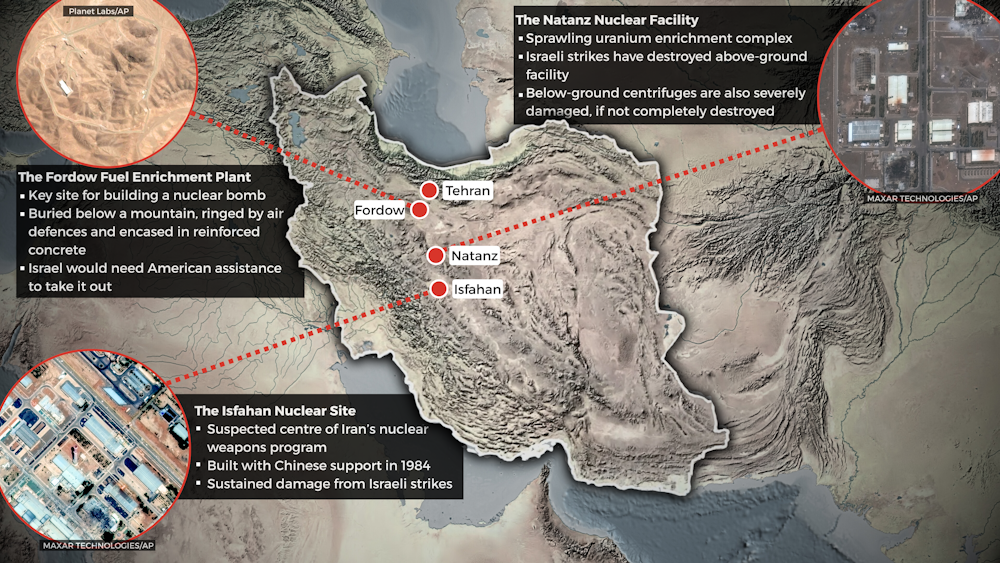
    Other targets may include nuclear installations – though at least one, the heavily fortified Fordow nuclear site in central Iran, will not be targeted. Fordow is hidden in a mountain, with centrifuges located possibly as deep as 80 metres underground.

    Only the US military has the hardware capable of reaching this facility, so attacking the site would require US intervention. This is something the current Washington administration has proved reluctant to do, so far.

    But any escalation could have ramifications beyond the Middle East. Iran has supplied Shahed-type drones to Russia for use in its war in Ukraine, with them becoming a key part of Russia’s military strategy. However, Russia is now largely producing its own supplies of Shahed drones internally.

    A much more likely effect is the prolonging of the war in Ukraine as international attention shifts to de-escalating tensions between Israel and Iran. The international community has focused on trying to prevent further attacks, with the US president, Donald Trump, advocating for talks rather than more strikes.

    On June 15, Trump wrote on his social media platform, Truth Social: “Iran and Israel should make a deal, and will make a deal, just like I got India and Pakistan to make.” Whether Israel and Iran take heed of his request will become clear over the coming days and weeks.

    Matthew Powell does not work for, consult, own shares in or receive funding from any company or organisation that would benefit from this article, and has disclosed no relevant affiliations beyond their academic appointment.

    ref. Israel’s air strength is giving it a free hand over Iran – https://theconversation.com/israels-air-strength-is-giving-it-a-free-hand-over-iran-259073

    MIL OSI Analysis

  • MIL-OSI Analysis: Declining soil health is a global concern – here’s how AI could help

    Source: The Conversation – UK – By Nima Shokri, Professor, Applied Engineering, United Nations University

    The arid Loess plateau landscape of northern China. yang1498/Shutterstock

    One-third of the Earth’s land surface is already degraded. The UN estimates that more than 2.6 billion people are harmed by land degradation, with countries losing up to US$10.6 trillion (£7.8 trillion) a year because of damage to “ecosystem services”, including the benefits people get from nature such as water and food.

    Unhealthy soil is a major contributor to land degradation. This can lead to loss of biodiversity, harm plants and animals, cause sand and dust storms and affect crop yields.

    These consequences affect the regulation of the planet’s climate and water cycle, socioeconomic activities, food security and forced migration of people.

    Emerging smart technologies such as artificial intelligence, satellite remote sensing and big data analysis offer a chance to protect our soils. These tools can help track soil health in real time. This will support farmers, landowners, government agencies and local communities in making better decisions to care for the soil.


    Get your news from actual experts, straight to your inbox. Sign up to our daily newsletter to receive all The Conversation UK’s latest coverage of news and research, from politics and business to the arts and sciences.


    As a professor of geo-hydroinformatics – a field that combines geoscience, hydrology and information technology – my research focuses on using AI, algorithms and advanced modelling tools to better analyse and predict soil health.

    My team and I have developed the first global map of soil salinisation (accumulation of salt in soil) under various climate scenarios using AI-powered techniques. Soil salinisation is one of the leading contributors to soil degradation and can happen naturally or because of human activities, such as using salty irrigation water or poor drainage systems.

    With increasing climate uncertainty, our models help identify regions most vulnerable to salinisation. Our AI-driven analysis predicts that by the year 2100, dryland regions in South America, southern and western Australia, Mexico, the southwestern US and South Africa will be key hotspots of soil salinisation.

    In another key study, we used satellite data, AI and big data tools to investigate the interaction between soil salinity and soil organic carbon – an important part of healthy soil that stores nutrients, holds water and supports plants.

    Part of this analysis revealed a general negative correlation between salinity levels and soil organic carbon content. As salinity increased, we found that the soil organic carbon content tended to decrease.

    Our two studies underscore the transformative potential of AI technologies and big data analytics in understanding soil degradation. With a deeper understanding, land can be better managed through more effective mitigation policies and sustainable land use planning.

    Restoration at scale

    Large-scale land restoration can transform degraded soils. In the Loess plateau in China, centuries of deforestation and unsustainable farming have led to significant ecological challenges. Loess soils (a type not limited to this location in China, formed essentially by the accumulation of wind-blown dust) are easily eroded because they are made up of fine and loose particles.

    Degradation here has led to more frequent floods, droughts and dust storms because soil degradation is often associated with compaction. This reduces the ability of soil to absorb and hold water.

    In the 1990s, this prompted the Chinese government to invest in reforestation and sustainable agriculture. This led to the landmark Loess plateau watershed rehabilitation project, with the main goal of boosting farming and incomes on 15,600km² of land in the Yellow River’s tributary area. The total project cost of US$150 million, partly funded by the World Bank, was approved in 1994.

    Elsewhere, in the Tigray region of Ethiopia, the EthioTrees project was launched in 2016 to tackle land degradation through community-based reforestation, enclosures to limit grazing, and reinvestment of funds generated through climate finance mechanisms.

    Tree planting and other efforts have transformed the Tigray region of Ethiopia into a more fertile landscape.
    Jon Duncan/Shutterstock

    Despite challenges including drought and limited financial resources, these large-scale restoration projects have transformed the landscape and lives of people living there.

    But the Loess plateau and Tigray projects have been complex and expensive. A lot of coordination between people across huge regions and in different sectors is required to ensure a successful, integrated approach. AI can take these successful but resource-intensive restoration efforts and help scale them up.

    I’m also involved with a European Commission-funded project called AI4SoilHealth, which aims to advance the use of AI to monitor and quantify soil health across Europe. This project shows how data-driven initiatives can support more sustainable land management policies by providing timely, actionable information to governments, farmers and other stakeholders such as landowners, agribusiness companies and local communities.

    By integrating satellite imagery with accurate data about soil properties in different locations, AI can help develop robust, scalable models that cross local boundaries. Knowing where best to invest money, resources and effort in scaling up soil health solutions will help protect people, businesses and ecosystems from extreme events in the future.


    Don’t have time to read about climate change as much as you’d like?

    Get a weekly roundup in your inbox instead. Every Wednesday, The Conversation’s environment editor writes Imagine, a short email that goes a little deeper into just one climate issue. Join the 45,000+ readers who’ve subscribed so far.


    Nima Shokri receives funding from European Commission for the AI4SoilHealth project.

    ref. Declining soil health is a global concern – here’s how AI could help – https://theconversation.com/declining-soil-health-is-a-global-concern-heres-how-ai-could-help-258847

    MIL OSI Analysis

  • MIL-OSI Analysis: The Inca string code that reveals Peru’s climate history

    Source: The Conversation – UK – By Sabine Hyland, Professor of Social Anthropology, University of St Andrews

    The author studying specimens. Author provided, CC BY

    Five centuries ago, the Incas ruled the western half of South America with the help of a unique form of writing based on coloured and knotted cords. These strings, called khipus, recorded major events, tracked economic matters, and even encoded biographies and poetry, according to the Spanish chroniclers who witnessed their use.

    Most khipus have knots that indicate numbers that we can “read”, but we’ve lost the ability to interpret what those numbers mean. Recent discoveries are bringing us closer to deciphering these mysterious strings. In a remote community set high in the Peruvian Andes, my team and I have found khipus that were used by villagers to track climate change.

    Last year, I was invited to study the centuries-old khipus preserved in the village of Santa Leonor de Jucul in the Peruvian Andes. The 97 khipus conserved by villagers include the largest khipu in the world, which is over 68 metres long.


    Looking for something good? Cut through the noise with a carefully curated selection of the latest releases, live events and exhibitions, straight to your inbox every fortnight, on Fridays. Sign up here.


    An elderly ritual specialist, Don Lenin Margarito, told me that the khipus recorded the annual ritual offerings given at different sacred places in the surrounding landscape. Miniature pink ritual bags stuffed with coca leaves and tobacco hang from the cords, representing the sacred purpose of these ancient strings. Rather than communicating through knots, the Jucul khipus record data with different kinds of tassels.

    For example, a tassel made of fuzzy beige llama tails indicates that an offering was performed at the sacred lake of Paccha-cocha, high in the mountains. The fluffiness of the llama tails is like a rain cloud, Don Lenin explained, representing the fact that offerings given at Paccha-cocha are thought to bring rain.

    Different kinds of tassels indicate offerings made at other ritual sites, each one of which is thought to have its own effect on the local environment. Rituals involving the spirits of the dead, for instance, are thought to halt flooding.

    If you look at one of the Jucul khipus and you see that there were a lot of offerings to Paccha-cocha that year, you know that this was a time of drought since the offerings were given to increase the rain.

    When speaking with community members, we learned that the khipus used to be kept in public so that they could be consulted by the elders. Andean people of the past looked at these khipus as a record of the climate, and they studied them to understand the patterns of what was going on, just as we do today.

    New methods

    New methods for obtaining precise radiocarbon dates for khipus have been pioneered by a team headed by khipu researcher Ivan Ghezzi.

    Efforts are now underway to get accurate radiocarbon dates for the Jucul khipus, which will provide a chronology of these climate-based offerings.

    If we can chart the khipus and then date them, we will have a record of climate data from this region that was created by the local Andean people themselves. In their current state, the Jucul khipus are threatened by insects, mould and rodents. The British Museum recently granted funding to clean, preserve and display the khipus so that these precious objects from the Andean past will persevere into the future.

    There are only five villages in the Peruvian Andes where ancestral khipus are kept. These rare archives offer tantalising clues about how khipus encoded information.

    Research in other villages with living khipu traditions has led to breakthroughs in the significance of khipu colour patterns and phonology. Many Inka khipus possess tassels which we believe may reveal the subject matter of the associated khipu. If we could unlock the significance of the tassels on the Jucul khipus, it might allow us to interpret more precisely the meaning of Inca cords.

    Sabine Hyland receives funding from the British Academy, the British Museum, the National Endowment for the Humanities (USA), the John Simon Guggenheim Foundation, the Leverhulme Trust, and the National Geographic Society.

    ref. The Inca string code that reveals Peru’s climate history – https://theconversation.com/the-inca-string-code-that-reveals-perus-climate-history-258528

    MIL OSI Analysis

  • MIL-OSI Security: Groves Point — RCMP arrests impaired driver involved in fatal collision

    Source: Royal Canadian Mounted Police

    Northeast Traffic Services – Cape Breton (NETS) is investigating a fatal collision in Groves Point involving an impaired driver.

    On June 14, at approximately 7 a.m., RCMP officers, Cape Breton Regional Police Service, fire services, and EHS, responded to a report of a two-vehicle collision on Hwy. 105. Officers learned that a sedan and a Harley Davidson motorcycle had collided. The sedan then fled the area.

    The lone rider of the motorcycle, a 40-year-old man from Bras D’Or, suffered life-threatening injuries. He was transported by EHS to hospital where he was succumbed to his injuries the following day.

    From the information gathered, officers located the sedan involved in the collision on Brady Dr., in Groves Point, and safely arrested the driver, a 42-year-old man from Sydney mines, who was exhibiting signs of impairment.

    The 42-year-old man was transported to the North Sydney RCMP detachment where he provided breath samples that registered 90mg%. He was later released and will appear in Sydney Provincial Court at a later date.

    An RCMP collision reconstructionist attended the scene and the investigation is ongoing.

    Criminal charges are anticipated.

    The highway was closed for several hours but has since reopened.

    Our thoughts are with the victim’s loved ones at this difficult time.

    Anyone with information about this incident is asked to contact Northeast Traffic Services – Cape Breton at 902-794-5800. To remain anonymous, call Nova Scotia Crime Stoppers, toll-free, at 1-800-222-TIPS (8477), submit a secure web tip at www.crimestoppers.ns.ca, or use the P3 Tips app.

    File #: 2025-831028

    MIL Security OSI

  • MIL-OSI Security: Groves Point — RCMP arrests impaired driver involved in fatal collision

    Source: Royal Canadian Mounted Police

    Northeast Traffic Services – Cape Breton (NETS) is investigating a fatal collision in Groves Point involving an impaired driver.

    On June 14, at approximately 7 a.m., RCMP officers, Cape Breton Regional Police Service, fire services, and EHS, responded to a report of a two-vehicle collision on Hwy. 105. Officers learned that a sedan and a Harley Davidson motorcycle had collided. The sedan then fled the area.

    The lone rider of the motorcycle, a 40-year-old man from Bras D’Or, suffered life-threatening injuries. He was transported by EHS to hospital where he was succumbed to his injuries the following day.

    From the information gathered, officers located the sedan involved in the collision on Brady Dr., in Groves Point, and safely arrested the driver, a 42-year-old man from Sydney mines, who was exhibiting signs of impairment.

    The 42-year-old man was transported to the North Sydney RCMP detachment where he provided breath samples that registered 90mg%. He was later released and will appear in Sydney Provincial Court at a later date.

    An RCMP collision reconstructionist attended the scene and the investigation is ongoing.

    Criminal charges are anticipated.

    The highway was closed for several hours but has since reopened.

    Our thoughts are with the victim’s loved ones at this difficult time.

    Anyone with information about this incident is asked to contact Northeast Traffic Services – Cape Breton at 902-794-5800. To remain anonymous, call Nova Scotia Crime Stoppers, toll-free, at 1-800-222-TIPS (8477), submit a secure web tip at www.crimestoppers.ns.ca, or use the P3 Tips app.

    File #: 2025-831028

    MIL Security OSI

  • MIL-OSI: Fortinet Strengthens Code-to-Cloud Security with CNAPP Enhancements and Launches Expanded Solution Availability in AWS Marketplace

    Source: GlobeNewswire (MIL-OSI)

    SUNNYVALE, Calif., June 17, 2025 (GLOBE NEWSWIRE) —

    News Summary
    Fortinet® (NASDAQ: FTNT), the global cybersecurity leader driving the convergence of networking and security, today announced powerful updates to Lacework FortiCNAPP, making it easier than ever for customers to secure applications and workloads across hybrid and multi-cloud environments. The company also announced that the FortiAppSec Cloud service, FortiMail Workspace Security, FortiNDR Cloud, FortiSIEM, and Fortinet Incident Response services are now available in AWS Marketplace, a digital catalog that helps you find, buy, deploy, and manage software, data products, and professional services from thousands of vendors.

    “Fortinet is committed to accelerating secure cloud transformation for our customers,” said Nirav Shah, Senior Vice President, Products and Solutions at Fortinet. “By making more of our services available in AWS Marketplace and enhancing leading cloud-native solutions like Lacework FortiCNAPP and FortiAppSec Cloud, we’re making it easier than ever for organizations to protect every cloud workload, application, and network edge.”

    Delivering Smarter Protection, Faster Response and Remediation

    Fortinet has enhanced Lacework FortiCNAPP to deliver even stronger protection for cloud-native applications across their entire life cycle. These updates reinforce FortiCNAPP as an industry-leading, cloud-native security platform designed to deliver faster detection, deeper insights, and simplified operations at scale.

    • Real-Time CloudTrail Alerting – Enables near-instant detection of critical activity, such as compromised credentials or anomalous API behavior, by reducing AWS CloudTrail alert latency from 24 hours to under 15 minutes.
    • Explorer (Security Graph) – Provides a visual, interactive view of attack paths and asset relationships, making pinpointing and investigating exposures, such as internet-facing vulnerabilities, easier.
    • Agentless Windows Scanning – Supports agentless scanning for Windows workloads across any cloud, identifying vulnerabilities and secrets without requiring software deployment. This is ideal for expanding visibility and compliance with minimal overhead.
    • Fleet Management – Delivers detailed visibility across large environments into agent inventory, health, and deployment status, helping teams monitor coverage and optimize cloud security.

    In addition, Fortinet expands its cloud services for web applications and APIs by introducing new service bundles that include Dynamic Application Security Testing (DAST), CDN, and SoC-as-a-Service, in addition to its AI-powered zero-day threat detection, analysis, and remediation to protect web applications and APIs.

    Full-Stack Protection Now Available in AWS Marketplace
    Fortinet has expanded the availability of its cloud security portfolio in AWS Marketplace. This provides Amazon Web Services (AWS) customers with the ability to streamline the purchase and management of more Fortinet offerings within their AWS Marketplace account. By deploying solutions on AWS, Fortinet makes it easier for customers to deploy protection, streamline procurement, and apply AWS Enterprise Discount Program (EDP) commitments.

    Services now available in AWS Marketplace include:

    • FortiAppSec Cloud – Unified web application and API protection (WAAP) with web application firewall (WAF), bot management, API security, and DDoS mitigation
    • FortiMail Workspace Security – End-to-end SaaS protection across email, browsers, and collaboration tools to stop advanced threats in platforms like Microsoft 365, Google Workspace, Slack, and Teams with a built-in, 24×7 managed incident response service to accelerate threat containment and lighten the load on SOC teams
    • FortiNDR Cloud – AI-driven threat detection optimized for distributed cloud infrastructure
    • FortiSIEM – Scalable log management and incident response for complex environments

    Fortinet has achieved the AWS Security Incident Response Specialization, which recognizes that Fortinet provides a streamlined incident response solution backed by AWS security response experts through AWS Security Incident Response.

    The capabilities of Fortinet’s specialized cloud consulting and FortiGuard Incident Response Services teams help AWS customers strengthen their cloud security posture. Fortinet Incident Response Services are now available in AWS Marketplace, offering expert support backed by deep integration with AWS and the Fortinet Security Fabric. This underscores Fortinet’s commitment to supporting customers with end-to-end security expertise—from proactive risk assessments to prompt incident handling—backed by deep integration with AWS-native tools and FortiGuard threat intelligence.

    A Strategic Shift toward Unified Cloud-Native Security

    This launch reinforces Fortinet’s commitment to simplifying cloud security by consolidating fragmented, non-integrated solutions into a unified cloud security platform. Rather than relying on isolated point products, Fortinet delivers integrated solutions across application, network, and user layers designed to streamline management and scale efficiently in any environment.

    By unifying capabilities like WAAP, network detection and response (NDR), security information and event management (SIEM), cloud-native application protection platform (CNAPP), and workspace security under a single vendor and deployment model, organizations gain comprehensive cloud protection along with greater speed, cost-efficiency, and operational clarity.

    For those with cloud spend commitments and desire to optimize their cloud security investments, particularly in dynamic environments, Fortinet FortiFlex offers a flexible, daily usage-based licensing model that supports rapid deployment, elastic scaling, and seamless drawdown of existing cloud commitments, helping organizations protect what they need, when they need it, while only paying for what they use.

    Additional Resources

    About Fortinet
    Fortinet (Nasdaq: FTNT) is a driving force in the evolution of cybersecurity and the convergence of networking and security. Our mission is to secure people, devices, and data everywhere, and today we deliver cybersecurity everywhere our customers need it with the largest integrated portfolio of over 50 enterprise-grade products. Well over half a million customers trust Fortinet’s solutions, which are among the most deployed, most patented, and most validated in the industry. The Fortinet Training Institute, one of the largest and broadest training programs in the industry, is dedicated to making cybersecurity training and new career opportunities available to everyone. Collaboration with esteemed organizations from both the public and private sectors, including Computer Emergency Response Teams (“CERTS”), government entities, and academia, is a fundamental aspect of Fortinet’s commitment to enhance cyber resilience globally. FortiGuard Labs, Fortinet’s elite threat intelligence and research organization, develops and utilizes leading-edge machine learning and AI technologies to provide customers with timely and consistently top-rated protection and actionable threat intelligence. Learn more at https://www.fortinet.com, the Fortinet Blog, and FortiGuard Labs.

    Copyright © 2025 Fortinet, Inc. All rights reserved. The symbols ® and ™ denote respectively federally registered trademarks and common law trademarks of Fortinet, Inc., its subsidiaries and affiliates. Fortinet’s trademarks include, but are not limited to, the following: Fortinet, the Fortinet logo, FortiGate, FortiOS, FortiGuard, FortiCare, FortiAnalyzer, FortiManager, FortiASIC, FortiClient, FortiCloud, FortiMail, FortiSandbox, FortiADC, FortiAI, FortiAIOps, FortiAgent, FortiAntenna, FortiAP, FortiAPCam, FortiAuthenticator, FortiCache, FortiCall, FortiCam, FortiCamera, FortiCarrier, FortiCASB, FortiCentral, FortiCNP, FortiConnect, FortiController, FortiConverter, FortiCSPM, FortiCWP, FortiDAST, FortiDB, FortiDDoS, FortiDeceptor, FortiDeploy, FortiDevSec, FortiDLP, FortiEdge, FortiEDR, FortiExplorer, FortiExtender, FortiFirewall, FortiFlex FortiFone, FortiGSLB, FortiGuest, FortiHypervisor, FortiInsight, FortiIsolator, FortiLAN, FortiLink, FortiMonitor, FortiNAC, FortiNDR, FortiPAM, FortiPenTest, FortiPhish, FortiPoint, FortiPolicy, FortiPortal, FortiPresence, FortiProxy, FortiRecon, FortiRecorder, FortiSASE, FortiScanner, FortiSDNConnector, FortiSIEM, FortiSMS, FortiSOAR, FortiSRA, FortiStack, FortiSwitch, FortiTester, FortiToken, FortiTrust, FortiVoice, FortiWAN, FortiWeb, FortiWiFi, FortiWLC, FortiWLM, FortiXDR and Lacework FortiCNAPP. Other trademarks belong to their respective owners. Fortinet has not independently verified statements or certifications herein attributed to third parties and Fortinet does not independently endorse such statements. Notwithstanding anything to the contrary herein, nothing herein constitutes a warranty, guarantee, contract, binding specification or other binding commitment by Fortinet or any indication of intent related to a binding commitment, and performance and other specification information herein may be unique to certain environments.

    The MIL Network

  • MIL-OSI Analysis: Companies haven’t stopped hiring, but they’re more cautious, according to the 2025 College Hiring Outlook Report

    Source: The Conversation – USA – By Murugan Anandarajan, Professor of Decision Sciences and Management Information Systems, Drexel University

    Recent college grads face a tough job market in 2025, but employers are still hiring. sturti/E+ via Getty Images

    Every year, I tell my students in my business analytics class the same thing: “Don’t just apply for a job. Audition for it.”

    This advice seems particularly relevant this year. In today’s turbulent economy, companies are still hiring, but they’re doing it a bit more carefully. More places are offering candidates short-term work experiences like internships and co-op programs in order to evaluate them before making them full-time offers.

    This is just one of the findings of the 2025 College Hiring Outlook Report. This annual report tracks trends in the job market and offers valuable insights for both job seekers and employers. It is based on a national survey conducted in September 2024, with responses from 1,322 employers spanning all major industries and company sizes, from small firms to large enterprises. The survey looks at employer perspectives on entry-level hiring trends, skills demand and talent development strategies.

    I am a professor of information systems at Drexel University’s LeBow College of Business in Philadelphia, and I co-authored this report along with a team of colleagues at the Center for Career Readiness.

    Here’s what we found:

    Employers are rethinking talent pipelines

    Only 21% of the 1,322 employers we surveyed rated the current college hiring market as “excellent” or “very good,” which is a dramatic drop from 61% in 2023. This indicates that companies are becoming increasingly cautious about how they recruit and select new talent.

    While confidence in full-time hiring has declined, employers are not stepping away from hiring altogether. Instead, they’re shifting to paid and unpaid internships, co-ops and contract-to-hire roles as a less risky route to identify talent and “de-risk” full-time hiring.

    Employers we surveyed described internships as a cost-effective talent pipeline, and 70% told us they plan to maintain or increase their co-op and intern hiring in 2025. At a time when many companies are tightening their belts, hiring someone who’s already proved themselves saves on onboarding reduces turnover and minimizes potentially costly mishires.

    For job seekers, this makes every internship or short-term role more than a foot in the door. It’s an extended audition. Even with the general market looking unstable, interest in co-op and internship programs appears steady, especially among recent graduates facing fewer full-time opportunities.

    These programs aren’t just about trying out a job. They let employers see if a candidate shows initiative, good judgment and the ability to work well on a team, which we found are traits employers value even more than technical skills.

    What employers want

    We found that employers increasingly prioritize self-management skills like adaptability, ethical reasoning and communication over technical skills such as digital literacy and cybersecurity. Employers are paying attention to how candidates behave during internships, how they take feedback, and whether they bring the mindset needed to grow with the company.

    This reflects what I have observed in classrooms and in conversations with hiring managers: Credentials matter, but what truly sets candidates apart is how they present themselves and what they contribute to a company.

    Based on co-op and internship data we’ve collected at Drexel, however, many students continue to believe that technical proficiency is the key to getting a job.

    In my opinion, this disconnect reveals a critical gap in expectations: While students focus on hard skills to differentiate themselves, employers are looking for the human skills that indicate long-term potential, resilience and professionalism. This is especially true in the face of economic uncertainty and the ambiguous, fast-changing nature of today’s workplace.

    Technology is changing how hiring happens

    Employers also told us that artificial intelligence is now central to how both applicants and employers navigate the hiring process.

    Some companies are increasingly using AI-powered platforms to transform their hiring processes. For example, Children’s Hospital of Philadelphia uses platforms like HireVue to conduct asynchronous video interviews. HR-focused firms like Phenom and JJ Staffing Services also leverage technologies such as AI-based resume ranking, automated interview scheduling and one-way video assessments.

    Not only do these tools speed up the hiring process, but they also reshape how employers and candidates interact. In our survey, large employers said they are increasingly relying on AI tools like resume screeners and one-way video interviews to manage large numbers of job applicants. As a result, the candidate’s presence, clarity in communication and authenticity are being evaluated even before a human recruiter becomes involved.

    At the same time, job seekers are using generative AI tools to write cover letters, practice interviews or reformat resumes. These tools can help with preparation, but overreliance on them can backfire. Employers want authenticity, and many employers we surveyed mentioned they notice when applications seem overly robotic.

    In my experience as a professor, the key is teaching students to use AI to enhance their effort and not replace it. I encourage them to leverage AI tools but always emphasize that the final output and the impression it makes should reflect their own thinking and professionalism. The bottom line is that hiring is still a human decision, and the personal impression you make matters.

    This isn’t just about new grads

    While our research focuses on early-career hiring, these findings apply to other audiences as well, such as career changers, returning professionals and even mid-career workers. These workers are increasingly being evaluated on their adaptability, behavior and collaborative ability – not just their experience.

    Many companies now offer project-based assignments and trial roles that let them evaluate performance before making a permanent hire.

    At the same time, employers are investing in internal reskilling and upskilling programs. Reskilling refers to training workers for entirely new roles, often in response to job changes or automation, while upskilling means helping employees deepen their current skills to stay effective and advance in their existing roles. Our report indicates that approximately 88% of large companies now offer structured upskilling and reskilling programs. For job seekers and workers alike, staying competitive means taking the initiative and demonstrating a commitment to learning and growth.

    Show up early, and show up well

    So what can students, or anyone entering or reentering the workforce, do to prepare?

    • Start early. Don’t wait until senior year. First- and second-year internships are growing in importance.

    • Sharpen your soft skills. Communication, time management, problem-solving and ethical behavior are top priorities for employers.

    • Understand where work is happening. Over 50% of entry-level jobs are fully in-person. Only 4% are fully remote. Show up ready to engage.

    • Use AI strategically. It’s a useful tool for research and practice, not a shortcut to connection or clarity.

    • Stay curious. Most large employers now offer reskilling or upskilling opportunities – and they expect employees to take initiative.

    One of the clearest takeaways from this year’s report is that hiring is no longer a one-time decision. It’s a performance process that often begins before an interview is even scheduled.

    Whether you’re still in school, transitioning in your career or returning to the workforce after a break, the same principle applies: Every opportunity is an audition. Treat it like one.

    Murugan Anandarajan does not work for, consult, own shares in or receive funding from any company or organization that would benefit from this article, and has disclosed no relevant affiliations beyond their academic appointment.

    ref. Companies haven’t stopped hiring, but they’re more cautious, according to the 2025 College Hiring Outlook Report – https://theconversation.com/companies-havent-stopped-hiring-but-theyre-more-cautious-according-to-the-2025-college-hiring-outlook-report-257870

    MIL OSI Analysis

  • MIL-OSI Analysis: A radical proposal to abolish state government and strengthen American democracy

    Source: The Conversation – USA – By Stephen Legomsky, John S. Lehmann University Professor Emeritus, Washington University in St. Louis

    Abolish all the states? Zoonar/Getty Images Plus

    Get rid of states? Legal scholar Stephen Legomsky, who taught for 34 years at the Washington University in St. Louis School of Law, has just published a book, “Reimagining the American Union,” that proposes a radical idea: Abolish state government. The Conversation’s politics and democracy editor, Naomi Schalit – a former statehouse reporter herself – interviewed Legomsky about the provocative idea behind his book, in which he advocates moving most of the functions of state government down to the local level, closer to those represented and governed by it.

    You propose abolishing states. Why?

    The book is a thought experiment. The proposal I’m offering is long term. I realize we need states during the current political moment.

    I think the states are the root cause of many, if not most, of the current dangers faced by U.S. democracy. I also see the states as a significant source of fiscal waste. We don’t need three levels of government – national, state and local – all regulating us and all taxing us. Two would do just fine. And after careful, detailed analysis, I concluded that every benefit ever claimed for state government could be achieved at least as well, and in many cases better, by the local governments.

    I’m imagining the framers sitting in Independence Hall. And you go back in time and suggest to them not having states. I think most of them would drop dead at the thought, because it ultimately implies a much more powerful federal government. What would you say to them?

    After they stop laughing, I would emphasize that I’m not proposing a wholesale transfer of power from the states to an all-powerful, all-knowing central government. Yes, some of the functions currently performed by the states could better be performed at the national level, but I’m proposing that the lion’s share devolve down to the local governments, which are even closer to the people they represent than the state legislatures can ever be.

    Some of the most ardent Federalists, including Alexander Hamilton and James Wilson, referred to the states as “artificial beings” or “imaginary beings.” They accepted the states only because keeping them was politically essential to getting the required nine state ratifications, not because they thought states were a good idea.

    George Washington’s working copy of the Constitution from Aug. 6, 1787.
    National Archives, Records of the Continental and Confederation Congresses and the Constitutional Convention

    What functions would your plan hand over to the federal government?

    A prime example is licensing. I looked up all the different occupations that require state licenses. I was astonished: practically every health care profession, barbers, engineers, lawyers, architects, the list is endless.

    If you live near a state line, you can’t practice in both states unless you get two licenses. If you move to another state, you have to get another license. This seems silly. The human anatomy, human hair, engineering principles, don’t change as you cross from New York to New Jersey. Nor do we need 50 different state driver’s licenses; a single national license administered through local agencies would be more efficient.

    You say states are the root cause of the greatest threats to American democracy. What are those threats?

    The structural threats are those that are baked into the Constitution itself. The Electoral College is one. On five occasions, the Electoral College has awarded the presidency to the candidate whom the voters rejected nationwide. And there were many, many near misses where the popular vote loser almost became president, making many such future instances a statistical certainty.

    Perhaps even more important, every state, no matter how large or how small, gets the same number of U.S. senators. In fact, a majority of the U.S. population is represented by only about 18% of the Senate. The minority gets the other 82%.

    These counter-majoritarian defects in the elections of both presidents and senators have a ripple effect. They skew the composition, and thus the decisions, of the federal courts. Three of the current Supreme Court justices were appointed by President Donald Trump after he had lost the national popular vote; five of the current Supreme Court justices were confirmed by senators who collectively represented only a minority of the U.S. population.

    Here’s one especially jarring statistic: From 1969 until today, the Democratic presidential nominees won the national popular vote in a slight majority of the elections. Yet, during the presidential terms that resulted from those elections, Republican presidents have gotten to make 15 of the 20 Supreme Court appointments.

    The Constitution also gives the states broad powers to regulate and run national elections. State legislatures have used those powers to pass gerrymandering, voter suppression and other counter-majoritarian laws.

    If you devolve these functions and services to localities, wouldn’t you end up with a mirror of the current state-level structure? Wouldn’t this just send a lot of state personnel down to the local level?

    Yes, much of that structure would devolve. However, I see that as a good thing. Devolution is unavoidable in a country this size. Not everything can be done by the central government. The question for me is, do we need two levels of subordinate political subdivisions or one? One seems more efficient. And when problems are too big for one local government to handle on its own, it can partner with other local governments or with the national government, just as many local governments do today.

    Abolishing state government means no more meetings of the state legislature, like this one in the Maine House of Representatives on Jan. 4, 2023, at the State House in Augusta.
    AP Photo/Robert F. Bukaty

    If there were no states to gerrymander or pass voter-suppression laws, wouldn’t some national government agency just do it instead?

    Redistricting would be performed by a nonpartisan redistricting commission that I propose be made up of technicians, mainly demographers, statisticians and geographers, under broad, general principles enacted by Congress. That’s what almost every other democracy in the world does today.

    Why did you write this book?

    For a long time, I’ve been distressed about so many of the dangers to our democracy. So, one day, I found myself compiling what ended up becoming a fairly long mental list of all of my democracy-related grievances.

    A list of grievances like in the Declaration of Independence!

    That’s a nice analogy. And as I thought about that list, it suddenly struck me that the vast majority of these problems couldn’t occur without states. That got me thinking about whether we really need states in the first place.

    If it’s just a thought experiment, something that’s not going to happen, why would you think it’s worthwhile spending time writing this?

    And why would I be so vain as to think anybody would want to waste their time reading it?

    And your answer is, ‘Because I’m an academic!’

    It’s that, plus more. I do hope there’s some scholarly value in this. But I’m also writing for the long term. States are secure for now, but history teaches us that the more distant future is full of surprises.

    Stephen Legomsky does not work for, consult, own shares in or receive funding from any company or organization that would benefit from this article, and has disclosed no relevant affiliations beyond their academic appointment.

    ref. A radical proposal to abolish state government and strengthen American democracy – https://theconversation.com/a-radical-proposal-to-abolish-state-government-and-strengthen-american-democracy-256955

    MIL OSI Analysis

  • MIL-OSI Analysis: When you lose your health insurance, you may also lose your primary doctor – and that hurts your health

    Source: The Conversation – USA – By Jane Tavares, Senior Research Fellow and Lecturer of Gerontology, UMass Boston

    Seeing the same doctor on a regular basis is good for your health. Morsa Images/DigitalVision via Getty Images

    When you lose your health insurance or switch to a plan that skimps on preventive care, something critical breaks.

    The connection to your primary care provider, usually a doctor, gets severed. You stop getting routine checkups. Warning signs get missed. Medical problems that could have been caught early become emergencies. And because emergencies are both dangerous and expensive, your health gets worse while your medical bills climb.

    As gerontology researchers who study health and financial well-being in later life, we’ve analyzed how someone’s ties to the health care system strengthen or unravel depending on whether they have insurance coverage. What we’ve found is simple: Staying connected to a trusted doctor keeps you healthier and saves the system money. Breaking that link does just the opposite.

    And that’s exactly what has us worried right now. Members of Congress are debating whether to make major cuts to Medicaid and other social safety net programs. If the Senate passes its own version of the tax-and-spending package that the House approved in May 2025, millions of Americans will soon face exactly this kind of disruption – with big consequences for their health and well-being.

    How people end up uninsured

    Someone can lose their health insurance for a number of reasons. For many Americans, coverage is tied to employment. Being fired, retiring before you turn 65 and become eligible to enroll in the Medicare program, or even getting a new job can mean losing insurance. Others wind up uninsured due to a different array of changes: moving to a different state, getting divorced or aging out of a parent’s plan after their 26th birthday.

    And those who buy their own coverage may find that they can no longer afford the premiums. In 2024, average premiums on the individual market exceeded more than US$600 per month for many adults, even with subsidies.

    Government-sponsored insurance programs can also leave you vulnerable to this predicament. The Senate is currently considering its own version of a tax-and-spending bill the House of Representatives passed in May that would make cuts and changes to Medicaid. If the provisions in the House bill are enacted, millions of Americans who get health insurance through Medicaid – a health insurance program jointly run by the federal government and the states that is mainly for people who have low incomes or disabilities – would lose their coverage, according to the nonpartisan Congressional Budget Office.

    Medicaid was established in the 1960s, explains a scholar of the program’s history.

    Consequences of becoming uninsured

    Health insurance is more than a way to pay medical bills; it’s a doorway into the health care system itself. It connects people to health care providers who come to know their medical history, their medications and their personal circumstances.

    When that door closes, the effects are immediate. Uninsured people are much less likely to have a usual source of care – typically a doctor or another primary care provider or clinic you know and trust. That relationship acts as a foundation for managing chronic conditions, staying current with preventive screenings and getting guidance when new symptoms arise.

    Researchers have found that adults who go uninsured for even six months become significantly more likely to postpone care or forgo it altogether to save money. In practical terms, this means they’re less likely to be examined by someone who knows their medical history and can spot red flags early.

    The Affordable Care Act, the landmark health care law enacted during the Obama administration, made the number of Americans without insurance plummet. The share of people without insurance fell from 16% in 2010 to 7.7% in 2023.

    The people who got insurance coverage, particularly those who were middle age, saw big improvements in their health.

    Researching the results

    In research that looked at data collected from 2014 to 2020, we followed what happened to 12,000 adults who were 50 or older and lived across the nation.

    Our research team analyzed how their experiences changed when they lost, and sometimes later regained, a regular source of care during those six years.

    Many of the participants in this study had multiple chronic conditions like diabetes, hypertension and heart disease.

    The results were striking.

    Those who didn’t see the same provider on a regular basis were far less likely to feel heard or respected by health care professionals. They had fewer medical appointments, filled fewer prescriptions and were less likely to follow through with recommended treatments.

    Their health also deteriorated considerably over the six years. Their blood pressure and blood sugar levels rose, and they had more elevated indicators of kidney impairment compared with their counterparts who had regular care providers.

    The longer they went without consistent health care, the worse these clinical markers became.

    Warning signs

    Preventive care is one of the best tools that both patients and their health care providers have to head off major health problems. This care includes screenings like cholesterol and blood pressure checks, mammograms, PAP smears and prostate exams, as well as routine vaccinations. But most people only get preventive care when they stay engaged with the health care system.

    And that’s far more likely when you have stable and comprehensive health insurance coverage.

    Our research team also examined what happened to preventive care based on whether the participants had a regular doctor. We found that those who kept seeing the same providers were almost three times more likely to get basic preventive services than those who did not.

    Over time, these missed preventive care opportunities can add up to a big problem. They can turn what could have been a manageable issue into an emergency room visit or a long, expensive hospital stay.

    For example, imagine a man in his 50s who no longer gets cholesterol screenings after losing insurance coverage. Over several years, his undiagnosed high cholesterol leads to a heart attack that could have been prevented with early medication. Or a woman who skips mammograms because of out-of-pocket costs, only to face a late-stage cancer diagnosis that might have been caught years earlier.

    Waiting too long to deal with a health condition can mean you make a trip to the emergency room, increasing the cost of care for you and others.
    FS Productions/Tetra images via Getty Images

    Shifting the costs

    Patients whose conditions take too long to be diagnosed aren’t the only ones who pay the price.

    We also studied how stable care relationships affect health care spending. To do this, we linked Medicare claims cost data to our original study and tracked the medical costs of the same adults age 50 and older from 2014 to 2020. One of our key findings is that people with regular care providers were 38% less likely to incur above-average health care costs.

    These savings aren’t just for patients – they ripple through the entire health care system. Primary care stability lowers costs for both public and private health insurers and, ultimately, for taxpayers.

    But when people lose their health care coverage, those savings disappear.

    Emergency rooms see more uninsured patients seeking care that could have been handled earlier and more cheaply in a clinic or doctor’s office. While hospitals are legally required to provide emergency care regardless of a patient’s ability to pay, much of the resulting cost goes unreimbursed.

    Hospitals foot the bill for about two-thirds of those losses. They pass the other third along to private insurance companies through higher hospital fees. Those insurers, in turn, raise their customers’ premiums. Larger taxpayer subsidies can then be required to keep hospitals open.

    Seeing Medicaid as a lifeline

    For the nearly 80 million Americans enrolled in Medicaid, the program provides more than coverage.

    It contributes to the health care stability our research shows is critical for good health. Medicaid makes it possible for many Americans with serious medical conditions to have a regular doctor, get routine preventive services and have someone to turn to when symptoms arise – even when they have low incomes. It helps prevent health care from becoming purely crisis-driven.

    As Congress considers cutting Medicaid funding by hundreds of billions of dollars, we believe that lawmakers should realize that scaling back coverage would break the fragile links between millions of patients and the providers who know them best.

    Jane Tavares receives funding from from the SCAN Foundation, the RRF Foundation for Aging, and Milbank Memorial Fund .

    Marc Cohen receives funding from the SCAN Foundation, the RRF Foundation for Aging and Milbank Memorial Fund .

    ref. When you lose your health insurance, you may also lose your primary doctor – and that hurts your health – https://theconversation.com/when-you-lose-your-health-insurance-you-may-also-lose-your-primary-doctor-and-that-hurts-your-health-258380

    MIL OSI Analysis

  • MIL-OSI Analysis: Precise measurement standards have revolutionized museum science, helping nail down where artifacts are from

    Source: The Conversation – USA – By Edward Vicenzi, Research Scientist, Museum Conservation Institute, Smithsonian Institution

    Museums and their bountiful collections are research bastions. Douglas Rissing/iStock via Getty Images

    On a cool February morning in 1904, a spark ignited a fire in the heart of downtown Baltimore. Within hours, a raging inferno swept eastward across the harbor district, consuming everything in its path. By evening, the local firefighters were overwhelmed, and the city sent telegrams to the fire chiefs of major Northeastern cities pleading for help in battling the blaze.

    Washington, Philadelphia and New York, along with other cities, responded quickly with dozens of engine companies. Yet when they arrived at the scene, many responders could not hook up to Baltimore’s hydrants since each city had its own threading standards to connect fire hoses.

    The fire resulted in damages of over US$3.5 billion in today’s dollars. It created a call for a national standard of threads for hoses and fire hydrant outlets. These standards now improve emergency responses across the country – and the same concept of standardization allows for consistency and replicability in scientific research.

    An illustration of the aftermath of the Great Baltimore Fire in February 1904.
    Fred Pridham/Wikimedia Commons

    In science, the ideal way to evaluate data is related to the concept driving the calls for uniform fire hose equipment. When scientists compare their results to those obtained in other laboratories, or with previously published data, the comparisons are most meaningful if all datasets were made with standardized practices and reference materials.

    Museum scientists like us provide compelling insights into the natural world, prehistory and historical culture heritage. Like that of many other scientists, our work, and the measurements we take day to day, depends upon standard references.

    Here we offer two fascinating stories from the Smithsonian Institution’s Museum Conservation Institute that highlight how scientific measurement standards allow for exciting new discoveries:

    You are what you drink

    In 2007, the New Mexico Bureau of Reclamation exhumed the remains of dozens of Civil War-era soldiers from the ruins of Fort Craig. They had been left behind when the fort was abandoned in 1885.

    A historical view of Fort Craig, N.M.
    Center for Southwest Research, University Libraries, University of New Mexico, CC BY-NC-SA

    Anthropologists from the Smithsonian and the Bureau of Reclamation in New Mexico identified the remains as belonging to a diverse range of people – including a few dozen African American Buffalo Soldiers, a group that made up a relatively small percentage of the U.S. military at that time.

    Historical records tell researchers that most of the military units at Fort Craig mobilized out of Kentucky and Virginia, but official records don’t always tell the full story. The group of project scientists, which included one of us, Christine France, needed a way to confirm the origin of these individuals and restore some identity to these forgotten soldiers.

    The researchers decided to use stable isotope analysis on the bones. This technique counts the number of atoms of a particular element in the sample that have one or more extra neutrons – this is the “heavy” isotope – and compares it with the number of atoms that have a normal number of neutrons – this is the “light” isotope.

    Drinking water in southern latitudes has more naturally occurring heavy oxygen atoms compared with northern latitudes. If a soldier’s bones had a relatively high ratio of the heavy to the light oxygen atoms, that soldier likely spent more time drinking water from the South.

    Researchers have measured oxygen isotopes in other archaeological remains and in water all over North America, giving us a water “isotope map.” But matching the bone isotope values to the water map is like comparing apples to oranges, and every lab has subtle variations in its instruments. The scientists needed to normalize and calibrate the isotope ratios they had measured to a reference standard.

    In this case, the standard was the average oxygen isotope value of ocean water, a convention that stable isotope researchers agreed upon as a consistent and readily available value. The researchers now had a uniform way to say how many more – or fewer – heavy oxygen isotopes the bones contained compared to the ocean water standard.

    Other archaeology labs and the North American water isotope map use that same standard comparison, allowing them to directly compare all the bone isotope values to one another, and to the North American water isotope map.

    Ultimately, the method helped the team identify several soldiers who came from quite far away to join the company, including individuals who likely grew up in the mid-Atlantic, New England and Southeast.

    The exact circumstances that brought these soldiers together is lost to history. But the researchers’ ability to assign them geographic provenance with the help of reference standards gave them further insight into this pivotal time in U.S. history.

    Volcanic glass mirrors

    Humans have always been fascinated by looking at themselves in the mirror. In Mesoamerica – modern-day central and southern Mexico together with northern Central America – archaeologists have found convex round objects so finely polished that they have been termed mirrors.

    But instead of using them for vanity, shamans from ancient times likely used them as a tool to access portals to other dimensions.

    The oldest Preclassic mirrors (2000 BCE to 250 CE) were fashioned from polished iron ores, but later Postclassic period mirrors (900 CE to 1450 CE) were made from obsidian, a typically black silica-rich volcanic glass.

    The collections at the Smithsonian’s National Museum of the American Indian contain six large, rectangular obsidian mirrors, purchased in the 19th and early 20th centuries. Their labels state they come from the “Valley of Mexico.”

    Obsidian tablets, a view of both their front and back sides, found in the National Museum of the American Indian collections.
    NMAI, Martinez et al (2022)

    Archeologists rarely find rectangular obsidian mirrors like these at pre-Columbian dig sites. So, local artisans skilled in stone polishing likely made these unusually shaped objects upon request by Spanish invaders around the time of European contact. But which Mesoamerican culture did they come from?

    Scientists from the Museum Conservation Institute, including two of us, Thomas Lam and Edward Vicenzi, and a member of the Austrian Academy of Sciences, worked with staff at the National Museum of the American Indian on an effort to pinpoint which volcano created the obsidian in the mirrors.

    The location of the obsidian source would indicate whether the Aztecs who controlled eastern central Mexico, or the Purépecha who controlled an area west of the Aztecs, produced the objects, as both had ample sources of obsidian in their territories.

    To conduct such a study, the researchers required two types of reference materials: obsidian that had erupted from known volcanic locations, and a reference obsidian that scientists already knew the composition of to confirm the quality of the analysis.

    The first reference obsidians, from known locations, told the researchers about the differences in geochemistry of the volcanoes in central Mexico. That information allowed them to match the mirror analyses to the known volcanic location analyses and their map coordinates. The second reference obsidian served as a quality control specimen for the analysis.

    Museum Conservation Institute scientists used a nondestructive technique called X-ray fluorescence spectrometry to analyze ratios of elements in the obsidians. The process works by “exciting” atoms in the obsidian, and a spectrum of X-ray energies is given off as the atoms “relax.”

    Scientists analyzed the obsidian shards to see which elements were present in them in which ratios, and where in Mexico obsidian contained similar elements at similar ratios.
    Sharps et al. (2021)

    The results showed that all the specimens came from a region controlled by the Purépecha, not the Aztecs. The museum curators updated their records describing the mirrors to include this new information about their origin.

    Creating standards

    Standardized measurement procedures and reference materials play a central role in museum science. Organizations dedicated to rigorous measurement science, such as the National Institute of Standards and Technology, a federal government agency, help create some of these standards and research new measurement procedures.

    Without their leadership, it would be far more difficult for researchers like us to produce high-quality data and discern the relationships between specimens in the natural and cultural heritage sciences. With quality measurement standards in our toolbox, we are finding new insights into human history and the natural world.

    Edward Vicenzi is a guest researcher at the National Institute of Standards and Technology in the Material Measurement Laboratory.

    Christine France and Thomas Lam do not work for, consult, own shares in or receive funding from any company or organization that would benefit from this article, and have disclosed no relevant affiliations beyond their academic appointment.

    ref. Precise measurement standards have revolutionized museum science, helping nail down where artifacts are from – https://theconversation.com/precise-measurement-standards-have-revolutionized-museum-science-helping-nail-down-where-artifacts-are-from-254025

    MIL OSI Analysis

  • MIL-OSI Russia: The impact of the key rate – banks are massively worsening the terms of deposits

    Translation. Region: Russian Federal

    Source: Mainfin Bank –

    How have the deposit rates changed in the top 20 banks?

    The wave of rate cuts is an expected trend against the backdrop of the decision taken by the Central Bank of the Russian Federation. Most banks of the top 20 have already revised their terms deposits. Thus, on June 17, the average interest rates for deposits consist of:

    18.9% for a term of three months (a decrease of 0.6 percentage points); 18.2% for products opened for six months (a discount of almost 1 percentage point); 17.4% for deposits for a term of 12 months (the yield dropped by more than 1 percentage point).

    “Even before the key rate was lowered, the industry was seeing a trend towards worsening deposit conditions – the decision by the Central Bank of the Russian Federation accelerated this trend,” experts note.

    However, the changes in the industry did not come as a surprise – under the influence of the regulator’s policy, experts expected a reduction in rates on savings products. At the same time, banks began to review the terms and conditions credit programs – the negative dynamics will continue in the near future.

    Which banks have already revised their deposit terms?

    Russian banks immediately began revising their rates after the Central Bank of the Russian Federation’s decision. Among the first major financial institutions to reduce their deposit rates were:

    The most favorable conditions for deposits are maintained when opening a deposit for a short period (usually up to three months). Banks also offer special conditions for new depositors – increased rates apply when opening for the first time contribution or savings account.

    14:30 06/17/2025

    Source:

    Please note: This information is raw content directly from the source of the information. It is exactly what the source states and does not reflect the position of MIL-OSI or its clients.

    Please Note; This Information is Raw Content Directly from the Information Source. It is access to What the Source Is Stating and Does Not Reflect

    HTTPS: //Mainfin.ru/novosti/villation-keystorms-stavka-banks-mass-yudsat-consequences-on-classes

    MIL OSI Russia News

  • MIL-OSI Africa: Built for Africa: Trinasolar Showcases Weather-Resilient Solar + Storage Solutions at Africa Energy Forum

    With over 1 gigawatt of solar equipment supplied in South Africa in the past year, Trinasolar (www.Trinasolar.com) returns to the Africa Energy Forum (AEF) reaffirming its position as a long-term partner in Africa’s clean energy journey. At this year’s event in Cape Town, the company is spotlighting its next-generation solar and battery storage solutions, designed to withstand extreme weather, harsh environmental conditions, and evolving grid demands across the continent.

    “As the energy crisis and climate volatility continue to impact South Africa and the broader African region, Trinasolar is focused on delivering real solutions that enable long-term energy security,” said Vincent Wu, Global Sales Vice President and MEA MU Head at Trinasolar. “Our high-efficiency PV modules and advanced energy storage systems are engineered to meet the challenging realities on the ground. Through our presence at AEF, we’re reinforcing our commitment to supporting Africa’s transition to a greener, more stable energy future; one built on innovation, resilience, and strategic collaboration.”

    Taking centre stage is the launch of the Vertex N 630W (NED19RC.20), Trinasolar’s newest ultra-durable solar module. Tailored for Africa’s diverse and often unpredictable conditions, the module features reinforced mechanical design, anti-dust and corrosion-resistant components, and a record-breaking 55 mm hail resistance rating, which is more than double the industry standard.

    Certified for fire safety and built to perform in environments rich in salt, ammonia, and sand, the module delivers a maximum power output of 630W and up to 23.3% efficiency. Its low-voltage, high-string design is compatible with leading inverters, while reducing system costs and installation time for commercial and utility-scale developers.

    “We’re seeing strong momentum across the region, especially in the commercial, industrial, and utility-scale sectors where innovation and ease of installation matter,” said Zaheer Khan, Regional Director for South Africa, Trinasolar MEA. “Installers and partners are drawn to solutions like the Vertex N 630W, not just for its performance, but because it addresses real operational challenges in tough environments.

    “In just the past year, Trinasolar has delivered over a gigawatt of technology solar equipment in South Africa alone,” Khan added. “It’s a milestone that reflects our growing footprint, trusted relationships, and long-term commitment to the region. And we’re just getting started.”

    Trinasolar’s growing Africa portfolio includes solar modules, smart tracker systems, energy storage solutions, and floating PV technologies. These offerings are designed to meet the continent’s diverse energy needs with quality, flexibility, and integration at the core. With local presence in Johannesburg and Cape Town, and warehouse facilities in Durban that maintain 10–20 megawatts of stock for quick nationwide delivery, Trinasolar supports rapid deployment across the region. Its expanding footprint includes commercial engagement in Kenya, Nigeria, Morocco, and other strategic markets.

    Over the past decade, Trinasolar has played a key role in shaping South Africa’s solar market—driving utility-scale projects, enabling C&I growth, and supporting the country’s path toward decentralisation and clean energy. As Africa’s energy transition accelerates, Trinasolar remains focused on scaling integrated systems, expanding local talent and operations, and collaborating closely with governments, utilities, and private sector partners to deliver long-term energy resilience.

    Trinasolar will be exhibiting at Booth B15 at the Africa Energy Forum in Cape Town from 17–20 June, where its senior team will be available for business meetings and stakeholder discussions.

    Distributed by APO Group on behalf of Trinasolar.

    For media inquiries please contact:
    Mariam Agag – PR Manager, Trinasolar MEA
    Email: mariam.agag@trinasolar.com

    Lojayne Mohsen – Senior Consultant, Fekra Communications
    Email: lojayne.mohsen@fekracomms.com

    David Gyampo, Account Manager – Razor PR
    Email: david.gyampo@razorpr.co.za

    About Trinasolar (688599. SH):
    Founded in 1997, Trinasolar Co Ltd (stock symbol: Trinasolar; stock code: 688599) is engaged mainly in PV products, PV systems and smart energy. PV products include R&D, production and sales of PV modules. PV systems consist of power stations and system products. Smart energy comprises mainly PV power generation and operations and maintenance, smart solutions for energy storage, smart microgrid, and development and sales of multi-energy systems. We are committed to leading the way in smart PV and energy storage solutions and facilitating the transformation of new power systems for a net-zero future.

    On June 10, 2020, Trinasolar was listed on the Science and Technology Innovation Board (STAR Market) of the Shanghai Stock Exchange (SSE). It was the first PV and energy storage company to go public on the STAR Market providing PV products and systems, as well as smart energy. For more information, please visit www.Trinasolar.com.

    MIL OSI Africa

  • MIL-OSI: Combining Sustainable Growth with Performance: Boralex Announces Its Strategic Plan and Financial Objectives for 2030

    Source: GlobeNewswire (MIL-OSI)

    MONTRÉAL, June 17, 2025 (GLOBE NEWSWIRE) — Boralex inc. (“Boralex” or the “Company”) (TSX: BLX) announces its Strategic Plan and Financial Objectives for 2030.

    2030 Strategy Highlights

    • Acceleration of organic growth, leveraging our high-quality pipeline of projects and growth path
    • Maintain disciplined financial management with precise expected returns indicators, a solid balance sheet, flexible and agile financing and the introduction of a cash flows per share growth objective.  
    • Three simplified pillars: growth, efficiency and long-term differentiation.
    • Two markets in strong leadership position: Canada, with strong growth potential in Quebec and Ontario, and France, with significant potential to optimize revenues and cash flows from operating assets.
    • Two expanding markets: certain U.S. states, including solar in New York State, and the United Kingdom through the development of a long-term growth platform.
    • Increase in the weighted average remaining contract duration1 from 11 years in 2024 to 14 years by 2030.
    • Keeping up the pace of growth: double the Company’s installed capacity2 every five years within a diverse, inclusive, and responsible work environment aimed at a net-zero trajectory by 2050.

    “We are very proud to present the results of our 2030 strategic planning exercise. In a context where climate risk remains one of the main business risks globally, our strategy aims to combine sustainable growth with performance through the production of renewable and affordable energy,” said Patrick Decostre, President and Chief Executive Officer of Boralex. “By executing this plan, we are unlocking the full potential of our business model, which will allow us to seize the most promising opportunities in the four markets where we are already active and where demand for renewable energy is growing rapidly,” he added.

    “This growth, supported by a development projects pipeline and growth path of 8 GW, will be carried out in a disciplined manner and will continue to focus on securing long-term power purchase agreements with an increasingly diversified customer base. Moreover, the increase in the weighted average remaining duration of our contracts from 11 to 14 years will enable us to implement highly competitive financing structures and reinvest these long-term secured funds into an increasing number of profitable projects in the coming years,” Mr. Decostre continued.

    Boralex’s 2030 Strategy is rooted in a long-term value creation perspective, as it will enable targeted investments in projects that will materialize not only over the next five years, but also in following years, replicating the approach adopted in the 2021-2025 Strategic Plan. The 2030 Strategy builds on the significant efforts made over the past five years to create a high-quality development portfolio, enabling us to set fully organic growth targets over which we have greater control. As a result, this approach carries a lower level of risk compared to the previous plan, which relied on an important expected portion coming from mergers and acquisitions.

    Financial Objectives and Main Business Indicators 2025–20303

    100% Organic financial objectives

    • Compound annual growth rate (CAGR)4 of operating income between 12% to 14%, consolidated EBITDA(A)4 between 7% to 9% and combined EBITDA(A)4 between 8% to 10%.
    • CAGR of cash flows related to operating activities per share4 and of discretionary cash flows per share4 between 8% to 10%.

    Main business indicators

    • Total planned investments4 of $6.8 billion plus $1.2 billion for projects scheduled to be commissioned after 2030.
    • Minimum levered internal rate of return (IRR)4 on investments threshold between 10% and 12% adjusted for specific risks by region and technology as well as changes in cost of capital.
    • Payout ratio4 of 20% to 40% of discretionary cash flows.

    “Boralex will continue to grow by applying the same financial discipline that has driven its success in recent years. We will become even more agile by further diversifying our sources of financing. This will include a proactive approach to capital recycling for our most mature assets or those with high value-creation potential, as well as evaluating partnerships for larger-scale projects,” said Bruno Guilmette, Senior Vice President and Chief Financial Officer of Boralex.

    “Our 100% organic financial objectives reflect the high potential of our development pipeline and growth path, which has nearly tripled over the past five years. We are also introducing a new target in this plan: the growth of discretionary cash flows per share—a metric aligned with investor expectations and with the variable compensation of our employees. We are therefore highly confident that these objectives, combined with our discipline, will enable Boralex to maximize value creation for its shareholders and all stakeholders,” Mr. Guilmette added.

    Investor Day 2025

    Boralex presented its 2030 Strategy and objectives to a group of investors, financial analysts, and bankers gathered in Toronto. The presentation was also broadcast live for business partners who were unable to attend in person. On this occasion, the executive team and regional leaders outlined the key elements and financial targets of the 2030 Strategy, the various growth opportunities and outlooks by region and technology, as well as the company’s approach to risk management and sustainability. A replay of the event and all presentation materials are available on Boralex’s website in the Investors section.

    About Boralex

    At Boralex, we have been providing affordable renewable energy accessible to everyone for over 30 years. As a leader in the Canadian market and France’s largest independent producer of onshore wind power, we also have facilities in the United States and in the United Kingdom. Over the past five years, our installed capacity has increased by more than 50% to 3.2 GW. We are developing a portfolio of projects in development and construction of 8 GW in wind, solar and storage projects, guided by our values and our corporate social responsibility (CSR) approach. Through profitable and sustainable growth, Boralex is actively participating in the fight against global warming. Thanks to our fearlessness, discipline, expertise and diversity, we continue to be an industry leader. Boralex’s shares are listed on the Toronto Stock Exchange under the ticker symbol BLX. 

    For more information, visit boralex.com or sedarplus.com. Follow us on Facebook and LinkedIn.

    Non-IFRS and other financial measures

    Performance measures

    In order to assess the performance of its assets and reporting segments, Boralex uses various performance measures. Management believes that these measures are widely accepted financial indicators used by investors to assess the operational performance of a company and its ability to generate cash through operations. The non-IFRS and other financial measures also provide investors with insight into the Corporation’s decision making as the Corporation uses these non-IFRS financial measures to make financial, strategic and operating decisions. It is important to note that the non-IFRS financial measures should not be considered as substitutes for IFRS measures. They are primarily derived from the audited consolidated financial statements, but do not have a standardized meaning under IFRS; accordingly, they may not be comparable to similarly named measures used by other companies. In addition, these non-IFRS financial measures are not audited and have important limitations as analytical tools. Investors are therefore cautioned not to consider them in isolation or place undue reliance on ratios or percentages calculated using these non-IFRS financial measures.

    Non-GAAP financial measures
    Specific financial measure Use Composition Most directly comparable IFRS measure
    Financial data – Combined (all disclosed financial data) To assess the performance and the ability of a company to generate cash from its operations and investments in joint ventures and associates. Results from the combination of the financial information of Boralex Inc. under IFRS and the share of the financial information of the Interests.

    Interests in joint ventures and associates, Share in earnings (losses) of joint ventures and associates and Distributions received from joint ventures and associates are then replaced with Boralex’s respective share in the financial statements of the Interests (revenues, expenses, assets, liabilities, etc.).

    Respective financial data –Consolidated
    Discretionary cash flows To assess the cash generated from operations and the amount available for future development or to be paid as dividends to common shareholders while preserving the long-term value of the business. Net cash flows related to operating activities before “change in non-cash items related to operating activities,” less:

    (i) distributions paid to non-controlling shareholders;
    (ii) additions to property, plant and equipment (maintenance of operations);
    (iii) repayments on non-current debt (projects) and repayments to tax equity investors;
    (iv) principal payments related to lease liabilities;
    (v) adjustments for non-operational items; plus
    (vi) development costs (from the statement of earnings).

    Net cash flows related to operating activities
    Non-GAAP financial measures – Non-GAAP ratios
    Specific financial measure Use Composition
    Discretionary cash flows per share To assess the amount per share available for future development or to be paid as dividends to common shareholders while preserving the long-term value of the business as well as to assess operating results.

    Financial objective 2030

    The discretionary cash flows amount divided by the weighted average number of basic outstanding shares.
    Payout ratio To assess ability to sustain current dividends as well as ability to fund its future development.

    Main business indicator 2030

    The amount of dividends paid to shareholders divided by the discretionary cash flows amount.
    Other financial measures – Total of segment measures
    Specific financial measure Most directly comparable IFRS measure
    EBITDA(A) Operating income
    Other financial measures – Total of segment measures
    Specific financial measure Most directly comparable IFRS measure
    Compound annual growth rate (CAGR) The CAGR is a growth rate indicating the annual variation as if the growth had been constant throughout the period for a period of more than one fiscal year.
    Net Cash flows related to operating activities per share

    Financial objective 2030
    The amount of cash flows from operating activities is divided by the weighted average number of basic outstanding shares.
    Total planned investments

    Main business indicator 2030

    Total planned investments represent the sums that will need to be invested to complete the projects up to commissioning.
    Internal rate of return (IRR)

    Main business indicator 2030

    The IRR is a profitability indicator that measures the average annual return of an investment, taking into account levered cash flows.


    Assumptions regarding forward-looking information

    Assumptions and risk factors regarding the forward-looking information in our 2030 strategic targets are presented below.

    Assumptions regarding forward-looking information
    Forward-looking information Key assumptions Most relevant risk factors
    2030 Installed capacity Results solely from the contribution of organic projects, excluding the impact of potential merger and acquisition transactions. Lag in commissioning time if obtaining the required permits is more complicated and takes longer than expected and if the Corporation encounters issues related to the availability of materials.
    Weighted average residual duration of contracts 2030 Growth of installed capacity according to the strategic plan and obtaining targeted contracts for new projects that will be commissioned. Delay in the commissioning of organic projects and contractual conditions different from those initially planned.
    Projects under construction Investments, EBITDA(A) and forecasted discretionary cash flows to meet the target IRR of 10% to 12% set by management for projects under construction. Possible variation in construction costs related to the complexity of work, the supply of materials and equipment and availability of labour necessary for the construction of projects.
    2030 Operating Result and EBITDA(A) 2030 Prices of energy sales or feed-in premium contracts, proportion of production sold at market prices, annual anticipated production, cost structures to support growth. Competition in requests for proposals, lag in commissioning time for organic projects and completion of merger and acquisition transactions, price curve volatility and weather conditions impacting the total volume of power generated by the Corporation.
    Cash flow per share 2030 Largely related to the expected EBITDA(A), and to project financing ranging from 70% to 80% of the total planned investment and the number of shares outstanding. Possible fluctuations related to deviations in the expected EBITDA(A) target and market conditions for financing and issuing new equity instruments


    Disclaimer regarding forward-looking statements

    Certain statements contained in this release, including those related to results and performance for future periods, installed capacity targets, EBITDA(A) and discretionary cash flows, the Corporation’s strategic plan, business model and growth strategy, organic growth and growth through mergers and acquisitions, obtaining an investment grade credit rating, payment of a quarterly dividend, the Corporation’s financial targets, the projects commissioning dates, the portfolio of renewable energy projects, the Corporation’s Growth Path, the bids for new storage and solar projects and its Corporate Social Responsibility (CSR) objectives are forward-looking statements based on current forecasts, as defined by securities legislation. Positive or negative verbs such as “will,” “would,” “forecast,” “anticipate,” “expect,” “plan,” “project,” “continue,” “intend,” “assess,” “estimate” or “believe,” or expressions such as “toward,” “about,” “approximately,” “to be of the opinion,” “potential” or similar words or the negative thereof or other comparable terminology, are used to identify such statements.

    Forward-looking statements are based on major assumptions, including those about the Corporation’s return on its projects, as projected by management with respect to wind and other factors, opportunities that may be available in the various sectors targeted for growth or diversification, assumptions made about EBITDA(A) margins, assumptions made about the sector realities and general economic conditions, competition, exchange rates as well as the availability of funding and partners. While the Corporation considers these factors and assumptions to be reasonable, based on the information currently available to the Corporation, they may prove to be inaccurate.

    Boralex wishes to clarify that, by their very nature, forward-looking statements involve risks and uncertainties, and that its results, or the measures it adopts, could be significantly different from those indicated or underlying those statements, or could affect the degree to which a given forward-looking statement is achieved. The main factors that may result in any significant discrepancy between the Corporation’s actual results and the forward-looking financial information or expectations expressed in forward-looking statements include the general impact of economic conditions, fluctuations in various currencies, fluctuations in energy prices, the risk of not renewing PPAs or being unable to sign new corporate PPA, the risk of not being able to capture the US or Canadian investment tax credit, counterparty risk, the Corporation’s financing capacity, cybersecurity risks, competition, changes in general market conditions, industry regulations and amendments thereto, particularly the legislation, regulations and emergency measures that could be implemented for time to time to address high energy prices in Europe, litigation and other regulatory issues related to projects in operation or under development, as well as certain other factors considered in the sections dealing with risk factors and uncertainties appearing in Boralex’s MD&A for the fiscal year ended December 31, 2024.

    Unless otherwise specified by the Corporation, forward-looking statements do not take into account the effect that transactions, non-recurring items or other exceptional items announced or occurring after such statements have been made may have on the Corporation’s activities. There is no guarantee that the results, performance or accomplishments, as expressed or implied in the forward-looking statements, will materialize. Readers are therefore urged not to rely unduly on these forward-looking statements.

    Unless required by applicable securities legislation, Boralex’s management assumes no obligation to update or revise forward- looking statements in light of new information, future events or other changes.

    For more information

    Source: Boralex inc.        


    1 The weighted average remaining duration also includes non-activated contracts for newly commissioned sites.
    2 Installed capacity reflects 100% of Boralex’s subsidiaries in which Boralex is the controlling shareholder. It also reflects Boralex’s share in entities over which it does not have control, and which are accounted for using the equity method.
    3 For more information on the key assumptions and risk factors related to the targets of the 2030 strategic plan, refer to the section Non-IFRS financial measures and other financial measures of this press release.
    4 The compound annual growth rate, cash flows from operating activities per share, total planned investments, and internal rate of return are additional financial measures. The Combined is a non-GAAP financial measure and does not have a standardized definition under IFRS. Therefore, this measure may not be comparable to similar measures used by other companies. Discretionary cash flows per share and the payout ratio are non-GAAP ratios and do not have a standardized definition under IFRS. EBITDA(A) is a total of sector measures. In 2024, net cash flows from operating activities amounted to $411 million, after adjusting to exclude the change in accounts payable related to the inframarginal rent contribution, representing an amount of $196 million. This adjustment primarily reflects a payment made during the third quarter of the fiscal year. The inframarginal rent contribution is no longer applicable in 2025. For more details, refer to the section Non-GAAP Financial Measures and Other Financial Measures in this press release.

    The MIL Network

  • MIL-Evening Report: The story of the journalist on the Rainbow Warrior’s last voyage, David Robie

    Report by Dr David Robie – Café Pacific.

    In April 2025, several of the Greenpeace crew visited Matauri Bay, Northland, the final resting place of the original flagship, the Rainbow Warrior. This article was one of the reflections pieces written by an oceans communications crew member.

    COMMENTARY: By Emma Page

    I was on the track maintenance team, on the middle level. We were mostly cleaning up the waterways. I was with my son Wilbur who’s 11, and he was there with his friend Frankie, who’s 12, and they were also knee deep in digging out all of the weeds.

    It was my first time at Matauri Bay. One of the things it made me really think about, which is not only specific to the oceans campaign I work on, was really feeling for the first time what being part of Greenpeace as a community or a movement or family means and feels like.

    Other reflections:

    1. Juan: Diving the Rainbow Warrior
    2. Emma: The story of the journalist on the last voyage, David Robie
    3. Fleur: The incredible vision of sculptor Chris Booth
    4. Moira: Connecting with the people and the land
    David Robie’s tent talk about the Rainbow Warrior on the Rongelap voyage in May 1985 . . . the two men on the sheet screen are the late Senator Jetin Anjain (left) and Greenpeace campaigner Steve Sawyer who were key to the success of the relocation. Image: Greenpeace Aotearoa

    Looking back 40 years
    David Robie gave us a really great presentation of what it was like on board the Rainbow Warrior as a freelance journalist on that final voyage in 1985. David is a journalist and was actually one of my journalism lecturers when I went to journalism school at AUT, like 15 plus years ago!

    At that time on the Rainbow Warrior he was reporting on the journey to Rongelap and helping the people move from their island home.

    When you’re hearing people like David talking about being on that last voyage and sharing those memories — then thinking about how all of us here now are continuing the work — and that in the future, there will be people who join and keep campaigning for oceans and for all the other issues that we work on — I had this really tangible feeling of how it all fits together.

    The work goes behind us and before us – I think I described it in my reflection on the day, ‘looking back and moving forward’. And that it’s bigger than me right now or bigger than all of us right now. 

    Russel [Norman, executive director] said it in a way too, about feeling the challenge from the past when you’re looking at those photos of the people who were on that last voyage, and the really brave work that they did. You see them looking out at you and it does feel motivational, but also like a challenge to keep being courageous.


    Dr David Robie’s talk about the Rainbow Warrior and Rongelap. Video: Greenpeace

    We can get caught up in the everyday of trying to do something. And this was one of those moments where you get more of a bird’s eye view, and that felt significant.

    Connecting with the people in the photos
    I think one of the most moving things was hearing David talk about the people in the photographs, making them come alive with the stories of the people and what they were like, including when he talked about his favourite photo that he thought best represented Fernando sitting on a boat with his camera in mid-conversation.

    The photographer Fernando Pereira (right) and Rongelap Islander Bonemej Namwe ride ashore in the ‘bum bum’. Born on Kwajalein, Namwe, 62, had lived most of her life on Rongelap. The Rainbow Warrior I was in Rongelap to assist in the evacuation of islanders to Mejatto. © David Robie / Eyes of Fire / Greenpeace

    David has written in his book about being on the Rainbow Warrior (Eyes of Fire), putting it in the political context of the time.

    He  talked to us about the difficulties and all the challenges back 40 years ago, getting content to the media from a boat, and sending radio reports — how important it was to get the story out there.

    The Greenpeace photographer — that was Fernando — would have to develop the photos himself on board, then transmit them to media outlets. He was one of the people who was key in getting the story of that final voyage to the media and to the wider public.

    I found it interesting also talking with David about the different struggles for journalism training these days — there’s less outlets now to train as a journalist in New Zealand.

    That’s because there’s less jobs and there’s so much pressure on the media at the moment. Lots of outlets closing down, people losing their jobs and then the impact of that in terms of being able to get stories out.

    Emma Page is oceans communications lead for Greenpeace Aotearoa. Republished with permission.

    This article was first published on Café Pacific.

    MIL OSI AnalysisEveningReport.nz

  • MIL-Evening Report: The story of the journalist on the Rainbow Warrior’s last voyage, David Robie

    Report by Dr David Robie – Café Pacific.

    In April 2025, several of the Greenpeace crew visited Matauri Bay, Northland, the final resting place of the original flagship, the Rainbow Warrior. This article was one of the reflections pieces written by an oceans communications crew member.

    COMMENTARY: By Emma Page

    I was on the track maintenance team, on the middle level. We were mostly cleaning up the waterways. I was with my son Wilbur who’s 11, and he was there with his friend Frankie, who’s 12, and they were also knee deep in digging out all of the weeds.

    It was my first time at Matauri Bay. One of the things it made me really think about, which is not only specific to the oceans campaign I work on, was really feeling for the first time what being part of Greenpeace as a community or a movement or family means and feels like.

    Other reflections:

    1. Juan: Diving the Rainbow Warrior
    2. Emma: The story of the journalist on the last voyage, David Robie
    3. Fleur: The incredible vision of sculptor Chris Booth
    4. Moira: Connecting with the people and the land
    David Robie’s tent talk about the Rainbow Warrior on the Rongelap voyage in May 1985 . . . the two men on the sheet screen are the late Senator Jetin Anjain (left) and Greenpeace campaigner Steve Sawyer who were key to the success of the relocation. Image: Greenpeace Aotearoa

    Looking back 40 years
    David Robie gave us a really great presentation of what it was like on board the Rainbow Warrior as a freelance journalist on that final voyage in 1985. David is a journalist and was actually one of my journalism lecturers when I went to journalism school at AUT, like 15 plus years ago!

    At that time on the Rainbow Warrior he was reporting on the journey to Rongelap and helping the people move from their island home.

    When you’re hearing people like David talking about being on that last voyage and sharing those memories — then thinking about how all of us here now are continuing the work — and that in the future, there will be people who join and keep campaigning for oceans and for all the other issues that we work on — I had this really tangible feeling of how it all fits together.

    The work goes behind us and before us – I think I described it in my reflection on the day, ‘looking back and moving forward’. And that it’s bigger than me right now or bigger than all of us right now. 

    Russel [Norman, executive director] said it in a way too, about feeling the challenge from the past when you’re looking at those photos of the people who were on that last voyage, and the really brave work that they did. You see them looking out at you and it does feel motivational, but also like a challenge to keep being courageous.


    Dr David Robie’s talk about the Rainbow Warrior and Rongelap. Video: Greenpeace

    We can get caught up in the everyday of trying to do something. And this was one of those moments where you get more of a bird’s eye view, and that felt significant.

    Connecting with the people in the photos
    I think one of the most moving things was hearing David talk about the people in the photographs, making them come alive with the stories of the people and what they were like, including when he talked about his favourite photo that he thought best represented Fernando sitting on a boat with his camera in mid-conversation.

    The photographer Fernando Pereira (right) and Rongelap Islander Bonemej Namwe ride ashore in the ‘bum bum’. Born on Kwajalein, Namwe, 62, had lived most of her life on Rongelap. The Rainbow Warrior I was in Rongelap to assist in the evacuation of islanders to Mejatto. © David Robie / Eyes of Fire / Greenpeace

    David has written in his book about being on the Rainbow Warrior (Eyes of Fire), putting it in the political context of the time.

    He  talked to us about the difficulties and all the challenges back 40 years ago, getting content to the media from a boat, and sending radio reports — how important it was to get the story out there.

    The Greenpeace photographer — that was Fernando — would have to develop the photos himself on board, then transmit them to media outlets. He was one of the people who was key in getting the story of that final voyage to the media and to the wider public.

    I found it interesting also talking with David about the different struggles for journalism training these days — there’s less outlets now to train as a journalist in New Zealand.

    That’s because there’s less jobs and there’s so much pressure on the media at the moment. Lots of outlets closing down, people losing their jobs and then the impact of that in terms of being able to get stories out.

    Emma Page is oceans communications lead for Greenpeace Aotearoa. Republished with permission.

    This article was first published on Café Pacific.

    MIL OSI AnalysisEveningReport.nz

  • MIL-OSI Global: Why is there so much concern over Iran’s nuclear program? And where could it go from here?

    Source: The Conversation – Global Perspectives – By Benjamin Zala, Senior Lecturer, Politics & International Relations, Monash University

    Maxar satellite imagery overview of the Fordow enrichment facility located southwest of Tehran. Maxar/Contributor/Getty Images

    Conflict between Israel and Iran is intensifying, after Israeli airstrikes on key nuclear sites and targeted assassinations last week were followed by counter-strikes by Iran on Israel.

    These attacks have come at a moment of growing concern over Iran’s nuclear program, and have prompted larger questions over what this means for the global non-proliferation regime.

    The short answer: it’s not good.

    Where was uranium being enriched in Iran?

    There are two main enrichment sites: one at Natanz and one at Fordow. There’s also a facility at Isfahan, which, among other things, is focused on producing important materials for the enrichment process.

    Natanz has a hall of centrifuges, which are cylindrical devices that spin incredibly quickly to enrich uranium for creating either the fuel for a nuclear power program or the key ingredient for a nuclear weapon.

    Much the same is happening at Fordow, as far as we know. It is a smaller facility than Natanz but much of it is buried deep under a mountain.

    To make it weapons grade, uranium ought to be close to 90% purity. It is possible to create a bomb with uranium enriched to a lower level, but it is a much less efficient method. So around 90% is the target.

    The key nuclear sites being targeted by Israel.
    Maxxar Technologies/AP, Planet Labs/AP, The Conversation, CC BY-NC

    The Obama-era Joint Comprehensive Plan of Action Iran signed in 2015 (in exchange for the US lifting sanctions) limited Iran’s enrichment capacities and its stockpile of enriched uranium. But Trump ripped up that deal in 2018.

    Iran remained in compliance for a while, even while the US resumed its economic sanctions, but in recent years, has started to enrich to higher levels – up to about 60%. We know Iran still hasn’t got weapons-grade enriched uranium, but it’s a lot closer than it was to being able to build a bomb.

    And worse, much of their stockpile of enriched uranium will now be effectively unaccounted for because of the strikes by Israel. There are no inspections by the International Atomic Energy Agency (IAEA) happening there now and probably won’t be for some time.

    Iran could also say some of its stockpile was destroyed in the strikes – and we’ve got no way of knowing if that’s true or not.

    Both Natanz and Fordow have extensive, hardened, underground facilties. The above-ground facility at Natanz, at least, appears to have been badly damaged, based on satellite photos.

    Rafael Grossi, the head of the IAEA, said the centrifuges at Natanz were likely to have been “severely damaged if not destroyed altogether”. This was likely caused by power cuts, despite the fact the underground facility was not directly hit.

    Grossi said there was no visible damage to the underground facilities at Fordow, which is hidden some 80–90 metres beneath a mountain.

    Unlike the United States, Israel doesn’t have the very deep penetrating ordinance that can totally destroy such deeply buried structures.

    So a key question is: has Israel done enough damage to the centrifuges inside? Or have Iran’s efforts at fortifying these facilities been successful? We may not know for some time.

    Was Iran trying to hide its activities?

    In the past, Iran had a clandestine nuclear weapons program laying out the foundation of how it would build a bomb.

    We know that because, as part of the diplomatic process associated with the previous nuclear deal that Trump killed off, the IAEA had issued an assessment confirming that Iran previously had this plan in breach of the Treaty on the Non-Proliferation of Nuclear Weapons (NPT).

    Iran hadn’t actually built weapons or done a test, but it had a plan. And that plan, Project AMAD, was shelved in 2003. We also know that thanks to Israel. In 2018, Israeli special forces undertook a raid in downtown Tehran and stole secret documents revealing this.

    When the Obama administration managed to negotiate the Joint Comprehensive Plan of Action in 2015, part of the deal was Iran had to accept greater oversight of its nuclear facilities. It had to accept restrictions, limit the number of centrifuges and couldn’t maintain large stockpiles of enriched uranium. This was in exchange for the US lifting sanctions.

    These restrictions didn’t make it impossible for Iran to build a weapon. But it made it extremely difficult, particularly without being detected.

    What did the IAEA announce last week and why was it concerning?

    Last week, the IAEA Board of Governors passed a resolution saying that Iran was in breach of its obligations under the NPT.

    This related to Iran being unable to answer questions from inspectors about nuclear activities being undertaken at undeclared sites.

    That’s the first time in 20 years the IAEA has come to this finding. This is not why Israel attacked Iran. But it helps explain the exact timing. It gives Israel a degree of cover, perhaps even legitimacy. That legitimacy is surely limited however, given that Israel itself is not a signatory of the NPT and has maintained its own nuclear arsenal for more than half a century.

    In response to the IAEA announcement last week, Iran announced it would plan to build a third enrichment site in addition to Fordow and Natanz.

    Can a militarised approach to counter-proliferation backfire?

    Yes.

    When Israel hit the Osirak nuclear reactor in Iraq in 1981, it put Iraq’s nuclear program back by a few years. But the Iraqis redoubled their efforts. By the end of that decade, Iraq was very close to a fully-fledged nuclear weapons program.

    Presumably, Israel’s thinking is it will have to redo these strikes – “mowing the grass”, as they say – in an effort to hinder Iran’s attempts to reconstitute the program.

    Overnight, Iranian lawmakers also drafted a bill urging Iran to withdraw from the NPT. That is entirely legal under the treaty. Article X of the treaty allows that if “extraordinary events” jeopardise a state party’s “supreme interests” then there’s a legal process for withdrawal.

    Only one state has done that since the NPT was opened for signature in 1968: North Korea. Now, North Korea is a nuclear-armed state.

    Iran seems likely to withdraw from the treaty under this article. It has experienced a full-scale attack from another country, including strikes on key infrastructure and targeted assassinations of its top leaders and nuclear scientists. If that doesn’t count as a risk to your supreme interests, then I don’t know what does.

    Iran’s withdrawal would pose a significant challenge to the wider non-proliferation regime. It may even trigger more withdrawals from other countries.

    If Iran withdraws from the NPT, the next big questions are how much damage has Israel done to the centrifuge facilities? How quickly can Iran enrich its uranium stockpile up to weapons grade?

    And, ultimately, how much damage has been done to the ever-fragile nuclear non-proliferation regime based around the NPT?

    Benjamin Zala has received funding from the Stanton Foundation, a US philanthropic group that funds nuclear research. He is an honorary fellow at the University of Leicester on a project that is funded by the European Research Council.

    ref. Why is there so much concern over Iran’s nuclear program? And where could it go from here? – https://theconversation.com/why-is-there-so-much-concern-over-irans-nuclear-program-and-where-could-it-go-from-here-259052

    MIL OSI – Global Reports

  • Iran leader Khamenei sees his inner circle hollowed out by Israel

    Source: Government of India

    Source: Government of India (4)

    Iran’s 86-year-old Supreme Leader Ayatollah Ali Khamenei cuts an increasingly lonely figure.

    Khamenei has seen his main military and security advisers killed by Israeli air strikes, leaving major holes in his inner circle and raising the risk of strategic errors, according to five people familiar with his decision-making process.

    One of those sources, who regularly attends meetings with Khamenei, described the risk of miscalculation to Iran on issues of defence and internal stability as “extremely dangerous”.

    Several senior military commanders have been killed since Friday including Khamenei’s main advisers from the Revolutionary Guards, Iran’s elite military force: the Guards’ overall commander Hossein Salami, its aerospace chief Amir Ali Hajizadeh who headed Iran’s ballistic missile program and spymaster Mohammad Kazemi.

    These men were part of the supreme leader’s inner circle of roughly 15-20 advisers comprising Guards commanders, clerics, and politicians, according to the sources who include three people who attend or have attended meetings with the leader on major issues and two close to officials who regularly attend.

    The loose group meets on an ad-hoc basis, when Khamenei’s office reaches out to relevant advisers to gather at his compound in Tehran to discuss an important decision, all the people said. Members are characterised by unwavering loyalty to him and the ideology of the Islamic Republic, they added.

    Khamenei, who was imprisoned before the 1979 revolution and maimed by a bomb attack before becoming leader in 1989, is profoundly committed to maintaining Iran’s Islamic system of government and deeply mistrustful of the West.

    Under Iran’s system of government he has supreme command of the armed forces, the power to declare war, and can appoint or dismiss senior figures including military commanders and judges.

    Khamenei makes the final decision on important matters, though he values advice, listens attentively to diverse viewpoints, and often seeks additional information from his counsellors, according to one source who attends meetings.

    “Two things you can say about Khamenei: he is extremely stubborn but also extremely cautious. He is very cautious. That is why he has been in power for as long as he has,” said Alex Vatanka, director of the Iran Program at the Middle East Institute think-tank in Washington.

    “Khamenei is pretty well placed to do the basic cost-benefit analysis which really fundamentally gets to one issue more important than anything else: regime survival.”


    KHAMENEI’S SON AT THE FORE

    The focus on survival has repeatedly been put to the test. Khamenei has deployed the Revolutionary Guards and its affiliated Basij militia to quell national protests in 1999, 2009 and 2022.

    While the security forces have always been able to outlast demonstrators and restore state rule, years of Western sanctions have caused widespread economic misery that analysts say could ultimately threaten internal unrest.

    The stakes could barely be higher for Khamenei who faces an escalating war with Israel, which has targeted nuclear and military sites and personnel with air attacks, drawing retaliatory Iranian missile fire.

    The five people familiar with Khamenei’s decision-making process stressed that other insiders who have not been targeted by Israel’s strikes remain important and influential, including top advisers on political, economic and diplomatic issues.

    Khamenei designates such advisers to handle issues as they arise, extending his reach directly into a wide array of institutions spanning military, security, cultural, political and economic domains, two of the sources said.

    Operating this way, including in bodies nominally under the elected president, means Khamenei’s office is often involved not only in the biggest questions of state but in executing even minor initiatives, according to the people with knowledge.

    His son Mojtaba has grown ever more central to this process over the past 20 years, the sources said, building a role that cuts between the personalities, factions and organisations involved to coordinate on specific issues, the sources said.

    A mid-ranking cleric seen by some insiders as a potential successor to his ageing father, Mojtaba has built close ties with the Guards, giving him added leverage across Iran’s political and security apparatus, the people added.

    Ali Asghar Hejazi, the deputy of political security affairs at Khamenei’s office, has been involved in sensitive security decisions and is often described as the most powerful intelligence official in Iran, according to the sources said.

    Meanwhile, the head of Khamenei’s office, Mohammad Golpayegani, as well as former foreign ministers Ali Akbar Velayati and Kamal Kharazi, and ex-parliament speaker Ali Larijani, remain trusted confidants on diplomatic and domestic policies issues such as the nuclear dispute, the people said.

    The loss of the Revolutionary Guards commanders nonetheless decimates the top ranks of a military organisation that Khamenei has put at the centre of power since becoming supreme leader in 1989, relying on it for both internal security and regional strategy.

    While the regular army chain of command runs through the defence ministry under the elected president, the Guards answer personally to Khamenei, securing the best military equipment for their land, air and sea branches and giving their commanders a major state role.

    As he faces one of the most dangerous moments in the Islamic Republic’s history, Khamenei finds himself further isolated by the recent losses other key advisers in the region as Iran’s “Axis of Resistance” coalition has been hammered by Israel.

    Hezbollah chief Hassan Nasrallah, who was personally close to the Iranian leader, was killed by an Israeli airstrike in September last year and Syrian President Bashar al-Assad was overthrown by rebels in December.

    (Reuters) 

  • MIL-OSI Russia: China welcomes joint statement by 21 Arab and Islamic countries on Israel-Iran conflict

    Translation. Region: Russian Federal

    Source: People’s Republic of China in Russian – People’s Republic of China in Russian –

    Source: People’s Republic of China – State Council News

    BEIJING, June 17 (Xinhua) — China welcomes the joint statement by 21 Arab and Islamic countries on the Israel-Iran conflict and is willing to work with relevant parties to help ease the situation, Foreign Ministry spokesperson Guo Jiakun said on Tuesday.

    A joint statement issued by the foreign ministers of 21 countries called for respect for the national sovereignty and territorial integrity of other countries, upholding the principle of good-neighbourliness and friendship, and resolving disputes peacefully.

    In response to a reporter’s question at a regular departmental press conference, Guo Jiakun said that Israel’s attack on Iran provoked a sudden escalation of the situation in the region, which attracted increased attention from the international community.

    According to him, the main priority is to end the fire and the war, take effective measures to prevent the conflict from escalating, prevent the region from plunging into even greater unrest, and return to the path of political resolution of problems through dialogue and negotiations.

    China welcomes the joint statement and highly appreciates the efforts made by relevant countries to ease tensions, Guo Jiakun said, adding that China is willing to maintain communication with all parties concerned and play a constructive role in helping to ease the situation. -0-

    MIL OSI Russia News

  • MIL-OSI United Kingdom: Iran-Israel conflict: Foreign Secretary’s statement

    Source: United Kingdom – Executive Government & Departments 3

    Oral statement to Parliament

    Iran-Israel conflict: Foreign Secretary’s statement

    The Foreign Secretary made a statement to the House of Commons on 16 June 2025, updating on the Israel-Iran conflict.

    With permission, Mr Speaker, I will remind the House that the Foreign Office has been responding to 2 crises this past week.

    My Honourable Friend, Minister Falconer, will update on the Government’s extensive efforts to assist those who lost loved ones in Thursday’s devastating Air India plane crash.

    Just 9 days ago, I was in Delhi, strengthening our friendship. Our nations are mourning together. My thoughts are with all those suffering such terrible loss.

    With permission, Madam Deputy Speaker, I will now turn to the Middle East. Early last Friday morning, Israel launched extensive strikes across Iran. Targets including military sites, including the Iranian enrichment facility at Natanz, and key commanders and nuclear scientists.

    The last 72 hours has seen Iranian ballistic missile and drone strikes across Israel, killing at least 21 Israelis and injuring hundreds more. And Israeli strikes have continued, including on targets in Tehran, with the Iranian authorities reporting scores of civilian casualties. 

    Prime Minister Netanyahu has said his operations will “continue for as many days as it takes to remove the threat”. Supreme Leader Khameini has said Israel “must expect severe punishment”.

    Madam Deputy Speaker, in such crisis our first priority is of course the welfare of British nationals. On Friday, we swiftly stood up a crisis team in London and the region, and yesterday I announced that we now advise against all travel to Israel as well as our long-standing travel of not travelling to Iran.

    Madam Deputy Speaker, today I can update the House that we are asking all British nationals in Israel to register their presence with the FCDO, so that we can share important information on the situation and leaving the country.

    And I can announce today that we are further updating our Travel Advice to signpost border crossing points, and sending Rapid Deployment Teams to Egypt and Jordan to bolster our consular presence near the border with Israel, which has already been supporting British nationals on the ground.

    Israel and Iran have closed their airspace until further notice, and our ability therefore to provide support in Iran is extremely limited. British nationals in the region should closely monitor our Travel Advice for further updates.

    Madam Deputy Speaker, the situation remains fast-moving. We expect more strikes in the days to come. This is a moment of grave danger for the region.

    I want to be clear, the United Kingdom was not involved in the strikes against Iran. This is a military action conducted by Israel.

    It should come as no surprise that Israel considers the Iranian nuclear programme an existential threat. Khameini said in 2018 that Israel was a “cancerous tumour” that should be “removed and eradicated”.

    We have always supported Israeli security – that’s why Britain has sought to prevent Iran obtaining a nuclear weapon through extensive diplomacy. We agree with President Trump when he says negotiations are necessary and must lead to a deal.

    That has long been the view, Mr Speaker, of the so-called ‘E3’ – Britain, France and Germany – with whom we have worked so closely on this issue. The view of all of the G7 who have backed the efforts of President Trump’s envoy, Steve Witkoff. And for more than 2 decades, the cross-party view in this House.

    Lord Cameron of Chipping Norton and Lord Hague of Richmond led diplomatic efforts on the issue. Baroness May of Maidenhead and the former Right Honourable Member for Uxbridge did too, and this Government has continued to pursue negotiations, joining France and Germany in 5 rounds of talks with Iran this year alone.

    Ours is a hard-headed realist assessment of how best to tackle this grave threat. Fundamentally, no military action can put and end to Iran’s nuclear capabilities.

    Madam Deputy Speaker, just last week, the International Atomic Energy Agency Board of Governors passed a non-compliance resolution against Iran, the first such IAEA finding in 14 years.

    The Director-General’s Comprehensive Report details Iran’s failure to declare nuclear materials. Iran remains the only state without nuclear weapons accumulating uranium at such dangerously high levels. Its total enriched stockpile is now 40 times the limit in the JCPoA, and their nuclear programme is part of a wider pattern of destabilising activity.

    The Government has taken firm action in response. When they transferred ballistic missiles for use in Russia’s illegal war in Ukraine, we imposed extensive sanctions including against Iran Air, and cancelled our bilateral air services agreement.

    In the face of unacceptable IRGC threats here in the UK – with some 20 foiled plots since 2022 – the CPS has for the first time charged Iranian nationals under the National Security Act, and we have placed the Iranian state, including the IRGC, on the enhanced tier of the new Foreign Influence Registration Scheme.

    Madam Deputy Speaker, a widening war would have grave and unpredictable consequences, including for our partners in Jordan and the Gulf. The horrors of Gaza worsening, tensions in Lebanon, Syria and Iraq rising, the Houthi threat continuing.

    That’s why the Government’s firm view, as it was last October in the ballistic missile attack on Israel, is that further escalation in the Middle East is not in Britain’s interests, nor the interests of Israel, Iran or the region.

    There are hundreds of thousands of British nationals living in the region. And with Iran a major oil producer, and one fifth of total world oil consumption flowing through the Straits of Hormuz, escalating conflict poses real risks for the global economy.

    As missiles rain down, Israel has a right to defend itself and its citizens. But our priority now is de-escalation.

    Our message to both Israel and Iran is clear. Step back. Show restraint. Don’t get pulled ever deeper into a catastrophic conflict, whose consequences nobody can control.

    Madam Deputy Speaker, the Prime Minister chaired COBR on the situation last Friday and spoke to PM Netanyahu, President Trump and Saudi Crown Prince Mohammed bin Salman. He is now at the G7 Summit in Canada, discussing with our closest allies how to ease tensions.

    And the Government has deployed additional assets to the region, including jets for contingency support to UK forces and potentially our regional allies concerned about the escalating conflict.

    In the last 72 hours, my Honourable Friend the Minister for the Middle East and I have been flat out trying to carve out space for diplomacy. I have spoken to both Israeli Foreign Minister Sa’ar and Iranian Foreign Minister Araghchi, underlining Britain’s focus on de-escalation.

    I have also met Saudi Foreign Minister Prince Faisal. I’ve had calls with US Secretary Rubio, EU High Representative Kallas and my counterparts from France and Germany, the United Arab Emirates, Qatar, Oman, Jordan, Turkey and Iraq. These conversations are part of a collective drive to prevent a spiralling conflict.

    Madam Deputy Speaker, this new crisis has arisen as the appalling situation in Gaza continues. This weekend, hospitals in Gaza reported over 50 people were killed and more than 500 injured while trying to access food.

    This Government will not take our eye off the humanitarian catastrophe in Gaza. We will not stop calling for aid restrictions to be lifted and an immediate ceasefire. We will not forget about the hostages.

    This morning, I met Yocheved Lifschitz and her family, whose courage and dignity in the face of Hamas’ barbarism was a reminder of the plight of those still cruelly held in Gaza. We will not stop striving to free the hostages and end that war.

    Madam Deputy Speaker, our vision remains unchanged. An end to Iran’s nuclear programme and destabilising regional activity. Israel, secure in its borders and at peace with its neighbours. A sovereign Palestinian state, as part of the two-state solution.

    Diplomacy is indispensable to each of these goals. Britain will keep pressing all sides to choose a diplomatic path out of this crisis.

    I commend this statement to the House.

    Updates to this page

    Published 16 June 2025

    MIL OSI United Kingdom

  • MIL-OSI Economics: W&T Announces Settlement Agreement with Majority of Surety Providers

    Source: W & T Offshore Inc

    Headline: W&T Announces Settlement Agreement with Majority of Surety Providers

    HOUSTON, June 17, 2025 (GLOBE NEWSWIRE) — W&T Offshore, Inc. (NYSE: WTI) (“W&T” or the “Company”) today announced that it has come to a settlement agreement with two of its largest surety providers which calls for the dismissal of a previously filed lawsuit. The settlement agreement requires the surety providers to withdraw their current collateral demands, and further provides that the surety providers may not make additional collateral demands or increase premiums through December 31, 2026.

    Key highlights for the settlement agreement include:

    • Dismissal of all claims by the applicable party in the lawsuit, without prejudice;
    • Two participating surety providers, together with W&T’s other major surety provider who did not attempt to increase premiums or call for collateral, represent nearly 70% of W&T’s surety bond portfolio;
    • Premium rates for all existing bonds provided by the two surety providers will be locked in at W&T’s historical rates without increase through December 31, 2026, representing a prolonged rate lock in excess of “ordinary course” rate negotiations, thereby providing consistency and predictability in W&T’s premium expense;
    • W&T is not required to provide any collateral to the applicable sureties, and the applicable surety providers will immediately withdraw all demands for collateral;
    • Surety providers may not make demands for collateral through December 31, 2026, outside certain limited circumstances involving unlikely events of default; and
    • Parties retain the right to negotiate and establish new surety bonds at rates to be determined in the ordinary course.

    Tracy W. Krohn, W&T’s Chairman and Chief Executive Officer stated, “We are pleased with the agreement that we have reached with two of our largest surety providers, and we believe that the objectives achieved in this outcome illustrate the strength of the legal position that W&T has aggressively advanced since the beginning of these unnecessary surety lawsuits. This outcome is very positive for W&T overall, as we will not acquiesce to unjustified collateral demands made by the applicable sureties and we have locked in our historical premium rates through the end of 2026. We believe the entry into these settlement agreements vindicates our resolve to stand up to surety providers’ unjustified demands on independent oil and gas operators, such as W&T. For the past 40 plus years, W&T has reliably plugged and abandoned assets, paid its negotiated premiums and operated responsibly in the Gulf of America. We demand fairness and transparency for all oil and natural gas producers in the Gulf of America and will continue to pursue the pending litigation against our other surety providers that have unlawfully colluded and decided to not deal fairly with W&T and other independent oil and gas producers.”

    “This agreement, coupled with the promising developments in the regulatory environment driven by the White House’s directives, alleviates some of the uncertainty that has unnecessarily and artificially suppressed our stock price and we expect that this will allow us to deliver more value to our shareholders. Since the start of the year, we have strengthened our balance sheet, and we have a solid cash position with sufficient liquidity to enable us to continue to evaluate growth opportunities, both organically and inorganically. Operationally and financially, our start to 2025 has been strong, and we expect production to continue to increase thus driving more value creation. We are well-positioned to succeed and believe that the future is bright for W&T.”

    About W&T Offshore

    W&T Offshore, Inc. is an independent oil and natural gas producer with operations offshore in the Gulf of America and has grown through acquisitions, exploration and development. As of March 31, 2025, the Company had working interests in 52 fields in federal and state waters (which include 45 fields in federal waters and seven in state waters). The Company has under lease approximately 634,700 gross acres (496,900 net acres) spanning across the outer continental shelf off the coasts of Louisiana, Texas, Mississippi and Alabama, with approximately 487,200 gross acres on the conventional shelf, approximately 141,900 gross acres in the deepwater and 5,600 gross acres in Alabama state waters. A majority of the Company’s daily production is derived from wells it operates. For more information on W&T, please visit the Company’s website at www.wtoffshore.com.

    Forward-Looking and Cautionary Statements

    This press release contains forward-looking statements within the meaning of Section 27A of the Securities Act of 1933, as amended, and Section 21E of the Securities Exchange Act of 1934, as amended. All statements other than statements of historical facts included in this release, including those regarding the potential outcome of the litigation, the impact of the settlement on the Company, potential growth opportunities, and the Company’s future production are forward-looking statements. When used in this release, forward-looking statements are generally accompanied by terms or phrases such as “estimate,” “project,” “predict,” “believe,” “expect,” “continue,” “anticipate,” “target,” “could,” “plan,” “intend,” “seek,” “goal,” “will,” “should,” “may” or other words and similar expressions that convey the uncertainty of future events or outcomes, although not all forward-looking statements contain such identifying words. Items contemplating or making assumptions about actual or potential future production and sales, prices, market size, and trends or operating results also constitute such forward-looking statements.

    These forward-looking statements are based on the Company’s current expectations and assumptions about future events and speak only as of the date of this release. While management considers these expectations and assumptions to be reasonable, they are inherently subject to significant business, economic, competitive, regulatory and other risks, contingencies and uncertainties, most of which are difficult to predict and many of which are beyond the Company’s control. Accordingly, you are cautioned not to place undue reliance on these forward-looking statements, as results actually achieved may differ materially from expected results described in these statements. The Company does not undertake, and specifically disclaims, any obligation to update any forward-looking statements to reflect events or circumstances occurring after the date of such statements, unless required by law.

    Forward-looking statements are subject to risks and uncertainties that could cause actual results to differ including, among other things, the regulatory environment, including availability or timing of, and conditions imposed on, obtaining and/or maintaining permits and approvals, including those necessary for drilling and/or development projects; the impact of current, pending and/or future laws and regulations, and of legislative and regulatory changes and other government activities, including those related to permitting, drilling, completion, well stimulation, operation, maintenance or abandonment of wells or facilities, managing energy, water, land, greenhouse gases or other emissions, protection of health, safety and the environment, or transportation, marketing and sale of the Company’s products; inflation levels; global economic trends, geopolitical risks and general economic and industry conditions, such as the global supply chain disruptions and the government interventions into the financial markets and economy in response to inflation levels and world health events; volatility of oil, NGL and natural gas prices; the global energy future, including the factors and trends that are expected to shape it, such as concerns about climate change and other air quality issues, the transition to a low-emission economy and the expected role of different energy sources; supply of and demand for oil, NGLs and natural gas, including due to the actions of foreign producers, importantly including OPEC and other major oil producing companies (“OPEC+”) and change in OPEC+’s production levels; disruptions to, capacity constraints in, or other limitations on the pipeline systems that deliver the Company’s oil and natural gas and other processing and transportation considerations; inability to generate sufficient cash flow from operations or to obtain adequate financing to fund capital expenditures, meet the Company’s working capital requirements or fund planned investments; price fluctuations and availability of natural gas and electricity; the Company’s ability to use derivative instruments to manage commodity price risk; the Company’s ability to meet the Company’s planned drilling schedule, including due to the Company’s ability to obtain permits on a timely basis or at all, and to successfully drill wells that produce oil and natural gas in commercially viable quantities; uncertainties associated with estimating proved reserves and related future cash flows; the Company’s ability to replace the Company’s reserves through exploration and development activities; drilling and production results, lower–than–expected production, reserves or resources from development projects or higher–than–expected decline rates; the Company’s ability to obtain timely and available drilling and completion equipment and crew availability and access to necessary resources for drilling, completing and operating wells; changes in tax laws; effects of competition; uncertainties and liabilities associated with acquired and divested assets; the Company’s ability to make acquisitions and successfully integrate any acquired businesses; asset impairments from commodity price declines; large or multiple customer defaults on contractual obligations, including defaults resulting from actual or potential insolvencies; geographical concentration of the Company’s operations; the creditworthiness and performance of the Company’s counterparties with respect to its hedges; impact of derivatives legislation affecting the Company’s ability to hedge; failure of risk management and ineffectiveness of internal controls; catastrophic events, including tropical storms, hurricanes, earthquakes, pandemics and other world health events; environmental risks and liabilities under U.S. federal, state, tribal and local laws and regulations (including remedial actions); potential liability resulting from pending or future litigation; the Company’s ability to recruit and/or retain key members of the Company’s senior management and key technical employees; information technology failures or cyberattacks; and governmental actions and political conditions, as well as the actions by other third parties that are beyond the Company’s control, and other factors discussed in W&T Offshore’s most recent Annual Report on Form 10-K and subsequent Quarterly Reports on Form 10-Q found at www.sec.gov or at the Company’s website at www.wtoffshore.com under the Investor Relations section.

         
    CONTACT: Al Petrie Sameer Parasnis
      Investor Relations Coordinator Executive VP and CFO
      investorrelations@wtoffshore.com sparasnis@wtoffshore.com
      713-297-8024 713-513-8654

    Source: W&T Offshore, Inc.

    MIL OSI Economics

  • MIL-OSI USA: Explore Our Dynamic Sun!

    Source: NASA

    from NASA’s Heliophysics Education Activation Team (NASA HEAT) and the Astronomical Society of the Pacific/Night Sky Network
    Have you ever wondered about what the Sun is made of? Or why do you get sunburned on even cloudy days? NASA’s new Explore the Sun toolkit brings the wonders of solar science to you, offering answers to these questions and more!

    A collaboration between NASA’s Heliophysics Education Activation Team (NASA HEAT) and the Astronomical Society of the Pacific’s Night Sky Network program, this resource was developed for informal educators, amateur astronomers, and astronomy enthusiasts alike, providing engaging activities for anyone eager to learn more about our nearest star.
    Whether you’re hosting a solar viewing event or an indoor presentation, the Our Dynamic Sun toolkit provides easy-to-use materials designed to spark curiosity. Each card in the set pairs NASA images with clear explanations for each topic:

    “What color is the Sun?” (hint: it’s not yellow!)
    “How does the Sun affect us here on Earth?”
    “When will the Sun die?”

    These cards not only answer common questions the public may have, but also highlight how NASA’s solar research helps us understand space weather, solar storms, and their impacts on our daily lives.
    Bring the Sun’s story to your community and inspire the next generation of explorers. You can download this free Our Dynamic Sun toolkit here: https://bit.ly/suntoolkit

    MIL OSI USA News

  • MIL-OSI USA: NASA Employees Named 2025 Service to America Medals Honorees

    Source: NASA

    Two NASA employees are being  honored as part of the Samuel J. Heyman Service to America Medals, also known as the Sammies, recognizing outstanding federal employees who are addressing many of our country’s greatest challenges.
    Rich Burns of NASA’s Goddard Space Flight Center in Greenbelt, Maryland, and John Blevins of Marshall Space Flight Center in Huntsville, Alabama, were selected out of 350 nominees and are among 23 individuals and teams honored for their achievements as federal employees. They will be recognized at a ceremony in Washington on Tuesday, June 17, that also will be live streamed on the Sammies website. The honorees will be commended via videos and presenter remarks and receive medals for their achievements.
    Named after the founder of the Partnership for Public Service, the 2025 Service to America Medals awards celebrate federal employees who provided critical public services and made outstanding contributions to the health, safety, and national security of our country.
    “Rich and John exemplify the spirit of exploration and service that defines NASA and our nation’s civil servants,” said acting NASA Administrator Janet Petro. “Their leadership, ingenuity, and dedication have not only advanced America’s space program but also inspired the next generation of innovators. We are proud to see their achievements recognized among the very best of federal service.”

    Burns was the project manager of the Origins, Spectral Interpretation, Resource Identification, and Security – Regolith Explorer (OSIRIS-REx) mission to collect a sample from an asteroid and oversaw operations from the developmental stage to the successful landing of the spacecraft’s Sample Return Capsule.
    The mission launched on Sept. 18, 2016, and after a nearly four-year journey, the OSIRIS-REx spacecraft successfully collected a sample from the asteroid Bennu on Oct. 20, 2020, which returned to Earth on Sept. 24, 2023, providing scientists with 120 grams of pristine material to study, the largest amount ever collected from an asteroid. Working to solidify OSIRIS-REx as a success, Burns set up multiple partnerships and communicated frequently with scientists, large and small businesses, NASA centers, and others to ensure the mission’s vision was carried out though each phase.
    During the mission, Burns had to handle unique challenges that required adapting to new situations. These included improving flight software to help the spacecraft avoid hazardous parts of Bennu’s rocky surface and working with NASA leaders to find a way to best protect the sample collected from Bennu after a large stone propped the collection canister open. Finally, when the sample was set to return to Earth, Burns worked extensively with NASA and military partners to prepare for the landing, focusing on the safety of the public along with the integrity of the sample to ensure the final part of the mission was a success.
    Burns helped OSIRIS-REx exceed its objectives all while under the original budget, allowing  NASA to share a portion of the sample with more than 80 research projects and make new discoveries about the possible origins of life on our planet. The spacecraft, now known as Origins, Spectral Interpretation, Resource Identification and Security – Apophis Explorer, is scheduled to rendezvous with the asteroid Apophis in 2029.
    “It’s humbling to accept an award based on the achievements of the amazingly talented, dedicated, and innovative OSIRIS-REx team,” Burns said. “I consider myself privileged to be counted among a team of true explorers who let no obstacle stand in the way of discovery.”

    Blevins is the chief engineer for the Space Launch System (SLS) rocket and is responsible for the various technical decisions that need to be made to ensure each mission is successful. This included calculating structural needs, thermal analyses of the effects, and studies of vibrations, acoustics, propulsion integration, among other work.
    Artemis I, the first test flight of the SLS rocket, successfully launched from NASA’s Kennedy Space Center in Florida on Nov. 16, 2022. In the time leading up to and during launch, Blevins led the team integrating the hardware for the mission working  to address unexpected events while SLS was on the pad prior to launch. This included significant lightning storms and two hurricanes impacting Kennedy Space Center in Florida.
    Blevins built a working coalition of engineering teams across the agency that previously did not exist. His ability to forge strong relationships on the various teams across the agency allowed for the successful launch of Artemis I. He continues to lead the engineering team behind SLS as they prepare for Artemis II, the second flight of SLS and the first crewed lunar mission of the 21st century.
    “This is a reflection on the hard work and dedication of the entire Artemis Team,” Blevins said. “I am working with an incredibly competent, dedicated team agencywide that goes above and beyond to promote the space exploration goals of our nation. I am honored to accept the award on their behalf.”

    MIL OSI USA News

  • MIL-OSI USA: Oklahoma Survivors Can Apply for SBA Loans

    Source: US Federal Emergency Management Agency

    Headline: Oklahoma Survivors Can Apply for SBA Loans

    Oklahoma Survivors Can Apply for SBA Loans

    OKLAHOMA CITY – Businesses and residents in seven Oklahoma counties impacted by the March 14-21 wildfires and straight-line winds are eligible to apply for low-interest disaster assistance loans from the U

    S

    Small Business Administration (SBA)

    FEMA partners with other agencies to meet the needs of survivors after a disaster, and SBA loans are the largest source of federal recovery funds

    Residents and businesses in Cleveland, Creek, Lincoln, Logan, Oklahoma, Pawnee and Payne counties can apply for these loans if they sustained property damage

    Affected homeowners, renters and businesses do not need to wait for an insurance settlement before submitting an SBA loan application – and are under no obligation to accept an SBA loan if an application is approved

    Residents can still apply for an SBA loan if they received assistance from FEMA

    Interest rates can be as low as 4 percent for businesses, 3

    25 percent for private nonprofit organizations and 2

    688 percent for homeowners and renters with terms up to 30 years

    Loan amounts and terms are set by SBA and are based on each applicant’s financial condition

    Interest does not begin to accrue until 12 months from the date of the first disaster loan disbursement

    SBA disaster loan repayment begins 12 months from the date of the first disbursement

    Homeowners may be eligible for a disaster loan of up to $500,000 for primary residence repairs or rebuilding

    The SBA may also be able to help homeowners and renters with up to $100,000 to replace important personal property, such as damaged automobiles

    Businesses and private nonprofit organizations can borrow up to $2 million to repair or replace damaged property, destroyed real estate, inventory, machinery and equipment, and other essential assets

    The SBA can lend additional funds for measures that help protect, prevent or minimize disaster damage from occurring in the future

     SBA also offers Economic Injury Disaster Loans (EIDL) for small businesses, small agricultural cooperatives, nurseries, and private nonprofits to help recover from economic damage caused by a declared disaster

     The SBA’s Economic Injury Disaster Loan (EIDL) program may be used to cover operating expenses, including fixed debts, payroll, rent, and other bills not paid due to the disaster

    EIDLs are available even if the business or private nonprofit did not suffer any physical damage

    The SBA is unable to provide disaster loans to agricultural producers, farmers, or ranchers, except for small aquaculture enterprises

    Oklahoma residents can apply for a disaster loan online at SBA

    gov/disaster or by calling 800-659-2955

     For the latest information about Oklahoma’s recovery, visit fema

    gov/disaster/4866

     Follow FEMA Region 6 on social media at x

    com/FEMARegion6 and at facebook

    com/FEMARegion6/
    thomas

    wise
    Mon, 06/16/2025 – 20:03

    MIL OSI USA News

  • MIL-OSI Europe: Briefing – Recruitment of minors into organised crime – 17-06-2025

    Source: European Parliament

    The recruitment of minors into serious and organised crime has increasingly become a tactic used by criminal networks to avoid detection, capture and prosecution. By using minors, the criminal networks increase the distance between the criminal activity and the network’s core members or leaders, hampering identification. Even though there is a lack of reliable and comparable data on this phenomenon, several EU Member States have reported an increase in the involvement of minors in serious and organised crime. While the rising demand for recreational drugs seems to be the main driver behind the increase, minors are involved in other markets too, including property crime and online fraud. Criminal networks exploit children as young as 12 years for low-skilled roles such as local street dealers, cash couriers, warehouse operators and extractors of drugs from shipping containers. Easier access to firearms has led to a shift from minor crime to more serious, especially violent, crime, such as extortion and killings. Many minors are lured into organised crime by the promise of financial gain, social status, or sense of belonging, whilst others may be coerced or forced into this lifestyle due to their circumstances or environment. The consequences of such involvement are far-reaching, affecting not only the minors involved, but also the communities and society as a whole. The processes for recruiting minors into organised crime are still poorly understood, but there is a clear trend of increased use of digital tools for recruitment and communication, such as encrypted messaging services, apps and video games that are popular with young people. The EU recognises the severity of the problem and the need for closer cooperation between the affected Member States and for an integrated preventive response. By facilitating the exchange of best practices amongst Member States, integrating the local dimension into efforts to counter the infiltration of criminal networks into the economy and society, and by adopting a comprehensive and multi-faceted approach, the EU contributes to preventing the recruitment of minors into organised crime and to mitigating the devastating consequences.

    MIL OSI Europe News

  • MIL-OSI Asia-Pac: Chinese Culture Festival 2025’s “Encountering Chinese Culture” Carnival to be held in Sha Tin on June 22 (with photos)

    Source: Hong Kong Government special administrative region

    The Chinese Culture Festival (CCF) 2025, organised by the Leisure and Cultural Services Department (LCSD), will hold the “Encountering Chinese Culture” Carnival on June 22 (Sunday) at Sha Tin Town Hall and New Town Plaza. Through stage performances rich in Chinese cultural characteristics, “Vibrant ICH” performances, booth activities and more, the Carnival will bring fine traditional Chinese culture and intangible cultural heritage (ICH) items into the community for public enjoyment and raise people’s awareness of and interest in Chinese culture as well as ICH. Members of the public are invited to join for free. “Vibrant ICH” performances and booth activities are also programmes of Hong Kong ICH Month 2025. 

         The Carnival will kick off with a fire dragon dance by the Pok Fu Lam Village Fire Dragon Association at 2pm at the Entrance Arena at L1, Phase 1 of New Town Plaza, followed by a number of performances by outstanding arts groups and ICH practitioners from the Mainland and Hong Kong. Audience members can preview highlighted excerpts from some of this year’s CCF programmes, including the Museum Series: “The Sounds from Cultural Relics”, the “Ancient Styles ‧ Modern Chants” Classical Literature × Contemporary Dance and the “Taisheng and Huayin Lao Qiang: Big Uncle, Second Uncle are All His Uncles” Concert with collaboration from the China Federation of Literary and Art Circles Hong Kong Member Association. 

    MIL OSI Asia Pacific News

  • Rains lash Delhi-NCR, residents get relief from scorching heat

    Source: Government of India

    Source: Government of India (4)

    After days of relentless heatwave and high humidity, Delhi-NCR residents finally received much-needed relief because of the sudden spell of rain on Tuesday. The national capital and its adjoining areas witnessed light to heavy showers accompanied by gusty winds, leading to drop in temperatures across the region.

    The afternoon downpour began with strong winds sweeping across several areas, including AIIMS, Qutub Institutional Area, and other parts of South and Central Delhi. As rain intensified, temperatures fell noticeably, turning the atmosphere cool and pleasant. The skies, which had remained cloudless for days, finally opened up, much to the delight of Delhiites weary of the scorching heat for days now.

    The relief wasn’t limited to Delhi alone. Neighbouring areas in the National Capital Region (NCR), including Noida, Ghaziabad also experienced significant showers. Noida and Ghaziabad, in particular, saw heavy rain following strong gusts of wind, bringing instant respite from rising humidity and unbearable temperatures. Roads quickly turned wet, and the familiar summer dust gave way to the fresh scent of monsoon showers.

    In Ghaziabad, the sudden burst of wind was followed by heavy rain, bringing instant relief to residents.

    Meanwhile, the Indian Meteorological Department (IMD) has issued a fresh advisory forecasting hailstorms and thunderstorms accompanied by moderate to heavy rainfall and lightning, with wind speeds reaching 50–70 km/h. The alert covers several areas of Delhi, including Jafarpur, Narela, Dwarka, IGI Airport, Tughlakabad, and many parts of NCR such as Noida, Greater Noida, Faridabad, and Gurugram.

    Isolated regions in Haryana (Jhajjar, Farukhnagar), Uttar Pradesh (Sikandrabad, Debai, Sahaswan), and Rajasthan (Laxmangarh, Rajgarh, Nadbai) are also likely to experience similar weather patterns within the next two hours.

    The IMD has also forecasted that the temperature in this week will range between 33 degrees Celsius and 36 degrees Celsius during the daytime, whereas the nighttime temperature will range between 25 degrees Celsius to 29 degrees Celsius.

    The IMD’s bulletin added that light to moderate rainfall, accompanied by thunderstorms and gusty winds ranging from 40–60 km/h, is expected to continue throughout the evening, further extending relief to the region.

    (IANS)

  • MIL-OSI Russia: Essay: Feeling the Vitality of Green Development on the Banks of the Turgusun River

    Translation. Region: Russian Federal

    Source: People’s Republic of China in Russian – People’s Republic of China in Russian –

    Source: People’s Republic of China – State Council News

    ALMATY/WUHAN, June 17 (Xinhua) — In the northern Altai Mountains of Kazakhstan’s hilly East Kazakhstan region, coniferous forests stretch along forested slopes. The Turgusun River flows wildly amid the greenery.

    “It is now the flood season, and this is the time when the Turgusun hydroelectric power station generates the most energy,” Sun Peng, deputy director general of the Kazakhstan branch of China International Water and Energy Corporation, told Xinhua.

    The Turgusun hydroelectric power station was built under the leadership of this corporation. Construction began in January 2017, and the station was put into operation in July 2021. This is an important cooperation project between China and Kazakhstan, implemented within the framework of the Belt and Road Initiative. As part of this project, Sun Peng and his colleagues worked in this hard-to-reach mountainous area for four and a half years.

    “The installed capacity is 24.9 MW, the average annual electricity generation is 79.8 million kWh, the hydroelectric power station allows us to reduce carbon dioxide emissions by an average of 72 thousand tons annually,” Sun Peng, who was the head of the engineering department during the construction of the hydroelectric power station, is well versed in numbers. “The Turgusun hydroelectric power station has covered half of the electricity deficit in the Altai region of the East Kazakhstan region and has significantly contributed to the region’s transition to low-carbon development.”

    As Sun Peng spoke, a bee flew past him and landed on a wild flower. Bees are very sensitive to ecology, and their appearance often indicates clean air, clean water, and dense vegetation. The East Kazakhstan region is famous for its honey production, and there are many beekeepers living around the hydroelectric power station.

    “It /hydroelectric power station/ contributes not only to economic and social development, but also to the environmental friendliness of the East Kazakhstan region,” says Asset Maksut, director of the Turgusun company. “The hydroelectric power station helps reduce carbon dioxide emissions into the atmosphere. We implemented this project as part of the program of the government of the Republic of Kazakhstan for the development of green energy.”

    Thanks to the strict environmental standards of the Chinese-Kazakh construction team, rare species of cold-water fish continue to live in the Turgusun River.

    From environmental protection to promoting technological cooperation, the Turgusun HPP has demonstrated the importance of cross-border cooperation and has become a model for other clean energy projects. Sun Peng said that China International Water and Energy Corporation will continue to deepen cooperation with its Kazakh partners and work on other hydropower projects in the East Kazakhstan region, continuing to support the energy transition.

    “Kazakhstan is one of the priority markets for our overseas business development. For 20 years, we have been working hand in hand with the Kazakh side, overcoming all difficulties together, constantly strengthening cooperation in the energy sector, improving the well-being of the population, deepening mutual understanding between cultures and jointly promoting the prosperity and development of the region. In the future, we will continue to use our professional advantages in the fields of hydropower, electric power and clean energy to make new, even more significant contributions to building a more cohesive community with a shared future for China and Central Asia,” says Wan Qizhou, Chairman of the Board of Directors of China International Water and Energy Corporation.

    Here, on the banks of the Turgusun River, new hydropower projects are being developed, turning the idea of clean energy into reality. Thus, cooperation between China and Kazakhstan continues to develop, spreading to new areas. The story of green development of this land continues. –0–

    MIL OSI Russia News

  • MIL-OSI United Kingdom: UN Human Rights Council 59: UK Statement for the Interactive Dialogue with the High Commissioner on his Annual Report

    Source: United Kingdom – Executive Government & Departments

    Speech

    UN Human Rights Council 59: UK Statement for the Interactive Dialogue with the High Commissioner on his Annual Report

    UK Statement for the Interactive Dialogue with the High Commissioner on his Annual Report. Delivered by the UK’s Permanent Representative to the WTO and UN, Simon Manley.

    Thank you, Mr President.

    High Commissioner.

    We agree that we must protect human rights as a core UN function and support your efforts – through UN80 – to make the Organisation fit-for-purpose. The world’s human rights challenges demand a modern, agile United Nations.

    In Gaza, the humanitarian situation is indeed catastrophic and the Israeli aid model inhumane. We condemn Hamas, and call for an immediate ceasefire, the release of all hostages, the immediate resumption of unhindered aid at scale and progress towards a two-state solution. In the West Bank, the Israeli Government must stop the expansion of illegal settlements and hold violent settlers to account.

    High Commissioner,

    Three years after the publication of your office’s assessment on Xinjiang, China has, sadly, failed to implement its recommendations. We urge China to end its violations in both Xinjiang and Tibet, and to allow unfettered access by independent observers.

    You rightly drew our attention to Sudan’s further descent into chaos marked by indiscriminate attacks, sexual violence, and malnutrition, with 11 million people internally displaced. We condemn the atrocities and call for the perpetrators to be held to account. Sudan must not – will not – be forgotten. 

    Last but not least, as we made clear yesterday afternoon, we share your concern at the horrific situation in the eastern DRC. It’s well beyond time to end the extrajudicial killings, the enforced disappearances, the sexual violence and the child recruitment.

    Thank you.

    Updates to this page

    Published 17 June 2025

    MIL OSI United Kingdom