Category: Natural Disasters

  • MIL-Evening Report: How does Israel’s famous air defence work? It’s not just the ‘Iron Dome’

    Source: The Conversation (Au and NZ) – By James Dwyer, Lecturer, School of Social Sciences, University of Tasmania
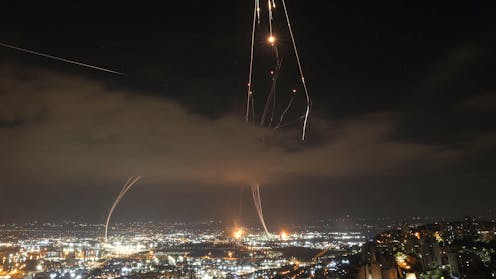
    Israeli defence systems intercept Iranian missiles over the city of Haifa Ahmad Gharabli / AFP via Getty Images

    Late last week, Israel began a wave of attacks on Iran under the banner of Operation Rising Lion, with the stated goal of crippling the Islamic republic’s nuclear program and long-range strike capabilities. At the outset, Israel claimed Iran would soon be able to build nine nuclear weapons, a situation Israel regarded as completely unacceptable.

    Following Israeli strikes against Iranian nuclear facilities, and targeted assassinations of Iranian nuclear scientists and key members of the Iranian armed forces, Iran retaliated with a large barrage of ballistic missiles and drones against Tel Aviv and Jerusalem. The first wave consisted of some 200 ballistic missiles and 200 drones.

    The conflict continues to escalate, with population centres increasingly being targeted. Israel’s missile defence systems (including the vaunted Iron Dome) have so far staved off most of Iran’s attacks, but the future is uncertain.

    Ballistic missiles and how to stop them

    Iran possesses a large arsenal of ballistic missiles and long-range drones, alongside other long-range weapons such as cruise missiles. Ballistic missiles travel on a largely fixed path steered by gravity, while cruise missiles can adjust their course as they fly.

    Iran is approximately 1,000km from Israel, so the current strikes mostly involve what are classified as medium-range ballistic missiles, alongside long-range drones. It is not clear exactly what type of missile Iran has used in its latest strikes, but the country has several including the Fattah-1 and Emad.

    It is very difficult to defend against ballistic missiles. There is not much time between launch and impact, and they come down at very high speed. The longer the missile’s range, the faster and higher it flies.

    An incoming missile presents a small, fast-moving target – and defenders may have little time to react.

    Israel’s missile defence and the Iron Dome

    Israel possesses arguably one of the most effective, battle-tested air defence systems in service today. The system is often described in the media as the “Iron Dome”, but this is not quite correct.

    Israel’s defences have several layers, each designed to address threats coming from different ranges.

    Iron Dome is just one of these layers: a short range, anti-artillery defence system, designed to intercept short-range artillery shells and rockets.

    In essence, Iron Dome consists of a network of radar emitters, command and control facilities, and the interceptors (special surface-to-air missiles). The radar quickly detects incoming threats, the command and control elements decide which are most pressing, and the interceptors are sent to destroy the incoming shells or rockets.

    Ballistic defence systems

    The other layers of Israel’s defence system include David’s Sling, and the Arrow 2 and Arrow 3 interceptors. These are specifically designed to engage longer-range ballistic missiles, both within the atmosphere and at very high altitudes above it (known as exoatmospheric interception).

    Spectacular footage has been captured of what are likely exoatmospheric interceptions taking place during this latest conflict, demonstrating Israel’s capacity to engage longer-range missiles.

    The US military has comparable missile defence systems. The US Army has the Patriot PAC-3 (comparable to David’s Sling) and THAAD (comparable to Arrow 2), while the US Navy has the Aegis and the SM-3 (comparable to Arrow 3) and the SM-6 (comparable again to Arrow 2).

    The US deployed Aegis-equipped warships to support Israel’s defence against missile attacks in 2024, and appears to be preparing to do the same now.

    Iran possesses some air defence systems such as the Russian S300 which has some (very limited) ballistic missile defence capabilities, but only against shorter range (and thus slower) ballistic missiles. Further, Israel has been focusing on degrading Iran’s air defences, so it is not clear how many are still operational.

    Iran has been focusing on developing technology such as maneuverable warheads, which are harder to defend against. However, it is not clear whether these are yet operational and in Iranian service.

    Can missile defences last forever?

    Missile defences are finite. The defender is always limited by the number of interceptors it possesses.

    The attacker is also limited by the number of missiles it possesses. However, the defender must often assign multiple interceptors to each attacking missile, in case the first misses or otherwise fails.

    The attacker will plan for some losses to interceptors (or mechanical failures) and send what it determines to be enough missiles for at least some to penetrate the defences.

    When it comes to ballistic missiles, the advantage lies with the attacker. Ballistic missiles can carry large explosive payloads (or even nuclear warheads), so even a handful of missiles “leaking” past defensive systems can still wreak significant damage.

    What now?

    Israel’s missile defences are unlikely to stop working completely. However, as attacks deplete its stocks of interceptors, the system may become less effective.

    As the conflict continues, it may become a race to see who runs out of weapons first. Will it be Iran’s stocks of ballistic missiles and drones, or the interceptors and anti-air munitions of Israel, the US and any other supporters?

    It is impossible to say who would prevail in such a race of stockpile attrition. Some reports suggest Iran has fired approximately 1,000 ballistic missiles of an estimated 3,000. However, this still leaves it with an enormous stockpile to use, and it is unclear how fast Iran can make new missiles to replenish its resources.

    But we should hope it doesn’t come to that. Beyond the tit-for-tat exchange of missiles, the latest conflict between Israel and Iran risks escalating. If it is not resolved soon, and if the US is drawn into the conflict more directly, we may see broader conflict in the Middle East.

    The Conversation

    James Dwyer does not work for, consult, own shares in or receive funding from any company or organisation that would benefit from this article, and has disclosed no relevant affiliations beyond their academic appointment.

    ref. How does Israel’s famous air defence work? It’s not just the ‘Iron Dome’ – https://theconversation.com/how-does-israels-famous-air-defence-work-its-not-just-the-iron-dome-259029

    MIL OSI AnalysisEveningReport.nz

  • MIL-OSI China: PSG thrash Atletico Madrid 4-0 to kick off Club World Cup campaign

    Source: People’s Republic of China – State Council News

    Recently crowned Champions League winners Paris Saint-Germain opened their Club World Cup campaign with a commanding 4-0 victory over Atletico Madrid at the Rose Bowl in Pasadena on Sunday.

    The French side dominated the first half, and although Atletico improved slightly after the break, they created just one clear chance – which they missed – before PSG sealed the win in the closing minutes.

    “We had the objective of making history this season, but this is a new chapter,” PSG coach Luis Enrique said after the match.

    Paris Saint-Germain was without Ousmane Dembele and Bradley Barcola for the match, which kicked off under searing heat in a stadium with virtually no shade. Despite the absences, the European champions controlled the game from the start.

    Khvicha Kvaratskhelia posed a constant threat down the left and forced Atletico goalkeeper Jan Oblak into an early save before Fabian Ruiz broke the deadlock in the 19th minute.

    PSG had controlled possession in the opening stages, and Ruiz put justice to the scoreline with a low strike from the edge of the area that gave Oblak no chance.

    There was a nervous moment for PSG when Giuliano Simeone went down after tangling with Nuno Mendes. Mendes could have been in trouble as the last defender if a foul had been given, but the referee opted to play on.

    Desire Doue and Kvaratskhelia both had further chances as PSG varied the tempo against an Atletico side that struggled with the heat and pace.

    Antoine Griezmann had Atletico’s only chance of the first half in stoppage time, but after PSG failed to clear a rare attack, he fired straight at Gianluigi Donnarumma. The PSG keeper launched a rapid counterattack that ended with Vitinha doubling the lead, curling home a shot after being left unmarked.

    Atletico brought on Koke for Samuel Lino at halftime and looked to push forward, but PSG continued to threaten. Kvaratskhelia nearly added a third with a curling effort that Oblak tipped onto the bar.

    Julian Alvarez found the net for Atletico in the 57th minute, but the goal was disallowed for a clear prior foul by Koke. Their hopes of a comeback faded further when Clement Lenglet was sent off for a second yellow card – the first for a bad challenge, and the second for protesting a perceived foul on Oblak.

    Substitute Alexander Sorloth squandered a golden opportunity with 10 minutes remaining, firing over from four yards with the goal wide open. PSG then made it 3-0 in the 87th minute as Senny Mayulu turned and scored after Atletico failed to clear a cross.

    There was still time for a fourth, with Kang-In Lee converting a penalty in stoppage time after Robin le Normand handled a shot inside the box.

    “The club is hungry, the fans are hungry, the players and the team are hungry, and that’s a good feeling. We have the same objective as in other competitions, which is to go as far as possible and try to win it,” Enrique said.

    “The team competed, despite the tough defeat, and a 4-0 scoreline. We’re obliged to get good results in the other games now,” Atletico coach Diego Simeone said. 

    MIL OSI China News

  • US police arrest suspect Vance Boelter for Minnesota lawmakers’ shooting

    Source: Government of India

    Source: Government of India (4)

    A massive two-day manhunt ended on Sunday with the arrest of Vance Boelter, 57, for allegedly killing a Minnesota Democratic state lawmaker and her husband while posing as a police officer, Governor Tim Walz said.

    Boelter allegedly shot dead Melissa Hortman, the top Democrat in the Minnesota House, and her husband, Mark, in their home on Saturday – a crime Governor Tim Walz characterized as a “politically motivated assassination.”

    Authorities said Boelter also allegedly shot and wounded another Democratic lawmaker, state Senator John Hoffman, and his wife Yvette at their home a few miles away.

    “After a two-day manhunt, two sleepless nights, law enforcement have apprehended Vance Boelter,” Walz told a news conference. “One man’s unthinkable actions have altered the state of Minnesota.

    “A moment in this country where we watch violence erupt, this cannot be the norm. It cannot be the way that we deal with our political differences. Now is the time for us to recommit to the core values of this country, and each and every one of us can do it.”

    Walz said Hoffman, who had been hit with nine bullets, came out of his final surgery and was moving towards recovery.

    Boelter has links to evangelical ministries and claimed to be a security expert with experience in the Gaza Strip and Africa, according to online postings and public records reviewed by Reuters.

    Boelter was charged with two counts of second-degree murder and two counts of second-degree attempted murder, the criminal complaint showed.

    Three of those charges are punishable with jail terms of up to 40 years, according to the complaint unsealed on Sunday.

    Boelter had been impersonating a police officer while carrying out the shootings, wearing an officer’s uniform and driving a Ford SUV with police-style lights, according to a Hennepin County criminal complaint unsealed on Sunday.

    Boelter fled on foot early on Saturday when officers confronted him at Hortman’s Brooklyn Park home, said authorities who had warned residents to stay indoors for their own safety and unleashed the state’s biggest manhunt.

    When police searched Boelter’s SUV after the shootings they discovered three AK-47 assault rifles, a 9-mm handgun, and a list of other public officials including their addresses, the criminal complaint showed.

    Working on a tip that Boelter was near his home in the city of Green Isle, more than 20 SWAT teams combed the area, aided by surveillance aircraft, officials said. Boelter was armed but surrendered with no shots fired.

    “The suspect crawled to law enforcement teams and was placed under arrest,” Lieutenant Colonel Jeremy Geiger of the Minnesota State Patrol told the briefing. “The suspect was taken into custody without any use of force.”

    The operation to capture Boelter, drawing on the work of hundreds of detectives and a wide range of federal, state and local law enforcement agencies, was the largest manhunt in state history, Brooklyn Park police Chief Mark Bruley said.

    “Now begins the hard work of looking at what the motive is,” Bruley said.

    The killing was the latest episode of high-profile U.S. political violence.

    Such incidents range from a 2022 attack on former Democratic U.S. House Speaker Nancy Pelosi’s husband at their home, to an assassination bid on Donald Trump last year, and an arson attack at Pennsylvania Governor Josh Shapiro’s house in April.

    (Reuters)

  • IMD predicts heavy rainfall in Guwahati in next 2-3 days

    Source: Government of India

    Source: Government of India (4)

    The India Meteorological Department (IMD) on Sunday has predicted cloudy weather over Guwahati for the coming two-three days, with likelihood of heavy to very heavy rainfall across various parts of the city, an official said.

    The Assam State Disaster Management Authority (ASDMA) quoting the IMD said that the weather authority (IMD) has predicted cloudy weather over Guwahati city for the coming two to three days, with likelihood of heavy to very heavy rainfall across various parts of the city.

    The statement said that heavy to very heavy rainfall is very likely at the isolated places of the city during the next two to three days, which may aggravate waterlogging, slow vehicular movement, and increase the risk of localised landslides in vulnerable pockets.

    The city authorities are closely monitoring the situation and emergency response systems are being kept on alert, it said.

    In view of the recent incidents of landslides and water blockage due to very heavy rainfall occurring in the city a few days back, the ASDMA requests the people of Guwahati to take all necessary precautions and remain vigilant.

    Daily commuters and long-distance travellers are requested to plan their routines accordingly, avoiding unnecessary movement during periods of intense rainfall, the authority said.

    It said that the residents in low-lying and hillside areas should stay alert for any signs of flooding or landslides.

    Residents in vulnerable areas are further advised to keep adequate stock of essential items such as medicines, candles etc, the statement said.

    It requested the people to reach out ASDMA and DDMA during the necessity. “People living in the identified landslide prone vulnerable areas of the city are advised to shift themselves to the safe shelters (relief camps) or other safer places of their choice for next three days. The public is also urged to stay tuned to official weather updates and follow advisories issued by local authorities to ensure safety during this prolonged spell of rain.”

    The status of the situation would be updated by ASDMA from time to time for general awareness, the statement added. Meanwhile, in the first spell of monsoon in the last week of May and first week of this over 6.79 lakh people were affected in 21 districts.

    As per the ASDMA report, over 14,977 hectares of crop lands were affected in 1,494 villages in 21 districts. The total number of people losing their lives in this year’s flood and landslide officially reported 28 across the state.

    (With inputs from IANS)

  • MIL-OSI Australia: Check your chimneys this winter

    Source:

    On Saturday 14 June CFA responded to a wood heater fire on the Terang – Mortlake Road in Noorat about 1.10pm.

    Upon arrival firefighters from Noorat and district fire brigade found a fire inside the walls of the chimney cavity.  

    The flu had become detached from the wood heater, this combined with a build-up of creosote had caused the fire. 

    Thankfully the family was home and were able to put water on the blaze and safely escape before CFA crews arrived to fully extinguish the fire.  

    Crews worked to completely extinguish the fire and the scene was left with the homeowner to have the rest of the flue pulled apart.  

    The incident was under control by 1.36pm and safe at 2.17pm.   

    Acting Assistant Chief Fire Officer for district six, Peter Lockwood, said this was a good reminder with colder weather upon us.  

    Please don’t neglect your chimney or flue and make sure it is cleaned and well maintained before firing it up this winter,” Peter said.   

    “Spending a few minutes now to check your chimney could be one of the most important fire safety actions you take this season, and you can easily check for creosote build-up or obstructions by simply using a torch before lighting a fire.” 

    Submitted by CFA Media

    MIL OSI News

  • Heavy rain forecast for Maharashtra today, red alert issued in Raigad

    Source: Government of India

    Source: Government of India (4)

    As the monsoon has become active, the India Meteorological Department (IMD) said the intensity of rains will increase throughout the day on Monday and issued alerts for various regions of Maharashtra.

    IMD has issued a red alert in Raigad district, orange alert in Ratnagiri, Sindhudurg, Pune ghat section, Satara ghat section, Kolhapur ghat section and yellow alert in Mumbai, Palghar, Thane, Nashik ghat section, Nagpur, Bhandara, Gondia, Gadchiroli.

    The weather bureau has predicted thunderstorms with lightning likely in Buldhana, Akola, Amravati, Washim, Yavatmal, Wardha, Nagpur, Bhandara, Gondia, Chandrapur and Gadchiroli districts.

    The Brihanmumbai Municipal Corporation (BMC) said on X, “The Indian Meteorological Department has issued a warning of heavy rains in Mumbai Metropolitan Region (Mumbai city and suburbs) for next three hours. For help in an emergency or for official, contact the BMC’s main control room helpline number 1916.”

    Due to the rain, the Central, Western and Harbour Railways in Mumbai are running late by 5 to 10 minutes. Heavy rainfall has been continuing in the Vasai-Virar area since Sunday evening, and many low-lying areas of the city have been submerged. As a result, traffic and normal life have been disrupted.

    Mumbai and Pune cities have been receiving continuous rain since the night. Heavy rain has been recorded in the Pune area since night, 113 mm of rain has been recorded in the Varandha Ghat Shirgaon area, while there has been a drizzle in the Mutha Ghat leading to Lavasa.

    The weather bureau has predicted that the intensity of rain will decrease in Mumbai and Thane on Tuesday and Wednesday, and the cities will witness moderate rain.

    (With inputs from IANS)

  • MIL-Evening Report: At Rising, a dance program delves into dark places – and then finally oozes with joy

    Source: The Conversation (Au and NZ) – By Angela Conquet, PhD Candidate, School of Culture and Communication, The University of Melbourne

    The Butterfly Who Flew Into The Rave. Lucy Parakhina/Rising

    I first came across the work of Argentinian underground enfant terrible Marina Otero in 2022, seeing her work Fuck Me in Paris. Fuck Me starts with shaky videos of Otero speaking from a hospital bed while awaiting spinal surgery, explaining her initial absence from the stage.

    When she did appear, she was frail and could barely move. Six strapping naked dancers helped her demonstrate what the dance would have been, now that she could no longer dance. Propping and carrying her, her petite body seemed even more fragile in their hands.

    We were all commiserating over her misfortune as she was telling us, in random order, about her injury, her loneliness, her sexless life, her grandfather and the military dictatorship in Argentina.

    At the end, when she came to bow, she moved so precariously that a gust of wind would have blown her away. And then, as we were getting ready to leave, she stormed back onto the stage and started running in circles, faster and faster, going and going, finally stopping when the last person left the theatre.

    I was told it went on for almost an hour.

    Never have I felt more emotionally manipulated as an audience member. I appreciated the astuteness of the trickery but was furious at my naivety. For a long time, I thought it was all fiction.

    Later, I learnt it was all true; it was indeed Otero’s life, living with pain, joyless and desireless. This is what pain does.

    At this year’s Rising festival, Otero’s Kill Me – the last in the trilogy which started with Fuck Me – is also about her life. She gives us the story of a painful breakup with a narcissistic man, the resulting revengeful desire to become an invincible Sarah Connor and Otero’s subsequent diagnosis with borderline personality disorder (BPD).

    Kill Me is a dance work about living with borderline personality disorder.
    Mariano Barrientos/Rising

    The rest of the cast have been chosen by Otero because they all live with this condition. Five naked women wear little else than knee-pads, black gloves, white boots and orange wigs, and carry revolvers. They enter the stage majestically and promise to be credible Sarah Connors.

    Instead, they turn out to be self-declared Marilyns and Lady Dis, as they each tell us about their life with mental illness.

    The piece becomes a catalogue of vignettes and vivid illustrations. Their stories are messy and painful to hear. Yet the unsettling always veers into the hilarious, peppered with flamboyant songs and cheesy Lacan quotes.

    And then, there is the great male ballet dancer Vaslav Nijinsky, reborn, performed by the only male dancer, as stoutly robust as Nijinsky was flowingly tall. He is the clown, the cheerful unballetic partner to attempted pirouettes with improbable endings.

    The lone male dancer is the clown, the cheerful unballetic partner.
    Mariano Barrientos/Rising

    As Otero’s final monologue arrives, an account of the plight of living with BPD, and of her intention to end the piece with a gun to her head, I remember Nijinsky’s diary entry:

    The audience came to be amused. They thought that I was dancing to amuse them. I danced frightening things.

    Otero and her dancers dance frightening things, from the artist’s necessity to create to keep sane, to self harming to feel one has a self, to exhibiting one’s life to feel alive.

    This is the story of those too unstable for the “ordered” world, of the many “misfits”, the “insane” and the “hysteric” – all those who need to take a pill to fit into the world, as she says.

    This time, Otero’s staged life is not a manipulation of our emotions, rather a diffraction of our own. These sexy avengers and reborn Nijinskys are us, and their fears, ours: fears of being unloved, abandoned, forgotten. Some of us manage to make it “fit” better. Others take it to the stage as both salvation and redemption.

    The depression of BLKDOG

    BLKDOG, from British choreographer Botis Seva, is also about mental health, suggested by the title, referencing Winston Churchill’s metaphor of the black dogpopularised in referring to depression.

    This is a dark piece, contrasting heavily with Kill Me. Seven hooded, genderless bodies emerge from obscurity, move and morph together, a tenuous presence at first, and then more threatening, as the group gangs up on one of them, suddenly, somehow isolated.

    It does not become any lighter. The dancers don hoodies for a more urban apparel and, later, dragon onesies.

    BLKDOG is a dark and unsettling work.
    Tom Visser/Rising

    This unsettling closing in remains a pattern. A lonely body breaks out from the group, to simulate suicide, or self-harm, or murder. The others approaching to attack, rape, beat or kill. The unnerving dancing reveals the dancers’ skills, all impeccably trained in street dance, as the choreography relies heavily on the virtuosic vocabulary of popping and krumping.

    Everything is dark and rough in this joyless piece. The lighting that plunges the stage into oppressive mists or aggressively isolates bodies with cutting brightness, the relentless pounding of Torben Lars’ soundtrack, the dancers’ faces always in the dark.

    The choreography is a suite of vignettes of simulated violence, but they are so theatricalised it dilutes them into caricature. When tenderness arrives, unexpectedly, with one body consoling another, a gentle movement here and there, a pause softened by children’s voices, it makes us see the depth of the turmoil, the thoughts thumping trapped in one’s head.

    It is inescapable and we are glad when the piece is over.
    Tom Visser/Rising

    It is inescapable and we are glad when the piece is over. Seva created this piece in 2018 after the birth of his first child. He doesn’t want to perform it anymore as it takes him to dark places. Like Otero, he says he had to make the piece. Unlike Otero, he no longer wants his life to be the work.

    Oozing with joy

    In The Butterfly that Flew into the Rave, from New Zealand Aotearoa choreographer Oli Mathiesen, Mathiesen and his two acolytes, Celia Hext and Tayla Gartner, dance non-stop for nearly two hours on the Buxton Contemporary concrete floor.

    There is nothing here of the dancing-till-you-forget-yourself typical of raves; always the same saccadic movements, always the slight sadness, of those who want to keep going in sweaty clubbing rooms when lights go up or, in the early dusty mornings of an ending festival.

    Their joy is infectious as they dance together in sync.
    Mark Gambino/Rising

    There is joy oozing out of this trio’s dancing, facing us, smiling at us, as they swim from one routine into the other, not the tedious spasmodic rave clubbing vocabulary but the more joyful aerobic-whacking-contemporary jazz sort of thing one can learn from YouTube tutorials.

    Their joy is infectious as they dance together in sync. When they are not synced, it is in jest. They smile at us as they dance for us. The joy infects the audience: those standing and pulsing to the beat of the music, those who resist it but not for long, those so taken with the dancers that they forget to breathe because they are so attuned.

    We are implicated as witnesses to their generous joy, palpable and pulsing like a beating heart. We remember we have one: one that can give in to joy.

    In all three works, their protagonists throw their bodies into the fight. They dance with depth and urgency, because they have to, and while the fight may seem different, it may be the same, that of finding (and keeping) the joy.


    If this article has raised issues for you, or if you’re concerned about someone you know, call Lifeline on 13 11 14.

    As a dance professional, Angela Conquet has received funding from Creative Australia. She is the co-chair of the Green Room Awards Dance panel.

    ref. At Rising, a dance program delves into dark places – and then finally oozes with joy – https://theconversation.com/at-rising-a-dance-program-delves-into-dark-places-and-then-finally-oozes-with-joy-257319

    MIL OSI AnalysisEveningReport.nz

  • MIL-OSI USA: SPC Severe Thunderstorm Watch 422

    Source: US National Oceanic and Atmospheric Administration

    Note:  The expiration time in the watch graphic is amended if the watch is replaced, cancelled or extended.Note: Click for Watch Status Reports.
    SEL2

    URGENT – IMMEDIATE BROADCAST REQUESTED
    Severe Thunderstorm Watch Number 422
    NWS Storm Prediction Center Norman OK
    955 PM MDT Sun Jun 15 2025

    The NWS Storm Prediction Center has issued a

    * Severe Thunderstorm Watch for portions of
    Western into Central North Dakota

    * Effective this Sunday night and Monday morning from 955 PM
    until 400 AM MDT.

    * Primary threats include…
    Scattered damaging winds and isolated significant gusts to 85
    mph likely
    Isolated large hail events to 1.5 inches in diameter possible

    SUMMARY…Clusters of severe thunderstorms are forecast to move east
    into the Watch tonight from eastern Montana. A couple of supercells
    may pose a threat for large hail, but the primary hazard will be
    severe gusts with linear bands and clusters of thunderstorms.
    Severe gusts peaking into the 75-85 mph range are possible with the
    more intense outflow surges and thunderstorm downdrafts.

    The severe thunderstorm watch area is approximately along and 75
    statute miles east and west of a line from 65 miles northwest of
    Minot ND to 10 miles east southeast of Lemmon SD. For a complete
    depiction of the watch see the associated watch outline update
    (WOUS64 KWNS WOU2).

    PRECAUTIONARY/PREPAREDNESS ACTIONS…

    REMEMBER…A Severe Thunderstorm Watch means conditions are
    favorable for severe thunderstorms in and close to the watch area.
    Persons in these areas should be on the lookout for threatening
    weather conditions and listen for later statements and possible
    warnings. Severe thunderstorms can and occasionally do produce
    tornadoes.

    &&

    OTHER WATCH INFORMATION…CONTINUE…WW 418…WW 419…WW
    420…WW 421…

    AVIATION…A few severe thunderstorms with hail surface and aloft to
    1.5 inches. Extreme turbulence and surface wind gusts to 75 knots. A
    few cumulonimbi with maximum tops to 500. Mean storm motion vector
    27045.

    …Smith

    SEL2

    URGENT – IMMEDIATE BROADCAST REQUESTED
    Severe Thunderstorm Watch Number 422
    NWS Storm Prediction Center Norman OK
    955 PM MDT Sun Jun 15 2025

    The NWS Storm Prediction Center has issued a

    * Severe Thunderstorm Watch for portions of
    Western into Central North Dakota

    * Effective this Sunday night and Monday morning from 955 PM
    until 400 AM MDT.

    * Primary threats include…
    Scattered damaging winds and isolated significant gusts to 85
    mph likely
    Isolated large hail events to 1.5 inches in diameter possible

    SUMMARY…Clusters of severe thunderstorms are forecast to move east
    into the Watch tonight from eastern Montana. A couple of supercells
    may pose a threat for large hail, but the primary hazard will be
    severe gusts with linear bands and clusters of thunderstorms.
    Severe gusts peaking into the 75-85 mph range are possible with the
    more intense outflow surges and thunderstorm downdrafts.

    The severe thunderstorm watch area is approximately along and 75
    statute miles east and west of a line from 65 miles northwest of
    Minot ND to 10 miles east southeast of Lemmon SD. For a complete
    depiction of the watch see the associated watch outline update
    (WOUS64 KWNS WOU2).

    PRECAUTIONARY/PREPAREDNESS ACTIONS…

    REMEMBER…A Severe Thunderstorm Watch means conditions are
    favorable for severe thunderstorms in and close to the watch area.
    Persons in these areas should be on the lookout for threatening
    weather conditions and listen for later statements and possible
    warnings. Severe thunderstorms can and occasionally do produce
    tornadoes.

    &&

    OTHER WATCH INFORMATION…CONTINUE…WW 418…WW 419…WW
    420…WW 421…

    AVIATION…A few severe thunderstorms with hail surface and aloft to
    1.5 inches. Extreme turbulence and surface wind gusts to 75 knots. A
    few cumulonimbi with maximum tops to 500. Mean storm motion vector
    27045.

    …Smith

    Note: The Aviation Watch (SAW) product is an approximation to the watch area. The actual watch is depicted by the shaded areas.
    SAW2
    WW 422 SEVERE TSTM ND 160355Z – 161000Z
    AXIS..75 STATUTE MILES EAST AND WEST OF LINE..
    65NW MOT/MINOT ND/ – 10ESE Y22/LEMMON SD/
    ..AVIATION COORDS.. 65NM E/W /57NW MOT – 49NNW DPR/
    HAIL SURFACE AND ALOFT..1.5 INCHES. WIND GUSTS..75 KNOTS.
    MAX TOPS TO 500. MEAN STORM MOTION VECTOR 27045.

    LAT…LON 48920064 45860042 45860354 48920394

    THIS IS AN APPROXIMATION TO THE WATCH AREA. FOR A
    COMPLETE DEPICTION OF THE WATCH SEE WOUS64 KWNS
    FOR WOU2.

    Watch 422 Status Report Message has not been issued yet.

    Note:  Click for Complete Product Text.Tornadoes

    Probability of 2 or more tornadoes

    Low (10%)

    Probability of 1 or more strong (EF2-EF5) tornadoes

    Low ( 65 knots

    Mod (60%)

    Hail

    Probability of 10 or more severe hail events

    Low (20%)

    Probability of 1 or more hailstones > 2 inches

    Low (20%)

    Combined Severe Hail/Wind

    Probability of 6 or more combined severe hail/wind events

    High (90%)

    For each watch, probabilities for particular events inside the watch (listed above in each table) are determined by the issuing forecaster. The “Low” category contains probability values ranging from less than 2% to 20% (EF2-EF5 tornadoes), less than 5% to 20% (all other probabilities), “Moderate” from 30% to 60%, and “High” from 70% to greater than 95%. High values are bolded and lighter in color to provide awareness of an increased threat for a particular event.

    MIL OSI USA News

  • MIL-OSI Global: Israel’s attacks on Iran are already hurting global oil prices, and the impact is set to worsen

    Source: The Conversation – Global Perspectives – By Joaquin Vespignani, Associate Professor of Economics and Finance, University of Tasmania

    The weekend attacks on Iran’s oil facilities – widely seen as part of escalating hostilities between Israel and Iran – represent a dangerous moment for global energy security.

    While the physical damage to Iran’s production facilities is still being assessed, the broader strategic implications are already rippling through global oil markets. There is widespread concern about supply security and the inflationary consequences for both advanced and emerging economies.

    The global impact

    Iran, which holds about 9% of the world’s proven oil reserves, currently exports between 1.5 and 2 million barrels per day, primarily to China, despite long-standing United States sanctions.

    While its oil output is not as globally integrated as that of Saudi Arabia or the United Arab Emirates, any disruption to Iranian production or export routes – especially the Strait of Hormuz, through which about 20% of the world’s oil supply flows – poses a systemic risk.

    Markets have already reacted. Brent crude prices rose more than US 6%, while West Texas Intermediate price increased by over US 5% immediately after the attacks.

    These price movements reflect not only short-term supply concerns but also the addition of a geopolitical risk premium due to fears of broader regional conflict.

    International oil prices may increase further as the conflict continues. Analysts expect that Australian petrol prices will increase in the next few weeks, as domestic fuel costs respond to international benchmarks with a lag.

    Escalation and strategic intentions

    There is growing concern this conflict could escalate further. In particular, Israel may intensify its targeting of Iranian oil facilities, as part of a broader strategy to weaken Iran’s economic capacity and deter further proxy activities.

    Should this occur, it would put even more upward pressure on global oil prices. Unlike isolated sabotage events, a sustained campaign against Iranian energy infrastructure would likely lead to tighter global supply conditions. This would be a near certainty if Iranian retaliatory actions disrupt shipping routes or neighbouring producers.

    Countries most affected

    Countries reliant on oil imports – especially in Asia – are the most exposed to such shocks in the short term.

    India, Pakistan, Indonesia and Bangladesh rely heavily on Middle Eastern oil and are particularly vulnerable to both supply interruptions and price increases. These economies typically have limited strategic petroleum reserves and face external balance pressures when oil prices rise.

    China, despite being Iran’s largest oil customer, has greater insulation due to its diversified suppliers and substantial reserves.

    However, sustained instability in the Persian Gulf would raise freight and insurance costs even for Chinese refiners, especially if the Strait of Hormuz becomes a contested zone. The strait, between the Persian Gulf and the Gulf of Oman, provides the only sea access from the Persian Gulf to the open ocean.

    Australia’s exposure

    Australia does not import oil directly from Iran. Most of its crude and refined products are sourced from countries including South Korea, Malaysia, the United Arab Emirates and Singapore.

    However, because Australian fuel prices are pegged to international benchmarks such as Brent and Singapore Mogas, domestic prices will rise in response to the global increase in oil prices, regardless of whether Australian refineries process Iranian oil.

    These price increases will have flow-on effects, raising transport and freight costs across the economy. Industries such as agriculture, logistics, aviation and construction will feel the pinch, and higher operating costs are likely to be passed on to consumers.

    Broader economic impacts

    The conflict could also disrupt global shipping routes, particularly if Iran retaliates through its proxies by targeting vessels in the Red Sea, Arabian Sea, or Hormuz Strait.

    Any such disruption could drive up shipping insurance, delay delivery times, and compound existing global supply chain vulnerabilities. More broadly, this supply shock could rekindle inflationary pressures in many countries.

    For Australia, it could delay monetary easing by the Reserve Bank of Australia and reduce consumer confidence if household fuel costs rise significantly. Globally, central banks may adopt a more cautious approach to rate cuts if oil-driven inflation proves persistent.

    The attacks on Iran’s oil fields, and the likelihood of further escalation, present a renewed threat to global energy stability. Even though Australia does not import Iranian oil, it remains exposed through price transmission, supply chain effects and inflationary pressures.

    A sustained campaign targeting Iran’s energy infrastructure by Israel could amplify these risks, leading to a broader energy shock that would affect oil-importing economies worldwide.

    Strategic reserve management and diplomatic engagement will be essential to contain the fallout.

    Joaquin Vespignani is affiliated with the Centre for Australian Macroeconomic Analysis, Australian National University.

    ref. Israel’s attacks on Iran are already hurting global oil prices, and the impact is set to worsen – https://theconversation.com/israels-attacks-on-iran-are-already-hurting-global-oil-prices-and-the-impact-is-set-to-worsen-259013

    MIL OSI – Global Reports

  • MIL-OSI Global: ‘No kings!’: like the LA protesters, the early Romans hated kings, too

    Source: The Conversation – Global Perspectives – By Peter Edwell, Associate Professor in Ancient History, Macquarie University

    Protesters across the United States have brandished placards declaring “no kings!” in recent days, keen to send a message one-man rule is not acceptable.

    The defeat of the forces of King George III in the United States’ revolutionary war of 1775–83 saw the end of royal rule in the US. Touting itself as the world’s leading democracy, kings have not been welcome in America for 250 years. But for many, Donald Trump is increasingly behaving as one and now is the time to stop him.

    Having studied ancient Roman politics for years, America’s rejection of kingship reminds me vividly of the strong aversion to it in the Roman republic.

    Early Romans too, sought a society with “no kings!” – up until, that is, the period following the assassination of Julius Caesar, when everything changed.

    The seven kings of Rome

    Seven kings ruled Rome, one after the other, after the city was founded in 753 BCE. The first was Romulus who, according to some legends, gave the city its name.

    When the last of the kings of Rome was driven from the city in 509 BCE, his key opponent, Lucius Junius Brutus, vowed:

    I will pursue Lucius Tarquinius Superbus and his wicked wife and all his children, with sword, with fire, with whatever violence I may; and I will suffer neither him nor anyone else to be king in Rome!

    Tarquinius Superbus (meaning “the proud”) had ruled Rome for 25 years. He began his reign by executing uncooperative Senators.

    When Tarquinius’ son raped a noblewoman named Lucretia, the Roman population rebelled against the king’s long-running tyranny. The hubris of the king and his family was finally too much. They were driven from Rome and never allowed to return.

    A new system of government was ushered in: the republic.

    The rise of the Roman republic

    In the new system, power was shared among elected officials – including two consuls, who were elected annually.

    The consuls were the most powerful officials in the republic and were given power to wage war.

    The Senate, which represented the wealthiest sections of society (initially the patrician class), held power in some key areas, including foreign policy.

    Less affluent citizens elected tribunes of the plebs who had various powers, including the right to veto laws.

    In the republican system, the term king (rex in Latin) quickly became anathema.

    “No kings” would effectively remain the watchword through the Roman republic’s entire history. “Rex” was a word the Romans hated. It was short-hand for “tyranny”.

    The rise and fall of Julius Caesar

    Over time, powerful figures emerged who threatened the republic’s tight power-sharing rules.

    Figures such as the general Pompey (106–48 BCE) broke all the rules and behaved in suspiciously kingly ways. With military success and vast wealth, he was a populist who broke the mould. Pompey even staged a three-day military parade, known as a triumph, to coincide with his birthday in 61 BCE.

    But the ultimate populist was Julius Caesar.

    Born to a noble family claiming lineage from the goddess Venus, Caesar became fabulously wealthy.

    He also scored major military victories, including subduing the Gauls (across modern France and Belgium) from 58–50 BCE.

    In the 40s BCE, Caesar began taking offices over extended time frames – much longer periods than the rules technically allowed.

    Early in 44 BCE he gave himself the formal title “dictator for life” (Dictator Perpetuo), having been appointed dictator two years earlier. The dictatorship was only meant to be held in times of emergency for a period of six months.

    When Caesar was preparing a war against Parthia (in modern day Iran), some tried to hail him as king.

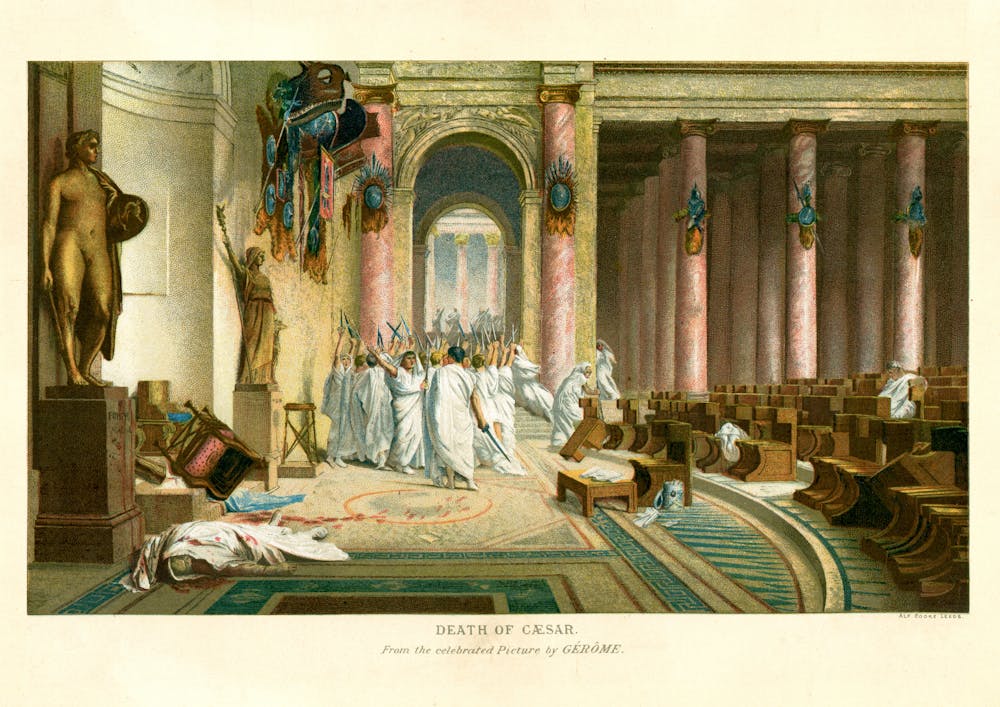
    Soon after, an angry group of 23 senators stabbed him to death in a vain attempt to save the republic. They were led by Marcus Junius Brutus, a descendant of the Brutus who killed the last Roman king, Tarquinius Superbus.

    The Roman republic was beyond saving despite Caesar’s death.
    duncan1890/Getty Images

    However, the Roman republic was beyond saving despite Caesar’s death. His great nephew Octavian eventually emerged as leader and became known as Augustus (27 BCE – 14 CE). With Augustus, an age of emperors was born.

    Emperors were kings in all but name. The strong aversion to kingship in Rome ensured their complete avoidance of the term rex.

    ‘No kings!’

    American protesters waving placards shouting “no kings!” are expressing clear concerns that their beloved democracy is under threat.

    Donald Trump has already declared eight national emergencies and issued 161 executive orders in his second term.

    When asked if he needs to uphold the Constitution, Trump declares “I don’t know.” He has joked about running for a third term as president, in breach of the longstanding limit of two terms.

    Like Caesar, is Donald Trump becoming a king in all but name? Is he setting a precedent for his successors to behave increasingly like emperors?

    The American aversion to “king” likely ensures the term will never return. But when protesters and others shout “no kings!”, they know the very meaning of the term “president” is changing before their eyes.

    Peter Edwell receives funding from the Australian Research Council.

    ref. ‘No kings!’: like the LA protesters, the early Romans hated kings, too – https://theconversation.com/no-kings-like-the-la-protesters-the-early-romans-hated-kings-too-259011

    MIL OSI – Global Reports

  • Iran and Israel Exchange Fresh Strikes as Global Leaders Push for Ceasefire

    Source: Government of India

    Source: Government of India (4)

    The war between Iran and Israel is in its fourth day of direct hostilities as international diplomatic activity is in full swing to prevent the conflict from engulfing broader West Asia. While ongoing military operations have killed dozens of people and caused widespread destruction, a complex matrix of behind-the-scenes negotiations is underway among world powers and regional actors desperately trying to contain the crisis.

    Iran launched missile strikes on Israeli cities , with rockets striking Haifa and injuring at least 15 in Israel’s National Emergency Service. The attacks were launched as residents in Tehran reported shaking explosions throughout the capital city, with Iranian officials confirming missile strikes in the Niavaran and Tajrish neighborhoods in the northern part of the city, as well as in and around central Valiasr and Hafte Tir squares.

    Israeli forces have expanded their campaign beyond Tehran to cities including Shiraz and Isfahan, where a Defense Ministry military base was hit. The Israeli military announced it had conducted its longest-range strike since the fighting began, striking an aerial refueling aircraft at Mashhad Airport in eastern Iran. Well over 250 Iranian targets have been hit in the expanding military campaign, including what Israel identifies as nuclear command and control centers and key energy targets. The situation is still complex and fraught with difficulties. Now, Iranian officials refer to negotiations with USA as unjustifiable amid current Israeli aggression, and Iran has stopped attending nuclear negotiations that were supposed to be carried out in Oman.

    Iran’s Foreign Minister Abbas Aragchi has indicated readiness for nuclear agreements that ensure Iran does not pursue weapons development, but insists the country will not accept any deal that deprives it of nuclear rights.

    Behind closed doors, Iran has approached Qatar and Oman requesting them to act as intermediaries with the United States to facilitate ceasefire negotiations, while Saudi Arabia is reportedly involved in diplomatic efforts to de-escalate the situation. US President Donald Trump has expressed optimism about peace prospects, stating he anticipates a deal soon through ongoing calls and meetings to broker an agreement. International diplomatic efforts have accelerated as global leaders warn of the urgent need to prevent the conflict from spilling over to the rest of the Middle East, with multiple regional powers working frantically to halt what they describe as a spiral of violence causing irreparable economic and civil damage to both sides.

    The United Nations Security Council convened an emergency session where both nations presented diametrically opposing positions. Iran labeled Israel’s strike a declaration of war, while Israel justified its attack as legitimate self-defense after failed diplomacy. The session failed to produce a binding resolution, which was indicative of the failure of the international community to agree on anything.

    European leaders have called for diplomatic solutions but appear to have limited influence in the conflict, with analysts saying Europe is on the sidelines. Cyprus has played a minor role, with its president reportedly having carried messages between Israel and Iran through indirect intermediaries.

    Israel remains extremely skeptical of Iranian intentions and has continued its military push despite diplomatic progress. Israeli leaders have warned Iran to vacate nuclear facilities while calling for the United States to assist efforts at abandoning Iran’s nuclear program entirely. The Israeli government has shown little desire to stop activities without concrete Iranian concessions.

    Stakes have also increased as Iran threatened that Western assistance to Israel in downing missiles can result in targeting US, UK, and French military assets throughout the region. The threat has complicated diplomacy as Washington has already provided defensive assistance to Israel while publicly urging restraint.

    In spite of active diplomatic contacts with various regional mediators and ongoing US engagement, prospects for an immediate ceasefire are uncertain.

  • Iran and Israel Exchange Fresh Strikes as Global Leaders Push for Ceasefire

    Source: Government of India

    Source: Government of India (4)

    The war between Iran and Israel is in its fourth day of direct hostilities as international diplomatic activity is in full swing to prevent the conflict from engulfing broader West Asia. While ongoing military operations have killed dozens of people and caused widespread destruction, a complex matrix of behind-the-scenes negotiations is underway among world powers and regional actors desperately trying to contain the crisis.

    Iran launched missile strikes on Israeli cities , with rockets striking Haifa and injuring at least 15 in Israel’s National Emergency Service. The attacks were launched as residents in Tehran reported shaking explosions throughout the capital city, with Iranian officials confirming missile strikes in the Niavaran and Tajrish neighborhoods in the northern part of the city, as well as in and around central Valiasr and Hafte Tir squares.

    Israeli forces have expanded their campaign beyond Tehran to cities including Shiraz and Isfahan, where a Defense Ministry military base was hit. The Israeli military announced it had conducted its longest-range strike since the fighting began, striking an aerial refueling aircraft at Mashhad Airport in eastern Iran. Well over 250 Iranian targets have been hit in the expanding military campaign, including what Israel identifies as nuclear command and control centers and key energy targets. The situation is still complex and fraught with difficulties. Now, Iranian officials refer to negotiations with USA as unjustifiable amid current Israeli aggression, and Iran has stopped attending nuclear negotiations that were supposed to be carried out in Oman.

    Iran’s Foreign Minister Abbas Aragchi has indicated readiness for nuclear agreements that ensure Iran does not pursue weapons development, but insists the country will not accept any deal that deprives it of nuclear rights.

    Behind closed doors, Iran has approached Qatar and Oman requesting them to act as intermediaries with the United States to facilitate ceasefire negotiations, while Saudi Arabia is reportedly involved in diplomatic efforts to de-escalate the situation. US President Donald Trump has expressed optimism about peace prospects, stating he anticipates a deal soon through ongoing calls and meetings to broker an agreement. International diplomatic efforts have accelerated as global leaders warn of the urgent need to prevent the conflict from spilling over to the rest of the Middle East, with multiple regional powers working frantically to halt what they describe as a spiral of violence causing irreparable economic and civil damage to both sides.

    The United Nations Security Council convened an emergency session where both nations presented diametrically opposing positions. Iran labeled Israel’s strike a declaration of war, while Israel justified its attack as legitimate self-defense after failed diplomacy. The session failed to produce a binding resolution, which was indicative of the failure of the international community to agree on anything.

    European leaders have called for diplomatic solutions but appear to have limited influence in the conflict, with analysts saying Europe is on the sidelines. Cyprus has played a minor role, with its president reportedly having carried messages between Israel and Iran through indirect intermediaries.

    Israel remains extremely skeptical of Iranian intentions and has continued its military push despite diplomatic progress. Israeli leaders have warned Iran to vacate nuclear facilities while calling for the United States to assist efforts at abandoning Iran’s nuclear program entirely. The Israeli government has shown little desire to stop activities without concrete Iranian concessions.

    Stakes have also increased as Iran threatened that Western assistance to Israel in downing missiles can result in targeting US, UK, and French military assets throughout the region. The threat has complicated diplomacy as Washington has already provided defensive assistance to Israel while publicly urging restraint.

    In spite of active diplomatic contacts with various regional mediators and ongoing US engagement, prospects for an immediate ceasefire are uncertain.

  • MIL-Evening Report: ‘They were justifying his actions’: what women say about men’s behaviour change programs

    Source: The Conversation (Au and NZ) – By Lauren Zeuschner, Lecturer in Social Work, Federation University Australia

    Marco VDM/Getty

    Thousands of men who use violence are referred every year to men’s behaviour change programs. Sometimes this attendance is ordered by a court, other times it is voluntary. The hope is this will result in program attendance (although that is not always guaranteed), promote perpetrator accountability and, ultimately, increase the safety of women and children.

    Unfortunately, program attendance is low and while researchers have tried again and again to answer the question of whether these programs work, it is still not clear.

    Referrals have continued anyway, so my colleagues and I decided to ask a new question. We invited nine Victorian women to talk in-depth about their experience of their partner being referred to a men’s behaviour change program.

    We wanted to know: what was that like for these women? What meaning did they make of it?

    This new study, published recently in the journal Violence Against Women, found the referral period can ignite for women an emotional firestorm characterised by hope, blame, being judged and, eventually, a sense of indignation.

    How did women initially react?

    Initially after their partner or ex-partner was referred to a men’s behaviour change program, the women were desperate to know if the type of family life they hoped for was something they would ever experience with their partner.

    As Fiona* recalled:

    I thought if it can help – this was when he sort of had me bluffed – if it’s going to work, go for it because the explosions were too big. And if he could control himself and think of what he says, pull his head in, if it can work then we can be a family. I was hoping.

    The women were initially generally intensely hopeful, even though they hadn’t seen any evidence before to suggest their partners would change.

    Janet said:

    When we were together and I used to say, “We need to go and get help; we need to go and talk to someone”, he would say, “No.” He would yell in my face and tell me to “eff off” and “mind my own business” and that he didn’t have a problem; I was the problem.

    This hopefulness motivated many women to stay in relationships with their partner or to support his access to their children.

    The attention men’s behaviour change programs have received over the years seems to have fuelled a belief the programs could bring meaningful change.

    As Rose put it:

    the men’s behavioural change program is big-noted so much, like it’s oh you know, “It’s a great way for the men to realise what they’ve done and move on.” And it doesn’t do that.

    Did their actual experiences match expectations?

    The short answer is no.

    The women we spoke to described being blamed by family, friends and workers for their partner or ex now having to attend the program. Meera recalled being told:

    You are just ruining your marriage because now you have involved the police, so whatever happens to you that is your consequence because you chose to do that.

    Many of the men resisted the suggestion they were “perpetrators” who needed to change. Some men contrasted themselves with others in the men’s behaviour change programs.

    As Erin put it:

    There’s always someone worse, and that’s how they are justifying themselves.

    Other men reportedly gained support for their behaviour from men in the program. Paige said:

    He would come home and tell me that the group agreed with him that the kids were at fault. That if the kids wouldn’t do what they did, then he wouldn’t lose his temper and he wouldn’t have to hit ’em […] So it was like they were justifying his actions.

    Some women also battled with uncertainty around whether what they had experienced actually was family violence.

    If their partner was a “perpetrator” did that make them a “victim survivor”? And if so, what did that mean for them and how they saw themselves?

    A sense of indignation

    For many of the women, the fact their partner or ex ended up being referred to a men’s behaviour change program helped inspire moments of validation.

    It helped them believe with confidence that their partners’ behaviour was actually family violence; that it was unacceptable and unwarranted, and it was he who needed to change.

    As the women came to terms with the reality of their partners’ behaviour and his resistance to change, the women began responding with indignation. Jane recalled that:

    I said: “You’ve hurt a lot of people” and I said: “You’re not taking ownership.”

    What’s next?

    In the end, encouraging women to simply respond with indignation is not the answer. This would just continue the age-old practice of placing sole responsibility on women for the violence they face.

    One action we can all take is supporting victim-survivors to identify that what they’re experiencing may actually constitute family violence, and question whether they believe those behaviours to be acceptable.

    This new study also stresses the need for family violence and domestic violence services in the community to consider the implications a men’s behaviour change program referral has for everyone.

    We must question who is intended to benefit when a man is referred to these programs, whether or not it actually eventuates into program attendance.

    *Names have been changed to protect identities.

    Lauren Zeuschner has received funding from an Australian government Research Training Program Fee-Offset Scholarship through Federation University Australia, and a Central Highlands Children and Youth Area partnership industry funded stipend through Child and Family Services Ballarat, which runs men’s behaviour change programs.

    ref. ‘They were justifying his actions’: what women say about men’s behaviour change programs – https://theconversation.com/they-were-justifying-his-actions-what-women-say-about-mens-behaviour-change-programs-259012

    MIL OSI AnalysisEveningReport.nz

  • MIL-Evening Report: ‘They were justifying his actions’: what women say about men’s behaviour change programs

    Source: The Conversation (Au and NZ) – By Lauren Zeuschner, Lecturer in Social Work, Federation University Australia

    Marco VDM/Getty

    Thousands of men who use violence are referred every year to men’s behaviour change programs. Sometimes this attendance is ordered by a court, other times it is voluntary. The hope is this will result in program attendance (although that is not always guaranteed), promote perpetrator accountability and, ultimately, increase the safety of women and children.

    Unfortunately, program attendance is low and while researchers have tried again and again to answer the question of whether these programs work, it is still not clear.

    Referrals have continued anyway, so my colleagues and I decided to ask a new question. We invited nine Victorian women to talk in-depth about their experience of their partner being referred to a men’s behaviour change program.

    We wanted to know: what was that like for these women? What meaning did they make of it?

    This new study, published recently in the journal Violence Against Women, found the referral period can ignite for women an emotional firestorm characterised by hope, blame, being judged and, eventually, a sense of indignation.

    How did women initially react?

    Initially after their partner or ex-partner was referred to a men’s behaviour change program, the women were desperate to know if the type of family life they hoped for was something they would ever experience with their partner.

    As Fiona* recalled:

    I thought if it can help – this was when he sort of had me bluffed – if it’s going to work, go for it because the explosions were too big. And if he could control himself and think of what he says, pull his head in, if it can work then we can be a family. I was hoping.

    The women were initially generally intensely hopeful, even though they hadn’t seen any evidence before to suggest their partners would change.

    Janet said:

    When we were together and I used to say, “We need to go and get help; we need to go and talk to someone”, he would say, “No.” He would yell in my face and tell me to “eff off” and “mind my own business” and that he didn’t have a problem; I was the problem.

    This hopefulness motivated many women to stay in relationships with their partner or to support his access to their children.

    The attention men’s behaviour change programs have received over the years seems to have fuelled a belief the programs could bring meaningful change.

    As Rose put it:

    the men’s behavioural change program is big-noted so much, like it’s oh you know, “It’s a great way for the men to realise what they’ve done and move on.” And it doesn’t do that.

    Did their actual experiences match expectations?

    The short answer is no.

    The women we spoke to described being blamed by family, friends and workers for their partner or ex now having to attend the program. Meera recalled being told:

    You are just ruining your marriage because now you have involved the police, so whatever happens to you that is your consequence because you chose to do that.

    Many of the men resisted the suggestion they were “perpetrators” who needed to change. Some men contrasted themselves with others in the men’s behaviour change programs.

    As Erin put it:

    There’s always someone worse, and that’s how they are justifying themselves.

    Other men reportedly gained support for their behaviour from men in the program. Paige said:

    He would come home and tell me that the group agreed with him that the kids were at fault. That if the kids wouldn’t do what they did, then he wouldn’t lose his temper and he wouldn’t have to hit ’em […] So it was like they were justifying his actions.

    Some women also battled with uncertainty around whether what they had experienced actually was family violence.

    If their partner was a “perpetrator” did that make them a “victim survivor”? And if so, what did that mean for them and how they saw themselves?

    A sense of indignation

    For many of the women, the fact their partner or ex ended up being referred to a men’s behaviour change program helped inspire moments of validation.

    It helped them believe with confidence that their partners’ behaviour was actually family violence; that it was unacceptable and unwarranted, and it was he who needed to change.

    As the women came to terms with the reality of their partners’ behaviour and his resistance to change, the women began responding with indignation. Jane recalled that:

    I said: “You’ve hurt a lot of people” and I said: “You’re not taking ownership.”

    What’s next?

    In the end, encouraging women to simply respond with indignation is not the answer. This would just continue the age-old practice of placing sole responsibility on women for the violence they face.

    One action we can all take is supporting victim-survivors to identify that what they’re experiencing may actually constitute family violence, and question whether they believe those behaviours to be acceptable.

    This new study also stresses the need for family violence and domestic violence services in the community to consider the implications a men’s behaviour change program referral has for everyone.

    We must question who is intended to benefit when a man is referred to these programs, whether or not it actually eventuates into program attendance.

    *Names have been changed to protect identities.

    Lauren Zeuschner has received funding from an Australian government Research Training Program Fee-Offset Scholarship through Federation University Australia, and a Central Highlands Children and Youth Area partnership industry funded stipend through Child and Family Services Ballarat, which runs men’s behaviour change programs.

    ref. ‘They were justifying his actions’: what women say about men’s behaviour change programs – https://theconversation.com/they-were-justifying-his-actions-what-women-say-about-mens-behaviour-change-programs-259012

    MIL OSI AnalysisEveningReport.nz

  • Israel-Iran battle escalates, set to dominate G7 talks

    Source: Government of India

    Source: Government of India (4)

    Israel and Iran kept up their attacks, killing and wounding civilians and raising concern among world leaders at a G7 meeting in Canada this week that the biggest battle between the two old enemies could lead to a broader regional conflict.

    The Iranian death toll in four days of Israeli strikes, carried out with the declared aim of wiping out Iran’s nuclear and ballistic missile programs, had reached at least 224, with 90% of the casualties reported to be civilians, an Iranian health ministry spokesperson said.

    Early on Monday, the Israeli military said it had detected more missiles launched from Iran towards Israel.

    “At this time, the (Israeli Air Force) is operating to intercept and strike where necessary to eliminate the threat,” the Israeli Defence Forces said. Live video footage showed several missiles over Tel Aviv and Reuters witnesses said explosions could be heard there and over Jerusalem.

    At least 10 people in Israel, including children, have been killed so far, according to authorities there.

    Group of Seven leaders began gathering in the Canadian Rockies on Sunday with the Israel-Iran conflict expected to be a top priority.

    German Chancellor Friedrich Merz said his goals for the summit include for Iran to not develop or possess nuclear weapons, ensuring Israel’s right to defend itself, avoiding escalation of the conflict and creating room for diplomacy.

    “This issue will be very high on the agenda of the G7 summit,” Merz told reporters.

    Before leaving for the summit on Sunday, U.S. President Donald Trump was asked what he was doing to de-escalate the situation. “I hope there’s going to be a deal. I think it’s time for a deal,” he told reporters. “Sometimes they have to fight it out.”

    Iran has told mediators Qatar and Oman that it is not open to negotiating a ceasefire while it is under Israeli attack, an official briefed on the communications told Reuters on Sunday.

    FIRST DAYLIGHT ATTACK ON ISRAEL

    Explosions shook Tel Aviv on Sunday during Iran’s first daylight missile attack since Israel’s strike on Friday. Shortly after nightfall, Iranian missiles hit a residential street in Haifa, a mixed Jewish-Arab city, and in Israel’s south.

    In Bat Yam, a city near Tel Aviv, residents braced on Sunday evening for another sleepless night after an overnight strike on an apartment tower.

    “It’s very dreadful. It’s not fun. People are losing their lives and their homes,” said Shem, 29.

    Images from Tehran showed the night sky lit up by a huge blaze at a fuel depot after Israel began strikes against Iran’s oil and gas sector – raising the stakes for the global economy and the functioning of the Iranian state.

    Brent crude futures were up $1.04, or 1.4%, to $75.39 a barrel by 0115 GMT, having jumped as much as $4 earlier in the session. While the spike in oil prices has investors on edge, stock and currency markets were little moved in early trading in Asia on Monday.

    “It’s more of an oil story than an equity story at this point,” said Jim Carroll, senior wealth adviser and portfolio manager at Ballast Rock Private Wealth. “Stocks right now seem to be hanging on.”

    TRUMP VETOES PLAN TO TARGET KHAMENEI, OFFICIALS SAY

    In Washington, two U.S. officials told Reuters that Trump had vetoed an Israeli plan in recent days to kill Iran’s Supreme Leader Ayatollah Ali Khamenei.

    When asked about the Reuters report, Netanyahu told Fox News on Sunday: “There’s so many false reports of conversations that never happened, and I’m not going to get into that.”

    “We do what we need to do,” he told Fox’s “Special Report With Bret Baier.”

    Israel began the assault with a surprise attack on Friday that wiped out the top echelon of Iran’s military command and damaged its nuclear sites, and says the campaign will escalate in the coming days.

    The intelligence chief of Iran’s Revolutionary Guards, Mohammad Kazemi, and his deputy were killed in attacks on Tehran on Sunday, Iran’s semi-official Tasnim news agency said.

    Iran has vowed to “open the gates of hell” in retaliation.

    TRUMP WARNS IRAN NOT TO ATTACK

    Trump has lauded Israel’s offensive while denying Iranian allegations that the U.S. has taken part and warning Tehran not to widen its retaliation to include U.S. targets.

    Two U.S. officials said on Friday the U.S. military had helped shoot down Iranian missiles that were headed toward Israel.

    The U.S. president has repeatedly said Iran could end the war by agreeing to tough restrictions on its nuclear program, which Iran says is for peaceful purposes but which Western countries and the IAEA nuclear watchdog say could be used to make an atomic bomb.

    The latest round of nuclear negotiations between Iran and the U.S., due on Sunday, was scrapped after Tehran said it would not negotiate while under Israeli attack.

    (Reuters)

  • MIL-OSI Banking: [Interview] Samsung Onyx Meets Golden Globes® Winner Matīss Kaža, Producer of Flow

    Source: Samsung

    “Is the cat black or is it dark gray? There is this debate online.
    If you watch it on Onyx, you get the answer.”
    — Matīss Kaža, co-writer and co-producer of Flow (2024)
     
    Visual and immersive storytelling is central to how a film is experienced on the big screen by moviegoers. As more people seek premier theater experiences, filmmakers are increasingly embracing cinema LED screens over projectors to deliver their creations in a way audiences haven’t experienced before, fully immersing the viewer in the worlds they create.
     
    Following the launch of the latest Samsung Onyx (ICD), Matīss Kaža, Golden Globes® winner, Academy Award® winner and producer of the film Flow, shared his insights on how Onyx is pushing the boundaries in cinema.
     

    Matīss Kaža is a Latvian director, writer and producer, renowned for co-writing and co-producing the animated film Flow (2024), which won a Golden Globe® Award for Best Motion Picture — Animated, an Academy Award® for Best Animated Feature, a Toronto International Film Festival — Best Animated Film, a European Film Awards for European Animated Feature Film, and more. His projects have a strong sense of authorship and cinematic vision that resonates beyond national borders.


    Q: Could you tell us a bit about what the film Flow is about?
     
    Flow is an animated film, without any dialogue, telling the story of a solitary, individualist cat who likes to be by himself. Then suddenly comes this huge flood, destroying the cat’s home and forcing it upon a boat with other animals. On this boat, the cat learns to collaborate and become friends with these animals to survive this new, beautiful and humanless world.
     
    ▲ Matīss Kaža shares his experience of watching his work on Samsung Onyx. (Poster: Courtesy of Sideshow and Janus Films)
     
     
    Q: As a dialogue-free film, how does a Cinema LED screen enhance the viewing experience for the audience?
     
    One of the goals of Flow as a dialogue-free film is to essentially have the audience come as close to the cat’s experience as possible, since the film is built around the contrast between the main protagonist and the world around it. Cinema is all about detailing in the visual storytelling, and this comes through on Onyx very well. The world is vividly colorful with the yellows, greens and blues — and then the cat is dark gray. There’s a huge contrast that shines through when watching on the Onyx screen, with its vivid colors and deep blacks.
     
    ▲ Flow, played on Samsung Onyx
     
     
    Q: How did the team work through the movements of each of the animals?
     
    We studied the movements of these real animals, down to the most meticulous detail, to make sure our approach to the film was naturalistic for the audience. For example, when something attracts the cat’s attention, rather than twisting its head to look, it would just twist the ear.
     
    Each animal moves in different ways and has different silhouettes, weights and verticality. It was important for us to nail this process when making the film for the audience to feel fully immersed in this world.


    ▲ Courtesy of Sideshow and Janus Films
     
     
    Q: How did it feel to watch Flow on the Samsung Onyx Cinema LED screen?
     
    Many scenes in the film feature foreground and background interactions, and the audience can fully enjoy and experience exactly how we wanted the film to look. The movements are also very clear, and you can see how all the different characters have their particularities, down to the most subtle interactions. From the smallest twitching in the ear and the smallest gaze of the eye, or any little interaction, the level of detail on Onyx makes these perfectly visible for the audience.
     
    “I would have to say that Flow on the Onyx screen really flows.”
     
     
    Q: Did you notice anything new or different about Flow after seeing it on Samsung Onyx?
     
    How vivid the color was in the beginning — where the cat is still in its home, which is a lovely sculpture garden — really stood out to me. The finer details, like the little butterflies and critters flying around, give this emotion of calmness that might not be noticeable on other screens. The Onyx truly shows the film for what it is — there is very crisp detail and clarity — and it displays things that would go unnoticed in other situations.
     
    “On the Onyx, these little details were perfectly visible —
    details which give a lot to the atmosphere, to the peaceful tone of the scene.”


    ▲ Flow, played on Samsung Onyx
     
     
    Q: Water is a core element of the film. Can you tell us more about its purpose and how the team uses it to add to the story?
     
    The most difficult part of making this movie is the water effect. The dynamics of the water in the storytelling is really important because it’s one of the central metaphors of the film.
     
    On an Onyx screen, you can explicitly see the difference between the little waves in the puddle at the beginning and end of the film. These details are so important to the storytelling, and it really comes through here on the Onyx.
     
    ▲ Courtesy of Sideshow and Janus Films
     
     
    Q: How do the color, image details and storytelling jump out more on a screen like Onyx compared to other traditional methods?
     
    Because there is no dialogue in this film, we relied solely on visual storytelling. In terms of visual storytelling, color is essential — setting the right levels of contrast and the exact color palette — for the scene. It’s what creates the mood and the atmosphere.
     
    These aspects are fundamental to the film and are captured precisely, just as we intended. Every detail and color really shines on the Onyx screen.
     
    ▲ “Cinema is all about detailing in the storytelling, it always comes through detail. And that comes through on the Onyx,” says Matīss Kaža, co-writer and co-producer of animated film Flow (2024).
     
     
    Q: As a filmmaker, do the capabilities of Onyx help inspire your creative direction for upcoming projects?
     
    I love it when the theatrical experience has me in the middle of the experience, trying to decode what is going on. Filmmakers can do a lot of interesting things using environments, visuals and powerful storytelling to put audience members in an active relationship with the film. The crispness and range of colors offered on the Onyx bring us back to why we love seeing motion pictures on the big screen. It’s super immersive, and the level of detailing is just incredible.
     
     
    Q: Anything else you would like us to know?
     
    “I do filmmaking for the cinema-going experience;
    that’s where the film really shines.”
     
    Cinemas are where you see the picture as you’re supposed to see it. Every cinematographer and director, I think, has had to come to terms with different cinemas showing different images when using traditional projection. With the uniform approach that the Onyx has, I think that problem might be solved.
     

    “Every detail and color really shines on the Onyx screen,” says Matīss Kaža, co-writer and co-producer of animated film Flow (2024).

    MIL OSI Global Banks

  • MIL-OSI Russia: Scientists from NSU and VolGTU have created a digital assistant for the developer of elastomers

    Translation. Region: Russian Federal

    Source: Novosibirsk State University – Novosibirsk State University –

    A group of scientists from the Volgograd State Technical University (VolGTU) headed by Doctor of Engineering Sciences, Professor Viktor Kablov, as part of the implementation of the program of the Competence Center “Technologies for Modeling and Development of New Functional Materials with Specified Properties” (CNFM) based at the Novosibirsk State University, carried out with the financial support of the NTI Foundation, created a database with artificial intelligence modules, which presents more than 5,000 elastomer formulations. At the moment, this is the largest materials science database of elastomeric materials in Russia. A program has also been developed for calculating the thermophysical properties of polymer composite materials and simulating the behavior of fire- and heat-protective materials. All three tools will become a digital assistant for the developer of elastomers, and will significantly speed up the process of creating new materials for many industries. The work is part of the project “Computer materials science of multicomponent nanostructured elastomeric materials with specified properties for extreme operating conditions” and is included in the above-mentioned NSU Center for Scientific and Materials Science Development Program.

    Digital (computer) materials science is a modern field of science and technology that deals with the development and optimization of new materials from the atomic level to the level of the finished product, using digital technologies, modeling methods and virtual testing throughout the entire life cycle. Computer materials science methods allow accelerating the process of creating materials with specified properties several times, while it is possible to predict the structure of materials, regulate their properties, optimize technological processes, design new, unique, not yet existing materials and composites.

    The project “Computer Materials Science of Multicomponent Nanostructured Elastomeric Materials with Specified Properties for Extreme Operating Conditions” includes two stages: development of new-generation software and information support using AI methods to solve problems of computer materials science of elastomeric materials; and development of new elastomeric materials using the created software, manufacturing technology, creation of technical documentation and release of pilot batches of materials. Work on the first stage, which began in 2024, has now been completed – a software and hardware complex has been created, consisting of three tools – a database, a program for calculating the thermophysical properties of polymeric materials and a module for simulating the behavior of materials under extreme loads.

    The work on the project is being carried out by a large group of specialists – specialists from other universities and industrial enterprises are also involved in the work. The work is being coordinated by the NTI Center for New Functional Materials, headed by the Director of the Center, Alexander Kvashnin.

    Elastomers (rubber) are polymeric materials with high elasticity. Currently, they are used in almost any technology – aviation, automobile, shipbuilding, oil and other industries. At the same time, the range of use is constantly expanding, as evidenced by an example from the automobile industry: if in the 50s there were 28 rubber parts in a car, now there are more than 500. Along with the expansion of the range of application of elastomers, the requirements for them are constantly increasing and the conditions of their operation are becoming more stringent, when the materials work near the limits of performance or in the mode of thermal and chemical destruction, severe mechanical, frictional loads, under dynamic loading, etc.

    — Elastomers are complex multicomponent materials in structure, each of them includes up to 20 components that are in a complex physical and chemical interaction. It takes at least 6 months and about 1 million rubles to develop one recipe for a new material. There are about 10,000 different recipes in the field of rubber products alone, and hundreds of new materials are constantly being developed, new ingredients appear. At the same time, the efficiency of many materials is often far from the necessary requirements due to low elaboration. Currently, materials are created mainly by empirical methods, the number of experiments conducted during the development of some materials can exceed 10 thousand. In the context of the rapid development of many industries, this approach is ineffective — conducting experiments has become tens of times more expensive, and the development time with an empirical approach is unacceptably long. Thus, we are faced with two problems that need to be solved. The first is informational, when we need to quickly find the right material. The second is technological, when we need to speed up the process of creating new materials, predict their properties with greater accuracy and model their behavior under the influence of various external factors. Our project is aimed at solving these two problems, – comments Viktor Kablov, Doctor of Technical Sciences, Professor of the Volgograd State Technical University.

    The creation of a data bank is the core of the development of Volgograd State Technical University and NSU. At the moment, it already contains more than 5,000 elastomer recipes, and the database continues to expand. When including a recipe in the database, specialists carry out verification – check, clarify the recipes and evaluate their quality. The database reflects both the ingredients (composition) and the properties of elastomers, technological modes. Based on this data, a reference book is formed in which materials are grouped and classified, which facilitates searching and working with the database.

    The data bank is equipped with machine learning and fuzzy search modules (based on artificial intelligence technologies), which allow finding patterns in compositions, provide the dependence “composition-property” and support the automated design block of the material. Such intelligent data analysis makes it possible to predict the properties of a new material with high accuracy (more than 90%) based on information about its composition.

    — Our task is to ensure that the bank answers not only the question of what material, but also the question of how to make it. As a result, such banks become digital machines in the hands of technologists. In my practice, there were cases when consortiums of experienced technologists could not solve the problem of developing a new material. We “pulled” existing solutions from the data bank and found a way out of the situation. Thus, the data bank becomes one of the important elements of computer materials science, — says Viktor Kablov.

    In the absence of a recipe with specified properties, the process of creating (“designing”) a new recipe is supposed to be carried out using an interactive program for creating recipes for elastomer materials, which uses a database of the properties of the components included in the composition. Since a large number of components are used in the formulation of elastomer materials, the program must select the best combination of components in the composition (search through a large number of options (more than one hundred thousand) and select the optimal one, which significantly simplifies and speeds up the process of creating a new composition.

    The next important component of computer materials science is a program for calculating the thermophysical properties of polymer composite materials by chemical formula (up to 16 properties are calculated). It is used to evaluate the properties of the components used. The program contains a fairly large database of thermophysical characteristics of the components included in the material. In the absence of reference data, these characteristics can be calculated using a program for predicting characteristics by chemical formula.

    — Such properties as heat capacity, thermal conductivity, temperature, density can be calculated experimentally. That is, take a certain material and conduct tests, but this requires expensive equipment and significant time resources. In modern conditions, it would be more effective if, knowing the composition, we could automate the process of calculating thermal physical properties. In my opinion, we have solved this problem quite successfully: we enter the composition into the program, and within a few seconds it calculates four main parameters — heat capacity, thermal conductivity, temperature and density, — explains Viktor Koblov.

    Another tool that scientists are currently working on is a multifactor simulation modeling based on mathematical models that describe the heating of a material with physical and chemical transformations throughout the entire volume of the material. This program uses complex multifactor models that allow for a fairly reliable calculation of the required thickness of the heat-protective coating without resorting to very expensive experiments using installations with full-scale jet engines.

    — Studying the behavior of a material, for example, fire- or heat-protective, which operates in very difficult, extreme conditions, is an extremely expensive undertaking, and the equipment — stands for conducting such tests — are not always available. We have developed a program that allows us to calculate and predict the behavior of a material in certain conditions. By entering 18 parameters that reflect the properties of the material and various factors of influence (temperature, time), we calculate the required thickness of the heat-protective coating. Moreover, it should be taken into account that this is a polymer material that swells, decomposes and absorbs heat during heating. These are the so-called “smart” materials that adapt to external influences and, as a result of a chain of chemical transformations under conditions of, for example, high temperatures, these influences are leveled. Thus, heat is spent on chemical reactions that absorb heat, and as a result, the temperature on the unheated side does not increase. This mechanism is similar to how living organisms work, — says Viktor Kablov.

    NSU plans to commercialize this development, offering partners two options for cooperation: either purchase a license for access to the database and software product, or use the service as part of a subscription service – technical support for the partner’s developments. The technology for designing new elastomers has already attracted interest from companies representing the oil refining, tire manufacturing and rubber industries.

    VolGTU and NSU are also working in parallel on the second stage, that is, the creation of elastomers, polymeric materials that work in extreme operating conditions – at high temperatures, pressure, in complex environments. Such materials are used in various fields, including oil production, petrochemistry, engine building, space technology, etc.

    Please note: This information is raw content directly from the source of the information. It is exactly what the source states and does not reflect the position of MIL-OSI or its clients.

    MIL OSI Russia News

  • Israel-Iran battle escalates, will be high on agenda as world leaders meet

    Source: Government of India

    Source: Government of India (4)

    Israel and Iran kept up their attacks, killing and wounding civilians and raising concern among world leaders at a G7 meeting in Canada this week that the biggest battle between the two old enemies could lead to a broader regional conflict.

    The Iranian death toll in four days of Israeli strikes, carried out with the declared aim of wiping out Iran’s nuclear and ballistic missile programs, had reached at least 224, with 90% of the casualties reported to be civilians, an Iranian health ministry spokesperson said.

    Early on Monday, the Israeli military said it had detected more missiles launched from Iran towards Israel.

    “At this time, the (Israeli Air Force) is operating to intercept and strike where necessary to eliminate the threat,” the Israeli Defence Forces said. Live video footage showed several missiles over Tel Aviv and Reuters witnesses said explosions could be heard there and over Jerusalem.

    At least 10 people in Israel, including children, have been killed so far, according to authorities there.

    Group of Seven leaders began gathering in the Canadian Rockies on Sunday with the Israel-Iran conflict expected to be a top priority.

    German Chancellor Friedrich Merz said his goals for the summit include for Iran to not develop or possess nuclear weapons, ensuring Israel’s right to defend itself, avoiding escalation of the conflict and creating room for diplomacy.

    “This issue will be very high on the agenda of the G7 summit,” Merz told reporters.

    Before leaving for the summit on Sunday, U.S. President Donald Trump was asked what he was doing to de-escalate the situation. “I hope there’s going to be a deal. I think it’s time for a deal,” he told reporters. “Sometimes they have to fight it out.”

    Iran has told mediators Qatar and Oman that it is not open to negotiating a ceasefire while it is under Israeli attack, an official briefed on the communications told Reuters on Sunday.

    FIRST DAYLIGHT ATTACK ON ISRAEL

    Explosions shook Tel Aviv on Sunday during Iran’s first daylight missile attack since Israel’s strike on Friday. Shortly after nightfall, Iranian missiles hit a residential street in Haifa, a mixed Jewish-Arab city, and in Israel’s south.

    In Bat Yam, a city near Tel Aviv, residents braced on Sunday evening for another sleepless night after an overnight strike on an apartment tower.

    “It’s very dreadful. It’s not fun. People are losing their lives and their homes,” said Shem, 29.

    Images from Tehran showed the night sky lit up by a huge blaze at a fuel depot after Israel began strikes against Iran’s oil and gas sector – raising the stakes for the global economy and the functioning of the Iranian state.

    Brent crude futures were up $1.04, or 1.4%, to $75.39 a barrel by 0115 GMT, having jumped as much as $4 earlier in the session. While the spike in oil prices has investors on edge, stock and currency markets were little moved in early trading in Asia on Monday.

    “It’s more of an oil story than an equity story at this point,” said Jim Carroll, senior wealth adviser and portfolio manager at Ballast Rock Private Wealth. “Stocks right now seem to be hanging on.”

    TRUMP VETOES PLAN TO TARGET KHAMENEI, OFFICIALS SAY

    In Washington, two U.S. officials told Reuters that Trump had vetoed an Israeli plan in recent days to kill Iran’s Supreme Leader Ayatollah Ali Khamenei.

    When asked about the Reuters report, Netanyahu told Fox News on Sunday: “There’s so many false reports of conversations that never happened, and I’m not going to get into that.”

    “We do what we need to do,” he told Fox’s “Special Report With Bret Baier.”

    Israel began the assault with a surprise attack on Friday that wiped out the top echelon of Iran’s military command and damaged its nuclear sites, and says the campaign will escalate in the coming days.

    The intelligence chief of Iran’s Revolutionary Guards, Mohammad Kazemi, and his deputy were killed in attacks on Tehran on Sunday, Iran’s semi-official Tasnim news agency said.

    Iran has vowed to “open the gates of hell” in retaliation.

    TRUMP WARNS IRAN NOT TO ATTACK

    Trump has lauded Israel’s offensive while denying Iranian allegations that the U.S. has taken part and warning Tehran not to widen its retaliation to include U.S. targets.

    Two U.S. officials said on Friday the U.S. military had helped shoot down Iranian missiles that were headed toward Israel.

    The U.S. president has repeatedly said Iran could end the war by agreeing to tough restrictions on its nuclear program, which Iran says is for peaceful purposes but which Western countries and the IAEA nuclear watchdog say could be used to make an atomic bomb.

    The latest round of nuclear negotiations between Iran and the U.S., due on Sunday, was scrapped after Tehran said it would not negotiate while under Israeli attack.

    (Reuters)

  • MIL-OSI Australia: Northeast brigades celebrate four new tankers and improved fire station

    Source:

    A group of brigades in the outer suburbs of Melbourne are ready for the fire season ahead with four new tankers and a newly renovated station at Chirnside Park.

    The Basin, Olinda and South Warrandyte brigades officially received their new heavy tankers at an event on Sunday 15 June, while Chirnside Park received a medium tanker along with their station refurbishment.

    Chirnside Park was originally built in 2004 as a satellite station of Lilydale, it became a standalone brigade in 2015.

    The renovations provide a new multi-purpose room and kitchen as well as a new workshop, entry and turnout area. Further alterations include upgraded bathrooms, breathing apparatus maintenance, a drying room and two new offices.

    Chirnside Park Captain Ben Cash said the renovated station will assist with growing membership numbers and will improve their ability to respond to emergencies.

    “The extension also gives us increased room to expand our training and improve the skillset of our dedicated members,” Ben said.

    “The renovation comes at a time when our station is celebrating 10 years as a standalone brigade which is a great way to round off the decade.”

    Chirnside Park also received a new medium tanker, further boosting their service to the area.

    The medium tanker is equipped with a 2,500 litre water capacity that allows for rapid and controlled suppression of fires directly from the vehicle.

    “This new tanker is a great asset for us, it is four-wheel drive and comfortably seats a crew of five,” Ben said.

    “Our previous medium tanker served us well but this new tanker provides double the pumping ability which is more beneficial for our growing urban population.

    “The new tanker has already been in good use, responding to the Montrose fire earlier this year.”

    Deputy Chief Officer Gavin Thompson said the renovated station and four new tankers are welcomed resources for the region.

    “The four tankers have state-of-the-art features and will be well utilised in their new homes,” Gavin said.

    “The heavy tanker holds 4,000 litres of water, has automatic transmission, four-wheel drive and crew cab to provide firefighters with greater on and off-road capability, safety and comfort. 

    “It also features improved firefighter operator interface and features to reduce fatigue and improve safety and ergonomics, including crew protection systems, electronic monitors, and electric rewind hose reels. 

    “Each brigade will greatly benefit from their new trucks and Chirnside Park’s 37 members will also enjoy their refurbished station for many years to come.”

    Submitted by CFA Media

    MIL OSI News

  • MIL-OSI Canada: Prime Minister Carney meets with President of South Africa Cyril Ramaphosa

    Source: Government of Canada – Prime Minister

    Today, the Prime Minister, Mark Carney, met with the President of South Africa, Cyril Ramaphosa, ahead of the 2025 G7 Leaders’ Summit in Kananaskis, Alberta.

    The Prime Minister and the President discussed the strong and growing partnership between Canada and South Africa, with increased co-operation in wildfire management, technology, and trade and investment.

    The leaders discussed advancing shared priorities under their G7 and G20 presidencies, such as energy security, critical minerals, artificial intelligence, and climate resilience, including wildfires.

    They agreed to enhance economic co-operation between Canada and South Africa.

    The leaders are looking forward to the G20 Leaders’ Summit in November.

    Associated Link

    MIL OSI Canada News

  • MIL-OSI Australia: Man in custody on firearms charges

    Source: New South Wales Community and Justice

    Man in custody on firearms charges

    Monday, 16 June 2025 – 11:35 am.

    A 28-year-old man is in custody facing several charges after an incident in Hobart on Sunday afternoon in which police allege he threatened a person with a firearm at a city hotel and attempted to dispose of two additional firearms in the CBD, while trying to outrun officers.
    A quick police response is being credited with the Hobart man’s timely arrest, without incident, in the Liverpool Street area when uniform police officers successfully chased him down on foot.
    Following the man’s arrest, a search was conducted of a property in Campbell Street, Hobart, where police seized another firearm and ammunition. In total, four firearms (including a stolen firearm), a quantity of ammunition and prescription medication have been seized.
    The man from will appear in Hobart Magistrates Court today charged with:
    • Aggravated assault
    • Possession of a stolen firearm
    • Possess a firearm when not the holder of a firearm licence of the appropriate category
    • Possess a firearm to which a firearms licence may not be issued
    • Possess ammunition when not the holder of the appropriate firearm licence
    • Possess a controlled drug. (minor offence)
    • Possess thing used for administration of controlled drug. (minor offence)
    Anyone that may have witnessed the incident, or may have information that can assist police can call 131 444 or report anonymously to Crime Stoppers at 1800 333 000 or online at crimestopperstas.com.au

    MIL OSI News

  • MIL-OSI Canada: Prime Minister Carney meets with Prime Minister of Australia Anthony Albanese

    Source: Government of Canada – Prime Minister

    Today, the Prime Minister, Mark Carney, met with the Prime Minister of Australia, Anthony Albanese, ahead of the 2025 G7 Leaders’ Summit in Kananaskis, Alberta.

    Prime Minister Carney underscored the many areas of close co-operation between Canada and Australia, particularly in trade, defence, and maintaining a free and open Indo-Pacific. As Five Eyes partners, Prime Minister Carney shared his government’s plan to rebuild, rearm, and reinvest in the Canadian Armed Forces, including through co-operation with Australia on projects such as Over-the-Horizon Radar.

    The leaders shared opportunities for further partnership, including on critical minerals and wildfire response. To that end, Canadians thank Prime Minister Albanese for the deployment of Australian firefighters to assist with efforts to combat Alberta wildfires and convey their gratitude to all those brave women and men on the ground keeping communities safe.

    As the world becomes increasingly dangerous, Canada and Australia will deepen their bilateral relationship and build shared growth. The prime ministers agreed to remain in close contact.

    Associated Link

    MIL OSI Canada News

  • MIL-Evening Report: ‘No kings!’: like the LA protesters, the early Romans hated kings, too

    Source: The Conversation (Au and NZ) – By Peter Edwell, Associate Professor in Ancient History, Macquarie University

    Protesters across the United States have brandished placards declaring “no kings!” in recent days, keen to send a message one-man rule is not acceptable.

    The defeat of the forces of King George III in the United States’ revolutionary war of 1775–83 saw the end of royal rule in the US. Touting itself as the world’s leading democracy, kings have not been welcome in America for 250 years. But for many, Donald Trump is increasingly behaving as one and now is the time to stop him.

    Having studied ancient Roman politics for years, America’s rejection of kingship reminds me vividly of the strong aversion to it in the Roman republic.

    Early Romans too, sought a society with “no kings!” – up until, that is, the period following the assassination of Julius Caesar, when everything changed.

    The seven kings of Rome

    Seven kings ruled Rome, one after the other, after the city was founded in 753 BCE. The first was Romulus who, according to some legends, gave the city its name.

    When the last of the kings of Rome was driven from the city in 509 BCE, his key opponent, Lucius Junius Brutus, vowed:

    I will pursue Lucius Tarquinius Superbus and his wicked wife and all his children, with sword, with fire, with whatever violence I may; and I will suffer neither him nor anyone else to be king in Rome!

    Tarquinius Superbus (meaning “the proud”) had ruled Rome for 25 years. He began his reign by executing uncooperative Senators.

    When Tarquinius’ son raped a noblewoman named Lucretia, the Roman population rebelled against the king’s long-running tyranny. The hubris of the king and his family was finally too much. They were driven from Rome and never allowed to return.

    A new system of government was ushered in: the republic.

    The rise of the Roman republic

    In the new system, power was shared among elected officials – including two consuls, who were elected annually.

    The consuls were the most powerful officials in the republic and were given power to wage war.

    The Senate, which represented the wealthiest sections of society (initially the patrician class), held power in some key areas, including foreign policy.

    Less affluent citizens elected tribunes of the plebs who had various powers, including the right to veto laws.

    In the republican system, the term king (rex in Latin) quickly became anathema.

    “No kings” would effectively remain the watchword through the Roman republic’s entire history. “Rex” was a word the Romans hated. It was short-hand for “tyranny”.

    The rise and fall of Julius Caesar

    Over time, powerful figures emerged who threatened the republic’s tight power-sharing rules.

    Figures such as the general Pompey (106–48 BCE) broke all the rules and behaved in suspiciously kingly ways. With military success and vast wealth, he was a populist who broke the mould. Pompey even staged a three-day military parade, known as a triumph, to coincide with his birthday in 61 BCE.

    But the ultimate populist was Julius Caesar.

    Born to a noble family claiming lineage from the goddess Venus, Caesar became fabulously wealthy.

    He also scored major military victories, including subduing the Gauls (across modern France and Belgium) from 58–50 BCE.

    In the 40s BCE, Caesar began taking offices over extended time frames – much longer periods than the rules technically allowed.

    Early in 44 BCE he gave himself the formal title “dictator for life” (Dictator Perpetuo), having been appointed dictator two years earlier. The dictatorship was only meant to be held in times of emergency for a period of six months.

    When Caesar was preparing a war against Parthia (in modern day Iran), some tried to hail him as king.

    Soon after, an angry group of 23 senators stabbed him to death in a vain attempt to save the republic. They were led by Marcus Junius Brutus, a descendant of the Brutus who killed the last Roman king, Tarquinius Superbus.

    The Roman republic was beyond saving despite Caesar’s death.
    duncan1890/Getty Images

    However, the Roman republic was beyond saving despite Caesar’s death. His great nephew Octavian eventually emerged as leader and became known as Augustus (27 BCE – 14 CE). With Augustus, an age of emperors was born.

    Emperors were kings in all but name. The strong aversion to kingship in Rome ensured their complete avoidance of the term rex.

    ‘No kings!’

    American protesters waving placards shouting “no kings!” are expressing clear concerns that their beloved democracy is under threat.

    Donald Trump has already declared eight national emergencies and issued 161 executive orders in his second term.

    When asked if he needs to uphold the Constitution, Trump declares “I don’t know.” He has joked about running for a third term as president, in breach of the longstanding limit of two terms.

    Like Caesar, is Donald Trump becoming a king in all but name? Is he setting a precedent for his successors to behave increasingly like emperors?

    The American aversion to “king” likely ensures the term will never return. But when protesters and others shout “no kings!”, they know the very meaning of the term “president” is changing before their eyes.

    Peter Edwell receives funding from the Australian Research Council.

    ref. ‘No kings!’: like the LA protesters, the early Romans hated kings, too – https://theconversation.com/no-kings-like-the-la-protesters-the-early-romans-hated-kings-too-259011

    MIL OSI AnalysisEveningReport.nz

  • MIL-OSI China: China activates emergency response to flooding in Zhejiang

    Source: People’s Republic of China – State Council News

    BEIJING, June 15 — China’s State Flood Control and Drought Relief Headquarters on Sunday launched a Level-IV emergency response to flooding in the eastern coastal province of Zhejiang, as the lingering impact of Typhoon Wutip continues to pose risks.

    The headquarters has maintained a Level-III emergency response to flooding and typhoons in the provincial-level regions of Guangdong and Guangxi.

    Local authorities have been urged to intensify inspections and risk mitigation measures in key areas, including zones vulnerable to mountain floods, regions prone to geological disasters, low-lying urban areas susceptible to waterlogging, and small and medium-sized reservoirs, according to the headquarters.

    Efforts must also be made to properly resettle residents affected by the typhoon in Hainan, Guangxi and Guangdong, ensure the timely allocation of relief funds, dispatch emergency supplies, and accelerate post-disaster recovery and reconstruction work, it said.

    MIL OSI China News

  • MIL-OSI USA: FEMA to End In-Person Presence at Recovery Centers

    Source: US Federal Emergency Management Agency 2

    strong>LAHAINA, MAUI – As Maui continues to heal from the Aug. 8, 2023, wildfires, FEMA continues to provide support on-island and remains available to survivors. As the demand for FEMA’s in-person services has diminished over time, FEMA will end in-person staffing at the two public-facing recovery centers on June 18 at the Council for Native Hawaiian Advancement Kākoʻo Maui Relief & Aid Services Center in Central Maui and July 3 at the Lahaina Resource Center in West Maui. There are still many other ways to contact FEMA and wildfire survivors are encouraged to stay in touch.    
    Current Recovery Center Locations and Hours

    Kākoʻo Maui Relief & Aid Services Center located at 70 E Kaʻahumanu, Unit D-1 in Kahului. Hours are 9 a.m. to 5 p.m. HST Monday to Friday.
    Lahaina Resource Center at the Lahaina Gateway, Unit 102-B (near Ace Hardware) located at 325 Keawe St. in Lahaina. Hours are 8 a.m. to 4:30 p.m. HST Monday – Tuesday and Thursday – Friday and 8:00 a.m. to 12:30 p.m. & 1:30 p.m. – 4:30 p.m. HST Wednesday.

    Both facilities, operated by the Council for Native Hawaiian Advancement, will continue to remain open and offer support with building permits, legal assistance, interim housing, business support and more. 
    In-person FEMA assistance was established August 16, 2023, and has continued for twenty-one months. During this time, survivors could work directly with FEMA and other federal staff to assess their needs, register for assistance, receive in-person case management, and connect with voluntary agencies for additional support. 
     Survivors can still contact FEMA by:

    Calling FEMA’s national, toll-free Helpline at 800-621-3362 (7 a.m. to 10 p.m., 7 days a week) for assistance with general inquiries.
    Contacting their assigned Recertification/Revocations Advisors and/or Disaster Case Managers.
    Submitting documentation via their online account, mailing letters and supporting files via USPS/mail, or faxing documents to 800-827-8112 (Attn: FEMA).  

    FEMA’s Long Term Recovery Office will continue to operate on Maui and help Maui wildfire survivors. For those in FEMA temporary housing, it is essential to remain in contact with FEMA to continue receiving assistance while working towards permanent housing.  
    For the latest information on the Maui wildfire recovery efforts, visit mauicounty.gov, mauirecovers.org, fema.gov/disaster/4724 and Hawaii Wildfires – YouTube. Follow FEMA on social media: @FEMARegion9 and facebook.com/fema. You may also get disaster assistance information and download applications at sba.gov/hawaii-wildfires.  
    # # #
                                                                                  FEMA’s mission is helping people before, during, and after disasters.

    MIL OSI USA News

  • MIL-OSI USA: Here’s how Trump’s illegal military deployment weakens firefighting resources – already strained by his dangerous U.S. Forest Service cuts

    Source: US State of California 2

    Jun 13, 2025

    What you need to know: President Trump’s illegal military deployment impacts firefighting resources already seeing cuts by the U.S. Forest Service.

    SACRAMENTO – With the risk of catastrophic wildfire on the rise as peak fire season sets in across California, the state’s firefighting and prevention resources are facing new strain resulting from President Trump’s actions. 

    President Trump’s illegal militarization of Los Angeles is cutting into valuable firefighting resources. As a federal judge noted yesterday in ruling that President Trump’s actions are illegal and should be halted, five of California’s 14 National Guard fire crews – who staff Joint Task Force Rattlesnake – are now understaffed due to the federalization and diversion of 300 California National Guard (CalGuard) soldiers from those crews to armories in the Los Angeles region. That represents three-quarters of CalGuard’s fire response and prevention resources. 

    Trump is endangering communities across California. He’s pulling National Guard members off of critical wildfire prevention and response missions for his political stunt in Los Angeles. And this is on top of his dangerous cuts to the Forest Service.

    It’s critical that Trump heeds his own advice: restore funding to the Forest Service, support federal firefighters and Make America Rake Again.

    Governor Gavin Newsom

    The National Guard impact is on top of the Trump administration’s dangerous cuts to the U.S. Forest Service, which also threatens the safety of communities across the state. The U.S. Forest Service has lost 10% of all positions and 25% of positions outside of direct wildfire response – both of which are likely to impact wildfire response this year. The cuts come as the President issued an executive order yesterday on wildfire response – another order that rings hollow given the President’s actions.

    “In just the first five months of 2025 California has experienced more than 2,300 wildfires,” said CAL FIRE Director and Fire Chief Joe Tyler. “Having the necessary firefighting apparatus and personnel is critical to our mission at CAL FIRE.”

    Trump cuts to the U.S. Forest Service

    The California Natural Resources Agency recently outlined impacts of President Trump’s cuts to the U.S. Forest Service: “State agencies in California are concerned that these cuts could jeopardize our nation-leading wildfire response capability, and result in a shift in emphasis from protecting communities to generating revenue from National Forests within the state.”

    • More staffing losses ahead: The USFS has already lost 10% of all positions and 25% of positions outside of direct wildfire suppression, and a reorganization proposal to be announced soon is likely to include significant additional reductions.
    • Suppression operations will likely suffer: The USFS claims that federal suppression resources are in good shape, but the reality is that deep cuts in related logistical staff are likely to have a major impact on fire operations.
    • Weather forecasts will be hampered: National Weather Service cuts will reduce the availability of meteorologists for incident support, briefings, and overall coverage. CAL FIRE relies on NWS meteorologists for weather predictions, intelligence, and briefings on all major incidents.
    • Timber targets may shift emphasis away from wildfire resilience: To generate more revenue from National Forests, the USFS is proposing to increase timber sales by 25% over five years. But because there is a mismatch between areas with high potential for timber sales (found at roughly 6,000-8,000 feet elevation) and areas most at risk from wildfire (1,000-4,000 feet elevation, including the Sierra Nevada and Southern California foothills), this could shift the focus of federal agencies away from protecting the state’s most vulnerable communities.
    • State, private, and tribal grants programs proposed to be eliminated: The President’s proposed budget eliminates annual block grants to the states to support state, private landowner, tribal, and urban forestry programs. This will have a small impact in California, but will have dramatic impact on other Western states that are highly dependent on federal funding to support their wildfire resilience programs.  
    • Regional offices could be combined or eliminated: The Pacific Southwest Regional Office in Vallejo is currently largely vacant, with senior leadership positions no longer there. The office is considered likely to be eliminated as part of the reorganization.
    • Key scientific data will be lost and researchers laid off: The President’s proposed budget eliminates all USFS Research Stations and key scientific data to better design, implement, and assess the benefits of projects is being removed and will be unlikely to remain available. 

    California’s unprecedented wildfire readiness 

    As part of the state’s ongoing investment in wildfire resilience and emergency response, CAL FIRE has significantly expanded its workforce over the past five years by adding an average of 1,800 full-time and 600 seasonal positions annually – nearly double that from the previous administration. Over the next four years and beyond, CAL FIRE will be hiring thousands of additional firefighters, natural resource professionals, and support personnel to meet the state’s growing demands.

    Late last month, the Governor announced $72 million for projects across the state that help reduce catastrophic wildfire risk. Additionally,16 new vegetation management and community protection projects spanning more than 7,000 acres have already been approved for fast-tracking under the Governor’s new streamlining initiative.

    This builds on consecutive years of intensive and focused work by California to confront the severe ongoing risk of catastrophic wildfires, and Governor Newsom’s emergency proclamation signed in March to fast-track forest and vegetation management projects throughout the state. Additionally, to bolster the state’s ability to respond to fires, Governor Newsom announced last week that the state’s second C-130 Hercules airtanker is ready for firefighting operations, adding to the largest aerial firefighting fleet in the world. 

    New, bold moves to streamline state-level regulatory processes builds long-term efforts already underway in California to increase wildfire response and forest management in the face of a hotter, drier climate. A full list of California’s progress on wildfire resilience is available here.

    Highlights of achievements to date include:

    • Historic investments — Overall, the state has more than doubled investments in wildfire prevention and landscape resilience efforts, providing more than $2.5 billion in wildfire resilience since 2020, with an additional $1.5 billion to be allocated from the 2024 Climate Bond.
    • On-the-ground progress — More than 2,200 landscape health and fire prevention projects are complete or underway, and from 2021-2023, the State and its partners treated nearly 1.9 million acres, including nearly 730,000 acres in 2023.
    • Increasing transparency — The Governor’s Task Force launched an Interagency Treatment Dashboard to display wildfire resilience work across federal, state, local, and privately managed lands across the State. The Dashboard, launched in 2023, provides transparency, tracks progress, facilitates planning, and informs firefighting efforts.
    • Hardening communities — Adding to California’s nation-leading fire safety  standards, Governor Newsom signed an executive order to further improve community hardening and wildfire mitigation strategies to neighborhood resilience statewide. Since 2019, CAL FIRE has awarded more than $450 million for 450 wildfire prevention projects across the state and conducts Defensible Space Inspections on more than 250,000 homes each year.
    • Leveraging cutting-edge technology — On top of expanding the world’s largest aerial firefighting fleet, CAL FIRE has doubled its use of Uncrewed Aerial Systems (UAS) and the state is utilizing AI-powered tools to spot fires quicker.

    Press releases, Recent news

    Recent news

    News What you need to know: Governor Newsom ordered the pre-deployment of safety and security resources across California to protect the public’s safety during anticipated demonstrations over the weekend. SACRAMENTO – Governor Gavin Newsom today announced he ordered…

    News What you need to know: Following new reports that the U.S. Department of Health and Human Services has shared Medicaid beneficiary information with the Department of Homeland Security, Governor Newsom slammed the Trump administration for their dangerous abuse of…

    News “A win for all Americans” What you need to know: Standing up for American citizens and the nation’s foundational ban on martial law in peacetime, Governor Newsom and Attorney General Bonta today secured an emergency restraining order blocking President Trump’s…

    MIL OSI USA News

  • MIL-OSI Russia: Iran Launches New Air Attack on Israel, Injures 2

    Translation. Region: Russian Federal

    Source: People’s Republic of China in Russian – People’s Republic of China in Russian –

    Source: People’s Republic of China – State Council News

    JERUSALEM, June 15 (Xinhua) — Iran launched another airstrike on Israel on Sunday evening, injuring at least two people and starting fires, Israeli authorities said.

    The attack came shortly after Israel announced that its warplanes had launched a new series of strikes targeting missile launchers in western Iran.

    Air raid sirens sounded in many areas in the north, south and central parts of the Jewish state, as well as in the occupied Golan Heights, warning residents to take shelter, the Israeli military said. Loud explosions were heard in Tel Aviv and other cities, according to eyewitnesses.

    Israeli Magen David Adom ambulance service spokesman Zaki Heller said rockets and rocket fragments hit three locations, leaving two people lightly injured and several others treated for panic attacks. –0–

    MIL OSI Russia News

  • MIL-OSI USA News: President Trump Celebrates U.S. Army’s 250th Birthday with Iconic Grand Parade

    Source: US Whitehouse

    Last night, President Donald J. Trump and the First Lady — along with members of his Administration and military leaders — joined veterans, active-duty troops, wounded warriors, Gold Star Families, and patriotic Americans from all over the country in the nation’s capital to celebrate the 250th birthday of the U.S. Army.

    An iconic grand parade wrapped up a day of festivities celebrating the legacy of the U.S. Army and the generations of heroes who have protected our country with strength, selflessness, and bravery — and looking boldly forward to the next 250 years of patriotism and military achievement.

    As President Trump said in his remarks: “Tonight, we affirm with unwavering certainty that in the years ahead, and in every generation hence, whenever duty calls and whatever danger comes, the American Soldier will be there. No matter the risks, no matter the obstacles, our warriors will charge into battle, they will plunge into the crucible of fire, and they will seize the crown of victory because the United States of America will always have the grace of Almighty God and the iron will of the United States Army.”

    MIL OSI USA News