Category: Natural Disasters

  • MIL-OSI Asia-Pac: Dev’t chief views restoration work

    Source: Hong Kong Information Services

    Secretary for Development Bernadette Linn toured the department of the Palace Museum undertaking the conservation of cultural relics on the second day of her visit to Beijing today.

    Accompanied by Director of Art Exhibitions China Tan Ping, Ms Linn toured the museum’s Department of Conservation & Restoration to ascertain the restoration of the relics including calligraphy and paintings, woodenware, lacquerware, clocks and watches.

    She then had lunch with Deputy Administrator of the National Cultural Heritage Administration Sun Deli to discuss co-operation on conservation and promotion of cultural relics between the Mainland and Hong Kong. She also visited the Capital Museum to gain insights into the rich history of Beijing’s urban development.

    Ms Linn also held a working meeting with Deputy Director-General of the Bureau of International Cooperation of the State-owned Assets Supervision & Administration Commission of the State Council Xie Hui.

    She gave Mr Xie an update on the development of the Northern Metropolis, including the Hong Kong Special Administrative Region Government’s work on land planning and development, infrastructure, market participation and industry introduction.

    Ms Linn said the Northern Metropolis will become the new engine for Hong Kong’s economic development and a platform for co-operation in the Greater Bay Area, providing numerous investment opportunities for Mainland enterprises, including state-owned enterprises.

    Mainland enterprises are welcome to invest in the Northern Metropolis to promote the economic co-operation between the Mainland and Hong Kong as well as the development of the region, she added.

    The development chief also called on the Ministry of Water Resources to discuss with its Vice Minister Liu Dongshun the bilateral co-operation on water management as well as comprehensive water resources management, flood prevention and emergency response.

    Ms Linn expressed gratitude to the country for providing a reliable and stable supply of Dongjiang water to Hong Kong in the past 60 years, supporting the sustainable economic development of the city and furnishing its citizens with a better living environment.

    Looking ahead, she said the Development Bureau and the Ministry of Water Resources will enhance collaboration to jointly safeguard water resources for the contribution to high-quality development of Hong Kong and the bay area.

    MIL OSI Asia Pacific News

  • MIL-Evening Report: Keep fighting for a nuclear-free Pacific, Helen Clark warns Greenpeace over global storm clouds

    Asia Pacific Report

    Former New Zealand prime minister Helen Clark warned activists and campaigners in a speech on the deck of the Greenpeace environmental flagship Rainbow Warrior III last night to be wary of global “storm clouds” and the renewed existential threat of nuclear weapons.

    Speaking on her reflections on four decades after the bombing of the original Rainbow Warrior on 10 July 1985, she said that New Zealand had a lot to be proud of but the world was now in a “precarious” state.

    Clark praised Greenpeace over its long struggle, challenging the global campaigners to keep up the fight for a nuclear-free Pacific.

    “For New Zealand, having been proudly nuclear-free since the mid-1980s, life has got a lot more complicated for us as well, and I have done a lot of campaigning against New Zealand signing up to any aspect of the AUKUS arrangement because it seems to me that being associated with any agreement that supplies nuclear ship technology to Australia is more or less encouraging the development of nuclear threats in the South Pacific,” she said.

    “While I am not suggesting that Australians are about to put nuclear weapons on them, we know that others do. This is not the Pacific that we want.

    “It is not the Pacific that we fought for going back all those years.

    “So we need to be very concerned about these storm clouds gathering.”

    Lessons for humanity
    Clark was prime minister 1999-2008 and served as a minister in David Lange’s Labour government that passed New Zealand’s nuclear-free legislation in 1987 – two years after the Rainbow Warrior bombing by French secret agents.

    She was also head of the United Nations Development Programme (UNDP) in 2009-2017.

    “When you think 40 years on, humanity might have learned some lessons. But it seems we have to repeat the lessons over and over again, or we will be dragged on the path of re-engagement with those who use nuclear weapons as their ultimate defence,” Clark told the Greenpeace activists, crew and guests.

    “Forty years on, we look back with a lot of pride, actually, at how New Zealand responded to the bombing of the Rainbow Warrior. We stood up with the passage of the nuclear-free legislation in 1987, we stood up with a lot of things.

    “All of this is under threat; the international scene now is quite precarious with respect to nuclear weapons. This is an existential threat.”


    Nuclear-free Pacific reflections with Helen Clark         Video: Greenpeace

    In response to Tahitian researcher and advocate Ena Manuireva who spoke earlier about the legacy of a health crisis as a result of 30 years of French nuclear tests at Moruroa and Fangataufa, she recalled her own thoughts.

    “It reminds us of why we were so motivated to fight for a nuclear-free Pacific because we remember the history of what happened in French Polynesia, in the Marshall Islands, in the South Australian desert, at Maralinga, to the New Zealand servicemen who were sent up in the navy ships, the Rotoiti and the Pukaki, in the late 1950s, to stand on deck while the British exploded their bombs [at Christmas Island in what is today Kiribati].

    “These poor guys were still seeking compensation when I was PM with the illnesses you [Ena] described in French Polynesia.

    Former NZ prime minister Helen Clark . . . “I remember one of the slogans in the 1970s and 1980s was ‘if it is so safe, test them in France’.” Image: Asia Pacific Report

    Testing ground for ‘others’
    “So the Pacific was a testing ground for ‘others’ far away and I remember one of the slogans in the 1970s and 1980s was ‘if it is so safe, test them in France’. Right? It wasn’t so safe.

    “Mind you, they regarded French Polynesia as France.

    “David Robie asked me to write the foreword to the new edition of his book, Eyes of Fire: The Last Voyage and Legacy of the Rainbow Warrior, and it brought back so many memories of those times because those of you who are my age will remember that the 1980s were the peak of the Cold War.

    “We had the Reagan administration [in the US] that was actively preparing for war. It was a terrifying time. It was before the demise of the Soviet Union. And nuclear testing was just part of that big picture where people were preparing for war.

    “I think that the wonderful development in New Zealand was that people knew enough to know that we didn’t want to be defended by nuclear weapons because that was not mutually assured survival — it was mutually assured destruction.”

    New Zealand took a stand, Clark said, but taking that stand led to the attack on the Rainbow Warrior in Auckland harbour by French state-backed terrorism where tragically Greenpeace photographer Fernando Pereira lost his life.

    “I remember I was on my way to Nairobi for a conference for women, and I was in Zimbabwe, when the news came through about the bombing of a boat in Auckland harbour.

    ‘Absolutely shocking’
    “It was absolutely shocking, we had never experienced such a thing. I recall when I returned to New Zealand, [Prime Minister] David Lange one morning striding down to the party caucus room and telling us before it went public that it was without question that French spies had planted the bombs and the rest was history.

    “It was a very tense time. Full marks to Greenpeace for keeping up the struggle for so long — long before it was a mainstream issue Greenpeace was out there in the Pacific taking on nuclear testing.

    “Different times from today, but when I wrote the foreword for David’s book I noted that storm clouds were gathering again around nuclear weapons and issues. I suppose that there is so much else going on in a tragic 24 news cycle — catastrophe day in and day out in Gaza, severe technology and lethal weapons in Ukraine killing people, wherever you look there are so many conflicts.

    “The international agreements that we have relied are falling into disrepair. For example, if I were in Europe I would be extremely worried about the demise of the intermediate range missile weapons pact which has now been abandoned by the Americans and the Russians.

    “And that governs the deployment of medium range missiles in Europe.

    “The New Start Treaty, which was a nuclear arms control treaty between what was the Soviet Union and the US expires next year. Will it be renegotiated in the current circumstances? Who knows?”

    With the Non-proliferation Treaty, there are acknowledged nuclear powers who had not signed the treaty — “and those that do make very little effort to live up to the aspiration, which is to negotiate an end to nuclear weapons”.

    Developments with Iran
    “We have seen recently the latest developments with Iran, and for all of Iran’s many sins let us acknowledge that it is a party to the Non-Proliferation Treaty,” she said.

    “It did subject itself, for the most part, to the inspections regime. Israel, which bombed it, is not a party to the treaty, and doesn’t accept inspections.

    “There are so many double standards that people have long complained about the Non-Proliferation Treaty where the original five nuclear powers are deemed okay to have them, somehow, whereas there are others who don’t join at all.

    “And then over the Ukraine conflict we have seen worrying threats of the use of nuclear weapons.”

    Clark warned that we the use of artificial intelligence it would not be long before asking it: “How do I make a nuclear weapon?”

    “It’s not so difficult to make a dirty bomb. So we should be extremely worried about all these developments.”

    Then Clark spoke about the “complications” facing New Zealand.

    Mangareva researcher and advocate Ena Manuireva . . . “My mum died of lung cancer and the doctors said that she was a ‘passive smoker’. My mum had not smoked for the last 65 years.” Image: Asia Pacific Report

    Teariki’s message to De Gaulle
    In his address, Ena Manuireva started off by quoting the late Tahitian parliamentarian John Teariki who had courageously appealed to General Charles De Gaulle in 1966 after France had already tested three nuclear devices:

    “No government has ever had the honesty or the cynical frankness to admit that its nuclear tests might be dangerous. No government has ever hesitated to make other peoples — preferably small, defenceless ones — bear the burden.”

    “May you, Mr President, take back your troops, your bombs, and your planes.

    “Then, later, our leukemia and cancer patients would not be able to accuse you of being the cause of their illness.

    “Then, our future generations would not be able to blame you for the birth of monsters and deformed children.

    “Then, you would give the world an example worthy of France . . .

    “Then, Polynesia, united, would be proud and happy to be French, and, as in the early days of Free France, we would all once again become your best and most loyal friends.”

    ‘Emotional moment’
    Manuireva said that 10 days earlier, he had been on board Rainbow Warrior III for the ceremony to mark the bombing in 1985 that cost the life of Fernando Pereira – “and the lives of a lot of Mā’ohi people”.

    “It was a very emotional moment for me. It reminded me of my mother and father as I am a descendant of those on Mangareva atoll who were contaminated by those nuclear tests.

    “My mum died of lung cancer and the doctors said that she was a ‘passive smoker’. My mum had not smoked for the last 65 years.

    “French nuclear testing started on 2 July 1966 with Aldebaran and lasted 30 years.”

    He spoke about how the military “top brass fled the island” when winds start blowing towards Mangareva. “Food was ready but they didn’t stay”.

    “By the time I was born in December 1967 in Mangareva, France had already exploded 9 atmospheric nuclear tests on Moruroa and Fangataufa atolls, about 400km from Mangareva.”

    France’s most powerful explosion was Canopus with 2.6 megatonnes in August 1968. It was a thermonuclear hydrogen bomb — 150 times more powerful than Hiroshima.

    Greenpeace Aotearoa executive director Russel Norman . . . a positive of the campaign future. Image: Asia Pacific Report

    ‘Poisoned gift’
    Manuireva said that by France “gifting us the bomb”, Tahitians had been left “with all the ongoing consequences on the people’s health costs that the Ma’ohi Nui government is paying for”.

    He described how the compensation programme was inadequate, lengthy and complicated.

    Manuireva also spoke about the consequences for the environment. Both Moruroa and Fangataufa were condemned as “no go” zones and islanders had lost their lands forever.

    He also noted that while France had gifted the former headquarters of the Atomic Energy Commission (CEP) as a “form of reconciliation” plans to turn it into a museum were thwarted because the building was “rife with asbestos”.

    “It is a poisonous gift that will cost millions for the local government to fix.”

    Greenpeace Aotearoa executive director Russel Norman spoke of the impact on the Greenpeace organisation of the French secret service bombing of their ship and also introduced the guest speakers and responded to their statements.

    A Q and A session was also held to round off the stimulating evening.

    A question during the open mike session on board the Rainbow Warrior. Image: Asia Pacific Report

    MIL OSI AnalysisEveningReport.nz

  • MIL-Evening Report: Keep fighting for a nuclear-free Pacific, Helen Clark warns Greenpeace over global storm clouds

    Asia Pacific Report

    Former New Zealand prime minister Helen Clark warned activists and campaigners in a speech on the deck of the Greenpeace environmental flagship Rainbow Warrior III last night to be wary of global “storm clouds” and the renewed existential threat of nuclear weapons.

    Speaking on her reflections on four decades after the bombing of the original Rainbow Warrior on 10 July 1985, she said that New Zealand had a lot to be proud of but the world was now in a “precarious” state.

    Clark praised Greenpeace over its long struggle, challenging the global campaigners to keep up the fight for a nuclear-free Pacific.

    “For New Zealand, having been proudly nuclear-free since the mid-1980s, life has got a lot more complicated for us as well, and I have done a lot of campaigning against New Zealand signing up to any aspect of the AUKUS arrangement because it seems to me that being associated with any agreement that supplies nuclear ship technology to Australia is more or less encouraging the development of nuclear threats in the South Pacific,” she said.

    “While I am not suggesting that Australians are about to put nuclear weapons on them, we know that others do. This is not the Pacific that we want.

    “It is not the Pacific that we fought for going back all those years.

    “So we need to be very concerned about these storm clouds gathering.”

    Lessons for humanity
    Clark was prime minister 1999-2008 and served as a minister in David Lange’s Labour government that passed New Zealand’s nuclear-free legislation in 1987 – two years after the Rainbow Warrior bombing by French secret agents.

    She was also head of the United Nations Development Programme (UNDP) in 2009-2017.

    “When you think 40 years on, humanity might have learned some lessons. But it seems we have to repeat the lessons over and over again, or we will be dragged on the path of re-engagement with those who use nuclear weapons as their ultimate defence,” Clark told the Greenpeace activists, crew and guests.

    “Forty years on, we look back with a lot of pride, actually, at how New Zealand responded to the bombing of the Rainbow Warrior. We stood up with the passage of the nuclear-free legislation in 1987, we stood up with a lot of things.

    “All of this is under threat; the international scene now is quite precarious with respect to nuclear weapons. This is an existential threat.”


    Nuclear-free Pacific reflections with Helen Clark         Video: Greenpeace

    In response to Tahitian researcher and advocate Ena Manuireva who spoke earlier about the legacy of a health crisis as a result of 30 years of French nuclear tests at Moruroa and Fangataufa, she recalled her own thoughts.

    “It reminds us of why we were so motivated to fight for a nuclear-free Pacific because we remember the history of what happened in French Polynesia, in the Marshall Islands, in the South Australian desert, at Maralinga, to the New Zealand servicemen who were sent up in the navy ships, the Rotoiti and the Pukaki, in the late 1950s, to stand on deck while the British exploded their bombs [at Christmas Island in what is today Kiribati].

    “These poor guys were still seeking compensation when I was PM with the illnesses you [Ena] described in French Polynesia.

    Former NZ prime minister Helen Clark . . . “I remember one of the slogans in the 1970s and 1980s was ‘if it is so safe, test them in France’.” Image: Asia Pacific Report

    Testing ground for ‘others’
    “So the Pacific was a testing ground for ‘others’ far away and I remember one of the slogans in the 1970s and 1980s was ‘if it is so safe, test them in France’. Right? It wasn’t so safe.

    “Mind you, they regarded French Polynesia as France.

    “David Robie asked me to write the foreword to the new edition of his book, Eyes of Fire: The Last Voyage and Legacy of the Rainbow Warrior, and it brought back so many memories of those times because those of you who are my age will remember that the 1980s were the peak of the Cold War.

    “We had the Reagan administration [in the US] that was actively preparing for war. It was a terrifying time. It was before the demise of the Soviet Union. And nuclear testing was just part of that big picture where people were preparing for war.

    “I think that the wonderful development in New Zealand was that people knew enough to know that we didn’t want to be defended by nuclear weapons because that was not mutually assured survival — it was mutually assured destruction.”

    New Zealand took a stand, Clark said, but taking that stand led to the attack on the Rainbow Warrior in Auckland harbour by French state-backed terrorism where tragically Greenpeace photographer Fernando Pereira lost his life.

    “I remember I was on my way to Nairobi for a conference for women, and I was in Zimbabwe, when the news came through about the bombing of a boat in Auckland harbour.

    ‘Absolutely shocking’
    “It was absolutely shocking, we had never experienced such a thing. I recall when I returned to New Zealand, [Prime Minister] David Lange one morning striding down to the party caucus room and telling us before it went public that it was without question that French spies had planted the bombs and the rest was history.

    “It was a very tense time. Full marks to Greenpeace for keeping up the struggle for so long — long before it was a mainstream issue Greenpeace was out there in the Pacific taking on nuclear testing.

    “Different times from today, but when I wrote the foreword for David’s book I noted that storm clouds were gathering again around nuclear weapons and issues. I suppose that there is so much else going on in a tragic 24 news cycle — catastrophe day in and day out in Gaza, severe technology and lethal weapons in Ukraine killing people, wherever you look there are so many conflicts.

    “The international agreements that we have relied are falling into disrepair. For example, if I were in Europe I would be extremely worried about the demise of the intermediate range missile weapons pact which has now been abandoned by the Americans and the Russians.

    “And that governs the deployment of medium range missiles in Europe.

    “The New Start Treaty, which was a nuclear arms control treaty between what was the Soviet Union and the US expires next year. Will it be renegotiated in the current circumstances? Who knows?”

    With the Non-proliferation Treaty, there are acknowledged nuclear powers who had not signed the treaty — “and those that do make very little effort to live up to the aspiration, which is to negotiate an end to nuclear weapons”.

    Developments with Iran
    “We have seen recently the latest developments with Iran, and for all of Iran’s many sins let us acknowledge that it is a party to the Non-Proliferation Treaty,” she said.

    “It did subject itself, for the most part, to the inspections regime. Israel, which bombed it, is not a party to the treaty, and doesn’t accept inspections.

    “There are so many double standards that people have long complained about the Non-Proliferation Treaty where the original five nuclear powers are deemed okay to have them, somehow, whereas there are others who don’t join at all.

    “And then over the Ukraine conflict we have seen worrying threats of the use of nuclear weapons.”

    Clark warned that we the use of artificial intelligence it would not be long before asking it: “How do I make a nuclear weapon?”

    “It’s not so difficult to make a dirty bomb. So we should be extremely worried about all these developments.”

    Then Clark spoke about the “complications” facing New Zealand.

    Mangareva researcher and advocate Ena Manuireva . . . “My mum died of lung cancer and the doctors said that she was a ‘passive smoker’. My mum had not smoked for the last 65 years.” Image: Asia Pacific Report

    Teariki’s message to De Gaulle
    In his address, Ena Manuireva started off by quoting the late Tahitian parliamentarian John Teariki who had courageously appealed to General Charles De Gaulle in 1966 after France had already tested three nuclear devices:

    “No government has ever had the honesty or the cynical frankness to admit that its nuclear tests might be dangerous. No government has ever hesitated to make other peoples — preferably small, defenceless ones — bear the burden.”

    “May you, Mr President, take back your troops, your bombs, and your planes.

    “Then, later, our leukemia and cancer patients would not be able to accuse you of being the cause of their illness.

    “Then, our future generations would not be able to blame you for the birth of monsters and deformed children.

    “Then, you would give the world an example worthy of France . . .

    “Then, Polynesia, united, would be proud and happy to be French, and, as in the early days of Free France, we would all once again become your best and most loyal friends.”

    ‘Emotional moment’
    Manuireva said that 10 days earlier, he had been on board Rainbow Warrior III for the ceremony to mark the bombing in 1985 that cost the life of Fernando Pereira – “and the lives of a lot of Mā’ohi people”.

    “It was a very emotional moment for me. It reminded me of my mother and father as I am a descendant of those on Mangareva atoll who were contaminated by those nuclear tests.

    “My mum died of lung cancer and the doctors said that she was a ‘passive smoker’. My mum had not smoked for the last 65 years.

    “French nuclear testing started on 2 July 1966 with Aldebaran and lasted 30 years.”

    He spoke about how the military “top brass fled the island” when winds start blowing towards Mangareva. “Food was ready but they didn’t stay”.

    “By the time I was born in December 1967 in Mangareva, France had already exploded 9 atmospheric nuclear tests on Moruroa and Fangataufa atolls, about 400km from Mangareva.”

    France’s most powerful explosion was Canopus with 2.6 megatonnes in August 1968. It was a thermonuclear hydrogen bomb — 150 times more powerful than Hiroshima.

    Greenpeace Aotearoa executive director Russel Norman . . . a positive of the campaign future. Image: Asia Pacific Report

    ‘Poisoned gift’
    Manuireva said that by France “gifting us the bomb”, Tahitians had been left “with all the ongoing consequences on the people’s health costs that the Ma’ohi Nui government is paying for”.

    He described how the compensation programme was inadequate, lengthy and complicated.

    Manuireva also spoke about the consequences for the environment. Both Moruroa and Fangataufa were condemned as “no go” zones and islanders had lost their lands forever.

    He also noted that while France had gifted the former headquarters of the Atomic Energy Commission (CEP) as a “form of reconciliation” plans to turn it into a museum were thwarted because the building was “rife with asbestos”.

    “It is a poisonous gift that will cost millions for the local government to fix.”

    Greenpeace Aotearoa executive director Russel Norman spoke of the impact on the Greenpeace organisation of the French secret service bombing of their ship and also introduced the guest speakers and responded to their statements.

    A Q and A session was also held to round off the stimulating evening.

    A question during the open mike session on board the Rainbow Warrior. Image: Asia Pacific Report

    MIL OSI AnalysisEveningReport.nz

  • MIL-OSI USA: ICYMI: Ranking Member Frankel Passes Amendment to Strengthen U.S.-Africa Partnership, Introduces Amendment to Improve Foreign Assistance Staffing at State Dept

    Source: United States House of Representatives – Congresswoman Lois Frankel (FL-21)

    Today, during the full committee markup of the National Security, Department of State, and Related Programs Appropriations funding bill, Ranking Member Frankel introduced two amendments to safeguard American leadership on the world stage.

    The first ensures that no less than 15% of economic development funds in the bill be directed toward programs in Africa. The amendment passed with unanimous bipartisan support. From Rep. Frankel’s remarks: “By 2050, Africa will be home to a quarter of the world’s population—and nearly half of all global youth. Some cities are booming. Startups are thriving. And across the continent, countries are leapfrogging traditional development paths through mobile banking, financial technology, and energy innovation. By 2030, Africa’s consumer market is expected to top $2.5 trillion. The question is: will the United States be at the table, or will we let others, like China, steer the ship?

    At the same time, we must be clear-eyed. Diseases still ravage vulnerable communities. Young people need access to quality education, job training, and opportunity—so that success is not reserved for elites alone. And while we weigh our options, China is not waiting. It is investing billions in African infrastructure, digital networks, mining operations, and military influence. China is writing the rules of the road—and we’re at real risk of being left behind. We cannot afford to cede this ground. Because this is about more than development assistance—it’s about protecting our shared future.”

    The second amendment aimed to ensure proper staffing at the State Department to effectively take on what remains of USAID programs after they were dismantled by the Trump Administration. The amendment directed the State Department to prioritize rehiring USAID experts who the Administration previously fired. The amendment did not pass. 

    From Rep. Frankel’s remarks: “Babies are dying—not because we lack the science or the resources—but because the Trump Administration chose to dismantle the very programs that could have saved them. The systems that once monitored health outcomes are shutting down, and the true scope of the harm—and the risk to our own national security—is becoming harder to measure.

    We may never be able to fully undo the catastrophic damage caused by the Trump Administration and its DOGE acolytes. But we can start to put things right. That’s what this amendment does. It ensures that the State Department isn’t set up to fail. It brings back the experts. It restores some measure of accountability and gives us the eyes and ears on the ground we need to ensure our humanitarian investments are effective, transparent, and actually reaching the people who need help most. This isn’t just a bureaucratic fix—it’s a moral imperative.”

    MIL OSI USA News

  • MIL-OSI USA: 2025 Spirit of the Midwest ‘Ride for Guides’ Supporters Cruise Scenic Iowa for Guide Dogs of America | Tender Loving Canines

    Source: US GOIAM Union

    IAM Midwest Territory members and motorcycle enthusiasts gathered at Eagle Point Park in Dubuque, Iowa, for the annual Spirit of the Midwest Ride for Guides. The ride featured a scenic route, camaraderie, and a shared mission: supporting Guide Dogs of America | Tender Loving Canines (GDA | TLC), the IAM’s favorite charity.

    The event kicked off after waiting out an early morning rainstorm. Participants assembled for a safety briefing before rolling out with IAM Midwest Territory International Representative Ronnie Gonzalez as “lead bike.” Riders cruised through scenic Iowa roads, interspersed with poker-run stops and rest breaks to recharge and reconnect.

    This year’s ride continued the Midwest Territory’s strong fundraising tradition. “Ride for Guides” is one of several “Spirit of the Midwest” annual events—alongside car shows, clay shoots, and golf tournaments— all aimed at broadening awareness and proving funding for GDA | TLC.

    The $7,826 raised from the ride and raffles will bolster GDA | TLC’s mission of providing free guide and service dogs to those with visual impairments, veterans, children with autism, and others in need.

    IAM Midwest Territory International Representative Chris Tucker organized the event with Gonzalez’s help, and all available Midwest Territory staff assisted with set up, selling raffle tickets, and running the program. 

    The day concluded at its starting point with food, refreshments, raffle drawings, awards, and heartfelt thanks to all participants. 

    “These events are the IAM Midwest Territory’s pride and joy,” said IAM Midwest Territory’s General Vice President Sam Cicinelli. “Members come together in the spirit of charity and generosity. I want to thank the proud union members who continue to show up every year in support of these events and the hardworking Midwest Territory Staff who organized this ride to make it safe and enjoyable for everyone.”

    IAM Union is the largest financial contributor to Guide Dogs of America | Tender Loving Canines.

    The post 2025 Spirit of the Midwest ‘Ride for Guides’ Supporters Cruise Scenic Iowa for Guide Dogs of America | Tender Loving Canines appeared first on IAM Union.

    MIL OSI USA News

  • MIL-OSI USA: Congressman Cliff Bentz Works with White House and Oregon’s Governor to Secure Federal Relief for Oregon Following March Storms

    Source: United States House of Representatives – Congressman Cliff Bentz (R-Ontario)

    WASHINGTON, D.C.– On May 22, 2025, Congressman Cliff Bentz (OR-02), following a meeting with community leaders, and calls with County Commissioners and community leaders of the affected counties, sent a letter to the Acting Region 10 Administrator of FEMA, Vincent Maykovich, urging a federal emergency declaration in response to the severe weather damage in Coos, Curry, and Douglas Counties. 
     
    On March 12, 2025, a state of emergency was declared by Governor Kotek, triggering the necessary process of measuring damage resulting from the storms. Congressman Bentz stayed in close contact with the Oregon Emergency Management Agency (OEM), which determined that the storms and resulting flood events had caused approximately $9.5 million in damage. On May 19, 2025, Governor Kotek made the required formal request of a presidential declaration. This step by the Governor’s office cleared the way for Congressman Bentz to request that the Executive branch provide assistance to the affected communities. On July 22nd, 2025, in response to these requests, President Trump issued a major disaster declaration for Public Assistance for the counties of Coos, Curry, and Douglas, marking a critical first step in helping these communities repair and rebuild following the storms.

    Congressman Bentz issued the following statement:
     
    “In March of this year, severe storms caused significant damage to people and property in Coos, Douglas, and Curry Counties. Landslides, mudslides, flooding, and weather-related events lead to severe destruction. A Preliminary Damage Assessment by Oregon Emergency Management Agency (OEM) found that the damage caused by the storms totaled approximately $9.5 million across 25 impacted public entities. This far exceeds what these the people of these counties can bear, making the need for federal assistance essential. During the flood event, I held a round table discussion regarding the steps that would need to be taken to obtain federal assistance. The OEM, the Governor, and Commissioner Tim Freeman of Douglas County, are all to be commended for their work in gathering the facts and taking the actions necessary to support the request for this assistance. I also want to thank President Trump, his staff, and FEMA, for their essential help and support.”

    Text of letter sent to the White House available, here

    MIL OSI USA News

  • MIL-OSI United Kingdom: New flood warning service rolled out across Greater Manchester

    Source: United Kingdom – Government Statements

    Press release

    New flood warning service rolled out across Greater Manchester

    Flood warning service expanded to provide early warning of flooding to communities in Cheadle, Stockport and Platt Bridge. Residents can register for free.

    Defra

    The Environment Agency has expanded its flood warning service across Cheadle, Stockport and the Platt Bridge area of Wigan to ensure more people than ever across Greater Manchester are warned about any imminent risk of flooding. 

    The new flood warnings cover almost 800 homes and businesses and will see a warning message issued when flooding is forecast and then again to warn users if impacts are likely.  

    Flood warnings tell people about the risk of flooding to their home or business, and help people make informed decisions about how to respond. There are three types of warning – Flood Alert, Flood Warning and Severe Flood Warning.  

    Residents can register for the new service for free and choose to receive notifications via phone call (voice recording), text or email and by fully registering, people can also sign up to receive warnings for multiple locations.

    Improving the Service

    The new flood warning areas have been added as part a result of new modelling and data – part of the Environment Agency’s drive to continually improve the flood warning service it provides across the country.

    Several of the new locations to receive flood warnings were places that flooded over the New Year period.

    Laila Berry, Flood Resilience Team Leader at the Environment Agency, said:  

    We know all too well the devastating impact that flooding can have, which is why protecting people and communities is our top priority.  

    Our staff use the latest technology to monitor rainfall, river and tide levels 24 hours a day to forecast flooding.

    The extension of our flood warning service will allow even more people across Stockport, Cheadle and Wigan to take action and stay safe if flooding is likely to occur.

    “We would encourage all of those people in new flood warning areas to fully register their preferred details via Gov UK or Floodline for free, for both their safety and peace of mind.”

    Be Prepared for Flooding

    Householders are encouraged to prepare if they receive a Flood Alert which could mean packing a bag that includes medicines, insurance documents and anything else they wouldn’t want to lose if flooding were to take place.

    A Flood Warning calls on people to act now which means turning off gas, water and electricity and moving family and pets to safety. A Severe Flood Warning means you are in immediate danger and should follow advice from the emergency services. 

    The accuracy of flood warnings improves over time as the Environment Agency gather more data and get a better understanding of how the river reacts to heavy rainfall. In the short term in new flood warning areas, there may be a higher than normal occurrence of false alarms, due to them always being issued on the side of caution.

    There are over 1.6 million users registered to receive flood warnings at the touch of a button across the country. These flood warnings are generated from river level data which is collected via an extensive monitoring network across England.

    The data is combined with weather forecasts, river models and other information to produce location specific flood forecasts. 

    Find Out More

    Home and business owners will be auto enrolled to the Flood Warning service via their mobile network. However, to get the most benefit out of the service the Environment Agency is encouraging people to register directly with them by calling Floodline on 0345 988 1188, or visiting https://flood-warning-information.service.gov.uk/warnings where they can register preferred contact details and sign up for multiple locations if appropriate. 

    Know what to do when you receive a flood warning and download this flood plan – https://flood-warning-information.service.gov.uk/what-to-do-in-a-flood

    To sign up to the new flood warning service please visit: http://www.gov.uk/sign-up-for-flood-warnings  or call Floodline on 0345 988 1188.

    People can also check your long term flood risk at https://flood-warning-information.service.gov.uk/long-term-flood-risk.

    Updates to this page

    Published 24 July 2025

    MIL OSI United Kingdom

  • MIL-OSI China: 2 Chinese coastal provinces activate emergency measures as Typhoon Francisco nears

    Source: People’s Republic of China – State Council News

    2 Chinese coastal provinces activate emergency measures as Typhoon Francisco nears

    HANGZHOU/FUZHOU, July 24 — East China’s coastal provinces of Zhejiang and Fujian on Thursday moved in lockstep to activate their Level-IV typhoon emergency response mechanisms as the seventh typhoon of the year approaches, expected to bring strong winds and heavy rains.

    At 5 p.m. Thursday, Zhejiang upgraded its existing offshore alert to a Level-IV typhoon alert for Typhoon Francisco. Just five hours earlier, Fujian had issued the same warning, underscoring the shared threat.

    At 2 p.m., Francisco’s center was located approximately 790 kilometres southeast of the Zhejiang-Fujian border, packing winds of up to 20 meters per second. It is forecast to move northwest at speeds of 15 to 20 kilometers per hour, to enter the southern East China Sea on Thursday evening, and to then approach the coast from southern Zhejiang to northern Fujian.

    The situation is complicated by newly minted Typhoon Co-May — the eighth typhoon of the year.

    While Co-May is expected to move northeastward late on Thursday afternoon, its proximity to Francisco could trigger a Fujiwhara interaction, which means that the two storms are likely to begin an intense dance around a shared center.

    “The Fujiwhara effect could leave both systems weaker than either would have been alone,” said Mao Yanjun, a senior engineer at the Zhejiang Climate Center. “Co-May is likely to downgrade to a depression on its northward trek, and cooler sea-surface temperatures will sap Francisco’s strength once it enters the East China Sea.”

    MIL OSI China News

  • MIL-OSI United Kingdom: Ending the suffering in Gaza and the West Bank

    Source: Liberal Democrats UK

    Liberal Democrats want to see a ceasefire agreed immediately. That’s the only way to move towards a permanent peace which provides dignity for Palestinians and Israelis. But we can only get there by drawing power away from the extremes, and empowering moderates in both societies.

    We were pleased, then, that the Government finally moved to sanction the far-right extremist Israeli Ministers Ben-Gvir and Smotrich – who have long advocated for the forced dispossession of Palestinians. This was a full 15 months after Ed Davey called for this step to be taken – the first major party leader to do so.  

    And Lib Dems have consistently led the way in pressing the Government to do more, including: 

    As part of that effort, we must also never forget that the Hamas terrorists continue to hold up to 50 Israelis hostage in the tunnels under Gaza, following their barbaric attack on Israel on October 7th. The hostages have been held now for over 650 days, and have been subject to the cruelty and brutality of their captors.

    MIL OSI United Kingdom

  • MIL-OSI: Drones Dominating the Skies with Increased Production Presenting a Rare Opportunity to Capitalize on Exponential Growth

    Source: GlobeNewswire (MIL-OSI)

    PALM BEACH, Fla., July 24, 2025 (GLOBE NEWSWIRE) — FN Media Group News Commentary – A recent release from the Department of Defense (DOD) said that: “The Pentagon to Increase Low-Cost Drone Production in U.S. It said that the Defense Department, with help from industry, will ramp up production and fielding of drones to maintain battlefield superiority. Recently at the Pentagon, 18 American-made drone prototypes were on display. Defense Secretary Pete Hegseth, who toured the displays, said the drones that are manufactured using off-the-shelf components for rapid production are examples of disruptive thinking. Emil Michael, undersecretary of defense for research and engineering, said the prototypes on display went from concept to development in just an average of 18 months, a process that normally takes up to six years. The department will continue to rapidly innovate and scale up production of drones and other systems using cost, resilience, firepower and range as driving factors, which are areas DOD wants to improve upon,” Michael said. Hegseth said in a July 10, 2025, memorandum that he’s rescinding restrictive policies that hindered drone production. “Drones are the biggest battlefield innovation in a generation, accounting for most of this year’s casualties in Ukraine. Our adversaries collectively produce millions of cheap drones each year,” he said, noting the U.S. military is lacking needed quantities of lethal small drones.  Active Companies in the drone industries include ZenaTech, Inc. (NASDAQ: ZENA), Mercury Systems, Inc. (NASDAQ: MRCY), Safe Pro Group Inc. (NASDAQ: SPAI), RTX Corporation (NYSE: RTX), AIRO Group Holdings, Inc. (NASDAQ: AIRO).

    The DOD release added: “The secretary said there are three goals: Prioritizing the purchase of American-made drones and parts with help from industry’s private capital; Arming combat units with low-cost drones made by America’s world-leading engineers and artificial intelligence experts; and Training with drones in realistic battlefield scenarios, led by leaders who are not risk averse.” The report concluded: “President Donald J. Trump signed a June 6, 2025, executive order to speed up U.S. drone production using the latest innovative industry technologies. The president said he supports reducing regulatory uncertainty and streamlining approval and certification processes for safe and secure drone production. Also, the Federal Aviation Administration and DOD will coordinate to streamline the approval processes to expand access to airspace for conducting drone training, Trump said.”

    ZenaTech (NASDAQ:ZENA) ZenaDrone Partners with Eagle Point Funding to Win US Defense Customers – ZenaTech, Inc. (FSE: 49Q) (BMV: ZENA) (“ZenaTech”), a business technology solution provider specializing in AI (Artificial Intelligence) drones, Drone as a Service (DaaS), Enterprise SaaS, and Quantum Computing solutions, today announces that its subsidiary ZenaDrone has signed a strategic partnership agreement with Eagle Point Funding, a specialized consultancy for technology and defense-focused companies, to help win US defense contracts. By leveraging Eagle Point’s deep expertise in R&D grant program opportunities, the company will gain structured support in identifying and preparing competitive proposals, and in establishing and expanding relationships within key US defense and government agencies.

    “Our collaboration with Eagle Point Funding will accelerate testing, pilot deployments, and enable long-term procurement discussions—helping ZenaDrone to advance as a key provider of American-made drone solutions,” said Shaun Passley, Ph.D., ZenaTech CEO. “Their expertise in navigating federal R&D funding programs such as SBIR and Department of Defense solicitations (DoD BAA), gives us a powerful advantage as we develop next-generation drone technologies aligned with US defense priorities. This partnership enhances our ability to accelerate product development, expand defense agency relationships, and unlock new growth without equity dilution.”

    Eagle Point Funding helps technology companies secure non-dilutive federal R&D grants and contracts from agencies such as the DoD, Air Force, Navy, and others. They specialize in programs such as the Small Business Innovation Research (SBIR), Air Force Works (AFWERX), and the Defense Advanced Research Projects Agency (DARPA), guiding clients through the application process to win contracts.

    ZenaDrone has previously completed paid trials with the US Air Force and Navy Reserve, demonstrating its ability to deliver solutions including delivery of critical supplies such as blood in the field. The companies’ suite of drones for military use includes the ZenaDrone 1000, the IQ Nano and the IQ Square drone that are designed for a variety of applications including inspections, surveillance, reconnaissance, and indoor inventory management for warehouses and armories. Continued… Read this full release by visiting: https://www.financialnewsmedia.com/news-zena/

    Other recent developments in the drone industries include:

    Mercury Systems, Inc. (NASDAQ: MRCY), a technology company that delivers mission-critical processing to the edge, recently announced it signed two agreements with a European defense prime contractor to expand and accelerate production of processing subsystems and components for radar and electronic warfare missions.

    In June, Mercury extended this decades-long customer relationship with a five-year agreement that will enable faster, higher-volume production of sensor processing subsystems powered by Mercury’s HDS6605 6U OpenVPX multiprocessing boards for airborne, land-based, and sea-based radar systems.

    Safe Pro Group Inc. (NASDAQ: SPAI), a leader in artificial intelligence (AI)-powered defense and security solutions, recently announced the successful integration of its patented AI object detection models with drone platforms selected for the U.S. Army’s Short Range Reconnaissance (SRR) Program of Record. Safe Pro is seeking to provide the U.S. Army’s future fleet of drones with enhanced explosive threat detection, force protection and essential intelligence, surveillance, and reconnaissance (ISR) capabilities utilizing the Company’s AI-powered computer vision technologies.

    This integration supports the U.S. Army’s evolving need for real-time threat detection and ISR capabilities across its next-generation drone fleet. Safe Pro’s proprietary computer vision technology enhances these drones with battlefield-proven AI models capable of rapidly identifying explosive threats and other hazards in complex environments.

    RTX Corporation (NYSE: RTX) recently reported second quarter 2025 results. “We continued our momentum in the second quarter with organic sales and profit growth* across all three segments, including 16 percent commercial aftermarket growth,” said RTX Chairman and CEO Chris Calio. “Our backlog grew to $236 billion, up 15 percent versus prior year, and we secured major awards for our geared turbofan engines and integrated air and missile defense capabilities in the quarter.”

    “Our updated outlook reflects strong operational performance in the first half and incorporates our current assessment of the impact of tariffs. We are focused on delivering on the strong growth in our commercial and defense end markets and remain well positioned to drive long term profitable growth.”

    AIRO Group Holdings, Inc (NASDAQ: AIRO), a global leader in advanced aerospace and defense technologies, recently announced at EAA AirVenture 2025 in Oshkosh, WI, the development of its new middle-mile, medium-lift cargo drone and the expansion of its operations into the YMX Innovation Zone in Mirabel, Quebec. The initiative is led by its Electric Air Mobility segment, Jaunt Air Mobility, and its Canadian subsidiary, Jaunt Air Mobility Canada.

    Jaunt’s presence in this hub for Advanced Air Mobility (AAM) innovation strengthens its collaboration with Vertiko Mobilité, a Canadian leader in AAM operations and ground infrastructure development, and benefits from the support of Aéroports de Montréal (ADM).

    The new cargo drone is designed to carry 250–500 lbs. over distances of 200+ miles, aiming to provide an efficient, low-emission alternative to traditional middle-mile freight solutions such as box trucks and tractor-trailers.

    About FN Media Group:

    At FN Media Group, via our top-rated online news portal at www.financialnewsmedia.com, we are one of the very few select firms providing top tier one syndicated news distribution, targeted ticker tag press releases and stock market news coverage for today’s emerging companies. #tickertagpressreleases #pressreleases

    Follow us on Facebook to receive the latest news updates: https://www.facebook.com/financialnewsmedia

    Follow us on Twitter for real time Market News: https://twitter.com/FNMgroup

    Follow us on Linkedin: https://www.linkedin.com/in/financialnewsmedia/

    DISCLAIMER:  FN Media Group LLC (FNM), which owns and operates FinancialNewsMedia.com and MarketNewsUpdates.com, is a third party publisher and news dissemination service provider, which disseminates electronic information through multiple online media channels. FNM is NOT affiliated in any manner with any company mentioned herein.  FNM and its affiliated companies are a news dissemination solutions provider and are NOT a registered broker/dealer/analyst/adviser, holds no investment licenses and may NOT sell, offer to sell or offer to buy any security.  FNM’s market updates, news alerts and corporate profiles are NOT a solicitation or recommendation to buy, sell or hold securities.  The material in this release is intended to be strictly informational and is NEVER to be construed or interpreted as research material.  All readers are strongly urged to perform research and due diligence on their own and consult a licensed financial professional before considering any level of investing in stocks.  All material included herein is republished content and details which were previously disseminated by the companies mentioned in this release.  FNM is not liable for any investment decisions by its readers or subscribers.  Investors are cautioned that they may lose all or a portion of their investment when investing in stocks.  For current services performed FNM has been compensated fifty one hundred dollars for news coverage of the current press releases issued by ZenaTech, Inc. by the Company.  FNM HOLDS NO SHARES OF ANY COMPANY NAMED IN THIS RELEASE.

    This release contains “forward-looking statements” within the meaning of Section 27A of the Securities Act of 1933, as amended, and Section 21E the Securities Exchange Act of 1934, as amended and such forward-looking statements are made pursuant to the safe harbor provisions of the Private Securities Litigation Reform Act of 1995. “Forward-looking statements” describe future expectations, plans, results, or strategies and are generally preceded by words such as “may”, “future”, “plan” or “planned”, “will” or “should”, “expected,” “anticipates”, “draft”, “eventually” or “projected”. You are cautioned that such statements are subject to a multitude of risks and uncertainties that could cause future circumstances, events, or results to differ materially from those projected in the forward-looking statements, including the risks that actual results may differ materially from those projected in the forward-looking statements as a result of various factors, and other risks identified in a company’s annual report on Form 10-K or 10-KSB and other filings made by such company with the Securities and Exchange Commission. You should consider these factors in evaluating the forward-looking statements included herein, and not place undue reliance on such statements. The forward-looking statements in this release are made as of the date hereof and FNM undertakes no obligation to update such statements.

    Contact Information:

    Media Contact email: editor@financialnewsmedia.com – +1(561)486-1799

    SOURCE: FN Media Group

    The MIL Network

  • MIL-OSI Russia: Explosion in northwest Syria, casualty toll under investigation

    Translation. Region: Russian Federal

    Source: People’s Republic of China in Russian – People’s Republic of China in Russian –

    An important disclaimer is at the bottom of this article.

    Source: People’s Republic of China – State Council News

    DAMASCUS, July 24 (Xinhua) — A powerful explosion rocked northwestern Syria’s Idlib province on Thursday, causing casualties and causing fires near the town of Maarat Misreen, Syrian state-run Al-Ikhbariya TV reported.

    Idlib’s Disaster Management Authority confirmed that the blast, whose cause has not yet been determined, killed and injured people. Private Syria TV reported that the blast likely occurred at an ammunition depot in the area.

    The Syrian Observatory for Human Rights also reported an unidentified aircraft flying over the region at the time of the explosion, although no official statement has confirmed the airstrike.

    The number of victims and the cause of the explosion are being determined. –0–

    Please note: This information is raw content obtained directly from the source of the information. It is an accurate report of what the source claims and does not necessarily reflect the position of MIL-OSI or its clients.

    .

    MIL OSI Russia News

  • MIL-OSI Submissions: Why 2025 became the summer of flash flooding in America

    Source: The Conversation – USA (2) – By Jeffrey Basara, Professor of Meteorology, UMass Lowell

    Rescuers searched for survivors after a flash flood in Texas Hill Country on July 4, 2025, that killed more than 130 people. Jim Vondruska/Getty Images

    The National Weather Service has already issued more than 3,600 flash flood warnings across the United States in 2025, and that number is increasing as torrential downpours continue in late July. There’s a good chance the U.S. will exceed its yearly average of around 4,000 flash flood warnings soon.

    For communities in Texas, New Mexico, West Virginia and New Jersey, the floods have been deadly. And many more states have seen flash flood damage in recent weeks, including New York, Oklahoma, Kansas, Vermont and Iowa.

    What’s causing so much extreme rain and flooding?

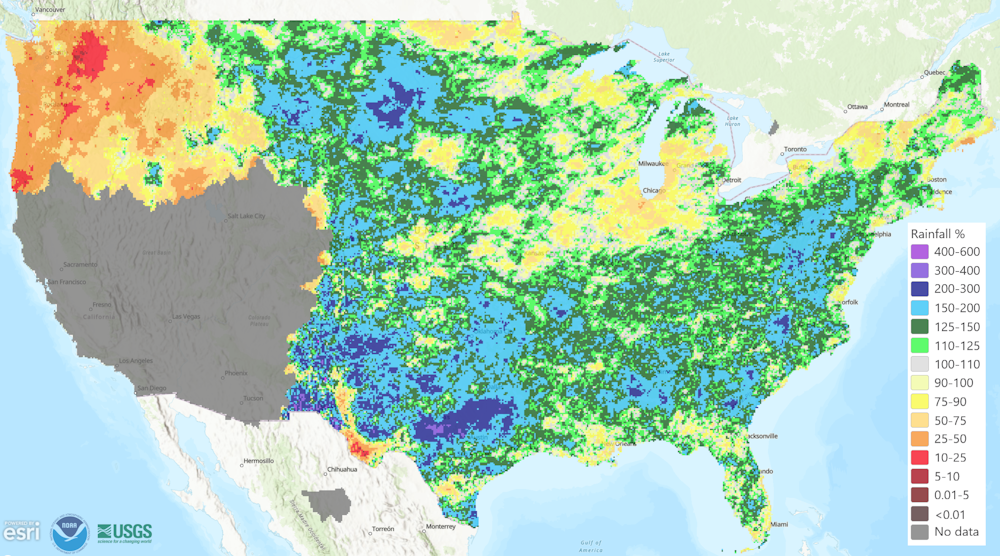
    Much of the central and eastern U.S. has had above-normal precipitation over the three months from April 23 through July 24, 2025. Blues are 150% to 200% of normal. Purples are even higher.
    NOAA National Water Prediction Service

    I study extreme precipitation events along with the complex processes that lead to the devastating damage they cause.

    Both the atmosphere and surface conditions play important roles in when and where flash floods occur and how destructive they become, and 2025 has seen some extremes, with large parts of the country east of the Rockies received at least 50% more precipitation than normal from mid-April through mid-July.

    Excess water vapor, weaker jet stream

    Flash floods are caused by excessive precipitation over short periods of time. When rain accumulates too fast for the local environment to absorb or reroute it, flooding ensues, and conditions can get dangerous fast.

    Flooding from heavy rain in the Boston area on July 10, 2025, shut down an interstate and filled streets and garages with water.
    John Tlumacki/The Boston Globe via Getty Images

    During the warm season, intrusions of tropical air with excessive water vapor are common in the U.S., and they can result in intense downpours.

    In addition, the jet stream and westerly winds – which move storm systems from west to east across the U.S. – tend to weaken during summer. As a result, the overall movement of thunderstorms and other precipitation-producing systems slows during the summer months, and storm systems can remain almost stationary over a location.

    The combination of intense rainfall rates and extended precipitation increases the likelihood of flash flooding.

    The surface rain falls on makes a difference, too

    Local surface characteristics also play important roles in how flash floods develop and evolve.

    When intense precipitation is combined with saturated soils, steep slopes, urban areas and sparse vegetation, runoff can quickly overwhelm local streams, rivers and drainage systems, leading to the rapid rise of water levels.

    When the remnants of Hurricane Helene hit the mountains of North Carolina in October 2024, the intense rainfall on steep slopes quickly filled streams and then rivers that washed away homes in their narrow valleys.
    Sean Rayford/Getty Images

    Because the characteristics of the surface can vary significantly along a stream or river, the timing and location of a heavy downpour pose unique risks for each local area.

    What’s driving flash floods in 2025?

    During the horrific flooding in Texas Hill Country on July 4, 2025, that killed more than 135 people, atmospheric water vapor in the region was at or near historic levels. The storm hit at the headwaters of the Guadalupe River, over streams that converge in the river valley.

    As thunderstorms developed and remained nearly stationary over the region, they were fueled by the excessive atmospheric water vapor. That led to high rainfall rates. Hours of heavy rainfall early that morning sent the river rising quickly at a summer camp near Hunt, Texas, where more than two dozen girls and staff members died. Downstream at Kerrville, the river rose even faster, gaining more than 30 feet in 45 minutes.

    Overall, a persistent atmospheric pattern in late spring and summer 2025 has included a shift of the jet stream farther to the south than normal and, along with lower atmospheric pressures, has supported excessive rainfall across the central and eastern U.S.

    While the West Coast has experienced dry conditions in early summer 2025 due to a ridge of high pressure, the U.S. east of the Rockies has seen an active storm track with frontal boundaries and disturbances that produced thunderstorms and intense downpours across the region.

    Warmer-than-normal ocean water can also boost rainfall. The Caribbean and the Atlantic Ocean are source regions for atmospheric water vapor in the central and eastern U.S. In summer 2025, that water vapor has created extremely humid conditions, which have produced very high rainfall rates when storms develop.

    The result has been flash floods in several states producing catastrophic destruction and loss of life.

    Looking to the future

    The U.S. has seen devastating flash floods throughout its history, but rising global temperatures today are increasing the risk of flooding.

    As ocean and air temperatures rise, atmospheric water vapor increases. Higher ocean temperatures can produce more atmospheric water vapor through evaporation, and a warmer atmosphere can hold more moisture, fueling downpours. In some high-risk areas, meteorologists, aware of the risks, say they are becoming more proactive about warnings.

    Currently, evidence shows that atmospheric water vapor is increasing in the overall global climate system as temperatures rise.

    Jeffrey Basara receives funding from the National Science Foundation, NASA, and NOAA.

    ref. Why 2025 became the summer of flash flooding in America – https://theconversation.com/why-2025-became-the-summer-of-flash-flooding-in-america-261650

    MIL OSI

  • MIL-OSI Europe: EU sends firefighting planes to Cyprus

    Source: European Union 2

    The EU has mobilised 2 Canadair airplanes from the EU’s joint firefighting fleet in response to a request for assistance from Cyprus, following a major fire in its Limassol district. The EU has already responded to several wildfire emergencies in Albania and North Macedonia this summer.

    MIL OSI Europe News

  • MIL-OSI: Bread Financial Provides Performance Update for June 2025

    Source: GlobeNewswire (MIL-OSI)

    COLUMBUS, Ohio, July 24, 2025 (GLOBE NEWSWIRE) — Bread Financial Holdings, Inc. (NYSE: BFH), a tech-forward financial services company that provides simple, personalized payment, lending, and saving solutions to millions of U.S. consumers, provided a performance update. The following tables present the Company’s net loss rate and delinquency rate for the periods indicated:

      For the
    month ended
    June 30, 2025
      For the
    three months ended
    June 30, 2025
      (dollars in millions)
    End-of-period credit card and other loans $ 17,656     $ 17,656  
    Average credit card and other loans $ 17,631     $ 17,686  
    Year-over-year change in average credit card and other loans   (1 %)     (1 %)
    Net principal losses(1) $ 113     $ 348  
    Net loss rate(1)   7.8 %     7.9 %
      As of
    June 30, 2025
      As of
    June 30, 2024
      (dollars in millions)
    30 days + delinquencies – principal $ 922     $ 979  
    Period ended credit card and other loans – principal $ 16,102     $ 16,344  
    Delinquency rate   5.7 %     6.0 %
    (1) As a result of hurricanes Helene and Milton we froze delinquency progression for cardholders in Federal Emergency Management Agency identified impact zones for one billing cycle, which resulted in modestly lower Net principal losses and Net loss rate in the fourth quarter of 2024, and consequently these actions negatively impacted Net principal losses and Net loss rate in the second quarter of 2025.


    About Bread Financial
    ®  

    Bread Financial® (NYSE: BFH) is a tech-forward financial services company that provides simple, personalized payment, lending, and saving solutions to millions of U.S consumers. Our payment solutions, including Bread Financial general purpose credit cards and savings products, empower our customers and their passions for a better life. Additionally, we deliver growth for some of the most recognized brands in travel & entertainment, health & beauty, jewelry and specialty apparel through our private label and co-brand credit cards and pay-over-time products providing choice and value to our shared customers.  

    To learn more about Bread Financial, our global associates and our sustainability commitments, visit breadfinancial.com or follow us on Instagram and LinkedIn.  

    Forward-Looking Statements

    This release contains forward-looking statements within the meaning of Section 27A of the Securities Act of 1933 and Section 21E of the Securities Exchange Act of 1934. Forward-looking statements give our expectations or forecasts of future events and can generally be identified by the use of words such as “believe,” “expect,” “anticipate,” “estimate,” “intend,” “project,” “plan,” “likely,” “may,” “should” or other words or phrases of similar import. Similarly, statements that describe our business strategy, outlook, objectives, plans, intentions or goals also are forward-looking statements. Examples of forward-looking statements include, but are not limited to, statements we make regarding, and the guidance we give with respect to, our anticipated operating or financial results, future financial performance and outlook, future dividend declarations, and future economic conditions.

    We believe that our expectations are based on reasonable assumptions. Forward-looking statements, however, are subject to a number of risks and uncertainties that are difficult to predict and, in many cases, beyond our control. Accordingly, our actual results could differ materially from the projections, anticipated results or other expectations expressed in this release, and no assurances can be given that our expectations will prove to have been correct. Factors that could cause the outcomes to differ materially include, but are not limited to, the following: macroeconomic conditions, including market conditions, inflation, interest rates, labor market conditions, recessionary pressures or concerns over a prolonged economic slowdown, and the related impact on consumer spending behavior, payments, debt levels, savings rates and other behaviors; global political and public health events and conditions, including significant shifts in trade policy, such as changes to, or the imposition of, tariffs and/or trade barriers and any economic impacts, volatility, uncertainty and geopolitical instability resulting therefrom, as well as ongoing wars and military conflicts and natural disasters; future credit performance, including the level of future delinquency and write-off rates; the loss of, or reduction in demand from, significant brand partners or customers in the highly competitive markets in which we compete; the concentration of our business in U.S. consumer credit; inaccuracies in the models and estimates on which we rely, including the amount of our Allowance for credit losses and our credit risk management models; the inability to realize the intended benefits of acquisitions, dispositions and other strategic initiatives; our level of indebtedness and ability to access financial or capital markets; pending and future federal and state legislation, regulation, supervisory guidance, and regulatory and legal actions, including, but not limited to, those related to financial regulatory reform and consumer financial services practices, as well as any such actions with respect to late fees, interchange fees or other charges; impacts arising from or relating to the transition of our credit card processing services to third party service providers that we completed in 2022; failures or breaches in our operational or security systems, including as a result of cyberattacks, unanticipated impacts from technology modernization projects or otherwise; and any tax or other liability or adverse impacts arising out of or related to the spinoff of our former LoyaltyOne segment or the bankruptcy filings of Loyalty Ventures Inc. (LVI) and certain of its subsidiaries and subsequent litigation or other disputes. The foregoing factors, along with other risks and uncertainties that could cause actual results to differ materially from those expressed or implied in forward-looking statements, are described in greater detail under the headings “Risk Factors” and “Management’s Discussion and Analysis of Financial Condition and Results of Operations” in our Annual Report on Form 10-K for the most recently ended fiscal year, which may be updated in Item 1A of, or elsewhere in, our Quarterly Reports on Form 10-Q filed for periods subsequent to such Form 10-K. Our forward-looking statements speak only as of the date made, and we undertake no obligation, other than as required by applicable law, to update or revise any forward-looking statements, whether as a result of new information, subsequent events, anticipated or unanticipated circumstances or otherwise.

    Contacts 
    Brian Vereb – Investor Relations 
    Brian.Vereb@BreadFinancial.com  

    Susan Haugen – Investor Relations 
    Susan.Haugen@BreadFinancial.com  

    Rachel Stultz – Media 
    Rachel.Stultz@BreadFinancial.com  

    The MIL Network

  • MIL-OSI: Amalgamated Financial Corp. Reports Second Quarter 2025 Financial Results; Solid Deposit and Loan Growth; Strong Margin at 3.55%

    Source: GlobeNewswire (MIL-OSI)

    Common Equity Tier 1 Capital Ratio of 14.13% | Tangible Book Value per Share of $24.33

    NEW YORK, July 24, 2025 (GLOBE NEWSWIRE) — Amalgamated Financial Corp. (the “Company” or “Amalgamated”) (Nasdaq: AMAL), the holding company for Amalgamated Bank (the “Bank”), today announced financial results for the second quarter ended June 30, 2025.

    Second Quarter 2025 Highlights (on a linked quarter basis)

    • Net income of $26.0 million, or $0.84 per diluted share, compared to $25.0 million, or $0.81 per diluted share.
    • Core net income1 of $27.0 million, or $0.88 per diluted share, compared to $27.1 million, or $0.88 per diluted share.

    Deposits and Liquidity

    • On-balance sheet deposits increased $321.2 million, or 4.3%, to $7.7 billion.
    • Excluding $112.3 million of temporary pension funding deposits received on the last day of the quarter and withdrawn on the following day, total deposits increased $208.9 million, or 2.8%, to $7.6 billion.
    • Off-balance sheet deposits were $41.4 million at the end of the quarter.
    • Political deposits increased $136.5 million, or 13%, to $1.2 billion, which includes both on and off-balance sheet deposits.
    • Average cost of deposits, increased 3 basis points to 162 basis points, where non-interest-bearing deposits comprised 36% of total deposits.

    Assets and Margin

    • Net interest margin remained unchanged at 3.55%.
    • Net interest income grew $2.3 million, or 3.3%, to $72.9 million.
    • Net loans receivable increased $35.5 million, or 0.8%, to $4.7 billion.
    • Net loans in growth mode (commercial and industrial, commercial real estate, and multifamily) increased $60.8 million or 2.1%.
    • Total PACE assessments grew $16.3 million, or 1.4%, to $1.2 billion.
    • The multifamily and commercial real estate loan portfolios totaled $1.8 billion and had a concentration of 202% to total risk based capital.

    Capital and Returns

    • Tier 1 leverage ratio remained constant at 9.22% and Common Equity Tier 1 ratio was 14.13%.
    • Tangible common equity1 ratio decreased 13 basis points to 8.60% due to a larger balance sheet.
    • Tangible book value per share1 increased $0.82, or 3.5%, to $24.33, and has increased $7.00, or 40.4% since September 2021.
    • Core return on average tangible common equity1 of 14.90% and core return on average assets1 of 1.28%.

    Share Repurchase

    • Repurchased approximately 327,000 shares, or $9.7 million of common stock, through June 30, 2025, with $30.3 million in remaining capacity under the share repurchase program approved on March 10, 2025.
    • Approximately 74,000 shares have been repurchased from July 1 through July 22, 2025.
       
    1 Definitions are presented under “Non-GAAP Financial Measures”. Reconciliations of non-GAAP financial measures to the most comparable GAAP measure are set forth on the last page of the financial information accompanying this press release and may also be found on the Company’s website, www.amalgamatedbank.com.
       

    Priscilla Sims Brown, President and Chief Executive Officer, commented, “We are achieving our results because our banking model is flexible. We have many levers we can pull to drive performance and that creates reliability and predictability for our shareholders, customers, and employees.”

    Second Quarter Earnings

    Net income was $26.0 million, or $0.84 per diluted share, compared to $25.0 million, or $0.81 per diluted share, for the prior quarter. The $1.0 million increase during the quarter was primarily driven by a scheduled $2.6 million increase in non-core income related to solar tax equity investments, a $2.3 million increase in net interest income, and a $1.1 million decrease in non-interest expense. This was partially offset by a $4.3 million increase in provision for credit losses, the effect from a $0.8 million net valuation gain on residential loans sold during the previous quarter, and a $0.4 million increase in losses on sales of securities and other assets compared to the linked quarter.

    Core net income1 was $27.0 million, or $0.88 per diluted share, compared to $27.1 million, or $0.88 per diluted share for the prior quarter. Excluded from core net income for the quarter, pre-tax, was $1.0 million of losses on the sale of securities and other assets, $0.3 million of scheduled accelerated depreciation from solar tax equity investments, $0.1 million of severance costs, and $0.1 million of ICS One-Way Sell fee income. Excluded from core net income for the first quarter of 2025, pre-tax, was $2.9 million of accelerated depreciation from solar tax equity investments, a $0.8 million net valuation gain from residential loans sold during the quarter, and $0.7 million of losses on the sale of securities.

    Net interest income was $72.9 million, compared to $70.6 million for the prior quarter. Loan interest income increased $0.9 million and loan yields increased 5 basis points despite a $35.6 million decrease in average loan balances, primarily due to completion of a residential loan pool sale in the prior quarter. In addition, commercial loan originations were offset by paydowns and payoffs on lower-yielding commercial and residential loans. Interest income on securities increased $2.0 million driven by an increase in the average balance of securities of $141.2 million despite a slight decline in securities yields of 4 basis points. Interest expense on total interest-bearing deposits increased $1.7 million driven primarily by an increase in the average balance of total interest-bearing deposits of $201.0 million, while interest-bearing deposits cost remained flat.

    Net interest margin was 3.55%, the same as the prior quarter largely due to a higher average balance of interest-bearing deposits as noted above, which resulted in a slightly higher blended cost of funds. This offset the interest income generated by the higher average balance of securities and modestly higher loan yields. Additionally, income from prepayment penalties had a one basis point impact on net interest margin in the current quarter, compared to no impact in the prior quarter.

    Provision for credit losses was an expense of $4.9 million, compared to an expense of $0.6 million in the prior quarter. The increase in the second quarter was primarily driven by a $2.3 million increase in reserve for one syndicated commercial and industrial loan as well as the macroeconomic forecasts used in the CECL model, primarily related to the consumer solar loan portfolio, which can be volatile.

    Non-interest income was $8.0 million, compared to $6.4 million in the prior quarter. Excluding all non-core income adjustments noted above, core non-interest income1 was $9.3 million, compared to $9.1 million in the prior quarter. The increase was primarily related to higher commercial banking fees, partially offset by lower income from Trust fees.

    Non-interest expense was $40.6 million, a decrease of $1.1 million from the prior quarter. Core non-interest expense1 was $40.4 million, also a decrease of $1.1 million from the prior quarter. This was mainly driven by a $1.5 million decrease in professional fees, partially offset by a $0.4 million increase in advertising expense.

    Provision for income tax expense was $9.5 million, compared to $9.7 million for the prior quarter. The effective tax rate was 26.7%, compared to 28.0% in the prior quarter. The California single-sales factor apportionment law was adopted during the quarter which resulted in an increase in the California state tax rate. A discrete tax benefit was recognized during the current quarter for the remeasurement of deferred tax assets reducing the quarterly effective tax rate. Going forward, the tax rate is expected to be 27.3%. The prior quarter effective tax rate was impacted by discrete tax items related to a city and state tax examination. Adjusted, the current quarter effective tax rate was 27.3% compared to 27.0% for the prior quarter.

    Balance Sheet Quarterly Summary

    Total assets were $8.6 billion at June 30, 2025, a $336.1 million or a 4% increase compared to $8.3 billion at March 31, 2025. On the last day of the quarter, the balance sheet was impacted by $112.3 million of temporary pension funding deposits that were withdrawn the following day. Adjusted, total assets were $8.5 billion, in line with our target for the quarter. Notable changes within individual balance sheet line items include a $177.6 million increase in securities and a $35.5 million increase in net loans receivable. On the liabilities side, on-balance sheet deposits increased by $321.2 million or $208.9 million when adjusted for the temporary deposits noted above. Off-balance sheet deposits decreased by $173.1 million in the quarter. Equity grew by $18.0 million.

    Total net loans receivable at June 30, 2025 were $4.7 billion, an increase of $35.5 million, or 0.8% for the quarter. A balanced increase in loans was primarily driven by a $34.2 million increase in multifamily loans, a $13.5 million increase in commercial and industrial loans, and a $13.1 million increase in commercial real estate loans, all in our identified growth portfolios. This was partially offset by a $11.0 million decrease in consumer solar loans, and a $11.8 million decrease in residential loans, both being non-growth portfolios. During the quarter, criticized or classified loans increased $13.9 million, largely related to the downgrades of four commercial and industrial loans totaling $9.7 million, the downgrade of one multifamily loan totaling $2.8 million, additional downgrades of small business loans totaling $1.0 million, and an increase of $2.1 million in residential and consumer substandard loans. This was partially offset by charge-offs of small business loans totaling $1.1 million, and an upgrade of one $0.1 million small business loan.

    Total on-balance sheet deposits at June 30, 2025 were $7.7 billion, an increase of $321.2 million, or 4.3%, during the quarter. Including accounts currently held off-balance sheet, deposits held by politically active customers, such as campaigns, PACs, advocacy-based organizations, and state and national party committees were $1.2 billion as of June 30, 2025, an increase of $136.5 million during the quarter. Non-interest-bearing deposits represented 38% of average total deposits and 36% of ending total deposits for the quarter, contributing to an average cost of total deposits of 162 basis points. Super-core deposits1 totaled approximately $4.2 billion, had a weighted average life of 18 years, and comprised 54% of total deposits. Total uninsured deposits were $3.9 billion, comprising 50% of total deposits.

    Nonperforming assets totaled $35.2 million, or 0.41% of period-end total assets at June 30, 2025, an increase of $1.3 million, compared with $33.9 million, or 0.41% on a linked quarter basis. The increase in nonperforming assets was primarily driven by a $2.4 million increase in residential non-accrual loans, partially offset by a $0.3 million decrease in commercial and industrial nonaccrual loans, a $0.3 million decrease in consumer solar nonaccrual loans, and a $0.5 million decrease in nonaccrual loans held for sale compared to the prior quarter.

    During the quarter, the allowance for credit losses on loans increased $1.3 million to $59.0 million. The ratio of allowance to total loans was 1.25%, an increase of 2 basis points from 1.23% in the first quarter of 2025. This is primarily due to an increase of $2.3 million in reserves for one commercial and industrial loan, along with increases in provision related to the macroeconomic forecasts used in the CECL model. The loan associated with the increased reserve is a commercial and industrial business loan to an originator of consumer loans for renewable energy efficiency improvements. During the quarter, $2.5 million of debtor-in-possession (“DIP”) financing was put in place, a portion of which was advanced and increased our outstanding exposure from $8.3 million to $9.3 million as of June 30, 2025. Additionally, during the third quarter, the remainder of the DIP financing was advanced bringing the total exposure to $10.8 million as of the date of this earnings release. While there remains collateral value, the situation with this loan is fluid and could result in further reserves as the workout progresses.

    Capital Quarterly Summary

    As of June 30, 2025, the Common Equity Tier 1 Capital ratio was 14.13%, the Total Risk-Based Capital ratio was 16.43%, and the Tier 1 Leverage Capital ratio was 9.22%, compared to 14.27%, 16.61% and 9.22%, respectively, as of March 31, 2025. Stockholders’ equity at June 30, 2025 was $754.0 million, an increase of $18.0 million during the quarter. The increase in stockholders’ equity was primarily driven by $26.0 million of net income for the quarter and a $4.3 million improvement in accumulated other comprehensive loss due to the tax-effected mark-to-market on available for sale securities, offset by $9.7 million in share buybacks and $4.4 million in dividends paid at $0.14 per outstanding share.

    Tangible book value per share1 was $24.33 as of June 30, 2025 compared to $23.51 as of March 31, 2025. Tangible common equity1 improved to 8.60% of tangible assets, compared to 8.73% as of March 31, 2025.

    Conference Call

    As previously announced, Amalgamated Financial Corp. will host a conference call to discuss its second quarter 2025 results today, July 24, 2025 at 11:00am (Eastern Time). The conference call can be accessed by dialing 1-877-407-9716 (domestic) or 1-201-493-6779 (international) and asking for the Amalgamated Financial Corp. Second Quarter 2025 Earnings Call. A telephonic replay will be available approximately two hours after the call and can be accessed by dialing 1-844-512-2921, or for international callers 1-412-317-6671 and providing the access code 13754662. The telephonic replay will be available until July 31, 2025.

    Interested investors and other parties may also listen to a simultaneous webcast of the conference call by logging onto the investor relations section of the Company’s website at https://ir.amalgamatedbank.com/. The online replay will remain available for a limited time beginning immediately following the call.

    The presentation materials for the call can be accessed on the investor relations section of the Company’s website at https://ir.amalgamatedbank.com/.

    About Amalgamated Financial Corp.

    Amalgamated Financial Corp. is a Delaware public benefit corporation and a bank holding company engaged in commercial banking and financial services through its wholly-owned subsidiary, Amalgamated Bank. Amalgamated Bank is a New York-based full-service commercial bank and a chartered trust company with a combined network of five branches across New York City, Washington D.C., and San Francisco, and a commercial office in Boston. Amalgamated Bank was formed in 1923 as Amalgamated Bank of New York by the Amalgamated Clothing Workers of America, one of the country’s oldest labor unions. Amalgamated Bank provides commercial banking and trust services nationally and offers a full range of products and services to both commercial and retail customers. Amalgamated Bank is a proud member of the Global Alliance for Banking on Values and is a certified B Corporation®. As of June 30, 2025, total assets were $8.6 billion, total net loans were $4.7 billion, and total deposits were $7.7 billion. Additionally, as of June 30, 2025, the trust business held $36.5 billion in assets under custody and $15.6 billion in assets under management.

    Non-GAAP Financial Measures

    This release (and the accompanying financial information and tables) refer to certain non-GAAP financial measures including, without limitation, “Core operating revenue,” “Core non-interest expense,” “Core non-interest income,” “Core net income,” “Tangible common equity,” “Average tangible common equity,” “Core return on average assets,” “Core return on average tangible common equity,” and “Core efficiency ratio.”

    Management utilizes this information to compare operating performance for June 30, 2025 versus certain periods in 2025 and 2024 and to prepare internal projections. The Company believes these non-GAAP financial measures facilitate making period-to-period comparisons and are meaningful indications of operating performance. In addition, because intangible assets such as goodwill and other discrete items unrelated to core business, which are excluded, vary extensively from company to company, the Company believe that the presentation of this information allows investors to more easily compare results to those of other companies.

    The presentation of non-GAAP financial information, however, is not intended to be considered in isolation or as a substitute for GAAP financial measures. The Company strongly encourage readers to review the GAAP financial measures included in this release and not to place undue reliance upon any single financial measure. In addition, because non-GAAP financial measures are not standardized, it may not be possible to compare the non-GAAP financial measures presented in this release with other companies’ non-GAAP financial measures having the same or similar names. Reconciliations of non-GAAP financial disclosures to comparable GAAP measures found in this release are set forth in the final pages of this release and also may be viewed on the Company’s website, amalgamatedbank.com.

    Terminology

    Certain terms used in this release are defined as follows:

    “Core efficiency ratio” is defined as “Core non-interest expense” divided by “Core operating revenue.” The Company believes the most directly comparable performance ratio derived from GAAP financial measures is an efficiency ratio calculated by dividing total non-interest expense by the sum of net interest income and total non-interest income.

    “Core net income” is defined as net income after tax excluding gains and losses on sales of securities, ICS One-Way Sell fee income, changes in fair value on loans held-for-sale, gains on the sale of owned property, costs related to branch closures, restructuring/severance costs, acquisition costs, tax credits and accelerated depreciation on solar equity investments, and taxes on notable pre-tax items. The Company believes the most directly comparable GAAP financial measure is net income.

    “Core non-interest expense” is defined as total non-interest expense excluding costs related to branch closures, and restructuring/severance. The Company believes the most directly comparable GAAP financial measure is total non-interest expense.

    “Core non-interest income” is defined as total non-interest income excluding gains and losses on sales of securities, ICS One-Way Sell fee income, changes in fair value on loans held-for-sale, gains on the sale of owned property, and tax credits and accelerated depreciation on solar equity investments. The Company believes the most directly comparable GAAP financial measure is non-interest income.

    “Core operating revenue” is defined as total net interest income plus “core non-interest income”. The Company believes the most directly comparable GAAP financial measure is the total of net interest income and non-interest income.

    “Core return on average assets” is defined as “Core net income” divided by average total assets. The Company believes the most directly comparable performance ratio derived from GAAP financial measures is return on average assets calculated by dividing net income by average total assets.

    “Core return on average tangible common equity” is defined as “Core net income” divided by average “tangible common equity.” The Company believes the most directly comparable performance ratio derived from GAAP financial measures is return on average equity calculated by dividing net income by average total stockholders’ equity.

    “Super-core deposits” are defined as total deposits from commercial and consumer customers, with a relationship length of greater than 5 years. The Company believes the most directly comparable GAAP financial measure is total deposits.

    “Tangible assets” are defined as total assets excluding, as applicable, goodwill and core deposit intangibles. The Company believes the most directly comparable GAAP financial measure is total assets.

    “Tangible common equity”, and “Tangible book value” are defined as stockholders’ equity excluding, as applicable, minority interests, goodwill and core deposit intangibles. The Company believes that the most directly comparable GAAP financial measure is total stockholders’ equity.

    “Traditional securities” is defined as total investment securities excluding PACE assessments. The Company believes the most directly comparable GAAP financial measure is total investment securities.

    Forward-Looking Statements

    Statements included in this release that are not historical in nature are intended to be, and are hereby identified as, forward-looking statements within the meaning of the Private Securities Litigation Reform Act, Section 21E of the Securities Exchange Act of 1934, as amended. Forward-looking statements generally can be identified through the use of forward-looking terminology such as “may,” “will,” “anticipate,” “aspire,” “should,” “would,” “believe,” “contemplate,” “expect,” “estimate,” “continue,” “in the future,” “may” and “intend,” as well as other similar words and expressions of the future. Forward-looking statements are subject to known and unknown risks, uncertainties and other factors, any or all of which could cause actual results to differ materially from the results expressed or implied by such forward-looking statements. These risks and uncertainties include, but are not limited to:

    1. uncertain conditions in the banking industry and in national, regional and local economies in core markets, which may have an adverse impact on business, operations and financial performance;
    2. deterioration in the financial condition of borrowers resulting in significant increases in credit losses and provisions for those losses;
    3. deposit outflows and subsequent declines in liquidity caused by factors that could include lack of confidence in the banking system, a deterioration in market conditions or the financial condition of depositors;
    4. changes in deposits, including an increase in uninsured deposits;
    5. ability to maintain sufficient liquidity to meet deposit and debt obligations as they come due, which may require that the Company sell investment securities at a loss, negatively impacting net income, earnings and capital;
    6. unfavorable conditions in the capital markets, which may cause declines in stock price and the value of investments;
    7. negative economic and political conditions that adversely affect the general economy, housing prices, the real estate market, the job market, consumer confidence, the financial condition of borrowers and consumer spending habits, which may affect, among other things, the level of non-performing assets, charge-offs and provision expense;
    8. fluctuations or unanticipated changes in the interest rate environment including changes in net interest margin or changes in the yield curve that affect investments, loans or deposits;
    9. the general decline in the real estate and lending markets, particularly in commercial real estate in the Company’s market areas, and the effects of the enactment of or changes to rent-control and other similar regulations on multi-family housing;
    10. potential implementation by the current presidential administration of a regulatory reform agenda that is significantly different from that of the prior presidential administration, impacting the rule making, supervision, examination and enforcement of the banking regulation agencies;
    11. changes in U.S. trade policies and other global political factors beyond the Company’s control, including the imposition of tariffs, which raise economic uncertainty, potentially leading to slower growth and a decrease in loan demand;
    12. the outcome of legal or regulatory proceedings that may be instituted against us;
    13. inability to achieve organic loan and deposit growth and the composition of that growth;
    14. composition of the Company’s loan portfolio, including any concentration in industries or sectors that may experience unanticipated or anticipated adverse conditions greater than other industries or sectors in the national or local economies in which the Company operates;
    15. inaccuracy of the assumptions and estimates the Company makes and policies that the Company implements in establishing the allowance for credit losses;
    16. changes in loan underwriting, credit review or loss reserve policies associated with economic conditions, examination conclusions, or regulatory developments;
    17. any matter that would cause the Company to conclude that there was impairment of any asset, including intangible assets;
    18. limitations on the ability to declare and pay dividends;
    19. the impact of competition with other financial institutions, including pricing pressures and the resulting impact on results, including as a result of compression to net interest margin;
    20. increased competition for experienced members of the workforce including executives in the banking industry;
    21. a failure in or breach of operational or security systems or infrastructure, or those of third party vendors or other service providers, including as a result of unauthorized access, computer viruses, phishing schemes, spam attacks, human error, natural disasters, power loss and other security breaches;
    22. increased regulatory scrutiny and exposure from the use of “big data” techniques, machine learning, and artificial intelligence;
    23. a downgrade in the Company’s credit rating;
    24. “greenwashing claims” against the Company and environmental, social, and governance (“ESG”) products and increased scrutiny and political opposition to ESG and diversity, equity, and inclusion (“DEI”) practices;
    25. any unanticipated or greater than anticipated adverse conditions (including the possibility of earthquakes, wildfires, and other natural disasters) affecting the markets in which the Company operates;
    26. physical and transitional risks related to climate change as they impact the business and the businesses that the Company finances;
    27. future repurchase of the Company’s shares through the Company’s common stock repurchase program; and
    28. descriptions of assumptions underlying or relating to any of the foregoing.

    Additional factors which could affect the forward-looking statements can be found in the Company’s Annual Reports on Form 10-K, Quarterly Reports on Form 10-Q, and Current Reports on Form 8-K filed with the SEC and available on the SEC’s website at https://www.sec.gov/. The Company disclaims any obligation to update or revise any forward-looking statements contained in this release, which speak only as of the date hereof, whether as a result of new information, future events or otherwise, except as required by law.

    Investor Contact:
    Jamie Lillis
    Solebury Strategic Communications
    shareholderrelations@amalgamatedbank.com
    800-895-4172

    Consolidated Statements of Income (unaudited)

      Three Months Ended   Six Months Ended
     
      June 30,   March 31,   June 30,   June 30,
     
    ($ in thousands) 2025   2025   2024   2025   2024  
    INTEREST AND DIVIDEND INCOME                                        
    Loans $ 58,723     $ 57,843     $ 51,293     $ 116,566     $ 103,245    
    Securities   43,737       41,653       44,978       85,390       87,368    
    Interest-bearing deposits in banks   1,639       1,194       2,690       2,833       5,282    
             Total interest and dividend income   104,099       100,690       98,961       204,789       195,895    
    INTEREST EXPENSE                                        
    Deposits   30,593       28,917       28,882       59,510       54,773    
    Borrowed funds   597       1,196       887       1,793       3,893    
             Total interest expense   31,190       30,113       29,769       61,303       58,666    
    NET INTEREST INCOME   72,909       70,577       69,192       143,486       137,229    
    Provision for credit losses   4,890       596       3,161       5,486       4,749    
             Net interest income after provision for credit losses   68,019       69,981       66,031       138,000       132,480    
    NON-INTEREST INCOME                                        
    Trust Department fees   3,879       4,191       3,657       8,069       7,511    
    Service charges on deposit accounts   3,873       3,438       8,614       7,311       14,750    
    Bank-owned life insurance income   796       626       615       1,422       1,224    
    Losses on sale of securities and other assets   (1,041 )     (680 )     (2,691 )     (1,721 )     (5,465 )  
    Gain (loss) on sale of loans and changes in fair value on loans held-
    for-sale, net
      18       832       69       850       116    
    Equity method investments income (loss)   51       (2,508 )     (1,551 )     (2,458 )     521    
    Other income   449       507       545       957       830    
             Total non-interest income   8,025       6,406       9,258       14,430       19,487    
    NON-INTEREST EXPENSE                                        
    Compensation and employee benefits   23,240       23,314       23,045       46,554       45,318    
    Occupancy and depreciation   3,476       3,293       3,379       6,768       6,283    
    Professional fees   3,283       4,739       2,332       8,022       4,708    
    Technology   5,485       5,619       4,786       11,103       9,415    
    Office maintenance and depreciation   570       629       580       1,199       1,243    
    Amortization of intangible assets   144       144       182       287       365    
    Advertising and promotion   412       51       1,175       463       2,394    
    Federal deposit insurance premiums   900       900       1,050       1,800       2,100    
    Other expense   3,074       2,961       2,983       6,038       5,838    
             Total non-interest expense   40,584       41,650       39,512       82,234       77,664    
    Income before income taxes   35,460       34,737       35,777       70,196       74,303    
    Income tax expense   9,471       9,709       9,024       19,179       20,301    
             Net income $ 25,989     $ 25,028     $ 26,753     $ 51,017     $ 54,002    
    Earnings per common share – basic $ 0.85     $ 0.82     $ 0.88     $ 1.67     $ 1.77    
    Earnings per common share – diluted $ 0.84     $ 0.81     $ 0.87     $ 1.65     $ 1.75    
     

    Consolidated Statements of Financial Condition

    ($ in thousands) June 30, 2025   March 31, 2025   December 31, 2024

     
    Assets (unaudited)   (unaudited)      
    Cash and due from banks $ 4,049     $ 4,196     $ 4,042    
    Interest-bearing deposits in banks   167,017       61,518       56,707    
    Total cash and cash equivalents   171,066       65,714       60,749    
    Securities:                        
    Available for sale, at fair value                        
             Traditional securities   1,713,077       1,546,127       1,477,047    
             Property Assessed Clean Energy (“PACE”) assessments   178,247       161,147       152,011    
        1,891,324       1,707,274       1,629,058    
    Held-to-maturity, at amortized cost:                        
    Traditional securities, net of allowance for credit losses of $47, $47, and $49,
    respectively
      529,418       535,065       542,246    
    PACE assessments, net of allowance for credit losses of $657, $654, and $655,
    respectively
      1,037,220       1,038,052       1,043,959    
        1,566,638       1,573,117       1,586,205    
                             
    Loans held for sale   2,545       3,667       37,593    
    Loans receivable, net of deferred loan origination fees and costs   4,714,344       4,677,506       4,672,924    
    Allowance for credit losses   (58,998 )     (57,676 )     (60,086 )  
    Loans receivable, net   4,655,346       4,619,830       4,612,838    
                             
    Resell agreements   57,040       41,651       23,741    
    Federal Home Loan Bank of New York (“FHLBNY”) stock, at cost   5,277       4,679       15,693    
    Accrued interest receivable   55,509       55,092       61,172    
    Premises and equipment, net   8,823       7,366       6,386    
    Bank-owned life insurance   108,465       108,652       108,026    
    Right-of-use lease asset   11,379       12,477       14,231    
    Deferred tax asset, net   33,685       33,799       42,437    
    Goodwill   12,936       12,936       12,936    
    Intangible assets, net   1,200       1,343       1,487    
    Equity method investments   5,110       5,639       8,482    
    Other assets   34,995       31,991       35,858    
             Total assets $ 8,621,338     $ 8,285,227     $ 8,256,892    
    Liabilities                        
    Deposits   7,733,272       7,412,072       7,180,605    
    Borrowings   75,457       69,676       314,409    
    Operating leases   15,395       17,190       19,734    
    Other liabilities   43,230       50,293       34,490    
             Total liabilities   7,867,354       7,549,231       7,549,238    
    Stockholders’ equity                        
    Common stock, par value $0.01 per share   310       309       308    
    Additional paid-in capital   290,256       288,539       288,656    
    Retained earnings   522,405       500,783       480,144    
    Accumulated other comprehensive loss, net of income taxes   (42,982 )     (47,308 )     (58,637 )  
    Treasury stock, at cost   (16,005 )     (6,327 )     (2,817 )  
             Total stockholders’ equity   753,984       735,996       707,654    
             Total liabilities and stockholders’ equity $ 8,621,338     $ 8,285,227     $ 8,256,892    
     

    Select Financial Data

      As of and for the
    Three Months Ended
      As of and for the
    Six Months Ended

     
      June 30,   March 31,   June 30,   June 30,
     
    (Shares in thousands) 2025   2025   2024   2025   2024  
    Selected Financial Ratios and Other Data:                              
    Earnings per share                              
    Basic $ 0.85   $ 0.82   $ 0.88   $ 1.67   $ 1.77  
    Diluted   0.84     0.81     0.87     1.65     1.75  
    Core net income (non-GAAP)                              
    Basic $ 0.88   $ 0.88   $ 0.86   $ 1.77   $ 1.70  
    Diluted   0.88     0.88     0.85     1.75     1.68  
    Book value per common share (excluding minority interest) $ 24.79   $ 23.98   $ 21.09   $ 24.79   $ 21.09  
    Tangible book value per share (non-GAAP) $ 24.33   $ 23.51   $ 20.61   $ 24.33   $ 20.61  
    Common shares outstanding, par value $0.01 per share(1)   30,412     30,697     30,630     30,412     30,630  
    Weighted average common shares outstanding, basic   30,558     30,682     30,551     30,619     30,513  
    Weighted average common shares outstanding, diluted   30,758     30,946     30,832     30,872     30,789  
     
    (1) 70,000,000 shares authorized; 30,983,139, 30,940,480, and 30,743,666 shares issued for the periods ended June 30, 2025, March 31, 2025, and June 30, 2024 respectively, and 30,412,241, 30,696,940, and 30,630,386 shares outstanding for the periods ended June 30, 2025, March 31, 2025, and June 30, 2024, respectively.
     

    Select Financial Data

      As of and for the
    Three Months Ended
      As of and for the
    Six Months Ended

     
      June 30,   March 31,   June 30,   June 30,
     
      2025   2025   2024   2025   2024  
    Selected Performance Metrics:                              
    Return on average assets 1.23 %   1.22 %   1.30 %   1.23 %   1.33 %  
    Core return on average assets (non-GAAP) 1.28 %   1.33 %   1.27 %   1.30 %   1.27 %  
    Return on average equity 14.06 %   14.05 %   17.27 %   14.06 %   17.75 %  
    Core return on average tangible common equity (non-GAAP) 14.90 %   15.54 %   17.34 %   15.21 %   17.46 %  
    Average equity to average assets 8.78 %   8.71 %   7.53 %   8.75 %   7.48 %  
    Tangible common equity to tangible assets (non-GAAP) 8.60 %   8.73 %   7.66 %   8.60 %   7.66 %  
    Loan yield 5.05 %   5.00 %   4.68 %   5.03 %   4.72 %  
    Securities yield 5.11 %   5.15 %   5.22 %   5.13 %   5.21 %  
    Deposit cost 1.62 %   1.59 %   1.55 %   1.61 %   1.51 %  
    Net interest margin 3.55 %   3.55 %   3.46 %   3.55 %   3.47 %  
    Efficiency ratio (1) 50.14 %   54.10 %   50.37 %   52.07 %   49.56 %  
    Core efficiency ratio (non-GAAP) 49.21 %   52.11 %   50.80 %   50.64 %   50.60 %  
                                   
    Asset Quality Ratios:                              
    Nonaccrual loans to total loans 0.74 %   0.70 %   0.78 %   0.74 %   0.78 %  
    Nonperforming assets to total assets 0.41 %   0.41 %   0.43 %   0.41 %   0.43 %  
    Allowance for credit losses on loans to nonaccrual loans 170.02 %   175.07 %   182.83 %   170.02 %   182.83 %  
    Allowance for credit losses on loans to total loans 1.25 %   1.23 %   1.42 %   1.25 %   1.42 %  
    Annualized net charge-offs to average loans 0.30 %   0.22 %   0.25 %   0.26 %   0.22 %  
                                   
    Liquidity Ratios:                              
    2 day Liquidity Coverage of Uninsured Deposits % 96.73 %   93.75 %   100.83 %   96.73 %   100.83 %  
    Cash and Borrowing Capacity Coverage of Uninsured, Non-Supercore
    Deposits (%)
    167.94 %   163.71 %   174.24 %   167.94 %   174.24 %  
                                   
    Capital Ratios:                              
    Tier 1 leverage capital ratio 9.22 %   9.22 %   8.42 %   9.22 %   8.42 %  
    Tier 1 risk-based capital ratio 14.13 %   14.27 %   13.48 %   14.13 %   13.48 %  
    Total risk-based capital ratio 16.43 %   16.61 %   16.04 %   16.43 %   16.04 %  
    Common equity tier 1 capital ratio 14.13 %   14.27 %   13.48 %   14.13 %   13.48 %  
     
    (1) Efficiency ratio is calculated by dividing total non-interest expense by the sum of net interest income and total non-interest income.
     

    Loan and PACE Assessments Portfolio Composition

    (In thousands) At June 30, 2025   At March 31, 2025   At June 30, 2024
     
      Amount   % of total   Amount   % of total   Amount   % of total
     
    Commercial portfolio:                                          
    Commercial and industrial $ 1,196,804     25.4 %   $ 1,183,297     25.3 %   $ 1,012,400     22.6 %  
    Multifamily   1,406,193     29.8 %     1,371,950     29.4 %     1,230,545     27.5 %  
    Commercial real estate   422,068     9.0 %     409,004     8.7 %     377,484     8.4 %  
    Construction and land development   20,330     0.4 %     20,690     0.4 %     23,254     0.5 %  
    Total commercial portfolio   3,045,395     64.6 %     2,984,941     63.8 %     2,643,683     59.0 %  
                                               
    Retail portfolio:                                          
    Residential real estate lending   1,292,013     27.4 %     1,303,856     27.9 %     1,404,624     31.4 %  
    Consumer solar   345,604     7.3 %     356,601     7.6 %     385,567     8.6 %  
    Consumer and other   31,332     0.7 %     32,108     0.7 %     37,965     1.0 %  
    Total retail portfolio   1,668,949     35.4 %     1,692,565     36.2 %     1,828,156     41.0 %  
    Total loans held for investment   4,714,344     100.0 %     4,677,506     100.0 %     4,471,839     100.0 %  
                                               
    Allowance for credit losses   (58,998 )           (57,676 )           (63,444 )        
    Loans receivable, net $ 4,655,346           $ 4,619,830           $ 4,408,395          
                                               
    PACE assessments:                                          
    Available for sale, at fair value                                          
    Residential PACE assessments   178,247     14.7 %     161,147     13.4 %     112,923     9.7 %  
                                               
    Held-to-maturity, at amortized cost                                          
    Commercial PACE assessments   278,006     22.9 %     271,200     22.6 %     256,663     22.0 %  
    Residential PACE assessments   759,871     62.4 %     767,507     64.0 %     798,561     68.4 %  
    Total Held-to-maturity PACE
    assessments
      1,037,877     85.3 %     1,038,707     86.6 %     1,055,224     90.4 %  
    Total PACE assessments   1,216,124     100.0 %     1,199,854     100.0 %     1,168,147     100.0 %  
                                               
    Allowance for credit losses   (657 )           (654 )           (655 )        
    Total PACE assessments, net $ 1,215,467           $ 1,199,200           $ 1,167,492          
                                               
    Loans receivable, net and total PACE
    assessments, net as a % of Deposits
      75.9 %           78.5 %           74.9 %        
    Loans receivable, net and total PACE
    assessments, net as a % of Deposits
    excluding Brokered CDs
      75.9 %           78.5 %           76.4 %        
     

    Net Interest Income Analysis

      Three Months Ended
     
      June 30, 2025   March 31, 2025   June 30, 2024
     
    (In thousands) Average
    Balance
      Income /
    Expense
      Yield /
    Rate
      Average
    Balance
      Income /
    Expense
      Yield /
    Rate
      Average
    Balance
      Income /
    Expense
      Yield /
    Rate
     
                                                           
    Interest-earning assets:                                                      
    Interest-bearing deposits in banks $ 161,965   $ 1,639   4.06 %   $ 121,321   $ 1,194   3.99 %   $ 213,725   $ 2,690   5.06 %  
    Securities(1)   3,361,812     42,850   5.11 %     3,220,590     40,867   5.15 %     3,308,881     42,937   5.22 %  
    Resell agreements   52,621     887   6.76 %     30,169     786   10.57 %     122,618     2,041   6.69 %  
    Loans receivable, net (2)   4,659,667     58,723   5.05 %     4,695,264     57,843   5.00 %     4,406,843     51,293   4.68 %  
    Total interest-earning assets   8,236,065     104,099   5.07 %     8,067,344     100,690   5.06 %     8,052,067     98,961   4.94 %  
    Non-interest-earning assets:                                                      
    Cash and due from banks   5,622                 5,045                 6,371              
    Other assets   203,992                 220,589                 217,578              
    Total assets $ 8,445,679               $ 8,292,978               $ 8,276,016              
                                                           
    Interest-bearing liabilities:                                                      
    Savings, NOW and money market
    deposits
    $ 4,457,620   $ 28,653   2.58 %   $ 4,242,786   $ 26,806   2.56 %   $ 3,729,858   $ 24,992   2.69 %  
    Time deposits   218,835     1,940   3.56 %     232,683     2,111   3.68 %     210,565     1,898   3.63 %  
    Brokered CDs         0.00 %           0.00 %     156,086     1,992   5.13 %  
    Total interest-bearing deposits   4,676,455     30,593   2.62 %     4,475,469     28,917   2.62 %     4,096,509     28,882   2.84 %  
    Borrowings   75,741     597   3.16 %     134,340     1,196   3.61 %     104,560     887   3.41 %  
    Total interest-bearing liabilities   4,752,196     31,190   2.63 %     4,609,809     30,113   2.65 %     4,201,069     29,769   2.85 %  
    Non-interest-bearing liabilities:                                                      
    Demand and transaction deposits   2,895,845                 2,901,061                 3,390,941              
    Other liabilities   56,203                 59,728                 60,982              
    Total liabilities   7,704,244                 7,570,598                 7,652,992              
    Stockholders’ equity   741,435                 722,380                 623,024              
    Total liabilities and stockholders’
    equity
    $ 8,445,679               $ 8,292,978               $ 8,276,016              
                                                           
    Net interest income / interest rate
    spread
          $ 72,909   2.44 %         $ 70,577   2.41 %         $ 69,192   2.09 %  
    Net interest-earning assets / net
    interest margin
    $ 3,483,869         3.55 %   $ 3,457,535         3.55 %   $ 3,850,998         3.46 %  
                                                           
    Total deposits excluding Brokered
    CDs / total cost of deposits excluding
    Brokered CDs
    $ 7,572,300         1.62 %   $ 7,376,530         1.59 %   $ 7,331,364         1.48 %  
    Total deposits / total cost of deposits $ 7,572,300         1.62 %   $ 7,376,530         1.59 %   $ 7,487,450         1.55 %  
    Total funding / total cost of funds $ 7,648,041         1.64 %   $ 7,510,870         1.63 %   $ 7,592,010         1.58 %  
     
    (1) Includes Federal Home Loan Bank (FHLB) stock in the average balance, and dividend income on FHLB stock in interest income.
    (2) Includes prepayment penalty interest income in 2Q2025, 1Q2025, or 2Q2024 of $200,076, $0, and $0, respectively (in thousands).
     

    Net Interest Income Analysis

      Six Months Ended
     
      June 30, 2025   June 30, 2024
     
    (In thousands) Average
    Balance
      Income /
    Expense
      Yield /
    Rate
      Average
    Balance
      Income /
    Expense
      Yield /
    Rate
     
                                         
    Interest-earning assets:                                    
    Interest-bearing deposits in banks $ 141,756   $ 2,833   4.03 %   $ 209,547   $ 5,282   5.07 %  
    Securities   3,291,591     83,717   5.13 %     3,239,619     84,000   5.21 %  
    Resell agreements   41,457     1,673   8.14 %     100,814     3,368   6.72 %  
    Total loans, net (1)(2)   4,677,367     116,566   5.03 %     4,398,665     103,245   4.72 %  
    Total interest-earning assets   8,152,171     204,789   5.07 %     7,948,645     195,895   4.96 %  
    Non-interest-earning assets:                                    
    Cash and due from banks   5,335                 5,720              
    Other assets   212,245                 221,924              
    Total assets $ 8,369,751               $ 8,176,289              
                                         
    Interest-bearing liabilities:                                    
    Savings, NOW and money market deposits $ 4,350,797   $ 55,459   2.57 %   $ 3,660,704   $ 46,864   2.57 %  
    Time deposits   225,721     4,051   3.62 %     199,305     3,474   3.51 %  
    Brokered CDs         0.00 %     173,163     4,435   5.15 %  
    Total interest-bearing deposits   4,576,518     59,510   2.62 %     4,033,172     54,773   2.73 %  
    Borrowings   104,879     1,793   3.45 %     196,326     3,893   3.99 %  
    Total interest-bearing liabilities   4,681,397     61,303   2.64 %     4,229,498     58,666   2.79 %  
    Non-interest-bearing liabilities:                                    
    Demand and transaction deposits   2,898,439                 3,264,590              
    Other liabilities   57,955                 70,309              
    Total liabilities   7,637,791                 7,564,397              
    Stockholders’ equity   731,960                 611,892              
    Total liabilities and stockholders’ equity $ 8,369,751               $ 8,176,289              
                                         
    Net interest income / interest rate spread       $ 143,486   2.43 %         $ 137,229   2.17 %  
    Net interest-earning assets / net interest margin $ 3,470,774         3.55 %   $ 3,719,147         3.47 %  
                                         
    Total deposits excluding Brokered CDs / total cost of
    deposits excluding Brokered CDs
    $ 7,474,957         1.61 %   $ 7,124,599         1.42 %  
    Total deposits / total cost of deposits $ 7,474,957         1.61 %   $ 7,297,762         1.51 %  
    Total funding / total cost of funds $ 7,579,836         1.63 %   $ 7,494,088         1.57 %  
     
    (1) Includes Federal Home Loan Bank (FHLB) stock in the average balance, and dividend income on FHLB stock in interest income.
    (2) Includes prepayment penalty interest income in June YTD 2025 and June YTD 2024 of $200 thousand and $18 thousand, respectively.
     

    Deposit Portfolio Composition

      Three Months Ended
     
    (In thousands) June 30, 2025   March 31, 2025   June 30, 2024
     
      Ending
    Balance
      Average
    Balance
      Ending
    Balance
      Average
    Balance
      Ending
    Balance
      Average
    Balance

     
    Non-interest-bearing demand deposit accounts $ 2,810,489   $ 2,895,845   $ 2,895,757   $ 2,901,061   $ 3,445,068   $ 3,390,941  
    NOW accounts   177,494     177,312     187,078     177,827     192,452     191,253  
    Money market deposit accounts   4,216,318     3,950,346     3,772,423     3,739,548     3,093,644     3,202,365  
    Savings accounts   330,892     329,962     330,410     325,411     336,943     336,240  
    Time deposits   198,079     218,835     226,404     232,683     227,437     210,565  
    Brokered certificates of deposit (“CDs”)                   153,444     156,086  
    Total deposits $ 7,733,272   $ 7,572,300   $ 7,412,072   $ 7,376,530   $ 7,448,988   $ 7,487,450  
                                         
    Total deposits excluding Brokered CDs $ 7,733,272   $ 7,572,300   $ 7,412,072   $ 7,376,530   $ 7,295,544   $ 7,331,364  
     
      Three Months Ended
     
      June 30, 2025   March 31, 2025   June 30, 2024
     
    (In thousands) Average
    Rate
    Paid
    (1)
      Cost of
    Funds
      Average
    Rate
    Paid
    (1)
      Cost of
    Funds
      Average
    Rate
    Paid
    (1)
      Cost of
    Funds


    Non-interest bearing demand deposit accounts 0.00 %   0.00 %   0.00 %   0.00 %   0.00 %   0.00 %  
    NOW accounts 0.68 %   0.72 %   0.72 %   0.70 %   1.07 %   1.07 %  
    Money market deposit accounts 2.70 %   2.77 %   2.73 %   2.76 %   3.08 %   2.93 %  
    Savings accounts 1.32 %   1.30 %   1.28 %   1.28 %   1.67 %   1.37 %  
    Time deposits 3.22 %   3.56 %   3.52 %   3.68 %   3.50 %   3.63 %  
    Brokered CDs %   %   %   %   4.98 %   5.13 %  
    Total deposits 1.63 %   1.62 %   1.57 %   1.59 %   1.59 %   1.55 %  
                                         
    Interest-bearing deposits excluding Brokered CDs 2.56 %   2.62 %   2.58 %   2.62 %   2.88 %   2.74 %  
     
    (1) Average rate paid is calculated as the weighted average of spot rates on deposit accounts. Off-balance sheet deposits are excluded from all calculations shown.
     

    Asset Quality

    (In thousands) June 30, 2025   March 31, 2025   June 30, 2024
     
    Loans 90 days past due and accruing $   $   $  
    Nonaccrual loans held for sale   459     989     989  
    Nonaccrual loans – Commercial   27,501     27,872     23,778  
    Nonaccrual loans – Retail   7,199     5,072     10,924  
    Nonaccrual securities   6     7     29  
    Total nonperforming assets $ 35,165   $ 33,940   $ 35,720  
                       
    Nonaccrual loans:                  
    Commercial and industrial $ 12,501   $ 12,786   $ 8,428  
    Commercial real estate   3,893     3,979     4,231  
    Construction and land development   11,107     11,107     11,119  
    Total commercial portfolio   27,501     27,872     23,778  
                       
    Residential real estate lending   3,805     1,375     7,756  
    Consumer solar   3,193     3,479     2,794  
    Consumer and other   201     218     374  
    Total retail portfolio   7,199     5,072     10,924  
    Total nonaccrual loans $ 34,700   $ 32,944   $ 34,702  
     

    Credit Quality

      June 30, 2025   March 31, 2025   June 30, 2024
     
    ($ in thousands)                  
    Criticized and classified loans                  
    Commercial and industrial $ 64,305   $ 55,157   $ 53,940  
    Multifamily   11,324     8,540     10,242  
    Commercial real estate   3,893     3,979     8,311  
    Construction and land development   11,107     11,107     11,119  
    Residential real estate lending   3,805     1,375     7,756  
    Consumer solar   3,193     3,479     2,794  
    Consumer and other   201     218     374  
    Total loans $ 97,828   $ 83,855   $ 94,536  
     
    Criticized and classified loans to total loans                  
    Commercial and industrial 1.36 %   1.18 %   1.21 %  
    Multifamily 0.24 %   0.18 %   0.23 %  
    Commercial real estate 0.08 %   0.09 %   0.19 %  
    Construction and land development 0.24 %   0.24 %   0.25 %  
    Residential real estate lending 0.08 %   0.03 %   0.17 %  
    Consumer solar 0.07 %   0.07 %   0.06 %  
    Consumer and other %   %   0.01 %  
    Total loans 2.07 %   1.79 %   2.12 %  
     
      June 30, 2025   March 31, 2025   June 30, 2024
     
      Annualized
    net charge-
    offs
    (recoveries)
    to average
    loans
      ACL to total
    portfolio balance
      Annualized
    net charge-
    offs
    (recoveries)
    to average
    loans
      ACL to total
    portfolio balance
      Annualized
    net charge-
    offs
    (recoveries)
    to average
    loans
      ACL to total
    portfolio balance

     
    Commercial and industrial 0.32  %   1.42 %   0.28 %   1.29 %   0.32  %   1.44 %  
    Multifamily  %   0.20 %   %   0.23 %    %   0.38 %  
    Commercial real estate  %   0.49 %   %   0.39 %    %   0.40 %  
    Construction and land development  %   6.33 %   %   6.05 %    %   3.60 %  
    Residential real estate lending (0.01 )%   0.69 %   %   0.73 %   (0.18 )%   0.88 %  
    Consumer solar 2.91  %   7.26 %   1.90 %   7.01 %   2.57  %   7.00 %  
    Consumer and other 0.07  %   5.74 %   0.70 %   5.67 %   0.01  %   6.49 %  
    Total loans 0.30  %   1.25 %   0.22 %   1.23 %   0.25  %   1.42 %  
     

    Reconciliation of GAAP to Non-GAAP Financial Measures
    The information provided below presents a reconciliation of each of the non-GAAP financial measures to the most directly comparable GAAP financial measure.

      As of and for the
    Three Months Ended
      As of and for the
    Six Months Ended

     
    (in thousands) June 30, 2025   March 31, 2025   June 30, 2024   June 30, 2025   June 30, 2024
     
    Core operating revenue                                        
    Net Interest Income (GAAP) $ 72,909     $ 70,577     $ 69,192     $ 143,486     $ 137,229    
    Non-interest income (GAAP)   8,025       6,406       9,258       14,430       19,487    
    Add: Loss on Sale of Securities and Other Assets   1,041       680       2,691       1,721       5,465    
    Less: ICS One-Way Sell Fee Income(1)   (102 )     (9 )     (4,859 )     (111 )     (7,762 )  
    Less: Changes in fair value of loans held-for-sale(6)         (837 )           (837 )        
    Less: Subdebt repurchase gain(2)               (406 )           (406 )  
    Add: Tax (credits) depreciation on solar investments(3)   310       2,868       1,815       3,179       7    
    Core operating revenue (non-GAAP) $ 82,183     $ 79,685     $ 77,691       161,868       154,020    
                                             
    Core non-interest expense                                        
    Non-interest expense (GAAP) $ 40,584     $ 41,650     $ 39,512     $ 82,234     $ 77,664    
    Add: Gain on settlement of lease termination(4)                           499    
    Less: Severance costs(5)   (142 )     (125 )     (44 )     (267 )     (228 )  
    Core non-interest expense (non-GAAP) $ 40,442     $ 41,525     $ 39,468       81,967       77,935    
                                             
    Core net income                                        
    Net Income (GAAP) $ 25,989     $ 25,028     $ 26,753     $ 51,017     $ 54,002    
    Add: Loss on Sale of Securities and Other Assets   1,041       680       2,691       1,721       5,465    
    Less: ICS One-Way Sell Fee Income(1)   (102 )     (9 )     (4,859 )     (111 )     (7,762 )  
    Less: Changes in fair value of loans held-for-sale(6)         (837 )           (837 )        
    Less: Gain on settlement of lease termination(4)                           (499 )  
    Less: Subdebt repurchase gain(2)               (406 )           (406 )  
    Add: Severance costs(5)   142       125       44       267       228    
    Add: Tax (credits) depreciation on solar investments(3)   310       2,868       1,815       3,179       7    
    Less: Tax on notable items   (371 )     (731 )     180       (1,109 )     775    
    Core net income (non-GAAP) $ 27,009     $ 27,124     $ 26,218       54,127       51,810    
                                             
    Tangible common equity                                        
    Stockholders’ equity (GAAP) $ 753,984     $ 735,996     $ 646,112     $ 753,984     $ 646,112    
    Less: Minority interest               (133 )           (133 )  
    Less: Goodwill   (12,936 )     (12,936 )     (12,936 )     (12,936 )     (12,936 )  
    Less: Core deposit intangible   (1,200 )     (1,343 )     (1,852 )     (1,200 )     (1,852 )  
    Tangible common equity (non-GAAP) $ 739,848     $ 721,717     $ 631,191       739,848       631,191    
                                             
    Average tangible common equity                                        
    Average stockholders’ equity (GAAP) $ 741,435     $ 722,380     $ 623,024     $ 731,960     $ 611,892    
    Less: Minority interest               (133 )           (133 )  
    Less: Goodwill   (12,936 )     (12,936 )     (12,936 )     (12,936 )     (12,936 )  
    Less: Core deposit intangible   (1,270 )     (1,413 )     (1,941 )     (1,341 )     (2,032 )  
    Average tangible common equity (non-GAAP) $ 727,229     $ 708,031     $ 608,014       717,683       596,791    
     
    (1) Included in service charges on deposit accounts in the Consolidated Statements of Income.
    (2) Included in other income in the Consolidated Statements of Income.
    (3) Included in equity method investments income in the Consolidated Statements of Income.
    (4) Included in occupancy and depreciation in the Consolidated Statements of Income.
    (5) Included in compensation and employee benefits in the Consolidated Statements of Income.
    (6) Included in changes in fair value of loans held-for-sale in the Consolidated Statements of Income.
     

    The MIL Network

  • MIL-OSI: Amalgamated Financial Corp. Reports Second Quarter 2025 Financial Results; Solid Deposit and Loan Growth; Strong Margin at 3.55%

    Source: GlobeNewswire (MIL-OSI)

    Common Equity Tier 1 Capital Ratio of 14.13% | Tangible Book Value per Share of $24.33

    NEW YORK, July 24, 2025 (GLOBE NEWSWIRE) — Amalgamated Financial Corp. (the “Company” or “Amalgamated”) (Nasdaq: AMAL), the holding company for Amalgamated Bank (the “Bank”), today announced financial results for the second quarter ended June 30, 2025.

    Second Quarter 2025 Highlights (on a linked quarter basis)

    • Net income of $26.0 million, or $0.84 per diluted share, compared to $25.0 million, or $0.81 per diluted share.
    • Core net income1 of $27.0 million, or $0.88 per diluted share, compared to $27.1 million, or $0.88 per diluted share.

    Deposits and Liquidity

    • On-balance sheet deposits increased $321.2 million, or 4.3%, to $7.7 billion.
    • Excluding $112.3 million of temporary pension funding deposits received on the last day of the quarter and withdrawn on the following day, total deposits increased $208.9 million, or 2.8%, to $7.6 billion.
    • Off-balance sheet deposits were $41.4 million at the end of the quarter.
    • Political deposits increased $136.5 million, or 13%, to $1.2 billion, which includes both on and off-balance sheet deposits.
    • Average cost of deposits, increased 3 basis points to 162 basis points, where non-interest-bearing deposits comprised 36% of total deposits.

    Assets and Margin

    • Net interest margin remained unchanged at 3.55%.
    • Net interest income grew $2.3 million, or 3.3%, to $72.9 million.
    • Net loans receivable increased $35.5 million, or 0.8%, to $4.7 billion.
    • Net loans in growth mode (commercial and industrial, commercial real estate, and multifamily) increased $60.8 million or 2.1%.
    • Total PACE assessments grew $16.3 million, or 1.4%, to $1.2 billion.
    • The multifamily and commercial real estate loan portfolios totaled $1.8 billion and had a concentration of 202% to total risk based capital.

    Capital and Returns

    • Tier 1 leverage ratio remained constant at 9.22% and Common Equity Tier 1 ratio was 14.13%.
    • Tangible common equity1 ratio decreased 13 basis points to 8.60% due to a larger balance sheet.
    • Tangible book value per share1 increased $0.82, or 3.5%, to $24.33, and has increased $7.00, or 40.4% since September 2021.
    • Core return on average tangible common equity1 of 14.90% and core return on average assets1 of 1.28%.

    Share Repurchase

    • Repurchased approximately 327,000 shares, or $9.7 million of common stock, through June 30, 2025, with $30.3 million in remaining capacity under the share repurchase program approved on March 10, 2025.
    • Approximately 74,000 shares have been repurchased from July 1 through July 22, 2025.
       
    1 Definitions are presented under “Non-GAAP Financial Measures”. Reconciliations of non-GAAP financial measures to the most comparable GAAP measure are set forth on the last page of the financial information accompanying this press release and may also be found on the Company’s website, www.amalgamatedbank.com.
       

    Priscilla Sims Brown, President and Chief Executive Officer, commented, “We are achieving our results because our banking model is flexible. We have many levers we can pull to drive performance and that creates reliability and predictability for our shareholders, customers, and employees.”

    Second Quarter Earnings

    Net income was $26.0 million, or $0.84 per diluted share, compared to $25.0 million, or $0.81 per diluted share, for the prior quarter. The $1.0 million increase during the quarter was primarily driven by a scheduled $2.6 million increase in non-core income related to solar tax equity investments, a $2.3 million increase in net interest income, and a $1.1 million decrease in non-interest expense. This was partially offset by a $4.3 million increase in provision for credit losses, the effect from a $0.8 million net valuation gain on residential loans sold during the previous quarter, and a $0.4 million increase in losses on sales of securities and other assets compared to the linked quarter.

    Core net income1 was $27.0 million, or $0.88 per diluted share, compared to $27.1 million, or $0.88 per diluted share for the prior quarter. Excluded from core net income for the quarter, pre-tax, was $1.0 million of losses on the sale of securities and other assets, $0.3 million of scheduled accelerated depreciation from solar tax equity investments, $0.1 million of severance costs, and $0.1 million of ICS One-Way Sell fee income. Excluded from core net income for the first quarter of 2025, pre-tax, was $2.9 million of accelerated depreciation from solar tax equity investments, a $0.8 million net valuation gain from residential loans sold during the quarter, and $0.7 million of losses on the sale of securities.

    Net interest income was $72.9 million, compared to $70.6 million for the prior quarter. Loan interest income increased $0.9 million and loan yields increased 5 basis points despite a $35.6 million decrease in average loan balances, primarily due to completion of a residential loan pool sale in the prior quarter. In addition, commercial loan originations were offset by paydowns and payoffs on lower-yielding commercial and residential loans. Interest income on securities increased $2.0 million driven by an increase in the average balance of securities of $141.2 million despite a slight decline in securities yields of 4 basis points. Interest expense on total interest-bearing deposits increased $1.7 million driven primarily by an increase in the average balance of total interest-bearing deposits of $201.0 million, while interest-bearing deposits cost remained flat.

    Net interest margin was 3.55%, the same as the prior quarter largely due to a higher average balance of interest-bearing deposits as noted above, which resulted in a slightly higher blended cost of funds. This offset the interest income generated by the higher average balance of securities and modestly higher loan yields. Additionally, income from prepayment penalties had a one basis point impact on net interest margin in the current quarter, compared to no impact in the prior quarter.

    Provision for credit losses was an expense of $4.9 million, compared to an expense of $0.6 million in the prior quarter. The increase in the second quarter was primarily driven by a $2.3 million increase in reserve for one syndicated commercial and industrial loan as well as the macroeconomic forecasts used in the CECL model, primarily related to the consumer solar loan portfolio, which can be volatile.

    Non-interest income was $8.0 million, compared to $6.4 million in the prior quarter. Excluding all non-core income adjustments noted above, core non-interest income1 was $9.3 million, compared to $9.1 million in the prior quarter. The increase was primarily related to higher commercial banking fees, partially offset by lower income from Trust fees.

    Non-interest expense was $40.6 million, a decrease of $1.1 million from the prior quarter. Core non-interest expense1 was $40.4 million, also a decrease of $1.1 million from the prior quarter. This was mainly driven by a $1.5 million decrease in professional fees, partially offset by a $0.4 million increase in advertising expense.

    Provision for income tax expense was $9.5 million, compared to $9.7 million for the prior quarter. The effective tax rate was 26.7%, compared to 28.0% in the prior quarter. The California single-sales factor apportionment law was adopted during the quarter which resulted in an increase in the California state tax rate. A discrete tax benefit was recognized during the current quarter for the remeasurement of deferred tax assets reducing the quarterly effective tax rate. Going forward, the tax rate is expected to be 27.3%. The prior quarter effective tax rate was impacted by discrete tax items related to a city and state tax examination. Adjusted, the current quarter effective tax rate was 27.3% compared to 27.0% for the prior quarter.

    Balance Sheet Quarterly Summary

    Total assets were $8.6 billion at June 30, 2025, a $336.1 million or a 4% increase compared to $8.3 billion at March 31, 2025. On the last day of the quarter, the balance sheet was impacted by $112.3 million of temporary pension funding deposits that were withdrawn the following day. Adjusted, total assets were $8.5 billion, in line with our target for the quarter. Notable changes within individual balance sheet line items include a $177.6 million increase in securities and a $35.5 million increase in net loans receivable. On the liabilities side, on-balance sheet deposits increased by $321.2 million or $208.9 million when adjusted for the temporary deposits noted above. Off-balance sheet deposits decreased by $173.1 million in the quarter. Equity grew by $18.0 million.

    Total net loans receivable at June 30, 2025 were $4.7 billion, an increase of $35.5 million, or 0.8% for the quarter. A balanced increase in loans was primarily driven by a $34.2 million increase in multifamily loans, a $13.5 million increase in commercial and industrial loans, and a $13.1 million increase in commercial real estate loans, all in our identified growth portfolios. This was partially offset by a $11.0 million decrease in consumer solar loans, and a $11.8 million decrease in residential loans, both being non-growth portfolios. During the quarter, criticized or classified loans increased $13.9 million, largely related to the downgrades of four commercial and industrial loans totaling $9.7 million, the downgrade of one multifamily loan totaling $2.8 million, additional downgrades of small business loans totaling $1.0 million, and an increase of $2.1 million in residential and consumer substandard loans. This was partially offset by charge-offs of small business loans totaling $1.1 million, and an upgrade of one $0.1 million small business loan.

    Total on-balance sheet deposits at June 30, 2025 were $7.7 billion, an increase of $321.2 million, or 4.3%, during the quarter. Including accounts currently held off-balance sheet, deposits held by politically active customers, such as campaigns, PACs, advocacy-based organizations, and state and national party committees were $1.2 billion as of June 30, 2025, an increase of $136.5 million during the quarter. Non-interest-bearing deposits represented 38% of average total deposits and 36% of ending total deposits for the quarter, contributing to an average cost of total deposits of 162 basis points. Super-core deposits1 totaled approximately $4.2 billion, had a weighted average life of 18 years, and comprised 54% of total deposits. Total uninsured deposits were $3.9 billion, comprising 50% of total deposits.

    Nonperforming assets totaled $35.2 million, or 0.41% of period-end total assets at June 30, 2025, an increase of $1.3 million, compared with $33.9 million, or 0.41% on a linked quarter basis. The increase in nonperforming assets was primarily driven by a $2.4 million increase in residential non-accrual loans, partially offset by a $0.3 million decrease in commercial and industrial nonaccrual loans, a $0.3 million decrease in consumer solar nonaccrual loans, and a $0.5 million decrease in nonaccrual loans held for sale compared to the prior quarter.

    During the quarter, the allowance for credit losses on loans increased $1.3 million to $59.0 million. The ratio of allowance to total loans was 1.25%, an increase of 2 basis points from 1.23% in the first quarter of 2025. This is primarily due to an increase of $2.3 million in reserves for one commercial and industrial loan, along with increases in provision related to the macroeconomic forecasts used in the CECL model. The loan associated with the increased reserve is a commercial and industrial business loan to an originator of consumer loans for renewable energy efficiency improvements. During the quarter, $2.5 million of debtor-in-possession (“DIP”) financing was put in place, a portion of which was advanced and increased our outstanding exposure from $8.3 million to $9.3 million as of June 30, 2025. Additionally, during the third quarter, the remainder of the DIP financing was advanced bringing the total exposure to $10.8 million as of the date of this earnings release. While there remains collateral value, the situation with this loan is fluid and could result in further reserves as the workout progresses.

    Capital Quarterly Summary

    As of June 30, 2025, the Common Equity Tier 1 Capital ratio was 14.13%, the Total Risk-Based Capital ratio was 16.43%, and the Tier 1 Leverage Capital ratio was 9.22%, compared to 14.27%, 16.61% and 9.22%, respectively, as of March 31, 2025. Stockholders’ equity at June 30, 2025 was $754.0 million, an increase of $18.0 million during the quarter. The increase in stockholders’ equity was primarily driven by $26.0 million of net income for the quarter and a $4.3 million improvement in accumulated other comprehensive loss due to the tax-effected mark-to-market on available for sale securities, offset by $9.7 million in share buybacks and $4.4 million in dividends paid at $0.14 per outstanding share.

    Tangible book value per share1 was $24.33 as of June 30, 2025 compared to $23.51 as of March 31, 2025. Tangible common equity1 improved to 8.60% of tangible assets, compared to 8.73% as of March 31, 2025.

    Conference Call

    As previously announced, Amalgamated Financial Corp. will host a conference call to discuss its second quarter 2025 results today, July 24, 2025 at 11:00am (Eastern Time). The conference call can be accessed by dialing 1-877-407-9716 (domestic) or 1-201-493-6779 (international) and asking for the Amalgamated Financial Corp. Second Quarter 2025 Earnings Call. A telephonic replay will be available approximately two hours after the call and can be accessed by dialing 1-844-512-2921, or for international callers 1-412-317-6671 and providing the access code 13754662. The telephonic replay will be available until July 31, 2025.

    Interested investors and other parties may also listen to a simultaneous webcast of the conference call by logging onto the investor relations section of the Company’s website at https://ir.amalgamatedbank.com/. The online replay will remain available for a limited time beginning immediately following the call.

    The presentation materials for the call can be accessed on the investor relations section of the Company’s website at https://ir.amalgamatedbank.com/.

    About Amalgamated Financial Corp.

    Amalgamated Financial Corp. is a Delaware public benefit corporation and a bank holding company engaged in commercial banking and financial services through its wholly-owned subsidiary, Amalgamated Bank. Amalgamated Bank is a New York-based full-service commercial bank and a chartered trust company with a combined network of five branches across New York City, Washington D.C., and San Francisco, and a commercial office in Boston. Amalgamated Bank was formed in 1923 as Amalgamated Bank of New York by the Amalgamated Clothing Workers of America, one of the country’s oldest labor unions. Amalgamated Bank provides commercial banking and trust services nationally and offers a full range of products and services to both commercial and retail customers. Amalgamated Bank is a proud member of the Global Alliance for Banking on Values and is a certified B Corporation®. As of June 30, 2025, total assets were $8.6 billion, total net loans were $4.7 billion, and total deposits were $7.7 billion. Additionally, as of June 30, 2025, the trust business held $36.5 billion in assets under custody and $15.6 billion in assets under management.

    Non-GAAP Financial Measures

    This release (and the accompanying financial information and tables) refer to certain non-GAAP financial measures including, without limitation, “Core operating revenue,” “Core non-interest expense,” “Core non-interest income,” “Core net income,” “Tangible common equity,” “Average tangible common equity,” “Core return on average assets,” “Core return on average tangible common equity,” and “Core efficiency ratio.”

    Management utilizes this information to compare operating performance for June 30, 2025 versus certain periods in 2025 and 2024 and to prepare internal projections. The Company believes these non-GAAP financial measures facilitate making period-to-period comparisons and are meaningful indications of operating performance. In addition, because intangible assets such as goodwill and other discrete items unrelated to core business, which are excluded, vary extensively from company to company, the Company believe that the presentation of this information allows investors to more easily compare results to those of other companies.

    The presentation of non-GAAP financial information, however, is not intended to be considered in isolation or as a substitute for GAAP financial measures. The Company strongly encourage readers to review the GAAP financial measures included in this release and not to place undue reliance upon any single financial measure. In addition, because non-GAAP financial measures are not standardized, it may not be possible to compare the non-GAAP financial measures presented in this release with other companies’ non-GAAP financial measures having the same or similar names. Reconciliations of non-GAAP financial disclosures to comparable GAAP measures found in this release are set forth in the final pages of this release and also may be viewed on the Company’s website, amalgamatedbank.com.

    Terminology

    Certain terms used in this release are defined as follows:

    “Core efficiency ratio” is defined as “Core non-interest expense” divided by “Core operating revenue.” The Company believes the most directly comparable performance ratio derived from GAAP financial measures is an efficiency ratio calculated by dividing total non-interest expense by the sum of net interest income and total non-interest income.

    “Core net income” is defined as net income after tax excluding gains and losses on sales of securities, ICS One-Way Sell fee income, changes in fair value on loans held-for-sale, gains on the sale of owned property, costs related to branch closures, restructuring/severance costs, acquisition costs, tax credits and accelerated depreciation on solar equity investments, and taxes on notable pre-tax items. The Company believes the most directly comparable GAAP financial measure is net income.

    “Core non-interest expense” is defined as total non-interest expense excluding costs related to branch closures, and restructuring/severance. The Company believes the most directly comparable GAAP financial measure is total non-interest expense.

    “Core non-interest income” is defined as total non-interest income excluding gains and losses on sales of securities, ICS One-Way Sell fee income, changes in fair value on loans held-for-sale, gains on the sale of owned property, and tax credits and accelerated depreciation on solar equity investments. The Company believes the most directly comparable GAAP financial measure is non-interest income.

    “Core operating revenue” is defined as total net interest income plus “core non-interest income”. The Company believes the most directly comparable GAAP financial measure is the total of net interest income and non-interest income.

    “Core return on average assets” is defined as “Core net income” divided by average total assets. The Company believes the most directly comparable performance ratio derived from GAAP financial measures is return on average assets calculated by dividing net income by average total assets.

    “Core return on average tangible common equity” is defined as “Core net income” divided by average “tangible common equity.” The Company believes the most directly comparable performance ratio derived from GAAP financial measures is return on average equity calculated by dividing net income by average total stockholders’ equity.

    “Super-core deposits” are defined as total deposits from commercial and consumer customers, with a relationship length of greater than 5 years. The Company believes the most directly comparable GAAP financial measure is total deposits.

    “Tangible assets” are defined as total assets excluding, as applicable, goodwill and core deposit intangibles. The Company believes the most directly comparable GAAP financial measure is total assets.

    “Tangible common equity”, and “Tangible book value” are defined as stockholders’ equity excluding, as applicable, minority interests, goodwill and core deposit intangibles. The Company believes that the most directly comparable GAAP financial measure is total stockholders’ equity.

    “Traditional securities” is defined as total investment securities excluding PACE assessments. The Company believes the most directly comparable GAAP financial measure is total investment securities.

    Forward-Looking Statements

    Statements included in this release that are not historical in nature are intended to be, and are hereby identified as, forward-looking statements within the meaning of the Private Securities Litigation Reform Act, Section 21E of the Securities Exchange Act of 1934, as amended. Forward-looking statements generally can be identified through the use of forward-looking terminology such as “may,” “will,” “anticipate,” “aspire,” “should,” “would,” “believe,” “contemplate,” “expect,” “estimate,” “continue,” “in the future,” “may” and “intend,” as well as other similar words and expressions of the future. Forward-looking statements are subject to known and unknown risks, uncertainties and other factors, any or all of which could cause actual results to differ materially from the results expressed or implied by such forward-looking statements. These risks and uncertainties include, but are not limited to:

    1. uncertain conditions in the banking industry and in national, regional and local economies in core markets, which may have an adverse impact on business, operations and financial performance;
    2. deterioration in the financial condition of borrowers resulting in significant increases in credit losses and provisions for those losses;
    3. deposit outflows and subsequent declines in liquidity caused by factors that could include lack of confidence in the banking system, a deterioration in market conditions or the financial condition of depositors;
    4. changes in deposits, including an increase in uninsured deposits;
    5. ability to maintain sufficient liquidity to meet deposit and debt obligations as they come due, which may require that the Company sell investment securities at a loss, negatively impacting net income, earnings and capital;
    6. unfavorable conditions in the capital markets, which may cause declines in stock price and the value of investments;
    7. negative economic and political conditions that adversely affect the general economy, housing prices, the real estate market, the job market, consumer confidence, the financial condition of borrowers and consumer spending habits, which may affect, among other things, the level of non-performing assets, charge-offs and provision expense;
    8. fluctuations or unanticipated changes in the interest rate environment including changes in net interest margin or changes in the yield curve that affect investments, loans or deposits;
    9. the general decline in the real estate and lending markets, particularly in commercial real estate in the Company’s market areas, and the effects of the enactment of or changes to rent-control and other similar regulations on multi-family housing;
    10. potential implementation by the current presidential administration of a regulatory reform agenda that is significantly different from that of the prior presidential administration, impacting the rule making, supervision, examination and enforcement of the banking regulation agencies;
    11. changes in U.S. trade policies and other global political factors beyond the Company’s control, including the imposition of tariffs, which raise economic uncertainty, potentially leading to slower growth and a decrease in loan demand;
    12. the outcome of legal or regulatory proceedings that may be instituted against us;
    13. inability to achieve organic loan and deposit growth and the composition of that growth;
    14. composition of the Company’s loan portfolio, including any concentration in industries or sectors that may experience unanticipated or anticipated adverse conditions greater than other industries or sectors in the national or local economies in which the Company operates;
    15. inaccuracy of the assumptions and estimates the Company makes and policies that the Company implements in establishing the allowance for credit losses;
    16. changes in loan underwriting, credit review or loss reserve policies associated with economic conditions, examination conclusions, or regulatory developments;
    17. any matter that would cause the Company to conclude that there was impairment of any asset, including intangible assets;
    18. limitations on the ability to declare and pay dividends;
    19. the impact of competition with other financial institutions, including pricing pressures and the resulting impact on results, including as a result of compression to net interest margin;
    20. increased competition for experienced members of the workforce including executives in the banking industry;
    21. a failure in or breach of operational or security systems or infrastructure, or those of third party vendors or other service providers, including as a result of unauthorized access, computer viruses, phishing schemes, spam attacks, human error, natural disasters, power loss and other security breaches;
    22. increased regulatory scrutiny and exposure from the use of “big data” techniques, machine learning, and artificial intelligence;
    23. a downgrade in the Company’s credit rating;
    24. “greenwashing claims” against the Company and environmental, social, and governance (“ESG”) products and increased scrutiny and political opposition to ESG and diversity, equity, and inclusion (“DEI”) practices;
    25. any unanticipated or greater than anticipated adverse conditions (including the possibility of earthquakes, wildfires, and other natural disasters) affecting the markets in which the Company operates;
    26. physical and transitional risks related to climate change as they impact the business and the businesses that the Company finances;
    27. future repurchase of the Company’s shares through the Company’s common stock repurchase program; and
    28. descriptions of assumptions underlying or relating to any of the foregoing.

    Additional factors which could affect the forward-looking statements can be found in the Company’s Annual Reports on Form 10-K, Quarterly Reports on Form 10-Q, and Current Reports on Form 8-K filed with the SEC and available on the SEC’s website at https://www.sec.gov/. The Company disclaims any obligation to update or revise any forward-looking statements contained in this release, which speak only as of the date hereof, whether as a result of new information, future events or otherwise, except as required by law.

    Investor Contact:
    Jamie Lillis
    Solebury Strategic Communications
    shareholderrelations@amalgamatedbank.com
    800-895-4172

    Consolidated Statements of Income (unaudited)

      Three Months Ended   Six Months Ended
     
      June 30,   March 31,   June 30,   June 30,
     
    ($ in thousands) 2025   2025   2024   2025   2024  
    INTEREST AND DIVIDEND INCOME                                        
    Loans $ 58,723     $ 57,843     $ 51,293     $ 116,566     $ 103,245    
    Securities   43,737       41,653       44,978       85,390       87,368    
    Interest-bearing deposits in banks   1,639       1,194       2,690       2,833       5,282    
             Total interest and dividend income   104,099       100,690       98,961       204,789       195,895    
    INTEREST EXPENSE                                        
    Deposits   30,593       28,917       28,882       59,510       54,773    
    Borrowed funds   597       1,196       887       1,793       3,893    
             Total interest expense   31,190       30,113       29,769       61,303       58,666    
    NET INTEREST INCOME   72,909       70,577       69,192       143,486       137,229    
    Provision for credit losses   4,890       596       3,161       5,486       4,749    
             Net interest income after provision for credit losses   68,019       69,981       66,031       138,000       132,480    
    NON-INTEREST INCOME                                        
    Trust Department fees   3,879       4,191       3,657       8,069       7,511    
    Service charges on deposit accounts   3,873       3,438       8,614       7,311       14,750    
    Bank-owned life insurance income   796       626       615       1,422       1,224    
    Losses on sale of securities and other assets   (1,041 )     (680 )     (2,691 )     (1,721 )     (5,465 )  
    Gain (loss) on sale of loans and changes in fair value on loans held-
    for-sale, net
      18       832       69       850       116    
    Equity method investments income (loss)   51       (2,508 )     (1,551 )     (2,458 )     521    
    Other income   449       507       545       957       830    
             Total non-interest income   8,025       6,406       9,258       14,430       19,487    
    NON-INTEREST EXPENSE                                        
    Compensation and employee benefits   23,240       23,314       23,045       46,554       45,318    
    Occupancy and depreciation   3,476       3,293       3,379       6,768       6,283    
    Professional fees   3,283       4,739       2,332       8,022       4,708    
    Technology   5,485       5,619       4,786       11,103       9,415    
    Office maintenance and depreciation   570       629       580       1,199       1,243    
    Amortization of intangible assets   144       144       182       287       365    
    Advertising and promotion   412       51       1,175       463       2,394    
    Federal deposit insurance premiums   900       900       1,050       1,800       2,100    
    Other expense   3,074       2,961       2,983       6,038       5,838    
             Total non-interest expense   40,584       41,650       39,512       82,234       77,664    
    Income before income taxes   35,460       34,737       35,777       70,196       74,303    
    Income tax expense   9,471       9,709       9,024       19,179       20,301    
             Net income $ 25,989     $ 25,028     $ 26,753     $ 51,017     $ 54,002    
    Earnings per common share – basic $ 0.85     $ 0.82     $ 0.88     $ 1.67     $ 1.77    
    Earnings per common share – diluted $ 0.84     $ 0.81     $ 0.87     $ 1.65     $ 1.75    
     

    Consolidated Statements of Financial Condition

    ($ in thousands) June 30, 2025   March 31, 2025   December 31, 2024

     
    Assets (unaudited)   (unaudited)      
    Cash and due from banks $ 4,049     $ 4,196     $ 4,042    
    Interest-bearing deposits in banks   167,017       61,518       56,707    
    Total cash and cash equivalents   171,066       65,714       60,749    
    Securities:                        
    Available for sale, at fair value                        
             Traditional securities   1,713,077       1,546,127       1,477,047    
             Property Assessed Clean Energy (“PACE”) assessments   178,247       161,147       152,011    
        1,891,324       1,707,274       1,629,058    
    Held-to-maturity, at amortized cost:                        
    Traditional securities, net of allowance for credit losses of $47, $47, and $49,
    respectively
      529,418       535,065       542,246    
    PACE assessments, net of allowance for credit losses of $657, $654, and $655,
    respectively
      1,037,220       1,038,052       1,043,959    
        1,566,638       1,573,117       1,586,205    
                             
    Loans held for sale   2,545       3,667       37,593    
    Loans receivable, net of deferred loan origination fees and costs   4,714,344       4,677,506       4,672,924    
    Allowance for credit losses   (58,998 )     (57,676 )     (60,086 )  
    Loans receivable, net   4,655,346       4,619,830       4,612,838    
                             
    Resell agreements   57,040       41,651       23,741    
    Federal Home Loan Bank of New York (“FHLBNY”) stock, at cost   5,277       4,679       15,693    
    Accrued interest receivable   55,509       55,092       61,172    
    Premises and equipment, net   8,823       7,366       6,386    
    Bank-owned life insurance   108,465       108,652       108,026    
    Right-of-use lease asset   11,379       12,477       14,231    
    Deferred tax asset, net   33,685       33,799       42,437    
    Goodwill   12,936       12,936       12,936    
    Intangible assets, net   1,200       1,343       1,487    
    Equity method investments   5,110       5,639       8,482    
    Other assets   34,995       31,991       35,858    
             Total assets $ 8,621,338     $ 8,285,227     $ 8,256,892    
    Liabilities                        
    Deposits   7,733,272       7,412,072       7,180,605    
    Borrowings   75,457       69,676       314,409    
    Operating leases   15,395       17,190       19,734    
    Other liabilities   43,230       50,293       34,490    
             Total liabilities   7,867,354       7,549,231       7,549,238    
    Stockholders’ equity                        
    Common stock, par value $0.01 per share   310       309       308    
    Additional paid-in capital   290,256       288,539       288,656    
    Retained earnings   522,405       500,783       480,144    
    Accumulated other comprehensive loss, net of income taxes   (42,982 )     (47,308 )     (58,637 )  
    Treasury stock, at cost   (16,005 )     (6,327 )     (2,817 )  
             Total stockholders’ equity   753,984       735,996       707,654    
             Total liabilities and stockholders’ equity $ 8,621,338     $ 8,285,227     $ 8,256,892    
     

    Select Financial Data

      As of and for the
    Three Months Ended
      As of and for the
    Six Months Ended

     
      June 30,   March 31,   June 30,   June 30,
     
    (Shares in thousands) 2025   2025   2024   2025   2024  
    Selected Financial Ratios and Other Data:                              
    Earnings per share                              
    Basic $ 0.85   $ 0.82   $ 0.88   $ 1.67   $ 1.77  
    Diluted   0.84     0.81     0.87     1.65     1.75  
    Core net income (non-GAAP)                              
    Basic $ 0.88   $ 0.88   $ 0.86   $ 1.77   $ 1.70  
    Diluted   0.88     0.88     0.85     1.75     1.68  
    Book value per common share (excluding minority interest) $ 24.79   $ 23.98   $ 21.09   $ 24.79   $ 21.09  
    Tangible book value per share (non-GAAP) $ 24.33   $ 23.51   $ 20.61   $ 24.33   $ 20.61  
    Common shares outstanding, par value $0.01 per share(1)   30,412     30,697     30,630     30,412     30,630  
    Weighted average common shares outstanding, basic   30,558     30,682     30,551     30,619     30,513  
    Weighted average common shares outstanding, diluted   30,758     30,946     30,832     30,872     30,789  
     
    (1) 70,000,000 shares authorized; 30,983,139, 30,940,480, and 30,743,666 shares issued for the periods ended June 30, 2025, March 31, 2025, and June 30, 2024 respectively, and 30,412,241, 30,696,940, and 30,630,386 shares outstanding for the periods ended June 30, 2025, March 31, 2025, and June 30, 2024, respectively.
     

    Select Financial Data

      As of and for the
    Three Months Ended
      As of and for the
    Six Months Ended

     
      June 30,   March 31,   June 30,   June 30,
     
      2025   2025   2024   2025   2024  
    Selected Performance Metrics:                              
    Return on average assets 1.23 %   1.22 %   1.30 %   1.23 %   1.33 %  
    Core return on average assets (non-GAAP) 1.28 %   1.33 %   1.27 %   1.30 %   1.27 %  
    Return on average equity 14.06 %   14.05 %   17.27 %   14.06 %   17.75 %  
    Core return on average tangible common equity (non-GAAP) 14.90 %   15.54 %   17.34 %   15.21 %   17.46 %  
    Average equity to average assets 8.78 %   8.71 %   7.53 %   8.75 %   7.48 %  
    Tangible common equity to tangible assets (non-GAAP) 8.60 %   8.73 %   7.66 %   8.60 %   7.66 %  
    Loan yield 5.05 %   5.00 %   4.68 %   5.03 %   4.72 %  
    Securities yield 5.11 %   5.15 %   5.22 %   5.13 %   5.21 %  
    Deposit cost 1.62 %   1.59 %   1.55 %   1.61 %   1.51 %  
    Net interest margin 3.55 %   3.55 %   3.46 %   3.55 %   3.47 %  
    Efficiency ratio (1) 50.14 %   54.10 %   50.37 %   52.07 %   49.56 %  
    Core efficiency ratio (non-GAAP) 49.21 %   52.11 %   50.80 %   50.64 %   50.60 %  
                                   
    Asset Quality Ratios:                              
    Nonaccrual loans to total loans 0.74 %   0.70 %   0.78 %   0.74 %   0.78 %  
    Nonperforming assets to total assets 0.41 %   0.41 %   0.43 %   0.41 %   0.43 %  
    Allowance for credit losses on loans to nonaccrual loans 170.02 %   175.07 %   182.83 %   170.02 %   182.83 %  
    Allowance for credit losses on loans to total loans 1.25 %   1.23 %   1.42 %   1.25 %   1.42 %  
    Annualized net charge-offs to average loans 0.30 %   0.22 %   0.25 %   0.26 %   0.22 %  
                                   
    Liquidity Ratios:                              
    2 day Liquidity Coverage of Uninsured Deposits % 96.73 %   93.75 %   100.83 %   96.73 %   100.83 %  
    Cash and Borrowing Capacity Coverage of Uninsured, Non-Supercore
    Deposits (%)
    167.94 %   163.71 %   174.24 %   167.94 %   174.24 %  
                                   
    Capital Ratios:                              
    Tier 1 leverage capital ratio 9.22 %   9.22 %   8.42 %   9.22 %   8.42 %  
    Tier 1 risk-based capital ratio 14.13 %   14.27 %   13.48 %   14.13 %   13.48 %  
    Total risk-based capital ratio 16.43 %   16.61 %   16.04 %   16.43 %   16.04 %  
    Common equity tier 1 capital ratio 14.13 %   14.27 %   13.48 %   14.13 %   13.48 %  
     
    (1) Efficiency ratio is calculated by dividing total non-interest expense by the sum of net interest income and total non-interest income.
     

    Loan and PACE Assessments Portfolio Composition

    (In thousands) At June 30, 2025   At March 31, 2025   At June 30, 2024
     
      Amount   % of total   Amount   % of total   Amount   % of total
     
    Commercial portfolio:                                          
    Commercial and industrial $ 1,196,804     25.4 %   $ 1,183,297     25.3 %   $ 1,012,400     22.6 %  
    Multifamily   1,406,193     29.8 %     1,371,950     29.4 %     1,230,545     27.5 %  
    Commercial real estate   422,068     9.0 %     409,004     8.7 %     377,484     8.4 %  
    Construction and land development   20,330     0.4 %     20,690     0.4 %     23,254     0.5 %  
    Total commercial portfolio   3,045,395     64.6 %     2,984,941     63.8 %     2,643,683     59.0 %  
                                               
    Retail portfolio:                                          
    Residential real estate lending   1,292,013     27.4 %     1,303,856     27.9 %     1,404,624     31.4 %  
    Consumer solar   345,604     7.3 %     356,601     7.6 %     385,567     8.6 %  
    Consumer and other   31,332     0.7 %     32,108     0.7 %     37,965     1.0 %  
    Total retail portfolio   1,668,949     35.4 %     1,692,565     36.2 %     1,828,156     41.0 %  
    Total loans held for investment   4,714,344     100.0 %     4,677,506     100.0 %     4,471,839     100.0 %  
                                               
    Allowance for credit losses   (58,998 )           (57,676 )           (63,444 )        
    Loans receivable, net $ 4,655,346           $ 4,619,830           $ 4,408,395          
                                               
    PACE assessments:                                          
    Available for sale, at fair value                                          
    Residential PACE assessments   178,247     14.7 %     161,147     13.4 %     112,923     9.7 %  
                                               
    Held-to-maturity, at amortized cost                                          
    Commercial PACE assessments   278,006     22.9 %     271,200     22.6 %     256,663     22.0 %  
    Residential PACE assessments   759,871     62.4 %     767,507     64.0 %     798,561     68.4 %  
    Total Held-to-maturity PACE
    assessments
      1,037,877     85.3 %     1,038,707     86.6 %     1,055,224     90.4 %  
    Total PACE assessments   1,216,124     100.0 %     1,199,854     100.0 %     1,168,147     100.0 %  
                                               
    Allowance for credit losses   (657 )           (654 )           (655 )        
    Total PACE assessments, net $ 1,215,467           $ 1,199,200           $ 1,167,492          
                                               
    Loans receivable, net and total PACE
    assessments, net as a % of Deposits
      75.9 %           78.5 %           74.9 %        
    Loans receivable, net and total PACE
    assessments, net as a % of Deposits
    excluding Brokered CDs
      75.9 %           78.5 %           76.4 %        
     

    Net Interest Income Analysis

      Three Months Ended
     
      June 30, 2025   March 31, 2025   June 30, 2024
     
    (In thousands) Average
    Balance
      Income /
    Expense
      Yield /
    Rate
      Average
    Balance
      Income /
    Expense
      Yield /
    Rate
      Average
    Balance
      Income /
    Expense
      Yield /
    Rate
     
                                                           
    Interest-earning assets:                                                      
    Interest-bearing deposits in banks $ 161,965   $ 1,639   4.06 %   $ 121,321   $ 1,194   3.99 %   $ 213,725   $ 2,690   5.06 %  
    Securities(1)   3,361,812     42,850   5.11 %     3,220,590     40,867   5.15 %     3,308,881     42,937   5.22 %  
    Resell agreements   52,621     887   6.76 %     30,169     786   10.57 %     122,618     2,041   6.69 %  
    Loans receivable, net (2)   4,659,667     58,723   5.05 %     4,695,264     57,843   5.00 %     4,406,843     51,293   4.68 %  
    Total interest-earning assets   8,236,065     104,099   5.07 %     8,067,344     100,690   5.06 %     8,052,067     98,961   4.94 %  
    Non-interest-earning assets:                                                      
    Cash and due from banks   5,622                 5,045                 6,371              
    Other assets   203,992                 220,589                 217,578              
    Total assets $ 8,445,679               $ 8,292,978               $ 8,276,016              
                                                           
    Interest-bearing liabilities:                                                      
    Savings, NOW and money market
    deposits
    $ 4,457,620   $ 28,653   2.58 %   $ 4,242,786   $ 26,806   2.56 %   $ 3,729,858   $ 24,992   2.69 %  
    Time deposits   218,835     1,940   3.56 %     232,683     2,111   3.68 %     210,565     1,898   3.63 %  
    Brokered CDs         0.00 %           0.00 %     156,086     1,992   5.13 %  
    Total interest-bearing deposits   4,676,455     30,593   2.62 %     4,475,469     28,917   2.62 %     4,096,509     28,882   2.84 %  
    Borrowings   75,741     597   3.16 %     134,340     1,196   3.61 %     104,560     887   3.41 %  
    Total interest-bearing liabilities   4,752,196     31,190   2.63 %     4,609,809     30,113   2.65 %     4,201,069     29,769   2.85 %  
    Non-interest-bearing liabilities:                                                      
    Demand and transaction deposits   2,895,845                 2,901,061                 3,390,941              
    Other liabilities   56,203                 59,728                 60,982              
    Total liabilities   7,704,244                 7,570,598                 7,652,992              
    Stockholders’ equity   741,435                 722,380                 623,024              
    Total liabilities and stockholders’
    equity
    $ 8,445,679               $ 8,292,978               $ 8,276,016              
                                                           
    Net interest income / interest rate
    spread
          $ 72,909   2.44 %         $ 70,577   2.41 %         $ 69,192   2.09 %  
    Net interest-earning assets / net
    interest margin
    $ 3,483,869         3.55 %   $ 3,457,535         3.55 %   $ 3,850,998         3.46 %  
                                                           
    Total deposits excluding Brokered
    CDs / total cost of deposits excluding
    Brokered CDs
    $ 7,572,300         1.62 %   $ 7,376,530         1.59 %   $ 7,331,364         1.48 %  
    Total deposits / total cost of deposits $ 7,572,300         1.62 %   $ 7,376,530         1.59 %   $ 7,487,450         1.55 %  
    Total funding / total cost of funds $ 7,648,041         1.64 %   $ 7,510,870         1.63 %   $ 7,592,010         1.58 %  
     
    (1) Includes Federal Home Loan Bank (FHLB) stock in the average balance, and dividend income on FHLB stock in interest income.
    (2) Includes prepayment penalty interest income in 2Q2025, 1Q2025, or 2Q2024 of $200,076, $0, and $0, respectively (in thousands).
     

    Net Interest Income Analysis

      Six Months Ended
     
      June 30, 2025   June 30, 2024
     
    (In thousands) Average
    Balance
      Income /
    Expense
      Yield /
    Rate
      Average
    Balance
      Income /
    Expense
      Yield /
    Rate
     
                                         
    Interest-earning assets:                                    
    Interest-bearing deposits in banks $ 141,756   $ 2,833   4.03 %   $ 209,547   $ 5,282   5.07 %  
    Securities   3,291,591     83,717   5.13 %     3,239,619     84,000   5.21 %  
    Resell agreements   41,457     1,673   8.14 %     100,814     3,368   6.72 %  
    Total loans, net (1)(2)   4,677,367     116,566   5.03 %     4,398,665     103,245   4.72 %  
    Total interest-earning assets   8,152,171     204,789   5.07 %     7,948,645     195,895   4.96 %  
    Non-interest-earning assets:                                    
    Cash and due from banks   5,335                 5,720              
    Other assets   212,245                 221,924              
    Total assets $ 8,369,751               $ 8,176,289              
                                         
    Interest-bearing liabilities:                                    
    Savings, NOW and money market deposits $ 4,350,797   $ 55,459   2.57 %   $ 3,660,704   $ 46,864   2.57 %  
    Time deposits   225,721     4,051   3.62 %     199,305     3,474   3.51 %  
    Brokered CDs         0.00 %     173,163     4,435   5.15 %  
    Total interest-bearing deposits   4,576,518     59,510   2.62 %     4,033,172     54,773   2.73 %  
    Borrowings   104,879     1,793   3.45 %     196,326     3,893   3.99 %  
    Total interest-bearing liabilities   4,681,397     61,303   2.64 %     4,229,498     58,666   2.79 %  
    Non-interest-bearing liabilities:                                    
    Demand and transaction deposits   2,898,439                 3,264,590              
    Other liabilities   57,955                 70,309              
    Total liabilities   7,637,791                 7,564,397              
    Stockholders’ equity   731,960                 611,892              
    Total liabilities and stockholders’ equity $ 8,369,751               $ 8,176,289              
                                         
    Net interest income / interest rate spread       $ 143,486   2.43 %         $ 137,229   2.17 %  
    Net interest-earning assets / net interest margin $ 3,470,774         3.55 %   $ 3,719,147         3.47 %  
                                         
    Total deposits excluding Brokered CDs / total cost of
    deposits excluding Brokered CDs
    $ 7,474,957         1.61 %   $ 7,124,599         1.42 %  
    Total deposits / total cost of deposits $ 7,474,957         1.61 %   $ 7,297,762         1.51 %  
    Total funding / total cost of funds $ 7,579,836         1.63 %   $ 7,494,088         1.57 %  
     
    (1) Includes Federal Home Loan Bank (FHLB) stock in the average balance, and dividend income on FHLB stock in interest income.
    (2) Includes prepayment penalty interest income in June YTD 2025 and June YTD 2024 of $200 thousand and $18 thousand, respectively.
     

    Deposit Portfolio Composition

      Three Months Ended
     
    (In thousands) June 30, 2025   March 31, 2025   June 30, 2024
     
      Ending
    Balance
      Average
    Balance
      Ending
    Balance
      Average
    Balance
      Ending
    Balance
      Average
    Balance

     
    Non-interest-bearing demand deposit accounts $ 2,810,489   $ 2,895,845   $ 2,895,757   $ 2,901,061   $ 3,445,068   $ 3,390,941  
    NOW accounts   177,494     177,312     187,078     177,827     192,452     191,253  
    Money market deposit accounts   4,216,318     3,950,346     3,772,423     3,739,548     3,093,644     3,202,365  
    Savings accounts   330,892     329,962     330,410     325,411     336,943     336,240  
    Time deposits   198,079     218,835     226,404     232,683     227,437     210,565  
    Brokered certificates of deposit (“CDs”)                   153,444     156,086  
    Total deposits $ 7,733,272   $ 7,572,300   $ 7,412,072   $ 7,376,530   $ 7,448,988   $ 7,487,450  
                                         
    Total deposits excluding Brokered CDs $ 7,733,272   $ 7,572,300   $ 7,412,072   $ 7,376,530   $ 7,295,544   $ 7,331,364  
     
      Three Months Ended
     
      June 30, 2025   March 31, 2025   June 30, 2024
     
    (In thousands) Average
    Rate
    Paid
    (1)
      Cost of
    Funds
      Average
    Rate
    Paid
    (1)
      Cost of
    Funds
      Average
    Rate
    Paid
    (1)
      Cost of
    Funds


    Non-interest bearing demand deposit accounts 0.00 %   0.00 %   0.00 %   0.00 %   0.00 %   0.00 %  
    NOW accounts 0.68 %   0.72 %   0.72 %   0.70 %   1.07 %   1.07 %  
    Money market deposit accounts 2.70 %   2.77 %   2.73 %   2.76 %   3.08 %   2.93 %  
    Savings accounts 1.32 %   1.30 %   1.28 %   1.28 %   1.67 %   1.37 %  
    Time deposits 3.22 %   3.56 %   3.52 %   3.68 %   3.50 %   3.63 %  
    Brokered CDs %   %   %   %   4.98 %   5.13 %  
    Total deposits 1.63 %   1.62 %   1.57 %   1.59 %   1.59 %   1.55 %  
                                         
    Interest-bearing deposits excluding Brokered CDs 2.56 %   2.62 %   2.58 %   2.62 %   2.88 %   2.74 %  
     
    (1) Average rate paid is calculated as the weighted average of spot rates on deposit accounts. Off-balance sheet deposits are excluded from all calculations shown.
     

    Asset Quality

    (In thousands) June 30, 2025   March 31, 2025   June 30, 2024
     
    Loans 90 days past due and accruing $   $   $  
    Nonaccrual loans held for sale   459     989     989  
    Nonaccrual loans – Commercial   27,501     27,872     23,778  
    Nonaccrual loans – Retail   7,199     5,072     10,924  
    Nonaccrual securities   6     7     29  
    Total nonperforming assets $ 35,165   $ 33,940   $ 35,720  
                       
    Nonaccrual loans:                  
    Commercial and industrial $ 12,501   $ 12,786   $ 8,428  
    Commercial real estate   3,893     3,979     4,231  
    Construction and land development   11,107     11,107     11,119  
    Total commercial portfolio   27,501     27,872     23,778  
                       
    Residential real estate lending   3,805     1,375     7,756  
    Consumer solar   3,193     3,479     2,794  
    Consumer and other   201     218     374  
    Total retail portfolio   7,199     5,072     10,924  
    Total nonaccrual loans $ 34,700   $ 32,944   $ 34,702  
     

    Credit Quality

      June 30, 2025   March 31, 2025   June 30, 2024
     
    ($ in thousands)                  
    Criticized and classified loans                  
    Commercial and industrial $ 64,305   $ 55,157   $ 53,940  
    Multifamily   11,324     8,540     10,242  
    Commercial real estate   3,893     3,979     8,311  
    Construction and land development   11,107     11,107     11,119  
    Residential real estate lending   3,805     1,375     7,756  
    Consumer solar   3,193     3,479     2,794  
    Consumer and other   201     218     374  
    Total loans $ 97,828   $ 83,855   $ 94,536  
     
    Criticized and classified loans to total loans                  
    Commercial and industrial 1.36 %   1.18 %   1.21 %  
    Multifamily 0.24 %   0.18 %   0.23 %  
    Commercial real estate 0.08 %   0.09 %   0.19 %  
    Construction and land development 0.24 %   0.24 %   0.25 %  
    Residential real estate lending 0.08 %   0.03 %   0.17 %  
    Consumer solar 0.07 %   0.07 %   0.06 %  
    Consumer and other %   %   0.01 %  
    Total loans 2.07 %   1.79 %   2.12 %  
     
      June 30, 2025   March 31, 2025   June 30, 2024
     
      Annualized
    net charge-
    offs
    (recoveries)
    to average
    loans
      ACL to total
    portfolio balance
      Annualized
    net charge-
    offs
    (recoveries)
    to average
    loans
      ACL to total
    portfolio balance
      Annualized
    net charge-
    offs
    (recoveries)
    to average
    loans
      ACL to total
    portfolio balance

     
    Commercial and industrial 0.32  %   1.42 %   0.28 %   1.29 %   0.32  %   1.44 %  
    Multifamily  %   0.20 %   %   0.23 %    %   0.38 %  
    Commercial real estate  %   0.49 %   %   0.39 %    %   0.40 %  
    Construction and land development  %   6.33 %   %   6.05 %    %   3.60 %  
    Residential real estate lending (0.01 )%   0.69 %   %   0.73 %   (0.18 )%   0.88 %  
    Consumer solar 2.91  %   7.26 %   1.90 %   7.01 %   2.57  %   7.00 %  
    Consumer and other 0.07  %   5.74 %   0.70 %   5.67 %   0.01  %   6.49 %  
    Total loans 0.30  %   1.25 %   0.22 %   1.23 %   0.25  %   1.42 %  
     

    Reconciliation of GAAP to Non-GAAP Financial Measures
    The information provided below presents a reconciliation of each of the non-GAAP financial measures to the most directly comparable GAAP financial measure.

      As of and for the
    Three Months Ended
      As of and for the
    Six Months Ended

     
    (in thousands) June 30, 2025   March 31, 2025   June 30, 2024   June 30, 2025   June 30, 2024
     
    Core operating revenue                                        
    Net Interest Income (GAAP) $ 72,909     $ 70,577     $ 69,192     $ 143,486     $ 137,229    
    Non-interest income (GAAP)   8,025       6,406       9,258       14,430       19,487    
    Add: Loss on Sale of Securities and Other Assets   1,041       680       2,691       1,721       5,465    
    Less: ICS One-Way Sell Fee Income(1)   (102 )     (9 )     (4,859 )     (111 )     (7,762 )  
    Less: Changes in fair value of loans held-for-sale(6)         (837 )           (837 )        
    Less: Subdebt repurchase gain(2)               (406 )           (406 )  
    Add: Tax (credits) depreciation on solar investments(3)   310       2,868       1,815       3,179       7    
    Core operating revenue (non-GAAP) $ 82,183     $ 79,685     $ 77,691       161,868       154,020    
                                             
    Core non-interest expense                                        
    Non-interest expense (GAAP) $ 40,584     $ 41,650     $ 39,512     $ 82,234     $ 77,664    
    Add: Gain on settlement of lease termination(4)                           499    
    Less: Severance costs(5)   (142 )     (125 )     (44 )     (267 )     (228 )  
    Core non-interest expense (non-GAAP) $ 40,442     $ 41,525     $ 39,468       81,967       77,935    
                                             
    Core net income                                        
    Net Income (GAAP) $ 25,989     $ 25,028     $ 26,753     $ 51,017     $ 54,002    
    Add: Loss on Sale of Securities and Other Assets   1,041       680       2,691       1,721       5,465    
    Less: ICS One-Way Sell Fee Income(1)   (102 )     (9 )     (4,859 )     (111 )     (7,762 )  
    Less: Changes in fair value of loans held-for-sale(6)         (837 )           (837 )        
    Less: Gain on settlement of lease termination(4)                           (499 )  
    Less: Subdebt repurchase gain(2)               (406 )           (406 )  
    Add: Severance costs(5)   142       125       44       267       228    
    Add: Tax (credits) depreciation on solar investments(3)   310       2,868       1,815       3,179       7    
    Less: Tax on notable items   (371 )     (731 )     180       (1,109 )     775    
    Core net income (non-GAAP) $ 27,009     $ 27,124     $ 26,218       54,127       51,810    
                                             
    Tangible common equity                                        
    Stockholders’ equity (GAAP) $ 753,984     $ 735,996     $ 646,112     $ 753,984     $ 646,112    
    Less: Minority interest               (133 )           (133 )  
    Less: Goodwill   (12,936 )     (12,936 )     (12,936 )     (12,936 )     (12,936 )  
    Less: Core deposit intangible   (1,200 )     (1,343 )     (1,852 )     (1,200 )     (1,852 )  
    Tangible common equity (non-GAAP) $ 739,848     $ 721,717     $ 631,191       739,848       631,191    
                                             
    Average tangible common equity                                        
    Average stockholders’ equity (GAAP) $ 741,435     $ 722,380     $ 623,024     $ 731,960     $ 611,892    
    Less: Minority interest               (133 )           (133 )  
    Less: Goodwill   (12,936 )     (12,936 )     (12,936 )     (12,936 )     (12,936 )  
    Less: Core deposit intangible   (1,270 )     (1,413 )     (1,941 )     (1,341 )     (2,032 )  
    Average tangible common equity (non-GAAP) $ 727,229     $ 708,031     $ 608,014       717,683       596,791    
     
    (1) Included in service charges on deposit accounts in the Consolidated Statements of Income.
    (2) Included in other income in the Consolidated Statements of Income.
    (3) Included in equity method investments income in the Consolidated Statements of Income.
    (4) Included in occupancy and depreciation in the Consolidated Statements of Income.
    (5) Included in compensation and employee benefits in the Consolidated Statements of Income.
    (6) Included in changes in fair value of loans held-for-sale in the Consolidated Statements of Income.
     

    The MIL Network

  • MIL-OSI: Donegal Group Inc. Announces Second Quarter and First Half 2025 Results

    Source: GlobeNewswire (MIL-OSI)

    MARIETTA, Pa., July 24, 2025 (GLOBE NEWSWIRE) — Donegal Group Inc. (NASDAQ: DGICA) and (NASDAQ: DGICB) today reported its financial results for the second quarter and first half of 2025.

    Significant Items for Second Quarter of 2025 (all comparisons to second quarter of 2024):

    • Net premiums earned decreased 1.1% to $231.8 million
    • Combined ratio of 97.7%, compared to 103.0%
    • Net income of $16.9 million, or 46 cents per diluted Class A share, compared to $4.2 million, or 13 cents per diluted Class A share
    • Net investment gains (after tax) of $1.2 million, or 3 cents per diluted Class A share, compared to $0.6 million, or 2 cents per diluted Class A share, are included in net income
    • Annualized return on average equity of 11.3%, compared to 3.4%
    • Book value per share of $16.62 at June 30, 2025, compared to $14.48 at June 30, 2024

    Financial Summary

      Three Months Ended June 30,   Six Months Ended June 30,
        2025       2024     % Change     2025       2024     % Change
      (dollars in thousands, except per share amounts)
                           
    Income Statement Data                      
    Net premiums earned $ 231,775     $ 234,311       -1.1 %   $ 464,476     $ 462,060       0.5 %
    Investment income, net   12,540       11,068       13.3       24,524       22,041       11.3  
    Net investment gains   1,544       737       109.5       1,073       2,850       -62.4  
    Total revenues   247,148       246,773       0.2       491,953       487,913       0.8  
    Net income   16,866       4,153       306.1       42,071       10,108       316.2  
    Non-GAAP operating income1   15,647       3,571       338.2       41,224       7,857       424.7  
    Annualized return on average equity   11.3 %     3.4 %   7.9 pts     14.6 %     4.2 %   10.4 pts
                           
    Per Share Data                      
    Net income – Class A (diluted) $ 0.46     $ 0.13       253.8 %   $ 1.17     $ 0.31       277.4 %
    Net income – Class B   0.43       0.11       290.9       1.08       0.28       285.7  
    Non-GAAP operating income – Class A (diluted)   0.43       0.11       290.9       1.14       0.24       375.0  
    Non-GAAP operating income – Class B   0.40       0.10       300.0       1.06       0.22       381.8  
    Book value   16.62       14.48       14.8       16.62       14.48       14.8  


    1The “Definitions of Non-GAAP Financial Measures” section of this release defines and reconciles data that we prepare on an accounting basis other than U.S. generally accepted accounting principles (“GAAP”).

    Management Commentary

    Kevin G. Burke, President and Chief Executive Officer of Donegal Group Inc., stated, “We are pleased with the progress we have made and the results we delivered for both the second quarter and first half of 2025, which we believe reflect the strength of our strategic execution and underwriting discipline. A meaningful improvement in our core loss ratio for both periods underscores our commitment to disciplined risk management and sustainable profitability. As expected, net premiums written1 declined this quarter, as lower new business writings and planned attrition modestly outpaced ongoing premium rate increases and solid retention levels. As a proactive measure, we intentionally slowed new business writings in our personal lines of business to protect underwriting margins and ensure we remain focused on profitable growth opportunities. We continue to identify and pursue profitable new business opportunities in states and classes that match our objectives.

    “We reached a significant milestone in our multi-year systems modernization project with the successful deployment of our final major commercial lines systems release. During the second half of 2025, we will begin to roll out this enhanced platform on a state-by-state basis, enabling us to more effectively target and win key middle market accounts. When the rollout is completed in the first half of 2026, we will be operating on a single modern technology platform for all of our middle market and small business commercial product offerings.

    “As we look ahead, we remain focused on disciplined execution, organizational alignment and operational excellence to further strengthen our long-term competitive position and enhance value for our stockholders.”

    Insurance Operations

    Donegal Group is an insurance holding company whose insurance subsidiaries and affiliates offer property and casualty lines of insurance in three Mid-Atlantic states (Delaware, Maryland and Pennsylvania), five Southern states (Georgia, North Carolina, South Carolina, Tennessee and Virginia), eight Midwestern states (Illinois, Indiana, Iowa, Michigan, Nebraska, Ohio, South Dakota and Wisconsin) and five Southwestern states (Arizona, Colorado, New Mexico, Texas and Utah). Donegal Mutual Insurance Company and the insurance subsidiaries of Donegal Group conduct business together as the Donegal Insurance Group.

      Three Months Ended June 30,   Six Months Ended June 30,
        2025       2024     % Change     2025       2024     % Change
      (dollars in thousands)
                           
    Net Premiums Earned                      
    Commercial lines $ 138,527     $ 134,489       3.0 %   $ 274,743     $ 266,581       3.1 %
    Personal lines   93,248       99,822       -6.6       189,733       195,479       -2.9  
    Total net premiums earned $ 231,775     $ 234,311       -1.1 %   $ 464,476     $ 462,060       0.5 %
                           
    Net Premiums Written                      
    Commercial lines:                      
    Automobile $ 50,584     $ 47,089       7.4 %   $ 107,109     $ 100,603       6.5 %
    Workers’ compensation   24,243       27,591       -12.1       52,997       58,665       -9.7  
    Commercial multi-peril   56,478       55,870       1.1       117,268       113,373       3.4  
    Other   13,609       11,698       16.3       28,158       25,101       12.2  
    Total commercial lines   144,914       142,248       1.9       305,532       297,742       2.6  
    Personal lines:                      
    Automobile   52,741       62,427       -15.5       107,933       123,808       -12.8  
    Homeowners   33,590       39,608       -15.2       62,378       71,367       -12.6  
    Other   2,568       2,906       -11.6       5,062       5,714       -11.4  
    Total personal lines   88,899       104,941       -15.3       175,373       200,889       -12.7  
    Total net premiums written $ 233,813     $ 247,189       -5.4 %   $ 480,905     $ 498,631       -3.6 %


    Net Premiums Written

    The 5.4% decrease in net premiums written for the second quarter of 2025 compared to the second quarter of 2024, as shown in the table above, represents the net combination of a 1.9% increase in commercial lines net premiums written and a 15.3% decrease in personal lines net premiums written. The $13.3 million decrease in net premiums written for the second quarter of 2025 compared to the second quarter of 2024 included:

    • Commercial Lines: $2.7 million increase that we attribute primarily to solid retention and a continuation of renewal premium increases in lines other than workers’ compensation, offset partially by lower new business writings.
    • Personal Lines: $16.0 million decrease that we attribute primarily to planned attrition due to lower new business writings and non-renewal actions, offset partially by a continuation of renewal premium rate increases and solid retention.

    Underwriting Performance

    We evaluate the performance of our commercial lines and personal lines segments primarily based upon the underwriting results of our insurance subsidiaries as determined under statutory accounting practices. The following table presents comparative details with respect to the GAAP and statutory combined ratios1 for the three and six months ended June 30, 2025 and 2024:

      Three Months Ended   Six Months Ended
      June 30   June 30
        2025       2024       2025       2024  
                   
    GAAP Combined Ratios (Total Lines)              
    Loss ratio – core losses   50.1 %     55.0 %     52.1 %     56.8 %
    Loss ratio – weather-related losses   11.1       10.6       7.4       7.7  
    Loss ratio – large fire losses   5.2       5.3       4.3       5.9  
    Loss ratio – net prior-year reserve development   -1.3       -0.3       -2.9       -2.0  
    Loss ratio   65.1       70.6       60.9       68.4  
    Expense ratio   32.2       31.9       33.4       33.8  
    Dividend ratio   0.4       0.5       0.3       0.5  
    Combined ratio   97.7 %     103.0 %     94.6 %     102.7 %
                   
    Statutory Combined Ratios              
    Commercial lines:              
    Automobile   97.7 %     93.5 %     94.6 %     96.6 %
    Workers’ compensation   104.9       117.0       111.3       114.2  
    Commercial multi-peril   97.5       110.6       93.9       106.7  
    Other   119.8       94.3       100.6       88.3  
    Total commercial lines   101.0       104.9       97.8       103.3  
    Personal lines:              
    Automobile   79.3       95.6       82.2       97.7  
    Homeowners   115.1       103.1       99.0       102.7  
    Other   55.2       104.7       55.9       94.8  
    Total personal lines   91.7       98.6       87.5       99.4  
    Total lines   97.4 %     102.2 %     93.9 %     101.7 %


    Loss Ratio

    For the second quarter of 2025, the loss ratio decreased to 65.1%, compared to 70.6% for the second quarter of 2024. For the commercial lines segment, the core loss ratio, which excludes weather-related losses, large fire losses and net development of reserves for losses incurred in prior accident years, of 54.5% for the second quarter of 2025 decreased modestly from 54.8% for the second quarter of 2024. For the personal lines segment, the core loss ratio of 43.3% for the second quarter of 2025 decreased from 55.3% for the second quarter of 2024, due largely to the favorable impact of premium rate increases on net premiums earned for that segment.

    Weather-related losses were $25.8 million, or 11.1 percentage points of the loss ratio, for the second quarter of 2025, compared to $24.7 million, or 10.6 percentage points of the loss ratio, for the second quarter of 2024. Weather-related loss activity for the second quarter of 2025 was higher than our previous five-year average of $18.9 million, or 9.2 percentage points of the loss ratio, for second-quarter weather-related losses. Atlantic States Insurance Company, our largest insurance subsidiary, incurred $3.0 million in net losses from a catastrophic wind and hail loss event in April 2025, with Donegal Mutual assuming losses that subsidiary incurred from the event in excess of its retention under an intercompany catastrophe reinsurance agreement.

    Large fire losses, which we define as individual fire losses in excess of $50,000, for the second quarter of 2025 were $12.1 million, or 5.2 percentage points of the loss ratio. That amount was comparable to the large fire losses of $12.5 million, or 5.3 percentage points of the loss ratio, for the second quarter of 2024. We experienced a modest decrease in commercial property fire losses that was partially offset by a modest increase in homeowners fire losses compared to the prior-year quarter.

    Net favorable development of reserves for losses incurred in prior accident years reduced the loss ratio by 1.3 percentage points for the second quarter of 2025 and had virtually no impact for the second quarter of 2024. Our insurance subsidiaries experienced favorable development primarily in the personal automobile and homeowners lines of business, partially offset by adverse development in other commercial lines that we primarily attribute to higher-than-anticipated case reserve development.

    Expense Ratio

    The expense ratio was 32.2% for the second quarter of 2025, compared to 31.9% for the second quarter of 2024. The increase in the expense ratio primarily reflected higher underwriting-based incentive costs for agents and employees, partially offset by the favorable impact of ongoing expense management initiatives. The impact from costs that Donegal Mutual Insurance Company allocated to our insurance subsidiaries related to its ongoing systems modernization project peaked at approximately 1.3 percentage points of the full year 2024 expense ratio, and we expect that impact to subside gradually over the next several years. Allocated costs related to that project represented approximately 1.0 percentage point of the expense ratio for the second quarter of 2025, and we expect the full year 2025 expense ratio impact will also be approximately 1.0 percentage point.

    Investment Operations

    Donegal Group’s investment strategy is to generate an appropriate amount of after-tax income on its invested assets while minimizing credit risk through investment in high-quality securities. As a result, we had invested 95.4% of our consolidated investment portfolio in diversified, highly rated and marketable fixed-maturity securities at June 30, 2025.

      June 30, 2025   December 31, 2024
      Amount   %   Amount   %
      (dollars in thousands)
    Fixed maturities, at carrying value:              
    U.S. Treasury securities and obligations of U.S.            
    government corporations and agencies $ 145,585       10.2 %   $ 170,423       12.3 %
    Obligations of states and political subdivisions   424,010       29.7       409,560       29.6  
    Corporate securities   441,603       30.9       440,552       31.8  
    Mortgage-backed securities   353,639       24.7       304,459       22.0  
    Allowance for expected credit losses   (1,374 )     -0.1       (1,388 )     -0.1  
    Total fixed maturities   1,363,463       95.4       1,323,606       95.6  
    Equity securities, at fair value   41,007       2.9       36,808       2.6  
    Short-term investments, at cost   24,764       1.7       24,558       1.8  
    Total investments $ 1,429,234       100.0 %   $ 1,384,972   100.0 %
                   
    Average investment yield   3.5 %         3.3 %    
    Average tax-equivalent investment yield   3.6 %         3.4 %    
    Average fixed-maturity duration (years)   5.2           5.2      


    Net investment income of $12.5 million for the second quarter of 2025 increased 13.3% compared to $11.1 million for the second quarter of 2024. The increase in net investment income primarily reflected an increase in average investment yield relative to the prior-year second quarter.

    Net investment gains of $1.5 million for the second quarter of 2025 were primarily related to unrealized gains in the fair value of equity securities held at June 30, 2025, offset partially by net realized investment losses on the sale of available-for-sale fixed-maturity securities. Net investment gains of $0.7 million for the second quarter of 2024 were primarily related to unrealized gains in the fair value of equity securities held at June 30, 2024.

    Our book value per share was $16.62 at June 30, 2025, compared to $15.36 at December 31, 2024, with the increase related to net income as well as $10.7 million of after-tax unrealized gains within our available-for-sale fixed-maturity portfolio during 2025 that increased our book value by $0.31 per share, offset partially by cash dividends declared.

    Definitions of Non-GAAP Financial Measures

    We prepare our consolidated financial statements on the basis of GAAP. Our insurance subsidiaries also prepare financial statements based on statutory accounting principles state insurance regulators prescribe or permit (“SAP”). In addition to using GAAP-based performance measurements, we also utilize certain non-GAAP financial measures that we believe provide value in managing our business and for comparison to the financial results of our peers. These non-GAAP measures are net premiums written, operating income or loss and statutory combined ratio.

    Net premiums written and operating income or loss are non-GAAP financial measures investors in insurance companies commonly use. We define net premiums written as the amount of full-term premiums our insurance subsidiaries record for policies effective within a given period less premiums our insurance subsidiaries cede to reinsurers. We define operating income or loss as net income or loss excluding after-tax net investment gains or losses, after-tax restructuring charges and other significant non-recurring items. Because our calculation of operating income or loss may differ from similar measures other companies use, investors should exercise caution when comparing our measure of operating income or loss to the measure of other companies.

    The following table provides a reconciliation of net premiums earned to net premiums written for the periods indicated:

      Three Months Ended June 30,   Six Months Ended June 30,
        2025       2024     % Change     2025       2024     % Change
      (dollars in thousands)
                           
    Reconciliation of Net Premiums                      
    Earned to Net Premiums Written                      
    Net premiums earned $ 231,775     $ 234,311       -1.1 %   $ 464,476     $ 462,060       0.5 %
    Change in net unearned premiums   2,038       12,878       -84.2       16,429       36,571       -55.1  
    Net premiums written $ 233,813     $ 247,189       -5.4 %   $ 480,905     $ 498,631       -3.6 %


    The following table provides a reconciliation of net income to operating income for the periods indicated:

      Three Months Ended June 30,   Six Months Ended June 30,
        2025       2024     % Change     2025       2024     % Change
      (dollars in thousands, except per share amounts)
                           
    Reconciliation of Net Income                      
    to Non-GAAP Operating Income                      
    Net income $ 16,866     $ 4,153       306.1 %   $ 42,071     $ 10,108       316.2 %
    Investment gains (after tax)   (1,219 )     (582 )     109.5       (847 )     (2,251 )     -62.4  
    Non-GAAP operating income $ 15,647     $ 3,571       338.2 %   $ 41,224     $ 7,857       424.7 %
                           
    Per Share Reconciliation of Net Income                      
    to Non-GAAP Operating Income                      
    Net income – Class A (diluted) $ 0.46     $ 0.13       253.8 %   $ 1.17     $ 0.31       277.4 %
    Investment gains (after tax)   (0.03 )     (0.02 )     50.0       (0.03 )     (0.07 )     -57.1  
    Non-GAAP operating income – Class A $ 0.43     $ 0.11       290.9 %   $ 1.14     $ 0.24       375.0 %
                           
    Net income – Class B $ 0.43     $ 0.11       290.9 %   $ 1.08     $ 0.28       285.7 %
    Investment gains (after tax)   (0.03 )     (0.01 )     200.0       (0.02 )     (0.06 )     -66.7  
    Non-GAAP operating income – Class B $ 0.40     $ 0.10       300.0 %   $ 1.06     $ 0.22       381.8 %


    The statutory combined ratio is a non-GAAP standard measurement of underwriting profitability that is based upon amounts determined under SAP. The statutory combined ratio is the sum of:

    • the statutory loss ratio, which is the ratio of calendar-year incurred losses and loss expenses, excluding anticipated salvage and subrogation recoveries, to premiums earned;
    • the statutory expense ratio, which is the ratio of expenses incurred for net commissions, premium taxes and underwriting expenses to premiums written; and
      • the statutory dividend ratio, which is the ratio of dividends to holders of workers’ compensation policies to premiums earned.

    The statutory combined ratio does not reflect investment income, federal income taxes or other non-operating income or expense. A statutory combined ratio of less than 100% generally indicates underwriting profitability.

    Dividend Information

    On July 17, 2025, we declared a regular quarterly cash dividend of $0.1825 per share for our Class A common stock and $0.165 per share for our Class B common stock, which are payable on August 15, 2025 to stockholders of record as of the close of business on August 1, 2025.

    Pre-Recorded Webcast

    At approximately 8:30 am ET on Thursday, July 24, 2025, we will make available in the Investors section of our website a pre-recorded audio webcast featuring management commentary on our quarterly results and general business updates. You may listen to the pre-recorded webcast by accessing the link on our website at http://investors.donegalgroup.com. A supplemental investor presentation is also available via our website.

    About the Company

    Donegal Group Inc. is an insurance holding company whose insurance subsidiaries and affiliates offer property and casualty lines of insurance in certain Mid-Atlantic, Midwestern, Southern and Southwestern states. Donegal Mutual Insurance Company and the insurance subsidiaries of Donegal Group Inc. conduct business together as the Donegal Insurance Group. The Donegal Insurance Group has an A.M. Best rating of A (Excellent).

    The Class A common stock and Class B common stock of Donegal Group Inc. trade on the NASDAQ Global Select Market under the symbols DGICA and DGICB, respectively. We are focused on several primary strategies, including achieving sustained excellent financial performance, strategically modernizing our operations and processes to transform our business, capitalizing on opportunities to grow profitably and providing superior experiences to our agents, policyholders and employees.

    Safe Harbor

    We base all statements contained in this release that are not historic facts on our current expectations. Such statements are forward-looking in nature (as defined in the Private Securities Litigation Reform Act of 1995) and necessarily involve risks and uncertainties. Forward-looking statements we make may be identified by our use of words such as “will,” “expect,” “intend,” “plan,” “anticipate,” “believe,” “seek,” “estimate” and similar expressions. Our actual results could vary materially from our forward-looking statements. The factors that could cause our actual results to vary materially from the forward-looking statements we have previously made include, but are not limited to, adverse litigation and other trends that could increase our loss costs (including social inflation, labor shortages and escalating medical, automobile and property repair costs, including due to tariffs), adverse and catastrophic weather events (including from changing climate conditions), our ability to maintain profitable operations (including our ability to underwrite risks effectively and charge adequate premium rates), the adequacy of the loss and loss expense reserves of our insurance subsidiaries, the availability and successful operation of the information technology systems our insurance subsidiaries utilize, the successful development of new information technology systems to allow our insurance subsidiaries to compete effectively, business and economic conditions in the areas in which we and our insurance subsidiaries operate, interest rates, competition from various insurance and other financial businesses, terrorism, the availability and cost of reinsurance, legal and judicial developments, changes in regulatory requirements, our ability to attract and retain independent insurance agents, changes in our A.M. Best rating and the other risks that we describe from time to time in our filings with the Securities and Exchange Commission. We disclaim any obligation to update such statements or to announce publicly the results of any revisions that we may make to any forward-looking statements to reflect the occurrence of anticipated or unanticipated events or circumstances after the date of such statements.

    Investor Relations Contacts

    Karin Daly, Vice President, The Equity Group Inc.

    Phone: (212) 836-9623
    E-mail: kdaly@theequitygroup.com

    Jeffrey D. Miller, Executive Vice President & Chief Financial Officer
    Phone: (717) 426-1931
    E-mail: investors@donegalgroup.com

    Financial Supplement

    Donegal Group Inc.
    Consolidated Statements of Income
    (unaudited; in thousands, except share data)
           
      Quarter Ended June 30,
        2025       2024  
           
    Net premiums earned $ 231,775     $ 234,311  
    Investment income, net of expenses   12,540       11,068  
    Net investment gains   1,544       737  
    Lease income   76       78  
    Installment payment fees   844       579  
    Other income, net   369        
    Total revenues   247,148       246,773  
           
    Net losses and loss expenses   150,917       165,360  
    Amortization of deferred acquisition costs   39,501       40,656  
    Other underwriting expenses   35,150       34,037  
    Policyholder dividends   819       1,187  
    Interest   337       155  
    Other expenses, net         365  
    Total expenses   226,724       241,760  
           
    Income before income tax expense   20,424       5,013  
    Income tax expense   3,558       860  
           
    Net income $ 16,866     $ 4,153  
           
    Net income per common share:      
    Class A – basic $ 0.47     $ 0.13  
    Class A – diluted $ 0.46     $ 0.13  
    Class B – basic and diluted $ 0.43     $ 0.11  
           
    Supplementary Financial Analysts’ Data      
           
    Weighted-average number of shares      
    outstanding:      
    Class A – basic   30,678,158       27,844,811  
    Class A – diluted   31,336,862       27,844,903  
    Class B – basic and diluted   5,576,775       5,576,775  
           
    Net premiums written $ 233,813     $ 247,189  
           
    Book value per common share      
    at end of period $ 16.62     $ 14.48  
           
    Annualized operating return on average equity   11.3 %     3.4 %
    Donegal Group Inc.
    Consolidated Statements of Income
    (unaudited; in thousands, except share data)
           
      Six Months Ended June 30,
        2025       2024  
           
    Net premiums earned $ 464,476     $ 462,060  
    Investment income, net of expenses   24,524       22,041  
    Net investment gains   1,073       2,850  
    Lease income   153       159  
    Installment payment fees   1,727       803  
    Total revenues   491,953       487,913  
           
    Net losses and loss expenses   282,950       316,257  
    Amortization of deferred acquisition costs   78,732       80,258  
    Other underwriting expenses   76,345       75,777  
    Policyholder dividends   1,578       2,241  
    Interest   670       309  
    Other expenses, net   93       810  
    Total expenses   440,368       475,652  
           
    Income before income tax expense   51,585       12,261  
    Income tax expense   9,514       2,153  
           
    Net income $ 42,071     $ 10,108  
           
    Net income per common share:      
    Class A – basic $ 1.19     $ 0.31  
    Class A – diluted $ 1.17     $ 0.31  
    Class B – basic and diluted $ 1.08     $ 0.28  
           
    Supplementary Financial Analysts’ Data      
           
    Weighted-average number of shares      
    outstanding:      
    Class A – basic   30,400,944       27,828,062  
    Class A – diluted   30,884,992       27,845,608  
    Class B – basic and diluted   5,576,775       5,576,775  
           
    Net premiums written $ 480,905     $ 498,631  
           
    Book value per common share      
    at end of period $ 16.62     $ 14.48  
           
    Annualized operating return on average equity   14.6 %     4.2 %
    Donegal Group Inc.
    Consolidated Balance Sheets
    (in thousands)
           
      June 30,   December 31,
        2025       2024  
      (unaudited)    
           
    ASSETS
    Investments:      
    Fixed maturities:      
    Held to maturity, at amortized cost $ 737,356     $ 705,714  
    Available for sale, at fair value   626,107       617,892  
    Equity securities, at fair value   41,007       36,808  
    Short-term investments, at cost   24,764       24,558  
    Total investments   1,429,234       1,384,972  
        57,437       52,926  
    Premiums receivable   198,885       181,107  
    Reinsurance receivable   411,125       420,742  
    Deferred policy acquisition costs   76,620       73,347  
    Prepaid reinsurance premiums   182,795       176,162  
    Other assets   51,739       46,776  
    Total assets $ 2,407,835     $ 2,336,032  
           
    LIABILITIES AND STOCKHOLDERS’ EQUITY
    Liabilities:      
    Losses and loss expenses $ 1,117,010     $ 1,120,985  
    Unearned premiums   635,538       612,476  
    Borrowings under lines of credit   35,000       35,000  
    Other liabilities   14,618       21,795  
    Total liabilities   1,802,166       1,790,256  
    Stockholders’ equity:      
    Class A common stock   339       329  
    Class B common stock   56       56  
    Additional paid-in capital   383,546       369,680  
    Accumulated other comprehensive loss   (17,517 )     (28,200 )
    Retained earnings   280,471       245,137  
    Treasury stock   (41,226 )     (41,226 )
    Total stockholders’ equity   605,669       545,776  
    Total liabilities and stockholders’ equity $ 2,407,835     $ 2,336,032  

    The MIL Network

  • MIL-OSI USA: President Donald J. Trump Approves Major Disaster Declaration for Michigan

    Source: US Federal Emergency Management Agency

    Headline: President Donald J

    Trump Approves Major Disaster Declaration for Michigan

    President Donald J

    Trump Approves Major Disaster Declaration for Michigan

    WASHINGTON – FEMA announced that federal disaster assistance is available to the state of Michigan to supplement recovery efforts in the areas affected by the severe winter storm from March 28-30, 2025

    Public Assistance federal funding is available to the state, tribal and eligible local governments and certain private nonprofit organizations on a cost-sharing basis for emergency work and the repair and replacement of eligible facilities damaged by the severe winter storm in Alcona, Alpena, Antrim, Charlevoix, Cheboygan, Crawford, Emmet, Kalkaska, Mackinac, Montmorency, Oscoda, Otsego and Presque Isle counties and the Little Traverse Bay Bands of Odawa Indians

    Darrin Ricketts has been named as the Federal Coordinating Officer for federal recovery operations in the affected area

    Additional designations may be made at a later date if requested by the state and warranted by the results of further damage assessments

     
    amy

    ashbridge
    Wed, 07/23/2025 – 19:59

    MIL OSI USA News

  • MIL-OSI USA: President Donald J. Trump Approves Major Disaster Declaration for Indiana

    Source: US Federal Emergency Management Agency

    Headline: President Donald J

    Trump Approves Major Disaster Declaration for Indiana

    President Donald J

    Trump Approves Major Disaster Declaration for Indiana

    WASHINGTON — FEMA announced that federal disaster assistance is available to the state of Indiana to supplement recovery efforts in the areas affected by severe storms, straight-line winds, tornadoes and flooding from March 30 – April 9, 2025

    Public Assistance federal funding is available to the state, tribal and eligible local governments and certain private nonprofit organizations on a cost-sharing basis for emergency work and the repair and replacement of facilities damaged by the severe storms, straight-line winds, tornadoes and flooding in Bartholomew, Brown, Clark, Crawford, Decatur, Floyd, Franklin, Greene, Harrison, Jefferson, Lawrence, Madison, Marshall, Martin, Montgomery, Morgan, Orange, Owen, Perry, Switzerland, Vanderburgh, Warrick and Washington counties

    Joseph P

    Cirone has been named as the Federal Coordinating Officer for federal recovery operations in the affected area

    Additional designations may be made at a later date if requested by the state and warranted by the results of further damage assessments

     
    erika

    suzuki
    Wed, 07/23/2025 – 20:01

    MIL OSI USA News

  • MIL-OSI USA: President Donald J. Trump Approves Major Disaster Declaration for Oregon

    Source: US Federal Emergency Management Agency

    Headline: President Donald J

    Trump Approves Major Disaster Declaration for Oregon

    President Donald J

    Trump Approves Major Disaster Declaration for Oregon

    WASHINGTON — FEMA announced that federal disaster assistance is available to the state of Oregon to supplement recovery efforts in the areas affected by the severe storms, flooding, landslides and mudslides from March 13-20, 2025

     Public Assistance federal funding is available to the state, tribal and eligible local governments and certain private nonprofit organizations on a cost-sharing basis for emergency work and the repair or replacement of facilities damaged by the severe storms, flooding, landslides and mudslides in Coos, Curry and Douglas counties

     John F

    Harrison has been named as the Federal Coordinating Officer for federal recovery operations in the affected area

    Additional designations may be made at a later date if requested by the state and warranted by the results of further assessments

     
    amy

    ashbridge
    Wed, 07/23/2025 – 20:14

    MIL OSI USA News

  • MIL-OSI USA: NASA Sets Launch Coverage for Earth-Tracking NISAR Satellite

    Source: NASA

    NASA will provide live coverage of launch activities for NISAR (NASA-ISRO Synthetic Aperture Radar), which is set to lift off at 8:10 a.m. EDT (5:40 p.m. IST), Wednesday, July 30, from Satish Dhawan Space Centre on India’s southeastern coast.
    A collaboration between NASA and the Indian Space Research Organisation (ISRO), the first-of-its-kind satellite will lift off aboard an ISRO Geosynchronous Satellite Launch Vehicle on a mission to scan nearly all the Earth’s land and ice surfaces twice every 12 days.
    Watch live coverage of the launch on NASA+ and the agency’s YouTube channel. Learn how to watch NASA content through a variety of platforms, including social media.
    With its two radar instruments — an S-band system provided by ISRO and an L-band system provided by NASA — the NISAR mission will provide high-resolution data to help decision-makers, communities, and scientists monitor major infrastructure, agricultural fields, and movement of land and ice surfaces.
    Hailed as a critical part of a pioneering year for United States – India civil space cooperation by President Trump and Prime Minister Modi during their visit in Washington in February, the NISAR launch will advance U.S. – India cooperation and benefit the U.S. in areas such as agriculture and preparation and response to disasters like hurricanes, floods, and volcanic eruptions.
    NASA’s mission coverage is as follows (all times Eastern and subject to change based on real-time operations):
    Monday, July 28  
    12 p.m. – Prelaunch teleconference with the following participants:

    Karen St. Germain, director of Earth science, NASA Headquarters
    Gerald Bawden, NISAR program scientist, NASA Headquarters
    Shanna McClain, Disasters program manager, NASA Headquarters
    Phil Barela, NISAR project manager, NASA Jet Propulsion Laboratory (JPL)
    Marco Lavalle, NISAR deputy project scientist, NASA JPL

    The teleconference will stream on JPL’s YouTube Channel.
    Members of the media may ask questions via phone during the teleconference. To register, media must provide their name and affiliation by 4 p.m. on Sunday, July 27, to Rexana Vizza at: rexana.v.vizza@jpl.nasa.gov. Questions may also be asked via social media with the hashtag #AskNISAR.
    Wednesday, July 30
    7 a.m. – Launch coverage begins on NASA+ and YouTube.
    The launch broadcast begins from NASA’s Jet Propulsion Laboratory in Southern California, where the U.S. portion of the mission is managed.
    Follow launch events on NASA’s NISAR blog. 
    Watch, Engage on Social Media
    You can also stay connected by following and tagging these accounts:
    X: @NASA, @NASAEarth, @NASAJPL
    Facebook: NASA, NASA Earth, NASA JPL
    Instagram: @NASA, @NASAEarth, @NASAJPL
    Additional Resources
    The NISAR press kit features deeper dives into the mission as well as its science and technology.
    Explore NISAR videos as well as NISAR animations and b-roll media reel.
    The NISAR mission is the first joint satellite mission between NASA and ISRO, marking a new chapter in the growing collaboration between the two space agencies. The launch of NISAR, years in the making, builds on a strong heritage of successful programs, including Chandrayaan-1 and the recent Axiom Mission-4, which saw ISRO and NASA astronauts living and working together aboard the International Space Station for the first time.
    Learn more about the mission at:

    NISAR

    -end-
    Elizabeth Vlock / Karen FoxHeadquarters, Washington202-358-1600elizabeth.a.vlock@nasa.gov / karen.c.fox@nasa.gov
    Andrew Wang / Jane J. Lee Jet Propulsion Laboratory, Pasadena, Calif.626-379-6874 / 818-354-0307 andrew.wang@jpl.nasa.gov / jane.j.lee@jpl.nasa.gov

    MIL OSI USA News

  • MIL-OSI USA: South Texas Disaster Assistance Deadline Has Passed but Help Still Available

    Source: US Federal Emergency Management Agency

    Headline: South Texas Disaster Assistance Deadline Has Passed but Help Still Available

    South Texas Disaster Assistance Deadline Has Passed but Help Still Available

    AUSTIN, Texas – The July 22 deadline to apply for FEMA disaster assistance has passed, but help is still available for those who sustained loss from the March 26-28 severe storms and floods in South Texas

     Applicants should stay in touch with FEMA to ensure the disaster assistance process stays on track

    Missing or incorrect information could result in delays in receiving assistance

    Update contact information, report additional home damage or a delay in insurance claims in the following ways:Visit DisasterAssistance

    govUse the FEMA mobile appCall the FEMA Helpline at 800-621-3362

     Lines are open from 6 a

    m

    to 10 p

    m

    CT daily

    If you use a relay service, captioned telephone or other service, you can give FEMA your number for that service

    Helpline specialists speak many languages

    Press 2 for Spanish

    Visit any Disaster Recovery Center to receive in-person assistance

    No appointment is needed

     Recovery centers are open in Cameron, Hidalgo, Starr and Willacy counties

     To find one close to you, use your ZIP code to search FEMA

    gov/DRC

    To view an accessible video on how to apply, visit What You Need to Know Before Applying for FEMA Assistance

    For the latest information about Texas’ recovery, visit fema

    gov/disaster/4871

    Follow FEMA Region 6 on social media at x

    com/FEMARegion6 and at facebook

    com/FEMARegion6
    toan

    nguyen
    Wed, 07/23/2025 – 19:44

    MIL OSI USA News

  • MIL-OSI NGOs: Israel/OPT: At UN conference states must prioritize ending Israel’s genocide, unlawful occupation and apartheid

    Source: Amnesty International –

    The high-level UN conference to discuss a peaceful settlement of the question of Palestine and implementation of the two-state solution next week must be centered around the immediate and effective application of international law, including states’ obligations to prevent and punish genocide and apartheid and end Israel’s unlawful occupation of Palestinian territory, said Amnesty International in an advocacy briefing published today.

    The briefing outlines a series of recommendations for states to take meaningful action and exert the necessary pressure on Israel to end its ongoing genocide against the Palestinians in Gaza, lift the inhumane humanitarian blockade and dismantle its unlawful occupation of the Palestinian territory and its system of apartheid imposed on all Palestinians whose rights it controls.

    “If the ministers gathering in New York next week are truly committed to forging just, comprehensive and lasting peace and security for both Israelis and Palestinians, the first priority must be to take concrete action to end Israel’s ongoing genocide against Palestinians in Gaza and its unlawful military occupation of Palestinian territory, which has fuelled mass violations against Palestinians and enabled and entrenched Israel’s cruel system of apartheid,” said Agnès Callamard, Amnesty International’s Secretary General.

    The current catastrophic crisis created by Israel in Gaza is unbearable, and states must act with urgency and resolve. Statements, condemnation and limited state actions are failing to protect civilians and uphold international humanitarian law.

    States must be unequivocal: Israel is not above the law and accountability is a priority.

    Amnesty International’s Secretary General Agnès Callamard

    “Genuine and meaningful action by states must begin, first and foremost, with the demand for an immediate and sustained ceasefire, as well as the lifting of Israel’s illegal blockade. Without these fundamental urgent steps, any process aimed at addressing the future of Palestinians lacks credibility. How such process be considered meaningful when Palestinians are being slaughtered, starved and forcibly displaced into ever-shrinking pockets of land on a daily basis?”

    Among the recommendations, Amnesty International is urgently calling on states to:

    • Demand an immediate and lasting ceasefire in Gaza, ensure full, unimpeded access to all areas of Gaza and firmly reject Israel’s military-controlled, non-neutral aid distribution model. A principled, UN-led humanitarian response must be immediately restored, and funding for impartial humanitarian organizations must be maintained and expanded.
    • End any trade or transfers that contribute to or are linked to the genocide, apartheid or the unlawful occupation. This includes in the first place banning all weapons and surveillance equipment transfers and any military assistance to Israel. States must end preferential trade agreements and cooperation deals with Israel, including the EU-Israel Trade Agreement.
    • Adopt targeted sanctions against those Israeli officials most implicated in international crimes and cooperate with the International Criminal Court, including by implementing its arrest warrants.
    • Commit to the reconstruction of the Gaza Strip and the rehabilitation of its people while opposing any forced displacement of Palestinians within or outside of Gaza.
    • Establish mechanisms for reparations and rehabilitation of Palestinians, with Israel bearing the primary financial responsibility.

    Amnesty International calls also on corporations to refuse any involvement in, or direct linkage to Israel’s unlawful actions. Corporations must ensure that they are not contributing to serious human rights violations themselves.

    The organization also calls on civil society and the public at large to continue mobilizing and campaigning to demand that states abide by their legal obligations under international law and denounce companies, banks and other economic actors that contribute to or are directly linked to Israel’s violations of international law, and demand that they stop.

    “States must be unequivocal: Israel is not above the law and accountability is a priority. They must seize the opportunity presented by this conference to end their active or tacit support for Israeli violations or their self-imposed inertia. The conference must lead to a clear commitment by all states to suspend all economic activity that contributes to or is directly linked to Israel’s illegal occupation, its system of apartheid or its genocide against the Palestinians in Gaza,” said Agnès Callamard.

    “With the very survival of Palestinians at stake, there’s no time to waste with false promises or platitudes. As people continue to take to the streets to demand global action and as more and more states are recognizing Israel’s genocide for what it is, an empty, performative exercise would not be just tone-deaf, it would be unconscionable. For this conference to be anything more than a charade, states must heed our calls. They must turn words into action that is firmly rooted in international law and protection of human rights.”

    Co-chaired by France and Saudi Arabia, the High-level International Conference for the Peaceful Settlement of the Question of Palestine and the Implementation of the Two-State Solution will take place in New York from 28 to 29 July 2025. Agnès Callamard and other Amnesty International spokespeople will be available for interviews.

    MIL OSI NGO

  • MIL-OSI NGOs: Iran/Israel: Iranian forces’ use of cluster munitions in ‘12 Day War’ violated international humanitarian law

    Source: Amnesty International –

    • Unlawful ballistic missile strikes utilizing cluster munitions landed in residential areas in Israel
    • “Cluster munitions are inherently indiscriminate weapons that must never be used ” – Erika Guevara Rosas

    The Iranian forces’ use of cluster munitions during the ‘12 Day War’ with Israel was a flagrant violation of international humanitarian law, Amnesty International said today.

    Last month, the Iranian forces fired ballistic missiles whose warheads contained submunitions into populated residential areas of Israel, in attacks endangering civilians. Amnesty International analysed photos and videos showing cluster munitions that, according to media reports, struck inside the Gush Dan metropolitan area around Tel Aviv on 19 June.

    In addition, the cities of Beersheba, southern Israel (20 June), and Rishon LeZion, to the south of Tel Aviv (22 June), were also struck with ordnance that left multiple impact craters consistent with the submunitions seen in Gush Dan. Such submunitions hit a school and basketball court in Beersheba, but no deaths or injuries were reported.

    “Cluster munitions are inherently indiscriminate weapons that must never be used. By using such weapons in or near populated residential areas, Iranian forces endangered civilian lives and demonstrated clear disregard for international humanitarian law,” said Erika Guevara Rosas, Amnesty International’s Senior Director for Research, Advocacy, Policy and Campaigns.

    “Civilians, particularly children, are most at risk of injury or death from unexploded submunitions. Iranian forces’ deliberate use of such inherently indiscriminate weapons is a blatant violation of international humanitarian law.”

    Customary international humanitarian law prohibits the use of inherently indiscriminate weapons, and launching indiscriminate attacks that kill or injure civilians constitutes a war crime.

    Civilians, particularly children, are most at risk of injury or death from unexploded submunitions.

    Erika Guevara Rosas, Amnesty International’s Senior Director for Research, Advocacy, Policy and Campaigns

    Cluster munitions are conventional ordnance designed to disperse or release small explosive submunitions. Typically, such submunitions are launched and dispersed by rockets, artillery, or air-dropped containers, scattering ordnance over a wide area, sometimes as large as a football pitch, which often remain unexploded.

    According to media reports, the warheads deployed by Iranian forces against Israel dispersed their payload several kilometres above the ground, spreading their submunitions over a very large area.

    Many systems have high “dud” rates, leaving large areas contaminated with unexploded ordnance which can remain lethal for years or even decades after a conflict has ended.

    The Convention on Cluster Munitions, which entered into force on 1 August 2010, bans the use, production, stockpiling and transfer of cluster munitions. Amnesty International has called on all states that have not acceded to the Convention on Cluster Munitions, including Iran and Israel, to become a party to it and strictly comply with its terms.

    Amnesty International sent questions regarding the use of cluster munitions to the Iranian authorities on 15 July 2025. At the time of publication, no response had yet been received.

    MIL OSI NGO

  • MIL-OSI NGOs: Iran/Israel: Iranian forces’ use of cluster munition in ’12 day war’ violated international humanitarian law

    Source: Amnesty International –

    Unlawful ballistic missile strikes utilising cluster munitions landed in residential areas in Israel

    ‘Cluster munitions are inherently indiscriminate weapons that must never be used’ – Erika Guevara Rosas

    The Iranian forces’ use of cluster munitions during the ‘12 Day War’ with Israel was a flagrant violation of international humanitarian law, Amnesty International said today.

    Last month, the Iranian forces fired ballistic missiles whose warheads contained submunitions into populated residential areas of Israel, in attacks endangering civilians. Amnesty analysed photos and videos showing cluster munitions that, according to media reports, struck inside the Gush Dan metropolitan area around Tel Aviv on 19 June.

    In addition, the cities of Beersheba, southern Israel (20 June), and Rishon LeZion, to the south of Tel Aviv (22 June), were also struck with ordnance that left multiple impact craters consistent with the submunitions seen in Gush Dan. Such submunitions hit a school and basketball court in Beersheba, but no deaths or injuries were reported.

    Erika Guevara Rosas, Amnesty International’s Senior Director for Research, Advocacy, Policy and Campaigns, said:

    “Cluster munitions are inherently indiscriminate weapons that must never be used. By using such weapons in or near populated residential areas, Iranian forces endangered civilian lives and demonstrated clear disregard for international humanitarian law.

    “Civilians, particularly children, are most at risk of injury or death from unexploded submunitions. Iranian forces’ deliberate use of such inherently indiscriminate weapons is a blatant violation of international humanitarian law.”

    Customary international humanitarian law prohibits the use of inherently indiscriminate weapons, and launching indiscriminate attacks that kill or injure civilians constitutes a war crime.

    Cluster munitions are conventional ordnance designed to disperse or release small explosive submunitions. Typically, such submunitions are launched and dispersed by rockets, artillery, or air-dropped containers, scattering ordnance over a wide area, sometimes as large as a football pitch, which often remain unexploded.

    According to media reports, the warheads deployed by Iranian forces against Israel dispersed their payload several kilometres above the ground, spreading their submunitions over a very large area.

    Many systems have high “dud” rates, leaving large areas contaminated with unexploded ordnance which can remain lethal for years or even decades after a conflict has ended.

    The Convention on Cluster Munitions, which entered into force on 1 August 2010, bans the use, production, stockpiling and transfer of cluster munitions. Amnesty has called on all states that have not acceded to the Convention on Cluster Munitions, including Iran and Israel, to become a party to it and strictly comply with its terms.

    Amnesty sent questions regarding the use of cluster munitions to the Iranian authorities on 15 July. At the time of publication, no response had yet been received.

    Missiles fired at Israel

    On 19 June, media reported that the Israeli military announced that Iranian forces had fired “a missile that contained cluster submunitions at a densely populated civilian area” in central Israel, and that approximately 20 submunitions fell over an estimated eight-kilometre radius.

    Amnesty’s weapon experts were able to identify an unexploded submunition apparently found in the Gush Dan metropolitan area on 19 June. Amnesty could not independently establish where this submunition landed.

    According to Haaretz, another cluster munition struck the top floor of a home in Azor shortly after 7am where a man and his son had been asleep. The father and son were woken up by sirens and managed to reach a safe room downstairs just before the submunition hit.

    Amnesty’s weapons experts identified the submunitions (above) from images shared by the media, which cited Israeli military’s Home Front Command.

    Furthermore, media reports of simultaneous impacts in Beersheba on 20 June seemingly indicate that cluster munitions were also used in that area. Among the several locations that were hit, Amnesty was able to verify that a submunition hit the basketball court of Gevim School in Beersheba. No deaths or injuries were reported. However, due to the high dud rate, there is the possibility that unexploded munitions not yet found could cause death or injury in the future.

    Israeli media also reported a cluster munitions strike on Rishon LeZion on 22 June. Amnesty analysed photographs of a crater in a residential street, which was consistent with impact craters left by submunitions used in the attack on the Gush Dan area.

    The ballistic missiles used by Iranian forces proved wildly inaccurate, and thus completely inappropriate for use near or in civilian residential areas. For example, an analysis of the October 2024 ballistic missiles strikes by Iranian forces against Israel showed that the missiles missed their intended target by an average of half-a-kilometre or more.

    International humanitarian law prohibits indiscriminate attacks, including through the use of weapons which cannot be directed at a specific military objective.

    Fin-stabilised submunitions

    While it has not been possible to determine precisely what kind of ballistic missile was used in these three attacks, the submunitions it dispersed bear a striking resemblance to a fin-stabilised submunition that appeared to have landed in the city of Gorgan, Golestan province, in Iran on 18 September 2023, following a failed missile test. Two citizens were reportedly injured.

    A picture of the submunition was published by Mashregh News, a news organisation in Iran, amid widespread reports of multiple explosions being heard and ordnance landing in and around the city. The Iranian authorities did not acknowledge testing cluster munitions; instead, Iran’s Ministry of Defence announced on 18 September 2023 that: “During a research test of offensive and drone systems conducted in a desert area, one of the systems under testing experienced a technical malfunction, veered off its intended path, and disintegrated, with parts of it falling in areas of the city of Gorgan.”

    The cluster munitions used by the Iranian forces also bear external resemblance to those showcased during defence exhibitions in Tehran in 2016.

    Civilians killed

    During the escalation of hostilities between Israel and Iran, at least 1,100 people were killed in Iran, including at least 132 women and 45 children, according to Iran’s Foundation for Martyrs and Veterans Affairs. Amnesty is calling for Israel’s attack on Evin prison in Tehran on 23 June that killed and injured scores of civilians, including a child, to be investigated as a war crime following an in-depth investigation.

    At least 29 people, including women and children, were killed as a result of Iranian attacks in Israel, according to the Israeli Health Ministry. In one of the deadliest incidents, four members of the same family – three women and one child – were killed by an Iranian missile that hit the Palestinian town of Tamra in northern Israel on 14 June.  

    MIL OSI NGO

  • MIL-OSI United Kingdom: Cumbria project named finalist in global river restoration awards

    Source: United Kingdom – Government Statements

    Press release

    Cumbria project named finalist in global river restoration awards

    Cumbrian River Restoration Partnership Programme selected as finalist in the Thiess International Riverprize Awards. Winner announced in Brisbane in September.

    Environment Agency

    The Cumbrian River Restoration Partnership Programme – led by the Environment Agency and Natural England – has been named a finalist in the prestigious Thiess International Riverprize Awards.

    The winner of the award, which sees the Cumbria programme’s work compete alongside finalists Chicago River, USA; Vjosa River, Albania and Klamath River, USA will be announced at a Gala event in Brisbane in September. 

    The Programme has restored nearly 100km of rivers and over 150 hectares of floodplain across the Eden, Derwent and Kent catchments. By reinstating natural river processes – such as reintroducing meanders, removing obsolete weirs and planting native trees – the Partnership is helping nature recover, build climate resilience, reduce flood risk, improve water quality, and boost biodiversity and support sustainable agriculture.  

    This international recognition follows the Programme’s previous win of the European Riverprize in 2022, cementing Cumbria’s place on the world stage for cutting-edge nature-based solutions. 

    Better Habitats and Building Climate Resilience

    Olly Southgate, Cumbria River Restoration Programme Manager at the Environment Agency, said: 

    The Cumbrian River Restoration Partnership Programme is about giving rivers room to breathe and nature the chance to recover while also supporting sustainable farming for the future. 

    By allowing rivers to flow more naturally, we’re not only creating better habitats for wildlife but in some cases, we’re also helping to protect our communities by building climate resilience. It’s a win for people and a win for the planet 

    This nomination is a huge honour and a tribute to the power of partnership. We’re proud to showcase Cumbria’s leadership on the world stage and we thank the many dedicated landowners, local communities and partner organisations who made it all possible.” 

    The Cumbrian River Restoration Partnership Programme is being led by the Environment Agency alongside partners including Natural England, National Trust, RSPB, Ullswater CIC, United Utilities, and the Eden, West Cumbria and South Cumbria Rivers Trusts. 

    100 Restoration Projects Delivered

    The initiative responds to centuries of river modification, across Cumbria, for farming and development, which has led to degraded habitats, increased flood risk, and the loss of wildlife. Over 100 projects have now been delivered throughout the region, combining practical restoration with community involvement, education, and landowner collaboration. 

    In line with the Environment Agency’s goal to leave the environment in a better state for future generations, this work is an example of how nature-based solutions can restore ecosystems at scale and support thriving landscapes and communities. 

    The Thiess International Riverprize, awarded by the International River Foundation since 1999, is the world’s most esteemed prize for river restoration. Winners will be announced at a ceremony in Brisbane, Australia in September.

    Updates to this page

    Published 24 July 2025

    MIL OSI United Kingdom

  • Israel studies Hamas reply to Gaza ceasefire plan as fighting continues

    Source: Government of India

    Source: Government of India (4)

    Israel is reviewing a revised response from Hamas to a proposed ceasefire and hostage release deal, Prime Minister Benjamin Netanyahu’s office said on Thursday, as Israeli air and ground strikes continued to pound the Gaza Strip.

    Hamas confirmed it had handed over a new proposal, but did not disclose its contents. A previous version, submitted late on Tuesday, was rejected by mediators as insufficient and was not even passed to Israel, sources familiar with the situation said.

    Both sides are facing huge pressure at home and abroad to reach a deal, with the humanitarian conditions inside Gaza deteriorating sharply amidst widespread, acute hunger in the Palestinian enclave that has shocked the world.

    A senior Israeli official was quoted by local media as saying the new text was something Israel could work with. However, Israel’s Channel 12 said a rapid deal was not within reach, with gaps remaining between the two sides, including over where the Israeli military should withdraw to during any truce.

    A Palestinian official close to the talks told Reuters the latest Hamas position was “flexible, positive and took into consideration the growing suffering in Gaza and the need to stop the starvation”.

    Dozens of people have starved to death in Gaza the last few weeks as a wave of hunger crashes on the Palestinian enclave, according to local health authorities. The World Health Organization said on Wednesday 21 children under the age of five were among those who died of malnutrition so far this year.

    Israel, which cut off all supplies to Gaza from the start of March and reopened it with new restrictions in May, says it is committed to allowing in aid but must control it to prevent it from being diverted by militants.

    It says it has let in enough food for Gaza’s 2.2 million people over the course of the war, and blames the United Nations for being slow to deliver it; the U.N. says it is operating as effectively as possible under conditions imposed by Israel.

    AIRSTRIKES

    The war between Israel and Hamas has been raging for nearly two years since Hamas killed some 1,200 people and took 251 hostages from southern Israel in the deadliest single attack in Israel’s history.

    Israel has since killed nearly 60,000 Palestinians in Gaza, decimated Hamas as a military force, reduced most of the territory to ruins and forced nearly the entire population to flee their homes multiple times.

    Israeli forces on Thursday hit the central Gaza towns of Nuseirat, Deir Al-Balah and Bureij.

    Health officials at Al-Awda Hospital said three people were killed in an airstrike on a house in Nuseirat, three more died from tank shelling in Deir Al-Balah, and separate airstrikes in Bureij killed a man and a woman and wounded several others.

    Nasser hospital said three people were killed by Israeli gunfire while seeking aid in southern Gaza near the so-called Morag axis between Khan Younis and Rafah. The Israeli military said Palestinian militants had fired a projectile overnight from Khan Younis toward an aid distribution site near Morag. It was not immediately clear whether the incidents were linked.

    Washington has been pushing the warring sides towards a deal for a 60-day ceasefire that would free some of the remaining 50 hostages held in Gaza in return for prisoners jailed in Israel, and allow in aid.

    U.S. Middle East peace envoy Steve Witkoff travelled to Europe this week for meetings on the Gaza war and a range of other issues.

    An Israeli official said Strategic Affairs Minister Ron Dermer would meet Witkoff on Friday if the gaps between Israel and Hamas over the terms of a ceasefire had narrowed sufficiently.

    Hamas is facing growing domestic pressure amid deepening humanitarian hardship in Gaza and continued Israeli advances.

    Mediators say the group is seeking a withdrawal of Israeli troops to positions held before March 2, when Israel ended a previous ceasefire, and the delivery of aid under U.N. supervision.

    That would exclude a newly formed U.S.-based group, the Gaza Humanitarian Fund, which began handing out food in May at sites located near Israeli troops who have shot dead hundreds of Palestinians trying to get aid.

    (Reuters)

  • MIL-OSI Africa: Boys rescued from mountain cliffs near Mahlakwane village

    Source: Government of South Africa

    Thursday, July 24, 2025

    Communities in Sekhukhune, Limpopo, have been urged to explore mountains cautiously and with proper guidance or supervision after four young boys went missing and required a search and rescue operation to be rescued. 

    On Monday, 21 July 2025, four boys from Mahlakwane village in Sekhukhune went to the mountain to hunt until late at night.

    They failed to return home and the following day, family members went to the police station to report them missing.

    “The report prompted the police to launch an immediate joint search operation conducted by Zaiplaas Vispol members, Burgersfort K9 unit, the Search and Rescue team, Emergency Medical Services personnel, fire department and community members.

    “They then embarked on a search with a view to safely rescue the four young boys, aged between nine and 19, who were trapped in the cliffs on the mountain at Mahlakwana village,” said the police in a statement.

    Three were successfully rescued, while the eldest one was found at his home after the operation.

    Provincial Commissioner of Police in Limpopo, Lieutenant General Thembi Hadebe, cautioned communities to explore mountains safely.

    “This warning aims to raise awareness to prevent similar incidents and ensure public safety. We urge parents and guardians to take extra care of their children and to ensure that they are aware of their whereabouts at all times,” said Hadebe. – SAnews.gov.za

    MIL OSI Africa

  • MIL-OSI NGOs: Update 304 – IAEA Director General Statement on Situation in Ukraine

    Source: International Atomic Energy Agency (IAEA) –

    The International Atomic Energy Agency (IAEA) this week provided Ukraine with a freight vehicle for the transport of radioactive material, its 150th delivery of equipment to support nuclear safety and security in the country during the military conflict, Director General Rafael Mariano Grossi said today.

    State Enterprise USIE Izotop – involved in the management of radioactive material intended for medical, industrial and other purposes – received the truck that was funded by the European Union (EU) and Sweden. IAEA staff helped ensure that transport safety and security considerations were taken into account in the design of the vehicle.

    “Since the start of the conflict three and a half years ago, the IAEA has coordinated assistance for Ukraine of a wide range of technical equipment, medical supplies and other items that are of vital importance for nuclear safety and security. These deliveries are part of our overall efforts aimed at preventing a nuclear accident during this devastating war,” Director General Grossi said.

    “Thanks to the generous support of many of our Member States and the European Union, we have now carried out shipments with a total value of more than 19 million euros, each one helping to enhance different aspects of nuclear safety and security,” he said.

    Several other deliveries have taken place in recent weeks, supported by Belgium, the EU and Japan: the regional state laboratory in Mykolaiv province – badly affected by the destruction of the Kakhovka dam in mid-2023 – received a real-time PCR cycler (Polymerase Chain Reaction, a nuclear-derived technique) for fast and accurate analysis to help it fight the spread of disease as a result of the flooding; the medical unit of the Rivne Nuclear Power Plant received an ultrasound system; and a subsidiary of national nuclear operator Energoatom received a cryostat system ensuring continuity of services affected by power cuts and liquid nitrogen supply challenges.

    Director General Grossi said nuclear safety and security remains under threat in Ukraine.

    At the Zaporizhzhya Nuclear Power Plant (ZNPP), the IAEA team based at the site has continued to hear shelling, explosions, and gunfire almost every day.

    Earlier this month, the ZNPP informed the IAEA team that the site’s training centre was targeted in a drone strike on 13 July, resulting in damage to its roof. There were no reports of casualties. The team was not granted access to assess the damage to the training centre located outside the site perimeter, with the plant citing security concerns.

    In addition, the ZNPP’s off-site power situation continues to be extremely fragile, with the plant having had access to just one single power line for almost three months now, compared to ten before the conflict.

    The nearby city of Enerhodar – where most ZNPP staff live – suffered an electricity blackout on 17 July due to damage to its main power line, according to information provided to the IAEA team members.  They were also told that subsequent shelling had damaged some buildings in the city, which was also observed when the team visited Enerhodar on 19 July.

    A forest fire near Enerhodar that caused smoke which was observed by the IAEA team last weekend has been extinguished without any impact on nuclear safety, the plant said.  

    The IAEA team has continued to carry out walkdowns across the ZNPP site to monitor nuclear safety and security, observing the testing of three emergency diesel generators as well as visiting the containment and safety system rooms of two reactor units.

    They also discussed with the plant management different options for refilling the plant’s cooling pond following the loss of the Kakhovka dam two years ago and further planning on emergency preparedness and response, including preparations for a site exercise later this year.

    At Ukraine’s operating nuclear power plants (NPPs) – Khmelnytskyy, Rivne and South Ukraine – three of their total of nine units are currently in shutdown for refuelling and maintenance.

    The IAEA team based at these plants, and the Chornobyl site, reported hearing air raid alarms nearly every day over the past week.

    At the Khmelnytskyy and South Ukraine NPPs, the IAEA teams were informed that during the night of 18 July drones were detected a few kilometres away from the two sites. That same evening, the team at Chornobyl observed flashes of light and heard explosions in the distance.

    MIL OSI NGO

  • MIL-OSI United Nations: Update 304 – IAEA Director General Statement on Situation in Ukraine

    Source: International Atomic Energy Agency (IAEA)

    The International Atomic Energy Agency (IAEA) this week provided Ukraine with a freight vehicle for the transport of radioactive material, its 150th delivery of equipment to support nuclear safety and security in the country during the military conflict, Director General Rafael Mariano Grossi said today.

    State Enterprise USIE Izotop – involved in the management of radioactive material intended for medical, industrial and other purposes – received the truck that was funded by the European Union (EU) and Sweden. IAEA staff helped ensure that transport safety and security considerations were taken into account in the design of the vehicle.

    “Since the start of the conflict three and a half years ago, the IAEA has coordinated assistance for Ukraine of a wide range of technical equipment, medical supplies and other items that are of vital importance for nuclear safety and security. These deliveries are part of our overall efforts aimed at preventing a nuclear accident during this devastating war,” Director General Grossi said.

    “Thanks to the generous support of many of our Member States and the European Union, we have now carried out shipments with a total value of more than 19 million euros, each one helping to enhance different aspects of nuclear safety and security,” he said.

    Several other deliveries have taken place in recent weeks, supported by Belgium, the EU and Japan: the regional state laboratory in Mykolaiv province – badly affected by the destruction of the Kakhovka dam in mid-2023 – received a real-time PCR cycler (Polymerase Chain Reaction, a nuclear-derived technique) for fast and accurate analysis to help it fight the spread of disease as a result of the flooding; the medical unit of the Rivne Nuclear Power Plant received an ultrasound system; and a subsidiary of national nuclear operator Energoatom received a cryostat system ensuring continuity of services affected by power cuts and liquid nitrogen supply challenges.

    Director General Grossi said nuclear safety and security remains under threat in Ukraine.

    At the Zaporizhzhya Nuclear Power Plant (ZNPP), the IAEA team based at the site has continued to hear shelling, explosions, and gunfire almost every day.

    Earlier this month, the ZNPP informed the IAEA team that the site’s training centre was targeted in a drone strike on 13 July, resulting in damage to its roof. There were no reports of casualties. The team was not granted access to assess the damage to the training centre located outside the site perimeter, with the plant citing security concerns.

    In addition, the ZNPP’s off-site power situation continues to be extremely fragile, with the plant having had access to just one single power line for almost three months now, compared to ten before the conflict.

    The nearby city of Enerhodar – where most ZNPP staff live – suffered an electricity blackout on 17 July due to damage to its main power line, according to information provided to the IAEA team members.  They were also told that subsequent shelling had damaged some buildings in the city, which was also observed when the team visited Enerhodar on 19 July.

    A forest fire near Enerhodar that caused smoke which was observed by the IAEA team last weekend has been extinguished without any impact on nuclear safety, the plant said.  

    The IAEA team has continued to carry out walkdowns across the ZNPP site to monitor nuclear safety and security, observing the testing of three emergency diesel generators as well as visiting the containment and safety system rooms of two reactor units.

    They also discussed with the plant management different options for refilling the plant’s cooling pond following the loss of the Kakhovka dam two years ago and further planning on emergency preparedness and response, including preparations for a site exercise later this year.

    At Ukraine’s operating nuclear power plants (NPPs) – Khmelnytskyy, Rivne and South Ukraine – three of their total of nine units are currently in shutdown for refuelling and maintenance.

    The IAEA team based at these plants, and the Chornobyl site, reported hearing air raid alarms nearly every day over the past week.

    At the Khmelnytskyy and South Ukraine NPPs, the IAEA teams were informed that during the night of 18 July drones were detected a few kilometres away from the two sites. That same evening, the team at Chornobyl observed flashes of light and heard explosions in the distance.

    MIL OSI United Nations News