Category: Natural Disasters

  • MIL-OSI Global: Extreme weather’s true damage cost is often a mystery – that’s a problem for understanding storm risk, but it can be fixed

    Source: The Conversation – USA – By John Nielsen-Gammon, Regents Professor of Atmospheric Sciences, Texas A&M University

    Hail can be destructive, yet the cost of the damage often isn’t publicly tracked. NOAA/NSSL

    On Jan. 5, 2025, at about 2:35 in the afternoon, the first severe hailstorm of the season dropped quarter-size hail in Chatham, Mississippi. According to the federal storm events database, there were no injuries, but it caused $10,000 in property damage.

    How do we know the storm caused $10,000 in damage? We don’t.

    That estimate is probably a best guess from someone whose primary job is weather forecasting. Yet these guesses, and thousands like them, form the foundation for publicly available tallies of the costs of severe weather.

    If the damage estimates from hailstorms are consistently lower in one county than the next, potential property buyers might think it’s because there’s less risk of hailstorms. Instead, it might just be because different people are making the estimates.

    Hail damage in Dallas in June 2012.
    Rondo Estrello/Flickr, CC BY-SA

    We are atmospheric scientists at Texas A&M University who lead the Office of the Texas State Climatologist. Through our involvement in state-level planning for weather-related disasters, we have seen county-scale patterns of storm damage over the past 20 years that just didn’t make sense. So, we decided to dig deeper.

    We looked at storm event reports for a mix of seven urban and rural counties in southeast Texas, with populations ranging from 50,000 to 5 million. We included all reported types of extreme weather. We also talked with people from the two National Weather Service offices that cover the area.

    Storm damage investigations vary widely

    Typically, two specific types of extreme weather receive special attention.

    After a tornado, the National Weather Service conducts an on-site damage survey, examining its track and destruction. That survey forms the basis for the official estimate of a tornado’s strength on the enhanced Fujita scale. Weather Service staff are able to make decent damage cost estimates from knowledge of home values in the area.

    They also investigate flash flood damage in detail, and loss information is available from the National Flood Insurance Program, the main source of flood insurance for U.S. homes.

    Tornadoes in May 2025 destroyed homes in communities in several states, including London, Ky.
    AP Photo/Timothy D. Easley

    Most other losses from extreme weather are privately insured, if they’re insured at all.

    Insured loss information is collected by reinsurance companies – the companies that insure the insurance companies – and gets tabulated for major events. Insurance companies use their own detailed information to try to make better decisions on rates than their competitors do, so event-based loss data by county from insurance companies isn’t readily available.

    Losing billion-dollar disaster data

    There’s one big window into how disaster damage has changed over the years in the U.S.

    The National Oceanic and Atmospheric Administration, or NOAA, compiled information for major disasters, including insured losses by state. Bulk data won’t tell communities or counties about their specific risk, but it enabled NOAA to calculate overall damage estimates, which it released as its billion-dollar disasters list.

    From that program, we know that the number and cost of billion-dollar disasters in the United States has increased dramatically in recent years. News articles and even scientific papers often point to climate change as the primary culprit, but a much larger driver has been the increasing number and value of buildings and other types of infrastructure, particularly along hurricane-prone coasts.

    Critics in the past year called for more transparency and vetting of the procedures used to estimate billion-dollar disasters. But that’s not going to happen, because NOAA in May 2025 stopped making billion-dollar disaster estimates and retired its user interface.

    Previous estimates can still be retrieved from NOAA’s online data archive, but by shutting down that program, the window into current and future disaster losses and insurance claims is now closed.

    Emergency managers at the county level also make local damage estimates, but the resources they have available vary widely. They may estimate damages only when the total might be large enough to trigger a disaster declaration that makes relief funds available from the federal government.

    Patching together very rough estimates

    Without insurance data or county estimates, the local offices of the National Weather Service are on their own to estimate losses.

    There is no standard operating procedure that every office must follow. One office might choose to simply not provide damage estimates for any hailstorms because the staff doesn’t see how it could come up with accurate values. Others may make estimates, but with varying methods.

    The result is a patchwork of damage estimates. Accurate values are more likely for rare events that cause extensive damage. Loss estimates from more frequent events that don’t reach a high damage threshold are generally far less reliable.

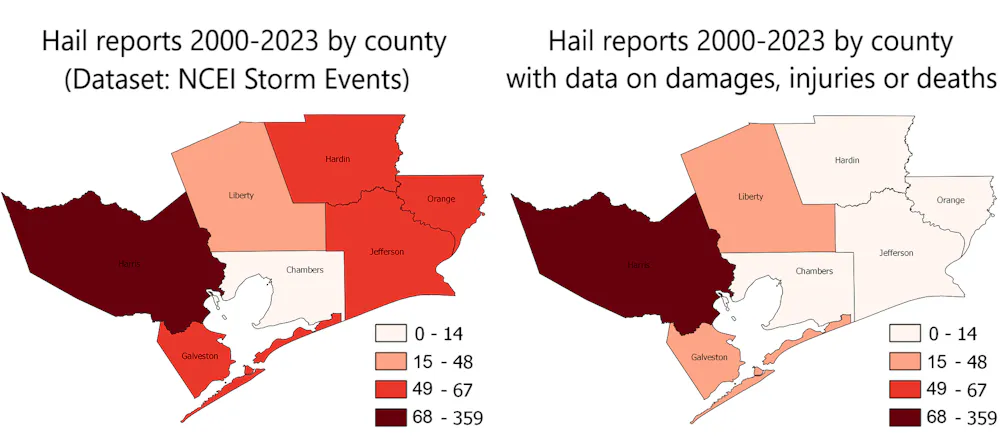
    The number of severe hail reports in southeast Texas listed in the National Centers for Environmental Information’s storm events database is strongly correlated with population. The county with the most reports and greatest detail in those reports is home to Houston. Hailstorms in the three easternmost counties are rarely associated with damage estimates.
    John Nielsen-Gammon and B.J. Baule

    Do you want to look at local damage trends? Forget about it. For most extreme weather events, estimation methods vary over time and are not documented.

    Do you want to direct funding to help communities improve resilience to natural disasters where the need is greatest? Forget about it. The places experiencing the largest per capita damages depend not just on actual damages but on the different practices of local National Weather Service offices.

    Are you moving to a location that might be vulnerable to extreme weather? Companies are starting to provide localized risk estimates through real estate websites, but the algorithms tend to be proprietary, and there’s no independent validation.

    4 steps to improve disaster data

    We believe a few fixes could make NOAA’s storm events database and the corresponding values in the larger SHELDUS database, managed by Arizona State University, more reliable. Both databases include county-level disasters and loss estimates for some of those disasters.

    First, the National Weather Service could develop standard procedures for local offices for estimating disaster damages.

    Second, additional state support could encourage local emergency managers to make concrete damage estimates from individual events and share them with the National Weather Service. The local emergency manager generally knows the extent of damage much better than a forecaster sitting in an office a few counties away.

    Third, state or federal governments and insurance companies can agree to make public the aggregate loss information at the county level or other scale that doesn’t jeopardize the privacy of their policyholders. If all companies provide this data, there is no competitive disadvantage for doing so.

    Fourth, NOAA could create a small “tiger team” of damage specialists to make well-informed, consistent damage estimates of larger events and train local offices on how to handle the smaller stuff.

    With these processes in place, the U.S. wouldn’t need a billion-dollar disasters program anymore. We’d have reliable information on all the disasters.

    John Nielsen-Gammon receives funding from the National Oceanic and Atmospheric Administration and the State of Texas.

    William Baule receives funding from NOAA, the State of Texas, & the Austin Community Foundation.

    ref. Extreme weather’s true damage cost is often a mystery – that’s a problem for understanding storm risk, but it can be fixed – https://theconversation.com/extreme-weathers-true-damage-cost-is-often-a-mystery-thats-a-problem-for-understanding-storm-risk-but-it-can-be-fixed-257105

    MIL OSI – Global Reports

  • MIL-OSI Global: Memories of the good parts of using drugs can keep people hooked − altering the neurons that store them could help treat addiction

    Source: The Conversation – USA – By Ana Clara Bobadilla, Assistant Professor of Biomedical Sciences, Colorado State University

    Your memories are likely stored in ensembles of neurons that fire together. PASIEKA/Science Photo Library via Getty Images

    Everyday human behavior is guided and shaped by the search for rewards. This includes eating tasty meals, drinking something refreshing, sexual activity and nurturing children. Many of these behaviors are needed for survival. But in some instances, this search for rewards can pose a significant threat to survival.

    People rely on memories of rewards to function and survive. Associated with positive experiences, these memories provide context for evaluating present and future choices. For example, if foods high in sugar are associated with a positive experience, this can reinforce the behavior of eating the food that provided the reward. Similarly, a flavorful meal at a specific restaurant increases the likelihood you’ll become a returning costumer.

    A deeper understanding of how reward memories work and interact with each other is critical to informing the choices you make and to treating disorders where seeking rewards has become problematic. Eliminating all reward seeking would negatively affect behaviors essential for survival, such as eating and reproducing. But if you can specifically target reward memories linked to different drugs, this could help reduce their abuse.

    I am a behavioral neuroscientist studying addiction, and my team is interested in how reward memories are formed and processed in the brain. We study how memories linked to natural rewards such as food, water and sex differ from those linked with rewards from drugs such as fentanyl and cocaine.

    Understanding the differences between these types of rewards and how memories of different drugs interact may lead to more effective treatments for addiction.

    What is memory?

    To study reward memories, it is important to understand the neurobiology of memory, or how the brain remembers things.

    In 1904, evolutionary zoologist Richard Semon introduced the term engram to describe the physical representation of a memory – also called its trace – that forms in the brain after an experience. Later, psychologist Donald Hebb hypothesized that interconnected brain cells that are active at the same time during an experience form a physical ensemble that make up a memory.

    In the past decade, neuroscientists have developed new tools that support the idea that neuronal ensembles, or small populations of brain cells that are activated at the same time, are likely the physical representation of memory. How new memories recruit neurons into ensembles is not fully understood, but the plasticity of neurons – their ability to change their connections with each other – seems to play a major role.

    Memories are physically stored in your brain.

    Research on neuronal ensembles has transformed how scientists understand learning and memory. Researchers can now create artificial memories, activate positive memories to counteract negative feelings, and alter how memories are linked. All these experiments on altering memory have been conducted on animal models, since the technology required to apply these techniques to humans is not yet available.

    To create artificial memories, for instance, researchers can mark a neuronal ensemble associated with a specific environment A in genetically modified mice. They can then activate those neurons when exposing the mice to a foot shock in a different environment B. Later, the mice showed increased freezing behavior in environment A, though they never received a shock in that space. By activating the memory of environment A during the foot shock, mice created a false memory that the foot shock was associated with that space.

    Treating substance use disorders

    Neuronal ensembles hold untapped promise for the study and treatment of substance use disorders and other reward-related disorders. These include those involving a deficit in their ability to experience reward, such as gambling disorder, eating disorders and depression.

    Natural rewards – food, water, sex and nurturing – induce pleasurable feelings that reinforce the behavior that elicits that reward. This is known as positive reinforcement, a strategy often used in everyday life; think training a dog with treats, or using sticker charts for potty training.

    Research has linked positive and negative experiences with neuronal ensembles: exploratory and social behaviors, fear, and feeding. In substance use disorders, a drug can induce both pleasant and unpleasant feelings. For example, cocaine induces an intense rush or high, but the crash induced by the drug wearing off causes irritability and lethargy. These feelings reinforce drug use at the expense of essential behaviors that ensure survival, such as eating, sleeping or maintaining social networks and relationships.

    Neuronal ensembles may also play a causal role in the development of multiple aspects of substance use disorders, including drug taking, drug craving and seeking behaviors, increased sensitivity to certain drugs and relapse.

    How drug memory changes the brain

    Similarly to how any memory is stored in the brain as a neuronal ensemble, drug memories are carried in specific neuronal ensembles and activated during drug-related behaviors.

    Fundamental questions remain about how neuronal ensembles encode drug-related memories. Because the processing centers for drug rewards and natural rewards mostly overlap in the brain, it is challenging to develop treatments that target only drug reward seeking. Emerging treatments for addiction, such as certain types of brain stimulation, are not specific enough to differentiate between drug or natural reward pathways.

    Discovering how particular drugs of abuse affect genes, cells and neuronal circuits can help researchers develop new treatments for substance use disorders without altering the natural reward-seeking behaviors essential for survival.

    The reward of drug use can be hard to disentangle from the rewards of eating, drinking and other activities necessary for survivial.
    Kseniya Ovchinnikova/Moment via Getty Images

    For example, about 72% of people suffering from substance use disorders report using multiple substances, frequently together. To better understand how polysubstance use affects the brain, my team tags neurons active during drug-related behaviors in genetically modified mice. This allows us to map and compare the neurons carrying reward-related memories for one drug with the neurons associated with another drug. In this way, we can study how the brain represents and stores memories when mice are exposed to cocaine and fentanyl – two substances people in the U.S. are increasingly taking together – and how different brain regions communicate this information with each other.

    To dissect exactly how drugs of abuse hijack the brain’s natural reward system, my team is comparing how seeking different types of rewards changes the neurons carrying reward memories. For example, we have previously shown that the network of cells carrying the memory of seeking cocaine are mostly distinct from those linked to seeking sugar.

    Based on this work, we are currently using fruit fly models to analyze the genetic activity of the neuronal ensemble linked to seeking cocaine. This will allow us to better identify which genes could be potential targets to reduce the activity of that neuronal ensemble and treat substance use disorder.

    Psychedelics and addiction

    Drug-related intrusive thoughts and fixed behavioral patterns – meaning actions that are repeatedly taken regardless of negative consequences – are common symptoms of substance abuse that lead to the formation of harmful neural pathways in the brain. Psychedelics may be able to help reform these pathways by triggering an overall “system reboot” of the brain.

    Several clinical trials point to the potential of psychedelics to treat tobacco, alcohol and opioid use disorders, with early results showing increased abstinence and reduced drug cravings.

    My lab is currently examining how psilocin – the active metabolite of the psychedelic psilocybin – affects the drug-related memories of mice. Our research focuses on two questions. First, can psilocin alter drug seeking and intake in fentanyl addiction? And second, what type of memory does psilocin create in the brain, and could it alter prior cocaine memories?

    Reward memories both help people survive and lead to substance use disorders. Delving into the intricate mechanisms of how the brain remembers rewards at the cellular and genetic levels can help researchers and doctors better treat addiction without altering the reward pathways needed for survival.

    Ana Clara Bobadilla receives funding from the National Institute on Drug Abuse and the Brain & Behavior Research Foundation.

    ref. Memories of the good parts of using drugs can keep people hooked − altering the neurons that store them could help treat addiction – https://theconversation.com/memories-of-the-good-parts-of-using-drugs-can-keep-people-hooked-altering-the-neurons-that-store-them-could-help-treat-addiction-245529

    MIL OSI – Global Reports

  • MIL-OSI Economics: IGNITE 2025: How Samsung’s Internship Programme Became a Launchpad for India’s Brightest Young Minds

    Source: Samsung

     
    One name that consistently rises to the top when it comes to career aspirations of some of India’s brightest minds is Samsung.
     
    This summer, as the IGNITE Internship 2025 drew to a close, a new generation of change makers walked out of Samsung’s offices with more than just project experience. They left with the spark of transformation in their hearts — a fire ignited by an immersive journey that redefined the way they saw themselves, their careers, and the world of innovation.
     
    These were not just interns. They were explorers. Listeners. Builders. Dreamers.
     
    Where Potential Met Purpose
    “I was a different person two months ago,” says Shanya Goyal from NMIMS Mumbai, reflecting on her journey. “As a fresher, getting firsthand insight into market dynamics and witnessing how Samsung uniquely caters to every Indian — from premium 8K TVs to flagship smartphones — was eye-opening. It’s not just a tech brand; it’s a brand that speaks the language of India.”
     
    Her words echo the experiences of many others who entered Samsung as students and emerged as future leaders.
     
    From Market Floors to Boardrooms: A Real-World MBA
    Samsung’s internship programme is not about presentations. It’s about plunging into the real world, understanding consumer behavior, navigating markets, and learning to lead from the ground up.
     
    For Nenavathu Divya from IIM Indore, the internship was anything but routine. “From day one, I was out in the field, discovering market insights, dodging Gurgaon traffic, and even unearthing the best street food spots on market duty! But what truly inspired me were the stories from Samsung leaders — people who began their journey as field executives and are now leading national teams. Their grit and growth mindset made me believe no role is ever too small.”
     
    Building the Future, Together
    Interns didn’t just learn from their managers; they belonged to their teams. For Ashmi Jain from IIM Ahmedabad, the Samsung experience was a testament to how culture and collaboration go hand in hand.
     
    “These two months have been unforgettable. The support I received from my mentors and teammates helped me push past my own limits. This wasn’t just a summer internship — it felt like joining a family.”
     
    And it wasn’t just about learning the ‘what’ — it was about understanding the ‘why.’ Whether in sales, marketing, or HR, interns saw firsthand what makes Samsung tick.
     
    “I interned with the People team,” says Garvika Agarwal from XLRI Jamshedpur. “It gave me real exposure to HR operations at scale. The warmth, mentorship, and real-world complexity helped me grow not just as a student of business, but as a professional ready to contribute from day one.”
     
    A Mentorship Model Like No Other
    At the heart of IGNITE lies Samsung’s belief: great mentorship changes lives.
     
    Every intern had direct access to leaders who didn’t just supervise — they coached, encouraged, and empowered. Whether it was one-on-one check-ins, leadership stories, or project reviews, each moment was a masterclass in excellence, empathy, and execution.
     
    And as the programme ends, one thing is clear — the real success of IGNITE isn’t measured by deliverables or deck submissions. It’s measured by confidence built, curiosity sparked, and careers kickstarted.
     
     
    A Legacy of Learning. A Future of Possibilities.
    As the IGNITE 2025 cohort turns the page to their next chapter, they carry with them not just the Samsung name on their resume, but the Samsung philosophy in their hearts: to do what can’t be done.
     
    Because when you work with a brand that dares to push boundaries, you begin to believe that you can, too.
     
    And that’s the true power of an internship at Samsung — it doesn’t just prepare you for the future. It transforms you into someone who’s ready to create it.

    MIL OSI Economics

  • MIL-OSI: Beeline taps Crypto Ecosystem to Unlock Real Estate Liquidity for consumers through a Stablecoin Funding

    Source: GlobeNewswire (MIL-OSI)

    Beta closings begin in June; full-scale launch hits late July

    Homeowners unlock equity for cash—no debt, no interest, no monthly payments

    PROVIDENCE, RI, June 04, 2025 (GLOBE NEWSWIRE) — Beeline Holdings, Inc., (Nasdaq: BLNE) the fast-growing digital mortgage platform that shortens the path to homeownership, today announced the upcoming launch of a new home equity access product that allows homeowners to convert a portion of their home equity into immediate cash—without incurring debt or monthly payments.

    Beeline has partnered with a company (“RealCo”), which is co-owned by Beeline’s principal shareholder and CEO. RealCo will issue stablecoins to access capital to purchase equity from homeowners seeking liquidity. RealCo is engaging with Beeline, which will source consumers and provide services. Beeline Title will provide title and escrow services.  

    This innovative product will be funded through a stablecoin-backed model, offering homeowners a fast and flexible alternative to traditional refinancing or HELOCs. The hard launch is scheduled for late July, with beta transactions beginning in June. The coins will be backed by ownership through a fractional deed on the property. RealCo will acquire a minority ownership in homes (up to 49%) as a nominee for the funders who will receive the stablecoins. Homeowners selling equity can opt to receive RealCo-issued stablecoins or US dollars.

    Unlike conventional lending products, this is not a loan transaction, tied to interest rates, or a buy-back obligation, allowing Beeline to generate consistent revenue in any rate environment. The company expects this to drive faster percentage-based revenue growth than traditional mortgage lenders, and with the fees, it expects to be well-positioned to reach operational profitability beginning in Q4 2025. Early market feedback indicates strong demand from equity-rich homeowners seeking liquidity without selling their property or incurring additional monthly obligations. RealCo will initially launch in approximately ten thousand US zip codes and will only enter into equity purchases on homes with a value of $ 1 million or more.

    “Provided there’s equity in the home, RealCo will mint coins at closing, which may then be converted into U.S. dollars,” said Nick Liuzza, CEO of Beeline Holdings. “This model enables us to provide homeowners with liquidity quickly, with an unprecedented model. The stablecoin mechanism becomes the catalyst for funding, and the stablecoin is secured by property recorded in 1:1 in the blockchain and in the public record.”   

    As the crypto ecosystem continues to gain mainstream adoption, with Bitcoin reaching new levels of institutional recognition, Beeline’s use of blockchain-native funding infrastructure represents a first-of-its-kind application in real estate finance. While Bitcoin itself is not used directly in these transactions, the overall architecture reflects the increasing integration of traditional asset classes with blockchain-backed liquidity models.

    Participating homeowners will receive cash at closing and won’t be required to repay the funds until the property is sold. Upon sale, RealCo, as nominee for the token holders, will receive its pro rata percentage of the net proceeds. All ownership privileges remain intact, provided property taxes are kept current.

    “As we enter discussions with new investors, it’s critical to provide transparency about this expansion,” added Liuzza. “This product represents a major opportunity.”

    Beeline’s existing product suite includes both conventional mortgage offerings and a range of non-QM loan programs, many of which are optimized for 1099 earners, self-employed borrowers, and younger homeowners. The company emphasized that this new product is an addition, not a pivot, from its core model.

    “We’re not shifting focus,” said Jess Kennedy, COO of Beeline. “We’re simply adding more firepower to our arsenal that meets the evolving needs of today’s homeowners.”

    The product is expected to benefit individuals who don’t qualify for traditional cash-out refinancing or HELOCs but have meaningful equity. Beeline anticipates additional use cases to emerge as the product rolls out to a wider audience in the months ahead.

    About Beeline https://makeabeeline.com/

    Beeline Financial Holdings, Inc. is a trailblazing mortgage fintech transforming the way people access property financing. Through its fully digital, AI-powered platform, Beeline delivers a faster, smarter path to home loans—whether for primary residences or investment properties. Headquartered in Providence, Rhode Island, Beeline is reshaping mortgage origination with speed, simplicity, and transparency at its core. The company is a wholly owned subsidiary of Beeline Holdings and also operates Beeline Labs, its innovation arm focused on next-generation lending solutions.

    Forward-Looking Statements

    This press release contains forward-looking statements within the meaning of the Private Securities Litigation Reform Act of 1995, including statements regarding the company’s prospective new home equity access product, the timing, features, and demand for such product, and the benefits thereof including revenue growth and the potential to achieve profitability in Q4 2025. Forward-looking statements are prefaced by words such as “anticipate,” “expect,” “plan,” “could,” “may,” “will,” “should,” “would,” “intend,” “seem,” “potential,” “appear,” “continue,” “future,” believe,” “estimate,” “forecast,” “project,” and similar words. Forward-looking statements are based on our current expectations and assumptions regarding our business, the economy and other future conditions. Because forward-looking statements relate to the future, they are subject to inherent uncertainties, risks and changes in circumstances that are difficult to predict. We caution you, therefore, against relying on any of these forward-looking statements. Our actual results may differ materially from those contemplated by the forward-looking statements for a variety of reasons, including, without limitation, the ultimate interest of homeowners in unlocking liquidity and Beeline’s ability to attract homeowners, its reliance on RealCo to raise capital to fund the real estate transactions, and the Risk Factors contained in our Form 10-K filed April 15, 2025. Any forward-looking statement made by us in this presentation speaks only as of the date on which it is made. Factors or events that could cause our actual results to differ may emerge from time to time, and it is not possible for us to predict all of them. We undertake no obligation to publicly update any forward-looking statement, whether as a result of new information, future developments or otherwise, except as may be required by law.

    Contact
    ir@makeabeeline.com

    The MIL Network

  • MIL-OSI Global: Why climate is an everyday story – but media coverage still spikes around special environment days and UN summits

    Source: The Conversation – UK – By Sanam Mahoozi, PhD Candidate in Journalism, City St George’s, University of London

    Lake Urmia, Iran. Sebastian Castelier/Shutterstock

    Climate change is already happening. But 36% of the world’s population still disputes the realities of its origins and impacts. When the science is clear but public understanding lags, more lives and livelihoods are put at risk.

    The media can act as a bridge between climate solutions and public understanding. A global analysis by the Reuters Institute for the Study of Journalism found that the news media remain the primary source of climate change information, with 31% of people getting it from television and 24% from websites and social media platforms.

    Despite all of this, the mainstream media around the world is not doing enough to shoulder the responsibility of preparing the public for the impacts of climate change and environmental degradation. Research indicates that climate change coverage spikes around UN climate summits (Cops) and events like World Water Day, but drops off in between.

    That means the stories being told about the environment get the most attention during certain months and consistently less coverage throughout the rest of the year.

    I study how the media reports on climate change in authoritarian countries like Iran and across the Middle East and north Africa, a region where heat indices surpass 55°C and severe water shortages persist.

    As part of my PhD research, I found that international media reporting of the world’s most climate-vulnerable nations is sporadic, with coverage often increasing around political and environmental events.

    Reporting on environmental issues in countries facing conflict, war and political tensions is challenging, as the topic often falls low on the media’s list of priorities.

    Climate stories tend to peak around special environment days or UN climate summits.
    arda savasciogullari/Shutterstock

    When it comes to Iran, most of the news making headlines is focused on its nuclear development programme, problems with the west and violations of human rights. The fact that thousands of Iranians die each year from thirst, air pollution and heatwaves rarely makes it into international media, and when it does, it’s usually tied to a political event like protests or US economic sanctions.

    For the past few years, I have been researching and writing for news outlets about the Iranian government’s failure to take action towards mitigating climate change. While discussing the issue with climate scientists, I learned that Iran is among the top ten countries globally contributing to carbon emissions.

    I also learned that, along with Yemen and Libya, Iran is the only country left to ratify the Paris agreement, a treaty that aims to keep global temperatures to 1.5 degrees above pre-industrial times.

    However, when I analysed the media coverage, there was not nearly enough mention of this throughout the year. Most articles were published in November, around the time the UN usually holds its annual climate summits, like the UN climate summit, Cop29, hosted by Azerbaijan last year.

    This is a trend I’ve realised through my research and reporting. When the media only covers environmental issues in countries like Iran during political upheavals or climate summits, the world remains largely unaware of these ongoing challenges the rest of the time.

    Here’s the problem: just in the past few months, millions of Iranians across the country have been suffering through crippling sand and dust storms, drought and land subsidence, issues that have been exacerbated by climate change.

    My PhD research into how the media covers the environment in authoritarian regimes is supported by other studies. I found that articles about water and climate issues in Iran and the Middle East tend to peak around environmental protests and UN climate change summits.

    My study shows that Iran received the highest amount of environmental coverage during the 2021 protests in the southwestern province of Khuzestan concerning the lack of water and drought.

    The bigger picture

    When journalists, editors and media outlets delay reporting on the impact of climate change in countries like Iran, we miss the full scale of the damage. As a result, there’s less pressure on authorities to change policies or prepare the public for the growing environmental challenges like forced migration, hunger, and conflict.

    If these countries are more vulnerable to climate change and their governments are doing little to solve the problem, this urgency must be reflected in the media.

    This can be achieved if news organisations publish more stories that explore the root causes of environmental problems and include insights from experts who can offer solutions.

    If even one story can help save a lake, river or wetland from drying up, that’s a pretty powerful effect.


    Don’t have time to read about climate change as much as you’d like?

    Get a weekly roundup in your inbox instead. Every Wednesday, The Conversation’s environment editor writes Imagine, a short email that goes a little deeper into just one climate issue. Join the 45,000+ readers who’ve subscribed so far.


    Sanam Mahoozi does not work for, consult, own shares in or receive funding from any company or organisation that would benefit from this article, and has disclosed no relevant affiliations beyond their academic appointment.

    ref. Why climate is an everyday story – but media coverage still spikes around special environment days and UN summits – https://theconversation.com/why-climate-is-an-everyday-story-but-media-coverage-still-spikes-around-special-environment-days-and-un-summits-256286

    MIL OSI – Global Reports

  • MIL-OSI Global: South Korea election: Lee Jae-myung takes over a country split by gender politics

    Source: The Conversation – UK – By Ming Gao, Research Scholar of East Asia Studies, Lund University

    Liberal candidate Lee Jae-myung has won South Korea’s snap presidential election with a clear lead. With all of the ballots counted, Lee won almost 50% of the vote, ahead of his conservative rival Kim Moon-soo on 41%. He takes over a country that is deeply divided along gender lines.

    Lee’s campaign effectively channelled voter anger. He focused on resetting South Korea’s politics after impeached former president Yoon Suk Yeol, who was from the same party as Kim, unleashed chaos by declaring martial law in December 2024.

    However, gender conflict has continued, subtly but powerfully, to shape voter behaviour, campaign strategies and the national debate about who is to blame for the lack of opportunities in South Korea for young men.

    The election took place three years after Yoon pipped Lee to the presidency by just a quarter of a million votes – the closest margin in the country’s history. Yoon’s victory was, as has been noted by researcher Kyungja Jung, “the epitome of the utilisation of gender wars”.

    A key part of Yoon’s strategy was fostering a sense among young Korean men that it was now them, rather than women, who were the victims of discrimination. He secured 59% of the vote from men in their 20s and 53% from men in their 30s. Just 34% of women in their 20s supported him.

    In the latest election, gender was everywhere and nowhere all at once. On the one hand, not a single candidate put forward a meaningful policy to address structural gender discrimination in the workplace, domestic violence or public sexual harassment.

    None even mentioned the gaping absence of women candidates, despite thousands of mostly young women having filled the streets demanding democracy after Yoon’s martial law declaration. It was the first time in nearly 20 years that not a single woman stood among the contenders for the highest role in the country.

    Lee, positioning himself as the consensus candidate, attempted to neutralise gender as a campaign issue. When reporters asked him whether he would announce any women-related pledges, he said: “Why do you keep dividing men and women? They are all Koreans.”

    His remark may sound inclusive. But it signals a strategy to declare the gender issue off-limits for the sake of the greater good, thus sidestepping the specific inequalities that continue to divide the country. It’s a form of unity by erasure.

    Lee Jun-seok of the right-wing Reform party, on the other hand, tried to resurrect the same playbook that delivered Yoon to power in 2022. He attempted to provoke, polarise and win the loyalty of disaffected young men.

    As Yoon had done three years ago, he called for the abolition of the Ministry of Gender Equality and Family. And during a televised debate, he asked: “If someone says they want to stick chopsticks into women’s genitals, would that count as misogyny?” The question was a nod to a controversial online remark Lee Jae-myung’s son had made years earlier.

    Lee Jun-seok’s comment drew widespread condemnation and, ultimately, he only scraped about 7.7% of the total vote. This included over 37% of men in their 20s, while 58% of women in the same age group backed Lee Jae-myung. Gender is a highly political matter in South Korea whichever way you look at it.

    Gender wars

    This gender divide is now one of the most consistent features of South Korean politics. Women are vocal and visible in public to safeguard not just their own rights, but also South Korea’s democracy.

    Yet populist politicians have cultivated a perception among young men – squeezed by stagnant wages, fierce competition over jobs and social expectations – that their diminishing opportunities are due to policies they see as favouring women.

    This has resulted in many young South Korean men seeing feminism not as a movement for equality but as an obstacle to their own progress. In reality, their struggle has less to do with gender and more to do with structural inequalities in income and opportunity for all young Koreans.

    As Kyungja Jung observed in a paper from 2024: “Misogyny becomes an outlet for their [South Korean men’s] frustration and masculinity crisis as they search for a scapegoat for their struggles in neoliberal society. They blame women rather than the neoliberal economy.”

    Young people even from the best universities in Korea feel they cannot compete in the job market no matter what they do. South Korea now has one of the highest rates of young people not in education, employment or training among the OECD countries. This has given rise to the so-called “N-Po” generation, who feel so disadvantaged that they have given up on all future dreams of marriage, family and a career.

    South Korea isn’t alone in mobilising backlash against feminism and gender equality. Around the globe, gender has become one of the major fault lines in politics. In the November 2024 US election, Donald Trump led among young men by 14 points, while Kamala Harris had an 18-point edge with young women.

    Meanwhile, self-described misogynist Andrew Tate continues to shape young male attitudes online. And in Italy, Giorgia Meloni rose to power on a far-right platform that, despite being a woman herself, reduces women to their roles as mothers and homemakers.

    Young women played a key role in the protests against Yoon’s martial law declaration.
    Icelander / Shutterstock

    One model for change in South Korea could be to introduce quotas for women in politics to make their voices heard. Women only occupy around 20% of the 300 seats in South Korea’s National Assembly, trailing well behind the global (27.2%) and Asian (22.1%) averages. If women are not in politics making decisions about themselves, then their voices will not be heard beyond the streets.

    Lee Jae-myung’s win has given South Korea a moment to breathe. But the fault lines remain. When an entire demographic, be it young men or women, feels systematically unheard or structurally discriminated against, opportunistic voices can move in to fill the void.

    Gender is political. Ignoring it may be just as risky as confronting it head-on.

    Ming Gao receives funding from the Swedish Research Council. This research was produced with support from the Swedish Research Council grant “Moved Apart” (nr. 2022-01864). Ming Gao is a member of Lund University Profile Area: Human Rights.

    Joanna Elfving-Hwang receives funding from the Academy of Korean Studies. This research was supported by the Core University Program for Korean Studies through the Ministry of Education of the Republic of Korea and Korean Studies Promotion Service of the Academy of Korean Studies (AKS-2022-OLU-2250005).

    ref. South Korea election: Lee Jae-myung takes over a country split by gender politics – https://theconversation.com/south-korea-election-lee-jae-myung-takes-over-a-country-split-by-gender-politics-257923

    MIL OSI – Global Reports

  • MIL-OSI Global: How remembering railway accidents from 100 years ago can make the industry safer today

    Source: The Conversation – UK – By Mike Esbester, Senior Lecturer in History, University of Portsmouth

    APChanel/Shutterstock

    According to a recent report, the UK rail industry is a relatively safe environment for both passengers and workers. The findings, from the Rail Accident Investigation Branch, came from data on railway accidents for 2024.

    But it also showed that there remain areas of concern in the industry. Specifically, it found examples of “not learning” from accidents and incidents. And alarmingly, there has also been a “lack or loss” of learning from historic tragedies.

    So how and where can the sector recover that experience and insight in order to learn the lessons? The report findings imply the knowledge exists, but has been forgotten. It may be that, rather than looking back over the previous 12 months, the industry should cast its gaze back 100 or 150 years.

    For the rail workforce, a major new historical dataset is being released that might offer some answers. The Railway Work, Life & Death project has added nearly 70,000 cases of worker accidents in England and Wales to its database of staff accidents from before 1939.


    Get your news from actual experts, straight to your inbox. Sign up to our daily newsletter to receive all The Conversation UK’s latest coverage of news and research, from politics and business to the arts and sciences.


    Until now the records have been available only in hard copy. But digital access via the project website will mean insights from accidents – some dating to the 1850s – can be used to improve rail workforce safety in the present day.

    Examples from the project include the case of North Eastern Railway office cleaner Mary Ramsey. She was run over by a train in 1859 at South Shields while taking out the ashes from the station fireplaces. Ivor Richards, who worked for the Rhymney Railway in Cardiff, was just 14 when he was killed crossing the lines in 1916.

    These, and the tens of thousands of other historic cases, can be used to explore issues that resonate today. The online dataset offers a platform for people to access knowledge freely and learn from the past. No living person or current organisation is singled out. This means people in the rail industry now can use the records to draw parallels between past and present, and use it as a way into frank discussions about safety today.

    The utility of this approach and the value of the data is recognised by the industry. From within the rail sector, accident investigators, health and safety managers and trade union officers will be attending the dataset launch on June 5, at The National Archives of the UK, at Kew, London.

    Though the industry has changed radically over the last 200 years, some issues still exist that would have been equally recognisable to workers more than 100 years ago. From working at height, through slips, trips and falls, to working on and around railway lines, the essence of some railway work – and the dangers – remain consistent.

    Lessons from the past

    Last year the Railway Work, Life & Death project collaborated with independent research body the Rail Safety and Standards Board and the Infrastructure Safety Leadership Group to produce a workshop for safety leaders and a track worker safety digest.

    Both used historic examples to address contemporary issues – demonstrating the value of a “useable past” and the potential for this new dataset.

    The examples of Mary Ramsey and Ivor Richards might be used to discuss things like safe walking routes, or safety training and certification for going on or near working railway lines. They can start conversations about the mitigations that might have been put in place to prevent an accident, or “safe systems of work”. Even though concepts like safety certification and safe walking routes are anachronistic, they allow a space in which discussion can borrow from the past to focus on the present.

    The records come from The National Archives of the UK, where a team of volunteers has spent seven years transcribing them to make them more easily accessible. They were then added into the Railway Work, Life & Death project, a collaboration between the University of Portsmouth, National Railway Museum and the Modern Records Centre at the University of Warwick, working with the RMT union.

    The dataset also has benefits for people beyond the rail industry. This year is being marked as Railway 200 – 200 years since the Stockton and Darlington Railway was launched. This is seen as the birth of the modern system. For historians, we can use the dataset to see the people who kept the railway system running.

    There’s a risk that the version of the past that is portrayed is a straightforward one, and railways (particularly steam railways) are seen through rose-tinted spectacles. That view obscures how hard, dirty and dangerous working on the railways was for many people.

    Narratives about the railways’ past should challenge people – and acknowledge the difficult bits. This newly released dataset can do exactly that. It documents working conditions, wages, practices and, of course, dangers from working on the railways. It allows anyone to find out more about the past, making research easier and more accessible.

    And the dataset lets people tell more diverse stories about who was included in the rail industry.

    For example, we can see how disability as a result of a workplace accident was experienced and managed. William Parry was employed as a signalman in south Wales following a 1907 accident on the railways that cost him his leg.

    Giving more prominence to under-represented groups – while showing their long-standing presence in the rail industry – has significant social value. It can help support those currently in the industry, as well as show those contemplating a railway career that the workplace is for them. It meshes with the work of groups like Women in Rail and Ethnicity and Race in Rail to encourage greater representation in the industry.

    Having spent nearly ten years co-leading the Railway Work, Life & Death project, I sometimes ask myself why I do it – not least given the inherent sadness in many of the cases. But then I see the people behind the statistics, their wider lives, their families and communities, and the window the records gives into life on the railways. That personal connection drives me – alongside the conviction that it can make a difference to today’s industry.

    Railway workers from the past and the accidents they often suffered have been largely forgotten, precisely because the industry is now relatively safe. Employee accidents are nowhere near as commonplace or visible as they once were. But there is room for improvement. Remembering the people of the early railway era and learning from their experiences is once again possible through the Railway Work, Life & Death project.

    Mike Esbester does not work for, consult, own shares in or receive funding from any company or organisation that would benefit from this article, and has disclosed no relevant affiliations beyond their academic appointment.

    ref. How remembering railway accidents from 100 years ago can make the industry safer today – https://theconversation.com/how-remembering-railway-accidents-from-100-years-ago-can-make-the-industry-safer-today-257487

    MIL OSI – Global Reports

  • India’s path to 2070 net-zero target requires heavy investment in power sector: Moody’s

    Source: Government of India

    Source: Government of India (4)

    India will need massive investment to achieve its 2070 net-zero pledge as it balances energy security, affordability and transition, Moody’s Ratings said on Wednesday.

    Achieving this pledge will necessitate substantial investment, particularly in the power sector, which is a material contributor to the nation’s carbon emissions.

    Over the next decade, these investments are projected to constitute 2 per cent of real GDP for the electricity value chain, encompassing power generation, storage, transmission and distribution, the report mentioned.

    The government’s plan to reach net-zero emissions by 2070 will be contingent upon a shift in the fuel mix from the current predominantly coal-fired power toward clean and renewable energy.

    However, strong economic growth implies India will also expand its coal-based power generation capacity by 32-35 per cent (or around 70GW-75GW) over the next 10 years, even as it adds around 450GW of renewable energy over the same period.

    “We expect the private sector to remain active in India’s renewable energy sector, while government-owned companies will also increase their role,” said Abhishek Tyagi, a Moody’s Vice President and Senior Credit Officer.

    Solar and wind power will dominate new generation capacity additions over the next 20-25 years, with smaller nuclear and hydropower additions, he added.

    Securing diverse sources of capital, including foreign investments (both debt and equity), will be crucial to bridge the funding gap for energy transition-related infrastructure.

    Meanwhile, the government has planned sizeable capex under its ‘Maritime India Vision 2030’ to augment port capacity and infrastructure over the course of next few years.

    Moody’s Indian affiliate ICRA expects cargo volumes to rise by 3-5 per cent in FY26, driven largely by the growth in the container, petroleum products and the fertiliser segment.

    Apart from the traditional segments like transportation and energy within infrastructure space, data centre is emerging as a new hotspot for infrastructure investment.

    ICRA expects significant investment pipeline of Rs 1.6-1.8 trillion in data centre (DC) capacity addition over next 5-6 years in India, supported by rapid digitalisation along with favourable policy measures.

    -IANS

  • MIL-OSI United Kingdom: Get on your bike and celebrate cycling on free family ride around city

    Source: City of Wolverhampton

    The Wolverhampton Kidical Mass 2025 event is on Saturday 14 June and the ride sets off from East Park, where there will also be bike skills, learner riding sessions, family entertainment and refreshments throughout the day.

    Riders will pedal to Molineux Stadium and back to the park in Hickman Avenue along public roads and cycle lanes developed by City of Wolverhampton Council.

    Mayor of the West Midlands Richard Parker is expected be in attendance to set the cyclists off shorty after midday, following short speeches.

    He will be joined by Wolverhampton cycling legend and the city’s cycling ambassador Hugh Porter MBE. Hugh is a Commonwealth Games gold medallist and former world champion.

    There will be plenty going on in the park throughout the day from 11am to 3pm including music, food and drink stalls and cycle themed activities.

    The event has been organised by No Limits to Health CIC working with City of Wolverhampton Council, West Midlands Combined Authority and Transport for West Midlands and is supported by charity Cycling UK, British Cycling and Sustrans among others. It follows the successful inaugural Wolverhampton Kidical Mass event held last year.

    Participants should bring their own roadworthy bikes to take part in the ride with everyone advised to wear a helmet.

    Bike marshals will accompany riders along the 4.5 mile route, but younger children must be accompanied by a parent or guardian. Children remaining in the park must also be accompanied by an adult.

    Councillor Qaiser Azeem, Cabinet Member for Transport at City of Wolverhampton Council, said: “This is a wonderful opportunity to celebrate safe, family friendly cycling and for children to practise riding on public roads and cycle lanes, taking advantage of visibility and safety in numbers.

    “Those taking part will follow a route that will take in designated cycle routes developed by City of Wolverhampton Council as part of our commitment to encouraging active travel and healthy lifestyles, reducing traffic congestion and improving air quality.

    “I hope as many people as possible get involved and that the sun comes out on the day.”

    Hugh Porter MBE said: “As a former world champion and cycling ambassador for the city it is music to my ears to see people riding bikes.

    “I wish the Kidical Mass family bike ride every success on the day, and I hope it attracts lots of youngsters to pedal around the route.”

    Sam Henry, founder of No Limits to Health, said: “The city is being made safe for cycling with the help of the council. Kidical Mass is a great way to encourage as many people as possible to take advantage of this and embark on a journey to improve their physical and mental health and wellbeing.”

    Sign up here for free at Kidical Mass Wolverhampton 2025.

    The event coincides with both National Bike Week (9 to 15 June) and the Great Big Green Week (7 to 15 June).

    MIL OSI United Kingdom

  • MIL-OSI Russia: Scientific Regiment. David Goldgor – architect and sapper

    Translation. Region: Russian Federal

    Source: Saint Petersburg State University of Architecture and Civil Engineering – Saint Petersburg State University of Architecture and Civil Engineering –

    David Goldgor

    A graduate of the Leningrad Institute of Municipal Construction Engineers (LIICS), a teacher at the Leningrad Civil Engineering Institute (both now SPbGASU), Soviet architect, graphic artist David Semenovich Goldgor (1912–1982) wrote his name into the history of the city on the Neva for centuries: many of the objects he took part in designing decorate Petersburg to this day. But the Nevsky Cranes Memorial, dedicated to the memory of those who died during the Great Patriotic War, other monuments to heroes, and the Victory Arch for him, a front-line soldier, took a special place in his professional biography, since the architect personally experienced all the hardships of the harsh military years.

    In 1934, David Goldgor graduated from LIIKS. The young architect began his career in Studio No. 5 of the Lenproekt Institute. He worked under the supervision of Evgeny Levinson and Igor Fomin, already well-known architects at that time. The first taught at our university, and a few years later became a corresponding member of the USSR Academy of Architecture, a doctor of architecture, and a professor. The second would soon head the architectural design department at LIIKS, and in 1951 he would take the position of deputy chief architect of Leningrad. They would assemble a strong team of young Leningrad architects, among whom David Goldgor would become one of the most talented. He would immediately be involved in working on building projects for the Institute of Experimental Medicine. In those years, the architect would also prove himself as a graphic artist.

    When the war began, David Goldgor volunteered for the people’s militia and was sent to the first rifle regiment of the 2nd division as a sapper. He took part in combat operations in the Gatchina region. After the blockade was lifted, he worked on the restoration of Leningrad, and in peacetime he returned to his native workshop. Already in 1945, together with the architect Igor Fomin, he drew up a project for a temporary triumphal arch in Leningrad on Obukhovskoy Oborony Avenue near Spartak Garden, intended to welcome the victors.

    In 1953, he became the head of the workshop together with Evgeny Levinson, after whose death in 1968 he took full responsibility for the work of the workshop.

    David Goldgor always remained true to his work and created projects for residential buildings, public buildings, and memorials. Under his leadership, the area around Smolny was formed, and Kupchino was developed. In collaboration with other architects, he designed the Moscow Hotel and the automatic telephone exchange, which formed the space of Alexander Nevsky Square. Among the widely known objects is the ground pavilion of the Narvskaya metro station, opened in 1955.

    In the 1960s and 1970s, David Goldgaard combined his active professional work with teaching at the Department of Architectural Planning at LISI.

    Awarded the Medal “For the Defense of Leningrad”.

    Other materials of the project “Scientific Regiment”

    Our graduate built the Road of Life

    The pioneering work of architect Alexander Nikolsky

    A scientist who developed science in besieged LeningradFights of student Klinov

    Engineer of the 3rd Belorussian Front

    The path of a volunteer: from front-line roads to space developments

    Ivan Solomakhin: “The most memorable battle is for this Devil’s Height!”

    Fiery Dnieper of the Hero of the Soviet Union Alexander Prygunov

    Bringing Victory Closer

    Fyodor Komal’s Front: From the First Minutes of War to Victory

    Junior Political Instructor Boris Gubanov: “The shells whistled, and the earth flew up nearby”

    Viktor Kvyatkovsky – radio operator-intelligence officer of the Baltic Fleet

    How Chief Architect Nikolai Baranov “Hid” Leningrad from the Enemy

    Architect Nikolay Khomutetsky: Four years on the front lines

    Semyon Shifrin thwarted the Nazis’ plans to leave Leningrad without water

    LISI in the post-war years

    Nineteen-year-old machine gunner stormed Berlin

    Abdulla Mangushev: Four Years at the Front and a Life in Science

    The Zazersky architects built and defended the city on the Neva

    LISI graduate Mikhail Zherbin is a design engineer and composer

    He went from being a technical lieutenant to a galaxy of mathematicians

    Konstantin Sakhnovsky: from a cadet of the Russian Empire to an academician of the USSR

    Military architect of the front line of defense and engineering reconnaissance

    A world-renowned scientist, an outstanding engineer and a national champion

    An outstanding urban planner who lived and worked in besieged Leningrad

    Scientific Regiment. Projects of the architect Sergey Evdokimov: from defensive structures and city restoration to metro stations

    Volunteer Mikhail Laletin: “After the front – to university, and then, perhaps, to become an officer”

    Architect Alexander Sokolov preserved and restored cultural heritage

    Please note: This information is raw content directly from the source of the information. It is exactly what the source states and does not reflect the position of MIL-OSI or its clients.

    MIL OSI Russia News

  • MIL-OSI United Kingdom: Uncover Victoria Park’s lost bandstand site with The Storm Cone

    Source: City of Portsmouth

    The site of Victoria Park’s lost bandstand and its buried past can be explored like never before through an immersive new digital artwork.

    Experienced through personal devices, The Storm Cone is a unique sound and augmented reality artwork which has arrived in Portsmouth.

    This breathtaking work by artist Laura Daly features newly commissioned music composed by Lucy Pankhurst and eight sound works by Daly.  Visitors can ‘move around’ a life-size augmented reality bandstand at the city’s lost bandstand site in the centre of Victoria Park.

    Using The Storm Cone free app on a phone or tablet, visitors will experience the last musical performance of an interwar brass band and trace the journeys of the departed musicians through the eight sound works.

    The Storm Cone was originally commissioned by the University of Salford Art Collection and Metal, revealing the lost bandstands of Peel Park, Salford and Chalkwell Park, Southend in 2021.

    It has now been transported to the city as part of Portsmouth City Council’s restoration and revitalisation of Victoria Park as the ‘People’s Park’, made possible by a £2.4m grant from The National Lottery Heritage Fund.

    Council Leader Cllr Steve Pitt said:

    “The bandstand was an original feature of Victoria Park when it opened in 1878 as the first public park for the people of Portsmouth. Bandstands were hugely popular attractions in Victorian Britain, but like many others, Portsmouth’s was lost sometime before the outbreak of the Second World War.

    “This new art and sound experience is a truly unique way of uncovering Victoria Park’s lost bandstand and learning about their cultural significance to life at the time.”

    The Storm Cone was recently a finalist for the prestigious international Lumen Art Prize. It charts a story of loss, celebration, human strength and fragility.

    It tells of the break-up and reshaping of communities during the interwar years and is named after Rudyard Kipling’s 1932 poem The Storm Cone, which has been interpreted as a forewarning for the Second World War.

    The Storm Cone can be experienced in Portsmouth until 30 September, using the free app which will guide users to the artwork. Headphones are recommended for the best experience.

    The Storm Cone was commissioned by Salford University Collection and Metal, with financial support from the National Lottery through Arts Council England, and additional support from Salford School of Arts, Media & Creative Technology, PN Daly Limited and Zinc and Copper Roofing Limited. Laura Daly is supported by The Artists Agency.

    Laura Daly and curator Lindsay Taylor will be in conversation on Tuesday 16 September, 2-3pm, at The Green House Community Hub in Victoria Park. Get Tickets.

    MIL OSI United Kingdom

  • MIL-OSI USA: FEMA and SBA Resources Available at Locally Run Survivor Support Locations

    Source: US Federal Emergency Management Agency

    Headline: FEMA and SBA Resources Available at Locally Run Survivor Support Locations

    FEMA and SBA Resources Available at Locally Run Survivor Support Locations

    LOS ANGELES – The Federal Emergency Management Agency (FEMA) and Small Business Administration (SBA) have transitioned in person resources for wildfire survivors to county and city run facilities

    Survivors may access assistance at the following locations:One Stop Rebuilding Center – LA City 1828 Sawtelle Blvd

    Los Angeles, CA 90025 Monday-Friday: 9 a

    m

    – 5 p

    m

    Closed weekends

    Altadena Community Center – LA County730 E

    Altadena Dr

    Altadena, CA 91001Monday-Friday: 9 a

    m

    – 5 p

    m

    Closed weekends

    If you applied for FEMA assistance, it is important to stay in touch with FEMA to track and update your application should you receive an insurance settlement and as your situation changes

    FEMA representatives can explain available assistance programs and help you with resources for your recovery needs

    Rental Assistance is available for eligible individuals and families who were displaced by the wildfires

    If you were displaced and need assistance covering housing costs, you should contact FEMA to determine your eligibility for this program

     SBA’s Customer Service Representatives are also available at the new locations to answer questions, help applicants complete their disaster loan application, accept documents, and provide updates on application status

    Additional Resources:California Governor’s Office of Emergency Services (CalOES)Resources offered by State agencies are available online and at some existing field offices

    Survivors can find a complete list of recovery related services on the CA

    gov/LAfires Recovery Services Finder page, including how to contact each agency and their office locations

    U

    S

    Army Corps of Engineers (USACE)For help answering questions regarding debris removal, please call: 213-308-8305

    The call center is available daily from 6 a

    m

    to 6:30 p

    m

    For more information, you can also visit the USACE Los Angeles County Wildfire Debris Removal Mission

    joy

    li
    Tue, 06/03/2025 – 22:18

    MIL OSI USA News

  • MIL-OSI USA: Glacier Collapse Buries Swiss Village

    Source: NASA

    On the afternoon of May 28, 2025, an avalanche of rock and ice from the Birch Glacier (Birchgletscher) in southwestern Switzerland roared into the valley below. Debris buried most of the village of Blatten and dammed the Lonza, causing the river to flood. The event occurred after rock from a crumbling mountain peak built up on the glacier, which likely contributed to its ultimate collapse.
    The OLI-2 (Operational Land Imager) on Landsat 9 captured this image (right) of avalanche debris in the Lonza river valley on May 29, 2025, the day after the landslide. For comparison, the left image, acquired with the OLI on Landsat 8, shows the same area approximately one year before the slide, on June 19, 2024.
    The path of the debris flow descends the southern side of the valley from a peak called Kleiner Nesthorn toward Blatten. The event was so powerful that debris continued as much as 240 meters (790 feet) up the opposite valley wall. Rock and ice from the avalanche extended 2.5 kilometers (1.6 miles) down the valley, damming the river behind it and flooding part of the village.
    Scientists have been monitoring the Birch Glacier since it released several damaging avalanches in the 1990s. While the steeper upper portions of the glacier have thinned in the past decade, the ice near the glacier’s end has thickened by up to 15 meters (50 feet), likely because it had been covered and insulated by rock. Many glaciers in the Alps, including some of the range’s largest, are melting and thinning.
    Instability on the rocky slopes above the glacier became apparent in mid-May, prompting people to evacuate Blatten by May 19. Observers noted frequent rockfalls from Kleiner Nesthorn and a noticeable buildup of debris on the lower part of Birch Glacier. By May 27, the day before the catastrophic event, the glacier had sped up significantly, moving downhill at an estimated 10 meters (33 feet) per day, according to an ETH Zürich report.
    Scientists are still investigating what factors contributed to the event. However, some think that the added pressure from fresh rockfall on the glacier caused melting at its base. An increase in meltwater can cause glaciers to lose friction with the ground and slide more easily. Areas of permafrost at higher elevations may have also played a role. If permafrost melts, more water can reach rock layers and destabilize slopes, but scientists note they cannot yet link permafrost with the rockfall in this event.
    A glacial collapse of this magnitude is unusual for the Swiss Alps, researchers say, and it is relatively rare for massive slides to come from gently sloping glaciers. But similar rock-ice avalanches in Tibet, the Caucasus, and other mountainous regions in the past 25 years have garnered more scientific scrutiny because of their threats to communities.
    NASA Earth Observatory images by Michala Garrison, using Landsat data from the U.S. Geological Survey. Story by Lindsey Doermann.

    MIL OSI USA News

  • MIL-OSI USA: FEMA, SBA and the State of Oklahoma are Assisting Oklahomans at One-Day Event in Cleveland County

    Source: US Federal Emergency Management Agency

    Headline: FEMA, SBA and the State of Oklahoma are Assisting Oklahomans at One-Day Event in Cleveland County

    FEMA, SBA and the State of Oklahoma are Assisting Oklahomans at One-Day Event in Cleveland County

    OKLAHOMA CITY –In coordination with the State of Oklahoma, FEMA and the U

    S

    Small Business Administration (SBA) will be offering face-to-face help Thursday, June 5, at a community pop-up event in Cleveland County

     Homeowners and renters in Cleveland, Creek, Lincoln, Logan, Oklahoma, Pawnee, and Payne counties affected by the March 14-21 wildfires and straight-line winds may be eligible for FEMA assistance for losses not covered by insurance

    Staff will be available at:CLEVELAND COUNTYLittle Axe Middle School(Located in the school cafeteria)2000 168th Avenue NENorman, OK  73026 Hours: Thursday, June 5, 9 a

    m

    – 6 p

    m

     Survivors do not have to visit a community site in order to register for FEMA Assistance

    To apply, homeowners and renters can:Go online to DisasterAssistance

    gov

    Download the FEMA App for mobile devices Call the FEMA helpline at 800-621-3362 between 6 a

    m

    and 10 p

    m

    Help is available in most languages

     To view an accessible video about how to apply visit: Three Ways to Register for FEMA Disaster Assistance – YouTube

    For the latest information about Oklahoma’s recovery, visit  fema

    gov/disaster/4866

     Follow FEMA Region 6 on social media at x

    com/FEMARegion6 and at facebook

    com/FEMARegion6/

    thomas

    wise
    Tue, 06/03/2025 – 18:38

    MIL OSI USA News

  • MIL-OSI: Bread Financial to Participate in the Morgan Stanley US Financials Conference

    Source: GlobeNewswire (MIL-OSI)

    COLUMBUS, Ohio, June 04, 2025 (GLOBE NEWSWIRE) — Bread Financial® Holdings, Inc. (NYSE: BFH), a tech-forward financial services company that provides simple, personalized payment, lending, and saving solutions to millions of U.S consumers, today announced the company’s participation in the Morgan Stanley US Financials Conference on Wednesday, June 11.

    Bread Financial Chief Financial Officer Perry Beberman will participate in a fireside chat. The fireside chat will take place at 1:45 p.m. ET and will be broadcast live here.

    The fireside chat can also be accessed through Bread Financial’s investor relations website. A replay of the webcast will be available for 90 days following the event.

    About Bread Financial® 
    Bread Financial® (NYSE: BFH) is a tech-forward financial services company that provides simple, personalized payment, lending, and saving solutions to millions of U.S consumers. Our payment solutions, including Bread Financial general purpose credit cards and savings products, empower our customers and their passions for a better life. Additionally, we deliver growth for some of the most recognized brands in travel & entertainment, health & beauty, jewelry and specialty apparel through our private label and co-brand credit cards and pay-over-time products providing choice and value to our shared customers. 
         
    To learn more about Bread Financial, our global associates and our sustainability commitments, visit breadfinancial.com or follow us on Instagram and LinkedIn.

    Contacts

    Brian Vereb — Investor Relations
    Brian.Vereb@breadfinancial.com

    Susan Haugen — Investor Relations
    Susan.Haugen@breadfinancial.com

    Rachel Stultz — Media
    Rachel.Stultz@breadfinancial.com  

    The MIL Network

  • MIL-OSI Security: FBI Miami Supports Miami Beach Police in Targeted Enforcement Operations Over Memorial Day Weekend

    Source: US FBI

    MIAMI—Over Memorial Day weekend, FBI Miami joined the Miami Beach Police Department for a series of drug, firearm, and violent crime arrests and investigations. Called Operation Viper and Operation Starlight, the FBI deployed a team of agents, intelligence analysts and professional staff who specialize in violent crime investigations from May 23-25.

    The operation yielded the following enforcement outcomes:

    • Friday: 4 firearms investigations and 2 drug related arrests.
    • Saturday: 8 firearms investigations, 2 drug related arrests and 1 armed home invasion robbery investigation.
    • Sunday: 5 firearms investigations, 4 firearms related arrests and 1 arrest for a stolen vehicle.

    These investigations remain ongoing, and some may result in federal charges. As such, the FBI cannot comment further about their status at this time.

    “Criminals who commit violent crimes, robberies, and conduct drug trafficking prey on our communities and keep our citizens from enjoying their time off during holiday weekends like Memorial Day,” said Ryan James, assistant special Agent in charge, FBI Miami. “Operation Viper demonstrates the FBI’s commitment to support local law enforcement in their efforts to eliminate violent crime in their neighborhoods.”

    “I am extremely proud of the outstanding work carried out by our Street Crimes Section in partnership with FBI Miami, through the implementation of Operation Starlight and Viper.” shared Chief Wayne Jones. “Their coordinated efforts led to the apprehension of violent offenders, the recovery of multiple firearms, and the removal of dangerous narcotics from our streets during this Memorial Day weekend. I’d like to thank our federal law enforcement partners for their steadfast support in keeping our community safe.”

    The Miami Beach Police Department’s Criminal Investigations Division, the FBI Miami’s Violent Crime and Fugitive Task Force, and the FBI continue these investigations.

    Learn more about the FBI’s Strategy: www.FBI.gov/about/ mission.

    MIL Security OSI

  • MIL-OSI United Nations: From heatwaves to cyber threats: a comprehensive new guide to today’s hazards

    Source: UNISDR Disaster Risk Reduction

    UNDRR and ISC release an updated overview of hazards to help governments, researchers, and responders to better understand and act on interconnected risks.

    Geneva / Paris – 4 June 2025 – The United Nations Office for Disaster Risk Reduction (UNDRR) and the International Science Council (ISC) have released an updated edition of their comprehensive hazard guide, offering clear, standardized information on 282 hazards – from wildfires and earthquakes to cyberattacks and pandemics.

    The new edition reflects the complex and interconnected nature of today’s global risk landscape. Hazards increasingly occur together, cascade across systems, and amplify one another. In response, the updated profiles emphasize a multi-hazard approach-critical for effective early warning systems, emergency planning, and disaster resilience. Originally launched in 2021 as the first resource of its kind, the hazard definitions and classification provide an authoritative technical foundation for disaster risk reduction efforts worldwide. This updated edition builds on that foundation with:

    • 282 reviewed hazards across 8 types and 39 clusters
    • Improved, machine-readable format to support their use across digital tools and systems. E.g. the updated hazard taxonomy with standard definitions enables the new generation UNDRR-UNDP-WMO disaster tracking system.
    • Clearer articulation of hazard interactions and multi-hazard scenarios
    • User-informed revisions and new content to support real-world planning and response

    “From local governments to humanitarian agencies, the need for consistent, science-based hazard information is universal. These profiles reflect the best available scientific understanding of hazards and offer a foundation for evidence-based policies that reduce risk and build resilience,” said Salvatore Aricò, CEO, International Science Council.

    “Reliable and standardized hazard data are essential for informing disaster risk reduction strategies. This update helps countries implement the Sendai Framework for Disaster Risk Reduction to reduce losses by 2030,” said Kamal Kishore, the Special Representative of the United Nations Secretary-General for Disaster Risk Reduction.

    “This updated edition reflects what we’ve learned: hazards are not standalone events. They are part of a complex web of risk. By bringing together diverse expert and user input, we’ve made these profiles more actionable, more interconnected, and more immediately useful,” said Professor Virginia Murray, Chair of the Hazard Information Profiles Steering Group.

    The revision process engaged over 270 experts, reviewers, and users from across sectors and regions. A dedicated User Group, Multi-Hazard Group, and Machine Actionability Group ensured the profiles remain practical, future-ready, and inclusive of diverse perspectives and needs.

    Since the initial release, the hazard profiles have been widely used by national disaster management agencies, UN bodies, researchers, and humanitarian organizations for planning, monitoring, risk assessments, and training. This success has prompted the current update to ensure that they remain relevant and up to date.

    Explore the updated hazard profile


    Contacts

    Zhenya Tsoy, Head of Communications, International Science Council 

    MIL OSI United Nations News

  • MIL-OSI United Nations: United to enhance disaster preparedness: Announcing the launch of the Priority Actions to Enhance Readiness for Resilient Recovery

    Source: UNISDR Disaster Risk Reduction

    On 3 June 2025, global leaders gathered at the World Resilient Recovery Conference (WRRC) to launch the Priority Actions to Enhance Readiness for Resilient Recovery – an initiative aimed at accelerating the implementation of Priority Action 4 of the Sendai Framework: Enhancing disaster preparedness for effective response and to “Build Back Better” in recovery, rehabilitation and reconstruction. 

    The ten actions, pictured and described in further detail below, are important for several reasons. 

    First, the consultative process to get there was comprehensive and all-inclusive. A total of 130 countries participated across four distinct regions (Africa, Europe and Central Asia, Americas and the Caribbean and Arab States), bringing a diverse set of opinions, needs and expectations. In the end, more than 4,000 individual participants shared their knowledge and expertise. 

    The agreed-upon actions are representative of this crucial and comprehensive consultation process, with a particular focus on people. For example, Priority Action 9 aims to “Localize recovery through community leadership and empowerment.” Key methods to achieve this goal include strengthening the role of local governments and rural and urban governance in recovery readiness, ensuring they have the authority, resources, and capacity to act effectively as they are in the first line of response.

    In addition, creating flexible financing mechanisms that channel funds directly to local actors and frontline responders is also crucial. These tenets of governance and financing were previously discussed in two key webinars in the build-up to WRRC. Finally, the global DRR community must also institutionalize inclusive consultation processes with native and indigenous communities, marginalized and high-risk populations in recovery planning.

    A renewed focus on people and human recovery 

    Similarly, Priority Action 2 emphasizes strengthening the international community’s capacity to “Build and sustain institutional and human capacity for recovery.” In his remarks at the Opening Ceremony for this year’s WRRC, Special Representative of the Secretary-General (SRSG) for Disaster Risk Reduction and Head of UNDRR Kamal Kishore highlighted that the change in name from World Reconstruction Conference (WRC) to World Resilient Recovery Conference (WRRC) is a part of an intentional “shift in focus from reconstructing physical assets to ensuring human recovery.” He further added that, “It is not just important to reconstruct schools and houses and hospitals that have been damaged in an earthquake or a cyclone, but it is even more important that children have access to safe learning spaces, hospitals provide services [and] infrastructure is built to better standards so that it continues to facilitate livelihoods of communities that it seeks to serve.” 

    SRSG Kishore also emphasized the importance of Priority 4 of the Sendai Framework and its emphasis on “Build Back Better”, which was echoed by Mr. Hiroaki Hara, Vice Minister for Policy Coordination of the Cabinet Office in Japan, and co-chair of the International Recovery Platform (IRP). In his remarks, Vice Minister Hara noted that this year marks the 30th anniversary of the Great Hanshin Earthquake in Japan, and that “the recovery from this earthquake generated the initial concept of ‘Build Back Better’ for a disaster-resilient society.” He went on to say that “Today’s conference will set an important milestone by focusing particularly on strengthening recovery readiness at national and local levels.

    Emphasizing implementation and the way forward 

    Beyond the launch itself, the emphasis now shifts to implementation of the Priority Actions. Several key events in the coming months will offer the DRR community opportunities to track progress. These include the High-level Policy Forum on Recovery in September 2025, Regional Dialogues on Resilient Recovery, and the roll-out of the IRP Recovery Readiness Assessment Framework. 

    During the closing ceremony of the WRRC, Ms. Paola Albrito, Director of UNDRR, emphasized this way forward when she said that, “The International Recovery Platform will move ahead with implementation in close coordination with member states and other relevant partners. This includes convening a high-level political forum on recovery in September of this year to scale our commitment. At the regional level, we will use the regional dialogues on resilient recovery to ensure the regional perspectives and needs are fully integrated. And at the national level…a top priority will be the roll-out of the recovery readiness assessment to support countries in evaluating and strengthening their preparedness for resilient recovery. Let’s move forward, united in purpose and bold in action.”

    UNDRR Director Paola Albrito presents the first five Priority Actions 

    Ambassador Christian Frutiger, Assistant Director General and Head of the Global Cooperation Domain said, “[I am] very proud to launch the Priority Actions to Enhance Readiness for Resilient Recovery. These are not just technical recommendations. They are a call to action for national and local governments and partners to join hands in enhancing readiness for resilient recovery. It is important to emphasize that the 10 priority actions are not stand-alone measures. They are interconnected pieces of a larger puzzle.” A short intermission between the presentation of the first five and second five priorities featured a performance by the percussion band KomandoBidon, to spur attendees onwards. “Let’s follow the drumbeat to action”, Ambassador Fruitger said. “We leave here with a clear set of priority actions; concrete steps we can put into practice. Now is the moment to invest, in readiness, in partnerships and in people. Let us carry this momentum into the 8th session of the Global Platform for Disaster Risk Reduction. Let us stay connected…and commit to turn our priorities into lasting impact.

    As part of the Global Platform for Disaster Risk Reduction (GP2025), WRRC plays a key role in shaping global recovery dialogue. Organized under the umbrella of the International Recovery Platform (IRP), with support from key stakeholders, the conference featured technical sessions, masterclasses and regional consultations – all focused on strengthening readiness for resilient recovery. We invite you to explore the session recordings here.

    MIL OSI United Nations News

  • MIL-OSI United Nations: GPDRR 2025 highlights: Tuesday 3 June 2025

    Source: UNISDR Disaster Risk Reduction

    The human cost of disasters includes lost livelihoods, homes, and cultural ties to landscapes. Where livelihoods are already fragile and being eroded, a disaster-induced displacement of even a few days can damage economic opportunities for years to come. So, the human dimension of recovery remains central to discussions as delegates convened for a second day in several preparatory events for the 8th Global Platform for Disaster Risk Reduction (GPDRR), namely: the World Resilient Recovery Conference, the Third Stakeholder Forum on DRR, and the Global Early Warning for All Multistakeholder Forum (EW4All).

    The GPDRR official programme was launched with a high-level roundtable event at lunchtime and a formal opening ceremony in the afternoon, followed by an official reception.

    Official programme

    Opening

    Kamal Kishore, Special Representative of the UN Secretary-General for Disaster Risk Reduction, and head of UNDRR, opened the event highlighting the exceptional urgency and importance of delivering on the Sendai Framework. He underscored how communities were coming together and the need to learn from their initiatives, imagination, and resourcefulness, and called for commitment from all actors.

    Recalling the recent loss of a Swiss village to a glacier landslide, Amina J. Mohammed, United Nations Deputy Secretary-General, commented that “early warning saves lives but cannot save glaciers from disappearing.” She stressed that disasters and their cascading effects annually cost up to USD 3.2 trillion and noted that record-breaking disasters make entire regions uninsurable. She called for risk-informed development across all sectors; scaled-up public and private investments in resilience; and national financial frameworks that align with adaptation needs.

    Ignazio Cassis, Minister, Federal Department of Foreign Affairs, Switzerland, observed that, “Risk today is everywhere. Fires are where wetlands were centuries ago.” Noting that the GPDRR2025 is the last Global Platform before the 2030 deadline, he urged that countries deliver on the Sendai Framework, apply science and artificial intelligence, and adopt risk mitigation metrics to mobilize and foster resources.

    Amina J. Mohammed, UN Deputy Secretary-General.

    After a musical performance on the Hang Drum and a choreographed presentation by Sendai4Youth, Patricia Danzi, Swiss Agency for Development and Cooperation, opened the Eighth Session of the GPDRR.

    Enhancing national DRR governance by 2030—A dialogue among national platforms for DRR

    In opening remarks to this high-level event, Kishore observed that the risk landscape platform is becoming increasingly complex. He recommended strengthening national DRR platforms and embedding risk reduction into national policies and frameworks; ensuring sustainable and predictable finance with policies matching sustainable long-term plans; and having a common risk assessment framework to support national entities with proper data and analytics.

    Speaking on behalf of the host country, Franziska Schmid, Swiss National Platform for Natural Hazards (PLANAT), described the work of PLANAT and highlighted challenges, including overlapping reporting mechanisms and strategies among national government entities focused on resilience. She stressed the importance of addressing duplication, developing appropriate tools, such as hazard maps and building permits, and ensuring crisis management provisions are actually functional.

    Discussions then followed in a roundtable format, moderated by Paola Albrito, UNDRR. Albrito invited delegates to: describe the demonstrated impact of their National Platforms for DRR, share lessons learned, identify remaining gaps in DRR governance, and highlight ways and opportunities to boost Sendai Framework implementation by 2030.

    View of the room during the Dialogue Among National Platforms for DRR.

    In their interventions, many called for collaboration among regional and country partners. Speakers included the Deputy Prime Minister of the Democratic Republic of Congo and Tajikistan, as well as many ministers and high-level government representatives. They highlighted lessons and challenges, including: enhancing preparedness through strengthening and modernizing approaches; improving planning and promoting concrete analyses from real-life situations at the grassroots; and mobilizing adequate financing and developing technical expertise to adequately prepare communities.

    All interventions are recorded here.

    Third Stakeholder Forum on DRR

    The Stakeholder Forum continued its deliberations throughout the day, concluding in the afternoon with reflections by supporters and participants of the Stakeholder Engagement Mechanism.

    Spotlight session—Early warning for all

    Moderator Rebecca Murphy, Global Network of Civil Society Organisations for Disaster Reduction (GNDR), invited the UNDRR Stakeholder Forum and the Multi-Stakeholder EW4All communities to combine efforts in crafting action points for the 2025 Global Platform on DRR.

    In the keynote, Gavin White, Risk-informed Early Action Partnership (REAP), summarized common themes in Early Warning, noting that: preparing for disasters is about inclusiveness, honest communication and trusting the person who is providing the guidance; and early warning systems (EWS) can act as a bridge overcoming the silo approaches among different DRR stakeholders. Panelists suggested that: while no system can predict with 100% certainty what shape hazards will take, it is crucial to build trust and understand local contexts; response planners should establish appropriate actions to follow early warnings; emergency systems must be tailored to communities’ experiences so that people can distinguish between different disasters and respond uniquely to each threat; both elderly and youth can inform EWS and response planning; and conflict zones require unique solutions that consider the fragility and power dynamics within communities.

    Bridging the gap: Critical media’s role in strengthening alerts and enhancing disaster preparedness

    Giacomo Mazzone, Media Saving Lives, moderated the session. Matthieu Rawolle, EBU Media Intelligence Service, shared examples of how terrestrial radio networks remained uninterrupted and accessible during disasters, and are used to inform the public and facilitate emergency response, especially when mobile phone and internet services are interrupted. He concluded that radio is an essential communication medium in times of crisis and requires investment.

    Raditya Jati, Deputy Minister of System and Strategy, National Disaster Management Authority, Indonesia, emphasized the need for media to go beyond reporting on casualties and housing collapse, and to incorporate education for people to prepare for disasters.

    Event rooms remained full throughout the day.

    Noting that UNDRR is the first UN agency that recognized media’s role in crises, Natalia Ilieva, Asia-Pacific Broadcasting Union, described the Media Saving Lives collaboration between the World Broadcasting Unions and UNDRR that focuses on shifting media perspectives from reactive to proactive reporting, showing the real causes for disasters and instructing people on how to avoid harm. Grégoire Ndjaka, African Broadcasting Union, highlighted the reach of radio in Africa extending to places without electricity supply. Orengiye Fyneface, African Broadcasting Union, discussed trust challenges with journalism as a disaster information source in Africa, pointing to bureaucratic hurdles that prevent journalists from reaching scientists.

    Shaping a sustainable tomorrow: Aligning the Sendai Midterm Review with the Pact for the Future

    Abraham Bugre, University of Regina, moderated this session. In her opening remarks, Toni-Shae Freckleton, UNDRR, called for transitioning from short-term responses to long-term prevention. She stated that the Pact for the Future embeds DRR and resilience building.

    Juan Carlos Uribe Vega, United Cities and Local Governments (UCLG) highlighted gaps in understanding localization and the importance of local-level governance. Jekulin Lipi Saikia, GNDR, called for a focus on listening to and working with communities, improving financial access, and increasing citizen science. Amber Fletcher, University of Regina, emphasized the role of community-driven actions, citizen science, and community engagement in reaching the diverse range of local voices. In the ensuing discussion, attendees identified communication disconnection, lack of funding, and localization among the persistent gaps between global networks and local realities.

    Closing session

    Tanjir Hossain, UNDRR Stakeholder Engagement Mechanism (SEM), moderated the closing session. Jamie Cummings, SEM, recalled her own experience of disaster when Hurricane Helene struck her hometown of Asheville, North Carolina. Describing how volunteers had operated a traditional Appalachian mule brigade to transport life-saving medications to mountain communities after roads were destroyed, she reflected that, “communities who know the land most, hold the solutions.” Martin Schuldes, German Federal Ministry for Economic Cooperation and Development (BMZ), stressed that “the substance and spirit” of the conference must translate into concrete action.

    Jilhane El Gaouzi, African Union Commission, urged all concerned to “be realistic and speed up implementation,” given that only five years remain until the Sendai Framework deadline.

    View of the panel during the Closing Session of the Stakeholder Forum.

    World Resilient Recovery Conference

    At the opening of this one-day event, Mutale Nalumongo, Vice-President, Zambia, highlighted Zambia’s promotion of climate-resilient agriculture through promotion of drought-tolerant crop varieties, access to weather-based insurance and investment in EWS, including advisories to farmers. Following further opening remarks by speakers, two plenaries and several thematic sessions took place during the day.

    Plenary 1—Taking stock of current recovery practices

    Carolina Fuentes Castellanos, Director, Santiago Network Secretariat, moderated the session.

    Sujit Mohanty, UNDRR, noted the high costs of reconstruction and the difficulties of countries that are perpetually in a state of recovery from one disaster after another, pointing to the need to address institutional fragmentation.

    Renato Umali Solidum, Jr., Department of Science and Technology, Philippines, advocated for greater cohesion between DRR and climate action as being “two sides of the same coin.” He called for transparent grant-based governance to reach at-risk commuities and address both slow-onset and sudden disasters.

    Leon Lundy, Minister of State Office, The Bahamas, highlighted the launch of The Bahamas’ National Disaster Risk Management Authority. He drew attention to the 2022 Act mandating public body disaster plans, including continuity plans, restoration timelines, and staff redeployment protocols to ensure essential services can be maintained or rapidly restored after a disaster.

    Krishna Swaroop Vatsa, National Disaster Management Authority, India, highlighted allocation of 30% of the Authority’s funds for recovery and reconstruction, which are released through an assessment-based process.

    Fuentes Castellanos offered countries the Secretariat’s support for structuring technical assistance requests.

    Plenary 2—From commitment to action: Leadership for resilient recovery

    Shivangi Chavda, GNDR, moderated the session.

    Guangzhe Chen, World Bank, described the World Bank’s recent transition to supporting infrastructure resilience efforts. He invited countries to access the Bank’s preparedness and response toolkit to strengthen their disaster reduction policies, citing recent examples from Malawi, Albania, and Madagascar.

    On financial instruments, panelists explored ways to distribute more rapid financial support, including through multi-dimensional approaches.

    On displacement following disasters, Rania Sharshr, International Organization for Migration (IOM), emphasized that one of the greatest needs of governments is access to reliable and accurate data on how displaced people have been impacted, and guidance on how to integrate these people into existing communities.

    The session concluded with the presentation of the Resilient Recovery Framework by Abhilash Panda, UNDRR.

    Thematic sessions

    Further sessions took place through the day. Besides the three sessions reported here, delegates took part in other Stakeholder Forum sessions on governance mechanisms, unlocking financial potential, housing reconstruction, and multi-hazard EWS.

    Restoring livelihood: Solutions for disaster-induced displacement and resilient recovery

    Mona Folkesson, UN Development Coordination Office (DCO), moderated the session.

    Emad Adly, Arab Network for Environment and Development, highlighted water scarcity as a key issue for the region and local-level coordination as a key challenge. Alexandra Bilak, Internal Displacement Monitoring Centre (IDMC), cited experience from the 2015 Gorkha Earthquake in Nepal to show how livelihood erosion influences the severity of displacement.

    Ibrahim Osman Farah, Vice President, Somali Regional State, Ethiopia, described livelihood restoration during return and resettlement of internally displaced persons, through ensuring cultural access to land, water, schools, and income-generating opportunities as long-term resilience-based approaches.

    Tasneem Siddiqui, University of Dhaka, recounted how students were a driving force for the university’s Refugee and Migration Research Unit, which now has formed Adaptation Committees in many local areas and supports implementation of national policies on livelihood diversification and skills training. She urged treating displacement not as a humanitarian issue, but as a human rights one.

    Aslam Perwaiz, Executive Director, Asian Disaster Preparedness Center, emphasized skill development with local communities and SMEs to create livelihood options for displaced communities.

    Driving resilience: The critical role of private sector’s operational readiness for resilient recovery

    Moderator, Cedrick Moriggi, Corporate Chief Resilience Officer Network, emphasized connecting the corporate world with the UNDRR world. Ommid Saberi, International Finance Corporation, recommended investing in the “economics of families,” or small businesses, saying even small government incentives can mobilize large funds from the private sector. Dorothee Baumann-Pauly, University of Geneva, said human rights are the enablers for resilience. Jonathan Rake, Swiss Re Solutions, highlighted the need for the private sector to engage locally and to develop and combine social programmes with parametric solutions. Chris Ulatt, Octopus, said upfront investment to boost resilience is the right move, but observed that few investors will remain for the duration of an investment. Kerry Hinds, Department of Emergency Management, Barbados, described an audit tool to ascertain risks and priorities for public-private partnerships, noting the tool helps standardize and trigger business continuity protocols for disaster risk management.

    Turning experience into action: learning from large-scale disasters

    Dilanthi Amaratunga, Intergovernmental Coordination Group for the Indian Ocean Tsunami Warning and Mitigation System, moderated the session.

    Banak Joshua Dei Wal, South Sudan’s DRR Focal Point, highlighted the need to work together and identify risks for Sendai Framework implementation to be effective.

    Saini Yang, Integrated Research on Disaster Risk (IRDR), emphasized that China’s National Flood Prevention System has proven effective, with more than an 80% decrease in flood mortality rates over the last 20 years.

    Trevor Bhupsingh, Public Safety Canada, highlighted Canada’s Disaster Financial Assistance Arrangements.

    Guy Gryspeert, Honeywell, defined resilience as the capability of preventing a crisis by having awareness and planning in place.

    Ali Hamza Pehlivan, Disaster and Emergency Management Authority (AFAD), Türkiye, highlighted the usefulness of their National Disaster Response Plan during the 2023 earthquake. Makiko Ohashi, Cabinet Office of Japan, noted the utility of planning on the assumption that a mega-disaster may occur at any time and of reviewing DDR plans in the aftermath of disasters.

    Participants engage in discussions between sessions throughout the day.

    Global Early Warning for All (EW4All) Multistakeholder Forum

    After thematic sessions during the day, EW4All concluded its discussions. Gavin White, Risk-Informed Early Action Partnership, moderated the closing session. Panelists highlighted the importance of focusing on preparedness and developing trust, the need to shift perspectives toward a systemic approach to EWS, and the need to increase private funding.

    In closing remarks, Andrea Hermenejildo, Deputy Secretary General for Risk Management, Ecuador, stressed EWS is not only a technical issue, but also involves social justice. Paola Albrito, Director, UNDRR, emphasized that EW4All is both needed and achievable. Noting the central role of local communities, she underlined that resilience is built with communities.

    Doreen Bogdan-Martin, Secretary-General, International Telecommunication Union, underlined that scaling-up EWS requires partnerships and breaking silos across economic sectors, UN agencies and industries.

    Jagan Chapagain, Secretary-General, International Federation of Red Cross and Red Crescent Societies (IFRC), stressed that inclusive action and investment in EW4All is essential.

    Celeste Saulo, Secretary-General, World Meteorological Organization (WMO), stated that having EWS in just 108 countries is neither sufficient nor acceptable, and called for closing this “justice gap” by providing EWS worldwide and accelerating the transformation needed to protect every person on Earth.

    MIL OSI United Nations News

  • MIL-OSI New Zealand: Healthline celebrates its 25-year anniversary of trusted service and impact – and launches a GP booking initiative

    Source: Whakarongorau Aotearoa

    An estimated 3.45 million people have contacted Healthline since it launched 25 years ago
    Whether it is for a 2am check on their baby’s continuous crying, a rash on an arm, or information about where to get more help, the people of Aotearoa know they can rely on the free, 24/7, trusted support from Healthline clinicians. They have relied on that for 25 years – a milestone that is being acknowledged this month.
    There are thousands of people across Aotearoa who have a Healthline magnet on their fridge, who have the 0800 611 116 number in their phone, and who rely on unseen Healthline nurses and paramedics. Healthline plays a critical role in improving access to care.
    Hannah Sleeman, lives in a remote area of the Waikato and has used Healthline several times including when her sore ear symptom was quickly identified by a Healthcare clinician as shingles, and she was advised to see a doctor. She was given the costs and locations of local clinics and was able to get the care she needed quickly.
    The Healthline service has grown from an initial 16 nurses managing 20,000 calls in its first year, to over 150 nurses and paramedics managing 400,000 contacts annually – that’s 1,000 every day.
    What started as a phone service in May 2000 has expanded to include online services, with callers able to share videos and photos to help Healthline clinicians provide the most accurate advice. In addition to calling the trusted 0800 611116 number, people now access Healthline’s healthy.org.nz website for reliable health information, and can request a call back from a clinician, if their query isn’t urgent. The service also now includes the option for people to speak with a Māori clinician.
    Healthline is funded by Health New Zealand and since 2015 has been run by Whakarongorau Aotearoa / New Zealand Telehealth Services.
    Whakarongorau CEO Glynis Sandland said “Healthline is a virtual first responder for health queries, across multiple digital channels. It also plays a critical role in health sector – with 84% of Healthline callers managed through self-care at home or directed to community care, significantly reducing strain on our hospital emergency departments. We know that Healthline is considered by many as a taonga / treasure for the people of New Zealand.”
    Elle Edwards is a mother who was unsure what to do when she accidentally took a double dose of medication late in the night. She called Healthline to ask if she could breastfeed her baby. “They were so helpful and patient and reassuring,” said Elle.
    “Our clinicians are all experienced and specifically tele-triage trained experts and are seriously good at what they do. That’s why 98% of people who contact Healthline follow the advice they are given,” said Sandland.
    “Over the last 25 years Healthline clinicians have seen it all and they have supported people through major events including the Canterbury earthquakes, measles outbreaks, and the COVID pandemic.
    “Healthline has a proud and impactful past, and a very important future. That is definitely something to celebrate.”
    Helen Parry was one of the first nurses on the Healthline team in 2000 and her family were surprised when she said she was going to be providing health triage over the phone. “I was really pleased to be part of such an innovative new way to care and a wonderful service,” said Parry.
    The Healthline 25th anniversary was celebrated at an event at parliament 4 June 2025 hosted by Associate Minister of Health Matt Doocey. At the event Whakarongorau – who run Healthline – announced a new booking initiative
    From next month, when a Healthline nurse or paramedic recomm

    MIL OSI New Zealand News

  • MIL-OSI Asia-Pac: LCQ17: Incident of malfunction of air-conditioning system in private hospital

    Source: Hong Kong Government special administrative region

    Following is a question by the Hon Michael Tien and a written reply by the Secretary for Health, Professor Lo Chungmau, in the Legislative Council today (June 4): Question: It has been reported that in the middle of last year, a malfunction of the airconditioning system in the operating theatres of the main block of St. Teresa’s Hospital (the Hospital) in Kowloon lasted approximately 45 minutes, affecting a total of 12 operations. Some doctors and patients subsequently complained with the Department of Health (DH), which concluded its investigation in March of this year. DH stated that the Hospital had not breached the requirements. In this connection, will the Government inform this Council: (1) as it has been reported that a doctor indicated that at the time of the incident, he felt that airflow in the operating theatre had stopped, that condensation water had caused the operating lamp to drip, and that the endoscope lens and connecting components were suspected to be dampened. The Hospital once denied that the situation aforesaid had occurred in its operating theatres, but after the media reported the aforesaid incident, the Hospital changed its version of the incident several times. During the investigation conducted at the Hospital by DH, whether DH inspected the operating theatres in question (e.g. by conducting environmental simulations or taking samples in the operating theatres) and found out why the Hospital had changed 04/06/2025, 12:11 LCQ17: Incident of malfunction of air-conditioning system in private hospital https://www.info.gov.hk/gia/general/202506/04/P2025060400277p.htm 1/7 its statement several times; if so, of the details; if not, the reasons for that; (2) as DH has indicated that airconditioning interruption is not a reportable event of private hospitals and there was no breach of the requirements of the Private Healthcare Facilities Ordinance (Cap. 633) (the Ordinance) and the Code of Practice for Private Hospitals (the CoP) was found by the investigation, whether DH will review the Ordinance and the CoP in due course, following the occurrence of the aforesaid incident, to safeguard the level of medical safety in private healthcare facilities and enhance transparency in incident handling; if so, of the details; if not, the reasons for that; and (3) as it has been reported that the patient concerned has indicated that the Hospital has not yet explained the aforesaid incident to her, whether the authorities have put in place a mechanism to require private hospitals to follow up with patients concerned and find out more about their situation; if so, of the details; if not, the reasons for that? Reply: President, In consultation with the Department of Health (DH), the reply to the various parts of the question raised by the Hon Michael Tien is as follows: (1) and (2) The DH currently regulates private hospitals in accordance with the Private Healthcare Facilities Ordinance (Cap. 633) (Ordinance). The primary objective is to ensure that premises providing medical services can meet the stipulated facility and safety standards. In accordance with the Ordinance, the Government established the Advisory 04/06/2025, 12:11 LCQ17: Incident of malfunction of air-conditioning system in private hospital https://www.info.gov.hk/gia/general/202506/04/P2025060400277p.htm 2/7 Committee for Regulatory Standards for Private Healthcare Facilities (Advisory Committee), which comprises representatives from the Hong Kong Academy of Medicine and its constituent colleges, the Hospital Authority, the academia, as well as associations of private hospitals, medical practitioners and dentists. The terms of reference of the Advisory Committee include devising, reviewing and updating the standards of regulation for private healthcare facilities (PHFs), as well as making recommendations on the codes of practice for PHFs issued by the Director of Health (DoH). The Code of Practice for Private Hospitals (CoP), which is issued by the DoH in accordance with the Ordinance and updated from time to time, sets out the licensing and operating standards for private hospitals, including related requirements for hospital facilities and equipment. The current CoP stipulates that fittings and equipment of hospitals must be maintained in good operational order, and requires hospitals to have contingency plans for emergencies (e.g. fire outbreak, cessation of water and electricity supply). It also stipulates that healthcare engineering systems (i.e. electrical installations, specialised ventilation systems and medical gas supplies) must be properly maintained to meet service needs and ensure patient safety. Reportable events for private hospitals are also set out therein. Regarding the incident in Member’s question, the DH was notified by a doctor on September 2, 2024, about an air-conditioning interruption which happened in the operating theatres on the second floor of St. Teresa’s Hospital in the evening of July 31, 2024. Although air-conditioning interruption is not a reportable event for private hospitals under the current CoP, the DH 04/06/2025, 12:11 LCQ17: Incident of malfunction of air-conditioning system in private hospital https://www.info.gov.hk/gia/general/202506/04/P2025060400277p.htm 3/7 considered that the incident might involve potential patient safety concerns and therefore promptly initiated an investigation on the same day the notification was received (September 2, 2024). This included sending staff to conduct an inspection at the hospital concerned, checking relevant documents of the hospital, evaluating the effectiveness of its contingency measures, assessing the environmental condition of the operating theatres during the air-conditioning interruption and following up on the remedial actions. According to the investigation, the incident involved a malfunction of the airconditioning system used to regulate room temperature which lasted about one hour. During the time, a total of 10 surgeries were being performed in various operating theatres. The hospital explained to the DH that dehumidifiers were immediately deployed in the operating theatres where higher risk surgeries were being performed, including the one where the doctor was performing an operation. Upon the DH’s enquiry, hospital staff and the nurses on site stated that the severity of condensation in the operating theatres did not result in water dripping onto the surgical site of patients. The hospital did not change its statement to the DH during the course of investigation. As for media reports suggesting that “the hospital had changed its statement several times”, the DH will not offer any comment. The DH also examined the hospital’s records and noted that the ventilation system used for infection control in the operating theatres (including air filtration equipment, hourly air change rate and a positive pressure environment) was operating normally during the incident, and all surgeries had been completed according to the original schedule. After the incident, the hospital made a prompt follow-up by 04/06/2025, 12:11 LCQ17: Incident of malfunction of air-conditioning system in private hospital https://www.info.gov.hk/gia/general/202506/04/P2025060400277p.htm 4/7 conducting air sampling of the operating theatres and surveillance on conditions of patients who underwent surgeries during the affected period for infection. No abnormality was detected. Based on the available relevant evidence gathered on the incident, the DH considered that the hospital had taken appropriate contingency measures in response to the emergencies, and there was insufficient evidence to show that the hospital had contravened the requirements of the Ordinance or the CoP. Nevertheless, the DH will continue to closely monitor the licensed hospital. If there is new and concrete evidence, the DH will take appropriate follow-up actions as necessary. At the same time, the DH will continue to regularly evaluate and update the regulatory standards for PHFs with the experts of the Advisory Committee, and review the CoP in accordance with the established mechanism so as to better protect public interests. (3) The Ordinance established a two-tier complaints management system for handling public complaints against PHFs. Regarding the first tier, the Ordinance states that the licensee of a PHF must put in place a complaints handling procedure for receiving, managing and responding to public complaints against the PHF in the capacity of a service provider. Under the Ordinance, the licensee must ensure the complaints handling procedure is made known in an appropriate way to the patients or persons acting on their behalf. Upon receiving a complaint, the licensee must ensure that (a) an investigation of the complaint is conducted and findings are made; (b) if the case requires, an improvement measure is implemented; and (c) the complainant is informed of the findings of the investigation and any improvement measure and, if the case requires, of any 04/06/2025, 12:11 LCQ17: Incident of malfunction of air-conditioning system in private hospital https://www.info.gov.hk/gia/general/202506/04/P2025060400277p.htm 5/7 follow-up action taken/to be taken. As for the second tier of the system, the Government established the Committee on Complaints Against Private Healthcare Facilities (Complaints Committee) under the Ordinance in 2020, with the DH serving as the Secretariat. Apart from registered medical practitioners/dentists, its current members also include persons of varied backgrounds such as representatives from other healthcare professions, patients’ groups, the legal sector, the engineering sector and the consumer-interest body. Complainants who are not satisfied with the handling or reply of the PHF concerned may lodge a further complaint with the Complaints Committee. The Complaints Committee has put in place a statutory mechanism to receive and handle complaints against licensed PHFs from the public, and will consider whether the PHFs have complied with the Ordinance and the relevant codes of practice. Pursuant to the Ordinance, the Complaints Committee may make recommendations on the issue of complaint (e.g. whether any regulatory action against the PHF concerned should be taken) to the DoH or improvement measures to the PHF concerned. In addition, the Complaints Committee shall inform the complainant in writing of its decision and any action taken/to be taken in relation to the PHF according to the recommendations approved by the Complaints Committee. As for the complaint status of the patient concerned, it is observed that the allegation of the patient received no response despite having made four complaint calls to the DH as suggested by media reports does not actually align with the DH’s records. Existing records reveal that the Complaints Committee received a call on September 12, 2024, from a member of the public, who enquired about the procedure for 04/06/2025, 12:11 LCQ17: Incident of malfunction of air-conditioning system in private hospital https://www.info.gov.hk/gia/general/202506/04/P2025060400277p.htm 6/7 lodging a complaint against a PHF and mentioned having encountered a malfunction of the air-conditioning system of St. Teresa’s Hospital in the course of surgery. The Secretariat of the Complaints Committee has already explained to the enquirer the function of the Complaints Committee immediately, as well as the statutory procedures for lodging a complaint to the Complaints Committee. In addition, at the request of the enquirer, the Secretariat sent information on the complaint procedures, the complaint form and the statutory declaration form to the email address provided by the enquirer on the following day (September 13, 2024), with the enquirer confirmed receipt of the materials by email on the same day. After that, the Complaints Committee did not receive any complaint from the enquirer in relation to the incident. The Complaints Committee will continue to handle every complaint in a professional and impartial manner, endeavouring to bring forth service improvement of PHFs and safeguard patient safety. Ends/Wednesday, June

    MIL OSI Asia Pacific News

  • MIL-OSI Europe: REPORT on the 2023 and 2024 Commission reports on Moldova – A10-0096/2025

    Source: European Parliament

    MOTION FOR A EUROPEAN PARLIAMENT RESOLUTION

    on the 2023 and 2024 Commission reports on Moldova

    (2025/2025(INI))

    The European Parliament,

     having regard to the Commission communication of 30 October 2024 entitled ‘2024 Communication on EU enlargement policy’ (COM(2024)0690), accompanied by the Commission staff working document entitled ‘Republic of Moldova 2024 Report’ (SWD(2024)0698),

     having regard to the Commission opinion of 17 June 2022 on the application by the Republic of Moldova (hereinafter ‘Moldova’) for membership of the European Union (COM(2022)0406) and the joint staff working document of 6 February 2023 entitled ‘Association Implementation Report on the Republic of Moldova’ (SWD(2023)0041),

     having regard to Regulation (EU) 2025/535 of the European Parliament and of the Council of 18 March 2025 on establishing the Reform and Growth Facility for the Republic of Moldova[1],

     having regard to its previous resolutions on Moldova,

     having regard to the Commission analytical report of 1 February 2023 on Moldova’s alignment with the EU acquis (SWD(2023)0032),

     having regard to the proposal of 9 October 2024 for a regulation of the European Parliament and of the Council on establishing the Reform and Growth Facility for the Republic of Moldova (COM/2024/0469),

     having regard to the Commission communication of 9 October 2024 on the Moldova Growth Plan (COM/2024/0470),

     having regard to the Council conclusions of 17 December 2024 on enlargement,

     having regard to the visit of the delegation of the Committee on Foreign Affairs to Moldova on 25-27 February 2025,

     having regard to Rule 55 of its Rules of Procedure,

     having regard to the report of the Committee on Foreign Affairs (A10-0096/2025),

    A. whereas, following Moldova’s application for EU membership of 3 March 2022, the European Council granted it candidate status on 23 June 2022 and subsequently decided to open accession negotiations on 14 December 2023;

    B. whereas in June 2024 negotiations on Moldova’s EU accession started;

    C. whereas Moldova held a referendum on 20 October 2024, the outcome of which confirmed the embedding of EU accession into its Constitution, despite various forms of manipulative interference to destabilise the country, illicit financing of political actors, disinformation campaigns and cyberattacks;

    D. whereas the Association Agreement[2], which includes a Deep and Comprehensive Free Trade Area (AA/DCFTA), remains the basis for political association and economic integration between the EU and Moldova, and a regular political and economic dialogue is ongoing between the two sides;

    Progress with EU accession-related reforms, in particular on the rule of law and governance

    1. Commends Moldova’s exemplary commitment and steady progress with EU accession-related reforms despite significant internal and external challenges – such as Russia’s full-scale war of aggression against Ukraine – which made it possible for accession negotiations to start in June 2024, half a year after the relevant decision by the European Council on 14 December 2023 and less than two years after the country’s application for EU membership on 3 March 2022;

    2. Recognises that EU-Moldova relations have entered into a new phase, with intensifying cooperation, gradual alignment across all policy areas of the EU acquis and advancement on the EU integration path; welcomes the progress achieved in the bilateral screening process since it started in July 2024 and the recent closing of screening for cluster 1 (fundamentals) and cluster 2 (internal market); commends and supports the ambition of the Moldovan Government to open negotiations on cluster 1 (fundamentals), cluster 2 (internal market) and cluster 6 (external relations) in the coming months, as well as completing the screening process for all clusters by the end of 2025; calls on the Commission to enhance its support to the Moldovan Government in order to ensure the successful achievement of these key objectives; encourages the Council to take a merit-based approach in its decisions on Moldova’s negotiation process; deplores the bilateralisation and instrumentalisation of the EU accession process, such as the opposition of the Hungarian Government to opening negotiations on clusters 1, 2 and 6, which has led to a delay and serves Russia’s objective of obstructing the European integration of the region;

    3. Believes that Moldova’s capacity to consolidate its current progress with EU accession-related reforms and sustain the ambitious pace towards EU membership will require the strong and genuine support of a parliamentary majority after the elections in autumn 2025;

    4. Notes that the outcomes of both the constitutional referendum on EU accession, held on 20 October 2024, and the presidential election, held on 20 October 2024 and 3 November 2024, confirmed the support of a majority of the people of Moldova for the country’s goal of EU membership and the required pro-EU reforms; underlines that this referendum and election were held professionally and with an extraordinary sense of duty and dedication, despite a massive hybrid campaign by Russia and its proxies which used various tools, such as the strategic exploitation of social media, AI-generated content, ‘leaks’ of fake documents, intimidation, which entailed various forms of manipulative interference to destabilise the country, illicit financing of political actors, vote-buying, including by Russia’s instrumentalisation of parts of the clergy from the Metropolis of Chisinau and All Moldova, disinformation campaigns and cyberattacks; recalls that these attacks had four key strategies: divide society, delegitimise institutions, discredit democratic actors and promote Russian influence; welcomes the outcome of the 2024 constitutional referendum which enshrined the commitment to joining the EU in the country’s constitution; strongly condemns the increasing attempts by Russia, pro-Russian oligarchs and Russian-sponsored local proxies to destabilise Moldova, sow divisions within Moldovan society and derail the country’s pro-EU direction through hybrid attacks, the instrumentalisation of energy supplies, disinformation, manipulation and intimidation campaigns targeting civil society organisations and independent media;

    5. Notes that the upcoming parliamentary elections on 28 September 2025 will be of crucial importance for the continuation of Moldova’s pro-EU trajectory; is concerned about the likely intensification of foreign, in particular Russian, malign interference and hybrid attacks ahead of the elections; calls for the EU to increase its support, including financial and technical support, for the Moldovan Government’s efforts to counter such interference in the country’s democratic process, including through additional sanctions listings, an extension and consolidation of the mandate and resources of the EU Partnership Mission (EUPM) in Moldova and the granting of additional support thereto, and the sharing of expertise in foreign information manipulation and interference (FIMI), countering hybrid threats and strengthening resilience; calls similarly for an increase in efforts by the Moldovan authorities and the EU in support of independent media and pro-democracy civil society, in order to enable journalists at national and regional level to counter FIMI and to strengthen digital literacy;

    6. Stresses the importance of strategic communication, debunking and combating false, Russia-promoted narratives about the EU and its policies and of highlighting the concrete short- and long-term benefits of EU accession for the people of all of Moldova, with a special focus on regions such as Gagauzia as well as socio-economically disadvantaged communities in rural areas; calls for the EU to step up its support for Moldova in this regard;

    Socio-economic reforms

    7. Welcomes the Commission’s Moldova Growth Plan,  which is aimed at supporting Moldova’s socio-economic and fundamental reforms and enhancing access to the EU’s single market; welcomes the Reform and Growth Facility for Moldova, which underpins the Growth Plan and is worth EUR 2.02 billion, making it the largest EU financial support package for Moldova since its independence; underlines that this facility provides Moldova with EUR 520 million in non-repayable support and a maximum amount of EUR 1.5 billion in loans, with an 18 % pre-financing rate, demonstrating the EU’s recognition of the urgency of supporting Moldova’s reforms and resilience; calls on the Commission to support the Moldovan authorities in implementing the necessary Reform Agenda for the effective absorption of funds from this facility, ensuring that the benefits of this support are promptly felt by Moldova’s citizens; looks forward to the announced impact assessment of the Reform and Growth Facility for Moldova in the form of a Commission staff working document within three months of the adoption of the corresponding regulation;

    8. Calls on the Commission to include adequate dedicated pre-accession funds for Moldova in the EU’s next multiannual financial framework, and to begin preparing Moldova for the efficient use of future pre-accession funds as a newly designated EU candidate country;

    9. Reiterates that the support of the people of Moldova for European integration can be strengthened with a tangible improvement in their livelihoods, by strengthening state institutions and public administration in order to use project funding effectively and to implement and enforce the EU acquis, ensuring a robust welfare system and fighting corruption and oligarchic influence and ensuring accountability; calls on the Moldovan authorities to continue to ensure the meaningful involvement of civil society organisations, diaspora, vulnerable groups and social partners, including trade unions, in order to strengthen trust in democratic institutions and processes and boost public support for EU accession-related reforms;

    10. Stresses the importance of civil society organisations in monitoring governance and progress with EU-related reforms, promoting transparency, defending human rights and countering disinformation and external malign influence by anti-reform political actors and Russian proxies;

    11. Calls for comprehensive social policy reforms to address poverty and persistent large-scale emigration, increase healthcare coverage, strengthen public education, improve working conditions and develop adequate social protection systems; emphasises that economic development must be inclusive and sustainable, with opportunities for small and medium-sized enterprises; stresses the need for targeted social investment in Moldova’s young people and rural areas to reduce regional disparities and safeguard social cohesion;

    12. Calls for special emphasis on Moldova’s participation in EU social, educational, and cultural programmes in order to promote social convergence, innovation and technological advancement;

    13. Calls on Moldova to implement the Reform Agenda, which outlines the key socio-economic and fundamental reforms to accelerate the growth and competitiveness of Moldova’s economy and its convergence with the EU on the basis of enhanced implementation of the AA/DCFTA;

    14. Strongly calls for the acceleration of Moldova’s gradual integration into the EU and the single market by continuing to align its legal and regulatory framework with the EU acquis and associating the country to more EU programmes and initiatives, including through the granting of observer status to Moldovan officials and experts in relevant EU bodies, which would deliver tangible socio-economic benefits even before the country formally joins the EU; congratulates Moldova on its inclusion in the geographical scope of the Single Euro Payments Area payment schemes, facilitating transfers in euro and reducing costs for Moldova’s citizens and businesses; welcomes Moldova’s recent progress in the transposition of the EU’s roaming and telecommunications acquis and expresses support for a swift decision on the inclusion of Moldova into the EU ‘roam like at home’ area; calls on the service providers to cooperate in good faith with the Moldovan authorities on implementing ‘roam like at home’;

    15. Welcomes the renewal of the EU’s temporary trade liberalisation measures in July 2024 in order to support Moldova’s economy, substituting the loss of trade caused by Russia’s war of aggression against Ukraine and its unfriendly policies towards Moldova; calls for the EU to take swift and significant steps towards the permanent liberalisation of its tariff-rate quotas, in order to ensure predictability and increase the country’s attractiveness to investors;

    16. Notes that the recent decision of the US administration to suspend support for civil society, independent media, key reforms and infrastructure projects has created additional urgent needs in Moldova, regarding which the EU should step in; calls on the Commission, in this regard, to increase its funding for EU instruments supporting democracy, such as the European Endowment for Democracy, and for other key projects that had until recently been funded by the US Agency for International Development (USAID) and other US agencies;

    Human rights


    17. Notes Moldova’s progress towards achieving gender equality, including its adoption of the Programme for Promoting and Ensuring Equality between Women and Men for the 2023-2027 period, and calls for its continued efforts in this regard, particularly to reduce the gender pay gap, fight against stereotypes, discrimination and gender-based violence, and to increase the representation of women in politics and business;

    18. Welcomes the efforts by the Moldovan authorities to combat violence against women and improve protection for survivors, in particular the adoption of the National Programme on Preventing and Combatting Violence against Women and Domestic Violence for the 2023-2027 period; notes that the impact of this, however, is still lacking and therefore calls for the establishment of more shelters for survivors of domestic violence, for adequate attention by the justice system to violence against women and for policy changes and increased awareness-raising among men regarding gender-based violence;

    19. Calls on the Moldovan Government to strengthen its efforts, including the effective implementation of its legislative framework, to combat racial discrimination, marginalisation, racist hate speech and hate crimes targeting members of ethnic minority groups, including the Roma;

    20. Commends Moldova’s efforts to improve the rights of the LGBTIQ+ community in recent years;

    21. Calls on the Moldovan Government to fully align its legislation on the rights of persons with disabilities with the EU acquis and to tackle the systemic problem of children with intellectual disabilities being placed in psychiatric institutions;

    Energy, environment and connectivity

    22. Condemns Russia’s instrumentalisation of energy against Moldova, most recently by halting gas supplies to the Transnistrian region on 1 January 2025, in violation of contractual obligations, and thereby provoking a serious crisis in the region; applauds the Commission’s swift proposal of a Comprehensive Strategy for Energy Independence and Resilience and its support package worth EUR 250 million, which will reduce the energy bills of Moldovan consumers, including in the Transnistrian region, support Moldova’s decoupling from Russia’s energy supplies and integrate Moldova into the EU energy market; emphasises the need for the EU and the Moldovan authorities to effectively communicate about the substantial EU support package aimed at addressing Moldova’s energy crisis;

    23. Commends the alignment of the Moldovan energy sector with the EU acquis; calls on the Moldovan Government to continue its efforts, with EU support that includes the tools available from the Reform and Growth Facility for Moldova, to diversify gas and electricity supply routes, develop connectivity, increase energy efficiency and its internal production and storage capacity, as well as advance its full integration into the EU energy market in order to ensure Moldova’s energy security and resilience; stresses the importance of the completion of the Vulcanesti-Chisinau 400 kV overhead power line by the end of 2025 in order to reduce Moldova’s reliance on energy infrastructure in the Transnistrian region; calls on the EU to mobilise the necessary resources to help compensate for the withdrawal of USAID support for Moldova’s energy sector;

    24. Commends the Moldovan Government for its progress on decarbonisation, energy efficiency and transitioning to a green economy, including doubling the share of renewable energy to 30 % by 2030; encourages the EU and its Member States to continue to provide financial support and expertise to Moldovan counterparts in this area; welcomes the adoption in 2023 of Moldova’s National Climate Change Adaptation Programme until 2030 and its Action Plan for this purpose; calls on the Moldovan Government to adopt and begin implementing its National Energy and Climate Plan for the 2025-2030 period; notes the importance of implementing the commitments of the Energy Community’s Decarbonisation Roadmap, and implementing the Monitoring, Reporting, Verification and Accreditation package with a view to introducing carbon pricing and aligning with the EU emissions trading system;

    25. Believes that an extension of the Trans-European Transport Network (TEN-T) corridor Baltic Sea-Black Sea-Aegean Sea (Corridor IX) to include the route of Chisinau-Constanta-Varna-Bourgas would be a strategic investment in the region’s transport infrastructure, enhancing connectivity and promoting economic growth, in view of the enlargement of the EU to the east and the potential positive impact of this extension on the region’s security and stability, serving as a key logistics route for NATO and enhancing the EU’s geostrategic autonomy;

    Rule of law and good governance

    26. Underlines that comprehensive justice reform remains key for the success of Moldova’s democratic and EU accession-related reforms; recognises Moldova’s sustained efforts to build an independent, impartial, accountable and professional judicial system and conclude the vetting process by the end of 2026; calls, therefore, for the EU to continue actively supporting the justice reform and the process of vetting both judges and prosecutors, including the attraction, training and recruitment of qualified judicial personnel and increase in judicial capacity;

    27. Notes that Moldova has achieved progress in the fight against and prevention of corruption, but stresses the need to continue the fight against money laundering; welcomes the entry into force in February 2024 of Moldova’s National Integrity and Anti-Corruption Programme for 2024-2028; highlights the need to ensure enhanced coordination among all key anti-corruption and justice institutions in order to implement comprehensive reforms and to ensure that they have adequate resources and capacities; stresses that results in terms of prosecution and conviction in corruption cases need to be delivered in order to ensure public trust in the ongoing reforms;

    28. Recalls the importance of continuing the investigation and bringing to justice those responsible for the 2014 bank fraud; welcomes the fact that, after long efforts by the Moldovan authorities, Interpol has finally added one of the alleged perpetrators, Vladimir Plahotniuc, to its list of internationally wanted persons;

    29. Welcomes the adoption by Moldova in 2023 of a new national strategy for preventing and combating human trafficking, aligned with the EU acquis, and the cooperation of Moldova with Europol in combating drug trafficking;


    30. Expresses its readiness to continue supporting the Parliament of Moldova through mutually agreed democracy support activities that respond to the needs of the institution, its elected members and staff; underlines the importance of the Parliament of Moldova in fostering public debate about the country’s European future and achieving a broad consensus over, and democratic legitimacy of, EU accession-related reforms across political parties and among broader society; highlights the decision of 10 March 2025 to open a European Parliament office in Chisinau to further strengthen Parliament’s engagement with the Eastern Partnership region;

    Cooperation in the field of common foreign and security policy (CFSP) and progress on resolving the Transnistrian conflict

    31. Welcomes Moldova’s consistent cooperation on foreign policy issues and the significantly increased rate, notably from 54 % in 2022 to 86 % in 2024, of its alignment with the EU’s CFSP positions and restrictive measures; invites it to continue to improve this alignment, including on restrictive measures against Russia, and to continue cooperation on preventing the circumvention of sanctions against Russia and Belarus related to Russia’s war of aggression against Ukraine;

    32. Underlines that Moldova is a key contributor to the regional and European security, including through its unwavering support to Ukraine since the start of Russia’s war of aggression, for example by welcoming Ukrainian war refugees, and through its contributions to the EU Civil Protection Mechanism, for example by deploying firefighting teams to tackle severe wildfires in Greece;

    33. Expresses its support for the EUPM in Moldova and calls on the Member States to contribute the necessary experts and financial resources, in anticipation of a potential intensification of hybrid threats; welcomes the recent extension of the EUPM’s mandate until April 2026; encourages the Moldovan authorities to make full use of the EUPM’s expertise to enhance its preparedness, particularly in view of repeated electoral interference ahead of the parliamentary elections on 28 September 2025; calls for the EU to draw from the experience gained in Moldova in protecting the electoral process and democratic institutions in the EU itself; encourages the European External Action Service and the Commission to use all available EU instruments in the area of countering hybrid threats, in order to continue to support Moldova, including by swiftly deploying a Hybrid Rapid Response Team; welcomes the establishment of Moldova’s Centre for Strategic Communications and Countering Disinformation, as a means of coordinating the fight against foreign interference among the various Moldovan institutions, and of the National Agency for Cyber Security and the National Institute for Cyber Security Innovations; notes that Moldova’s National Security Strategy, adopted in December 2023, highlights EU accession as a key objective and for the first time identifies Russia as the source of major threats to Moldova’s security; stresses the importance of improving information sharing and intelligence cooperation between Moldova and the EU and its Member States on security threats;


    34. Reiterates its full commitment to Moldova’s territorial integrity and to the peaceful resolution of the conflict, based on the sovereignty and territorial integrity of Moldova in its internationally recognised borders;

    35. Welcomes the Commission’s initiatives to include proactive support for the Transnistrian region in its energy emergency support packages, and exchange of information and practical cooperation between the Moldovan Government and the de facto authorities of the Transnistrian region throughout the energy crisis caused by Russia; welcomes the progress regarding the conditionalities for Tiraspol in light of the recent gas transit agreement and calls for the full implementation of these conditionalities, including the release of all political prisoners by Tiraspol and the dismantling of the remaining illegal checkpoints;

    36. Welcomes Moldova’s keen interest in contributing to the EU’s common security and defence policy (CSDP) and the fact that Moldova is the first country to sign a security and defence partnership with the EU; welcomes Moldova’s continued active participation in EU missions and operations under the CSDP, its interest in participation in PESCO projects and the ongoing negotiations on a framework agreement with the European Defence Agency; calls on the EU to include Moldova in the EU security and defence programmes and related budget allocations, including the European Defence Industry Programme and Readiness 2030, allowing the country to participate in joint procurement alongside the Member States;

    37. Welcomes the allocation of EUR 50 million to modernise the defence capacities of the Moldovan Armed Forces in the context of the current security challenges through the European Peace Facility (EPF) for 2024; notes that Moldova is the second-largest EPF beneficiary after Ukraine, with a total of EUR 137 million allocated since 2021; welcomes the announced support of EUR 60 million to be provided to Moldova from the EPF budget in 2025; calls on the Member States to progressively increase the EPF funding for Moldova to further enhance the country’s defence capabilities;

    °

    ° °

    38. Instructs its President to forward this resolution to the Council, the Commission, the Vice-President of the Commission / High Representative of the Union for Foreign Affairs and Security Policy, and to the President, Government and Parliament of the Republic of Moldova.

    MIL OSI Europe News

  • MIL-OSI Europe: REPORT on electricity grids: the backbone of the EU energy system – A10-0091/2025

    Source: European Parliament

    MOTION FOR A EUROPEAN PARLIAMENT RESOLUTION

    on electricity grids: the backbone of the EU energy system

    (2025/2006(INI))

    The European Parliament,

     having regard to the Treaty on the Functioning of the European Union, and in particular Article 194 thereof,

     having regard to the Commission communication of 8 July 2020 entitled ‘Powering a climate-neutral economy: An EU Strategy for Energy System Integration’ (COM(2020)0299),

     having regard to the Commission communication of 28 November 2023 entitled ‘Grids, the missing link – An EU Action Plan for Grids’ (COM(2023)0757),

     having regard to the Commission report of January 2025 entitled ‘Investment needs of European energy infrastructure to enable a decarbonised economy’[1],

     having regard to the Commission communication of 26 February 2025 entitled ‘Action Plan for Affordable Energy – Unlocking the true value of our Energy Union to secure affordable, efficient and clean energy for all Europeans’ (COM(2025)0079),

     having regard to the Commission communication of 26 February 2025 entitled ‘The Clean Industrial Deal: A joint roadmap for competitiveness and decarbonisation’ (COM(2025)0085),

     having regard to the Commission communication of 5 March 2025 entitled ‘Industrial Action Plan for the European automotive sector’ (COM(2025)0095),

     having regard to Regulation (EU) 2021/1153 of the European Parliament and of the Council of 7 July 2021 establishing the Connecting Europe Facility and repealing Regulations (EU) No 1316/2013 and (EU) No 283/2014[2] (the CEF Regulation),

     having regard to Regulation (EU) 2022/869 of the European Parliament and of the Council of 30 May 2022 on guidelines for trans-European energy infrastructure, amending Regulations (EC) No 715/2009, (EU) 2019/942 and (EU) 2019/943 and Directives 2009/73/EC and (EU) 2019/944, and repealing Regulation (EU) No 347/2013[3] (the TEN-E Regulation),

     having regard to Directive (EU) 2019/944 of the European Parliament and of the Council of 5 June 2019 on common rules for the internal market for electricity and amending Directive 2012/27/EU[4],

     having regard to Regulation (EU) 2019/943 of the European Parliament and of the Council of 5 June 2019 on the internal market for electricity[5],

     having regard to Directive (EU) 2023/2413 of the European Parliament and of the Council of 18 October 2023 amending Directive (EU) 2018/2001, Regulation (EU) 2018/1999 and Directive 98/70/EC as regards the promotion of energy from renewable sources, and repealing Council Directive (EU) 2015/652[6] (the Renewable Energy Directive),

     having regard to Directive (EU) 2024/1275 of the European Parliament and of the Council of 24 April 2024 on the energy performance of buildings[7],

     having regard to Directive (EU) 2024/1711 of the European Parliament and of the Council of 13 June 2024 amending Directives (EU) 2018/2001 and (EU) 2019/944 as regards improving the Union’s electricity market design[8],

     having regard to Regulation (EU) 2024/1747 of the European Parliament and of the Council of 13 June 2024 amending Regulations (EU) 2019/942 and (EU) 2019/943 as regards improving the Union’s electricity market design[9] (Electricity Market Design (EMD) Regulation),

     having regard to Regulation (EU) 2018/1999 of the European Parliament and of the Council of 11 December 2018 on the Governance of the Energy Union and Climate Action, amending Regulations (EC) No 663/2009 and (EC) No 715/2009 of the European Parliament and of the Council, Directives 94/22/EC, 98/70/EC, 2009/31/EC, 2009/73/EC, 2010/31/EU, 2012/27/EU and 2013/30/EU of the European Parliament and of the Council, Council Directives 2009/119/EC and (EU) 2015/652 and repealing Regulation (EU) No 525/2013 of the European Parliament and of the Council[10], which reflects the EU’s electricity interconnection targets,

     having regard to the Council conclusions on ‘Advancing Sustainable Electricity Grid Infrastructure’, as approved by the Transport, Telecommunications and Energy Council at its meeting on 30 May 2024,

     having regard to its resolution of 10 July 2020 on a comprehensive European approach to energy storage[11],

     having regard to its resolution of 19 May 2021 on a European strategy for energy system integration[12],

     having regard to the report of January 2023 by the EU Agency for the Cooperation of Energy Regulators (ACER) on electricity transmission and distribution tariff methodologies in Europe,

     having regard to the report of 19 December 2023 by ACER entitled ‘Demand response and other distributed energy resources: what barriers are holding them back?’,

     having regard to the report of April 2025 by the European Network of Transmission System Operators for Electricity (ENTSO-E) entitled ‘Bidding Zone Review of the 2025 Target Year’[13],

     having regard to Rule 55 of its Rules of Procedure,

     having regard to the report of the Committee on Industry, Research and Energy (A10-0091/2025),

    A. whereas electricity grids are essential for the Union to achieve its clean energy transition and to deliver renewable energy while supporting economic growth and prosperity; whereas inefficiencies and lack of full integration negatively impact energy prices for consumers and companies;

    B. whereas in light of the growing demand for electricity, significant investments and upgrades are required, along with regulatory oversight, to increase cross-border and national-level transmission capacity and modernise infrastructure, ensuring a decarbonised, flexible, more decentralised, digitalised and resilient electricity system;

    C. whereas poor connectivity and grid bottlenecks are among the main reasons the EU cannot fully benefit from the significant installed capacities of wind and solar energy, thereby ensuring affordable prices for households and industry; whereas the lack of strong interconnection between regions with different natural and climatic characteristics leads to the overproduction of energy and administrative limitation on renewable production in some regions, while other regions are struggling with insufficient supply and high prices;

    D. whereas transmission system operators (TSOs) are essential for integrating offshore renewable energy into the EU grid, in particular for those connected to more than one market; whereas, if TSOs fail to provide the agreed grid capacity, compensation should be paid to developers for lost export capacity, funded by congestion income; whereas such compensation should be shared fairly among TSOs and align with principles of non-discrimination and maximising cross-border trade; whereas this highlights the importance of maintaining a functioning interconnector backbone, as failures in interconnector capacity may result in costs for both producers and TSOs;

    E. whereas Europe will only reach its decarbonisation objectives if there is a coordinated, pan-European approach to electricity system planning, connecting borders, sectors and regions;

    F. whereas the planning of electricity transmission and distribution networks must be coordinated to ensure the effective development of the EU electricity system;

    G. whereas the EU electricity grid was built for a 20th century economy based on centralised, fossil fuel-fired electricity generation, and must be modernised to meet the demands of a digitalised economy with increased levels of electrification and a higher share of decentralised and variable renewable energy sources;

    H. whereas cross-border interconnectors, transmission and distribution grid infrastructure are critical for integrating renewables, reducing costs for European consumers and increasing the security of energy supply;

    I. whereas distribution level grid projects are already eligible for funds under the Connecting Europe Facility – Energy (CEF-E); whereas, however, only a small share has been allocated to distribution grids under the most recent Projects of Common Interest (PCI) list; whereas CEF-E should better reflect the role of distribution grids for the achievement of EU energy and climate targets;

    J. whereas ENTSO-E has calculated that cross-border electricity investment of EUR 13 billion per year until 2050 would reduce system costs by EUR 23 billion per year;

    K. whereas the ‘energy efficiency first’ principle is a fundamental principle of EU energy policy and is legally binding; notes that the correct implementation of this principle will significantly reduce energy consumption, thereby lowering the need for investment in electricity grids and interconnectors;

    L. whereas keeping the EU energy policy triangle of sustainability, security of supply and affordability in balance is key to a successful energy transition and to a reliable European energy system;

    M. whereas energy network planning is a long-term process closely linked to investment stability;

    N. whereas energy system flexibility needs are expected to double by 2030, in light of an increased share of renewables; whereas demand-side flexibility is therefore crucial for grid stability; whereas individual citizens, businesses and communities participating in the electricity market may bring manifold benefits to the grids, such as enhanced system efficiency, resilience, investment optimisation, improved social acceptance and lower energy costs; whereas serious delays and inconsistencies in implementing existing EU provisions on citizens’ energy, demand flexibility and smart network operations remain a concern;

    O. whereas although recycling meets between 40 % and 55 % of Europe’s aluminium and copper needs, further measures to extend recycling capacity, waste collection and supply chain efficiency must be considered;

    P. whereas the Commission and High Representative’s joint communication entitled ‘EU Action Plan on Cable Security’ highlights the importance of ensuring the secure supply of spare cable parts and the stockpiling of essential material and equipment;

    Q. whereas the electricity system blackout experienced in the Iberian Peninsula and parts of France on 28 April 2025 illustrated how important it is to increase the energy grid’s resilience by ensuring that it is well maintained, protected and balanced at all times, including through flexible system services and enhanced cross-border interconnections, to allow for an agile recovery in the event of system failure;

    R. whereas national and regional level system operators hold important responsibilities, particularly in the area of energy supply security; whereas all tasks of a regulatory nature should be performed by regulatory agencies acting in the public interest; whereas, however, alongside these responsibilities, a strengthened role for regulators and ACER in the planning processes can contribute to addressing shortcomings, such as ENTSO-E’s current 10-year network development plan (TYNDP) grid planning, as identified in the grid monitoring report; whereas, while acknowledging the TSOs’ responsibilities in drawing up these scenarios, ACER’s early involvement in the drawing-up process could help to ensure that the guidelines for the drawing-up of the scenarios are followed in accordance with the TEN-E Regulation;

    S. whereas interconnection development will contribute to further integrating the EU electricity market, which not only increases system flexibility and resilience, but also unlocks economies of scale in renewable electricity production;

    T. whereas the energy workforce will need to increase by 50 % to deploy the requisite renewable energy, grid and energy efficiency technologies[14];

    U. whereas small and medium-sized enterprises (SMEs) are the backbone of the EU’s economy, entrepreneurship and innovation, comprising 99 % of businesses, providing jobs to more than 85 million EU citizens and generating more than 58 % of the EU’s GDP;

    V. whereas increasing decentralised electricity generation and demand response are important to reduce reliance on centralised production, which may be easily targeted by physical threats or cyberthreats, or compromised by climate-related events;

    1. Calls on the Member States to fully explore, optimise, modernise and expand their electricity grid capacity, including transmission and distribution; considers electricity grids to be the central element in the EU’s transition to a competitive, net zero economy by 2050, one that is capable of accommodating high volumes of variable renewable energy technologies and/or evolving demand sources driven by increased levels of electrification and the advancement of digital technologies; notes the Member States’ prerogative to determine their own energy mix;

    2. Calls on the Commission, the Member States, ACER, EU DSO Entity[15] and ENTSO-E[16] to implement the actions of the EU grid action plan, the action plan for affordable energy, the reform of the EU’s electricity market design and the Renewable Energy Directive without delay;

    3. Points out that the completion of the EU’s energy market integration will save up to EUR 40 billion annually, and that a 50 % increase in cross-border electricity trade could increase the EU’s annual GDP by 0.1 %[17];

    Relevance of electricity grids for the European energy transition

    4. Welcomes the Commission’s communication on grids[18]; underlines the expected increase in electricity consumption of 60 % by 2030, the rising need to integrate a large share of variable renewable power into the grid, and the need for grids to adapt to a more decentralised, digitalised and flexible electricity system, including the optimisation of system operations and the full utilisation of local flexibility resources, demand response and energy storage solutions to complement wholesale markets and enhance grid resilience, resulting in an additional 23 GW of cross-border capacity by 2025 and a further 64 GW of capacity by 2030; notes that over 40 % of the Union’s distribution grids are over 40 years old and need to be updated[19];

    5. Reiterates that, by 2030, the Union needs to invest around EUR375 to 425billion in distribution grids, and, overall, EUR 584 billion, in transmission and distribution electricity grids[20], including cross-border interconnectors and the adaptation of distribution grids to the energy transition;

    6. Notes with concern that in 2023 the costs of managing transmission electricity grid congestion in the EU were EUR 4.2 billion[21] and continue to rise, and that curtailment is an obstacle to increasing the share of renewable energy sources; notes that this figure does not include the distribution electricity grid; stresses that in 2023 nearly 30 TWh of renewable electricity were curtailed across several Member States due to insufficient grid capacity; further notes the sharp increase in annual hours of negative electricity prices, rising from 154 in 2018 to 1 031 as of September 2024[22], largely driven by grid congestion at borders, and the lack of sufficient storage, flexibility and demand response in the electricity market to temporally match variable renewable electricity supply with electricity demand; stresses that addressing these issues could help to absorb surplus supply, thereby maximising the use of existing grid infrastructure, but that existing market and regulatory frameworks often fail to provide adequate incentives for achieving this;

    7. Highlights that a failure to modernise and expand the EU’s electricity grid, alongside the rapid deployment of the high volumes of variable renewable energy required to deliver on its targets, has and will continue to result in high levels of dispatch-down (instructions to reduce output); believes that the dispatch-down of renewables, caused by grid congestion and curtailment, represents an unacceptable waste of high-value renewable electricity and money; calls on the Commission, as part of its forthcoming European Grids Package, to set out an EU strategy to vastly reduce the dispatch-down of renewable electricity;

    8. Highlights the role of smart grids in improving congestion management and optimising the electricity distribution of renewables; stresses their contribution to network flexibility by integrating digital tools that facilitate demand-side response and collective self-consumption; underlines that better grid management enhances energy resilience, reduces curtailments and secures supply during peak demand periods;

    9. Highlights that the electricity grid infrastructure is a priority for achieving the EU’s strategic autonomy and its climate and energy targets; notes the Clean Industrial Deal’s commitment to electrification with a key performance indicator of a 32 % economy-wide electrification rate by 2030, which would necessitate a significant and continuous update and deployment of grids; regrets that delays in responding to requests for connection to grids result in a slower pace of electrification, even in Member States where generation from renewables is rapidly increasing;

    10. Highlights, in particular, the crucial role that energy communities can play in supporting local economies; regrets that energy communities and smaller operators face disproportionate barriers to grid access and grid funding access due to regulatory hurdles and resource constraints; calls, therefore, on the Member States that are lagging behind in this regard to fully implement the Clean Energy Package, Fit for 55 and Renewable Energy Directive provisions, empowering citizens, municipalities, SMEs and companies to actively participate in the electricity market, in particular by developing enabling frameworks for renewable energy communities and the promotion of energy-sharing schemes; calls for grid-related EU and national level funding to take into account the specific needs of projects promoted by energy communities;

    Regulatory situation and challenges

    11. Is convinced that regulatory stability is a key condition for unlocking private investments in the electricity grid and, where feasible, enabling the affordable electrification of the EU’s economy, and reiterates the need to implement already adopted legislation before assessing potential new reviews;

    12. Underlines that integrated grid planning across sectors at local, regional, national and EU levels will lead to increased system efficiency and reduced costs; calls, therefore, on the Commission and on the Member States to work towards integrated planning and to ensure that electricity network development plans are aligned with the 2021-2030 national energy and climate plans (NECPs) for all voltage levels; notes that a strengthened governance framework would help to ensure alignment between grid development plans and national and EU level policy objectives; recognises that, while the Member States are required to report on their contributions to EU targets through the NECPs, there is currently no equivalent obligation on TSOs to systematically report at EU level;

    13. Underlines that the TEN-E Regulation and the Projects of Common Interest (PCI) and Projects of Mutual Interest (PMI) are powerful tools in the development of the Union’s cross-border energy infrastructure; regrets the shortcomings in the current TYNDP for European electricity infrastructure, which results in investment interests falling short of cross-border needs[23], and that grid planning does not fully leverage cross-border and cross-sectoral savings[24]; further regrets delays regarding to the completion of PCIs; urges the Commission to introduce more coordinated, long-term cross-sectoral planning to deliver the related savings and benefits across the EU; highlights that such coordinated planning could better inform cost sharing of infrastructure across the Member States; notes that, although the TEN-E Regulation enables smart electricity grid projects with a cross-border impact to obtain PCI status, even if such projects do not cross a physical border, the PCI list in 2023 included only five such projects; strongly believes, therefore, that the PCI process needs to be strengthened, simplified and streamlined for more clarity and transparency; calls on the Member States to fully complete the PCIs; calls on the Commission to urgently propose a targeted revision of the TEN-E Regulation in order to (1) introduce a robust planning process that combines system operators’ responsibilities with a strengthened role for ACER by mandating ACER to request amendments to the scenarios and the TYNDP, (2) ensure scenarios are drawn up in line with the decarbonisation agenda and enable easier access for smart electricity grid projects, and (3) introduce a simplified application process for small and medium-sized distribution system operators (DSOs);

    14. Emphasises that network planning is a long-term process closely linked to investment stability; proposes, therefore, extending the time frame for network development plans to 20 years; highlights that grid investment is urgently required by the EU’s competitive agenda and should not be delayed;

    15. Additionally notes that the EU will continue to have strong electricity links with its neighbouring countries and therefore believes the Commission should enhance such cooperation with neighbouring countries through PMIs with non-EU countries, as provided for in the TEN-E Regulation;

    16. Strongly emphasises that CEF-E has proven to be the crucial instrument for co-financing cross-border energy infrastructure and insists on its continuation; welcomes the inclusion of offshore electricity grid projects in the Commission’s most recent allocation of grants under CEF-E;

    17. Considers the lack of detailed, reliable and comparable data on national and EU grid planning an obstacle to more efficient grids; calls therefore on the Member States to thoroughly implement the relevant provision in the Electricity Directive[25], in particular Article 32, and to encourage smaller DSOs to apply this Article’s provision;

    18. Welcomes the EU DSO Entity’s report on good practices on Distribution Network Development Plans[26] (DNDPs), which calls on the Member States to include cost-benefit analyses in their DNDPs, in order to evaluate investment opportunities; urges the Commission to develop guidelines based on this report, in cooperation with the EU DSO Entity, to harmonise and increase transparency of national development planning for distribution grids, to publish a European overview of the DNDPs and to require all transmission and distribution operators to provide energy regulators with the necessary data about their current and future grid hosting capacity information and grid planning, to enable energy regulators to properly scrutinise grid planning; calls on the Member States to implement Article 31(3) of Directive 2024/1711, which requests grid operators to publish information on the capacity available in their area of operation, in order to ensure transparency and enable stakeholders to make informed investment decisions; calls on the Commission to develop a centralised online repository for all transmission plans and DNDPs;

    19. Highlights the significant risk posed by curtailment to the viability of renewable energy investment, especially considering that many Member States fail to compensate market participants for curtailed electricity volumes, despite the requirements set out in Articles 12 and 13 of Regulation (EU) 2019/943; regrets the lack of transparency, availability and data granularity regarding curtailed renewable energy volumes and congestion management costs;

    20. Highlights the value of putting clear metrics in place to measure whether the EU is on track to deliver the grid expansion and reinforcements needed to meet its 2050 objectives; notes that such metrics could include reductions in renewable energy curtailment, lower grid development costs relative to the amount of capacity delivered, increases in the efficient use of existing infrastructure, a reduction in losses and lower raw material intensity;

    21. Notes the work done by ENTSO-E and the EU DSO Entity on harmonised definitions of available grid hosting capacity for system operators and to establish an Union-wide overview thereof; believes that national regulatory authorities (NRAs) could benefit from clear legislative provisions as to how Member States can prioritise grid connections, so as to abandon the ‘first-come, first-served’ principle; therefore asks the Commission to amend Article 6 of Directive (EU) 2019/944 on the internal market for electricity, as part of the implementation review that the Commission must complete by 31 December 2025, and to consequently introduce transparent priority connection criteria to be chosen and further defined by the Member States for (1) generation connection, such as quality and maturity of the project, level of commitment, contribution to decarbonisation, social value, and for (2) consumer connection, such as quality and maturity of the project, level of commitment, contribution to decarbonisation, public interest or its strategic and/or social value, and grid optimisation; calls on the NRAs and the Member States to provide clear prioritisation rules according to their local and national specificities to allow the ‘first-come, first-served’ approach to be abandoned by disincentivising applications for connection that are not substantiated by a solid project, that are speculative or where the developer cannot show sufficient commitment to the realisation of a project;

    22. Underlines that improved cross-border interconnections offer substantial cost-saving potential at the system level, with annual reductions in generation costs estimated at EUR 9 billion up to 2040, while requiring annual investments of EUR 6 billion in cross-border infrastructure and storage capacity;

    23. Regrets that some Member States did not achieve the 10% interconnection target by 2020 and urges them to strive to achieve the current  15% interconnection target for 2030, as set out in Regulation (EU) 2018/1999, since interconnection capacity is crucial for the functioning of the EU’s internal electricity market, leading to significant cost savings at system level and decreasing generation costs by EUR 9 billion annually to 2040[27]; regrets that the 32 GW of cross-border capacity needed by 2030 remains unaddressed[28]; deplores the delays and uncertainties regarding several interconnection projects; calls, therefore, on the Commission to propose, by June 2026 at the latest, a binding interconnection target for 2036 based on a needs assessment; stresses the need for cooperation with non-hosting Member States and for the EU and its neighbouring countries to be involved in negotiations, in order to ensure the projects’ finalisation;

    24. Highlights the need to accelerate permitting procedures for electricity infrastructure; stresses that grid expansion should not be delayed by lengthy permitting procedures or excessive reporting requirements; therefore welcomes the positive progress made regarding provisions adopted in the latest revision of the Renewable Energy Directive, specifically Article 16f thereof, and the Emergency Regulation on Permitting[29] to accelerate, streamline and simplify permit-granting procedures for grid and renewable energy projects, especially the principle of public overriding interest for grid projects; notes, however, that some of the Member States have not seen a material improvement in project permitting timelines, despite the ambitious frameworks set out at EU level; therefore urges the Member States to implement these measures without delay and calls on the Commission to closely monitor the implementation of the Renewable Energy Directive, and regularly assess if revised permitting provisions are sufficient to deliver on the EU’s objectives; additionally calls on the Commission to set out guidelines for the Member States to include a principle of tacit approval in their national planning systems, as described in Article 16a of the Renewable Energy Directive; stresses that reinforcing administrative capacity, including through adequate staffing of planning and permitting authorities, will accelerate permitting procedures;

    25. Encourages the Member States to draw up plans to designate dedicated infrastructure areas for grid projects, as outlined in Article 15e of the Renewable Energy Directive; stresses that such plans are essential to account for local specificities and ensure respect for protected areas; emphasises that these plans should be closely coordinated with the designation of acceleration areas for renewables, to ensure a streamlined, efficient and integrated approach to energy infrastructure development;

    26. Notes that often documents need to be submitted in paper form; calls on the Member States to increase the digitalisation of these processes in order to accelerate permitting procedures; calls on the Commission and the Member States to revise all EU legislation relevant to permitting, such as the Environmental Impact Assessment Directive[30], with a view to introducing mandatory digital application, submission and processing requirements;

    27. Highlights the importance of public acceptance and public engagement when developing new grid projects and calls on the Commission to develop a set of best practices to be shared among the Member States in this regard; highlights the critical importance of effective communication with citizens and communities regarding grid projects and reinforcement; notes that local-level support can help to accelerate the delivery of critical infrastructure and thus meet national and EU level objectives; urges the swift implementation of the EU’s pact for engagement with the electricity sector and coordination with national signatories (TSOs, DSOs, NRAs) to guarantee early, meaningful and regular public participation in grid projects;

    28. Calls for the convening of a TAIEX[31] Group on Permitting within the forthcoming European Grids Package to support the Member States in addressing administrative bottlenecks, enhancing regulatory capacity and accelerating project approvals through the sharing of best practices and cross-border coordination;

    29. Welcomes the initiatives announced under the Action Plan for Affordable Energy; recommends that the Commission extend the ‘tripartite contract for affordable energy for Europe’s industry’ to smaller energy producers, including energy communities, SMEs and businesses, leveraging flexibility and demand response, and link the outcome of these cooperation structures with grid planning processes at national and EU level, in order to optimise planning, investment and grid utilisation from the outset;

    30. Highlights the need for improvements to be made to the public procurement framework, in order to tackle the challenges to grid operators regarding supply chains; therefore welcomes the Commission communication on the Clean Industrial Deal and the announcement by the Commission of a forthcoming review of the Public Procurement Directives[32]; stresses public procurement’s potential for the continued development of a strong EU manufacturing supply chain for electricity grid equipment, software and services; encourages the Commission to promote resilience, sustainability and security in public procurement procedures for grid operators; advocates for greater consistency between EU regulations on public procurement; calls on the Commission to adapt EU rules on public procurement with a view to harmonising and simplifying functional tendering specifications, in order to ramp up the production capacities of grid components;

    31. Believes that adequate standardisation and common technical specifications are necessary for achieving economies of scale, and to speed up technological development; considers, additionally, that it is essential to ensure the right level of standardisation so that manufacturers’ capacity to innovate is not reduced;

    32. Reiterates the need to consider new business models between equipment manufacturers and operators, such as long-term framework agreements that encourage the shift from one-off ‘grid projects’ to sustained and structured ‘grid programmes’, which result in more predictable planning for grid technology manufacturers; calls for the streamlining of tendering processes for the provision of grid equipment and services;

    33. Stresses that this forthcoming revision of the Public Procurement Directives will allow the inclusion of sustainability, resilience and European preference criteria in EU public procurement processes for strategic sectors, in line with the provisions set out in Article 25 of Regulation (EU) 2024/1735[33]; calls for grids and related technologies to be explicitly recognised as strategic sectors, to ensure their eligibility under the revised framework; underlines that strengthening European preference in public procurement processes is essential for reducing the EU’s dependence on non-EU suppliers, enhancing supply chain security, and fostering a resilient EU industrial base capable of supporting the energy transition; welcomes the introduction by the European Investment Bank (EIB) of a ‘Grids Manufacturing Package’ to support the European supply chain with at least EUR 1.5 billion in counter-guarantees for grid component manufacturers; calls for further similar financial instruments to be developed to provide long-term investment certainty and to accelerate the scaling-up of European production capacity;

    Financing

    34. Notes that over the past five years, global investment in power capacity has increased by nearly 40 %, while investment in grid infrastructure has lagged behind; notes that estimates of investment that the EU will need to make in its grid over the 2025-2050 period range from EUR 1 950 billion to EUR 2 600 billion[34];

    35. Observes with concern that the budget allocated under CEF-E has been insufficient to expedite all PCI and PMI categories; notes that with a EUR 5.84 billion budget for 2021-2027, the programme has restricted capacity and may struggle to keep pace with investment needs; calls on the Commission and the Member States to significantly increase the CEF-E envelope and the percentage of CEF-E funds dedicated to electricity infrastructure as a separate adequate resource, when proposing the next multiannual financial framework (MFF), and to ensure that projects both at the distribution and at the transmission levels with an EU added value are eligible for budget allocated under CEF-E; encourages the Commission to further explore co-financing possibilities between CEF-E and the Renewable Energy Financing Mechanism;

    36. States that EU funding is predominantly allocated to transmission grids with relatively insignificant allocations to distribution grids, despite their significant role in the EU energy transition, demonstrated by the fact that, between 2014 and 2020, CEF-E funded around EUR 5.3 billion worth of projects, of which around EUR 1.7 billion went to transmission grids and EUR 237 million to smart distribution grids; notes that the last PCI list only contained five smart electricity projects;

    37. Deeply regrets that, whereas regional funds such as the Cohesion Fund, the European Regional Development Fund or the Recovery and Resilience Facility provide for grid investments in principle, in practice they are underutilised for grid projects; regrets also that the evaluation criteria applied to the assessment of projects submitted in response to the EU Innovation Fund’s calls for proposals prevent funding for the demonstration and manufacturing of grid technologies; calls on the Commission and the Member States to ensure that a proportionate amount of such funding is also spent on grid investment;

    38. Calls on the Member States to simplify access to the EU funds managed by the Member States for grid operators, for instance through the establishment of a one-stop-shop in those Member States in which a large share of DSOs are of a small or medium size;

    39. Calls on the Commission to propose a dedicated funding instrument, such as one based on revenues from the market-based emission reduction scheme, to allow the Member States to support decentralised and innovative grid projects with a clear EU added value, including smaller projects, ensuring its effective use by the Member States for these purposes;

    40. Emphasises the need for regulatory frameworks to attract private investment and ensure cost-reflective tariffs, in addition to public funding mechanisms;

    41. Is convinced that anticipatory investments and forward-looking investments will help to address grid bottlenecks and prevent curtailment; points out that the EMD Regulation sets out regulatory elements for anticipatory investments but lacks a harmonised definition and implementation across the Union; calls on the Member States to swiftly implement the aforementioned provisions of the EMD Regulation and remove national legal barriers, on NRAs to remove barriers as regards regulatory incentives and disincentives, and on the Commission to urgently provide guidance regarding the approval of anticipatory investments, as announced in its Action Plan for Grids[35]; believes that further harmonisation in this respect might be beneficial; calls for detailed cost-benefit analyses and scenario-based planning to assess the likelihood of future utilisation, and recommends a two-step approval process for projects with a higher risk level by first approving smaller budgets for studies or planning, followed by a second approval for the more costly steps, in order to reduce the risk of stranded assets;

    42. Acknowledges that grid investments from capital markets can be incentivised by providing market-oriented conditions, such as suitable rates of return and a robust regulatory framework; emphasises that the EU and the Member States should encourage private investments by providing risk mitigation tools or Member State guarantees; calls on the Commission and the EIB to further strengthen financing and de-risking initiatives and tools, such as counter-guarantees, to support additional electricity grid expansion and modernisation at affordable rates for system operators; emphasises the relevance of ensuring that the EU’s electricity grid is financed and therefore owned by public and private capital only from EU actors, or previously screened non-EU investors, in view of the criticality of the infrastructure;

    43. Underlines that, while investment decisions should be guided by efficiencies, including energy and cost efficiency, investments should not only be focused on capital expenditure, and that investments optimising, renewing and modernising the existing infrastructure should be equally considered; therefore welcomes Article 18 of the EMD Regulation, which calls for tariff methodologies to give equal consideration to capital and operational expenditure, and remunerate operators to increase efficiencies in the operation and development of their networks, including through energy efficiency, flexibility and digitalisation; calls on the Commission and the Member States to thoroughly implement its provisions and to focus on ensuring fair and timely compensation to system operators for the costs borne by them;

    44. Notes that the electrification of the EU economy, where technically and economically feasible, would help to drive down network tariffs by spreading the costs across a wider range of users; highlights, therefore, the importance of ensuring that the development of the future network is fully aligned with demand projections driven by increases in the level of electrification; is concerned by experts’ forecasts of network tariff increases of around  50% to 100% by 2050[36]; stresses, therefore, the need for instruments and incentives that support grid operators in efficiently managing available grid capacity, including through procuring flexibility services, with a view to reducing imminent grid investment needs; highlights that flexible connection agreements, flexible network tariffs and local flexibility markets contribute to grid efficiency; invites NRAs to promote these flexible tariffs that allow consumers to easily react to price signals while shielding vulnerable households and businesses from price peaks; calls on the Commission and the Member States to actively address bottlenecks in tariffs, connection fees and regulations to facilitate cross-border and offshore hybrid grid investment;

    45. Calls on the Member States to implement the relevant EU legal framework to unlock demand-side flexibility by accelerating the deployment of smart meters, enabling access to data from all metering devices and ensuring efficient price signals, to allow industries and households to optimise their consumption and reduce their electricity bills, and at the same time help reduce operational costs and the need for additional grid investment;

    46. Stresses that the relaxation of network tariffs and certain charges, which could have the effect of lowering electricity prices, as proposed in the Affordable Energy Action Plan, has to be accompanied by a plan to replace the sources of the funds needed for grid investment with alternatives, in order to avoid facing underinvestment of the grids in the future;

    47. Highlights the importance of minimising the additional costs on consumers’ bills resulting from the investments required to deliver the grid modernisation and expansion needed to meet the EU’s climate and competitiveness goals; asks the Commission to work with the Member States to develop a coordinated set of best practices for investments and equitable network tariff composition, with a strong emphasis on increasing transparency and removing non-energy related charges from the tariffs;

    48. Points out that transmission infrastructure and availability of cross-zonal capacities are vital for an integrated market and for the exchange of low-marginal cost renewable energies, while respecting system security; notes that the EMD Regulation sets a minimum 70 % target of capacities available for cross-zonal trade by 2025 but Member States are far from reaching it; therefore urges the Member States and their TSOs to speed up their efforts to maximise cross-zonal trading opportunities, to ensure an efficient internal electricity market, appropriate investment decisions and renewable energy integration; regrets that achieving this target has often resulted in re-dispatch costs; notes that existing cost sharing mechanisms, such as cross-border cost allocation (CBCA), inter-transmission system operator (TSO) compensation and re-dispatching cost sharing, are limited and difficult to implement, which does not encourage cross-border investments, such as in offshore grids; calls on the Commission to holistically review and improve these mechanisms to ensure that they reflect the shared benefits of infrastructure and address the diversity of electricity flows, whether internal or cross-border, including a fair and balanced cost-benefit sharing mechanism for cross-border infrastructure projects that is based on objective criteria;

    49. Takes note of the report of April 2025 by ENTSO-E on potential alternative bidding zone configurations based on location marginal pricing simulations provided by TSOs;

    Grid-enhancing technologies, digitalisation, innovative solutions and resilience

    50. Underlines that grid-enhancing technologies, digital solutions, ancillary services and data management technologies, as well as smart energy appliances, often leveraging artificial intelligence, can significantly increase the efficiency of existing grid capacities and maximise the use of existing assets, reducing the requirement for new infrastructure, for instance by providing real-time information on energy flows; therefore insists that these technologies and innovative solutions must be explored; urges NRAs to incentivise TSOs and DSOs to rely more on such technologies, weighing up the costs and benefits of their use versus grid expansion and by using remuneration schemes based on benefits rather than costs, and to benchmark the TSOs and DSOs on their uptake of such technologies; invites the Commission to further promote such innovative technologies when assessing projects that apply for EU funding;

    51. Welcomes the work accomplished by ENTSO-E and the EU DSO Entity in developing the TSO/DSO Technopedia[37] so far, and calls on the Commission to mandate the biannual updating of the Technopedia to accurately reflect the technology readiness levels (TRLs) of technologies included;

    52. Urges the Commission and the Member States to further enable and increase the digitalisation of the European electricity system, enabling the optimisation of the operation of its power system and reducing pressure on the supply chain; underlines that data sharing and data interoperability are essential for grid planning and optimisation; encourages the Member States, the NRAs, the EU DSO Entity and ACER to continue to accelerate their work on the monitoring system based on indicators measuring the performance of smart grids (‘smart grid indicators’), as set out in the Electricity Directive;

    53. Stresses the urgent need to enhance the security of critical electricity infrastructure, including interconnectors and subsea cables at risk of sabotage, and increase its resilience to extreme weather events, climate change and physical and digital attacks; highlights the need to strengthen cooperation at national, regional and EU levels;

    54. Stresses the growing risk of coordinated cyberattacks targeting the EU’s entire electricity network; recalls the importance of the rapid implementation of cybersecurity and other related network codes and the related legislation, such as the NIS 2 Directive[38] and the Cybersecurity Act[39], and encourages the Commission to correct, in upcoming legislative reviews, the status of physical grid equipment, including remotely controllable grid equipment, such as inverters, which is currently not held to a high enough cybersecurity standard, especially in cases where the manufacturer is required, under the jurisdiction of a non-EU country, to report information on software or hardware vulnerabilities to the authorities of that non-EU country; calls for enhanced EU level cooperation between all parties to strengthen preparedness and resilience; considers that NRAs should acknowledge the costs incurred by operators in adopting cybersecurity and resilience measures, and provide incentives for investments pertaining to increasing the resilience of the energy infrastructure to cyberthreats, and physical and hybrid threats, including climate adaptation measures;

    55. Underlines the need to step up efforts to protect existing and future critical undersea and onshore energy infrastructure; considers that the EU should play a broader role in preventing incidents that threaten this infrastructure, in promoting surveillance and in restoring any damaged infrastructure using state of the art technologies; calls on the Commission and the Member States to find solutions to increase the protection and resilience of critical infrastructure, including solutions to financing such measures and technologies;

    56. Recognises that new high-voltage electricity grid projects provide a multifunctional and cost-efficient opportunity to integrate additional security measures (i.e. sensors, sonar, etc.) and environmental solutions (i.e. bird deflectors, fire detectors, nature corridors, etc.) if planned in a holistic manner; asks the Commission to develop guidelines for NRAs to ensure that initial grid project planning is carried out and financed with these elements in mind;

    57. Urges the Commission, DSOs and TSOs to develop an EU-owned Common European Energy Data Space, based on technical expertise and practice utilising the available data[40] and based on a common set of rules ensuring the secure, transparent portability and interoperability of energy data, where harmonised data is safely managed, exchanged and stored in the EU; stresses that this Common European Energy Data Space should facilitate data pooling and sharing through appropriate governance structures and data sharing services, supporting critical energy operations including transmission and distribution; underlines that European TSOs, DSOs and other previously screened electricity grid actors must be able to securely and smartly operate the grid, optimising its use by integrating flexibility and innovative technologies, in line with key principles of interoperability, trust, data value and governance; notes that data exchange arrangements must also take into account interactions with non-EU parties;

    58. Recognises the potential of flexibility as a necessary tool for optimising system operations, maintaining the stability of the system and empowering consumers by incentivising them to shift their consumption patterns; stresses the importance of implementing appropriate measures to guarantee efficient price signals that incentivise flexibility, including from all end-consumers, and ensuring that all resources contribute to system security, including by accelerating the deployment of smart meters, smart energy-efficient buildings, and enabling access to data from all metering devices; asks NRAs to recognise flexibility innovations and pilot projects in the system, insofar as these do not negatively impact the grid’s overall balance and stability, in order to continue incentivising innovation;

    59. Calls on NRAs to work closely with TSOs and DSOs to assess the flexibility potential, and needs of the national systems in current and future planning, taking into consideration the presence of industry, large consumers, large generators and storage; highlights in particular the critical role that storage assets, including long-duration electricity storage, capable of providing up to 100 hours of electricity, can play in providing congestion management services to the grid; notes that in order to provide these essential system services, investors in storage assets require stable, long-term revenue models, similar to the way in which support schemes have successfully provided revenue certainty for renewable generation assets;

    Supply chain, raw materials and the need for skills

    60. Notes with concern that global growth in the demand for grid technologies has put pressure on supply chains and the availability of cables, transformers, components and critical technologies; highlights the findings in the February 2025 International Energy Agency report, ‘Building the Future Transmission Grid’[41], that it now takes two to three years to procure cables and up to four years to secure large power transformers, and that average lead times for cables and large power transformers have almost doubled since 2021;

    61. Is concerned about the long lead times for many grid technology components and remains determined to maintain European technology leadership in grid technology, emphasising the need for innovation to develop, demonstrate and scale European high-capacity grid technologies and innovative grid-enhancing technologies;

    62. Stresses that critical and strategic raw materials are essential for grid infrastructure, with aluminium and copper demand set to rise by 33 % and 35 % respectively by 2050[42]; takes note of the Commission decision recognising certain critical raw materials projects as strategic projects under the Critical Raw Materials Act[43], in order to secure access to these key materials and diversify sources of supply; calls on the Commission and the Member States to enhance recycling, and support strategic partnerships and trade agreements to this end;

    63. Highlights the need to strengthen grid supply chains to increase the supply of grid technologies at affordable costs, and thereby limit the costs borne by consumers via network charges; calls for a strategic approach to acquiring energy technologies, components or critical materials related to grids, in order to avoid developing dependencies on single suppliers outside of the EU;

    64. Believes that holistic, coordinated, long-term grid planning across the entire European energy system is needed to solve the supply chain capacity bottleneck, and that such planning provides manufacturers with essential transparency and predictability for adequately planning manufacturing capacity increases; considers that such planning must be reliable and enable new business models, such as long-term framework agreements and capacity reservation contracts;

    65. Urges the maximum standardisation of key electricity grid equipment, insofar as is technically possible, via a joint technical assessment by the Commission, DSOs, TSOs and industry, covering all voltage levels in order to scale up production, lower prices and delivery times, and promote the interoperability of systems;

    66. Stresses the urgent need to address labour shortages in the energy sector; notes that the Commission has projected that the energy workforce needs to significantly increase in order to deploy renewable energies, upgrade and expand grids, and manufacture energy efficiency, grid and other relevant technologies; regrets the shortages of electrical mechanics and fitters reported in 15 of the Member States, increasing the staffing needs of DSOs and TSOs; highlights that the energy workforce must grow by 50 % by 2030 to support the deployment of renewables[44], grid expansion and energy efficiency, with an estimated 2 million additional jobs required in electricity distribution by 2050; calls for training, upskilling and reskilling initiatives, prioritising grid-related skills to close skills gaps; welcomes university-business partnerships and targeted EU skills academies for strategic sectors, including grids; encourages DSOs and TSOs to diversify their workforce, including by increasing women’s participation;

    67. Reiterates that the Member States and the EU should cooperate to adapt the relevant skills programmes and develop best practices to fulfil the growing skills demand across all educational levels, with a strong emphasis on encouraging gender balance in the sector;

    68. Highlights the crucial role of SMEs and EU businesses in supplying the technology sector for the electricity grid; points out the need to access affordable electrification, limiting the costs related to the supply chain and ensuring a skilled workforce;

    Offshore

    69. Acknowledges the strategic relevance of offshore development in delivering the EU’s objectives of energy autonomy, increased use of renewable energy, a resilient and cost-effective electricity system and climate neutrality by 2050; stresses the importance of fully utilising the potential of Europe’s five sea basins for offshore energy generation; highlights the particular significance of the North Seas (covering the geographical area of the North Seas, including the Irish and Celtic Seas), which offer favourable conditions and the highest potential, with an agreed target of 300 GW of installed offshore generation capacity by 2050 within the framework of the North Seas Energy Cooperation; welcomes the progress made in this regard; emphasises the need to develop a meshed offshore grid, including hybrid interconnectors, particularly in the North Seas, to fully harness offshore potential and improve electricity market integration; calls on the Commission and the Member States to strengthen regional cooperation on grid planning and energy cooperation across all sea basins with the EU’s neighbouring countries, in particular the UK and Norway, specifically in offshore wind energy development and the planning and manufacturing of electricity grids;

    70. Highlights the need for a stable and predictable regulatory framework that ensures the most optimal trading arrangements to provide the required investor confidence to support the development and interconnection of offshore grid and offshore wind projects, ensuring market efficiency and efficient cross-border flows, including with non-EU countries; underlines the necessity of strengthening national grids where required to maximise the benefits of offshore energy; acknowledges that combining offshore transmission with generation assets (offshore hybrids) will be an integral part of an efficient network system, as this comes with several advantages for the European energy system but still lacks the right regulatory framework to incentivise necessary investment;

    Cooperation with non-EU countries

    71. Calls on the Member States to increase cooperation and coordination with like-minded non-EU countries such as Norway and the UK; recalls that the development of electricity infrastructure to harness the offshore wind potential of the North Seas is a shared priority for both the EU and the UK;

    72. Highlights the need for a pragmatic and cooperative approach to EU-UK electricity trading; calls on the Commission to work closely with the UK administration to agree on a mutually beneficial trading arrangement that strengthens security of supply and the pathway to net zero for both jurisdictions; additionally, believes that efficiencies of trading arrangements can be improved further; calls on the Commission to engage with its UK counterparts constructively on this matter;

    Outermost regions

    73. Stresses the unique challenges faced by the EU’s outermost regions and other areas not connected to the European electricity grid; highlights their reliance on imports and high vulnerability to electricity blackouts and extreme climate hazards; notes the importance of developing resilient and autonomous energy systems through local grid development and cleaner energy production; calls on the Commission to address these regions’ specific needs in the European Grids Package and to propose additional financial support to improve the autonomy of their energy systems, and address their lack of interconnection and absence of broader grid connection benefits;

    °

    ° °

    74. Instructs its President to forward this resolution to the Council and the Commission.

    MIL OSI Europe News

  • MIL-OSI Europe: REPORT on the 2023 and 2024 Commission reports on Montenegro – A10-0093/2025

    Source: European Parliament

    MOTION FOR A EUROPEAN PARLIAMENT RESOLUTION

    on the 2023 and 2024 Commission reports on Montenegro

    (2025/2020(INI))

    The European Parliament,

     having regard to the Stabilisation and Association Agreement between the European Communities and their Member States, of the one part, and the Republic of Montenegro, of the other part[1], which entered into force on 1 May 2010,

     having regard to Montenegro’s application for membership of the European Union of 15 December 2008,

     having regard to the Commission opinion of 9 November 2010 on Montenegro’s application for membership of the European Union (COM(2010)0670), the European Council’s decision of 16-17 December 2010 to grant Montenegro candidate status and the European Council’s decision of 29 June 2012 to open EU accession negotiations with Montenegro,

     having regard to Regulation (EU) 2021/1529 of the European Parliament and of the Council of 15 September 2021 establishing the Instrument for Pre-Accession assistance (IPA III)[2],

     having regard to Regulation (EU) 2024/1449 of the European Parliament and of the Council of 14 May 2024 on establishing the Reform and Growth Facility for the Western Balkans[3],

     having regard to the Presidency conclusions of the Thessaloniki European Council meeting of 19-20 June 2003,

     having regard to the Sofia Declaration of the EU-Western Balkans summit of 17 May 2018 and the Sofia Priority Agenda annexed thereto,

     having regard to the declarations of the EU-Western Balkans summits of 13 December 2023 in Brussels, and of 18 December 2024 in Brussels,

     having regard to the Berlin Process launched on 28 August 2014,

     having regard to the Commission communication of 6 October 2020 entitled ‘An Economic and Investment Plan for the Western Balkans’ (COM(2020)0641),

     having regard to the Commission communication of 8 November 2023 entitled ‘2023 Communication on EU Enlargement Policy’ (COM(2023)0690), accompanied by the Commission staff working document entitled ‘Montenegro 2023 Report’ (SWD(2023)0694),

     having regard to the Commission communication of 8 November 2023 entitled ‘New growth plan for the Western Balkans’ (COM(2023)0691),

     having regard to the Commission communication of 20 March 2024 on pre-enlargement reforms and policy reviews (COM(2024)0146),

     having regard to the Commission communication of 24 July 2024 entitled ‘2024 Rule of Law Report’ (COM(2024)0800), accompanied by the Commission staff working document entitled ‘2024 Rule of Law Report – The rule of law situation in the European Union: Country Chapter on the rule of law situation in Montenegro’ (SWD(2024)0829),

     having regard to the Commission communication of 30 October 2024 entitled ‘2024 Communication on EU enlargement policy’ (COM(2024)0690), accompanied by the Commission staff working document entitled ‘Montenegro 2024 Report’ (SWD(2024)0694),

     having regard to the Commission’s overview and country assessments of 31 May 2023 and of 13 June 2024 of the economic reform programme of Montenegro, and to the joint conclusions of the Economic and Financial Dialogue between the EU and the Western Balkans and Türkiye adopted by the Council on 16 May 2023 and to the joint conclusions of the Economic and Financial Dialogue between the EU and the Western Balkans Partners, Türkiye, Georgia, Republic of Moldova and Ukraine adopted by the Council on 14 May 2024,

     having regard to the EU-Montenegro Intergovernmental Accession Conferences of 22 June 2021, 13 December 2021, 29 January 2024, 26 June 2024 and 16 December 2024,

     having regard to the 11th EU-Montenegro Stabilisation and Association Council on 14 July 2022,

     having regard to the declaration and recommendations adopted at the 22nd meeting of the EU-Montenegro Stabilisation and Association Parliamentary Committee, held on 31 October and 1 November 2024,

     having regard to Montenegro’s accession to NATO on 5 June 2017,

     having regard to Special Report 01/2022 of the European Court of Auditors of 10 January 2022 entitled ‘EU support for the rule of law in the Western Balkans: despite efforts, fundamental problems persist’,

     having regard to the Council of Europe Convention on preventing and combating violence against women and domestic violence (the Istanbul Convention), ratified by Montenegro in 2013, and to the recommendations of the Commission on gender equality and combating gender-based violence,

     having regard to the World Press Freedom Index report published annually by Reporters Without Borders,

     having regard to the UN Refugee Agency (UNHCR) data on the Ukraine Refugee Situation as of April 2025,

     having regard to its recommendation of 23 November 2022 to the Council, the Commission and the Vice-President of the Commission / High Representative of the Union for Foreign Affairs and Security Policy concerning the new EU strategy for enlargement[4],

     having regard to its previous resolutions on Montenegro,

     having regard to its resolution of 29 February 2024 on deepening EU integration in view of future enlargement[5],

     having regard to Rule 55 of its Rules of Procedure,

     having regard to the report of the Committee on Foreign Affairs (A10-0093/2025),

    A. whereas enlargement is a key EU foreign policy tool and a strategic geopolitical investment in peace, stability, security and prosperity;

    B. whereas the new enlargement momentum, sparked by the changing geopolitical reality and the EU membership applications by several Eastern Partnership countries, has prompted the EU to accelerate its efforts towards delivering on its long-overdue commitments to the Western Balkans; whereas the future of the Western Balkan countries lies within the EU;

    C. whereas each country is judged on its own merits in fulfilling the Copenhagen criteria, including full respect for democracy, the rule of law, good governance, fundamental EU values and alignment with EU foreign and security policy; whereas the implementation of necessary reforms in the area of ‘fundamentals’ determines the timetable and progress in the accession process;

    D. whereas Montenegro has gone furthest in the accession process, with all 33 chapters of the EU acquis open and six provisionally closed, and has significant public support therefor;

    E whereas the EU is Montenegro’s largest trading partner, investor and provider of financial assistance;

    F whereas Montenegro is exposed to malign foreign influence, disinformation campaigns and other forms of influence, including election meddling, hybrid warfare strategies and unfavourable investments from non-EU actors, particularly Russia and China, which are trying to influence Montenegro’s political, economic and strategic trajectory and threaten democratic processes and media integrity, jeopardising the country’s prospects for EU accession;

    G. whereas on 8 June 2024, an ‘All-Serb Assembly’ took place in Belgrade with the participation of high-ranking parliamentarians under the slogan ‘One people, one Assembly’;

    Commitment to EU accession

    1. Recognises Montenegro’s firm commitment to EU accession and reaffirms its full support for the country’s future EU membership; welcomes Montenegro’s leading regional position in the EU accession process as well as the overwhelming support of Montenegro’s citizens and the majority of political actors for joining the EU in 2028;

    2. Welcomes Montenegro’s positive progress in enacting EU-related reforms and measures, underpinned by an ambitious timeline and calls for collective efforts of political actors, civil society and citizens; commends Montenegro for meeting the interim benchmarks for Chapters 23 and 24, which continue to determine the overall pace of negotiations, and for receiving a positive Interim Benchmark Assessment Report; welcomes the closure of three more negotiating chapters, bringing the total to six;

    3. Encourages all political actors to stay focused on EU integration and the required reforms; stresses the need for political stability, commitment and constructive engagement in consensus building across party lines in order to move swiftly and more effectively towards closing additional chapters in 2025, so as to achieve the country’s ambitious timeline; stresses that the reforms adopted must be implemented effectively and consistently to ensure genuine progress and full alignment with EU legislation; calls for a strengthening of the functioning of, and coordination between, state institutions in order to achieve political stability and advance the country’s substantial progress in implementing key EU-related reforms, in particular electoral and judicial reforms and the fight against organised crime and corruption;

    4. Underlines that the credibility of the EU, including its enlargement policy as a whole, would be affected if tangible progress achieved by certain Western Balkan countries does not translate into clear advancements on the EU accession path;

    5. Welcomes Montenegro’s sustained full alignment with the EU’s common foreign and security policy (CFSP), including EU restrictive measures, inter alia, those related to Russia’s war of aggression against Ukraine and those targeted against cyberattacks, as well as its support for the international rules-based order at UN level; encourages Montenegro to strengthen the enforcement of restrictive measures and avoid their circumvention and to seize the assets of those sanctioned; calls on all government representatives to respect and promote CFSP alignment and EU values and refrain from any activities that may threaten Montenegro’s strategic path towards EU membership and its sovereignty; is highly concerned, in this context, by public high officials’ statements in support of the President of the Republika Srpska entity, Milorad Dodik, who is undermining the sovereignty and territorial integrity of Bosnia and Herzegovina; regrets the participation of high-ranking parliamentarians from Montenegro in the ‘All-Serbian Assembly’ in Belgrade as well as their support for the declaration adopted on that occasion undermining the sovereignty of Montenegro, Bosnia and Herzegovina and Kosovo;

    6. Underlines the strategic importance of Montenegro’s NATO membership and welcomes its active involvement in EU common security and defence policy missions and operations, such as EU Naval Force Operation Atalanta, and in NATO and other international and multilateral missions; welcomes the decision of Montenegro’s Council for Defence and Security to approve the participation of its armed forces in the EU Military Assistance Mission in support of Ukraine and NATO’s Security Assistance and Training for Ukraine and calls on the Montenegrin Parliament to adopt these decisions, thereby reinforcing the country’s commitment to collective security;

    7. Commends Montenegro for its humanitarian and material support to Ukraine and for extending the temporary protection mechanism that grants persons fleeing Ukraine the right to stay in Montenegro for one year; recalls that Montenegro is among the Western Balkan countries hosting the largest number of Ukrainian refugees, with over 18 800 refugees from Ukraine registered in Montenegro as of 31 January 2025, according to UNHCR statistics;

    8. Remains seriously concerned by malign foreign interference, destabilisation efforts, cyberattacks, hybrid threats and disinformation campaigns, including attempts to influence political processes and public opinion, by third-country actors, which discredit the EU and undermine Montenegro’s progress on its accession path; urges Montenegro to adopt countermeasures in stronger cooperation with the EU and NATO and through increased regional cooperation among the Western Balkan countries; notes that religious institutions can be used as a tool for external influence and condemns any undue interference by the Serbian Orthodox Church in this regard; reiterates the importance of building resilience capacity against foreign information manipulation and interference, including through greater oversight of the media landscape, public awareness campaigns and media literacy programmes; recommends that Montenegro establish a dedicated hybrid threat task force;

    9. Urges the Commission, the European External Action Service (EEAS), the Delegation of the EU to Montenegro and the Montenegrin authorities to boost strategic communication to Montenegrin citizens on the benefits of the enlargement process and EU membership, as well as on the concrete accession criteria that Montenegro still needs to fulfil to align with EU requirements; urges them, furthermore, to improve the EU’s visibility in the country, including as regards EU-funded projects; calls for StratCom monitoring to be expanded in order to concentrate on cross-border disinformation threats in the Western Balkan countries and their neighbours; calls on the Commission to further support the efforts of the EEAS and the Western Balkans Task Force so as to expand outreach activities by increasing visibility in local media, fact-checking reports and partnering with civil society organisations to counter false narratives more effectively;

    10. Welcomes the Montenegrin Parliament’s renewed engagement in the Stabilisation and Association Parliamentary Committee;

    Democracy and the rule of law

    11. Recognises the Montenegrin Parliament’s key role in the accession process, notably as regards passing accession-related legislation, and underlines the importance of parliamentary cooperation in this regard; reiterates the European Parliament’s readiness to use its political and technical resources to advance the EU-related reform agenda, including through democracy support activities; notes, with concern, the re-emerging tensions and ethnic polarisation, which are slowing the reform process; calls for constructive dialogue and consensus building across the political spectrum, prioritising legislative quality, and strongly urges that solutions be found through parliamentary dialogue; calls for preventing identity politics from diverting attention from the EU agenda or straining relations with its neighbours, ensuring that Montenegro remains firmly on the EU path; welcomes the agreement between the Montenegrin Prime Minister and opposition leaders to request an opinion from the Venice Commission regarding the termination of the mandate of Constitutional Court judge Dragana Đuranović and for the opposition to return to the parliament;

    12. Expresses its concern about attempts to amend the law on Montenegrin citizenship in the Montenegrin Parliament, which could have serious and long-term implications for the country’s decision-making processes and identity, while emphasising that any discussions on identity politics must be handled with the utmost sensitivity to avoid further polarisation and should aim for broad societal consensus; encourages the Montenegrin authorities to consult and coordinate with the EU on any possible changes to the law on citizenship and stresses the importance of achieving consensus on any matters relating to this subject of crucial importance for the identity and independence of Montenegro;

    13. Strongly encourages the Montenegrin Parliament to hold inclusive and transparent public consultations and regular and meaningful engagement with civil society in decision-making from an early stage in the legislative process, notably for key legislation in the EU reform process; encourages a more active role for the Montenegrin Parliamentary Women’s Club;

    14. Calls on Montenegro to fully align its electoral legal framework with EU standards, notably as regards harmonising electoral legislation, voting and candidacy rights restrictions, transparency, dispute resolution mechanisms, campaign and media oversight, and political party and election campaign financing, and to implement the recommendations of the Organization for Security and Co-operation in Europe’s Office for Democratic Institutions and Human Rights[6]; urges Montenegro to increase transparency and control of political party spending and prevent the abuse of state resources by bringing the relevant legislation into line with EU standards, as well as enhancing the enforcement of third-party financing rules and strengthening sanctions for violations; highlights the role of the Agency for Prevention of Corruption (APC) in this regard, and calls for increased cooperation between the APC and financial intelligence authorities to detect and prevent foreign influence in political campaigns; calls, furthermore, on Montenegro to implement the recommendations of the UN Committee on the Elimination of Discrimination against Women (CEDAW) on gender parity on electoral lists;

    15. Reiterates its call on the Montenegrin authorities to establish a single nationwide municipal election day, as provided for in the Law on Local Self-Government, in order to enhance governance efficiency, reduce political tensions and strengthen the stability and effectiveness of municipal and state institutions; recalls that future disbursement of funds under the Reform and Growth Facility is contingent on the fulfilment of this reform, in line with Montenegro’s commitments in its reform agenda, and should be pursued as a matter of priority; welcomes the fact that, in 2022, elections in 14 municipalities were held on the same day; calls for a robust legislative framework in this regard; is concerned by the misconduct of the electoral process in the municipality of Šavnik;

    16. Calls on the Montenegrin authorities to adopt the Law on Government that should enable an improved governance framework and the optimisation of public administration;

    17. Underlines the importance of a professional, merit-based, transparent and depoliticised civil service; calls on Montenegro to amend and implement the relevant legislation to provide a framework for the professionalisation, optimisation and rationalisation of state administration, including procedural safeguards against politically motivated decisions on appointments and dismissals, as well as high standards for managerial positions; regrets the lack of significant progress in adopting and effectively implementing such legislation and highlights that this allows for public service recruitment to remain subject to political influence;

    18. Welcomes Montenegro’s inclusion in the Commission’s 2024 Rule of Law Report; notes, with concern, the identified deficiencies, including judicial appointments and the independence of the prosecutor’s office;

    19. Welcomes the progress made in implementing key judicial reforms, adopting a new strategic framework and completing long-outstanding judicial appointments; calls on Montenegro to fill the remaining high-level judicial positions;

    20. Urges Montenegro to further align its legal framework, including the constitution, in particular on the composition and decision-making process of the Judicial Council, with EU laws and standards on the independence, accountability, impartiality, integrity and professionalism of the judiciary,  and to further depoliticise appointments to bolster independence, implement outstanding international recommendations, and determine criteria for the retirement of judges and prosecutors in line with European standards and in full compliance with the Constitution; regrets the pending case backlog and calls on Montenegro to take measures to reduce the duration of legal proceedings, particularly for serious and organised crime cases, notably on money laundering; recommends that Montenegro adopt the amendments to the Constitution in the final stage of the country’s EU accession negotiations;

    21. Notes the steps taken in the fight against corruption, including new laws and provisions on the protection of whistleblowers, the creation of a new National Council for the fight against corruption and a new anti-corruption strategy for 2024-2028; encourages Montenegro to further align with the EU acquis and EU standards and address recommendations by the Commission, the Venice Commission and the Group of States against Corruption (GRECO); encourages the Montenegrin authorities to continue addressing existing deficiencies in the handling of organised crime cases and the seizure and confiscation of criminal assets;

    22. Urges Montenegro to step up its criminal justice response to high-level corruption, including by strengthening the effective enforcement of existing criminal legislation and imposing effective and deterrent penalties, and to create conditions for judicial institutions and independent bodies dealing with corruption to function effectively, free from political influence;

    23. Notes the work of the Agency for Prevention of Corruption and calls for it to be provided with sufficient funding and for it to be depoliticised; expects the Agency to deliver tangible results and act non-selectively to strengthen its integrity and enhance its authority in carrying out its competences effectively; calls for a stronger corruption prevention framework;

    24. Urges Montenegro to align its weapons legislation with EU law and international standards, particularly as regards technical standards for firearm markings, deactivation procedures and regulations for alarm and signal weapons, as well as to establish a standardised and effective data collection and reporting system for firearms; is appalled by the tragic mass shooting in Cetinje and expresses its condolences to the victims’ families; expresses its concern over the exploitation of this tragedy for disinformation and ethnic polarisation; urges Montenegro to strengthen its crisis communication to counter disinformation and ensure responsible media reporting in the aftermath of violent incidents; calls for systematic actions in the areas of security, mental well-being and institutional transparency, as well as in civic education and public awareness, outreach and educational initiatives, on the dangers and risks of firearms, in line with citizens’ expectations and societal needs;

    25. Calls on Montenegro to urgently fully align its visa policy with that of the EU, especially as regards countries posing irregular migration or security risks to the EU; expresses its concern that, contrary to expectations, two additional countries have been added to the visa-free regime and that Russian and Belarusian passport holders continue to benefit from a visa-free regime; notes that the harmonisation of the visa policy is also provided for in Montenegro’s reform agenda under the Reform and Growth Facility;

    26. Welcomes the ongoing cooperation between Montenegro and the European Border and Coast Guard Agency (Frontex), Europol, Eurojust and the European Union Agency for Law Enforcement Training (CEPOL), and notes the importance of this cooperation in tackling cross-border crime, including the trafficking of weapons, drugs and human beings, and in combating terrorism and extremism; welcomes the entry into force of the upgraded agreement on operational cooperation in border management with Frontex on 1 July 2023 and encourages further cooperation between Montenegro and Frontex to strengthen border management, support asylum procedures, fight smuggling and enhance readmission;

    Fundamental freedoms and human rights

    27. Regrets that the most vulnerable groups in society still face discrimination; calls on Montenegro to adopt a new anti-discrimination law and relevant strategies, through an inclusive, transparent and meaningful process that actively involves those most affected, to improve vulnerable groups’ access to rights; underlines that respect for the rights of all national minorities is an integral part of the EU acquis; calls for stronger implementation to ensure equal treatment of all ethnic, religious, national and social groups so that they are guaranteed equal rights and opportunities and can fully participate in social, political and economic life;

    28. Welcomes Montenegro’s multi-ethnic identity and calls for the further promotion of and respect for the languages, cultural heritage and traditions of local communities and national minorities, as this is closely intertwined with Montenegro’s European perspective;

    29. Underlines the multi-ethnic identity of the Bay of Kotor; stresses that Montenegro’s European perspective is closely intertwined with the protection of minorities and their cultural heritage; calls on the Montenegrin authorities to nurture the multi-ethnic nature of the state, including the traditions and cultural heritage of the Croatian community in the Bay of Kotor;

    30. Expresses its grave concern over the endangered heritage sites in Montenegro such as the Bay of Kotor and Sveti Stefan; stresses that Sveti Stefan, along with Miločer Park, was listed among the ‘7 Most Endangered heritage sites in Europe’ for 2023;

    31. Calls on the Montenegrin authorities to address the difficult living conditions of Roma people in Montenegro and the discrimination they face, and calls for more measures to promote intercultural understanding in schools; calls on the Montenegrin authorities to also take measures to improve the climate of societal inclusion for LGBTI persons;

    32. Welcomes that Montenegro has aligned its legislative and institutional framework with the EU acquis and international human rights standards regarding compliance with the UN Convention on the Rights of the Child and its optional protocols; urges the authorities to address shortcomings in implementation, namely related to accountability and monitoring;

    33. Calls for the effective implementation of strategies to uphold the rights of persons with disabilities across all sectors and policies;

    34. Condemns all hate speech, including online and gender-based hate speech, and hate crimes; welcomes the criminalisation of racism and hate speech;

    35. Emphasises the need to strengthen institutional mechanisms for gender quality and calls on the Montenegrin authorities to address the gender pay gap, to improve women’s participation in decision-making – in both the public domain, particularly public administration, and judicial and security sectors, and in business – to ensure the increased political participation of women, to introduce gender responsive budgeting, and to combat gender stereotypes and strengthen efforts to combat discrimination against women, particularly in rural areas; welcomes recent efforts aimed at boosting women’s representation in science, technology, engineering and mathematics (STEM) and encourages further efforts in technology sectors;

    36. Is deeply concerned by the high rates of gender-based violence, including domestic violence and femicide; calls on Montenegro to fully align its definitions of gender-based violence and domestic violence with the Istanbul Convention, and with recommendations of international bodies, and to set up effective protection and prevention mechanisms and support centres, and ensure effective judicial follow-up for victims of domestic and sexual violence as well as a more robust penal policy towards perpetrators; calls for the collection of disaggregated data on gender-based violence and gender disparities to improve policy responses;

    37. Regrets that the draft law on legal gender recognition was not adopted in 2024, despite it being a measure under Montenegro’s EU accession programme; urges Montenegro to adopt the law without delay;

    38. Welcomes Montenegro’s new media laws and its strategy for media policy aimed at strengthening the legal framework to effectively protect journalists and other media workers; insists on a zero-tolerance policy with regard to pressure on, harassment of, or violence against journalists, particularly by public figures; underlines the need for effective investigations, the prosecution of all instances of hate speech, smear campaigns and strategic lawsuits against journalists, and follow-up of past cases; stresses the need to ensure journalists’ rights to access information and maintain a critical stance; notes a significant improvement in Montenegro’s press freedom, demonstrated by its progress on the World Press Freedom Index;

    39. Expresses its concern over cases where journalists, academics and civil society organisations have faced pressure for exercising free speech, including instances where the police have initiated misdemeanour proceedings against them; is concerned by the use of strategic lawsuits against public participation (SLAPPs) to target journalists;

    40. Regrets the prevailing high level of polarisation in the media and its vulnerability to political interests and foreign influence as well as foreign and domestic disinformation campaigns that spread narratives that negatively impact democratic processes in the country and endanger Montenegro’s European perspective; calls on Montenegro to further develop improved media literacy programmes and include them as a core subject in education; calls on the Montenegrin authorities to ensure the editorial, institutional and financial independence of the public service broadcaster RTCG, as well as the legality of the appointment of its management and full respect for court rulings concerning RTCG; recalls that it needs to comply with the law and the highest standards of accountability and integrity; regrets that the independence of public media is being weakened and undermined; calls on all media entities to comply with legal requirements on public funding transparency;

    41. Welcomes the publication of the 2023 population census results; calls on the authorities to avoid any politicisation of the process; encourages stakeholders to use these results in a non-discriminatory manner;

    42. Welcomes Montenegro’s vibrant and constructive civil society and underlines its importance in fostering democracy and pluralism and in promoting good governance and social progress; expresses its concern over the shrinking space for civil society organisations with a critical stance, and condemns all smear campaigns, intimidation and attacks against civil society organisations, notably by political figures in the context of proposals for a ‘foreign agent law’; notes that such laws have the potential to undermine fundamental freedoms and the functioning of civil society and are inconsistent with EU values and standards; calls for a supportive legal framework and clear and fair selection criteria in relation to public funding; calls for the Council for Cooperation between the Government and non-governmental organisations to resume work; underlines the importance of building collaborative relationships and genuinely consulting civil society on draft legislation from an early stage onwards;

    Reconciliation, good neighbourly relations and regional cooperation

    43. Recalls that good neighbourly relations and regional cooperation are essential elements of the enlargement process; commends Montenegro’s active involvement in regional cooperation initiatives; recalls that good neighbourly relations are key for advancing in the accession process;

    44. Regrets that Chapter 31 could not be closed in December 2024; calls on all engaged parties to find solutions to outstanding bilateral issues in a constructive and neighbourly manner and prioritise the future interests of citizens in the Western Balkans; recalls that using unresolved bilateral and regional disputes to block candidate countries’ accession processes should be avoided; welcomes bilateral consultations between the Republic of Croatia and Montenegro on the status of unresolved bilateral issues; encourages the authorities to continue pursuing confidence-building measures;

    45. Notes Montenegro’s amendments to the Criminal Procedure Code to address legal and practical obstacles to the effective investigation, prosecution, trial and punishment of war crimes in line with relevant recommendations; calls on Montenegro to apply a proactive approach to handling war crimes cases, in line with international law and standards, to identify, prosecute and punish the perpetrators and the glorification of war crimes and ensure access to, and delivery of justice, redress and reparations for victims, and clarify the fate of missing persons; calls on Montenegro to allocate sufficient resources to specialised prosecutors and courts and proactively investigate all war crime allegations and raise issues of command responsibility, as well as to review past cases that were not prosecuted in line with international or domestic law; calls for regional cooperation in the investigation and prosecution of individuals indicted for war crimes; recognises that addressing these issues and safeguarding court-based facts are an important foundation for trust, democratic values, reconciliation and strengthening bilateral relations with neighbouring countries, and encourages Montenegro to step up these efforts;

    46. Warns against the dangers of political revisionism, which distorts historical facts for political purposes, undermines accountability and deepens societal divisions; strongly condemns the glorification of war criminals and widespread public denial of international verdicts for war crimes, including by the Montenegrin authorities; considers that President Jakov Milatović’s statement expressing regret over the participation of Montenegrin forces in the bombardment of the city of Dubrovnik was a valuable contribution to regional peace and reconciliation;

    47. Reiterates its support for the initiative to establish the Regional Commission for the establishment of facts about war crimes and other gross human rights violations on the territory of the former Yugoslavia (RECOM);

    48. Reiterates its call for the archives that concern the former republics of Yugoslavia to be opened and for access to be granted to the files of the former Yugoslav Secret Service and the Yugoslav People’s Army Secret Service in order to thoroughly research and address communist-era crimes;

    Socio-economic reforms

    49. Welcomes Montenegro’s inclusion in SEPA payment schemes, lowering costs for citizens and businesses; underlines that this opens up opportunities for business expansion, increased competitiveness, innovation and improved access to foreign direct investments;

    50. Welcomes the Growth Plan for the Western Balkans, which aims to integrate the region into the EU’s single market, promote regional economic cooperation and deepen EU-related reforms, and which includes the EUR 6 billion Reform and Growth Facility for the Western Balkans; welcomes Montenegro’s adoption of a reform agenda and encourages its full implementation; notes that the implementation of the defined reform measures under Montenegro’s reform agenda for the Growth Plan would provide access to over EUR 380 million in grants and favourable loans, subject to successful implementation; stresses the importance of inclusive stakeholder consultations, including local and regional authorities, social partners and civil society, in the design, implementation, monitoring and evaluation phases;

    51. Encourages Montenegro to make best use of all EU funding available under the Pre-accession Assistance Instrument (IPA III), the Economic and Investment Plan for the Western Balkans, the IPARD programme and the Reform and Growth Facility for the Western Balkans, to accelerate socio-economic convergence with the EU and further align its legislation with the EU on fraud prevention; recalls the conditionality of EU funding, which may be modulated or suspended in the event of significant regression or persistent lack of progress on fundamentals;

    52. Calls for the EU and the Western Balkan countries to establish a framework for effective cooperation between the European Public Prosecutor’s Office (EPPO) and the accession countries in order to facilitate close cooperation and the prosecution of the misuse of EU funds, including through the secondment of national liaison officers to the EPPO; encourages Montenegro to fully implement working arrangements with the EPPO; calls for the EU to make the necessary legal and political arrangements to extend the jurisdiction of the EPPO to EU funds devoted to Montenegro as a candidate country;

    53. Positively notes Montenegro’s economic growth; calls for more steps to reduce the budget deficit and public debt, and to further remove indirect tax exemptions that do not align with the EU acquis; welcomes the efforts to reduce these fiscal vulnerabilities; reiterates the need for increased public investment in the education system for sustainable social and economic development;

    54. Notes Montenegro’s public debt to foreign financial institutions and companies that can be used as a tool to influence its policy decisions, in particular those related to China and Russia; welcomes the efforts to reduce these vulnerabilities and calls on the authorities to further reduce economic dependence on China and to continue making use of the Economic and Investment Plan for the Western Balkans, the EU Global Gateway initiative and the Reform and Growth Facility, with a view to finding greener and more transparent alternatives for financing infrastructure projects; calls on Montenegro to increase transparency in future infrastructure projects, ensure competitive bidding and avoid excessive debt dependence on foreign creditors;

    55. Calls on the Montenegrin authorities to take measures to counter depopulation and emigration, in particular through investments in education and healthcare, especially in the north of the country, as well as through decentralisation by investing in medium-sized cities;

    56. Encourages the Montenegrin authorities to boost the digital transformation and pursue evidence-based labour market policies to address the persistently high unemployment rate, in particular among women and young people, while bolstering institutional capacity and enhancing the underlying digital policy framework, and to effectively implement the Youth Guarantee and the new Youth Strategy; urges the authorities to address brain drain as a matter of urgency; encourages the development of targeted preventive measures and incentives to legalise informal businesses and employees, as a large informal sector continues to hinder economic and social development in Montenegro;

    57. Welcomes the calls for the prompt integration of all Western Balkan countries into the EU’s digital single market before actual EU membership, which would crucially enable the creation of a digitally safe environment;

    58. Calls for more transparency in public procurement, notably for procedures via intergovernmental agreements, and for full compliance with EU rules and principles; calls on Montenegro to reduce the number of public procurement procedures without notices; expresses its concern over the financial burden and lack of transparency surrounding the construction of the Bar-Boljare motorway financed by a Chinese loan; stresses that the secrecy surrounding loan agreements and construction contracts raises accountability concerns;

    59. Expresses its concern over any agreements or projects that circumvent public procurement rules, transparency obligations and public consultation requirements, as set out in national legislation and EU standards; calls on the Government of Montenegro to ensure full respect for the principles of transparency, accountability, inclusive decision-making and the rule of law in all public infrastructure and development initiatives;

    Energy, the environment, biodiversity and connectivity

    60. Urges Montenegro to advance the green transition, with the support of EU funding, improve its institutional and regulatory framework and enhance energy resilience by finally adopting and implementing the long-overdue National Energy and Climate Plan, adopting energy efficiency laws and integrating further with EU energy markets; calls for all new green transition projects to be implemented in line with EU standards on the environment, State aid and concessions;

    61. Regrets the lack of progress on key sector reforms in the area of transport policy; calls on the Montenegrin authorities to align the country’s transport development with the Sustainable and Smart Mobility Strategy for the Western Balkans, focusing on railways, multimodality and reducing CO2 emissions and other environmental impacts, and to further implement its Transport Development Strategy and strengthen administrative capacities for the implementation of trans-European transport networks;

    62. Welcomes the reduction of data roaming charges between the EU and the Western Balkan countries and calls on the authorities, private actors and all stakeholders to take all necessary steps towards the goal of bringing data roaming prices close to domestic prices by 2028; welcomes the entry into force of the first phase of the implementation of the roadmap for roaming between the Western Balkans and the EU;

    63. Encourages the adoption of sectoral strategies for waste management, air and water quality, nature protection and climate change, ensuring strategic planning for investments; notes the lack of progress and associated rising costs in building essential waste water treatment plants to prevent sewage pollution in rivers and the sea in seven municipalities;


    °

    ° °


    64. Instructs its President to forward this resolution to the Council, the Commission, the Vice-President of the Commission / High Representative of the Union for Foreign Affairs and Security Policy, the Commissioner for Enlargement, the Commissioner for the Mediterranean, the governments and parliaments of the Member States, and to the President, Government and Parliament of Montenegro, and to have it translated and published in Montenegrin.

    MIL OSI Europe News

  • MIL-OSI United Kingdom: ‘Farming the Flood’ shows Dartmoor farmers adapting to nature

    Source: United Kingdom – Executive Government & Departments

    Press release

    ‘Farming the Flood’ shows Dartmoor farmers adapting to nature

    Farmers are turning flood challenges into environmental opportunities in this new documentary.

    ‘Farming the Flood’ shows complex issues in a positive way and how farming can become resilient to climate and biodiversity issues.

    • ‘Farming the Flood’ showcases farmers using nature-based techniques to combat flooding, created in partnership with the Dartmoor Headwaters Project. 
    • The film demonstrates the role farmers can play in increasing resilience to flooding whilst restoring biodiversity, while aligning with their business interests.

    ‘Farming The Flood’, which will be released live to the public via YouTube on June 5, follows local British farmers in Dartmoor implementing natural flood management techniques to protect communities while enhancing biodiversity.  

    Made by South West-based filmmaker Harrison Wood and Dartmoor farmer Nick Viney of Leewood Studios, the film tells the stories of farmers who are actively shaping sustainable land management across the UK.  

    The film has been jointly funded in partnership with Dartmoor Headwaters Project and Dartmoor National Park Authority. 

    Filmmakers Harrison Wood and Nick Viney

    The Dartmoor Headwaters Project is a partnership of the Environment Agency, Dartmoor National Park authority and Devon County council. The Dartmoor Headwaters Project offers farmers and landowners in the Okement, Bovey, Dean Burn, Mardle, Erme, Yealm, Colleybrook, and Blackbrook catchments support to design, fund and deliver nature-based solutions. 

    Pamela Woods of Dartmoor National Park said: 

    The effects of flooding can be devastating, causing significant damage to homes, businesses, roads and nature. By 2070 we are predicted to experience 30% more rainfall, resulting in 41% higher river flows.

    The film conveys complex issues in a positive way while showing how support and funding can help people deliver nature and climate-based solutions.  

    It is wonderful to see the vital role moorland farmers play in mitigating the risks of flooding. We hope people enjoy and learn from ‘Farming the Flood’.

    Dartmoor, where the uplands play a crucial role in flood mitigation, from reintroducing wetlands to grazing that restores ecosystems while supporting farms. Photo: Harrison Wood

    Tom Dauben, flood and coastal risk management senior advisor at the Environment Agency, said: 

    Whilst Dartmoor’s rivers and farms are the subject of this film, it highlights the really important role famers across the country can play to increase resilience of the environment and communities to the threats of the climate and biodiversity crisis. 

    Every field has a part to play in tackling these issues, and it’s great to showcase some of the work being done locally by farmers, landowners and managers in the film.

    The documentary explores the crucial role uplands can play in flood mitigation, showcasing practical solutions from reintroducing wetlands and floodplain meadows to innovative grazing techniques that restore ecosystems while maintaining productive farms. 

    These techniques slow water flow, reduce downstream flooding, and enhance carbon capture and storage – delivering multiple benefits for communities, wildlife and farmers themselves, including making river catchments resilient to climate change pressures such as increased flood risk and heightened risk of drought. 

    Nick Viney interviewing water ecosystem and wetland expert, Professor Edward Maltby. Photo: Harrison Wood

    Harrison Wood, filmmaker, said:  

    The farmers featured in this film aren’t waiting for top-down solutions – they’re acting now.

    By working with nature rather than against it, they’re demonstrating how farming can be a key player in tackling environmental challenges.

    Co-director Nick Viney, a landscape restoration specialist with decades of experience in nature recovery, provided expert context for these pioneering approaches throughout the film. 

    ‘Farming The Flood’ highlights that many of these initiatives are accessible through government and private grants, making them available to farmers of all backgrounds and scales. 

    To learn more about the Headwaters Project, please visit Dartmoor Headwaters Natural Flood Management Project  or contact headwatersnfm@dartmoor.gov.uk.

    Updates to this page

    Published 4 June 2025

    MIL OSI United Kingdom

  • MIL-OSI United Kingdom: Greater Oxford: One council. Local decisions. A better place to live.

    Source: City of Oxford

    A Greater Oxford Council would bring decisions closer to the people they affect and enable improved services, more affordable homes, better transport connections, protected green spaces, and new, secure jobs. 

    The government has asked councils across England for proposals on simplifying the structure of local government in their regions. 

    In March, Oxford City Council put forward outline proposals that would see Oxfordshire’s six councils abolished and replaced with three new councils: 

    • Greater Oxford Council – covering Oxford and its Green Belt 
    • Northern Oxfordshire Council – covering most of the existing Cherwell and West Oxfordshire districts 
    • Ridgeway Council – covering most of the existing South Oxfordshire and Vale of White Horse districts combined with existing West Berkshire unitary (based on the proposals being developed by those councils, but with those villages within the Green Belt closest to the city becoming part of Greater Oxford) 

    All three councils would have natural geographic and demographic connections, local accountability to residents, and would be viable under the government’s plans. 

    Today, Oxford City Council has announced new details of its proposals, including a new boundary map for Oxfordshire, ahead of public engagement on the plans in June and July. 

    The last time local government was reorganised in Oxfordshire was in 1974. 

    For more information about the Greater Oxford proposals, visit greateroxford.org

    Greater Oxford boundaries 

    A Greater Oxford Council would cover Oxford and the communities within its Green Belt that are naturally linked to the city by work, transport and leisure. 

    View an interactive map showing the proposed Greater Oxford Council and the Green Belt. 

    Greater Oxford would cover a region with a population of about 240,000 people today, rising to about 345,000 by 2040. 

    The Greater Oxford boundary closely follows the line of Oxford’s Green Belt. 

    Currently, almost all of Oxford’s Green Belt – which was created in 1975 – sits outside the city’s administrative boundaries. 

    The Greater Oxford proposals would give local residents control of the Green Belt for the first time. 

    The government has been clear that some of the ‘Grey Belt’ – defined as “poor quality” areas of the Green Belt – in England should be developed to help deliver 1.5 million new homes over the next five years. 

    This will be a big change for Oxfordshire. 

    Rather than incrementally building around every town and village across the county, as is currently the case, Greater Oxford can ensure that high-quality, suitably dense and sustainable developments are built near to existing jobs and community facilities, with good public transport. 

    Benefits to Greater Oxford 

    New homes 

    Oxford is one of the least affordable places to live in the country. Average house prices are 13 times average salaries, and 3,500 households are on the waiting list for council homes. It’s little different in the villages around the city, where house prices are linked to the Oxford housing market and 100s of households also wait for affordable social housing. 

    The city’s current administrative boundaries are tightly drawn around existing homes and businesses, meaning there is little space to deliver the number of homes needed. 

    Greater Oxford would enable genuinely affordable homes, including new council homes, to be built at appropriate densities near to existing jobs and community facilities that have good public transport. 

    It would also mean that Oxford could tackle the housing crisis without the need to build homes in neighboring authorities, giving the Northern Oxfordshire and Ridgeway councils full control of their own housing needs. 

    The proposals would see over 40,000 new homes built within Greater Oxford by 2040. 

    If the new council follows Oxford City Council’s current planning policies, 40% of these new homes – over 16,000 homes – would be required to be new council homes. 

    Economic growth 

    Oxford has one of the fastest growing and most successful local economies in the UK.  

    Oxford is a net contributor to the UK’s economy – generating £7.6bn annually – has been ranked on of country’s top performing cities by PwC, including attraction of overseas investment, for many years. 

    The city has huge unmet demand for labs, innovation space, offices and hotels, but the current administrative boundaries – which are tightly drawn around existing homes and businesses – means Oxford’s economy is being artificially restricted. 

    The Greater Oxford proposals would see the creation of 5.9m–9.6m sq ft of research and development space and 2.1m–3.2m sq ft of other commercial space. This would create between 17,900 and 29,100 new jobs in Greater Oxford, which would generate up to £2bn a year for the UK’s economy. 

    The Greater Oxford proposals would also bring decision-making on apprenticeships and skills training back to the local level. The new council would look to increase apprenticeship and training opportunities in Greater Oxford, so local people have a proper share in the area’s growing success. 

    Transport 

    The transport system in the Greater Oxford region is in crisis.  

    There is chronic congestion in and around Oxford, which is impacting the financial sustainability of the city’s bus companies. 

    Greater Oxford would give local residents full control over Oxford’s transport for the first time in 50 years. The transport network has been run by Oxfordshire County Council since 1974. 

    The proposals would provide additional bus services to villages around the city by extending existing routes. 

    Having one council for Greater Oxford would also mean planning and transport could be properly integrated. Currently, the services are run by separate councils. 

    Environment  

    The Thames and Cherwell rivers and their tributaries flow through the heart of Greater Oxford, surrounded by vast green spaces and natural beauty. It is key that we protect and enhance these spaces. 

    The creation of a Greater Oxford Council would strengthen the control that Oxford and the main population centres around it have over the Green Belt. We would work to strengthen protection for valuable green spaces, proposals that would help wildlife to flourish, enhance biodiversity, improve the quality of our air and water, and help mitigate the impacts of climate change.  This will build on the successes of the Zero Carbon Oxford Partnership, recently expanded to Oxfordshire, which came out of the pioneering Citizen’s Assembly on Climate Change. 

    Our proposal would see the creation of a more resilient, more connected, network of nature and wildlife corridors, as well as continued support of the vital conservation and nature recovery initiatives – such as those in the Bernwood-Otmoor-Ray area at Bernwood Forest, the River Ray, and the Otmoor Basin.  

    It would also facilitate wider ecosystem benefits, including flood regulation, nature recovery and carbon storage, which are essential in protecting our homes and environment from the increasing impacts of climate change. 

    Green spaces are also just as important as urban spaces in fostering healthy communities and improving well-being. The Greater Oxford proposals would also give residents improved access to nature and the landscapes of our region, ensuring they can be enjoyed by everyone. 

    Communities 

    At the moment, only city residents can take advantage of Oxford City Council’s community services offer, which includes: 

    • Free swimming for under 17s in Oxford’s swimming pools – Barton Leisure Centre, Ferry Leisure Centre, Leys Pools and Leisure Centre, and Hinksey Outdoor Pool 

    • Free youth clubs and activities, including summer holiday activities, as part of the Oxford Youth Ambition programme 

    • Heavily discounted leisure centre membership for people on qualifying benefits, including those on carer’s allowance, foster carers and those on disability allowance 

    Under the proposals, all Greater Oxford residents – including residents of Berinsfield, Botley, Kennington, Kidlington and Wheatley – will be able to take advantage of the offer. 

    The aim would also be to extend the offer to Abbey Sports Centre in Berinsfield, Kidlington and Gosford Leisure Centre, and Park Sports Centre in Wheatley. 

    Next steps 

    Oxford City Council will carry out public engagement on its Greater Oxford proposals in June-July, including public events in Berinsfield, Botley, Kennington, Kidlington and Wheatley. 

    Following the public engagement, Oxford City Council will draw up its final Greater Oxford proposals, which will be submitted to the Government in November. 

    The final decision on local government reorganisation across England, including in Oxford and Oxfordshire, will be made by the Government in 2026. 

    New councils are expected to be created in 2028. 

    Oxford City Council carried out an initial survey on its proposals in February, which found 82% think the current two-tier local government arrangements could be improved, and 67% think councils should not be too large, so they can better meet the needs of local residents. 

    Comment 

    “Oxford’s council services are currently split between Oxford City Council and Oxfordshire County Council. This is confusing for residents and means decisions affecting the Greater Oxford area can be made by councillors from Chipping Norton or Henley. 

    “Greater Oxford will bring local decisions under one roof and closer to the people they affect – helping us build more affordable homes, provide new bus connections, protect green spaces and enhance biodiversity, and create new, secure jobs for our children and grandchildren. 

    “Our proposals will bring better services and help make Greater Oxford a fairer place to live, work and visit.” 

    Councillor Susan Brown, Leader of Oxford City Council 

    MIL OSI United Kingdom

  • MIL-OSI Russia: “Young Architects Are Changing the Face of Moscow” — Hussam Shakuf on New Principles in Organizing the Urban Environment

    Translation. Region: Russian Federal

    Source: Moscow Government – Government of Moscow –

    Monumentality, modern technologies and movement into the future – this is how British architect and urban designer Hussam Shakuf sees Moscow. He visited the capital in 2021, and when he returned four years later, he did not recognize it at first – and does not hide his delight at the changes.

    Hussam Shakuf visited the 6th Moscow Interior and Design Week, which took place in the Manezh Central Exhibition Hall. There he gave a lecture entitled “Beyond Borders: Creating Inspiring Interiors and Public Spaces”. And in an interview with a correspondent from the mos.ru portal, the architect talked about what he likes about the Russian capital, whether new buildings should be combined with cultural heritage monuments, and what his vision of a smart city is.

    From old to new

    Hussam Shaqouf is best known for the projects he worked on with the renowned British firm Zaha Hadid Architects for 17 years. Among others, he designed an asymmetrical diamond-shaped shell in North Africa and the ellipsoidal headquarters of a major smartphone manufacturer in Shenzhen. Hussam Shaqouf also participated in the design of a business center in the southeast of Moscow, consisting of flat squares stacked on top of each other.

    The specialist highly praised the changes that have taken place in the capital’s architecture in recent years.

    “In Moscow, there are more buildings created by young architects who use parametrics in their design – computer modeling based on mathematical algorithms. These buildings feel dynamic, moving into the future,” the architect believes.

    From his point of view, there is also dynamism in the proximity of cultural heritage sites to modern buildings – this is a hint at the transition from the past to the present and future.

    “On the one hand, it is important when the city has buildings that are reminiscent of past eras. In those distant times, they were also a symbol of progress, and, of course, they need to be restored and maintained. On the other hand, when planning new objects, we always look ahead, asking ourselves: how will they fit into the metropolis in five years? Is it worth building retro-style buildings now just so as not to violate the concept of the street? I admit, I am for contrast. Let old mansions and avant-garde towers stand next to modern houses. After all, the future belongs to the new. Of the old that I see in Moscow now, Stalinist architecture is closest to me: these houses, although built in the middle of the 20th century, seem to be a foundation, a model for creating ultra-modern buildings, they have a sense of monumentality,” says Hussam Shakuf.

    He calls himself a bearer of the avant-garde DNA. At the same time, the architect admits that even in postmodernist projects it is important to take into account the cultural characteristics of the country and the city and organically integrate them into fantastic ideas and new technologies. Such is, for example, the Heydar Aliyev Center in Baku, created by Zaha Hadid Architects: the outlines of its roof reflect the waves of the Caspian Sea, and the swaying flames, referring to the ancient cult of fire that existed in Azerbaijan, and geometric figures – a triangle, a rectangle, a trapezoid.

    A city built with intelligence

    According to Hussam Shakuf, a modern city should be comfortable to live in. However, despite the architect’s commitment to everything modern, he is against a metropolis consisting entirely of roads and cars.

    “It’s healthier to walk. If you walk for 35 minutes, you’ll quickly relieve stress, which means you’ll be happier and more productive. I’d also install smart traffic lights everywhere, which would reduce car traffic,” says our interlocutor.

    Another thing is that the size of Moscow and other world capitals hardly allows for walking. But Hussam Shakuf knows how to solve this problem.

    “Large cities need large multifunctional complexes where people can live, study, work, and have fun, then they won’t have to go anywhere, and the economy of the area where such a complex is built will develop. And this is exactly the concept I call a smart city,” the architect notes.

    He also does not support the widespread launch of air taxis, as is planned in some cities in the future. “This means that passengers will land on roofs and enter buildings from above. What is the point of having a ground floor then? If this is the method of moving around the city that wins in the future, we will have to design buildings completely differently,” says Hussam Shakuf.

    Places for communication

    According to Hussam Shaqouf, the interior structure of a building is what connects architecture with man.

    “I recently worked on a project for a business center for a Chinese smartphone manufacturer in Shenzhen. First of all, I tried to put myself in the shoes of the company’s employees and understand what could inspire them when they come to work. Firstly, it is a view of the city and the Shenzhen Bay, so the walls are glass. Secondly, convenient passages from one tower to another, and you can get into the buildings both from the street and from the interior. Thirdly, spacious rooms where people communicate with each other and drink coffee,” the architect says.

    In his opinion, the most important thing in the interior is accessible and at the same time isolated public spaces. In particular, he would like to build houses in Moscow where the courtyard is at the level of the second floor and is a podium: so residents could walk with their children and talk to each other without being distracted by passers-by and what is happening on the streets.

    “We currently discuss business and personal interests mainly on social networks. But is it really possible to really get to know a person this way? If every home or office had a place to meet with neighbors and colleagues, there would be no need for online correspondence,” Hussam Shakuf sums up.

    More than 50 applications have already been submitted for the competition “Best Implemented Project in the Field of Construction”A Round Kindergarten, a Ribbon Roof, and a “Flying” Metro. The Laureates of the City’s Architectural Prize in Different Years — in DetailFrom Denmark with Love. Urbanist and Architect Jan Gehl Shares His Impressions of MoscowFirm determination. French urbanist Nicolas Bouchaud on changes in Moscow, similarities with Paris, and climate strategyDavid Adjaye’s Utopia and Zaha Hadid’s Curves: Architecture of the Future in Moscow

    Please note: This information is raw content directly from the source of the information. It is exactly what the source states and does not reflect the position of MIL-OSI or its clients.

    Please Note; This Information is Raw Content Directly from the Information Source. It is access to What the Source Is Stating and Does Not Reflect

    https: //vv.mos.ru/nevs/ite/154800073/

    MIL OSI Russia News

  • MIL-OSI United Nations: UNECE study identifies pathways for digital and green energy transition in South-Eastern and Eastern Europe, the Caucasus, and Central Asia

    Source: United Nations Economic Commission for Europe

    The transition to clean energy in South-Eastern and Eastern Europe, the Caucasus, and Central Asia necessitates a comprehensive overhaul of power systems, with investment needs estimated at $150 billion by 2030. However, by embracing digitalization across all sectors – from generation and transmission to distribution and end-use – and integration with renewable energy, these countries could reduce their carbon emissions by up to 70% and energy costs by as much as 80%, subject to system-wide optimization, outlines the UNECE study “Integrating twin transition with legacy energy systems”   

    The study analyses opportunities and challenges for a digital transformation of energy systems in Albania, Belarus, Georgia, Kyrgyzstan, North Macedonia, Republic of Moldova, and Ukraine, where about 60% of the total energy mix today comes from natural gas and coal.   

    The study underscores that digital solutions and innovations such as Artificial Intelligence, Internet of Things, Digital Twins, and Virtual Power Plants, offer significant opportunities in managing and integrating distributed, often variable renewable energy-based resources. It also highlights potential to optimize legacy systems and enhance both cybersecurity and grid resilience. 

    This will require robust policy measures and initiatives to boost investments in advanced, resilient grids. It will also necessitate increased support for innovation and research, strategic planning and massive professional training.   

    Overcoming challenges 

    The study identifies key challenges to be addressed in the region’s largely outdated energy systems: 

    • Ageing energy infrastructure, much of which was built during the Soviet era. For example, in Belarus, over 60% of the thermal power plants are over 30 years old, resulting in high maintenance costs; in Georgia, the average age of electricity transmission lines exceeds 30 years, resulting in transmission losses estimated at 12%.  

    • Energy security risks due to dependence on fossil fuel imports. For example, the Republic of Moldova imports approximately 70% of its electricity, primarily from Romania and Ukraine; in Belarus, about 50% of energy needs are met through natural gas imports from the Russian Federation. 

    • Limited financial resources to invest in modernizing energy systems. For instance, Albania has struggled to secure funding for proposed solar and wind projects totalling approximately $300 million; in Belarus only about 5% of the necessary investments have been secured for planned RE installations; financial constraints limit modernization of ageing hydropower infrastructure in Kyrgyzstan. 

    • Lack of skilled workforce. For example, in Georgia, around 30% of energy sector professionals lack formal training in RE technologies.  

    • Climate and health impacts. For instance, Belarus emits approximately 8 million tonnes of CO2 annually from its energy sector alone, with coal-fired plants being significant contributors. North Macedonia’s reliance on coal contributes to air pollution levels among the highest in Europe.  

    Key strategies identified in the study include: 

    • Cross-border infrastructure projects, such as Trans-Caspian high-voltage direct current lines, are vital for enhancing regional energy trade and digital connectivity; 

    The report identifies three priority action areas: (1) scaling energy efficiency through retrofitting that embraces digital technologies; (2) promoting hybrid energy models that combine gas with hydrogen; and (3) advancing smart grids, standardization, and regional integration. 

    Importantly, the study promotes a human-centered approach to digitalization that  balances innovation with ethical considerations and prioritizes equity, social considerations, and long-term sustainability for a just transition. 

    From research to action 

    The study was showcased during a workshop “Assessing the readiness of the energy sector to implement smart digital energy-efficient technologies in Belarus in view of climate change mitigation” held in Minsk, Belarus, and online on 22 May 2025. The hybrid workshop, organized by UNECE in cooperation with UNDP Belarus and the Department of Energy Efficiency of the State Committee for Standardization of the Republic of Belarus, brought together over 100 participants including government officials, energy sector representatives, and international experts, to explore how smart digital tools can support energy efficiency, clean mobility, and climate action in Belarus.  

    For more information about UNECE work on Energy Efficiency, please visit: https://unece.org/sustainable-energy/energy-efficiency 

     Photo credit: Adobe Stock Images by Sergii.

    MIL OSI United Nations News

  • MIL-OSI United Kingdom: Helping communities adapt to storms in Bangladesh

    Source: United Kingdom – Government Statements

    Case study

    Helping communities adapt to storms in Bangladesh

    The UK’s International Climate Finance (ICF) supports AI-based forecasting to boost extreme weather preparedness in Bangladesh.

    UK International Climate Finance supports AI-based forecasting to increase extreme weather preparedness in Bangladesh.

    Extreme weather events such as storms are getting more frequent and intense all over the world due to a more unstable climate. For many Bangladeshi coastal communities, tidal surges can be devastating for people’s livelihoods.

    CLARE (Climate, Adaptation and Resilience), a research programme on climate adaptation and resilience jointly run by the UK and Canada, is piloting an innovative AI-based forecasting system to provide early warnings and help with long-term planning against storms.

    When Cyclone Remal hit in 2024, displacing over 120,000 people, the project was able to provide timely information by identifying 30 at-risk embankment points. This allowed local people to effectively mobilise resources in real-time and strengthen embankments to limit damage.

    Once completed, the AI model is set to be adopted by government and humanitarian groups across the country.

    The project shows how we’re providing value for money by helping communities adapt to the impacts of climate change. Using data from tide stations and drone surveys, the project will aim to provide highly accurate forecasts for tidal surges.

    Updates to this page

    Published 4 June 2025

    MIL OSI United Kingdom

  • US-backed Gaza aid group halts distribution, UN to vote on ceasefire demand

    Source: Government of India

    Source: Government of India (4)

    The U.S.-backed Gaza Humanitarian Foundation will not give out any aid on Wednesday as it presses Israel to boost civilian safety beyond the perimeter of its distribution sites, a day after dozens of Palestinians seeking aid were killed.

    The GHF said it has asked the Israeli military to “guide foot traffic in a way that minimizes confusion or escalation risks” near military perimeters; develop clearer guidance for civilians; and enhance training to support civilian safety.

    “Our top priority remains ensuring the safety and dignity of civilians receiving aid,” said a GHF spokesperson. An Israeli military spokesperson warned civilians against moving in areas leading to GHF sites on Wednesday, deeming them “combat zones”.

    The Israeli military said on Tuesday that it opened fire on a group of people it viewed as a threat near a GHF food aid distribution site. The International Committee of the Red Cross said at least 27 people were killed and dozens injured. The GHF said the incident was “well beyond” its site.

    Palestinians who collected food GHF boxes on Tuesday described scenes of pandemonium, with no-one overseeing the handover of supplies or checking IDs, as crowds jostled for aid.

    The U.N. Security Council is also set to vote on Wednesday on a demand for a ceasefire between Israel and Palestinian militants Hamas and humanitarian access across Gaza, where aid has trickled amid chaos and bloodshed after Israel lifted an 11-week blockade on the enclave where famine looms.

    “It is unacceptable. Civilians are risking – and in several instances losing – their lives just trying to get food,” U.N. spokesperson Stephane Dujarric said on Tuesday, adding that the aid distribution model backed by the U.S. and Israel was “all a recipe for disaster, which is exactly what is going on.”

    That model is run by the newly created GHF, which started operations in the enclave a week ago and said on Tuesday that it has given out more than seven million meals from three so-called secure distribution sites. GHF Interim Executive Director John Acree urged humanitarians in Gaza: “Work with us and we will get your aid delivered to those who are depending on it.”

    U.S. VETO?

    The U.N. and other aid groups have refused to work with the GHF because they say it is not neutral and the distribution model militarizes aid. GHF uses private U.S. security and logistics companies to get aid to the distribution sites.

    It is the latest in a string of efforts to get more aid into the enclave, where experts say the entire population of some 2.1 million people is at risk of famine. Jordan last year spearheaded humanitarian air drops, while the U.S. briefly installed a floating aid pier, but it was beset by challenges.

    The U.N. has long-blamed Israel and lawlessness in the enclave for hindering the delivery of aid into Gaza and its distribution throughout the war zone. Israel accuses Hamas of stealing aid, which the group denies.

    Israel said on Tuesday that three of its soldiers had been killed in fighting in northern Gaza. Gaza health officials said at least 18 more Palestinians were killed in other military strikes in the territory on Tuesday. Reuters could not independently verify the reports in northern and southern Gaza.

    The 10 elected members of the U.N. Security Council have asked for the 15-member body to vote on Wednesday on a draft resolution that demands “an immediate, unconditional and permanent ceasefire in Gaza respected by all parties.”

    The draft text, seen by Reuters, also demands the release of all hostages held by Hamas and others, and the immediate lifting of all restrictions on the entry of aid and its safe and unhindered distribution, including by the U.N., throughout Gaza.

    “The time to act has already passed,” Slovenia’s U.N. Ambassador Samuel Zbogar told Reuters. “It is our historical responsibility not to remain silent.”

    As U.S. President Donald Trump’s administration tries to broker a ceasefire in Gaza, it was not immediately clear if Washington would veto the draft text. A spokesperson for the U.S. mission to the U.N. said: “We cannot preview our actions currently under consideration.”

    A resolution needs nine votes in favor and no vetoes by the permanent members – the United States, Russia, China, Britain or France – to pass.

    The war in Gaza has raged since 2023 after Hamas militants killed 1,200 people in Israel in an October 7 attack and took some 250 hostages back to the enclave, according to Israeli tallies.

    Israel responded with a military campaign that has killed over 54,000 Palestinians, according to Gaza health authorities, which do not distinguish between fighters and non-combatants.

    (Reuters)