Category: Natural Disasters

  • MIL-OSI Security: Texas Man Pleads Guilty to Possession of a Firearm as a Felon

    Source: US FBI

    SACRAMENTO, Calif. — William Lesley, 34, of Dallas, Texas, pleaded guilty today to being a felon in possession of a firearm, U.S. Attorney Phillip A. Talbert announced.

    According to court documents, law enforcement officers conducted a parole search in Galt, at the residence of Lesley’s co-defendant, Dexter Weeks, a known felon on parole. While clearing the residence, officers encountered Lesley as he was coming out of a bedroom. In the bedroom where Lesley had exited, officers found a loaded Ruger pistol located in a backpack on the floor near the bed. Weeks and Lesley are prohibited from possessing firearms or ammunition because they each have multiple state felony convictions.

    This case is the product of an investigation by the Sacramento Sheriff’s Office, the Federal Bureau of Investigation, and the FBI’s Safe Streets Task Force. Assistant U.S. Attorney Haddy Abouzeid is prosecuting the case.

    Lesley is scheduled to be sentenced on Nov. 5, 2024, by U.S. District Judge Dale A. Drozd. Weeks pleaded guilty on Jan. 30, 2024, and is scheduled for sentencing on Aug. 6, 2024. Both defendants face a maximum statutory penalty of 15 years in prison and a $250,000 fine. The actual sentences, however, will be determined at the discretion of the court after consideration of any applicable statutory factors and the Federal Sentencing Guidelines, which take into account a number of variables.

    This case is part of Project Safe Neighborhoods (PSN), a program bringing together all levels of law enforcement and the communities they serve to reduce violent crime and gun violence, and to make our neighborhoods safer for everyone. On May 26, 2021, the U.S. Department of Justice launched a violent crime reduction strategy strengthening PSN based on these core principles: fostering trust and legitimacy in our communities, supporting community-based organizations that help prevent violence from occurring in the first place, setting focused and strategic enforcement priorities, and measuring the results.  For more information about Project Safe Neighborhoods, please visit Justice.gov/PSN.

    MIL Security OSI

  • MIL-OSI Security: Firearms Trafficker Sentenced to 15 Years in Prison for Supplying Weapons and Ammunition to Sinaloa Cartel

    Source: US FBI

    NEWS RELEASE SUMMARY – October 18, 2023

    SAN DIEGO – Alfredo Lomas Navarrete, a prolific firearms trafficker, was sentenced in federal court today to 15 years in custody for his role in supplying hundreds of high-powered weapons and tens of thousands of rounds of ammunition to the Sinaloa Cartel.

    This case is part of a long-running investigation targeting the Valenzuela Transnational Criminal Organization (TCO), which is a significant component of the Sinaloa Cartel. The Valenzuela TCO is one of the largest importers of cocaine into the United States. The TCO sources cocaine and other controlled substances (including fentanyl, heroin, methamphetamine, and marijuana) from South America and Mexico, transports the drugs to multiple locations along the U.S.-Mexico border using commercial trucking companies, smuggles the narcotics into the country, and distributes them throughout the U.S. The TCO then smuggles the bulk cash proceeds from its drug trafficking activities back to the TCO’s leadership in Mexico.

    According to court records, throughout 2020, the Valenzuela TCO, including one of its leaders, Jorge Alberto Valenzuela Valenzuela (“Jorge”), was engaged in violent conflict with another component of the Sinaloa Cartel led by Ivan Archivaldo Guzman-Salazar. During this conflict, Jorge’s brother and previous TCO leader, Gabriel Valenzuela-Valenzuela, was killed. This led the Valenzuela TCO to procure large quantities of firearms, ammunition, tactical gear, armored vehicles, and ballistic vests. A considerable number of these items were sourced from within the United States and clandestinely smuggled into Mexico, using numerous arms trafficking networks.

    During the multi-year investigation, agents identified Alfredo Lomas Navarrete as a major firearms trafficker for the TCO. Agents recovered hundreds of messages between Jorge and Lomas in which they discussed firearms trafficking. Lomas worked closely with Jorge and other high-ranking organization members to supply hundreds of firearms to the TCO. These firearms ranged from .50 caliber rifles, submachine guns, and grenade launchers, to assault rifles (AK-47s, AR-15s, FN SCARs) and handguns. In addition to the weapons, Lomas and his co-conspirators supplied tens of thousands of rounds of ammunition to the TCO. Some of these weapons and ammunition were acquired in the United States, including in California, Arizona, and Nevada, and then smuggled through the Ports of Entry in San Diego and Arizona into Mexico

    To date, this investigation has resulted in the charging of 109 defendants and the seizure of approximately 2,000 kilograms of cocaine and fentanyl, over $16 million in cash, and 21,000 rounds of ammunition.

    Lomas pleaded guilty in April 2023 to conspiring to import cocaine, distribute cocaine, commit money laundering, and to smuggle goods from the United States.

    “The amount of cash, ammunition, and narcotics seized in this case is staggering,” said U.S. Attorney Tara McGrath. “The collaboration in this case sends a clear message that the U.S. Attorney’s Office will attack every facet of drug trafficking organizations from money to drugs to firearms. We will stay after it for as long as it takes to bring them to justice.”

    “The Venezuelan transnational criminal organization has brought death and suffering to countless people through their once prosperous criminal enterprise,” said Chad Plantz, special agent in charge for HSI San Diego. “The sentencing of this firearms trafficker sends a resounding message to traffickers and criminals around the world that HSI and the law enforcement community will vehemently pursue those who seek to harm not only Americans, but humanity as a whole with their brutality and deadly drugs.”

    “Drug cartels use drug proceeds to purchase weapons and ammunition, fueling violence in our communities,” said DEA Special Agent in Charge Shelly Howe.  “DEA and our federal, state, and local partners will continue to hold drug traffickers and the cartels responsible for the carnage and destruction they cause.”

    “The sentencing of Mr. Navarrete is a major milestone in federal law enforcement’s efforts to disrupt and dismantle illegal trafficking operations of all kinds,” said FBI San Diego Special Agent in Charge, Stacey Moy. “We are proud to support our law enforcement partners in all efforts that target and take down crime organizations that threaten the citizens of the United States of America.”

    “Mr. Navarrete’s enablement of violence on both sides of the U.S.-Mexico border is over,” said Special Agent in Charge Tyler Hatcher, IRS Criminal Investigation, Los Angeles Field Office. “Crime leaves a money trail, and when we pool our resources we are able to find the evidence necessary to lead to conviction. Navarrete is going to prison because of a well-coordinated joint investigation we are proud to have been part of.”

    This case is being prosecuted by Assistant U.S. Attorneys Matthew J. Sutton and Mikaela Weber.

    This prosecution is part of an Organized Crime Drug Enforcement Task Forces (OCDETF) Strike Force Initiative, which provides for the establishment of permanent multi-agency task force teams that work side-by-side in the same location. This co-located model enables agents from different agencies to collaborate on intelligence-driven, multi-jurisdictional operations to disrupt and dismantle the most significant drug traffickers, money launderers, gangs, and transnational criminal organizations.

    DEFENDANT                                               Case Number 21-cr-2960-AGS                              

    Alfredo Lomas Navarrete                                           Age: 33                                   Culiacan, Mexico

    SUMMARY OF CHARGES

    International Conspiracy to Distribute Cocaine for Purpose of Unlawful Importation, in violation of Title 21 U.S.C. §§ 959, 960 and 963.

    Maximum Penalty: Mandatory minimum 10 years and up to life in prison, $10 million fine.

    Conspiracy to Import Cocaine, in violation of Title 21 U.S.C. §§ 952, 960 and 963.

    Maximum Penalty: Mandatory minimum 10 years and up to life in prison, $10 million fine.

    Conspiracy to Distribute Cocaine, in violation of Title 21 U.S.C. §§ 841(a)(1) and 846.

    Maximum Penalty: Mandatory minimum 10 years and up to life in prison, $10 million fine.

    Conspiracy to Launder Monetary Instruments, in violation of Title 18 U.S.C. 1956(h).

    Maximum Penalty: Twenty years in prison, a fine of $500,000 or twice the value of the monetary instrument or funds involved.

    Conspiracy to Smuggle Goods, in violation of Title 18, U.S.C. §§ 371 and 554(a).

    Maximum Penalty: Five years in prison, fine of $250,000.

    AGENCY

    Homeland Security Investigations

    Drug Enforcement Administration

    Federal Bureau of Investigation

    Internal Revenue Service – Criminal Investigation

    United States Marshals Service

    Customs and Border Protection, Office of Field Operations

    Customs and Border Protection, Office of Border Patrol

    Department of Justice, Organized Crime Drug Enforcement Task Forces

    Department of Justice, Office of Enforcement Operations

    Department of Justice, Office of International Affairs

    San Diego County Sheriff’s Department

    San Diego Police Department

    Border Crime Suppression Team

    San Diego County District Attorney’s Office

    MIL Security OSI

  • MIL-OSI Security: Antony A. Jung Named as Special Agent in Charge of the Anchorage Field Office

    Source: US FBI

    Director Christopher Wray has named Antony A. Jung as the special agent in charge of the Anchorage Field Office in Alaska. Mr. Jung most recently served as a section chief in the Information Management Division in Winchester, Virginia.

    Mr. Jung joined the FBI as a special agent in 2004 and was first assigned to the Baton Rouge Resident Agency in the New Orleans Field Office. He investigated criminal matters and led a Safe Streets Gang Task Force. He was also a crisis negotiator.

    In 2009, he transferred to the Miami Field Office. He was then promoted to supervisory special agent and moved to the Criminal Investigative Division at FBI Headquarters and the Department of Justice’s Organized Crime Drug Enforcement Task Force (OCDETF) Fusion Center, where he served to support the FBI and other federal partners.

    In 2014, Mr. Jung was selected as a supervisory special agent in the Kansas City Field Office in Missouri. Mr. Jung led a High Intensity Drug Trafficking Area Task Force and squad investigating transnational organized crime and OCDETF matters.

    In 2017, Mr. Jung was promoted to assistant special agent in charge of the Criminal and Administrative Branch of the Anchorage Field Office. He also served as the acting special agent in charge.

    In 2019, Mr. Jung was promoted to section chief in the Information Management Division, where he led the National Name Check Program Section. The program supports partner agencies across the U.S. government vetting more than 3 million persons seeking federal employment, access to sensitive information, systems, facilities, special accesses, and various immigration matters.

    Prior to joining the FBI, Mr. Jung was a lieutenant with the Florida Highway Patrol. As a state trooper, he served on the Tactical Response Team and was a certified police and firearms instructor. Mr. Jung served in the Army National Guard. He earned a Bachelor of Science and a Master of Science in criminal justice from the University of Central Florida and a doctorate in human services from Capella University. He is a recipient of the FBI Director’s Manuel J. Gonzales Ethics Award.

    MIL Security OSI

  • MIL-OSI Security: Four Additional Oath Keepers Sentenced for Seditious Conspiracy Related to U.S. Capitol Breach

    Source: US FBI

    Four members of the Oath Keepers were sentenced this week on seditious conspiracy and other charges for crimes related to the breach of the U.S. Capitol on Jan. 6, 2021. Their actions and the actions of others disrupted a joint session of the U.S. Congress that was in the process of ascertaining and counting the electoral votes related to the presidential election.

    Roberto Minuta, 39, of Prosper, Texas, was sentenced June 1 to 54 months in prison followed by 36 months of supervised release.

    Edward Vallejo, 64, of Phoenix, Arizona, was sentenced on June 1 to 36 months in prison followed by 36 months of supervised release, including the first 12 months to be served on home confinement.

    David Moerschel, 45, of Punta Gorda, Florida, was sentenced on June 2 to 36 months in prison followed by 36 months of supervised release.

    Joseph Hackett, 53, of Sarasota, Florida, was sentenced on June 2 to 42 months in prison followed by 36 months of supervised release.

    The four defendants were found guilty of seditious conspiracy, conspiracy to obstruct an official proceeding, obstruction of an official proceeding and conspiracy to prevent Members of Congress from discharging their official duties on Jan. 23, following a seven-week trial. Hackett was also found guilty of destruction of evidence.

    According to the evidence, in the months leading up to Jan. 6, the defendants and their co-conspirators plotted to oppose by force the lawful transfer of presidential power, including by amassing an armed “quick reaction force” on the outskirts of the District of Columbia. Beginning in late December 2020, via encrypted and private communications applications, the defendants and various co-conspirators coordinated and planned to travel to Washington, D.C., on or around Jan. 6, 2021, the date of the certification of the electoral college vote. The defendants made plans to bring weapons to the area to support the operation. The co-conspirators then traveled across the country to the Washington, D.C., metropolitan area in early January 2021, with paramilitary gear and supplies including firearms, tactical vests with plates, helmets, and radio equipment.

    The defendants conspired through a variety of manners and means, including: organizing into teams that were prepared and willing to use force and to transport firearms and ammunition into Washington, D.C.; recruiting members and affiliates to participate in the conspiracy; organizing trainings to teach and learn paramilitary combat tactics; bringing and contributing paramilitary gear, weapons, and supplies – including knives, camouflaged combat uniforms, tactical vests with plates, helmets, eye protection and radio equipment – to the Capitol grounds; breaching and attempting to take control of the Capitol grounds and building on Jan. 6, 2021, in an effort to prevent, hinder and delay the certification of the electoral college vote; using force against law enforcement officers while inside the Capitol on Jan. 6, 2021; continuing to plot, after Jan. 6, 2021, to oppose by force the lawful transfer of presidential power and using websites, social media, text messaging and encrypted messaging applications to communicate with co-conspirators and others.

    The case is being prosecuted by the U.S. Attorney’s Office for the District of Columbia and the Justice Department’s National Security and Criminal Divisions. Valuable assistance was provided by numerous U.S. Attorneys’ Offices across the country.

    The case is being investigated by the FBI’s Washington Field Office, as well as the Metropolitan Police Department, with significant assistance provided by the FBI’s New York, Dallas, Tampa and Phoenix Field Offices. Valuable assistance was provided by the U.S. Capitol Police and the U.S. Secret Service.

    In the 28 months since Jan. 6, 2021, more than 1,000 individuals have been arrested in nearly all 50 states for crimes related to the breach of the U.S. Capitol, including more than 320 individuals charged with assaulting or impeding law enforcement. The investigation remains ongoing. 

    Anyone with tips can call 1-800-CALL-FBI (800-225-5324) or visit tips.fbi.gov.

    MIL Security OSI

  • MIL-OSI Security: Texas Man Sentenced to Nine Months in Federal Prison for Operating Website That Offered Computer Attack Services

    Source: US FBI

    LOS ANGELES – A Texas man was sentenced today to 9 months in federal prison for running a website that allowed paying users to launch powerful distributed denial of service – or DDoS – attacks that flooded tens of thousands of targeted computers with information and prevented them from being able to access the internet.

    Scott Raul Esparza, 24, of Katy, Texas, was sentenced by United States District Judge Michael W. Fitzgerald who also ordered two years of supervised release with conditions including a full computer monitoring program after serving his prison sentence.

    Esparza pleaded guilty on March 6 to one count of conspiracy to commit unauthorized impairment of a protected computer and one count of unauthorized impairment of a protected computer.

    From 2019 to September 2022, Esparza operated and co-administrated with Shamar Shattock, 21, of Margate, Florida, a DDoS-for-hire service called “Astrostress.com.” The term “DDoS” refers to a type of computer attack in which multiple computers attempt to make connections through the Internet to a targeted computer at the same time. The amount of internet traffic generated by such an attack quickly overwhelms the capacity of the victim computer, resulting in the victim computer being unable to send, receive or respond to commands.

    Astrostress.com was a type of DDoS-for-hire service known as a “booter” service, referring to its ability to “boot” victims off the internet. Customers of Astrostress.com were offered various levels of subscriptions – depending on how many attacks they wanted to conduct and with what power – and were charged accordingly. This site thus enabled co-conspirators worldwide to set up accounts on Astrostress.com and then use the Astrostress.com resources to direct attacks at internet-connected computers around the globe.

    Esparza was responsible for procuring the attack servers and maintaining the attack functionality of Astrostress.com. Esparza also helped Shattock market the service, and he hired a co-conspirator to assist with responding to support requests from customers of the service.

    Esparza neither owned nor had the rights to use the third-party computers he exploited to generate the amplified attack power made available via the Astrostress.com website. He was aware that his customers were using the site to attack computers that did not belong to the customers, and which the customers had no authorization to impair. Esparza personally conducted thousands of attacks using his own service.

    From September 2021 to September 2022, while Esparza administered the website, customers used Astrostress.com to attack tens of thousands of protected computers. As a result, they impaired or attempted to impair the availability of the victim computers by knocking them offline.

    In or around September 2022, shortly after the FBI caused Astrostress.com to shut down, Esparza called Shattock and left him a voicemail message in which he instructed Shattock to “clear” all his social media accounts “so nothing gets linked back to us.”

    Shattock pleaded guilty in March 2023 to one felony conspiracy count and faces up to five years in federal prison at his sentencing hearing, which is expected to occur in the coming months.

    The FBI investigated this matter as part of Operation PowerOFF, a multi-national effort to combat DDoS-for-hire services.

    Assistant United States Attorneys Cameron L. Schroeder, Chief of the National Security Division, and Aaron B. Frumkin of the Cyber and Intellectual Property Crimes Section prosecuted this case. Assistant United States Attorney James E. Dochterman of the Asset Forfeiture and Recovery Section is handling the seizure of the Astrostress domain.

    MIL Security OSI

  • MIL-OSI Security: Los Angeles Duo Found Guilty for 10-Day Liquor Store Robbery Spree Ending in Police Chase, Car Crash and Foot Pursuit

    Source: US FBI

    LOS ANGELES – Two Los Angeles men have been found guilty today for committing a string of robberies in a 10-day span that ended in the duo leading law enforcement in a chase in Los Angeles County before crashing a stolen car into a tree then running across six lanes of highway traffic during rush hour.

    At the conclusion of a three-day trial, a jury convicted the two defendants with Hobbs Act robbery. They will be sentenced by United States District Judge Hernán D. Vera on October 24:

    Anthony Flores, a.k.a. “BabyGfar”, 28, of Los Angeles; and

    Ivin Kitu Sanford, 32, of Los Angeles.

    According to court documents, beginning in May 2023, the defendants conspired to rob and robbed two BevMo stores, stealing high-end liquor stored behind security glass and, in some instances, threatened employees with violence. Flores and Sanford would then sell the liquor to individuals on Instagram. The incidents involved the following locations:

    • Long Beach: Flores stole approximately $2,604 worth of liquor.
    • Lakewood: Flores stole approximately $800 worth of liquor. Additionally, Hardgraves allegedly threatened to shoot a store employee if he attempted to interfere with the robbery.

    Furthermore, Flores and Sanford conspired to rob two additional BevMo stores located in Pasadena and West Covina.

    After the robberies, Flores was surveilled and seen selling the bottles. Flores was arrested and released. On June 5, 2023, the two defendants again attempted to rob the Canyon Country BevMo store. Flores and Sanford physically subdued a store victim-employee and attempted to steal high-end bottles of liquor. The defendants fled in a stolen silver Dodge Charger with a stolen license plate and attempted to evade officers during a traffic stop. Flores and Sanford led law enforcement on a chase through Los Angeles County before crashing into a tree. After the crash, defendants ran on foot across the California State Route 14, a 65-mile-per-hour highway, during rush hour traffic. Flores and Sanford were later found in bushes in a desolate area.

    “Callous disregard for the law undermines our community’s sense of safety,” said United States Attorney Martin Estrada. “These defendants’ violent robberies and attempts to evade officers put lives at risk.  Our Operation Safe Cities initiative aims to ensure that violent crimes are met with serious consequences, and today’s convictions demonstrate our steadfast commitment to that goal.”

    Operation Safe Cities establishes strategic enforcement priorities with an emphasis on prosecuting the most significant drivers of violent crime. Across this region, the most damaging and horrific crimes are committed by a relatively small number of particularly violent individuals. This strategic enforcement approach is expected to increase the number of arrests, prosecutions and convictions of recidivists engaged in the most dangerous conduct. It is designed to improve public safety across the region by targeting crimes involving illicit guns, prohibited persons possessing firearms, or robbery crews that cause havoc and extensive losses to retail establishments.

    The case against the third defendant, Jabco Hardgraves, a.k.a. “Jacob Hardgraves,” Baby Monster,” “Lil Turtle”, 27, of Los Angeles is still pending and is not currently set for trial.

    The Federal Bureau of Investigation, Los Angeles County Sheriff’s Department, West Covina Police Department, and Long Beach Police Department investigated this matter.

    Assistant United States Attorneys Kevin J. Butler and Jena A. MacCabe of the Violent and Organized Crime Section prosecuted this case.

    MIL Security OSI

  • MIL-OSI Security: Second Former Memphis Police Officer Pleads Guilty to Federal Civil Rights and Conspiracy Charges Tied to Death of Tyre Nichols

    Source: US FBI

    Memphis, TN – A former Memphis, Tennessee, Police Department (MPD) officer facing federal civil rights charges for the tragic killing of Tyre Nichols pleaded guilty in federal court today.

    Emmitt Martin III, pleaded guilty to civil rights and conspiracy charges arising out of the Jan. 7, 2023, incident. Martin is the second MPD officer to plead guilty in this case.

    On Sept. 12, 2023, a federal jury returned a four-count indictment against Martin and four co-defendants. The charges included using excessive force resulting in the death of Nichols; aiding and abetting each other in using that excessive force; failing to intervene to stop the excessive force; failing to render medical aid; and conspiring or taking action to cover up their misconduct. On Nov. 2, 2023, co-defendant Desmond Mills entered a guilty plea to civil rights and conspiracy charges.

    The remaining three defendants will face a federal trial scheduled for Sept. 9.

    In today’s court appearance, Martin pleaded guilty to counts one and three of the indictment. Count one charged Martin with using excessive force and failing to intervene in the unlawful assault. Count three charged Martin with conspiring to cover up his use of unlawful force by omitting material information and by providing false and misleading information to his supervisor and to others. A sentencing hearing is scheduled for Dec. 5. A federal district court judge will determine any sentence after considering U.S. Sentencing Guidelines and other statutory factors. 

    Attorney General Merrick B. Garland, FBI Director Christopher Wray, Assistant Attorney General Kristen Clarke of the Justice Department’s Civil Rights Division, U.S. Attorney Kevin Ritz for the Western District of Tennessee, and Special Agent in Charge Joseph E. Carrico of the FBI Memphis Field Office made the announcement.

    The FBI Memphis Field Office investigated this case. 

    Assistant U.S. Attorneys David Pritchard and Elizabeth Rogers for the Western District of Tennessee and Special Litigation Counsel Kathryn E. Gilbert, Trial Attorney Andrew Manns and Deputy Chief Forrest Christian of the Justice Department’s Civil Rights Division are prosecuting the case. 

    ###

    Topic

    CIVIL RIGHTS

    Components

    Civil Rights Division 

    Civil Rights – Criminal Section 

    Federal Bureau of Investigation (FBI) 

    USAO – Tennessee, Western

    Press Release Number: 24-1049

    MIL Security OSI

  • MIL-OSI Security: United States Attorney Ritz Announces 10 Federal Indictments for Firearm and Violent Crimes

    Source: US FBI

    Memphis, TN – United States Attorney Kevin G. Ritz announced today the indictments of ten individuals who were charged with federal gun and violent crime offenses in West Tennessee.  United States Attorney Ritz also reinforced his office’s commitment to federal prosecution of individuals who commit violent crimes, illegally possess machine-gun conversion devices (also known as “switches”), or commit other federal firearm offenses. 

    “As alleged, these individuals have committed serious federal crimes involving firearms or violent activity,” said United States Attorney Ritz.  “Our office will continue to work with the Project Safe Neighborhoods Task Force and other law enforcement partners to reduce violent crime in our community.  The citizens of Memphis and Shelby County deserve to feel safe.” 

    The following defendants were charged with federal crimes involving switches: 

    • Wayne Sanders, 31. Sanders was charged in June 2024 with being a felon in possession of firearms and possessing a machine gun on February 24, 2024.  A superseding indictment returned on August 29, 2024, charged Sanders with four additional counts related to his arrest by officers in April 2024:
      • Possession of a machine gun;
      • Being a felon in possession of a firearm;
      • Assault of a Task Force Officer with the U.S. Marshals Service; and
      • Brandishing a firearm during and in relation to the assault on a federal officer. 
    • Myles Bowens, 22. Bowens was indicted on August 29, 2024, for being a felon in possession of a firearm and possessing a gun with an attached machine-gun conversion device. 
    • Taveon Earnest, 20. Earnest was indicted on August 29, 2024, for possessing a gun with an attached machine-gun conversion device. 
    • Actavious Ellis, 30. Ellis was indicted on August 29, 2024, for possessing a gun with an attached machine-gun conversion device. 

    The following defendants were charged with other firearm or violent crime offenses: 

    • Nathenael Tekle, 23. Tekle was indicted on August 29, 2024, for four separate armed business robberies in Memphis, committed over a 10-day span in October and November 2023.  He is charged with four counts of robbery of a business affecting interstate commerce and four counts of brandishing a firearm during and in relation to the robberies. 
    • Caran Stokes, 26. Stokes was indicted on August 29, 2024, on one count of carjacking and one count of brandishing a firearm during and in relation to the carjacking.  
    • Tony Thomas, 27. Thomas was indicted on August 29, 2024, on one count of carjacking and one count of brandishing a firearm during and in relation to the carjacking.  
    • Pierre Jones, 34. Jones was indicted on August 29, 2024, for possession of a firearm after having at least three prior convictions for serious drug offenses or violent felonies.  
    • Marcus Oher, 26. Oher was indicted on August 29, 2024, for being a felon in possession of a firearm on two different occasions. 
    • Jermaine Cooper, 35. Cooper was indicted on August 29, 2024, for being a felon in possession of a firearm. 

    These cases are being investigated by the Bureau of Alcohol, Tobacco, Firearms, and Explosives; the Federal Bureau of Investigation’s Safe Streets Task Force; the Project Safe Neighborhoods Gun Task Force; the Memphis Police Department; and the Shelby County Sheriff’s Office.  Anyone with information about switches or other federal gun crimes can call 1-800-ATF-GUNS (1-800-283-4867).

    The charges and allegations contained in the indictments are merely accusations of criminal conduct, not evidence.  The defendants are presumed innocent unless and until proven guilty beyond a reasonable doubt and convicted through due process of law.  If convicted, each defendant’s sentence will be determined by the Court after review of the factors unique to the case, including the defendant’s prior criminal records (if any), the defendant’s role in the offense, and the characteristics of the violation. 

    These indictments are part of Project Safe Neighborhoods (PSN), a program bringing together all levels of law enforcement and the communities they serve to reduce violent crime and gun violence, and to make our neighborhoods safer for everyone.  On May 26, 2021, the Department launched a violent crime reduction strategy strengthening PSN based on these core principles: fostering trust and legitimacy in our communities, supporting community-based organizations that help prevent violence from occurring in the first place, using data-driven methods to set focused and strategic enforcement priorities, and measuring the results. 

    United States Attorney Kevin Ritz thanked the Assistant United States Attorneys prosecuting these cases, as well as the law enforcement partners who investigated the cases.   

    ###

    For more information, please contact the Media Relations Team at USATNW.Media@usdoj.gov. Follow the U.S. Attorney’s Office on Facebook or on X at @WDTNNews for office news and updates.

    MIL Security OSI

  • MIL-OSI Security: Former Tennessee State Public Official and a Corporate Executive Charged with Conspiracy to Obstruct Justice and Commit Perjury in Connection with a $123 Million State Contract

    Source: US FBI

    NASHVILLE – Wesley Olan Landers, 55, of Cumming, Georgia, and Jeffrey Scott Wells, 54, of Canton, Georgia, have been charged by felony information with conspiracy to obstruct justice and to commit perjury in connection with a $123 million contract to provide behavioral health services to Tennessee Department of Corrections (“TDOC”) inmates, announced Thomas J. Jaworski, Acting United States Attorney for the Middle District of Tennessee.

    According to the information, Landers was the Deputy Commissioner and Chief Financial Officer for TDOC from 2012 until March 2020. From at least 2018 until February 2021, Wells was a Vice President of Company B.

    In 2019, Company A provided behavioral health services to TDOC inmates. In anticipation of the contract’s expiration, the State of Tennessee issued Requests for Proposals (“RFP”) for a new TDOC behavioral health services contract. Pursuant to the RFPs, prospective vendors could bid for the new contract. The State received bids from several prospective vendors and, in July 2020, issued a notice of its intent to award the new contract to Company B in Tennessee. The total amount for the new contract was $123,513,819.

    Before the new contract was awarded, from September 2018 until February 2020, Landers (while serving as a Tennessee State official) used his personal email account to provide confidential TDOC information related to the bidding process to Wells. On March 1, 2020, Company B hired Landers as its Vice President of Operations, reporting to Wells. This position was created specifically for Landers; it was not advertised to other candidates and neither Landers nor any other candidates were interviewed before he was hired. By February 2021, senior leadership of Company B learned that Landers had given confidential TDOC information to Wells in connection with the RFPs, and the CEO of Company B fired them both.

    A few months earlier, in October 2020, Company A filed a civil lawsuit relating to the RFPs in federal court in Nashville, naming among others, Company B and the State of Tennessee as defendants. In that lawsuit, Company A served subpoenas for documents and testimony on Landers and Wells for all their communications with TDOC employees related to the RFPs.

    To impede an investigation into a matter within the FBI’s jurisdiction – namely, bribery – and to conceal that Landers gave confidential TDOC information to Wells about the RFPs, Landers and Wells agreed to engage in a cover up and to commit perjury in the federal civil lawsuit. Landers began using a specialized program to delete his personal email account’s communications with Wells that were sought in the subpoena. Landers and Wells both got new cell phones which they used to discuss the need to hide information in response to Company A’s subpoenas and deposition notices. They also both testified falsely under oath in their depositions, including about whether they shared documents related to the RFPs, when they last spoke, and if they communicated on WhatsApp.

    If convicted, both defendants face up to five years in federal prison.

    This case was investigated by the Federal Bureau of Investigation, Memphis Field Office, Nashville Resident Agency. Assistant U.S. Attorneys Taylor J. Phillips and M. Scott Cole are prosecuting the case.

    An information is merely an accusation. All defendants are considered innocent until proven guilty.

    # # # # #

    MIL Security OSI

  • MIL-OSI Security: Chattanooga Man Sentenced for Firearm and Explosives Violations

    Source: US FBI

    CHATTANOOGA, Tenn. – On November 1, 2024, Anthony Christopher Lively, 41, of Chattanooga, was sentenced to 54 months in prison by the Honorable Travis R. McDonough, United States District Judge, in the United States District Court for the Eastern District of Tennessee at Chattanooga.  Following imprisonment, Lively will be on supervised release for three years.

    As part of the plea agreement filed with the court, Lively agreed to plead guilty to possession of an unregistered firearm silencer and unregistered destructive devices, in violation of the National Firearms Act (“NFA”), 26 U.S.C. §§ 5841. 5861(d), and 5871.

    According to filed court documents, in August of 2022, law enforcement executed a search warrant at Lively’s Chattanooga home.  Investigators located and seized a Grand Power Stribog, Model SP9A1, 9-millimter, short-barrel rifle (8-inch barrel length) equipped with a foldable stock and a fully loaded magazine; multiple firearm magazines; multiple lists detailing explosive components and parts; and assorted ammunition.  Further investigation revealed that prior to the execution of the warrant, Lively enlisted a family member to remove contraband from his home.  From that family member’s home, law enforcement located and seized a firearm silencer; improvised explosive devices, commonly referred to as “pipe bombs” and “Molotov cocktails”, an improvised incendiary device, commonly referred to as a “Molotov cocktail”, and various fuzes, initiators, and other explosives-related components.  Lively later admitted to purchasing and modifying the short-barrel rifle and firearm silencer and constructing the pipe bombs and Molotov cocktail.  He also admitted that he directed his family member to remove the items from his home.  The firearms and devices were not registered, to Lively or otherwise, in the National Firearms Registration and Transfer Record, as required by the NFA.

    U.S. Attorney Francis M. Hamilton III of the Eastern District of Tennessee made the announcement. 

    The criminal indictment was the result of an investigation by Homeland Security Investigations-Chattanooga Office; the Bureau of Alcohol, Tobacco, Firearms, and Explosives Chattanooga Field Office; the Federal Bureau of Investigation; Chattanooga Police Department Bomb Squad and Special Victims Unit; and the Hamilton County Sheriff’s Office

    Assistant United States Attorney Kevin T. Brown represented the United States.

    This case is part of Project Safe Neighborhoods (PSN), a program bringing together all levels of law enforcement and the communities they serve to reduce violent crime and gun violence, and to make our neighborhoods safer for everyone.  On May 26, 2021, the department launched a violent crime reduction strategy strengthening PSN based on these core principles: fostering trust and legitimacy in our communities, supporting community-based organizations that help prevent violence from occurring in the first place, setting focused and strategic enforcement priorities, and measuring the results.

                                                                                                                               ###

    MIL Security OSI

  • MIL-OSI Asia-Pac: Special announcement on fire in Ta Kwu Ling

    Source: Hong Kong Government special administrative region

    Attention TV and radio duty announcers:
     
         Please broadcast the following special announcement as soon as possible, and repeat it at suitable intervals:
          
         Fire broke out at a tin-sheeted warehouse storing a large amount of plastic waste, in Nga Yiu Ha Village, Ta Kwu Ling, at 4.54pm today (May 23). The Fire Services Department is conducting a firefighting operation.

          Members of the public who are being affected by the smoke and an unusual odour carried by the wind are advised to close their doors and windows and stay calm.

    MIL OSI Asia Pacific News

  • MIL-OSI China: China leading globally in installed hydropower capacity

    Source: People’s Republic of China – State Council News

    China’s reservoirs and dams rank first globally in both number and installed capacity, according to the 28th Congress of the International Commission on Large Dams held in Chengdu City, the capital of southwest China’s Sichuan Province.

    Congress attendees noted that China has developed a comprehensive, systematized approach to mitigating climate risks through water infrastructure, which is a replicable model for the world.

    According to data from the National Energy Administration, China had constructed more than 94,000 dams by December 2024 — the largest number globally — and the country’s total installed hydropower capacity had reached 436 million kilowatts, including 377 million kilowatts of conventional hydropower.

    Annual hydropower generation comes in at 1.42 trillion kilowatt-hours, accounting for 57 percent of China’s total renewable energy output, official figures show.

    China’s total reservoir storage capacity is approaching 1 trillion cubic meters, including a flood control capacity of over 185.6 billion cubic meters. Reservoirs supply 270 billion cubic meters of water annually and support the cultivation of 532 million mu (about 35.5 million hectares) of farmland. 

    MIL OSI China News

  • MIL-OSI Global: In 2025, Tornado Alley has become almost everything east of the Rockies − and it’s been a violent year

    Source: The Conversation – USA – By Daniel Chavas, Associate Professor of Atmospheric Science, Purdue University

    A deadly tornado hit London, Ky., on May 16, 2025, just a few weeks after another tornado outbreak in the state. Allison Joyce/AFP/Getty Images

    Violent tornado outbreaks, like the storms that tore through parts of St. Louis and London, Kentucky, on May 16, have made 2025 seem like an especially active, deadly and destructive year for tornadoes.

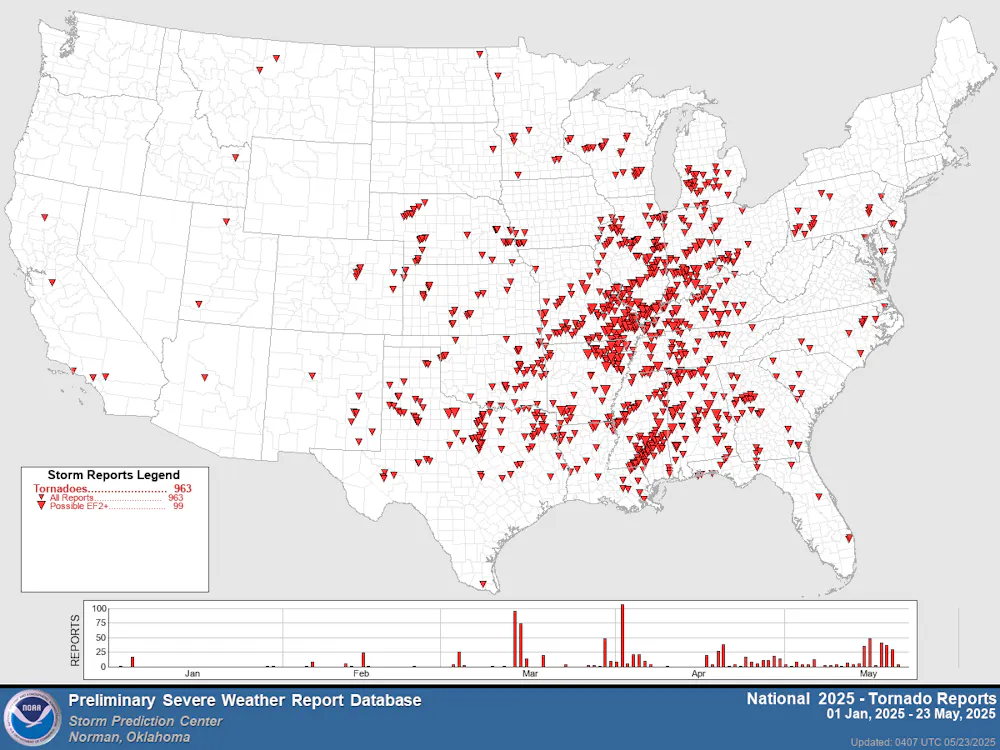
    The U.S. has had more reported tornadoes than normal – over 960 as of May 22, according to the National Weather Service’s preliminary count.

    That’s well above the national average of around 660 tornadoes reported by that point over the past 15 years, and it’s similar to 2024 – the second-most active year over that same period.

    The National Weather Service tracks reported tornadoes based on local storm reports, allowing for comparisons throughout the year. The red line shows 2025 through May 22.
    NOAA National Storm Prediction Center

    I’m an atmospheric scientist who studies natural hazards. What stands out about 2025 so far isn’t just the number of tornadoes, but how Tornado Alley has encompassed just about everything east of the Rockies, and how tornado season is becoming all year.

    Why has 2025 been so active?

    The high tornado count in 2025 has a lot to do with the weather in March, which broke records with 299 reported tornadoes – far exceeding the average of 80 for that month over the past three decades.

    March’s numbers were driven by two large tornado outbreaks: about 115 tornadoes swept across more than a dozen states March 14-16, stretching from Arkansas to Pennsylvania; and 145 tornadoes hit March 31 to April 1, primarily in a swath from Arkansas to Iowa and eastward. The 2025 numbers are preliminary pending final analyses.

    While meteorologists don’t know for sure why March was so active, there were a couple of ingredients that favor tornadoes:

    By April and May, however, those ingredients had faded. The weak La Niña ended and the Gulf waters were closer to normal.

    April and May also produced tornado outbreaks, but the preliminary count over most of this period, since the March 31-April 1 outbreak, has actually been close to the average, though things could still change.

    A tornado on May 18, 2025, tore apart homes in Bennett, Colorado.
    Helen H. Richardson/MediaNews Group/The Denver Post via Getty Images

    What has stood out in April and May is persistence: The jet stream has remained wavy, bringing with it the normal ebb and flow of stormy low-pressure weather systems mixed with sunny high-pressure systems. In May alone, tornadoes were reported in Colorado, Minnesota, Delaware, Florida and just about every state in between.

    Years with fewer tornadoes often have calm periods of a couple of weeks or longer when a sunny high-pressure system is parked over the central U.S. However, the U.S. didn’t really get one of those calm periods in spring 2025.

    Tornado Alley shifts eastward

    The locations of these storms have also been notable: The 2025 tornadoes through May have been widespread but clustered near the lower and central Mississippi Valley, stretching from Illinois to Mississippi.

    That’s well to the east of traditional Tornado Alley, typically seen as stretching from Texas through Nebraska, and farther east than normal. April through May is still peak season for the Mississippi Valley, though it is usually on the eastern edge of activity rather than at the epicenter. The normal seasonal cycle of tornadoes moves inland from near the Gulf Coast in winter to the upper Midwest and Great Plains by summer.

    Where local forecast centers reported tornadoes in 2025, through May 22. Data is preliminary, pending final analysis.
    NOAA Storm Prediction Center

    Over the past few decades, the U.S. has seen a broad shift in tornadoes in three ways: to the east, earlier in the year and clustered into larger outbreaks.

    Winter tornadoes have become more frequent over the eastern U.S., from the southeast, dubbed Dixie Alley for its tornado activity in recent years, to the Midwest, particularly Kentucky, Illinois and Indiana.

    Meanwhile, there has been a steady and stark decline in tornadoes in the “traditional” tornado season and region: spring and summer in general, especially across the Great Plains.

    It may come as a surprise that the U.S. has actually seen a decrease in overall U.S. tornado activity over the past several decades, especially for intense tornadoes categorized as EF2 and above. There have been fewer days with a tornado. However, those tornado days have been producing more tornadoes. These trends may have stabilized over the past decade.

    Deadlier tornadoes

    This eastward shift is likely making tornadoes deadlier.

    Tornadoes in the Southeastern U.S. are more likely to strike overnight, when people are asleep and cannot quickly protect themselves, which makes these events dramatically more dangerous. The tornado that hit London, Kentucky, struck after 11 p.m. Many of the victims were over age 65.

    The shift toward more winter tornadoes has also left people more vulnerable. Since they may not expect tornadoes at that time of year, they are likely to be less prepared. Tornado detection and forecasting is rapidly improving and has saved thousands of lives over the past 50-plus years, but forecasts can save lives only if people are able to receive them.

    Average number of tornadoes by month, 2000-2024. Source: NOAA

    This shift in tornadoes to the east and earlier in the year is very similar to how scientists expect severe thunderstorms to change as the world warms. However, researchers don’t know whether the overall downward trend in tornadoes is driven by warming or will continue into the future. Field campaigns studying how tornadoes form may help us better answer this question.

    Remember that it only takes one

    For safety, it’s time to stop focusing on spring as tornado season and the Great Plains as Tornado Alley.

    Tornado Alley is really all of the U.S. east of the Rockies and west of the Appalachians for most of the year. The farther south you live, the longer your tornado season lasts.

    Forecasters say it every year for hurricanes, and we badly need to start saying it for tornadoes too: It only takes one to make it a bad season for you or your community. Just ask the residents of London, Kentucky; St. Louis; Plevna and Grinnell, Kansas; and McNairy County, Tennessee.

    Listen to your local meteorologists so you will know when your region is facing a tornado risk. And if you hear sirens or are under a tornado warning, immediately go to your safe space. A tornado may already be on the ground, and you may have only seconds to protect yourself.

    Daniel Chavas receives funding from the National Science Foundation, NASA, and NOAA. He is a member of the American Geophysical Union and American Meteorological Society.

    ref. In 2025, Tornado Alley has become almost everything east of the Rockies − and it’s been a violent year – https://theconversation.com/in-2025-tornado-alley-has-become-almost-everything-east-of-the-rockies-and-its-been-a-violent-year-257169

    MIL OSI – Global Reports

  • MIL-OSI Global: Like many populist leaders, Trump accuses judges of being illegitimate obstacles to safety and democracy

    Source: The Conversation – USA – By Michael Gregory, Assistant Professor of Philosophy, Clemson University

    The front entrance of the E. Barrett Prettyman United States Court House, the workplace of Judge James Boasberg, along with other federal and appeals court judges, is seen in Washington, D.C. Philip Yabut/Getty Images

    Federal judges and at times Supreme Court justices have repeatedly challenged – and blocked – President Donald Trump’s attempts to reshape fundamental aspects of American government.

    Many of Trump’s more than 150 executive orders, including one aimed at eliminating the Department of Education, have been blocked by injunctions and lawsuits.

    When a majority of Supreme Court justices ruled on May 16, 2025, that the Trump administration could not deport a group of Venezuelan immigrants without first giving them the right to due process in court, Trump attacked the court.

    “The Supreme Court of the United States is not allowing me to do what I was elected to do,” Trump wrote on Truth Social. “This is a bad and dangerous day for America!” he continued in the post.

    As the Trump administration faces other orders blocking its plans, the president and his team are framing judges not just as political opponents but as enemies of democracy.

    Trump, for example, has called for the impeachment of James Boasberg, a federal judge who also issued orders blocking the deportation of immigrants in the U.S. to El Salvador. Attorney General Pam Bondi has said that Boasberg was “trying to protect terrorists who invaded our country over American citizens,” and Trump has also called Boasberg and other judges who ruled against him or his administration “left-wing activists.”

    “We cannot allow a handful of communist, radical-left judges to obstruct the enforcement of our laws and assume the duties that belong solely to the president of the United States,” Trump said at a rally in April 2025. “Judges are trying to take away the power given to the president to keep our country safe.”

    As a scholar of legal and political theory, I believe this kind of talk about judges and the judicial system is not just misleading, it’s dangerous. It mirrors a pattern seen across many populist movements worldwide, where leaders cast independent courts and judges as illegitimate obstacles to what they see as the will of the people.

    By confusing the idea that the people’s will must prevail with what the law actually says, these leaders justify intimidating judges and their sound legal rulings, a move that ultimately undermines democracy.

    President Donald Trump shakes hands with Supreme Court Chief Justice John Roberts at his inauguration on Jan. 20, 2025, in Washington, D.C.
    Chip Somodevilla/Getty Images

    Thwarting ‘the will of the American people’?

    In the face of judicial rulings against them, Trump and other administration officials have suggested on multiple occasions that judges are antagonistic to what the American people voted for.

    Yet these rulings are merely a reflection of the rule of law.

    Trump and supporters such as Elon Musk have characterized the rulings as a sign that a group of elite judges are abusing their power and acting against the will of the American people. The rulings that enforce the law, according to this argument, stand in opposition to the popular mandate American voters give to elected officials like the president.

    “If ANY judge ANYWHERE can stop EVERY Presidential action EVERYWHERE, we do NOT live in a democracy,” Elon Musk posted on X in February 2025. “When judges egregiously undermine the democratic will of the people, they must be fired,” Musk added.

    And U.S. Rep. Mike Johnson, the Republican speaker of the House of Representatives, said in March 2025, “We do have the authority over the federal courts, as you know. We can eliminate an entire district court.”

    Framing judges as enemies of democracy or as obstacles to the people’s will departs sharply from the traditional view – held across political lines – that the judiciary is an essential, nonpartisan part of the American constitutional system.

    While previous presidents have expressed frustration with specific court decisions or judges’ political leanings, their critiques mostly focused on specific legal reasoning.

    Supreme Court Justice Ketanji Brown Jackson warned against the Trump administration’s charge that judges were actively undermining democracy. In late April 2025, she said during a conference for judges that “relentless attacks on judges are an attack on democracy.”

    So, are judges obstructing democracy – or protecting it?

    Are unelected judges a sign of democracy?

    The U.S. Constitution established an independent judiciary as a coequal branch of government, alongside the legislative and executive branches. Federal judges are appointed for life and cannot be removed for political reasons. The country’s founders thought this protection could insulate judges from political pressures and ensure that courts uphold the Constitution, not the popularity of a given policy.

    Yet as the federal judiciary has expanded in size and power, the arguments about the relationship between democracy and judicial independence have become louder among some political scientists and legal philosophers.

    Some critics take issue with the fact that federal judges are appointed by politicians, not elected to their positions – a fact that others argue contributes to their independence.

    Federal judges often serve longer on the bench than many elected officials.

    Why, some critics argue, should a small group of unelected experts be allowed to overturn decisions made by elected officials?

    Other democratic theorists, however, say that federal judges can act as a check on elected leaders who may misuse or abuse their power, or pass laws that violate people’s legal rights. This indirectly strengthens democracy by giving people a meaningful way to have recourse against laws that go against their rights and what they actually voted for.

    A common story across countries

    The argument that judges are an enemy to democracy is not unique to the U.S.

    Authoritarian leaders from across the world have used similar language to justify undermining the courts.

    In the Philippines, then-President Rodrigo Duterte in 2018 told Maria Lourdes Sereno, a top judge who was an outspoken critic of Duterte’s war on drugs, “I am now your enemy.” Shortly after, the Philippines Supreme Court voted to oust Sereno from the court. These judges cited Sereno’s failure to disclose personal financial information when she was first appointed to the court as the reason for her removal.

    Filipino protesters and outside critics alike viewed Sereno’s removal as politically motivated and said it undermined the country’s judicial independence.

    El Salvador President Nayib Bukele’s allies in the legislative assembly similarly voted in May 2021 to remove the government’s attorney general as well all five top judges for obstructing Bukele’s plans to imprison, without proper due process, large numbers of people. Bukele replaced the attorney general and judges with political loyalists, violating constitutional procedure.

    Kamala Harris, then vice president of the U.S., was among the international observers who said the removal of judges in El Salvador made her concerned about El Salvador’s democracy. Bukele justified the judges’ removal by saying he was right and that he refused to “listen to the enemies of the people” who wanted him to do otherwise.

    And in April 2024, a minister in Israeli Prime Minister Benjamin Netanyahu’s Cabinet called Attorney General Gali Baharav-Miara an “enemy of the people,” blaming her for protests outside Netanyahu’s home. This disparagement was part of Netanyahu’s broader efforts to weaken judges’ role and independence and to remove judicial constraints on executive power.

    Judge James Boasberg is one example of a judge who was personally attacked by President Donald Trump for issuing various rulings on the administration’s plans to deport Venezuelan immigrants.
    Drew Angerer/AFP via Getty Images

    Pushing against democracy

    In the name of weakening what they call undemocratic institutions, these and other leaders try to discredit independent judges. This attempt helps these leaders gain power and silence dissent.

    Their attempts to disparage and discredit judges misrepresent judges’ work by asserting that it is political in nature – and thus subject to political criticism and even intimidation. But in the U.S., judges’ constitutionally mandated work takes place in the realm of law, not politics.

    By confusing the idea that the people’s will must prevail with what the law actually says, these leaders justify intimidating judges and their rulings, a move that ultimately undermines democracy.

    Independent judges may not always make perfect decisions, and concerns about their interpretations or potential biases are legitimate. Judges sometimes make decisions that are objectionable from a moral and legal standpoint.

    But when political leaders portray judges as the problem, I believe it’s crucial to ask: Who truly benefits from silencing judges?

    Michael Gregory does not work for, consult, own shares in or receive funding from any company or organization that would benefit from this article, and has disclosed no relevant affiliations beyond their academic appointment.

    ref. Like many populist leaders, Trump accuses judges of being illegitimate obstacles to safety and democracy – https://theconversation.com/like-many-populist-leaders-trump-accuses-judges-of-being-illegitimate-obstacles-to-safety-and-democracy-255472

    MIL OSI – Global Reports

  • MIL-OSI USA: Hickenlooper, Cantwell, Lummis, Wicker Reintroduce Bill to Clear Space Junk, Protect Space Exploration

    US Senate News:

    Source: United States Senator John Hickenlooper – Colorado
    ORBITS Act would create landmark program to clean up dangerous orbital debris threatening space exploration, satellites, and commercial space operations
    Bill unanimously passed Senate last Congress
    WASHINGTON – Today, U.S. Senators John Hickenlooper, Maria Cantwell, Cynthia Lummis, and Roger Wicker reintroduced the bipartisan Orbital Sustainability (ORBITS) Act to establish a first-of-its-kind demonstration program that would reduce the nearly 1 million pieces of space junk in orbit.
    “Dangerous debris in Earth’s orbit threatens American satellites and jeopardizes future space exploration missions,” said Hickenlooper. “It’s time we clean up the clutter and protect our critical space operations.”
    “The Orbital Sustainability or ORBITS Act will jumpstart the technology development we need to address the very serious problem of orbital debris that threatens our scientific satellites, human space exploration and commercial space services,” said Cantwell.  “The longer we delay in taking meaningful action, the less safe our activities in orbit become.”
    “Space is getting more and more crowded with debris that poses a real threat to our satellites,” said Lummis. “People in Wyoming and across the country depend on satellites for our national security, weather forecasting, wildfire monitoring, GPS navigation, and communications essential for our way of life. The ORBITS Act addresses this growing challenge and helps maintain safe human spaceflight operations above the earth. This bipartisan solution will protect America’s interests in space for generations to come.”
    “The ORBITS Act would address a key aspect of the complex space debris problem. We should be empowering NASA to partner with the U.S. space industry in active debris removal technology to tackle space junk threats. The United States is the world’s premier spacefaring nation, and I look forward to continuing our leadership,” said Wicker.
    The ORBITS Act passed the Senate in the 118th Congress.
    Space junk, or orbital debris, currently threatens human space exploration, scientific research missions, and emerging commercial space services. There are approximately 8,000 metric tons of debris currently in orbit, including at least 900,000 individual pieces of debris that are potentially lethal to satellites. Because of the threats from debris already in orbit, simply preventing more debris in the future is not enough. The ORBITS Act will jumpstart a program focused on research, development, and the demonstration of technologies capable of safely carrying out successful Active Debris Remediation (ADR) missions to create a robust commercial market for these services.
    In recent years, NASA canceled a planned spacewalk and maneuvered the International Space Station (ISS) to avoid colliding with orbital debris. Due to growing amounts of debris, the ISS has performed numerous Pre-Determined Debris Avoidance Maneuvers (PDAM) in the past year alone. 
    Specifically, the bill contains the following provisions:
    Orbital Debris Remediation List
    Directs NASA, in coordination with the Departments of Commerce, Defense, and the National Space Council, to publish a list of debris objects that pose the greatest risk to the safety of orbiting spacecraft and on-orbit activities

    Active Orbital Debris Remediation Demonstration Program
    Directs NASA to establish a demonstration program to partner with industry in developing technology for remediating debris objects through repurposing or removal from orbit
    The NASA program will promote competition by incentivizing  two or moreteams of technology developers to conduct demonstrations of successful debris remediation

    Asks NASA to partner with other nations to address debris in orbit that belongs to them

    Active Debris Remediation (ADR) Services
    Encourages the U.S. government to buy ADR services from  industry partners once they succeed in the demonstration and are commercially available
    Requires an economic assessment of the long-term demand for ADR services

    Uniform Orbital Debris Standards
    Directs the National Space Council to update the Orbital Debris Mitigation Standard Practices (ODMSP) used by U.S. government space missions
    Encourages the FAA and FCC to use the updated standards and practices as the basis for federal regulations applicable to all space activities
    Directs the U.S. to encourage other nations to align their regulations with ours to encourage effective and non-discriminatory regulation worldwide

    Space Traffic Coordination Standard Practices
    Directs the Department of Commerce, in coordination with the National Space Council and the FCC, to develop and promote standard practices for avoiding near misses and collisions between spacecraft in orbit

    Key supporters of the bill include the Aerospace Industry Association, Secure World Foundation, and CONFERS.
    Full text of the ORBITS Act is available HERE.

    MIL OSI USA News

  • MIL-OSI Russia: China is the world leader in total installed hydroelectric power capacity

    Translation. Region: Russian Federal

    Source: People’s Republic of China in Russian – People’s Republic of China in Russian –

    Source: People’s Republic of China – State Council News

    CHENGDU, May 23 (Xinhua) — China ranks first in the world in the number of reservoirs and dams, as well as in the installed capacity of hydroelectric power plants (HPPs), according to the 28th Congress of the International Commission on Large Dams (ICOLD) held in Chengdu, capital of southwest China’s Sichuan Province.

    Congress participants noted that China, in the process of responding to climate risks, has developed a comprehensive systemic solution that can be adopted by other countries around the world.

    According to the National Energy Administration of China, as of December 2024, China had built more than 94,000 dams, the highest number in the world. The country’s total installed hydroelectric power capacity reached 436 million kW, of which 377 million kW were conventional hydroelectric power plants.

    China’s annual hydroelectric power generation capacity was 1.42 trillion kilowatt-hours, accounting for 57 percent of the country’s total renewable electricity generation.

    The total capacity of China’s reservoirs is approaching 1 trillion cubic meters, including flood-control capacity of 185.6 billion cubic meters. The reservoirs provide an annual water supply of 270 billion cubic meters and support the irrigation of 532 million mu (about 35.5 million hectares) of farmland. -0-

    MIL OSI Russia News

  • Russia and Ukraine start prisoner exchange, but not yet completed

    Source: Government of India

    Source: Government of India (4)

    Russia and Ukraine began a major prisoner swap on Friday that was agreed on at their first direct talks in more than three years, a Ukrainian military source said on Friday.

    U.S. President Donald Trump said the prisoner exchange had already been completed but Kyiv and Moscow did not confirm this and the military source said the swap was still under way.

    Russia and Ukraine each agreed at two hours of talks in Istanbul last week to swap 1,000 prisoners, but failed to agree to a ceasefire proposed by Trump. Previous prisoner swaps have been mediated by the United Arab Emirates.

    The prisoner swap was the only concrete step towards peace the two sides agreed at their talks in Istanbul.

    “Congratulations to both sides on this negotiation. This could lead to something big???,” Trump said in a post on Truth Social.

    Hundreds of thousands of soldiers on both sides are believed to have been wounded or killed in Europe’s deadliest war since World War Two, although neither side publishes accurate casualty figures. Tens of thousands of Ukrainian civilians have also died as Russian forces have besieged and bombarded Ukrainian cities.

    Ukraine says it is ready for a 30-day ceasefire immediately, but Russia, which launched the war by invading its neighbour in 2022 and now occupies about a fifth of Ukraine, says it will not pause its assaults until conditions are met first. A member of the Ukrainian delegation called those conditions “non-starters”.

    Trump, who has shifted U.S. policy from supporting Ukraine towards accepting some of Russia’s account of the war, had said he could tighten sanctions on Russia if Moscow blocked a peace deal. But after speaking to Putin on Monday he decided to take no action for now.

    Moscow says it is ready for peace talks while the fighting goes on, and wants to discuss what it calls the war’s “root causes”, including its demands Ukraine cede more territory, and be disarmed and barred from military alliances with the West. Kyiv says that is tantamount to surrender and would leave it defenceless in the face of future Russian attacks.

    (Reuters)

  • MIL-OSI Security: Federal Grand Jury in Louisville Returns Superseding Indictment Charging Three Men with Murder of Federal Witness

    Source: US FBI

    Louisville, KY – On May 6, 2025, a federal grand jury in Louisville returned a superseding indictment charging three men with conspiring to kill, and ultimately murdering, a witness in a federal investigation. Two of the defendants were previously charged with drug trafficking and firearms-related charges.    

    U.S. Attorney Michael A. Bennett of the Western District of Kentucky, Special Agent in Charge Jim Scott of the DEA Louisville Field Division, Acting Special Agent in Charge Olivia Olson of the FBI Louisville Field Office, Special Agent in Charge John Nokes of the ATF Louisville Field Division, Special Agent in Charge Rana Saoud of Homeland Security Investigations Nashville, Special Agent in Charge Karen Wingerd of the Internal Revenue Service, Criminal Investigation, Cincinnati Field Office, and Chief Paul Humphrey of the Louisville Metro Police Department made the announcement.

    According to the superseding indictment, Anyelle Curtley, Sr., 47, of Louisville, Delrico Nelson, 48, of Macomb, Illinois, and Antoyne Penick, 48, of Louisville, are each charged with conspiracy to tamper with a witness or informant by killing and conspiracy to retaliate against a witness or informant by killing. The superseding indictment alleges that between December 28, 2023, and January 31, 2023, Curtley Sr., Nelson, and Penick conspired and agreed to kill Victim 1 with the intent to prevent the testimony of Victim 1 in an official proceeding and to prevent Victim 1 from communicating with a law enforcement officer or judge information relating to the commission of a federal offense. Additionally, the superseding indictment alleges that the three men conspired and agreed to kill Victim 1 in retaliation for providing information to a law enforcement officer relating to the commission of a federal offense.

    Also, according to the superseding indictment, Curtley Sr. and Nelson, aided and abetted by each other, killed Victim 1, who was a person assisting a federal investigation, while that assistance was being rendered and because of it. Finally, the superseding indictment alleges that Curtley Sr. and Nelson aided and abetted each other in the murder of Victim 1 through the use of a firearm.

    This indictment supersedes an indictment returned March 5, 2024, charging Curtley, Sr. and others with drug trafficking and firearms related charges.

    The March 5, 2024, indictment charged Carl Delph, 53, of California, Curtley, Sr., Anyelle Curtley, Jr., 26, Adrian Richie, 35, Joseph Cousins, 39, Alandro O’Neal, 50, Jeroy Boyd, 44, Ameer Ellis, 45, Paul Butler, Jr., 35, and Susan Jenkins, 41, all of Louisville, with conspiracy to possess with intent to distribute controlled substances. Beginning as early as May 9, 2023, and continuing through February 21, 2024, the defendants conspired to possess with the intent to distribute and distributed over 50 grams of methamphetamine, over 400 grams of fentanyl, and over 500 grams of cocaine.

    Delph and Curtley, Sr. were also charged with a money laundering conspiracy.

    Delph was also charged with distributing over 500 grams of cocaine and distributing over 400 grams of fentanyl.

    Curtley, Sr. was also charged with distributing methamphetamine, cocaine, and fentanyl, attempting to possess with the intent to distribute cocaine and fentanyl, possessing with the intent to distribute fentanyl, possessing a firearm in furtherance of a drug trafficking crime, and possessing a firearm as a convicted felon. On December 28, 2023, Curtley, Sr., possessed a Glock, model 27, .40 caliber handgun. Curtley, Sr. was prohibited from possessing a firearm because he had previously been convicted the following felony offense.

    On May 19, 2010, in the United States District Court for the Western District of Kentucky, Curtley, Sr. was convicted of possession with intent to distribute cocaine and possession of a firearm by a convicted felon.

    Curtley, Jr. was also charged with distributing fentanyl and cocaine.

    Richie and Cousins were also charged with distributing fentanyl.

    O’Neal, Ellis, and Jenkins were also charged with distributing methamphetamine.

    Boyd was also charged with distributing cocaine.

    Butler, Jr. was also charged with distributing methamphetamine and fentanyl.

    Cousins and O’Neal have pled guilty and are pending sentencing before a United States District Judge.

    An additional federal indictment was returned on March 5, 2024, charging Christopher Curtley, 50, and Penick, both of Louisville, with conspiracy to possess with intent to distribute controlled substances. Beginning as early as January 9, 2024, and continuing through February 29, 2024, the defendants conspired to distribute methamphetamine, fentanyl, and heroin.

    Christopher Curtley was also charged with distributing fentanyl and methamphetamine.

    Penick was also charged with distributing fentanyl, methamphetamine, and heroin. Penick was also charged with possessing a firearm in furtherance of a drug trafficking crime and possession of a firearm by a convicted felon. On January 24, 2024, Penick possessed a Heritage Manufacturing Inc., Model Rough Rider, .22 caliber revolver. Penick was prohibited from possessing a firearm because he had previously been convicted of the following felony offenses.

    On September 27, 2017, in Jefferson Circuit Court, Penick was convicted of flagrant non-support.

    On October 19, 2015, in Clark Circuit Court, Clark County, Indiana, Penick was convicted of theft.

    On November 1, 2010, in Clark Superior Court, Clark County, Indiana, Penick was convicted of theft, robbery (two counts), and dealing in marijuana.

    Those charges against Christopher Curtley and Penick remain pending.

    Curtley Sr. and Penick previously appeared before a U.S. Magistrate Judges of the U.S. District Court for the Western District of Kentucky on the underlying drug and firearm charges. Nelson appeared before a U.S. Magistrate Judge for Central District of Illinois on May 8, 2025. Curtley Sr., Nelson, and Penick have been ordered detained pending trial. If convicted of the offenses alleged in the superseding indictment, all three defendants face a potential sentence of death, life, or any term of years. A federal district court judge will determine any sentence after considering the sentencing guidelines and other statutory factors.

    There is no parole in the federal system. 

    This case is being investigated by the DEA, FBI, HSI, ATF, IRS-CI, and the Louisville Metro Police Department, with assistance from the Kentucky State Police and Macomb, Illinois Police Department.

    Assistant U.S. Attorneys Frank Dahl and Josh Porter are prosecuting the case, with assistance from paralegal Aaron Cooper.

    This case is part of Operation Take Back America, a nationwide initiative that marshals the full resources of the Department of Justice to repel the invasion of illegal immigration, achieve the total elimination of cartels and transnational criminal organizations (TCOs), and protect our communities from the perpetrators of violent crime. Operation Take Back America streamlines efforts and resources from the Department’s Organized Crime Drug Enforcement Task Forces (OCDETFs) and Project Safe Neighborhood (PSN).

    An indictment is merely an allegation. All defendants are presumed innocent until proven guilty beyond a reasonable doubt in a court of law.

    ###

    MIL Security OSI

  • MIL-OSI Security: New Orleans Man Guilty of Drug Trafficking and Possessing AR-15 Pistol Inside Hospital

    Source: US FBI

    NEW ORLEANS, LOUISIANA –ERIC FALKINS (“FALKINS”), age 19, a resident of New Orleans, pleaded guilty on May 8, 2025, before Chief U.S. District Judge Nanette Jolivette Brown, to conspiracy to distribute, and possess with the intent to distribute, marijuana, in violation of Title 21, United States Code, Sections 841(a)(1), 841(b)(1)(D), and 846; possession with the intent to distribute marijuana, in violation of Title 21, United States Code, Sections 841(a)(1) and 841(b)(1)(D); and possession of a firearm in furtherance of a drug trafficking crime, in violation of Title 18, United States Code, Section 924(c)(1)(A)(i).

    According to court documents, FALKINS had been selling marijuana in New Orleans since at least 2023, and conspiring with others to help him sell drugs.  On January 24, 2024, FALKINS went to Touro Infirmary hospital in New Orleans to visit a patient.  FALKINS brought a backpack inside the hospital that smelled like marijuana.  Inside the backpack, were two plastic bags containing distributable quantities of marijuana; 17 sealed, pre-packaged bags of marijuana; a sealed bag of marijuana edibles; two digital scales; and a Radical Firearms Model RF-15, multi-caliber semi-automatic pistol, loaded with 29 rounds of ammunition. 

    As to each of his drug trafficking convictions, FALKINS faces up to 5 years in prison, up to a $250,000 fine, and a minimum of two years of supervised release.  As to his conviction for possessing a firearm in furtherance of a drug trafficking crime, he faces a mandatory minimum sentence of five years and up to life in prison, which must run consecutively to any other sentence, and up to five years of supervised release.  Each count also carries a mandatory special assessment fee of $100.

    This case is part of Project Safe Neighborhoods (PSN), a program bringing together all levels of law enforcement and the communities they serve to reduce violent crime and gun violence, and to make our neighborhoods safer for everyone.  On May 26, 2021, the Department launched a violent crime reduction strategy strengthening PSN based on these core principles: fostering trust and legitimacy in our communities, supporting community-based organizations that help prevent violence from occurring in the first place, setting focused and strategic enforcement priorities, and measuring the results.

    The case was investigated by the Federal Bureau of Investigation.  Assistant United States Attorney David Berman of the Violent Crime Unit is in charge of the prosecution.

    MIL Security OSI

  • MIL-OSI Security: New Orleans Man Sentenced for Federal Firearms Offense

    Source: US FBI

    NEW ORLEANS, LOUISIANA – LaMICHAEL JACKSON (“JACKSON”), age 26, was sentenced on May 8, 2025 by U.S. District Judge Eldon E. Fallon to thirty-nine (39) months in prison followed by three years of supervised release, along with a $100 mandatory special assessment fee, after previously pleading guilty to being a felon in possession of a firearm, in violation of 18 U.S.C. §§ 922(g)(1) and 924(a)(8).

    According to court documents, New Orleans Police Department (NOPD) officers on patrol in Hollygrove saw JACKSON crossing the street holding a Palmetto State Armory Model PA-15 pistol. JACKSON fled in a vehicle before being cut off by an NOPD patrol car.  Inside the vehicle, officers recovered a second gun belonging to JACKSON, a Glock Model 43x, nine-millimeter handgun.  Both firearms were loaded when they were recovered.  JACKSON is prohibited from possessing a firearm by prior felony convictions for aggravated assault with a firearm, and possession of a firearm with an obliterated serial number.

    This case is part of Project Safe Neighborhoods (PSN), a program bringing together all levels of law enforcement and the communities they serve to reduce violent crime and gun violence, and to make our neighborhoods safer for everyone.  On May 26, 2021, the Department launched a violent crime reduction strategy strengthening PSN based on these core principles: fostering trust and legitimacy in our communities, supporting community-based organizations that help prevent violence from occurring in the first place, setting focused and strategic enforcement priorities, and measuring the results.

    The case was investigated by the New Orleans Police Department and the Federal Bureau of Investigation.  It is being prosecuted by Assistant United States Attorney David Berman of the Violent Crime Unit.

    MIL Security OSI

  • MIL-OSI Security: New Orleans Man Caught on Video Firing Gun and Driving Stolen Car Sentenced to 15 Years in Prison for Machinegun and Drug Trafficking Crimes

    Source: US FBI

    NEW ORLEANS, LOUISIANA – RENARD SANTIAGO (“SANTIAGO”), age 19, was sentenced on May 13, 2025 by U.S. District Judge Wendy B. Vitter to fifteen (15) years in prison, followed by four (4) years of supervised release, along with a mandatory $400 special assessment fee, after previously pleading guilty to conspiracy, and possession with the intent to distribute, marijuana, in violation of Title 21, United States Code, Sections 841(a)(1), 841(b)(1)(D), and 846; possession of a firearm in furtherance of a drug trafficking crime, in violation of Title 18, United States Code, Section 924(c)(1)(A)(i); and possession of a machinegun, in violation of Title 18, United States Code, Sections 922(o) and 924(a)(2).

    According to court documents, in 2024, SANTIAGO was wanted by the Federal Bureau of Investigation (“FBI”) and the New Orleans Police Department.  Specifically, an arrest warrant had been issued for SANTIAGO for an armed robbery committed on October 10, 2023.  On December 25, 2023,he was captured on surveillance video firing a handgun with a drum magazine attached and then driving away in a stolen SUV.  During their investigation into his whereabouts, law enforcement officers saw stories on SANTIAGO’s social media account showing SANTIAGO in possession of a handgun equipped with a machinegun conversion device, posing with large amounts of cash, and advertising the sale of marijuana.  The next day, officers executed a search warrant at SANTIAGO’s residence.  SANTIAGO hid in the attic for four hours before he was finally forced out of the house.  Inside the attic, officers found SANTIAGO’s handgun, with the machinegun conversion device still attached, a distributable quantity of marijuana, and over $400 in cash.

    This case is part of Project Safe Neighborhoods (PSN), a program bringing together all levels of law enforcement and the communities they serve to reduce violent crime and gun violence, and to make our neighborhoods safer for everyone.  On May 26, 2021, the Department launched a violent crime reduction strategy strengthening PSN based on these core principles: fostering trust and legitimacy in our communities, supporting community-based organizations that help prevent violence from occurring in the first place, setting focused and strategic enforcement priorities, and measuring the results.

    The case was investigated by the Federal Bureau of Investigation and the New Orleans Police Department.  It is being prosecuted by Assistant United States Attorney David Berman of the Violent Crime Unit.

    MIL Security OSI

  • MIL-OSI Security: Federal Grand Jury Returns Indictment Charging Two Men Involved in Robberies at Stores in Shreveport

    Source: US FBI

    SHREVEPORT, La. – Acting United States Attorney Alexander C. Van Hook announced that a federal grand jury has returned an indictment charging two men for their involvement in the robbery of two stores in Shreveport. 

    Kevin Terrell Lewis a/k/a “Kelvin Lewis,” 38, of Arlington, Texas, and his brother, Larry Dewayne Lewis, 44, of Shreveport, have been charged with two counts of robbery and one count of conspiracy to using, carrying, brandishing and discharging firearms during and in relation to a crime of violence. Kelvin Lewis was also charged with two counts of using, carrying, and brandishing a firearm during and in relation to a crime of violence.

    The indictment alleges that on or about December 23, 2024, Kelvin Lewis and Larry Lewis, each aided and abetted by the other, committed robbery of personal property consisting of approximately $500 in United States currency from the victim owner/manager of the Pull-Up Liquor located at 5619 Hearne Avenue in Shreveport, as he was closing the store and walking to his car in the parking lot. 

    The indictment further alleges that on or about January 22, 2025, Kelvin Lewis and Larry Lewis, each aided and abetted by the other, committed robbery of personal property consisting of prescription drugs and a work van that was in the care, custody and control of victim B.J. as he was making a delivery from the Hackbarth Company to Walgreens located at 3124 Line Avenue in Shreveport. 

    Kelvin Lewis is charged in the indictment with using, carrying, and brandishing semi-automatic firearms during and in relation to these crimes of violence. The indictment also alleges that Kelvin Lewis and Larry Lewis conspired to use, carry, brandish and discharge a firearm during and in relation to a crime of violence, namely, robbery.

    If convicted, each defendant faces a sentence of not less than 10 years or more than life in prison, and a fine of up to $250,000.  

    Larry Dewayne Lewis is currently in federal custody after being indicted on February 5, 2025, and charged with one count of possession of a firearm by a convicted felon. 

    This investigation is ongoing and is being led by the Federal Bureau of Investigation and Shreveport Police Department. The case is being prosecuted by Assistant United States Attorneys J. Aaron Crawford and William C. Gaskins.

    An indictment is merely an accusation, and a defendant is presumed innocent unless and until proven guilty beyond a reasonable doubt.

    # # #

    MIL Security OSI

  • MIL-OSI: Imperial Petroleum Inc. Reports First Quarter 2025 Financial and Operating Results

    Source: GlobeNewswire (MIL-OSI)

    ATHENS, Greece, May 23, 2025 (GLOBE NEWSWIRE) — IMPERIAL PETROLEUM INC. (NASDAQ: IMPP; the “Company”), a ship-owning company providing petroleum products, crude oil and dry bulk seaborne transportation services, announced today its unaudited financial and operating results for the first quarter ended March 31, 2025.

    OPERATIONAL AND FINANCIAL HIGHLIGHTS

    • Fleet operational utilization of 83.8% in Q1 25’ versus 86% in Q4 24’ and 80.6% in Q1 24’.
    • About 47% of fleet calendar days were dedicated to time charter activity while 53% to spot activity.
    • Delivery of the dry bulk carrier, Supra Pasha (2012 built) on April 26th 2025; the remaining six contracted dry bulk carriers will be delivered by June 2025.
    • Revenues of $32.1 million in Q1 25’ compared to $41.2 million in Q1 24’- a 22.1% decline as market rates were stronger during Q1 24’.
    • Net income of $11.3 million in Q1 25’ versus $16.7 million in Q1 24’, corresponding to an EPS, basic of $0.32.
    • EBITDA1 of $14.7 million for Q1 25’.
    • Revenues and net income increased by $5.9 million (or 22.5%) and $7.4 million (or 189.7%), respectively, in Q1 25’ compared to Q4 24’.
    • Cash and cash equivalents including time deposits of $227.4 million as of March 31, 2025 which is 167.5% higher than our current market capitalization of about $85 million.
    • Recurring profitability and debt free capital structure facilitate robust cash flow generation.

    First Quarter 2025 Results:

    • Revenues for the three months ended March 31, 2025 amounted to $32.1 million, a decrease of $9.1 million, or 22.1%, compared to revenues of $41.2 million for the three months ended March 31, 2024, primarily due to a decrease in the spot market tanker rates. During the three months ended March 31, 2024 average spot rates for product and suezmax tankers were 26.9% and 24.2% higher than average spot rates during the three months ended March 31, 2025.
    • Voyage expenses and vessels’ operating expenses for the three months ended March 31, 2025 were $10.5 million and $7.1 million, respectively, compared to $13.5 million and $6.0 million, respectively, for the three months ended March 31, 2024. The $3.0 million decrease in voyage expenses is mainly attributed to increased time charter activity leading to a decline in spot days by 16.1%. The decline in spot days along with the decrease in the Suez Canal transits compared to the same period of last year, led to decreased bunker consumption by 21.2% and lower port expenses by 30.8%. The $1.1 million increase in vessels’ operating expenses is primarily due to the increased size of our fleet by an average of 2.1 vessels between the two periods.
    • Drydocking costs for the three months ended March 31, 2025 and 2024 were nil and $0.6 million, respectively. This decrease is due to the fact that during the three months ended March 31, 2025, no vessel underwent drydocking whereas during the three months ended March 31, 2024 our aframax tanker commenced its drydocking which was concluded within April 2024.
    • General and administrative costs for both the three months ended March 31, 2025 and 2024 were $1.2 million.
    • Depreciation for the three months ended March 31, 2025 and 2024 was $5.0 million and $4.0 million, respectively. The change is attributable to the increase in the average number of vessels in our fleet.
    • Management fees for the three months ended March 31, 2025 and 2024 were $0.5 million and $0.4 million, respectively. The change is attributable to the increase in the average number of vessels in our fleet.
    • Interest and finance costs for the three months ended March 31, 2025 and 2024 were $0.6 million and $0.002 million, respectively. The $0.6 million of costs for the three months ended March 31, 2025 relate mainly to accrued interest expense – related party in connection with the $14.0 million and $24.0 million part of the acquisition prices of our bulk carriers, Neptulus and Clean Imperial, respectively. These balances were completely settled in April 2025. For accounting purposes, the outstanding balances payable on the two vessels were required to be allocated between principal and imputed interest, despite the fact that no interest was contractually charged by the sellers. The total amounts ultimately paid remained consistent with the originally agreed purchase prices.
    • Interest income for the three months ended March 31, 2025 was $2.2 million as compared to $1.0 million for the three months ended March 31, 2024. The $1.2 million increase is mainly attributed to a higher amount of funds placed under time deposits.
    • Interest income – related party for the three months ended March 31, 2025 was nil as compared to $0.8 million for the three months ended March 31, 2024. The decrease is mainly attributed to the $0.8 million of accrued interest income – related party for the three months ended March 31, 2024 in connection with the $38.7 million of the sale price of the Aframax tanker Afrapearl II (ex. Stealth Berana). The balance was collected in July 2024, thus the balance for the three months ended March 31, 2025 was nil.
    • Foreign exchange (loss)/gain for the three months ended March 31, 2025 was a gain of $1.7 million as compared to a loss of $0.8 million for the three months ended March 31, 2024. The $1.7 million foreign exchange gain for the three months ended March 31, 2025, is mainly attributed the strengthening of the euro currency against the dollar at the end of the three months ended March 31, 2025 when compared to the respective currency values at the end of year 2024.
    • As a result of the above, for the three months ended March 31, 2025, the Company reported net income of $11.3 million, compared to net income of $16.7 million for the three months ended March 31, 2024. Dividends paid on Series A Preferred Shares amounted to $0.4 million for the three months ended March 31, 2025. The weighted average number of shares of common stock outstanding, basic, for the three months ended March 31, 2025 was 32.9 million. Earnings per share, basic and diluted, for the three months ended March 31, 2025 amounted to $0.32 and $0.30, respectively, compared to earnings per share, basic and diluted, of $0.56 and $0.50, respectively, for the three months ended March 31, 2024.
    • Adjusted net income1 was $12.2 million corresponding to an Adjusted EPS1, basic of $0.34 for the three months ended March 31, 2025 compared to an Adjusted net income of $17.5 million corresponding to an Adjusted EPS, basic, of $0.59 for the same period of last year.
    • EBITDA1 for the three months ended March 31, 2025 amounted to $14.7 million, while Adjusted EBITDA1 for the three months ended March 31, 2025 amounted to $15.6 million.
    • An average of 11.90 vessels were owned by the Company during the three months ended March 31, 2025 compared to 9.84 vessels for the same period of 2024.

    1 EBITDA, Adjusted EBITDA, Adjusted Net Income and Adjusted EPS are non-GAAP measures. Refer to the reconciliation of these measures to the most directly comparable financial measure in accordance with GAAP set forth later in this release. Reconciliations of Adjusted Net Income, EBITDA and Adjusted EBITDA to Net Income are set forth below.

    Fleet Employment Table

    As of May 23, 2025, the profile and deployment of our fleet is the following:

                           
    Name Year
    Built
       Country
    Built
       Vessel Size
    (dwt)
       Vessel
    Type
       Employment
    Status
       Expiration of
    Charter(1)
    Tankers                           
    Magic Wand 2008    Korea    47,000    MR product tanker    Time Charter   October 2025
    Clean Thrasher 2008    Korea    47,000    MR product tanker    Time Charter    May 2025
    Clean Sanctuary (ex. Falcon Maryam) 2009    Korea    46,000    MR product tanker    Spot     
    Clean Nirvana 2008    Korea    50,000    MR product tanker    Spot     
    Clean Justice 2011    Japan    46,000    MR product tanker    Time Charter    September 2027
    Aquadisiac 2008   Korea   51,000   MR product tanker   Spot    
    Clean Imperial 2009   Korea   40,000   MR product tanker   Time Charter   January 2026
    Suez Enchanted 2007    Korea    160,000    Suezmax tanker    Spot     
    Suez Protopia 2008    Korea    160,000    Suezmax tanker    Spot     
    Drybulk Carriers(2)                           
    Eco Wildfire 2013    Japan    33,000    Handysize drybulk    Time Charter    May 2025
    Glorieuse 2012    Japan    38,000    Handysize drybulk    Time Charter    June 2025
    Neptulus 2012   Japan   33,000   Handysize drybulk   Time Charter   June 2025
    Supra Pasha 2012   Japan   56,000   Supramax drybulk   Spot    
    Fleet Total           807,000 dwt               
    (1)
    (2)
    Earliest date charters could expire.
    We have contracted to acquire six Japanese built drybulk carriers, aggregating approximately 387,000 dwt, which are
    expected to be delivered to us by June 2025.
       

    CEO Harry Vafias Commented

    Another year commenced with a positive momentum for Imperial Petroleum. We are happy as we consider the $11.3 million of net income generated in Q1 25’ a very good result given the eventful but softish market. This is a busy period for our Company but at the same time exciting as we are taking on delivery of another six drybulk vessels. Within the short life of Imperial Petroleum, we are expanding our fleet from four vessels to nineteen by the second quarter of 2025; our goal of growing fast and transforming a small company to medium sized was achieved. We feel confident that the diversified quality non- Chinese fleet we have created will pay off. Imperial Petroleum enjoys fast growth, recurring profits, zero bank debt and liquidity as of March 31, 2025 in excess of $220 million and as per our view ticks all the boxes that define a successful operation.

    Conference Call details:

    On May 23, 2025 at 10:00 am ET, the company’s management will host a conference call to discuss the results and the company’s operations and outlook.

    Online Registration:

    Conference call participants should pre-register using the below link to receive the dial-in numbers and a personal PIN, which are required to access the conference call.

    https://register-conf.media-server.com/register/BIaef045aa9f5b46a7b5e8eb48c2e56115

    Slides and audio webcast:

    There will also be a live and then archived webcast of the conference call, through the IMPERIAL PETROLEUM INC. website (www.ImperialPetro.com). Participants to the live webcast should register on the website approximately 10 minutes prior to the start of the webcast.

    About IMPERIAL PETROLEUM INC.        

    IMPERIAL PETROLEUM INC. is a ship-owning company providing petroleum products, crude oil and drybulk seaborne transportation services. The Company owns a total of thirteen vessels on the water – seven M.R. product tankers, two suezmax tankers and four handysize drybulk carriers – with a total capacity of 807,000 deadweight tons (dwt), and has contracted to acquire an additional six drybulk carriers of 387,000 dwt aggregate capacity. Following these deliveries, the Company’s fleet will count a total of 19 vessels with an aggregate capacity of 1.2 million dwt. IMPERIAL PETROLEUM INC.’s shares of common stock and 8.75% Series A Cumulative Redeemable Perpetual Preferred Stock are listed on the Nasdaq Capital Market and trade under the symbols “IMPP” and “IMPPP,” respectively.

    Forward-Looking Statements

    Matters discussed in this release may constitute forward-looking statements. Forward-looking statements reflect our current views with respect to future events and financial performance and may include statements concerning plans, objectives, goals, strategies, future events or performance, and underlying assumptions and other statements, which are other than statements of historical facts. The forward-looking statements in this release are based upon various assumptions, many of which are based, in turn, upon further assumptions, including without limitation, management’s examination of historical operating trends, data contained in our records and other data available from third parties. Although IMPERIAL PETROLEUM INC. believes that these assumptions were reasonable when made, because these assumptions are inherently subject to significant uncertainties and contingencies which are difficult or impossible to predict and are beyond our control, IMPERIAL PETROLEUM INC. cannot assure you that it will achieve or accomplish these expectations, beliefs or projections. Important factors that, in our view, could cause actual results to differ materially from those discussed in the forward-looking statements include the strength of world economies and currencies, geopolitical conditions, including any trade disruptions resulting from tariffs and other protectionist measures imposed by the United States or  other countries, general market conditions, including changes in charter hire rates and vessel values, charter counterparty performance, changes in demand that may affect attitudes of time charterers to scheduled and unscheduled drydockings, changes in IMPERIAL PETROLEUM INC’s operating expenses, including bunker prices, drydocking and insurance costs, ability to obtain financing and comply with covenants in our financing arrangements, actions taken by regulatory authorities, potential liability from pending or future litigation, domestic and international political conditions, the conflict in Ukraine and related sanctions, the conflicts in the Middle East, potential disruption of shipping routes due to ongoing attacks by Houthis in the Red Sea and Gulf of Aden or accidents and political events or acts by terrorists.

    Risks and uncertainties are further described in reports filed by IMPERIAL PETROLEUM INC. with the U.S. Securities and Exchange Commission.

    Fleet List and Fleet Deployment        
    For information on our fleet and further information:
    Visit our website at www.ImperialPetro.com

    Company Contact:
    Fenia Sakellaris
    IMPERIAL PETROLEUM INC.
    E-mail: info@ImperialPetro.com

    Fleet Data:
    The following key indicators highlight the Company’s operating performance during the three month periods ended March 31, 2024 and 2025.

    FLEET DATA Q1 2024 Q1 2025
    Average number of vessels (1) 9.84 11.90
    Period end number of owned vessels in fleet 11 12
    Total calendar days for fleet (2) 895 1,071
    Total voyage days for fleet (3) 878 1,067
    Fleet utilization (4) 98.1% 99.6%
    Total charter days for fleet (5) 207 504
    Total spot market days for fleet (6) 671 563
    Fleet operational utilization (7) 80.6% 83.8%
         

    1) Average number of vessels is the number of owned vessels that constituted our fleet for the relevant period, as measured by the sum of the number of days each vessel was a part of our fleet during the period divided by the number of calendar days in that period.
    2) Total calendar days for fleet are the total days the vessels we operated were in our possession for the relevant period including off-hire days associated with major repairs, drydockings or special or intermediate surveys.
    3) Total voyage days for fleet reflect the total days the vessels we operated were in our possession for the relevant period net of off-hire days associated with major repairs, drydockings or special or intermediate surveys.
    4) Fleet utilization is the percentage of time that our vessels were available for revenue generating voyage days, and is determined by dividing voyage days by fleet calendar days for the relevant period.
    5) Total charter days for fleet are the number of voyage days the vessels operated on time or bareboat charters for the relevant period.
    6) Total spot market charter days for fleet are the number of voyage days the vessels operated on spot market charters for the relevant period.
    7) Fleet operational utilization is the percentage of time that our vessels generated revenue, and is determined by dividing voyage days excluding idle days by fleet calendar days for the relevant period.

    Reconciliation of Adjusted Net Income, EBITDA, adjusted EBITDA and adjusted EPS:

    Adjusted net income represents net income before share based compensation. EBITDA represents net income before interest and finance costs, interest income and depreciation. Adjusted EBITDA represents net income before interest and finance costs, interest income, depreciation and share based compensation.
    Adjusted EPS represents Adjusted net income attributable to common shareholders divided by the weighted average number of shares. EBITDA, adjusted EBITDA, adjusted net income and adjusted EPS are not recognized measurements under U.S. GAAP. Our calculation of EBITDA, adjusted EBITDA, adjusted net income and adjusted EPS may not be comparable to that reported by other companies in the shipping or other industries. In evaluating Adjusted EBITDA, Adjusted net income and Adjusted EPS, you should be aware that in the future we may incur expenses that are the same as or similar to some of the adjustments in this presentation.

    EBITDA, adjusted EBITDA, adjusted net income and adjusted EPS are included herein because they are a basis, upon which we and our investors assess our financial performance. They allow us to present our performance from period to period on a comparable basis and provide investors with a means of better evaluating and understanding our operating performance.

    (Expressed in United States Dollars,
    except number of shares)
    Third Quarter Ended March 31st,
      2024   2025
    Net Income – Adjusted Net Income      
    Net income 16,654,604   11,290,986
    Plus share based compensation 858,810   889,076
    Adjusted Net Income 17,513,414   12,180,062
           
    Net income – EBITDA      
    Net income 16,654,604   11,290,986
    Plus interest and finance costs 2,430   606,383
    Less interest income (1,785,878)   (2,184,394)
    Plus depreciation 4,027,061   5,002,837
    EBITDA 18,898,217   14,715,812
           
    Net income – Adjusted EBITDA      
    Net income 16,654,604   11,290,986
    Plus share based compensation 858,810   889,076
    Plus interest and finance costs 2,430   606,383
    Less interest income (1,785,878)   (2,184,394)
    Plus depreciation 4,027,061   5,002,837
    Adjusted EBITDA 19,757,027   15,604,888
           
    EPS      
    Numerator      
    Net income 16,654,604   11,290,986
    Less: Cumulative dividends on preferred shares (435,246)   (435,246)
    Less: Undistributed earnings allocated to non-vested shares (856,950)   (453,265)
    Net income attributable to common shareholders, basic 15,362,408   10,402,475
    Denominator      
    Weighted average number of shares 27,613,661   32,944,925
    EPS – Basic 0.56   0.32
           
    Adjusted EPS      
    Numerator      
    Adjusted net income 17,513,414   12,180,062
    Less: Cumulative dividends on preferred shares (435,246)   (435,246)
    Less: Undistributed earnings allocated to non-vested shares (902,326)   (490,387)
    Adjusted net income attributable to common shareholders, basic 16,175,842   11,254,429
           
    Denominator      
    Weighted average number of shares 27,613,661   32,944,925
    Adjusted EPS, Basic 0.59   0.34
           

    Imperial Petroleum Inc.
    Unaudited Consolidated Statements of Income
    (Expressed in United States Dollars, except for number of shares)

        Quarters Ended March 31,
        2024   2025
             
    Revenues      
      Revenues 41,203,281   32,091,626
             
    Expenses      
      Voyage expenses 12,963,607   10,054,114
      Voyage expenses – related party 514,414   401,753
      Vessels’ operating expenses 5,951,561   7,021,928
      Vessels’ operating expenses – related party 82,000   98,500
      Drydocking costs 625,457  
      Management fees – related party 393,800   471,240
      General and administrative expenses 1,207,168   1,217,977
      Depreciation 4,027,061   5,002,837
    Total expenses 25,765,068   24,268,349
             
    Income from operations 15,438,213   7,823,277
             
    Other (expenses)/income      
      Interest and finance costs (2,430)   (3,607)
      Interest expense – related party   (602,776)
      Interest income 1,035,261   2,184,394
      Interest income – related party 750,617  
      Dividend income from related party 189,583   187,500
      Foreign exchange (loss)/gain (756,640)   1,702,198
    Other income, net 1,216,391   3,467,709
             
    Net Income 16,654,604   11,290,986
             
    Earnings per share      
    – Basic 0.56   0.32
    – Diluted 0.50   0.30
             
    Weighted average number of shares      
    -Basic 27,613,661   32,944,925
    -Diluted 30,951,012   34,258,803
             

    Imperial Petroleum Inc.
    Unaudited Consolidated Balance Sheets
    (Expressed in United States Dollars)

        December 31,   March 31,
        2024   2025
             
    Assets      
    Current assets      
      Cash and cash equivalents 67,783,531   126,520,450
      Time deposits 138,948,481   100,900,500
      Trade and other receivables 13,456,083   8,772,549
      Other current assets 652,769   67,374
      Inventories 7,306,356   6,705,115
      Advances and prepayments 250,562   209,858
    Total current assets 228,397,782   243,175,846
             
    Non current assets      
      Operating lease right-of-use asset 78,761   60,239
      Vessels, net 208,230,018   227,015,031
      Investment in related party 12,798,500   12,794,333
    Total non current assets 221,107,279   239,869,603
    Total assets 449,505,061   483,045,449
             
    Liabilities and Stockholders’ Equity      
    Current liabilities      
      Trade accounts payable 5,243,872   5,923,098
      Payable to related parties 18,725,514   39,232,604
      Accrued liabilities 3,370,020   3,604,467
      Operating lease liability, current portion 1,419,226   60,239
      Deferred income 78,761   1,812,557
    Total current liabilities 28,837,393   50,632,965
             
    Total liabilities 28,837,393   50,632,965
             
    Commitments and contingencies      
             
    Stockholders’ equity      
      Common stock 382,755   386,671
      Preferred Stock, Series A 7,959   7,959
      Preferred Stock, Series B 160   160
      Treasury stock (8,390,225)   (8,390,225)
      Additional paid-in capital 282,642,357   283,527,517
      Retained earnings 146,024,662   156,880,402
    Total stockholders’ equity 420,667,668   432,412,484
    Total liabilities and stockholders’ equity 449,505,061   483,045,449
           

    Imperial Petroleum Inc.
    Unaudited Consolidated Statements of Cash Flows
    (Expressed in United States Dollars

        Three Month Periods Ended March 31,
        2024   2025
         
    Cash flows from operating activities      
      Net income for the period 16,654,604   11,290,986
             
    Adjustments to reconcile net income to net cash      
      provided by operating activities:      
      Depreciation 4,027,061   5,002,837
      Non – cash lease expense 17,550   18,522
      Share based compensation 858,810   889,076
      Unrealized foreign exchange loss/(gain) on time deposits 799,150   (358,420)
      Dividend income from related party (189,583)  
             
    Changes in operating assets and liabilities:      
      (Increase)/decrease in      
      Trade and other receivables (3,249,129)   4,683,534
      Other current assets (532,029)   585,395
      Inventories (574,256)   601,241
      Changes in operating lease liabilities (17,550)   (18,522)
      Advances and prepayments (45,536)   40,704
      Due from related parties (879,732)   4,167
      Increase/(decrease) in      
      Trade accounts payable (1,100,028)   679,226
      Due to related parties 2,839,227   (3,369,040)
      Accrued liabilities 903,784   234,447
      Deferred income (869,166)   393,331
    Net cash provided by operating activities 18,643,177   20,677,484
             
    Cash flows from investing activities      
      Dividends income received 191,667  
      Acquisition and improvement of vessels (72,257,190)   (4,350)
      Increase in bank time deposits (31,695,420)   (57,958,390)
      Maturity of bank time deposits 31,368,080   96,364,791
    Net cash (used in)/provided by investing activities (72,392,863)   38,402,051
             
    Cash flows from financing activities      
      Stock issuance costs (2,504,498)  
      Dividends paid on preferred shares (341,947)   (342,616)
    Net cash used in financing activities (2,846,445)   (342,616)
             
    Net (decrease)/increase in cash and cash equivalents (56,596,131)   58,736,919
    Cash and cash equivalents at beginning of period 91,927,512   67,783,531
    Cash and cash equivalents at end of period 35,331,381   126,520,450
    Cash breakdown       
      Cash and cash equivalents 35,331,381   126,520,450
    Total cash and cash equivalents shown in the statements of cash flows 35,331,381   126,520,450

    The MIL Network

  • MIL-OSI Security: Waterloo Man Who Attempted to Murder Victim Sentenced to Federal Prison

    Source: US FBI

    A man who discharged multiple rounds of ammunition in downtown Waterloo during a murder attempt was sentenced on May 12, 2025, to more than thirteen years in federal prison.

    Laindrell Myquail Cooper, age 22, from Waterloo, Iowa, received the prison term after an October 21, 2024 guilty plea to possession of ammunition by a felon.

    Information from sentencing showed that Cooper was a member of a gang in Waterloo.  On the morning of November 18, 2022, an associate of Cooper’s got into an argument with the victim at a barbershop in downtown Waterloo.  Cooper’s associate called someone to bring Cooper downtown.  Cooper was dressed in all black clothing, including a mask.  Cooper was dropped off a few blocks from the barbershop.  After briefly entering and exiting the barbershop, he located the victim across the street.  Cooper walked into the middle of the street, around a city bus, and then fired at least six rounds of ammunition at the victim, pursuing him as he sought shelter in the entryway of a storefront.  Cooper’s actions caused another man to discharge his firearm as three of his family members were in a car in or near the line of fire.  No one was injured.  Two storefronts and two cars were damaged by gunfire.  Additional evidence established that Cooper previously possessed a firearm that ballistics testing showed was discharged in a shots-fired incident that occurred in Waterloo on July 5, 2021.    

    Cooper was sentenced in Cedar Rapids by United States District Court Chief Judge C.J. Williams.  In pronouncing the sentence, Chief Judge Williams stated that Cooper represented “a clear and present danger to the public.”  Cooper was sentenced to 160 months’ imprisonment.  He must also serve a three-year term of supervised release after the prison term.  There is no parole in the federal system.

    This case is part of Project Safe Neighborhoods (PSN), a program bringing together all levels of law enforcement and the communities they serve to reduce violent crime and gun violence, and to make our neighborhoods safer for everyone. On May 26, 2021, the Department launched a violent crime reduction strategy strengthening PSN based on these core principles: fostering trust and legitimacy in our communities, supporting community-based organizations that help prevent violence from occurring in the first place, setting focused and strategic enforcement priorities, and measuring the results.

    Cooper is being held in the United States Marshal’s custody until he can be transported to a federal prison.

    The case was prosecuted by Assistant United States Attorney Kyndra Lundquist and investigated by investigated by a Federal Task Force composed of the Waterloo Police Department, Federal Bureau of Investigation, and Bureau of Alcohol Tobacco and Firearms assisted by the Black Hawk County Sheriff’s Office and Cedar Falls Police Department.    

    Court file information at https://ecf.iand.uscourts.gov/cgi-bin/login.pl.

    The case file number is 23-CR-2034.

    Follow us on X @USAO_NDIA.

    MIL Security OSI

  • MIL-OSI Security: Cedar Rapids Man Involved in Two Shootings Sentenced to a Decade in Federal Prison

    Source: US FBI

    A man who shot at a woman and child, and later pointed a gun at someone who shot back at him, was sentenced today to 10 years in federal prison.

    David Rafael Walker, age 38, from Cedar Rapids, Iowa, received the prison term after a December 11, 2024 jury verdict finding him guilty of one count of possession of a firearm by a felon.

    Evidence at trial and the sentencing hearing showed that on December 14, 2021, in Cedar Rapids, Walker shot at a woman and a child because he was mad that she went to lunch with another man.  Three days later, Walker was driving a car in Cedar Rapids and noticed that he was being followed by another car.  He stopped his car in the middle of the street, opened his car door, and pointed a gun at the other car.  A person in the other car shot at him.  This shooting was captured on doorbell cameras in the area.  Walker has felony convictions for attempting to elude, manufacturing or delivering heroin, and other drug offenses.  

    Walker was sentenced in Cedar Rapids by United States District Court Chief Judge C.J. Williams.  Walker was sentenced to 120 months’ imprisonment and must also serve a three-year term of supervised release after the prison term.  There is no parole in the federal system.

    This case is part of Project Safe Neighborhoods (PSN), a program bringing together all levels of law enforcement and the communities they serve to reduce violent crime and gun violence, and to make our neighborhoods safer for everyone. On May 26, 2021, the Department launched a violent crime reduction strategy strengthening PSN based on these core principles: fostering trust and legitimacy in our communities, supporting community-based organizations that help prevent violence from occurring in the first place, setting focused and strategic enforcement priorities, and measuring the results.

    Walker is being held in the United States Marshal’s custody until he can be transported to a federal prison.

    The case was prosecuted by Assistant United States Attorneys Devra Hake, Emily Nydle, and Dan Tvedt, and was investigated by the Cedar Rapids Safe Streets Task Force.  The task force is composed of representatives from the Federal Bureau of Investigation, the Cedar Rapids Police Department, and the Marion Police Department.  

    Court file information at https://ecf.iand.uscourts.gov/cgi-bin/login.pl.

    The case file number is 23-CR-65.

    Follow us on X @USAO_NDIA.

    MIL Security OSI

  • MIL-OSI Security: ATF Updates National Policy on Federal Firearm Licensee Inspections To Promote Fairness, Consistency, and Public Safety

    Source: United States Bureau of Alcohol Tobacco Firearms and Explosives (ATF)

    The Bureau of Alcohol, Tobacco, Firearms and Explosives today issued an updated national policy for administrative actions related to compliance inspections of federal firearms licensees. The guidance promotes clear, consistent and fact-based decisions that uphold ATF’s commitment to public safety and respect for Second Amendment rights.

    The policy replaces the 2021 Enhanced Regulatory Enforcement policy, also known as the “zero-tolerance” policy. It directs industry operations investigators to consider all circumstances of an inspection rather than applying automatic outcomes, ensuring ATF uses its regulatory authority fairly and effectively.

    “This update is about getting it right and making sure we’re focused on public safety,” ATF Acting Director Daniel Driscoll said. “Under the previous policy, some licensees were being penalized for simple mistakes such as, forgetting to put their license number on forms. This new guidance gives our investigators the discretion to tell the difference between an honest mistake and a real threat to public safety. Law-abiding dealers deserve a system that treats them fairly, not like suspects. They are our partners and the first line of defense in our efforts to combat firearms trafficking.”

    The policy provides investigators and field leadership clearer guidelines for evaluating violations, weighing mitigating and aggravating factors, and determining the proper response—from education and warnings to administrative actions. Decisions must factor in whether licensees self-reported issues, implemented corrective actions, or present a continuing threat to public safety.

    These updates support the administration’s efforts to increase transparency and public confidence in government oversight, reaffirming ATF’s commitment to accountability and legitimate business practices.

    Key points of the updated policy

    • Context-driven enforcement: Serious, willful violations may lead to administrative action, while minor or clerical errors may be addressed with education or warnings.
    • No automatic revocation: Removes the prior policy’s presumption of license revocation, instead considering intent, compliance history and public-safety risks.
    • Stronger public-safety focus: Investigators must evaluate whether continued operations pose a public-safety threat or contribute to violent crime, and whether the licensee demonstrates the ability to comply moving forward.
    • Clear legal standards and timelines: Defines key terms such as “willful” and “knowing” and establishes uniform timelines for reviews, actions and coordination.
    • Support for lawful industry engagement: ATF continues early intervention and collaboration with responsible licensees, while firmly addressing repeat or serious violations.

    ATF conducts compliance inspections as part of its mission to ensure firearms are sold, transferred and documented in accordance with federal law. The revised policy ensures inspections are fair, consistent and focused on reducing violent crime while protecting the rights of responsible gun owners.

    Compliance inspections also support ATF’s broader efforts to combat firearms trafficking. By examining dealer records and business practices, industry operations investigators can identify suspicious patterns—such as straw purchases or missing inventory—that may indicate firearms are being diverted into illegal markets. These findings assist in criminal investigations and help reduce violent crime by preventing guns from falling into the wrong hands.

    ATF is the federal law enforcement agency responsible for regulating the firearm industry and enforcing laws related to firearms and violent crime. For more information, visit atf.gov or follow @ATFHQ on X.

    Contact: ATF Public Affairs Division, Liaison2@atf.gov

    MIL Security OSI

  • MIL-OSI USA: Georgian National Extradited from Moldova to Face Charges for Soliciting Hate Crimes and Planning Mass Casualty Attack in New York City

    Source: US State of California

    Leader of White Supremacist Group ‘Maniac Murder Cult’ Recruited Others to Bomb and Poison the Jewish Community and Racial Minorities 

    Defendant Allegedly Planned Scheme to Distribute Poisoned Candy on New Year’s Eve

    Georgian national Michail Chkhikvishvili, also known as Mishka, Michael, Commander Butcher, and Butcher, 21, of Tbilisi, was extradited to the United States from Moldova on May 22, and will be arraigned in federal court in Brooklyn today. Chkhikvishvili was arrested in Chișinău, Moldova, in July 2024 in connection with a four-count indictment returned in the Eastern District of New York charging him with soliciting hate crimes and acts of mass violence in New York City.

    According to court documents, Chkhikvishvili is a leader of the Maniac Murder Cult, also known as Maniacs Murder Cult, Maniacs: Cult of Killing, MKY, MMC and MKU, an international racially-motivated violent extremist group. As alleged in the indictment, Chkhikvishvili recruited people to commit violent acts in furtherance of MKY’s ideologies, including planning and soliciting a mass casualty attack in New York City.

    “This case is a stark reminder of the kind of terrorism we face today: online networks plotting unspeakable acts of violence against children, families, and the Jewish community in pursuit of a depraved, extremist ideology,” said Attorney General Pamela Bondi. “The Department of Justice will not tolerate hate-fueled violence, and we will pursue those who threaten innocent lives wherever they may be.”

    “The defendant is accused of recruiting others to kill Jewish people, kill racial minorities, and of providing instructions on how to commit other lethal attacks — even targeting children around the holidays by poisoning candy,” said FBI Director Kash Patel. “These allegations are despicable, and thanks to the work and partnership of the FBI and the authorities in Moldova, Michail Chkhikvishvili has been brought to the United States to face charges in our justice system.”

    “As alleged, the defendant, a white supremacist, recruited others to participate in a violent campaign of hatred against racial minorities and the Jewish community and to engage in the mass killing of children and others in these communities using poison, suicide bombs, firearms, arson fires, and vehicle explosions. Today’s extradition is a giant step forward in holding the defendant accountable for his unspeakably reprehensible and vile efforts to spread fear, chaos, and hate,” said U.S. Attorney Joseph Nocella Jr. for the Eastern District of New York. “Protecting our homeland, city, district, and country from violent extremists will always be one of the top priorities of the Justice Department and my office.”

    Chkhikvishvili’s MKY adheres to a neo-Nazi accelerationist ideology and promotes violence against racial minorities, the Jewish community and other groups it deems “undesirables.” MKY members share a common goal of challenging social order and governments via terrorism and violent acts that promote fear and chaos. MKY has members in the United States and abroad.

    Since approximately September 2021, Chkhikvishvili has distributed a manifesto titled the “Hater’s Handbook” to MKY members and others. The Hater’s Handbook encourages people to commit acts of mass violence. In the Hater’s Handbook, Chkhikvishvili states that he has “murdered for the white race” and encourages and instructs others to commit acts of mass violence and “ethnic cleansing.” For example, the Hater’s Handbook encourages its readers to commit school shootings and to use children to perpetrate suicide bombings and other mass killings targeting racial minorities. The Hater’s Handbook describes methods and strategies for committing mass “terror attacks,” including, for example, using vehicles to target “large outdoor festivals, conventions, celebrations and parades” and “pedestrian congested streets.” The Hater’s Handbook specifically encourages committing attacks within the United States.

    In June 2022, Chkhikvishvili traveled to Brooklyn. As alleged, beginning at least as early as July 2022, Chkhikvishvili repeatedly encouraged others, primarily via the encryption-enabled mobile messaging platform Telegram, to commit violent hate crimes and other acts of violence on behalf of MKY. This included conspiring to solicit violent acts with the leader of a separate violent extremist neo-Nazi group, and soliciting acts of mass violence in New York from an individual who claimed to be a prospective MKY recruit, but who, unbeknownst to Chkhikvishvili, was actually an undercover FBI employee (the UC).

    In a September 2023 conversation, the UC messaged Chkhikvishvili asking whether there was an application process to join MKY. The defendant responded, “we ask people for brutal beating, arson/explosion or murder vids on camera.” Chkhikvishvili further stated that “[p]oisoning and arson are best options for murder,” and suggested also considering a larger “mass murder[]” within the United States. Chkhikvishvili advised the UC that the victims of these acts should be “low race targets.”

    Beginning in approximately November 2023, Chkhikvishvili solicited the UC to commit violent crimes, such as bombings and arsons, for the purpose of harming racial minorities, Jewish individuals and others. Chkhikvishvili provided detailed plans and materials such as bomb-making instructions and guidance on making Molotov cocktails to facilitate carrying out these crimes. In November 2023, Chkhikvishvili began planning a mass casualty attack in New York City to take place on New Year’s Eve. The scheme involved an individual dressing up as Santa Claus and handing out candy laced with poison to racial minorities.

    In January, the scheme evolved and Chkhikvishvili specifically directed the UC to target the Jewish community, Jewish schools, and Jewish children in Brooklyn with poison. Chkhikvishvili drafted step-by-step instructions to carry out the scheme and shared detailed manuals about creating and mixing lethal poisons and gases with the UC. He also instructed the UC on methods of making ricin-based poisons in powder and liquid form, including by extracting ricin from castor beans. Chkhikvishvili sent materials linked to radical Islamist jihadist groups and designated foreign terrorist organizations such as ISIS. 

    Chkhikvishvili wanted the planned attack to be a “bigger action than Breivik,” referring to Anders Behring Breivik, a Norwegian neo‑Nazi who killed 77 people in a bombing and mass shooting in Norway in 2011. Meanwhile, Chkhikvishvili told others of his plan and claimed to have previously committed other hate crimes while living in Brooklyn in 2022. Chkhikvishvili boasted to others that he was “glad I have murdered,” and that he would “murder more” but “make others murder first.”     

    Chkhikvishvili’s solicitations of violence have resulted in multiple attacks and killings around the world. In August 2024, an individual livestreamed himself stabbing approximately five people outside of a mosque in Eskisehir, Turkey, wearing a tactical vest adorned in Nazi symbols. A manifesto attributed to the attacker included explicit references to Chkhikvishvili and to violent statements made by him. Before the attack, the attacker also distributed a link to the Hater’s Handbook, authored by Chkhikvishvili, and other violent propaganda.

    If convicted, Chkhikvishvili faces a maximum penalty of 20 years in prison for solicitation of violent felonies (including hate crime acts and transporting an explosive with intent to kill or injure); five years in prison for conspiring to solicit violent felonies; 20 years in prison for distributing information pertaining to the making and use of explosive devices and ricin poison; and five years in prison for transmitting threatening communications.

    The FBI’s New York Joint Terrorism Task Force which consists of investigators and analysts from the FBI, the New York City Police Department, and over 50 other federal, state, and local agencies, as well as the Department of State, and U.S. Customs and Border Protection are investigating the case. The Justice Department’s Office of International Affairs and the U.S. Department of State’s Diplomatic Security Service (DSS) agents provided significant assistance in securing the arrest and extradition of Chkhikvishvili from Moldova.

    Assistant U.S. Attorneys Ellen H. Sise and Andrew D. Reich for the Eastern District of New York and Trial Attorney Jennifer Levy of the National Security Division’s Counterterrorism Section are prosecuting the case, with valuable assistance from Paralegal Specialists Wayne Colon and Rebecca Roth. The Justice Department’s Civil Rights Division has also provided assistance.

    An indictment is merely an allegation. All defendants are presumed innocent until proven guilty beyond a reasonable doubt in a court of law.

    MIL OSI USA News

  • MIL-OSI Security: Georgian National Extradited from Moldova to Face Charges for Soliciting Hate Crimes and Planning Mass Casualty Attack in New York City

    Source: United States Attorneys General

    Leader of White Supremacist Group ‘Maniac Murder Cult’ Recruited Others to Bomb and Poison the Jewish Community and Racial Minorities 

    Defendant Allegedly Planned Scheme to Distribute Poisoned Candy on New Year’s Eve

    Georgian national Michail Chkhikvishvili, also known as Mishka, Michael, Commander Butcher, and Butcher, 21, of Tbilisi, was extradited to the United States from Moldova on May 22, and will be arraigned in federal court in Brooklyn today. Chkhikvishvili was arrested in Chișinău, Moldova, in July 2024 in connection with a four-count indictment returned in the Eastern District of New York charging him with soliciting hate crimes and acts of mass violence in New York City.

    According to court documents, Chkhikvishvili is a leader of the Maniac Murder Cult, also known as Maniacs Murder Cult, Maniacs: Cult of Killing, MKY, MMC and MKU, an international racially-motivated violent extremist group. As alleged in the indictment, Chkhikvishvili recruited people to commit violent acts in furtherance of MKY’s ideologies, including planning and soliciting a mass casualty attack in New York City.

    “This case is a stark reminder of the kind of terrorism we face today: online networks plotting unspeakable acts of violence against children, families, and the Jewish community in pursuit of a depraved, extremist ideology,” said Attorney General Pamela Bondi. “The Department of Justice will not tolerate hate-fueled violence, and we will pursue those who threaten innocent lives wherever they may be.”

    “The defendant is accused of recruiting others to kill Jewish people, kill racial minorities, and of providing instructions on how to commit other lethal attacks — even targeting children around the holidays by poisoning candy,” said FBI Director Kash Patel. “These allegations are despicable, and thanks to the work and partnership of the FBI and the authorities in Moldova, Michail Chkhikvishvili has been brought to the United States to face charges in our justice system.”

    “As alleged, the defendant, a white supremacist, recruited others to participate in a violent campaign of hatred against racial minorities and the Jewish community and to engage in the mass killing of children and others in these communities using poison, suicide bombs, firearms, arson fires, and vehicle explosions. Today’s extradition is a giant step forward in holding the defendant accountable for his unspeakably reprehensible and vile efforts to spread fear, chaos, and hate,” said U.S. Attorney Joseph Nocella Jr. for the Eastern District of New York. “Protecting our homeland, city, district, and country from violent extremists will always be one of the top priorities of the Justice Department and my office.”

    Chkhikvishvili’s MKY adheres to a neo-Nazi accelerationist ideology and promotes violence against racial minorities, the Jewish community and other groups it deems “undesirables.” MKY members share a common goal of challenging social order and governments via terrorism and violent acts that promote fear and chaos. MKY has members in the United States and abroad.

    Since approximately September 2021, Chkhikvishvili has distributed a manifesto titled the “Hater’s Handbook” to MKY members and others. The Hater’s Handbook encourages people to commit acts of mass violence. In the Hater’s Handbook, Chkhikvishvili states that he has “murdered for the white race” and encourages and instructs others to commit acts of mass violence and “ethnic cleansing.” For example, the Hater’s Handbook encourages its readers to commit school shootings and to use children to perpetrate suicide bombings and other mass killings targeting racial minorities. The Hater’s Handbook describes methods and strategies for committing mass “terror attacks,” including, for example, using vehicles to target “large outdoor festivals, conventions, celebrations and parades” and “pedestrian congested streets.” The Hater’s Handbook specifically encourages committing attacks within the United States.

    In June 2022, Chkhikvishvili traveled to Brooklyn. As alleged, beginning at least as early as July 2022, Chkhikvishvili repeatedly encouraged others, primarily via the encryption-enabled mobile messaging platform Telegram, to commit violent hate crimes and other acts of violence on behalf of MKY. This included conspiring to solicit violent acts with the leader of a separate violent extremist neo-Nazi group, and soliciting acts of mass violence in New York from an individual who claimed to be a prospective MKY recruit, but who, unbeknownst to Chkhikvishvili, was actually an undercover FBI employee (the UC).

    In a September 2023 conversation, the UC messaged Chkhikvishvili asking whether there was an application process to join MKY. The defendant responded, “we ask people for brutal beating, arson/explosion or murder vids on camera.” Chkhikvishvili further stated that “[p]oisoning and arson are best options for murder,” and suggested also considering a larger “mass murder[]” within the United States. Chkhikvishvili advised the UC that the victims of these acts should be “low race targets.”

    Beginning in approximately November 2023, Chkhikvishvili solicited the UC to commit violent crimes, such as bombings and arsons, for the purpose of harming racial minorities, Jewish individuals and others. Chkhikvishvili provided detailed plans and materials such as bomb-making instructions and guidance on making Molotov cocktails to facilitate carrying out these crimes. In November 2023, Chkhikvishvili began planning a mass casualty attack in New York City to take place on New Year’s Eve. The scheme involved an individual dressing up as Santa Claus and handing out candy laced with poison to racial minorities.

    In January, the scheme evolved and Chkhikvishvili specifically directed the UC to target the Jewish community, Jewish schools, and Jewish children in Brooklyn with poison. Chkhikvishvili drafted step-by-step instructions to carry out the scheme and shared detailed manuals about creating and mixing lethal poisons and gases with the UC. He also instructed the UC on methods of making ricin-based poisons in powder and liquid form, including by extracting ricin from castor beans. Chkhikvishvili sent materials linked to radical Islamist jihadist groups and designated foreign terrorist organizations such as ISIS. 

    Chkhikvishvili wanted the planned attack to be a “bigger action than Breivik,” referring to Anders Behring Breivik, a Norwegian neo‑Nazi who killed 77 people in a bombing and mass shooting in Norway in 2011. Meanwhile, Chkhikvishvili told others of his plan and claimed to have previously committed other hate crimes while living in Brooklyn in 2022. Chkhikvishvili boasted to others that he was “glad I have murdered,” and that he would “murder more” but “make others murder first.”     

    Chkhikvishvili’s solicitations of violence have resulted in multiple attacks and killings around the world. In August 2024, an individual livestreamed himself stabbing approximately five people outside of a mosque in Eskisehir, Turkey, wearing a tactical vest adorned in Nazi symbols. A manifesto attributed to the attacker included explicit references to Chkhikvishvili and to violent statements made by him. Before the attack, the attacker also distributed a link to the Hater’s Handbook, authored by Chkhikvishvili, and other violent propaganda.

    If convicted, Chkhikvishvili faces a maximum penalty of 20 years in prison for solicitation of violent felonies (including hate crime acts and transporting an explosive with intent to kill or injure); five years in prison for conspiring to solicit violent felonies; 20 years in prison for distributing information pertaining to the making and use of explosive devices and ricin poison; and five years in prison for transmitting threatening communications.

    The FBI’s New York Joint Terrorism Task Force which consists of investigators and analysts from the FBI, the New York City Police Department, and over 50 other federal, state, and local agencies, as well as the Department of State, and U.S. Customs and Border Protection are investigating the case. The Justice Department’s Office of International Affairs and the U.S. Department of State’s Diplomatic Security Service (DSS) agents provided significant assistance in securing the arrest and extradition of Chkhikvishvili from Moldova.

    Assistant U.S. Attorneys Ellen H. Sise and Andrew D. Reich for the Eastern District of New York and Trial Attorney Jennifer Levy of the National Security Division’s Counterterrorism Section are prosecuting the case, with valuable assistance from Paralegal Specialists Wayne Colon and Rebecca Roth. The Justice Department’s Civil Rights Division has also provided assistance.

    An indictment is merely an allegation. All defendants are presumed innocent until proven guilty beyond a reasonable doubt in a court of law.

    MIL Security OSI

  • MIL-OSI Security: Venezuelan National Residing Unlawfully in the U.S. Charged with Illegal Possession of a Firearm and Making False Statements

    Source: Office of United States Attorneys

    TOLEDO, Ohio – A Venezuelan man residing in Perrysburg, Ohio, has been accused of lying on immigration forms and on applications to purchase a firearm. Anthony Emmanuel Labrador-Sierra, 24, was charged by criminal complaint today for possession of a firearm by an alien unlawfully in the United States, making false statements during the purchase of a firearm, and for using false documents.

    According to the criminal complaint and underlying affidavit, Perrysburg Schools reported to the Perrysburg Police Department that they had received information that Labrador-Sierra, a student attending Perrysburg High School, was actually a 24-year-old man who enrolled under false pretenses. Labrador-Sierra is also alleged to have submitted false material information to U.S. Citizenship and Immigration Services about his date of birth in connection with applications for Temporary Protective Status and Employment Authorization Documents in 2024 and 2025.

    The complaint further alleges that Labrador-Sierra does not have lawful status to purchase, own or possess a firearm in the United States and that he submitted false information on the Alcohol, Tobacco, Firearms, and Explosives (ATF) Form 4473 to purchase a firearm. Among the alleged false statements he submitted when he purchased a Taurus 9mm, semiautomatic pistol from a licensed firearms dealer, were that he attested to being a United States citizen or national.

    If convicted, Labrador-Sierra faces up to 15 years in prison for possession of a firearm by an alien; 10 years in prison for making a false statement during the purchase of a firearm; and up to five years in prison for using false documents.

    This case is being investigated by the City of Perrysburg Police Department, U.S. Border Patrol Detroit Sector−Sandusky Bay Station, the FBI Toledo Field Office, the ATF, with assistance from the Wood County Prosecutor’s Office.

    The case is being prosecuted by Assistant U.S. Attorneys Robert Melching and Tracey Tangeman for the Northern District of Ohio, and Special Assistant U.S. Attorney Paul Dobson.

    This investigation is ongoing. Anyone with knowledge and information about this matter, please call the FBI at 1-800-CALL-FBI (1-800-225-5324) or visit fbi.gov/tips.

    A criminal complaint is merely an allegation. The defendant is presumed innocent until proven guilty beyond a reasonable doubt in a court of law.

    MIL Security OSI

  • MIL-OSI Security: Portland Gang Leader Sentenced to Federal Prison for Role in Drug Trafficking Conspiracy

    Source: US FBI

    PORTLAND, Ore.—The leader of Portland’s 18th Street Gang was sentenced to federal prison today for his role in a conspiracy to traffic large quantities of fentanyl, methamphetamine and cocaine into the Portland area for redistribution and sale.

    Gustavo Torres-Mendez, 38, a Portland resident, was sentenced to 168 months in federal prison and five years’ supervised release.

    According to court documents, in 2019, following his release from state prison for first degree robbery with a firearm, Torres-Mendez established himself as the leader of the 18th Street Gang in Portland. At the time, investigators were aware that Torres-Mendez maintained a significant stature with and history in the gang developed while serving time in Oregon state prisons and for his activities out of custody.

    By late summer 2022, investigators had obtained significant evidence that Torres-Mendez and a close associate were leading a criminal enterprise active in selling counterfeit Oxycodone pills containing fentanyl, methamphetamine and cocaine in and around the Portland metro area. In early September 2022, investigators uncovered a major effort by Torres-Mendez and several associates to collect money for a large drug purchase and, within days, the group had collected more than $126,000 in cash. At around the same time, on September 7, 2022, police stopped a vehicle connected to the group traveling near Grants Pass, Oregon. A search of the vehicle returned more than 104 pounds of methamphetamine and eight pounds of cocaine.

    On November 15, 2022, a federal grand jury in Portland returned a seven-count indictment charging Torres-Mendez and six associates for conspiring with one another to distribute fentanyl, methamphetamine, and cocaine. Two days later, on November 17, 2022, a multi-agency law enforcement operation was conducted targeting Torres-Mendez and his associates. A search of Torres-Mendez’s North Portland home returned a handgun, ammunition, tactical body armor, a small bag of “M30” counterfeit Oxycodone pills, and $6,386 in cash. On the same day, investigators located and seized 10 additional firearms at a location in Portland used by the 18th Street Gang to store and distribute drugs and keep weapons.

    On September 6, 2023, Torres-Mendez pleaded guilty to conspiring with his associates to distribute fentanyl, methamphetamine, and cocaine. Three of Torres-Mendez’s co-conspirators have also pleaded guilty and been sentenced to federal prison.

    This case was investigated by the FBI and Portland Police Bureau. It was prosecuted by Thomas H. Edmonds and Nicole M. Bockelman, Assistant U.S. Attorneys for the District of Oregon.

    This case is part of Project Safe Neighborhoods (PSN), the centerpiece of the Department of Justice’s violent crime reduction efforts. PSN is an evidence-based program proven to be effective at reducing violent crime. Through PSN, a broad spectrum of stakeholders work together to identify the most pressing violent crime problems in the community and develop comprehensive solutions to address them. As part of this strategy, PSN focuses enforcement efforts on the most violent offenders and partners with locally based prevention and reentry programs for lasting reductions in crime.

    This prosecution is the result of an Organized Crime Drug Enforcement Task Force (OCDETF) investigation. OCDETF identifies, disrupts, and dismantles the highest-level drug traffickers, money launderers, gangs, and transnational criminal organizations that threaten the U.S. by using a prosecutor-led, intelligence-driven, multi-agency approach that leverages the strengths of federal, state, and local law enforcement agencies against criminal networks.

    MIL Security OSI