Category: Natural Disasters

  • MIL-OSI: Rightworks Launches New OneSpace Products and Packaging to Help Accounting Firms and Businesses Simplify, Secure, and Succeed

    Source: GlobeNewswire (MIL-OSI)

    NASHVILLE, Tenn., May 20, 2025 (GLOBE NEWSWIRE) — RightNOW2025 — Rightworks, the only intelligent cloud service provider of solutions purpose-built for accounting firms and professionals, today introduced Cloud Premier, Cloud Protect, and Cloud Hosting at its second annual RightNOW conference in Nashville, TN. The three new offers simplify the user experience and leverage OneSpace platform’s enterprise-level security, infrastructure, and award-winning support to take on the unique challenges of accounting firms and businesses at all stages of growth.

    Rightworks’ new products and packages also address the growing demand for flexible, secure, and efficient technology solutions as accounting firms and businesses increasingly adopt hybrid work models and expand their service offerings.

    “The profession is calling for firms to adopt new technology or risk falling behind, but that journey is different for everyone, and managing work demands amid hectic tax seasons and yearlong advisory services adds complexity,” said Joel Hughes, CEO of Rightworks. “Our new offerings address the unique needs of each firm and business, providing easy-to-use solutions that drive operational excellence. By meeting our customers where they are, we’re making it easier for accounting professionals to achieve their goals and build future-ready firms.”

    Rightworks Cloud Premier

    Rightworks Cloud Premier is a comprehensive package that modernizes accounting and tax firm operations by centralizing cloud and desktop app access, data, and security in one space. Cloud Premier helps firms:

    • Centralize Access: Securely utilize over 3,000 tax and accounting apps, including Thomson Reuters® CS Professional Suite, CCH® ProSystem fx®, CCH Axcess™ Suite, QuickBooks® Desktop, and QuickBooks® Online.
    • Simplify Technology: Streamline firm operations with single sign-on for cloud-based apps, full Microsoft 365 security and account management, and dedicated IT support for in-office network services.
    • Increase Productivity: Leverage secure remote onboard/offboarding, two-year data backups, and a built-in AI tool for enhanced research, communication, and analytics.
    • Strengthen Security: Stay safe with enterprise-grade ongoing threat monitoring/remediation, antivirus, endpoint detection response, cloud-managed firewall, device backup, whole-disk encryption, and security awareness training.
    • Rely on 24/7 Support: Benefit from award-winning support and guidance from the profession’s leading experts.

    In addition to Cloud Premier, Rightworks is also announcing:

    • Rightworks Cloud Protect: Providing cloud-based accounting and tax firms with robust, end-to-end security, enhanced data protection, and centralized control—while simplifying access to cloud apps through single sign-on and enabling a secure, flexible remote work environment that drives operational efficiency and business growth.
    • Rightworks Cloud Hosting: Enabling firms, businesses, bookkeepers, and individual practitioners to stay flexible by bringing their desktop apps to the cloud, enhancing accessibility, efficiency, and functionality with a highly secure platform and dedicated support.

    Visit Rightworks Cloud Premier and Cloud Protect for demos of each solution and Cloud Hosting to learn more.

    Connect with Rightworks
    Visit our newsroom; read our blog; and follow us on LinkedIn, Facebook, and Instagram.

    About Rightworks
    Rightworks enables accounting firms and businesses to significantly simplify operations and expand their value to clients via our award-winning intelligent cloud and learning resources. This is possible with Rightworks OneSpace, the only secure cloud platform purpose-built for the accounting and tax profession, and our premier community for firm optimization, growth, and professional development. Founded in 2002, we’ve grown to serve over 10,000 accounting firms in the US—from single practitioners to Top 10 firms. For more information, please visit rightworks.com or follow us on LinkedIn, Facebook, and Instagram.

    A photo accompanying this announcement is available at https://www.globenewswire.com/NewsRoom/AttachmentNg/a1a28c48-5974-44c4-95ed-0e5f3c199b79.

    The MIL Network

  • MIL-OSI Global: The one-size-fits-all diversity training model is broken – here’s a better alternative

    Source: The Conversation – USA – By Radostina Purvanova, Professor of Management and Organizational Leadership, Drake University

    Diversity training is more effective when it’s personalized, according to my new research in the peer-reviewed journal Applied Psychology.

    As a professor of management, I partnered with Andrew Bryant, who studies social marketing, to develop an algorithm that identifies people’s “personas,” or psychological profiles, as they participate in diversity training in real time. We embedded this algorithm into a training system that dynamically assigned participants to tailored versions of the training based on their personas.

    We found that this personalized approach worked especially well for one particular group: the “skeptics.” When skeptics received training tailored to them, they responded more positively – and expressed a stronger desire to support their organizations’ diversity efforts – than those who received the same training as everyone else.

    In the age of social media, where just about everything is customized and personalized, this sounds like a no-brainer. But with diversity training, where the one-size-fits-all approach still rules, this is radical. In most diversity trainings, all participants hear the same message, regardless of their preexisting beliefs and attitudes toward diversity. Why would we assume that this would work?

    Thankfully, the field is realizing the importance of a learner-centric approach. Researchers have theorized that several diversity trainee personas exist. These include the resistant trainee, who feels defensive; the overzealous trainee, who is hyper-engaged; and the anxious trainee, who is uncomfortable with diversity topics. Our algorithm, based on real-world data, identified two personas with empirical backing: skeptics and believers. This is proof of concept that trainee personas aren’t just theoretical – they’re real, and we can detect them in real time.

    But identifying personas is just the beginning. What comes next is tailoring the message. To learn more about tailoring, we looked to the theory of jujitsu persuasion. In jujitsu, fighters don’t strike. They use their opponent’s energy to win. Similarly, in jujitsu persuasion, you yield to the audience, not challenge it. You use the audience’s beliefs, knowledge and values as leverage to make change.

    In terms of diversity training, this doesn’t mean changing what the message is. It means changing how the message is framed. For example, the skeptics in our study still learned about the devastating harms of workplace bias. But they were more persuaded when the message was framed as a “business case” for diversity, rather than a “moral justice” message. The “business case” message is tailored to skeptics’ practical orientation. If diversity training researchers and practitioners embrace tailoring diversity training to different trainee personas, more creative approaches to tailoring will surely be designed.

    Why it matters

    The Trump administration is leading a backlash against diversity initiatives, and a backlash to that backlash is emerging. This isn’t entirely new: Diversity has long been a contentious issue.

    Organizations like the Pew Research Center, the United Nations and others have consistently reported a conservative-liberal split, as well as a male-female split, around diversity. Diversity training has done little to bridge these gaps.

    For one, diversity training is often ineffective at reducing bias and improving diversity metrics in organizations. Many organizations treat diversity training efforts as a box-checking exercise. Worse, it’s not unusual for such efforts to backfire.

    Our research offers a solution: Identify the trainee personas represented in your audience and customize your training accordingly. This is what social media platforms like Facebook do: They learn about people in real time and then tailor the content they see.

    To illustrate the importance of tailoring diversity training specifically, consider how differently skeptics and believers think. One skeptic in our study – which focused on gender diversity training – said: “The issue isn’t as great as feminists try to force us to believe. Women simply focus on other things in life; men focus on career first.” In contrast, a believer said: “In my own organization, all CEOs and managers are men. Women are not respected or promoted very often, if at all.”

    Clearly, trainees are different. Tailoring the training to different personas, jujitsu style, may be how we change hearts and minds.

    What still isn’t known

    Algorithms are only as good as the data they rely on. Our algorithm identified personas based on information the trainees reported about themselves. More objective data, such as data culled from human resources systems, may identify personas more reliably.

    Algorithms also improve as they learn over time. As artificial intelligence tools become more widely used in HR, persona-identifying algorithms will get smarter and faster. The training itself needs to get smarter. A one-time training session, even a tailored one, stands less of a chance at long-term change compared with periodic nudges. Nudges are bite-sized interventions that are unobtrusively delivered over time. Now, think about tailored nudges. They could be a game changer.

    The Research Brief is a short take on interesting academic work.

    Radostina Purvanova does not work for, consult, own shares in or receive funding from any company or organization that would benefit from this article, and has disclosed no relevant affiliations beyond their academic appointment.

    ref. The one-size-fits-all diversity training model is broken – here’s a better alternative – https://theconversation.com/the-one-size-fits-all-diversity-training-model-is-broken-heres-a-better-alternative-250495

    MIL OSI – Global Reports

  • MIL-OSI USA: Refining industry risks from 2025 hurricane season

    Source: US Energy Information Administration

    In-depth analysis

    May 20, 2025


    Colorado State University’s hurricane forecast estimates the 2025 hurricane season will exceed the 1991–2020 average, with an estimate of 17 named storms, compared with a historical average of 14 storms. Meteorologists expect 13–18 named storms, including 3–6 storms with direct impacts on the United States, during this year’s Atlantic hurricane season, according to reports from AccuWeather in April.

    The potential for a stronger hurricane season suggests heightened risk for weather-related production outages in the U.S. oil industry, including potential refinery outages along the U.S. Gulf Coast. Last year, five hurricanes made landfall in the United States, shutting in some upstream crude oil and natural gas production temporarily and disrupting petroleum product supply chains in Florida.

    What is hurricane season?

    The National Oceanic and Atmospheric Administration’s (NOAA) National Hurricane Center defines the Atlantic hurricane season as running from June 1 through November 30. Generally, June is the month when the earliest named storms begin forming in the Atlantic Basin, and the most severe hurricanes usually form in August and early September. In the United States, hurricanes most often hit the Southeast (PADD 1C) and the U.S. Gulf Coast (PADD 3).

    How do hurricanes affect petroleum refining?

    The U.S. Gulf Coast accounts for 55% of total U.S. refining capacity, with the Texas Gulf Coast and Louisiana Gulf Coast refining regions combined accounting for 49% of total U.S. refinery capacity. These facilities risk flooding or power outages associated with major storms or hurricanes. Many refinery operators will evacuate nonessential personnel and temporarily stop production if they believe severe weather might injure employees or damage their facilities.

    Refineries that sustain major damage or flooding may be taken offline for longer periods. In 2021, Phillips 66’s Alliance refinery in Belle Chase, Louisiana, permanently closed and was transitioned into a storage terminal following significant storm damage.

    What determines the scale of a weather-related impact on markets?

    A storm’s location is the main determining factor of its impact on petroleum markets, followed by the storm’s intensity. An intense storm that affects a region without refining capacity is unlikely to significantly affect overall U.S. refined petroleum supplies.

    Hurricanes can affect local logistics, distribution, and consumption in any affected area. In regions facing an impending major hurricane or other emergency, consumer behavior can also lead to regionalized price increases, local supply shortfalls, panic-buying, and spikes in fuel demand for evacuation purposes.

    Hurricanes can also disrupt supply chains for petroleum products. Fuel supplies in Florida are primarily shipped on barges from Gulf Coast refineries, such as those in Texas and Louisiana. Hurricanes and tropical storms can lead to disruptions in these transfers. Retail stations in other regions can also be affected by logistical disruptions or power outages, which occurred in 2012 during Hurricane Sandy.

    How much refinery capacity is at risk from hurricanes?

    The path of a single hurricane or major storm is unlikely to affect more than a single cluster of refineries along the Gulf Coast. However, because of the total volume of refining capacity in each region, more than 1.0 million barrels per day of capacity could be temporarily taken offline in anticipation of a major storm.

    Hurricanes don’t often hinder refining operations in the mid-Atlantic (PADD 1B) region, although what is now the largest refinery on the East Coast—the Bayway refinery in New Jersey operated by Phillips 66—was affected by Hurricane Sandy in 2012. Similar incidents or storms that limit imports into New York Harbor also present a potential risk to U.S. petroleum supplies.

    More information on energy infrastructure and potential storm risks is available in our U.S. Energy Atlas.

    Principal contributor: Kevin Hack

    MIL OSI USA News

  • MIL-OSI NGOs: Oxfam reaction to announcement that Israel will allow a limited amount of aid into Gaza

    Source: Oxfam –

    Reacting to the announcement that Israel will allow a limited amount of aid into Gaza, Wassem Mushtaha, Oxfam’s Gaza Response Lead, said:

    “While some aid was allowed into Gaza today, it will only be a trickle amongst a sea of need. For over 70 days Israel has been starving the people of Gaza, depriving them of food, water, medicine and essential supplies while escalating its cruel and indiscriminate bombing campaign. Two million people are on the brink of famine, and they are not just starving, but also traumatised, sick and displaced from their homes. 

    “The limited entry of aid into Gaza cannot be mistaken for meaningful progress, especially alongside the expansion of Israel’s brutal bombing campaign across the Gaza Strip. It is not a turning point, but at best a narrow concession that seems to reflect mounting international pressure.

    “Oxfam is also concerned about Israel’s plan to take over aid operations. Instead of restoring access, this emerging system centres on restrictive border crossings, military-controlled corridors, and opaque conditions that exclude local and experienced humanitarian organisations and hinder the impartial delivery of aid. 

    Bushra Khalidi, Oxfam’s Policy lead in the Occupied Palestinian Territory and Gaza, said:

    “What is urgently needed is not new obstacles on the ground, but for all crossings to be opened to allow a full and proper humanitarian response, that allows real access, with safe corridors and respect for international humanitarian law, a call mirrored by 22 donor countries and the EU, in a joint statement released earlier today. These are factors we also hope will be at the forefront of discussions when the EU Foreign Affairs Council meets on Tuesday the 20th to address the need to review the EU IL association agreement based on a lack of compliance with human rights and humanitarian law.

    “A token convoy does not equal progress, only sustained, accountable access through every crossing will end the impunity that keeps aid from flowing. We must also see an end to the relentless bombing and attacks on Palestinian people, with an urgent and permanent ceasefire, alongside justice and accountability for all.”

    Joint donor statement from 25 aid partners published yesterday.

    MIL OSI NGO

  • MIL-OSI Global: Ancient pollen reveals stories about Earth’s history, from the asteroid strike that killed the dinosaurs to the Mayan collapse

    Source: The Conversation – USA – By Francisca Oboh Ikuenobe, Professor of Geology and Geophysics, Missouri University of Science and Technology

    An electron microscope image, colorized, shows different structures of pollen grains, including sunflower, morning glory and primrose. Dartmouth Electron Microscope Facility

    If you are sneezing this spring, you are not alone. Every year, plants release billions of pollen grains into the air, specks of male reproductive material that many of us notice only when we get watery eyes and runny noses.

    However, pollen grains are far more than allergens – they are nature’s time capsules, preserving clues about Earth’s past environments for millions of years.

    Pollen’s tough outer shell enables it to survive long after its parent plants have disappeared. When pollen grains become trapped in sediments at the bottom of lakes, oceans and riverbeds, fossil pollen can provide scientists with a unique history of the environments those pollen-producing plants were born into. They can tell us about the vegetation, climate and even human activity through time.

    Fossil pollen grains of Carya (hickory) have been found in southeastern Missouri that are millions of years old.
    Francisca Oboh Ikuenobe

    The types of pollen and the quantities of pollen grains found at a site help researchers reconstruct ancient forests, track sea-level changes and identify the fingerprints of significant events, such as asteroid impacts or civilizations collapsing.

    As palynologists, we study these ancient pollen fossils around the world. Here are a few examples of what we can learn from these microscopic pollen grains.

    Missouri: Pollen and the asteroid

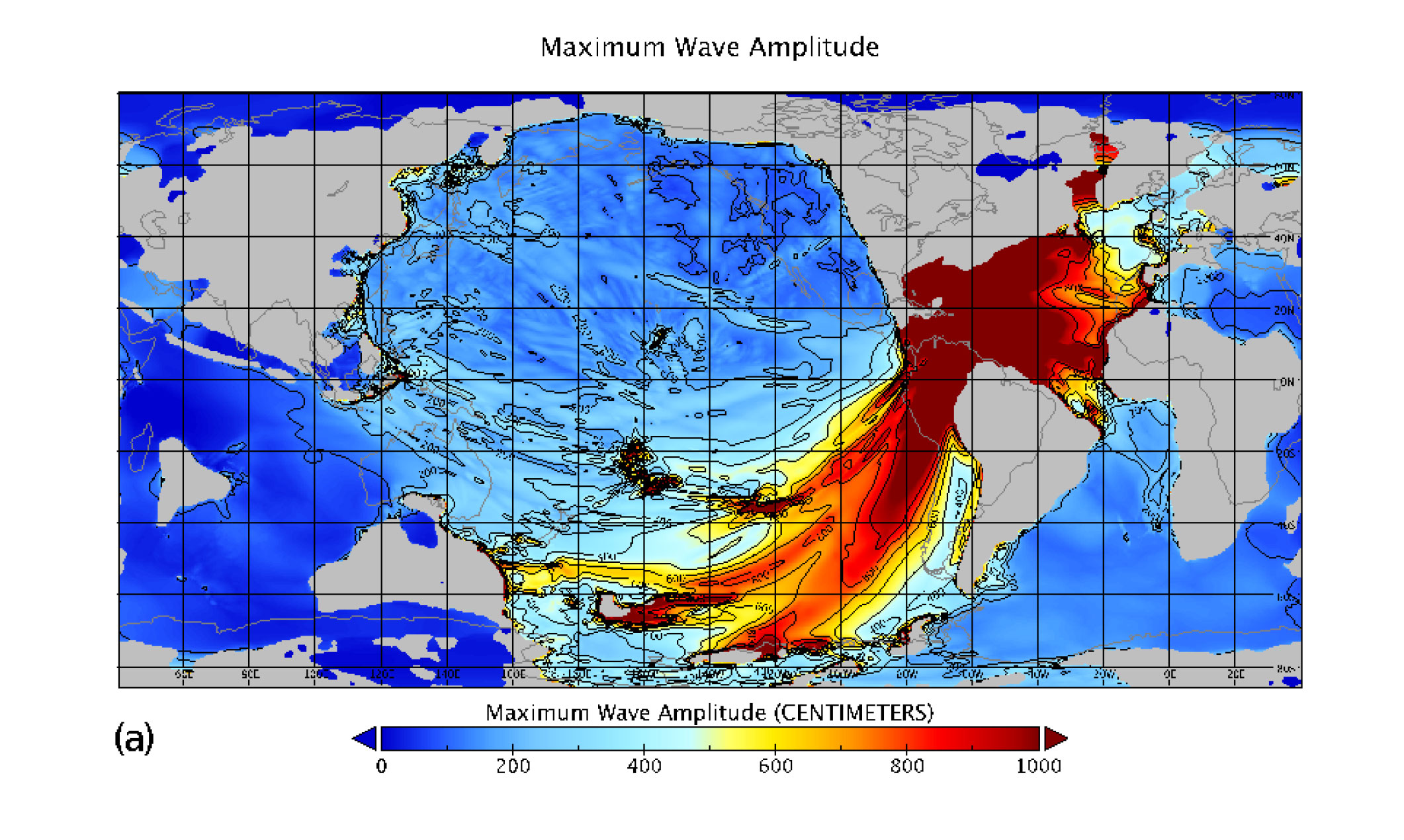
    When an asteroid struck Earth some 66 million years ago, the one blamed for wiping out the dinosaurs, it is believed to have sent a tidal wave crashing onto North America.

    Marine fossils and rock fragments found in southeastern Missouri appear to have been deposited there by a massive wave generated by the asteroid hitting what is now Mexico’s Yucatan Peninsula.

    Among the rocks and marine fossils, scientists have found fossilized pollen from the Late Cretaceous and Early Paleocene periods that reflects changes in the surrounding ecosystems. The pollen reveals how ecosystems were instantly disrupted at the time of the asteroid, before gradually rebounding over hundreds to thousands of years.

    A University of Michigan-led study using data from the Chicxulub asteroid impact crater modeled how far the resulting tsunami likely would have reached. Ancient pollen grains and marine fossils found in southeastern Missouri and analyzed by scientists at the Missouri University of Science and Technology offer hard evidence of the flooding.
    Molly M. Range, et al., 2022, CC BY

    Pollen from gymnosperms, such as pines, as well as ferns and flowering plants, such as grasses, herbs and palm trees, all record a clear pattern: Some forest pollen disappeared after the impact, suggesting that the regions’ vegetation changed. Then the pollen slowly began to reemerge as the environment stabilized.

    US Gulf Coast: Sequoia pollen and sea-level rise

    Fossilized pollen grains have also helped scientists trace slower but equally dramatic changes along the eastern Gulf Coast states of Mississippi and Alabama.

    During the Early Oligocene, around 33.9 to 28 million years ago, sea levels rose and flooded low-lying conifer forests in the region. Researchers identified a distinct change in pollen released by Sequoia-type trees, giant conifers that once dominated the coastal plains.

    Scientists have been able to use those pollen records to reconstruct how far the shoreline moved inland by tracking the proportion of pollen grains in the geologic record to the rise of marine microfossils.

    The evidence shows how the sea flooded land ecosystems hundreds of miles from today’s coast. Pollen is a biological marker and geographic tracer of this ancient change.

    Western Australia: From swamp to salinity

    In Western Australia, sediment cores from the beds of Lake Aerodrome, Gastropod Lake and Prado Lake reveal how long-term drying can change the ecology of a region.

    During the Eocene, a period from about 55.8 million to 33.9 million years ago, lush swamp forests surrounded freshwater lakes there. That’s reflected by abundant pollen from tropical trees and moisture-loving shrubs and fern spores at that time. However, vegetation changed dramatically as the Australian tectonic plate drifted northward and the climate became more arid.

    The upper layers of the sediment cores, which capture more recent times, contain pollen mostly from wind-pollinated, salt- and drought-tolerant plants – evidence of shifting vegetation under growing environmental stress.

    Magnified images of fossil pollen studied in Australia. Clockwise from upper left, they are pollen from acacia, aglaonema and eucalyptus.
    Francisca Oboh-Ikuenobe

    The presence of Dunaliella, a green alga that thrives in very salty water, alongside sparse pollen from plants that could survive dry environments, confirms that lakes that once supported forests became highly saline.

    Guatemala: Maya history and forest recovery

    Closer to the tropics, Lake Izabal in Guatemala offers a more recent archive spanning the past 1,300 years. This sediment record reflects both natural climate variation and the profound impact of human land use, especially during the rise and fall of the Maya civilization.

    Around 1,125 to 1,200 years ago, pollen from crops such as maize and opportunistic herbs surged, at the same time tree pollen dropped, reflecting widespread deforestation. Historical records show political centers in the region collapsed not long afterward.

    Quiriguá was an ancient Mayan city near Lake Izabal, where pollen studies show the rise in deforestation and the recovery. Quiriguá began to decline in the ninth century and was eventually abandoned.
    Daniel Mennerich/Flickr, CC BY-SA

    Only after population pressure eased did the forest begin to recover. Pollen from hardwood tropical trees increased, indicating vegetation rebounded even as rainfall declined during the Little Ice Age between the 14th and mid-19th centuries.

    The fossil pollen shows how ancient societies transformed their landscapes, and how ecosystems responded, providing more evidence and explanations for other historical accounts.

    Modern pollen tells a story, too

    These studies relied on analyzing fossil pollen grains based on their shapes, surface features and wall structures. By counting grains – hundreds to thousands per sample – scientists can statistically build pictures of ancient vegetation, the species present, their abundances, and how the composition of each shifted with the climate, sea-level changes or human activity.

    This is why modern pollen also tells a story. As today’s climate warms, the behavior of pollen-producing plants is changing. In temperate regions such as the U.S., pollen seasons start earlier and last longer due to warming temperatures and rising carbon dioxide in the atmosphere from vehicles, factories and other human activities.

    All of that is being recorded in the fossil pollen record in the sediment layers at the bottoms of lakes around the world.

    So, the next time you suffer from allergies, remember that the tiny grains floating in the air are biological time capsules that may one day tell future inhabitants about Earth’s environmental changes.

    Francisca Oboh Ikuenobe receives funding from the National Science Foundation, American Chemical Society-Petroleum Research Fund, and International Continental Scientific Drilling Program. She is affiliated with the American Association for the Advancement of Science, American Geophysical Union Geological Society of America, American Association of Petroleum Geologists, Association for Women Geoscientists, Geological Society of Nigeria, AASP – The Palynological Society, SEPM – Society for Sedimentary Geology, and The Paleontological Society.

    Linus Victor Anyanna receives research support from the National Science Foundation. He is a member of the Geological Society of America, AASP-The Palynological Society, the American Association of Petroleum Geologists, and the Geological Society of Nigeria.

    ref. Ancient pollen reveals stories about Earth’s history, from the asteroid strike that killed the dinosaurs to the Mayan collapse – https://theconversation.com/ancient-pollen-reveals-stories-about-earths-history-from-the-asteroid-strike-that-killed-the-dinosaurs-to-the-mayan-collapse-254190

    MIL OSI – Global Reports

  • MIL-OSI Global: An 18th-century rebellion for liberty, equality and freedom − not in France or the United States, but Ireland

    Source: The Conversation – USA – By Joseph Patrick Kelly, Professor of Literature and Director of Irish and Irish American Studies, College of Charleston

    A sculpture in Wexford, Ireland, by Eamonn O’Doherty, called ‘Fuascailt,’ commemorates the 1798 rebellion. Niall Carson/PA Images via Getty Images

    Shortly before midnight on May 23, 1798, highwaymen just north of Dublin intercepted and set on fire a mail coach headed to Belfast.

    It was the signal meant to ignite revolution across all Ireland.

    At the time, Ireland was a kingdom within the state of Great Britain. The island’s three religious factions had long been divided. Families who belonged to the Anglican Church of Ireland made up the aristocratic landlords and colonial administrators. Presbyterians, concentrated in the north, boasted a robust middle class. But as “dissenters” from the Anglican church, they were second-class citizens.

    And most of the remaining 80% of the population, the “native” Catholics, were near-destitute farmers. For more than a hundred years, they had lived under debilitating penal laws meant to keep Catholics out of economic and political power.

    Portrait of Lord Edward Fitzgerald, painted by Hugh Douglas Hamilton.
    Gallery of the Masters via Wikimedia Commons

    A new organization, the Society of United Irishmen, was established in the early 1890s in Belfast, and chapters quickly spread to Dublin and across the country. Anyone could join, so long as they dreamed of making Ireland a republic, like the United States and France, where the people had dispensed with the monarch and ruled themselves.

    Catholics and Presbyterians flocked to the cause, and even a few Anglicans joined up. The handsome and charismatic Lord Edward Fitzgerald, an Anglican son of a duke, renounced his title and commanded the society’s militia.

    By 1798, a quarter of a million men, many armed with long-handled, iron-tipped pikes, awaited the summons.

    It was the last time Catholics and Presbyterians in Ireland would unite under one banner in a really meaningful way until 1998, when a majority of both factions signed on to the Good Friday Agreement.

    As an Irish studies scholar, I’d argue the nationalist movement was symbolized best by revolutionary Theobald Wolfe Tone, whose father was an Anglican tradesman and whose mother was born and raised a Catholic.

    “I am a Protestant,” Tone wrote in his most famous political pamphlet, but also “a lover of justice and a steady detester of tyranny.”

    Enlightenment ideals

    Ever since King Henry VIII severed his nation’s ties to Roman Catholicism in the 16th century, Irish Catholics had suffered for their faith. Their lands were confiscated. They couldn’t bear arms. They couldn’t run schools or build churches. Though the worst of these laws had been reformed by the end of the 18th century and a small Catholic middle class was emerging, they were still barred from political office.

    Inspired by the American and French revolutions, the United Irishmen wanted a secular republic that separated church from state. They professed the Enlightenment principles of equality, liberty and government by the people – and thought citizens had a duty to abolish any government destructive of their rights.

    Their creed was a secular catechism, often expressed in the form of a question-and-answer text:

    What is in your hand? It is a branch.
    Of what? Of the Tree of Liberty
    Where did it first grow? In America.
    Where did it bloom? In France.
    Where did the seeds fall? In Ireland.

    Transcending sectarian differences, these Irish patriots took green as the color of their national flag. Upon this field they imposed an ancient symbol of Ireland, the harp.

    The rebellion

    The English began to suspect a revolt, and in 1787 they decided to strike first, unleashing a brutal crackdown. Redcoats “dragooned” the country, ransacking and burning homes, and flogging and summarily executing suspects.

    The Irish still sing about it today in the ballad “The Wearing of the Green”:

    I met with Napper Tandy and he took me by the hand,
    He said, “How’s dear old Ireland and how does she stand?”
    “She’s the most distressful country that you have ever seen,

    They’re hanging men and women for the wearing of the green.”

    Young Wolfe Tones singing ‘The Wearing of the Green.’

    Most of the United Irishmen’s leaders, including Fitzgerald, were arrested or killed in the dragnet. As a result, when the signal finally came, the flaming mail coach proved a fizzle rather than a rocket.

    Like guttering candles, the rebellion spent itself in uncoordinated risings at different times in different parts of the country. Help from France, which was then at war with Great Britain, came too little and too late. By October, Ireland’s revolution had been brutally suppressed.

    Historical memory

    Even before the conflict was over, aristocratic Anglican writers such as Sir Richard Musgrave spun the rebellion as an uprising of disgruntled Catholics. Reprisal killings, like rebels’ massacre of government supporters in County Wexford, helped them portray the rebellion as a religious war: Catholics against Protestants.

    Cynical English policies further dissolved the Presbyterian-Catholic alliance. An “Act of Union” in 1800 rewarded Irish Presbyterians with full citizenship – not in an Irish republic, but in the Protestant, monarchical state of Great Britain.

    Catholics, still oppressed and impoverished, had yet to face their most difficult trial: An Gorta Mor, the potato famine of the 1840s. About a million people, nearly all of them Catholic, died of starvation or disease, and another 2 million emigrated. Ireland’s population was reduced by a third.

    Because Irish nationalism became synonymous with Catholic liberation, it was mostly Catholics who celebrated the memory of the United Irishmen. The “Fenians,” a nationalist brotherhood who fought for Irish independence in the 1860s, used the United Irishmen for inspiration. Their famous ballad “The Rising of the Moon” laments, “What glorious pride and sorrow/ Fill the name of Ninety-Eight!”

    A memorial in County Wicklow to mark the 200th anniversary of the 1798 United Irishmen rebellion.
    Hugh Rooney/Eye Ubiquitous/Universal Images Group via Getty Images

    Religious states

    On Easter Monday 1916, Irish republicans rose up again in Dublin, beginning the revolution that would lead, finally, to Irish independence. One portion of their forces, the Citizen Army, raised the old United Irishmen’s banner above their headquarters in Dublin, Liberty Hall.

    But when the Irish got their “Free State,” they did not build the kind of secular republic envisioned by the United Irishmen. The new country was a decidedly Catholic nation.

    The nation’s new flag, the Irish tricolor, included green for Catholics, orange for Protestants and white to represent peace between them. But it was a largely empty gesture. Today only about 4% of the population of the Republic of Ireland identify as Protestant, while another 15% say they have no religion.

    A parade in Dublin in 1948 commemorates the 150th anniversary of the 1798 rebellion.
    Independent News And Media/Hulton Archive via Getty Images

    That’s mostly because in 1922 the British carved out an enclave of six northern counties where most of the Presbyterians and many Anglicans lived. This political entity, “Northern Ireland,” stayed united to England. Protestants outnumbered Catholics 2-to-1, and the minority faced widespread discrimination.

    Inspired by Martin Luther King Jr., Catholics in Northern Ireland began a campaign for equal rights in 1968. But when their acts of civil disobedience were met with violence, peaceful protest devolved into “the Troubles,” a guerrilla war to get the British out.

    Making peace

    A ceasefire was called in 1994, not long before the bicentennial of Ireland’s 1798 rebellion.

    To coincide with the anniversary, historian Kevin Whelan published an influential book, “The Tree of Liberty,” which emphasized the 1798 rebellion’s Enlightenment foundation. Catholics and Protestants together, Whelan argued, had fought to construct a secular nation based on equal rights.

    In 1998, people all over the country commemorated the rebellion, though the sectarian divisions and the violence of the Troubles loomed large.

    Almost exactly 200 years after the United Irishmen rose up, the people of Northern Ireland and the Republic of Ireland voted in favor of the Good Friday Agreement of 1998. Though Northern Ireland remains part of the United Kingdom today, the treaty secured the main goal of the 1798 rebellion: equal rights and self-determination for all citizens, no matter their religion.

    Joseph Patrick Kelly does not work for, consult, own shares in or receive funding from any company or organization that would benefit from this article, and has disclosed no relevant affiliations beyond their academic appointment.

    ref. An 18th-century rebellion for liberty, equality and freedom − not in France or the United States, but Ireland – https://theconversation.com/an-18th-century-rebellion-for-liberty-equality-and-freedom-not-in-france-or-the-united-states-but-ireland-249817

    MIL OSI – Global Reports

  • MIL-OSI: 8 Rivers Partners with Navajo Transitional Energy Company on Feasibility Study to Develop a Gigawatt of Decarbonized Coal Power

    Source: GlobeNewswire (MIL-OSI)

    DURHAM, N.C., May 20, 2025 (GLOBE NEWSWIRE) — 8 Rivers Capital, LLC, (8 Rivers) a world-leading decarbonization technology developer, in collaboration with Siemens Energy, has contracted with the Navajo Transitional Energy Company (NTEC) to conduct a technical feasibility study for a proposed power plant project at a site co-located with an existing NTEC coal mine, either at the Navajo Mine located on the Navajo Nation or at a Powder River Basin location. The project would leverage 8 Rivers’ proprietary Allam-Fetvedt Cycle (AFC) power cycle technology and direct-fired supercritical CO2 turbines it is developing with Siemens Energy to deliver ultra-low-carbon coal power production with inherent carbon capture. AFC eliminates air emissions with the only byproducts being liquid water and pipeline-ready CO2.

    Under this agreement, the AFC would be deployed in stages to provide power for up to 1000 megawatts of equivalent generation at an NTEC site utilizing NTEC coal. Once operational, the project will deliver an estimated one gigawatt of reliable, dispatchable base-load power while capturing ~8 million tons of CO2 per year. The Navajo Mine site offers the benefits of being strategically placed near existing transmission infrastructure and NTEC’s Navajo Park Electrical Switching Station (NEPSS), which would eliminate the historic interconnection backlogs energy projects face across the U.S. This project supports NTEC’s goal of deploying clean energy generation that maintains and grows the Navajo Nation’s skilled workforce, maximizes the benefits of its natural resources, and provides reliable, affordable zero-emissions power to the region. 

    This agreement represents an extension of the Memorandum of Understanding (MoU) between NTEC and 8 Rivers that was signed in 2024. Under that agreement, the two Companies announced intentions to jointly seek opportunities to develop and market new decarbonized power production projects using AFC technology that can be used as an anchor for further business development opportunities.

    “Pragmatic, scalable, ultra-low-carbon technologies will foster continued economic prosperity, clean air, and energy security for communities like the Navajo Nation and others across New Mexico and the Powder River Basin,” said Damian Beauchamp, CEO of 8 Rivers. “We’re incredibly proud to be working with NTEC and our partners at Siemens Energy on this project, which we truly believe is a testament to the region and community’s rich energy production history and a strategic investment into its long-term energy independence.”

    NTEC will provide the fuel and operate the site while 8 Rivers and Siemens Energy will provide technological and development support. Under the terms of the study, 8 Rivers and NTEC will also pursue a techno-economic evaluation of the project’s CO2 transportation and storage options, including enhanced oil recovery and/or permanent geologic storage. 

    NTEC was formed by the Navajo Nation to establish energy independence and build its economy for future generations. The 2013 Navajo Nation Energy Policy states that, “Diverse revenue streams from a balanced portfolio of energy extraction, generation and transmission will provide the Diné with economic stability, career opportunities and business opportunities.” This project’s engineering, construction, and ongoing operations will support this mission with the creation of hundreds of new jobs and provide new sources of revenue for the Navajo Nation while mitigating carbon emissions. In addition, the project will provide the region with access to more abundant secure, reliable, and affordable energy.

    “In accordance with the 2013 Navajo Nation Energy Policy, NTEC is committed to the continued operation of Four Corners Power Plant and Navajo Mine in order to preserve their irreplaceable economic contributions to the Navajo Nation,” said Vern Lund, Chief Executive Officer for NTEC “As we continue to evaluate all options that make this possible, we believe that 8 Rivers’ AFC technology would an ideal solution to compliment the continued operations of Four Corners Power Plant in securing the long-term economic stability and growth of the Navajo Nation, while eliminating carbon emissions. We are excited to work with 8 Rivers on this feasibility study to examine the costs and benefits of AFC technology on a new plant.”

    Once operational, the power generated at the proposed project would have the potential to be dispatched to meet local and regional energy demand, particularly for fast-growing applications like data centers and artificial intelligence. This partnership comes at a time when the Trump Administration is promoting increased investment into data center infrastructure and bolstering domestic clean coal production. New Mexico is also prioritizing the deployment of renewable energy assets, with the state’s Renewable Portfolio Standard (RPS) setting a goal for utilities to provide 50% renewable energy by 2030 and a goal of 80% by 2040. As more intermittent resources come online, firm, reliable, ultra-low-carbon power generation assets like the AFC will be called upon to balance demand.

    About 8 Rivers Capital, LLC

    8 Rivers is a Durham, North Carolina–based climate technology company leading the energy industry towards achieving net zero. Founded in 2008, 8 Rivers is pioneering the clean energy and climate future through the invention and commercialization of infrastructure-scale technologies and projects that enable the global energy transition. The 8 Rivers technology portfolio includes cleantech innovations such as 8RH2, an ultra-low-carbon hydrogen production technology, the Allam-Fetvedt Cycle, a transformative low-carbon power cycle, and Calcite, a hyper-efficient direct air capture process. Learn more at www.8Rivers.com.

    About NTEC

    Navajo Transitional Energy Company (NTEC) is a world-class, diversified energy company with a unique purpose and vision. Established by the Navajo Nation to exercise sovereignty over its abundant natural resources, NTEC has grown rapidly and now has a sizeable and successful portfolio of mining, energy generation, and helium assets. NTEC is committed to achieving multi-generational, clean energy solutions that ensure the continued prosperity of the Navajo Nation while providing essential power to the entire Southwest and beyond.
    For more information, visit www.navenergy.com.

    Media inquiries: 
    newsmedia@8rivers.com

    The MIL Network

  • MIL-OSI Africa: “The land is life”: A regional project supported by the African Development Bank boosts rural women’s climate resilience in Djibouti

    Source: Africa Press Organisation – English (2) – Report:

    ABIDJAN, Ivory Coast, May 20, 2025/APO Group/ —

    “Before,  farming  was  an  unattainable  dream.  Today,  I  feed  my  children  from  the  land.” These words from Assia Obakar Hassan, a mother from the village of Kalaf, epitomize the profound transformation benefiting part of rural northern Djibouti thanks to a regional project implemented by the Intergovernmental Authority on Development (IGAD) with funding from the African Development Bank (www.AfDB.org) through the Africa Climate Change Fund (ACCF).

    In this region vulnerable to drought, food insecurity and rural poverty, secure access to land represents much more than a right to property: it is a tool for adapting to climate change and a lever for economic emancipation for hundreds of women.

    Regaining dignity through the land

    Living conditions in Kalaf and Dafenaytou have been transformed by the introduction of family vegetable gardens, forage plots, adapted farming tools and practical training. The aim is to make local agriculture a pillar of resilience, starting with those who support it on a daily basis.

    “We had no right to land, no equipment and no training. Today, everything has changed,” explains Fatouma Ali Aden, a mother of three from Dafenaytou. “Our children eat fresh vegetables, and we are no longer dependent on foreign markets.”

    Each household now has its own production area. “Thanks to these gardens, we have regained our autonomy,” adds Djilani Ali Ahmed, a community leader in Kalaf. “The women manage their own production and income and contribute to the village economy.”

    Agricultural governance driven by women

    The project was not confined to production: it also transformed local governance. The agricultural cooperative in Dafenaytou has over 70 members, the majority of whom are women, and 50% of its board members are female.

    “Women are no longer just workers, they are decision-makers,” says Ali Kamil Mohamed, head of the cooperative. “Their practical vision and commitment have improved the effectiveness of all our actions.”

    This change in approach has helped ensure a better match between the needs on the ground and the solutions proposed, consolidating the sustainability of the project.

    Health, security and education: cascading effects

    The social benefits of the project are considerable, from hygiene to nutrition and economic stability. The introduction of resistant seeds, simple irrigation systems and wheelbarrows has reduced the drudgery of the work and secured household food supplies.

    “We now have a supply of grass for our animals, vegetables for our meals and even a small surplus to sell,” says Mohamed Soumbourouh Ibiro. “It’s a source of pride and security.”

    The local school in Dafenaytou has also noted an improvement in attendance and concentration among children, especially girls, who have been freed from the chores of fetching water or food.

    This project is an illustration of the African Development Bank’s strategic priorities, in particular one of the “High 5” pillars: “Improve the quality of life for the people of Africa” by promoting gender equality, ensuring food security and building climate resilience.

    “This project has proved to us that it is possible,” concludes Assia Obakar Hassan. “With a little help, we can transform our villages, feed our families and pass on fertile land to our children.”

    As climate challenges intensify in the Horn of Africa, Kalaf and Dafenaytou are leading the way. The IGAD/AfDB project has not only provided water, seeds and training: it has given dignity, confidence and a voice back to rural women.

    In these villages, where every drop of water counts, the land has become a symbol of life, hope and resilience.

    MIL OSI Africa

  • MIL-OSI China: Regular Press Briefing of the Ministry of National Defense on May 15th, 2025 2025-05-20 On the afternoon of May 15, 2025, Senior Colonel Jiang Bin, Deputy Director-General of the Information Office of China’s Ministry of National Defense (MND) and Spokesperson for the MND, answered recent media queries concerning the military.

    Source: People’s Republic of China – Ministry of National Defense 2

    On the afternoon of May 15, 2025, Senior Colonel Jiang Bin, Deputy Director-General of the Information Office of China’s Ministry of National Defense (MND) and Spokesperson for the MND, answered recent media queries concerning the military.

    On the afternoon of May 15, 2025, Senior Colonel Jiang Bin, Deputy Director-General of the Information Office of China’s Ministry of National Defense (MND)andSpokesperson for the MND, answers recent media queries concerning the military. (Photo by He Youwen)

    (The following English text is for reference. In case of any divergence of interpretation, the Chinese text shall prevail.)

    Jiang Bin: Friends from the media, good afternoon. I’m Jiang Bin, Deputy Director-General of the Information Office of the Ministry of National Defense (MND) and the new Spokesperson for the MND. It is a great honor to meet you all in this new role. I will do my utmost to carry forward the baton passed on by my predecessors, release timely updates on national defense and military development, and tell the stories of the Chinese military in the new era. I will communicate with you sincerely, respond to your concerns earnestly, and work with you in the spirit of mutual understanding and support, to show the world a true, multidimensional and comprehensive picture of the Chinese military. Thank you!

    First, I would like to announce one piece of news.

    The 2nd Meeting of China-Brunei Joint Defence Working Committee (JDWC) was convened in Beijing on May 14. Both sides had in-depth exchange of views on friendly cooperation between the two militaries and relevant international and regional issues, and agreed to strengthen communication and coordination on policy and planning between their international military cooperation organs, promote exchanges and cooperation in various fields, and jointly maintain regional peace and tranquility.

    Journalist: Recently, President Xi Jinpingpaid a state visit to Russia and attended the celebrations marking the 80th anniversary of the Victory in the Great Patriotic War of the Soviet Union, during which a contingent of the PLA Guard of Honor participated in the military parade. How will the Chinese side promote military-to-military relations with Russia?

    Jiang Bin: This year marks the 80th year of the victory of the Chinese People’s War of Resistance Against Japanese Aggression, the Soviet Union’s Great Patriotic War and the World Anti-Fascist War. On this special historical occasion, President Xi Jinping paid a state visit to Russia upon invitation, and attended the celebrations marking the 80th anniversary of the Victory in the Great Patriotic War of the Soviet Union. President Xi Jinping held talks with President Putin, and had in-depth exchange of views on China-Russia relations and major international and regional issues. They agreed to unswervingly deepen strategic coordination, and promote the stable, sound and high-level development of China-Russia relationship. During the visit, a contingent of the PLA Guard of Honor participated in the Red Square Military Parade, which was widely publicized and warmly welcomed.

    In recent years, China-Russia military-to-military relationship has been operating at a high level. We’ve had frequent high-level exchanges, conducted joint strategic air patrols and joint maritime exercises, and rendered support to each other in holding important commemorative celebrations. Under the strategic guidance of the two heads of state, the Chinese military stands ready to work with the Russian side to further deepen strategic mutual trust, step up strategic communication, and expand practical cooperation, so as to strengthen the sound momentum of military-to-military relations, enrich the content of China-Russia comprehensive strategic partnership of coordination for a new era, and contribute to maintaining and strengthening global strategic stability.

    On the afternoon of May 15, 2025, Senior Colonel Jiang Bin, Deputy Director-General of the Information Office of China’s Ministry of National Defense (MND)andSpokesperson for the MND, answers recent media queries concerning the military. (Photo by He Youwen)

    Journalist: It is reported that China and Singapore are holding China-Singapore Exercise Cooperation-2025 joint maritime exercise. Please further brief us on the exercise.

    Jiang Bin: China-Singapore Exercise Cooperation-2025 joint maritime exercise is being held in Changi Naval Base and in the waters and airspace to the east of Singapore from May 9 to 16. The guided-missile frigate PLANS Xuchang and the mine countermeasure vessel PLANS Chishui, together with the RSS (Republic of Singapore Ship) Steadfast-class frigate and the RSS Bedok-class mine countermeasure vessel, participated in the exercise. With joint command and planning, the two sides conducted live exercises on naval gunfire against sea targets, replenishment-at-sea, joint search and rescue and other subjects. The exercise tested tactical command coordination and joint operations capability of the participating forces. During the exercise, the troops also had professional seminars, on-board visits and cultural and sports activities. It is the 4th edition of this series of exercise, which is significant for further promoting practical cooperation and strengthening joint maritime operations capability between the two sides.

    Journalist: It is reported that recently the Philippines has frequently sent patrol vessels in an attempt to intrude into the territorial sea of China’s Huangyan Dao, and claimed that the Chinese military vessels took high-risk maneuvers. What’s your comment?

    Jiang Bin: Huangyan Dao is China’s inherent territory. In recent days, the Philippine military vessels attempted to intrude into the territorial sea of China’s Huangyan Dao. The Chinese side took necessary measures to stop and dispel them, which was completely legitimate, legal, professional and restrained. The Philippine side’s actions were highly irresponsible, and severely threatened China’s sovereignty and security by approaching Chinese vessels in a dangerous manner. We urge the Philippine side to stop any risky infringements and provocations, and refrain from challenging China’s firm resolve in safeguarding territorial sovereignty and maritime rights and interests. Otherwise, it will only taste the bitter fruit of its own doing.

    On the afternoon of May 15, 2025, Senior Colonel Jiang Bin, Deputy Director-General of the Information Office of China’s Ministry of National Defense (MND)andSpokesperson for the MND, answers recent media queries concerning the military. (Photo by He Youwen)

    Journalist: According to reports, the Democratic Progressive Party (DPP) authorities recently held their first-ever event commemorating Victory in Europe (V-E) Day of WWII at the Taipei Guest House, which once served as the Governor-General’s residence during Japan’s colonial rule. During the event, Lai Ching-te made the unfounded claim that Taiwan and Europe are now facing threats from a so-called “new authoritarian bloc.” What’s your comment on this?

    Jiang Bin: Lai Ching-te has been engaging in authoritarian practices, intensifying the “green terror” on the island, provoking cross-Strait antagonism and confrontation, and heightening tensions and instability in the Taiwan Strait. He is a true “saboteur of cross-Strait peace” and  “creator of the Taiwan Strait crisis.” In a shameless attempt to seize the spotlight and assert his presence, Lai Ching-te stood on the ground once trampled by Japanese invaders and brazenly peddled deceptive rhetoric. By distorting the history of WWII and inserting separatist narratives, he has betrayed the Chinese nation, which is a disgraceful act beneath contempt.

    This year marks the 80th anniversary of the victory of the Chinese People’s War of Resistance against Japanese Aggression and the World Anti-Fascist War, as well as the recovery of Taiwan to China. Taiwan’s return to China is an important part of the victory of WWII and the post-war international order. A number of international legal instruments including the Cairo Declaration and the Potsdam Proclamation have affirmed China’s sovereignty over Taiwan in clear-cut terms. This is an indisputable fact supported by history and the law. The historical trend that China will and must achieve reunification is unstoppable. Any words or deeds that forget the ancestry or solicit external support for “Taiwan independence” is surely disdained by the people and condemned by history.

    MIL OSI China News

  • MIL-OSI: Radware and MAIRE Team Up to Deliver Managed Security Services

    Source: GlobeNewswire (MIL-OSI)

    MAHWAH, N.J. and MILAN, May 20, 2025 (GLOBE NEWSWIRE) — Radware® (NASDAQ: RDWR), a global leader in application security and delivery solutions for multi-cloud environments, and MAIRE, a leading technology and engineering group focused on advancing the Energy Transition, have further expanded their relationship. MAIRE is adding Radware’s AI-powered Cloud Application Protection Services to its managed services portfolio and leveraging Radware’s content delivery network to enhance its security offering for customers.

    MAIRE also uses Radware’s Cloud Application Protection Service to safeguard its global infrastructure from cyber threats. Milan-based MAIRE is present in 50 countries and employs over 9,800 people supported by approximately 50,000 professionals involved in its project worldwide.

    “Our expanded relationship with Radware is grounded in our shared focus on innovation,” said Andrea Sgarlata, identity manager at MAIRE group. “We were looking for a technology partner that could enhance our security offering with state-of-the-art protection, added flexibility and worldwide coverage, enabling our customers to combat even the most sophisticated cyber attacks. Radware is unique in its ability to establish accurate security baselines by continuously studying application traffic and then automatically fine-tuning security policies to block malicious behavior without disrupting legitimate traffic.”

    As part of Radware’s Cloud Application Protection Service, MAIRE is leveraging Radware’s web application firewall (WAF), bot detection and management, and application-layer DDoS protection. Combining end-to-end automation, AI-powered algorithms, behavioral-based detection, and 24/7 managed services, the solution defends against 150+ known attack vectors. This includes the OWASP’s Top 10 Web Application Security Risks, Top 10 API Security Vulnerabilities, and Top 21 Automated Threats to Web Applications.

    Radware’s application security stack is integrated with a high-capacity content delivery network (CDN) solution. The CDN has a global footprint that spans over 600 points of presence in more than 100 cities and 50 countries.

    “With the surge in cyberattacks, shortage of skilled security staff, and need for around-the-clock protection, more companies are opting for managed security services as part of their security strategy,” said Rob Hartley, vice president for Radware in EMEA and CALA. “We look forward to partnering with MAIRE to fill this need and offer customers future-ready application protection solutions designed to reduce their exposure to attacks and improve their security posture.”

    Radware’s DDoS mitigation, application and API protection, web application firewall, and bot detection and management solutions have received numerous industry recognitions. Industry analysts such as Aite-Novarica Group, Forrester, Gartner, GigaOm, IDC, KuppingerCole and QKS Group continue to recognize Radware as a market leader in cyber security.

    About MAIRE
    MAIRE S.p.A. is a leading technology and engineering group focused on advancing the Energy Transition. We provide integrated E&C Solutions for the downstream market and Sustainable Technology Solutions through three business lines: Sustainable Fertilizers, Low-Carbon Energy Vectors, and Circular Solutions. With operations across 50 countries, MAIRE employs nearly 10,000 people, supported by around 50,000 professionals involved in its project worldwide. MAIRE is listed on the Milan Stock Exchange (ticker “MAIRE”).

    About Radware
    Radware® (NASDAQ: RDWR) is a global leader in application security and delivery solutions for multi-cloud environments. The company’s cloud application, infrastructure, and API security solutions use AI-driven algorithms for precise, hands-free, real-time protection from the most sophisticated web, application, and DDoS attacks, API abuse, and bad bots. Enterprises and carriers worldwide rely on Radware’s solutions to address evolving cybersecurity challenges and protect their brands and business operations while reducing costs. For more information, please visit the Radware website.

    Radware encourages you to join our community and follow us on: Facebook, LinkedIn, Radware Blog, X, and YouTube.

    ©2025 Radware Ltd. All rights reserved. Any Radware products and solutions mentioned in this press release are protected by trademarks, patents, and pending patent applications of Radware in the U.S. and other countries. For more details, please see: https://www.radware.com/LegalNotice/. All other trademarks and names are property of their respective owners.

    Radware believes the information in this document is accurate in all material respects as of its publication date. However, the information is provided without any express, statutory, or implied warranties and is subject to change without notice.

    The contents of any website or hyperlinks mentioned in this press release are for informational purposes and the contents thereof are not part of this press release.

    Safe Harbor Statement
    This press release includes “forward-looking statements” within the meaning of the Private Securities Litigation Reform Act of 1995. Any statements made herein that are not statements of historical fact, including statements about Radware’s plans, outlook, beliefs, or opinions, are forward-looking statements. Generally, forward-looking statements may be identified by words such as “believes,” “expects,” “anticipates,” “intends,” “estimates,” “plans,” and similar expressions or future or conditional verbs such as “will,” “should,” “would,” “may,” and “could.” For example, when we say in this press release that with the surge in cyberattacks, shortage of skilled security staff, and need for around-the-clock protection, more companies are opting for managed security services as part of their security strategy, we are using forward-looking statements. Because such statements deal with future events, they are subject to various risks and uncertainties, and actual results, expressed or implied by such forward-looking statements, could differ materially from Radware’s current forecasts and estimates. Factors that could cause or contribute to such differences include, but are not limited to: the impact of global economic conditions, including as a result of the state of war declared in Israel in October 2023 and instability in the Middle East, the war in Ukraine, tensions between China and Taiwan, financial and credit market fluctuations (including elevated interest rates), impacts from tariffs or other trade restrictions, inflation, and the potential for regional or global recessions; our dependence on independent distributors to sell our products; our ability to manage our anticipated growth effectively; our business may be affected by sanctions, export controls, and similar measures, targeting Russia and other countries and territories, as well as other responses to Russia’s military conflict in Ukraine, including indefinite suspension of operations in Russia and dealings with Russian entities by many multi-national businesses across a variety of industries; the ability of vendors to provide our hardware platforms and components for the manufacture of our products; our ability to attract, train, and retain highly qualified personnel; intense competition in the market for cybersecurity and application delivery solutions and in our industry in general, and changes in the competitive landscape; our ability to develop new solutions and enhance existing solutions; the impact to our reputation and business in the event of real or perceived shortcomings, defects, or vulnerabilities in our solutions, if our end-users experience security breaches, or if our information technology systems and data, or those of our service providers and other contractors, are compromised by cyber-attackers or other malicious actors or by a critical system failure; our use of AI technologies that present regulatory, litigation, and reputational risks; risks related to the fact that our products must interoperate with operating systems, software applications and hardware that are developed by others; outages, interruptions, or delays in hosting services; the risks associated with our global operations, such as difficulties and costs of staffing and managing foreign operations, compliance costs arising from host country laws or regulations, partial or total expropriation, export duties and quotas, local tax exposure, economic or political instability, including as a result of insurrection, war, natural disasters, and major environmental, climate, or public health concerns; our net losses in the past and the possibility that we may incur losses in the future; a slowdown in the growth of the cybersecurity and application delivery solutions market or in the development of the market for our cloud-based solutions; long sales cycles for our solutions; risks and uncertainties relating to acquisitions or other investments; risks associated with doing business in countries with a history of corruption or with foreign governments; changes in foreign currency exchange rates; risks associated with undetected defects or errors in our products; our ability to protect our proprietary technology; intellectual property infringement claims made by third parties; laws, regulations, and industry standards affecting our business; compliance with open source and third-party licenses; complications with the design or implementation of our new enterprise resource planning (“ERP”) system; our reliance on information technology systems; our ESG disclosures and initiatives; and other factors and risks over which we may have little or no control. This list is intended to identify only certain of the principal factors that could cause actual results to differ. For a more detailed description of the risks and uncertainties affecting Radware, refer to Radware’s Annual Report on Form 20-F, filed with the Securities and Exchange Commission (SEC), and the other risk factors discussed from time to time by Radware in reports filed with, or furnished to, the SEC. Forward-looking statements speak only as of the date on which they are made and, except as required by applicable law, Radware undertakes no commitment to revise or update any forward-looking statement in order to reflect events or circumstances after the date any such statement is made. Radware’s public filings are available from the SEC’s website at www.sec.gov or may be obtained on Radware’s website at www.radware.com.

    Media Contact:
    Gerri Dyrek
    Radware
    Gerri.Dyrek@radware.com

    The MIL Network

  • MIL-OSI: Cost-Optimized PolarFire® Core FPGAs and SoCs from Microchip Technology Deliver High Performance with a 30% Lower Price Tag

    Source: GlobeNewswire (MIL-OSI)

    CHANDLER, Ariz., May 20, 2025 (GLOBE NEWSWIRE) — In the current marketplace, Bill of Material (BOM) costs are continuing to rise and developers must work to optimize performance and budgets. Recognizing that a significant portion of the mid-range FPGA market does not require integrated serial transceivers, Microchip Technology (Nasdaq: MCHP) is releasing PolarFire® Core Field-Programmable Gate Arrays (FPGAs) and System on Chips (SoCs). The new devices are a derivative of the base PolarFire families and reduce customer costs by up to 30 percent by optimizing features and removing integrated transceivers. Offering the same industry-leading, low-power consumption and proven security and dependability of classic PolarFire technology, Core devices provide savings without sacrificing functionality, processing capability or quality.

    Designed for automotive, industrial automation, medical, communication, defense and aerospace markets, PolarFire Core families feature Single Event Upset (SEU) immunity for mission-critical reliability and integrate a quad-core, 64-bit RISC-V® microprocessor (MPU) for flexible compute capabilities. Additionally, the Core devices are designed to be pin-to-pin compatible with the full line of PolarFire FPGAs to accommodate various design SKUs, enhancing value for applications that prioritize cost efficiency over a range of unnecessary features.

    “Many FPGA manufacturers have raised prices recently, creating new challenges for OEMs needing to bring products to market quickly, at the lowest possible cost and power targets,” said Bruce Weyer, corporate vice president of Microchip’s FPGA business unit. “Our PolarFire Core FPGA and SoC families address price and power budget challenges directly, providing market-leading solutions at a favorable price point.”

    Whether enabling real-time control, edge processing or safety-critical systems, PolarFire Core devices are designed to deliver the flexibility and longevity engineers need to accelerate innovation. Visit the website to learn more about Microchip’s portfolio of FPGAs and SoCs.

    Development Tools
    PolarFire Core devices are supported by Microchip’s Libero® SoC Design Suite, SmartHLS™ compiler, VectorBlox™ Accelerator SDK and Microchip’s Mi-V ecosystem of partner platforms for rapid RISC-V application development. They are compatible with currently available PolarFire FPGA and SoC development boards to expedite silicon development.

    Pricing and Availability
    For additional information and to purchase, contact a Microchip sales representative, authorized worldwide distributor or visit Microchip’s Purchasing and Client Services website, www.microchipdirect.com.

    Resources

    High-res images available through Flickr or editorial contact (feel free to publish):
    • Application image: https://www.flickr.com/photos/microchiptechnology/54485182454/sizes/o/

    About Microchip Technology:
    Microchip Technology Inc. is a leading provider of smart, connected and secure embedded control and processing solutions. Its easy-to-use development tools and comprehensive product portfolio enable customers to create optimal designs which reduce risk while lowering total system cost and time to market. The company’s solutions serve over 100,000 customers across the industrial, automotive, consumer, aerospace and defense, communications and computing markets. Headquartered in Chandler, Arizona, Microchip offers outstanding technical support along with dependable delivery and quality. For more information, visit the Microchip website at www.microchip.com.

    Note: The Microchip name and logo, the Microchip logo, Libero, PolarFire, are registered trademarks of Microchip Technology Incorporated in the U.S.A. and other countries. SmartHLS and VectorBlox are trademarks of Microchip Technology Inc. in the U.S.A. and other countries. All other trademarks mentioned herein are the property of their respective companies.

    The MIL Network

  • MIL-OSI New Zealand: Gaza – NZ signature on Gaza statement ‘wholly inadequate’ – PSNA

    Source: Palestine Solidarity Network Aotearoa


    PSNA says an end to government silence on Israeli genocide in Gaza is overdue, but says New Zealand’s signature on an international declaration is wholly inadequate and too little too late.


    Palestine Solidarity Network Aotearoa Co-Chair John Minto says a just released joint statement by 22 foreign ministers, including New Zealand’s, breaks New Zealand’s month’s long silence on Israel’s genocide in Gaza, but falls well short of any means of making Israel comply with international law.


    “We don’t need to be told all over again that the resumption of full-scale aid deliveries is vital to avoid wide scale starvation, or that the UN must drive the aid distribution and there is a vital need for a ceasefire.”


    “This is just New Zealand dusting off the rhetoric which it issued a year ago – which was completely ignored by Israel.”


    Minto says the only promising moves with potential teeth are in a joint statement just issued by the UK, France and Canada.


    “At last, some major countries are talking about sanctions,” Minto says.


    The triparted statement threatens sanctions against Israel.


    “If Israel does not cease the renewed military offensive and lift its restrictions on humanitarian aid, we will take further concrete actions in response.”

    They (the three countries) also warned they would be prepared to impose targeted sanctions over attempts to expand settlements in the occupied West Bank.


    Minto says over the past few days Israel has been ramping up its assault on Gaza to even higher levels of ferocity.


    “It’s time for governments’ words to end, and sanctions to be implemented.  A year ago, Canada and New Zealand were issuing joint statements on Gaza, along with Australia.”


    “Canada has raised the stakes.  New Zealand should move past Canada and implement sanctions immediately.”


    https://www.bignewsnetwork.com/news/278229391/joint-donor-statement-on-humanitarian-aid-to-gaza

    UK, France and Canada condemn ‘egregious actions’ by Netanyahu’s Israel


    John Minto

    Co-Chair

    Palestine Solidarity Network Aotearoa

    MIL OSI New Zealand News

  • Trump’s mass layoff threat drives U.S. government workers to resign

    Source: Government of India

    Source: Government of India (4)

    Tens of thousands of U.S. government workers have chosen to resign rather than endure what many view as a torturous wait for the Trump administration to carry out its threats to fire them, say unions, governance experts and the employees themselves.

    President Donald Trump signed an executive order on taking office to dramatically slash the size and cost of government. Four months later, mass layoffs at the largest agencies have yet to materialize and courts have slowed the process.

    Instead, most of the roughly 260,000 civil servants who have left or will leave by the end of September have taken buyouts or other incentives to quit. Some told Reuters they could no longer live with the daily stress of waiting to be fired after multiple warnings from Trump administration officials that they could lose their jobs in the next wave of layoffs.

    As a result, Trump and tech billionaire Elon Musk’sDepartment of Government Efficiency have managed to cut nearly 12% of the 2.3 million-strong federal civilian workforce largely through threats of firings, buyouts and early retirement offers, a Reuters review of agency departures found.

    The White House did not respond to a request for comment for this story. Trump and Musk say the federal bureaucracy is bloated, inefficient and beset with waste and fraud.

    The White House has yet to provide an official tally of the number of people leaving the federal workforce. It said 75,000 took the first of two buyout offers but has not said how many took a second buyout offer last month. Under the scheme, civil servants will receive full pay and benefits through September 30, with most not having to work during that period.

    Deep cuts are earmarked for several agencies, including over 80,000 jobs at the Department of Veterans Affairs, and 10,000 at the Department of Health and Human Services.

    Since January, many government workers have spoken of living in fear of being fired. Many agencies have sent regular emails to staff that couple incentives to quit with warnings that those who stay face the possibility of being laid off.

    They have also endured cramped offices after Trump ordered all remote workers to return to work and dysfunction inside their agencies caused by a brain drain of experienced workers.

    Don Moynihan, a professor at the Ford School of Public Policy at the University of Michigan, said a series of moves by DOGE and Trump have worn down the early defiance of many civil servants and led them to leave the workforce, a strategy that avoids the legal pitfalls of firing them.

    They include the first buyout offer, which told workers they needed to leave their “lower productivity” jobs; a demand by Musk for workers to summarize five things they had achieved at work in the previous week, and workers being asked to do jobs they were not trained for.

    “It’s inappropriate to think of these as voluntary resignations. Many of these employees feel that they were forced out,” Moynihan said.

    Charlotte Reynolds, 58, took an early retirement offer and left her job as a senior tax analyst at the tax-collecting Internal Revenue Service on April 30.

    Reynolds chose not to take the first buyout offer in January, deciding to tough things out. By April she had had enough.

  • Delhi CM Rekha Gupta inaugurates Delhi Games 2025 at Talkatora Stadium

    Source: Government of India

    Source: Government of India (4)

    Delhi Chief Minister Rekha Gupta inaugurated the Delhi Games 2025 at Talkatora Stadium in New Delhi on Tuesday. Delhi Minister for Urban Development, Education & Training, Ashish Sood, was also present at the inauguration ceremony.

    The Chief Minister emphasized that athletes from Delhi should receive all necessary facilities, contrasting this with the shortcomings of previous governments.

    She stated that the Delhi government, through the Delhi Sports Council, would ensure that athletes have access to the resources they need to train and compete in the capital, enabling them to bring honor to the city.

    “Athletes from Delhi should get all the facilities they need. In previous governments, we saw that due to a lack of facilities in Delhi, athletes had to go to other states and register there. The Delhi government, through the Delhi Sports Council, will provide all necessary facilities so that they stay in Delhi and earn laurels for the national capital,” Rekha Gupta told reporters.

    More than 22,000 athletes are expected to compete across 20 sports disciplines during the Delhi Games.

    Earlier, on May 17, CM Rekha Gupta also inaugurated a new water pipeline in Singalpur village, located in the Shalimar Bagh area of the national capital.

    Addressing the public at that event, the Chief Minister said, “Until now, we have been paying off the liabilities of previous governments. Our government is committed to the welfare of the people. Work must be done in the public interest—no work should be left unfinished.”

    She further emphasized her administration’s focus on transparency and integrity, stating, “It is the government’s responsibility to carry out every task with complete transparency and honesty, and we will fulfill it.”

    Gupta also criticized the former Aam Aadmi Party (AAP) government for neglecting the capital’s infrastructure, particularly its firefighting systems, which she described as being in a “dilapidated state.”

    “The firefighting systems under the previous government were in a dilapidated state. Because of this, we were unable to provide timely solutions during several tragedies,” she said.

    Later, the Chief Minister, along with Bharatiya Janata Party (BJP) MP Ramvir Bidhuri and Minister Ashish Sood, inspected the modern firefighting vehicles of the Delhi Fire Service at the Secretariat.

  • MIL-OSI Russia: The government has allocated more than 440 million rubles for the major repairs of a school damaged by a flood in the Orenburg region

    Translation. Region: Russian Federal

    Source: Government of the Russian Federation – An important disclaimer is at the bottom of this article.

    Order of May 17, 2025 No. 1238-r

    Document

    Order of May 17, 2025 No. 1238-r

    In 2025, in the city of Orsk in the Orenburg region, major repairs will be carried out and two buildings of secondary comprehensive school No. 24 will be equipped. An order to allocate 440.8 million rubles for these purposes has been signed.

    The buildings were damaged during the flood in 2024. Federal funding will allow the educational process to be restored in the buildings where more than a thousand children studied. School No. 24 is the only educational complex in one of the microdistricts of Orsk.

    The funds were allocated from the Government’s reserve fund. They will be provided to the region as a one-time financial aid within the framework of the state program “Education Development”.

    Please note: This information is raw content directly from the source of the information. It is exactly what the source states and does not reflect the position of MIL-OSI or its clients.

    MIL OSI Russia News

  • MIL-OSI Asia-Pac: President Lai interviewed by Nippon Television and Yomiuri TV

    Source: Republic of China Taiwan

    Details
    2025-05-20
    President Lai delivers address on first anniversary of taking office  
    On the morning of May 20, President Lai Ching-te delivered an address on the first anniversary of his taking office. In his address, the president stated that the Taiwan of today is a Taiwan of the world, and whether it is global technological development, divisions of labor within international supply chains, worldwide economic and trade exchanges, or regional security matters, Taiwan plays a pivotal and indispensable role. He said that, looking forward, we will not cower in the face of challenges; rather, we will bravely march forward into the future. We will maintain solidarity, he emphasized, and with our resilience, perseverance, and enthusiasm as Taiwanese, forge ahead with transition, steadily and solidly.  President Lai stated that moving forward, the government will set up a fund to boost Taiwan’s economic momentum. He also stated that he will be instructing the national security team to initiate a major national security briefing for the chairs of opposition parties, in the hope that leaders of all parties can prioritize our nation’s interests and uphold our nation’s security so that we can tackle our nation’s challenges side by side. A translation of President Lai’s address follows: Yesterday, outside of Beida Elementary School in New Taipei City’s Sanxia District, there was a major traffic accident that, sadly, claimed several lives and resulted in multiple injuries. The Executive Yuan immediately formed a task force, and last night I personally visited the victims in hospital. Central government agencies and the local government will cooperate to provide assistance to the victims’ families. They will work as quickly as possible to determine the cause of the accident and assess areas for improvement, so as to prevent reoccurrence of accidents like this. Today, let me express my deepest condolences to the bereaved families for the unfortunate loss of life and my hope for the quick and full recovery of those injured. The purpose of government is to serve the people. I want to thank the people of Taiwan for entrusting me, one year ago today, with the responsibility of leading the nation bravely forward. I want to thank all my fellow citizens for working hand in hand with the government over this past year. Together, we have overcome numerous challenges to ensure that our nation will keep moving forward.  As we face three major challenges that receive international attention and create the largest impact on our citizens: climate change, the promotion of health, and social resilience, I decided to establish three committees at the Presidential Office. In each committee, we have thus far seen incremental progress. We are working to align ourselves with international standards. The voluntary bottom-up plans of different government agencies plus the top-down approach of the Executive Yuan National Council for Sustainable Development’s Net Zero Emissions Transition Taskforce have produced 20 flagship carbon reduction projects for six major sectors. The government is expected to continue to inject over NT$1 trillion in the budget for the net-zero transition by 2030; and we expect to spur at least NT$5 trillion in private green investment and financing as we work toward the new 2035 NDC target for emissions reductions of 38±2 percent. Taiwan’s air quality has been steadily improving. From 2015 to today, the annual average PM2.5 concentration has dropped from 21.82 to 12.8 μg/m3. Taiwan officially began collecting fees for its carbon fee system this year. With firm resolve, a steady pace, and flexible strategies, we will work to realize the vision of net-zero transition by 2050; and together with the world we will pursue sustainable growth and prosperous development. To address the challenges in the post-pandemic world, we are establishing a national center for disease prevention and control, strengthening our central pandemic response. To promote health for all, we are promoting cancer screening, establishing a fund for new cancer drugs, and launching the five-year, NT$48.9 billion Healthy Taiwan Cultivation Plan. This year, we significantly increased the total National Health Insurance budget by NT$71.2 billion to achieve sustainable NHI development. We aim to create a Healthy Taiwan, keeping people healthy and making the nation stronger so that the world embraces Taiwan. We are also hard at work to enhance our whole-of-society defense resilience. In addition to continuing to assess various aspects of preparedness at the national level and conduct field verification, we have concerted the efforts of various ministries to propose 17 major strategies to respond to national security and united front threats, uniting our people to resist division and protecting our cherished free and democratic way of life. Recently, the Executive Yuan made special budget allocations of NT$410 billion, of which NT$150 billion is aimed to enhance national resilience. On this, we look forward to mutual support from the ruling and opposition parties. As our nation continues on the path forward, challenges and obstacles will continue to emerge. Early last month, the United States announced its new tariff policy, and in response I proposed five major strategies. I also launched industry listening tours, with the aim of working alongside industries to overcome challenges and open up new opportunities. The Executive Yuan is also soliciting opinions from all sectors as quickly as possible to put forward a special act to enhance the resilience of Taiwan’s national security. The annual surplus will be utilized in the special budget allocations totaling NT$410 billion to not only support industries and stabilize employment, but also strengthen the economy, protect people’s livelihoods, enhance resilience in homeland security, and ensure that Taiwan’s industries continue to steadily advance amidst changing circumstances. Notably, in our discussions across different industries, all sectors advocated against raising electricity prices and were in support of government subsidies for Taiwan Power Company. These would offset Taipower’s losses from subsidies to support people’s livelihoods and for industrial electricity usage since the COVID-19 pandemic and Russo-Ukrainian War, both strengthening its finances and stabilizing electricity prices. We look forward to cooperation among the ruling and opposition parties to pass the Executive Yuan’s special budget. All sectors hope to maintain a stable power supply. As energy security is national security, ensuring a stable power supply while developing more forms of green energy is, whether now or in the future, one of the government’s most important tasks. Aside from the issue of electricity prices, the Taiwanese people have also been closely following the recent Taiwan-US tariff negotiations. The first round of in-person talks have concluded, and tariff negotiations are currently still going smoothly. The government will uphold the principles of ensuring national interests and safeguarding industry development, under no circumstances sacrificing any one sector. We will stand firm on Taiwan’s position and, from the basis of deepening Taiwan-US economic and trade relations, strive for optimal negotiation results in a well-paced, balanced manner. Taiwan shares democratic values with our democratic partners around the world. When combined with our adherence to free market principles to foster mutual prosperity, those values are our greatest assets. They form a protective umbrella that allows Taiwanese businesses to unleash their vitality and energy. They are also the most significant mark of distinction between us and authoritarian regimes. For many years now, Taiwan, the US, and our democratic partners have actively engaged in exchange and cooperation, spurring mutual growth. Among friends, there is always some friction; but that friction is always resolvable. Just as it says in the Bible, “As iron sharpens iron, so one person sharpens another.” Through mutual exchange, friends can smooth out their shortcomings and further hone their strengths. Even when differences arise, so long as there is a foundation built on trust and honest dialogue, friends can better understand one another and further deepen their bonds. Now, Taiwan’s market is global; its stage is international. Going forward, we will hold firm to our democratic values and expand into diverse markets. First, Taiwan’s economic path is clearly established. Taking a market-oriented approach, we will promote an economic path of staying firmly rooted in Taiwan and expanding the global presence of our enterprises while strengthening ties with the US. In recent years, Taiwan has updated investment protection agreements with such countries as the Philippines, India, Vietnam, and Thailand, and signed a foreign investment promotion and protection arrangement with Canada. Moving forward, we will endeavor to sign investment protection agreements and double taxation avoidance agreements with our friends and allies. Second, Taiwan’s trade strategy is clearly defined. We will extend our market connections with the US and other free, democratic nations, expanding our presence worldwide. To that end, we have completed the signing of the first agreement under the Taiwan-US Initiative on 21st-Century Trade and signed an enhanced trade partnership arrangement with the United Kingdom. We are in active negotiations on trade agreements with other countries, and we continue to seek admission to the Comprehensive and Progressive Agreement for Trans-Pacific Partnership and other mechanisms for regional economic integration. Third, we must ensure that Taiwan’s economy is export-led while expanding domestic demand, concurrently prioritizing strong technological R&D and upgraded traditional industries, and boosting software development, production, and manufacturing. We must also continue tapping into Taiwan’s strengths to attract international firms here to invest and collaborate. In just the past few years, Entegris opened a new manufacturing facility in Kaohsiung, Micron launched a new facility in Taichung, and Google further solidified Taiwan as its biggest R&D hub outside of the US by opening a new office here. AMD, Nvidia, and major cloud computing companies from the US have also been expanding their presence here. And yesterday, Nvidia even announced that it will establish an overseas headquarters in Taiwan. Through such collaboration across borders, we are introducing advanced technology from overseas and engaging in international R&D. We will build Taiwan into an even more resilient economy. Moving forward, the government will set up a fund to boost Taiwan’s economic momentum. With our sights set on the whole globe, we will invest in international markets, while the government will also set up a sovereign wealth fund and build a national-level investment platform. We will make full use of Taiwan’s industrial advantages and, with the government taking the lead and synergizing private-sector enterprises, expand our global presence and link with major target markets of the AI era. Domestically, we will bolster local supply chains and strengthen industries’ ability to adapt to changing circumstances. The government will enhance the functions of the National Development Fund to achieve industrial restructuring and assist domestic industries and small- and medium-sized enterprises with upgrading and transformation, raising international competitiveness and consolidating domestic industry foundations. My fellow citizens, our market and our values are defined by democracy. Democracy is also a display of our national strength. Taiwan was once the country with the world’s longest martial law period, but now, we are a beacon for democracy in Asia. Our past generations, through valiant sacrifice and devotion, bravely resisted authoritarianism and pursued democracy. Today’s younger generations are able to proactively engage in politics, protect the nation, further entrench democracy, and strive for a diverse Taiwan through all manner of constitutional and legal means, without fear of difficulty. This is the democratic Taiwan we take pride in. I am confident that no one Taiwanese would give up their free and democratic way of life. And no president can abandon the values of freedom and democracy. On the path of democracy, Taiwan never relied on the mobilization of hate; rather, it relied on the participation and coming together of citizens. We do not fear differences in opinion because the core of democracy is about finding, within difference, unity. I have always believed that democratic disputes are resolved through greater exercise of democracy. Over the past year, despite the domestic political situation, ruling and opposition parties formed a delegation to attend the inaugural ceremonies of the president and vice president of the US, demonstrating that democratic Taiwan stands united for deepening Taiwan-US ties. I also, in accordance with the powers granted me by the Constitution, convened a national policy meeting with the heads of the five branches of government, with the hope of achieving reconciliation and encouraging cooperation. I have always been willing, with open arms, to work hard for cross-party dialogue and strengthened cooperation among our political parties. That is why I will be instructing our national security team to initiate a major national security briefing for the chairs of opposition parties. It is hoped that leaders of all parties, regardless of political stance, can prioritize our nation’s interests and uphold our nation’s security; and grounded in shared facts, we can openly and honestly exchange views and discuss matters of national importance, so that we can tackle our nation’s challenges side by side. Later today is the opening ceremony of COMPUTEX TAIPEI, an event that will be closely followed in the international community. Taiwan, as the world’s silicon island, is a central pillar in the global economy and the field of AI, and this event will therefore attract important tech industry figures from around the world. Once a small-scale expo initially held near Taipei’s Songshan Airport, COMPUTEX has continued to grow in scale over the past 40-plus years, and now marks an important milestone in the development of global technological innovation. COMPUTEX is a microcosm of the Taiwan story, an achievement that the people of Taiwan share. The Taiwan of today is a Taiwan of the world. Whether it is global technological development, divisions of labor within international supply chains, worldwide economic and trade exchanges, or regional security matters, Taiwan plays a pivotal and indispensable role. My fellow citizens, we do not cower in the face of challenges; rather, we bravely march forward into the future. As the saying goes, success is 30 percent destiny and 70 percent hard work. We will maintain solidarity, and with our resilience, perseverance, and enthusiasm as Taiwanese, forge ahead with transition, steadily and solidly. That is the spirit of us Taiwanese. We will keep working together in solidarity and meet challenges with firm strides, making Taiwan a global beacon, a pilot for world peace, and a force for global prosperity. Thank you.  

    Details
    2025-05-13
    President Lai interviewed by Japan’s Nikkei  
    In a recent interview with Japan’s Nikkei, President Lai Ching-te responded to questions regarding Taiwan-Japan and Taiwan-United States relations, cross-strait relations, the semiconductor industry, and the international economic and trade landscape. The interview was published by Nikkei on May 13. President Lai indicated that Nikkei, Inc. is a global news organization that has received significant recognition both domestically and internationally, and that he is deeply honored to be interviewed by Nikkei and grateful for their invitation. The president said that he would like to take this rare opportunity to thank Japan’s government, National Diet, society, and public for their longstanding support for Taiwan. Noting that current Prime Minister Ishiba Shigeru and former Prime Ministers Abe Shinzo, Suga Yoshihide, and Kishida Fumio have all strongly supported Taiwan, he said that the peoples of Taiwan and Japan also have a deep mutual affection, and that through the interview, he hopes to enhance the bilateral relationship between Taiwan and Japan, deepen the affection between our peoples, and foster more future cooperation to promote prosperity and development in both countries. In response to questions raised on the free trade system and the recent tariff war, President Lai indicated that over the past few decades, the free economy headed by the Western world and led by the US has brought economic prosperity and political stability to Taiwan and Japan. At the same time, he said, we have also learned or followed many Western values. The president said he believes that Taiwan and Japan are exemplary students, but some countries are not. Therefore, he said, the biggest crisis right now is China, which exploits the free trade system to engage in plagiarism and counterfeiting, infringe on intellectual property rights, and even provide massive government subsidies that facilitate the dumping of low-priced goods worldwide, which has a major impact on many countries including Japan and Taiwan. If this kind of unfair trade is not resolved, he said, the stable societies and economic prosperity we have painstakingly built over decades, as well as some of the values we pursue, could be destroyed. Therefore, President Lai said he thinks it is worthwhile for us to observe the recent willingness of the US to address unfair trade, and if necessary, offer assistance. President Lai emphasized that the national strategic plan for Taiwanese industries is for them to be rooted in Taiwan while expanding their global presence and marketing worldwide. Therefore, he said, while the 32 percent tariff increase imposed by the US on Taiwan is indeed a major challenge, we are willing to address it seriously and find opportunities within that challenge, making Taiwan’s strategic plan for industry even more comprehensive. When asked about Taiwan’s trade arrangements, President Lai indicated that in 2010 China accounted for 83.8 percent of Taiwan’s outbound investment, but last year it accounted for only 7.5 percent. In 2020, he went on, 43.9 percent of Taiwan’s exports went to China, but that figure dropped to 31.7 percent in 2024. The president said that we have systematically transferred investments from Taiwanese enterprises to Japan, Southeast Asia, Europe, and the US. Therefore, he said, last year Taiwan’s largest outbound investment was in the US, accounting for roughly 40 percent of the total. Nevertheless, only 23.4 percent of Taiwanese products were sold to the US, with 76.6 percent sold to places other than the US, he said.  The president emphasized that we don’t want to put all our eggs in one basket, and hope to establish a global presence. Under these circumstances, he said, Taiwan is very eager to cooperate with Japan. President Lai stated that at this moment, the Indo-Pacific and international community really need Japan’s leadership, especially to make the Comprehensive and Progressive Agreement for Trans-Pacific Partnership (CPTPP) excel in its functions, and also requested Japan to support Taiwan’s CPTPP accession. The president said that Taiwan hopes to sign an Economic Partnership Agreement (EPA) with Japan to build closer ties in economic trade and promote further investment, and that we also hope to strengthen relations with the European Union, and even other regions. Currently, he said, we are proposing an initiative on global semiconductor supply chain partnerships for democracies, because the semiconductor industry is an ecosystem. The president raised the example that Japan has materials, equipment, and technology; the US has IC design and marketing; Taiwan has production and manufacturing; and the Netherlands excels in equipment, saying we therefore hope to leverage Taiwan’s advantages in production and manufacturing to connect the democratic community and establish a global non-red supply chain for semiconductors, ensuring further world prosperity and development in the future, and ensuring that free trade can continue to function without being affected by dumping, which would undermine future prosperity and development. The president stated that as we want industries to expand their global presence and market internationally while staying rooted here in Taiwan, having industries rooted in Taiwan involves promoting pay raises for employees, tax cuts, and deregulation, as well as promoting enterprise investment tax credits. He said that we have also proposed Three Major Programs for Investing in Taiwan for Taiwanese enterprises and are actively resolving issues regarding access to water, electricity, land, human resources, and professional talent so that the business community can return to Taiwan to invest, or enterprises in Taiwan can increase their investments. He went on to say that we are also actively signing bilateral investment agreements with friends and allies so that when our companies invest and expand their presence abroad, their rights and interests as investors are ensured.  President Lai mentioned that Taiwan hopes to sign an EPA with Japan, similar to the Taiwan-US Initiative on 21st-Century Trade and the Economic Prosperity Partnership Dialogue, or the Enhanced Trade Partnership arrangement with the United Kingdom, or similar agreements or memorandums of understanding with Canada and Australia that allow Taiwanese products to be marketed worldwide, concluding that those are our overall arrangements. Looking at the history of Taiwan’s industrial development, President Lai indicated, of course it began in Taiwan, and then moved west to China and south to Southeast Asia. He said that we hope to take this opportunity to strengthen cooperation with Japan to the north, across the Pacific Ocean to the east, and develop the North American market, making Taiwan’s industries even stronger. In other words, he said, while Taiwan sees the current reciprocal tariffs imposed by the US as a kind of challenge, it also views these changes positively. On the topic of pressure from China affecting Taiwan’s participation in international frameworks such as the CPTPP or its signing of an EPA with Japan, President Lai responded that the key point is what kind of attitude we should adopt in viewing China’s acts of oppression. If we act based on our belief in free trade, he said, or on the universal values we pursue – democracy, freedom, and respect for human rights – and also on the understanding that a bilateral trade agreement between Taiwan and Japan would contribute to the economic prosperity and development of both countries, or that Taiwan’s accession to the CPTPP would benefit progress and prosperity in the Indo-Pacific region, then he hopes that friends and allies will strongly support us. On the Trump administration’s intentions regarding the reciprocal tariff policy and the possibility of taxing semiconductors, as well as how Taiwan plans to respond, President Lai said that since President Trump took office, he has paid close attention to interviews with both him and his staff. The president said that several of President Trump’s main intentions are: First, he wants to address the US fiscal situation. For example, President Lai said, while the US GDP is about US$29 trillion annually, its national debt stands at US$36 trillion, which is roughly 124 percent of GDP. Second, he went on, annual government spending exceeds US$6.5 trillion, but revenues are only around US$4.5 trillion, resulting in a nearly US$2 trillion deficit each year, about 7 percent of GDP. Third, he said, the US pays nearly US$1.2 trillion in interest annually, which exceeds the US$1 trillion defense budget and accounts for more than 3 percent of GDP. Fourth, President Trump still wants to implement tax cuts, aiming to reduce taxes for 85 percent of Americans, he said, noting that this would cost between US$500 billion and US$1 trillion. These points, President Lai said, illustrate his first goal: solving the fiscal problem. President Lai went on to say that second, the US feels the threat of China and believes that reindustrialization is essential; without reindustrialization, the US risks a growing gap in industrial capacity compared to China. Third, he said, in this era of global smart technology, President Trump wants to lead the nation to become a world center of AI. Fourth, he aims to ensure world peace and prevent future wars, President Lai said. In regard to what the US seeks to achieve, he said he believes these four areas form the core of the Trump administration’s intentions, and that is why President Trump has raised tariffs, demanded that trading partners purchase more American goods, and encouraged friendly and allied nations to invest in the US, all in order to achieve these goals. President Lai indicated that the 32 percent reciprocal tariff poses a critical challenge for Taiwan, and we must treat it seriously. He said that our approach is not confrontation, but negotiation to reduce tariffs, and that we have also agreed to measures such as procurement, investment, resolving non-tariff trade barriers, and addressing origin washing in order to effectively reduce the trade deficit between Taiwan and the US. Of course, he said, through this negotiation process, we also hope to turn challenges into opportunities. The president said that first, we aim to start negotiations from the proposal of zero tariffs and seek to establish a bilateral trade agreement with the US. Second, he went on, we hope to support US reindustrialization and its aim to become a world AI hub through investment, while simultaneously upgrading and transforming Taiwan’s industries, which would help further integrate Taiwan’s industries into the US economic structure, ensuring Taiwan’s long-term development.  President Lai emphasized again that Taiwan’s national industrial strategy is for industries to stay firmly rooted in Taiwan while expanding their global presence and marketing worldwide. He repeated that we have gone from moving westward across the Taiwan Strait, to shifting southbound, to working closer northward with Japan, and now the time is ripe for us to expand eastward by investing in North America. In other words, he said, while we take this challenge seriously to protect national interests and ensure that no industry is sacrificed, we also hope these negotiations will lead to deeper Taiwan-US trade relations through Taiwanese investment in the US, concluding that these are our expectations. The president stated that naturally, the reciprocal tariffs imposed by the US will have an impact on Taiwanese industries, so in response, the Taiwanese government has already proposed support measures for affected industries totaling NT$93 billion. In addition, he said, we have outlined broader needs for Taiwan’s long-term development, which will be covered by a special budget proposal of NT$410 billion, noting that this has already been approved by the Executive Yuan and will be submitted to the Legislative Yuan for review. He said that this special budget proposal addresses four main areas: supporting industries, stabilizing employment, protecting people’s livelihoods, and enhancing resilience. As for tariffs on semiconductors, President Lai said, Taiwan Semiconductor Manufacturing Company (TSMC) has committed to investing in the US at the request of its customers. He said he believes that TSMC’s industry chain will follow suit, and that these are concrete actions that are unrelated to tariffs. However, he said, if the US were to invoke Section 232 and impose tariffs on semiconductors or related industries, it would discourage Taiwanese semiconductor and ICT investments in the US, and that we will make this position clear to the US going forward. President Lai indicated that among Taiwan’s exports to the US, there are two main categories: ICT products and electronic components, which together account for 65.4 percent. These are essential to the US, he said, unlike final goods such as cups, tables, or mattresses. He went on to say that what Taiwan sells to the US are the technological products required by AI designers like NVIDIA, AMD, Amazon, Google, and Apple, and that therefore, we will make sure the US understands clearly that we are not exporting end products, but the high-tech components necessary for the US to reindustrialize and become a global AI center. Furthermore, the president said, Taiwan is also willing to increase its defense budget and military procurement. He stated that Taiwan is committed to defending itself and is strongly willing to cooperate with friends and allies to ensure regional peace and stability, and that this is also something President Trump hopes to see. Asked whether TSMC’s fabs overseas could weaken Taiwan’s strategic position as a key hub for semiconductor manufacturing, and whether that could then give other countries fewer incentives to protect Taiwan, President Lai responded by saying that political leaders around the world including Japan’s Prime Minister Ishiba and former Prime Ministers Abe, Suga, and Kishida have emphasized, at the G7 and other major international fora, that peace and stability in the Taiwan Strait are essential for global security and prosperity. In other words, he explained, the international community cares about Taiwan and supports peace and stability in the Taiwan Strait because Taiwan is located in the first island chain in the Indo-Pacific, directly facing China. He pointed out that if Taiwan is not protected, China’s expansionist ambitions will certainly grow, which would impact the current rules-based international order. Thus, he said, the international community willingly cares about Taiwan and supports stability in the Taiwan Strait – that is the reason, and it has no direct connection with TSMC. He noted that after all, TSMC has not made investments in that many countries, stressing that, on that point, it is clear. President Lai said that TSMC’s investments in Japan, Europe, and the US are all natural, normal economic and investment activities. He said that Taiwan is a democratic country whose society is based on the rule of law, so when Taiwanese companies need to invest around the world for business needs, the government will support those investments in principle so long as they do not harm national interests. President Lai said that after TSMC Chairman C.C. Wei (魏哲家) held a press conference with President Trump to announce the investment in the US, Chairman Wei returned to Taiwan to hold a press conference with him at the Presidential Office, where the chairman explained to the Taiwanese public that TSMC’s R&D center will remain in Taiwan and that the facilities it has already committed to investing in here will not change and will not be affected. So, the president explained, to put it another way, TSMC will not be weakened by its investment in the US. He further emphasized that Taiwan has strengths in semiconductor manufacturing and is very willing to work alongside other democratic countries to promote the next stage of global prosperity and development. A question was raised about which side should be chosen between the US and China, under the current perception of a return to the Cold War, with East and West facing off as two opposing blocs. President Lai responded by saying that some experts and scholars describe the current situation as entering a new Cold War era between democratic and authoritarian camps; others assert that the war has already begun, including information warfare, economic and trade wars, and the ongoing wars in Europe – the Russo-Ukrainian War – and the Middle East, and the Israel-Hamas conflict. The president said that these are all matters experts have cautioned about, noting that he is not a historian and so will not attempt to define today’s political situation from an academic standpoint. However, he said, he believes that every country has a choice, which is to say, Taiwan, Japan, or any other nation does not necessarily have to choose between the US and China. What we are deciding, he said, is whether our country will maintain a democratic constitutional system or regress into an authoritarian regime, and this is essentially a choice of values – not merely a choice between two major powers. President Lai said that Taiwan’s situation is different from other countries because we face a direct threat from China. He pointed out that we have experienced military conflicts such as the August 23 Artillery Battle and the Battle of Guningtou – actual wars between the Republic of China and the People’s Republic of China. He said that China’s ambition to annex Taiwan has never wavered, and that today, China’s political and military intimidation, as well as internal united front infiltration, are growing increasingly intense. Therefore, he underlined, to defend democracy and sovereignty, protect our free and democratic system, and ensure the safety of our people’s lives and property, Taiwan’s choice is clear. President Lai said that China’s military exercises are not limited to the Taiwan Strait, and include the East China Sea, South China Sea, and even the Sea of Japan, as well as areas around Korea and Australia. Emphasizing that Taiwan, Japan, Australia, and the Philippines are all democratic nations, the president said that Taiwan’s choice is clear, and that he believes Japan also has no other choice. We are all democratic countries, he said, whose people have long pursued the universal values of democracy, freedom, and respect for human rights, and that is what is most important. Regarding the intensifying tensions between the US and China, the president was asked what roles Taiwan and Japan can play. President Lai responded that in his view, Japan is a powerful nation, and he sincerely hopes that Japan can take a leading role amid these changes in the international landscape. He said he believes that countries in the Indo-Pacific region are also willing to respond. He suggested several areas where we can work together: first, democracy and peace; second, innovation and prosperity; and third, justice and sustainability. President Lai stated that in the face of authoritarian threats, we should let peace be our beacon and democracy our compass as we respond to the challenges posed by authoritarian states. Second, he added, as the world enters an era characterized by the comprehensive adoption of smart technologies, Japan and Taiwan should collaborate in the field of innovation to further drive regional prosperity and development. Third, he continued, is justice and sustainability. He explained that because international society still has many issues that need to be resolved, Taiwan and Japan can cooperate for the public good, helping countries in need around the world, and cooperating to address climate change and achieve net-zero transition by 2050. Asked whether he hopes that the US will continue to be a leader in the liberal democratic system, President Lai responded by saying that although the US severed diplomatic ties with the Republic of China, for the past few decades it has assisted Taiwan in various areas such as national defense, security, and countering threats from China, based on the Taiwan Relations Act and the Six Assurances. He pointed out that Taiwan has also benefited, directly and indirectly, in terms of politics, democracy, and economic prosperity thanks to the US, and so Taiwan naturally hopes that the US remains strong and continues to lead the world. President Lai said that when the US encounters difficulties, whether financial difficulties, reindustrialization issues, or becoming a global center for AI, and hopes to receive support from its friends and allies to jointly safeguard regional peace and stability, Taiwan is willing to stand together for a common cause. If the US remains strong, he said, that helps Taiwan, the Indo-Pacific region, and the world as a whole. Noting that while the vital role of the US on the global stage has not changed, the president said that after decades of shouldering global responsibilities, it has encountered some issues. Now, it has to make adjustments, he said, stating his firm belief that it will do so swiftly, and quickly resume its leadership role in the world. Asked to comment on remarks he made during his election campaign that he would like to invite China’s President Xi Jinping for bubble tea, President Lai responded that Taiwan is a peace-loving country, and Taiwanese society is inherently kind, and therefore we hope to get along peacefully with China, living in peace and mutual prosperity. So, during his term as vice president, he said, he was expressing the goodwill of Taiwanese society. Noting that while he of course understands that China’s President Xi would have certain difficulties in accepting this, he emphasized that the goodwill of Taiwanese society has always existed. If China reflects on the past two or three decades, he said, it will see that its economy was able to develop with Taiwan as its largest foreign investor. The president explained that every year, 1 to 2 million Taiwanese were starting businesses or investing in China, creating numerous job opportunities and stabilizing Chinese society. While many Taiwanese businesses have profited, he said, Chinese society has benefited even more. He added that every time a natural disaster occurs, if China is in need, Taiwanese always offer donations. Therefore, the president said, he hopes that China can face the reality of the Republic of China’s existence and understand that the people of Taiwan hope to continue living free and democratic lives with respect for human rights. He also expressed hope that China can pay attention to the goodwill of Taiwanese society. He underlined that we have not abandoned the notion that as long as there is parity, dignity, exchange, and cooperation, the goodwill of choosing dialogue over confrontation and exchange over containment will always exist. Asked for his view on the national security reforms in response to China’s espionage activities and infiltration attempts, President Lai said that China’s united front infiltration activities in Taiwan are indeed very serious. He said that China’s ambitions to annex Taiwan rely not only on the use of political and military intimidation, but also on its long-term united front and infiltration activities in Taiwanese society. Recently, he pointed out, the Taiwan High Prosecutors Office of the Ministry of Justice prosecuted 64 spies, which is three times the number in 2021, and in addition to active-duty military personnel, many retired military personnel were also indicted. Moreover, he added, Taiwan also has the Chinese Unification Promotion Party, which has a background in organized crime, Rehabilitation Alliance Party, which was established by retired military personnel, and Republic of China Taiwan Military Government, which is also composed of retired generals. He explained that these are all China’s front organizations, and they plan one day to engage in collaboration within Taiwan, which shows the seriousness of China’s infiltration in Taiwan. Therefore, the president said, in the recent past he convened a high-level national security meeting and proposed 17 response strategies across five areas. He then enumerated the five areas: first, to address China’s threat to Taiwan’s sovereignty; second, to respond to the threat of China’s obscuring the Taiwanese people’s sense of national identity; third, to respond to the threat of China’s infiltrating and recruiting members of the ROC Armed Forces as spies; fourth, to respond to the threat of China’s infiltration of Taiwanese society through societal exchanges and united front work; and fifth, to respond to the threat of China using “integration plans” to draw Taiwan’s young people and Taiwanese businesses into its united front activities. In response to these five major threats, he said, he has proposed 17 response strategies, one of which being to restore the military trial system. He explained that if active-duty military personnel commit military crimes, they must be subject to military trials, and said that this expresses the Taiwanese government’s determination to respond to China’s united front infiltration and the subversion of Taiwan. Responding to the question of which actions Taiwan can take to guard against China’s threats to regional security, President Lai said that many people are worried that the increasingly tense situation may lead to accidental conflict and the outbreak of war. He stated his own view that Taiwan is committed to facing China’s various threats with caution. Taiwan is never the source of these problems, he emphasized, and if there is an accidental conflict and it turns into a full-scale war, it will certainly be a deliberate act by China using an accidental conflict as a pretext. He said that when China expanded its military presence in the East China Sea and South China Sea, the international community did not stop it; when China conducted exercises in the Taiwan Strait, the international community did not take strong measures to prevent this from happening. Now, he continued, China is conducting gray-zone exercises, which are aggressions against not only the Taiwan Strait, the South China Sea, and the East China Sea, but also extending to the Sea of Japan and waters near South Korea. He said that at this moment, Taiwan, the Philippines, Japan, and even the US should face these developments candidly and seriously, and we must exhibit unity and cooperation to prevent China’s gray-zone aggression from continuing to expand and prevent China from shifting from a military exercise to combat. If no action is taken now, the president said, the situation may become increasingly serious. Asked about the view of some US analysts who point out that China will have the ability to invade Taiwan around 2027, President Lai responded that Taiwan, as the country on the receiving end of threats and aggression, must plan for the worst and make the best preparations. He recalled a famous saying from the armed forces: “Do not count on the enemy not showing up; count on being ready should it strike.” This is why, he said, he proposed the Four Pillars of Peace action plan. First, he said, we must strengthen our national defense. Second, he added, we must strengthen economic resilience, adding that not only must our economy remain strong, but it must also be resilient, and that we cannot put all our eggs in the same basket, in China, as we have done in the past. Third, he continued, we must stand shoulder to shoulder with friends and allies such as Japan and the US, as well as the democratic community, and we must demonstrate the strength of deterrence to prevent China from making the wrong judgment. Fourth, he emphasized, as long as China treats Taiwan with parity and dignity, Taiwan is willing to conduct exchanges and cooperate with China and seek cross-strait peace and mutual prosperity through exchanges and cooperation. Regarding intensifying US-China confrontation, the president was asked in which areas he thinks Taiwan and Japan should strengthen cooperation; with Japan’s Ishiba administration also being a minority government, the president was asked for his expectations for the Ishiba administration. President Lai said that in the face of rapid and tremendous changes in the political situation, every government faces considerable challenges, especially for minority governments, but the Japanese government led by Prime Minister Ishiba has quite adequately responded with various strategies. Furthermore, he said, Japan is different from Taiwan, explaining that although Japan’s ruling party lacks a majority, political parties in Japan engage in competition domestically while exhibiting unity externally. He said that Taiwan’s situation is more challenging, because the ruling and opposition parties hold different views on the direction of the country, due to differences in national identity. The president expressed his hope that in the future Taiwan and Japan will enjoy even more comprehensive cooperation. He stated that he has always believed that deep historical bonds connect Taiwan and Japan. Over the past several decades, he said, when encountering natural disasters and tragedies, our two nations have assisted each other with mutual care and support. He said that the affection between the people of Taiwan and Japan is like that of a family. Pointing out that both countries face the threat of authoritarianism, he said that we share a mission to safeguard universal values such as democracy, freedom, and respect for human rights. The president said that our two countries should be more open to cooperation in various areas to maintain regional peace and stability as well as to strengthen cooperation in economic and industrial development, such as for semiconductor industry chains and everyday applications of AI, including robots and drones, adding that we can also cooperate on climate change response, such as in hydrogen energy and other strategies. He said our two countries should also continue to strengthen people-to-people exchanges. He then took the opportunity to once again invite our good friends from Japan to visit Taiwan for tourism and learn more about Taiwan, saying that the Taiwanese people wholeheartedly welcome our Japanese friends.  

    Details
    2025-05-09
    President Lai extends congratulations on election of His Holiness Pope Leo XIV  
    Following the successful election of the 267th pope of the Roman Catholic Church, His Holiness Pope Leo XIV, on May 8, President Lai Ching-te extended sincere congratulations on behalf of the people and government of Taiwan, including its Catholic community. The president stated that he looks forward to working with Pope Leo XIV to continue deepening cooperation in the area of humanitarian aid and jointly defend the universal value of religious freedom, expanding and strengthening the alliance between Taiwan and the Vatican. Upon learning of the election results, President Lai directed the Republic of China (Taiwan) Embassy to the Holy See to convey a message of congratulations. In the message, President Lai extended sincere congratulations to Pope Leo XIV on behalf of the people and government of Taiwan, including its Catholic community, expressing confidence that His Holiness will lead the Catholic Church and its 1.4 billion followers worldwide with profound wisdom. President Lai also emphasized that Taiwan looks forward to continuing to work alongside the Holy See in the shared pursuit of peace, justice, religious freedom, solidarity, friendship, and human dignity. This year marks the 83rd anniversary of the establishment of diplomatic ties between Taiwan and the Vatican. Enjoying a strong alliance, Taiwan and the Vatican share such universal values as freedom of religion, respect for human rights, peace, and benevolence, and conduct close exchanges. Taiwan will continue to engage in exchanges and cooperation with the Holy See, further strengthen bilateral relations, and work alongside the Holy See to contribute even more to the world.  

    Details
    2025-05-05
    President Lai meets Japanese Diet Member and former Minister of Economy, Trade, and Industry Nishimura Yasutoshi
    On the afternoon of May 5, President Lai Ching-te met with a delegation from Japan led by House of Representatives Member and former Minister of Economy, Trade, and Industry Nishimura Yasutoshi. President Lai thanked the government of Japan for continuously speaking up for Taiwan at international venues and reiterating the importance of peace and stability in the Taiwan Strait. The president stated that to address China’s gray-zone aggression against neighboring countries, Taiwan and Japan, both located in the first island chain, should strengthen cooperation and respond together. He said he looks forward to bilateral industrial cooperation in fields including semiconductors, hydrogen energy, AI, and drones, jointly strengthening the resilience of non-red supply chains, and promoting mutual prosperity and development.    A translation of President Lai’s remarks follows: I would like to welcome all the members of the Japanese Diet who are using their valuable Golden Week vacation to visit Taiwan, especially House of Representatives Member Nishimura Yasutoshi, whom former Prime Minister Shinzo Abe deeply trusted and relied on, and who for many years held important cabinet positions. This is his first visit after a hiatus of 17 years, so I am sure he will sense Taiwan’s progress and development. House of Representatives Member Tanaka Kazunori has long promoted local exchanges between Taiwan and Japan, and I hope that our visitors will all gain a deeper understanding of Taiwan through this visit.  Yesterday, several of our distinguished guests made a special trip to Kaohsiung to pay their respects at the statue of former Prime Minister Abe, a visionary politician with a broad, international perspective. The former prime minister pioneered the vision of a free and open Indo-Pacific, and once said that “if Taiwan has a problem, then Japan has a problem,” demonstrating strong support for Taiwan and making a deep and lasting impression on the hearts of Taiwanese. Over the past few years, China has continuously conducted military exercises in the Taiwan Strait, East and South China Seas, and carried out acts of gray-zone aggression against neighboring countries, severely undermining regional peace and stability. Taiwan and Japan, both located in the first island chain, should strengthen cooperation and respond together. Especially since Taiwan and Japan are democratic partners who share values such as freedom, democracy, and respect for human rights, if we can strengthen cooperation in areas such as maritime security, social resilience, and addressing gray-zone aggression, I am confident we can demonstrate the strength of deterrence, ensure peace and stability in the Indo-Pacific region, and safeguard our cherished democratic institutions. I would like to take this opportunity to thank the Japanese government for continuously speaking up for Taiwan at international venues, including this year’s US-Japan leaders’ summit, the G7 foreign ministers’ joint statement, and the Japan-NATO bilateral meeting, reiterating the importance of peace and stability in the Taiwan Strait and expressing opposition to unilaterally changing the status quo by force or coercion. In the face of global economic and trade changes, economic security is becoming increasingly important, and Taiwan looks forward to further deepening economic cooperation with Japan. In addition to actively seeking to participate in the Comprehensive and Progressive Agreement for Trans-Pacific Partnership (CPTPP), Taiwan hopes to sign an economic partnership agreement (EPA) with Japan as soon as possible. This will expand our cooperation in industries such as semiconductors, hydrogen energy, AI, and drones, establish a closer economic partnership, jointly strengthen the resilience of non-red supply chains, and promote mutual prosperity and development. Once again, I welcome all of our guests. I am deeply grateful for your taking concrete action to deepen Taiwan-Japan relations and show support for Taiwan. I wish you a successful and rewarding visit.  Representative Nishimura then delivered remarks, first thanking President Lai for taking time out of his busy schedule to meet with the visiting delegation. He also expressed admiration for the performance of President Lai’s government, which has allowed Taiwan to develop smoothly amidst the current complex international situation. Representative Nishimura mentioned that when former Prime Minister Abe unfortunately passed away in 2020, President Lai, who was vice president at the time, personally visited the former prime minister’s residence to offer his condolences. The representative said that including that meeting, today is the second time he and President Lai have met. This delegation’s visit to Taiwan, he said, carries on the legacy of former Prime Minister Abe. He said that Taiwan and Japan are countries that share universal values and have close ties in terms of economic cooperation and mutual visits. Notably, he highlighted, in 2024, business travelers from Taiwan made over six million visits to Japan, and based on population, Taiwan has the highest percentage of visitors to Japan. He also expressed hope that more Japanese people will visit Taiwan for tourism.   Representative Nishimura stated that the delegation visited Kaohsiung yesterday to pay their respects at the statue of former Prime Minister Abe. Then, he said, they traveled to Tainan to sample a wide variety of fruits and local delicacies, during which time they also discussed the Wushantou Reservoir, built by Japanese engineer Hatta Yoichi. Since May 8 is the anniversary of Mr. Hatta’s birth, Representative Nishimura said he hopes to use this opportunity to continue Mr. Hatta’s concern and love for Taiwan, and further deepen the friendship between Taiwan and Japan. Representative Nishimura said that when he served as Japan’s Minister of Economy, Trade, and Industry, he welcomed Taiwan’s application to join the CPTPP on behalf of the Japanese government. He also said that his government has also provided substantial assistance for the establishment of Taiwan Semiconductor Manufacturing Company’s (TSMC) fab in Kumamoto, Japan. He said he believes that mutual cooperation between Taiwan and Japan in the semiconductor sector can further promote semiconductor industry development, and build a more resilient supply chain system. Representative Nishimura pointed out that former Prime Minister Abe once said, “If Taiwan has a problem, then Japan has a problem.” Currently, many European countries are also very concerned about peace and stability in the Asia-Pacific region, because it is crucial to peace and stability in the entire international community. It can therefore be said that “if Taiwan has a problem, the world has a problem.” He said he believes that in order to maintain peace and stability in the Taiwan Strait, like-minded countries and allied nations must all cooperate closely and definitively proclaim that message. He then said he looks forward to exchanging views with President Lai on issues such as strengthening Taiwan-Japan relations and changes in the international situation. The delegation also included Chairman of Kanagawa Prefecture Japan-Taiwan Friendship Association Matsumoto Jun, Japanese House of Representatives members Nishime Kosaburo, Sasaki Hajime, Yana Kazuo, and Katou Ryusho, and Japan-Taiwan Exchange Association Taipei Office Chief Representative Katayama Kazuyuki. 

    Details
    2025-05-02
    President Lai meets Atlantic Council delegation
    On the afternoon of May 2, President Lai Ching-te met with a delegation from the Atlantic Council, a think tank based in Washington, DC. In remarks, President Lai said that we have already proposed a roadmap for deepening Taiwan-US trade ties to achieve a common objective of reducing all bilateral tariffs. At the same time, the president said, we will expand investments across the United States and create win-win outcomes for both sides through the trade and economic strategy of “Taiwan plus the US.” The president also emphasized that Taiwan is not only a bastion of freedom and democracy, but also an indispensable hub for global supply chains. He expressed hope that, given shared economic and security interests, Taiwan and the US will generate even greater synergy and prove to be each other’s strongest support. A translation of President Lai’s remarks follows: I welcome you all to Taiwan. In particular, Vice President Matthew Kroenig visited Taiwan last June and now is making another trip less than a year later. He also contributed an important article supporting Taiwan to a major international publication, highlighting the concern that our international friends have for Taiwan. We are truly moved and thankful. On behalf of the people of Taiwan, I sincerely thank all sectors of the US for their longstanding and steadfast support for Taiwan. Especially, as we face the challenges arising from the regional situation, we hope to continue deepening the Taiwan-US partnership. Holding a key position on the first island chain, Taiwan faces military threats and gray-zone aggression from China. We will continue to show our unwavering determination to defend ourselves. I want to emphasize that Taiwan is accelerating efforts to enhance its overall defense capabilities. The government will also prioritize special budget allocations to increase Taiwan’s defense spending from 2.5 percent of GDP to more than 3 percent. This reflects the efforts we are putting into safeguarding our nation and demonstrates our determination to safeguard regional peace and stability. During President Donald Trump’s first term, Taiwan purchased 66 new F-16V fighter jets. The first of these rolled off the assembly line in South Carolina at the end of this March. This is crucial for Taiwan’s strategy of achieving peace through strength. In the future, we will continue to procure defense equipment from the US that helps ensure peace and stability across the Taiwan Strait. We also look forward to bilateral security collaboration evolving beyond arms sales to a partnership that encompasses joint research and development and joint manufacturing, further strengthening our cooperation and exchanges. Taiwan firmly believes in fair, free, and mutually beneficial trade ties. Indeed, we have already proposed a roadmap for deepening Taiwan-US trade ties. This includes our common objective of reducing all bilateral tariffs as well as narrowing the trade imbalance through the procurement of energy and agricultural and other industrial products from the US. At the same time, we will expand investments across the US. We will promote our “Taiwan plus one” policy, that is, the new trade and economic strategy of “Taiwan plus the US,” to build non-red supply chains and create win-win outcomes for both sides. As the US is moving to reindustrialize its manufacturing industry and may hope to become a global manufacturing center for AI, Taiwan is willing to join in the efforts. Taiwan is not only a bastion of freedom and democracy, but also an indispensable hub for global supply chains. We have every confidence that, given shared Taiwan-US economic and security interests, we can generate even greater synergy and prove to be each other’s strongest support. In closing, I thank Vice President Kroenig once again for leading this delegation, demonstrating support for Taiwan. I look forward to exchanging opinions with you all in just a few moments. I wish you a smooth and successful trip. Vice President Kroenig then delivered remarks, first thanking President Lai for hosting them. He said that it is an honor to be here and to lead a delegation from the Atlanta Council, which consists of a mix of former senior US government officials with responsibility for Taiwan and also rising stars visiting Taiwan for the first time. Vice President Kroenig said that they are here at a critical moment, as there is an ongoing war in Europe, multiple conflicts in the Middle East, and increased Chinese aggression in the Indo-Pacific. Moreover, he pointed out, the regimes of China, Russia, Iran, and North Korea are increasingly working together in a new axis of aggressors. Vice President Kroenig indicated that the challenge facing the US and its allies and partners, including Taiwan, is how to deter these autocracies and maintain global peace, prosperity, and freedom, especially in Taiwan, whose security and stability matter, not only for Taiwan, but also for the US and the world. Vice President Kroenig assured President Lai and the people of Taiwan that the US is a reliable partner for Taiwan. The vice president stated that the administration under President Trump is prioritizing the deterrence of China, and that President Trump has announced an intention to have the largest US defense budget in history, more than US$1 trillion, to resource this priority. Pointing out that an America-first president will not help a country that is not helping itself, Vice President Kroenig said that their delegation has been impressed with the steps President Lai and the administration are taking to strengthen Taiwan’s security, including increasing defense spending, developing a societal resilience strategy, and using cutting edge technologies like unmanned systems to promote indigenous defense production. Vice President Kroenig said that more than money and equipment are necessary to secure a democracy against a powerful and ruthless neighbor, adding that history shows that the human factor is the most important. In the end, he said, it will be the will of the people of Taiwan to resist coercion and to defend their home which will be the most important factor determining the future fate of Taiwan and for the ability of the people of Taiwan to chart their own destiny. Vice President Kroenig emphasized that Americans are willing to support Taiwan in this endeavor, but it will be the people of Taiwan and strong and capable leaders like President Lai at the forefront of this struggle, with the firm support of America. Vice President Kroenig said that as the US and Taiwan work together on these challenges, the Atlantic Council looks forward to offering support behind the scenes. Founded in 1961 to support the Transatlantic Alliance, he said, the Atlantic Council is a global think tank, and part of its DNA is working closely with friends and allies in the Indo-Pacific, including Taiwan. He said they look forward to continuing their close and longstanding cooperation with Taiwan through visiting delegations, research and reports, and public and private events. In closing, Vice President Kroenig thanked President Lai again for hosting them and for the work he is doing to secure the free world. The delegation also included former Deputy Assistant Secretary of Defense for East Asia Heino Klinck and former Director for Taiwan Affairs at the White House National Security Council Marvin Park.

    Details
    2025-05-20
    President Lai interviewed by Nippon Television and Yomiuri TV
    In a recent interview on Nippon Television’s news zero program, President Lai Ching-te responded to questions from host Mr. Sakurai Sho and Yomiuri TV Shanghai Bureau Chief Watanabe Masayo on topics including reflections on his first year in office, cross-strait relations, China’s military threats, Taiwan-United States relations, and Taiwan-Japan relations. The interview was broadcast on the evening of May 19. During the interview, President Lai stated that China intends to change the world’s rules-based international order, and that if Taiwan were invaded, global supply chains would be disrupted. Therefore, he said, Taiwan will strengthen its national defense, prevent war by preparing for war, and achieve the goal of peace. The president also noted that Taiwan’s purpose for developing drones is based on national security and industrial needs, and that Taiwan hopes to collaborate with Japan. He then reiterated that China’s threats are an international problem, and expressed hope to work together with the US, Japan, and others in the global democratic community to prevent China from starting a war. Following is the text of the questions and the president’s responses: Q: How do you feel as you are about to round out your first year in office? President Lai: When I was young, I was determined to practice medicine and save lives. When I left medicine to go into politics, I was determined to transform Taiwan. And when I was sworn in as president on May 20 last year, I was determined to strengthen the nation. Time flies, and it has already been a year. Although the process has been very challenging, I am deeply honored to be a part of it. I am also profoundly grateful to our citizens for allowing me the opportunity to give back to our country. The future will certainly be full of more challenges, but I will do everything I can to unite the people and continue strengthening the nation. That is how I am feeling now. Q: We are now coming up on the 80th anniversary of the end of World War II, and over this period, we have often heard that conflict between Taiwan and the mainland is imminent. Do you personally believe that a cross-strait conflict could happen? President Lai: The international community is very much aware that China intends to replace the US and change the world’s rules-based international order, and annexing Taiwan is just the first step. So, as China’s military power grows stronger, some members of the international community are naturally on edge about whether a cross-strait conflict will break out. The international community must certainly do everything in its power to avoid a conflict in the Taiwan Strait; there is too great a cost. Besides causing direct disasters to both Taiwan and China, the impact on the global economy would be even greater, with estimated losses of US$10 trillion from war alone – that is roughly 10 percent of the global GDP. Additionally, 20 percent of global shipping passes through the Taiwan Strait and surrounding waters, so if a conflict breaks out in the strait, other countries including Japan and Korea would suffer a grave impact. For Japan and Korea, a quarter of external transit passes through the Taiwan Strait and surrounding waters, and a third of the various energy resources and minerals shipped back from other countries pass through said areas. If Taiwan were invaded, global supply chains would be disrupted, and therefore conflict in the Taiwan Strait must be avoided. Such a conflict is indeed avoidable. I am very thankful to Prime Minister of Japan Ishiba Shigeru and former Prime Ministers Abe Shinzo, Suga Yoshihide, and Kishida Fumio, as well as US President Donald Trump and former President Joe Biden, and the other G7 leaders, for continuing to emphasize at international venues that peace and stability across the Taiwan Strait are essential components for global security and prosperity. When everyone in the global democratic community works together, stacking up enough strength to make China’s objectives unattainable or to make the cost of invading Taiwan too high for it to bear, a conflict in the strait can naturally be avoided. Q: As you said, President Lai, maintaining peace and stability across the Taiwan Strait is also very important for other countries. How can war be avoided? What sort of countermeasures is Taiwan prepared to take to prevent war? President Lai: As Mr. Sakurai mentioned earlier, we are coming up on the 80th anniversary of the end of WWII. There are many lessons we can take from that war. First is that peace is priceless, and war has no winners. From the tragedies of WWII, there are lessons that humanity should learn. We must pursue peace, and not start wars blindly, as that would be a major disaster for humanity. In other words, we must be determined to safeguard peace. The second lesson is that we cannot be complacent toward authoritarian powers. If you give them an inch, they will take a mile. They will keep growing, and eventually, not only will peace be unattainable, but war will be inevitable. The third lesson is why WWII ended: It ended because different groups joined together in solidarity. Taiwan, Japan, and the Indo-Pacific region are all directly subjected to China’s threats, so we hope to be able to join together in cooperation. This is why we proposed the Four Pillars of Peace action plan. First, we will strengthen our national defense. Second, we will strengthen economic resilience. Third is standing shoulder to shoulder with the democratic community to demonstrate the strength of deterrence. Fourth is that as long as China treats Taiwan with parity and dignity, Taiwan is willing to conduct exchanges and cooperate with China, and seek peace and mutual prosperity. These four pillars can help us avoid war and achieve peace. That is to say, Taiwan hopes to achieve peace through strength, prevent war by preparing for war, keeping war from happening and pursuing the goal of peace. Q: Regarding drones, everyone knows that recently, Taiwan has been actively researching, developing, and introducing drones. Why do you need to actively research, develop, and introduce new drones at this time? President Lai: This is for two purposes. The first is to meet national security needs. The second is to meet industrial development needs. Because Taiwan, Japan, and the Philippines are all part of the first island chain, and we are all democratic nations, we cannot be like an authoritarian country like China, which has an unlimited national defense budget. In this kind of situation, island nations such as Taiwan, Japan, and the Philippines should leverage their own technologies to develop national defense methods that are asymmetric and utilize unmanned vehicles. In particular, from the Russo-Ukrainian War, we see that Ukraine has successfully utilized unmanned vehicles to protect itself and prevent Russia from unlimited invasion. In other words, the Russo-Ukrainian War has already proven the importance of drones. Therefore, the first purpose of developing drones is based on national security needs. Second, the world has already entered the era of smart technology. Whether generative, agentic, or physical, AI will continue to develop. In the future, cars and ships will also evolve into unmanned vehicles and unmanned boats, and there will be unmanned factories. Drones will even be able to assist with postal deliveries, or services like Uber, Uber Eats, and foodpanda, or agricultural irrigation and pesticide spraying. Therefore, in the future era of comprehensive smart technology, developing unmanned vehicles is a necessity. Taiwan, based on industrial needs, is actively planning the development of drones and unmanned vehicles. I would like to take this opportunity to express Taiwan’s hope to collaborate with Japan in the unmanned vehicle industry. Just as we do in the semiconductor industry, where Japan has raw materials, equipment, and technology, and Taiwan has wafer manufacturing, our two countries can cooperate. Japan is a technological power, and Taiwan also has significant technological strengths. If Taiwan and Japan work together, we will not only be able to safeguard peace and stability in the Taiwan Strait and security in the Indo-Pacific region, but it will also be very helpful for the industrial development of both countries. Q: The drones you just described probably include examples from the Russo-Ukrainian War. Taiwan and China are separated by the Taiwan Strait. Do our drones need to have cross-sea flight capabilities? President Lai: Taiwan does not intend to counterattack the mainland, and does not intend to invade any country. Taiwan’s drones are meant to protect our own nation and territory. Q: Former President Biden previously stated that US forces would assist Taiwan’s defense in the event of an attack. President Trump, however, has yet to clearly state that the US would help defend Taiwan. Do you think that in such an event, the US would help defend Taiwan? Or is Taiwan now trying to persuade the US? President Lai: Former President Biden and President Trump have answered questions from reporters. Although their responses were different, strong cooperation with Taiwan under the Biden administration has continued under the Trump administration; there has been no change. During President Trump’s first term, cooperation with Taiwan was broader and deeper compared to former President Barack Obama’s terms. After former President Biden took office, cooperation with Taiwan increased compared to President Trump’s first term. Now, during President Trump’s second term, cooperation with Taiwan is even greater than under former President Biden. Taiwan-US cooperation continues to grow stronger, and has not changed just because President Trump and former President Biden gave different responses to reporters. Furthermore, the Trump administration publicly stated that in the future, the US will shift its strategic focus from Europe to the Indo-Pacific. The US secretary of defense even publicly stated that the primary mission of the US is to prevent China from invading Taiwan, maintain stability in the Indo-Pacific, and thus maintain world peace. There is a saying in Taiwan that goes, “Help comes most to those who help themselves.” Before asking friends and allies for assistance in facing threats from China, Taiwan must first be determined and prepared to defend itself. This is Taiwan’s principle, and we are working in this direction, making all the necessary preparations to safeguard the nation. Q: I would like to ask you a question about Taiwan-Japan relations. After the Great East Japan Earthquake in 2011, you made an appeal to give Japan a great deal of assistance and care. In particular, you visited Sendai to offer condolences. Later, you also expressed condolences and concern after the earthquakes in Aomori and Kumamoto. What are your expectations for future Taiwan-Japan exchanges and development? President Lai: I come from Tainan, and my constituency is in Tainan. Tainan has very deep ties with Japan, and of course, Taiwan also has deep ties with Japan. However, among Taiwan’s 22 counties and cities, Tainan has the deepest relationship with Japan. I sincerely hope that both of you and your teams will have an opportunity to visit Tainan. I will introduce Tainan’s scenery, including architecture from the era of Japanese rule, Tainan’s cuisine, and unique aspects of Tainan society, and you can also see lifestyles and culture from the Showa era.  The Wushantou Reservoir in Tainan was completed by engineer Mr. Hatta Yoichi from Kanazawa, Japan and the team he led to Tainan after he graduated from then-Tokyo Imperial University. It has nearly a century of history and is still in use today. This reservoir, along with the 16,000-km-long Chianan Canal, transformed the 150,000-hectare Chianan Plain into Taiwan’s premier rice-growing area. It was that foundation in agriculture that enabled Taiwan to develop industry and the technology sector of today. The reservoir continues to supply water to Tainan Science Park. It is used by residents of Tainan, the agricultural sector, and industry, and even the technology sector in Xinshi Industrial Park, as well as Taiwan Semiconductor Manufacturing Company. Because of this, the people of Tainan are deeply grateful for Mr. Hatta and very friendly toward the people of Japan. A major earthquake, the largest in 50 years, struck Tainan on February 6, 2016, resulting in significant casualties. As mayor of Tainan at the time, I was extremely grateful to then-Prime Minister Abe, who sent five Japanese officials to the disaster site in Tainan the day after the earthquake. They were very thoughtful and asked what kind of assistance we needed from the Japanese government. They offered to provide help based on what we needed. I was deeply moved, as former Prime Minister Abe showed such care, going beyond the formality of just sending supplies that we may or may not have actually needed. Instead, the officials asked what we needed and then provided assistance based on those needs, which really moved me. Similarly, when the Great East Japan Earthquake of 2011 or the later Kumamoto earthquakes struck, the people of Tainan, under my leadership, naturally and dutifully expressed their support. Even earlier, when central Taiwan was hit by a major earthquake in 1999, Japan was the first country to deploy a rescue team to the disaster area. On February 6, 2018, after a major earthquake in Hualien, former Prime Minister Abe appeared in a video holding up a message of encouragement he had written in calligraphy saying “Remain strong, Taiwan.” All of Taiwan was deeply moved. Over the years, Taiwan and Japan have supported each other when earthquakes struck, and have forged bonds that are family-like, not just neighborly. This is truly valuable. In the future, I hope Taiwan and Japan can be like brothers, and that the peoples of Taiwan and Japan can treat one another like family. If Taiwan has a problem, then Japan has a problem; if Japan has a problem, then Taiwan has a problem. By caring for and helping each other, we can face various challenges and difficulties, and pursue a brighter future. Q: President Lai, you just used the phrase “If Taiwan has a problem, then Japan has a problem.” In the event that China attempts to invade Taiwan by force, what kind of response measures would you hope the US military and Japan’s Self-Defense Forces take? President Lai: As I just mentioned, annexing Taiwan is only China’s first step. Its ultimate objective is to change the rules-based international order. That being the case, China’s threats are an international problem. So, I would very much hope to work together with the US, Japan, and others in the global democratic community to prevent China from starting a war – prevention, after all, is more important than cure.

    MIL OSI Asia Pacific News

  • MIL-OSI United Kingdom: UK announces major sanctions in support of Ukraine

    Source: United Kingdom – Executive Government & Departments

    Press release

    UK announces major sanctions in support of Ukraine

    As President Putin ruthlessly intensifies his strikes against innocent Ukrainians, the UK is ramping up pressure with raft of 100 new sanctions.

    • UK announces wide-ranging sanctions on Russia as Putin launches his biggest ever drone attack against Ukraine.  

    • 100 sanctions targets across Russian military, energy, financial sectors and those conducting Putin’s information war against Ukraine.  

    • UK and partners are also working to tighten the Oil Price Cap, further restricting critical oil revenues for Putin’s war machine.

    As President Putin ruthlessly intensifies his strikes against innocent Ukrainians, the UK is ramping up pressure with raft of 100 new sanctions. 

    The latest sanctions targets include entities supporting Russia’s military machine, energy exports and information war, as well as financial institutions helping to fund Putin’s invasion of Ukraine.    

    On Saturday, Russia fired 273 drones at Ukrainian cities, the biggest drone onslaught of the war.  A strike on a bus in Sumy killed nine civilians.  

    Putin has so far not put in place the full, unconditional ceasefire that President Trump has called for, and which President Zelenskyy endorsed over two months ago.  

    The UK’s latest sanctions action comes as the EU prepares to announce its 17th package of sanctions against Russia, in a co-ordinated effort to secure a just and lasting peace in Ukraine.    

    Today’s measures sanction the supply chains of deadly Russian weapons systems, including Iskander missiles.  This will protect Ukrainian lives, and our collective security by disrupting Russia’s military machine.     

    Putin has repeatedly fired Iskander missiles into crowded civilian areas with a callous disregard for life.  He used these weapons during the strike against Sumy on 13 April that killed 34 civilians including children, some of them heading for Palm Sunday services.     

    UK and other Western sanctions are having a severe effect on Russia’s economy.  Russian GDP shrank in the first quarter of the year and the non-defence economy has been in recession for some time.  Security and defence spending is now over 40% of the federal budget, and Putin has had to raise taxes and slash social spending in order to continue the war.    

    Every rouble by which we cut Kremlin revenues diminishes Putin’s ability to sow chaos, division and disorder across the world and protects the British people, increasing security and prosperity at home.

    As the Prime Minister set out at the European Political Community summit on Friday, people in Ukraine and across the world have paid the price for Putin’s aggression and now he must pay the price for avoiding peace.

    Foreign Secretary, David Lammy said:

    Putin’s latest strikes once again show his true colours as a warmonger.  

    We urge him to agree a full, unconditional ceasefire right away so there can be talks on a just and lasting peace.   

    We have been clear that delaying peace efforts will only redouble our resolve to help Ukraine to defend itself and use our sanctions to restrict Putin’s war machine.

    Today’s sanctions also target 14 more members of the Social Design Agency (SDA), which carries out Kremlin-funded information operations that are designed to undermine sovereignty, democracy, and the rule of law in Ukraine and across the world.    

    The UK previously sanctioned the SDA and several of its leaders in 2024.  We are now targeting all levels of the organisation.    

    In addition, today’s measures will strike at the heart of Putin’s efforts to get around our sanctions and help block his failing attempts to reconnect to the international economy.   

    Today’s action targets 46 financial institutions that help Russian attempts to evade sanctions, as well as the St Petersburg Currency Exchange, and the Russian Deposit Insurance Agency which insures Russian banks.  These new sanctions will further isolate the Russian economy and disrupt Russia’s revenue streams.     

    Finally, the UK will also sanction 18 more ships in the ‘shadow fleet’ carrying Russians oil, along with the fleet’s enablers.  The Prime Minister announced 110 shadow fleet related sanctions ahead of his visit to Kyiv earlier this month.   

    Today’s targets include John Michael Ormerod, a British national who procured ships for Russia’s shadow fleet, and two Russian captains of shadow fleet tankers.  This action imposes a personal cost on those who are supporting Russia’s trade in oil and is another step in the Foreign Secretary’s personal mission to constrain the Kremlin and a crucial part of the Plan for Change to ensure a secure Britain.     

    The UK is also working with partners to tighten the Oil Price Cap that limits the price that Russia can charge for its oil if transported using G7 services like insurance and shipping.  We are reviewing the $60 crude price level, with a view to lowering the cap closer to the cost of production and hitting Putin where it hurts by striking at his oil revenues.

    Background

    The Full list of today’s targets can be found here

    Media enquiries

    Email newsdesk@fcdo.gov.uk

    Telephone 020 7008 3100

    Email the FCDO Newsdesk (monitored 24 hours a day) in the first instance, and we will respond as soon as possible.

    Updates to this page

    Published 20 May 2025

    MIL OSI United Kingdom

  • MIL-OSI USA: Widespread support for Governor’s proposal to fast-track water infrastructure

    Source: US State of California 2

    May 19, 2025

    SACRAMENTO— Last week, the Delta Conveyance Design and Construction Authority (DCA) Board of Directors joined the growing list of supporters from across California praising Governor Newsom’s legislative proposals to fast-track the Delta Conveyance Project, a critical water infrastructure and climate adaptation project.

    At a special meeting, the DCA Board voted unanimously to support the legislative effort and provide formal letters of support to Governor Newsom.

    Martin Milobar, President, Delta Conveyance Design and Construction Authority Board of Directors: “I want to thank Governor Newsom for his continued leadership in prioritizing California’s water future. We know better than anyone the importance of the Delta Conveyance Project – it’s a long-overdue investment in modernizing how we move and manage water in California and ensures our water agencies continue to serve communities with safe, affordable water. His proposal to streamline the regulatory framework to help advance the Delta Conveyance Project reflects the kind of solution-oriented approach we need to protect our state’s most critical infrastructure. As Board President, I support efforts to move this project forward and am proud to stand behind the direction outlined by the Governor. This is about protecting California’s water supply, now and into the future.”

    Graham Bradner, Executive Director, Delta Conveyance Design and Construction Authority: “We appreciate the Governor’s leadership in recognizing both the urgency of the Delta Conveyance Project and the opportunity to modernize how we move critical infrastructure forward in the face of climate change, seismic risk, and growing water demands. The Delta Conveyance Design and Construction Authority is ready to deliver. Our team is prepared to implement this project responsibly, transparently, and in close coordination with the Department of Water Resources, our public water agency partners, and stakeholders throughout the state. These proposed reforms are expected to save years of delay and potentially billions in costs by removing unnecessary hurdles and accelerating project delivery. We stand ready and offer our strong support to the Governor’s forward-thinking approach.”

    The project is receiving widespread support from leaders throughout the state. Here’s what they are saying:
     

    Water agencies and leaders

    Jennifer Pierre, General Manager, State Water Contractors: “Governor Newsom’s proposal marks a critical step in reducing barriers to innovation while creating efficiencies that will save time and billions of dollars as construction of the DCP moves forward.”

    Deven Upadhyay, Metropolitan Water District of Southern California General Manager: “The governor’s proposal will expedite planning of the Delta Conveyance Project by removing costly, time-consuming and unnecessary administrative hurdles and uncertainties that are preventing a final decision on the project. Metropolitan’s board committed to fund the final phase of DCP planning last December. Today’s proposal should allow our board to consider whether to make a long-term investment in the DCP without delay, alongside consideration of other strategies to ensure Southern California has reliable and affordable water amid a changing climate.”

    Darin Kasamoto, General Manager, San Gabriel Valley Municipal Water District: “Our region depends heavily on water supplies from the State Water Project to meet daily needs and support our economy, but that supply is only as dependable as the infrastructure that delivers it. By removing costly delays and speeding up permitting, this proposal ensures we can modernize our water delivery system before climate impacts outpace our ability to respond.”

    Valerie Pryor, Zone 7 Water Agency General Manager: “The State Water Project is vital to our community as it provides 70% of the water supply used to enhance the quality of life, economic vitality and environmental health to our region. We welcome this innovative approach to streamlining the approval process.”

    Adnan Anabtawi, General Manager, Mojave Water Agency (MWA): “This project supports the investments we have already made in imported water, making its delivery to our region more resilient.” 

    Tony Estremera, Valley Water Board Chair: “We appreciate Governor Newsom’s strong support of the Delta Conveyance Project and his efforts to move it forward. About 40% of Santa Clara County’s water comes through the Delta, and climate change is putting that supply at risk. The Delta Conveyance Project would help the State Water Project adapt to changing conditions, making this water supply more reliable for our community and all of California.”

    Palmdale Water District (PWD) General Manager Dennis D. LaMoreaux: “Palmdale relies on the State Water Project for over half of our annual water supply – a critical source that supplements our limited local groundwater and surface water. Without this water supply, we would be unable to meet the needs of our growing community, particularly during extended drought periods that strain our regional resources. Streamlining review and expediting the Delta Conveyance Project is a smart, forward-looking step to secure California’s water future.”

    Metropolitan Water District of Southern California General Manager Deven Upadhyay: “The governor’s proposal will expedite planning of the Delta Conveyance Project by removing costly, time-consuming and unnecessary administrative hurdles and uncertainties that are preventing a final decision on the project. Metropolitan’s board committed to fund the final phase of DCP planning last December. Today’s proposal should allow our board to consider whether to make a long-term investment in the DCP without delay, alongside consideration of other strategies to ensure Southern California has reliable and affordable water amid a changing climate.”

    Coachella Valley Water District (CVWD) Assistant General Manager Robert Cheng: “Actions by the Governor to reduce project delays and deliver the Delta Conveyance Project are timely and prudent. California’s primary water delivery system – the State Water Project – must be modernized to help secure California’s water future.” 

    Martin Milobar, Director for Kern County Water Agency and Chair for the Delta Conveyance Design and Construction Authority: “The State Water Project is fundamental infrastructure for the economy of Kern County and the food supply for the nation. Implementing processes that reduce costs while moving the Delta Conveyance Project forward is critical to maintaining a thriving agricultural industry in California. We cannot afford any more costly and unnecessary delays.” 

    Maria Gutzeit, Board President, Santa Clarita Valley Water Board of Directors: “For decades, the Delta Conveyance Project has faced unnecessary red tape and lengthy, avoidable delays. The State Water Project provides critical water supplies to the Santa Clarita Valley, but it is clear that it must be modernized to ensure long-term reliability. We support Governor Newsom’s proposal to create efficiencies that will bring this important project closer to delivery and eliminate costly delays that are ultimately shouldered by ratepayers.”

    Judy C. Huang, Alameda County Water District Board President: “The Governor’s proposal to streamline the Delta Conveyance Project is significant to advancing the project’s path forward. The State Water Project is an important part of ACWD’s water delivery system, serving 348,000 customers in the Tri-Cities and vital to millions of Californians. ”

    Paul Ortega, Board President, Desert Water Agency: “The Delta Conveyance Project is key to securing a resilient, reliable water supply for California’s future. Ensuring the timely delivery of this important infrastructure will make our desert community and regions across the state more sustainable and protect our state’s primary water supply from the impacts of climate change and disruptions from earthquakes or levee failures.”

    Charley Wilson, Executive Director, Southern California Water Coalition: “The science is clear: the ability of the State Water Project to reliably deliver water is declining, while demand continues to rise. Southern California stands to lose up to 10% of our water supply from the State Water Project if we don’t act now. The Delta Conveyance Project is our best path to offsetting those losses.”

    Community leaders

    Jennifer Barrera, President & CEO, California Chamber of Commerce: “Modernizing California’s water supply is not only vital to our economy but also long overdue. We appreciate the Governor’s proposal to both remove barriers to innovation while protecting the environment and meeting both regulatory and operational requirements.”

    Jon Switalski, Executive Director of Rebuild SoCal Partnership: “This legislation is exactly the kind of forward-thinking leadership California needs to secure its water future. For too long, critical infrastructure projects like the Delta Conveyance Project have been stalled by red tape and frivolous delay tactics. This bill takes decisive, measured steps to modernize the water infrastructure millions of Californians rely on every day.”

    Rick Callender, President, California Hawaii State Conference NAACP: “As climate change casts a shadow of uncertainty, this question of affordability balanced with reliability looms squarely over the shoulders of disadvantaged communities who suffer a historic and disproportionate share of economic, health, and environmental burdens. By moving the Delta Conveyance Project forward, California is making a commitment to protecting the State Water Project and the communities that rely on this system for their water. We applaud the Governor for moving this project forward.”

    Joe Cruz, Executive Director of the California State Council of Laborers: “California has established itself as a worldwide leader due in large part to its investments in massive infrastructure projects. [This] announcement by Governor Newsom is a commitment to the working people of California – that we will make it easier to build projects that maintain California’s place as a global leader while also creating thousands of well-paying union jobs.”

    Jim Wunderman, President & CEO, Bay Area Council: “We won’t let California’s future be held hostage by delay and dysfunction. This legislation reflects our values and our urgency. We must act today to protect the water supply of tomorrow.”

    Jeffrey Ball, President & CEO of Orange County Business Council: “[This] announcement to help speed up the construction of the Delta Conveyance Project is a massive benefit to helping guarantee water security in our region.”

    Heather Dyer, CEO and General Manager of San Bernardino Valley: “We commend Governor Newsom for taking action today by supporting key water infrastructure that will increase water supply reliability. Plain and simple, we need the Delta Conveyance Project. We are benefitting from the visionary infrastructure investments of the past, and now is the time to take the next step forward. Failure is not an option.”

    Protecting California’s water supply 

    California is expected to lose 10% of its water supply due to hotter and drier conditions, threatening the water supply for millions of Californians — and the reliability of the State Water Project could be reduced as much as 23 percent.  Extreme weather whiplash will result in more intense swings between droughts and floods – California’s 60-year-old water infrastructure is not built for these climate impacts. 

    The Delta Conveyance Project will help offset and recover these future climate-driven water losses, and yet, it has been plagued by delays and red tape. 

    The Delta Conveyance Project would expand the state’s ability to improve water supply reliability, while also maintaining fishery and water quality protections. During atmospheric rivers last year, the Delta Conveyance Project could have captured enough water for 9.8 million people’s yearly usage.

    The Governor has advanced efforts to move the DCP forward, including certifying a final environmental impact report in December 2023 and securing financial support from water agencies throughout the state serving a majority of Californians. And while the project has received some necessary permits, its path forward is burdened by complicated regulatory frameworks and bureaucratic delays. The Governor is proposing to streamline and strengthen the project’s path forward, to protect the state’s water supply for future generations.

    The importance of protecting the reliability of the State Water Project is too great to allow the Delta Conveyance Project to be mired by unnecessary delays.  

    Press releases, Recent news

    Recent news

    News SACRAMENTO — First Partner Jennifer Siebel Newsom joined Marcie Frost (CEO, CalPERS) and Cassandra Lichnock (CEO, CalSTRS) at the annual Catalyst event for a candid conversation on the role California’s public institutions can play in opening access to funding…

    News What you need to know: California’s battery storage capacity now exceeds 15,700 megawatts, an unprecedented milestone that reflects the Newsom administration’s continued leadership in building the grid of the future. SACRAMENTO — California continues to rapidly…

    News What you need to know: The state is investing almost $1.7 billion for improvements to California’s highway system, including $86.5 million for improvements to infrastructure damaged during the Los Angeles firestorms earlier this year. SACRAMENTO – Governor Gavin…

    MIL OSI USA News

  • MIL-OSI China: Beijing sees progress in multiple construction projects

    Source: People’s Republic of China – State Council News

    The Beijing Municipal Commission of Development and Reform recently announced that the city has made key progress in multiple construction projects, covering science and innovation, infrastructure, people’s livelihood, and other areas.

    Beijing Children’s Hospital Affiliated to Capital Medical University, a major pediatric hospital in the city, is building its new campus in Tongzhou district.

    The Tongzhou campus, which will provide 800 new inpatient beds, has seen its main structure completed. Its facade is expected to be fully unveiled by the end of this year.

    With the new campus and the upgrade to its old campus in Chaoyang district, the hospital aims to become a first-grade children’s hospital and research-oriented medical center, said an official of the municipal development and reform commission.

    Regarding transportation projects, the G108 New Line Expressway, a 59.5-kilometer-long expressway that starts from the G5 Beijing-Kunming Expressway in the east and extends to the municipal boundary in the west, has all of its tunnels and interchanges under construction.

    The expressway features 41 bridges, 20 tunnels, and nine interchanges along its entire route, with a design speed of 80 kph. It is expected to enhance flood control capacity in the capital region and boost economic development along its route.

    In Fangshan district, a smart logistic center with a total investment of about 1.07 billion yuan (US$150 million) is under construction. The 143,000-square-meter facility will provide delivery service of daily necessities and emergency supplies for urban operations and disaster response, and will also serve as a distribution platform for advanced manufacturing, deepening integration between logistics and industries.

    MIL OSI China News

  • MIL-OSI: Best Indoor Antenna 2025: BroadWave HD TV Antenna Review For Rural Reception & Signal Boost

    Source: GlobeNewswire (MIL-OSI)

    New York City, May 20, 2025 (GLOBE NEWSWIRE) — Introduction – Best Indoor Antenna For HD TV

    In an age dominated by streaming platforms and digital subscriptions, the value of local TV channels hasn’t faded. In fact, millions across the country—especially those in remote or rural regions—still depend on free over-the-air (OTA) broadcasts. Yet, with increasing distance from signal towers, many face frustrating signal dropouts, pixelated screens, or limited channel access.

    This is where indoor antennas have re-emerged as essential tools for clear, consistent viewing. One standout solution, designed with rural signal challenges in mind, is the BroadWave HDTV Antenna. As we move through 2025, this antenna has become a top pick for households seeking high-definition clarity without expensive service fees.
    This review explores why BroadWave is gaining attention, how it performs in low-signal zones, and how it compares to other popular options available today.
    Top Pick: BroadWave Antenna – Best Indoor Antenna for HD TV & Powerful Signal Reception this year.
    Why Indoor Antennas Still Matter in 2025
    Despite the growth of streaming, there’s a significant segment of viewers who rely on antennas—particularly in areas where broadband infrastructure remains limited. Indoor antennas offer:

    • Zero monthly fees
    • Access to major networks (ABC, CBS, FOX, NBC, PBS)
    • High-definition quality without cable

    These devices also serve as backup solutions during outages or emergencies when internet-based services fail.
    For those living outside city centers, cutting the cord becomes practical only with reliable access to local broadcasts. That’s why indoor antennas—especially long-range models—continue to matter now more than ever.

    Tired of poor signal? See why this is ranked the Best Indoor Antenna of 2025 →
    Challenges of TV Reception in Rural Areas
    Rural environments present unique obstacles for signal transmission:

    • Greater distance from broadcast towers
    • Obstructions like hills, trees, and buildings
    • Weather interference, especially in open terrain

    Many indoor antennas marketed as “long-range” struggle under these conditions, leading to poor channel availability or frequent signal loss.
    This makes it essential to choose a model engineered for strong amplification, wide reception angles, and robust performance in less-than-ideal locations. BroadWave fits this mold and aims to solve these common headaches.
    What to Look for in a Top Indoor Antenna
    When shopping for an indoor antenna—particularly if you live in a rural or suburban area—focus on features that directly impact performance:

    • Signal Range: Look for options offering reception from 150+ miles, especially if you’re far from towers.
    • Built-in Amplifier: Helps strengthen weak signals and minimizes dropouts.
    • Multidirectional Capability: Captures signals from multiple directions without constant repositioning.
    • 4K & Full HD Compatibility: Ensures you’re ready for modern broadcast standards.
    • Flexible Mounting: Can be wall-mounted, window-placed, or flat-laid.
    • Plug-and-Scan Setup: No tech knowledge needed.

    The BroadWave Antenna brings together all these elements into one streamlined unit—designed to serve even in tough environments.
    Rural? Weak signal? This antenna goes CRAZY Best Indoor Antenna 2025

    BroadWave Antenna Review
    For several years, we have been caught in this never-ending loop of paying hefty cable bills and artificial satellite bills just to watch our favourite television channels. Every single month the subscription rates have tended to get expensive and sometimes the provider also bundles up channels out of which mostly we might watch just one or two. Even streaming services which were known to be low priced. A couple of years ago they also increased their rates leaving many of our households on the hunt to find some solution that helps us enjoy entertainment at the comfort of our home without burning a hole in our pockets.

    We currently live in a world where streaming dominated entertainment is trending and in such an environment, traditional television antennas will be outdated. This is where the BroadWave antenna comes in. The BroadWave antenna is a high definition TV antenna designed to air over the air broadcast signals without having the need for any satellite subscription or cable subscriptions. Released in the year 2021 by a company called Tech Wave communications Which is subordinate to the electronics manufacturing company, Global Tech industries, this BroadWave antenna has started gaining popularity at a fast pace in the community that is currently cord cutting. With the BroadWave antenna, you will be able to access your favourite television channels by cutting the cord and enjoying this digital solution to the maximum by eliminating those expensive cable bills. While you are still having access to dozens of channels which are all high definition. In this comprehensive guide, we will be exploring how the BroadWave antenna works, what are its benefits, the setup process, And everything else that you need to know before making the purchase decision.

    Best Indoor Antenna for rural homes – limited stock available! Grab yours at -50%

    A short brief introduction to BroadWave Antenna

    The company Tech Wave communications proudly showcases BroadWave antenna as their premium flagship product in the space that is currently called cutting and positions this product with enhanced performance with budget alternatives. Physically, the PW antenna has a very modern and sleek design with a really thin profile at just 0.2 inches in thickness and it measures 12 X 14 inches making it the most compact option in the market today. It makes use of a technology that uses advanced signal reception that includes proprietary signal and application, which the manufacturer claims helps receive signals from up to 75 miles away. Situated broadcast towers in optimal conditions. The beat antenna is made from materials such as durable polymer, which are integrated with copper Elements for better reception.

    This device comes in two different variations: the standard BroadWave antenna and the BroadWave antenna pro that comes along with an extra signal booster meant for environments where perception of signals can be quite challenging. Both the models feature the patented CleanSignal technology, technology of the company, which filters out FM signal interference and cellular signal interference to achieve better sound quality and clear pictures.

    Understanding its working mechanism

    The BroadWave antenna captures OTA television signals, but with several technological enhancements which helps it stand out from the other TV antennas. It functions very similar to the traditional antenna by working on the basic principles of electromagnetic wave reception. 

    But the modern digital technology added to the BroadWave antenna is what makes it stronger. Unlike the regular subscription services that transmit the content via satellite dishes or cables, the BroadWave antenna Will intercept these free broadcast signals which are already moving from the air around your home or office.
    At the core, this antenna catches radio frequency waves sent out by television stations locally. And the signals travel within the atmosphere and are ready to be received by anybody within the range who are equipped with proper devices. Three main types of broadcast signals are captured by BroadWave antenna, they are:

    • Low VHF bands which are channels ranging from 2 to 6
    • High VHF bands which our channels ranging from 7 to 13
    • UHF bands which are channels ranging from 14 to 65

    No fees. No subscriptions. Just crystal-clear TV with BroadWave Antenna!

    When local TV stations send out broadcasts, those signals travel through the air from large transmission towers. The BroadWave Antenna is specifically designed to pick up these signals by aligning with the same frequency range. The fewer obstacles between your antenna and the tower, the better the signal quality you’ll get.

    After the antenna picks up the broadcast, it sends the signal to your television using a regular coaxial cable. Most modern TVs already come with built-in tuners that recognize and decode these signals, so there’s no need for any extra devices. Just plug the antenna into your TV’s coaxial port, run a quick channel scan, and you’re ready to watch.

    One of the best things about the BroadWave Antenna is how easy it is to use. There are no apps, no subscriptions, and no tech setup needed. It’s truly a plug-and-play solution — perfect for anyone who wants reliable access to free, over-the-air channels without the hassle.

    BroadWave Setup Guide: Simple 3-Step Install

    1. Connect the antenna to your TV’s coaxial input.
    2. Position it near a window or wall for best signal capture.
    3. Scan Channels using your TV’s settings menu.

    Once complete, your free HD channels will be available instantly. Pro tip: Mount higher for better range if you’re in a low valley or heavily wooded area.

    BroadWave HDTV Antenna – up to 80 mile range, now 50% off. Order here →
    Benefits of using BroadWave Antenna

    The BroadWave antenna provides its consumers with umpteen number of compelling advantages, let’s take a look at some of them:

    • The financial benefits: it is considered as the most significant advantage of owning a BW antenna. Let’s say that with the traditional antenna along with people or satellite subscription bills that will range anywhere between $80 to 1 $50 monthly, but if they switch to an OTA solution like BroadWave antenna, they will be saving up $1800 on a yearly basis. The BroadWave antenna will require your to invest only as a one-time purchase, and it will not come with any regarding fees, contracts, or subscription cost. If you are a budget conscious consumer, then BW antenna is an attractive investment.
    • Access to your favourite channels and much more: even after the BroadWave antenna eliminated the subscription fees, it still provides its customers access to vital television content such as local news, broadcast channels, emergency information, any major sporting events, channels, and popular network programming. Many customers have already explained how happy they are to watch almost 80 to 90% of their favourite channels with BroadWave antenna for free.
    • Easy, set up process: The installation process is another major benefit as the consumer requires 0 to even minimal technical knowledge for setting up BW and it can be done in under just 15 minutes. All the user has to do is connect the antenna to the television set in its coaxial input port.
    • Excellent build: from the quality perspective, the BroadWave antenna impresses with its lightweight and durable construction. The primary reception panel comes encased in a polymer shell, which is weather resistant and UV protected to prevent any form of degradation when it is exposed to sun. The antenna has an IP54 rating for its constructions which makes it suitable for both outdoor and indoor installation. The antonym features gold plated F type connectors that fight against corrosion while ensuring optimal conductivity.

    Where can one purchase BroadWave Antenna? What’s the price?

    Although the BroadWave antenna is available across several retail channels, we always encourage you to purchase it from the official website only as it ensures that 100% authentic product is delivered at your doorstep. In addition to this, purchasing from the official site, will give you an opportunity to enjoy promotional discounts and offers, bundle deals, and special pricing. The pricing is as follows:

    • One BroadWave antenna is at 50% discount and priced at $39.95
    • Two BroadWave antenna is at 55% discount and priced at $35.98 per unit
    • Three BroadWave antenna is at 65% discount and priced at $29.95 per unit
    • Four BroadWave antenna is at 70% discount and priced at $25.95 per unit

    The company also provides a 30 days money back guarantee. However, we recommend that the customers read all the terms and conditions of the return and refund policy.

    Real User Reviews: What Rural Users Are Saying

    Tracy H. – Boone, NC
    “We live between two mountain ridges, and no antenna worked—until BroadWave. Now we get over 35 channels, all in crystal-clear HD.”

    George P. – Twin Falls, ID
    “It’s the only antenna that pulled in FOX and NBC from over 90 miles away. Super easy to install too.”

    Lana M. – Waco, TX
    “Was skeptical at first, but setup was smooth, and now I get my local news and weather without lag.”

    Dennis B. – Sioux Falls, SD
    “BroadWave outperformed my old Leaf and never needs adjustment. For rural homes, it’s a clear win.”

    Struggling with weak signals? BroadWave Antenna is the fix. Claim deal →

    FAQs About Indoor Antennas & BroadWave

    Q: How many channels can I get in rural areas?
    A: Users report access to 30–50+ channels depending on location and weather.
    Q: Is BroadWave better than outdoor antennas?
    A: For many, yes—especially if they want an easier indoor setup without climbing rooftops.
    Q: Will it work with my smart TV?
    A: Yes. It connects via the antenna port and functions independently of your internet.
    Q: What do Reddit and online forums say?
    A: Many rural users share success stories about finally getting consistent signal without dropouts.
    Q: Does rain affect the reception?
    A: Not significantly. However, placing it near a window and keeping it elevated helps.
    Pros of using the BroadWave Antenna

    • No monthly fees: there are no recurring cost and that is one of the major advantages of BW antenna. Unlike other satellite cable or streaming services that require monthly payments, the BW antenna is a one time, investment and purchase. This makes it extraordinary cost-effective
    • Superior quality in pictures: Civil customers have described house surprise and happy to see that OTA broadcast delivered high definition quality pictures compared to satellite or cable television. Chris and clear images with a resolution of up to 1080P are delivered as the antenna in VW receives uncompressed digital signals directly from the towers that broadcast. The users will experience sharper details, vibrant colours.
    • Signal compatibility: The BW antenna captures the full spectrum of digital signals broadcasted. It receives VHF and UHF bands, ensuring compatibility with every single OTA channel available in North America.
    • Plug-in and play: several other complex entertainment systems that need professional installation or critical technical expertise, the BW antenna comes with a straightforward setup process which can be done by anyone. All that the antenna requires is for you to simply connect the antenna to the coaxial port of your television, and you are set!

    No cable. No contracts. Just clear TV. Order the Best HDTV Antenna →

    Cons of using the BroadWave Antenna
    While the BW antenna does offer numerous benefits, we also would like to drink for certain limitations that some users faced while using the antenna. Let’s have a look at some of the drawbacks:

    • Geographic limitations: yes, the beat of your antenna is heavily dependent on geographic locations. The reception quality tends to vary dramatically based on your distance from the broadcasting towers, local infrastructure, and the surrounding area. While urban and suburban dwellers will experience excellent results, those in rural areas may find the antenna’s performance a little challenging.
    • Structural interferences: like any other indoor and outdoor, the BW antenna also suffers from degraded signals because of structures and building materials in the way.
    • Environmental factors: the weather conditions substantially impact the BW and capabilities. Snowstorms, heavy rain, or dense fog, can weaken signals temporarily causing reception problems.

    Special Offer: BroadWave Antenna Is Available With 50% Discount!

    BroadWave vs. Other Indoor Antennas

    Here’s how BroadWave compares to other models commonly used in remote areas:

    ClearStream Eclipse

    • Strong in urban zones but weaker beyond 50 miles.
    • Adhesive mounting isn’t ideal for all wall types.
    • No built-in booster in base model.

    Mohu Leaf 50

    • Well-reviewed but slightly lower reception range.
    • Performance drops significantly in mountainous zones.

    GE UltraPro

    • Affordable, but lacks strong amplification for rural households.
    • Signal strength varies based on exact placement.

    BroadWave Advantage

    • Extended range up to 80 miles
    • Reliable multi-directional capture
    • Built-in amplifier included
    • Built to work without frequent adjustments

    For households outside urban cores, BroadWave offers more consistent performance without the price hike.

    Conclusion

    After doing comprehensive analysis of everything that BroadWave antenna has to offer, we can say that if you are a person living in urban or suburban areas, this particular cordless antenna will be the most beneficial investment. The fact that it comes with an easy setup, process, and will eliminate your monthly subscription billing, You will enjoy several dozens of free HD quality channels, the BroadWave antenna is definitely worth trying. The company also offers excellent deals and a good 30-day money back guarantee which makes your investment risk free. This antenna is well suited for secondary televisions in kitchens or bedrooms or where premium content access is very crucial. This leak design ensures that it occupies less space while providing excellent results in terms of reception of signals. Gone are the other days where you found yourself frustrated over monthly payments for acting good entertainment, with BW antenna, you will be able to enjoy the entertaining part of media as well as essential channels to keep you updated about what is happening across the globe.

    Visit the official BroadWave site to check availability and current pricing before the next restock cycle

    How to Improve Indoor Antenna Performance in Rural Areas
    Even the most powerful antenna can fall short if not placed or configured properly. If you’re using BroadWave or any high-range model in a rural setting, these small adjustments can greatly enhance signal strength:

    • Elevate the antenna: Higher placement typically results in better line-of-sight to broadcast towers. Try second-floor windows or wall mounting.
    • Avoid electronics: Keep your antenna away from routers, microwaves, or metal appliances to reduce signal interference.
    • Use a signal map: Free online tools like the FCC DTV Map or apps such as “Antenna Point” can help you find the closest tower directions.
    • Angle experimentation: While BroadWave captures signals in 360°, slight repositioning can still refine performance.
    • Rescan frequently: Broadcasting networks occasionally adjust frequencies. A fresh channel scan ensures you’re getting all available options.

    Simple tweaks like these can transform a weak, pixelated feed into reliable, crisp HD channels—even in off-grid regions.

    Best Indoor Antenna for rural homes – limited stock available! Grab yours →
    BroadWave Antenna vs. Satellite TV: Cost & Performance
    For rural viewers, satellite TV is often marketed as the only viable choice. However, it comes with hidden downsides:

    • Monthly contracts and fees: Most satellite services charge $60–$100 monthly, adding up quickly over a year.
    • Weather disruptions: Snow, heavy rain, or storms can interrupt satellite signals—a major drawback in rural zones with harsh weather.
    • Installation costs: Many providers charge extra for dish setup and technician visits.
    • Equipment rental: Hidden equipment leasing fees often apply.

    In contrast, BroadWave is a one-time purchase with no recurring charges. Once installed, it delivers free access to major networks with dependable reception—even in bad weather. It also doesn’t require any subscription or installation service, making it a smart, budget-friendly alternative for long-term use.
    Who Should Buy BroadWave Antenna?
    BroadWave isn’t just for one type of viewer—it’s tailored for anyone who wants quality TV access without ongoing costs or complex setups:

    • Rural homeowners: Perfect for properties far from broadcast towers where traditional antennas fail.
    • Cabin or RV owners: Portable and easy to reposition, ideal for mobile or semi-permanent setups.
    • Senior citizens: Hassle-free and cost-effective, with no learning curve or subscriptions.
    • Cord-cutters: Want live news, sports, and local channels to complement streaming platforms? BroadWave fills the OTA gap.

    It’s also a solid backup during internet outages or emergencies, ensuring you stay connected to local alerts and news broadcasts.

    Don’t wait till BroadWave Antenna gone! Best Indoor Antenna flying off shelves!
    Can You Use BroadWave With Streaming Devices?
    Yes—combining BroadWave with your favorite streaming stick or smart TV makes for a complete, cable-free entertainment setup. Here’s how:

    • Use HDMI for streaming: Devices like Roku, Fire Stick, or Apple TV plug into your TV’s HDMI port, delivering apps and on-demand content.
    • Use BroadWave via coax: The antenna connects to your TV’s coaxial input for live OTA broadcasts.
    • Dual input setup: With one TV remote, you can easily toggle between live channels and streaming apps.

    This hybrid approach gives you both live sports, local news, and premium content—without paying a cable company.
    Troubleshooting: Common Setup Mistakes & Fixes
    If your antenna setup isn’t delivering the results you expected, the problem might not be with the product. Here are common mistakes and quick fixes:

    • Didn’t scan for channels: After connecting, always scan for available broadcasts using your TV’s setup menu.
    • Poor placement: Moving the antenna closer to a window or higher on a wall often resolves weak reception.
    • Too much interference: Electronics or metal surfaces near the antenna can degrade signal—try relocating it.
    • Using long coax cables: Excessively long or cheap coaxial cables can cause signal loss. Stick to high-quality, shorter lengths when possible.

    Following these simple steps can quickly restore clear, reliable channels—even in tougher signal zones.

    Unlock 50+ channels in minutes – Shop the Best Indoor Antenna now →
    Indoor vs. Outdoor Antennas: Which is Right for You?
    While outdoor antennas have long been preferred in rural areas, indoor models like BroadWave now challenge that narrative. Here’s a quick comparison:
    Outdoor Antennas

    • ✅ Often higher gain
    • ❌ Require rooftop or pole mounting
    • ❌ Susceptible to weather damage
    • ❌ Professional installation often needed

    BroadWave Indoor Antenna

    • ✅ 250+ mile range and 360° coverage
    • ✅ No climbing or drilling
    • ✅ Protected from the elements
    • ✅ Quick plug-and-scan install

    Unless you live in an extremely remote location with signal-blocking terrain, BroadWave can meet or exceed outdoor performance—without the inconvenience, maintenance, or cost.
    Final Verdict: Is BroadWave the Best Indoor Antenna in 2025?
    If you’re tired of unreliable reception and want a no-fuss solution that works, BroadWave is a top-tier choice for 2025. Its long-distance range, built-in amplifier, and plug-and-play convenience make it an ideal fit for remote households and cabins.
    Compared to popular models, BroadWave consistently delivers more channels, clearer visuals, and better ease of use—all without monthly fees or climbing ladders to install.
    For rural living, it’s one of the most capable antennas available today.

    Project name: BroadWave
    Straight Commerce Inc.,
    100 Church Street, 8th Floor,
    New York, NY 10007, United States
    Media Contact:
    Full Name – Neil Bowers
    Company website: https://get-broadwaveantenna.com/
    email: help@spark-tek.co
    +14242504182

    Disclosure: This article is for informational purposes only and does not constitute medical advice. The content may include affiliate links, meaning we may earn a commission if you purchase through recommended links. Always consult a healthcare professional before starting any new supplement regimen.

    Attachment

    The MIL Network

  • MIL-OSI NGOs: Amnesty International call for prevent duty to be scrapped

    Source: Amnesty International –

    – On National Children’s Day, Amnesty International called for the controversial Prevent duty to be scrapped

    – Amnesty took their message directly to delegates at the Education World Forum

    – 40% of people reported to the UK government’s “Prevent” duty are between 11-15 years old. The vast majority do not meet the criteria for intervention.

    On National Children’s Day, Amnesty’s Children’s Human Rights Network called for the UK to scrap the controversial Prevent duty. They took their message directly to delegates at the Education World Forum, a prestigious gathering of global education ministers, hosted by the Department of Education. 

    Members of the network held signs saying “No “Prevent” duty in our Schools”, “Students not Suspects”, “Teachers not Spies” and more, and gave out information to show how Prevent violates people’s rights in the UK and negatively impacts children’s education.

    The UN has called for the suspension of Prevent and has recognised its role in human rights violations [1]. 

    Amnesty’s research has shown that 93% of people reported to the “Prevent” duty do not meet the criteria for intervention, meaning they’re not at risk of being drawn into terrorism. Nevertheless 40% of people reported to the UK government’s “Prevent” duty are between 11-15 years old and 297 children under 10 have been reported to the UK government’s “Prevent” duty.

    Amnesty’s research has found examples including 11-year-old Zain, who was referred by his school. During a fire drill, he said he hoped the school “burned down”. Zain had told the school the comment was a “joke” because he was “stressed with the homework” and school rules.

    Ilyas Nagdee, Amnesty International UK’s Racial Justice Director, said: “The Prevent Duty is a dangerously broken system and is having a chilling effect on the lives and freedoms of thousands of innocent children. Under 15-year-olds make up over 40% of those reported which can severely impact their lives and futures. Yet in the vast majority of cases they don’t meet the criteria for intervention.

    One of the key issues is the distrust Prevents builds from students with the very teachers and staff they should be able to go to for care and guidance. Moreover, it causes many self-censor out of fear of being reported. This includes modifying their behaviour, refraining from joining campaigning groups and attending protests or expressing their religious and political views.

    The Government should listen to the UN and recognise that the Prevent Duty is a human rights violation and suspend it immediately.”

    1]https://tbinternet.ohchr.org/_layouts/15/treatybodyexternal/TBSearch.aspx?Lang=en&TreatyID=6&CountryID=185

    MIL OSI NGO

  • MIL-OSI Europe: Written question – EU’s dangerous strategy considers fire protection a cost, ahead of the start of the firefighting season – E-001921/2025

    Source: European Parliament

    Question for written answer  E-001921/2025
    to the Commission
    Rule 144
    Lefteris Nikolaou-Alavanos (NI), Kostas Papadakis (NI)

    Last year the EU suffered a burnt area of 419 298 hectares, a figure above the average for the years 2006-2023, with 35 % of the burnt territory inside Natura 2000 areas. Greece, for its part, saw approximately 500 000 acres on fire. The Hellenic Fire Service and the Hellenic Forest Service continue to operate with tragic understaffing, with over 4 000 vacant positions. Over time, Greek governments and the current New Democracy Government, have, like the EU, not chosen to staff competent services, with a shortfall of approximately 1 500 foresters and 10 000 forest workers.

    In view of the above:

    • 1.What is the Commission’s position on the fact that the ineffective ‘rescEU’ mechanism – which is oriented towards firefighting rather than comprehensive prevention – perpetuates the huge shortages in personnel, resources and infrastructure, recycling very little of them and even delaying from country to country?
    • 2.What is the Commission’s position on demands that the huge needs of the Hellenic Forest Service and Hellenic Fire Service be met immediately with permanent personnel, with all seasonal firefighters being made permanent, along with the strengthening and renewal of the state ground and aerial firefighting fleet, taking into account the effectiveness of its use as a means, as well as the particular geomorphological conditions of Greece?
    • 3.What is the Commission’s position on the fact that, under Regulations (EU) 2018/841 and (EU) 2020/852, forest protection is considered a cost and is not a preferred option, since forests and land are treated as fields of business activity aimed at making profits for business groups?

    Submitted: 14.5.2025

    Last updated: 20 May 2025

    MIL OSI Europe News

  • MIL-OSI Europe: European agriculture faces growing climate risks that EU can help counter, new study finds

    Source: European Investment Bank

    • EU agriculture sector loses more than €28 billion a year as a result of adverse weather, according to new report
    • Farm insurance in Europe can play key role to keep climate risks in check, says study published by EIB and European Commission
    • EU can do more to expand insurance coverage for European farmers  

    The European Union agricultural sector loses more than €28 billion a year, on average, as a result of adverse weather such as droughts and the EU can do more to reduce such business risks, including by expanding farm insurance, according to a groundbreaking new study.

    The analysis, published jointly today by the European Investment Bank (EIB) and the European Commission, says that worsening climate change threatens to increase EU agricultural average annual losses as much as 66% by 2050, and urges a stronger EU risk-management system for the sector.

    Only 20% to 30% of climate-induced farm losses in the EU are insured through public, private or mutual systems including those supported by Europe’s Common Agricultural Policy (CAP). Insurance coverage backed by public funding is often more effective than government compensation programmes, according to the study.

    “Climate-related risks are an increasing source of uncertainty for food production. Mitigating these risks through insurance and de-risking mechanisms is essential to support the investments of European farmers,” said EIB Vice-President Gelsomina Vigliotti. “The findings of this analysis will guide our future action as we step up support to bolster the resilience of the EU’s agricultural system.”

    The EIB Group to date has supported the EU farm industry in three main ways. One is loans and guarantees to agricultural businesses or equity stakes in them. The second is the financing of rural infrastructure such as irrigation and roads. The third is advice to public authorities and financial institutions on how EU farm grants can be used to attract funding from other sources and to limit risks included those related to climate.

    Commissioner for agriculture and food, Christophe Hansen, said: “Climate change and its consequences could restrict farmers’ access to finance, as banks could become even more reluctant to take risks than they are today. The study we are publishing today with the EIB shows that only 20% to 30% of climate-related losses are insured by public, private or mutual systems. We need to do something to cover the remaining losses. I encourage all Member States to assess and launch new financial instruments under their CAP Strategic Plans, to better prevent climate risks in the agricultural sector. I also welcome the work of the EIB Group, which is playing a key role in mobilising capital to ensure the long-term resilience of the EU’s agri-food sector.”

    The new study is the first-of-its-kind analysis of agriculture-insurance schemes across the EU. It was commissioned by the Commission’s Directorate-General for Agriculture and carried out by EIB Advisory, under the fi-compass platform, with the support of the global insurance intermediary group Howden.

    Publication of the report coincides with an EIB-Commission conference in Brussels on Insurance and access to finance for farm resilience and adaptation in the EU.

    Across the 27-nation EU, climate-induced losses for the agricultural sector average €28.3 billion a year, according to the study. That’s around 6% of annual EU crop and livestock production.

    Global warming threatens to cause greater volatility in EU agricultural yields and more instability in European farm incomes, with projected losses rising between 42% and 66% by mid-century, according to the report.

    It examines the broad impact of weather on agriculture and explores options for expanding farm insurance in Europe and for encouraging the sector to reduce risks through climate adaptation.

    Main recommendations in the report include:

    • To limit economic shocks for farmers, the EU should pursue risk-transfer measures including catastrophe bonds and public-private reinsurance arrangements
    • The EU should provide rapid-response funding when disasters occur
    • The sector as a whole should take more adaptation steps because, even with improved insurance coverage, they are critical for countering future climate risks.

    Background information   

    EIB

    The European Investment Bank (ElB) is the long-term lending institution of the European Union, owned by its Member States. The EIB finances investments in eight core priorities that support EU policy objectives: climate action and the environment, digitalisation and technological innovation, security and defence, cohesion, agriculture and the bioeconomy, social infrastructure, the capital markets union and a stronger Europe in a more peaceful and prosperous world.  

    The EIB Group, which also includes the European Investment Fund (EIF), signed nearly €89 billion in new financing for over 900 high-impact projects in 2024, boosting Europe’s competitiveness and security.    

    All projects financed by the EIB Group are aligned with the Paris Climate Agreement, as set out in our Climate Bank Roadmap. Almost 60% of the EIB Group’s annual financing supports projects that contribute directly to climate change mitigation, adaptation and a healthier environment.    

    In addition to financing, the EIB offers advisory services that help public and private partners develop and implement high-quality, investment-ready projects. In 2024 alone, EIB advisory teams helped mobilise over 200 billion of investment across Europe and beyond.

    High-quality, up-to-date photos of the organisation’s headquarters for media use are available here

    About fi-compass

    Delivered by EIB Advisory, fi-compass is a unique advisory platform established by the European Commission in partnership with the European Investment Bank (EIB). It is designed to support EU Member States and their managing authorities in the implementation of financial instruments under the European Shared Management Funds for Cohesion and Agriculture policy. The platform provides comprehensive guidance, practical know-how, and learning tools on financial instruments, helping to enhance the effectiveness and efficiency of public investments.

    About Howden

    Howden is a global insurance intermediary group with employee ownership at its heart. Founded in 1994, it provides insurance broking, reinsurance broking and underwriting services and solutions to clients ranging from individuals to the largest multinational companies.

    The group operates in 55 countries across Europe, Africa, Asia, the Middle East, Latin America, the USA, Australia and New Zealand, employing 22,000 people and handling $45bn of premium on behalf of clients.

    MIL OSI Europe News

  • MIL-OSI Security: Violent pimp who trafficked victims in Washington, Oregon, and across the country sentenced to 11 years in prison

    Source: Office of United States Attorneys

    Defendant preyed on juvenile as well as young adults to support his expensive lifestyle of luxury cars, multiple apartments, travel, and luxury goods

    Tacoma – A 35-year-old Washington State man was sentenced today in U.S. District Court in Tacoma to 11 years in prison for sex trafficking of a minor, announced Acting U.S. Attorney Teal Luthy Miller. Dominique Terrel Gonzales used residences in Seattle, Portland, and Vancouver, Washington, as well as different short-term rental homes on the East Coast, during the period when he preyed on young women, forcing them into prostitution.  Gonzales has been in federal custody since his arrest for illegal firearms possession in August 2020.

    At today’s sentencing hearing U.S. District Judge Benjamin H. Settle said, Gonzales “engaged in monstrous activity that profoundly affected a number of people. In many ways, your victims have lifetime sentences as a result of the harm you’ve caused. It is hard to overstate the human suffering and damage . . . The victims in this case go beyond those that you abused. You can see how profoundly your actions have affected their families.”

    “For years this defendant used violence, threats, and emotional coercion to force vulnerable young women into having sex with strangers and giving their earnings to him,” said Acting U.S. Attorney Miller. “He preyed upon teenagers and young women who were insecure and estranged from their families. To maintain control over his victims, Gonzales physically beat them, verbally assaulted them, and forced them to install tracking programs on their cellphones so that he could follow their every move. He used whatever means necessary to ensure that his victims engaged in prostitution to fund his luxurious lifestyle.”

    “Today’s sentence holds the defendant accountable for the criminal conduct he perpetrated for years within the Western District of Washington,” said Assistant Attorney General Harmeet K. Dhillon of the Justice Department’s Civil Rights Division. “Predators who target and coerce the vulnerable face appropriately serious sanctions under federal law, and the Justice Department will continue to seek significant sentences to vindicate the rights of human trafficking victims.”

    Law enforcement in Idaho, Southwest Washington, and Seattle investigated the case. According to records in the case, in August 2020, Gonzales trafficked a juvenile female causing her to engage in commercial sex acts.  Gonzales transported the girl across state lines to Portland, Oregon, for her to engage in commercial sex acts.

    The investigation revealed that between 2016 and 2019, Gonzalez also forced four adult women to work for him as prostitutes – using force, fraud, and coercion to make them do his bidding.  One of the victims was lured from her home in Idaho and then forced to engage in prostitution. Many of the victims met Gonzales through online dating aps. After he lured them in promising a relationship, he put them to work doing sex acts with strangers. Gonzales arranged the “dates” and forced the women to turn over any money they earned. He used violence and threats of violence to keep the victims working for him.

    At the time of his arrest, Gonzales illegally possessed a Desert Eagle 9mm semi-automatic pistol and ammunition.  Three felony convictions prohibit him from possessing firearms:  Two counts of second-degree assault (domestic violence) from August 2014 in King County Superior Court and one count of unlawful imprisonment – domestic violence, from the same incident.

    In asking for a 12-year prison sentence and 15 years of supervised release prosecutors wrote to the court, “The facts make clear that Gonzales is a manipulative, violent predator who targets vulnerable women to work for him in prostitution and then brutally beats them to keep them under his control….. Despite being prohibited from doing so, Gonzales possessed firearms and used them to threaten and frighten his victims. As a result of their victimization, all five victims have suffered significant trauma – trauma that they were forced to revisit during the course of this prosecution.”

    “Today’s sentencing is a powerful reminder that those who prey on vulnerable children through violence and exploitation will be held fully accountable,” said ICE Homeland Security Investigations Seattle Acting Special Agent in Charge Matthew Murphy. “This individual used force and coercion to rob a minor of their freedom and dignity, and justice has now been served. This outcome was made possible through the unwavering collaboration with our law enforcement partners across multiple jurisdictions, whose dedication and coordination were vital to this investigation. We remain steadfast in our commitment to protecting victims, dismantling trafficking networks, and ensuring that those responsible face the full weight of the law.”

    Judge Settle ordered that Gonzales be on supervised release for 15 years following his prison term. Restitution for the victims will be determined at a hearing in August 2025.

    The case was investigated by Homeland Security Investigations with assistance from the Bureau of Alcohol, Tobacco, Firearms & Explosives (ATF), Olympia Police Department, Vancouver Police Department, Idaho State Police, Ada County (Idaho) Sheriff’s Office, U.S. Department of Agriculture-Office of Inspector General (USDA-OIG), and the Department of Homeland Security’s Center for Countering Human Trafficking.

    Assistant U.S. Attorney Kate Crisham for the Western District of Washington and Trial Attorney Jessica Arco of the Civil Rights Division’s Human Trafficking Prosecution Unit prosecuted the case.  Ms. Crisham leads the Anti-Trafficking prosecutions in the Western District of Washington.

    Anyone who has information about human trafficking should report that information to the National Human Trafficking Hotline toll-free at 1-888-373-7888, which is available 24 hours a day, seven days a week. For more information about human trafficking, please visit www.humantraffickinghotline.org. Information on the Justice Department’s efforts to combat human trafficking can be found at www.justice.gov/humantrafficking

    MIL Security OSI

  • MIL-OSI Security: Gunnison Man Sentenced to 110 Months in Prison for Being Felon in Possession of a Firearm

    Source: Office of United States Attorneys

    DENVER – The United States Attorney’s Office for the District of Colorado announces that Scott Oldenberg, 36, of Gunnison, was sentenced to 110 months in federal prison, plus three years of supervised release, after pleading guilty to being a felon in possession of firearms and ammunition.

    On June 6, 2023, the defendant was identified as a possible burglary suspect in Mount Crested Butte.  Officers later searched his vehicle and found two firearms (a .40 caliber with an obliterated serial number and a 9MM), as well as additional firearm parts, including a firearm silencer.  The .40 caliber handgun recovered from the defendant’s vehicle was fitted with a “Glock switch,” a conversion device that caused the handgun to function as a machine gun.

    On June 25, 2023, law enforcement officers in Wheat Ridge, Colorado, searched another vehicle in the defendant’s possession—this time, a Hertz rental car that had been reported stolen.  They recovered a 12-gauge shotgun and an AR-15; additional firearm parts, including two suppressors; and magazines and ammunition.

    Before June 6, 2023, the defendant had been convicted of a felony that was punishable by imprisonment for a term exceeding one year.  He was therefore barred from possessing a firearm or ammunition.

    “Mr. Oldenberg has forfeited his right to own firearms,” said Acting United States Attorney for the District of Colorado J. Bishop Grewell.  “Our office will continue to prioritize punishing felons in possession of weapons outfitted with machine gun conversion devices.”

    “Coordinated law enforcement efforts leave no place for violent offenders to hide,” said ATF Denver Special Agent in Charge Brent Beavers.  “We are grateful for our local and federal law enforcement partners in this investigation.  Together we ensured he will no longer present the danger of bringing violent crime into our communities.”

    “We are grateful to our law enforcement partners for their dedication to this investigation and prosecution,” said Mt. Crested Butte Police Chief Nate Stepanek.  “This sentence reflects our continued commitment to ensuring public safety and holding offenders accountable for their actions.”

    “It is a testament to Colorado law enforcement that our teamwork and collaboration results in the removal of so many dangerous individuals from our streets.  I am proud of the members of the Wheat Ridge Police Department for the role they played in this multijurisdictional effort and the results,” said Wheat Ridge Police Chief Christopher Murtha.

    United States District Judge Gordon P. Gallagher presided over the sentencing.  The Denver Field Office of the ATF, the Denver Field Office of the FBI, the Mount Crested Butte Police Department, and the Wheat Ridge Police Department handled the investigation.  Assistant United States Attorneys Jennifer Springer and Kurt Bohn handled the prosecution.

    Case Number: 24-cr-00022-GPG

    MIL Security OSI

  • MIL-OSI Security: Livingston woman sentenced to 3 years in prison for drug and gun charges

    Source: Office of United States Attorneys

    BILLINGS – A Livingston woman who admitted to possessing methamphetamine and a firearm was sentenced today to 36 months in prison to be followed by 4 years of supervised release, U.S. Attorney Kurt Alme said.

    Jennifer Michelle Hall, 44, pleaded guilty in January 2025 to possession with intent to distribute methamphetamine and prohibited person in possession of a firearm.

    U.S. District Judge Susan P. Watters presided.

    The government alleged in court documents that as part of a long investigation into drug distribution in Livingston, Montana law enforcement identified Hall as someone selling methamphetamine for more serious distributors in Livingston.

    On December 3, 2021, law enforcement executed a search warrant at Hall’s residence in Livingston. She was present at the time. Law enforcement located methamphetamine in plastic jewelry bags, paraphernalia, 10 fentanyl pills, and a semi-automatic pistol with 6 rounds of ammunition. The ATF also recovered Hall’s phone and iPad.

    Hall was interviewed and admitted possessing the methamphetamine and the firearm, but stated she was only a user of methamphetamine and was not selling.

    Search warrants were obtained for Hall’s iPad and phone. There were text message exchanges between Hall and other individuals in 2021 showing she was both using and selling drugs.

    Assistant U.S. Attorney Tom Godfrey prosecuted the case. The investigation was conducted by the ATF and Park County Sheriff’s Office.

    This case is part of Project Safe Neighborhoods (PSN), a program bringing together all levels of law enforcement and the communities they serve to reduce violent crime and gun violence, and to make our neighborhoods safer for everyone. On May 26, 2021, the Department launched a violent crime reduction strategy strengthening PSN based on these core principles: fostering trust and legitimacy in our communities, supporting community-based organizations that help prevent violence from occurring in the first place, setting focused and strategic enforcement priorities, and measuring the results. For more information about Project Safe Neighborhoods, please visit Justice.gov/PSN.

    MIL Security OSI

  • MIL-OSI Security: Billings woman sentenced to 11 years in prison for drug and gun charges

    Source: Office of United States Attorneys

    BILLINGS – A Billings woman who admitted trafficking fentanyl while possessing a firearm was sentenced today to 11 years in prison to be followed by five years of supervised release, U.S. Attorney Kurt Alme said.

    Renee Esperanza Arambula, 27, pleaded guilty in November 2024 to possession with intent to distribute fentanyl and brandishing a firearm in furtherance of a drug trafficking offense.

    U.S. District Judge Susan P. Watters presided.

    The government alleged in court documents that in early 2023, the DEA began investigating Arambula for suspected drug trafficking. Agents discovered by reviewing financial documents that between May 2020 and January 2023, Arambula deposited over $230,000 of cash into the bank and received thousands more through electronic payment but was making only a small fraction of that through formal employment. Much of the money was proceeds of drug trafficking.

    Based on its financial analysis, witness interviews, surveillance, and other investigative techniques, the DEA learned Arambula was trafficking fentanyl and other drugs in and around Billings, Montana. Specifically, individuals admitted purchasing more than 400 grams of fentanyl from Arambula between late 2020 and early 2023.

    According to statements at the sentencing hearing and court documents, on January 28, 2023, during the course of her drug trafficking, Arambula used a firearm to shoot two unarmed men. She shot the first man at point-blank range in the neck, rendering him a paraplegic. Arambula then shot the second man in the abdomen as he was pleading for her not to shoot. Law enforcement recovered fentanyl pills and a firearm in Arambula’s possession.

    The United States Attorney’s Office prosecuted the case. The investigation was conducted by the DEA and Billings Police Department.

    This case is part of Project Safe Neighborhoods (PSN), a program bringing together all levels of law enforcement and the communities they serve to reduce violent crime and gun violence, and to make our neighborhoods safer for everyone. On May 26, 2021, the Department launched a violent crime reduction strategy strengthening PSN based on these core principles: fostering trust and legitimacy in our communities, supporting community-based organizations that help prevent violence from occurring in the first place, setting focused and strategic enforcement priorities, and measuring the results. For more information about Project Safe Neighborhoods, please visit Justice.gov/PSN.

    MIL Security OSI

  • MIL-OSI Security: Mexican National Unlawfully Residing in Oregon Pleads Guilty to Illegally Possessing a Firearm

    Source: Office of United States Attorneys

    MEDFORD, Ore.— Saul Uriel Nunez-Vega, 24, a Mexican national unlawfully residing in Jackson County, Oregon, pleaded guilty today for illegally possessing a firearm.

    According to court documents, on November 14, 2023, law enforcement responded to an attempted kidnapping and shooting in White City, Oregon, where they recovered a firearm. Surveillance footage showed Nunez-Vega in the area before the shooting occurred and investigators learned that he possessed the firearm prior to its use in the shooting.

    On December 15, 2023, Nunez-Vega was charged by criminal complaint with illegally possessing a firearm.   

    Nunez-Vega faces a maximum sentence of 15 years in prison, a $250,000 fine and three years of supervised release. He will be sentenced on August 13, 2025, before a U.S. District Judge.

    This case was investigated by Homeland Security Investigations. It is being prosecuted by John C. Brassell, Assistant U.S. Attorney for the District of Oregon.

    This case is part of Project Safe Neighborhoods (PSN), a program bringing together all levels of law enforcement and the communities they serve to reduce violent crime and gun violence, and to make our neighborhoods safer for everyone. On May 26, 2021, the Department launched a violent crime reduction strategy strengthening PSN based on these core principles: fostering trust and legitimacy in our communities, supporting community-based organizations that help prevent violence from occurring in the first place, setting focused and strategic enforcement priorities, and measuring the results. For more information about Project Safe Neighborhoods, please visit Justice.gov/PSN.

    MIL Security OSI

  • MIL-OSI United Nations: KSrelief-funded nutrition support reaches more than 6,000 vulnerable women and children in South Sudan

    Source: World Food Programme

    JUBA – The United Nations World Food Programme (WFP) has reached more than 6,000 vulnerable mothers and children in flood-affected Bentiu, Unity State, with lifesaving nutrition assistance, thanks to generous funding from the Kingdom of Saudi Arabia through the King Salman Humanitarian Aid and Relief Centre (KSrelief).

    The US$400,000 contribution enabled WFP to procure and distribute specialized nutritious foods, including Super Cereal Plus – fortified blended food – and Lipid-based Nutrient Supplements – Plumpy Doz. These products are designed to prevent acute malnutrition in children aged six months and above, as well as pregnant and breastfeeding women.

    Malnutrition levels in Bentiu remain alarmingly high following years of severe flooding that have submerged vast areas of land, displaced entire communities, and heightened exposure to waterborne diseases—factors that significantly increase the risk of malnutrition, particularly among children.

    “As hunger and malnutrition continue to outpace available resources, support for nutrition programmes is more vital than ever,” said Mary-Ellen McGroarty, WFP Country Director in South Sudan. “Getting the right nutrition to young children and mothers at the right time not only saves lives—it gives children a chance to grow, learn, and reach their full potential. Our partnership with KSrelief is helping make that possible.”

    This intervention comes at a time when nearly 7.7 million people across South Sudan face crisis or worse levels of food insecurity (IPC Phase 3 or above)—a near record high – including an estimated 2.1 million children who are at-risk of malnutrition this year.

    WFP and KSrelief have been global partners for a decade, since KSrelief was established in 2015 in Riyadh. The two organisations have collaborated in South Sudan since 2018, with this latest contribution reinforcing their shared commitment to improving health and nutrition outcomes for the most vulnerable.

    #                    #                      #

    The United Nations World Food Programme is the world’s largest humanitarian organization saving lives in emergencies and using food assistance to build a pathway to peace, stability and prosperity for people recovering from conflict, disasters and the impact of climate change.

    Follow us on Twitter @wfp_media @wfp_SouthSudan

    MIL OSI United Nations News

  • MIL-OSI Russia: In Zamoskvorechye, more than 170 houses have been overhauled in 10 years

    Translation. Region: Russian Federal

    Source: Moscow Government – Government of Moscow –

    Over the 10 years of implementing the capital repair program for the housing stock, specialists from the Moscow city services complex have put 172 buildings in the historical district of Zamoskvorechye in order. Here you can find both buildings from the early 20th century and modern typical buildings.

    House on Malaya Pionerskaya Street

    In 2023, major repairs were carried out in house 21, building 1 on Malaya Pionerskaya Street. This four-story L-shaped building was built in 1914 according to the design of architect Andrei Khomko, who built many apartment buildings in the capital. Its main façade is flanked by two trapezoid bay windows, which end with balconies, and is highlighted by decorative pediments and pilasters. The windows are decorated with window sills and keystones, and the first floor is decorated with rustication. The courtyard façade is decorated with a risalit with an arched end.

    During the major repairs, specialists restored the facade. They cleared and repaired the plaster layer, locally repaired the brickwork, sealed the seams and applied antifungal protection. Then they put the rustication in order, restored the keystones, pilasters and panels and returned the building to its historical beige color.

    In addition, the craftsmen updated the basement, drainpipes, repaired the entrance groups and installed modern double-glazed windows in the entrances. In conclusion, the specialists replaced the risers of the drainage, cold water supply and central heating.

    House on Novokuznetskaya street

    In the same year, a six-story building at 4/12 Novokuznetskaya Street, Building 2, was put in order in Zamoskvorechye. The building was constructed in 1938 according to the design of architect Zinovy Rosenfeld in the style of Soviet neoclassicism. Its facades are distinguished by multi-component plasticity. The main one is highlighted horizontally by interfloor cornices, and the verticals of the loggias are united by niches and decorated with pilasters. The balcony slabs are supported by brackets. The facades of the retail premises on the first floor are decorated with stained glass and pilasters. A crowning cornice is located along the perimeter of the building.

    Before the start of the major repairs, specialists selected modern domestic materials and technologies. At the first stage, they cleared the facade of old paint and dirt, knocked off peeling parts of the plaster layer and put in order the places of destruction, weathered seams and brickwork. Then they treated wet places with antifungal and antiseptic compounds, cleaned and carefully restored decorative elements, repaired interfloor belts, dentils, pilasters and brackets.

    The walls and architectural elements were painted in historical colors of “ivory” and “beige chiffon”. In conclusion, specialists plastered the base of the house, replaced the drainpipes, repaired the entrance groups, balconies and loggias.

    House on Bolshaya Tatarskaya

    This year, a residential building constructed in the Soviet neoclassical style and located at 36 Bolshaya Tatarskaya Street will be transformed. The six-story building was erected in 1939 according to an individual project. Its facades are distinguished by complex plasticity and decorated with decorative elements. The main ones are highlighted by rustication at the level of the first and second floors and caissons at the level of the third to sixth. The second and third floors are separated by a wide belt with balconies decorated with decorative niches and brackets. The balconies above are distinguished by a semicircular shape. The central entrance group is decorated with columns, and the two side ones – with bas-relief, arched stepped platbands and capitals. Window openings, including those of the stairwell and elevator units, are framed with decorative platbands. On the courtyard facades there are double two-wing and three-wing windows, as well as rectangular balconies. The building is completed with a crowning cornice with decorative elements.

    To restore the house, an individual project was developed, modern technologies and domestic materials were selected. A new electrical network has already been installed at the site and the roof has been put in order: the roof covering on the pitched roof has been replaced, the lathing has been repaired, all wooden structures have been treated with a fire-retardant composition and the optimal temperature and humidity conditions have been established using mineral wool slabs. Now the craftsmen are repairing the entrances: they are putting the floor in order, plastering and painting the walls, updating the geometry of the steps and handrails.

    Next, specialists will clean and wash the facade. Wet areas will be treated with antifungal compounds, and all decorative elements will be put in order. Then the building will be plastered and painted in historical shades: the color “gray flannel” for the rusticated lower part and “beige natural rice” for the upper floors, entrance portals, panels and other elements. In addition, the craftsmen will put the balconies in order, replace the windows and tiles in the entrances and renovate the entrances to the building.

    The regional program for capital repairs of housing stock being implemented in the capital corresponds to the goals and objectives of the national project “Infrastructure for life”.

    Quickly find out the main news of the capital in the city’s official telegram channel Moscow.

    Please note: This information is raw content directly from the source of the information. It is exactly what the source states and does not reflect the position of MIL-OSI or its clients.

    Please Note; This Information is Raw Content Directly from the Information Source. It is access to What the Source Is Stating and Does Not Reflect

    https: //vv.mos.ru/nevs/ite/154066073/

    MIL OSI Russia News