Category: Natural Disasters

  • MIL-OSI United Kingdom: Deputy Prime Minister speech at Convention of the North

    Source: United Kingdom – Executive Government & Departments

    Speech

    Deputy Prime Minister speech at Convention of the North

    The DPM gave the keynote address at the event in Lancashire.

    Thank you everyone, it’s an absolute pleasure to be here at the Convention of the North again.  

    I apologise if I go too Northern for you, but it’s good to be back in this region, and it is great to be here in Preston.  

    A year ago, I was stood in front of this same Convention at Leeds Dock – talking about the change this country so desperately needs.  A lot has changed!  

    But just like last year, we’re meeting today on the spot of real Northern success.  

    For two centuries, this university has opened its doors. Not just for students across the country, but for the people of the proud city too.  

    Over those last two centuries, this mill town – just like the rest of the North – has seen entire industries rise and fall.  

    Today, as I look out towards our fantastic Northern leaders, businesses and innovators, I want you to know that I am determined to fight for a future that’s brighter and more ambitious. 

    Just over 6 months ago, this government was elected to deliver change. I know that the North is as impatient as anyone for that change – as I am too.  

    The gears of change haven’t always been well-oiled, in fact, a decade of decline has seen them rusted.  As you work to improve the places you call home, you’re being resisted by a system that hoards power and investment away from where it needs to be – making regional inequalities worse, and not better.  

    The truth is that for all the promises of levelling up, central government’s first instinct is too often to hoard power and hold our economy back.  Too many decisions affecting too many people are made by too few.  I’m here to help you break that system, and build a fairer one in its place.  

     Last year I promised this Convention that I would be a Deputy Prime Minister for the North. And working with many of you sat here today, I’m proud of what we’ve achieved so far.  

    We’ve taken a hammer to business-as-usual in Whitehall, and within days of getting into government, Labour Secretaries of State were giving up newly won powers for the sake of our towns and cities, with the Prime Minister leading the charge.  It has not been comfortable!  But it wasn’t supposed to be.  After all, we are undergoing a generational power shift from Whitehall to the town hall.   

    We’re putting support for business at the heart of this with funding rolled into integrated settlements. An Office for Investment working with mayors to develop funding opportunities and regional innovation funding.  

    In just six short months we are on track to complete devolution in the North.  This means decisions for the North, will be made by the North. So that Northerners will no longer be dictated to from Whitehall.   And this change will be irreversible.  And that’s important, because I know first-hand that decisions are made best by those with skin in the game.  

     That’s what our English Devolution White Paper is all about. Nothing less than a total rewiring of power in England.  For all the techy talk of devolution, the goal is simple:  We will give mayors the power to drive growth, to use new levers over planning, housing and regeneration to Get Britain Building.  

    We are ending the begging bowl culture and giving local leaders flexibility over their spending. For the first time in British history, we have created a department-style integrated settlement giving Mayor Parker and Mayor Burnham over a billion pounds in flexible funding.  

     And next year, I am delighted that Liverpool, the North East, and South and West Yorkshire will all follow. This will be a game-changer for families across England, giving mayors the freedom and flexibility to make the right decisions for their place.  

     And you only need to look at what our Northern mayors are already achieving, to see why this is so important. Just look at Mayor Brabin’s SME Graduate Scheme, keeping homegrown talent in West Yorkshire, and her investment in bus routes getting people to work quicker and cheaper.  

    Or Mayor Coppard’s Pathways to Work Commission, putting 10,000 residents in South Yorkshire back to work.  In York and North Yorkshire, Mayor Skaith is investing millions in high streets, supporting local business to thrive.  Mayor Rotherham is bringing award-winning TV and film productions to Liverpool, with investment in new studios.  

    The success of our Northern mayors doesn’t stop there. In Greater Manchester, Mayor Burnham’s Bee Network is making it simpler and more affordable to get the bus and tram.  And further north, Mayor McGuinness has set up the first mayoral child support poverty reduction unit to support families across the North East.  

    A future for the North, built by those that call it home. Uniting under the banner of Great North and a vision for a new era of Northern cooperation. This isn’t about pitting place against place.  This is about understanding what our towns and cities can achieve together. It’s about releasing Britain’s untapped potential.  

    And don’t underestimate the effect of Cabinet Ministers having mayors at the end of the phone.  Let me tell you – not one of them will shy away from telling us how it is.  

    It isn’t by accident that devolution sits in my department.  It is by design.  Because mayors aren’t just a helpful tool to unlock housing, transport and infrastructure, they are a critical levers in our mission of growth.   

    Let me tell you why. All of you in this room are trying – like I am – to get Britain building again. Yes, building houses, but also building your business, building renewable energy, building data centres.   

    All too often, we are met by a system that says: “don’t bother”. Well, I am determined to break that system.  And I am handing mayors the sledgehammer!  

    Earlier this year we published a new national planning framework to break down the barriers to sustainable growth.  And today, I want to share more details on how we will go even further, in our Planning and Infrastructure Bill.  

    Mayors are at the centre of our plans to build 1.5 million homes, by giving them the powers they need, mayors are an army to take on the blockers. We are backing them to work across huge regional geographies to get the job done.  It’s why we’re giving them the powers to call in applications on those large, strategic sites that will really turn the wheel on growth.   

    And it’s why we’re putting grant funding for regeneration and housing in their hands. To enable mayors to deliver on their plans, we will forge a stronger partnership between them and Homes England. Over time, we will move Homes England to a more regionalised model so that the agency is even more responsive to the economic plan of an area.  

    We’ve already committed to strategic authorities for the entire country – but we can’t waste any time in building the homes we desperately need. That’s why I can confirm that the Planning and Infrastructure Bill I will introduce to Parliament in the weeks ahead will allow councils without a mayor to come together and set spatial development strategies.  

    This means bringing forward housebuilding powers as soon as we can.  I think there is huge potential here.  If we can get building, and boost productivity of just 11 city regions, we could add £20.5 billion each year to the Exchequer. Imagine the jobs, opportunities and growth that comes with it.  

    But devolving powers is only half the plan, if we’re not matching it with investment, we won’t see the results. The history of our Northern towns and cities is one of great industrialists, and workers who grafted for something better. And it’s in that same image, that the North today can provide the growth this country needs.  

    Here in Preston, people have decent jobs to be proud of – just look at the Eurofighter Typhoon programme. We cannot underestimate the impact that business investment like that can have on an area. This is a sector that is critical for our national security, and economic growth.  

    Over in West Yorkshire, we’re backing the new Mass Transit Scheme with two hundred million pounds of funding to support its development. Anyone who expects the businesses of Leeds to meet their economic potential without a proper transport network needs to ask themselves why they expect the North to settle for less.  

    And as we support the recreation of Doncaster-Sheffield Airport it’s the job of this government to ask how we can best support our nation’s regional airports. Teesside has shown that regional airports can prosper, and now it’s time to back South Yorkshire too.  

    Up in Blyth, plans are also being delivered for Europe’s biggest AI data centre.  These projects are not just about driving growth for the sake of it but driving growth in the places where potential is greatest.  The places which once built Britain, and once again deserve to be the centres of economic and industrial excellence.  

    [political content removed] I share the Chancellor’s determination to review the Green Book to properly recognise the potential of places across the country. This means a full review of what it means for a project to be value for money.  

    Alongside this, our industrial strategy led by the Business Secretary, will see a complete rewiring of the state. The mayors’ local growth plans are the bedrock of our industrial strategy, underpinning how we drive growth in every town and city. And finally, harness the great potential of the North. 

    These plans are already underway. Every mayor is working with government to align priorities. Time is of the essence, which is why we’re wasting no time in publishing local growth plans, setting out these blueprints to deliver the manufacturing and green jobs of the future.  

    That’s only part of our efforts to rebalance the economy. My Department and the Treasury are working with all strategic mayors with expert units laser-focused on unlocking devolution opportunities in skills, transport, and business support.  

    And as we kickstart growth, it is only right that the workers who fuel the economy, get back what they put in. This government’s Employment Rights Bill means the biggest upgrade to rights at work in a generation. A bill that takes the very best standards from the very best businesses – and extends it to millions more workers.   

    We are clear – better living standards is our number one mission. And we will succeed in our mission when working people can contribute to growth and benefit fairly from it. In some of the most deprived parts of the country – in places across the North – this legislation could save workers up to £600 in lost income.  

    Giving people a stable income, a chance to get a mortgage, putting more money in people’s pockets which in turn can be spent on the high streets and in local businesses. Boosting town centres and local economies with regenerative effects – this is about building a new route to prosperity from the bottom up, and the middle out, not the top down. 

    Managers and senior decision-makers agree that this bill will boost productivity. Which is good for workers, and good for business. We all know that treating workers decently is just what good businesses already do.  We are backing business to level the playing field so that good employers aren’t undercut. Encouraging businesses to compete on quality and innovation in a race to the top. 

    Without our bill, more working days will be lost through ill-health, costing businesses money. Inaction isn’t an option.  Businesses have everything to gain from this bill but I recognise it will be a big change which is why where businesses have raised concerns we have listened. It’s why we introduced a statutory probation period.  

    We want businesses to be able to hire with confidence whilst still extending new protections for workers. These are plans which are pro-business, as well as pro-worker, which is why I am hell bent on making work pay.  

     And just as we’ll leave no worker behind, we’ll also be fighting for every single town, village and estate. Too many neighbourhoods have been underestimated and overlooked for too long.   

    [political content removed]

    When I first stepped into government, we inherited a burnt-out shell that they called levelling up.  It promised to rebalance the North and South. But when I got into government, the truth is, the money didn’t exist.  There was this warped idea that all places needed was a lick of paint and a chess board in the park.  

    [political content removed]

    We’re doing away with the sticking plaster policies of old and working towards national renewal.  To achieve that, we need to start empowering people to drive change in their communities.  And to anyone who doubts this ambition, to anyone who doubts the North, I say that our region has been underestimated and overlooked for far too long.  

     This government is only giving the North what it’s owed, and what it deserves. For too long, our outdated system of council funding has been stacked against the north.  The days of Ministers expecting the North to go cap in hand ends now. That’s why with Jim McMahon, our Minister for English Devolution and Local Government, we are making simpler and clearer structures and will fix the foundations of local government. He is already beginning to replace the funding formula to give the North nearly £840 million more this year.  That brings the North’s total increase to just over 8 per cent – the biggest rise of all regions in England, by a good distance.  

    If this new formula had been applied under the last government, the North would’ve seen billions more in funding. Instead, councils saw cuts of 23 per cent. So we’re starting to right that wrong.  

    And we realise that every council has different needs. That’s why we’ve set aside a cash-terms increase for local government of 6.8 per cent. That’s over £69 billion for local government. All councils are facing pressures, but it’s particularly hard for those that bore the brunt of austerity. And this year’s settlement marks a clear direction of travel for the rest of the Parliament.  

     But I know that the change this country needs can’t be micromanaged from Whitehall. It’s people in this room today – mayors, councillors, business owners and investors – who will drive us forward.  And as that happens, I can promise that the full force of the government will be behind you.  

    Transferring power out of Westminster, getting Britain building, letting our towns and cities fire on all cylinders, doing whatever it takes to kickstart economic growth and leaving no one behind in that government-defining mission.  

    Thank you.

    Updates to this page

    Published 28 February 2025

    MIL OSI United Kingdom

  • MIL-OSI Security: North Carolina Man Pleads Guilty to Armed Carjacking of Off-Duty South Carolina Police Detective

    Source: Office of United States Attorneys

    COLUMBIA, S.C. —Shia Lee, 35, of Burlington, North Carolina has pleaded guilty to brandishing a firearm in connection with a violent crime for the armed carjacking of an off-duty South Carolina police detective and his wife.

    According to evidence presented in court, on Dec. 19, 2020, the detective and his wife were travelling on Interstate 26 passing through the Orangeburg area. Their car was parked with the detective in the passenger seat and his wife in the driver’s seat as they were switching drivers.

    Lee walked up to the driver’s side, demanded the car, and the victim driver fought back and resisted. Lee then brandished a firearm at the victim and ordered her out of the vehicle. With the firearm pointed at her, she complied. Lee entered the car, saw the officer in the passenger seat, and pointed the firearm at the second victim, which the officer recognized to be a 9mm or a .380 caliber pistol.  The second victim exited the vehicle, and Lee took control of the car.  Lee then drove the victims’ Jeep Cherokee away from the rest stop along with the police detective’s duty weapon and police badge.

    One day later, 911 dispatch received a call for service associated with a separate alleged vehicle theft from a gas station in Branchville while the victim was inside. Lee was arrested in that car after the Denmark Police Department pursued Lee in a chase and deployed stop sticks. The off-duty officer’s car was found abandoned on a local road, and Lee’s car was found by the Orangeburg County Sheriff’s Office at the rest stop with another firearm inside, along with Lee’s identifying documents.

    The carjacking victims identified Lee in a photo lineup, and Lee admitted his involvement to Orangeburg County deputies. A federal grand jury then indicted Lee on charges of carjacking and the brandish of a firearm in connection with a crime of violence.

    Lee faces a maximum penalty of life in federal prison and a mandatory minimum of seven years. He also faces a fine of up to $250,000, restitution for any losses incurred by the victims, and five years of supervision to follow the term of imprisonment. United States District Judge Mary Geiger Lewis accepted the guilty plea and will sentence Lee after receiving and reviewing a sentencing report prepared by the U.S. Probation Office.

    This case is part of Project Safe Neighborhoods (PSN), a program bringing together all levels of law enforcement and the communities they serve to reduce violent crime and gun violence, and to make our neighborhoods safer for everyone. On May 26, 2021, the department launched a violent crime reduction strategy strengthening PSN based on these core principles: fostering trust and legitimacy in our communities, supporting community-based organizations that help prevent violence from occurring in the first place, setting focused and strategic enforcement priorities, and measuring the results.

    This case was investigated by the FBI Columbia Field Office, the Orangeburg County Sheriff’s Office, and the Denmark Police Department. Assistant U.S. Attorney Elliott B. Daniels is prosecuting the case.

    ###

    MIL Security OSI

  • MIL-OSI Security: Two Dorchester Men Charged with Being Felons in Possession of Firearms

    Source: United States Bureau of Alcohol Tobacco Firearms and Explosives (ATF)

    BOSTON – A federal grand jury returned indictments today against two Dorchester men for unlawful possession of firearms and ammunition.  

    Rickey Simmons, 46 and Robert Campbell, 35, both of Dorchester were each indicted on one count of being a felon in possession of a firearm and ammunition.

    According to the charging document, on Jan. 28, 2025, Simmons allegedly possessed a Tisas, Model Zig M1911, .45 caliber firearm, eight rounds of .45 caliber ammunition and nine rounds of .22 caliber ammunition, after having been convicted of a felony.

    On Jan. 28, 2025, in Dorchester, Campbell allegedly possessed a Glock 32, .357 caliber handgun, 14 rounds of .357 caliber ammunition, 40 rounds of .45 caliber ammunition and 75 rounds of 9mm ammunition, after having been convicted of a felony.

    The charge of being a felon in possession provides for a sentence of up to 15 years in prison, three years of supervised release and a fine of up to $250,000. Sentences are imposed by a federal district court judge based upon the U.S. Sentencing Guidelines and statutes which govern the determination of a sentence in a criminal case.

    United States Attorney Leah B. Foley and James M. Ferguson, Special Agent in Charge of the Bureau of Alcohol, Tobacco, Firearms, and Explosives made the announcement today. Assistant United States Attorneys Mark Grady and Allegra Flamm of the Major Crimes Unit are prosecuting the case.

    The details contained in the charging documents are allegations. The defendants are presumed innocent unless and until proven guilty beyond a reasonable doubt in a court of law.

    MIL Security OSI

  • MIL-OSI Global: Coastal economies rely on NOAA, from Maine to Florida, Texas and Alaska – even if they don’t realize it

    Source: The Conversation – USA – By Christine Keiner, Chair, Department of Science, Technology, and Society, Rochester Institute of Technology

    U.S. fishing industries, both commercial and recreational, rely on healthy coastal areas. Wolfgang Kaehler/LightRocket via Getty Images

    Healthy coastal ecosystems play crucial roles in the U.S. economy, from supporting multibillion-dollar fisheries and tourism industries to protecting coastlines from storms.

    They’re also difficult to manage, requiring specialized knowledge and technology.

    That’s why the National Oceanic and Atmospheric Administration – the federal agency best known for collecting and analyzing the data that make weather forecasts and warnings possible – leads most of the government’s work on ocean and coastal health, as well as research into the growing risks posed by climate change.

    The government estimates that NOAA’s projects and services support more than one-third of the nation’s gross domestic product. Yet, this is one of the agencies that the Trump administration has targeted, with discussions of trying to privatize NOAA’s forecasting operations and disband its crucial climate change research.

    As a marine environmental historian who studies relationships among scientists, fishermen and environmentalists, I have seen how NOAA’s work affects American livelihoods, coastal health and the U.S. economy.

    Here are a few examples from just NOAA’s coastal work, and what it means to fishing industries and coastal states.

    Preventing fisheries from collapsing

    One of the oldest divisions within NOAA is the National Marine Fisheries Service, known as NOAA Fisheries. It dates to 1871, when Congress created the U.S. Commission of Fish and Fisheries. At that time, the first generation of conservationists started to worry that America’s natural resources were finite.

    By conducting surveys and interviewing fishermen and seafood dealers, the fish commissioners discovered that freshwater and saltwater fisheries across the country were declining.

    Looking back on 150 years of NOAA’s fisheries history.

    Oil spills and raw sewage were polluting waterways. Fishermen were using high-tech gear, such as pound nets, to catch more and more of the most valuable fish. In some areas, overfishing was putting the future of the fisheries in jeopardy.

    One solution was to promote aquaculture, also known as fish or shellfish farming. Scientists and entrepreneurs reared baby fish in hatcheries and transferred them to rivers, lakes or bays. The Fish Commission even used refrigerated railroad cars to ship fish eggs across the country.

    Today, U.S. aquaculture is a US$1.5 billion industry and the world’s fastest-growing food sector. Much of the salmon you see in grocery stores started as farm-raised hatchlings. NOAA provides training, grants and regional data to support the industry.

    Men carry pails of fish specimens to a U.S. Fish Commission ‘fish car’ – a train car designed specifically for transporting fish or fish eggs to stock U.S. rivers, lakes and coastal waters – in this historical photo.
    Smithsonian Institution Archives

    NOAA Fisheries also helps to regulate commercial and recreational fishing to keep fish populations healthy and prevent them from crashing.

    The 1976 Magnuson-Stevens Fishery Conservation and Management Act and other laws implemented catch limits to prevent overfishing. To develop fair regulations and combat illegal practices, NOAA and its predecessors have worked with fishing organizations through regional fishery management councils for decades.

    These industries generate $321 billion in sales and support 2.3 million jobs.

    Restoring coral reefs to help marine life thrive

    NOAA also benefits U.S. coastal communities by restoring coral reefs.

    Corals build up reefs over centuries, creating “cities of the sea.” When they’re healthy, they provide nurseries that protect valuable fish species, like snapper, from predators. Reefs also attract tourism and protect coastlines by breaking up waves that cause storm-driven flooding and erosion.

    The corals of Hawaii, Florida, Puerto Rico and other tropical areas provide over $3 billion a year in benefits – from sustaining marine ecosystems to recreation, including sport fishing.

    However, reefs are vulnerable to pollution, acidification, heat stress and other damage. Warming water can cause coral bleaching events, as the world saw in 2023 and 2024.

    NOAA monitors reef health. It also works with innovative restoration strategies, such as breeding strains of coral that resist bleaching, so reefs have a better chance of surviving as the planet warms.

    Battling invasive species in the Great Lakes

    A third important aspect of NOAA’s coastal work involves controlling invasive species in America’s waters, including those that have menaced the Great Lakes.

    Zebra and quagga mussels, spiny water flea and dozens of other Eurasian organisms colonized the Great Lakes starting in the late 1900s after arriving in ballast water from transoceanic ships. These invaders have disrupted the Great Lakes food web and clogged cities’ water intake systems, causing at least $138 million in damage per year.

    Zebra mussels found attached to this boat at an inspection station in Oregon show how easily invasive species can be moved. The boat had come from Texas and was on its way to Canada.
    Oregon Department of Fish & Wildlife, CC BY-SA

    In the Northwest Atlantic, Caribbean and Gulf of Mexico, invasive lionfish, native to Asia and Australia, have spread, preying on native fish essential to coral reefs. Lionfish have become one of the world’s most damaging marine fish invasions.

    NOAA works with the Coast Guard, U.S. Geological Survey and other organizations to prevent the spread of invasive aquatic species. Stronger ballast water regulations developed through the agency’s research have helped prevent new invasions in the Great Lakes.

    Understanding climate change

    One of NOAA’s most crucial roles is its leadership in global research into understanding the causes and effects of climate change.

    The oil industry has known for decades that greenhouse gases released into the atmosphere from burning fossil fuels would raise global temperatures.

    Evidence and research from around the world have connected greenhouse gas emissions from human activities to climate change. The data have shown how rising temperatures have increased risks for coastal areas, including worsening heat waves and ocean acidification that harm marine life; raising sea levels, which threaten coastal communities with tidal flooding and higher storm surges; and contributing to more extreme storms.

    NOAA conducts U.S. climate research and coordinates international climate research efforts, as well as producing the data and analysis for weather forecasting that coastal states rely on.

    Why tear apart an irreplaceable resource?

    When Republican President Richard Nixon proposed consolidating several different agencies into NOAA in 1970, he told Congress that doing so would promote “better protection of life and property from natural hazards,” “better understanding of the total environment” and “exploration and development leading to the intelligent use of our marine resources.”

    The Trump administration is instead discussing tearing down NOAA. The administration has been erasing mentions of climate change from government research, websites and policies – despite the rising risks to communities across the nation. The next federal budget is likely to slash NOAA’s funding.

    Commercial meteorologists argue that much of NOAA’s weather data and forecasting, also crucial to coastal areas, couldn’t be duplicated by the private sector.

    As NOAA marks its 55th year, I believe it’s in the nation’s and the U.S. economy’s best interest to strengthen rather than dismantle this vital agency.

    Christine Keiner conducted research at the NOAA Library for her books “The Oyster Question” and “Deep Cut.”

    ref. Coastal economies rely on NOAA, from Maine to Florida, Texas and Alaska – even if they don’t realize it – https://theconversation.com/coastal-economies-rely-on-noaa-from-maine-to-florida-texas-and-alaska-even-if-they-dont-realize-it-250016

    MIL OSI – Global Reports

  • MIL-OSI Global: What’s a constitutional crisis? Here’s how Trump’s recent moves are challenging the Constitution’s separation of powers

    Source: The Conversation – USA – By Jeffrey Schmitt, Professor of Law, University of Dayton

    President Donald Trump’s various actions that appear to overstep the power of the executive office are creating what many legal scholars call a constitutional crisis. VladSt/DigitalVision Vectors via Getty Images

    In a short few weeks, President Donald Trump has upended many core parts and functions of the U.S. government. He dismantled the U.S. Agency for International Development and fired thousands of government employees. He has also fired several inspectors general and board members of independent agencies.

    Additionally, Trump’s administration has violated court orders to unfreeze federal funding. And Trump has issued an unprecedented number of executive orders, including one that aims to end the practice of birthright citizenship, something that is guaranteed by the plain text of the U.S. Constitution.

    Legal experts have said that all of these actions and more are leading up to, or have already sparked, a constitutional crisis.

    There is not one clear definition of what a constitutional crisis actually is. And, as constitutional law scholar Jeffrey Schmitt explains in an interview with Amy Lieberman, politics and society editor at The Conversation U.S., there is also no comparable historical example for Trump’s exercise of executive power.

    Former USAID employees terminated after the Trump administration dismantled the agency collect their personal belongings at the USAID headquarters on Feb. 27, 2025, in Washington, D.C.
    Chip Somodevilla/Getty Images

    Why are some people calling what is currently underway a constitutional crisis?

    I think legal experts are concerned that Trump is expanding executive power beyond anything we have known in American history. And as executive power continues to expand, we may eventually hit a tipping point that threatens the structure of the government, as laid out in the Constitution.

    If the Constitution has one central feature, it is the separation of powers. The Constitution divides power between the states and the federal government, and federal power is divided between the three branches of government – the executive, judicial and legislative.

    Now, Trump appears to be taking over Congress’ core powers, including taxing and spending. Typically, Congress passes a budget, and the president can sign or veto the bill. Once the budget is passed into law, the president cannot refuse to spend the allocated money.

    There is some history to this. President Richard Nixon refused in the 1970s to spend money Congress had appropriated, and the U.S. Supreme Court then ordered the federal government to spend the money. Federal law now prohibits what’s called “impoundment.”

    How is Trump challenging these laws now?

    Trump is freezing spending on things he does not support politically, like foreign aid. He also is trying to place new conditions on the disbursement of federal funds as a way to control state and private institutions. For example, a recent letter from his administration threatens to withhold federal funding from schools that do not abandon DEI programs.

    Trump has also fired top officials at independent agencies such as a member of the independent National Labor Relations Board, when federal law and Supreme Court precedent indicate that he has no constitutional authority to do so. He has also fired agency watchdogs without following legal requirements to give Congress 30 days notice. When he fired most USAID employees and froze the agency’s foreign aid payments, he shuttered an entire agency established by Congress.

    And his firing of thousands of federal workers isn’t just about who works in government – cuts like this make an agency unable to perform its mission.

    The federal courts are intervening in some cases, but they are blocking only a small fraction of the president’s actions.

    Are there other times in history the country has come close to a constitutional crisis?

    President Abraham Lincoln and President Franklin Delano Roosevelt both led the country during periods of constitutional change, and they both clashed with the Supreme Court.

    Slavery in the federal territories was the constitutional crisis that precipitated the Civil War. This issue dominated politics throughout the 1850s because people thought it would determine the future of slavery as new states were admitted to the Union. When Congress was unable to reach an agreement, the Supreme Court held that it was unconstitutional for Congress to prohibit slavery in the territories in the infamous case of Dred Scott v. Sandford.

    But opposition to the expansion of slavery was the unifying principle of the young Republican Party. So, during the election of 1860, Lincoln argued that Dred Scott was not binding on the country because it was not settled precedent. He acknowledged, though, that the court’s decisions are binding in the case before it.

    When Lincoln campaigned for president in 1860, he promised to appoint judges who would overrule Dred Scott and to work with Congress to ban slavery in the territories. When Lincoln realized that constitutional change was necessary, he worked tirelessly to get the Thirteenth Amendment, which abolished slavery, ratified in 1865.

    Franklin Roosevelt also worked within the constitutional system to expand the role of the federal government in the New Deal, a series of domestic public works programs in the 1930s. When the Supreme Court ruled against early New Deal programs, FDR complained that the justices were old and out of touch.

    So Roosevelt in 1937 proposed packing the Supreme Court with new justices in a transparent attempt to push the court into accepting his broad reading of federal power. This proposed change never became law, but the Supreme Court changed its views on federal power at roughly the same time, ending the crisis. The country overwhelmingly supported the New Deal’s expansion of federal power in several national elections.

    President Donald Trump and Speaker of the House Mike Johnson appear at an event in Miami on Jan. 27, 2025.
    Mandel Ngan/AFP via Getty Images

    How does today’s situation involving Trump differ?

    Unlike Lincoln or Roosevelt, Trump is trying to seize the powers of Congress and unilaterally transform the federal government. Roosevelt worked with Congress to pass legislation and eventually convince the Supreme Court to accept his views. And while Lincoln rejected the court’s proslavery reading of the Constitution, Trump may be rejecting its central feature – the structural balance of power.

    Can the country resolve this crisis?

    Aside from Trump deciding to change course, there is not much that can be done. Courts can issue orders, but they do not have a military and cannot easily enforce them.

    Congress has the power to remove the president, via impeachment. As we learned during Trump’s first term, however, impeachment is not easy.

    If the president decides to ignore the courts – and Congress continues to do nothing – the final constitutional check on Trump’s power will be the next federal election.

    Jeffrey Schmitt does not work for, consult, own shares in or receive funding from any company or organization that would benefit from this article, and has disclosed no relevant affiliations beyond their academic appointment.

    ref. What’s a constitutional crisis? Here’s how Trump’s recent moves are challenging the Constitution’s separation of powers – https://theconversation.com/whats-a-constitutional-crisis-heres-how-trumps-recent-moves-are-challenging-the-constitutions-separation-of-powers-250706

    MIL OSI – Global Reports

  • MIL-OSI Global: As the Kremlin eyes a thaw with the White House, Russia’s pro-war hawks aren’t too happy

    Source: The Conversation – USA – By Adam Lenton, Assistant Professor of Politics & International Affairs, Wake Forest University

    Russian President Vladimir Putin attends a wreath-laying ceremony at the Tomb of the Unknown Soldier in Moscow on Feb. 23, 2025. Sergei Bobylyov/AFP via Getty Images

    At face value, the Kremlin has plenty to celebrate after U.S. and Russian officials held high-level bilateral talks on the war in Ukraine for the first time since the full-scale conflict began in 2022.

    Russian delegates at the meeting, which took place on Feb. 18 in Saudi Arabia, struck an ebullient tone. Foreign Minister Sergey Lavrov concluded that “the American side has begun to better understand our position,” while Kirill Dmitriev, the head of Russia’s sovereign wealth fund and an envoy for Moscow, noted that the delegates managed to loosen up enough to laugh and joke. President Vladimir Putin did not attend the meeting, but he characterized it the following day as “very friendly,” going as far as to describe the American delegation as “completely different people” who were “ready to negotiate with an open mind and without any judgment over what was done in the past.”

    And the talks are far from the only reason for optimism in Moscow. In statements that echoed Kremlin propaganda, U.S. President Donald Trump blamed Ukraine for being invaded and described Ukrainian President Volodymyr Zelenskyy as a “dictator.” The U.S. then sided with Russia in two United Nations votes on the conflict and opposed language describing Russia as the aggressor in a draft G7 statement marking the anniversary of the war.

    This perceived rapprochement between Washington and Moscow has many critics on both sides of the Atlantic.

    Within Russia the reaction has been mixed. And not everybody in Moscow is celebrating the apparent shift in U.S. policy.

    Favoring pragmatism

    Of course, many Russians would welcome a thaw in relations. In January, Russia’s leading independent polling group found that 61% of Russians favored peace talks over continuing the war in Ukraine – the highest level yet. Meanwhile, the number of web searches for “When will the ‘Special Military Operation’ end?” on Yandex, a Russian tech firm, reached its highest-ever weekly total in the wake of the U.S.-Russia talks.

    While public opinion is unlikely to shape the Kremlin’s approach given Putin’s sole control over major foreign policy decisions, evidence suggests that a rapprochement with the United States could also be a boon for Putin at home.

    In a recently published article in the peer-reviewed journal International Security, my co-author Henry Hale and I found that while most Russians view the U.S. and NATO as threats, they largely prefer a pragmatic, measured response from the Kremlin – an approach they believed Putin delivered prior to the war in 2022.

    High-level summits between Russia and the U.S. have tended to be well received, we found. This is because they tap into a widely held preference for cooperation as well as depicting Russia as a geopolitical “equal” to the U.S.

    Pro-war hardliners speak out

    Yet not everyone is pleased with the prospect of closer U.S. ties. Russia’s vocal minority of tub-thumping war supporters is already angry.

    This loose community of so-called “Z-patriots” – a reference to the large “Z” letters marking Russian military equipment at the beginning of the war – has been a double-edged sword for the Kremlin.

    While they have been helpful in mobilizing grassroots support for the war, they have also lambasted Moscow’s execution and made pointed criticisms of top military brass. Such attacks are, in effect, a way of making veiled attacks on Putin himself.

    And we are talking about a sizable minority. Estimates indicate that Z-patriots – the more hawkish and ideologically committed segment of war supporters – represent 13% to 27% of the Russian population.

    One of this group’s most prominent ideologues, Zakhar Prilepin, didn’t pull any punches in a recent interview. He described as “humiliating” the fact that “the Russian media community, political scientists and politicians are dancing with joy and telling us how wonderful everything is (now that) Trump has arrived.”

    There are reasons to take this group seriously. According to Marlène Laruelle, an expert on nationalism and ideology in Russia, the Z-patriots are emerging as key opinion leaders.

    Unlike other ideological camps in Russia, the Z-patriots are very much a product of the war, having emerged from the popular military blogging community and with deep connections to paramilitary and veterans organizations. Indeed, many sympathized with former mercenary Wagner Group chief Yevgeny Prigozhin’s anti-elite rants, while Igor Girkin, a former Donbas warlord who claimed to have sparked the initial war in eastern Ukraine in 2014, openly mocked Putin to his almost million-strong Telegram followers.

    The Kremlin partially cracked down on some of the Z-patriots in 2023. Prigozhin’s ill-fated mutiny in June was followed by his suspicious death in a plane crash later that summer, while Girkin was jailed and handed a four-year prison sentence for “inciting extremism.”

    Yet the Z-patriots remain a force. Girkin, commenting on the U.S.-Russia talks from prison, lamented the “egregious managerial and command failure” over the past three years and sarcastically concluded that Moscow’s political elites, aware of their own weakness, are likely to “‘drag their heels’ in their inimitable style – and with their well-known genius.”

    Other pro-war voices expressed skepticism about the information communicated by the Russian delegation and ironically said they expected the Kremlin would pass a law against “discrediting Russia-American relations,” a play on the March 2022 law against “discrediting” Russia’s military.

    Sanctions relief a concern

    Some of the sharpest criticisms of the Kremlin have been about the economy.

    Recent weeks have seen renewed optimism among many in Russia that sanctions relief is on the horizon and that sought-after Western brands may return. Russia – since 2022 the most sanctioned country in the world – had previously appeared to accept that sanctions would remain for decades to come.

    The Russian delegation at the recent talks emphasized the prospect of economic cooperation with the United States, no doubt believing Trump to be receptive to such mercantile framings.

    A few days later, Putin announced a willingness to develop Russia’s rare earth minerals with foreign partners, including the United States, in what appeared to be an attempt to outbid Zelenskyy.

    This, too, provoked a populist backlash among Z-patriots.

    “Grampa’s lost it,” one wrote in a thinly veiled swipe at Putin.

    Another displayed dismay that “stealing Russia’s natural resources once again became a prospect for mutually beneficial cooperation with American partners.”

    “We’ve barely begun to develop small and medium businesses,” Prilepin noted, deriding the “unbearable” excitement around the possibility of Western brands returning.

    These sentiments have struck a chord with other parts of society. After all, some Russian businesses have benefited from Western brands’ exit from the Russian market. The government is attempting to fend off these criticisms with a new bill proposed to Russia’s parliament on Feb. 27 calling to ban Western companies that had financially supported Ukraine.

    What to do about veterans?

    Perhaps most consequential will be what happens to the hundreds of thousands of Russian soldiers currently on the front lines.

    While runaway military spending and lavish payouts to soldiers continue to strain the Russian economy, demobilization also poses risks.

    A report from the Institute for the Study of War recently concluded that demobilization would be politically risky for the Kremlin, fearful that masses of disgruntled veterans might constitute a potential challenge.

    That said, many of the estimated 700,000 Russian troops in Ukraine will eventually return to civilian life and likely become an important constituency in Russian politics moving forward.

    The Z-patriots may be a product of war, but they will have an afterlife beyond it. Meanwhile, regardless of any Russian rapprochement with the White House – or perhaps because of it – Russia’s hawks won’t be turning into doves anytime soon.

    Adam Lenton does not work for, consult, own shares in or receive funding from any company or organization that would benefit from this article, and has disclosed no relevant affiliations beyond their academic appointment.

    ref. As the Kremlin eyes a thaw with the White House, Russia’s pro-war hawks aren’t too happy – https://theconversation.com/as-the-kremlin-eyes-a-thaw-with-the-white-house-russias-pro-war-hawks-arent-too-happy-250716

    MIL OSI – Global Reports

  • MIL-OSI Global: The science behind airplane deicing – a mechanical engineer explains how chemistry and physics make flying a more uplifting experience

    Source: The Conversation – USA – By Andrew Sommers, Professor of Mechanical and Manufacturing Engineering, Miami University

    A worker deices an airplane at the airport in Brussels. AP Photo/Virginia Mayo

    If you are a frequent flyer, you’ve probably been at the airport waiting to jet somewhere on a winter trip when the voice of an airline employee announces over the intercom that there will be a slight delay while the plane gets deiced. But how does this process actually work, and why is it needed?

    As a mechanical engineer who studies frost growth and water droplets on surfaces, I have come to appreciate the importance of deicing planes. Indeed, deicing is an important safety step performed by the airlines on wintry days because of how snow and ice can affect the physics of flying.

    Why deice?

    In short, deicing is necessary because snow and ice on airplane wings can decrease lift by as much as 30%. Lift is the vertical upward force that keeps a plane in the sky. It is generated when air flows over the wings of a plane.

    Ice and snow can alter how air flows over the wings, which can affect a pilot’s ability to maneuver and control the aircraft. It can also increase the stall speed, which is not good either. Stall speed is the minimum speed needed by an aircraft to generate enough lift to keep it aloft.

    Additionally, ice on the wings can break off in flight, potentially damaging one or more of the flaps on the wings or an engine. Needless to say, deicing has become an indispensable part of flying, especially in the winter months.

    Operators apply green anti-icing fluid to the wing of a plane. The green hue, which indicates a Type IV fluid, helps the operators see which parts they might have missed.
    Orchidpoet/E+ via Getty Images

    Deicing chemicals

    Most people are familiar with the chemical deicers that are used on roads during the winter months. However, the salts in these products can be corrosive, so they’re not used on aircraft.

    Aircraft deicers consist of a water-based solution of glycol – a colorless, odorless organic liquid – mixed with various additives. These additives might include a thickening agent; a substance that prevents corrosion; a surfactant, which decreases the surface tension; a flame retardant, and a dye.

    Glycols are very good at lowering the freezing point of water, which makes it harder for water to freeze or stay frozen on surfaces. Propylene glycol and ethylene glycol are the two most common types used, typically making up 30% to 70% of the deicing solution.

    Glycols are made up of carbon, hydrogen and oxygen atoms. Pictured here is the chemical structure of ethlyene glycol.
    Cacycle/Wikimedia Commons, CC BY-SA

    For years, only ethylene glycol was used in deicers because of its low cost. However, because propylene glycol is less toxic to wildlife and humans, its adoption by commercial airlines has grown steadily since the 1980s.

    How does the deicing process work?

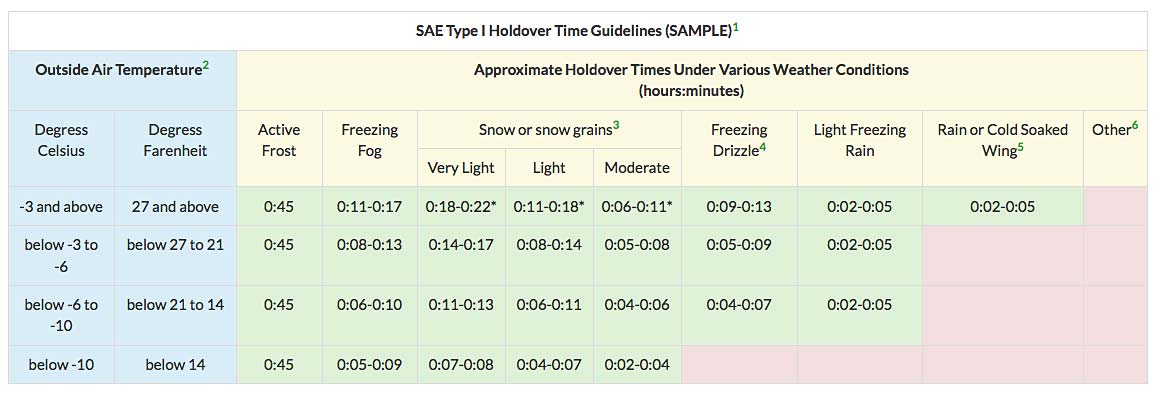
    Airlines use four standard fluid types when deicing aircraft. These fluids have different viscosities – viscosity is a measure of a fluid’s resistance to flow – and holdover times, which is the length of time the fluids are expected to protect the plane during snow or icing conditions.

    The deicing process includes both complex crew logistics and interesting science.

    In the United States, airlines typically use a two-step process before flying. First, they perform deicing using either a heated Type I fluid or a heated solution of Type I fluid and water.

    Deicing removes existing ice and snow from the wings of the plane, which is why airlines often heat the deicing fluid to around 140 to 150 degrees Fahrenheit (60 to 66 degrees Celsius) before application.

    Type I fluids are the thinnest of the deicing fluids, and they’re often red or orange. They spread the easiest on a plane’s surface because they have the lowest viscosity. Since they’re thin enough to flow off a plane when it’s not moving – or moving slowly – they can be applied to any aircraft.

    But as a result, they also have the shortest holdover times, often less than 20 minutes depending on the weather conditions. These holdover times vary, though, and can be less than five minutes for snow if the outside air temperature is below 14 F (minus 10 C).

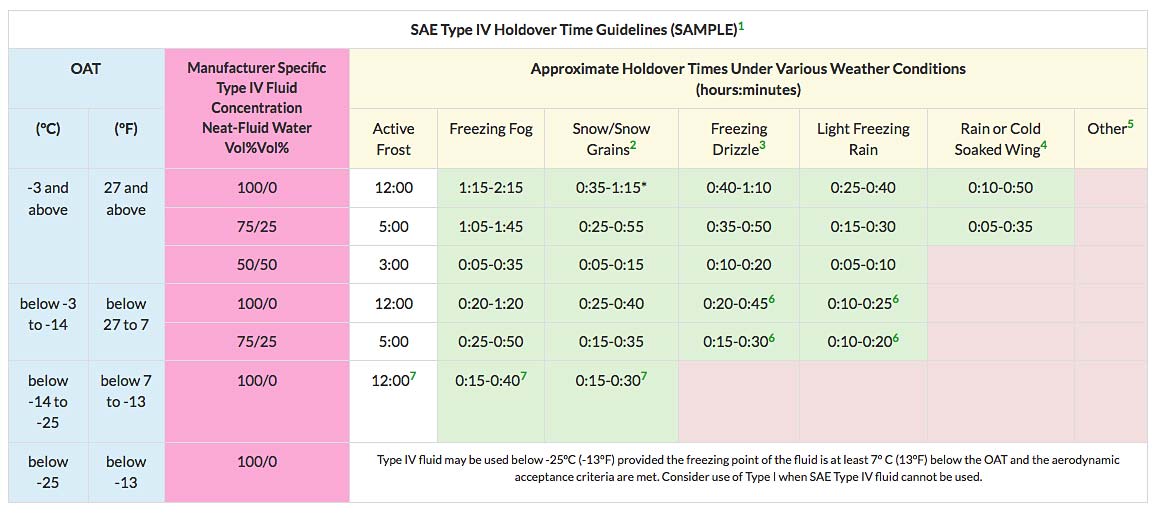
    Next, the ground crews will typically apply an anti-icing fluid to the aircraft – often Type II or Type IV. Anti-icing solutions are used to help prevent the future accumulation of snow and ice on the wings of planes.

    Type II and Type IV fluids contain thickening agents that increase their viscosity. These thickeners allow the fluid to remain on the aircraft longer to help melt newly forming frost or ice. This translates to longer holdover times – often more than 30 minutes for snow – but it also means the plane needs to reach a higher speed to shear, or blow off, the fluid.

    Once applied, Type II and IV fluids will generally stay on the aircraft until the plane is taxiing down the runaway during takeoff. By then, it has gained enough speed to produce the shear force necessary to remove the fluid from the plane. Type II fluids are a clear or pale straw color, while Type IV fluids are generally green. Including a colored dye helps the ground crew clearly see what parts of the plane have been coated and which areas still need application.

    Type III fluids are not as common anymore. They are formulated to shear off at lower speeds and thus are sometimes used on small commuter aircraft since these planes typically don’t go as fast as commercial jetliners.

    Environmental impact of deicing

    Environmental considerations are also an important part of deicing. Glycols require a lot of oxygen to biodegrade, which can deplete dissolved oxygen in streams or lakes. This, in turn, can threaten aquatic life, like fish and other organisms, that need dissolved oxygen to breathe.

    In addition, ethylene glycol is toxic to wildlife, so the Environmental Protection Agency requires airports to monitor their stormwater runoff. For this reason, most airports collect and treat stormwater runoff on-site or send it to a municipal wastewater treatment facility.

    Airports are also increasingly starting to use fluid recovery systems to recycle the glycols and capture the additives in these fluids, which are often toxic, too. They’ll often use designated areas outside for deicing planes so they can collect and store the fluids after they run off the plane in holding tanks underground until they can be recycled.

    Atmospheric icing

    During flight, planes use other technologies to mitigate the icing risks. For example, most modern aircraft use bleed air systems, which channel hot air from the engine’s compressor through interior ducts to the leading edges of the wings and other critical areas to help prevent ice buildup while the plane is in the sky.

    Some planes also use electrically heated panels embedded in the aircraft’s wings to generate heat. These control systems typically cannot be used while the plane is on the ground, since they rely on cold air flowing across the wing’s surface. This airflow is usually achieved at cruising altitude and is necessary to prevent the plane’s surface from getting too hot.

    Airlines may sometimes also use icephobic coatings to help keep new ice from forming and sticking on the outside surfaces of planes. These coatings delay how soon new ice can form. They can also reduce how strongly the ice adheres to the surface.

    Icephobic polymer coatings can mitigate ice buildup and help reduce ice adhesion on surfaces.
    Hernández Rodríguez et al., 2024., CC BY-SA

    Smaller planes may also use inflatable rubber strips called pneumatic boots on the wings that can be inflated as needed to break off accumulated ice on the leading edge of the wings.

    Flying is truly a modern scientific marvel. A lot of engineering goes into not only getting planes off the ground but also keeping them ice-free during flight. So the next time you experience a weather-related delay at the airport, just remember that deicing is needed to ensure both a safe flight and a truly uplifting one.

    Andrew Sommers does not work for, consult, own shares in or receive funding from any company or organization that would benefit from this article, and has disclosed no relevant affiliations beyond their academic appointment.

    ref. The science behind airplane deicing – a mechanical engineer explains how chemistry and physics make flying a more uplifting experience – https://theconversation.com/the-science-behind-airplane-deicing-a-mechanical-engineer-explains-how-chemistry-and-physics-make-flying-a-more-uplifting-experience-248732

    MIL OSI – Global Reports

  • MIL-OSI Video: Opening the Black Box of NIBIN

    Source: US National Institute of Justice (video statements)

    Bill King discusses the operations of the National Integrated Ballistic Information Network (NIBIN), a program through which firearms examiners at state and local crime laboratories compare tool marks on fired bullets or cartridges found at a crime scene to digitized images of ballistic evidence in a nationwide database.

    Dr. King headed up a team of NIJ-funded researchers that examined the value of NIBIN database “hits” in solving crimes in which firearms are used. He will talk about the team’s findings and recommendations for improving the tactical value and the strategic value of the NIBIN program.

    Dr. King is joined by John Risenhoover, NIBIN’s national coordinator at the Bureau of Alcohol, Tobacco and Firearms, who will discuss how ATF has used the research findings in an effort to improve the efficiency and effectiveness of NIBIN.
    (Opinions or points of view expressed represent the speaker and do not necessarily represent the official position or policies of the U.S. Department of Justice. Any product or manufacturer discussed is presented for informational purposes only and do not constitute product approval or endorsement by the U.S. Department of Justice.)

    https://www.youtube.com/watch?v=CUrK4wsRTPM

    MIL OSI Video

  • MIL-OSI Security: Columbia Man Returns to Federal Prison Following Gun Charge

    Source: Office of United States Attorneys

    COLUMBIA, S.C. — Daisean Montez Skeeters, 31, of Columbia, has been sentenced to a total of 57 months in federal prison for being a felon in possession of a firearm, which violated both federal criminal law and his federal supervised release from a previous conviction.

    Evidence obtained in the investigation revealed that on July 17, 2024, Columbia Police Department officers responded to a domestic violence call at Skeeters’ home. After arriving, police learned there might be firearms in the home. Because Skeeters was already on federal supervised release for a previous weapons conviction, agents also spoke to his U.S. Probation Officer, who said that he was also advised of firearms in the home. Agents obtained a search warrant for the residence and located two firearms. Agents obtained a second search warrant for Skeeters’ DNA to compare to swabs taken from those firearms. DNA testing confirmed an extremely high probability that Skeeters’ DNA was present on one of the firearms. Skeeters entered a guilty plea to knowingly possessing that particular firearm as a convicted felon.

    Skeeters was already on federal supervised release following a previous conviction for being a felon in possession of a firearm, this conviction was also a violation of the terms of that supervised release. Skeeters was also a high-ranking member of a violent street gang in Columbia.

    United States District Mary Geiger Lewis sentenced Skeeters to a total of 57 months’ imprisonment, which was comprised of a 24-month revocation of his supervised release and a consecutive term of 33 months’ imprisonment for the new criminal charge, to be followed by a three-year term of court-ordered supervision.  There is no parole in the federal system.

    This case is part of Project Safe Neighborhoods (PSN), a program bringing together all levels of law enforcement and the communities they serve to reduce violent crime and gun violence, and to make our neighborhoods safer for everyone. On May 26, 2021, the department launched a violent crime reduction strategy strengthening PSN based on these core principles: fostering trust and legitimacy in our communities, supporting community-based organizations that help prevent violence from occurring in the first place, setting focused and strategic enforcement priorities, and measuring the results.

    This case was investigated by the Bureau of Alcohol, Tobacco, Firearms and Explosives and the Columbia Police Department. Assistant U.S. Attorneys Elliott Daniels and Matthew Sanford are prosecuting the case.

    ###

    MIL Security OSI

  • MIL-OSI: Alternative Ballistics Corporation Appoints Jags Gill as Chief Revenue Officer, International

    Source: GlobeNewswire (MIL-OSI)

    Las Vegas, Nevada, Feb. 28, 2025 (GLOBE NEWSWIRE) — Alternative Ballistics Corporation is proud to announce the appointment of Jags Gill as Chief Revenue Officer, International. With over 12 years of successful experience in global sales, leadership, and channel development, Jags is set to drive the company’s international growth strategy, expanding its presence and revenue across global markets.

    In his new role, Jags will leverage his extensive experience in building and leading international teams, while fostering long-term relationships with key stakeholders within law enforcement, military, and government organizations. His proven track record of navigating complex cultural, political, and economic factors in diverse global markets makes him ideally suited to lead Alternative Ballistics’ expansion and strengthen its position as a leader in innovative security solutions.

    Jags is deeply passionate about using technology to support those who serve and protect us. His commitment to placing transformative tools into the hands of law enforcement professionals and military personnel aligns perfectly with the mission of Alternative Ballistics Corporation: to enhance public safety and empower professionals with life-saving technologies. With his expertise and vision, Jags is poised to contribute significantly to the company’s growth and success on the global stage.

    Jags Gill shared his excitement about the new opportunity:

    “I am honored to join Alternative Ballistics Corporation at such an exciting time for the company. The opportunity to work with a team that is committed to providing innovative solutions to those who make a difference every day is truly inspiring. I look forward to building on the company’s strong foundation and leading its international revenue strategy, bringing our transformative technologies to more professionals and organizations around the world.”

    Steve Luna, CEO of Alternative Ballistics Corporation, commented on the appointment:

    “We are thrilled to welcome Jags Gill to Alternative Ballistics as our new Chief Revenue Officer, International. His exceptional experience in global sales and leadership, combined with his deep understanding of international markets and passion for innovative technology, will be a tremendous asset to our team. Jags shares our commitment to improving public safety, and we are confident that his expertise will help us expand our reach and drive continued growth.”

    Alternative Ballistics Corporation continues to lead the way in providing cutting-edge security solutions, with a mission to enhance the safety of professionals in law enforcement, military, and security sectors. With Jags Gill’s leadership, the company is poised for a new era of growth and innovation on the global stage.

    About Alternative Ballistics Corp.

    Alternative Ballistics Corporation (“ABC”) produces an innovative less-lethal product known as The Alternative® which features patented bullet capture technology. The product is used by law enforcement as a de-escalation tool in critical incidents when encountering a non-compliant subject in crisis, in possession of a weapon other than a firearm, who presents a threat to themselves, to officers, or to bystanders. A lightweight, easy-to-carry docking unit, The Alternative® efficiently attaches to a service weapon to convert a fired bullet into a kinetic impact round that, when deployed from a safe distance, travels downrange with non-penetrating energy, and temporarily incapacitates an individual with low risk of critical injury or death. Once deployed, the service weapon reverts to standard use. The Alternative® may also be available in the future in the commercial market as a self-defense tool for the purpose of protecting life and property. It is the only less-lethal product in either the law enforcement or commercial market that works with a service weapon or semi-automatic handgun for seamless protective cover and doesn’t require transition to a separate device, allowing the user to keep eyes and weapon on the threat at all times.

    Forward-Looking Statements

    This document contains forward-looking statements. In addition, from time to time, we or our representatives may make forward-looking statements orally or in writing. We base these forward-looking statements on our expectations and projections about future events, which we derive from the information currently available to us. In evaluating these forward-looking statements, you should consider various factors, including: our ability to advance the direction of the Company; our ability to keep pace with new technology and changing market needs; and the competitive environment of our business. These and other factors may cause our actual results to differ materially from any forward-looking statement.

    Company Contact:
    www.alternativeballistics.com

    For Investor Inquiries, please contact:
    Hanover International, Inc.
    Kathy Cusumano, President
    ka@hanoverintlinc.com

    The MIL Network

  • MIL-OSI: Stifel Celebrates Mikaela Shiffrin’s Historic 100th Win With Donation to Her “MIK100” Initiative

    Source: GlobeNewswire (MIL-OSI)

    ST. LOUIS, Feb. 28, 2025 (GLOBE NEWSWIRE) — Stifel (NYSE: SF), the official team naming partner of the Stifel U.S. Alpine Ski Team, is proud to celebrate the 100th career World Cup victory for Mikaela Shiffrin this past weekend as she captured first place in slalom in Sestriere, Italy, by supporting her efforts to raise $100,000 for the Share Winter Foundation.

    Shiffrin broke the all-time record for World Cup wins (86) back in March 2023 and has continued to build on that incredible record before notching her historic 100th win on Sunday in Italy. This season, she picked up wins 98 and 99 in late fall, before an abdominal injury at the Stifel Killington Cup in Vermont sidelined her for nearly two months.

    The historic 100th win came as she led by just 0.09 seconds after the first run. But a clean and relaxed second run allowed Shiffrin to claim victory by .61 seconds over Croatia’s Zrinka Ljutic with Stifel U.S. Alpine Ski teammate Paula Moltzan placing third.

    In honor of the milestone, Stifel will contribute a $10,000 donation to Shiffrin’s “MIK100: Reset the Sport” initiative to support learn-to-ski programs for youths in partnership with the Share Winter Foundation.

    “Mikaela continues to raise the bar and set new standards, not just in skiing but in the history of sport,” said Stifel Chairman and CEO Ronald J. Kruszewski, who was in attendance in Killington when Shiffrin last had the 100 milestone in her sights. “To have her win number 100 by coming back from injury like she has with resilience and determination this winter is amazing to watch. And for Mikaela to use the milestone to raise money for learn-to-ski initiatives through the Share Winter Foundation is a testament to who she is as a person and athlete, looking to spread the passion and access to skiing to more people.”

    In recognition of her accomplishment, Stifel created a new broadcast spot celebrating the historic moment that will run nationally, highlighting the uniqueness of Shiffrin’s outsized talent yet humble character. There are also online digital and social executions with Stifel print ads celebrating Shiffrin set to run in select markets over the coming weeks as the World Cup circuit returns to North America in late March. Creative production was handled by Known, Stifel’s agency on the Stifel U.S. Ski Team partnership.

    “We are proud of our multiyear association with such an amazing athlete and global ambassador,” added Kruszewski. “Mikaela has changed the game and is building a legacy that goes beyond her results as she looks for ways to use this platform of 100 wins and create opportunities for others to engage in the sport.”

    Shiffrin and the rest of the women of the Stifel U.S. Alpine Ski Team have upcoming races in Norway, Sweden, and Italy before returning to the U.S. for the Stifel Sun Valley Finals in Sun Valley, Idaho, March 22-27, to finish the World Cup calendar for this season.

    Stifel Company Information
    Stifel Financial Corp. (NYSE: SF) is a financial services holding company headquartered in St. Louis, Missouri, that conducts its banking, securities, and financial services business through several wholly owned subsidiaries. Stifel’s broker-dealer clients are served in the United States through Stifel, Nicolaus & Company, Incorporated, including its Eaton Partners and Miller Buckfire business divisions; Keefe, Bruyette & Woods, Inc.; and Stifel Independent Advisors, LLC; in Canada through Stifel Nicolaus Canada Inc.; and in the United Kingdom and Europe through Stifel Nicolaus Europe Limited. The Company’s broker-dealer affiliates provide securities brokerage, investment banking, trading, investment advisory, and related financial services to individual investors, professional money managers, businesses, and municipalities. Stifel Bank and Stifel Bank & Trust offer a full range of consumer and commercial lending solutions. Stifel Trust Company, N.A. and Stifel Trust Company Delaware, N.A. offer trust and related services. To learn more about Stifel, please visit the Company’s website at www.stifel.com. For global disclosures, please visit https://www.stifel.com/investor-relations/press-releases.

    For further information,
    contact Brian Spellecy
    (314) 342-2000        

    The MIL Network

  • MIL-OSI Global: How to make a political Oscars speech that doesn’t flop – according to rhetorical theory

    Source: The Conversation – UK – By Tom F. Wright, Reader in Rhetoric, University of Sussex

    So, it’s happened. You’re on stage, Oscar statue in hand, facing Hollywood’s finest and millions of viewers. You could keep it simple – thank your agent, your co-stars, your dog. Or you could use this moment to say something that matters.

    That’s exactly what Jane Fonda just did at the 2025 Screen Actors Guild Awards, urging the audience “to resist successfully what is coming at us” as Elon Musk’s Doge holds a chainsaw to the US federal government. From the cold war to civil rights to Trump 2.0, award ceremonies have always been stages for activism.

    Some of these political speeches have been electrifying. Some have flopped. Some have been drowned out by the orchestra before they even got started. If you’re going to make a political speech at the Oscars, you’d better do it right.

    Thankfully, Kenneth Burke — one of the 20th century’s most influential rhetorical scholars — offers a road map. His theories on identification, dramatism and symbolic action explain why some speeches resonate while others fall flat.


    Looking for something good? Cut through the noise with a carefully curated selection of the latest releases, live events and exhibitions, straight to your inbox every fortnight, on Fridays. Sign up here.


    1. Know your two (very different) audiences

    Burke argued in the 1950s that rhetoric isn’t just about persuasion – it’s about identification. A speaker is most persuasive when they convince their audience that they share the same values and concerns. If people feel you’re “one of them”, they’re more likely to listen.

    The Oscars create a unique rhetorical challenge. Inside LA’s Dolby Theatre, you might be surrounded by like-minded pampered progressives. But beyond that room, millions of viewers at home may be far less receptive.

    Michael Moore’s infamous acceptance speech in 2003.

    Director Michael Moore learned this the hard way in 2003 when, after winning best documentary for his film Bowling for Columbine, he stormed the stage and declared: “Shame on you, Mr Bush! Shame on you!” The result? A mix of cheers and boos. And days of being pilloried on cable news. Instead of drawing people in, Moore’s approach alienated half his audience.

    Compare this with Meryl Streep’s speech at the 2017 Golden Globes when collecting her lifetime achievement award. She also criticised her president but framed it differently: “Disrespect invites disrespect. Violence incites violence. When the powerful use their position to bully others, we all lose.”

    She didn’t need to utter Donald Trump’s name. And because she framed her speech as a universal concern, rather than a partisan attack, it resonated beyond the room.

    2. Put yourself in the story

    Burke’s second idea is that all communication is “dramatic” – a performance shaped by setting, characters and conflict. In a political speech, the most compelling “character” is often you, the speaker.

    Audiences don’t just respond to abstract arguments. They connect with people who embody the very struggle they’re speaking about.

    Lily Gladstone accepting the Golden Globe for best actress in 2024.

    Lily Gladstone’s 2024 Golden Globes speech worked this way. When she won best actress for Killers of the Flower Moon, she didn’t start with industry statistics or broad calls for change. Instead, she spoke in Blackfeet, honouring her Indigenous roots: “I just spoke a bit of Blackfeet language, a beautiful community – the nation that raised me.”

    That one sentence transformed her win into a moment of cultural recognition, making her speech as much an act of representation as a speech about representation.

    3. Frame your argument wisely

    If you want your audience to engage, you must frame your message in a way that pulls them in. Whereas a speech that just states a problem can feel like noise, one that connects the issue to a larger story can be powerful.

    This is where Burke’s idea of symbolic action comes in. He defined it as “the making or construction of social reality through symbols that foster identification”. Put another way: words don’t just describe reality, they shape it.

    Oprah Winfrey’s speech from the 2018 Golden Globes.

    Take Oprah Winfrey’s 2018 Golden Globes speech picking up the Cecil B. DeMille award. Instead of simply condemning sexism in Hollywood, she tied it to a broader historical movement, from civil rights to #MeToo: “For too long, women have not been heard or believed if they dared to speak their truth to the power [of] those men. But their time is up. Their time is up!”

    Winfrey wasn’t just talking about change – she was creating it in real time, rallying the room behind a clear, urgent message. That’s the difference between listing a problem and delivering a message that sticks.

    4. Turn your speech into an act of protest

    While framing helps persuade an audience, some moments go further, becoming acts of defiance themselves. This is when a speech moves beyond words into symbolic action.

    Let’s take perhaps the most famous protest in Oscars history. In 1973, Marlon Brando refused to pick up his best actor statue – sending in his place Sacheen Littlefeather, who explained she was there as a protest for Hollywood’s treatment of Native American people.

    Sacheen Littlefeather refuses to accept the best actor Oscar on behalf of Marlon Brando.

    “He very regretfully cannot accept this very generous award,” she told the audience. “And the reasons for this being are the treatment of American Indians today by the film industry … and on television in movie reruns, and also with recent happenings at Wounded Knee.”

    In under a minute, she transformed what could have been a quiet refusal into a national reckoning. The audience’s reaction – some cheering, some booing – only made it clearer. This wasn’t just a speech, it was a moment.

    A speech that merely describes a problem may be forgotten, but one that transforms the moment itself? That’s the stuff of history.

    5. Expect a backlash, and decide if you care

    No matter how well you craft your speech, someone is going to be angry. Burke’s final idea for helping us understand this is the “scapegoat mechanism”, by which one figure is cast as the discordant element that must be removed to restore unity.

    If you make a political speech at the Oscars, it could be you. Vanessa Redgrave learned this in 1978: after winning best supporting actress for her role in Julia, she defended her pro-Palestine activism against attacks from the Jewish Defence League, who she called a “bunch of Zionist hoodlums”. The reaction was instant – cheers mixed with boos.

    Vanessa Redgrave accepts the Oscar for supporting actress in 1978.

    Later that night, screenwriter Paddy Chayefsky publicly rebuked her, saying: “A simple ‘thank you’ would have sufficed.” The backlash hurt Redgrave’s career, but she stood by her words.

    If you’re going to say something political, be prepared to own it. And make sure you beat the orchestra.

    Tom F. Wright does not work for, consult, own shares in or receive funding from any company or organisation that would benefit from this article, and has disclosed no relevant affiliations beyond their academic appointment.

    ref. How to make a political Oscars speech that doesn’t flop – according to rhetorical theory – https://theconversation.com/how-to-make-a-political-oscars-speech-that-doesnt-flop-according-to-rhetorical-theory-250949

    MIL OSI – Global Reports

  • MIL-OSI Global: Emmanuel Macron used every diplomatic trick in the book at the White House – but Trump writes his own rules

    Source: The Conversation – UK – By Helen Drake, Professor of French and European Studies and Director of Loughborough University London’s Institute for Diplomacy and International Affairs, Loughborough University

    If there was a book of diplomacy, then French president Emmanuel Macron threw it at US president Donald Trump in their joint press conference in Washington DC. Macron delivered quite the masterclass in the diplomatic arts. Unthreatening body language and public displays of affection? Check.

    Meeting your interlocutor on any and every inch of common ground? Check. Macron’s willing use of fluent English was a key tactic here. Other than when answering French-language questions (when to have responded in English would have brought Macron yet more domestic grief), he adapted to the language of his hosts.

    Macron and Trump’s press conference.

    Recalling shared memories of happier, shared times? Check. It was smart to remind Trump of his time as a guest at the reopening of Notre Dame cathedral in Paris just a few months previously.

    Gently correcting a friend in danger of veering too far from reality (here, regarding the extent and type of European aid to Ukraine) as you would expect from a true ally? Again, check.

    These are the soft skills of diplomacy as communication between human beings to which Macron typically brings his heart, body and soul. On this occasion and on this criterion he outperformed even himself, and outclassed his host by some degree.

    At times, Trump looked enraptured by this performance from such an interesting specimen of utter Europeanness. At others, the host fidgeted and listened stony-faced to the halting interpretation of Macron’s rapid-fire French. He tried a few gauche niceties of his own (“say hello to your beautiful wife”) and dialled up to the max his personal brand of touchy-feely diplomacy.

    Behind the scenes

    Beyond the memorable set pieces of diplomatic theatre lies, of course, the message itself. This must represent the voice, the interests and the concerns of the state or other diplomatic actor. But it may well go against the flow, disrupting the smooth surface of diplomatic pleasantries.

    Former French president Charles de Gaulle notoriously ruffled cold-war feathers in the 1960s with rousing speeches to stir non-aligned countries and French-speaking people to contest the existing world order. Former foreign minister Dominique de Villepin will be remembered for his eloquent, impassioned plea to the United Nations security council in 2003 against the allied invasion of Iraq.

    Macron has dabbled in free-wheeling diplomacy himself. He claimed in 2019 that Nato was close to “brain death” and maintained a dialogue with Russia’s president Vladimir Putin after the 2022 Russian invasion of Ukraine. In Macron’s account at the press conference with Trump, he closed this line of communication when he learned of the atrocities being perpetrated by Russian forces.

    Articulating France’s global, strategic interests is where Macron feels most comfortable and probably where he is best suited (judged by the standards of his domestic political failings). His trip to Washington at such a pivotal moment in Trump’s second presidency, with the fate of Ukraine in the balance, was a natural move for a leader who, since the beginning of his first mandate in 2017, has sought to lead the European conversation about the continent’s security.

    His sense of urgency to secure greater European autonomy and capacity in its defence lies behind his willingness to talk to all parties. France does, after all, go by the fiendishly untranslatable label of a “puissance d’équilibres” (which means an actor with the power to strike a balance but also perhaps to bring others into balance or even, simply, to keep the peace).

    Macron’s readiness to confront the cold, hard facts of contemporary international relations – he has already told the French they need to put themselves on a wartime footing in economic terms – gives him a track record of sorts in the diplomatic negotiations now to come: between Europeans themselves, and between Europe and the US.

    But facing down Macron’s fancy optics is one particularly awkward fact – namely that Trump does not do diplomacy by the book, or at least not the one he was metaphorically gifted by president Macron. Where the point of diplomacy is to establish a common language with shared codes and expectations in order to ease tensions and bridge differences between parties, Trump’s diplomatic how-to guide boasts new chapters on the arts of bullying, harassment, gaslighting and, of course, the deal.


    Read more:
    Trump and Europe: US ‘transactionalism on steroids’ is the challenge facing leaders now


    For now, the US president is tolerating the quaint diplomatic overtures of these curious Europeans and given the ultra-high stakes of what couldn’t be further from a game, that is diplomacy itself.

    Helen Drake does not work for, consult, own shares in or receive funding from any company or organisation that would benefit from this article, and has disclosed no relevant affiliations beyond their academic appointment.

    ref. Emmanuel Macron used every diplomatic trick in the book at the White House – but Trump writes his own rules – https://theconversation.com/emmanuel-macron-used-every-diplomatic-trick-in-the-book-at-the-white-house-but-trump-writes-his-own-rules-250832

    MIL OSI – Global Reports

  • MIL-OSI: The Father of Third-Party Logistics Passes Away

    Source: GlobeNewswire (MIL-OSI)

    NEW FREEDOM, Pa., Feb. 28, 2025 (GLOBE NEWSWIRE) — Nexterus, a world-class supply chain management and third-party logistics (3PL) services provider is saddened to announce the death of its former CEO, Jay Polakoff. Mr. Polakoff was the second-generation owner of Nexterus, America’s oldest privately held non-asset based third party logistics company. He died from injuries sustained in an automobile accident on February 25, 2025, one day before his 89th birthday.

    In 1967, 31-year-old Jay Polakoff inherited the transportation consulting firm his father founded twenty-one years earlier in downtown Baltimore. The boutique firm was called Transportation Bureau of Baltimore and helped small and mid-sized companies audit freight bills and settle disputes with freight companies, namely less-than-truckload (LTL) and truckload with some railroad activity. The firm was small and eked out a modest living for its diminutive staff.

    Jay wanted to build the company his father created. He created a subscription-based service to become the Logistics (then called Traffic) department for small companies. Jay worked up a business model, formulated a basic contract, and began hiring customer service staff and people with expertise in transportation rates and regulation. For amounts as low as $100 per month, the company, often referred to as TBB, provided freight routing, pre-and-post audit of trucking invoices, expediting, and filing and follow-up of claims for loss and damage. The company began to grow as hundreds of customers embraced the value proposition of the country’s first “outsourced” traffic department service. Today, varying resources place the revenue of the third-party logistics industry to be between $200-$300 billion.

    In 1980, Congress began deregulating the trucking industry. With help from transportation attorneys at Grove, Jaskiewicz and Cobert in Washington, DC, Jay began an LTL brokerage by aggregating the volume of TBB’s clients and negotiating with carriers. Older LTL carriers recall how TBB was their first brokerage customer. The list includes Estes ExpressWard Transport and Logistics, Overnite Transportation (sold to UPS and is now T-Force), Roadway Express and many others. With these relationships, TBB grew to be the largest LTL broker in America during the 1990s.

    As deregulation progressed, competitive pressures forced dozens of LTL carriers out of business. The rates charged by these bankrupt entities were not properly filed with the Interstate Commerce Commission (ICC). The estates of the carriers went back to shippers to reclaim the discounted amounts which, at that time, were routinely in the 50% range. A $4 billion national undercharge crisis ensued that took two acts of Congress and a Supreme Court decision to resolve. Jay, using his knowledge as a licensed ICC practitioner, his business degree, vast business experience, and his relationship with Ron Cobert from the DC law firm, developed ironclad LTL contracts that insulated TBB clients from paying a dime to the bankrupt motor carrier estates.

    “My father was a true industry pioneer. He had the business acumen and the courage to create a national powerhouse with LTL brokerage, the country’s first privately held freight payment plan and its first Transportation Management System (TMS).” – Nexterus Chairman, Sam Polakoff

    A few years later, large banks controlling all the nation’s freight payment services, decided rather abruptly to exit the business due to declining opportunities to make money on “float.” Recognizing an opportunity, Jay commissioned his team to evaluate the viability of offering the country’s first privately held freight payment plan. That service launched in 1987 and continues to this day.

    In the mid-1980’s, with the LTL brokerage growing like wildfire, TBB maintained three shifts of typists to create freight invoices, for amounts as little as $35. The typing pool simply couldn’t keep up with the volume, so Jay engaged a general computer programming firm to work with his team to develop what is believed to be America’s first Transportation Management System (TMS). That system went live in the late 1980’s.

    Jay Polakoff successfully led the company from 1967 till his retirement in 2000. He was an early member in today’s influential industry organizations such as the Council of Supply Chain Professionals (CSCMP) then known as the National Council for Physical Distribution Management and Transportation Intermediaries Association then known as Transportation Brokers Conference of America and NASSTRAC. Mr. Polakoff held a bachelor’s degree in business from the University of Baltimore, served as an adjunct professor at his alma mater and was a frequent guest columnist for prominent industry publications such as Inbound Logistics and Traffic World, now part of the Journal of Commerce. He built long-term customer relationships with many companies at their earliest stages including Lands End, QVC Network, Polk Audio and School Specialty.

    Jay Polakoff was born in Brooklyn, New York on February 26, 1936. He was raised in Baltimore and lived the remainder of his years in the greater Baltimore area. He is survived by Ann Polakoff, his wife of 51 years, sons, Ed (Liz) Polakoff, Phil (Lori) Polakoff, Sam (Denise) Polakoff and nine grandchildren including current Nexterus 4th generation CEO, Ryan (Rischelle) Polakoff.

    To learn more about Nexterus, please visit Nexterus.com

    About Nexterus
    Nexterus solves urgent and complex supply chain issues, applying expertise and technology to manage and optimize global supply chains. As America’s oldest private, non-asset-based, third-party logistics (3PL) company, Nexterus helps small and medium-sized companies better compete through the power of their supply chains. With best-in-class strategies and services, Nexterus gives clients the freedom to build their businesses without being distracted by complex supply chain challenges and tedious tasks, allowing these companies to improve productivity, efficiencies, and customer service. Please find us at nexterus.com (https://www.nexterus.com).

    For More Information, contact:
    Mary Schmidt
    Nexterus
    Cell: (717)-817-5763
    Mschmidt@nexterus.com

    A photo accompanying this announcement is available at https://www.globenewswire.com/NewsRoom/AttachmentNg/8237d1b4-fd3d-43bc-b671-c8635f94263d

    The MIL Network

  • MIL-OSI Russia: Exercises at the Polytechnic: Readiness Check

    Translartion. Region: Russians Fedetion –

    Source: Peter the Great St Petersburg Polytechnic University – Peter the Great St Petersburg Polytechnic University –

    On February 27, the Polytechnic University held an object training. This time, the Polytechnicians worked out algorithms for actions in the event of an attack by an unmanned vehicle and a fire.

    Activities in the field of anti-terrorist security, fire safety, civil defense and emergency prevention and response are held at SPbPU regularly.

    The head of the training, Vice-Rector for Security at SPbPU Alexander Airapetyan informed the participants of the initial situation and the plan of the training.

    At the first stage, workers and students practiced taking cover in basements (ground) upon receiving the signal “Attention everyone!” with a voice message about the danger “Attack by an unmanned aerial vehicle.”

    According to the scenario, an air raid siren sounded. After receiving the signal, everyone began to descend to the basement. Staff and students responded quickly and moved to shelter in place within eight minutes.

    The second stage was devoted to evacuation from the building in case of fire. According to the plan, the criminal, who was on the territory of the university, decided to arrange a provocation by using an incendiary mixture to set fire to the security post of the third academic building. However, the criminal failed to enter the building, and he set fire to the entrance door (model), after which he tried to escape.

    The attacker was quickly detained by a patrol group of the security organization “Yu-Piter”, and the fire was quickly localized by volunteers of the student fire and rescue squad “Pyotr Velikiy”, which is part of the All-Russian Student Rescue Corps.

    At the end of the event, SPbPU Vice-Rector for Security Alexander Airapetyan thanked all the participants of the exercises, highly appreciating their organization, and emphasized the importance of conducting such training for students and staff.

    Photo archive

    Please note: This information is raw content directly from the source of the information. It is exactly what the source states and does not reflect the position of MIL-OSI or its clients.

    MIL OSI Russia News

  • MIL-OSI USA: Governor Newsom announces appointments 2.27.25

    Source: US State of California 2

    Feb 27, 2025

    SACRAMENTO – Governor Gavin Newsom today announced the following appointments:

    Aaron Maguire, of Roseville, has been appointed Executive Officer of the Board of State and Community Corrections, where he has been Acting Executive Officer at the Board of State and Community Corrections since 2024, and was previously Chief Deputy Director and General Counsel from 2022 to 2024, and General Counsel from 2016 to 2022. Maguire was Owner and Managing Partner at Maguire & Pank from 2014 to 2016. He was General Counsel and Legislative Representative at Warner & Pank, LLC from 2012 to 2016. Maguire was Assistant Secretary of Legislation at the California Department of Corrections and Rehabilitation in 2012. He was a Deputy Legislative Affairs Secretary in the Office of Governor Brown from 2011 to 2012. Maguire was a Deputy Legislative Affairs Secretary in the Office of Governor Schwarzenegger from 2009 to 2010. He was Deputy Attorney General in the Office of the California Attorney General from 2001 to 2009. Maguire earned a Juris Doctor degree from the University of California, Davis and a Bachelor of Arts in Literature from the University of California, San Diego. This position requires Senate confirmation, and the compensation is $219,156. Maguire is a Democrat. 

    Abby Edwards, of Sacramento, has been appointed Senior Deputy Director of State Planning and Policy at the Governor’s Office of Land Use and Climate Innovation. Edwards has held multiples roles at the Governor’s Office of Land Use and Climate Innovation since 2022, including Acting Senior Deputy Director, Deputy Director of Climate and Planning Programs, and Adaption Planning Program Manager. She was Program Development and Operations Manager at CivicWell from 2019 to 2022. Edwards was a Manager for Twisted Fields from 2018 to 2019. She was a Sustainable Agricultural Specialist at the Peace Corps from 2016 to 2018. Edwards was a Course Manager at the University of California, Santa Cruz from 2014 to 2016. She earned a Master of Public Administration degree in Environmental Policy and Management from University of Colorado, Denver and a Bachelor of Arts degree in Environmental Science from University of California, Santa Cruz. This position does not require Senate confirmation, and the compensation is $170,004. Edwards is a Democrat.

    Gareth Elliott, of Sacramento, has been reappointed to the University of California Board of Regents, where he has served since 2015. Elliott has been Partner at Sacramento Advocates, Inc. since 2015. He was Legislative Affairs Secretary in the Office of Governor Edmund Brown Jr. from 2011 to 2015. Elliott was Policy Director at the Office of State Senator Alex Padilla in the California State Senate from 2008 to 2011. He held multiple roles in the Office of State Senate President Pro Tempore Don Perata from 2004 to 2008, including Deputy Chief of Staff and Legislative Director. Elliott held multiple roles in the Office of State Senate Don Perata in the California State Senate from 1996 to 2004, including Legislative Director and Legislative Aide. He earned a Bachelor of Arts degree in Political Science from California State University, Humbolt. This position requires Senate confirmation, and there is no compensation. Elliott is a Democrat. 

    Darnell C. Grisby, of Oakland, has been reappointed to the California Transportation Commission, where he has served since 2021. Grisby has been Senior Vice President of Beneficial State Foundation since 2022. He was Executive Director of TransForm from 2020 to 2021. Grisby was Director of Policy Development and Research at the American Public Transportation Association from 2011 to 2020. He was Deputy Policy Director at Reconnecting America from 2010 to 2011. Grisby was Government Affairs Representative at Farmers Insurance from 2007 to 2010. He was Legislative Director in the Office of Assemblymember Mike Davis from 2006 to 2007. Grisby was a Budget and Policy Analyst at the New York Independent Budget Office from 2003 to 2006. He was Legislative Assistant in the Office of Assemblymember Jenny Oropeza from 2000 to 2001. He earned a Master of Public Policy degree from Harvard University, and a Bachelor of Arts degree in Political Science from the University of California, Los Angeles. This position requires Senate confirmation, and the compensation is $100 per diem. Grisby is a Democrat. 

    Press Releases, Recent News

    Recent news

    News SACRAMENTO – California and a consortium of 21 Brazilian states are partnering together to combat pollution and foster sustainable economic growth. Governor Gavin Newsom and Governor Renato Casagrande of the Brazilian state of Espírito Santo signed a Memorandum…

    News SACRAMENTO – Governor Gavin Newsom today announced multiple clemency actions. He granted pardons in three cases. He also sent multiple clemency cases to the Board of Parole Hearings, initiating the process for granting clemency in fifteen cases. He also sent two…

    News What you need to know: Governor Newsom today released a new economic vision for California’s future with a bold plan, realized locally. The unveiling comes alongside the announcement of more than $245 million in investments to help support workers statewide,…

    MIL OSI USA News

  • MIL-OSI USA: Governor Newsom partners with 21 Brazilian state governors to protect the environment, cut harmful pollution

    Source: US State of California 2

    Feb 27, 2025

    SACRAMENTO – California and a consortium of 21 Brazilian states are partnering together to combat pollution and foster sustainable economic growth. 

    Governor Gavin Newsom and Governor Renato Casagrande of the Brazilian state of Espírito Santo signed a Memorandum of Understanding (MOU) today that establishes a four-year partnership between California and the Brazilian consortium of states leading on environmental protections, Consórcio Brasil Verde (CBV).

    Together with these 21 Brazilian states, California is committed to advancing a bold, collaborative action plan that tackles pollution, protects public health and safety, and creates good-paying jobs.

    Governor Gavin Newsom

    This collaboration encompasses clean air, transportation and energy; adaptation; forest management; and more. The full text of the MOU is available here. R20 Regions of Climate Action – an organization founded by former Governor Arnold Schwarzenegger to support subnational climate work – played a key role in supporting this MOU.

    “This is a historic opportunity to join efforts and share knowledge between Brazilian states and California, which is a reference in combating climate change,” said Governor Renato Casagrande. “The partnership not only reaffirms our commitment to sustainability but also highlights the importance of active participation from everyone in building solutions that benefit our planet.”

    How we got here: California met its 2020 climate target six years ahead of schedule thanks to world-leading climate policies and partnerships across the U.S. and around the world, created to share best practices and support cooperation on climate work.

    • Last year, Governor Newsom welcomed a new international partnership with South Korea’s Gyeonggi Province to collaborate on climate and economic efforts. Also last year, Governor Newsom welcomed delegations from Sweden and Norway and signed renewed climate partnerships with the two governments.
    • In 2023, Governor Newsom led a California delegation to China, where California signed five MOUs – with China’s National Development and Reform Commission, the provinces of Guangdong and Jiangsu, and the municipalities of Beijing, and Shanghai. The trip also resulted in a first-of-its-kind declaration by China and California to cooperate on climate action like aggressively cutting greenhouse gas emissions, transitioning away from fossil fuels, and developing clean energy.
    • Also in 2023, California signed a MOU with the Chinese province of Hainan, as well as with Australia.
    • In 2022, California signed Memorandums of Cooperation with Canada, New Zealand and Japan, as well as Memorandums of Understanding with China and the Netherlands, to tackle the climate crisis. The Governor also joined with Washington, Oregon, and British Columbia to recommit the region to climate action.

    Press Releases, Recent News

    Recent news

    News SACRAMENTO – Governor Gavin Newsom today announced multiple clemency actions. He granted pardons in three cases. He also sent multiple clemency cases to the Board of Parole Hearings, initiating the process for granting clemency in fifteen cases. He also sent two…

    News What you need to know: Governor Newsom today released a new economic vision for California’s future with a bold plan, realized locally. The unveiling comes alongside the announcement of more than $245 million in investments to help support workers statewide,…

    News What you need to know: Governor Newsom today issued a statement in response to the Trump administration’s announcement that it had released more than $315 million of obligated money to create new water storage at the future Sites Reservoir and at the existing San…

    MIL OSI USA News

  • MIL-OSI NGOs: Release of civilian hostages held in Gaza and arbitrarily detained Palestinians must be immediate and not hinge on ceasefire negotiations

    Source: Amnesty International –

    The release of Israeli and foreign national civilians held hostage by Hamas and other armed groups in Gaza, and Palestinians arbitrarily detained by Israel, must take place immediately and should not be contingent on the outcome of political negotiations over the next phase of the ceasefire, said Amnesty International, as the first phase of the hostage-prisoner swap deal draws to a close.

    Overnight on 26/27 February, Hamas returned the bodies of four Israeli hostages in exchange for the release of 640 Palestinian prisoners and detainees, as part of the last exchange deal under the first phase of the ceasefire agreement. The release of Palestinian prisoners had been delayed by Israel in previous days. Negotiations over the second phase of the ceasefire are set to agree the release of remaining Israeli hostages and further Palestinian detainees and prisoners, as well as a full Israeli withdrawal from Gaza, and a permanent end to hostilities.

    “Israeli and foreign hostages and Palestinian detainees must not be treated as political pawns in a despicable power struggle over the next phase of the ceasefire deal. Only a durable ceasefire, including unhindered humanitarian assistance for Gaza, will end suffering for all. But the release of both civilian hostages and Palestinians arbitrarily detained – especially those held without charges or trial – should not be a matter of negotiation; it is a matter of international law. Hostage taking is a war crime. There can be no justification for abducting anyone to use as a hostage, nor for the prolonged, arbitrary detention of individuals to serve as bargaining chips,” said Erika Guevara Rosas, Senior Director for Research, Advocacy, Policy and Campaigns at Amnesty International.

    “Israel and Hamas must release all unlawfully held individuals – immediately – regardless of the outcome of political negotiations over phase two of the ceasefire.”

    Israeli and foreign hostages and Palestinian detainees must not be treated as political pawns in a despicable power struggle over the next phase of the ceasefire deal

    Erika Guevara Rosas, Senior

    At least 59 hostages, the vast majority of them Israelis, remain in captivity in Gaza, of whom at least 24 are believed to be alive.

    Over 4,000 Palestinians are held without charge or trial either under administrative detention or based on the Unlawful Combatants’ Law, which violates international law.  

    The release of Palestinian detainees and Israeli hostages in recent weeks has raised grave concerns over inhumane treatment in custody and dire conditions of detention for both hostages in Gaza and detainees in Israel.

    At least 250 individuals, alive and dead, were taken hostage in southern Israel during the Hamas-led attacks on 7 October 2023. An Israeli forensic examination of the bodies of at least six deceased hostages retrieved in August 2024 indicates they were shot dead at close range shortly before their retrieval suggesting they were killed by their captors.

    Hamas has also withheld the bodies of two Israeli soldiers since 2014. One of those bodies was recovered by Israeli forces during a military operation in January 2025.

    Israeli media reports indicate some released hostages described being held in tunnels while in chains, deprived of food and with very limited exposure to daylight. They also reported being subjected to torture and other ill-treatment.

    Hamas has publicly paraded hostages and forced them to participate in humiliating public handover ceremonies in front of crowds. In one incident, the coffins of deceased Israeli hostages, including two children, were displayed publicly in front of a poster depicting Prime Minister Benjamin Netanyahu as a vampire. 

    “Outrages to personal dignity, in particular humiliating and degrading treatment, are prohibited by international humanitarian law. Yet we have witnessed hostages being paraded in public as trophies of war or coerced to participate in propaganda videos. Hamas and other armed groups must immediately put an end to these degrading spectacles and ensure all hostages and human remains are treated with respect and dignity,” said Erika Guevara Rosas.

    “All those who remain in captivity must be treated humanely and protected from torture and other ill-treatment and be given access to the International Committee of the Red Cross, and to medical care.”

    Palestinian detainees released during the ceasefire deal have also emerged from detention looking gaunt and bearing signs of torture and other ill-treatment. Amnesty International has previously documented how detainees have been subjected to enforced disappearance, incommunicado detention and widespread torture in custody including through beatings, starvation and other cruel inhuman or degrading treatment. At least 60 Palestinian detainees have died while in Israeli custody since 7 October 2023.

    “Continuing to arbitrarily hold thousands of Palestinians without any legal grounds is cruel, unjustified and blatantly unlawful. Israeli authorities must stop using arbitrary detention and refrain from holding the bodies of deceased Palestinians as bargaining chips. Until the detainees are released, Israel must allow international monitors access to detention facilities. All individuals in custody must be protected from torture and provided with adequate food, water and medical treatment, as well as access to their families and lawyers,” said Erika Guevara Rosas.

    Israeli authorities also forced Palestinians to undergo degrading and humiliating treatment during their release, including forcing them to wear shirts with a Star of David logo and the slogan “we will not forget or forgive”.

    In one case in September 2024, Israeli forces also sent containers including the remains of at least 88 unidentified Palestinians to Gaza, who were then buried in a mass grave. The bodies of at least 600 Palestinians continue to be held by Israeli forces as bargaining chips under a long-standing illegal Israeli practice that predates October 2023.

    “The bodies of the deceased should never be treated as a battleground. All parties to the conflict have a clear obligation to respect and uphold the dignity of the living and the dead, including ensuring that bodies and remains are properly identified and handed over with dignity,” said Erika Guevara Rosas.

    MIL OSI NGO

  • MIL-OSI NGOs: An interview with Chris Chapman

    Source: Amnesty International –

    Chris Chapman is Amnesty International’s Advisor on Indigenous Peoples’ Rights. Working with communities around the world, he has seen how states continue to violate the rights of Indigenous Peoples, failing to involve them in decisions that affect them, most recently during the Covid-19 pandemic.

    Inspired by the incredible people he’s met and interviewed, and his years working in human rights, Chris has now penned a research guide on how to assess whether people have been effectively involved in decisions that affect them and been able to influence them.

    Can you tell me about your role at Amnesty and what it involves?

    I am a researcher and advisor for Indigenous Peoples’ rights. I’m currently focusing on conservation and protected areas and how they impact Indigenous Peoples. Quite often, protected areas are established on lands claimed by Indigenous Peoples. For example, on the borders of Paraguay and Brazil, an Indigenous People has been evicted to make way for a hydroelectric dam. The company has created protected nature reserves around the new borders of the river, yet the displaced Indigenous People have no right to go into those nature reserves, due to lack of consultation by governments.

    I also support people at Amnesty who are doing research on the situations of Indigenous Peoples and provide advice.

    Is there a piece of research that has had a lasting impact on you?

    I was inspired by a joint project between Amnesty’s human rights education team and our Philippines office. They worked with communities all over the Philippines, shared lots of resources on running human rights campaigns, and now they apply these to the most important and pressing issues in their communities. It’s a great example of how Amnesty can share skills and experience and empowers others.

    Another inspiring experience was working with Elias Kimaiyo, an activist and leader for the Sengwer Indigenous People in Kenya. We worked together on a report that came out in 2018. Elias never had the opportunities many of us have had but it’s not held him back. He tells the truth about what is happening to the Sengwer whether it’s to his local MP, in Nairobi, or in Geneva or Brussels. He’s also an amazing photographer and video maker. While I was writing up the research, I learnt he had been out in the field filming the Kenya Forest Service who were evicting his people from their forest. He was shot at by one of the rangers and it permanently damaged his arm. But he continues the work.

    When governments take decisions that might impact on people’s human rights, there is an obligation to consult those people and involve them meaningfully in decision-making.

    Chris Chapman

    What’s the aim of Amnesty’s new research guidelines, Public participation in decision-making ?

    Amnesty’s new guide is for researchers on how to research processes of public participation in decision-making. When governments take decisions or implement projects that might impact on people’s human rights, there is usually an obligation to consult those people and involve them meaningfully in decision-making.

    This guide provides guidance to researchers who want to research such processes to make sure the government has fully complied with its obligations. The researchers could be from NGOs like Amnesty, or academics, or people from the affected communities themselves. It’s about seeing if things are being done as they should – whether that involves consulting the public on projects such as clearing informal settlement housing, building a dam, or passing a new law which will affect a particular group of people.

    The research guide is incredibly engaging – it’s beautifully presented and packed with photographs, so hopefully it’s appealing and useful to those who want to use it. Within it, there’s a series of practical tools for researchers, such as example lists of questions which you need to ask in a particular situation. For example, if a mine or a dam is being built, there is a checklist for what information communities should receive. I really hope researchers will pick it up and use it.

    Why is the guide needed?

    When the public aren’t consulted by the government on issues that affect them, it can affect their human rights negatively. In some cases, governments just tell people what they’re going to do without listening to them. In addition, Indigenous Peoples have the right to free, prior and informed consent, which means that they should be not only consulted, but that the proposal should not go ahead against their will.

    During the pandemic, governments were scrambling to take emergency action very quickly – they closed schools and learning went online. Many Indigenous communities who live in rural areas didn’t have sufficient access to the Internet. In some cases, there weren’t enough devices for a remote connection for schooling and materials weren’t provided in specific languages.  

    Aymara indigenous women walk their children to the Ladislao Cabrera school during their first week of face to face classes, amid the COVID-19 pandemic. The children of the Machacamarca highlands town in Bolivia started face to face classes, due to the lack of means to access virtual education.

    Governments took steps to close down schools without taking into account the issues Indigenous peoples would face. They weren’t ready for these challenges and failed to adapt their policies, which led to a detrimental impact on children’s education. Their schooling effectively ended, causing a long-lasting impact.

    How does it feel to hear these stories?

    It’s really sad. Sometimes we talk about how human rights researchers get a bit blasé because they hear so many accounts and you’re exposed to human rights violations every day. But when you hear first-hand accounts, it’s obviously going to affect you and if it doesn’t, maybe it’s time to reach out for support, as it could be a sign that you’ve reached burn out.

    How could Indigenous Peoples be included in their government responses to emergencies?

    Indigenous Peoples in the Philippines have put an emergency response protocol in place, covering what the government should do when there’s an emergency. Initially designed for floods and hurricanes, it could easily be adapted for pandemics.

    The plan details what the government should do immediately after a disaster, as well as numerous initiatives that can be done immediately or staggered over time. It’s a great idea and if Indigenous Peoples have such a protocol, governments should comply with them, it would provide a starting point for knowing how to consult on pandemic responses.

    Finally, how did you get into this area of work?

    I was always interested in human rights. I was a member of a local Amnesty group in my twenties and passionate about dealing with injustices in the world. I travelled around and worked in Guatemala just as the peace accords had been signed, ending decades of civil conflict. There were people who had gone into exile and who wanted to return, or they had gone into hiding in remote places in Guatemala. They wanted to return to normal life, but they wanted international observers in their communities because they still didn’t trust the army. So I worked in a rainforest community for five months, teaching maths, and getting involved in the community’s activities – it was an incredible experience where people told me about what happened during the civil war. It was powerful and inspired me to work within the human rights field.

    MIL OSI NGO

  • MIL-OSI United Nations: 28 February 2025 Donors making a difference: community engagement to promote, provide and protect the health and well-being of all

    Source: World Health Organisation

    WHO defines community engagement as “a process of developing relationships that enable stakeholders to work together to address health-related issues and promote well-being to achieve positive health impact and outcomes”.

    WHO’s partners and donors support the Organization to work in this area as there are undeniable benefits to engaging communities in promoting health and well-being. At its core, community engagement enables changes in behaviour, environments, policies, programmes and practices within communities.

    Below are some country stories that demonstrate the breadth of community engagement work that WHO conducts, resulting in more positive health outcomes for the people in these communities than before.

    Uganda trains district health workers on community-based approach to Ebola

    Uganda trains Community Health workers from Kole, Mukono and Wakiso districts on community-based approach to Ebola. Photo by: WHO/Sadat Kamugisha 

    Uganda’s Ministry of Health conducted a training on Ebola disease detection and management for Community Health Workers representatives from Kole, Wakiso, and Mukono districts. Participants focused on multi-sectoral action to safeguard communities from emerging zoonotic diseases with pandemic potential such as Ebola.

    Communities play an integral role in raising awareness, supporting case identification, tracing contacts, and maintaining essential health services. The emphasis on collaboration with local leaders, volunteers, and health workers is vital for effective responses to public health emergencies. Building on lessons learned from past health crises, Uganda has already made substantial advancements in emergency preparedness.

    The three-day event was supported by WHO, and the UK Public Health Rapid Support Team (UK-PHRST), which is a UK aid project funded by the Department of Health and Social care. The community protection approach is a central component of WHO’s new Health emergency prevention, preparedness, response, and resilience framework.

    Visit the WHO/Uganda web page to read the full story.

    Community engagement for access to health services in Lao PDR

    CONNECT team members discuss community health priorities in Khammouane Province, Lao PDR. Photo by: WHO/Enric Catala

    Developed by the Lao Ministry of Health and Ministry of Home Affairs in response to COVID-19 with the support of WHO and partners, the CONNECT initiative enhances local governance and community engagement for equitable access to public services, particularly health.

    Supported by USAID, the Australian Government and Luxembourg, as of July 2024, CONNECT reached over 230 villages across 10 provinces (including Vientiane Capital) and support already in-place for expansion to all provinces.

    An external evaluation of implementation in 12 villages found an increase in essential service uptake for maternal health and improved attitudes towards using primary care; increased trust in health providers; increased sense of ownership of health at community level; and increased vaccination uptake and confidence, especially among ethnic groups and previously unreached communities.

    Visit the WHO/WPRO web page to read the full story.

    Côte d’Ivoire community radios boost public awareness on mpox outbreak

    Community radios, pillar of the fight against mpox. Photo by: WHO/Toiherou De Marfere Sidibe

    A network of community radio stations, known as Radio Santé, comprises 350 stations in West African, with over half based in Côte d’Ivoire. Launched in 2020 during the COVID-19 pandemic with major support from WHO, Radio Santé has become a preferred channel for disseminating reliable, verified health information. It brings together nearly 1000 journalists and communications specialists.

    Radio Santé is an interactive and accessible tool for mobilizing communities around health issues, throughout Côte d’Ivoire and across borders. Health authorities use Radio Santé to counter rumours and misinformation, and to strengthen community engagement, which is crucial to curbing the spread of diseases such as mpox.

    After WHO declared mpox as a public health emergency of international concern in August 2024, Radio Santé devoted its health talk show to mpox. 185 Ivorian community radio stations have since broadcasted messages on mpox. Over 50 programmes have been produced and broadcast in eight countries: Benin, Burkina Faso, Chad, Guinea, Mali, Niger, Senegal and Togo.

    Visit the WHO/Côte d’Ivoire web page to read the full story.

    Bolivia strengthens social participation in health for indigenous population

    Indigenous organizations are clear about their requests. They want free and equitable access to health care, an improved indigenous health network, incorporation of traditional medicine, and the consideration of the indigenous population’s culture, customs, and practices. Photo by: WHO/PAHO

    The Ministry of Health and Sports of Bolivia is engaging indigenous populations in community participation processes, creating space for them to discuss health topics, share concerns, and contribute to a health improvement plan.

    The meaningful inclusion and engagement of indigenous populations in health policy planning, taking into account the social determinants of health, is critical to ensure context-specific interventions, uptake of guidance and services, and positive health outcomes for all.

    PAHO/WHO, through the Universal Health Coverage Partnership, has supported the Ministry of Health and Sports of Bolivia in this endeavour since 2021. The UHC Partnership operates in over 125 countries, representing over 3 billion people. It is supported and funded by Belgium, Canada, the European Union, France, Germany, Ireland, Luxembourg, Japan, the United Kingdom of Great Britain and Northern Ireland, and WHO

    Visit the PAHO/AMRO web page to read the full story.

    Weaving hope in Honduras: the community wisdom that saves lives

    Maternal health in Honduras Hermelinda shares her experience. Photo by: WHO/Honduras

    In Honduras, high rates of maternal and neonatal mortality are often the result of multiple factors, including socioeconomic barriers, lack of access to adequate healthcare services, gaps in education and awareness about maternal and child health, and cultural differences.

    Hermelinda Hernández, who is familiar with the local practices and beliefs of her community and also recognizes the value of professional medical interventions, participated in the “Knowledge Dialogues Methodology” workshop organized by the Honduran Ministry of Health with the support of PAHO/WHO and funded by Global Affairs Canada.

    The workshop aimed to promote mutual understanding between midwives and healthcare providers to reach agreements that improve the health of women, and adolescent girls in situations of vulnerability within the community.

    Visit the PAHO/AMRO web page to read the full story.

    Grassroots heroes in Cambodia

    Mrs Say Sa with her Baby in Cambodia’s Principal of Health Centre Kok Chuk. Photo by: Aforative media

    In Cambodia, village chiefs stepped up to create a healthier future for their communities. In villages across 25 provinces, 2000 village chiefs and nearly 5400 village health support groups received trainings, organised by the Ministry of Heath with support from WHO and the EU.

    This equipped the chiefs with knowledge and skills necessary to control transmission of COVID-19, influenza, and other respiratory diseases, and collaborate with authorities more closely on health issues facing their communities.

    The chiefs then shared their newfound knowledge during community dialogues, which then transformed how community members adopted healthier practices. Empowered with accurate information, communities embraced protective measures during times of high COVID-19 transmission.

    Visit the WHO/WPRO web page to read the full story, and more on EU’s support to WHO in ASEAN region.

    Bolstering public awareness to help curb mpox spread in Uganda

    Dr Kenneth Kabali, WHO Field Coordinator for Busoga Sub-region sensitizes the community on mpox in Mayuge district, Eastern Uganda. Photo by: WHO/Abdu Mutwalibu Seguya

    Uganda witnessed an upsurge in mpox cases, with laboratory-confirmed cases increasing from 24 as of 21 September to 413 as of 7 November 2024. Health authorities, with support from WHO and partners, worked closely with communities to raise awareness about the dangers of the disease and how to stay safe, and address misinformation and stigma.

    The risk communication and community engagement team reached more than 100 fishmongers, fisherfolk, boda boda (motorbike taxi) riders, 8000 school children and 30 sex workers. In addition, 500 teachers in the district have been oriented on mpox.

    WHO is also using mass media to expand the reach of mpox response communication. With funding from USAID, WHO has contracted 10 regional radio stations and 2 national TV stations to raise awareness and promote preventative behaviour.

    Visit the WHO/AFRO web page to read the full story.

    Combating measles: a comprehensive community-centred approach in Ethiopia

    Combating measles, a comprehensive community-centred approach in Ethiopia. Photo by: WHO/Hassen Ali

    In the districts of Sidama, Central, and South Ethiopia, access to healthcare is often challenging, exacerbated by various health emergencies. A community-led initiative made remarkable progress in combating measles, malaria, and malnutrition through collaborative efforts between local health facilities, community health workers, and government agencies.

    The initiative received significant financial support from the European Civil Protection and Humanitarian Aid Operations (ECHO) bolstering community-based intervention efforts.

    By leveraging collaboration between healthcare facilities, community health workers, and local communities, this initiative represents a beacon of hope in improving healthcare access and outcomes in regions of Ethiopia.

    Visit the WHO/Ethiopia web page to read the full story.

    WHO races to contain malaria resurgence in southeastern Iran

    Malaria resurgence in Iran. Photo by: WHO/Iran

    A race against time is underway in southeastern Iran, where the resurgence of malaria threatens to undo years of progress. The dramatic rise in cases has been attributed to the devastating floods in neighbouring Pakistan in September 2022 which led to an expansion of malaria breeding sites.

    WHO, with crucial support from the Government of Japan, is on the ground in Sistan and Baluchestan Province, battling this public health emergency and working to protect vulnerable communities. Japan’s generous contribution provided 4902 mosquito dome tents offering families protection from infected mosquitos, 50 000 malaria rapid diagnostic tests enabling health care workers to quickly identify and treat infected individuals, and 1655 kg of insecticides, deployed to contain mosquito populations at their source. The combined resources are estimated to benefit 77 400 people in the province.

    In December 2024, a WHO mission observed a proactive approach to malaria control demonstrated by local health workers as they conducted house-to-house screenings, distributed mosquito nets and educated communities on how to use them.

    Visit the WHO/Iran web page to read the full story.

    Mali: screening for malnutrition in affected children to avoid complications

    Screening for malnutrition in affected children to avoid complications, Mali. Photo by: WHO/Razzack Saizonou

    Malnutrition among children is one of the main health problems that the affected populations of Ségou had to face after severe floods hit Mali between July and October 2024. Having lost everything including their food reserves and their means of subsistence, people found themselves in a very precarious situation.

    Among the more than 370,000 people affected by these floods, children, who represent 45% of the affected population, are particularly vulnerable. To enable access to health care, WHO, with thanks to the Central Emergency Response Fund, supported the deployment of mobile clinics on relocation sites.

    In the Ségou region, three sites were set up and equipped with medical tents. Medical staff go there five times a month. Between July and October 2024, nearly 700 children suffering from malnutrition were identified in the three health districts of the Ségou region.

    Visit the WHO/Mali web page to read the full story in French.

    Effective community engagement saving lives in Tanzania during cholera outbreak

    Abdul Zachari, a young man is washing his hands. Photo by: WHO/Clemence Eliah

    The recurrence of Cholera outbreaks has been a threat to many lives in the United Republic of Tanzania for decades now. In mid-2024, situation reports from the Ministry of Health indicated that, the outbreak have been reported in 19 regions of Tanzania Mainland. Thanks to flexible funding available for responding to outbreaks such as this, WHO has been able to support the Government’s efforts to control cholera outbreaks. Risk Communications and Community Engagement (RCCE) Experts worked on the ground delivering an intensive community sensitization in over 92 households and 32 villages . The joint and community-based action plan against Cholera outbreak was built jointly, this way enhancing 54 community members and local authorities from the affected wards and districts. The community engagement strategies adopted generate local solutions tailored to control and prevent further transmissions in these areas. In addition, WHO applied behavioral science approaches to guide tailored interventions to community protection and resilience – and as a result, enhancing many lives in Tanzania.

    Visit the WHO/Tanzania web page to read the full story.

    * * * *

    Read more about the WHO’s community engagement work.

    The donors and partners acknowledged in this story are (in alphabetical order) Australia, Belgium, Canada, the European Union (ECHO), France, Germany, Ireland, Luxembourg, Japan, the United Kingdom of Great Britain and Northern Ireland, United Nations Central Emergency Response Fund, and the USA Agency for International Development.

    WHO’s work is made possible through all contributions of our Member States and partners. WHO thanks all donor countries, governments, organizations and individuals who are contributing to the Organization’s work, with special appreciation for those who provide fully flexible contributions to maintain a strong, independent WHO.

    MIL OSI United Nations News

  • MIL-OSI USA: Cyclone Flurry in the Southern Hemisphere

    Source: NASA

    Two different oceans were crowded with tropical cyclones in late February 2025. In the South Pacific, three storms were active at one point—an occurrence that is rare but not unheard of. Simultaneously, a trio of cyclones roiled in the neighboring Indian Ocean.
    Five tropical cyclones are visible in this false-color image, acquired on February 26 by the VIIRS (Visible Infrared Imaging Radiometer Suite) sensor on the NOAA-20 satellite. The image depicts infrared signals known as brightness temperature, which are useful for distinguishing cooler cloud structures (white and purple) from the warmer surface below (yellow and orange). The day before this image was acquired, a sixth storm, Tropical Cyclone Rae, was weakening east of the area shown here after bringing heavy rain to Fiji.
    Cyclones Alfred and Seru lurked alongside Rae in the South Pacific. Seru lingered offshore of Australia, reaching Category 1 strength on the Saffir-Simpson wind scale for a short time. Alfred was also forecast to stay offshore, according to the Australian Bureau of Meteorology, but was expected to bring hazardous coastal conditions to southern Queensland. The storm was at Category 2 strength on the day of this image but would intensify to Category 4 on February 27.
    Off Western Australia, Tropical Cyclone Bianca was on the tail end of its journey, having weakened to tropical storm status on February 26. The previous day, it had intensified to Category 3 but stayed far enough from land that mainland Australia and island communities were not expected to feel its effects.
    Bianca’s Indian Ocean cohabitants, Honde and Garance, posed more hazards to land. The island nation of Mauritius, east of Madagascar, shut down its airport on February 26 as Garance approached, according to news reports. The storm would strengthen from Category 2 that day to Category 3 the next, with wind speeds of 190 kilometers (120 miles) per hour. Meanwhile, Honde skirted south of Madagascar as a Category 1 storm. Heavy rain, strong winds, and storm surge were forecast for central and southern Madagascar, Mauritius, and Réunion island.
    Meteorologists noted that warm sea surface temperatures and weak wind shear conditions may have contributed to the proliferation of storms. A marine heat wave has lingered off of Western Australia since September 2024, and anomalously high sea surface temperatures warmed in the area in late February 2025. For the South Pacific, the Australian Bureau of Meteorology had predicted a higher-than-average likelihood of severe tropical cyclones this season due to expected warm ocean temperatures. Tropical cyclone season generally runs from November through April in the Southern Hemisphere.
    NASA Earth Observatory image by Michala Garrison, using MODIS and VIIRS data from NASA EOSDIS LANCE and GIBS/Worldview and the Joint Polar Satellite System (JPSS). Story by Lindsey Doermann.

    MIL OSI USA News

  • MIL-OSI USA: Public Invited to Appeal or Comment on Flood Maps in Tulsa County, Oklahoma

    Source: US Federal Emergency Management Agency

    Headline: Public Invited to Appeal or Comment on Flood Maps in Tulsa County, Oklahoma

    Public Invited to Appeal or Comment on Flood Maps in Tulsa County, Oklahoma

    DENTON, Texas – Revised Preliminary flood risk information and updated Flood Insurance Rate Maps (FIRMs) are available for review in Tulsa County, Oklahoma. Residents and business owners are encouraged to review the latest information to learn about local flood risks and potential future flood insurance requirements.The updated maps were produced in coordination with local, state and FEMA officials. Significant community review of the maps has already taken place, but before the maps become final, community residents can identify any concerns or questions about the information provided and participate in the 90-day appeal and comment period.The 90-day appeal and comment period will begin on or around Feb. 27, 2025. Appeals and comments may be submitted through May 28, 2025, for:The city of TulsaResidents may submit an appeal if they consider modeling or data used to create the map to be technically or scientifically incorrect.An appeal must include technical information, such as hydraulic or hydrologic data, to support the claim.Appeals cannot be based on the effects of proposed projects or projects started after the study is in progress.If property owners see incorrect information that does not change the flood hazard information — such as a missing or misspelled road name in the Special Flood Hazard Area or an incorrect corporate boundary — they can submit a written comment.The next step in the mapping process is to resolve all comments and appeals. Once these are resolved, FEMA will notify communities of the effective date of the final maps.To review the preliminary maps or submit appeals and comments, visit your local floodplain administrator (FPA). A FEMA Map Specialist can identify your community FPA. Specialists are available by telephone at 877-FEMA-MAP (877-336-2627) or by email at FEMA-FMIX@fema.dhs.gov.The preliminary maps may also be viewed online:The Flood Map Changes Viewer at http://msc.fema.gov/fmcvFEMA Map Service Center at http://msc.fema.gov/portalFor more information about the flood maps:Use a live chat service about flood maps at floodmaps.fema.gov/fhm/fmx_main.html (just click on the “Live Chat Open” icon).Contact a FEMA Map Specialist by telephone at 877-FEMA-MAP (877-336-2627) or by email at FEMA-FMIX@fema.dhs.gov.There are cost-saving options available for those newly mapped into a high-risk flood zone. Learn more about your flood insurance options by talking with your insurance agent or visiting floodsmart.gov.
    toan.nguyen
    Thu, 02/27/2025 – 20:14

    MIL OSI USA News

  • MIL-OSI United Kingdom: The Councils ongoing commitment to securing and preserving heritage buildings

    Source: City of Preston

    In recent months, Preston City Council has identified numerous empty buildings within the city centre where community safety, preventing anti-social behaviour and/or preserving their heritage value needs to be addressed.

    Most of these buildings are in private ownership and so the Council has established a task group to oversee and co-ordinate action. This includes a range of departments from the Council and representatives from the Police and Fire Service.

    A liaison group with representatives from Preserving Preston’s Heritage has also been set up.

    The Council has taken steps to obtain ownership details and make contact with owners to draw attention to the risk to their property.

    Owners of the priority buildings have been invited to meet with the task group, but so far only two have replied.

    Furthermore, for certain listed buildings identified which are showing the most deterioration, it has been necessary for the Council to assess the risk to understand the extent of deterioration and damage, assess the scope of works needed to remedy it, decide whether statutory action is warranted and what type of action is appropriate.  

    Councillor Amber Afzal, Cabinet Member for Planning and Regulation at Preston City Council said:

    By adopting a joined up, multi-agency approach to tackling the complex issues that have blighted these properties through years of neglect, good progress is now being made. Public safety is our main concern but it is critical that also, wherever possible, we retain our heritage buildings that are so important to Preston’s history and give the city its unique cultural identity.

    Councillor Valerie Wise, Cabinet Member for Community Wealth Building and the City Regeneration portfolio at Preston City Council is also keen to see a brighter future for these neglected buildings. She said:

    Repurposing and bringing back to life these forgotten and unloved architectural gems, many of which are listed, is so important in the overall regeneration plans for the city.

    We will continue to work closely with the owners and landlords of these special interest properties to rejuvenate the city centre in the best possible way for future economic growth and architectural benefit.

    An update on the most significant cases is provided as follows:

    27 Winckley Square (former home of Edith Rigby) – Grade II listed building

    The Council has taken action and been engaging with the owners for some time in connection with community safety, preventing anti-social behaviour and/or preserving the heritage value of the building.

    Certain steps have been taken by the owners, but the Council are of the view that further work is necessary.

    The Council has previously instructed a survey of the building to assess its condition, which identified numerous concerns. Due to the condition of the building, it was not possible to complete the survey of the inside of the building.

    In December 2024 measures were taken by the owner to provide structural support to allow an internal survey to be carried out.

    The internal survey was carried out this week (week commencing 24 February), which will enable the Council to determine the scope of works necessary to remedy the deterioration and whether statutory action is warranted.

    This will be communicated to the owner in the first instance.

    The Council is aware the rooflight is open to the elements and the owner has confirmed that temporary measures will be taken to weatherproof the rooflight. This is an appropriate course of action until the scope of necessary repair works, which will include this, is determined.    

    The Old Dog Inn – Grade II listed building

    The Council has drawn the owner’s attention to the rear wall, which contains numerous cracks, some of which are significant in size and if not addressed could lead to an uncontrolled collapse.

    In an attempt to address the deterioration, the owner submitted a listed building consent application proposing to demolish and rebuild the rear wall. This was carefully assessed and following the submission of further information concerning the methodology of the work, listed building consent was granted in February 2025.

    The listed building consent was accompanied with a letter informing the owner that given the condition of the rear wall had worsened and to prevent an uncontrolled collapse of the rear wall, the Council is actively considering the use of statutory enforcement powers to execute works urgently necessary for the preservation of the building.

    To that end, the Council instructed a survey of the building, which has been carried out, to inform the owner of what steps are needed to prevent an uncontrolled collapse.

    The owner is fully aware that unless the necessary works are completed within an appropriate timeframe then the works could be carried out by the Council in default.  

    St. Joseph’s Orphanage, Mount Street – complex of Grade II listed buildings

    Planning permission and listed building consent were both granted in February 2021 for alterations to the Chapel and attached tower, demolition of five listed buildings and the erection of three apartment blocks and ten town houses.

    Three out of the five buildings have been demolished. One building, adjoining the tower, has been partially demolished.

    The other building adjacent to Mount Street was the subject of a fire in November 2024. The fire has left this building unsafe and dangerous, and Mount Street was closed as a result until the building is demolished to protect the public.

    The delays in the demolition have largely been due to satisfying the Health and Safety Executive that the demolition methodology satisfactorily addressed the removal of asbestos and the safety of the building and those adjoining, the demolition contractors and members of the public.

    Ground works commenced this week, and the demolition will start on 03 March 2025, and it is expected to be completed in 12-weeks.

    Harris Institute, Grade II* listed building

    The Council has taken action and is engaging with the owner in connection the deterioration of the building and its future preservation.

    Certain steps have been taken by the owner, which include remediation works to the party wall, repairing the roof and addressing the water ingress, and eradicating dry rot, the latter takes time to treat and remove.

    Planning permission and listed building consent were both granted in December 2024 for minor alterations, several community and office uses, and holiday lets within Regent House.

    The owner has responded positively and has recently met with the Council to provide an update on the future of the building.

    The approved scheme for the building will be delivered in phases, with the holiday lets opening first before the rest of the scheme is delivered.

    Additional Information

    • Grade II* listed – This has greater importance as a heritage asset.

    Preston City Council actively applies and prioritises the principles of Community Wealth Building wherever applicable and appropriate.

    Community Wealth Building is an approach which aims to ensure the economic system builds wealth and prosperity for everyone.

    MIL OSI United Kingdom

  • MIL-OSI Asia-Pac: Some due to ignorance, label our spirituality as superstition-VP

    Source: Government of India

    Vice President’s Secretariat

    Some due to ignorance, label our spirituality as superstition-VP

    This is the land of Shyama Prasad Mukherjee….fortunate that the festering wound he saw, is no longer present in our Constitution-VP

    In our culture, we have endured cruelty, invasions…When Nalanda was set on fire, just imagine what was destroyed!- VP

    About 1200-1300 years ago..our cultural and religious centers were destroyed; despite everything India’s culture could not be eradicated, it is still alive today-VP

    The answer to everything today can be found in Sanatan; Sanatan stands for inclusivity-VP

     Sanatan does not believe in subjugation, if you surrender to Sanatan, you are not a captive, you become a free person, a free soul-VP

    Greatest adornment for any country is not its wealth, but its culture-VP

    Religion cannot be seen in a narrow, conservative manner; religion cannot be assessed within limited boundaries-VP

    VP addresses the Closing Ceremony of 150th Birth Anniversary of Gaudiya Mission’s founder Acharya Srila Bhakti Siddhanta Saraswati Goswami Prabhupad

    Posted On: 28 FEB 2025 5:24PM by PIB Delhi

    The Vice-President, Shri Jagdeep Dhankhar today said that some due to ignorance are labelling our sacred elements like spirituality as superstition. Underlining that Sanatan stands for inclusivity, Shri Dhnakhar stated, “ Some people, due to ignorance or blindly pursuing the meaning of things, wrongly label our sacred elements, spirituality, as superstition.”

    “The answer to everything today can be found in Sanatan. What Sanatan teaches is essential for the system of today, no matter where in the world it is. Sanatan stands for inclusivity, Sanatan stands for universal goodness, Sanatan stands for the supremacy of the soul. Sanatan does not believe in subjugation. If you surrender to Sanatan, you are not a captive, you become a free person, a free soul”, he further stated.

    “Religion cannot be seen in a narrow, conservative manner. Religion cannot be assessed within limited boundaries. We must understand the true meaning of religion, and only then will we realize that we all need to resolve to make India ‘Vishwa Guru’ once again. And India becoming the ‘Vishwa Guru is the greatest auspicious message for the world”, he added.

    Addressing the gathering at the closing ceremony of 150th Birth Anniversary of Gaudiya Mission’s founder Acharya Srila Bhakti Siddhanta Saraswati Goswami Prabhupad, Shri Dhnakhar said, “ In our culture, we have endured cruelty, invasions, and barbarism……What kind of barbarity, extremity, and reckless destruction of our religious places, our cultural symbols! When Nalanda was set on fire, just imagine what was destroyed! How many floors did Nalanda have, how many lakhs of books were there, and they were not just for India, but for the entire world. The progress of technology today has some connection to the knowledge stored in our treasure of wisdom”.

    In his address he further stated, “This is the land of Shyama Prasad Mukherjee, who never compromised on nationalism. And what a huge sacrifice it was! Today, we are in a fortunate time, that the concerns Shyama Prasad Mukherjee had, his thoughts, his commitment to nationalism, and the festering wound he saw, is no longer present in our Constitution”.

    Emphasising on the significance of culture and the need to preserve the cultural aspects of society, Shri Dhankhar underlined, “Today, we need our children to have an awareness of our culture. It is a positive sign that many programs are being conducted in this direction, but if there is one greatest adornment for any country, it is not its wealth, but its culture. Once the culture is disrupted, the decline cannot be stopped. Cultural aspects, all elements related to culture, their preservation, sustenance, and protection are crucial because they define India”.

    “There was a time….when people from around the world came searching for knowledge, for light. Our institutions were of great repute, but at some point, we strayed from the path. Foreign invasions happened, this was about 1200-1300 years ago. A cruel act occurred, a thunderbolt, a violent blow struck, and our cultural and religious centers were destroyed. We had the occasion to witness barbarity in extremity. It’s unimaginable what was done. And see, despite everything that happened over 1000 years, India’s culture could not be eradicated. It is still alive today”, he added.

    Referring to India as the cultural centre of the world, the Vice-President highlighted, “ India is the cultural centre of the world and Kolkata is one of the epicentres of culture ! The challenges the world faces today are frightening. They compel us to think….We talk about climate change, but the greatest crisis today lies in the human mind. Humanity is restless. Even though we are materially rich, powerful, capable of demonstrating strength, something is still missing. And when people feel this lack, they see only one North Star—India.”

    Shri C.V. Ananda Bose, Hon’ble Governor of West Bengal,  Shri Suresh Gopi, Minister of State for Tourism, Srimad Bhakti Sundar Sanyasi Goswami Maharaj, President & Acharya, Gaudiya Mission and other dignitaries were also present on the occasion.

    ****

    JK/RC/SM

    (Release ID: 2106991)

    MIL OSI Asia Pacific News

  • MIL-OSI United Kingdom: Wild beavers: Nature’s engineers to return to English waterways

    Source: United Kingdom – Executive Government & Departments 2

    Press release

    Wild beavers: Nature’s engineers to return to English waterways

    Government to allow reintroduction of beavers into the wild after centuries of absence in a huge boost for nature conservation

    Credit: Beaver Trust

    • Brilliant beavers reduce flood risk, create new wetlands, and boost biodiversity
    • Reintroductions to be carefully managed under licence from Natural England

    Nature’s original master builder – the Eurasian beaver – is set to return to our waterways after centuries of absence, following a government decision to allow wild release.   

    Beavers are prodigious ecosystem engineers and proven climate champions – creating natural flood defences that can reduce flood risks and building wetlands which are thriving havens for wildlife.   

    Known as a keystone species because the habitats they create benefit myriad other species, they were once abundant in England but became extinct due to overhunting. In recent years, beavers have been returning to our waterways through a system of licensed releases into enclosures, and a limited trial of wild release in Devon.  

    Now in a major boost for conservation, the government has today (Friday 28 February) set out a new approach which will allow beavers to live wild in England’s treasured landscapes.  

    Ministers have set out how we will provide the certainty needed for conservationists, landowners and farmers in a new policy statement. It includes the detail of a new licensing system, support for landowners and farmers, and a commitment to produce a plan in consultation with these stakeholders for the long-term management of beavers in England.  

    The return of beavers will be carefully managed to avoid impacts on farming, food production and infrastructure. New wild release projects will need to have a project plan in place covering a 10-year period to support the introduction of beavers into a landscape before Natural England would consider granting a licence. 

    Nature Minister Mary Creagh said:  

    “Beavers are cherished creatures who bring so many benefits for people and our precious natural environment. They create wetlands which are havens for wildlife, reduce flood risk and improve the water quality of our rivers.  
       
    “Reintroducing beavers to the wild is a critical milestone for this Government’s plan to protect and restore our natural world.” 

    Tony Juniper, Chair of Natural England, said:   

    “Beavers have been missing from our landscapes for about four hundred years and this careful approach for their planned return is a significant landmark for Nature recovery in England. 

    “Beavers are environmental engineers. The dams, ponds and canals they build not only create amazingly rich habitats for many other species, but can also help reduce flood risk, purify water and catch carbon.  

    “Under licence from Natural England, the release of wild beavers will be managed to secure the long-term environmental benefits while seeking to minimise and avoid unwanted impacts.” 

    All existing beaver populations will be allowed to remain and expand naturally and will ensure that appropriate management measures are put in place. Existing populations of wild beavers will continue to be proactively managed by their local beaver management group.    

    Through this carefully planned reintroduction programme which is defined by a 5 step management approach, we will support farmers and communities to live alongside beavers, ensuring these natural problem-solvers benefit everyone.  

    The government will also now begin work on developing a long-term beaver management plan in England. This will build on the approach announced today and be developed with input from key stakeholders, to ensure we meet the challenges and opportunities posed by an expanding beaver population well into the future.  

    It is expected that the first release of wild beavers will happen at Purbeck Heaths National Nature Reserve soon with a licence issued to the National Trust.

    Hilary McGrady, Director General of the National Trust said:  

    “This is fantastic news for nature recovery and people’s livelihoods. Beavers are unparalleled in their ability to restore landscapes, create wetlands that manage flood risk, improve our water quality, and bring back wildlife.   

    “Since 2020, we’ve introduced beavers at three National Trust sites through licensed, enclosed releases. We’ve seen first-hand the amazing benefits these fascinating mammals provide, and we’re thrilled to receive a licence for the first wild beaver release in England.  

    “It’s important to us, and the communities we work in, that beaver releases across wider landscapes happen in a responsible, carefully managed way. This licensing process is in everyone’s best interests. It will lead to well-chosen sites, minimise disruption to other landowners, and ensure local communities are fully consulted and involved enabling both people and nature thrive.”   

    Alan Lovell, Chair of the Environment Agency said:  

    “As part of our work to reduce flood risk and restore rivers to good health, the return of wild beavers will improve water quality, boost biodiversity and build resilience to climate change through nature-based solutions.  

    “Beavers help reduce flooding in nearby towns, remove pollutants from our precious waterways and help to create clean water. Working alongside our partners, the Environment Agency will continue to support the careful management of wild beavers”. 

    Applications for further wild release licences will first need to submit an ‘expression of interest’ to Natural England. The deadline for the first round of applications is 2 May 2025, with further application windows due to open in due course.   

    Additional information: 

    Dr Roisin Campbell-Palmer of Beaver Trust said: 

    “This landmark moment in England’s beaver story could be a significant step toward helping to address some of the key environmental challenges we face. We welcome Government recognition of beavers’ potential and hope they now demonstrate their commitment through widespread license granting and proactive restoration of this species across England.  

    “We are generations behind the rest of Europe in bringing this species back, we have high levels of public support for their return, so we now need a government-led national strategy and effective mitigation framework in order to facilitate population expansion and to realise the valuable societal benefits beavers can bring.  

    “We look forward to seeing details of the government’s announcement and hope that it will support measures that encourage people to live alongside beavers and form a productive step toward normalising this native species.”

    Updates to this page

    Published 28 February 2025

    MIL OSI United Kingdom

  • MIL-Evening Report: Tongan advocates condemn Treaty Principles Bill, slam colonisation

    By Khalia Strong of Pacific Media Network

    Tongan community leaders and artists in New Zealand have criticised the Treaty Principles Bill while highlighting the ongoing impact of colonisation in Aotearoa and the Pacific.

    Oral submissions continued this week for the public to voice their view on the controversial proposed bill, which aims to redefine the legal framework of the nation’s founding document, the 1840 Treaty of Waitangi.

    Aotearoa Tongan Response Group member Pakilau Manase Lua echoed words from the Waitangi Day commemorations earlier this month.

    “The Treaty of Waitangi Principles Bill and its champions and enablers represent the spirit of the coloniser,” he said.

    Pakilau said New Zealand’s history included forcible takeovers of Sāmoa, Cook Islands, Niue and Tokelau.

    “The New Zealand government, or the Crown, has shown time and again that it has a pattern of trampling on the mana and sovereignty of indigenous peoples, not just here in Aotearoa, but also in the Pacific region.”

    Poet Karlo Mila spoke as part of a submission by a collective of artists, Mana Moana,

    “Have you ever paused to wonder why we speak English here, half a world away from England? It’s a global history of Christian white supremacy, who, with apostolic authority, ordained the doctrine of discovery to create a new world order,” she said.

    “Yes, this is where the ‘new’ in New Zealand comes from, invasion for advantage and profit, presenting itself as progress, as civilising, as salvation, as enlightenment itself — the greatest gaslighting feat of history.”

    Bill used as political weapon
    She argued that the bill was being used as a political weapon, and government rhetoric was causing division.

    “We watch political parties sow seeds of disunity using disingenuous history, harnessing hate speech and the haka of destiny, scapegoating ‘vulnerable enemies’ . . . Yes, for us, it’s a forest fire out there, and brown bodies are moving political targets, every inflammatory word finding kindling in kindred racists.”

    Pakilau said that because Tonga had never been formally colonised, Tongans had a unique view of the unfolding situation.

    “We know what sovereignty tastes like, we know what it smells like and feels like, especially when it’s trampled on.

    “Ask the American Samoans, who provide more soldiers per capita than any state of America to join the US Army, but are not allowed to vote for the country they are prepared to die for.

    “Ask the mighty 28th Maori Battalion, who field Marshal Erwin Rommel famously said, ‘Give me the Māori Battalion and I will rule the world’, they bled and died for a country that denied them the very rights promised under the Treaty.

    “The Treaty of Waitangi Bill is essentially threatening to do the same thing again, it is re-traumatising Māori and opening old wounds.”

    A vision for the future
    Mila, who also has European and Sāmoan ancestry, said the answer to how to proceed was in the Treaty’s Indigenous text.

    “The answer is Te Tiriti, not separatist exclusion. It’s the fair terms of inclusion, an ancestral strategy for harmony, a covenant of cooperation. It’s how we live ethically on a land that was never ceded.”

    Flags displayed at Waitangi treaty grounds 2024. Image: PMN News/Atutahi Potaka-Dewes

    Aotearoa Tongan Response Group chair Anahila Kanongata’a said Tongans were Tangata Tiriti (people of the Treaty), and the bill denigrated the rights of Māori as Tangata Whenua (people of the land).

    “How many times has the Crown breached the Treaty? Too, too many times.

    “What this bill is attempting to do is retrospectively annul those breaches by extinguishing Māori sovereignty or tino rangatiritanga over their own affairs, as promised to them in their Tiriti, the Te Reo Māori text.”

    Kanongata’a called on the Crown to rescind the Principles of the Treaty of Waitangi Bill, honour Te Tiriti, and issue a formal apology to Māori, similar to what had been done for the Dawn Raids.

    Hundreds gather at Treaty Grounds for the annual Waitangi Day dawn service. Image: PMN Digital/Joseph Safiti

    “As a former member of Parliament, I am proud of the fact that an apology was made for the way our people were treated during the Dawn Raids.

    “We were directly affected, yes, it was painful and most of our loved ones never got to see or hear the apology, but imagine the pain Māori must feel to be essentially dispossessed, disempowered and effectively disowned of their sovereignty on their own lands.”

    The bill’s architect, Act Party leader David Seymour, sayid the nationwide discussion on Treaty principles was crucial for future generations.

    “In a democracy, the citizens are always ready to decide the future. That’s how it works.”

    Republished from PMN News with permission.

    MIL OSI AnalysisEveningReport.nz

  • MIL-OSI United Nations: A letter from a mother in Gaza: Hardships, heartbreak and hope

    Source: United Nations MIL OSI b

    Health

    ‘‘This story doesn’t start from day one. It starts from nine months ago – the day I learned I was going to be a mother.”

    That day was in November 2023, around a month into the war in Gaza. Ala’a is among an estimated 155,000 pregnant women and new mothers in the Gaza Strip who for the past year have been forced to give birth under fire, in tents, while fleeing bombs and often without assistance, medication or even clean water.

    “The sound of the rockets and bombs was louder than my happiness, but I decided that with my little baby, we would overcome all difficulties,” she wrote in a letter thanking the tireless health staff who helped her deliver her baby in a field hospital in Khan Younis.

    “We will survive whatever happens.”

    UNFPA

    A letter from a mother in Gaza.

    Catastrophic situation

    The situation for pregnant women in Gaza is catastrophic: Exhausted, weak from hunger, with health services nearly completely destroyed and none of the hospitals fully operational, they have few places to turn for care and treatment.

    After hundreds of attacks on medical facilities, just 17 out of 36 hospitals are even partially functioning.

    Fuel and supplies are also running dangerously short, health-care workers are being killed or forced to flee and those that remain are stretched thin at a time when Gaza’s whole population is facing a surge in injuries, illnesses and diseases, including the first case of polio in over 25 years.

    Perils of displacement

    More than 500,000 women in Gaza have lost access to vital services like pre- and postnatal care, family planning and treatment for infections. Among them, over 17,000 pregnant women are on the brink of famine.

    “After seven months, I was forced to leave my home and live in a tent,” Ala’a continued in her letter. “I cried a lot, feeling that my brave baby would never see the walls of his room that I had always dreamed of preparing for him.”

    But, her anguish didn’t end there, as she was soon evacuated yet again.

    “It was a cry from the depths of my heart [that I had] to give birth out of my home,” wrote Ala’a. “After 50 days I fled under fire, running, screaming and crying because of the bombs. At that moment, I feared I might lose my baby.”

    Some 1.9 million people are currently displaced in Gaza, many of whom have already been forced to move multiple times over the past year. Since the start of the war, miscarriages, obstetric complications, low birth weight and premature births are reported to have risen at alarming rates, mainly due to stress, malnutrition and a near-total lack of maternity care.

    Recalling her time escaping the bombardments, Ala’a wrote, “We are here, starting from nothing – no shelter, no home, not even a destiny. We built a tent again, and we promised each other again that we must survive, whatever happens.”

    A glimmer of light

    “Two weeks later I felt some pain…It was labour pains! [I thought] ‘No. It’s too early, I want to give birth at home.’”

    After four days of labour, Ala’a visited a field hospital in Khan Younis run by UK-Med, a humanitarian non-governmental organization (NGO) that has a specialised maternity unit supported by the United Kingdom and the UN agency for sexual and reproductive health, UNFPA.

    “I came for a check-up and everything was great,” she continued. “The midwife and nurses were kind and warm. I spoke to Dr. Helen, and she encouraged me to come and give birth there.”

    When the time came, they made sure Ala’a delivered her baby safely.

    “I went directly to the hospital at 2am and all the midwives were ready. But, they told me there was no way for a natural birth, it was too dangerous.”

    UNFPA provides the hospital’s maternity unit with reproductive health kits and supplies and ensures staff can offer comprehensive care, including for obstetric emergencies.

    Ala’a and her newborn Mohammad have recovered well, despite the ongoing war and lack of clean water, food or security.

    “It was the best decision to come here to give birth,” she wrote. “I like that they smile all the time even though they are under pressure. They are a great team.”

    © UK-Med

    More than 500,000 women in Gaza have lost access to vital health services.

    Health care under fire

    The impact of the war in Gaza on women and girls is staggering: More than 500,000 women have lost access to vital services like pre- and postnatal care, family planning and treatment for infections; over 17,000 pregnant women are in severe stages of hunger.

    UNFPA and its partners are dedicated to providing reproductive health support, distributing life-saving medicines, medical equipment and supplies and deploying teams of midwives and health-care workers at both official and makeshift camps.

    Six mobile maternal health units have also been set up in field hospitals to deliver emergency obstetric care to mothers and their newborns wherever they are. But it is impossible to provide continuous support without a ceasefire, full access to health services and sustained funding.

    Despite all the hardships she has endured, Ala’a refuses to lose heart.

    “From Mohammad, my son, thanks for everything,” she wrote, expressing gratitude to the staff at the hospital.

    “We are grateful for you. I hope that we meet again in better times.”

    Donate to UNFPA here.

    MIL OSI United Nations News

  • MIL-OSI China: 7,000-year-old fire-making toolset unearthed in east China

    Source: People’s Republic of China – State Council News

    NANJING, Feb. 28 — Archaeologists have unearthed a fire-drilling toolset dating back about 7,000 years at an archaeological site in east China’s Jiangsu Province, marking it as the earliest known physical evidence of fire-making technology discovered in China to date.

    Gan Huiyuan, a researcher at the provincial institute of cultural relics and archaeology, who is leading the excavation at the Caoyangang site, said the newly unearthed toolset consists of a drill stick and a fireboard.

    The drill stick measures over 60 centimeters in length, while the fireboard is over 30 centimeters long. The brown artifact has over 10 deep black circular indentations on its surface, showing clear signs of scorching.

    “This toolset is not only the longest found at the site but also the most well-preserved fire-drilling equipment discovered to date,” Gan said, adding that since the excavation began, multiple fire-drilling tools have been discovered there.

    Additionally, a circular groove, likely used for tying a rope, was found on one end of the fireboard, suggesting it was designed for easy carrying or hanging.

    The Caoyangang site, spanning over 80,000 square meters, has unearthed a wealth of items beyond the fire-making tools. More than 3,000 items, including pottery, bone tools, wooden objects, animal remains from deer, pigs, cattle, dogs, and various birds, and aquatic plant remains, have been discovered at the site.

    These findings show a vivid picture of the daily lives and aesthetic sensibilities of the ancient people who once thrived in the region, archaeologists said.

    MIL OSI China News

  • MIL-OSI China: China’s AG600 amphibious aircraft completes all prior-certification flight tests

    Source: People’s Republic of China – State Council News

    BEIJING, Feb. 28 — China’s AG600 large amphibious aircraft on Friday completed all of its prior-certification flight test subjects, a key step toward achieving its airworthiness certification target, announced the Aviation Industry Corporation of China (AVIC).

    The Chinese independently-developed AG600 aircraft on Friday accomplished the compliance flight test subject of combustible liquid discharge at a civil aircraft flight test center in Pucheng County in northwest China’s Shaanxi Province, the AVIC said.

    Over the past two years, the AG600 aircraft conducted up to 2,014 flight movements totaling 3,560 flight hours for flight test missions prior to its airworthiness certification, said the developer.

    The AG600 aircraft traveled to multiple sites across the country to carry out its flight tests in order to secure special meteorological conditions for some flight tests.

    The AVIC said the flight tests were conducted in diversified scenarios, such as water surface, extreme cold, high temperature and humidity, crosswinds, and typical firefighting tasks to verify the aircraft’s operational capabilities in various special environments.

    China’s AG600 large amphibious aircraft family is being developed as vital advanced aeronautical equipment to strengthen the country’s emergency rescue and natural disaster prevention capabilities.

    The AG600 aircraft family is tailored to carry out rescue missions such as firefighting and maritime search and rescue in all types of terrain across the country.

    MIL OSI China News

  • MIL-OSI Economics: Asian Development Blog: Hold the Salt: Harnessing Desalination for Water Security

    Source: Asia Development Bank

    Desalination offers a viable solution to water scarcity in the Pacific, but its success depends on careful planning, energy efficiency, and environmental considerations. Integrating renewable energy, engaging communities, and ensuring sustainable brine disposal are key to long-term viability.

    The Pacific region is grappling with increasing water scarcity, driven largely by the impacts of climate change. Rising sea levels, prolonged droughts, and changing rainfall patterns have strained freshwater resources, leaving many coastal communities vulnerable.

    As traditional water supplies become less reliable and populations continue to grow, the need for innovative and climate-resilient solutions has never been more urgent. However, implementing alternative technologies like desalination requires careful consideration to ensure its effectiveness, sustainability, and community acceptance.

    Desalination involves the removal of salts and impurities from brackish water and seawater sources to produce potable water. However, removing salt from water is an energy intensive treatment process. The most widely used desalination method is reverse osmosis, as it has the lowest energy usage of the available and mature desalination technologies.

    Reverse osmosis uses semi-permeable membranes and hydraulic pressure to filter out contaminants including salt. While this technology offers significant advantages in providing a reliable water source, it also presents challenges, especially in remote areas and emergency contexts where resources and infrastructure may be limited.

    Before deploying desalination technology, it is crucial to assess the specific site conditions, including the quality of the salty water available for treatment. The salinity level, temperature, and presence of contaminants such as sediments or organic materials can significantly impact the performance of the desalination system.

    In emergency contexts, the water intake may be compromised due to increased sediment loads or bacterial contamination from natural disasters. A robust pre-treatment process is essential to protect reverse osmosis membranes and maintain operational efficiency.

    Pre-treatment systems should be designed to remove larger particles, suspended solids, and biological contaminants, ensuring that only water suitable for the membrane elements enters the desalination unit.

    Energy consumption is also a critical factor when considering desalination technologies. Reverse osmosis systems can be energy-intensive, requiring between three and five kilowatt-hours per 1,000 litres of water produced.

    In remote settings, reliable energy sources may be challenging to secure. It is essential to evaluate available energy options before implementation. Integrating renewable energy sources, such as solar panels or wind turbines, can help mitigate energy costs and reduce the carbon footprint of desalination systems, particularly in remote settings.

    Portable desalination units are largely powered by generators during emergencies, but careful planning for fuel supply and maintenance is necessary to ensure continuous operation.

    Desalination technology has the potential to play a pivotal role in addressing water scarcity challenges faced by remote and coastal communities, especially during emergencies.

    Effective operation and maintenance are vital for the long-term success of desalination projects. In remote and emergency settings, local capacity may be limited, making it crucial to establish training programs for technicians. Investing in local training not only builds community skills but also fosters ownership and sustainability in water management.  

    A comprehensive maintenance plan should include routine checks of the desalination unit, regular cleaning of pre-treatment filters, and periodic replacement of reverse osmosis membranes.

    Ensuring that local operators are equipped with the knowledge and tools needed for maintenance will enhance the reliability and efficiency of desalination systems. This is especially important for emergency units that may be intermittently used and stored for long periods between use.  

    The environmental implications of desalination must be carefully considered, particularly concerning brine disposal. The concentrated saline byproduct generated during the desalination process can have negative effects on marine ecosystems if not managed properly.

    To mitigate these impacts, brine should be dispersed across a wide area rather than discharged in a single location. Additionally, a lower salinity, higher volume brine can be produced by operating the reverse osmosis unit at a low recovery rate.

    This practice helps prevent localized salinity increases that can harm marine life. Engaging with environmental experts and local authorities to develop responsible brine management strategies is essential for sustainable desalination practices.

    Community involvement is paramount when implementing desalination technology. Engaging local populations in discussions about the technology, its benefits, and potential challenges fosters a sense of ownership and acceptance.

    Providing education on water management and desalination processes will help demystify the technology and encourage responsible use of water resources. Building trust within the community is crucial for the success of desalination projects.

    Collaboration with local stakeholders, including government agencies and non-governmental organizations, can help address concerns and ensure that the technology aligns with community needs.

    The initial investment for desalination technology can be significant, and ongoing operational costs must be evaluated to ensure long-term sustainability. It is essential to conduct a cost-benefit analysis that considers factors such as energy consumption, maintenance requirements, and the expected lifespan of the equipment.

    Exploring funding opportunities from government programs, international organizations, and public-private partnerships can help offset the financial burden. Engaging with development partners can also provide technical assistance and capacity-building support to ensure the successful implementation of desalination systems.

    Desalination technology has the potential to play a pivotal role in addressing water scarcity challenges faced by remote and coastal communities, especially during emergencies.

    However, careful consideration of site conditions, energy requirements, operational needs, environmental impacts, community engagement, and funding opportunities are essential for effective implementation.

    As we move toward a future that is increasingly affected by climate change, harnessing the power of desalination with thoughtful planning and community involvement will be critical in building water resilience across the Pacific. By investing in these technologies and empowering local communities, we can create sustainable solutions that secure safe drinking water for generations to come.
     

    MIL OSI Economics