ALBUQUERQUE – A Shiprock woman pleaded guilty to federal charges related to the straw purchase of a firearm that was later used in a violent crime spree and murder.
According to court documents, on April 24, 2024, Brittania Navaho, 29, an enrolled member of the Navajo Nation, purchased a revolver and ammunition from a pawn shop in Gallup, New Mexico, on behalf of Rydell Happy, a convicted felon prohibited from possessing firearms or ammunition.
At sentencing, Navaho faces up to 15 years in prison followed by three years of supervised release.
U.S. Attorney Alexander M.M. Uballez, and Raul Bujanda, Special Agent in Charge of the FBI Albuquerque Field Office, made the announcement today.
The Farmington Resident Agency of the FBI Albuquerque Field Office investigated this case with assistance from Navajo Nation Police Department, the Navajo Nation Department of Criminal Investigations and the McKinley County Sheriff’s Office. Assistant United States Attorney R. Eliot Neal is prosecuting the case.
This case is being prosecuted as part of the Department of Justice’s Missing or Murdered Indigenous Persons (MMIP) Regional Outreach Program, which aims to aid in the prevention and response to missing or murdered Indigenous people through the resolution of MMIP cases and communication, coordination, and collaboration with federal, Tribal, state, and local partners.
This case is being prosecuted under the Bipartisan Safer Communities Act. The Act is a federal statute specifically designed to target the unlawful trafficking and straw-purchasing of firearms.
ALBUQUERQUE – An Albuquerque man has been sentenced to 120 months in prison for a series of violent crimes committed in 2021.
There is no parole in the federal system.
According to court documents, Dairon Romero, 28, engaged in a crime spree that included carjacking and multiple robberies. Specifically:
On July 17, 2021, Romero carjacked a vehicle at gunpoint from a pregnant woman exiting a Walmart with her three young children.
On October 10, 2021, Romero entered a 7-Eleven convenience store, pointed a firearm at an employee, and stole approximately $200 in cash and several cartons of cigarettes.
On October 13, 2021, Romero robbed a Circle K, using mace on an employee and taking about $60 from the cash register.
On April 18, 2024, Romero pleaded guilty to one count of carjacking and two counts of interference with commerce by robbery.
At sentencing, the federal judge considered, among other things, Romero‘s violent criminal background as well as numerous other robberies Romero was alleged to have committed. This finding resulted in a sentence greater than the sentencing guideline range.
Upon his release from prison, Romero will be subject to three years of supervised release.
U.S. Attorney Alexander M.M. Uballez and Raul Bujanda, Special Agent in Charge of the Federal Bureau of Investigation, made the announcement today.
The FBI Albuquerque Field Office investigated this case with assistance from the Albuquerque Police Department. Assistant U.S. Attorney Natasha Moghadam is prosecuting the case.
Defence leaders from across the world have gathered in Brussels today as the UK convenes a major Ukraine summit at NATO HQ.
UK convenes the 26th Ukraine Defence Contact Group in Brussels today – the first time the meeting has been chaired by a European nation – supporting UK and European security, a foundation of the Government’s Plan for Change.
Defence Secretary confirms landmark half a million rounds of artillery ammunition – worth more than £1 billion – has now been provided to Ukraine by the UK
New £150 million firepower package of military aid including drones, tanks and air defence systems will give Ukrainian soldiers fighting Russia the equipment they need.
Defence leaders from across the world have gathered in Brussels today as the UK convenes a major Ukraine summit at NATO HQ, demonstrating the UK’s leadership and unwavering military support for Ukraine in its fight against Putin’s illegal invasion.
Over 50 allies and partners, including Ukraine, the US, Japan and Australia, met for the 26th Ukraine Defence Contact Group, chaired by Defence Secretary John Healey, the first time for any European nation.
Opening the meeting, the Defence Secretary announced a new £150m military support package to support Ukrainian troops fighting Russia on the frontline, part of the UK’s unprecedented £3 billion annual pledge to Ukraine.
This year, the UK’s total commitment has reached its highest ever level, standing at £4.5 billion, ensuring Ukraine can achieve peace through strength and underscoring the new 100 Year Partnership between the UK and Ukraine.
Chairing the meeting, Defence Secretary John Healey said:
2025 is the critical year for the war in Ukraine. Ukrainians continue to fight with huge courage – military and civilians alike, and their bravery – fused with our support – has proved a lethal combination.
Speaking as a European Defence Minister, we know our responsibilities. We are doing more of the heavy lifting and sharing more of the burden.
While Russia is weakened, it remains undeniably dangerous. We must step up further – and secure peace through strength – together.
Speaking at today’s meeting, where he was joined by Ukrainian Defence Minster Rustem Umerov, US Secretary of Defense Pete Hegseth, German Defence Minister Boris Pistorius, French Minister of the Armed Forces Sébastien Lecornu and NATO Secretary General Mark Rutte, Defence Secretary Healey confirmed that the UK has sent a landmark 500,000 rounds of ammunition to Ukraine since Russia’s full-scale invasion, worth over £1 billion.
The Defence Secretary also confirmed that the UK is on track to provide more than 10,000 drones to Ukraine in a single year, with final deliveries due next month.
Today’s £150 million package includes thousands of drones, dozens of battle tanks and armoured vehicles and air defence systems.
More than 50 armoured and protective vehicles, including modernised T-72 tanks will be deployed to Ukraine by the end of spring, building on the thousands of pieces of equipment the UK has already given to Ukraine.
The air defence equipment will support more than 100 Ukrainian air defence teams, and has a 90% success rate of shooting down kamikaze drones, protecting Ukrainian critical national infrastructure including electricity sites frequently targeted by Russia. Announced by the Prime Minister Keir Starmer in Kyiv last month, the UK and Denmark are also providing fifteen Gravehawks to Ukraine.
Today’s package also includes major new maintenance contracts to support in-country repairs to critical kit – helping keep Ukraine’s tanks and artillery in the fight and bringing broken equipment back into use.
The Government is clear that the security of the UK starts in Ukraine and is therefore committed to Ukraine’s long-term security as a foundation for the government’s Plan for Change.
As part of today’s announcement, thousands of pieces of military equipment the UK has already donated to Ukraine will be repaired and better maintained through contracts worth around £60 million.
In a boost the UK’s economy, this includes a multi-million-pound contract with UK defence firm Babcock, who will train Ukrainian personnel to maintain and repair crucial equipment such as Challenger 2 tanks, self-propelled artillery, and combat reconnaissance vehicles inside Ukraine. Through this agreement, equipment can be serviced and returned to the front line quicker.
UK defence giant BAE Systems has also been awarded a £14 million contract, funded by Sweden and procured through the UK-administered International Fund for Ukraine, to repair Archer artillery systems. Working with Lancashire-based firm AMS, repairs of the Swedish-gifted Archer systems will be carried out in Ukraine with Ukrainian soldiers given technical training so they can maintain equipment for years to come.
Today’s announcement comes ahead of tomorrow’s NATO Defence Ministerial meeting, where Defence Secretary Healey will set out that in this critical year, nations must step up and back Ukraine with the resources they need to achieve long-term peace in the face of Russian aggression.
Source: United States Small Business Administration
SACRAMENTO, Calif. – The U.S. Small Business Administration (SBA) is reminding private nonprofit (PNP) organizations in Arkansas of the March 12, 2025 deadline to apply for low interest federal disaster loans to offset economic losses caused by severe storms, straight-line winds, tornadoes and flooding that occurred May 24-27, 2024.
The disaster declaration covers the counties of Baxter, Benton, Boone, Carroll, Fulton, Madison, Marion, Nevada, Randolph and Sharp.
Under the declaration, SBA’s Economic Injury Disaster Loan (EIDL) program is available to PNPs that provide non-critical services of a governmental nature and suffered financial losses directly related to the disaster. Examples of eligible non-critical PNPs include, but are not limited to, food kitchens, homeless shelters, museums, libraries, community centers, schools, and colleges.
EIDLs are available for working capital needs caused by the disaster and are available even if the PNP did not suffer any physical damage. The loans may be used to pay fixed debts, payroll, accounts payable, and other bills that could have been paid had the disaster not occurred.
The loan amount can be up to $2 million with interest rates as low as 3.25%, with terms up to 30 years. Interest does not accrue, and payments are not due, until 12 months from the date of the first loan disbursement. The SBA sets loan amount terms based on each applicant’s financial condition.
For more information and to apply online visit SBA.gov/disaster. Applicants may also call SBA’s Customer Service Center at (800) 659-2955 or email disastercustomerservice@sba.gov for more information on SBA disaster assistance. For people who are deaf, hard of hearing, or have a speech disability, please dial 7-1-1 to access telecommunications relay services.
Submit completed loan applications no later than March 12.
###
About the U.S. Small Business Administration
The U.S. Small Business Administration helps power the American dream of business ownership. As the only go-to resource and voice for small businesses backed by the strength of the federal government, the SBA empowers entrepreneurs and small business owners with the resources and support they need to start, grow, expand their businesses, or recover from a declared disaster. It delivers services through an extensive network of SBA field offices and partnerships with public and private organizations. To learn more, visit www.sba.gov.
The Prime Minister, Justin Trudeau, the President of the European Council, António Costa, and the President of the European Commission, Ursula von der Leyen, met in Brussels, Belgium, on February 12, 2025. They highlighted the close relationship between Canada and the European Union (EU), which is underpinned by a Strategic Partnership Agreement and a Comprehensive Economic and Trade Agreement (CETA). The leaders discussed the importance of working together to promote global economic security and stability. They highlighted the strong trade and investment relationship between Canada and the EU, and agreed on the importance of renewing efforts to advance and diversify trade.
They emphasized the importance of Canada-EU co-operation – including in the context of Canada’s G7 Presidency – to address current opportunities and challenges in a complex, competitive, and unpredictable world.
Together, Canada and the EU will continue supporting an inclusive, rules-based multilateral system anchored in the principles of the United Nations Charter, and uphold the sovereignty, territorial integrity, and inviolability of borders as fundamental tenets of international law.
In the run-up to the three-year anniversary of Russia’s full-scale invasion of Ukraine, the leaders reaffirmed their unwavering support for Ukraine as it continues to resist Russia’s unjustifiable war of aggression. They spoke about developments in the Middle East, particularly in Gaza and Syria. They welcomed last month’s ceasefire and hostage release agreement between Israel and Hamas, calling on all parties to implement it, and underscored their commitment to a two-state solution. They also stressed the importance of an inclusive Syrian-led political governance structure.
The leaders discussed global trade, including expected tariffs by the United States. They also discussed other shared priorities and agreed to remain in close touch.
ATLANTA – Governor Brian P. Kemp today announced his appointment of Josh Lamb as director of the Georgia Emergency Management and Homeland Security Agency (GEMA/HS). Lamb will fill the role following the departure of previous director Chris Stallings.
“I’m honored to welcome Lt. Col. Lamb to GEMA and thank him for stepping into this important leadership role that is critical to the safety and recovery of Georgia’s communities, especially as we continue to rebuild from Hurricane Helene and other storms,” said Governor Brian Kemp. “I know Lt. Col. Lamb is committed to that mission and will provide the leadership necessary to ensure our state is prepared to respond to disaster and proactively keep Georgians safe. Marty, the girls, and I also want to thank Mike Smith for his service during this recent transitional period and for his continued leadership as GEMA Chief of Staff.”
Lieutenant Colonel Josh Lamb serves as the Department of Public Safety’s Assistant Commissioner, overseeing several key areas, including the Office of Professional Standards, the Human Resources Division, the Public Information Office, the Office of Public Safety Support, and Legislative Affairs. He was appointed to his role as Assistant Commissioner on October 1, 2023, having previously served as the Director of Administrative Services.
Lt. Col. Lamb began his law enforcement career in 1996 as a special agent with the Tri-Circuit Drug Task Force after graduating from Georgia Southern University with a bachelor’s degree in justice studies. In 1998, he joined the Georgia State Patrol and graduated from the 74th Trooper School. He has held various positions throughout his career, including corporal at Post 11 Hinesville, sergeant at Post 45 Statesboro, sergeant first class at Post 45 Statesboro, Post 16 Helena, and Post 18 Reidsville. He also dedicated eight years as a State of Georgia SWAT team member. In addition, he served as a lieutenant in the Planning and Research Unit, where he developed departmental policies, organized special events such as the 2018 National College Championship Game and Super Bowl LIII, and worked on legislative matters, including the distracted driving law. His roles have included director of training, SWAT team commander, executive officer to the deputy commissioner, chief of staff, and director of administrative services.
Lt. Col. Lamb earned a master’s degree in public administration from Columbus State University and attended the 259th Session of the FBI National Academy, where he was one of only two individuals from Georgia ever chosen to represent his session as class spokesperson. He also served as an FBI executive fellow and has taught nationally. He graduated from the Georgia Association of Chiefs of Police Chief Executive Training Course. He recently served as the head of delegation for the 31st Georgia Law Enforcement Delegation to Israel.
Lt. Col. Lamb and his wife, Alison, have two daughters, Kenley and Karson.
Source: The Conversation – UK – By Scott Lucas, Professor of International Politics, Clinton Institute, University College Dublin
As the deadline approaches for the end of phase one of the ceasefire deal between Israel and Hamas, the likelihood of the agreement making it to the scheduled second phase on March 1 look increasingly remote. Middle East expert, Scott Lucas, addresses the key questions.
What are the chances of the ceasefire holding into phase two?
Even before Donald Trump’s proposal for the clearing and redevelopment – what would amount to the ethnic cleansing – of Gaza, an agreement to move from phase one to phase two at the start of March was an increasingly remote possibility.
We almost did not have a first phase. Israeli prime minister Benjamin Netanyahu had held out against a deal for months, and he was under pressure from two hard-right ministers – finance minister Bezalel Smotrich and national security minister, Itamar Ben-Gvir – not to proceed.
In the end, Netanyahu acceded because of families seeking the return of their relatives held hostage by Hamas, and because of an approach by Trump’s envoy Steve Witkoff.
Smotrich stayed in the cabinet while Ben-Gvir left but his party said it would continue support for the government. However, both demanded that there be no second phase. They called instead military action to eradicate Hamas and the resettlement of the population of GAza – voluntary or otherwise.
In the next phase, the Israeli military is supposed to withdraw fully from Gaza while Palestinian governance is restored in the Strip. Israel and the US will demand that Hamas will leave power – indeed, the Israelis may call for Hamas leaders to leave the territory – and Hamas will refuse to do so.
Trump’s demand for an end of “occupation” of Gaza, not by the Israelis but by Gazans, confirmed the demise of the process. There is no chance that Hamas negotiators will agree to a “solution” in which most if not all residents are evicted.
That is why Trump, using the pretext of Hamas obstruction of phase one, stopped portraying himself as a “peacemaker” on Monday. Instead, he proclaimed: “All bets are off and let hell break out” — in effect, returning to a blank cheque for Israel’s military action, blockade of humanitarian aid, and mass killing across Gaza.
Is Donald Trump serious about redeveloping Gaza?
Many media outlets have been negligent in excusing Trump’s statements by saying alternatively that he is not serious or that he is “thinking outside the box” with his egregious statements.
Trump’s proposal for “development” of Gaza, clearing out the population, was not just a thought bubble. In his first term, he repeatedly spoke of North Korea’s “great beaches” and “waterfront property” as a prime location for condos and hotels. In March 2024, his son-in-law Jared Kushner turned to the Middle East, saying: “Gaza’s waterfront property could be very valuable… From Israel’s perspective I would do my best to move the people out and then clean it up.”
Last summer, the Trump team asked Joseph Pelzman, a professor of economic and international affairs at George Washington University to propose a plan for the Strip. He summarised: “You have to destroy the whole place, you have to restart from scratch … It requires that the place be completely emptied out. I mean, literally emptied out.”
Within a week of returning to the White House on January 20, Trump was telling reporters that Gaza’s civilians should be removed from the “demolition site”. Just over a week later, alongside Netanyahu, he expanded on the declaration – reportedly in a statement written by Kushner.
What about international law?
Trump’s proposal is a clear violation of international law. The Geneva conventions stipulate that civilians should not be transferred outside of their territory unless it is “impossible” to do otherwise.
UN spokesman Stéphane Dujarric told reporters: “Any forced displacement of people is tantamount to ethnic cleansing.”
But, the Trump administration does not appear to care about international law. Two days after his appearance with Netanyahu, Trump signed an executive order sanctioning the International Criminal Court.
Indeed, the administration does not believe it should face any legal oversight in the US. As Trump and Elon Musk attempt to destroy US agencies, with mass firings and seizure of records that may be unconstitutional and illegal, the US vice-president, J.D. Vance, maintains: “Judges aren’t allowed to control the executive’s legitimate power.” Trump, demanding the impeachment of a judge who ruled against the unauthorised access to records, said: “No judge should, frankly, be allowed to make that kind of a decision.”
Does the US have sufficient support to do this?
Absolutely not, especially if Trump tries to fulfil his declaration that the US should “own” Gaza. Apart from Israel, no country has given support to Trump’s proposal. And most Americans, even Trump backers, would be loath to have “ownership” which required intervention by US troops.
As for the countries Trump wants to send Palestinians to, they are vehement in their opposition. Within hours of Trump’s February 4 statement, he got a firm rebuttal from Saudi Arabia. Riyadh cited “the Kingdom’s firm and supportive positions on the rights of the Palestinian people” and reinforced its recent shift to “firm and unwavering” support of a Palestinian state.
The foreign ministry emphasised that this was the position of Crown Prince Mohammad bin Salman and noted his phone call with King Abdullah of Jordan as a sign of solidarity.
After Netanyahu said the Saudis “have plenty of territory” for a Palestinian state, Riyadh denounced the “extremist, occupying mentality” that seeks to expel Palestinians from Gaza.
Egyptian foreign minister Badr Abdelatty told US secretary of state Marco Rubio on Monday in Washington that Arab states rejected Trump’s pitch. Abdelatty stressed the importance of Gaza’s reconstruction while Palestinians remained there.
And, on the eve of King Abdullah’s visit to Washington, Jordan expressed its “rejection of any attempts to annex land and displace the Palestinians”.
How do you see this developing in the foreseeable future?
Trump and the Israelis will now shift attention to Hamas as an existential threat who cannot be treated as a partner in a phase two ceasefire.
Phase one is due to expire on March 1. I predict that Israel will return to its open-ended war across Gaza, probably sooner than that.
And Trump, who only recently presented himself as a “peacemaker”, will give unconditional backing – while bemoaning that Gazans, up to 90% of them displaced from their homes, still won’t leave the Strip.
Scott Lucas does not work for, consult, own shares in or receive funding from any company or organisation that would benefit from this article, and has disclosed no relevant affiliations beyond their academic appointment.
How might you make your mark on the world forever? Write a play more timeless than Shakespeare, or compose music to out-do Mozart, or score the winning goal in the next World Cup final, perhaps?
There’s an easier way of leaving an indelible mark on our planet. Just finish a soft drink and toss the can (and the remains of the chicken dinner that went with it), ditch last year’s impulse purchases from your wardrobe, resurface that old patio, upgrade your mobile phone … simply carry on with everyday life, that is, and you’ll likely leave a fascinating legacy. It might last a billion years.
We’re palaeontologists, and have spent our careers looking at the fossil record of the deep past, puzzling out how those magnificent animal and plant relics have been preserved as dinosaur bones, the carapaces of ancient crustaceans, lustrous spiralled ammonites, petrified flower petals and many more. Often they still have exquisite detail intact after millions of years.
We’ve now turned our attention to the myriad everyday objects that we make and use, to see what kind of future fossils – we call them technofossils – they will make. We’ve written about this in our new book, Discarded: how technofossils will be our ultimate legacy. Here are some key messages:
The first things that’ll catch the eye of any far-future palaeontologist are our manufactured objects – buildings, roads, machines and so on. In recent decades, they have rocketed in amount to over a trillion tonnes, to now outweigh all living things on Earth. That’s a lot of raw material for generating future fossils.
Then, most things we make are designed to be durable, to resist corrosion and decay, and are significantly tougher than the average bone or shell. Just from that they have a head start in the fossilisation stakes.
Many are new to the Earth. Discarded aluminium cans are everywhere, for instance, but to our planet, they’re a wondrous novelty, as pure aluminium metal is almost unknown in nature. In the past 70 years we’ve made more than 500 million tonnes of the stuff, enough to coat all of the US (and part of Canada) in standard aluminium kitchen foil.
What’s going to happen to it? Aluminium resists corrosion, but not forever. Buried underground in layers of mud and sand, a can will slowly break down, but often not before there’s a can-shaped impression in these new rocks, lined with microscopic clay crystals newly-grown out of the corroding aluminium.
Everyday items can be flushed onto a floodplain and be quickly buried under sediments. As they slowly degrade they may leave an impression on the soft muds and silts for future palaeontologists to puzzle over. Sarah Gabbott
Having been shielded from ultraviolet light, the thin plastic liner inside the can may endure too. (Oil-based plastic is even more novel in geological terms, being entirely non-existent until the 20th century). These two materials compressed side-by-side represent future fossil signatures of our time on Earth.
Billions of fossilised chicken thighs
But what about bones – the archetypal fossil relic? There will be many of these as future fossils, stark evidence of our species’ domination over others.
The standard supermarket chicken seems mundane. But it’s now by far the most common bird of all, making up about two-thirds of all bird biomass on Earth, and its abundance in life increases its fossilisation chances after death.
We stack the odds further by tossing the bones into a plastic bin-bag, that’s then carted to the landfill site to join countless more bones for burial in neatly engineered compartments – also plastic-lined. There, the bones will begin to mummify, another useful step in the road to petrifaction. Our landfills are giant middens of the future and will be stuffed full of the bones of this one species.
Geologists of the far future may conclude that chickens could only have existed thanks to a more intelligent species. dba87 / shutterstock
These bones – super-sized but weak, riddled with osteoporosis, sometimes fractured and deformed – will tell their own grisly story. Future geologists will puzzle over a suddenly-evolved bird so abundant yet so physically helpless. Will they figure out the story of a broiler chicken genetically
engineered to feed relentlessly to maximise weight gain, for slaughter just five or six weeks after hatching? We suspect the fossil evidence will be damning.
Fossilised fleeces
Fossilizeable fashion is also new. Humans have worn clothes for thousands of years, but archaeological clothes discoveries are rare, because made of natural fibres they are feasted on by clothes moths, microbes and other scavengers. Fossil fur and feathers are rare too, for the same reasons.
But cheap, cheerful and hyper-abundant polyester fashion is quite different. There’s no need for mothballs with these garments because synthetic plastics are indigestible to most microbes. How long might they last? Some ancient fossil algae have coats of plastic-like polymers, and these have lasted, beautifully preserved, for many millions of years.
Fossil clothes will surely perplex far-future palaeonologists, though: first to work out their shape from the crumpled and flattened remains, and then to work out what purpose they served. With throwaway fashion, we’re making some eternal puzzles.
Concrete and computers
The lumps of concrete from your old patio are not any old rocks. The recipe for concrete, involving furnace-baked lime, is rare on Earth (the minerals involved occasionally form in magma-baked rock), but humans have made it hyper-abundant. There are now more than half a trillion tonnes of concrete on Earth, mostly made since the 1950s – that’s a kilo per square metre averaged over the Earth. And concrete is hard-wearing even by geological standards: most of its bulk is sand and gravel, which have been survivors throughout our planet’s history.
There’s nothing old about computers and mobile phones, but they are based on the same element – silicon – that makes up the quartz (silicon dioxide) of sand and gravel. A fossilised silicon chip will be tricky to decipher, though: the semiconductors now packed on to them are just nanometres across, tinier than most mineral forms geologists analyse today.
But the associated paraphernalia, the burgeoning waste of keyboards, monitors, wiring, will form more obvious fossils. The patterns on these, like the QWERTY keyboard, resemble the fossil patterns seized upon by today’s palaeontologists as clues to ancient function. That would depend on the excavators, though: fossil keyboards would make more sense to hyper-evolved rats with five-fingered paws, say, than superintelligent octopuses of the far future.
It’s fun to conceptualise like this, and set the human story within the grand perspective of Earth’s history. But there’s a wider meaning. Tomorrow’s future fossils are today’s pollution: unsightly, damaging, often toxic, and ever more of a costly problem. One only has to look at the state of Britain’s rivers and beaches.
Understanding how fossilisation starts now helps us ask the right questions. When plastic trash is washed out to sea, will it keep travelling or become safely buried, covered by marine sediments? Will the waste in coastal landfill sites stay put, or be exhumed by the waves as sea level rises? The answers will be found in future rocks – but it would help us all to work them out now.
Sarah Gabbott is affiliated with Green Circle Nature Regeneration Community Interest Company 13084569.
Jan Zalasiewicz does not work for, consult, own shares in or receive funding from any company or organisation that would benefit from this article, and has disclosed no relevant affiliations beyond their academic appointment.
La Loche RCMP is asking the public to report sightings and information on the whereabouts of 36-year-old Deano Laprise. He also goes by the name ‘Moleman’.
Deano Laprise is wanted by La Loche RCMP for multiple firearms-related charges. These charges were laid in relation to a November 2024 armed robbery.
Deano Laprise is described as approximately 6’1″ tall and 175 lbs. He has brown eyes and black hair. He has a tattoo of cards with writing on his upper left arm and a birthmark beside his nose.
La Loche RCMP continue to investigate.
Report all sightings and information about the whereabout of Deano Laprise to your local police at 310-RCMP. Information can also be submitted anonymously by contacting Saskatchewan Crime Stoppers at 1-800-222-TIPS (8477) or www.saskcrimestoppers.com.
On February 8, 2025 at approximately 10:15 a.m., Broadview RCMP received a report of a single-vehicle rollover on Range Road 2045, approximately two kilometers south of Highway #1.
Officers responded along with local fire and EMS. The sole occupant of the vehicle was declared deceased by EMS at the scene. He has been identified as an 82-year-old male from Grenfell, SK. His family has been notified.
Broadview RCMP continue to investigate with the assistance of a Saskatchewan RCMP collision reconstructionist.
ST. LOUIS, Feb. 12, 2025 (GLOBE NEWSWIRE) — Stifel Financial Corp. (NYSE: SF) today announced the launch of Stifel Discover, a new Stifel-branded content feed available through its Wealth Tracker app. The innovative feature transforms how clients engage with Stifel’s research and thought leadership, delivering timely, personalized insights through a dynamic experience.
Key features of Stifel Discover include:
Proprietary Insights – Stifel Discover delivers exclusive analysis and commentary from Stifel’s Chief Investment Officer, Chief Economist, Chief Washington Policy Strategist, equity research analysts, and other thought leaders. Users can explore insights tailored to their specific portfolio, market interests, and financial goals across the universe of more than 2,000 global stocks covered by Stifel research.
Personalization and Timeliness – The feed updates throughout the day, surfacing the most relevant and high-impact content based on users’ preferences and market movements.
Seamless Access – Easily accessible from the Wealth Tracker home screen, Stifel Discover is categorized for an effortless browsing experience.
Future Customization by Advisors – In upcoming phases, Stifel Financial Advisors will have the ability to personalize client feeds based on financial life stages, ensuring users receive curated content aligned with their investment needs.
“We developed Stifel Discover to address our clients’ desire to easily access the firm’s timely and actionable insights as they navigate the complex market landscape. This tool is a powerful addition to our Wealth Tracker platform. Stifel Discover now provides clients with seamless, relevant, and real-time financial intelligence at their fingertips,” said Tom Lee, Stifel’s Head of Investment Products and Services.
Stifel Discover was developed in partnership with MoneyLion (NYSE: ML), a leader in financial engagement and financial content solutions. Powered by MoneyLion’s proprietary content-as-a-service platform, mFeed, and its expertise in delivering personalized, interactive content experiences, Stifel Discover delivers a new standard for financial content personalization – keeping users informed, engaged, and actively involved in their financial journey.
“We’re thrilled to partner with Stifel on this trailblazing initiative,” said Jon Stevenson, Head of Corporate Development at MoneyLion. “At MoneyLion, we’ve built a best-in-class content and engagement engine that delivers personalized financial insights to millions. Customizing this technology for Stifel allows them to take their content and create an exceptional client experience. Stifel is leading the way in content-driven engagement for wealth management, and we’re excited to be part of it.”
The Stifel Wealth Tracker app gives users the ability to view their full financial picture by aggregating all of their assets and liabilities in one spot. Stifel Wealth Tracker is available for free download on the App Store and Google Play.
Stifel Company Information
Stifel Financial Corp. (NYSE: SF) is a financial services holding company headquartered in St. Louis, Missouri, that conducts its banking, securities, and financial services business through several wholly owned subsidiaries. Stifel’s broker-dealer clients are served in the United States through Stifel, Nicolaus & Company, Incorporated, including its Eaton Partners and Miller Buckfire & Co., LLC business divisions; Keefe, Bruyette & Woods, Inc.; and Stifel Independent Advisors, LLC; in Canada through Stifel Nicolaus Canada Inc.; and in the United Kingdom and Europe through Stifel Nicolaus Europe Limited. The Company’s broker-dealer affiliates provide securities brokerage, investment banking, trading, investment advisory, and related financial services to individual investors, professional money managers, businesses, and municipalities. Stifel Bank and Stifel Bank & Trust offer a full range of consumer and commercial lending solutions. Stifel Trust Company, N.A. and Stifel Trust Company Delaware, N.A. offer trust and related services. To learn more about Stifel, please visit the Company’s website at www.stifel.com. For global disclosures, please visit https://www.stifel.com/investor-relations/press-releases.
About MoneyLion
MoneyLion (NYSE: ML) is a leader in financial technology powering the next generation of personalized products, content, and marketplace technology, with a top consumer finance super app, a premier embedded finance platform for enterprise businesses and a world-class media arm. MoneyLion’s mission is to give everyone the power to make their best financial decisions. We pride ourselves on serving the many, not the few; providing confidence through guidance, choice, and personalization; and shortening the distance to an informed action. In our go-to money app for consumers, we deliver curated content on finance and related topics, through a tailored feed that engages people to learn and share. People take control of their finances with our innovative financial products and marketplace – including our full-fledged suite of features to save, borrow, spend, and invest – seamlessly bringing together the best offers and content from MoneyLion and our 1,200+ Enterprise Partner network, together in one experience. For more information about MoneyLion, please visit www.moneylion.com. For information about Engine by MoneyLion for enterprise businesses, please visit www.engine.tech.
For further information, contact Brian Spellecy (314) 342-2000
Source: The Conversation – Africa – By Andrew Phiri, Associate Professor of Economics, Nelson Mandela University
Coal fired power stations produce 85% of South Africa’s electricity, making the country the biggest producer of harmful greenhouse-gas emissions in Africa. To move away from coal and meet its commitment to reaching net zero emissions by 2050, South Africa needs to dramatically increase production of renewable energy. New research by economics associate professor Andrew Phiri looked at the relationship between renewable and non-renewable energy consumption and GDP growth in South Africa to find out which energy source is most compatible with economic development.
Non-renewables, renewables and economic growth: what’s there to know?
We set out to discover whether renewable energy in South Africa, such as wind or solar power, supports sustainable economic growth. We also wanted to find out if renewables can replace non-renewable energy as a source and enabler of economic growth.
Together with student Tsepiso Sesoai, I did research comparing the impact of renewable and non-renewable energy on economic growth in South Africa.
South Africa currently faces a dual challenge when it comes to energy. It is heavily dependent on non-renewable energy (coal), which also worsens global warming and speeds up climate change. But it desperately needs to grow the economy at a faster rate, given very high unemployment, poverty and inequality.
It’s therefore important to find out whether South Africa would be able to make a smooth transition from non-renewable energy to cleaner energy, and grow the economy at the same time.
Past studies have looked into the role of energy in South Africa’s economic growth, but their methods have provided only limited information about whether South Africa can make a smooth transition from dirty to clean energy.
To get a deeper understanding, we conducted a modelling exercise. We used an analytical tool called “continuous complex wavelets” to see how renewable and non-renewable energy influences growth over time.
Our model shows that an increased supply and higher consumption of non-renewable energy causes long-term economic growth over 10-15 year cycles. Renewables, at best, have short-term growth effects over six months to one year.
After 2000, there was a very sharp increase of almost 25% in the use of renewable energy throughout the decade. According to our model, this sharp increase was enough to have an impact on economic growth over the short term but not over the long term.
This is because South African energy regulators have not adopted strong enough measures for renewable energy to enable long-term growth. They have not funded the mass rollout of renewable energy, or connected renewables to the national grid. We found that renewables can only sustain growth over six to 12 month cycles whereas policymakers work towards longer cycles such as the 2030 and 2050 sustainable development goals.
Economic growth and coal consumption: what did you find?
In 2003, the government started taking climate change seriously with the release of the White Paper on Renewable Energy. The government started intentionally trying to increase the use of renewable energy while decreasing the use of dirty energy, such as coal. Before this, South Africa’s economic growth was heavily driven by coal consumption.
The transition to renewable energy had begun. But coal-fired power, while declining, remained the main source of electricity.
In 2019 carbon taxes were formally introduced. This resulted in a further slowdown in consumption of non-renewable energy. The COVID-19 pandemic in 2020 and 2021 coincided with severe power cuts. These two events combined caused a general slowdown in non-renewable and renewable energy use, and in economic growth.
At this point, the drop in coal consumption was actively dragging down the economy. This in turn reduced society’s income, as measured by the gross national product. And because incomes were constrained, fewer private households purchased renewable energy systems. People didn’t spend on solar panels.
What do your findings mean?
Our research suggests that relying on non-renewable energy, like coal, won’t lead to long-term growth for South Africa. This is because non-renewables are not a reliable source of energy, as shown by loadshedding.
Our research further suggests that renewable energy policies, subsidies and programmes made some positive short-term impacts on economic growth, measured as gross domestic product.
Overall, our findings highlight that policymakers have treated renewables as a “nice-to-have” gesture for humanity, instead of a key driver of long-term economic growth.
This has led to weak policies, poor regulation, and under-investment in renewable energy. These have held the sector back from making a bigger contribution to economic growth.
For example, the government has not taken renewables seriously enough to include them in the power grid. This has largely limited the use of renewable energy to private homes and businesses. Coal-fired electricity from the country’s power utility, Eskom, is still cheaper for households than leaving the grid and purchasing their own renewable energy infrastructure (solar energy systems). The government has not funded the infrastructure needed to unlock South Africa’s vast renewable energy potential.
The planet is at a critical state with global warming. The government should urgently set up policies and actions to overcome the barriers to using renewable energy. Only then will renewable energy have a permanent, positive influence on economic growth.
South Africa has huge potential in renewables like solar, wind and biomass, thanks to its diverse geography. Yet, when people think about moving away from coal, they worry about job losses in the coal industry. But historically, energy transitions have never been instant. African countries that embraced the change early on reaped the benefits. They became more industrialised and prosperous.
The South African government must act now if it wants to use renewable energy to drive future economic growth and stay ahead in the global shift to clean energy. Climate change affects us deeply. But it also presents a chance for Africa to leap ahead technologically.
– Sustainable economic growth in South Africa will come from renewables, not coal: what our model shows – https://theconversation.com/sustainable-economic-growth-in-south-africa-will-come-from-renewables-not-coal-what-our-model-shows-239339
Biomedical research in the U.S. is world-class in part because of a long-standing partnership between universities and the federal government.
On Feb. 7, 2025, the U.S. National Institutes of Health issued a policy that could weaken the position of the United States as a global leader in scientific innovation by slashing funds to the infrastructure that allows universities and other institutions to conduct research in the first place.
Universities across the nation carry out research on behalf of the federal government. Central to this partnership is federal grant funding, which is awarded through a rigorous review process. These grants are the lifeblood of biomedical research in the U.S.
When you think of the costs of scientific research, you might picture the people who conduct the research, and the materials and lab equipment they use. But these don’t encompass all the essential components of research. Every scientific and medical breakthrough also depends on laboratory facilities; heating, air conditioning, ventilation and electricity; and personnel to ensure research is conducted securely and in accordance with federal regulations.
These critical indirect costs of research are both substantial and unavoidable, not least because it can be very expensive to build, maintain and equip space to conduct research at the frontiers of knowledge. The NIH stated that it spent more than US$35 billion on grants in the 2023 fiscal year, which went to more than 300,000 researchers at more than 2,500 universities, medical schools and other kinds of research institutions across the nation. Approximately $9 billion of this funding was allocated to indirect costs.
NIH grants have supported the direct costs of my own scientific research on developing treatments for conditions ranging from cancer to eye diseases. I would be unable to carry out my research without the support of the indirect costs the NIH plans to cut.
What are indirect costs?
Indirect costs, also known as facilities and administration costs, or overhead, are funds provided to institutions to cover expenses that are not directly tied to specific research projects but are essential for their execution. Unlike direct costs, which cover salaries, supplies and experiments, indirect costs support the overall research environment, ensuring that scientists have the necessary resources to conduct their work effectively.
Indirect costs include maintaining optimal laboratory spaces, specialized facilities providing services like imaging and gene analysis, high-speed computing, research security, patient and personnel safety, hazardous waste disposal, utilities, equipment maintenance, administrative support, regulatory compliance, information technology services, and maintenance staff to clean and supply labs and facilities.
Academic institutions conduct research on behalf of the federal government.
Research institutions that receive federal grants must comply with the rules and regulations established by the U.S. Office of Management and Budget. These guidelines dictate the indirect cost rates of each institution.
Institutions submit proposals to federal agencies that outline the costs associated with maintaining research infrastructure. The cost allocation division of the Department of Health and Human Services reviews these proposals to ensure compliance with federal policies.
Indirect rates can range from 15% to 70%, with the specific level depending on the research and infrastructure needs of an institution.
Typically, institutions undergo an exacting process to renegotiate their indirect rates every four years, factoring in components such as general, departmental and program administration, building and equipment depreciation, interest, operations and maintenance, and library expenses. Universities need to carefully justify these cost components to ensure the sustainability of research infrastructure and compliance with federal requirements.
Notably, indirect costs from grants do not cover the full cost of carrying out research at universities. In 2023, colleges and universities contributed approximately $27 billion of their own funding, such as money from their endowments, to support research. This included $6.8 billion in indirect costs that the federal government did not reimburse.
Slashing vital research funding
In its February announcement, the National Institutes of Health declared that it would no longer determine indirect costs rates based on the needs of each institution. Instead, it would issue a standard indirect cost rate of 15% across all grants. The rationale given by the agency for the cap is to “ensure that as many funds as possible go towards direct scientific research costs rather than administrative overhead.”
It notably comes after the Trump administration and Elon Musk have sought to slash federal spending, with Musk criticizing indirect cost rates as “a ripoff.”
A standard 15% rate would significantly affect an institution’s ability to maintain its research infrastructure. For example, if a university had a 50% indirect cost rate in 2024, it would receive $150,000 for a $100,000 grant, with $50,000 allocated to indirect costs. With the new NIH cap, this would drop to $115,000, with only $15,000 for indirect costs.
The scale of this cut in research support becomes apparent at the state level, with harms to both red and blue states. For example, Texas institutions would face a reduction of over $310 million, and institutions in Iowa a reduction of nearly $37 million. California would lose more than $800 million, and Washington over $178 million.
The NIH compared the new 15% cap to the indirect cost rates that foundations typically set for institutions of higher education. It pointed to the 10% rate granted by the Bill & Melinda Gates Foundation and Smith Richardson Foundation, the 12% rate of the Gordon and Betty Moore Foundation and Robert Wood Johnson Foundation, and the 15% rate of the Carnegie Corporation of New York, Chan Zuckerberg Initiative, John Templeton Foundation, Packard Foundation, and Rockefeller Foundation.
However, many researchers and funders have criticized this claim as misleading. A spokesperson for the Gates Foundation has previously stated that the listed rate does not reflect how the organization allocates its funds. Universities have pointed out that they often accept foundation grants with low or zero overhead rates because these grants constitute a relatively small portion of their funding and are often spent on early-stage faculty whose careers need additional support.
In addition, it is only because NIH grants cover a significant portion of their overhead costs that research institutions are able to accept foundation grants with such low indirect rates.
Biomedical researchers respond
Scientists and researchers responded to the NIH announcement with deep concern about the negative effects these funding cuts would have on biomedical research in the United States.
The Council on Governmental Relations, which monitors federal policy for major universities and medical research centers, stated that “America’s competitors will relish this self-inflicted wound,” urging the NIH to “rescind this dangerous policy before its harms are felt by Americans.”
The president and CEO of the Association of American Medical Colleges stated that the NIH policy would “diminish the nation’s research capacity, slowing scientific progress and depriving patients, families, and communities across the country of new treatments, diagnostics and preventative interventions.”
Scientists expect the long-term effects of these funding cuts to significantly damage U.S. biomedical research. As the debate over federal support to academic research institutions unfolds, how institutions adapt and whether the NIH reconsiders its approach will determine the future of scientific research in the United States.
Aliasger K. Salem receives funding from the National Institutes of Health. He serves on the Executive Board of the American Association for Pharmaceutical Scientists.
Coal fired power stations produce 85% of South Africa’s electricity, making the country the biggest producer of harmful greenhouse-gas emissions in Africa. To move away from coal and meet its commitment to reaching net zero emissions by 2050, South Africa needs to dramatically increase production of renewable energy. New research by economics associate professor Andrew Phiri looked at the relationship between renewable and non-renewable energy consumption and GDP growth in South Africa to find out which energy source is most compatible with economic development.
Non-renewables, renewables and economic growth: what’s there to know?
We set out to discover whether renewable energy in South Africa, such as wind or solar power, supports sustainable economic growth. We also wanted to find out if renewables can replace non-renewable energy as a source and enabler of economic growth.
Together with student Tsepiso Sesoai, I did research comparing the impact of renewable and non-renewable energy on economic growth in South Africa.
South Africa currently faces a dual challenge when it comes to energy. It is heavily dependent on non-renewable energy (coal), which also worsens global warming and speeds up climate change. But it desperately needs to grow the economy at a faster rate, given very high unemployment, poverty and inequality.
It’s therefore important to find out whether South Africa would be able to make a smooth transition from non-renewable energy to cleaner energy, and grow the economy at the same time.
Past studies have looked into the role of energy in South Africa’s economic growth, but their methods have provided only limited information about whether South Africa can make a smooth transition from dirty to clean energy.
To get a deeper understanding, we conducted a modelling exercise. We used an analytical tool called “continuous complex wavelets” to see how renewable and non-renewable energy influences growth over time.
Our model shows that an increased supply and higher consumption of non-renewable energy causes long-term economic growth over 10-15 year cycles. Renewables, at best, have short-term growth effects over six months to one year.
After 2000, there was a very sharp increase of almost 25% in the use of renewable energy throughout the decade. According to our model, this sharp increase was enough to have an impact on economic growth over the short term but not over the long term.
This is because South African energy regulators have not adopted strong enough measures for renewable energy to enable long-term growth. They have not funded the mass rollout of renewable energy, or connected renewables to the national grid. We found that renewables can only sustain growth over six to 12 month cycles whereas policymakers work towards longer cycles such as the 2030 and 2050 sustainable development goals.
Economic growth and coal consumption: what did you find?
In 2003, the government started taking climate change seriously with the release of the White Paper on Renewable Energy. The government started intentionally trying to increase the use of renewable energy while decreasing the use of dirty energy, such as coal. Before this, South Africa’s economic growth was heavily driven by coal consumption.
The transition to renewable energy had begun. But coal-fired power, while declining, remained the main source of electricity.
In 2019 carbon taxes were formally introduced. This resulted in a further slowdown in consumption of non-renewable energy. The COVID-19 pandemic in 2020 and 2021 coincided with severe power cuts. These two events combined caused a general slowdown in non-renewable and renewable energy use, and in economic growth.
At this point, the drop in coal consumption was actively dragging down the economy. This in turn reduced society’s income, as measured by the gross national product. And because incomes were constrained, fewer private households purchased renewable energy systems. People didn’t spend on solar panels.
What do your findings mean?
Our research suggests that relying on non-renewable energy, like coal, won’t lead to long-term growth for South Africa. This is because non-renewables are not a reliable source of energy, as shown by loadshedding.
Our research further suggests that renewable energy policies, subsidies and programmes made some positive short-term impacts on economic growth, measured as gross domestic product.
Overall, our findings highlight that policymakers have treated renewables as a “nice-to-have” gesture for humanity, instead of a key driver of long-term economic growth.
This has led to weak policies, poor regulation, and under-investment in renewable energy. These have held the sector back from making a bigger contribution to economic growth.
For example, the government has not taken renewables seriously enough to include them in the power grid. This has largely limited the use of renewable energy to private homes and businesses. Coal-fired electricity from the country’s power utility, Eskom, is still cheaper for households than leaving the grid and purchasing their own renewable energy infrastructure (solar energy systems). The government has not funded the infrastructure needed to unlock South Africa’s vast renewable energy potential.
The planet is at a critical state with global warming. The government should urgently set up policies and actions to overcome the barriers to using renewable energy. Only then will renewable energy have a permanent, positive influence on economic growth.
South Africa has huge potential in renewables like solar, wind and biomass, thanks to its diverse geography. Yet, when people think about moving away from coal, they worry about job losses in the coal industry. But historically, energy transitions have never been instant. African countries that embraced the change early on reaped the benefits. They became more industrialised and prosperous.
The South African government must act now if it wants to use renewable energy to drive future economic growth and stay ahead in the global shift to clean energy. Climate change affects us deeply. But it also presents a chance for Africa to leap ahead technologically.
Andrew Phiri does not work for, consult, own shares in or receive funding from any company or organisation that would benefit from this article, and has disclosed no relevant affiliations beyond their academic appointment.
NEWARK, N.J. – Two individuals have been charged in connection with possessing distribution quantities of fentanyl, and one of the individuals has additionally been charged with possession of a firearm with an obliterated serial number, U.S. Attorney Vikas Khanna announced.
Pablo Suruy Hernandez, 41, of Guatemala, and Giovanni Guzman, 41, of El Salvador, were charged by complaint with one count of conspiracy to distribute fentanyl, and one count of possession with intent to distribute fentanyl. Hernandez is also charged with one count of possession of a firearm with an obliterated serial number. Hernandez and Guzman appeared before U.S. Magistrate Judge Stacey D. Adams in Newark federal court on February 10, 2025, and were detained.
According to documents filed in this case and statements made in court:
In January 2025, law enforcement officials received information that Hernandez was engaged in narcotics trafficking in New Jersey. On January 16, 2025, Hernandez met with a confidential source to discuss the potential purchase of firearms, fentanyl, and cocaine. On January 21, 2025, Hernandez sold a defaced firearm to the confidential source. On February 7, 2025, Hernandez and Guzman met with the confidential source to sell 100,000 fentanyl pills. Along with the seizure of approximately eleven kilograms of fentanyl, law enforcement also recovered approximately $65,000 during a lawfully executed search of Hernandez’s residence.
The fentanyl conspiracy and distribution counts carry a mandatory minimum penalty of 10 years in prison, maximum potential penalty of life in prison, and a $10 million fine. The possession of a firearm with an obliterated serial number carries a maximum penalty of 5 years in prison and a fine of not more than $250,000.
Acting U.S. Attorney Khanna credited the Drug Enforcement Administration (DEA) New York Division’s Special Agent in Charge Frank Tarentino, and the work of New York Drug Enforcement Task Force Group T-42, which is comprised of Special Agents from the DEA and Task Force Officers from the New York City Police Department (NYPD) and the New York State Police (NYSP).
The government is represented by Assistant U.S. Attorney Ingrid Eicher of the Office’s Criminal Division in Newark.
The charges and allegations contained in the complaint are merely accusations, and the defendant is presumed innocent unless and until proven guilty.
Yaoundé, 12-02-2025 – In 2020, the Cameroonian government issued a decree establishing Ma Mbed Mbed Park, covering an area of more than 12,000 hectares. This decree has sparked reactions from local communities, who have taken to the streets demanding its cancellation. They fear the project could lead to conflicts between humans and wildlife, particularly elephants, and result in the loss of their land. They also criticize the government for not sufficiently consulting them during the decision-making process.
Professor Ngoussandou Bello Pierre, National Coordinator of Jag Sir, the National Toupouri Cultural Association, said: “The Toupouri community believes this is a scheme against their land and their livelihoods. Elephants do not distinguish between ethnic groups, religions, or professions—their presence is a threat to everyone, including the BIR camp, which is less than 12 km away. Kidnappers frequently operate in Taibong and Guidiguis before seeking refuge in a protected area in Chad. Expanding this area with the new park would only worsen insecurity. The government must acknowledge its mistake and revoke the decree to ease tensions. Given the determination of the local population, if the government persists, the extermination of elephants will become inevitable.”
Cameroon’s Far North is already facing significant challenges, particularly concerning security, and is one of the regions most affected by climate change. Last year, it experienced multiple waves of flooding. Food insecurity remains a persistent issue.
Dr. Lamfu Fabrice, Forest Campaigner at Greenpeace Africa, said: “This park was created to combat climate change and promote social and professional integration—objectives that are commendable. However, the project significantly reduces the land and resources available to local populations. This is why their essential role in the sustainable management of their land and environment must be recognized. When decisions are made without their free, prior, and informed consent, it can unfortunately lead to delicate situations like this one. We call on the government to reconsider the project. This is one threat too many for the people of the Far North.”
This protest follows a similar demonstration that took place a few weeks ago in the southern region, where local residents of the Camvert project in Campo took to the streets, demanding that the company revise its specifications. According to the residents, the document does not sufficiently account for their rights. The current situation in the Far North presents similar challenges to those faced by the people of Campo, particularly regarding human-wildlife conflicts, land grabbing, and the lack of consultation with local communities before project development.
Media Contacts:
Luchelle Feukeng Communications and Storytelling Manager, Greenpeace Africa Email: [email protected] Telephone: +237 656 46 35 45 (WhatsApp) Greenpeace Africa Newsdesk: [email protected]
Dr. Lamfu Fabrice Forest Campaigner, Greenpeace Africa Email: [email protected] Telephone: +237 678 06 57 58
Source: Federal Bureau of Investigation (FBI) State Crime News
Jackson, Miss. – A Vicksburg man was sentenced to 60 months in federal prison for possessing a firearm as a convicted felon.
According to court documents, Marquette Cornell McCroy, 43, was found in possession of a firearm in Vicksburg following a traffic stop. McCroy, who was the driver and sole occupant of the vehicle, had previously been convicted of a felony and was therefore prohibited from possessing firearms. McCroy threw the firearm on the ground as he attempted to flee the vehicle on foot.
McCroy was indicted by a federal grand jury and he pled guilty on October 3, 2024.
Acting U.S. Attorney Patrick A. Lemon and Special Agent in Charge Robert Eikhoff of the Federal Bureau of Investigation made the announcement.
The Vicksburg Police Department and the Federal Bureau of Investigation investigated the case.
Assistant U.S. Attorney Bert Carraway prosecuted the case.
This case is part of Project Safe Neighborhoods (PSN), a program bringing together all levels of law enforcement and the communities they serve to reduce violent crime and gun violence, and to make our neighborhoods safer for everyone. On May 26, 2021, the department launched a violent crime reduction strategy strengthening PSN based on these core principles: fostering trust and legitimacy in our communities, supporting community-based organizations that help prevent violence from occurring in the first place, setting focused and strategic enforcement priorities, and measuring the results.
LOS ANGELES, Feb. 12, 2025 (GLOBE NEWSWIRE) — Hanmi Financial Corporation (Nasdaq: HAFC) (“Hanmi”), the holding company for Hanmi Bank, today announced it hosted a Small Business Administration (SBA) disaster assistance seminar for homeowners, renters, nonprofits, and businesses of all sizes affected by the recent Los Angeles wildfires in partnership with the YMCA of LA. Hanmi and SBA Los Angeles District office personnel provided timely information regarding the various programs available and were on hand to answer questions and assist impacted community members with the application process.
In conjunction with the event, Hanmi Bank and the Federal Home Loan Bank of San Francisco (FHLBank San Francisco) presented the YMCA and the Korean American Federation of Los Angeles (KAFLA) with a $30,000 check each. Hanmi’s portion of the donations included employee contributions and company matching funds.
Anna Chung, Chief SBA Lending Officer at Hanmi Bank, said, “As a Los Angeles-headquartered community bank, we want to help the residents and businesses of our city get back on their feet as quickly as possible. Providing opportunities for those impacted by the fires to speak directly with SBA personnel and guide them through the relief application process is an important step in this journey. We know the road to recovery will be a long one and we will continue to identify ways to provide assistance and serve as a trusted resource.”
To make the funding available to the YMCA and KAFLA, Hanmi Bank partnered with FHLBank San Francisco in its wildfire relief and recovery matching funds initiative that is part of a suite of tools and resources that are available to help its member financial institutions address both urgent needs and longer-term recovery efforts in local communities. These tools and resources include discounted credit programs that support affordable housing, economic development, and community revitalization efforts.
“We are thankful to all of the first responders for their bravery and perseverance in battling the devastating wildfires in Southern California that destroyed over 10,000 homes, thousands of businesses, and displaced tens of thousands of people,” said Joe Amato, interim president and CEO, and chief financial officer with FHLBank San Francisco. “As the region begins a lengthy rebuilding effort, we will continue to serve and engage with our members, including Hanmi Bank, and community stakeholders to deliver much needed grants and funding to local organizations that serve a vital role in local community relief and recovery efforts.”
The seminar took place on February 11th at the Anderson Munger Family YMCA Community Room in Koreatown. The Koreatown YMCA has been playing a central role in supporting victims across the entire YMCA metropolitan Los Angeles area. Representatives from the SBA Los Angeles District Office introduced the various types of SBA disaster loan programs available to impacted individuals and business owners.
About Hanmi Financial Corporation Headquartered in Los Angeles, California, Hanmi Financial Corporation owns Hanmi Bank, which serves multi-ethnic communities through its network of thirty-one full-service branches and eight loan production offices in California, Texas, Illinois, Virginia, New Jersey, New York, Colorado, Washington, and Georgia. Hanmi Bank specializes in real estate, commercial, SBA and trade finance lending to small and middle market businesses. Additional information is available at www.hanmi.com.
Contact Juanita Gutierrez Vice President Financial Profiles, Inc. 310-622-8235 JGutierrez@finprofiles.com
What causes debris flows, sometimes called mudflows, and why are they so common and dangerous after a fire? I am a geologist whose research focuses on pyrogeomorphology, which is how fire affects the land. Here’s what we know.
How debris flows begin
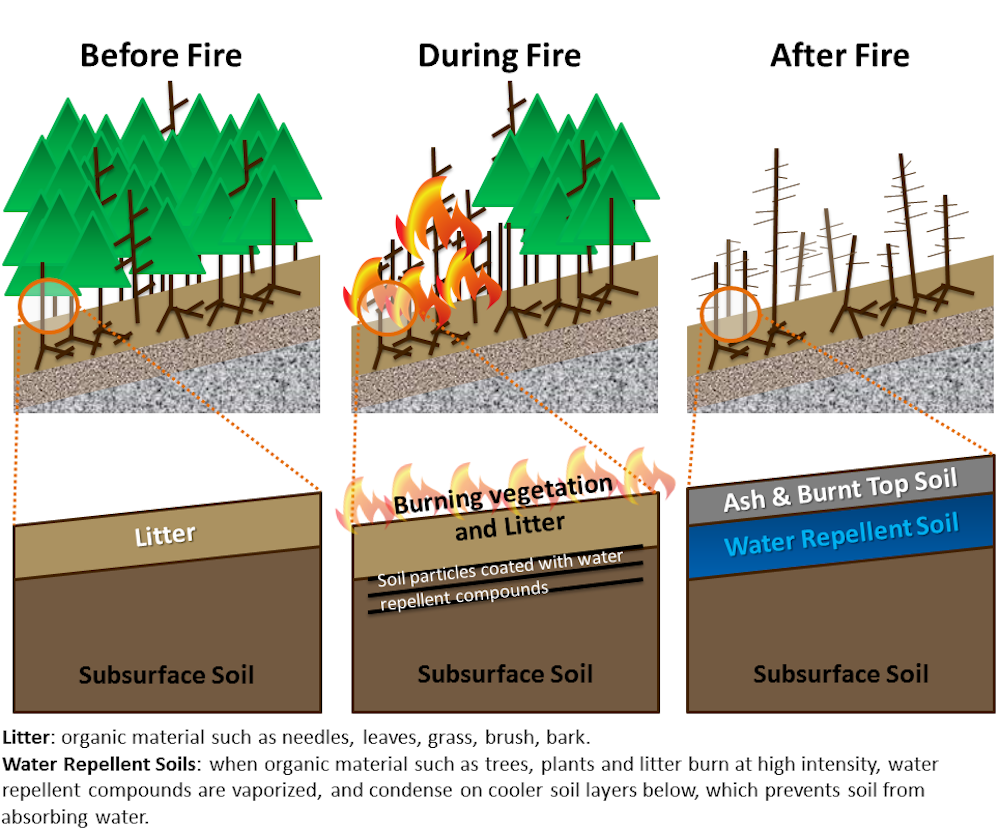
When severe fires burn hillslopes, the high heat from the fires, sometimes exceeding 1,000 degrees Fahrenheit (538 degrees Celsius), completely destroys trees, shrubs, grass and structures, leaving behind a moonscape of gray ash. Not only that, the heat of the fire actually burns and damages the soil, creating a water-repellent, or hydrophobic, layer.
What once was a vegetated hillslope, with leaves and trees to intercept rain and spongy soils to absorb water, is transformed into a barren landscape covered with ash, and burned soil where water cannot soak in.
When rain does fall on a burned area like this, water mixes with the ash, rocks and sediment to form a slurry. This slurry of debris then pours downhill in small gullies called rills, which then converge to form bigger and bigger rills, creating a torrent of sediment, water and debris rushing downhill. All this debris and water can transform small streams and usually dry gullies into a danger zone.
Because the concentration of sediment is so high, especially when there is a large amount of ash and clay, debris flows behave more like a slurry of wet cement than a normal stream. This fluid can pick up and move large boulders, cars, trees and other debris rapidly downhill.
In January 2018, a few weeks after the Thomas fire burned through the hills above Montecito, a storm triggered debris flows that killed 23 people and damaged at least 400 homes.
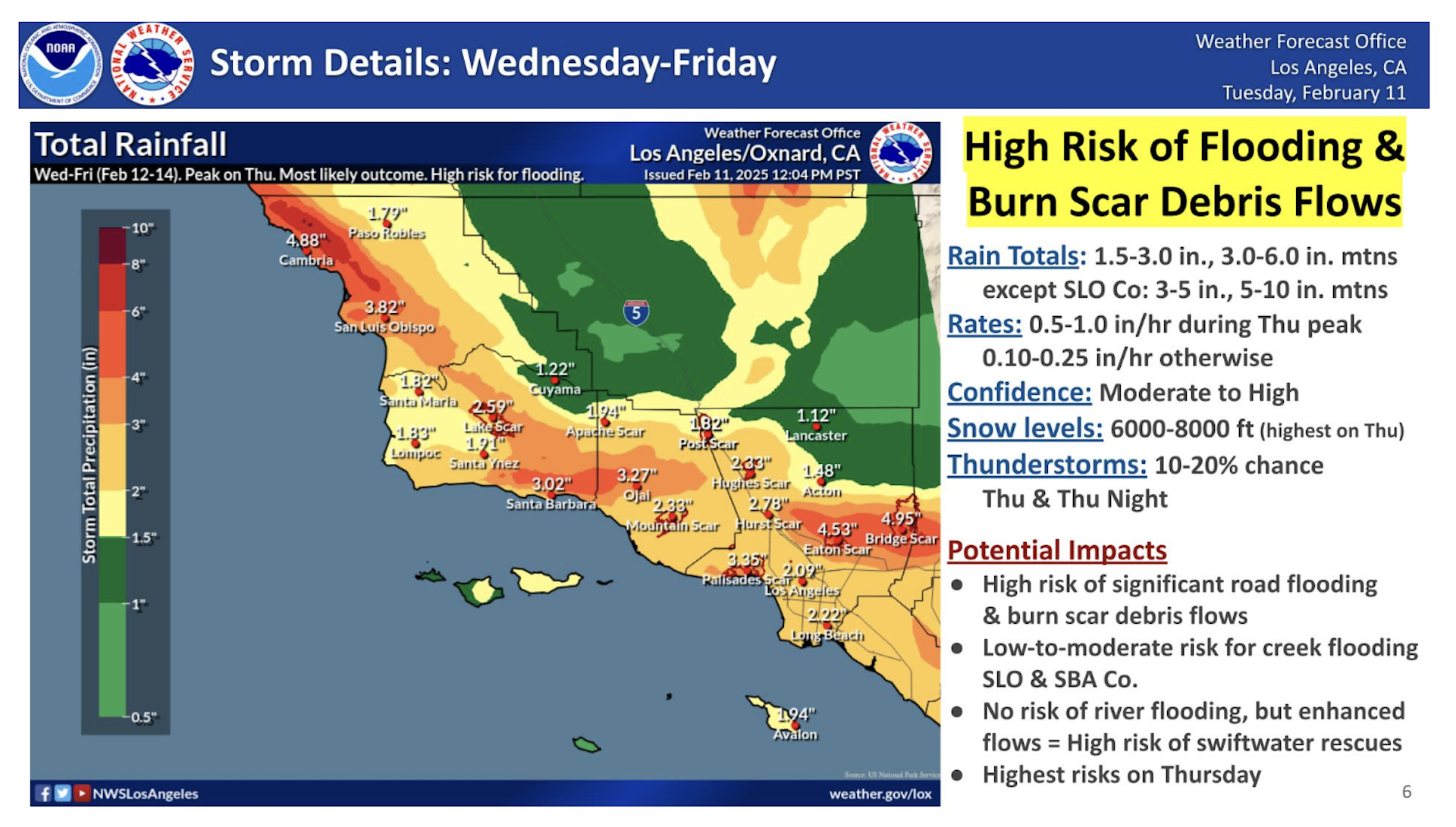
Fire and debris flow scientists with the U.S. Geological Survey use these variables to create models to predict the likelihood and possible hazards from postfire debris flows. They are already developing maps to help residents, emergency managers and city officials prepare and predict postfire debris flows in 2025 burn areas in Los Angeles.
The U.S. Geological Survey modeled debris flow risks after the Palisades Fire near Los Angeles. The map shows some of the highest-risk areas if hit by 15 minutes of rain falling at just under 1 inch (24 millimeters) per hour. USGS
Some of the triggers of debris flows are literally part of the landscape.
For example, the slope angle in a watershed and the amount of clay in the soil are important. Watersheds with gentle slopes – generally less than about 23 degrees – and a lack of clay and silt-sized particles are unlikely to produce debris flows.
Other key factors that contribute to postfire debris flows relate to the proportion of the watershed that is severely burned and the intensity and duration of the rainstorm event.
Early important research in the field of pyrogeomorphology demonstrated that while large, intense storms are more likely to cause large, intense debris flows, even small rainstorms can produce debris flows in burned areas.
Debris flows are becoming more common
A whopping 21.8 million Americans live within 3 miles of where a fire burned during the past two decades, and that population more than doubled from 2000 to 2019. A recent study from central and northern California indicates that nearly all the observed increases in area burned by wildfires in recent decades are due to human-caused climate change.
The warming climate is also increasing the likelihood of more extreme downpours. The amount of moisture the atmosphere can hold increases by about 7% per degree Celsius of warming, leading to more intense downpours, particularly from ocean storms. In California, scientists project increases in rainfall intensity of 18% will result in an overall 110% increase in the probability of major debris flows.
Jon Frye, of Santa Barbara Public Works, shows what happened in the January 2018 Montecito debris flow and why the risks to downslope communities would continue for several years. Source: County of Santa Barbara, 2018.
Studies using models of fire, climate and erosion rates estimate that the amount of sediment flowing downhill after fires will increase by more than 10% in nine out of every 10 watersheds in the western U.S.
Even without rain, debris on fire-damaged slopes can be unstable. A small slide in Pacific Palisades shortly after a fire burned through the area split a home in two. A phenomenon called “dry ravel” is a dominant form of hillslope erosion following wildfires in chaparral environments in Southern California
Preparing for debris flow risks
Research on charcoal pieces from ancient debris flows has shown fires and erosion have shaped Earth’s landscape for at least thousands of years. However, the rising risk of wildfires near populated areas and the potential for increasingly intense downpours mean a greater risk of damaging and potentially deadly debris flows.
As their populations expand, community planners need to be aware of those risks and prepare.
This article, originally published Jan. 23, 2025, has been updated with a flash flood watch issued.
Jen Pierce receives funding from the National Science Foundation and is the chair of the Quaternary Geology and Geomorphology division of the Geological Society of America.
Source: United Nations Economic Commission for Europe
The purpose of this project is to develop a policy recommendation that assists UN Member States in enhancing digital and sustainable trade facilitation along transit corridors.
The first phase will focus on scoping the project deliverables, gathering insights into the persistent challenges and inefficiencies in soft trade infrastructure that hinder seamless transit procedures and data exchange along corridors, particularly impacting trade competitiveness for landlocked developing countries. It will also develop implementation guidelines for the UN/CEFACTPackage of Standardsfor Data Exchange, which supports the digital transformation of cross-border trade which will be tested in a pilot (a real-world scenario), ensuring their effectiveness and relevance.
In today’s global trade landscape, competitiveness relies on seamless connectivity across multiple domains, including transport, logistics, telecom, and IT. This initiative will build on the UNECE UN/CEFACT Package of Standards for data exchange along supply chains, given the increasing importance of UNECE UN/CEFACT tools in managing the complexities of data transfer across transport modes.
Agenda:
Context & Background
Recap of the past High-level policy dialogues: a)30thUNECE- UN/CEFACT Plenary in Geneva (July 2024) b)43rdUNECE- UN/CEFACT Forum in Rome ( December 2024)
Structure of the policy recommendation & deliverables: i)Policy recommendation ii)Implementation guidelines for the UN/CEFACT Package of Standards for Data Exchange iii)Pilot projects
Brainstorming the scope of the policy recommendation
Sharing some publications/readings ahead of the next meeting to scope further
– First trial batch of SEALMINER A2 air cooled rigs have been delivered to our datacenters and are running smoothly.
– Completed acquisition of 101 MW site and gas-fired power plant project in Alberta to deliver the industry’s first fully vertically-integrated Bitcoin mining site.
SINGAPORE, Feb. 12, 2025 (GLOBE NEWSWIRE) — Bitdeer Technologies Group (NASDAQ: BTDR) (“Bitdeer” or the “Company”), a world-leading technology company for blockchain and high-performance computing, today announced its unaudited mining and operations updates for January 2025.
Operational Update
Self-mined Bitcoin: 126 Bitcoins, down from the previous month due to temporary curtailments at our Bhutan site related to higher seasonal electricity prices.
Mining Rig Manufacturing and R&D:
SEALMINER A1:
Mass production of approximately 3.7 EH/s of mining rigs remains on track with 0.4 EH/s powered on, 0.5 EH/s delivered for installation, 0.4 EH/s in-transit to datacenters and 2.4 EH/s in production. The manufacture of SEALMINER A1 is now expected to be completed at end of February or early March 2025.
SEALMINER A2:
Production of approximately 35 EH/s of mining rigs through October 2025, delayed by approximately one month due to 6.4 magnitude earthquake that struck Taiwan on January 21, 2025.
First trial batch of air cooled rigs have been delivered to our mining datacenters for testing and are running stably.
~29,000 units (~7 EH/s out of the 35 EH/s) of SEALMINER A2s allocated for external sales are expected to begin shipment in March through Q2 2025.
SEALMINER A3:
SEAL03 initial tape-out sample wafers with an expected chip efficiency of approximately 10 J/TH are expected in Q1 2025.
SEALMINER A4:
SEAL04 R&D remains on track to achieve an expected chip efficiency of approximately 5 J/TH with anticipated initial tape-out in Q3 2025.
The Bureau of Industry and Security (“BIS”) of the U.S. Department of Commerce published a rule entitled “Implementation of Additional Due Diligence Measures for Advanced Computing Integrated Circuits”, in January 2025 (the “BIS Rules”). Based on preliminary review, the Company does not expect that the application of the BIS Rules will have any impact on the delivery of SEAL chips, as the outsourced semiconductor assembly and test (“OSAT”) companies for SEAL chips are Approved “OSAT” companies under BIS regulations.
HPC/AI:
Discussions are ongoing with multiple development partners and potential end users for select large scale sites in U.S. for HPC/AI.
Bitdeer AI Cloud, powered by NVIDIA DGX SuperPOD with H100, saw its average utilization rate drop to ~60% in January 2025 due to an initial shift toward R&D in model inference and AI Agents. In the short term, some DGX H100 systems will be allocated to deploying open-source models like DeepSeek, Llama, and Qwen, enhancing API support for AI Agents, optimizing platform services, and advancing related R&D.
Hosting:
Client-hosted machines increased by 2,000 units and overall hashrate increased by 0.5 EH/s as customers are replacing older mining rigs with high efficiency ones.
Infrastructure:
Tydal, Norway, 40 MW phase 1 expansion has completed installation of transformers, with delivery and installation of electrical equipment currently in progress. The energization application has entered into the fast track for final regulatory approval.
Rockdale, Texas, USA, 100 MW hydro-cooling conversion is on track for phased completion during Q1 2025.
Clarington Phase 2, Ohio, USA, 304 MW is still pending approval and in negotiation with the landlord.
Jigmeling, Bhutan, 500 MW construction is on track with the primary substation expected to be completed by Q1 2025.
Fox Creek, Alberta, 101 MW gas-fired power plant and 99 MW datacenter of capacity for Bitcoin mining planned for energization in Q4 2026.
Financing:
Successfully executed a $17M supply chain financing facility with a 10.2% interest rate with a Singapore financial institution and completed the drawdown of facility in January 2025.
Management Commentary
“Our strategic acquisition of the 101 MW site near Fox Creek, Alberta and gas-fired power plant project marks a significant step in our strategy to become a fully-vertically integrated Bitcoin miner,” stated Matt Kong, Chief Business Officer of Bitdeer. “By combining our own power generation, SEALMINER mining machines and opportunistic grid participation, we believe this site will set a new benchmark for industry unit economics.”
Mr. Kong continued, “In terms of our ASICs roadmap, mass production of our SEALMINER A1s remain on schedule. SEALMINER A2s were slightly impacted by the 6.4 magnitude earthquake in Taiwan on January 21, 2025, and its mass production in H2 is expected to delay about one month. However, the first trial batch of SEALMINER A2 air cooled models have been delivered to our own datacenters for testing and are running smoothly. Further, we expect the initial tape-out sample wafers of our SEAL03 chip to be ready in March for testing. SEAL03 is expected to be the most advanced and energy-efficient Bitcoin mining chip on the market and represents a significant achievement for Bitdeer and the industry.”
Production and Operations Summary
Metrics
Jan 2025
Dec 2024
Nov 2024
Total hash rate under management1(EH/s)
22.4
21.6
20.7
– Proprietary hash rate
9.2
8.9
8.8
• Self-mining
8.7
8.5
8.2
• Cloud Hash Rate
0.0
0.0
0.2
• Delivered but not hashing
0.5
0.4
0.4
– Hosting
13.2
12.7
11.9
Mining machines under management
179,000
175,000
178,000
– Self-owned2
87,000
85,000
86,000
– Hosted
92,000
90,000
92,000
Bitcoins mined (self-mining only)
126
145
150
Bitcoin held3
724
594
443
1Total hash rate under management as of January 31, 2025 across the Company’s three primary business lines: Self-mining, Cloud Hash Rate, and Hosting.
Self-mining refers to cryptocurrency mining for the Company’s own account, which allows it to directly capture the high appreciation potential of cryptocurrency.
Cloud Hash Rate offers hash rate subscription plans and shares mining income with customers under certain arrangements. The Cloud Hash Rate stated above reflects the contracted hash rate with customers at month-end.
Hosting encompasses a one-stop mining machine hosting solution including deployment, maintenance, and management services for efficient cryptocurrency mining.
2Self-owned mining machines are for the Company’s self-mining business and Cloud Hash Rate business. 3Bitcoins held do not include the Bitcoins from deposits of the customers.
Infrastructure Construction Update
Rockdale, Texas– 100 MW Hydro-cooling conversion to be energized in phases in Q1 2025:
Cooling system will be delivered and installed in phases in Q1 2025.
Planning for phased energization by March 2025.
Tydal, Norway – 175 MW site expansion anticipated to be fully energized by mid-2025:
Installation of the transformers has been completed, with the delivery and installation of electrical equipment currently in progress. Additionally, the procurement and delivery of containers and hydro-cooling systems are underway, and drainage systems construction is ongoing.
Tydal, Norway Phase 1 40 MW expansion pending regulatory approval. Energization of the full 175 MW site is expected to occur no later than mid-2025, subject to regulatory approval.
Massillon, Ohio– 221 MW site construction has begun ahead of schedule:
Substation construction is underway and is expected to be completed in Q3 2025.
Building design is completed and construction has begun earlier than expected, estimated to be completed in phases between Q3 and Q4 2025.
Estimated energization timeline remains on track for mid-to-late 2025.
Clarington Phase 2, Ohio– 304 MW is still pending approval and in negotiation with the landlord.
Jigmeling, Bhutan– 500 MW site is progressing well, with the following key milestones achieved:
Construction of transformer and container foundations in progress and will be completed in phases, with the last phase expected by the end of February 2025.
132kv/140MW and 220kv/360MW substation designs are completed with construction anticipated to be finished by the end of Q1 2025.
Orders for the procurement of transformers and electrical equipment have been placed, with delivery and installation work to be completed in phases over Q1 and Q2 2025.
Procurement and delivery of containers and hydro-cooling systems are in progress, with completion expected in phases by the end of Q1 2025.
Fox Creek, Alberta– 101 MW site acquired in Alberta sits on 19 acres is fully licensed and permitted:
Acquisition includes all permits and licenses to construct an on-site natural gas power plant, as well as approval for a 99 MW grid interconnection with Alberta Electric System Operator (“AESO”).
Bitdeer will develop and construct the power plant in partnership with a leading Engineering, Procurement and Construction (“EPC”) company and is expected to be energized by Q4 2026.
Site / Location
Capacity (MW)
Status
Timing4
Electrical capacity
– Rockdale, Texas
563
Online
Completed
– Knoxville, Tennessee
86
Online
Completed
– Wenatchee, Washington
13
Online
Completed
– Molde, Norway
84
Online
Completed
– Tydal, Norway
50
Online
Completed
– Gedu, Bhutan
100
Online
Completed
Total electrical capacity
8955
Pipeline capacity
– Tydal, Norway Phase 1
40
In progress
Pending Regulatory Approval
– Tydal, Norway Phase 2
135
In progress
Mid 2025
– Massillon, Ohio
221
In progress
Mid-to-late 2025
– Clarington, Ohio Phase 1
266
In progress
Q3 2025
– Clarington, Ohio Phase 2
304
Pending approval
Estimate 2026
– Jigmeling, Bhutan
500
In progress
Mid-to-late 2025
– Rockdale, Texas
179
In planning
Estimate 2026
– Alberta, Canada
99
In planning
Q4 2026
Total pipeline capacity
1,744
Total global electrical capacity
2,639
4 Indicative timing. All timing references are to calendar quarters and years. 5 Figures may not add up due to rounding.
Upcoming Conferences and Events
March 11 – 12, 2025: Cantor Global Technology Conference in New York City
March 16 – 18, 2025: 37th Annual ROTH Growth Conference in Dana Point, California
About Bitdeer Technologies Group
Bitdeer is a world-leading technology company for blockchain and high-performance computing. Bitdeer is committed to providing comprehensive computing solutions for its customers. The Company handles complex processes involved in computing such as equipment procurement, transport logistics, datacenter design and construction, equipment management, and daily operations. The Company also offers advanced cloud capabilities to customers with high demand for artificial intelligence. Headquartered in Singapore, Bitdeer has deployed datacenters in the United States, Norway, and Bhutan. To learn more, visit https://ir.bitdeer.com/ or follow Bitdeer on X @ BitdeerOfficial and LinkedIn @ Bitdeer Group.
Investors and others should note that Bitdeer may announce material information using its website and/or on its accounts on social media platforms, including X, formerly known as Twitter, Facebook, and LinkedIn. Therefore, Bitdeer encourages investors and others to review the information it posts on the social media and other communication channels listed on its website.
Forward-Looking Statements
Statements in this press release about future expectations, plans, and prospects, as well as any other statements regarding matters that are not historical facts, may constitute “forward-looking statements” within the meaning of The Private Securities Litigation Reform Act of 1995. The words “anticipate,” “look forward to,” “believe,” “continue,” “could,” “estimate,” “expect,” “intend,” “may,” “plan,” “potential,” “predict,” “project,” “should,” “target,” “will,” “would” and similar expressions are intended to identify forward-looking statements, although not all forward-looking statements contain these identifying words. Actual results may differ materially from those indicated by such forward-looking statements as a result of various important factors, including factors discussed in the section entitled “Risk Factors” in Bitdeer’s annual report on Form 20-F, as well as discussions of potential risks, uncertainties, and other important factors in Bitdeer’s subsequent filings with the U.S. Securities and Exchange Commission. Any forward-looking statements contained in this press release speak only as of the date hereof. Bitdeer specifically disclaims any obligation to update any forward-looking statement, whether due to new information, future events, or otherwise. Readers should not rely upon the information on this page as current or accurate after its publication date.
Kom Ghareeb (Agenzia Fides) – These days, the Coptic Church celebrates the feast of the prophet Jonah, a deeply felt commemoration, marked by three days of prayer and fasting that prepare the faithful for the time of Lent.Anselmo Fabiano, a young missionary of the Society of African Missions (SMA), arrived last September at the SMA house in the Shoubra neighborhood. For more than a month he has been in the village of Kom Ghareeb, in the heart of the Egyptian countryside, where he will remain for the next five months.”Here the days pass quickly in this warm and sunny winter, where snow and rain are only a distant memory – he tells Fides -. In these weeks, I have lived many experiences and I have been able to taste the beauty of a young community, enthusiastic in faith and very dynamic. I am overwhelmed by the affection and generosity of these simple people, but with a big heart. Every time I walk through the streets of the village, the children see me and start shouting, running towards me to greet me, invite me to play or share some food. They are curious and ask many questions. I feel like one of them and I try, in my own way, to be a true witness of the Gospel.”“There are so many experiences to tell: weddings, first communions, home visits, funerals, moments with young people and children. Among them, I like to remember three small episodes.” The first is related to the Eucharist. “Here Mass is celebrated with leavened bread, prepared on Saturday afternoons by a group of children and young people, with the help of an adult. It is beautiful to live this experience with them: a true school of faith and life, where service becomes prayer. Their joy and enthusiasm in teaching me how to make bread I keep as a precious gift. And that smell of bread that, on the altar, becomes the body of Jesus, moves me every time.”“The second episode – the missionary continues – I can call ‘the children of the parish’. In fact, very poor families live here around the church, with very complicated and dramatic human situations. For many children, the Coptic parish and its parish priest, Abuna Iusif, have become their second home. After school, they spend the day there. The parish priest invites them to share the meal, and our table becomes a meeting place for young and old.Even at weddings or parties, it is common to see these children barefoot or in worn-out slippers, standing next to the bride and groom or among the elegantly dressed guests. It fills me with joy to know that the Church is a refuge for the youngest and most needy.”“Finally, the third episode I can call the ‘fire of hospitality’. Every day we visit the families of the village, an enriching experience that allows us to learn about their life, with their joys and difficulties, but above all to touch their authentic and deep faith. Often, visits extend beyond dusk, and then we gather around the fire, with a glass of hot tea or coffee, to shelter ourselves from the cold desert wind. And the smell of smoke or the tiredness that is felt does not matter, but the joy of being together and of being able to pray, lights and feeds the fire of faith”, concludes Anselmo. (AP) (Agenzia Fides, 12/2/2025)
Anselmo Fabiano
Kinshasa (Agenzia Fides) – “The ceasefire declared in recent days has been broken. In reality, it has only served to supply the M23 rebel movement and the Rwandan army with weapons, ammunition and provisions to their troops so that they can then continue their advance southwards,” an observer from the local Church in Bukavu, the capital of South Kivu province in the east of the Democratic Republic of Congo, tells Fides.On February 3, the M23 militia, which had taken Goma, the capital of the Congolese province of North Kivu at the end of January, declared a ceasefire “for humanitarian reasons”, which came into force on February 4 (see Fides, 4/2/2025).”The M23 has resumed its advance in South Kivu and attacked the village of Ihusi,” the observer said. “Currently, Rwandan soldiers and M23 fighters are about 60 km from the center of Bukavu. Their target is probably much closer, it is Kavumu airport, which is about 30 km from the city and is of strategic importance for supplying the Congolese army troops (FARDC) with men and resources,” the observer underlines, reporting that “the situation in the city is calm. “The foreign employees of the various non-governmental organizations and international agencies have meanwhile left the city, while missionaries and local clergy remain on site.”It therefore remains uncertain whether the advance of the M23 units will stop at Kavumu airport or continue on to the capital of South Kivu province. “Bukavu is defended not only by Congolese soldiers and militiamen, but also by soldiers of the Burundian army, which has stationed 16 battalions in the region with a total of about 12,000 men. These soldiers seem to be better equipped than the soldiers of the Congolese army, who often claim that they do not even have enough to eat,” the observer continues.On a diplomatic level, the crisis in the east of the Democratic Republic of Congo will be discussed at the African Union summit in Addis Ababa (Ethiopia) this weekend. “Many promises, many words, but nothing concrete,” the observer suspects. “Sanctions against Rwanda are threatened, but nothing concrete seems to have been done to put them into practice.” In Goma, meanwhile, the drama continues with hundreds of thousands of displaced people forced to leave their shelters because, according to the rebel movement M23, “security conditions have been restored.” “This is a political move to show that the ‘new masters’ of the region have the situation under control,” the observer says. “However, thousands of people are forced to return to villages, in some cases 30-40 km from Goma, without the guarantee of finding their homes and the minimum conditions for a decent life,” he concludes. “Many of them remain in the city in makeshift shelters or welcomed by friends and relatives.” (L.M.) (Agenzia Fides, 12/2/2025)
Share:
Source: Hong Kong Government special administrative region
Following is a question by the Hon Vincent Cheng and a reply by the Secretary for Culture, Sports and Tourism, Miss Rosanna Law, in the Legislative Council today (February 12):
Question:
​It has been reported that a recently released documentary film on four Hong Kong trails is widely acclaimed. There are views that as Hong Kong has beautiful trails and ridgelines, the Government should adopt a new mindset or a new perspective in promoting trail tourism. In this connection, will the Government inform this Council:
(1) of the Government’s plans in place to enhance the ancillary facilities on trails or in country parks, such as providing additional replenishment and rest stations, water-filling stations, toilets and directional signs, so as to meet the needs of different types of hikers, and to further promote trail tourism and a safe hiking culture;
(2) of the Government’s plans and publicity strategies in place to promote Hong Kong’s trails to tourists from different places, such as whether it will consider taking the initiative to invite renowned runners to promote the trails, or supporting the broadcasting of the aforesaid documentary film on international streaming platforms or in places outside Hong Kong, so as to attract tourists from abroad; if so, of the details; if not, the reasons for that; and
(3) in order to further promote Hong Kong’s trail tourism, whether the Government will consider supporting the organisation and promotion of trail races or cross-country races, so as to attract more local and non-local people to take part in such races, thereby stepping up publicity on Hong Kong’s beautiful natural trails?
Reply:
President,
Hong Kong has rich green and eco-tourism resources, including hiking trails and country parks throughout the city, with breathtaking great outdoors that are only minutes away from the urban hustles, attracting numerous tourists each year for hiking and outdoor activities. Further capitalising on Hong Kong’s abundant ecological resources for promoting green tourism development, is in fact one of the directions in diversifying tourism products as outlined in the Development Blueprint for Hong Kong’s Tourism Industry 2.0 that we announced at the end of last year.
In respect of the question raised by the Hon Vincent Cheng, in consultation with the Environment and Ecology Bureau, the reply is as follows:
To promote green tourism, the Tourism Commission, in collaboration with the Agriculture, Fisheries and Conservation Department (AFCD), has been taking forward the Enhancement of Hiking Trails since 2018 to enhance the tourism supporting facilities of 20 hiking trails in country parks which are popular and with tourism potential, and to enhance the “Enjoy Hiking” thematic website. Enhancement works include improvement to existing hiking trail network, control of soil erosion at trails, enhancement of vegetation coverage, addition of lookout points and enrichment of visitor information. The enhancement works on 12 hiking trails have been completed, and those for the remaining eight hiking trails are expected to be completed progressively by the first quarter of 2026.
The AFCD also seeks to enhance hiking trails and provide supporting facilities in country parks, including the provision of 57 flushing toilets and over 120 portable toilets; 289 pavilions, 37 water filling stations and about 30 drinks vending machines. The Government has set aside $500 million to enhance country parks, including the improvement and addition of facilities, as well as gradually setting up large-scale enhancement facilities such as tree-top adventure and open museum of historical relics. Examples of the works involved are the construction of five toilets and reconstruction of six toilets at popular hiking spots. These toilets will adopt low-carbon and environmentally-friendly designs, and will be gradually rolled out from 2026 to 2028. The viewing platform overlooking Po Pin Chau and the Lin Ma Hang Lead Mine Cave Revitalisation Project were opened to the public in end-2024.
The AFCD makes use of school visits, guided tours, online videos, social media, etc, to promote the unique natural scenery and hiking experiences of Hong Kong, provide information on hiking safety and hill fire prevention, and advocate “take your litter home”. Apart from placing directional signs in country parks, the AFCD also provides consolidated information of hiking trails, including maps, distance, level of difficulty and attractions along the trails, through the “Enjoy Hiking” website, to facilitate locals and tourists’ planning of their itineraries. The mobile application “Enjoy Hiking Hiker Tracking Service” also records users’ location, thereby shortening the search and rescue time in case of accidents. Furthermore, the AFCD collaborates with the Hong Kong Economic and Trade Offices (ETOs) in the Mainland and the Forestry Administration of Guangdong Province to promote Hong Kong’s natural scenery and hiking routes, as well as to disseminate hiking safety messages, through their social media platforms in the Mainland. The AFCD will continue to review and refine its promotion strategy and information, and through diverse information distribution channels, to ensure locals and tourists safely enjoy the natural wonders of Hong Kong. At the same time, the Hong Kong Police Force, the Fire Services Department, the Government Flying Service and the Civil Aid Service also raise hiker’s awareness on hiking safety through various channels and activities.
Apart from the AFCD’s promotion, the Hong Kong Tourism Board (HKTB), through its “Hong Kong Great Outdoors” year-round promotional platform, introduces in detail hiking trails in different districts accompanied by stories to deepen understanding of the trails, as well as docent activities and tourism products by the travel trade and other organisations, allowing tourists to appreciate Hong Kong’s inspiring natural landscape. Besides, films are also a very effective promotional channel. For example, the film “Four Trails” documents a recent trail running event, featuring participants from various places who challenge their limits by crossing mountains and valleys, while simultaneously showcasing Hong Kong’s unique natural scenery. The Cultural and Creative Industries Development Agency (CCIDA) is collaborating with overseas ETOs and the film festival partners worldwide to promote this film at overseas film festivals. In addition, CCIDA will strive for opportunities of showing this film on both international and Mainland streaming platforms to attract more tourists to experience the natural beauty of Hong Kong. Also, the HKTB previously invited the director and producer of the film to share Hong Kong’s great natural scenery and trail running experiences with overseas media.
In addition, various trail running and cross-country events are held by different organisations every year, along with other leisure trail events. The Government has supported and promoted some of these events to encourage more tourists to come to Hong Kong and participate. The Government will continue to promote green tourism based on the principles of nature conservation and sustainable development to pursue the concept of “tourism is everywhere” in Hong Kong.
SACRAMENTO – Governor Gavin Newsom today announced the following appointments:
Karen Morrison, of Sacramento, has been appointed Director at the California Department of Pesticide Regulation. Morrison has held multiple positions at the Department of Pesticide Regulation since 2018, including Chief Deputy Director and Science Advisor since 2022, Assistant Director and Chief Science Advisor from 2019 to 2022, and Environmental Program Manager and Science and Policy Advisor from 2018 to 2019. She was a Senior Environmental Scientist and Policy Advisor at the California Department of Resources, Recycling, and Recovery from 2014 to 2018. Morrison was a Science and Technology Policy Fellow at the California Council on Science and Technology from 2013 to 2014. She earned a Doctor of Philosophy degree in Chemistry from the University of Illinois, Urbana Champaign, and she earned a Bachelor of Science degree in Chemistry from Harvey Mudd College. This position requires Senate confirmation, and compensation is $213,651. Morrison is registered without party preference.
Nicholas Lutton, of Fresno, has been appointed to the State Council on Developmental Disabilities. Lutton was the Program Manager at Family Voices of California from 2022 to 2024. He was an Educational Resource Specialist at EPU Children’s Center from 2019 to 2022. Lutton is a member of the Editorial Board at the American Association of Pediatrics and Fresno County In-Home Services Advisory Committee. This position does not require Senate confirmation, and the compensation is $100 per diem. Lutton is a Democrat.
Eric Bergersen, of Long Beach, has been appointed to the Physician Assistant Board. Bergersen has been the Regional Medical Director at Bicycle Health Medical Group since 2020. He was the APC Director at VEP Healthcare from 2018 to 2020. Bergersen was an Emergency Medicine Physician Assistant at VEP Healthcare from 2017 to 2019. He was a Clinical Consultant at GYANT from 2018 to 2019. Bergersen was the Lead Emergency Department Technician at Beth Israel Deaconess Medical Center from 2012 to 2015. He is a member of Physician Assistants in Virtual Medicine and Telemedicine. Bergersen earned a Master of Science degree in Health Care Administration from Oklahoma State University, a Master of Science degree in Physician Assistant Studies from George Washington University, and Bachelor of Science in Behavioral Neuroscience from Northeastern University. This position does not require Senate confirmation, and the compensation is $100 per diem. Bergersen is a Democrat.
Ed Perez, of Sacramento, has been appointed to the Physician Assistant Board. Perez was a manager at Labor Relations and Performance Management, California Department of Water Resources from 2019 to 2024. He was a Labor Relations Specialist, Department of Water Resources from 2015 to 2019. Perez was a Labor Relations Specialist & Labor Relations Analyst at the California Department of Corrections and Rehabilitation from 2013 to 2015. He is a member of the Asian Pacific American Public Affairs Association (APAPA), the Hamptons Community Foundation, the Hamptons Owners Association, the Gardenland-Northgate Neighborhood Association, and a Community Activist with AARP. This position does not require Senate confirmation, and the compensation is $100 per diem. Perez is a Democrat.
Drake Dillard, of Los Angeles, has been reappointed to the California Commission on Disability Access, where he has served since 2020. Dillard has been a Senior Project Manager at Perkins & Will since 2014. He was a Senior Healthcare Architect at Parsons from 2007 to 2013. Dillard was a Project Architect at Kaiser Permanente from 1989 to 1998. He is a member of the Crenshaw Design Review Panel, American Institute of Architects and the National Organization of Minority Architects. Dillard earned a Master of Arts degree in Architecture from Howard University and a Bachelor of Arts degree in Architecture from the University of Illinois Urbana-Champaign. This position requires Senate confirmation, and the compensation is $100 per diem. Dillard is registered without party preference.
Jaqueline Jackson, of San Diego, has been reappointed to the California Commission on Disability Access, where she has served since 2020. Jackson has been a Non-Profit Management Consultant since 1994. She was Development Director and Consultant for the San Diego Center for the Blind from 2002 to 2004. Jackson was Director of Charter School Development for Norman and Norman Inc. from 1996 to 2005. She was an Education Consultant for the School Futures Research Foundation from 1994 to 1996. Jackson was the Director of Education for Health and Family Support Services at the San Diego Urban League from 1988 to 1994. She is a member of the City of San Diego Accessibility Advisory Board, City of San Diego Senior Affairs Advisory Board, and the County of San Diego Registrar of Voters Accessibility Advisory Committee. Jackson earned a Master of Education degree from the University of San Diego and a Bachelor of Arts degree in Psychology from California State University, San Diego. This position requires Senate confirmation, and the compensation is $100 per diem. Jackson is a Democrat.
Press Releases, Recent News
Recent news
Feb 11, 2025
News What you need to know: Across all of state government, highly-specialized personnel and response equipment are on the ground working to protect communities statewide from storm impacts. Los Angeles, California – With another significant winter storm system…
Feb 11, 2025
News What you need to know: Governor Gavin Newsom issued an executive order today ordering the state to ensure that childcare providers impacted by the recent wildfires in Los Angeles are aware of their potential eligibility for Disaster Unemployment Assistance and…
Feb 11, 2025
News What you need to know: The fastest large-scale debris removal in modern state history began today in Altadena and the Pacific Palisades, in roughly half the time it took to start similar operations after the devastating 2018 Woolsey Fire. LOS ANGELES – Governor…
What you need to know: Governor Gavin Newsom issued an executive order today ordering the state to ensure that childcare providers impacted by the recent wildfires in Los Angeles are aware of their potential eligibility for Disaster Unemployment Assistance and have the support needed to apply.
Los Angeles, California – Today, Governor Gavin Newsom issued an Executive Order for the Department of Social Services, in collaboration with the California Employment Development Department (EDD), to individually contact childcare programs or providers whose childcare facility has not reopened in the wake of the Los Angeles wildfires and make them aware of their potential eligibility for Disaster Unemployment Assistance. It also orders the agencies to support each individual in completing the application for those benefits.
“As California begins to recover from the devastating Los Angeles wildfires, we are working to make sure that childcare providers are aware of the federal and state supports available to them if they still are unable to work due to the fires. We will make sure that those who help our families have the resources they need and deserve.”
Governor Gavin Newsom
“Caregiving isn’t just a service—it’s the infrastructure we all need to go to work — making it a vital piece of the workforce equation. Ensuring that childcare providers— an industry that is majority women — are able to provide for their own families during this time is crucial to their ability to recover and rebuild, just as it’s critical to supporting the larger economy.”
First Partner Jennifer Siebel Newsom
Text of the executive order is available here.
Get help today
EDD helps people and businesses in California who have been affected by disasters. If you lost your job or can’t work because of this disaster, you may qualify for unemployment, disability, or Paid Family Leave benefits. For information on this disaster and to see if you qualify, visit EDD’s Disaster Unemployment Assistance website.
For those Californians impacted by the firestorms in Los Angeles, there are resources available. Californians can go to CA.gov/LAfires – a hub for information and resources from state, local and federal government.
Individuals and business owners who sustained losses from wildfires in Los Angeles County can apply for disaster assistance:
Online at DisasterAssistance.gov
By calling 800-621-3362
By using the FEMA smart phone application
Assistance is available in over 40 languages
If you use a relay service, such as video relay service (VRS), captioned telephone service or others, give FEMA the number for that service
Recent news
Feb 11, 2025
News What you need to know: The fastest large-scale debris removal in modern state history began today in Altadena and the Pacific Palisades, in roughly half the time it took to start similar operations after the devastating 2018 Woolsey Fire. LOS ANGELES – Governor…
Feb 10, 2025
News What you need to know: The state continues to upgrade CA.gov/LAfires to provide more resources and information for firestorm survivors. LOS ANGELES – Governor Gavin Newsom today announced new efforts to provide accountability with ongoing Los Angeles firestorm…
Feb 10, 2025
News What you need to know: The state and federal government are working at record-pace to remove debris from the Los Angeles area firestorms. LOS ANGELES – The State of California, in coordination with federal and local partners, is rapidly advancing wildfire cleanup…
What you need to know: Across all of state government, highly-specialized personnel and response equipment are on the ground working to protect communities statewide from storm impacts.
Los Angeles, California – With another significant winter storm system expected to reach California later this week, work continues statewide to ensure communities impacted by recent wildfires – including the firestorms in Los Angeles – are protected.
To prepare for this storm, Governor Gavin Newsom is directing a whole-of-government response to bolster local resources.
In Altadena today, Governor Newsom and First Partner Jennifer Siebel Newsom surveyed ongoing work by state crews to prepare the Eaton Fire burn scar area ahead of rain.
At Governor Newsom’s direction, the state has installed emergency protection materials to contain burn scar debris from the Eaton and Palisades fires from entering creeks, rivers, and other bodies of water. The state is coordinating locally requested materials such as K-rails (concrete barriers) to divert debris flow and has completed debris basin clean-up activities over the last month to mitigate potential impacts in vulnerable areas.
California has been in a constant state of readiness preparing for extreme winter weather. Crews have been on the ground for weeks working to secure areas against possible mudslides and debris flows. If you’re in the storm’s path, please remain vigilant and follow all guidance of local authorities.
Governor Gavin Newsom
California is monitoring storm impacts, in particular to burn scar areas that pose the threat of mudslides and debris flows. According to the National Weather Service, this storm system will bring far-reaching impacts across the state, including risks of urban flooding and burn scar impacts in Southern California, high winds and heavy snow.
State actions to protect communities include:
319,000 sandbags and 5,600 super sacks have been deployed to Southern California locations through the Department of Water Resources (DWR).
242 total CAL FIRE engines are deployed throughout the state to rapidly respond, including 109 engines CAL FIRE Southern Region and 133 engines CAL FIRE Northern Region.
Cal OES has prepositioned flood fighting and debris flow resources and more than 400 personnel in 8 counties, including Colusa, Fresno, Los Angeles, Orange, Glenn, Tulare, Ventura and Santa Barbara. In total the state is deploying through the Fire and Rescue Mutual Aid System the following:
48 fire engines
8 dozers
5 helicopters
8 dispatchers
6 hand crews
8 swiftwater rescue teams
3 local Incident Management Teams
1 Regional Task Force
2 excavators
2 loaders
5 heavy rescue teams
Nearly 120 miles of emergency protection materials, including straw wattle, compost sock and silt fencing, have been installed through the California Conservation Corps to contain burn scar debris from entering creeks, rivers and other bodies of water.
30 watershed protection specialists have been deployed to burn scar areas.
Caltrans is placing erosion-control devices, including wattles, to limit mudflows. Caltrans is mobilizing crew members to monitor for rocks and other debris falling from burned slopes on the Pacific Coast Highway and Topanga Canyon Boulevard.
14 geologists are deployed to study and map burn scars of the Palisades, Eaton and Kenneth fires. The California Geological Survey is using this information to determine where debris flow could occur and where to install mitigation. The department also coordinated aerial flights over the scars to gather LiDAR data to further study burn areas for possible debris flow.
70 soldiers and heavy engineering equipment through the California National Guard are deployed in the area to support debris removal efforts.
The California Department of Social Services is coordinating with local partners on shelters and warming centers to serve impacted communities.
The California Department of Public Health is supporting licensed healthcare facilities.
These early actions add on to the work the state has done in recent weeks to protect California communities and boost the state’s water supply. On January 31, the Governor signed an executive order to direct state agencies to direct additional water storage by maximizing excess water from winter storms.
Residents in affected areas are urged to stay informed about potential debris flow risks, especially during storms, and to follow guidance from local emergency officials. For resources and information specific to the Los Angeles firestorms, visit CA.gov/LAfires.
Preparing for upcoming weather
On Thursday, rainfall rates could approach 1” per hour near thunderstorms. In addition, there’s anticipated heavy mountain snow, with levels dropping to 2,000-3,000 feet across the north and down to 6,500 feet in the far south. Parts of the state will see wind gusts of 35-55 mph in Central and Southern California.
The incoming storm could bring an increased risk of power outages, flooding in small streams and low-lying areas, and debris, rocks and mudslides on roadways.
Residents are encouraged to not drive through flooded roadways, prepare in advance for power outages and reduce injury risks from falling limbs and trees by staying inside during high wind events.
Residents are urged to stay informed and listen to local authorities about actions they should take including evacuation orders or safety recommendations. In burn scar areas, officials recommend preparing for possible sudden debris flows by having a go-bag packed and knowing evacuation routes.
For more information on winter storm preparedness visit ready.ca.gov.
Recent news
Feb 11, 2025
News What you need to know: Governor Gavin Newsom issued an executive order today ordering the state to ensure that childcare providers impacted by the recent wildfires in Los Angeles are aware of their potential eligibility for Disaster Unemployment Assistance and…
Feb 11, 2025
News What you need to know: The fastest large-scale debris removal in modern state history began today in Altadena and the Pacific Palisades, in roughly half the time it took to start similar operations after the devastating 2018 Woolsey Fire. LOS ANGELES – Governor…
Feb 10, 2025
News What you need to know: The state continues to upgrade CA.gov/LAfires to provide more resources and information for firestorm survivors. LOS ANGELES – Governor Gavin Newsom today announced new efforts to provide accountability with ongoing Los Angeles firestorm…
What you need to know: The fastest large-scale debris removal in modern state history began today in Altadena and the Pacific Palisades, in roughly half the time it took to start similar operations after the devastating 2018 Woolsey Fire.
LOS ANGELES – Governor Gavin Newsom today joined federal and local partners to begin work on structural debris removal from the Los Angeles firestorms, building on the US EPA’s work already underway to initially remove household hazardous waste.
The Federal Emergency Management Agency (FEMA) and the U.S. Army Corps of Engineers (USACE) began private property debris removal Tuesday morning in Altadena and Tuesday afternoon in Pacific Palisades, closely coordinating efforts with local officials. The Governor also highlighted the completion of debris removal from an Altadena K-8 school, the site of this morning’s announcement.
“The new phase of debris removal that’s starting today marks a foundational step in helping Angelenos build back stronger. I’m grateful to the state and federal workers who are clearing debris at record-pace so firestorm survivors can begin the rebuilding process as quickly and safely as possible.”
Governor Gavin Newsom
The removal process that began today comes only 35 days after the fires ignited — roughly half the time it took to start similar operations after the devastating 2018 Woolsey Fire.
Under Governor Newsom’s leadership, California has expedited the cleanup process by cutting red tape and eliminating bureaucratic barriers, allowing highly trained crews to enter impacted communities sooner and help survivors rebuild their lives faster.
The Los Angeles County Department of Public Works, in partnership with six locally affected jurisdictions, has worked around the clock to collect Right-of-Entry (ROE) forms from residents, develop haul routes, and coordinate safe transport of fire ash and debris.
The U.S. Environmental Protection Agency (EPA) is rapidly completing the removal of household hazardous materials at record speed, clearing the way for this next phase of cleanup.
Last month, Governor Newsom announced that FEMA, working with the Governor’s Office of Emergency Services (Cal OES), had tasked the EPA with safely removing and disposing of hazardous materials from homes and structures impacted by the fires. This crucial first step — one of the most complex phases of wildfire cleanup — paved the way for the structural debris removal now underway.
As these operations continue, residents should anticipate an increased presence of debris removal teams in their communities and plan accordingly. The agencies involved appreciate the public’s support and patience as crews work to eliminate health and safety risks from impacted properties.
Since the fires began, Governor Newsom has led an aggressive, coordinated, whole-of-government response to support impacted communities. Prior to the fires breaking out, the state had already deployed thousands of firefighters and personnel, with more than 16,000 boots on the ground at the peak of response efforts. In the days that followed, the state has launched historic recovery and rebuilding efforts to ensure Los Angeles communities receive the support they need.
Fire survivors can sign up for the federal debris removal program by visiting a Disaster Recovery Center (DRC) or online at ca.gov/LAFires
Recent news
Feb 10, 2025
News What you need to know: The state continues to upgrade CA.gov/LAfires to provide more resources and information for firestorm survivors. LOS ANGELES – Governor Gavin Newsom today announced new efforts to provide accountability with ongoing Los Angeles firestorm…
Feb 10, 2025
News What you need to know: The state and federal government are working at record-pace to remove debris from the Los Angeles area firestorms. LOS ANGELES – The State of California, in coordination with federal and local partners, is rapidly advancing wildfire cleanup…
Feb 10, 2025
News What you need to know: Governor Newsom is sponsoring new legislation to allow homeowners who receive insurance payments for lost or damaged property to receive the interest accrued rather than lenders. LOS ANGELES — As part of the state’s ongoing efforts to…
CLARKSBURG, WEST VIRGINIA – Rodney S. Knotts, age 55, of Ravenna, Ohio, has admitted to unlawful possession of a firearm.
According to court documents and statements made in court, Knotts possessed eight (8) firearms in Ritchie County, WV. Knotts is prohibited from possessing firearms because of a prior felony drug conviction in Ohio.
Knotts is facing up to 15 years in prison. A federal district court judge will determine any sentence after considering the U.S. Sentencing Guidelines and other statutory factors.
Assistant U.S. Attorney William Rhee is prosecuting the case on behalf of the government.
The Bureau of Alcohol, Tobacco, Firearms and Explosives investigated.
In February 2025, multiple fires raged along the eastern slopes of the Andes Mountains in Patagonia. The fires had burned about 30,000 hectares (115 square miles) of forest in south-central Argentina by February 11, forcing hundreds of people to evacuate their homes, according to news reports. Smoke from the Magdalena Valley fire—burning in Lanín National Park—was visible in this image, captured by the MODIS (Moderate Resolution Imaging Spectroradiometer) instrument on NASA’s Aqua satellite on February 9, 2025 (above). A detailed view of the smoke moving through the Magdalena Valley can be seen in the image below, acquired on the same day by the OLI-2 (Operational Land Imager-2) on Landsat 9. The Magdalena Valley fire ignited in late January and had charred more than 15,000 hectares (58 square miles) of Lanín National Park as of February 10. The forested park, located in Argentina, shares a border with Villarrica National Park in Chile. Both parks share the two snowcapped dormant volcanoes pictured here: Lanín and Quetrupillán.
The austral summer (December through February) is the dry season in Chile and Argentina when wildfires are more common. This year, strong winds and unusually high temperatures fueled the region’s blazes, which began in December 2024. Warm, dry wind from the west crossed the Andes and swept through Lanín National Park at speeds up to 45 kilometers (28 miles) per hour in early February. As the wind flowed down the lee side of the Andes, it compressed, increasing the air temperature and driving down humidity. A similar phenomenon occurs during the Chinook Winds, which flow down the east side of the Rocky Mountains. René Garreaud, an atmospheric scientist at the University of Chile, noted that westerly winds crossing the Andes were stronger than average from early January to early February. Central and northern Argentina were especially hot in January and early February 2025. Maximum temperatures hovered around 35-45 degrees Celsius (95-113 degrees Fahrenheit), which is 3-5°C above normal, according to Argentina’s national weather service. The weather service noted that these “extreme temperatures” were expected to persist in parts of the country until February 12. Two other fires burned south of the Magdalena Valley fire in Argentina on February 11. By that day, the Los Manzanos fire had scorched 10,000 hectares of the Nahuel Huapi National Park, according to officials, and the Confluencia fire had burned over 3,600 hectares near the town of El Bolsón. NASA Earth Observatory images by Michala Garrison, using Landsat data from the U.S. Geological Survey and MODIS data from NASA EOSDIS LANCE and GIBS/Worldview. Story by Emily Cassidy.