Category: Natural Disasters

  • MIL-OSI Global: NOAA’s vast public weather data powers the local forecasts on your phone and TV – a private company alone couldn’t match it

    Source: The Conversation – USA – By Christine Wiedinmyer, Associate Director for Science at CIRES, University of Colorado Boulder

    A forecaster monitors incoming data for Hurricane Irma in 2017 at the National Hurricane Center, part of the NOAA. Matt McClain/The Washington Post via Getty Images

    When a hurricane or tornado starts to form, your local weather forecasters can quickly pull up maps tracking its movement and showing where it’s headed. But have you ever wondered where they get all that information?

    The forecasts can seem effortless, but behind the scenes, a vast network of satellites, airplanes, radar, computer models and weather analysts are providing access to the latest data – and warnings when necessary. This data comes from analysts at the National Oceanic and Atmospheric Administration, known as NOAA, and its National Weather Service.

    Atmospheric scientists Christine Wiedinmyer and Kari Bowen, who is a former National Weather Service forecaster, explained NOAA’s central role in most U.S. weather forecasts.

    When people see a weather report on TV, what went on at NOAA to make that forecast possible?

    A lot of the weather information Americans rely on starts with real-time data collected by NOAA satellites, airplanes, weather balloons, radar and maritime buoys, as well as weather stations around the world.

    All of that information goes into the agency’s computers, which process the data to begin defining what’s going on in different parts of the atmosphere.

    NOAA forecasters use computer models that simulate physics and the behavior of the atmosphere, along with their own experience and local knowledge, to start to paint a picture of the weather – what’s coming in a few minutes or hours or days. They also use that data to project seasonal conditions out over weeks or months.
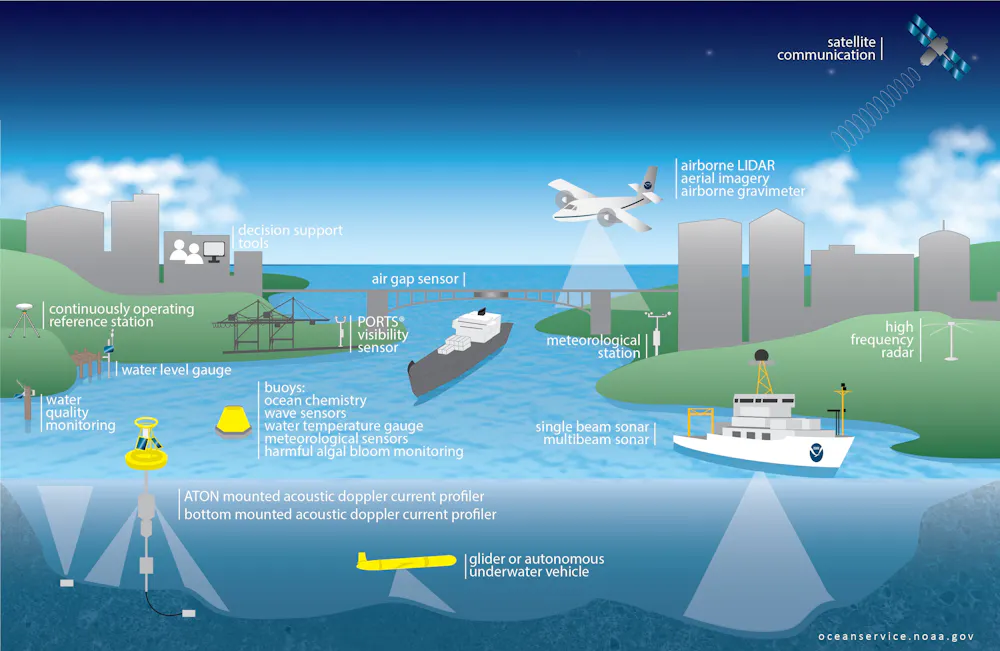
    NOAA’s data comes from many sources to provide a more complete picture of developing climate and weather conditions. Communities and economies rely on that constantly updated information.
    NOAA

    When severe weather is on the way, the agency issues the official alerts you’ll see in the news and on your phone.

    All of this analysis happens before the information reaches private weather apps and TV stations.

    No matter who you are, you can freely access that data and the analyses. In fact, a large number of private companies use NOAA data to create fancy maps and other weather products that they sell.

    It would be extremely difficult to do all of that without NOAA.

    The agency operates a fleet of 18 satellites that are packed with instruments dedicated to observing weather phenomena essential to predicting the weather, from how hot the land surface is to the water content of the atmosphere. Some are geostationary satellites which sit high above different parts of the U.S. measuring weather conditions 24/7. Others orbit the planet. Many of these are operated as part of partnerships with NASA or the Air Force.

    Some private companies are starting to invest in satellites, but it would take an enormous amount of money to replicate the range of instrumentation and coverage that NOAA has in place. Satellites only last so long and take time to build, so NOAA is continually planning for the future, and using its technical expertise to develop new instruments and computer algorithms to interpret the data.

    NOAA’s low earth orbiting satellites circle the planet from pole to pole and across the equator 14 times a day to provide a full picture of the year twice a day. The agency also has geostationary satellites that provide continuous coverage over the U.S.
    NOAA

    Maritime buoys are another measuring system that would be difficult to replicate. Over 1,300 buoys across oceans around the world measure water temperature, wind and wave height – all of which are essential for coastal warnings, as well as long-term forecasts.

    Weather observation has been around a long time. President Ulysses S. Grant created the first national weather service in the War Department in 1870. It became a civilian service in 1880 under the Department of Agriculture and is now in the Commerce Department. The information its scientists and technologists produce is essential for safety and also benefits people and industries in a lot of ways.

    Could a private company create forecasts on its own without NOAA data?

    It would be difficult for one company to provide comprehensive weather data in a reliable way that is also accessible to the entire public.

    Some companies might be able to launch their own satellite, but one satellite only gives you part of the picture. NOAA’s weather observation network has been around for a long time and collects data from points all over the U.S. and the oceans. Without that robust data, computer models and the broad network of forecasters and developers, forecasting also becomes less reliable.

    Analyzing that data is also complex. You’re not going to be able to take satellite data, run a model on a standard laptop and suddenly have a forecast.

    And there’s a question of whether a private company would want to take on the legal risk of being responsible for the nation’s forecasts and severe weather warnings.

    Neil Jacobs, nominated to oversee NOAA, explains why the agency is essential for accurate national weather forecasting, and why private companies might not want to take on the legal risk on their own.

    NOAA is taxpayer-funded, so it is a public good – its services provide safety and security for everyone, not just those who can pay for it.

    If weather data was only available at a price, one town might be able to afford the weather information necessary to protect its residents, while a smaller town or a rural area across the state might not. If you’re in a tornado-prone area or coastal zone, that information can be the difference between life or death.

    Is climate data and research into the changing climate important for forecasts?

    The Earth’s systems – its land, water and the atmosphere – are changing, and we have to be able to assess how those changes will impact weather tomorrow, in two weeks and far into the future.

    Rising global temperatures affect weather patterns. Dryness can fuel wildfires. Forecasts have to take the changing climate into account to be accurate, no matter who is creating the forecast.

    Drought is an example. The dryness of the Earth controls how much water gets exchanged with the atmosphere to form clouds and rainfall. To have an accurate weather prediction, we need to know how dry things are at the surface and how that has changed over time. That requires long-term climate information.

    NOAA doesn’t do all of this by itself – who else is involved?

    NOAA partners with private sector, academia, nonprofits and many others around the world to ensure that everyone has the best information to produce the most robust weather forecasts. Private weather companies and media also play important roles in getting those forecasts and alerts out more widely to the public.

    A lot of businesses rely on accuracy from NOAA’s weather data and forecasts: aviation, energy companies, insurance, even modern tractors’ precision farming equipment. The agency’s long-range forecasts are essential for managing state reservoirs to ensure enough water is saved and to avoid flooding.

    The government agency can be held accountable in a way private businesses are not because it answers to Congress. So, the data is trustworthy, accessible and developed with the goal to protect public safety and property for everyone. Could the same be said if only for-profit companies were producing that data?

    Christine Wiedinmyer is the CIRES Associate Director for Science. CIRES is a CU Boulder research institute that has a cooperative agreement (grant) with NOAA called the Cooperative Institute for Earth Systems Research and Data Science, CIESRDS. Wiedinmyer’s funding is primarily from NOAA, which supports more than 400 CIRES CU Boulder employees.

    Kari Bowen is the Science and Administration Manager. CIRES is a CU Boulder research institute with a cooperative agreement (grant) with NOAA called the Cooperative Institute for Earth Systems Research and Data Science, CIESRDS. Bowen’s funding is from NOAA, which supports more than 400 CIRES CU Boulder employees.

    ref. NOAA’s vast public weather data powers the local forecasts on your phone and TV – a private company alone couldn’t match it – https://theconversation.com/noaas-vast-public-weather-data-powers-the-local-forecasts-on-your-phone-and-tv-a-private-company-alone-couldnt-match-it-249451

    MIL OSI – Global Reports

  • MIL-OSI Global: Decluttering can be stressful − a clinical psychologist explains how personal values can make it easier

    Source: The Conversation – USA – By Mary E. Dozier, Assistant Professor of Psychology, Mississippi State University

    Asking how discarding an item fits with a person’s goals can help them decide whether to keep it. MoMo Productions via Getty Images

    I recently helped my mom sort through boxes she inherited when my grandparents passed away. One box was labeled – either ironically or genuinely – “toothpick holders and other treasures.” Inside were many keepsakes from moments now lost to history – although we found no toothpick holders.

    My favorite of the items we sorted through was a solitary puzzle piece, an artifact reflecting my late grandmother’s penchant for hiding the final piece to a jigsaw puzzle just to swoop in at the last moment and finish it.

    After several hours of reminiscing, my mom and I threw away 90% of what we had sorted.

    “Why did I keep this?” is a question I hear frequently, both from my family and friends and from patients. I am a licensed clinical psychologist whose research focuses on the characterization, assessment and treatment of hoarding disorder, particularly for adults 60 years of age or older. As such, I spend a great deal of my time thinking about this question.

    What drives the need to keep stuff?

    Hoarding disorder is a psychiatric condition defined by urges to save items and difficulty discarding current possessions. For adults with “clinically severe” hoarding disorder, this leads to a level of household clutter that impairs daily functioning and can even create a fire hazard. In my professional experience, however, many adults struggle with clutter even if they do not meet the clinical criteria for hoarding disorder.

    Holding on to things that have sentimental value or could be useful in the future is a natural part of growing older. For some people, though, this tendency to hold on to objects grows over time, to the point that they eventually do meet criteria for hoarding disorder. Age-related changes in executive function may help explain the increase in prevalence of hoarding disorder as we get older; increasing difficulty with decision-making in general also affects decisions around household clutter.

    The traditional model behind hoarding disorder suggests that difficulty with discarding comes from distress during decision-making. However, my research shows that this may be less true of older adults.

    Time to declutter.
    Kurt Whitman/Education Images via Getty Images

    When I was a graduate student, I conducted a study in which we asked adults with hoarding disorder to spend 15 minutes making decisions about whether to keep or discard various items brought from their home. Participants could sort whatever items they wanted. Most chose to sort paper items such as old mail, cards or notes.

    We found that age was associated with lower levels of distress during the task, such that participants who were older tended to feel less stressed when making the decision about what to keep and what to discard. We also found that many participants, particularly those who were older, actually reported positive emotions while sorting their items.

    In new research publishing soon, my current team replicated this finding using a home-based version of the task. This suggests that fear of making the wrong decision isn’t a universal driver of our urge to save items.

    In fact, a study my team published in August 2024 with adults over 50 with hoarding disorder suggests that altruism, a personality trait of wanting to help others, may explain why some people keep items that others might discard. My colleagues and I compared our participants’ personality profiles with that of adults in the general population of the same gender and age group. Compared with the general population, participants with hoarding disorder scored almost universally high on altruism.

    Altruism also comes up frequently in my clinical work with older adults who struggle with clutter. People in our studies often tell me that they have held onto something out of a sense of responsibility, either for the item itself or to the environment.

    “I need it to go to a good home” and “my grandmother gave this to me” are sentiments we commonly hear. Thus, people may keep things not out of fear of losing them but because saving them is consistent with their values.

    Your values can help guide which possessions should stay in your life and which ones should go.

    Leaning into values

    In a 2024 study, my team demonstrated that taking a values-based approach to decluttering helps older adults to decrease household clutter and increases their positive affect, a state of mind characterized by feelings such as joy and contentment. Clinicians visited the homes of older adults with hoarding disorder for one hour per week for six weeks. At each visit, the clinicians used a technique called motivational interviewing to help participants talk through their decisions while they sorted household clutter.

    We found that having participants start with identifying their values allowed them to maintain focus on their long-term goals. Too often, people focus on the immediate ability of an object to “spark joy” and forget to consider whether an object has greater meaning and purpose. Values are the abstract beliefs that we humans use to create our goals. Values are whatever drives us and can include family, faith or frivolity.

    Because values are subjective, what people identify as important to keep is also subjective. For example, the dress I wore to my sister’s wedding reminded me of a wonderful day. However, when it no longer fit I gave it away because doing so was more consistent with my values of utility and helpfulness: I wanted the dress to go to someone who needed it and would use it. Someone who more strongly valued family and beauty might have prioritized keeping the dress because of the aesthetics and its link to a family event.

    Additionally, we found that instead of challenging the reasons a person might have for keeping an item, it is helpful to instead focus on eliciting their reasons for discarding it and the goals they have for their home and their life.

    Tips for sweeping away the old

    My research on using motivational interviewing for decluttering and my observations from a current clinical trial on the approach point to some practical steps people can take to declutter their home. Although my work has been primarily with older adults, these tips should be helpful for people of all ages.

    Start with writing out your values. Every object in your home should feel value-consistent for you. For example, if tradition and faith are important values for you, you might be more inclined to hold onto a cookbook that was made by the elders at your church and more able to let go of a cookbook you picked up on a whim at a bookstore.

    If, instead, health and creativity are your core values, it might be more important to hold onto a cookbook of novel ways to sneak more vegetables into your diet.

    Defining value-consistent goals for using your space can help to maintain motivation as you declutter. Are you clearing off your desk so you can work more efficiently? Making space on kitchen counters to bake cookies with your grandchildren?

    Remember that sometimes your values will conflict. At those moments, it may help to reflect on whether keeping or discarding an object will bring you closer to your goals for the space.

    Similarly, remember that values are subjective. If you are helping a loved one declutter, maintain a curious, nonjudgmental attitude. Where you might see a box filled with junk, your grandmother might see something filled with “toothpick holders and other treasures.”

    For additional resources and information on hoarding disorder, visit the International OCD Foundation website.

    Mary E. Dozier has received funding from the American Psychological Foundation and the National Institute of Mental Health.

    ref. Decluttering can be stressful − a clinical psychologist explains how personal values can make it easier – https://theconversation.com/decluttering-can-be-stressful-a-clinical-psychologist-explains-how-personal-values-can-make-it-easier-247171

    MIL OSI – Global Reports

  • MIL-OSI Europe: Press release – Ruslan Stefanchuk: “Peace in Ukraine can only be achieved if we stay strong”

    Source: European Parliament 3

    On Tuesday, the Chair of the Ukrainian Verkhovna Rada, Ruslan Stefanchuk, addressed a formal sitting of the European Parliament in Strasbourg.

    Welcoming Mr Stefanchuk to the hemicycle, European Parliament President Roberta Metsola said: “I am proud that this Parliament has stood with Ukraine from the very first moment – united, unwavering, and resolute. We will keep pushing for peace. Peace must be just, it must be dignified, and it must be based on the principle of ‘Nothing about Ukraine without Ukraine’.

    In his address, Ruslan Stefanchuk, called on the EU to continue and increase its support for Ukraine. His country, he said, needs more defense systems, more airplanes and more investment in its military industry.

    Peace in Ukraine can only be achieved if we stay strong and put consolidated pressure on the Russian aggressor, in order to defend the civilized world, Mr Stefanchuck said. Russia does not only want to ruin our country, he added, it will want to move west, first towards Kyiv, and then towards Warsaw and Brussels: “The danger is much closer than you think.“

    To stop the aggression and to achieve a lasting peace, it is also essential that Russia faces sanctions it cannot circumvent, he said, while calling for additional sanctions. The president of the Ukrainian Parliament also called for the punishment of those responsible for war crimes. “Russia has crossed all the red lines imaginable in this war,“ he said.

    On Ukraine’s wish to join the EU, Ruslan Stefanchuk said his country will become stronger and better after this war as it is committed to the reform process. It hopes to open the first cluster of issues in the negotiations during the Polish presidency, he said.

    Debate on EU support for Ukraine, after three years of Russia’s war of aggression

    In a debate preceding the address by Mr Stefanchuk, MEPs considered the prospects of future ceasefire negotiations and a peace deal. Some speakers remarked that nothing must be discussed “about Ukraine and without Ukraine”, and nothing decided without Europe. Europe, they said, must be ready to assume a greater responsibility in providing security guarantees and preparing Kyiv for future NATO and EU membership. Others underlined the need to confiscate Russian assets to finance Ukraine’s recovery and reconstruction, while several MEPs expressed serious concerns about how much Europe has paid and will continue to pay to support Ukraine.

    You can watch the debate again here. (11.02.2025)

    MIL OSI Europe News

  • MIL-OSI USA News: Fact Sheet: President Donald J. Trump Restores Section 232 Tariffs

    Source: The White House

    COUNTERING TRADE PRACTICES THAT UNDERMINE NATIONAL SECURITY: Yesterday, President Donald J. Trump signed proclamations to close existing loopholes and exemptions to restore a true 25% tariff on steel and elevate the tariff to 25% on aluminum.

    • President Trump is taking action to protect America’s critical steel and aluminum industries, which have been harmed by unfair trade practices and global excess capacity.
    • President Trump is reinstating the full 25% tariff on steel imports and increasing tariffs on aluminum imports to 25%.
      • Key reforms include eliminating all alternative agreements, applying strict “melted and poured” standards, expanding tariffs to include key downstream products, terminating all general approved exclusions, and cracking down on tariff misclassification and duty evasion schemes.
    • The countries of Argentina, Australia, Brazil, Canada, Japan, Mexico, South Korea, the European Union, Ukraine, and the United Kingdom had received exemptions, which prevented the tariffs from being effective.
      • By granting exemptions to certain countries, the United States inadvertently created loopholes that were exploited by China and others with excess steel and aluminum capacity, undermining the purpose of these exemptions.
    • The President is exercising his authority under Section 232 of the Trade Expansion Act of 1962 to adjust imports of steel and aluminum to protect our national security.
      • This statute provides the President with authority to adjust imports being brought into the United States in quantities or under circumstances that threaten to impair national security.
      • In March 2018, President Trump invoked authority under Section 232 of the Trade Expansion Act of 1962 (19 U.S.C. § 1862) to impose 25% tariffs on steel imports and 10% tariffs on aluminum.  These measures were remarkably effective in supporting recovery and reinvestment in the American steel industry and saved the domestic primary aluminum industry from total collapse. But exemptions and loopholes have permitted evasion of the tariffs and weakened the effectiveness of the program.
      • The reinvigorated Section 232 tariffs on steel and aluminum will support the program’s original objective of revitalizing the domestic steel and aluminum industries and achieving sustainable capacity utilization of at least 80%.

    RESTORING FAIRNESS TO STEEL AND ALUMINUM MARKETS: President Trump is taking action to end unfair trade practices and the global dumping of steel and aluminum.

    • Foreign nations have been flooding the United States market with cheap steel and aluminum, often subsidized by their governments.
    • A report from the first Trump Administration found that steel import levels and global excess were weakening our domestic economy and threatening to impair national security.
      • The report found that excess production and capacity, particularly in China, has been a major factor in the decline of domestic aluminum production.
    • While the domestic steel industry briefly achieved 80% utilization in 2021, subsequent trade pressure following the COVID-19 pandemic has depressed domestic production.  In 2022 and 2023, capacity utilization fell to 77.3% and 75.3%, respectively.  High import volumes from sources exempt from Section 232 tariffs are a major factor in depressing domestic production volumes. 
    • For aluminum, there was an increase in the capacity utilization rate between 2017 and 2019, from 40% to 61% during that period. But since 2019, the aluminum capacity utilization has once again seen a steady decline, falling from 61% to 55% between 2019 and 2023.  
    • The United States does not want to be in a position where it would be unable to meet demand for national defense and critical infrastructure in a national emergency.

    STRENGTHENING AMERICA’S MANUFACTURING INDUSTRY: President Trump’s decision to close existing loopholes and exemptions will strengthen United States’ steel and aluminum industries.

    • In his first term, President Trump imposed Section 232 tariffs to protect the American steel and aluminum industries from unfair foreign competition.
    • The steel tariffs that President Trump implemented led to thousands of jobs gained and higher wages in the metals industry.
      • These tariffs were hailed as a “boon” for Minnesota’s iron ore industry, with state officials crediting tariffs for bolstering the local economy. 
      • Steel and aluminum imports drastically decreased under President Trump, falling by nearly a third from 2016 to 2020.
      • The tariffs led to a wave in investment across the United States, with more than $10 billion committed to build new mills.
    • It was recently announced that Hyundai Steel is actively considering building a steel plant in the United States.
    • U.S. steelmakers, including the American Iron and Steel Institute and the Steel Manufacturers Association, have praised President Trump’s America First trade policy.

    TARIFFS WORK: Studies have repeatedly shown that contrary to public rhetoric, tariffs can be an effective tool for achieving economic and strategic objectives.

    • A 2024 study on the effects of President Trump’s tariffs in his first Administration found that they “strengthened the U.S. economy,” and “led to significant reshoring” in industries like manufacturing and steel production.
    • A 2023 report by the U.S. International Trade Commission that analyzed the effects of Section 232 and 301 tariffs on more than $300 billion of U.S. imports found that the tariffs reduced imports from China, effectively stimulated more U.S. production of the tariffed goods, with very minor effects on prices.
    • According to the Economic Policy Institute, the tariffs implemented by President Trump during his first Administration “clearly show[ed] no correlation with inflation” and only had a temporary effect on overall price levels.
    • An analysis from the Atlantic Council found that “tariffs would create new incentives for US consumers to buy US-made products.”
    • Former Biden Treasury Secretary Janet Yellen affirmed last year that tariffs do not raise prices: “I don’t believe that American consumers will see any meaningful increase in the prices that they face.”

    A 2024 economic analysis found that a global tariff of 10% would grow the economy by $728 billion, create 2.8 million jobs, and increase real household incomes by 5.7%.

    MIL OSI USA News

  • MIL-OSI Russia: Since 2011, 220 police facilities have been renovated and improved in Moscow

    Translartion. Region: Russians Fedetion –

    Source: Moscow Government – Government of Moscow –

    Since 2011, 220 police facilities have been comprehensively renovated and improved in the capital. Deputy Mayor of Moscow for Housing and Public Utilities and Improvement made a report on this topic at a meeting of the Moscow Government Petr Biryukov. Following the discussion Sergei Sobyanin instructed to continue work in this area.

    The Moscow government provides systematic assistance to the capital’s police in modernizing its material and technical base. In the newly constructed and renovated buildings of the Main Directorate of the Ministry of Internal Affairs of Russia for the city of Moscow, comfortable conditions for service are created: modern duty stations, service offices, laboratories, rest rooms, gyms, shooting ranges, canteens and buffets are equipped, and the territory is also being improved.

    The safety of employees and visitors is ensured by modern electronic security, surveillance and access control systems.

    Detainees are guaranteed conditions of detention that do not degrade human dignity.

    Moscow Mayor Opens New Building of Tverskoy District Police Department

    In total, 26 new facilities of the capital police were put into operation in 2010–2024. Among them are the building complexes of the Internal Affairs Directorates for the Western, Southern and Eastern Administrative Districts. In addition, the Internal Affairs Directorates for the districts of Akademichesky, Beskudnikovsky, Golyanovo, Danilovsky, Kotlovka, Ochakovo-Matveyevskoye, Rostokino, Tverskoy, Khovrino, Khoroshevo-Mnevniki, Yakimanka and the city of Moskovsky, the Kommunarsky MO of the Ministry of Internal Affairs of Russia, the Canine Service Center, as well as a complex of administrative buildings on Ryabinovaya Street.

    It is planned to build more than 10 buildings for district departments of internal affairs, which are currently located on the ground floors of residential buildings, in former kindergartens and other unsuitable premises or have a small area.

    At the same time, comprehensive repairs and improvements are being carried out at the facilities of the Main Directorate of the Ministry of Internal Affairs of Russia for the city of Moscow. Since 2011, work has been completed on 220 of them. Among them are 79 buildings of district departments of internal affairs, six residential buildings – family dormitories for police officers, 91 sports and hockey grounds for training and recreation of employees and 44 other departmental facilities.

    Sobyanin spoke about the opening of a new building of the Yakimanka District Department of Internal Affairs

    During major repairs, work is carried out to replace engineering systems for heating and air conditioning, water supply and sanitation, sewerage, and power supply. In addition, video surveillance systems, access and evacuation control and management, automatic fire alarms are installed at the facilities, communication networks, telephones, and radio broadcasting are installed, and interior decoration of the premises is done.

    The plans for 2025 include starting the renovation of another building of the district department of internal affairs and two buildings of separate departments of the Main Directorate of the Ministry of Internal Affairs for the city of Moscow, as well as continuing work on the modernization of the complex of buildings on Petrovka (house 38, second stage).

    Please note: This information is raw content directly from the source of the information. It is exactly what the source states and does not reflect the position of MIL-OSI or its clients.

    Please Note; This Information is Raw Content Directly from the Information Source. It is access to What the Source Is Stating and Does Not Reflect

    https: //vv.mos.ru/mayor/tkhemes/12373050/

    MIL OSI Russia News

  • MIL-OSI United Nations: Gaza: Return to war must be avoided at all costs, insists UN chief

    Source: United Nations 4

    Peace and Security

    A return to war in Gaza must be avoided at all costs, UN Secretary-General António Guterres insisted on Tuesday, amid fears that the three-week old ceasefire agreement between Hamas fighters and Israel is about to end.

    We must avoid at all costs the resumption of hostilities in Gaza that would lead to an immense tragedy,” said the UN chief, in a statement relayed to journalists by UN Geneva spokesperson Rolando Gomez.

    “I appeal to Hamas to proceed with the planned liberation of hostages next Saturday. Both sides must fully abide by their commitments in the ceasefire agreement and resume serious negotiations in Doha for the second phase.”

    The development comes amid reports that Hamas suspended the scheduled release of hostages from Gaza on Saturday, on the grounds that Palestinians continue to be killed in the war-torn enclave and that too little aid is entering the Strip.

    UNRWA operations continue

    The UN agency for Palestine refugees, UNRWA, said on Tuesday that its operations continue uninterrupted in Gaza and the occupied West Bank including East Jerusalem.

    “Our clinics across the occupied West Bank including East Jerusalem are open while the humanitarian operation in Gaza continues. We are committed to staying and delivering,” UNRWA said in an online post.

    The UN aid coordination office, OCHA, meanwhile, highlighted that a significant aid boost into Gaza has been possible “under the conditions generated by this [ceasefire] deal” that began on 19 January.

    Speaking in Geneva, OCHA spokesperson Jens Laerke said that the UN had delivered food, medical, shelter supplies and more in the last 21 days “which have enabled us to provide a range of critical services to people in need across Gaza and initiate repairs”.

    Responding to questions from journalists that UN aid teams had not been able to bring in certain materials which could help with the reconstruction of shattered medical centres and more, Mr. Laerke insisted that “the full visibility of the pipeline and the ceasefire deal and the compliance indicators, should be available to the guarantors of the ceasefire deal, which does not include the United Nations, but Egypt, Qatar and the US”.

    Surge in aid

    According to the latest humanitarian update from OCHA, more than 1.5 million people in Gaza have received food parcels since the ceasefire began.

    The World Food Programme (WFP) has distributed food parcels, hot meals and cash to more than 860,000 people in Gaza, OCHA said, and partners are providing more meals as community kitchens open in new areas. 

    Repair work continues on water wells across the enclave. However, widespread destruction of infrastructure and shortages of spare parts, generators and solar panels have impacted efforts to increase water production.      

    Today, nearly 60 health partners provide primary and secondary health services across the Gaza Strip, ensuring access to essential care.

    The UN reproductive health agency UNFPA is distributing supplies expected to benefit more than 65,000 people over the next three weeks. 

    UNFPA has also supported another health partner which has opened three temporary primary healthcare centres in Gaza and a temporary medical point in Jabalya in the north.

    OCHA reported that recent winter storms destroyed at least five child-friendly spaces in Khan Younis and the Middle Area in Gaza.

    “The needs are enormous,” Mr. Gomez told journalists. “The ceasefire is in place and of course that doesn’t mean that there aren’t enormous needs and they remain so…This is where our priorities lie.” 

    MIL OSI United Nations News

  • MIL-OSI: Check Point and Wiz Enter Strategic Partnership to Deliver End-to-End Cloud Security

    Source: GlobeNewswire (MIL-OSI)

    REDWOOD CITY, Calif., Feb. 11, 2025 (GLOBE NEWSWIRE) — Check Point Software Technologies Ltd. (NASDAQ: CHKP), a pioneer and global leader of cyber security solutions, today announced a strategic partnership with leading cloud security provider Wiz to address the growing challenges enterprises face securing hybrid cloud environments. This collaboration bridges the longstanding gap between cloud network security and Cloud Native Application Protection (CNAPP) through a deep technological integration and strategic business alliance, delivering an industry-leading unified, holistic security solution.

    “This partnership between the parties was formalized in order to create a new security paradigm—combining Check Point’s cloud network security expertise with Wiz’s CNAPP leadership to deliver comprehensive protection across hybrid mesh environments,” said Nadav Zafrir, Chief Executive Officer at Check Point. “Together, we are transforming how organizations manage risk, enabling teams to collaborate with greater efficiency and control.”

    Today’s enterprises operate in complex environments where network and cloud security often function in silos, creating critical visibility and control gaps. Cloud network security teams lack context about cloud-specific risks, while cloud security teams struggle to understand how cloud network security controls protect assets. This fragmentation leads to inefficiencies, misconfigurations, and increased cyber risks.

    “Bringing together Wiz’s leading CNAPP technology and Check Point’s expertise in cloud network security enhances visibility and prioritizes risks more effectively,” said Assaf Rappaport, Co-Founder and Chief Executive Officer at Wiz. “Our partnership is aimed to ensure that companies can seamlessly protect their network and cloud environments with an integrated, industry-leading solution while continuing to democratize cloud security.”

    The partnership between Check Point and Wiz addresses these issues head-on offering customers:

    • Unified Security Insights: Check Point’s cloud network security controls integrated within Wiz’s CNAPP risk platform, enabling cloud security teams to automatically prevent attacks access real-time network-driven insights for smarter risk prioritization
    • Enhanced Risk Context: Wiz’s advanced risk analysis feeds integrate directly into Check Point’s platform, providing network security teams with actionable recommendations to optimize security coverage and configurations
    • Prioritization of Unsecured Assets: Cloud security teams are empowered to identify and address unsecured assets more effectively, leveraging network security data to guide decision-making
    • Optimized Security Operations: Network security teams benefit from tailored recommendations generated by Wiz’s platform, enhancing operational efficiency across hybrid environments

    The mutually beneficial partnership includes joint integration and the assisted migration of Check Point’s CNAPP customers to Wiz. Check Point expects to reallocate resources and make further investments across its cloud security business, including cloud network security, web application firewall (WAF), generative AI (GenAI), and other key cloud technologies. 

    This collaboration underscores both companies’ long-term commitment to driving security innovation and addressing the most pressing cloud security challenges faced by modern enterprises.

    Follow Check Point Software via:
    LinkedIn: https://www.linkedin.com/company/check-point-software-technologies
    X (Formerly known as Twitter): https://www.twitter.com/checkpointsw
    Blog: https://blog.checkpoint.com
    YouTube: https://www.youtube.com/user/CPGlobal

    About Check Point Software Technologies Ltd.
    Check Point Software Technologies Ltd. (www.checkpoint.com) is a leading AI-powered, cloud-delivered cyber security platform provider protecting over 100,000 organizations worldwide. Check Point leverages the power of AI everywhere to enhance cyber security efficiency and accuracy through its Infinity Platform, with industry-leading catch rates enabling proactive threat anticipation and smarter, faster response times. The comprehensive platform includes cloud-delivered technologies consisting of Check Point Harmony to secure the workspace, Check Point CloudGuard to secure the cloud, Check Point Quantum to secure the network, and Check Point Infinity Core Services for collaborative security operations and services.

    About Wiz
    Wiz secures everything organizations build and run in the cloud. Founded in 2020, Wiz is the fastest-growing software company in the world. Wiz enables hundreds of organizations worldwide, including over 45 percent of the Fortune 100, to rapidly identify and remove critical risks in cloud environments. Its customers include Salesforce, Slack, Mars, BMW, Avery Dennison, Priceline, Cushman & Wakefield, DocuSign, Plaid, and Agoda, among others. Wiz is backed by Andreessen Horowitz, Sequoia, Index Ventures, Lightspeed, Insight Partners, Cyberstarts, Thrive Capital, Greylock, Wellington, Salesforce, Blackstone, Advent, Greenoaks and Aglaé. Visit https://www.wiz.io for more information.

    Legal Notice Regarding Forward-Looking Statements

    This press release contains forward-looking statements. Forward-looking statements generally relate to future events or our future financial or operating performance. Forward-looking statements in this press release include, but are not limited to, statements related to our expectations regarding our strategic partnership with Wiz to address the growing challenges enterprise face securing hybrid environments future growth, the creation of a new security paradigm, the reallocation of resources, the making of further investments across our Cloud Security business and the ability of our partnership with Wiz to seamlessly protect companies’ network and cloud environments. Our expectations and beliefs regarding these matters may not materialize, and actual results or events in the future are subject to risks and uncertainties that could cause actual results or events to differ materially from those projected. The forward-looking statements contained in this press release are also subject to other risks and uncertainties, including those more fully described in our filings with the Securities and Exchange Commission, including our Annual Report on Form 20-F filed with the Securities and Exchange Commission on April 2, 2024. The forward-looking statements in this press release are based on information available to Check Point as of the date hereof, and Check Point disclaims any obligation to update any forward-looking statements, except as required by law.

    The MIL Network

  • MIL-OSI: SensoRy AI and OCFA deploy AI-driven early wildfire detection system in City of Irvine Open Space Preserve

    Source: GlobeNewswire (MIL-OSI)

    IRVINE, Calif., Feb. 11, 2025 (GLOBE NEWSWIRE) — In a unified effort to address the growing threat of wildfires in Southern California, Ryan Honary, founder of SensoRy AI, has partnered with the Orange County Fire Authority (OCFA) and the City of Irvine to deploy his award-winning AI-driven wildfire detection system in the Irvine Open Space Preserve.

    SensoRy AI’s platform combines a wireless mesh sensor network with artificial intelligence and machine learning to detect wildfires at their earliest stages, providing firefighters with instant notifications and real-time updates on predicted growth speed and direction. Designed to be low-cost and scalable, the solution is ideal for high-risk areas.

    “Early detection is one of our greatest weapons in what has become a year-round fire season, empowering crews to more safely and effectively execute the robust and rapid initial attack required to keep wildfires small,” said OCFA Fire Chief Brian Fennessy. “For several years now, we have partnered with Ryan and SensoRy AI. We are proud and grateful that his technology has the potential to provide our firefighters with real-time data that expedites resource allocation, improves firefighting strategy, and enhances our mission to protect life and property.”

    The initial installation focuses on high-risk zones within the Irvine Open Space Preserve, which is a part of nearly 40,000 acres of interconnected open space owned by the City of Irvine, OC Parks, and California State Parks that functions as a key ecological corridor connecting open space in Orange County to the Cleveland National Forest. The deployment comes after several successful pilots carried out with the support of Irvine Ranch Conservancy (IRC) at their native seed farm and OC Parks’ Irvine Ranch Open Space.

    “We are thrilled to have partnered with and supported Ryan in the development and testing of SensoRy AI’s technology,” said Dr. Nathan Gregory, Senior Vice President and Chief Programs Officer at IRC. “Utilizing innovative tools to assist with protecting open spaces and communities from wildfire is essential, and this technology will help us do that.”

    So far this year, wildfires have burned over 57,000 acres in California, killing nearly 30 people and causing an estimated $255 billion in economic losses. By merging OCFA’s operational expertise with SensoRy AI’s advanced detection technology, the deployment represents a significant step forward in protecting lives, property and ecosystems from the devastating effects of these disasters.

    “Since 2020, my goal has been to create technology that gives first responders the early warning they need to respond to wildfires faster and more effectively,” said Ryan Honary. “The support I’ve received from experts like Chief Fennessy and Dr. Gregory has been invaluable as I’ve worked to turn what started as a science project into a real-world solution that can save lives.”

    About SensoRy AI

    SensoRy AI, founded by Ryan Honary, is a company dedicated to developing AI-powered solutions for environmental hazard detection. The company’s mission is to provide cutting-edge technology that enables communities and emergency responders to stay ahead of environmental disasters, from wildfires to other critical threats. SensoRy AI’s early detection system is just one of its innovative solutions aimed at protecting lives and property. Learn more at sensoryai.com

    About Orange County Fire Authority

    The Orange County Fire Authority (OCFA) is a regional fire service agency that serves 23 cities in Orange County and all unincorporated areas. OCFA operates from 78 fire stations, providing fire protection and emergency medical services to nearly 2 million residents. The agency is committed to safeguarding lives and property through a combination of fire prevention, education, and effective emergency response.

    About Irvine Ranch Conservancy

    Irvine Ranch Conservancy is a non-profit organization whose mission is to restore, protect, and enhance the ecological health of urban wildlands in a way that fosters compatible human behaviors and inspires connections and partnerships. These lands include the Irvine Ranch Natural Landmarks — over 40,000 acres of precious open space in Orange County that have been recognized for their biological and geological significance. IRC actively manages these critically important areas in partnership with the City of Irvine, City of Newport Beach, OC Parks, and numerous other community partners.

    The MIL Network

  • MIL-OSI Global: A music expert’s tips on making an unforgettable mixtape (or playlist) for your Valentine

    Source: The Conversation – UK – By Glenn Fosbraey, Associate Dean of Humanities and Social Sciences, University of Winchester

    There’s something about tangible music that the digital world simply can’t touch. Whether that’s putting a new record on the turntable, popping a shiny CD out of its jewel case or clicking a tape into place on a cassette deck.

    I still remember a time when cassette was king – when the ultimate Christmas present was a pack of blank tapes, and recording your favourite songs from the radio without the interference of the DJ’s voice was a skill to be proud of.

    Then, of course, there was the mixtape. Lovingly compiled over weeks, dubbed from CDs, other cassettes, the radio or LPs, the track listings would be written on the back in your neatest handwriting. When the time was right, you passed it on to that special someone.

    The process wasn’t without risk, of course. Critic Christopher Partridge has noted that, for many of us, popular music is central to the construction of our identities and sense of self. That means that creating something so personal often felt like giving up a section of our diaries.

    A practical guide to making a physical mixtape.

    Handing it over to the wrong person and having your taste ridiculed was a surefire way to spend the next few days wallowing in self-pity, eating multipacks of crisps and listening to The Smiths. Handing it over to the right person, though, and seeing them share your love for those most precious of songs was a certain way to take a relationship to the next level.

    Cassette tapes and players are having a second lease on life. They can be bought online for as little as £30, or even cheaper if you get lucky in a charity shop.

    So, this Valentine’s Day, why not do something that really shows how much you care, and go old school instead of just sending over another Spotify link? Here are five top tips from a seasoned mixtape maker.


    Looking for love this Valentine’s Day? Whether you want to improve your relationship with others or with yourself, The Quarter Life Glow-up can help.

    This six-week newsletter course from The Conversation will bring you research-backed advice and tools to help improve your relationships, your career, your free time and your mental health – no supplements or skincare required. Sign up here to start your glow-up at any time.


    1. Be honest

    Romantic mixtapes are supposed to be an opportunity for you to share the tracks that you love; a chance to say “this is a piece of me – what do you think?” If you’re choosing tracks simply because you think they’ll make you look current, deep or edgy, therefore, you’re not being true to the process. Pick the songs that mean something to you and don’t overthink how they may look to someone else.

    2. Be considerate

    Writing on your CD or cassette can add an extra personal touch.
    Isabela Donô Peixoto/Dupe

    If you know the recipient of your mixtape quite well, chances are you might also know a little something about their music tastes.

    Tip one still applies in such an instance, but that’s not to say you should force-feed them Metallica, for example, if they’ve previously said they hate heavy metal. Doing so would either show you to be someone who doesn’t listen (bad), or someone who listens, but doesn’t care (worse).

    So, be considerate, but don’t spend the whole time thinking “Oh God: will they hate this?” They might do, of course, but if they haven’t given you a clue either way, it’s a risk you’ll have to take.

    3. Don’t be cringey

    Mixtapes, especially Valentine’s mixtapes, are not about vicariously displaying your feelings for someone through the voice and lyrics of others. Instead, they are about showing that you trust someone enough to share the songs that are important to you.

    If you own vinyl records, try playing them while recording with a blank cassette.
    Cora Pursley/Dupe

    To that end, please, no Let’s Get It On or J’taime… Moi Non Plus. Not least because it may make the object of your affection cringe, which (hopefully) won’t be your desired reaction.

    Also, try to avoid cringey behaviours when presenting the mixtape, whether that’s saying, “oh, you’re going to LOVE this,” followed by winks and elbow nudges, or, on the flipside, being almost apologetic: “You’re probably going to hate it … but here it is anyway.”

    Instead, just go with something like, “I made you this,” hand it over, and let the music do the rest of the talking.

    4. Sequencing

    When it comes to deciding the running order of your mixtape, it can be looked upon like the sequencing of an album.

    Joy Division and New Order’s Peter Hook says that a tracklist should “build up … slow down” and then have a “big finish”. Taylor Swift says she never likes to put two happy songs in a row or two of the same kind of sadness in a row. Adele swears by leaving the biggest and boldest track to the end. And Elbow’s Guy Garvey likes to include a short post-script of song after the record sounds like it’s ended, which feels like extra kisses at the bottom of a letter.

    Unfortunately, our modern attention spans may also need to be taken into consideration. Radio expert Kelli Fannon admits that she can only get through the first three or four songs of an album (or mixtape) before the phone rings, someone asks a question, or she has a meeting to run to. And she’s not alone.

    So, if there are a few songs you really want your lover to hear, ignore the sequencing advice of the stars, and make sure you put those tracks first.


    Looking for something good? Cut through the noise with a carefully curated selection of the latest releases, live events and exhibitions, straight to your inbox every fortnight, on Fridays. Sign up here.


    5. Variety is the spice of life

    I’ll never forget my wife’s face when she came to the end of Satan Rejected My Soul by Morrissey, which I’d inexplicably and inadvisably put on the mixtape I’d made for her a few weeks after we’d met.

    Sure, I sulked for a bit (how could she not like it?) but we moved past it, and 20 years on I just know not to play Morrissey within her earshot. It’s unlikely the recipient of your tape is going to love every track and, so long as they let you down respectfully, all is well.

    With hindsight, I can’t think of an instance where Satan Rejected My Soul should ever be on a mixtape. So do yourself (and your love interest) a favour and leave that one off.

    Glenn Fosbraey does not work for, consult, own shares in or receive funding from any company or organisation that would benefit from this article, and has disclosed no relevant affiliations beyond their academic appointment.

    ref. A music expert’s tips on making an unforgettable mixtape (or playlist) for your Valentine – https://theconversation.com/a-music-experts-tips-on-making-an-unforgettable-mixtape-or-playlist-for-your-valentine-249240

    MIL OSI – Global Reports

  • MIL-OSI Global: Five ways that illustrations can tell climate justice stories

    Source: The Conversation – UK – By Andi Misbahul Pratiwi, PhD Candidate, School of Geography, University of Leeds

    Climate change is often communicated through scientific reports, statistics and policy discussions. However, these technical approaches can be inaccessible to the public, failing to capture the experiences of those most affected.

    Climate narratives structured as stories that involve emotional engagement and personal anecdotes are more effective at mobilising communities, influencing policy and promoting pro-environmental actions across diverse audiences. By blending art with storytelling, illustrations can make complex environmental issues, such as climate justice, much more accessible to the general public.

    Illustrations are not just artistic expressions. They can amplify the voices of affected communities and help make the case for climate justice. In an era where climate action is urgent, harnessing the power of illustration can be transformative. It can challenge dominant narratives while creating more inclusive and participatory ways of understanding climate action.

    I have been collaborating with Puspita Bahari, an Indonesian fisherwomen’s movement to develop ways to communicate the effects of tidal floods and the importance of feminist solidarity. For my PhD research, I spent seven months carrying out fieldwork in three coastal villages in Demak, Central Java, Indonesia. This involved interviews, observations and creative workshops with the community.

    By drawing on 38 women’s firsthand experiences, we have published an illustrated book: Tidal Floods: Women, Fisheries, and Climate Crisis in Indonesia (2024). This story about Indonesia’s fisherwomen explores the intersections of gender, environmental change, activism and the future of the country’s coastal regions. Here are five ways that collaborative illustrations can be used to tell female-led climate justice stories:

    1. Intersectional narration

    The effects of tidal flooding on Indonesian women vary depending on location, livelihood, age and disability status. Along the coastline, women in Indonesia are involved in selling fish, processing seafood and fishing at sea, alongside domestic work.

    This book does not depict women as having a single, monolithic identity. Instead, the images portray their varied realities. These shape how they experience climate injustice and how pre-existing inequalities reproduce new climate injustices.

    Intersectional narration is storytelling that captures how different aspects of identity overlap to shape people’s experiences in complex ways. Using this, various issues such as economic hardship, domestic violence, sexual reproductive health, physical and mental health can be better represented.

    The image below illustrates these challenges. A woman with a disability is unable to use her wheelchair because the village is sinking. A pregnant woman struggles to access healthcare facilities. Fisherwomen face declining incomes due to environmental and economic pressures.

    2. Body maps

    To understand the complexity of climate impacts, I worked with women to draw body maps. As they annotated each picture, fisherwomen shared their embodied experiences of living with tidal floods as an everyday disaster.

    Body mapping is an intimate cartographic process that involves tracing the body and visually exploring one’s lived experience. This method goes beyond textual and oral narratives. It helps women recall and record body memories that might otherwise remain unspoken.

    Their body maps are not just research artefacts. They have been translated into powerful visuals so their personal stories can be shared in this book. The picture above illustrates one fisherwoman’s daily struggles, physical and physiological burdens – so the image reveals the complex, gendered, and intersectional effects of tidal floods.

    3. Historical context

    Certain pictures show how the coastal landscapes are rapidly changing and how villages are sinking at an alarming rate. This historical context is not only drawn from women’s oral narratives but also from past photo albums shared by the community.

    The picture below illustrates the landscape change over 20 years, from rice fields to tidal floodwaters.

    4. Movement and agency

    Beyond documenting vulnerabilities and the social, ecological and economic effects of climate change on women, this book shows how these women have agency. This manifests in various ways, from small acts of resilience to broader feminist solidarity.

    When they work together as a community, women can adapt through collective action. This includes planting crops, building cooperatives and holding demonstrations. Stories can play a role in moving beyond positioning women not just as victims but as people with valuable knowledge and the ability to assert their agency and drive sustainable climate action.

    5. Reflection and collective ownership

    In an era defined by uncertainty and rapid change, the ability to pause and reflect on climate justice is more valuable than ever. Certain images actively encourage readers to reflect on more tech-driven and infrastructure-focused responses to the climate crisis.

    The final pages include questions that prompt critical thinking about the links between gender, climate justice and activism. For example, “what do you think will happen if we do not address the climate crisis?”

    Rather than extracting knowledge from women, especially those in Global South countries, this book is co-created. Fisherwomen’s voices and narratives are central to the storytelling process. By reclaiming conversations about climate change that are often dominated by international forums, we can hear and learn from the people who are most affected. And hopefully inspire more climate advocacy and grassroots action.


    Don’t have time to read about climate change as much as you’d like?

    Get a weekly roundup in your inbox instead. Every Wednesday, The Conversation’s environment editor writes Imagine, a short email that goes a little deeper into just one climate issue. Join the 40,000+ readers who’ve subscribed so far.


    The creation of this book was funded by the GENERATE Project as part of a United Kingdom Research and Innovation (UKRI) Future Leaders Fellowship at the University of Leeds: www.generateproject.org.

    ref. Five ways that illustrations can tell climate justice stories – https://theconversation.com/five-ways-that-illustrations-can-tell-climate-justice-stories-249104

    MIL OSI – Global Reports

  • MIL-OSI Global: Podcasts are a great tool for political persuasion – just ask this 18th century thinker

    Source: The Conversation – UK – By Katie East, Senior Lecturer in the History of Radical Ideas, Newcastle University

    Podcasts have been around for more than two decades, but the last few years – and particularly their influence in the 2024 US election – have solidified their role in the media landscape.

    Some of the most popular podcasts in the US and UK (such as The Joe Rogan Experience and The Rest is Politics) have a conversational format. They typically include two or more people discussing topics in an unstructured, uncensored way. The hosts and guests are unencumbered by word counts or TV timeslots. Such podcasts are a viable medium for political persuasion.

    There is some debate as to whether podcasts are simply an extension of the echo chambers formed in other media. But as a researcher of intellectual history and political discourse, I believe that conversational podcasts offer a uniquely valuable way to unpick political questions – and change the listener’s point of view.

    To understand the value of conversation as a means of communication, I suggest looking to writing from 18th-century Britain. This period saw a shift away from monarchy towards parliamentary government, along with the explosion of print culture. Popular engagement with political issues grew, and discussion of politics became a notable pastime.

    The rapidly expanding public sphere produced countless works on the art of conversation. Traditionally, they have been interpreted as indicative of the Georgian fascination with civility and politeness, instructing the reader in the proper behaviour for civilised discussion.

    However, the work of the Independent minister Isaac Watts (1674-1748) reveals a different view. Watts achieved prominence as a writer on education and as a philosopher. He engaged with key Enlightenment debates concerning reason, dogmatism and freedom of thought.


    Want more politics coverage from academic experts? Every week, we bring you informed analysis of developments in government and fact check the claims being made.

    Sign up for our weekly politics newsletter, delivered every Friday.


    In 1741, Watts published The Improvement of the Mind, which outlined the most effective ways of acquiring and creating useful knowledge. Among these was conversation.

    Watts viewed conversation as a tool for persuasion. This was not in the sense of compelling someone to your view – he explicitly warned against approaching conversation with a dogmatic mindset – but rather as a collective endeavour to reach the truth of a matter. Ultimately, this is a much more enduring form of persuasion.

    The appeal of conversation

    There is a logic to the appeal of conversational podcasts in a world of increasing isolation and division. Even the supposed great connector – social media – offers only a facade of conversation. While social media connects people more than ever before, the natural flow and deep engagement of a conversation is difficult to replicate online. Exchanges are rarely immediate, numerous voices are vying for position and tone of voice or expression is obscured behind faceless avatars.

    Conversation, Watts argued, offers a greater clarity of understanding of an opposing position than a one-way interaction like reading (or scrolling). A person can explain their meaning in different terms if it is not initially clear. If questions arise, the speakers can unpack the nuances before becoming hostile.

    Moreover, Watts argued, encountering a different perspective can draw the conversation closer to “evidence and truth” in unexpected ways.

    This supports the idea that conversation is the best forum for better understanding a different stance from your own. Such a view paves the way for the kind of “agreeable disagreement” celebrated by The Rest is Politics.

    Even listening to an conversation can help you understand a stance different from your own.
    Yuri A/Shutterstock

    It was not only that the nature of conversation facilitated better mutual understanding, in Watts’ view, but also that it offered unique creative possibilities in the pursuit of truth. The act of conversation demanded more active engagement of the mind and the “secret chambers of the soul,” drawing forth ideas which might otherwise have remained lodged deep in the recesses of the mind. Not only could hidden thoughts be revealed, but entirely new ones could be created through the process of conversing.

    Watts likened two people in conversation to flints being struck together: in motion working together they could produce fire, but stationary and solitary nothing could be created. In solitude “our souls may be serene,” Watts wrote, “but not sparkling”.

    Conversation and disagreement

    Watts recognised that caution was needed to avoid the most likely pitfalls of conversation: the echo chamber and the risk of hostility.

    He was emphatic that conversation with those whose opinions differed from your own was necessary. If knowledge and truth were to be discovered, then new ideas had to be considered. As noted, he also warned against dogma, advising patience regarding a firm and unalterable proposition until you have grounds for it.

    Most interestingly, he warned against bothsidesism, or arguing a question pro and con for the sake of it. This, he argued, would embed confrontation in the conversation and prevent the mind from being in the proper position to uncover the truth.

    Today, the polarisation resulting from avoiding views different from our own, and from deliberately seeking out binary positions for the sake of confrontation is all too apparent.

    Yet the popularity of conversational political podcasts indicates the appetite for a different approach to political discussion. Though they didn’t have podcasts in the 18th century, conversation was a public endeavour, performed at coffee houses and replicated in print so the audience could also learn good practice and understand – so listen on.

    Katie East does not work for, consult, own shares in or receive funding from any company or organisation that would benefit from this article, and has disclosed no relevant affiliations beyond their academic appointment.

    ref. Podcasts are a great tool for political persuasion – just ask this 18th century thinker – https://theconversation.com/podcasts-are-a-great-tool-for-political-persuasion-just-ask-this-18th-century-thinker-245213

    MIL OSI – Global Reports

  • MIL-OSI Global: Struggling with money? Here are 5 tips for growing your income from a financial expert

    Source: The Conversation – Canada – By Lisa Kramer, Professor of Finance, University of Toronto

    Whether you are just starting or looking to advance your financial skills, there are steps you can take to improve your financial situation. (Shutterstock)

    Personal finance can often feel overwhelming, with many Millennial and Gen Z individuals struggling with student loans, the high cost of living, housing market challenges and a general sense of financial anxiety. But just as any challenge can be overcome through skill development and persistence, so can your finances.

    Whether you are just starting or looking to advance your financial skills, there are steps you can take to improve your financial situation. From basic recommendations to more advanced strategies, here are some ways to get yourself on the path to financial stability.


    Ready to make a change? The Quarter Life Glow-up is a new, six-week newsletter course from The Conversation’s UK and Canada editions.

    Every week, we’ll bring you research-backed advice and tools to help improve your relationships, your career, your free time and your mental health – no supplements or skincare required. Sign up here to start your glow-up at any time.


    1. Create a budget

    The first step to mastering your finances is working out where your money is going. You may discover, as my now-husband realized when he was a graduate student, that you’re spending a third of your food expenditures on coffee.

    Once you determine where your money is going, you can reign in some of your expenses and ensure some money is left over each month to devote to debt repayment or savings. Creating a budget is essential for doing this.

    The Government of Canada has an online budget planner tool available, as does the United States Federal Trade Commission and the United Kingdom government’s Money and Pensions Service.

    Once your budget is made, you can focus on reducing discretionary costs and redirect those savings toward your financial goals.

    Create a realistic budget that aligns with your financial goals.
    (Shutterstock)

    2. Boosting your income

    It can be difficult to reduce expenses in an inflationary environment — especially when the cost of basic needs like food and shelter are becoming increasingly expensive in Canada, the United States and elsewhere.

    But you can still find ways to boost your income without necessarily getting a second or third job.


    Read more:
    Maths that will help you as an adult: from baking a cake to asking for a pay rise


    It can be daunting to ask your employer for a raise, but you’re much more likely to get one if you ask. Arm yourself with quantifiable evidence about your productivity and work ethic. Then, rehearse your request with a mentor who is further along on your career path.

    If you don’t succeed on your first try, use the experience to understand how to secure a raise in the future. Another way to get a raise? While still employed — and on your own time, not company time — look for a new job, get an offer and use it as leverage to politely negotiate a raise. If you’re still unsuccessful, it may be time to move on to that new job.

    3. Build your pension

    Older generations are more likely to have worked in jobs that came with defined-benefit pensions, a type of pension plan that provides someone with a stream of income after they retire.

    These days, jobs are less likely to come with such perks. A recent World Bank report found about half of gig workers worldwide have no retirement plan; in some countries, that figure is as high as 75 per cent.

    It’s important to check if your current employer offers a defined contribution pension plan, which involves you and your employer contributing to a saving account that grows over time.

    Even if you don’t have access to such a plan, consider using a robo-advisor to replicate one of its key features by setting up an automatic monthly contribution to an investment account. Then, you can increase the amount you contribute every time you get a raise.

    You should also consider allocating that investment to a well-diversified stock index, or to a blend of stocks and bonds if you are relatively risk averse. An exchange-traded fund, also known as an ETF, is a low-cost way to do this compared to buying mutual funds. While the value of your investment may go up and down over the short term, it is likely to perform well over the long term.

    Talking to a financial advisor is always a good idea if you feel stuck.
    (Shutterstock)

    4. Steady does it

    Once you have set up automatic contributions and established a routine of increasing them over time, you will see your investment account balance start to grow. Even if you can put away only small amounts each month in the beginning, you’ll develop good financial habits.

    Your next task should be avoiding the temptation of timing the ups and downs of financial markets by actively trading. To dodge this common pitfall, avoid examining the balance of your investment account on a month-to-month basis and keep contributing, regardless of whatever may be happening in financial markets.


    Read more:
    If you have money anxiety, knowing your financial attachment style can help


    Ironically, overconfident investors often underperform the market when they try — and fail — to outperform by frequently trading their investment holdings. Successful investors understand the most reliable path to wealth accumulation is paved with a buy-and-hold mentality, meaning you should purchase investments with the intention of keeping them long-term rather than frequently buying and selling.

    5. Imagine the future

    When you’re young, it can be hard to identify with an abstract future version of yourself in retirement. Your golden years may be decades in the future, and it can seem like you have ages to prepare for whatever life will bring you at that stage in life.

    However, research shows that the clearer you can mentally picture your future self, the more motivated you will be to make sensible saving and retirement planning decisions for your future self.

    Try imagining what your life will be like when you’re retired, or what you will look like. Will you have grey hair or wrinkles? How will you spend your time? Picture your future self in retirement and the kind of life you would like to have.

    Meet the challenge head-on

    If you still find yourself overwhelmed by these tips and don’t know where to begin, consider contacting a fee-only financial advisor to analyze your situation and provide you with personalized advice.

    Remember, no matter what financial challenge you may face, it’s simply a new opportunity to overcome. With the right strategies and support, you’ll be able to tackle any financial hurdles and work toward a more secure future for yourself.

    Achieving financial stability is a journey that requires ongoing effort and dedication. Each milestone you reach brings you closer to your ultimate goal.

    Lisa Kramer has received funding from the Social Sciences and Humanities Research Council of Canada and the Canadian Securities Institute Research Foundation.

    ref. Struggling with money? Here are 5 tips for growing your income from a financial expert – https://theconversation.com/struggling-with-money-here-are-5-tips-for-growing-your-income-from-a-financial-expert-234623

    MIL OSI – Global Reports

  • MIL-OSI USA: Station Science Top News: Feb. 7, 2025

    Source: NASA

    Measuring water loss from space
    This study showed that the International Space Station’s ECOSTRESS instrument estimates of evapotranspiration (transfer of water to the atmosphere from Earth’s surface and plants) are comparable to ground-based reference values. This finding suggests space measurements could provide guidance for improved water management on large scales.
    Worsening droughts due to climate change require better water management. Evapotranspiration is a critical part of the hydrologic cycle, but data are lacking on local water conditions and demands. California’s Eastern Municipal Water District uses the ground-based California Irrigation Management Information System to track evapotranspiration, but it has limited spatial coverage and consistency. Space-based estimates could be better and more consistent.

    Four-legged robotic retrievers
    Space station crew members successfully located and retrieved an object in a simulated Mars environment using a remotely controlled four-legged robot, Bert. Legged robots could provide the ability to explore and survey different extraterrestrial surfaces on future missions.
    On uneven lunar and planetary surfaces, robots with legs could explore areas inaccessible to wheeled rovers. Surface Avatar, an investigation from ESA (European Space Agency), evaluated remote control of multiple robots in space, providing information on how human operators respond to physical feedback (such as feeling a bump when a robot arm makes contact) and identifying challenges for orbit-to-ground remote operation of robots. The German Aerospace Center is developing Bert.

    Technology supports atmospheric studies
    Researchers found that the Compact Thermal Imager (CTI) on the space station produced scientifically useful imagery of atmospheric phenomena, including gravity waves, clouds, and volcanic plumes. This technology could change current practices and instrument design for remote sensing of Earth from space.
    The CTI is mounted on hardware for Robotic Refueling Mission 3, which tested technology for the robotic transfer and storage of cryogenic fluids in microgravity. The station’s orbit provides near-global coverage and CTI has reduced size, energy use, and cost. Its images can measure fires, ice sheets, glaciers, and snow surface temperatures on the ground and the transfer of water from soil and plants into the atmosphere.

    MIL OSI USA News

  • MIL-OSI USA: Winter Weather Threat This Week: Get Ready Now

    Source: US Federal Emergency Management Agency

    Headline: Winter Weather Threat This Week: Get Ready Now

    Winter Weather Threat This Week: Get Ready Now

    CHICAGO – With the threat starting midweek of heavy snowfall and cold temperatures across much of the upper Midwest, FEMA’s Region 5 office in Chicago encourages everyone to prepare now. “The forecast this week is an important reminder that winter isn’t over just yet,” said acting FEMA Region 5 Regional Administrator Michael S. Chesney. “Now is the time to check local weather forecasts and warnings, learn the risks for your area and take precautions to stay safe.”Follow the instructions of state and local officials and listen to local radio or TV stations for updated emergency information.Gather supplies in case you need to stay home for several days without power. Keep in mind each person’s specific needs, including medication, and don’t forget the needs of your pets. Fully charge your phone and other electronic items before the storm in case you lose power.Avoid non-essential travel. If you must go out, make sure your vehicle is in good working condition and fill your gas tank before the storm hits. Check that your car’s emergency supply kit is fully stocked before traveling.Limit your time outside. If you need to go outside, wear layers of warm clothing. Watch for signs of frostbite and hypothermia.Heat your home safely. Remember to keep space heaters at least three feet away from items that can burn and plug them directly into the wall. Never use a gas stovetop or oven to heat your home. When using a generator, always keep it outdoors and at least 20 feet away from windows, doors and attached garages.Find even more valuable tips to help you prepare for severe winter weather by visiting #WinterReady | Ready.gov. 
    kimberly.keblish
    Mon, 02/10/2025 – 20:49

    MIL OSI USA News

  • MIL-OSI USA: Office of the Governor — News Release — Maui Wildfires Settlement Will Move Forward According to Hawai‘I Supreme Court Decision

    Source: US State of Hawaii

    Office of the Governor — News Release — Maui Wildfires Settlement Will Move Forward According to Hawai‘I Supreme Court Decision

    Posted on Feb 10, 2025 in Latest Department News, Newsroom, Office of the Governor Press Releases

    STATE OF HAWAIʻI 
    KA MOKU ʻĀINA O HAWAIʻI 

     
    JOSH GREEN, M.D. 
    GOVERNOR
    KE KIAʻĀINA 


    MAUI WILDFIRES SETTLEMENT WILL MOVE FORWARD ACCORDING TO HAWAI‘I SUPREME COURT DECISION 
     

    FOR IMMEDIATE RELEASE
    February 10, 2025

    HONOLULU – In a unanimous decision today, the Hawaiʻi Supreme Court ruled against insurance companies and in favor of the state, to allow the $4 billion dollar Maui wildfires litigation settlement to move forward.

    Insurance companies had refused to enter into a settlement with the defendants, claiming that they had the right to make claims against the defendants, including the state of Hawaiʻi, to recoup what was paid out to the fire victims, a process referred to as subrogation.

    All five Hawai‘i Supreme Court justices said in their written order that the exclusive remedy, under HRS 663-10, is for the property and casualty insurer to request the money paid out to be reimbursed by the insured. The settlement monies from the defendants will go directly to fire victims rather than to the insurance companies.

    “As Governor of Hawai‘i, I welcome the state Supreme Court’s unanimous decision to uphold the $4 billion Maui wildfire settlement. We reached this historic settlement for the wildfire survivors on Maui through a collaborative effort to do what is right (pono), for our people, consistent with our values,” said Governor Josh Green, M.D. “The settlement came exactly one year after the fire occurred, when most felt it could take five years or more to reach agreement. Today’s decision will help our people heal much sooner, as we continue to rebuild and recover.”

    Governor Green went on to say, “Going forward I will continue to work with all parties, including those who opposed the settlement, to expedite our critical recovery as a people and a state.”

    “We are very pleased that this hurdle to resolving the claims of the fire victims has been cleared,” said Attorney General Anne Lopez.

    The case was remanded to the Circuit Court of the Second Circuit for further proceedings. The Supreme Court decision can be found here.

    # # # 

    Media Contacts:   
    Erika Engle
    Press Secretary
    Office of the Governor, State of Hawai‘i
    Phone: 808-586-0120
    Email: [email protected]

    Makana McClellan
    Director of Communications
    Office of the Governor, State of Hawaiʻi
    Cell: 808-265-0083
    Email: [email protected]

    MIL OSI USA News

  • MIL-OSI USA: California launches dashboard to track LA recovery, adds new services finder to connect firestorm survivors with resources

    Source: US State of California 2

    Feb 10, 2025

    What you need to know: The state continues to upgrade CA.gov/LAfires to provide more resources and information for firestorm survivors. 

    LOS ANGELES – Governor Gavin Newsom today announced new efforts to provide accountability with ongoing Los Angeles firestorm recovery efforts and support firestorm survivors.

    California launched a new dashboard on the CA.gov/LAfires website to track recovery efforts for Los Angeles – including data on people helped, debris removal, schools, water systems and air quality. Additionally, the state launched a new recovery services finder tool that helps survivors and businesses connect with state and federal resources, including housing, individual assistance, personal document replacement, employment, and more. 

    The new features build on the CA.gov/LAfires website, which was rapidly launched in the days following the start of the firestorms, and soon after was significantly overhauled to better integrate with in-person Disaster Recovery Centers. 

    Since its launch, there have been over 550,000 visits to the website. This latest update means impacted Californians can access all of the same resources offered at Disaster Recovery Centers – completely online.   

    We’re moving faster than ever to ensure survivors of these firestorms have all the resources they need to recover. And for the first time, survivors can access all the services available at in-person centers completely online. Not only that – we’re now tracking recovery efforts in real-time to hold ourselves and all levels of government accountable for delivering for Angelenos.

    Governor Gavin Newsom

    Governor Newsom directed the Government Operations Agency, in collaboration with the California Department of Technology and the Office of Data and Innovation, to improve the digital experience after hearing directly from survivors on the ground about their needs.  

    “I commend the dedicated teams at CDT and ODI for coming together, creating a plan and executing the launch of this survivor resource,” said Government Operations Agency Secretary Amy Tong. “The outcome of this was solely focused on how to get survivors what they need, and the team was laser focused on making the new site work for them.” 

    Historic recovery and rebuilding efforts — faster than ever before 

    • Cutting red tape to help rebuild Los Angeles faster and stronger. Governor Newsom issued an executive order to streamline the rebuilding of homes and businesses destroyed — suspending permitting and review requirements under the California Environmental Quality Act (CEQA) and the California Coastal Act. The Governor also issued an executive order further cutting red tape by reiterating that permitting requirements under the California Coastal Act are suspended for rebuilding efforts and directing the Coastal Commission not to issue guidance or take any action that interferes with or conflicts with the Governor’s executive orders. The Governor also issued an executive order removing bureaucratic barriers, extending deadlines, and providing critical regulatory relief to help fire survivors rebuild, access essential services, and recover more quickly.
    • Providing tax and mortgage relief to those impacted by the fires. California postponed the individual tax filing deadline to October 15 for Los Angeles County taxpayers. Additionally, the state extended the January 31, 2025, sales and use tax filing deadline for Los Angeles County taxpayers until April 30 — providing critical tax relief for businesses. Governor Newsom suspended penalties and interest on late property tax payments for a year, effectively extending the state property tax deadline. The Governor also worked with state– and federally-chartered banks that have committed to providing mortgage relief for survivors in certain zip codes.
    • Fast-tracking temporary housing and protecting tenants. To help provide necessary shelter for those immediately impacted by the firestorms, the Governor issued an executive order to make it easier to streamline construction of accessory dwelling units, allow for more temporary trailers and other housing, and suspend fees for mobile home parks. Governor Newsom also issued an executive order that prohibits landlords in Los Angeles County from evicting tenants for sharing their rental with survivors displaced by the Los Angeles-area firestorms.
    • Mobilizing debris removal and cleanup. With an eye toward recovery, the Governor directed fast action on debris removal work and mitigating the potential for mudslides and flooding in areas burned. He also signed an executive order to allow expert federal hazmat crews to start cleaning up properties as a key step in getting people back to their properties safely. The Governor also issued an executive order to help mitigate risk of mudslides and flooding and protect communities by hastening efforts to remove debris, bolster flood defenses, and stabilize hillsides in affected areas. 
    • Safeguarding survivors from price gouging. Governor Newsom expanded restrictions to protect survivors from illegal price hikes on rent, hotel and motel costs, and building materials or construction. Report violations to the Office of the Attorney General here.
    • Directing immediate state relief. The Governor signed legislation providing over $2.5 billion to immediately support ongoing emergency response efforts and to jumpstart recovery efforts for Los Angeles. California quickly launched CA.gov/LAfires as a single hub of information and resources to support those impacted and bolsters in-person Disaster Recovery Centers. The Governor also launched LA Rises, a unified recovery initiative that brings together private sector leaders to support rebuilding efforts. Governor Newsom announced that individuals and families directly impacted by the recent fires living in certain zip codes may be eligible to receive Disaster CalFresh food benefits.
    • Getting kids back in the classroom. Governor Newsom signed an executive order to quickly assist displaced students in the Los Angeles area and bolster schools affected by the firestorms.
    • Protecting victims from real estate speculators. The Governor issued an executive order to protect firestorm victims from predatory land speculators making aggressive and unsolicited cash offers to purchase their property.
    • Helping businesses and workers get back on their feet. The Governor issued an executive order to support small businesses and workers, by providing relief to help businesses recover quickly by deferring annual licensing fees and waiving other requirements that may impose barriers to recovery.

    Press Releases, Recent News

    Recent news

    News What you need to know: The state and federal government are working at record-pace to remove debris from the Los Angeles area firestorms. LOS ANGELES – The State of California, in coordination with federal and local partners, is rapidly advancing wildfire cleanup…

    News What you need to know: Governor Newsom is sponsoring new legislation to allow homeowners who receive insurance payments for lost or damaged property to receive the interest accrued rather than lenders.  LOS ANGELES — As part of the state’s ongoing efforts to…

    News SACRAMENTO – Governor Gavin Newsom today announced the following appointments:Khalil “KC” Mohseni, of Sacramento, has been appointed Commissioner of the California Department of Financial Protection and Innovation, where he has been the Chief Deputy Director…

    MIL OSI USA News

  • MIL-OSI Europe: MOTION FOR A RESOLUTION on the escalation of violence in the eastern Democratic Republic of the Congo – B10-0127/2025

    Source: European Parliament

    Ingeborg Ter Laak, Michael Gahler, Lukas Mandl, Sebastião Bugalho, Wouter Beke
    on behalf of the PPE Group

    B10‑0127/2025

    European Parliament resolution on the escalation of violence in the eastern Democratic Republic of the Congo

    (2025/2553(RSP))

    The European Parliament,

     having regard to its previous resolutions on the Democratic Republic of the Congo (DRC) and the Great Lakes Region,

     having regard to the Council conclusions of 20 February 2023 entitled ‘A renewed EU Great Lakes Strategy: Supporting the transformation of the root causes of instability into shared opportunities’,

     having regard to the statement of 25 January 2025 by the High Representative of the Union for Foreign Affairs and Security Policy on behalf of the EU on the latest escalation in eastern DRC,

     having regard to the Memorandum of Understanding of 26 October 2023 on sustainable raw materials between the EU and the Democratic Republic of the Congo,

     having regard to the Memorandum of Understanding of 19 February 2023 on Sustainable Raw Materials Value Chains between the EU and Rwanda,

     having regard to the letter of 27 December 2024 from the Group of Experts on the Democratic Republic of the Congo to the President of the UN Security Council,

     having regard to the press statement by the UN Security Council of 26 January 2025 on the situation in Democratic Republic of Congo,

     having regard to UN Security Council Resolution 1533 (2004) of 12 March 2004,

     having regard to Rule 136(2) of its Rules of Procedure,

    A. whereas for decades the resource-rich and multi-ethnic eastern region of the DRC has been plagued by violence, war and unimaginable human suffering; whereas the long-term consequences of the terrible 1994 Rwandan genocide against the Tutsi are still fuelling violence, hatred and forced displacements today;

    B. whereas on 27 January 2025 the roughly 2 000-soldier-strong rebel group M23 gained control of Goma, the capital of the DRC region of North Kivu and a central hub with two million inhabitants; whereas numerous UN reports have confirmed the presence of 3 000-4 000 Rwandan soldiers in the DRC who are cooperating with the M23 and are taking part in combat operations; whereas on 6 February 2025 the M23 reiterated that it wanted to ‘liberate all of the Congo’ in its first public meeting as its fighters advanced towards South Kivu;

    C. whereas there have been numerous UN reports about the illegal smuggling of minerals from the DRC to Rwanda, which then sells these minerals on the international market, claiming that they originate from Rwanda; whereas Rwandan exports of gold and coltan have risen sharply in recent years;

    D. whereas numerous UN Group of Experts reports have documented that Rwanda is supporting the M23 rebel military group; whereas Rwanda has even sent numerous soldiers into the DRC; whereas in 2012 the M23 briefly captured Goma, but Rwanda ended its support for the rebel force due to international pressure and a cut in development funding;

    E. whereas, since the resurgence of the M23, the already very dire humanitarian situation has further deteriorated, with a total lack of humanitarian assistance, forced evictions from camps for internally displaced people and increased violence against innocent civilians, including a large increase in sexual violence against girls and women;

    F. whereas after a ceasefire that lasted several years, the M23 fighters took up arms again at the end of 2021; whereas martial law has been in force since 2021 in eastern DRC and the civilian government has been replaced by the military;

    G. whereas, before this latest episode in the crisis, 800 000 internally displaced people were already in overcrowded sites for displaced people around Goma; whereas over 6.4 million people were already displaced throughout the country before the current escalation (of which 2.9 million were new displacements in 2024 alone);

    H. whereas for decades the central DRC Government has not been able to ensure complete control over the vast territory of the DRC, particularly in eastern DRC; whereas more than 100 rebel groups have exploited this vacuum and are often supported by neighbouring countries to ensure access to the many natural resources in eastern DRC, among other reasons; whereas the rebel groups often recruit child soldiers in a blatant violation of international law and assault on humanity;

    I. whereas the conflict is fuelled by the smuggling of minerals, such as tin, tungsten, coltan (tantalum), gold and diamonds, which are often mined in inhumane conditions; whereas armed groups control mining areas and smuggling routes, whereas gold and coltan, in particular, are transported across the border to Rwanda (and Uganda) and from there sold on as ‘conflict-free’ raw materials; whereas the DRC Government estimates that it loses USD 1 billion a year in revenue from raw materials illegally taken out of the country; whereas in addition to state and rebel actors from outside the DRC, many Congolese actors from the security sector are also part of these complex interdependencies;

    J. whereas on 8 February 2025 at a joint summit in Tanzania’s capital Dar es Salaam, the regional blocs of southern Africa, the Southern African Development Community (SADC), and eastern Africa, the East African Community (EAC), called for an immediate and unconditional ceasefire, demanded the withdrawal of uninvited foreign armed forces from the DRC territory, urged all warring parties to hold peace talks within five days, and demanded the reopening of Goma airport and other key routes to facilitate humanitarian aid; whereas the African Union is set to address the matter at a meeting in Addis Ababa on 14 February 2025; whereas other mediation efforts are ongoing, notably by France, which aims to bring all actors to the negotiation table;

    K. whereas the EU and Rwanda Memorandum of Understanding on Sustainable Raw Materials Value Chains is focused on the advancement of due diligence and traceability, cooperation in fighting against the illegal trafficking of raw materials and alignment with international environmental, social and governance standards; whereas the EU has a similar memorandum of understanding with the DRC and other countries in the region;

    L. whereas Rwanda has repeatedly claimed that the DRC is supporting rebels from the Democratic Forces for the Liberation of Rwanda (FDLR), an extremist group who aim to overthrow the government in Rwanda; whereas the FDLR is also accused of guerrilla attacks and assaults on civilians, such as the assassination of the late Italian Ambassador Luca Attanasio in 2021; whereas the government in Kinshasa published a declaration at the end of 2023 stating that all soldiers cooperating with the FDLR would be arrested; whereas Rwanda claims that the DRC Government is not militarily capable of providing full security in the east of its country;

    M. whereas Uganda and the DRC have been cooperating in many ways, including in their efforts to fight terrorism in the region; whereas this has led to an increased Ugandan presence in eastern DRC, which has also resulted in increased illegal transfers of minerals from eastern DRC to Uganda;

    N. whereas a private Romanian security company and a small number of independent military trainers had been active on the side of the DRC Government from the beginning of 2023, but largely withdrew in the midst of intensified fighting in late January 2025;

    O. whereas the United Nations Organization Stabilization Mission in the Democratic Republic of the Congo (Monusco) has been trying to stabilise eastern DRC since 1999; whereas the SADC Mission in the Democratic Republic of Congo has been deployed since December 2023, with 2 100 soldiers from Tanzania and Malawi and 2 900 soldiers from South Africa;

    P. whereas public sentiment in Kinshasa against perceived inaction by the international community led to attacks on and the looting of the diplomatic missions of France, Belgium, the Netherlands, the United States, Rwanda, Uganda, Kenya and the United Nations, as well as civil society organisations;

    Q. whereas the EU is trying to intensify its presence in the region, including through its recent support for the ‘Green Corridor Kivu-Kinshasa’ programme via a Global Gateway initiative, which aims to help establish a sustainable 2 600 km corridor connecting eastern DRC to Kinshasa and the Atlantic Coast, covering 540 000 km2;

    R. whereas the Commission announced new humanitarian support for the DRC, with an initial amount of EUR 60 million for 2025; whereas the EU is a major donor to the humanitarian response in the DRC and has provided over EUR 272 million in humanitarian assistance since early 2023;

    S. whereas the DRC has been a clear critic of Russia’s illegal war of aggression against Ukraine and has supported numerous resolutions at the UN and other international forums condemning the Russian war of aggression and expansion;

    T. whereas the Council appointed Johan Borgstam as the EU Special Representative for the Great Lakes Region on 1 September 2024;

    1. Strongly condemns the breaches of the sovereignty and territorial integrity of eastern DRC by the rebels of the M23 and Rwanda;

    2. Urges the Rwandan Government to withdraw its troops from DRC territory, the presence of whom is a clear violation of international law and the UN Charter, and cease cooperation with the M23 rebels; underlines that the territorial integrity of the DRC must be respected;

    3. Calls on all regional actors to cease their support to the numerous rebel groups; demands therefore that both the M23 and FDLR groups, among others, be dissolved; underlines that, as well as Rwanda and the DRC, all regional actors have a special responsibility in this regard;

    4. Recalls that only an inclusive and regional approach will be able to address and tackle the multifaceted long-standing problems in the region; strongly welcomes the joint SADC and EAC peace summit in Dar es Salaam on 8 February 2025; reiterates in this regard its full support to the Luanda and Nairobi processes and calls on all Great Lake countries, in particular the DRC and Rwanda, to urgently pursue negotiations in these frameworks; emphasises that any solution must also address the root causes of the conflict, including, but not limited to, the illicit trafficking of natural resources; underlines that regional organisations, such as the African Union, the SADC and the EAC, must play a central role in all of these efforts; underlines as well that a lasting solution requires a reform of the DRC security sector, with a better organised DRC army and administration;

    5. Expresses concern over the lack of coherence in the EU response to the Great Lakes Region’s crises and calls on the Council to reassess the implementation of its renewed EU Great Lakes strategy; recalls that the EU and its special representative for the region are ready to assist all mediation efforts; urges the EU to cooperate with other actors on the ground, in particular Monusco, to ensure the protection of civilians in eastern DRC;

    6. Is appalled by the shocking use of sexual violence as a tool of repression and weapon of war in eastern DRC, as well as the unacceptable recruitment of child soldiers by the various rebel groups; demands that these matters be addressed by the international community without delay; strongly reiterates that any attack against UN-mandated forces is inexcusable and might be considered a war crime;

    7. Is outraged by the humanitarian catastrophe and lack of humanitarian assistance and expresses its concern that the crisis will further deteriorate unless immediate action is taken, including improved humanitarian access and improvements to the sanitary situation; is deeply concerned about the humanitarian situation of hundreds of thousands, if not millions, of displaced people in eastern DRC and in the DRC as a whole; underlines that all countries in the region have a legal and moral obligation to ensure the safety of international aid workers on their territories; underlines that Rwanda has a special responsibility to facilitate humanitarian access to the region;

    8. Expresses its condolences to all the victims of the recent violence and expresses its gratitude to the numerous aid workers who, despite the very difficult and challenging conditions, continue to provide much-needed support to the population;

    9. Reiterates its condemnation of hate speech and xenophobia, as well as ethnic-based politics; underlines that all those responsible for sustaining armed conflict, instability and insecurity in the DRC must be held accountable;

    10. Calls for an urgent increase in the overall EU support budget for the region, in particular given the unknown future engagement of the US Government;

    11. Expresses its strong concern about the increasing presence of disinformation campaigns; condemns in particular efforts by Russia to foster anti-Western sentiments through the dissemination of fake news about Western players on social media;

    12. Calls on the Commission to urgently review its engagement with Rwanda and prepare a set of possible measures with clear pathways towards implementation in case the Rwandan Government does not swiftly reverse its policies, including, among others, a possible suspension of bilateral assistance and a halt of the Memorandum of Understanding on Sustainable Raw Materials Value Chains;

    13. Calls on the Member States to consider the adoption of additional restrictive measures against natural or legal persons, entities or bodies that sustain, support or benefit from the armed conflict, instability or insecurity in the DRC, as well as those responsible for inciting violence, or exploiting the armed conflict, instability and insecurity in the DRC, including through the illicit exploitation and trade of natural resources;

    14. Urges the Vice-President of the Commission / High Representative of the Union for Foreign Affairs and Security Policy and the Member States to immediately cease military assistance to the Rwandan armed forces via the European Peace Facility;

    15. Expresses its concern about the increasing presence of Chinese actors in the mining sector of the DRC and the region acting without respect for economic and social responsibilities; recalls that European industries and companies in the region will only have long-term security of supply if a long-lasting and peaceful solution to the conflict is found;

    16. Strongly condemns the attack on diplomatic institutions of the EU, its Member States and civil society organisations, such as political foundations in Kinshasa, and underlines that the protection of civilians and diplomatic staff must be guaranteed; demands that those responsible be brought to justice;

    17. Instructs its President to forward this resolution to the Council, the Commission, the Vice-President of the Commission / High Representative of the Union for Foreign Affairs and Security Policy and the Governments of Burundi, the Democratic Republic of the Congo, Ethiopia, Kenya, Malawi, Mozambique, Rwanda, Zambia, Tanzania, Uganda, Zimbabwe and South Africa, as well as the secretariats of Monusco, the SADC and the EAC.


    MIL OSI Europe News

  • MIL-OSI Europe: MOTION FOR A RESOLUTION on the escalation of violence in the eastern Democratic Republic of the Congo – B10-0129/2025

    Source: European Parliament

    Sara Matthieu, Marie Toussaint, Mounir Satouri, Nicolae Ştefănuță, Saskia Bricmont, Majdouline Sbai, David Cormand, Ville Niinistö, Catarina Vieira, Erik Marquardt, Ignazio Roberto Marino
    on behalf of the Verts/ALE Group

    B10‑0129/2025

    European Parliament resolution on the escalation of violence in the eastern Democratic Republic of the Congo

    (2025/2553(RSP))

    The European Parliament,

     having regard to its previous resolutions on the Democratic Republic of the Congo (DRC),

     having regard to the UN Report of the Mapping Exercise documenting the most serious violations of human rights and international humanitarian law committed within the territory of the Democratic Republic of the Congo between March 1993 and June 2003, of August 2010,

     having regard to Regulation (EU) 2017/821 of the European Parliament and of the Council of 17 May 2017 laying down supply chain due diligence obligations for Union importers of tin, tantalum and tungsten, their ores, and gold originating from conflict-affected and high-risk areas (Conflict Minerals Regulation)[1],

     having regard to the Partnership Agreement between the EU and its Member States, of the one part, and the Members of the Organisation of African, Caribbean and Pacific States, of the other part (the Samoa Agreement),

     having regard to the African Charter on Human and Peoples’ Rights, which was adopted on 27 June 1981 and entered into force on 21 October 1986,

     having regard to the Constitution of the Democratic Republic of the Congo, adopted on 18 February 2006,

     having regard to the Universal Declaration of Human Rights,

     having regard to the UN Charter,

     having regard to Rule 136(2) of its Rules of Procedure,

    A. whereas the March 23 Movement (M23) rebel group captured the towns of Minova on 21 January 2025, Sake on 23 January 2025 and Goma, the capital of the North Kivu region in the DRC, on 27 January 2025; whereas this constitutes a brutal violation of the territorial integrity of the DRC; whereas indiscriminate attacks with explosive weapons have increased in recent weeks in densely populated areas of North Kivu, including displacement camps and other highly populated areas near Goma; whereas unlawful killings, rapes and other apparent war crimes, as well as forced labour, forced recruitment and other abusive practices have reportedly been committed by M23 with the support of the Rwandan military;

    B. whereas the UN Group of Experts on the DRC established estimates, pursuant to UN Security Council Resolution 1533 (2004), that between 3 000 and 4 000 Rwandan army troops are on the ground in the DRC, and considers that the deployment of the Rwandan Defence Force (RDF) violates the sovereignty and territorial integrity of the DRC, and that Rwanda’s de facto control and direction of M23 operations also renders Rwanda liable for the actions of M23;

    C. whereas the UN Group of Experts on the DRC concluded that M23 and other armed groups are involved in illegal mineral exploitation and smuggling in the eastern DRC, and that ‘at least 150 tons of coltan’ have been fraudulently exported to Rwanda and mixed with Rwandan production, leading to the largest contamination of mineral supply chains in the Great Lakes region recorded to date;

    D. whereas the resurgence of M23 relates to the deterioration of the security situation in the eastern DRC over the past year, with other armed groups, and at times government soldiers, committing widespread violence, unlawful killings and other grave abuses, putting civilians at greater risk;

    E. whereas the DRC has one of the highest rates of internal displacement in the world; whereas many women and children live in precarious conditions and are being exposed to the risk of harassment, assault or sexual exploitation; whereas displaced populations often receive no basic life-saving services and are at risk of malnutrition and disease; whereas cities that host internally displaced people in precarious circumstances, such as Bunia, are also targets of attack by different militias, causing great distress to the displaced communities and to the local population; whereas there is a reported high risk of the spread of Mpox in Goma, due to the dire humanitarian situation;

    F. whereas the deputy head of the UN peacekeeping force based in Goma has reported on the widespread rape and killing of women inmates in Goma’s Munzenze prison, and the DRC’s Minister for Human Rights Chantal Chambu Mwavit estimates that 163 women were burned alive in the prison; whereas the UN Human Rights Office reported that only between 9 and 13 female inmates, ‘all of whom had also been raped’, survived the blaze;

    G. whereas the security situation in the eastern DRC has dramatically deteriorated in recent weeks and humanitarian access is blocked in the territories illegally occupied since January 2025 by M23;

    H. whereas the Luanda Process, which was relaunched in July 2024 and is being facilitated by Angola, aims to mediate between the DRC and Rwanda regarding the conflict in the eastern DRC;

    I. whereas the UN and the DRC agreed on the withdrawal of the UN Organization Stabilization Mission in the DRC (MONUSCO) in mid-2024, leading to a degradation of the security situation and affecting civilians, who were left exposed to human rights abuses by state security forces and armed actors;

    J. whereas the M23 and Rwandan forces have obligations to civilians under international humanitarian law, including protecting and facilitating access to humanitarian assistance, and permitting freedom of movement;

    K. whereas the International Criminal Court (ICC) investigations into the DRC have focused on alleged war crimes and crimes against humanity committed mainly in the eastern DRC, in the Ituri region and the North Kivu and South Kivu Provinces, since 1 July 2002; whereas the DRC made a second referral to the ICC in May 2023 concerning allegations of crimes committed in North Kivu since 1 January 2022;

    L. whereas the coltan extraction zone in Rubaya in the DRC, controlled by M23, accounts for 15 % of the global supply of tantalum and, as a result, Rwanda recorded a 50 % increase in its coltan exports in 2023, becoming the world’s leading exporter – far exceeding its national production capacity;

    M. whereas the Commission and the Rwandan Government signed on 19 February 2024 a memorandum of understanding (MoU) on sustainable raw materials value chains, which anticipates the adoption of an implementation roadmap, opening the door to the EU financing of strategic projects;

    N. whereas this MoU clearly anticipates the risk of importing conflict minerals from the DRC into the EU market by requiring Rwanda to enforce ‘measures to intercept smuggled minerals entering the country and to repatriate them to the country of origin’;

    O. whereas the EU has not made its cooperation with Rwanda on sustainable raw materials value chains conditional on the country joining the Extractive Industries Transparency Initiative (EITI), while the DRC is a member of the initiative, thereby creating disparities between transparency requirements on minerals from both countries;

    P. whereas Parliament, unlike the Council, was not given the opportunity by the Commission to share its political assessment of the decision to negotiate an MoU with Rwanda, or to provide technical feedback on the draft MoU;

    Q. whereas on 18 December 2024, the DRC filed criminal complaints against Apple subsidiaries in France and Belgium, accusing the tech firm of using conflict minerals in its supply chain;

    R. whereas the DRC Foreign Affairs Minister Thérèse Kayikwamba Wagner and Nobel Prize laureate Denis Mukwege briefed Parliament on 5 February 2025 on the occupation of the eastern DRC and the dire humanitarian impact on the local population and internally displaced people; whereas women are particularly at risk, in these circumstances, of being victims of sexual abuse and rape; whereas the hospitals in Goma lack sufficient sanitary equipment and hundreds of patients are waiting to undergo life-saving surgery;

    S. whereas a joint summit of the East African Community and the Southern African Development Community took place on 8 February 2025 in Dar es Salaam, Tanzania, calling for the disengagement of Rwanda’s forces from the DRC and for the urgent provision of humanitarian assistance to the eastern DRC; whereas the Foreign Affairs Council of the Council of the EU is expected to exchange views on the situation in the DRC on 24 February 2025;

    1. Is concerned by findings in the recent reports of the UN Group of Experts on the DRC established pursuant to Security Council Resolution 1533 (2004) concerning the DRC, and fully supports their recommendations;

    2. Condemns the fact that the RDF has deployed troops to the eastern DRC and has provided direct military support to M23, helping it to expand control in the eastern DRC; condemns the fact that Congolese army units have supported armed groups implicated in serious abuses in the fighting with M23;

    3. Calls for a quick resumption of negotiations within the Luanda Process in order to find a lasting, peaceful and political solution, and urges all sides to fully honour their engagements within the Luanda Process, specifically the ceasefire agreed on 30 July 2024, the neutralisation of the Democratic Forces for the Liberation of Rwanda and the M23 rebel groups, as well as the withdrawal of the RDF from the territory of the DRC; calls for the EU to have an active role in the diplomatic efforts to de-escalate the conflict, advocating for an immediate ceasefire and a renewed commitment to dialogue, with the protection of civilians at the core of negotiations, in particular women and children;

    4. Deplores the fact that fighting and the shelling of medical infrastructure in and around Goma has severely limited the delivery of humanitarian aid to those in need; calls on all neighbouring countries, particularly Rwanda, to facilitate access of humanitarian equipment and personnel to all areas occupied by the rebel groups in the eastern DRC, including through the reopening of Goma airport and of borders; highlights the precarious situation that women and girls face and calls on M23 to lift all restrictions on humanitarian interventions aimed at addressing and preventing gender-based violence and conflict-related sexual violence;

    5. Calls on the UN Human Rights Council to create an independent mandate to investigate abuses by all parties to the current conflict as soon as possible;

    6. Commends the Prosecutor of the ICC’s announcement that the ICC will continue to investigate alleged crimes committed by any person, irrespective of affiliation or nationality; is highly concerned about the fragile situation of the ICC, which is already undermining its crucial work in bringing justice to victims of the most serious crimes worldwide; reiterates the EU’s unwavering support for the ICC and calls on the Council and the Commission to fulfil their obligations to ensure the functioning and effectiveness of the ICC;

    7. Calls on the Commission to continue supporting anti-corruption efforts and the strengthening of governance in the DRC;

    8. Calls on the Commission and the Council to impose targeted sanctions against relevant senior M23 and other armed group commanders, army leaders and senior officials, particularly the individuals identified by the recent reports of the UN Group of Experts on the DRC as responsible for, or complicit in, recent serious human rights abuses by their forces, or those for which they have command responsibility, such as Rwanda’s major generals Eugene Nkubito, Ruki Karusisi and Emmy Ruvusha;

    9. Exhorts the Commission and the Member States to take measures to ensure that support through the European Peace Facility for the deployment of Rwandan troops in northern Mozambique remains exclusively dedicated to the fight against terrorism in Mozambique and does not, directly or indirectly, support the abusive military operations in the eastern DRC;

    10. Expresses regret that the Commission did not present the draft or seek feedback from Parliament in the preparation process of the MoU with Rwanda on sustainable raw materials value chains; regrets that the Council and Parliament were not treated equally in the drafting process of the MoU; highlights the importance of improving the early engagement of the Commission with Parliament in the drafting process of future MoUs;

    11. Calls on the Commission and the Member States to suspend the application of the MoU between the Commission and Rwanda on sustainable raw materials value chains, and freeze any decision to select any project in Rwanda as a strategic project under the Critical Raw Materials Act[2], and to temporarily halt cooperation with Rwanda in the context of the EU’s Global Gateway initiative; calls on the Commission to render the future re-activation of cooperation on sustainable raw materials value chains conditional upon Rwanda joining the EITI, which the DRC is already part of;

    12. Calls for the EU, Rwanda’s neighbouring countries and Rwanda’s main trading partners to put in place a trade embargo for all minerals, including processed minerals, exported from Rwanda, until a definitive withdrawal of the RDF and rebel group supported by Rwanda from the territory of the DRC;

    13. Calls on the Commission and the Member States to swiftly adopt an export ban of weapons from the EU to Rwanda and for the immediate suspension of any further military and security assistance to Rwanda until the territorial integrity of the DRC is restored;

    14. Calls on the Commission and the Member States to ensure a strong enforcement of the current Conflict Minerals Regulation, and for the Commission to swiftly propose a revision to the EU rules, with the aim of ensuring that the highest standards of traceability and transparency are met for each and every mineral imported into the EU, in particular from the DRC and Rwanda, to review accordingly the current import thresholds currently anticipated in the Regulation, and to enhance anti-circumvention and enforcement provisions regarding sanctions;

    15. Instructs its President to forward this resolution to the Council, the Commission, the Vice-President of the Commission / High Representative of the Union for Foreign Affairs and Security Policy, the European External Action Service, the governments and parliaments of the Member States, and the authorities of the Democratic Republic of the Congo and of Rwanda.


    MIL OSI Europe News

  • MIL-OSI Europe: MOTION FOR A RESOLUTION on the escalation of violence in the eastern Democratic Republic of the Congo – B10-0105/2025

    Source: European Parliament

    Thierry Mariani, Jordan Bardella, Pierre‑Romain Thionnet, Matthieu Valet, Nikola Bartůšek
    on behalf of the PfE Group

    B10‑0105/2025

    European Parliament resolution on the escalation of violence in the eastern Democratic Republic of the Congo

    (2025/2553(RSP))

    The European Parliament,

     having regard to its previous resolutions on the Democratic Republic of the Congo (DRC), notably those of 18 January 2018[1] and 24 November 2022[2], which address ongoing conflicts and humanitarian concerns in the region,

     having regard to its resolution of 17 January 2008 on the situation in the Democratic Republic of Congo and rape as a war crime[3] and to its previous resolutions on human rights abuses in the DRC,

     having regard to the declaration of 25 January 2025 by the Vice-President of the Commission / High Representative of the Union for Foreign Affairs and Security Policy (VP/HR), Kaja Kallas, on behalf of the EU on the security situation in the Kivu,

     having regard to the Council conclusions of 9 December 2019 on the Democratic Republic of the Congo, which outline the EU’s strategic approach to the DRC,

     having regard to UN Security Council resolutions on the DRC, notably Resolution 2765 (2024) adopted on 20 December 2024, which extended the mandate of the UN Organization Stabilization Mission in the Democratic Republic of the Congo (MONUSCO) until 20 December 2025, and Resolution 2688 (2023) of 27 June 2023, which renewed the DRC sanctions regime until 1 July 2024,

     having regard to Regulation (EU) 2017/821 of the European Parliament and of the Council of 17 May 2017, laying down supply chain due diligence obligations for Union importers of tin, tantalum, tungsten, their ores, and gold originating from conflict-affected and high-risk areas[4],

     having regard to the Partnership Agreement between the EU and its Member States, of the one part, and the Members of the Organisation of African, Caribbean and Pacific States, of the other part[5] (the Samoa Agreement),

     having regard to the Addis Ababa Peace, Security, and Cooperation Framework for the Democratic Republic of the Congo and the Region, signed on 24 February 2013 under the auspices of the African Union and the United Nations, which aimed to address the root causes of instability in the DRC by promoting regional cooperation, respecting state sovereignty and ending external support to armed groups,

     having regard to the African Charter on Human and Peoples’ Rights, which was adopted on 27 June 1981 and entered into force on 21 October 1986,

     having regard to UN Security Council Resolution 1325 (2000) on Women, Peace and Security, which was adopted unanimously on 31 October 2000,

     having regard to the Constitution of the Democratic Republic of the Congo, adopted on 18 February 2006,

     having regard to the Universal Declaration of Human Rights and the Charter of the United Nations,

     having regard to Report S/2024/432 by the Group of Experts on the DRC to the President of the UN Security Council,

     having regard to Report S/2024/969 by the Group of Experts on the DRC to the President of the UN Security Council,

     having regard to the UN Security Council press statement of 26 January 2025 on the situation in the Democratic Republic of the Congo, reaffirming the international community’s commitment to the DRC’s sovereignty and territorial integrity,

     having regard to the memorandum of understanding signed on 19 February 2024 between the European Union and Rwanda concerning sustainable and resilient value chains for critical raw materials,

     having regard to Rule 136(2) of its Rules of Procedure,

    A. whereas the DRC has faced decades of ongoing armed conflicts, particularly in the eastern regions of North and South Kivu, fuelled by local, regional and international actors;

    B. whereas since 1998, the conflict in the DRC has resulted in the deaths of more than 5.4 million people, predominantly civilians, making it the most protracted and deadly conflict since World War II;

    C. whereas a significant proportion of these fatalities have been children, who have endured violence and suffered from malnutrition and preventable diseases exacerbated by the ongoing instability;

    D. whereas to this day, the DRC continues to suffer violence, attacks, killings and widespread human rights violations perpetrated by domestic and foreign armed groups, notably in the east of the country;

    E. whereas the Congo River Alliance and its principal member, the March 23 Movement (M23) rebel group, with documented support from Rwanda, has recently escalated hostilities in North Kivu, culminating in the recent seizure of Goma, the capital city of North Kivu, in direct violation of the DRC’s sovereignty and territorial integrity;

    F. whereas numerous UN reports, including findings from the UN Group of Experts on the DRC, have repeatedly documented Rwanda’s military, logistical and financial support to M23, despite official denials from the Rwandan Government;

    G. whereas the ongoing conflict has resulted in widespread human rights violations, including mass killings, sexual violence, forced displacement and the forced recruitment of soldiers, creating one of Africa’s worst protracted humanitarian crises;

    H. whereas rape and sexual violence are systematically used as a weapon of war by the M23 rebel group, as documented by numerous human rights organisations and UN reports;

    I. whereas over 700 000 people have been forcibly displaced as a result of the escalating violence in the Kivu regions, exacerbating an already dire humanitarian situation in refugee camps and informal settlements;

    J. whereas the recent escalation of violence in the eastern DRC has resulted in the tragic deaths of over 3 000 civilians and the loss of 13 MONUSCO peacekeepers;

    K. whereas armed groups, including M23, continue to illegally exploit the DRC’s vast mineral resources, including coltan, cobalt and gold, fuelling conflict financing and depriving the Congolese people of their national wealth;

    L. whereas the EU signed a memorandum of understanding (MoU) with Rwanda in February 2024 regarding sustainable value chains for critical raw materials, despite growing concerns over Rwanda’s role in the illicit exploitation of DRC minerals; whereas this MoU cannot ensure supply chain due diligence as it relies solely on the seller’s self-declarations, providing no verifiable proof of traceability;

    M. whereas Rwanda’s President, Paul Kagame, was re-elected on 15 July 2024 with 99.18 % of the vote, extending his 24-year rule by another five years, amid widespread concerns over the absence of political freedom in Rwanda;

    N. whereas MONUSCO, the UN peacekeeping mission in the DRC, has been in the country for over two decades, yet continues to struggle to prevent large-scale violence and human rights violations;

    O. whereas the African Union (AU), the East African Community (EAC) and the Southern African Development Community (SADC) have the potential to play a greater role in peacekeeping and regional stabilisation, complementing MONUSCO and other diplomatic efforts, provided that such initiatives align with the sovereignty and wishes of the DRC;

    P. whereas regional efforts, including the Luanda Process led by Angolan President João Lourenço, have sought to mediate between the DRC and Rwanda, though continued hostilities have undermined diplomatic progress;

    Q. whereas the Great Lakes region remains highly fragile, and a full-scale war between the DRC and Rwanda would not only inflict immense suffering on Congolese civilians, but also destabilise the broader east and central African region;

    R. whereas, at the initiative of Kenyan President William Ruto, a joint SADC-EAC summit was held on 7 and 8 February 2025, providing an opportunity for political dialogue between the DRC and Rwanda;

    1. Unequivocally condemns the seizure of Goma by the M23 rebel group, backed by Rwanda, as a grave violation of the DRC’s sovereignty and a threat to regional stability; denounces Rwanda’s documented support for M23 and demands its immediate cessation;

    2. Reaffirms its unwavering support for the stability of the region and calls for full respect for the territorial integrity of the DRC; emphasises the importance of respecting international borders and the sovereignty of nations; condemns any actions that seek to undermine these principles;

    3. Strongly condemns the grave human rights violations committed in Kivu, including pillaging, mass rapes and forced displacement, which have triggered a severe humanitarian crisis, displacing over 230 000 more people; notes that the North and South Kivu provinces are already home to over 4.6 million internally displaced people, according to the UN High Commissioner for Refugees;

    4. Expresses its deepest condolences to the families of the 13 MONUSCO soldiers who lost their lives while carrying out their peacekeeping mission, and to the families of the 3 000 civilians killed in the ongoing violence;

    5. Denounces the systematic exploitation and illegal extraction of the DRC’s natural resources, particularly ores and critical raw materials, by armed groups; notes that this plundering not only deprives the Congolese people of their national wealth, but also fuels the conflict, as revenues from these resources are used to finance rebel activities;

    6. Condemns the perpetuation of modern slavery within the mining sectors of the region, especially in artisanal mines; notes that miners, including children, are subjected to inhumane working conditions, forced labour and severe exploitation;

    7. Expresses deep concern over M23’s recent offensive in South Kivu and the inflammatory rhetoric propagated by the Rwanda-backed rebel alliance; worries about the potential for such actions to further destabilise the region, incite ethnic tensions and undermine efforts toward peace;

    8. Notes the unilateral ceasefire declared by M23; points out that while this development may offer a temporary respite from active hostilities, the Congolese Government has described this ceasefire as a ‘false communication’ amid reports of ongoing violence;

    9. Expresses profound concern over Rwanda’s escalating militarisation and the potential escalation of the conflict into a full-scale war, which could destabilise the entire Great Lakes region; underscores the importance of diplomacy and calls on all regional actors to engage constructively to avert spillover effects that could lead to a broader crisis;

    10. Highlights the opaque roles of some neighbouring countries in the conflict, particularly Uganda; calls for transparency and accountability from all external parties involved;

    11. Takes note of the Commission’s announcement of humanitarian support for the DRC, with an initial amount of EUR 60 million for 2025; calls for further improvements in humanitarian aid, including food, clean water, medical assistance and shelter, with a focus on protecting women and children;

    12. Notes that humanitarian assistance must be delivered in full respect of humanitarian principles; calls on the Commission to ensure that EU funding is effectively implemented, directly benefiting local communities and delivering real value to them;

    13. Emphasises the severe environmental threats posed by the conflict, particularly to the Virunga National Park, a UNESCO world heritage site; recalls that its unique wildlife has been historically plagued by poaching, deforestation and habitat destruction, exacerbated by local instability; calls for immediate measures to safeguard these natural treasures by all parties on the ground;

    14. Urges the Commission to immediately suspend and review the EU-Rwanda MoU on critical raw materials in a transparent manner, given Rwanda’s role in destabilising the DRC; notes that the MoU, signed in February 2024, is under scrutiny amid allegations that Rwanda is exploiting DRC resources to fuel the conflict; highlights that Pillar 3 of the MoU, which claims to strengthen due diligence and traceability through Rwanda’s engagement with the Extractive Industries Transparency Initiative, mine-level data publication and scientific verification of mineral origins, lacks credibility as it relies solely on the seller’s self-declarations, providing no verifiable proof of traceability;

    15. Urges the Commission to immediately freeze and review financial assistance, development and security cooperation programmes with Rwanda in response to its ongoing destabilisation of the DRC; underlines that, according to Article 101(7) of the Samoa Agreement, funding from the EU could be resumed and modulated based on the conclusions of the Commission’s review;

    16. Expresses its dismay at the Commission’s passivity towards ongoing atrocities in Kivu, which have persisted for years; calls for a thorough investigation into Rwanda’s mineral supply chains to ensure that the EU’s prerogatives in the region – as per the obligations of each party in the agreements signed thus far – are respected;

    17. Demands the establishment of a common security and defence policy training mission for the DRC’s army to enhance its capacity to protect civilians, counter armed groups and stabilise the conflict zone, tailored to its actual operational needs on the ground;

    18. Acknowledges the need to reassess MONUSCO’s effectiveness, given its prolonged presence and limited impact in preventing large-scale atrocities despite its mandate and resources; calls on the UN to evaluate its strategy and peacekeeping capacity;

    19. Welcomes the regional efforts towards reconciliation, such as the Luanda Process, chaired by Angolan President João Lourenço, and the joint SADC-EAC summit in Tanzania; encourages the DRC and Rwanda to engage in political dialogue and promote reconciliation in this context;

    20. Welcomes the recent efforts of the AU, the EAC and the SADC and invites them to play a greater role in stabilisation through African-led initiatives that complement MONUSCO, while respecting the DRC’s wishes and sovereignty;

    21. Renews its endorsement of an African-led peace process to resolve the conflict in the eastern DRC; calls for the return of all parties to the negotiating table; urges all parties to engage constructively in dialogue to achieve a sustainable and peaceful resolution to the war, in line with the communiqué adopted by the Peace and Security Council of the AU at its 1256th Emergency Ministerial meeting;

    22. Instructs its President to forward this resolution to the Council, the Commission, the Vice-President of the Commission / High Representative of the Union for Foreign Affairs and Security Policy, the UN Security Council, the Presidents, Prime Ministers and Parliaments of the Democratic Republic of the Congo and Rwanda, and the African Union and its institutions.


    MIL OSI Europe News

  • MIL-OSI Europe: MOTION FOR A RESOLUTION on the escalation of violence in the eastern Democratic Republic of the Congo – B10-0133/2025

    Source: European Parliament

    Adam Bielan, Carlo Fidanza, Jadwiga Wiśniewska, Cristian Terheş, Joachim Stanisław Brudziński, Bogdan Rzońca, Waldemar Tomaszewski, Arkadiusz Mularczyk, Małgorzata Gosiewska
    on behalf of the ECR Group

    B10‑0133/2025

    European Parliament resolution on the escalation of violence in the eastern Democratic Republic of the Congo

    (2025/2553(RSP))

    The European Parliament,

     having regard to its previous resolutions on the Democratic Republic of the Congo (DRC),

     having regard to Rule 136(2) of its Rules of Procedure,

    A. whereas the security situation, including the human rights situation, is deteriorating even further in the DRC, especially in the eastern parts of the country and specifically in the provinces of North and South Kivu; whereas North and South Kivu have endured long-lasting conflicts for over two decades; whereas severe human rights violations have been committed in the region;

    B. whereas the Rwandan-backed Tutsi rebel group M23 launched a military operation on 18 January 2025 to expand its territory in North and South Kivu; whereas this attack violates a ceasefire agreement concluded between Rwanda and the DRC as part of the Luanda Peace Process; whereas on 21 January 2025, M23 claimed to have captured several towns, including the strategically important trading town Minova;

    C. whereas on 24 January 2025, intense fighting occurred near Sake, where the Armed Forces of the DRC (FARDC), supported by the Southern African Development Community Mission in the DRC (SAMIDRC), UN forces (MONUSCO) and a coalition of militia groups, attempted to prevent M23 from advancing towards and capturing Goma, the provincial capital of North Kivu; whereas FARDC Major General Peter Cirimwami, who was also the military governor of North Kivu, was fatally shot on the same day; whereas several South African and Malawian soldiers have reportedly been killed in the recent conflict while serving with SAMIDRC; whereas numerous UN peacekeepers have been killed in the DRC and many more have been injured;

    D. whereas on 30 January 2025, Goma fell under M23 control after several days of fighting in the city; whereas M23 has vowed to ‘march all the way to Kinshasa’; whereas M23 is advancing towards Bukavu in South Kivu; whereas on 3 February 2025, M23 declared a ceasefire for ‘humanitarian reasons’; whereas Goma Airport remains closed, leaving no entry point for humanitarian aid; whereas Goma is experiencing a total blackout, with no access to running water, electricity or the internet; whereas M23 is illegally occupying Goma; whereas M23 is deliberately destroying vital infrastructure;

    E. whereas M23’s occupation of Goma will have severe humanitarian consequences for civilians; whereas the Congolese authorities have reported a high risk of a cholera outbreak; whereas bombs and artillery are being used in densely populated areas; whereas statements by Congolese officials indicate that the streets of Goma are filled with rotting bodies; whereas doctors in Goma are overwhelmed and unable to provide adequate care; whereas M23 has already carried out multiple summary executions, used forced labour and forcibly recruited civilians to join it and commit atrocities on its behalf; whereas both M23 and the FARDC have used rape as a weapon of war; whereas the UN reports that more than 100 female prisoners were raped and burned alive during a jailbreak in Goma; whereas this conflict has significantly increased gender-based violence; whereas M23 is deliberately targeting refugee camps full of displaced civilians, including women and children, which constitutes a war crime; whereas the exact number of displaced people in North Kivu is unconfirmed, but is estimated to be at least 2.4 million;

    F. whereas it is widely known that M23 is backed by Rwanda and its forces; whereas this conflict has its roots in the Rwandan civil war; whereas medical staff can only access Goma through Rwanda; whereas Rwanda has never sent medical experts to Goma; whereas Rwanda is benefiting from this conflict, particularly economically;

    G. whereas the DRC is rich in various minerals and other natural resources; whereas M23 is illegally mining these resources and exporting them to Rwanda; whereas M23 is exploiting forced and child labour in the process; whereas this conflict can also be viewed as an economic war driven by these resources; whereas, in the current geopolitical climate, a number of actors are seeking access to resources in other countries; whereas the potential escalation of the conflict in the DRC could pose a serious threat to the entire African continent, given the current geopolitical situation in the region;

    H. whereas in February 2024, the EU and Rwanda signed a memorandum of understanding on sustainable raw materials value chains; whereas critics say that the deal facilitates the smuggling of conflict minerals from the DRC, further fuels the conflict and helps to finance armed groups in the eastern DRC;

    1. Expresses deep concern about the escalation of violence and the deteriorating humanitarian situation in the DRC, caused by the Rwandan-backed M23 rebel group; strongly condemns the brutal atrocities committed by M23 in the DRC and Rwanda’s support for the group; demands that Rwanda and all other potential state actors in the region cease their support for M23; demands that M23 withdraw from the territories it has unlawfully gained and return them to the DRC; reminds all parties that territorial integrity must be upheld; demands that M23 immediately stop illegally mining Congolese minerals and resources and sending them to Rwanda; demands the disarmament and dismantling of M23; urges all state parties involved to ensure that any political settlement does not include pardons for individuals who are responsible for war crimes and crimes against humanity;

    2. Deplores the fact that millions of civilians have been affected by this conflict, leaving them displaced and in need of humanitarian aid; expresses deep concern over the number of war crimes and crimes against humanity committed in the DRC;

    3. Demands that the safety of civilians be ensured; demands that medical staff be granted full access to Goma; emphasises the need for a thorough investigation into the crimes committed by M23 and its supporters;

    4. Underlines its support for the DRC in its legitimate fight against M23 and other armed groups, and calls on the international community to increase pressure on Rwanda and M23;

    5. Insists that all EU-funded humanitarian aid must be directed towards helping the most vulnerable people in the eastern DRC, such as women and children, who have suffered the most; stresses that North and South Kivu should be given higher priority for the allocation of EU-funded development aid;

    6. Urges the EU and its Member States to adopt sanctions under the EU Global Human Rights Sanctions Regime against all the Rwandan officials and authorities responsible for supporting M23; calls for the sanctions against M23 commanders to be maintained and extended further to include those newly found responsible for war crimes and crimes against humanity;

    7. Calls for the EU, its Member States and other democratic Western countries to increase their diplomatic visibility and strengthen their economic and strategic influence in the region, which has large quantities of crucial minerals and other vital resources, to ensure that other authoritarian actors cannot further destabilise the area; calls for the EU to guarantee the traceability of minerals imported from Rwanda and to ensure that there is no trade in conflict minerals from the eastern DRC;

    8. Instructs its President to forward this resolution to the Council, the Vice-President of the Commission / High Representative of the Union for Foreign Affairs and Security Policy, the European External Action Service, the African Union, the Joint Council of Ministers and Joint Parliamentary Assembly of the Organisation of African, Caribbean and Pacific States and the EU, the Secretary-General of the United Nations, and the governments and parliaments of Rwanda, the DRC and the other countries of the East African Community.


    MIL OSI Europe News

  • MIL-OSI Europe: MOTION FOR A RESOLUTION on the escalation of violence in eastern Democratic Republic of the Congo – B10-0109/2025

    Source: European Parliament

    B10‑0109/2025

    European Parliament resolution on the escalation of violence in eastern Democratic Republic of the Congo

    (2025/2553(RSP))

    The European Parliament,

     having regard to its previous resolutions on the Democratic Republic of the Congo (DRC),

     having regard to the statement by the High Representative of the Union for Foreign Affairs and Security Policy on behalf of the EU of 25 January 2025 on the latest escalation in eastern DRC,

     having regard to the statement by G7 foreign ministers of 2 February 2025 on the escalation of violence in the eastern Democratic Republic of the Congo,

     having regard to the press statement of the UN Security Council of 26 January 2025 on the situation in the Democratic Republic of the Congo,

     having regard to the special session of the UN Human Rights Council of 7 February 2025 on the human rights situation in the east of the Democratic Republic of the Congo,

     having regard to the communiqué of the Peace and Security Council of the African Union of 28 January 2025 on the recent developments in the eastern Democratic Republic of Congo,

     having regard to the Convention on the Elimination of all Forms of Discrimination against Women (CEDAW) of 18 December 1979,

     having regard to the Partnership Agreement of 15 November 2023 between the European Union and its Member States, of the one part, and the Members of the Organisation of African, Caribbean and Pacific States, of the other part[1],

     having regard to Rule 136(2) of its Rules of Procedure,

    A. whereas in January 2025, the armed rebel group M23, backed by Rwandan forces, further advanced in the eastern DRC and seized the regional capital city of Goma; whereas violence between rebel groups and the Congolese army increased sharply, causing a high number of civilian casualties; whereas an estimated 3 000 deaths occurred during the offensive on Goma;

    B. whereas M23 announced a unilateral ceasefire to begin on 4 February 2025; whereas fighting has continued nonetheless; whereas there are reports that the mining town of Nyabibwe in South Kivu has been captured by M23; whereas M23 leaders have declared their intention to continue advancing in the DRC;

    C. whereas the latest advances of M23 mark an alarming escalation of the devastating conflict in the eastern DRC and have further destabilised the country; whereas the region has been plagued by decades of cyclical violence, causing a security and humanitarian crisis; whereas a ceasefire brokered in 2024 did not hold;

    D. whereas there are estimated to be around 100 separate armed groups operating in eastern DRC; whereas the largest of the foreign armed groups is the Democratic Forces for the Liberation of Rwanda (FDLR);

    E. whereas the seizing of Goma has led to significant displacement of civilians; whereas an estimated 700 000 people have been displaced since early January 2025; whereas thousands of Congolese people had previously fled to the city to escape violence and have been further driven from camps for internally displaced people into makeshift tents or forced to sleep out in the open; whereas the safety of internally displaced people is now seriously threatened, with women and girls suffering disproportionately;

    F. whereas eastern DRC was already the centre of one of the largest humanitarian crises in the world; whereas thousands of people are facing shortages of food, medicine and drinking water; whereas hospitals are overwhelmed and there is limited electricity and running water in Goma; whereas there are rapidly growing levels of malnutrition, particularly among children; whereas access for humanitarian assistance is restricted and Goma airport remains closed;

    G. whereas sanitary conditions, notably in camps for internally displaced people, are extremely concerning; whereas experts are warning of the risks of widespread outbreaks of diseases, including cholera and mpox; whereas in January 2025 the Commission announced an increase of EUR 60 million in EU humanitarian assistance to the DRC;

    H. whereas instances of gender-based and sexual violence, including the use of rape as a weapon of war, are staggeringly high; whereas the UN reported that more than 165 women were raped and that most were later burned alive during a jailbreak in Goma following the M23 advance on the city; whereas the current spike in rape and assault in eastern DRC follows decades of widespread sexual violence perpetuated against generations of Congolese women;

    I. whereas the seizure of Goma triggered violent protests in Kinshasa, with dozens of protesters attacking embassies and calling on the international community to halt the advancement of M23;

    J. whereas the UN mission Monusco has been deployed in the DRC since 2010; whereas President Tshisekedi announced a deadline of December 2024 for all Monusco peacekeeping troops to leave the DRC; whereas this withdrawal was put on hold and the mandate of the mission extended to December 2025;

    K. whereas the conflict in the DRC is at risk of regional spillover; whereas a peacekeeping deployment from the East African Community Regional Forces (EACRF) withdrew in 2023; whereas the Southern African Development Community deployed a peacekeeping mission to the DRC in December 2023 with troops from South Africa, Tanzania and Malawi; whereas at least 20 peacekeepers were killed during the M23 advance on Goma; whereas on 6 February 2025, Malawi announced the withdrawal of its troops from this mission;

    L. whereas it is widely acknowledged that Rwanda is active in the conflict in eastern DRC, including through its de-facto control of M23, to which it supplies weapons, logistical support and troops; whereas UN experts estimate there are between 3 000 and 4 000 Rwandan troops operating with M23;

    M. whereas North Kivu is a resource-rich region, with vast supplies of critical raw materials including cobalt, gold and tin, which are necessary for the global digital and energy transition; whereas Goma is a major transport and trading hub for the export of minerals; whereas the UN estimates that around 120 tonnes of coltan is being moved by M23 to Rwanda each month; whereas UN experts further estimate that M23 is financed by around EUR 288 000 per month generated through its control of the mineral trade in the DRC;

    N. whereas the EU has formed raw materials partnerships with several countries, including the DRC and Rwanda; whereas the EU signed a memorandum of understanding (MoU) on sustainable raw materials value chains with Rwanda on 19 February 2024 to promote sustainable and responsible production of critical minerals; whereas the MoU is underpinned with a roadmap for joint action; whereas the Rwanda-EU roadmap has not yet been developed, and roadmaps are not made public; whereas parliamentary scrutiny of the development and implementation of the MoU is lacking;

    O. whereas the MoU commits Rwanda to aligning with international standards by joining the Extractive Industries Transparency Initiative; whereas Rwanda has not done so to date; whereas under the EU Critical Raw Materials Act, the Commission is currently assessing applications for strategic projects with partner countries to increase EU capacity and supply;

    1. Expresses deep concern at the alarming escalation of violence and the seizure of Goma; deplores the loss of life and the sexual violence perpetrated against women and girls; expresses its sympathy with the people of the Democratic Republic of the Congo;

    2. Underlines the urgent need for the stabilisation of the country and the implementation of an immediate ceasefire; calls on M23 to halt its territorial advances, notably to refrain from any further advancement into South Kivu and to withdraw from the territory of the DRC, and for all parties to observe a cessation of violence;

    3. Calls on all state actors, including the governments of the DRC and Rwanda, to cease any cooperation with armed groups, including M23 and FDLR;

    4. Is extremely concerned by the critical humanitarian situation in the country; calls for the creation of a humanitarian corridor and for all parties, including armed groups operating in eastern DRC, to allow and facilitate humanitarian access; emphasises that humanitarian workers must be able to operate safely to deliver life-saving assistance to Congolese civilians; stresses that this is a central obligation under international humanitarian law, and that perpetrators violating these obligations should be held to account;

    5. Welcomes the increased humanitarian support pledged by the EU, but notes that this still falls far short of satisfying the basic needs for food, water, medical assistance and shelter in eastern DRC, especially in the light of the recent termination of support from the United States Agency for International Development; calls on the Commission and the international community to significantly step up financial support for urgent and life-saving assistance;

    6. Urges the Government of the DRC to work with the international community to address the displacement crisis and provide shelter, sanitation and support for internally displaced people, including increased protection for the safety of all displaced people, notably women and girls;

    7. Deplores the endemic sexual and gender-based violence committed against women and girls in the region; underlines that abuse of women and girls escalates into conflict, and that sexual violence is used as a weapon of war; reiterates that sexual violence is a war crime, and those responsible must be held accountable; urges the European External Action Service (EEAS), Member States and the Government of the DRC to take immediate action to prevent sexual violence and improve care for survivors, including by adapting the national legal framework to guarantee access to medical abortion care;

    8. Draws attention to the health needs of pregnant women, notably those who are displaced and out of reach of medical support; calls on the EEAS and Member States to further prioritise the disbursement of humanitarian support for women and girls in the region;

    9. Calls on M23 to allow the immediate reopening of Goma International Airport; underlines that this is essential for the delivery of humanitarian assistance and the evacuation of injured people;

    10. Recognises the contribution made by peacekeeping forces from Monusco and the Southern African Development Community mission, as well as the past contribution by the EACRF; offers its condolences for the peacekeepers who have lost their lives; reiterates its support for the continuation of Monusco’s mandate;

    11. Underlines that a lasting peace must be found through a return to political processes and cooperation; calls on the Government of the DRC and all armed groups to commit to the Nairobi Process for resumed national dialogue;

    12. Regrets that there has long been a lack of accountability for human rights violations in eastern DRC; urges the UN Human Rights Council to create an independent mandate for the investigation of human rights abuses in the region; considers that this should contribute to efforts to hold perpetrators of human rights violations to account;

    13. Calls on the President and Government of Rwanda to respond to calls from the international community to withdraw their support for M23 and prevent any further destabilisation in the DRC; urges Rwanda to ensure that the advance of M23 is halted and that all M23 and Rwandan troops are withdrawn from eastern DRC; underlines that the territorial integrity of the DRC must be respected; calls on the Vice-President of the Commission / High Representative of the Union for Foreign Affairs and Security Policy and the governments of the Member States to raise these urgent concerns with Rwanda at the highest levels;

    14. Calls on the Commission to suspend the MoU on sustainable raw materials and value chains; further calls on the Commission to undertake an immediate assessment of the feasibility of implementing the MoU in the light of the widespread evidence of illegal mineral smuggling and financing of M23; calls for the conclusions of such an assessment to be presented to Parliament as soon as possible; notes that parliamentary oversight and civil society involvement in the signing and implementation of raw material MoUs and roadmaps is essential for an inclusive process with adequate scrutiny, and must become part of the MoU;

    15. Stresses that effective implementation of the MoU with Rwanda can only be made in good faith if both parties commit to increasing due diligence and traceability, and tackling illegal trafficking; stresses that this is currently not the case; urges Rwanda to join the Extractive Industries Transparency Initiative as an essential first step towards implementing the commitments outlined in the MoU;

    16. Calls on the Commission to suspend any proposals for strategic projects with Rwanda that are currently under consideration in the framework of the Critical Raw Materials Act and the Global Gateway initiative; notes that strategic projects must be implemented sustainably and in compliance with human rights and due diligence standards, something which cannot be guaranteed currently;

    17. Stresses the importance of a return to regional dialogue to deescalate the conflict; urges the authorities of the DRC and Rwanda to resume the Luanda peace process;

    18. Instructs its President to forward this resolution to the Vice-President of the Commission / High Representative of the Union for Foreign Affairs and Security Policy, the Council, the Commission, the African Union, the Southern African Development Community, the East African Community, the President, Government and Parliament of Rwanda, and the President, Government and Parliament of the Democratic Republic of the Congo.


    MIL OSI Europe News

  • MIL-Evening Report: Trump’s ‘Riviera’ plan for Gaza heralds an age of naked fascism

    COMMENTARY: By Sawsan Madina

    I watched US President Donald Trump’s joint press conference with Israeli Prime Minister Benjamin Netanyahu last week in utter disbelief. Not that the idea, or indeed the practice, of ethnic cleansing of Palestine is new.

    But at that press conference the mask has fallen. Recently, fascism has been on the march everywhere, but that press conference seemed to herald an age of naked fascism.

    So the Palestinians have just been “unlucky” for decades.

    “Their lives have been made hell.” Thank God for grammar’s indirect speech. Their lives have been made hell. We do not know who made their lives hell. Nothing to see here.

    Trump says of Gaza: “We’ll own it and be responsible for dismantling all of the dangerous unexploded bombs and other weapons on the site, level the site, and get rid of the destroyed buildings — level it out and create an economic development that will supply unlimited numbers of jobs and housing for the people of the area . . . ”

    I wonder who are those lucky “people of the area” he has in mind, once those “unlucky” Palestinians have been “transferred” out of their homeland.

    Trump speaks of transforming Gaza into a magnificent “Riviera of the Middle East”. Obviously, the starved amputees of Gaza do not fit his image of the classy people he wants to see in the Riviera he wants to build, on stolen Palestinian land.

    No ethnic cleansing questions
    After the press conference, I did not hear a single question about ethnic cleansing, genocide, occupation or international law.

    Under the new fascist leaders, just like under the old ones, those words have become old-fashioned and are to be expunged from the lexicon.

    The difference has never been more striking between the meek who officially hold the title “journalist” and the brave who actually work to hold the powerful to account.

    Now, more than ever, independent journalists are a threatened species. We should treasure them, support them and protest every attempt to silence them.

    Gaza is now the prototype. We can forget international laws and international organisations. We have the bombs. You do as we wish or you will be obliterated.

    Who now dares say that the forced transfer of a population by an occupying power is a war crime under the Geneva Convention? But then again, Trump and Netanyahu are not really talking about “forced transfer”. They are talking about “voluntary transfer”.

    Once the remaining Israeli hostages have been freed, and water and food have been cut off again, those unlucky Palestinians will climb voluntarily onto the buses waiting to transport them to happiness and prosperity in Egypt and Jordan.

    Or to whatever other client state Trump manages to threaten or bribe.

    Can the International Criminal Court (ICC) command a shred of respect when Netanyahu is sharing the podium with Trump? Or indeed when Trump is at the podium?

    Dismantling the international order
    Recently, fascist leaders have been dismantling the international order by accusing its organisations and officials of being “antisemitic” or “working with terrorists”. Tomorrow they will defund and delegitimise these organisations without the need for an excuse.

    I listen to Trump speak of combatting antisemitism and deporting Hamas sympathisers and I hear, “We will combat anti-Israel views and we will deport those who protest Israel’s crimes.

    “And we will continue to conflate antisemitism and anti-Israel’s views in order to silence pro-Palestinian voices.”

    I watch Trump and Netanyahu, the former reading the thoughts of a real estate developer turned into a president’s speech and the latter grinning like a Cheshire cat — and I am gripped by fear. Not just for the Palestinians, but for all humanity.

    If we think fascism is only coming for people on a distant shore, we ought to think again.

    I watch Netanyahu repeating lies that investigative journalists have spent months debunking. Why would he care? The truth about his lies will not make it to mainstream media and the consciousness of the majority of people.

    Lies taking hold, enduring
    And the more he repeats those lies, the more they take hold and endure.

    I wonder how our political leaders will spin our allies’ new, illegal and immoral plans. For years, they have clung to the mantra of the two-state solution while Israel continued to make every effort to render this solution unfeasible.

    What will they say now? With what weasel words will they stay on the same page as our friends in the US and Israel?

    Netanyhu praises Trump for thinking outside the box. Here is an idea that Israel has spent billions on arms and propaganda to persuade people that it is dangerously outside the box.

    Instead of asking Egypt and Jordan to take the Palestinians, why not make Israel end the occupation and give Palestinians equal rights in their own homeland?

    Sawsan Madina is former head of Australia’s SBS Television. This article was first published by John Menadue’s public policy journal Pearls and Irritations and is republished with permission.

    MIL OSI AnalysisEveningReport.nz

  • MIL-OSI Russia: Polytechnic at the Safe Arctic 2025 exercises

    Translartion. Region: Russians Fedetion –

    Source: Peter the Great St Petersburg Polytechnic University – Peter the Great St Petersburg Polytechnic University –

    Representatives of the Higher School of Transport of the Institute of Mechanical Engineering, Materials and Transport took part in the Safe Arctic 2025 exercises. The event examined the use of forces and means of the unified state system for the prevention and elimination of emergency situations in the Arctic zone of Russia.

    Participation in the “Safe Arctic” was made possible by cooperation with the St. Petersburg University of the State Fire Service of the Russian Emergencies Ministry (SPb UGPS EMERCOM of Russia). At the event, Polytech presented a new robotic platform “Freze”, which is designed to eliminate fires in dangerous and difficult to access places.

    The platform is equipped with a high-performance monitor nozzle from a domestic manufacturer – the FER engineering center. It can extinguish fires at a distance of up to 70 meters and at a height of up to six floors, and also regulate the direction and spray of the stream. The weight of the platform is about 400 kilograms, and the track width is 913 millimeters, which ensures its stability and reduces the risk of tipping over. Such a platform will be useful at oil and gas enterprises for a quick response to fires in tanks with flammable substances. The platform will allow you to gain additional time, as it will cool the walls of the tank before the arrival of the main fire brigade.

    According to modern fire safety codes, oil refineries and petrochemical plants must have at least two mobile robotic fire extinguishing systems.

    The Polytechnic stand was visited by Deputy Minister of the Ministry of Emergency Situations Roman Kurynin, who expressed interest in the new development of the VShT and promised to provide support for its implementation. Head of the Center for the Organization of Scientific Research and Editorial Activities of the St. Petersburg UGPS of the Ministry of Emergency Situations of Russia Vitaly Onov presented gratitude to the representatives of the VShT for their successful participation in the exercises.

    Please note: This information is raw content directly from the source of the information. It is exactly what the source states and does not reflect the position of MIL-OSI or its clients.

    MIL OSI Russia News

  • MIL-OSI: Jitterbit’s Next AI Infusion: Build, Manage, Modify Business Applications with Natural Language Processing

    Source: GlobeNewswire (MIL-OSI)

    ALAMEDA, Calif., Feb. 11, 2025 (GLOBE NEWSWIRE) — Jitterbit, a global leader in accelerating business transformation for enterprise systems, today announced its latest AI-infused capabilities within the Harmony platform, advancing AI from low-code development to natural language processing (NLP). With NLP, technical barriers are removed and users can create, modify, and expose APIs, as well as build, monitor, and manage complex applications — all through natural language commands.

    “AI acts as a bridge between IT and line-of-business users, fostering true collaboration across the enterprise,” said Jitterbit President and CEO Bill Conner. “By infusing AI natural language processing into the Harmony platform, we’re simplifying the building, integrating, connecting, and exposing of applications. What were once isolated applications now become interconnected enterprise systems, enabling seamless connections and integrations to enterprise-wide processes.”

    “AI is no longer just a tool — it’s the catalyst for seamless, end-to-end automation that drives innovation at every level of business,” said Antonio Cisternino, CIO and Professor of Computer Science at the University of Pisa. “With Jitterbit’s new AI capabilities, organizations can now gain a holistic view of their data, powered by enterprise systems that are fully automated from end to end, driving smarter decisions and accelerating business outcomes in a controlled way.”

    Building on its vision for advancing AI, Jitterbit’s integration of NLP technology into its unified, AI-infused low-code Harmony platform makes it even easier for users to automate applications and workflows by significantly reducing the development time and effort required to develop applications, manage APIs and integrate complex enterprise systems.

    “By eliminating the need for traditional coding, NLP makes developing applications, building and managing APIs, and integrating complex workflows accessible to everyone, regardless of technical expertise,” said Jitterbit CTO Manoj Chaudhary. “This advancement is a critical milestone on the path toward agentic AI, where systems can intelligently adapt, learn, and execute autonomously.”

    New Jitterbit AI Assistants Accelerate Application, API Management

    Jitterbit’s new AI-infused capabilities redefine how users leverage the Harmony platform to generate code faster and accelerate innovation.

    “Users can use simple natural language to create actionable code, enabling them to develop, manage, and integrate applications and systems seamlessly across the business — saving hundreds of hours in the process,” said Chaudhary.

    • AI-Infused App Builder Assistant: An AI assistant designed to effortlessly create new applications and manage and modify existing ones using natural language. This feature is now in beta and available to Jitterbit customers. General availability is planned for Q2 2025.
    • AI-Infused API Manager: Jitterbit API Manager empowers users to create APIs using an AI assistant to simplify API development and accelerate time to value. A beta program for this feature is now available with general availability planned for Jitterbit customers in Q2 2025.
    • AskJB AI: An intelligent assistant providing real-time answers, guidance, and information is generally available within the Harmony platform and Jitterbit Documentation.

    Jitterbit Introduces New Observability Tools, Cloud Datastore and Security Standards

    Building on its AI-infused capabilities, Jitterbit introduced new observability and cloud storage features as well as new security certifications in the Harmony platform — designed to give organizations unmatched visibility, streamlined data management, and enhanced protection for their critical business processes.

    • Agent Observability for Integration Performance Optimization: offers real-time visibility into the performance and behavior of private agents deployed on customer-managed servers, within firewalls, or in virtual private clouds. With pre-built dashboards for Datadog and Elasticsearch, customers can access over 50 key metrics to gain deeper operational insights addressing anomalies before they disrupt operations. A beta is now open to Jitterbit customers.
    • Cloud Datastore for Streamlined Integration Data Management: Cloud Datastore is a cloud-based storage solution that allows users to store, manage, and retrieve data within their integration workflows. It acts as a central repository for data that various Jitterbit applications, APIs and integrations built on the Harmony platform can access. The Cloud Datastore is typically used to persist data for applications that require seamless data exchange or for integrations that need temporary or long-term storage of structured or unstructured data. Cloud Datastore also is GDPR-compliant for the European Union (EU). A beta is coming to Jitterbit customers in Q1 2025.
    • Elevated Security Standards: Building on its layered security foundation, Jitterbit has attained new security certifications, including ISO 27017 and ISO 27018 compliance, along with NZISM certification for New Zealand and Australia. These certifications ensure that Jitterbit meets the highest global security standards.

    Beta Access for Jitterbit Customers

    Jitterbit customers who are interested in participating in the beta programs may contact product@jitterbit.com.

    Jitterbit Harmony
    Jitterbit Harmony is a unified AI-infused low-code platform for integration, orchestration, automation, and app development that accelerates business transformation. Consisting of iPaaS (Integration Platform as a Service), API Management, App Builder (low-code application development), EDI (Electronic Data Interchange), Harmony empowers IT teams and line-of-business groups to quickly become more productive, efficient, and responsive, leading to reduced organizational friction, improved efficiency, and better business outcomes.

    About Jitterbit Inc.
    For organizations ready to modernize and innovate, Jitterbit provides a unified AI-infused low-code platform for integration, orchestration, automation, and app development that accelerates business transformation, boosts productivity, and unlocks value. The Jitterbit Harmony platform, including iPaaS, API Manager, App Builder and EDI, future-proofs operations, simplifies complexity and drives innovation for organizations globally. Learn more at www.jitterbit.com and follow us on LinkedIn.

    Media Contact:
    Laura Hunter
    Senior Director of Communications
    Jitterbit
    Laura.Hunter@jitterbit.com
    310-344-6426

    The MIL Network

  • MIL-OSI United Kingdom: Scientific approaches to reduce methane emissions from farm animals

    Source: United Kingdom – Executive Government & Departments

    In November 2024, a social media storm saw people posting videos of themselves pouring milk down their sinks citing food safety fears. The health scare went viral after an announcement by Arla that they were trialling a new animal feed additive called Bovaer, which is scientifically proven to reduce methane in farm animals. What should have been a good news story about how science and innovation can help agriculture to get to net zero very quickly turned into a health scare complete with conspiracy theories about Bill Gates trying to poison us.

    In fact adding additives to animal feed is just one of a myriad of exciting new science and innovation ideas in the works exploring different approaches to reducing methane emissions from farm animals. This Background Briefing will bring in experts across the agricultural field to explain the science behind some of these techniques, which include genetic breeding approaches, vaccine candidates and ways to alter the ruminant microbiome as well as the feed additives. The FSA’s Chief Scientist will also be with us to answer any remaining questions around Bovaer and the systems in place to test for the safety of dairy products.

    Irish and UK based journalists came to this SMC briefing to hear the science behind some of these approaches.

    Speakers included:

    Prof Robin May, Chief Scientific Advisor, Food Standards Agency (FSA)

    Prof Chris Reynolds, Professor of Animal & Dairy Science, University of Reading

    Prof Richard Dewhurst, Professor of Ruminant Nutrition & Production Systems and Head of the Dairy Research Centre, Scotland’s Rural College (SRUC)

    Prof John Hammond, Director of Research, The Pirbright Institute

    Dr Sinead Waters, Senior Researcher in Host Microbiome Interactions, University of Galway

    MIL OSI United Kingdom

  • MIL-OSI Global: How to make a change in your life – and stick to it

    Source: The Conversation – UK – By Abigail Parrish, Lecturer in Languages Education, University of Sheffield

    PeopleImages.com – Yuri A/Shutterstock

    Is there a change you’d like to make in your life? Perhaps you’d finally like to write the novel you’ve been thinking about for years. Perhaps you think you should start saving for a holiday or a deposit on a house or flat. Maybe you would like to improve your fitness.

    That’s great. But we all know it can be hard to stick to these kinds of changes. Gym membership figures suggest half of new members quit within six months, and many of us have the evidence of once-loved hobbies scattered around our homes.

    To write that book, for instance, you’re going to have to find time to do it, and stick with it when the going gets tough and initial enthusiasm has worn off.


    Ready to make a change? The Quarter Life Glow-up is a new, six-week newsletter course from The Conversation’s UK and Canada editions.

    Every week, we’ll bring you research-backed advice and tools to help improve your relationships, your career, your free time and your mental health – no supplements or skincare required. Sign up here to start your glow-up at any time.


    First, you should ask yourself why you’re doing it.

    My research looks at the psychology of making changes through the lens of what is known as self-determination theory, which proposes that there are different forms of motivation. These range from, for instance, being motivated to do something because someone is making you do it, to being motivated because you think it’s fun.

    Looked at like this, big changes, such as training for a new career, and smaller ones, like joining a weekly fitness class, are all the same. What matters is the reason you have for doing it.

    Find the right reason

    You might have more than one reason for making a change. Perhaps you want to start something because it’s a TikTok trend and everyone else seems to be doing it, or maybe the suggestion is coming from someone in your life. These are external reasons to do something, and this type of motivation is less likely to lead to success.

    Focus on the ones that are “internalised” – that come from within yourself. If you can find a reason why the change is important to you and you have your own motivation to make it, you’re much more likely to stick with it. It needs to be something that is aligned with your values – something you believe in.

    So what you’re doing doesn’t even have to be something you enjoy, as long as it’s something you feel is important to you.

    Think of deciding to save money, for example. This isn’t an activity that is inherently fun for most people, but the act of saving might be important because of what it represents or leads to – the holiday at the end of it, or the house you could buy with the money you put away. When you start to waver in your goal, thinking of that personal reason will help you keep going.

    You don’t necessarily have to enjoy something to be motivated to keep doing it.
    New Africa/Shutterstock

    There are two other important concepts from self-determination theory mixed up in the idea of an action being aligned with personal values. When you do something that comes from your values, you should be acting with autonomy – doing something you want to do, not something other people have made you do.

    That’s a key construct in the theory, but it can be hard to align with things like work or study. Perhaps your goal is to apply yourself at work or to get a good grade in your studies. But most people have a boss, or a supervisor, and their role is to instruct you on what to do.

    If you’re a teacher, you have to work to the school’s timetable, whether you like it or not. But in the jobs where you are most motivated, you will be able to make some choices for yourself. Teaching is an interesting example of when this doesn’t work, because in England this very structured job has become even more so in recent years, coinciding with a recruitment and retention problem in the profession.

    Teacher autonomy is widely studied and considered important even outside of self-determination theory, and a perceived lack of autonomy is likely to be one of the reasons people might want to quit their job.

    Eyes on the goal

    The other really important thing is your goal in making the change. The best kind of goal is an autonomous one, relating to something that is intrinsically important to you. This might be competing at a high level in your sport, because it will give you joy and satisfaction to be the best you can be. This means you will put up with hardships and challenges, and you will keep going even after a bad day.

    By contrast, if your goal is an external one, you might find things more difficult. This includes if you’re doing something for a reward, rather than because something is personally important to you. So if you want to write a bestselling novel to become famous or rich, you may find that as the going gets tough, your motivation slips and work grinds to a halt.

    If you are doing something because other people want you to, even other people who care about you, you will struggle. This may mean that some changes are just not meant to be – or it might mean changing your mindset and how you look at the goals you are aiming for.

    Try to get the support of people who care about you and who you care about, whether this be family and friends, or a new community at your sports club, for example. And finally, keep an eye on your goals. Any change which you are engaging in for yourself because you value it and can see the benefits, is likely to be a lasting one.

    Abigail Parrish does not work for, consult, own shares in or receive funding from any company or organisation that would benefit from this article, and has disclosed no relevant affiliations beyond their academic appointment.

    ref. How to make a change in your life – and stick to it – https://theconversation.com/how-to-make-a-change-in-your-life-and-stick-to-it-237248

    MIL OSI – Global Reports

  • MIL-OSI United Kingdom: Stand a chance to be High Commissioner for a Day

    Source: United Kingdom – Executive Government & Departments

    The British High Commission is calling for young Malaysian women to participate in its ‘High Commissioner for a Day’ competition where 2 Malaysians will have the unique opportunity to “head” a diplomatic mission, lead meetings, and get involved in a wide range of diplomatic engagements.

    High Commissioner for a Day’

    This competition is held in conjunction with International Women’s Day and Commonwealth Day on 8 and 11 March respectively.

    Eligibility

    Applicants must be Malaysian women residing in Malaysia, between the ages of 18 and 25.

    How to enter competition

    Submit a one-minute video answering the question, “If you were High Commissioner in a Commonwealth country, what issue would you champion and why?”.

    Post the entry video on either X, Instagram, Facebook, or LinkedIn with the hashtag #HCforADayMY and tag @UKinMalaysia. You can also email the video link to UKinMalaysia@fcdo.gov.uk.

    Follow the British High Commission on X for more details of the competition.

    The deadline for entries is 19 February 2025, and each individual is only permitted one entry.

    Acting British High Commissioner to Malaysia, David Wallace said:

    Our High Commissioner for a Day campaign is back after an overwhelming response last year. We started this programme last year to empower girls, engage young leaders and provide a money-can’t-buy experience to participate in the world of diplomacy. We want to give aspiring women leaders a platform to advocate for the cause of your choice.

    One of last year’s winner, Devana Zamain said:

    Winning the High Commissioner for A Day competition pushed me out of my comfort zone, broadened my horizons, and helped me break into the impact industry in Sabah as a fresh graduate.

    It empowered me to empower others. If you’re doubting yourself, just remember that nobody is a nobody. Your passion and voice matter.

    Take the chance because you never know where it might lead you.

    Another winner, Aqila Alya said:

    It has been a unique experience for me. From a parliamentary meeting with YB Hannah Yeoh, followed by networking lunch and fireside chat, and lastly the Royal Commonwealth Society reception, I learned a lot about diplomatic settings and making genuine connections.

    This programme really acts as an eye-opener for youth that’s still exploring their career paths and those interested in diplomatic relations.

    Updates to this page

    Published 11 February 2025

    MIL OSI United Kingdom

  • MIL-OSI Africa: African Development Bank’s Climate Action Window channels $31m to boost climate resilience in four countries

    Source: Africa Press Organisation – English (2) – Report:

    ABIDJAN, Ivory Coast, February 11, 2025/APO Group/ —

    The Board of Directors of the African Development Bank Group (www.AfDB.org) has approved over $31 million in funding under its African Climate Action Window (CAW) to strengthen climate resilience in Sierra Leone, South Sudan, Djibouti, and Madagascar.

    The Climate Action Window of the Bank Group’s African Development Fund seeks to mobilize $4 billion by 2025 to provide rapid and coherent access to climate finance, support co-financing, and prioritize the most vulnerable countries, fragile states, and those affected by conflict. The African Development Fund is the concessional arm of the Bank Group.

    The funding, approved in November and December 2024,  will support innovative projects that respond to the CAW’s first call for project proposals. Forty-one pioneering climate adaptation projects valued at $321.75 million have been selected in the initial funding wave, with a focus on tackling climate change, bolstering livelihoods of vulnerable communities, including women and youth, and enhancing climate information systems.

    The projects will also benefit from $28.13 million in climate co-financing from sources including the Green Climate Fund.

    In Sierra Leone, the Freetown WASH and Aquatic Environment Revamping Project will receive $5 million to enhance access to sustainable water, sanitation, and hygiene (WASH) services and introduce modernized hydrometeorological observation networks and early warning systems, benefiting approximately 700,000 people. Another key component of the project is the creation of an interactive flood map for the Freetown Peninsula, a crucial tool for disaster risk reduction.

    In South Sudan, the Climate Resilient Agri-Food Systems Transformation Programme has been allocated $9.4 million to expand climate-adaptive technologies that enhance agricultural productivity and food and nutritional security. The program also has a rehabilitation element focusing on 1200 hectares of land as well as rural infrastructure and will provide training to about 8,000 individuals.

    Among expected benefits are a projected reduction of about 720,000 tonnes of CO2 emissions. and the creation of 180,000 direct jobs with a strong focus on women and youth; additionally, 90,000 farmers will learn about climate-smart farming practices.

    In Djibouti, the Youth Entrepreneurship for Climate Change Adaptation Project will receive $7.5 million to strengthen the resilience of productivity of agricultural systems, particularly for horticulture and pastoralism, including increasing the self-sufficiency rate of selected market garden crops from 10% to 30%. It is also expected to generate about 3,500 permanent jobs, a significant share of these for youth and women, and create 200 new medium small and micro enterprises.

    The Climate Resilience through Park Biodiversity Preservation Project, in Madagascar, has been allocated $9.4 million for investment in conserving biodiversity by protecting Lokobe, Nozy Hara, and Andringitra national parks.

    The project will restore 100% of these protected areas, sequestering 10 million tonnes of CO2, and creating 1,500 green jobs, with 500 specifically reserved for women. In addition to environmental conservation, it will boost agricultural production in surrounding communities to add 24,000 tonnes of rice and 14,000 tonnes of cereals, legumes and other crops. Further, 24,000 farmers will receive irrigation training, and 12 women-led farmers’ groups will be provided with agricultural kits.

    Dr. Kevin Kariuki, African Development Bank Vice President for Power, Energy, Climate Change and Green Growth, said: “The Climate Action Window is catalyzing transformative solutions in Africa’s most climate-vulnerable regions. From strengthening water security in Sierra Leone to advancing youth-led agribusiness in Djibouti and restoring biodiversity in Madagascar, these initiatives go beyond adaptation—they drive prosperity. Through investments, we are equipping communities to withstand climate shocks, create jobs, and accelerate inclusive economic growth.”

    Prof Anthony Nyong, the Bank’s Director for Climate Change and Green Growth said, “These initiatives are not just about responding to climate change—they empower communities to take control of their own futures. They show that adaptation finance can and must be directed to those vulnerable communities that need it most. The Climate Action Window is more than just a funding mechanism—it’s a lifeline for communities facing the harsh realities of climate change every day.”

    The CAW has since launched two further calls focusing on mitigation and on technical assistance, respectively.

    For more information about the Climate Action Window, click here (http://apo-opa.co/3WUGQPo).

    MIL OSI Africa

  • MIL-OSI Russia: Sergei Sobyanin: Modern ice arena “Fili” opened in Filevskaya floodplain

    Translartion. Region: Russians Fedetion –

    Source: Moscow Government – Government of Moscow –

    A new ice arena, Fili, has appeared in the Filevsky Park area. Sergei Sobyanin spoke about this in his telegram channel.

    “The two-story sports complex on Filevsky Boulevard houses an ice arena, general physical training and choreography rooms, and a dance hall. Classes in figure skating, hockey, sports acrobatics, rhythmic gymnastics, and other sports are organized here,” the Moscow Mayor noted.

    Source: Sergei Sobyanin’s Telegram channel @mos_sobyanin

    Ice Arena “Fili”

    The ice arena is located at 38 Filevsky Boulevard. The construction of the modern sports complex on the territory of the Filevskaya Poima was carried out from the third quarter of 2023 to December 2024. The two-story building with an area of about 3.2 thousand square meters was erected at the expense of the investor. It housed an ice arena measuring 26 by 56 meters, a general physical training hall with an area of 100 square meters, a choreography hall with an area of 54 square meters and a dance hall with an area of 40.5 square meters.

    Athletes and visitors have comfortable locker rooms, a sports shop, equipment rental and a café at their disposal. The complex has a medical office. A parking lot for 106 cars has been arranged on the adjacent territory. The sports complex can accommodate up to 100 people at a time.

    The Fili Ice Arena opened on December 10, 2024. It hosts figure skating, hockey and other sports. The new sports complex hosts training sessions for the Razryad, Khrustalny Konek, I Like Ice, Khrustalny Led and Megapolis figure skating schools, the Sytye Volki hockey team, sports acrobatics, rhythmic gymnastics, karate, pilates and capoeira sections, as well as dance classes for the Helios variety theater and the Padede ballet studio.

    The Fili Ice Arena is the first modern sports complex in the Filevskaya Poima microdistrict. It will become a new attractive place for sports activities for residents of the Filevsky Park district and adjacent neighborhoods.

    Development of sports infrastructure in Moscow

    Since 2011, 327 sports facilities have been built in Moscow, of which 168 facilities, or 51 percent, were built at the expense of investors. Plans call for the construction of another 101 sports facilities by 2027, of which 91 percent will be built at the expense of investors.

    Sobyanin announced the opening of a new football arena in NovogireyevoConstruction of the sports and recreation complex “Gorizont” in Kryukovo has been completed

    “My District”. Filevsky Park

    The goal of the “My District” program, developed on the initiative of Sergei Sobyanin, is to create comfortable living conditions in all areas of the capital, regardless of their distance from the center.

    More than 112 thousand Muscovites live in the Filevsky Park district, located in the Western Administrative District of the capital. Today, it has become the site of one of the largest technological infrastructure development projects in Russia — the creation of a national space center. In addition, comprehensive work is being carried out in the district to improve and develop transport and engineering infrastructure.

    In 2019, the ground metro arrived here. The first Moscow Central Diameter (MCD-1) “Belorussko-Savelovsky” included the Fili station. The rolling stock on the Filyovskaya metro line was completely updated, the vestibules and platforms of the Fili and Filyovsky Park stations were renovated. The North-West Chord gave residents of the district additional options for fast and convenient travel around the city.

    Bagration Avenue, which was put into operation in 2023, also became part of the capital’s new transport framework. The six-lane outbound highway not only improved transport links in the western districts of the city, but also relieved congestion on neighboring highways, including Kutuzovsky Avenue and Mozhaisk Highway.

    In addition, in the Filevsky Park area, the overpass over the MCD-1 tracks and Bagration Avenue was renovated with the reconstruction of Barklaya Street, Promyshlenniy and Bagrationovsky Proezds. An underground pedestrian crossing on Barklaya Street (near house 5, building 2) was opened for local residents.

    The improvement of traffic in the area was facilitated by the construction of a new street – Projected Passage No. 2017, which connected Bolshaya Filevskaya Street with Beregovoy and Novofilevskiy Passages, and a section of the road from Bolshaya Filevskaya Street to the Third Transport Ring (along Projected Passages No. 2123 and 1033).

    In December 2024, a new bridge across the Moskva River was opened in the line of Myasishchev Street. It connected the Filevskaya and Mnevnikovskaya floodplains. Now, in the line of Beregovoy Proyezd, a bridge across the Moskva River is being built with the reconstruction of the adjacent street and road network from Novozavodskaya Street to 3rd Magistralnaya Street. Another bridge across the Moskva River is being built near Novozavodskaya Street. It will provide transport links between the Filevsky Park district and the North-West Chord.

    For the convenience of residents, 13 new routes of ground city transport were organized in the area, and about 50 modern bus stops were installed. The first regular route of river electric transport was extended to the Park Fili pier.

    Three electric charging stations of the city project “Moscow Energy” have been equipped. Electric vehicle drivers can find the nearest one and plan a convenient route using the “Moscow Transport” application. Fans of cycling can use 25 bicycle parking areas and eight city bike rental stations.

    A large-scale project to improve the urban environment is the comprehensive improvement of the Fili children’s park. Kastanaevskaya, Krylatskaya and Myasishcheva streets, Bagrationovsky proezd and the proezd from Barklaya street to maternity hospital No. 2 have become more comfortable for walking and relaxing. The Moscow River coastline in the Beregovoy proezd area has been improved.

    In the district, 85 courtyards, more than 120 playgrounds and sports grounds were put in order. 360 outdoor lighting poles were installed, more than 5.2 thousand trees and shrubs were planted.

    In 2025, the area plans to improve Oleko Dundich Street, Filevsky Boulevard near building 10, and pedestrian approaches to the Fili Park pier.

    In addition, the embankment of the Moscow River from Filevsky Park to the territory of the P.N. Fomenko Workshop Theatre is being reconstructed. The work is planned to be completed in 2026.

    To improve the quality and accessibility of outpatient care in the district, a reconstruction was carried out of branch No. 2 of the Clinical Diagnostic Center No. 4 on Fizkulturny Proezd (building 6) and branch No. 4 of Polyclinic No. 220 on Filevsky Boulevard (building 18), which also houses branch No. 5 of Children’s Polyclinic No. 30.

    The building of the My Documents center on Novozavodskaya Street (building 25, block 1) was completely renovated. Comfortable conditions for receiving government services and related services were created there.

    For older residents, there is a Moscow Longevity Center (2-ya Filevskaya Street, Building 7, Block 7). Here you can engage in your favorite hobby, maintain physical activity, communicate and gain new knowledge.

    There is a single support center in Beregovoy Proezd that provides comprehensive assistance to participants in the special military operation and their relatives.

    Thanks to the major renovation of the premises, new opportunities for creative education were given to the pupils of the A. A. Alyabyev Children’s Art School on Bolshaya Filevskaya Street (building 6). In addition, the Gnessin Children’s Music School on Bolshaya Filevskaya Street (building 29) was undergoing routine renovation in the district.

    They renovated Children’s Library No. 203 on Kastanaevskaya Street (building 7), Library No. 213 named after Lesya Ukrainka on Bolshaya Filevskaya Street (building 19/18, building 1) and Novozavodskaya Street (building 2, building 5), as well as two branches of the territorial club system “Brigantina” on Kastanaevskaya Street (building 9, building 2 and building 26).

    The sports infrastructure of the district was expanded with a volleyball arena on Vasilisy Kozhina Street (building 13) and a sports complex with a skating rink made of lightweight structures on Filevsky Boulevard (building 12, building 4). The major overhaul of the premises of the sports complex of the Moscow Complex Sports School of the Olympic Reserve “West” on Bolshaya Filevskaya Street (building 6) was completed.

    Under the My School program, the building of the Proton educational center on Filevsky Boulevard (house 3, block 2) is being modernized. A comprehensive school for 375 students is being built in Bagrationovsky Proezd.

    Implementation of the renovation program

    In the Filevsky Park area, 35 buildings were included in the renovation program. 6.5 thousand Muscovites will move into new modern apartments.

    Stages of resettlement:

    — the first stage (2020–2024) — 11 houses. It is 100 percent complete, six houses have been or are being resettled, five houses have been demolished;

    — the second stage (2025–2028) — 22 houses, two of which are in the process of resettlement;

    — third stage (2029–2032) — two houses.

    Residential complexes have been built and handed over for occupancy in the area at the following addresses: Beregovoy Proezd, Buildings 1a and 1b, Bolshaya Filevskaya Street, Building 6a, and Promyshlenniy Proezd, Building 4. Another new building is currently being erected. In addition, design and urban planning documentation is being prepared for three residential properties.

    Sobyanin: About 20.6 thousand residents of the Western Administrative District received modern housing under the renovation program

    Please note: This information is raw content directly from the source of the information. It is exactly what the source states and does not reflect the position of MIL-OSI or its clients.

    Please Note; This Information is Raw Content Directly from the Information Source. It is access to What the Source Is Stating and Does Not Reflect

    https: //vv.mos.ru/mayor/tkhemes/12372050/

    MIL OSI Russia News

  • MIL-OSI USA: Senator Marshall on Fox Business: The Democrats “Don’t Know What to Do”

    US Senate News:

    Source: United States Senator for Kansas Roger Marshall

    Washington, D.C. – U.S. Senator Roger Marshall, M.D. joined The Bottom Line on Fox Business to discuss the Democrats flip-flopping on their bipartisan promises, the Department of Homeland Security (DHS) requesting Internal Revenue Service (IRS) personnel to protect the border, why the Federal Emergency Management Agency (FEMA) needs major reform, and the current status of President Donald Trump’s cabinet nominees.

    [embedded content]

    You may click HERE or on the image above to watch Senator Marshall’s full interview.
    Highlights from Senator Marshall’s interview include:
    On the Democrats reversing course on bipartisanship:
    “It looks like my friends across the aisle will work with anybody whose name is not Donald Trump. The way I see it up here right now, if this were an MMA fight, the Democrats would be tapping out. It’s like Donald Trump has hit them with body flip, body jab after body jab, and now they’re folding. They’ve lost their confidence. They don’t know what to do.”
    “This turn of bipartisanship is just a turn of convenience. But now we have Donald Trump doing what he said he was going to do. He’s going to get rid of waste, fraud, abuse, and incompetence, and now they’ve lost it, and Donald Trump is winning this fight.”
    “Yeah, take USAID, for instance. Congress asked multiple times – open these books up for us and show it to us. We’ve asked the Pentagon to assess their own spending as well, and it never happens. It’s taken someone like an Elon Musk to work for President Trump to do exactly what Americans ask him to do – and that’s get rid of this waste, fraud, and abuse.”
    On FEMA needing large-scale reform:
    “It’s been four months since hurricane Helene. We still have 3500 North Carolina families that don’t have a home. Something’s not working right here. Here’s a former Governor, Governor Noem there, saying, look, let’s let the Governors use some of that money and put it to work in the right way as well. So we’ve got to do something differently.”
    “Let’s not forget, it wasn’t too long that FEMA used over a billion dollars to take care and house people that were here illegally as well. So we need a redo there at FEMA. We need to start over. We need to pause and figure out how to do this the right way.”
    On deputizing and deploying IRS agents to the U.S. southern border at the request of DHS:
    “Promises made, promises kept here. President Trump said all hands on deck. I think most Americans would agree with me that the most significant initial concern to our country right now is this open southern border. So let’s use the IRS agents to chase the money. Think about this, all the human trafficking, all the fentanyl poisoning… behind that is money laundering. Who would be better than the IRS agents to track down that money laundering and work with the DHS agents? I think this is very good use of our resources as well.”
    “I just want to emphasize goodness, we’re losing 200 people Americans every day from fentanyl poisoning, and the money used for that is being laundered by the Chinese triad, this Chinese organized crime group, and using a crypto a lot of at times as well. So we need to unleash all the resources we have to secure our borders, but then chase the bad guys, as they say. And I think the IRS is very equipped to do this. Let’s work together. If, wherever the you know the hemorrhaging is going, let’s stop that hemorrhaging. And that’s exactly what President Trump’s doing here.”
    On President Trump’s Cabinet nominees advancing through confirmations: 
    “I want to brag on John Thune – Leader John Thune – and the job that he’s doing. We’re way ahead of Biden’s pace for getting people approved. I think we’re right there even with Barack Obama, his pace getting things approved, so we’re making progress.”
    “This is a big week. We have Tulsi Gabbard and Bobby Kennedy Jr. up in front of us today. I think those are probably the two toughest hurdles we’ve got going on. Kash Patel will be a little bit of a hurdle as well, but I think we’re making excellent progress.”
    “I think the senators up here are hearing Americans out there – they’re hearing across the country that they want Bobby Kennedy to be a game changer, to be a disrupter as well. You know, I saw something interesting this week that President Trump’s numbers with younger people especially went up like 10% – 10 points here in the past week or two. I think a lot of that is because of people like Tulsi Gabbard, people like Bobby Kennedy, Jr, Kash Patel, that relate to younger people as well. So it’s a great week. It’s a great month to be up here working with President Trump.”

    MIL OSI USA News