Ten individuals have been charged for their roles in the shooting of an Alvarado police officer at the Prairieland Detention Center.
Today’s announcement was made by Acting United States Attorney for the Northern District of Texas Nancy E. Larson, Special Agent in Charge of the Dallas FBI R. Joseph Rothrock, and Enforcement Removal Operations Dallas Acting Field Office Director Joshua Johnson.
According to a criminal complaint filed today, the defendants, dressed in black military-style clothing, began shooting fireworks at the facility, as part of an organized attack.
After approximately 10 minutes of convening, one or two individuals broke off from the main group and began to spray graffiti on vehicles and a guard structure in the parking lot at the facility. An Alvarado police officer responded to the scene after correctional officers called 911 to report suspicious activity. When the Alvarado police officer arrived, one alleged defendant positioned in nearby woods shot the officer in the neck area. Another alleged assailant across the street fired 20 to 30 rounds at unarmed correctional officers who had stepped outside the facility.
As alleged in the complaint, AR-style rifles were found at the scene. The assailants fled from the detention center but were stopped by additional law enforcement officers. Some defendants were wearing body armor, some were armed, and some had two-way radios. A total of twelve sets of body armor were found during searches of vehicles associated with the defendants, on their persons, and in the area around the Prairieland Detention Center.
Additionally, officers found spray paint, flyers stating, “FIGHT ICE TERROR WITH CLASS WAR!” and “FREE ALL POLITICAL PRISONERS,” and a flag stating, “RESIST FACISM – FIGHT OLIGARCHY.” One of the alleged attackers had cell phones inside a “Faraday bag,” used to block phone signals and commonly used by criminal actors to try to prevent law enforcement from tracking their location.
Ten individuals were charged in one complaint with three counts of attempted murder of federal agents and three counts of discharging a firearm in relation to a crime of violence. Those include:
• Cameron Arnold • Savanna Batten • Nathan Baumann • Zachary Evetts • Joy Gibson • Bradford Morris • Maricela Rueda • Seth Sikes • Elizabeth Soto • Ines Soto
As outlined in the complaint, officers photographed the graffiti, flyers, flag, body armor, and magazines containing ammunition:
“Make no mistake, this was not a peaceful protest,” said Acting U.S. Attorney Nancy E. Larson. “This was an ambush on federal and local law enforcement officers. This increasing trend of violence against law enforcement will not be tolerated in the Northern District of Texas. Those who use violence against law enforcement officers will be found and prosecuted using the toughest criminal statutes and penalties available.”
“The incident at the Prairieland Detention Center underscores the dangers that officers face daily. We want to thank all the law enforcement agencies that promptly responded and assisted in apprehending the suspects,” said FBI Dallas Special Agent in Charge R. Joseph Rothrock. “The FBI stands with our partners and pledges that violence against law enforcement will not be tolerated. We are committed to thoroughly investigating this weekend’s incident and will hold those responsible accountable for threatening the safety of law enforcement.”
“Violence, threats of violence, and attempts of vandalism at our ICE Facilities will not deter our officers at ICE from fulfilling their duties, said Josh Johnson, Acting ERO Dallas Field Office Director. “This type of vigilante lawlessness is emblematic of the dangers federal, state, and local law enforcement officials face every day.”
A criminal complaint is merely an allegation of criminal conduct, not evidence. All defendants are presumed innocent until proven guilty in a court of law. If convicted, the defendants face a minimum penalty of ten years in federal prison and a maximum penalty of life imprisonment.
The investigation was conducted by the Dallas FBI, Immigration and Customs Enforcement’s Enforcement and Removal Office (ICE ERO), Homeland Security Investigations, ATF, Texas Department of Public Safety, Alvarado Police Department, and Johnson County Sheriff’s Office.
Ten individuals have been charged for their roles in the shooting of an Alvarado police officer at the Prairieland Detention Center.
Today’s announcement was made by Acting United States Attorney for the Northern District of Texas Nancy E. Larson, Special Agent in Charge of the Dallas FBI R. Joseph Rothrock, and Enforcement Removal Operations Dallas Acting Field Office Director Joshua Johnson.
According to a criminal complaint filed today, the defendants, dressed in black military-style clothing, began shooting fireworks at the facility, as part of an organized attack.
After approximately 10 minutes of convening, one or two individuals broke off from the main group and began to spray graffiti on vehicles and a guard structure in the parking lot at the facility. An Alvarado police officer responded to the scene after correctional officers called 911 to report suspicious activity. When the Alvarado police officer arrived, one alleged defendant positioned in nearby woods shot the officer in the neck area. Another alleged assailant across the street fired 20 to 30 rounds at unarmed correctional officers who had stepped outside the facility.
As alleged in the complaint, AR-style rifles were found at the scene. The assailants fled from the detention center but were stopped by additional law enforcement officers. Some defendants were wearing body armor, some were armed, and some had two-way radios. A total of twelve sets of body armor were found during searches of vehicles associated with the defendants, on their persons, and in the area around the Prairieland Detention Center.
Additionally, officers found spray paint, flyers stating, “FIGHT ICE TERROR WITH CLASS WAR!” and “FREE ALL POLITICAL PRISONERS,” and a flag stating, “RESIST FACISM – FIGHT OLIGARCHY.” One of the alleged attackers had cell phones inside a “Faraday bag,” used to block phone signals and commonly used by criminal actors to try to prevent law enforcement from tracking their location.
Ten individuals were charged in one complaint with three counts of attempted murder of federal agents and three counts of discharging a firearm in relation to a crime of violence. Those include:
• Cameron Arnold • Savanna Batten • Nathan Baumann • Zachary Evetts • Joy Gibson • Bradford Morris • Maricela Rueda • Seth Sikes • Elizabeth Soto • Ines Soto
As outlined in the complaint, officers photographed the graffiti, flyers, flag, body armor, and magazines containing ammunition:
“Make no mistake, this was not a peaceful protest,” said Acting U.S. Attorney Nancy E. Larson. “This was an ambush on federal and local law enforcement officers. This increasing trend of violence against law enforcement will not be tolerated in the Northern District of Texas. Those who use violence against law enforcement officers will be found and prosecuted using the toughest criminal statutes and penalties available.”
“The incident at the Prairieland Detention Center underscores the dangers that officers face daily. We want to thank all the law enforcement agencies that promptly responded and assisted in apprehending the suspects,” said FBI Dallas Special Agent in Charge R. Joseph Rothrock. “The FBI stands with our partners and pledges that violence against law enforcement will not be tolerated. We are committed to thoroughly investigating this weekend’s incident and will hold those responsible accountable for threatening the safety of law enforcement.”
“Violence, threats of violence, and attempts of vandalism at our ICE Facilities will not deter our officers at ICE from fulfilling their duties, said Josh Johnson, Acting ERO Dallas Field Office Director. “This type of vigilante lawlessness is emblematic of the dangers federal, state, and local law enforcement officials face every day.”
A criminal complaint is merely an allegation of criminal conduct, not evidence. All defendants are presumed innocent until proven guilty in a court of law. If convicted, the defendants face a minimum penalty of ten years in federal prison and a maximum penalty of life imprisonment.
The investigation was conducted by the Dallas FBI, Immigration and Customs Enforcement’s Enforcement and Removal Office (ICE ERO), Homeland Security Investigations, ATF, Texas Department of Public Safety, Alvarado Police Department, and Johnson County Sheriff’s Office.
Headline: Security Copilot capabilities in Microsoft Intune and Entra now generally available
When Microsoft introduced Microsoft Security Copilot last year, our vision was to empower organizations with generative AI that helps security and IT teams simplify operations and respond faster. Since then, we’ve continuously innovated and learned alongside our customers. They consistently tell us that practitioners love it when Copilot is built directly into the tools they use every day.
That’s why we’re focused on delivering deeply integrated, scenario-based experiences that align with Zero Trust principles, making it easier for IT and security professionals to ask questions, take action, and gain insights directly within their existing workflows. These experiences not only reduce friction but also help IT teams stay in flow, making smarter decisions faster and with greater confidence. And the impact is real: organizations using Security Copilot have seen a 54% reduction in time to resolve device policy conflicts, and a 22.8% drop in alerts per incident within three months of adoption, freeing up teams to focus on more strategic work.
Get started with Microsoft Security Copilot
We’re excited to announce the Security Copilot capabilities in Microsoft Intune and Microsoft Entra have moved from preview to general availability. This milestone reflects the critical role Intune and Entra play in modern security strategies, serving as the foundation for implementing a Zero Trust model. Intune enforces device compliance, app protection, and endpoint privilege management, while Entra governs identity access with Conditional Access policies and granular authentication controls. Together, they create a unified security posture that aligns with Zero Trust principles across devices, users, applications, and even agents. Security Copilot amplifies this foundation by providing AI-assisted guidance, autonomous agents, and insights accessible through natural language, helping IT teams scale operations, accelerate skilling, and proactively remediate threats at machine speed.
Reimagining IT workflows with Security Copilot in Intune
IT administrators often face a daily flood of data, alerts, and configuration details, making it difficult to quickly find the right information and act with confidence. AI is changing how people work, and Copilot in Intune is evolving how IT admins interact with and act on their endpoint management data. The Security Copilot in Intune general availability release introduces a brand new, Copilot-assisted data exploration capability. IT admins now have a dedicated page in the Intune admin center to ask Copilot for the data they need, take action, and complete endpoint management tasks, all without leaving their workflow. This capability allows admins to extract insights across Intune domains—devices, apps, security policies, users, compliance data, app configurations, and more—and act on it using its deep integration into the Intune functionality they are familiar with. It represents the first step in a foundational shift from traditional reporting and queries to Copilot-powered investigation and IT-empowered action.
This new Security Copilot capability is designed to simplify the most time-consuming IT workflows, like assessing security posture, managing updates, troubleshooting issues, and generating custom reports. Whether it’s identifying non-compliant devices, tracking patch failures, previewing policy impact, or automating remediation, Copilot brings together the data and actions IT needs in one place.
Admins can ask natural language questions like, “Show me devices that are not on the latest version of Windows and Office,” or “Which of my Endpoint Privilege Management rules are in conflict and what are the source profiles?” and take action instantly, without switching context.
Figure 1. New experience to explore your Intune data with Copilot assistanceacross workloads.
The new Explorer experience also includes support for Windows 365 Cloud PCs, giving IT administrators a consistent way to view and act on device details across both cloud and physical endpoints. We are excited to share that in the coming weeks, we’ll introduce additional AI capabilities in Intune with Copilot assistance for Windows 365, offering insights into Cloud PC connectivity and connection quality, licensing optimization, and performance issues tied to compute resources. These capabilities build on the momentum of virtual computing and the ability to stream Windows from the Cloud, enhancing the IT experience and delivering even more endpoint management value—especially for Windows-based environments.
The general availability release of Security Copilot in Intune also provides chat-based contextual assistance and includes integration with core and Microsoft Intune Suite solutions. Intune Advanced Analytics multiple device query (MDQ), and Copilot help admins write detailed Kusto Query Language (KQL) queries and Endpoint Privilege Management with Copilot assesses app risks for admins to make informed decisions before approving Windows users’ elevation requests. And with the Surface Management Portal in Intune, Copilot provides unified visibility and controls for IT across Surface devices, further strengthening security posture and streamlining operations.
Microsoft Intune: Empower IT. Protect endpoints. Optimize with AI.
Just as Security Copilot is transforming endpoint management in Intune, it’s also reshaping how identity is managed in Microsoft Entra.
Security Copilot in Entra brings clarity and speed to identity security
Identity environments evolve daily—new user, apps, and permissions are constantly introduced, making it difficult for IT and identity admins to keep policies up to date and user access properly governed. Manual investigations done the traditional way can be very time-consuming and reactive, giving cyberattackers more time to exploit gaps. With more than 600 million identity-based attacks happening daily, organizations can’t afford slow, manual investigations or infrequent policy reviews.1
Security Copilot in Microsoft Entra, now generally available, brings AI-assisted reasoning, natural language prompts, and real-time insights across your identity and access estate, all within the Microsoft Entra admin center. We’ve made major enhancements to improve performance, scalability, and accuracy, enabling Security Copilot to better understand user intent, handle more complex questions, and deliver clearer answers.
We’ve also expanded coverage to support a broader set of real-world identity scenarios. Copilot in Entra now helps admins investigate users, troubleshoot sign-ins, manage access reviews and entitlements, monitor tenant health and service-level agreement (SLAs), optimize license usage, and analyze role assignments and recommendations—all grounded in Microsoft Graph data.
Admins can now ask natural language questions like, “Which enterprise applications have credentials about to expire?” and “What role does the user have?” to quickly surface insights and take action. Whether it’s reviewing access packages, identifying risky apps, or checking license availability, Security Copilot in Entra helps teams move faster, stay ahead of cyberthreats, and focus on what matters most.
Microsoft Entra: Comprehensive identity and network access solutions
Purpose-built agents for real-world IT challenges
At Microsoft Secure 2025, as part of our vision to deliver an AI-first, end-to-end security platform, Microsoft announced 11 AI-powered Security Copilot agents that are seamlessly integrated with Microsoft Security and partner solutions. These agents autonomously handle high-volume, high-value tasks, learn from feedback, adapt to workflows, and operate securely, reflecting our commitment to helping organizations achieve what was previously impossible—at machine speed.
Today marks a meaningful milestone in our journey toward an AI-first, end-to-end security platform: we’re announcing the general availability of the Conditional Access Optimization Agent in Microsoft Entra. This launch brings AI-powered automation to IT and security operations, helping teams bring proactive protection directly into identity workflows.
The Conditional Access Optimization Agent runs autonomously, scanning your environment for gaps, overlaps, and outdated policy assignments. It then recommends precise, one-click remediations to help close the gaps fast, turning reactive cleanup into proactive defense.
The Conditional Access Optimization Agent provides:
Autonomous protection, every day—Automatically detects newly created users or apps not covered by Conditional Access policies, reducing risk between manual audits.
Real-time, explainable decisions—Every recommendation includes a plain-language summary and visual activity map showing how the agent reached its conclusion.
Continuous adaptability to your organization’s needs—Support for custom business rules, the agent can learn based on your natural-language feedback (for example, excluding break-glass accounts).
Full auditability—Agent actions like install, enable and disable, and recommendations are recorded in the audit log for compliance and operational transparency.
With the Conditional Access Optimization Agent, policy coverage becomes continuous. You gain daily protection, policy clarity, and built-in expertise without the manual lift. As one security leader put it:
“The Conditional Access Optimization Agent is like having a security analyst on call 24/7. It proactively identifies gaps in our Conditional Access policies and ensures every user is protected from day one, and with report-only mode and AI-driven recommendations, we can test and refine access policies without disruption. It’s a secure path to innovation that every chief information security officer can trust.”
—Julian Rasmussen, Senior consultant and Partner, Point Taken, Microsoft MVP
Step into the future of IT with Security Copilot
We’re in a new era of AI that has implications for IT operations and security. Now with Microsoft Security Copilot in Intune and Entra, you can make your organization future-ready with AI solutions that help organizations transform IT and security at machine speed.
As part of our ongoing commitment to enhancing the embedded experience of Security Copilot across Microsoft Security products, we’re excited to introduce a new in-portal capacity calculator available in the Security Copilot standalone experience (Azure account required). This tool allows organizations to estimate the number of Security Compute Units (SCUs) they may need based on the number of Security Copilot users in each Microsoft Security product. Users can generate a quick estimate, providing a practical starting point for capacity planning. SCU allocations can be adjusted at any time as real-world usage patterns emerge. Learn more.
Explore more use cases for IT and identity admins in the Security Copilot adoption hub. Explore Copilot in Intune and Entra and take these steps to learn more:
To learn more about Microsoft Security solutions, visit our website. Bookmark the Security blog to keep up with our expert coverage on security matters. Also, follow us on LinkedIn (Microsoft Security) and X (@MSFTSecurity) for the latest news and updates on cybersecurity.
1Microsoft Digital Defense Report 2024.
The data, insights, and events in this report represent July 2023 through June 2024 (Microsoft fiscal year 2024), unless otherwise noted.
Today, we launch the Sustainable Development Goals Report 2025.
Under-Secretary-General Li will go through the details.
But allow me to kick things off.
We are now ten years into our collective journey toward the 2030 Agenda for Sustainable Development.
The report is a snapshot of where we stand today.
Since 2015, millions more people have gained access to electricity, clean cooking, and the internet.
Social protection now reaches over half the world’s population — a significant increase from just a decade ago.
Access to education has continued to increase and more girls are staying in school.
Child marriage is declining.
Renewable energy capacity is growing, with developing countries leading the way.
And women’s representation is rising — across governments, businesses and societies.
These gains show that investments in development and inclusion yield results. But let’s be clear: we are not where we need to be.
Only 35 percent of SDG targets are on track or making moderate progress.
Nearly half are moving too slowly.
And 18 percent are going in reverse.
We are in a global development emergency.
An emergency measured in the over 800 million people still living in extreme poverty.
In intensifying climate impacts.
And in relentless debt service, draining the resources that countries need to invest in their people.
We must also recognize the deep linkages between under-development and conflicts.
That’s why we must keep working for peace in the Middle East.
We need an immediate ceasefire in Gaza, the immediate release of all hostages, and unimpeded humanitarian access as a first step to achieve the two-State solution.
We need the ceasefire between Iran and Israel to hold.
We need a just and lasting peace in Ukraine based on the UN Charter, international law and UN resolutions.
We need an end to the horror and bloodshed in Sudan.
From the DRC to Somalia, from the Sahel to Myanmar, we know that sustainable peace requires sustainable development.
In the face of these challenges, the report we are launching today points the way to progress. Transformational pathways — in food, energy, digital access, education, jobs, and climate — are our roadmap.
Progress in one area can multiply progress across all of them.
But we must move faster, and we must move together.
That means advancing affordable, quality healthcare for all.
Investing in women and girls as a central driver of progress.
Focusing on quality education and creating decent jobs and economic opportunities that leave no one behind.
Closing the digital divide and ensuring that technologies like artificial intelligence are used responsibly and inclusively.
And it means recognizing a fundamental fact.
Progress is impossible without unlocking financing at scale.
The recent Sevilla Commitment reflected a commitment to get the engine of development revving again.
Through reform of the international financial architecture, real action on debt relief, and tripling the lending capacity of multilateral development banks so countries can better access capital at scale and at a reasonable cost.
We have more opportunities to drive these priorities forward — from the High-Level Political Forum, to the Second Food Systems Stocktake Summit, to the World Social Summit, and more.
We must maximize these moments for real commitments — and real delivery.
Today’s report shows that the Sustainable Development Goals are still within reach.
But only if we act — with urgency, unity, and unwavering resolve.
It’s a pleasure to be with you again and I will give the floor to my dear colleague Li.
Source: United States Senator for Massachusetts – Elizabeth Warren
July 14, 2025
SSA workers say the recent decision to involuntarily reassign 1,000 field office employees to man the 1-800 number flies in the face of leadership’s rosy pronouncements and further degrades service.
A pair of Democratic senators on Monday fired a bevy of questions to Social Security Commissioner Frank Bisignano about the agency’s decision last week to reassign 1,000 field office employees to help answer calls to the agency’s 1-800 number, despite purported gains in customer service metrics.
Bisignano has spent much of his first two months on the job heralding the advent of automated service options on both the Social Security Administration’s website and through its 1-800 customer service number. But last week, the agency involuntarily and with little notice reassigned 1,000 customer service representatives from the agency’s already understaffed field offices to help answer calls to the 1-800 number.
The agency said the reassignments reflect new capabilities thanks to the new technology, though it recently removed tranches of real-time performance data initially published by former Commissioner Martin O’Malley. But union officials said the reassignments belie the fact that the agency’s recent changes aren’t working—and the changes at field offices are actually degrading service delivery.
In a letter to Bisignano, Sens. Elizabeth Warren, D-Mass., and Ron Wyden, D-Ore., questioned the provenance of the agency’s remaining public performance metrics and demanded information about the decision to reassign field office staff to supplement the agency’s teleservice centers alongside detailed metrics about the teleservice centers’ performance in the week prior to the reassignments.
“In June, Senator Warren released the results of her investigation of SSA’s phone wait time, showing that phone wait times on SSA’s AI-driven 1-800 number average over 1.75 hours—despite SSA’s claim of just 19.2 minutes,” they wrote. “These long wait times reveal the truth: the Trump administration’s cuts to the SSA workforce are disastrous—and any further staffing reductions will further degrade SSA and make it harder for seniors to get their monthly Social Security check or address other problems they may have with their benefits.”
The senators accused Bisignano of using the reassignments to “cover up the mess” of his addition of AI assistants to the 1-800 number and the aspirational 7,000-employee headcount reduction this fiscal year.
“The [reassignment] ‘pilot program’ would increase the number of staff answering calls to the 1-800 number by 25%,” they wrote. “But the employees you reassigned—with just a few days’ notice—were frontline customer service representatives who directly assisted recipients visiting offices. Reassigning customer service representatives left field offices short-staffed—forcing the backroom employees who are responsible for actually processing claims to pick up the in-person customer service responsibilities.”
By: Erich WagnerSource: GovExec
Previous Article
Preliminary economic losses are estimated at US$18–22 billion, reflecting both residential and infrastructure damages.
Understanding the anatomy of this flash flood, and unravelling the complex interplay of meteorological, geomorphological and hydrological forces, forms the foundation for a comprehensive assessment of what happened. This information is vital to help prevent future similar tragedies from occurring.
The July 2025 flood event in central Texas was triggered by a rare and potent meteorological configuration.
Atmospheric anomalies are weather conditions that differ from what’s expected. Analysis of the July 2025 atmospheric anomalies reveals exceptional thermodynamic conditions that directly contributed to the flood’s severity.
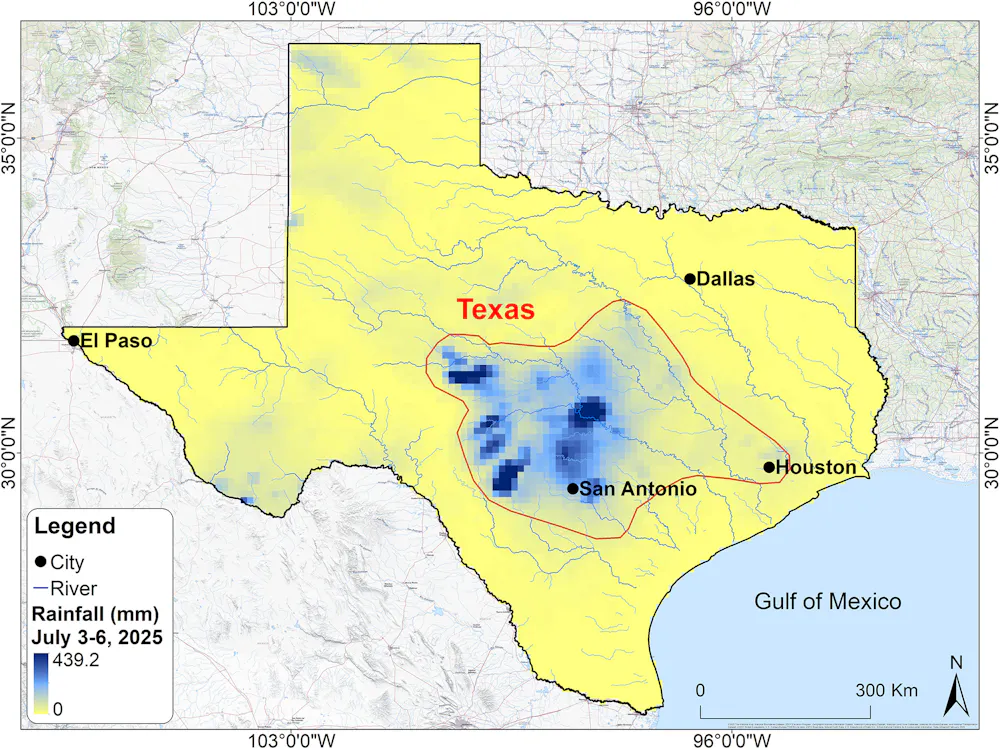
The total precipitation over the core impact zone in the Hill Country during July 3 to 6 is estimated to have delivered more than 15 billion cubic metres of water — an extraordinary volume.
This deluge was supported by persistent temperature anomalies ranging from 5.4 to 6.9 degrees Celsius above the mean. Such elevated temperatures increased the atmosphere’s capacity to retain moisture.
At these anomaly levels, the air mass could store 35 to 50 per cent more water vapour than normal.
Simultaneously, specific humidity anomalies reflected a 60 to 70 per cent increase over July baselines for central Texas. Specific humidity, which quantifies the actual mass of water vapour per kilogram of air, provides a more direct metric of latent moisture available for precipitation.
The convergence of these extreme thermodynamic variables created an ideal environment for deep, moisture-laden convection, supporting prolonged intense rainfall.
This map of Texas highlights the core impact zone in Hill Country, where rainfall totals exceeded 430 millimetres, more than four times the regional July average. (H. Bonakdari/GSMaP), CC BY
Terrain impacts
While meteorological extremes initiated the July 2025 flood event, the morphology of the Guadalupe River — its shape, behaviour and flows — was pivotal in transforming heavy rainfall into a catastrophic flash flood.
The upper basin’s physical geography, drainage configuration and valley structure contributed to the rapid concentration and propagation of floodwaters.
Known as “Flash Flood Alley,” the terrain of the upper Guadalupe River basin amplified the July 2025 flood through a combination of steep slopes, shallow soils and karstic geology.
These steep slopes limited infiltration and led to rapid soil saturation under intense rainfall. The predominance of karstic limestone — limestone that has been shaped by water creating plains and sinkholes — further reduced storage below the surface, resulting in minimal delay between rainfall and discharge.
Additionally, narrow valley sections created hydraulic bottlenecks, accelerating flow and increasing flood depth, particularly affecting residential areas and campsites.
A map showing the relationships between steep headwaters, tributary confluences and vulnerable downstream communities. (H. Bonakdari/NASA), CC BY
In contrast, broader valleys allowed for the water to spread laterally; there was still destructive momentum due to upstream forcing. These geomorphic traits, compounded by the extreme atmospheric moisture, created an environment where floodwaters accumulated rapidly and struck with devastating force, especially along confluence zones and densely occupied riverfronts.
Excessive runoff
Prior to the July 2025 event, central Texas had already experienced elevated soil moisture conditions due to above-average rainfall during June and early July. Antecedent moisture indices that measure how wet the ground is before rainfall approached 90 to 100 per cent saturation, meaning that the ground was effectively primed for rapid runoff generation.
The region’s karst terrain — characterized by shallow, rocky soils — offered less than five per cent effective porosity, severely limiting absorption into the ground. Simultaneously, regional groundwater tables had risen underground, further reducing the ground’s capacity to absorb water.
This set the stage for an outsized response to the incoming deluge. When intense rainfall arrived, the ground was quickly and completely saturated, resulting in immediate and rapid surface runoff.
Water flows fast down the slopes and through underground limestone channels, leaving little time for it to soak into the ground. As a result, rivers such as the Guadalupe can swell rapidly, rising several feet in a short time, which causes fast-moving flood impacts in narrow valleys and low-lying communities.
Multiple forces
The July floods in Texas were devastatingly deadly. A confluence of various meteorological and topographical factors were to blame.
An overheated atmosphere, saturated with water vapour, unleashed record-breaking rainfall. The unique terrain of Texas Hill Country funnelled that rain swiftly into the river system, while the region’s hydrology, already primed by previous storms, converted nearly all of it into runoff.
By understanding how these atmospheric, geographic and hydrological elements combined, we can better anticipate future risks in “Flash Flood Alley” and improve early warning systems to save lives.
Hossein Bonakdari does not work for, consult, own shares in or receive funding from any company or organisation that would benefit from this article, and has disclosed no relevant affiliations beyond their academic appointment.
In the wake of recent strikes by Israel and the United States on Iranian cities, military sites and nuclear facilities, a troubling paradox has emerged: actions intended to prevent Iran from acquiring nuclear weapons may actually be accelerating its pursuit of them and encouraging other countries to follow suit.
On June 13, Israel launched Operation Rising Lion, a military campaign aimed at dismantling Iran’s nuclear program. The operation began with a series of co-ordinated strikes targeting Iran’s top nuclear scientists, senior military officials and key members of the Islamic Revolutionary Guard Corps.
Despite establishing air dominance, Israel did not possess the capability to destroy Iran’s most heavily fortified nuclear facilities — especially the Fordow enrichment site, which is buried deep within a mountain.
On June 21, the U.S. carried out major airstrikes targeting Iran’s critical nuclear sites at Fordow, Natanz and Isfahan. Using B-2 stealth bombers equipped with bunker-busting bombs, the operation aimed to cripple Iran’s deeply fortified nuclear infrastructure.
Three days later, Iran and Israel agreed to a ceasefire, bringing the 12-day conflict to an end. While both sides declared aspects of the campaign successful, the war marked a dangerous escalation in regional tensions and raised renewed concerns over the future of nuclear nonproliferation and security in the Middle East.
History of nuclear negotiations
The U.S. has consistently asserted that Iran must never be allowed to acquire nuclear weapons. In 2006, Iran was subjected to international sanctions after the International Atomic Energy Agency (IAEA) reported the government was not in compliance with its nuclear energy obligations.
Under former president Barack Obama, the U.S. government pursued a diplomatic path, culminating in the 2015 Joint Comprehensive Plan of Action (JCPOA). Under the deal, Iran agreed to limit uranium enrichment to 3.67 per cent and allow intrusive IAEA inspections. In exchange, it received relief from some international sanctions.
The Biden administration sought to revive the JCPOA, but Iran demanded binding guarantees that future U.S. governments would not again withdraw — an assurance Biden could not provide.
In the aftermath, Iran significantly escalated its nuclear activities. According to IAEA reports, Iran has more than 400 kilograms of enriched uranium to 60 per cent — an amount that, if further refined to 90 per cent, could be sufficient to produce 10 to 12 nuclear weapons.
The second Trump administration resumed negotiations for a new nuclear deal aimed at imposing stronger constraints on Iran’s nuclear program.
Although five rounds of negotiations were held, a sixth round scheduled for June 15 was disrupted when Israel conducted a military strike on Iran two days earlier. The attack escalated tensions and derailed the diplomatic process, further complicating the possibility of reaching a renewed agreement.
Although it maintains ambiguity about its nuclear program, Israel is seen to be the only country in the Middle East to possess nuclear weapons. It has taken military action to prevent other countries in the region from developing nuclear programs.
The Israeli government may have calculated that airstrikes could also effectively work against Iran. However, the difference is that Iran’s nuclear program is far more advanced than Syria or Iraq’s were. While the recent strikes may have set the program back by two years, Iran retains the knowledge and capacity to rebuild.
Ironically, the Israeli and U.S. strikes, which aimed to eliminate Iran’s nuclear capabilities, may instead encourage Iranian officials to accelerate their efforts. Following the war, Iran ended all co-operation with the IAEA, expelling inspectors and cutting off access to its nuclear sites. Without IAEA personnel on the ground, it has become extremely difficult to monitor or verify the scope of Iran’s nuclear activities.
Bombing Iran’s nuclear facilities each time it advances its nuclear program is not a sustainable strategy. Israel had hoped that a decisive military strike would trigger widespread unrest and potentially lead to the Iranian government’s collapse.
Instead, the opposite occurred: the Iranian public rallied around the flag, perceiving the attack as a blatant violation of national sovereignty. As a result, the government strengthened its domestic legitimacy and further suppressed political opposition.
For now, Iranian officials have maintained that they do not intend to develop a nuclear weapon. However, the Iranian parliament is preparing legislation to withdraw from the Nuclear Non-Proliferation Treaty, of which Iran is currently a signatory.
Exiting the treaty would remove a major legal and diplomatic constraint on Iran’s pursuit of nuclear weapons. Should Iran decide to go down that path, it would likely trigger a nuclear arms race in the region.
Saudi Arabia has indicated that if Iran builds a nuclear weapon, it will seek to do the same.
The most effective way to prevent Iran from acquiring nuclear weapons is through sustained diplomacy and a renewed nuclear agreement. A credible deal that includes robust verification mechanisms and IAEA inspections and sanctions relief remains the most viable solution.
Military strikes, by contrast, tend to backfire, and will likely reinforce the belief in Iran — and elsewhere — that only a nuclear deterrent can shield them from external threats.
Saira Bano does not work for, consult, own shares in or receive funding from any company or organisation that would benefit from this article, and has disclosed no relevant affiliations beyond their academic appointment.
More than 180 plants were stolen from a well-loved public park in Nottingham called Arboretum in May 2025. This incident took place just days after volunteers had re-planted flowers and shrubs to repair damage from a previous theft in March. In April 2025, the nearby Forest Recreation Ground community garden was also targeted – roses and crops grown by volunteers were stolen, even a pond went missing.
Plant theft may seem trivial, but environmental and wildlife crime tend to be overlooked. This is precisely one of the reasons why it is on the rise. Research suggests an annual growth rate in environmental crime of 5%-7%, making it the third largest criminal sector in the world.
Globally, environmental crime has been valued at US$70-213 billion (£52-158 billion) annually. As with most crime, its true scale is difficult to estimate as it remains hidden. This is even more true for environmental crime that goes undetected.
Plant thefts in Nottingham where I am based are small in comparison, but they tell the same story of lucrative illicit opportunities for criminals where law enforcement and potential sanctions are low. It’s most likely that people steal local plants to sell on for profit.
Get your news from actual experts, straight to your inbox.Sign up to our daily newsletter to receive all The Conversation UK’s latest coverage of news and research, from politics and business to the arts and sciences.
Another reason for overlooking this growing trend in wildlife crime is that perpetrators, as well as much of society, may feel that this is a “victimless crime”. Where plants, animals, watercourses or soil are “the victim”, people don’t feel as strongly because our ethics and value systems generally prioritise fellow humans and do not recognise non-humans as victims.
People may be more likely to care about mammals such as elephants targeted in illegal ivory trade, but environmental crime permeates every community in the UK, as the recent Nottingham cases indicate.
Stolen benefits
As a researcher in environmental sociology, I believe wildlife crime and environmental damage should gain higher priority in terms of public attention, law enforcement and potential sanctions. Not only because of the intrinsic value that non-human nature has in its own right, but because of the value nature brings to us humans.
Parks and green spaces known as “green infrastructure” are central to our wellbeing in cities. They bring environmental and social benefits in terms of air quality, urban heat island effect, surface flooding, carbon storage, biodiversity and health.
After the COVID pandemic, the importance of accessing quality green spaces for our mental and physical wellbeing became even more apparent. Visits to parks can reduce loneliness and anxiety, as well as foster a sense of belonging and community.
This has the potential to benefit the public purse too. Nottingham is currently involved in a national green social prescribing test and learn programme to demonstrate the benefits of nature-based activity.
Public parks are often also significant in terms of cultural heritage. This is not a new discovery. Historically, public parks were introduced in cities to improve living conditions, quality of life and as educational resources. The Arboretum – the city centre park recently targeted by thieves – was the first such public park to open in Nottingham in 1845.
When valued green spaces are the victim of crime, this is not a mere aesthetic problem. Wider social and environmental harms are inflicted upon communities and nature that depend on open green spaces to thrive.
This matters in cities like Nottingham that suffer from high levels of deprivation and poor health outcomes. My own research has shown that while Nottingham is often celebrated for leadership in green initiatives, it suffers from deep-seated social inequality and deprivation that are long-term challenges.
Social inequality is associated with crime and disorder in urban areas that creates a vicious cycle when the crimes target community assets such as public parks. It is beyond doubt that public parks being ransacked will negatively impact the quality of life in Nottingham.
It is likely that these crimes get dismissed as a minor nuisance because “only plants” were stolen, but this attitude serves to mask the broader trend of growing environmental crime and the damage this brings to communities. Unfortunately, this will further contribute to the likelihood of such crimes spreading in future.
Don’t have time to read about climate change as much as you’d like?
Jenni Cauvain does not work for, consult, own shares in or receive funding from any company or organisation that would benefit from this article, and has disclosed no relevant affiliations beyond their academic appointment.
NIST Hurricane Maria Program | Technical Update (July 2025)
The National Institute of Standards and Technology (NIST) has released a video update and press release on its study of Hurricane Maria’s impacts on Puerto Rico.
Hurricane Maria, which struck Puerto Rico on Sept. 20, 2017, was one of the most devastating and costly hurricanes in U.S. history. The storm caused nearly 3,000 deaths and more than $90 billion in damages. While nature cannot be controlled, communities can reduce the impacts of natural hazards by making their buildings and infrastructure more resilient, upgrading emergency preparedness plans for critical facilities, and strengthening evacuation and communication protocols.
In 2018, the National Institute of Standards and Technology (NIST) launched an investigation into Hurricane Maria’s impacts to learn what went wrong and to take steps to make Americans safer from future hurricanes.
“Our goal is to learn from that event to recommend improvements to building codes, standards and practices that will make communities more resilient to hurricanes and other hazards, not just in Puerto Rico but across the United States,” said NIST’s lead Hurricane Maria investigator Joseph Main.
The investigation has been an enormous undertaking. NIST experts have conducted hundreds of surveys and interviews, analyzed dozens of buildings, conducted laboratory experiments, and more. As NIST’s National Construction Safety Team nears the end of its investigation, it has released a video update that highlights significant milestones and preliminary findings.
What Made Hurricane Maria So Dangerous?
Hurricane Maria set off a cascade of building and infrastructure failures across Puerto Rico that had lasting impacts on society, including health care, business and education. The storm itself was a Category 4 hurricane, with peak gusts as high as 140 mph over flat terrain, strong enough to topple trees and lift roofs off houses. The wind was even stronger along the ridges of hills and mountains, where power lines and cellphone towers were located. Those lines and towers were damaged or destroyed, knocking out electric, phone and internet service for almost the entire island.
The steep mountains of Puerto Rico also intensified the rainfall, resulting in extensive flooding and more than 40,000 landslides. This destroyed roads and bridges, blocking routes to hospitals and shelters for those who badly needed them. The hospitals and shelters themselves were heavily damaged by the storm, lifesaving medical equipment was destroyed, and parts of the buildings became uninhabitable. Each of these impacts intensified others. For example, the loss of electricity made it more difficult to move patients and supplies within some hospitals because elevators stopped working.
Why NIST?
NIST has a long history of studying disasters and building failures. Under the National Construction Safety Team (NCST) Act, NIST is authorized to establish teams “to assess building performance and emergency response and evacuation procedures in the wake of any building failure that has resulted in substantial loss of life or that posed significant potential of substantial loss of life.”
Additionally, the National Windstorm Impact Reduction Act gives NIST responsibility for “carrying out research and development to improve model building codes, voluntary standards, and best practices for the design, construction, and retrofit of buildings, structures, and lifelines” with the purpose of achieving “measurable reductions in the losses of life and property from windstorms.”
Previous NIST investigations have led to building code improvements for tornadoes and fires that can save lives in communities across the country.
Responding to Hurricane Maria, NIST created a team of experts in structural and civil engineering, public health, epidemiology, medicine, anthropology, communications, sociology and economics. These experts came from NIST, other federal agencies and universities, including outside experts based in Puerto Rico.
“Having a local presence has been critical in carrying out this work, especially during the pandemic,” said Maria Dillard, investigation associate lead.
The Investigation So Far
The investigation is wide-ranging and has included reconnaissance of the island, creation of a detailed map of wind speeds during the hurricane, long-term measurements of wind speeds at cell towers, and wind tunnel tests. The NIST team conducted hundreds of interviews with emergency communicators; family members of the deceased; hospital, school and shelter staff members; shipping and transportation sector representatives; infrastructure officials; and others impacted by the storm. They also surveyed more than 1,500 households, 450 businesses, 300 schools and 16 hospitals for the project.
Understanding the impact on hospitals and emergency shelters was a high priority for the investigators, who conducted detailed evaluations of five hospitals and five shelter facilities.
This information went into computer models to understand how the hurricane and the long recovery process unfolded.
During the course of the investigation, Puerto Rico was buffeted by more disasters, including a series of earthquakes that started in 2019, the COVID-19 pandemic in 2020, Hurricane Fiona in 2022, and Tropical Storm Ernesto in 2024. These events made the recovery from Hurricane Maria more difficult and presented additional challenges for the investigation.
Importance of NIST’s Hurricane María Investigation
Preliminary Findings
The complete report will not be released until 2026, so these findings may change before the report is finalized. However, in the video Main and Dillard share the following major preliminary findings, which they anticipate will be included in the final version.
While peak wind speeds over flat terrain reached as high as 140 mph (225 kmh), those winds were accelerated to over 200 mph (322 kmh) in some areas by the shape of steep hills and mountains. The mountains also intensified the rainfall. The most extreme rainfall reached 30 inches (76 centimeters) in some areas.
A major challenge for the investigation was that many weather-measuring devices were damaged during the storm. Only three out of 22 weather stations were fully functional throughout the hurricane. A Doppler weather radar site was destroyed by high winds, and the majority of rain gauges failed during the storm.
Surveys with family members of those who died in the two weeks following the hurricane showed that only about one-tenth of the deaths occurred on the day of landfall and that only a small fraction of the deaths were caused by storm-related injuries. Reduced access to health care was found to be a significant factor in the deaths that occurred. The most common causes of death were noncommunicable medical conditions such as cardiovascular disease, diabetes and kidney disease, as those who suffered from these conditions had difficulty obtaining the medical care they needed.
Landslides, collapsed bridges and fallen trees blocking roads kept people from getting help. Such road disruptions were estimated to have cut off hospital access for just over half of the population immediately following the hurricane. Many patients sought medical care at multiple places before receiving treatment. After arriving at hospitals, patients encountered additional disruptions in care from hospital buildings that were damaged, flooded and without electrical power.
The investigation also found that 95.3% of schools lost power, for an average of over 100 days. Lack of potable water was also an issue for school recovery. One school emphasized that students needed to bring their own water because the school’s water was not safe to drink.
Success Stories
One important preliminary finding from the study is that emergency preparations work. Businesses, schools and hospitals that prepared before Hurricane Maria were able to resume operations more quickly afterward. Preparations included preestablished emergency plans, designated risk mitigation funds, and backup power sources.
Preliminary findings also showed that financial assistance was effective. Statistically, businesses, schools and hospitals that received financial assistance were able to recover more quickly than those that did not.
Anticipated Recommendations
Through the National Construction Safety Team (NCST) Act, NIST has a responsibility to use investigation findings to create recommendations and help implement them.
Recommendations from the Hurricane Maria Program are anticipated to result in:
New building standards to account for faster winds caused by mountains and hills.
New standards for storm shelters and refuge areas.
Measures that will help hospitals and other critical facilities maintain services during and after hurricanes, such as requiring standby generators for elevators and air-conditioning.
Guidance on recording damage to communications systems in a way that will prioritize recovery.
More robust tools for measuring wind, rainfall and flooding.
New standards for creating death certificates during an emergency.
These changes will be important for hurricane-prone regions throughout the U.S., not just Puerto Rico. Hurricane Helene, which carved a destructive path from Florida through North Carolina in 2024, shared many similarities with Hurricane Maria, such as significant rainfall in mountainous areas that led to flooding and landslides; neighborhoods and communities being cut off from road access; massive infrastructure failure; and at least one hospital requiring evacuation.
By applying the lessons of Hurricane Maria, this investigation can help the increasing number of communities that are experiencing intense hurricanes prepare for, respond to, and recover from them.
Source: The Conversation – UK – By Stephan Blum, Research associate, Institute for Prehistory and Early History and Medieval Archaeology, University of Tübingen
Beneath the epic tales of heroes and gods, Troy’s true story is written in something far less glamorous – its rubbish.
When we think of Troy, we imagine epic battles, valiant deeds, cunning tricks and the wrath of gods. Thanks to Homer’s Iliad, the city is remembered as a stage for romance and heroism.
But long before Paris stole Helen and Achilles raged on the battlefield, the people of bronze age Troy lived ordinary lives – with extraordinary consequences. They built, cooked, stored, traded and, crucially, threw things away. And they did it right where they lived.
Today, waste is whisked away quickly – out of sight, out of mind. But in bronze age Troy (3000–1000BC), trash stayed close, often accumulating in domestic dumping grounds for generations.
Having spent more than 16 summers excavating and analysing the bronze age layers of Troy, I’ve learned to read the city’s history this waste.
Hundreds of thousands of animal bones from cattle, sheep, fish – even turtles – were found alongside vast quantities of pottery shards, ash, food scraps, and human waste. Sometimes, these layers were reused to level floors or build walls, showing how closely intertwined daily life and refuse management were.
Archaeology’s dirty secret
This wasn’t laziness or neglect, it was pure pragmatism. In a world without rubbish trucks or sanitation systems, managing refuse was neither chaotic nor careless, but a collective, spatially negotiated – and surprisingly strategic – effort.
The excavations I have worked on as part of the University of Tübingen’s Troy Project, which has been going on since 1988, have revealed just how deliberate these routines were. Where people chose to dump, or not to dump, speaks volumes about status, social roles, and community boundaries. Waste is the diary no one meant to write, yet it records the intimate rhythms of daily life with unfiltered clarity.
Far from a nuisance, Troy’s waste is an archaeologist’s treasure trove.
Over nearly 2,000 years, Troy ended up with 15 meters of built-up debris. Archaeologists can see nine major building phases in it, each made up of hundreds of thin layers, which formed as people lived their everyday lives. These layers act like snapshots, quietly recording how the city changed over time. Some capture hearth cleanings, others record the rebuilding of entire city quarters.
By analysing the layers and their ratios of bones to pottery, ash concentration, presence of storage jars, grinding stones, or production debris, specific spaces of activity become visible: kitchens, workshops, storage areas, rubbish pits. What appears chaotic turns out to be a carefully structured map of everyday routines – showing where meals were prepared, tools made, and discarded objects left behind.
A schematic cross-section through the settlement mound of Troy, revealing centuries of construction, destruction, and renewal. University of Tübingen/Frank Schweizer, CC BY-NC-SA
The story these remains tell is one of profound transformation. Troy began as a modest agrarian settlement, shaped by the steady rhythms of farming, herding, and small-scale craft. Over time, it grew into a thriving regional centre.
The archaeological record, rich in refuse, traces this long arc of change. Exotic imports fashioned from stones such as carnelian and lapis lazuli begin to appear, revealing distant trade connections. Specialised metalworking tools emerge alongside monumental architecture. some buildings stretched nearly 30 metres, signalling growing ambitions and expanding capabilities.
This rise unfolded gradually, reflected not just in grander buildings, but in shifting tools, trade, and how people dealt with what they left behind. Waste management became more organised, with designated areas for different types of waste. This reflects broader shifts in how the community structured space and managed its economy.
Yet this ascent was interrupted. By the mid-third millennium BC, signs that things were becoming smaller appear. Architecture simplifies, household inventories shrink, production debris declines suggesting economic slowdown or political instability.
Still, Troy endured. By the mid-second millennium BC, the city revived. Refined ceramics, luxury imports and evidence of social complexity marked a new chapter of recovery and reinvention. This splendid settlement later became the stage for Homer’s Trojan War where Greek warriors faced the daunting task of climbing towering mounds of debris built up over centuries just to reach the palaces.
A heap worth climbing
These insights allow us to see Troy not just as a city of walls and towers, but as a living organism shaped by daily routines, unspoken norms and social negotiation. The waste left behind is a remarkably honest archive of bronze age society – beneath myths, stones, and poetry.
Troy’s trash heaps are the bronze age’s search history. To know what mattered 4,500 years ago, don’t ask poets – ask the garbage. From broken tools to shared meals, from imported luxuries to scraps, this waste reveals the pulse of everyday life and society’s evolving structure.
Ironically, these mundane refuse layers preserved the bronze age world for us. Without them, we’d know far less about early Troy’s people. Their depth and composition trace changes in economy, technology, and social structure. From scraps to towers of pottery shards, waste archaeology is key to understanding early urban complexity.
So next time you picture Achilles storming Troy’s gates, remember: the heroes might have been divine, but their city smelled very human.
Stephan Blum does not work for, consult, own shares in or receive funding from any company or organisation that would benefit from this article, and has disclosed no relevant affiliations beyond their academic appointment.
Source: The Conversation – UK – By Stephan Blum, Research associate, Institute for Prehistory and Early History and Medieval Archaeology, University of Tübingen
Beneath the epic tales of heroes and gods, Troy’s true story is written in something far less glamorous – its rubbish.
When we think of Troy, we imagine epic battles, valiant deeds, cunning tricks and the wrath of gods. Thanks to Homer’s Iliad, the city is remembered as a stage for romance and heroism.
But long before Paris stole Helen and Achilles raged on the battlefield, the people of bronze age Troy lived ordinary lives – with extraordinary consequences. They built, cooked, stored, traded and, crucially, threw things away. And they did it right where they lived.
Today, waste is whisked away quickly – out of sight, out of mind. But in bronze age Troy (3000–1000BC), trash stayed close, often accumulating in domestic dumping grounds for generations.
Having spent more than 16 summers excavating and analysing the bronze age layers of Troy, I’ve learned to read the city’s history this waste.
Hundreds of thousands of animal bones from cattle, sheep, fish – even turtles – were found alongside vast quantities of pottery shards, ash, food scraps, and human waste. Sometimes, these layers were reused to level floors or build walls, showing how closely intertwined daily life and refuse management were.
Archaeology’s dirty secret
This wasn’t laziness or neglect, it was pure pragmatism. In a world without rubbish trucks or sanitation systems, managing refuse was neither chaotic nor careless, but a collective, spatially negotiated – and surprisingly strategic – effort.
The excavations I have worked on as part of the University of Tübingen’s Troy Project, which has been going on since 1988, have revealed just how deliberate these routines were. Where people chose to dump, or not to dump, speaks volumes about status, social roles, and community boundaries. Waste is the diary no one meant to write, yet it records the intimate rhythms of daily life with unfiltered clarity.
Far from a nuisance, Troy’s waste is an archaeologist’s treasure trove.
Over nearly 2,000 years, Troy ended up with 15 meters of built-up debris. Archaeologists can see nine major building phases in it, each made up of hundreds of thin layers, which formed as people lived their everyday lives. These layers act like snapshots, quietly recording how the city changed over time. Some capture hearth cleanings, others record the rebuilding of entire city quarters.
By analysing the layers and their ratios of bones to pottery, ash concentration, presence of storage jars, grinding stones, or production debris, specific spaces of activity become visible: kitchens, workshops, storage areas, rubbish pits. What appears chaotic turns out to be a carefully structured map of everyday routines – showing where meals were prepared, tools made, and discarded objects left behind.
A schematic cross-section through the settlement mound of Troy, revealing centuries of construction, destruction, and renewal. University of Tübingen/Frank Schweizer, CC BY-NC-SA
The story these remains tell is one of profound transformation. Troy began as a modest agrarian settlement, shaped by the steady rhythms of farming, herding, and small-scale craft. Over time, it grew into a thriving regional centre.
The archaeological record, rich in refuse, traces this long arc of change. Exotic imports fashioned from stones such as carnelian and lapis lazuli begin to appear, revealing distant trade connections. Specialised metalworking tools emerge alongside monumental architecture. some buildings stretched nearly 30 metres, signalling growing ambitions and expanding capabilities.
This rise unfolded gradually, reflected not just in grander buildings, but in shifting tools, trade, and how people dealt with what they left behind. Waste management became more organised, with designated areas for different types of waste. This reflects broader shifts in how the community structured space and managed its economy.
Yet this ascent was interrupted. By the mid-third millennium BC, signs that things were becoming smaller appear. Architecture simplifies, household inventories shrink, production debris declines suggesting economic slowdown or political instability.
Still, Troy endured. By the mid-second millennium BC, the city revived. Refined ceramics, luxury imports and evidence of social complexity marked a new chapter of recovery and reinvention. This splendid settlement later became the stage for Homer’s Trojan War where Greek warriors faced the daunting task of climbing towering mounds of debris built up over centuries just to reach the palaces.
A heap worth climbing
These insights allow us to see Troy not just as a city of walls and towers, but as a living organism shaped by daily routines, unspoken norms and social negotiation. The waste left behind is a remarkably honest archive of bronze age society – beneath myths, stones, and poetry.
Troy’s trash heaps are the bronze age’s search history. To know what mattered 4,500 years ago, don’t ask poets – ask the garbage. From broken tools to shared meals, from imported luxuries to scraps, this waste reveals the pulse of everyday life and society’s evolving structure.
Ironically, these mundane refuse layers preserved the bronze age world for us. Without them, we’d know far less about early Troy’s people. Their depth and composition trace changes in economy, technology, and social structure. From scraps to towers of pottery shards, waste archaeology is key to understanding early urban complexity.
So next time you picture Achilles storming Troy’s gates, remember: the heroes might have been divine, but their city smelled very human.
Stephan Blum does not work for, consult, own shares in or receive funding from any company or organisation that would benefit from this article, and has disclosed no relevant affiliations beyond their academic appointment.
Source: United States Senator for Illinois Tammy Duckworth
July 10, 2025
[WASHINGTON, D.C.] – U.S. Senator Tammy Duckworth (D-IL) issued the following statement today after the Trump Administration announced plans to indiscriminately fire hundreds of civil service and Foreign Service Officers:
“Once again, Trump’s illegal, chaotic actions are putting our servicemembers at greater risk, undermining our national security and making all Americans less safe. It was Trump’s first Secretary of Defense, Jim Mattis, who said ‘If you don’t fund the State Department fully, then I need to buy more ammunition…’
“Our diplomats are the first line of defense around the world, anticipating crises and providing invaluable expertise to help prevent conflicts from exploding into catastrophes. By deciding to indiscriminately fire hundreds of these devoted patriots without regard for their merit, expertise, Veteran status or years of experience, Trump is guaranteeing our nation’s response to foreign threats will be less informed, less intelligent and far less effective than before—all at a time when Trump himself is emboldening our enemies and inflaming already red-hot tensions abroad.
“This is a gift to our adversaries and a betrayal of our values. If Republicans care about our national security at all, they must speak out and rein in this President before it’s too late.”
Source: United States Senator for Illinois Tammy Duckworth
July 10, 2025
[WASHINGTON, D.C.] – U.S. Senator Tammy Duckworth (D-IL) issued the following statement today after the Trump Administration announced plans to indiscriminately fire hundreds of civil service and Foreign Service Officers:
“Once again, Trump’s illegal, chaotic actions are putting our servicemembers at greater risk, undermining our national security and making all Americans less safe. It was Trump’s first Secretary of Defense, Jim Mattis, who said ‘If you don’t fund the State Department fully, then I need to buy more ammunition…’
“Our diplomats are the first line of defense around the world, anticipating crises and providing invaluable expertise to help prevent conflicts from exploding into catastrophes. By deciding to indiscriminately fire hundreds of these devoted patriots without regard for their merit, expertise, Veteran status or years of experience, Trump is guaranteeing our nation’s response to foreign threats will be less informed, less intelligent and far less effective than before—all at a time when Trump himself is emboldening our enemies and inflaming already red-hot tensions abroad.
“This is a gift to our adversaries and a betrayal of our values. If Republicans care about our national security at all, they must speak out and rein in this President before it’s too late.”
Source: People’s Republic of China in Russian – People’s Republic of China in Russian –
An important disclaimer is at the bottom of this article.
Source: People’s Republic of China – State Council News
WASHINGTON, July 14 (Xinhua) — Nine people were killed and dozens were hospitalized in a fire at a nursing home in Fall River, Massachusetts, on Sunday evening, the Fall River Fire Department said.
At a Monday morning press conference, Fire Chief Jeffrey Bacon confirmed that nine people were killed and more than 30 were taken to hospital, including one in critical condition.
Firefighters called to the Gabriel House care home in Oliver Street at around 9.30pm Sunday local time /1.30am Monday GMT/ found a large blaze at the building’s main entrance.
Five firefighters sustained minor injuries during the operation. There were about 70 residents in the building.
Investigators from the city fire department and the state fire marshal’s office are working to determine the cause of the fire. –0–
Please note: This information is raw content obtained directly from the source of the information. It is an accurate report of what the source claims and does not necessarily reflect the position of MIL-OSI or its clients.
Source: People’s Republic of China in Russian – People’s Republic of China in Russian –
An important disclaimer is at the bottom of this article.
Source: People’s Republic of China – State Council News
Moscow, July 14 /Xinhua/ — A terrorist attack planned by Ukrainian special services against one of the servicemen has been prevented in Russia’s Tyumen Region, the press service of the Russian Federal Security Service reported on Monday.
As was established, the terrorist act was being prepared by a recruited Russian citizen born in 1987. Since the beginning of 2025, he had been transmitting information about strategic facilities in the Ural Federal District and about military trains passing along the Trans-Siberian Railway. Planning to blow up a Russian serviceman’s car, the attacker removed an explosive device from a pre-arranged cache. When detained, he put up active armed resistance and was neutralized by return fire.
An explosive device, a traumatic pistol modified to fire live ammunition, and ammunition for it were seized at the scene. Two homemade grenades were found at the criminal’s residence. A criminal case has been opened on the fact of illegal trafficking of explosives. –0–
Please note: This information is raw content obtained directly from the source of the information. It is an accurate report of what the source claims and does not necessarily reflect the position of MIL-OSI or its clients.
Source: People’s Republic of China in Russian – People’s Republic of China in Russian –
An important disclaimer is at the bottom of this article.
Source: People’s Republic of China – State Council News
LONDON, July 14 (Xinhua) — Four people were killed in a plane crash at London’s Southend Airport on Sunday, local media reported on Monday.
Four people have died, the BBC and PA news agency reported. Police have not yet confirmed the number of casualties.
The 12-metre-long aircraft, believed to be a Beech B200 Super King Air, was owned by Dutch company Zeusch Aviation and was scheduled to fly to Lelystad Airport in the Netherlands.
Zeusch Aviation confirmed that its flight SUZ1 “experienced an incident” at London Airport and expressed sympathy to “all those affected”.
Video footage shows a huge fireball after the plane crashed.
Pictures posted online showed large flames and a cloud of black smoke after the crash, which happened on Sunday afternoon. Essex Police said they received “reports of a collision involving a single 12m aircraft” shortly before 4pm local time /1500 GMT.
Southend Airport said the airport would be “closed until further notice” due to a “serious incident”. -0-
Please note: This information is raw content obtained directly from the source of the information. It is an accurate report of what the source claims and does not necessarily reflect the position of MIL-OSI or its clients.
Toronto, ON, July 14, 2025 (GLOBE NEWSWIRE) — Nicola Real Estate (NRE), the in-house real estate team of Canadian investment firm Nicola Wealth, welcomes industry veteran Adam Sherriff-Scott as Vice President, Leasing and Portfolio Strategy. Based in Toronto, Sherriff-Scott brings more than 25 years of experience in commercial real estate to NRE at a pivotal moment of strategic growth for the firm. Adam’s addition reinforces NRE’s long-term commitment to serving clients, tenants, and partners across Central and Eastern Canada and the U.S.
Adam joins Nicola Real Estate at a time of ongoing expansion, with the firm growing its portfolio in Canada and the U.S. In his new role, he will contribute to strengthening NRE’s leasing platform and portfolio strategy in the East, helping deepen relationships with tenants, brokers, and development partners while supporting value creation for our funds and institutional clients.
“Adam is very well regarded in the industry. His extensive network in the brokerage community and his deal-making acumen bring immediate firepower to our strategic growth plans,” said Ron Bastin, Managing Director, Real Estate. “The NRE team is excited for Adam to bring his energy and leadership to our Toronto team. Adam’s experience and insights are expected to contribute positively to our clients and partners.”
Prior to joining Nicola Real Estate, Adam worked as a senior broker representing local, regional, and national tenants as well as owners in both leasing and sales. His collaborative approach, deep network in the brokerage community, and knowledge of market dynamics will help position NRE’s presence for leasing and acquisition opportunities across the region.
“I’ve had the privilege of working with Nicola Real Estate for over a decade and have consistently been impressed by their disciplined approach and long-term perspective,” said Sherriff-Scott. “What has always stood out is the quality of the people and the professionalism of every interaction. Nicola Real Estate’s client-focused mindset and commitment to creating long-term value for clients align closely with my own values. I’m excited to join a team I’ve long respected and contribute to the continued growth of the platform.”
Adam’s client-first mindset, dedication to integrity, and willingness to listen and collaborate make him a natural fit with NRE’s culture. His addition reflects NRE’s commitment to delivering investor value through long-term, tenant-first partnerships.
About Nicola Real Estate
Nicola Real Estate (NRE) is the in-house real estate team of Nicola Wealth, a premier Canadian financial planning and investment firm with over $17 billion in assets under management as of May 2025. NRE has an experienced and innovative team that sources and asset manages a growing portfolio of properties in major markets across North America. The diversified portfolio includes industrial, self-storage, multi-family rental apartments, retail, seniors housing, and office assets, exceeding $10 billion in gross asset value. For more information, please visit nicolawealth.com/real-estate.
New York City, NY, July 14, 2025 (GLOBE NEWSWIRE) —
The total network computing power exceeded the historical high of 900 EH/s, and the mining cost of each BTC soared 34% to $70,000-miners are looking for the survival code in the carnival and anxiety.
01 Computing power inflation and cost crisis: the life and death game of mining Cost storm: The mining cost of a single Bitcoin exceeded $70,000 in Q2 2025, a 34% increase from the beginning of the year. After the halving, the block reward was halved to 3.125 BTC, but the total network computing power rose against the trend to 908 EH/s, causing the unit computing power income (Hashprice) to plummet by 60% to $0.049/TH.
Energy noose: The energy cost of North American mining companies doubled year-on-year, and mining machines in areas with electricity prices exceeding $0.1/kWh were shut down on a large scale. The Middle East has become a new gold mine – the UAE government project electricity price is as low as $0.035/kWh, and Oman subsidizes electricity prices of $0.05-0.07/kWh, attracting large-scale capital migration.
02 Capital mergers and acquisitions and technological revolution: Reconstructing the new mining landscape Capital integration wave Giant acquisitions: AI cloud computing company CoreWeave acquired British mining company CoreScientific. The stock price soared 18.5% on the day the transaction was exposed, revealing the value transfer of computing power assets to technology giants.
Financing frenzy: American Bitcoin Corp, supported by the Trump family, raised $215 million; listed mining companies Mara, Riot, and CleanSpark raised more than $3.7 billion in half a year; Southeast Asian mining company CloudKGN received $120 million from Sequoia Capital to expand the Singapore hydropower station data center.
Technical breakthrough path Technical direction Breakthrough case Energy efficiency improvement Liquid-cooled mining machine cluster KGNcloud third-generation liquid cooling system Mining machine density increased by 3 times, energy consumption reduced by 35% Dynamic load balancing Mining computing power and AI task intelligent scheduling Energy reuse rate exceeds 80% Hybrid mining protocol Dynamic switching of 6 currencies including BTC/ETH Revenue volatility risk reduced by 57% “The essence of mining machines is upgrading from ‘computing power tools’ to ‘energy converters’” – Bitmain’s chief engineer pointed out at the 2025 World Mining Summit
03、Personal miner survival guide: The cruel reality of the four major tracks Lottery Mining
Operation: Use 3-5 TH/s small equipment for independent mining
Income: The success rate is only 0.0000006%, but in 2024, there will be miners with 3 TH/s wins $200,000 block reward
ASIC single-soldier combat
Hardware threshold: Ant S21+ (235TH/s) or Shenma M61 (202TH/s), the cost of a single unit exceeds $3000
Cruel reality: The average daily income of a single machine is 0.000133 BTC, and a cluster of more than 20 units is required to break 1 block per year
Pool mining (mainstream choice)
Income logic: income is distributed according to the proportion of computing power, and the FPPS mode guarantees daily settlement
Case: 10 S21+ join AntPool, with an average daily income of about 0.00133 BTC (about $112)
04 、Why choose KGNcloud? KGNcloud combines technological advantages with financial compliance to create the world’s leading intelligent cloud mining platform:
UK FCA Authoritative Certification
The platform has passed the UK Financial Conduct Authority (FCA) compliance certification, with formal operations, transparent funds, and user asset security.
All new users will automatically receive $100 worth of free computing power after registration, and can start mining without recharging, truly realizing a zero-cost experience of daily cryptocurrency income.
The only “principal and interest guaranteed” contract in the entire network
KGNcloud pioneered the “principal and interest guaranteed” mining mechanism, locking the principal and distributing fixed income every day, helping users to make stable profits without fear of fluctuations.
AI intelligent mining system
The platform uses AI algorithms to automatically dispatch the world’s best mining pool resources to achieve 24-hour uninterrupted and efficient mining, and the income far exceeds the industry average.
The income is settled daily and can be withdrawn or reinvested at any time
Users can flexibly manage income and withdraw coins quickly, supporting mainstream currencies such as BTC, USDT, ETH, and XRP.
Summary: KGN cloud offers up to 6.63% daily returns through cloud mining, without having to worry about market fluctuations. Join KGN Miner now, get a $500 free trial, and start enjoying a stable and easy cryptocurrency income. Stop blindly following the trend – start mining and grow your wealth.
Sign up now to get $100 worth of free cloud computing power and start your path to a stable daily income.
ALBUQUERQUE – A Las Cruces man was sentenced to 19 and a half years in prison for fatally shooting another man during a fentanyl drug deal, following his guilty plea to multiple federal drug trafficking and firearms charges.
There is no parole in the federal system.
According to court records, on January 24, 2022, Rudy Garcia, 38, a convicted felon prohibited from possessing firearms, arranged a deal for the victim and an acquaintance to purchase 100 fentanyl-laced pills for $500 from Garcia’s ex-wife. Prior to getting the pills, Garcia and the victim had a conversation at a motel where Garcia let the victim know he had a shotgun and displayed the shotgun so that it was visible to him. Garcia expressed concern that the victim had developed a reputation for conducting “drug rips” and did not want any trouble during the deal.
After obtaining the pills, Garcia and the victim walked together to a vehicle. As they were getting in, Garcia claimed he saw the victim reach for a pistol. Feeling threatened, Garcia exited the vehicle, pulled out his shotgun, and shot the victim. The victim died from the gunshot wound.
Garcia was arrested and charged with conspiracy, distribution of fentanyl, using and discharging a firearm during a drug trafficking crime resulting in death, and being a felon in possession of a firearm and ammunition.
Following his arrest, Garcia admitted to his involvement in the drug deal and the shooting during an interview with detectives. Surveillance footage and witness accounts corroborated the events leading to the victim’s death.
Garcia pleaded guilty to conspiracy to distribute fentanyl, distribution of fentanyl, using, carrying, and brandishing a firearm during and in relation to a drug trafficking crime, using a firearm during and in relation to a drug trafficking crime, discharging said firearm, and causing death through use of said firearm, and being a felon in possession of a firearm and ammunition
Upon his release from prison, Garcia will be subject to three years of supervised release.
U.S. Attorney Ryan Ellison and Philip Russell, Acting Special Agent in Charge of the Federal Bureau of Investigation’s Albuquerque Field Office, made the announcement today.
The Las Cruces Resident Agency of the FBI Albuquerque Field Office investigated this case with assistance from the Las Cruces Police Department. Assistant United States Attorney Randy M. Castellano prosecuted the case.
overnor Kathy Hochul issued a letter to President Trump and Congressional leaders regarding the threat posed by unmanned aerial systems (UAS), commonly known as drones, and highlighting the critical need for a federal comprehensive strategy on drone detection capabilities. Late last year in the New York City area and the Hudson Valley, a number of drone sightings underscored the inadequacy of the federal government’s posture and the constrained ability of state authorities to detect and mitigate these threats.
In the letter, Governor Hochul also urges federal leaders to grant states the ability to maintain and expand the authority to improve detection and mitigation of drone threats in coordination with federal agencies.
The full text of the letter is below:
Dear President Trump:
I am writing to you with respect to the critical need for federal action regarding the threat posed by unmanned aerial systems (UAS), commonly known as drones. As you are aware, late last year, the New York City area and the Hudson Valley experienced concerning UAS sightings that underscored the inadequacy of the federal government’s posture and the constrained ability of state authorities to detect and mitigate these threats.
In early June, the Ukrainian military launched a successful surprise attack against Russian strategic air forces using drones. This serves as a stark reminder of the evolving and significant danger these systems present. An attack against strategic military and critical infrastructure in New York poses an urgent danger to the United States. I urge the Administration to proactively improve the UAS detection and mitigation posture in New York and for Congress to extend existing authorities and expand states’ abilities to detect and mitigate these threats themselves.
The reality is that the federal government is unprepared and poorly postured to detect and mitigate UAS threats and states are hamstrung by a lack of legislative authority and action by the Federal Aviation Administration (FAA). The time for decisive action is now.
I am asking your immediate attention on two fronts:
1. Coordinated Federal Action on Drone Threats. We need a comprehensive federal strategy that not only dramatically improves drone detection capabilities nationally but also provides robust, multi-layered mitigation measures. These detection and mitigation measures must first protect critical infrastructure like population centers, utilities, and military assets, but also be able to be swiftly deployed to areas of concern when necessary. In the summer of 2026-12 short months away – the New York area will be the epicenter for multiple high-profile events, including the World Cup, the flotilla of Tall Ships, International Naval Review, the largest ever Macy’s fireworks show, and America’s 250th birthday celebration, which will present prime targets.
2. Increased Authority for States to Detect and Mitigate Drones. New York State must maintain the authority to take proactive steps to detect and mitigate drones. The previous Congress extended important counter-drone authorities granted to the Department of Homeland Security and Federal Bureau of Investigation, but only to September 2025. The sunset of this authority puts the U.S. at risk and this authority must be extended. Additionally, expanded authorities and capabilities must be granted to states, such as through the measures proposed by the Safeguarding the Homeland from the Threats Posed by Unmanned Aircraft Systems Act. Granting states the authority they need to improve detection and mitigation of UAS threats, in coordination with federal agencies, is no longer a matter of preference. It is a matter of urgent concern.
The security of our state and the nation demands a coordinated and robust response to the challenge posed by drones. I urge you to prioritize this issue and take swift action before it is too late.
We stand ready to collaborate with the federal government and Congress to address this critical threat.
Sincerely,
Kathy Hochul
Governor
CC:
The Honorable Kristi Noem, Secretary of Homeland Security
The Honorable Sean Duffy, Secretary of Transportation
The Honorable Chris Rocheleau, Acting Administrator of the FAA
Source: United States Bureau of Alcohol Tobacco Firearms and Explosives (ATF)
Louisville, KY – Two local men were sentenced last week for conspiracy to possess fentanyl with intent to distribute, possession of fentanyl with intent to distribute, possession of a firearm by a convicted felon, and possession of a firearm in furtherance of a drug trafficking crime.
U.S. Attorney Kyle G. Bumgarner of the Western District of Kentucky, Special Agent in Charge Jim Scott of the DEA Louisville Field Division, Special Agent in Charge John Nokes of the ATF Louisville Field Division, Chief Paul Humphrey of the Louisville Metro Police Department, Kentucky Attorney General Russell Coleman, Chief Barry Wilkerson of the St. Matthews Police Department, and Sheriff Joe Milam of the Anderson County Sheriff’s Office made the announcement.
According to court documents, Jamie Shelby, Jr., 26, was sentenced to 15 years in prison, followed by 5 years of supervised release, for conspiracy to possess fentanyl with intent to distribute, possession of fentanyl with intent to distribute, possession of a firearm by a convicted felon, and possession of a firearm in furtherance of a drug trafficking crime. Kevon Smith, 25, was sentenced to 5 years and 10 months in prison, followed by 4 years of supervised release, for conspiracy to possess fentanyl with intent to distribute and possession of fentanyl with intent to distribute.
Between April 12, 2024, and July 9, 2024, Shelby, Jr. and Smith conspired with each other to possess fentanyl with intent to distribute it and distributed fentanyl. The investigation involved four controlled purchases for a total of 4,200 fentanyl pills from Shelby, Jr. and Smith. During the execution of a search warrant at Shelby Jr.’s residence on July 12, 2024, over 17,000 fentanyl pills and four firearms were seized. The firearms seized included a Glock, Model 43X, 9-millimeter pistol; a Springfield, Model 911, .380 caliber pistol; a Glock, Model 22, .40 caliber pistol; and a Sig Sauer, Model P320, 9-millimeter pistol. The estimated street value of the over 21,000 fentanyl pills seized in the case is $106,000.
Shelby, Jr. had been convicted of the following felony offenses.
On September 26, 2019, in Harrison Superior Court, Harrison County, Indiana, Shelby, Jr. was convicted of the offense of conspiracy to commit robbery.
On March 12, 2020, in Clark Circuit Court 3, Clark County, Indiana, Shelby, Jr. was convicted of the offense of domestic battery committed in the presence of a child less than sixteen years old.
“These defendants earned every second of the sentences imposed for their callous disregard of the people of the Western District of Kentucky,” said U.S. Attorney Bumgarner. “The pattern of fentanyl pouring across the border and into our community must stop; with these sentences, two more distributors of illicit substances are off our streets.”
“Counterfeit pharmaceuticals laced with deadly doses of fentanyl continue to devastate our communities. But thanks to the strong partnerships with our federal, state, and local partners, the dangerous criminals responsible for trafficking this poison for profit have been taken off our streets. The DEA remains committed to protecting lives and holding those who profit from this crisis accountable,” said DEA Special Agent in Charge Jim Scott.
There is no parole in the federal system.
This case was investigated by the DEA, with assistance from the ATF Louisville Field Division, the Louisville Metro Police Department, the Kentucky Attorney General’s Office, the St. Matthews Police Department, and the Anderson County Sheriff’s Office.
Assistant U.S. Attorney Erwin Roberts prosecuted the case.
This conviction is a part of Operation Take Back America, a nationwide initiative that marshals the full resources of the Department of Justice to repel the invasion of illegal immigration, achieve the total elimination of cartels and transnational criminal organizations (TCOs), and protect our communities from the perpetrators of violent crime. Operation Take Back America streamlines efforts and resources from the Department’s Organized Crime Drug Enforcement Task Forces (OCDETFs) and Project Safe Neighborhood (PSN).
Source: United States Bureau of Alcohol Tobacco Firearms and Explosives (ATF)
Louisville, KY – Two local men were sentenced last week for conspiracy to possess fentanyl with intent to distribute, possession of fentanyl with intent to distribute, possession of a firearm by a convicted felon, and possession of a firearm in furtherance of a drug trafficking crime.
U.S. Attorney Kyle G. Bumgarner of the Western District of Kentucky, Special Agent in Charge Jim Scott of the DEA Louisville Field Division, Special Agent in Charge John Nokes of the ATF Louisville Field Division, Chief Paul Humphrey of the Louisville Metro Police Department, Kentucky Attorney General Russell Coleman, Chief Barry Wilkerson of the St. Matthews Police Department, and Sheriff Joe Milam of the Anderson County Sheriff’s Office made the announcement.
According to court documents, Jamie Shelby, Jr., 26, was sentenced to 15 years in prison, followed by 5 years of supervised release, for conspiracy to possess fentanyl with intent to distribute, possession of fentanyl with intent to distribute, possession of a firearm by a convicted felon, and possession of a firearm in furtherance of a drug trafficking crime. Kevon Smith, 25, was sentenced to 5 years and 10 months in prison, followed by 4 years of supervised release, for conspiracy to possess fentanyl with intent to distribute and possession of fentanyl with intent to distribute.
Between April 12, 2024, and July 9, 2024, Shelby, Jr. and Smith conspired with each other to possess fentanyl with intent to distribute it and distributed fentanyl. The investigation involved four controlled purchases for a total of 4,200 fentanyl pills from Shelby, Jr. and Smith. During the execution of a search warrant at Shelby Jr.’s residence on July 12, 2024, over 17,000 fentanyl pills and four firearms were seized. The firearms seized included a Glock, Model 43X, 9-millimeter pistol; a Springfield, Model 911, .380 caliber pistol; a Glock, Model 22, .40 caliber pistol; and a Sig Sauer, Model P320, 9-millimeter pistol. The estimated street value of the over 21,000 fentanyl pills seized in the case is $106,000.
Shelby, Jr. had been convicted of the following felony offenses.
On September 26, 2019, in Harrison Superior Court, Harrison County, Indiana, Shelby, Jr. was convicted of the offense of conspiracy to commit robbery.
On March 12, 2020, in Clark Circuit Court 3, Clark County, Indiana, Shelby, Jr. was convicted of the offense of domestic battery committed in the presence of a child less than sixteen years old.
“These defendants earned every second of the sentences imposed for their callous disregard of the people of the Western District of Kentucky,” said U.S. Attorney Bumgarner. “The pattern of fentanyl pouring across the border and into our community must stop; with these sentences, two more distributors of illicit substances are off our streets.”
“Counterfeit pharmaceuticals laced with deadly doses of fentanyl continue to devastate our communities. But thanks to the strong partnerships with our federal, state, and local partners, the dangerous criminals responsible for trafficking this poison for profit have been taken off our streets. The DEA remains committed to protecting lives and holding those who profit from this crisis accountable,” said DEA Special Agent in Charge Jim Scott.
There is no parole in the federal system.
This case was investigated by the DEA, with assistance from the ATF Louisville Field Division, the Louisville Metro Police Department, the Kentucky Attorney General’s Office, the St. Matthews Police Department, and the Anderson County Sheriff’s Office.
Assistant U.S. Attorney Erwin Roberts prosecuted the case.
This conviction is a part of Operation Take Back America, a nationwide initiative that marshals the full resources of the Department of Justice to repel the invasion of illegal immigration, achieve the total elimination of cartels and transnational criminal organizations (TCOs), and protect our communities from the perpetrators of violent crime. Operation Take Back America streamlines efforts and resources from the Department’s Organized Crime Drug Enforcement Task Forces (OCDETFs) and Project Safe Neighborhood (PSN).
Source: United States House of Representatives – Congressman Eric Sorensen (IL-17)
In a Letter to President Trump, NOAA Leadership, and the U.S. Army Corps of Engineers, the Representatives Want Answers to What Contributed to the Deaths of More Than 100 Americans
Representatives Eric Sorensen (IL-17), Marcy Kaptur (OH-09), and Lloyd Doggett (TX-37) are demanding answers from President Donald Trump, National Oceanic and Atmospheric Administration (NOAA) leadership, and the U.S. Army Corps of Engineers on why hundreds of Americans were unprepared to evacuate from the deadly Texas floods. In a letter they sent to the current Administration, the representatives are calling for an urgent review of the disaster to determine if staffing shortages, stalled forecasting improvements, or insufficient flood preparedness contributed to the deaths of more than 100 people.
“As someone who has reported on dangerous floods for my neighbors as a meteorologist in my local community, I know how critical it is for NWS meteorologists, local media, and emergency management coordinators to work together seamlessly and quickly to share urgent warnings,” said Congressman Sorensen. “The deadly toll of the flash floods that hit Texas last week beg the question of what went wrong with the warning systems in place and what more could have been done to prevent this tragedy. The Trump Administration’s cuts to NOAA and the NWS are already having a real impact on the accuracy of our nation’s weather forecasting, creating cause for major concern. That is why I am calling on President Trump, NOAA, and the Army Corps of Engineers to undertake a full-scale investigation into what went wrong and what can be done to prevent catastrophes like this in the future.”
“This flood was not just a natural disaster but a failure of foresight and leadership,” said Congresswoman Kaptur. “A changing climate is rewriting the rules of weather, and our federal agencies must keep pace. The American people deserve a weather warning system that does more than sound the alarm. It must be fully staffed and ready to act to ensure that everyone in harms way receives it. This letter is a demand for accountability, but more importantly, it’s a demand for lives to be protected anywhere severe weather strikes.”
“As Texans in my state are faced with much pain and uncertainty, we cannot wait to ask the hard questions,” said Congressman Doggett. “Effective oversight saves lives. That is why we need a full account of the ways in which the Trump administration’s recent actions have undermined the federal response, both before and after this catastrophe. Learning from these failures and recognizing that weather intensification driven by climate change increasingly endangers lives will help prevent more tragedies.”
You can read the full letterHERE.
Since President Trump took office, there has been a 15% reduction in National Weather Service (NWS) staffing that has begun to degrade forecasting capabilities and operational capacity at NWS offices across the country.
As the only meteorologist in Congress, Congressman Sorensen has been a fierce advocate for protecting and strengthening NOAA and the NWS from cuts. Starting last year, he has been warning about the impact of Project 2025’s plans to dismantle and privatize NOAA and the NWS. As the Department of Government Efficiency began making cuts to the agencies, Congressman Sorensen has beenspeaking out,introducing legislation, andcalling onthe Administration to bring a stop to the disastrous cuts. He recently introduced theWeather Workforce Improvement Actto help the NWS fully staff critical positions at their offices and theRural Weather Monitoring Systems Actto help strengthen weather forecasting in rural America.
Source: United States House of Representatives – Congressman Eric Sorensen (IL-17)
In a Letter to President Trump, NOAA Leadership, and the U.S. Army Corps of Engineers, the Representatives Want Answers to What Contributed to the Deaths of More Than 100 Americans
Representatives Eric Sorensen (IL-17), Marcy Kaptur (OH-09), and Lloyd Doggett (TX-37) are demanding answers from President Donald Trump, National Oceanic and Atmospheric Administration (NOAA) leadership, and the U.S. Army Corps of Engineers on why hundreds of Americans were unprepared to evacuate from the deadly Texas floods. In a letter they sent to the current Administration, the representatives are calling for an urgent review of the disaster to determine if staffing shortages, stalled forecasting improvements, or insufficient flood preparedness contributed to the deaths of more than 100 people.
“As someone who has reported on dangerous floods for my neighbors as a meteorologist in my local community, I know how critical it is for NWS meteorologists, local media, and emergency management coordinators to work together seamlessly and quickly to share urgent warnings,” said Congressman Sorensen. “The deadly toll of the flash floods that hit Texas last week beg the question of what went wrong with the warning systems in place and what more could have been done to prevent this tragedy. The Trump Administration’s cuts to NOAA and the NWS are already having a real impact on the accuracy of our nation’s weather forecasting, creating cause for major concern. That is why I am calling on President Trump, NOAA, and the Army Corps of Engineers to undertake a full-scale investigation into what went wrong and what can be done to prevent catastrophes like this in the future.”
“This flood was not just a natural disaster but a failure of foresight and leadership,” said Congresswoman Kaptur. “A changing climate is rewriting the rules of weather, and our federal agencies must keep pace. The American people deserve a weather warning system that does more than sound the alarm. It must be fully staffed and ready to act to ensure that everyone in harms way receives it. This letter is a demand for accountability, but more importantly, it’s a demand for lives to be protected anywhere severe weather strikes.”
“As Texans in my state are faced with much pain and uncertainty, we cannot wait to ask the hard questions,” said Congressman Doggett. “Effective oversight saves lives. That is why we need a full account of the ways in which the Trump administration’s recent actions have undermined the federal response, both before and after this catastrophe. Learning from these failures and recognizing that weather intensification driven by climate change increasingly endangers lives will help prevent more tragedies.”
You can read the full letterHERE.
Since President Trump took office, there has been a 15% reduction in National Weather Service (NWS) staffing that has begun to degrade forecasting capabilities and operational capacity at NWS offices across the country.
As the only meteorologist in Congress, Congressman Sorensen has been a fierce advocate for protecting and strengthening NOAA and the NWS from cuts. Starting last year, he has been warning about the impact of Project 2025’s plans to dismantle and privatize NOAA and the NWS. As the Department of Government Efficiency began making cuts to the agencies, Congressman Sorensen has beenspeaking out,introducing legislation, andcalling onthe Administration to bring a stop to the disastrous cuts. He recently introduced theWeather Workforce Improvement Actto help the NWS fully staff critical positions at their offices and theRural Weather Monitoring Systems Actto help strengthen weather forecasting in rural America.
Source: People’s Republic of China in Russian – People’s Republic of China in Russian –
An important disclaimer is at the bottom of this article.
Source: People’s Republic of China – State Council News
Moscow, July 14 (Xinhua) — Three people, including a child, were killed by a lightning strike on a beach near a reservoir in Russia’s Tula region, the regional emergency ministry’s press service reported on Monday.
As TASS reports, citing the head of the Aleksinsky District administration, Pavel Fedorov, “one victim was hospitalized, his condition is described as serious. A total of four people were injured.”
The press service of the regional investigative department of the Investigative Committee of the Russian Federation told TASS that an investigation has been launched into the deaths. The circumstances of the incident are being established.
Earlier on Monday, the Main Directorate of the Ministry of Emergency Situations for the Tula Region reported that, according to the Tula Center for Hydrometeorology and Environmental Monitoring, thunderstorms are expected in some places in the Tula Region in the next 1-3 hours and will continue until the end of the day on July 14, in some areas there will be heavy rain, hail, and squally winds with gusts of 12-17 m/s. –0–
Please note: This information is raw content obtained directly from the source of the information. It is an accurate report of what the source claims and does not necessarily reflect the position of MIL-OSI or its clients.
Source: Government of the Russian Federation – Government of the Russian Federation –
An important disclaimer is at the bottom of this article.
On July 14, the “Dobro” shift of the 11th All-Russian Youth Educational Forum “Territory of Meanings” of the “Rosmolodezh.Forums” platform opened, which this year became part of the national project “Youth and Children”.
Deputy Prime Minister Dmitry Chernyshenko greeted the participants and presented them with the “For Good Deeds” badge and the “Volunteer of Russia” badge.
“As our President Vladimir Putin said, compassion and volunteerism have always been inherent in our country. One of the milestones that we need to remember is the preparation of the volunteer corps for the Olympic and Paralympic Games in Sochi. This event was held at the highest level largely due to the fact that our country demonstrated the face of a new, modern, young, energetic, friendly Russia precisely through volunteers, through their work,” the Deputy Prime Minister said.
At that time, 25 thousand volunteers were trained, the competition was higher than in the most prestigious universities – more than 10 people per place. Dmitry Chernyshenko recalled that Vladimir Putin personally presented diplomas to the winners of the volunteer competition.
The Deputy Prime Minister emphasized that in Russia one can realize one’s potential and talents in a wide variety of areas.
“The President has instructed us to provide all possible, necessary support within the framework of the national project “Youth and Children” so that you can implement this in the most effective way. But of course, you yourselves are the most powerful driving force of volunteerism in our country,” he added.
Key measures in this area are collected in the federal project “We are together”. Among them are 12 events, including support for the association “Dobro.rf” and the project
Dmitry Chernyshenko reported that there are already 88 regional centers for the development of volunteerism, more than 1,000 “Dobro.Centers” and 3,500 headquarters in Russia.
“We understand that this is in fact only the beginning of a long journey, given the task that the President set for us: almost half of all young people should be involved in volunteer and social activities. I am sure that in order to improve the platform, it will be necessary to expand its functionality. The Government gave such an order, but I see that you yourself, with your actions, suggest what these events should be,” the Deputy Prime Minister noted.
Dmitry Chernyshenko thanked the volunteers and listed a number of key tasks facing them. Firstly, this is support for participants in the special military operation, their families and assistance to residents of border areas. Volunteers have already fulfilled more than 650 thousand requests, and more than 600 humanitarian missions have been carried out in Donbass and border areas. Secondly, the elimination of the consequences of the emergency in Anapa. In Krasnodar Krai alone, volunteers have collected and removed about 150 thousand tons of contaminated sand and soil, and saved 7.5 thousand birds. Thirdly, volunteers have provided invaluable assistance in the fight against fires in Zabaikalsky Krai.
In conclusion, the Deputy Prime Minister instructed Rosmolodezh, together with the forum participants, to work out ways to reward feats with event-related ties.
At the opening ceremony of the shift, the Deputy Prime Minister presented the “For Good Deeds” badge and the “Volunteer of Russia” badge.
The “For Beneficence” badge of distinction was established by the decree of the President. It was awarded for systematic work in the social sphere. It was received by the winners of the International Prize
The procedure for rewarding and awarding the “Volunteer of Russia” badge was approved by the Government Resolution. The first to receive the award at the opening of the “Dobro.Conference” were nine volunteers from different regions of Russia. Among them were Olga Ponomareva from the Volgograd Region, Kristina Paraskan from the Zaporozhye Region, Valentina Shustova from the Kirov Region, Zayana Abdulova from the Republic of Kalmykia, Eduard Gaitov from the Chelyabinsk Region, Vera Tukhvatullina from the Tyumen Region, Elmira Anokhina from the Astrakhan Region, Elena Gavrilenko from the Krasnoyarsk Region, Natalia Rastegaeva from the Tambov Region.
“The new award “Volunteer of Russia” is a symbol of recognition and respect for a significant contribution to volunteer activities and a way to thank volunteers for the good deeds that they do without even thinking, at the call of their hearts. It is symbolic that volunteers received their first badges at our flagship forum “Territory of Meanings”, where the traditional “Dobro.Conference” is taking place, bringing together more than 600 people,” said Grigory Gurov, head of Rosmolodezh.
The Dobro shift united people who actively participate in volunteer activities, create social projects, work in NGOs and develop volunteerism in Russia. The shift’s architect is the Dobro.RF social development ecosystem.
“By 2030, every second young person will participate in public and volunteer initiatives. To do this, we will design a set of solutions that will unlock the potential of those willing to take part in social projects. Participants will work on creating an exchange of needs for volunteer and charitable assistance in Russia, a standard for attracting volunteers to eliminate emergencies, a program for the social mission of universities, and support measures for NGOs. We will support and scale up best practices – from preventing homelessness to supporting families in new regions,” said Artem Metelev, Chairman of the State Duma Committee on Youth Policy and Head of Dobro.RF.
In total, five shifts are planned for the Territory of Meanings forum this year: Family, Good, Creation, Unity, and Service. The forum is being implemented as part of the national project Youth and Children. It is being held in the Senezh Management Workshop, the educational center of the presidential platform Russia – Country of Opportunities in Solnechnogorsk for the seventh time.
Please note: This information is raw content obtained directly from the source of the information. It is an accurate report of what the source claims and does not necessarily reflect the position of MIL-OSI or its clients.
Source: United States House of Representatives – Representative Mike Kelly (R-PA)
WASHINGTON, D.C. — On Sunday, U.S. Rep. Mike Kelly (R-PA) and Republican Study Committee Chairman Rep. August Pfluger (R-TX) announced the introduction of a resolution to commemorate the one-year anniversary of the attempted assassination of President Donald J. Trump in Kelly’s hometown of Butler, Pennsylvania on July 13, 2024.
The resolution condemns the multiple attempts against the President’s life and condemns those who incite violence against political officials. In addition to the events in Butler, this also includes the second attempted assassination of President Trump in Florida last year, and attacks on Pennsylvania Governor Josh Shapiro and Minnesota state lawmakers this year.
The resolution also honors the life of Corey Comperatore, the volunteer firefighter and U.S. Army veteran who tragically died while shielding his family from the gunfire; and Pennsylvanians David Dutch and James Copenhaver, who were critically injured during the shooting.
“We must stand up together to oppose violence against our nation’s leaders and condemn the hateful, divisive rhetoric that has fueled our nation’s political dialogue in recent years,” said Kelly and Pflugerin a joint statement. “This weekend, as we remember the tragic events in Butler one year ago, may we also take a moment to honor our heroic first responders who selflessly run toward danger to protect our fellow Americans. May we unite around the common good of these United States. We are stronger together.”
Source: United States House of Representatives – Representative Mike Kelly (R-PA)
WASHINGTON, D.C. — On Sunday, U.S. Rep. Mike Kelly (R-PA) and Republican Study Committee Chairman Rep. August Pfluger (R-TX) announced the introduction of a resolution to commemorate the one-year anniversary of the attempted assassination of President Donald J. Trump in Kelly’s hometown of Butler, Pennsylvania on July 13, 2024.
The resolution condemns the multiple attempts against the President’s life and condemns those who incite violence against political officials. In addition to the events in Butler, this also includes the second attempted assassination of President Trump in Florida last year, and attacks on Pennsylvania Governor Josh Shapiro and Minnesota state lawmakers this year.
The resolution also honors the life of Corey Comperatore, the volunteer firefighter and U.S. Army veteran who tragically died while shielding his family from the gunfire; and Pennsylvanians David Dutch and James Copenhaver, who were critically injured during the shooting.
“We must stand up together to oppose violence against our nation’s leaders and condemn the hateful, divisive rhetoric that has fueled our nation’s political dialogue in recent years,” said Kelly and Pflugerin a joint statement. “This weekend, as we remember the tragic events in Butler one year ago, may we also take a moment to honor our heroic first responders who selflessly run toward danger to protect our fellow Americans. May we unite around the common good of these United States. We are stronger together.”
Source: United States House of Representatives – Congresswoman Chellie Pingree (1st District of Maine)
Today, House Republicans released the draft fiscal year 2026 Interior, Environment, and Related Agencies funding bill, which will be considered in subcommittee tomorrow. Instead of lowering the cost of living and confronting the climate crisis, House Republicans are raising utility bills and energy prices. The legislation takes an aggressive anti-environment, pro-pollution stance with crippling cuts to the Environmental Protection Agency (EPA) and policy provisions that endanger public health and fail to confront the climate crisis. The bill also slashes funding for National Parks and arts programs.
The fiscal year 2026 Interior, Environment, and Related Agencies bill includes $38 billion, which is $2.9 billion below the fiscal year 2025 enacted level and $9.2 billion above the budget request. The bill also provides $2.9 billion for the Wildfire Suppression Operations Reserve Fund.
The legislation:
Raises utility bills by shifting costs onto state and local governments and making electricity more expensive through funding cuts and extreme policies that would cripple renewable energy development.
Worsens the climate crisis by defunding critical Environmental Protection Agency (EPA) work.
Slashes funding for national parks,threatening Americans’ ability to enjoy public lands.
Guts resources for museums, arts, and culture, suppressing Americans’ engagement with the arts and art education.
Favors polluters over public health through dozens of harmful policies that undermine EPA’s ability to regulate pollution.
Promotes environmental discrimination against rural and poor communities by making it more difficult for hardworking people to deal with the rising costs associated with climate change.
Exploits public lands and accelerates ecosystem decline by allowing harmful and dirty mining activities and by removing Endangered Species Act protections for numerous species.
“With the release of the FY26 Interior bill, it’s clear House Republicans are once again pushing an agenda that accelerates the climate crisis, upends our National Parks system, and leaves local communities to fend for themselves—all while undermining the power of the Appropriations Committee and of Congress,” Interior, Environment, and Related Agencies Appropriations Subcommittee Ranking Member Chellie Pingree (D-ME-01) said.“We are still living with the fallout of last year’s failure to negotiate a full-year funding bill. Instead of correcting course, the bill released today delivers more of the same: it cuts water infrastructure funding, slashes EPA programs, and wipes out environmental justice and climate initiatives. It even blocks the EPA from completing its risk assessment on PFAS in sewage sludge—a forever chemical crisis Maine knows all too well. On top of the environmental attacks, Republicans are taking aim at the arts and cultural institutions that enrich communities and drive local economies. Cutting the NEA, NEH, and Smithsonian silences artistic expression and undermines the jobs, education programs, and cultural spaces that strengthen towns and cities across the country. Any arguments that these irresponsible cuts are somehow fiscally responsible ring hollow in the wake of Republicans adding $3.4 trillion to the national deficit thanks to their disastrous so-called ‘One Big Beautiful Bill.’ I urge my Republican colleagues to come to the table and support the essential work of this subcommittee: protecting public health, conserving our lands and waters, investing in resilience, and ensuring that every community—from rural Maine to urban centers—has access to a healthy environment and a vibrant cultural life.”
“President Trump promised to address the cost-of-living crisis, but instead, he and House Republicans are making it worse. House Republicans’ 2026 Interior funding bill raises utility bills and energy prices to benefit billionaires and big corporations,” Appropriations Committee Ranking Member Rosa DeLauro (D-CT-03) said. “Republicans are threatening the air we breathe and the water we drink and taking steps that damage our public lands, promote dirty energy, and hinder our ability to confront the climate crisis. In addition to these dangerous cuts, Republicans’ proposal would mean fewer trips to National Parks and less access to museums and the arts. House Republicans are more focused on lining the pockets of big oil companies than lowering prices for working class, middle class, rural, and vulnerable families; protecting our public health; and preserving the planet.”
A summary of House Republicans’ 2026 Interior, Environment, and Related Agencies funding bill is here. A fact sheet is here. The text of the bill is here. The subcommittee markup will be webcast live and linked on the House Committee on Appropriations website.
Source: United States House of Representatives – Congresswoman Chellie Pingree (1st District of Maine)
Today, House Republicans released the draft fiscal year 2026 Interior, Environment, and Related Agencies funding bill, which will be considered in subcommittee tomorrow. Instead of lowering the cost of living and confronting the climate crisis, House Republicans are raising utility bills and energy prices. The legislation takes an aggressive anti-environment, pro-pollution stance with crippling cuts to the Environmental Protection Agency (EPA) and policy provisions that endanger public health and fail to confront the climate crisis. The bill also slashes funding for National Parks and arts programs.
The fiscal year 2026 Interior, Environment, and Related Agencies bill includes $38 billion, which is $2.9 billion below the fiscal year 2025 enacted level and $9.2 billion above the budget request. The bill also provides $2.9 billion for the Wildfire Suppression Operations Reserve Fund.
The legislation:
Raises utility bills by shifting costs onto state and local governments and making electricity more expensive through funding cuts and extreme policies that would cripple renewable energy development.
Worsens the climate crisis by defunding critical Environmental Protection Agency (EPA) work.
Slashes funding for national parks,threatening Americans’ ability to enjoy public lands.
Guts resources for museums, arts, and culture, suppressing Americans’ engagement with the arts and art education.
Favors polluters over public health through dozens of harmful policies that undermine EPA’s ability to regulate pollution.
Promotes environmental discrimination against rural and poor communities by making it more difficult for hardworking people to deal with the rising costs associated with climate change.
Exploits public lands and accelerates ecosystem decline by allowing harmful and dirty mining activities and by removing Endangered Species Act protections for numerous species.
“With the release of the FY26 Interior bill, it’s clear House Republicans are once again pushing an agenda that accelerates the climate crisis, upends our National Parks system, and leaves local communities to fend for themselves—all while undermining the power of the Appropriations Committee and of Congress,” Interior, Environment, and Related Agencies Appropriations Subcommittee Ranking Member Chellie Pingree (D-ME-01) said.“We are still living with the fallout of last year’s failure to negotiate a full-year funding bill. Instead of correcting course, the bill released today delivers more of the same: it cuts water infrastructure funding, slashes EPA programs, and wipes out environmental justice and climate initiatives. It even blocks the EPA from completing its risk assessment on PFAS in sewage sludge—a forever chemical crisis Maine knows all too well. On top of the environmental attacks, Republicans are taking aim at the arts and cultural institutions that enrich communities and drive local economies. Cutting the NEA, NEH, and Smithsonian silences artistic expression and undermines the jobs, education programs, and cultural spaces that strengthen towns and cities across the country. Any arguments that these irresponsible cuts are somehow fiscally responsible ring hollow in the wake of Republicans adding $3.4 trillion to the national deficit thanks to their disastrous so-called ‘One Big Beautiful Bill.’ I urge my Republican colleagues to come to the table and support the essential work of this subcommittee: protecting public health, conserving our lands and waters, investing in resilience, and ensuring that every community—from rural Maine to urban centers—has access to a healthy environment and a vibrant cultural life.”
“President Trump promised to address the cost-of-living crisis, but instead, he and House Republicans are making it worse. House Republicans’ 2026 Interior funding bill raises utility bills and energy prices to benefit billionaires and big corporations,” Appropriations Committee Ranking Member Rosa DeLauro (D-CT-03) said. “Republicans are threatening the air we breathe and the water we drink and taking steps that damage our public lands, promote dirty energy, and hinder our ability to confront the climate crisis. In addition to these dangerous cuts, Republicans’ proposal would mean fewer trips to National Parks and less access to museums and the arts. House Republicans are more focused on lining the pockets of big oil companies than lowering prices for working class, middle class, rural, and vulnerable families; protecting our public health; and preserving the planet.”
A summary of House Republicans’ 2026 Interior, Environment, and Related Agencies funding bill is here. A fact sheet is here. The text of the bill is here. The subcommittee markup will be webcast live and linked on the House Committee on Appropriations website.